A research text dump on Ernst Jünger
2026
Fascism, Ecology, and the Tangled Roots of Anti-Modernism
The Convoluted (and Spurious?) Nature of Fascism’s “Anti-Modernism”
Fascism as the Offspring of Modern Civilization
Cracks in the Mirror that Flatters Not: Fascism and Anarchy
The Age of the Third Estate as an Age of Illusory Rule
The Worker in the Mirror Image of the Bourgeois World
The Form as a Whole Which Includes More Than the Sum of Its Parts
The Irruption of Elemental Forces Into Bourgeois Space
Within the World of Work, the Claim to Freedom Appears as a Claim to Work
Power as Representation of the Form of the Worker
The Relationship of the Form to the Manifold
The Downfall of the Mass and of the Individual
The Replacement of the Bourgeois Individual With the Typus of the Worker
The Difference Between the Hierarchies of Typus and Individual
Technology as Mobilization of the World Through the Form of the Worker
Art as Figuration of the World of Work
The Transition From Liberal Democracy to the Work-state
The Replacement of the Social Contract Through the Work Plan
Fascism, Ecology, and the Tangled Roots of Anti-Modernism
Author: Edelweiss Pirates
Date: 20 November 2018
Source: Retrieved on 1st June 2021 from itsgoingdown.org.
Foreword
I wrote this essay about half a decade ago and then promptly forgot about it, more or less, until unearthing it a few days ago. It was written at a time of intense personal duress, and also when so-called “green anarchist” scenes in the Pacific Northwest suddenly began splintering over the issue of neo-fascists in our midst. Things developed quickly, and the same tumult that catalyzed this essay also gave birth to another one, sometime later, called “A Field Guide to Straw Men” about the all-too-comfortable existence of crypto-fascism in Olympia, WA (and the complicity therewith of anarchists, activists, and radicals). Unlike that essay, the present piece doesn’t require any knowledge or investment in the relatively insular town scenes of the PNW to fully appreciate.
This writing may be seen as one anarchist’s initial and limited attempt to make sense of the ideological conflicts that were then reaching fever pitch, and to address the increasingly common charge that anti-civilization anarchists were in bed with fascists in some more-than-incidental way. Myself a long-time anti-fascist, and having gone “anti-civ” years before, I never imagined that the anti-civilization tendency had anything to do with Europe at all. The question of its affinities with some forms of fascism was an issue to which I had naively devoted almost no thought at all, astonishing as it is to say now, on the other side of these past 5+ years of intense reflection, research, conversation, and street fights.
From my current vantage, the early part of this decade feels like another life. It was the relative beginning of the increasingly potent insurrectionary ferment informed by constant police violence and the failures of leftist mass movements. It was the rise and fall of Occupy. It was a time when the science confirming industrially-induced global climate catastrophe was only partway through its journey from lunatic fringe to mind-numbing, front page banality. It was the end of one era of near-total aloofness from a mostly hypothetical social upheaval, and the beginning of a new one in which refusal to take sides in the fights erupting everywhere was a luxury many of us couldn’t afford, or had no interest in. In sum, these years have been one long “back to the drawing board” kind of moment. And in more ways than one.
In that vein do I make this offering. With its academic style and its inevitable omissions and imperfections notwithstanding, this essay is being released now because I still see it as a worthy preliminary entry in what will prove to be an ongoing discussion about the nature of fascism, anarchism, and modernity. Its subject matter, broadly speaking, is likely to grow in appeal as the alleged “resistance” mobilized by fascistic forces to (post-) modern democratic governance grows more and more insurgent and “green.” The framework of the essay draws heavily upon the works of Zygmunt Bauman and Roger Griffin, and includes a look at the ideas of Julius Evola and Ernst Jünger, two major influences on the esoteric and “deep green” variants of fascism, yesterday and today. It also examines the roots of portions of the Green and organic movements of today in German Romanticism’s more racist applications of a century ago. Other arguments made or hinted at therein include (but are not limited to):
-
that the alleged “anti-modernism” of fascism is, in the main, not genuine. Even the most “green” or “primitivist” iterations of the phenomenon tend to be advocating for an alternative modernity or for a return to a previous or archaic state of civilization, and not for an end to regimes based on domestication, domination, command, and alienation.
-
that, nonetheless, disturbing resemblances (even “a zone of indistinction”) do indeed exist between certain tendencies in fascism and anarchism.
-
that the unbridgeable gulfs between fascist and anarchist visions of life are, at least potentially, more consequential than the resemblances, and every effort should be made by green anarchists to ensure that it is so.
-
that the fascist vision of “rebirth” and “renewal,” cast in their chosen narratives of nation, race, and people, is a deranged insult to what is possibly a nearly-universal human mythological archetype.
If fascism can be examined as ideology, as movement, and as regime, it can be said that a weakness of this essay is its lack of examination into the second among these terms. Consequently, its pronouncements on the results of fascism perhaps over-emphasize the obviously horrifying culmination of its most infamous and powerful instances as State powers and their projects (in other words, focusing on the “low-hanging fruit” in its argument that fascism is a modernizing phenomenon). As for fascist ideology, the discussion here is good enough to lay some groundwork in our social terrain, in which the “F” word has been so abused and drained of meaning (and by many a Marxist and revolutionary leftist, to boot), but the essay admittedly fails to illuminate the “tangled roots” of the title quite enough. To deploy another naturalist metaphor, this is just the tip of the iceberg.
So much work remains to be done to connect the ideologies and the history of the twentieth century to what we actually experience on the ground, here and now. Life is not static, is not submission. Our terms and pre-conceptions must not be either. The faces of domination and social control that we face today– whether they look like fascism and its fellow travelers or not– may prove to be as distinct from the authoritarian nationalisms of one hundred years ago as those movements were from the waves of traditionalist reaction which pre-existed them by a century. In between our battles and recoveries, in the midst of our faltering, groping attempts to live lives of dignity, to understand our mistakes and our lack, to slip the moorings of Leviathan even here at the end of the world… it remains for us to more fully understand and explain the inducements, the appeals, and the ruses behind this enemy of ours with the familiar face.
This fight goes three ways, at the least.
Here: a robust, if oblique, opening salvo.
Happy hunting,
an (under)dog in the fight
///Edelweiss Pirates
Intro
In the popular mind as in the academy, in radical political circles as in various subcultural scenes, the phenomenon of fascism is usually identified with an irruption of anti-modern sentiment: an irrational resistance or bucking against the inevitable march of Progress. It is most often conceived of as the intrusion of a resurgent barbarism, a chaotic flight from the civilizing trajectory of History, perhaps even as a kind of return of the repressed.
This view finds apparent reinforcement in a battery of evidence. The first fascists welded together their project in reaction to the crisis experienced in the liberal European democracies of the late 19th and early 20th centuries, galvanized by the apocalyptic shock and trauma of the first total, industrial war in history: the First World War. Fascists, as so many other political entities, channeled the widespread sense of horror and discontentment at the conditions of modernity as fuel for their efforts. Later, with the defeat and collapse of the classical fascist regimes and the inauguration of the post-World War II status quo, various fascist and neo-fascist philosophers levelled critiques against the modern democratic values of their contemporaries. Certain of these critiques of liberal, multiculturalist developments in society have distinct anti-modern elements in their content, though perhaps more accurately only in the flavor of those contents.
Other phenomena related to the putative anti-modernism of fascism include: the ostensible influence of pagan and mystical elements on fascist ideology and movements; the survivalist turn of many contemporary rural fascist militia and gang formations in the US; the congeniality of broad swaths of the deep ecology movement (as well as some elements of anarcho-primitivism) toward authoritarian and covertly racist “solutions” to ecological problems or toward excessively essentialist or biologically determinate conceptions of human potential (for example, in matters of gender and sexuality); the origins of “ecology” in the culture of racialist science, and the existence in the rise of the Third Reich of a crusading health reformism informed by anti-industrial ideas. All these and more can be seen as what sociologist Zygmunt Bauman has argued is actually the crass manipulation by fascists of a widespread anxiety about the onset of modernity, an appropriation of what he terms the “anti-modernist rebellion” in order to mobilize an in fact very modern amalgamation of anti-semitic views and authoritarian movements.
In short, a truly haunting specter looms in the world of anarchy, communism, and ecology: the specter of a significant zone of indistinction between those enemies of civilization who regard themselves as anti-authoritarian, and those on the other hand who advocate or– more insidiously– merely succumb to racialism, genocide, and a vision of halcyon days spiked with the poison of the present that it claims to oppose…
The Convoluted (and Spurious?) Nature of Fascism’s “Anti-Modernism”
And so the Jews were caught in the most ferocious of historical conflicts: that between the pre-modern world and advancing modernity. The conflict found its first expression in the overt resistance of the classes and strata of the ancient regime about to be uprooted, disinherited and ploughed out of their secure social locations by the new social order, which they could not but perceive as a chaos. With the initial anti-modernist rebellion defeated and the triumph of modernity no longer in doubt, the conflict would move underground, and in its new latent state would signal its presence in the acute fear of the void, the never-satiated lust for certainty, paranoiac mythologies of conspiracy and the frantic search for ever-elusive identity. Eventually, modernity would supply its enemy with sophisticated weapons only his defeat made possible. The irony of history would allow the anti-modernist phobias to be unloaded through channels and forms only modernity could develop. Europe’s inner demons were to be exorcised with the sophisticated products of technology, scientific management and the concentrated power of the state– all modernity’s supreme achievements.
-Zygmunt Bauman
The debate in contemporary anarchism about whether or not anti-modernism and fascism are of a kind– the question of whether or not an anti-modern outlook in and of itself provides ample breeding grounds for nascent or extent fascist tendencies, or if one is necessarily endemic to the other– is a debate that can be heard as an echo of the long-running argument on the nature of fascism in the realm of academic studies. Roger Griffin, in his book Modernism and Fascism: The Sense of a Beginning under Mussolini and Hitler, argues that modernity isn’t defined merely by the material aspects associated with the departure from feudalism toward a capitalist system– toward industrialism, the nation-state, rationalization, secularism, and so on– but also by a widely shared sense of standing on the very threshold of history itself, a sense informed by “premodern or ‘primordial’ ideological and sociological forces” which, in the rapidly changing conditions of the western, Europeanized world from the end of the Middle Ages through the early twentieth century, ended up “precipitating extremely heterogeneous modernist longings for Aufbruch [new beginning]… unleashed by a perceived crisis not just in contemporary society, but in the experience of history and time itself.”
Griffin points out that this crisis and the resultant longing for new beginnings was widely reflected in the arts, in the intellectual world, in activism and community initiatives, in revolutionary politics of left as well as right. Significantly, new definitions or refurbishments of the concepts of “rootedness, community, and health” abounded on all sides. Griffin draws upon studies of the arts and literature to demonstrate not only the character but also the ubiquity of these concerns, and insists that their embrace extends to fascism as well. Acknowledging that the eponymous concepts of his book (modernism and fascism) are widely regarded as antithetical, and hence their conjunction as oxymoronic, he contends nevertheless that there is a profound kinship between them. He calls the regimes led by Benito Mussolini and Adolf Hitler outstanding examples of the modernist state, and writes:
a key element in the genesis, psychology, ideology, policies, and praxis of fascism was played by the ‘sense of a beginning’, the mood of standing on the threshold of a new world. It is a mood of heady expectancy which is the dialectical twin of the obsession with the closing of an era…”
Furthermore, Griffin posits a distinction between fascism and movements of the far-right generally, and even other variants of ultra-nationalism, and theorizes that the distinguishing factor is bound up with this aforementioned mood of heady expectancy and the way it combines with the other terms in its definition. Rather than ideological uniformity in the particulars of a platform or practice, fascism’s coherence, such as it exists, lies within a shared “mythic core”: Uniting fascists is the myth of the rebirth of the nation as a racially pure community after a period of perceived liberal degeneracy. This conception lies at the center of the various expressions of fascist ideology whose specific outgrowths or elaborations can and often do contradict each other, or go far beyond this foundation. This myth of rebirth is termed palingenesis by Griffin.
Elsewhere, Griffin defines fascism as “a revolutionary species of political modernism originating in the early twentieth century whose mission is to combat the allegedly degenerative forces of contemporary history (decadence) by bringing about an alternative modernity and temporality (a ‘new order’ and a ‘new era’) based on the rebirth, or palingenesis, of the nation.” We can add to this definition an identification on the part of its adherents with the People, a likeness of destiny shared by all those who belong to its nation.
The specifically fascist conception of shared destiny and national belonging qualify it as a form of ultra-nationalism: also known as organic or integral nationalism, ultra-nationalism may be distinguished from a sheerly “reactionary” or backward-looking dynastic, monarchical, or even dictatorial principle, pure and simple (although most fascist-style movements indeed end up following demagogic, charismatic leaders, often as a matter of principle). Ultra-nationalism can simultaneously be distinguished from the civic or liberal nationalism put forth by many conservatives and other nationalists of the right by its use of an “organic” or “natural” metaphor to describe those who belong to its nation as well as the relation of the different sectors of society to one another. In other words, the members of the fascist nation and the institutions of its society are seen as something akin to trees in a forest, or cells in a biological tissue. This concept obviously lends itself well to expression as racism, and underlies why neo-fascism in many times and places has wedded itself firmly to white supremacy.
In contrast to the more rationalist, legalistic, and (nominally) non-xenophobic concepts of civic or liberal nationalism, ultra-nationalism largely does not concern itself with individuals as discrete-but-assimilable entities, citizens enjoying equality before a dispassionate, tolerant regime of law, joined together by their shared commitment to the avowed or alleged mainstream of Enlightenment values and their entitlement to common political rights. For fascists, the dominance secured by means of an elevated militarist ethos for those of a common ethnic ancestry (or increasingly, wherever biological racism is discredited, for those of a common cultural orientation, identification, and adherence to the national mythology) is more important than any single individual. Fascism, at least in its phase as insurgent movement, earnestly seeks to involve the whole body of its chosen People (whether subordinated to a “head” represented by a supreme leader or in a more egalitarian formation) in remaking society from top to bottom in a revolutionary or semi-revolutionary thrust. In light of the foregoing, we may conclude with Griffin that the most concise summary of fascism is a palingenetic (“rebirth”) form of populist ultra-nationalism.
The central myth of fascism carries with it a profound appeal to which Griffin attributes “strong affective energies through the evocative force of the image or vision of reality it contains for those susceptible to it.” It is due to this profound power that fascist calls for rebirth go much further and are bound to further-reaching changes sought in society than those of even its most closely-related ideological actors (such as authoritarian conservatives, the radical right, or even other kinds of ultra-nationalists), however concerned with the course of the nation they may be. Furthermore, Griffin holds that fascism applies this mythic power to seek cultural, social, and political transformations that indeed can only be guaranteed by a movement committed significantly to modernization, driven by a mindset steeped in modernism, as we shall see.
The cause for confusion about the nature of fascism can be illuminated by a look at the anti-modern sentiments, whether seeming or actual, that have infused or have been yoked to its agenda by a couple of its leading lights: the Traditionalist fascist philosopher Julius Evolaand the “conservative revolutionary” man of letters Ernst Jünger. The precise contours of these thinkers’ calls for rebirth exert a seductive pull even today on young, disaffected fascists, but also, and disturbingly, on a large swath of countercultural types, specifically those associated with various subgenres of extreme music such as black metal, neo-folk, and industrial music, and also with the advocates of various forms of extreme ecological activism and sabotage.
Evola was an Italian fascist associated with the avant-garde in his younger days who spearheaded a school of philosophy called Traditionalism. He charged the western world with two thousand years of decadent straying from a grand, “primordial” tradition. This supposedly primordial tradition referred, in Evola’s reading of history, to a series of “organic, hierarchically structured, and metaphysically-based States, which, under the leadership of an elite caste of warrior-priests, formed the core of vast empires through which superior races and their superior values prevailed.” His thwarted dream was for the fascists to rectify their straying from this Tradition and set the stage for a Europe united along the lines of the last of such States: the Roman Empire.
Evola broke with what he considered the un-aristocratic, “demagogic” forces within fascist movements, studying Eastern mystical traditions at length and eventually employing his findings in a host of reproachful but ultimately constructive criticisms of the Fascist and Nazi regimes. He wrote extensively and with vast erudition, including a book entitled Revolt Against the Modern World which was published in German in 1935 and presented to the SS , and a document called Synthesis of Racial Doctrine which he penned for Mussolini’s regime in 1941.
Ernst Jünger was a highly decorated German officer in the First World War who came to be highly regarded in mainstream German literary circles as well as highly influential to both fascists and neo-fascists. In so many written works he “proclaimed the virtues of heroic conflict as a way of participating in the mythic essence of the cosmos.” In “The Retreat into the Forest”, Jünger critiques increasing automation in modern society and its corollaries of anxiety, fear and lack of freedom. He denounces the repressive measures that the “tremendous wrecking enterprise” of civilization, which he calls “Leviathan” (in a sort of detournement of Hobbes’ term, later deployed as well by anarcho-primitivist Fredy Perlman), brings to bear against any intransigent rebels who would seek to re-conquer freedom. He lambasts a mass society which uses coercion to reduce the aspirations of all to a lowest common denominator of mediocrity, predicated upon an absence of tradition or excellence. He argues for the re-arising of myth in the course of struggle against this state of affairs (in places providing a sort of cursory philosophical underpinning for the survivalism commonly associated with fascism), problematizes the increasingly coercive and interrogatory nature of the modern state’s inquiry into the activities of people and, with references to David and Goliath among others, he invokes the underdog in the service of an almost populist sentiment which describes the modern age encroaching upon common or average people.
Jünger mentions restoration of “the riches of the soil,” and going “beyond all civilization,” and even uses the metaphor of an ever-deepening and widening desert harbored within as well as around the modern subject. Jünger problematizes the values of modern society as decadent, refers the reader to a prior era of noble values, and uses the Titanic and the Leviathan as metaphors for civilization. He advocates simultaneously “staying on shipboard” (that is, acting for these all-but-vanished noble values while remaining in the heart of civilization) as well as the eponymous retreat into the forest to re-orient oneself to Being.
While the decadence of the contemporary world and the desire to heal its corruption arguably play a role in any radical political ideology, ideas such as those of Evola and Jünger, which provided some measure of inspiration for the participants in the regimes under Mussolini and Hitler, “were myths that generated policies and actions designed to bring about collective redemption, a new national community, a new society, a new man. Their goal was rebirth, a ‘palingenesis’ brought about not through suprahuman agency, but engineered through the power of the modern state.” The rebirth held out for by these philosophers not only conforms to the key definitional component of fascism, but represents “the element that in the extreme conditions of inter-war Europe could endow some variants of nationalism and racism with extraordinary affective and destructive power.”
Despite the appearance of fascist overtures like those of Evola and Jünger of hearkening back to a prior era of health and vitality in the nation’s past, fascism is in a very important sense profoundly anti-conservative, even if reactionary in some sense of the word. The poor understanding of this fact contributes, Griffin laments, to “the blatant paradoxes persistently generated by so much scholarship on the topic, such as Henry Turner’s insistence on fascism’s ‘anti-modern utopianism’ and Jeffrey Herf’s investigation of the ‘reactionary modernism’ which allegedly resulted when hardcore Nazi conservatives wholeheartedly embraced the modern technocracy.” In order to explain the apparent paradoxes further, Griffin writes:
… it is precisely because fascism was an intrinsically modernist phenomenon that it could host some forms of aesthetic modernism as consistent with the revolutionary cause it was pursuing, and condemn others as decadent, as well as imparting a modernist dynamic to forms of cultural production normally associated with backward looking ‘reaction’ and nostalgia for past idylls […] a regime that celebrates the past in the name of the future, or where occultists daily rub shoulders with engineers and scientists in pursuit of racial regeneration, should come to seem fully compatible with modernism, no matter how vehemently it rejects particular permutations of modernity promoted as progressive by liberal or ‘Enlightenment’ humanism.
Fascism as the Offspring of Modern Civilization
Some forms of fascist myths are radically anti-urban, anti-secular and/or draw on cultural idioms of nostalgia for a pre-industrial idyll of heroism, moral virtue or racial purity. However, even in these cases it is only the allegedly degenerative elements of the modern age which are being rejected. Fascism’s essentially palingenetic, and hence anti-conservative, thrust toward a new type of society means that it builds rhetorically on the cultural achievements attributed to former, more ‘glorious’ or healthy eras in national history only to invoke the regenerative ethos which is a prerequisite for national rebirth, and not to suggest socio-political models to be duplicated in a literal-minded restoration of the past. It thus represents an alternative modernism rather than a rejection of it. Thus when a fascist text bears the title ‘Revolt against the Modern World’, as in the case of Evola (1934), it is the decadent features of modernity that are being attacked in order to outline the prospect of a totally different type of society. When used in fascist scholarship, ‘anti-modern’ invariably betrays a set of value judgements about what constitutes the ideal path of modernization for societies to follow and thus assumes a teleological myth of its own which makes it highly dubious as a useful ideal type for analyzing alternative ideologies. Phrases such as ‘reactionary modernism’ or ‘modernist anti-modernism’ point to the degree of confusion which can still arise when scholars try to make sense of the presence in some strands of fascism of such an obviously anti-traditionalist element as the celebration of technology, when they have not recognized the centrality to it of the myth of renewal.
-Roger Griffin
As it turns out, “the Green movement” has at least a significant cluster of its roots in National Socialism. Walther Darré was the name of Hitler’s minister of agriculture for a time in the Nationalsozialistische Deutsche Arbeiterpartei (NSDAP), the Nazi party. According to anti-racist activist and author Michael Novick, US neo-nazis such as Gary Gallo (who ran an organization called The National Democratic Front and published a racist newspaper in the 90’s) “credit Darré with inventing the slogan ‘Blood and Soil’ in his effort to rejuvenate the ‘Nordic sub-race,’ [declare] him to be an early proponent of the ‘small is beautiful’ theory, and [attribute] to him the origination of the term ‘organic farming’ to apply to growing food without pesticides or chemical fertilizers.”
Darré deployed his expertise in animal breeding and husbandry techniques in his scheme for national renewal, which involved placing a genetically healthy peasant stock at the center of national life, securing its land ownership, and protecting it from the “corrosive effects of urbanization and industrial capitalism (both closely identified with the Jews).” Griffin explains, “His schemes were not only utopian, but conflicted with the massive industrialization demanded by the Nazi war-machine. Nevertheless, his slogan ‘Blood and Soil’ had made a significant contribution to the rationale for the systematic inhumanity and destructiveness carried out by the Third Reich.”
On a related note, in a study of medicine under the Nazi regime called The Nazi War on Cancer, Robert N. Proctor shows that a significant number of commonplace health reforms which today are considered socially responsible and progressive have their origins in the Third Reich. He argues that these measures were vigorously pursued due to the same logic which lead to the infamous, ghastly medical horrors of cruel experimentation and forced “euthanasia”, among others, and ultimately to the extermination millions of humans in pursuit of a pure “Aryan” race.
In the course of his study, Proctor reveals that Nazi doctors vociferously crusaded against things like smoking and alcohol consumption, establishing some the first links between use of these substances and various cancers and maladies. Furthermore, cancer was termed a “disease of civilization” and condemned with the zeal of any back-to-the-lander, advocate of simple living, or contemporary progressive food critic of today. What Proctor calls the “romantic Right” in Germany was far more likely to discuss the dangers of industry, modernity and luxury than the “technocratic Left” and to raise the specter of an epidemic increase in cancer levels as symptomatic of the general poisonousness and stress of modern living.
Reaching further back in German history, we find the influence of the Romantic movement extending to renowned scientist Ernst Haeckel who coined, among others, the term “ecology” itself in 1866. He also had racist and proto-fascist political tendencies, espousing not only the idea that interactions with the environment shape the evolution of different races, but that there was an inherent hierarchy which applied to the human races based on their use-inheritance of different languages. He became a leading proponent of scientific racism. He was one of the first to propose making euthanasia available for terminally-ill cancer patients.
This reveals a correspondence that many will find counterintuitive between, for example, conscientious health radicals of our own day and the murderous medical forerunners of the most infamous totalitarian regime in modern history. Proctor writes:
Part of what has to be understood in this context is the romantic Right’s more general fear of “civilization.” The racial hygienist Fritz Lenz had argued in a widely read essay of 1917 (“The Renewal of Ethics” – which he once claimed to have anticipated the leading elements of Nazi philosophy) that the growth of technology had brought with it an alienation from nature. Lenz felt that society’s abundance of goods had only led to abuse; he cited Kant and Nietzsche in support of his thesis that suffering was an inevitable accompaniment of progress. Civilization was “merely technical”; culture, by contrast, was the patterning of human relationships according to values. Civilization had to do with means, culture with ends. Yet culture could not be the highest value; that honor went to biological “race” – hence the moral imperative of racial hygiene.
Here, in the midst of discussing the aspirations of racist technocrats, the resemblance to the anti-industrial and anti-civilizational rhetoric of green anarchists or deep ecologists is striking. However, I posit that there remain irreconcilable differences between an anti-authoritarian critique of civilization and the project of apparently backward-looking or regressive fascists. The differences involve not only the methodology, tools, and forms assumed by the fascists, but also the vision or inspiration for their anti-modernism.
To illustrate the point, it will be necessary to summarize some of the main arguments of Zygmunt Bauman in his book Modernity and the Holocaust. Here may be found some of the reasons why a critique of the poisonous influence of civilization cannot be confined to the province of fascist and proto-fascist ideology. On the contrary, just such a critique can be seen to underlie a very significant and all but overlooked critique of fascism, specifically in its manifestation in the Holocaust.
Bauman is a sociologist who argues, in profound contention with his milieu of origin, that the Holocaust is not to be understood as a failure of the civilizing process or influence of modern society or as a resurgence of the barbarism of the past, but as a consequence of that society’s trajectory toward social control. Since the Holocaust was born and executed in our modern rational society, at a high stage of technical civilization, it is a problem of that culture as such. In a challenge to sociological orthodoxy, he writes, “The implication that the perpetrators of the Holocaust were a wound or a malady of our civilization– rather than its horrifying yet legitimate product– results not only in the moral comfort of self-exculpation, but also in the dire threat of moral and political disarmament.”
Bauman points to Helen Fein’s book Accounting for Genocide, among others, as exemplary of the orthodox view. In Bauman’s summation, Fein argues that human behavior is yoked to decent or moral behavior by the codes that civilization puts into place. Pre-social or antisocial and inhuman drives which, in Fein’s estimation, spring eternal, need to be curbed by the rationalizing, and hence humanizing, influence which the civilized social organization exerts:
Whatever moral instinct is to be found in human conduct is socially produced. It dissolves once society malfunctions. ‘In an anomic condition– free from social regulation– people may respond without regard to the possibility of injuring others.’ By implication, the presence of effective social regulation makes such disregard unlikely. The thrust of social regulation– and thus of modern civilization, prominent as it is for pushing regulative ambitions to limits never heard of before– is the imposition of moral constraints on otherwise rampant selfishness and inborn savagery of the animal in man […] the message [is] that the Holocaust was a failure, not a product, of modernity.
Bauman argues instead that the emancipation of the modern political nation state and its monopoly on the use of legitimate violence contributed to the dismantling of all non-political power resources and institutions of social self-management. The outcome was the interplay of several commonplace factors in modern society whose precise combination led to the Holocaust. A power-mad and racist elite was indeed a decisive factor, but it was only one such factor. Even armed with the virulence of its fantasies and passions, there is no way, in isolation from any other of the pernicious enabling elements, that this one could be counted on to carry out genocide.
That task would have to avail itself of one of the unique fruits of modern civilization: bureaucratic organization spawned by the ever-deepening division of labor, endemic to industrial culture. Bauman writes, “Modern civilization was not the Holocaust’s sufficient condition; it was, however, most certainly its necessary condition. Without it, the Holocaust would be unthinkable. It was the rational world of modern civilization that made the Holocaust thinkable. ‘The Nazi mass murder of the European Jewry was not only the technological achievement of an industrial society, but also the organizational achievement of a bureaucratic society.’”
Bauman takes pains to elaborate the “ethically blind” nature of bureaucracy in its pursuit of efficiency. It is worth quoting Bauman at length to show that mass murder on a scale unprecedented even in the long history of European anti-Semitism,
depended on the availability of well-developed and firmly entrenched skills and habits of meticulous and precise division of labor, of maintaining a smooth flow of command and information, or of impersonal, well-synchronized co-ordination of autonomous yet complementary actions: on those skills and habits, in short, which best grow and thrive in the atmosphere of the office. The light shed by the Holocaust on our knowledge of bureaucratic rationality is at its most dazzling once we realize the extent to which the very idea of the Endlosung was an outcome of the bureaucratic culture.
And further on:
The most shattering of lessons deriving from the analysis of the ‘twisted road to Auschwitz is that– in the last resort– the choice of physical extermination as the right means to the task of Entfernungwas a product of routine bureaucratic procedures: means-ends calculus, budget balancing, universal rule application. To make the point sharper still– the choice was an effect of the earnest effort to find rational solutions to successive ‘problems’, as they arose in the changing circumstances. It was also affected by the widely described bureaucratic tendency to goal-displacement– an affliction as normal in all bureaucracies as their routines. The very presence of functionaries charged with their specific tasks led to further initiatives and a continuous expansion of original purposes. Once again, expertise demonstrated its self-propelling capacity, its proclivity to expand and enrich the target which supplied its raison d’etre.
Not only did the Holocaust never come into conflict with the principles of rationality, but it needed them in order to authorize, routinize, and dehumanize the tasks of which it was composed. Each new step in its process was generated by bureaucracy true to its form and to its purpose, without which it was inconceivable. “The Holocaust was not an irrational outflow of the not-yet-fully eradicated residues of pre-modern barbarity. It was a legitimate resident in the house of modernity; indeed, one who would not be at home in any other house.”
Here we find a correspondence with the definitions of Griffin, as Bauman reminds us that Himmler himself sought to mitigate the seduction which barbarism held out to his subordinates, and could not afford to let the passions supplant the cool calculus, moral standards, and sanity of the rationally-administered inhumanity which was his charge. Hannah Arendt has written that “by its objectivity, the SS dissociated itself from such ‘emotional’ types as Streicher, that ‘unrealistic fool’ and also from certain “Teutonic-Germanic Party bigwigs who behaved as though they were clad in horns and pelts.”
Cracks in the Mirror that Flatters Not: Fascism and Anarchy
The ‘overcoming of animal pity’ could not be sought and attained through the release of other, base animal instincts; the latter would be in all probability dysfunctional regarding the organizational capacity to act; a multitude of vengeful and murderous individuals would not match the effectiveness of a small, yet disciplined and strictly co-ordinated bureaucracy.
-Zygmunt Bauman
In averting and opposing fascism, it is not enough to assure ourselves that the more barbarous among the fascists were increasingly excluded the greater the height of atrocity reached, needing as it did more sterile, impersonal methods for the feasibility of its implementation. The issue of guiding visions of the fascists is crucial in examining the original impetus for their enterprises.
Why did the Holocaust leave behind, supercede, and vastly dwarf all of its nearest pre-modern equivalents, exposing them as primitive and wasteful? Whence springs the proclivity for such total social control and rationally-planned extermination? Its seeds are sown much prior to the appearance of the poisonous, technocratic blossom of bureaucratic society we have been examining thus far, and may even be found in a garden bed. The central metaphors for society that the fascists used in their aspirations were the garden, architecture, and medicine. The metaphysics implied by all of these metaphors ultimately contrast deeply with many anarchistic visions of life, particularly those associated with anti-civilization and primitivist anarchism, the tendencies most alleged in our era to have a cryptic but inherent affinity with fascism.
Beyond the core mythic values pertaining to the rebirth of the Nation and the People, the philosophies of the fascists came to largely revolve around concepts of domestication, husbandry, design, and surgical intervention; those of the primitivists revolve around wildness, biodiversity, voluntary association, and self-determination. For Bauman, one of the main tributaries feeding the problem of fascism and its atrocities springs from the fact that, for the fascists, society was a garden (to take just one of the three metaphors mentioned above). None other than Darré himself explicated:
He who leaves the plants in a garden to themselves will soon find to his surprise that the garden is overgrown by weeds and that even the basic character of the plants has changed. If therefore the garden is to remain the breeding ground for the plants, if, in other words, it is to lift itself above the harsh rule of natural forces, then the forming will of a gardener is necessary, a gardener who, by providing suitable conditions for growing, or by keeping harmful influences away, or by both together, carefully tends what needs tending, and ruthlessly eliminates the weeds which would deprive the better plants of nutrition, air, light, and sun…
Thus we are facing the realization that questions of breeding are not trivial for political thought, but that they have to be at the centre of all considerations, and that their answers must follow from the spiritual, from the ideological attitude of a people. We must even assert that a people can only reach spiritual and moral equilibrium if a well-conceived breeding plan stands at the very centre of its culture…
The vision of the garden and the barnyard proffered by a husband like Darré is thoroughly demolished by the work of primitivist eco-philosopher Paul Shepard, for one, and many others who locate the genesis of systematic oppression and ecological destruction in the inauguration of sedentary, agricultural society. In this view, the most significant change in human culture is not marked by the transition from pre- to post-industrial society (as dramatic and disastrous as it has proven to be), but in the change from pre-agricultural society to any kind of society based on domestication. In a sense, this is a truer watershed moment demarcating the line between pre-modern culture and modernity. In other words, domesticator societies– whether agricultural, pastoralist, technocratic or other– have more in common with each other than any one of them has in common with the hunter-gatherer lifeway that preceded and, in fewer and fewer places, survived them. Though it is beyond the scope of the present essay, the interpretation of the various iterations of the rebirth myth (a common theme the world over) could, and I would argue should, diverge widely from a fascist line when emanating from this basis.
The relationship of fascism to modernity, still widely perceived as a flight from or assault on the modern world, should instead seem a disturbingly ‘natural’ manifestation of modern Western society. The impetus for a perfectly designed homeland ensured by complete social control explains why some of the most ‘barbaric’ acts in history were levelled by “activists who felt they were at the cutting edge of history, pioneers of a new age driven on not by nihilism or cruelty, but by visionary idealism, a brand-new creed of redemption, purification, and renewal.” Perhaps it is the fate of all of those who find themselves in a relationship of antagonism with modern life to feel themselves a dispossessed people suffering temporary setbacks on their way to a place where they could truly belong. Dwelling as we do in the mangled remains and social quagmire of a dying planet in the (late) modern age, the appeal of this return and this home is widespread and may be interpreted in myriad ways. Because fascists think that this place is a secret home called “Europa” does not disqualify the general phenomenon of this kind of belief from being an innate human capacity for the affective power of a motivating myth. Anarchists who see themselves as engaged in combat against the reactionary, racist, and fascist currents that undeniably surround them need to do all that they can to avoid substantiating the charge of their affinities with fascism. This will prove a delicate task.
Appendix
An excerpt from Fascism: Comparison and Definition
by Stanley G. Payne
From chapter 4: The Mussolini and Hitler Regimes:
[…] The Hitler regime was so bewildering in its methods and goals that interpretation has frequently given up altogether and fallen back on sheer negatives for understanding—the “revolution of nihilism” or the overriding motivation of “anti-modernism.” Hitler and his crew, however repellent, were not nihilists but held tenaciously to firm and evil values. Nihilism is more nearly what came after Hitler, unless sheer hedonism is considered a value rather than the absence of values.
Since Hitlerism is atypical, it has commonly been considered anti-modern in terms of a reductionist definition of modernity based on urbanism, technology, and something that is referred to as “rationality.” Yet however extreme, Hitlerism was a symptomatic product of the modern world, and national socialism in various forms the most popular new set of political designs of the twentieth century. As indicated in chapter 2, Hitler’s ideas were partly rooted in the modern scientism of German biological and zoological ideas of the late nineteenth century. The Nazi leaders’ keen interest in the occult was not directed toward traditional folk superstition so much as toward new modern and racial myths of the supernatural. Hitler in fact rejected nearly all the formal ideas of European culture of the Medieval epoch, above all historical Christianity, and was a stern derider of premodern “superstition.” As a matter of fact, Nazi racism was conceivable only in the twentieth century and at no previous time in human history. The animalistic, naturalistic, human anthropology of the Nazis was strictly a modern concept without any pre-modern parallels.
All of Hitler’s political ideas had their origin in the Enlightenment —the concept of the nation as a higher historical force, the notions of superior political sovereignty derived from the general will of the people and of the inherent racial differences in human culture. These were distinct derivations from Enlightenment anthropology which rejected pre-modern theology and the common roots and transcendent interests of mankind. The cult of the will is the basis of modern culture, and Hitler merely carried it to an extreme. The very concept of National Socialism as the “will to create a new man” was possible only in the twentieth-century context as a typically modern, anti-traditional idea. The same may be said of the Nazi search for extreme autonomy, a radical freedom for the German people. Hitler carried the modern goal of breaking the limits and setting new records to an unprecedented point. For no other movement did the modern doctrine of man the measure of all things rule to such an extent.
This also holds with regard to social and economic programs. No ruler in modern times has gone to such lengths as Hitler to acquire, among other things, the natural resources necessary for a modern economy. Nazi Gleichschaltungand the effort at status revolution tended to unite German society and overcome class distinctions for the first time in German history. Though Nazi anti-urbanism is said to have been inherently reactionary, radical anti-urbanism has become a major trend of the late twentieth century. The most radical new communist regimes of the 1970s flaunt their ruralism and anti-urbanism. In fact, though the German war economy promoted de facto urbanization and greater industrialization, rather than the reverse, an ultimate Nazi economic goal was to balance farm and industry. When sought by liberals, this is frequently deemed the height of enlightenment and sophistication. Finally, Hitler was well in advance of his times in his concern about ecology, environmental reform, and pollution.
Truly large scale genocide or mass murder is a prototypical development of the twentieth century, from Turkey to Russia to Germany to Cambodia to Africa. The unique Nazi tactic was to modernize the process, to accomplish the mass murder more efficiently and surgically than other great liquidators in Turkey, Russia, or Cambodia have done. Nor was Hitler’s genocidal program any more or less “rational,” since the goal of mass murder is always political, ideological, or kind of modern revolutionism. This again is one of the most controverted interpretations of Hitlerism, for since many commentators hold National Socialism to have been anti-modern (normally merely meaning anti-liberal), they argue that it must necessarily have been “reactionary,” not revolutionary. Such an approach is held all the more tenaciously by leftist commentators because of their a priori assumption that the concept revolution must refer ipso facto to good revolution, revolution that is positive or creative. But of course revolutions are frequently destructive.
This problem has been approached most directly by Karl Bracher, who has identified the following revolutionary qualities of National Socialism:
A supreme new leadership cult of the Fuhrer as the “artist genius”
The effort to develop a new Social Darwinist structure of government and society
The replacement of traditional nationalism by racial revolution
Development of the first new system of state-regulated national socialism in economics
Implementation of the organic status revolution for a new national Volksgemeinschaft
The goal of a completely new kind of racial imperialism on a world scale
Stress on new forms of advanced technology in the use of mass media and mass mobilization, a cult of new technological efficiency, new military tactics and technology, emphasis on aerial and automotive technology
This list might be refined and made even more detailed, but as a general formulation it covers the main points. For devotees of colonial and minority-population “national liberation” revolution, it should be pointed out that during World War II the promotion of national liberation movements among colonial and minority peoples around the world was almost exclusively the work of the Axis powers. During his twelve years in power Hitler had a more profound impact on the world than any other revolutionary of the twentieth century, and all the more because, as Eugen Weber and others have pointed out, wars constitute the primary revolutionary processes of this century[…].
Cited/Recommended Works
Modernity and the Holocaust by Zygmunt Bauman
How Deep is Deep Ecology? by George Bradford (pen name of David Watson).
“Walter Benjamin and Ernst Jünger: Destructive Affinities” by Marcus Bullock
“The Undying Appeal of White Nationalism” by Candles and Torches (available on resonanceaudiodistro.org)
“Fascism as Anti-Europe” by Julius Evola
The Nature of Fascism by Roger Griffin
Fascism edited by Roger Griffin
Modernism and Fascism: The Sense of a Beginning under Mussolini and Hitler by Roger Griffin
“Why Primitivism (without adjectives) Makes Me Nervous” by Lawrence Jarach (collected in “A Dialog on Primitivism”)
“Why I am not an Anti-Primitivist” by Lawrence Jarach
“The Retreat into the Forest” by Ernst Jünger
White Lies White Power: The Fight Against White Supremacy and Reactionary Violence by Michael Novick
Fascism: Comparison and Definition by Stanley G. Payne
A Field Guide to Straw Men by Edelweiss Pirates
Of Indiscriminate Attacks and Wild Reactions by Edelweiss Pirates
Commune Against Civilization by Edelweiss Pirates
The Nazi War On Cancer by Robert N. Proctor
“Apoliteic music: Neo-Folk, Martial Industrial and ‘metapolitical fascism’” by Anton Shekhovtsov
The Tender Carnivore and the Sacred Game by Paul Shepard
Nature and Madness by Paul Shepard
Traces of an Omnivore by Paul Shepard
Coming Home to the Pleistocene by Paul Shepard
So much work remains to be done to connect the ideologies and the history of the twentieth century to what we actually experience on the ground, here and now. Life is not static, is not submission. Our terms and pre-conceptions must not be either. The faces of domination and social control that we face today– whether they look like fascism and its fellow travelers or not– may prove to be as distinct from the authoritarian nationalisms of one hundred years ago as those movements were from the waves of traditionalist reaction which pre-existed them by a century. In between our battles and recoveries, in the midst of our faltering, groping attempts to live lives of dignity, to understand our mistakes and our lack, to slip the moorings of Leviathan even here at the end of the world… it remains for us to more fully understand and explain the inducements, the appeals, and the ruses behind this enemy of ours with the familiar face.
—from the 2018 forward
“…a truly haunting specter looms in the world of anarchy, communism, and ecology: the specter of a significant zone of indistinction between those enemies of civilization who regard themselves as anti-authoritarian, and those on the other hand who advocate or– more insidiously– merely succumb to racialism, genocide, and a vision of halcyon days spiked with the poison of the present that it claims to oppose.”
///
“Here, in the midst of discussing the aspirations of racist technocrats, the resemblance to the anti-industrial and anti-civilizational rhetoric of green anarchists or deep ecologists is striking. However, I posit that there remain irreconcilable differences between an anti-authoritarian critique of civilization and the project of apparently backward-looking or regressive fascists. The differences involve not only the methodology, tools, and forms assumed by the fascists, but also the vision or inspiration for their anti-modernism.”
///
“In averting and opposing fascism, it is not enough to assure ourselves that the more barbarous among the fascists were increasingly excluded the greater the height of atrocity reached, needing as it did more sterile, impersonal methods for the feasibility of its implementation. The issue of guiding visions of the fascists is crucial in examining the original impetus for their enterprises.”
The Worker (1932)
Subtitle: Dominion and Form
Author: Ernst Junger
Notes: Translated and edited by Bogdan Costea and Laurence P. Hemming
Publisher: Northwestern University Press
ISBN: 0810136171, 978-0810136175
Cover:
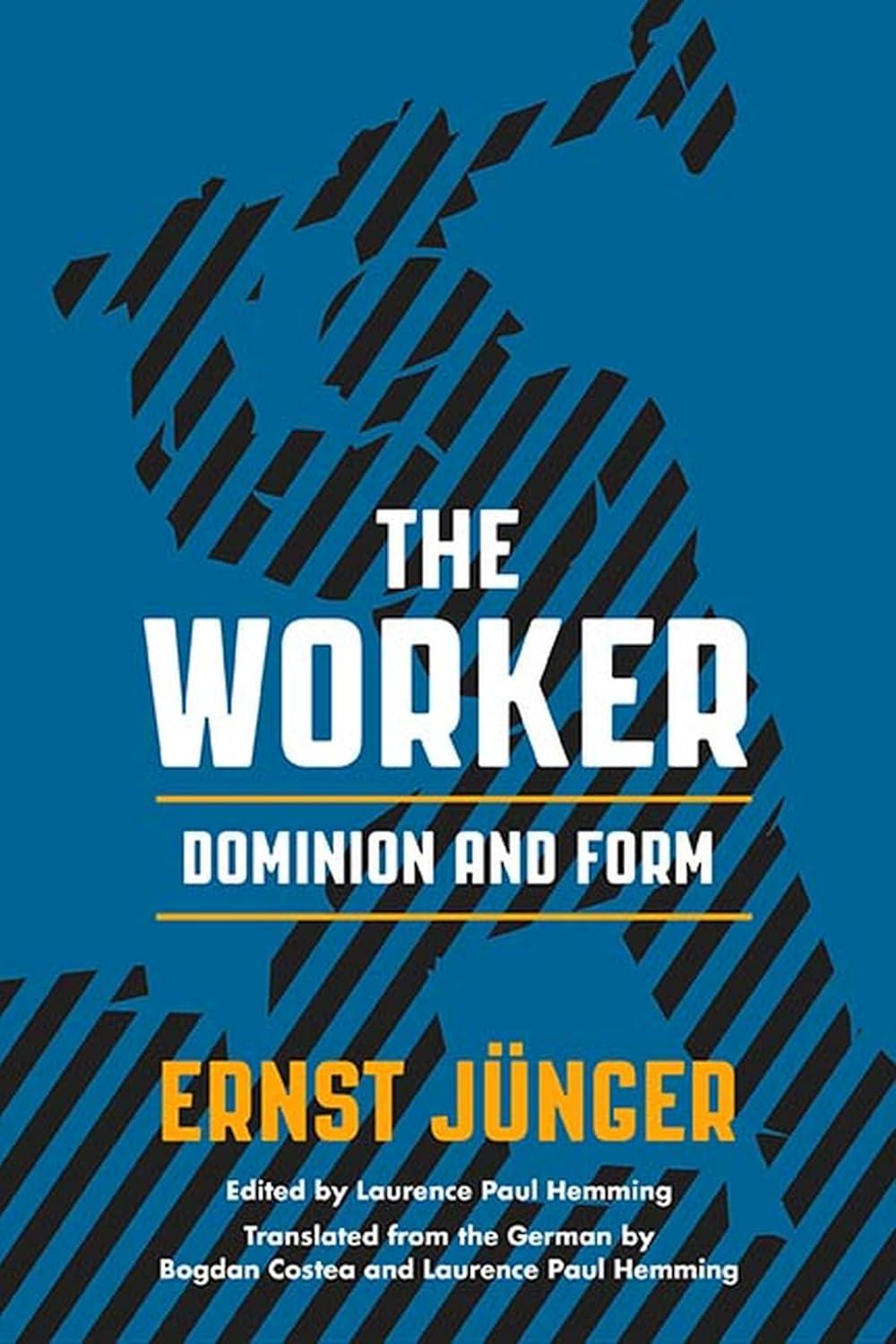
Collected Works
Second Edition • Essays Volume 8 •
Essays II The Worker
Translated and edited by Bogdan Costea and Laurence P. Hemming [Northwestern University Press, Evanston, Ill., Forthcoming 2015]
Klett-Cotta
Verlagsgemeinschaft Ernst Klett — J. G. Cotta’sche Buchhandlung Nachfolger GmbH, Stuttgart
All rights reserved
© Ernst Klett, Stuttgart 1981 • Printed in Germany Design: Heinz Edelmann
Photo composition and printing: Ernst Klett, Stuttgart ISBN 3-12-904181-8 (Lw)
ISBN 3-12-904681-X (HIdr)
Digitized in Germany 2002
Contents
The Worker — Dominion and Form
| Preface | 3 [11] (3) |
| Preface to the First Edition | 4 [13] (5) |
| Part One | |
| The age of the third estate as an age of illusory rule | 5 [17] (6) |
| The worker in mirror the image of the bourgeois world | 7 [20] (8) |
| The form as a whole which includes more than the sum of its parts | 15 [37] (20) |
| The irruption of elemental forces into bourgeois space | 23 [52] (31) |
| Within the world of work, the claim to freedom appears as a claim to work | 29 [63] (39) |
| Power as representation of the form of the worker | 34 [74] (46) |
| The relationship of the form to the manifold | 39 [84] (53) |
| Part Two | |
| Of work as way of life | 43 [93] (57) |
| The downfall of the mass and of the individual | 47 [102](63) |
| The replacement of the bourgeois individual with the typus of the worker | 59 [125] (79) |
| The difference between the hierarchies of typus and individual | 68 [142] (92) |
| Technology as mobilization of the world through the form of the worker | 76 [159] (104) |
| Art as figuration of the world of work | 101 [208] (139) |
| The transition from liberal democracy to the work-state | 122 [250] (169) |
| The replacement of the social contract through the work plan | 140 [286] (193) |
| Conclusion | 153 [310] (210) |
| Overview | 154 [312] (212) |
N.B. The page numbers of the collected works edition are in [square] brackets, those of the first edition (Hamburg: Hanseatische Verlagsanstalt 1932) are in {braces}.
N.Transl. Page numbers in this version are in round brackets.
N. Transl. Junger’s own footnotes are preceded by an asterisk (*) in this presentation.
Preface (1963)
The essay on the worker appeared in the Autumn of 1932, at a time when there was no longer any doubt regarding the unsustainability of old forces and the emergence of new ones. It represented, and still represents, an attempt to arrive at a point from which not only to understand the events in their diversity and contradiction, but, despite the danger, to also welcome them.
The publication of the book shortly before one of the great turning points is not coincidental; and there was no lack of voices to credit it with some influence. This was, of course, not always meant approvingly, and neither can I unfortunately agree: first, because I do not overestimate the influence of books on historical action, and secondly, because this one was published too soon before the events.
Had the great protagonists oriented themselves according to the principles developed here, they would have left undone much that was unnecessary and indeed preposterous, and would have done what was necessary, probably even without the force of arms. Instead, they initiated an entire operation whose meaning lay hidden where it was least suspected: in the further dissolution of the nation state and the orders associated with it. This perspective explains what was said about the “bourgeois”.
What happened in other parts of the planet and cost millions their lives cannot be ignored, nor can the fact that conventional means proved to be insufficient. By contrast, it remains a mere academic question whether the double task of radically shedding historical ballast whilst preserving the core substance, whilst maintaining an accelerated march overtaking progress itself, could still be faced at all, or whether something irreparable occurred when its preparation was neglected first in 1848, and then in 1918 [12], This concerns the difference between German democracy and world democracy and does not touch on the essence of the problem.
That the book sensed and sampled not just national, economic, political, geographical and ethnological dimensions, but the precursors of a new planetary power has been meanwhile largely confirmed. It had been recognized for this already at that time by some readers, although only in episodic and accidental terms, because their attention was always more strongly drawn to the political and polemical surface of a problem rather than to its substantial core. It is this core, however, that has effects in the long run, albeit in ever-changing guises.
Thus, whilst historical powers are exhausted, indeed even where they did fashion empires, we see that at the same time something greater grows on a worldwide scale and beyond it, something of which we initially grasp only the dynamic potency. This is a sign that the book had its return elsewhere than was expected within the controversies of the time. Partial blindness is, however, part of the plan. Unshakeable, emerging ever more effective from the chaos, remains alone the form of the worker.
For a long time, in fact already since the first edition was printed, I have been concerned with plans to revise the book about the worker. They have been more or less carried out and vary between a “revised” and a “completely revised” edition, up to a second or third new edition.
If, despite all this, the unaltered text of the third print run ( 1942) was adopted for these collected works, it is above all for reasons of documentation. Much of what seemed then surprising, or even provocative, is nowadays part of everyday experience. At the same time, what then required a reply has now passed. Precisely because of this it is also easier than before to subordinate the initial situation and what was episodic in it, to the unchanging core of the book: the concept of form. [13]
Even so, over the years, the book’s premises have grown into more or less comprehensive considerations. Some of them are in the other volumes of essays in this edition, others are summarised here in the appendix{1}.
Wilflingen, the 16th of November 1963
Preface to the First Edition
The plan of this book is to render visible the form of the worker, beyond theories, beyond factions, beyond prejudices, as an effective dimension which has already intervened powerfully in history and which determines authoritatively the forms of a changed world. Because it is less a matter here of new thoughts or of a new system, than of a new reality, everything depends on the acuity of the description, which presupposes eyes to which full and impartial sight is granted.
While this basic intention is probably implied in every sentence, the material presented corresponds to a necessarily limited overview and to the particular experience of the ‘individual’. If it has succeeded in making only a flipper of the Leviathan visible, the reader will then progress more easily with his own discoveries since the form of the worker is characterised not by an element of poverty, but by an element of plenitude.
The attempt is to sustain this important dialogue through the method of a covenant following the rules of military exercise where different materials serve as chances to practise one and the same intervention. The chances themselves are not important, but the instinctive surety of the intervention is.
Berlin, 14 July 1932
Part One
The Age of the Third Estate{2} as an Age of Illusory Rule
1
The rule of the third estate could never touch, in Germany, the innermost core which determines the wealth, power, and fullness of a life. Looking back on over a century of German history, we may confess with pride that we have been bad bourgeois. Not to our figure was cut the cloth which is now worn down to the last thread and beneath whose tatters is already appearing a wilder and more innocent nature than that whose sentimental tones made tremble the curtain behind which time concealed the spectacle of democracy.
No, the German was not a good bourgeois, least of all where he was strongest. Wherever thought has been deepest and boldest, where feeling has been most vital, wherever the fight has been most relentless, the revolt against the values emblazoned on the shield of reason’s great declaration of independence is unmistakable. Yet never were those invested with that immediate responsibility, who have been called geniuses, more isolated, never more endangered in their work and function than here, and never was the pure development of the hero nourished more meagrely. The roots had to be driven down deep into barren soil in order to reach the wellsprings in which the magical unity of blood and spirit is embedded and which makes the word irresistible. It was just as difficult for the will to achieve that other unity between power and justice which raises its particularity to the rank of law over against the stranger. [18]
That is why this period was overflowing with great hearts, whose last rebellion was to hold back their blows, {12} overflowing with high spirits to whom the silence of the world of shadows seemed welcome. It was rich in statesmen who denied themselves the sources of their time and had to dredge those of the past in order to act for the future; and it was rich in battles in which the blood proved itself in victories and defeats other than those of the spirit.
That is why all the positions which the German could occupy during this time do not satisfy, but rather recall, in their decisive points, those battle flags whose meaning lies in the marching order of yet distant armies. Instances of this interior conflict can be identified everywhere; its reason lies in the fact that the German did not know how to make use of that freedom offered to him with all the arts of the sword and with the proclamation of universal human rights: this freedom was for him an implement which bore no relation to his innermost organs.
Thus, where one began to speak this language in Germany, it was easy to guess that it was a case of poor translation, and the distrust towards a world in which stood the cradle of bourgeois civilisation was all the more justified because a primal language sought to make itself heard, again and again, about whose dangerous and different kind of meaning there could be no doubt. One harboured the suspicion that here such dear, such precious values were not taken seriously; one sensed that behind its mask lay an incalculable and unbridled force, a force seeking its last refuge in a proper originary relation — and one sensed that rightly.
Because in this country it is not possible to enforce a concept of freedom which might be applied, like a fixed measure, to any quantity one wishes, regardless of its content. Here, it has rather always been the case [19] that the measure of freedom a force commands corresponds precisely to the measure of obligation assigned to it, and that the extent of the liberated will reveals itself in line with the extent of responsibility which grants this will its legitimacy and validity. This expresses itself in {13} that nothing else can enter into our reality, hence into our history in its highest, fateful meaning, than that which carries the seal of this responsibility. About this seal nothing needs to be said, because since it is given directly, signs are carved into it which indicate directly an always ready obedience.
So it is: our freedom reveals itself most powerfully where it is borne by the consciousness that it is bestowed as a fiefdom. This consciousness has stamped itself in all those unforgettable pronouncements with which the nation’s oldest aristocracy covers the people’s coat of arms; it governs thinking and feeling, act and work, statesmanship and religion. Thus the world is shaken to its very foundations each time the German recognizes what freedom is: that is, when he recognizes what necessity is [what the necessary is]. Here nothing is surrendered and, may the world perish, the commandment must be nonetheless executed once the call is heard.
A trait held above all others as the hallmark of the German, namely order, is always underestimated if one is unable to recognize in it the steely mirror image of freedom. Obedience is the art of hearing{3} and order is readiness for the word, readiness for command, which strikes like lightning from the crown into the roots. Everyone and everything stands in this feudal order, and the leader is recognized by the fact that he is the first servant, the first soldier, the first worker. Both freedom and order relate therefore not to society, but to the state, and the pattern of each structure is the organisation of an army, and not that of a social contract. Therefore the condition [20] of our most extreme strength is achieved when there exists no doubt about leadership and allegiance.
This must be recognised: that dominion and duty are one and the same. The age of the third estate never recognized the miraculous power of this unity, because it deemed worthwhile pleasures all too common and all too human. Therefore all ends which the German was able to reach in this age were reached despite this {14}: in all domains, the movement took place in an alien and unnatural element. The real bedrock could only be accessed, as it were, with diving helmets; the decisive work was carried out in mortal space. Honour the fallen who shattered the horrific isolation of love or knowledge, or who struck down the sword on the smouldering hills of battle!
But there is no return. Whoever in Germany today is eager for a new dominion turns his gaze to where he sees a new consciousness of freedom and responsibility in work.
The Worker in the Mirror Image of the Bourgeois World
2
Let us first seek this consciousness then where it is hardest at work, but let us seek it with love, with the will to interpret thoroughly that which exists! We therefore turn to the worker[1], who was already called to an inexorable antagonism with all bourgeois values and drew the strength for his movements from the feeling of this opposition.
We stand far enough from the beginning of these movements to do them justice. No one can choose for himself the school desk at which his character is formed, because the school is decided by the fathers, but there comes a day when one feels oneself outgrow it and recognizes one’s own calling. This must be considered when examining the means of the worker’s clout, and it has to be taken into account that they developed in battle and that in battle every position is related to the action of the opposition. That is why it would be all too simplistic to object that the worker’s existence, like that of a metal yet to be purified, is shot through with bourgeois values, and that his language, which unquestionably belongs to the Twentieth Century, is rich in concepts which were shaped through the questions of the Nineteenth Century. For he depended on the use of these concepts in order to make himself understood when he began to speak for the first time, and the limit of his claims was determined by the claims of his opponent. Thus he took root, slowly and underpressure against the {16} bourgeois overgrowth, in order to finally burst through it, and it is hardly surprising that he bears the traces of this growth.
However, these traces were left behind not only by resistance, but also by what nourished the worker. We saw that in Germany, the third estate was incapable of achieving an open and recognised dominion, for good reasons. Thus the strange additional task (Nebenaufgabe) of retrieving this dominion fell to the worker, and it is a very significant act that he first had to bring to dominion the alien element which was mixed in with his endeavours, and thus experience that it did not belong to him. These, as we said, are traces of nourishment, and the shedding of detrimental matter will eliminate them. Yet how could it have been otherwise, since the first teachers of the worker were of bourgeois origin and the structure of the systems in which the young force was embedded was built to bourgeois blueprints! [22]
This explains how the memory of the bloody union of the bourgeoisie with power, the memory of the French revolution, was the source which fed and oriented the worker’s first stirrings. But there are just as few repetitions of the historical process as there are transferences of its living contents. So it is that, wherever revolutionary work was thought to be carried out in Germany, only the spectacle of revolution was play-acted, whilst the actual upheavals took place out of sight, be it in quiet spaces, or veiled under the smouldering curtains of battle.
But what is really new does not require the emphasis which it finds in revolt, and its greatest danger resides in the simple fact of its being present.
3
Therefore, a blurred perspective results, first, from the equation of labour{4} with a fourth estate.
Only a mind accustomed to mechanical images can picture the succession of dominions such that, as the hand of the clock casts its shadow over the hours, one estate after the other {17} occupies the framework of power, while below a new class is already awakening to consciousness.
Rather, only the bourgeoisie has experienced itself as an estate in this particular sense; it has cut loose this word of very old and noble provenance from its established contexts, divested its meaning and made it into none other than a mask of interest.
It is therefore from a bourgeois point of view that labour is interpreted as an estate, and underlying this interpretation is an unconscious cunning which seeks to harness the new claims in an old frame in order to enable the negotiation to continue. Because where [23] the bourgeois is able to entertain himself, where he is able to bargain, there he is safe. The uprising of labour (Arbeitertums) will, however, not be a second-hand, less colourful infusion prepared according to outdated recipes. The essential difference between the bourgeois and the worker lies not in the temporal succession of dominion, not in the opposition between old and new. The fact that tarnished interests are replaced by younger and more brutal ones is too self-evident for one to dwell on the observation.
Instead, what deserves the highest attention is the fact that there is not only a difference in historical time between the bourgeois and the worker, but above all a difference in rank. Namely, that the worker stands in a relation to elemental powers of whose bare presence the bourgeois never had an inkling. To this, as will be explained, is related the fact that the worker, on the basis of his own being, is capable of a freedom completely other than bourgeois freedom, and that his claims, which he holds in readiness, are far more comprehensive, far more significant, far more redoubtable than those of a class.
4
Secondly, any front which confines the worker to a combat position limited to an attack on ‘society’ can only be regarded as preliminary, merely as a front of initial vanguard skirmishes {18}. For this word too has seen its value fall in the bourgeois age; it has acquired a specific meaning whose sense is the denial of the ‘state’ as the highest instrument of power. What lies innermost in this bourgeois endeavour is the need for security and, consequently, the attempt to deny the presence of danger and seal off living space to prevent it from breaking in. Granted, danger is always present and triumphs even over the finest [24] subterfuges with which one ensnares it; indeed, it flows unpredictably into these subterfuges in order to mask itself with them. This lends civilisation its duplicitous face — the close relations connecting fraternity with the scaffold, human rights with murderous battles, are all too familiar.
Yet it would be wrong to assume that the bourgeois, even at his best, would have ever conjured up the spectre of danger through his own power. Rather, it all resembles a terrible scornful laughter of Nature at its subordination under morality, a furious exultation of blood over spirit, once the overture to fine speeches comes to an end. Therefore any relationship between society and the elemental is denied, indeed with an expenditure of means destined to remain incomprehensible to those who do not discern in it a most secret ideal as the father of all thoughts.
This denial takes place in such a way that it relegates the elemental to the realm of error, of dreams, or of a necessarily evil will, indeed it equates it with nonsense itself. The accusation of stupidity and immorality is crucial here, and since society is determined by the two highest concepts of reason and morality, then this accusation represents the means by which one banishes the enemy from the space of society, from the space of humanity and thereby from the space of the law.
This distinction corresponds to a process which one has observed with astonishment again and again: the fact that {19} precisely at the bloodiest peaks of civil war, society repeals the death penalty as if on cue, and that its best ideas about the immorality and senselessness of war always occur when its battlefields are covered with corpses.
It would, however, be to overestimate the bourgeois if one suspected an intention behind this most peculiar dialectic [25], because in no other area does he take himself more seriously than in those of reason and morality; indeed, in his most significant manifestations, he is the unity of reason and morality itself.
The elemental forces itself upon him from a completely different sphere rather than from its actual strength, and he recognizes with horror that point at which bargaining ceases. He would endlessly amuse himself with his fine accusations, built on the cornerstones of virtue and justice, if at the right moment the mob would not bring him the unexpected gift of its more powerful, but formless, strength which draws its sustenance from the primordial forces of the swamp. Forever he would manage to hold in abeyance the balance of powers like a work of art existing for its own sake, if not for the occasional appearance of the warrior beyond him, whom he is always reluctantly yet constantly ready to allow to do as he pleases. But he declines responsibility because he does not recognise his freedom in its character and particularity, but in a generic morality. No better example can be given than the way in which he annihilated the actual bomber who first blew open the gates of dominion as soon as his task was finished. The incarceration of passions is the official confirmation with which he guarantees the spoils of revolutions, and the hanging of the hangman is the satyr play which concludes the tragedy of the uprising.
The bourgeois also rejects the highest justification of war, the attack, because he probably feels that it is not suitable for him, and when he calls on soldiers for assistance or disguises himself as a soldier, albeit out of obvious self-interest, he will never be able to do so without swearing that it is in defence, and, as far as possible, in the defence {20} of humanity. The bourgeois knows only the defensive war, that is, he knows no war at all precisely because his nature excludes him from all warlike elements. He is, however, on the other hand, [26] unable to prevent their irruption into his order, because all values he can set against them are of a lower rank.
Here the artful use of his concepts and his politics comes into play, indeed the universe itself is for him a mirror in which he wishes to see his virtue confirmed again and again. It would be instructive to observe him at his tireless work of polishing through which he wears down the hard and necessary coinage of words until a universally compulsory morality comes to shine through: to observe how in the conquest of a colony he sees its peaceful penetration, in the annexation of a province the right of self-determination of the people, or in the plundering of the defeated, a compensation. However, it suffices to recognise the method in order to guess that the conception of this dictionary began with the identification of ‘society’ with the ‘state’.
All who have grasped this concept will also grasp the great danger concealed in the assignation of ‘society’ as the worker’s supreme attack target: the great theft of his rightful claims and aspirations. The decisive attack orders do still exhibit all the characteristics of an age in which it was self-evident that an awakening power had to recognise itself as a ‘class’, as it was self-evident that a successful seizure of power had to appear as a mere modification of the social contract.
But it is important to consider this: that this ‘society’ is not a form in itself, but only one of the basic formulae of the bourgeois imagination. This is demonstrated by the fact that there is no dimension in bourgeois politics which is not conceived of as ‘society’.
‘Society’ is the total population of the globe presenting itself as the concept of an ideal picture of a unified humanity whose division into states, nations, or races is nothing other {21} than a shortcoming of thinking. This shortcoming, however, is corrected in the course of time through [27] contracts, through education, through civilization, or simply through the progress of means of transportation.
‘Society’ is the state whose essence is distorted in turn by the extent to which ‘society’ subordinates it to its own categories. This attack takes place through the concept of civil liberty, whose task is the transformation of all bonds of responsibility into revocable contractual relations.
In the closest relationship to ‘society’ stands, finally, the ‘individual’, that peculiar and abstract figure of the human, the most precious discovery of bourgeois sensibility and, at the same time, the inexhaustible object of its fertile imagination. As ‘humanity’ is the cosmos of this conception, so is ‘individual’ man its atom. Practically, however, the ‘individual’ is opposed not to humanity, but to the masses, his exact mirror image in this strangest, most imaginary world. Because the masses and the ‘individual’ are one, and from this unity results the astonishing double image of the most colourful, most confusing anarchy, as well as of the sober agenda of democracy: a spectacle which has been played out for a century.
Yet it belongs to the hallmarks of a new epoch that, in it, bourgeois society is condemned to death regardless of whether its concept of freedom is represented in the masses or in the ‘individual’. The first step consists in no longer thinking and feeling in these forms, and the second in no longer acting in them.
This means nothing less than an attack on everything which the bourgeois holds dear in life. It is thus a vital issue for the bourgeois to ensure that the worker comes to understand himself simply as the future bearer of ‘society’. Because this belongs to the dogmatic bourgeois stock, thus is the basic form of the bourgeois view saved and the finest possibility of his dominion secured.
It is no wonder, then, that ‘society’ is embedded in all [28] regulations prescribed by the bourgeois spirit from its chairs and from its {22} rafters down to the worker. And ‘society’ here is manifest not just in its appearance, but, far more effectively, in its principles. ‘Society’ renews itself by means of simulated attacks on itself; it brings its indefinite character, or rather its characterlessness, with itself so that it is also able to absorb within itself its sharpest self-negation. Its means are twofold: either it attributes this negation to its individually anarchic pole and incorporates its existence by subordinating it to its own concept of freedom; or it traps negation within itself, at the apparently opposite pole of the masses, transforming it through counting, voting, negotiation or entertainment, into a democratic act.
Its feminine disposition betrays itself in the fact that society seeks not to dismiss every opposition, but to take it up within itself. Wherever it encounters a claim which announces itself as decisive, its finest bribery consists in declaring it an expression of its concept of freedom and thus legitimizing it before the forum of its constitution, that is: rendering it harmless.
It is this process which supplied the word radical with its insufferable bourgeois aftertaste, which, incidentally, makes radicalism itself into a lucrative business from which one generation of politicians and artists after another drew their only sustenance. This is the last refuge of the stupidity, the impertinence, and the hopeless ineptitude that society sets out to lure by adorning itself in the peacock feathers of none other than the ethos of radicalism.
For long, far too long already, the German has been part of this unworthy spectacle. His only excuse is his faith that in each form there is necessarily included a content, and his only comfort is that although this spectacle plays out in Germany, it by no means takes place within German reality. For all this will pass [29] into the realm of oblivion — but not that oblivion which resembles the ivy covering the ruins and the graves of the fallen, but another, terrible oblivion, {23} which will unmask this mendacity and unreality, dispersing it without trace or consequence.
It must be left to a special, subsequent investigation to uncover the extent to which bourgeois thinking succeeded in falsifying the image of ‘society’ by feigning its self-negation in the first exertions of the worker. One would discover in this thinking the worker’s freedom as a mere repetition of the pattern of bourgeois freedom, in which fate is, from now on, completely openly interpreted as a revocable contractual relation, and the greatest triumph of life consists in an amendment of the current contract. One would recognize in this thinking the worker as direct successor of the rational-virtuous ‘individual’, and as the object of a second sentimentality distinguishable from the first by nothing other than a greater impoverishment{5}. One would discover, furthermore, in exact correspondence, the workforce as the imprint of the ideal picture of a humanity whose mere utopia already includes the negation of the state and its foundations. This, and nothing but this, is concealed in the pretence lying behind words like “international,” “social,” and “democratic” — or rather, which was concealed, since for anyone skilled enough to guess nothing is left except for the astonishment that anyone believed that the bourgeois world could be shaken by those very claims in which it asserted itself most clearly.
However, this investigation would be called ‘subsequent’ because its confirmation has already taken place in the visible world. For indeed the bourgeois succeeded in securing for himself, with the help of the worker, a degree of control such as he was not granted throughout the Nineteenth Century.
And once again: if one remembers the instant [30] when ‘society’ came to dominance in Germany, a plethora of symbolic images comes to mind. Not to mention the fact that this moment coincided with that in which the ‘state’ found itself in the greatest, most terrible danger and in which the German warrior faced the enemy. For the bourgeois {24} was not even able to muster that small measure of elemental strength for a new simulated attack on itself that was demanded under the circumstances: that is, an attack on a regime which had long been bourgeois to its core. It was not him who fired those shots needed to make visible the end of a chapter in German history, and his activity consisted not in acknowledging, but in profiting from them.
For long enough he had lain in wait for the opportunity to begin negotiations, and his negotiations achieved what the most extreme effort of an entire world had not been able to achieve.
But here language must restrain itself and refuse to employ the specifics of that outrageous tragicomedy which began with workers’ and soldiers’ councils, whose members were notable by the fact that they had never worked nor fought; in which furthermore the bourgeois concept of freedom revealed itself as mere hunger for peace and bread. This tragicomedy was then extended by the symbolic act of surrendering weapons and ships, a tragicomedy which dared not only to debate a German guilt in relation to the ideal image of humanity, but to acknowledge it, and which attempted to raise with an incomprehensible shamelessness the dustiest concepts of liberalism to the rank of a German order. This was a tragicomedy in which the triumph of ‘society’ over the ‘state’ now revealed itself quite clearly as a continuous combination of petty and high treason against all that constitutes German existence. Here all talk ceases, because here that silence is required which gives a premonition of the silence of the grave. Here the youth of Germany [31 ] saw the bourgeois in his last, naked appearance, and here it pledged, in its finest incarnations, soldier and worker alike, to join at once in a rebellion which expressed clearly that, in this space, it was infinitely more worthwhile to be a criminal than a bourgeois.
This shows how important it is to distinguish between the worker as a nascent power on which the fate of the {25} country is based, and the garbs in which the bourgeois disguised this power in order that it would serve him as a puppet in his artificial game. This is a distinction between rise and fall. And this is our belief: that the rise of the worker is equivalent to a new ascent for Germany.
To the extent that the worker brought his portion of bourgeois legacy to rule, he simultaneously divested himself visibly of it like a doll filled with dry straw that had been threshed out over a century ago. It can no longer escape his sight that the new ‘society’ is a second-hand and cheaper imitation of the old.
Forever will such copies be made one after the other, forever will the running of the machine be fed by the invention of new contradictions, if the worker does not grasp that he does not stand in a relation of contradiction to society, but in one of utter alterity.
Only then will he reveal himself as the true mortal enemy of society, when he will refuse to think, to feel, and to be in its forms. This, however, happens when he realises that he has so far been all too modest in his claims and that the bourgeois taught him to desire only what appears desirable to the bourgeois.
But life conceals more, and other, than what the bourgeois understands by ‘goods’, and the highest claim which the worker can make consists not in being the bearer of a new society, but of a new State. [32]
Only at this moment does he declare a fight to the death. Then, from the ‘individual’, who is basically none other than a mere employee, shall emerge a warrior, from the masses, an army, and the positing of a new order of command shall arise, instead of a mere amendment of the social contract. This removes the worker from the sphere of commerce, compassion, literature, and raises him to that of the act, it transforms his legal connections into military ones — that is, he will possess leaders instead of lawyers, and his existence will become norm and measure, instead of requiring construction. {26}
For what have his programmes been so far other than commentaries on an original text that is not yet written?
5
In third and final place, it remains to dispel the legend that the fundamental quality of the worker is an economic quality.
In everything that has been thought and said about this, the endeavour of the art of calculation reveals itself as the attempt to transform fate into a quantity which can be dissolved with calculative means. This attempt can be traced back to the times in which one discovered in Otaheite and the lie de France{6} the archetype of the rational- virtuous and, thereby, happiest of men, to the times in which the mind began to concern itself with the dangerous secrets of the grain tariff{7} and in which mathematics belonged to those fine games with which the aristocracy amused itself on the eve of its downfall.
Here, the pattern was configured, which then experienced its unequivocal economic interpretation, by which the claim to freedom of the ‘individual’ and of the ‘masses’ founded itself entirely as an economic claim within an economic world. Through this claim, the argument between the materialist and idealist schools [33] constitutes one of the chapters of the endless bourgeois discussion (Gesprdch); it is a second iteration of that first conversation (Unterhaltung) among the Encyclopaedists under the rafters of Paris. Again, the old figures are represented, and nothing has changed but the scheme setting out their opposition, and which became from now on a pure economic scheme.
It would take us too far to trace how this conversation sustains itself through various redistributions of old signs, and how it invigorates itself through their changes. It is important only to see how this places in a single order the clash of opinions and its representatives.
The rational-virtuous ideal image of the world coincides here with an economic utopia of the world, and every question relates itself to economic claims. What is inescapable {27} is the fact that, within this world of exploiters and exploited, no dimension is possible which is not decided by a supreme court of the economic. There are two kinds of people here, two kinds of art, two kinds of morality — yet how little perceptiveness does it take to recognize that it is one and the same source which feeds them.
The supporters of the economic struggle base their justification on one and the same ‘progress’ — these two kinds confront one another in the claim to be the agents of prosperity, and think that they can unsettle the position of their opponent to the very same degree to which they succeed in refuting this claim.
But enough! Any involvement in this conversation entails its own perpetuation. What must be seen is actually the presence of a dictatorship of economic thinking in itself, whose scope includes every possible dictatorship and delimits it in its actions. Because within this world no movement is possible which would not stir up anew the murky mud of interests, and there is no position here from which [34] the breakthrough can succeed. Because the economy in itself, the economic interpretation of the world, forms the centre of this cosmos, and it is the economy which acts as a gravitational force on each of its parts.
Whichever of these parts may take over the power to control, it will always depend upon the economy as supreme controlling power.
The secret which conceals itself here is of a simple nature: It consists, on the one hand, in the fact that the economy is not a power which can bestow freedom, and, on the other, that an economic sense is not able to access the elements of freedom — and yet it requires the eyes of a new breed to work out this secret.
A comment is perhaps necessary here in order to avoid the possibility of confusion: the denial of the economic world as life-determining, {28} thus as a power of destiny, is a contestation of its rank, not of its existence. Because what matters is to not increase the host of those preachers in the desert for whom a different space seems attainable only by the back door. For real power no avenue is unworthy of consideration.
Idealism or materialism — this is a confrontation for impure spirits, whose imaginative power is not up to either idea, or matter. The hardness of the world will be mastered only by hardness, not by trickery.
Let us be rightly understood: it is not a matter of economic neutrality, nor that the spirit be turned away from all economic battles; on the contrary, it is rather a matter of pitching these battles as fiercely as possible. However, this does not happen if the economy determines the rules of combat, but only if a higher law of battle rules over the economy.
For this reason, it becomes so important for the worker to refuse every explanation which seeks to interpret his appearance as an [35] economic phenomenon, even as a product of economic processes, thus, basically, as a kind of industrial product, and for him to see through the bourgeois origin of these explanations. No action can cut more effectively through these ominous bonds than the declaration of independence of the worker from the economic world. This does not mean the renunciation of this world, but rather its subordination under a claim to power of a more comprehensive kind. This means that the fulcrum of rebellion is not economic freedom and economic power, but power itself.
To the extent that the bourgeois projected his own goals onto those of the worker, he restricted to that same extent the target of attack to a bourgeois target. Today, however, we sense the possibility of a richer, deeper, and more fertile world. To realise it, a fight for freedom sustained by a consciousness of the fact of exploitation is not enough. Everything depends rather on the worker recognising his superiority, creating, by his own {29} standards, his dominion to come. This will strengthen the impetus of his methods — from the attempt to checkmate the opponent by giving notice of resignation, his subjection becomes a conquest.
These are no longer the methods of the mere employee, whose greatest happiness lies in the fact that he may dictate the terms of his employment contract, and yet is never able to rise above the internal logic of this contract. These are no longer the methods of the deceived and dispossessed, who with each gain faces the prospect of a fresh fraud. These are not the methods of the debased and the insulted, but rather the methods of the genuine ruler of this world, the means of the warrior who rules over the riches of provinces and cities, and who rules all the more securely the more he despises them. [36]
6
Let us look back: It is the Nineteenth Century which interpreted the worker as the representative of a new class, as the bearer of a new society, and as the organ of the economy.
This interpretation assigns the worker a false position, within which the bourgeois order is secured in its decisive and fundamental principles. Every attack from this position can, consequently, be only a superficial attack, leading to a sharpened expression of bourgeois values. Theoretically, every move takes place in the context of an outdated social and human utopia; practically, each brings to dominion, time and again, the figure of the clever business man, whose art consists in bargaining and mediating. This pattern is easy to establish when one examines the consequences of labour movements. However, what is already visible beyond a mere change in power politics is most profoundly unwanted; it eludes the art of bourgeois interpretation and contradicts entirely all predictions towards a humanitarian social utopia.
The representations under whose spell one has sought to bring the worker are, however, not sufficient for resolving the great tasks of a new {30} age. No matter how finely those calculations are prepared whose result must never be anything other than happiness, there always remains a surplus which defies every resolution and which makes itself felt in human existence as renunciation or as increasing despair.
If we want to break new ground, we can only move in the direction of new goals. This presupposes another front and allies of another kind. It presupposes that the worker understands himself in another form and that his movements are no longer a reflection of bourgeois consciousness, but rather a proper self-consciousness comes to expression. [37]
The question thus arises whether the form of the worker does not conceal more than has been suspected thus far. {31}
The Form as a Whole Which Includes More Than the Sum of Its Parts
7
The answer to the question posed just now presupposes an understanding of what is meant by ‘form’. This elucidation does not belong by any means to the marginalia, despite the little space which can be devoted to it here.
If, in the pages that follow, we speak of forms in the plural it is because of a preliminary lack of a hierarchy, which will be remedied in the course of the investigation. Because it is not the law of cause and effect which decides on the hierarchical order in the realm of the form, but another type of law, that of the seal and of the imprint. We will see that we are entering an epoch in which the imprint of space, of time and of man stems from a single form, namely that of the worker.
At first, independently of this hierarchy, we will call ‘form’ those dimensions which become visible to an eye capable of grasping that the world is held together by a law which is more decisive than that of cause and effect, without yet seeing, however, the unity under which this integration is achieved.
8
In ‘form’ rests the whole which is more than the sum of its parts and which was inaccessible to an age used to thinking in anatomical terms. It is the hallmark of an age to come [38] that man will once again see, feel, and act under the spell of forms. The degree to which they can perceive the influence of forms will determine the rank of an intellect, the worth of an eye {32}. The first significant endeavours are already underway; they must not be ignored, neither in art, nor in science, nor in faith. In politics too everything depends on the fact that one brings into the debate forms, and not just concepts, ideas or mere appearances.
From the moment when form shapes one’s experience, everything becomes ‘form’. Form is thus not a new dimension to be discovered in addition to those already known; rather to a new gaze the world appears as a theatre of forms and their interrelations. To point out an error typical for the period of transition, it is not a question of the ‘individual’ disappearing and only being able to derive meaning from corporations, communities, or ideas, as higher-order units. Form is also represented at the individual level: every finger nail, every atom in him is ‘form’. Incidentally, has the science of our time not already begun to see atoms as forms and no longer as the smallest of parts?
Admittedly, a part is just as far from being ‘form’ as a sum of parts can result in a ‘form’. This must be considered for instance if one wants to use the word “man” in a sense which goes beyond the usual phrases. Man possesses form insofar as he is grasped as the concrete, tangible ‘individual’. This does not, however, apply to “man” in general, which is simply one of the commonplaces of understanding and which can mean anything or nothing, but can in no case mean something precise.
The same applies to the broader forms to which the individual belongs. This inclusion can be calculated neither by multiplication nor by division — numerous men do not result in a form, and no dividing up of form leads back to the individual. Because the form [39] is the whole which entails more than the sum of its parts. A man is more than the sum of the atoms, limbs, organs and fluids of which he consists; a marriage is more than man and wife, a family more than man, woman and child. A friendship is more than two men, and a people is more than {33} can be expressed by the results of a census or by any number of political polls.
In the Nineteenth Century, it became normal to consign any spirit professing to belong to this “more”, to this totality*{8}{9}, to a kingdom of dreams befitting a more beautiful world, but which have no place in reality.
However, there can be no doubt that precisely the opposite assessment is correct, and that in the political sphere too any mind unable to see this “more” is of inferior rank. Such a mind may play a role in cultural history, in economic history, in the history of ideas — but history is more. History is Form inasmuch as its content is the destiny of forms.
Certainly — and this bracket might emphasise more clearly what is to be understood under the category of form — certainly, then, the majority of those challenging the logicians and mathematicians of life did not themselves move on a different plane. Because there is no difference between appealing to a disconnected soul or a disconnected idea, and appealing to a disconnected man. Neither ‘soul’, nor ‘idea’ are ‘form’ in this sense, nor is there a convincing contrast between them and the ‘body’ or ‘matter’.
It is this which seems to contradict the traditional representation of the experience of death in which the soul leaves the body, and hence the immortal part [40] of man leaves the ephemeral one. It is, however, an error, an alien idea, that the dying man leaves his body — rather his form enters a new order inaccessible to any spatial, temporal, or causal determination. From this knowledge derived our ancestors’ view according to which, at the moment of death, the warrior was led to Walhalla — but not just as a soul {34}, rather in a radiating corporeality resembling the hero’s body in battle.
It is very important that we once again achieve full consciousness of the fact that the corpse is not a soulless body. Between the body in the moment of death and the corpse in the instant that follows it, there isn’t the least relationship; this points to the fact that the body is more than the sum of its parts, while the corpse is perfectly equal to the sum of its anatomical parts. It is a mistake to think that the soul leaves dust and ash behind like a flame. It is of utmost importance, however, that form is not subordinated to the elements of fire and earth, and that therefore man as form belongs to eternity. In his form, quite detached from any simple moral values, any redemption, or any “aspirational ardour”, lies dormant his innate, immutable and imperishable merit, his highest existence and his most profound confirmation. The more we dedicate ourselves to movement, the more genuinely we must be convinced that a motionless being lies concealed beneath it, and that every increase in its speed is merely the translation of an immortal primal language.
From this awareness, results a new relationship to man, a more ardent love and a more terrible ruthlessness. From it results the possibility of an exultant anarchy, which comes to be equated with the strictest order — a spectacle already evident in great battles and giant cities, whose [41 ] image stands at the beginning of our century. In this sense, the engine is not the ruler, but the symbol of our time, the symbolic image of a power in which deflagration and precision are not opposed to each other. It is the audacious toy of a race able to blow itself up with desire and still see a confirmation of order in this very act. This attitude, which cannot be traced back either to idealism or materialism, and has to be approached rather as heroic realism, produces an attacking force of the highest degree, which we need {35}. Its exponents are like the volunteers who welcomed the Great War with open arms, and who welcome everything which followed and will follow it.
Again, as we said, the ‘individual’ also possesses form, and the supreme and inalienable right to life which it shares with stones, plants, animals and stars, is his right to form. As form, the ‘individual’ encompasses more than the sum of his powers and capacities; he is deeper than what he can imagine it in his deepest thoughts, and more powerful than what he can express in his most powerful acts.
He carries thus, within himself, the reference and the measure, and the supreme art of life consists, to the extent that he lives as an ‘individual’, in the fact that he takes himself to be reference and measure. This constitutes the pride and sorrow of life. All the great moments in life, the glowing dreams of youth, the intoxication of love, the fire of battle, coincide with a deeper consciousness of form, and memory is the magical return of form which touches the heart and convinces it of the immortality of these moments. The bitterest despair of a life lies in not having been fulfilled, in not becoming fully grown. Here, the ‘individual’ resembles the prodigal son who squanders his inheritance abroad, no matter how great or little it may have been — and there can thus be no doubt about his return to the fatherland. Because the irreducible heritage of the individual is that he belongs to eternity, and in his highest and [42] most unambiguous moments he is entirely aware of it. It is his task to express this in the course of time. In this sense, his life becomes an allegory of the form.
Beyond that, however, the ‘individual’ is integrated in a great hierarchy of forms — powers whose reality, corporeality, and necessity one cannot adequately imagine. By comparison, the ‘individual’ himself becomes an approximation, a representative — and the force, the wealth, the meaning of his life depend on the extent to which he participates in the order and clashes of forms. {36}
Genuine forms are recognized by the fact that the sum of all forces can be dedicated to them, the highest worship can be devoted to them, the most extreme hate can be borne against them. Since they conceal the whole within themselves, they make a claim on the whole. Thus it is that man shares the purpose and fate of form and it is this discovery which makes him capable of the sacrifice which finds its most significant expression in the sacrifice of blood.
9
The bourgeois age has not been capable to see the worker in a hierarchy determined by form, because he is not capable of a genuine relation to forms. Everything in this world melted into ideas, concepts or simple phenomena, and the two poles of this liquid space were reason and sensibility. In its final dilution, Europe and the world are still steeped today in this liquid, in this pallid whitewash of a spirit become autocratic.
But we know that this Europe, this world, occupy in Germany only the rank of a province whose administration is not the task of either the best hearts or even the best heads. Early on in this century one already saw the German in rebellion against [43] this world, represented by the German front-line soldier as the bearer of a genuine form. This was, at the same time, the beginning of the German revolution, already announced in the Nineteenth Century by elevated spirits and which can be understood only as a revolution of form. That this uprising remained only a prelude is due to the fact that it lacked, in its full extent, the form for which every soldier who fell alone and unknown by day and by night, on all frontiers of the empire, was already a symbol.
Because, for one thing, the leadership was far too satisfied, far too convinced by the values of a world which actually saw unanimously in Germany its most dangerous adversary; and so it was fitting justice that this leadership was defeated and eliminated, while {37} the German front-line soldier himself proved to be not only invincible, but immortal. Each of the fallen is today more alive than ever and that stems from the fact that, as form, each belongs to eternity. The bourgeois, however, does not belong to forms, so time eats him away, even if he decorates himself with princely crowns, or with the crimson of field commanders.
For another thing, we also saw that the uprising of the worker was prepared in the school of bourgeois thinking. Thus it could not coincide with the German revolt and this is evident in the fact that capitulation in front of Europe, capitulation in front of the world was carried out by a bourgeois upper class of the old-style, on the one hand, and, on the other, by the equally bourgeois spokesmen of a so-called revolution — in other words, basically by the representatives of one and the same breed of men.
In Germany, however, no uprising can reach the rank of a new order if it is directed against Germany. It is doomed to fail because it breaks a law no German can escape without robbing himself of the most secret roots of his power.
That is why, in our country can only fight for freedom [44] those powers which are at the same time the exponents of German responsibility. But how could the bourgeois transfer this responsibility to the worker, since he himself does not partake of it? Just as he was incapable, inasmuch as he ever governed, of deploying the elemental force of the people in an irresistible campaign, incapable, inasmuch as he aspired to govern, of setting this elemental force in revolutionary motion. That is why he tried to implicate it in his betrayal of destiny.
As high treason, this betrayal is inconsequential because one must recognise in it the self-destructive process of the bourgeois order. But it is nonetheless treason against the country insofar as the bourgeois tried to involve the form of the empire in his own self-destruction. Because the art of dying is not bestowed upon him, the bourgeois tried to postpone the hour of his death whatever the cost. {38} The bourgeois’ culpability in war lies in the fact that he was not capable of either really waging war, namely, as total mobilisation, nor was he capable of losing it — that is, of witnessing the downfall of his greatest freedom. What distinguishes the bourgeois from the front-line soldier is that the bourgeois seeks out in war as well every opportunity to do business, while for the soldier war meant a space in which to die: that is, to live so that the form of the empire is reaffirmed — the form of that empire which must outlast us even if our body is taken away.
There are two breeds of men: one can be recognised as ready to negotiate at any price, the other as ready to fight at any cost. The pedagogy the bourgeois used with respect to the worker consisted in raising him to be a negotiating partner. The meaning hidden behind this tactic, and in which resides the desire to extend at any price the lifespan of bourgeois society, could only remain hidden as long as this society could maintain the image of its foreign policy under the sign of an equilibrium of powers. Its hostility towards the state had to conceal itself at the very same moment when a different type of relation than negotiation emerged between these [45] powers. And yet the last victory of Europe helped the bourgeois once again by making possible one of those artificial spaces from which form and fate can be seen as synonymous with the nonsensical. It is the secret of the German defeat that the continued existence of such a space, the continued existence of Europe, was the most secretive ideal of the bourgeois.
At this point, however, the unworthy role which he had reserved for the worker was revealed quite clearly. With great dexterity, he knew how to pass onto him the consciousness of a regime whose claims and aspirations were bound to be exposed, again and again, as unsustainable in the face of foreign policy obligations. The duration of this confrontation is equivalent to the duration of the final period of bourgeois society, and whose illusory existence is expressed even now, as it seeks to buttress itself with the long-since spent capital of the Nineteenth Century. {39}
However, this is not the space for which the worker has to fight because he will encounter nothing other than negotiations and concessions in it. He rather needs to break out from it with nothing other than contempt. It is the space whose borders with the outside world are the result of impotence, and whose internal order originated in treason. This is how Germany became a colony of Europe, a colony in the world.
Rather, the act through which the worker can shake off this space consists precisely in recognizing himself as a form within a hierarchy of forms. The most profound justification for his battle for the state is anchored in this, a justification that no longer has to call merely for a new interpretation of a contract, but calls for an immediate mission, for a destiny. [46]
10
To see forms is a revolutionary act insofar as it entails the recognition of a being in the totality and uniform abundance of its life.
The great superiority of this process is that it occurs beyond moral, aesthetic, or even scientific values. In this domain, the first question is not whether something is good or bad, beautiful or ugly, right or wrong, but to what form it belongs. With this, the scope of responsibility expands in a manner entirely incompatible with everything that the Nineteenth Century understood by justice: it is the legitimacy or culpability of the ‘individual’ whether he belongs to this or that form.
At the same moment when this is recognized and acknowledged, the immensely complicated apparatus built for the protection of a highly artificial life collapses, because it is no longer required by that stance which was designated at the beginning of our study as a wilder innocence. This is the reconsideration of life through being and whoever recognises new and greater possibilities {40} of life, greets this revision in the magnitude and immensity of its inexorable character.
One of the means of preparing a new and bolder life is the annihilation of values of a detached and autocratic spirit, through the destruction of the educational work the bourgeois age performed on man. In order for this process to take place from the ground up and not just as a reaction wanting to set the world back a hundred and fifty years, it is necessary that one pass through this school. It all depends now upon educating a breed of men with the desperate certainty that the claims of abstract justice, of free research, of artistic conscience have to account for themselves before a [47] higher court than that which belongs to a world of bourgeois freedom.
If this takes place first in the domain of thinking, it is because the opponent must be sought out first on his strongest terrain. The best response to the high treason of spirit against life is the high treason of spirit against the “spirit”; and it counts amongst the high and cruel pleasures of our time to take part in this detonation.
11
A consideration of the worker from the perspective of form could build on both phenomena from which bourgeois thinking had already derived its concept of ‘worker’, namely on ‘community’ and ‘individual’, whose common denominator resided in the idea of man characterising the Nineteenth Century. Both these phenomena change their meaning if a new image of man is deployed.
It would thus be worthwhile to pursue how the ‘individual’, in his heroic aspects, appears, on the one hand, as the unknown soldier obliterated on the battlefields of work, and, on the other, as master and steward of the world, as the commanding type possessing an absolute power hitherto {41} only dimly suspected. Both appearances belong to the form of the worker, and this is what unites them most profoundly even when they size each other up in mortal fight.
Similarly, the ‘community’ also appears, on the one hand, as suffering to the extent that it has to bear the weight of a work of such force that even the highest pyramid resembles the mere point of a needle; whilst, on the other, it appears as meaningful unity whose sense depends on the very existence or absence of this work. Therefore, it tends to be a matter of dispute among us as to what kind of order there should be in which the work must be both served and mastered, while [48] the necessary character of this work itself pertains to destiny and is thus beyond question.
Among other things, this is evident in the fact that even in previous labour movements, work has never been denied as a fundamental fact. It is an aspect which must fill the mind with respect and confidence that even there, where within the school of bourgeois thought such movements had already taken power, the immediate consequence was not a reduction, but an increase in work. This relates on the one hand, as will be explained further, to the fact that the category “worker” can mean nothing else than an attitude which recognises in work its order and thus its freedom. On the other hand, however, what appears very clearly here is that the essential driving force is not oppression, but a new feeling of responsibility, and that the true workers’ movements must not be understood as slave movements like the bourgeois has done, regardless of whether he affirmed or denied them, but as movements of masters in disguise. Everyone who recognises this, recognises also the necessity for an attitude which makes him worthy of the title ‘worker’.
It is thus not a matter of connecting ‘community’ and ‘individual’, although both are to be interpreted through form too. However, the content of these words is changing and we will see how much ‘individual’ and ‘community’ within the world of work {42} differ from the ‘individual’ and ‘mass’ of the Nineteenth Century. Our epoch has exhausted itself in this opposition, like in every other opposition, of matter and idea, blood and spirit, power and right, which yield partial interpretations as to whether this or that particular claim is clarified. It is far more important to seek out the form of the worker on a level from which both ‘individual’ and ‘communities’ can be seen as its similes, its representatives. In this sense, equally representative for the worker are [49] the highest expressions of the ‘individual’, already sensed earlier in the Overman*{10}{11}, as are those communities living the lives of ants under the spell of work in whose perspective the demand for ‘individuality’ is considered an unauthorized expression of the private sphere. These two ways of life developed in the school of democracy. It can be said about both that they have passed through it, and that they have since then been involved in the annihilation of old values, albeit from apparently opposed directions. Both are, however, as said, similes of the form of the worker, and their internal unity proves itself insofar as the will to total dictatorship recognises itself as the will to total mobilisation in the mirror of a new order.
Yet each order, however it may be, resembles the matrix of parallels and meridians on a map whose meaning only emerges through the landscape to which it relates — each order resembles the changing name of dynasties that the mind need not remember to be shaken by their monuments.
So too is the form of the worker more deeply and silently embedded in being than all similes and orders by which it is confirmed, more deeply than constitutions and oeuvres, than people and their communities, who are like changing expressions on a face whose basic character remains immutable. {43 }
12
Seen in the abundance of its being and in the violence of an impression which has only just begun, the form of the worker appears rich in contradictions and tensions within itself, and yet of a wondrous unity and fateful coherence. Thus it reveals itself to us, at [50] times when no purpose and no intention disturb contemplation — it appears as a composed and already formed power.
We seem to feel sometimes this silence concealed behind the excess of movement, especially at those times when the storm of hammers and wheels which surrounds us suddenly falls silent, and it seems to confront us almost physically. And it is a good custom of our time too that to honour the dead or to seal a moment of historical significance in consciousness means stopping work and standing to attention for a few minutes as if in front of a highest commander. Because this movement is a symbol of innermost strength in the way in which the secret sense of an animal, for example, reveals itself most clearly in its movement. The astonishment when it stands still, however, is basically astonishment at the fact that the ear thinks, for an instant, that it hears the deeper sources which feed the temporal process of movement: and that raises this act to a ritual level.
The great schools of progress are distinctive by their lack of any relationship to primordial forces. Their dynamic is simply based on the sequential course of movement. This is the reason why their conclusions are compelling in themselves and yet are condemned, as if by a diabolical mathematics, to end in nihilism. We have experienced this ourselves insofar as we were involved in progress, yet we consider the restoration of an immediate connection with reality to be the great mission of a race which lived for a long time in the midst of a primeval landscape.
The relationship between progress and reality is derivative. What is seen is the projection of reality onto the periphery of the phenomenon; this can be seen in all great systems {44} of progressive thinking, and applies equally to its relationship to the worker.
And yet, just as the Enlightenment is deeper than mere enlightenment, progress too is not without background and depth. It too knew moments like those just mentioned. There is an intoxication in knowledge whose origins are more than logic [51], and there is a pride in technological achievements, in the beginning of boundless dominion over space, which possesses the intuition of the most secret will to power. For all of this is only an arsenal for yet unimagined struggles and uprisings and is therefore so precious, and needing more tender maintenance than any warrior ever bestowed upon his weapons.
Therefore there can be no question for us of adopting a stance which seeks to oppose progress with the inferior means of romantic irony, the sure sign of a life weakened in its core. Our task is not to go against, but to gamble with time, whose full use must be understood both in its breadth and its depth. The element which our fathers exposed so very sharply changes its meaning when it is seen in the bigger picture. The extension of a path which seemed to lead to comfort and security, now cuts into the realm of danger. In this sense, the worker moves above the condition to which progress confined him, as the bearer of the heroic fundamental substance which determines a new life.
But where we feel this substance at work, we are close to the worker, and we are workers insofar as this substance is part of our heritage. Everything we experience as miraculous in our time, all that makes us appear as a race of powerful magicians in the tales of far-distant centuries, belongs to this substance, belongs to the form of the worker. It is at work in our landscape which we fail to perceive as infinitely strange only because we are born in it; its blood is the fuel which drives the wheels and draws smoke from the axles. {45}
When considering this movement — monotonous in spite of everything, reminding us of a land full of Tibetan prayer wheels, or of the strict orders of sacrificial ceremonies resembling the geometrical plans of the pyramids, whose victims [52] did not yet need an Inquisition nor a Moloch and whose number increases with deadly certainty at every step — how could it escape an eye with real understanding that, here, behind the veil of cause and effect moved by daily struggles, destiny and veneration are actually at work? {46}
The Irruption of Elemental Forces Into Bourgeois Space
13
It has been presupposed so far that a new relationship to the elemental, to freedom, and to power characterises the worker.
The determination of the bourgeois to seal off hermetically his living space against the irruption of the elemental is the particularly successful expression of an age-old striving for security whose traces can be found throughout natural and cultural history, as well as in every individual life. In this sense, behind the appearance of the bourgeois is concealed an eternal possibility within which every age and every person will find themselves — just as the eternal forms of attack and defence are accessible to every age and every person, although it is no accident which of these forms is used when the moment of decision comes.
From the outset, the bourgeois sees himself as reliant on defence. What is expressed in the difference between the walls of a castle and those of a city is the difference between an ultimate collective refuge and an individualistic one. This may also indicate why the guild of lawyers has played from the outset a special role in bourgeois politics and, likewise, why, in the event of war, national democracies quarrel over who is the victim of aggression. The left is the hand of defence. [53]
The bourgeois will never feel driven to seek out his destiny voluntarily in combat and danger, because the elemental lies beyond his orbit, since he sees it as the irrational, thus the immoral per se. He will therefore always seek to distance himself from it, whether it appears to him as power and passion,{47} or in the primordial elements of fire, water, earth, and air. Seen from this perspective, large cities appear around the turn of the century as the ideal strongholds of security, as the triumph of the wall as such, which has, for over a century, been retreating from outdated fortifications and has enclosed life in honeycombed orders made of stone, tarmac, and glass, whilst simultaneously penetrating life’s most intimate orders. Each victory of technology is here a victory of comfort, and the admission of the elements is determined through the economy. What is extraordinary about the bourgeois age, however, is less the striving for security than the exclusive character of this striving. It concerns the fact that, here, the elemental appears as the irrational and that the boundary wall of bourgeois order appears simultaneously as the limit of reason. In this respect, the bourgeois is distinct from other characters, such as the believer, the warrior, the artist, the seafarer, the hunter, the criminal, and, as argued here, also distinct from the worker.
Perhaps the reason is already clear at this point as to why the bourgeois experiences an aversion for these and other characters who carry, as it were, the scent of danger on their clothes into the cities. This is an aversion against the attack, not on reason, but on the cult of reason, an attack constituted by the mere presence of these lifestyles.
One of the stratagems of bourgeois thinking involves exposing the attack on the cult of reason as an attack on reason itself, thus [54] leading to its dismissal as irrational. A retort to this tactic is that an equivalence between these two attacks exists only within the bourgeois world, since there is a specific bourgeois reason just as there is a bourgeois view of the worker, a reason characterised precisely by its incompatibility with the elemental {48}. This incompatibility, however, is not in any way characteristic of the aforementioned characters and attitudes to life.
Thus for the warrior battle is an event which takes place in a highly ordered fashion, for the poet tragic conflict is a condition in which the meaning of life can be particularly clearly captured, and a city devastated by fire or earthquake is, for the criminal, an expanded field of opportunity.
Likewise, the believer participates in a more extensive sphere of meaningful life. Fate draws him into the sphere of a higher influence through misfortune and danger, as well as through the miraculous, and the meaning of this inclusion comes to be recognized in tragedy. The Gods love to reveal themselves in the elemental, in the glowing heavens, in thunder and lightning, in the burning bush which the flame does not consume. Zeus shivers with joy on the highest throne as the planet hums in orbit beneath the battle of Gods and mortals, because he sees in it the whole extent of his power colossally confirmed.
High and low relations to the elemental are given to man and there are many levels on which both security and danger are encompassed in the same order. The bourgeois, on the contrary, must be understood as that man who recognises security as a highest value and determines his lifestyle accordingly.
The highest power through which he sees this security guaranteed is reason. The closer he finds himself to its centre, the more the dark shadows in which danger is concealed melt away, a danger which sometimes seems very distant, at times when hardly a cloud seems to darken the sky. [55]
Yet danger is always present; it seeks eternally, like an element, to burst through the dams with which order surrounds itself, and — according to the laws of a secret, yet incorruptible mathematics — it becomes more threatening and deadly to the same extent that order believes it has excluded it from itself. Because danger is not merely a part of any order, rather {49} it is also the Mother of that supreme security of which the bourgeois can never partake.
On the one hand, the ideal state of security, towards which progress strives, exists in the universal hegemony of bourgeois reason which seeks not only to decrease the sources of danger, but ultimately to obliterate them. The act through which this occurs is precisely the fact that danger is revealed in the light of reason as irrational, and is thus forced to forfeit its claim to reality. It is imperative, in this bourgeois world, to see danger as irrational and to overcome it at the very moment when it is reflected as error in the mirror of reason.
This process can be seen in every detail of the intellectual and factual orders of the bourgeois world. Generally, it reveals itself in the effort to see the ‘state’, based on hierarchy, as ‘society’ whose fundamental principle is equality and which establishes itself through an act of reason. It is revealed in the comprehensive construction of a comprehensive insurance system through which not only the risks of foreign and domestic policies, but also those of private life, are divided in equal parts and are thus supposed to be subjected to reason. It is revealed, in other words, in the attempt to dissolve destiny in the calculation of probabilities. It reveals itself furthermore in the numerous and extremely complicated efforts to recognize the life of the soul as a succession of causes and effects, and thus to transfer it from the domain of the unpredictable to that of the calculable, thereby also incorporating it in the domain of consciousness. [56]
All questions arising within this space, whether artistic, scientific, or political in nature, converge to one point: that conflict is avoidable. If it nonetheless arises, for instance, in the undeniable and permanent facts of war or criminality, then it is a matter of demonstrating that conflict is an error whose recurrence is to be avoided through education or enlightenment. These errors arise only {50} because the factors in that great calculation whose result will be a uniform global population, a mankind both fundamentally good and fundamentally rational, hence fundamentally secure, have not yet become general knowledge.
Faith in the persuasive power of these visions is one of the reasons why ‘enlightenment’ tends to overestimate the forces attributed to it.
14
We have already seen that the elemental is always present. Although its exclusion can reach a high degree, there are nonetheless certain limits to this process, given that the elemental belongs not only to the external world, but is also apportioned to each individual’s existence as an inalienable endowment. Man lives in an elemental way to the same extent that he is a natural as well as a demonic being. No syllogism can replace the heartbeat or the action of the kidneys and there is no dimension, not even reason itself, that is not at times subject to the lower or conceited passions of life.
The sources of the elemental one are of two kinds. On the one hand, they are located in the world, which is always dangerous, just as the dead calm sea can hide danger within itself. On the other hand, they are located in the human heart, [57] which yearns for play and adventures, for hate and love, for triumphs and crashes, which feels the need for danger just as much as for security, and to which a condition of fundamental security appears rightly incomplete.
This is now a measure of the extent of the dominion of bourgeois values: the distance to which the elemental appears to recede — appears, because we will see further how it is capable of concealing itself with a harmless mask in the very midst of the bourgeois world. First, it should be noted that, bizarrely, {51} to this innate defender, the elemental appears in a strange defensive position: the position of the romantic. The elemental appears, in certain men, as a romantic attitude and, in the world, as romantic space.
The romantic space does not possess its own centre; it consists merely in a projection. It lies in the shadows of the bourgeois world, whose source of light not only determines its expansion, but could dissolve it with ease anywhere and at any time. This is expressed in the fact that the romantic space never appears present, indeed remoteness comes to be articulated as its essential characteristic — a remoteness, however, whose measure is derived from the present. Near and far, light and dark, day and night, dream and reality are called the landmarks of the romantic orientation.
In its remoteness from the present time, the setting of romantic space appears as the past, indeed as a past coloured by the mirror feeling (of resentment) towards the situation of the present. This distance from the present, from the here and now, represents itself as an escape from a space entirely secured and saturated by consciousness. That is why the number of romantic landscapes shrinks in direct proportion to the advance of technology, the most acute instrument of consciousness. Yesterday [58] such landscapes could perhaps still be found “far in Turkey”, or in Spain and Greece, or today in the belt of virgin forests around the Equator or on the ice caps of the Poles, but tomorrow the last white specks of this most fantastical map of human longing will have disappeared.
It is important for us to know that the wondrous, in the sense of that which knows how to conjure up so lovingly the sound of medieval bells or the scent of exotic blossoms, belongs to the subterfuges of the defeated. The romantic seeks to deploy the values of an elemental life, whose validity he senses without however partaking in it, and thus deception {52} or disappointment are inevitable. He recognizes the incompleteness of the bourgeois world, against which, however, he does not know how to oppose any other means than escape. Yet he who is truly called by vocation, stands at any hour and in any place in elemental space.
Thus we have witnessed the spectacle in which the triumph of the bourgeois world came to expression in the effort to create natural reservations in which the last remnants of danger or of the extraordinary will be kept alive as curiosities. There is no big difference between the preservation of the last buffalo in Yellowstone Park, and the fostering of that multi-coloured class of peoples whose task is to busy themselves with foreign worlds.
Just as romantic space appears as remote, with all the hallmarks of a mirage, so the romantic attitude appears as protest. There are times when every relationship of men to the elemental comes to light as a romantic disposition whose breakpoint is already prefigured. It is a matter of chance whether this break will take the form of a downfall in the distance, of rapture, of insanity, of misery, or death. All these are forms of escape in which the individual, once he has stepped over the edge of the spiritual and corporeal world looking for a way out, surrenders his weapons. Occasionally, this armistice takes the form of an attack, as when [59] shots are blindly fired from across the broadside of a sinking ship.
We have learned again to recognise the value of the guards who have fallen defending positions already lost. There are many tragedies to which a great name is given, and there are others, nameless ones, in which entire classes are robbed of the very air they breathe as if invaded by poisonous gases.
The bourgeois almost succeeded in convincing the adventurous heart that no danger is present at all and that an economic law governs the world and its history. Young people who leave the parental home under the cover of darkness and fog have the feeling that they must travel very far away in search of danger, {53} overseas, to America, to the Foreign Legion, to the back of beyond. Thus characters become possible who can barely speak their own higher language: be it that of the poet, who compares himself to the albatross, whose powerful wings, created for the storm, are only objects of indiscreet curiosity in a strange, windless environment; or be it that of the warrior, who appears as a good-for-nothing because the life of the shopkeeper fills him with disgust.
15
The outbreak of the World War draws the broad, red final line under this epoch.
In the acclaim of the volunteers welcoming it lies more than the mere liberation of hearts to whom, overnight, is revealed a new and more dangerous life. In this acclaim is hidden, at the same time, the revolutionary protest against the old values whose validity has irrevocably expired. From now on a new, elemental colour flows into the stream of thoughts, feelings, and facts. It has become unnecessary to keep oneself busy with a revaluation of values [60] - it is sufficient to see the new ones and to take active part.
From this moment on, the apparent equivalence of the elemental with romantic space shifts in a very peculiar way. The protest of that class which is active in the most profound sense, which acts voluntarily where everything else appears as if affected by the irruption of a natural disaster, still relates initially, with its idealistic surface, to romantic space. It differs, however, from romantic protest in the fact that it is simultaneously directed toward a present, toward an unquestionable here-and- now.
It turns out very quickly, then, that the sources of strength fed from afar or from the past, such as those of adventurous reverie or of a conventional patriotism, are no longer adequate. The reality of battle calls for different reserves, and the difference between these two worlds reveals itself in the difference between the enthusiasm {54} of troops waiting to move into the field, and their actions in the craters of a very material battle. Therefore it is also impossible to keep observing this process from any kind of romantic perspective. In order to be able to participate in it in any way, one must participate in a new kind of independence. Its appearance requires knowing a different “for and against” than was contained in the categories of the Nineteenth Century.
Here the extent to which romantic protest is justified becomes very clear. It is condemned to nihilism to the extent that it consists in evasion, to the extent that it consists in opposition to a sinking world and therefore in unconditional dependence upon it. To the extent, however, that a genuine heroic heritage and love are concealed beneath it, romantic protest breaks out of romantic space into the sphere of power.
Here lies the secret why one and the same generation was able to come to apparently contradictory conclusions: to be shattered to pieces in the war, or to partake in health such as had never [61] been experienced before precisely through the close proximity of death, fire, and blood. The World War was carried out not only between two groups of nations, but also between two epochs, and in this sense there are both victors and vanquished in our country.
The passage from romantic protest to action, whose hallmark is no longer evasion but attack, corresponds to the metamorphosis of romantic space into an elemental one. This process occurs as danger, which had been banished to the farthest frontiers, seems to flow with great speed back into the centres. That is why it is not mere coincidence that the opportunity for the World War arose at the edges of Europe in an atmosphere of political twilight.
Of all the tensions of our time, the storm clouds which produce lightning are excluded. From now on, however, even the secured regions of order themselves ignite, like gunpowder that has long lain dry, and the unknown, the extraordinary, {55} the dangerous, do not only become normal — they become the permanent state. After the armistice, which only apparently ended the conflict, yet in truth ring-fences and undermines all the borders of Europe with whole systems of new conflicts, a condition is left behind in which catastrophe appears as the a priori of a transformed mode of thinking.
Corresponding to this process, the concept of order in the old sense will from now on become a romantic one. The bourgeois somehow lives in the good old time before the war, and he appears as that person who tries to withdraw from a thoroughly dangerous reality through flight into a security become utopian*{12}{13}. He pursues his [62] old endeavours, as one still uses old coins for a while in a period of inflation, but they have lost their value. One cannot mistake a weakened attitude behind slogans like “peace and order”, “national community”, “pacifism”, “economic peace”, “understanding”, in short: behind the last appeal to the reason of the Nineteenth Century. These words sound like the vocabulary of the bourgeois restoration of the conditions which resemble peace treaties: they are spread like thin, provisional veils over an exacerbated arms race.
Danger, which appeared under the signs of the past and the distant, now controls the present. It seems to have broken into it from times immemorial and from the expanse of space, under the sign of an ominous star, as it were, whose return from cosmic abysses takes place on a course whose regularity remains unknown. Neither the spirit of progress, nor the feverish efforts of a class of leaders recoiling within its innermost self when faced with decision, have been able to prevent the onset of the battle which, where it really {56} plays out, regardless of the increase and refinement of instruments, still appears and will always appear as a battle of man against man. These are the forms of the primordial age, considered to be alive only in memory or in the great jungles of South America. Spirits rise up from the earth torn apart by fire and drowned in blood which do not allow themselves to be banished with the silencing of the canons; they rather flow in a peculiar way into all existing values and bestow upon them a transformed meaning.
Let some regard this as relapse into a modern barbarism, and others welcome it as a baptism of steel — it is more important to see that a new and yet untamed supply of elemental forces of our world has been empowered. Under the deceptive security of obsolete orders, which are only possible as long as fatigue exists, these [63] forces are too near, too destructive, to escape even a coarse eye. Their form is that of anarchy, which, throughout the years of a so-called peace, erupts volcanically through the surface in glowing lava flows.
Whoever still believes that this process can be restrained by orders of the old style belongs to the race of the vanquished, which is condemned to annihilation. What results is rather the necessity of new orders in which the extraordinary is included — orders which are not calculated through the exclusion of danger, but are created through a new union of life with danger.
All signs point to this necessity and it is unmistakeable that the worker is assigned the decisive position within such orders. {57}
Within the World of Work, the Claim to Freedom Appears as a Claim to Work
16
In the close proximity of death, of blood, and of earth, the spirit acquires harsher features and deeper colours. Existence is more sharply threatened in all its strata, all the way to that almost forgotten kind of hunger against which every economic system fails and which confronts life with no other choice than that between demise and conquest.
An attitude which could rise up to such decisions must reach a point from which freedom can be experienced, but from within a destructive process whose magnitude cannot yet be foreseen. The certainty of sharing in the most intimate nucleus of time [64] belongs amongst the hallmarks of freedom — a certainty which gives miraculous wings to acts and thoughts, and in which the freedom of the one who acts comes to be recognised as the distinctive expression of necessity. This recognition, in which destiny and freedom meet as if on a knife’s edge, is the sign that life is still in the game and that it understands itself as the bearer of historical power and responsibility.
Wherever this insight is present, the irruption of the elemental appears as one of those downfalls which conceals a crossing over and an overcoming. The deeper and more mercilessly the flame destroys the status quo, the more mobile, less encumbered, and more ruthless will the new offensive be. Here, anarchy is the touchstone of the indestructible, which tests itself wantonly within destruction — it resembles the confusion of nights full of dreams from which the spirit is elevated with new strengths towards new orders. {58}
That, however, passions return undiminished, that stronger, more immediate impulses occur in a landscape of the sharpest consciousness, and that such an unforeseen and yet untested reciprocal enhancement of life’s resources and powers becomes possible — this is precisely what lends this century its most peculiar countenance. The image which a prophetic spirit tried to represent using the forms of the Renaissance, becomes real for the first time in the invincible soldiers of the Great War who struggled in its decisive moments to bestow a new face upon the Earth. This image must be understood both as a being from the primordial world and as the bearer of the coldest, cruellest consciousness. Here the lines of passion and mathematics intersect.
Similarly, only today can it be shown, after a long delay and thanks only to the force of the poet, that what happened in the midst of infernal fire, fed by instruments of precision, was meaningful beyond all theoretical questions and independently of them. And it is just as difficult to recognise the essential relationship [65] of the worker to the world of work which finds in this fiery landscape its belligerent symbol.
There is no shortage of efforts to interpret this world, but this interpretation cannot be expected to come from either a special sort of dialectic, or special interest. All these efforts refer to a being that is beyond even their broadest wings. Nevertheless it is a troubling spectacle to see what acuity of understanding, what measure of faith, what sum of victims are expended in narrow squabbles — a spectacle which seems bearable only under the premise that each of these offensives has a role in a comprehensive operation. And each blow, however blindly struck, truly resembles that of a chisel which unearths more incisively from indeterminateness one or another of the prefigured features of this time..
The degree of hardship and danger, the destruction of the old bonds, the abstraction, the specialization and the pace of each activity cuts off ever more sharply individual positions from one another, and {59} nurtures in people the feeling of being lost in a tangled thicket of opinions, events, and interests. What appear here as systems, prophecies, and invitations to faith, resembles the flash of floodlights in which light and shadows are fleetingly dispersed, and which immediately leaves behind a greater uncertainty, a deeper darkness. These are all new types of division to which Being is subjected by consciousness, and through which little is fundamentally changed. Among the most astounding experiences is the acquaintance with the so-called leading minds of the era and the high degree of direction and legality which the era possesses despite these minds{14}.
For despite everything, this confusion is based on a common denominator, whose essence is certainly very different from that dreamt of by a shallow will towards peaceful understanding. Faith in the meaning of our world is not merely a necessity which must not be weakened by any battle line, whatever its cause [66]; on the contrary, it lays claim to the real forces of the time — this faith comes also to be the sign of any attitude that can still have a future. It is certainly true that security is more difficult to achieve than ever in the midst of an apparently purely dynamic condition in which no axes can be recognized, and this is to be welcomed after a generation of deceitful complacency and powerful posturing.
Freedom cannot be felt at the points of suffering, but at those of activity, of the effective transformation of the world. Wherever the bearers of real strength may be scattered, each one of them must occasionally feel the certainty that he, beyond empirical relations, beyond interests, is most profoundly bound to his space and time. This partaking, this strange and painful happiness, in which an existence comes to participate for a few moments, is the sign that he belongs not only to the stuff of nature, but also to that of history — that he recognizes his task. This sense of belonging to work moves, admittedly, so close to the borders, so close to the edges, {60} from which the creative force flows into the structure of space and time, that it can only be depicted in images of great distances.
17
Thus, the spirit is perhaps nowhere more clearly touched by the meaning of work than at the sight of ruins left behind for us as testimonies of lost unities of life. It is not just a matter of destruction whose triumph raises the question of the indestructible — but also of the secret content of these long abandoned workshops whose meaning, as we well know, can nonetheless never be lost.
Somehow the sound of those times seems to penetrate from a great distance, in the silence which surrounds their shattered symbols, [67] resembling the murmur of the sea preserved in oyster shells washed ashore by the surf. This is an echo we know how to hear very well, we, whose spade digs for the remnants of cities whose very names have been forgotten.
These stones, hidden under the ivy or in the sand of the desert, are not only monuments to the power of the mighty, but also to the anonymous work, the smallest handiwork accomplished here. In each of them is concentrated the noise of forgotten quarries, the dangers of forgotten land and sea routes, the bustle of the ports, the plans of the foremen and the burdens of drudgery, the spirit, the blood and the sweat of long vanished races. They are a symbol of the deeper unity of life, which the light of day seldom reveals.
Therefore each spirit which has a sense of history feels drawn to these places, where sadness and pride become curiously intertwined: sadness over the ephemeral nature of all human endeavours, pride for the will which always seeks to express through its symbols that it belongs to the eternal.
This will, however, still lives in us and in our activity. {61}
18
Let us seek the image of the will as it appears fused to the boundaries of time, purged of the play and counterplay of intentions, as much as it is fused to the boundaries of space.
The great cities in which we live appear quite rightly in our representation as the focal point of all conceivable contradictions. Two streets can be further apart than the North and South Poles. The coldness of relations between individuals, between passers-by, is extraordinary [68]. Here there is acquisition, and pleasure, and traffic, and the struggle for economic and political power. Each edifice is built based on a particular decision and for a particular purpose. Multiple styles have been heaped inside one another; the ancient sacred sites are surrounded by train stations and department stores, in the suburbs farms are still sprinkled throughout the network of factories, playing fields, and residential quarters.
Now then: this ensemble can be accessed in many ways, depending on the means we use and the questions we ask. It is without doubt a site of production, as well as consumption, exploitation, social relations, order, crime or whatever else one might wish to call it.
Each of the individual scientific disciplines, functionally connected to each other, can posit its concepts as denominators under this mechanism, and, daily, new disciplines develop as required. For the sociologist, the whole is sociological, for the biologist biological, for the economist economic in every detail, from the systems of thought down to the last penny. This absolutism is the undeniable privilege of any conceptual perspective — provided that concepts are constructed cleanly, that is: according to the rules of logic.
Apart from this, in such a city live millions of humans able to judge their situation less by abstract concepts than by immediate intuition — to this multitude corresponds the multitude of accounts for the why-and-wherefore of each {62} existence. Finally, not only are there any number of approaches to artistic expression, but all these contribute to the human comedy by following in turn the various recipes of the idealistic, romantic or materialistic schools. But enough — the infinite possibilities of differentiation are known all too well. The magnitude of their claims is felt to the extent that a force seeks to ignore them. [69]
Let us now imagine this city from a greater distance than we have been able to reach with our means so far — let us imagine it as if through a telescope from the surface of the moon. From so great a distance, the variety of goals and purposes melts into one another. The participation of the observer becomes at once somehow colder and more searing, different in any case from the relationship the individual down there has to the whole. What is seen, perhaps, is the image of a peculiar structure which — it can be guessed from various signs — is nurtured by the juices of a great life. The thought of its internal differentiation is as far away from this perspective as it would be for an individual to see himself microscopically, that is: as a sum of cells.
A gaze that is separated by cosmic distance from the manifold play and counterplay of movements, cannot miss the fact that, here, a unity has given form to its spatial guise. This mode of observation differs from efforts to understand the unity of life in its shallowest possibility, that is, as an addition. It differs because it captures the creative structure, the product which results despite, or with the help of, all contradictions.
19
Now we certainly know that men do not possess the gift of seeing their time with the eyes of an archaeologist who sees its secret meaning revealed, for instance, in an electrical machine or a rapid fire gun. We are equally unlike astronomers to whom our space presents itself as a geometric structure {63} which makes the forces and counter-forces of a hidden system of coordinates immediately intelligible.
The position of the individual is made rather more complicated by the fact that [70] he himself is a contradiction, that is: he finds himself on the most advanced frontlines of both battle and work. To hold on to this position and yet not to disappear in it, to be not only the material, but also the bearer of destiny, to understand life not only as the field of necessity, but also of freedom — this is a capacity which has already been characterised as heroic realism. This ability, this real luxury of an extremely threatened species is the basis of a peculiar spectacle which our time allows us to attend: namely, that in the midst of a space filled with anarchic antagonism, a uniform class of leaders is beginning to grow.
To the extent that the individual feels attached to the world of work, his heroic view of reality is expressed in the fact that he understands himself as a representative of the form of the worker. We interpret this form as the internal model, as the substantial nucleus of our world, at once active and passive, as something which is quite different from any other type of possibility. The secret will to represent this substance explains the remarkable congruence of utilitarian ideologies, as they developed in multiple versions out of the modern power struggle. Thus, there is hardly a movement which would renounce the claim to be a labour movement; hardly a programme in which the word “social” is not to be discovered in the first sentences.
It must be seen here that, beyond that mixture of economics, compassion and oppression, beyond the reflected feelings of the dispossessed, an increasingly clear will for power begins to manifest itself; or rather that a new reality is at last present which struggles to express itself unequivocally in all areas of life. The diversity of the formulations with which the will experiments is of no consequence against the fact that there is only one form in which it is possible to will. [71] {64}
The cunning catchers of votes, the shopkeepers of freedom, the tomfools of power, able to understand meaning only as goal and unity only as number, are worried by an obscure inkling of a new dimension: freedom, such as the one that must arise in the world of work. Since they are completely dependent, however, on the moral scheme of a corrupt Christianity in which work itself appears as evil and the original sin is translated into the material relationship between exploiters and exploited, they can only see freedom as negation, not as redemption from all evil.
But there is nothing more evident than the fact that in a world in which the name of the worker signifies the emblem of a rank whose innermost necessity is work, freedom presents itself precisely as an expression of this necessity — or, in other words, every claim to freedom appears as a claim to work.
Only if the claim to freedom comes to light in this way does it become possible to speak of a dominion, of an age of the worker. Because it is not a matter of a new political or social class seizing power, but of a new humanity, equal to all great historical figures, meaningfully filling the space of power. Therefore we refuse to see in the worker the representative of a new ‘estate’, a new ‘society’, or a new economy. Because he is neither of these, or rather he is more: that is, the representative of a proper form acting in accordance with its own laws, following its own calling, and participating in a particular freedom. Just as chivalric life was expressed in each detail of a lifestyle unfolding in a chivalric manner, so the life of the worker is either autonomous, an expression of himself and thereby his dominion, or it is nothing other than mere striving for a share in dusty rights, in the well-worn pleasures of a time gone by. [72]
In order to be able to understand this, however, one must be capable of another view of work from the conventional one. One must {65} know that in an age of the worker, if he bears his name properly and not in the way in which all parties today call themselves labour parties, there can be nothing which is not understood as work. Work is the rhythm of the fist, of thoughts, of the heart, of life by day and night, of science, love, art, faith, religion, war; work is the oscillation of the atom and the gravity which moves stars and solar systems.
Such claims however and many others, of which we will speak, in particular the claim to bestow meaning, are the hallmarks of a growing class of rulers. The question of yesterday read: How does the worker share in the economy, in wealth, art, education, the metropolis, or in science? Tomorrow however it will read: How must all these things look in the space of power of the worker and what meaning shall be ascribed to them?
Every claim to freedom within the world of work is therefore possible only if it appears as a claim to work. That means that the degree of freedom of the individual corresponds exactly to the degree to which he is a worker. To be a worker, the representative of a great Form entering history, means to take part in a new humanity determined by its destiny to rule. Is it possible that this consciousness of a new freedom, the consciousness of standing in the place of decision, can be felt in the space of thought as much as behind the whirring of machines and in the mechanical throng of the cities? We do not only have evidence that this is possible, but we also believe that this is the condition of every genuine intervention and that exactly here lies the pivotal point of transformations no redeemer ever dreamt of.
At the same moment when man discovers himself as [73] lord, as the bearer of a new freedom, in whatever circumstances, his relationships become fundamentally different. When this is understood, a great many things will appear trivial, which today are still desirable {66}. It is to be expected that in a pure world of work the burdens of the individual will not decrease, but even grow — yet, at the same time, completely different forces will be freed for him to master. A new consciousness of freedom sets new hierarchical relationships, and here a deeper happiness conceals itself, one more prepared for renouncement, if it is possible to speak of happiness at all.
20
Where the feeling for the great tasks of life grows in the midst of the most extreme privation — and this feeling, of which we tried to give some illustration, is growing — here extraordinary things are being prepared.
The strict training of a breed emerging in the desert of a completely rationalised and moralised world, suggests comparison with the development of Prussia. It must be said that the Prussian concept of duty can be entirely accommodated, in its intelligible character, in the world of work, but the measure of claims made in this world is of a considerably more significant magnitude. It is no coincidence that Prussian philosophy can be seen wherever new efforts are to be observed in the world.
In the Prussian concept of duty, the domestication of the elemental occurs in the memorable rhythm of marches, in the death sentence against the heir to the crown, and in the wonderful battles which had to be won with a domesticated aristocracy and trained mercenaries.
The only possible heirs to Prussianism, however, workers themselves, are not excluded from the elemental, but included in it; [74] they have passed through the school of anarchy, through the destruction of old bonds, and thus must realise their claim to freedom in a new time, in a new space, and through a new aristocracy. The nature and extent of this process depend upon the relationship of the worker to power. {67}
Power as Representation of the Form of the Worker
21
The proof for the universal validity of the will to power emerged early on — in a work which managed, at once, to undermine the most unfathomable routes of morality in the old style, and to outwit each of its ruses.
This work shows two faces: on the one hand, it belonged to a time which still valued the discovery of universal truths; on the other, however, it recognised, above and beyond such truths, truth itself as an expression of the will to power. Here the decisive explosion occurs: but how would it be possible for life to linger longer than a fleeting instant in this stronger, purer, but also more deadly air of a pan-anarchic space, faced with this sea of “forces storming and flooding in on themselves”, if it does not immediately throw itself into the hardest surf as bearer of an unwavering will to power, possessed of its own nature and of its own purpose?
Nothing is more appropriate to favour a warrior morality of the highest rank than the formidable view of a world in uninterrupted revolt. But now the question arises of the legitimation of a special and necessary, yet by no means willed, relationship to power, a relationship which can also be defined as “mission”. [75] It is precisely this legitimation which allows a being to appear no longer as purely elemental, but as historical power. The degree of legitimation determines the degree of dominion which can be achieved by the will to power. Dominion we call a condition in which the boundless space of power is referred to a single point from which it appears as a space of justice. {68}
The pure will to power, by contrast, possesses just as little legitimacy as the will to faith — what is expressed in these two attitudes, into which romanticism itself divides, is not the feeling of plenitude, but that of deficiency.
22
Abstract power exists just as little as abstract freedom exists. Power is a sign of existence, and to it corresponds the fact that there are no instruments of power as such, but rather instruments which acquire their meaning through the being which avails itself of them.
In the age of illusory bourgeois rule, there can either be no more talk of power, or it cannot yet be spoken of. Destroying the absolute state through general principles appears as a grandiose act of weakening and devaluation of a well-formed world . Seen from a transformed perspective, however, this levelling of all borders presents itself as an act of total mobilisation, as the preparation for the dominion of new and different dimensions whose entrance will not be delayed.
In the history of geographical and astronomical discoveries, in those inventions whose secret meaning reveals a furious will to omnipotence, omnipresence and omniscience, to a most audacious “Eritis-sicut-Deus”{15}, the spirit rushes ahead of itself, as it were, to amass a material which awaits order [76] and the penetration of power. Thus a chaos comes into being, a chaos of facts, of instruments of power and of possibilities of movement, which lies ready as apparatus for dominion on a grand scale.
The actual reason for the significantly increased and generalised suffering of the world is that such a dominion is not yet realised and we thus live in a time in which the means appear more important than man. All disputes, however, all the struggles which we observe within peoples and between peoples, resemble tasks whose expected result is a new and more decisive kind of power. The last {69} and yet unfinished phase in the extinction of the old world consists in the fact that each of its forces seeks to arm itself with imperialistic claims.
Such claims are now made not only through nations and cults, but also through intellectual, economic, and technical formations of very diverse kinds. Again, it must be observed here how the age of liberalism created the conditions for these newest of efforts. Powers very different from, and in part very foreign to, liberalism have benefited from formal training in setting certain values as universally valid — an environment has evolved here which provides language with a broad arena.
This modern methodology must be neither overrated, or underestimated; one values it correctly, if one sees in it a new tactic whose forms only acquire purpose and content through the power which avails itself of it. The eternal error of insufficiency consists in the tendency to take seriously these forms in themselves. That is why the word “conquest of power” belongs to the phrases behind which the incapacity of an extenuated life prefers to hide. Nothing is more suitable to reveal this incapacity than a situation in which it comes to possess the instruments of power.
Wherever there is a state of pure movement, of all [77] too banal dissatisfaction, power emerges as the goal of all goals, as the universal remedy of the political opium dealer. Power is not, however, a dimension which can be seized just anywhere in empty space, no more than freedom is, nor is it a dimension to which any nonentity can be arbitrarily related. It is, on the contrary, in an indissoluble bind with a fixed and certain unity of life, an unquestionable being — it is precisely the expression of such a being which appears as power and without which the guidance of insignia possesses no meaning.
In this sense, for a real workers’ movement, the substantial power inherent in it is much more important than the struggle for an abstract power whose possession or non-possession is just as insignificant as an abstract freedom. {70}
That the worker really occupies a decisive position can already be concluded from the fact that, today, every dimension which possesses will to power seeks to relate itself to him. Thus there are labour parties, labour movements, and labour governments of various kinds. More than once, one has experienced in our time the worker “conquering the state”. This spectacle is inconsequential if its result is to bring to light a reinforcement of bourgeois order and a final outpouring of liberal principles. Experiences of this kind indicate, on the one hand, that what one understands today by state power possesses no existential character; yet, on the other hand, one must also conclude that the worker has not yet understood himself in his alterity.
However, especially this alterity, this very specific being of the worker, which we have designated as his form, is much more important than that kind of power which should not be desired at all. This being is power in a completely different sense, it is original capital that is injected into the state as into the world, and which shapes its own organizations, and coins its own terms.
Power within the world of work can therefore be nothing other [78] than the representation of the form of the worker. Here lies the legitimation of a new and special will to power. One recognizes this will by the fact that it is the master of its means and weapons of attack, and in the fact that it does not possess a derivative, but a substantial relationship to them. Such weapons do not need to be new; an original force is characterised precisely by the fact that it discovers unsuspected reserves in what was thought to be well-known.
A power legitimated by the form of the worker must, insofar as it appears as language, encounter the worker as a completely different class from those which can be understood through the categories of the Nineteenth Century. It must encounter that humanity which understands its claim to freedom as a claim to work and which already possesses a sense for a new language of command. The mere presence of such a race, the mere use {71} of such a language, are already more threatening to the liberal state than the whole play of the social apparatus which will never eliminate liberalism simply because it belongs to its inventions.
Every stance endowed with a true relationship to power can also be recognized by the fact that it understands man not as the goal, but as a means, as the bearer of both power and freedom. Man unfolds his highest force, unfolds dominion, wherever he stands in service. It is the secret of the genuine language of command that it does not make promises, but imposes demands. The deepest fortune of men consists in being sacrificed, and the highest art of command consists in showing purposes worthy of this sacrifice.
The existence of a new humanity is a capital which has not yet been called upon. This humanity is the sharpest weapon of attack, the highest instrument of power the form of the worker has at its disposal.
The steady handling, the precise deployment of this [79] instrument of power is the certain sign that a new statesmanship, a new strategy, is at work.
23
Likewise, the rank of offensive weapon belongs to those means of destruction through which the form of the worker surrounds itself with a zone of annihilation without itself being subjected to their effect.
This is where the systems of a dynamic thinking belong, systems directed against the regions of a weakened faith where the sword of the state has lost its power, and the fire of the Inquisition has been extinguished. Every genuine instinct is recognized because it understands that, fundamentally, this cannot be a matter of new knowledge, or of new goals, but rather what is at stake is the question of a new dominion over all areas of life. {72}
This question is already decided in the negative sense, that is, the gates to true power are closed to all forces, except one. It is important to distinguish between a zone in which one is object or subject of destruction, and another in which one is superior to destruction. It must be observed here that precisely the apparent universality of a condition of force which is equal to this status, places in its hands particularly dangerous instruments of power. This game belongs to those in which apparently every player can win, but, in reality, only the bank does.
One must know this if one wishes to appreciate the concrete situations of dynamic thinking, such as technology, and do justice to their degree of power. Even technology is apparently a universally valid, neutral territory, granting access to any force. In purely formal terms, it makes no difference whether a private individual with the will to profit acquires a machine factory, or whether a hut or a palace is equipped with [80] electricity, or whether a papal encyclical uses the radio, or whether a people of colour sets up mechanical looms and launches battleships. However, what remains concealed behind these changes, whose tempo has ceased to astonish us out of sheer weariness, are completely different questions than those, for instance, of practicality or comfort.
The expression “the triumphal march of technology” is a leftover of Enlightenment terminology. Yet it may seem suitable when one sees the corpses which this steamroller leaves behind in its advance. There is just as little technology in itself as there is reason in itself; every life has the technology that is appropriate to it, that is innate in it. The adoption of a foreign technology is an act of submission whose consequences are all the more dangerous since it first takes place in spirit. Here loss must necessarily be larger than profit. Machine technology must be understood as the symbol of a particular form, namely that of the worker: using its forms, one acts as if one takes over the ritual of a foreign cult. {73}
This also explains why resistance against the penetration of technology was particularly resolute wherever technology encountered the remains of the three old, “eternal” estates still surviving under bourgeois cover. Knights, priests, and peasants knew well that there was more to lose here than the bourgeois could have ever suspected — so it is not without its charm to pursue their struggle which often borders on the tragicomic. But the quirk of that artillery general who wanted to know that the salute of honour would not be fired over his grave from breech-loading canons, but from old muzzle loaders, had its good sense. The true soldier only reluctantly takes up the new means of war which put technology at his disposal. In modern armies, equipped with the latest technical means, war is no longer waged in the old manner of the social estates. These new armies are the martial expression assumed by the form of the worker. [81]
Similarly, no Christian priest may be in any doubt that what emerges when an eternal flame is replaced by an electric bulb is no longer a sacred, but only a technical affair. Since, however, as we saw, there is no such thing as a purely technical affair, there is no mistaking that strange omens appear. Therefore, when the clergy identifies the realm of technology with the realm of Satan, it still possesses a deeper instinct than when it places a microphone beside the body of Christ.
Likewise, wherever the peasant uses the machine, it is no longer possible to speak of a peasantry. The heavy awkwardness, often tainted by superstition, of this estate, a trait about which the soil chemists, mechanics and political economists of the Nineteenth Century frequently complained, does not arise not from a lack of economic sense, but from an innate colour-blindness for a certain kind of economics. So it is that farms and plantations in the colonies are often cultivated using machinery still barred from the field bordering the factory producing these machines. The peasant who begins to work with horse power instead of horses no longer belongs to an estate. He is a worker under {74} special conditions and participates likewise in the destruction of the old order of social estates, like his ancestors who moved directly into industry. The new problem, to which he sees himself subjected no less than the industrial worker, is to represent the form of the worker or perish.
We find here confirmed once again that the ‘worker’ cannot be understood either as an estate in the old sense, or as a class in the sense of the revolutionary dialectic of the Nineteenth Century. The claims of the worker reach, on the contrary, beyond all demands possible for an ‘estate’. In particular, one will never arrive at unadulterated results if one simply identifies the worker with the class of industrial workers. This would mean that, instead of seeing the form, one would be content with one of its partial manifestations — the consequence is a perspective blind to the real [82] balance of power. It is true that one must see in the industrial worker a particularly hardened sort, whose existence makes clear above all the impossibility of continuing with life in its old forms. But to place him in an old-style class politics means nothing other than to lose oneself in partial results, whereas the question is of final decisions.
These decisions presuppose a colder and bolder relationship to power, which has passed through the resentment of the oppressed and through love for antiquated things, and has overcome them.
24
The planet is covered with the debris of shattered images. We participate in the spectacle of a decline comparable only with geological disasters. It would mean losing time to participate in the pessimism of the destroyed or in the dull optimism of the destroyer. In a space devoid of any true dominion down to the last frontier, the will to power is atomised. Nevertheless, the age of the masses and of the machines represents the {75} gigantic forge for the arsenal of an approaching empire, from whose perspective each decline appears as willed, as preparatory.
The apparent universal validity of all situations creates a deceptive environment which invisibly forces its subjects to the ground and makes them into objects of a still unpersonified will even where they think they are choosing or outwitting this environment. The instruments of power which are all too easily available to every force make all burdens heavier with a diabolical certainty, and there can at least be no doubt about the universal condition of suffering.
However, far from being universally accessible is the position [83] in which one is not on a knife’s edge, and from which it is possible to master these instruments. This mastery is very different from simple use. It is the sign of dominion, the legitimized will to power. The accomplishment of this dominion is of greatest importance for the whole world, although it can only succeed at one point. Only from such a point can those second-order questions be answered which people hold today as most important because the absence of dominion is revealed in them through the symptoms of suffering. The regulation of global economic and technical functions, the production and distribution of goods, the delimitation and allocation of national tasks — all have their place here.
It is understood that a new world order in consequence of world dominion does not come as a gift from heaven, or as the product of an Utopian reason, but emerges through a laborious chain of wars and civil wars. The extraordinary arsenal which can be observed in all spaces and in all areas of life, indicates that people are inclined to carry out this work. This is what fills with hope all those who love men truly.
It is of symptomatic value that today, one seeks the auspices of revolution in the struggle for power within states, and in the case of conflicts amongst states, the auspices of world-revolution, {76} by invoking a relationship to the worker. It must become clear which of the various manifestations of the will to power which feel the call of duty has legitimacy. The proof of this legitimacy consists in mastering the things which have become overpowering — in domesticating the absolute movement, a task which can only be achieved through a new humanity.
It is our faith that such a humanity is already present. {77}
The Relationship of the Form to the Manifold
25
The purpose of the preliminary remarks so far has been to give an idea of the manner in which a form begins to be discerned in the human population. There are still a few words to say about the sense in which such a task is understood to be necessary, and about the limits within which it has to be confined.
First of all, this sense cannot be sought in the pursuit of a particular interest. Consequently, it is not a matter of adding one more representation of the worker to various present and future ones, one which would claim, following the usual pattern, a special truth and decisiveness in order to appropriate part of the forces of faith and will which can be found everywhere nowadays.
It is rather a matter of knowing that such a form stands beyond dialectic, although it nurtures dialectic from its own substance and provides it with content. This form is in the most important sense a being, and that is expressed in relation to the ‘individual’ in such a way that he either is a worker, or he isn’t one — the mere claim to be a worker is utterly irrelevant. This is the question of a legitimation which escapes both will and recognition, not to mention social or economic indicators.
It is out of the question to present any faction as a decisive instance of the worker’s form. Neither can the word “worker” be understood as circumscribing the ‘whole’, or as the ‘community’, the ‘will of the people’, the ‘idea’, the ‘organic’, or whatever other dimensions to which the mind, especially in Germany, tends to look for its quietistic triumphs over {78} reality. This is a vocabulary of the master glaziers with which one can be satisfied, if need be, when things are in order. [85]
However, what announces a new image of the world is not the blurring of contrasts, but rather the fact that they become more implacable and that every area takes on a political character, even the most distant. That the outline of a nascent form is concealed behind the plethora of arguments cannot be recognized due to a unity amongst partners, but rather because their goals become very similar, so that there is ever more clearly only one direction in which it is generally possible to will.
This means that, for anyone who does not intend to settle for pure contemplation, there is no resolution, but only intensification of conflict. The space in which one can assert oneself is becoming narrower. Therefore one is not superior to party factions by eluding them, but by using them. A real force uses the ‘more’ it possesses not to circumvent contradictions, but to go through them. It is not recognized by the fact that it basks in feelings of superiority from the high vantage point of an illusory whole, but by the fact that it seeks the whole in battle and that it emerges once more from factions in which every lesser fortune is consumed and disappears. In ‘more’, in excess, the relationship to form reveals itself, a relationship which, seen from a temporal perspective, is experienced as a relationship to the future.
It is this ‘more’ which appears as inner certainty while on this side of the battle zone, and as dominion once it has crossed it. Here lie also, within states and empires, the roots of a justice which can only be practised by forces which are more than a party, more than a nation, more than separate and limited dimensions — namely, by forces in whom a mission is invested.
This is why one must know with clarity from where one receives his mission. [86] {79}
26
Secondly, in respect to form, one must free oneself from the idea of development with which our age is entirely saturated — no less than by psychological and moral approaches.
A form is, and no development increases or decreases it. History of development is thus not history of form, at most it might be its dynamic commentary. Development knows beginning and end, birth and death, from which form is removed. Just as the form of man was before birth and will be after death, a historical form is profoundly independent of time and of the circumstances from which it seems to emerge. Its means are higher, its fertility is direct. History does not bring forth forms, rather it changes with the form. It is the tradition a victorious power bestows upon itself. This is how Roman families traced their origins to the demigods, and this how a new history of the form of the worker will have to be written.
It is important to state all this because nowadays every interpretation of our times is imbued with optimistic or pessimistic tendencies, depending on whether a certain development is seen as final, or still underway.
By contrast, we designated the stance of a new human type ‘Heroic Realism’, who knows the work of attack just as well as that of lost positions, but for whom it is of lesser importance whether the weather gets better or worse. There are things that are more important and closer than beginning and end, life and death. The most authentic commitment is the highest ever reached; let us mention for example the dead of the world war whose significance is not diminished in the least by the fact that they fell precisely at this time and no other. They fell just as much for the future as in the spirit [87] of tradition. This is a distinction which, in moments of metamorphosis through death, fuses into a higher meaning. {80}
In is in this sense that the youth must educate itself. The outline of a form cannot promise anything; it can at most provide a symbol for the fact that life, today as much as ever, possesses rank and for him who knows how to live, it is well worth living.
This requires, of course, a unique consciousness of rank, which can be neither inherited nor adopted, a consciousness that is quite possible precisely for the very simple life and which must be recognized as the hallmark of a new aristocracy.
27
Thirdly, connected to this is the fact that the question of value is not the decisive one. Just as form is to be sought beyond the will and beyond development, it stands equally beyond values: it does not possess any ‘quality’.
Comparative morphology, as it is practised today, does not therefore enable any valid forecast. It is rather a museum affair, an occupation for collectors, romantics, and pleasure-seekers on a grand scale. The diversity of bygone times and distant places intrudes as a colourful and seductive orchestra with which a weakened life is unable to score anything other than its own weakness. This inadequacy does not, however, become more adequate through the self-criticism of a wolf in sheep’s clothing. This attitude resembles that of the general grown old with linear tactics who does not recognize defeat because it was achieved against the rules of the art.
But there are no rules of art in this sense. A new age decides what shall count as art, and what as measure. What distinguishes two ages is not greater or lesser value, but otherness [88] as such. This means that introducing here the question of value is to resort to rules that are out of place. That one knew in some period how to paint pictures, for instance, can be considered as reference only where this remains the ambition of insufficient faculties: there {81} one lives on overdrawn credit. It is more important to seek out the places where our time grants us credit.
We live in a situation in which it is difficult to say what is valuable at all, unless one is satisfied with simple phrases — in a situation in which one must first learn to see. This comes from the fact that one hierarchy is not replaced immediately by another, but rather the march leads across stretches where values are in the twilight and where ruins appear more important than the momentary shelter abandoned every morning.
Here one must cross a point from which the ‘nothing’ appears more desirable than any ‘thing’ in which even the slightest possibility of doubt resides. Across this point, one will encounter a society of primitive souls, a primordial race, which has not yet emerged as the subject of a historical task and is thus free for new missions.
Only from here will a new, more decisive reference system emerge. Here there is no kind of currency accepted in good faith. Old coins will be discarded or provided a fresh endorsement — and it may be an open question whether the metal from which they are minted has an absolute value or not. Values will be set in relation to the creative form, which supersedes the very notion of quality. They are therefore relative but in the sense of a warlike one-sidedness, from which any objection is contested. Thus it is not only possible, but also probable, that our situation was already seen in the early visions of Christian monks and ordered according to its value — like the coming of the anti-Christ for instance. Such a judgement can be valid [89] but it can just as well be seen from a modified perspective as nonbinding, or as the stuff of personal values. The secret concealed behind this contradiction is not the issue: it does not belong to questions of the higher art of war, but to those of theology.
These distinctions aim to show that a form cannot be described in the usual sense of the word. Our view is situated on {82} the side of the prism where the coloured beam refracts into multi-coloured lights. We see the iron filings, but we do not see the magnetic field whose reality determines their order. Thus new men enter and with them the stage changes as if moved by a magical director. The eternal controversy begins to circle around other questions, and other things appear desirable. Everything has always been there, and everything is decisively new. It is wonderful to discern how much deeper man is than the appearance he offers us — how much finer than the intentions he imagines he is pursuing, how much more important than the boldest systems which allow him to bear witness for himself.
If we have succeeded, through the description of certain changes in the human condition which we deem important, to expose an empty space wherever we speak of the form, to open a window whose frame can only be outlined by language and must be filled in by the reader with a different activity than reading, then we consider this preparatory part of our task fulfilled. {83}
Second Part
Of Work as Way of Life
28
The process in which a new form, the form of the worker, comes to expression in a distinctive humanity, manifests itself in terms of mastery over the world as the arrival of a new principle which shall be categorized as work. Through this principle the forms of confrontation of our time take their only possible shape: it undergirds the platform on which anyone can meaningfully engage with any other, if we think to engage with others at all. In this lies the arsenal of means and methods through whose superior handling we will recognise the representatives of an incipient power.
The study of this way of life in transformation will convince anyone willing to admit it that the world stands in the midst of a decisive metamorphosis, bearing its own sense and legitimacy, a metamorphosis whose subject must be grasped as the worker. For a fruitful reflection, detailed and free of contradictions, aiming at comprehending the worker, entirely independent of any evaluation, as the bearer of a new humanity, we must also consider work as a new way of life, as whose object the orb of the Earth appears, and which gains value and distinction only through contact with Earth’s manifold variety.
The significance of a new principle in this sense is not so much to be found in its raising of life to a more advanced level. It rather lies in its difference, indeed, in its compelling difference. Thus the use of gunpowder modifies the image of war without us being able to say that it is superior in degree to [94] the image of the military art of the age of chivalry. Nevertheless it is, from that moment on, an absurdity {86}to go to war without canons. A new principle comes to be recognisable when it cannot be measured with old categories and its use cannot be avoided, whether one is the subject or object of this use.
So it follows that in order to see the word ‘work’ in its transformed meaning, we need new eyes. This word has nothing in common with any moral sense, as expressed in the saying ‘by the sweat of your brow’. It is perfectly possible to develop a morals of work; in that case, concepts of work would be applied to concepts of morality, but not the other way around. Just as little is work that kind of work sans phrase{16} as it appears in the systems of the Nineteenth Century, as the basic standard of an economic world. That economic evaluations are very wide- ranging, indeed, perhaps absolutely comprehensive, accounts for how work can also be explained economically, but does not mean that work is synonymous with economy. Rather, work rises much more powerfully over everything economic, over which it is not singly, but multiply, decisive — and so over a field which in the explanation of work records only limited results.
Finally, work is not a technical activity. That our technology indeed delivers us decisive capabilities is indisputable, but it is not them that transform the face of the world, but rather the specific will which stands behind them and without which they are nothing but gadgets. Through technology, nothing is saved, nothing is simplified, nothing is resolved — it is the instrumentarium, the projection of a particular way of life, for which work is the simplest expression. Thus a worker driven to a desert island will nevertheless remain a worker, just as much as Robinson remained a bourgeois. He could not connect two thoughts, nourish a feeling, or even behold a thing in his surroundings, without his specific character being reflected back in them. [95]
Work is thus not mere activity, but rather the expression of a specific being, which seeks to fulfil its space, its time, its legitimacy. It therefore knows no opposition from beyond {87} itself; it is similar to fire, consuming and transforming all that is flammable, that can only be countered through its own principle, only through a return of fire. The workplace is unlimited, just as the working day spans twenty-four hours. The counterpart to work is neither some kind of rest nor is it leisure; rather from this perspective there is no situation that cannot be grasped as work. To give a practical example: the manner in which people now busy themselves with leisure. Leisure either bears, like sports, an entirely undisclosed work-character, or it represents — like entertainment, technical festivities, or country trips — a playfully coloured counterweight to work, but is in no way thereby the opposite to work itself. On this, then, hangs the growing meaninglessness of Sundays and the holy-days of old — that almanac which corresponds ever less to a changed rhythm of life.
It is unmistakeable that this total character is also alive in the systems of science. If we take, for instance, the manner in which physics mobilises matter, in which zoology seeks to unravel the potential energy of life in its polymorphic exertions, or in which psychology tries to study sleeping or dreaming by seeing them as actions, it becomes clear that not just knowledge, but a particular kind of thinking is at work here.
In such systems, systems of the worker already intimate themselves, and it is a work-character which determines their image of the world. However, to really understand this, one must change vantage point; one must look at it not from the perspective of progress, but rather from the point at which this perspective loses its attraction — loses it because this specific identity of work with being guarantees a new [96] certainty, a new stability.
Here of course systems alter their meaning. To the same extent that their character as knowledge diminishes in importance, a peculiar character of power flows into them. This is similar to the situation in which a seemingly peaceful branch of technology, for example perfumery, one day discovers itself to be a producer of chemical means of war {88} and is claimed for that purpose. A purely dynamic thinking, which in itself, as for every purely dynamic state, can signify only dissolution, by that means becomes positive, becomes a weapon, as it comes to be related to a being, that is, to the form of the worker.
Thus considered, the worker has reached a point beyond destruction. This applies as much for the world of politics, as it does for the world of science. What is noticeable in the former as the absence of a real opposition, of a contrary, appears in the latter as a new impartiality, as a new service that reason renders to being, which breaks through the zone of pure knowledge and its certainties, thus also through doubt, and with this posits the possibility of a faith. One must stand fast where destruction is not to be understood as an end, but as anticipation. One must see that the future can intervene in the past and the present.
Work itself — which in relation to man can be regarded as way of life, and in relation to efficacy can be regarded as principle — when taken in relation to forms, appears as style. These three meanings merge into each other in a manifold way but they all go back to the same root. However, the transformation of style becomes visible later than the changes of man and his endeavours. This is explained by the fact that consciousness is their prerequisite, or, to put it differently, the stamping of the die is the last act through which a currency becomes recognisable. Thus, to give examples: a civil servant, a soldier, a farmer, or a community, a people, a nation, can already stand in a totally modified field of force without being aware of it.
To these representatives of the worker, who are already what they do not yet know themselves to be, stand opposed to others who believe themselves to be workers but cannot yet be spoken of as such — manifestations which the old terminology attempts to grasp with concepts such as, for instance, the worker without class consciousness.
However, we have seen that a class consciousness in this sense does not suffice, but that it, inasmuch as it belongs to the consequences of bourgeois thinking, can only bring about an extension and dilution {89} of the bourgeois condition. What is required therefore is much more than class consciousness, because the dominion in question bears the character of totality, which can achieve representation only through a broad span but not through an opposition, or through a final consequence within the old world.
Anyone wishing for dominion over the real productive forces must also be capable of going all out to conceive of real production as an immense and all- encompassing fecundity. Then what matters is not simply to schematise the world, to hammer it into shape around a single mould of some special claim, but to assimilate it. As long as monotonous spirits are at work, the future can appear under no other aspect than of colourlessness. Just as we have to recognise the basic principle as simple and value-free, equally we must see that the possibilities for its form are infinite.
That the new style is not yet recognisable as the material effect of a transformed consciousness, but may only be suspected as such, is because the past is no longer real, and the future not yet visible. It is therefore possible to forgive that error which assumes the uniformity of the old world to be the decisive hallmark of our situation. This kind of uniformity belongs however to the hegemony of decomposition — it is the uniformity of death as it envelops the world. The transformed river still flows for a while between familiar banks — just as, [94] for a while, train carriages were built like stagecoaches, cars like phaetons, factories like Gothic churches, or as Germany still cloaks itself within the covers of the pre-war situation. But it is new tensions, new mysteries, which the river conceals, and for which the eyes must be steel-sharp.
The destruction falls like a frost on a world in decline, which is full of lament that the good times are gone. These {90} laments are as endless as time itself; they find expression in the language of the elderly. Yet, as much as the formation may change and its representatives are altered, it is nevertheless impossible that the sum, the potency of the life-force, is dwindling. Every vacated space is being filled by new forces. To speak once more of gunpowder: there are plentiful records mourning the destruction of Medieval fortresses, seats of proud and independent life. But soon the sons of nobility found themselves in the armies of the kings; there were other causes, different battles fought by other men. What remains is elementary life and its motifs, but the language into which it translates changes constantly, as the distribution of roles in which the great play is recapitulated changes. Heroes, believers and lovers do not become extinct: they come newly discovered in each epoch, and in this sense myth touches every epoch. The situation in which we find ourselves resembles the interlude in which the curtain has fallen whilst a disconcerting change of cast and props is taking place.
Even if the style, the emerging visibility of new lines, can be conceived as the closure, the final expression of previous changes, it is also the beginning of the struggle for dominion over the objective world. Of course, this dominion is already realised in its essence, but in order for it to emerge from its anonymous character it needs a language in which it can [95] negotiate, in which commands can be formulated and which can make a claim for obedience. Such a language requires this setting to make visible which things are desirable and those means by which we will reckon with each other.
The destructive changes of natural and intellectual formations taking place over the whole of the surface of the Earth are to be understood as a preparation for such a setting. The masses and the individuals, strains, races, peoples, nations, landscapes, as well as persons, professions, institutions, systems and states are all exposed to an assault revealed initially in the complete {91} annihilation of their legitimacy. This predicament is filled out ideologically in debates between the defenders of values destined to decline, and the dullards to whom nihilistic whitewash represents itself as value.
What is really remarkable for us in this is the preparation of a new unity of place, of time and of person, a dramatic unity, whose arrival can only be suspected, beneath the debris of culture and under the death-mask of civilisation.
29
How very far, however, is the situation in which we find ourselves from that wholeness which is capable of guaranteeing a new security and hierarchy of living. There is no visible unity here beyond that of rapid transformation.
Our consideration must accommodate itself to this fact if it is not to settle for the deceptive security of artificial islands. To be sure, there is no lack of systems, principles, authorities, pedagogues and worldviews — but what is suspect in them is that they have become all too cheap. Their number increases at [100] the same rate as the weakness that feels the need for a dubious certainty. This is the spectacle of charlatans who promise more than can be delivered, and of patients craving the artificial health of sanatoria. In the end we fear the sword which nevertheless we won’t escape.
We must appreciate that we are born into a landscape of ice and fire. That which has passed is so shaped, that we cannot adhere to it, and that which has not yet come to pass is such that we cannot accommodate ourselves to it. This landscape requires a stance of warrior-like scepticism in the highest degree. We must not allow ourselves to be found in those sections of the front which need defending, but in those where the offensive occurs. We must understand how to get for ourselves supplies that are more secured and out of sight than if they were hidden {92} in iron-clad vaults. There are no other colours to rally to beyond those we bear on our bodies. Is it possible to have a faith without dogma, a world without gods, a knowledge without maxims, and a fatherland no power in the world could occupy? These are questions with which the individual tests the quality of his armour. There is no shortage of unknown soldiers; what is more important is that unknown realm for whose existence no explanation is necessary.
Only in this way does the theatre of our age appear in its proper light: as a battlefield more thrilling and richer in decisions than any other, for one who knows what this is worth. The hidden centre of gravity which imparts value to these manoeuvres is victory, whose form even represents the efforts and sacrifices of the lost divisions. Indeed, no one finds a home here who does not intend to wage a war.
Only in this way, from the consciousness of a warrior-like stance, is it possible to assign to the things surrounding us the value which is their due. It is a value like points and systems on a battlefield: a tactical value. That means, that in the direction [101] of manoeuvre there are things of deadly seriousness, but which nevertheless become meaningless as soon as the movement has gone beyond them — as an abandoned village, or a devastated coppice, may appear in battle as tactical symbols of a strategic will and thus be worthy of the highest efforts. It is in this sense that our world is to be understood — if we never think to surrender: unstable throughout yet aiming for permanence, desolate yet not without the fiery signs through which an innermost will appears vindicated.
What we can see is not perhaps the final order, but the transformation of the disorder under which a great law is to be detected. It is our changed position that daily necessitates our taking up new instruments, while the continent yet to be discovered still lies in the dark. Nevertheless, we know that it exists, that it is real, and this certainty achieves expression through our taking part in the struggle. Thus we accomplish more than {93} we think, and what rewards us is the transparency which this ‘more’ occasionally shines on our activity.
If, having spoken of man, we speak of his actions — and if we take them seriously — this can only happen illuminated by this brief light.
We know which form it is, whose silhouette begins to appear in this way. [102] {94}
The Downfall of the Mass and of the Individual
30
For Ahasverus, who in the year 1933 would begin his wanderings anew, human society and its activity offer a strange sight.
He had left them at a time when democracy, after a fair number of storms and fluctuations, had begun to establish itself in Europe, and he encounters it again in a condition in which the dominion of this democracy has become so unquestionable, so self-evident, that it can do without its dialectical predicate, that of Liberalism — even if not yet in its solemn idiom, at least in reality. The consequence of this condition is a strange and dangerous uniformity of the human stock — dangerous because the safeguards of the old structures have been lost.
What is the sight that offers itself to a homeless consciousness washed up in the centre of one of our cities and, as if in a dream, tries to decipher the regularities of the events he witnesses? It is the sight of burgeoning movement unfolding with impersonal rigour. This movement is menacing and uniform; it drives ribbons of mechanical masses past each other whose even flow is regulated through noisy and incandescent signals. A meticulous order marks this gliding and spinning transmission, which recalls the movement of a clock or a mill, the mark of consciousness, of precise thoughtful work; nevertheless the whole appears at the same time somewhat playful, in the sense of an automated distraction.
This impression is intensified at certain hours, in which the motion reaches an orgiastic level that numbs and exhausts the senses. {95} We could lose all sense of the burdens being managed here, [103] if whistling and wailing sounds, in which an imperative death threat is immediately expressed, did not alert us to the scale of the mechanical forces at work here. Traffic has really developed into a kind of Moloch, which year in, year out, swallows up a sum of victims only comparable to those of a war. These victims fall in a morally neutral zone; the manner in which we become aware of them is statistical in nature.
The type of movement of which we speak governs, however, not only the rhythm of cold and glowing artificial brains which man has fashioned for himself and in which the radiance of icy lights phosphoresces. It is perceivable as far as the eye can see — and these days the eye sees very far. Also, it is not just the traffic — the mechanical overcoming of distance that strains to reach the swiftness of bullets — that this movement has overtaken, but absolutely every activity. It is to be observed in the fields on which there is sowing and harvesting, in the mines from which iron and coal are quarried, and in the dams against which the waters of rivers and lakes are pent up. It works in thousand-fold variations on the smallest workbench as much as in the great production districts. It is not absent from laboratories of science, nor from the offices of business, nor from any buildings of private or public kind. There is no place far enough — be it a liner shrinking off into the ocean at night or an expedition venturing forth on the polar ice — where it does not hammer, thrust or blaze its trail. It is as much to be found in acting and thinking, as in fighting or the taking of pleasure. There are wonderful as well as frightening places where life is replicated through streams of film rolls, during which the speech and song of artificial voices ring out. There are battlefields like lunar landscapes where an abstract exchange of fire and movement reigns. [104] {96}
This movement can, therefore, only really be seen with a stranger’s eyes, because it envelops the consciousness of those born within it as completely as the medium of breathing air, and because it is as simple as it is wonderful. Therefore it is extremely difficult, yes, virtually impossible to describe, just as it is impossible to describe the sound of a language or the cry of an animal. Yet it suffices to have seen it once somewhere to be able to recognise it everywhere.
In it the language of work is intimated, a language as primitive as it is encompassing, which endeavours to translate into itself everything that can be thought, felt and willed.
The question of the essence of this language, which arises within the observer, suggests the answer that this essence must absolutely be sought from the mechanical. In the same degree, however, that the evidence of observation piles up, we are forced to acknowledge that in this place the old division between mechanical and organic forces fails.*{17}{18}
All boundaries find themselves oddly blurred here, and it would be idle to ponder whether life itself feels the need in increasing degree to express itself mechanically, or whether peculiar powers, disguised in mechanical garb, begin to cast their long spell over living stock. Logically, both are possibilities, with the difference that here life appears as active, inventive, constructive, and there as suffering and pushed aside from its own proper domains. Here, to want to reason means to subject the eternally undecidable question concerning the freedom of the will to a change of terrain. From whatever region the assault may come and however one might represent it — of its unavoidable reality there can be no doubt. This [105] becomes clear to its full extent when we fix our vision on man’s own role in this spectacle — irrespective of whether he is recognized as its actor or as its author. {97}
31
Really — and this is strange in an age in which he appears en masse — it requires a special effort to see man at all. It is an experience which fills the wanderer with increasing wonder amidst this incredible landscape, still at the beginning of its development: that he can cross it for days without any particular person, any particular human face remaining in his memory.
Certainly it is beyond question that the ‘individual’ no longer appears, as in the age of princely absolutism, in all his plasticity against his natural, architectonic and societal background. More significant, however, is that even the distant reflection of this plasticity, which has been transferred by means of the concept of bourgeois freedom to the individual, has started to dissolve, and wherever a claim is still made for it, it verges on the ridiculous. Thus the bourgeois attire, and above all the bourgeois ceremonial costume, starts to become somehow ridiculous — just like the exercise of bourgeois rights, especially the right to vote, and the personalities and corporations through which this right represents itself.
Therefore, even less than the ‘individual’ can still don the dignity of a person, does he appear as individuum, or does the mass appear as a sum, as a countable set of individuals. Wherever the mass would be encountered, it is unmistakable that another structure begins to find its way into it. It presents itself in rows, in networks, in chains and bands of faces, scurrying past at lightning speed, [102] or in ant-like columns whose forward movement is no longer from choice, but subjected to an automatic discipline.
Even in places where it is not duty, or business, or profession, but something political, entertaining or spectacular which is the occasion for these mass formations, it is not possible to ignore this transformation. One does not convene any more, one marches up. One does not belong to an association or a party, one belongs to a movement or a following. One has, aside from the fact that time itself shrinks the difference between individuals to a very slight measure, even so a definite preference for the uniform, for the rhythm of feelings, thoughts and movements.
The observer cannot, then, be surprised that here almost every trace of a hierarchical order has disappeared. What is left of hierarchical representation remains only to be found on artificial islands.*{19}{20} Hierarchical gestures, speech, or national dress produce amazement in public spaces, unless they can be excused on those occasions whose meaning can only be described as festive atavism. The places in which the Church of today looks to make its decisions lie not where its representative appears in vestments, but rather where he appears in the robes of the political plenipotentiary.**{21}{22} Likewise war is not conducted where the soldier is seen adorned in knightly decorations, but where he is inconspicuously operating the controls and levers of his war machines, where he passes through gassed zones, masked and under protective cover, or where he bends over his maps to the buzzing of telephones and the clicking of telegraph machines. [107]
Just as one can discover a hierarchical order and the corresponding throng of its representative persons only through its remaining traces, so differentiating individuals by class, caste or even profession has become at least difficult to see. Wherever we look for ethical, social or political class ordering and classification, we are not standing at the decisive points of the front — we find ourselves in a province of the Nineteenth Century which Liberalism has levelled, through decades of activity, by means of universal suffrage, general conscription, universal education, mobilisation of land ownership and other principles, to such a degree {99} that any effort in this direction and with these means appears as mere frivolity.
However, perhaps what cannot yet be seen in proper focus is the art and manner in which even the diversity of the professions begins to be levelled. At first sight, the observer cannot refrain from the impression of an extraordinary variety. There is, however, a huge difference between the manner of allocating activity in the old guilds, for example, and the manner in which work today is specialised. Then work was a stable and divisible greatness, now it is a function, totally correlated. Henceforth not only do many things appear as work, that formerly we scarcely dreamt they could be, like football games, but an ever more powerful total work-character flows into such specialised fields. The total work-character is then the art and manner in which the form of the worker begins to permeate the world.
So it happens, that whilst the rate of growth and fissiparation of separate domains, and thereby professions increases, of types and possibilities of activity, this activity at the same time becomes uniform and, in each of its nuances, expresses the same original movement. Thus a picture emerges of a peculiar struggle which allows itself [108] to be pieced together through a thousand fragments. This provides a startling identity of processes which, again, can be comprehended in their full extent only through the eyes of a stranger. This commotion resembles the changing images of a magic lantern lit by a constant light source. How should Ahasverus distinguish whether he is next to a picture in a photographic workshop or whether he is attending an examination in a clinic for internal illnesses, whether he traverses a battlefield or an industrial estate, and whether to regard one who pushes under a stamping machine millions of receipts in a bank or postal office as a clerk, and another who repeats the same movement on a press in a metal factory as a worker? And by what characteristics do these actors differentiate themselves? {100}
From this it follows that the concept of personal achievement is going to change drastically. The proper ground of this phenomenon is identified where the emphasis shifts from the individual character of work onto the total character of work.*{23}{24} To the same extent it becomes less essential with what personal appearance, with what name, work is connected. This applies not only to any particular activity, but generally to every manner of activity. Here we can recall the phenomenon of the unknown soldier, which we should understand belongs to the world of forms, and not to the world of individual suffering.
There is, however, not only the unknown soldier, there is also the unknown Chief of Staff. Wherever we direct our gaze, it falls upon work conducted in this anonymous sense. This even applies for [109] domains which seem to relate specifically to individual effort, claiming a special relationship with it — for example, the activity of construction.
Thus not only does the true origin of the most important scientific and technical inventions often lie in the dark, but duplication of authorship increases to such an extent that it threatens the meaning of patent rights. This situation resembles a net whose each new stitching is spun through a multitude of threads. To be sure, names are cited, but this act of naming is somewhat incidental. It resembles the glinting of a chain link whose requisite connections remain in the dark. The prediction of discoveries confers a secondary character on the fortune of the individual find: substances of organic chemistry not yet seen, yet in all their properties known, stars that are calculated, just not yet identified by any telescope.
It would, incidentally, be a shallow endeavour to sign over the credit {101} lost by individuals to collective powers, like science institutes, technical laboratories or industrial concerns; rather one should see them as a debt to be reimbursed to the inventors of the hearth, the sail or the sword. However, it is more important to see that the total work-character just as much breaks through collective as it does individual boundaries, and that it is the source to which every productive result is related in our day.
Better still, the degree of dissolution of the individual can be discerned by the manner in which the relation between genders is beginning to alter. The question arises whether such a change is at all possible. Certainly not in the sense in which this relation concerns the elemental — the archetypical interactions — such as combat. Still, the same change can be observed here, like the one that confers such a different face on war in the age of the worker from the one it had in the bourgeois age — a [110] face that simultaneously presents traits of greater sobriety as well as a more powerful elemental force.
In this sense, it could be said that the discovery of a new kind of love is connected to the discovery of the individual, which, although it went deep, did not last. The glowing colours of the “New Heloise” are just as faded as the naive ones of the awakening of Paul and Virginie in their primeval forests, and no Chinese paints anymore ‘with anxious hand Werthers and Lottes on glass’. This too has become ‘the days of yore’, and this knowledge presents itself to humanity, like every knowledge of this kind, as a process of impoverishment.
If Ahasverus leaves the great cities to wander through the countryside, he becomes witness to a new return to nature. He finds the river-courses, the lakes, the forests, the coasts of the seas and the snowy mountain slopes settled by tribes whose activities remind one of the life of Indians, of the islanders of the Southern Seas, or of Eskimos. {102}
This is no longer that nature in which one took delight at a small dairy farm or in hunting pavilions a mere thousand paces away from Trianon, nor is it that of Italy’s ‘blue sky’, that Florence, in which the bourgeois individual leeches off the bodies and proportions of the Renaissance.
We should rather designate this a particular kind of ‘Sans-culottisme’, a necessary after-effect of democracy, which found its early expression in ‘leaves of grass’. Here too is a nihilistic outer skin — hygiene, shallow cults of the Sun, sport, cultivation of the body, in brief: an ethos of sterility unworthy of consideration, just as the present age is generally characterised by a strange discrepancy between the strict succession of facts and the moral and ideological foundations accompanying them. It is clear, however, that we can no longer talk of relations between individuals here.
The characteristics that are of value have transformed themselves; [111] they are of a simpler, dumber nature, which points towards a will to form a race about to come to life — to the production of a certain typus whose endowment is more standardised and more aligned to the tasks of an order determined by the total workcharacter. It therefore follows that the possibilities of life in general decrease, to an advancing degree, in the interest of a singular possibility, which consumes all others, and hastens toward situations that are steely in their order. This future creates for itself the race that it requires, and it only suffices to listen to today’s children at play to realise that strange things are to be expected from them.
The will to sterility can be disregarded, if we want to seek out life where it is at its strongest — who still doubts the destiny of what is perishing here? This is one of the ways in which the individual dies, and perhaps the most colourless; its foundation is of an individual nature, its praxis is to be welcomed. However, what cannot yet be anticipated to its full extent, under the tangled mass of juridical {103} and medical debate, is the possibility of new, terrible incursions of the state into the private sphere, advancing under the mask of hygienic and social care.
A development which only at the turn of the century seemed to promise a new Sodom and Gomorrah, an extreme refinement of nervous energy, starts to take a surprising twist — like many others. The Paris of this time with its exports of clothes, comedies, moral tales and society novels, has somehow become provincial; this is where the travelling bourgeois seeks to amuse himself, just as he seeks in Florence to cultivate himself.
Likewise the bohemian with his newspapers and coffee-houses, with his artistry of thoughts and feelings, has turned into a provincial figure; he sickens with the bourgeois society on whose continued existence he depends, whatever stance towards its denial he [112] might espouse. Even in the first third of the Twentieth Century, we see it at work with a microscopic precision; in the description of disease or decomposition processes, of aberrations and spectral dream landscapes, he carries out a procedure that can only be described as annihilation through polishing. Even in his usual second profession, social critique, he has achieved an absurd degree of consequence; one sees with amazement the old played-out apparatus set in motion to save the head, the individual existence, of some murderous robber or rapist-killer, while whole populations sit it out on volcanic land and the emerging life of a hundred thousand buds is ruined.
What there is to say about the connection between art and politics requires a separate exposition. A brief survey should suffice for now, to indicate what needs to be understood here, under the heading of the dissolution of the individual. An instructive passage through any of our fields of observation will confirm what we have asserted and provide any amount of material.
The manner in which the individual dies has many colours — from the colourful tones in which the language of the poets and the brushes {104} of painters exhaust the last possibilities to the brink of senselessness, to the grey of naked, daily starvation, of economic death, as, for example, the anonymous and demonic monetary process of inflation — an invisible guillotine of economic existence — has prepared innumerable, unknown victims.
Here access to the true revolution is revealed, the revolution of the whole of being, reaching both the most visible and the most hidden, and against which all manner of revolutionary dialectic appears insipid. [113]
32
The stage within whose limits the downfall of the individual is consummated is the existence of the singular person. It is a second-order question whether the death of the individual coincides with the death of the single person, as occurs, for example, through suicide or annihilation, or whether the singular person survives this loss and gains access to new sources of strength.
This process, which is now evident in the experience of even the most minimal existence, offers itself with particular clarity in the manner in which war shaped the destiny of the singular person.
Let us recall the famous attack of the voluntary regiment at Langemarck. This event, which has less significance for the history of war than for the history of ideas, relates to that question of the highest rank — what stance it is possible for us to take up at this hour and in this place. We witness in Langemarck the collapse of a classic offensive formation, despite the strength of the will to power that inspired these individuals and the moral and spiritual values through which they distinguished themselves. Free will, culture, spiritedness and the rush of death-defiance did not suffice to overcome the gravity of the few hundred meters over which the wizardry of mechanical death took reign.
Thus we find the unparalleled, truly eerie image of a death in the place of the pure idea, of a downfall where, as if in an evil dream, not even an absolute effort of will is able to overcome a demonic opposition. {105}
The obstacle, which halts the beating of even the most valiant heart, is not mankind in its qualitatively superior activity — it is the emergence of a new, terrifying principle, which appears as negation. The abandonment, in which the tragic destiny of the individual fulfils itself, is the symbol of the abandonment [114] of men in a new, unexplored world whose iron law they have come to feel is senseless.
This event is new only on its warlike surface; in it a process of annihilation repeats itself in seconds which was already visible over the course of a century among some significant individuals — the bearers of the most delicate organs, who perished early on from breathing an air in which the general consciousness still felt the sensation of good health. It was here that the extinction of a particular strain of men was announced through an attack on its advanced posts. But the sensations of the heart and the systems of the intellect are capable of being denied, while an object is irrefutable — and one such object is the machinegun.
What lies at the core of the Langemarck{25} event is the entry of a cosmic contrast which repeats itself when the world order is shaken, and which is expressed here in the symbols of a technological age. It is the contrast between solar and terrestrial fire, appearing here as intellectual, there as earthly flame, as light or as fire — an exchange of incantations between the ‘singers of the hill of sacrifice’ and the blacksmiths who are served by the strengths of metals, of gold and iron. The bearers of the idea which, removed from the original images, has become a prettier copy, will be brought down to earth by matter, the mother of things. But this contact endows them, by mythical law, with new forces. What dies, what falls away, is the individual as the representative of a weaker and doomed order. Through this death the singular man must pass, whether his visible career is ended by this or not, and it is a worthy sight if he does not shirk death, but goes on the attack in seeking it out. [115]
33
Let us turn now to the important difference between this late harvest of bourgeois youth and that kind of fighter cultivated through war itself, and who, in the course of his latest battles, we can see being ever more sharply cast. We encounter here, in the hidden centres of force from which the domination of the death zone unfolds, a humanity which has developed through new and specific demands.
In this landscape, in which the individual is discovered only with great difficulty, the fire has burned away everything of no objective character. In its processes a maximum of action is revealed with a minimum measure of why and wherefore. Any attempt to bring it into accord with what is still individual, even if shaded romantically or idealistically, leads immediately into the meaningless.
The relationship to death has transformed itself; its utmost closeness prevents any sentiment which could be construed as festive in character. The individual is annihilated precisely at those precious moments when he is subject to a maximum of vital and spiritual forces. His battle-force is not of an individual, but a functional value; he no longer falls in battle, rather, he breaks down.
Here too, we observe how the total work-character, which in this case appears as total war-character, manifests itself in a whole host of special ways of fighting. On the chessboard of war new pieces have emerged, whilst the manner of moving them has become simpler. The measure of the ethics of battle, whose basic law remains the same at all times — namely to kill the enemy — is ever more unambiguously identical with the extent to which the total {107} work-character can be realised. [116]
This applies just as much to the field of action for warring states as for individual warriors.
Here images of the highest cultivation of hearts and nerves have become history, ones who can take their place alongside and match the best traditions — examples of an extreme, most sober, almost metallic coldness from which the heroic consciousness can handle the body as a pure instrument, and extract from it, beyond the boundaries of the instinct for self-preservation, a range of complex achievements. In the whirling flames of shot-down aeroplanes, in the airtight compartments of sunken submarines, work still occurs that truly lies beyond the realm of life, and of which no report is given, yet which deserves in the utmost sense to be described as travail pour le Roi de Prusse.
It is especially worth noting that these bearers of a new battle-force only become visible in the late stages of war and their very difference becomes apparent to the extent that the mass of the army, constituted along the principles of the Nineteenth Century, disintegrates. They are also to be found primarily where the character of the age is expressed with particular clarity in the application of the means: in the surface and air-squadrons, in the storm troops in which the collapsing infantry demoralised by machine-gun fire acquires a new soul, and in the divisions of the navy toughened by the habit of attack.
The face that glances back at its observer from under the steel helmet or the pilot’s cap has also changed. The range of its expressions has diminished, in its multiplicity and thus in its individuality, as can be seen in a gathering or in group photographs, whilst it has gained in the poignancy and specificity of its singular features. It has become more metallic, galvanised on its surface so to speak, the bone structure thrusts markedly forth, the features are sparse and taut. The gaze is quiet and fixed, trained in the contemplation [117] of objects that are captured {108} in situations of high speed. This is the face of a race which has begun to develop under the particular demands of a new landscape and which the singular represents not as person or as individual, but as typus.
The influence of this landscape is to be discerned with the same certainty as the influence of stretches of the sky, primeval forests, mountains or coasts is discerned. The individual characters retreat more and more behind the character of an overarching lawfulness, of a very definite task.
So, for instance, it becomes ever more difficult at the end of the war to distinguish the officer, because the totality of the work process blurs class and hierarchical differences. On the one hand, warring activity generates within the troops a singular force of experienced foremen, on the other hand, important functions proliferate whose staffing makes a new kind of selection necessary. So, for instance, flying, and especially aerial combat, is the activity not of a particular class, but of a race. The number of individuals within a nation who even qualify for such elevated elite achievements is so limited that pure aptitude must suffice as legitimation. In the application of psycho-technical methods we witness the quest to get hold of these things by scientific means.
This transformation is not only to be observed in the domain of concrete combat-work; it encroaches on the circles of the higher leadership as well. So there are intellects especially fitted for the implementation of quite specific combat plans, such as defence battles in grand style, intellects who no longer function from the core of a particular army unit, but become active strategically wherever, along the breadth of the front, the abstract image of such a battle process begins to develop. These are the achievements of mostly unknown talents, whose typical value by far outweighs their individual one. [118]
But even apart from such purely military phenomena, it is ever more difficult to determine in which places decisive {109} war-work is being performed. This is particularly visible during the course of war itself, when new species of weapons and combat operations suddenly emerge, which in turn should be interpreted as signs of the pre-eminent fact that war-front and work-front are identical. There are just as many war-fronts as there are work-fronts, hence the number of specialists increases to the same extent that their activity becomes more specialised, which means: comes to be an expression of the total work-character. This also contributes to the uniformity of the typus through which this decisive human breed is made manifest.
If through these transformations the entire stock of humanity also cannot rest untouched, as we have already indicated, the number of active representatives of the work process is limited. We see here established a kind of cadre, a new backbone of the combat organisation — a selection that one can also typify as an Order. This typus is expressed most clearly at the focal points where the sense of action culminates. We now see more clearly why the outline of a new relationship to the elementary was necessary — to freedom and to power as the affirmation of a certain being, revealing its race, will and capacity. The principles of the Nineteenth Century, especially general education and general military service, are insufficient to realise this mobilisation in its ultimate, hardest degrees. They have become the foundation, above which an entirely different kind of level begins to rise.
34
Now let us return to the great cities, in which this decisive process can no less clearly be observed. Obviously we must look for where it is already [119] visibly apparent. We have already noted that the ‘individual’ disappears within the general process; it requires a particular effort to see him. The reason for this is not simply that he can only be observed en masse. {110}
Indeed, the mass in this sense disappears from the cities, as it has disappeared from the battlefields on which it emerged with the revolutionary wars. The dissolution process, to which the singular individual is subject, cannot be avoided for the entirety of individuals, insofar as it appears as a mass.
The old mass, as it was embodied, for instance, in the bustle of Sundays and holy days, in society, in political gatherings as the electing or consenting factor, or in street revolt, the mass that banded itself into a mob in front of the Bastille, whose brutal weight of impact has been thrown into the balance of a hundred battles, whose jubilation shook metropolises even in the outbreak of the last war, and whose grey army was let loose in all corners through demobilisation as a ferment of destruction: this mass belongs just as much to the past as do those who claim it as a decisive factor. Just as every time it sought to breach the burning bars of Twentieth Century battle fronts in its character as mass, and received a deadly reprimand with only a minimum of effort, so has it since then been provided with many another Tannenberg{26} without place or name.
Everywhere, where a really resolute attitude is set up against them, the movements of the mass have lost their irresistible magic — in the same way as two or three old warriors behind a functional machine-gun were not troubled by the message that a whole battalion is advancing. The mass of today is no longer able to attack, indeed it cannot even defend itself any more.
This fact is violently [120] clear in many guises, for example in the kind of gatherings convened by the political parties of our day. Such gatherings would at an earlier time have taken place under police surveillance; today we could say that the police undertakes the role of guardian. This relationship is even clearer where the mass has started {111} to generate its own organs of self-protection, such as the ones trained after the war as guard squadrons, assembly-room marshals, and under other titles. Tens of thousands need a few hundred for their protection, and we find that in these few hundred an entirely different strain of humanity becomes manifest than the one representing the mass-assembled individual.
This is part of the more sweeping reality that the role of old style parties, in their capacity and mission as mass-forming agencies is essentially finished. Anyone still busying himself with the formation of such entities is pursuing political deadends. Here individuals would be piled up like sand into a mound which, as sand does, just slips away.
These phenomena are, in particular, based on the fact that the mass has not remodelled itself to the same extent as specific fields, for example as we see in the police organisation, in which — at the very least — the specific work-character is notably already more developed. This remodelling, or rather the substitution of the mass by new kinds of bodies, will be carried out, in the same way as it already has been completed in the first third of the Twentieth Century for the physico-chemical conceptions of matter. The existence of the mass is threatened to the same degree that the concept of bourgeois security has become false.
The traffic system, the supply of elementary needs like fire, water and light, a developed credit system and many other things — of which more will be said — resemble thin strings, exposed veins, by which the amorphous body of the mass [121] is allied to death and life. This situation necessarily encourages monopolistic, capitalistic, syndicalist or even criminal interests to threaten million-sized populations with every level of deprivation to the point of sheer panic. The anonymous price increase, a currency collapse, the mode of reparation payments, the secret magnetism of the gold supply, none are decided by the masses. To the highest intensification in the use of long-distance weapons, capable of threatening unprotected metropolises {112} in hours, there corresponds a technique of political overthrow which no longer throws the masses into the streets, but rather seeks to take possession of the heart and nerve-centre of capital cities with determined commando troops. It corresponds just as surely with equipping the police with the means to atomise any insubordinate mass in seconds. The great political crime is no longer directed against the personal or individual agent of the state — ministers, princes or other representatives — but rather against railroad bridges, communication towers or factory depots. Beyond the individual methods of social anarchists on the one hand, and of mass terror, on the other, new schools of political acts of violence emerge.
However, all of this detail, through which the living space of the mass of the Nineteenth Century has been diminished, is visible to a passing observer in any quarter of a big city only in its external features — although we must be clear that this city of ‘ours’, whose growth was indeed constructed through the masses, is a passing phenomenon.
All this can also be witnessed in the indifference with which the casual walker, also a disappearing species, is pushed aside by new means of transportation, as can be witnessed in the amazing speed with which every category of society, for example theatre audiences, disperse within the bustle of the street.
Entire cityscapes are overlaid with a sense of decay, [122] as was already announced through the flat optimism of the naturalistic novel, and then appeared more plainly and hopelessly in a series of sketchy stylisations of decay, in jaundiced colours, aridness, explosive distortion or skeletal functionalism.
In the desolate Manchester-landscapes of the East, in the dusty corridors of the City, in the suburban villas of the West, in the proletarian barracks of the North and the petit-bourgeois quarters of the South, one and the same process plays itself out in many shades. {113}
This industry, this business, this society are destined to this decay, whose stench seeps out from the cracks and seams of the slackened structures. Here again is the vision of the landscape of matèrie! battles with its hallmark scent of death. Indeed, the saviours are at work and the old strife between individualistic and socialist schools, that is, the great monologue of the Nineteenth Century, flares up on a new level, while changing nothing of the old saying that there is no escaping death.
Therefore we will not find the individual within this mass. Here we only encounter the individual in decline, whose suffering is engraved on tens of thousands of faces and whose sight fills the onlooker with a feeling of meaninglessness, of enfeeblement. We see the impulses become weaker as happens when a drop of hydrochloric acid has fallen in a flask full of protozoa.
Whether this process occurs in a hush or as a catastrophe, is, however, a distinction of form but not of substance.
35
Rather, it is within contexts of a different kind that the new typus, this new breed of the Twentieth Century, begins to emerge. [123]
We see it appearing within what seem to be quite distinctive formations, which for the moment we would describe very generally, as organic constructions. These formations rise up, not yet fully defined, above the level of the Nineteenth Century, from which however they can be clearly distinguished. Their commonality consists in the specialised work-character already visible within them. This special workcharacter is the art and manner in which the form of the worker is expressed in them organisationally — as it orders and differentiates the living stock.
In the course of our investigation we have already sketched out some of these organic constructions, in which the same metaphysical power, the same form, that mobilises matter as technique, begins to submit {114} organic unities to itself as well. We considered the latecomers: those who gained control over the combat process through the monotonous course of matèrie! battles; the new type of forces who disrupted the party apparatus; or the activities of comradely communities, whose gatherings are as distinct from the old society as the theatre stalls of 1860 are from the audience-rows of cinemas or sporting arenas.
That the forces which allow for such groupings have become quite different in character has frequently become clear through their changes of name. “Marching parade” instead of “convention”, “followers” instead of “party”, “camp” instead of “congress” — in these expressions we come to see that the free decision of a series of individuals is no longer the unspoken premise for any coming together. Such a presupposition already sounds trivial and ridiculous — just as it clearly does in words like “association”, “assembly”, and others.
One does not belong to an organic construction through an individual decision of the will — thus through the exercise of an act of bourgeois freedom — but rather through a material [124] interconnection, determined by the special work-character. To give a commonplace example, it is just as easy to enter or resign from a political party, as it is difficult to resign from the kind of association one belongs to as a recipient of the electricity supply.
It is this very same distinction between ideological and substantial participation that causes a trade union to develop into the rank of an organic construction, while the same is impossible for its associated party. The same applies to the new kinds of political combat organisations, and it soon becomes very obvious that they stand in contrast to the parties that seek to incorporate them as organs.
An altogether simple manner of determining the extent to which we are still claimed by the world of the Nineteenth Century consists in examining the conditions in which we find ourselves, and assessing which of these can be terminated and which cannot. One of the efforts of the Nineteenth Century was to transform every possible relationship into a contractual arrangement that can be revoked, corresponding to the basic understanding that society is constituted through contract. So it is logical that one of the ideals of this world has been achieved when the individual can revoke its own gender, and determine or change it through a simple entry in the civil registry.
Strike and lockout, the explosive use of dismissal as the ultimate threat in the economic struggle, therefore belong just as self-evidently to the business operations of the Nineteenth Century as they are inappropriate to the severity of the work-world of the Twentieth. The secret meaning of every economic struggle in our time consists in elevating the economy in its totality to the rank of an organic construction, which is beyond the reach of the initiative of both the isolated individual and even the individual appearing en masse.
This can only occur, however, when the strain of humanity [125] that cannot conceive of itself in forms other than these, has, or has been forced, to become extinct.
The Replacement of the Bourgeois Individual With the Typus of the Worker
36
If we now take a look at the typus, how he confronts us in novel structures — the pioneer born for a new landscape — we must abandon any manner of valuation outside the present horizon. The only manner of valuation applicable is to be sought within the typus itself, and, indeed, vertically, in the sense of proper hierarchy, and not horizontally, through comparison to some other phenomenon of a different place or another time. We have already suggested that a process of impoverishment is indisputable. It is based on the fundamental fact that life consumes itself, as happens in the chrysalis, in which the imago consumes the caterpillar.
What matters is to secure a point of observation, from where we can see that the losses sustained are like the spoil cast aside during the shaping of a statue from its block. We have reached a period in which evolutionary history ceases to make sense unless we understand it in reverse, which means — from a perspective in which the form, as an entity not subject to time, determines the development of future life. We are uncovering a transformation here which becomes clearer with every step.
This clarity is also expressed in the typus, in whom this transformation begins to be foreshadowed, and which evokes an initial [126] impression of a certain emptiness and uniformity. This is the very same uniformity that makes any individual differentiation in a class of relatively unknown animals or races of men very difficult. {117}
What is immediately conspicuous from pure physiognomy is the mask-like rigidity of the face, which is just as much acquired, as it is enhanced through external means such as beardlessness, hairstyle and close-fitting headgear. We conclude from this maskedness — inducing a metallic impression in men, a cosmetic one in women — that an even more radical process is being revealed, such that the very forms through which gender is made visible in the face might be eroding. In passing, we should say that the role the mask has begun to play, even in everyday life, is no accident. It makes an appearance in all sorts of ways in places in which the special workcharacter breaks through, be it as gas-mask (which we are looking to issue to whole populations), as face-mask for sport and for high speeds (as worn by every motorist), as protection mask (in places with dangerous processes involving radiation, explosives or narcotics). We suspect that the mask could be given entirely different tasks to those of the present — for instance through a development in which photography becomes important as a political assault-weapon.
This maskedness is not only to be studied in the facial characteristics of the individual, but in its entire figure. So we observe it in the cultivation of the body, and through a particular, planned perfection of training, to which much attention is given. In recent years the occasions have multiplied on which the eye has become accustomed to the sight of naked, very uniformly cultivated bodies.
The direction of this process is clearer in the current [127] transformation in relation to clothing. The bourgeois suit, which for a hundred and fifty years remained relatively unchanged and whose significance can be explained as a formless remnant of the old estates, has begun to look somewhat absurd in each of its features. That we never took this suit entirely seriously, which means, we never elevated it to the level of a uniform {118}, is evident as we generally avoided it where a consciousness of the estates in the old sense still held, for example in the places where we fought, held public office, preached or judged.
However, such a representation had to stand in necessary opposition to the dominant consciousness of bourgeois freedom. Therefore, even in the second half of the Nineteenth Century, it became impossible to open a satirical periodical without encountering pictures of the robe, the frock, the gown or the ermine coat, intending to show that the bearers of these robes belong to nothing human, but to some realm of animals or marionettes. Such ironic attacks cannot be rebutted if one has deprived oneself of recourse to the gallows or the fire. As a result, costume begins to retreat ever more into the area of interior use or exceptional occasions; it avoids the public sphere whose influence gains day by day, through the influence of means of transportation, freedom of the press, and photography.
Toward the end of the century the decisive act of recording the primary events of life in the public register was exercised by registrars in bourgeois dress; and the national state suggested that it had, by liberal means, won a victory over the Church. In the continental parliaments of the Nineteenth Century a particular parliamentary attire is unknown; bourgeois dress runs uniformly from the right through to the left wing. At the great sessions in the summer of 1914, a section of the elected representatives appeared in [128] uniform; after the war whole factions surfaced in more specific costume with regimental uniformity. Even ministers don’t particularly stand out, if we ignore the exception of the general’s uniform that the Prussian Minister-President has at his disposal. The flight from representation becomes generalised and takes on strange forms. Where one finds oneself in public, one loves to enact the inconspicuous, or certain facets of the private and most private spheres. One guards against the display of any {119} quality other than the personal. One indicates to the mass how one eats and drinks, and what one inclines to for sport or in country houses; pictures surface, in which the minister is in swimsuit, the constitutional monarch is in street clothes and appears in light chatting mood.
At the beginning of the century, the decline in the way in which the mass clothed itself corresponded to the decline of individualised facial appearance. There is perhaps no other period in which people are so badly and so senselessly dressed as they are now. This sight arouses the impression that the stock of an immense jumble sale had been spread out in a cheap assortment on streets and squares from where such junk is worn with grotesque dignity. This could often be found before the war, and attempts were made to change it, as we witnessed, for instance, within the German youth movement. That attempt, however, was already doomed because of the romantic, individualistic attitude which lay within it.
Incidentally, bourgeois dress cuts a particularly unfortunate figure on the German. This explains the fact that one ‘knows’ him abroad with unmistakable certainty. The reason for this rather striking phenomenon is because, at heart, he lacks any relationship with individual freedom and therefore even with bourgeois society. This even shows up in his posture. Whenever we find him in the role of tourist or business traveller, he conveys the impression [129] of a curious embarrassment and clumsiness: he lacks urbanity.
However, these things are entirely different where anyone steps forth to confront us from within organic constructions, hence in more immediate contact with the special work-character. We must remind ourselves again that this work-character is not to be confused with profession or work-activity in the old sense, but rather it has the significance of a new style, of a new mode, in which life in general appears.
In this sense bourgeois clothing has become civilian, which no longer makes its presence felt wherever the work-style {120} begins to break through — which means these days wherever a thing is undertaken in real earnest. Generally we can already speak of a typical work costume, of a costume which possesses the character of a uniform inasmuch as work-character and combat-character are identical.
Nowhere can this be better observed, perhaps, than in relation to the transformation which the uniform itself has undergone, a change first intimated when the colours of war tunics gave way to the monotonous shades of battle landscapes. This is one of the symbols which make the dissolution of the warrior class visible, appearing, as all symbols of our time do, under the mask of an absolute expediency. This development plays itself out as the military uniform appears ever more clearly to be a special instance of the work uniform. The distinction between the uniform for war, in peacetime, or on parade, is also being dropped. The parade is the very image of the highest readiness for war and as such puts the latest and most effective means of the day on show.
The work costume is just as little the costume of a class as the worker himself is to be interpreted as representative of a class. Even less is it to be seen as class- distinctive, for instance as ‘costume of the proletariat’. The proletariat [130] in this sense is mass in the old style, just as its individual facial characteristic is that of the bourgeois without a starched collar. ‘Proletariat’ stands as a very flexible socioeconomic concept, but is not an organic construction, hence a symbol of form itself — in the same way that we interpret the proletarian as suffering individual, but not as typus.
While bourgeois clothing developed in relation to the older social groupings, the work costume or the work uniform possesses a character of its own and is entirely different; it belongs to the external characteristics of a revolution sans phrase. Its object is not to mark individuality, but to emphasise the typus — which is why it {121} appears everywhere where new groups are formed, be it in the fields of combat, of sport, of camaraderie or of politics. It is also visible on the numerous occasions where it is possible to speak of a crew, thus where man can be glimpsed in close — centaur-like — connection with his technical means. It is evident that the opportunities are multiplying for which a special costume is necessary. But what is perhaps not yet so obvious is the fact that the total work-character conceals itself behind the sum of these occasions.
This is why on Sundays the masses appear particularly badly dressed — worse in any case than the sports teams or racers whose competitions they stream to, but also worse than the majority of the individuals, of which they are composed, when they go about their everyday tasks. This is connected, on the one hand, with Sunday as a decaying symbol of religious order; on the other, with the concept of the Parlour, which we do not really want to leave behind. Individuality is itself a kind of Parlour; one holds on to it, one seeks to bring it to expression, despite the fact that the occasions on which it is useful are being reduced and devalued. This then explains [131] the great weakness and insecurity of the ideological attitude which we now see in the individual, in contrast with the significance and consequence of the material contexts in which he is enmeshed. This disproportion, this loss, will however become less evident to the same extent that the total work-character increases its demands on the individual. We know that this demand tends towards totality. To the representation of a total world-picture, such as begins to appear behind the rational and technical masks, also belongs a well-structured unity of the costume, in which a wholly new sense indeed comes to light.
Let us, for now, limit ourselves to the present. We observe that the costume, like the habitus generally — whether it is in connection {122} with the formation of new groups, or in relation to the application of new technical means — is more primitive, in the way that we would go about explaining an ethnological feature. Hunting and fishing, going off to sojourn under specific skies, dealings with animals (in particular with horses), bring forth a corresponding uniformity. This uniformity is one of the signs for the intensification of the material contexts which make a claim on the individual. The sum of these material contexts is increasing; we have already outlined some and will touch upon others when we speak of the details of organic constructions.
37
We set out from the mask-like impression evoked by the image of the typus, which is also emphasised through the costume. A few remarks concerning attitude and gestures might bring this first impression to completion.
In the conception of people and human groups, [132] as we study it in the art of the last hundred years, a progressive assault on the specificity of contours betrays itself. The relationship of men to one another which the romantic school places before our eyes, in snippets of streets, squares, parks or closed spaces, is still animated by a late harmony, a fleeting security, in which the grand exemplar lingers and which corresponds to the society of the restoration.
It is only out of this atmosphere that we can understand those scandals caused by the appearance of the first impressionistic portraits in the salons, and which otherwise would be entirely incomprehensible to us today. We find humanity here, either individually or in groups, in a strangely loose and incoherent attitude, which in many cases relies on the twilight to excuse itself. Thus the beloved motifs are gardens illuminated by lanterns, boulevards in the artificial light of the first gas lamps, and landscapes in the fog, in the dusk or in the shimmering sunlight. {123}
This process of decomposition intensifies from decade to decade, so that in a succession of surprising and, in part, brilliant ramifications, it arrives at the borders of nihilism; it runs parallel to the death of the individual and the elimination of the mass as a political means. We can hardly speak of artistic schools here, but rather of a line of clinical stages through which every convulsion of a perishing organism is starkly detailed and recorded.
The fallout of this relentlessness, in which the downfall and suffering of the individual is accompanied by colourful music, does not, however, constitute the only visual source which is available for observation. It is no accident or coincidence that, at the same time as the fracture we have suggested is occurring, the cold and dispassionate gaze of the artificial eye begins to fall on men and things, and we can learn a great deal from the relationship between [133] what can be captured by both the eye of the painter, and the photographic lens.
Let us mention something surprising, which has only recently come to our attention, namely that in individual character the first photographic portraits surpass the ones of today . Some of these pictures convey the mood of painting, in a way which confounds the boundaries between art and technology. We might look to explain this through differences in processes, through differences, for example, such as those between manual and machine-work: and this would also be correct.
The more general finding however is that the stream of light at that time still fell upon an individual character far more closely than is possible today. This character, reflected in the smallest everyday objects, still familiar to us now, lends these pictures their particular importance. The decline of individual and of social facial expressiveness, as it is handled by painting, is to be traced in photography too; it is a short step to the sight of the display-cases {124} put up by suburban photographers, with their spectral character.
At the same time, however, we observe an increase in the precision of the technique, which would be unthinkable if its aim were restricted to recording trivialities. This is not at all the case. Rather, we discover that life begins to emphasise details that are specifically fitted for the lens, and in a completely different way than for the drawing pencil. This applies wherever life enters into organic constructions, and also applies for the typus which appears with, and through, these constructions.
The meaning of photography changes for the typus, and so what one also understands as a ‘good face’ is transformed. Here, too, the direction of this change appears as an advance from ambiguity [130] to simple clarity. The ray of light seeks a different kind of quality, namely sharpness, precision and objective character. There are signs that art is beginning to follow this optical law and is seeking to equip itself with new kinds of methods. However, one must never forget that the issue here is not of cause and effect, but of simultaneity. There is no pure mechanical law; the modifications of mechanical and organic situations are coordinated from a higher- order place, from which the causality of particular processes is determined.
Hence there are no machine-people; there are machines and people — but there exists a deeper connection between the simultaneity of new means and a new humanity. To grasp this connection one must however make the effort to see through the steel and human masks of the times, and infer the form, the metaphysics, that animates it. Thus, and only thus, from out of the place of a highest unity, do we conceive the relationship that exists between a particular human strain and the specific means that stand at its disposal. Wherever a dissonance is experienced, the mistake is to be sought in the standpoint of the observer, not therefore in that of being. {125}
38
This fact — that what is consummated here is a representation of the type, so not of the individual — can be seen even more clearly at the cinema.
In the decline of classical theatre, whose last and miserable phases we have lived through ourselves, we discern a process that was already decided towards the end of the Eighteenth Century. For it does not reflect the decline of the individual, but the person in which the world of traditional estates is expressed. Not only the play, nor only the actor, belong to the theatre; [135] to it belongs the living air which wafts in from streets and squares, from courts and households, and which makes the flame of candles tremble in the chandeliers. To it belongs the absolutist prince whose visible presence forms the focal-point which guarantees the inner unity of the proceedings.
All this however, this harmony wholly inconceivable to us, which at times resonates from earlier accounts like an echo of a wonderful music, remains a mere recollection of the moment from which the aspiration of the people was directed away from those absolute principles to the universal ones. We can speak of the fact that the classical play has lost its relationship to real life when a new audience seeks it out in order to edify itself. Perhaps nothing makes this loss of unity clearer than the barrier which is put up between the stage and the audience space; long gone are those seats which a section of the stalls once used to push their way right up on to the stage.
This invisible barrier, which transforms the stage into a grandstand, separates not only the spectator from the actor, it also separates the actor from the play. The decline of the theatre reveals itself in the following way: with the collapse of the hierarchically ordered world, the famous actor appears who, as we observe in London, Paris and Berlin, begins to make a name for himself. This famous actor is however nothing else than the bourgeois individual, whose appearance dissipates the legitimacy of the classical play even on the stage. {126}
In the victories of opinion over the traditional rules of play and characters we find recapitulated the victory of the individual over the person. The court theatre of the constitutional monarchy sinks to the level of a cultural affair, of moral institution, of museum matter. The general public, which it increasingly embodies, is not a privileged, but rather a paying, public with paid-for critics. Thus the theatre is in no way [132] able to withstand the effect of successive attacks of vital anarchy, of so- called bourgeois drama, and of social discussion.
Nevertheless the existing veneer of exterior unity still remains, while on the popular stage of bourgeois democracy, the theatre fragments into an array of independent and feuding elements. This is where we find the instrument of universal culture — as enterprise, as association, as party business — in a word, as the expression of all endeavours proper to civil society. This theatre is surely just as little still the theatre as this society is society in a realistic sense. The decisive break is to be dated, as we have said, quite early; it arrived historically with the great theatre scandals in which the old society made it clear that it no longer experienced itself as a unity.
But if we are to see in the cinema, as it begins to develop in our own time, not a progression of this degradation transferred to another sphere, but the expression of an absolutely different kind of principle, we must be completely clear that it is not the technical character, the apparatus, that is decisive here. It is already obvious that this technical character has also found its way into the theatre, as for example we see in the turning stage, serial performances and other things that have appeared.
Quality, as a characteristic by which the theatre seeks to set itself apart, is thus mistaken. Before everything else, we should stress that behind the contemporary claim of quality, two entirely different values {127} are hidden. The value of individual quality is quite separate from the one which the typus recognises. In its latest phase, the bourgeois world means by quality something of an individual character — the unique production of a commodity. So the painting of an old master, or the object bought in an antique shop, has quality in a quite different sense [137] than would have been conceivable at the time of its production. The reality of advertising, whose technology is set in motion in one and the same way for a brand of cigarettes as for the centenary celebration of a classic, betrays very clearly the extent to which quality and use-value have become identical. Quality in this sense is a subcategory of advertising through which the individual character is reflected to the mass as a need. But where the typus is no longer conscious of this need, this process becomes pure fiction as far as he is concerned. So the man who drives a particular car does not seriously imagine it tailored to the measure of his individuality. He would, on the contrary and rightly so, be suspicious of a car existing only as a one-off production. What he tacitly assumes to be quality is rather the type, the brand, the properly constructed model. On the other hand individual quality is something he sets at the level of a curiosity or a matter for a museum.
The same fiction applies where the theatre claims for itself a superior quality to the cinema, and so in this case artistic superiority. The concept of a one-off production appears here as the promise of a unique experience. However, this ‘unique experience’ belongs to the concerns of individuality more than anything else. Before the discovery of the bourgeois individual it was unknown, since the absolute and the singular necessarily exclude each other, and it loses its meaning in a world in which the total work-character begins to forge ahead.
The unique experience is the experience of the bourgeois novel, which is a novel of a society of Robinsons. The mediator of unique experiences in the theatre is the actor in his character as bourgeois individual, and therefore the critique of the theatre is transformed all the more evidently into a critique of the actor. To this correspond the fatal definitions to which the Nineteenth Century has subordinated art as a ‘fragment of nature [138] seen through a temperament’ or a ‘day of judgement over one’s own self, and the like — definitions whose common denominator is the high status assigned to individual experience.
Disputes over quality of this kind are conducted over imaginary lines. For similarities between the theatre and the cinema art can in no way be taken as a means of comparison, and above all at a time when there can be no more talk of art, neither any more, nor not yet. The decisive question, which is key and yet of which one is not conscious, is rather: through which of these two media does the typus represent himself with greater sharpness? Only when we have grasped this, namely when we have grasped that what is at issue here is not a difference of degree but a complete otherness, only then will we be in a position to see things with the required impartiality. We will grasp the difference that characterises the audience of a theatre and that of a cinema directly beside it, even though the sum of individuals might be the same in both cases. We will grasp why individuality is the concept we seek to experience with the stage-actor, while this individuality does not belong to the prerequisites for the film-actor. There is a difference between the mask of a character, and the mask-like character of a whole epoch.
The film-actor falls under a different law insofar as his task lies in the representation of the typus. That is why one requires from him not uniqueness, but simple clarity. One expects that he will express, not the infinite harmony, but the precise rhythm of a life. He is therefore required to enact the internal regularity of a specific and very {129} objective realm, whose rules have become flesh and blood in even the newest spectator.
It is, perhaps, nowhere clearer how much this applies, than where film appears to deal with the exactly contrary [139] theme, namely human deficiency within this realm. So a particular genre of the grotesque has come about whose humour is based on the appearance of man as the plaything of technical objects. Tall buildings have been constructed only so that we fall off them; the meaning of traffic is to run us over; or motors, that we are blown up with them.
This comedy is developed at the expense of the individual who cannot obey the ground rules and the natural gestures of a very precise space; and the contrast expressed is precisely that these rules are self-evident for the spectator. Thus the typus amuses itself at the expense of the individual.
Fundamentally, this is a rediscovery of laughter as a feature of a terrible and primitive hostility, and these performances given in the midst of civilisation, surrounded by secure, warm and well-lit halls, are entirely comparable to the battle situations in which tribesmen armed with bows and arrows are mowed down with machine guns.
Harmlessness, a good conscience, the impartiality of all participants, are to a high degree characteristic for the revolution sans phrase. This art of humour, of annihilation through laughter, belongs to a period of transition. Its effect is already beginning to fade, and it will be just as incomprehensible when we unearth a film from the archive fifty years hence, as a performance of the Mère Coupable today could conjure up the feelings of the emerging self-consciousness of individuality.
The fact that we are dealing with a reflection of another kind of place here, follows on from the consideration that the transfer of a classical play to the bourgeois theatre can be understood as a recapitulation, albeit in a weaker medium, {130} while in its transfer to the cinema not a trace of the old body remains. In cinema, in which the classical play appears as [140] motif, it is far less related to its exemplar than to the political weekly news, or to the African safari hunting scene, running at the same time. This, however, is the sign of a claim to totality. Whatever historical period, whatever geographic landscape, whatever societal snippet might be serving as topic: it is one and the same question which this topic seeks to answer. This explains why the means with which it works are to a high degree simultaneous, uniform and definite — in a word, that they are typical means.
Specifically this is illuminated by external features. The cinema knows no unique performances and, in the proper sense, also no première; a film runs at the same time in all quarters of the city and lets itself be repeated at will with a mathematical precision down to the second and millimetre. The audience is no particular audience, no aesthetic community, it rather represents the public that we could stumble across at any other point in the living realm. We should also note that the influence of critique is diminished; it is replaced by announcements, and therefore through advertising. As already mentioned, what is required from the actor is not the representation of the individual, but of the typus. This requires a great clarity of mimicry and gesture — a clarity which has only recently gained in sharpness through the introduction of artificial voice, and which will be increased as further means become available.
39
Let us remind ourselves again that our task is to see, not to evaluate. Where we are seeing, however, it could be objected that we are, perhaps, occupying ourselves with entirely obscure distractions, or minor matters that have become irrelevant, such as that the man in armour was perhaps worth more than [141] the one with the rifle. Life passes over such objections as not worth bothering with, and heroic realism {131} has the task to affirm itself despite, or perhaps even because of them.
The issue for us — as has already been said in several places — does not concern the old or new, the issue is not even one of means or instruments. The issue is rather that of a new language, which is suddenly spoken, to which man responds, or he remains silent — and this is decisive for his reality.
This Other is the great surprise, triumph or death, which life always holds in readiness. It surfaces at certain points and radiates an enchanted circle of annihilation, to which we succumb or which we are able to overcome. The clatter of looms in Manchester, the rattle of the machine guns at Langemarck — these are signs, words and phrases of a prose that is for us to decipher and master. We abandon ourselves if we think this can be ignored, or think it meaningless and have nothing to do with it. What matters is to work out the secret, the mythical commandment, today, as at all times, and have it serve as a weapon. What matters is to have mastery of this language.
If we understand ourselves on this, we need no further word. We also agree therefore that man’s power of surveillance, the highest form of the chase, promises a special quarry, especially in our own time. Critique, unbounded doubt, the unremitting tireless work of consciousness, have brought about a condition which allows for the unimpeded observation of the critic who is nevertheless too preoccupied to see the elemental. We come to see that men are not significant where they hold themselves to be so — in their complex dispositions — but where they are without complexity.
To serve Ahasverus, we would not lead him into libraries where the books are stacked one above the other — or, if we were to lead him there, it would only be to show him how the books are bound, what titles we like and how the visitors are dressed. It is better to take him into streets and squares, into houses and yards, onto aeroplanes and [142] underground trains — the places where humanity lives, fights or amuses itself; in brief, where man is at work {132}. The gesture with which an individual opens and browses his newspaper is more telling than all the lead articles of the world, and nothing is more informative than a quarter of an hour standing at a traffic junction. What, then, could be simpler or even more boring than the automatism of traffic — but is this not also a sign, an image of how the man of today has started to move according to silent and invisible commands?
This living realm acquires a clarity, a self-evidence, at the same time, a growing naìveté, an innocence, with which we make our way through this place. But the key to a different world is hidden here.
Now the question arises, whether behind the masks of time there is no more to be found than the death of the individual, which stiffens the facial expression and which, in essence, means no more than, and painfully, the break between two centuries. For this break at the same time indicates the last breath of the old soul, whose dissolution began earlier, with the end of universal classes and before the appearance of the absolute person. {133}
The Difference Between the Hierarchies of Typus and Individual
40
We have considered so far the external characteristics of the typus using several illustrations whose number could be easily increased. The common process on which these characteristics are based is the disappearance of individuality, which is felt as loss in the various stages of transition. [143]
This loss can be traced from the highest forms of sacrifice, down to those of vegetative decay, of bourgeois death. The eminent representative of the individual, the genius, is the first to be captivated by the mood of decadence. The assault of death on the masses, still occurring relentlessly and without a foreseeable end, be it invisible or visibly catastrophic, concludes the process. Once one has recognized this, it is no longer worthwhile to concern oneself with the details.
One must realize, however, that this definition of the typus possesses a negative character. If one subtracts the individual from the individual, nothing is left. This is demonstrated, practically and theoretically, on innumerable occasions in our time, and at great expense. Once one has reached this point, one can close the file — provided that one intends to hold fast to the concept of development which belongs to the core concepts of the worldview of the Nineteenth Century. The flow of an endless development, the boundless movement of a reason imposed on nature — this is what confirms the unique experience of the individual and which lends him its perspectives.
Nothing obliges us, however, to hold on to the dictionaries from which these concepts are taken. The conclusion of the development {134} of the individual, namely his death, is a characteristic of the typus only insofar as it belongs to its unconditional premises. Only the complete shattering, the becoming meaningless of the old structures, makes it possible for the reality of another force field to emerge.
The far more important characteristic, and the proper freedom, of the typus consists precisely in the fact that it belongs to such a force field. This field is dominated by the form of the worker. But where forms arise, the concept of development also wanes, just as every concept does. The form does not exclude development, rather it includes it as a projection on the plane of causality — just [144] as form appears as a new centre for the writing of history.
The essential force of the typus lies in the fact that it invokes a different present, a different space, a different law that have as their centre the form — in short, it lies in the fact that it speaks another language. Where, however, a different language is spoken, debate is closed and action begins. What begins is the revolution whose strongest means must be considered its pure existence, its pure presence. This existence is complete in itself, ruler of the encyclopaedia of its concepts; in terms of hierarchical ordering, it is the subject of no comparison, and rather it itself contains the instruments necessary to establish such an order. If this is so, then the characteristics of a proper hierarchy must already be embedded in the first appearance of the typus.
Now, what makes the emergence of a new hierarchical order very difficult to recognise at first sight, is the fact of a comprehensive levelling to which human existence appears subjected. This flattening appears to begin already with the triumphant march of universal principles, with the demand for the equality of all that bears a human face.
However, when looked at more closely, this equality obviously has its limits. As the concept of development forms a natural background, the concept of bourgeois freedom forms a legal background through which the individual sees himself confirmed as being in possession of his {135} unique experiences. But here, the division stops. The individual, as his name already says, is the indivisible particle of the world order, whose structure he determines through the two poles conferred upon him by natural law, namely rationality and morality. This prime rank is not only confirmed through the first clauses of all constitutions of the Nineteenth Century, but also through the great words with which the spirit greets the individual’s first occurrence, from the statement “the moral law within me”{27}, to that of the “highest happiness of the [145] children of the Earth” understood as consciousness of one’s “personality”{28}.
Thus, similarly, the tremendous effect that physiognomy provoked towards the end of the 18th century can only be understood as a cult of the individual. It is the discovery of the moral individual which coincides with the discovery of the natural, hence rational, individual in Otaheite{29}. The words “genius” and “sentimental” belong to the same tension. This cult then generates a condition in which cultural and military history are not only seen as the outcome of individual will, with a particular penchant for the Renaissance and the French Revolution — but they are almost openly replaced by the biography of the historical and artistic individual. Entire systems of biographies develop as a consequence in which the lives of significant individuals are unearthed and dissected down to the day and the hour. The material thus becomes inexhaustible because it is, once again, the individual interpretation which illuminates it as it wishes. The theme is always the same; it concerns personal development and unique experience. The same criterion is then also applied to the individual as an economic unit, which is the focus of economic analysis, whether as factor of production, or as instrument of initiative in the middle of progressive development, which now appears in the form of the iron economic law of competition.
In order to understand that in this space theoretical equality can be reconciled very well with a practical hierarchy, one must know that here the individual may be considered {136} either as rule or as exception according to one’s preference. The discovery of ‘man’, which intoxicated the mind, is however a discovery with limitations; it refers to ‘man’ only in his specific quality as ‘individual’. To the extent that the individual manifest himself as such, so he can grant himself a very broad licence; he is afforded greater privileges than was possible in other, more stringent times. [146]
Thus a certain concept of property lends the economic individual a great power of control, without being in the least responsible either to community, the past, or the future. An arms supplier can manufacture means of war for any power. A new invention is a part of individual existence; it is assigned logically to the highest bidder. One of the first measures taken after the final victory of the individual in Germany was not the nationalization of the large landed estates, but in the abolition of entails and the right of primogeniture, that is: in the transfer of property rights from hereditary lineage to the individual.
Likewise, one will notice a quite specific and peculiar excitement wherever the important individual, for example the artist, comes face-to-face with the criminal process. Theoretically, every citizen is equal before the law, but in practice however there is a tendency to see each case as exceptional, hence as unique personal experience. Evidence of individuality is at least a mitigating factor; therefore medical reports, lately psychological and psychiatric ones too, are creeping ever more intensely into the administration of justice, and, in certain cases, even social assessments are used.
As a result, for the accomplished individual, for example the writer, the trial becomes a special variety of advertisement, a forum in which the individual comes to indict society. We have already touched upon the evaluation of individual existence as it is expressed in the bitter struggle over the death penalty and which stands in strange disproportion to the number of unborn babies killed. {137}
All of this confirms the fact that one possesses rank in this space to the precise extent to which one has individuality. The fact that here, as everywhere, there are combat rules is a matter of course: individuality is precisely the weapon which is wielded, and this fact has perhaps found [147] its most appropriate reflection in the famous slogan by which the path is clear for the perceptive ones.
Yet who here is perceptive requires no explanation.
41
From out of this space, the fact that the typus no longer takes any part in this kind of hierarchy can only be interpreted as an indicator of its worthlessness. The goal of education assigned by the bourgeois to the worker consisted in nothing else than making him the bearer of this specific hierarchy — that is, in involving him decisively in the continuation of the old discussion. However, it appears that such a continuation is no longer possible in our time.
It may therefore be worthwhile to cast a careful eye upon this apparent worthlessness of the typus in order to see whether it does not perhaps already contain within itself the hint of a completely different hierarchy. Obviously, we should begin with the relationship of man to number since the charge of worthlessness has a predilection to mask itself in the formula that the individual has become a number.
The change which took place here can be best expressed in the following way: whilst in the Nineteenth Century the individual appeared variable and the masses constant, in the Twentieth, on the contrary, the individual appears constant, yet one can observe broad variety in the images in which he appears. This is connected with the fact that the demands on the potential energy of life are constantly increasing — however, this presupposes a minimum of resistance on behalf of the individual. The mass is essentially formless, which is why the purely theoretical equality of the individuals which are its building blocks, is sufficient. On the one hand, the organic construction of the Twentieth Century {138} is a crystalline structure, hence it requires from the typus, which arises within, a structure of an entirely different dimension. This entails that the [148] life of the individual gains in simplicity, in mathematics. It is therefore not surprising that the number, or rather more precisely, figures, data, begin to play an increasing role in life; this relates to the mask-like character of the typus, which has already been mentioned.
As a counterpart to the revolutionary explosion of interest in physiognomy towards the end of the Eighteenth Century, another phenomenon, puzzling at first, must be mentioned here: the rebirth of astrology to which we have been witnesses. This preference has as little to do with classical astrology as chiromancy has to do with modern fingerprinting. Rather, it pertains to an inclination of the typus to relate to precise constellations. In the places where individual differences begin to fuse, the significance of birth and origin increases.
Correspondingly, the means for establishing identity are also changing. In order to determine the identity of one’s own self, the individual invokes values by which he distinguishes himself — thus values pertaining to his individuality. The typus, on the other hand, shows himself anxious to detect features which are located outside of individual existence. Thus we arrive at a mathematical, “scientific” characterology, for instance in race research, which extends down to the measurement and counting of blood cells. To the spatial striving for uniformity corresponds the temporal preference for rhythm, in particular for repetition — it leads to efforts to see entire images of the world as rhythmic, regular repetitions of one and the same fundamental process.
No less revealing is the fact that the conception of the infinite is beginning to change. A tendency is coming to light which tries to capture numerically both the infinitely small and the infinitely large, the atom and the cosmos, “the starry sky above me”{30}. It is the same with infinitely small sections; a special way of measuring oscillation processes [149] is being developed in which the crystal itself, and not without reason, plays a role. {139} Finally, even the infinitely small segment of evolution loses its indeterminate character; that variation which is the result of infinite occurrences of individual competition through which a species unfolds, turns into a mutation which becomes suddenly and decisively visible as a definite property.
All these processes can be interpreted only if one infers behind them the dominion of form which incorporates in its service the meaning of the typus, and hence that of the worker. The form cannot be grasped through the universal and intellectual concept of infinity, but through the particular and organic concept of totality. This insularity entails that the numeral appear with a completely different rank: namely, in a direct relationship with metaphysics. Do we understand that, at this very moment, physics itself must change, and must gain a magical character?
No less significant is the manner in which numbers appear in daily life. It can be observed, for example, in the discrete yet persistent assaults by which numbers seek to replace personal names. To this tendency belongs the alphabetical arrangement of the innumerable directories and registers by which one obtains information about the ‘individual’. This alphabetical arrangement gives the letter a numerical value. There is a big difference between the sequence of names as it can be studied in an old military rank list, compared to a modern telephone directory.
Alongside the expansion of occasions in which the individual appears with a mask, so too increase the cases in which his name occurs in close contact with the number. This is the case with the propagation of varied, everyday opportunities in which it is possible to speak of a ‘connection’. The energy grid, the transport system, or the communication services: all appear as a field in whose system of coordinates the ‘individual’ is calculated as a defined point — one “connects to him” as one dials numbers on [150] a telephone, for instance. The functional value of such instruments increases with the number of participants — however, this number never {140} appears as a ‘mass’ in the old sense, but as a dimension that can be specified numerically every instant. Even the old concept of the ‘firm’ turns out to be subject to this change; it is no longer the name of the owner which supplies the substantial guarantee. His name as an individual is thus no longer used, for instance, in advertising either; it only occurs as a means of the typus. Correspondingly, there is a proliferation of cases in which company names are derived through the abstract use of the alphabet and assembling arbitrary initials.
The endeavour to give every relationship a numerical expression emerges particularly in statistics. Here, the number appears in the role of concept which, from a multitude of viewpoints, penetrates one and the same population. Out of this endeavour developed a kind of logical argumentation in which the number is given the value of fact and proof. An even more important aspect is that the methodology through which the individual is highlighted does not limit itself to seeing him only as an element of a sum, but it endeavours to include him in a totality of phenomena. This becomes perhaps clearer if we consider the difference between counting in a census or votes in an election, on the one hand, and the point assessment in a psycho- technical examination or in a technical performance table, on the other.
We must also touch upon the notion of ‘top-record’ as the numerical evaluation of human or technical achievements. It is the symbol of a will to the uninterrupted inventory of potential energy. Just as we desire to reach the individual in space at all times, the effort to be constantly informed of the extreme limits of potential performance intime is just as dynamic. [151]
42
It is clear that in this very precise, very constructed space, with its clocks and measuring devices, the inimitable and individual lived experience is replaced by the unequivocal and the typical. The unknown, the mysterious, the magical, the {141} diversity of this life lies in its complete totality, and one participates in this world to the extent that one is included in it, not to the extent that one opposes it.
The bipolarity of ‘world’ and ‘individual’ constitutes both the happiness and the suffering of the individual. The typus, on the other hand, has fewer and fewer means to detach himself critically from his space, whose spectacle must give a foreign eye the impression of a terrible or a marvellous tale. This process, this fusion is expressed in increasing objective networks by which the individual is claimed.
That is why even discoveries do not appear miraculous any longer in this space, they simply belong to a self-evident lifestyle. The recent rediscovery of the world through daring flights which occurs in our very own days, is not the result of individual performances, but of performances of the typus. They appear today as top records, yet will have become the daily norm tomorrow. Likewise, the discovery of a new landscape, a city or a battlefield, for instance, is now part of typical experiences. That is why the important account is also no longer the individual, unique one, but the one confirmed by the typus. The much-lamented decline of literature means nothing other than that an outdated literary inquisitiveness has lost its rank.
Without doubt, a textbook has greater importance today than the latest unravelling of unique lived experience through the bourgeois novel. Whoever seeks to raise this kind of experience to the centre of a landscape of work or combat makes himself look ridiculous. Things here are not such that the new space is unsuitable for literary treatment [152], but rather such that any individual question must fall outside it. This treatment is a task which is yet to be discovered in its peculiar regularity. Only when this is achieved, will it be possible to speak of books and readers again.
A further aspect belonging to this context is that dying itself has become easier. This observation can be made wherever {142} one sees the typus at work. The countless victims of aviation are not in a position to affect the process in the least. The same can certainly be said of seafaring: “Navigare necesse est”{31}. But there is, however, a difference between destruction by the forces of nature, and the concept of the accident such as it has developed in our space. If one wants to speak of destiny in both cases then destiny appears as interference of unpredictable powers in the former, yet, in the latter, it appears in close relationship with the world of numbers. And this confers upon it a special touch of dry necessity.
One can verify this emotionally, whether against oneself or against others, when the proximity of death appears linked with high speeds. Speed produces a kind of sober intoxication, and a group of racing drivers, each individual sitting like a puppet behind a steering wheel, gives an impression of the strange mixture of precision and danger which characterises the movements of the typus accelerated to the extreme.
Sharper still, this relationship steps forth where man actively disposes of life and death. The typus shows himself to be involved in the development of weapons which are particularly characteristic for him. The nature and deployment of weapons changes according to whether they are directed against the person, against the individual, or against the typus. When the person enters combat, the confrontation is conducted by the rules of the duel, regardless of whether it is between individuals or divisions. To this situation corresponds the attempt to meet one’s opponent [153] with hand weapons. Even the old gunner, the artillery master, is still somehow a craftsman. When the individual steps into combat, he does so en masse{32}; he must be attended to by means with an inherent mass-efficiency. Thus, simultaneously with his entrance into the battle zone, the “grand battery”{33} appears and, later, the industrial production of the machine gun.
For the typus, on the other hand, the battlefield is the special case of a total space; he thus enters into battle represented by means whose particular character is total. This is how the concept of ‘annihilation zone’ emerges {143}, created by steel, gas, fire or other means, as well as by political or economic interventions. In these zones, there is no longer a de facto difference between combatants and non- combatants. Already in the last war the discussion about the rights of people took on a purely propagandistic character, for instance with regard to open and fortified places, military and commercial vessels, or concerning the blockade and freedom of the seas. In total wars, every city, every factory is a fortified position, every commercial vessel is a warship, every food is contraband, every active or passive measure has a military significance. The fact that the typus, on the other hand, is hit as an ‘individual’, for instance, as a soldier, is of lesser importance — he is struck collectively by attacks on the field of forces in which he is included. This, however, is the hallmark of a very exacerbated, very abstract cruelty. The most comprehensive act of killing which can be observed today is directed against the unborn. It is to be foreseen that this phenomenon, which possesses with respect to the ‘individual’ the sense of a greater security of a particular lifestyle, will play, for the typus, the role of demographic policy. It is equally easy to sense the rediscovery of the very old science of depopulation politics. To it belongs the already famous formula “vingt millions de trop”{34}, an aperçu{35} which meanwhile gained in clarity through population transfers, a means by which one begins [154] to eliminate social or national minorities using administrative channels.
43
There can be no mistaking that, in this space, the demands that come to be placed on the individual increase to an extent as yet entirely inconceivable. One does not enter conditionally into the relationships which arise here, but through unconditional existential inclusion. To the same degree in which individuality dissolves, so diminishes the resistance that the individual can muster against his mobilisation. The protest rising up from the private sphere, ever more ineffectual, dies away {144}. Whether the individual wants it or not — he is made responsible, up to the last, for the objective networks in which he is involved.
The laws of war also apply to the economy and to all other domains: there is no longer a difference between combatants and non-combatants. Whole libraries could be assembled in which would echo the thousands of complaints of people who see themselves suddenly attacked from invisible positions and stripped in every respect of sense and fortune. This is the great, and the only theme of the literature of the decline nowadays, but we do not have more time to deal with it here.
This kind of inclusion knows no exceptions. It affects the child in the cradle, and even the one in the mother’s womb, just as surely as it affects the monk in his cell, or the negro [sic] who cuts into the bark of the rubber tree in the tropical forest. This inclusion is therefore total, and it differs from theoretical inclusion with respect to universal human rights, in that it is, through and through, practical and indisputable. One could choose to be a bourgeois or not; however, this freedom of choice is not granted any [155] longer with respect to the worker. And this already circumscribes the most comprehensive level of another kind of hierarchy; it consists in unescapable ontological belongingness to the typus, in a shaping, an imprinting according to the form, which takes place under the compulsion of an iron law.
This kind of inclusion presupposes other qualities, other virtues of the human. It presupposes that man does not appear isolated, but rather included. Therefore freedom no longer represents a measure whose reference point is the individual existence of the ‘individual’; freedom rather consists in the degree to which the existence of this individual expresses the totality of the world in which he is included. It is here that the identity of freedom and obedience is given — but an obedience which presupposes that the old bonds are removed {145} altogether, to the last trace. The complaints about the loss of these bonds are just as numerous as those deploring the loss of individuality.
The typus, however, is by no means deprived of bonds; he is subject to the peculiar and even stricter bonds of his world, within which no other kind of structure can be tolerated. The lived experience of the typus is, as already mentioned, not unique, but univocal; consequently, the individual is not irreplaceable, but absolutely replaceable, indeed to a degree equal to the requirements of every good tradition. The typus is dependent on the virtues of order and subordination in a completely different way. The dis-ordering of all the living conditions which reigns in our epoch of transition is explained by the fact that the values of the individual have not yet been replaced unequivocally, as a complete style, by the different values of the typus. The fact that dictatorship in any form is found ever more necessary is a sign of this need. Dictatorship, however, is but a transitory form. The typus does not know dictatorship because freedom and obedience are one for him. [156]
Every individual, without exception, belongs to this most comprehensive level, this base of the pyramid, just as any individual within an army can be addressed as a ‘soldier’, regardless of whether he ranks as a general, an officer, or a private. This level is constituted through the typus, to the extent that he is understood as the expression of a ‘type’ in the proper sense of the word. However, above this population, in which is embodied not a general right, but a total obligation, begins to emerge already another, active breed, in which ‘race’ properly understood acquires a sharper form.
Let us repeat here that ‘race’ within the landscape of work has nothing to do with biological concepts of race. The form of the worker mobilises the entire population without distinction. If it succeeds, especially in certain regions in bringing forth form of higher and of the highest order, this changes nothing with respect to its independence. {146} Thus, to name one example — which, incidentally, must be approached with caution, it may be correct that copper is a better electricity conductor than any other metal. This, however, does not change the fact that electricity is independent of copper. It is therefore entirely possible that “Occidental man” might experience surprises. In the space of work, nothing is decisive other than the performance through which the totality of this space comes to expression. This is power, and this established the reference point in a system, whose situation can — very possibly and very significantly — change. This performance is unquestionable to the extent that it is embodied in objective, material symbols. It belongs to the virtue of the typus that he recognizes such symbols, wherever they may appear.
But we return to the active breed, to the agent of the second level of this hierarchy. This breed is to be found wherever the specialised ‘work-character’ becomes clear. What distinguishes it is that it does not only possess passive form, but also direction. Within occupations and countries he is recognizable in the fact that, apart from the nature of his activity, he can already clearly be addressed as [157] ‘worker’. This is explained by the fact that he already stands in a relationship to metaphysics, to the form-character of this activity.
One is sometimes lucky enough nowadays to enter into the sphere of such existences around which the new order crystallizes as if around new points. What is manifest here, entirely independent of old distinctions, is a high measure of force and radiating power, which makes it very clear that work achieves cultic status in this space. One also finds here faces that are already outstanding, faces which show that the mask-like character is capable of an increase — an increase that can be described as heraldic expression. This word suggests that the typus can be very well thought of as the centre of a new art — an art, however, for which the rules of the Nineteenth Century, in particular those of psychology, have become invalid.
Particular orders are also already forming, specific organic constructions, in which the active typus {147} integrates himself for effective action. We will discuss them in more detail on other occasions; it suffices to suggest here that they are to be called ‘Orders’{36}.
One of the first examples of representative of the active typus is embodied by the ‘unknown soldier’ — an example in which, incidentally, the cultic status of work is also quite clearly expressed. The World War, to the extent that it belongs to the Twentieth Century, does not represent anything like a sum-total of national wars. It ought rather to be considered as a comprehensive work process in which the nation appears only in the role of a work factor. The national effort flows into a new picture, namely, into the organic construction of the world.
This is how the hero of this process, the unknown soldier, appears as the bearer of a maximum of active virtues, of courage, readiness, and spirit of sacrifice. His virtue lies in the fact that he is replaceable and that behind every fallen soldier, the replacement stands ready in reserve. His [158] benchmark is that of material performance, performance without words, and this is why he is, in the most eminent sense, a bearer of the revolution sans phrase. Consequently, any other point of view, even the front on which one fights and dies, falls back into second place. Seen from this perspective, however, there is a deep brotherhood between enemies, a brotherhood that will remain forever inaccessible to humanitarian thinking.
Whilst in the World War, as in our world in general, the suffering and the active level of the typus have already become clearly visible, the arrival of the last and highest representative in the visible space of work has not yet taken place. This is connected to the fact that the world war was not able to bring about any final decisions — no inviolable order that would guarantee security.
Whilst at the lowest level of the hierarchy, the form of the worker, as a kind of blind will, as a planetary function, grasps the individual and subordinates it to itself, it deploys him, on a second level, as the bearer of the special work-character in a diversity of planned constructions. At the {148} last and highest level, however, the individual appears in his immediate relationship to the total work-character.
Only with the arrival of these phenomena will statesmanship and rule become possible in the greatest style, that is: world dominion will be possible. Partially, this dominion is already approaching through the effectiveness of the active breed which breaks, in multiple ways, through the boundaries of the old structures. The active typus is however not capable of transcending the boundaries drawn for him by the special work-character; whether as an economist, as a technician, as a soldier, as a nationalist, he needs the integration, the command, which draws directly from the source of meaning.
Only in the representatives of such violence do the various contradictions intersect as if at the top of the pyramid, whose play and counterplay create the changing light, the twilight proper to our epoch. [159] Such contradictions are between the old and the new, between power and right, blood and spirit, war and politics, natural and human sciences, technology and art, knowledge and religion, organic and mechanical world. They all find cover in the total space; their unity is revealed in a humanity born beyond the old doubts.
The hierarchy in the Nineteenth Century was thus represented by the measure in which one possessed individuality. In the Twentieth Century, rank is decided by the extent to which one represents the work-character. We suggested that, here, ranking is concealed — a sharper ranking than has been observed for centuries. We must not let ourselves be misled by the comprehensive levelling to which men and things are subjected today. This levelling means nothing else than the actualisation of the lowest level, the basis of the world of work. Thus it is that, today, the life process appears as passivity, as suffering, to an overwhelming degree. However, the further the destruction and the metamorphosis progress, the more clearly will the possibility of a new structure, the possibility of an organic construction, be recognised. {149}
Technology as Mobilization of the World Through the Form of the Worker
44
The assertions our contemporary is capable of offering regarding technology provide a meagre yield. It is particularly striking that the technician himself is unable to place his own determination within a picture that captures life in the entirety of its dimensions.
The reason lies in the fact that whilst the technician may well represent the specialised work-character, he is deprived of any direct relationship to the [160] total work-character. Where this relationship is lacking it is not possible, despite all the excellence of individual achievements, to speak of a binding and internally consistent order. This lack of totality is expressed in the emergence of an unbridled regime of specialisation which seeks to impose its own particular manner of questioning as the most decisive. Nevertheless, even if the world were the product of technical design through to its last detail, not a single significant question would have been decided within this regime. In order to have a real relationship to technology, one must be somewhat more than a technician. The error made whenever one seeks to relate life to technology (and which never adds up) is one and the same — regardless of whether one reaches negative or affirmative conclusions. This fundamental error lies in the fact that man is placed in an immediate relationship to technology — irrespective of whether one considers him creator or victim of this technology. Man appears here either as a sorcerer’s apprentice conjuring up forces whose consequences {150} are beyond him, or as the creator of an uninterrupted progress rushing towards artificial paradises.
However, one arrives at completely different judgements if one recognizes that man is not bound to technology directly, but rather indirectly. Technology is the manner in which the form of the worker mobilizes the world. The extent to which man stands in a decisive relationship to it, the extent to which he is not destroyed but furthered by it, depends upon the degree to which he represents the form of the worker. Technology in this sense is mastery over the language which is valid in the realm of work. This language is no less meaningful, no less profound than any other, since it possesses not only grammar, but also a metaphysics. In this context, the machine plays a secondary role as much as man himself does; it is merely one of the organs through which this language is spoken. [161]
Now, if technology is to be understood as the manner in which the form of the worker mobilises the world, then it must first be demonstrated that it is attuned through a special relationship to the representative of this form, that is, to the worker, and that it stands at his disposal. On the other hand, however, any representative of bonds lying outside the realm of work — for instance, the bourgeois, the Christian, or the nationalist — will not be included in this relationship. Rather, in technology must be included an explicit or a veiled attack on such bonds.
Both are in fact the case, and we shall attempt to confirm it by using several examples. The ambiguity, in particular the romantic ambiguity, which colours the majority of comments about technology, emerges from the lack of solid perspectives. This ambiguity disappears immediately if one recognizes the form of the worker as the immutable centre of these most heterogeneous processes. This form furthers total mobilization as much as it destroys all that opposes this mobilization. It must therefore be demonstrated that behind the superficial process of technological change, there are simultaneously both a comprehensive destruction, as well as a different kind of {151} construction of the world taking place, each provided with a very specific direction.
45
Let us turn once more, in order to illustrate this, to war. From our consideration of the forces acting at Langemarck, for example, the idea might arise that it was essentially a question of a process played out between nations. However, this is true only insofar as the combatant nations represent the dimensions of work through which this process is carried out. It is not the difference between nations which stands at the core of this debate, but the difference between two epochs, in which a nascent one [162] devours a declining one. This is what determines the actual depth, the revolutionary character of this landscape. The sacrifices made and demanded acquire thus a higher significance by the fact that they fall within a framework which cannot, indeed should not, be visible to consciousness, but which is probably already sensed in the innermost feelings, as proven by many testimonies.
The metaphysical image of this war, meaning the image attuned to form, points to different fronts than the ones sensed by the consciousness of those who took part. If one regards it as a technological and thus as a very deep process, then one will notice that the intervention of technology breaks down more than the resistance of this or that nation. The exchange of salvos, which occurred on so many and so different fronts, adds up to a single, decisive front. If we recognise the form of the worker at the centre of this process, if we recognise it therefore in that place from which the sum of the whole destruction proceeds, but which is not itself subject to destruction, then a very unified, very logical character of annihilation unlocks itself for us.
This explains, first of all, the fact that in each of the countries involved there are both victors and vanquished. The number of those shattered by this decisive attack on individual existence {152} is tremendously large, wherever one may look. In addition however, one will also encounter everywhere a breed of people which feels empowered by this assault and which relies upon it as the blazing source of a new feeling for life.
Without doubt this event, whose true extent can still not be measured, surpasses in significance not only the French revolution, but even the German Reformation. Its actual core is followed by a trail of secondary arguments which render all the more urgent its historical and spiritual questions and whose conclusion is not yet in sight. To not have taken part [163] is a loss which is already significantly felt today by the youth of the neutral countries. An incision has taken place here which separates more than just two centuries.
If we now want to investigate in detail the magnitude of the destruction, we shall find that the results of the salvos are all the more favourable the further away they were from the region peculiar to the typus.
So it is no wonder that it was the last remnants of the old state system which collapsed under pressure like a house of cards. This is particularly evident in the lack of resistance of monarchical structures, all of which fell almost at the same time, whether they are classed as part of the defeated or victorious groups of states. The monarch falls both as sovereign and as dynastic representative still guaranteeing the unity of lands inherited since the Middle Ages. He also falls both as local prince whose sphere of action is reduced to purely cultural tasks, and as archbishop, or as head of the constitutional monarchy.
The last estate privileges which the aristocracy had managed to preserve for itself fell away with the crowns. Thus, in addition to court society and its property protected by special measures, the officer corps in the old sense also fell, still distinguished as it was by all the signs of an ‘estate community’ even in the age of compulsory military service {153}. The reason which made possible their segregation is that, as we have seen, the bourgeois is not capable of engaging in his own military exertion and has to rely upon representation by a special warrior caste. All this changes in the age of the worker who is endowed with an elemental relationship to war and who is thus able to represent himself militarily by his own means.
The ease with which this whole class, still bound somehow to the absolute state, is blown away or, rather, collapses in on itself, presents a [164] perplexing sight. Without significant resistance, it succumbs to the assault of a catastrophe, which is not, however, confined to it alone, but affects at the same time the still relatively intact bourgeois masses.
However, it seemed that for a short period, and particularly in Germany, as if this event had been a late and final triumph thrown into the lap of precisely these masses. One must see, however, that this event which in its first phase emerged as World War, appears in its second as world revolution, in order to change again, perhaps at will, to military forms. In this second phase, with its sometimes visible, sometimes disguised workings, it seems that the possibility of the bourgeois lifestyle narrows itself day by day, hopelessly.
The reasons for this phenomenon present themselves in every domain of investigation; one can recognize them in the infiltration of the elemental in living space and in simultaneous loss of security, in the dissolution of the individual, in decrease of traditional ideal and material possessions, or in a lack of creative forces in general. The real reason, in any case, is that the new kind of force field surrounding the form of the worker, destroys all alien bonds, hence equally those of the bourgeoisie.
Occasionally, the consequences of this assault indicate an almost inexplicable failure of normal functions. Literature becomes tasteless, although it still seeks to pose the same questions {154}, the economy suffers, and parliaments become unable to function even if they are not subject to external attacks.
The fact that in this epoch technology appears as the only power which is not subject to these symptoms, betrays very clearly that it belongs to another, more decisive system of reference. In the short interval since the war, its symbols have spread to the farthest corners of the planet, faster than the cross and the church bell had for a thousand [165] years across the primeval forests and swamps of Germania. Where the concrete, down-to-earth, language of these symbols penetrates, the old way of life fails; it is pushed back from reality into the romantic sphere. But special eyes are needed to see here more than a mere process of pure annihilation.
46
One would tread only superficially over the field of annihilation if one would not recognize as well the assault against religious powers.
Technology — in other words, the mobilization of the world by the form of the worker — is, as the destroyer of all faiths in general, also the most resolute anti- Christian power to have made its appearance so far. It is anti-Christian to such an extent that this character appears as one of its additional features — technology negates through its very existence. There is a great difference between the old iconoclasts and church burners and the high measure of abstraction from which an artilleryman of the world war can consider a Gothic cathedral as a mere reference point in his battlefield.
Wherever technical symbols arise, the space will be cleared of all the different forces of the spiritual world, both great and small, which had established themselves within it. The various attempts of the Church to speak the language of technology represent only one means for the acceleration of its downfall, for making possible a comprehensive process of secularization. The true power relations have therefore not yet risen to the surface in Germany {155} because they are concealed by the illusory rule of the bourgeoisie. What was said about the relationship of the bourgeois to the warrior caste, applies also to his relationship to the churches — he is indeed foreign to these powers, yet nevertheless dependent upon them, [166] a fact suggested by the relationship of subvention he has with them. He is missing both military and religious substance, if one ignores his pretend cult of progress.
The worker, on the other hand, the typus, emerges from out of the zone of liberal antitheses — he is distinguished not by the fact that he has no faith, but that he has a different faith. For him is reserved the rediscovery of the great fact that life and devotion are identical — a fact which, apart from some narrow peripheries and mountain valleys, is lost to the people of our space.
In this sense, however, one can venture the suggestion that, nowadays, a deeper piety can already be observed amongst spectators in a cinema, or at a motor race, deeper than one might perceive beneath the pulpits and before the altars. If this is already happening at the lowest, dullest levels where man is passively claimed by the new form, then one may well anticipate that other games, other victims, other uprisings are on the way. The role technology plays in these processes is comparable, for example, to the formal Roman imperial training which the first Christian missionaries set against the Germanic chieftains. A new principle manifests itself through the creation of new facts, of more authentic and more effective forms — and these forms are profound because they are related existentially to this principle. In essence, there is no difference between depth and surface.
What must also be mentioned is the dismantling, through war, of the actual popular church of the Nineteenth Century, namely, the worship of progress — it must be mentioned above all because in the mirror of this collapse the double face of technology becomes particularly clear. {156}
Technology therefore appears in bourgeois space as an agent of progress that heads towards a rational [167] and virtuous perfection. It is therefore closely bound to the values of knowledge, morality, humanity, economy, and comfort. Within this scheme, the martial side of its Janus-face is inconvenient. It is, however, incontestable that a locomotive can move a company of soldiers instead of a dining car, and that an engine can move a tank instead of a luxury vehicle — thus the increase of traffic brings more quickly together not only the good, but also the bad Europeans. Likewise, the artificial synthesis of nitrogen compounds is applicable both to agricultural technology and to that of explosives. All these things can be ignored only as long as one does not come into contact with them.
Since the application of more progressive, more “civilised” methods in battle can no longer be denied, bourgeois thinking attempts to excuse them. This occurs by covering up the military process with the ideology of progress so that the force of arms appears as an unfortunate exceptional case, as a means of domesticating backward-thinking barbarians. Only humanity, only humane society, can avail itself of these means, and, moreover, only in the case of defence. The goal of their implementation is not victory, but rather the liberation of peoples, their inclusion in that community ordered by a higher ethos. This is the moral disguise under which colonial peoples are exploited and which is also spread over the so-called peace treaties. Wherever one felt bourgeois in Germany, one rushed to savour these phrases with delight, and partake of those facilities calculated to perpetuate this condition.
Nevertheless, as matters stand, the world bourgeoisie in all countries, Germany included, has won only an illusory victory. Its positions have been weakened to the same extent to which it achieved planetary expansion after the war. {157} It has become apparent [168] that the bourgeois is not capable of using technology as one of the means of power associated with his being.
The situation which ensued does not consist in a new world order, but in a different distribution of exploitation. All the measures laying claim to a new order — whether the notorious League of Nations, disarmament, the right to self-determination of nations, or the creation of marginal and diminutive states and corridors — bear an inherent mark of absurdity. They carry clearly the stamp of embarrassment, as if it could escape even the understanding of the coloured peoples. The dominion of these negotiators, diplomats, lawyers, and profiteers is an illusory dominion, steadily losing its footing inch by inch. Its presence is explained only by the fact that the war ended with an armistice thinly veiled by liberal phrases, under whose cover mobilization burns on. The red spots on the map are proliferating and explosions are looming which will blow this whole spectre into the air. This has only become possible due to the fact that the resistance that Germany unfurled from out of the innermost force of its people, was not directed by a class of leaders who were able to marshal an elemental language of command.
Therefore, one of the most important outcomes of the war is that this class of leaders, which did not even measure up to the values of progress, vanished into oblivion. Their weak attempts to re-establish themselves are necessarily associated with all the worn-out and dusty things of the world, with romanticism, liberalism, the church, the bourgeoisie. Ever more clearly, two fronts are beginning to separate: the front of restoration, and another determined to continue the war by all means, and not just those of war.
In this respect however, we must recognize where the true allies are to be found. They are not to be found where one wills mere preservation, but where one wills the offensive; and we are approaching [169] those conditions in which {158} every conflict breaking out in any part of the world will strengthen our position. The impotence of the old structures has been revealed ever so clearly before the war, during the war, and after the war. But for us, the best arsenal lies in the fact that both the individual and the whole are determined by the mode of life of the worker.
Only then will one recognize the real sources of force which are concealed in the means of our time, and whose true meaning is revealed not by progress, but by dominion.
47
War is, therefore, an example of the first order because it reveals the inherent power-character of technology when all economic and progressive elements are stripped away.
One should not be deterred by the disproportion arising between the enormous expenditure of means, and its results. Even the formulation of different war aims showed that, nowhere in the world, was there a will alive capable of measuring up to the severity of these means. However, one must know this much: that the invisible result is more important than the visible one.
This invisible result consists in the mobilization of the world by the form of the worker. Its first indication is revealed in the backlash of weapons against those powers which did not have the force to engage with them productively. This indication is not at all, however, of a negative nature. In it is expressed the measure of a metaphysical attack whose irresistible force rests in the fact that the one who is attacked, himself and apparently willingly, chooses the means of his downfall. This is not the case just in war, but wherever man comes into contact with the special work character. [170]
Wherever man comes into the sphere of influence of technology, he sees himself placed before an inescapable ‘either-or’. He must either accept its proper means and speak their language, or he must perish. If one accepts however, {159} and this is very important, one makes oneself at the same time not just the subject of technical processes, but also their object. The application of technological means generates an entirely determined lifestyle, which extends both to the big and the small things in life.
Technology, thus, is by no means a neutral power, it is no reservoir of effective or convenient means upon which any of the traditional forces can draw as it desires. Rather, precisely behind the appearance of neutrality, is hidden the mysterious and seductive logic with which technology is understood to offer itself to man. This logic becomes ever more plausible and more irresistible to the same extent to which the work space gains in totality. To the same extent, the instinct of those concerned is also weakened.
The Church possessed instinct when it wanted to destroy that knowledge which saw the earth as a satellite of the sun; the knight possessed instinct when he despised shotguns, the weaver when he broke machines, the Chinese who forbade their import. But all of them have made their peace, that kind of peace which betrays the defeated. The consequences ensue with ever greater acceleration, with ever more ruthless clarity.
We still see today not only large segments of populations, but even whole peoples struggling against these consequences, over whose unfortunate result there can be no doubt. Who could refuse their sympathy for the resistance of the peasantry, for instance, which nowadays leads to desperate efforts?
However, one can argue as much as one likes over laws, over measures, over import duties, over prices — the futility of this fight lies in the fact that the freedom it claims [171] is no longer possible today. The field which is now managed with machines and mucked out with artificial fertilisers made in factories, is no longer the same field. It is therefore also not true that the existence of the peasant is timeless and that great changes pass over his soil like the wind and the clouds. The {160} depth of the revolution in which we are caught up manifests itself precisely through the fact that it breaks up the primordial estates themselves.
The famous difference between city and countryside survives today only in the romantic imagination; it is just as untenable as the difference between the organic and mechanical world. The freedom of the peasant is no different from that of any one of us — it consists in the recognition that, except for the lifestyle of the worker, for him any other kind of life has come to an end. This can be proven in all respects, not just economic ones, and here lies the core of that battle which has been already decided, in its essence, long ago.
We are taking part here in one of the last offensives against relationships characterising the old estates. Its repercussions are even more painful than the decimation of the urban cultural classes by inflation and they are perhaps best compared to the final destruction of the old warrior caste through mechanised battle. There is, however, no turning back, and one must seek to provide, instead of natural reservations, systematic aid that will be all the more effective, the more it corresponds to the sense of processes underway. It is a matter of developing forms of cultivation, management and land settlement in which the total work-character can be expressed.
Thus, for the one who makes use of purely technical means, there ensues a loss of freedom, a weakening of the norms of his life which touches small and large aspects in equal measure. The man who has electricity connected, has perhaps a greater comfort; but surely he has less independence than the one who burns a lamp [172], An agrarian state, or a coloured people, who order for themselves machines, engineers and experts, enter into a visible or invisible relationship of tribute which will blow apart, like dynamite, its existing social bonds.
The “triumphant march of technology” leaves behind a wide wake of destroyed symbols. Its inexorable result is anarchy — an anarchy which rips apart the unity of life down to its atoms. The destructive side of this process is known. Its positive side {161} lies in the cultic origin of technology itself, in the fact that it has proper symbols and that, behind its processes, a fight between forms is concealed. Its essence seems therefore to be of a nihilistic nature, because its offensive extends to the totality of relationships and because no value is able to raise any resistance. It is precisely this fact, however, which must raise suspicion and which betrays that, despite seeming to be value-free and neutral, it is in somebody’s service.
The apparent contradiction between its indiscriminate readiness for anything and anyone, and its destructive character, dissolves when one recognizes its significance as a language. This language arises behind the mask of a strict rationalism, capable of deciding clearly before questions are even asked. Furthermore, it is primitive; its signs and symbols are self-evident through their mere existence. Nothing seems more effective, more appropriate, more comfortable, than to avail oneself of these so easily understandable, logical signs.
It is much more difficult, of course, to recognize that one uses here not logic as such, but a quite specific logic which, whilst it proffers its advantages, makes its own claims and dissolves all oppositions which do not confonn to it. This or that power avails itself of technology, that is: it adapts to the power character concealed behind technical symbols. It speaks a new language, that is, it forgoes all results other than those which are already contained in the application of this language, in the same way [173] a result is already contained in an arithmetic problem. This language is intelligible to everyone, that is: today there exists only one kind of power which can be willed at all. However, the fact that one seeks to subordinate technical formulae as pure means towards ends which are inadequate to the laws of life, leads necessarily to extensive conditions of anarchy.
Accordingly, it can be observed that anarchy grows to the same extent to which the surface of the world gains in clarity and to which the diversity of forces melts away. {162} This anarchy is nothing other than the first, necessary stage, leading to new hierarchies. The larger the sphere created by this new language as an apparently neutral medium of communication, the larger will the circle also be in which it will speak in its actual quality, as a language of command. The more deeply the old bonds are undermined, the more sharply they are eliminated; the more the atom is released from its structures, the less resistance there is against an organic construction of the world. As for the possibility of such a dominion, however, a situation has arisen in our time for which history can provide no precedent.
In technology we recognize the most effective, the most incontestable means of total revolution. We know that the sphere of destruction possesses a secret centre from which the apparently chaotic process of subjugation of old powers takes place. This act is revealed when those who are subjugated accept, either willingly or unwillingly, the new language.
We observe that a new kind of humanity moves towards this decisive centre. The phase of destruction is replaced by a real and visible order when that race accedes to dominion that knows how to speak the new language, and not in terms of mere intellect, of progress, of utility, or of convenience, but as an elemental language. This will be the case to the same extent to which the face of the worker discloses its heroic features. [174]
It will only be possible to put technology into service, truly and without contradiction, when the form of the worker is represented in the individuals and communities which have control over it.
48
If the forni of the worker is recognised as the destructive and mobilizing centre of the technological process which uses both active and passive men as a medium, then the prognosis of this process also changes. {163}
However mobile, explosive and changeable technology may be represented in its empirical character, it does nevertheless lead to completely determined, clear and necessary orders, which are included in it, from the beginning, like an embryo, both as task and as goal. This relationship may also be expressed by saying that its unique language is more and more clearly understood.
Once one has recognized this, then the tendency to overestimate ‘development’ as a characteristic of the relationship between progress and technology, also disappears. Very soon after, perhaps, the pride with which the human spirit draws its infinite perspectives and which has engendered its own literature, will become incomprehensible to us. We encounter here the sentiment of a march spurred on by the mood of prosperity and in whose vague aims the old slogans of reason and virtue are reflected. This is the substitution of religion, and in particular the Christian religion, by knowledge which takes over the role of redeemer. In a space in which the riddles of the world are solved, the task of freeing man from the curse of work and of enabling him to occupy himself with worthier things, falls to technology itself.
The progress of knowledge appears here as a principle created by spontaneous generation, and to which [175] a particular admiration is devoted. It is characteristic of this progress that it appears as continuous growth — it resembles a snowball which comes into contact with new tasks to the same extent to which it gains in surface. Here, too, one detects that concept of infinity which intoxicates the spirit and yet is already no longer available to us.
In the perspective of infinity and of the immeasurability of space and time, the mind reaches that point at which its own limits are revealed. The only way out for a rationalistic age is to project into this infinity the progress of knowledge, like a floating lamp on an eerie river. But what knowledge does not see is the fact that this infinity, this boring “What comes {164} next?”, is only created by itself and that its presence represents nothing other than its own impotence — its inability to capture dimensions superior to the space-time context. The spirit would plummet without its supporting medium, the ether of space and time, and it is its instinct of selfpreservation, its fear, which creates this representation of infinity. This is precisely why this aspect of infinity belongs to the age of progress; it has not existed before, and it will not be comprehensible for later generations.
In particular, where forms determine thinking, nothing constrains us to see the infinite and the unlimited as identical. Rather, the effort must be made to grasp the world-image as a closed and perfectly delimited totality. But thereby also falls the qualitative mask that progress had assigned to the concept of development. No development is in a position to extract from being more than is contained in it. Rather, the nature of development is determined by being. This also applies to technology which has been seen by progress from the perspective of an unlimited development. [176]
The development of technology is not limitless; it ends at the moment when, as tool, it corresponds to the specific demands to which the form of the worker subjects it.
49
In practice, the result is that our life unfolds in a provisional space, characterised not by development per se, but by a development geared towards very specific conditions. Our technological world is not a domain of unlimited possibilities; it has rather an embryonic character leading towards a very specific kind of maturity. That is why our space resembles a monstrous furnace. The eye cannot miss that here nothing is created with the aim that it will endure, such as we admire, for example, in the edifices of ancient peoples, nor even in the sense in which art seeks to produce a valid {165} idiom of forms. On the contrary, every means presents a provisional, workshop character, intended for temporary use.
Mirroring this situation is the fact that our landscape appears as a landscape of permanent transition. There is no stability of forms here; all forms are continuously remodelled by a dynamic restlessness. There is no permanence of means; nothing is constant other than the rise of the performance curve, which today throws on the scrapheap the instrument that seemed unrivalled yesterday. Therefore there is also no permanence of architecture, lifestyle, or economy — all of which depend upon the permanence of means, resembling that of the hatchet, the bow, the sail, or the plough.
The individual lives within this workshop setting where he is demanded to offer the sacrifice of piecework — whose ephemeral character is not in [177] doubt even for him. This variability of means results in a continuous investment of capital and labour, which, although concealed under the economic mask of competition, runs contrary to all the laws of the economy. So it is that generations go by leaving behind neither savings nor monuments, but only a certain level, like a tide-mark, of mobilisation.
This provisional relationship becomes obvious in the rough, untidy conditions which have characterised the technical landscape for over a hundred years now. This upsetting sight is generated not only by the destruction of the natural and cultural landscape — it is also explained by the imperfect condition of technology itself. These cities with their wires and steam, with their noise and dust, with their ant-like confusion which, with its tangle of architectures and its innovations, to which every decade lends face, are gigantic workshops of forms — and, yet, they do not possess a form themselves. They are lacking in style, if one does not call ‘anarchy’ a kind of style. The fact is that, {166} today, there are two ways of looking at cities: one thinks of them either as museums, or as furnaces.
It must however be noted that the Twentieth Century has already displayed, at least in some parts, a greater cleanliness and precision of alignments that signal an emerging purification of the technical will. What also became noticeable is a move away from the middle ground, from concessions which, until just recently, one thought inevitable. One begins to get a feeling for the high temperatures, for the icy geometry of light, and for the white glow of superheated metal. The landscape becomes more constructive and more dangerous, colder and brighter; the last remnants of cosiness disappear from it. There are already sectors which one can cross like volcanic areas or dead lunar landscapes, [178] controlled by a vigilance as present as it is invisible. Secondary considerations, such as those of taste, are avoided; technical questions are elevated to the most decisive level — and with good reason, since behind these questions something far more than ‘the technical’ is concealed.
Simultaneously, tools gain in precision, in clarity — and, one may also say: in simplicity. They near a condition of perfection — when this is reached, then development will come to an end. If one compares for instance a continuous series of technical models in one of those modern museums, which, like the German museum in Munich, are to be designated as ‘work museums’, then one will find that complexity is not a sign of the late, but of the early, initial conditions. Thus, to give an example, it is strange that the glider was developed only after powered flight. The formation of technical means is similar to the formation of a race: its stamping marks not the beginning, but the goal. It is not a sign of a race that it possesses many and complicated possibilities, but that it possesses very clear, very simple ones. Thus also the early machines resemble {167} material that is still raw, to be polished through uninterrupted stages of production. Much as they gain in size and functions, these machines are also dipped, as it were, in the medium of a greater clarity. To the same extent, they gain not only in energetic and economic rank, but also in aesthetic rank — in a word: they gain in necessity.
This process is not limited, however, only to enhancing the precision of individual instruments — it is equally perceptible in the totality of technological space. It manifests itself here as an increase in uniformity and technological totality.
At first, technological means invade like an illness, only at certain points; they prove to be foreign bodies in the surrounding environment. New inventions strike [179] with the indiscriminateness of projectiles into the most diverse domains. To the same extent the number of disturbances increases, of problems to be solved. But one can only speak, however, of a technological space when these points are meshed together into a dense network. Only then is it revealed that there is no individual performance, which does not stand in a relationship to all others. In a word, the total work character strikes through the sum-total of specialised work characters.
This complementarity, which joins together seemingly very removed and different things, is reminiscent of the plant with different cotyledons, whose organic meaning can be grasped in its unity only in retrospect, only after the completion of its development. To the same extent to which growth approaches this completion, it can be observed that the number of questions no longer increases, but becomes smaller.
This manifests itself practically in very different ways. It can be seen in the way in which the construction of instruments becomes more typified. Thus instruments emerge which unify a large number of individual solutions, which are smelted down, as it were, into one. To the same extent to which instruments become more typified, in other words, more unambiguous and more calculable, their place and rank in technological {168} space become more determined. They converge in systems whose gaps close up, and whose clarity increases.
This is manifest in the fact that even the unknown, the unresolved becomes calculable — in the fact that, thus, a plan and a prognosis of solutions become equally possible. An ever closer integration and adjustment takes place which seeks to weld together the technological arsenal, despite all its specialized parts, into a single gigantic instrument, which emerges as a material, deep symbol of the total work character.
It would exceed the framework of this essay to even simply enumerate the numerous ways which lead to the unity of technological space, [180] although an abundance of surprising moments is hidden here. Thus it is remarkable that technology sets in motion ever more precise driving forces, without experiencing any change in the basic conception of its means. For example, in the same way that the internal combustion engine and electricity followed steam power, so their life-cycle will in turn be superseded in the foreseeable future by the highest dynamic powers. It is, as it were, always the car anticipated by a new engine. Likewise, technology prepares its imperial unity by transgressing its economic agencies too: free competition, trusts, and state monopolies. Furthermore, it is in its nature that the more clearly it appears in its unity as a “great instrument”, the more diverse are the ways in which it can be steered. In its penultimate phase, which has just become visible, technology appears as the servant of “grand designs”, regardless of whether these plans are related to war or to peace, to politics or to research, to traffic or the economy. Its ultimate task consists, however, in dominion: in any place, at any time, and in any measure.
Thus it is not our task here to pursue the diversity of these ways. They all lead to one and the same point. Rather, it is more important that the eye becomes accustomed to a different overall picture of technology. For a long time, technology appeared to the imagination as a pyramid standing on its head and undergoing unlimited growth {169}, a pyramid whose free surfaces became immeasurably larger. We must strive, on the contrary, to see it as a pyramid whose free surfaces shrink progressively, and which will have reached, in the foreseeable future, the point of their conclusion. This still invisible point, however, already determines the extent of its initial base. Technology contains within itself the roots and germs of its final power.
This explains the strict logical consistency concealed behind the anarchic surface of its course. [181]
50
The mobilization of matter by the form of the worker, in its manifestation as technology, has thus become, in its last and supreme stage, just as invisible as the parallel mobilisation of man by that same form. This final stage consists in the implementation of the total work character, which appears, here, as totality of the technological space, there, as totality of the typus. Both these phases depend on one another in their advent — this becomes noticeable because, on the one hand, the typus requires its proper means for its realisation; yet, on the other hand, in these means a language is concealed which only can be spoken by the typus. The convergence towards this unity is expressed in the fusion of the difference between the organic and mechanical world; its symbol is the organic construction.
Now the question arises, to what extent the ways of life will change, if the dynamic-explosive condition in which we find ourselves, is replaced by a condition of perfection. We speak here, however, of perfection, and not of completion, because completion pertains to the attributes of the form but not to those of its symbols, which are the only ones visible to our eye. Therefore, the condition of perfection possesses a rank just as secondary as that of development: behind both, stands the form as superordinate and unchangeable dimension. So the individual’s childhood, youth {170} and old age are only secondary states compared to his form, which neither begins with birth, nor ends with death. Perfection, however, signifies nothing other than the degree to which the aura of the form touches in some way the mortal eye — and here too it seems difficult to decide whether it is reflected more clearly in the face of the child, in the actions of man, or in that final triumph, as it occasionally breaks through the mask of death. [182]
This means nothing other than that the ultimate possibilities that man may reach are not closed off in our time. This is attested by those sacrifices which must be valued all the more highly as they are offered on the brink of the absurd. In a time in which established values disappear behind dynamic laws, behind the obligation of movement, these sacrifices resemble the soldiers fallen in the storm of battle, who are soon forgotten, but in whom is concealed nonetheless a supreme existence, the very guarantee of victory. This time is rich in unknown martyrs, it possesses a depth of suffering, whose final depth no eye has yet beheld. The virtue befitting this condition is that of heroic realism, unshaken even by the prospect of complete annihilation and the hopelessness of its efforts. Perfection is therefore today something else than in other ages — it is perhaps most present where one least appeals to it. It is perhaps best expressed in the art of handling explosives. In any case, it is not present where one appeals to culture, art, soul or value. Of these matters, one either does not yet speak, or speaks of them no longer.
The perfection of technology{37} is nothing other than one of the hallmarks for the completion of total mobilization in which we are involved. It is probably capable therefore to raise life to a higher level of organization, but not however, as progressive thinking believed, to a higher level of value. It indicates the dissolution of a dynamic and revolutionary space by a static and highly ordered one. A {171} transition from change to permanence is thus taking place here — a transition which will certainly have very significant consequences.
In order to understand this, we must see how the condition of uninterrupted change in which we are included claims for itself all the forces and reserves of which life disposes. We live in a time of great consumption, whose single effect can be recognised in an accelerated [183] propulsion of all wheels. Yet, it is ultimately quite irrelevant whether one is able to move with the speed of a snail or with that of lightning — given the fact that this movement formulates constant, not changing, demands. The peculiarity of our situation consists, however, in the fact that our movement is regulated by the obligation to break records, and that the scale of minimum performance required of us gains continuously in magnitude. This fact thoroughly prevents life from being able to consolidate itself into a secure and incontrovertible order, in any of life’s domains. The mode of lifestyle resembles instead a deadly race, in which one must harness all forces, so that one does not fall by the wayside.
For a spirit that is not born into the rhythm of our space, this process harbours all the hallmarks of the enigmatic, and even of the insane. Astonishing things take place here under the merciless mask of the economy and of competition. So, for instance, a Christian has to conclude that a satanic character resides in the forms advertising has assumed in our time. The abstract incantations and the contests of light in city centres are reminiscent of the mute and bitter battles amongst plants over earth and space. To the Oriental eye, it must be physically and painfully apparent that every man, every passer-by in the street moves with all the characteristics of a sprinter. The latest equipment, the most effective means last only for a short time; they are either torn down, or expanded.
Consequently, there is no more capital in the old, static sense; the value of gold itself is doubtful. There is no more artisan craft, {172} in which one can learn all there is to know, in which one can attain complete mastery; we all are apprentices. Something measureless and incalculable is inherent in circulation and production — the quicker one can move, the less one reaches the goal, and the [184] increase in harvests and production stands in a curious opposition to the increasing impoverishment of the masses. Even the instruments of power are changeable; war on the large fronts of civilization presents itself as a feverish exchange of formulae of physics, chemistry, and higher mathematics. The tremendous arsenals of destruction do not guarantee any security; perhaps as early as tomorrow one will have discovered the clay feet of this colossus. Nothing is as constant as change, and this fact wrecks every effort directed towards possession, satisfaction or security.
Happy are those who know how to go the other, bolder ways.
51
If one now recognizes the form of the worker as that determining force which draws movement magnetically towards itself, if one recognizes it as the last and true competitor, as the invisible third in the midst of innumerable forms of competition, then one knows that these processes are given their purpose. One senses the point at which the justification for the victims hides, for those fallen in places apparently very different and far apart. The perfection of technology is one, and only one, of the symbols that confirms the conclusion. It carves itself, as we said, in the peculiar shape of a race of superior clarity.
The moment of conclusion of the technical process is thus fixed insofar as a very precise degree of suitability can be attained. Conceivably, this conclusion would be theoretically possible at any time — it could have taken place fifty years ago just as easily as it can take place today. The runner of Marathon reported no better a victory than the wireless telegraph. When unrest comes to a standstill, every moment can serve as a starting point {173} of Chinese constancy. If, through some [185] natural catastrophe, all countries of the world except Japan disappeared into the sea, the status of technology achieved at that moment would probably survive unchanged in all its details for centuries.
The means over which we have command are not only sufficient to fulfil every requirement of life, but what is particular to our situation consists precisely in the fact that they perform more than is expected of them. What result are conditions in which one seeks to contain the growth of these means, whether by accord or by command.
This attempt to curb the indiscriminate violence of the tide is to be observed everywhere where there are claims to dominion. Thus states seek to seal themselves off through trade tariffs against excessive competition; and, where monopolistic structures have seized certain branches of industry, it is not rare that the secret of inventions is jealously guarded. To this tendency also belong those agreements which forbid the military use of certain technical means — agreements which were broken during the war, but upon which the victor confers a monopolistic character, as happened after the last war regarding the right to manufacture poisonous gases, tanks, or war planes.
Thus, we discover here, as we already have in some other areas, a will to bring technical development to a larger or smaller conclusion in order to create zones isolated from restless change. But these attempts are already doomed to fail because behind them stands no total and incontestable dominion. This has good reasons: we saw that the shape of dominion corresponds to the shape of the means. On the one hand, only total technological space will make a total dominion possible, on the other hand, only such a dominion really possesses the force to control technology. For the time being, however, only increasing [186] regulation, and not a final stabilisation of technological conditions, will be possible. {174}
The reason for this is to be sought in the fact that between men and technology there is no direct, but only an indirect, relationship of dependence. Technology has its own course, one which man is not able to rein in at will when the state of the means seems sufficient for him. All technical problems tend towards their solution, and technological constancy will not be instituted even one minute earlier than this solution materializes. An example of the measure in which technological space is gaining in its planned character and in its clarity is the fact that partial solutions, at least, are already much less the result of happy chance than of a pre-planned advance which reaches this or that milestone in an increasingly calculable rhythm. There are already domains, if not in technical practice, at least in the advanced individual sciences, in which can be observed a maximum of mathematical precision that can give a very clear conception of final possibilities. Here, only a few steps seem to suffice in order to achieve the last formation that is possible in our space. And precisely here, for instance when observing the results of atomic physics, we behold the distance which still separates technical practice from the optimum of its possibilities.
52
If we now want to imagine a condition which has reached this optimum, this is not to be done with the intention of increasing the number of utopias of which there is no shortage in our time. Technological utopia is characterised by the fact that, in it, curiosity is directed toward the How, toward the ways and means. It is anybody’s guess, however, which means are still to emerge, what sources of power will open up [187], and how one will apply them. Far more significant is the matter of the conclusion itself, no matter what forms it will engender. Because only then will one be able to say that the means possess form, whilst today they are merely the volatile instrumentations of performance graphs. {175}
There is no valid reason not to assume that, one day, a permanence of means will result. Such a stability over long periods is rather the rule, while the feverish pace of change in which we find ourselves is without historical precedent. The duration of this kind of variability is limited, whether the will underlying it breaks down, or it reaches its purpose. Since we believe we can see such purposes, considering the first possibility is not meaningful for us.
A permanence of means, of any kind, includes a stability of lifestyle of which we no longer have any sense. This stability is, of course, not to be understood as a lack of friction in the rational-humanitarian sense, not as a last triumph of comfort, but in the sense that a firm material background allows the measure and rank of human efforts, victories, and defeats to be revealed ever more clearly than is possible in the midst of an incalculable dynamic-explosive condition. We want to bring this to expression in such a way that the conclusion of the mobilisation of the world by the form of the worker will make possible a life befitting this form.
A stability of lifestyle in this sense is part of the prerequisites of every planned economy. As long as capital and labour, no matter who has command over them, can be absorbed by the process of mobilization, there can be no question of economy. Economic law is covered up here by laws which resemble those of military strategy — not only on battlegrounds do we discover types [188] of competition in which nobody wins, but also in the economy. The waste of means resembles, on the side of labour, a war effort, and, on that of capital, the public subscription of a war loan — both are completely destroyed through the process.
We live in conditions in which neither work, nor possession, nor fortune are still profitable and profit itself is reduced to the same measure to which turnover increases. The degradation {176} of the living standard of the worker, the ever shorter period in which fortunes remain in the same hand, the questionableness of property, particularly land property, and the variability of means of production bear witness to this. Production lacks stability and thus any predictability in the long term. Every profit is therefore destroyed by the incessantly renewed necessity of a higher acceleration. Excessive competition burdens producers and consumers alike — advertising can be offered as an example as it has developed into a kind of firework, blowing up enormous sums for whose collection everyone must pay their tribute. Furthermore, here belongs the indiscriminate stimulation of needs and comforts, without which man thinks he can no longer live and through which the measure of his dependence and obligations is increased. Moreover, these needs are just as diverse as they are variable — there are fewer and fewer things one acquires for a lifetime. The sense for duration, as it is embodied in owning property, seems to be shrinking — otherwise it would be inexplicable how today one spends on a car, which will last only a few years, amounts for which a vineyard or a country house could be purchased. With the onslaught of goods, generating a feverish competition, the channels through which money is absorbed necessarily increase. This mobilization of money entails a credit system from which not even a penny can be excluded. Conditions result in which one lives literally [189] through payment by instalments, that is, in which economic existence is presented as the continuous repayment of borrowing through work mortgaged in advance. This process is reflected to an enormous extent in the war debts whose complicated financial mechanism conceals a confiscation of potential energy, an inconceivable plunder whose interest is paid through labour — and all this insinuates itself down to the private existence of the individual. Furthermore, what must be mentioned here is the tendency to bring property into forms with ever smaller compartments with an inherently reduced power to resist. In this category {177} belong the transformation of the remainders of the feudal system into private property, the manner in which one replaces individual and social reserves by insurance payments, and — above all — the various attacks directed against the role of gold as symbol of value. To all this, one must add forms of taxation which give property a kind of administrative character. Thus, after the war, real estate ownership was made into a sort of revenue generator for new construction programmes. To these partial attacks on the last corners of economic security correspond general attacks in the form of inflation and crises{38} of a catastrophic kind.
This situation already escapes all economic regulation because it is subject to laws other than those of the economy. We have entered a phase in which expenditures are larger than incomes and in which it becomes very clear that technology is just as little an economic matter, as the worker can be grasped from an economic viewpoint.
Perhaps for some of those involved the thought has emerged, at the sight of the volcanic landscapes of technological battle, that expenditures of this kind are too enormous to ever be repaid; and this is confirmed by the bad situation in which victorious powers also find themselves, as well as the general condition of the war debts. The same thought comes up when considering the technological [190] condition overall. However much and in whatever way one will improve and multiply the technological arsenal, more expensive bread has to be the outcome.
We have entered into a process of mobilization which possesses destructive qualities, which scorches men and means — and this will not change as long as the process is unfolding. Only once it reaches a conclusion will it be possible to speak of order at all, and thus of an ordered economy, that is: of a calculable relation between expenditure and income. Only the unconditional permanence of means, however these means are constituted, is capable of returning excessive and incalculable competition to a natural competition, {178} as can be observed within the natural realm or in social contexts which now belong to the past.
Here again the unity of the organic and mechanical world is revealed; technology is becoming an organ and returns as an independent power to the same extent to which it gains perfection and, with it, self-evidence.
Only the permanence of means also makes the law-like regulation of competition possible, as happened, for instance, in guilds and trade orders, and as is intended today with regard to companies and state monopolies — certainly without success, since the very means for it are subjected to permanent and unpredictable attacks. In the event of a permanence of means, those expenditures devoured today by the necessity of increasing acceleration, will appear as savings.
Furthermore, it is clear that it will be possible to speak of mastery only then: namely, when art no longer consists in so much superficial learning, but in deep learning. Finally, at the same time, we will witness how the workshop character of technological space will disappear with the disappearance of the variability of means -what will result are the articulation, duration, and predictability of systems. [191]
53
We will touch here upon an area of constructive activity in which the influence of a stability of means, regardless of its nature, is by far the clearest. We already mentioned in passing the concept of organic construction, which is expressed — with respect to the typus — as narrow and non-contradictory fusion of man with the tools at his disposal. With respect to these tools, one can speak of organic construction when technology reaches that highest degree of self-evidence as the one inherent in the limbs of animals or plants. Even in the technologically embryonic state in which we find ourselves, it cannot be overlooked that efforts tend not just towards increased profitability, but also towards effectiveness combined with a bolder simplicity of lines {179}. We experience that the course of this process generates not only a higher satisfaction of the intellect, but also of the eye — indeed with that absence of intentionality which characterises organic growth.
The highest degree of construction presupposes the conclusion of the dynamicexplosive chapter of the technological process, which also seems to stand to the same degree, but only apparently, in contradiction to both the natural and the historical form. There are, therefore, sectors in our landscape which remained foreign to the eye for over a hundred years. An example is the view from a train, as opposed, for example, to that from an aeroplane. The degree to which the difference between organic and technological means is reduced becomes, incidentally, and not without reason, purely instinctively ascertainable through the degree to which art is able to take note of them. Thus, even the naturalistic novel discovers only after decades the fact that there are railways, while no reason can be anticipated as to why the epic or even the lyric poem would have to exclude flight. One can very well conceive of a kind of language which speaks of fighter planes as well as harnessed Homeric chariots; and the glider can be the subject of no lesser an ode than the one in which ice-skating is exalted.{39}. Certainly, here there is also the presupposition of a different mankind; we get closer to it by considering the relation that the typus has to art.
It is characteristic for the entry into the organic construction that the form is somehow felt to be known, and that the eye understands that it is necessarily so, and not otherwise. To this extent, the remnants of the aqueducts in Campagna correspond to a condition of technological perfection which cannot yet be observed with us — regardless of whether our current systems are effective or not. It is in the workshop character of our landscape that we do not dare to build for thousands of years. This is why even the mightiest construction which our time produces lacks that monumental character which is a symbol of eternity {180}. This can be proven in the smallest details, up to the choice of building materials — meanwhile, the glimpse of any building is sufficient to confirm this.
The reason for this phenomenon is not to be sought in the fact that our civil engineering stands in contradiction to architecture. The relationship is rather such that architecture, like every type of craftsmanship, requires a technology complete in itself, and indeed both in relation to its own means and in relation to the general situation.
Thus it is impossible to build a train station in which the character of a workshop no longer inheres, as long as the railway itself belongs can be counted among the questionable means. It would be an absurd thought to give to a railway embankment a foundation which corresponds to that of the Via Appia. In inverse correspondence, it is an absurdity to build churches today as a symbol of eternity. An epoch which was content to copy the great models of the past from prefabricated modules is followed by another, whose [193] complete lack of instinct is betrayed by the attempt to build Christian churches with the means of modern technology, thus with typically anti-Christian means. These are efforts which, if it may be said, lie to the very last brick. The most extensive attempt of this kind, the construction of the Sagrada Familia in Barcelona, has generated an enormous monster, and what one can observe today in Germany in terms of similar efforts are the applied arts and crafts, that is: that particular form of impotence which hides its inability behind the mask of objectivity. These buildings arouse the impression that they were established from the beginning for purposes of secularization. In particular, the famous reinforced concrete is a typical workshop material in which what has occurred is, so to speak, the complete dissolution of building stone into mortar — a material which suits the construction of trenches, but not of churches.
In this context, the hope is also voiced that Germany will experience a generation which possesses enough piety and heroism to tear down the war memorials erected in our time. We, however, do not yet live {181} in a time reserved for a generous revision of all monuments. This is revealed already by the extent to which we lost the consciousness of high rank and the tremendous responsibility attached to the cult of the dead. Of all the aspects the bourgeois offers, the most sinister is the manner of his burial, and a single wander through one of these cemeteries illustrates the proverb about all those places in which one does not even wish to be buried. Meanwhile, war marks a turning point here too: one has, meanwhile, seen graves again.
The inability to really build, just as the inadequacy for a real economy, is thus closely connected with the variability of means. One must, however, be clear about the fact that this variability does not exist [194] in itself, but that it represents nothing other than a sign of the fact that technology has not yet been brought to stand in an unambiguous relationship of service — or, in other words, that dominion has not yet been realised. However, we called this realisation the final task upon which the technological process is based.
Once this task is fulfilled, then variability shall also be replaced by the permanence of means, that is, revolutionary means become legitimate. Technology is the mobilization of the world by the form of the worker; the first chapter of this mobilization is necessarily of a destructive nature. After the completion of this process, the form of the worker will appear, with respect to constructive activity, as the chief architect. Then it will certainly be possible again to build in monumental styles — and all the more so since the purely quantitative efficiency of means will exceed every historical norm.
What is missing from our buildings is precisely that form, that metaphysics, that true greatness which cannot be enforced through any effort, not by the will to power, nor by the will to faith. We live in one of those strange periods in which dominion both no longer exists, and does not exist yet. Nevertheless, it can still be said that the zero-point has already been surpassed. This suggests {182} that we have entered that chapter of the technological process in which technology makes itself available for large and daring plans. Admittedly, these plans are still variable in themselves, as well as being entangled in an extended competition — we are still far from entering the final, crucial phase. It is important, however, that the plan is not represented in human consciousness as the decisive form, but as a means to an end. In it is expressed a process for which the workshop character of our world is apt. Correspondingly, the presumptuous language of progress is replaced by a new modesty — by [195] the modesty of a generation which has given up the pretence that it is in possession of unassailable values.
54
The perfection and, with it, the permanence of means does not create dominion, but rather realises dominion. More clearly still than in the domains of the economy and construction, this is to be recognized where technology appears as the source of the bare instruments of power — more clearly not only because, here, the connection between technology and dominion is most clearly disclosed, but also because every technological means possesses, secretly or openly, military value.
The way in which this fact is brought to light in our time, and the possibilities which begin to be suggested beyond it, have filled people with concerns which are probably justified.
But what is concern without responsibility, without the will to master the dangerous element which surrounds us? The terrible increase in technological means awakened a naive confidence, which strives to turn its eyes away from facts as from the images of a frightful dream. The roots of this confidence are grounded in that faith which holds technology to be an instrument of progress, hence of a rationalmoral world order. To it is connected the opinion that there are means so destructive that the human mind locks them away in poison cabinets. {183}
Technology is not, however, as we saw, in any way an instrument of progress, but a means for the mobilization of the world by the form of the worker, and, as long as this process is under way, it can be predicted with certainty that none of its devastating qualities will be relinquished. Besides, the highest escalation of technological efforts can lead to no other end than [196] death, which is equally bitter in any epoch. The view that technology as weaponry brings about a deeper enmity between men is thus just as wrong as the corresponding one in which technology, in the form of transport systems, results in the consolidation of peace. Its task is completely different: namely, to place itself in the service of a power which determines war and peace and hence the morality or justice of these states at the highest instance.
Whoever has recognised this, comes immediately to the decisive point of the great controversy over war and peace as it has emerged in our time. It is unimportant how and whether the application of technological means can be justified in battle, indeed how and whether the fact of war can be justified by reason or morality, and one can say that all the books which concern themselves with these questions are written in vain, at least as far as practice is concerned. Whether one wants war or one wants peace, the only question of concern here is whether there is a point at which might and right are identical — where the emphasis has to fall equally on both words. Because only then is it possible that there is no longer a mere discussion about war and peace, but an authoritative decision. Since in the current situation every really serious confrontation acquires a world-war character, it is necessary that this point possesses planetary significance. We come directly to the context which connects this question with the perfection of technological means, in this case means of battle. So far, it was only briefly noted that in each of the two great bearers of the state of the Eighteenth Century, i.e. both in nation and in society, the direction towards such a forum of the highest order is inherent. {184}
With respect to the nation, this is expressed in the tendency to carry the state over national borders and to assign imperial rank to it, and, with respect to society [197], it is expressed in the preparation of articles of the social contract with planetary validity. Either way, however, such a settlement is not possible with the principles of the Nineteenth Century.
As a result, the gigantic efforts of nation states go beyond the questionable annexation of provinces; and, where imperial initiatives are observed, it is a matter of a colonial imperialism which requires the fiction that there are peoples, who, like Germany for instance, are still in need of education. The nation finds its borders within itself, and every step leading out beyond them is thoroughly dubious. Securing a narrow border strip on the basis of the principle of nationality is far less legitimate than securing a whole kingdom through marriage in the system of dynastic power. In the wars of succession, it is a matter of only two interpretations of a right recognised by both partners, in national wars there are two altogether different kinds of right. So national wars tend to lead towards the state of nature.
The reason for all these phenomena comes from the representation provided by the Nineteenth Century that nations are formed on the model of the individual; nations consist of great individuals, who rely upon the “moral law in them”, and thus the possibility for the formation of real empires is closed to them. There is no supreme forum, neither right nor might, to delimit as well as to connect their demands — this task is assigned rather to a mechanical natural force, namely that of equilibrium. The efforts of nations directed toward affirming their validity beyond their borders are doomed to failure, because they take the path of the pure display of power. That here the ground becomes tougher and more difficult with each step can be explained by the fact that power exceeds the sphere of law assigned to it and thus appears as violence and is, therefore, felt most intimately as invalid. {185} The parallel efforts of society [198] follow the opposite path; they seek to expand a sphere of law, which is not subjected to a sphere of power. So it arrives at bodies such as the League of Nations — bodies whose fictitious oversight over immense jurisdictions is strangely disproportionate compared to the extent of their executive power.
This disparity has brought forth in our time a range of novel phenomena which can be considered as signs of humanitarian colour blindness. A procedure has emerged which necessarily has to entail the theoretical construction of such jurisdictions: namely, the procedure of post-factum sanctioning of acts of violence through jurisprudence.
So it has become possible that wars are waged nowadays of which no one takes any note, because those who are strong prefer to call them something like ‘peaceful penetration’, or ‘police action against gangs of robbers’ — wars which are present in reality, but not in theory. The same blindness is also relevant with regard to the disarmament of Germany, which is just as understandable as an act of power-politics as the basis invoked for this act is infamous. This infamy could admittedly only be topped by the infamy of the German bourgeoisie taking part in the League of Nations. But enough — the matter here is only proving that access to the equivalence of might and right cannot be achieved through an extension of the principles of the Nineteenth Century. We will see later if different possibilities can perhaps already be glimpsed.
55
With respect to the means, and of these we speak here, there emerge efforts of an imperial kind as attempts toward the monopolistic administration of the technological apparatus of power. To this extent, measures of disarmament of the kind mentioned above [199] are thoroughly logical; it is particularly logical that they refer not only to the concrete arsenal, but that they seek to paralyse the potential energy which produces arsenals. These are {186} attacks that are no longer directed toward the specialised, but toward the total work character.
On the basis of our past considerations it will not be difficult for us to discover the source of error which is implied in these efforts. This source of error is of a fundamental nature, on the one hand, and of a practical one, on the other.
In principle, it is to be noted that the monopolization of means, indeed even if it takes the form of a pure commercial process, runs contrary to the nature of the liberal nation-state. The nation-state is dependent on competition, and this explains the fact that Gennany was not completely disarmed, but that it was allowed to retain soldiers, ships and canons just to that degree that would enable it to maintain at least the fiction of a competition. The ideal, in liberal space, is not overt, but rather disguised supremacy and, accordingly, disguised slavery; it is the weaker competitor who guarantees the general status quo — the one who is economically inferior, but possesses an allotment, the one who is politically inferior, but has a voting card. This elucidates the completely disproportionate interest the world takes in the building of even the smallest German battleship — these are the stimulants that are required. This elucidates, furthermore, the major error in the system which consists in robbing this country of all its colonies; a small concession in the South Seas, in China or in Africa would have guaranteed the status quo far better, and will very probably re-emerge as a Trojan horse{40}.
To this is connected one of the paradoxical possibilities brought forth by our time — the possibility that one can endanger the monopolistic possession of the means of power by disarmament. This process resembles the attacks on the gold standard, or on [200] the parliamentary system through non-participation; one no longer believes in this special form of power and its essential meaning — one distances oneself from the party. This is, however, a procedure which is open only to revolutionary powers, and only at precisely determined moments. It is one of the {187} characteristics of such powers that they have time on their side, and that the time is propitious for them. A cannonade at Valmy, a peace treaty at Brest-Litowsk, are definitions of emerging historical powers, as much as they are deviations from potential revolutionary energy, which is just beginning to unfold its proper means behind the veil of treaties and defeats. The revolution has a valid signature just as little as it possesses a legitimate past.
Here we touch one of the core points in the monopolizing of technology, insofar as it appears as an unconcealed instrument of power. It lies in the fact that the liberal national state is not at all capable of such monopolizing. The possession of technical arsenal in this sphere is deceptive, and this is because technology, according to its essence, is not subordinated to the nation, nor is it tailored for it. Technology is the manner in which the form of the worker mobilizes and revolutionises the world. Thus, on the one hand, the mobilization of the nation sets in motion larger and different forces than it intends to, while, on the other hand, the one disarmed is necessarily pushed back in dangerous and unpredictable areas where the revolutionary arsenal is concealed in a chaotic stockpile. But today there is only one truly revolutionary space: it is determined through the form of the worker.
As a consequence, in Germany, whose situation is considered here only as an example, the following situation arises: the monopoly on instruments of power, established by powers which emerged victoriously from the world war, is recognized by the representatives of the liberal nation-state, and indeed to an extent that allows the concessions of power, the [201] military and the police, to appear as executive organs in the service of these foreign monopolies. This would become immediately visible in the case of a refusal of a tribute, or the refusal to arm certain factions or regions. This would not seem particularly surprising at all after having experienced the spectacle of so-called German war criminals being surrendered in chains by German police to the highest Court of Justice of this country. This is the best visual lesson {188} for the extent to which the liberal nation-state has become a foreign country to ourselves, and — indeed — always was. It proves that the means of this state have become totally inadequate and that one has nothing to expect from it, nor from that chauvinistic and national-liberalistic petty bourgeoisie which appeared after the war in Germany too.
There are things now which are more explosive than dynamite. Just as we recognized it as the task of the individual, it is among the nation’s tasks today that it no longer sees itself according to an individualistic template, but as the representative of the form of the worker. We will examine elsewhere in detail how this transition is taking place. It means the destruction of the liberal surface, which is basically nothing more than an acceleration of its self-destruction. It means, furthermore, the transformation of the national territory into an elemental space in which alone a new consciousness of power and freedom is possible and in which another language than that of the Nineteenth Century will be spoken — a language which is already understood today in numerous places on Earth and which, when it is heard in this space, will be understood as a signal of uprising.
Only in confrontation with such a space will it become apparent to what extent that existing monopoly of instruments of power has legitimacy or not. It will turn out that the technical arsenal guarantees the liberal state only an incomplete security, as it has also already been shown at the end of the World War. There are no weapons as [202] such — the form of each weapon is determined both by the one who wields it and by the object, the opponent, who is encountered. A sword can pierce armour, but it slices through air without leaving a trace behind. The order of Friedrich the Great was an unsurpassable means against linear resistance; but it found, in the Sans- Culottes, an opponent who dispensed with the rules of the game. That happens occasionally in history and it is a sign that a new game has begun in which one holds different cards. {189}
56
Basically, it must be said that the possession of the technological instruments of power exhibits a treacherous background wherever they are borne by a dominion inadequate to it. Dominion in this sense, in which monopolistic demand transforms itself into royal insignia, does not exist today in any place in the world.
Wherever one may take up arms, one takes up arms for a different purpose which is not subject to the efforts of the planning mind, but rather subordinates itself to them.
Now, practically, with respect to the temporal nature of the means, the monopoly on weapons is threatened by the variability of technology, manifest here as variability of the instruments of power.
It is this variability which sets the boundaries for the accumulation of formed energy. The spirit does not yet dispose of means in which the total combat character is incontestably expressed and with which a relationship between technology and taboo can be established. The more the specialisation of the arsenal increases, the more its range of effective application decreases. The workshop character of the technological landscape appears, in the landscape of war [203], as an accelerated change of tactical methods. In this sector, the pace inherent in the destruction of the means of destruction is faster than that of the construction of those means of destruction themselves. This fact confers a speculative character upon the expansion of armament, one which raises responsibility and which itself increases to the same extent to which practical experience is slumbering.
We find ourselves today in the second phase of the application of instruments of power of a technological kind, following the first in which the destruction of the last remnants of the warrior class was carried out. This second phase is characterised by the conception and the execution of vast plans. It goes without saying that these plans are incomparable with the construction of the pyramids or cathedrals; rather, there is a workshop character still inherent in them. Accordingly, we observe the {190} truly historical powers engaged in a feverish process of re-arming, which seeks to underpin the totality of all life’s manifestations and give them a military value. Despite all social and national differences between unities of life, it is the matter-of-fact regularity of the process which surprises, terrifies, and arouses hope.
It is in the workshop character of this second phase that it does not embody a definitive situation, as far as such a situation is at all possible on earth; however, it serves for the preparation of such situations. In the longing for peace that represents a counterpoint to the readiness of the tremendous army camps, the claim to a happiness which cannot be realised is concealed. A situation, which is to be regarded as symbol of eternal peace, is never guaranteed through a social contract between states, but only through a state of incontestable and imperial rank, in which “Imperium et libertas ” are united.
A conclusion of the great rearmament, which pushes the old-style nation-states ever more clearly down into the rank of production capacities and assigns them tasks which are basically more appropriate for a greater framework than that of the nation [240] - such a conclusion is only possible if the means upon which this rearmament relies are themselves equally final. The perfection of technological instruments of power creates a situation of dread and the possibility of total annihilation, which cannot be surpassed.
With justified concern, the spirit watches closely the emergence of means through which this possibility begins already to be displayed. Already in the last war there were zones of destruction whose mere sight could only be described by comparison with natural catastrophes. In the short period that separates us from those spaces, the force of energies available has multiplied many times over. With this escalation, the responsibility which is implied in the mere possession and administration of such energies also increases. It is a romantic thought that their unleashing, their use in a battle for life and death, can be prevented by social contracts. The {191} premise of this thought is that man is good — man is, however, not good, but rather good and bad at the same time. Every calculation which is to stand the test of reality must take into account that there is nothing of which man is not capable. Reality is not determined by moral precepts, it is determined by laws. That is why the decisive question to be asked must be: Is there a point from which it can be authoritatively decided whether the means are to be used or not? That there is no such point is an indication of the fact that the world war did not create world order, and this fact is imprinted clearly enough in the consciousness of the peoples.
A final extension of the instruments of power, and the permanence of these means associated with it, is naturally insignificant in itself. Indeed, technology only retains its meaning at all in the fact that it is the manner in which the form of the worker mobilizes the world. This fact, however, lends technology its symbolic value, and the permanence of its means is an indication of the fact that the revolutionary phase of mobilisation is complete. The arming and re-arming [204] of peoples is a revolutionary measure which takes place in a more comprehensive context and, from there, it can be recognised as uniform, although it must explode the form of its bearers. The unity, and thereby the order, of the world is the solution which is already contained in the manner in which conflicts arise, and this unity is too profound for it to be reached with cheap means, with agreements and contracts.
Nevertheless, there is already today a kind of overview which makes it possible to welcome each great deployment of force, wherever it takes place on the globe. The tendency is expressed here, however, to lend an active representation to the new form which has already announced itself long ago in suffering. It is not important that we simply live, but that it becomes at all possible to live again in the world in great style and according to great criteria. One contributes to this by sharpening one’s own claims. {192}
Dominion, which means the overcoming of anarchic space through a new order, is possible today only as representation of the form of the worker, which lays claim to planetary validity. There seem to be many paths through which this representation will be achieved. All these paths are indicated by their revolutionary character.
Revolutionary is the new humanity which appears as typus, revolutionary is the steady growth of means which cannot be taken up by traditional social and national orders without contradicting themselves. These means change entirely and reveal their hidden meaning in that moment when a real, incontestable dominion subordinates them. At this moment, the revolutionary means become legitimate. [206]
57
To summarise, it can be said that the fundamental error, which renders every speculation unproductive, consists in seeing technology as a causal system complete in itself. This error leads to those fantasies of infinity, in which the limit of pure intellect betrays itself. The preoccupation with technology only becomes worthwhile, where one recognizes it as the symbol of a superior power.
There have already been many kinds of technology and — wherever it is possible to speak of real dominion — we observe a perfect diffusion and a natural utilisation of the means that are at our disposal. The bridge of lianas extended by a black tribe over a jungle stream is, in its own space, of unsurpassable perfection. The pincers of the crab, the trunk of the elephant, the shell of the mussel cannot be replaced by any kind of instrument. For us too our means are adequate, not only in a more or less distant future, but at every instant. They will be obedient tools of destruction as long as the spirit thinks of destruction, and they will be means of construction as much as the spirit is bent on building large constructions. But one must recognize that this is neither a question {193} of the spirit, nor a question of means. We find ourselves in a battle which cannot be broken up at will, but rather possesses its own firmly defined goals.
If we are to envision now a situation of security and permanence of life, as it would be theoretically possible at every moment and as it is desired so much by every lacklustre effort today, a situation we certainly do not yet know ourselves, then the purpose of this exercise is not to increase the number of those utopias of which there is no shortage. We conduct it rather because we are in need of strict guidelines. The sacrifices demanded of us, whether we want them or not, are major; it is still necessary for us accept these sacrifices. A tendency has come to life among us to despise “reason and science” [207]: this is a false return to nature. It is not a matter of despising the intellect, but of putting it back in its place. Technology and nature are not opposites — if they are felt as such, then this is a sign that life is not in order. Man, who seeks to excuse his own inability through the soullessness of his means, resembles the centipede in the fable who is condemned to immobility because it keeps counting its limbs.
The Earth still possesses its remote valleys and multi-coloured reefs, where no whistle of factories and no siren of steamers can be heard, it still has its side streets which are open to romantic ne’er-do-wells. There are still islands of spirit and taste, delimited by proven values, there are still those jetties and breakwaters of faith, behind which man can “get stranded in peace”. We know the tender pleasures and adventures of the heart, and we know the sound of the bell which promises happiness. These are spaces whose value, whose very possibility, is confirmed by experience. We stand, however, in the middle of an experiment; we do things which are not grounded in any experience. Sons, grandchildren, and great-grandchildren of the godless, for whom even doubt has become doubtful, we march through landscapes which threaten life with higher and deeper {194} temperatures. The more the individual and the masses become fatigued, the greater the responsibility becomes that is given to only a few. There is no way out, no sideways, no backwards; it is rather a case of increasing the force and the speed of the processes in which we find ourselves. Hence it is good to suspect that behind the dynamic excesses of time an hmnovable centre is concealed. {195}
Art as Figuration of the World of Work
58
In both of the previous generations, one paid great attention to the relationship we have to values. If one can trust the multiple and careful inventories of our fortune, which this time has brought forth, then our historical rank might have to be set quite low. The critique of this time has gained in sharpness and maliciousness and one cannot claim that we are brought up to overestimate our achievements.
We are more inclined to afford criticism a rank which appears rather precarious. It does indeed have its limits, and there is no criticism capable of extracting itself from the overall view of its time and making judgements from a higher position. Where this nevertheless happens, one must establish what certainties and what criteria form the basis of such judgement.
Obviously, one seeks to secure such criteria through comparison. In fact, the method is that such critique seeks to carve out for itself a foundation of historical achievements, and then proceed from them to approach the present. This method seems plausible; it is, however, dependent upon the presupposition of a linear unfolding of time as a unitary phenomenon; in other words, a certain past corresponds to a certain present — otherwise a unitary, consistent measure is unthinkable.
One must, however, know that the merciless assessments to which this time is subjected, and which we find confirmed in so many minute details, are both accurate and inaccurate. This is because the uniform division of time into past, present and future, whilst it may be adequate for astronomical time, it is not for the time of life, or the time of destiny. There is {196} one astronomical [209] time, but simultaneously a multitude of life times whose rhythm ticks like the pendulum swings of innumerable clocks next to each another.
So there isn’t a single time, the time, but a multiplicity of times, which raise their claim upon man. Thus it is to be explained that a generation is at the same time older and younger than that of the fathers, that it belongs therefore to two different times. Now, it depends a great deal on the perspective from which one is capable of seeing time. One stands upon it as if upon a carpet and sees that the old pattern is woven right up to the edges. Or one sees that the fabric builds itself up to entirely new and different figures. Both perspectives are valid, and so it can be that one and the same phenomenon appears both as the symbol of the end and of the beginning. In the sphere of death everything becomes the symbol of death, and, in turn, death is the element which nourishes life.
Thus if the criticism of the time identifies complete decline and fills it with symbols, then this finding is accepted without contestation. This judgement can, however, claim validity only for that time to which that criticism itself belongs. Its task is the description of the immense death process to which we bear witness. This death pertains to the bourgeois world and the values which it has administered. It extends beyond the bourgeois world insofar as the bourgeois is himself only an heir and nothing but an heir, and with his decline displays the consummation of a very ancient heritage. The deep incision which threatens life in our time not only separates two generations, two centuries, but it announces the end of a thousand years of a system of relationships.
There is no question that the present is unable to be productive in the spirit of ancient symbols. But it is a question whether this is even desirable at all. The ancient symbols are the replica of a force whose archetype, whose form has dwindled away. They are nothing but measures of the rank which life in general is capable of reaching. [210] In all domains of life, we encounter still a kind of effort which is oriented not by rank but by the quality of those replicas, {197} without participating in the original archetype. This museal activity is characteristic for our time; the great and mysterious changes are veiled by it as if by a formal shroud. It weighs down accomplishments with leaden weights, and less and less can the mask of a presumed freedom keep up the deception that the premise of any freedom — namely, a true, original bond, hence a true, original responsibility — is missing today. The criticism which tests its full sharpness here faces an all too easy game, but the question must be whether one can carry on with this game.
More important for us than the comparison with replicas of long gone times and spaces, is the question whether we do not stand in a new and peculiar originary relation whose phenomenal reality has still not found any expression. It is the question of knowing whether we are not in the possession of a freedom whose manner of use is yet to be learned but which, nevertheless, is already on its way, so to speak. Here criticism stops, because one must rely on insights of another kind.
59
On the one hand, we live in a world which thoroughly resembles a workshop; on the other, it resembles, equally thoroughly, a museum. The difference between the claims made by these two settings is that, whilst nobody is forced to see in a workshop more than a mere workshop, in a museal landscape prevails an edifying mood, which has taken on grotesque forms. We have reached a kind of historical fetishism, which stands in a direct relationship to the lack of productive force. It is therefore a comforting thought that, [211] according to some secret correspondence, the development of great destruction is closely accompanied with the accumulation and preservation of so-called cultural goods.
The vicarious and imitative dissemination of these goods, namely the industries of art, culture and education, has acquired such proportions {198} that it is clear how necessary a lightening of our baggage has become — something no one can imagine fundamentally and comprehensively enough. It is no disaster that a circle of connoisseurs, collectors, snoopers, and curators gathers around every cast-off seashell that ever carried along by a living body. At the end of the day, this was always the case, albeit to a far more modest extent.
It is much more questionable that from this bustle has emerged a web of cliché- values, concealing utter numbness. What is played with here is the shadow of things, and advertising has been made into the concept of a culture alienated from any primordial force. This occurs at a time when the elemental irrupts once again into the living space and makes its unambiguous demands on man. Efforts are being made to raise new generations of managers and culture officials, and to breed a quirky feeling for the “true greatness” of the ‘People’ — whilst the state has to solve more unprecedented and urgent tasks than ever. However far back one wants to search, one will hardly encounter such an embarrassing mixture of banality and arrogance as has become the custom in the official state speeches with their inevitable appeal to ‘German culture’. Compared to all this, what our fathers had to say about progress is real gold.
This raises the question how, at a time in which things of such ardent importance are happening and are yet to come, such a veneer of the thinnest idealism and stale romanticism is at all possible. The answer — that [212] one can’t do any better — may appear naive, but it is correct. The museal enterprise represents nothing other than one of the last oases of bourgeois security. It supplies what appears to be the most plausible withdrawal from political decision. This is an activity which the world loves to see the German take up. When one heard that in 1919 the “workers’ representatives” in Weimar had Faust in their knapsacks, one could predict that the bourgeois world was saved for a considerable {199} time to come. The nondescript manner in which cultural propaganda was practiced in Germany during the war, has developed after the war into a formal system, and there is hardly a stamp, hardly a banknote, on which one does not discover such things. All these things have led to the accusation, unfortunately unjust, that we are double-dealing. But it is a not a matter of double-dealing, rather it is a matter of the bourgeois lack of instinct with respect to value.
It is a matter of a kind of opium which conceals danger and evokes the deceptive consciousness of some sort of order. However, this is an intolerable luxury in a situation where it is not possible to speak of a tradition, but rather a question of creating one. We live in a chapter of history when everything depends on a tremendous mobilization and concentration of all available forces. Our fathers perhaps still had the time to occupy themselves with the ideals of an objective science and an art which exists for its own sake. We, on the other hand, find ourselves very clearly in a situation in which not just this or that, but rather the totality of our life is at stake.
This makes the act of a total mobilization necessary, which must ask — above any personal and material matter — the brutal question of necessity. On the contrary, the state has dealt, in all these years after the war, with things which are not only superfluous for a life under threat, but harmful, and it has neglected others which are decisive for existence. The image [213] one must have of the state today does not resemble a cruise ship or a commercial steamboat; it resembles rather that of a warship where the highest simplicity and frugality dominate and are imparted, with instinctive assurance, to every movement.
What must inspire respect to the foreigner who visits Germany are not the preserved facades of past times, nor the commemorative speeches during the centenaries of classical authors, nor those concerns which form the topic of novels and plays — it is rather the virtues of poverty, work and {200} fortitude, which today represent the visible sign of a far deeper culture than the bourgeois ideal of culture can dream of.
Does one not know that our entire so-called culture cannot prevent even the smallest neighbouring state from a territorial violation — that it is, on the contrary, tremendously important that the world knows that one will come across even children, women and the old acting in national defence, and that, if this defence demands it, just like the individual would relinquish the benefits of his private existence, the government would also not hesitate for an instant to sell all the art treasures in museums to the highest bidders at an auction?
Such expressions of the highest, i.e. the living form of tradition, presuppose with certainty an equally high sense of responsibility, a feeling for which it is clear that it is a matter of being directly responsible not to replicas of ancient images, but to the primal force which creates these images. This requires, however, a true greatness of a different kind. Let us be convinced however: if true greatness still exists among us, if a poet, an artist, a believer is hidden somewhere, then one will recognize him by the fact that he feels he is responsible and eager to serve.
It is no prophetic gift to predict that we do not stand at the beginning of a golden age, [214] but before considerable and difficult changes. No optimism can hide the fact that great conflicts are more numerous and more serious than ever. It is a matter of rising up to these conflicts by creating unwavering orders.
But the situation in which we find ourselves is that of an anarchy concealing itself behind the charade of values which have become invalid. This situation is necessary insofar as it guarantees the demise of the old orders whose impact has proved to be insufficient. The inner strength of the people, on the other hand, the fertile soil that has begotten the state, has endured beyond any expectation.
Today, we may already say that exhaustion has been essentially overcome — that we possess a youth which knows its responsibility {201} and whose core was impervious to anarchy. It is inconceivable to think that Germany has ever lacked good men. How grateful is this youth for every sacrifice expected of it! It is a matter, however, of giving this natural material that is so willing and so ready, a form which corresponds to its essence. This is a task which makes the highest, most important demands on the productive force.
But what kind of intellects are those who do not even know that there can be no spirit more profound and more knowing than that of any soldier who fell somewhere on the Somme or in Flanders?
That is the standard of which we are in need.
60
Once one has recognised what is necessary today, namely, assertion and triumph, or — if needs be — preparedness for complete decline in the midst of a quite dangerous world, then one knows to which tasks every type of production, from the highest to the simplest, must be subjected. As for the rest, the more cynical, Spartan [215], Prussian or Bolshevist life can be led, so much the better it will be. The standard is to be found in the lifestyle of the worker. It is not a matter of improving this lifestyle, but of conferring upon it a highest, decisive meaning.
Just as it is a good picture to behold free desert tribes, bodies covered in rags, whose only wealth consists in their horses and precious weapons, so it would also be good to behold the powerful and costly arsenal of civilization served and led by a personnel living in monastic or military poverty. It is a spectacle, the joy this provides for the men and how it always repeats itself whenever high endeavours are to be executed and focussed on great goals. Phenomena such as the German Order of Knights, the Prussian Army, the Society of Jesus, are role-models, and it must be kept in mind that soldiers, priests, scholars and artists do have a natural relationship to poverty {202}. This relationship is not only possible, but is rather self-evident in the midst of a workshop setting, in which the form of the worker mobilizes the world. In this country we know very well the joy of being in organisations whose technology is alive for each individual in flesh and blood.
We are on the threshold of a new order of the great structures of life, in which more than culture, indeed the very premise of culture, is included. This new order requires the integration of all individual domains which an abstract spirit renders increasingly autonomous and which dissolves the general framework. We live in conditions dependent on specialization, but it is not a matter of eliminating this specialization. Rather, it is more important to consider every specialised effort as part of a total effort and that we understand the treacherous character of every effort which seeks to evade this process. This total effort is nothing other than [216] work in the highest sense, that is: the representation of the form of the worker. Only when this conception has been accepted, only when work is raised to a comprehensive metaphysical rank and this relationship has been expressed in the reality of the state, is it possible to speak of an age of the worker. Only under this premise is it possible to also determine the rank which can be established for museal enterprises, that is, for that kind of activity which the bourgeois currently classifies under the rubric of art.
The representation of the form of the worker delivers, with the force of necessity, solutions of planetary-imperial proportions. As is the case for every genuine dominion, here too it is not only a matter of the governance of space, but also of the governance of time. At the very instant at which we arrive at the consciousness of our proper productive force, a force nurtured by very different sources, at that very instant will a complete upheaval of historiography also be possible, as well as of the appreciation and governance of historical achievements.
This entails a feeling of superiority and the consciousness of an originality which is certainly lacking in the bourgeois, who does not possess {203 } security, but seeks it and is therefore also deprived of the confidence of judgement. This is the reason why he is subject, helplessly and without a proper stance, to the demonic nature of every historical phenomenon, and why he tends to yield to every significant historical occurrence he considers to have power over him. That is why he can also be thumped with any historical citation. One must know, however, that the victor writes history and determines his own genealogy. Since the worker as typus possesses, as we saw, the quality befitting his race, we can expect from him that clarity of perspective which belongs to the characteristics of the race and is the prerequisite of every assured judgement of value — as opposed to that pleasureseeking breed which revels in a kaleidoscopic view of cultures.
We must realise that, where we are strong, we need much less a criticism of the time as a proper critique of the times, a [217] rigorous and detached ordering of the historical background. This order is, at all times, the natural right of the living. Its enforcement presents itself in our epoch as one of the tasks of the specialised work character, which must not merely sketch the decisive perspectives, but put them in practice.
61
An incision that is deep enough to rid us of the old umbilical cord, can only be made with the necessary vigour by a strong self-consciousness, embodied in a young and ruthless leadership. The less it has ‘education’ in the customary sense, the better this class will be. Unfortunately, the age of general education has robbed us of a capable reserve of illiterates — just as today one can hear a thousand clever people argue about the church, while one searches in vain for old saints in caves and forests.
Our hope lies in the new relationship to the elemental bestowed upon the worker. Time will ensure that he recognizes this relationship more and more, and that he sees in it the actual source of his force. Just as he must protect himself from {204} giving fresh nourishment to the political systems of liberalism through his empathy, it is in his interest not to take part in that which is understood today by art. However, the danger does not seem too great if one examines the invitations extended to him. They are essentially reduced to the efforts of a special artistic class to transfer the old formulae to a kind of art of worldviews, whose chief characteristic consists in the substitution of substance by conviction. This is the usual escape for the lack of talent which is supported by the widespread prejudice that [218] an important revolution in art, particularly in literature, must be proclaimed.
Such a proclamation has, however, just as little meaning before mutations of the first order — and we find ourselves before such a mutation — as, for instance, before a great human migration. It would presuppose however a continuity of the artistic medium and a level of understanding that must be denied. Such a continuity exists of course where a new class appears and where one moves within merely social questions, but not, however, where the elemental force begins to erupt. Here different kinds of destruction and different possibilities of growth arise. Here art is not the instrument, but the object of transformation. Just as the victor writes history, creates his own myth in other words, he also determines what is to be considered as art. These, however, are concerns reserved for a later chapter. In any case, it must be anticipated that not only whole categories of artistic production will lose their meaning, but that, on the other hand, this production will subjugate domains one does not even dare to dream of today.
It is no longer a matter of a change of style, but of the becoming visible of another form. Cultural pessimism is right, however, in arguing that the possibilities of a certain living space are exhausted to the last limits. This realization is necessary insofar as it is necessary to objectify the past, {205} as it were — to draw a line under it, beyond which it can be regarded coldly. This is, as we have said, an administrative task, but for a supervised administration. What is fluid today, however, is destined for other forms.
Now, in order to arrive at an idea of the possibility of such forms, it is necessary that one casts a glance at the overall situation.
According to the successive dissolution of universal [219] conditions by the absolute state and by bourgeois democracy, represented by the intervention of the ‘person’, followed by that of the individual, in history, we can follow the way in which art itself is absolutized and generalized — generalised insofar as a direct connection between the individual and the general is the medium assigned to art.
Production thus gains in freedom, provided that one recognises freedom and independence as identical. Expressed in Christian terms, these would be stages of increasing secularization — this kind of expression is not important for us however, since we consider that our task is precisely to distance ourselves from the general situation, regardless of whether this situation appears as secularized or not. Since the worker does not have a weak faith, but a different kind of faith, the difference here is only of museal value. It indicates relative proportions, but no degrees of substantial relationship.
The bourgeois still stands, of course, within that process which will be completed by him; the downfall of the individual announces, at the same time, the last flicker of the Christian soul. This is what confers upon this conclusion its actual significance. We, however, must understand that between the form of the worker and the Christian soul there can be just as tenuous a relationship as was possible between this soul and the ancient idols.
The increasing dissolution of art must necessarily bring forth the view that artistic manifestation is part of an essentially {206} individualistic testimony. This conception had reached its zenith in the cult of genius in the Nineteenth Century. The history of this art is above all the history of personality, the work itself is an autobiographic document.
Accordingly, species of art in which individual achievement appears particularly plausible come into the foreground, and all these species, regardless [220] of the particular sense they may address, become increasingly immersed in a specifically literary element, in a kind of witty spiritual mobility, more related to temperament than character. This explains why sculpture, which opposes the strongest resistance to the mobile work of the spirit, must move into the background. Here the self-evident logic of the material is so strong that a weakness of artistic substance cannot be played down by any mental means, of a perspectival kind for example, rather it becomes visible even to the naive eye with incorruptible clarity. It is the same with architecture, which is hardly counted among the arts any longer, although it emerged in those times of the building of cathedrals as the queen and mother of all other arts and the one who assigned to them their position. Of course, sculpture and architecture do not have their place in the midst of a society composed of individuals; rather they have, among the fine arts, as exact and intimate a relation to the state as drama has among the performing arts.
To the same extent to which the artistic individual gains in sovereignty, to which he thus makes himself the bearer of reality, to that same extent we see reduced with mathematical certainty the space from which productivity can unfold its wings and experience its objective confirmation. To the same extent to which dominion over space dwindles away, it becomes necessary to accelerate the movement.
What degree of acceleration from in the magical conversion of consciousness when it lifted itself through the rings of Hell and {207} Paradise, to our time of “deliberate speed” which leads from Heaven, through the world, to Hell! But we have lived through the wreck of “The Drunken Boat”, which leaps over “the light of a chain of suns{41}” as if over a wall. We had the experience that freedom alone is not sufficient and that fear is the secret concealed by speed. We have lived through the movements of an art which resembles that of the bear [221 ] forced to dance on hot plates — in short, we have lived through the downfall of the individual and his inherited values, and not only on the battlefields, not only in politics, but also in art. The infinity, which seemed to be at the disposal of the individual, is of a kaleidoscopic nature. We know that the heritage has been wasted and that not only every connection, but also every return has become senseless.
Such knowledge, however, is useless if one does not draw the consequences. Instead of building in atomistic activity the old figures in a thousand and necessarily ever weaker ways, it is a matter of seeing whether another space does not hide new forces and tools. Nothing is more obvious than this, for nowhere, neither in the mechanical nor in the organic world, neither in nature nor in history, do we observe a force which is dispersed without disappearing.
Such a space is, in fact, present; it is determined through the form of the worker. This form is equal to all great phenomena — that which indicates the form to man is the fact that it is only just about to enter history. Apart from the fact that we can expect to witness through it equally great historical achievements, there is no other space than its own to which hope is to be attached. This applies to art as it does to all achievements. Art is one of the ways in which form is understood as a great creative principle. That this is not possible with the means of contemporary individualistic art is no reason for hopelessness, but, on the contrary, for increased attention. {208}
62
It is clear that an art which has to represent the form of the worker must be sought in close connection with work. Busyness and idleness, the serious and [222] cheerful life, the everyday and the festive cannot be therefore placed in contrast here, or, at least, they form contrasts of second order, under an overarching unitary feeling of life. This presupposes, of course, that the word “work” is carried into a highest sphere, in which it does not contradict either the values of the hero or those of the believer. Our investigation has set itself the task of proving that this is possible and that thereby the meaning of the worker towers far above an economic or social dimension.
The question now arises, how does one imagine the transition to valid creative achievements that every traditional criterion will measure up to. The answer must be that the decisive moment has not yet occurred, although it must be said, without any claim to prophecies, that guiding lines can already be glimpsed. First, it should be noted that, due to the dissolution of the individual and his values, on the one hand, and, on the other, to the penetration of technology both into the traditional and into the romantic space, the destructive premises are abundant. They are still performing daily a levelling which can only appear terrible to a consciousness which glimpses in it the end.
Beyond that, we have entered a workshop setting which demands sacrifices and humility from that generation which expends itself in it. One must therefore recognize that a firm and stable standard is not, and cannot be, inherent in the forms emerging here because what is worked on is still the creation of means and tools, not forms. We are in battle and have to deal with measures aimed at dominion, that is: with the shaping of a hierarchy whose laws are yet to be developed. This situation presupposes a simple and limited action during which the value of its means {209} corresponds to the measure in which they are appropriate to this battle in the broadest sense of the word. [223]
The course of this process requires, with the increasing perfection of the means, an ever tighter fusion of organic and mechanical forces — a fusion we designated as organic construction. This fusion gives both new outlines to the lifestyle of the individual, as it determines the nature of the transformation in which the states are seized. In its current condition, it is still covered up by resistances which it has to eliminate and which derive from the fact that the individual is still understood as an ‘individuum’, and the state as nation-state formed according to an individualistic pattern. If the individual is a worker, however, and moves within the dimension of work, it is not possible to speak of a contradiction between him and his means. Here revolutionary means become legitimate, and it is a characteristic of new orders that their unequivocal commissioning succeeds. This, of course, presupposes transformations both of men and means, transformations which we have already considered in detail and which are still continuously occurring. Their common source is the form of the worker.
One of the signs indicating a move into organic construction is the fact that, alongside the collapse of ancient orders, the necessity as well as the possibility of comprehensive plans begins to unlock itself. Their conception and execution is the characteristic of the phase we are entering. These plans are still confined to the framework of the old nation-states, whilst they are nonetheless already considered as dimensions of work, within which it is necessary to plant the seeds for more comprehensive frameworks. These plans are still related only to transport, to the economy, the means of production, or to war — in other words, to things subordinated to a general effort of rearmament. Nevertheless, a very significant step is already occurring: a will to form is becoming evident which seeks to seize life in its totality and give it form. The units of life are being prepared under the [224] veil {210} of the most diverse ideologies for a bold intervention, probably centralized as much as comprehensive, within whose framework it can once again become a meaningful experience to make and demand sacrifices. In the course of these measures, behind which is concealed the form of the worker and which, though still vaguely, are related to this form, it will turn out that the space corresponding to them is of planetary scale. Once the question of dominion is decided — and this decision is being prepared in various dimensions and in many places in the world — it is a matter of the manner in which this space itself will be given form. We do not know in which empirical ways the solution will emerge because we find ourselves in an entirely competitive condition — but however and through whomever it may reveal itself, it shall be a realisation of the form of the worker.
In this context, the natural task that must be mastered by an art representing the form of the worker is already suggested. It lies in the formation of a well-defined space, namely the Earth, in the sense of the same life-power which is called upon to dominate it. The plans which will emerge in the course of this process differ essentially from those which claim us now. In other words, in the workshop setting in which we find ourselves now, planning occurs in the context of a total mobilization, directed toward dominion, while the giving of form is already related to this dominion, which is what makes it possible. The task of total mobilization is the conversion of life into energy, as it reveals itself in economy, technology, and transport in the midst of the whirring of wheels, or on the battlefield in the form of fire and movement. It is related therefore to the potentiality of life, whilst the giving of form brings being to expression, and does not therefore deploy a language of movement, but of a language of forms.
It goes without saying that there is no shortage of tasks for a will which understands the globe itself as its elementary material [225] . These are tasks through which the close relationship {211} between art and the art of statesmanship will prove itself, a relationships which holds sway where life is in order. Because the same power that the art of statesmanship represents through dominion comes to be revealed in art through the giving of form. Art has to prove that life is to be understood, in its highest aspects, as totality. Therefore nothing is exempt, nothing which possesses validity in and of itself, in other words, there is no domain of life which is not to be considered also as material for art.
This becomes clear if one understands that the forming and design of landscape presents itself as the most comprehensive task for the artistic will. The forming and designing of landscapes, indeed the planned design of landscapes, belongs to the testimony of all epochs upon which was bestowed undeniable and incontestable dominion. The most important examples are provided by the great sacred landscapes consecrated to divinity and death cults, to be found around sacred rivers or mountains. The legends handed down to us about Atlantis, the Nile and the Ganges, about Tibetan cliffs and blessed islands in the archipelagos, present memory with measures of the power of giving form of which life is capable. Mexico City resembled, before its destruction, a pearl in the middle of a lake, joined to its shores by dams resembling sunbeams punctuated by villages. From these shores, a marvellous garden landscape climbed like an amphitheatre up to the edge of the ice. Just as marvellous were the park landscapes into which Chinese emperors transformed whole provinces. The last — and almost still present — effort of this kind is the relationship of the landscape to the absolute person, as it is preserved for us in royal residences and pleasure gardens.
If we study the accounts of travellers who allowed Baghdad, the Moorish gardens of Granada, the Taj Mahal, the castles and lakes of Palermo, or the park landscape of Yuen with its fifty palaces, to be glimpsed in the full resplendence of life, [226] then we always come across that feeling, expressed in “Vedere Napoli.. ,”{42}, a feeling which fills man with an almost painful pleasure in the face of perfection. These {212} are the testimonies of a will which aspires to create earthly paradises. As much as a will of this kind, composed of a deep unity of all technical, social and metaphysical forces, is at work, so does it engage all the senses, so that even the air seems to contain its radiance. Here there is nothing isolated, nothing which is to be regarded in and for itself, and nothing which would be too great or too small to serve the whole. Whoever has any feeling for this identity of art with the highest life-force which permeates such spaces through and through, cannot fail to see the absurdity of our museal enterprise as an abstract display of images and monuments.
63
The great testimonies, the wonders of the world, the signs that the Earth is an abode of noble beings, are only comparable in terms of rank, but incomparable in their character. This applies, as it does to all epochs of noble and high rank, also to that of the worker. If one wants to offer a representation of the specific changes that are to be expected, then it must be recognized first that these transformations are already in full swing, even though they are still in need of a thorough change of signs.
In fact, the workshop setting — which characterises our time and is commonly designated as ‘industrial landscape’ — already covers the globe in a very uniform manner, with its buildings and systems, cities and districts. There isn’t a region any longer that is not hammered by roads and rails, by cables and radio channels, by flight paths and shipping lanes. It is becoming [227] ever more difficult to decide in which country, on which continent the images captured by the photographic lens were taken. There can be no doubt about the fact that this first phase of change, only just completed, possesses a destructive character in this respect too: namely, that it blows apart the original features of natural and cultural landscapes and fills them with foreign bodies; and there are enough historical statements from which it emerges {213} that the responsible consciousness understood this with concern at the very beginning of the process. We find here, in images of landscapes, once again the same dissolution which can be observed in the case of the social estates, as far as the human community is concerned and which later can be seen in the forms of bourgeois society. But we know that destructions of this kind are too deep and too well founded for one to be able to order them to stop, and that one cannot carve inroads towards new harmonies without having gone through this destruction.
Meanwhile, there are increasing signs that this initial revolutionary shock is beginning to be absorbed. Precisely these current years are characterised by a strange juxtaposition both of the collapse as well as of the renewal of order in the technological landscape. The reasons for this process are of many different kinds. The most important, without doubt, is that the industrialization and mechanization process encountered in the bourgeois individual its first executive organ, and that its early organization took place in the medium of the concept of bourgeois freedom.
This also had to entrench deep into the image of the landscape those traces of anarchy that are universally associated with this concept of freedom. The indiscriminate competition for areas rich in natural wealth, as well as the amassing of individuals in the atomised society of large cities, brought forth in an incredibly short time a transformation whose intrusion leads to the pollution of the atmosphere and the poisoning of rivers. This process inevitably had to bring with it the insight that isolated economic existence, abstract thinking in [228] economic values and theories, cannot, in the end, even keep up economic hierarchies. This insight is illustrated by a heap of ruined installations in every country of the world, which make concretely visible the consequences not of a temporary crisis, but of the end of a chapter of the history of spirit.
The fact that the great processes proceed regardless is proof that what is at stake here is a course of events exceeding the bourgeois world and its values. The number of disasters great and small {214} announces clearly that the private sphere is no longer up to the task it claimed for itself. This must necessarily lead to measures that are incompatible with the old concept of freedom, but we cannot go into details here. For example, the distribution of subsidies will have to entail meddling in the independence of the economy and the management of competition; and so do heavy restrictions on individual fundamental rights, such as freedom of movement and the freedom to resign from a job, number amongst the natural consequences of unemployment benefits.
In actual fact, we are experiencing, apparently due to purely inevitable chains of consequences, an ever-worsening seizure of the individual, and of his social forms, by the state. Even if this seizure is still carried out for the time being by the nationstate shaped in the image of an individualistic template, we are nevertheless attending thereby a crucial struggle for power whose consequences are unpredictable. This progress in the submission of large independent domains is, by the way, all the more miraculous because it occurs on the basis of a pure logic of things — as it is particularly clear in those states where a relatively intact liberal class of leaders is still at the helm. A similar logic of things entails that wars can break out in a situation in which all the world is pacifist. These are examples of a revolution sans phrase, [229] whose substantial grip loses nothing of its unyielding surety of purpose, despite having to go through a network of individual precautions.
What is important to us in this context and at this point is the role of the supreme master builder which begins to fall ever more clearly within the remit of the state. This role is part of the prerequisites of the shaping of landscape in the broadest sense of the word, a process which is unthinkable if devoid of dominion. We already observe today how the distinction between private and public building activity is blurred in many places and for various reasons. Thus house building and housing estates have become tasks for state programmes. Thus the placing of industry in the service of total mobilization {215} presupposes a prior authoritative and drastic distribution, selection and ordering of systems. Thus also the protection and museal administration of natural and cultural landscapes are measures which can be taken only in the broadest possible framework. The most diverse necessities demand ever more urgent solutions of a total nature, for which only the state, and indeed, as we will see, only a particularly constituted state, is qualified. In any case, it is to be expected that the image of individual and social anarchy, as it appears first in the workshop landscape, that image, in which competition, profit at any price and haphazard mass settlements cover the earth with their leprosy, will very soon belong to history.
However, it must be clear that the following phase of the conception and execution of large plans still possesses a workshop character and, if it can prepare ultimate forms, it is nonetheless unable to bring them to light. But what one may expect from it, however, is a bold and safe mastery of the element of construction. In fact, it can be already observed today that, here, important changes are occurring. One is perfectly capable, by considering aerial photographs, for instance, of deciding where a new and different will begins to draw its lines [230] on the landscape. The emergence of a higher measure of coldness, of mathematics, of precision cannot be overlooked. To this process corresponds an increasing perfection of the means — so it is clear that electricity stands in a closer relationship to this process, and thus also to the state, than steam power.
The nation-state framework and the use of essentially dynamic means contain, within themselves, demarcations within which the forms are to be understood as seed factories, scaffolds, or barebones. This demarcation is necessary insofar as the forms are directed toward dominion and thus bear the character of an arsenal, but are not yet, however, an expression of dominion itself. Nevertheless we perceive already in this phase that — under the influence of the form — what is occurring is not a partial, but a total transformation. {216}
This, to give an example, becomes obvious when we consider for instance urban planning, one of the most important domains of landscape design. The incipient dissolution of the great masses of the Nineteenth Century lets us foresee that even for their abodes, the great cities, limitless growth is not in the cards. Rather, a new type of settlement is emerging, expressing a feeling for space in which the distinction between town and country has lost significance in the same way in which, for modern strategy and its means, the difference between terrains becomes insignificant.
If a future historian should examine this process, he would face a plethora of reasons. Considered in a technological perspective, this could be the result of the greater range of means of transport and communication; considered from the perspective of hygiene, the result of an increasing need for sun and air; from a strategic perspective, it would be the result of the intention to protect key central installations and dense populations from the concentrated effect of long-range weapons. Seen from a general perspective, however, all these details are only the causal interconnections [231 ] of a comprehensive life-process or, to put it in our language, they are specific work characters whose interdependence is “true” because a total work character is concealed in them. The more the will to form relates to this whole, the more the typus appears in its highest possibility, i.e. directly responsible to the total work character, the more homogenous will be the manifestations of the form that lie ahead.
Closely connected to this process is the transition from pure construction towards organic construction, towards spiritual-dynamic planning in a steady pattern in which form reveals itself more powerfully than in any movement. Organic construction is only possible if man appears in extreme unity with his means, and only after the correction of the excruciating dilemma which today, for reasons already examined, makes him experience these means as ‘revolutionary’. Only then will the tension between nature and civilization, between organic and {217} mechanical world dissolve, and only then will it be possible to speak of an ultimate ‘formation’ which is at once original as well as on a par with any historical benchmark.
The natural space to which the dominion and form of the worker relate, has a planetary dimension. It is the globe that grasps a new blossoming feeling of the earth as unity — a feeling of the earth which is bold enough for major constructions and deep enough to envelop its organic tensions. The offensive has already begun, and although its revolutionary phases are still running their course, its systematic planetary reach must nevertheless not be overlooked here. World revolutionary is technology as the means by which the form of the worker mobilizes the world, world revolutionary is the typus in whom the same form moulds a dominant race for itself. The secret system of means, weapons, and sciences aims at the domination of space from pole to pole, and the confrontations between the great unities of life tend to acquire the character of world-war. [232]
There is no space, no life, which can escape this process that has long borne the stamp of a barbarian migration in the various forms of colonisation, settling of continents, exploitation of deserts and jungles, extermination of aboriginal populations, annihilation of laws of life and religious cults, covert and overt destruction of social and national categories, revolutionary and military action. The sacrifices in this space are terrible and the responsibility is great. But regardless of who triumphs and who falls: fall and triumph announce the dominion of the worker. The conflicts are ambiguous, but the question is clear. The chaotic violence of the uprising already contains the strict standard of a future legitimacy.
The face of the world bears the traces of revolution, it is devastated by fires and by conflict of interests. One has not known for a long time the unity of a dominion committed to a supreme instance — no longer is the sword of power and justice known, which alone guarantees the peace of the villages, the splendour of the palaces, the unity {218} of peoples. And yet this longing is everywhere somehow alive, in the dreams of cosmopolitans, as it is in the theory of the Overmen, in the faith in the magical strength of economics, as it is in the death upon which the soldier on the battleground throws himself.
Only from such a unity is it possible to draw pictures and symbols in which the sacrifice is fulfilled and legitimized, metaphors of the eternal in the harmonious law of spaces, and to create monuments capable of defying the assault of time.
64
A unitary configuration of space is amongst the hallmarks of any imperium, of any undeniable and unquestionable dominion which envelops the boundaries of the known world. This [233] is a statement confined to mere dimension, but it is important insofar as the eye must be directed toward the whole.
Art is nothing special, nothing which can be represented through its parts and reconstituted in certain singular domains. As expression of a powerful feeling for life, it resembles the language which one speaks without being conscious its depth. One encounters the wondrous either everywhere or nowhere. It is, in other words, a characteristic of the form.
For the observer who already sees contained in our time the conditions of a great dominion and thus the possibility of producing the real forms which will embody it, the question arises regarding the agents, the means and the laws, in short: the question regarding the originality, the signature, by which one recognizes the spirit of an epoch.
It is difficult for a sensibility brought up to respect individual performance and its presupposed unique character, to imagine the typus in a zone in which consciousness is subdued by creative force. The close relationship of the typus to number, the rigorous clarity of his attitude to life and of his dispositions — all seem to separate his world profoundly from that other musical one in which man participates in the “highest nobility of nature”. The metallic constitution of his physiognomy, his predilection for mathematical structures, the absence {219} of psychological differentiation, and — finally — his health, correspond very little to the representations one had formed of the agents of creative force. The typical is deemed to be the form of ‘civilisation’, which is just as distinct from natural forms as it is from those of culture: and indeed it is distinguished through the characteristic of an absence of values.
These are common value judgements of the critique of the times, as it moves within a polar relationship between ‘mass’ and ‘individuality’. We saw, however, that ‘mass’ and ‘individuality’ are two sides of the same coin, and no criticism will extract more from this relationship than what is contained in it. In particular, the typus is not affected in any way by these value judgements [234], because his form is not, wherever he appears as ‘community’, that of ‘mass’, nor is it, where it appears as ‘individual’, that of the indmduum.
The renunciation of individuality represents a process of impoverishment only for the individual who recognizes in it his death. For the typus, it means the key to another world, which is not subject to criticism by traditional standards. Besides, it is a mistake that the ‘typical’ is inferior in rank to the ‘individual’. Whoever wants to make such comparison, will find everywhere confirmations of the opposite, whether he deals with natural or cultural landscapes.
Without losing ourselves in details which have no place here, we can conclude that nature, where it gives form, places much greater care upon the representation and preservation of typical forms than upon the differentiation of the individual representatives of these forms. Everything that the individual creature in its life affects and enjoys comes to it not on the basis of some unique individual property, but from the typical formation to which it is assigned.
In the vast diversity of forms which animate the world, there is a strict law which seeks to protect the sharp imprint and the unswerving permanence of each one of these forms, a law whose firm rule is far more wondrous than the exceptions on which attention is fixed {220}, fixed indeed, as we will see in a moment, not without reason.
There is nothing more regular than the symmetry of crystals, or the architectural proportions of those little pieces of art in limestone, horn or silica strewn on the ocean floor, and one has tried with good reason to make the diameter of the honeycomb cell the reference of a unit of length. Even when we consider man as a natural phenomenon, even when we regard him as a species, we are surprised by the high degree of regularity, of inevitability, which is revealed both in his [235] exterior and in his thoughts and actions.
This kind of consideration stands, certainly, in contradiction with that still living conception which does not seek the forming force of nature in its enduring images, but precisely in its fluctuations, variations and aberrations.
It is needless, however, to enter here into a conversation, because this conception, which subordinates forms under dynamic principles, belongs to the history of the individual: in it, is revealed the manner in which the individual sees himself and his concept of freedom confirmed in nature. It corresponds to the theory of competition in the economy, to that of progress in history, and to that of the sovereignty of the creative individual. In the theory of natural selection, natural science follows the traces of the discovery of the individual relationship of love through the bourgeois novel.
Such perspectives possess their irrefutable validity within the individualistic hierarchy — they become, however, insignificant if one abandons this viewpoint. With this subordination of natural creatures under a mechanical concept of development, we run into the same monstrous degradation experienced by man in historical space through the positing of an abstract concept of freedom. Everywhere in this system life appears as purpose and intention, nowhere as the composed expression of itself. Yet it is enough to cast but a single glance, with that love which is unknown to the anatomist, {221} upon any stone, animal or plant to know that an unsurpassable perfection is inherent in each of these creatures.
Here one senses the reason of the powerful efforts of nature to protect its forms in their proportions and laws, and its abhorrence of mixtures and irregularities of all kinds. Whoever has the luck to encounter one of the great [236] animal migrations experiences an imposing demonstration of will to confirm a certain image through a myriad of “exemplars”, the bearers of common characteristics. Everywhere in nature we encounter a relationship between stamp and imprint that is superior to the relationship between cause and effect in the same way in which, for instance, the “astrological” character of a man is far more important than his purely moral quality.
This hierarchy is revealed in the fact that cause and effect can be understood only in the imprinted form, while these forms exist in and for themselves, no matter what explanation one gives them, no matter what perspective one may take on them. Without doubt, that perspective above which the natural sciences arrogantly believe they have raised themselves, namely that perspective in which each form owes its origin to a special act of creation*{43}{44}, is far more appropriate to natural reality than the theory of mechanical development which has repressed for a century now the knowledge of “living development”, a knowledge which understood the projection of primordial images onto the space accessible to perception.
65
Even though one cannot contrast the typus and its laws of education with the natural landscape, this is plausible with respect to the cultural landscape.
One must certainly see how much the concept of culture is influenced by ideas of the individual; it is drenched in the sweat of {222} individual effort, in the feeling of unique experiences, in the meaning of authorship. Creative performance takes place at the border between “idea” and “matter”; it wrestles “stuff’ out of forms in titanic battles, and brings forth unique, irreproducible images. It takes place in a special, extraordinary space, whether in the higher regions of idealism, or in the romantic distance from everyday life, or in the exclusive zones of an abstractly artistic activity[2].
Correspondingly, the agent of this performance appears to be in possession of unique, extraordinary, abnormal abilities (often in the pathological sense), which directly bestow rank upon him. This rank increases to the same extent to which the ‘mass’ gain in significance. This is connected with the fact that the two poles of the individualistic world, the pole of the ‘mass’ and that of the ‘individual’, correspond to each other; nothing can happen to one of them which does not have meaning for the other too. The more the ‘mass’ grows, the more important the hunger for the ‘great individual’ becomes, through whose mere existence fragments of the ‘mass’ also see themselves confirmed in theirs.
This need has finally led to a strange phenomenon to which we are witnesses: to the invention of the artificial genius, to whom falls the task to play, supported by means of advertising, the role of the significant individual — as happens today in Germany, for instance, following the templates of Potsdam or Weimar. To these templates themselves a specific cult is also devoted, whose meaning can be described as setting the person in individual perspective. This explains the surprising success enjoyed by contemporary biographical literature, which is basically concerned with nothing else than proving that there are no heroes, but only men, that is, individuals. The same embarrassing mixture of excessive exaggeration and confidence is revealed here, the same lack of distance, which characterises the museal enterprise overall. {223}
In contrast, it should be noted that, in the real [238] cultural landscape, life and the act of giving form are much too intimately connected for the possession of creative force to be experienced as unique, extraordinary, or wondrous in this sense. The wondrous is present everywhere, and the extraordinary belongs to order itself. There is therefore no ‘cultural sentiment’ in the sense which has become common for us.
Just as the modern ‘natural sentiment’ is a hallmark of the conflict that exists between man and nature, the ‘cultural sentiment’ indicates the distance of man from creative performance — a distance expressed in that stand-off between the museum visitor and the objects in the exhibition. We have come to find it a very strange thought that there are harmonious proportions whose emergence is effortless because each movement is already an expression and representation of proportion — and a corresponding culture which grows works of art like plants grow from the soil, or which allows them to coalesce according to the laws of crystals.
There is, however, nothing more self-explanatory, more consistent and — from an individual point of view — nothing more uniform than the landscapes of tombs or temples, in which simple and constant proportions, monuments, columns, ornaments and symbols are repeated in solemn monotony and through which life surrounds itself with specific and clear images. Sites of this kind present a closed unity and density, of which only a sacred poem can still give us today the best idea.
The lack of uniqueness in the individual sense which characterises the form given to landscape is repeated in the individual. The faces of Greek statues escape physiognomy, just like ancient drama escapes psychological motivation; a comparison, for instance, with Gothic sculpture highlights the difference between soul and form. It is a different world that in which actors appear with masks, gods with animal heads, and in which it is the hallmark of the force of education [239] to petrify symbols in an infinite {224} repetition reminiscent of natural processes, as it happens with the acanthus leaf, the phallus, the lingam, the scarab, the cobra, the sun disk, the silent Buddha. In such a world the stranger feels not admiration, but fear, and even today one cannot face the nocturnal sight of the great pyramid or that of the lonely temple of Segesta{46} in the glowing sun of Sicily without fear.
Such a world, hermetically closed like a magic ring, is also visibly close to that of the typus representing the form of the worker visibly, and it is closer, the clearer it is that the individual appears as typus. Certainly, the cultures for which the typus arises as representative have nothing in common with the traditional concept of culture; but what is probably inherent in them is that incomparable unity which reveals that something more than consciousness is at work here. This unity implies that movements occur ever more inevitably, under the influences of a cruel logic. It is a further sign that precisely the essential changes are hardest to determine, indeed because they take place in the most self-explanatory way. Yet the great battle takes place nevertheless for, and in every, individual; it is reflected in every question which moves him.
The typus may thus very well be the bearer of a creative activity. The absolutely different kind of rank of this activity consists in the fact that it has nothing to do with individual values. The renunciation of individuality is the key to spaces, the knowledge of which was lost for a long time.
Once again, at this point we must mention again the possibility of an error which hardly needs to be presumed after the previous remarks: it is not a matter of a confrontation of values between the individual and the community, as it appears today for instance [240] in the conservative dialectic as national, labour or cultural community, or as ‘collective’ in social dialectic. The essential confrontation here is not: individual or community; it is: typus or individual. {225}
The typus represents a different humanity in whose sphere the necessary tension which existed in all epochs between the individual and the community is transformed as well. However, the transformation both of man and of his communities is only one expression of the higher fact that a world in which general concepts dominate is replaced by a world of the form. From out of this world, and not through the community, the unity of the formation whose bearer appears as the typus will be guaranteed.
66
Among other strange lines of thought, our time has brought forth the opinion that an original creative accomplishment is probably possible if the specific means of this epoch would not hinder it. This is a peculiar variant of the return to nature, and it is strange that recourse to it is more frequent since it is open at any moment to the individual, provided he refrains from discussing it under electric light or from announcing it by way of the rotary press.
However, just as the holy men of the desert are not convincing by their mere existence, this embarrassing attempt to be superior over one’s own times does not succeed either, with its discomfiting resemblance to those generals who claim they would have won each of their battles had they been able to use muskets and flint guns.
The means of the time are not impediments to, but touchstones of, force, and the range of dominion is characterised by the extent of success in the homogenous deployment of these means. Such deployment is not to be expected from those parts where the sentiment of a decisive opposition [241 ] between mechanical and organic world still exists, an opposition in which can be glimpsed a final and bland version of the old conflict between bodies and souls. This sentiment is nothing other than an expression of weakness, of perplexity in the face of an extremely articulate offensive of that different, yet by no means purely mechanical, regularity which has to be, of necessity, perceived as absurd both by the ‘individual’ and by the ‘mass’. Neither the ‘individual’ nor the ‘mass’ are capable of {226} proper mastery over the means of this epoch; this dominion belongs rather to a mode of life that is represented in the typus and his communities. It is one of the hallmarks of this dominion that man has grown to meet the claims of its space and of its time, claims which are to be fulfilled in organic construction, in the close and consistent fusion of life with the means that are at its disposal.
It is undeniable that these means provide no assistance any longer wherever it is a matter of accomplishment bearing an individual character which can only be measured by museal values. It is a matter that must be considered, however, that such individual accomplishments no longer occur anyway, since man still disposes of the greatest of all tools: the hand. The reason for this absence lies in the fact that accomplishments of this kind no longer correspond to the conditions in which we find ourselves, and that the hand, like any tool, refuses to work when it is deployed along lines that have become meaningless. In our time a tremendous effort is wasted on bringing forth things which cannot be brought forth through effort alone. On the other hand, we encounter the inadmissible demand to admit that effort in itself is an accomplishment behind which, in the end, the will to originality is concealed.
We must recognize on the contrary that everywhere today things are more original than in the individualistic world. Furthermore, it must be said that it is necessary to keep a close eye on that jamboree of art-makers — because this is what is at stake here — which no longer [242] shares in the ancient values. Behind an apparently harmless Don Quixottery rallying against the means of the time hides the will to divert the spirit from that harder and purer space in which the great decisions are to be made.
This is why one will find with deadly certainty in Germany this kind of artmaker closely connected with all those powers on whose face is inscribed, covertly or overtly, a perfidious character. Fortunately, one encounters among our youth an increasing flair for connections of this kind; and one {227} begins to sense that, in this space, the application of abstract spirit is already seen as an act of high treason. A new kind of Dominican zeal has the nerve to complain about the cessation of the persecution of heretics — but let us have only a bit of patience: such persecutions are already in preparation and nothing shall stand in their way, as soon as one recognizes that the notion of heresy now consists in the faith in the dualism of the world and its systems. This is the general heresy which can be detected in the most varied and conflicting material and spiritual systems, a heresy in which one recognises without exception all those forces, very different among themselves, whose most secret ideal, encouraged powerfully by the end of the world war, consists in the downfall of the German empire. From this supreme conflict arise all those poisoned oppositions between power and right, blood and spirit, idea and matter, love and sex, man and nature, body and soul, secular and religious authority — oppositions which belong to a language which must be recognized as foreign. From such contrasts, the interminable dialectic discussion that ends in nihilism as an universal escape is fed today, after having lost its initial devouring power,.
These oppositions become insignificant compared to the form; one recognises a thinking schooled in it [243] because that thinking knows how to perceive the universalia in re{47}. One must know, however, that entering the world of the form changes life completely, not only in its parts; and that, for instance, with the unity of power and right, it is not a matter of dialectic syntheses, but of processes of a total nature. The same applies to the relationship that exists between man and his means — a lack of totality is already revealed in the fact that this relationship is understood as contradictory, as hostile. This distinction of value between mechanical and organic world is one of the characteristics of weakened existence that will be subject to the attacks of a life which feels itself connected to its means with that naive certainty with which the animal uses its organs. {227}
This, however, is the case with the typus, that is, with that mankind which represents the form of the worker. To him the means by which this form revolutionizes the world are equally natural, and it is one of his credentials that he does not stand in opposition to them. Therefore, he is not hindered in his performance by their presence, however they are constituted.
This performance takes place in a closed space, sheltered by its own laws, in which the act of giving form, whatever expression it may take, is not to be measured by individualistic standards. And if it would turn out that the goal of this act of giving form is to divide the surface of the earth into hexagons like those of a honeycomb or to sow it with termite hills — a judgement coming from another sphere of life would influence this process just as little as it would affect any other animal, whether it seems beautiful or ugly to the human eye. The more sharply the typus recognizes himself in his quality as a race, the more infallible he will be in the images he will create, and the more his means will also change their meaning — or, rather, the more clearly the meaning of their system shall emerge from the chaos of the workshop landscape. [244]
For the time being, it must be stated that these means have penetrated all aspects of life both in a mobilising and in a destructive capacity, including primordial occupations such as agriculture, voyages on land and sea, as well as war. In the same, albeit ambiguous, role they appear in the transformation of images of landscape, of architecture and in the preparation of strange and great cosmic games, whose true meaning will only emerge once the role of the individual, who is unable to express it, is over. These means demand to be taken into account by the mere fact of their existence; that is, they are of the highest revolutionary rank, the forms belonging to the ‘mass’ and the ‘individual’ are not up to withstanding their offensive either on the battlefields, or in the economy, or with regard to the task of art, of giving form, required by the new epoch. The question though is not to resist them, but to use them as the natural, given instruments of the {229} domination and formation of the world. This ability is the proof that life is in a direct relationship with the only power which may ensure dominion today, namely the form of the worker.
Perhaps it must be pointed out again that the revolutionary rank of these means lies in their representative character, not however in the extent of something like their dynamic energy. There are no means as such, and an unconnected mechanics is one of the prejudices which has been invented by abstract thinking. The simultaneity of certain means with a certain mankind depends not on coincidence, but is set in the framework of a higher necessity. The unity of man with his means is therefore the expression of a unity of a higher kind.
In order to illustrate this relationship, let us mention once more the role of the hand as the tool of tools: it can be anticipated that, when man appears as lord, in a non-contradictory [245] bond with his means, the hand will once again take on the role which it fails today.
Certainly, in this condition it shall not be the creative organ for individual, but for typical forms.
67
It is not our intention to refute the objections of the advocates of that growing population by which we understand any kind of individual concerned with pitching the recollections of the absolutist state against the forms of liberal democracy. This is a domain of arguments, whose paradoxes thrive wonderfully, but in which the best arguments have already been made over a hundred and fifty years ago. For a long time now, liberalism has claimed to be a peculiar kind of jester whose task consists in speaking truths that have become harmless. It has developed a special ceremony for itself in which a modern individual disguised as a quasi-aristocrat or quasi-abbot performs, under an acclaim that has become almost unanimous, {230} established mortal blows with all the rules of the art. This is a game in which existential dimensions have become double-edged concepts. As for us, the movement of the hand with which a tram conductor rings his bell is more important.
Now, if one wants to see in our comments the description of a new situation in which art will be produced by machines and in which the world will appear as the theatre of a new species of insect — well, we accept this misunderstanding and, once we have depicted a different mankind as the agent of new art forms belonging to the typus and a different organically constructed deployment of means as the medium of these new forms, we will use it to move on to the description of the law-like regularity under which these forms are subordinated. [246]
It is first necessary to see that the occurrence of typical art forms has nothing in common with that condition in which the fictitious difference between ‘mass’ and ‘individual’ has already been eroded in the extreme. It has nothing to do with any artistic production that the ‘individual’ is able to generate, in whatever domain, and which stands in a direct relationship to the ‘mass’, a production which appears, in other words, as a manufactured brand.
Such a manufactured brand has nothing in common with the art forms of the typus — except uniformity, and even this commonality is only apparent. There is a great difference between the uniformity of debris on the shore of the sea, and the clarity of art forms of a crystalline kind. It is this same difference, which exists between the atom of the Nineteenth and that of the Twentieth Century — the difference between mechanical quantity and organic construction. The manufactured brand, which appears for example in the economic sphere in the shape of merchandise, or in the sphere of art as ‘design’ or ‘language’, is not of a typical nature, but rather a general one.
The difference between the late stages of the bourgeois-individual world and those of the world of work lies in the fact that ‘art form’ is addressed in the former under the influences of general concepts and an abstract mechanics, and in the latter as the expression of a total context {231}. The typical art form does not actually know therefore the purposeful as such, the beautiful as such or the evident as such. Typical art forms are incomprehensible, unthinkable and impossible to realise without precise connection to form, with which they stand in a relationship of stamp and imprint — while a humanist abstract attitude cradles itself in the belief that its language is comprehensible at all times and in all spaces.
The typical art form may well be homogeneous and numerous, just like shells on the coast, or scarabs in tombs, or columns in temples are homogeneous and numerous. The fact that they possess [247] a representative character, that they embody the form, differentiates them clearly from that meaninglessness which characterises the abstract mass. We have already dealt with that difference between abstract numbers and that most precise, clear number that can be observed in the context of the emergence of the organic construction. Furthermore the typical art form can be of planetary validity — but this is due in no way to the fact that it is sustained by a cosmopolitan society engendered through dreams of reason; rather it is due to the fact that it represents a very specific, very clear form that has planetary momentum.
This validity emerges — as we saw, though under negative auspices — already in the workshop landscape which must be considered as a transitional landscape. Each force without exception sees itself here involved in a process which subordinates it to the requirements of competitive struggle and increase in speed. Accordingly, the major theories are of a dynamic kind, and one possesses power insofar as one disposes of motor-power — ultimately, the will to power is already a sufficient legitimation. Likewise the symbols one sees repeated a million times, are the expression of a language of movement, of the wing, the wave, the screw, the wheel. This process pours out in the pure motion of parts which have become independent, hence into anarchy, or it shall be captured and ordered by powers of a static kind. [232]
In the planned landscape which dissolves the pure workshop landscape, and in which the individual no longer emerges as agent and which is no longer subordinated to the scheme of the individual concept of freedom, the typical art form is already more clearly delineated. To a state of increased proportions which has new tasks to master, corresponds a mankind marked by new racial signs, ready to serve more obediently, more clearly, [248] more decisively. To this process corresponds a different style that lends art forms that simpler and purer meaning, which a superior power is able to impart by its mere existence. However, it must be noted that perfect dominion is not expressed here either. The work state (Arbeitsstaaf) is limited in its claims by the presence of similar structures. The threats to its existence and the efforts which it has to set against these threats are more significant than in the system of the nation-state. This is due to the fact that the form of the worker, which begins to suggest itself in the work state, possesses planetary meaning and that the imperial turn takes place simultaneously in numerous places in the world. This situation is characterised by the fact that the dominion of the form is not yet complete, while it is already visible as a goal. In some places, competition is channelled by planned orders, whilst in others it has taken over larger unities of life upon which it imposes its rhythm. The economic and technical-functional structure of these systems is exacerbated by a superimposed character of an arms race and, at the same time, is subordinated to a more significant meaning. This process brings forth images of a higher unity, which necessarily lack fullness but can be recognised by their strict, ascetic lines.
The entry into a secure and complete world of forms is only to be expected once the great decisions are made, one way or another, and once the various arms races are replaced by a superior sovereignty {233}. We must become accustomed to the thought that within such a world the form is not the goal of endeavour, but the unquestionable imprint through which, from the outset, every endeavour unfolds.
The real form is not the extraordinary, as it is represented in museal thinking, which [249] makes any turn to form, whether in art or in politics, dependent upon the sudden emergence of the extraordinary individual. Rather, it is the mundane, the everyday and cannot appear in isolation, independent from the daily apparatus which serves to nurture simple life and its economy. This, however, the unchanging means of unquestionable perfection, is to be expected in that most comprehensive stage of the typus which experiences its passive imprinting through the form. Closely connected to this are the permanence of amenities, habits and customs, the security of the economy, an understanding for the language of command and order, in short: a life according to the law.
As for the second, active, stage of the typus, in which is represented the specialised work character, the entry into the complete world of forms presents itself as the transition from the planned landscape to a landscape in which a deeper security is expressed than pure armament can offer. It is this same transition which leads from experiment to experience, that means: to a methodology of an instinctive kind. Just as race is the result of a complete imprinting, instinct is the quality of a life which has arrived at a clear knowledge of its possibilities. In this space, one can expect the highest expression of the individual institution, the individual science, the individual activity. This imprinting, this commissioning and delimitating of that which is purposeful in itself, are possible only if one sees in the total work character the stamp under which it occurs. The typical art forms appear here as a system of polished, precise, appropriate characters, through which the form is reflected in the moving and the manifold. There is no partial context, {234} no kind of intellectual or manual activity, which is not at the same time both limited and intensified by the fact that it is a service of some kind.
The typus is called to the highest form of art within the world of work [250], in which the total work character is directly expressed. It is reserved for the language of perennial symbols, in which pure existence speaks to intuition, to bear witness{48} to the fact that the form of the worker conceals more than movement: that it possesses ritual meaning. Such testimonies grow in close connection with art of statesmanship, with the undeniable and unquestionable dominion over time and space.
Only at this point shall the mantle of the earth gain that final plenitude and richness, in which the unity of dominion and form reveals itself and which no intentional act is able to produce. {235}
The Transition From Liberal Democracy to the Work-state
68
Many signs show that we stand before the gates of an age in which it is possible once more to speak of real dominion, of order and subordination, of command and obedience. None of these signs speaks more clearly than the voluntary discipline to which youth begins to subject itself, its contempt for pleasures, its military sense, its awakening feeling for manly and absolute values.
In whichever of its camps one may seek this youth — in any of them one will get the impression of a conspiracy which is caused by the mere presence and congregation of a certain breed of people. Everywhere the refusal of bourgeois tradition and the appeal to the worker is visible, whether in programs or lifestyle [251]. This conspiracy is necessarily directed against the state, and not in a way which seeks to delimit and protect freedom from the state, but rather in such a way that a different concept of freedom, commensurate with dominion and duty, comes to be fused with the state understood as the most important and comprehensive means of change.
There is no shortage of attempts through which this new meaning of freedom, which signals that man cannot be corrupted by any education, is supposed to be recaptured and subordinated back into the old systems of bourgeois society. The most important of these attempts consists in seeing every newly emerging force as a partner of negotiation and in attempting to include it in an apparatus which functions through negotiations. The degree of opposition that can be raised {236} against this tendency is a credential of the aptitude for orders of a different kind. There are powers whose legality cannot be accepted anymore than one can accept gifts from a conman without making oneself an accomplice. This is also true with respect to bourgeois society which has risen to be the beneficiary of the state. The face of late democracy, in which betrayal and impotence have embedded their signs, is all too well-known. In this atmosphere, all the powers of decay, all moribund, strange and hostile elements have prospered wonderfully; its perpetuation at any price is their secret goal.
It is therefore very important to understand in which way the illusory rule of the bourgeois will be dissolved by the dominion of the worker and thus the way in which the shift between two quite different images of the state will occur. The more elemental is the manner in which these shifts occur, the more they will occur in the field of the genuine strength of the worker. The more the worker in his battle does away with the concepts, orders, game rules and constitutions invented by the bourgeois, the more he will be capable of enforcing the law proper to him, [252] and less tolerance shall be expected of him. It is the first presupposition of an organic construction of the state that all those hiding places are burned out, from which, in the hours of greatest need, betrayal releases its auxiliary troops as from out of the belly of the Trojan horse.
It would be wrong to assume that the battle for dominion has already entered its last stages. It is rather to be predicted with confidence that, having once regarded the bourgeois as the beneficiary of a so-called revolution, one will find him again as the flag bearer of a restoration concealing the same aspiration to security.
Behind those puppets who roll out liberal platitudes thin as paper from already abandoned public platforms, finer and more experienced minds are preparing a change of scene. Under new, surprising, “revolutionary” phrases, one will encounter as goals of domestic politics, the legitimation of the monarchy and of the {237} “organic” social division, as well as an agreement with all those powers seeking to secure the continuation of Christianity or Europe, and thus of the bourgeois world. The bourgeois has reached a state of despair, in which he is ready to accept anything which was so far the inexhaustible object of his irony, if only his security continues to be guaranteed.
The success of attempts at restoration of this kind could only accelerate the course of change. It would create a stable opponent and indicate the bearer of responsibility in a manner very different from the anonymous conditions of late democracy, in which ‘state power’ is attributed to a vague concept of the ‘people’. Secondly, however, in all those camps where a new image of the state is alive, as certain parts of the programmes of revolutionary nationalism and socialism seek to express, [253] their unity will become conscious of itself in a very tangible way.
Of course, everything that is not up to romantic or traditionalist influences must disappear, and what must rise is an attitude which cannot be persuaded by mere words. There will soon no longer be any political entity which does not seek to become effective by appealing to socialism and nationalism*{49}{50}, and it must be seen that this phraseology is open to anyone who can master these twenty letters of the alphabet. This simple fact makes one think: it suggests that this is not a matter of principles to be “implemented”, but rather that, behind these efforts, a dynamiclevelling character is hiding, characteristic for the landscape of transition.
The freedom, which both the principles of nationalism and socialism are able to shape, is not of a substantial nature; it is a premise, a mobilizing source, but it is no goal. {238} From this relationship it can be assumed that the bourgeois concept of freedom is in play here in some fashion, and that it is a matter of efforts still involving both the ‘individual’ and the ‘mass’ to a considerable extent.
As practice shows, this is really the case. Social atomisation on the inside, and the national segregation of the body of the state on the outside are both tendencies which belong to the natural stock-in-trade of every liberal world view; there is no social contract or international convention during the Nineteenth Century and up to the Weimar Constitution or the Treaty of Versailles, in which these tendencies do not occupy a decisive place. These things belong to the very basic level at which all is worked out, such as, for instance, the fact that everyone can read and write; and there is no order, whether of restoration or any kind of revolution, which will not have recourse to this fact. One must see, nonetheless, that this is not a matter of goals for the state, but of premises for the construction of the state.
Within the world of work, these principles are dimensions of work and mobilization, whose effect is more destructive than the capacity of liberal democracy to grasp how it is attacked with its own methods. The fact that, in this process, something greater and more important is occurring than a mere process of selfdestruction of democracy must be proven to the extent that in these words a new and different meaning comes to light, in which the effort of a breed destined to dominion is revealed. We stand in a process through which the general principles are given direction and in which “freedom from” changes into a “freedom for”{51}. In this context, socialism appears as the premise for the sharpest authoritarian structure, whilst nationalism appears as the premise for tasks of imperial order.
69
Socialism and nationalism as general principles possess simultaneously, as we said, the nature of reparation and preparation. Wherever the human spirit considers them realised, {239} the end of an epoch is announced, yet it becomes immediately obvious that this end contains within itself new tasks, new dangers, new possibilities of marching forward. In all the major events of our time both end points of development and points of origin for new orders are concealed. This also applies to the world war as the most comprehensive and most radical of these events.
The world war was, to the extent that it drew a line under the Nineteenth Century, a violent confirmation of the principles effective in that century [255]. It left behind no other system of government on the planet than those of covert or overt national democracy.
This result could not have been different precisely because the measure by which the means of national democracy (parliaments, the liberal press, public opinion, or the ideal of humanity) could be mobilized was decisive for the success of the war. Thus Russia could not, under any circumstances, have won the war, although from a foreign policy point of view it was on the side of the victorious powers. This country was, just as little as Austria-Hungary or Turkey, in the proper form and condition required by such a conflict. There were different tensions there which impaired a collective turn towards the external context. France, on the other hand, was in a healthy state of democratic conscience, which was perhaps most visible in the fact that, at the moment of its greatest external weakness during the war, it was still capable of a very dangerous military mutiny{52}. Under these conditions, it appears only logical that, straight after the military conflict, a series of peoples, particularly defeated peoples, tried to take possession of that freedom of movement characterising national democracy.
These attempts initially made the result of the war even clearer; their form was that of ‘Revolution’, favoured by the extraordinary weakness in which the war efforts had left the {240} old orders. Likewise, one can probably consider these revolutions as a continuation of the war, to the extent that the war is to be interpreted as the visible beginning of a great revolution. It is the same process, which carries itself out in the clash of peoples and within peoples, and it is the same result that it leaves behind. War brings forth revolutions, and the [256] balances of power changed by revolutions drive, in turn, military actions.
Even if the result of the conflict between nation-states has a universally accepted character, it nevertheless lacks entirely the marks of durability. That it is a matter here of the reparation of an order, of the realisation of an already overdue ideal, all this is already evident in the fact that stable security, even the temporary security of simple equilibrium, is lacking from this order.
The condition of national democracy is reached everywhere — however it turns out in individual cases to be a transient condition, which, for instance in Russia, can be dissolved in a matter of weeks. In addition, where it seems more durably embedded, it causes changes, whose menacing significance is revealed ever more clearly. What becomes visible is that a pure character of movement is inherent in national democracy, which lacks form, hence authentic order. Thus, in the behaviour of states amongst themselves, an anarchic-individualistic element comes to light which characterises all formations of liberalism. There is a clear lack of dimensions of a superior kind, and the fiction of a ‘Society of Nations’{53} is not enough to rein in the ever more crushing individual states, because they are at stake here. At bottom, this society of national states is no more than an organ of such individual powers, satisfied by the forms of national democracy and already saturated by them.
It would take us too far to describe the volume of reasons for conflict which has emerged overnight from the generalisation of the form of national democracy. Nothing perhaps highlights this position {241} better than the fact that even victorious powers seek to limit the logical consequences of this condition deploying completely different principles than those to which they owe their victory — in other words, [257] they are thus forced to depart from the actual field of their historical strength.
So, for Germany for example, this is the way in which the outcome of the generalisation of the national principle has generated not only the possibility of an increasing influence on those numerous Germanic minorities, still gripped today by outdated state structures, but has also led to the inclusion, which is completely legal in terms of the right to self-determination of peoples, of German Austria within the German state. It turns out now, in particular for France, that the division of the old Austrian monarchy in the context of the basic principles of the Treaty of Versailles was a disastrous error and that it occasioned the mobilisation of undesired forces. Correspondingly, we observe an effort which runs contrary to the tendencies of the time and which is supported by all reactionary powers to reconstruct an artificial State of the Danube, that is, an effort to bind up a part of the German energy. This is a characteristic transition from the application of general principles to tactical operation conditioned by individual cases.
This fatal error is not the only one — many are the signs that the end of the world war was unable to bestow upon the world any real dominion. The existential fact of the endurance of German resistance demanded from the world a series of double-edged measures. Thus the extreme generalisation of the principles of national democracy, the practical attribution of general human rights to all who took part in the great crusade of humanity against barbarism, necessarily had to lead to powers getting involved in enjoying these principles, powers to which, initially, no thought was given. The movements once set in motion were not limited to the goal {242} set for them, but acquired a growing independence.
Here Russia can be mentioned again which, through [258] its conversion into a national democracy, became more comprehensively mobilized and which should have been drawn into the intensifying war effort, instead quickly rid itself of the advocates of democracy to concern itself with other, undesired tasks. By the way, this will always have to be considered one of the master achievements of bourgeois diplomacy: that it succeeded in involving this empire, which had a whole continent in the Far East available for unhindered and fruitful development, in the play of its completely different interests.
Similarly, the generalisation of the principles of national democracy acquainted coloured peoples with new and effective means of emancipation. The war loans levied on these peoples in blood and workforce are today called in, and with recourse to the same principles to which one had called upon them at the time.
It is a great difference between facing rebellious princes, warrior castes, mountain peoples and gangs of robbers, or facing educated lawyers, members of parliament journalists and Nobel prize winners educated at European universities and populations in which a sense for humanitarian jargon and abstract justice has been aroused. It is also much less of a concern to exchange fire in East Indian mountain valleys or Egyptian deserts, than to exchange binding bombastic phrases at those congresses which have all the means of modern communications technology at their disposal and echo around the world.
What takes place today among the coloured peoples offers cause for concern, from which Germany has been relieved; and this too is an unintentional favour extended to the defeated. The movement of the coloured peoples has taken many more disagreeable forms than a chain of armed rebellions would be able to produce. The methods of “peaceful penetration” return with {243 } a change of direction, for example as “no violence”{54}. The claims of the subjects of domination are supported by recognized and [259] borrowed principles; these are not the claims of cannibals or widow burners, but demands such as are common and intelligible to the man in the street in every European city. The claim to dominion thus sees itself much less dependent on warships and cannons than on channels of negotiation. This however means the loss of dominion for the foreseeable future.
In this context, those new formations must also be touched upon, which actually only developed through the abstract principle of the right of self- determination of peoples and to which corresponds a self-consciousness which is often reminiscent of a certain minority character. Just as it is conceivable that, if one would rediscover the principle of legitimacy, every imperial region would keep its territory, so certain populations have been transformed into, populations known so far at most from ethnography text books, but not from the history of states. The natural consequence is the encroachment of purely elemental currents into historical space. This Balkanization of further areas on the basis of the so-called peace treaties has increased significantly not only the number of areas by comparison to 1914, but has also brought them into threatening proximity. It has brought forth methods of an insurgency style which seems to have liberated, like in South America, elements that are less of historical nature, and rather more belonging to natural history.
This picture is completed by the accession of a petit-bourgeois breed to those government positions which, until recently, had a conservative substance and for which a certain superiority over the tendencies of the time was still important. In this breed, the rapid and often explosive variability of the mood of the mass is reflected in individual temperaments. Very marked in this type are the traces of his career, his [260] schooling, which stands {244} less under the sign of state institutions than that of social institutions such as the party, the liberal press, parliament. This origin entails, above all, a fatal transfer of methods from domestic politics to foreign policy, that inclination to orient oneself following various world-views and opinions, instead of grounded in reasons of state. An amorality is lacking here, a clean distinction between purpose and means — so it does not matter if one adopts a policy of openness to the West or to the East in Germany; what matters is the fact that one is not capable of adopting a policy without mixing it up with sympathies or antipathies of one kind or another. The cardinal points belong to the functional, and not to the principal dimensions of politics; and it is a hallmark of freedom that one can look at the compass with impartiality.
The lack of distance peculiar to this breed of petit-bourgeois politicians will still elicit some surprises. Behind the routine of its procedures is hidden an unpleasant secrecy as well as the possibility of rabid decisions. One became acquainted with it, when the masses were fatigued and in need of rest, and one will be astonished by its transformation if the same masses become hungry and belligerent. The extent to which one appeals nowadays to social understanding emerges from a dark consciousness of the confusion of tongues, of anarchy, which marks the end of an individualistic age. The need to reconfirm its signatures with every opportunity and after every domestic political fluctuation is a sign of the fact that bourgeois politics is at an end. A sign of this is that one did not conclude peace treaties, but armistice contracts and that the end of the world war did not leave behind a reliable and indisputable world order. Here it is revealed that the decision does not carry a strategic, but a tactical character, and tactical too was the way in which the decision was evaluated. [261]
This is the state of things in which we find ourselves, and to it corresponds that language which has become common in the trade between national democracies {245} - a language whose rules one must know although, at bottom, nobody believes in any more. It must be studied in that mixture of routine, scepticism and cynicism which determines the tone of the reparations and of disarmament conferences.
This is the atmosphere of the swamp that can be purified only through explosions.
70
The dangerous and incalculable turn towards the exterior, one of the hallmarks of democratic nationalism, is enhanced in its effectiveness through the levelling work on society, as it is performed through that other great principle, which flows into liberalism, namely: socialism.
Socialism has itself, at least until recently, readily appealed to its international character; this character exists, however, only in theory — as was shown by the very consistent and entirely undogmatic behaviour of the masses at the outbreak of the world war. The subsequent course of events teaches us that this behaviour cannot be regarded as an exceptional case; rather it will be repeated any time when public opinion will be in a similar situation. It is also clearly obvious that there are powers which can raise a claim to an international character far more easily than those masses upon which socialism depends: the royal dynasties, the high aristocracy, the clergy, and even capital.
Our grandfathers were very proud of themselves, thinking that cabinet wars had become impossible. They still had no eye for the reverse side which pertains to such progress. Without doubt, the cabinet wars [262] are distinguished from wars of peoples by their sphere of greater responsibility and more subdued hatred. The homogeneity in the structure of the masses generates a homogeneity of interests which does not reduce the possibilities of conflict, but increases them. War finds more nourishment if the popular vote is amongst its premises. {246} In this sense socialism achieves a work of mobilisation no dictatorship would ever dare to dream of, and which is therefore particularly effective because it takes place with general consent, under sustained invocations of the bourgeois concept of freedom. The degree to which the masses surrender and ready themselves to be maneuvered must remain incomprehensible to all who do not suspect another kind of law behind the levelling automatism of general principles.
Seen from the point of view of pure manoeuvrability, the following social utopias could be conceivable: the individual is an atom which receives its direction through direct influences. There are no longer any substantial structures that claim him. The last remnants of these bonds are reduced to a character of association, common mentality, or contract. The difference between parties is imaginary. Both human material and the means of all parties are homogeneous according to their essence; and any confrontation between parties must come down to one and the same outcome. Their apparent difference serves to make a change of perspective and the feeling of consent possible for the individual. Consent is the result of pure participation, say from taking part in voting regardless of the party which benefits from the result. The alternatives here are not decisions, but rather belong to the way in which the system functions.
Property and workforce are under protection; they are therefore limited in their movements. To the moratoriums, [263] aids, deferments of payment, measures of support and social services, on the one hand, correspond, on the other, surveillance of every type of property right, the limitation of the freedom of movement of people and goods, monitoring of hiring and firing.
The education industry is schematized. Schools and universities turn out a very uniformly trained population. The press, the great communication and entertainment facilities, sport and {247} technology continue this training. There are means by which the same process is conveyed to millions of eyes, millions of ears at the same hour. In this manner, even a ‘critical education’ can be risked insofar as it is probably able to bring forth a variety of opinions, but not of substances. Everything that is opinion is inconsequential; and in an age in which everyone loves to call oneself a revolutionary, freedom for real change is more limited than ever. Every revolutionary movement renders the face of the time clearer, and it is basically pretty irrelevant which of the partners is at work. In such a condition, a degree of independence such as the one expressed in the great book burnings by Asian despots, is entirely inconceivable. None of our modern revolutionaries abolishes technology or science, not even the cinema or the smallest screw — and there are good reasons for that.
All the decisive orders of mobilization do not proceed top-down, but are formulated, far more effectively, as revolutionary goals. Women fight for their participation in the production process. Youth demands compulsory labour service and military discipline. Weapons training and military organization are among the hallmarks of a new conspiratorial style in which the pacifists themselves take part. Sport, hiking, drills, training in the style of popular universities are all branches of revolutionary discipline. The possession of a machine, a [264] motorcycle, a camera, a glider fulfils the dreams of a maturing generation. Leisure time and work time are two modes of one and the same technical occupation by which one is claimed. The strange result of modern revolutions consists in the fact that the number of factories increases and that one calls for more, better and cheaper labour. From the socialist theoreticians and men of letters has developed a special, and incidentally no less boring kind of official, statistician and engineer of the state, and a socialist of {248} the 1900s would notice with astonishment that the argument no longer operates with wages, but with production numbers. There are countries in which one can be shot for sabotaging work like a soldier who leaves his post, and in which food is rationed for fifteen years like in a city under siege — and these are the countries where socialism has been already most unambiguously implemented.
Faced with such statements, whose number can be increased at will, the only thing that remains is to note that the concern here is with things which even in 1914 would still have had an utopian character, and yet, today, are matter-of-fact to all our contemporaries.
To anyone who has seen through the confusion born out of the collapse of the old order, it must be apparent that — in the current situation — all the premises for dominion are assembled. The levelling principles of the Nineteenth Century have ploughed the field which is now awaiting its cultivation.
71
Only when democracy has been realised, does the dissolving tendency of its principles of movement emerge in its full sharpness. Only in such a condition does it become clear how much the [265] bourgeois world lived off mirrored, reflected feelings and how very dependent these feelings were upon the gesture of defence. The principles of this world change their meaning when the opponent is taken away from them. This resolution reaches its limits when it is no longer faced with any vestiges of authority, but rather with its own mirrored image.
The principle through which nationalism could test its superiority was the principle of legitimacy. This is a superiority which was expressed for the first time in the overpowering of the Swiss who were defending the Bastille or the Tuileries by the popular masses, and which is repeated on all the battlefields of Europe. Even during the world war, all powers were still sentenced to an insufficient degree of mobilization, {249} which goes to prove that a relation to legitimism still existed, even if ever so distant.
This kind of superiority must necessarily supersede itself precisely at the moment when national democracy appears as the only as well as general form for the organisation of peoples. This process becomes clearer to the same extent to which the general efforts become more terrible and the force of peoples is exhausted. This results in unprecedented reprisals to which the vanquished are subjected. The destructive effects, with which nationalism was directed against the old orders at the hour of its birth, are directed now against the nation, indeed against the full extent of its existence, in a way which makes every individual responsible for his national affiliation.
In a very similar manner, the colourful principle of socialism, with its multiple nuances, directs itself against a society that is structured in a certain way, whether this structure is that of the classical social estates or that of classes. The so-called class state stands in a similar relationship to the estate structure like that of the constitutional monarchy to absolute monarchy. Wherever socialism still encounters this adversary, it holds revolutionary [266] advantage and it avails itself of it by applying the tried and tested means of defence. It is all the more lively, the less the adversary is ready to make concessions. Thus it is revealing that the few talents for statesmanship brought forth by German social-democracy emerged precisely in Prussia, the country with class-based voting rights. In the case where the conflict has taken on a purely economic colour, it ought to be illuminating that socialism prospers above all in the vicinity of a strong capitalism. It is after all a matter of two branches of the same tree.
The picture changes significantly if the adversary disappears from the frame. In a society that is completely atomised, a society subjected only to the principle that the mass is equal to the sum of individuals comprising it, socialism necessarily occupies the positions vacated by the adversary, {250} and thus, rather than the role of advocate of the suffering, the thankless role to be its protector falls to it instead.
One has meanwhile been witness to a strange spectacle in which the representatives of socialism occupying offices of the state sought to spin out further the social discourse in order to combine the advantages of state functionary with those of party functionary. That means, however, to attempt the impossible — it is one advantage to be in power, and another to be suppressed. There is a certain position from which one can say how things ought to be, and there is another from which one can indeed attempt to arrange them. It took the realisation of the condition of democracy in order to recognize that this second position is the less comfortable one.
In the same way in which the victorious nationalism sees itself very quickly encircled by national democrats who oppose it with its own methods, victorious socialism finds itself in a society in which every claim is put forward in social formulae. In this manner, before long, the effectiveness [267] and revolutionary advantage of social arguments wear off.
The masses become dull, distrustful or fall into an unpleasant kind of restlessness, and withdraw from democratic constitutions. An accelerated exchange of personnel takes place between parties, particularly between marginal parties. In countries in which, like in Germany, highly ramified and partially rooted bonds still persist, in which there is a sure instinct for command and obedience, and, furthermore, in which a relatively spreading prosperity is present, forces whose entrance on the political stage could not be predicted, are being mobilized through the atomisation of society.
Classes begin to move whose origin as well as composition are very difficult to determine. This is an intelligent, embittered, explosive mixture of people, which avails itself in its own way of an unrestrained freedom of association, speech and press. The differences between reactionarism {251} and revolution fuse here in a strange way; theories emerge in which one identifies the concepts of “conservative” and “revolutionary” in a desperate manner. The prisons are filled with a new breed, with former officers, disenfranchised land owners, unemployed university graduates. Very soon one masters here too the methodology of social argumentation astutely sharpened by that cynical spice conferred by bitterness. A language comes to be constituted which operates with words like “the will of the people”, “freedom”, “constitution”, or “legality” as with poisoned daggers.
The blurring of the boundaries that separate order and anarchy is further expressed in the fact that existing or newly-forming organizational contexts profit from the dissolution of real bonds insofar as they see themselves possessing an increasing independence. Organizations [268] do not belong to bonds of a substantial nature; on the contrary, as we have experienced, organizations shoot straight up in the context of the decay of bonds like mushrooms after the rain. The organizing talent is a hallmark of that mental agility which divides reality using opinions, convictions, world views, purposes and interests. Where, however, as in the authentic state, real — and not merely intellectual — powers appear aligned and marked by their particular imprint, we encounter order on that other level: that of organic construction.
On the other hand, newly independent organisations display a determination to see the state as their equal, that is: just like any special purpose association. Correspondingly, there emerge not only trade associations, trade unions, parties and other entities who claim to be partners of negotiation with the state, but there also arises the possibility of their engagement in direct international relations that cannot be controlled through the state.
This is no less a sign of a divided, atomised authority than the fact that a growing autonomy is becoming proper even to the state organs themselves, like the high courts, the police, the army {252}. Situations arise in which, on the one hand, one makes the ancestral pleas of human reliability, such as the oath of allegiance for instance, the object of pedantic debates of constitutional law, while on the other hand perhaps the deepest tragedy of our time is unfolding: the attempts of what is left of the old hierarchy of soldiers and administrators to uphold the traditional concept of duty in the framework of a state become imaginary and full of compromises.
Lastly, even the most explicit sovereignty rights are privatised. Besides the police, there emerge neighbourhood armies and self-defence organizations. While on the side of the cosmopolitan spirit one seeks to canonise high treason, the bloody side of life brings forth a secret justice which works with [269] boycotts, assassination attempts and kangaroo courts. The insignia of state sovereignty are replaced by party badges; the days of elections, voting and openings of parliament resemble exercises of mobilization to civil war. The parties raise their own standing armies, between which prevails a latent skirmish war, and the police ends up taking on a kind of armament and tactics displaying the signs of a permanent state of siege. The headlines of newspapers are infiltrated by an unrestrained blood propaganda, for which there is no precedent in German history at all. The most significant fact in this context, however, is that, in order to face foreign incursions, private militias are making their appearance to the same degree to which the state proves incapable of resistance — a defence that seems all the more desperate because its own state not only does not legalise it, but declares it outside of law. As one fought, during the Fronde{55}, for King against King, so do the border corps, volunteer associations and individual saboteurs sacrifice themselves for the state, despite the state. It has been revealed that Germany still possesses a breed that can be counted on and able to stand up against anarchy. The incredible resurrection of the old mercenaries {253} within those troops who, after four years of war, went voluntarily to the East, the defence of Silesia, the medieval slaughter of separatists with clubs and axes, the protest against sanctions with explosives, with blood and other acts in which the accuracy and marksmanship of a secret instinct are evident — all these are signs left behind as touchstones for a future writing of history.
The division of authority must finally lead also to the fact that elemental and, from a historical perspective, completely irresponsible forces avail themselves of the organisational means characterising this century. In this context, one has experienced [270] things that were no longer considered possible in the old, enlightened Europe — the burning of churches and monasteries, pogroms and race conflicts, the assassination of hostages, gangs of robbers in highly populated industrial areas, guerrilla warfare, wars of smugglers on land and sea. Such features are evaluated correctly only if they are seen in the close relationship they have with the enactment of the bourgeois concept of freedom. These events represent the manner in which the utopia of bourgeois security leads to absurdity.
An illustrative example for these contexts is provided by the surprising results that can be observed, particularly in America, in connection with the laws of prohibition. The attempt to banish intoxication from life represents, initially, a quite obvious safety measure, as already required in the social-utopian literature. Very soon it turns out, however, that an elimination of even the lowest elemental realm contradicts the tasks of the state. These are forces which must be limited, but whose existence cannot be denied. If this measure is nevertheless taken, the result is a treacherous security, a purely theoretical legal space in whose tangle the scum of its organizational forms is shoved to the surface. Every attempt to reduce the sphere of the state to a moral sphere must fail, because the state does not belong amongst moral entities. The positions {254} in the elemental world vacated by the state are immediately occupied by very different forces. Thus cases of cannibalism in Germany were heard of precisely at the time when the moral attack against the death penalty was at its highest point. The executive is constant in its scope; only the powers that claim it are changeable.
Within the conditions of late socialism, it is no longer a matter of actual regimes of state, [271 ] it is rather a matter of the decomposition of the state by bourgeois society, which determines itself through the categories of rationality and morality. Since it is not a matter here of primordial laws, but of laws of the abstract mind, every dominion which seeks to rely on these categories proves to be an illusory one, within whose domain the utopian character of bourgeois security is soon revealed.
Nobody experiences this more strongly than those social groups which need protection. Thus the participation in the decomposition of the old order counts amongst the fatal failures of liberal Judaism.
72
The situation of great danger that is implied in an unlimited mobility and that becomes more threatening to the same extent to which bourgeois security turns out to be utopian, demands imperatively other measures than those which can be taken with the resources of liberal democracy.
It is clear that, initially, the solution of a restoration becomes evident, and there is thus no shortage of efforts for the re-establishment of a state based upon traditional social estates, or of a constitutional monarchy. One must know however that there are bonds too vulnerable to be restored once they have been destroyed. The condition of atomisation is incontestable — this is poor soil for a reawakening of memories of images that had behind them a long historical evolution. What are required here are actions of a brutality which can only be invoked “in the name of the people”, but never in the name of the king. The mastery of such relations can only come from forces {255} that have gone through the zone of destruction and which have acquired a new kind of legitimation.
Forces of this kind are characterised by the fact that they apply the [272] principles they find already formulated in a new and unexpected sense — that they understand to use them as dimensions of work. In their unexpected occurrence that error of calculation which is concealed in the construction of bourgeois society becomes apparent — an error of calculation which consists in not having predicted that the people can sometimes decide against democracy.
Such a decision — favoured by the failure of the instruments of the illusory bourgeois dominion — signifies the democratic formulation of an anti-democratic act, it signifies the self-dissolution of traditional representations of legality. Whether one recognizes this act or not, for instance by seeking to govern in the democratic tradition, but against the majority, the result in concrete terms is the same. This result turns out to be the dissolution of liberal or social democracy by the democracy of work or state.
In the course of this transition, that dichotomy is dissolved which, as we saw, consisted on the one hand, in the fact that our time tends towards dominion in every one of its details, whilst, on the other hand, in the fact that it is less possible than ever to speak of real dominion. The dissolution of this dichotomy, which takes place, over here, with great brutality, and over there in a series of nearly imperceptible steps, is already more significant than a restoration, because every restoration somehow intends to connect to a social tradition, while here the authentic tradition of the state is taken up again.
From this point of view, the democracy of work is more closely related to the absolute state than to the liberal democracy from which it seems to emerge. It is however different from the absolute state insofar as it has at its disposal forces which are mobilised and unlocked only through the enactment of the general principles. {256}
The absolute state grew [273] in the midst of a highly developed world of forms, and the population of this world continued to live on in the form of privileged categories. The democracy of work encounters the broken orders of the mass and of the individual, and it does not find authentic bonds, but an abundance of organizations. There is a great difference between the various forces which come together on coronation day, in order to pledge loyalty, and the employees a modern head of state faces on the morning after the decisive plebiscite or coup d’état. With the former it is a matter of a stable world within its demarcations and its order; the latter is a dynamic world in which authority must be affirmed with elemental means. But even in the latter case it is still a matter of a historical law-like regularity, and not of a volatile separation of forces within a pure elemental space, as occurs for example in the South American republics.
The greater freedom to dispose of available power, the increasing overlap of the legislature and the executive do not leave an open space in which formulae such as “Car tel est notreplaisir!”{56} are possible. It is rather delimited by a quite specific task, namely that of the organic construction of the state. This construction is not arbitrary; neither can it be the implementation of an utopia, nor may a person or a circle of acquaintances provide it with their personal inappropriate content. The organic construction of the state is certainly determined by the metaphysics of the world of work, and it is decisive to what extent the form of the worker expresses itself in the forces responsible for this construction, that is: the extent to which these forces stand in relation to the total work character. Thus one experiences the spectacle of dictatorships which the peoples impose on themselves so to speak, so that necessity can be come to be ordered — dictatorships whose appearance is marked by an austere and sober work style. In these features is embodied the offensive of the typus against the values of the mass and of the individual — an offensive which reveals itself immediately to be directed against [274] the degenerate organs of the bourgeois concept of freedom, {257} against parties, parliaments, the liberal press and the free economy.
In the transition from liberal democracy to the democracy of work occurs the breakthrough from work as mode of life to work as lifestyle. As varied as the nuances in which this transition takes place may be — it has one and the same meaning, namely the beginning of the dominion of the worker, which is hidden behind them.
There is in fact no difference whether in the appearance of a party leader, a minister, or a general, the typus is suddenly revealed, or whether a party, a war veterans association, a national or social revolutionary community, an army, or a body of administrators, begin to constitute themselves under the alternative regularity of organic construction. There is also no difference whether the “seizing of power” takes place on the barricades or in the form of a sober taking up of the order of administration. Finally, it is inconsequential whether the acclamation of the mass happens under the illusion of a victory of collectivistic world views, or whether the acclamation of the individual sees in him the triumph of the personality, the “strong man”.
What constitutes rather a symptom of the necessity of this process is that it takes place with the consent of the oppressed themselves.
73
One might be inclined to take the democracy of work to be a state of exception — to be one of those decisive measures to ensure order similar to provisions for a special and limited mechanism of dictatorship in republican Rome.
This is indeed a state of emergency, but by no means one that can result once more in [275] liberalism. The dissolution of liberal democracy is final; each step that would lead beyond the forms in which this dissolution occurs, can only be sought in a reinforcement of the work-character. The transformations of men and things that take place in the {258} force field of the democracy of work are so radical that a return to the starting line must appear as impossible.
The process of destruction suggested here actually deserves far less attention than the centre from which the destruction takes place. We saw that both the dynamic systems of thinking and the devastating effects of technology are to be understood as weapons deployed by the form of the worker for levelling, without the form itself being subjected to this levelling. This relationship is also reflected in the composition of that mankind which is encountered in the destruction zone. It becomes apparent that situations like that of war, unemployment, or of incipient automatism, situations through which the stamp of meaninglessness is imprinted on the existence of the individual whether appearing isolated or en masse{57}, serve, at the same time, the typus as the sources of force for increased action.
It should be noted here that the condition of unemployment in relation to the typus does not obtain at all insofar as work does not possess, for him, an empirical, but rather an intelligible character. At the moment when the typus withdraws from the production process, the total work character manifests itself by appearing under a different specialised form, for example that of armament. Thus a group of unemployed people in which the typus is represented, such as can be observed for instance in a forest camp, in sport, or in a political group, differs from the image of an old-style striking mass. A militant character comes forth here; and the condition of unemployment, seen correctly, must be reckoned in terms of the formation [276] of a reserve army. Another form of wealth conceals itself here, a form, however, whose development bourgeois thinking cannot fathom. Millions of men without an occupation — this pure fact is power, it is elemental capital, and here too one recognizes the worker because he alone possesses the key to this capital. {259}
The hopeless decay of the orders of the mass is not what is in itself remarkable here. This is not what creates new orders; at most, it provides the occasion for the emergence of new orders.
The decisive step in the turn to the democracy of work lies far more in the fact that it is already the active typus who undertakes the turn to the state. Here, we come across the entry of parties, movements and institutions into the organic construction — into a new form of unity, one we have already referred to as an Order{58} whose characteristic consists in the fact that it has a ritual relationship to the form of the worker.
A war veterans movement, a social revolutionary party, an army transform themselves in this way into a new aristocracy that possesses decisive spiritual and technological means. The difference between such entities and an old-style party is evident. Here it is a matter of breeding and selection, whilst the endeavour of a traditional party is oriented toward forming masses.
Characteristic for the specificity of the organic construction is the recurrent fact that, at certain moments, one “closes the list”, and that purging measures are regularly performed, measures of which a party, by its very essence, is not capable. This leads to a reliability and uniformity of personnel for which only the typus is qualified in the historical situation in which we find ourselves — precisely because it alone possesses bonds befitting this situation. [277]
74
The mere presence of such bonds which ensures the functioning of the democracy of work, constitutes a fact which cannot remain without a formative influence on the total human population either. This is all the more emphatic because this decisive effect is no longer the outcome of opinions or majority expressions, but the outcome of action. {260}
Here, too, the fact can be observed that the age of liberalism has itself shaped the premises for such actions. The typus distinguishes itself through the fact that he is able to assess these conditions in terms of a pure technicity. We must remind ourselves again, however, of the statement we encountered when considering technology, namely, the statement that only the typus has the calling necessary to make such an assessment, because he alone possesses a metaphysical relationship to technology, a relationship attuned to form. This explains the fact, frequently observed nowadays, that bourgeois intelligence fails to account for the very same premises of the current situation, whereas they do not present the smallest difficulty for the typus.
It is therefore absolutely necessary to free oneself of Machiavellian prejudices when one comes upon the statement that the typus understands public opinion as a technical affair. The methods deriving from this understanding do not suit just any kind of entity in our space; they only suit the typus for whom each instrument must appear as a work instrument, that is: as the tool of a precisely determined feeling for life. If public opinion is transformed, through the typus, from an organ of the bourgeois concept of freedom into a pure work entity, this is not merely a transformation in kind, but also a transformation in rank. This is a special manifestation of the broader fact that technology is the manner in which the form of the worker mobilises the world. Here, too, the conversion from destructive [278] to positive methods must be recognized — at the very moment when dominion becomes visible.
We must mention here the transformation of parliaments from organs of the bourgeois concept of freedom and institutes of opinion into work entities, which is equivalent in its meaning to a transformation of social organs into state organs. What must also be mentioned is the mastering of the technique of plebiscite, which takes place in a space in which not only the concept of the people, but also the alternatives in question, were assigned a very univocal character. What must, furthermore, be mentioned is the replacement {261} of social discussion by technical argumentation, corresponding to the replacement of social functionaries by state officials.
The drainage of that swamp of free opinion into which the liberal press has transformed itself belongs in this context. It must also be recognized here that technicity is much more important than the individual generating his opinion within this technicity. How much cleaner is the machine that haunts this opinion through its work processes, and how much more significant are the precision and the speed with which any party leaflet arrives at its readers, than all the party differences one can think of. This is power, but certainly a power the bourgeois individual can make no use of, a power which serves, due to its lack of legitimation, as a perpetuum mobile of free opinion.
One begins, finally, to see that a very homogeneous mankind is at work here, and that the process of battles of opinion must be identified as a spectacle in which the bourgeois individual is assigned various roles. All these people are radical, that means: boring, and their common source of nourishment consists, without distinction, in exploiting opinions as if they were facts. Their common style is to be defined as a naive enthusiasm for any point of view, for any perspective, for which they have exclusive rights [279] - in other words, their style is that of a feeling of unique experience in its cheapest form.
What was said about theatre applies equally to newspapers; it is becoming ever more difficult to distinguish their elements, whether main text or small ads, criticism or news, political commentary or serialised fiction. Everything here is at once ‘individual’ in the highest degree, as well as intended — equally in the highest degree — for the use of the masses.
The independence claimed by the press is of one and the same nature wherever one comes across this claim. It consists in the independence of the bourgeois individual over and against the state. The phrase that the press is a ‘new great power’ {262} belongs to the idiom of the Nineteenth Century; correspondingly, what is published are those major affairs in which the journalist knows how to drag successfully the state before the tribunals of reason and virtue, constituted also as courts of truth and justice. We encounter here too skilful attacks through defence, and the liberal illusory state is subject to these attacks all the more surely since they take place before the forum of its own basic principles. The picture would not be complete if one did not see, at the same time, the relationship that exists between free opinion and interest. The relations between this kind of independence and corruption, leading ultimately to spiritual and material subventions from abroad, are well-known.
The attack against the independence of the press is a special form of attack against the bourgeois individual. It cannot be led therefore by parties, but only by a mankind which has lost pleasure in this kind of independence. One must, however, be clear that censorship is not one of the adequate means in this situation, that it may even enable the refinement and increasing malice of the individualistic style. The typus, however, [280] disposes of more comprehensive means than those with which the absolute state sought to put up a fight when its time had run out. Much more beneficial than being able to acquire the big channels of information, is the fact that the style centred on expressing individual opinions begins to become boring and stale. If one opens any newspaper from 1830, one is surprised at the incomparably higher degree of substance inherent in everyday expression; in these articles something of the old craftsmanship still lives on.
Instructive in this context are: the decline of the editorial and of critique, on the one hand; and, on the other, the increasing interest in all sections in which individual differences of opinion play a far smaller role, like in the sports section, for example. This is the same for photographic reporting. This kind of interest accommodates {263} the use of those means that are particularly characteristic of the typus.
What is to be hoped for is the deployment of a precise, unequivocal language, a mathematical factual style such as would befit the Twentieth Century. The journalist appears in this space as a carrier of a specialised work character, but whose tasks are determined and delimited by the total work character, and thus by the state as its representative. Within this univocal space, the symbols are of an objective nature, and public opinion in this space is no longer the opinion of a mass which consists of individuals, but rather the feeling for life of a very closed, very homogeneous world. What fascinates here is much less the point of view of the observer than the thing or the event itself, and, accordingly, one requires that the report conveys the feeling of immediate temporal and spatial presence.
The journalistic conscience refers here to the highest degree of descriptive accuracy; it has to prove itself through a precision of style which expresses the fact that behind the claim of performing mental work [281], more than a figure of speech is concealed. Here too, as we said, the crucial process lies in the fact that the bourgeois individual is replaced by the typus. And just as it was completely immaterial whether the individual behaves conservatively or in a revolutionary manner, what lies in the pure emergence of the typus is a confirmation of the world of work, regardless of the domains in which this emergence occurs.
This emergence coincides with a special condition of the technological means which are only adequate for it alone. Only for the typus does the operation of these means have the meaning of an act of dominion. As the journalist changes from the bourgeois individual into the typus, so the press changes from an organ of free opinion into the organ of a clear and strict world of work.
This is implied already in the changing way in which one reads newspapers nowadays. The newspaper no longer has a readership in the old {264} sense of the word, and the same applies to the change of its public as has been said already about the public of the theatre and cinema. Even reading no longer chimes with the concept of leisure; rather it displays the hallmarks of the specialised work character. This becomes very clear when one has the opportunity to observe the reader, above all on means of public transport, in whose pure use an act of work is already occurring. One will detect in such an observation a simultaneously alert and instinctive atmosphere appropriate to a news service of highest precision and speed. One will experience the sensation that the world is changing as one is reading, but, at the same time, this change is constant just like the monotonous change of the traffic lights one passes by. It is this information within a space in which the event is characterised by a presence that strikes every atom with the speed of an electric current. It is clear that everything [282] individual must be increasingly experienced here as pointless. Likewise, it must be accepted that the diversity of publications has melted away, at least to the extent that it is based on the difference between parties or between town and country.
It must at least be added here in passing that the intellectual receptivity of that passive breed represented by the actual reading public is rapidly approaching a condition against which every influence of liberal intelligentsia fails hopelessly. All cultural, psychological and social questions bore this breed to a rather extraordinary degree; equal to the degree in which it fails to take in the refinement of artistic means. As pervasive and reliable as the understanding of this breed is, which begins to grow very uniformly from all the layers of the old society and whom we encounter more frequently every day, seizing even the finest of technical details, so indifferent is this understanding to every kind of entertainment that makes life precious to the individual. This is a modification of understanding {265} that corresponds to the transformed landscape within which the bourgeois educational ideal is able only to provoke an unprecedented increase of suffering. Therefore one would sometimes like to feel almost pity for those intelligences for whom the production of the unique experience becomes ever more sour, considering that, in this space, such a performance is perceived, at best, as a kind of sentimental saxophone solo.
All these elements already emerge far more clearly with respect to the typical means of communication that are to be considered, in every way, as means of the Twentieth Century: radio and cinema. There is nothing more amusing than the attempts of certain marionettes to subordinate to the standards of a liberalistic concept of culture these instruments that are so clear, so concrete and intended for such radically different tasks — these characters who take themselves for culture critics, but are nothing other than the beauticians of [283] civilization. Even a cursory examination of these instruments makes it clear that it cannot be a matter here of organs of free opinion in the old sense. All that is mere opinion in this context proves, on the contrary, to be extremely non-essential. These instruments are equally unsuitable to play a role as ‘party instruments’ because they are unable to confer any resonance upon the individual. The medium in which the individual can act is already destroyed through the artificial voice and the fixing of the light beam. Here only the typus is able to act, because he alone possesses a relationship to the metaphysics of these instruments. If an evaluation of pure technicity unfolds here to an increasing degree, it is because, fundamentally, what is meant is the degree to which the mastery of a different language has already succeeded. The judgement whether a film is “good” or “bad” is not made either on moral grounds, or based upon the premises of some worldview or other. What is solely evaluated here, whether it is a matter of a love affair, a criminal case, or Bolshevist propaganda, is rather the degree to which the mastery of the typical instruments is successful. This mastery however is revolutionary legitimation — that is: representation {266} of the form of the worker through those instruments with which this form mobilizes the world.
It is a matter here of organs that a different will begins to shape. In this space, atoms are not stored in that latent anarchy which is the premise of free opinion and which ultimately led to conditions in which the action of this opinion cancels itself, because general distrust becomes greater than receptiveness. One has become accustomed to recording each message under the condition of the disclaimer that follows it. We have reached an inflation of free opinion, in which opinion is cancelled faster than it can be printed. The storage of atoms thus rather assumes that clarity [284] which prevails in the electromagnetic field. The space is that of a closed unity, and there is a sharper instinct for things one wants to know, and for those one does not want to know.
By the way, it would be wrong to assume that it is only a matter of reinforced centralization, for instance in the sense in which the absolute person undertook to put itself in the centre. In the total space there is, in this sense, no centre, no central residence, whether it is now that of a prince or of public opinion, no more than the difference between town and country still has any importance. Rather here every point possesses the potential significance of a centre at one and the same time. There is something frightening about all this and it is reminiscent of the silent glowing of signal lamps, when suddenly any sector of this space — be it a threatened province, a great trial, a sporting event, a natural catastrophe, or the cabin of a transatlantic aeroplane — becomes the centre of attention and thereby of action, and when a dense circle of artificial eyes and ears closes in upon it. This process has something very objective, very necessary about it, and its movements resemble those observed by a researcher through the telescope or microscope. Not without reason, therefore, a horror went round the world when, in 1932, one learned that an information service direct from the battlefield was set up through a {267} Manchurian transmitter. Even watching the political newsreel, one of the tasks of cinemas, it becomes clear how another kind of comprehension, another kind of reading begins to develop here. The launching of a vessel, a mining accident, a motor race, a diplomatic conference, a children’s party, the rise and fall of grenades on some devastated piece of earth, the exchange of jubilant, joyful, excited, desperate voices — all of these, captured and reflected through a medium of inexorable precision, represent samples that render visible the totality [285] of human relations at a different level.
It is beyond question that here public opinion must appear as a completely transformed dimension. Public opinion obscures precisely the decisive domains to such an extent that they are no longer visible as objects for a truly free opinion. The changes occurring in the landscape hide the fact that what is made visible is only one window, a single detail.
Even here it must not be overlooked that, on the one hand, the individual still seeks to avail himself of these instruments today but in a sense that does not belong to his essence, and that, on the other hand, their increasing perfection reveals this essence ever more clearly. This is not a matter of entertainment media — and even where this is apparently the case, it should be noted that amusement, the organisation of large games, begins to be ever more clearly a public task, hence a function of the total work character.
The significance of the decisive process is this: social instruments are transformed into instruments of the state, used by the new, active breed as carrier of that state. In an extremely closed, highly predictable space, in which the synchronised, univocal and objective character of experience increases, public opinion appears as a modified dimension to the same extent that the decisive mankind no longer possesses{268}a relationship to free opinion because it now distinguishes itself by racial characteristics. Its activity must, as we said, also configure itself in relation to the totality of the human population.
We already sense today that a kind of imprinting is unfolding here which free opinion was never able to bring forth, an imprinting that extends even to facial expression and the sound of the voice. {269}
The Replacement of the Social Contract Through the Work Plan
75
What was said about censorship, namely that it is an inadequate means, also applies in general to the methods of the typus. The typus is superior to the orders of liberal democracy, from which he emerges, not because he “seizes power”, but because he disposes of a new style and thus represents power.
For this reason, the democracy of work is also not to be confused with a dictatorship which dispenses with the application of plebiscite. Any power is conceivable as carrier of a purely dictatorial violence, whilst the democracy of work can only be realised through the typus. The typus cannot take arbitrary measures — it cannot, for example, re-establish a monarchy any more than it can institute a pure agrarian economy, or rely on class-based military rule. The great force he disposes of is circumscribed by the means and tasks of the world of work.
If one draws a comparison between the arrival in historical space of the bourgeois and that of the worker, then in both cases one comes across the legitimation of those means of destruction whose effect prepared and made possible this arrival. For the bourgeois, these means consist in the play of the abstract spirit which operates with the concepts of reason and virtue. Although this language is not spoken less at princely courts and aristocratic salons than it is in coffee houses, nevertheless it is only the bourgeois who knows how to handle it without destroying it, and who raises it to the rank of a language of the law by making it the basis of his social contracts. [287]{270}
It would be a mistake to assume that the means of destruction corresponding to the worker are to be sought in the great social and economic theories. On the contrary, we have already explained that what is to be glimpsed in them is only a continuation of the work of bourgeois reason. These theories are much less comparable with the rediscovery of ‘man’ in the Eighteenth Century than they are with that aristocratic rationalism through which the very social category towards which this discovery is directed, subverts itself at the very same time.
However, this self-subversion of the old society benefits the bourgeois in the same way in which, later, the subversion of bourgeois society benefits the worker. If one wants to see a weapon in this as well, this is acceptable based upon the principle that everything is advantageous which may damage the opponent. The method used certainly does not break through from the zone of destruction into that of dominion. Its underlying principles, such as equality or division, are merely of a levelling kind; they relate to the given situation of the social stock.
The revolutionary means legitimised by the worker are more important than abstract-intellectual means: they are of an objective nature. The task of the worker consists in the legitimation of technological means through which he mobilises the world, that is, setting it into a condition of boundless movement. The simple existence of these means stands in increasing opposition to the bourgeois concept of freedom and its respective life forms; it requires domestication through a force equal to its language. We are dealing here with one of those great material revolutions which coincide with the emergence of races that have at their disposal the magic power of new means like bronze, iron, the horse, or the sail. Just as the horse acquires its significance only through the knight, iron through the forge, the ship through that “thrice bronze-armoured breast”, so [288] the significance, the metaphysics of the technical instrumentarium, emerges only if the race of the worker appears as its corresponding human. {271}
To the difference between the means deployed corresponds the difference in the ordering and appropriation of the conquered world. For the bourgeois, this process takes place in the mental construction of constitutions in which the same kind of Reason that destroyed the old society appears as the foundation and grounding standard of the new one. For the worker, the corresponding task consists in the organic construction of masses and energies set in an endless movement and that were left behind by the subversion process of bourgeois society. The framework which includes the freedom of action is no longer the bourgeois constitution, but the work plan. Just as the bourgeois first finds the absolute state as field of activity, so the first movements of the worker take place within the borders of national democracy whose means must be wrested away from the two bearers of bourgeois society: the individual and the mass.
As far as the conditions encountered by a humanity intent on carrying out great plans are concerned, they are propitious to the extent that the dissolution of all traditional bonds through the bourgeois concept of freedom created a flattened condition which permits new outlines to be drawn across the old orders. The dissolution of the old values brought about a situation in which bold intervention meets a minimum of resistance. Wherever the world suffers, it has reached a stage when the surgeon’s scalpel seems to be the only possible instrument.
The plan, as it emerges within the democracy of work, that is, in a transitional phase, exhibits the hallmarks of closure, malleability and of armament itself. These hallmarks confirm, like the word “plan” in itself, that it cannot be a matter here of [289] definitive measures. The planned landscape differs, however, from the pure workshop landscape in that it possesses firmly circumscribed objectives. It lacks the aspect of a boundless development, and also that {272} character of political perpetuum mobile raised again and again by the counterweight of the opposition.
An opposition of this kind makes as little sense as it would be able to influence the movements of a battleship, so to speak. In the political movements of the Nineteenth Century, the revolution of reason is constantly repeated, albeit legitimated by the constitution. Within the planned landscape, this kind of circular motion appears as a waste. Here, the march takes place in a set of stages to be achieved at specific times, calculated with military meticulousness. Just as the means legitimised by the worker do not bear the character of opinion, but that of objective fact, so the tasks arising within the plan are recognisable by the fact that they can be specified numerically. These tasks no longer emerge from discussions of opinion, but from the projected workload. The unity of a work that belongs neither to the mass nor to the individual, will be made so intuitive through the plan that it could be read as directly as a clock dial.
To check whether a workload has been indeed achieved thus becomes easily verifiable, whereas it is beyond any control whether a lawyer really honours the liberal phrases with which he won public opinion.
76
The plan is closed insofar as the worker finds as the given field of activity the state structures of the Nineteenth Century: the national democracy and the colonial empire. [290]
Within the ‘society of nations’ formed according to liberal concepts, the new phenomenon of the democracy of work plays a similar role to the organic construction of the typus within liberal democracy. Just as the typus initially strives to form a state within the state, the democracy of work seeks to pull itself back from the rules of the game valid in the space of liberal politics, such as: free trade, majority decision making at conferences, {273} the international exchange rates based on outdated standards of value, humanitarian argumentation and, naturally, also from the heritage of contracts and obligations bequeathed by liberal democracy.
From such withdrawal efforts results a state of constriction which appears not only to contradict the proposition that the form of the worker has planetary validity, but which can be construed also as a step back with respect to the usual forms of traffic among liberal democracies.
In fact, Ahasverus would be reminded today, when crossing any border, more of measures of the absolute state than those of liberal democracy. Thus, the strict supervision of people, goods, news, and methods of payment recalls the practice of the mercantile system, or of that passport system that could only be found in Tsarist Russia before the world war.
It is clear that the laws of liberal thought are incompatible with all these obstructions to immigration and imports, as well as with the tendency to become independent from international currencies. By far stranger though is the fact that this increasing tilt towards autarchy also contradicts the system of means the worker has at his disposal.
This contradiction dissolves when one realises that the apparent backward step occurring here must be judged as that kind of stepping back that tends to precede a start. In this way measures [291 ] that are not appropriate to the work character as such can be explained: like the artificial propagation of certain branches of trade, industry and agriculture, the uneconomic building up of air fleets and shipping tonnage, the production of goods whose cost is higher than the price, and the export of others in outdated forms of competition and contrary to the essence of the plan.
These attempts to realise a total lifestyle in limited domains lead to a kind of fortress economy, whose sight is not less marvellous than that offered by the copious {274} standing armies on small, tightly packed territories, such as the traveller of the Eighteenth Century could encounter. Just as in those times one could find a residence, a park, and a strong garrison everywhere, today one will find that no state wants to renounce any of the special features of the total work character. And just like, once upon a time, the state exceeded the measure of its forces to copy the great models, today this is also the case. Airplanes, airships, turbine steamers, dams, mechanical cities, motorized armies, enormous arenas, all are the representation of the dominion of the worker, and the invitation to visit these systems corresponds to an invitation to the Italian opera which the distinguished foreign visitor received from the absolute prince.
Let us insert here a remark: the worker shows himself to be superior to the comfort which he offers to his guest, a comfort which was unimaginable until recently, in other words, in the space of bourgeois thought. This is, roughly, the superiority of the pilot with the order Pour le Mérite{59} compared to the passenger of the luxury cabin*{60}{61}. This is perhaps also the opportunity to say a word on the question of private property which — within a study of the worker — is far less worth mentioning than it may seem given the current state of ideology. It belongs to the characteristics of the liberal style of thinking that both the attacks on property as well as its justifications take place on an ethical basis. In the world of work the matter, however, is not whether the fact of property is moral or immoral, but only whether it is to be brought under the plan. Property here is not a moral, but a work affair, and it may be possible for it to be integrated in a planned landscape, such as a forest or a river course are integrated in a park landscape, for instance. Far more important than bringing property into a social theoretical dogma at any price, is the way in which the state configures and includes property as a {275} subordinate fact. It is one of the hallmarks of the revolution sans phrase that, particularly with regard to house and land ownership, the feeling of ownership itself remains although the overall situation in which property is embedded has fundamentally changed. The extent to which the dominion of the worker has succeeded is not to be recognized by the fact that “there is no more property”, but in the fact that property too reveals itself to be one of the specialised work characters. This is the ultimately superior manner for extracting it from the liberal initiative. The valuation of property occurs here according to the extent to which it is able to contribute to the realisation of total mobilization. That it is important that the individual is able to acquire means of transport and communication is obvious. This is just one of the ways in which he “voluntarily” connects to the work network. Incidentally, nine tenths of everything modern man has at his disposal are immediately worthless if one abstracts them from the presence of the state. This applies particularly to the increasing number of things which are dependent on connection. Here particularly, that close relationship that electricity has to the state and to a new state economy is revealed. An old trooper who took part in the Sacco di Roma{62} would be astonished [293] at how little there is to plunder in our cities.
The closed character of the planned landscape brings forth a series of state models which, although distinct according to their historical origin and their particular spatial location, betray their affinity and relatedness in their essential characteristics.
The number of these units is not arbitrary; it is limited by certain factors. Disposing of sources of natural wealth, such as mineral ores, coal, oil and water power, is no less important than the advantage of geographical borders, being an island, for instance. Above all, however, what is decisive is to prove whether the active race representing the form of the worker is stamped strongly enough with its imprint.
This proof flows out into the world of facts; it is shown in the aptitude to produce great maritime and aerial travel systems, {276} means of production, the highest arsenal. In this category we include the aptitude to produce the sharpest optical equipment, to make visible the most distant and most hidden, to differentiate tones and colours, to weigh and measure atomic weights and the speed of light — these are domains in which a taboo character particular to technology begins to become clearer. One does not need the fingers of one hand to count the states that are capable of large-scale ship building, one of the most convincing symbols of state-building capabilities, or those that dispose, at any time, of hundreds of thousands of men who are lords and masters of technological means and in whom the highest combat capacity the world has ever seen is embodied.
It will be more and more clearly observable that the simple presence of the democracy of work and the obligation to adapt to the forms of total mobilization entail disproportionate burdens for second and third-order states. Indeed, we see the hopeless dwindling of islands [294] that have not only a certain comfortable feeling, but also a liberty and a culture*{63}{64} that remain still connected somehow with the world of the person, and there are today many places in Europe which remind one of the view of Venetian palaces. Here, the aptitude for the real closure of the planned landscape is just as difficult as the maintenance of neutrality was during the world war. Nevertheless, here too there are planned works of great scale which require that a certain character of neutrality is recognized — one of the most important examples of our time is the drainage of Zuiderzee{65}.
The same constraint applies to landscapes where the necessity for the “adoption of mechanical engineering” was admitted, without the active typus being already present in sufficient strength. The meaning of the revolutionary process taking place here is one of voluntary submission to the form of the {277} worker. The fact that, in such cases, the passive stage is not overcome is indicated concretely by the obligation to import not only large resources, but also the active typus who supervises their operation.
The crucial test of the degree of real autarchy that a power is capable of reaching is reserved for war; in war, the difference between total mobilization and mere technologisation becomes very quickly visible. Nevertheless, as already suggested, the possibility of surprises is not excluded. In general, one must be careful not to see this process reflected in the mirror of values of the pure nation-state. Since the space subordinated to the form of the worker has planetary scope, it is to be welcomed if far-off regions of this space are made conducive to it, wherever this may happen.
The attack that is directed, within nations, against classes and estates, against masses and individuals, is also directed against the nations themselves, if they are formed according to individual, “bourgeois”, “French” templates. The fortress-like closure which the plan imparts upon existing space, indeed the increase of nationalism itself, must be understood as a measure of concentration whose energy exceeds the needs of the nation.
Therefore the idea of a société des nations{66}, as a superordinate world organization, likewise belongs to the image of society of the Nineteenth Century. The ordering and hierarchical subordination of planned landscapes are rather reserved for a state plan of imperial rank.
77
The requirement of malleability, which is also to be placed upon the plan, is increased by the decline of liberal orders with respect to their historical necessity. This decline — which appears, from a bourgeois point of view, as loss of security and as the impossibility to safeguard the old concept of freedom - {278} has brought about conditions far more threatening than a temporary crisis.
The world war, which drew a definitive line under these liberal orders, has left behind, in Germany above all, different conditions than, for instance, the Thirty Years War, after which effort was targeted at forming new work forces and new settlements in distant regions. The age of freedom of movement and the ruthless exploitation of prosperity has clustered masses of people in an extremely non-organic distribution, masses which, due purely to their character as masses, are exposed to various threats with every change of the situation. In such contexts, every movement propagates itself [296] without any resistance, and any crisis takes on very easily the aspect of a catastrophe. In addition, the variability of means makes calculation uncertain in the long run, either because it changes the context within countries very rapidly, or because it alters economic and political relations between countries. Faced with such phenomena, there is nothing more helpless and impotent than the old-style ‘mass’ which is struck as if by invisible projectiles and is ensnared by one agitation after another.
The belief that such conditions move across the landscape like fleeting low pressure fronts is deceptive. The old orders lack the force to resist, and one can only find in them suffering people. The masses and the constitutions they have given themselves are too clumsy to perform movements with the speed and security required in a dangerous situation. The mass is no longer the entity which can bring rain or sun, but is itself, above anything else, exposed to the tempest. Therefore the language of agitation with its artificial storms is meaningless; it has to yield to a language of command like that which can be heard from the bridge of a ship. This certainly presupposes that the mass is shifted into a condition with that inherent functional malleability necessary for the execution of such movements — the mass shall thus be transformed into an organic construction {279}. What gives weight to the measures required here are, on the one hand, those terrible means at the disposal of the real authority, the legitimate representation of the form of the worker; and, on the other hand, and this is by far more important, that these measures are supported by the new conception of human happiness which is no longer seen in the unfolding of individual existence.
This weakening of internal resistance, the weakening of bourgeois freedom, through the crystallization of the [297] stratified atoms unleashes forces for which, today, one does not yet have an accurate conception.
Just as energy shall be obtained from the elimination of resistance, the decisive criterion is whether the variability of means can be transformed from threat into a new source of force. This can be recognized when this variability is no longer able to thwart the higher plan, but is, on the contrary, able to lead it and integrate itself organically in it. We saw how, within a pure workshop landscape, man was subjected to this variability of resources to a degree that seemed to justify theories in which man himself appeared as a kind of industrial product. The landscape of war, on the contrary, offers an image of a higher closure and of an efficiency accelerated by emergency. In the case of war, if we consider for example the feverish production of fighting machines or the artificial replacement of indispensable raw materials, occurring in that same haste with which a new armour is forged for Achilles in the workshops of Vulcan, it becomes clear in what respect the technological will can appear as the specialised expression of the will of a superior race.
The situation left behind by the war is characterised by a strange contradiction between the condition of man and the means at his disposal. One has become accustomed to considering phenomena such as unemployment, the housing crisis, or the failure of industry and economics, as natural events of a sort. These {280} phenomena are however nothing other than symptoms for the decline of liberal orders. Very soon, one will probably experience as an astounding prejudice the fact that it is possible to speak of unemployment even in sparsely populated continents such as Australia; it is reminiscent of the Spanish discoverers of America who suffered hunger in the midst of abundance when the supply ships from home were delayed. For the work plan, [298] work itself is the natural element; there can be no lack of it as there can be no lack of water in the ocean. Therefore, man cannot be superfluous, but is rather the highest and most valuable capital.
It may be interjected at this point that this is also noticeable with respect to the birth rate. That this rate cannot be automatically connected with “civilising” conditions is attested by two facts: on the one hand, it is demonstrated by the fact that South American aboriginal tribes set this rate according to the size of forest clearings; while, on the other hand, no reduction can be observed in the gigantic population of such a highly-developed landscape as China’s*{67}{68}. The source of natural wealth is man, and no state plan can be perfect if it is not able to include this source. To the replacement of the Constitution by the work plan corresponds a humanity which is no longer restricted by constitutional human rights, but one that knows how to transform its life authoritatively.
We must mention here in particular the positive replacement of purely juridical prohibition measures through the care and assistance to which the state is committed — above all for children {281} born outside marriage. Contrary to those fantasies of selection and race improvement, already playing a role in the earliest utopias of the state, what becomes possible here is a kind of child-rearing corresponding to the principle that ‘race’ is nothing other than the ultimate and unequivocal imprint and expression of the form. No entity is more qualified for this task than the state — as the most comprehensive representation of form.
The loving education, thought through in detail, of a specific breed of men in special establishments, in sea and mountain landscapes or in wide forest belts, represents the highest task for the state’s educational will. There lies in it the possibility of shaping from ground level a line of civil servants, officers, captains and other functionaries that will bear all the characteristics of an Order which could not be imagined better formed and more uniform. This, not the transplantation of city dwellers, shall be the safest way to raise a reliable reserve of colonists and their companions ready to settle within or outside of the country.
Let us remember here the special role of the cadets in the old army among which the son of the French emigrant was no different from the Brandenburg Junker; or the signs of religious schools that can already be read in the facial features of young priests; or, further still, those Oriental guards whose father or mother nobody knows. The principle by which the family is the foundation of the state belongs to those that are so old that it has become unquestionable — it is sufficient however to live a while in Sicily to see that the bonds of kinship can absorb entirely any bonds with the state.
The marches and operations through which men and resources are employed bear the stamp of work as a life-style. They differ entirely from the unregulated migrations into Californian gold regions, or from the mass flows within the early industrial or colonial territories. {282}
Thus the process of settlement and transplantation has, from the outset, the character of the constructive calculation — as can be observed in the Zionist occupation of Palestine, in the development of modern Siberian districts, or in the creation of large areas of recreation and sports [300]. In contrast to the length of the preparations, the structures themselves grow as if by magic.
The growing scale of these systems, more than the elimination of old bonds, s what drives automatically towards an ever stronger concentration and agility of initiative. There are fewer and fewer measures that can be considered in isolation, even the building of an individual house. Domains in which the question of profitability has to become secondary, such as aeronautics, are opposed to others, such as radio and electrification, which intervene directly in the political sphere — so that they become less and less suitable as enterprises for private corporations that played a large role in the building of railways.
Substantial attacks on the liberal concept of property are being prepared here, attacks far superior to the dialectical ones. Housing and urban development, energy and traffic networks, food and games — things which are all involved in the great order of landscape formation — present such pressing and changing requirements, whilst being so intertwined, that the necessity of a unitary and planned regulation arises by itself. Only under the influence of the state, however, does the functional dependence of these specialised areas upon the total work character emerge with clarity. This influence cannot be confined simply to legislation defining the freedom of agents in relation to each other. Rather, it makes necessary actions whose force can reach the violence of offensives.
With respect to the relationship between state initiative and private initiative, conceptions of very different natures prevail within each planned landscape. Whereas in the first measures in which it was possible to speak of a plan in this specific sense, such as the German weapons and ammunitions procurement programme [301] of 1916, private initiative still played a large role, in the first Russian five-year plan there is already hardly a worker who can determine his salary or hand in his notice at his own discretion. The deficient execution and the dilution of the law of compulsory labour service constituted, incidentally, one of the reasons for the German defeat; this law failed because the concept of bourgeois freedom was still too much alive.
It can be predicted however that where an abstract radicalism and the unconditional subjection of life to theory remain unknown, that the complete breakup of private initiative would require an expenditure which could not be compensated by any success. What was indicated with respect to private property applies here just the same.
Private initiative becomes harmless from the moment when it is assigned the rank of a specialised work character — that is, from the moment when it is placed under supervision within a more comprehensive procedure. This procedure resembles that of forest exploitation where certain species are allowed to grow freely. But these species too belong naturally to that order — provided one understands by ‘order’ more than a new kind of official and functionary pedantry or inbox-trained bureaucracy. The possibility of mobilisation comes from the fact that the state represents the total work character — this means that the state can bestow, more or less evidently, upon each kind of initiative and property the quality of a fiefdom.
In fact, today the state already behaves in many cases in such a way that an owner, for instance the owner of a house, appears as the economically weaker party. In order to get an independent idea for oneself, one must also consider the difference (still little examined) between the means of production of the highest and of the inferior ranks — it is not decisive who has control over the electrical machine [302] or {284} the car*{69}{70}, but who has control over the dam and the highway systems.
Finally, we must still note that the mobility required within the planned landscape can reach a degree that is somehow related to anarchy. Here, however, the advantage belongs to those who have developed the talent to react instinctively both with the ruthlessness of the old colonial pioneers and with the aptitude to work with makeshift means.
One rarely encounters this aptitude in the pre-war Germans, who are all too used to soil already tilled and with teams of trained foremen and NCOs, in other words, with executing intelligences. Here lies the secret of that brutal and unexpected speed with which America extracted entire armies and weapons out of the soil after declaring war, and here too lies the explanation for the fact that the American engineer himself proved very rapidly to be particularly suitable within the Russian planned economy, understood as the gigantic transformation of a pristine natural soil.
78
The fact that the plan presents itself as a measure of armament is already apparent from the simple observation that, in our space, power must be recognized as representation of the form of the worker.
The more evident this representation is, the more comprehensively will those most concealed reserves of life be engaged. The weight of this engagement increases through the particular hallmarks of malleability and closure of the planned landscape. Of all the changes to be carried out in the work space, armament is the most important. This is explained by the fact that the most secret sense of the typus and of his resources is directed {285} towards dominion. There is here no means, however specialised it may be, that is not at the same time an instrument of power, that is, an expression of the total work character.
This relationship emerges in the nature of the war effort to take possession of all domains, even those apparently furthest from it. Similar to the difference between town and country, the differences between front and homeland, army and population, civil industry and armaments industry become secondary. War as a primordial element discovers here a new space — it discovers the peculiar dimension of the totality that is subordinated to the movements of the worker.
The dangers concealed by this process are well-known. It is unnecessary to waste words on the attempt to avoid them using liberal means such as appealing to the rational-virtuous man. To deal with them effectively, new orders are required.
The degree to which the possibility of such orders is already imbued with consciousness can be observed in the scheme which determines the agenda of the disarmament conference{71}. The agreement unfolds here on three levels of increasing difficulty.
Unanimity prevails with respect to assurances of the desire for peace to which opening and closing speeches are reserved. At the second level, the conversation concerns the nature and magnitude of personnel and machines specifically intended for war. Here we must differentiate between the possibilities of total and partial disarmament (more or less extensive); they can refer both to the quality and to the quantity of means. The task of the conduct of negotiations consists here, for the respective partners, in achieving as favourable a relationship as possible with respect to the supply of [304] already existing energy. The choice of perspective and of the dialectic deployed depends on whether this most favourable relationship can be most surely reached through increase or reduction, in other words, through armament or disarmament. {286}
It is worth stating now that this is a question of discussing those instruments of power characterised by the hallmarks of specialised work character. It is therefore wrong to believe that so-called ‘total disarmament’ is somehow able to reduce the danger of war. It is rather entirely possible that it increases this danger, to the extent that the energies which are no longer counted in the specialised work character do not disappear without trace, but flow into the total work character as a highest and creative potentiality. Here we find the explanation for the fact that the demand for total disarmament tends to be raised precisely by such powers in which an advanced relationship to total, hence work mobilization, is already inherent. In 1932, the point of view of Russia or Italy necessarily differs from that of France as a power in which the bourgeois concept of freedom is above else is still alive. The debate reaches unsurpassable pinnacles of maliciousness when a work power specifies its demands for disarmament to a liberal state in which public opinion still constitutes a major entity, using humanitarian formulae.
Here the confrontation touches the last, most concrete layer of power, which has a direct relationship with the legitimizing entity, i.e. with metaphysics, hence with the form of the worker — and this is what this argument elevates to a most strange, most exciting spectacle, if the gaze penetrates through its rhetorical and arithmetic outer layers. Here, in the space of a new world, the constant fact is confirmed that the fundamental intentions and forces of life escape every single area within which lie the only possibilities of an understanding. In practice, [305] this is expressed in the difficulty of finding measures through which the total work character can be affected. So one can make oneself “understood” both with respect to banning chemical war and in respect to poisonous gases, but not, however, with respect to the status of chemistry itself or laboratory research carried out on pine moths or white {287} mice. One can abolish armies, but not, however, the fact that the will to form army-like orders seizes entire populations — and perhaps seizes them more definitely, the more specialised war armament is curtailed.
These phenomena, which can be illustrated at will, must be understood as the consequence of the changed relationship to power. In the Nineteenth Century one possessed power, as we saw, if one possessed a relationship to individuality and hence to that dimension of the universal that was subordinated to individuality. Therefore each effective armament measure, each army organization, was preceded by the realisation of the bourgeois concept of freedom, hence by the release of the individual from the bonds of the absolute state — an act without which the mass armies of universal conscription are inconceivable. In the 20th century, on the other hand, one possesses power insofar as one represents the form of the worker and thus gains access to the dimension of totality subordinated to this form. To this difference corresponds a difference of arsenals; and indeed we can observe an influx of energies that betrays the presence of a new kind of space.
This space was unknown to the Nineteenth Century because only the typus or the worker possess the key to it, and not the ‘individual’. Therefore one regarded the system of universal conscription as an unrivalled way of increasing defence. Yet the movements made possible by this system are not comparable to those of total mobilization, any more than movements on a two-dimensional plane are comparable to those in three-dimensional space. Total mobilization includes not only the entirety of human and [306] material reserves in a unitary context, but it is also characterised by variability, by the malleability of the deployment of men and means. Within this framework, the war army and the war arsenal appear as specialised developments of a higher power character, and military service appears also as the special case of a service relationship of a more comprehensive kind. Just as the offensive no longer seeks to reach the fronts {288} in the old sense of the word, but rather seeks, with various and not necessarily only military resources, to reach space in all its depth, with its systems and populations, so its specific measures no longer focus only on the army, but on the planned organisation of the entire energy. Therefore it is possible to imagine cases in which the army is sacrificed in order to gain time for total mobilization.
Mobilization through universal conscription is thus replaced through total, or work mobilization. Succeeding universal conscription, a comprehensive compulsory work service begins to take shape, extending not only to the contingent capable of bearing arms, but to the total population and its means, and we can see the great historical powers at work carrying it out. The significance of this kind of compulsory service corresponds to the significance of the various army reorganizations at the beginning of the Nineteenth Century. Their realisation can succeed only to the extent to which they have a relationship with the form of the worker; it is the wedding gift of the worker to the state.
In many places, the practical measures have reached the stage of experiment. It is already tackled, here, by voluntary forces, there by the state itself, while in other places emergency appears as the commanding doctrine. The difficulties to be overcome pertain less to the thing itself than in its penetration through orders suffused with the bourgeois concept of freedom. It is therefore not surprising [307] that the resistance encountered uses both individualistic as well as social formulations — hence the same basic scheme now rendered meaningless. In any case, the introduction of compulsory work service no longer belongs to the realm of utopias.
This emerges, as in many other circumstances, in the transformation which begins to affect the military manoeuvre. In our space, the large manoeuvre no longer appears as a wartime army exercise, but as a combined action of specialised work characters in the framework of a plan in which “civilian” and military reserves are equally involved. We must note here {289} the intervention of industry, economy, sustenance, transport, administration, science, public opinion, all seen as technological matters — in short: the intervention of every specialised means of modern life in a closed and elastic space, within which the power character common to all these areas is revealed.
In terms of partial manoeuvres, we observe those air raid and gas alerts to which the personnel of industrial works or even entire districts and regions are already subjected. To the threat on expanded zones by the means of total destruction corresponds the alert by total means of communication occurring by means of radio and large loudspeaker systems. In this transformed space, it seems possible to see the return of the medieval image of a population “rushing out of their houses”, because life in general begins to depart very quickly from abstract spaces and bring forth very concrete, very immediate situations.
Compulsory work service — whether it extends periodically to all age groups, or whether it gathers in one period both layers of unqualified (passive) and specialised (active) work training, [308] say in one year of work service — has as much a practical as a symbolic rank.
To the law-like regularity valid in the total space corresponds the fact that work service can appear as an economic achievement for instance, insofar as the economy too belongs to the specialised instruments of power. In the employment of entire armies of work for the execution of its most important tasks, the economy makes visible the unity of a work that belongs neither to the mass nor to the individual. Thus it is the clearest expression of the new relationship between the typus and its education, and the state.
One will rediscover in the economy, in an increased degree, the role assigned to universal conscription with respect to education, collective involvement and uniform rearing, in short, the role it had with respect to the racial shaping of the population. This is a school in which work as life-style, work as power is to be made visible for man {290}. By contrast, mere economic questions become secondary.
Last but not least, it can also be expected that a foolish arrogance which has led to seeing manual work as a pitiable condition, is flushed out. This arrogance is the natural result of an abstract concept of work, such as the purely economic one; to it corresponds the unfortunate figure of the “educated man”, who never had the luck of working his way up in service. Every manual activity, even the mucking out of horse stables, has rank insofar as it is not experienced as abstract work, but is carried out within a large and meaningful order.
79
For some time to come, we shall reckon with a condition in which the nation states and the old-style national empires will be preoccupied with bringing themselves [309] into that new constitution expressed in the organic construction of the planned landscape.
The word plan already indicates that it is matter here of a changing landscape — corresponding to this fact is the variability of means and the development of a new race, which we considered in detail. Likewise the three characteristics of the plan — closure, malleability and armament — have no final character, but rather that of concentration and marching on.
We have already sampled some of the possible versions of the danger inherent in this condition — samples in which it became sufficiently visible that the suicidal and traitorous attempts to carry on with a liberal ostrich politics are still alive in this country.
One of the most unpleasant prospects consists without doubt in the possibility of the violation of smaller and weaker tribes rooted in their old natural soil by powers of secondary rank using superior resources, without knowing the responsibility connected with their deployment. This is all the more reason to hope in the emergence of powers which have the {291} aptitude for genuine imperial formations, where protection can be guaranteed and where it will be possible to speak of a world court of justice, in whose stead the League of Nations plays out such a sad farce today.
On the other hand, we must not overlook the fact that this condition, which requires readiness, includes certain securities as well. Thus the closure of planned landscapes brings forth a special endeavour to avoid conflict in foreign policy: one does not enjoy being disturbed on parade.
Military involvement appears in this context as the unwelcome obligation to a waste of existing energy which would be taken away from the process of a more comprehensive display of power. Furthermore, it seems quite [310] possible that the irradiation from large force fields may engender a special kind of “war without powder” — certainly not in the sense of some kind of sublimated representation, but in the sense that the force of gravity of the total work character makes the application of specialised battle means superfluous.
We can explain, in this context, the modern discoveries of communities of interests, of geopolitical spaces, and federative options, in which we can see an attack on the structure of the nation-state and an attempt towards the constructive preparation of imperial spaces.
Behind these possibilities a fact of a far more powerful and more comprehensive kind is concealed: the fact that from the highest rank on, from the form of the worker on, the different planned landscapes appear, despite their closure, as specialised domains in which one and the same fundamental process is taking place.
The goal upon which all these efforts converge consists in planetary dominion as the highest symbol of the new form. Here alone resides the standard of a higher security which commands over all military and peaceful work operations. {292}
Conclusion
80
The entry into the imperial space is preceded by a testing and a hardening of planned landscapes, which we can still not imagine today. We are moving towards astonishing things here. Beyond the democracy of work, in which the contents of the world we know are recast and reworked, the outlines of state orders are sketched which are beyond any possibility of comparison. [311]
Nevertheless, it can be foreseen that in this respect it will be possible to speak neither of work nor of democracy in our usual sense. The discovery of work as an element of plenitude and freedom is still to come; likewise, the meaning of the word ‘democracy’ changes as the maternal soil of the people appears as the bearer of a new race.
We see that the peoples are at work, and we welcome this work, wherever it is carried out. The actual rivalry concerns the discovery of a new and unknown world — a discovery that is more annihilating and richer in consequences than the discovery of the Americas. One is seized by emotion when one beholds man, in the midst of chaotic zones, occupied with the forging of weapons and hearts, and when one sees how he renounces the expedient of happiness.
To take part and to serve: that is the task that is expected of us. [312] {293}
Overview
Part One
1. The age of the third estate was an age of illusory rule. 2. The effort to perpetuate this age is expressed in the transfer of bourgeois templates to workers’ movements. 3. Correspondingly, the worker is seen as bearer of a particular ‘class’ or social ‘estate’, 4. as the bearer of a “new” society, 5. and as the bearer of a world in which economy and fate are synonymous.
6. The attempt to situate and understand the worker at a higher and more comprehensive rank than the bourgeois is ever able to imagine him 7. can only be dared if one suspects that, behind his appearance, lies a great, independent form, subordinated to its own very different lawfulness. 8. By ‘form’ we indicate a supreme meaning-giving reality. Appearances are important as symbols, representatives, imprints of this reality. The form is a whole which includes more than the sum of its parts. We call this ‘more’ totality. 9. Bourgeois thinking is not capable of relating to totality. Consequently, it was only capable of seeing the worker as a mere appearance or as a concept — as an abstraction*{72}{73} of man. By contrast, the truly “revolutionary” act of the worker consists in laying claim to totality by understanding himself as the representative of a higher form. 10. The “seeing” of forms*{74}{75} allows the revision of a world in which the spirit has become self-governing and self-serving through a uniform being . 11. Both the rank of the individual and of communities depends on the degree to which form is represented in them. A contrast of value between ‘mass’ and ‘individual’, or between “collective” and “personal” initiative is meaningless. 12. Likewise, the form — as composed, stable being — is more significant than any movement through which it affirms its presence. The consideration of movement as value, for example as “progress”, belongs to the bourgeois age.
13. The worker announces himself through a new relationship to the elemental. He disposes thus of more powerful reserves than the bourgeois who only recognizes security as the highest value and deploys his abstract reason as the means to ensure this security. 14. Romantic protest is nothing other than a futile attempt to escape from bourgeois space. 15. The worker replaces romantic protest through action in the elemental space, in which — from now on — the inadequacy of bourgeois security reveals itself very clearly. 16. The worker announces himself furthermore through a new relationship to freedom. Freedom can only be experienced if one takes part in a unitary and meaningful life, 17. as is occasionally indicated, time-wise, in the memory of great historical powers, 18. or, space-wise, beyond the play and counterplay of mere interests. 19. The space of work is equal to all great historical spaces; in it, the claim to freedom appears as a claim to work. Freedom is here an existential dimension; that is, one disposes of freedom to the same extent to which one is responsible to the form of the worker. 20. The growing feeling for this kind of responsibility announces extraordinary accomplishments. 21. Finally, the worker announces himself through a new relationship to power. Power does not appear here as a “fluctuating” dimension, 22. rather, being legitimised by the form of the worker, is thus the representation of this form. This legitimation is attested by the fact that it is able to bring into service a new mankind 23. and new means. 24. The deployment of these means, that are at the disposal of the worker alone, is facilitated by the extended condition of anarchy left behind by an abstract “universality”.
25. It is particularly important to note that the form is beyond dialectical questioning, 26. beyond questioning in evolutionary terms, 27. and beyond questions of value, and cannot be seized through such questions.
Part Two
28. The principle subordinated to the worker, or the worker’s language, is not of an universal-intellectual nature, but of objective nature. It is work as a way of life which begins to shape a particular style. 29. Considering this special way of life is difficult insofar as it [315] takes place in a very variable medium. 30. However, even a cursory consideration of the space of work creates the image of a different kind of law-like regularity. 31. This regularity includes an offensive on the existence of the individual, 32. which has already become very clear on modern battlefields. 33. Here, a new breed of men also became visible for the first time, a breed which must be designated as typus. 34. The offensive against the individual extends also to the mass as the social form in which the individual understands himself. 35. Just as the typus or the worker takes the place of the bourgeois individual, the mass is replaced by the organic construction. 36. The typus is marked in his external characteristics such as physiognomy, clothing, 37. attitude, 38. and gesture 39. with an increasing uniformity, that must first be seen, but not submitted to value judgements. 40. The bourgeois possesses rank to the same degree to which he possesses individuality. 41. The typus, who no longer lays claim to this distinction, 42. and who is no longer characterised by some ‘unique personal experience’, but by a univocal experience, 43. possesses rank to the degree to which he embodies the form of the worker.
44. We call technology! the manner in which the form of the worker mobilizes the world. 45. It includes the offensive against historical systems 46. and religious powers 47. as an apparently neutral means, yet which is only at the disposal of the worker, without any resistance. 48. Technology is not the instrument of a boundless progress, 49. but rather leads to a completely determined and clear condition 50. distinguished by an increasing permanence and perfection of the means, which runs parallel with the education and formation of a new race, 51. a condition which cannot, however, be reached arbitrarily. 52. Rather, we still live in a very variable world, 53. which begins, nonetheless, to raise itself out of the explosive-dynamic character of the early landscape of workshops through the increased planned and predictable character of its processes. 54. [316] Even where technology supplies the undisguised instruments of power, 55. a conclusion of the process of armament is only possible 56. if the worker takes it away from pure competition and initiative within the nationstate, and then stabilises and legitimises the means of revolutionary movement. 57. This is possible only if he deploys the means subordinated to him alone not in the liberal sense, but in the sense of a superior race.
58. Museal activity 59. is the hallmark of a weakened life force 60. and one of the escape routes in the face of an extremely dangerous reality. 61. The worker no longer has any relationship with a cultural enterprise culminating in the cult of the genius. 62. The formation of the world of work, whose highest goal will be to make apparent the great configuration of space, requires standards of a different kind. 63. These are not individual, but typical standards, upon which validity will be imparted by the dominion of the worker, 64. standards for which manifold analogies can be discovered both in natural landscapes 65. and in large cultural landscapes. 66. Far from opposing this form, the technological world is placed in its service without resistance, 67. as is ever more clearly demonstrated with respect to the perfection of the means and the imprinting of a new race.
68. Nationalism and socialism must be recognized as principles belonging to the Nineteenth Century. 69. The orders of national democracy tend towards a state of world anarchy to the same extent to which they acquire universal validity. 70. Likewise, socialism is unable to realise valid orders. 71. Both principles fail in themselves if any power deploys their game rules. 72. The inception of the dominion of the worker announces itself in the replacement of liberal or social democracy by the democracy of work or state. 73. This replacement takes place through the active typus, who deploys the forms of organic construction, and in particular that of the Order [317] 74. The typus disposes over public opinion because he controls it in the sense of a superior technicity. 75. Taking the place of bourgeois constitutions, the plan makes its entrance, which bears the requirements of: 76. closure, 77. malleability, 78. and armament. 79. These are the hallmarks of transition, with whose assistance the planetary dominion of the form of the worker within the manifold character of historical space is prepared. 80. The future role of this dominion already announces itself in the efforts of peoples preoccupied with the transformation of national democracies into worker states.
The Forest Passage (1951)
New Edition Date: 2016
Publisher: Telos Press Publishing
ISBN: 0914386581, 9780914386582
Cover:
Ernst Jünger’s The Forest Passage explores the possibility of resistance: how the independent thinker can withstand and oppose the power of the omnipresent state. No matter how extensive the technologies of surveillance become, the forest can shelter the rebel, and the rebel can strike back against tyranny. Jünger’s manifesto is a defense of freedom against the pressure to conform to political manipulation and artificial consensus. A response to the European experience under Nazism, Fascism, and Communism, The Forest Passage has lessons equally relevant for today, wherever an imposed uniformity threatens to stifle liberty.
Copyright © 2013 Telos Press Publishing
All rights reserved. No portion of this book may be reproduced or transmitted in any form by any means, electronic, mechanical, photocopying, recording, or otherwise, without permission in writing from the publisher. For information on getting permission for reprints or excerpts, contact telos@telospress.com.
Translated by permission from the German original, Der Waldgang, in Ernst Jünger, Sämtliche Werke, vol. 7, pp. 281–374, Stuttgart 1980. © 1951, 1980 Klett-Cotta—J. G. Cotta’sche Buchhandlung Nachfolger GmbH, Stuttgart.
ISBN: 978-0-914386-58-2 (eBook)
ISBN: 978-0-914386-49-0 (paperback)
Library of Congress Cataloging-in-Publication Data
Jünger, Ernst, 1895–1998.
[Waldgang. English]
The Forest Passage / Ernst Jünger ; translated by Thomas Friese ; edited and with an introduction by Russell A. Berman.
pages cm
ISBN 978-0-914386-49-0
I. Friese, Thomas. II. Title.
PT2619.U43W313 2013
838’.91209—dc23
2013039459
Telos Press Publishing
PO Box 811
Candor, NY 13743
www.telospress.com
Translator’s Preface
Thomas Friese
“I would not encourage in your minds that delusion which you must carefully foster in the minds of your human victims. I mean the delusion that the fate of nations is in itself more important than that of individual souls. The overthrow of free peoples and the multiplication of slave-states are for us a means ... ; the real end is the destruction of individual souls. For only individuals can be saved or damned ... ”
C. S. Lewis, The Screwtape Letters
These words from Screwtape’s toast to young devils graduating from Hell’s training college describe—more or less precisely, if the religious concepts are set aside—the subject of this key Jüngerian work: it is the timeless theme of the salvation of the individual in the world, here in the contemporary context of globalization, technically all-powerful and manipulative states, and disintegrating support institutions such as family and church.
The salvation that may be found “in the forest” is understood, above all, as the preservation, or recovery, of the individual’s freedom, psychological and concrete, in the face of materially superior forces intent on imprisoning him—by violence, intimidation, or propaganda—and exploiting or destroying him for their own gain. This individual return to a primal relation with freedom in the midst of collective slavery Jünger calls the forest passage. And, as the forces seeking to exploit man today are but the latest incarnations of forces that have threatened individual freedom throughout history, so the path he sets down for the forest rebel is his recasting of ways that philosophers, religions, and esoteric movements prepared for past historical and spiritual human predicaments. In Jünger’s version it is a self-empowered initiative, reliant on no external institutions, which in our present reality are non-existent or fundamentally bankrupt. It is a path that takes strength and guidance from more basic and indestructible human factors, such as friendship, love, or conscience, and it is to be discovered and blazed by the individual in the “here and now” of his worldly experience.
While a forest passage may bring collateral benefits for society, in particular for other individuals, it does not aim primarily at world-improvement: the collective, as a whole, is essentially beyond redemption, a priori a lost cause. It is only individuals, forest rebels within society, that can hope, as exceptions, to escape the coercion, to “save their own souls.” The forest rebel battles the Leviathan not in the hopes of defeating it—for it eventually collapses under its own enormous weight—though he may promote this inevitable demise by inflicting strategic damage on it, and he can already help define and introduce the seeds of new freedoms for a post-Leviathan world. Rather, the forest rebel has two other immediate motivations in the here and now: first, to save himself (before trying to help a neighbor in the catastrophe, as parents are told to put on their own oxygen masks in an airplane crash before those of their children); and second, and not unrelated, to obey his conscience, the directives of an intact and normal humanity, which feels natural concern for its fellow human beings.
Jünger and the forest rebel represent no specific political agenda here, for the oppression to be resisted at all costs may be openly manifested in tyrannies or cunningly disguised in democracies, and it may arrive from the east or the west. In a certain sense his vision is even democratic, for the forest passage is available always and to everyone, regardless of their political, social, geographic, or economic reality. However, it is also anything but egalitarian and it is not a realistic option for the masses, for it presupposes a great inner distancing from society, an extraordinary strength of will, and uncommon courage.
Since the publication of Eumeswil (1977), no discussion of the forest rebel can be complete without mention of its successor in that later work, the anarch, in my opinion Jünger’s crowning achievement. Indeed, all the qualities ascribed to the forest rebel in The Forest Passage are present in the anarch, and then some, for the anarch is his stronger twin, comprehending all that he is and taking the development further. The two figures may differ in degrees of personal power and freedom, but essentially, or existentially, they are almost identical, and a forest passage always remains for the anarch as one in a set of contingent tactics:
The forest flight confirms the independence of the anarch, who is basically a forest fleer anywhere, any time, whether in the thicket, in the metropolis, whether inside or outside society.[3]
The forest fleer and the partisan are not, as I have said, to be confused with each other; the partisan fights in society, the forest fleer alone. Nor, on the other hand, is the forest fleer to be confused with the anarch, although the two of them grow very similar for a while and are barely to be distinguished in existential terms. The difference is that the forest fleer has been expelled from society, while the anarch has expelled society from himself.... When he [the anarch] decides to flee to the forest, his decision is less an issue of justice and conscience for him than a traffic accident. He changes camouflage; of course, his alien status is more obvious in the forest flight, thereby making it the weaker form, though perhaps indispensable.[4]
I will make no attempt here to present the subtle differences between the two figures—the interested reader does best to pick up a copy of Eumeswil and form his own conclusions. But I will suggest that the ultimate importance of the present book lies precisely here: as preparatory material for a study of the anarch in Eumeswil. It then also goes without saying that the existence of Eumeswil and the anarch should not be understood as a reason to skip the earlier phase of the development and jump to the final product: as we saw above, Jünger himself reaffirmed the validity of the forest rebel in Eumeswil. Speaking also from personal experience, I encountered Eumeswil years before The Forest Passage—in Florence, Italy, through the excellent salons of the Association Eumeswil—and although we studied Eumeswil in depth, I did not fully understand its comments on the forest rebel until doing this translation. More importantly, by understanding the forest rebel I have gained a deeper and more grounded understanding of the anarch. The two figures are indeed best studied and understood together.
A final note regarding the translation of the book’s title and protagonist, of the act and the actor. We saw above that the translator of Eumeswil, Joachim Neugroschel, translated “Waldgang” and “Waldgänger” as “forest flight” and “forest fleer.” To be sure, these English terms have a catchy ring, form a convenient pair, and do reflect the internal and, when necessary, external distancing from society. Nevertheless, I departed from them, primarily because the word “flight” has a connotation of running away from normal reality, the choice of a weaker, not a stronger, individual. Naturally, the forest rebel does seek to escape oppression, and, being comparatively weaker than the anarch, he must “flee” society to some extent, while the anarch can remain concealed and wholly within it. However, the terms of comparison at the time Jünger conceived the figure of the Waldgänger were not the as-yet unborn anarch and his qualities, but the masses, and political activists, anarchists, and partisans. In comparison with these, the inner and outer positions the Waldgänger occupies require a stronger will, courage, and inner force; in this context, I find “flight,” as reflecting a relative weakness, inappropriate.
Moreover, there is the dual sense of “Waldgang” in German: it can denote both a going to the forest and a walking or being in the forest, and both are implicit in Jünger’s metaphor, which concerns moving to the new position and the state of being there. “Passage” reflects this dual character somewhat better than “flight,” which focuses only on the going there, and, again, implies a weakness that is only such in relation to the even more exceptional figure of the anarch.
For the actor’s name, I chose a compromise between Neugroschel’s “forest fleer,” which retains “forest,” and the French and Italian translators who simply used “rebel,” which this figure certainly also is. In this manner, a new term, the forest rebel, has also been coined for this freshly conceived and yet timeless existential figure of Ernst Jünger’s.
Introduction
Russell A. Berman
Ernst Jünger’s The Forest Passage is a call for resistance. It maps a strategy of opposition to oppressive power. Undertaking the forest passage means entering an anarchic realm beyond the control of the seemingly omnipotent state, while setting oneself apart from the masses who sheepishly obey the rulers’ commands. The few who can tap the inner strength to fight back become “forest rebels,” partisans pursuing freedom against unconstrained power.
The Forest Passage is the third in a series of Jünger texts published by Telos Press. In the earliest, On Pain (1934), Jünger reflects on transformations in warfare and on how they have changed traditional notions of subjectivity. It belongs to the important group of Jünger’s writings marked by the battlefield experience in the First World War, but it also exemplifies his advocacy for the Conservative Revolution, the radical cultural opposition to Germany’s Weimar Republic. This early phase in Jünger’s work, especially his Storm of Steel (1920), has largely defined his reception, especially in the English-speaking world. In contrast, the second Telos Press volume, The Adventurous Heart (1938), shows Jünger’s surrealist sensibility, an exploration of the grotesque and magic elements in everyday life and the subversion of normalcy as central to the modern experience. This disruption of rational order becomes his aesthetic project.
The Forest Passage (1951) documents a further chapter in Jünger’s thought. It describes the urgency for a heroic elite to upset the machinery of total control. His resonant plea to push back against a constantly expansive bureaucratic power with unlimited capacities for surveillance makes The Forest Passage particularly timely today. It is a call to subvert the “Leviathan,” the name Jünger gives the oppressive state, borrowed from the seventeenth-century political philosopher Thomas Hobbes.
Writing against the backdrop of the Nazi dictatorship, only recently defeated, and the contemporary spread of Soviet power throughout Eastern Europe, Jünger opens The Forest Passage by dissecting the manipulation inherent in fraudulent elections. Staged to demonstrate popular support, they are in fact mechanisms to control and suppress public opinion. To use Noam Chomsky’s term, they “manufacture consent,” since most of the public cooperates passively, automatically, and uncritically. As an alternative, Jünger invokes the possibility of resistance, even if only very few are likely to rise to the occasion. Despite massive police power, isolated rebels or small groups fight back against the manipulated order of the monstrous state. This is the new battlefield: “The armor of the new Leviathans has its own weak points, which must continually be felt out, and this assumes both caution and daring of a previously unknown quality. We may imagine an elite opening this battle for a new freedom, a battle that will demand great sacrifices and which should leave no room for any interpretations that are unworthy of it.” The military terminology—the imagery of battle, the necessity of sacrifice, and the strategic identification of weak points—recalls Jünger’s World War I texts. More than three decades later, he remains the soldier.
In The Forest Passage, however, the warrior goes beyond the description of the battlefield experience that marked the early writings in order to pursue a distinctive goal, Jünger’s “new freedom.” If it is striking to find the former conservative revolutionary appealing to freedom, the key is in the adjective “new.” What sort of freedom does he mean? At stake is not the familiar enlightenment notion of individual autonomy; this is not business-as-usual liberalism. Such an understanding would be one of the “unworthy” interpretations to which he refers. On the contrary, Jünger explains by underscoring the gravity of the topic: “To find good comparisons we need to look back to the gravest of times and places—for instance to the Huguenots, or to the Guerrillas as Goya pictured them in his Desastres. By contrast, the storm of the Bastille, which still nourishes the awareness of individual freedom today, was a Sunday walk in the park.” The contrast is instructive: religious wars and guerillas on the one hand, the storming of the Bastille on the other. It is a characteristic distinction for Jünger, but it needs to be decoded. The storming of the Bastille—that stands for the French Revolution, the representative symbol of the French Republic, the Declaration of the Rights of Man, and the centrist tradition of liberal thought. As an icon it depends on an optimistic view of human nature, a sanguine belief in progress and confidence in the rule of reason. For Jünger such complacent trust in the goodness of the friendly state is an illusion, and the fight at the Bastille little more than child’s play, in contrast to the “gravest” scenes he conjures up with their much darker brutality. The persecution of the Huguenots reminds us of how religious freedom emerges from murderous violence and torture, just as the destructiveness of the wars in Spain in the Napoleonic era, the horrors of which Goya documented, was the price of national freedom. Religion—not enlightenment rationality—defines Jünger’s account of freedom, as does myth, including the myth of the guerilla fighter, or the partisan, which Jünger shared with Carl Schmitt, whose Theory of the Partisan has also been published by Telos Press.
The Forest Passage charts a campaign for existential freedom: “The forest rebel thus possesses a primal relationship to freedom, which, in the perspective of our times, is expressed in his intention to oppose the automatism and not to draw its ethical conclusion, which is fatalism.” The reference to “automatism” poses the question of technology. In Jünger’s earlier writings, especially from the 1920s and 1930s, he explores two archetypes, the soldier and the worker, each of whom faces technology (albeit in different ways), which in turn transforms them both. By internalizing technology, they become machine-like and therefore come to stand for alternatives to cozy liberal understandings of subjectivity. In The Forest Passage, technology again looms large, but its impact is very different. For Jünger’s soldier and worker, the assimilation of technology produced versions of the modernist utopia of a “new man.” In contrast, the forest rebel faces technology in order to resist it because its “automatism” now turns out to amount to a degradation of human life. The enlightenment legacy of autonomy leads to this automatic behavior, a metamorphosis into an automaton, a robot. In contrast, the forest rebel searches for a qualitatively different outcome, a better alternative equal to humanity’s capacity for freedom.
Meanwhile however the Leviathan imposes its stultifying order through threats and manipulation. The irrevocable dictates of the machine—be it the machinery of warfare or the machinery of politics—spread terror and fear. If one dares to stand out from the crowd, one risks punishment by the states’ henchmen, gangsters in or out of uniform. “Where the automatism increases to the point of approaching perfection—such as in America—the panic is even further intensified. There it finds its best feeding grounds; and it is propagated through networks that operate at the speed of light. The need to hear the news several times a day is already a sign of fear; the imagination grows and paralyzes itself in a rising vortex. The myriad antennae rising above our megacities resemble hairs standing on end—they provoke demonic contacts.” Insightful cultural observation is Jünger’s forte. The unstoppable regularity of automatic machinery defines a cruelly enforced normalcy, which elicits fear, rather than the security it vainly promises. Or rather: the security state is itself replete with fear. A widespread response to this underlying existential anxiety is the neurotic need to listen to the news constantly, the bedtime story that the state broadcasts every hour to reassure the population that its narrative remains intact. Nonetheless fears of imagined enemies proliferate, eradicating vestiges of common sense. The image of the communications antennae resembling “hairs standing on end” as a symptom of fear stages a transition between biological organism and mechanical device. This human mimesis of machine existence draws on Jünger’s long-standing concern with the metamorphic impact of machines on the human condition. Yet we do not have to become machines, as little as we have to live in fear. In The Forest Passage Jünger maps out the fight against mechanization and the potential for victory: “The chains of technology can be broken—and it is the individual that has this power.”
As far as the individual is concerned, Jünger’s topic is not that enlightenment subject at home in a world of rationality and consensus, who feels most comfortable with the abstractions of theory or claims about universal values. On the contrary, that sort of idealism turns out to have a deeply inhuman quality, as Jünger brilliantly points out when he writes that “we cannot limit ourselves to knowing what is good and true on the top floors while fellow human beings are being flayed alive in the cellar.” The reality of the torture chamber undermines the very credibility of lofty norms, the “good and true,” a hardly subtle reference to the specific tradition of German idealism and Kantian ethics. Six years after the collapse of the Nazi regime, Jünger takes on the paradox of Germany’s two sides, the idealist legacy and the murderous history, high culture and horrific crime. After the cellars of the Gestapo and the concentration camps, it is impossible to accept the fairy tales about innate reason or the goodness of humanity.
Instead of that idealism, Jünger ascribes to the forest rebel a different, existential knowledge of the human condition. “[Freedom] is prefigured in myth and in religions, and it always returns; so, too, the giants and the titans always manifest with the same apparent superiority. The free man brings them down; and he need not always be a prince or a Hercules. A stone from a shepherd’s sling, a flag raised by a virgin, and a crossbow have already proven sufficient.” The examples are programmatic: the young David from the Hebrew Bible, felling the giant Goliath; Joan of Arc leading a nation in the name of God; and William Tell the sharpshooter and forest rebel, challenging the intrusive, bureaucratic state. None of these figures is a “prince.” The elite to which they belong is not inherited; they display a heroism in their nature, not their pedigree, and they bring down tyrants through combinations of religion and patriotism. Their loyalty is not to the state but to much more profound forces.
The shepherd, the virgin, the archer—Jünger the aesthete has chosen literary examples. In addition, however, he also directs attention to two historical figures as representatives of rebellion. His choices are stunning: Petter Moen, a member of the Norwegian anti-Nazi resistance, tortured by the Gestapo, and Helmuth James Graf von Moltke, scion of a distinguished German military family who, because of his opposition to Hitler, was convicted of treason and executed. Jünger served as an officer in the German army in both world wars, so his focus on these two anti-Nazi heroes is indicative of his own contrarian thinking. Both were also writers. Von Moltke in his letters and Moen in his prison diary (written with a pin on toilet paper and hidden in his cell until it was discovered posthumously) provide testimonies to their individual integrity as well as their internal struggles. Their explicit invocation of religion, their moral inspiration, and their unwillingness to compromise provide important evidence as to the meaning of the forest passage. They also give us political coordinates to better understand the forest rebellion: the rebel maintains an uncompromising integrity, drawing on personal strength and the power of faith, to resist the brutality of the regime.
Religion is important for Jünger because it taps into dimensions of irrationality and myth, the deep wisdom at home in the forest. It is not that Jünger proselytizes or engages in theological speculation, but he recognizes how irrational contents nourish the capacity for independence. No wonder the regimes of power celebrate the cult of reason instead. “How is man to be prepared for paths that lead into darkness and the unknown? The fulfillment of this task belongs chiefly to the churches, and in many known, and many more unknown, cases, it has effectively been accomplished. It has been confirmed that greater force can be preserved in churches and sects than in what are today called worldviews—which usually means natural science raised to the level of philosophical conviction. It is for this reason that we see tyrannical regimes so rabidly persecuting such harmless creatures as the Jehovah’s Witnesses—the same tyrannies that reserve seats of honor for their nuclear physicists.” It is worth noting how the two twin totalitarianisms of the twentieth century each posed as the carrier of a scientific mission: the biological racism of Nazism and the economic “science of Marxism-Leninism” in Communism. From our contemporary point of view, of course, neither is a science, but Jünger’s point is that modes of scientistic thinking are fully compatible with reigns of terror, while the integrity of faith may preserve a space of freedom, a leap of faith into the forest passage.
The complicity of science and technology in the administrative apparatus of control rings particularly true in our era of expansive surveillance and data collection. Jünger proves prescient on this point, particularly with regard to “the constantly increasing influence that the state is beginning to have on health services, usually under philanthropic pretexts.” In The Forest Passage, Jünger gestures toward what would later come to be called biopolitics, the strategies of the state to manage and control its population through medical practices and technologies. “Given the widespread release of doctors from their doctor-patient confidentiality obligations, a general mistrust is also advisable for consultations; it is impossible to know which statistics one will be included in—also beyond the health sector. All these healthcare enterprises, with poorly paid doctors on salaries, whose treatments are supervised by bureaucracies, should be regarded with suspicion; overnight they can undergo alarming transformations, and not just in the event of war. It is not inconceivable that the flawlessly maintained files will then furnish the documents needed to intern, castrate, or liquidate.” Jünger describes a world of intrusive government control, penetrating into previously private matters and increasingly limiting the individual’s realm of freedom. The forest passage is the name he gives to the strategies to evade this Leviathan and to do battle with it.
Where does the forest rebel find the strength to oppose the overwhelming apparatus of the regime? Whether the regime relies on the direct violence of terroristic force or on the systematic propaganda of a culture industry or, more subtly, on the peer pressure of conformism, the rebel can offer resistance by mustering a personal integrity that draws on the deep wellsprings of human freedom, self-respect, and tradition. This is nowhere clearer than when Jünger asks why there was so little resistance in Germany to the state-sanctioned violence in 1933 and during the following years. His answer gets to the core of the anarchic forest rebel.
Once the Nazis came to power, they could use the apparatus of the modern state, with its unchecked authority, to invade the private sphere in ways impossible in earlier eras: “An assault on the inviolability, on the sacredness of the home, would have been impossible in old Iceland in the way it was carried out in 1933, among a million inhabitants of Berlin, as a purely administrative measure.” No doubt Jünger romanticizes “old Iceland,” but his point is that the modern administrative state lays claim to unlimited powers at odds with traditional notions of one’s home as one’s castle. To underscore his point, he offers a counterexample, an exceptional moment of resistance: “A laudable exception deserves mention here, that of a young social democrat who shot down half a dozen so-called auxiliary policemen at the entrance of his apartment. He still partook of the substance of the old Germanic freedom, which his enemies only celebrated in theory. Naturally, he did not get this from his party’s manifesto—and he was certainly also not of the type Léon Bloy describes as running to their lawyer while their mother is being raped.”
The extraordinary passage needs some parsing. The “so-called auxiliary policeman” were Nazi Storm Troopers, dubiously empowered (i.e., “so-called”) to carry out police functions, in this case, to round up regime opponents. These Nazis had an ideological commitment to “Germanic” values, which however remained exclusively ideological, since they celebrated them only in theory, without trying to realize them in their lives. It was however the young Social Democrat who surpassed mere theory in order to put “the old Germanic freedom” into practice by resorting to violence. His alternative was to be led quietly to a concentration camp. When he resisted arrest, according to Jünger, he was not only a better German; he was also more “Germanic,” acting in accordance with an archaic notion of integrity. In any case, however, when he fought back, he was not following “his party’s manifesto,” since the Social Democrats would have condemned illegal or violent tactics. (Walter Benjamin makes an analogous criticism of Social Democratic passivity in his “Theses on the Philosophy of History” of 1940.) Léon Bloy’s characteristically polemical remark underscores the point that there are situations of immediate violence and existential threat where formal reliance on legal procedure is as ineffectual as party manifestoes or theoretical allegiances. In this spirit, Jünger concludes that “the inviolability of the home” depends less on constitutions than on “the family father, who, sons at his side, fills the doorway with an axe in the hand.” A mythical connection links the archaic image of the axe-wielding father from Iceland with the brave Social Democratic resistance fighter in Berlin. “If we assume that we could have counted on just one such person in every street of Berlin, then things would have turned out very differently than they did.”
Without a doubt, The Forest Passage reverberates with the experience of the Nazi era. Yet it is not only a historical document. The figure of the forest rebel is, for Jünger, an expression of the human potential to take dangerous risks in the name of freedom and to mount resistance against a seemingly overpowering state. The capacity to push back against enslavement is grounded in humanity’s inextinguishable force of creativity. “[I]t is essential to know that every man is immortal and that there is eternal life in him, an unexplored and yet inhabited land, which, though he himself may deny its existence, no timely power can ever take from him.” That anarchic land, the forest beyond the borders of the state, beyond surveillance and terror, is replete with resources indispensable for a life worthy of humans. The Forest Passage leads us into it.
The Forest Passage
“Here and now”
1
The forest passage—it is no jaunt that is concealed in this title. Rather, the reader should be prepared for a dangerous expedition, leading not merely beyond the blazed trails but also beyond the limits of his considerations.
A core question of our times is concerned, that is, a question that will in any event involve personal danger. To be sure, we discuss questions a great deal, as our fathers and grandfathers before us did. But what is termed a question in this sense has naturally changed considerably since their days. Are we sufficiently aware of this yet?
The times are scarcely over when such questions were understood as great enigmas, even as cosmic enigmas, and accompanied by an optimism that was confident of finding answers. Other questions were viewed rather as practical problems, women’s rights for instance, or the social question in general. These problems too were considered resolvable, albeit less through research than by an evolution of society toward new orders and arrangements.
In the meantime the social question has been worked out in broad regions of our globe. The classless society has developed it into more of an element of foreign policy than anything else. Of course, this by no means implies that the issues themselves have thereby disappeared, as was believed in the first rapturous moments; instead, other even more burning questions have arisen. One such question will occupy us here.
2
Our reader will have learned from personal experience that the nature of questions themselves has changed. Today we are unremittingly approached by questioning powers, and these powers are not motivated solely by the ideal of increasing knowledge. In coming to us with their questions, they are not expecting us to contribute to objective truth, nor even to solve specific problems. They are interested not in our solutions but in our answers.
This is an important difference. It turns the questioning into something closer to an interrogation. This can be followed in the evolution from the electoral ballot to the questionnaire. An electoral ballot aims at purely numerical ratios and the evaluation thereof. It exists to fathom the will of the voters, and the voting procedure is designed to produce a pure representation of this will, unaffected by external influences. Voting is thus accompanied by the sense of security—and even power—that characterizes a freely expressed act of will within a legal sphere.
The contemporary man who sees himself prevailed upon to fill out a questionnaire is far from any such security. The answers he provides will have far-reaching consequences; his very fate often depends on them. We see people getting into predicaments where they are required to produce documents aimed at their own ruin—and what trifles may not cause ruin today.
It is apparent that this change in the nature of questioning presages a quite different order from what we had at the beginning of the century. The old sense of security is gone, and our thinking must be adjusted accordingly. The questions press in on us, more closely and insistently, and the way we answer becomes all the more significative. We also need to keep in mind that silence itself is an answer. They ask why we kept quiet at just that place and time, and present us the bill for our response. These are the quandaries of our times, which none can escape.
It is remarkable how under such conditions everything becomes an answer in this special sense, and thereby a matter of our responsibility. Thus, perhaps even today, we do not clearly enough perceive to what degree the electoral ballot has been transformed into a questionnaire. All those not lucky enough to live in some sheltered reserve already know this, inasmuch as their actions are concerned: in response to threat we always adjust our actions before our theories. Yet it is only through reflection that we gain new security.
Consequently, the voter we are considering here approaches the ballot box with a quite different feeling than his father or grandfather did. No doubt he would prefer to stay clear of it altogether, yet precisely that would be to express an unequivocal answer. On the other hand, if we take fingerprinting technology and cunning statistical methods into account, participation appears equally hazardous. Why then is he supposed to vote in a situation in which choice no longer exists?
The answer is that the electoral ballot provides our voter an opportunity to join in an act of approbation with his own contribution. Not all are deemed worthy of this privilege—indeed, the voting lists undoubtedly do not include the names of the unknown legion from which our modern slave armies are recruited. Our voter thus takes care to know what is expected of him.
So far things are clear. In step with the development of dictatorships, free elections are replaced by plebiscites. The scope of the plebiscites, however, reaches beyond the sectors previously encompassed by the elections. The election becomes much more another form of plebiscite.
Where the leaders or the symbols of the state are put on show, the plebiscite can take on a public character. The spectacle of great, passionately aroused masses is one of the most important signs of our entrance into a new era. Within these hypnotic spheres there reigns, if not unanimity, then certainly a single voice—because to raise a dissenting voice here would lead to uproar and the destruction of its owner. A single person seeking to make his presence felt in this manner might as well opt to attempt an assassination—it would lead to the same thing.
Where a plebiscite is disguised as a form of free election, however, a point will be made to emphasize its confidential nature. In this way, the dictatorship attempts to produce proof not only of its support by an enormous majority but also of an approval grounded in the free will of individuals. The art of leadership rests not simply in asking questions in the right manner but also in the overall orchestration, which is monopolistic. Its task is to present the event as an overwhelming chorus, one that arouses terror and veneration.
Thus far matters seem clear, though perhaps novel for an older observer. The voter finds himself faced with a question, and there are convincing grounds to recommend that he align his answer with the questioner’s goals. However, the real difficulty for the questioner here is that an illusion of freedom must simultaneously be maintained. Therewith, as with every moral process in these spheres, the question leads into statistics. We will further examine these details—they lead to our theme.
3
From a technical perspective, elections in which a hundred percent of the votes are cast in the desired manner present no difficulties. This target was achieved from the start, even surpassed, since more votes than voters turned up in certain boroughs. Incidents like this point to mistakes in the orchestration, which not all populations can be expected to put up with. With subtler propagandists at the helm, the matter is as follows.
One hundred percent: the ideal number, and, like all ideals, eternally unreachable. But it can be approached, as in sports, where certain limits, even unattainable ones, are approached by fractions of seconds or meters. How close an approach is allowable is in turn itself a function of a wealth of intricate deliberations.
In places where a dictatorship is already firmly established, even a ninety percent affirmation would fall too far short. A secret enemy in every tenth person—this is a consideration that the masses cannot be asked to accept. On the other hand, a count of spoiled and nay votes around two percent would be not only tolerable but even favorable. Yet we will not write off these two percent as mere dead wood. They merit a closer look, for it is precisely in such residues that the unsuspected may be found today.
From the organizer’s perspective these two votes have a double utility. In the first place, they validate the remaining ninety-eight percent of votes by showing that they too could have been cast as these two were. In this manner the endorsement gains value, is authenticated and fully validated. It is important for dictators to be able to show that the freedom to say no has not been extinguished under them. This attitude of theirs in fact conceals one of the greatest compliments that can be made to freedom.
The second benefit of our two percent consists in their sustaining the uninterrupted movement that dictatorships rely on. It is for this reason that they continue to insist on presenting themselves as a “party,” though it is meaningless. With a hundred percent the ideal would be achieved—and this would bring with it the dangers associated with every consummation. Even the laurels of civil war can be rested on. At the sight of all large fraternal gatherings, the question must be asked: And where is the enemy? For such large fusions are at the same time exclusions—exclusions of a despised third party, who is nonetheless indispensable. Propaganda relies on a situation in which the state enemy, the class enemy, the enemy of the people has been thoroughly beaten down and made almost ridiculous, yet not altogether eliminated.
Dictatorships cannot survive on pure affirmation—they need hate, and with it terror, to provide a simultaneous counterbalance. With a hundred percent good votes the terror would become meaningless; one would encounter only the good and upright everywhere. This is the other significance of the two percent. They show that, although the good may be in the vast majority, they are not wholly out of danger. On the contrary, in view of such convincing unity it must be assumed that only an exceptional grade of impenitence can hold itself apart. These must be saboteurs of the ballot—and does it not then also stand to reason that they will progress to other kinds of sabotage when the opportunity arises?
It is at this point that the electoral ballot becomes a questionnaire. It is unnecessary here to presume individual accountability for the supplied answers; yet we may be sure that numerical correlations exist. We may be certain that, by the logic of double-entry accounting, these two percent will reappear in other records than the election statistics, for instance in the registers of penitentiaries and penal labor camps, or in those places where God alone counts the victims.
This is the other function that this tiny minority performs for the vast majority—the first, as we saw, consisted in lending value, indeed reality, to the ninety-eight percent. But, even more importantly, no one wants to be reckoned among the two percent, in which a dark taboo makes itself visible. On the contrary, everyone will make a point of letting his good vote be broadly known. And should he indeed belong to the two percent, he will keep his vote secret from even his best friends.
A further benefit of this taboo consists in its action also against the category of non-voters. Non-participation is one of the attitudes that unsettles the Leviathan, though its potential is easily overestimated by outsiders. In the face of danger it quickly melts away. Near-perfect voter participation can therefore invariably be counted on, and the votes in favor of the questioner will scarcely be fewer.
For the voter it will be important to be seen at the voting station. To be absolutely safe, he will also let a few acquaintances see his ballot before he puts it into the box. Ideally, this favor is performed reciprocally, providing mutually dependent witnesses that the crosses went in the right places. A wealth of instructive variations exist here, which a good European who has never had the chance to study such situations would never dream of. Among the recurring figures there is thus always the upright citizen who hands in his ballot with the words: “Couldn’t we just as well hand them in unfolded?” To which the electoral official responds, with a congenial, cryptic smile: “Yes, you’re right—but we shouldn’t really.”
Visits to places like these sharpen the eye for studies of power questions. One homes in on one of the neural ganglia. However, it would lead too far afield to occupy ourselves here with the details of the arrangements. Let it suffice now to consider the singular figure of the man who enters such a place set on voting no.
4
Our man’s intention may not be unique at all; it may be shared by many others, in all likelihood by significantly more than the mentioned two percent of the electorate. The orchestrators, by contrast, will try to dupe him into believing that he is very much alone. And not just that—the majority should impose itself not merely numerically but also through signs of moral superiority.
Let us assume that our voter, thanks to his powers of discrimination, has withstood the long, unambiguous propaganda campaign that has been astutely ramped up right until election day. This was no easy task. Now, on top of that, the statement required of him is clothed in highly respectable formulations: he is called on to participate in a vote for freedom, or perhaps a peace referendum. But who does not love peace and freedom? Only a monster. A nay vote already receives a criminal character here; and the bad voter resembles a criminal slinking up to the scene of a crime.
How invigorating, on the other hand, the day is for the good voter. During breakfast, he received final encouragement, his final instructions, over the radio. Now he goes into the street, where a festive mood prevails. Banners hang from every house and every window. He is welcomed in the courtyard of the electoral station by a band playing marches. The musicians are in uniform, and there is no lack of uniforms in the voting hall either. In his enthusiasm it will escape the good voter that one can hardly still talk of voting booths here.
On the other hand, it is precisely this circumstance that most absorbs the attention of the bad voter. He finds himself, pencil in hand, across from the electoral officials, whose presence disconcerts him. He makes his entry on a table that may, perhaps, still have the remnants of a green curtain around it. The arrangement has clearly been carefully thought through. It is unlikely that the point where he makes his cross can be seen; but can the opposite be altogether excluded? Just the day before he heard rumors that the ballot papers would receive numbers from ribbonless typewriters. At the same time, he wants to ensure that the next voter in line cannot peer over his shoulder. On the wall a giant portrait of the head of state, also uniformed, stares down at him with a frozen smile.
The ballot paper to which he now turns his attention also emanates suggestive power. It is the product of careful consideration. Under the words “Vote for Freedom” stands a large circle, with a superfluous arrow indicating: “Your Yes here.” The small circle for No almost disappears next to it.
The big moment has arrived—our voter makes his entry. Let us put ourselves in spirit into his position: he has actually voted no. In reality, this act is a point of intersection of a series of fictions that we have yet to investigate: the election, the voter, the electoral posters are labels for quite other processes and things. They are picture puzzles. During their ascent dictatorships owe their survival in large part to the fact that their hieroglyphs have yet to be deciphered. Later they too find their Champollion—and while he may not bring back the old freedom, he does teach how to answer correctly.
It seems that our man has fallen into a trap. This makes his behavior no less admirable. Although his nay may issue from a lost cause, it will nevertheless have a persisting influence. Naturally, in places where the old world still basks in the warmth of the evening sun, on pleasant hillsides, on islands, or, in short, in milder climates, this voter will remain unnoticed. There it is the other ninety-eight of the hundred votes that make the impression. Since the cult of the majority has been long and ever more mindlessly celebrated, the two percent will be overlooked. Their role, by contrast, is to make the majority explicit and overpowering—because a hundred out of a hundred can no longer be called a majority.
In countries where genuine elections still take place, such success will at first elicit amazement, adulation, also envy. If its impact extends into foreign affairs, these feelings may sour into hate and contempt. Here the two righteous souls—unlike with God and Sodom—will be overlooked. Opinions will circulate that all there have sworn themselves to the devil and are ripe for a well-deserved fall.
5
Let us now put aside the ninety-eight percent and turn to the residues, to the two grains of gold left in our sieve. To this end we step through the locked door behind which the votes are counted. Here we enter into one of the taboo zones of plebiscitary democracies, about which there exists only one official view but numerous whispered ones.
The committee we meet here is also in uniform—though perhaps in shirtsleeves—and exudes a spirit of familiar sociability. It is composed of local representatives of the sole ruling power, plus propaganda experts and police. The atmosphere is that of a shopkeeper counting his take—not without suspense, since all present in the room are more or less responsible for the results. The yeas and nays are read out—the first with sympathetic, the second with malignant satisfaction. Then come the spoiled and empty ballots. The atmosphere becomes most uncomfortable when the epigram of some joker pops up—certainly a rarity these days. Humor—together with the rest of freedom’s entourage—is absent in tyranny’s sphere of influence; yet the wit is all the more cutting when the joker puts his own head on the line.
Let us suppose that in the location we find ourselves the propaganda, with all its intimidating effects, has been developed to relatively high levels. In this case, rumors will circulate in the population that a large number of nay votes were turned into yeas. In all likelihood this was not even necessary. The opposite may even have transpired, in that the interrogator had to invent nays to reach the numbers he was reckoning with. What is certain is that he gives the law to the voters, and not they him. The dethronement of the masses that emerged during the twentieth century becomes apparent here.
Under these circumstances, finding only a single nay vote among the hundred in the box would already mean plenty. This vote’s holder can be expected to make sacrifices for his convictions and his conception of freedom and right.
6
This vote—or rather, its holder—may also decide whether the constantly threatening condition of a termite state can be avoided. The accounts, which often seem so convincing to the spirit, will not work out at this spot, even if it is only a tiny fraction that remains over.
It is thus a true form of resistance that we meet here, though one that is still ignorant of its own strength and the manner in which this should be exerted. By making his cross on the dangerous spot, our voter does precisely what his vastly superior opponent expects of him. It is, without doubt, the act of a brave man, but so too an act of one of the countless illiterates in the new questions of power. This is someone who must be helped.
In sensing that he was falling into a trap in the polling station, our man correctly recognized his predicament. He was somewhere where the names no longer fit the things happening there. Above all, as we saw, it was no longer a ballot slip but a questionnaire that he filled out, and with that he was no longer in a free relation but was instead confronted by his authorities. By making his cross, as one voter in a hundred, on the nay spot, he merely contributed to the official statistics. While endangering himself out of all proportion, he provided the desired data to his opponent, for whom a hundred percent of the votes would have been far more unsettling.
But how should our man behave if he is to pass up the last possibility conceded him to express his views? With this question, we touch the borders of a new science—the teaching of human freedom in the face of changed forms of power. Though this will go far beyond our individual case here, let us pause to examine this case.
The voter finds himself faced with a real dilemma, since he is invited to make a free decision by a power that for its part has no intention of playing by the rules. This same power demands his allegiance, while it survives on breaches of allegiance. He is essentially depositing his honest capital in a crooked bank. Who can then reproach him if he plays along with the questionnaire and keeps his nay to himself? This is his right, not only for reasons of self-preservation, but also because such conduct can reveal a contempt for the ruling powers that is even superior to a nay.
This is not to say that our man’s nay must be lost to the external world. On the contrary—it must only not appear at the location that the ruling powers have picked out for it. There are other places where it can makes things significantly more uncomfortable for these powers—on the white border of an electoral poster, for instance, on a public telephone book, or on the side of a bridge that thousands cross every day. A few words there, such as “I said no,” would be far more effective.
Something else from our own personal experience should be shared with the young man whom we are advising: “Last week, in a local tractor factory, the word ‘hunger’ was discovered written on a wall. The workers were assembled and their pockets emptied. One of the pencils that were discovered had traces of whitewash on its point.”
On the other hand, through the pressure they themselves create, dictatorships open up a series of weak points that simplify and condense the possibilities for attack. Sticking with our example, even the whole sentence above would not be necessary. A short “No” would suffice, because everyone whose eye it caught would know exactly what was meant. It would be a sign that the oppression had not entirely succeeded. Symbols stand out particularly well on monotoned backgrounds. The gray expanses correlate with a concentration into a minimized space.
The signs can manifest as colors, figures, or objects. Where they have an alphabetic character, the script is transformed into pictography. In the process, it gains immediate life, becomes hieroglyphic, and now, rather than explaining, it offers subject matter requiring explanation. One could further abbreviate and, in the place of “No,” simply use a single letter—say, an R. This could indicate: Reflect, Reject, React, Rearm, Resist. It could also mean: Rebel.
This would be a first step out of the world of statistical surveillance and control. Yet the question at once arises if the individual is strong enough for such a venture.
7
There are two objections to consider at this point. The question could be raised if this single refusal registered on a ballot slip has any real meaning? On a higher moral plane such concerns have no place. A man expresses his view, in whichever forum it may be; he also accepts the possibility of downfall.
There can be no objection to this position, although expecting it in practice would amount to an extinction of the elite, and there have indeed been cases where it was required in bad faith. No, a vote like this cannot be lost, even if it issues from a lost cause. Precisely this status gives it special meaning. It will not shake the opponent, but it will change the person who has decided to go through with it. Until now he was one supporter of a political conviction among all the others—in the face of the new abuses of power, he is transformed into a combatant who makes a personal sacrifice, perhaps even into a martyr. This transformation is independent of the content of his conviction—when the confrontation arrives, the old systems and the old parties are transformed along with the rest. They are unable find the way back to their ancestral freedom. A democrat who has cast a solitary vote for democracy against ninety-nine others has thereby departed not only from his own political system but also from his individuality. This has repercussions reaching far beyond the passing process, since there can now be neither democracy nor the individual in the old sense.
This is why the numerous attempts under the Caesars to return to the republic had to fail. The republicans either fell in the civil war, or they came out of it transformed.
8
The second objection is still more difficult to rebut—and some readers will already have come to it: why should only the single nay carry weight? Is it not conceivable that among the ninety-nine other votes there may be some that were cast out of full, sincere conviction, and with good reasons?
In reality this is incontestable. We reach a point here at which any rapprochement seems impossible. The objection is valid, even if only a single genuine yea vote had been cast.
Let us consider an ideal yea and an ideal nay. The dichotomy that the times bring with them becomes manifest in the holders of these two votes; it raises its pro and contra in the breast of each individual too. The yea would stand for necessity, the nay for freedom. The historical process is such that both powers, necessity and freedom, act upon it. It degenerates when one of the two is missing.
Which of the two sides will be seen depends not only on the situation but above all on the observer. Nevertheless, he will always be able to sense the opposite side. He will be limited in his freedom by necessity, yet just through this freedom can he confer a characteristic style upon the necessary. This creates the gap by which men and peoples are either adequate to the times or are wrecked on them.
In the forest passage we consider the freedom of the individual in this world. An account must additionally be given of the difficulty—indeed of the merit—of managing to be an individual in this world. There can be no disputing that the world has changed and continues to change, and that by necessity; yet freedom thereby also changes, not in its essence but in its form. We live in the age of the Worker; since its conception this thesis can only have become more apparent. The forest passage establishes the movement within this order that differentiates it from zoological formations. Neither a liberal act nor a romantic one, it is rather the arena of a small elite, which knows what the times demand, and something more.
9
Our solitary voter is not yet a forest rebel. From a historical perspective he is even in arrears; his act of negation itself indicates this. Only when he has gained an overview of the game can he come up with his own, perhaps even surprising, moves.
To gain this vantage point he must first abandon the framework of the old majority conceptions, which continue to operate, despite having been thoroughly seen through by Burke and Rivarol. In that framework a minority of one percent is quite meaningless. As we saw, it simply serves to confirm the overwhelming majority.
This all changes the moment we abandon the statistics and turn to evaluative considerations. In this regard the solitary vote sets itself so far apart from all others that it even determines their market value. We may assume that this voter is not only capable of forming his own opinions, but that he also knows how to stand by them. Thus we can additionally concede our man courage. If there are still individuals to be found who are able, during long periods of the absolute dominion of violence, to preserve a notion of justice, even in the role of victim, then it is here that we must look. Even where they are silent, like submerged boulders in the stream they always generate a certain agitation in their vicinity. Their example shows that a predominating force, even one that changes history, is incapable of creating justice.
Viewing the matter from this angle, it appears that the power of an individual in the midst of the undifferentiated masses is not inconsiderable. One must remember that such an individual is almost always surrounded by others, whom he influences and who share in his fate if he falls. These others are also different from the members of a bourgeois family or from good friends from the past—stronger bonds are at work here.
The consequence is no longer merely the resistance of one in a hundred voters but of one in a hundred citizens. Though this calculation does have the flaw of including children, it is also true that in civil war people come of age, become responsible younger. Then again, the figure can also be set higher in lands that enjoy a venerable legal tradition. However, we are no longer dealing with numerical ratios here, but rather with a concentration of being, and with that we enter a different order. In this new order it makes no difference whether the voice of one individual contradicts a hundred or a thousand others. So too, his judgment, his will, and his effect can outweigh that of ten, twenty, or a thousand other men. The moment he decides to take the risk and abandon the realm of statistics, the senselessness of these pursuits, which lie far from the origins, will become clear to him.
Let it suffice us here to assume the existence in a city of ten thousand inhabitants of a hundred individuals resolved on putting an end to the violence. A city of a million will then house a thousand forest rebels—if we are to use this name before gaining an idea of its full import. This is a mighty force, sufficient to topple even powerful oppressors. For dictatorships are not only dangerous, they are at the same time endangered, since the brutal deployment of force also arouses broad resentment. Under these circumstances the resolution of even a small minority becomes cause for concern, especially if it develops a line of attack.
This explains the tremendous growth of police forces. At a first glance, the expansion of police forces into regular armies in lands with overpowering popular approval quotas may seem incongruous. It can only be an indication that the power of the minority has grown in the same relation. This is the case. Resistance should be expected under all circumstances from anyone who has dared to voted no in a so-called peace ballot—particularly if the ruling power gets into difficulties. By contrast, when things do start to get shaky, the continued support of the ninety-nine others can by no means be counted on with the same certainty. In such cases the minority is like a chemical reagent of vigorous and unforeseeable potency that percolates through the state.
To investigate, observe, and control these points of precipitation, large numbers of police are required. The mistrust grows with the approval—as the fraction of good votes approaches one hundred percent, the number of suspects only grows, since it must then be assumed that the agents of resistance have switched from a statistically determinable order to the invisible one we have characterized as the forest passage. Now an eye must be kept on everyone. The reconnaissance effort drives its organs into every city block, into every dwelling. It even tries to infiltrate the family, and its supreme victories come in the self-incriminations of the great show trials: we see the individual stepping up as his own policeman and contributing to his own elimination. No longer is he indivisible, as in the liberal world; rather, he is dissected by the state into two halves—a guilty one and another that denounces itself.
What a strange sight these proud, strutting states make: armed to the teeth and possessing all possible instruments of power, they are at the same time acutely sensitive. The care and attention they have to dedicate to their police forces diminishes their external power. The police erode the allocations for the army, and not only the allocations. Were the great masses as transparent, as aligned in their atoms as the propaganda claims, then no more police would be necessary than a shepherd needs dogs for his flock of sheep. But that is not the case, for there are wolves hiding in the gray flock—that is, characters who still know what freedom is. Moreover, these wolves are not only strong in themselves; there is also the danger that one fine morning they will transmit their characteristics to the masses, so that the flock turns into a pack. This is a ruler’s nightmare.
10
A peculiar characteristic of our times is the combination of significant scenes with insignificant actors. This becomes apparent above all in our important men; the impression is of figures that one might encounter in any number in a Genevan or Viennese café, in a provincial officers’ mess, or some obscure caravansary. Where intellectual traits show up that go beyond pure willpower, we can assume the survival of some older substance, as for instance in Clemenceau who may be characterized as dyed-in-the-wool.
The bothersome aspect of this spectacle is the association of such trivial stature with such enormous functional power. These are the men who make the masses tremble, whose decisions determine the fate of millions. Yet one must concede the zeitgeist an infallible hand in picking out just these characters—if we consider it in just one of its possible aspects, that of a mighty demolition enterprise. All the expropriations, devaluations, equalizations, liquidations, rationalizations, socializations, electrifications, land reallocations, redistributions, and pulverizations presuppose neither character nor cultivation, which would both actually impede the automatism. Consequently, where positions of power open up in our industrial landscapes, we observe those individuals winning the contracts whose personal insignificance is inflated by a strong will. Later we will pick up this theme again, particularly in its moral connections.
However, as the action begins to degenerate psychologically, so it becomes typologically more meaningful. Man enters into new relations, which he does not at first grasp with his consciousness, let alone through their configuration—an eye for the meaning of the scene comes only with time. And only then does sovereignty become possible: a process must first be comprehended before it can be acted upon.
With the catastrophes we see figures emerging, which prove themselves equal to the cataclysms and which will outlive them when the incidental names have been long forgotten. Among these figures is, first and foremost, that of the Worker, marching confidently and unswervingly toward its goals. The fires of downfall only serve to throw it into an ever brighter light. For the moment it still radiates an ambiguous titanic glow; we cannot yet guess the royal capitals, the cosmic metropolises in which it will erect its thrones. The world wears its uniform and its armor, and at some point it will also don its festival attire. Since it is only at the start of its career, comparisons with any previously accomplished states would be improper.
In its train other figures surface, including those in which the suffering is sublimated. One of these is the Unknown Soldier, the Nameless, who for just this reason lives not only in every capital but also in every village, in every family. The battlefields, the temporal goals, and even the peoples he has represented sink into the realm of the uncertain. As the conflagrations cool, something else remains, a shared something, and now it is no longer will and passion but art and worship that turn to it.
Why is it that this second figure is so clearly connected in our memory with the First but not the Second World War? This comes from the clear delineations that emerged from that point forward of the forms and goals of the global civil war. The soldierly aspect fell therewith into second rank. Yet the Unknown Soldier remains a hero, a conqueror of fiery worlds, who shoulders great burdens in the midst of the mechanical devastation. In this sense he is also a true descendant of western chivalry.
The Second World War is distinguished from the First not only because the national questions mix openly with and subordinate themselves to those of civil war, but also due to the escalated mechanical development, which approaches extreme limits of automatism. This brings with it intensified assaults on nomos and ethos. In this connection, utterly hopeless encirclements result from overwhelming superior forces. The material battle escalates into one of encirclement and annihilation, into a Cannae without the ancient grandeur. The suffering increases in a manner that must necessarily exclude any heroic element.
Like all strategic figures, this one too provides an exact picture of the times, which seek to resolve their issues with fire. The hopeless encirclement of man has been long in the preparation, through theories that strive for a logical and seamless explanation of the world and go hand in hand with technical development. At first there is the rational encirclement of the opponent, then the societal one; finally, at the appointed hour, he is exterminated. No more desperate fate exists than getting mixed up in a process where the law has been turned into a weapon.
11
Such phenomena have always been part of human history, and one could reckon them among the atrocities that are seldom absent wherever great changes are taking place. What is more unsettling in the present case is that the brutality is threatening to become an element, a constitutive part of the new power structures, and that we see the individual placed helplessly at their mercy.
There are a number of reasons for this, above all that rational thought is by its nature cruel. This finds its way into the planning. The elimination of free competition plays a special role in this process, and it brings forth a peculiar mirror image. As the name says, competition resembles a race, in which the most able wins the prize. Where the competitive element lapses, the threat arises of a sort of retirement at state expense, even as the external competition, the race between states, remains. It is terror that fills the resulting gap. To be sure, other circumstances precipitate the terror, and one of the reasons it endures reveals itself here: the high speed, initially induced by the competition, must now be maintained by fear. Initially, the standard depended on a high pressure, now it depends on a vacuum. Initially, the winning party set the pace, now the person who is even worse off.
In this connection, the state sees itself forced in the second case to permanently subjugate a part of the population to gruesome assaults. Life may have become gray, but it may still appear tolerable to those who see only darkness, utter blackness beside them. Here—and not in the economic realm—lie the dangers of the grand designs.
The choice of class to be persecuted is arbitrary; it will, in any case, be minorities that are either naturally distinct or artificial constructions. All those set apart by either their heritage or their talents will obviously be endangered. This climate carries over into the treatment of the defeated in wartime; accusations of collective guilt are followed by starvation in prison camps, forced labor, extermination in broad regions, and forced expulsion of any survivors.
It is understandable that people in such predicaments would rather take on the most grievous burdens than be counted among the “others.” The automatism seems to effortlessly break down any remnants of free will, and the persecution concentrates and becomes as ubiquitous as an element. For a privileged few flight may remain an option, though it usually leads to something worse. Resistance only seems to invigorate the ruling powers, providing them a welcome opportunity to take offensive action. In the face of all this, the only remaining hope is that the process will be self-consuming, as a volcano exhausts itself in erupting. In the meantime, for the besieged, there can only be two concerns at this point in the game: meeting obligations and not deviating from the norm. The effects carry over into the sphere of security, where people are stricken by an apocalyptic panic.
It is at this point that the question arises, not merely theoretically but in every human existence today, whether another path remains viable. After all, there are mountain passes and mule tracks that one discovers only after a long ascent. A new conception of power has emerged, a potent and direct concentration. Holding out against this force requires a new conception of freedom, one that can have nothing to do with the washed-out ideas associated with this word today. It presumes, for a start, that one does not want to merely save one’s own skin, but is also willing to risk it.
Indeed, we see that even in these states with their overpowering police forces not all movement has died out. The armor of the new Leviathans has its own weak points, which must continually be felt out, and this assumes both caution and daring of a previously unknown quality. We may imagine an elite opening this battle for a new freedom, a battle that will demand great sacrifices and which should leave no room for any interpretations that are unworthy of it. To find good comparisons we need to look back to the gravest of times and places—for instance to the Huguenots, or to the Guerrillas as Goya pictured them in his Desastres. By contrast, the storm of the Bastille, which still nourishes the awareness of individual freedom today, was a Sunday walk in the park.
Fundamentally, freedom and tyranny cannot be considered in isolation, although we observe them succeeding each other in time. It can clearly be said that tyranny suppresses and eliminates freedom—but, on the other hand, tyranny is only possible where freedom has been domesticated and has evaporated into vacuous concepts.
In general, man will tend to rely on the system or yield to it even when he should already be drawing on his own resources. This shows a lack of fantasy. He should know at what points he must not be induced to give up his sovereign power of decision. As long as things are in order, there will be water in the pipes and electricity in the lines. When life and property are threatened, an alarm call will summon the fire department and police. But the great danger is that man relies too heavily on this assistance and becomes helpless when it fails to materialize. Every comfort must be paid for. The condition of the domesticated animal drags behind it that of the slaughterhouse animal.
Catastrophes test the degree to which men and peoples are still natively grounded. At least one root thread must still connect directly with the earth—our health and our prospects for a life beyond civilization and its insurances depend on this connection.
This becomes evident in phases of extreme threat, during which the apparatus not only leaves man high and dry but encircles him in a manner that appears to dash all hopes of escape. At this point the individual must decide whether to give up the game or persevere from his own innermost forces. In the latter case he opts for a forest passage.
12
We previously referred to the Worker and the Unknown Soldier as two of the significant figures of our times. In the forest rebel we conceive a third figure, one that is emerging ever more clearly.
In the Worker the active principle is deployed in an attempt to pervade and master the universe in a new manner, to reach places, near and far, which no eye has ever seen, to command forces that none have ever before unleashed. In the shadow of these actions stands the Unknown Soldier, as sacrificial victim, who shoulders the burden across vast wastelands of fire, and who, as good and unifying spirit, is invoked not only within a people but also between peoples. He is the immediate son of the earth.
But, in our terms, the forest rebel is that individual who, isolated and uprooted from his homeland by the great process, sees himself finally delivered up for destruction. This could be the fate of many, indeed of all—another factor must therefore be added to the definition: this is the forest rebel’s determination to resist, and his intention to fight the battle, however hopeless. The forest rebel thus possesses a primal relationship to freedom, which, in the perspective of our times, is expressed in his intention to oppose the automatism and not to draw its ethical conclusion, which is fatalism.
Considered in this manner, it becomes clear what role the forest passage plays, not merely in the thoughts but also in the reality of these years. Everyone finds themselves trapped in a predicament today, and the attempts we see to hold this coercion at bay resemble bold experiments upon which a far more significant destiny depends than that of those who have resolved to risk the experiment.
A gamble of this kind can only hope to succeed if the three great powers of art, philosophy, and theology come to its aid and break fresh ground in the dead-end situation. We will explore each of these themes individually. For the moment we will only say that in art the theme of the beleaguered individual is indeed gaining ground. This naturally emerges in particular in character portrayals, and in their adaptations to the stage and cinema but above all to the novel. Indeed, the perspectives are visibly changing as depictions of an advancing or disintegrating society are replaced by the individual’s conflict with the technical collective and its world. In penetrating the depths of this world, the author himself becomes a forest rebel—because authorship is really only another name for independence.
A direct thread leads from these descriptions to Edgar Allan Poe. The extraordinary element in this mind is its thrift. We hear the leitmotif even before the curtain lifts, and with the first bars we realize that the scene will become sinister. The concise mathematical figures are at once also figures of destiny; that is the source of their tremendous fascination. In the maelstrom we have the funnel, the irresistible suck of emptiness, of the void. The pit provides a picture of the cauldron, of the relentlessly tightening encirclement, which constricts space and drives us onto the rats. And the pendulum is a symbol of dead, measurable time. At its end is Chronos’s sharpened sickle, which swings back and forth and threatens the enchained captive, but which can also free him if he knows how to make use of it for himself.
Since then the bare grid has been filled out with oceans and continents. Historical experience has also been added. The increasingly artificial cities, the automatized traits, the wars and civil wars, the machine infernos, the gray despots, the prisons and the refined persecutions—all these have since been given names, and they occupy man’s thoughts day and night. We see him as bold planner and thinker, brooding over progress but also its exit strategies; we see him in action as a machine operator, combatant, prisoner, or partisan in the heart of his cities, which at one moment are in flames, at the next bright with carnival lights. We see him as a scoffer of values and as a cold calculator—but then in despair when, from the depths of the labyrinth, his gaze searches for the stars.
The process has two poles—on one side there is the whole, striding in progressively more powerful formations through all resistance. This is the pole of consummated actions, of imperial expansion and perfect security. At the other pole there is the individual, suffering and defenseless, and in an equally perfect state of insecurity. Each pole conditions the other, since the vast unfolding of power subsists on fear, and the coercion is most effective where the sensitivity has become acute.
The countless attempts of art to assume and tackle this new situation of man as its bona fide theme go beyond mere descriptions. Rather, they are experiments with the supreme goal of uniting freedom and the world in a new harmony. Where this succeeds in an artwork, the pent-up fear must dissipate like fog with the first rays of the morning sun.
13
Fear is symptomatic of our times—and it is all the more disturbing as it comes on the heels of an epoch of great individual freedom, in which hardships of the kind portrayed by Dickens were already virtually forgotten.
How did such a shift come about? If we want to pick out a turning point none could be more appropriate than the day the Titanic went down. Here light and shadow collide starkly: the hubris of progress with panic, the highest comfort with destruction, and automatism with a catastrophe manifested as a traffic accident.
In fact, the growing automatism is closely connected with the fear, in the sense that man restricts his own power of decision in favor of technological expediencies. This brings all manner of conveniences—but an increasing loss of freedom must necessarily also result. The individual no longer stands in society like a tree in the forest; instead, he resembles a passenger on a fast-moving vessel, which could be called Titanic, or also Leviathan. While the weather holds and the outlook remains pleasant, he will hardly perceive the state of reduced freedom that he has fallen into. On the contrary, an optimism arises, a sense of power produced by the high speed. All this will change when fire-spitting islands and icebergs loom on the horizon. Then, not only does technology step over from the field of comfort into very different domains, but the lack of freedom simultaneously becomes apparent—be it in a triumph of elemental powers, or in the fact that any individuals who have remained strong command an absolute authority.
The details are well known and well described; they belong to our own-most[5] experiences. It may be objected here that other times of fear, of apocalyptic panic, have existed that were not accompanied and orchestrated by this automatic character. We leave the question open here, since the automatism only takes on a frightening aspect when it reveals itself as one of the forms, as the style, of the cataclysm—as Hieronymus Bosch so unsurpassably depicted it. Whether our modern instance represents a very unusual kind of fear or whether it is simply the return of one and the same cosmic anxiety in the style of the times—we will not pause on this but will rather raise the opposite question, which we think of crucial importance: Might it be possible to lessen the fear even as the automatism progresses or, as can be foreseen, approaches perfection? Would it not be possible to both remain on the ship and retain one’s autonomy of decision—that is, not only to preserve but even to strengthen the roots that are still fixed in the primal ground? This is the real question of our existence.
It is this same question that is concealed behind all the fears of our times: man wants to know how he can escape destruction. These days, when we sit down with acquaintances or strangers anywhere in Europe, the conversation soon turns to general concerns—and then the whole misery emerges. It becomes apparent that practically all of these men and women are in the grip of the kind of panic that has been unknown here since the early Middle Ages. We observe them plunging obsessively into their fears, whose symptoms are revealed openly and without embarrassment. We are witness to a contest of minds arguing about whether it would be better to flee, hide, or commit suicide, and who, in the possession of full liberty, are already considering the means and wiles they will employ to win the favor of the base when it comes to power. With horror we also sense that there is no infamy they will not consent to if it is demanded of them. Among them will be healthy, strapping men, built like athletes. The question must be asked: why do they bother with sports?
However, these same men are not just fearful—they are also fearsome. The sentiment changes from fear to open hate the moment they notice a weakening in those they feared only a moment before. It is not only in Europe that one comes across such congregations. Where the automatism increases to the point of approaching perfection—such as in America—the panic is even further intensified. There it finds its best feeding grounds; and it is propagated through networks that operate at the speed of light.[6] The need to hear the news several times a day is already a sign of fear; the imagination grows and paralyzes itself in a rising vortex. The myriad antennae rising above our megacities resemble hairs standing on end—they provoke demonic contacts.
Of course, the East is not an exception in this. The West is afraid of the East, the East afraid of the West. Everywhere on the planet people live in daily expectation of terrifying attacks, and in many places there is also the fear of civil war.
The crude political mechanism is not the only cause of this fear. There are countless other anxieties; they bring with them an uncertainty that constantly sets its hopes on doctors, saviors, and miracle workers. Everything can become an object of fear. The emergence of this condition is a clearer omen of downfall than any physical danger.
14
The basic question in this vortex is whether man can be liberated from fear. This is far more important than arming or supplying him with medicines—for power and health are prerogatives of the unafraid. In contrast, the fear besets even those armed to the teeth—indeed, them above all. The same may be said for those on whom abundance has been rained. The threat cannot be exorcized by weapons or fortunes—these are no more than means.
Fear and danger are so closely correlated that it is hardly possible to say which of the two powers generates the other. Since fear is the more important, we must begin there if we are to loosen the knot.
Here we should also caution against the opposite idea—that is, of starting with the danger. Aiming simply to become more dangerous than one’s feared opponent leads to no solution—this is the classic relationship between reds and whites, reds and reds, and tomorrow perhaps between whites and non-whites. Terror is a fire that wants to consume the whole world. All the while the fears multiply and diversify. The ruler by calling proves himself such by ending the terror. It is the person who has first conquered his own fear.
Moreover, it is important to know that fear will not permit itself to be banished absolutely. This also would not lead out of the automatism; on the contrary, it would convey the fear into man’s inner being. When a man turns for counsel to his own heart, fear is always his principal partner in the dialogue. It will attempt to make the conversation a monologue, for only in this way can it have the last word.
If, on the other hand, the fear can be forced back into a dialogue, then man can also have his say. The illusion of encirclement will also disappear therewith, and another solution will always become visible beyond the automatic one. Two paths will then be possible—or, in other words, free choice will have been restored.
Even assuming the worst possible scenario of total ruin, a difference would remain like that between night and day. The one path climbs to higher realms, to self-sacrifice, or to the fate of those who fall with weapon in hand; the other sinks into the abysses of slave pens and slaughterhouses, where primitive beings are wed in a murderous union with technology. There are no longer destinies there—there are only numbers. To have a destiny, or to be classified as a number—this decision is forced upon all of us today, and each of us must face it alone. The individual today is as sovereign as an individual in any other period of history, perhaps even stronger, because as collective powers gain ground, so the individual is separated from the old established associations and must stand for himself alone. He becomes Leviathan’s antagonist, indeed his conqueror and his tamer.
Let us return to the image of the election. The electoral mechanism, as we saw, has been transformed into an automatized concert under the direction of its organizer. The individual can—and will—be compelled to take part. He must only remember that all the possible positions he can assume on this field are equally null and void. Once cornered, it makes no difference whether the game runs to this or that spot in the net.
The locus of freedom is to be found elsewhere than in mere opposition, also nowhere that any flight can lead to. We have called it the forest. There, other instruments exist than a nay scribbled in its prescribed circle. Of course, we have also seen that in the state to which things have now advanced perhaps only one in a hundred is capable of a forest passage. But numerical ratios are irrelevant here—in a theater blaze it takes one clear head, a single brave heart, to check the panic of a thousand others who succumb to an animalistic fear and threaten to crush each other.
In speaking of the individual here, we mean the human being, but without the overtones that have accrued to the word over the past two centuries. We mean the free human being, as God created him. This person is not an exception, he represents no elite. Far more, he is concealed in each of us, and differences only arise from the varying degrees that individuals are able to effectuate the freedom that has been bestowed on them. In this he needs help—the help of thinkers, knowers, friends, lovers.
We might also say that man sleeps in the forest—and the moment he awakens to recognize his own power, order is restored. The higher rhythm present in history as a whole may even be interpreted as man’s periodic rediscovery of himself. In all epochs there will be powers that seek to force a mask on him, at times totemic powers, at times magical or technical ones. Rigidity then increases, and with it fear. The arts petrify, dogma becomes absolute. Yet, since time immemorial, the spectacle also repeats of man removing the mask, and the happiness that follows is a reflection of the light of freedom.
Under the spell of powerful optical illusions we have become accustomed to viewing man as a grain of sand next to his machines and apparatuses. But the apparatuses are, and will always be, no more than a stage set for a low-grade imagination. As man has constructed them, so he can break them down or integrate them into new orders of meaning. The chains of technology can be broken—and it is the individual that has this power.
15
A potential error remains to be indicated here—that of a reliance on pure imagination. Although we will not deny that it is imagination which leads the spirit to victory, the issue cannot be reduced to the founding of yoga schools. This is the vision not only of countless sects but also of a form of Christian nihilism that oversimplifies the matter for its own convenience. For we cannot limit ourselves to knowing what is good and true on the top floors while fellow human beings are being flayed alive in the cellar. This would also be unacceptable if our position were not merely spiritually secure but also spiritually superior—because the unheard suffering of the enslaved millions cries out to the heavens. The vapors of the flayers’ huts still hang in the air today; on such things there must be no deceiving ourselves.
Thus, it is not given to us to loiter in the imagination, even if imagination provides the basic force for the action. Any power struggle is preceded by a verification of images and an iconoclasm. This is why we need poets—they initiate the overthrow, even that of titans. Imagination, and with it song, belong to the forest passage.
To come back to the second of the images we are employing: The historical world in which we find ourselves resembles a fast-moving vehicle, which at one moment presents its comfort aspects, at the next its horror aspects. It is the Titanic, and it is Leviathan. Since a moving object attracts the eye, it will remain concealed to most of the ship’s guests that they simultaneously exist in another realm, a realm of perfect stillness. This second realm is so superior as to contain the first within it like a plaything, as merely one of innumerable other manifestations. This second realm is the harbor, our homeland, the peace and security that everyone carries within them. We call it the forest.
Sea voyage and forest—uniting such disparate elements in an image may seem difficult. But myth is well-acquainted with such opposites—Dionysus, abducted by Tyrrhenian pirates, made grapevines and ivy entangle the ship’s rudder and grow up over the mast. Then a tiger leaped from the thicket to tear apart the hijackers.
Myth is not prehistory; it is timeless reality, which repeats itself in history. We may consider our own century’s rediscovery of meaning in myth as a favorable sign. Today, too, man has been conducted by powerful forces far out onto the ocean, deep into the deserts with their mask worlds. The journey will lose its threatening aspect the moment man recollects his own divine power.
16
There are two facts we need to know and accept if we are to escape the pattern of moves that is forced on us and play our own higher game. First, we need to understand—as in the example of the elections—that only a small fraction of the great masses will be able to defy the mighty fictions of the times and the intimidation that emanates from them. Of course, this fraction can operate in a representative role. Second, as we saw in the example of the ship, the powers of the present will be insufficient to set up a resistance.
These two statements contain nothing new. They are in the nature of things and will always impose themselves anew when catastrophes announce themselves. In such situations, the initiative will always pass into the hands of a select minority who prefer danger to servitude. And their action will always be preceded by reflection. This reflection is expressed, first, as a critique of the current epoch—that is, as a recognition of the inadequacy of the current values—and later, as retrospection. If the retrospection is directed at the fathers and their systems, which lie closer to the origins, it will seek a conservative restoration. But in times of still greater danger the salvific power must be sought deeper, in the mothers. This contact liberates primal forces, to which the mere powers of time cannot stand up.
Two characteristics are thus essential for the forest rebel: he allows no superior power to dictate the law to him, neither through propaganda nor force; and he means to defend himself, not only by exploiting the instruments and ideas of the times, but also by maintaining access to those time-transcending powers that can never be reduced to pure movement. Then he can risk the passage.
A question arises here about the purpose of such an undertaking. As we previously suggested, it cannot be limited to the conquest of purely interior realms. This is one of the notions that becomes popular in the wake of defeat. Equally unsatisfactory would be a limitation to purely concrete goals, such as conducting a national liberation struggle. Rather, as we shall see, these efforts are also crowned by national freedom, which joins as an additional factor. After all, we are involved not simply in a national collapse but in a global catastrophe, in which the real winners and losers can hardly be known, let alone prophesied.
It is rather the case that the ordinary man on the street, whom we meet everywhere, everyday, grasps the situation better than any regime and any theoretician. This ability stems from the surviving traces in him of a knowledge reaching deeper than all the platitudes of the times. It also explains why resolutions can be made at conferences and congresses that are much stupider and more dangerous than the candid opinion of the first random person stepping out of the next streetcar.
The individual still possesses organs in which more wisdom lives than in the entire organization—his very bewilderment, his fear, demonstrate this. In agonizing about finding a way out, an escape route, he exhibits a behavior appropriate to the proximity and magnitude of the threat. If he is skeptical about the currency and wants to get to the bottom of things, then he is simply conducting himself as someone who still knows the difference between gold and printer’s ink. And if he awakens at night in terror—in a rich and peaceful country at that—this is as natural a reaction as someone’s head reeling at the brink of an abyss. There is no point in trying to convince him that the abyss is not there at all. Indeed, the edge of the abyss is a good place to seek our own counsel.
How does man behave in the face of and within the catastrophe? This theme presents itself more urgently with each passing day. All the questions can be resolved into this single, most fundamental one. Even within groups of people that seem to be reciprocally conspiring against each other, the considerations basically revolve around this one same threat.
Whatever the case, it is useful to keep the catastrophe in view, as well as the ways in which one may get entangled in it. It is a good intellectual exercise. If we tackle it in the right manner, the fear will diminish, and this represents the first meaningful step toward security. The effect is not just personally beneficial; it is also preventive, since the probability of catastrophe diminishes in step with the individual’s victory over fear.
17
The ship signifies being in time, the forest supra-temporal being. In our nihilistic period, an optical illusion grows whereby the moving appears to increase at the expense of the resting. In truth, all the technical power that we see presently unfolding is but a fleeting shimmer from the treasure chests of being. If a man succeeds in accessing them, even for one immeasurable instant, he will gain new security—the things of time will not only lose their threatening aspect but appear newly meaningful.
Let us call this turn the Forest Passage, and the person who accomplishes it the Forest Rebel. Like Worker, this word also encompasses a spectrum of meaning, since it can designate not only very divergent forms and fields but also different levels of a single deportment. Although we will further refine the expression here, it is helpful that it already has a history in old Icelandic vocabulary. A forest passage followed a banishment; through this action a man declared his will to self-affirmation from his own resources. This was considered honorable, and it still is today, despite all the platitudes.
In those times, the banishment was usually the consequence of a homicide, whereas today it happens to a man automatically, like the turning of a roulette wheel. None of us can know today if tomorrow morning we will not be counted as part of a group considered outside the law. In that moment the civilized veneer of life changes, as the stage props of well-being disappear and are transformed into omens of destruction. The luxury liner becomes a battleship, or the black jolly roger and the red executioner’s flag are hoisted on it.[7]
In our ancestors’ times, anyone banished was already accustomed to thinking for themselves, accustomed to a hard life, and to acting autonomously. Even in later times this person probably still felt strong enough within to take the banishment in stride and assume for himself not only the roles of warrior, physician, and judge, but also priest. Things are different today. People are incorporated into the collective structures in a manner that makes them very defenseless indeed. They hardly realize how irresistibly powerful the prejudices have become in our enlightened epoch. Additionally there is our whole living off of processed foods, communication connections, and utility hookups; and all the synchronizations, repetitions, and transmissions. Things are little better in the field of health. Suddenly, in the midst of such conditions, comes banishment, often like a bolt from the blue: You are red, white, black, a Russian, a Jew, a German, a Korean, a Jesuit, a Freemason—in any case, much lower than a dog. We have even on occasion observed victims joining the chorus of those condemning them.
It may be useful to those thus threatened, usually without their own recognition of their predicament, to outline their position. A strategy for their situation may emerge in this manner. In the example of the elections, we saw how cleverly disguised the traps are. First, however, let us eliminate certain remaining misconceptions attached to the expression “forest passage,” which could limit its agenda by favoring a narrower set of goals.
In the first place, the forest passage should not be understood as a form of anarchism directed against the machine world, although the temptation is strong, particularly when the effort simultaneously aims at reconnecting with myth. The mythical will undoubtedly come; it is already on its way. In reality, the mythical is always present, and at the given moment it rises like a treasure to the surface. But it will emerge from the movement, as a heterogeneous principle, only at its highest, supremely developed stage. In this sense the movement is only the mechanism, the cry of birth. There is no return to the mythical; rather, it is encountered again when time is shaken to its foundations, and in the presence of extreme danger. Neither is it a question of the grapevine or—it is rather the grapevine and the ship. The numbers of those wanting to abandon ship is growing, among them sharp minds and sound spirits. This would amount to jumping off in mid-ocean. Then hunger, cannibalism, and the sharks arrive—in short, all the terrors of the raft of the Medusa. It is thus under all circumstances advisable to stay on board and on deck, even at the risk of being blown up with everything else.
This objection is not directed at the poet, who, in his works and in his life, manifests the vast superiority of the world of the muses over the technical world. He helps people find the way back to themselves—the poet is a forest rebel.
No less dangerous would be to limit the word to the German struggle for freedom. The catastrophe has precipitated Germany into a position that makes a military reorganization indispensable. Such a reform has not happened since the defeat of 1806: the armies, although dramatically changed, in scale as well as in tactics and technology, are still premised, like all our political establishments, on the basic ideas of the French Revolution. A true reorganization of the military would also not consist in adapting the army to aerial or nuclear strategies. Instead, it regards a new idea of freedom gaining force and form, as happened in the revolutionary armies after 1789 and in the Prussian army after 1806. In this respect, other deployments of military power than those drawing force from the principles of total mobilization undoubtedly remain possible today. These principles, however, are not subordinated to the interests of nations but are adoptable wherever freedom reawakens in man. From a technical perspective we have reached a state where only two powers are still fully autarkic—that is, in a position to sustain a political strategy involving an arsenal of weapons sufficiently large for objectives on a planetary scale. A forest passage, on the other hand, is possible everywhere on the planet.
With this we also want to make clear that there are no veiled anti-eastern designs in this expression. The fear that circulates on our planet today is largely inspired by the east, and it is expressed in tremendous preparations, in material and intellectual spheres. As obvious as this may appear, it is not a basic motive but rather a consequence of the international situation. The Russians are in the same straits as everyone else; indeed, if fear is the measure, they are possibly still more strongly in its grip. But fear cannot be diminished by armaments, only by gaining a new access to freedom. In this respect, Russians and Germans still have plenty to share with each other, for they share the same experiences. For Russians, too, the forest passage is the central issue. As a Bolshevik, he finds himself on the ship; as a Russian, he is in the forest. This relation both endangers him and assures his security.
However, our intention is not at all to occupy ourselves with the foreground technicalities of the politics and its groupings. They sweep by while the threat remains, indeed returns more quickly and aggressively with every moment. The opponents come so to resemble each other that they are easily recognized as masks of one and the same power. It is not a question of prevailing over the phenomenon here or there, but rather of getting time itself under control. This requires sovereignty—and this will be found less in the great resolutions than in the individual who has renounced his inner fear. In the end, all the enormous preparations, which are directed solely at him, can only bring his triumph. This knowledge liberates him. The dictatorships then sink into the dust. These are the scarcely explored reserves of our times, and not only of ours. This freedom constitutes the theme of history in general, and it marks off its boundaries: on one side against the demonic realms, on the other against the merely zoological event. This is prefigured in myth and in religions, and it always returns; so, too, the giants and the titans always manifest with the same apparent superiority. The free man brings them down; and he need not always be a prince or a Hercules. A stone from a shepherd’s sling, a flag raised by a virgin, and a crossbow have already proven sufficient.
18
Another question arises in this connection. To what extent is freedom desirable, even meaningful, in the context of our particular historical situation? Does an exceptional and easily undervalued merit of contemporary man not perhaps lie precisely in his capacity to surrender large portions of his freedom? In many respects he resembles a soldier on the march to unknown destinations, or a worker constructing a palace that others will inhabit—and this is certainly not among his worst traits. Should he then be redirected while the movement is still in progress?
Anyone seeking to extract elements of meaning from events bound up with so much suffering only makes himself a stumbling block for others. That said, all prognoses that are based simply on a doom and gloom scenario miss the point. It is rather the case that we find ourselves traversing a series of increasingly defined images, increasingly distinct impressions. Catastrophes barely interrupt the development, indeed they abbreviate it in many aspects. There can be no doubt that the whole thing has its objectives. Millions live under the spell of this prospect, lead lives that would be intolerable without it and inexplicable by pure coercion alone. The sacrifices may be compensated late, but they will not have been in vain.
We touch here on the element of necessity, of destiny, which determines the gestalt of the Worker. There can be no birth without pain. The processes will continue, and, as in all fateful situations, attempts to arrest and return them to their points of departure can only foster and accelerate them.
To avoid losing the way among mirages, it is therefore a good idea to always keep the necessary in mind. Yet the necessary is given us with its freedom, and a new order can only constitute itself once these two establish a new relation with each other. In a temporal perspective, all changes in the necessary bring with them changes in freedom. This is why the concepts of freedom of 1789 have become untenable and ineffective in controlling the violence. Freedom itself, on the other hand, is immortal, though always dressed in the garments of the times. Moreover, it must be earned each time anew. Inherited freedom must be reasserted in the forms that the encounter with historical necessity impresses on it.
Admittedly, asserting one’s freedom today has become especially difficult. Resistance demands great sacrifice, which explains why the majority prefer to accept the coercion. Yet genuine history can only be made by the free; history is the stamp that the free person gives to destiny. In this sense, he can naturally act in a representative manner; his sacrifice will count for the others too.
Let us assume that we have investigated the contours of the hemisphere in which the necessary is consummated. On this end, the technical, the typical, and the collective aspects stand out, at times grandiose, at others terrifying. Now we approach the other pole, where the individual presents himself, not only as sufferer but also as knower and judge. Here the contours change; they become freer and more spiritual, but the dangers also become more apparent.
Nevertheless, it would have been impossible to start with this part of the task, since the necessary is given first. It may come our way as coercion, as sickness, as chaos, even as death—in any event, it must be understood as a test.
Things cannot, therefore, come down to a question of modifying the blueprint of the work world; if anything, the great destruction lays the plans bare. That said, other edifices could certainly be erected than the termite mounds that the utopias partly foster, partly dread; the project is not as simplistic as all that. Neither is it a question of refusing to pay the times the toll they demand: duty and freedom can be reconciled.
19
Here is another objection to consider: Should we count on catastrophe? Should we—if only intellectually—seek out the most distant waters, the cataracts, the maelstroms, the great abysses?
The objection should not be underestimated. There is much to be said for staking out the safe routes that reason suggests, and sticking to them with all our will. This dilemma also has practical aspects, for example concerning armaments. Armaments exist for the eventuality of war, in the first place as a means of security. But then they lead to a threshold beyond which they themselves push on toward war, even appear to attract it. A level of investment occurs here that can only lead to bankruptcy. Picture a system of lightning conductors that eventually even brings on the thunderstorms.
The same holds true in the intellectual domain. By fixating our imagination on the most extreme routes, we overlook the road in front of us. However, here too, the one need not exclude the other. Rather, reason demands that we ponder the possibilities in their totality and prepare a response for each of them, like a series of chess moves.
In our present situation we are obliged to reckon with catastrophe, even take the possibility to bed with us, so that it does not surprise us in the middle of the night. Only in this manner can we accumulate a reserve of security that will make well-reasoned action possible. In a state of perfect security, the mind only plays with the idea of catastrophe; it integrates it as an unlikely power in its plans and covers the risk with a modest insurance. In our times things are the opposite. We must direct practically all our capital to the catastrophe—in order to merely keep a middle way open, a way that has in any case become as narrow as a razor’s edge.
Knowledge of the middle way put forward by reason is indispensable; it is like a compass needle that reveals every movement, including any deviation. Only thus can we arrive at norms that all will recognize, without coercion. In this manner the legal boundaries will also be respected; in the long run, this way leads to victory.
That a legal path can exist which all basically recognize—of this there can be no doubt. We are plainly moving away from the national states, away from the large partitions, toward planetary orders. These can be achieved by covenants and conventions, assuming only the good will of the partners. Above all, this would have to be demonstrated by an easing of sovereignty demands—for there is fertility concealed in renunciation. Ideas and also facts exist upon which a mighty peace could be established. But this presupposes that borders be respected: annexations of provinces, resettlements of populations, the creation of corridors and divisions along lines of latitude—these only perpetuate the violence. In this sense it is even advantageous that peace has not yet been achieved, and that the iniquity has not thereby gained official sanction.
The peace of Versailles already contained the seeds of the Second World War. Based as it was on open force, it provided the gospel upon which each future act of violence was based. A second peace of this nature would have an even shorter life and destroy Europe.
Let us move on, since we are interested in other than political ideas here. Our concern is far more the imperilment of the individual and his fear. He is preoccupied with the same conflict. Fundamentally, he is motivated by the desire to devote himself to family and career, to follow his natural inclinations; but then the times assert themselves—be it in a gradual deterioration of conditions, or that he suddenly senses an attack from extremist positions. Expropriations, forced labor, and worse appear in his vicinity. It quickly becomes clear to him that neutrality would be tantamount to suicide—now it is a case of joining the wolf pack or going to war against it.
Caught in such straits, where is he to find a third element that will not simply go under in the movement? This can only be in his quality of being an individual, in his human Being, which remains unshaken. In such conditions it should be considered a great merit if knowledge of the virtuous way is not entirely lost. Anyone who has escaped the clutches of catastrophe knows that he basically had the help of simple people to thank, people who were not overcome by the hate, the terror, the mechanicalness of platitudes. These people withstood the propaganda and its plainly demonic insinuations. When such virtues also manifest in a leader of people, endless blessings can result, as with Augustus for example. This is the stuff of empires. The ruler reigns not by taking but by giving life. And therein lies one of the great hopes: that one perfect human being will step forth from among the millions.
So much for the theory of catastrophes. We are not at liberty to avoid them, yet there is freedom in them. They are one of our trials.
20
The teaching of the forest is as ancient as human history, and even older. Traces can already be found in the venerable old documents that we are only now partly learning to decipher. It constitutes the great theme of fairy tales, of sagas, of the sacred texts and mysteries. If we assign the fairy tale to the stone age, myth to the bronze age, and history to the iron age, we will stumble everywhere across this teaching, assuming our eyes are open to it. We will rediscover it in our own uranian epoch, which we might also call the age of radiation.
The knowledge that primal centers of power are hidden in the mutating landscapes, founts of superabundance and cosmic power within the ephemeral phenomena, may be found always and everywhere. This knowledge comprises not only the symbolic sacramental foundation of the churches, its threads weave not only through esoteric doctrines and sects, but it also constitutes the nucleus of philosophical systems, however divergent these conceptual worlds may be. Fundamentally, all aim at this same mystery, a mystery that lies open to anyone who has once been initiated into it—be it conceived as idea, as original monad, as thing-in-itself, or, in our own day, as existence. Anyone who has once touched being has crossed the threshold where words, ideas, schools, and confessions still matter. Yet, in the process, he has also learned to revere that which is the life force of all of them.
In this sense the word “forest” is also not the point. Naturally, it is no coincidence that all our bonds to timely cares so marvelously melt away the moment our glance falls on flowers and trees and is drawn into their spell. Here would be the right line of approach for a spiritual elevation of botany. For here we find the Garden of Eden, the vineyard, the lily, the grain of wheat of Christian parable. We find the enchanted forest of fairy tales with its man-eating wolves, its witches and giants; but also the good hunter, and the sleeping beauty of the rose hedges in whose shadow time stands still. Here, too, are the forests of the Germans and Celts, like the Glasur woods in which the heroes defeat death—and, again, Gethsemane and its olive groves.
But the same thing is also sought in other places—in caves, in labyrinths, in the desert where the tempter lives. To those who can divine its symbols a tremendous life force inhabits all things and places. Moses strikes his staff on the rock and the water of life spurts forth. A moment like this then suffices for millenia.
All this only seems to have been given to remote places and times. In reality, it is concealed in every individual, entrusted to him in code, so that he might understand himself, in his deepest, supra-individual power. This is the goal of every teaching that is worthy of the name. Let matter condense into veritable walls that seem to block all prospects: yet the abundance is closest at hand, for it lives within man as a gift, as a time-transcending patrimony. It is up to him how he will grasp the staff: to merely support him on his life path, or to serve him as a scepter.
Time provides us with new parables. We have unlocked forms of energy vastly more powerful than any previously known; yet this remains but a parable, for the formulas that human science discovers over time always lead back to that which has already long been known. The new lights, the new suns are passing flares that detach from the spirit. They verify the absolute in man, the miraculous power that is in him. And time and again it is the same strokes of fate that return to challenge him—not as this man or that, but as man per se.
This great theme also carries through music: the changing figures lead the drama to the point where man encounters himself in his time-transcending dimensions, where he himself becomes an instrument of destiny. This is the supreme, most awesome invocation, to which only the master is entitled who knows how to guide us through the gates of judgment to salvation.
Man has immersed himself too deeply in the constructions, he has devalued himself and lost contact with the ground. This brings him close to catastrophe, to great danger, and to pain. They drive him into untried territory, lead him toward destruction. How strange that it is just there—ostracized, condemned, fleeing—that he encounters himself anew, in his undivided and indestructible substance. With this he passes through the mirror images and recognizes himself in all his might.
21
The forest is heimlich, secret. This is one of those words in the German language that simultaneously contains its opposite. The secret is the intimate, the well-protected home, the place of safety. But it is no less the clandestine, and in this sense it approaches the unheimlich, that which is uncanny or eerie. Whenever we stumble across roots like this, we may be sure that the great contradictions sound in them—and the even greater equivalences—of life and death, whose solution was the concern of the mysteries.
In this light the forest is the great house of death, the seat of annihilating danger. It is the task of the spiritual guide to lead his charge there by the hand, that he may lose his fear. He lets him die symbolically, and resurrect. A step before annihilation awaits triumph. The initiate who learns this is elevated beyond the powers of time. He learns that they can fundamentally do him no harm, indeed that they only exist to confirm his highest possibilities. The terrifying arsenal, set to devour him, is gathered around him. The picture is not new. The “new” worlds are always only copies of one and the same world. The gnostics, the desert hermits, the fathers, and the true theologians have known this world since the beginning. They knew the word that would fell the apparitions. The serpent of death was transformed into the staff, into the scepter of the initiate who seized it.
Fear always takes on the mask, the style of the times. The gloomy vault of outer space, the visions of hermits, the spawn of Bosch and Cranach, the covens of witches and demons of the Middle Ages—all are links in the eternal chain of fear that shackles man, like Prometheus to the Caucasus. From whichever heavenly pantheon man may free himself, yet fear will stick, cunningly, at his side. And it will always appear to him as supreme, paralyzing reality. A man may join the realms of rigorous knowledge and ridicule earlier spirits who were so terrified by Gothic schemas and infernal imagery. Yet he will hardly suspect that he is caught in the same chains. The phantoms that test him will naturally conform to the style of knowledge, will appear as scientific facts. The old forest may have become a managed woodland, an economic factor; yet a lost child still strays in it. Now the world is a battlefield for armies of microbes; the apocalypse threatens as it always did, only now as the doings of physics. The old delusions continue to flourish in psychoses and neuroses. Even the man-eating ogre can be recognized again through his transparent cloak—and not only as exploiter and taskmaster in the bone mills of our times. More likely he will appear as a serologist, sitting among his instruments and retorts and pondering how to use human spleen or breastbone to produce marvelous new medicines. We are back in the heart of Dahomey, in old Mexico.
This is all no less fictitious than the edifice of any other symbol world whose ruins we excavate from a pile of rubble. Like them, it too will pass away, crumble, and become incomprehensible to alien eyes. Then other fictions will rise from the inexhaustible womb of being, just as convincing, just as diverse and as flawlessly complete.
It is advantageous that in our present condition we are at least not wasting away in complete torpor. For we ascend not only to great heights of self-awareness, but also to severe self-criticism. This a sign of high cultures, which raise their vaults above the dream world. Through our particular style, that of knowledge, we achieve insights analogous to the Indian image of the veil of Maya, or to Zarathustra’s teaching of the eternal recurrence of the same. Indian wisdom assigns even the rise and fall of divine realms to the world of illusion, to the foam of time. In this regard we cannot agree with Zimmer’s view that a similar greatness of vision is absent in our times. It is merely that we grasp it in the style of knowledge, which passes everything through the pulverizing mill of epistemology. Here shimmer the very limits of time and space. The same process, perhaps still more condensed and farther reaching, is repeating today in the turn from knowledge to being. In addition, there is the triumph of cyclic conceptions in the philosophy of history. Of course, this must be complemented by a knowledge of historia in nuce: that it is always the same theme, which is modified in endless variations of time and space. In this sense there exists not only a history of cultures but also of humanity, which, in its substance, in nuce, is a history of man. It recurs in the course of each human life.
With this we have returned to our theme. At all times, in all places, and in every heart, human fear is the same: it is the fear of destruction, the fear of death. We can already hear it in Gilgamesh, we hear it in Psalm 90, and to this day nothing has changed.
To overcome the fear of death is at once to overcome every other terror, for they all have meaning only in relation to this fundamental problem. The forest passage is, therefore, above all a passage through death. The path leads to the brink of death itself—indeed, if necessary, it passes through it. When the line is successfully crossed, the forest as a place of life is revealed in all its preternatural fullness. The superabundance of the world lies before us.
Every authentic spiritual guidance is related to this truth—it knows how to bring man to the point where he recognizes the reality. This is most evident where the teaching and the example are united: when the conqueror of fear enters the kingdom of death, as we see Christ, the highest benefactor, doing. With its death, the grain of wheat brought forth not a thousand fruits, but fruits without number. The superabundance of the world was touched, which every generative act is related to as a symbol of time, and of time’s defeat. In its train followed not only the martyrs, who were stronger than the stoics, stronger than the caesars, stronger than the hundred thousand spectators surrounding them in the arena—there also followed the innumerable others who died with their faith intact. To this day this is a far more compelling force than it at first seems. Even when the cathedrals crumble, a patrimony of knowledge remains that undermines the palaces of the oppressors like catacombs. Already on these grounds we may be sure that the pure use of force, exercised in the old manner, cannot prevail in the long term. With this blood, substance was infused into history, and it is with good reason that we still number our years from this epochal turning point. The full fertility of theogony reigns here, the mythical generative power. The sacrifice is replayed on countless altars.
In his poems Hölderlin saw Christ as the exaltation of Herculean and Dionysian power. Hercules is the original prince, on whom even the gods depend in their battle with the titans. He dries out the swamps and builds canals, and, by defeating the fiends and monsters, he makes the wastelands habitable. He is first among the heroes, on whose graves the polis is founded, and by whose veneration it is preserved. Every nation has its Hercules, and even today graves form the central points from which the state receives its sacred luster.
Dionysus is the master of ceremonies, the leader of the festive procession. When Hölderlin refers to him as the spirit of community, this community is to be understand as including the dead, indeed especially them. Theirs is the glow that envelopes the Dionysian celebration, the deepest fount of cheerfulness. The doors of the kingdom of death are thrown wide open, and golden abundance streams forth. This is the meaning of the grapevine, in which the powers of earth and sun are united, of the masks, of the great transformation and recurrence.
Among men we remember Socrates, who provided a fruitful example not only for the Stoics but for intrepid spirits of all times. We may hold different views on the life and teachings of this man; his death, in any case, was among the greatest events. The world is so constituted that its passions and prejudices always demand a tribute in blood, and we should know that this will never be otherwise. The arguments may change, but ignorance will eternally hold court. Man is charged for being contemptuous of the gods, then for not bending to a dogma, and later again for having repudiated a theory. There exists no great word and no noble thought for which blood has not flowed. It is Socratic to understand that the judgment is invalid—to understand this in a more elevated sense than any merely human for-and-against can establish. The true judgment is spoken from the beginning; its purpose is to exalt the sacrifice. Therefore, if modern Greeks were ever to seek an appeal of this sentence, it would only be one more useless gloss on world history—particularly in a period in which the innocent blood flows in rivers. This trial is never-ending, and we met the philistines sitting as its judges on every street corner today, in every parliament. That this could only change: since the earliest times, this thought has always distinguished superficial minds. Human greatness must ever and again be won anew. Victory comes when the assault of the ignoble is beaten back in one’s own breast. Here is the authentic substance of history: in man’s encounter with himself, that is, with his own divine power. Anyone aspiring to teach history should know this. Socrates called this most profound place, from which a voice advised and directed him—no longer even with words—his Daimonion. We could also call it the forest.
What would it now mean for a contemporary man to take his lead from the example of death’s champion, of these gods, heroes, and sages? It would mean that he join the resistance against the times, and not merely against these times, but against all times, whose basic power is fear. Every fear, however distantly derived it may seem, is at its core the fear of death. If a man succeeds in creating breathing room here, he will gain freedom also in other spheres that are ruled by fear. Then he will fell the giants whose weapons are terror. This, too, has recurred again and again in history.
It is in the nature of things that education today aims at precisely the opposite of this. Never have such strange ideas prevailed in the teaching of history as today. The intention in all systems is to inhibit any metaphysical influx, to tame and train in the interests of the collective. Even in circumstances where the Leviathan finds itself dependent on courage, on the battlefield for instance, it will seek to simulate a second, even more ominous threat to keep the fighter at his post. Such states depend on their police.
The great solitude of the individual is a hallmark of our times. He is surrounded, encircled by fear, which pushes walls in against him on all sides. This takes on concrete forms—in prisons, in slavery, in battles of encirclement. The thoughts, the soliloquies, perhaps even the diaries from the years when even the neighbors could not be trusted, are filled with this material.
Politics drives into other zones here—be it natural history, or demonic history with all its horrors. At the same time powerful forces of salvation are sensed close at hand. The terrors are wake-up calls; they are signs of quite other dangers than those projected by the historical conflicts. They amount to increasingly urgent questions posed to man. Nobody can answer for him but himself.
22
At this threshold man is initiated into his theological trial, whether he realizes it or not. Again, we should not put inordinate weight on the word. Man is interrogated about his supreme values, about his view of the world as a whole and the relationship of his existence to it. This need not happen in words, indeed it eludes the word. It is also not about the particular formulation of the answer; that is, it is not a question of this confession or that.
We can thus leave aside the churches. There are significant indications today—indeed, especially today—that attest to the unexhausted good contained in them. Above all there is the attitude of their opponents, in the first place that of the state, which aspires to absolute power. This necessarily leads to persecution of the churches. In the new state of affairs man is to be handled as a zoological being, regardless of whether the theories predominating at the time categorize him along economic or other lines. This leads at first into zones of pure utility, thereafter to bestial exploitation.
On the other hand there is the institutional character of the church, as a man-made organization. In this regard there is the constant threat of rigidification and the consequent drying up of its beneficent forces. This explains the gloomy, mechanical, and nonsensical aspects of many church services, the recurring Sunday torment, and of course sectarianism. The institutional element is at the same time the vulnerable aspect; weakened by doubt, the edifice crumbles overnight—if it has not simply been transformed into a museum. We need to reckon with times and regions where the church simply no longer exists. The state will then see itself called upon to fill the gap that has resulted, or been revealed, with its own means—an enterprise in which it can only fail.
For those who are not to be so crudely fobbed off, the prospect of a forest passage presents itself. The priestly type, someone who believes that a higher life is impossible without sacrament and sees his calling in satisfying this hunger, may find himself forced into such a passage. It leads into the forest, to a form of existence that always recurs after persecutions and that has often been described: in the story of the holy Polycarp,[8] for example; or in the memoirs of the excellent d’Aubigné,[9] Henry IV’s Master of the Horse. In more modern times, we could name Graham Greene and his novel The Power and the Glory, with its tropical setting. Naturally, the forest in this sense is everywhere; it can even be in a metropolitan neighborhood.
Beyond that it will also be a necessity for any individuals who cannot resign themselves to mere functions in the zoological-political arrangement. With this we touch on the essence of modern suffering, the great emptiness that Nietzsche characterized as the growth of the deserts. The deserts grow: this is the spectacle of civilization with its vacuous relationships. In this landscape the question of provisions becomes especially urgent, especially haunting: “The desert grows, woe to him in whom deserts hide.”
It is a good thing if churches can create oases—but a better thing still if man does not content himself with that. The church can provide assistance but not existence. Here, too, from an institutional perspective, we are still on the ship, still in motion; peace lies in the forest. The decision takes place in man, and none can take it off his hands.
The desert grows: the fallow and barren circles expand. First the meaningfully arranged quarters disappear: the gardens whose fruits we innocently fed on, the rooms equipped with well-proven instruments. Then the laws become questionable, the apparatuses double-edged. Woe to him in whom deserts hide: woe to him who carries within not one cell of that primal substance that ensures fertility, again and again.
23
There are two touch-and milestones that no one today can avoid—they are doubt and pain, the two great instruments of the nihilistic reduction. One has to have passed by them. This is the challenge, the matriculation test for a new age, and none will be spared it. For this reason things have advanced incomparably further in some countries of our planet than in others, perhaps precisely in those countries we consider undeveloped. This would belong in a chapter on optical illusions.
What is the terrible question that the void poses to man? It is the ancient riddle of the Sphinx to Oedipus. Man is interrogated about himself—does he know the name of the curious being that moves through time? Depending on his answer, he will be devoured or crowned. The void wants to know if man is equal to it, whether there are elements in him that no time can destroy. In this sense, the void and time are identical; and so it is understandable that with the great power of the void time becomes very valuable, even in its tiniest fractions. At the same time, the apparatuses continue to multiply—that is, the arsenal of time. This results in the error that it is the apparatuses, in particular machine technology, that render the world void. The opposite is true: the apparatuses grow relentlessly and draw ever closer because an answer is again due to the age-old question to man. The apparatuses are witnesses that time needs to demonstrate to the senses its superiority. If man answers correctly, the apparatuses lose their magical gleam and submit themselves to his hand. It is important to realize this.
We have touched here on the fundamental issue: time’s question to man about his power. It is directed at his substance. All that may emerge in the form of hostile empires, weapons, and hardships belongs only to the mise-en-scène by which the drama is staged. There can be no doubt that man will once again conquer time, will banish the void back into its hole.
A sign of this interrogation is loneliness, something remarkable in times with such a flourishing cult of community. Yet few will be spared the experience that it is precisely the collective that takes on an inhumane aspect today. And there is a second, similar paradox: that the freedom of the individual is increasingly restricted in direct correspondence to the tremendous conquest of space in general.
With this observation on loneliness we might end the chapter here—for what use can there be in bringing up situations to which neither helpful means nor spiritual guides can get through? There is a tacit agreement that this is our situation, as there are also things that we only reluctantly discuss. A positive trait of contemporary man is his reserved attitude toward lofty platitudes, his objective need for intellectual honesty. There is additionally the particular quality of his consciousness that can discern even the subtlest false note. At least in this respect people still have a sense of shame.
Nonetheless, this is a forum where significant things are taking place. Someday, perhaps, those parts of our literature that sprung from the least literary intentions may be perceived as its most powerful voices: all the narratives, letters, and diaries that came into existence in the great witch hunts, in the encirclements, and in the flaying huts of our world. It will be recognized then that man had reached a depth in his de profundis that touched the bedrock of being and broke the tyrannical power of doubt. In that moment, he lost his fear.
The manner in which such an attitude forms, even when it ultimately fails, can be followed in the notes of Petter Moen,[10] discovered in the air shaft of his prison cell. Moen, a Norwegian who died in German imprisonment, can be considered a spiritual successor of Kierkegaard. In almost all cases when such letters are preserved, also those of Graf Moltke[11] for instance, a fortunate coincidence is involved. Cracks like these provide insights into a world believed to have died out. We should still see documents from Bolshevik Russia joining these, to complement and add previously unknown meaning to what we thought to have observed there.
24
Another question is this: how is man to be prepared for paths that lead into darkness and the unknown? The fulfillment of this task belongs chiefly to the churches, and in many known, and many more unknown, cases, it has effectively been accomplished. It has been confirmed that greater force can be preserved in churches and sects than in what are today called worldviews—which usually means natural science raised to the level of philosophical conviction. It is for this reason that we see tyrannical regimes so rabidly persecuting such harmless creatures as the Jehovah’s Witnesses—the same tyrannies that reserve seats of honor for their nuclear physicists.
It shows a healthy instinct that today’s youth is beginning to show new interest in religion. Even if the churches should prove themselves unable to cater to this instinct, the initiative is important because it creates a framework for comparisons. It reveals what was possible in the past, and hence what one may be justified in expecting from the future. What was possible is still recognizable today in only a single limited field, that of art history. Yet the futurists were at least right about one thing: that all the paintings, palaces, and museum cities mean nothing in comparison with the primal creative force. The mighty current that left all these creations in its wake like colorful seashells can never run dry—it continues to flow deep underground. If man looks into himself, he will rediscover it. And with that he will create points in the desert where oases become possible.
Yet we do need to reckon with broad regions in which churches either no longer exist or have themselves withered into organs of the tyranny. Still more important is the consideration that in many people today a strong need for religious ritual coexists with an aversion to churches. There is a sense of something missing in existence, which explains all the activity around gnostics, founders of sects, and evangelists, who all, more or less successfully, step into the role of the churches. One might say that a certain definite quantity of religious faith always exists, which in previous times was legitimately satisfied by the churches. Now, freed up, it attaches itself to all and everything. This is the gullibility of modern man, which coexists with a lack of faith. He believes what he reads in the newspaper but not what is written in the stars.
The gap created here is perceptible even in fully secularized existence, and there is consequently no lack of attempts to close it with available means. A book like Bry’s Disguised Religion[12] provides insight into this world in which science departs from its proper field and gains conventicle founding power. Often it is even the same individual in whom the science waxes and then wanes, as can be followed for instance in the careers of Haeckel or Driesch.
Since the loss makes itself felt above all as suffering, it should not be surprising that doctors in particular apply themselves to the problem, with subtle systems for sounding the depths and therapies based on these. Among the most common category of patients that they seek to help are those who want to kill their fathers. Another type—those who have lost their fathers and suffer from an unawareness of their loss—will be sought in vain among their patients. This futility is with good reason, for medicine is impotent at this point. Certainly, there must be something of a priest in every good doctor; but the thought of taking over for the priest can only occur to doctors in times when the distinction between salvation and health has been lost. Therefore, we may think what we want about the various imitations of such spiritual instruments and forms as examinations of conscience, confession, meditation, prayer, ecstasy, and others—none of the imitations reach deeper than the symptoms, if they are not actually harmful.
Attempts to refer back to higher worlds to which access has disappeared can only increase the inner erosion. A depiction of the suffering, a diagnosis, is more important—a precise circumscription of what has been lost. Curiously, this is more easily found in a convincing form in writers than in theologians, from Kierkegaard to Bernanos. As we said earlier, a balance remains open to this day only in art history. Now it is also necessary to make a balance visible for the human power of the individual. But we should not look to the field of ethics to fulfill this task, for it really lies in that of existence. A person scraping by, if not in an actual wasteland then in a wasted zone such as an industrial city, to whom a mere glimmer, a brief whiff of the immense power of being is imparted—such a person begins to sense that something is missing in his life. This is the prerequisite for him to start searching. Now it is important that it is a theologian who removes the scales from his eyes, because only in this way will this seeker have any prospect of reaching his goal. All other faculties, not to even mention the merely practical ones, would only send him off chasing mirages. Apparently, in the great syllabus of mankind there are a certain number of such pictures that must first be successfully passed—utopic passages, transfigured by the perspective of progress. Whether progress projects before man images of universal dominion, termite-like ideal states, or realms of eternal peace—where an authentic mandate is lacking, this will all prove illusionary. In this respect, the Germans have paid enormous dues for their apprenticeship; yet, if they are able to sincerely grasp these as such, it will prove to be wellspent capital.
Theologians of today must be prepared to deal with people as they are today—above all with people who do not live in sheltered reserves or other lower pressure zones. A man stands before them who has emptied his chalice of suffering and doubt, a man formed far more by nihilism than by the church—ignoring for the moment how much nihilism is concealed in the church itself. Typically, this person will be little developed ethically or spiritually, however eloquent he may be in convincing platitudes. He will be alert, intelligent, active, skeptical, inartistic, a natural-born debaser of higher types and ideas, an insurance fanatic, someone set on his own advantage, and easily manipulated by the catchphrases of propaganda whose often abrupt turnabouts he will hardly perceive; he will gush with humanitarian theory, yet be equally inclined to awful violence beyond all legal limits or international law whenever a neighbor or fellow human being does not fit into his system. At the same time he will feel haunted by malevolent forces, which penetrate even into his dreams, have a low capacity to enjoy himself, and have forgotten the meaning of a real festival. On the other hand, it must be added that he enjoys the advantages of a peaceful age of technological comfort: that the average life expectancy has significantly risen; that the basic tenets of theoretical equality are universally recognized; and that, in some places at least, there are models to be studied of lifestyles that, in their comfort for all levels of society, their individual freedoms, and automatized perfection, have perhaps never existed before. It is not unthinkable that this lifestyle will spread after the titanic era of technology has run its course. Just the same, man is suffering a loss, and this loss explains the manifest grayness and hopelessness of his existence, which in some cities and even in whole lands so overshadows life that the last smiles have been extinguished and people seem trapped in Kafkaesque underworlds.
Giving this man an inkling of what has been taken from him, even in the best possible present circumstances, and of what immense power still rests within him—this is the theological task. A true theologian is someone who understands the science of abundance, which transcends mere economy, and who knows the mystery of the eternal springs, which are inexhaustible and always at hand. By a theologian we mean someone who knows—and a knower in this sense is the little prostitute Sonya, who discovers the treasure of being in Raskolnikov and knows how to raise it to the light for him. The reader senses that these gifts have been brought to the surface not for life alone but also for transcendence. This is the great aspect of this novel, indeed of all of Dostoyevsky’s work, which acts like a breakwater on which the errors of the times are pulverized. These are talents that emerge more clearly after every new catastrophe and in which the Russian pen has achieved world status.
25
In the vicinity of the zero meridian, where we still linger, faith no longer has value; here it is evidence that is demanded. One could also say that at this point people have faith in evidence. A rising number of people seem to realize that the spiritual life, even seen from a technical perspective, has more effective forms at its disposal than military discipline, athletic training, or the routines of the work world. Ignatius knew this, and today this knowledge also sustains founders of sects and leaders of small circles whose intentions are difficult to judge—an example is Gurdjieff, from the Caucasus, a remarkable man in many ways.
What instruments should be put in the hands of those who actively strive to leave the wasteland of rationalistic and materialistic systems but are still subject to their dialectic coercion? Their suffering heralds a higher existential state for them. There are methods to strengthen them in this direction, and it is unimportant if these are initially practiced mechanically. The process resembles resuscitation routines for the drowning, which must also first be practiced. Then breathing and a pulse return.
Here the possibility of a new order presents itself. As the Counterreformation corresponded in its essence to the Reformation and was invigorated by it, so we might imagine a spiritual movement that seeks out the terrain of nihilism and places itself in opposition to it, as a mirror image in being. As a missionary speaks to the natives in their language, so it is advisable to proceed with those raised with scientific jargon. Certainly, it becomes evident here that the churches have not kept pace with science. At the same time, some individual sciences are advancing into zones where discussions about core issues become possible.
In this respect a work entitled, say, A Small Catechism for Atheists[13] would be desirable. Were a similar undertaking to be erected as an advance outpost by a vigorous spiritual power, it would simultaneously work against the numerous gnostic spirits who strive in this direction. Many differences are simply based on terminology. A spirited atheist always comes across more sympathetically than an indifferent man-of-the-crowd since he concerns himself with the world as a totality. Moreover, such a person is not infrequently open to higher possibilities—which is why the eighteenth-century atheists were truly powerful spirits, and more pleasant than those of the nineteenth century.
26
“Here and now” is the forest rebel’s motto—he is the spirit of free and independent action. As we saw, only a small fraction of the mass populace can be counted among this type, and yet these few form a small elite able to resist the automatism, on whom the pure use of force must fail. This is the old freedom in the garments of the new times: the substantial, elemental freedom that awakens in healthy populations when the tyranny of parties or foreign occupiers oppresses the land. It is not a merely protesting or emigrating freedom, but one set on taking up the fight.
This distinction has an influence on the realm of faith. The forest rebel cannot permit himself the kind of indifference that, like small state neutrality and fortress confinement for political crimes, characterized the past period. The forest passage leads to difficult decisions. The task of the forest rebel is to stake out vis-à-vis the Leviathan the measures of freedom that are to obtain in future ages. He will not get by this opponent with mere ideas.
The resistance of the forest rebel is absolute: he knows no neutrality, no pardon, no fortress confinement. He does not expect the enemy to listen to arguments, let alone act chivalrously. He knows that the death penalty will not be waived for him. The forest rebel comes to learn a new solitude, the kind of solitude that above all the satanically growing malevolence brings with it; its connection with science and mechanics, though this may not represent a new element, does introduce new phenomena into history.
There is no reconciling all this with indifference. In this state of affairs one also cannot afford to wait for the churches, or for spiritual guides and books that might surface. Yet it does have the advantage of leading us beyond mere book knowledge, conditioned sentiments, and inherited beliefs, and onto firmer ground. This effect was already apparent in the difference between the two world wars, at least regarding German youth. After 1918, a strong spiritual current could be observed, which led to an unfolding of talents everywhere. Now it is above all the silence that is conspicuous, particularly the silence of the youth, despite the many extraordinary things they witnessed in the cauldrons and murderous imprisonments of their wartime experience. This silence weighs more than any development of ideas, more even than any works of art. They observed more than just the collapse of the national states. Though this contact with nothingness, even the naked, unadorned nothingness of our century, has been depicted in a row of clinical reports, we should expect it to bear still other fruits.
27
We have repeatedly used the image of man’s meeting with himself. Indeed, it is important for anyone intending to undertake a risky venture that he first gain a precise idea of himself. In this the man onboard the ship must take his measure from the man in the forest—that is, the man of civilization, the man involved in the movements and historical phenomena must refer back to his latent supra-temporal essence, which incarnates into history and is transformed within it. A venture of this kind will appeal to strong spirits like the forest rebel. In this process, the mirror image contemplates the primal image, from which it emanates and in which it is inviolable—or, equivalently, the inherited being remembers that which underlies all inheritance.
This is a solitary meeting, and therein lies its fascination; no notary, priest, or dignitary will be in attendance. In this solitude man is sovereign, assuming that he has recognized his true station. He is the Son of the Father, lord of the earth, the issue of a miraculous creation. In such encounters the social element also retreats into the background. As in the most ancient times, man reclaims the priestly and knightly powers for himself. He leaves behind the abstractions, the functions, and work divisions, and places himself in relation to the whole, to the absolute—and a profound happiness lies in this.
Clearly, there will also be no doctors at this meeting. In regard to health, the primal image that each of us carries within is our invulnerable body, created beyond time and its perils, which radiates into its corporeal manifestation and is also a factor in its healing. Powers of creation have a role in every cure.
In the now rare condition of perfect health, man is also aware of this higher form in whose aura he is visibly enclosed. In Homer we still encounter a familiarity with this freshness; it animates his world. We find it associated with a free and open cheerfulness, and the nearer the heroes draw to the gods, so do they gain invulnerability—their bodies become more spiritual.
Today, too, the cure originates in the numinous, and it is important that man allows himself to be guided by it, at least intuitively. It is the patient—and not the doctor—who is sovereign, who provides the cure, which he dispenses from residences that are out of all harm’s reach. He is lost only if he loses access to these sources. In his death throes a man often resembles someone astray and in search of something; he will find the exit, whether in this world or another. People have been cured whom the doctors had written off, but none who gave themselves up for dead.
Avoiding doctors, trusting the truth of the body, and keeping an ear open to its voice: this is the best formula for the healthy. This is equally valid for the forest rebel, who must be prepared for situations in which any sickness—aside from the deadly ones—would be a luxury. Whatever opinion one may hold of the world of health plans, insurance, pharmaceutical firms, and specialists, the person who can dispense with all of this is the stronger for it.
A dubious development to be wary of in the highest degree is the constantly increasing influence that the state is beginning to have on health services, usually under philanthropic pretexts. Moreover, given the widespread release of doctors from their doctor-patient confidentiality obligations, a general mistrust is also advisable for consultations; it is impossible to know which statistics one will be included in—also beyond the health sector. All these healthcare enterprises, with poorly paid doctors on salaries, whose treatments are supervised by bureaucracies, should be regarded with suspicion; overnight they can undergo alarming transformations, and not just in the event of war. It is not inconceivable that the flawlessly maintained files will then furnish the documents needed to intern, castrate, or liquidate.
The enormous popularity enjoyed by charlatans and miracle workers today is not only explained by the gullibility of the masses; it also reflects their mistrust of the medical industry and in particular of the manner in which it is becoming automated. However crudely they may ply their trade, these conjurors differ in two important aspects: first, in their treating the patient as a whole; and second, in portraying the cure as miraculous. It is precisely this that a still-healthy instinct seeks, and on which the cure is based.
Needless to say, similar things are also possible in conventional medicine. Anyone who heals participates in a miracle, with, or even despite, his apparatuses and methods, and it is already a step forward if he recognizes this. Wherever a doctor with human substance appears on the scene, the mechanism can be broken, neutralized, or even made useful. Naturally, such direct care is hampered by bureaucracy. Yet, ultimately, it is also true that “on the ship,” or even in the galleys where we live, there will always be men who break through the pure functionality, be it through their kindness, their freedom, or their courage in taking direct responsibility. A doctor who does something for a patient against the regulations may, by just such initiative, lend miraculous power to his means. We are truly alive only insofar as we are able to emerge from mere functionality.
The technician counts on single advantages. On a bigger balance sheet things often assume a different aspect. What are the real gains from the world of insurance, vaccinations, meticulous hygiene, and a high life expectancy? It is futile to argue the point, since this world will in any case continue to develop until the ideas on which it is based are exhausted. The ship will sail on, even beyond the catastrophes. Naturally, the catastrophes result in tremendous cullings. When a ship goes down, its dispensary sinks with it. Then other things become more important, such as the ability to survive a few hours in icy water. A regularly vaccinated and sanitized crew, habituated to medication and of high average age, has a lower chance of survival here than a crew that knows nothing of all this. A minimal mortality rate in quiet times is no measure of true health; overnight it can switch into its opposite. It is even possible that it may generate previously unknown contagions. The tissue of the people weakens, becomes more susceptible to attack.
Here the prospect opens up on one of the greatest dangers of our times: overpopulation, as Bouthoul for instance depicted it in his book A Hundred Million Dead.[14] Our public health infrastructure is faced with the challenge of containing the same masses whose arising it made possible. But this leads us away from the theme of the forest passage. For anyone contemplating a forest passage, hothouse air is no advantage.
28
It is disquieting how concepts and things often change their aspects from one day to the next and produce quite other results than those expected. It is a sign of anarchy.
Let us take, for example, the rights and freedoms of individuals in relation to authority. Though they are defined in the constitution, we will clearly have to reckon with continual and unfortunately also long-term violations of these rights, be it by the state, by a party that has taken control of the state, a foreign invader, or some combination of these. Moreover, the masses, at least in this country, are barely still able to perceive constitutional violations as such. Once this awareness is lost, it cannot be artificially recuperated.
Violations of rights can also present a semblance of legality, for example when the ruling party achieves a majority sufficient to allow constitutional changes. The majority can simultaneously be in the right and do wrong—simpler minds may not grasp this contradiction. Even during voting it is often difficult to discern where the rights end and the force begins.
The abuses can gradually intensify, eventually emerging as open crimes against certain groups. Anyone who has observed such acts being cheered on by the masses knows that little can be undertaken to oppose them with conventional means. An ethical suicide cannot be expected of everyone, especially not when the suggestion comes from abroad.
In Germany, open resistance to the authorities is, or at least was, particularly difficult, because a certain reverence for the state had survived from the days of the legitimate monarchy; along with its dark sides, this had advantages. Consequently, it was difficult for the individual to understand why, with the arrival of the victorious forces, he was held liable for his lack of resistance, not only generally, as part of a guilty collective, but even personally—for instance, for continuing to practice his profession as a musical director or a civil servant.
Whatever grotesque blooms this accusation may have brought forth, we should not treat it as a curiosity. Rather, it should be recognized as a new trait of our world, and we can only advise that it always be kept in mind in times of widespread public injustice. On the one hand one is suspected of collaborating with occupiers, on the other of being a party lackey. Situations thereby arise in which the individual is trapped between Scylla and Charybdis; he is threatened with liquidation through both involvement and non-involvement.
Great courage is thus expected of the individual; he will be called on to lend an open hand to the law, alone, at his own risk, and even against the power of the state. One may doubt that such people can be found at all. But then they surface and are forest rebels. This human type will step onto the stage of history even against its own will, since there are forms of oppression that leave no alternative. Needless to say, a forest rebel must be fit for the task. Wilhelm Tell also got mixed up in a conflict against his will; but then he proved himself a forest rebel, an individual by whose example the people became aware of their own native power over the oppressor.
It is an extraordinary image: one, or even many individuals making a stand against the Leviathan. Yet it is precisely here that vulnerable spots are revealed in the colossus’s armor. It must be recognized that even a tiny group of truly resolved individuals can be dangerous, not just morally but also effectively. In peaceful times this can only be observed in criminals. Incidents in which two or three desperadoes set a whole city quarter in turmoil and cause a long, drawn-out standoff are becoming more frequent. If the relationship is inverted by the authorities becoming the criminals, the defensive actions of law-abiding citizens can trigger incomparably more significant results. The shock Napoleon received from the conspiracy of Malet,[15] a solitary but unrelenting individual, is well known.
Let us now imagine a city, or a state, in which some, perhaps only a few, truly free men still live. Under these circumstances, a breach of the constitution would be accompanied by high risks. This would support the theory of collective responsibility: the possibility of a violation of rights is directly proportional to the amount of freedom it comes up against. An assault on the inviolability, on the sacredness of the home, would have been impossible in old Iceland in the way it was carried out in 1933, among a million inhabitants of Berlin, as a purely administrative measure. A laudable exception deserves mention here, that of a young social democrat who shot down half a dozen so-called auxiliary policemen at the entrance of his apartment. He still partook of the substance of the old Germanic freedom, which his enemies only celebrated in theory. Naturally, he did not get this from his party’s manifesto—and he was certainly also not of the type Léon Bloy describes as running to their lawyer while their mother is being raped.
If we assume that we could have counted on just one such person in every street of Berlin, then things would have turned out very differently than they did. Long periods of peace foster certain optical illusions: one is the conviction that the inviolability of the home is grounded in the constitution, which should guarantee it. In reality, it is grounded in the family father, who, sons at his side, fills the doorway with an axe in his hand. This truth, however, is not always visible and should also not be a pretext for objections to the constitution. The old saying holds that “The man is guarantor of his oath, not the oath of the man.” This is one ground why new legislation meets with so little participation from the people. The apartment story has a healthy ring to it—only we live in times in which one official passes the buck to the other.
The Germans have been reproached, perhaps justifiably, for not opposing the officially sanctioned violence with enough resistance. But they did not yet know the rules of the game, and also felt threatened from other quarters where there was no talk of inviolable rights, neither then nor now. The middle position is always subject to a double threat: it has the advantage, but also the disadvantage, of being both this and that. All the Germans who fell, unarmed and in desperate situations, defending their women and children are to this very day barely considered. Their solitary ends too will be known; their weight will also be thrown onto the balance.
We, on the other hand, must take care that the spectacle of unopposed violence does not repeat.
29
In the event of a foreign invasion, the forest passage presents itself as a possible military tactic. This is true above all for weakly or wholly unarmed states.
As with the churches, so too with armaments the forest rebel does not need to know if or to what degree they have been perfected, nor even if they are present at all. These questions are relevant only on the ship. A forest passage can be realized anywhere, at any time, also against vastly superior forces. In the latter case, it will even be the only possibility of resistance.
The forest rebel is no soldier. He does not know the military life and its discipline. His life is at once freer and harder than the soldierly one. Forest rebels are recruited from the ranks of those resolved to fight for freedom, even when the outlook is hopeless. In the ideal case, their personal freedom coincides with the liberation of their land. This is one of the great advantages of free peoples; the longer a war goes on, the greater its significance.
Also dependent on the forest passage are those individuals for whom other forms of existence have become impossible. An invasion is followed by the imposition of measures that threaten large sections of the population: arrests; searches; registration in lists; forced labor; foreign military service. This drives people to resistance, secretly or even openly.
In this regard a special danger lies in the infiltration of criminal elements. The forest rebel may not fight according to martial law, but neither does he fight like a bandit. Just as little can his form of discipline be called military; this presupposes strong, direct self-leadership.
As far as location is concerned, the forest is everywhere—in the wastelands as much as in the cities, where a forest rebel may hide or live behind the mask of a profession. The forest is in the desert, and the forest is in the bush. The forest is in the fatherland, as in every territory in which resistance can be put into practice. But the forest is above all behind the enemy’s own lines, in his backcountry. The forest rebel is not under the spell of the optical illusion that automatically makes any aggressor an enemy of the nation. He is well-acquainted with its forced labor camps, with the hiding places of its oppressed, with its minority groups awaiting their fatal hour. He conducts his little war along the railway tracks and supply routes, he threatens bridges, communication lines, and depots. His presence wears on the enemy’s resources, forces them to multiply their posts. The forest rebel takes care of reconnaissance, sabotage, dissemination of information in the population. He disappears into impassable terrain, into anonymity, only to reappear the moment the enemy shows signs of weakness. He propagates constant unrest, provokes nightly panic. He can lay whole armies lame, as happened to the Napoleonic army in Spain.[16]
The forest rebel has no access to powerful means of combat, but he knows how a daring strike can destroy weapons that cost millions. He knows their tactical vulnerabilities, the cracks in their armor, where they are inflammable. He also has a greater liberty than troops to choose his arena, and he will make his moves where greater destruction can be effected with minor effort: at choke points; on vital arteries leading through difficult terrain; at locations distant from the bases. Every advance arrives at extreme points where men and means become precious due to the great length of the supply lines. Every front fighter is supported by another hundred in the rear—and this one comes up against the forest rebel. We are back to our ratio.
The current international situation favors the forest passage; it creates counterbalances that invite free action. Every aggressor in the global civil war must reckon with his backcountry becoming troublesome—and each new territory that falls to him increases his backcountry. He is thus forced to intensify his control measures; this in turn leads to a flood of reprisals. His adversary places the highest importance on this erosion and all that may promote it. This means that the forest rebel will be able to rely on a global power, if not for direct support, then for weapons, logistics, and supplies. Not that he will ever be a party man.
The forest passage conceals a new concept of defense, which can be put into practice with or without a standing army. In all countries—but especially in small ones—it will be recognized that preparing this form of defense is indispensable. Only superpowers can build up and administer grand arsenals. A forest passage, on the other hand, can be realized by a small minority, even by a single individual. This is the answer that freedom can provide—and freedom will have the last word.
The forest passage has a closer relationship to freedom than any armaments can; a native will to resistance lives in it. Thus it is fit only for volunteers, who will defend themselves under all circumstances, whether a state trains, arms, and calls on them or not. In this manner they demonstrate—existentially—their freedom. The state cannot boast of an equivalent consciousness and so drops into a subordinate role, becomes a satellite.
Freedom is today’s great theme; it is this force that will conquer fear. Freedom is the main subject of study for the free human being, and this includes the ways in which it can be effectively represented and manifested in resistance. We will not go into these details. Fear already diminishes when an individual is made aware in advance of his role in case of catastrophe. Catastrophes must be practiced for, as an emergency drill is practiced before embarking on a cruise. An entire population that prepares itself for a forest passage becomes a formidable force.
One hears the objection that Germans were not made for this type of resistance. But there was much that they were not thought capable of. In regard to equipping with weapons and communications means, above all with transmitters, in regard to organizing maneuvers and exercises, to setting up bases and systems adapted to the new form of resistance—in short, in regard to the whole practical side of things, people will always emerge who will occupy themselves with these aspects and give them form. More important is to apply the old maxim that a free man be armed—and not with arms under lock and key in an armory or barracks, but arms kept in his apartment, under his own bed. This will also have repercussions on what are considered fundamental rights.
The gloomiest threat today is that of German armies going into battle against each other. Every increase in the arms buildup on either side heightens the danger. Regardless of, indeed across, these artificial borders, the forest passage is the only path on which common objectives can be followed. Passwords can also be found, exchanged, and circulated to prevent shooting on one another. Training on both sides, even ideological, cannot hurt—it may even be useful to know who will pass to the other side in the fateful moment, as in Leipzig.
A power that focuses on the forest passage shows that it has no intention of an offensive attack. Nonetheless, it can greatly strengthen its defensive capacity, even deterringly so, and at low cost. This would enable long-sighted policies. For those who know their rights and can wait, the fruits fall into their laps on their own.
We want to touch here on the possibility that the forest passage, as a path of mutual acknowledgement between necessity and freedom, could have repercussions on the army by allowing a return into history of the primal forms of resistance from which the military forms emerged. Whenever supreme danger reopens the naked issue of “to be or not to be,” freedom is elevated from the merely legalistic sphere to a more sacred plane where fathers, sons, and brothers are reunited. The military model cannot hold its own here. The prospect of empty routine taking over is more dangerous than being unarmed. But this is not a question that concerns the forest passage as such; in the forest passage the individual determines the manner in which he will safeguard freedom. If he decides to serve, the army discipline will be transformed into freedom, will become merely one of its forms, one of its means. A free man gives the weapons their meaning.
30
Like all the estate-based forms, so too the military is being recast with a specialized work character; that is, it too is being converted into a technical function. Of Hercules’ labors, it is essentially the first that has been left for the soldier: from time to time he has to clean out the Augean stable of politics. In this occupation it is becoming increasingly difficult to keep clean hands and to conduct war in a manner sufficiently distinguished from the handiwork of the police, on the one hand, and that of the butchers, and even the human flayers, on the other. But this is of less concern to the new commanders than spreading fear at any cost.
In addition, new inventions are driving war into zones where limits no longer exist, and the new weapons have abolished all distinctions between combatants and noncombatants. The premise on which the estate consciousness of the soldier subsists disappears therewith, and the decline of chivalric forms follows hand in hand.
A Bismarck could still decline to act on proposals to bring Napoleon III to trial. As the adversary he did not consider himself authorized for this role. Since then it has become customary to legally prosecute the defeated. The disputes associated with such verdicts are superfluous and without foundation—factions are in no position to judge, they thereby only perpetuate the violence. They also deprive the guilty of the tribunal they deserve.
We live in times in which war and peace are difficult to distinguish from one another. Subtle shadings blur the borders between duty and crime. This can deceive even sharp eyes, because the disorientation of the times, the global guilt, spills over into the individual cases. The situation is aggravated by a lack of genuine sovereigns and by the fact that today’s powerful have all risen through the ranks of the factions. The capacity for acts directed at the whole—such initiatives as peace treaties, decrees, festivals, donations, and accretions—is thereby impaired from the start. Instead, the ruling powers intend to live off the whole. They are incapable of adding to or even maintaining it from their own inner surplus: through a gift of being. In this manner the triumphant factions squander the capital to satisfy the pleasures and purposes of the day, as Marwitz had already feared.
The only consolation in this spectacle is its descending movement in a definite direction and with definite goals. Formerly such periods were called interregnums; today they present themselves as our industrial landscapes. They are distinguished by a lack of ultimate validity—and we have already come a long way if we can understand the necessity of this, and why it is in any event better than trying to maintain or reinstall already exhausted elements as valid options. Just as our sensibility objects to the use of gothic forms in the machine world, so it also reacts in the moral sphere.
This has already been treated in detail in our study on the world of work. A person must know the rules of the territory in which they live. On the other hand, the evaluating consciousness remains incorruptible, and this fact is at the root of the pain, at the root of the perception of an unavoidable loss. The sight of a construction lot cannot impart the same quiet contentment that a masterpiece transmits to us, and just as little can the things one beholds there be perfect. Insofar as we know and accept this we are sincere, and such sincerity indicates an appreciation for higher orders of things. The sincerity necessarily creates a vacuum, which becomes apparent for instance in painting and also has its theological counterparts. The awareness of the loss is also expressed in the fact that all assessments of our situation that can be taken seriously relate either to the past or to the future. They lead to either cultural criticism or utopias, if we leave aside the cyclic theories. The falling away of legal and moral bonds is another of literature’s great themes; the American novel in particular moves in zones from which the last traces of moral obligation have disappeared. It has reached the naked bedrock, which elsewhere is still covered in decomposing layers of humus.
In the forest passage we are forced to come to terms with crises in which neither law nor custom will remain standing. During these crises, similar patterns to those described at the outset for elections will become apparent. The masses will follow the propaganda, which shifts them into a purely technical relationship with law and morality. Not so the forest rebel. He has a tough decision to make: to reserve the right—at any cost—to judge for himself what he is called upon to support or contribute to. There will be considerable sacrifices, but they will be accompanied by an immediate gain in sovereignty. Naturally, as things stand, only a tiny minority will perceive the gain as such. Dominion, however, can only come from those who have preserved in themselves a knowledge of native human measures and who will not be forced by any superior power to forsake acting humanely. How they achieve this is a question of the resistance, which need not always be exercised openly. To demand as much is a typical idea of non-participants, but in practical terms it would amount to handing over a list of the last men to the tyrant.
When all institutions have become equivocal or even disreputable, and when open prayers are heard even in churches not for the persecuted but for the persecutors, at this point moral responsibility passes into the hands of individuals, or, more accurately, into the hands of any still unbroken individuals.
The forest rebel is the concrete individual, and he acts in the concrete world. He has no need of theories or of laws concocted by some party jurist to know what is right. He descends to the very springs of morality, where the waters are not yet divided and directed into institutional channels. Matters become simple here—assuming something uncorrupted still lives in him. We already saw that the great experience of the forest is the encounter with one’s own Self, with one’s invulnerable core, with the being that sustains and feeds the individual phenomenon in time. This meeting, which aids so powerfully in both returning to health and banishing fear, is also of highest importance in a moral sense. It conducts us to that strata which underlies all social life and has been common to all since the origins. It leads to the person who forms the foundation beneath the individual level, from whom the individuations emanate. At this depth there is not merely community; there is identity. It is this that the symbol of the embrace alludes to. The I recognizes itself in the other, following the age-old wisdom, “Thou art that.” This other may be a lover, or it may be a brother, a fellow sufferer, or a defenseless neighbor. By helping in this manner, the I also benefits itself in the eternal. And with this the basic order of the universe is confirmed.
These are facts of experience. Countless people alive today have passed the midpoint of the nihilistic process, the rock-bottom of the maelstrom. They have learned that the mechanism reveals its menacing nature all the more clearly there; man finds himself in the bowels of a great machine devised for his destruction. They have also learned firsthand that all rationalism leads to mechanism, and every mechanism to torture as its logical consequence. In the nineteenth century this had not yet been realized.
Only a miracle can save us from such whirlpools. This miracle has happened, even countless times, when a man stepped out of the lifeless numbers to extend a helping hand to others. This has happened even in prisons, indeed especially there. Whatever the situation, whoever the other, the individual can become this fellow human being—and thereby reveal his native nobility. The origins of aristocracy lay in giving protection, protection from the threat of monsters and demons. This is the hallmark of nobility, and it still shines today in the guard who secretly slips a piece of bread to a prisoner. This cannot be lost, and on this the world subsists. These are the sacrifices on which it rests.
31
As we see, predicaments arise that demand an immediate moral decision, and this is most true where the vortex is deepest and most turbulent.
This has not been, and will not always be the case. Generally speaking, the institutions and the rules associated with them provide navigable terrain; what is legal and moral lies in the wind. Naturally, abuses occur, but there are also courts and police.
This changes when morality is substituted by a subspecies of technology, that is, by propaganda, and the institutions are transformed into weapons of civil war. The decision then falls to the individual, as an either-or, since a third position, neutrality, is excluded. From this point forward, a particular form of infamy lies in non-participation, but also in making judgments from a non-participating position.
The ruling powers, in their changing incarnations, also confront the individual with an either-or. This is the curtain of time, which rises perpetually on the same, ever-recurring spectacle. The figures appearing on the curtain are not the most important point—the either-or facing the individual has a quite different aspect. He is led to the point where a choice must be made between his directly bestowed human nature and the nature of a criminal.
How will the individual stand up to this interrogation? Our future hangs in the balance on just this point. Perhaps it will be decided just where the darkness appears blackest. Alongside the autonomous moral decision, crime forms the other option for preserving sovereignty in the midst of the loss, in the midst of the nihilistic undermining of being. The French existentialists recognized this much correctly. Crime has nothing to do with nihilism; on the contrary, it offers a refuge from nihilism’s destructive erosion of self-awareness, a way out of the wastelands to which it leads. Chamfort already said: “L’homme, dans l’état actuel de la société, me paraît plus corrompu par sa raison que par ses passions.”[17]
This probably also explains the cult of crime that is so characteristic of our times. Its dimensions and extent are easily underestimated. We get a good idea of its significance by regarding literature with this in mind, and not merely the lower genres, such as cinema and comic books, but also world literature. It would be no exaggeration to say that three quarters of it deals with criminals, with their deeds and their milieu, and that its appeal lies precisely there. This indicates how far the law has become dubious. People have a sense of being under foreign occupation, and in this relation the criminal appears a kindred soul. When the bandit Giuliano, a thief and multiple murderer, was hunted down in Sicily, a sense of condolence spread across the land. An experiment in living a free life in the wild had failed; this touched every soul in the gray masses and only strengthened their sense of entrapment. This process leads to a heroizing of wrongdoers. It also creates the ambiguous moral shadow that lies on all resistance movements, and not only on them.
In our present age, each day can bring shocking new manifestations of oppression, slavery, or extermination—whether aimed at specific social groupings or spread over entire regions. Exercising resistance to this is legal, as an assertion of basic human rights, which, in the best cases, are guaranteed in constitutions but which the individual has nevertheless to enforce. Effective forms exist to this end, and those in danger must be prepared and trained to use them; this represents the main theme of a whole new education. Familiarizing those in danger with the idea that resistance is even possible is already enormously important—once that has been understood, even a tiny minority can bring down the mighty but clumsy colossus. This is another image that constantly returns in history and provides its mythical foundations; enduring buildings may then be erected on this base.
It is the natural ambition of the power holder to cast a criminal light on legal resistance and even non-acceptance of its demands, and this aim gives rise to specialized branches in the use of force and the related propaganda. One tactic is to place the common criminal on a higher level than the man who resists their purposes.
In opposing this, it is critical for the forest rebel to clearly differentiate himself from the criminal, not only in his morals, in how he does battle, and in his social relations, but also by keeping these differences alive and strong in his own heart. In a world where the existing legal and constitutional doctrines do not put the necessary tools in his hands, he can only find right within himself. We learn what needs to be defended much sooner from poets and philosophers.
On another occasion we saw how neither the individual nor the masses are able to assert themselves in the elemental world into which we entered in 1914. However, this does not imply that man as a free and individual being will disappear. Rather, he must plumb the depths that lie beneath the surface of his individuality; there he will find means that have been submerged since the wars of religion. He will undoubtedly emerge from these titanic realms adorned with the jewels of a new freedom. But this can only be won by sacrifice, because freedom is precious and may demand that precisely one’s individuality, perhaps even one’s skin, be offered as a tribute to time. Each individual must know if freedom is more important to them—know whether they value how they are more than that they are.[18]
The real issue is that the great majority of people do not want freedom, are actually afraid of it. One must be free in order to become free, because freedom is existence—it is above all a conscious consent to existence, and the desire, perceived as a personal destiny, to manifest it. At this point man is free, and this world filled with oppression and oppressive agents, can only serve to make his freedom visible in all its splendor, just as a great mass of primary rock produces crystals through its high pressure.
This new freedom is the old freedom, is absolute freedom cloaked in the new garments of the times. To lead it to victory, again and again, despite all the wiles of the zeitgeist: this is the meaning of the historical world.
32
It has been noted that the basic sentiment of our epoch is hostile to property, and disposed to intervene in ways that harm not only the concerned parties but also the whole. Before our eyes, fields that sustained owners and tenants for thirty generations are carved up in a manner that leaves everyone hungry; forests that supplied wood for millennia are laid level; and from one day to the next the goose that laid the golden eggs is slaughtered and its flesh used to cook a broth that is shared with all but satisfies none. We had best reconcile ourselves to this spectacle, although large repercussions may be expected from it since it introduces intelligent but rootless new strata into society. In this respect some extraordinary prognoses made be ventured, particularly for England.
On the one hand the attack is ethical, since the old formulation “Property is theft” has in the meantime become a universally recognized platitude. Everyone can have a good conscience regarding a property owner, while the owner himself has long since become uncomfortable in his own skin. Then there are the catastrophes, the wars, the tremendously increased revenues generated by technology. All this not only indicates a living off capital—it leaves no other choice. It is not for nothing that we build missiles that each cost more than a whole princedom once did.
The phenomenon of the dispossessed, the proletariat, has imperceptibly taken on new characteristics. The world fills with new incarnations of suffering: the exiled, the ostracized, the violated, those robbed of their homeland and piece of earth, or brutally cast into the deepest abysses. These are our modern catacombs; and they are not opened by occasionally allowing the dispossessed to vote on how their misery is to be managed by the bureaucracy.
Germany today is rich in the dispossessed and disenfranchised; in this sense it is the richest country on the planet. This is a wealth that may be utilized for better or for worse. Great momentum dwells in any movement supported by the dispossessed; but there is also the danger of it merely leading to a redistribution of injustice. This would be a never-ending spiral. Only those able to climb to a new moral floor in the edifice of the world can elude the spell of pure force.
Alongside new denunciations, a new reading of the old “Property is theft” is in the making. Theories like these are more cutting on the part of the plundered than that of the plunderer, who exploits them to secure his spoils. Long since satiated, he devours his way into new spaces. However, other lessons may also be drawn from our epoch, and the events have certainly not passed without leaving traces. This is true above all for Germany, where the onslaught of images was particularly forceful. It brought profound changes with it. Such changes are only formulated into theories at a later stage; first they act on character. This also holds true for the verdict on property; it separates itself from the theories. As it became evident what property really is, the economic theories passed into second rank.
The Germans were forced to reflect on all this. After their defeat, an attempt was made to impose a permanent dispossession and enslavement on them, a destruction through division. This was an even harder test than the war, but it was passed, silently, without weapons, without friends, without a voice in the world. In those days, months, and years, Germans participated in one of the greatest of experiences. They were thrown back entirely on their own property, on the layer within that lies beyond reach of destruction.
There is a mystery here, and days like these unite a people even more than a critical victory on the battlefield. The wealth of the country resides in its men and women who have endured the kinds of extreme experiences that come around only once in many generations. This lends a certain modesty, but also security. Economic theories may hold “on the ship,” but the latent, changeless property lies in the forest, like fertile soil that continually brings forth new harvests.
Property in this sense is existential, attached to its holder and inseparably connected with his being. As the “hidden harmony is stronger than the visible one,”[19] so too is this hidden property our authentic property. Goods and possessions become equivocal when they are not rooted in this level—this much has been made clear. The economic activities may seem directed against property; in reality, they establish who are real owners. This is also a question that is continually asked, and must be continually answered anew.
Anyone who has lived through the burning of a capital or the invasion of an eastern army will never lose a lively mistrust of all that one can possess in life. This is an advantage, for it makes him someone who, if necessary, can leave his house, his farm, his library, without too much regret. He will even discover that this is associated with an act of liberation. Only the person who turns to look back suffers the fate of Lot’s wife.
As there will always be natures who overestimate possessions, so there will never be a lack of people who see a cure-all in dispossession. Yet a redistribution of wealth does not increase wealth—rather it increases its consumption, as becomes apparent in any managed forest. The lion’s share clearly falls to the bureaucracy, particularly during those divisions where only the encumbrances are left over—of the shared fish only the bones remain.
In this regard it is critical for the dispossessed individual to get beyond the idea of a personal theft perpetrated on him. Otherwise he remains with a trauma, a persisting inner sense of loss, which will later manifest in civil war. The estate has indeed been given away, and there is thus the risk that the disinherited will seek redress in other fields, of which terrorism is among the first to offer itself. Instead, it is better to convince oneself that one will be affected, necessarily and in all cases, albeit for diverse and changing reasons. Seen from the other pole the situation is that of an end sprint in which the runner expends his last reserves in sight of the finish line. In a very similar fashion, the drawing on capital reserves should not be understood as a pure expenditure but rather as investments in necessary new orders, above all in governance on a global scale. We might even say that the expenditures have been, and are such that they point either to ruin or some other extreme possibility.
In any case, these insights cannot be expected of the man on the street. Yet they live in him—the way he comes to terms with destiny and pays the times their toll never ceases to move and astonish.
When the dispossession encounters property as a pure idea, slavery is the inevitable result. The last visible property is the body and its working capacity. However, the fears that arise when the mind contemplates such eventualities are exaggerated. Our present terrors more than suffice. Nevertheless, the nightmarish utopias of Orwell and others have their usefulness—even if this particular author showed that he had no idea of the real, immutable power relations of this earth and simply surrendered himself to the terror. Such novels are like intellectual exercises by which a few detours and dead-ends may perhaps be avoided in practice.
By considering the process not from “onboard” but rather from the perspective of the forest passage, we subject it to the court of the sovereign individual. It is up to him to decide what he considers property and how he will defend it. In an epoch like ours, he does best to present as few targets for attack as possible. Therefore, in taking stock of the situation, he must distinguish between things unworthy of sacrifice and those worth fighting for. These are our true, inalienable possessions. They are also that which, as Bias says, we carry with us through life, or, according to Heraclitus, which belong to our particular nature, like a man and his genius. The patria that we carry in our heart is one of these possessions, and it is from here, from the realm of the unextended, that we restitute its integrity when its boundaries are injured in the extended world.
Preserving one’s true nature is arduous—and the more so when one is weighed down with goods. There is the danger that threatened Cortez’s Spaniards—they were dragged to the ground in that “mournful night” by the burden of gold that they were loath to part with. In comparison, the riches that belong to one’s being are not only incomparably more valuable, they are also the very source of all visible riches. Anyone grasping that will also understand that epochs which strive for the equality of all men will bear quite other fruits than those hoped for. They merely remove the fences and bars, the secondary divisions, and in this manner free up space. People are brothers, but they are not equal. The masses will always conceal individuals who by nature, that is, in their being, are rich, noble, kind, happy, or powerful. Abundance will flow their way to the same degree that the deserts grow. This leads to new powers and riches, to new distributions.
To an impartial observer it may also become apparent that a latent, benevolent power is concealed in property, which benefits not only its owner. Man’s nature is not only that of creator, it is also that of destroyer, it is his daimonion. When the countless tiny limitations constraining this nature fall, it stands up like an unloosed Gulliver in the land of the Lilliputians. The property consumed in this process is transformed into immediate functional power, and a new generation of overpowering titans arises. But this spectacle too has its limits, its moment in time. It founds no dynasties.
This may explain why regimes are more solidly reestablished after periods in which the call for equality rang throughout the land. Both fear and hope lead the people in this direction. An ineradicable monarchic instinct clings to them, even when their only remaining contact with the figures of kings is at the waxworks. It is incredible how attentive and eager people are whenever a new claim to leadership is brought forward, from wherever or whomever it may come. Great hopes are always associated with any seizure of power, even from the side of the opposition. The subjects will not be disloyal; but they do have a fine sense of whether the powerful are remaining true to themselves and persevering in the role they have given themselves. Nevertheless, the people never lose hope in the arrival of a new Dietrich, a new Augustus—a new ruler, whose mission is announced by a new constellation in the heavens. They sense the veins of golden myth that run beneath the surface of history, directly below the surveyed ground of time.
33
Can the being in man be destroyed? The views differ on this question, not only of confessions but also of religions—it is a question that only faith can answer. Whether this being is conceived as salvation, as the soul, or man’s eternal cosmic homeland—it will always be evident that the attacks on it must originate from the darkest abyss. Even in today’s world, where the prevailing ideas barely grasp the surface of the process, it is sensed that offensives are underway with other objectives than mere dispossession or liquidation. The charge of “soul murder” is born from intuitions like these.[20]
An expression like this could only be coined by an already enfeebled spirit. Anyone with a concept of immortality and the orders based on immortality must find the expression objectionable. Where there is immortality, indeed, where only the belief in it is present, there points may be assumed where violence or any other earthly force cannot reach or damage man, let alone destroy him. The forest is a sanctuary.
The panic so widely observable today is the expression of an emaciated spirit, of a passive nihilism that provokes its active counterpart. Of course, no one is easier to terrorize than the person who believes that everything is over when his fleeting phenomenon is extinguished. The new slaveholders have realized this, and this explains the importance for them of materialistic theories, which serve to shatter the old order during the insurrection and to perpetuate the reign of terror afterward. No bastion is to be left standing where a man may feel unassailable and therefore unafraid.
To oppose this, it is essential to know that every man is immortal and that there is eternal life in him, an unexplored and yet inhabited land, which, though he himself may deny its existence, no timely power can ever take from him. For many, indeed for most, the access to this life will resemble a well into which rubble and rubbish has been thrown for centuries. Yet, if someone manages to clear it out, they will not only rediscover the spring but also the old images. Man is infinitely wealthier than he suspects. It is a wealth that no one can steal from him, and in the course of time it wells up, again and again, above all when pain has dredged out the depths.
This is what man really wants to know. Here is the germ of his temporal anxiety, the cause of his thirst, which grows in the desert—this desert that is time. The more time dilates, the more conscious and compelling but also empty it becomes in its tiniest fractions, the more will burn the thirst for orders that transcend time.
Man thus dying of thirst looks quite correctly to the theologian to alleviate his suffering, to alleviate it according to the original theological model of the staff striking water from the rock. If today we observe the spirit turning to philosophers for answers to this supreme question and contenting itself with increasingly discounted interpretations of the world, this is not a sign that the foundations have changed but rather that the intermediaries are no longer called behind the curtain. In such circumstances science is a better option, because some of the rubble blocking the approaches is also formed by the grand old words, which first became conventions, then annoyances, and in the end are simply boring.
The words move with the ship; the home of the Word is the forest. The Word lies beneath the words like a gold base coat on an early painting. When the Word no longer animates the words, a horrible silence spreads under their deluge—at first in the temples, which are transformed into pretentious tombs, then in the forecourts.
A very significant event here is philosophy’s turn from knowledge to language; it brings the spirit back into close contact with a primal phenomenon. This is more important than any physical discovery. The thinker enters a field in which an alliance is finally possible again with the theologian, and with the poet.
34
That new access to the sources may be opened by envoys, by intermediaries—this is one of the great hopes. Whenever a genuine contact with being succeeds at even one point, this has powerful effects. History, indeed the possibility of dating time at all, depends on such instances. They represent investitures with primal creative power, which manifests itself in time.
This also becomes apparent in language. Language belongs to man’s property, to his nature, his patrimony, and his patria, and it comes to him innocently, without him realizing its bounteousness and wealth. Language is more than a garden whose heirs will be refreshed by its flowers and fruits long into old age; it is also one of the great forms for all goods in general. As light makes the world and its forms visible, so language makes their inner nature comprehensible and is indispensable as a key to their treasures and secrets. Law and dominion begin in the visible and even in the invisible realms with the act of naming. The word is the material of the spirit and as such serves to build the boldest bridges; at the same time it is the supreme instrument of power. All conquests in concrete and conceptual realms, all buildings and all roads, all conflicts and all treaties, are preceded by revelations, plans, and invocations, in word and in language—and the poem leads them all. Two kinds of history can be said to exist: one in the world of things; the other in the world of language. The second contains not only the higher insight but also the more effective power. Even the base must constantly regenerate itself from this force, also when it turns to violence. Yet the suffering passes and is transfigured into poetry.
It is an old error to believe that we can judge when a poet may be awaited by the state of language. Language can be in full decay, and yet a poet will emerge from it like a lion out of the desert. Conversely, fruits do not always follow an exceptional bloom.
Language does not live from its rules, for otherwise grammaticians would rule the world. On the primal ground, the word is no longer form, no longer a key. It becomes identical with being. It becomes creative energy. That is the source of its immense, unmintable power. And there no more than approaches take place. Language lives and moves around silence, as an oasis forms around a spring. A poem confirms that a man has managed to enter the timeless garden. Time then lives on this.
Even when language has declined to a mere instrument for technicians and bureaucrats and tries to borrow from slang to simulate vitality, in its latent power it remains utterly unweakened. The dullness and the dust merely touch its surface. If we dig deeper, we reach a well-bearing seam in every desert of this earth. And with these waters new fertility rises to the surface.
Summary
(1) The questions put to us are simplified and made more incisive. (2) They drive us to an either-or decision, as revealed in elections. (3) The freedom to say no is systematically excluded. (4) This is intended to demonstrate the superiority of the questioner, and (5) it turns a nay into a venture that only one in a hundred will dare. (6) The arena for this venture is strategically ill-chosen. (7) This is no objection to its ethical significance. (8) The forest passage is freedom’s new answer. (9) Free men are powerful, even in tiny minorities. (10) Our present epoch is poor in great men, but it brings figures to the light. (11) The danger leads to the formation of small elites. (12) The figures of the Worker and the Unknown Soldier are joined by a third, the Forest Rebel. (13) Fear (14) can be conquered by the individual, (15) once he realizes his power. (16) The forest passage, as free action in the face of catastrophe, (17) is independent of the foreground political technicalities and their groupings. (18) It does not contradict the development, (19) but brings freedom into it through the decisions of the individual. (20) In the forest passage there is a meeting of man with himself in his undivided and indestructible substance. (21) This meeting banishes the fear of death. (22) Even the churches can only lend a hand here, (22) since man stands alone in his choices. (23) The theologian may be able to make his situation clear to him (25) but cannot deliver him from it. (26) The forest rebel crosses the null-meridian under his own power. (27) In the questions of healthcare, (28) law, (29) and arms, he takes his own sovereign decisions. (30) Morally, too, he does not act according to any doctrine (31) and reserves the right to judge the law for himself. He takes no part in the cult of crime. (32) He decides what to consider property and how he will defend it. (33) He is aware of the inviolable depths (34) from which the Word rises up to constantly fulfill the world. Here lies the task of being “here and now.”
[1] The word worker is used here, like other words, as an organic term, that is, it undergoes, in the course of its consideration, changes which can be reviewed in retrospect. [21]
[2] It may also operate as “art of the People{45}”.
[3] Ernst Jünger, Eumeswil, trans. Joachim Neugroschel (New York: Marsilio Publishers, 1993), pp. 145–46.
[4] Ibid., p. 147.
[5] Almost certainly intended in the Heideggerian sense. Tr.
[6] A remarkable foreshadowing from the 1950s of the viral, almost instantaneous dissemination of news (and fear) around the planet via the internet today. Something similar may be said for the foreshadowing of twentieth-century terrorism in the paragraph that follows this one. Tr.
[7] Black and red flags: likely an illusion to the NSDAP, since including these colors seems otherwise superfluous to the meaning of the sentence. The described transformation would also correspond to pre–World War II Germany: to the choice of the groups for persecution (Jews, gypsies, communists, etc.), to the new well-being that ultimately heralded war and catastrophe. Tr.
[8] Polycarp (69–155) was a second-century Christian bishop of Smyrna. He died a martyr, burned at the stake for refusing to burn incense to the emperor. Tr.
[9] Théodore-Agrippa d’Aubigné (1552–1630) was a French nobleman, militant Protestant, and chronicler. His epic poem Les Tragiques (1616) is regarded as his masterpiece. He served Henry IV of France (Henry of Navarre) in the religious wars of the time between Catholics and Protestants. In reaction to the king’s opportunistic conversion to Catholicism, he retreated to his landed estates. Tr.
[10] Petter Moen, a conventional middle-class Norwegian who worked as an insurance agent, joined the Norwegian resistance when the Germans invaded his country. He became the editor of an underground newspaper in Oslo until his arrest in 1944 by the Gestapo. They detained him for 214 days, 75 of them in solitary confinement, and tortured him. Without writing materials, he used a pin to prick out words and sentences on toilet paper. Regarding his complete lack also of reading materials, he noted in this laboriously produced diary: “It’s very useful to be without reference books. I must find the solution myself.” Though apparently without previous interest in theology or metaphysics, he found faith “for one second or two” on his thirty-second day of confinement, but he lost it some days later when other prisoners joined him in his cell. He died in September 1944 with the sinking of the transport ship SS Westfalen. His diary was translated into English in 1951. Tr.
[11] Helmut James Graf von Moltke was an aristocratic German jurist and devout Christian who was involved in subversive activities against German human rights abuses in German-occuppied territories. He later founded the Kreisau Circle resistance group, which acted against the government of Adolf Hitler. The Gestapo convicted von Moltke on invented evidence of conspiracy and executed him in January 1945. His Kreisau Circle discussed primarily the development of moral and democratic principles for a post-Hitler Germany, in some respects enacting the ground-preparing role for new freedoms that Jünger also describes in this work for the forest rebel. The letters Jünger refers to are presumably those secretly written to his wife Freya, also a member of the Kreisau Circle, while he was imprisoned in Berlin. English translation: Helmuth James von Moltke, Letters to Freya: 1939–1945, trans. Beate Ruhm von Oppen (New York: Knopf, 1990). Tr.
[12] Carl Christian Bry (1892–1926) was a German author known for his Verkappte Religionen: Kritik des kollektiven Wahns (Disguised Religion: A Critique of Collective Insanity, untranslated). In this work he also classified National Socialism as a religious utopia capable of inducing a “collective insanity.” Tr.
[13] A play on words and an analogy with Martin Luther’s Small Catechism. Tr.
[14] Gaston Bouthoul (1896–1980), a French sociologist, is considered the pioneer of the study of the sociology of war, for which he coined the term “polemology” after World War II. He argued that overpopulation was one of the driving forces behind war. Tr.
[15] Claude François de Malet (1754–1812) was a French aristocrat and anti-Bonapartist who in 1812 planned a coup d’état against Napoleon while Napoleon was away on the Russian front. His plan involved announcing Napoleon’s death in Paris and very quickly installing a rigorously thought-out provisional government. The plan was largely implemented and failed only when Malet, disguised as a general returned from the Russian front with the news of Napoleon’s demise, was recognized and arrested. He was executed along with his fellow conspirators. Napoleon was reportedly particularly incensed by the simple audacity of Malet’s plan. Tr.
[16] Known as the Peninsular War, this seven-year campaign between France’s Grand Armeé and the united forces of Spain, Portugal, and the United Kingdom is regarded as one of the first wars of national liberation. It is significant in the present context for the emergence of large-scale guerilla warfare, the disruption of communications and supply lines, and the attacks on isolated French units by partisans, all creating a heavy burden on the French forces. Napoleon called this drain on French resources his “Spanish Ulcer.” Tr.
[17] “Man, in the present state of society, seems to me to be more corrupted by his reason than by his passions.” Chamfort, Maxims and Thoughts. Tr.
[18] For clarity, the original German reads: “Der Mensch muss wissen, ob ihm die Freiheit schwerer wiegt—ob er sein So-Sein höher als sein Da-Sein schätzt.” Tr.
[19] Attributed to Heraclitus. Tr.
[20] “Soul murder” (Seelenmord): a term likely coined by Anselm von Feuerbach, a nineteenth-century German jurist, in his book on the case of Kaspar Hauser, a psychologically traumatized young boy (Kaspar Hauser: An Account of an Individual Kept in a Dungeon, Separated From all Communication With the World, From Early Childhood to About the Age of Seventeen, 1932). This popular book was read by the judge Daniel Paul Schreber, whose use of the phrase soul murder in his Memoirs (1903) caused it to become well known in psychiatric circles via a classic paper of Sigmund Freud’s on Schreber’s case, “Psychoanalytic Notes on an Autobiographical Account of a Case of Paranoia (Dementia Paranoides)” (1911). It also formed the topic of an article by Swedish playwright August Strindberg (“Själamord,” 1891) commenting on Ibsen’s play Rosmersholm. Tr.
{1} A reference to Jünger’s Maxima, Minima: Adnoten zum Arbeiter (Stuttgart: Klett-Cotta Verlag, 1983), published initially in one volume in 1963.
{2} The category of third estate originates Emmanuel Joseph (Abbé) Sieyès’ essay Qu’est-ce que le tiers-état? (1791) (Paris: Flammarion, 2009). [N.Transl.]
{3} The original is: “Gehorsam, das ist die Kunst zu hören” whose terms, ‘gehören’ and ‘hören’, have an etymological affinity which is impossible to translate in English. [N.Transl.]
{4} Jünger uses only five times (four in sections 3 and 4 – and once more in section 20) the uncommon form Arbeitertum in order to distinguish the general concept of the worker in a collective sense from the usual use of the syntagm ‘working class’ in social and political language. [N.Transl.]
{5} This is a historical commentary on the sentimentalism of the Eighteenth Century in its encounter with the so-called ‘noble savage’, a figure who came to embody the impression of a synthesis of unadulterated reason (in fact, the mechanical reason of Homo oeconomicus) and virtue (seen, in fact, as purely ‘good intention’) – a theme which comes to be central to the argument in section 5 below. [N.Transl.]
{6} Here Jünger uses two old names for two French colonies: Otaheite is the original name of the Polynesian island of Tahiti (an abbreviation emerging from 1767), and Île de France (in French in Jünger’s text) is the name with which the French replaced the older Île Maurice – Mauritius, today – in 1715. These old geographical references however indicate, for Jünger, the Eighteenth Century’s sentimental image of aboriginal peoples as closest to the obsession with Homo oeconomicus understood as embodiment of that kind of pure and simple calculative reason which, in turn, becomes source of morality, of virtue, a condition in which ‘man’ can not but be ‘good’ (or rather always innocent), and therefore most capable of ‘happiness’. This is Jünger’s direct critical engagement with Rousseau and Rousseauistic sentimentalism and a way of seizing a very subtle process in which the image of Homo oeconomicus is appropriated by both bourgeois and aristocratic circles to justify a particular social order – much can be said about this, but Jünger’s references are clear, elegant, and conceptually and historically correct. See next note which reiterates the argument equally elegantly. [N.Transl.]
{7} For Jünger, the reference to the grain tariffs in Germany in the 19th Century points to one of the key but subtle elements in a long debate about redistribution of wealth from new urban classes back to the landed aristocracy with its economic focus on grain production. But the subtlety lies in the way in which the latter sought to produce this redistribution indirectly: and this where the subtlety of the reference lies. The aim of the grain tariffs was to enlist the peasantry, seen as embodiment of a pure and innocent economic rationality, in a secret play of various grain tariff manoeuvres as well as meat production quotas (meat production being the peasantry’s main economic activity) – because the peasant was expected to respond rationally to economic stimuli and thus produce the desired market effect by the aristocracy. Eventually, it turned out that the innocent economic mind and soul attributed to the peasant did not actually exist and that the entire secret mathematics relying upon that innocent form of reason was merely a soirée game. Again, much more can be said about these simple and elegant references of Jünger’s. [N.Transl.]
{8} * Nähere Auskunft über das Wort total, das im Folgenden noch eine Rolle spielen wird, erteilt die Schrift »Die Totale Mobilmachung« (Berlin, 1930).
{9} * More detailed information on the word total, which will play a further role in what follows, can be found in “Die Totale Mobilmachung” (Berlin, 1930).
{10} *Und zwar durch das Medium des bürgerlichen Individuums hindurch.
{11} *And this occurred precisely through the medium of the bourgeois individual.
{12} * Es ist kein Zufall, daß heute Sicherheit gerade von den sogenannten Siegerstaaten, insbesondere von Frankreich als der bürgerlichen Macht par excellence, gefordert wird. Das Kennzeichen des wirklichen Sieges besteht im Gegenteil darin, daß man Sicherheit abgeben, das heißt: Schutz gewähren kann, weil man sie im Überfluß besitzt.
{13} * It is no coincidence that today security is demanded by the so-called victorious states, in particular by France as the bourgeois power par excellence. The characteristic of the real victory consists, on the contrary, in the fact that one can deliver security, i.e. protection, because one possesses it in abundance.
{14} Check original and Kasina suggestion.
{15} The formula used in Latin vulgate by Jünger and made into a noun sui generis with the use of connecting hyphens, means “ye shall be as gods” (using the King James version); it originates in Genesis 3:5, referring to the eating of the fruit of the Tree of Life, and reads in full: “For God doth know that in the day ye eat thereof, then your eyes shall be opened, and ye shall be as gods, knowing good and evil.” – in Latin, the final clauses read: “Eritis sicut Deus, scientes bonum et malum.” It appears again in Goethe’s Faust, line 2048 of the first part, when it is used by Mephistopheles who disguises himself as Faust, apparently at the latter’s bidding (line 1843: “I simply cannot face the lad.” – Kaufmann’s English translation), to meet one of his students to offer academic career advice (lines 1868–2050). The Bible text is actually read aloud by the student (line 2048) from a note written right there for him by Mephistopheles as the synthesis of wisdom regarding the manner of living a full life. The concluding lines of this scene, 2049–2050, are Mephistopheles’: “Follow the ancient text and my relation, the snake;/ Your very likeness to God will yet make you quiver and quake.” (Kaufmann translation). [N.Transl.]
{16} Our italics [N. Transl.]
{17} * Wie es etwa an der Betrachtung kleinster und größter Bildungen, so der Zelle und der Planeten, besonders deutlich wird.
{18} * As becomes particularly clear through observation of, for example, the smallest and largest formations, thus cells or planets.
{19} * Ein Beispiel für den Begriff der künstlichen Insel: die Kaiser-Wilhelm-Gedächtnis-Kirche in Berlin.
{20} * An example for the concept ofartificial island: the King William Remembrance Church in Berlin.
{21} ** Am Auftreten des Jesuitenordens und der preußischen Armee im Anschlusse an die Reformation deuten sich, natürlich von der Gestalt des Arbeiters aus gewertet, bereits Arbeitsprinzipien an.
{22} ** In the emergence of the Jesuit Order and the Prussian Army in connection with the Reformation – naturally, if evaluated with respect to the form of the worker – the principles of work are signified.
{23} * Daher sind jene Maßnahmen verfehlt, durch die innerhalb des Fabrikbetriebes das individuelle Arbeitsbewußtsein gestärkt werden soll. Die Notwendigkeit eines stereotypen Handgriffes ist auf keiner Ebene zu rechtfertigen, auf der die Lust oder die Unlust des Individuums eine Rolle spielt.
{24} *Therefore all measures which seek to strengthen the individual work-consciousness within the factory process are mistaken. The necessity of a stereotyped manufacture is not justifiable at any level in which the pleasure or displeasure of the individual plays a role.
{25} The Battle of Langemarck, 16–18 August 1917. [N.Transl.]
{26} The Battle of Tannenberg, fought between 26 and 30 August 1914, between Russia and Germany; it led to the almost complete destruction of the Russian Second Army. [N.Transl.]
{27} Kant, Critique of Practical Reason – this is a reference to the beginning of the conclusion: “Zwei Dinge erfüllen das Gemüt mit immer neuer und zunehmenden Bewunderung und Ehrfurcht, je öfter und anhaltender sich das Nachdenken damit beschäftigt: Der bestirnte Himmel über mir, und das moralische Gesetz in mir.” – Pluhar English translation: “Two things fill the mind with ever new and increasing admiration and reverence, the more frequently and persistently one’s meditation deals with them: the starry sky above me and the moral law within me.” Below, Jünger will return to the first clause in italics. [N.Transl.]
{28} The source is Goethe’s cycle of poems the West-East Divan (orig. 1819) where, in Suleika’s Book (‘Suleika Nameh’), she (the main character) pronounces, in declamatory tone: “Volk und Knecht und Überwinder,/ Sie gestehn zu jeder Zeit:/ Höchstes Glück der Erdenkinder/ Sei nur die Persönlichkeit.” – the last two lines read: “The highest happiness of the children of the Earth/ Can only be personality” (BC transl) (It is followed by another stanza: “Jedes Leben sei zu führen,/ Wenn man sich nicht selbst vermißt;/ Alles könne man verlieren,/ Wenn man bliebe, was man ist.”) This position has often been attributed to Goethe himself, but that is not borne out of the text. In fact, it seems that this pontification is presented rather ironically. But Jünger takes it indeed as one of the statements of the ‘discovery’ of the soul in the form of ‘personality’ residing in the interiority of the ‘self’. [N.Transl.]
{29} Tahiti – see s.5, First Part. [N.Transl.]
{30} Cf. Kant, The Critique of Practical Reason – see supra Section 40. This is a reference to the first part of the statement in Kant’s conclusion: “Two things fill the mind with ever new and increasing admiration and reverence, the more frequently and persistently one’s meditation deals with them: the starry sky above me and the moral law within me.” [N.Transl.]
{31} “Navigare necesse est; vivere non est necesse” – “to sail is necessary; to live is not” (BC transl.). This is a statement attributed by Plutarch to Gnaeus Pompeius Magnus, Roman commander of the late Republic, who demanded his sailors face sea storms to bring food from Africa to Rome. [N.Transl.]
{32} French in original. [N.Transl.]
{33} A reference to one of Napoleon’s artillery tactics which involved the amassing of all batteries, temporarily, in a large one; used at Austerlitz in 1805, it seems that its most well-known occurrence was in the Battle of Borodino in 1812. [N.Transl.]
{34} In French in the original. “…vingt millions de trop” (“…twenty millions too many”) is attributed to Georges Clemenceau (Prime Minister of France between 1917 and 1920 for the second time) who is said to have stated that “Il y a vingt millions d’Allemands de trop…” (“There are twenty millions too many Germans…”) during the Great War. [N.Transl.]
{35} In French in the original. Aperçu means insight, but it may also mean vision, or interpellation. [N.Transl.]
{36} The word ‘Order’ here is to be taken in a similar sense to religious or chivalric orders. [N.Transl.]
{37} A phrase which will become the title of Jünger’s brother’s, Friedrich Ernst Jünger, essay of 1939. [N.Transl.]
{38} Reference to the unfolding “Great Depression” (cca. 1929–1933). [N.Transl.]
{39} A reference to the ode Skating by Friedrich Gottlieb Klopstock (of 1764) which impressed J. W. Goethe very much. [N.Transl.]
{40} A reference to Virgil’s Aeneid, II, 49: Timeo Danaos et dona ferentes: “I fear Danaens, even those bearing gifts.” [N.Transl.]
{41} A reference to Arthur Rimbaud’s poem of 1871, Le Bateau ivre: “Libre, fumant, monté de brumes violettes,/ Moi qui trouais le ciel rougeoyant comme un mur/ Qui porte, confiture exquise aux bons poètes,/ Des lichens de soleil et des morves d’azur;” – in German: “Frei, rauchend, von violetten Nebeln umsponnen/ Bin ich in den roten Himmel geschwebt,/ Den wie eine Mauer das Licht einer Kette von Sonne/ Mit Flechten und azurnem Schein umwebt.”; in English (transl. A. S. Kline, 2002): “Freed, in smoke, risen from the violet fog,/ I, who pierced the red skies like a wall,/ Bearing the sweets that delight true poets,/ Lichens of sunlight, gobbets of azure”. [N.Transl.]
{42} In Italian in the original – reference to “vedi Napoli e poi muori”, probably to the frequently quoted phrase from Johann Wolfgang Goethe’s Italian Journey, entry of 3 March 1787. [N.Transl.]
{43} * Hinter der Lehre von den Mutationen verbirgt sich übrigens eine der Wiederentdeckungen des Wunders durch die moderne Wissenschaft.
{44} * Behind the theory of mutations is concealed, by the way, a rediscovery of miracle through modern science.
{45} We use the capital ‘P’ here to render the sense of ‘people’ as national unity in the sense deployed in national-socialist ideology against which Jünger rallies here. [N.Transl.]
{46} Segesta was one of the major cities of the Elymian people, one of the three indigenous peoples of Sicily. [N.Transl.]
{47} universalia in re [Latin]: the universals in the [any] thing – a reference to the Medieval Scholastic question of the universals. [N.Transl.]
{48} The play of words in German that unfolds in these paragraphs: Zeugnis, Zeugnisse, erzeugen, does not have an English equivalent. [N.Transl.]
{49} * Der Bürger, der nach dem Kriege durchaus nicht Nationalist sein wollte, hat inzwischen dieses Wort mit großem Geschick im Sinne des bürgerlichen Freiheitsbegriffes adoptiert. [254]
{50} * The bourgeois, who after the war did not want to be a nationalist whatsoever, has since adopted this word very skilfully into the meaning of the bourgeois concept of freedom. [254]
{51} A reference to Nietzsche’s Thus Spoke Zarathustra, the speech On the Way of the Creator: “Free from what? As if that mattered to Zarathustra! But your eyes should tell me brightly: free for what?” [N.Transl.]
{52} Reference to mutinies in the French Army during 1917. [N.Transl.]
{53} A reference to the League of Nations. [N.Transl.]
{54} In English in the original. A possible reference to India and Gandhi. [N. Transl.]
{55} The Fronde was a series of civil wars in France between 1648 and 1653, in which the French monarch, then a nine-year old Louis XIV (under the regency of his mother, Queen Anne of Austria, together with Cardinal Jules Mazarin, successor of Cardinal Richelieu), confronted an opposition of princes, nobility and law courts, and was eventually victorious. [N.Transl.]
{56} “Because such is our pleasure!” – in French in the original. A formula of closure for the decisions of the French king during the period of Absolutism, even though they were taken in consultation with the Conseil du Roi – King’s Council. [N.Transl.]
{57} In French in the original. [N.Transl.]
{58} The word ‘Order’ here is has a similar sense to religious or chivalric orders. See also S.43 [N.Transl.]
{59} The order Pour le Mérite, also known informally as the Blue Max, was Prussia’s highest order of merit. [N.Transl.]
{60} * Dessen Flugkarte der Staat subventioniert.
{61} * Whose tickets are subsidised by the state.
{62} The sack of Rome – in Italian in the original [N.Transl.]
{63} * Ebenso freilich auch des bürgerlichen Literaten, Politikers und Professors in seinen abgestandensten Exemplaren.
{64} * And, of course, the same can be said for the bourgeois literati, politicians and professors in their outdated forms.
{65} A shallow bay of the North Sea in the northwest of the Netherlands. [N. Transl.]
{66} In French in the original. [N.Transl.]
{67} * In China sind viele Erfahrungen, die uns noch bevorstehen, bereits erlebt – so die harmonische Gestaltung der Millionenstädte und ganzer Landschaften, die höchste Nutzung des Ackerund Gartenbaus, die typische und hochwertige Manufaktur, die Intensität und Lückenlosigkeit der kleinen Ökonomie. Es bestehen hier Analogien zu ausgeprägten und abgeschlossenen Bildungen, denen die Möglichkeit zu langer Dauer innewohnt. So erklärt sich das Verhältnis des Rokoko zur Chinoiserie, und es ist wahrscheinlich und zu hoffen, daß auch bei uns einer unter besonderen Aspekten betriebenen Sinologie ein größerer Raum als bisher zugewiesen wird.
{68} * In China, we have already experienced many aspects which are still before us: the harmonious form taken by cities with millions of inhabitants and by entire landscapes, intensive agriculture and horticulture, typical high-value manufacture, the intensity and comprehensiveness of the small business economy. There are analogies here with highly-developed and close formations capable of lasting over long periods. This explains the relationship between Rococo and Chinese arts and crafts, and it is possible and to be hoped that we too will make more room than we did so far for particular aspects of practical Sinology.
{69} *Luxus treibt übrigens heute derjenige, der auf den Besitz eines Wagens, eines Radios, eines Fernsprechers nicht angewiesen ist. Das ist die Art von Luxus, die innerhalb der Arbeitsdemokratie immer weniger gestattet werden wird.
{70} * To live in luxury nowadays, incidentally, does not mean to depend upon owning a car, a radio, or a telephone. This is a kind of luxury that will be less and less allowed within the democracy of work.
{71} Allusion to the Disarmament Conference taking place in Geneva from the 2nd of February 1932, under the auspices of the League of Nations. [N. Transl.]
{72} * Ein konkretes Verhältnis zum Menschen besitzt man, wenn man den Tod seines Freundes oder Feindes Müller tiefer empfindet als die Nachricht, daß bei einer Überschwemmung des Hoang-Ho 10 000 Menschen ertrunken sind. Die Geschichte der abstrakten Humanität dagegen beginnt mit Erwägungen etwa der Art, ob es unsittlicher sei, einen konkreten Feind in Paris zu töten oder einen unbekannten Mandarin in China durch einen Druck auf den Knopf.
{73} * One has a concrete relationship to man if one feels the death of Mr Smith, one’s friend or enemy, more deeply than the news that 10,000 people drowned in a flood in Hoang-Ho. By contrast, the history of abstract humanity begins with considerations such as whether it is more immoral to kill a concrete enemy in Paris or an unknown Mandarin in China by pressing a button.
{74} * Der Grad, in dem die Fassung organischer Begriffe wie »Gestalt«, »Typus«, »organische Konstruktion«, »total«, gelungen ist, läßt sich an dem Maße prüfen, in dem mit diesen Begriffen nach dem Gesetze von Stempel und Prägung verfahren werden kann. Die Anwendungsweise ist also nicht flächig, sondern »vertikal«. So »hat« jede Größe innerhalb der Rangordnung Gestalt und ist zugleich Ausdruck der Gestalt. In diesem Zusammenhange ergibt sich auch eine besondere Beleuchtung der Identität von Macht und Repräsentation. Den organischen Begriff erkennt man ferner daran, daß er ein eigenes Leben zu entfalten, also zu »wachsen« vermag.
Alle diese Begriffe sind notabene zum Begreifen da. Es kommt uns auf sie nicht an. Sie mögen ohne weiteres vergessen oder beiseite gestellt werden, nachdem sie als Arbeitsgrößen zur Erfassung einer bestimmten Wirklichkeit, die trotz und jenseits jedes Begriffes besteht, benutzt worden sind. Auch ist diese Wirklichkeit durchaus von ihrer Beschreibung zu unterscheiden; der Leser hat durch die Beschreibung wie durch ein optisches System hindurchzusehen.
{75} * The degree of success of organic concepts like “form”, “typus”, “organic construction”, “total”, can be tested by the extent to which we can proceed with these concepts according to laws of stamp and imprint. The manner of their application is thus not horizontal, but “vertical”. Thus every entity within the hierarchy “has” form and is simultaneously an expression of the form. In this context, a particular clarification of the identity between power and representation also emerges. Furthermore, one recognizes an organic concept because it is to unfold its own life, and thus to “grow”.
All these concepts are to be grasped as notes to add comprehension. They are not what is really important. They can be forgotten or set aside with no further thought once they have been used as working dimensions for comprehending a certain reality which exists despite and beyond any concept. Moreover, this reality is to be entirely distinguished from its description; the reader must see through the description as if through an optical system.