A research text dump on the green scare
2026
Texts showing Ted’s thin connection to environmentalist & anarchist movements
1994 Native Forest Network Conference Advertisement
An Open Letter to ABC Network News
The Unabomber: Up Close and Personal
There’s No Such Thing as a Free Inside
Barry Clausen: Flim-Flam Man or Private Dick?
Spreading Fear — for Fun and Profit
Texts on the Green Scare more broadly
Animal Liberation and “Eco-Terror”
The Animal Enterprise Terrorism Act
Distinguishing between Perceived and Real Threats
Case Study in Repression: Eugene, Oregon
Green Scare in the United States
Pink Tide and Criminalization of Anti-extractivists
Academic texts on the Peaceful Environmentalist Thesis
Religion, Violence and Radical Environmentalism
Terrorism and Radical Environmentalism?
The Cultic Milieu: Spawning Ground of Green Violence?
Ecotage and Violence — the Record to Date
Hunt Sabotage and the Convergence of Radical Environmentalism and Animal Liberationism
Arson by Animal Libertion Front/Earth First! Activists
Arson by ‘Elves’ (an Earth First! Splinter Faction?) Targeting Forest Service Offices
Traits and Dynamics Encouraging Violence
Traits and Dynamics Discouraging Violence
Relative Insularity or Social Isolation
Charismatic Authority and Freedom of Speech
Deep Ecological ‘Identification’, Interdependence and Anti-Dualism
Nature Bats Last and, ‘Who Shall Be the Agent of Transformation?’
Appendix A: The Unabomber-Earth First! Link
Appendix B: The Asylum and the Unabomber
The Joseph A. Labadie Collection
———— Primary Source Reading ————
Ecoterror: The Violent Agenda to Save Nature
What they’re saying about Ron Arnold
1. Rethinking Environmentalism
The Cumulative Impact of Regulations
The Anatomy of Environmentalism
Why Did Environmentalism Happen?
The Ultimate Roots of Environmentalism
You Got the Trees, We Got the Votes
4. History: The Unconventional Weapon
Sturm Und Drang: The Romantic Era
The Professionalization of Conservation
Those who are ignorant of history are doomed to repeat it.
5. The Truth About Resource Management
6. How Environmentalist Propaganda Works
Corporations: Darth Vader in a Three-Piece
Eight Court Cases That Shaped Today’s Environmental Law
The Ten Most Important Books on Environmentalism
Part Two: The Bewildering Arrays
Chapter 2: Prescriptive Foundations
Short Sampler of Foundations Shaping American Environmentalism
Prescriptive Foundations Footnotes
Chapter 3: Grant-driven Greens
Chapter 4: Zealous Bureaucrats
Introduction
The Green Scare is a label activists use to describe the heavily politicized counter-movement designed by major corporations and the state to attack the environmental justice and animal liberation movements with propaganda, legal processes, infiltration, harassment, and a general climate of suppression.
The organization of this collection of texts will be first; texts critical of the corporate and government induced green scare, then; primary source reading of people who fanned the flames of the green scare.
If anyone has any interesting suggestions for texts to add that would be really welcome, you can click here or the writers pen symbol above to edit this text, or share suggestions via the discord, reddit or matrix, or address correspondence to: thetedkarchive (at) proton (dot) me.
Texts showing Ted’s thin connection to environmentalist & anarchist movements
1994 Native Forest Network Conference Advertisement
Date: Spring 1994
Source: Wild Rockies Review, Vol. 7, No. 1, Page 5.
<www.environmentandsociety.org/sites/default/files/key_docs/wild_rockies-ef_vol7-no1.pdf>
Note: Numerous news reports and segments discussed the possibility that Ted Kaczynski attended the 1994 Native Forest Network Conference based on the testimony of Barry Clausen, an individual employed by the timber industry to spy on environmentalists.
This person claimed that he acquired the list of names of people who introduced themselves at the conference from law enforcement, then passed it on to the news because a name on the list looked similar to Kaczynski’s. Other attendees have attested that they have no recollection of anyone like Ted Kaczynski there and that his name does not appear on the conference registration list.
Either way, this advertisement below and other reports show that the conference wasn’t some exclusively radical environmentalist meetup where everyone sat around a darkly lit table twiddling their moustaches hatching terrifying schemes.
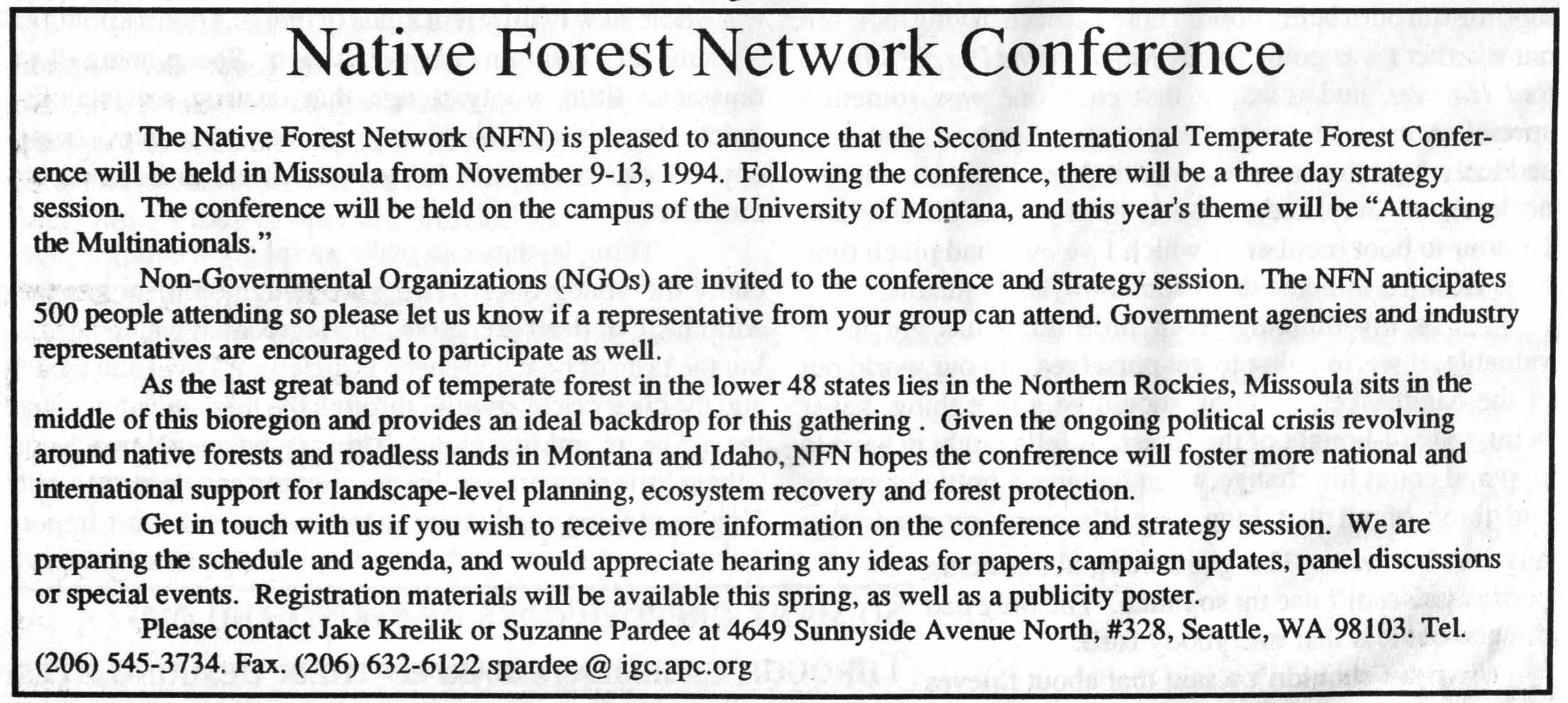
The Native Forest Network (NFN) is pleased to announce that the Second International Temperate Forest Conference will be held in Missoula from November 9–13, 1994. Following the conference, there will be a three day strategy session. The conference will be held on the campus of the University of Montana, and this year’s theme will be “Attacking the Multinationals.”
Non-Governmental Organizations (NGOs) are invited to the conference and strategy session. The NFN anticipates 500 people attending so please let us know if a representative from your group can attend. Government agencies and industry representatives are encouraged to participate as well.
As the last great band of temperate forest in the lower 48 states lies in the Northern Rockies, Missoula sits in the middle of this bioregion and provides an ideal backdrop for this gathering. Given the ongoing political crisis revolving around native forests and roadless lands in Montana and Idaho, NFN hopes the confrerence will foster more national and international support for landscape-level planning, ecosystem recovery and forest protection.
Get in touch with us if you wish to receive more information on the conference and strategy session. We are preparing the schedule and agenda, and would appreciate hearing any ideas for papers, campaign updates, panel discussions or special events. Registration materials will be available this spring, as well as a publicity poster.
Please contact Jake Kreilik or Suzanne Pardee at 4649 Sunnyside Avenue North, #328, Seattle, WA 98103. Tel. (206) 545–3734. Fax. (206) 632–6122 spardee @ igc.apc.org
A Comment on Anarchists
Author: Ted Kaczynski
Date: May 7 2000
Source: “Comment on anarchists 2000”, Folder 6, Box 68, Ted Kaczynski papers, University of Michigan Library (Special Collections Library).
<findingaids.lib.umich.edu/catalog> & <archive.org/details/eg.-notes-by-ted>
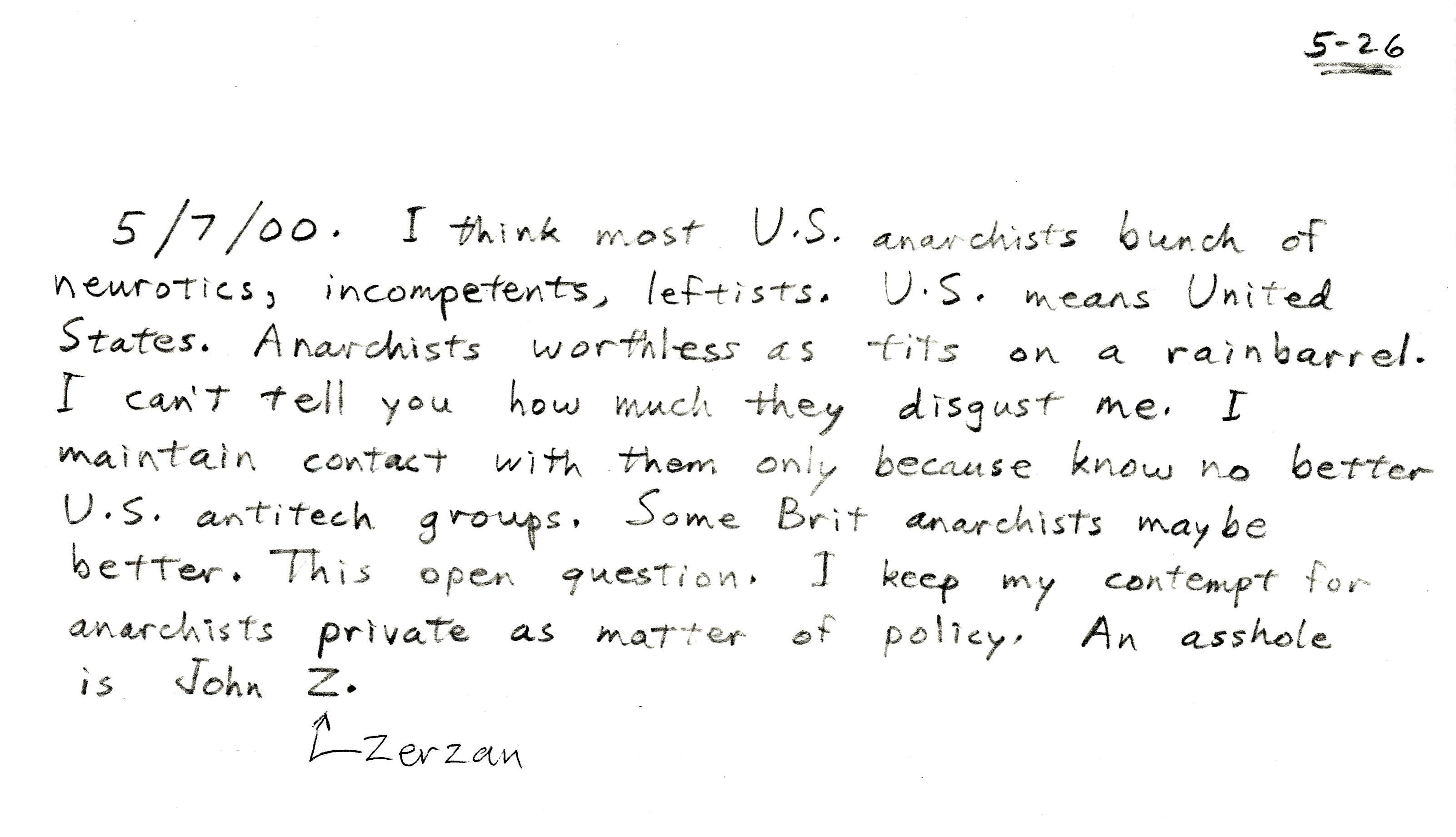
Note: Three years after Ted's arrest he had already fallen out with John Zerzan and decided US anarchists were disgusting neurotics. Then in 2019 he made this private feeling public in a small footnote of an update to his manifesto in the book Technological Slavery: “In 1995 I described FC as ‘anarchist’ because I thought it would be advantageous to have some recognized political identity. At that time I knew very little about anarchism. Since then I’ve learned that anarchists, at least those of the U.S. and the U.K., are nothing but a lot of hopelessly ineffectual bunglers and dreamers, useless for any purpose. Needless to say, I now disavow any identification as an anarchist.”
5/7/00. I think most U.S. anarchists bunch of neurotics, incompetents, leftists. U.S. means United States. Anarchists worthless as tits on a rainbarrel. I can’t tell you how much they disgust me. I maintain contact with them only because know no better U.S. antitech groups. Some Brit anarchists maybe better. This open question. I keep my contempt for anarchists private as matter of policy. An asshole is John Z. <- Zerzan
An Open Letter to ABC Network News
Author: Craig Beneville
Date: 1 May 1996
Source: Earth First! Journal, vol. 16, no. 5, pages 26 & 29. <www.archive.org/details/earth_first_1996>
Editor’s note — The Earth First! Journal sent the following to ABC News April 8 and many other media sources thereafter. We also posted it widely on the internet.
On Friday, April 5, the ABC news program World News Tonight with Peter Jennings aired a report linking the non-violent environmental group Earth First! with Theodore Kaczynski, the alleged Unabomber. The piece was riddled with distortions and inaccuracies, and can only be described as a hit piece on Earth First! and the environmental movement. ABC’s sensationalistic coverage has done serious damage to the reputation of the Earth First! movement, based on the word of Barry Clausen, an individual employed by the timber industry.
The ABC hit piece begins with footage of an Earth First! protest circa 1988. A group of people are shown in the midst of a chaotic scene of violence; fists are flying, people are screaming. The imagery, which sets the stage for the rest of the piece, is clear: these people are violent, crazed extremists. The real story behind this footage, however, provides quite a different context. That day, two protestors, in an act of civil disobedience, had locked themselves by the neck to a logging road gate. In the moments just prior to the footage aired, these activists had been
attacked by loggers, and were dragged by their necks in an attempt to open the gate. The decontextualized footage aired by ABC showed other activists attempting to intervene in order to protect their friends. The person throwing punches was one of the loggers, although ABC does not mention this.
ABC bases its allegation of a Unabomber-Earth First! link on two flimsy pieces of information. The first is Kaczynski’s alleged presence at, as ABC calls it, “a meeting which top level leaders of Earth First! attended, at the University of Montana.” In fact, this “meeting” was actually an environmental conference sponsored by the Native Forest Network, a grassroots environmental group working to protect temperate forests worldwide. Over 400 people attended, including environmentalists from Poland, Scotland, England, Chile, Mexico, Canada and Australia. Even representatives from the US Forest Service attended the conference. Activists associated with Earth First! also attended the event, but had no role in the conference proceedings. Kaczynski’s alleged presence at the conference (his name does not appear on the conference registration list) links him to Earth First! no more than it links him to the US Forest Service.
(The most interesting fact presented in the story, completely glossed over by ABC, was news of an FBI list of conference attendees. Is attending environmental conferences an activity now considered suspicious by our government? The November, 1994, conference occurred before excerpts of the Unabomber manifesto were released which linked the Unabomber to environmentalism.)
The second piece of information is ABC’s contention that two of the Unabomber’s victims were on “Eco-Fuckers Hit List” published by, in ABC’s words, “a radical environmental journal.” (This is the motto in the masthead of the Earth First! Journal.) A quick shot of the hit-list page was followed by a quote from Leslie Hemstreet, a member of the editorial staff of the Earth First! Journal. In the quote, Hemstreet says something like “We cannot be held responsible for what Theodore Kaczynsky may have done with any information he may have gotten from us, because if he had read our journal thoroughly, he would’ve seen that we are completely dedicated to nonviolence.”
The inference could not be clearer: The Earth First! Journal published the hit list. Yet this is false, and ABC knew that it was false. (An underground anarchist/environmental publication called Live Wild Or Die actually printed the hit list.) Roxanne Bezjian, the freelance reporter who interviewed Hemstreet for ABC, told the Journal after complaints about the coverage that she made it very clear to Brian Ross and Dave Rommel, the correspondent and producer of the piece, respectively, that the Journal had not printed the hit list. And while ABC never directly says the Earth First! Journal printed the list, the inference was strong enough to provoke phone calls to the Earth First! Journal office with people screaming that we are terrorists directly responsible for the Unabomber’s actions.
ABC further distorted the story by claiming that both of the victims appeared on the hit-list roster. The two corporations that ABC is referring to as appearing on the list (the list was composed of corporations) are the California Forestry Association and Exxon. Thomas Mosier, one of the Unabomber’s victims that ABC cites as being part of the hit list, worked not for Exxon, but for the public relations firm Burson-Marstellar. ABC claims that Mosier was connected to Exxon because Exxon was a client of Burson-Marstellar. However, Burson-Marstellar, one of the largest public relations firms in the world, has numerous clients. Whether Mosier ever worked on anything related to Exxon is unclear.
Perhaps the most outrageous aspect of the hit piece is ABC’s source of information, Barry Clausen, who appears in the piece. Clausen is a paid informant of the timber industry whose livelihood de pends on an audience interested in Earth First!. Clausen has made a cottage industry for himself travelling to rural areas on speaking engagements paid for by “wise use” groups and the timber industry. The subject of his speeches is his claimed infiltration of Earth First!, and how Earth First! “terrorists” are attempting to destroy jobs, the economy and the whole of civilization.
Barry Clausen is not a credible source. He is a wannabe informant who has been rejected as unreliable by every law enforcement agency he has tried to work with. These include the Sheriffs of both Park County and Madison County in Montana, the US Forest Service in Montana, Washington and California, the US Marshall and the FBI. Clausen has also been rejected by private agencies including a private investigator in Seattle, Washington, and the security department of McDonald’s hamburger chain.
FBI agent Horace Newborn, in charge of the Domestic Terrorism Unit at the FBI’s headquarters in Washington DC, also characterizes Clausen as unreliable. In a sworn deposition Newborn stated about Clausen, “I think what we did is we did some other agency checks with Clausen. His name came up in other places, and we did some other agency checks, and they said he was not reliable.”
This rejection (except Newborn’s) is documented in Clausen’s own book, Walking on the Edge: How I Infiltrated Earth First!, published by the Washington Contract Loggers Association, either in the form of direct conversations or by the agencies’ refusal to grant Clausen and his partner Joanne immunity.
ABC’s portrayal of Earth First! as violent is totally contradicted by the history of Earth First! activism. In the sixteen years since Earth Firstl’s formation the only people to have been injured as a result of Earth First! activities have been Earth First!ers themselves. Earth First! activists have all too often been the victims of violence. Activists have had their houses burned down, been shot at, and beaten up. In 1990, Judi Bari and Darryl Cherney were bombed in their car while organizing for Redwood Summer, an Earth First! campaign to protect California’s redwoods. (Their lawsuit against the FBI for wrongful prosecution and harrassment is still pending.) ABC’s irresponsible portrayal of Earth First! as violent terrorists legitimates such heinous attacks.
The damage done by ABC’s hit piece on Earth First! is tremendous. Hard working environmental activists, who regularly place their bodies on the line to protect the earth, should not be subjected to such blather. This is especially true in light of the “logging without laws” timber salvage rider, which makes salvage logging operations above the law on US public lands. We have better things to do with our time than respond to such outrageous allegations.
The Earth First! Journal is asking for people to call and write World News Tonight to complain about ABC’s irresponsible, sensationalistic reporting. You can reach ABC at 47 W. 66th, New York, NY 10023; (212) 456–4040; e-mail: newsaol@ccabc.com.
The Framing of Earth First!
Author: Craig Beneville
Date: 1 May 1996
Source: Earth First! Journal, vol. 16, no. 5, page 2. <www.archive.org/details/earth_first_1996>
Radical environmentalists and the Unabomber: a terrorist connection? For a week the phones were ablaze here at the Journal office, with media outlets across the country demanding an answer. The last time Earth First! received as much national press was when Judi and Darryl were bombed. The mainstream press at that time dutifully reported the FBI’s story that Judy and Darryl blew themselves up (I still meet people whose only knowledge of Earth First! is as “the ones who nearly killed themselves with their own bomb”).
Such slander hampers our ability to reach people with our message, reinforcing the status quo. When we are marginalized as terrorists it not only deflects criticism of corporate malfeasance away from the real criminals, it hinders our ability to communicate such criticism.
The public will not believe Earth First!’s environmental message if it perceives us as an extremist fringe element.
The misperception of Earth First! as terroristic was no doubt strengthened by the McCarthyite linking of Earth First! to the Unabomber. What effect such slander will have on our activism this summer is yet to be seen. It seems likely, though, that our foes will attempt to exploit the connection to marginalize us, and that the public is well-primed to accept that lie.
Bearing this in mind, it seems to me we should be extra careful to not behave in ways that could allow us to be portrayed in a violent or dehumanizing fashion. Activists might want to lay off the camo at public actions; the connotation of camouflage is too militaristic for Joe and Jill Six-Pack. Likewise, wearing masks at civil disobedience actions makes it look like we have something to hide, and makes it easier for the public to dehumanize us. If you want to use a pseudonym, say for purposes of jail solidarity, use a believable one. Calling yourself “Bark Beetle” or “Pine Fresh Scent” sounds flaky.
One of the problems I see with Earth First! activism is that we sometimes confuse civil disobedience’s role. Physically stopping destruction is not civil disobedience’s strength. The strength of civil disobedience is its announcement to society of an injustice. Hopefully, the CD will generate enough outrage and political pressure to reverse the situation. Viewed in such a context, it would be silly not to appeal to as broad an audience as possible and stupid to allow yourself to be easily marginalized.
Another problem is that we often measure the success of an action by how much media it garnered. A better measure of success, though, is to assess how well the coverage projected our message. Did we come across as having legitimate gripes or as a fringe interest group? Did our story resonate with people or alienate them? Were we portrayed as courageous s/heroes putting our bodies on the line to prevent a grave injustice, or as violent terrorists seeking to put honest people out of work?
Since I’m on my soapbox, I’ll mention that sometimes we seem to let anger replace strategy in our activism. Direct actions can then become little more than platforms to vent, rather than calculated appeals for support. Anger is healthy, even appropriate, but it must be directed in a positive fashion.
None of the above should be construed as a call to retreat to some form of namby-pamby liberalism, afraid to offend people’s sensibilities. If people’s sensibilities are destroying the earth we’ve no choice but to confront them. But this confrontation should not be gratuitous, and as much as possible should not be sanctimonious. People are more inclined to listen that way.
The Unabomber: Up Close and Personal
Author: Leslie Hemstreet
Date: 1 May 1996
Source: Earth First! Journal, vol. 16, no. 5, pages 1 & 26. <www.archive.org/details/earth_first_1996>
In an attempt to explain the motives of the Unabomber, some of the mainstream media attempted to link Earth First! and the environmental movement to Theodore Kaczynski upon his capture. Using thinly spun threads of spurious evidence from self-appointed EF! investigator Barry Clausen, ABC World News Tonight started several rumors about Earth First! that spread through the media like a child’s game of “telephone” gone bad. The New York Times later added dirt to the mudslide.
What got muttered into the public ear courtesy of ABC was that Theodore Kaczynski was on an FBI list of people who attended a meeting also attended by “top EF! members” and that the Unabomber got two targets in a “radical environmental journal.” In reality, the meeting was an Native Forest Network conference attended by over 400 people and the “targets” were from the tongue-in-cheek “Eco-Fuckers Hit List” from ecoanarcho ‘zine Live Wild or Die (See “Open Letter to ABC News” on page 26). In spite of the compromised factual nature of this report, other media sources accepted the information as fact, drew the conclusions insinuated and repeated the story, convoluting it along the way. By the time the information made it all the way around the telephone circle, Theodore Kaczynski had attended an Earth First! meeting where he received a directive on two of his hits from Earth First’s “enemies” list. This appeared as fact in so many national papers, an inventory here would be unwieldy. We had calls from all over the country saying “I heard on my radio station/TV broadcast/read in my newspaper/etc. that y’all are connected to the Unabomber.”
The New York Times (NYT) participated in the rumormongering with a slightly more convincing posture of journalistic integrity. After mentioning that the Unabomber’s writings “seem to parallel” the EF! Journal’s (EF!J) NYT pointed out that the Unabomber targeted Burson-Marsteller (B-M) about nine months after EF! printed an article criticizing them. Both our article and the Unabomber’s letter to NYT criticized B-M for helping Exxon clean up their image after the Valdez oil spill. Burson-Marsteller claims that, while they may have worked for Exxon, it had nothing to do with the oil disaster. The NYT implied that the only place the Unabomber could’ve gotten his information was from EF!J because of the parallel “mistake.” Other media sources extrapolated that the Unabomber got information from EF!) and used it as a directive. In reality, the article was a reprint from No Sweat News. Covert Action Quarterly, citing the Canadian Vancouver Sun, printed a similar article around the same time. The information originated from a 1992 publication “The Greenpeace Book of Green wash.”
In his letter to NYT, the Unabomber spells Burson “Burston,” an error not printed in any of the above publications. He also emphasized that he targeted B-M for their contribution to “thought control” and human rights abuses. Of course, the press would not publish any facts that did not support their theory that he draws inspiration from EF!.
The NYT is no great research tank. We volunteered the information about our B-M article because we have nothing to hide; watchdogging corporations is not yet a crime in the US. They were a shred more accurate than ABC because at least the part that we printed an article about B-M was factually true.
For every media source that repeated the B-M connection, we received at least ten phone calls from journalists with enough integrity to fact check. Most dropped the B-M angle, once they found out that EF! wasn’t the source of some unique information making a connection undeniable.
Disturbingly, every reporter seemed to unquestioningly swallow B-M’s disassociation from the oil spill as truth. If part of their strategy to help Exxon’s image was to never mention the Valdez spill, their disclaimer could be a lie by omission.
There’s No Such Thing as a Free Inside
Some of the negative coverage came out of the paper with the cereal box design — you know, to make for comfortable breakfast-time reading — USA Today and their parent company Gannett. Two of their syndicated columnists, Linda Chavez, ex-cabinet member from the Reagan administration, and Cal Thomas, a former publicist for Jerry Falwell, hijacked the bandwagon, repeating the ABC and NYT reports with a personal flair. Instead of merely possibly attending the same public conference, Earth First! was practically seen at a molotov cocktail party with the Unabomber. Our hit-lists are apparently not even as dangerous as our eco-sabotage how-to manual that includes instructions for “making explosives.”
Chavez let it fly with outright lies including that, in the early 80s, we “put metal spikes in trees and on roads to injure loggers and road crews in wilderness areas.” In reaching for violent rhetoric, she gets in a time machine and goes back to a Dave Foreman speech from 1983 “in which he inveighed, ‘The blood of timber executives is my natural drink, and the wail of dying forest supervisors is music to my ears.’” That quote was from a tall tale by Foreman, part of a standard speech he’s given hundreds of times. He adopts the “Pecos Bill” persona to illustrate, ironically enough, how rhetoric is not sufficient to protect biodiversity.
Chavez tries to link EF! to the murder of California Forestry Association’s Gilbert Murray by pointing out that the bomb was addressed to the organization’s former name, Timber Association of California, just like in EF! faction-produced, Live Wild or Die. She avoids mentioning that the fatal package was addressed to Bill Dennison, former president, not Roberta Anderson as named in Live Wild or Die.
Chavez’ sickest gesture was saying that we have a baby-killer philosophy so we must’ve inspired the Unabomber to kill a pediatrics professor. Plus, she wants to reopen an investigation of a crude pipe bomb sent to a pediatrics specialist. She speculates that if the Unabomber doesn’t turn out to be the perpetrator, “perhaps a less talented radical environmentalist put the bomb together.” She goes back to a 1986 Miss Ann Thropy EF!J article discussing how changes in infant mortality have impacted population growth for her evidence.
The Right’s Revenge
Chavez and Thomas were the first trickle of a flood of whining from the right-wing press about how the left-biased media jumped all over the possible influence of hate radio, militias and rightwing ideologies over Timothy McVeigh but would not draw the same connections between left-wing environmentalists and the Unabomber.
There is a huge difference between scrutinizing and decontextualizing EF! to come up with violent rhetoric and quoting the violent rhetoric actually emanating from right-wingers and wise-users. James Watt may not have said that he eats environmentalists for breakfast, but he did say that sometimes the cartridge box is more effective than the (ballot box.
Another difference is that the militias and Timothy McVeigh were both armed. The Unabomber was armed but Earth First! never has been. When I argued this point with Chuck! Adler on his TV talk show out of Boston (we apparently don’t have a trademark on the exclamation point), he pointed out that the militias also claim to be nonviolent. So I would just like to say for the record that we here at Earth First!™ are the kind of nonviolent who don’t stockpile and brandish weapons. Plus let’s face it, whatever rhetoric we are putting out there, Rush Limbaugh with his big piles of money reaches a lot more people than my beloved little Earth First! Journal.
To conclude that because EF! and the Unabomber share a few elements of a philosophy, we must also share tactics does not follow logically. Especially because dedication to nonviolence is a pervasive part of the EF! philosophy. Additionally, the Unabomber owns our writings and disowns our tribe in his 35,000word manifesto. The press only picked up on the “...if you read the radical environmental and anarchist journals...” part.
To put it simply, there is no connection. According to the Dallas Morning News, sources in the Justice Department stated that evidence gathered from Kaczynski’s cabin “indicate research” into environmental issues, but “no direct link to any radical group or movement.”
To even identify the Unabomber as environmentally motivated is stretching it. Of his 26 victims, only two had any environmental connection.
Debunked Some Myths
Although we considered it a victory when the story got “killed,” some of the press actually behaved in an endearing manner. KEZI, our local ABC affiliate ran a lovely story in which they were surprisingly none-too-kind to ABC World News Tonight. New York’s Newsday, found out that the mysterious FBI list of names was actually something that Barry Clausen allegedly gave to the FBI after getting it from, he claims, a friend in law enforcement. The Washington Post, ran a story called “Eco-Maniac or Madman?” which aired and debunked almost every allegation against us. These are just highlights. We had hours and hours worth of opportunities to talk to the press and set them straight about EF! monster myths.
Three weeks after the initial ABC report, just when we thought it was safe to have something better to do than defend ourselves from a press hungry for stink and blinded by the color yellow, an editorial repeating every above-mentioned allegation emanated from the Boston Globe and oozed into at least two California newspapers. Jeff Jacoby’s story, “Eco Fringe Escapes Blame,” opens with the sentence, “That perfect silence you hear is the environmental movement not being blamed for the crimes of the Unabomber.” It repeats the two ABC innuendoes as fact, moves on to discuss the B-M connection, then talks about the media’s double standard. I just want to say one thing to you Mr. Jacoby: “NPR.” That’s right. Even National Public Radio ran their version of a hit piece on us. The teaser, repeated on the radio throughout the day was this: “Far-right radical groups like the militia and separatists have given pause to the US, but now there may be a link between inflammatory environmentalist rhetoric and the suspected Unabomber.” Yes, this piece from the “alternative” public media was as bad as the teaser indicates and just like ABC, they used Barry Clausen as their source.
Rumors are flying that this alleged link between EF! and the Unabomber will be used to justify an FBI investigation into EF! as domestic terrorists. USA Today quoted former California Forestry Association president Bill Dennison, whose name appeared on the package that killed Gilbert Murray. He said, “I’d like to see a legislative hearing. The Unabomber’s philosophy is only one step removed from the more radical writings of Earth First!”
The rumors died down after a couple of weeks. I think we’re out of the hot seat for now, but we should stay alert so we don’t soundbite off more than we can chew.
Just when I thought I was losing my sense of humor about the whole thing, I read the London Daily Telegraph’s version of what happened. They clearly got their information straight from the Sahara Club’s home page (http://www.aloha.net/~pjc/green/unabomb-ef.hmtl) which lays out the links between Earth First! and the Unabomber. Even though most of what the Telegraph wrote about EF!s activities was just like a Stephen King horror novel, I closed my eyes for a minute to pretend one thing that they said was true: They wrote that the Earth First! Journal has 15,000 subscribers.
Barry Clausen: Flim-Flam Man or Private Dick?
Author: James Barnes
Date: 1 May 1996
Source: Earth First! Journal, vol. 16, no. 5, page 27. <www.archive.org/details/earth_first_1996>
For a long time the radical environmental movement, Earth First! in particular, figured that if it ignored Barry Clausen, he’d go away. The movement was wrong. In fact, this professional snitch has been (and I hate to give him any cause for self-satisfaction) almost single-handedly responsible for the bad press Earth First! has gotten in the past couple years. So, it is time for us to deal with him.
Until recently, he’s been merely an irritant, and often a source of amusement, falling all over himself to paint us as baby-eating terrorists to wide-eyed Wise-Users, making up stories and spelling our names wrong. Since Theodore Kaczynski was arrested on suspicion of being the Unabomber, though, things have changed. EF! has had to counter an avalanche of innuendo about our “connection” to the Unabomber and Clausen is the main source of this misinformation. People are being threatened — called murderers and so on — just as we approach a new season of unprecedented public lands destruction and the subsequent upsurge in direct action protests all over the country. We can’t continue to have nonviolent activists placed at risk because of Clausen’s damned lies.
An Informer’s History
Barry Clausen admits in his book, Walking on the Edge, that his love affair with law enforcement began when he was busted for grand theft auto at the age of sixteen. From there he spent much of his time doing coke in Montana, working an assortment of jobs and trying to get close to movie stars. He turned to narcing after a cocaine smuggling deal in Texas went sour, sending him running to the Drug Enforcement Agency (DEA).
The DEA wouldn’t believe his tale, but Barry was apparently so thrilled by all the leather and guns that he went straight to the sheriffs of Park and Madison counties in Montana and offered himself as a stool pigeon. The sheriffs set him up with body wires but only a couple of busts came down as a result. The cops later testified that they thought Clausen “unreliable” and “working both sides,” so Barry’s career as an undercover drug agent came to an end.
Meanwhile, Barry was working as a seasonal Forest Service employee. It was also during this time that was charged with felony theft of an automatic rifle. Clausen later retaliated with a lawsuit targeting just about every law enforcement agency and individual he ever worked with, thus producing some interesting depositions. Barry doesn’t seem to realize how pathetic these things make him look, so he describes them thoroughly in his book.
In 1989, Barry Clausen was introduced to Bruce Vincent, founder of the Wise Use group Communities for a Great Northwest. According to Barry, this was when he first heard of Earth First!.
In Deep Cover
Under contract from some unnamed group (Communities for a Great Northwest, I imagine), Clausen went to work “infiltrating” Earth First!. He visited the Montana EF! contingent and weirded them out, telling different cover stories to activists in Bozeman and Missoula, and generally getting himself classified as a wingnut.
He never really figured EF! out, so he still refers to one EF!er as “the head of Montana Earth First!” and another as the “publisher of Live Wild or Die and former head of Earth First! Washington.” His account engages in some stylin’ libel such as a photo caption which reads: “This helicopter was torched by Earth First! terrorists in Montana.”
Since he couldn’t actually get any Montana EFlers to do any copter-burning, or other crimes, Barry went off to Seattle to work for the Washington Contract Loggers Association as a private eye (despite the fact that neither he nor his company, North American Research, were ever licensed to operate in Washington State; he has lately restyled himself as a “consultant,” possibly as a result of inquiries into his PI status).
In Seattle, and up and down the coast (he went to Redwood Summer), Clausen continued his “investigation” and continually harassed Forest Service law enforcement with information on EF! terrorism and plots, which they were clearly uninterested in. Again and again they refused to work with him, citing his past record. In one example, FBI agent Horace H. Mewborn gave sworn testimony that, “...we did some other agency checks, and they said he [Clausen] was not reliable.”
Barry even tried private companies. He badgered McDonald’s about “animal rights terrorism” following Jeremy Rifkin’s “Beyond Beef” campaign until they demanded that he cease bothering restaurant employees about vandalism. Security officers at MacMillan Bloedel blew their stack when they found out Clausen had contacted some of the largest MacBlo customers. Barry got the addresses from the November, 1994, Earth First! Journal announcing a boycott of the huge corporation for its role in the destruction of Clayoquot Sound. He warned MacBlo’s customers about potential terrorist attacks, and may well have increased the publicity and success of the campaign.
Barry Discovers the Media
In 1994, the Province, a Vancouver tabloid, printed some of Barry’s allegations verbatim. The success of this story in attracting attention, spin-off stories and cashola encouraged him to shift his focus from private investigations to public relations. The press often has no standards of proof other than titillation and scandal, and his employers in the timber industry want only to smear their enemies. Clausen’s work meets both conditions.
Later in 1994, Walking on the Edge: How I Infiltrated Earth First!, by Barry Clausen with Dana Rae Pomeroy was published by Clausen’s employer, the Washington Contract Loggers Association (2421 Pacific Avenue, Olympia, WA 98507–2168; (800) 422–0074 or (206) 352–5033). The book number is registered to -Ron Arnold at the Center for the Defense of Free Enterprise. Later that year he got another story out over the wire services, this time claiming that the Native Forest Network (NFN) conference, held in November, 1994, in Missoula, was to feature a who’s who in ecoterrorism.
This nonsense has resurfaced in the latest Clausen inspired round of eco-bashing. He claims that Ted l Kaczynski attended the NFN conference. But he won’t show anyone any proof. Clausen used the Unabomber to good effect last year too, when Gilbert Murray of the California Forestry Association was killed.
Last year, Clausen put out a pamphlet called “Report on Terrorism: The Real Truth” which describes Earth First! as a terrorist organization and blames us for all the acts of terrorism in the US for the past five years. He also includes copies of his correspondence with timber-industry-pocket-Senators Slade Gorton (R-WA) and Conrad Burns (R-MT) in which he convinces them to ask for a Justice Department investigation of Earth First! There are rumors that such an investigation may happen this spring thrusting n s into the headlines again.
Enter Lyndon LaRouche
Clausen’s latest project has been a newsletter called Ecoterrorism Watch which he co-edits with Lyndon LaRouche follower Rogelio Maduro. The newsletter is published by the LaRouche organization at their headquarters in Virginia (POB 214, Leesburg, VA 22075; (703) 779–0121. Forget about n subscribing, it costs $ 145 a year for photocopied I articles from the EF!J). This cult-like organization believes in a bizarre conspiracy theory that considers the entire environmental movement to be controlled by banking and corporate consortiums which in turn are controlled in turn by the World Wildlife Fund and headed by Prince Philip of England I’m not kidding about this? They think His Royal Highness the Duke of Edinburgh personally hand-picked Jake Kreilick to run the Native Forest Network eco-terrorist front.
Clausen is also featured in LaRouche’s publication, Executive Intelligence Report. Among other strange things, it states that Dave Foreman was hired by the Wilderness Society and Sierra Club to found Earth First! to make them look better and toughen mainstream positions. Supposedly, Foreman was guaranteed funding and a ten-year contract limit. (Actually, considering how Foreman’s been opposing Zero Cut at the Sierra Club and calling us all “True Believers” a la Eric Hoffer, this doesn’t seem so far fetched.)
Spreading Fear — for Fun and Profit
Since 1993, Clausen has regularly spoken to Wise Use groups all over the West. His speeches aim to frighten people into believing Earth First! terrorists are coming to get them and destroy their communities. Clausen pushes “security” services with some Soldier of Fortune-type macho dudes that he claims are ex-Navy Seals or Airborne Rangers or some damn thing.
At these talks he repeats the Judi Bari-and-Darryl Cherney-blew-themselves-up story despite the fact that he has admitted he knows it isn’t true. He also targets a Seattle EF!er who has worked for both Greenpeace and the Native Forest Network, and therefore is clearly a linchpin of the big green conspiracy. He attributes right-wing bombings to EF!, and labels the 1989 Dixon, California livestock auction barn-burning as an EF! action, despite it’s being well known now as an insurance scam, etc. His best story is that Earth First! intends to poison water supplies all over the country with virulent E. Coli bacteria as per instructions in Dave Foreman’s book Ecodefense, and in fact we have done so already in Portland, Oregon. Of course, Ecodefense says no such thing. He says he knows who shot some cattle in Utah and who sabbed the powerlines in Santa Cruz in 1990, but for some reason his information has never been acted upon by law enforcement. Oh, and Mike Roselle is the leader of the whole terrorist kit and kaboodle.
Clausen has been trying to get this Unabomber thing to stick for several years now. When Kaczynski’s arrest came down he was all too prepared with the “real” story. The press, in frenzy mode, was willing to swallow it whole. It’s all too easy, really. And he’ll be back when circumstances arise that make “ecoterrorism” a top story he can peddle. So, we have to be ready. If you hear that Clausen has a speaking engagement in your area, attend it. Call the Journal for a Barry Clausen fact sheet to hand out or give to the press if there is going to be a Clausen-inspired media attack in your area. Clausen himself can be reached at POB 65298, Port Ludlow, WA 98365; (360) 437–0453, fax (360) 437–9101. Call and give him hell, nonviolently, of course.
Texts on the Green Scare more broadly
The Green Scare is Everywhere
Subtitle: The Importance of Cross-Movement Solidarity
Author: Jeff Monaghan and Kevin Walby
Date: 10/26/2009
Source: Upping The Anti, Issue 6.
<www.uppingtheanti.org/journal/article/06-the-green-scare-is-everywhere>
The burgeoning “War on Terror” is facilitating the re-emergence of “terrorism” as a legal and discursive framework for classifying and suppressing political radicalism. Despite the jingoism, xenophobia, and racism of the “War on Terror,” the Federal Bureau of Investigation has consistently identified “eco-terrorism” – “homegrown” terror ostensibly perpetuated by (mostly) white environmental, animal liberation, and social justice activists – as one of the top threats to America. This climate of fear has facilitated efforts to suppress the environmental justice and animal liberation movements. These efforts are comparable to the campaigns directed towards communists, socialists, and other dissidents during the Red Scare periods of the 1910s and 1950s. In a January 2006 national press conference called to announce the indictment and arrest of several eco-activists, Attorney General Alberto Gonzales and FBI Director Robert Mueller indicated that “investigating and preventing animal rights and environmental extremism is one of the FBI’s highest domestic terrorism priorities.”[1] The day of those arrests coincided with the release of convicted Oklahoma City bombing co-conspirator Michael Fortier. No media coverage mentioned the contrast between Fortier’s sentence – 12 years for an act resulting in 168 deaths – and those aimed at the non-violent acts of property destruction allegedly carried out by eco-activists, which ranged from 30 years to life without parole.
The “Green Scare,” as activists have termed it, has emerged from an alignment of interests between political elites and industrial capitalists. Like the McCarthyists of old, the objectives of these interests are broader than the regulation of “crime.” They seek to destroy broader political opposition. Efforts to demobilize and neutralize these movements go beyond the immediate targeting of radicals. Under the banner of “fighting terrorism,” the Green Scare has provided opportunities for an alignment of ruling class interests to attack a diverse array of activists who, in various ways, object to the avarice and violence of global capitalism.
It is important to note that the suppression techniques of the Red Scare(s) were not, and never were, deployed exclusively against members of the Communist Party. These crackdowns were, and still are, used to demobilize and demoralize a wide spectrum of political opposition on the left. Many of the most severe forms of suppression used covert and overt demobilization techniques to directly target the fringe, marginalized, and more radical elements of the struggle. The suppression directed against animal and environmental liberation activists today is not identical to the violence directed towards movements like the radical labour and anarchist movements of the 1920s, the Black Power movement, the American Indian Movement, or cold-war Communists. However, the Green Scare has two significant implications for individuals and groups working towards radical social transformations.
First, an alignment of state and corporate interests working under the guise of “anti-terrorism” is producing a set of dangerous precedents as it tries to destroy radical elements of the environmental and animal liberation movements. The techniques deployed against these activists can and will be used against other left groups that challenge capital and the state. Second, a broader aim of state and corporate elites is to dissuade and neutralize opposition movements to capitalist profit-making by branding elements of the left as irrational and violent terrorists. If the left accepts this characterization of its most radical elements, it will become paralyzed by internal divisions and will be greatly weakened when capital and the state inevitably target more “moderate” and mainstream left organizations.
In this context, the suppression of environmental and animal liberation activists in the United States has immediate implications for activists globally, particularly for those of us living in Canada. The extensive process of anti-terrorism policy harmonization between the US and Canada has integrated surveillance and policing practices. These developments are beginning to play a role in the targeting of activists. The multi-agency effort to criminalize the activist group Stop Huntingdon Animal Cruelty (SHAC) illustrates that Green Scare politics are influencing police, legal, and security measures across Canada and the US.
Although SHAC sometimes presents itself as a reform-centred movement, it is heavily reliant on direct action tactics. SHAC targets corporations and individuals and has active groups in the US and Canada. SHAC and similar groups are at the epicentre of the war against “eco-terrorism.” The suppression of SHAC has serious ramifications for other social movements, inasmuch as demobilization techniques of police and other regulatory agencies rely upon the mapping of radical communities, creating a surveillance web that has the potential to migrate and swarm in response to a variety of perceived threats to the status quo. The suppression of SHAC demonstrates that solidarity across movements is needed to collectively resist Green Scare techniques that could easily be applied to the labour movement and social justice organizations that target corporations as part of their campaign strategies.
Animal Liberation and “Eco-Terror”
SHAC, the Earth Liberation Front (ELF), and the Animal Liberation Front (ALF) are the most frequently cited “eco-terrorism” groups within the US Green Scare discourse. US security agencies also refer to the ALF and SHAC as “animal rights extremists,” and Canadian officials have framed their response to this activism in similar terms. Such broad categorizations, however, are inadequate for understanding the dynamics of the movement.
The animal liberation movement emerged from dissatisfaction with the reformism of the mainstream animal rights movement. It has adopted a strong advocacy for direct action. Whereas the mainstream animal rights movement is typically reformist in nature and accepts the legitimacy of capitalist institutions, the animal liberation movement has drawn from the theoretical legacy of anti-capitalist and anti-oppression struggles and applied these to their strategies.[2] Since the ALF emerged in 1976, the animal liberation movement has combined an explicitly anti-capitalist analysis with a critique of the traditionally anthropocentric dogmas of anarchist and socialist movements. These groups advocate moving beyond the politics of protest (as effective as these may be in some tactical conditions) to committed forms of resistance. Their opposition to the systematic violence toward animals inherent in modern capitalism places the movement in conflict with the status quo. Steve Best argues that the animal liberation movement is a “potentially important force of social change, not only in relation to its struggle against animal exploitation and capitalist industries but also as an element of and catalyst to human and earth liberation struggles.”[3]
How can we understand the intense counter-movement responses to SHAC and similar groups? In his book Beyond Bullets, Jules Boykoff argues that, when identifying strategies that demobilize social movements, “suppression” is a more productive analytical framework than “repression” since the latter is often reduced to “governmental coercion.” Boykoff defines suppression as “a process through which the preconditions for dissident action, mobilization, and collective organization are inhibited by either raising their costs or minimizing their benefits” (12) and outlines a broader understanding of how movement participants can be channelled into inaction. This framework does not limit suppression to government coercion, but accounts for mechanisms by which the state as well as private agents try “to squelch dissent and maintain control” (314). Suppression mechanisms include, but are not limited to, surveillance, intimidation, banishment, bogus charges, and lengthy criminal trials.
It is crucial to point out that private agencies – including industrial interests linked to animal abuse such as pharmaceutical corporations, fur traders, and logging companies – have been integral to the suppression of SHAC. Boykoff uses the term “outsourced suppression” to identify suppression carried out by private individuals or groups. Generally this notion assumes that private agencies are acting at the behest (and in support) of the state. However, with counter-movement responses to animal liberation, this relationship between state and private agencies is inverted as the state acts to protect the private interests of targeted corporations. The suppression of SHAC demonstrates the role of economic elites in pressuring political elites, police, and security agencies to vouchsafe corporate agendas.
One operative means of suppressing animal liberation struggles has been to isolate activists. This is done with the expectation that other progressive organizations may not accept certain risks involved with publicly supporting them. The technique is aided by the fact that other groups involved in the larger social justice movement have traditionally seen animal liberation struggles as being “less important,” or have distanced themselves from the “radicals or extremists” because of concerns over “messaging” in the mass media. As part of our prisoner-support work with Books to Prisoners — Ottawa, we have undertaken various organizing efforts to support SHAC. Through these efforts, we have sometimes encountered negative sentiments within certain sectors of the left. In language similar to that of the FBI and CSIS, these activists accuse animal liberation groups of focusing on “special interest” activities while failing to acknowledge their commitment to broader social change.
The brutal suppression of SHAC that we detail below demonstrates that solidarity is needed across movements. The silencing of one movement supports the legal and governmental complexes necessary for the demobilization of all movements that push the boundaries of “acceptability” when challenging the violence of the capitalist system.
The Green Scare is a label activists use to describe the heavily politicized counter-movement designed by major corporations and the state to attack the environmental justice and animal liberation movements with propaganda, legal processes, infiltration, harassment, and a general climate of suppression. This suppression serves two functions. First, the state is attempting to criminalize and destroy elements of the well-organized and dedicated animal liberation and radical environmental justice movements. Second, the Green Scare supports the interests of industrial capitalism in de-legitimizing the environmental movement in general.
Since the term Green Scare was introduced in 2002, its reference points have expanded. Its most particular reference point is a series of arrests and absurdly disproportionate sentences handed down against US activists. The cases include Eric McDavid and Rod Coronado, the SHAC 7, Jeffrey Luers, Peter Young, arrestees in “Operation Backfire,”[4] and others. The term also refers to three sets of Grand Jury indictments, congressional hearings, and a host of localized witch-hunts targeting activists. Additionally, the term refers to various legislative measures aimed at the animal liberation movement, most notably the Animal Enterprise Terrorism Act and Animal Enterprise Protection Act, discussed below, which explicitly classify direct action environmentalist activists as “terrorists.”
Taken in aggregate, the financial resources, media attention, and criminal proceedings devoted to the animal and environmental liberation movement have been disproportionate relative to the stated objectives of state and private agencies.[5] As activists targeted by the demobilization efforts have noted during interviews, it is important to understand the Green Scare as a deliberate attempt to isolate a group of activists and discredit them as a “fringe” element. The targeting of the animal liberation movement, and SHAC in particular, can be explained by the groups’ effectiveness in damaging the political and especially financial interests of powerful multinational corporations.
The History of SHAC
The exclusive objective of the SHAC campaign is to shut down Huntingdon Life Sciences (HLS), Europe’s second largest vivisector. Vivisection is an operation performed on live animals for purposes of experimentation, in which animals have to endure prolonged periods of mutilation, often combined with poisoning by injections of household products, pesticides, drugs, herbicides, food colourings and additives, sweeteners, and even genetically modified organisms. As SHAC/ALF spokesperson Jerry Vlasak says, HLS has a reputation for testing “anything for anybody.” Vlasak notes that HLS has been infiltrated[6] and exposed multiple times in recent years by journalists, activists, and members of the public who have uncovered evidence of animal abuse and staff incompetence.[7]
In the late 1990s series of successful, informally-organized campaigns in the United Kingdom forced several breeders to sell their “stock” (kittens and beagles destined for vivisections). When, in 1997, HLS purchased the remaining animals to ensure a consistent supply of test subjects, SHAC formalized as an action network to focus on shutting down the company. Structured along an affinity group model, autonomous SHACs are generally small, consisting of individuals who know each other and act together on specific projects. The difference between SHAC and traditional affinity group organizing is that many affinity groups stay together only for the duration of a protest, while SHAC activists are committed to working in their affinity groups until campaign objectives are fulfilled.
One of SHAC’s central tactics is home demonstrations at the residences of HLS executives and employees and those of people associated with companies that do business with HLS. At the demonstrations, activists yell chants like “puppy killers” into megaphones and hold posters depicting dead animals ripped open by vivisection. These tactics are motivated in part by the experience of many activists who feel that actions outside securitized corporate offices are generally ignored. Home-based protests emphasize that individuals who spend their work shifts killing, funding, or enabling the deaths of animals should not be allowed to do so in anonymity. Reflecting on SHAC’s tactics, HLS Managing director Brian Cass commented, “These campaigns have been effective because of the very personal nature of them. They don’t go specifically after a company per se, they go after individuals within that company. That has been their most effective tactic – taking their threat to someone’s front door.”[8]
Despite claims from its detractors, SHAC is explicitly committed to non-violent direct action. Its decentralized organizational structure has proven highly effective at following HLS-related companies to diverse locations and negatively affecting the financial interests of the major multinational corporations that deal with HLS. Over 100 companies – most of which are based in the US and the UK, but also some in Canada – have severed ties with HLS, including Aetna Insurance, Citibank, Johnson and Johnson, and Merck. SHAC claims that its campaign has resulted in economic damages surpassing $10 million (US).
SHAC is coordinated through international networks in a variety of regions in the global North. HLS supporters correctly argue that the success of a social justice campaign in shutting down a powerful multinational corporation would be a victory against global capitalism. Therefore, the political-economic consequences of the SHAC campaign are fundamental to recognizing the state-corporate efforts to neutralize animal liberation activism under the criminal rubric of “terrorism.” The struggle to shut down HLS highlights the importance of indentifying the implications of the Green Scare for the broader anti-capitalist movement.
SHAC USA
After successfully forcing HLS to cease trading on the London Stock Exchange and to move its headquarters to New Jersey, the SHAC campaign grew substantially in the United States.[9] It was not long before SHAC USA began to have a damaging impact on HLS. On December 21, 2000, HLS was suspended from the New York Stock Exchange (NYSE) because it no longer met the NYSE’s criteria of having a market capitalization of at least $50 million. From 2001 to 2005, SHAC scored several victories and forced a long list of investors and suppliers to sever their business ties to HLS.[10] The campaign was so effective that, fearing public disclosure, no financial corporations would associate with HLS. Eventually, the Bank of England offered HLS a bailout as “lender of last resort.”[11]
On September 7th, 2005, HLS (renamed as Life Sciences Research Inc.) had planned a high-profile return to the NYSE and was scheduled to be added to the “big board.” Fifteen minutes before trading opened, NYSE officials hurriedly announced they would postpone the HLS listing. The Daily Telegraph reported that Catherine Kinney, president of the NYSE, is “understood to have pulled the HLS executives aside and said that the NYSE had received calls from members of the New York financial community saying that the security of the exchange could be threatened by the animal rights activists.”[12]
The response to SHAC’s victory was swift. The medical science industry recognized that the NYSE capitulation to SHAC’s campaign set a dangerous precedent, which resulted in efforts to cast SHAC as a “domestic terrorist” organization.[13] The fur industry also increased its agitation in the wake of SHAC’s NYSE victory. The Fur Information Council of America helped organize an industry lobby group named Fur wRaps The Hill. The group has a private, members only, website. However, an entry on the Fur Information Council of America site describes Fur wRaps the Hill as a “legislative project that will bring a consortium of fur industry representatives to Capitol Hill several times each year to lobby on trade and eco-terrorism issues.”[14]
This coincided with a political effort lead by James Inhofe (R., Okla.)[15] to launch an inquiry into “radical environmental and animal rights groups” in America. The committee held two sessions: first on May 18, 2005 to address the ALF and ELF, then a separate hearing on October 26, 2005 to address SHAC. During both sessions, the committee heard from John E. Lewis, deputy assistant director of the FBI Counter-terrorism Division, and leading eco-terrorist “expert” within the FBI. In both instances Lewis provided an overview of “domestic terrorism threats” and focused exclusively on the supposed dangers of the “special interest extremist movements such as the Animal Liberation Front and the SHAC campaign.” Following the committee hearings on “eco-terrorism,” Senator Inhofe announced that he would author and co-sponsor the bi-partisan Animal Enterprise Terrorism Act (AETA). Inhofe says he introduced the legislation to “provide law enforcement the tools they need to adequately combat such radical animal rights extremists.”[16]
People writing about the repression of social movements have understood the private agencies that participate in demobilization of social movements as being activated and steered by a centralized state.[17] With animal liberation activists, we believe the opposite is happening. It has been the medical science lobby and vivisection industry representatives that have directed politicians, legislators, and police to criminalize animal liberation activism using the politically and rhetorically expedient framework of “eco-terrorism.”
The Animal Enterprise Terrorism Act
The AETA is the centrepiece of US legislative efforts to combat the animal liberation movement. Crafted at the behest of the well-funded and influential animal research lobby, the AETA was signed into law by President Bush on November 27, 2006.[18] Despite significant public outcry and campaigning – over 200 groups assembled in opposition under a campaign named the Equal Justice Alliance (EJA) – the bill was passed and received almost no media attention.[19] Members of the EJA included the American Civil Liberties Union, the National Lawyers’ Guild, the Natural Resources Defense Council, the League of Humane Voters, Physicians’ Committee for Responsible Medicine, and the New York City Bar Association. The alliance criticized the AETA on grounds that its terminology was dangerously vague and came into conflict with the US Constitution.[20] The industry lobby was coordinated by a pharmaceutical front-group called the National Association for Biomedical Research. It organized a coalition named the Animal Enterprise Protection Coalition, which described itself as a coalition of “AETA supporters,” gathering over 175 groups, including agribusiness, logging corporations, and medical research facilities.[21] The coalition undertook an extensive lobby effort to win legislation that explicitly defines “damaging or interfering with the operations of an animal enterprise” as terrorism.
The AETA contains highly contentious provisions that serve to strengthen measures that the industry lobby felt were not adequately addressed by its predecessor, the Animal Enterprise Protection Act (AEPA). Like the Patriot Act, the AETA expands pre-emptive criminal law prohibitions against activities deemed suspicious by enforcement agencies. In this regard, animal liberation and environmental activists have noted that the AETA was a direct response to the success of their legally-conducted campaigns. Activists emphasized, in particular, that the expanded powers contained in Section A of this legislation not only include “animal enterprises” but also target activities against any person or business with any “connection to an animal enterprise.”
As critics have noted,[22] under the AETA, activists can be charged with terrorism in the event of a non-violent home demonstration taking place on a public roadway which does not cause any identifiable economic damage, does not do bodily harm to people, and does not instill “reasonable fear.”[23] This legislation allows for pre-emptive detainment, surveillance, lengthy prison terms, red-zoning, massive fines, and sets a precedent for suppression that has implications for other social movements who use similar tactics to SHAC.
Alarmingly, this terrorism law can target non-violent civil disobedience simply because activists display an intent to disrupt the economic activity of a company engaged in, or associated with, animal testing. Critics of the legislation note that, as demonstrated by the severity of legal attacks already directed toward activists, prosecutors in the US had, prior to the AETA, a successful track record of charging animal rights campaigners under the AEPA for similar, if not identical, activities. Indeed, just prior to the enactment of the AETA, SHAC USA and six of its members were tried and collectively sentenced to 22 years in prison for their non-violent campaigns of civil disobedience. The AETA, should therefore be understood as creating a specific linkage between activism and terrorism and not, as some industry representatives have suggested, simply offering a means to properly charge and sentence “criminals.”[24]
SHAC 7 and the AEPA
In March 2006, for the first time since its implementation in 1992, six activists and the incorporated NGO called SHAC USA (collectively referred to as the SHAC 7) were tried and sentenced under the AEPA. After September 11, 2001, the AEPA was merged into the colossal anti-terrorism bill called Uniting and Strengthening America by Providing Appropriate Tools Required to Intercept and Obstruct Terrorism Act, otherwise known as the USA PATRIOT Act. Under the AEPA, SHAC activists were convicted of operating a website that reported on and expressed ideological support for protest activity against HLS and its business affiliates. While the charges were framed within a discourse of terrorism and security, the defendants were not accused nor convicted of personally engaging in any so-called terrorist activities.
The Department of Justice announced that SHAC USA’s conviction arose “in connection” to their campaign to “terrorize” officers, employees, and shareholders through “telephone, email, fax blitzes and other methods designed to overwhelm or shut down office systems in the campaign to harm or end the companies’ relationship with Huntingdon.”[25] During the trial, the US government deployed “conspiracy” charges, and some members of the group were charged with conspiracy to harass using a telecommunications device (sending black faxes), conspiracy to commit interstate stalking, and counts of interstate stalking via the internet.
Unlike other cases considered to be part of the Green Scare, the activists were never accused of causing physical damage. Rather, they were convicted of “conspiring” to cause economic damages. In an interview on Democracy Now! Andrew Stepanian, one of the convicted members of the SHAC 7, explained:
The prosecutors claim that because Deloitte & Touche severed its relationship with Huntingdon Life Sciences, Huntingdon Life Sciences may have incurred more than $10,000 in damages. And as long as a threshold of $10,000 is met, I could participate in legal activities leading up to that point, but the second I cause $10,000 of intellectual damage, then I could be charged under this conspiracy to violate the AEPA. I would be charged with a substantive charge if I actually destroyed some property, for example, that was worth $10,000, but in this case, it was a purely intellectual matter.
Prosecutors did not claim that the SHAC members had personally been involved with the alleged damages. Instead, prosecutors argued activists provided information via their website, which enabled others to engage in the supposed acts of terrorism. Prosecutors did not provide evidence that SHAC members had ever communicated directly with the perpetrators. Rather, the six activists were convicted of running a website that allowed others access to information that could be used in crimes.
Following the arrests of the SHAC 7, the US Department of Justice and the FBI released press statements claiming SHAC was a militant and violent organization. The media picked up on this and began to associate SHAC with violence during the trial. The FBI and media framing of these arrests translated into prison processing procedures, too. In a leaked document from Sheridan Prison in Oregon, where Josh Harper was serving his sentence, Harper was described as a “Domestic Terrorist” who was “encouraging others to commit a terrorist act” by simply discussing his case and the animal liberation movement with other prisoners. The memo also noted the FBI wanted to question him because he was found in possession of No Compromise and Green Anarchy magazines. He served three months in solitary confinement for these alleged offenses.[26] However, during his trial, the prosecution did not present any incidents of human-to-human violence. The trial focused on acts of spray-painting and home demonstrations. Given the breadth of criminal activities defined in the AEPA, the prosecution argued that, to be guilty, SHAC did not have to participate in the demonstrations but only had to provide information about these or other activities. It is conceivable that these suppressive techniques could soon be applied to other social movements groups with similar tactics.
Green Scare and SHAC-Canada
The methods used in the disruption of SHAC-Canada have been substantially different than those used against SHAC USA and other Green Scare targets in the United States. The Canadian approach to suppression does not use the same rhetoric and political hype that are central to the American Green Scare. There have been no mass round-ups, no multi-million dollar prosecutions, and no publicly explicit efforts at legislating bills tailored to the demands of the medical research lobby and policing agencies. That said, Canadian policing and intelligence-gathering practices are discernibly influenced by the US Green Scare approach. The changing legal landscape in the US – specifically “terrorism” provisions such as those in the AETA – have impacted Canadian policing and intelligence practices. This influence can be traced through interviews with Canadian SHAC activists and a series of access to information requests (ATIPs) that we made under the Access to Information Act, including requests filed to several federal departments and municipal requests that cover the police departments of Montréal and Vancouver.
Our requests procured relevant information from the City of Westmount and from the Canadian Security Intelligence Service. However, in most cases, information was exempted. Several departments cited predictable reasons for exemption, such as the status of on-going investigations. Other exemptions are especially relevant to this study. In particular, the Department of Justice exempted information using sections 13(1)(a) and 15(1) of the act. The former has to do with “information obtained in confidence from the government of a foreign state,” and the latter with “international affairs and defence.” Despite the frustration of not actually receiving the information, these exemptions have in part substantiated our concern that international policing efforts – likely associated with the “War on Terror” and the Green Scare – are emerging as serious considerations for the Canadian security and legal establishment.
SHAC in Montréal
Westmount is a wealthy and politically influential city adjacent to Montréal, Québec. Our access to information requests with the city of Westmount provide insights into the relationships between the residents, the mayor, and the police. For instance, a communiqué sent to residents detailing a community information session expresses the frustration of local residents towards SHAC. SHAC’s constitutionally protected right to assemble is, in fact, the central element of contention. The communiqué states that Mayor Karin Marks, director of Public Security of Westmount Richard Blondin, Station 12 Police Commandant Natalia Shuster, and the District Councillors held the meeting to “share with [Westmount residents] what we know about the cause of these demonstrations and what we can (and cannot) do to prevent and/or control them.”
On November 26, 2006, 13 SHAC-Canada members were arrested in Westmount and charged with breach of the peace following a peaceful home demonstration, one of dozens of peaceful protests that had taken place over a 20-month period. The peaceful but loud demonstrations targeted CEOs from Novartis and AstraZeneca, multinational producers of pharmaceutical drugs and customers of HLS, who live in Westmount. The idea of suppression – layers of surveillance, harassment, and intimidation that aim to demobilize targeted groups – is useful in understanding the circumstances surrounding SHAC-Canada because, as evidence following the arrests revealed, SHAC was extensively targeted by police and private agencies associated with pharmaceutical corporations.
Court evidence used against SHAC activists revealed that Montréal police infiltrated the group and had undertaken a year-long surveillance operation that included home and cell phone taps and stakeouts. At one trial, the prosecution used a 600-page document produced by Montréal police and a private detective hired by Westmount residents that provided a detailed report of the comings and goings of SHAC members. Police blocked access into Westmount, took photos and video of activists at select demonstrations, physically intimidated activists, and followed SHAC activists around day and night.
The suppression of SHAC was not limited to policing agencies. Our ATIP with Westmount also procured an October 18, 2006, fax from the office of the pharmaceutical company AstraZeneca to the director of Public Security of Westmount, Richard Blondin. The fax cover letter states that, “as a follow up to our phone conversation in the afternoon,” the representative of AstraZeneca was forwarded information from their “security officer” that there would be a SHAC action on Halloween night outside the house of the Novartis president in Westmount. Also on October 18 of 2006, an email from an unidentified person was distributed to City of Westmount officials. It speaks of a “pharma security managers group… recently created to keep us inform[ed] on animal activists’ activities.” The information about the Halloween action was gathered by the pharma security group, but the information “that the target could be the house of the Novartis president who lives in Westmount” came from “the Montréal Police department (Security Intelligence section).” Not only are public police involved in suppression of dissent, but target companies also hire private detectives and form security clusters. Aside from this short communication, it is unclear what level of cooperation exists between private security forces and the city police in their efforts to monitor and disrupt the actions of SHAC. The police, pharma corporations, and, particularly, the City of Westmount, have refused to detail this relationship.
The disruption of SHAC is not localized to Westmount. When Canadian SHAC activists moved to Vancouver to evade the constant surveillance and harassment from the police in Montréal, they immediately encountered comparable circumstances. Describing their first action in British Columbia, one SHAC member stated:
We thought Montréal was bad… the Vancouver police confiscated all our material for our SHAC stall. We do tabling stalls downtown where we inform people about animal rights, gather petitions to shut down HLS, and people can give us donations. So we built a new one, which cost us $1,500…they seized it too! A day later we went to do a full day of home demos like we always do and Vancouver police seized all our demo stuff (camcorder, banners, posters, megaphones, flyers), arrested all of us and ticketed us for mischief. They said “this is how it’s going to be until you get out of BC!”
While aspects of the case against SHAC-Canada show how policing measures – both public and private – emerged as a reaction to the demands of inconvenienced elites within Westmount, subsequent information displays the broader implications and, ultimately, multi-state dimensions of this case.
Our ATIP request with CSIS obtained a heavily censored 2006 file entitled “Recent Incidents Related to Animal Rights and Environmental Extremism.” The CSIS document, marked “secret,” mentions “animal rights and environmental extremists … unlike activists not prone to extremism, organize violent, direct-action campaigns or engage in illegal, often violent, acts, which range from vandalism, to arson and death threats.” The document does not explicitly use the discourse of terrorism but frequently uses “extremism” to describe “animal rights and environmental” groups. Parts of the heavily redacted sections likely contain particular details and names of groups, but the only group mentioned by name is the Sea Shepherd Conservation Society.
Although heavily censored, it appears the five-page document is divided geographically with entries on Montréal, Guelph, and Eastern Canada. The Montréal section contains no explicit mention of SHAC, but reads “activists are motivated, in part, by international animal-rights campaigns,” and that directors of pharmaceutical companies are “victims of noisy demonstrations at their homes.” Also of importance is a small note contained within the Guelph section. It states that “the Guelph incidents bring to mind similar incidents [deleted section] in the United States.” The report concludes, “in 2005, animal rights and environmental extremism seems to have reemerged in Central and Eastern Canada. In the case of animal rights extremism the incidents are increasingly frequent and more violent even though vandalism remains the primary form of protest used.” Given that the purpose of such a report is to inspire and inform new policy initiatives, we should assume that CSIS’s claim of a “reemergence” may involve increased and potentially new measures aimed at these groups.
Perhaps the most telling element of this document is the institutional realities it represents. Specifically, CSIS is a spy agency, not a policing agency. CSIS is also charged with intelligence monitoring of foreign threats and works with foreign intelligence bodies for the purpose of preventing terrorism. It is significant that the CSIS document uses “extremism” in place of “terrorism,” but that distinction is likely more rhetorical than actual. The documents reveal that there are active intelligence gathering and sharing practices between national and international agencies under “anti-terrorism” governance structures, and the use of a particular discourse within the document shows that the Canadian intelligence establishment is integrated with the US law enforcement apparatus in identifying these groups of activists through the framework of “eco-terrorism.” The Canadian government has directed CSIS resources towards “animal rights and environmental extremism” with the tacit recognition of them as potential “terrorists.”
The influence of the United States as the silent partner in the suppression of SHAC-Canada is perhaps the most important, and secretive, element in the current proceedings against SHAC members in Canada. Despite our requests to several departments regarding their cooperation with the United States, the Canadian government has made no explicit comment on the involvement of the United States in this case. “Eco-terrorism expert” John E. Lewis, of the FBI Counterterrorism Division, has noted otherwise. In 2006, at the International Conference on Public Safety: Technology and Counterterrorism, an annual conference of law enforcement and intelligence bodies, Lewis stated that the “eco-terrorist movement” has “become the most active criminal extremist element in the United States.” Lewis added that “by way of example, today we are working with our Canadian counterparts and authorities in England to monitor SHAC’s activities, both here and abroad.”
In recognizing the invisible hand of Green Scare politics in the policing of SHAC-Canada, it is very important to underline the guiding rationale of suppression: the demobilization and “neutralization” of a selected group. The persecution of SHAC is clearly articulated by the FBI’s “eco-terrorism expert” Lewis, who expands upon themes developed in the FBI’s COINTELPRO scheme, which was primarily deployed against Black and indigenous activists in the 1960s and 70s. During his appearance at the highly sensationalized Senate Committee on Environment and Public Works hearings on environmental terrorism, he stated, in reference to the global SHAC movement, “we are committed to working with our partners to disrupt and dismantle these movements, to protect our fellow citizens, and to bring to justice those who commit crime and terrorism in the name of animal rights” (emphasis added).
Cross-Movement Solidarity
What consequence does the “War on Terror” have on the domestic criminalization of dissent? According to the Canadian socio-legal scholar Richard Ericson, “new laws are enacted and new uses of existing law are reinvented to erode or eliminate traditional principles, standards, and procedures of criminal law that get in the way of preempting imagined sources of harm” (24).[27] However, the suppression of SHAC demonstrates that criminal law is being harnessed – and not just undermined, as Ericson suggests – in support of “anti-terror” objectives.
Slippages in the rule of law are becoming increasingly apparent as the “War on Terror” becomes a permanent social condition. Realities like the Arar affair, security certificates, US military commissions, renditions, torture, and daily accounts of extra-judicial, extra-legal proceedings reflect the arbitrary and violent character of state “anti-terrorism.” Protest actions that yesterday might have been protected under the rubric of civil rights are being recoded and prosecuted under the juridical framework of “terrorism.” Laws like the AETA in the United States, and the surveillance and disruption techniques deployed against SHAC Canada, could easily be used against other direct-action activists. It is therefore critical that we support SHAC now and challenge these suppressive techniques before they become consolidated in police and security agency repertoires.
One purpose of policing dissent under “eco-terrorism” law is to fracture solidarity, dissuade activists from engaging in radical actions, criminalize people who do stand up and resist, and break up camaraderie between various groups that have similar goals but employ different tactics. The most recent US legislative attempt targeting “homegrown terrorism” provides an explicit (and ironic) expression of this criminalization. H.R. 1955, named the Violent Radicalization and Homegrown Terrorism Prevention Act, has passed the US House of Representatives and is currently awaiting vote in the Senate. The first sentence of the bill, written by Jane Harman (D-CA), provides the following rationale for the legislation: “To prevent homegrown terrorism, and for other purposes” (emphasis added).[28] The new act would be a license for authorities to criminalize any dissent categorized by security agencies as “radical,” and to reframe it as “terrorism.” Increasing numbers of political prisoners are being taken in this war against “eco-terrorism.” Given that the targeting of corporations in social movement strategy is being called “terrorism,” the threat of the Green Scare transcending “environmentalism” should be of concern to all activists. Solidarity across movements is needed to confront this regimented and well-funded state-corporatist counter-movement. We need to recognize the serious implications the Green Scare presents to all of us struggling against capitalism and state violence before the scope of suppression is extended further.
Green Scared?
Subtitle: Lessons from the FBI Crackdown on Eco-Activists
Author: CrimethInc.
Date: February 22, 2008
Source: <www.crimethinc.com/2008/02/22/green-scared
For years, the FBI targeted ecological activists as their #1 priority. This is one of the chief reasons environmental devastation has continued unchecked.
At the end of 2005, the FBI opened a new phase of its assault on earth and animal liberation movements—known as the Green Scare—with the arrests and indictments of a large number of activists. This offensive, dubbed Operation Backfire, was intended to obtain convictions for many of the unsolved Earth Liberation Front arsons of the preceding ten years—but more so, to have a chilling effect on all ecological direct action. In the following analysis, originally published in Rolling Thunder in 2008, we review everything we can learn from the Operation Backfire cases, with the intention of passing on the lessons for the next generation of environmental activists.
For Those Who Came in Late…
Of those charged in Operation Backfire, nine ultimately cooperated with the government and informed on others in hopes of reduced sentences: Stanislas Meyerhoff, Kevin Tubbs, Chelsea Dawn Gerlach, Suzanne Savoie, Kendall Tankersley, Jennifer Kolar, Lacey Phillabaum, Darren Thurston, and, much later, Briana Waters. Four held out through a terrifying year, during which it seemed certain they would end up serving decades in prison, until they were able to broker plea deals in which they could claim responsibility for their actions without providing information about others: Daniel McGowan, Jonathan Paul, Exile (aka Nathan Block), and Sadie (aka Joyanna Zacher)[29]. Another defendant, William Rodgers (aka Avalon), tragically passed away in an alleged suicide while in custody shortly after his arrest. Fugitive Justin Solondz was captured in China in 2009 and completed his sentence in January 2017; Rebecca Rubin turned herself in in 2012, after many years on the run, and was sentenced to five years in prison. Joseph Dibee was extradited from Cuba to the US in August 2018 to face charges. One more defendant has been charged but not found.
The months following the launch of Operation Backfire saw an unprecedented increase in government repression of anarchist environmental activists, which came to be known as the Green Scare. Longtime animal liberation activist Rod Coronado was charged with a felony for answering a question during a speaking appearance, and faced potentially decades in prison. Six animal rights activists associated with SHAC, the campaign against animal testing corporation Huntingdon Life Sciences, were sentenced to several years in prison, essentially for running a website. Animal liberationist Peter Young, who had spent seven years on the run from the FBI, had finally been captured and was being threatened with double jeopardy. Tre Arrow, famous for surviving a 100-foot fall when police and loggers forced him out of a forest occupation, was fighting extradition from Canada to the United States to face arson charges. Innumerable people were subpoenaed to grand juries,[30] and some did jail time for refusing to cooperate. Perhaps most ominously of all, three young people were set up by an agent provocateur and arrested on conspiracy charges without having actually done anything at all. Two of them, Zachary Jenson and Lauren Weiner, pled guilty and became government informants; the third, Eric McDavid, who has contracted life-threatening health problems as a consequence of being denied vegan food by his jailers, was recently found guilty and awaits sentencing.
This phase of the Green Scare seems to be drawing to a close. Most of those apprehended in Operation Backfire are now serving their sentences. The first of the SHAC defendants has been released from prison. Peter Young has been out of prison for a year and is doing speaking tours. Rod Coronado’s trial ended in a deadlock, and he took a plea in return for a short sentence when the government threatened to bring further charges against him. It’s been months now since a new high profile felony case was brought against an environmental activist, though federal agents have been poking around in the Midwest. It’s time to begin deriving lessons from the past two years of government repression, to equip the next generation that will take the front lines in the struggle to defend life on earth.
Distinguishing between Perceived and Real Threats
In some anarchist circles, the initial onset of the Green Scare was met with a panic that rivaled the response to the September 11 attacks. This, of course, was exactly what the government wanted: quite apart from bringing individual activists to “justice,” they hoped to intimidate all who see direct action as the most effective means of social change. Rather than aiding the government by making exaggerated assumptions about how dangerous it is to be an anarchist today, we must sort out what these cases show about the current capabilities and limits of government repression.
The purpose of this inquiry is not to advocate or sensationalize any particular tactic or approach. We should be careful not to glorify illegal activity—it’s important to note that most of even the staunchest non-cooperating defendants have expressed regrets about their choices, though this must be understood in the context of their court cases. At the same time, federal repression affects everyone involved in resistance, not just those who participate in illegal direct action; the Green Scare offers case studies of the situation we are all in, like it or not.
Case Study in Repression: Eugene, Oregon
Operation Backfire took place against a backdrop of government investigation, harassment, and profiling of presumed anarchists in the Pacific Northwest. It is no coincidence that Eugene, Oregon was a major focus of the Operation Backfire cases, as it has been a hotbed of dissent and radicalism over the past decade and a half—although repression and other problems have taken a toll in recent years. We can’t offer a definitive analysis of the internal dynamics of the Eugene anarchist community, but we can look at how the authorities went about repressing it.
One useful resource for this inquiry is “Anarchist Direct Actions: A Challenge for Law Enforcement,”
an article that appeared in Studies in Conflict & Terrorism in 2005, authored by Randy Borum of the University of South Florida and Chuck Tilby of the Eugene Police Department. According to Jeff (“Free”) Luers, Tilby was one of the cops who surveilled Free and his co-defendant Critter on the night of their arrest in June 2000. Tilby has given presentations on the “criminal anarchist” movement to law enforcement groups, and was intimately involved in the Operation Backfire cases, even making statements to the media and providing a quote to the FBI press release at the end of the Oregon federal prosecution.
Surprisingly, the article does not explicitly reference Eugene, Oregon at all. Besides Tilby’s byline at the beginning, there’s no indication that the paper was co-written from Eugene. All the same, the article provides several important clues about how the government proceeded against the Oregon defendants and those who were perceived to support them.
The authors centralize the importance of intelligence and informants for repressing criminal “anarchists,” while acknowledging the difficulty of obtaining them. In the case of grand jury subpoenas, anarchists regularly fail to comply, and support groups are often set up for those targeted; one of the more recent examples of this was Jeff Hogg, who received a grand jury subpoena while the Backfire prosecutions were underway and was jailed for nearly six months in 2006 as a result. The authors warn that “investigators and law enforcement officers should be cautious during questioning not to divulge more to the subject about the case (via questions), than is learned through their testimony.” Indeed, questions asked by grand juries turned up more than once in the pages of the Earth First! Journal, which was edited from Eugene for a time. It is extremely important to support those under investigation and keep abreast of investigators’ efforts. Some believe that the Backfire investigation only arrived at a position of real strength once such support started to weaken in Oregon.
Regarding infiltration, “Anarchist Direct Actions” advises that:
What we know of the early Backfire investigation points to a strategy of generalized monitoring and infiltration. While investigators used increasingly focused tools and strategies as the investigation gained steam—for example, sending “cooperating witnesses” wearing body wires to talk to specific targets—they started out by sifting through a whole demographic of counter-cultural types. Activist and punk houses as well as gathering spots such as bars were placed under surveillance—anarchists who drink should be careful about the way alcohol can loosen lips. Infiltrators and informants targeted not only the most visibly committed anarchists, but also bohemians who inhabited similar cultural and social spheres. Police accumulated tremendous amounts of background information even while failing to penetrate the circles in which direct action was organized. The approximately 30,000 pages of discovery in the Oregon cases contain a vast amount of gossip and background information on quite a few from the Eugene community.
A similar profiling methodology appears to have been used in nearby Portland, Oregon. In March 2001, for example, a large-scale police raid was carried out on a house party attended by Portland punk rockers. The attendees were photographed and questioned about the Earth and Animal Liberation Fronts. Some were arrested and charged with kidnapping and assault on an officer—a standard over-charging which eventually led to plea deals. The defendants from the raid were videotaped at their court appearances by officers later identified as Gang Enforcement Unit members. In the aftermath of this raid, cops routinely harassed punks on the street, demanding to be told whether they were anarchists.
In retrospect, it seems likely that such efforts were not meant simply to intimidate Portland’s punks, but to uncover information relevant to the anarchist and ALF/ELF cases of the time. This may have been a wrong step in the Backfire investigation; right now there’s no way to know. We do know, however, that “wide net” approaches by the state can be effective at stifling socially aware subcultures, even when they uncover no real links to radical action. Fortunately, in Portland those affected by the raid came together in response, aiding each other, limiting the damage done, and taking advantage of the situation to draw attention to police activity.
Another point of speculation is the degree to which authorities fostered division and infighting within radical circles in Eugene. This was a common COINTELPRO[31] tactic, and is probably still in use. Borum and Tilby hint at this in the final section of their paper, “Law Enforcement Strategies/ Implications”:
For those familiar with Eugene radical circles, this brings to mind the heated conflicts over gender and feminism within that community. There is no concrete evidence that government operatives were involved in escalating such debates, and we should be careful not to jump to conclusions; such speculation can only assist the state by propagating paranoia. However, law enforcement from local to federal levels must have been aware of the vulnerabilities that opened up when real debates turned to groupthink and factionalism in Eugene. Tilby and his cohorts must have used such insights to their advantage as they devised anti-anarchist strategies. By the time Operation Backfire grand juries began following up on real leads in Eugene, many who could have come together to oppose them were no longer on speaking terms. While this does not justify the lack of integrity shown by those who assisted grand juries, it does offer some context for why the grand juries weren’t resisted more effectively.
Borum and Tilby close their paper by urging investigators to display “patience and persistence”—and indeed, patience and persistence ultimately paid off in Operation Backfire. This is not to lend credibility to the notion that “The FBI always get their man.” The investigation was riddled with errors and missteps; plenty of other actions will never be prosecuted, as the authorities got neither lucky breaks nor useful cooperation. But we must understand that repression, and resistance to it, are both long-term projects, stretching across years and decades.
According to some accounts, one of the most significant leads in Operation Backfire came from a naïve request for police reports at a Eugene police station. According to this version, the police deduced from this request that they should pay attention to Jacob Ferguson; Ferguson later became the major informant in these cases. It is less frequently mentioned that the police were accusing Ferguson of an arson he did not participate in! With Ferguson, the unlikely happened and it paid off for the authorities to be wrong. Later on, when agents made their first arrests and presented grand jury subpoenas on December 7, 2005, two of those subpoenaed were wrongly assumed to have been involved in attacks. Their subpoenas were eventually dropped, as the authorities gained the cooperation of more informants and eventually made moves to arrest Exile and Sadie instead.
The investigation was not as unstoppable and dynamic as the government would like us to think, although the prosecution gathered force as more individuals rolled on others. The authorities spent years stumbling around, and they continued to falter even when prosecution efforts were underway—but they were tenacious and kept at their efforts. Meanwhile, radical momentum was less consistent.
Let’s review the arc of radical activity in Eugene over the past decade. The anticapitalist riot of June 18, 1999 in Eugene led to jubilation on the part of anarchists, even if one participant spent seven years in prison as a result. The participants in the June 18 Day of Action had put up a fight and fucked up some symbols of misery in the town, catching the police unprepared. The pitched battles on the streets of Seattle later that year at the WTO meeting only reinforced the feeling that the whole world was up for grabs. Most of the active anarchists in Eugene had never lived through such a period before. Despite the paltry demands and muddled analysis of much of the official “antiglobalization” movement, there was a sense that deeper change could be fought for and won. Being an anarchist seemed like the coolest thing you could be, and this perception was magnified by the media attention that followed. The ELF was setting fires all over the region at the time.
A series of reversals followed. In June 2001, Free received his initial sentence of 22 years and eight months. The following month, Carlo Giuliani was murdered on the streets of Genoa during protests against the G8 summit in Italy. While both of these tragedies illustrated the risks of confronting the capitalist system, Free’s sentence hit home especially hard in Eugene. In the changed atmosphere, some began dropping away and “getting on with their lives”—not necessarily betraying their earlier principles, but shifting their focus and priorities. This attrition intensified when American flags appeared everywhere in the aftermath of September 11, 2001. Anarchist efforts did not cease, but a period of relative disorientation followed. A year and a half later, the invasion of Iraq provided another opportunity for radicals to mobilize, but some consistency had been lost in the Eugene area. And all the while, FBI employees and police kept their regular hours, day in and day out.
Law enforcement received its most significant breakthrough in the Backfire cases—even though it started as an incorrect hypothesis—just before Free’s sentencing, in the period between anarchist jubilation and the shift to the defensive. The same fires that were incorrectly linked to Ferguson were used to justify Free’s stiff sentence, which intimidated some anarchists out of action. There was not enough revaluation, learning, and sharpening of skills, nor enough efforts at conflict resolution; the retreat occurred by default. What would have happened if the Backfire investigation had continued under different circumstances, while radicals maintained their momentum? That would be another story. Its conclusion is unknown.
Putting up a Fight
Repression will exist as long as there are states and people who oppose them. Complete invulnerability is impossible, for governments as well as their opponents. All the infiltrators and informants of the Tsarist secret police were powerless to prevent the Russian revolution of 1917, just as the East German Stasi were unable to prevent the fall of the Berlin Wall even though they had files on six million people. Revolutionary struggles can succeed even in the face of massive repression; for our part, we can minimize the effects of that repression by preparing in advance.
For many years now anarchists have focused on developing security culture, but security consciousness alone is not enough. There are some points one can never emphasize too much—don’t gossip about sensitive matters, share delicate information on a need-to-know basis,[32] don’t surrender your rights if detained or arrested, don’t cooperate with grand juries, don’t sell other people out. But one can abide by all these dictums and still make crucial mistakes. If anti-repression strategies center only on what we should not talk about, we lose sight of the necessity of clear communication for communities in struggle.
State disruption of radical movements can be interpreted as a kind of “armed critique,” in the way that someone throwing a brick through a Starbucks window is a critique in action. That is to say, a successful use of force against us demonstrates that we had pre-existing vulnerabilities. This is not to argue that we should blame the victim in situations of repression, but we need to learn how and why efforts to destabilize our activities succeed. Our response should not start with jail support once someone has been arrested. Of course this is important, along with longer-term support of those serving sentences—but our efforts must begin long before, countering the small vulnerabilities that our enemy can exploit. Open discussion of problems—for example, gender roles being imposed in nominally radical spaces—can protect against unhealthy resentments and schisms. This is not to say that every split is unwarranted—sometimes the best thing is for people to go their separate ways; but that even if that is necessary, they should try to maintain mutual respect or at least a willingness to communicate when it counts.
Risk is relative. In some cases, it may indeed be a good idea to lay low; in other cases, maintaining public visibility is viewed as too risky, when in fact nothing could be more dangerous than withdrawing from the public eye and letting momentum die. When we think about risk, we often picture security cameras and prison cells, but there are many more insidious threats. The Operation Backfire defendants ended up with much shorter sentences than expected; as it turned out, the most serious risk they faced was not prison time, after all, but recantation and betrayal—a risk that proved all too real. Likewise, we can imagine Eric McDavid, who currently awaits sentencing on conspiracy charges, idly discussing the risk factor of a hypothetical action with his supposed friends—who turned out to be two potential informants and a federal agent provocateur. Unfortunately, the really risky thing was having those discussions with those people in the first place.
Preparing for the Worst
Conventional activist wisdom dictates that one must not mix public and clandestine activity, but Daniel McGowan’s case seems to contradict this. McGowan was not brought to trial as a result of investigations based on his public organizing, but rather because he had worked with Jacob Ferguson, who turned snitch under police pressure. Though the government was especially eager to convict him on account of his extensive prisoner support work and organizing against the Republican National Convention, McGowan received tremendous public support precisely because he had been so visible.[33] Had he simply hidden in obscurity, he might have ended up in the same situation without the support that enabled him to weather it as successfully as he did—and without making as many important contributions to the anarchist movement.
Considering how many years it took the FBI to put together Operation Backfire and the prominent role of informants in so many Green Scare cases, it seems like it is possible to get away with a lot, provided you are careful and make intelligent decisions about who to trust. McGowan’s direct action résumé, as it appears in the government arguments at his sentencing, reads like something out of an adventure novel. One can’t help but think—just seven years, for all that!
The other side of this coin is that, despite all their precautions, the Green Scare defendants did get caught. No matter how careful and intelligent you are, it doesn’t pay to count on not getting caught; you have to be prepared for the worst. Those who are considering risky direct action should start from the assumption that they will be caught and prosecuted; before doing anything, before even talking about it, they should ask themselves whether they could accept the worst possible consequences. At the same time, as the government may target anyone at any time regardless of what they have actually done, it is important for even the most law-abiding activists—not to mention their friends and relatives—to think through how to handle being investigated, subpoenaed, or charged.
The Green Scare cases show that cooperating with the government is never in a defendant’s best interest. On average, the non-cooperating defendants in Operation Backfire are actually serving less time in proportion to their original threatened sentences than the informants
despite the government engaging the entire repressive apparatus of the United States to make an example of them. Exile and Sadie were threatened with over a thousand years in prison apiece, and are serving less than eight; if every arrestee understood the difference between what the state threatens and what it can actually do, far fewer would give up without a fight.
In the United States legal system, a court case is essentially a game of chicken. The state starts by threatening the worst penalties it possibly can, in hope of intimidating the defendant into pleading guilty and informing. It is easier if the defendant pleads guilty immediately; this saves the state immense quantities of time and money, not to mention the potential embarrassment of losing a well-publicized trial. Defendants should not be intimidated by the initial charges brought against them; it often turns out that many of these will not hold up, and are only being pressed to give the state more bargaining power. Even if a defendant fears he won’t have a leg to stand on in court, he can obtain some bargaining power of his own by threatening to put the state through a costly, challenging, and unpredictable trial—to that end, it is essential to acquire the best possible legal representation. When a defendant agrees to cooperate, he loses all that leverage, throwing himself at the mercy of forces that don’t have an ounce of mercy to offer.
As grim as things looked for Sadie, Exile, McGowan, and Jonathan Paul through most of 2006, they looked up when McGowan’s lawyer demanded information about whether prosecutors had used illegal National Security Agency wiretaps to gather evidence against the defendants. The government was loath to answer this question, and for good reason: there had just been a public scandal about NSA wiretaps, and if the court found that wiretaps had been used unconstitutionally, the entire Operation Backfire case would have been thrown out. That’s exactly why so many members of the Weather Underground are professors today rather than convicts: the FBI botched that case so badly the courts had to let them go free.
No matter how hopeless things look, never underestimate the power of fighting it out. Until Stanislas Meyerhoff and others capitulated, the linchpin of the federal case in Operation Backfire was Jacob Ferguson, a heroin addict and serial arsonist. Had all besides Ferguson refused to cooperate and instead fought the charges together, Operation Backfire would surely have ended differently.
On Informants
If becoming an informant is always a bad idea, why do so many people do it? At least eleven high profile defendants in Green Scare cases have chosen to cooperate with the government against their former comrades, not including Peter Young’s partner, who informed on him back in 1999. These were all experienced activists who presumably had spent years considering how they would handle the pressure of interrogation and trial, who must have been familiar with all the reasons it doesn’t pay to cooperate with the state! What, if anything, can we conclude from how many of them became informants?
There has been quite a bit of opportunist speculation on this subject by pundits with little knowledge of the circumstances and even less personal experience. We are to take it for granted that arrestees became informants because they were privileged middle class kids; in fact, both the cooperating and non-cooperating defendants are split along class and gender lines. We are told that defendants snitched because they hadn’t been fighting for their own interests; what exactly are one’s “own interests,” if not to live in a world without slaughterhouses and global warming? Cheaper hamburgers and air conditioning, perhaps? It has even been suggested that it’s inevitable some will turn informant under pressure, so we must not blame those who do, and instead should avoid using tactics that provoke investigations and interrogations. This last aspersion is not worth dignifying with a response, except to point out that no crime need be committed for the government to initiate investigations and interrogations. Whether or not you support direct action of any kind, it is never acceptable to equip the state to do harm to other human beings.
Experienced radicals who have been snitched on themselves will tell you that there is no surefire formula for determining who will turn informant and who won’t. There have been informants in almost every resistance movement in living memory, including the Black Panther Party, the Black Liberation Army, the American Indian Movement, and the Puerto Rican independence movement; the Green Scare cases are not particularly unusual in this regard, though some of the defendants seem to have caved in more swiftly than their antecedents. It may be that the hullabaloo about how many eco-activists have turned informant is partly due to commentators’ ignorance of past struggles.
If anything discourages people from informing on each other, it is blood ties. Historically, the movements with the least snitching have been the ones most firmly grounded in longstanding communities. Arrestees in the national liberation movements of yesteryear didn’t cooperate because they wouldn’t be able to face their parents or children again if they did; likewise, when gangsters involved in illegal capitalist activity refuse to inform, it is because doing so would affect the entirety of their lives, from their prospects in their chosen careers to their social standing in prison as well as their neighborhoods. The stronger the ties that bind an individual to a community, the less likely it is he or she will inform against it. North American radicals from predominantly white demographics have always faced a difficult challenge in this regard, as most of the participants are involved in defiance of their families and social circles rather than because of them. When an ex-activist is facing potentially decades in prison for something that was essentially a hobby, with his parents begging him not to throw his life away and the system he fought against apparently dominating the entirety of his present and future, it takes a powerful sense of right and wrong to resist selling out.
In this light, it isn’t surprising that the one common thread that links the non-cooperating defendants is that practically all of them were still involved in either anarchist or at least countercultural communities. Daniel McGowan was ceaselessly active in many kinds of organizing right up to his arrest; Exile and Sadie were still committed to life against the grain, if not political activity—a witness who attended their sentencing described their supporters as an otherworldly troop of black metal fans with braided beards and facial piercings. Here we see again the necessity of forging powerful, long-term communities with a shared culture of resistance; dropouts must do this from scratch, swimming against the tide, but it is not impossible.
Healthy relationships are the backbone of such communities, not to mention secure direct action organizing. Again—unaddressed conflicts and resentments, unbalanced power dynamics, and lack of trust have been the Achilles heel of countless groups. The FBI keeps psychological profiles on its targets, with which to prey on their weaknesses and exploit potential interpersonal fissures. The oldest trick in the book is to tell arrestees that their comrades already snitched on them; to weather this intimidation, people must have no doubts about their comrades’ reliability.
“Snitches get stitches” posters notwithstanding, anarchists aren’t situated to enforce a no-informing code by violent means. It’s doubtful that we could do such a thing without compromising our principles, anyway—when it comes to coercion and fear, the state can always outdo us, and we shouldn’t aspire to compete with it. Instead, we should focus on demystifying snitching and building up the collective trust and power that discourage it. If being a part of the anarchist community is rewarding enough, no one will wish to exile themselves from it by turning informant. For this to work, of course, those who do inform on others must be excluded from our communities with absolute finality; in betraying others for personal advantage, they join the ranks of the police officers, prison guards, and executioners they assist.
Those who may participate in direct action together should first take time to get to know each other well, including each other’s families and friends, and to talk over their expectations, needs, and goals. You should know someone long enough to know what you like least about him or her before committing to secure activity together; you have to be certain you’ll be able to work through the most difficult conflicts and trust them in the most frightening situations up to a full decade later.
Judging from the lessons of the 1970s, drug addiction is another factor that tends to correlate with snitching, as it can be linked to deep-rooted personal problems. Indeed, Jacob Ferguson, the first informant in Operation Backfire, was a longtime heroin addict. Just as the Operation Backfire cases would have been a great deal more difficult for the government if no one besides Jake had cooperated, the FBI might never have been able to initiate the cases at all if others had not trusted Jake in the first place.
Prompt prisoner support is as important as public support for those facing grand juries. As one Green Scare defendant has pointed out, defendants often turn informant soon after arrest when they are off balance and uncertain what lies ahead. Jail is notorious for being a harsher environment than prison; recent arrestees may be asking themselves whether they can handle years of incarceration without a realistic sense of what that would entail. Supporters should bail defendants out of jail as quickly as possible, so they can be informed and level-headed as they make decisions about their defense strategy. To this end, it is ideal if funds are earmarked for legal support long before any arrests occur.
It cannot be emphasized enough that informing is always a serious matter, whether it is a question of a high profile defendant snitching on his comrades or an acquaintance of law-abiding activists answering seemingly harmless questions. The primary goal of the government in any political case is not to put any one defendant in prison but to obtain information with which to map radical communities, with the ultimate goal of repressing and controlling those communities. The first deal the government offered Peter Young was for him to return to animal rights circles to report to them from within: not just on illegal activity, but on all activity. The most minor piece of trivia may serve to jeopardize a person’s life, whether or not they have ever broken any law. It is never acceptable to give information about any other person without his or her express consent.
Regaining the Initiative
We must not conceptualize our response to government repression in purely reactive terms. It takes a lot of resources for the government to mount a massive operation like the Green Scare cases, and in doing so they create unforeseen situations and open up new vulnerabilities. Like in Judo, when the state makes a move, we can strike back with a countermove that catches them off balance. To take an example from mass mobilizations, the powers that be were eventually able to cripple the so-called anti-globalization movement by throwing tremendous numbers of police at it; but in the wake of lawsuits subsequently brought against them, the police in places like Washington, D.C. now have their hands tied when it comes to crowd control, as demonstrated by their extreme restraint at the IMF/World Bank protests in October 2007. We’re in a long war with hierarchical power that cannot be won or lost in any single engagement; the question is always how to make the best of each development, seizing the initiative whenever we can and passing whatever gains we make on to those who will fight after us.
There must be a way to turn the legacy of the Green Scare to our advantage. One starting place is to use it as an opportunity to learn how the state investigates underground activity and make sure those lessons are shared with the next generation. Another is to find common cause with other targeted communities; a promising example of this is the recent connection between animal liberation activists in the Bay Area and supporters of the San Francisco Eight, ex-Black Panthers who are now being charged with the 1971 murder of a police officer.
Postscript: Cowards…
In reflecting on Judge Aiken’s sentencing, let us put aside, for the time being, the question of whether executives who profit from logging, animal exploitation, and genetic engineering are “doing what they need to do to survive.” Let’s allow to pass, as well, the suggestion that those who run these industries are more likely to enter into a “real dialogue” with environmentalists if the latter limit themselves to purely legal activity. Let’s even reserve judgment on Aiken’s attempt to draw parallels between domestic violence and sarcastically worded communiqués—which parallels the prosecutors’ assertion that the ELF, despite having never injured a single human being, is no different from the Ku Klux Klan.
There is but one question we cannot help but ask, in reference to Judge Aiken’s rhetoric about cowardice: if she found herself in a situation that called for action to be taken outside the established channels of the legal system, would she be capable of it? Or would she still insist on due process of law, urging others to be patient as human beings were sold into slavery or the Nazis carted people off to Dachau? Is it fair for a person whose complicity in the status quo is rewarded with financial stability and social status to accuse someone who has risked everything to abide by his conscience… of cowardice? Perhaps Aiken would also feel entitled to inform John Brown that he was a coward, or the Germans who attempted to assassinate Hitler?
Once this question is asked, another question inexorably follows: what qualifies as a situation that calls for action to be taken outside the established channels of the legal system, if not the current ecological crisis? Species are going extinct all over the planet, climate change is beginning to wreak serious havoc on human beings as well, and scientists are giving us a very short window of time to turn our act around—while the US government and its corporate puppeteers refuse to make even the insufficient changes called for by liberals. If the dystopian nightmare those scientists predict comes to pass, will the refugees of the future look back at this encounter between McGowan and Aiken and judge McGowan the coward?
We live in a democracy, Aiken and her kind insist: bypassing the established channels and breaking the law is akin to attacking freedom, community, and dialogue themselves. That’s the same thing they said in 1859.
Those who consider obeying the law more important than abiding by one’s conscience always try to frame themselves as the responsible ones, but the essence of that attitude is the desire to evade responsibility. Society, as represented—however badly—by its entrenched institutions, is responsible for decreeing right and wrong; all one must do is brainlessly comply, arguing for a change when the results are not to one’s taste but never stepping out of line. That is the creed of cowards, if anything is. At the hearing to determine whether the defendants should be sentenced as terrorists, Aiken acknowledged with frustration that she had no control over what the Bureau of Prisons would do with them regardless of her recommendations—but washed her hands of the matter and gave McGowan and others terrorism enhancements anyway. Doubtless, Aiken feels that whatever shortcomings the system has are not her responsibility, even if she participates in forcing them on others. She’s just doing her job.
That’s the Nuremberg defense. Regardless of what she thinks of McGowan’s actions or the Bureau of Prisons, Aiken is personally responsible for sending him to prison. She is responsible for separating him from his wife, for preventing him from continuing his work supporting survivors of domestic violence. If he is beaten or raped while in prison, it is the same as if Aiken beat or raped him. And not just McGowan, or Paul, or Sadie or Exile, but every single person Aiken has ever sent to prison.
But Aiken and her kind are responsible for a lot more than this. As the polar icecaps melt, rainforests are reduced to pulp, and climate change inflicts more and more terrible catastrophes around the planet, they are responsible for stopping all who would take direct action to avert these tragedies. They are responsible, in short, for forcing the wholesale destruction of the natural environment upon everyone else on earth.
Aiken might counter that the so-called democratic system is the most effective way to go about halting that destruction. It sure has worked so far, hasn’t it! On the contrary, it seems more likely that she cannot bring herself to honestly consider whether there could be a higher good than the maintenance of law and order. For people like her, obedience to the law is more precious than polar icecaps, rainforests, and cities like New Orleans. Any price is worth paying to avoid taking responsibility for their part in determining the fate of the planet. Talk about cowardice.
…and Heroes
So—if McGowan and the other non-cooperating Green Scare defendants are not cowards, does that mean they are heroes?
We should be cautious not to unthinkingly adopt the inverse of Aiken’s judgment. In presenting the case for the government, Peifer described the Operation Backfire defendants’ exploits as “almost like Mission Impossible.” It serves the powers that be to present the defendants as superhuman—the more exceptional their deeds seem to be, the further out of reach such deeds will feel to everyone else.
Similarly, lionizing “heroes” can be a way for the rest of us to let ourselves off the hook: as we are obviously not heroes of their caliber, we need not hold ourselves up to the same standards of conduct. It is a disservice to glorify McGowan, Exile, Sadie, Peter Young, and others like them; in choosing anonymous action, they did not set out to be celebrated, but to privately do what they thought was necessary, just as all of us ought to. They are as normal as any of us—any normal person who takes responsibility for his or her actions is capable of tremendous things.
This is not to say we should all become arsonists. There are countless paths available to those who would take responsibility for themselves, and each person must choose the one that is most appropriate to his or her situation. Let the courage of the non-cooperating Green Scare defendants, who dared to act on their beliefs and refused to betray those convictions even when threatened with life in prison, serve as reminders of just how much normal people like us can accomplish.
Escape from Ecology
Subtitle: Necrophilia and the Left’s Internalized Green Scare
Author: Dan Fischer
Date: 2021
Source: A chapter from the book ‘Inhabiting the Earth: Anarchist Political Ecology for Landscapes of Emancipation.’ Rowman & Littlefield.<archive.org>
In 1963, the psychologist and libertarian Marxist theorist Erich Fromm pondered why there was not more widespread and effective resistance to war. He hypothesized that ‘people are not afraid of total destruction because they do not love life; or even, because many are attracted to death’. Fromm described this death-desiring orientation as ‘necrophilia’ and explained that it develops when people lack fulfilling social connections, chances to be creative and freedom of thought and action. It predominates, he argued, in capitalist societies, where corporate and state bureaucracies treat people as ‘numbers’, and captivating screens endlessly project slaughter and sterility. It is likely that Fromm would have offered the same explanation today as to why there are not more widespread and effective responses to ecological breakdown. Fromm (1976) understood these ‘ecological dangers and the dangers of nuclear war, either or both of which may put an end to all civilization and possibly to all life’.
This chapter, written from an Anarchist perspective, posits that a social necrophilia has prevented dominant sections of the global Left (in the United States and Latin America) from developing effective responses to ecological breakdown. Although Anarchists share leftist goals of social emancipation, they tend to act autonomously from the hierarchical, bureaucratic institutions — top-down unions, political parties and large non-profits — comprising the “official Left” or “the official institutions of the Left” (Hardt and Negri 2000; Van Meter 2017). These Anarchists argue that the official Left ultimately protects capitalism, the state and other structures of domination. As Peter Gelderloos (2010) suggested, ‘The Left, to a large extent subconsciously, has as its primary role to make resistance harmless’.
While the official Left has sometimes helped achieve important reforms, its internalization of at least two necrophilous capitalist strategies has hindered more subversive and constructive forms of ecological resistance and reconstruction. These internalizations reflect Fromm’s (1947) description of how people in unfree societies tend to develop an ‘authoritarian conscience’, which is ‘the voice of an internalized external authority, the parents, the state, or whoever the authorities of a culture happen to be’. First, dominant Leftist institutions internalize capitalism’s Green Scare targeting radical ecological movements with state repression. It is common for the official Left to denounce, inform on and arrest people who take direct action against ecological devastation. Second, the official Left internalizes capitalism’s technique of greenwashing, falsely defending destructive corporate and state policies as green and sustainable. This greenwashing reflects Fromm’s (1968) description of necrophilous policymaking: ‘Those who are attracted to the non-alive are the people who prefer “law and order” to living structure, bureaucratic to spontaneous methods, gadgets to living beings, repetition to originality’.
I focus on two sections of the official Left that portray themselves as responsible defenders of life on Earth: first, Left institutions in the United States including large environmental non-profits, and second, Left parties that took state power as part of Latin America’s Pink Tide since the late 1990s. With these case studies, I attempt to demonstrate that the official Left performs a role of preventing people from building a society in harmony with non-human nature. In large part, this role results from many Left institutions’ elite funding sources and pro-capitalist or reformist ideologies. However, a social psychological basis is a necessary condition. As Fromm (1963) argued, ‘If all [humans] loved life, had reverence for life, were independent and critical, the human basis for war would be lacking’. Similarly, if the official Left cultivated a genuine love of life, there is hardly any way it could continue marching willingly with capitalism towards omnicide (the murder of everything). Over the course of the chapter, I mention examples where some avowed anti-capitalist and even Anarchist groups, who do not accept any corporate funding or subscribe to capitalist ideology, have internalized aspects of the Green Scare and greenwashing strategies. Therefore, a satisfying explanation must involve more than just economic and ideological factors. In the conclusion, then, I return to Erich Fromm’s theory and suggest that effective ecological movements will need to undo necrophilous internalizations and create a culture of biophilia, meaning a love of life. These movements will find that outside of the official Left, countless humans, animals and ecosystems already engage in everyday direct action and mutual aid, prefiguring a world resonating with Fromm’s (1941) Anarchist-leaning commitment to ‘victory over all kinds of authoritarian systems’.
Green Scare in the United States
‘All over the globe, environmental activists are currently facing a growing backlash, which is designed to intimidate them into inactivity and silence’, Andrew Rowell wrote in 1996. The prior year, a Nigerian military junta murdered the Ogoni environmental campaigner Ken Saro-Wiwa, who had organized communities against Shell Oil’s devastation. Hundreds of Ogoni had been killed and 30,000 had been made homeless. Since then, the targeting of grassroots environmental campaigners has continued to expand worldwide. Global Witness (2017) reported that at least 200 land and environmental defenders in twenty-four countries had been killed in 2016. Forty per cent of the victims were indigenous, and 60 per cent lived in Latin America. The deadliest countries were Brazil, Colombia, the Philippines, India and Honduras. Almost 1,000 land and environmental defenders had been murdered between 2010 and 2016, and 197 were killed in 2017 (Watts 2018).
In the United States, the Right’s ‘Wise Use’ movement and the federal government have claimed since the 1980s that radical environmental defenders are ‘ecoterrorists’ and ‘extremists’. The Federal Bureau of Investigations (FBI) targeted prominent members of Earth First!, waking up a sleeping Dave Foreman with guns pointed at him in 1989, and, evidence suggests, non-fatally car-bombing Judi Bari in 1990 (St. Clair and Frank 2015; Ongerth 2014). The Heritage Foundation, a Right think-tank, advocated in 1990, ‘Strangle the environmental movement. It’s the greatest single threat to the American economy. It doesn’t just include a few extremists. It is extremist’ (Rowell 1996). Following Al Qaeda’s September 2001 terror attacks, the Right and the federal government increased their use of ‘eco-terrorist’ accusations. One of the major targets was the Earth Liberation Front (ELF), an anti-authoritarian network whose carefully orchestrated acts of vandalism have cost Earth-destroying corporations many millions of dollars. Only targeting property, the ELF has never harmed a human being. ELF’s communiques espoused life-loving and anarchistic ideas of ‘social and deep ecology’, that ‘Property is theft’ and a commitment to ‘non-hierarchical’ structure (1997). By 2004, ‘extreme animal rights and environmental activists’ had caused more than $100 million in estimated damage to corporate property (Anti-Defamation League 2004). That year, the FBI began its ‘Operation Backfire’, culminating in arrests and prosecutions of ELF members for terrorism. Pointing centrally to the ELF, the FBI warned in 2005, ‘The No. 1 domestic terrorism threat is the eco-terrorism, animal-rights movement’ (Schuster 2005). Activists identified an on-going ‘Green Scare’ reminiscent ‘of tactics used against Americans during the communist Red Scare of the 1940s and 1950s’ (Potter 2008). The Green Scare must be understood as just one component of the U.S. government’s long-standing pattern of attacking dissidents and minorities (Churchill and Vander Wall 1990).
The official Left, including major environmental non-profits, quickly adopted Green Scare rhetoric and behaviours, signalling its internalization of capitalist values. In 1989, the National Wildlife Federation’s president Jay Hair condemned Earth First! as ‘outlaws and terrorists’ (Green 1989). The Sierra Club offered financial rewards for information that could lead to eco-saboteurs’ arrest (Tolme 2001; Potter 2011). The group’s executive Carl Pope elaborated to the Wall Street Journal, ‘In fact, when a Forest Service facility in the Wilamette National Forest was torched in 1996, perhaps by ecoterrorists, the Sierra Club offered a reward to anyone who could help identify the perpetrators’ (Pope 2001). According to former North American ELF Press Office spokesperson Craig Rosebraugh (2014), ‘The Sierra Club had even gone so far as to work with the FBI in the Colorado Vail arson investigation’ after the ELF burned down a ski resort that threatened lynx habitat in 1998.
On 30 October 2001, U.S. Congressional Representative Scott McInnis addressed a letter to the Left’s major environmental non-profits. Expressing concern over green radicals’ vandalism of corporate property, the letter announced, ‘[W]e are calling on you and your organization to publicly disavow the actions of eco-terrorist organizations like the Earth Liberation Front (ELF) and Animal Liberation Front (ALF)’ (Rosebraugh 2014). With few exceptions, the non-profits capitulated. Greenpeace’s director John Passacanto responded, ‘If we define eco-terrorism as violence, violence to people or to property, we disavow it’ (Oko 2002). The Sierra Club’s Carl Pope insisted, ‘We have been denouncing eco-terrorism since before Scott [McInnis] knew it even existed’ (Tolme 2001).
The Southern Poverty Law Center (SPLC), a Left watchdog of far-right groups, has also devoted resources to monitoring the Earth Liberation Front and so-called ‘eco-violence’. Despite acknowledging that the ELF has never harmed a human being and that it advocates ‘equality, social justice and ... compassion for all life’, the SPLC (2001) voiced concern about the ELF’s green radicalism: ‘But like most groups on the radical right today, the ELF sees global capitalism as an enemy’.
The official Left has also attacked life-loving anarchistic currents using the ‘black bloc’ tactic during Seattle’s 1999 mobilization against the World Trade Organization. Wearing black clothing and masks to protect their identities, these predominantly Anarchist affinity groups damaged the property of ecologically and socially destructive large corporations (ACME Collective 1999). As documented by communications scholars, their acts of vandalism ‘catapulted the protests into national headlines’, drawing media ‘attention to the issues’ (DeLuca and Peeples 2002). Left non-profits and unionists infamously assaulted the black bloc participants. Lori Wallach of Public Citizen proudly recounted: ‘Our people actually picked up the anarchists. Because we had with us steelworkers and longshoremen who, by sheer bulk, were three or four times larger. So we had them literally, just sort of, a teamster on either side, just pick up an anarchist. We’d walk him over to the cops and say this boy just broke a window [... ] Please arrest him’. The next day, Medea Benjamin of the non-profit Global Exchange asked the New York Times, ‘Where are the police? These anarchists should have been arrested’ (Dupuis-Deri 2014). Effectively agreeing with Frommian theory, Van Deusen (2010) described such Left opponents of the black bloc as ‘weighed down in indecision and tacit acceptance of the status quo [...] Despite their professed goals, they become the harbingers of defeat and alienation’.
Moreover, animal liberation groups have found themselves abandoned and denounced by the Left’s official institutions. The American Civil Liberties Union decided in 2006 not to oppose the Animal Enterprise Terrorism Act signed into law by President George W. Bush. Designed to target opponents of the fur, factory farming and animal research industries, the law expanded the legal definition of ‘terrorism’ to include First Amendment-protected activities — including whistleblowing and nonviolent civil disobedience — deemed ‘damaging’ to business operations. Will Potter (2011) argued that the ACLU effectively allowed the bill to pass: ‘When the civil liberties watchdog says, “The ACLU does not oppose this bill”, as it did in an October 30, 2006, letter to Sensenbrenner, it’s like a bank security guard turning his back with the vault’s doors swung wide’. Other mainstream non-profits have publicly denounced radical animal liberationists. The Humane Society has condemned the ‘illegal conduct’ of the Animal Liberation Front, and Greenpeace has denounced the Sea Shepherd Conservation Society’s sinking of unmanned whaling ships (Yates 2013; Pellow 2014).
The internalized Green Scare has furthermore pervaded the mainstream climate change movement, as demonstrated in November 2015 when the United States-based 350.org helped coordinate protests at the United Nations’ climate conference in Paris, France. When Parisian officials enacted a citywide protest ban, 350 .org complied and cancelled a march it had planned along with other non-profits (Rodriguez and Case 2015). However, hundreds of unarmed Anarchists and other anti-capitalists violated the ban, forming black blocs and defending themselves from police in order to maintain a presence on the streets. Rather than cheering on these protesters (or even denouncing the riot police tear gassing and arresting them), 350.org denounced the demonstrators as ‘unaffiliated with the climate movement’ (Phipps, Vaughan and Milman 2015).
During the 2016 struggle at North Dakota’s Standing Rock Sioux reservation against the construction of the oil-transporting Dakota Access Pipeline, indigenous land defenders faced extreme state repression, including about 800 arrests and forcible eviction by ‘[l]aw enforcement officials, heavily armed with military equipment and riot gear’. The pipeline’s construction company, Energy Transfer Partners (ETP), hired a security firm that labelled the pipeline’s opponents as ‘jihadists’ (Global Witness 2017). In September 2016, reporters filmed a security force’s dogs biting indigenous land defenders, drawing blood (Goodman 2016). ETP’s CEO Kelcy Warren has since called for pipeline opponents to be ‘removed from the gene pool’ (Hand 2018). While repressive activity originated with corporate forces, some Leftists internalized it and tried to replace militant tactics with harmless ones. As one anonymous participant complained, ‘Much of the camp’s rhetoric is of the “Non-violent Direct Action” type. Lock your arm to this piece of deconstruction equipment and take a picture with a banner for Facebook’. Such activities led an indigenous man to lament, ‘I don’t know who these “leaders” are. They’re not my elders’ (Anonymous 2017). One Standing Rock participant warned that ‘nonviolent direct action’ trainers brought to the camp taught ‘protestors how to “de-escalate” even to the point of pulling young men (warriors) aside and chastising them (gently of course) for their anger. They were also told not to wear bandanas over their faces but to proudly be identified. A chill went up and down me’ (Wrong Kind of Green 2016). When Jessica Reznicek and Ruby Montoya publicly claimed responsibility in July 2017 for arsons that cost the pipeline’s builders a reported $3 million, Sierra Club lawyer Wally Taylor condemned the direct actions: ‘Certainly, we had absolutely no knowledge about what these women were doing or were going to do, and we condemn any kind of damage or anything like that’ (Petroski 2017).
Even radical, autonomous leftists have sometimes internalized Green Scare rhetoric, demonstrating the authoritarian conscience’s far-reaching effects. The Industrial Workers of the World (IWW), a radical union (of which I’m a member) with deeply rooted Anarchist tendencies, does not accept corporate funding. To its credit, the IWW has done highly important organizing towards an ‘ecological general strike’ and its constitution aspires to ‘live in harmony with the Earth’ (Hughes and Ongerth 2014). The union supports deep reductions of the workweek, which would make the economy less polluting and wasteful (Schneider 2014). Overall, the IWW has adopted an infinitely greener stance than did, for example, the business-friendly union the AFL-CIO which supported construction of the Keystone XL and Dakota Access oil pipelines (Solomon 2017). However, when the IWW member Marius Mason was arrested for alleged vandalisms committed under the Earth Liberation Front name, the IWW’s General Executive Board (2008) issued a statement condemning Mason’s alleged tactics: ‘[T]he charges (simply put, arson and property destruction done to halt bio-engineering experiments and logging) are unrelated to union activity. Additionally, our union opposes these tactics, which stem from isolation and powerlessness’. The statement did not denounce the state repression that Mason faced.
Anarchistic eco-resistance groups have sometimes self-imposed a rigid pacifism, effectively adopting the state’s rejection of vandalizing corporate property. Earth First! has ‘self-consciously started to adopt the restrictive rhetoric of non-violence’, according to one critic who supplies plenty of examples since 2011 that sometimes involved a hyper-focus on collaborations with non-profits on performative actions posing little direct challenge to capitalists (Oxalis 2014). The anarchistic Rising Tide network has also collaborated with non-profits on largely performative actions, leading a critic to argue that Rising Tide ‘operates in lockstep with Greenpeace and 350.org’ (Raymond 2015). The network insists in bold letters on its website, ‘People and groups do not engage in property destruction under the name Rising Tide’. In all fairness, there can be strong contextual reasons for certain groups to adopt nonviolent tactics, and moreover, it must be noted that the networks mentioned here have often courageously defended human and non-human communities (Earth First! Journal 2014). Still, their adoption of pacifist discourse may indicate a certain closeness with the official Left’s limitations on resistance. As the North American ELF Press Office (2007) explained, ‘No one in his right mind can honestly state that the popular environmental movement using state-sanctioned tactics has been successful. It is very obvious something more is needed’. When members of these eco-resistance groups have sometimes supported a broader diversity of methods necessary for defending life, they have broken from what Ward Churchill (2012) called the ‘death wish’ embedded in the ‘pathology of pacifism’.
Pink Tide and Criminalization of Anti-extractivists
Struggles in Latin America have often clashed between strategies of buen vivir (living well) and extractivism. The buen vivir strategy, inspired largely by Quechua, Aymara, Guarani and other indigenous traditions, emphasizes living harmoniously with social and ecological communities (Ford 2014). It ‘puts the emphasis on doing, rather than consuming’ (Esteva, Babones and Babcicky 2013). Its worldview overlaps significantly with Fromm’s (1976) suggestion that people live more fulfilling lives by focusing on ‘being’ (which ‘refers to experience’) rather than ‘having’ (which ‘refers to things’). By contrast, the official Left’s strategy of taking of state power, responsible for the ‘Pink Tide’ of Left electoral victories since the late 1990s, has often tended towards extractivism, relying centrally on extracting and exporting oil, natural gas, timber and other natural resources for export to overdeveloped nations. According to critic Alberto Acosta (2013), extractivism has historically ‘led to widespread poverty’, and although Pink Tide governments have distributed revenues more fairly, they have not engaged in any radical redistribution of income and wealth’. Acosta added that extractivist governments tend to ‘criminalize’ forms of ‘protest against the extractivist activities’. John Holloway (2010) warned that Pink Tide states relate to their populations as ‘a quantity of undifferentiated, abstract atoms, with limited capacities [...] This is not a politics of dignity’. Following the necrophilous trajectory, the Left in power has targeted ecological resistance in Bolivia, Venezuela, Ecuador, Brazil and Mexico.
In 2010, Bolivia’s Left government convened in Cochabamba the World People’s Conference on Climate Change and the Rights of Mother Earth. Some 35,000 people from 142 countries attended. The conference produced a radical document denouncing capitalism and calling for a variety of local solutions respecting ecosystem and planetary health. However, outside of the conference, a national indigenous council known as Conamaq held a parallel summit that critiqued the Bolivian government’s extractivist policies. Organizers called this conference the 18th Mesa or 18th table, since the official World People’s Conference had 17 working groups (Building Bridges Collective 2010). In their declaration, the 18th Mesa denounced ‘imperialism, transnationals and the so-called progressive Latin American governments that implement mega energy and infrastructure projects under the [Integration of Regional Infrastructure in South America (IIRSA)]’. In addition to critiquing the Pink Tide governments, the 18th Mesa declaration implicated other parts of the Left including ‘those NGOs which support projects of the aforementioned corporations’ (18th Mesa 2010).
The Bolivian government, in turn, has targeted indigenous and grassroots critics with violence and smears. In December 2013, the government ‘helped to violently oust the Conamaq from their offices in La Paz’. A Conamaq member claimed, ‘Our crime was defending Mother Earth’ (Peralta M 2014). After members of the People’s Guarani Assembly of Takova Mora blocked a highway in Chaco on 19 August 2015, protesting oil extraction in indigenous territories, police broke up the rally using tear gas and batons and detained twenty-seven people. Seventeen were punished with extrajudicial sanctions preventing them from publicly participating in events related to this local ecological struggle (Cregan 2015).
In Venezuela, environmental campaigners and indigenous peoples have complained about repression accompanying extractive activities enabled by the Left government and military. Survival International reported in 2015, ‘Indians have denounced the Venezuelan military for failing to tackle the illegal mining and for “creating a climate of terror and fear”. Some officers are known to be involved in the illegal gold trade’. In 2016, President Nicolas Maduro opened the Arco Minero, a major mining zone, without consent from local indigenous communities. The local indigenous leader Brian Clark lamented the intimidating presence of the Venezuelan military: ‘The presence of the army here is not for the people. It’s for their [the state’s and military’s] own benefit’ (Ebus 2018).
Ecuador’s Pink Tide government — under Rafael Correa (2007—2017) and his successor Lenm Moreno — has also taken aim at environmental defenders, smearing and arbitrarily punishing campaigners and going so far as forcibly shutting down the Pachamama Foundation, a prominent environmental non-profit, in 2016. Human rights researchers found a lack of sufficient evidence to support the charges in three of the government’s cases against indigenous and environmental campaigners (Human Rights Watch 2018). First, in 2013, indigenous Shuar campaigner Jose Acacho, was convicted of ‘terrorism’ and sentenced to twelve years in prison for allegedly inciting violence at a 2009 protest against new mining laws. Not a single trial witness testified that Acacho was even present at the demonstration. A second case responded to a clash between the government and mining opponents in December 2016. Following the confrontation, Correa’s government tried to dissolve the organization Ecological Action, although the group successfully appealed its closure. The Shuar campaigner Augustm Wachapa was charged with inciting violence through a Facebook post and says he was held in a maximum-security prison for four months. Researchers called the government’s case ‘devoid of meaningful evidentiary support’. Finally, seven indigenous leaders and environmental defenders who demonstrated against oil drilling in 2013 ‘remain subject to a criminal investigation that has failed to yield any evidence against them for over four years’. The Pachamama Foundation had helped organize the protest against foreign investors bidding on drilling rights on indigenous territories. On television, Correa smeared the defendants as ‘violent people, bad people’ and four days later, on 4 December 2013, his government ordered the Pachamama Foundation to close down. While the current administration has reinstated the Pachamama Foundation and has made overtures to environmentalists, ‘the provision used to shut down Pachamama Foundation remains in place’ and problems of arbitrary prosecution remain unresolved. Researchers concluded that Ecuador’s government has ‘abused’ executive powers ‘to harass, intimidate, and punish Ecuadorians who opposed oil and mining projects that the president endorsed’ (Human Rights Watch 2018).
When the Brazilian Worker’s Party held power from 2003 to 2016 as part of the Pink Tide, they were criticized for doing little to stop the murder of land defenders by landowners and logging companies. In 2011, rubber tapper and ecological campaigner Jose Claudio Ribeiro da Silva, known as Ze Claudio, was murdered by vigilantes. It was reported a few years later, ‘The outcry over Ze Claudio’s killing spurred the government to announce it would provide activists with protection, but few have actually received it’ (Miller 2015).
Since the Left-leaning President Andres Manuel Lopez Obrador took power in Mexico in 2018, the state has repeatedly sent soldiers, tanks and helicopters into the territories of the Zapatista National Liberation Army and their indigenous supporters. The Zapatistas, who staunchly oppose Lopez Obrador’s proposed infrastructure megaprojects in their region, have complained that ‘the military, police, and paramilitary presence has increased, as has that of spies, listening ears, and informants’ (Pinto 2019; Telesur 2019).
While indigenous and grassroots environmental campaigners in Latin America have often advanced life-loving resistance, the Left in power is acting to repress and marginalize those approaches. While sometimes co-opting ecological rhetoric, Pink Tide governments have maintained the centrality of destructive extraction. Raul Zibechi (2015) appropriately observed, ‘The extractivist model tends to generate a society without subjects. This is because there cannot be subjects within a scorched-earth model such as extractivism. There can only be objects’. Such disrespect of people’s health, homes and dignity matches Fromm’s characterization of necrophilia.
Greenwashing the Status Quo
Dedicated to preserving the status quo, the official Left claims that solutions will be top-down and led by technical experts instead of by communities. For example, Environmental Defense Fund’s President Fred Krupp insisted, ‘[W]hat the environmental movement needs is more scientists and engineers and economists’ (St. Clair 2011). Even despite their professed dedication to data, however, the official Left enthusiastically supports policies and technologies expected to bring ecological breakdown well past safe levels, locking in at least 3 or 4o Celsius of global warming above pre-industrial levels. Leading climate scientists confirm that no level of warming above 1 or 1.5 o is remotely safe: Already an estimated 400,000 human beings currently die each year from climate change impacts. 2 o of warming could submerge the world’s coastal cities with rising seas. 4 o of warming could even kill off 90 per cent of human beings (Fischer 2017). Just slightly higher levels could completely ‘annihilate planetary life’ (Strona and Bradshaw 2018). While failing to prevent catastrophic warming, the Left’s preferred policies also exacerbate comparable threats, such as water contamination, nuclear radiation, methane leaks, mountaintop destruction and indigenous people’s dispossession. Simply put, there is no way that a life-loving Left would promote these false solutions.
Theoretically, society could rapidly transition towards a fully renewable and greenhouse gas-free economy, leaving some chance of minimizing catastrophe. As Energy Justice Network (2018) summarized, ‘[S]tudies say it can be done by 2030, but with enough political will and a shifting of subsidies from dirty energy and militarism to clean solutions, it can likely be done much sooner’. According to Hansen (2018), decarbonization at this pace, combined with greener agriculture and forestry, could return global temperatures to safe levels this century. For many decades, grassroots movements and intellectuals have proposed indigenous, Anarchist, syndicalist, Communalist and ecosocialist visions of a sustainable world free from capitalism’s grow-or-die imperative (Bookchin 1964; Sethhness Castro 2012). Demonstrating these radical visions’ mass potential, the Environmental Justice movement has campaigned for community-controlled clean energy and efficiency programmes (Raval 2015) with principles affirming ‘the sacredness of Mother Earth, ecological unity and the interdependence of all species’ (People of Color Environmental Leadership Summit 1991). Other groups have begun constructing fragments of an ecological society by creating direct democratic assemblies and syndicates, planting community gardens, installing renewable power and collectively constructing non-consumerist lifestyles compatible with the philosophy of buen vivir. Examples include the Global Ecovillage Network, the Right to the City, and Transition Towns, which all prefigure a ‘libertarian communist future’ (Carson 2018). Instead of replicating these important experiments on a massive scale, the mainstream Left has focused primarily on greenwashing the present capitalist society.
In 2009 and 2010, the U.S. Democratic Party and like-minded non-profits advocated for federal cap-and-trade legislation largely crafted by BP, Shell, Duke Energy, DuPont, General Electric and Dow Chemical (Klein 2014). While mainstream scientists called for the United States to cut carbon emissions by at least 40 per cent below 1990 levels by 2020, the potential legislation only aimed for a 0.7 per cent cut below 1990 levels during that period. Moreover, the bills allowed companies to avoid even these minuscule pollution cuts as long as they paid for fraud-prone ‘carbon offset’ schemes that purportedly but unreliably reduced pollution abroad. The bills were estimated to allow a 92 per cent chance of an extremely dangerous 2o of warming and a 40 per cent chance of 4o of warming. The bills also subsidized and otherwise offered incentives promoting polluting energy sources such as offshore oil, so-called ‘clean coal’ and nuclear power (Center for Biological Diversity 2010). Climate scientist James Hansen (2009) warned that the legislation ‘would only assure continued coal use, making it implausible that carbon dioxide emissions would decline sharply’.
Despite staunch criticisms from leading scientists and grassroots activists alike, the official Left celebrated these corporate-crafted cap-and-trade bills as if they were sent from the heavens. The Sierra Club called the House bill a ‘step toward unleashing a true clean energy revolution’. The League of Conservation Voters deemed it ‘the most important environmental vote to date in the House of Representatives’, and the Environmental Defense Fund called it ‘a strong bill’ and ‘the most important environmental and energy legislation in our nation’s history’ (Sierra Club 2008; Thrush 2009; Parry 2009; Krupp 2009). The denialism required to celebrate a 0.7 per cent emissions reduction (compared to a necessary reduction of at least 40 per cent) as a ‘step toward revolution’ was staggering. In any case, the bill failed in the Senate and never became law.
The pattern of greenwashing continued in subsequent years as the Left cheered enthusiastically for the 2015 Paris Climate Agreement despite the fact that the treaty protected capitalist growth instead of rebuilding society along ecological lines. Even in the unlikely event that the treaty’s emissions reductions pledges are implemented, they are estimated to warm the planet by more than 3 o and by as much as 4 o (Climate Action Tracker 2018). However, the Paris agreement did not contain any mechanism to actually enforce these pledges, leading Dr. Hansen to call the treaty ‘a fraud, really, a fake ... It’s just bullshit’ (Milman 2015). Grassroots analyses explained how the treaty gave a green light to commercial logging, fraudulent offsets, genetically modified organism monocultures, large-scale animal agriculture, hydroelectric dams and nuclear power (Reid Ross 2015). For example, La Via Campesina (2018), a global network of small farmers, observed that the agreement ‘further commodifies Mother Earth and dispossesses peasants and indigenous people’. Despite such glaring inadequacies, the Sierra Club celebrated the Paris Agreement as a ‘turning point for humanity’ and praised ‘President Obama’s leadership’. The Left-leaning Avaaz.o rg exclaimed, ‘World leaders at the UN climate talks have just set a landmark goal that can save everything we love!’ 350.org cheered, ‘Today is a historic day’ at the passage of ‘a deal that sends a signal that it’s time to keep fossil fuels in the ground’ (Sierra Club 2015; Adler 2015; 350.org 2015). Among the U.S. Left, bureaucracy and delusion won over creativity and realism.
Latin America’s Pink Tide governments, despite their ‘green’ and ‘ecosocialist’ rhetoric, are not much more committed to systemic transformation than the U.S. Left is. Evo Morales’s regime in Bolivia has claimed green credentials based on its role in convening the Cochabamba climate summit. Nonetheless, the administration has brought natural gas extraction levels to ‘unprecedented heights’ (Webber 2017). It also shifted the country’s agricultural sector away from small farming by subsidizing larger and more destructive industrial farms (Tilzey 2017). In 2015, Morales implausibly assured reporters that a planned $300 million nuclear reactor ‘poses no risk to humans or to mother Earth’ (AFP 2015). While Venezuela’s president Hugo Chavez (1999—2013) claimed his regime had embraced an ecologically oriented ‘21st century socialism’, Maria Pilar Garcia Guadilla (2010), in an Anarchist journal in Venezuela, exposed this green rhetoric as grounded in ‘myth’ and pointed to government plans for increased coal and oil extraction and mega-damming. Although Chavez and his successor Nicholas Maduro promised to diversify the country’s oil extraction-based economy, the promises remained empty. OPEC (2018) reported, ‘Venezuela’s oil revenues account for about 95 per cent of export earnings. The oil and gas sector is around 25 per cent of gross domestic product’.
Ecuador’s government recognized the ‘rights of nature’ in its 2008 constitution and in the following year promoted a National Plan for Buen Vivir, adopting the language of grassroots indigenous and environmental campaigners. Despite the rhetoric, the government followed an extractivist model and opened its Yasum National Park to oil, gold and copper extraction megaprojects owned by transnational corporations, endangering lives and homes of the park’s indigenous residents. Ecuadorian philosopher David Cortez observed that the government’s rhetorical commitment to buen vivir has become simply ‘“a tool to legitimize policies of aggressive extractivismo’ (Sacher and Baez 2017).
Brazil’s Pink Tide government, despite committing to ‘zero illegal deforestation’ by 2030, allowed deforestation at rates expected to drive most Amazonian tree species extinct by mid-century. Moreover, the government encouraged the construction of hundreds of dams that adversely impacted indigenous peoples, farmers and ecosystems (Akemi and Sethness Castro 2018). Brazil’s pledges in the Paris Agreement have been ranked ‘insufficient’ for keeping global temperatures below 2 o (Climate Action Tracker 2018).
Mexico’s Lopez Obrador went through a performance of asking Mother Earth for permission to build a destructive railway megaproject through the territories of indigenous people including the Zapatistas. Subcomandante Moises, a Zapatista spokesperson, responded, ‘We don’t buy it. Mother Earth doesn’t speak, but if she did, she’d say clearly, No! Go fuck yourself’ (Baschet 2019).
There sometimes seem to be few limits to the official Left’s engagement with destroying life. In 1995, the Wildlife Society’s millionaire president Jon Rousch sold $150,000 worth of timber from sensitive lands on his own ranch to Plum Creek Timber Company (St. Clair 2010). The Nature Conservancy allowed natural gas drilling on its Texas bird sanctuary in 1999 and drilled an oil well there in 2007 that still operated as of 2014. The Sierra Club accepted millions from the fracking industry from 2007 to 2010 and has continued to take funds from fracking investor Michael Bloomberg (Klein 2014). Conservation Northwest endorsed Washington state’s 2017 plan to kill wolves deemed a threat to ranchers’ cattle. The group offered the meek excuse, ‘While heart-rending it is our hope that this action ... will cease further livestock depredations and prevent the need for additional lethal actions’ (Mapes 2017). The Marxist Jacobin Magazine has run articles supporting geoengineering and nuclear power (Angus 2017). Environmental groups have even tacitly supported mass-murderous and ecologically disastrous wars. The Sierra Club forbade chapters from opposing the 2003 U.S. invasion of Iraq (Bustillo 2002). The campaign website of the Green Party’s 2016 presidential candidate Jill Stein called on the United States and Russia to ‘restore all of Syria to control’ by Bashar al-Assad’s regime massacring its population. Stein also picked an openly pro-Assad running mate (Weinberg 2016).
Towards Biophilous Revolution
In contrast to necrophilia, Fromm coined ‘biophilia’ to describe the life-loving orientation that ordinarily develops in free, healthy societies. Biophilia encompasses not only a love of humanity but also of all ‘living beings’. Certain passages in his work even suggested that biophilia (one could more precisely say ecophilia) extends to entire ecosystems including their non-living structures. For example, Fromm (1960) mentioned the possibility of relating ‘creatively, actively’ to mountains and rivers and seeing them as intrinsically valuable. Crucially, he argued that love of life involves an active practice: ‘If a woman told us that she loved flowers, and we saw that she forgot to water them, we would not believe in her “love” for flowers’ (1956).
Biophilous responses to ecological breakdown would be guided by the ‘biophilous conscience’, ‘motivated by its attraction to life and joy’ (Fromm 1963). Biophilous resistance would involve, I contend, a diversity of tactics grounded in a situational assessment of what is effective and ethical rather than rigid criteria, such as what is legal, what is the ‘most militant’, or what is pacifist. Regarding the last of these dogmas, Fromm (1964) spoke highly of non-violent actions and opposed unnecessary and adventuristic violence, but he also rejected strict pacifism since ‘violence in defense of life is of a different nature than violence which aims at destructiveness’. Biophilious responses would aim at social transformation, laying the groundwork of a life-loving society. Practitioners would ‘try to achieve a new style of life’ through projects, such as ‘local councils’, ‘purposeful agricultural communities’ and ‘community living in cities’ (Fromm 1968). They would seek to overcome what Fromm (1961) called ‘alienation from oneself, one’s fellow [hu]man and from nature’.
Necrophilia is not inescapable, and Fromm therefore held out active hope — neither optimism nor pessimism — for the working class to engage in anarchistic revolution. This hope ‘is impatient and active, looking for every possibility of action within the realm of real possibilities’ (Fromm 1973). Revolution for Fromm (1968) entailed neither ‘tired reformism’ nor ‘pseudo-radical adventurism’, and it can be inferred that revolution today would occur autonomously from the Left’s dominant strains. His hope sprang from a view that living beings inherently engage in a project of (often-collective) self-preservation: ‘And yet it would not be wrong to say the tree hopes for sunlight and expresses this hope by twisting its trunk toward the sun. Is it different with the child that is born?’
Confirming Fromm’s hypothesis, non-human beings regularly find ways to preserve life and resist domination, dispossession and destruction (Hribal 2010). These resisters are often wild animals, such as the young gorillas who cooperate to dismantle hunters’ traps in Rwanda (Diskin 2018), or the deer that entered an Indianapolis computer store, smashing commodities and using antlers to fling away a police officer (Tulhoy 2017). Even captive cows routinely flee slaughter and exploitation, with one recently joining a herd of wild bison and learning to survive in Poland’s Bialowieza Forest (News from Elsewhere 2018). Another cow escaped with its calf from a Texas farm, and the two travelled to an animal sanctuary, according to reports: ‘She swam across a pond with her baby, ran through a forest for hours, until she ended up jumping our very high fence and getting into our pasture’ (Schweig 2018). Raoul Vaneigem (1998) observed that nature sometimes ‘refuses to produce’ for capitalist ends and instead delivers ‘sudden jolts that threaten the edifice’ of the social system. Given chances to heal, damaged ecosystems regenerate vibrant, diverse networks of life after suffering intensive domestication or even nuclear power meltdowns (Tree 2018; Barras 2016).
Outside the official Left, humans globally have also been refusing to engage in the daily process of reproducing death-desiring capitalist society. This chapter has supplied some examples including grassroots proponents of buen vivir and Environmental Justice, members of ecological communes and so-called eco-terrorists. People find countless ways to replace life-numbing work and consumption with life-affirming activities: they might call in sick to go bird-watching, sneak hours away at the office to read Ursula Le Guin stories, form a choir with friends, grow their own food in a garden, or squat a vacant house. Holloway (2010) speculates, ‘There is nothing special about being an anti-capitalist revolutionary. This is the story of many, many people, of millions, perhaps billions’. Keven Van Meter (2017) claims such everyday resistance comprises a ‘factor of revolution’, challenging capital accumulation while also laying groundwork for more overt, coordinated and sustained struggle. Within Anarchist and anti-authoritarian movements, Nick Montgomery and carla bergman’s (2017) call for ‘joyful militancy’ offers a biophilous attempt at overcoming the often rigid and joyless cultures surrounding activism. More organizing will be needed to make systemic transformation possible and to build resilient, biophilous communities capable of collectively surviving state repression and adequately combating corporate propaganda. The good news is that biophilia, when cultivated and maintained, spreads to other people with ease. Fromm (1963) noted, ‘Love of life is just as contagious as love of death’.
References
18th Mesa. 2010. “Mesa 18 Declaration (English & Spanish).” http://cochabamba2010.typ epad.com/blog/2010/05/mesa-18-declaration-english-spanish.html.
350.org. 2015. “The Paris Agreement, and What the Future Holds.” December 12, 2015. https://350.org/the-paris-agreement-and-what-the-future-holds/.
ACME Collective. 1999. “Peasant Revolt! N30 Black Bloc Communique by ACME Collective (A Communique from One Section of the Black Bloc: N30 in Seattle).” In 2010. The Black Bloc Papers. Edited by Xavier Massot and David Van Deusen. Kansas: Breaking Glass Press. https://libcom.org/library/black-bloc-papers.
Acosta, Alberto. 2013. “Extractivism and Neoextractivism: Two Sides of the Same Curse.” In Permanent Working Group on Alternatives to Development. Beyond Development: Alternative Visions From Latin America. Edited by M. Lang and D. Mokrani. Amsterdam: Transnational Institute.
Adler, Ben. 2015. “Green Groups Are Deeply Divided on Whether the Paris Agreement Is a Win or Loss.” Grist. December 14, 2015. https://grist.org/climate-energy/green-groups -are-deeply-divided-on-whether-the-paris-agreement-is-a-win-or-loss/.
AFP. 2015. “Bolivia Plans to Build $300m Nuclear Complex with Research Reactor.” The Guardian. October 29, 2015. https://www.theguardian.com/world/2015/oct/29/bolivia-n uclear-complex-reactor-russia-environment.
Akemi, Romina and Javier Sethness Castro. 2018. “Introduction: Anarchism in Latin America.” In Cappelletti, Angel. Anarchism in Latin America. Translated by Gabriel Palmer-Fernandez. Oakland: AK Press.
Angus, Ian. 2017. “Memo to Jacobin: Ecomodernism Is Not Ecosocialism.” Climate & Capitalism. September 25, 2017. http://climateandcapitalism.com/2017/09/25/memo-to-jaco bin-ecomodernism-is-not-ecosocialism/.
Anonymous. 2017. Dispatches from Standing Rock: Against the Dakota Access Pipeline & its World. 2017. https://itsgoingdown.org/wp-content/uploads/2017/02/dispatches_from_standing_rock_print.pdf.
Anti-Defamation League. 2004. “Ecoterrorism: Extremism in the Animal Rights and Environmentalist Movements.” https://web.archive.org/web/20041129153921/http://www.adl.org/learn/ext_us/Ecoterrorism_print.asp.
Barras, Colin. 2016. “The Chernobyl Exclusion Zone Is Arguably a Nature Reserve.” BBC. April 22, 2016. http://www.bbc.com/earth/story/20160421-the-chernobyl-exclusion-zone -is-arguably-a-nature-reserve.
Baschet, Jerome. 2019. “Zapatistas Take on President AMLO at 25th Anniversary.” ROAR. Feburary 26, 2019.
Bookchin, Murray. 1964. “Ecology and Revolutionary Thought.” The Anarchist Library. https://theanarchistlibrary.org/library/lewis-herber-murray-bookchin-ecology-and-revo lutionary-thought.
Building Bridges Collective. 2010. Space for Movement? Reflections from Bolivia on Climate Justice, Social Movements and the State. Leeds: Footprint Workers Co-op. https://spaceformovement.files.wordpress.com/2010/08/space_for_movement2.pdf.
Bustillo, Miguel. 2002. “Sierra Club Rift Opens Over Stance on Iraq.” Los Angeles Times. December 3, 2002. http://articles.latimes.com/2002/dec/03/nation/na-sierra3.
Carson, Kevin. 2018. Libertarian Municipalism: Networked Cities as Resilient Platforms for Post-Capitalist Transition. Center for a Stateless Society. https://c4ss.org/content/ 50407.
Center for Biological Diversity. 2010. “Analysis of Key Provisions of the American Power Act of 2010 (APA).” May 13, 2010. https://www.biologicaldiversity.org/programs/climate_law_institute/legislating_for_a_new_climate/pdfs/Bill_Analysis_6-22-2010.pdf.
Climate Action Tracker. 2018. April 30, 2018. https://climateactiontracker.org/.
Churchill, Ward. 2012. Pacifism as Pathology. Internet Archive. https://ia600604.us.archive.org/28/items/PathologyOfPacifism/pap_imposed.pdf.
Churchill, Ward and Vander Wall. 1990. Agents of Repression: The FBI’s Secret Wars Against the Black Panther Party and the American Indian Movement. Boston: South End Press.
Cregan, Fionuala. 2015. “Rising Tensions in Bolivia over Oil and Gas Exploitation on Indigenous Lands.” Intercontinental Cry. August 31, 2015. https://intercontinentalcry.org/rising -tensions-in-bolivia-over-oil-and-gas-exploitation-on-indigenous-lands/.
DeLuca, Kevin Michael and Jennifer Peeples. 2002. “From Public Sphere to Public Screen: Democracy, Activism, and the ‘Violence’ of Seattle.” Critical Studies in Media Communication 19, no. 2: 125–151.
Diskin, Eben. 2018. “Young Gorillas Are Working Together to Destroy Poachers’ Traps in Rwanda.” Matador. June 5, 2018. https://matadornetwork.com/read/young-gorillas-wor king-together-destroy-poachers-traps-rwanda/.
Dupuis-Deri, Francis. 2014. Who’s Afraid of the Black Blocs?: Anarchy in Action around the World. Translated by Lazer Lederhendler. Oakland: PM Press.
Earth First! Journal. 2014. “A Decade of Earth First! Action in the ‘Climate Movement’.” Earth First! Newswire. January 19, 2014. https://earthfirstjournal.org/newswire/2014/01 /19/a-decade-of-earth-first-action-in-the-climate-movement/.
Earth Liberation Front. 1997. “Beltane.” In Igniting a Revolution: Voices in Defense of the Earth. Edited by Steven Best and Anthony J. Nocella, II. Oakland: AK Press, 2006.
Ebus, Bram. 2018. “Venezuela’s Mining Arc Boom Sweeps up Indigenous People and Cultures.” Mongabay. https://news.mongabay.com/2018/01/venezuelas-mining-arc-boom -sweeps-up-indigenous-people-and-cultures/.
Energy Justice Network. 2018. “Solutions.” Accessed May 1, 2018, http://www.energyjustice .net/solutions.
Esteva, Gustavo, Salvatore Babones, and Philipp Babcicky. 2013. The Future of Development: A Radical Manifesto. Chicago: University of Chicago Press.
Fischer, Dan. 2017. “Answering Annihilation: Some Notes on Earth’s Execution.” It’s Going Down. July 17, 2017. https://itsgoingdown.org/answering-annihilation-notes-earths-exec ution/.
Ford, Matt. 2014. “Re-contextualizing Anti-Extractivism: Buen Vivir and the New Left in the Andes.” Climate & Capitalism. June 1, 2014. http://climateandcapitalism.com/wp-content /uploads/sites/2/2014/06/Ford-Recontextualizing-Anti-Extractivism.pdf.
Fromm, Erich. 1941. Escape from Freedom. New York: Holt, Rinehart and Winston.
———. 1947. Man for Himself: An Inquiry into the Psychology of Ethics. New York: Henry Holt and Company.
———. 1956. The Art of Loving. New York: Harper & Row.
———. 1960. “Psychoanalysis and Zen Buddhism.” In Suzuki, D.T. and Erich Fromm. Zen Buddhism and Psychoanalysis. London: Ruskin House.
———. 1961. Marx’s Concept of Man. New York: Frederick Ungar Publishing. https://www .marxists.org/archive/fromm/works/1961/man/ch05.htm.
———. 1963. War Within Man: A Psychological Enquiry into the Roots of Destructiveness. Philadelphia: American Friends Service Committee.
———. 1964. The Heart of Man: Its Genius for Good and Evil. New York: Harper & Row.
———. 1968. The Revolution of Hope: Toward a Humanized Technology. New York: Harper & Row.
———. 1973. The Anatomy of Human Destructiveness. New York: Henry, Holt and Company.
———. 1976. To Have or To Be? New York: Harper & Row.
Garcia Guadilla, Maria Pilar. 2010. “Venezuela: The Myth of ‘Eco-socialism of the XXI Century’.” Translated by Julio Pacheco. El Libertario. https://www.nodo50.org/ellibertario /english/mithecosocialism-ingles.txt.
Gelderloos, Peter. 2010. “How Nonviolence Protects the State.” Interview by the Stimulator. SubMedia. Video, 9:44. https://sub.media/video/non-violence-protects-state/.
General Executive Board of the Industrial Workers of the World. 2008. “Direct Action Empowers Workers to Get the Goods.” Industrial Worker. https://www.iww.org/PDF/I ndustrialWorker/IWMay08.pdf.
Global Witness. 2017. Defenders of the Earth: Global Killings of Land and Environmental Defenders in 2016. July 13, 2017. https://www.globalwitness.org/en/campaigns/environ mental-activists/defenders-earth/.
Goodman, Amy. 2016. “Video: Dakota Access Pipeline Company Attacks Native American Protesters with Dogs and Pepper Spray.” Democracy Now! September 4, 2016. https://www.democracynow.org/2016/9/4/dakota_access_pipeline_company_attacks_native.
Green, Frank. 1989. “Their Motto: ‘No Compromise in Defense of Mother Earth.’; Wilderness Guerrillas.” San Diego Union-Tribune. January 14, 1989.
Hand, Mark. 2018. “Pipeline Exec Says Whoever Vandalized Dakota Access Pipeline Should Be ‘Removed from the Gene Pool’.” ThinkProgress. March 8, 2018. https://thinkprogress .org/pipeline-execs-discuss-opposition-c1d029836d9b/.
Hansen, James. 2009. “Cap and Fade.” New York Times. December 6, 2009. https://www.nyt imes.com/2009/12/07/opinion/07hansen.html.
———. 2018. “Climate Change in a Nutshell: The Gathering Storm.” December 18, 2018, http://www.columbia.edu/~jeh1/mailings/2018/20181206_Nutshell.pdf/.
Hardt, Michael and Antonio Negri. 2000. Empire. Cambridge: Harvard University Press.
Holloway, John. 2010. Crack Capitalism. London: Pluto Press.
Hribal, Jason. 2010. Fear of the Animal Planet: The Hidden History of Animal Resistance. Petrolia: Counterpunch.
Hughes, Morgen and Steve Ongerth. 2014. “Towards an Ecological General Strike—Days of Direct Action in Bay Area, CA.” Earth First! Newswire. April 7, 2014. https://earthfirstjournal.org/newswire/2014/04/07/towards-an-ecological-general-strike-days-of-direct-action -in-bay-area-ca/.
Human Rights Watch. 2018. Amazonians on Trial: Judicial Harassment of Indigenous Leaders and Environmentalists in Ecuador. March 2018. https://www.hrw.org/report/2018/03/26/ amazonians-trial/judicial-harassment-indigenous-leaders-and-environmentalists.
Klein, Naomi. 2014. This Changes Everything: Capitalism vs. the Climate. New York: Simon & Schuster.
Krupp, Fred. 2009. “House Passes Most Important Environmental and Energy Legislation in U.S. History.” Environmental Defense Fund. June 26, 2009. http://blogs.edf.org/climate41 1/2009/06/26/house-passes-most-important-environmental-and-energy-legislation-in-us-h istory/.
La Via Campesina. 2018. “La Via Campesina in Action for Climate Justice.” In Radical Realism for Climate Justice. Edited by Heinrich Boll Foundation. https://www.boell.de/sites/default/files/radical_realism_for_climate_justice_volume_44_6_1.pdf?dimension1=ds_radica lrealism.
Mapes, Lynda. 2017. “Washington State to Kill More Wolves to Protect Livestock.” The Seattle Times. July 20, 2017. https://www.seattletimes.com/seattle-news/environment/washington-state-to-kill-more-wolves-to-protect-livestock/.
Miller, Michael. 2015. “Why are Brazil’s Environmentalists Being Murdered?” Washington Post. August 27, 2015. https://www.washingtonpost.com/news/morning-mix/wp/2015/08/27/why-are-brazils-environmentalists-being-murdered/?utm_term=.de764f4483fb.
Milman, Oliver. 2015. “James Hansen, Father of Climate Change Awareness, Calls Paris Talks ‘a Fraud’.” The Guardian. December 12, 2015. https://www.theguardian.com/en vironment/2015/dec/12/james-hansen-climate-change-paris-talks-fraud.
Montgomery, Nick and Carla Bergman. 2017. Joyful Militancy: Building Thriving Resistance in Toxic Times. Oakland: AK Press.
News from Elsewhere. 2018. “Cow Walks on Wild Side with Polish Bison.” BBC. January 24, 2018. http://www.bbc.com/news/blogs-news-from-elsewhere-42803471.
North American Earth Liberation Front Press Office. 2007. “ELF FAQs.” In Pickering, Leslie James. Earth Liberation Front 1997–2002. Portland: Arissa.
Oko, Dan. 2002. “Ecoterrororists Under Fire.” Mother Jones. February 8, 2002, http://www .motherjones.com/politics/2002/02/ecoterrororists-under-fire/.
Ongerth, Steve. 2014. Redwood Uprising: The Story of Judi Bari and Earth First!-IWW Local #1. https://www.judibari.info/book/37.
OPEC. 2018. “Venezuela.” Accessed April 29, 2018. http://www.opec.org/opec_web/en/about_us/171.htm.
Oxalis. 2014. “Two Steps Back.” Anarchist Library. May 1, 2014. https://theanarchistlibrary .org/library/oxalis-two-steps-back-black-seed-issue-one.
Parry, Sam. 2009. “Why This Is the Pivotal Climate Vote of Our Lives.” Environmental Defense Fund. June 25, 2009. http://blogs.edf.org/climate411/2009/06/25/why-this-is-the -pivotal-climate-vote-of-our-lives/.
Pellow, David Naguib. 2014. Total Liberation: The Power and Promise of Animal Rights and the Radical Earth Movement. Minneapolis: University of Minnesota Press.
Peralta M., Pablo. 2014. “Bolivia’s Conamaq Indigenous Movement: ‘We Will Not Sell Ourselves to Any Government or Political Party.’” Translated by Benjamin Dangl. Upside Down World. May 26, 2014. http://upsidedownworld.org/archives/bolivia/bolivias-co namaq-indigenous-movement-we-will-not-sell-ourselves-to-any-government-or-political-p arty/.
People of Color Environmental Leadership Summit. 1991. “Principles of Environmental Justice.” https://www.ejnet.org/ej/principles.pdf.
Petroski, William. 2017. “Dakota Access Protesters Claim Responsibility for Pipeline Sabotage.” The Des Moines Register. July 24, 2017. http://www.desmoinesregister.com/story/news /2017/07/24/dakota-access-protesters-claim-responsibility-pipeline-sabotage/504136001/.
Phipps, Claire, Adam Vaughan, and Oliver Milman. 2015. “Global Climate March 2015: Hundreds of Thousands March Around the World—As It Happened.” The Guardian. November 29, 2015, https://www.theguardian.com/environment/live/2015/nov/29/global -peoples-climate-change-march-2015-day-of-action-live.
Pinto, Nani. 2019. “Militarization Increases in Zapatista and Campesino Territories in Chiapas.” Avispa Midia. May 7, 2019, https://avispa.org/militarization-increases-in-zapatista -and-campesino-territories-in-chiapas/.
Pope, Carl. 2001. “Sierra Club Denounces ELF’s Ecoterrorists.” Wall Street Journal. November 29, 2001. https://www.wsj.com/articles/SB1006990341185533000.
Potter, Will. 2011. Green is the New Red: An Insider’s Account of a Social Movement Under Fire. San Francisco: City Lights Books.
———. “The Green Scare.” Vermont Law Review 33, no. 67 (2008). http://lawreview.ver montlaw.edu/wp-content/uploads/2012/02/15-Potter-Book-4-Vol-33.pdf.
Raval, Amee. 2018. “Weathering the Storm: Building Community Resilience in Environmental Justice Communities.” UCS Science Network. May 30, 2018. https://blog.ucsusa. org/science-blogger/weathering-the-storm-building-community-resilience-in-environment al-justice-communities.
Raymond, Lorenzo. 2015. “What the Climate Movement Can Learn from Black Lives Matter.” September 7, 2015. Earth First! Newswire. https://earthfirstjournal.org/newswire/2015 /09/07/what-the-climate-movement-can-learn-from-black-lives-matter/.
Reid Ross, Alexander. 2015. “Grey not Green: Technocratic Climate Agreement and Police State Terror.” Earth First! Newswire. December 13, 2015. https://earthfirstjournal.org/ newswire/2015/12/13/grey-not-green-technocratic-climate-agreement-and-police-state-te rror/.
Rising Tide North America. “Our Principles.” Accessed April 28, 2018. https://risingtidenorthamerica.org/features/principles/.
Rodriguez, Belinda and Ben Case. 2015. “Why Big NGOs Won’t Lead the Fight on Climate Change.” Roar. December 6, 2015, https://roarmag.org/essays/paris-ngo-cop21-climate -march/.
Rosebraugh, Craig. 2004. Burning Rage of a Dying Planet: Speaking for the Earth Liberation Front. New York: Lantern Books.
Rowell, Andrew. 1996. Green Backlash: Global Subversion of the Environmental Movement. London: Routledge.
Sacher, William and Michelle Baez. 2017. “Extractivism vs. Buen Vivir in Ecuador.” Global Dialogue 7, no. 4 (December). http://globaldialogue.isa-sociology.org/extractivism-vs-buen -vivir-in-ecuador/.
Schneider, Nathan. 2014. “Who Stole the Four-Hour Workday?” Vice. December 30, 2014. https://www.vice.com/en_us/article/yvqqxw/who-stole-the-four-hour-workday-0000406-v21n8.
Schuster, Henry. 2005. “Domestic Terror: Who’s Most Dangerous?” CNN, August 24, 2005. http://www.cnn.com/2005/US/08/24/schuster.column/.
Schweig, Sarah V. 2018. “Cow and Her Baby Break Free and Run Away to Animal Sanctuary.” The Dodo. 11 April 2018. https://www.thedodo.com/on-the-farm/wild-cow-escapes -with-baby.
Sethness Castro, Javier. 2012. Imperiled Life: Revolution Against Climate Catastrophe. Oakland: AK Press.
Sierra Club. 2009. “Clean Energy Jobs Plan Clears House in Historic Vote.” June 26, 2008. http://action.sierraclub.org/site/MessageViewer?em_id=116923.0.
———. 2015. “Sierra Club on the Paris Climate Agreement: ‘A Turning Point for Humanity.’” December 12, 2015. https://content.sierraclub.org/press-releases/2015/12/sierra-club -paris-climate-agreement-turning-point-humanity.
Solomon, Norman. 2017. “AFL-CIO To Planet Earth: Drop Dead.” Huffington Post. September 19, 2017. https://www.huffingtonpost.com/norman-solomon/afl-cio-to-planet-earth-d_b_12080618.html.
Southern Poverty Law Center. 2001. “Left Wing Earth Liberation Front Advocates Extremist Agenda.” May 8, 2001. https://www.splcenter.org/fighting-hate/intelligence-report/2001/ left-wing-earth-liberation-front-advocates-extremist-agenda.
St. Clair, Jeffrey. 2010. “How Green Became the Color of Money.” Counterpunch. December 31, 2010. https://www.counterpunch.org/2010/12/31/how-green-became-the-color-of-money-2/.
———. 2011. “How Green Became the Color of Money.” Counterpunch. January 7, 2011. https://www.counterpunch.org/2011/01/07/how-green-became-the-color-of-money/.
St. Clair, Jeffrey and Joshua Frank. 2015. “Dave Foreman and the First Green Scare Case.” Counterpunch. November 20, 2015.
Strona, Giovanni and Corey J.A. Bradshaw. 2018. “Co-extinctions Annihilate Planetary Life During Extreme Environmental Change.” Scientific Reports 8. https://www.nature.com/ar ticles/s41598-018-35068-1.
Survival International. 2015. “Venezuelan Tribes Protest Against Violent Mining Gangs.” Earth First! Newswire. June 18, 2015. http://earthfirstjournal.org/newswire/2015/06/18/v enezuelan-tribes-protest-against-violent-mining-gangs/.
Telesur. 2019. “Zapatistas Warn Mexico: ‘We Won’t Back AMLO Projects’.” Telesur. January 1, 2019, https://www.telesurenglish.net/news/Zapatistas-Warn-Mexico-We-Wont-Bac k-AMLO-Projects-20190101-0025.html.
Thrush, Glenn. 2009. “LCV: No Endorsement for Climate Bill Foes.” Politico. May 23, 2009. https://www.politico.com/blogs/on-congress/2009/06/lcv-no-endorsement-for-climate-bil l-foes-019306.
Tilzey, Mark. 2017. “Neo-extractivism, Populism, and the Agrarian Question in Bolivia and Ecuador.” Paper presented at the 5th International Conference of the BRICS Initiative for Critical Agrarian Studies, Moscow, Russia, October 2017. https://www.tni.org/ en/publication/neo-extractivism-populism-and-the-agrarian-question-in-bolivia-and-ecu ador.
Tolme, Paul. 2001. “Terrorizing the Environmental Movement.” Slate. November 26, 2001, https://www.salon.com/2001/11/26/ecoterror/.
Tree, Isabella. 2018. “Back to the Wild!” Daily Mail, April 20, 2018. http://www.dailymail.co .uk/news/article-5640191/How-letting-Mother-Nature-reclaim-prime-farmland-produced -breathtaking-results.html.
Tuhoy, John. 2017. “Indiana: Deer Smashes Up Computer Store, Flings Cop with Antlers.” Earth First! Newswire. October 10, 2017. http://earthfirstjournal.org/newswire/2017/10/30 /indiana-deer-smashes-up-computer-store-flings-cop-with-antlers/.
Van Deusen, David. 2010. “The Emergence of the Black Bloc and the Movement Towards Anarchism.” In The Black Bloc Papers.
Vaneigem, Raoul. 1998. The Movement of the Free Spirit. Translated by Randall Cherry and Ian Patterson. New York: Zone Books.
Van Meter, Kevin. 2017. Guerrillas of Desire: Notes on Everyday Resistance and Organizing to Make a Revolution Possible. Oakland: AK Press.
Watts, Jonathan. 2018. “Almost Four Environmental Defenders a Week Killed in 2017.” The Guardian. February 2, 2018. https://www.theguardian.com/environment/2018/feb/02/ almost-four-environmental-defenders-a-week-killed-in-2017.
Webber, Jeffery R. 2017. The Last Day of Oppression, and the First Day of the Same: The Politics and Economics of the New Latin American Left. Chicago: Haymarket.
Weinberg, Bill. 2016. “Jill Stein’s Assad-shilling Saved from Memory Hole... Again.” Countervortex. October 24, 2016. https://countervortex.org/node/14955.
Wrong Kind of Green. 2016. “Non-violence Training Teaches White Paternalism at Camp Standing Rock.” Warrior Publications. September 18, 2016. https://warriorpublications.wordpress.com/2016/09/18/non-violence-training-teaches-white-paternalism-at-camp-standi ng-rock/.
Yates, Jon. 2003. “2 Strategies, Same Goal in Activism for Animals.” Chicago Tribune. February 16, 2003. http://articles.chicagotribune.com/2003-02-16/news/0302160225_1_alf-villa-park-brakes.
Zibechi, Raul. 2015. “Extractivism Creates a Society without Subjects: Raul Zibechi on Latin American Social Movements.” Upside Down World. July 20, 2015. http://upsidedownworld.org/archives/international/extractivism-creates-a-society-without-subjects-raul-zibechi -on-latin-american-social-movements/.
Academic texts on the Peaceful Environmentalist Thesis
Religion, Violence and Radical Environmentalism
Subtitle: From Earth First! to the Unabomber to the Earth Liberation Front
Author: Bron Taylor
Date: December 1998
Source: Terrorism and Political Violence, Vol. I0, No. 4 (Winter 1998), pp.1–42. <doi.org/10.1080/09546559808427480>
Abstract
Since the 1980 formation of Earth First!, radical environmental movements have proliferated widely. Their adversaries, law enforcement authorities and some scholars accuse them of violence and terrorism. Here, I scrutinize such charges by examining 18 years of radical environmentalism for evidence of violence and for indications of violent tendencies. I argue that despite the frequent use of revolutionary and martial rhetoric by participants in these movements, they have not, as yet, intended to inflict great bodily harm or death. Moreover, there are many worldview elements internal to these movements, as well as social dynamics external to them, that reduce the likelihood that movement activists will attempt to kill or maim as a political strategy. Labels such as ‘violent’ or ‘terrorist’ are not currently apt blanket descriptors for these movements. Thus, greater interpretive caution is needed when discussing the strategies, tactics, and impacts of radical environmentalism.
‘Anyone who will read the anarchist and radical environmentalist journals will see that opposition to the industrial-technological system is widespread and growing.’
Serial Bomber Theodore Kaczynski, a.k.a. the Unabomber
Terrorism and Radical Environmentalism?[34]
Radical environmentalism is best understood as a new religious movement that views environmental degradation as an assault on a sacred, natural world. Aggressively anti-dualistic and generally anti-nationalist (human-political boundaries are cultural artifacts to be transcended), it has evolved as a global bricolage with both religious and political dimensions.[35] Its nature-centered spirituality is patched together from bits and pieces of the world’s major religious traditions, indigenous cultures, and the creative invention and ritualizing of its devotees — thus, a good umbrella term for this movement is pagan environmentalism.[36] Its political ideology, while plural and internally contested, is an amalgamation influenced most prevalently by the world’s radical intellectual traditions as informed by egalitarian (especially anti-imperialist and pro-peasant) social movements. All this is fused to a ‘deep ecological’ moral perception of the kinship and sacred value of all life that is tethered to an apocalyptic vision of the impending collapse of these sacred ecosystems. In a new twist on the domino theory, this collapse will topple the human political systems that depend on such ecosystems.
Among government and industry elites, alarm has escalated about radical environmentalism. This is in part because these activists have demonstrated an increasing ability to organize massive civil disobedience campaigns, sometimes including the sustained blockading of logging roads, in campaigns that have challenged established resource regimes and occasionally forced significant concessions.[37] Alarm has been acute among Conservative Christians, many of whom perceive radical environmental activists as promoting a pagan revival bent on destroying Christian industrial-civilization, and of using terrorism as a tactic. Alarm has been further fueled by law enforcement authorities and ‘wise use’ partisans who have deployed the Unabomber’s stated sympathy for radical environmentalists and green anarchists as evidence that radical environmentalists engage in terrorism. As exhibit one, they cite the January 1998 conviction of Theodore (Ted) Kaczynski,[38] his clearly stated sympathies for radical environmentalists and anarchists, and court documents (including his own stated acknowledgment) revealing that he drew on radical environmental tabloids when selecting two of his victims.[39]
But this charge of terrorism had been leveled long before the Unabomber articulated sympathies for radical environmentalists; and it was a charge advanced not only by theists hostile to green paganism. In Terrorism in America, Brent Smith warned that ecoterrorism would become ‘a major threat before the turn of the century’.[40] In her analyses of Earth First!, Martha Lee concluded similarly, that it is ‘possible, if not highly probable, that more radical environmental movements will emerge’ and that those, like certain factions within Earth First!, which have ‘a millenarian belief structure ... will be the most threatening [and best] prepared to use any tactics they deem necessary to achieve their goals’.[41] Lee’s analyses were subsequently deployed by ‘wise use’ partisan Ron Arnold to buttress his claim that widespread ecoterror was emerging from radical environmental groups and worsening due to the absence of aggressive law enforcement response to these threats.[42]
Such fears are supplemented by scholars who warn that radical environmentalism promotes an atavistic primitivism reminiscent of the Nazi preoccupation with blood and soil[43] or who criticize the irrationality they believe characterizes radical environmental spirituality.[44] Supplemented by statements by contemporary Nazis extolling nature and calling for its militant defense (such as by Charles Manson)[45] even empirically-grounded scholars such as Jeffrey Kaplan understandably wonder about possible affinities between radical environmentalists and participants within Far Right millenarian movements.[46]
The Cultic Milieu: Spawning Ground of Green Violence?
Colin Campbell’s discussion of the cultic milieu suggests the likelihood of such a possibility. He argues that a cultic milieu exists as a ‘constant feature of society’ representing ‘the cultural underground of society’ including ‘all deviant belief-systems’; that cultic groups ‘rarely engage in criticism of each other [and] display a marked tolerance and receptivity towards each others’ beliefs’; and that since mysticism is ‘the most prominent part of the deviant religious component of the cultic world’ a key characteristic of the cultic milieu is ‘the continuing pressure to syncretization’[47] (my emphasis).
Although Campbell’s characterization of cultic groups is overbroad (many are intolerant and anti-syncretistic to other culturally marginal groups), nature mysticism does permeate radical environmental subcultures and sometimes the racist right.[48] It is prudent, therefore, to inquire about possible linkages and to wonder whether the cultural ‘tent’ represented by the cultic milieu is pitched so broadly that radical environmentalists, animal liberationists and those from the racist right might cross paths underneath it and reciprocally influence one another, perhaps mutating synergistically into increasingly violent forms.
The martial rhetoric and tabloid graphics found among radical environmentalists amplify such concerns and appear to promote violence, perhaps even terrorism; my own work provides the most detail about violence-related debates within these subcultures.[49] Some Earth First! activists, for example, depict their struggle as a holy war against those who would desecrate a sacred earth, express solidarity with diverse revolutionary movements around the globe[50] and endorse sabotage that involves at least some risk to human beings. One sabotage manual distributed by an anarchist faction associated with Earth First! even discusses firearms and firebombs. A few have expressed sympathy for the tactics employed by terrorist groups such as the Weather Underground[51] and even the Unabomber.[52] (See the attached graphics that seem to promote or accept violence as a tactic.)
Yet despite the recurrent debates about violence within radical environmental subcultures and the refusal by many activists to rule it out, there is little evidence of violence being deployed to cause injuries or death.[53] The interpretations of scholars and partisans building careers by warning us about proliferating radical environmental violence, thus, deserve scrutiny. Such analysts often restrict their inquiries to archival research of movement documents, law enforcement and court records, and, at best, a few interviews, usually with prominent movement spokespersons, and often without a clear sense of who they are and which, if any, factions they represent. A clearer assessment of the prospects for violence emerging from radical environmental groups demands the inclusion of ethnographic data and judicious interpretation of all sources of information.[54] Through my intensive qualitative fieldwork I have identified a number of variables that explain why the martial symbolism and apocalyptic worldviews found within radical environmental subcultures has not and probably will not yield widespread or proliferating terrorist violence.[55] But first we will examine the record related to violence during the first 18 years of the radical environmental movement.
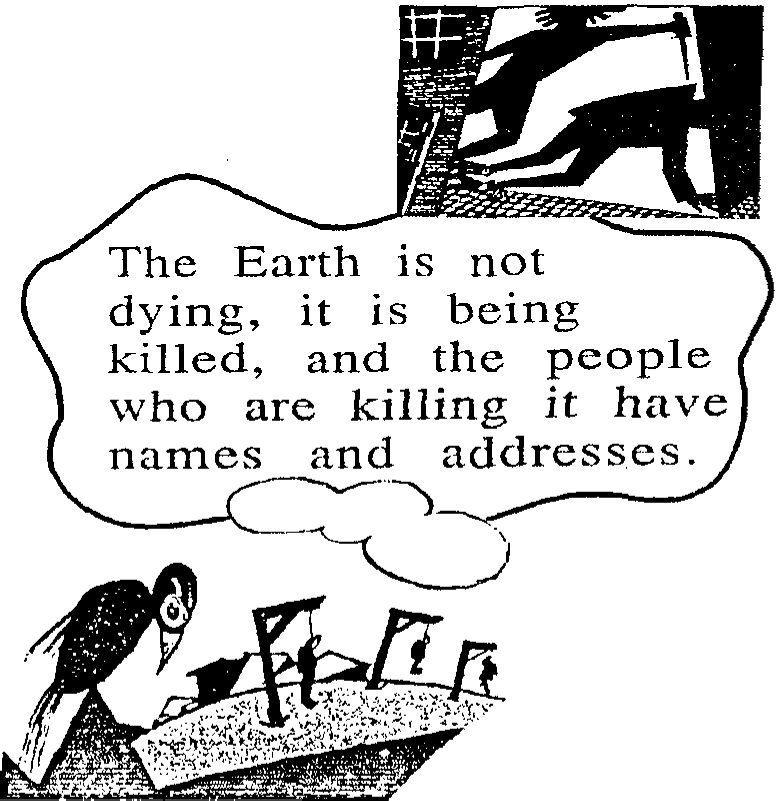
Source: Published in Beware/Sabotage, a sabotage manual distributed (undated, circa 1996) within radical environmentalist and animal liberationist circles. It includes ‘a firearms primer for anarchists and punks’.
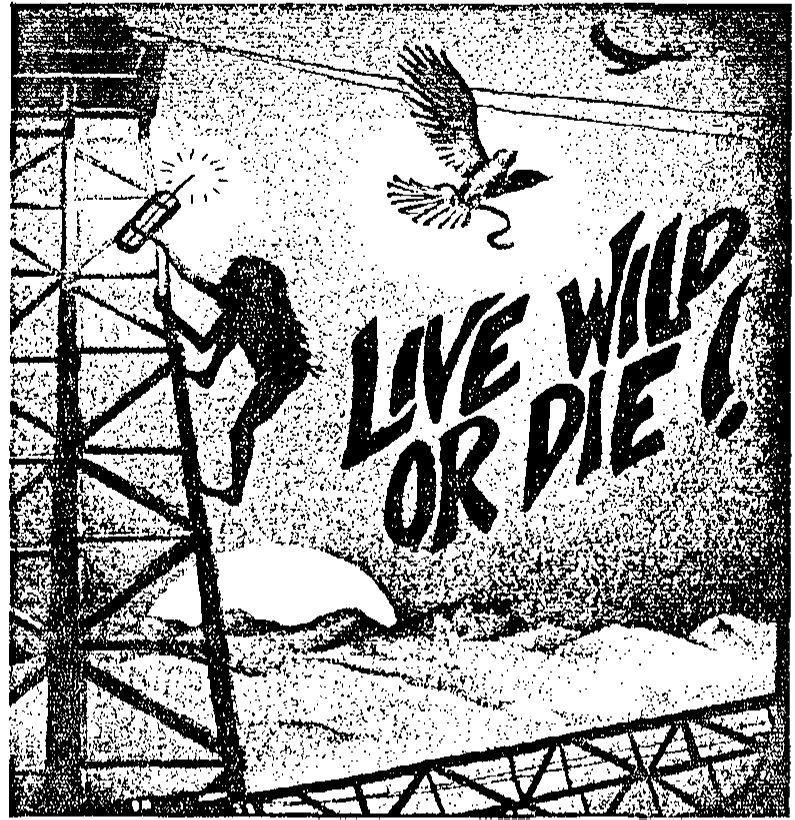
Source: This graphic, romantically depicting a feral human deploying dynamite to take out the electric infrastructure of industrial civilization, adorned the cover of the initial, 1989 issue of the United States greenanarchist tabloid Live Wild or Die.
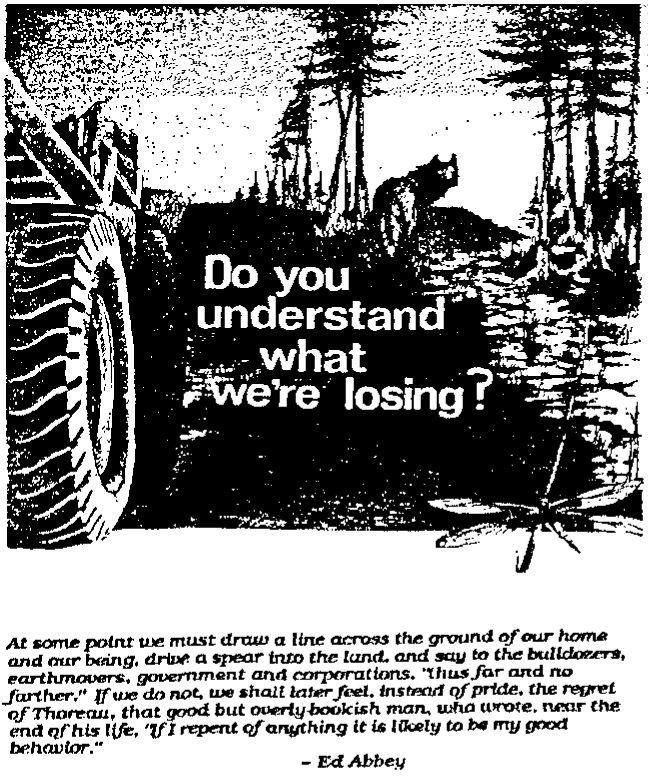
Source: This appeared in a regional Earth First! publication, the Wild Rockies Review 1/3 (1988) p.16, and provides a sense of the urgency that justifies illegal tactics in the minds of radical environmentalists.
Ecotage and Violence — the Record to Date
A brief review of activities undertaken by Earth First! activists that have risked or intended to cause injuries provides a good starting place to evaluate the likelihood of violence emerging from these activists. It is remarkable that there has not been more violence and injuries over this 18-year period — a time that has seen escalating environment-related conflict. Radical environmental activists have organized (sometimes massive) civil disobedience campaigns and have erected and sustained blockades of a number of logging roads, sometimes threatening the livelihoods of their adversaries and provoking violent opposition.[56]
Tree Spiking
Among the most controversial tactics used by radical greens has been tree spiking (driving metal or hardened ceramic nails in trees to damage blades at the sawmill as a means of deterring logging). This practice began as early as late 1981 or early 1982 and at times has been widely practiced, especially in Oregon, Washington and the Northern Rockies.
Power Line Sabotage
Even more controversial acts of ecotage followed. (Ecotage refers to sabotage committed in an effort to defend ecosystems.) In 1989 five activists, including Dave Foreman, the most prominent co-founder of Earth First!, were arrested in the first officially designated act of environmental terrorism in the United States. Known as ‘the Arizona Five’, these activists faced a variety of charges related to efforts to sabotage power lines associated with nuclear power plants and water projects in Arizona. (Some of them had also sabotaged ski-towers at a ski area they considered both ecologically destructive and sacred, and a threat to Native American culture and religion.) A year later, power lines were toppled in an ‘Earth Night’ action near Santa Cruz, California. In 1995, the green-anarchist tabloid Live Wild or Die (produced by a number of figures originally active with Earth First!) praised saboteurs who attempted to down power lines in Vermont. This action, these activists believed, was a just campaign against Hydro-Quebec’s desecration of indigenous land.[57]
Hunt Sabotage and the Convergence of Radical Environmentalism and Animal Liberationism
In July 1990, Lee Dessaux, a ‘hunt saboteur’ who had, beginning in 1986, participated in efforts to stop the hunting of mountain lions, Tule Elk and Bighorn Sheep in California’s Mojave Desert, was later arrested (and eventually convicted) for assaulting with a ski pole two bison hunters near Yellowstone National Park in Montana. At the time Dessaux was involved with a ‘Fund for Animals’ protest designed to disrupt the hunt.
Because this incident has been used as an important example of Earth First!’s violent tendencies,[58] it is important to provide further context. The bison hunts have resulted from the failure of governments to provide sufficient winter habitat for the bison herd outside of Yellowstone National Park. Dessaux explained in a 1997 interview that a ‘mother bison [had been shot and] was covered with blood, its calf running around bawling’. Meanwhile, the Fish and Game officers were ‘fucking with us while the hunters were violating safety laws’. We were trying our best to stop the killing and ‘I basically just lost it and attacked the guy with my ski pole, with a lot of anger ... Part of it was anger. Part was an attempt to put the bison out of her misery. I was yelling at the guy, “put her out!”.’[59]
‘I’ve always felt really passionate’, he quietly explained. ‘Sometimes when you see an animal being slaughtered’, it’s hard to keep cool. ‘It’s not the first time I’ve felt that mad.’ Dessaux seemed neither proud nor ashamed of losing control of his temper in this case. He received a 90 day sentence and served about 30. Commenting on Ron Arnold’s Ecoterror book and other efforts to portray the movement as terroristic, he said, ‘It is a laugh to me when they call us violent or terrorists. I say, if we were, don’t you think we’d have killed people by now?’
Apparently without appreciating the contradiction, however, Dessaux expressed disappointment that the movement so quickly distanced itself from the Unabomber after Kaczynski’s arrest. He understood it ‘from a PR perspective’, but complained that since the Unabomber is anti-industrial and anarchist it is cowardly for movement people to disavow him. A number of movement activists feel sympathy for Kaczynski, more often for his anti-industrial ideas than for his tactics. A small number of movement activists, however, privately suggest that violence may sometime be necessary. An anonymously-produced flyer distributed at the 1997 Earth First! Rendezvous, for example, romantically proclaimed ‘Free Ted Kaczynski’ and seemed to endorse violence.[60]

Source: This handout was selectively distributed at the 1997 Earth First! rendezvous, showing that the Unabomber enjoys some sympathy among radical environmentalists.
Dessaux was one of a small number of activists who — especially beginning in 1986 and with increasing success (that is apparently gaining momentum in the mid-1990s) — promoted links between the animal liberationist, anarchist and radical environmental movements. He explained that the early hunt saboteurs in the movement were inspired by their British counterparts who pioneered such tactics beginning in 1962, and expressed happiness that the journal now welcomes contributors from all three movements.
Arson by Animal Libertion Front/Earth First! Activists
Rodney Coronado (who with British national David Howitt became one of the famous ‘Sea Shepherd’ activists who sank two whaling ships and destroyed a whaling processing station in Iceland)[61] has consistently urged nonviolence, insisting that a spiritual path precludes violence. Interestingly, despite this view, Coronado calls for a ‘war’ in defense of Mother Earth[62] — illustrating that martial and revolutionary rhetoric should not, without corroborating evidence, be equated with a call to arms. Complicating matters further, in the minds of some activists, nonviolence is consistent with actions that do risk injuries and even death (although sometimes these activists simply do not foresee the risks). According to Ron Arnold and a 31 July 1995 US ‘Government’s Sentencing Memorandum’,[63] Coronado risked causing injuries to people in a 1992 arson attack on a Michigan State University animal experimentation facility in which two students, working late in the building, had to flee after the time-delayed incendiary device ignited.[64] Coronado claimed (through a confidant) that he intended to torch the researcher’s files, not the animal research facility itself, and that the additional damage to the room was unintentional.
Whatever his intent in this case, more than any other single figure Rod Coronado represents the increasing cross-fertilization between the radical environmental and animal liberation movements. He has written regularly in both movement’s tabloids and is lauded uncritically for his courage in them. As a bridge figure he raises an important question, taken up later in this analysis, about the prospects for unification between these movements.
Arson by ‘Elves’ (an Earth First! Splinter Faction?) Targeting Forest Service Offices
Such links might have contributed to a significant escalation. Early on the morning of 31 October 1996 the Oakridge Ranger Station (a US Forest Service office located about 40 miles southeast of Eugene and long at the epicenter of Oregon’s contentious battles over logging) was torched and burned to the ground. On the roof of the Detroit Ranger Station 70 miles to the north, another incendiary device had failed to ignite. In graffiti scrawled at the Detroit site, ‘elves’ (note the pagan symbolism) from the so-called ‘Earth Liberation Front’ claimed responsibility. The ELF, a shadowy group that first emerged in 1992 as an anarchistic offshoot of England’s Earth First! movement,[65] was also assumed responsible for the Oakridge fire, although no graffiti was left there.[66] Such arson attacks are widely considered counterproductive or immoral by the majority of Earth First! activists.
Not surprisingly, authorities and other adversaries of radical environmentalists overstate the risks posed by sabotage. Tree spiking, for example, does not threaten tree fellers because Forest Service regulations require that they cut the trees within twelve inches of the ground.[67] Spiking should pose no risks in the mill if mill owners install the proper safety barriers and insist that workers follow safety procedures. If power line destruction were to continue, injuries would likely result, but probably more from a failure to foresee consequences (and possibly from callous indifference) than from an intent to kill or maim. Clearly, however, such tactics can and likely will cause injuries, at least indirectly.
Arson has been probably the most dangerous tactic employed thus far,[68] with one exception: On 30 November 1992, after repeated acts of sabotage targeting a chip-mill company engaged in clear-cut logging in North Carolina, the on-guard mill owner shot at a fleeing figure after awaking to find his chip-mill on fire. The apparent ecoteur eluded capture by shooting back, the bullet knocking the owner to the ground without causing serious injury.[69] To my knowledge, this is the only incident where it appears that a radical environmentalist used a firearm.
To summarize, most radical environmentalists refuse to deploy sabotage that risks injuries to humans. During efforts to disrupt logging there have been scuffles resulting in minor injuries with workers and sometimes with law enforcement officers. And as we have seen, in one case, an activist was apparently willing to employ lethal violence to avoid apprehension. There is, nevertheless, even after 18 years of radical environmental action, little evidence that radical environmentalists intend to maim and kill their adversaries or to foster ‘terror’ among the general populace.
If David Rapoport is right, however, and nonviolent direct action has often appeared ‘as an initial step in conflicts which later matured into full-scale terrorist campaigns’ and that the drama of such campaigns ‘may intensify and broaden commitments by simultaneously exciting hopes and fanning smoldering hostilities’,[70] it makes sense to look deeper for clues regarding the possibility of these movements evolving terrorist dimensions. Although I cannot here offer detailed ethnographic description regarding traits and dynamics among radical greens that encourage and discourage violence,[71] I can broadly discuss such tendencies and offer some judgments about their relative importance.
Traits and Dynamics Encouraging Violence
One dynamic that could fuel the prospects for violence is the tendency for both radical environmentalists and many of their adversaries to view their activities as defending sacred values.[72] Radical environmentalists generally locate the sacred beneath their feet while their adversaries perceive the sacred as somehow above or beyond the world (or even as centered in the nation state and constitution).[73]
A related but often overlooked dynamic that can encourage violence between these adversaries is the role and result of watchdog groups waging campaigns to demonize members of the radical group in question. Jeffrey Kaplan’s analysis of the role of watchdog groups opposing racist groups is provocative in this regard.[74] He suggests that watchdog groups often promote a self-fulfilling prophesy in which only those with violent propensities are drawn to the demonized movement while potentially moderating voices are scared away. This could increase the likelihood that violence will emerge from the individuals and groups under scrutiny. Applied to the social context in which radical environmentalists and their opponents are engaged it is reasonable to wonder if the demonizing of radical environmental activists by ‘wise use’ partisans (such as Barry Clausen and to a lesser extent Ron Arnold), abetted by the alarm expressed by some academicians (such as Brent Smith and Martha Lee), might also add fuel to the possibility that violence could emerge from radical environmental groups.[75] (Advocates of logging, ranching and mining on public lands use the term ‘wise use’ to contrast their own approach to natural resources, which they consider to be prudent use of them, with the ‘environmental extremists’ or ‘preservationists’ who hope to ‘lock up’ the land and preclude anyone from responsibly making a living from it.)
Certainly some radical environmentalists likewise demonize their adversaries. Stuffed ‘Smoky the Bear’ dolls symbolizing Forest Service employees (who are often called ‘freddies’, a derogatory term meaning ‘forest rape eagerly done and done in endless succession’) are occasionally hung in effigy from trees in movement campsites. Earth First! activists sometimes use Biblical metaphors like ‘Babylon’ to label the government evil and corrupt, and some radical environmental activists engage in their own incendiary and revolutionary rhetoric, intensified by apocalyptic urgency and their deep moral conviction. So it certainly is possible that violence could escalate as radical environmentalists and their adversaries engage in crusade rhetoric to justify their competing missions. It is certainly possible that some troubled soul or souls will decide that God or Gaia is calling them to defend their given sacred space through a terrorist holy war.
Much more likely, however, are continued scuffles with relatively minor injuries occurring at blockades and during other resistance campaigns, or somebody getting hurt while responding to or fighting an arson-fire. Sooner or later, someone probably will be badly injured by one or another act of monkeywrenching. Perhaps this will result from an environmentalist-placed tree spike, or from gunfire employed to avoid capture, or when a vehicle crashes after hitting an obstacle created to thwart industry or law enforcement.
Such possibilities, however, do not automatically suggest the likelihood that concerted terrorist violence will emerge from such subcultures. Based on the record of nearly two decades of radical environmentalism and a variety of impressions derived from my ethnographic field work, I believe that if terrorist violence does emerge from radical environmental groups, it will most likely come from people Kaplan calls ‘unguided missiles’ or ‘lone wolf assassins’ — namely from those untethered to the broader subculture with which the terrorist identifies.[76]
This said, even an individual like Judi Bari, who battled long and hard against violence promoting rhetoric in Earth First!, and who had repeatedly criticized tree spiking as ineffective and dangerous, did not rule out violence.[77] In a 1993 interview, after the second major wave of movement debate about violence, she said that she agreed with those in the movement who believe that the movement should divide along strategic lines based on attitudes toward violence: ‘I think we need a split, like the Weather Underground and
SDS [Students for a Democratic Society] so those who want to do such tactics can do so without any official connection to Earth First!.’ Bari then mentioned what she considered to be a similar relationship between the Animal Liberation Front and the above-ground People for the Ethical Treatment of Animals, and other groups, that support and publicize ALF actions.[78] But in her reference to the Weather Underground, which engaged in armed robbery and bombings, Bari implied a greater sympathy for violent tactics than she was willing to acknowledge publicly.[79] After her death Bari was simplistically portrayed as the saint of the nonviolent faction of Earth First!; clearly, the reality was more complex. Indeed, ‘a few days before her death Bari requested that her obituaries depict her occupation as a “revolutionary”’[80] — not a term usually associated with nonviolence.
Traits and Dynamics Discouraging Violence
State Power
Within radical environmental groups rebellious and revolutionary rhetoric is consistently tempered with realism if not exaggeration about the repressive power of the state.[81] As Kaplan observes with regard to Nazis, intense scrutiny of radical groups by law enforcement makes it ‘tantamount to organizational suicide’ to ‘seriously contemplate violent action’ — and this provides a strong disincentive to violence.[82]
Relative Insularity or Social Isolation
Another variable within radical groups that scholars find helpful in analyzing the likelihood of radical groups turning violent is the relative isolation of the adherents from mainstream society. As Kaplan puts it, ‘The more distant a particular group tends to be from the values and beliefs of the mainstream society, the more difficult it becomes for an adherent to moderate or give up the belief system altogether.’[83]
When viewed through such an analytic lens, radical environmentalism seems less likely than many other radical groups to yield the kind of unbridled extremism that promotes violence. Earth First!ers do not, as a general pattern or membership requirement, sever ties to their natural families; indeed, some rely on such connections for part of their material resource base. While stridently critical of the consumerism they believe is prevalent among their friends and families, most Earth First!ers still celebrate holidays and life-passages with them. Although there probably are some cases where familial ties have been completely severed, this is not a general tendency. Although there are intentional and ‘back-to-the-land’ communities within radical environmental subcultures, they do not generally sever all contact with the wider world. There are cases and contexts where terrorists, especially early in their campaigns, do not sever their ties with family, friends and the wider society which harbors them.[84] My point here is simply to suggest another variable that reduces the likelihood of violence emerging from radical environmental groups.
The Unabomber provides an important contrast that demonstrates the potential importance of the ‘withdrawal’ variable. Ted Kaczynski severed ties with his family and society at large. This was one of many factors that led each of the three court-empowered psychology experts who examined the documentary record and interviewed Kaczynski to diagnose him ‘schizophrenic, paranoid subtype’. Moreover, Kaczynski’s refusal to acknowledge his own illness and to allow his attorneys to use it in his defense, these experts agreed, is a common aspect of the illness.[85] In any case, despite the prosecutor’s zeal to link Kaczynski with Earth First! by introducing into the record the existence of movement literature in Kaczynski’s cabin and one-time reliance upon it in victim selection, the strong evidence of mental illness clearly erodes the implication that the Unabomber case proves Earth First! is a terrorist breeding ground.
Indeed, in the absence of mental illness, it is the activist engagements of radical environmentalists that can prevent social withdrawal and the dangerous ‘insularity-dynamic’ linked by scholars to violence. Except for a tiny and unknown number of completely underground and isolated ecoteurs, most movement activists are engaged face-to-face with many of their adversaries — from loggers, to Forest Service bureaucrats, to attorneys. Such encounters are often unpleasant for all parties, but they play nevertheless an important role in humanizing the ‘enemy’, continually forcing the message on all involved parties that, however much we might dislike them, adversaries are human.[86] Sometimes activists must acknowledge that some adversaries are likable enough creatures, even if their values are messed up. This moderates movement demonologies and reduces the possibility of violence. Indeed, much of the rage felt by movement activists is directed less at the mass of ‘functionaries’ in governments and corporations than at high government and corporate officials. Ordinary workers are often viewed as brainwashed and deluded, trapped by the evil system due to their livelihood needs or advertising-manipulated lifestyle preferences. The way Earth First!ers view loggers is markedly different from the way the most militant pro-life activists view abortionists. They do not, generally speaking, view them as murderers.
Charismatic Authority and Freedom of Speech
Another variable, one linked to the relative isolation of adherents and postulated by some scholars of apocalyptic movements to have predictive value related to the likelihood of violence, is ‘charismatic authority’. Robbins and Palmer agree that this is a crucial variable as they summarize the argument that charismatic authority increases the ‘volatility and violence in apocalyptic or “world rejecting” sects’.
[C]harismatic leadership ... probably enhances the antinomian potential of apocalypticism. Indeed, the combination of charismatic leadership and an apocalyptic worldview may create a kind of tinderbox, although much will depend on the particular qualities of the visionary leader [including whether he] demonize[s] any opposition. [Moreover,] world-rejecting sects manifest a stance of total rejection of or detachment from the broader society that may require ... a revered charismatic prophet with a compelling vision.[87]
Yet again, when viewed through such an analytic lens, radical environmentalism seems less likely than many other apocalyptic groups to turn violent. There is no charismatic figure to follow blindly; indeed, any figure who even begins to consider her or himself an authoritative leader is usually quickly and effectively blocked or deposed by other activists within this radically egalitarian group.[88]
The anti-hierarchical dimension to Earth First! not only makes this movement inhospitable to charismatic authority. It also manifests itself in another trait found among them — their enthusiasm for debate. The Earth First! journal itself — led at times by an anarchistic insistence that every one be allowed to speak even in favor of unpopular articles apparently promoting violence — provides a venue for debate that, on balance, has a moderating effect. No movement individual who is contemplating violence and in contact with other movement people, whether through the journal or at movement gatherings, will fail to hear the many and good strategic and moral arguments against such tactics. Moreover, because of their activism, the most astute in these subcultures will surely notice that their greatest and most consistent successes have been won from the judicial branch of the federal government; an inconvenient fact for rigid ideological anarchists, to be sure, but certainly one that makes difficult a comprehensive demonology of the federal government.
A couple of anarchist Earth First!ers, for example, after a time of observing and figuring out who are the most effective activists, have decided to become lay or credentialed attorneys. The presence of open lines of communication, including increasingly via the Internet, further erodes insularity and thus the number of recruits available for a rigid, violence prone, revolutionary anarchism.
Certainly there are troubling insular dimensions to the subcultures of radical environmentalism, including certain anti-intellectual streams. I have heard startlingly ignorant statements about politics and ecology, especially by activists who grew up in these subcultures or were drawn into these groups at a young age. Because of the ideological commitment to free speech and expression within these groups, however, countervailing and moderating opinions will continue to be heard, along with the prevailing green militancy.
Life as Sacred
There are also general religious sentiments — that the earth and all life is sacred — that lessen the possibility that movement activists will engage in terrorist violence. Sometimes such arguments are advanced explicitly during movement gatherings and in its publications. In response to Barry Clausen’s efforts to link Earth First! and the Unabomber, for example, one Earth First! group insisted that, ‘Earth First! practices non-violent civil disobedience’. They continued asserting that sabotage is controversial and there is no official position about it and ‘Earth First! does not advocate violence towards any person because ... Earth First! considers all life sacred, even Barry Clausen’s.’[89] Often, the sacredness of all life is conveyed through various forms of movement ritualizing. It is hard to avoid the logic that, if all life is sacred, one ought to eschew violence, especially when defending sacred places.[90] This would seem to reduce the potential for such a movement spawning terrorist action.
The Unabomber and reverence for life. Here, again, the Unabomber case provides an interesting contrast. In a journal entry written in April 1971, Kaczynski wrote,
I believe in nothing ... I don’t even believe in the cult of nature-worshipers or wilderness-worshipers. (I am perfectly ready to litter in parts of the woods that are of no use to me — I often throw cans in logged-over areas or in places much frequented by people; I don’t find wilderness particularly healthy physically; I don’t hesitate to poach.)
This quote is included in the prosecution’s 30-page sentencing memorandum. By quoting from Kaczynski’s writings the prosecution successfully portrayed him as a hate-filled, revenge-seeking and remorseless man. Prosecutors went further, however, asserting a more difficult claim that he was never motivated ‘by a love of nature or concerns over technology’.[91]
This claim was skewed by a desire to both anticipate and counter defense assertions of mitigating circumstances (such as an understandable but ‘misguided’ idealism). Perhaps this is why prosecutors quoted Kaczynski’s manifesto, ‘The Future of Industrial Society’,[92] primarily to debunk as disingenuous its claims to concern about freedom and wilderness. Yet even more than 25 years ago Kaczynski expressed his rage at the destructive powers of technology. It may be, as prosecutors powerfully argued, that this is little more than a cover story for his hatred of any entity that interfered with his social withdrawal.[93] Nevertheless, Kaczynski did subsequently articulate a complex ideology that counter-posed a hegemonic and freedom-devouring industrial system with the greater freedom available in small-scale societies characterized by foraging lifeways.[94]
The better known part of his ideology, his hatred of technology, was stated clearly in the manifesto, perhaps most pointedly in this passage:
With regard to revolutionary strategy, the only points on which we absolutely insist are that the single overriding goal must be the elimination of modern technology, and that no other goal can be allowed to compete with this one.[95]
Yet whatever part of his ideology we focus upon, it seems that his thinking developed new emphases and detail over time. By the 1990s, his ideology intersected with typical elements of the worldviews of radical environmentalists and green anarchists. Certainly in Kaczynski’s case, this developing ideology was grafted upon a hate-filled and, almost certainly, mentally ill and paranoid personality. Prosecutors have not proven, however, that ideals played no role in motivating Kaczynski.[96]
Note this passage from the section of the manifesto where Kaczynski contrasts the negative goal of eliminating modern technology with ‘wild nature’ as a ‘positive ideal’; an aspect of his message which most radical environmentalists would surely endorse:
An ideology, in order to gain enthusiastic support, must have a positive ideal as well as a negative one; it must be FOR something as well as AGAINST something. The positive ideal that we propose is Nature. That is, WILD nature; those aspects of the functioning of the Earth and its living things that are independent of human management and free of human interference and control. And with wild nature we include human nature, by which we mean those aspects of the functioning of the human individual that are not subject to regulation by organized society but are products of chance, or free will, or God (depending on your religious or philosophical opinions).[97]
In addition to stating a positive ideal, this passage suggests that Kaczynski’s views about religion also changed over time. In the manifesto he expressed greater tolerance for nature-based spirituality than was apparent in the 1971 journal entry cited previously: he concedes in it that nature-based religion can contribute to the revolution against the industrial system. Nevertheless, he was also subtly condescending toward those animated by nature-religious perceptions and beliefs, implying that such religiosity is contrived and incredible. This complex perspective is apparent in further discussion of ‘Nature as Counter-Ideal to Technology’:
Nature makes a perfect counter-ideal to technology for several reasons. Nature (that which is outside the power of the system) is the opposite of technology (which seeks to expand indefinitely the power of the system). Most people will agree that nature is beautiful; certainly it has tremendous popular appeal. The radical environmentalists ALREADY hold an ideology that exalts nature and opposes technology.[98]
The related note expands this line of thought into a discussion of religion:
A further advantage of nature as a counter-ideal to technology is that, in many people, nature inspires the kind of reverence that is associated with religion, so that nature could perhaps be idealized on a religious basis. It is true that in many societies religion has served as a support and justification for the established order, but it is also true that religion has often provided a basis for rebellion. Thus it may be useful to introduce a religious element into the rebellion against technology, the more so because Western society today has no strong religious foundation .... there is a religious vacuum in our society that could perhaps be filled by a religion focused on nature in opposition to technology. But it would be a mistake to try to concoct artificially a religion to fill this role. Such an invented religion would probably be a failure. Take the ‘Gaia’ religion for example. Do its adherents REALLY believe in it or are they just play-acting? If they are just play-acting their religion will be a flop in the end. It is probably best not to try to introduce religion into the conflict of nature vs. technology unless you REALLY believe in that religion yourself and find that it arouses a deep, strong, genuine response in many other people.[99]
The public record, including this passage which is the clearest extant expression of Kaczynski’s thoughts about religion, provides no indication that Kaczynski shared the sense, so prevalent in radical environmental subcultures, that life is worthy of reverence and the earth is sacred. He seems to take a purely instrumental attitude toward religion — only if it promotes the rebellion is it useful and thus good. Clearly, Kaczynski does not really confess a spirituality kindred to that which permeates radical environmentalism. Thus, any of the ways that a life-revering philosophy can erode violent strategies were, apparently, unavailable to him.
Other saboteurs and the reverence for life. Other voices strongly urge nonviolence, even those of respected movement monkeywrenchers like Peg Millett (one of the Arizona Five). But as with regard to Rodney Coronado, movement activists often employ martial or revolutionary rhetoric while simultaneously (or on other occasions) defending nonviolence for pragmatic and/or spiritual reasons.
Earth First! co-founder Mike Roselle provides another good example. He once scoffed at movement rival Dave Foreman’s claim that monkeywrenching (ecological sabotage) is not revolutionary, raving
What we want is nothing short of a revolution. Fuck that crap you read in [Foreman’s writings in] Wild Earth or Confessions of an Eco-Warrior. Monkeywrenching is more than just sabotage, and your (sic) goddamn right it’s revolutionary! This is jihad, pal. There are no innocent bystanders, because in these desperate hours, bystanders are not innocent. We’ll broaden our theater of conflict Everything, every assumption, every institution needs to be challenged. Now![100]
Not surprisingly, Roselle’s statement was seized upon as an example of the movement’s violent tendencies. The ‘jihad’ rhetoric could suggest how a ‘reverence for life’ ethic could produce a ‘holy war’ strategy. Roselle himself, however, was not using the term to promote violence but a radical transformation of thought and action with regard to nature. Elsewhere, he battled romanticism about violence, arguing that nonviolence is an essential movement tactic. Joining into one more of the periodic debates about violence in Earth First!, he acknowledged that ‘losing the message is a real risk in nonviolence’. He asserted, however, that losing the ability to communicate the movement’s message to the public ‘is a bigger risk with monkeywrenching [and] a greater risk still with violence’.[101] This is one of many examples I could provide urging caution about assuming that rhetoric that seems sympathetic or enthusiastic about violence will lead to it.
Even Ron Arnold’s book, Ecoterror: the Violent Agenda to Save Nature — the World of the Unabomber, provides little evidence that violent terrorism is being planned and perpetrated by radical environmentalists, despite its alarmist title. The most dangerous incidents Arnold reports (with the exception of the Unabomber) were perpetrated by animal rights activists, who Arnold does not distinguish from radical environmentalists.[102]
The convergence of animal liberation and radical environmentalism? To a significant extent, the animal liberation and radical environmental movements represent distinct subcultures.[103] My own perception is that within Earth First! there are at most a few dozen activists who regularly participate in both movements. Yet there is increasing cooperation and overlap between radical environmental and animal rights activists, and since a major movement schism in 1990, Earth First! has printed articles about animal liberationist resistance. Given the much greater propensity for ALF activists to engage in arson (one need only compare ALF and Earth First! tabloids in North America or Europe to be convinced of this difference), the future extent of collaboration between these groups is certainly of interest in attempting to assess the likelihood of injuries resulting from radical environmental actions.
In addition to Rod Coronado, two other figures have attempted to bridge the gap by appealing to and writing for animal liberation tabloids and the Earth First! journal. Like Coronado, both David Barbarash and Darren Thurston have been convicted of crimes for which the Animal Liberation Front took credit, including the theft (or ‘liberation’) of 29 cats from the University of Alberta on 1 June 1992. During a related search of property owned by the two activists, according to Ron Arnold, Canadian police found ‘an AK-47 assault rifle, ammunition and two hand grenades’.[104] When informed that Arnold had reported this on his website, Barbarash replied
Ron Arnold, like most of his kind, are idiots who twist facts. During a raid on Darren’s place in Edmonton in 1992 in relation to the university raid, police found an AK-47 type of rifle, as well as a dummy grenade being used as a paperweight. The weapon was fully legal and registered, and the dummy grenade was not illegal either.[105]
Since no charges were ever filed with regard to the firearm and grenade, it appears Arnold did not report all pertinent facts.
Thurston and Barbarash are currently, however, suspected of a number of additional crimes. According to articles in animal liberation tabloids and Earth First!, these include four 1995 cases where mail bombs were sent to two Canadian racists (the Nazi propagandist Ernest Zundle and Aryan Nations leader Charles Scott), John Thompson of the right-wing MacKenzie Institute, and Terrence Mitenko, a geneticist with Alta Genetics in Calgary. Yet neither activist has been charged with mailing bombs.
Although they have not been arrested in the bomb cases, they were charged in March 1998 with 27 counts related to sending packages booby-trapped with razor blades. The alleged aim was to injure big game ‘trophy’ hunters in Canada, who might cut themselves on the blades when opening the letters. Barbarash was also charged with possessing an illegal weapon (a stun gun) and, with Rebecca Rubin, of ‘an explosive substance’, according to Vancouver Sun reporter Rick Ouston, a nine-volt battery and wire.[106] They deny the charges and attribute the arrests to unfair, ongoing police harassment. If true, however, these actions represent one of the very few cases where activists at the intersection of animal liberationism and radical environmentalism have clearly intended harm to their adversaries.
These crimes did not have a clearly stated ecological purpose, however, in the articles written by supporters of these activists. Therefore, it is worth wondering if these qualify as ‘radical environmental’ actions.[107] Yet clearly, some ALF activists, seeking support widely and viewing Earth First!’s ecoteurs as kindred spirits, regularly send news updates on their activities and encounters with law enforcement to Earth First!. By publishing these stories, Earth First! creates an impression that these two movements are unifying or, at least, that they cooperate and are mutually supportive.[108] There is something to this impression, although it is probably exaggerated by watchdog groups and most law enforcement officials. The printing of such material is probably influenced by the anti-authoritarian and anti-censorship views widely shared by radical environmentalists more than it is dictated by ideological agreement with animal liberationist ideology.
Significantly, collaboration between these groups usually occurs where animal rights beliefs intersect with concern for ecosystems and species survival. (For example, when hunting of predators is underway, which negatively impacts ecosystems, or where species themselves are threatened with extinction by human activities.) Most radical environmentalists are more concerned for ecosystems and species than for individual animals.
When radical environmentalists and animal rights activists collaborate, the latter tend to become radically ecologized — developing greater concerns for ecosystems and endangered species. Consequently, such activists often turn their attention increasingly toward wild animals rather than domestic ones, or those exploited in the fur trade (the traditional priority concerns for animal liberationists). I know of no cases where radical environmentalists have suddenly converted to an animal liberationist perspective, abandoning forest protection work to liberate hogs, mink or fox.
This is in part because of the inescapable conflict between animal liberationism and an ecosystem-centered radical environmentalism. The most ecologically literate of the radical environmentalists object to the ‘liberation’ of mink and fox. These animals are selectively bred by fur farmers for certain genetic traits. Ecologists fear blending their genes, which rarely evolved near the farm site, into the wild populations surrounding it. Such breeds, they argue, are ill equipped to survive in the wild and, thus, releasing them is not the compassionate act the liberators believe it to be.
As we have seen, however, there are a number of activists who dwell in both camps, even if sometimes uneasily. Often such activists are anarchists, opposed to all hierarchies, whether in human society or between humans and non-human nature. One woman activist who writes under the pseudonym ‘Anne Archy’, for example, has made it a personal goal to unify the three movements, by writing for each of their tabloids.[109]
Despite such efforts, profound ideological differences remain between radical environmentalists and animal liberationists. Radical environmentalists promote an ecosystem- and species-focused ethics (including plant life) while animal liberationists focus more on the well-being of individual, sentient animals.[110] This will continue to cause tensions between these groups and will reduce the occasions for their collaboration and mutual influence.
Moreover, my strong impression is that animal liberationists who come in contact with radical environmentalists without finding their priorities changing, withdraw to their more ‘individualistic’ and traditional animal rights groups. It is possible, however, that the more arson-friendly ALF may win tactical converts even if they do not change the focus of the radical environmentalists they know.
Deep Ecological ‘Identification’, Interdependence and Anti-Dualism
Deep ecology’s goal of fostering a ‘deep ecological sense of identification with all life’, as Bill Devall and George Sessions once argued, including a sense of the interrelated sacredness of all life, works against both misanthropy and violence in radical environmental groups. ‘Ecology has taught us that the whole earth is part of our “body” and ... we must learn to respect it is as we respect ourselves’, they wrote. ‘As we feel for ourselves, we must feel for all forms of life.’ It is difficult to advocate or justify violence against any life form when animated by such spiritual perceptions, as Devall and Sessions concluded: ‘Both on practical and ethical grounds, violence is rejected as a mode of ecological resistance.’[111]
Perhaps even the most ‘spiritual’ or ‘woo woo’ activists (woo woo is a musing movement term referring to religious ritual or one’s ‘spirituality’) have a moderating influence. Some of them wear buttons with ‘us/them’ crossed out with the universal sign ‘Not!’ — suggesting that if movement people take their anti-dualistic, metaphysics-of-interdependence seriously, they will refuse to demonize opponents. On balance, the politics and metaphysics of the sacred, which permeates radical environmental groups, helps erode the kind of absolutist-Manichean demonizing of the ‘enemy’ that otherwise might more forcefully emerge in these movements, given their apocalyptic urgency. Such dualism has been widely noted by scholars as an important variable that increases the likelihood of violence by radical groups.[112]
Nature Bats Last and, ‘Who Shall Be the Agent of Transformation?’
It could be deduced from one of David Rapoport’s arguments, however, that religiously motivated apocalyptic groups are especially prone to violence. He asserts that with such groups there are two conditions for terrorist violence: an expectation of an imminent day of deliverance and a belief that violent human actions ‘can or must consummate the process’.[113]
The critical question Rapoport addresses is, ‘Who (and what means) shall be the agent of transformation?’ A related question is, ‘How does the answer to such a question influence the likelihood of violence emerging from a social movement?’ Jeffrey Kaplan’s answer is that when apocalyptic groups envision no divine intervention or rescue, violence is more likely.[114]
Although it might seem that Earth First!ers do not anticipate a divine intervention that will usher in a green millennium, there is a strong belief that if humans do not radically change their lifeways, nature (whether personified as Gaia or goddess and/or conceived as ‘population dynamics’ within ecosystems) will eventually do it itself. This is symbolically represented in the popular movement slogan and bumper sticker, ‘Nature Bats Last’ (coined by ecologist Paul Ehrlich) that musingly anticipates the eventual restoration of Eden on earth, even if by means of a tragic ‘cataclysmic cleansing’. Here is expressed the widely shared movement belief that sacred earth herself will eventually shake off species pathogenic to her long-term health. This belief might, in a way similar to that observed by Kaplan in a different context, reduce the possibility that movement activists will feel it is justifiable and possible to, by their own actions, violently force the needed transformations.
For this reason I disagree with Martha Lee’s insistence that the Earth First! faction she calls the ‘apocalyptic biocentrists’ are more likely to engage in terrorist violence than one she claims (in a very strained typology) are optimistic millenarians.[115] It is hard to see how despair regarding the possibility of human action bringing about the desired transformations can provide a basis for revolutionary violence.
This conclusion does not, however, address Rapoport’s belief that there is a strong psychological need, by at least some devotees, to think their actions are central. Here he says that there is a strong tendency for apocalyptic groups to turn terrorist:
When a sense of imminence takes root, some believers must find it psychologically impossible to regard their actions as irrelevant, ... At the very least, they will act to secure their own salvation. And once the initial barrier to action has been overcome, it will only be a matter of time before different kinds of action make sense too. Soon they may think they can shape the speed or timing of the process.[116]
Moreover, Rapoport adds, ‘It would seem rather obvious that, when the stakes of any struggle are perceived as being great, the conventional restraints on violence diminish accordingly.’[117]
Such assertions are certainly sobering. Radical environmentalists do believe the stakes are high: the survival of Homo sapiens and untold other species is at stake. Consequently, it is possible to imagine some radical environmentalists, despairing of peaceful social change, and having no expectation of divine rescue, splintering off into militia-like survivalist movements. Or perhaps revolutionary cells will emerge, grounded in tragic, romantic scripts that argue that the only hope for the planet is in a vanguard of green-anarchist revolutionaries willing to resist violently the industrial juggernaut. Nevertheless, with regard to radical environmentalism, I am currently unconvinced of the psychological tendency Rapoport cites. The anti-anthropocentrism in radical environmentalism works strongly against placing hope in human agency. Perhaps the musing movement slogan, ‘There is hope, but not for us’ captures some of the fatalism to which I am alluding.
Fun and Eros
Perhaps one of the most important factors that reduce the likelihood of violence emerging from radical environmentalism is the riotous sense of fun that characterizes its activists. In keeping with their conviction that ‘rewilding’ is an essential part of the needed transformations, many of these activists are hearty ‘party animals’. Indeed, the fraternity/sorority scene celebrated in the motion picture ‘Animal House’ might even be considered a ritual source. ‘Body shots’, where activists take turns drinking Tequila off increasingly intimate body parts, has become a trust-building and group-bonding rite — even self-consciously so.[118] It might also lead to even deeper intimacies in nearby fields or woods. Alcohol-fueled antics can become serious fun — and real ritualizing.[119]
Also popular at most wilderness gatherings is an ‘amoeba’ made up of circling and encircled, mostly inebriated activists. With arms and hands intertwined around shoulders and hips, swirling chaotically around fields and campfires, the amoeba captures unwary human organisms, absorbing them into itself, all the while chanting ‘eat and excrete, eat and excrete’. Not only does it provide a wild good time — although sometimes angering those trampled by it or whose overtly spiritual ritualizing was disrupted — the amoeba draws even some of the most retiring activists into the group. It also conveys other important messages: as another ritual of inclusion, it represents the value and importance of the so-called ‘lower’ organisms, while simultaneously bonding activists together in the ritual play.[120] It also articulates symbolically the kinship of all creatures who share the same primal urges. Perhaps it also signals that activists should not take themselves too seriously — for like amoeba food, they too will be reabsorbed into the biological processes from which humans emerged.
Early in their history, Earth First! activists appropriated from a Native American culture the ‘mudhead Kachinas’ — trickster-like figures known for making fun of solemn occasions — a role itself viewed as a sacred, anti-hubristic endeavor. In any case, the lampooning, the ridicule and the mirth-making that characterizes Earth First! gatherings mitigates the sullen bitterness and brooding anger that can characterize the radical personality of the ‘true believer’ — the personality type especially prone to violence.[121]
Caveats and Conclusions
It is impossible to predict confidently the extent to which radical environmentalists (or the animal liberationists with whom they sometimes collaborate) will employ tactics that, intentionally or not, risk injury or death to humans. There are many examples of groups with non-violent records making a transition to violence. Sometimes, as Jeffrey Kaplan shows with regard to the rescue movement, it only takes someone to show the way, focusing pent-up frustration in a violent direction.[122]
Nevertheless, much expectation that these are or will be violent, terrorist movements is based more on a priori expectations than on the historic record of these groups or on an understanding of their worldviews and how they precipitate action. Upon examining the record and characteristics of radical environmental groups, I conclude that claims that these are violence-prone subcultures are inaccurate. I make this statement mindful that some animal liberationists and radical environmentalists have been willing to risk injuries to their adversaries and, in a few cases, have intended to do so. To summarize, excluding the Unabomber and perhaps one other case where an ecoteur sought to evade capture, there is as yet no proven case where animal liberationists or radical environmentalists have attempted or succeeded in using violence to inflict great bodily harm or death on their adversaries.
Radical environmental subcultures certainly threaten ‘business as usual’ in western industrial societies. If such societies are to respond in a way that does not exacerbate environment-related conflicts, it is critical that the nature of such threats be apprehended accurately. Such an appraisal will not be achieved if exaggerated and ill-informed perceptions of the violent tendencies in these movements become conventional beliefs — and, especially, if such perceptions are allowed to be shaped by the most trenchant adversaries of these movements.[123]
Responding to an earlier version of this article, ‘new religions’ scholar J. Gordon Melton asserted that we need to de-mythologize and carefully consider the links between violence and rhetoric. Often those most likely to employ violent rhetoric are the least likely to engage in violence. He reasoned that violence requires a double process: first, a rationale for it, and second, a decision that it is the most acceptable option at the present moment. Applying such a reasonable standard to radical environmental subcultures, I have found little evidence that both conditions are in place, or are likely to be in the foreseeable future.[124]
Although partisans on various sides of environmental disputes will no doubt continue demonizing their adversaries, scholars must scrupulously avoid incorporating dualistic worldview elements as their own analytic categories and refuse the temptation to sensationalize the environment-related conflicts. A good start in this regard would be to eschew broad definitions of the term terrorism, whether such definitions are promulgated by law enforcement authorities, self-appointed watchdog groups or scholars. This would require a rejection of the FBI’s (‘full employment’) definition of terrorism in which violence is not even a necessary element of ‘terrorist’ crime![125] Moreover, this would mean refusing to label environment-related violence ‘terrorism’ unless these kinds of characteristics are present:
The distinguishing characteristic of the terrorist ... is a deliberate decision to abandon [conventional moral] restraints or to refuse to accept as binding the prevailing moral distinctions between belligerents and neutrals, combatants and non-combatants, appropriate and inappropriate targets, legitimate and illegitimate methods. The terrorist knows that others will regard his actions as shocking or as atrocities, and this is one reason why he acts as he does, for his object in using terror ... is to create a ‘new consciousness’ by methods which provoke extreme emotional reactions — panic, horror, revulsion, outrage, and sympathy ... The nature of the act, not the status of the persons who commit it, is the critical feature.[126]
Such an understanding helps us, and properly so, to reserve our strongest opprobrium for this kind of politically-motivated terrorist violence. Insisting on such an understanding of terrorism can facilitate penal justice by reinforcing that (when individuals are charged and sentenced for violent crimes or crimes that risk causing injuries) the individual’s specific intent remains an important, morally relevant consideration. Blurring such distinctions by placing non-violent blockades, loud, ‘scary’ and obnoxious protests, and injury-risking sabotage all under the ‘terrorism’ label, misleads the public about the social movements engaged in them. This can also exacerbate social conflicts by fanning fear and hatred, thereby encouraging and promoting a violent reaction by vigilantes, and even by law enforcement authorities themselves. Moreover, such oversimplifications reduce the possibility that society will recognize and respond to the legitimate grievances such movements may express. It would be tragic if needed reforms of current resource regimes turn out to be a casualty of such rhetorical excess.
Environmental deterioration creates social conditions that produce and exacerbate social conflicts. Ecological science demonstrates that such deterioration is accelerating and thus, we can expect environmental struggles to intensify and occasionally, if not increasingly, to yield violence. Reducing environment-related violence requires more, however, than a carefully measured response to its manifestations. It also depends on comprehensive (but currently anemic) social efforts to arrest environmental deterioration — an endeavor itself inextricably tied to the quest for greater social equality and a reduction of consumption by the affluent. Only by addressing environmental degradation at its varied roots will we reduce environmental decline. Only thus will we halt the threat it poses to human livelihoods, the insult it represents to the deeply held moral duties that many individuals feel toward non-human nature; only then will we eliminate environment-related violence.
Epilogue
On 9 June 1998 (after this article was accepted) United States Congressman Frank Riggs held a ‘Hearing on Ecoterrorism’. The witness list was stacked with some of the most vocal adversaries of radical environmental and animal liberation movements, including Ron Arnold, Barry Clausen and Bruce Vincent (a logger and President of the Alliance for America). Riggs himself described a scary protest by anti-logging activists in his Northern California district office. He then falsely claimed that a tree spiking incident ‘In Ukiah, California ... killed a logger’. Riggs was exaggerating an incident when a millworker was seriously injured after a metal spike hit a band-saw and shattered. This spiking was not attributed to Earth First! by either law enforcement officials or by Ron Arnold. Although Riggs offered no evidence, he also claimed that ‘many times’ monkeywrenching has ‘caused grave injury and even the loss of life. Many a rigger, logger and treefeller have suffered injury because of a severed hydraulic line or tree spike.’ My requests for documentation of these charges have gone unanswered. Further ‘ecoterrorism’ hearings are planned for the US Senate by Senator Orin Hatch.
In July 1998 Earth First! held its national Earth First! Rendezvous in southcentral Oregon. Green anarchists among them distributed the seventh issue of Live Wild or Die. It included a striking amount of violent and revolutionary images, including a reproduction of a previous ‘Ecofucker Hit List’. It was the same list that had previously been published and that included on it a Timber Association official and that some believe the Unabomber may have used to target one of his victims. The Association official and address was crossed out and the words ‘Who’s next?’ were scrawled nearby. On the opposite page was printed a statement made by Theodore Kaczynski protesting his defense team’s efforts to portray him as insane and promising that ‘more will be heard from me in the future’.
Knowing that dark-humor is a common trait among movement activists, I asked editors of this issue of LWOD about the apparent embrace of Kaczynski and how serious was their implicit endorsement of assassination and terrorist tactics. The editor told me it was about one-third satire, one-third scare-tactic and one-third serious. A second editor later confirmed that this interpretation was ‘about right’. Such sentiments leave unresolved what it would take for people to risk ‘paying the price’ (a phrase I heard during such discussions) that a resort to violence might exact.
Another interesting development during the 1998 rendezvous came during discussions of the so-called ‘millennium bug’. Also known as the ‘Y2K’ or ‘year-two-thousand’ crisis, the millennium bug refers to possibly severe computer system problems likely to occur on or before 1 January 2000 as a result of obsolete date-codes remaining embedded throughout such systems. Some computer analysts predict as a result widespread panic, social disorder, hunger and even the devolution of industrial society itself.
Prone to apocalyptic expectation to begin with, many of the assembled radical environmentalists seized on these cataclysmic scenarios. Some did so taking hope, thinking that this bug might precipitate the destruction of the technological society they abhor. Others expressed fear that during such a cataclysm, humans would behave badly, rapidly assaulting the planet’s remaining wildlands in their desperate struggle for survival.
One individual used the issue as a springboard for arguing that the time was nearing when assassination and other forms of violence should be deployed in an effort to overturn industrial society. More often, the resulting discussions turned to survival ideas and the need for green groups to be ready to render mutual aid and to defend themselves, with activists speaking against offensive violence. Still others reminded everyone that the important thing was to defend the biological diversity of the planet, even during times when human societies are in chaos.
Such discussions illustrate the perils of prediction. Under current social conditions, due to the many variables I have identified in these pages, I do not expect widespread violence (as defined) to emerge from radical environmental and animal liberation groups. Under social conditions characterized by widespread social disruption, however, all bets are off. Some individuals may decide that violence might be the avenue that could transform social chaos into an envisioned, benign ‘future primitive’.
Indeed, in another ominous sign, shortly before the present analysis went to press, a tabloid published by animal liberationists reported that in the United Kingdom, a group calling itself the ‘Hunt Retribution Squad’ had begun beating hunters — three were attacked in December 1997. In March 1998 a man was beaten unconscious, apparently precipitating his mother’s death from a stroke, and a hunt master was also dragged off his horse and clubbed unconscious. The tabloid also reported that a new group, ‘calling itself the Provisional ALF, in February 1998, sent out a series of hoax bombs some of which went to blood-sport targets. The Provisional ALF have warned that a real bombing campaign will start shortly.’[127] Later in the year, the Earth Liberation Front claimed responsibility for the 19 October 1998 arson fires that destroyed five buildings and four ski lifts, causing $12 million in damages to America’s largest ski resort in Vail, Colorado. Claiming that the action was to defend the Lynx habitat against the resort’s ‘inexcusable plans for expansion’, the communique concluded with a subtle threat: ‘For your safety and convenience we strongly advise skiers to choose other destinations.’
Appendix A: The Unabomber-Earth First! Link
Prosecutors have worked hard to establish a link between Theodore Kaczynski and the wider radical environmental movement. They succeeded in forcing Kaczynski to acknowledge, in a series of ‘factual representations’ as a part of his plea agreement, that in April 1995 he killed with a mail bomb California Forestry Association official Gilbert Murray, and later wrote a letter to the Earth First! journal signed ‘FC’ (FC was his signature-ruse suggesting that a multi-person ‘freedom club’ was responsible for the bombing). Authorities have not released the full content of this and possibly other letters written to Earth First! and as yet there is no evidence that such letters were received by the journal itself, although rumors within the movement suggest that at least one such communique was received.
Kaczynski also acknowledged the December 1994 killing of an executive with the national advertising firm of Burson-Marsteller, having selected the firm for targeting after reading a 1993 Earth First! article. The proof of this claim follows from the court transcript:
Prosecutor: Your Honor, in a letter to the New York Times dated April 20th, 1995, the Unabomber stated in part, ‘We blew up Thomas Mosser last December because he was a Burston-Marsteller [sic] executive. Among other misdeeds, Burston-Marsteller [sic] helped Exxon clean up its public image after the Exxon Valdez incident. But we attacked Burston-Marsteller [sic] less for its specific misdeeds than on general principles. Burston-Marsteller [sic] is about the biggest organization in the public relations fields. This means that its business is the development of techniques for manipulating people’s attitudes. It was for this more than for its actions in specific cases that we sent a bomb to an executive of this company.’... a carbon copy of that letter was found in the defendant’s cabin.
It is also worth pointing out ... that that letter contained a number of misstatements, one of which was that Burson-Marsteller had anything to do with the Exxon Valdez cleanup; it did not. Also, Burson-Marsteller was misspelled. The first name, Burson, did not contain a ‘t’ .... Searchers also found a copy of the Earth First! journal dated June 21st, 1993, in which the statement was made that Burson-Marsteller did have responsibility for the Exxon Valdez incident, for the cleanup of the image over that incident. Furthermore, in that Earth First! article, the name Burson-Marsteller is misspelled in the same fashion it is misspelled in the Unabomber letter. Furthermore, during the search of the defendant’s cabin, the Government found a letter written to Earth First!ers. Its title was ‘Suggestions for Earth First!ers from FC’. That letter stated in part, ‘As for the Mosser bombing’ — and I’m quoting now — ‘our attention was called to Burson-Marsteller by an article that appeared in Earth First!, Litha,’ which is the way of describing the edition of that journal, ‘June 21st, 1993, page 4’.
Although the prosecutor demonstrated that a crime victim probably was selected from an article harshly critical of a public relations firm in Earth First!, this association hardly proves a link between the movement and the criminal. Indeed, assuming the prosecutor is factually correct that that article falsely accused this firm of providing advice to Exxon with regard to the Valdez oil spill, the same ‘guilty by association’ logic could implicate many others, including Robert F. Kennedy Jr., who also published harsh criticism of the firm. See John Cronin and R.F. Kennedy Jr., The Riverkeepers (New York: Scribners 1997) p.237.
The prosecutors were zealous to place into the court record all evidence that could buttress the alleged Earth First!-Unabomber link. In a sentencing memorandum presented to the court on 4 May 1998, prosecutors described Kaczynski’s efforts to contact Earth First! and the more anarchistic anti-technological tabloid, Live Wild or Die. Prosecutors claimed that ‘copies of correspondence sent to ... radical environmental groups “Earth First!” and “Live Wild or Die” ’, were found in Kaczynski’s cabin, ‘offering secret codes for communicating and seeking an audience for his “strategy for revolutionaries seeking to destroy the industrial system” ’.
The alleged link between Kaczynski and radical environmentalists has been promoted also by Martha Lee: ‘Recent evidence ... suggests that Theodore Kaczynski, the alleged Unabomber, attended Earth First! gatherings and read the movement’s literature.’ [For evidence she cited Linda Chavez, ‘What Motive for Unabomber?’, USA Today, 10 April 1996, A; see Martha Lee, ‘Environmental Apocalypse: The Millennial Ideology of “Earth First!’”, in Robbins and Palmer (eds), Millennium, Messiahs, and Mayhem (New York and London: Routledge 1997) pp.133, 135.] Lee qualifies the allegation she passed on by acknowledging that ‘the vast majority of Earth First!ers would likely deplore his actions’. Nevertheless, she asserted that the ‘biocentric faction’ of Earth First! ‘would [likely] support such activity’.
It is troubling that for her source of information about this link to the Unabomber that Lee uncritically cites the ultra-conservative columnist Linda Chavez. The charges Chavez was repeating originated with Barry Clausen, a self-described ‘infiltrator’ of Earth First! who, by his own admission, was not very successful and was viewed as unreliable by law enforcement authorities. [See Barry Clausen and DanaRae Pomeroy, Walking on the Edge: How I Infiltrated Earth First! (Olympia, Washington: Washington Contract Loggers Association 1994) and B. Clausen, Report on Terrorism (Port Ludlow, Washington: North American Research 1996).]
Clausen did not even charge that Kaczynski had been at Earth First! gatherings, but rather, that he had been at a conference sponsored by activists of the Native Forest Network (an activist organization resisting the deforestation of temperate forests). Clausen knew that many Native Forest Network activists had been, and currently are, associated with Earth First! He thus simplistically portrayed the Native Forest Network as an Earth First! front group. As of this writing (July 1998), however, Kaczynski’s presence at the Native Forest Network conference has not been proven and, to my knowledge, no law enforcement or other source has claimed that Kaczynski attended ‘official’ Earth First! gatherings. Even if he did, however, it is illogical ‘guilty by association’ alarmism to imply that radical environmentalists must have terrorist tendencies if the Unabomber attended a meeting sponsored by its members.
According to Ron Arnold [16 June 1997 telephone interview] the allegation regarding Kaczynski’s presence at the Native Forest Network conference may have originally come to light via Barry Clausen. The FBI now believes Kaczynski was there, according to Arnold, who explained that a (non-federal) undercover law enforcement officer apparently wrote down the names of people he overheard introducing themselves during the conference. He noticed, after Kaczynski’s arrest, a close similarity between one name in his notes and the suspect Kaczynski’s name.
For movement rebuttals to efforts to link Earth First! to the Unabomber see L. Helmstreet, ‘The Unabomber: Up Close and Personal’, Earth First! 16/5 (1 May 1996) pp.1, 26; J. Barnes, ‘Barry Clausen: Flim-Flam Man or Private Dick?’, Earth First! 16/5 (1 May 1996) p.27; and C. Benneville, ‘An Open Letter to ABC Network News’, Earth First! 16/5 (1 May 1996) pp.26, 29.
Appendix B: The Asylum and the Unabomber
Kaczynski’s defense attorneys sought to portray him as mentally ill; this was bitterly contested by the prosecution and Kaczynski himself, who claimed that he only accepted the plea agreement in order to prevent his attorneys from making such a case. Yet all three of the court-approved psychiatric experts agreed that Kaczynski’s actions were fueled by mental illness.
Dr. Xavier F. Amador provided a representative passage in this 16 November 1997 report to the court:
Like the overwhelming majority of males with schizophrenia, the prodromal phase of his illness began in his mid-twenties and was manifested by a significant degree of neglect in his grooming and hygiene and increased withdrawal from social relations. His writings show unambiguous evidence of delusions, another hallmark symptom of schizophrenia. From the material I have reviewed he clearly exhibits delusions of reference, bizarre delusions and paranoid delusions. The organization of his delusional beliefs and his well organized behavior in response to these delusions are consistent with the additional diagnosis of paranoid subtype.
Mr. Kaczynski, is capable of being extremely organized as evidenced by his journals and behavior. His symptoms and behavior are typical of patients with schizophrenia, ... paranoid subtype.... Research on delusions shows (sic) that ... when delusions turn to the paranoid type, the themes commonly involve government agencies and spiritual deities.
... The government’s suggestion in its 11/14/97 pleading — that Mr. Kaczynski has willfully defied the Court’s order — demonstrate that the fact of Mr. Kaczynski’s disease and his predictable resistance to being evaluated have not been understood in light of what those of us who conduct research on schizophrenia know to be true about this disorder
Many people suffering from schizophrenia do not believe they have an illness and are unaware of the specific deficits caused by the disorder. Indeed, many of these individuals feel that the only thing they really suffer from is pressure from relatives, friends, doctors and courts to accept evaluation and treatment. Lack of insight frequently obstructs treatment, as disagreement that treatment is even necessary leads to patients feeling coerced to accept care for an illness they don’t believe they have. Large scale studies have suggested that from fifty percent to more than eighty percent of all patients with schizophrenia do not believe they have an illness. These are not people who would be expected to agree to an insanity defense. Owing to its prevalence and disruption of the therapist-patient relationship, this type of discrepancy in perspective, or what is commonly labeled ‘poor insight’ has become integral to our conception of schizophrenia.
Prosecutors challenged both the mental illness claim and denounced claims that he was a political visionary out to save the world from a pernicious technocracy. Prosecutors claimed instead:
while Kaczynski wrote extensively on a need for revenge, he was less articulate in explaining what he was seeking revenge for. Instead, his writings simply reveal that his hatred extended to virtually anyone who irritated him or represented some aspect of society he disagreed with. Kaczynski did, however, give considerable thought to how he would exact a plan of revenge, and was clear-eyed enough to admit (at least to himself) that he was not acting for anyone’s gratification but his own.
As evidence for such conclusions the prosecutors cited, among other things, Kaczynski’s April 1971 journal entry:
My motive for doing what I am going to do is simply personal revenge. I do not expect to accomplish anything by it. Of course, if my crime (and my reasons for committing it) gets any public attention, it may help to stimulate public interest in the technology question and thereby improve the chances of stopping technology before it is too late; but on the other hand most people will probably be repelled by my crime, and the opponents of freedom may use it as a weapon to support their arguments for control over human behavior. I have no way of knowing whether my action will do more good than harm. I certainly don’t claim to be an altruist or to be acting for the ‘good’ (whatever that is) of the human race. I act merely from a desire for revenge.
Prosecutors also cited his rejection of morality, quoting from an ‘autobiography’ found in his cabin in which he states that he
never had any interest in or respect for morality, ethics, or anything of the sort The fact that I was able to admit to myself that there was no logical justification for morality illustrates a very important trait of mine ... I have much less tendency to self-deception than most people ... Thus, I tended to feel that I was a particularly important person and superior to most of the rest of the human race ... It just came to me as naturally as breathing to feel that I was someone special.
Despite such damning passages, Kaczynski’s available writings paint a more complex portrait than do his prosecutors, defense attorneys or mental health examiners. Kaczynski almost certainly is mentally ill, paranoid and hateful. Yet he articulates a complex worldview and social critique that includes thoughtful analyses (even if brutal and naive) about how to overturn the industrial technocracy. Mono-causal explanations for Kaczynski’s turn to terrorism are bound to fail.
Searching for Ecoterrorism
Subtitle: The Crucial Case of the Unabomber
Author: Sean Fleming
Date: 6 February 2024
Source: American Political Science Review, pp. 1–14. <doi.org/10.1017/S000305542300148X>. Appendix source: <https://doi.org/10.1017/S000305542300148X>
Abstract
A key finding of recent scholarship on political violence is that environmentalists rarely, if ever, use lethal violence. Many scholars have argued that “ecoterrorism” is a misnomer for what is more accurately termed “ecotage.” Large-n studies of environmental activism have identified only one apparent example of an environmentally motivated terrorist: the Unabomber, Ted Kaczynski. The Unabomber case is therefore a “crucial case” for evaluating the Peaceful Environmentalist Thesis—the generalization that environmentalists do not use lethal violence. Pioneering a forensic method of ideology analysis, this article uses previously unexamined archival material to assess the Unabomber’s affinities with three environmental ideologies: radical environmentalism, green anarchism, and right-wing ecologism. It shows that the Unabomber’s ideology is not environmentalist in intellectual origins or in conceptual structure, and that his motivations were anti-technological rather than pro-ecological. The Unabomber case demonstrates how ideology analysis can complement and strengthen research on political violence.
Introduction
A key finding of recent scholarship on political violence is that environmentalists rarely, if ever, use lethal violence. Although cases of environmentally motivated sabotage are common, cases of environmentally motivated murder are difficult to find (Carson, LaFree, and Dugan 2012; Hirsch-Hoefler and Mudde 2014; Loadenthal 2017; Taylor 1998; 2003). Many scholars have therefore argued that “ecoterrorism” is a misnomer for what is more accurately termed “ecotage” (Amster 2006; Cooke 2013; Loadenthal 2014; Smith 2008; Sumner and Weidman 2013; Vanderheiden 2005; Wagner 2008; Woodhouse 2014). According to the expansive definitions of terrorism used by many law enforcement agencies, which encompass any “unlawful use of force or violence against persons or property” for “social or political objectives” (Pomerantz 1987, 14–5), environmentally motivated sabotage is terrorism. However, critics insist on a distinction between violence against property and violence against people. “There is a fundamental difference,” Sumner and Weidman (2013, 868) argue, “between destroying SUVs and flying an airplane full of people into a building full of people.” In their view, destroying SUVs is not terrorism, any more than stealing SUVs is kidnapping.
Yet, the debate about ecoterrorism is about much more than terminology. The absence of lethal attacks by environmental activists is striking, no matter how terrorism is defined. Even if politically motivated sabotage does constitute terrorism, it is nonetheless remarkable that environmental activists have limited themselves to “terrorism” against property. The generalization that environmentalists do not use lethal violence—call this the Peaceful Environmentalist Thesis—looks to be one of the strongest generalizations that contemporary political science has to offer. Unlike the Democratic Peace Thesis, which is notoriously riddled with qualifications and conditions of applicability, the Peaceful Environmentalist Thesis can be stated with powerful simplicity: environmental activists do not kill people.
There are only a few alleged counterexamples to this generalization. In his landmark study of 11,562 illegal incidents associated with the environmental and animal rights movements from 1973 through 2010, Loadenthal (2017) found only four fatal attacks. One was the 2002 assassination of the Dutch populist politician Pim Fortuyn by an animal rights activist named Volkert van der Graaf. This attack is a doubtful counterexample to the Peaceful Environmentalist Thesis for two reasons. First, although there are overlaps between the animal rights and environmental movements, it is a mistake to conflate them. Carson, LaFree, and Dugan (2012, 307) have found that “compared to environmental extremists, radical animal rights groups are more than five times more likely to target people.” They identified three cases of assassination carried out by animal rights activists but none by environmental activists (see also Taylor 2003, 180; 2004, 244–6). Second, Fortuyn’s assassin was apparently motivated by neither animal rights nor environmentalism. Van der Graaf claims to have killed Fortuyn to protect Muslims from political persecution (Evans-Pritchard and Clements 2003; Taylor 2003, 177).
The other three fatal attacks in Loadenthal’s (2017) dataset were all perpetrated by Ted Kaczynski, the American domestic terrorist known as “the Unabomber.” From 1978 through 1995, Kaczynski waged a bombing campaign in the name of “wild nature,” which killed three people and injured 23 others. Yet, his relationship with environmentalism is disputed. While some see him as a paradigmatic ecoterrorist (Arnold 1997; Barnett 2015), others argue that his claim to be fighting for nature was insincere and purely rhetorical (Chase 2004; Sale 1995).
As one of the very few plausible cases of environmentally motivated terrorism, the Unabomber case is a “crucial case” for the Peaceful Environmentalist Thesis (Eckstein 1975; George and Bennett 2005; Gerring 2007).[128] If the Unabomber is an environmentalist, then he is an important counterexample to the generalization that environmentalists do not use lethal violence—a counterexample that calls for an explanation. If he is not an environmentalist, then the Peaceful Environmentalist Thesis is even stronger than previous research suggests, because the prime counterexample turns out to be illusory. Of course, a generalization cannot be proved or disproved by a single case. But when a generalization has few apparent counterexamples, a single case can make an unusually large difference to the generalization’s strength. The Unabomber case is thus “crucial” for determining how strong the Peaceful Environmentalist Thesis is. While a generalization with one exception is very strong, a generalization with no exceptions is the holy grail of social science.
The Unabomber is important not only as a test case for theories about ecoterrorism, but also, more broadly, as an influential figure in contemporary radical politics. His 35,000-word manifesto, “Industrial Society and Its Future,” was jointly published by The Washington Post and The New York Times in September 1995 (Kaczynski 1995a). It has been translated into more than a dozen languages and is a source of ideas and inspiration for radicals across the spectrum, from anarchists to neo-fascists (Fleming 2022; Hughes, Jones, and Amarasingam 2022; Lubrano 2023). However, there is little scholarly literature about Kaczynski’s ideology (Corey 2000; Luke 1996; Moen 2019; Taylor 1998), and none of the existing literature has made use of the available archival material.
The purpose of this article is to assess Kaczynski’s relationship with environmentalism. I adopt a dual approach to ideology analysis, which combines what Freeden (1996, 3) calls “morphological” analysis of the conceptual structures of ideologies with “genetic” analysis of their intellectual origins. I rely on previously unexamined archival material from the Joseph A. Labadie Collection at the University of Michigan and the UNABOM Collection at Pennsylvania Western University. My analysis shows that Kaczynski’s ideology is not environmentalist in origin or in structure. Although it does have some affinities with radical environmentalism, green anarchism, and right-wing ecologism, it does not fit in any of these categories. Nor is Kaczynski’s ideology an idiosyncratic sort of environmentalism that belongs in a category of its own. Almost none of his ideas are from environmentalist sources, and his motivations were decidedly anti-technological rather than pro-ecological. However, the Peaceful Environmentalist Thesis does not emerge unscathed. Although Kaczynski himself is not a credible counterexample, he points to other plausible counterexamples.
The article has five main sections. The first section explains my approach and method and describes the archival evidence I use. The second section examines the common claim that Kaczynski was not, in fact, motivated by the ideas he espoused in his manifesto. This claim, if true, would provide a shortcut to my conclusion that his violence was not environmentally motivated, but it does not stand up to the evidence. The next three sections assess Kaczynski’s alleged affinities with three environmental ideologies: radical environmentalism, green anarchism, and right-wing ecologism. The conclusion reassesses the Peaceful Environmentalist Thesis in light of the Unabomber case and draws some broader implications for the study of political ideologies and political violence.
Forensic Ideology Analysis
Large-n, incident-based studies are useful for discerning patterns and “waves” of terrorist activity, and for identifying strategic and tactical differences between terrorists of different ideological types (e.g., Jaśko et al. 2022; Piazza 2009). That environmentalists seldom, if ever, use lethal violence is one of the key findings of this kind of research (Carson, LaFree, and Dugan 2012; Loadenthal 2017). However, an important weakness of large-n, incident-based studies is that they tend to rely on impressionistic categorizations of terrorists’ ideologies. When coding attacks or “incidents,” scholars must often make heuristic judgments about the perpetrators’ ideologies, because many incidents have not been studied at any depth.
Although it has long been recognized that terrorists’ ideologies shape their patterns of target selection and determine the lethality of their attacks (Ahmed 2018; Asal and Rethemeyer 2008; Drake 1998), terrorism scholars have only recently begun to develop rigorous approaches to ideology analysis (Ackerman and Burnham 2021; Holbrook and Horgan 2019). They have so far made little use of the well-established approaches to ideology analysis in political theory (Freeden 1996; Leader Maynard 2013; Ostrowski 2022). These approaches can not only add depth to small-n studies of terrorism; they can also aid large-n studies by helping scholars categorize and code terrorists’ ideologies in a more systematic way.
I adopt a dual approach to the study of ideology, which combines what Freeden (1996, 3) calls “morphological” and “genetic” analysis. An ideology can be analyzed morphologically, based on the configuration of concepts that it employs, or genetically, based on its intellectual lineage. This dual approach captures two ways in which claims of ideological identity are commonly intended and understood. The claim that the Unabomber was an environmentalist may mean that his ideology displays a conceptual structure that is characteristic of environmentalism (morphological), that it belongs to the intellectual tradition of environmentalism (genetic), or both.
To guard against definitional gerrymandering, I begin with a working definition of environmentalism that errs on the side of over-inclusiveness: environmentalism is a family of ideologies that are centrally concerned with ecology or nonhuman nature. This definition encompasses anthropocentric varieties of environmentalism, which are concerned with the preservation of “natural resources” for the benefit of human beings, as well as ecocentric varieties of environmentalism that ascribe intrinsic value to nonhuman nature. The qualifier, “nonhuman,” is implied by the etymology of “environment,” which means “something that surrounds”—something external to humanity (Winner 2020, 123). This qualifier is necessary to distinguish anthropocentric varieties of environmentalism from ideologies that are primarily concerned with the preservation of human nature. For example, groups such as Ducks Unlimited, which advocate wildlife conservation for the purpose of hunting, can plausibly be counted as environmentalist groups. However, groups that oppose genetic engineering or “human enhancement” on moral or religious grounds are not necessarily environmentalist groups, even though they are, in a sense, concerned with the preservation of nature. As a rough heuristic, then, an ideology can provisionally be considered “environmentalist” if it is centrally concerned with ecology or nonhuman nature. Yet, morphological and genetic analyses are necessary to adjudicate ambiguous cases, such as that of the Unabomber. Instead of simply assessing whether Kaczynski’s ideology fits an arbitrary (and inevitably contested) definition of environmentalism, it is more fruitful to compare his ideology to ideologies that are widely recognized as environmentalist, both by their own proponents and by others.
My assessment of Kaczynski’s relationship with environmentalism is based on both morphological and genetic criteria: (1) the strength/weakness of the conceptual similarities between his ideology and the environmental ideologies with which it has been equated (i.e., radical environmentalism, green anarchism, and right-wing ecologism); and (2) the strength/weakness of Kaczynski’s intellectual-historical connections to the environmentalist tradition (i.e., whether his ideas are drawn from environmentalist sources). There are four possibilities. If Kaczynski’s relationship with environmentalism is both morphologically and genetically strong, then he is an unambiguous counterexample to the Peaceful Environmentalist Thesis. If his relationship with environmentalism is weak according to both criteria, then he can be excluded from the category of environmentalists altogether. If his ideology displays strong morphological similarities to environmental ideologies but weak intellectual-historical links, then he might be considered an idiosyncratic or sui generis sort of environmentalist, but nonetheless a fairly strong counterexample to the Peaceful Environmentalist Thesis. Finally, if his ideology displays weak morphological similarities to environmental ideologies but strong intellectual-historical links, then it might be considered a cousin of environmentalism—a relatively weak counterexample.
While my interpretative approach combines morphological and genetic ideology analysis, my method is “forensic.” So far, claims about Kaczynski’s ideology have been based on highly circumstantial evidence, such as terminological similarities and biographical information. Much like a detective would, I put these claims to the test using hard, physical evidence. Blau (2015) has argued that “detective-work” is a helpful analogy for the study of ideas. I take “detective-work” literally and examine Kaczynski’s ideology using the same body of evidence that the FBI used. The University of Michigan’s Labadie Collection contains copies of much of the material that the FBI confiscated from his cabin in 1996, including his journals, notes, drafts, and unpublished essays. It also contains copies of his prison correspondence from 1996 to the late 2010s.[129] Pennsylvania Western University’s UNABOM Collection contains additional letters and other writings by Kaczynski, which were donated by James R. Fitzgerald, a forensic linguist and former FBI agent who played a pivotal role in the Unabomber case. None of the existing literature about Kaczynski’s ideas makes use of these rich archives (Chase 2004; Corey 2000; Luke 1996; Sale 1995; Staudenmaier 2021; Taylor 1998). Early analyses of the Unabomber manifesto were unavoidably speculative, because the forensic evidence was not yet available. The Labadie Collection’s Kaczynski Papers did not open to the public until 2000, and the UNABOM Collection was not available until 2021. In the next four sections, I test the common claims about Kaczynski’s relationship with environmentalism against this body of forensic evidence, using the dual morphological-genetic approach to guide my interpretations.
Insanity and Insincerity
The claim that Kaczynski was an ecoterrorist assumes that he was, in fact, motivated by ideas. Two opposing narratives emerged after Kaczynski’s arrest, both of which raise doubts about whether his violence was politically motivated. On one side, against his vehement objections, Kaczynski’s lawyers argued that his bombing campaign was the product of serious mental illness. A psychiatrist for the defense gave Kaczynski a provisional diagnosis of schizophrenia and said that his beliefs about technology were manifestations of pathological paranoia (Johnson 1998). If this is true, then Kaczynski’s system of beliefs was not really a political ideology, but a collection of idiosyncratic delusions. On the other side, the prosecutors portrayed Kaczynski as a cold, calculating murderer. He was neither a paranoid schizophrenic nor an idealistic radical, they argued, but a sadistic serial killer (Seave 1998). The defense and the prosecution implicitly agreed that Kaczynski’s bombing campaign was to be explained by his psychology, not his ideology. Since terrorism is, at a minimum, politically motivated violence, on neither account can Kaczynski be considered a terrorist, let alone an ecoterrorist.
There is little doubt that Kaczynski suffered from mental illness. He sought help for depression, anxiety, and insomnia from Montana Mental Health Services on multiple occasions between 1988 and 1993 (UNABOM Task Force 1996, 155–7, 209–19). However, there is little evidence that Kaczynski experienced psychosis or delusions. According to legal scholar Michael Mello (2000, 448), the foremost expert on the Unabomber case, “the evidence that Theodore Kaczynski suffers from paranoid schizophrenia, or any other actual, serious mental illness, is surprisingly flimsy—unless anti-technology politics, a willingness to kill for them, and a reclusive lifestyle all add up to mental illness.” After extensively corresponding with him, Mello (2000, 472–3) concluded that Kaczynski “wasn’t a mad bomber; he was a chillingly sane bomber.” James Q. Wilson, former president of the American Political Science Association, argued in The New York Times that the Unabomber manifesto alone provided compelling evidence of Kaczynski’s sanity.
There is nothing in the manifesto that looks at all like the work of a madman. The language is clear, precise and calm. The argument is subtle and carefully developed, lacking anything even faintly resembling the wild claims or irrational speculation that a lunatic might produce. […] If it is the work of a madman, then the writings of many political philosophers—Jean Jacques Rousseau, Tom Paine, Karl Marx—are scarcely more sane. (Wilson 1998)
Wilson’s aim was certainly not to defend Kaczynski’s ideas, and neither is mine. His point was that Kaczynski was competent enough to represent himself in court. My point is that Kaczynski was competent enough to be understood as a political actor—a bona fide terrorist. His system of beliefs appears to be no more delusional than any other radical ideology.
The prosecutors accepted that Kaczynski was sane, but they also cast doubt on whether his bombings were politically motivated. In their 1998 Sentencing Memorandum, they argued that the ideology he espoused was a carefully crafted cover for his true motivations—vengeance and hatred. Kaczynski seemed to admit as much in his journal entry of April 6, 1971: “My motive for doing what I am going to do is simply personal revenge. I do not expect to accomplish anything by it. […] I certainly don’t claim to be an altruist or to be acting for the ‘good’ (whatever that is) of the human race” (Kaczynski, quoted in Seave 1998, 38). Yet, the remainder of this journal entry shows that Kaczynski’s desire for “revenge” was political as well as personal. His bombing campaign was an attempt to retaliate against “the system” for encroaching on human freedom: “I would like to get revenge on the whole scientific and bureaucratic establishment, not to mention communists and others who threaten freedom, but, that being impossible, I have to content myself with just a little revenge.” Anticipating the prosecution’s attempt to dismiss his ideological motivations, he added, “some people will deny that I am motivated by a hatred for what is happening to freedom,” but “they are wrong” (Kaczynski, quoted in Seave 1998, 38). Further, Kaczynski’s description of his “personal” motivations was itself laden with ideology. One of his foundational assumptions was that human beings—himself included—were fundamentally self-interested. As he wrote in his journal on May 6, 1985, “anyone who ever makes great efforts or takes great risks on account of social issues has some powerful personal motive, even if he persuades himself that he is actuated by pure altruism” (Kaczynski, quoted in Seave 1998, 41). Thus, although Kaczynski’s bombings were motivated by a desire for “personal revenge,” they were nonetheless ideologically motivated. These two motivations are not mutually exclusive.
In any case, Kaczynski’s psychology can provide only a partial explanation for his bombing campaign. His psychology may help to explain why he became violent, but it cannot explain why he chose the targets he did. His ideology is necessary to explain why he sought “revenge” against scientists and corporate executives rather than, for example, government officials or people against whom he held personal grudges. In this case, as in many others, ideological and psychological explanations for political violence are complementary.
In addition to the general doubts about whether Kaczynski was ideologically motivated, there are more specific doubts about whether he was sincerely committed to his stated ideal of “wild nature” (Kaczynski 1995a, 183). Some previous analyses of the Unabomber manifesto have suggested that the “green” parts are purely rhetorical. Sale (1995, 310) argues that Kaczynski “is no environmentalist”: “his appeal to nature is entirely utilitarian (like adding another little mechanism to your bomb to make sure it works).” Similarly, Chase (2004, 94) argues that Kaczynski’s idea of “wild nature” was “at best, an afterthought,” and “more probably a cynical attempt to win more supporters for his revolution.” Chase points out that Kaczynski’s (1972) essay, “Progress Versus Liberty,” anticipates many of his manifesto’s core ideas but does not even mention nature. He concludes that “Kaczynski had dressed his message in green” only “because he thought it would make his treatise more popular” (Chase 2004, 94). If this is true, then Kaczynski can easily be excluded from the category of environmentalists.
One problem with Chase’s argument is that his timeline is incomplete. The idea of wild nature appears in Kaczynski’s earliest known writings, even before “Progress Versus Liberty.” In a February 1969 letter to The Wilderness Society, he warned that the increasing use of nature for recreation would “make necessary more and more scientific control and manipulation of wilderness areas.” In the end, he lamented, “the areas will not really be wild at all, because every aspect of them will be under the control of man” (Kaczynski, quoted in Turner 2012, 71). A similar understanding of wildness appears in Kaczynski’s (1979) essay, “Progress Versus Wilderness.” There, citing environmental historian Roderick Nash, he defined “wildness” as “that which is not controlled by organized society” (Kaczynski 1979, 2). That idea would later be recast as “wild nature” in his manifesto: “those aspects of the functioning of the Earth and its living things that are independent of human management and free of human interference and control” (Kaczynski 1995a, 183). Far from being an afterthought, the concept of wild nature appears in Kaczynski’s writings over 25 years before the Unabomber manifesto.
In an attempt to show that Kaczynski’s appeal to nature was purely rhetorical, Chase (2004, 94) quotes an apparently damning entry from his journal.
I don’t even believe in the cult of nature-worshipers or wilderness-worshipers. (I am perfectly ready to litter in parts of the woods that are of no use to me—I often throw cans in logged-over areas or in places much frequented by people; I don’t find wilderness particularly healthy physically; I don’t hesitate to poach). (Kaczynski 1978, 7)
The prosecutors also quoted this passage in their Sentencing Memorandum to cast doubt on Kaczynski’s commitment to “wild nature” (Seave 1998, 14). Ironically, however, this passage highlights some of his strongest affinities with environmentalism. It echoes a motif from Edward Abbey’s ([1975] 2004) novel, The Monkey Wrench Gang, which was a major source of inspiration for American radical environmentalists (Lee 1995; Taylor 2008; Woodhouse 2018). Two of Abbey’s protagonists repeatedly throw their beer cans on the road while they engage in sabotage to protect the wilderness from industrial encroachment: “Any road I wasn’t consulted about that I don’t like, I litter. It’s my religion” (Abbey [1975] 2004, 68). Abbey himself was famous for throwing beer cans on the road (Thompson 2014). The point he was trying to make was that the concerns of mainstream environmentalists, such as littering, are merely conscience-cleansing distractions; industrialism is the real threat to wild nature. For Kaczynski, as for Abbey, throwing cans “in places much frequented by people” was a way of throwing industrial society’s byproducts back in its face.
Kaczynski briefly mentioned The Monkey Wrench Gang in a January 1985 journal entry: “Mr. Abbey’s attitude is in some ways similar to mine, though it is not identical” (Kaczynski 1985a, 96). One crucial difference was that Abbey, in line with the Peaceful Environmentalist Thesis, did not condone violence against human beings. The Monkey Wrench Gang’s voice of reason, Dr. Sarvis, repeatedly rebukes his hot-headed comrade, George Hayduke, when he reaches for his gun (Abbey [1975] 2004, 73, 135, 328). What Kaczynski found appealing in Abbey’s work was his anti-industrialism, his political incorrectness, and, most of all, his understanding of freedom as wildness. For Abbey, wilderness was a place where human beings could be free: “To the question: Wilderness, who needs it? Doc would say: Because we like the taste of freedom, comrades” (Abbey [1975] 2004, 261). Kaczynski expressed a similar idea in “Progress Versus Wilderness”: “wilderness provides the most important opportunity to experience wildness” (Kaczynski 1979, 2). The Unabomber manifesto is centrally concerned with “freedom,” understood as the ability to live in accordance with wild human nature, or natural human instincts (Kaczynski 1995a, 33–7, 93–8).
When Kaczynski wrote in his journal that he rejected “the cult of nature-worshipers or wilderness-worshipers” (Kaczynski 1978, 7), the operative word was “worship.” He rejected spiritual understandings of nature and idealized visions of nature untouched by humanity (Kaczynski 2003b; 2010). In Kaczynski’s “wild nature,” “wild” is the dominant term: the freedom permitted by an environment is more important than whether it is pristine. In a 2004 letter, he argued that “wild nature can better be experienced on a piece of abandoned or neglected wasteland—even one that has been ravaged by logging or mining—than in a consciously preserved wilderness such as a national park.” Whereas visitors to a national park are subject to rules and supervision, people can live freely on wasteland: “one can gather edible plants, kill small animals for food, cook over an open fire, build a shelter of naturally-available materials in a place of one’s own choosing… in short, one can get off the leash” (Kaczynski 2004, 7, ellipse in original). Poaching was Kaczynski’s way of living in accordance with his understanding of wild nature, “off the leash” and onto the food chain.
In sum, the claim that the “green” parts of the Unabomber manifesto are purely rhetorical does not stand up to scrutiny. The evidence shows that Kaczynski was sincerely committed to “wild nature”—a concept that he borrowed from Roderick Nash, an eminent environmental historian—and the apparently anti-environmentalist passages in his journal actually echo themes from radical environmentalist literature.
Radical Environmentalism
“Radical environmentalism” is a catch-all category for environmental activists who reject the anthropocentric assumptions of modern society. Although their tactics and philosophical positions vary, what unites radical environmentalists is their commitment to the intrinsic value of nonhuman life. In Kaczynski’s time, the most prominent radical environmentalist group was Earth First!, which was founded in 1980 and led by Dave Foreman, a former lobbyist for The Wilderness Society. Earth First!ers were notorious for their use of “monkeywrenching,” or small-scale sabotage, to disrupt logging operations, and many of their detractors called them “ecoterrorists.”[130]
Kaczynski is often called a radical environmentalist (Arnold 1997; Barnett 2015). Journalists have long speculated that he was inspired or incited by groups such as Earth First! (e.g., Bailey 2021; Chavez 1996; Lileks 1996). Two facts lend plausibility to these claims. First, Kaczynski read radical environmentalist publications, including the Earth First! Journal and Live Wild or Die, and he apparently used information from the latter to select some of the targets of his bombings (Chase 2004, 73–7). Second, the Unabomber manifesto’s central antithesis—“wild nature” versus “industrial society”—featured prominently in 1980s radical environmentalist discourse. As Kaczynski (1995a, 184, emphasis in original) acknowledged, “radical environmentalists already hold an ideology that exalts nature and opposes technology”—though it is notable that he did not identify as one of them.
As it turns out, Kaczynski borrowed very few of his ideas from radical environmentalists. He had not heard of Arne Naess or George Sessions, the intellectual pioneers of Deep Ecology, until after his arrest (Kaczynski 2001a).[131] He had not heard of Earth First! until about 1987, approximately seven years after the group emerged (Kaczynski 2008, 4–5). By that time, his bombing campaign had been underway for nearly a decade, and his own ideology was well developed (Kaczynski 1972; 1979). He was drawn to radical environmentalist literature because it expressed anti-industrial views that he already held.
Kaczynski’s concept of wild nature is, as I have argued, a genuine intellectual-historical link to environmentalism. However, the fact that his stated ideal was “wild nature” does not make him an environmentalist, any more than the fact that he championed “freedom” makes him a liberal. First of all, an ideology cannot be defined according to a single concept, because most ideologies have substantial conceptual overlaps (Freeden 1996, 83). Second, terminological similarities often conceal important conceptual differences: “identical words may mask unbridgeable conceptual and behavioral divides” (Freeden 1996, 53). Kaczynski’s understanding of wild nature was different from that of radical environmentalists, and it was nested within a very different configuration of concepts.
Radical environmentalists tend to understand nature as a harmonious balance among organisms and species. As Humphrey (2013, 425) observes, “Ecology is taken to show the value of symbiosis and mutual cooperation (Greens are more Kropotkinite than Darwinist).” For Earth First!ers, the concept of “wild nature” was embedded in the spiritual worldview of Deep Ecology, which emphasizes symbiosis, diversity, and equality (Naess 1977). Kaczynski, on the other hand, understood “wild nature” (including human nature) in Darwinian terms, as the product of a competitive and often violent struggle for survival. “Since man has been a hunter for the last million years,” he speculated in a 1985 letter to his brother, “it is possible that, like other predatory animals, he has some kind of a ‘killer instinct’” (Kaczynski 1985b, 3; see also Kaczynski 2003c, 8–9). As Humphrey (2013, 425) implies, the difference between “Kropotkinite” and “Darwinist” understandings of nature is a matter of emphasis. Although some radical environmentalists do invoke Darwinian ideas, they nonetheless tend to reach Kropotkinite conclusions. For example, although the conservationist Aldo Leopold borrowed many of his ideas about ecology from Darwin himself (Millstein 2015), his “land ethic” emphasizes the role of interdependence and the potential for cooperation in nature (Leopold 2020, 155–7). Where Leopold saw a “biotic community,” Kaczynski saw a battle for survival.
Kaczynski’s hyper-Darwinian understanding of nature helps to explain why he differed from radical environmentalists on the question of violence. As Taylor (1998, 14) observes, radical environmentalists share “general religious sentiments—that the earth and all life is sacred—that lessen the possibility that movement activists will engage in terrorist violence.” Their commitment to the sanctity of life presents an ideological barrier against killing people. For this reason, the characteristic modi operandi of radical environmentalists are sabotage and civil disobedience (Hirsch-Hoefler and Mudde 2014; Loadenthal 2014; 2017; Sumner and Weidman 2013). Dave Foreman of Earth First! implored environmental saboteurs never to harm living beings: “Monkeywrenching is nonviolent resistance to the destruction of natural diversity and wilderness. It is never directed against human beings or other forms of life” (Foreman 2002, 9). Even the Earth Liberation Front, which was notorious for its firebomb attacks against industry, strictly adhered to this principle: “The ELF considers itself a non-violent organization as no physical harm has come to a human as a result of the group’s actions” (ELF 2001, 15). A few radical environmentalist groups, such as Deep Green Resistance, have argued that lethal violence is justified and even necessary to prevent a global ecological catastrophe (McBay, Keith, and Jensen 2011). But none, so far, seem to have followed through on their bellicose rhetoric. In his June 1995 cover letter to The New York Times, Kaczynski himself acknowledged that “radical environmentalists do engage in sabotage” but, unlike him, “the overwhelming majority of them are opposed to violence against human beings” (Kaczynski 1995c, 2).
As Taylor (1998, 17) says, there is “no indication that Kaczynski shared the sense, so prevalent in radical environmental subcultures, that life is worthy of reverence and the earth is sacred.” Although Taylor is right that there is a deep ideological difference here, it is more subtle than he suggests. “Yes, I have reverence for life, understood as the totality of life on Earth,” Kaczynski (2003a, 1) wrote in a revealing letter. However, he added that “death and killing are parts of the totality of life.” Whereas radical environmentalists’ Kropotkinite understandings of nature gave rise to an ethic of nonviolence, Kaczynski’s hyper-Darwinian understanding of nature served to naturalize and justify his violence. As he wrote in another letter, “Human beings in the wild constitute one of the more violent species. […] a significant amount of violence is a natural part of human life” (Kaczynski 2003c, 8–9).
On the whole, there are few intellectual links or conceptual similarities between Kaczynski’s ideology and radical environmentalism. Although they share the term, “wild nature,” identical words conceal an important conceptual difference. Further, Kaczynski’s concept of wild nature is embedded in a different network of concepts. None of the Unabomber manifesto’s three signature concepts—“the power process,” “surrogate activity,” and “oversocialization”—are derived from environmentalist sources (Fleming 2022).
“The power process” encapsulates Kaczynski’s understanding of human nature: “a human being needs goals whose attainment requires effort, and he must have a reasonable rate of success in attaining his goals” (Kaczynski 1995a, 37). In “primitive” societies, human beings satisfied their need for the power process by struggling “to obtain the physical necessities of life: food, water and whatever clothing and shelter are made necessary by the climate” (Kaczynski 1995a, 35). Since industrialization has reduced the struggle for survival to triviality, at least in “‘advanced’ countries,” people try to satisfy their need for the power process through “surrogate activities,” such as hobbies, sports, research, and activism (Kaczynski 1995a, 38–41). Kaczynski argued that “these artificial forms of the power process are insufficient,” which is why feelings of purposelessness and alienation are so widespread in modern society (Kaczynski 1995a, 64). In addition, the power process is disrupted by “oversocialization,” or the excessive inculcation of social norms. Many natural human impulses and tendencies—hatred, anger, violence, and nepotism—must be suppressed, because they interfere with the functioning of complex organizations and systems of production. For “oversocialized” people, who have deeply internalized the norms of equality, impartiality, and nonviolence, “the attempt to think, feel, and act morally imposes a severe burden” and “results in a sense of constraint and powerlessness” (Kaczynski 1995a, 25–6). Kaczynski thus attributed the widespread psychological problems in modern society—from depression and anxiety to eating disorders and substance abuse—to the fact that “society requires people to live under conditions radically different from those under which the human race evolved” (Kaczynski 1995a, 46).
Whereas radical environmentalists oppose modern technology for ecological reasons, Kaczynski opposed modern technology primarily for evolutionary-psychological reasons. He recognized this difference from the very beginning. At first, seeing nowhere else he might find fellow anti-tech radicals, he tried to find them in environmentalist groups. Kaczynski corresponded with Friends of the Earth in the 1970s—“not because I think such organizations do any good,” he wrote in his journal, “but because there might be a chance I could meet some people in that organization who would share my antitechnological views” (Kaczynski 1978, 12, emphasis in original). With the same instrumental motivation, he wrote an essay titled “Suggestions for Earth First!ers from FC” (Kaczynski N.d.). His aim was to persuade Earth First!ers that technology as such was the problem, and that the preservation of wilderness was only a side-issue. He framed his argument as advice about strategy: “as long as you fight only on environmental and wilderness issues you are fighting defensively […] to fight offensively you’ve got to get out of the woods and attack the structures that make the system run” (Kaczynski N.d., 3, emphasis in original). Kaczynski argued that “the Earth First! journal should devote at least half its content to questions that have central relevance to the development of the industrial-technological system”—in particular, “genetic engineering,” “computer technology,” and “propaganda” (Kaczynski N.d., 2). Behind the pretense of offering strategic advice, he was apparently trying to steer the group from pro-ecological toward anti-technological objectives.
Kaczynski eventually gave up trying to convert radical environmentalists and instead began to emphasize the differences between his ideology and theirs. In his 2016 book, Anti-Tech Revolution, he encouraged his followers to carve out a distinct identity: “One movement from which an anti-tech organization needs to separate itself definitively is that of the radical environmentalists; another is anarchoprimitivism” (Kaczynski 2016, 167). Although there might be strategic reasons for an anti-tech organization to collaborate with radical environmentalist groups—“to attract recruits,” “for the propagation of anti-tech ideas,” for “training and experience,” or “to take over a radical environmentalist group,” as Kaczynski wanted to do with Earth First!—members of the anti-tech organization “will need to understand that their purpose in working with radical environmentalists is solely to win advantages for anti-tech” (Kaczynski 2016, 172–3).
Although it is understandable how Kaczynski could be mistaken for a radical environmentalist, this perception is more of a deliberate fabrication than an honest mistake. In the mid-1990s, conservative political commentators branded Kaczynski an environmentalist because it was a convenient way to tarnish their political adversaries. After Timothy McVeigh, an anti-government extremist, carried out the Oklahoma City Bombing in April 1995, the American left blamed the Republican Party and the National Rifle Association (Klein 1996). In September 1995, when “Industrial Society and Its Future” was published, the right retaliated by blaming environmentalists for the Unabomber. Tony Snow, the host of Fox News Sunday and a former speechwriter for George H. W. Bush, compared Kaczynski to then-Vice President Al Gore: “the most striking thing is how much [the manifesto] sounds like Al Gore’s book, Earth in the Balance” (Snow 1995). Many others jumped on the bandwagon, blaming “liberals” in general and environmentalists in particular for the Unabomber (e.g., Arnold 1997; Chavez 1996; Lileks 1996; Thomas 1996). The branding of Kaczynski as an “ecoterrorist” is, in large part, a calcified piece of political rhetoric from the 1990s.
Green Anarchism
In his Unabomber communiqués, Kaczynski identified as an anarchist, without prefixes or adjectives. As he explained in his April 1995 letter to The New York Times, “We call ourselves anarchists because we would like, ideally, to break down all society into very small, completely autonomous units” (Kaczynski 1995b, 1). This emphasis on autonomy and decentralization, combined with the ideal of “wild nature,” evokes green anarchism or anarcho-primitivism (Kallenborn and Bleek 2020, 363–4; Woodhouse 2014, 11–2). Indeed, some green anarchists initially saw the Unabomber as one of their own. John Zerzan, an influential anarcho-primitivist based in Eugene, Oregon, became one of Kaczynski’s staunchest defenders and closest confidants (Noble 1995; Zerzan 1995).[132]
Placed in the category of anarchism, Kaczynski’s violence is somewhat more legible. Although most contemporary anarchists reject violence, anarchists were notorious for using bombs to assassinate people in the late nineteenth and early twentieth centuries. The Unabomber campaign looks like a revival of “propaganda by the deed.” As Taylor (2003, 181) says, “the anarchist movement provides more fertile ground for violent tactics than those who identify chiefly with radical environmentalism.” However, he adds, green anarchists appear unwilling to go beyond “sporadic arson and small-scale (non-lethal) violence in street battles with the police” (Taylor 2003, 181). While some green anarchists supported Kaczynski as a political prisoner, they had serious reservations about his violence. Zerzan’s (1995) criticism of the Unabomber summed up a common sentiment in the movement: “the mailing of explosive devices intended for the agents who are engineering the present catastrophe is too random. Children, mail carriers and others could easily be killed. Even if one granted the legitimacy of striking at the high-tech horror show by terrorizing its indispensable architects, collateral harm is not justifiable.” Kaczynski’s bombing campaign was uncharacteristic of green anarchists. As with radical environmentalism, this difference in tactics is a sign of deeper ideological differences.
Kaczynski’s intellectual links to anarchism are even weaker than his links to radical environmentalism. He does not appear to have read any of the major figures in the anarchist tradition, such as Pierre-Joseph Proudhon, Mikhail Bakunin, Peter Kropotkin, Rosa Luxemburg, Emma Goldman, Alfredo Bonanno, and Errico Malatesta. Kaczynski had not even heard of Zerzan until after his arrest (Kaczynski 2001a). Only one recognizable (albeit atypical) anarchist appears prominently in Kaczynski’s paper trail: Jacques Ellul, a French sociologist who is often labeled a Christian anarchist. Kaczynski borrowed or adapted many of his ideas from Ellul (Corey 2000; Fleming 2022). But Kaczynski had not read any of Ellul’s books on anarchism by the time he wrote his manifesto—only Ellul’s books on technology, propaganda, and revolution (Kaczynski 2001a). Kaczynski’s self-identification as an anarchist likely had a literary inspiration. He identified with the anarchist characters in his favorite novel, Joseph Conrad’s The Secret Agent, apparently without realizing that Conrad was satirizing anarchism (Foster 1998; Guimond and Kearney Maynard 1999). Wherever he found the anarchist label, Kaczynski’s links to the anarchist tradition are tenuous, as he admitted in his June 1995 letter to The New York Times: “We decided to call ourselves anarchists not in order to associate ourselves with any particular anarchist group or movement but only because we felt we needed some label to apply to ourselves and ‘anarchist’ was the only one that seemed to fit” (Kaczynski 1995c, 2).
Yet, the morphological “fit” between Kaczynski’s ideology and anarchism is fairly superficial. Kaczynski shared anarchists’ disdain for “large organizations,” such as states and corporations, and their preference for a society of “small groups” (Kaczynski 1995a, 215). He believed, as many green anarchists do, that life in “primitive” societies was more authentic and fulfilling than modern life (Kaczynski 1995a, 75). But beneath these general points of convergence are much more fundamental differences.
First, Kaczynski did not use the conceptual vocabulary of anarchism. The key terms in the anarchist lexicon, such as “mutual aid,” “oppression,” “domination,” “exploitation,” and “solidarity,” are strikingly absent from his writings. Only one of his signature concepts has a rough equivalent in anarchist discourse. Kaczynski’s concept of “oversocialization,” like the anarcho-primitivist concept of “domestication,” denotes a condition in which authentic human nature has been socially suppressed. His other two signature concepts—“the power process” and “surrogate activity”—have no parallels in the anarchist vocabulary.
Second, whereas equality stands at the core of anarchism, it is not even part of the periphery of Kaczynski’s ideology. He discussed issues of inequality and social injustice in his manifesto only to mock and dismiss them as “leftist” and “reformist” (Kaczynski 1995a, 6–32, 213–30). Further, the vanguardist revolution that Kaczynski proposed, led by “a small core of deeply committed people” (Kaczynski 1995a, 189), stands in stark tension with the egalitarian, participatory ethos of anarchism. The Editors of Green Anarchist (1996, 27) described Kaczynski’s theory of revolution as “unpleasantly elitist.” Other anarchists went further, condemning it as “authoritarian” (e.g., Moore 1998; Starcross 1998; Primal Rage 2002). As an anarchist named “Iain” (1999/2000, 76) argued in Anarchy: A Journal of Desire Armed, Kaczynski’s plan to overthrow the technological system “may be revolutionary, but it is not anarchism.”
Third, Kaczynski defined his enemy much more narrowly than green anarchists do. His goal was to destroy “the industrial-technological system,” understood as an interconnected assemblage of machines and techniques (Kaczynski 1995a, 121–4). As expansive as Kaczynski’s concept of “the system” is—encompassing everything from computers and refrigerators to techniques of advertising and management—green anarchists’ concept of “civilization” is even broader. For them, technology is only one facet of “civilization”; equally important are racism, sexism, colonialism, and a multitude of other forms of domination (Faun 1997; Zerzan 1994). Kaczynski fell out with green anarchists mainly because of a rift about these “leftist” issues. “If you think that women’s issues, black people’s issues, gay rights, animal rights, etc., etc., etc., etc., etc. are more important than getting rid of the technosystem,” Kaczynski (2001b, 3) chided Zerzan, “then I suggest you confine your attention to those issues and leave the technology problem to the people who are serious about it.” Zerzan countered that “there needs always to be a fundamental criticism of any single-issue-ism,” emphasizing “the inter-relatedness of oppressions/issues” (Zerzan 2003, 1, emphasis in original). Similarly, Starcross (1998, 15) argued in Green Anarchist that Kaczynski’s actions “are ultimately worthless” because they “result from a partial critique of power.”
Although Kaczynski was definitely a primitivist, he was never an anarcho-primitivist.[133] He eventually came to regret that he had called himself an anarchist: “I am not pleased to see ISAIF [Industrial Society and Its Future] associated with anarchism. When I wrote ISAIF I adopted an anarchist identity because I thought it would be helpful to pin some sort of recognized political identity on ISAIF. That was a big, big mistake!” “At the time,” he added, he “knew very little about anarchism as a political movement” (Kaczynski 2012, 1–2, emphasis in original; see also Kaczynski 1995c). Many anarchists, for their part, have come to see Kaczynski as a reactionary. Summing up a common sentiment in the movement, the Detroit-based anarchist newspaper, Fifth Estate, condemned Kaczynski’s “fascistic comments” about the left and his “racist, macho writings” (Fifth Estate Collective 2016).
Right-Wing Ecologism
Given his antipathy toward the left and his call for a return to nature, Kaczynski can plausibly be read as a right-wing ecologist, if not a bona fide ecofascist (Rueda 2020). He has had a significant influence on the far right, especially its “green” factions (Hughes, Jones, and Amarasingam 2022; Macklin 2022). Pentti Linkola, one of the most influential ecofascists, has praised Kaczynski’s “planned, thoughtful model for an alternative society” (Linkola 2011, 159).
Placed within the category of right-wing ecology, Kaczynski’s use of lethal violence no longer appears exceptional. “The only thing that is effective, which weakens and shocks the current order bent on world destruction, is extreme violence,” Linkola (2011, 170) infamously declared. Self-described ecofascists have recently carried out several deadly attacks, including the 2019 mosque shooting in Christchurch, New Zealand, the 2019 Walmart shooting in El Paso, Texas, and the 2022 supermarket shooting in Buffalo, New York (Amend 2020; Moore and Roberts 2022).
Staudenmaier (2021) has developed the most sophisticated right-green interpretation of Kaczynski. He places the Unabomber manifesto in the context of “anti-industrial and proto-ecological thinking on the German right” (Staudenmaier 2021, 52). Following conservative thinkers such as Ludwig Klages, Oswald Spengler, and Friedrich Georg Jünger, Staudenmaier argues, Kaczynski belongs to the tradition of “right-wing Kulturkritik and Zivilisationskritik, the reactionary critique of civilization as such” (Staudenmaier 2021, 53). If he was not quite an ecofascist, he was nonetheless a figure of right-wing ecology.
As an account of Kaczynski’s intellectual influences, this right-green reading is speculative. There is no evidence that Kaczynski read, or was even aware of, Klages, Spengler, or Jünger. (He was aware of Martin Heidegger—the most famous figure of the proto-ecological German right—but detested him. Kaczynski reportedly became incensed when his brother, David, “became a convert” to Heidegger [Chase 2004, 107]). As Staudenmaier (2021, 69) admits, the affinities that he identifies “are not a matter of direct ideological influence; there is little indication that Kaczynski was familiar with this literature.” But identifying conceptual parallels will have to suffice, Staudenmaier (2021, 50) says, because “we have little direct information about what Kaczynski may have read.” In fact, there is a wealth of direct information about what Kaczynski read, spanning over 50 years. The archival record does not show any discernable links between Kaczynski and the proto-ecological German right, let alone direct lines of intellectual influence. His critique of technology is derived mainly from the French sociologist Jacques Ellul—an avowed figure of the left, who counted Marx as one of his main influences. Kaczynski found his rugged understandings of human nature and freedom not in conservative political thought, but in popular science. His ideas of “the power process” and “surrogate activity” are derived from the British zoologist Desmond Morris and the American psychologist Martin Seligman, while his idea of “oversocialization” appears to be borrowed from the French biologist René Dubos (Fleming 2022). What is striking about Kaczynski is how little he seemed to know or care about the vast and influential German tradition of technological critique.
As an account of Kaczynski’s ideological morphology, the right-green interpretation does not fare much better. Right-wing ecologists are drawn to him because of some obvious points of affinity: reverence for nature, opposition to modern technology, and disdain for the left. However, Kaczynski’s ideology lacks two of the core features of the right-wing ecology.
First, and most importantly, Kaczynski rejected the ideas of racial supremacy and national solidarity that lie at the heart of right-wing ecology. Spengler’s (1932, 101–2) worry about modern technology was that “the colored races” would use it to overturn the dominance of “the white races,” as Japan did in the 1904–1905 Russo-Japanese War. “Instead of keeping strictly to itself the technical knowledge that constituted their greatest asset,” he lamented, “the ‘white’ peoples complacently offered it to all the world.”
The unassailable privileges of the white races have been thrown away, squandered, betrayed. The others have caught up with their instructors. […] The innumerable hands of the coloured races—at least as clever, and far less exigent—will shatter the economic organization of the whites at its foundations. (Spengler 1932, 101–2)
Kaczynski (1995a, 195) mocked such fears of foreign domination, calling them “hysterical”: “Holy robots! The world will fly off its orbit if the Japanese ever sell more cars than we do!” He acknowledged that attempting to overthrow the technological system in the United States might allow “nasty, dictatorial nations like China, Vietnam and North Korea,” with their technology intact, to dominate America (Kaczynski 1995a, 195). But this was of little concern to him because he saw little difference between one form of technological society and another. He even suggested that “an industrial system controlled by dictators may be preferable, because dictator-controlled systems usually have proven inefficient; hence, they are presumably more likely to break down”—“Look at Cuba” (Kaczynski 1995a, 195). “Nationalism is a great promoter of technology,” Kaczynski (1995a, 195) warned, because international competition and conflict drive technological arms races.
Second, whereas population control is central to right-wing ecology, Kaczynski saw overpopulation as a peripheral concern or even a distraction from the problem of technology. Since the Second World War, Spengler’s (1932, 102) alarm about the “innumerable hands of the colored races” has given way to more cryptically racist forms of neo-Malthusianism. American ecologist and eugenicist Garrett Hardin (1974) famously compared “rich nations” to “lifeboats,” which would sink if too many people from “poor nations,” with much higher birth rates, were allowed to come aboard. Linkola (2011, 130) spelled out the implications of Hardin’s metaphor in graphic detail: “When the lifeboat is full, those who hate life will try to pull more people onto it, thus drowning everyone. Those who love and respect life will instead grab an axe and sever the hands clinging to the gunwales.” As far as Linkola (2011, 170) was concerned, the “lifeboats” were already over capacity, and their human loads had to be “forcibly made lighter.” Kaczynski, on the other hand, rejected neo-Malthusianism. Although he “would rather see a world with only one-thousandth as many people as it has now,” he saw “overpopulation [as] only a symptom” of the technology problem (Kaczynski 2009, 2). As he wrote in his manifesto, “the most important problem is to get rid of the industrial system, because once the industrial system is gone the world’s population necessarily will decrease.” In the meantime, he argued, “Revolutionaries should have as many children as they can” (Kaczynski 1995a, 205). Further, Kaczynski pointed out that population control and opposition to modern technology do not necessarily go together: “there’s no reason why population can’t be reduced even while modern technology is retained. […] the overcrowding argument is less likely to lead people to reject technology than to seek more effective means of reducing the world’s population” (Kaczynski 2011, 1). After all, China implemented its one-child policy during a period of unprecedented economic growth and technological development. Kaczynski was wary of population control, because it provided a powerful impetus for medical technology and techniques of social control.
Alarmed by the fact that many right-wing ecologists have adopted him as an icon, Kaczynski (2020) wrote an essay titled “Ecofascism: An Aberrant Branch of Leftism.” There he condemned both “ordinary leftists” and ecofascists for being “fixated on race” (Kaczynski 2020, 3). He emphasized that the anti-tech movement “must make every effort to minimize divisions or differences among races or ethnic groups,” and that “racial and cultural blending must be promoted” (Kaczynski 2020, 3, emphasis in original). His critique of ecofascism parallels his critique of leftism. When he wrote in his manifesto that “the single, overriding goal must be the elimination of modern technology, and that no other goal can be allowed to compete with this one” (Kaczynski 1995a, 206), he deliberately cast a broad net. Social justice activism was his prime illustration of how other goals “distract attention and energy from the main goal” (Kaczynski 1995a, 200), but he applied the same principle to nationalism and racial supremacy. “The goals of nationalism and ethno-nationalism are the goals only of fools,” he admonished an anonymous correspondent in 2018. “Such goals only distract attention from the one goal that is overwhelmingly more important than all other goals put together”—namely, “to get rid of the technological system before it gets rid of us.” He added that he was “firmly opposed to any notions of ethnic, racial, or gender ‘superiority’ or ‘inferiority,’” and that “any successful effort to get rid of the technological system will have to span all races, ethnic groups, genders, etc.” (Kaczynski 2018, 1–2). In Kaczynski’s one-track mind, technology was the problem of the modern world, and everyone who failed to recognize this—liberals, conservatives, anarchists, and fascists alike—was to be swept into the same dustbin.
Conclusion
What, then, was Kaczynski’s relationship with environmentalism? The null hypothesis—that there was no relationship—does not stand up to the archival evidence. However, Kaczynski defies the three eco-ideological labels that are commonly applied to him. His ideology displays only weak morphological affinities with radical environmentalism, green anarchism, and right-wing ecologism, and it has only weak intellectual-historical connections to the environmental tradition. With the lone exception of “wild nature,” none of his core concepts or even peripheral concepts are derived from environmentalist sources. Kaczynski’s ideology might be considered a second or third cousin of environmentalism, because it does have some common intellectual lineage, but its conceptual structure and motivating concerns are fundamentally different.
If Kaczynski was not an environmentalist, then what was he? Although it is beyond the scope of this article to provide a detailed answer to this question, I have already gestured at an answer. One of the distinguishing features of Kaczynski’s ideology is that it is single-mindedly anti-technological. While many green anarchists, ecofascists, and radical environmentalists take anti-technological positions, they do so contingently, as a consequence of other ideological commitments. Green anarchists might be pro-technology if they believed that new technologies were more conducive to human equality and harmonious coexistence with nature than to surveillance, social control, and domination of nature. Ecofascists might be pro-technology if they believed that technology could be kept in the hands of their own nation and used for selective population control. Radical environmentalists might be pro-technology if they believed that green technology could solve climate change and help to preserve what remains of the wilderness. Indeed, some anarchists, fascists, and environmentalists are pro-technology. However, there is no simple permutation of belief that would have made Kaczynski pro-technology; this would have required a fundamental change in his worldview. “It is conceivable,” Kaczynski (1995a, 139) readily admitted, “that our environmental problems (for example) may some day be settled through a rational, comprehensive plan.” But he would still have wanted to destroy the technological system, because rational environmental management is antithetical to “wildness” and “freedom.” This, in a nutshell, is what distinguishes Kaczynski’s anti-tech radicalism from many varieties of environmentalism.
What is to be made of the Peaceful Environmentalist Thesis? On the one hand, Kaczynski is not a credible counterexample to the generalization that environmentalists do not use lethal violence. He is better understood as an anti-tech terrorist than as an ecoterrorist. On the other hand, Kaczynski highlights another class of apparent counterexamples to the Peaceful Environmentalist Thesis: ecofascists. It could be argued that ecofascists are not genuine counterexamples, either. As Christ (2021) points out, their motivations and modus operandi appear to be more “fascist” than “eco”: “Rather than attacking oil pipelines or hydroelectric dams, self-professed ‘ecofascists’ like Tarrant [the Christchurch shooter] attack the same kinds of people and places as non-environmentalist right-wing terrorists.” However, there is a danger here of committing the “no true Scotsman” fallacy. It is tempting to defend the Peaceful Environmentalist Thesis by denying that alleged counterexamples represent “true” environmentalism. If ecofascists are to be excluded from the category of environmentalists, then this must be justified by morphological and genetic ideology analysis.
In any case, the Peaceful Environmentalist Thesis should be carefully qualified. Based on the available evidence, the most that can be said with confidence is that many environmentalists have a strong aversion to the use of violence against human beings. The commitment to a harmonious, egalitarian understanding of nature seems to be the crucial factor (Taylor 1998; 2003; 2004). As the case of the Unabomber shows, not all nature-centered ideologies are inherently peaceful; nor are they necessarily environmentalist. Darwinian understandings of nature can easily be used to justify and naturalize violence. Further, as Linkola (2011) shows, even Deep Ecology can be interpreted in a way that legitimizes violence. If the goal of preserving maximum biodiversity is taken to be absolute, then any number of individual organisms can be culled to prevent the extinction of species (Ferré 1996; Lo 2001). By Linkola’s ruthless logic, the life of one endangered owl is worth more than the lives of a billion human beings. Although environmental activists have so far been reluctant to cross the line between ecotage and ecoterrorism, it is possible, even likely, that some environmentalists will resort to lethal violence in the future. Whether the ethic of nonviolence prevails in the environmental movement will depend on which understandings of nature—cooperative or competitive, Kropotkinite or Darwinian—become more prevalent in the movement in years to come.
In addition to its substantive contributions to the study of political violence and political ideologies, this article makes two methodological contributions. First, it demonstrates how ideology analysis can complement incident-based analysis of terrorists’ tactics and tendencies. Quantitative studies of terrorism rely on qualitative judgments about terrorists’ ideologies, and these judgments are often made in impressionistic ways. The Unabomber has thus been “coded” as an environmentalist, based on little more than popular perceptions and cursory readings of his manifesto. As I have shown, approaches to ideology analysis from political theory can be used to categorize terrorists’ ideologies more systematically.
The second methodological contribution of this article is to demonstrate the promise of forensic ideology analysis. In part, I have followed a path cut by intellectual historians, who have long used archival evidence to trace the origins of ideas. As I have shown, the same kind of evidence is useful for analyzing the conceptual structures of ideologies. The Unabomber case provides an ideal testing-ground for forensic ideology analysis, because Kaczynski has left an exceptionally long paper trail that is full of “smoking guns.” An important lesson from this case is that contextual analysis of ideas—the interpretation of texts in historical context—is necessary but insufficient. Contextual analysis is always necessary, because even the hardest evidence requires interpretation. But contextual analysis without hard evidence is speculative. Although the radical environmentalist, green anarchist, and right-wing ecologist interpretations of Kaczynski all seem consistent with the text of his manifesto and sensitive to the historical context, none of them stand up to the archival record. Spurious claims about a writer’s ideological formation or intellectual influences can easily sound plausible when they are backed by terminological comparisons, tied to the writer’s biography, and framed by broader political and intellectual trends. Much of what historians of political thought call “context” is what detectives would call “highly circumstantial evidence.” Forensic analysis aims to separate contextual interpretations that are merely speculative from those that are supported by hard evidence. The common claims about Kaczynski’s relationship with environmentalism were never more than hunches and half-truths, often asserted with an excess of confidence, but they stood unchallenged for two decades because the forensic evidence had not yet been brought to light. The Unabomber case makes one wonder how many spurious claims about other writers—from Plato to Hobbes to Arendt and beyond—stand unchallenged because the forensic evidence remains buried or no longer exists.
Appendix
“Searching for Ecoterrorism” cites material from two archives: the Joseph A. Labadie Collection at the University of Michigan and the UNABOM Collection at Pennsylvania Western University. This Appendix describes these archives and explains how to access them.
The Joseph A. Labadie Collection
The Labadie Collection is housed in the Special Collections Research Center at the University of Michigan’s Hatcher Graduate Library. It is one of the largest collections of material related to “radical” political movements in the United States. The Ted Kaczynski Papers were donated to the Labadie Collection by Kaczynski himself, following a request from the archivist, Julie Herrada.[134] The archive opened in 2000. The Kaczynski Papers consist of nearly 100 file boxes of material, including Kaczynski’s publications, journals, autobiographies, notes, drafts, unpublished essays, legal documents, and correspondence. A detailed finding aid is available online.[135] I have cited material from the Kaczynski Papers according to the box and folder numbers, which are listed in the finding aid.
The Kaczynski Papers are under copyright. Researchers may be permitted to take scans of documents, but only for their personal use. Until Kaczynski’s death in June 2023, he retained the copyright; it is now held by an unknown heir, as determined by his last will and testament. Except for some interview tapes and transcripts (which I have not cited), researchers can access the Kaczynski Papers without special permission. Scans of up to two file folders per month can be ordered, free of charge, from the University of Michigan’s Special Collections Research Center.
The UNABOM Collection
The UNABOM Collection is housed at Pennsylvania Western University, California. This collection consists of six file boxes of material that were donated to the Pennsylvania Center for Investigative and Forensic Sciences in 2021 by James R. Fitzgerald, a forensic linguist and former FBI agent who played a pivotal role in the Unabomber case. The UNABOM Collection is divided into four document series: the “C-documents,” which were confiscated from Kaczynski’s cabin; the “T-documents,” which include other writings by Kaczynski; the “U-documents,” which were mailed by the Unabomber; and “Miscellaneous Materials,” including FBI reports and analyses. I have cited material from the UNABOM Collection according to the document series and document number (e.g., U-12).
The UNABOM Collection has been digitized and is available online through Pennsylvania Western University.[136] The donor has confirmed that this digital archive includes all of the material in the physical archive.
Some of the material in the Labadie Collection and the UNABOM Collection has been reproduced on websites, such Yahoo News and The Anarchist Library, without permission. Researchers should be wary of these reproductions not only for copyright reasons, but also because they may be inauthentic, incomplete, or inaccurately transcribed.
Acknowledgments
I would like to thank three anonymous reviewers and Bron Taylor (who revealed his identity) for their exceptionally thoughtful and constructive comments. I would also like to thank Giovanni Mantilla for translating some Spanish-language material for me. I am especially grateful to Julie Herrada, Curator of the Joseph A. Labadie Collection, and the staff at the University of Michigan’s Special Collections Research Center for making this research possible. I am grateful to William P. Heidrich for funding my visit to the Labadie Collection.
Funding Statement
This research was funded by a William P. Heidrich Visiting Research Fellowship from the University of Michigan.
Conflict of Interest
The author declares no ethical issues or conflicts of interest in this research.
Ethical Standards
The author affirms that this research did not involve human subjects.
References
Abbey, Edward. [1975] 2004. The Monkey Wrench Gang. London: Penguin. Google Scholar
Ackerman, Gary A., and Burnham, Michael. 2021. “Towards a Definition of Terrorist Ideology.” Terrorism and Political Violence 33 (6): 1160–90. Google Scholar
Ahmed, Ranya. 2018. “Terrorist Ideologies and Target Selection.” Journal of Applied Security Research 13 (3): 376–90. Google Scholar
Amend, Alex. 2020. “Blood and Vanishing Topsoil: American Ecofascism Past, Present, and in the Coming Climate Crisis.” The Public Eye 102 (Summer): 3–9. Google Scholar
Amster, Randall. 2006. “Perspectives on Ecoterrorism: Catalysts, Conflations, and Casualties.” Contemporary Justice Review 9 (3): 287–301. Google Scholar
Arnold, Ron. 1997. EcoTerror: The Violent Agenda to Save Nature: The World of the Unabomber. Bellevue, WA: Free Enterprise Press. Google Scholar
Asal, Victor, and Rethemeyer, R. Karl. 2008. “The Nature of the Beast: Organizational Structures and the Lethality of Terrorist Attacks.” The Journal of Politics 70 (2): 437–49. Google Scholar
Bailey, Nadine. 2021. “Co-Worker of Unabomber Victim: Biden Nominee Must Answer for Ecoterrorism that Inspired Ted Kaczynski.” Breitbart, July 27. Google Scholar
Barnett, Brett A. 2015. “20 Years Later: A Look Back at the Unabomber Manifesto.” Perspectives on Terrorism 9 (6): 60–71. Google Scholar
Blau, Adrian. 2015. “History of Political Thought as Detective-Work.” History of European Ideas 41 (8): 1178–94. Google Scholar
Carson, Jennifer Varriale, LaFree, Gary, and Dugan, Laura. 2012. “Terrorist and Non-Terrorist Criminal Attacks by Radical Environmental and Animal Rights Groups in the United States, 1970–2007.” Terrorism and Political Violence 24 (2): 295–319. Google Scholar
Chase, Alston. 2004. A Mind for Murder: The Education of the Unabomber and the Origins of Modern Terrorism. New York: W. W. Norton. Google Scholar
Chavez, Linda. 1996. “Want Motive for Unabomber?” USA Today, April 10. Google Scholar
Christ, Kiernan. 2021. “Why Right-Wing Extremists Love the Unabomber.” Lawfare, October 17. Google Scholar
Cooke, Steve. 2013. “Animal Rights and Environmental Terrorism.” Journal of Terrorism Research 4 (2): 26–36. Google Scholar
Corey, Scott. 2000. “On the Unabomber.” Telos 118 (Winter): 157–81. Google Scholar
Drake, C. J. M. 1998. “The Role of Ideology in Terrorists’ Target Selection.” Terrorism and Political Violence 10 (2): 53–85. Google Scholar
Eckstein, Harry. 1975. “Case Studies and Theory in Political Science.” In Handbook of Political Science, eds. Greenstein, Fred and Polsby, Nelson, Vol. 7, 79–138. Reading, MA: Addison-Wesley. Google Scholar
Editors of Green Anarchist. 1996. Response to a Letter from “anon.” Green Anarchist 43/44 (Autumn): 26–7. Google Scholar
Earth Liberation Front (ELF). 2001. “Frequently Asked Questions about the Earth Liberation Front (ELF).” Portland, OR: North American ELF Press Office. Google Scholar
Evans-Pritchard, Ambrose, and Clements, Joan. 2003. “Fortuyn Killed ‘to Protect Muslims.’” The Telegraph, March 28. Google Scholar
Faun, Formerly Feral (pseudonym). 1997. “Fixed Ideas and Letter Bombs.” Green Anarchist 45/46 (Spring): 11–3. Google Scholar
Ferré, Frederick. 1996. “Persons in Nature: Toward an Applicable and Unified Environmental Ethics.” Ethics and the Environment 1 (1): 15–25. Google Scholar
Fifth Estate Collective. 2016. “Happy Birthday to the Unabomber?” Fifth Estate 396 (Summer): 46. Google Scholar
Fleming, Sean. 2022. “The Unabomber and the Origins of Anti-Tech Radicalism.” Journal of Political Ideologies 27 (2): 207–25. Google Scholar
Foreman, Dave. 2002. “Strategic Monkeywrenching.” In Ecodefense: A Field Guide to Monkeywrenching, 3rd edition, eds. Foreman, Dave and Haywood, Bill, 5–11. Chico, CA: Abbzug Press. Google Scholar
Foster, Donald. 1998. “The Fictions of Ted Kaczynski.” Vassar Quarterly 95 (1): 14–7. Google Scholar
Freeden, Michael. 1996. Ideologies and Political Theory: A Conceptual Approach. Oxford: Clarendon Press. Google Scholar
George, Alexander L., and Bennett, Andrew. 2005. Case Studies and Theory Development in the Social Sciences. Cambridge, MA: MIT Press. Google Scholar
Gerring, John. 2007. “Is there a (Viable) Crucial-Case Method?” Comparative Political Studies 40 (3): 231–53. Google Scholar
Guimond, James, and Kearney Maynard, Katherine. 1999. “Kaczynski, Conrad, and Terrorism.” Conradiana 31 (1): 3–25. Google Scholar
Hardin, Garrett. 1974. “Lifeboat Ethics: The Case against Helping the Poor.” Psychology Today 8: 38–43, 123–26. Google Scholar
Herrada, Julie. 2003. “Letters to the Unabomber: A Case Study and some Reflections.” Archival Issues 28 (1): 35–46. Google Scholar
Hirsch-Hoefler, Sivan, and Mudde, Cas. 2014. “‘Ecoterrorism’: Terrorist Threat or Political Ploy?” Studies in Conflict and Terrorism 37 (7): 586–603. Google Scholar
Holbrook, Donald, and Horgan, John. 2019. “Terrorism and Ideology: Cracking the Nut.” Perspectives on Terrorism 13 (6): 2–15. Google Scholar
Hughes, Brian, Jones, Dave, and Amarasingam, Amarnath. 2022. “Ecofascism: An Examination of the Far-Right/Ecology Nexus in the Online Space.” Terrorism and Political Violence 34 (5): 997–1023. Google Scholar
Humphrey, Mathew. 2013. “Green Ideology.” In The Oxford Handbook of Political Ideologies, eds. Freeden, Michael, Sargent, Lyman Tower, and Stears, Mark, 422–38. Oxford: Oxford University Press. Google Scholar
Iain (pseudonym). 1999/2000. “No Sheep.” Anarchy: A Journal of Desire Armed 48 (17.2): 76, 78–79. Google Scholar
Jaśko, Katarzyna, LaFree, Gary, Piazza, James, and Becker, Michael H.. 2022. “A Comparison of Political Violence by Left-Wing, Right-Wing, and Islamist Extremists in the United States and the World.” Proceedings of the National Academy of Sciences 119 (30): 1–9. Google Scholar
Johnson, Sally C. 1998. Psychiatric Competency Report, September 11. United States v. Kaczynski. CR. No. S-96-259 GEB. Labadie Collection, University of Michigan, Box 89, Folders 14–16. Google Scholar
Kaczynski, Theodore J. 1972. “Progress Versus Liberty.” Labadie Collection, University of Michigan, Box 65, Folder 13. Google Scholar
Kaczynski, Theodore J. 1978. Journal Series VI #4. UNABOM Collection, Pennsylvania Western University, C-230E. Google Scholar
Kaczynski, Theodore J. 1979. “Progress Versus Wilderness.” Labadie Collection, University of Michigan, Box 65, Folder 15. Google Scholar
Kaczynski, Theodore J. 1985a. Journal Series VII #1. Labadie Collection, University of Michigan, Box 79, Folder 6. Google Scholar
Kaczynski, Theodore J. 1985b. Letter to David Kaczynski, December 19. UNABOM Collection, Pennsylvania Western University, T-85. Google Scholar
Kaczynski, Theodore J. 1995a. “Industrial Society and Its Future.” The Washington Post, September 19, with September 22 corrections. Retrieved May 4, 2023. https://www.washingtonpost.com/wp-srv/national/longterm/unabomber/manifesto.text.htm. Google Scholar
Kaczynski, Theodore J. 1995b. Letter to Warren Hoge (The New York Times), April 20. UNABOM Collection, Pennsylvania Western University, U-7. Google Scholar
Kaczynski, Theodore J. 1995c. Letter to Warren Hoge (The New York Times), June 24. UNABOM Collection, Pennsylvania Western University, U-9. Google Scholar
Kaczynski, Theodore J. 2001a. Comments on “On the Unabomber” by Scott Corey, July 7. Labadie Collection, University of Michigan, Box 58, Folder 12. Google Scholar
Kaczynski, Theodore J. 2001b. Letter to John Zerzan, December 20. Labadie Collection, University of Michigan, Box 15, Folder 462.5. Google Scholar
Kaczynski, Theodore J. 2003a. Letter to Anonymous Correspondent, May 25. Labadie Collection, University of Michigan, Box 20, Folder 777. Google Scholar
Kaczynski, Theodore J. 2003b. Letter to anonymous correspondent, July 1. Labadie Collection, University of Michigan, Box 21, Folder 841. Google Scholar
Kaczynski, Theodore J. 2003c. Letter to “M.K.,” October 4. Labadie Collection, University of Michigan, Box 20, Folder 808. Google Scholar
Kaczynski, Theodore J. 2004. Letter to David Skrbina, January 2. Labadie Collection, University of Michigan, Box 93, Folder 1215. Google Scholar
Kaczynski, Theodore J. 2008. Letter to David Skrbina, October 30. Labadie Collection, University of Michigan, Box 93, Folder 1215.9. Google Scholar
Kaczynski, Theodore J. 2009. Letter to “Janice,” August 20. Labadie Collection, University of Michigan, Box 26, Folder 1171. Google Scholar
Kaczynski, Theodore J. 2010. “The Truth about Primitive Life: A Critique of Anarcho-Primitivism.” In Technological Slavery: The Collected Writings of Theodore J. Kaczynski, 126–89. Port Townsend, WA: Feral House. Google Scholar
Kaczynski, Theodore J. 2011. Letter to Anonymous Correspondent, August 29. Labadie Collection, University of Michigan, Box 25, Folder 1076. Google Scholar
Kaczynski, Theodore J. 2012. Letter to Lydia Eccles, April 20. Labadie Collection, University of Michigan, Box 5, Folder 145.9. Google Scholar
Kaczynski, Theodore J. 2016. Anti-Tech Revolution: Why and How. Scottsdale, AZ: Fitch & Madison. Google Scholar
Kaczynski, Theodore J. 2018. Letter to anonymous correspondent, March 16. Labadie Collection, University of Michigan, Box 97, Folder 1339. Google Scholar
Kaczynski, Theodore J. 2020. “Ecofascism: An Aberrant Branch of Leftism.” Unpublished Essay, September 29. Google Scholar
Kaczynski, Theodore J. N.d. “Suggestions for Earth First!ers from FC.” Labadie Collection, University of Michigan, Box 82, Folder 3. Google Scholar
Kallenborn, Zachary, and Bleek, Philipp C.. 2020. “Avatars of the Earth: Radical Environmentalism and Chemical, Biological, Radiological, and Nuclear (CBRN) Weapons.” Studies in Conflict & Terrorism 43 (5): 351–81. Google Scholar
Klein, Joe. 1996. “The Unabomber and the Left.” Newsweek 127 (17): 39. Google Scholar
Leader Maynard, Jonathan. 2013. “A Map of the Field of Ideology Analysis.” Journal of Political Ideologies 18 (3): 299–327. Google Scholar
Lee, Martha F. 1995. Earth First!: Environmental Apocalypse. Syracuse, NY: Syracuse University Press. Google Scholar
Leopold, Aldo. [1949] 2020. A Sand County Almanac and Sketches Here and There. London: Penguin. Google Scholar
Lileks, James. 1996. “Unabomber Undergoes a Liberal Interpretation.” The Oregonian, April 14. Google Scholar
Linkola, Pentti. 2011. Can Life Prevail? A Revolutionary Approach to the Environmental Crisis. Budapest, Hungary: Arktos. Google Scholar
Lo, Y. S. 2001. “The Land Ethic and Callicott’s Ethical System (1980–2001): An Overview and Critique.” Inquiry 44 (3): 331–58. Google Scholar
Loadenthal, Michael. 2014. “Eco-Terrorism? Countering Dominant Narratives of Securitisation: A Critical, Quantitative History of the Earth Liberation Front (1996–2009).” Perspectives on Terrorism 8 (3): 16–50. Google Scholar
Loadenthal, Michael. 2017. “‘Eco-Terrorism’: An Incident-Driven History of Attack (1973–2010).” Journal for the Study of Radicalism 11 (2): 1–34. Google Scholar
Lubrano, Mauro. 2023. “Stop the Machines: How Emerging Technologies Are Fomenting the War on Civilization.” Terrorism and Political Violence 35 (2): 321–37. Google Scholar
Luke, Tim. 1996. “Re-Reading the Unabomber Manifesto.” Telos 107: 81–94. Google Scholar
Macklin, Graham. 2022. “The Extreme Right, Climate Change and Terrorism.” Terrorism and Political Violence 34 (5): 979–96. Google Scholar
McBay, Aric, Keith, Lierre, and Jensen, Derrick. 2011. Deep Green Resistance: Strategy to Save the Planet. New York: Seven Stories Press. Google Scholar
Mello, Michael. 2000. “The Non-Trial of the Century: Representations of the Unabomber.” Vermont Law Review 24 (2): 419–535. Google Scholar
Millstein, Roberta A. 2015. “Re-Examining the Darwinian Basis for Aldo Leopold’s Land Ethic.” Ethics, Policy & Environment 18 (3): 301–17. Google Scholar
Moen, Ole Martin. 2019. “The Unabomber’s Ethics.” Bioethics 33 (2): 223–29. Google Scholar
Moore, John. 1998. “Beyond the Fragments.” Green Anarchist 51 (Spring): 10, 13. Google Scholar
Moore, Sam, and Roberts, Alex. 2022. The Rise of Ecofascism: Climate Change and the Far Right. Cambridge: Polity Press. Google Scholar
Naess, Arne. 1977. “The Shallow and the Deep, Long-Range Ecology Movement.” Inquiry 16 (1): 95–100. Google Scholar
Noble, Kenneth B. 1995. “Prominent Anarchist Finds Unsought Ally in Serial Bomber.” The New York Times, May 7. Google Scholar
Ostrowski, Marius S. 2022. Ideology. Cambridge: Polity Press. Google Scholar
Piazza, James A. 2009. “Is Islamist Terrorism more Dangerous?: An Empirical Study of Group Ideology, Organization, and Goal Structure.” Terrorism and Political Violence 21 (1): 62–88. Google Scholar
Pomerantz, Steven L. 1987. “The FBI and Terrorism.” FBI Law Enforcement Bulletin 56 (11): 14–7. Google Scholar
Rage, Primal (pseudonym). 2002. “Hit Where It Hurts, but in the Meantime…” Green Anarchy 9 (Summer): 1. Google Scholar
Rueda, Daniel. 2020. “Neoecofascism: The Example of the United States.” Journal for the Study of Radicalism 14 (2): 95–126. Google Scholar
Sale, Kirkpatrick. 1995. “Unabomber’s Secret Treatise: Is There Method in his Madness?” The Nation 261 (9): 305–11. Google Scholar
Seave, Paul L. 1998. Government’s Sentencing Memorandum, May 4. United States v. Kaczynski. CR. No. S-96-0259 GEB. Labadie Collection, University of Michigan, Box 89, Folder 12. Google Scholar
Smith, Rebecca K. 2008. “‘Ecoterrorism’?: A Critical Analysis of the Vilification of Radical Environmental Activists as Terrorists.” Environmental Law 38 (2): 537–76. Google Scholar
Snow, Tony. 1995. “Unabomber ‘Gores’ Technology.” Detroit News, September 21. Google Scholar
Spengler, Oswald. [1931] 1932. Man and Technics: A Contribution to a Philosophy of Life, trans. Atkinson, Charles Francis. New York: Alfred A. Knopf. Google Scholar
Starcross, Leigh. 1998. “Exploding Myths.” Green Anarchist 53 (Autumn): 15. Google Scholar
Staudenmaier, Peter. 2021. “A Revolution against Technology: The Unabomber Manifesto in Historical Context.” In Ecology Contested: Environmental Politics between Left and Right, 46–116. Porsgrunn, Norway: New Compass Press. Google Scholar
Sumner, David Thomas, and Weidman, Lisa M.. 2013. “Eco-Terrorism or Eco-Tage: An Argument for the Proper Frame.” Interdisciplinary Studies in Literature and Environment 20 (4): 855–76. Google Scholar
Taylor, Bron. 1998. “Religion, Violence and Radical Environmentalism: From Earth First! to the Unabomber to the Earth Liberation Front.” Terrorism and Political Violence 10 (4): 1–42. Google Scholar
Taylor, Bron. 2003. “Threat Assessments and Radical Environmentalism.” Terrorism and Political Violence 15 (4): 173–82. Google Scholar
Taylor, Bron. 2004. “Revisiting Ecoterrorism.” In Religionen Im Konflikt: Vom Bürgerkrieg über Ökogewalt Bis Zur Gewalterinnerung Im Ritual, eds. Makrides, Vasilios N. and Rüpke, Jörg, 236–47. Münster, Germany: Aschendorff. Google Scholar
Taylor, Bron. 2008. “The Tributaries of Radical Environmentalism.” Journal for the Study of Radicalism 2 (1): 27–61. Google Scholar
Thomas, Cal. 1996. “If the Right Caused Waco, Left Made Unabomber.” Salt Lake Tribune, April 13. Google Scholar
Thompson, Scott. 2014. “Why Did Ed Abbey Throw those Beer Cans on the Highway? A Mystery (Partly) Explained.” The Zephyr (June/July): 18–9. Google Scholar
Turner, James Morton. 2012. The Promise of Wilderness: American Environmental Politics since 1964. Seattle, WA: University of Washington Press. Google Scholar
UNABOM Task Force. 1996. “A Review and Compilation of Ted Kaczynski’s Writings as they Pertain to Possible Psychological and Criminal Intent Related Issues.” October 23. FBI, San Francisco Division. UNABOM Collection, Pennsylvania Western University, Miscellaneous Materials. Google Scholar
Vanderheiden, Steve. 2005. “Eco-Terrorism or Justified Resistance?: Radical Environmentalism and the ‘War on Terror.’” Politics and Society 33 (3): 425–47. Google Scholar
Wagner, Travis. 2008. “Reframing Ecotage as Ecoterrorism: News and the Discourse of Fear.” Environmental Communication 2 (1): 25–39. Google Scholar
Wilson, James Q. 1998. “In Search of Madness.” The New York Times, January 15. Google Scholar
Winner, Langdon. 2020. The Whale and the Reactor: A Search for Limits in an Age of High Technology, 2nd edition. Chicago, IL: University of Chicago Press. Google Scholar
Woodhouse, Keith Makoto. 2014. “Radical Environmentalism and Ecoterrorism in the United States.” In The Oxford Handbook of the History of Terrorism, eds. Dietze, Carola and Verhoeven, Claudia, 484–500. Oxford: Oxford University Press. Google Scholar
Woodhouse, Keith Makoto. 2018. The Ecocentrists: A History of Radical Environmentalism. New York: Columbia University Press. Google Scholar
Zerzan, John. 1994. Future Primitive and Other Essays. New York: Autonomedia. Google Scholar
Zerzan, John. 1995. “Whose Unabomber?” Autonomous Anarchists Anonymous, Eugene, OR. Google Scholar
Zerzan, John. 2003. Letter to Theodore J. Kaczynski, March 18. Labadie Collection, University of Michigan, Box 15, Folder 462.6. Google Scholar
———— Primary Source Reading ————
Ecoterror: The Violent Agenda to Save Nature
Subtitle: The World of the Unabomber
Author: Ron Arnold
Publisher: Free Enterprise Press
Distributed by: Merril Press, PO Box 1682, Bellevue, WA 98009
Publication date: April 1997
ISBN-10: 0939571188, 978–0939571185
Note: Footnote reference number 47 was missing from the end of chapter 3 of the printed book, so I added it next to footnote reference number 46 in order to make the hyperlinked footnotes work.
Cover:

Synopsis #1
Conviction records of radical environmentalists! Detailed lists of sabotage against people and property! Names of the guilty groups—no punches pulled!
EcoTerror author Ron Arnold has long challenged the assumptions and rhetoric of organized environmentalism. In this extensively documented book he now exposes an entire underground movement of violence to save nature.
-
The Unabomber used radical environmental publications to target his last two victims, Thomas Mosser and Gil Murray.
-
The vicious Animal Liberation Front maintains a World Wide Web site that brags of over 600 crimes committed in the name of “animal rights.”
-
Earth Firsters use a tactic called “decoupling” to hide their involvement in “monkeywrenching”—sabotage against essential production.
-
Protest demonstrations against logging in the Pacific Northwest cost the taxpayer over $1 million a year in emergency law enforcement.
-
The overwhelming majority of the victims attacked by ecoterrorists are small family companies, not big corporations.
-
Big-money foundations give millions to smear anyone who stands up to expose ecoterrorists and the moral bankruptcy of big eco-groups.
-
Mainstream environmentalists incite underground violence to save nature by promoting hate against industrial civilization rather than offering respect for its benefits and practical solutions for its problems.
Synopsis #2
At 2:19 p.m. on April 24, 1995, a package bomb killed executive Gil Murray of the California Forestry Association. The Unabomber took credit for the murder and claimed it was for environment-related reasons. His previous victim, Thomas Mosser, also died for environment-related reasons, said the Unabomber in a letter to the New York Times.
Unfolding evidence disclosed that the Unabomber had selected his last two targets from radical organizations’ publications.
Author Ron Arnold then discovered that his own organization, the Center for the Defense of Free Enterprise, was on the same hit list.
This compelling first-hand account ties the Unabomber to radical environmentalist publications and explores the underground movement of violence to save nature, naming perpetrators, places and dates of dozens of ecoterrorist crimes, carefully documented with court papers, police records, newspaper files and hundreds of personal interviews with victims.
Scrupulously avoiding the smear tactic of tarring all radical environmentalists with the same brush, author Ron Arnold takes the reader into their world to separate the pacifist innocent from the violent guilty. Even environmentalists will be astonished at the never-before-told story of the Tucson Eco-Raiders, the first ecoterror group in America.
Witness the surprising discovery that Vice President Al Gore—whose book Earth in the Balance was found in Ted Kaczkynski’s cabin—has been keeping a dossier on the author and his colleagues in the wise use movement since the days when he was a Senator.
EcoTerror is destined to become a classic.
Praise for the book
What do you get when you cross Al Gore and the Unabomber? An Ecoterrorist. Ron Arnold’s EcoTerror exposes the arsonous antics of zealots who care more about dirt and bark than about their fellow men — and shows what we can do to stop them. Annoy your local enviro-thug. Buy this book.
—Tony Snow, Syndicated columnist and host of Fox News Sunday
Ron Arnold, the man James Watt picked to write his biography...was able to shift blame for the economic and social restructuring of the West to “environmental ideology.”
—Alexander Cockburn, Author and syndicated columnist
Ron Arnold’s new book is a radio talk show host’s dream. The subject fascinates a wide audience, the author is bold and articulate and the responses to it are deeply emotional. EcoTerror is talk radio dynamite!
—Alan Gottlieb, Chairman, Talk America Radio Networks
What they’re saying about Ron Arnold
Arnold warned that unless the environmental movement is brought to heel, “public hysteria is going to destroy industrial civilization.”
—The Washington Post
Ron Arnold’s new book EcoTerror reveals the threat to industrial civilzation posed by ecoterrorism. It gives America unprecedented detail about those who try to make policy with sabotage—arson, pipe bombs and criminal trespass. Congress should definitely pay attention to Ron Arnold’s vital message and extend legal protection from ecoterrorism to all natural resource workers.
—David Ridenour, National Center for Public Policy Analysis
Arnold established the ‘Ecoterror Response Network’ to ‘compile the first comprehensive list of attacks against Wise Users—and to expose the environmentalist smear campaign to stigmatize the victims.’
—Andrew Rowell, author, Green Backlash
The most exasperating thing about Ron Arnold is that he grasps the shortcomings of Big Green environmentalism so much better than “my” colleagues who continue to be seduced by corporate foundation dollars and a self-defeating myth of access with Democratic Party power brokers.
—Michael Donnelly, Friends of the Breitenbush Cascades
Ron Arnold...is gaining increasing national stature and political influence as the arch-druid of the burgeoning movement against environmentalism.
—The Boston Globe
Every defender of land rights in America needs to read Ron Arnold’s new book EcoTerror to see who and what they are up against—violent attacks against their homes, their jobs and their lives.
—Charles S. Cushman, American Land Rights Association
Arnold is now a fixture on the anti-environmental lecture circuit.
—Greenpeace
No wonder environmental extremists fear Ron Arnold. While the liberal media turn a blind eye to environmental terrorism and terrorists, Arnold exposes them for what they are: a threat to freedom and the preservation of an environment that includes people. Arnold’s EcoTerror may read like a Tom Clancy novel, but being the unvarnished truth—with painstaking documentation—it is stranger and scarier than fiction.
—William Perry Pendley, author, War on the West
Other books by Ron Arnold
At the Eye of the Storm: James Watt and the Environmentalists
(Regnery Gateway, Chicago)
Ecology Wars
(Originally The Environmental Battle, Vance Publishing, Chicago, Winner, American Business Press Editorial Achievement Award)
The Grand Prairie Years (historical novel)
(Dodd Mead, New York)
With Alan Gottlieb:
Trashing the Economy
Politically Correct Environment
Edited:
Stealing the National Parks
People of the Tongass
Storm Over Rangelands
The Asbestos Racket
It Takes A Hero
Title Page
ECOTERROR
THE VIOLENT AGENDA TO SAVE NATURE
THE WORLD OF THE UNABOMBER
RON ARNOLD
The Free Enterprise Press
Bellevue, Washington
Distributed by Merril Press
Copyright
THIS BOOK IS COPYRIGHT © 1997 BY RON ARNOLD ALL RIGHTS RESERVED. NO PART OF THIS BOOK MAY BE REPRODUCED IN ANY FORM OR BY ANY ELECTRONIC OR MECHANICAL MEANS INCLUDING INFORMATION STORAGE AND RETRIEVAL SYSTEMS WITHOUT WRITTEN PERMISSION, EXCEPT IN THE CASE OF BRIEF QUOTATIONS EMBODIED IN CRITICAL ARTICLES AND REVIEWS.
First Edition
Published by the Free Enterprise Press
Typeset in Times New Roman by The Free Enterprise Press, a division of the Center for the Defense of Free Enterprise, 12500 N.E. 10th Place, Bellevue, Washington 98005. Telephone 206-455-5038. Fax 206-451-3959. E-mail address: books@cdfe.org. Cover design by Northwoods Studio.
EcoTerror is distributed by Merril Press, P.O. Box 1682, Bellevue, Washington 98009. Additional copies of this book may be ordered from Merril Press at $16.95 each. Phone 206-454-7009.
We gratefully acknowledge permission to quote from these copyrighted works: Portions of Chapter Four were reprinted from Terrorism in America: Pipe Bombs and Pipe Dreams by Brent L. Smith by permission of the State University of New York Press © 1994.
“Cockburn Replies,” The Nation, by Alexander Cockburn. By permission. “Unabomber Gores Technology” by Tony Snow © 1995 Creators Syndicate.
Library of Congress Cataloging-In-Publication Data
Arnold, Ron.
Ecoterror : the violent agenda to save nature : the world of the Unabomber / Ron Arnold. — 1st ed.
p. cm.
Includes bibliographical references and index.
ISBN 0-939571-18-8
1. Terrorism—United States. 2. Bombings—United States. 3. Deep ecology—United States. 4. Kaczynski, Theodore John, 1942–5. FC. I. Title.
HV6432.A76 1997
303.6’25’0973—dc21
97–5377
CIP
PRINTED IN THE UNITED STATES OF AMERICA
Preface
Perry Pendley of Mountain States Legal Foundation shared ideas from his organization’s Ecoterrorism Hotline. Barry Clausen of North American Research opened his controversial files for my inspection and patiently cooperated with many demands for verification. Henry Lamb of the Environmental Conservation Organization shared his extensive files and knowledge with me.
Criminologist Brent L. Smith of the University of Alabama at Birmingham generously agreed to explain terrorism cases to me and granted permission to use materials from his book Terrorism In America. Michael Coffman, Ph.D., of Environmental Perspectives, provided valuable help in analyzing data.
I owe a great deal of insight to a number of environmental radicals who agreed to critically review Chapter Five: Michael Donnelly, Tim Hermach, Victor Rozek and Jeff St. Clair. My thanks to Alexander Cockburn for permission to use excerpts from his writings in The Nation.
Law enforcement officers in federal, state and county agencies are acknowledged in the text. I am grateful for their help and their work. To those law enforcement officers who anonymously gave background on particular crimes and criminal tracking methods, my special thanks.
The clerks of many courts were helpful in locating and providing criminal records. I am particularly indebted to the clerks of Josephine County, Oregon, Lewis and Clark County, Montana and the United States District Court — District of Arizona in Phoenix.
The libraries of many newspapers were generous in digging out clipping files too old to be included in their computerized databases, particularly the Tucson Citizen, Arizona Daily Star and Santa Rosa Press Democrat. Many reporters provided background on stories they had covered, and are named in the text. My thanks to them.
My profound thanks to the hundreds of victims of ecoterror crimes who spoke to me on condition of anonymity. Those who refused to speak to me, I understand. May this book give a voice to your silence.
And to my many mentors who are not named here, you know who you are, and you know you have my respect and gratitude.
Any merits of this book belong to these fine people. Any errors of fact or judgment are mine alone.
I have dedicated this book to my wife Janet, who did more than help with research and endlessly review the manuscript. I have never before written a book that gave me nightmares or that required a continual look into the face of hatred or that had so many interviews with people in fear for their lives. Janet’s strength of character carried me through unbearable moments. Her bravery infuses these pages.
Ron Arnold
Liberty Park
Bellevue, Washington
Chapter One: The Bomb
2:52 P.M. April 24, 1995 Bellevue, Washington
The call came in on a busy Monday afternoon. It was Teresa Platt, executive director of the Fishermen’s Coalition in San Diego. Her voice sounded flat and drained.
“There’s been an explosion at the California Forestry Association.”
Time froze. Friends worked in that office.
“An explosion?”
“A bomb.”
“Was anybody hurt?”
“One person is dead. We don’t know who. One person was taken to the hospital. It’s still pretty confused.”
“When was it?”
“Half an hour ago. Maybe forty-five minutes.”
“Are you sure about this, Teresa?”
“I’m sure. David Howard called because he heard it on the radio. He asked if I could confirm it, so I called the Association. When nobody answered, I called the Sacramento Bee. They told me what I just told you.”
“This is hard to believe, Teresa.”
“I know, Ron. But it’s real. Somebody bombed CFA. And somebody is dead.”
That morning Roseville, California
Gilbert Brent Murray, the handsome, balding 47-year-old former Marine, kissed his schoolteacher wife Connie goodbye. On his way out, he told his two teenage sons they’d better be ready for the big event tonight at Roseville High. He felt the spring morning already turning humid as he went to his car. It would be another hot day. He started the Ford Explorer and backed out of the driveway.[137]
It was a routine 35-minute commute. He’d lived here since 1988 when he first became a lobbyist and the drive had long been automatic: He avoided the Roseville Freeway, taking Baseline Road and State 99 to Interstate 5, then south to Sacramento’s urban core and the best available surface route to California Forestry Association’s off-street parking lot at 1311 I Street.
Gil Murray pulled into one of the slots marked “Reserved for CFA” next to the front entry. He unfolded himself from the driver’s seat and locked his sport utility vehicle. It was not the best part of town. Even though a mere three blocks north of the gleaming white State Capitol, the office was uncomfortably close to a dingy high crime area with its mingled drugs, prostitution, and derelict cars.
The association’s building had no entrance on I street. Public access came from the parking lot where Murray walked the last few steps to work. Wrought iron gates like pawn shop bars guarded the brick facade he entered through inset glass doors. The association occupied the rear two thirds of the low building, a good 5,500 square feet of office space. He crossed the entry foyer, opened the heavy double doors into his organization’s lobby and stopped in his tracks.
“Good grief, Michelle, your eyes are still a mess,” he said in exasperation. “When are you going to call the doctor?”
“I’ve already taken care of it, honest,” the dark-haired young woman replied from behind her reception counter. Her eyes were swollen nearly shut with allergies. “My doctor’s appointment is this afternoon.”
Murray cocked his head. “It’s a good thing! Last week I was ready to call 911 and have them come take you away.”
“I bet you would, too,” she said, grinning as best she could.
He shook his head as he threaded his way down the corridor, past the open inner office with its file area and computer center, to the kitchen at the back of the building. He selected his favorite mug from the shelf, the one with the motto: Chocolate Is My Life! He filled it with steaming rich liquid from the coffee pot, then slipped quietly into his office.
It was a typical start-the-week morning—swarms of short telephone updates, staff absences to shuffle, members’ problems to confront. At mid-morning, he took a quick respite to look with delight at the ultrasound scans of the unborn child of LisaTuter, CFA’s five-months-pregnant communications manager.
Lunch came and went.
1:58 p.m.
A postal truck arrived with CFA’s Monday mail tub. While lugging the container across the parking lot, the mail carrier fumbled and dropped a heavy shoe box-shaped package with too many stamps. He retrieved the wayward parcel from the hot pavement, placed it atop the stacked mail and stepped inside the CFA lobby where he left his burden on the reception counter as usual.
Michelle would normally have distributed the mail, but today the crew had to help themselves.
Association controller Jeanette Grimm, a neatly-dressed fortyish woman of medium height, heard the truck depart and stepped crisply across the corridor into the lobby to pick out the money mail. She found Eleanor Anderson, Gil Murray’s secretary, filling in at the receptionist’s desk.
“Michelle’s not back yet?”
“Just another twenty minutes or so.”
Grimm lifted the smoothly-wrapped box to get at her mail. “My gosh, this is a heavy package,” she said, needing both hands to lift it. “And it’s addressed to Bill Dennison”—former CFA president, retired exactly a year now.
“Who’s it from?” Anderson asked.
“It says ‘Closet Dimensions, Inc.’ Must be a sample of some kind.” She turned the package around for Eleanor to see. Anderson, a slim forty-something woman with light hair, leaned forward and took the item in outstretched hands, bracing herself against its six-pound weight. She examined the address label.
Grimm, ever the accountant, added up the stamps while leaning over and reading them upside down. “Look at all the postage they had to pay.”
Ten stamps in all: a long neat row at the top with six undenominated “G” Flag stamps worth thirty-two cents each, ending on the right with two purple Eugene O’Neill stamps on which she could not make out the denomination. Beneath them were two colorful $2.90 priority mail stamps depicting a spacecraft.[138]
“And they have our old name on the label,” said Anderson, eyebrows arched. “We haven’t been Timber Association of California for four years now.”
She shook the package, bending close to listen.
“I bet it’s one of those folding closet organizers,” she said.
Grimm stiffened suddenly. “Eleanor, this is heavy enough to be a bomb.”
Everyone in the office had been aghast at the bombing of the Alfred Murrah Federal Building in Oklahoma City only five days earlier. A newspaper spread open on the reception counter bore silent testimony to the nightmare explosion which had killed 168 men, women and children in the worst act of terrorism in the nation’s history.
Dr. Robert Taylor, the stocky, studious director of wildlife ecology, appeared from his office and edged past Grimm to pull his mail from the tray.
“What could be a bomb?” he asked.
Grimm pointed to the package. Taylor looked at it for a second and said, “It’s probably books.” He picked the thing up and hefted it. It felt too heavy and too hard for books, like a metal box, but he made no remark. He put it back and got busy with his mail.
Gil Murray, who had replaced Dennison, emerged from his office after a long telephone session with Donn Zea, the association’s vice president of industry affairs, who was working at his Grass Valley home today because of a dental appointment. They were worried that the burgeoning wise use movement fighting government regulations would be falsely linked to the anti-government Oklahoma City bombers. Bill Dennison would have confronted the confronters; Gil Murray was low-key. They would discuss it in the regular weekly staff meeting tomorrow. As he approached the mail tub, Eleanor handed him the package.
“Gil, would you take a look at this?”
He accepted the object.
“Do you think this could this be a bomb?” Anderson asked.
He was mildly taken aback, and scanned the return address carefully. Murray’s strong facial lines then creased in a familiar smile, “At least it’s not from Oklahoma City. It’s from Oakland.”
“So,” said Anderson, “should we forward it to Bill or not?”
“No,” he replied, then reconsidered. “Well, let’s see what it is first.”
Murray stood before the reception counter and grappled with the puzzling box, looking for ways to penetrate its taut brown wrapping, which wouldn’t budge under several layers of rip-resistant nylon tape on the edges.
Jeanette Grimm and Bob Taylor busied themselves with the mail tub.
Grimm finished her sorting and handed the checks to Anderson.
“Here’s the deposits for today.”
She stepped out of the lobby and to her office door. There stood Lisa Tuter with a question about a project. While they talked, Bob Taylor finished retrieving his mail and said, “If that’s a bomb, I’m going back to my office.”
“Yeah, right,” grinned Murray.
Melinda Terry, the short, busy director of legislative affairs, stepped into the lobby from the ladies’ room in time to see Taylor and Grimm leaving the postal tub. She was amused that nobody could wait for Michelle to return and distribute their mail. Melinda told Gil that a piece of legislation was coming up in committee at the Capitol, so she would be gone the rest of the day.
Tuter then stepped forward, saying to the lobby in general, “If it matters to anybody, I have a doctor’s appointment this afternoon.”
Gil Murray, with his characteristic twinkle, feigned alarm at the striking young woman and said, “What do you mean, you’re going to the doctor? Half the office is absent.”
Tuter tossed her blond hair with a smile and just patted her tummy.
Eleanor Anderson, seeing Murray still struggling with the wrapping, wordlessly handed him a pair of scissors from the reception desk. At that moment, a call lit up the switchboard and Anderson fielded a request for a Forest Service address. “We’re not a government agency. I’ll have to go look it up in my Rolodex,” she said, putting the caller on hold. She arose and strode preoccupied to her office.
Murray removed the last of the wrapping paper and examined the box before him. He called to Tuter as she vanished down the hallway, “Did you see Michelle this morning?”
“Yes, the poor baby,” she said, and stepped into her office.
2:19 p.m.
Gil Murray stood alone in the lobby. He laid the wooden container on the chest-high reception counter and opened it.
There was a brief flash:
The device expanded in all directions. Four streams of hot metal separated from the spherical blossom of light.
A blast of snipped-in-half wood screws and tiny melted machine parts shot straight down the hallway where Lisa Tuter had stood a moment before, slicing off dry wall as it went and snapping into the kitchen wall at the back of the building nearly a hundred feet away.
A vortex jetted straight ahead, piercing the wall behind the reception desk and burying dozens of little projectiles in a row of steel filing cabinets in the next room.
The device’s lid lifted on a gaseous ram, shredding the heavy false ceiling, pounding through heating ducts and piercing the roof deck, letting jagged sunlight into its slipstream.
The main thrust of the detonation did not throw Gil Murray back from the counter. It cut through him. It ripped off his face and an arm. It embedded the bulk of his chest in the wall behind him, then bowed the wall into an adjoining storeroom, toppling heavily loaded bookcases on the far side. It riddled the reception area with pieces of his body. What was left fell to the floor. The shattered false ceiling collapsed over him. Flames and acrid smoke billowed outward.
Total elapsed time: Less than seven-tenths of a second.
New York City
In that extreme moment when Gil Murray died, three-thousand miles and three time zones away, executives of The New York Times struggled to understand a letter they had pondered in their offices since early afternoon. The Times’s newsroom had spotted it and turned it over to the FBI unopened. Agents conducted x-ray and fluoroscopic scans for explosives, then opened and read it.
It was a blackmail note that had been mailed from Oakland a day after the Oklahoma City bombing. The letter was crudely typed, with phrases crossed out with X’s. It claimed to be from the Unabomber, the shadowy figure credited with murdering two people—it would soon be raised to three, now, with Gil Murray’s death—and injuring twenty-three others with hand-crafted bombs over a seventeen-year period, generating the longest, most extensive federal manhunt in the nation’s history.
It was identical in style to a letter The New York Times had received two years earlier, on June 24, 1993, postmarked San Francisco and bearing the “FC” trademark identifying Unabom, as the Federal Bureau of Investigation tagged him after his university and airline targets. In that letter the Unabomber had spoken to the world for the first time. It claimed that bombs which severely injured two university scientists were the work of an anarchist group. It promised further communiques and gave a nine-digit code—553-25-4394—to authenticate future writings. The number itself was a dead end lead, identical to the Social Security number issued to a Northern California resident who had been checked out and cleared of all involvement.
The letter that arrived the day Gil Murray died began with the numbers 553-25-4394. It stated:
THIS IS A MESSAGE from the terrorist group FC.
We blew up Thomas Mosser last December because he was a Burston-Marsteller executive. Among other misdeeds, Burston-Marsteller helped Exxon clean up its public image after the Exxon Valdez incident. But we attacked Burston-Marsteller less for its specific misdeeds than on general principles. Burston-Marsteller is about the biggest organization in the public relations field.
This means that its business is the development of techniques for manipulating people’s attitudes. It was for this more than for its actions in specific cases that we sent a bomb to an executive of this company.[139]
The Unabomber’s misspelling of Burson-Marsteller was less puzzling than his belief that the firm had “helped Exxon clean up its public image after the Exxon Valdez incident,” the disastrous March 24,1989 oil spill on Bligh Reef in Prince William Sound, Alaska. The repeated spelling error might be a deliberate and grisly bomb joke—“Burst-on.” But, in fact, the company had no part in such a campaign. Why did the Unabomber believe it did? The question flickered briefly, then faded as others emerged. For here, after seventeen years of cloaked carnage, an inexplicable change of tactics gave us our first look into the world of the Unabomber:
In our previous letter to you we called ourselves anarchists. Since “anarchist” is a vague word that has been applied to a variety of attitudes, further explanation is needed. We call ourselves anarchists because we would like, ideally, to break down all society into very small, completely autonomous units. Regrettably, we don’t see any clear road to this goal, so we leave it to the indefinite future. Our more immediate goal, which we think may be attainable at some time during the next several decades, is the destruction of the worldwide industrial system. Through our bombings we hope to promote social instability in industrial society, propagate anti-industrial ideas and give encouragement to those who hate the industrial system.
...For security reasons we won’t reveal the number of members of our group, but anyone who will read the anarchist and radical environmentalist journals will see that opposition to the industrial-techno-logical system is widespread and growing.
The Unabomber’s sketchy version of anarchy slightly resembled some of today’s fashionable anarchist ideologies, for example, that of Murray Bookchin, who felt that domination of the environment had the same roots as the oppression of women and the Third World, and focused on interpersonal growth within a small community while cultivating ecological consciousness. The Unabomber’s anarchy sounded sufficiently like technophobe guru John Zerzan’s books Elements of Refusal and Future Primitive for the FBI to investigate. But the short passage about radical environmentalists endorsing “destruction of the worldwide industrial system” and breaking down all society “into very small, completely autonomous units” contained the threads, patterns and cloth of the radical environmentalist philosophy known as “deep ecology.”
“Deep ecology,” a philosophical perspective initially developed by Norwegian academician Arne Naess, is an ultimate expression of hate for the industrial system. Industrial civilization is completely rejected because it is anthropocentric—human centered—while “deep ecology” is biocentric—nature centered. “Reform environmentalism” in this view is “shallow ecology” in that it seeks to preserve the environment in order to support human life and human use. “Deep ecology,” by contrast, is “radical environmentalism” in that it gives human beings no special place in the universe, much less their industrial civilization.[140]
Influential American radical environmentalists Bill De vail and George Sessions elaborated Naess’s concept. “The ideal is the ‘primitive’ society, because it fulfills the needs of individuals and communities and preserves the integrity of the natural world. In such societies, human beings are organized in small, decentralized, nonhierarchical and democratic communities.”[141]
Devall and Sessions codified this ideal into a set of action principles in their 1985 book, Deep Ecology: Living as if Nature Mattered, including calls for “a substantial decrease of the human population” and deep change in all policies that affect “basic economic, technological, and ideological structures.” Those who subscribe to the principles of deep ecology, they asserted, “have an obligation directly or indirectly to try to implement the necessary changes.”[142] (The complete statement is on p. 287.)
Dave Foreman, co-founder of the radical environmentalist group Earth First, made clear the depth of those “necessary changes” in his 1991 book, Confessions of an Eco-Warrior. His group believed that the earth had to be placed first in all human decisions, “even ahead of human welfare if necessary.”[143]
Nature is to be saved for its own sake, even if that means “voluntary human extinction.”[144]
“If you’ll give the idea a chance, you might agree that the extinction of Homo sapiens would mean survival for millions if not billions of other Earth-dwelling species,” said an article in Wild Earth, one of Foreman’s publications.[145]
Foreman had proposed a start on reducing America to small, separate communities with the “Earth First Wilderness Preserve Plan” in 1983. He wrote, “It is not enough to preserve the roadless, undeveloped country remaining. We must re-create wilderness in large regions: move out the cars and civilized people, dismantle the roads and dams, reclaim the plowed land and clearcuts, reintroduce extirpated species.”[146] Foreman revived this “rewilding program” in 1992 as the North American Wilderness Recovery Project, also known as the Wildlands Project, with the goal of developing a “continental wilderness recovery network.”[147] In practical terms, that meant depopulating at least 716 million acres (this figure has increased with time)—or about one-third of America’s nearly 2.3 billion-acre total area—as a start.
But Dave Foreman is perhaps most notorious as the author of a saboteur manual called EcoDefense: A Field Guide to Monkeywrenching— “monkey wrenching” being a synonym for “sabotage” borrowed from Edward Abbey’s cult novel The Monkey Wrench Gang in which environmental activists plot to blow up Glen Canyon dam and return the Colorado River to its natural state.[148] EcoDefense was a sassy, brassy, detailed instruction manual for committing a wide array of crimes to save nature by destroying the worldwide industrial system piecemeal, alone and at night. The book made Foreman a folk hero among radical environmentalists.
Since its publication in 1987, hundreds of Earth Firsters have followed the manual’s instructions, directing their monkeywrenching against timbermen, dam operators, factory owners, road builders, cattlemen, farmers, wool growers, retailers, oil and gas producers, mineral prospectors, miners, off road vehicle users, ski resort owners—virtually everyone who could be considered industrial. A wave of incidents prompted headlines such as the Phoenix Gazette’s, “Terrorism fears grow at home—Earth First!, other groups stir fears of injury, deaths.”[149]
Earth First had no formal membership and called itself a “movement,” not an organization. Earth First had no formal leadership beyond a small unincorporated council that melodramatically called itself “The Circle of Darkness.” Earth First’s structure was tribal and in ideal, non-hierar-chical. However, two social scientists who studied Earth First thought otherwise: Kimberly D. Elsbach and Robert I. Sutton, wrote:
We must note, however, that Earth First! literature asserts that it is not an organization and thus can have no members. Yet, we consider Earth First! to be an organization and Earth First!ers to be its members because it has many trappings of an organization. Its fund-raising, media, and direct action committees indicate that a differentiated social structure is used to achieve collective goals. Mailing lists of people affiliated with Earth First! are maintained, and most people on such lists describe themselves as Earth First!ers. And local chapters operate under the Earth First! banner.”[150]
Earth Firsters singlemindedly pursued their agenda. Their modus operandi in spreading EcoDefense was simple: read this book; do what it says. Their anarchic structure and hit-and-run tactics made apprehension of suspects all but impossible.[151]
But not totally impossible. In June, 1989, Dave Foreman was arrested by the FBI in connection with a widely-publicized sabotage case. A federal grand jury indicted Foreman and four other Earth First activists on charges of conspiring to damage power lines and transmission towers at three nuclear sites. All but Foreman were also accused in the sabotage of equipment at the Snowbowl ski facility near Flagstaff, Arizona. Trial was set for early 1991 in Prescott, Arizona.[152]
Two months into the prosecution’s case, the federal judge abruptly broke it off. To the surprise of environmentalists everywhere, Foreman and the four others entered into a plea agreement with the U.S. Department of Justice.[153] Foreman signed a guilty plea of felony conspiracy for giving money and his instruction manual to co-conspirators “to illegally sabotage high voltage electrical transmission towers and lines,” and for a “planned attack on nuclear facilities in the Western United States.” His sentence was deferred for five years, conditioned on his compliance with probation and supervised release terms, when he would be allowed to withdraw the felony plea and enter a misdemeanor plea. In 1996, the court fined him $250 for misdemeanor depredation of government property.[154]
The hatred of the industrial system that drove such acts was openly discussed by Earth Firster Christopher Manes in his 1990 book, Green Rage: Radical Environmentalism and the Unmaking of Civilization. It was an angry, discursive history of Earth First with the central theme that industrial civilization is causing “the end of the world as we know it, the meltdown of biological diversity.” This apocalyptic vision helped fuel Earth Firster rage against everything industrial.[155]
Activist James “Rik” Scarce wrote such detailed descriptions of the Animal Liberation Front’s illegal anti-industry activities in his 1990 book, Eco-Warriors, Understanding the Radical Environmental Movement, that he was jailed for 159 days in 1993 for refusing to reveal the identities of his sources to a grand jury.[156]
Animal Liberation Front activist Rodney A. Coronado, a fugitive on the FBI’s most-wanted list for several years, pleaded guilty in March, 1995 to aiding and abetting an arson in connection with a February 28, 1992 fire at Michigan State University research facilities. Coronado’s attack caused $125,000 in damages and destroyed 32 years of research on the effects of pollution on wild mink in the Great Lakes region and 10 years of research on innovative laboratory procedures. He was sentenced to four years and nine months in prison and ordered to pay $2.5 million in restitution for fires set in five states. In exchange for his plea agreement, U.S. attorneys’ offices in the five states agreed not to pursue charges against him.[157] Significantly, he had earlier joined with Earth Firsters to sabotage a hunt in the Mojave Desert, and Earth First Journal published lengthy diatribes he wrote after his arrest.[158]
Animal rights activist Fran Stephanie Trutt had been sentenced to 32 months in prison in 1990 for planting a radio-controlled pipe bomb in the attempted murder of Leon C. Hirsch, chairman of U.S. Surgical Corporation, a Connecticut firm that used anesthetized dogs to teach surgeons to use synthetic surgical staples.[159]
The U.S. Department of Justice had documented 313 sabotage and personal attacks aimed at animal industries from 1977, when the first animal rights-related attacks were recorded, to mid-1993, most of them attributed to the Animal Liberation Front, an FBI top-ten-list terrorist organization that appeared to have substantial cross-affiliation among Earth Firsters.[160]
Captain Paul Watson, leader of the Sea Shepherd Conservation Society, wrote a manual titled EarthForce! An Earth Warrior’s Guide to Strategy (1993) based on his experiences sinking whaling vessels, blocking seal hunts and harassing fishing boats. Intelligent and witty, it was another detailed instruction manual for committing crimes to save nature by destroying the worldwide industrial system one piece at a time.[161]
An obscure animal rights group published a 1991 book called A Declaration of War: Killing People to Save Animals and the Environment under the pseudonym “Screaming Wolf.”[162]
The anonymous authors of a page posted on the World Wide Web in late 1994 titled “Gaia Liberation Front” argued for the total eradication of all humans as the only way to save nature.[163]
Radical environmentalists in the Animal Liberation Front, Farm Animal Revenge Militia, Earth First, Earth Liberation Front and dozens of other anarchic cadres had expressed their hate of the industrial system in more than a thousand incidents of violence, including arson, tree spiking, bombings, equipment destruction, livestock shootings and attempted murder.
Did the Unabomber walk among them?
The denouement of the Unabomber’s letter drove Times publisher Arthur Sulzberger Jr into a moral dilemma:
The people who are pushing all this growth and progress garbage deserve to be severely punished. But our goal is less to punish them than to propagate ideas. Anyhow we are getting tired of making bombs. It’s no fun having to spend all your evenings and weekends preparing dangerous mixtures, filing trigger mechanisms out of scraps of metal or searching the sierras for a place isolated enough to test a bomb. So we offer a bargain.
We have a long article, between 29,000 and 37,000 words, that we want to have published. If you can get it published according to our requirements we will permanently desist from terrorist activities.
Bottom line: The Unabomber’s ransom price was free space in The New York Times, Newsweek or Time. It would take about seven full pages of dense print in a newspaper—and much more space in a newsmagazine.
But there were conditions:
Our offer to desist from terrorism is subject to three qualifications. First: Our promise to desist will not take effect until all parts of our article or book have appeared in print. Second: If the authorities should succeed in tracking us down and an attempt is made to arrest any of us, or even to question us in connection with the bombings, we reserve the right to use violence. Third: We distinguish between terrorism and sabotage. By terrorism we mean actions motivated by a desire to influence the development of a society and intended to cause injury or death to human beings. By sabotage we mean similarly motivated actions intended to destroy property without injuring human beings. The promise we offer is to desist from terrorism. We reserve the right to engage in sabotage.
This naive distinction between terrorism and sabotage was significant: it suggested that the Unabomber had been reading his radical environmentalism mindfully. Earth Firsters, beginning with their mentor Edward Abbey, emphasized a similar contrast between destroying property and injuring human beings. As Dave Foreman echoed Abbey’s theme:
Monkeywrenching is non-violent resistance to the destruction of natural diversity and wilderness. It is not directed toward harming human beings or other forms of life. It is aimed at inanimate machines and tools. Care is always taken to minimize any possible threat to other people (and to the monkey wrenchers themselves).[164]
Federal law does not agree with Ed Abbey, Dave Foreman or the Unabomber. Property has always been protected by law on the presumption that damage to a person’s belongings, especially one’s home or means of livelihood, is damage to the person. The official definition of terrorism used by the FBI has remained unchanged on this issue for many years: Terrorism is officially defined by the bureau as
the unlawful use of force or violence, committed by a group(s) or two or more individuals, against persons or property to intimidate or coerce a government, the civilian population, or any segment thereof, in furtherance of political or social objectives.[165]
The Unabomber’s ransom note to The New York Times was part of a flurry of messages. Nobel laureates Phillip A. Sharp of the Massachusetts Institute of Technology and Richard J. Roberts of New England Biolabs Inc. in Beverly, Massachusetts received letters deriding technology. The Unabomber taunted computer scientist David Gelernter of Yale, a victim he seriously injured in 1993: “People with advanced degrees aren’t as smart as they think they are. If you’d had any brains you would have realized that there are a lot of people out there who resent bitterly the way technonerds like you are changing the world and you wouldn’t have been dumb enough to open an unexpected package from an unknown source.” And he sent a package to the Timber Association of California.
All this mail was sent at one time, postmarked Oakland, Thursday, April 20,1995.
Newspapers do not publish under threat of violence. Nor do they willfully doom the innocent to death. Arthur Sulzberger had reporter James Barron quote him directly in a story slated for Wednesday’s editions: “While the pages of The Times can’t be held hostage by those who threaten violence we’re ready to receive the manuscript described in this letter. We’ll take a careful look at it and make a journalistic decision about whether to publish it in our pages. But whether we publish it ourselves or not, we’ll do all we responsibly can to make it public.”[166]
Telephone lines between The New York Times and law enforcement agencies hummed that afternoon as flames and acrid smoke billowed outward. It had sounded like the pop of a giant M-80 firecracker.
Eleanor Anderson sat gripping her telephone handset, unable to speak the address she had found in her Rolodex.
Jeanette Grimm had just slipped off her pumps beside her desk in the office nearest the lobby, ready to get back to work. She stiffened with the startle reflex as shrapnel shot through her front wall. A wisp of pink fiberglass insulation fluttered to the floor.
Lisa Tuter stood in mid-stride just inside her office door.
Bob Taylor had plopped the mail on his desk and was about to sit down and open it.
Melinda Terry had the telephone to her ear, put on hold by a legislative aide. She felt the air pressure convulse like an airliner decompressing at high altitude.
Caustic stinking smoke surged from the front.
A long silent shock hung in the air.
“Oh shit, it was a bomb!” Bob Taylor cried, and rushed toward the reception lobby.
Voices called from office to office, Jeanette, Eleanor, Lisa, Melinda, accounting for each other.
Bob peered into the roiling fumes. He could see only knee-deep rubble where Gil had been standing. He quickly glanced behind the reception desk where he expected to find Eleanor. Not seeing her, he dashed back through the inner office and tried to get into the reception area from the twin corridor.
“Eleanor!” exclaimed Jeanette as the two nearly collided in the dim light. “I thought you were at the front desk.”
“I was in my office.”
Bob looked back and saw Jeanette talking to Eleanor. He concentrated on finding Gil.
Melinda yelled from her office doorway, “Is everyone okay?” “No!” screamed Eleanor. “Gil was in there. He opened the package.”
The women crammed the corridor. The lights had been blown out in the windowless reception lobby. Jeanette winced as she trod the splintery debris with bare feet.
Bob realized that if Gil was still alive beneath that pile of wreckage, he would need far more than first aid. Sacramento City Fire Department No. 2 was half a block down I Street. He made his way around the ravaged room by a side door into the lobby where the heavy foyer doors lay torn off their hinges. He ran for help.
The women called Gil’s name.
There was no answer.
“I’m going to call 911,” said Melinda.
Lisa already sat in her office dialing the emergency number.
At the fire department, Bob breathlessly explained the situation.
A firefighter told him, “All our trucks are gone,” just as one of them lumbered into view. Bob wasted no time and ran for the truck. In less than a minute firefighters followed him into the damaged entry.
“Get everybody out of here,” said the lead firefighter.
Taylor did as he was told, scrambling everyone out the back door and into the dusty alley, barely giving Jeanette time to grab her shoes. Melinda hastily told the 911 dispatcher that help had arrived and hung up. Firefighters closed in behind, making sure everyone was out.
Police and emergency vehicles converged on the office, sirens blaring. Throngs of the frightened and curious from nearby buildings poured out to see what all the noise and fuss was about.
Jeanette cried uncontrollably and a firefighter tried to comfort her. A fire department car slid into a space across the alley and the firefighter guided her to the passenger seat. Fire Department Division Chief Jan Dunbar invited her to sit.
“Can I get your statement, please?”
Jeanette got in the car and tried to speak through her horror as a police investigator approached the remaining four standing in the alley.
“Come on, let’s get you folks away from here,” he said as his crew began spooling out yellow crime scene tape around the office. He herded them down the alley to 13th Street, but the cameras of every television outlet in town suddenly found them. The officer retreated back up the alley and ushered his charges into the rear parking lot of the Sterling Hotel.
An aid car lurched up the alley. Paramedics leaped out and hustled Lisa and her unborn baby onto a gurney.
“I’m fine,” she insisted as an attendant slowly lowered her neck and shoulders.
“You might go into labor.”
The media broke through the growing crowd and jammed around her as the paramedics strapped her down for transportation to Sutter Memorial Hospital for observation.
Chatter from reporters drifted to her ears: “Was she hurt? Did the bomb get her? Can you see any injuries? No, but look, is she pregnant? Wow, she’s really pretty.”
“I feel really stupid,” she muttered through clenched teeth as they lifted her into the aid car.
The remaining three stood in a little clutch now, watching the aid car disappear down the sweltering alley, feeling very insignificant, guarded by a cordon of police and firefighters who kept the media and onlookers at bay. Jeanette went on with her statement in the fire chief’s car, barely noticing that Lisa was gone.
The trio stood there nearly half an hour, watching the emergency crew scurry around. They watched a crew that did not bring an injured man to an ambulance that did not rush off to the hospital.
They guessed what it meant. They asked. Nobody would tell them anything.
As Jeanette finished reconstructing the incident, a firefighter emerged from the wrecked office and motioned for the chief to roll down the driver’s window. He leaned into the opening and the two conferred in low voices.
“What about Gil?” Jeanette pleaded.
“The fellow standing over there?” The man pointed to Bob Taylor.
“No, not him. My boss. He opened he bomb.”
The firefighter said nothing. His lips thinned in a stony face and he shook his head.
Jeanette broke down.
Bob heard her sobbing. Eleanor and Melinda stepped close to the passenger door.
Eleanor said slowly and deliberately, “Jeanette, what is going on? Where’s Gil?”
She looked up at her co-workers.
“Gil’s dead.”
2:29 p.m. Auburn, California
Ron Stockman of Mother Lode Research Center got a call telling him to turn on the television. The first image of the blast scene jolted him into action. As the bulletin disclosed the meager information available—one person dead, one hospitalized, no names—Stockman went to work drafting a fax. There was no time to be lost. Other organizations might be on the same hit list as the California Forestry Association. At 2:45 exactly, his fax machine broadcast a warning:
[This afternoon] the California Forestry Association (CFA) was bombed via letter bomb. Initial reports confirm at least one person dead.
CFA is one of the organizations MLRC works closely with on various issues which usually involve opposing certain enviro views. While it is still too early to point to exactly one group with leanings in any direction we would advise all groups involved in public and private land use issues to be on the alert. CFA dealt with mostly timber oriented issues but considering the heated debate over private property rights, ESA [the Endangered Species Act], wetlands, recreational use etc., we urge that all organizations be careful of incoming packages and large letters and to keep an eye on their premises.
A short time later in upstate New York, David Howard of the Alliance for America broadcast a similar warning to several hundred organizations on his fax list.
Grass Valley, California
Donn Zea, CFA’s vice president for industry affairs, got a call telling him to turn on his television. It was Nadine Bailey, CFA’s grassroots coordinator, calling from her home in Redding. She tried to control her sobs. “Donn, this is Nadine. The office has been bombed. I think somebody is dead.”
Zea’s head jolted as if physically struck, his sharp features drawn into a mask of disbelief.
“What are you talking about, Nadine?”
He loped past the babysitter and his toddler Madeline into his den with the cellular phone to his ear. Nadine was saying something, but he didn’t hear. He clicked the TV’s remote control.
Fade up: the first image on the screen was the bombed out entry of his place of employment. His hands began to shake.
“Oh my God.”
Chester, California
Bill Dennison had taken half the day off. He was in his back yard when his wife Pat called from the house. It was Barbara Matthews, a friend in Sacramento. She said to turn on the television. The CFA office had been bombed. Bill dashed into the house.
The television image came on.
Bill and Pat just stared.
3:10 P.M. Interstate 80 near Auburn
Halfway to Sacramento, Donn’s cellular phone rang. His wife Lisa was driving so he could have his hands free—and he was not too sure of his reflexes yet.
It was Connie Murray, Gils’ wife. She had heard about the bombing. How was everybody? Was Bob Taylor okay? How was Jeanette?
Connie asked who was killed. But she didn’t ask about Gil. Donn felt her silently screaming it couldn’t be Gil.
His stomach knotted. He had spent the past twenty minutes calling his own relatives to tell them he was safe, then association directors to warn them and get any new facts. John A. Campbell, president and CEO of Pacific Lumber, had told him that the fatality was being reported as a male. All the men in the office were accounted for: Bob Taylor, seen in news film; Jim Craine, vice president of resources, at a meeting across town; John Hofmann, vice president of government affairs, in Washington D.C.; Donn, at home. Everyone except Gil Murray. It wasn’t confirmed, but there was no other conclusion.
Donn told Connie things were still confused and he would find out more when he got to police headquarters.
When Connie said goodbye he squelched the sickening feeling and watched the landscape go by. He was losing his grip.
But he had more calls to make. Who else might be on the bombing hit list?
The California Forestry Association had for years been highly vocal in defense of timber harvest. Former leader Bill Dennison had met environmentalist confrontations head-on, vigorously entering contentious frays anyplace timber interests were threatened. The organization had also petitioned the U.S. Fish & Wildlife Service in 1993 to remove the Northern spotted owl from the federal endangered species list, charging that the association’s scientific computerized models proved that owl numbers had been underestimated and its survival needs overestimated. Dennison’s signature was on that petition.
The firms that made up CFA’s membership had frequently been targets for radical environmental group sabotage. Logging equipment, mills and offices throughout Western timber country had been vandalized, burnt or blown up. Forest and mill workers had been shot at, received death threats and faced the danger of deadly tree spiking, the terror tactic that could cause chainsaws to kick back and injure loggers in the woods or shatter a high-speed bandsaw blade in the mill to devastating effect.
Donn Zea knew of more than 200 incidents of forest violence attributed to radical environmentalists since 1980. He also knew that there were probably more than twice that many: executives were reluctant to report incidents for fear of encouraging the perpetrators, inviting retaliation and copycats, or lowering shareholder confidence.
Ecoterrorism had become a seriously underreported crime. It had also become a routine cost of doing business. Donn Zea could not remember a time in his six years at CFA without violence and threats from radical environmentalists. They had become complacent.
But now every CFA member was a potential target of whoever bombed the association headquarters.
And the eco-rhetoric had been heating up. Earth Day had been celebrated just this past Friday with acrimonious anti-industry events throughout Northern California. Only days before, Zea had sent out the association’s newsletter with a warning about possible violence.
In the continuing debate over the use of natural resources, radical environmentalists maintain their philosophy to confront conflict with physical violence. The changing political climate over our nation’s environmental policies apparently is upsetting a few people.
In the December-January 1995 issue of Earth First Journal, in an article entitled, “Forest Grump,” Mike Roselle commented on the recent elections’ results and urged on his fellow members with the following:
“Their Big Ten [environmental group] memberships decline because people no longer believe the braggadocio that saturates their direct mail like the smell of urine in the bathroom of a biker bar. They whine with worry. The mainstream environmental groups are quickly becoming irrelevant.
“Fortunately the grassroots groups with a few exceptions are sticking to their guns. We don’t care who is in power in Washington, for whoever stands on the wall of Babylon will be a target for our arrows. When we raze the citadel, it will matter not who holds the keys to the corporate washroom or who has reserved parking at National Airport.... What we want is nothing short of a revolution....
“F____ that crap you read in Wild Earth or in Confessions of an Eco-Warrior [writings of Dave Foreman, whom Roselle had replaced as head of Earth First after differences split their movement]. Monkey wrenching is more than just sabotage, and your go__am right it’s revolutionary! This is jihad, pal. There are no innocent bystanders, because in these desperate hours, bystanders are not innocent.
“Remember tree spiking? ...more spiking is needed to convey the urgency of the situation! Very little action is happening. Too many armchair eco-warriors walking around town in camo. Go out and get them suckers, fill ‘em full of steel, and I promise you this: you might get caught; you might do some time; your friends might abandon you. But you will never have to spike the same tree twice.”[167]
3:35 p.m. Sacramento
By the time Donn and Lisa arrived at the Sacramento Police Department, the FBI had tied the Unabomber to the explosion. FBI spokesman Bob Griego in San Francisco told reporters, “We’re obviously investigating to see if there is any connection with our Unabom suspect. They’re scrambling around down there checking this out.”[168]
Zea had to go through security to gain entry to the inner offices. Cars were being restricted near public buildings. The whole city was on alert.
Donn Zea took an officer aside. “I want to give some information. It’s important.”
“Someone will talk to you as soon as possible.”
He and Lisa were taken to the others, who were undergoing trauma counseling in a conference room with Police Chief Arturo Venegas, six chaplains and two investigators. Spouses sat with the CFA employees: Jeanette’s husband Lance; Eleanor’s husband Rae; Melissa’s husband John; Bob’s wife Susan and his grown son John, who was working part-time for the association. As soon as they heard about the disaster, each came to the bombed-out office and was redirected to police headquarters downtown.
The employees had gone through individual questioning by homicide detectives for more than an hour on the second floor and brought downstairs for a talk of encouragement by Chief Venegas.
The Chief pointed out that until it was confirmed, he couldn’t positively say that Gil Murray was dead. “There was a UPS delivery man nearby at the time of the explosion. He might have walked in and been the blast victim. Mr. Murray could have gone out the back door. We have to be certain.”
And upon confirmation, Venegas did not say, the first to know would be the next of kin—those in the room would not be allowed to stray to a public phone and call Connie Murray.
Sacramento Police Chaplain Mindi Russell, a trained Critical Intervention Debriefer, sat with them and dealt with their reactions. She was compassionate and professional. Russell herself had just returned from the International Critical Incident Stress Foundation in Baltimore after spending the previous days counseling survivors of the Oklahoma City blast. She had barely put her suitcase down at 2:40 that afternoon when she responded downtown at the request of the FBI and came to deal with this bombing incident.[169]
4:45 p.m. Chester, California
A newspaper reporter called to ask Bill Dennison what he thought about his name being on the bomb. He dismissed the question the first time. When the second media call came with the same question, he replied curtly, “It wasn’t meant for me.”
His cryptic answer seemed to carry mystic overtones of destiny. Bill’s strong religious belief indeed made him feel that had the bomb been meant for him, he would have received it. But it was also simple common sense to him: The bomber had probably targeted the association and what it symbolized more than Dennison individually—the killer hadn’t bothered to get current information for either the addressee or the association’s name, and had probably just looked in some library’s old association directories.
But Pat reminded Bill of that morning 365 days ago when they had said their goodbyes to the California Forestry Association staff and left at the pinnacle of his career for Chester to begin a new low-key life of family and community service. The decision to leave had been drawn out and wrenching, but Bill felt a call he could neither explain nor resist.
“Remember what you said?” Pat asked. “You said that I may not understand all the reasons for leaving yet, but when a year was up I would.”
5:05 p.m. Sacramento
The confirmation came in from the Coroner’s office and Russell was ordered to the Murray family. She had only twenty minutes. Police had arranged a brief truce with the media: they wouldn’t contact Connie asking their ghoulish questions until at least 5:25. Russell and a deputy dashed to Roseville and pulled up in front of the nice home on Copper Way.
Gil Murray should have been coming up the steps to get ready for a night at Roseville High School, a proud father watching his oldest son receive one of the highest awards a graduating senior can get for athletic and academic achievement. Instead, Connie and her two sons, Wil and Gil, saw a chaplain and deputy coming up those steps.[170]
Once Russell was inside beginning the long ordeal, the deputy returned to the patrol car and paged the chaplain that Russell had left in charge back in the Police Department conference room: the death notification was done. He could inform the others now.
The chaplains told them that Gil Murray had died instantly in the bomb blast. They told them what to expect during the next hours and days.
You will feel guilty, they were told. You knew it was a bomb and you didn’t stop him. You will also experience the guilt survivor syndrome. Why him and not me? I’m glad it wasn’t me. Oh, no, how could I feel that way? You will feel anger, anger at Gil. Why did he open it? He knew it was a bomb. These emotions will flood you at first. You will roller-coaster for a while. Then you will begin to heal, to get beyond being victims. We will be there with you every step of the way.
The session broke up after 6:30. After her husband drove home, Jeanette Grimm went with Homicide Detective John Cabrera back to the office to see if she could get her car keys, which were in her purse on her desk.
Donn and Lisa were taken to a waiting room where they remained for half an hour. Finally, a homicide detective took Donn’s statement. When asked about possible suspects, he said, “In my personal opinion, this is the work of extreme environmentalists.”
He talked for nearly an hour. When he finished, Zea told the detective he had been saving radical environmentalist literature for years. He had several boxes of it in the office. Would someone please examine them?
The police investigator assured him someone would look at them, probably the FBI.
Donn and his wife were ready to leave when Jeanette came in and asked for a ride home to Roseville. “The FBI wouldn’t let the detective into the crime scene,” she said. “I can’t get my car keys until tomorrow afternoon.”
The three went out the back way to avoid the media.
Lisa had parked the car on a public street. While the two women watched, Donn approached the vehicle cautiously, got down on his knees, looked under it for any wires, stood up, looked inside to see if anything was leaning against the driver’s door. He unlocked the car door and placed the key in the ignition without getting in. He rolled the window down and shut the door. Sticking his arm through the open window he turned the ignition key, thinking, Okay, God, I may see You in a second. The engine rumbled to life. Nothing exploded.
Donn Zea did not sleep that night.
Tuesday, April 25,1995 Grass Valley
After pacing the house through the dark hours, straining at every sound while his wife and daughter slept, he got dressed in the early light and visited the sheriff and the local police, asking for increased patrols of his home.
Shortly after he returned home, his doorbell rang. The trim, athletic black man at the door showed his badge. Special Agent, FBI. Zea joined the man in the dark suit and they sat outside on the front steps together, talking in the morning quiet. Some of the agent’s questions, he marked with a touch of irony, made him feel as if he were a bombing suspect, not a bombing target.
The man had not been gone an hour when FBI Special Agent Cliff Holly of the environmental crimes unit called and asked Zea about the files on radical environmentalists he had been collecting. Would Donn come to the CFA office the next morning? The crime scene tape would be down and they could retrieve the documents.
10:02 p.m. Arcata, California
Candy Boak watched the late news on Channel 2 from Oakland. News anchor Elaine Corral came onscreen:
“There were two major developments today in the case involving the so-called Unabomber, who authorities believe was responsible for yesterday’s fatal package bomb in Sacramento.
“Federal agents say for the first time in 17 years, the Unabomber is talking, and may be unraveling.
“Also, the FBI has reason to believe he may be in the Bay Area.
“Rita Williams is in San Francisco with a live report. Rita.” Rita Williams: “It’s kind of an eerie thought. The man known as the Unabomber may even be listening to this report right here in the Bay Area.”[171]
Candy Boak had special reason to watch attentively. She was the wife of a third-generation logger. For years she had watched as radical environmentalists vandalized the equipment of her friends in the redwood region. Her family’s own logging equipment had been sabotaged. It wasn’t just the little family-owned contract logging outfits like her husband’s. She had seen big local companies like Pacific Lumber and Louisiana-Pacific beset with sabotage and disruptions by protesters. In response, she had formed a local citizen group called Mother’s Watch to track radical environmentalist actions, collect their literature and expose their violence.[172]
She found dozens of troubling rants in radical newsletters and publicized them. Even the radicals’ jokes pointed to danger. The Earth First Journal of September, 1989, had mused in a section called “Mirth First,” ostensibly with tongue in cheek:
While Eco defenders are quick to point out that life is sacred and is not a target of Eco-Defense, many doubt that multinational takeover artists who liquidate old growth forests to pay off junk bonds qualify as Life-forms [a reference to Charles E. Hurwitz, CEO ofCEA-memberfirm Maxxam, and his characterization after taking over Pacific Lumber Company]. Such Robotoids, they aver, should be classed with dams, dozers and drillers. A “Hit List” is available upon discreet inquiry.[173]
Such gallows humor was lost on Maxxam and Pacific Lumber employees who saw Northern California Earth Firster Darryl Cherney on CBS News Sixty Minutes in March 1990 saying: “If I knew I had a fatal disease, I would definitely do something like strap dynamite on myself and take out Grand Canyon Dam. Or maybe the Maxxam Building in Los Angeles after it’s closed up for the night.”[174]
The radical response to Boak’s activism had been furious. Earth Firsters counterattacked initially with invective, dubbing the women of Mother’s Watch “polyester bitches.” Groups of radicals soon began sitting in front of the Boak home and staring in for hours at a time. Then came the death threats—“You polyester bitch, we’re gonna kill you.” Her lawn was salted with the words, “Die Bitch.” Someone put a bullet through her car windows—in through the driver’s window, out through the passenger’s window. A relative was nearly driven off the road. When her five-year-old grandson picked up the phone one day and heard a voice say, “We’re going to kill your mommy, little boy,” that was enough. She shut up.
Candy Boak felt Gil Murray’s death keenly, and forced herself to watch KTVU-TV’s news report on his probable murderer.
Rita Williams: It’s only the second time in 17 years and 16 bombings the Unabomber has communicated other than through his bombs. At least 2 of the 3 letters from the Unabomber himself were postmarked here in Oakland last Thursday and arrived yesterday, the same day as the fatal package bomb. Investigators would not reveal who the Unabomber sent the letters to, but sources say two of them went to former victims here in the bay area and the other to The New York Times.
Jim Freeman / FBI Special Agent in Charge: “Certainly there is information in the letters that’ll perhaps assist a member of the public to ID a suspect because there is information relative to the Unabomber explaining his motives.”
Rita Williams: “In fact, The New York Times in tomorrow’s edition excerpts part of the letter it received yesterday. Here are some major points, all in quotes:
“This is a message from the terrorist group FC.
“The people we are out to get are the scientists and engineers, especially in critical fields like computers and genetics. We call ourselves anarchists because we would like, ideally, to break down all society into very small, completely autonomous units.... Our more immediate goal...is the destruction of the worldwide industrial system.”
Candy Boak felt a shock of recognition. She grabbed the phone as fast as she could and dialed her friend Mary Bullwinkel, Pacific Lumber Company’s director of public relations, at her home in Fortuna. Mary was already in bed.
“Mary,” Candy said, “listen to this.” She held the telephone handset up to her TV and flipped to Channel 5, KPIX-TV in San Francisco. They were just getting to the same passage of the Unabomber’s letter.
“What does this sound like, Mary?”
Mary Bullwinkel listened to the words of the Unabomber. Her skin crawled.
“That sounds like Live Wild Or Die.”
“Bingo.”
Candy Boak made another call to a Pacific Lumber employee, Gary Gundlach, inventory clerk in the accounting department.
“Gary, this is Candy. Do you have a copy of Live Wild Or Die?”
“It’s around here in my stuff someplace. Why?”
“Find it. The FBI is going to need it.”
8:15 A.M. Wednesday, April 26 Grass Valley
“Donn, this is Candy Boak. I just wanted to tell you how terribly sorry I am about Gil.”
“Thank you. We all miss him something awful.”
“How’s Connie doing? And the boys?”
“Horrible. I hate to think how they’re doing.”
“That’s just heartbreaking. How are you bearing up?”
“The truth? Not good. I find myself thinking of something and reaching for the phone to tell Gil. And the little things sneak up on you. You know what a major chocaholic Gil was. Now every time I see a chocolate bar I know he’ll never have one again.”
“You know you were on a hit list, don’t you?”
“What?”
“Pacific Lumber has a copy of it.”
“Candy, the FBI has asked me to go to the office and get some radical literature. I’d like to have that for them.”
Candy called Pacific Lumber Company and spoke to John Campbell’s executive assistant, Kathy Wigginton, asking her to get the Live Wild Or Die tabloid from Gundlach and fax a copy of it to Donn as soon as possible.
Wigginton got Gundlach on the line. He had found his copy the night before, but it was at home—should he go get it? He lived only a few blocks away in the company town of Scotia. Then he recalled that Rich Bettis, property manager for Pacific Lumber’s timberlands subsidiary, had his own collection of radical literature right here in the main office building. That might be faster.
Kathy talked to Bettis and they spent the next hour raiding his boxes of material. Kathy called Zea and said, “I have 38 pages of propaganda. Where can I fax it to you?”
Donn thought fast. The CFA office was out: the FBI might not allow him into the crime scene yet.
“How about faxing it to the California Forest Products Commission? I’ll call Amy and see if she’ll get it to me.”
“There’s going to be more. Rich found some publications of the I.W.W.”
“The Wobblies? Do they still exist?”
“They not only still exist, they seem to have formed some kind of alliance with Earth First.”
“Fax that to me next.”
“And a page about making bombs.”
“Fax that too.”
1:45 P.M. Sacramento
He followed the two FBI agents into the wrecked office with a soul in turmoil. In a sudden reflex, Donn’s left hand lifted to blinker his view as he walked past the spot where his boss had died. He hurried into his office with Holly and another agent, intent upon retrieving the boxes. He found the items and helped carry them.
On the way out, he no longer felt compelled to avert his eyes. He felt instead a strong need to confront dread. He stared into the lobby. Most of the debris had been cleared away, but the biological cleanup crew had not yet come in. A dark plastic sheet had been hung up on the bowed storeroom wall, concealing whatever remained on it. A white medical blanket lay over the place on the floor where his friend had opened the wooden box forty-eight hours earlier. It was not large enough to cover the dark stain. Sacramento County Coroner Bill Brown had removed evidence in paint cans.
Jeanette Grimm drove up the back alley in time to see Donn and the two FBI agents carrying a cardboard storage box and a large bundle of papers out the front door. Jeanette had brought Connie Murray to gather up her husband’s personal effects from his office. Gil’s Ford Explorer still stood alone next to the main entry.
Jeanette saw California Forest Products Commission administrator Amy Edwards walk up to Donn in the parking lot and give him a stack of fax transmissions. The FBI agents took the materials to their downtown office where Zea explained things.
The main item of interest from the faxed materials was the Earth First-offshoot journal called Live Wild Or Die, a tabloid published in Bellingham, Washington by Michael J. Jakubal (who uses the pseudonym “Doug Fir”), Mitchell Alan Friedman and several others who felt Earth First Journal was not sufficiently radical.[175]
Both Jakubal and Friedman were convicted felons: Mike Jakubal for a 1986 billboard vandalism,[176] plus a misdemeanor criminal trespass arrest in a tree-sitting stunt in the Willamette National Forest’s Pyramid Creek timber sale area, 40 miles east of Sweet Home, Oregon on May 21, 1985;[177] Mitch Friedman for the same 1986 billboard felony, plus a misdemeanor criminal trespass arrest for occupying a U. S. Forest Service building in Okanogan, Washington on July 4, 1988 with twenty-three other protesters—when arrested there, Friedman gave his name as “Ben Hull,” a Forest Service special agent who had dogged the heels of Earth Firsters.
As described in an Earth First Journal advertisement, Live Wild Or Die promised to serve as an outlet for the most radical anarchists in the movement. Friedman said the idea was to cover “revelry and the nihilistic,” and the “release of the wild human spirit.”[178] Jakubal, characterized by Harrowsmith magazine as “one of the hotter firebrands of the Earth First movement,”[179] wrote of “the necessity of acting out of our own true desires, our own wild subjectivity, our internal wilderness.... I have no hope, only demands. There is no future, only Now. So why be modest in the face of impending doom?”[180] The second issue, although undated, had come out in early 1990. Printed on the next-to-last unnumbered page of the 26-page publication was the “Eco-Fucker Hit List.” The Washington Post would later call it “an unruly compendium of sophomoric humor, obscenity, sloganeering and poorly drawn cartoons.”[181]
The scrawled shock-jock title introduced the names of 100 organizations that had supported a 1989 wise use conference in Reno, Nevada, characterized as an “anti-wilderness” conference.[182] An amateurish political cartoon at the top of the page depicted the Exxon Valdez disaster as a goblet spilling crude oil on panicky Alaska sea creatures. It bore the wry caption, “They Annointed Our Waters With Oil; Our Cup Runneth Over.”
Prominently featured in mid-page, just under the illustration, was a special list of eleven “national steering committee” wise use organizations, showing not only each group’s name, but also a contact person and an address.
At the top of the short list stood the Timber Association of California. The contact was the late Roberta Andersen, the association’s communications officer, who was as yet unaware she was dying of cancer. Bill Dennison was her boss. The address, 13111 St., Sacramento, California 95814, stood out because of its location on the page.
The anarchist slogan “Disarm Authority — Arm Your Desires” slanted up from the end of the Sacramento address, calling further attention to it.
Biting parodies of Mobil and Exxon media ads occupied the rest of the page.
A drawing of an ax-wielding worker smashing the logo of Shell Oil was accompanied by a symbolic wooden shoe—a sabot—with a quotation by I.W.W. leader Bill Haywood: “Sabotage means to push back, pull out or break off the fangs of capitalism.”
A hand-lettered note closed the page: “Send us your nominations for the Eco-Fucker Hit List!”
The juxtaposition of real names and addresses with tongue-in-cheek satire sent mixed signals—reminiscent of the celebrated saying of folk singer and Earth First friend Utah Phillips: “The earth is not dying, it is being killed. And those who are killing it have names and addresses!” It was not clear how the intended audience would interpret the “Eco-Fucker Hit List.”
Did the Unabomber read it?
Did it guide him to his last murder victim?
April 28, 1995 Mount Vernon Memorial Park, Fair Oaks, California
An overflow crowd of 400 people from throughout California left more than 100 mourners listening to the memorial service for Gil Murray outside in the rain.
In the chapel lobby, a display of photographs showed Murray on vacation with his family, skiing at Lake Tahoe, snorkeling, backpacking, standing in front of the White House in Washington, D.C. and clowning around with his sons on Halloween.
“My father was the greatest man I ever met,” said Wil Murray, Gil’s 18-year-old son.
“He loved my mom, my brother and me more than life itself. He was always there for us. We always came first.
“I only hope I can be half the man he was.”
Clasping the edge of a lectern on a stage filled with flowers that surrounded a large color photograph of Gilbert Murray, the young man spoke steadfastly through a breaking voice.
“We loved being with him so much. He loved to go to our football games, our baseball games and our basketball games. He loved to ski with us and to play catch with us and just to be with us.
“Dad, I know you’re listening. You always did. You were always there. You gave us the strength to make it through this, but right now we just don’t want to do it without you.
“Everybody misses you.”[183]
Michelle brought a giant-size chocolate bar and left it for her boss.
Chapter Two: Manifesto
Monday. May 1, 1995 Bellevue. Washington
It looked like a travel brochure at FIRST glance. But the words above the vivid illustration said. “Bombs by Mail.” Opened up, the las out read Letter and Package Bovb Indicators: unexpected package, excessive postage, wrong name with title, fictitious return address, hand canceled stamps, oily stains on wTapping. strange odor, restrictive markings such as “personal.” lopsided weight precluding wires.
“I’ll leave enough of these for sour mail room staffs said our instructor. Postal Inspector James D. Bordenet. a middie-aged man of medium stature, narrow face and matter-of-fact almost cheers manner. He had given this workshop to more than a hundred organizations during his 25 years as a postal inspector.
He stood next to the television stand and handed two sets of government documents around to the half-dozen people in our modest conference room: “Mail Center Training.” and “Security Plan for Suspected Letter and Parcel Bombs.”
The name of my organization—the Center for the Defense of Free Enterprise—was among those on the Live Wild Or Die “Eco-Fucker Hit List.” For many years we had been prominent in criticizing environmental radicals and the destruction of private property Our first Wise Use Strategy Conference in 1988 had been emceed by our favorite personal dynamo. Robbie Andersen, the California Forestry Association staffer whose name topped the Live Wild Or Die Hit List. We had allied with Bill Dennison and his association on a number of projects over time. When Gil Murray was killed, the FBI urged me to run our staff through the Postal Inspector’s half-day mail bomb detection course.
“The Postal Inspector’s Office is the law-enforcement arm of the U. S. Postal Service,” said Jim Bordenet. “The Postal Service delivers approximately 177 billion pieces of mail each year. Over the past ten years, an average of 16 mail bombs per year have moved through this system. Approximately one-third of these devices have detonated.
“You can see that mail bombs are extremely rare. But they do happen. All types of organizations and individuals get mail bombs. This includes businesses, political figures, government officials, police agencies, witnesses in criminal trials and private citizens. People involved in romantic triangles remain the biggest targets of mail bombers.”
The half-hour lecture session gave us a basic grasp of the problem, followed by a video titled “Mail Bombs” hosted by the late actor Greg Morris, who played technical wizard Barney Collier on the television series Mission Impossible, which ran from 1966 to 1973. He guided viewers through key bomb recognition points, screening methods for mail clerks, special equipment and security actions. Very impressive.
A tag-on update, though, contained the most intense scene of all: In a demonstration room, a pipe bomb had been placed on a desk with a mannequin sitting in a chair behind it, just as things would be in a business office. A technician used a remote control device to detonate the bomb. The desk and the mannequin dissolved in a volcano of splinters. It made the point.
Bordenet then spent more than an hour answering our questions: How do we set up a screening program? Who do we call in the event of suspicious packages? What do we do with them while waiting for the bomb squad?
At the close of the session, my wife Janet asked the question that was on all our minds: Will you ever catch the Unabomber?
Bordenet smiled wearily. “Most bombers tell us how to catch them—clues, letters, evidence. This bomber who killed your friend doesn’t want to be caught. Not yet, anyway. He’s sending letters now, but it’s not good enough. We won’t catch him until he tells us how.”
Thursday, June 29,1995 New York City
“The industrial revolution and its consequences have been a disaster for the human race.”
With those words the Unabomber began the reinvention of a wheel that had already run over us many times, relentlessly flattening our high hopes for perfecting humanity and controlling nature through technological progress. He came across as an earnest thinker who had decided that modern life is tough and felt compelled to explain it to us as if we didn’t already know. He actually seemed to think he was the first one ever to work out such ideas.
The 56-page, 34,390-word typewritten essay titled Industrial Society and Its Future marched through 232 neatly numbered paragraphs and 36 footnotes, with a shortened alternative for Note 16 in case his use of a long quote from a book might constitute a copyright violation. Quite fastidious legalism for a serial killer.
The manifesto posed many puzzles, the first being why its clearly intelligent and literate author seemed unconscious of the intellectual history of anti-technology and anarchism, yet at the same time expressed ideas so similar to radical environmentalism that thousands saw the connection.
The Unabomber quoted from exactly three books: Violence in America: Historical and Comparative Perspectives, edited by Hugh Davis Graham and Ted Robert Gurr, Chinese Political Thought in the Twentieth Century by Chester C. Tan, and The Ancient Engineers, a non-fiction work by prolific science fiction writer L. Sprague de Camp, whose Conan stories gave Arnold Schwarzenegger his big movie break.
The Unabomber also mentioned but did not quote from The True Believer by Eric Hoffer. He quoted articles from Scientific American and Omni magazines and the New York Times. He shoveled through a compost heap of history—the early Christian era, the Middle Ages, the American Revolution and the Nineteenth Century—without mentioning which books had fertilized his imagination. He knew a lot about science and technology. He knew his way around social psychology. It looked like he’d been prowling big libraries. He’d obviously been reading technical journals and academic texts.
But something was missing.
It was hard to believe that there was no mention of the great precursors of anti-technology such as Max Weber, whose 1904 study, The Protestant Ethic and the Spirit of Capitalism, railed against economic acquisition having become the ultimate purpose of life.
There was no mention of Sigfried Giedion, whose 1948 book Mechanization Takes Command popularized anti-technology.
There was no mention of Jacques Ellul, whose magisterial 1964 work, The Technological Society, gave intellectual prestige to anti-technology—and who, a year later, wrote deeply of another pet Unabomber hate, Propaganda: The Formation of Men’s Attitudes.
There was no mention of Lewis Mumford, whose three-volume 1973 masterpiece The Myth of the Machine installed anti-technology as part of the American core academic curriculum.
Nor was there any mention of other major laborers in the antitechnology vineyard: Paul Goodman, the academic whose Compulsory Mis-Education (1962) sought to tear down the academy because it had become a gigantic feudal corporation that choked out the creativity and community necessary to deal with modem life; economist E. F. Schumacher, whose Small Is Beautiful (1973) preached the downsizing of technological society; or Rachel Carson, whose Silent Spring (1962) was the fountainhead of environmental doomsday prophecy.
Nor was there any acknowledgment of contemporary neoLuddites—Kirkpatrick Sale, Jerry Mander, Chellis Glendinning, Jeremy Rifkin, Bill McKibben, Wendell Berry, Langdon Winner, Stephanie Mills and John Zerzan among them—who shared a great many of his views about the pernicious effect of the Industrial Revolution.
Was he merely hiding his sources to elude detection?
Despite the Unabomber’s obviously omnivorous reading, he appeared ignorant of those who should have been his icons.
Perhaps he was influenced by classic literature. He had certainly read Francis Bacon and Isaac Newton and other inventors of science from the Enlightenment. He might have also read reactions to the Enlightenment: William Blake, whose vast epic poetry cursed the “dark Satanic mills” of early nineteenth century industrial England, where “Bacon and Newton, sheath’d in dismal steel,” had founded modem science, whose “cmel works / Of many Wheels” enslaved the soul “with cogs tyrannic.”
Or Mary Shelley’s archetypal 1818 anti-technology novel, Frankenstein, or the Modern Prometheus, which, more than a century later, provided wildly popular “cruel works” for the “many Wheels” of Hollywood’s merrily “dark Satanic” movie mills.
Or Goethe’s Faust, in which a techno-nerd studied so much and partied so little he had to sell his soul to the Devil to regain his lost youth and get a girl—and then everybody ends up dead.
It was anybody’s guess.
Yet parts of the manifesto seemed disturbingly familiar, as if they had been gleaned from a weed patch right in our own back yard. Earth First Journal and Fifth Estate, a feisty anti-technology paper published out of Detroit for the past thirty years, flashed in many paragraphs. And whole sections seemed just like... What? Baffling.
Two things seemed clear about whatever the Unabomber had been reading: the ability to construct a graceful English sentence had not mbbed off; and he had cobbled his anti-technology together from a hodge-podge of less than seminal sources.
His manifesto was as homemade as his bombs.
The Unabomber sent copies of the manifesto to the New York Times, the Washington Post, Penthouse magazine (which had previously offered to publish it)—and a Berkeley psychology professor. Scientific American got a letter but no manuscript. Time and Newsweek, the two newsmagazines nominated as outlets in his April ransom letter, received neither letter nor manuscript.
The Times and the Post were given a 90 day deadline by which to publish the screed in toto. If they agreed, there would be no more bombs.
If they refused and Penthouse agreed, the Unabomber reserved the right to “plant one (and only one) bomb intended to kill, after our manuscript has been published,” because Penthouse was less “respectable” than the two newspapers. If everybody refused, the bomb was in the mail.[184]
There was no threat to the professor, Tom R. Tyler. All the Unabomber wanted from him was recognition for the soundness of his arguments, which the professor promptly provided in a front page San Francisco Chronicle story.[185]
Scientific American got a mild reproof for an article it had published on particle accelerators—the letter was so dull that the publishers at first refused to believe it was really from the Unabomber.
All this mail was sent at one time, postmarked June 24,1995 from San Francisco.
A letter accompanied each of the four manuscripts. The letters tell us more about the Unabomber than his manifesto. The one addressed to the New York Times began:
This is a letter from FC, 553-25-4594[186]
If the enclosed manuscript is published reasonably soon and receives wide public exposure, we will permanently desist from terrorism in accord with the agreement that we proposed in our last letter to you....
Contrary to what the FBI has suggested, our bombing at the California Forestry Association was in no way inspired by the Oklahoma City bombing.
The Unabomber had just revealed in his letter to Penthouse magazine that the enigmatic “FC” monogram stood for Freedom Club, the purported anarchist group behind the bombs. It had mystified law enforcement officials since June 1980. They first noticed it inscribed on a piece of a bomb hidden inside a novel mailed to Percy Wood, then president of United Airlines, in suburban Chicago.
The inscription was found on seven of the next eight bombs. Because of his computer-scientist targets, they thought it might stand for “Fuck Computers.”[187]
He also got the name of the forestry association right. And he seemed quite familiar with it.
We have no regret about the fact that our bomb blew up the “wrong” man, Gilbert Murray, instead of William N. Dennison, to whom it was addressed. Though Murray did not have Dennison’s inflammatory style he was pursuing the same goals, and he was probably pursuing them more effectively because of the very fact that he was not inflammatory.
The Unabomber’s contempt for Murray’s death contrasted sharply with his motherly concern over a possible public misunderstanding of radical environmentalists:
A letter from an anarchist to editors of the NY Times made us realize that we owe an apology to the radical environmentalist and non-violent anarchist movement. Statements we made in our letters to the NY Times would tend to associate us with anarchism and radical environmentalism, and therefore might make the public think of anarchists and radical environmentalists as terrorists. So we want to make it clear that there is a NONVIOLENT anarchist movement that probably includes most people in America today who would describe themselves as anarchists. It’s a safe bet that practically all of them strongly disapprove of our bombings. Many radical environmentalists do engage in sabotage, but the overwhelming majority of them are opposed to violence against human beings. We know of no case in which a radical environmentalist has intentionally injured a human being. (There was one injury due to a tree spiking incident, but the spiking was probably intended only to damage equipment, not injure people.)
Why was the Unabomber so intent on giving cover to radical environmentalists? And was he really unaware of their violence against human beings?
The injured person he wrote of was George Alexander, a 23-year-old third-generation mill worker, who was just starting his shift at the Louisiana-Pacific lumber mill in Cloverdale, California on Friday, May 8, 1987. He worked directly behind the headrig sawyer’s control booth, directing big slabs of freshly sawn wood down to the edgers and trimmers that would turn them into lumber, and dropping broken chunks into the chipper for use in pulp and papermaking. The log that would alter his life—cut from a company-owned forest in the Cameron Road area of the coastal community of Elk—rolled down the infeed chain deck toward the high-speed bandsaw. When the whining jagged-tooth saw struck an 11-inch bridge timber nail that had been driven into the log, the huge blade exploded. A ten-foot steel section ripped through Alexander’s safety helmet and face shield, tore his left cheek, cut his jawbone in half, knocked out upper and lower teeth and nearly severed his jugular vein. He was transported immediately with paramedics to Healdsburg Hospital and at 3:00 p.m. that afternoon transferred by helicopter to San Francisco’s University of California Medical Center. Alexander, who had worked for L-P for less than a year and was married only a month earlier, almost died. The spike had been driven in the same manner described in Dave Foreman’s EcoDefense. County Supervisor Norm de Vali had notified L-P that residents in the Cameron Road area opposed the company’s logging of its own land.[188]
The Mendocino County Sheriff’s Department identified a suspect named William Joseph Ervin, who owned property in the Cameron Road area and was known to have spiked several trees on his own property to deter timber thieves. Sheriff’s investigators were never able to prove to the satisfaction of the District Attorney that Mr. Ervin spiked the vandalized tree. The District Attorney’s office declined to prosecute.[189]
Earth First denied that the suspect was a member. The denial could not be refuted because Earth First styled itself a “movement,” not an organization, and had no members. Dave Foreman said the incident would not stop him from publishing his sabotage manual, adding, “I think it’s unfortunate that somebody was hurt, but, you know, I quite honestly am more concerned about old-growth forests, spotted owls and wolverines and salmon—and nobody is forcing people to cut those trees.”[190] Concerning the intent behind the spike, the Unabomber could be right.
But he could not be right about the intent behind Earth Firster Lee Dessaux’s savage attack on March 17, 1990, against Dan R. Jacobs of Kalispell, Montana and Hal Slemmer of Billings, stabbing each many times with a steel ski pole as part of a Fund for Animals protest against a buffalo hunt near West Yellowstone. Dessaux became so violent that the animal rights video camera operator documenting the scene stopped taping and screamed at Dessaux to stop. Dessaux was found guilty on two counts of misdemeanor assault on February 8, 1991 in a jury trial in Justice Court in Bozeman. Judge Scott Wyckman sentenced Dessaux to 90 days in Gallatin County Jail.[191]
And the Unabomber could not be right about the intent behind the May 25, 1989 Molotov cocktail hurled into the California Cattlemen’s Association office in Sacramento, where Executive Vice President John Ross was working late. An intruder smashed the glass front door and entered the reception area to light the gasoline bomb when Ross stopped him. The trespasser tossed the incendiary device as he escaped and it failed to explode. Four months earlier, on January 29,1989, the cattlemen’s office windows were etched with acid, the locks were filled with liquid metal, and slogans painted on the building’s front—“Earth First! Agribusiness Kills.”[192] At 2:00 a.m. that morning someone set fire to the livestock auction building in Dixon, California. The slogans “Animals Are Not Slaves” and “Earth First” were painted on the walls.[193] The $250,000 sheep ring was a total loss, but the beef ring survived undamaged. An anonymous caller told the Associated Press that Earth First set the blaze. Dixon Fire Department Chief Rick Dorris said witnesses saw a suspicious vehicle near the scene known to belong to an Earth Firster. Earth First cofounder Mike Roselle told the Sacramento Bee, “We don’t rule out tactics simply because they involve the destruction of property. I applaud this type of action, if it proves to be effective in the long run. The only prerequisite to being an Earth-Firster is owning a shirt. So if the guy says he’s an earth-firster, by God, he probably is.”[194] Shamelessly, Earth First Journal in 1996 claimed that this arson is “well known now as an insurance scam.”[195] That’s news to Marie Cammerota, the property owner, and to James F. Schene, the Dixon Auction operator, and to Rick Dorris, Dixon Fire Chief, and to the Solano County Sheriff’s Department: there was no fire insurance to scam, and Schene repaired the damage with his own money.[196]
And the Unabomber could not be right about the intent behind the events in Great Britain: in the past year alone, Animal Liberation Front activists had been responsible for more than 100 attacks against people. ALF members mailed incendiary devices to William Waldegrave, the agriculture minister, and Tom King, the former defense secretary; and burned down department stores.[197]
In Bristol, England on Sunday, June 10,1990, Dr. Patrick Headley, of Bristol University’s medical sciences department, drove less than a mile from his home before a bomb attached under his car by the Animal Liberation Front detonated. Dr. Headley escaped with a cut to the nose, but shrapnel from the explosion blasted onto the sidewalk and ripped through the pushchair of a 13-month-old toddler, John Cupper, seriously injuring his spine.[198]
A few days earlier in Porton Down, Wiltshire, Margaret Baskerville, a veterinary officer at the Chemical Defense Establishment, escaped serious injury in another animal rights car-bomb attack. The London Times said of the incidents, “Although there have been previous attacks on scientists, including letter bombs being sent to their homes and firebomb attacks on their vehicles, the campaign of the past six days appears to involve plastic explosive, only previously used when the bar and the restaurant of the senate building at Bristol University were blown up in February last year. That attack was claimed by the Animal Liberation Front and the hitherto-unknown Animal Abused Society.”[199]
Nor could the Unabomber be right about the intent behind a death trap constructed by Earth Firsters inside a tunnel on the route of a 1987 desert motorcycle race. Playboy magazine interviewed Mike Roselle of Earth First in its April, 1993 issue. Interviewer Dean Kuipers wrote, “When I asked Mike Roselle to tell me about his favorite action, or ecodefense, he didn’t hesitate.” Kuipers quoted Roselle:
A band of desert saboteurs from Earth First resolved in 1989 to put an end to the desert motorcycle race called the Barstow to Vegas, which ran through the East Mojave scenic area, a prospective national park and habitat of the desert tortoise, kangaroo rat and other creatures.
The night before the race, we took a trailerload of railroad ties and four-by-eights down to the track,” remembers Roselle, a former oil-field roughneck and one of the five men who cooked up the idea for Earth First on a camping trip to Mexico’s Sonora Desert in 1980. “See they had to go under Interstate Fifteen. There was this tunnel about six feet wide, eight feet high and one hundred fifty feet long that was made for water to go through. We built this cube to the size of the culvert, and at night we set it up in the middle of the tunnel.”
Kuipers obtained opposing comment, writing: “I want you to picture this,” snaps Rick Siemans, senior editor of Dirt Bike magazine and head of the Sahara Club, a race sponsor. “Here are top expert riders going a hundred and ten miles per hour down a sand wash at eleven o’clock, sun directly overhead, coalblack shadows, dust on their goggles, and they’re going to dart through this shadow, assumedly, and go to the other side. If our people hadn’t spotted that, they would have killed a half-dozen riders.”[200]
The roadblock was wedged in so tight it took a winch to pull it out. It was designed to cause a fatal accident, according to race and federal officials. “This was an attempt to get someone hurt. You’re coming from the bright sun to a dark tunnel,” said Steve Fleming, acting chief ranger for the federal Bureau of Land Management, as he inspected the tangled wreckage of the dismembered roadblock.[201]
A letter to the editor of the Los Angeles Times said of the incident, “Fortunately, no one was injured or killed. However, this does not alter the fact that Earth First! knowingly and purposely erected a dangerous obstacle. Someone should be held responsible for this dangerous and illegal publicity stunt. I invoke the legal system to closely evaluate the treacherous form of protest employed by Earth First! and to repudiate these radicals so that protests like this might never occur again.”[202]
The Unabomber could not be right about another incident: In the 1990 poll-tax riot in London’s Trafalgar Square, animal rights activist Simon Russell was arrested and sentenced to 18 months’ imprisonment for attacking a policeman with a stick. He was sentenced to a further two and a half years after incendiary devices intended for hunt vans were found at his home in Tunbridge Wells. The London Times reported that the Animal Liberation Front, founded in the United Kingdom, was helping to spread terrorism: “its tactic of using cheap and easy-to-plant incendiary devices is increasingly copied by the IRA.”[203] The Animal Rights Militia, a 1984 offshoot, took credit for using several such incendiary devices at a shopping mall on Isle of Wight shortly after midnight, August 24, 1994, causing £2 million in damage and endangering countless lives. More than 100 firefighters and all the 16 implements on the island were needed to cope with the inferno, from which 15 people were evacuated without injury. Help was summoned from the Hampshire mainland and four fire engines were ferried across to ensure essential cover.[204]
And the Unabomber could not be right about the intent behind the January 1992 poisoning of 87 Canadian Cold Buster bars—a cold-fight-ing chocolate bar manufactured in Canada—by injecting them with liquid oven cleaner. The Animal Rights Militia said in a letter that they had poisoned the bars because of University of Alberta scientist Larry Wang’s 16 years of animal experiments that led to the invention of the bar. Wang had allegedly “frozen, starved and injected with various drugs, including barbiturates, countless rats.” A contaminated bar was discovered after the candy had been on the market about a month. Production was halted and bars were pulled from store shelves in five provinces across Canada, reportedly causing $250,000 in losses to Okanagan Dried Fruits Ltd., a firm near Penticton, British Columbia.[205]
Then there was the question of sabotage, road blockades and site occupations by radical environmentalists to coerce loggers, miners, ranchers and other workers: is such physical duress non-violent?
Is torching machinery non-violent?
Is barricading or digging trenches in roads to prevent workers from earning their living non-violent?
Is criminal trespass to fasten one’s body to equipment non-violent?
A long catalog of force against human beings by radical environmentalists had escaped the Unabomber’s notice.
His letter to The New York Times held other puzzles. In a paragraph deriding the FBI for failing to keep its facts straight, the Unabomber wrote:
It was reported that the bomb that killed Gilbert Murray was a pipe bomb. It was not a pipe bomb but was set off by a home made detonating cap. (The FBI’s so-called experts should have been able to determine this quickly and easily, especially since we indicated in an unpublished part of our last letter to the NY Times that the majority of our bombs are no longer pipe bombs.) It was also reported that the address label on this same bomb gave the name of the California Forestry Association incorrectly. This is false. The name was given correctly.
Jeanette Grimm and Eleanor Anderson both scrutinized the address label and discussed it. It did not say California Forestry Association. It did say Timber Association of California. Just exactly as it appeared on the “Eco-Fucker Hit List” in Live Wild Or Die.
The final section of the Unabomber’s cover letter dealt with morality and motives:
What about the morality of revolutionary violence? ... Do the revolutionaries’ goals outweigh the harm they cause to others? Do the people they hurt “deserve” it?
Such questions can be answered only on a subjective basis, and we don’t think it is necessary for us to do any public soul-searching in this letter. But we will say that we are not insensitive to the pain caused by our bombings.
A bomb package that we mailed to computer scientist Patrick Fischer injured his secretary when she opened it. We certainly regret that. And when we were young and comparatively reckless we were much more careless in selecting targets than we are now. For instance, in one case we attempted unsuccessfully to blow up an airliner. The idea was to kill a lot of business people who we assumed would constitute the majority of the passengers. But of course some of the passengers likely would have been innocent people — maybe kids, or some working stiff going to see his sick grandmother. We’re glad now that that attempt failed.
But even though we would undo some of the things we did in earlier days, or do them differently, we are convinced that our enterprise is basically right. The industrial-technological system has got to be eliminated, and to us almost any means that may be necessary for that purpose are justified, even if they involve risk to innocent people. As for the people who wilfully and knowingly promote economic growth and technical progress, in our eyes they are criminals, and if they get blown up they deserve it.
Of course, people don’t kill others and risk their own lives just from a detached conviction that a certain change should be made in society. They have to be motivated by some strong emotional force. What is the motivating force in our case? The answer is simple: Anger. You’ll ask why we are so angry. You would do better to ask why there is so much anger and frustration in modern society generally. We think that our manuscript gives the answer to that question, or at least an important part of the answer.
2:30 P.M. Tuesday, May 9, 1995 San Francisco
Jim Freeman, head of the FBI’s Unabomber Task Force, with Special Agent Cliff Holly, held a telephone conference with seven people who in one way or another were active in the wise use movement: Donn Zea of California Forestry Association; Nadine Bailey, CFA’s grassroots coordinator; Chuck Cushman of the American Land Rights Association; Chris West of the Northwest Forest Resource Council; Candy Boak of Mother’s Watch; and Bill Pickell of Washington Contract Loggers Association. I was the other participant.
The agents asked if we understood that we were considered potential targets. We did. They asked if our groups had completed the Postal Inspector’s mail bomb training. Most said yes. They wanted to know if we had ever received death threats or hate mail. Everyone laughed: it comes with the territory when you challenge environmentalism. Had we encountered anyone suspicious at conferences or meetings? That was harder to answer: there are always environmentalists at our public meetings, but were any of them suspicious in the sense of being a serial killer? No, certainly not. We joked that a recent Outside magazine photo of David Helvarg, Sierra Club author of War Against the Greens, a book that reviled most of us, looked just like the FBI sketch of the Unabomber, but the agents were not in the mood for humor. They asked if we would give them any physical evidence we might still have from the hate mail. Most of us had already sent them such materials. We had a few questions about the investigation ourselves, and wanted more details.
The FBI asks more questions than it answers.
Cary Hegreberg got a call from an FBI agent in Salt Lake City: Hegreberg, who runs the Montana Wood Products Association in Helena, was told he could be on the Unabomber’s lethal roster of representatives of the industrial and technological age. He got the same questions as the rest of us. Then he got the safety lecture. Be suspicious, he was told. If you come home from work and there’s a package left by the door, don’t touch it. Don’t let the children get the mail. Have the Post Office screen your mail. There was no reason to believe environmentalists were sending these bombs, but since Gil Murray had occupied a similar position in a counterpart timber association, it was only prudent to be cautious.
1:35 P.M. Tuesday, July 11, 1995 Englewood, Colorado
Tom McDonnell picked up the phone. It was Will Verboven of the Alberta Sheep and Wool Commission in Calgary.
“Tom, a package bomb went off at Alta Genetics this morning. We’re getting American-style terrorism in Canada now.”
“Was anybody hurt?” asked McDonnell. As the associate director of natural resources for the American Sheep Industry Association, he had become well acquainted with the targeted livestock breeding firm—Alta Genetics’ major market was the United States.
“Don’t know any details, Tom. Just wanted to alert you.” “Thanks. I’ll call Gary Smith.”
McDonnell dialed Alta Genetics in Calgary. Gary Smith, director of international marketing, confirmed that a suspicious package had arrived and a company officer opened it behind a baffle with a straightened coat hanger. He had not expected the large explosion. It bruised his hand and scattered two-inch nails everywhere. A few workers got hit with debris.
“It’s a miracle it didn’t kill someone,” Smith said.
Thursday, July 13,1995 Toronto, Ontario
Mackenzie Institute executive director john Thompson received a package bomb similar to the one that blew up at Alta Genetics. Thompson did not attempt to open it and it did not go off.
The Institute is a non-profit think tank that researches and publishes on organized crime, radical ideologies, propaganda and terrorism. The May, 1995 issue of the Mackenzie Intelligence Advisory had been devoted to a critique of “Extremism and Deep Environmentalism,” examining sabotage incidents, Earth First in Canada, and assessing the potential for violence in the animal rights and deep ecology movements.
Friday, July 14, 1995 Englewood, Colorado
To: ASI Resource Management Council
From: Tom McDonnell
Re: Mail Bombing of Alta Genetics
Gary Smith of Alta Genetics in Calgary, Canada informed me that his facility received a mail bomb on Tuesday, July 11th. The mail bomb was powerful, causing extensive damage to the facility. Employees were extremely fortunate, suffering only minor injuries.
The Royal Canadian Mounted Police is investigating the incident. Apparently the U. S. Federal Bureau of Investigation has ruled out the Unabomber. I have forwarded our files on environmental and animal rights terrorism to Canadian authorities to assist in their investigation. As you are aware, Earth First has launched an aggressive terrorist campaign in British Columbia, and their organization has not been ruled out as a suspect in this bombing.
Alta Genetics has a leading edge in cattle embryo technology in North America. Their laboratory is equipped for in-vitro fertilization and parthenogenesis of ova, embryo sexing and gene injection, and nuclear transplantation with embryos. They have also expanded their work into sheep genetics and presently work with the American Sheep Industry Association on genetic improvement.[206]
McDonnell sent the R.C.M.P. several Internet postings by radical environmentalists showing that Earth Firsters were crossing the border from the United States into Canada. A constable told McDonnell by telephone, “Some of the names on those postings are on our suspect list.”[207]
Monday, July 17, 1995 Vancouver, British Columbia
British Columbia Report, a newsmagazine covering Western Canada, noted that in the past three months alone, animal rights radicals had perpetrated ten acts of terrorism, vandalism or theft in British Columbia:
-
On April 19, a bear hide worth $4,000 was stolen from the truck of a North Island outfitter.
-
On April 28, arsonists destroyed a wildlife museum and a taxidermy shop in Cranbrook.
-
Also on April 28, two butcher shops were vandalized, one in Jaffray and another in Fernie. Obscenities were painted on the storefronts, along with the initials ALE
-
On the evening of May 2, a group of anti-hunting activists in Port McNeil took responsibility for stealing a hotelier’s outdoor freezer, loaded with four bear hides.
-
On June 5, a lodge and other buildings owned by Monashee Outfitting were ransacked. A variety of goods was either stolen or destroyed.
-
On June 15, a Spallumcheen taxidermy studio was firebombed, causing about $1,000 in damage before owner Hayes Niemeyer was able to douse the flames.
-
Also on June 15, a taxidermist’s business in Burnaby was hit with stink bombs.
-
On June 19, a cabin formerly owned by Monashee Outfitting was firebombed by a group calling itself the Earth Liberation Army.[208]
Tuesday, July 18,1995 Vancouver, British Columbia
The Royal Canadian Mounted Police issued a news release on the Alta Genetics and Mackenzie Institute explosive devices, urging individuals and organizations “to exercise extreme caution when receiving unexpected / suspicious packages or letters.” The public was advised that, “The R.C.M.P, in cooperation with local, national and international agencies, take these incidents seriously and are actively investigating.”[209]
Tuesday, July 26,1995 Vancouver, British Columbia
Four typewritten letters from a group claiming responsibility for the Alta Genetics explosion were received, one by the Toronto Globe & Mail, one by the Montreal Gazette, one by the Vancouver Sun and the other by the Vancouver Province.[210] The group called itself the Militant Direct Action Task Force. The Province’s copy was headed by a hand-drawn logo of an assault rifle with the initials MDATF superimposed, the central “A” inscribed in a five-pointed star:
On Tuesday, July 11/95 at aprox. 10:30 a.m. our parcelbomb addressed to [name withheld] of Alta Genetics went off, causing extensive damage to an office. Our third action this time against the fascist bio and gene-technology industry.
(Verification: The parcel, addressed to “[name withheld] PERSONAL” and contained a 1 14” diameter pipe containing a high explosive, 2” nails, 9v battery, initiator, and switch)
This company is responsible for many crimes, namely, though, its abuse of technology in its attempts to create higher levels of cattle and their wish to have greater control over more species. We chose them because of their work in live cattle and reproductive techniques through their use of bull and cow semen [sic], and because agriculture is the fastest growing of all genetic-technological areas. This company alone exports to over 50 countries and last year made $23 million through their genetic-tampering. This is blood money, earned through the exploitation of those things man already controls and yet wants to tighten the reins and control even more. This type of technology constitutes a manipulation of nature simply so as to suit our ever-growing greedy appetites for bigger and better versions of unnecessary items....
Genetic tampering must be stopped before it is too late. Nature is not there for us to manipulate; it is there for us to live with, together. Thus, we took our first step in stopping this exploitative industry through Armed Revolutionary Action, and we will continue to do so in our fight against the people who wish to have even more control over the rest of society. DIRECT ACTION is the only way...[ellipsis in the original][211]
The MDATF did not explain what the first two “actions against the fascist bio and gene-technology industry” might have been. Three months earlier a letter from the “Anti-Fascist Militia” had claimed responsibility for sending mousetraps primed with razor blades to ten Canadians, including notorious Holocaust denier Ernst Zundel and white supremacist Charles Scott. RCMP Sergeant Peter Montague could not confirm that the Anti-Fascist Militia and the Militant Direct Action Task Force were the same, but he did say “an irresistible inference” could be drawn from common themes throughout the two groups’ communiques. The MDATF had also sent bombs to Zundel and Scott in June.[212]
Wednesday, July 27,1995 Toronto, Ontario
The bombers sent another letter to the Globe and Mail in Toronto, this one castigating Mackenzie Institute executive director Thompson as a person “who hides amongst the upper crust of corporate fascists, capitalists and imperialists.” The MDATF charged that the Institute supported neo-Nazis and multinational corporations and “is pro-American, supporting the likes of the CIA and NATO.” The Institute was accused of being against bilingualism, being pro-apartheid, homophobic, antifeminist, antichoice on abortion, and of favoring money for military spending over social programs. The bombers said the Institute was spreading lies, supporting rightwing hatred toward certain groups and attacking natives and immigrants.[213]
Wednesday, August 2,1995 Sacramento, California
The New York Times and Washington Post both published 3,000-word excerpts from the Unabomber’s manifesto and the FBI announced that it had sent 75 copies of the whole manuscript to a wide group of scholars, specialists in fields ranging from criminal justice to forensic psychology to the history of science, hoping to find clues.
And Cynthia Hubert’s phone rang in the news room of the Sacramento Bee.
It was Barry Clausen, a controversial former private investigator from Montana who had infiltrated Earth First in 1989–90 on behalf of loggers, ranchers and miners who had suffered ecoterrorist attacks.
“Would you like to see some evidence linking the Unabomber’s last two victims and Earth First?”
She would. Clausen faxed her a copy of the “Eco-Fucker Hit List.” The list had been brought to his attention by conversations with Donn Zea. He thought he remembered it from somewhere in his old undercover files, then ransacked his storage boxes and came up with a copy of Live Wild Or Die that had been given to him personally back in 1990, fresh off the press, by one of its editors, Earth Firster Mitch Friedman. After perusing it carefully, he called Zea and said, “Did you notice that Exxon is on that list, too?”
Zea looked and found Exxon Company USA third on the list below California Timber Association. Exxon’s Denver, Colorado contact was Fernando Blackgoat, a Native American exploration geologist.
“The Unabomber says he killed Thomas Mosser because he did some work for Exxon,” Clausen noted.
The Sacramento Bee wrote its story and published it a day after readers saw the Unambomber’s ideas for the first time. They read, “America’s most hunted man thinks the industrial revolution has taken the joy out of life, fears dictators will someday get nuclear weapons and says he kills so people will pay attention to his ideas.”[214]
Then they read, “The FBI is investigating whether the Unabomber used a ‘hit list’ published in an underground environmental newspaper five years ago to select some of his recent targets, including the California Forestry Association in Sacramento.”[215]
The Times and the Post published nine judiciously edited portions of the Unabomber’s long tirade that gave a good overview. Leonard Downie Jr., the Post’s executive editor, said his paper wanted readers “to see some of the material the FBI is making available to the academic community.” Both papers also said that they had not yet made a decision on whether to publish the entire manifesto. Neither expected that this incomplete edition would stop the killing.
The Industrial Revolution and its consequences have been a disaster for the human race. They have...destabilized society, have made life unfulfilling, have subjected human beings to indignities, have led to widespread psychological suffering...and have inflicted severe damage on the natural world.
The industrial-technological system may survive...only at the cost of permanently reducing human beings and many other living organisms to engineered products and mere cogs in the social machine.... [I]f it is to break down it had best break down sooner rather than later.
We therefore advocate a revolution against the industrial system.... This is not to be a POLITICAL revolution. Its object will be to overthrow not governments but the economic and technological basis of the present society....[216]
The excerpts from the manifesto made some interesting points about contemporary society. The Unabomber mounted a sophisticated attack on leftist intellectuals, arguing better than Rush Limbaugh that the “politically correct” movement is motivated by self-hatred and low self-esteem. Conversely, the Unabomber rated conservatives as fools for supporting technological progress and then whining because progress erodes traditional values. A plague on both your houses. Alienated and astute.
Between bashing the left and right, the Unabomber explained what is wrong with our society in four easy lessons:
On ‘Oversocialization’
The moral code of our society is so demanding that no one can think, feel and act in a completely moral way.... Oversocialization can lead to low self-esteem, a sense of powerlessness, defeatism, guilt, etc. One of the most important means by which our society socializes children is by making them feel ashamed of behavior or speech that is contrary to society’s expectations. If this is overdone, or if a particular child is especially susceptible to such feelings, he ends by feeling ashamed of HIMSELF....
On ‘the Power Process’Human beings have a need (probably based in biology) for something that we will call the “power process.” This is closely related to the need for power (which is widely recognized) but is not quite the same thing. The power process has four elements. The three most clear-cut of these we call goal, effort and attainment of goal. (Everyone needs to have goals whose attainment requires effort, and needs to succeed in attaining at least some of his goals.) The fourth element is more difficult to define and may not be necessary for everyone. We call it autonomy and will discuss it later....
On ‘Surrogate Activity’We use the term “surrogate activity” to designate an activity that is directed toward an artificial goal that people set up for themselves merely in order to have some goal to work toward, or let us say, merely for the sake of the “fulfillment” that they get from pursuing the goal....
In modern industrial society only minimal effort is necessary to satisfy one’s physical needs. It is enough to go through a training program to acquire some petty technical skill, then come to work on time and exert very modest effort needed to hold a job. The only requirements are a moderate amount of intelligence, and most of all, simple OBEDIENCE....
On ‘Problems of Modern Society’We attribute the social and psychological problems of modern society to the fact that that society requires people to live under conditions radically different from those under which the human race evolved and to behave in ways that conflict with the patterns of behavior that the human race developed while living under the earlier conditions. It is clear from what we have already written that we consider lack of opportunity to properly experience the power process as the most important of the abnormal conditions to which modern society subjects people....
How much of this was the Unabomber’s personal biography and how much social criticism was unclear. Who was this educated killer? Aside from psychological profiles of the Unabomber, the only image we had of this enemy of technology was an incongruous sketch of a man in designer sunglasses and a hood, an image you might reasonably expect to see in a hiking outfitter’s catalog.
The Unabomber’s psychobabble irritated many readers, but that part about petty technical skills and coming to work on time rang some familiar bells that sounded like “rat race.” He was raising serious questions about technological society. And he was killing people to get others to listen.
His ideological bottom line was
On ‘Revolution’
The technophiles are taking us all on an utterly reckless ride into the unknown. Many people understand something of what technological progress is doing to us yet take a passive attitude toward it because they think it is inevitable. But we (FC) don’t think it is inevitable. We think it can be stopped....
The two main tasks for the present are to promote social stress and instability in industrial society and to develop and propagate an ideology that opposes technology and the industrial system. When the system becomes sufficiently stressed and unstable, a revolution against technology may be possible....
We have no illusions about the feasibility of creating a new, ideal form of society. Our goal is only to destroy the existing form of society....
But an ideology, in order to gain enthusiastic support, must have a positive ideal as well as a negative one; it must be FOR something as well as AGAINST something. The positive ideal that we propose is Nature. That is, WILD nature; those aspects of the functioning of the Earth and its living things that are independent of human management and free of human interference and control. And with wild nature we include human nature, by which we mean those aspects of the functioning of the human individual that are not subject to regulation by organized society but are products of chance, or free will, or God (depending on your religious or philosophical opinions)....
The Sacramento Bee interviewed Donn Zea about the Live Wild or Die hit list. He told Cynthia Hubert that the timing of the hit list was significant. “It was published at the height of the battle over Proposition 130,” a California anti-timber ballot measure backed by environmentalists, he said. “We went toe to toe with many of those kinds of groups during that period.”
The measure, which would have authorized the sale of $720 million in bonds to buy commercial timberlands and turn them into nature museums, was rejected by voters in 1990.
The newspaper quoted him: ‘“Now the language in that “Live Wild or Die” document seems almost surrealistic to me,’ said Zea. ‘It seems so close to what the Unabomber has said.’”
The Sacramento Bee checked out Barry Clausen. “I can confirm that we have met with this individual and we are very interested in what he has to say,” FBI spokesman George Grotz told reporters. Grotz did not volunteer that the FBI had debriefed Clausen in San Francisco in 1990 about a power line bombing in Santa Cruz by environmental radicals and provided him with a contact agent while he was undercover among Earth Firsters.[217]
The Sacramento Bee obtained opposing comment: “Karen Pickett, an organizer for Earth First in Berkeley, said none of the information published in ‘Live Wild or Die’ represented a call to violence. ‘The rhetoric is extreme, but what it is is a list of corporations that are doing harm to the environment and have been the target of direct action and protest, not murder,’ Pickett said.
“‘Letter bombs and murder are not a tactic that have ever been used or suggested by the environmental movement,’ she said. ‘There is no commonality of purpose between this bomber and anyone who has ever espoused environmental causes.’”
The reporters were unaware that Karen Pickett had control of an estimated $20,000 in the Earth First Direct Action Fund, earmarked for activists in the 1993 protests against planned road building and timber sales in north central Idaho—the areas of the Nez Perce National Forest known as Cove and Mallard. That money was funneled through an ad hoc group called the Ancient Forest Bus Brigade, organized by former insurance company executive Robert Amon. Amon disbursed several hundred dollars of the thousands obtained from Pickett to Earth Firster Erik Ryberg for supplies, gasoline and a computer modem.[218] Using the pseudonym “Pajama,” Ryberg wrote in a 1993 issue of the Earth First Wild Rockies Review:
Bombthrowing: A Brief Treatise
I have a theory. My theory is that if, every time the Forest Service or some other entity commits an act of destruction of the wild, if every time they plow under another roadless area, or murder a wolf, or mangle and plunder and sack a wild place, if every time they do this I take my anger and I place it in a certain compartment inside my brain, then when it becomes time to throw bombs I will be able to access those pieces of anger that I have stored and be a very good bombthrower, perhaps better than the other bombthrowers.
So, I spend my days patiently contriving means to stop the madness which drives the Forest Service and other renegades, and each day I read the mail, perhaps I file another appeal, and then at the end of the day I open up this special compartment inside my brain and I put the anger of some new atrocity in it, in anticipation of the day when I shall need this anger in order to throw bombs.
But a new fear has overcome me. I perceive my anger calling me from inside its compartment, I hear the door unlatching from inside, and this new terrible question approaches me: How shall I know when it is time to throw bombs?
If the Forest Service decides to cut occupied owl habitat in Oregon, is it time to throw bombs?
Of if the Fish and Wildlife Service decides to trap and kill wolves, or to shoot them from the sky, is it then time to throw bombs?
What if the Park Service decides to imprison Grizzly bears in a zoo for the benefit of tourists, if the Forest Service ignores the appeal process, or if the largest intact grove of redwoods is only 500 acres in size, if the Endangered Species Act is abolished or sidestepped by people with enough money, if corporations continue to wreak havoc upon the ozone layer, if reason is blindly cast aside in favor of profit, if the last remaining herd of wild Bison is slaughtered for following their migratory instincts, if my generation watches the very last Chinook salmon perish in a home choked with silt, if certain nameable parties proceed in a manner which is clearly imperiling the lives of the multitude of glorious and beautiful critters and plants on our fine planet, our only planet, what then? Is it then time to throw bombs?
Think: when the very last wolves on this continent are trapped and caged for captive breeding (as the remaining Condors were, not so long ago), will it finally be time to throw bombs?
Or will it be too late?[219]
On October 31,1993 a bomb exploded at the Reno, Nevada office of the Bureau of Land Management. A month earlier, the Earth First Journal, Mabon, September-October, 1993, on page 34, published a section in which the Earth Liberation Front of Germany called for an “International Earth Night” on Halloween as part of an “International Action Week,” October 31 through November 6, discussing government policy, urging property damage as an effective tactic for change, and recommending that no credit should be taken for ELF actions in order to thwart law enforcement. On March 30, 1995 a bomb blew windows out of a Forest Service office in Carson City, Nevada. No one claimed responsibility for the blasts.[220] Radical environmentalists blamed ranchers and the wise use movement. The San Francisco Chronicle reported, “Some experts on fringe organizations say that the far right’s willingness to resort to violence is directly related to the growing paranoia of its rhetoric.” The experts were from far left organizations. The article did not mention environmentalist rhetoric such as that of Ryberg or the Earth Liberation Front.[221]
The Montana Human Rights Network, a left-wing organization that tracks right-wing organizations, said in a 1994 report, “Unfortunately, many of these groups advocate direct, violent action. There have been recent reports of individuals wearing sidearms in public meetings.”
On the evening April 14, 1994, Barry Clausen gave a public talk on radical environmentalists at the high school in Potlatch, Idaho. Ric Valois entered the school auditorium in airborne ranger dress uniform armed with a concealed military-style semi-automatic pistol. After audience members confronted Valois about the suspicious bulge in his uniform jacket, a sheriff’s deputy ordered Valois to remove the sidearm from the school premises and lock it in his car. Valois complied.
Valois, who lives in a hand-hewn cabin near Vaughn, Montana, is the founder of the armed eco-militia called the Environmental Rangers, several dozen extremists which he describes as “the special forces of the environmental movement.”[222]
Valois was arrested in 1995 during a Cove/Mallard timber protest and transported to court in Boise. An Idaho newspaper quoted him as telling the judge, “some people are going to get hurt, others are going to die. The ballistic vests worn by law enforcement officials will not be sufficient, as they could or will be shot in the head.”[223] Another newspaper reported Valois saying that to the arresting officer rather than the judge.[224]
When Phelps Dodge Mining Company and Canyon Resources Corporation planned to locate a mine near the Blackfoot River, Valois, who routinely carries a 9-millimeter sidearm bolstered on his hip, told the Los Angeles Times, “That mine is not going in. They’re not getting these places without a war. And I mean a real war.”
The Rangers customarily wear their weapons to public gatherings. Alone, they often talk about the failure of government, and about how the end of government and society as we know it is near.
Valois’ armed rangers threatened the Bureau of Land Management’s area resource manager, Richard Hopkins, at a hearing in 1995 on proposed mining claims in Montana’s Sweet Grass Hills. “They said if you make a decision to allow exploration or eventual mining, we know where you live, and we’ll take care of you in our own way,” Hopkins said.[225]
The Montana Human Rights Network was not worried about Valois.
Thursday, August 10,1995 Kalamazoo, Michigan
Radical environmentalist Rodney Adam Coronado was sentenced to four years and nine months in prison and fined $2,593,000 by federal Judge Richard Enslen for his part in an Animal Liberation Front raid and massive arson at Michigan State University on February 28, 1992.[226]
Coronado had signed a plea agreement to “aiding and abetting” the MSU raid in exchange for the government dropping prosecutions against him for numerous raids against university and business research facilities in what the ALF called “Operation Bite Back.” U.S. Attorney Michael H. Dettmer, in pleading for the harshest possible sentence, gave a crystalline statement of the scatter shock of eco-terror:
A terrorist combines violence and threats so that those that disagree with him are silenced, either because they have been victimized by violence or because they fear being victimized. Since the defendant’s indictment and arrest, the firebombings and massive property damage that were a hallmark of “Operation Bite Back” have ceased. However, the intimidation and fear that these crimes were designed to inflict continues to this day. Scientists, business owners and farmers around the United States still live in fear that a bomb will be waiting for them the next time they go to their offices, farms or laboratories. The defendant’s actions on behalf of the ALF may not have ended scientific research, but they have succeeded in making ordinary citizens of this country afraid to respond to ALF’s claims that there exist no legitimate reasons to use animals in scientific research. Nowhere is this continued intimidation more evident than in the events that have transpired since the defendant’s guilty plea. In several instances, the defendant has appeared in the media to exhort others to take his place as a “hero to the animal and environmental movement.” In contrast, the victims of the defendant’s crimes remain so afraid of the defendant and others like him that they would not speak to the Court’s own presentence investigator unless he guaranteed their anonymity.
In fashioning the appropriate sentence for this defendant, the Court should consider that he has forever brought fear to the lives of ordinary citizens whose only offense was that the defendant did not agree with them. If others are waiting to accept the defendant’s invitation to replace him, the Court’s sentence must demonstrate that such actions will not be tolerated.[227]
Federal sentencing guidelines for Coronado’s crime would normally be between 33 and 41 months. In Coronado’s plea agreement, the parties agreed that a sentence between 41 and 53 months would be warranted. The judge gave him 57 months.[228]
Tuesday, September 5,1995 Los Angeles, California
State investigators plowed through stacks of documents in a bizarre animal rights case. It had begun a year earlier. In September of 1994, while Los Angeles County supervisors were honoring Mercy Crusade Inc., an animal-welfare organization, for donating $20,000 to help the county spay and neuter pets, federal agents investigated why it owned $118,687 in firearms and $15,115 in firearms accessories, and why it maintained a private armed force of twelve humane officers who used quasi-police powers of investigation and arrest to enforce its animal rights agenda on the public. The gun-toting, badge-wearing officers were supervised by no government and had little or no formal law enforcement training, allowed by an 80-year old law originally intended to give dogcatchers the power to appoint deputies for animal control.[229]
The Bureau of Alcohol, Tobacco and Firearms had seized 12 semiautomatic Heckler & Koch “assault pistols” in June from James McCourt, a former Pepperdine University economics professor, who was the chairman of the board of directors of Mercy Crusade, Inc., as well as its chief humane officer. Mercy Crusade had bought or ordered 22 other weapons, including five AR-15s, a Bushmaster, a Heckler & Koch .308 and a Fabrique Nationale De Arms .308, plus an unusually powerful Israeli .50-caliber pistol—more firepower for the Crusaders than the L.A.P.D. SWAT team.
The abuses perpetrated by this extremist animal welfare group outraged the public. As part of their agenda to end all pet ownership, a group of Mercy Crusaders confiscated the seeing eye dog of a blind Westchester, California man, leaving him unemployed and mostly homebound for five months. The negligent actions of other Crusaders resulted in ruined crime scenes and tainted evidence. And one bunch broadcast radio appeals for animal lovers to converge at the scene of the 1993 Malibu/Calabasas wildfire at the time firefighters were desperately trying to keep roads clear to evacuate residents.
The Los Angeles City Animal Regulation Commission suspended Mercy Crusade’s participation in all programs, including a high-profile spaying and neutering program. Assemblyman Curtis Tucker Jr. (D-Inglewood), introduced legislation to rein in such groups, saying, “To have a self-run, quasi-governmental, vigilante-type group armed to the teeth running around on behalf of animals is not in the best interests of the state of California.” The legislature quickly passed the law. The state attorney general’s office then filed a suit against the animal rights group, saying it illegally used more than $400,000 in charitable donations to build an arsenal of assault-style weapons, to make high-risk loans and to pay personal expenses.
Wednesday, September 13,1995 Deming, New Mexico
Thomas L. Kelly of Tres Lomitas Ranch called Tom McDonnell with a long list of cattle shooting incidents for which rewards had been posted. McDonnell compared the dates with a copy of an Internet transmission originating at 3:56 p.m. on May 6, 1994, from Seattle-based Earth Firster Suzanne Pardee. It was titled, “Hunt Cows, not Cougars.”
The text read: “That’s right, shoot cows. They don’t run. They can’t bite. They don’t charge. They don’t maul. They produce only 2% of the beef from 70% of the public lands. A pound of beef requires 2000 gallons of water, a pound of wheat, only 20. There’s WAAAY to [sic] many of them. Happy Hunting.”[230]
On Saturday, April 15, 1995, nine days before the Unabomber killed Gil Murray, twenty cows and calves were shot and killed with a high velocity rifle on Tom Kelly’s Tres Lomitas Ranch near Deming, New Mexico. Each cow was killed with a single shot at relatively close range. All shell casings were picked up and removed by the shooter or shooters. On a neighbor’s ranch, eleven more cattle were killed with a semiautomatic SKS style weapon.[231] The Luna County Sheriff’s Department could find no suspect in either incident.
Between September 3 and 4,1995, a three-year-old Brahma-cross cow belonging to Alan Flournoy was shot on late Sunday evening or early Monday morning in a remote area of Government Flats about 16 miles west of Paskenta, California. The animal died the following day.
The Tehama County Sheriffs Department could find no suspect.
More than thirty similar unsolved cattle shootings had occurred since Pardee’s posting.
Tuesday, September 19, 1995 Washington, D.C.
Tony Snow saw that The New York Times and Washington Post had published the whole 35,000-word Unabomber Manifesto. Snow is a Washington-based syndicated columnist for the Detroit News. He served in the Bush White House as Director of Speech Writing in 1991 and Deputy Assistant to the President for Media Affairs from March, 1992 to the end of the administration. He hosts Fox News Sunday on the Fox Network.
Snow read the statement by Donald E. Graham, The Post’s publisher, and Arthur O. Sulzberger Jr., publisher of the New York Times, who said they jointly decided to publish the lengthy manuscript “for public safety reasons” after meeting with Attorney General Janet Reno and FBI Director Louis J. Freeh. The papers split the cost of an eight-page pullout, which appeared only in The Post because it had the mechanical ability to distribute such a section in all copies of its daily paper.[232]
It was a hot seller. The Post ran out of copies immediately. The Post said, “Within hours of publication, Time Warner put the entire screed on Pathfinder, its free World Wide Web site on the Internet. Other Web sites followed suit. By day’s end, thousands of readers of everything from Joshua Aasgaard’s Universe of Knowledge to Stardot Consulting to Wired magazine’s Web site HotWired were downloading the text, taking it every bit as seriously as a bomb.”[233]
As soon as the manifesto hit the streets and the Internet, readers noticed that the document skipped from paragraph 115 to 117. Computer chat rooms buzzed with speculation: Had paragraph 116 had been left out at the order of federal investigators? Or Post editors? Or had the usually meticulous mail-bomber slipped up?
It turned out to be a simple typesetting mistake by Post copy editors. In addition to paragraph 116, the Post reprint left out one sentence and part of another in paragraph 117. The Post’s Managing Editor Robert Kaiser said both were errors.[234] The Post printed the corrections in a later edition.[235]
The Internet versions of the manifesto filled in the Post’s omission, but they somehow left out the last two sentences of Paragraph 182: “We have no illusions about the feasibility of creating a new, ideal form of society. Our goal is only to destroy the existing form of society.” You had to edit your own to get a really complete version.
Tony Snow saw that the Unabomber’s manifesto had quite a bit to say about making wild nature into a new social ideal—much more than the 3,000 word excerpts had indicated:
184. Nature makes a perfect counter-ideal to technology for several reasons. Nature (that which is outside the power of the system) is the opposite of technology (which seeks to expand indefinitely the power of the system). Most people will agree that nature is beautiful; certainly it has tremendous popular appeal. The radical environmentalists ALREADY hold an ideology that exalts nature and opposes technology.[30] It is not necessary for the sake of nature to set up some chimerical utopia or any new kind of social order. Nature takes care of itself: It was a spontaneous creation that existed long before any human society, and for countless centuries many different kinds of human societies coexisted with nature without doing it an excessive amount of damage. Only with the Industrial Revolution did the effect of human society on nature become really devastating. To relieve the pressure on nature it is not necessary to create a special kind of social system, it is only necessary to get rid of industrial society. Granted, this will not solve all problems. Industrial society has already done tremendous damage to nature and it will take a very long time for the scars to heal. Besides, even pre-industrial societies can do significant damage to nature. Nevertheless, getting rid of industrial society will accomplish a great deal. It will relieve the worst of the pressure on nature so that the scars can begin to heal. It will remove the capacity of organized society to keep increasing its control over nature (including human nature). Whatever kind of society may exist after the demise of the industrial system, it is certain that most people will live close to nature, because in the absence of advanced technology there is not other way that people CAN live. To feed themselves they must be peasants or herdsmen or fishermen or hunter, etc., And, generally speaking, local autonomy should tend to increase, because lack of advanced technology and rapid communications will limit the capacity of governments or other large organizations to control local communities.
185. As for the negative consequences of eliminating industrial society — well, you can’t eat your cake and have it too. To gain one thing you have to sacrifice another.
That “eat your cake and have it too” reversal was an odd quirk of language that might be of use to a detective. But the footnote for Paragraph 184 revealed that the Unabomber was well read in another aspect of radical environmentalism.
30. (Paragraph 184) A further advantage of nature as a counter-ideal to technology is that, in many people, nature inspires the kind of reverence that is associated with religion, so that nature could perhaps be idealized on a religious basis. It is true that in many societies religion has served as a support and justification for the established order, but it is also true that religion has often provided a basis for rebellion. Thus it may be useful to introduce a religious element into the rebellion against technology, the more so because Western society today has no strong religious foundation.
Religion, nowadays either is used as cheap and transparent support for narrow, short-sighted selfishness (some conservatives use it this way), or even is cynically exploited to make easy money (by many evangelists), or has degenerated into crude irrationalism (fundamentalist Protestant sects, “cults”), or is simply stagnant (Catholicism, main-line Protestantism). The nearest thing to a strong, widespread, dynamic religion that the West has seen in recent times has been the quasi-religion of leftism, but leftism today is fragmented and has no clear, unified inspiring goal.
Thus there is a religious vaccuum in our society that could perhaps be filled by a religion focused on nature in opposition to technology. But it would be a mistake to try to concoct artificially a religion to fill this role. Such an invented religion would probably be a failure. Take the “Gaia” religion for example. Do its adherents REALLY believe in it or are they just play-acting? If they are just play-acting their religion will be a flop in the end.
It is probably best not to try to introduce religion into the conflict of nature vs. technology unless you REALLY believe in that religion yourself and find that it arouses a deep, strong, genuine response in many other people.
Tony Snow has an eye for irony. He noticed that parts of the manifesto seemed disturbingly familiar, and that whole sections seemed just like... What?
Of course.
Al Gore’s book Earth in the Balance.
He laughed out loud. He had helped policy analysts in the Bush White House write up a critique of Gore’s book and knew the text quite well. The Unabomber’s long essay contained strikingly similar polemics.
Snow said, “I went through and read the whole turgid, godawful Unabomber manifesto and marked out the phrases, then looked at the index of Earth in the Balance, and boom! What was amazing is that some of it was almost verbatim. I did this the day after the Unabomber’s manifesto came out. I thought to myself, I’ve got a deadline coming up and I’ve got to crank out a column.’ So I decided I was going to have some fun with this.”[236]
The column was a classic. After pointing out the sham of using modern presses and scientific literature to state an anti-technology theme, Snow wrote:
The Unabomber’s manifesto is fascinating for its flashes of brilliance and overall loopiness. But the most striking thing is how much it sounds like Al Gore’s book, Earth in the Balance.
Gore, like the Unabomber, distrusts unbridled technology. He frets over the fate of the planet and thinks people must embrace revolutionary curbs. While Gore prefers to concentrate power in the hands of a wise gigantic government, the Unabomber prefers anarchy.
He then considered some parallels from their literary works:
Unabomber: “Technological progress marches in only one direction; it can never be reversed. Once a technical innovation has been introduced, people usually become dependent on it, unless it is replaced by some still more advanced innovation.” [¶ 129]
Gore: “Like the sorcerer’s apprentice, who learned how to command inanimate objects to serve his whims, we too have set in motion forces more powerful than we anticipated and that are harder to stop than to start.” [p. 205]
Unabomber: “No one knows what will happen as a result of ozone depletion, the greenhouse effect and other environmental problems that cannot yet be foreseen. And, as nuclear proliferation has shown, new technology cannot be kept out of the hands of dictators and irresponsible Third World nations.”[¶ 169]
Gore: “In the speech in which I declared my candidacy, I focused on global warming, ozone depletion and the ailing global environment and declared that these issues—along with nuclear arms control—would be the principal focus of my campaign.” [p. 8]
Unabomber: “...artificial needs have been created.... Advertising and marketing techniques have been developed that make many people feel they need things that their grandparents never desired or ever dreamed of....[¶ 63] It seems for many people, maybe the majority, that these artificial forms...are insufficient. A theme that appears repeatedly in the writings of social critics of the second half of the 20th century is the sense of purposelessness that afflicts many people in modern society.”[¶ 64]
Gore: “Whenever any technology is used to mediate our experience of the world, we gain power, but we also lose something in the process. The increased productivity of assembly lines in factories, for example, requires many employees to repeat the identical task over and over until they lose any feeling of connection to the creative process, and with it, their sense of purpose.” [p. 203]
The Unabomber: “‘Oh!’ say the technophiles, ‘Science is going to fix all that! We will conquer famine, eliminate psychological suffering, make everybody healthy and happy!” [¶ 170]
Gore: “Some people argue that a new ultimate technology, whether nuclear energy or genetic engineering will solve the problem.... We have also fallen victim to a kind of technological hubris, which tempts us to believe that our new powers may be unlimited. We dare to imagine that we will find technological solutions for every technologically induced problem.... Technological hubris tempts us to lose sight of our place in the natural order and believe that we can achieve whatever we want.” [p. 206]
Unabomber: “Industrialized civilization’s greatest engines of distraction still seduce us with a promise of fulfillment. Our new power to work our will upon the world brings with it a sudden rush of exhilaration. But that exhilaration is fleeting. It is not true fulfillment.”
Gore: “Very widespread in modem society is the search for ‘fulfillment....’ But we think that for the majority of people an activity whose main goal is fulfillment [technology] does not bring completely satisfactory fulfillment.”
Tony Snow closed by noting, “that’s the difference between a terrorist and a vice president.” Then he fired his parting shot:
P.S. I reversed the last two quotes. Gore actually wrote the passage about exhilaration. (Did you notice?)[237]
A new Usenet news group appeared on the Internet called alt.fan.unabomber. High technology had a fan club about the murderer who despises technology. Postings discussed the Unabomber from myriad angles: the crazed Luddite, his “old thinking for an old medium,” the details of his bomb making and speculations he might have studied a popular explosives formulary from the early 1970s called The Poor Man’s James Bond, praise for his love of nature, curses for his failure to understand Deep Ecology’s biocentrism properly, hurt feelings that he didn’t take the Gaia religion seriously, criticisms of the overhyped Anarchist’s Cookbook and why it was a fraud the Unabomber would never have used, why the FBI couldn’t find him and what not.
To environmental extremists in the Pacific Northwest, said the Washington Post, “the bomber’s message rings true enough that some may see him more as seer than as sick killer. ‘His critiques of society’s failures are right on!’ one reader on the Internet wrote.”[238]
The World Wide Web continued to sprout Unabomber sites like mushrooms after the rain, the FBI’s own million-dollar reward notice being one of the dullest. Joseph Keeler, a 15-year-old Sunnyvale, California high school student, built his own Unabomber web site with the comment, “Why is this here? Well, I didn’t like the FBI’s Unabomber site, because it didn’t have enough information.” A “Freedom Club” Web site was created by something called The Church of Euthanasia, featuring links to the manifesto, Unabomber letters and news articles.
He was all over cyberspace.
The Luddite King had become post-industrial society’s Monster from the Id, lurking in our computerized subconscious.
As autumn turned to winter, as commentary piled upon debate piled upon quarrel, the Unabomber’s message solidified into a few tight articles of faith:
Humans were causing a biological meltdown of the Earth and its community of life. The time was drawing close when we would destroy nature completely and ourselves with it.
With that much at stake, any rage was proper, any act justified. Criminologist Brent L. Smith observed:
In the 1980s in America, increasing concern over environmental issues led some extremists to turn to terrorism. Guided by a philosophy that is still evolving, environmental extremists contend that human efforts to sustain and improve the quality of human life have led to the suffering and extinction of other species. More important, these groups exhibit a world view similar in its fatalism to that of their left- and right-wing cousins, contending that, if left unchecked, humans will eventually bring the world to a cataclysmic end.[239]
Apocalyptic beliefs. Fatalism. Get mad enough and you’re likely to kill.
When Dave Foreman quit Earth First in 1989, he understood. His valedictory was a warning:
“How do you keep from hating the people you confront? How can you be an effective activist but not be consumed by hatred?” he asked. “I don’t know the answer, but I’m working on it. I’ll be damned if I’ll let myself fall into that trap.”[240]
Foreman himself had set the stage for apocalyptic fatalism when he wrote Earth First’s “Statement of Principles” in late 1980:
—Wilderness has a right to exist for its own sake
—All life forms, from virus to the great whales, have an inherent and equal right to existence
—Humankind is no greater than any other form of life and has no legitimate claim to dominate Earth
—Humankind, through overpopulation, anthropocentrism, industrialization, excessive energy consumption/resource extraction, state capitalism, father-figure hierarchies, imperialism, pollution, and natural area destruction, threatens the basic life processes of EARTH
—All human decisions should consider Earth first, humankind second
—The only true test of morality is whether an action, individual, social or political, benefits Earth
—Humankind will be happier, healthier, more secure, and more comfortable in a society that recognizes humankind’s true biological nature and which is in dynamic harmony with the total biosphere
—Political compromise has no place in the defense of Earth
—Earth is Goddess and the proper object of human worship[241]
Foreman, like the Unabomber after him, had second thoughts about making a religion of nature. He immediately removed the clause about Earth worship, claiming it had resulted from his temporary fascination with the writings of Starhawk (pseudonym of Miriam Simos), a Bay Area Wiccan priestess and author of the 1979 book, The Spiral Dance: a rebirth of the ancient religion of the great goddess.
Foreman’s revised statement closed with the no-compromise clause.
And there it has stood for more than fifteen years.
Foreman’s principles remain the manifesto of radical environmentalism.
Foreman’s questions remain unanswered.
Chapter Three: The Bomber
2:05 p.m. April 3, 1996 Bellevue, Washington
“They’ve just captured a Unabomber suspect.” It was Kathleen Marquardt, executive director of the animal enterprise defender Putting People First, calling from her headquarters in Helena, Montana.
Kathleen had been a friend for years. She stepped in as permanent emcee of our annual Wise Use Leadership Conference in 1991 after Robbie Andersen died of breast cancer. Kathleen’s book Animal Scam: The Beastly Abuse of Human Rights had exposed the animal rights movement and its hidden agenda to end all human use of animals, including the ownership of pets.
I could hear excited voices and the television sound in the background.
“It’s about time!” I said. “Anyone we know?”
A pause. I could hear someone telling her the name.
“Brian Ross,” she repeated.
I wrote the name on my notepad. I stared at it blankly. Then it clicked.
“Brian Ross?” I said. “The ABC News reporter is the Unabomber?” We broke up into howling laughter.
“No, just a little confusion in my relay system. His name is...” She spoke to someone nearby. “Ron, we didn’t see the spelling, but it sounds like Theodore Kozinsky.”
“Kozinsky? Never heard of him. Ring any bells?”
“Nope. But the reports are saying he was a math professor at U.C. Berkeley during the ’sixties.”
“Interesting. Where’d they catch him?”
“Right here in Montana. A little town named Lincoln, up in the mountains from us fifty or sixty miles.”
“Montana? That’s a surprise.”
“Yep, he’s being brought to the jail two blocks away from us. I’m just on my way out to go take pictures of him. I thought I’d tell you first.”
“Well, Kathleen, looks like Helena is about to become the media capital of the universe.”
“Our fifteen minutes of fame.”
An hour earlier Missoula, Montana
“That was the New York Times,” said the journalism professor. Patty Reksten spoke to her University of Montana graduate students Derek Pruitt and Steve Adams.[242]
“They need somebody to go get pictures outside of Lincoln. Want the job?”
Adams filled up his Chevy Blazer and took off with Pruitt. They took along a pack of Pepsi.
It was more than an hour’s drive up State Highway 200 to Lincoln, a plain little town of 530 souls on the picturesque Blackfoot River, the trout stream made famous by Norman Maclean’s novella and the subsequent film, “A River Runs Through It.” The quiet hamlet’s few streets seemed an afterthought of the highway, blending easily into the forest countryside near the Scapegoat Wilderness Area on the mountain spine of North America, far from the scurry and strife of industrial civilization.
Adams stopped and asked directions to the Unabomber.
Five miles beyond Lincoln, up unpaved Stemple Road at the junction with Humbug Contour Road, they found the crowd near a row of mailboxes. The one next to Joe Brown’s had the name Ted Kaczynski neatly lettered on it. An FBI car blocked access to Humbug Contour Road, which was really just a pair of dirt ruts that wound up Baldy Mountain into Stemple Pass, hard by the Helena National Forest with its larches, tamaracks and ponderosa pines.
Pruitt and Adams joined the milling troupe in Stemple Road below the suspect’s heavily wooded property. There were a lot of media and a few locals. Rumors floated that the FBI had already taken the suspect away.
Bruce Ely, an undergraduate photographer friend, showed up in the car of another journalism student. He grabbed a few shots of huddled agents standing around in dark blue jackets with large yellow FBI letters on the back and shoulders. Then he stood around with his two friends and waited.
It was about 5:00 o’clock when Greg Rec, another photojournalism student, arrived after getting the assignment from the Denver Post. They barely had time to say hello when an unmarked white Ford Bronco with ordinary Montana plates rolled down Humbug Contour Road from the suspect’s cabin. The FBI’s barricade vehicle slowly pulled back to let it out. The silhouettes of five occupants were visible as it passed. The center back seat passenger seemed to have shaggy hair. The sun was low and glared off the tinted windows so nobody could get a decent picture. Somebody said, “That’s the guy!” The Bronco headed toward Lincoln. The media people did not move.
“Hey, Derek,” said Steve Adams. “Come on, let’s go!”
Derek Pruitt jumped into Steve’s car while Greg Rec took Bruce Ely in his. The photographers roared down the graded road after the white Bronco. The speeds got higher and more dangerous on the rocky gravel road. By the time they passed through Lincoln at more or less legal speeds, the Bronco was far ahead, eastbound on Montana Highway 200. Greg’s car began to overheat and fell farther and farther behind.
A few miles out of Lincoln, the white Bronco took a sharp right onto the quarter-mile-long Seven-Up Ranch Road and slipped into the parking lot in front of the guest ranch—the FBI’s local command post. The vehicle stopped only long enough for an agent to get out and wave off his companions. The chase car drivers watched the Bronco turn around and followed it back to Highway 200, where it continued eastward. But was the suspect really in it?
“This is too weird, Derek,” Steve Adams said. “There’s no flashing lights, no sirens, no sheriff’s convoy. That Bronco is going to pull off at a Burger King in Great Falls or Helena and it’ll be nothing but FBI guys and they’ll laugh their heads off at us for chasing them.”
Then the white Bronco took the cutoff to Fletcher Pass, State Road 279. So—they were headed for Helena, not Great Falls. The university students stayed glued to the white Bronco all the way into Helena. At dusk it pulled into a Jackson Street parking space across from the long ruddy brick Arcade Building next to Kathleen Marquardt’s Putting People First office.
The four students parked on the street and piled out, car doors flying open. They stomped across a few lingering snow drifts and ran toward the white Bronco. Three FBI agents opened the Bronco’s right rear passenger door and took out a disheveled man in handcuffs. There was no doubt now. It was the Unabomber suspect.
Bruce Ely pointed his camera and got the first shot of the suspect, eyes half shut, looking weary and weak.
The three FBI agents escorted him into the Arcade Building and pulled the door shut behind them, then stood in the lobby waiting for the elevator. The students took their photos through the glass doors—then watched their quarry vanish.
A man with a little boy came out the door and the four realized it was a public building. Feeling stupid, they walked in, read the directory, saw an FBI office listed on the third floor and took the elevator. They quickly located the office, with its combination lock on the door. No windows, no voices behind the door.
“Lost them,” Ely said.
Steve Adams said, “The Pepsi is getting to me. I’ve got to find the restroom.”
He paced down the hall, feeling the letdown after the chase, and found the men’s room. He pushed on the door. It was locked. He heard voices inside.
His friends walked up behind him.
He told them, “If I have to pee after all that time in the car, the Unabomber has to take a leak, too.”
Steve, Bruce and Greg lined up along the hallway, cameras ready, while Derek backed away toward the FBI office door, setting up his shot.
They heard the restroom door opening. One FBI agent emerged, but immediately stepped back when he saw the cameras. The agents pushed their prize out front and walked him briskly to their office. Derek Pruitt got the classic capture photo of a gaunt, dirty-faced man with snarled hair, dressed in ripped jeans, a stained black T-shirt pulled over a filthy long-sleeved shirt, head held back in contempt, mouth implacable and silent, unreachable blue eyes coolly examining his camera.
While the FBI questioned the suspect in the Arcade Building, the students souped their film in the lab of the Helena Independent Record and transmitted Derek’s image to the New York Times, where it made the final edition.[243]
All this time veteran CBS News and ABC News professionals and other media stood around the jail two blocks away, listening to a frustrated Sheriff Chuck O’Reilly tell them repeatedly the suspect would be there any minute. Kathleen Marquardt waited among them, holding her camera at the ready. They would not see Kaczynski for nearly four hours.
As they waited, World News Tonight with Peter Jennings aired its first report on the Unabomber suspect’s capture:
Peter Jennings: Tonight a suspect is in custody. ABC’s Brian Ross is in our San Francisco bureau.
Brian Ross: The FBI raid began just after noon at Kaczynski’s cabin in a remote mountainous area called Stemple Pass, about five miles outside the town of Lincoln, Montana...[244]
Viewers learned that Theodore Kaczynski had not been arrested, but “was physically removed in handcuffs from the area.” They learned he was a 53-year-old native of south suburban Chicago, a Harvard graduate, Class of 1962, and went on to receive a Ph.D. in mathematics at the University of Michigan. It was Dr. Kaczynski. There has never been a serial killer in the United States with such academic credentials.
Most remarkable, Ross reported:
Agents apparently learned that Kaczynski had been a suspect early on but had not been fully investigated.
Kaczynski’s family contacted them and the FBI finally believed they had their man. Kaczynski’s brother had regularly sent money that Theodore used to travel to northern California on dates that seemed to match many of the bombings there.
Agents are now searching for hard evidence of explosives that would link Kaczynski definitively to the series of deadly bombs and give them enough reason to put him under arrest and bring to an end an almost 18-year-old search for the Unabomber.
Brian Ross, ABC News, San Francisco.
10:58 A.M. Thursday, April 4 Helena, Montana
AFFIDAVIT
STATE OF MONTANA )
COUNTY OF LEWIS AND CLARK ) Your affiant, Special Agent (SA) Donald J. Sachtleben, Federal Bureau of Investigation, states as follows:
I, SA Donald J. Sachtleben, have been a Special Agent for 12 years. I graduated from the FBI Hazardous Devices School and the FBI Post Blast School. I have investigated bombing cases for 10 years and taught classes on the investigation of improvised explosive devices (IED) . I have participated in the on scene investigation of bombing cases.
On April 3, 1996 your affiant and other agents of the FBI, ATF and United States Postal Service began the execution of a search warrant on the residence of Theodore John Kaczynski, located in Lewis and Clark County. The premises is a one-room cabin, approximately 10 feet by 12 feet with a loft and without electricity or running water. I am informed by other agents that records of Lewis and Clark County indicate that this property was purchased by Theodore John Kaczynski and another person in 1971. I am also informed by other agents that interview of neighbors revealed that Kaczynski has lived at this residence by himself since that date.
When agents knocked on the door, Theodore John Kaczynski answered and was removed so that the search could begin. The initial entry was to ascertain the presence of any explosive devices.—[245]
It had cost over fifty million dollars to find that door. The FBI had gone through 200 suspects, 20,000 calls to 1-800-701-BOMB, thousands of interviews, visits with clairvoyants—one of whom said the bomber lived in Boston and drove a Volkswagen—and investigations of dozens of environmental radicals. Their “initial entry” ended the longest and most frustrating manhunt in FBI history. The presence of explosive devices was ascertained, along with containers of bomb chemicals, batteries and electrical wire, logs of explosives experiments, metal pipe, ten 3-ring binders filled with meticulous drawings of explosive devices, and numerous tools necessary for making bombs.
Helena sprouted gardens of mobile television trucks with satellite dishes bent heavenward like metal sunflowers.
4:20 p.m. Englewood, Colorado
“It must be crazy in Helena, Kathleen,” said Tom McDonnell.
“Crazy is too mild, Tom. This Unabomber thing is drowning us in media. Oh, say, before I forget it, we just came back from the court house with a copy of the FBI complaint against Kaczynski. I’ll fax it to you.”
“I’m interested in seeing it. But you know, Kathleen, the Unabomber is just one small segment of this overall issue of ecoterrorism. Think of all of the violence, all of the sabotage, all of the grief our industries have had to deal with, dating clear back into the mid-1980s. If you’ve got so much press there, shouldn’t we try to make them aware, give them a more general background, on all the other ecoterrorism that’s been going on, and that’s still occurring?”
“Are you talking about a press conference?”
“Yes. Could you hold one there?”
“Sure, if I had all the materials.”
“Let me do this: I’ll take all my files on environmental terrorism and copy them. I’ll overnight them to you. And I’ll call Henry Lamb and ask if he’s got his quotes finished.”
“What quotes are those?”
“He’s writing up side-by-side quotes from Earth First and the Unabomber.”
9:45 A.M. Friday, April 5, 1996 Seattle, Washington
The door was open, so Barry Clausen entered room 414 of the Alexis Hotel. He stared bewildered. The furniture had been shoved into corners and stacked on end. A thicket of lights, reflectors, camera gear and the ABC News production crew crammed the space.[246]
“I’m here for an interview.”
“They’re down the hall,” a sound man said. “You’ll see it. Their door’s open, too.”
Clausen found the room, actually another part of the same large suite. “You must be Sarah Koch,” he said to the ABC News producer. “And you must be Barry Clausen,” she said. “Thanks for breaking off your trip to Canada for us.”
“Well, you guys flew up here from San Francisco.”
“Barry, this is David Rummel, our senior investigative producer, and this is Brian Ross. There’s coffee and pastries here if you’d like some. Now, you have some things for us to look at?”
Clausen gave them a stack of materials with several lists, including the Live Wild Or Die “Eco Fucker Hit List,” the same one he had given the media—including ABC News—the previous August. Clausen told them he’d been trying since then to get the FBI to realize that the Unabomber had to have some kind of connection to Earth First or other radical environmental groups. They talked about the last two Unabomber victims and the possibility that they had been targeted from this list.
Rummel studied Clausen. He spoke bluntly: “What makes you think the Unabomber could have used this list?”
Clausen looked at him in near-surprise. “Look how visually prominent this list is on the page. Your eye is drawn to it. What are the odds that two of the top three companies on that list were hit by accident?”
“But the name on the timber association is Roberta Andersen, not the guy the package went to.”
“Association directories have listed Bill Dennison as president for years. You can find them in any library. And small libraries still have old directories with the old name, Timber Association of California. Same with Burson-Marsteller. Thomas Mosser hadn’t worked there for a year, but his name was still in old business directories. And his home address was listed in the phone book.”
They took Clausen to the cameras and wired him for sound.
Ross asked him to repeat their conversation.
“There’s eleven names, or eleven company names, on the hit list. Two of the top three are the last two victims of the Unabomber. The number one name on the list is the Timber Association of California, with the current address.”
It was a rare nice day in Seattle, so the crew took Clausen for an outside shot walking side by side with Ross along the Elliott Bay waterfront. Ross asked Clausen why he thought the Unabomber was somehow linked to radical environmentalists.
“Based on his beliefs and what he’s put in print with his manifestos and his letters, his way of thinking—his ideologies—conforms to that of Earth First.”
Off-camera, he told the news crew he thought the Unabomber had been at a big radical environmentalist conference in Missoula, Montana in November of 1994. “Thomas Mosser was killed 30 days after that meeting,” he told them. “I think that’s a weird coincidence.” He had compiled a partial list of attendees that suggested Kaczynski was at that meeting.
Ross was unimpressed. He asked if he knew for sure.
“No, I don’t know. I wasn’t there. I didn’t see him. But it’s still a weird coincidence.”
It was nearly noon when they all went by taxi to the newsroom of the Seattle ABC network affiliate, KOMO-TV. Rummel asked Clausen to view some file footage of Earth First in a screening room. Barry watched a patchwork of scenes showing conflicts between loggers and Earth Firsters.
When the tape was over, he walked out to the newsroom where Koch, Rummel and Ross were busy on the phone or at their computers. He stopped to look over Sarah Koch’s shoulder, watching the story she wrote as it unfolded on her computer monitor.
“Barry,” she said, “I don’t mean to be rude, but it’s really distracting to have you there.”
“Sure, no problem,” Clausen said, and backed off. He stood awkwardly near the newsroom entry for some time, probably ten minutes.
Brian Ross got off the phone and called excitedly to the three others, “Come here, c’mere, c’mere.”
Koch, Rummel and Clausen collected around him.
“I just had a long talk with my government contact. Get this: the FBI had Kaczynski’s name in their files two years ago as an environmental radical. They believe he was at that Missoula conference.”
*6:00 p.m. **New York City***
Peter Jennings: (voice-over) The Unabomber suspect Ted Kaczynski—he was on the FBI’s list of suspects years ago....
Announcer: From ABC, this is World News Tonight with Peter Jennings.[247]
Jennings traced new twists in the Unabomber story: The FBI had Kaczynski’s name in its files at least a couple of years before his arrest. It was there in 1994 as having a connection to a radical environmental group, and again in 1995 in the files as a possible suspect in the Unabomber case itself.
Brian Ross informed viewers that authorities familiar with the case told ABC News that Kaczynski’s name was on a list of suspects in the Chicago FBI office in late 1995 based on an extensive examination of local high schools and students specializing in advanced mathematical theory.
And Kaczynski’s name appeared in FBI files in November of 1994, “in connection with an FBI investigation of a radical environmental group called Earth First, which is active in Montana.”
File footage showing Earth Firsters scuffling with loggers ran as Brian Ross stated that Earth First had been best known over the years as a violerit group, “spiking trees and blowing up logging equipment,” noting also that in many respects its anti-corporate philosophy “parallels that of the Unabomber.”
They ran Barry Clausen’s remarks about the Live Wild Or Die hit list, followed by Leslie Anne Hemstreet, 31, of Earth First in Eugene, Oregon: “Earth First can’t take responsibility for what the Unabomber has done with some information he might have gotten from our publication.. Because if he had read our publication very thoroughly, he would have seen that we only espouse nonviolence.”
Hemstreet, a native Texan, was arrested with more than two dozen Earth Firsters at 2:40 p.m. on August 19, 1996, in a violent riot in the lobby of the Lane County Jail, and convicted of criminal trespass at trial on October 29, 1996.[248] The riot was over federal agents breaking up an eleven-month blockade of a Forest Service logging road leading to the Warner Creek timber sale near Oakridge, Oregon.[249]
But what about that conference?
“It was in November of 1994,” Ross said, “on the campus of the University of Montana in Missoula that authorities believe Kaczynski was at a meeting attended by top Earth First members.”
The gathering was officially called the Native Forest Network Second International Temperate Forest Conference. A first “International Temperate Forest Conference” had been held in Tasmania in the fall of 1992, and the first “Native Forest Network International Temperate Forest Conference” occurred in Burlington, Vermont in the fall of 1993.
The theme of the 1994 Missoula conference was “Focus on the Multinationals.” It was attended by more than 500 people from many parts of the world.
The Native Forest Network is a group founded in 1991 by longtime Montana Earth Firster John Frederick Kreilick, aka Jake Kreilick, aka Jake Jagoff, with two Australian activists, Tim Cadman and Beth Gibbings. Kreilick spent a little more than a year in Australia after earning his Master of Science degree in environmental science from the University of Montana in 1990. His Australian sojourn was largely in the island state of Tasmania. During this time he ventured with a group of international Earth Firsters to Malaysia to disrupt the export of logs in the state of Sarawak, for which he spent two months in jail there.[250]
The Native Forest Network has over a thousand individual members and some 80 environmental organization members. Its purpose is to internationalize temperate forest issues using tactics identical to those of Earth Firsters. Its members are loosely coupled with Earth First, meaning they are responsive to one another but can take stands that the other organization leaders do not support and can dictate their own agendas and tactics and require no endorsement from the other organizations. In practice, they are indistinguishable from Earth Firsters.
“Focus on the Multinationals” began Wednesday, November 9, 1994 and ran through the afternoon of Sunday, November 13.[251] Barely a month later, Thomas Mosser was dead. The Unabomber claimed that
Mosser died “because he was a Burston-Marsteller executive,” a firm he erroneously believed to have cleaned up Exxon’s image.
If Kaczynski was at the conference, did he hear anything erroneously connecting Burson-Marsteller to the Exxon image cleanup that might ignite his anger and launch one of his bombs?
ABC News asked Thomas Fullum, one of the organizers of the Missoula meeting, about Burson-Marsteller. “You know,” Fullum said, “there probably was some discussion of it. I don’t think there was a real formal discussion.”
Could Kaczynski have been there? Fullum said, “He could easily have been there.” The Native Forest Network knew only about 200 of the 500 people who were present.[252] Among the many publications available to those who attended the meeting was The Earth First Journal. Brian Ross told his viewers that it was clear now that the FBI was very interested in pursuing a possible connection to Earth First, as a way of explaining what had been a baffling pattern of violence.
Brian Ross: What’s not so clear is how Kaczynski’s name could twice show up in FBI files, first as a possible environmental radical and then as a possible Unabomber suspect without the FBI closing in on him sooner. And today, the FBI said it would have no comment on that.
Brian Ross, ABC News, Seattle.
9:13 A.M. Sunday, April 7, 1996 Eugene, Oregon
“On Friday, April 5, the ABC news program World News Tonight with Peter Jennings aired a report linking the non-violent environmental group Earth First! with Theodore Kaczynski, the alleged Unabomber. The piece was riddled with distortions and inaccuracies, and can only be described as a hit piece on Earth First! and the environmental movement. ABC’s sensationalistic coverage has done serious damage to the reputation of the Earth First! movement, based on the word of Barry Clausen, an individual employed by the timber industry.”[253]
Thus began a long electronic letter to ABC News posted on the Internet by the Earth First! Journal staff. The Earth Firsters asserted that ABC News had based its allegation of a Unabomber-Earth First! link “on two flimsy pieces of information,” Kaczynski’s alleged presence at the Missoula conference, and the “Eco-Fucker Hit List.”
How Earth First dealt with this alarming linkage to the Unabomber illustrates a strategy they pioneered in gaining legitimacy. Two social scientists, Kimberly D. Elsbach and Robert I. Sutton, studied Earth First’s method of dealing with illegal acts such as tree spiking and equipment sabotage and discovered a four-step strategy.[254]
-
Institutional conformity: This involves using practices similar to those of legitimate organizations, with spokespersons, press releases and formal responses to criticism. Conformity implies that the organization and its spokespersons are credible, rational, and legitimate. In its efforts to conform, Earth First sometimes misses the mark: for example, it frequently uses the words “nonviolent and peaceful” to describe itself, a statement legitimate organizations have no need to make.
-
Decoupling’, separating legitimate organizational structures and practices from members’ illegitimate actions. Decoupling is achieved through the use of independent affinity groups or anonymous individuals who carry out illegitimate actions, such as tree spiking, sabotage and arson, but are not formally linked to the organization.
-
Impression management: Institutional conformity and decoupling increase overall credibility and pave the way for two specific impression management tactics: defenses of innocence and justifications.
Defenses of innocence are claims that one is not responsible for an event or that the event did not occur. Spokespersons can defend their organization’s innocence by asserting that it did not endorse an illegitimate action—citing decoupling—and thus isn’t to blame.
Justifications are claims that an event was not bad, wrong, inappropriate, or unwelcome because of the positive outcomes it led to or the extreme circumstances it was performed under.
-
Shifting attention: Defenses of innocence and justifications shift attention away from negative aspects of an event and toward positive aspects of the event and the organization considered responsible, setting the stage for enhancements and entitlings.
Enhancements are attempts to improve the perceived merit of an event. Spokespersons typically emphasize the progress made toward socially desirable goals as a result of illegitimate actions.
Entitlings are attempts to gain credit for a desirable event. Spokespersons may assert that the organization deserves credit for the action because of the socially desirable goals that it achieved.
Former activists point out something Ellsbach and Sutton missed in the legitimation process: threats that silence dissidents who object to escalating violence perpetrated by fellow activists. Numerous disenchanted Earth Firsters and animal rights activists have been told to keep quiet about crimes or face retaliation ranging from lawsuits to having their legs broken to being murdered.[255]
Ellsbach and Sutton’s analysis rings true in what happened next.
Earth First did not deny that Kaczynski was present at Missoula. Instead, they issued a non-denial denial, decoupling themselves from the Missoula conference, asserting that it was not connected to Earth First, but entirely the work of the Native Forest Network. The letter stated, “Activists associated with Earth First! also attended the conference, but had no role in the proceedings.”
Earth First’s statement is a decoupling maneuver. It is not the whole truth.
There was no mention that the man who convened the Missoula meeting and co-founded the Native Forest Network, Jake Kreilick, was instrumental in the 1987 revival of Earth First in Montana and was a core organizer of Wild Rockies Earth First.[256]
There was no mention that Jake Kreilick was involved in Earth First direct actions in 1988 at the Okanogan National Forest supervisor’s office and at the Kalmiopsis area in southern Oregon.[257] Or that he was on the 1990 Earth First Round River Rendezvous committee.[258] Or that he helped organize a 1991 Earth First road show in England.[259] Orthat he wrote articles for and assisted in publishing some 1993 issues of the Earth First Journal.[260]
Nor was there any mention that the notice publicly announcing the 1994 Missoula conference was posted by Jake Kreilick in the Earth First Internet bulletin board.
Many if not most of the other radical environmentalists on Kreilick’s Missoula program have similar personal biographies, but were decoupled from Earth First. For example, Darryl Cherney, a prominent California Earth Firster, was to give a session on behalf of the “Redwood Action Team,” which Professor Martha Lee calls the Earth First! Redwood Action Team—it even received a $500 donation from Patagonia Clothing as an Earth First entity.[261] Michael Marx was slated to appear for the Rainforest Action Network, a group founded by Earth Firsters and still led by Earth Firsters. Philip Randall Knight (no relation to Phil Knight, the Portland, Oregon-based Nike sneaker executive), who was identified with the Native Forest Network, is a seasoned Earth Firster, arrested in the 1988 Okanogan National Forest supervisor’s office occupation—and also a co-founder of the radical environmental group, the Predator Project, in Bozeman, Montana. Michael N. Christensen, a veteran Earth Firster using the alias Asante Riverwind, was down for a workshop in forest activist skills.
Earth Firsters, as part of their tribalist philosophy, create decoupling groups, not only to conform to their non-organizational beliefs, but also gain legitimation from new constituencies. Non-existent factions are not unknown—Mike Jakubal promoted one called “Stumps Suck” in the late ’80s. A small clutch of Arizona Earth Firsters took on “EMETIC” as their nom-de-sabotage before being arrested and convicted on federal property destruction and aiding-and-abetting charges (EMETIC was a play on words as well as an acronym for Evan Mecham Eco-Terrorist International Conspiracy, Evan Mecham being a former Arizona car salesman and governor who was impeached and left office with the reputation of a buffoon).
In addition, old-line Earth Firsters have been decoupled by environmental king-makers for more sedate roles. Mitch Friedman, currently of the foundation-funded Northwest Ecosystem Alliance, once entered a guilty plea to first-degree criminal mischief, a felony, and was among those arrested in the Okanogan occupation as an Earth Firster. Another alumnus of that arrest is Peter Jay Galvin, also arrested in July 1988 on criminal trespass charges for trying to chain himself in the headquarters of the Mount Hood National Forest, currently of the Southwest Center for Biological Diversity in Silver City, New Mexico—who also appeared in the ABC News clip of the scuffle with loggers. There are many other Earth Firsters in similarly changed circumstances.
The organization names are different. They may or may not represent a genuinely distinctive constituency. They decouple illegitimate actions from Earth First and help it build legitimacy. The network of actual Earth Firsters grows. The radical agenda grows.
The letter to ABC News likewise did not deny that the Unabomber used the “Eco-Fucker Hit List” to target his last two victims. Instead, their non-denial denial asserted that Earth First Journal had no part in publishing Live Wild Or Die. It was not the whole truth.
Two major creators of Live Wild Or Die, Mitch Friedman and Mike Jakubal, were important Earth Firsters when they put out the “Eco-Fucker Hit List.” A 1989 Washington State newspaper said
A recent, first-time, national Earth First newspaper, Live Wild or Die!, was edited by Jakubal and assembled in Bellingham. The publication, which advocates destructive responses to industrialization, was supported in part by national Earth First money provided by Earth First co-founder Mike Roselle.[262]
Years later, Roselle told the Washington Post that
he funded the first issue of “Live Wild or Die,” which contained the “Eco-(expletive) Hit List.” He provided between $250 and $500, but didn’t like the “childish” results and cut off funding. About 1,000 copies of that issue were printed, according to Roselle. He lost track of its editors, but believes one is now “running a hippie sawmill” somewhere in the Pacific Northwest.[263]
Roselle certainly has not “lost track” of its editors: Mitch Friedman, in addition to being a high-profile leader of the Northwest Ecosystem Alliance in Bellingham, Washington, is a board member of Dave Foreman’s “Wildlands Project,” both of which are well-known to Roselle. Mike Jakubal has a shack in Redway, near Garberville, California, where he is a vocal anti-timber activist occasionally getting money from Earth First’s Direct Action Fund for specific Nomadic Action Group anti-timber projects. Roselle knows exactly where they are and what they’re doing.
Among the more inane passages of the Earth First Journal’s letter to ABC News is one beginning, “ABC’s portrayal of Earth First! as violent is totally contradicted by the history of Earth First! activism.”
That history is replete with arrests and convictions for felony conspiracy to sabotage, for actual felony sabotage, for felony criminal mischief, felony vandalism, various misdemeanors and for vast numbers of criminal trespass arrests. Top of the list is Earth First’s co-founder, Dave Foreman, who entered a guilty plea on a felony conspiracy charge in 1991, which was withdrawn after five years, leaving Foreman sentenced to a $250 fine for misdemeanor depredation of government property.
Earth First’s brand of “non-violence” is based on physical coercion of workers to prevent them from working by erecting barriers, trenching roads, chaining bodies to equipment and other physically coercive tactics.
Ordinary people do not consider such acts non-violent. Even Earth Firster Erik Ryberg, author of the notorious article on “Bombthrowing,” (see p. 50) stated under oath that he disagreed with actions that physically blocked roads to prevent timber harvest because “I didn’t think they were non-violent actions. Because the purpose of blocking the road is to coerce someone into not working, and the purpose of non-violence is to make a person decide for himself to stop the action; in this case, the action of building the road.”[264]
The remainder of the letter to ABC News was spent denouncing Barry Clausen, “ABC’s source of information.” The Earth Firsters wrote, “Clausen is not a credible source,” then cited a litany of reasons why: he was a paid informant of the timber industry who infiltrated Earth First, he was rejected by every law enforcement agency he has tried to work with, and an FBI agent no longer with the bureau said that some other agencies told him Clausen was not reliable.
An FBI memo dated 23 August 1990 relating to the destruction of power lines in Santa Cruz, California, on April 22, 1990, by environmental radicals stated:
Clausen was debriefed in San Francisco August 21,1990, and provided the following information:
For the past seven months he has been a private investigator on the payroll of various unnamed timber industry groups. He was tasked to infiltrate the radical environmental movement and provide law enforcement with information about criminal acts past and future. He has established contacts and relationships with activists in Montana, Washington, Oregon and California to include [names deleted]. Clausen is starting a direct action hot line in Seattle funded by Mike Roselle. He states that the leaders network via computer links. He has attended the Montana Earth First (EF) Rendezvous where he spent time with [names deleted].
Clausen has agreed to be debriefed by Seattle FBI agents and open his files to them. This shall be coordinated through San Francisco Division...
At Seattle, Washington, provide San Francisco with hello number for Clausen to use in contacting SSA [Supervisory Special Agent] [name deleted].[265]
An FBI memo dated 30 August 1990 from the Director of the FBI to FBI San Francisco, Portland and Seattle, warned them in their dealings with Clausen not to exceed their authority under the “266 Classification” which deals only with single specific terrorist acts:
Receiving offices are reminded that the 266 Classification can only be used to investigate a specific criminal activity which is terrorist related. The 266 Classification cannot be used to gather intelligence of a domestic terrorist organization. Thus, the captioned investigation, classified 266-SF-91574, can only investigate the people involved in the destruction of the electrical transmission towers in Santa Cruz County....
Therefore, receiving offices should not report any information received from Clausen under the captioned 266 matter unless the information is related to that investigation. Receiving offices can maintain contact with Clausen and if he provides information concerning past, present or future criminal activity by an environmental group, a DS/T [Domestic Security / Terrorism] preliminary inquiry can be initiated under the 100 Classification.[266]
Did the FBI reject Clausen? The documents show that the FBI arranged to get his information about other radical environmentalists properly while avoiding illegal investigations of domestic organizations such as Earth First. When Clausen gave the FBI the “Eco-Fucker Hit List” in August 1995, FBI spokesman George Grotz of the San Francisco Unabomber Task Force told reporters, “I can confirm that we have met with this individual and we are very interested in what he has to say.”[267]
It was pointless to argue Clausen’s credibility in the first place: ABC’s April 5 report wasn’t “based on the word of Barry Clausen.” Like all reputable news organizations, ABC News obtains “double source” verification for everything it reports. Clausen told ABC News things that could not be verified, and ABC News did not report them. Brian Ross first obtained positive confirmation from an independent source of known reliability for everything Clausen said that ended up on-screen—and most of the story came from other sources to begin with.[268]
The Internet letter closed: “Earth First! Journal is asking for people to call Rhonda Schwartz, Senior Producer of World News Tonight, to complain about ABC’s irresponsible, sensationalistic reporting. You may reach her at [home telephone number].”
11:00 A.M. New York City
Half of Easter Sunday’s “ABC News This Week with David Brinkley” dealt with the Unabomber. After updates on the latest discoveries in Theodore Kaczynski’s cabin and efforts to trace his travels, Sam Donaldson, sitting in for David Brinkley in Washington, called upon Brian Ross, standing by in New York, to explain the link between the suspect and radical environmentalists:
Brian Ross: Well, Sam, there’s one interesting and intriguing link, an apparent meeting held in Montana, November 1994, of a group loosely connected with a radical environmental group called Earth First, where Kaczynski seems to have been in attendance.[269]
The focus, Ross said, was on multinationals, and among the companies and people discussed was the New York public relations company Burson-Marsteller. One month later a former top executive of Burson-Marsteller became a Unabomber victim. What’s more, Ross said, authorities were intrigued by possible connections between Kaczynski and radical environmental groups. The top organization on a hit list put out by a radical environmental journal was the last target of the Unabomber.
Brian Ross: He seems to have become some kind of environmental radical, and much as Timothy McVeigh may have been inspired and inflamed by the militia, it’s possible, perhaps, that Kaczynski was inspired and guided by the radical environmental groups.”
Early Morning, Monday, April 8,1996 New York City
The New York Times bulldog edition hit the streets reporting that law enforcement officials were trying to establish a link between the victims of the Unabomber and the heaps of material that FBI agents took from the cabin of the suspect. Finding evidence that either of the two latest bombs— the one that killed Thomas J. Mosser and the one that killed Gilbert R. Murray—was built by Kaczynski would allow federal prosecutors to pursue the death penalty. Reporter Neil MacFarquhar wrote:
It is plausible that he drew the idea from what he was reading... While exactly what the bomber read has not been pinned down, his writing seems to parallel strident environmentalist periodicals like the Earth First Journal.[270]
10:40 A.M. EDT Hollow Rock, Tennessee
“I HAVE MOST OF THE QUOTES FINISHED, TOM,” said Henry Lamb, executive director of the Environmental Conservation Organization, a landowner group defending property rights and land development. “I hope they’re what you want.”
“Can you fax me a copy?” asked McDonnell.
“It’s on the way. I gave it the title, ‘Kindred Spirits: An Analysis of Values and Visions Shared by the Unabomber, Earth First, Dave Foreman, and the Wildlands Project.’ See if you can find any mistakes.”
Unabomber: “The industrial revolution and its consequences have been a disaster for the human race.” (Manifesto, (¶ 1)
Dave Foreman: “In looking at human history, we can see that we have lost more in our ‘rise’ to civilization than we have gained.” (Confessions of an Eco Warrior, p. 28)
Unabomber: “They [the industrial revolution and its consequences] have inflicted severe damage on the natural world. The i continued development of technology will worsen the ’ situation...and inflict greater damage on the natural world.... We therefore advocate a revolution against the industrial system.” (Manifesto, (¶ 1, 4)Dave Foreman: “Industrial workers, by and large, share i the blame for the destruction of the natural world.” (Confessions, p. 31) “It’s time to get angry, to cry, to let rage flow at what the human cancer is doing to Earth, to be uncompromising.” (p. 20) “We are warriors. Earth First! is a Warrior society. We have a job to do.” (p. 33) “The ecologist Raymond Dasmann says that World War III has already begun, and that it is the war of industrial humans against the Earth. He is correct. All of us are warriors on one side or another in this war; there are no sidelines, there no civilians.” (pp. viii-ix)
Unabomber: “Industrial-technological society cannot be reformed.” (Manifesto, Heading at 1 111) The only way out is to / dispense with the industrial technological system altogether. This implies revolution....(Manifesto, SI 140)Dave Foreman: “There is no hope for reform of the industrial empire. Modern society is a driverless hot rod without brakes, going ninety miles an hour down a dead-end street with a brick I wall at the end. Bioregionalism is what is on the other side of that wall. (Confessions, p. 45) How, indeed, can you fight the dominant dogmas of Western civilization? ... A monkeywrench thrown into the gears of the machine may not stop it. But it might delay it, make it cost more. And it feels good to put it there. (Confessions, p. 23)
Earth First! Journal: “We don’t care who is in power in Washington, for whoever stands on the walls of Babylon will be a target for our arrows. When we raze the citadel, it will matter not ( who holds the keys to the corporate washroom.... What we want is nothing short of a revolution. Monkeywrenching is more than just sabotage, and your goddamn right it’s revolutionary! This is jihad, pal.” (Mike Roselle, “Forest Grump,” Earth First Journal, Dec. 94/Jan. 95)
Unabomber: “We would like, ideally, to break down all society into very small, completely autonomous units.” (Letter to The New York Times, April, 1995)Unabomber: “The positive ideal that we propose is Nature. That is, WILD nature; those aspects of the functioning of the Earth and its living things that are independent of human management and free of human interference and control.” (Manifesto, 1183)
Dave Foreman: “Bioregionalism, then, is fundamentally concerned with ... becoming part of a community already present — the natural community of beasts and birds and fish and plants and rivers and mountains and plains and sea. It means becoming part of the food chain, the water cycle, the environment of a particular natural region, instead of imposing a human-centered, technological order on the area.” (Confessions, p. 44)
The Wildlands Project: “I suggest that at least half of the land area of the 48 conterminous states should be encompassed in core reserves and inner corridor zones.... Eventually, a wilderness network would dominate a region and thus would itself constitute i the matrix, with human habitation being the islands.” (Reed F. Noss, “The Wildlands Project: Land Conservation Strategy,” Wild Earth, Special Issue, 1992, p. 15)
Unabomber: “[A]fter the demise of the industrial system, it is certain that most people will live close to nature, because in the absence of advanced technology there is not other way that people CAN live. To feed themselves they must be peasants or herdsmen or fishermen or hunter, etc.” (Manifesto, ¶ 184)Unabomber: “There is good reason to believe that primitive man suffered from less stress and frustration and was better satisfied with his way of life than modem man is.” (Manifesto, ¶ 45)
Dave Foreman: “We can see that life in a hunter-gatherer society was on the whole healthier, happier, and more secure than our lives today as peasants, industrial workers, or business executives.” (Confessions, p. 28)
Unabomber: “Our immediate goal...is the destruction of the worldwide industrial system.” (NYT letter, April 1995)Wild Earth: “Does all the foregoing mean that Wild Earth and The Wildlands Project advocate the end of industrial civilization? Most assuredly. Everything civilized must go....” (John Davis [former editor of Earth First Journal], “WE Role in the Wildlands (The Role of Wild Earth in the Wildlands Project),” Wild Earth, Special Issue, 1992, p. 9)
9:04 A.M. MDT Englewood, Colorado “Henry, I’m faxing you something for your quotes,” said Tom McDonnell. “Kathleen called this morning and asked if I had anything on Burson-Marsteller. I found an article in the February 1994 issue of Earth First Journal. I think you’ll want to use it.”
Henry Lamb got the fax transmission and studied the article.
“The International PR Machine: Environmentalism a la Burson-Marsteller,” by Carmelo Ruiz-Marrero, began:
Burson-Marsteller is one of the largest public relations firms on Earth. With offices in 27 countries and a list of customers that includes national governments and transnational corporations, B-M is an extremely powerful institution....
Burson-Marsteller promotes an elite form of “environmentalism” that serves the needs of the corporate world. The main purpose of this shallow environmentalism is to make the public believe that 1) the environmental crisis has been exaggerated by sensationalist and irresponsible activists, and 2) that “responsible” environmentalists work with, and not against the corporate establishment.
B-M’s clients have included:
Union Carbide of Bhopal tragedy fame. This corporation admits keeping files on activists, and alleges (in a leaked memo in 1991) that grassroots activists are linked to communists.
Exxon, which hired B-M to counter the negative publicity from the Valdez oil spill.[271]
There it was, the erroneous link. How eerily it resonated with the Unabomber’s words:
We blew up Thomas Mosser last December because he was a Burston-Marsteller executive. Among other misdeeds, Burston-Marsteller helped Exxon clean up its public image after the Exxon Valdez incident. But we attacked Burston-Marsteller less for its specific misdeeds than on general principles. Burston-Marsteller is about the biggest organization in the public relations field.
This means that its business is the development of techniques for manipulating people’s attitudes. It was for this more than for its actions in specific cases that we sent a bomb to an executive of this company.
Where did the Earth First journalist get his misinformation?
Carmelo Ruiz-Marrero, a Puerto Rican free-lance writer living near San Juan, wrote “The International PR Machine” while studying at the Institute for Social Ecology in Plainfield, Vermont, a school co-founded in 1974 by noted American anarchist Murray Bookchin.
When Ruiz-Marrero wrote his piece, he was immersed in the world of Bookchin, whose influence on radical environmentalism is incalculable. Bookchin was born in New York City January 14, 1921, to immigrant parents who had been active in the Russian revolutionary movement. As a teenager in the early 1930s he entered the Communist youth movement, but he grew disillusioned by its authoritarian character and was expelled in September 1939—still in his teens—for “Trotskyist-anarchist deviations.”
He became a libertarian socialist and worked with several U. S. labor organizations during the 1940s. His 1952 article “The Problem of Chemicals in Food” was one of the earliest on the subject. In the 1960s he was deeply involved in countercultural movements, and championed the ideas of social ecology, sometimes using the pen name Harry Ludd.
His book, Our Synthetic Environment, written under the pseudonym Lewis Herber, was published by Alfred A. Knopf in 1962, preceding Rachel Carson’s Silent Spring by nearly half a year. His 1971 collection titled Post-Scarcity Anarchism comprised such pioneering essays as “Ecology and Revolutionary Thought” (1964) and “Towards a Liberatory Technology” (1965), both of which advanced the radical significance of the ecology issue. “Listen, Marxist!” (1969), his critique of traditional Marxism, profoundly influenced the New Left.
His many books since then, Remaking Society, The Philosophy of Social Ecology, Reenchanting Humanity—including one published by the Sierra Club, The Rise of Urbanization and the Decline of Citizenship— have explored virtually every niche of radical environmentalism.
His Institute for Social Ecology earned an international reputation for its advanced courses in ecophilosophy, social theory, and alternative technologies.[272] Bookchin’s stamp is clearly visible on Ruiz-Marrero’s writing.
Ruiz-Marrero wrote the Burson-Marsteller piece as part of his master’s thesis for Goddard College, a school founded in Plainfield, Vermont in 1938 on the educational principles of John Dewey and other progressives. “The International PR Machine” was first published in the fall 1993 issue of No Sweat News, newsletter of the Atmosphere Alliance in Olympia, Washington, an affiliate of David Brower’s Earth Island Institute. Ruiz-Marrero’s source for the erroneous Burson-Marsteller assertion was a 1992 publication, “The Greenpeace Book of Greenwash.”
A similar connection between the Valdez spill and Burson-Marsteller was made in a 1993 article in the Washington, D.C.-based far-left magazine, Covert Action Quarterly, which cited a Canadian newspaper, the Vancouver Sun, as its source. The connection was talked about around radical environmental circles, but virtually nowhere else.
Noon Helena, Montana Mark Larochelle, Kathleen Marquardt’s press secretary, sent out faxes to the media announcing a Putting People First news conference for Wednesday morning, to be held at the Park Plaza Hotel across Last Chance Gulch from their office. The news conference was to publicize the widespread problem of ecoterror, crimes committed in the name of saving nature. The Unabomber case was the lens through which a far worse problem would come into focus.
The press kit was to include copies of the Live Wild Or Die Hit List, the Earth First Burson-Marsteller story, Henry Lamb’s compilation of radical environmentalist / Unabomber quotes, and extensive news clips of radical environmentalist criminal acts dating back nearly two decades.
Barry Clausen agreed to drive the 600-plus miles from Puget Sound to Montana and speak at the news conference. I agreed to participate by telephone link from my office, offering further contacts and background material.
2:15 P.M. Tuesday, April 9, 1996 Helena, Montana
Kathleen Marquardt’s office had become the Unabomber media center. Reporters fresh off the plane guided each other to her, seeking story leads, asking where the new angles were and who could give them the best background material.
Thus it was no surprise when Rhonda Schwartz, ABC News Senior Producer, called Kathleen and asked for some of her time.
“Have you seen the letter Earth First put up on the Internet?” she asked on the phone.
“Yes, ” said Kathleen.
Schwartz had received dozens of calls from angry Earth Firsters. The ABC News main office in New York got them too. Some of the calls were civil, some were nasty, some were downright sick.
Schwartz came into the office for a visit. The slight woman with chin-length dark hair took the art deco wicker chair offered her. Mark Larochelle sat in. Schwartz was angry, not fearful—she took the threats seriously, but she’d never knuckle under to extremists, no matter how dangerous. The only threat she completely shrugged off was that of a lawsuit against ABC News—her news team would stand by their story, which experience told her could easily meet any legal challenge.
“I don’t mean to sound crass, Rhonda,” said Kathleen, leaning into her desk, “but I’m glad you got those calls. I’m glad one of you news people is finally seeing the kind of environmentalist threats and hate calls we’ve lived with for years. When I started Putting People First back in
Washington, D.C., we got death threats from animal rights people just about every week, we never got in our car without looking under it, our office was constantly harassed. It was like we lived under siege.” “Kathleen, I would never believe this if I hadn’t seen it.” Schwartz was pressed for time on this assignment—she had to return to home base in Georgia to meet a family commitment: taking her daughter camping. She needed two things: information on any new developments in the Kaczynski case and continuing contacts for her crews that would remain to cover the ongoing story.
Kathleen said, “Our network is helping everybody and your people seem pretty good about taking care of themselves. But we do have something new. Have you seen the Earth First Journal with the phony link between Burson-Marsteller and Exxon?”
Schwartz looked at the tabloid Marquardt handed her. She scanned the Ruiz-Marrero piece quickly. She hadn’t seen it.
“Can I take this and have my crew film it?”
“Would you take a copy instead? It’s my only original.”
“I need the original. I’ll get it back to you.”
7:00 a.m. Wednesday, April 10,1996 Helena, Montana
Barry Clausen arrived at the Putting People First office just as Kathleen opened it. He had finished the long drive last night and lodged at a friend’s place outside town. Mark Larochelle walked up at the same moment and told them he’d seen an Internet posting by Earth Firster Phil Knight urging radical environmentalists to converge on Helena and ask questions at their news conference—nonviolently, of course.
“They obviously don’t want this information to get out,” Mark said.
“I’ve been getting threats on my car phone, too,” said Barry. “Do we have any crowd control?”
Kathleen said, “The first thing on my list this morning is a call to the police. Mark, will you take care of it?”
Larochelle quickly got on the phone and spoke to Chief Troy McGee of the Helena Police Department, telling him about the threats and Internet posting. Chief McGee was aware of the news conference and its venue in the Park Plaza Hotel’s meeting room.
“That room is in the basement and it can’t be secured,” said McGee. “If you have any trouble, call 911.”
Mark relayed the news to Barry and Kathleen.
“That’s it?” Barry sputtered.
Kathleen looked resigned. “Bureaucracy. We should have known. Well, let me show you the layout anyway.”
Barry followed Kathleen downstairs and across Last Chance Gulch to the Park Plaza Hotel. They inspected the small meeting room in the basement where the news conference was set.
“This is the only door?” Clausen said. “There’s no back exit or other way out?”
“Nope. Not good, is it?”
“With an unruly crowd?” he sighed.
“It could be a death trap.”
8:10 a.m.
“Ron, we’ve had to cancel the news conference. There have been too many threats and law enforcement can’t promise us protection. But we’ll give reporters the same press kit and interviews in our office, one-on one. Can you still be available for phone interviews?”
I told her I could.
Kathleen and Barry spent the morning in session after session with reporters from the national media. At noon, attorney Bill Wewer, Kathleen’s husband, joined them for lunch at The Windbag Saloon, a converted whorehouse on Last Chance Gulch left over from boomtown days. They commiserated about losing the opportunity for the news conference.
“At least I can still drive up to Lincoln and see Kaczynski’s cabin,” said Barry glumly. “For whatever that’s worth.”
When they finished and went forward to the cash register, Bill Wewer looked out the window toward their office. Police, rescue and fire vehicles pulled up and swarms of officers crowded the street.
Wewer shook his head and laughed bitterly. “Can you believe this? After telling us to take a flying leap, the cops sent enough people to start their own riot.”
That afternoon Kathleen talked to Cary Hegreberg, executive director of the Montana Wood Products Association. Cary heard that Kaczynski had registered at least 24 times since 1980 in Helena’s Park Hotel, three blocks down Last Chance Gulch, and walked to the Helena Public Library across the street from his office. “I felt a chill go down my spine,” he told her. He had long kept a sign from a wise use group in his window that informed passersby, “We Support the Timber Industry.”
4:00 P.M. Thursday, April 11, 1996 Alexandria, Virginia
Linda Chavez, president of the Center for Equal Opportunity in Washington, D.C., wrote her Wednesday USA Today column, titled, “Want Unabomber Motive?” It began:
Is Unabomber suspect Theodore Kaczynski just a brilliant mathematician turned hermit with a mysterious grudge against technology, or is he at least loosely affiliated with an organized radical group that advocates a war on modern technology?
The Unabomber may well have taken his inspiration from the writings of Earth First!’s radical fringe.
The column was so detailed in its Unabomber-Earth First linkage it prompted threats of lawsuits. It contained a few sizzling details about Dave Foreman:
Earth First! leader Foreman also once published a how-to manual that provided “detailed, field-tested” instructions for eco-sabotage, including making explosives, and suggestions on harassing “villains.” Foreman pleaded guilty to a felony conspiracy charge for having distributed copies of this manual to a group of Arizona Earth First !ers who sabotaged a power plant in 1989.
Foreman actually gave a speech to an Earth First! meeting in 1983 in which he inveighed: “The blood of timber executives is my natural drink, and the wail of dying forest supervisors is music to my ears.”
In fairness, Foreman ostensibly gave the speech in humor, part of a burlesque for the road show crowd. Friends of Gil Murray did not think it was funny. Foreman resented the accusation about explosives.
Linda Kanamine, deputy managing editor of USA Today, called asking if I had radical environmental documents that could corroborate the details of the Chavez column. I provided the newspaper’s lawyers with pages from Foreman’s manual: p. 189 (“Smoke Bombs”), p. 195 (“Stink Bombs”), p. 197 (“Stink Grenades”) and the “Pajama” article on “Bombthrowing” from Earth First Wild Rockies Review. Chavez, a former Reagan administration official long accustomed to controversy, based her column in part on a scholarly study by Professor Martha F. Lee, Earth First! Environmental Apocalypse. Chavez had interrupted Professor Lee’s sabbatical at Cambridge to make sure she understood correctly what the book was saying. The column’s accuracy could not be faulted and the legal saber-rattling came to nothing.
6:00 p.m. New York City
Peter Jennings said, “In the Unabomber investigation, tracing the roots of Theodore Kaczynski’s radical views about the environment...”
Brian Ross reported on the riddle of why Kaczynski may have formed such extreme views on the environment.
Panning across spectacular Montana scenery, the report suggested that logging and mining interests had begun closing in on him. A few miles from Kaczynski’s cabin, a timber sale had been clearcut. Seven miles down the Blackfoot River was the proposed site of a huge open-pit gold mine that many saw as an ecological disaster.
Kaczynski was worried about the mine, neighbors told ABC News, and at the Lincoln school, “the reclusive Kaczynski apparently ventured out to attend a public meeting about the environmental impact of the gold mine.”
ABC News interviewed Jeff Hagener, administrator of the Trust
Lands Management Division of Montana’s Natural Resources and Conservation Department: “He looked very familiar to me from a meeting we had last fall. I came in a little late and I recollected seeing him just outside the meeting at that time.”
I called Hagener to confirm the facts. Hagener saw Kaczynski in the foyer of Lincoln School (Lincoln schools are all in one complex) on October 12, 1995, standing behind the crowd and listening through the open doors to the meeting room.[273]
ABC News did not find a witness to confirm Kaczynski’s concerns over timber cutting, but Kathleen Marquardt located Larry Brown, who, while employed by the Water Quality Bureau of the Montana Department of Health and Environmental Sciences, received a telephone call from Kaczynski August 14, 1986, asking about a proposed timber harvest on some private mining claims in the Poor Man Creek watershed within the Helena National Forest several miles above Kaczkynski’s cabin. Brown arranged for a tour of the proposed cutting area and on August 29 escorted Kaczynski and several other locals to the site. Brown says Kaczynski was quiet the entire trip, but sharply attentive to what was shown him. Kaczynski was certainly taciturn, but perhaps not so reclusive as we thought when it came to the environment, and for longer than we thought.[274]
Brian Ross concluded his report by pointing out that “all of this could be significant because the Unabomber a few years ago began selecting his targets based on environmental concerns.”
Brian Ross: In April last year, the head of the California Forestry Association. And in December of 1994, Thomas Mosser, a former executive of Burson-Marsteller, a public relations company, mistakenly identified in radical environmental journals as having worked for the Exxon Company in the Valdez oil spill—a mistake the Unabomber incorporated in one of his letters.[275]
Afternoon drive time, Friday, April 12, 1996 North America
This is All Things Considered. I’m Robert Siegel.
Noah Adams: And I’m Noah Adams. Late this afternoon, it was learned that law enforcement officials believe they may have found the original 35,000 word Unabomber manifesto, in the cabin of suspect Theodore Kaczynski. The anti-technology themes expressed in the Unabomber’s writing have raised questions about the role radical environmental groups may have played in motivating the Unabomber. NPR’s Howard Berkes reports that the Unabomber has become a point of contention between some environmentalists and their opponents.[276]
Berkes sketched the deaths of Mosser and Murray, then introduced Barry Clausen and his focus on Kaczynski’s presence at the Missoula conference:
Barry Clausen: I think that you have to look at what his whole profile was, for all his reign of terror, and at what point did he change his profile and go after natural resources providers. It’s my opinion that it could have been at that conference, yes.
Berkes commented that Clausen had “made a career out of exposing what he calls environmental terrorism. He even came up with a list of conference attendees, and a name similar to Unabomber suspect Theodore Kaczynski. He says he’s turned the list over to the FBI, but refuses to show it to reporters. The organizers of the conference say the name does not appear on their sign up sheets.”
Clausen’s concealed list became a cause celebre among radical environmentalists, not only as an indicator of Barry Clausen’s lack of credibility, but also as a refutation that Kaczynski was present at the Missoula conference. Alexander Cockburn and Jeffrey St. Clair wrote in The Nation:
In the wake of Ross’s first ABC segment, there were endless stories that a list of Missoula conferees, now supposedly in the hands of the F.B.I., included the name “T. Casinski.” This was being put about by Clausen, who refused to show reporters the document in question. Tom Fullum and Jake Kreilick, who organized the conference, tell us they’ve been over the attendance rosters several times and have found no name even remotely resembling Kaczynski or Casinski.[277]
The list was one of the items Clausen had shown to Ross, Rummel and Koch before their taping at the Alexis. It was part of a forty-page report on every environmentalist who appeared on Jake Kreilick’s Missoula meeting agenda. The last few pages of the report contained lists of other attendees, both those who registered and those who did not but were observed there. The “T. Casinski” list itself was a plain piece of paper with a list of names typed on it by Clausen, compiled from other lists he said were faxed to him anonymously. Sarah Koch said, “It had no letterhead, no source, nothing official.”[278] ABC News did not use it.
Other media considered it newsworthy. Newsday made the “T. Casinski” list its lead in a major story.[279] Clausen remained convinced of its importance. He also believed that Kaczynski was at the Missoula meeting: Brian Ross’s government source confirmed it.
FBI agents were seen checking locations in Missoula before and after Kaczynski’s arrest. The FBI had maintained a presence in Missoula during radical environmentalist protests, logging equipment sabotage and tree spiking in the Nez Perce National Forest at the Cove-Mallard timber site from 1993 through 1995. That they would have compiled lists of potential Unabomber suspects attending a meeting of radical environmentalists in Missoula is unremarkable.
I received a call from CNN reporter Christine Sharp on April 10, 1996, asking if I knew why FBI agents were swarming over Missoula. I had heard rumors they were looking for a possible accomplice of Kaczynski’s, but suggested she speak to Sherry Devlin, environmental reporter for The Missoulian. Curious, I called Devlin myself. She believed the agents were tracing Kaczynski’s movements at the bus station and hotels—and possibly the university, but she had heard nothing about any accomplice.
Howard Berkes continued his All Things Considered report with a man who agreed with Clausen about environmentalist rhetoric: Jim Geisinger of the Northwest Forestry Association in Portland, Oregon.
Jim Geisinger: Well, I can’t help but believe that is true. I mean, that the rhetoric that you referred to is so inflammatory in many instances and usually 90 percent wrong, that I could see where people who may be prone to be violent to begin with could be pushed over the edge by reading that kind of material.
Howard Berkes: Geisinger has more than a passing interest in this—the FBI called him this week. His name appears in some handwritten notes found in Ted Kaczynski’s cabin. “Be careful with your mail,” he was told. Geisinger’s group has been the target of an Internet campaign, urging people to disrupt the group’s annual meeting. “Put your lives on the line,” the e-mail urged.
A number of timber people got the same message from the FBI. David Ford, president of the Independent Forest Products Association, also based in Portland; Fibreboard Corporation of Walnut Creek, California, which sold 80,000 acres of California timberland to Sierra Pacific Industries; James Eisses, former executive vice president at Louisiana-Pacific Corporation, a company Earth First Journal frequently savaged in print; and the American Forest Resource Alliance, an industry group aimed at gaining grassroots support, which came in for special denunciation by radical environmentalists.[280]
With every media call that came in, I reinforced Geisinger’s message: This is not just about Kaczynski and the Unabomber case. This is about apocalyptic beliefs, fatalism and desperate acts done by many underground radical environmentalists. This is about hate for civilization, environmentalism gone awry. Kaczynski is the burning glass that kindles our awareness of a greater threat to society.
Many reporters asked the obvious questions: Did the Unabomber act alone? Was the Freedom Club an actual terrorist group? Were radical environmentalists in on the bombings? Was it a conspiracy with environmental groups? Did environmental rhetoric push him over the edge?
My answer was always the same. Yes, there were others in the Freedom Club, but they didn’t know it. Theodore Kaczynski clearly felt a solidarity with radical environmentalists and got substantial motive reinforcement from radical environmentalist literature. Many anarcho-envi-ronmentalists felt solidarity with the Unabomber after reading his manifesto. Many more shared his hate of industrial civilization.
Did he act alone? Probably—the truth is we don’t know and perhaps never will. The FBI won’t say whether they were looking for a possible accomplice in Missoula. Even if some environmentalist aided in the crimes, all Kaczynski’s acts remain his own. No version of “the devil made me do it” will wash in a murder trial. The same would be true of anyone aiding and abetting.
My point was always the same. This is not to blame radical environmentalists as a whole for the Unabomber. This is to show that the apocalyptic beliefs shared by the Unabomber and radical environmentalists can be used to justify desperate acts by anyone—the preaching of hate for industrial civilization is an incitement to violence.
This is to declare that radical environmentalists have plenty of crimes of their own to answer for. Their apocalyptic beliefs, fatalism and hate for civilization are far more dangerous than the Unabomber.
Radical environmentalists have a First Amendment right to their extreme rhetoric, no matter how reprehensible, no matter who may use it to kill or maim or coerce or intimidate.
But the public has a similar right to scrutinize every word they say for its influence on criminal behavior.
And a right to prosecute every desperate act that flows from their extreme rhetoric and apocalyptic beliefs.
In the days that followed, commentators chimed in on the Unabomber-radical environmental link. Jeff Jacoby, Boston Globe staff columnist, asked, “Are Environmentalists Responsible for the Unabomber?”
It would be absurd to blame decent environmentalists for the Unabomber’s murders. Just as it would have been absurd to blame decent conservatives for the horror in Oklahoma City...
Whoops. Did somebody say ... “double standard?”[281]
Cal Thomas, a syndicated columnist and former publicist for Jerry Falwell, recalled President Clinton and Vice President Gore denouncing right-wing talk show hosts such as G. Gordon Liddy for creating a “climate of hate” that produced the violence in Oklahoma City. Now the shoe was on the other foot. But why weren’t the big newspapers doing big takeouts on Earth First and other radical environmental groups that had been the darlings of the left wing?
At this point The American Spectator magazine entered stage right with an embarrassing revelation: among the books found in Kaczynski’s cabin was Vice President Al Gore’s own Earth In The Balance. “Many sections were underlined in pencil, and there were copious notes in the margins.”
That was too funny. I contacted managing editor Mark Carnegie to verify the report. The American Spectator stood by their story. It came from a reliable source. They had no reason to believe it was false. And why, the American Spectator wondered, wasn’t Gore’s among the handful of titles listed in press references to the books found in the cabin? The assumption was that it was suppressed to avoid embarrassing Gore and the administration.[282]
Payback time. It was all suddenly so clear: the Vice President of the United States had created a climate of hate for industrial civilization that produced the violent acts of the Unabomber suspect! Conservatives chuckled, chortled and horse-laughed at this nutty bit of comedy verite.
Tony Snow smiled when he found out that what he had surmised in fun turned out to be true in fact.
Other insouciant items showed that America was coming to terms with its long nightmare: A “Unabomber for President” site appeared on the World Wide Web, with the campaign slogan, “Can I keep my car phone when we go back to nature?” A flier went out for a “Unabomber Benefit Concert” at Icky’s Tea House in Eugene, Oregon, where anarchist John Zerzan gave a reading while punk bands played. Nobody much showed up.
Still, there was no solid link showing that Kaczynski used the Earth First Burson-Marsteller story to target Thomas Mosser, or the Live Wild Or Die Hit List to target Gil Murray. The documents were not listed among those found in Kaczynski’s cabin.
The most that could be made of the link was best summarized in the words of Henry Lamb: kindred spirits.
The Los Angeles Times ran a haunting page one story that illuminated another facet of that kinship, headlined, “Adrift in Solitude.”
It had come to this.
Sometimes he smelled. His hair was matted....
He lived in a cabin. It was smaller than a lot of closets....
He had no running water; he dipped plastic jugs into a stream 75 feet from the cabin. He had no electricity; he read by candlelight. He had no outhouse; he used the outdoors....
He grew parsnips and potatoes, and he fertilized them with his own waste. He killed deer, coyotes, squirrels, rabbits and porcupines, and he broiled them over a fire in the yard....
…Theodore Kaczynski’s life had come to this: the classic denouement for a person who kills with bombs. Someone involved in the case of Los Angeles’ own Alphabet Bomber, who like the Unabomber has slain three people, notes that controlling contact with the outside world is extremely important to these murderers, so important that they often remove themselves somehow from everything they cannot control—even if it means taking themselves out of society.[283]
Another eerie kinship with a radical environmental journal, the fourth edition of Live Wild Or Die, published in 1994, the year of the Missoula conference:
If you are an active warrior, you should consider ending your public life and begin your private one.... A private life as an activist means not going to any public political rallies and demos, meetings or similar events. It means dropping out of a public existence as much as possible.
In this private life many new issues will come up that are sometimes not so easily dealt with. This includes loneliness and isolation, especially if you make a complete break from traditional friends and family. This is why the idea of a tribe is so important. We need each other for our psychic and emotional well-being, to enable us to cope and survive. This break from those friends and family does become necessary when you realize that those who lead public lives often do not fully understand your security needs....
You likely know someone who is involved in illegal actions. Help to maintain their security. How? By not asking them questions such as “Where are you going?” or “Where have you been?” By not talking about these people to your friends or strangers, casually, over the phone, or otherwise. By refusing to answer questions about them posed to you by anyone, either a close friend or the FBI. By opening your door to them when they need a place to crash, no questions asked. By offering them money when they come through town, because they need it, and their sources are few and far between.... Aside from stashing food and money, you might also want to consider acquiring a gun and lots of ammo. Personally, I have no use for such things in 1994, but who’s to say what might happen in 5–10 years. Every year it’s getting harder to get a weapon for personal defense, so the smart thing to do would be to get that stuff now while you still can and simply stash it in one of those army ammo boxes buried in a spot in a national forest or somewhere. I would suggest either a 9mm or 38 with as much ammo as you can afford....[284]
Among the items found in Kaczynski’s cabin were five guns: a .25-caliber gun (Raven Arms), magazines with bullets; a bolt-action .22-caliber rifle; a Remington model .30–06 rifle; a .22-caliber black-handle revolver and nine rounds of ammunition; and a hand-made gun with spent cartridge.[285]
The closest thing to a big takeout by the big newspapers on radical environmentalists was a Washington Post article that asked, “But how plausible is it that the Unabomber was goaded by particular eco-fringe writings?” and then answered:
It’s entirely possible that the terrorist got ideas about the last two of his 26 victims — the head of a timber industry association and a public relations executive — from environmentalist sources. But a directory of associations could just as easily have served as his guide. As one federal official pointed out to the Dallas Morning News, the FBI has seized “zillions and zillions” of pages of notes and published material from Kaczynski’s shack.
It was essentially a 1,663-word justification of the radical environmentalists, the reporter removing Kaczynski from them as far as possible:
In another letter to the Times, which was also sent to The Post last June along with his infamous manifesto, the Unabomber took pains to correct a misimpression. The public, he wrote, shouldn’t link environmental extremists or even anarchists to his deadly acts.
“It’s a safe bet that practically all of them disapprove of our bombings,” he wrote. “Many radical environmentalists do engage in sabotage, but the overwhelming majority of them are opposed to violence against human beings.”
In other words: Don’t blame them, blame me.
The Washington Post is not usually so eager to let people off the hook. Or so naive. Kaczynski’s Unabomber writings were full of sly misdirections and calculated manipulations. He has an IQ of 170, remember. The “we” of FC was a loner’s conceit not even the Post believed. But consider his mention of “searching the sierras for a place isolated enough to test a bomb” in his April 1995 letter to the New York Times. He tested his bombs in Montana’s Rockies, not California’s Sierra Nevada, but knew the FBI thought he lived in Northern California and fed their illusion.
And his ruse in the same letter, “It’s no fun having to spend all your evenings and weekends preparing dangerous mixtures,” as if he had a day job.
He used symbolically meaningful aliases to register in hotels when he traveled, one of which was “Conrad,” after an author he read many, many times over the years in his cabin: Joseph Conrad, the Polish-born novelist, author of “The Secret Agent,” which derides science as a false idol. Anarchists in the novel use the initials “FP” for “Future of the Proletariat,” in their leaflets, as Kaczynski used the initials “FC” for “Freedom Club” in his bombs. Coincidentally, Conrad’s birth name before emigrating to England was Teodore Jozef Konrad Korzeniowski. Compare Theodore John Kaczynski.
And Kaczynski’s assertion that he had correctly addressed the Gil Murray bomb to “California Forestry Association,” not the old name of “Timber Association of California,” as he insisted in his June 1995 letter to the New York Times. It was a flat lie. Did he fear that the old address would lead investigators to his source, the Live Wild Or Die Hit List?
And why did the FBI find pipe bombs in his cabin after his capture, when he made such a point in his June letter that “the majority of our bombs are no longer pipe bombs”? John Douglas, the retired FBI agent who developed the first psychological profile of the Unabomber, believes Kaczynski was going to send more bombs to the same type of targets, but change his signature to make investigators think it was a copycat. He clearly had no intention of honoring his promise to kill no more if his manifesto was published.[286]
And former FBI agent Clint Van Zandt noted that 10 years ago in a letter to his brother David, Ted Kaczynski wrote, “I hate to admit it, but as I believed I mentioned to you once before, I would be incapable of premeditatedly committing a crime.” He protested his innocence so much that it leaped off the page at Van Zandt, telling him there’s no reason to say that except that you are the Unabomber.[287]
However, on one significant occasion the Unabomber told an unvarnished truth that most investigators doubted. Jealousy that the Oklahoma City bombing upstaged him had nothing to do with his murder of Gil Murray. His deadly package was postmarked from Oakland on Thursday, April 20,1995, some time before midnight. The bomb that destroyed the Alfred Murrah Federal Building in Oklahoma City exploded at 9:02 a.m. Central Time on Wednesday, April 19,1995. Assuming that Kaczynski somehow heard about it the instant it went off, 8:02 a.m. Mountain Time— a neighbor would have to run and tell him, because he didn’t own even a battery operated radio—he would have less than 40 hours and 58 minutes (allowing for the hour he would gain crossing into the Pacific time zone) in which to get to Oakland and drop that bomb in a mail box. The drive time alone by common carrier bus is about 32 hours. That leaves about 9 hours for him to 1) create everything needed for the trip, including four long letters and a neatly wrapped bomb; 2) hitch a ride to Helena; 3) catch the next Trailways bus to Missoula; 4) transfer to another Trailways bus to Salt Lake City; 5) transfer to a Greyhound bus to Oakland; 6) run to a mail box and drop his five items so they would be collected before the postmark stamp changed to Friday, April 21,1995. No, Kaczynski was telling the truth. He was already on his way to Oakland when the Oklahoma City bomb went off.
Once he mailed those items in Oakland, though, he traveled back to Sacramento to hang out until his bomb went off. Frank Hensley, the day clerk at the century-old Royal Hotel in Sacramento, places Kaczynski there around mid-April. At a Burger King restaurant next to the Sacramento bus depot, manager Mike Singh said he also saw Kaczynski.
On Sunday morning, the day before Gil Murray was killed, the answering machine of the Association of California Insurance Companies, an industry group at 1121 L Street in downtown Sacramento—a few blocks from the bombing site—received a message from a man speaking in a gravelly, strained voice: “Hi. I’m the Unabomber, and I just called to say ‘Hi.’”[288][289]
Donn Zea has heard several people say they thought they saw a scruffy looking person fitting Kaczynski’s description in the crowd after the bomb killed Gil Murray, but nobody at the time knew who they were looking for.
Kaczynski could have caught the next bus for Salt Lake City, made his transfers to Montana and got safely back to his cabin above Lincoln near the corner of Stemple and Humbug less than a week after he left. No one would even know he had been gone.
The Washington Post’s apologetics on behalf of radical environmentalists held up one intractable fact about the “Eco-Fucker Hit List” and the Earth First Burson-Marsteller story:
As for whether this or any other relevant eco-list was in the paper hoard of the suspected Unabomber, only the FBI knows for sure.
Two questions: Was the Live Wild Or Die “Eco-Fucker Hit List” in Kaczynski’s cabin? Was the Earth First Journal containing the erroneous Burson-Marsteller story in Kaczynski’s cabin?
Kathleen Marquardt and I vowed to find out. It was not a matter of criminal evidence—although the two documents would help in establishing how Kaczynski selected his last two targets, his personal journals would supersede these two items in importance. It was a matter of proving decisively the linkage between Earth First writings and the Unabomber.
Establishing that linkage would be important because it would show beyond question the correlation between their philosophies. But correlation is not causation. Earth First writings did not cause the Unabomber to kill. Absent those writings he would have killed anyway, but he might not have killed Thomas Mosser and Gil Murray. If such a linkage actually existed, it would show the pernicious reinforcement Earth First gave to the Unabomber’s own pre-existing fanatical fatalism.
I pressed all my sources close to the case to determine whether or not the two documents were in Kaczynski’s paper hoard. Nothing. I even asked the journalists who confirmed that Al Gore’s book was in Kaczynski’s cabin to press their source. No luck. I asked friends with high inside contacts to inquire on my behalf. One answer came back: “Wait until the trial.” Kathleen Marquardt pursued her sources close to the case. No one working on the case would even return her calls.
There had to be a way to get the answer to those two simple questions. But we could not think how. Between the two of us we had put out perhaps fifty quiet inquiries. Nothing came back.
Until one day a source appeared. It was a surprising source, but clearly had full knowledge of the contents of Kaczynski’s cabin.
“You wanted the answers to two questions.”
“Yes.”
“I will deny it if you tell anyone where you got this information, but the answer to both of your questions is yes.”
“Have you personally seen both documents in the Kaczynski materials?”
“Yes.”
“Both documents?”
“Yes.”
“There is no doubt?”
“There is no doubt.”
Chapter Four: Terrorists
1:16 p.m. Tuesday, February 13, 1996 Bellevue, Washington
Four stacks of documents sat on my desk:
One, a heap of manila folders stuffed thick with reports of “monkey wrenching” crimes, mostly arsons, equipment sabotage and livestock shootings, with a few bombings and conspiracies sticking out here and there.
Two, a pile of news clippings, police reports and federal documents on animal rights crimes, running heavily to bombings, massive arsons, personal assaults, theft of research animals and data, with cases of sea piracy and ship sinkings.
Three, a mound of papers on coercive protest demonstrations that resulted in criminal arrests and public costs in lost employment, lost production and extra law enforcement.
And four, a mountain of death threats, harassment incidents and unsolved crimes against persons ranging from murder to assault.
Over a thousand incidents in all.
The crimes had one motive in common: they were all done to save nature.
Ecoterror.
The crimes had one target in common: they were all aimed at those who extract or convert nature’s resources into products that foster human beings.
Ecoterror victims.
The crimes had such an overwhelming variety of perpetrators they defied classification.
Ecoterrorists. Lots of them. Hundreds, perhaps thousands.
Questions.
I called the noted law professor Brent L. Smith, author of Terrorism In America, because he had personally analyzed the records of 170 individuals indicted for domestic terrorism or terrorism-related activities— he had first-hand knowledge of most of the terrorist investigations in America during the 1980s, including seven acts of ecoterrorism. He agreed to explain his work to me.
Brent Smith’s gift is insight, seeing what it all means by carefully examining the details. He actually traveled to the places where most of the 170 terrorist suspects had been tried. He plowed through nearly all the court records. From this staggering mass of empirical information, he was able to separate out the major types of terrorists, finding that Left-Wing terrorists, Right-Wing terrorists, and Special Interest terrorists (ecoterrorists) each had distinctive characteristics.
Smith is also able to explain what he found with engaging simplicity, as in this table from his book (see opposite).
By tracing the personal histories of indicted left- and right-wing terrorists, Smith found other differences:
Left-wing terrorists were younger, an average age of 35 when indicted (only 18% were over 40); 27% were female; most (71%) were minorities; more than half (54%) had college degrees and included many professionals such as physicians, attorneys, teachers and social workers.
Right-wing terrorists, by contrast, were older, an average of 39 when indicted (36% over 40); 93% were male; virtually all were white (3% were Native American); only 12% were college educated and most were unemployed or impoverished self-employed workers.
It made a difference in the outcome of cases. Every right-wing terrorist in the study was apprehended (one was killed resisting arrest) when Smith’s study went to press in 1994; a number of left-wing terrorists remained fugitive, some believed to have received sanctuary in Cuba.
Characteristics of Left-Wing and Right-Wing Terrorist Groups in America
| Type of Group | ||
| Characteristic | Left-Wing | Right-Wing |
| Ideology | Political focus; primarily Marxism[290] | Religious focus; ties to Christian Identity Movement[291] |
| Economic Views | Pro-communist/socialist; belief in Marxist maxim “receive according to one’s need” | Strongly anti-communist; belief in Protestant work ethic, distributive justice |
| Base of Operations | Urban areas | Rural areas |
| Tactical Approach | Cellular structure; use of safehouses | National networking; camps and compounds |
| Targets |
For funding; armored trucks preferred Terrorist targets: seats of capitalism/government buildings |
For funding: armored trucks preferred Terrorist targets: federal law enforcement agenices; opposing racial or religious groups |
Reprinted from Terrorism in America: Pipe Bombs and Pipe Dreams by Brent L. Smith by permission of the State University of New York Press © 1994
Are ecoterrorists left-wing, as most wise use movement advocates think? Smith’s study found little publicly available evidence linking the extreme Left to the single-issue environmental activists who find terrorism a viable weapon. “It may very well be that animal rights and ecoterrorists are politically leftist,” he wrote, but at the time he finished his study he couldn’t say positively. Is Earth First co-founder Dave Foreman, a “right-wing thug,” as fellow co-founder Mike Roselle once called him?[292]
Professor Smith recommends that our understanding of ecoterrorists should not be clouded by the political rhetoric of the Left or Right: “The activities of special interest terrorists in America are analyzed best by accepting them at face value—as attempts to change one aspect of the social or political arena through terrorism.”[293]
If saving nature is what ecoterrorists say they’re doing, then that’s how we will eventually understand them, not by tagging them as left-wing or right-wing. In ecoterrorism, we are looking at something distinctive. “The 1980s...witnessed the first indictments and trials of environmental terrorists,” wrote Brent Smith. “Environmental extremists added monkey-wrenching to the repertoire of terrorist tactics.”[294]
From his office at the University of Alabama in Birmingham, Professor Smith told me the key problems law enforcement has with terrorism in general and ecoterrorism in particular.
“The FBI’s official definition of terrorism contains essentially two halves,” he said, “the first defining the criminal acts, the second defining the motive.”
Officially, terrorism is:
the unlawful use of force or violence, committed by a group(s) or two or more individuals, against persons or property to intimidate or coerce a government, the civilian population, or any segment thereof, in furtherance of political or social objectives.[295]
I told Professor Smith that the bureaucratic language sounded as if it meant something it wasn’t saying.
Not really, said Professor Smith, but it took some explaining. “The use of the term unlawfiil restricts the application to criminal conduct, not political or social motivation. You can’t criminalize social or political goals—they are protected by the First Amendment to the Constitution of the United States.”
Therefore, he said, suspects arrested and indicted for acts of terror are not formally charged with “terrorism.” No federal crime called “terrorism” exists.
What the FBI really does is to first establish a criminal investigation, then use the motivation of the perpetrator to determine the intensity of that investigation. Prosecutors charge indicted terrorists with a laundry list of common crimes such as arson, illegal possession of explosives, armed robbery or murder—whatever the evidence of the case shows. The courtroom result is longer sentences for those convicted of common crimes that have social or political motivation.
Okay, then, back at the investigation stage, how does the FBI separate terrorists from common criminals?
Professor Smith referred me to the 1989 “Attorney General’s Guidelines,” which made minor revisions to those put in place in 1983 by U. S. Attorney General William French Smith, which replaced earlier guidelines.[296] Actual domestic terrorism investigations are carried out under their provisions. Four characteristics are currently used to identify terrorists:
-
Use of violence—The suspected group must endorse and use “activities that involve force or violence.” Nonviolent dissident political groups do not qualify. However, under the Guidelines, the violence does not have to actually occur, but it is necessary that the suspected group endorse activities that involve force or violence.[297]
-
Political motivation—The 1983 Guidelines combined criminal enterprises and terrorism in the same set of directives. Thus, a criminal investigation may be started before a political motive is discovered. If a political motivation is found, investigators proceed under the Guidelines’ Domestic Security/Terrorism Subsection rather than their Racketeering Subsection. This makes a big difference in the investigation. Terrorism investigations may remain open even if a group “has not engaged in recent acts of violence, nor is there any immediate threat of harm—yet the composition, goals and prior history of the group suggests the need for continuing federal interest.”[298]
-
Focus on groups—Terrorism investigations are “concerned with the investigation of entire enterprises, rather than individual participants.” A terrorism investigation may not be initiated unless “circumstances indicate that two or more persons are engaged in an enterprise for the purpose of furthering political or social goals...that involve force or violence and a violation of the criminal laws of the United States.” In practice, the FBI concentrates on organizers and leaders—the “brains.” Destroying the organization that spawns violence is more effective than merely convicting terrorists that happen to get caught committing a crime. The idea is to “decapitate” the leadership of terrorist organizations for “early interdiction of unlawful violent activity.”[299]
-
Claimed responsibility—Crimes will generally not be designated as terrorism unless a terrorist group claims responsibility or the FBI can positively identify such a group as responsible. Distinguishing terrorist acts from common crimes can be difficult, especially when investigators know that most mail bombs are sent because of a love triangle and that most acts of industrial vandalism are the work of disgruntled former employees. Acts of sabotage can turn out to be insurance scams by the owner of the sabotaged property. Ecoterrorist claims of responsibility can be faked. Each case requires all the investigative skill law enforcement can bring to bear.
I found this explanation useful for understanding what happens in the real world. The Unabomber, for example, was not investigated as a terrorist because the FBI profile said he was a loner, yet everybody considered him to be a terrorist. The same was true of the bombing that killed federal judge Robert Vance in 1989, because the assassin, Walter Moody, acted independently of the influence of any organization. Bombings of abortion clinics likewise appear to be the work of individual criminals without the conspiratorial support of others, but common sense tells us they are terrorist acts.
Cases of monkey wrenching in which no one claims responsibility—sabotage of logging sites in Maine or torching a bulldozer in Illinois or a cattle shooting in New Mexico—likewise are not officially classified as terrorism, which has upset and embittered many victims.
Professor Smith told me that it sometimes takes the FBI a long time to officially designate a crime as an act of terrorism, particularly ecoterrorism. He pointed me to a passage in his book:
Extremist members of Earth First, founded by David Foreman, and the Animal Liberation Front (ALF) accounted for all seven acts of terrorism attributed to environmental groups in the United States [during the 1980s]. They committed their first officially designated acts of terror in 1986 and 1987. It was not until 1988, however, that the FBI officially recognized these crimes as terrorist incidents and reclassified them as such. So little was known about the Evan Mecham Eco-Terrorist International Conspiracy (EMETIC) that it took two years for the 1986 sabotage at the Palo Verde Nuclear Generating Station, near Phoenix, and the 1987 vandalism of the Fairfield Ski Bowl, near Flagstaff, Arizona, to be recognized as acts of an organized group planning additional sabotage to nuclear facilities in the Southwest. Similarly, the 1987 arson of a veterinary research facility at the University of California at Davis by members of the ALF was not officially designated until its pattern of destruction continued over the next three years.[300]
The problem with the official definition is simple: average people consider many crimes to be terrorist acts that the FBI does not count in its terrorism statistics.[301]
To compound the disparity between public perception and FBI policy, political officials in charge of federal law enforcement in recent years have ordered field agents not to investigate specific ecoterrorist groups and suspects.[302] The Attorney General Guidelines give the government that flexibility. Even though the “goals and prior history of the group suggests the need for continuing federal interest,” the agency may decide to place its emphasis elsewhere.
Internal problems have made the investigation of ecoterrorist suspects even more difficult. In early May of 1995, U. S. Attorney General Janet Reno convened a quiet, unpublicized meeting of representatives of the Bureau of Alcohol, Tobacco and Firearms, the Bureau of Land Management, the Forest Service, the U. S. Marshals Service, the FBI and other agencies that have been involved in questionable raids and confrontations in the West.[303]
The reason for the meeting was that untrained personnel in many of these agencies have been acting more like out-of-control cowboys than the cool professionals government publicists describe. The public line is that only right-wing elements are threatening federal employees, but provocative behavior by environmental radicals is behind numerous incidents. In addition, specific federal employees have sparked confrontations with loggers, ranchers, motorized recreationists and others, as is well known within the agencies. However, to investigate environmental radicals would dilute the political intent of the public line. Some of the worst trouble-prone federal personnel were being assigned to distant locations, but the problem remained unsolved.
The solutions discussed at the meeting were designed to discourage the confrontational attitude of some of these agencies, particularly the BLM and ATF. Senior Justice Department officials suggested that one of the ways to do this would be to put some of the worst actors through rigorous FBI training in how to avoid confrontations and resolve them peacefully when they occur.
However, the FBI has declined to train troublesome employees of other agencies.
To confuse matters further, left-wing environmentalist Jeffrey DeBonis formed two organizations with official sounding names, “Association of Forest Service Employees for Environmental Ethics” in 1990—which he reportedly left because the directors became alarmed at his intemperate accusations against opponents—and “Public Employees for Environmental Responsibility” in 1993—where he is now executive director—whose main function is to propagate the public line that only right-wing elements are a threat to federal employees. DeBonis has been funded by an array of foundations with long-term left-wing and anti-wise use agendas.[304]
So: Less than half the incidents in those four stacks of documents on my desk fit the official definition of terrorism—about 600 of more than 1,300 incidents—and only a handful were actually designated terrorism. Yet each act evoked real terror in the hearts of its victims.
9:05 A.M. Thursday, February 15, 1996 Englewood, Colorado
“Have you seen the Animal Liberation Front’s website?” asked Tom McDonnell.
“I didn’t know terrorist groups had websites.”
“This one does.”
“What’s in it?”
“You won’t believe it.”
He gave me the URL and I went surfing.
Netscape took me to the EnviroLink website, which first came online in 1991, just a mailing list of 20 student activists set up by environmentalist Joshua Knauer while he was a freshman at Carnegie Mellon University. Since that time, EnviroLink has grown into a big non-profit organization and one of the Web’s largest environmental information clearinghouses. I found the link to the Animal Liberation Front, a group the FBI had officially designated a terrorist organization.
The page name in the blue line at the top of my screen said, “Animal Liberation Frontline Information Service.” I read the disclaimer:
The Animal Liberation Frontline Information Service is NOT itself part of any existing Animal Liberation Front Supporters Group and is not intended to replace their work. The Information Service exists in the interest of; free speech, freedom of information and public interest. The Information Service does not exist to incite people to commit any immoral and illegal acts.
I found a link to a page called “North America — Diary Of Actions ’92” and followed it.[305]
It was a list of 26 crimes committed in 1992 by animal rights activists—times, places, names of groups claiming responsibility. It said:
-
1/1/92-Edmonton, Alberta; Ouellette Packing Plant had slogans spray painted and splashed with paint. A van was spray painted, had its tires slashed, and an incendiary device left on the seat which failed to ignite. -A.L.F. (Animal Liberation Front).
-
1/1/92-Alberta; Animal Rights Militia claims to have poisoned 87 Canadian Cold Buster Chocolate bars in Edmonton and Calgary because of the University of Alberta vivisector Larry Wang’s 16 years of experiments on rats that led to the invention of the bar. Production halted and bars pulled from store shelves across Canada, $250,000 damage. -A.R.M.
-
1/4-7/92-Calgary, Alberta; Saks Furs had windows smashed, Rupps Meats had windows smashed and spray painted, three Kentucky Fried Chicken shops spray painted, fur shop on 17th Ave. had windows etched, fur shop on 4th St. had windows etched, fish shop had windows etched and spray painted, fur shop had windows smashed, and a butcher on McLeod Trail spray painted. -A.L.F.
-
1/8/92-Edmonton, Alberta; A delivery truck of Ouellette Packers had its tires slashed. -A.L.F.
-
1/9/92-Edmonton, Alberta; Billingsgate Fish had three of their rental replacement trucks spray painted and 18 tires slashed. -A.L.F.
-
1/13/92-Walnut Creek, California; Etching fluid thrown on fur shop windows. -A.L.F.
-
2/6/92-Calgary, Alberta; Six fur stores including RC International Furriers were spray painted and had their locks glued. -A.LF.
-
2/27/92-East Lansing, Michigan; Michigan State University Experimental Fur Farm, files taken, two mink liberated and later released. An incendiary device was left setting fire to the offices, $200,000 damage. -A.L.F.
-
4/24/92-Vancouver, British Columbia; A University of British Columbia vivisector Dr. Fibiger has his house spray painted with slogans and threats. -A.R.M.
-
6/92-Memphis, Tennessee; Fur stores had windows broken and spray painted.
-
6/92-South Carolina; Fur store damaged. -Vegan Front.
-
6/1/92-Edrhonton, Alberta; University of Alberta, Ellerslie Research Station, 29 cats liberated and $100,000 damage done, documents taken. -A.L.F.
-
7/28/92-Memphis, Tennessee; TMX Fur store had a truck spray painted with slogans, tires slashed and locks glued shut, $934.58 damage.
-
8/4/92-Memphis, Tennessee; TMX Fur store was spray painted with slogans, windows broken and locks glued shut, $2,994.74 damage.
-
8/5/92-Memphis, Tennessee; Motes Furs was damaged with paint bombs and spray painted slogans $3,086.65 damage.
-
8/9/92-Memphis, Tennessee; JP Holloway Furriers had their rolldown shutters spray painted with slogans, $800 damage.
-
10/92-Minneapolis, Minnesota; Simeks Meats and Seafood had its locks glued and spray painted with slogans. -A.L.F.
-
10/11/92-Minneapolis, Minnesota; Swanson Meats trucks spray painted with slogans and windshields broken. -A.L.F.
-
10/24/92-Logan, Utah; USDA Predator Research Station, 29 coyotes released and one building set on fire. Slogans spray painted, $500,000 damage. -A.L.F.
-
10/24/92-Millville, Utah; Frederick Knowlton’s office on campus also entered files taken and a fire started, $10,000 damage. -A.L.F.
-
11/8/92-Minneapolis, Minnesota; Swanson Meats Inc. has five trucks spray painted with slogans including “Meat Is Murder” and set on fire, $100,000 damage. The building also had its locks glued. -A.L.F.
-
12/15/92-Miami, Florida; Two fur stores spray painted with “Fur Shame” and “PR”. -P.P. (Paint Panthers).
-
12/17/92-Denver, Colorado; Lloyds Furs, Irv Ringler Furs and Marks Furs spray painted with slogans “Fur Kills” and “Paint Panthers” and damaged with paint bombs. -P.P.
-
12/18/92-Aspen, Vail, Breckenridge, Keystone, Denver, Colorado; 30 fur coats damaged after having red paint squirted on them. -P.P.
-
12/20/92-Washington, DC; Saks, Jandel Furs, Furs of Kiszely, Miller Furs, and Roendorf Evans Furs spray painted with slogans “Fur Shame”, “Fur Scum”, “Blood $” and “P.P.” and damaged with paint bombs. -P.P.
-
12/25/92-Victoria, BC; McDonalds on Pandora Ave. had its windows smashed and was spray painted. -A.L.F.
The posting was neither hoax nor prank. I recalled some of these incidents from nationwide media coverage. I checked out each one in news files. Aside from a few technical quibbles (the “Roendorf Evans Furs” was Rosendorf-Evans, and most “Washington, DC” fur outlets were actually in suburban Maryland or Virginia) and except for a few damagecost estimates that appeared to be guesswork, the page was correct.
I looked to see if a 1993 page had been posted. It had. Fifty-eight more diary entries.
-
1/93-Guelph, Ontario; Red Lobster Restaurant; windows smashed, “Killing the oceans to feed your greed”, “Meat is Murder”, “Red Lobster — Rapists of the sea” painted on building. -A.L.F.
-
1/93-Ottawa, Ontario; Furs stores have had their windows smashed. -A.L.F.
-
1/93-Los Angeles, California; Fur Store has its locks glued and spray painted.
-
1/1/93-Victoria, British Columbia; Williams Quality Meats had its lock glued.-A.L.F.
-
1/13/93-Cleveland, Ohio; Cikra Furs splashed with paint and slogans spray painted “Fur Kills”, “Scum”, and “P.P.” on windows. -P.P.
-
2/93-Washington, DC; Five fur stores damaged by paint. -P.P.
-
2/7/93-New York City; The Fur Vault, Ritz Thrift Shop, Elizabeth Arden, Bloomingdales, Fendi Bergdorf Goodman, and Harold J Rubin Furs spray painted with slogans “Fur Scum”, “Blood Money”, “Murderers” and “P.P.” and splashed with paint. -P.P.
-
3/26/93-Oakland, California; Butcher shop spray painted with slogans. -A.L.F.
-
4/93-Berkeley/Oakland, California; A large number of animal abuse billboards spray painted with slogans such as “Go Vegan!”, “Vegan Power”, and “Animal Torture”.
-
4/14/93-Bethesda, Maryland; Three McDonalds, Honey Baked Ham, and two Kentucky Fried Chickens were spray painted with slogans “Meat Is Murder”, “Don’t Be a Fowl Mouth”, “Pig Killers”, and “Blood $”. -Meat Free Mission
-
4/21/93-Bethesda, Maryland; McDonald’s, Honey Baked Ham and three other stores were spray painted. -Meat Free Mission.
-
4/27/93-Montgomery County, Maryland; Five vivisectors had their homes and cars spray painted with slogans. “Animal Torturer” and “Animal Killer”. $5000 Reward offered by Americans for Medical Progress. -Animal Avengers.
-
5/93-Berkeley/Oakland, California; More animal abuse billboards spray painted with slogans.
-
5/4/93-Montreal, Quebec; Paradise Furs and another fur store were spray painted with slogans.-P.P.
-
5/5/93-St. Paul, Minnesota; Chainlink fences cut at the Como Zoo to release three timber wolves, but they didn’t leave there [s/c] pen. -Organization for the Liberation of the Animals.
-
5/24/93-USA; Letters threatening “bloodletting” sent to 3 vivisectors and 2 consumer products manufacturers. — Animal Liberation Action Foundation.
-
5/26/93-San Francisco, California; Three chicken restaurants, two butchers, and two leather shops spray painted with slogans and locks glued shut. -A.L.F.
-
5/31/93-Baltimore, Maryland; Johns Hopkins University School of Public Health, 10 rats, 5 dogs, and 3 cats liberated. -Students Against In Vivo Experiments and Dissection (SAVED).
-
6/93-Memphis, Tennessee; Two fur shops damaged. -A.L.F.
-
6/10/93-Memphis, Tennessee; Hathaways Taxidermy and MidTown Meats spray painted with slogans and windows smashed. -A.L.F.
-
6/10/93-Memphis, Tennessee; The home of Gilbert Kirschner owner of Gilbert Kay Furs had his home spray painted with slogans, locks glued, and splashed with paint. -A.L.F.
-
6/22/93-Marin County, California; Geneticist injured by mailbomb. -Unabomber.
-
6/24/93-Grosse Pointe, Illinois; Lee’s Fashion and Furs and two other fur shops spray painted with slogans, posters glued to windows and locks glued shut. -Vegan Action League.
-
7/93-Manchester, Tennessee; A meat market was spray painted with slogans “ALF”. An empty stockyard was set on fire and burned to the ground $100,000 damage. -A.L.F.
-
7/93-Memphis, Tennessee; An unsuccessful arson attack on Jack Lewis Furs, the store was spray painted with slogans. The store had a new $3000 security camera, but proved worthless as the attackers were well disguised. It did record the time the attack was made. -A.L.F.
-
7/93-L’Oreal and Gillette receive threatening damage if all animal experiments are not stopped.-Animal Liberation Action Foundation.
-
7/6/93-Maryland; Fake bombs left on Lawrence Cunnick, Sharon L. Juliano and two other vivisectors’ doorsteps, each contained a threatening letter, a brick, a rubber rat, and a fuzzy bear slipper. -Unclaimed.
-
7/9/93-Albany, California; A Kentucky Fried Chicken had all its locks glued, slogans spray painted on three walls, and all its windows etched with acid. -A.L.F.
-
7/16/93-East Lansing, Michigan; Rod Coronado indicted (in his absence) on five counts; malicious destruction of property, interstate travel to commit arson, extortion, arson, and interstate shipment of stolen research materials, all related to the 2/27/92 Michigan State University Experimental Fur Farm raid.
-
7/16/93-San Francisco, California; City Meats had its front lock glued and slogans spray painted, a Burger King had its front lock glued shut. -A.L.F.
-
7/22/93-Corvallis, Oregon; Oregon State University at Corvallis Mink Center shuts down.
-
7/23/93-Berkeley, California; University of California at Berkeley, slogans spray painted calling an unnamed vivisector a “Killer”.
-
7/30/93-Bloomington, Indiana; Sims Poultry Company has there [s/c] building and four trucks spray painted with slogans “Meat is Murder”, “Meat is Death” and “ALF” and their refrigerator units unplugged. -A.L.F.
-
7/31/93-San Francisco, California; Two trucks at Roberts Corned Beef had all their locks glued and slogans spray painted. United Meats had a back fence was [s/c] cut through and three trucks had all locks glued and spray painted with slogans. -A.L.F.
-
8/93-Madison, Wisconsin; University of Wisconsin, the A.L.F. broke through a door at the building housing all campus vivisection offices and set files on fire. -A.L.F.
-
8/93-Milwaukee, Wisconsin; A meat delivery van set on fire. -A.L.F.
-
8/93-Milwaukee, Wisconsin; A chicken restaurant set on fire. -A.L.F.
-
8/93-Memphis, Tennessee; A Kentucky Fried Chicken and another animal abuse shop attacked. -A.L.F.
-
9/15/93-Alameda County, California; Butcher shop and meat jobber, several windows broken and slogans sprayed. -A.L.F.
-
9/20/93-Alameda County, California; Butcher shop, poultry shop had their locks glued and slogans etched on the windows with acid. -A.L.F.
-
9/26/93-Des Moines, Iowa; Dixon’s Meats trucks and building spray painted with slogans “ALF”, “Meat is Murder” damage into the thousands (Des Moines Register 9/28/93). Smith’s East End Meat Market has three Molotov cocktails thrown at it, minimal damage. -A.L.F.
-
10/17/93-Walnut Creek, California; Fur store: Spraypainted with slogans, locks glued. -A.LF.
-
10/28/93-Alameda County, California; A pumpkin with “Happy Halloween from the A.L.F.” written on it was thrown through the window of a chicken restaurant. Locks glued also. -A.L.F.
-
10/31/93-Alameda County, California; Butchershop: locks glued, windows etched with acid, slogans painted on the walls.
-
10/31/93-Alameda County, California; Ham retailer: locks glued, windows etched with acid, large front window smashed.
-
10/31/93-Alameda County, California; McDonald’s: window broken. -A.L.F.
-
10/31/93-Alameda County, California; Fur store: locks glued, slogans painted on walls, windows etched with acid. -A.L.F.
-
11/93-Los Angeles, California; Two cars belonging to fur store owners had windows broken. -A.L.F.
-
11/22/93-Los Angeles, California; Van of a veal distributor: windshield etched with acid, tires slashed. -A.L.F.
-
11/22/93-Los Angeles, California; Ham retailer: windows broken, slogans painted, locks glued. -A.L.F.
-
11/22/93-Los Angeles, California; Two butchershops had locks glued, slogans painted on walls, windows etched. -A.L.F.
-
11/22/93-Los Angeles, California; McDonalds had “#1 Killer in the World” spray painted on its walls and locks glued.
-
11/26/93-Oakland/San Francisco/Walnut Creek, California; Z Furman Fur Service (private home): paint bombed.- Bernard’s Fine Furs (private home): front windows: smashed, paint bombs thrown.- Saga Fur and Leather: paint bombed, locks glued, most windows etched.- Herbert’s Furs: locks glued.- Michelle’s Furs: locks to building glued. — Sheepskin store: paint bombed.-Kane’s Furs: locks glued, slogans painted, front windows broken.- J.E. Hari Furs: locks glued, windows etched, slogans painted, expensive light fixture destroyed.-Middent’s Furs: locks glued, windows etched, slogans sprayed.- California Fur Industry skyscraper: locks glued, windows etched. -A.L.F.
-
11/27/93-Marietta, Ohio; Leather Shoe store had slogans spray painted with “Blood Money”, “Cow Killers”, “Don’t wear Animals” and “Murderers”. -A.L.F. Mid-Ohio Valley Unit.
-
11/28/93-Chicago, Illinois; Nine timed incendiary devices were placed in four department stores Neiman-Marcus, Saks on 5th Avenue, Marshall Fields and Carson Pirie Scott all of which have fur departments. Five of the nine devices at three stores, ignited after hours, causing small fires and water damage. -A.L.F.
-
12/14/93-Whitehorse, Yukon; Department of Renewable Resources (DRR): 54 tires slashed, locks of 17 trucks glued, barbed wire of security fence cut. The DRR is carrying out a wolf kill program. — A.L.F.
-
12/23/93-San Francisco, California; Superglue, razor blades, and scissors used to damage 25–30 fur garments in 5 department stores and on the streets. -A.L.F.
-
12/26/93-Brookfield, Wisconsin; Chudiks’ West Inc. (fur store): At least $125,000 damage caused by arson and spraypainting “A.L.F.” and “We skin you alive”. Prior to this action the store and the owner’s van have been attacked repeatedly with acid, painted slogans, and glued locks. -A.L.F.
Fifty-seven of these 58 entries for 1993 described criminal acts in at least 12 states and 3 Canadian provinces. Again, they all checked out. Some contained details not published in news stories. I noted that the Animal Liberation Frontline Information Service included a Unabomber attack in its Diary of Actions—presumably because the target was a geneticist who used laboratory animals, not because the Unabomber was an A.L.F. agent. A 1994 Diary of Actions had also been posted, listing 163 entries, of which 162 described animal rights activist crimes. Selected offenses:
1.1/94-Ohio; Unspecified action against animal abusers.
2. 1/5/94-San Jose, California; Tarlow’s Furs: Several windows smeared with etching fluid. A.L.F.
3.1/7/94-Stockton, California; Mansoor Furs and Chuck E. Cheese restaurant: Locks glued, slogans spray painted. Mansoor Furs is the only furrier left in Stockton. A.L.F.
4. 1/8/94-Seattle, Washington; Eddie Bauer: $5,000 worth of merchandise slashed, including down-filled parkas and leather chairs; the store manager reported to police that Eddie Bauer had received several letters telling it to stop selling items made from animal material. On the street: A woman wearing a parka with a fake fur collar had red paint squirted on the back of her coat. She remembers seeing two men walking past her carrying a sign reading “Fur is dead”....
14. 1/30/94: San Diego, California; San Diego Meat Company, boarded-over window broken into, building set on fire (flammable liquid splashed around, fire started in two rooms). “FARM”, “Meat is Murder” painted at scene. Estimated damages $75,000. -F.A.R.M....
39. 3/94-San Francisco / Bay Area, California; Hanes Furs, locks glued, sign partially smashed, slogans painted in front of the store. Honey Baked Hams, front door lock glued, windows etched, slogans painted on store front. Butcher shop, windows etched, slogans spray painted. Milk ad on street, smashed. McDonald’s, windows smashed. Sheepskin store, two windows broken. Robert’s Furs, lock glued, slogans painted. Harris Steak House, locks glued, slogans painted, window etched. Robert’s Corned Beef, two trucks -slashed tires, painted slogans, etched or broken windows; one had its locks glued. -A.L.F....
50. 4/21/94-San Jose/San Francisco, California; EARTH DAY “Durham’s Meat in San Jose and Columbus Sausage and Meat in San Francisco were hit by the A.L.F. in an effort to radicalize Earth Day. The attack was an attempt to radicalize Earth Day actions, opposing the usual ‘green’ corporate bullshit that the general public is being duped into believing will make a difference.” -A.L.F....
83. 7/21/94-San Francisco, California; Pacific Cafe had windows etched, including with slogan “Lobster Liberation”. According to Ross Warren, owner of the restaurant, approximately four months ago his windows were etched (no slogans or legible words), and a month later a man called asking if the restaurant sold live lobsters; when Warren replied “no” the man said killing lobsters was cruel and hung up. Warren also told the newspaper that the morning after the cafe was hit, a man called and said “We hit your place last night. We are the Crustacean Liberation Front. We’re protesting your sale of live lobsters. Stop serving live lobsters.” According to Warren, The Pacific Cafe sold live lobsters for three weeks in March but stopped because customers were not buying. -Crustacean Liberation Front....
110. 9/6/94-Abbotsford, British Columbia; Arson destroyed the McClary family’s rear stock-yard barn. The hundreds of animals that would normally be kept in the barn for grading and auction were not in the barn, as the long weekend resulted in a postponement of the auction. The four horses and two cows that were in the barn were freed before the fire consumed the building. This arson is one of a recent string of arsons in the Abbotsford-Matsqui area; none of the other fires were animal-related. -Unclaimed....
123.10/11/94-West Valley, Utah; Jordan Meat Company had a pipe bomb thrown through the front window, approx. $1,500 damage. -Vegan Revolution....
135. 11/7/94-Memphis, Tennessee; New location of Jean Benham Furs firebombed before it opened. The BATF investigated, questioning nearby shop owners and trying to question at least one local activist, who refused to speak to them. It appears that the investigation has gone nowhere, but the fur store is now open for business. -A.L.F....
151. 12/2/94-lndianapolis, Indiana; Lazurus [sic] department store had slogans spray painted and windows broken. -A.L.F.
152. 12/2/94-Henrietta, New York; Conti Packing Co. (a meat processor) had windows to seven trucks and three trailers smashed, building spray painted with slogans “Veggie Power” and “This is just a warning”, etc., $5,000+ damage. -A.L.F....
157. 12/22/94-Lower Mainland, British Columbia; A letter claiming frozen turkeys had been injected with rat poison at Safeway and Save-On-Foods stores. 40,000+ turkeys returned to stores and all frozen turkeys pulled from the shelves. $2 million+ in damages and lost sales. -A.R.M....
160. 12/24/94-Memphis, Tennessee; Tandy Leather had windows smashed. -A.L.F.
161.12/25/94-Oakland, California; Barney’s Gourmet Hamburgers, front lock glued. -A.L.F. Golden Gate Unit.
162.12/94-1/95-outside Philadelphia, Pennsylvania; Eight billboards altered.
163. late 94; San Francisco, California; Herbert’s Furs, “Fur Scum” burnt into glass front door with acid, during their going out of business sale. -A.L.F.
The Diary of Actions web page for 1995 listed 52 criminal incidents.
There was a Diary web page for 1996. Although it was only midFebruary, there were three entries, all incidents in Canada, one only a week old.
-
1/6/96-Victoria, British Columbia; A furrier who works from his home had slogans “Murderer”, “Death”, “Fur”, “Killer” and “A.L.F.” spray painted on his home, garage and truck. Tires on a truck and trailer also slashed. -A.L.F.
-
1/9-/96-British Columbia; 65 envelopes with rat poison covered razor blades, taped inside the opening edge to guide outfitters across B.C. and Alberta. The letter enclosed said “Dear animal killing scum! Hope we sliced your finger wide open and that you now die from the rat poison we smeared on the razor blade. Murdering scum that kill defenseless animals in the thousands every year across B.C., for fun and profit do not deserve to live. We will continue to wage war on animal abusers across the world. Beware scum, better watch out, you might be next! Justice Department strikes again.” -Justice Department.
-
2/9/96-Guelph, Ontario; Guelph Fashion Furs was damaged and spraypainted. -A.L.F.
I searched backward now, to see how many years worth of web pages had been posted in all. The Diary of Actions pages went back to 1977. The tally: 1977–1982: 15 entries.
1983: 19 entries.
1984: 24 entries.
1985: 18 entries.
1986: 28 entries.
1987: 45 entries.
1988: 39 entries.
1989: 51 entries.
1990: 26 entries.
1991: 22 entries.
Two-hundred-eighty-seven actions from 1977 to the end of 1991. Combined with those extending to 1996, there were more than 585 criminal acts posted in what amounted to a “brag book” on behalf of the Animal Liberation Front—hosted by EnviroLink’s Web server.
Who posted these pages? A notice at the bottom of the page read: “Maintained by Anon — for Animal Liberation — How to contact us.” I followed the contact link, and discovered that the Animal Liberation Frontline’s anonymous e-mail site had been shut down:
Anon.penet.fi has closed
Yes, it’s true. The most popular pseudonymous service on the Net has finally closed. To quote from the original message at Penet’s Web site:
“Due to both the ever-increasing workload and the current uncertain legal status of the privacy of e-mail here in Finland, I have now closed down the anon.penet.fi anonymous forwarding service until further notice.”
The Finland-based anon.penet.fi server was the most famous anonymous service on the Internet. It has slightly less than 700,000 registered users and handled about 10,000 messages every day.
So unfortunately that leaves you with out a way to contact us. We may in the future set up something with another anonymous remailer, but for now we will go without.
For those who use e-mail we suggest you follow these suggestions.
1) Use PGP encryption for all e-mail.
2) Preferably send your e-mail from an anonymously acquired account.
3) Use one of the following W3 anonymous re-mailers to send us e-mail.
4) Use an Cypherpunk or Mixmaster anonymous remailer.
For more information read an Anonymous Remailer FAQ.[306]
All but a handful of these crimes met the FBI’s official definition of terrorism. Yet only a handful were investigated by the FBI as acts of terrorism. The FBI was unaware of the postings.
Conspicuous by their absence from these diaries on the Web were mentions of the mail bombs sent by the Militant Direct Action Task Force to Alta Genetics and the Mackenzie Institute in July 1995, among many others. Animal rights terrorist attacks were under-reported even on their own brag site.
The U.S. Department of Justice had acknowledged the under-reporting problem in their September 2, 1993 Report to Congress on the Extent and Effects of Domestic and International Terrorists on Animal Enterprises. The two policy analysts assigned to perform the study contacted literally hundreds of individuals in 28 different types of animal enterprises ranging from farms to ranches, from zoos to county fairs, from product research laboratories to circus acts, from restaurants to race tracks, from high school labs to pet breeders, from universities to rodeos—anyone that used animals. They discovered that many victims of animal rights attacks would not talk to them. They wrote in a footnote, “In fact, it is generally believed that many animal rights-related incidents—especially those involving relatively minor acts of vandalism such as graffiti—go unreported, and therefore are numerically underestimated in this analysis.”[307]
Even so, the report documented 313 animal-rights related incidents between 1977, when the first such incident in the United States was recorded, through June 30, 1993. The fact that the report existed at all pointed up the seriousness of the problem: It was mandated by law, The Animal Enterprise Protection Act of 1992.[308]
The law was enacted to protect a broad range of professional and commercial animal enterprises and individuals in response to an increasing number of attacks by animal rights activists. It made it a federal offense, punishable by fine and/or imprisonment for up to one year, to cause physical disruption to the functioning of an animal enterprise resulting in economic damage exceeding $10,000. Those convicted are also required to pay the cost of replacing property, data, records, equipment, or animals destroyed in the attack, as well as reasonable costs of repeating any experimentation that may have been interrupted or invalidated by their attack. The Act also imposes sentences of up to 10 years or life imprisonment, respectively, on persons causing the serious bodily injury or death of another person during the course of such an offense.
The law had been passed because Kathleen Marquardt and her citizen group Putting People First made it happen. Representative Charlie Stenholm (R-Texas) sponsored H.R. 2407, “An Act for the Prevention of Crimes Against Farmers, Researchers, and Other Livestock-Related Professions,” and guided it through a ferocious battle from animal rights activists. At a crucial moment when it looked like the bill would be bottled up to die in the House Judiciary Committee, Kathleen got on the phone and the fax and urged her thousands of supporters to personally call the Speaker of the House, who had the power to release the bill for a floor vote, which it would clearly pass. Speaker Tom Foley (D-Washington) suddenly found his office deluged with calls from supporters of the bill demanding that it be released for fair consideration by the House. The calls stacked up one on the other until no open lines were left. The phones to the Speaker’s office were all busy. The Speaker of the House of Representatives could not even call Charlie Stenholm to tell him he got the message. Speaker Foley had to walk down the hall to Rep. Stenholm’s office and personally tell him, “Call off the dogs, Charlie. You can have your bill.”[309]
The law instructed the Department of Justice and the Department of Agriculture to jointly conduct a study on the extent and effects of domestic and international terrorism on enterprises using animals for food or fiber production, agriculture, research, or testing, and report the results to Congress within a year.
The Justice Department, in its letter of transmittal to President of the Senate Al Gore and Speaker of the House Tom Foley, dealt with the problem of officially defining terrorism head-on: “As the Federal Bureau of Investigation has categorized only a few animal rights-related incidents as acts of domestic terrorism, for purposes of this report the term “animal rights extremism” includes all acts of destruction or disruption perpetrated against animal enterprises or their employees.”[310]
Even the government has to sidestep the FBI’s narrow definition of terrorism so it can use a little common sense.
The problem of tabulating monkeywrenching incidents is much more difficult than animals rights extremism. Monkeywrenchers do not post their crimes on the World Wide Web to make counting them easier. There is no federal law against monkey wrenching comparable to The Animal Enterprise Protection Act of 1992 requiring a federal report on all known incidents. It is true, however, that the U.S. Forest Service ordered a sabotage survey, conducted by Ben Hull, special agent for Wenatchee National Forest, which found during an 18-month period in 1987–88:
-
219 serious acts of vandalism to Forest Service or contractors’ property, amounting to $4.5 million damage.
-
42 letters received threatening sabotage or vandalism if the Forest Service did not prevent or stop certain logging activities.
-
32 demonstrations that temporarily halted logging or road building, resulting in $201,000 in losses.
-
Three fourths of this activity was in the Pacific Northwest and Northern Rockies.
One major Forest Service region refused to cooperate, making the national total seriously under-reported.[311]
Tree spiking was made a federal felony in 1988, but the law did not require a report to Congress accounting for all known incidents.[312]
Very few monkey wrenching crimes are reported. Reported crimes are seldom claimed by any perpetrator. Because of the hit and run tactics used and the cell structure of the monkeywrenchers, many monkeywrenching crimes yield no suspects and remain forever unsolved. For these reasons, complete and accurate tabulation is impossible.
A different problem emerges with eco-protests that result in criminal arrests: While they rarely involve felonies or massive destruction of property, they always incur public costs in extra law enforcement and usually involve personal injury in lost wages of workers forcibly restrained from working, and the social cost of lost domestic product. These losses are presently considered externalities, seldom accounted for as a social cost of radical environmentalism. Even obtaining estimates of extra law enforcement costs from government agencies is difficult because city, county, state and federal agencies may all send officers to handle a single protest and some do not itemize cost-per-incident. Where costs over and above normal budgets are separated out by incident, I have included accountings from various government agencies.
There is also the difference between non-violent protest and obstruction or interference. While most environmental radicals characterize their protests as “peaceful” and “non-violent,” in fact their protests usually involve obstruction or interference, which is imposing physical impediments preventing persons from going where they ordinarily have a right to go. Obstruction is not a peaceful act. Obstruction is an act of physical coercion, an act of violence against another, regardless how passively performed. Even the threat of committing an unlawful act with the purpose of restricting another’s freedom of action to his detriment, such as threatening to trespass in order to stop logging operations, is criminal coercion. I have not listed protest demonstrations that merely made moral argument without obstruction, no matter how noisy or radical, for a simple reason: there are no arrest records because there are no arrests because it is not illegal; it is political expression protected by the First Amendment.
When an environmental protest uses obstruction, trespass or other unlawful coercion—or in some instances becomes so large and unruly it poses a de facto threat to public safety—it becomes civil disobedience. Civil disobedience is “lawbreaking employed to demonstrate the injustice or unfairness of a particular law and indulged in deliberately to focus attention on the allegedly undesirable law.”[313] Although there is a tradition of civil disobedience in America, seminally expressed in Henry David Thoreau’s On The Duty of Civil Disobedience, there is no right to civil disobedience. No one has the right to break the law. I have thus included a range of civil disobedience eco-protests which resulted in criminal arrests.
Finally, the human cost of the violent agenda to save nature in terms of fear, chronic anxiety and intimidation caused by environmentalists cannot be calculated. The ferocious rage with which radical environmentalists hold their beliefs is impossible to comprehend by one who has not personally experienced it. Literally hundreds of eco-terror victims I contacted refused to speak to me for fear of the consequences. I have honored their requests to keep some incidents secret. Some agreed to provide information on incidents but requested anonymity. Where other verification was available, such as law enforcement or news reports, I have included a few incidents without naming victims.
The ecotage crimes listed below fit one or more of the following criteria:
-
Alleged perpetrators were arrested, tried and convicted.
-
A civil suit against alleged perpetrators was successfully prosecuted.
-
The type of crime was described in an environmental instruction manual readily available to the public.
-
The particular crime fit the modus operand! found in an environmental instruction manual.
-
The target was on a hit list published in an environmental publication.
-
The crime stopped, hindered or intimidated a resource extraction or conversion industry or government agency in locations where such activity was in controversy.
-
Law enforcement checked and found no other persons of interest or probable suspects such as disgruntled former employees, operators performing self-inflicted damage for an insurance scam, competitors, former spouses, mentally or emotionally disturbed associates or other known enemies of the target.
-
Suspects with clear ecotage motives or backgrounds had been identified by law enforcement, even if proof sufficient for prosecution was not available.
Because the publication of instruction manuals bears materially on the evolution of the violent agenda to save nature, I have included the publication of numerous instruction manuals in this list, primarily as milestones. In the United States, publishing instructions for committing crimes is protected speech under the First Amendment, and is not a crime and cannot be criminalized.
In addition, authors or publishers of such instruction manuals have not been successfully prosecuted for conspiracy in a criminal act committed by another who followed their published instructions unless they personally furnished the instructions to the perpetrator along with other resources such as money to commit the crime. In Canada and the United Kindgom most of these instruction manuals are not protected by free speech laws and are outlawed under incitement-to-violence laws.
In the list that follows, there are many officially unsolved crimes. I have included them for several reasons. Some, as will be obvious, were claimed in contacts with the media. I have included others because law enforcement officers I interviewed had strong reason to believe a known ecotage suspect committed the crime but lacked evidence sufficient to prosecute. I have omitted more than two-hundred suspicious incidents about which law enforcement entertained reasonable doubts.
Although it is annoying to the reader, I have included the sources of the entries at the end of each description to avoid the greater annoyance of continually popping back and forth from text to footnotes.
Prior to 1970
Various acts of vandalism were committed for ideological nature protection reasons before the environmental ideology was well formulated or publicly recognized.
1958. Las Vegas, New Mexico. Edward Abbey and co-workers on a Taos newspaper sawed down a dozen billboards owned by the Melody Sign Company. Abbey’s father, Paul Revere Abbey, was an anarchist and member of the radical International Workers of the World (“Wobblies”). Abbey wrote his master’s thesis at the University of New Mexico on “Anarchism and the Morality of Violence.” Edward Abbey: A Voice in the Wilderness, transcript of documentary film sound track, Canyon Productions, 1993.
1959. Flagstaff, Arizona. Marc Gaede and friends cut down billboards on Route 180 between Flagstaff and Grand Canyon. Susan Zakin, Coyotes and Town Dogs: Earth First! and the Environmental Movement, Viking, New York, 1993, p. 4Iff.
1970
4/21/70. Miami, Florida. In a guerrilla theater-style break-in during the first Earth Day celebrations, five proto-ecoteurs calling themselves “Eco-Commando Force ’70” unlawfully entered six sewage treatment plants and tossed in yellow dye to prove that treated waste lingered in oceanbound canals longer than government claimed. They did the same in the toilets of the Howard Johnson Motor Lodge and the Airport Crossways Inn, which had their own small sewage treatment plants. The group performed two media stunts in 1970, one on July 4, posting 800 “Polluted, Keep Out” signs on Florida beaches, and another on October 22, setting adrift in an ocean sewer outfall 700 bottles containing “This is where Miami sewage goes” cards addressed to the Governor of Florida and the Miami News. The group then disappeared. Like many early ecotage events, this series was only minimally unlawful and did not damage property or coerce workers, it only harmed the reputation of its bureaucratic targets. Sam Love and David Obst, editors, Ecotage!, Pocket Books, New York, February, 1972, pp. 160–170.
1970. Black Mesa, Arizona. For two years, a solo ecoteur known as the Arizona Phantom vandalized heavy equipment owned by Peabody Coal Company. The vandal did not gain public attention. Susan Zakin, Coyotes and Town Dogs, p. 4Iff.
1970. Eugene, Oregon. First edition of The Cultivator’s Handbook of Marijuana published. Signaled the beginning of synergism between marijuana growers and eco-radicals to restrict or eliminate access to national forests, each with their separate motives, one to prevent detection of illicit marijuana plantations, the other to save nature. Bill Drake, The Cultivator’s Handbook of Marijuana, Agrarian Reform Company, P.O. Box 2447, Eugene, Oregon, Oregon 97404, 1970 (92 pages). Latest edition published by Wingbow Press, Oakland, California, February, 1987.
Summer, 1970. Kane County, Illinois. A solo ecoteur calling himself “The Fox” sabotaged steel mill drains, sealed off factory chimneys, dumped dead fish in corporate offices, and similar unlawful actions “in defense of nature.” The first unequivocally criminal acts clearly guided by an ideological goal to save nature that gained public attention. Columnist Mike Royko of the Chicago Daily News praised “The Fox” in four columns in 1970 and 1971. See p. 195.
1971
Summer, 1971. Tucson, Arizona. The Eco-Raiders, a self-styled group of five young men, begin two-year campaign to protest “urban sprawl,” first by sawing down highway billboards, graduating to nearly two million dollars worth of sabotage to equipment and homes under construction on the northwestern and eastern perimeters of Tucson. The first organized criminal enterprise clearly guided by an ideological goal to save nature that gained strong media attention. See p. 193ff.
1971. Luton, England. Ronnie Lee forms a local chapter of the Hunt Saboteurs north of London to interfere with fox hunts.
1972
February, 1972. Washington, D. C. While revising a 1970 book, Earth Tool Kit, the group Environmental Action sponsored a nationwide contest for sabotage ideas with results published in the handbook Ecotage! Ecotage was defined as “the branch of tactical biology that deals with the relationship between living organisms and their technology. It usually refers to tactics which can be exercised without injury to life systems.” Detailed instructions on sabotaging equipment, destroying billboards, removing road survey stakes, unfurling banners, plugging industrial waste and sewer pipes, delivering sludge and dead animals to corporate offices, and other now-familiar actions. Its description of the ecotage movement presaged Earth First: “The movement’s strength is that it is not formally organized and it cannot be stopped by elimination of key leaders. Though not rigidly structured, it is unified by a philosophy of respect for life.” This was the earliest ecoterror instruction manual and prototype for Dave Foreman’s similar 1985 manual, EcoDefense. Sam Love and David Obst, editors, with a foreword by Robert Townsend, Ecotage!, Pocket Books, New York, February, 1972. 186 pages.
Weekly, 1972. Tucson, Arizona. Eco-raiders commit acts of vandalism against new homes and construction equipment at the rate of approximately one per week.
1972. Luton, England. Ronnie Lee and Cliff Goodman form the violent Band of Mercy, dissatisfied with Hunt Saboteur non-violence.
1973
1973. England. Lee and Goodman commit two acts of arson at a Hoechst pharmaceutical plant, causing £46,000 damage.
9/19/73. Tucson, Arizona. The Eco-Raiders are arrested for smashing homes under construction, “decommissioning” bulldozers and other crimes, perpetrating nearly $2 million in damages to protest urban sprawl. Four of the five were convicted and served jail sentences. “3 Men Enter Guilty Pleas On Eco-Raider Charges,” Arizona Daily Star, October 25, 1973, by Art Arguedas, p. 1A. See also “What is the sound of one billboard falling?” Berkeley Barb, Nov. 8–14,1974, by Tom Miller, pp. 9–12.
1974
1974. Tucson, Arizona. Writer Edward Abbey drafts The Monkey Wrench Gang. The action in the book was inspired by the exploits of the Eco-Raiders, and based on Abbey’s own monkeywrenching, some of his actions dating back to the 1950s. The characters were based on a few of his closest friends, highly fictionalized: Doug “George Hayduke” Peacock and Ken “Seldom Seen Smith” Sleight; “Doc Sarvis” was a combination of Al Sarvis, Jack Loeffler and John DePuy. “Bonnie Abzugg” was based on Ingrid Eisenstadter and others.
1975
September, 1975. Edward Abbey’s novel The Monkey Wrench Gang published. The story’s four main characters, three men and a woman, Doc Sarvis, Seldom Seen Smith, George Washington Hayduke and Bonnie Abbzug, travel across the Southwest pulling survey stakes, incinerating billboards, pouring sugar in the crankcases of bulldozers, blowing up a mining train and blasting a highway bridge, with the final target of demolishing Glen Canyon dam. It read like a comic book. Five years later, the book became the model for Earth First in method, mythology and symbolism and an icon for all radical environmentalists. Abbey became the personal mentor of Earth First, speaking at numerous events. Edward Abbey, The Monkey Wrench Gang, J. B. Lippincott, Philadelphia, 1975.
1976
1976. England. Animal rights activist Ronnie Lee, upon his release from prison, forms the Animal Liberation Front, claiming damage to animal enterprises worth over a quarter-million pounds sterling in its first year.
1977
5129m. Honolulu, Hawaii. Two dolphins released from marine laboratory at the University of Hawaii by a group calling itself the Undersea Railroad. First documented animal rights incident in the United States. U. S. Department of Justice, Report to Congress on Animal Enterprise Terrorism, Washington, D.C., September 2, 1993, p. 17.
1978
January 1978. Publication of Marijuana Grower’s Guide by Mel Frank and Ed Rosenthal (Red Eye Press, Los Angeles) with explicit references to “guerrilla plantations” of marijuana on national forest land. “Clearings in forests have always been popular places to plant because they offer security from detection.” “Guerrilla growers often use the same techniques as home gardeners. But the soil that they start with is sometimes marginal.” Increasing amounts of federal land are occupied and controlled by marijuana growers. Protection of the marijuana crop from normal forestry practices becomes a major problem for illicit growers, especially protection from forestry brush control with herbicides sprayed by helicopter. The link between anti-herbicide activism and guerrilla marijuana plantations solidifies. “North Counties’ politics of pot — Life amid the marijuana farms takes some getting used to,” Oakland Tribune, Sunday, April 27, 1980, by Reggie Major, p. 1 A.
6/18/78. Josephine County, Oregon. Paula Downing, leading anti-herbicide protester, arrested after 75-mile-an-hour chase for having 77 marijuana plants in her automobile. On July 7, 1978 she was charged by the Josephine County Prosecutor with criminal activity in drugs: “Did knowingly and unlawfully transport marijuana, a narcotic drug.” She entered a guilty plea to a lesser charge and the felony charge was dismissed.[314] Downing attended protests against the Bureau of Land Management brush control spraying program. Downing was co-founder, with her husband Art, of the Headwaters Association. Both were members of the Southern Oregon Citizens Against Toxic Sprays.
1979
9/27/79. Grants Pass, Oregon. State officials said some of the people protesting the spraying of herbicide 2,4-D on Bureau of Land Management land may have been more worried about saving marijuana than possible health hazards. Josephine County deputy sheriffs dug up 8 marijuana plants in an area scheduled to be sprayed at the bottom of a ridge where protesters were camped. Deputies in neighboring Jackson County dug up 375 pot plants worth $135,000 near an area scheduled for spraying. “Herbicide foes concerned about health or marijuana losses?” Seattle Times, Thursday, September 27, 1979, Northwest Digest compiled from news services, p. Al 8.
1980
4/1-7/80. Pinacate Desert, Sonora, Mexico. Earth First formed by Dave Foreman, Ron Kezar, Bart Koehler, Howie Wolke and Mike Roselle on week-long drive. Foreman and Koehler had worked for the Wilderness Society. Kezar, a Sierra Club member, had worked as a seasonal National Park Service employee. Wolke was Wyoming representative of Friends of the Earth. Roselle, a generation younger than the others, had been active in radical left-wing groups including the Yippies and Zippies, the only co-founder without wilderness and mainstream environmental movement experience. All were convinced that the earth was in imminent danger of destruction by the technological order. All were convinced that working within the system could not save the earth. All were convinced that traditional society and industrial civilization had to be eliminated. Seep. 211.
5/4/80. Siskiyou National Forest, near Takilma, Oregon. Fourteen Forest Service herbicide crew members spraying 2,4-D for brush control on newly planted forest and two sheriff’s deputies are attacked by about 125 protesters armed with knives and clubs. Spray rig backpacks forcibly removed from crew and hoses cut. A rock was thrown into the pump of the Forest Service tanker. Numerous protesters attempted to slash government vehicle tires. Sheriff’s deputies helped crew retreat, but protesters had blocked road with rocks and logs. Attack resumed with increased force, protesters throwing rocks and garbage at Forest Service crew. Forest Service Ranger Jim Schelhaas shouted surrender and signed a document agreeing to stop the brush control program for that season. United States General Accounting Office Report CED-82-48, “Illegal and Unauthorized Activities On Public Lands—A Problem With Serious Implications,” p. 19. See also “EcoTerrorism,” Reason, February 1983, by Ron Arnold, pp. 33–34.[315]
1980. Colorado. 3.2 miles of power lines downed after line supports were sawn through, costing the Colorado Ute Electric Association $270,000 in repair bills. “Environmental radicalism backed — Local response said favorable,” Portiond Oregonian, January 23,1983, by John Hayes, P C2.
1981
2/2/81. Near Missoula, Montana. The timber-truss Franklin bridge owned by Montana Power Company cut with chainsaws, doused with diesel fuel and torched, eliminating sole vehicular access to boundary of Rattlesnake Wilderness and National Recreation Area. “Upper Rattlesnake bridge burned — Motorcycle access blocked,” Missoulian, February 3, 1981, by Steve Smith, p. 1.
5/30/81. Near Toldeo, Oregon. A helicopter leased by Publisher’s Paper Company to apply brush control herbicides on a commercial Douglas fir plantation firebombed and destroyed. $180,000 damage. Two masked women held a news conference with Coast News Service to claim responsibility on behalf of the “People’s Brigade for a Healthy Genetic Future,” saying, “We sabotaged poison-spreading machines as an act of self-defense.” Two years later, anti-herbicide activist Carol Van Strum wrote previously undisclosed details of the incident in her Sierra Club book, A Bitter Fog, sparking a new investigation of Van Strum and Sierra Club Books by Lincoln County chief deputy district attorney Ulys Stapleton. “Herbicide foes burn helicopter,” Seattle Times, June 3, 1981, by The Associated Press, p. Bl. “Law takes eager interest in book on copter arson,” Salem Statesman-Review, Wednesday, February 23, 1983, by Dan Postrel, p. Bl.
7/3/81. Near Moab, Utah. Vandals toppled a Utah Power and Light transmission tower carrying 345,000 volt power lines seven miles south of Earth First’s second annual Round River Rendezvous. Foreman denied Earth First had any part in the vandalism, blaming it on the victims or “Free-lance anti-environmental yahoos.” The case was never solved. Martha F. Lee, Earth First! Environmental Apocalypse, Syracuse University Press, 1995, Syracuse, pp. 52–53.
1982
3/10/82. Washington, D. C. General Accounting Office report, “Illegal and Unauthorized Activities On Public Lands—A Problem With Serious Implications,” issued. The GAO report, Appendix II: Marijuana Cultivation on Federal Lands, pages 6–10, cited numerous instances of violence, concluding, ‘‘Marijuana cultivation threatens public and employee safety and hinders management.” The cultivation was so extensive and the profit so high, it had attracted criminal elements and biker gangs to steal the crops, causing planters to post guards and promoting violent confrontations. The report warned that law enforcement was incapable of handling the problem. Appendix IV: Trespass on Federal Lands Affects the Environment, Visitors, and Employees, under the heading, Herbicide Protest Activities, reported that numerous protests had stopped federal programs. “FS officials have charged protestors with violating 18 U.S.C. Ill, which prohibits opposing, impeding, intimidating, or interfering with Federal officers engaged in performing official duties. Officials at one of the BLM’s district offices said that the office had received bomb threats and forest arson threats when its intention was to spray herbicides for timber management reasons.” Some projects blocked by protesters were abandoned. CED-82-48.
4/mid/82. Ranger Station in Plumas National Forest, California. During public meeting on herbicides, protester Doug Wellborne shouted at Forest Service Ranger Dewey Riscioni, “You like 2,4-D so much, you son of a bitch, let’s see how you like this!” and squirted a liquid from a plastic hand-pump container into Riscioni’s eyes three times and fled. Riscioni was not injured. Wellborne was convicted of assault, fined $200 and placed on two years’ probation. “EcoTerrorism,” Reason, pp. 33–34.
5/31/82. Near Dunsmuir, British Columbia, Canada. Four 500-kilovolt electrical power transformers dynamited, causing $6 million damage. A person called radio station CKNW to claim responsibility for the blast on behalf of “37 anti-herbicide protesters.” A 2-page letter claiming responsibility went to 18 media and citizen group offices in British Columbia, Saskatchewan, Quebec, England and Oregon from a group called Direct Action, which was later discovered to be a group of five Vancouver-area radicals, Anne Hansen, Gerald Hannah, Brent Taylor, Juliet Belmas and Douglas Stewart, who were captured, prosecuted, convicted and imprisoned. “Herbicide foes say they set off B.C. blast,” Seattle Times, Tuesday, June 1, 1982, Northwest Section from wire services, p. B5. See also, “Plot to sabotage military base found in British Columbia, police claim,” Bellevue Journal-American, Friday, January 28, 1983, by The Associated Press, p. A7.
6/82. Teton County, Wyoming. Survey stakes belonging to Getty Oil Company along 2.5 miles of surveyed roads leading to a wilderness oil drilling site removed. Surveying instruments thrown into nearby creek. Direct damages, $5,000. “EcoTerrorism,” Reason, p. 33.
6/20/82. Sacramento, California. The Sacramento Bee runs a five-part series by Jim McClung titled, “The New Lawless,” on the epidemic of violence resulting from near-complete takeover of Northern California’s federal lands by marijuana growers. Federal officials said they had lost control of some 100,000 acres of the Shasta-Trinity National Forest to machine-gun wielding guerrilla marijuana growers, in addition to suffering restriction of management on more than a million acres in Humboldt and southern Trinity Counties. McClung wrote, “Marijuana farmers are placing shotgun shell booby traps around the perimeter of their gardens, the shells rigged to fire when trip wires are disturbed. They also place bear traps on paths leading to the fields. Some maintain roving guard dogs and employ armed guards to protect their crops from armed robbers.” Hiking and hunting become unsafe for the general public. As the price of “California homegrown” increases, so does the level of violence growers are willing to use to protect their crop. The original counterculture growers who had allied themselves with (and sometimes were) anti-herbicide protesters now faced competing growers as diverse as ex-convict street thugs and business executives, all willing to use violence. Local ranchers and loggers pay “protection” to avoid grassfires and logging equipment vandalism. Law enforcement avoids dangerous areas. All elements become hardened, reflected later in some environmental radicals. “The New Lawless,” “Violence Flourishes Unchecked Where Cash And Marijuana Are The Common Denominators,” “Lawlessness Worst in Denny Area — Forester Admits Authorities Can’t Control Wilds of Trinity,” “Outlaw Pot Growers Outgun, Outrun Lawmen,” “Following The Marijuana Connection,” Sacramento Bee, Sunday, June 20 to Thursday, June 24,1982, by Jim McClung, all page Al stories.
Mid/82. Undisclosed location in Olympic National Forest, Washington. Three pieces of logging equipment, a tower yarder, skidder and log loader owned by a family company that requested anonymity were dynamited and destroyed. Special Agent Robert E. Hausken of the U. S. Bureau of Alcohol, Tobacco and Firearms provided a note left on the ruins, reading, “We are acting on behalf of LIFE. The trees you have cut down were not dead—you have killed living beings. We will NOT allow this. We are incapaciting [sic] your death machines with our actions.... Take a moment to FEEL the Earth around you, the beauty and power. Look at the worldwide destruction and pollution being done to our environment, our Earth, our home. Is the killing worth the false wealth you get???” It was signed, “PEOPLE OF THE EARTH.” Author’s files.
1983
5/12/83. Gal ice, Oregon. Earth First co-founder Dave Foreman arrested for blocking a road at Bald Mountain construction site in first major series of Earth First civil disobedience anti-logging protests in the Pacific Northwest. He was later found guilty and sentenced. See p. 226.
6/5/83. Near Summit, Oregon. Front-end log loader owned by Gassner Logging of Philomath, Oregon, torched by anti-herbicide vandals on Starker Forest Inc. lands. $100,000 damage wiped out Richard Gassner’s family logging company. “No Spray. You spray, you pay, You kill, we will. PBFPF & the Swamp Fox,” written on nearby shed. About 65 acres of replanted Starker forest land had been sprayed to control brush the day before. “Torching follows spraying,” Corvallis Gazette-Times, Tuesday, June 7, 1983, by George Wisner and Steve Jones, p. Al.
6/7/83. Galice, Oregon. Eight Earth Firsters arrested for second-degree criminal trespass at Bald Mountain Road construction site for blocking Plumley Inc. construction workers from building road to logging site. Twenty-six Earth Firsters were arrested for criminal trespass in the Siskiyou National Forest area protest in two months, including Jim Goodwin; Mark M. Kelz, 36; Mike H. Perkins, 42; Christy A. Dunn, 33; Beth A. Peterson, 32; Sally E. Clements, 26; Louis H. Gold, 45 a former professor of politics at Oberlin College. The U.S. Forest Service shut down the road construction, leaving felled timber from the right-of-way clearing on the ground. “Siskiyou protest peaceful,” Corvallis Gazette-Times, Tuesday, June 7, 1983, by The Associated Press, p. Bl.
6/16/83. Logging site 40 miles east of Sweet Home, Oregon. Log yarding tower belonging to family-owned Clear Lumber Company of Sweet Home torched and destroyed. $187,000 damage. The Mid-Santiam Wilderness Committee had opposed the sale of the site for logging, said Forest Service official William Porter. No suspects. “More logging equipment torched — Fire in Sweet Home area destroys skyline yarder,” Corvallis Gazette-Times, Thursday, June 16,1983, by George Wisner, p 1A.
1984
Summer, 1984. Near Corvallis, Oregon. Earth First co-founder Michael Lee Roselle and others using the name Bonnie Abbzug Feminist Garden Club after Edward Abbey’s Monkey Wrench Gang character spike trees in timber sales in the Middle Santiam and Hardesty Mountain. Susan Zakin, Coyotes and Town Dogs, p. 260.
1985
5/20/85. Sweet Home, Oregon. Earth Firster Michael J. Jakubal, 22, of Wenatchee, Washington, using the alias, “Doug Fir,” employed his rock climbing skills to climb and sit a tree to protest the logging of old-growth timber in the Willamette National Forest. He was cited for criminal trespass by Linn County sheriff’s deputies around 7:30 p.m., several hours after six other protesters were arrested on similar charges in the Pyramid Creek timber sale area, 40 miles east of Sweet Home. “Logging Protester Arrested — ‘Doug Fir’ Descends From Lofty Perch.” The Washington Post, May 22, 1985, by United Press International, p. A13.
6/16/85. Near Jackson, Wyoming. Howie Wolke, co-founder of Earth First, arrested for pulling up nearly five miles of survey stakes from a road for a Chevron Oil Company exploration operation in the Bridger-Teton National Forest. Wolke was convicted and forced to pay Chevron $2,554 in damages, along with a $750 fine, and to serve a six month jail term. “Monkey-wrenching around; Earth First!”, The Nation, May 2, 1987, vol. 244, by Jamie Malanowski, p. 568.
1985. Dave Foreman’s Ecodefense: A Field Guide to Monkeywrenching self-published. Nine chapters of instructions on subjects ranging from tree spiking to road sabotage, from disabling equipment to disrupting predator trapping, from jamming locks and making smoke bombs to propaganda, writing untraceable letters and evading capture. Foreman was listed as “editor” with Bill Haywood, pseudonym. Some think Mike Roselle was “Haywood,” others think Foreman worked alone. Roselle later repudiated the book as Foreman’s and not Earth First’s. Dave Foreman and Bill Haywood, Ecodefense: A Field Guide to Monkeywrenching, Ned Ludd Books, Tucson, Arizona, 1985.
1986
1986. Near Salem, Oregon. After members of Earth First and a decoupling group, the Cathedral Forest Action Group, disrupted a lumbering operation, first by sitting-in and delaying the logging and then by blockading the road to keep trucks from hauling the trees out, Willamette Industries sued the individuals involved and won $13,000 in damages.
3/86. Montana. Monkeywrenchers destroyed a small firm’s logging equipment and left a banner reading, “Earth First!” Martha F. Lee, Earth First! Environmental Apocalypse, p. 90.
5/86. Palo Verde, Arizona. Earth First monkeywrenchers cut the electrical power lines leading to the Palo Verde nuclear plant. Dean Kuipers, “Razing Arizona,” Spin, September 1989, p. 34.
5/9/86. Corvallis, Oregon. Earth Firsters Michael J. Jakubal and Mitchell A. Friedman arrested with writer Susan Zakin about 1 a.m. near the city shops after a billboard belonging to 3m National Advertising of Eugene was cut down. Benton County Sheriff’s Department Case Number 86–6642. Both Jakubal and Friedman pleaded guilty to a felony charge of first-degree criminal mischief. Benton County Circuit Court Judge Robert S. Gardner sentenced Jakubal to 90 days in jail and ordered him to pay $2,000 in restitution, 60 hours of community service and placed him on 2 years probation. On September 25 he sentenced Friedman to pay $600 restitution, 40 hours of community service and placed him on 2 years probation. The district attorney dropped similar charges against Zakin, 28, of San Francisco, who was a freelance reporter for New Age magazine in Brighton, Massachusetts. A notebook seized from her referred to “eco-commandos” who were out to eliminate cigarette ads. Zakin would go on to write a laudatory 1993 history of Earth First, Coyotes and Town Dogs: Earth First! and the Radical Environmental Movement. ‘“Commandos’ suspected in sign cutting,” Corvallis Gazette-Times, Saturday, May 10, 1986, by George Wisner, p. Al. “Billboard slayer enters guilty plea,” Corvallis Gazette-Times, Wednesday, June 11, 1986, by George Wisner, p. Bl. “Billboard destroyer gets 90 days in jail,” Corvallis Gazette-Times, Wednesday, June 18,1986, no byline, p. B1. “Judge sentences billboard slayer,” Corvallis Gazette-Times, Tuesday, September 30, 1986, by George Wisner, p. B4.
7/8/86. Yellowstone National Park. Nineteen Earth Firsters arrested in protest, including Dave Foreman and Mike Roselle. “The Round River Rendezvous: A Newcomer’s Perspective, Earth First! 6, no. 7, Lughnasadh/August 1, 1986, by Randall T. Restless [pseudonym of Phil Knight], p. 17.
10/86 through 1990. Garfield County, Utah. Garfield County Commissioner Louise Liston provided a list of vandalism costing the county more than a half million dollars in damage on the Burr Trail road connecting the town of Boulder with Bullfrog Marina at Lake Powell. The damage ranged from abrasives in road equipment crankcases and cabins burned to watering holes poisoned, fences cut and cattle shot. The county commissioners received anonymous letters from Earth Firsters claiming responsibility for the sabotage. A nearby mine sustained $175,000 in damage when abrasives were poured into the oil tanks of all of the mine’s equipment. “Southern Utah County Documents Sabotage,” Blue Ribbon Magazine, Pocatello, Idaho, August 1990, p. 9.
11/9/86. Reykjavik, Iceland. Sea Shepherd Conservation Society saboteurs Rodney Coronado and David Howitt sink two whaling vessels and wreck a whale-meat processing plant, causing $2 million in damage. Iceland did not succeed in extraditing either Coronado from the United States or Howitt from the United Kingdom. They were never prosecuted for the crime. “‘Saboteur’ Describes Sinking of 2 Whalers, Does Not Confess; Says Activist ‘Team’ Scuttled Vessels,” Arizona Republic, Saturday, November 15, 1986, by Knight-Ridder, p. Al.
1986. Greenpeace activists “plugged 25 factory sewer pipes this past year,” says Greenpeace chief Richard Grossman. “Pranks and protests over environment turn tough,” U. S. News & World Report, January 13, 1986, vol. 100, by Ronald A. Taylor, p. 70.
1987
6/22/87. Ferry County, Washington. Three log skidders and a log loader owned by Floyd Roush and Jerry Harrington of Republic, Washington, sustained $20,000 in damage from slashed tires, smashed diesel injector pumps, sand in the fuel tanks, smashed gauges, a slashed seat cushion and cut fuel lines. “A chronology of vandalism,” Bellingham Herald, Monday, September 18, 1989, by Leo Mullen, p. A4.
7/6/87. Ferry County, Washington. Backhoe-excavator belonging to Poe Asphalt Co., of Clarkston, Washington, working on road construction near Republic, Washington, had dirt poured in fuel tank, alternator damaged and oil filters smashed. “A chronology of vandalism,” Bellingham Herald, Monday, September 18, 1989, by Leo Mullen, p. A4.
7/26/87. Siskiyou National Forest, Oregon. Blockade of logging roads. Earth First co-founder Mike Roselle jailed for criminal trespass in protest. “Terrorists For Nature Proclaim Earth First!” Chicago Tribune, Sunday, August 2, 1987, by James Coates, p. 21 A.
7/23/87. Curry County, Oregon. Six Earth Firsters chained themselves to logging equipment on the Sapphire timber sale and temporarily shut down operation of Huffman and Wright Logging. Hap Huffman, vice president, took protesters to court and in 1988 a jury awarded his company $25,000 in punitive damages and $5,714 in compensatory damages. He spent $70,000 in court costs; so far, he has collected nothing. “Jury awards $30,000 to logging company,” Eugene Register-Guard, Thursday, November 10, 1988, by The Associated Press, p. 10C.
10/5/87. Near Flagstaff, Arizona. Earth Firsters Mark Davis and Peg Millett used a propane-and-oxygen cutting torch to cut through bolts which anchored twelve pylons supporting the main cable chair life at the Fairfield Snowbowl ski resort. Davis sent a letter of demands to stop the resort’s expansion into sacred Indian territory, signed Evan Mecham Eco Terrorist International Conspiracy (EMETIC). Second Superseding Indictment, United States v. Davis, eta\., No. CR-89-192-PHX, p. 5.
10/23/87. Mount Rushmore National Memorial. Earth First co-founder Mike Roselle and four others arrested for attempting to unfurl a Greenpeace banner over the carved face of George Washington to draw attention to acid rain. Roselle was sentenced to four months in jail. “Arrests cut short acid rain protest,” Rapid City Journal, Friday, October 23, 1987, by Hugh O’Gara, p. 1. See also, “Activists Climb Rushmore, ” Sioux Falls Argus Leader, Friday, October 23, 1987, by The Associated Press, p. 1.
1988
5/17/88. Mount Baker-Snoqualmie National Forest, Washington. Frontend loader owned by Summit Timber Co. of Darrington, Washington smashed at a logging site near the 36-mile marker on Mount Baker Highway. No damage estimate. “A chronology of vandalism,“Bellingham Herald, Monday, September 18, 1989, by Leo Mullen, p. A4.
6/6/88. Mount Baker-Snoqualmie National Forest, Washington. Bulldozer and excavator owned by Summit Timber Co. of Darrington, Washington had all windows and gauges smashed, all security panels and guards broken, dirt poured in fuel tanks, reservoirs, radiator and engine openings, battery destroyed, all wiring cut, all grease and hydraulic lines cut, control levers broken off, control valves stolen, grease guns and wrenches stolen, near same site as 5/17/88 attack. In addition white spray paint messages on wreckage stated, “We Never Forget,” and “Sabotage.” Damage, $40,000. “A chronology of vandalism,” Bellingham Herald, Monday, September 18, 1989, by Leo Mullen, p. A4.
7/5/88. Okanogan National Forest, Washington. Twenty-four Earth Firsters arrested for blocking access to Okanogan National Forest Building for one day, in protest of timber sales said to affect lynx habitat. Arrested were: Bradd Mitchell Schulke of Seattle; David Fleak Potter of Seattle; John Craig Lilburn of Missoula, Montana; Michael Joseph Robinson of Santa Cruz, California; Lincoln Warren Kern of Seattle; Camalla Juanita Moore of Seattle; Kirsten Lee Pourroy of Bellingham; Michael Phillip Peterson of Republic; George William Callies of Seattle; Karen Louise Coulter of Seattle; Tracy Lynne Katelman of Berkeley, California; Joanne Dittersdorf of Bellingham; Elizabeth Jane Fries of Bellingham; Thomas Grey of Bellingham; Peter Jay Galvin of Portland; Philip Randall Knight of Bozeman, Montana; David Eugene Helm of Femdale; Kurt Stein Newman of Bayside, California; Lyn “Lee” Georges Dessaux of Santa Cruz, California; Todd Douglas Schulke of Seattle; Gregory Joseph Wingard of Kent; Steven Gary Paulson of Lenore, Idaho; Mitchell Alan Friedman of Bellingham; and Kimberly Dawn Reinking of Berkeley, California. Some in this group have gone on to leadership positions in foundation-funded environmental groups.
7/15/88. Whatcom County, Washington. Two miles of road stakes uprooted on timber sale. Replacement cost, over $10,000. Sabotage attributed to Earth Firsters by Amie Masoner, administrative officer of Mount Baker-Snoqualmie National Forest. “War of woods: Logging terrorism,” Bellingham Herald, Sunday, September 17, 1989, by Leo Mullen, p. Al.
8/10/88. Skagit County, Washington. A bulldozer owned by Reece Brothers Logging Co. of Darrington sustained $4,000 damage while parked off Cascade Pass Road from crowbar bashing, rocks and dirt in radiator, cut oil, fuel and spark plug lines, bent control levers, water in oil tank, and tom seat. “A chronology of vandalism,” Bellingham Herald, Monday, September 18, 1989, by Leo Mullen, p. A4.
8/15/88. Peshastin, Washington. 20 saw blades worth nearly $20,000 destroyed at the W. I. Mill when they struck spikes in logs. “War of woods: Logging terrorism,” Bellingham Herald, Monday, September 18,1989, by Leo Mullen, p. Al.
8/20/88. Snap Timber Sale, Mount Baker-Snoqualmie National Forest, Washington. Acme, Washington-based logging operator John Harkness discovers more than 40 10-inch nails driven into trees as his chainsaw crew arrives for work. “Ecowars: Fighting over the forest,’’ Bellingham Herald, Tuesday, September 19, 1989, by Leo Mullen, p. A4.
8/20/88. Burton Peak, Washington. Dozers belonging to Louisiana-Pacific Corporation hit. Damage at $10,000. “Ecowars: Fighting over the forest,” Bellingham Herald, Tuesday, September 19, 1989, by Leo Mullen, p. A4.
9/25/88. North of Grand Canyon, Arizona. Earth Firsters Mark Davis, Peg Millett, Marc Baker and Ilse Asplund used a saw to partially cut through twenty-nine wooden power poles which supported electrical lines serving the Canyon Uranium mine causing two poles to topple with an ensuing power outage. Davis sent a letter to a Flagstaff newspaper claiming responsibility on behalf of EMETIC. Second Superseding Indictment, United States v. Davis, et al., No. CR-89-192-PHX, p. 7.
10/9/88. Near Bellingham, Washington. A front-end loader owned by Clauson Lime Co. of Maple Falls sustained $850 damage from smashed windows and lights and stolen citizens band radio and antenna. “A chronology of vandalism,” Bellingham Herald, Monday, September 18, 1989, by Leo Mullen, p. A4.
10/24/88. Bald Mountain, Skagit County, Washington. A logging loader owned by Joe Zender & Sons Logging Co. of Deming sustained $300 in damage from vandals emptying fire extinguisher into engine, oil and hydraulic tanks. A battery and 4 floodlights were stolen. “A chronology of vandalism,” Bellingham Herald, Monday, September 18, 1989, by Leo Mullen, p. A4.
11/18/88. Lewis County, Washington. The diesel engine, door hinges, dash and gauges smashed on a logging yarder owned by Gardin Logging, Inc, of Winlock, Washington, were destroyed causing $20,000 loss. 250 feet of wire rope, 6 gallons of chainsaw bar oil and 48 tubes of grease worth $650 were stolen. “War of woods: Logging terrorism,” Bellingham Herald, Monday, September 18,1989, by Leo Mullen, p. AL
11/29/88. Medford, Oregon. Gregory Forest Products. Bandsaw explodes after hitting spiked tree as group of aides from U. S. Senate Appropriations Committee walk through sawmill. Nobody was hurt. Six logs in the mill were found to contain long nail-like spikes. The logs were salvaged from the Silver Fir fire in the North Kalmiopsis Roadless Area of the Siskiyou National Forest. “Lawmakers’ aides see saw hit tree spike,” Grants Pass Daily Courier, December 16, 1988, by The Associated Press, p. 1.
12/6/88. Near Mineral, Washington. A log yarder and log loader owned by Packwood Lumber Sales of Packwood, Washington were sabotaged at a Lewis County logging site at a loss of $72,150. Transmission covers were taken off, filled with rocks and dirt and replaced, gears were filled with dirt and rocks and gear covers discarded. 800 gallons of diesel fuel and hydraulic fluid were drained onto the ground. Instrument wires were cut and windows smashed. Spray painted on the equipment in Forest Service yellow were phrases: “Stop Eco Rape,” “In Jesus’ Name” and “Jesus Lives.” “Tool cache may be evidence of destruction,” Bellingham Herald, Wednesday, September 20, 1989, by Leo Mullen, p. Al.
12/6/88. Near Morton, Washington. A log loader owned by Ron J. Wells Logging Co. of Olympia parked on Weyerhaeuser Company land sustained $16,000 damage from mud and rocks dumped into the air filter, radiator, fuel tank and hydraulic tank. Law enforcement officers believe the same person or persons vandalized both the Packwood and Wells equipment. “A sampler of the sabotage,” Bellingham Herald, Monday, September 18, 1989, by Leo Mullen, p. A4.
12/8/88. Strawberry Point, Washington. A backhoe and front-end loader owned by One Way Construction of Sedro-Wooley sustained about $12,000 damage from mud in the radiator, gas tank, sand in the crankcase and filter system. Evidence of the sabotage was cleaned up so that workers would start the equipment, worsening the damage. “A sampler of the sabotage,” Bellingham Herald, Monday, September 18, 1989, by Leo Mullen, p. A4.
12/21/88. Matlock, Washington. Ten pieces of heavy equipment vandalized. Three bulldozers, three log skidders, two log loaders, a road grader and a front-end loader were sabotaged with sand and gravel in oil filters, radiators and fuel tanks. “A sampler of the sabotage,” Bellingham Herald, Monday, September 18,1989, by Leo Mullen, p. A4.
12/88. Wenatchee National Forest, Wenatchee, Washington. Survey by Special Agent Ben Hull for all national forests found during 18-month period in 1987–1988: 219 serious acts of vandalism to Forest Service or contractors’ property, amounting to $4.5 million damage. 42 letters received threatening sabotage or vandalism if the Forest Service did not prevent or stop certain logging activities. 32 demonstrations temporarily halted logging or road building, resulting in $201,000 in losses. “Forest Saboteurs Drive Suspicion, Fear Into Logging — Awareness Is On The Rise,” Seattle Post-Intelligencer, Tuesday, February 20,1990, by The Associated Press, p. B2.
1989
2/early/89. Bellingham, Washington. Excavator owned by Henifin & Associates, Inc., sustained $7,000 damage at night after work at Sunset Square Shopping Center. Gravel had been placed in the gasoline tank and radiator. “A sampler of the sabotage,” Bellingham Herald, Monday, September 18, 1989, by Leo Mullen, p. A4.
2/13/89. Near Bellingham, Washington. Five pieces of heavy equipment owned by Janicki Logging Co., Inc. of Sedro-Wooley, Washington sustained more than $187,000 damage while on Georgia-Pacific Corp, logging site. A log loader, $100,000; a tower and yarder, $2,000; a compressor, $30,000; an air drill, $15,000; a bulldozer, $35,000. Sand in crankcase, oil filters, hydraulic and radiator systems of loader and tower. Compressor’s 4 tires were punctured and gauges broken. Hoses, wires and levers cut on all equipment. “A sampler of the sabotage,” Bellingham Herald, Monday, September 18,1989, by Leo Mullen, p. A4.
2/16/89. Skagit County, Washington. A log skidder owned by Kalen Parrish Logging Co. sustained $100 damage when vandals bent the steering lever and broke off the lever to lower the blade. “A sampler of the sabotage,” Bellingham Herald, Tuesday, September 19, 1989, by Leo Mullen, p. A4.
3/10/89. Lake Whatcom, near Bellingham, Washington. Two bulldozers owned by the Oeser Co. of Bellingham, sustained $7,000 damage. Vandals used bolt-cutter to cut off 6 padlocks on fuel tanks and engine compartments, smashed gauges, poured hydrochloric acid into radiators and fuel tanks and pulled off and threw away air cleaners. Gasoline was poured over seat upholstery of both bulldozers and set afire. Paper towels were wadded up and stuck into parts of engines and ignited. “A sampler of the sabotage,” Bellingham Herald, Tuesday, September 19,1989, by Leo Mullen, p. A4.
3/89. Transylvania County, North Carolina. A stack of cut logs was spiked, according to U.S. Forest Service report. “Loggers See Timber Protest In Vandalism,” Charlotte Observer, Wednesday, February 5, 1992, by The Associated Press, p. 9C.
3/29/89. Tucson, Arizona. Earth First co-founder Dave Foreman gave Mark Davis $580 to buy thermite grenades to sabotage high voltage electrical transmission towers and lines at three nuclear facilities. On March 31,1989, Davis mailed a certified check for $500 from the funds supplied by Foreman to pay for 50 thermite grenades to hit the nuclear plants. Second Superseding Indictment, United States v. Davis, et al., No. CR-89-192-PHX, p. 9.
3/29/89. Near Powell, Idaho. Earth Firsters John P. Blount, Jeffrey C. Fairchild, Arvid E. Hartley and Neil K. McLain spiked the Post Office Creek Timber Sale on the Clearwater National Forest near Powell, Idaho. “Two Plead Guilty To Spiking Trees To Stop Sales In Idaho,” Portland Oregonian, Saturday, June 5, 1993, from correspondent and wire reports, p B8.
4/3/89. Tucson, Arizona. Earth First co-founder Dave Foreman and four other Earth Firsters arrested at the University of Arizona during a protest against the University’s plan to build up to seven telescopes on Mount Graham. The arrests came after about 50 protesters had gathered in front of the UA Administration Building. The five went inside against orders and were arrested on misdemeanor charges of interference with a public institution. “5 Arrested In Protest At UA Over Building of Mountain Scopes,” Arizona Republic, Tuesday, April 4, 1989, by Gene Varn, p. C20.
4/15/89. Republic, Washington. Spiked logs from a Colville National Forest timber sale cost the Vaagen Bros. Lumber Inc. sawmill $57,000 in saw damage and lost productivity. “Forest Saboteurs Drive Suspicion, Fear Into Logging — Awareness Is On The Rise,” Seattle PostIntelligencer, Tuesday, February 20,1990, by Associated Press, p. B2.
4/19/89. Near Snoqualmie Pass, Kittitas County, Washington. A log loader on a carrier, a log skidder and a bulldozer owned by Swiss Skyline Logging Co. of Ellensburg sustained $240,000 damage in a massive arson. The log skidder and bulldozer were singed but not destroyed. Painted over the char were the messages, “Save the trees,” and “Sorry boys, no logging today.” The modus operandi in this case was not characteristic of ecoterrorists, and it was investigated by the county sheriff for other possible perpetrators, including the owners, but no charges were ever brought. Law enforcement doubts its authenticity as ecoterror, but at least one newspaper accepted it. “A sampler of the sabotage,” Bellingham Herald, Tuesday, September 19, 1989, by Leo Mullen, p. A4.
4/89. Quilcene Ranger District, Olympic National Forest, Washington. A logging yarder owned by Boulton & Yarr Logging Co. of Quilcene sustained $20,000 damage during three separate attacks in March and April. A crowbar was driven through the radiator, gasoline and hydraulic lines were cut, hydraulic fluid was director into brake shoes to destroy them, and 10 pounds of sugar was poured into the gasoline tank. “A sampler of the sabotage,” Bellingham Herald, Tuesday, September 19,1989, by Leo Mullen, p. A4.
5/1/89. Granite Falls, Washington. Eight tires on eight logging trucks owned by Alpine H&S Co., Inc. of Bellingham and independent truckers working for Alpine sustained $4,000 damage when they were punctured by caltrops, spiked devices welded together out of concrete reinforcement bar, twenty of which had been set on a private road near the town. “A sampler of the sabotage,” Bellingham Herald, Tuesday, September 19,1989, by Leo Mullen, p. A4.
5/8/89. Thurston County, Washington. Three pieces of heavy equipment owned by North Fork Timber Co. of Chehalis, Washington and kept behind locked gates sustained $16,000 damage when they were attacked at a logging site owned by Scott Paper Co. Sand and rocks were put into the water, hydraulic, diesel and oil tanks of a log loader, skidder and tower. “A sampler of the sabotage,” Bellingham Herald, Tuesday, September 19, 1989, by Leo Mullen, p. A4.
5/8/89. Near Bellingham, Washington. Four pieces of logging equipment owned by Blockley Logging Co. of Deming, Washington sustained $16,000 damage. Dried beans were put in the radiators, where they swelled up and turned to mush, clogging the system. Dirt was put in the engine oil and some of the transmissions. “A sampler of the sabotage,” Bellingham Herald, Tuesday, September 19,1989, by Leo Mullen, p. A4.
5/30/89. Near Salome, Arizona. Earth Firsters Mark Davis, Peg Millett, and Marc Baker acting under the decoupling name of EMETIC attempted to destroy power pole number 40–1 of the Central Arizona Project, a water project targeted as a test run for a nuclear plant hit. They were captured by the FBI, Davis and Baker on the spot, Millett the next day in Prescott. Second Superseding Indictment, United States v. Davis, et al., No. CR-89-192-PHX, p. 14.
5/31/89. Tucson, Arizona. Earth First co-founder Dave Foreman arrested by the FBI at his home in bed for conspiring with Mark Davis, Peg Millett, Marc Baker and Ilse Asplund to damage nuclear facility power lines. “‘Meek’ Desert Rat Denies He’s Saboteur,” Arizona Republic, Wednesday, June 7,1989, by Randy Collier, p. Al.
Mid-1989. Elko, County, Nevada. Jim Connelley, rancher and president of Nevada Cattlemen’s Association said someone drained oil from his four-wheel tractor, resulting in $1,800 in damage. Connelley said the mechanic who fixed his tractor reported doing similar repairs for six other ranchers this year. Other Elko County ranchers report herd bulls castrated, rendering them useless; fence and water pipelines cut, troughs and water tanks overturned, windmills decommissioned, steel dropped into well casings and other types of harassment. Animal Liberation Front spokeswoman Margo Tannenbaum of San Bernardino, California said the ALF’s goal is “the elimination of the livestock industry.” Extreme vegetarians called vegans do not believe in eating meat, dairy products, eggs or cheese and do not wear leather or wool. “Animal Activists Blamed in Wide Ranch Sabotage,” Los Angeles Times, Sunday, November 19, 1989, by Charles Hillinger; Mark A. Stein, p. Al.
6/21/89. Near Cie Elum, Washington. A warehouse owned by the Wenatchee National Forest was destroyed along with five trucks inside by an arson fire at a loss of nearly $900,000. The arsonist entered through a back window, spread a flammable liquid throughout the building and ignited it. Seattle-based Earth Firsters were suspected. “A sampler of the sabotage,” Bellingham Herald, Tuesday, September 19, 1989, by Leo Mullen, p. A4.
7/2/89. Okanogan County, Washington. A road grader belonging to Gary Will Logging Co. of Loomis was doused with a flammable liquid and set ablaze at a site in the Okanogan National Forest. The loss was put at $200,000. Earlier, people claiming to be Earth Firsters called the national forest office threatening reprisals if anyone logged a timber sale in Okanogan County. “A sampler of the sabotage,” Bellingham Herald, Tuesday, September 19, 1989, by Leo Mullen, p. A4.
7/27/89. Near Bolton, North Carolina. The equipment of an entire logging operation owned by second-generation contract logger Marvin “Bobby” Goodson of Jacksonville, North Carolina, was moved by vandals into a circle around a fuel truck, doused in fuel and torched at the Green Swamp timber sale on land owned by Federal Paper Board Company, Inc. Two notes had been left on the site prior to the arson, one stating, “Get the fuck out of here. You don’t belong here.” FBI investigated. A track-mounted log forwarder survived, possibly because the arsonist(s) only knew how to operate rubber-tired vehicles. $750,000 loss partially compensated after insurer conducted a harrowing 18-month investigation that cleared Goodson of self-inflicted damage, but impugned his reputation. Goodson left the logging business a year later. Telephone interview with Connie and Bobby Goodson, October 29, 1996.
8/12/89. Traders Cove, 30 miles north of Ketchikan, Alaska. A workman felling trees narrowly missed hitting with his chainsaw an 8-inch spike driven into a tree. Three trees were spiked. Forest Service officer Paul McIntosh closed the site for investigation, then re-opened for logging. “Dangerous Tree Spiking Hits Tongass,” Anchorage Daily News, Saturday, August 12, 1989, by The Associated Press, p Bl.
8/17/89. Seven miles west of Leavenworth, Washington. Six pieces of logging equipment belonging to M&W Logging/Trucking of Ellensburg, Washington, vandalized and work items stolen. Never reported in the media. Property loss notice, Washington Contract Loggers Association Insurance Agency.
9/4/89. Libby, Montana. Vandals filled the engine of a bulldozer owned by Vincent Logging Company with dirt, causing about $4,000 damage. Sgt. Gary Stratemeyer of the Lincoln County Sheriff’s Department announced that four separate incidents of vandalism had been reported in the past three weeks, including slashed hydraulic lines and dirt dumped in equipment engines. Damage was $200,000. “Logging opponents eyed as vandalism continues,” Great Falls Tribune, Tuesday, September 12, 1989, by The Associated Press, p. 1 A.
9/4/89. Bellingham, Washington. Ball bearing shot through four windows of Trillium Corporation, a development company, one of more than 20 unlawful acts against the firm, which had been targeted on a hit list in the July 1988 Washington Earth First Newsletter.
10/16/89. Stayton, Oregon. A spike in a log from the Sullivan West Timber Sale in the Willamette National Forest hit a headrig bandsaw in the Stuckart Lumber Company mill, causing over $1,000 damage. In December, a spiked log from the same timber sale hit a bandsaw in a Bohemia Company mill in Eugene, Oregon. Not reported to the media. Letter dated January 19, 1990 from Arden W. Corey, Forest Service representative, to Debbie Miley.
12/28/89. Jackson County, Illinois. Shawnee National Forest officials confirm tree spiking in the Fairview area slated for logging by East Perry Lumber Company of Frohna, Missouri. Earth Firsters camped out on the site for 80 days in summer and fall protest. “Shawnee Forest timber sale area sabotaged,” Southern Illinoisian, January 5,1990, by Phil Brinkman, p. 1A.
1990
2/23/90. Yaquina Head, Oregon. In early February vandals poured sugar in the gas tank of a logging tractor belonging to logger Quinn Murk. Someone mailed Murk a death threat. A protester spit at him in a confrontation. On this Friday he found his 4-year-old beagle, Charlie, dead of a bullet wound in front of his ear. “Eco-Terrorism — ‘Environmental Bozos’ Bite Worse Than Bark,” Washington Times, Monday, July 16, 1990, by Valerie Richardson, p. Al.
2/20/90. Near Brevard, Transylvania County, North Carolina. Vandals broke through a gate near Pink Beds where equipment belonging to T&S Hardwoods of Sylva was stored, started a bulldozer and used it to push a rubber-tired log skidder over the side of a mountain, trying unsuccessfully to push a TMY-70 yarder after it. Damage, $10,000. “Trees Spiked,” Asheville Citizen, Tuesday, March 13, 1990, by Clarke Morrison, p. 1 A. See also “Earth First! — Environmental Group’s Literature Advocates Controversial Tactics,” Asheville Citizen, Friday, March 16,1990, by Paul Clark, p. HA.
3/9/90. Pisgah National Forest, North Carolina. Log skidder’s hydraulic hoses cut and tires slashed. Cut logs spiked in timber sale. Anonymous letter sent to an Asheville TV station and postmarked Chicago warned of spikes. Writer displayed detailed knowledge of Pisgah area’s forest history, also provided map of spiked area. “Logs Spiked In Protest Of Pisgah Clear-Cutting,” Charlotte Observer, Wednesday, March 14,1990, by Bruce Henderson, p. 1 A. See also, “Tree Spikers Deserve Law’s Harshest Penalty” [editorial], Asheville Citizen, Thursday, March 15, 1990, p. 10A.
3/17/90. West Yellowstone, Montana. John Craig Lilburn, Lyn “Lee” Georges Dessaux and several others arrested for harassing buffalo hunters in a Fund for Animals protest of a government-approved hunt. See 7/16/90. The arresting officer, warden Dave Etzwiler, charged them with harassment, a misdemeanor, in the Justice Court of Gallatin County in Bozeman, Case Number DC92-70. Lilburn was tried and found guilty, then appealed to the District Court, Case Number CR90-0964, which upheld the guilty verdict. Lilburn then appealed to the State Supreme Court, Case Number 95–331, which remanded the case for retrial by the District Court, where the jury found Lilburn guilty on March 28, 1995. Lilburn filed another appeal to the State Supreme Court, but later filed to dismiss his own appeal. The court dismissed it on November 14, 1995.
3/17/90. Escalante River, Utah. Rancher Art Lyman of Boulder, Utah, had 15 cows and 6 calves shot to death and two cabins burned. “$13,500 In Rewards In Cattle Slaughter,” Garfield County News, Thursday, March 29, 1990, no byline, p. 1.
4/22 and 23/90. Freedom, California. After Earth Day celebrations, Earth Firsters calling themselves the Earth Night Action Group made two consecutive hits, sawing first through two of wooden power poles and then toppling a steel transmission tower belonging to Pacific Gas & Electric Company, causing a massive failure that cut off electricity at 1:37 a.m. to 100,000 Santa Cruz County residents for 10 to 18 hours. The area was still recovering from the devastation caused by the massive October 1989 earthquake. Rosina Mazzei of Santa Cruz, a victim of Lou Gehrig’s Disease, nearly died when the outage cut off her respirator and her emergency power pack began to fail. Firefighters had to use hand respirators for hours before two registered nurses took over. The vandals sent a letter to the Bay City New Service and the Associated Press in San Francisco taking responsibility. The FBI investigated the incident as officially recognized domestic terrorism with ties to Earth First. Karen Debraal, a local Earth First contact, endorsed the action. Darryl Cherney, Earth First spokesman, also endorsed the action. Even locals sympathetic to Earth First deplored the hit as having no point. “Earth Day power outage — Power poles cut; cops investigate,” Santa Cruz County Sentinel, April 23, 1990, by Steve Perez, p. Al. “Outages cut woman’s lifeline,”Santa Cruz County Sentinel, April 23, 1990, by Maria Guara, p. Al. “Group claims responsibility — Letters say ‘sabotage’ directed at PG&E,” Santa Cruz County Sentinel, April 25,1990, by John Robinson, p. Al.
4/23/90. Frohna, Missouri. East Perry Lumber Company receives anonymous pasted-letter note postmarked April 20, 1990, from Jonesboro, Illinois, stating “Stay out of Fairview — Earth First!” National Hardwood Lumber Association Newsletter, May, 1990.
5/7/90. Mobile, Arizona. Eighteen protesters, including three Greenpeace organizers, were arrested after disrupting a hearing on the Ensco toxic waste incinerator under construction near Mobile. Charges were dropped against 11, but five men and two women were charged with disturbing a public hearing. The Mobile hearing erupted into chaos when 400 people arrived at the Mobile Elementary School cafeteria, which is designed to hold 100, and the protesters began clapping and shouting. Deputies used stun guns to subdue protesters resisting arrest. “‘Ensco Seven’ Vow To Put State, Sheriff On Trial,” Arizona Republic, Thursday, September 27, 1990, by Jon Sidener, p. B1.
5/90. Near North Bend, Washington. Earth Firsters form a decoupling group calling itself the Cedar River Action Group to protest the Sugar Bear Timber Sale on the Mount Baker-Snoqualmie National Forest in the Cedar River Watershed that supplies water to the city of Seattle. Trees were spiked and protesters provoked fistfights with loggers in front of TV cameras. Dennis Marshall, a logger from Enumclaw, Washington, won the logging contract and had to install expensive security systems to guard his equipment. Cedar River Action Group confrontations at Sugar Bear cost the Forest Service and King County police about $26,000 for additional security. “Security Gantlet Thrown Up To Discourage Logging Foes,” Seattle Times, Monday, August 6,1990, by Louis T. Corsaletti, p. DI.
5/30/90. Seattle, Washington. Federal Protective Service officers arrested environmentalists occupying the Forest Service offices in downtown Seattle at noon. The protesters entered the Holyoke Building, First Avenue and Spring Street, about 10:30 a.m. and chained themselves to furniture. Michael N. Christensen (alias Asante Riverwind), Felicia Staub, Ken Richards, Tim Dimock and four others identified themselves as members of Cedar River Action Group, protesting planned logging of old-growth timber in the Cedar River watershed. The officers said the protesters would probably be cited for disobeying federal officers. The offense has a maximum penalty of $5,000 or 30 days in jail. A Forest Service spokesman said the demonstration would not stop the contract logging of a 73-acre parcel of land called Sugar Bear. “Old-growth protest,” Seattle Times, Wednesday, May 30, 1990, no byline, p. El. See also “Cedar R. logging contract protested — Officials proceeding on planned harvest,” Seattle Times, Thursday, May 31,1990, by Linda Keene, p. F6.
July, 1990. Libby, Montana. Bruce Vincent, after speaking out on television against environmental extremists, began receiving threats against his four children. A bulldozer at his company, Vincent Logging, was sabotaged. “Eco-Terrorism — ‘Environmental Bozos’ Bite Worse Than Bark,” Washington Times, Monday, July 16, 1990, by Valerie Richardson, p. Al.
7/16/90. Gallatin County, Montana. Earth Firster Lyn “Lee” Georges Dessaux arrested on two counts of misdemeanor assault, one for multiple stabbings of Dan R. Jacobs of Kalispell with a ski pole, the other for multiple stabbings of Hal Slemmer of Billings with a ski pole, in a Fund for Animals protest on March 17 to disrupt the buffalo hunt near West Yellowstone. Dessaux became so violent that the animal rights video camera operator documenting the scene stopped taping and screamed at Dessaux to stop. Dessaux was found guilty on both counts February 8, 1991 in a jury trial in Justice Court in Bozeman (Case Number CR90-0963). Justice of the Peace Scott Wyckman sentenced Dessaux to 6 months in Gallatin County Jail, suspended to 45 days. Dessaux was released after 28 days on condition he perform community service with the Humane Society in lieu of paying court debts, but the shelter rejected his help. Sentence in the case of The State of Montana v. Lyn Georges Dessaux, Case Number CR90-0963, February 8, 1991. “Shelter Rejects Bison Activist — Humane Society Won’t Take His Help,” Bozeman Daily Chronicle, Saturday, March 9, 1991, by The Associated Press, p. 1 A.
7/31/90. Syracuse, New York. Twelve Earth Firsters tried to halt Onondaga County health officials from killing off mosquitoes in Cicero Swamp believed to carry eastern equine encephalitis, a disease that caused the death of a 7-year-old Camillus, New York boy in 1983. Earth Firster Andy Molloy of Syracuse said using pesticides in the swamp, about 7 miles north of the city, could kill off other insects and disrupt the bottom of the food chain. The Earth Firsters said they would hide in the swamp so applicators could not use the insect killer. “Earth First! To Hide In Swamp Protest,” Albany Times Union, Tuesday, July 31,1990, by The Associated Press, p. B6.
9/3/90. Schroon Lake, New York. Warrensburg, New York, Supervisor Maynard Baker slugs Earth First activist Jeff Elliott of New Hampshire in a confrontation at the entrance to Crane Pond Road. Earth Firsters came into the Adirondack area to protest the state’s decision to leave the road open to customary vehicular traffic. Baker and a group of locals protested the protest. A film crew had been told that Baker and his faction would become violent, stayed for half an hour before Baker responded to Earth First insults and spitting with a flurry of fists. As soon as Elliott got up and produced a bloody nose for the camera, the crew departed and the edited footage was used in a CBS News 60 Minutes segment to prove the wise use movement is violent.[316] Other media didn’t buy it. Provocation to violence grew into a planned tactic. “Earth First! Up Against One Hero,” Albany Times Union, Sunday, September 9, 1990, by Fred LeBrun, p. BL
October, 1990. Graham County, North Carolina. The Cheoah Ranger District received a letter saying trees in the Cheoah Bald timber sale had been spiked. A few days later a second letter arrived saying the trees weren’t spiked. Two months later, some trees were spiked and equipment damaged in the northern part of Macon County at a Forest Service timber sale. “Loggers See Timber Protest In Vandalism,” Charlotte Observer, Wednesday, February 5,1992, by The Associated Press, p. 9C.
10/20/90. Near Ely, Minnesota. The Minnesota Department of Natural Resources (DNR) finds spikes in 5 large old white pines and a smaller aspen in the so-called Kawishiwi Triangle area, where the Minnesota Department of Natural Resources sold logging rights on 150 acres of state-owned land to Hedstrom Lumber Co. of Grand Marais, Minnesota. An anonymous letter sent in early October to the company, the DNR and the news media threatened the spiking. “Metal Spikes Found In Trees To Be Logged — Anonymous Letter Warned Of Act Near Ely,” Star Tribune, Sunday, October 21, 1990, by Dean Rebuffoni, p. Bl.
10/28/90. Big Reed Pond, Maine. After an August phone threat to Stephen Schley, president of timber firm Pingree Associates, Inc., spikes were found in trees on their land and that of International Paper Company. Schley was told that 400 spikes had been placed. Loggers from Seven Islands Land Company using metal detectors found more than 100 spiked trees in logging area. Earth Firsters Jamie Sayen, founder of Earth First affiliate Preserve Appalachian Wilderness, and Jeff Elliott of North Stratford, New Hampshire, served with criminal trespass notices. Elliott had a month earlier provoked a fistfight for CBS News cameras in New York. “Maine land manager confirms tree spiking near virgin forest,” Waterville Morning Sentinel, October 28,1990, by the Associated Press, p. 3. “Ecological saboteurs threaten foresters in old Maine forest,” Maine Sunday Telegram, Sunday, November 18, 1990, by Tux Turkel, p. 1 A. “Maine logging battle turns dangerous,” Boston Sunday Globe, Sunday, December 16, 1990, by Denise Goodman, p. 57. “Tree spiking is an act of terrorism,” [editorial], Portland Press Herald, November 20, 1990, p. 6A. “Spike the Ecotage” [editorial], Lewiston Sun-Journal, November 20, 1990, p. 6A.
12/90. Washington County, Maryland. Hardwood sawmiller Walter H. Weaber Sons, Inc, of Lebanon, Pennsylvania, received phone calls that trees in a timber sale had been spiked. Weaber confirmed that most trees had 16-penny nails driven in about 6 feet up. Fellers marked trees and screened logs with hand-held metal detectors. A suspect was identified. Pulpwood Highlights, American Pulpwood Association, April 1991.
12/90. Marys Peak, Oregon. Loggers find ceramic spikes in trees near Corvallis, Oregon. Ceramic spikes cannot be found with metal detectors and are much more dangerous than metal spikes. Forest Service offers $15,000 for information leading to conviction. Oregon Lands Coalition, Network News, 1/4/91.
12/7/90. Near Ukiah, California. Feller buncher worth $700,000 belonging to Okerstrom Logging & Trucking of Willits caught fire on Daugherty Creek while working on Louisiana-Pacific land, the probable result of hydraulic fluid sabotaged with abrasives. The same feller buncher had been burned under similar circumstances on April 3,1990, but was thought to be an accident. “Fire called accident,” Santa Rosa Press Democrat, April 5,1990, p. B1. Prior to that, Okerstrom’s Barko-500 log loader was burned under suspicious circumstances. The Sheriff’s department was called in to investigate because of escalating tensions between radical environmentalists and loggers. An Okerstrom heel boom loader worth $200,000 was also torched at a later time. Steve Okerstrom, owner of the family company, received numerous threats demanding he stop logging and had vandalism at his home, including graffiti saying “We’ll do to you what you do to the trees” sprayed on walls, cars, company vehicles and sidewalks. Several Earth Firsters including Mike Jakubal bragged they had hit the feller buncher, which Earth Firsters protested with banners during its appearance at the Redwood Logging Conference in Ukiah, but no charges were ever brought. “Logging-site fire near Ukiah,” Santa Rosa Press Democrat, Saturday, December 8, 1990, by Mike Geniella, p. Bl.
1991
2/14/91. Lake Crescent, Washington. Vandals torched the Fairholm Ranger Station and the Soleduck Entrance to Olympic National Park. Logger group posts $7,500 reward for capture and conviction of the vandals. News Release, Washington Commercial Forest Action Committee, Forks, Washington, February 26, 1991.
3/27/91. Franklin, North Carolina. Cook Brothers Lumber Company circular saws damaged when logs with concrete spikes harvested on the Nantahala National Forest in December hit blades. $1,000 damage. A skidder at the logging site had a tire flattened. A note at the site said, “These trees spiked. Green Peace.” It was not clear whether the vandals had any connection to the international organization’Greenpeace. “Spiked Trees Found,” Asheville Citizen, Thursday, March 28, 1991, by Bob Scott, p. 1A.
6/13/91. Murphysboro, Illinois. Three Earth Firsters, Rene Cook of Murphysboro, John Wallace of Waterloo and Thomas Herb of Carbondale were convicted on misdemeanor charges of disorderly conduct, obstruction and criminal trespass. “Three convicted in timber protest,” Southern Illinoisian, June 13, 1991, by Phil Brinkman, p. 1 A.
June 1991. Grass Valley, California. Publication of A Declaration of War: Killing People to Save Animals & the Environment, by Screaming Wolf [pseudonym of Sidney and Tanya Singer], Patrick Henry Press. First overt recommendation to kill people to save nature. The book stirred controversy within the radical environmental movement. Some claimed it was published by anti-environment activists to discredit the movement, a standard “defenses of innocence” and “shifting attention” tactic. The actual authors and publishers were Sidney and Tanya Singer of the Good Shepherd Foundation, long-time animal rights activists. The publishers, now in Canada, claimed that the book had been sent to them anonymously on a computer diskette. The book is outlawed in Canada and the United Kingdom under incitement to violence laws.
9/30/91. Graham County, North Carolina. Forest Service finds 50 trees spiked with 20-penny nails in the Grassy Gap-Wesser timber sale. Southern Lumber Manufacturers Association, Management Update, 10/1/91.
8/27/91. Shawnee National Forest, Illinois. Twenty-five Earth Firsters protesting the Fairview timber sale were arrested. A protester, Jan Wilder-Thomas, faced assault charges for slapping a deputy. One of those arrested, Chris van Daalan, co-director of Save America’s Forests, claimed his hand was broken when he was run over by a logging truck belonging to East Perry Lumber Company. Authorities at the scene said van Daalan was hit by a small log he threw in the path of an oncoming pickup truck. “Forest protest leads to arrests — Man injured trying to stop logging work,” Southeast Missourian (Cape Girardeau, Missouri), Thursday, August 27, 1991, by Mark Bliss, p. 1.
8/30/91. Chicago, Illinois. Chicago Tribune editorial commented, “While most protesters at Shawnee pursued legal or non-violent confrontation, some engaged in tree spiking—a despicable practice meant to injure loggers wielding chain saws. This warping of values, the exalting of trees over people, serves only to lose the cause, no matter how valid the questions.” “Upholding the policy at Shawnee” [editorial], Chicago Tribune, Friday August 30, 1991, p. 22.
10/3/91. Cheoah Bald in Nantahala National Forest, North Carolina. More than 300 trees spiked, at least the third incident of tree spiking in Western North Carolina. An unsigned September 5 letter, postmarked in Charlotte, warned the U.S. Forest Service office in Graham County of the Cheoah spikings. The letter told the service to stop the sales of six timber tracts in the area, about 90 miles west of Asheville. “Tree-Spiking Is Biggest Attack In N. C. Mountains,” Charlotte Observer, Thursday, October 3, 1991, by Bruce Henderson, p. 1 A.
11/20/91. Applegate Valley, Oregon. Three trucks, a bulldozer and a roadgrader belonging to Monte Walker, Inc. were vandalized on Boise Cascade land with mud in crankcases, transmissions and radiators. Hoses were cut, filters pried off, tires slashed and truck dashboard ripped out. Loss of more than $50,000. “Vandals Hit Equipment At Applegate Valley Logging Site,” Portland Oregonian, Wednesday, November 20, 1991, by Roy Scarbrough, p. B2.
1992
2/3/92. Macon County, North Carolina. Hilton Cabe and Hennessee Hardwood Corporation loggers found their equipment in the Buck Creek and Rich Mountain areas of Macon County sabotaged. Damage to the equipment was estimated at $15,000. Tires were punctured, electrical wires on dozers were cut, caltrops were in the road, and hydraulic and air lines were cut. Hennessee officials said the damage would not be covered by insurance. U.S. Forest Service and county officers reported recovery of some physical evidence, including a footprint and tire prints. “Loggers See Timber Protest In Vandalism,” Charlotte Observer, Wednesday, February 5, 1992, by The Associated Press, p. 9C.
4/8/92. Walbran watershed, Vancouver Island, British Columbia, Canada. Logger Ernie Calverley’s chainsaw hits spike in tree, saw jumps back, nearly hitting him in the face. MacMillan Bloedel, the firm logging the site, halted logging to search the site with metal detectors, found 28 more. Royal Canadian Mounted Police labeled the incident “an act of terrorism.” Vancouver Sun, 4/9/92 and Globe and Mail, 4/9/92.
4/24/92. Walbran watershed, Vancouver Island, British Columbia, Canada. 100 trees found with 6-inch metal spikes with points sticking out in holes drilled into trees. Holes are disguised with bark. Such spikes will fly out at high speed when hit by a chainsaw, creating “missiles in silos waiting for launch,” said Constable Dan Chasic of the Lake Cowichan Royal Canadian Mounted Police. Vancouver Province, 4/ 24/92.
5/8/92. Weld, Maine. Earth Firsters trenched a road and erected a barricade of stones and dead trees to stop the harvest of 11,600 cords of wood by Timberlands, Inc. of Dixfield from Mount Blue State Park. “Earth First! protests Mount Blue harvesting,” Kennebec Journal, Friday, May 8, 1992, by The Associated Press, p. 9.
6/8/92. Oakland, Maryland. Wood Products, Inc. harvested trees from the Hopemont timber sale near Terra Alta in Preston County, West Virginia sabotaged with 3/8-inch railroad-style metal spikes with the heads clipped off, which entered their sawmill and destroyed 2 bandsaws, causing $5,000 damage. Company offers $5,000 reward for information about the incident. News release from Wood Products, Inc., John M. Forman, contact, dated June 8, 1992.
6/11/92. La Verendrye wildlife preserve, Quebec, Canada. Gatineau Logging finds spikes in trees slated for logging. Ottawa Citizen, 6/11/92.
8/13/92. Cove/Mallard, Idaho. Three Earth First activists pleaded guilty to criminal trespass and spent 9 days in jail for locking themselves to road-construction equipment in Nez Perce National Forest. Tree-spiking discovered in old-growth timber stand nearby. The three had been charged with resisting arrest, obstructing justice and injury to a vehicle. Each was fined $100 and sentenced to 60 days in jail. “Earth First! Activists Get Out of Jail — Trio Had Chained Selves To Road Construction Gear In Idaho; Spiked Tree Found Nearby,” Rocky Mountain News, Thursday August 13,1992, by Associated Press, p. 1.
8/24/92. Winooski, Vermont. Tom Carney, an Earth Firster from Schenectady, New York was arrested for criminal trespass after trying to disrupt a hydroelectric dam construction project. “Schenectady Man Arrested At Protest,” Albany Times Union, Tuesday, August 25,1992, by The Associated Press, p. B6. See also “Timber war brews — Shawnee forest management plan becomes question of use or abuse,” Chicago Tribune, Sunday, August 30, 1992, by Hugh Dellios, Section 2, p. 1.
10/20/92. Long Beach, California. Six environmental activists, including Earth Firsters Jim Flynn of Portland, Ore., and Jake Kreilick (using his alias Jake Jagoff) of Missoula, Montana, protesting logging of rain forests, handcuffed themselves to cranes on the Sammi Superstars, a South Korean freighter docked in Long Beach and for several hours kept longshoremen from unloading plywood from Indonesia. The six were from Greenpeace, Earth First and the Rainforest Action Network (founded and led by Earth Firsters) and boarded the ship at about 7 a.m. They were charged with misdemeanor trespassing. The maximum penalty is a six-month jail sentence and $500 fine. Two others dangled from ropes on the side of the ship beside a banner that read, “Stop tropical timber imports.” Illustrated cooperation between Earth First and Greenpeace. “Environmental Activists Chain Selves to Cranes of Lumber Ship Protest: Unloading of plywood from Indonesian rain forests is blocked temporarily. Demonstrators agree to leave ship and be cited for misdemeanor trespassing.,” Los Angeles Times, Wednesday, October 21,1992, by Rick Holguin and Maria L. La Ganga, p. B1.
11/21/92. Pagosa Springs, Colorado. For the second time in 16 months, loggers discovered foot-long, 5/8-inch-diameter spikes in at least 48 trees at a timber sale site in southwestern Colorado’s San Juan National Forest. “Trees Spiked At Sand Bench Site,” Rocky Mountain News, Saturday, November 21, 1992, by Associated Press, p. 26.
12/17/92. Bangor, Maine. Bangor Daily News editorial announces that an unsigned letter dropped off at the switchboard claimed that Earth First had driven spikes into 200 trees at Mount Blue State Park in western Maine. The News printed the story, but commented, “Of course, this is exactly what Earth First! wants: press coverage of its terroristic activities whether or not the group actually bothers to go out into the woods.... It’s worth wondering whether the group really is Earth First! or SelfPromotion First!” “Something First!” [editorial], Bangor Daily News, Thursday, December 17,1992, p. 10.
1992. Flathead National Forest, Idaho. The Forest Service ran up $250,000 law enforcement bills patrolling the remote 78,000 acres of the Cove / Mallard area beset by Earth First protesters. “Flathead Forest cops predict more Earth First! protests,” Whitefish [Montana] Daily Inter Lake, October 18, 1993, by Ben Long, p. 1.
1993
5/2/93. Near Flagstaff, Arizona. Dump truck belonging to High Desert Investment Company of Flagstaff destroyed. Letter left behind said, “This letter is to inform you that your 1977 dump truck was not destroyed by young vandals, it was monkeywrenched.” It was signed, “Coconino Clyde and his merry band of eco-warriors.” Copy provided by Coconino County Sheriff’s Department.
6/4/93. Missoula, Montana. Arvid E. Hartley and Neil K. McLain pleaded guilty in federal court to misdemeanor charges of spiking trees in Idaho. They agreed to testify against three others accused in a tree-spiking March 29, 1989. Accused were John Blount, Jeffrey C. Fairchild and Daniel A. LaCrosse. Hartley and McLain both admitted that they put metal spikes in trees with the intent to hinder a timber sale in the Post Office Creek area of the Clearwater National Forest near Powell, Idaho. “Two Plead Guilty To Spiking Trees To Stop Sales In Idaho,” Portland Oregonian, Saturday, June 5, 1993, from correspondent and wire reports, p. B8.
7/18/93. Cove/Mallard Area, Idaho. Vandals cut hydraulic and fuel hoses, dumped dirt in fuel and oil tanks, smashed instrument consoles on logging equipment owned by Highland Enterprises, Inc. of Grangeville, Idaho, causing over $60,000 damage. During the weeks before and after the incident, Forest Service and Idaho County lawmen arrested more than 50 Earth Firsters who built barricades, climbed trees, and locked themselves to equipment protesting logging in the area. “Earth First! making enemies in Idaho anti-logging effort,” Lewiston Morning News Tribune, Tuesday, September 7,1993, by The Associated Press, p. B13.
8/11/93. Spokane, Washington. Earth Firsters John P. Blount, 32, of Masonville, Colorado, and Jeffrey C. Fairchild, 27, Ashland, Wisconsin, were sentenced for convictions on two counts of tree spiking the Post Office Creek timber sale in Idaho in March 1989, two counts of destruction of federal property and two counts of conspiracy. Blount was handed a 17-month jail term and fined $1,000. Fairchild was given 60 days in jail and a $1,000 fine. Both were ordered to pay a one-quarter share of the $19,639 in damage to spiked trees. A third defendant, Daniel A. LaCrosse, 36, Salem, New Hampshire, was charged with conspiracy to spike trees and conspiracy to destroy government property. Two other defendants, Arvid Hartley and Neil McClain were both sentenced to 90 days home detention and ordered to pay their share of the $19,639. “Clearwater Forest Trial Opens In Idaho Tree-Spiking Case — Lawyer Denies Intent To Harm Anyone,” Lewiston Tribune, June 8, 1993, by The Associated Press, p. 5A. See also, “U.S. tree-spiker sentences ‘surprisingly’ stiff,” Vancouver Sun (British Columbia), August 17, 1993, by Neal Hall, p. Cl.
8/27/93. Nez Perce National Forest, Idaho. Seven Earth First activists convicted of criminal trespass for violating a U.S. Forest Service closure of the Cove-Mallard area. Those found guilty were: Jacob Lawrence Bear, 24; Lawrence Alan Juniper, 44; Michael Richard Vernon, 43; Michele E. Pflam, 24; Beatrix A. Jenness; Peter J. Leusch; and Megan E. McNalley. Pflam received the biggest fines as Boyle imposed $250 for violating the closure and another $250 for interfering with authorities by chaining herself with a bicycle lock July 15 to the rear axle of a Forest Service vehicle. “Earth First Activists Convicted Of Violating Forest Closure,” Portland Oregonian, Friday, August 27,1993, by The Associated Press, p. D6.
10/15/93. Near Essex, Montana. A skidder belonging to Bruch Logging Company of Kalispell, Montana, had dirt put in gas tank and air compressor ripped off, a crawler tractor had its filters smashed and transmission damaged, and a boom crane had its tires slash, gasoline poured on the engine and set fire at the Challenge blowdown timber sale on the Flathead National Forest. $50,000 damage. A log deck by the road had spray painted on it, “Sale spiked. Fuck you very much.” “Spike me,” was sprayed on the crawler. Earth Firster Ronald J. Constable was convicted in federal court of spiking trees at the site after walking two miles past a locked gate, but was not charged in the sabotage because it is not a federal crime. “Logging site vandalized; trees spiked,” Whitefish [Montana] Daily Inter Lake, October 16, 1993, p. 1. See also “Tree-spiking conviction a first,” Helena Independent Record, Saturday, October 5, 1996, by Mark Goldstein, p. 1.
10/31/93. Reno, Nevada. A bomb in a briefcase or satchel blasted a 3-foot hole through the roof of the federal Bureau of Land Management office in an explosion heard for at least two miles. Bomb experts with the FBI, the Bureau of Alcohol, Tobacco and Firearms and other agencies searched the debris for clues in the bombing, which took place early Sunday. No one took responsibility. A month earlier, the Earth First Journal, Mabon, September-October, 1993, on page 34, published a section in which the Earth Liberation Front of Germany called for an “International Earth Night” on Halloween as part of an “International Action Week,” October 31 through November 6, discussing government policy, urging property damage as an effective tactic for change, and recommending that no credit should be taken for ELF actions in order to thwart law enforcement. “Nation Datelines,” San Francisco Examiner, Monday, November 1,1993, compiled from Examiner wire reports, p. A9.
October. Moscow, Idaho. Despite two years of protests that cost taxpayers $400,000 in the Cove / Mallard area, Earth First activists failed to alter Forest Service management, said Nez Perce National Forest Supervisor Michael King. “Forester says Idaho protests haven’t helped,” The Associated Press report, October 18, 1993.
1993. Captain Paul Watson’s book Earthforce! An Earth Warrior’s Guide To Strategy published. An instruction manual in nine situations including civil disobedience, infiltration, and “striking illegally and with great destruction.” Watson stressed the prohibition against injuring or killing any living being. Chaco Press, La Canada, California.
1994
1/11/94. Safford, Arizona. Saboteurs did $20,000 damage by putting an abrasive grinding compound under the valve covers of a snow blower and a front-end loader parked on the access road to the Mount Graham observatory, Graham County Sheriff Richard Mack said. The diesel loader was heavily damaged when it was started, leading crews to check the snow blower and discover the abrasive. The damage recalls sabotage methods recommended by the radical environmental group Earth First!, some of whose members opposed the project, officials said. “Equipment Sabotaged Near Mt. Graham Observatory,” Arizona Republic, Tuesday, January 11, 1994, by The Associated Press, p. B2.
March 1994. Olympia, Washington. Allan Wirkkala Logging, $8,000 damage. Earth First claims responsibility. Washington Contract Logging Association Insurance Loss Report.
March 1994. Quinault, Washington. Tobin Logging, $10,000 damage. Earth First claims responsibility. Washington Contract Logging Association Insurance Loss Report.
April 1,1994. Kalispell, Montana. District Court Judge Michael Keedy sentenced two brothers, Earth Firsters Daniel Sean Carter and Michael Thomas Carter, for spiking trees, cutting down billboards and vandalizing logging equipment. Daniel pleaded guilty to 2 of 4 counts of felony criminal mischief, received nine years in prison, suspended, ordered to pay $5,884 in restitution and 200 hours community service. Two charges of cutting down signs were dismissed. Michael pleaded guilty to 3 of 12 counts of felony criminal mischief, was given 19 years prison with all but 90 days in county jail suspended, ordered to pay $34,473 in restitution and 200 hours community service. Other charges of cutting down billboards were dismissed. Michael was also convicted of vandalizing equipment belonging to Schellinger Construction Company. The crimes were committed between December 1989 and July 1991. The brothers worked as carpenters. “Carter brothers to pay $40,000 for spiking trees,” Hungry Horse News, Thursday, April 7, 1994, by Becky Shay, p. 25.
April 1994. Snoqualmie Pass, Washington. Bill Burgess Logging, arson fire, $50,000 loss. Earth First claims responsibility. Washington Contract Logging Association Insurance Loss Report.
7/4/94. Near Nathrop, Colorado. Perpetrator(s) using a .270-caliber rifle shot and killed six head of cattle, four cows and two yearlings, belonging to Frank C. McMurry on a private grazing allotment in the San Isabel National Forest. Sheriff’s investigators stated there was reason to believe the shooter was an anti-cattle activist. McMurry is a Chafee County Commissioner vocally opposed to the Clinton administration’s anti-rangeland proposals, leading investigators to believe he was deliberately targeted. A spent bullet was sent to the Colorado Bureau of Investigation Crime Lab. “Sharpshooter kills six head,” Western Livestock Journal, July 11, 1994, no author, p. 1.
7/27/94. Near Olympia, Washington. Log loader valued at more than $200,000 belonging to Dave Littlejohn Logging Company, torched at about 4 p.m. See 7/31/94.
7/31/94. Near Olympia, Washington. Log skidder, two fire trucks and a bulldozer belonging to Littlejohn torched about 2:45 p.m. Damage, over $80,000. Final loss to Littlejohn, over $300,000. On August 9, the Washington Contract Loggers Association’s answering machine tape held a message spoken by a computer-generated robotic voice: “The recent destruction of logging equipment was retaliation by the Earth Firsters to protect the planet earth from logging.” “Two fires: A logging representative says the action looks typical of radical environmental groups,” The Olympian, Tuesday, August 2,1994, by Brad Shannon, p. 1A.
8/30/94. Santa Fe, New Mexico. Paving equipment worth $700,000 was sabotaged at the Las Campanas residential development by at least two sophisticated operatives who used front end loaders to tip over heavy paving equipment. A $500,000 16-ton paving machine was rolled over on its back and destroyed; a $100,000 steel-wheel roller was flipped on its side and destroyed; the cab of a $25,000 water truck was smashed, rendering it useless; a pneumatic rubber-tired machine had dirt dumped into its engine. Undersheriff Ray Sisneros said he had possible suspect information, but not enough to prosecute. “Vandals Destroy Paving Machines,” Albuquerque Journal, August 30, 1994, p. B1. Part of the article was reprinted as “Road Equipment Jujitsu” in Earth First!, Mabon / September, 1994, p. 32.
9/3,15 and 29/94. Near Mount Abraham, Maine. $40,000 worth of logging equipment belonging to Jack Frost, owner of the J. W. Frost Company in Anson, was destroyed, including a crane that was hit and repaired, then hit again. “Vandals hit loggers in Franklin County; $5,000 reward set,” Waterville Morning Sentinel, Monday, October 24, 1994, by Betty Jespersen, p. 1.
9/6/94. Vancouver, British Columbia, Canada. Ranchers receive threats from Earth Firsters. A Vancouver-based Earth Firster using the pseudonym George Hayduke, after the character in Edward Abbey’s The Monkey Wrench Gang, tells a reporter, “There’s a war against the environment—we’re soldiers in that war. We’re going to cost the ranchers money. We’re going to hurt them. We’re going to punish them.” The reporter, unaware that “Hayduke” was a pseudonym, wrote, “Mr. Hayduke’s band of eco-warriors has begun a covert campaign of sabotage and intimidation against 10 ranchers he said are using a chemical called Compound 1080 to rid themselves of predators.” Compound 1080 is applied only by government conservation officers when predators threaten livestock. Fence cutting was reported by ranchers. “Ecogroup terrorists: Ranchers — Earth First! at ‘war,’” The Province, Tuesday, September 6, 1994, by Jason Proctor, p. A6.
10/13/94. Sandy River Plantation, Maine. Vandals broke down gates to a wood yard, destroying equipment belonging to nine subcontractors working for Randy Cousineau of Strong. Seven skidders were smashed, fuel lines cut, gauges destroyed. A skidder belonging to Virgil Toothaker of Livermore Falls was burned. Windows were broken out of two dinner shacks and five-gallon cans of motor oil were poured on the floor. Total damage, $25,000. That same night Jack Frost was hit again, with tires slashed and a rock rake damaged. “Vandals hit loggers in Franklin County; $5,000 reward set,” Waterville Morning Sentinel, Monday, October 24, 1994, by Betty Jespersen, p. 1.
10/15/94. Franklin County, Maine, on Route 26. Log skidder belonging to one-man contract logger David Boynton of Kingfield was torched and destroyed. “Vandals hit loggers in Franklin County; $5,000 reward set,” Waterville Morning Sentinel, Monday, October 24,1994, by Betty Jespersen, p. 1.
10/28/94. Vancouver, B. C., Canada. A self-proclaimed environmental group threatened to kill government lawyers and poison courthouses. A group calling itself the David Organization made the threats in a letter to Chief Justice Allan McEachern. The letter said “unless the courts do something to save the environment it will kill us all,” reported Bob Wright, Vancouver regional Crown counsel. “It talks about executions of Crown counsel. They talked about poisoning the air system, that kind of stuff.” “B. C. Tightens Court Security,” Seattle Times, Friday, October 28, 1994, by Seattle Times staff, p. B2.
1995
1/4/95. Shaftesbury, Vermont. Anonymous postcard addressed to Danny Fryar, Catron County Manager, Horse Springs, New Mexico, angrily alleged that ranchers received subsidies in the form of lower grazing fees, saying it was criminal. The card said, “I’ll welcome the opportunity to confront you bastards and blow your fucking heads off and that goes for Zeno Kiehne, Betty Hyatt, James Catron, Kit Laney, Brut Stone, Richard Manning, Frank Nagol, Ed Cramer, Howard Hutchinson [all county officials, association employees or ranching advocates] and the rest of you sons of bitches.” Fryar gave the card to the Catron County Sheriff, who gave it to the FBI for investigation. At press time Fryar had not heard from the FBI. Telephone Interview with Danny Fryar, October 15,1996.
3/19-24/95. Churchill County, Nevada. A cow camp in the West Lee Canyon of the Stillwater Mountain Range near Fallon, Nevada was destroyed by arson. A bunkhouse and cookhouse owned by the Kent family in West Lee Canyon were burned to the ground. The arsonist(s) attempted to burn down the nearby corrals, and water facilities at the ranch sustained heavy damage. Bureau of Land Management signs along the road to the ranch were also destroyed by apparent shotgun blasts. “Sheriff’s Department is searching for arsonist,” Lahontan Valley News and Fallon Eagle Standard, Wednesday, April 5, 1995, p. 1.
4/12/95. Stevenson, Washington. Earth Firsters vandalize golf course at Skamania Lodge, where the Northwest Forestry Association was meeting. Rock salt etched “Stumps suck,” “corporate scum,” and “EF,” initials of Earth First, on the putting greens of the Skamania Lodge golf course. Inside the lodge, vandals detonated a stink bomb that evacuated the building. The Skamania County sheriff’s department could not identify suspects. Earth First Journal for April, 1995 published instructions on how to sabotage golf courses, concentrating on vandalizing irrigation systems. “Vandals Mar Meeting Site of Timber Executives,” Portland Oregonian, Wednesday, April 12, 1995, by Peter Sleeth and Joan Laatz, p. CL
4/14/95. Camas, Washington. The James River Paper Plant suffered $250,000 damage when individual(s) tripped the mill’s power to its steam boilers and dumped lignin in the plant’s sewer recovery system. The boilers were within 10 to 15 minutes of exploding when plant maintenance workers discovered the sabotage. Had the boilers exploded, a number of plant employees would have been killed or seriously injured. Camas Police Department.
4/15/95. Near Deming, New Mexico. Thirty-one cows and calves were shot and killed in two separate incidents. The first incident occurred between 6:30 p.m., Friday, April 14 and 3:00 p.m. Saturday, April 15, 1995, when one or more persons entered Tom Kelley’s Tres Lomitas Ranch and killed 20 head of cattle with a high velocity rifle. Each cow was killed with a single shot at relatively close range. All shell casings were picked up and removed by the shooter(s). During this incident, a water storage tank supplying water to four separate pastures was emptied by removing a pipe fitting. In addition, the windmill used to fill the storage tank was disabled by breaking the sucker rod. The bolts on the legs of the windmill were removed. The vandalism was discovered before the mill blew down. Interview with Tom Kelley, Reno, Nevada, May 11, 1996.
4/20/95. Aptos, California. Three log trucks belonging to General Lumber Co. blown up with crude pipe bombs. The trucks were parked in a shed on Fern Flat Road in Aptos. Investigators checked whether the trucks’ owner, Andrew Siino, had any known enemies or other problems, but found none. Rod Composti of Aptos was scheduled to start logging the following Monday on Fern Flat Road and planned to lease some of the owner’s trucks to haul logs. The Sheriff’s Department, working with the federal Bureau of Alcohol, Tobacco and Firearms said it was a case of eco-terrorism because of long-standing opposition to logging in the area. Neighbors who had opposed logging on Fern Flat Road ridiculed the idea. “Police Probe Bombing of 3 Logging Trucks — Aptos Neighbors Scoff at Suspicion of Environmentalists,” San Francisco Examiner, Thursday, April 20, 1995, by Jane Kay, p. A4.
June 1995. Salem, Oregon. Associated Oregon Loggers issues a Member Alert, warning that a major private timberland owner reported explosives wired into lock boxes on their forest gates. “When you try to unlock the gate the charge goes off along with your hand.” An AOL member also warned of finding syringes in gate lock boxes. Members were cautioned to examine all forest gate lock boxes before attempting to open them, to notify law enforcement if explosives were discovered and not to attempt opening a wired gate.
9/3/95. Government Flats, California. A three-year-old Brahma-cross cow belonging to Alan Flournoy was shot 15 times in the right side with a small caliber handgun about 16 miles west of Paskenta, California. The animal died a day or more later. “Cow used for target practice,” Red Bluff Daily News, September 9, 1995, by Marsha Dorgan, p. 1.
9/17/95. Carlotta, California. 264 Earth First protesters arrested at demonstration against Sierra Pacific Industries proposed logging of second-growth trees in the Elk River area, adjacent to Headwater Forest owned by Pacific Lumber Company. Humboldt County Sheriff Dennis Lewis said one officer was knocked down and pepper sprayed his assailants. Eight Earth Firsters were arrested at the site the day before. 125 officers were called to the scene, including California Highway Patrol and deputies from other counties, funded by mutual aid agreements. Humboldt County provided food and lodging for officers from outside the area. Two Earth Firsters were charged with criminal trespass. “Anti-logging demonstrations end, Earth First curbs protests; sheriff arrests 2 on trespassing counts,” Eureka Times-Standard, Tuesday, September 19, 1995, by Mary Lane, p. A6.
9/20/95. Carlotta, California. Law enforcement agencies tally the cost of protests of second-growth logging in the forest owned by Sierra-Pacific Industries adjacent to the privately-owned Headwaters Forest, driving Humboldt County toward high budget deficits. “Agencies tally costs of protests,” Eureka Times-Standard, Wednesday, September 20, 1995, by Mary Lane, p. 1.
9/28/95. Arcata, California. Earth First protesters blocked Western Timber Services Inc., a forestry consulting firm in downtown Arcata that designed the logging plan for Sierra Pacific’s Elk River second-growth timber. Earth Firster vandals spray painted 22 locations, including historic buildings that cannot be repainted, businesses, and statues in the public park. “Graffiti mars Arcata protest,” Eureka Times-Standard, September 28, 1995, by Mary Lane, p. A3.
September and October, 1995. Williams, Oregon. 219 Earth Firsters and allied protesters arrested for criminal trespass in forcible work stoppage of Sugarloaf Timber Sale operated by Boise Cacade crews. 30 tree spikes were discovered after a logger broke his chainsaw on a 16-inch spike. “15 arrested in Sugarloaf timber sale protest,” Portland Oregonian, Tuesday, September 12, 1995, by Eric Gorski, p. Al. See also “Guerrilla war looms in woods,” Portland Oregonian, Wednesday, February 7,1996, by Dana Tims and Peter D. Sleeth, p. Bl.
10/15/95. Douglas County, Oregon. Bulldozer and excavator owned by Hull-Oakes Lumber Company of Roseburg, Oregon, had crankcases filled with abrasives, causing engines to seize up when started by workers at the Roman Dunn timber sale. Lt. Bob Urban of the Douglas County Sheriff’s Department set damage at $50,000. Incident came immediately after Earth First journal ran an article on how to vandalize equipment using abrasives. “Equipment is sabotaged at logging site,” Seattle Post-Intelligencer, Friday, October 20, 1995, by The Associated Press, p. 8B.
12/11/95. North of Ellensburg, Washington. Bulldozer belonging to William A. Hosmer was started during the night and driven into a creek with engine stuck running wide open for about 8 hours at Cook Canyon logging site. Same night equipment of T&R Logging, working nearby, was severely damaged. Never reported in media. Property loss notice, Washington Contract Loggers Association Insurance Agency.
1996
1/13/96. Eureka, California. 35 Earth Firsters arrested for obstructing Sierra Pacific second-growth logging on the Elk River reached a plea agreement with the District Attorney’s office in court for criminal trespass under a “little bit more serious” penal code section than simple trespass, resulting in stiffer fines. “Earth First members reach plea agreement,” Eureka Times-Standard, January 13, 1996, p. 1.
2/7/96. Oakridge, Oregon. Environmental activists plan hit-run tactics to halt logging of old growth in the forests on the west side of Oregon’s Cascade Range, blockading roads with boulder barriers and 15-foot stakes. “Guerrilla War Looms In Woods,” Portland Oregonian, Wednesday, February 7, 1996, by Dana Tims and Peter D. Sleeth, p. Bl.
2/14/96. Southeast of Deming, New Mexico. Eleven cattle were killed on a ranch near Tres Lomitas with a semiautomatic SKS style weapon. Luna County Sheriff’s Department report.
2/18/96. Keno, Oregon. Pacific Power’s John C. Boyle dam was damaged by firebombs set off in the control room. Anti-dam saboteurs were suspected. “John Boyle Powerhouse turbines spinning again,” Klamath Falls Herald and News, Wednesday, February 21,1996, by Todd Kepple, p. 1. See also “Dam sabotage probe leads to tight security,” Klamath Falls Herald and News, by Katy Moeller, February 26, 1996.
2/23/96. Near Olympia, Washington. A historic 80-year-old barn sitting on 10 acres of private property within Capitol Forest was destroyed by arson. The barn was owned, restored and used by the Tacoma Trail Cruisers Motorcycle Club. Arson investigators believe that individual(s) set the blaze at about 1:30 a.m. A concrete pump house was also spray painted with the slogans “Stop Destroying The Rest Of The Wildland” and “ORV = DEATH.” ORV is thought to mean off road vehicle. Thurston County Sheriff’s Department report.
4/3/96. Chester, California. U. S. Forest Service cancels salvage sale of fire-scorched timber in Lassen National Forest because of environmentalist protest, costing Tehama County taxpayers $85,000 in federal pay-ments-in-lieu-of-taxes. Pressure called “economic terrorism” by local business community. “Taxpayers out $85,000 from salef Siskiyou Daily News (Yreka, California), Wednesday, April 3, 1996, by The Associated Press, p. 1.
6/28/96. Lyons, Oregon. Twelve-inch steel and ceramic tree spikes in logs from the Santiam Canyon timber sale hit the blades of a veneer lathe and cost the Freres Lumber Co. several thousand dollars, but no one was injured. Millworkers found three spikes while peeling logs at the Freres veneer plant east of Salem. “Tree spikes found at controversial old-growth sale,” Corvallis Gazette-Times, Friday, July 19, 1996, by The Associated Press, p. 1.
10/3/96. Helena, Montana. Earth Firster Ronald J. Constable, 27, was sentenced in federal court to one year in a federal penitentiary, $200 in restitution, one year of supervised probation and 500 hours of community service for tree spiking in an October 1993 incident near Essex, Montana (see 1993). Constable was permanently prohibited from entering any state or federal public lands. In June 1996 he became the first person to be convicted under a 1988 federal law against tree spiking. An undercover agent found Earth First literature in his possession. Constable admitted affiliation with Earth First. “Tree-spiking conviction a first,” Helena Independent Record, Saturday, October 5, 1996, by Mark Goldstein, p. 1 A.
10/23/96. Canyon City, Oregon. The Grant County sheriff arrested Dr. Patrick Shipsey, a John Day, Oregon, physician and chief sponsor of a grazing reform ballot measure, for killing 11 cows belonging to Robert Sproul, 85, by shooting them behind the head, using a Finnish 6 mm Sako target rifle. Shipsey was arraigned on 11 felony counts of criminal mischief. Each count carries a maximum penalty of five years in jail and a $100,000 fine. “11 Cows Slain, Range Reformer Held,” Portland Oregonian, Wednesday, October 23, 1996, by Hal Bernton and Richard Cockle, p. Al.
10/30/96. Grangeville, Idaho. Jury awards logger Don Blewett more than $1 million in damages from Earth Firsters. After nearly 11 hours of deliberation, a jury of eight women and four men sided with Blewett against 12 Earth First defendants for damages his company suffered during the 1993 protest of the Cove-Mallard area of the Nez Perce National Forest. The jury awarded Blewett $150,000 in compensatory damages and $999,999 in punitive damages. “Highland Enterprises bulldozes Earth First!; Jury awards Blewett more than $1 million in suit over Cove-Mallard protest in 1993,” Lewiston Tribune, Thursday, October 31,1996, by Kathy Hedberg, p. 1A.
1996. Region Six, U.S. Forest Service (Northwestern United States). Eight timber sale protests (Rocky Brook, Enola Hill, China Left, Sugarloaf, First and Last, Red 90, Warner Creek, and Reed) incur extra federal law enforcement costs above budget in the amount of at least $1,010,931. FOIA Request 96-122-R6, U.S. Forest Service, October 9, 1996.
This is only the tip of the iceberg. The patterns that emerge from this barebones chronological chart are revealing. The non-government targets on this list, with very few exceptions, are small businesses—family logging contractors, road builders and family-run sawmills that cannot afford to pursue criminals. The scarcity of multinational corporate targets is striking, given the radical environmentalists’ rhetoric of shutting down the Exxons, Norandas and Mitsubishis of the world.
9:30 A.M. Wednesday, March 6, 1996 Bellevue, Washington
“I think you’d better call the bomb squad,” said Alan Gottlieb’s secretary as I walked in.
“Where’s the problem package?” I asked, slipping off my jacket.
“On your desk. On the corner.”
I approached it warily. The box was wrapped in brown paper and taped. It had stamps, too many of them. I didn’t recognize the return address. It was postmarked in a state where I was expecting nothing from any colleague. It was addressed in handwritten block letters to “Wise Use,” not to me or to the proper name of my organization, although the street address was correct. All the wrong signals.
I gingerly picked it up. It weighed almost nothing.
“That’s weird,” I said aloud.
I called the Postal Inspector number we had been given and described the package, particularly its light weight.
“It could be a plastic or paper explosive. Don’t open it. Put it in the proper location and call the bomb squad. I’ll contact the FBI.”
I took the package to the open picnic-table area we had pre-selected on the advice of Jim Bordenet and alerted the supervisors in our Liberty Park complex that we had a possible bomb. They were trained and knew what to do. There was no panic.
Within minutes the heavy bomb squad truck entered our parking lot and positioned itself between our building and the suspicious package. Squad Captain Bill Baker and his crew visually examined the package, nodding their heads.
Within a few minutes the FBI agent called from Seattle and instructed the bomb squad not to dispose of the package until she arrived, which could take up to 45 minutes in bad traffic.
The crew ran preliminary tests on the package, then slowly and deliberately set up their mobile x-ray device. They carefully took polaroids from four angles.
Captain Baker showed me one of the x-ray photos.
“Looks like your mysterious pen pal sent you a computer diskette.
We probably just erased it with the x-rays.”
“No explosive?”
“Not that we can see.”
FBI Special Agent Patricia Jannette arrived and had a private discussion with Captain Baker. They opened the package.
It contained a computer diskette and a small note. It was from an anonymous source within The Nature Conservancy.
The enclosed disk contains some of the TNC files in my office. Your organization needs these TNC manuals and protocols; they are brazen statements of policy that TNC denies in public. The Bioreserve Manual is full of wonderful quotable quotes about how to make money off the Feds and how to set up land deals with the government before TNC has to spend any money. Unfortunately, the office copies of these manuals are battered, so scanning has made some errors. Also, it was not possible to scan all the tables and drawings because this would have taken a great deal of time and disk space, which would have been noticed. Good Luck.
I laughed. It couldn’t have had a better reception committee.
I called off the alert at our complex and thanked the bomb squad for their patience with the false alarm.
“You did the right thing. It had all the earmarks,” said Captain Baker.
Special Agent Jannette and I walked up to my office and I put the diskette in my computer. Its files were intact. I now had access to the operating manuals of The Nature Conservancy. So did the FBI.
“You know,” I said to Patty Jannette, “we get stuff like this from inside the environmental movement all the time. We never gave a thought to anonymous packages until Gil got killed.”
Special Agent Jannette had served on the Unabomb Task Force. She knew what we’d gone through. She’d gone through it too.
“It’s a hard way to learn caution,” she said.
We fell to talking about the Unabomber. I pushed the probable connection to animal rights or radical environmentalists. I hoped they would find him soon.
She expressed optimism about certain leads they were following that she was not at liberty to discuss.
I smiled skeptically. “You guys never give up, do you?”
“No,” she said. “We don’t.”
As we spoke, other FBI agents huddled in the snow above a little cabin in Montana.
Chapter Five: Radicals
Noon, Saturday, March 4,1995 Eugene, Oregon
The hve of us waited for our orders to come up at Glenwood’s, a noisy, crowded little cafe near the University of Oregon campus. Janet and I were getting to know the radical environmentalists who had asked me to share a time slot at the 1995 Public Interest Environmental Law Conference late in the afternoon: Tim Hermach, executive director of the Native Forest Council; Michael Donnelly, president of Friends of the Breitenbush Cascades; and Jeffrey St. Clair, editor of Wild Forest Review.
I had already encountered Hermach. A New York radio talk show host, Doug Henwood, had seen my profile in a Greenpeace booklet on “anti-environment” organizations and invited me to talk about forests as seen by the wise use movement.[317] Who would I be willing to accept as a debate partner?
I told Henwood I’d debate anyone, but warned him that the usual environmental spokespeople only mouthed platitudes about saving nature and not hurting the economy—long on appealing rhetoric, short on talk about the underlying intent to dismantle industrial civilization.
They had a predictable patter: they would first complain bitterly against the terrible damage logging does, while denying that their bans would wreak havoc upon local economies. When I listed the names of the mills they had already shut down, and enumerated the job losses they had already caused county by county, they would then say the unemployment figures showed no such slump.
When I pointed out that once the loggers’ unemployment benefits run out, they are no longer counted as unemployed, no longer part of the labor force, but they are still there suffering, now invisibly, then the environmentalist would go into mourning for the fallen trees, characterizing loggers as desecrators of a cathedral.
When I named particular forests that were timber gardens and not cathedrals, properly designated as commercial wood sources for perpetual sustained yield, they decried the bad methods loggers used.
When I described good methods and how logging was only the beginning, with foresters carefully planning for the future, with crews handplanting nursery-grown seedlings from genetically diverse wild parent trees, with brush control to assure their growth, with decades of thinning operations to improve their health, with vigilant disease control and fire suppression to let them mature, then harvest again in an endless cycle, they complained that industrial tree farms were monocultures and ecologically sterile.
When I named particular tree farms I had visited and described their rich tree species mix and abundant wildlife, they’d come up with another excuse, never getting to the real bottom line: they just didn’t like logging, period.
And it wasn’t always their ostensible justification to save the last remnants of the wild forest—there was a lot of unspoken ideology behind that: Logging, for example, provided raw materials for thousands of products and that promoted consumerism and consumerism was a Bad Thing.
Logging was but one expression of an immense industrial infrastructure of logging companies, of equipment manufacturers that supplied logging companies, of parts manufacturers that supplied the brakes and hydraulics and electrical components for logging equipment, of the sales forces and maintenance shops that made the equipment available and kept it working, of the educational facilities that taught technology on every level from machine shop welding to physical chemistry that created new materials for industrial civilization, and industrial civilization was a Bad Thing.
But environmental spokespeople would never say it. If they did, people would realize that environmentalism has some unpleasant neo-Malthusian consequences of its own. And that revelation was politically inexpedient.
If Henwood could find someone with a little honest fire in the belly, we could have a real debate, not the usual shallow eco-joust. He found Tim Hermach.
I had known of Tim only through his New York Times and Washington Post press clips decrying all timber cutting on federal lands. He seemed to be a blunt, even brassy grassroots leader. A debate with an outspoken adversary couldn’t be as unproductive as dancing the customary Sierra Club shuffle. So I told Henwood okay.
When we got together on Henwood’s Behind the News, I was pleasantly surprised by Hermach’s passionate argument for Zero Cut on the national forests. He wanted no trees cut and offered no excuses. He was totally outrageous. Damn the politics. Damn the pretenses. I argued that my constituency saw good logging and perpetual forestry as a benefit both to people and to the environment, while Hermach argued that his constituency didn’t want better logging, they wanted no logging on public land. Period. And no “environmentally damaging” logging even on private lands, too. If that eliminated some destructive corporations from our ranks, so be it.
We filled half an hour with our technical and moral reasons why we felt the way we did, but the clear choice between our two opposite intentions never got blurred by temporizing or obfuscation. It was refreshing to find such a straightforward opponent.
The next day I called him and said I had enjoyed the debate. I admired his honesty. And respected his daring to be honest, even though we didn’t agree about anything. But as the conversation drew on, it became apparent that we did agree on something: neither of us felt any great love for the Sierra Club. We had different reasons, of course. I disliked their manipulation of a friendly public to incrementally destroy industrial civilization. Hermach disliked their sell-out to politics, trading away many trees in return for a promise not to log a few.
At the end of our conversation, Hermach noted that he was less than thrilled about the big-money foundation takeover of much of the environmental movement—a takeover that my organization had meticulously documented. Because I had discovered that the foundations’ control was carefully hidden, I was surprised that Tim even knew about it. As it turned out, he knew about it better than I did, and from intensely personal experience.
My organization, the Center for the Defense of Free Enterprise, had performed a detailed financial analysis of the top sixty environmental groups, including their annual multi-million-dollar revenues, six-figure executive salaries, huge foundation grants and extensive investment portfolios. We had discovered the ominous phrase, “grant-driven” to describe environmental groups that no longer controlled their own destiny, but did what their donors demanded, and the donors were a mix of multinational corporations, progressive foundations and governments. Each of these forces had their own agenda, and each used environmental groups for their own purposes—and even created environmental groups when existing ones were not sufficiently competent or compliant. We published our findings about the top dozen, and called it simply Getting Rich. It annoyed everyone, because its subtitle exposed everyone: The Environmental Movement’s Income, Salary, Contributor and Investment Patterns, With an Analysis of Land Trust Transfers of Private Land to Government Ownership.
Someone from Hermach’s Native Forest Council had just a few weeks earlier called and obtained my permission to reproduce Getting Rich for their own purposes. I had assumed it was some environmentalist trying to refute my findings, and didn’t give it any further thought. I had intended the report as a warning to workers and businesses that big money interests were using environmental groups to achieve anti-competitive advantages—nationalizing private land as nature preserves so competitors couldn’t buy and develop it; jacking up the costs of environmental regulation to the point that only big money corporations could afford to comply. The Native Forest Council, I found, wanted to use the report to warn environmentalists against being taken over by big money interests.
That convergence of our conflicting interests fascinated us both. Hermach suggested that since Native Forest Council director Victor Rozek would soon be in Seattle to present testimony in a court case, we should take that opportunity to get together. Perhaps for dinner. Rozek could use our conversation as the basis for a more extensive interview that might end up in the pages of their graphic newsletter, Forest Voice.
Victor Rozek and Cassie Daggett met Janet and me a few weeks later in the restaurant of a hotel near Seattle’s federal courthouse.[318] Victor had prepared, he later wrote, to confront “an angry red-neck burdened with all the stereotypic implications of that office.” Whatever he expected, the four of us spent a pleasant evening over a fine dinner and a bottle or two of good Merlot.
Rozek had done his homework. He immediately posed the question other interviewers never asked: Why? Why did I think environmentalism was wrong? What did I mean by it? How did I arrive at such a controversial opinion?
We spent hours threading through the maze of events that brought me to my stance as a defender of loggers, miners, fishermen, property owners and others who found themselves scorned as wretched and materialistic destroyers. We advanced, episode by episode, through my volunteer association with the Sierra Club during the 1960s, my election as a trustee of the Alpine Lakes Protection Society (ALPS), my career as a film-maker and magazine writer covering the logging, mining, ranching, fishing and other resource industries. We paddled through my appointment as a non-profit organization executive in 1984 and my realization that a grassroots movement of resource people was gestating across America. We explored the turning point in 1988 when my organization sponsored a conference that gave a name to what they were doing: the wise use movement. Rozek even asked about the theoretical underpinnings of the movement and I gave him my eclectic catalog of theoretical thinkers and their iconoclastic literature that had given me the intellectual ammunition to help the movement grow and gain political clout.[319]
Rozek’s erudite and thoughtful rendering of that exchange soon appeared in Forest Voice. I couldn’t have asked for a more accurate and thorough account.[320]
Thus, I didn’t hesitate to accept when I got the invitation to join Hermach’s friends, Michael Donnelly and Jeffrey St. Clair, in their talk at the annual environmental law conference in Eugene—even though I didn’t know them and even though it was only five days before the event. I wouldn’t need any preparation to deal with their subject: “Foundation / Corporate Control Over Environmental Organizations.” And I was fascinated that these radical environmentalists wanted to reveal what their less-radical colleagues wanted to cover up. They were either very brave or very foolhardy.
I didn’t learn which until our lunch order came up at Glenwood’s.
We crammed ourselves into a booth, Janet next to Hermach, facing St. Clair, Donnelly and me. We ate our sandwiches as Michael Donnelly gave me his background: he operated a small bottled-water company from a spring in the Cascade Mountains near Mount Hood and opposed industrial logging for practical as well as moral reasons—he’d been harmed by upstream activities of the U.S. Forest Service that promoted flooding of his spring and resulting loss of business.
Jeffrey St. Clair had studied literature at an Eastern university, submitting a thesis on Thomas Pynchon’s dense convoluted novel, Gravity’s Rainbow. He possessed a formidable intellect and enjoyed a gift of kaleidoscopic expression. He was a leftist of the social justice persuasion, but adhered to no prescribed dogma and formed his opinions case by case, thinking things all the way through. His commitment to forest protection came from personal belief and experience. He knew more about what was happening on the ground than any environmentalist I had met. He also had connections to some of the national icons of the left such as James Ridgeway, whose work frequently appears in The Village Voice, and Alexander Cockburn, syndicated newspaper columnist and featured writer for The Nation.
Donnelly and St. Clair then told me why they were going to expose the big money control behind environmental groups to a room full of radical environmentalists.
In 1992, it seems, St. Clair, Donnelly and Hermach, among other Oregon grassroots environmental leaders, had been invited to a fancy private reception in Atwaters, a toney Portland restaurant perched atop a rosy-gold glass-tower bank building dubbed by the locals “Big Pink,” from its garish hue in the sidelong rays of the morning sun. The foundation aristocracy, Donald K. Ross of the Rockefeller Family Fund, John Peterson “Pete” Myers of the W. Alton Jones Foundation, and Hooper Brooks of the Surdna Foundation were the hosts. They had been watching the forest debate for some time. They had great plans for it. They presented a compelling message to the locals:
The grassroots crusade to save the Ancient Forests of the Pacific Northwest from timber operations has gotten off to a wonderful start. Now it is time for the professionals to come in, take over and finish the job. The grassroots groups will henceforth be well funded and given instructions on what to do, who to do it with, and exactly how and when to do it.
Hermach, Donnelly and St. Clair were stunned. What would happen if they didn’t accept? Don Ross explained that it was an offer they couldn’t refuse:
If the grassroots groups refused to cooperate, they’d never see a dime of foundation money.[321]
St. Clair, Donnelly and Hermach found the proposition less than seductive. The three grassroots leaders politely told the foundation carpetbaggers what they could do with their money and their threats.
The foundations then made good on their threats: the grassroots operators were made pariahs to most of the philanthropic community and since then have faced continual economic stress.
However, they had been pariahs from philanthropy to begin with. And economic stress is the normal condition of a grassroots organization. So, the Green Cartel had thrown them, like Bre’r Rabbit, into their native briar patch—the encounter had been educational rather than intimidating.
Now it was time to educate others. But they needed the facts in order to be convincing. That’s why I was there. I knew where all the bones were buried. The fact that I was the devil incarnate to most environmentalists made their argument all the more convincing.
I was humbled by their integrity. They had experienced at first hand what I only deduced from mountains of documentary evidence. Now I understood why these radical environmentalists would want to disseminate something as critical of the environmental movement as my Center’s study—they had begun work on a similar document of their own and I had merely saved them a lot of spadework.
They briefed me on the session we would give: Hermach wasn’t actually on the program, but an associate, Chad Hanson, would unobtrusively moderate the panel. Donnelly and St. Clair were the stars, and would go first, explaining the facts of foundation and corporate control of environmental organizations, while I would cap it off by describing how I located and documented the money flows and control forces.
With lunch over, we strolled to the School of Law buildings where the conference had been in session since Thursday. David Brower, former executive director of the Sierra Club, founder of Friends of the Earth, chairman of Earth Island Institute, and “the inspiration behind the environmental protection movement in the U.S.,” as the brochure said, had given the opening address, a custom he had kept since the inception of the conference years earlier.
Janet and I decided to sit in on a particular session scheduled just before our late-afternoon presentation: Tarso Ramos of the Portland-based Western States Center, strategizing to expose the wise use movement as a front for big business. I had records that showed Tarso’s Center itself had received $300,000 from the Florence and John Schumann Foundation for “research on community organizing for environmental issues;” and $50,000 from the Washington, D.C.-based Public Welfare Foundation “for Wise Use Public Exposure Project which opposes activities of Wise Use Movement;” annual donations of $20,000 from the W. Alton Jones Foundation to oppose the wise use movement; $15,000 from the Jessie Smith Noyes Foundation, Inc. “for research, public education and coalition building addressing Wise Use movement and need for sustainable development.”[322] A wee bit grant-driven.
The room was packed, so we stepped inside the door and just stood there smiling and listening while Tarso held forth as an expert on Ron Arnold, showing his rapt listeners numerous documents about me, including Victor Rozek’s new profile in Forest Voice. Although a number of audience members tried to signal him, Ramos made eye contact with me several dozen times without a glimmer of recognition.
The foundations supporting Tarso should get their money back.
Later, as we jostled through the seven hundred people converging on the auditorium, the usual gauntlet of young guns accosted me with, “You’re destroying the earth,” and “I just want you to know I hate you,” and “You have no right to live on this planet.” It evoked Dave Foreman’s parting words to Earth First: “How can you be an effective activist but not be consumed by hatred?”
One particularly pinched-looking young woman approached me aggressively and said, “Are you Alexander Cockburn?” Astonished, I demurred, but asked her if Cockburn was supposed to be here, because I had read—and mostly disagreed with—his exasperatingly superb writing for years and wanted to meet him myself. The rumor, she replied, was he was to be on the same program.
The large teaching room filled. Chad Hanson, the panel moderator, introduced Michael Donnelly, who retold the foundation story: “There was a cocktail party at a Portland office tower hosted by the Rockefeller Foundation. The message was you amateurs did a pretty good job of nationalizing the issue. Now us professionals will come in and win it for you.”
He told the packed hall, “Money was buying a seat at the table. The most annoying was the Forest Conference called by President Clinton in Portland in 1993. We had no say in who was representing us. The foundations did. The money took over the representation of the movement. We did not have the people there to counter the industry’s many lies. We were constantly portrayed as taking food from the mouth of orphans and widows.”
In Donnelly’s view, the problem was a cartel led by Pew and Rockefeller family foundations.
“Not all foundations are bad. Some are funding worthy efforts,” he added. “It’s up to us to just say no when we’re told to pull our punches for funding.”
I looked out at the room, seeing a mixed crowd, all ages, more men than women, mostly students, academicians, lawyers, other guest speakers sitting in. I saw a few faces that I knew from times past. All were listening intently.
Then Jeffrey St. Clair held forth. Cockburn, unfortunately, didn’t make it. As I learned from him later, nobody had bothered to tell him he was invited.
St. Clair delivered the nub of the session, turning upon this thought:
To quote Joseph Heller: Something Happened. Somewhere along the line, the environmental movement disconnected with the people, rejected its political roots and pulled the plug on its vibrant tradition. It packed its bags, starched its shirts and jetted to D. C., where it became what it once despised: a risk-aversive, depersonalized, overly analytical, humorless, access-driven, intolerant, statistical, centralized, technocratic, deal-making, passionless, sterilized, direct-mailing, jockstrapped, lawyer-laden monolith to mediocrity. A monolith with feet of clay.
But, explained St. Clair, behind this transmogrification lay big money. Big foundations with vast investment portfolios in big multinational corporations. Big multinational corporations manipulating green groups for their own ends. Both taking control of the environmental movement through “grant-driven” projects dictated by the donors.
The national movement had taken multiple hits from the wise use movement because its charges “rang true,” St. Clair said. “It looked elitist, highly paid, detached from working people, a firm ally of big government. Once feared as the most powerful public interest group in America, the environmental movement is now accurately perceived as a special interest group.”
Then it was my turn. St. Clair introduced me: “When word leaked out that Michael Donnelly and I invited Ron Arnold to this panel, the mainstream groups freaked out. This is of course absolute hysterical nonsense. If we have any chance to succeed as a movement, we have got to demystify the opposition.”
I had their attention. It wasn’t my presentation: how to research the money was merely nuts-and-bolts detail. Nobody really wanted to hear it. I had been demonized by every book, every article, every authority they believed and respected. They just wanted to see the devil.
I began by pointing out that we had common cause in resisting the Green Cartel. “I’m quite surprised Rockefeller and Pew are the ones you don’t like,” I said.
“I’m surprised they’re the ones you don’t like,” said Tim Hermach, a front row spectator.
Lest the audience get a too-friendly impression, though, I immediately made clear that my philosophy was profoundly different from theirs.
“My worldview is to preserve the project of modernity,” I said.
Asked what this means and how it plays out, I went through the vast intellectual storehouse of science and technology that supports modern industrial civilization. Modernity is more than just the technology, it is also the science, the knowledge that undergirds it. And it’s more than that: the spirit of adventure, curiosity, daring and achievement it excites. I acknowledged that industrialism as presently constituted is not working— it still needs to make more breakthroughs, close more loops in its systems, create more zero pollution plants for heavy industry, find materials that stretch resources, bring people into direct control.
Unlike many radical ecoactivists, who believe it is time to abandon industrialism in favor of a profoundly different system, I said that I passionately want to save it. I want to keep electricity and airplanes and highways and pharmaceuticals and cities and agriculture and written language. The project of modernity, I reminded them, created the sciences of genetics, ecology and evolution that brought them to their policies of biocentrism, biodiversity and the unmaking of industrial civilization. By destroying modernity, they would destroy their own frame of reference. The project of modernity has to do with how to make industrial civilization benign or helpful. We are learning ways to do more with less, to be more careful in supplying our needs, to think in new ways that put it all together in productive harmony. However, I admitted, “We don’t know how to do that yet. But I don’t want to give it up for something less. We will learn—and I don’t believe that civilization is destroying the world.”
By the time the question and answer session came around, I had decided this was definitely more interesting than most environmental meetings I’ve addressed. Some people seemed surprised that I would expose the role of big business in manipulating the environmental movement. I said that my organization’s mandate was to defend free enterprise. I explained that there was a difference between corporate capitalism and free enterprise. Those who support corporate capitalism might seek monopolistic control of markets and society, but those who support free enterprise do not, I offered.
“Given what I’ve read about you,” an audience member said, “I’m inclined to think you’re playing the oldest game in the world, divide and conquer.”
I personally didn’t think their act was together enough for me to divide, but I made some lame excuse about coming because I was invited.
But another person asked what my motive was for this, if not to divide and conquer. So I told them what I really thought:
“The press doesn’t cover you,” I said, “because you’re too far out. I believe, and many in the wise use movement believe, that your vision is not acceptable to most Americans. You’ll end up dismantling industrial civilization. I want them to hear it from your own mouth. It’s clear to me you have become the real environmental movement. For the most part, I debate environmental bureaucrats who incrementalize me to death. I’d rather get into a debate with somebody like Tim Hermach because he’ll talk about the real issues. People will be able to tell the difference.”
Then someone asked me whether all species would survive if I had my way and industrial civilization continued. I said no, some species will probably go extinct, but not most, and probably not many.
Another said that I had exposed the big salaries of environmental group leaders, so what was my salary at the Center? I explained that I had come aboard as a volunteer in 1984 and received no compensation. Then how do I support myself? “I write books and serve as a consultant to businesses and grassroots groups—and I give speeches on the lecture circuit.” Well, then, what was my personal income? “I don’t have to answer that.”
Mitch Friedman, Northwest Ecosystem Alliance executive director, put in some defense for the Pew and other major foundations from which he had taken large sums of money. Without their funding, his group could not have put together large-scale wildlands preservation plans, he said. While agreeing with “a lot” of the criticism, Friedman added, “Let’s not throw the baby out with the bathwater. Let’s find the tools available to us and fight hard.” To my surprise, he was booed.
I got an invitation from a 75-year-old West Shoshone holy man named Corbin Harney: “We want you to come out and live with us. Your ways have killed the living things today. It’s getting worse. Come live with us. Will you do that?”
Why not? I’d done it before elsewhere. I had grown close to a San Carlos Apache mystic named Don Stago as a teenager, and worked as a construction laborer with the Papago near Mission San Xavier del Bac in Arizona as a young man. Hell, I’d even gone through a ceremony by a Yaqui brujo who healed a bullfighter friend whose corrida I was traveling with near the Sonoran town of Caborca in Mexico. I had also written numerous magazine articles about tribal logging enterprises such as Navajo Forest Products, and had a lot of Native American contacts in the Bureau of Indian Affairs from having written the history of James Watt’s tenure as Secretary of the Interior, so I said, “I will.”
I was a little skeptical about the welcome I’d get at Corbin’s Nevada home: I told him in front of the audience that I’d invited one of his friends, Chief Raymond Yowell of the West Shoshone National Council, to address our Wise Use Leadership Conference in 1993, and he had to cancel because a big foundation heard about it and threatened to cut off their funding if he appeared on our program.
I went to Nevada twice in the months that followed, but both times Dee Dee Sanchez, Harney’s contact person—Corbin has no phone—said he was off somewhere holding drummings for environmentalists and selling his new book, The way it is: one water— one air— one mother earth, (Blue Dolphin Publishing, Nevada City, California, 1995, $16.00).
An outraged young woman, who evidently held Corbin Harney in high esteem, wanted to know what my creation myth was such that I could be the way I am. I took her seriously and was about to talk about my cosmology when Chad Hanson and Jeff St. Clair indicated that another question might be more to the point.
In the middle of one of my long-winded discourses on the theoretical basis of wise use—a discussion of the philosophers who led up to Jurgen Habermas’s work on communication, as I recall—one disgusted young man at the rear of the room corrected my pronunciation of Max Weber’s name.
At the end, David Brower—the Archdruid, as writer John McPhee tagged him—stood up. “I want people to congratulate you for what you achieved,” he said. “You are one of the people most responsible for what happened on November Eighth that we don’t like.” A slight exaggeration, I pleaded, and replied, “Dave, everything I know I learned from you.”
To some extent it was true. Dave was 83 at the time, and he had suffered a stroke and had a pacemaker implant during the past year or two. I had met him first at a wilderness conference in 1968, when he was executive director of the Sierra Club and I was a lowly volunteer. I have studied his methods and honored his boldness and vision ever since, although our paths diverged as environmentalism became more and more radical. Though I don’t agree with him about much of anything, and he can be a terrible pain in the ass, I profoundly respect his ability and his integrity and I can’t stand the idea of a world without him.
As usual, Brower surprised me. He told the audience about our last meeting, the winter before, at the Vermont Law School. It was a ferocious debate on property rights in front of the television cameras. He said he had won the debate and I acknowledged never winning an argument with him. Then he told the audience about the faculty dinner that snowy evening in South Royalton where he and I were seated at opposite ends of the room—to prevent a scene, presumably. He smiled at that, and told what happened afterward: we both hung back as guests departed the restaurant, and then, when the coast was clear, we greeted each other cheerfully, went into the bar and talked over old times and new. That’s not something either of us usually admits in public.
I asked him to tell what we did there.
“We closed the bar,” he said, adding that our personal discussions over a few beers in the wee hours had also fallen in his favor. I admitted they had.
Neither of us mentioned the fact that accompanying him in the bar that night was Mathew Jacobson—using his alias, Buck Young—an Earth First organizer who lived in Bondville, Vermont. Young discussed the growth of the wise use movement, and I ventured that it was now sufficiently sturdy and organized that it was running on its own. Young said matter-of-factly, “No, you’re what keeps it alive. If we took you out, it would fall apart.”
There were many things we didn’t bring up in Eugene. David Brower’s comments signaled the end of the session and a young photographer named Elizabeth Feryl asked us to pose together. We agreed, even though we both thought it an odd juxtaposition that would have no conceivable use—certainly it would not be any great fundraising tool for either of us. However, I subsequently found one of Feryl’s shots in Alexander Cockburn and Ken Silverstein’s 1996 book, Washington Babylon, calling me the “Ahab of the Wise Use Movement,” who “once worked for Sierra Club; spends life seeking revenge.”[323]
Janet and I joined Tim Hermach and Victor Rozek the next morning for breakfast before our long drive back to Bellevue. We talked about a joint project, something the two sides tould do together that would compromise neither of us. The idea came up of a co-authored point-counterpoint book. That interested us both. It should be a lively exchange of passionately held beliefs, we agreed. It would also be an object lesson to all in the debate that unbending opponents can treat each other with respect.
A day or two later I called Jeff St. Clair to ask for some help finding corporate filings on the Internet, something he had become good at. Jeff mentioned a note he had received from David Brower after the conference. Dave was furious with St. Clair for sharing the podium with the likes of Ron Arnold. Brower told him that even if it was true that the foundations and corporations controlled some major environmental groups, environmentalists shouldn’t talk about it in public. I didn’t mind him resenting my presence; it was his domain. An angry Archdruid I can deal with. A hypocritical Archdruid almost makes me cry.
Noon, Friday, June 16, 1996 Bellevue, Washington
Alexander Cockburn was as crusty as I had expected him to be. And as delightfully offbeat. Raised in Ireland, he came to the United States in 1973, and since then has written for The Nation and in syndication to many newspapers. He is one of a few people I know who still admits to being a Marxist, and, even rarer, has actually read nearly everything Marx wrote. He is wild and free-roaming as his late father Claud Cockburn, a genuine Communist who used to hawk literature on London streets, and, under the pen name of James Helvick, had written the novel that inspired one of my favorite screwball movies, the 1954 Humphrey Bogart vehicle, Beat The Devil.
Alexander was in Seattle for a book signing of his latest opus, The Golden Age Is In Us, and took the opportunity to come over to my office at the Center for the Defense of Free Enterprise across Lake Washington in Bellevue. He was very proud of the 1968 Dodge Dart GT he’d bought in 1990, and insisted on taking me down to our parking lot and lifting its hood to show me the compact engine surrounded by enough empty space for a mechanic to step into and do his work uncompressed. He had driven the remarkably preserved old car up from his California home in Petrolia, on the Mattole River near its passage through the King Range headlands into the Pacific.
I took Alex to lunch at Morgan’s Lake Place near my Center, where we enjoyed an expansive conversation and a nice meal while watching the geese in Lake Bellevue swim toward us and out of sight beneath this restaurant on stilts.
Now we settled on my living room couch facing the 600-acre wood of Wilburton Hill to get down to a real discussion. But first, I had a copy of Political Ecology, a 1979 reader Cockburn had edited with James Ridgeway, and I wanted him to autograph it.[324] The book had been a valuable reference to me for years, getting inside the minds of the opposition. Ridgeway had already signed my battered copy when he sat on the same couch two weeks earlier with Jeff St. Clair, interviewing me for a Village Voice piece on the wise use movement and range rights, so Alex signed it cheerily, “Here’s the other half!”
Now Cockburn wanted to know more about big money’s takeover of the mainstream environmental movement. He had already published an article about my Center’s report, Getting Rich, and grasped the ground plan of the big foundations.[325]
Among the most damaging items I gave him were transcripts of tapes of a three-day closed meeting of foundation bigwigs at Rosario Resort in the nearby San Juan Islands, which had been convened by a shadowy consortium of more than 160 foundations called the Environmental Grantmakers Association. Cockburn already knew of the meeting from my abbreviated account in Getting Rich, but now I gave him the full verbatim transcripts of four major sessions of the annual retreat.
The last session was called, “The Wise Use Movement: Threats and Opportunities.” It was based upon two documents, a preliminary February 1992 study by the W. Alton Jones Foundation,[326] and, in September, a 292-page detailed report by the Boston political strategy firm, MacWilliams Cosgrove Snider, examining the wise use movement and coming to some alarming conclusions. The MCS study had been sponsored by the Wilderness Society and was called, “The Wise Use Movement: Strategic Analysis and Fifty State Review.”[327] It took six months and cost over $50,000 to produce.
The W. Alton Jones Foundation of Charlottesville, Virginia gave $50,250 to the Wilderness Society in 1992 “to undertake a national review of public perceptions of environmental protection efforts.” That innocuous-sounding review was the MacWilliams Cosgrove Snider study. Forbes magazine subsequently called the MCS review “The Search and Destroy Strategy Guide.”[328]
The session presenters were Debra Callahan of W. Alton Jones Foundation and Judy Donald of the Washington, D.C.-based Beldon Fund. They revealed that, even though their preliminary report had characterized the wise use movement as “command and control, top-heavy corporate-funded front groups,” in fact, “what we’re finding is that wise use is really a local movement driven by primarily local concerns and not national issues.... And in fact, the more we dig into it, having just put together over a number of months a fifty-state fairly comprehensive survey of what’s going on [the MCS Report], we have come to the conclusion that this is pretty much generally a grassroots movement, which is a problem, because it means there’s no silver bullet.”
I told Cockburn I had acquired these tapes because of the wise use movement’s first amphibious landing. The Oregon Lands Coalition hired a boat and Chuck Cushman of the American Land Rights Association invited Janet and me to join a 17-person sign-carrying delegation to Rosario Island to protest the gathering. We sailed into the private harbor and docked in time for a lunch-break protest. The foundation executives were just filing out of their beachfront meeting hall and recognized me. They notified the resort manager, who threatened to call the cops. I told him we had rented a room at his resort and that we would not leave because we were registered guests. Impasse.
Then an EGA leader offered to let us tell our story on the grassy dockside to whomever among their attendees would listen. We agreed. While we talked to about forty of them, one of our protesters sauntered through their empty meeting room and gathered up all the litter they had left behind. Among the papers was an order form for the tapes of the whole conference, twenty-four sessions, packaged in a neat plastic binder for $125. We ordered them before the EGA prevented the commercial tape duplicator from selling any more to the public.
We found that MacWilliams Cosgrove Snider, calling wise use the most serious threat to the environmental movement that had yet appeared, recommended a multi-pronged attack: “Tar Wise Use Leaders” and “Focus public attention on ties between Wise Use and extremists.” The report recommended tying us to groups such as the Lyndon LaRouche organization, Rev. Sun Myung Moon’s Unification Church, the John Birch Society, Scientology, Neo-Nazis, militias or any other unpopular bunch. I recall going into the office of my colleague, Alan Gottlieb, after reading the MCS report and saying, “Hey, Alan, did you know you’re a Neo-Nazi?” To which he replied, “How many Jewish Neo-Nazis are there?”
Cockburn was fascinated. He then wanted to know what my take was of David Helvarg’s recent scurrilous articles in The Nation attempting to tie the wise use movement to militias and the Oklahoma City bombing.[329] Cockburn had just blasted Helvarg for his unfounded accusations in his Beat The Devil column in The Nation.[330]
I told Alex it was the continuation of another strategy suggested by the Mac Williams Cosgrove Snider study, to accuse wise users of perpetrating acts of violence against environmentalists.
Helvarg’s articles were part of a grant-driven campaign by the Green Cartel, with the W. Alton Jones Foundation in the lead. Helvarg had, a month earlier, participated in a Washington, D.C. news conference arranged by left-wing public relations expert David Fenton of Fenton Communications. There he actually accused the wise use and property rights movements of complicity with militias in blowing up the Oklahoma City federal building by this linkage: “James Nichols, held as a material witness in the bombing of the Oklahoma City Federal Building, is a member of the Michigan Property Rights Association, founded by property rights activist Zeno Budd. Budd, in turn, was a featured speaker at a militia forum in Detroit.”[331]
Cockburn had seen the news release, which contained a dozen similar accusations about bombings, threats and arsons in many parts of the country, plus Helvarg’s assertion that the wise use movement was the primary recruiting source for militias.
“Therefore, the wise use movement blew up the federal building,” he laughed.
I smiled and said, “Exactly, just as you wrote in your Beat the Devil column. But if you put all those things in the same sentence with a sufficiently accusatory tone, the impression you leave is that there’s some actual connection. You can’t build a criminal case on such remarks, but you can convince your supporters that you have documented something you haven’t. And you can demonize a whole class of people as monsters.”
I told Cockburn that the idea originally surfaced in reaction to the rising awareness of ecoterrorism, violence done by environmentalists, not to them. A workable plan to deflect the growing evidence of ecoterrorism came from Jonathan Franklin of the San Francisco, California-based Center for Investigative Reporting. In 1992 he had written a piece for the Center’s magazine, Muckraker, titled, “First They Kill Your Dog,” alleging that several personal attacks and arsons against environmental activists were perpetrated by the wise use movement.[332]
The Center for Investigative Reporting in 1992 received $100,000 from W. Alton Jones Foundation “for reporting on current dynamics of national environmental organizing efforts” and $105,000 from the Florence and John Schumann Foundation “for research on environmental conflicts in the West.” The W. Alton Jones Foundation was behind the strategy from the beginning, as was its close ally in the Environmental Grantmakers Association, the Schumann Foundation. They were the architects; the Center for Investigative Reporting was the first contractor.
The next was CBS News. Mike Wallace of CBS News is a longtime supporter of the Center for Investigative Reporting—he even wrote a November 18,1991 fundraising letter for them on CBS News stationery— and the CBS News 60 Minutes crew thought Franklin had a great story idea. While Jonathan Franklin was cooking up his Muckraker article, CBS News was working in tandem on a nearly identical “wise-use-is-violent” story, starring some of the same “victims,” for release in the fall, the same time Franklin’s article would break.
On Friday, May 8, 1992, CBS News Producer Rebecca Peterson called me requesting an interview for a story about “community violence”— news people are rarely forthcoming about what they really have in mind— and I agreed to speak on-camera with Leslie Stahl at a suite in the Alexis Hotel in downtown Seattle late in May. I also agreed to meet Peterson and her camera crew in Austin, Texas on May 16, so she could get some field action footage at a speech I was giving to the Texas Wildlife Association.
In Austin, it became clear that CBS News wanted me to incite the crowd to violence. My message wasn’t “strong” enough. I complained to Peterson that her show was a setup, and wasn’t going to mention environmentalist violence—and there were plenty of arrests, convictions and prison terms to talk about, as well as sabotage instruction manuals, journals inciting to sabotage and other apparatus of long-term systematic violence, none of which existed in the wise use movement. But she said that since 60 Minutes had nailed Earth First in a negative report just a couple of years earlier, this was a balanced report.[333] Being a realist in the face of such irrefutable logic, I said okay and decided I was in for some lumps from CBS News.
I then recalled that four months earlier, Mark Brodie, another CBS News 60 Minutes producer, had asked if I would be willing to appear in a story on the wise use movement trying to explain to the public what it was all about. In response, I sent him a sizable package including 1) my event calendar through April; 2) a list of names and numbers of other wise use leaders who would probably be willing to appear; 3) a list of visual resources (films and video); 4) a stack of print resources (eight or nine books I had written or edited); 5) news clips of recent print media; and 6) a “screen treatment” script of my proposed message.
Brodie examined the package and wanted an exclusive on my story. He said it would be broadcast sometime in the fall of 1992. In the meantime, CNN’s Sharon Collins had asked me to tell much the same story. CBS News couldn’t guarantee that their story would actually run (it’s not uncommon for a controversial figure to grant such an exclusive and then find his or her story has been spiked to keep it from the public). CNN guaranteed that their feature would air as the lead story in Collins’s Network Earth program at an early date. I told CBS News I couldn’t give them an exclusive and did the CNN feature instead. It never occurred to me that I had sent CBS News 60 Minutes the equivalent of my near-term battle plan.
Finally smelling the proverbial rat, I called around and found several people Stahl had already interviewed, so I figured out what the ambush was about before my appointment: my comments would come after several weeping women—Jonathan Franklin was writing for Muck-raker about the same ones—spent a lot of screen-time accusing unidentified wise users of beating, burning, raping and stabbing them, and, since I wouldn’t recommend violence, my role was reduced to providing the lame sound-bite saying, gee, no, we don’t do violence. Cut back to the weeping women showing their wounds.
When I got to the Alexis at 1:00 p.m. on May 26, and we were all wired up, I pointed out to Leslie Stahl that the so-called attacks she wasn’t telling me about were incidents of random violence, some done by teenage ruffians and others by unaffiliated hooligans. There were no arrests, no convictions, no wise use connection. It was all lies. That landed on the cutting room floor. As expected, I ended up as the weak denial soundbite.[334]
When it was broadcast, wise use didn’t come out as badly as I had expected, so I sent CBS News a rather double-edged letter saying their story had lived up to the time-honored standard of television investigative reporting. They, of course, ran that as soon as possible.
However, as it turned out, their story didn’t quite live up to that standard. CBS News 60 Minutes later had to run a retraction about one of their women, Stephanie McGuire, stating that law enforcement said the woman had lied.[335] It took them sixteen months.
Helvarg’s Sierra Club book, The War Against the Greens, and his articles in The Nation were the next bricks in the Muckraker / 60 Minutes process of myth-building.
W. Alton Jones Foundation had even created a myth-building environmental group, giving $145,000 in startup grants in 1993 for the exclusive purpose of keeping track of the wise use movement and institutionalizing the MacWilliams Cosgrove Snider strategy. The group was called CLEAR, Clearinghouse for Environmental Advocacy and Research, and it was a project of a little-known outfit called the Environmental Working Group, which itself was a project of San Francisco’s Tides Foundation, a huge eco-money funneling operation. CLEAR’s first release was the MCS Report, the Search and Destroy Strategy Guide. It has since spent hundreds of thousands of foundation dollars for the sole purpose of gathering and disseminating anti-wise use propaganda. Now they even have a fancy web page that tracks some 2,000 wise use groups.
Others who joined W. Alton Jones Foundation in funding a lucrative wise use-bashing industry among environmentalists are Changing Horizons Charitable Trust and the Winslow Foundation of New Jersey (one of whose directors is Wren Winslow Wirth, moneyed wife of former Colorado Senator Timothy E. Wirth, the Clinton administration’s Undersecretary of State for Global Affairs who was helped into place by Al Gore).
Jones, Tides, Changing Horizons and Winslow spent a lot of money on a 1993 anti-wise use report, How the Biodiversity Treaty Went Down, which tried to figure out which of us defeated the Biodiversity Treaty in the Senate, yielding a guilt-by-association extravaganza that doesn’t even mention the people who actually rallied the troops to make the telegrams and phone calls come in when they saw “biodiversity” stealing their land after reading the whole treaty, which the Senators hadn’t seen.
The small army of anti-wise use experts hired by the big money included:
Chip Berlet of Political Research Associates in Cambridge, Massachusetts, whose left-wing research of right-wing groups lumps together anybody to the right of Chip Berlet, which is practically everybody. His perception tends toward All You Right-Wingers Look Alike To Me. He accuses all populists, conservatives and libertarians of scapegoating the following: federal law enforcement officers, abortion-rights supporters, gays and lesbians, welfare recipients, people of color, immigrants, and, oh, yes, environmentalists. He’s one of the guys who thinks my colleague Alan Gottlieb is anti-semitic. A real expert.
Sheila O’Donnell, of Pacifica, California, professional snoop, partner with an elderly friend, Beverly Axelrod, in Ace Investigations. Her business card is the Ace of Spades with an address and a private investigator license number. O’Donnell is “The Green PI.” lauded in David Helvarg’s book, The War Against the Greens. She was covertly working on the wise-use-is-violent project at the same time in 1992 that Jonathan Franklin of Muckraker and CBS News 60 Minutes were working on their sneak attacks. O’Donnell wrote an August 20,1992 report titled Common Sense Security for environmentalists that scared its recipients into believing they were under siege by right-wing monsters. The report advised environmentalists to think about getting an unlisted phone number and to make sure their document shredder was the confetti type, not the strip type, because strips can be reconstructed with a little patience, and not to talk to the FBI without a lawyer present because they harass environmental activists (scapegoating federal law enforcement officers, oh my!). All very common sense. Well, don’t you have a confetti document shredder?
The Green Cartel, I discovered, had Sheila O’Donnell nosing into my activities while I was writing this book. Her Ace Investigations was being paid in late 1996 to gather intelligence on me by the Tides Foundation, the W. Alton Jones Foundation and the Winslow Foundation.
Paul F. deArmond of Bellingham, Washington, former computer systems employee at Western Washington University’s Bureau of Faculty Research, now occupied with attending meetings of right-wing groups to see who’s there. Anybody who shows up at a particular meeting is linked to everybody else who shows up at that meeting. Then everybody who showed up at that meeting is linked to anybody who showed up at any other meeting that anyone at that meeting ever showed up for. The de Armond Connect-the-Dots Principle is reminiscent of John Guare’s wonderful play, Six Degrees of Separation, the premise of which is that everyone in the world is connected to everybody else by only six intervening relationships; or the Internet game in which people try to name the movies connecting the actor Kevin Bacon to other show-business personalities; or the “Erdos number” which reflects a mathematician’s degree of separation from legendary Hungarian mathematician Paul Erdos—those who have co-authored a paper with Erdos get the number 1, those who have coauthored a paper with a member of this group but not Erdos get the number 2 and so on. Watch out, you may be part of the wise use movement if you go to the supermarket, which will give you a Ron Arnold number of 250,000,000 (the approximate population of the United States).
All these folks have written a lot about me but never contacted me once. If that’s the best intelligence team money can buy, maybe we don’t need money.
The anti-wise use campaign had friends in high places, I discovered on February 24, 1994. ABC News Nightline with Ted Koppel that evening ran a report titled, “Environmental Science For Sale,” produced by Jay Weiss. It was an investigation of the wise use movement, probing my activities and those of scientist Fred Singer of the Washington, D.C.-based Science and Environmental Policy Project, among others.[336]
Koppel opened this edition of Nightline with a stunning revelation: Vice President Al Gore had given him the story. Koppel explained that he and Gore had met by chance waiting for an airplane, and, over coffee, Gore urged him to investigate connections between the wise use movement and such elements as big industry, Lyndon LaRouche and the Unification Church of Rev. Sun Myung Moon.
Koppel had first covered the wise use movement almost exactly two years earlier, on February 4,1992.[337] On that date, after a five-minute introductory segment interviewing me and a number of other wise use advocates, the program switched back to the studio and a face-off between conservative radio talk show host Rush Limbaugh and then-Senator Al Gore. Koppel was the first broadcaster to note that environmentalism was no longer a motherhood and apple pie issue, but now had serious challengers for the moral high ground.
Gore was deeply upset by the rise of wise use. By 1994 he was Vice President of the United States, and the time had come to strike back.
So, on the night of February 24, Koppel told Gore’s story—but notified his viewers exactly where it had come from, a highly unusual move in a medium that normally goes to extremes protecting sources. And he sounded annoyed.
While Koppel explained that Gore’s office had sent him a stack of documents, an image of the fanned-out papers filled the TV screen. If you’ve seen such graphics, you know that the top document is always totally illegible so that a certain amount of anonymity is preserved for the source. However, peeking out from behind the first sheet was a letterhead just beyond legibility—unless you knew what it said to begin with. I did. It said, MacWilliams Cosgrove Snider.
So—Vice President Al Gore was keeping a dossier on us, courtesy the Green Cartel: MacWilliams Cosgrove Snider, a political strategy firm, hired by The Wilderness Society, using a grant from the W. Alton Jones Foundation (the CitGo oil money) authorized by director John Peterson “Pete” Myers, who has given away hundreds of thousands of dollars to smear the wise use movement. Knowing that Al Gore has been secretly keeping tabs on me, do I need to call Psychic Hotline to know why the Winslow Foundation gave money so that Sheila O’Donnell of Ace Investigations could gather intelligence on me? Could it be because Wren Winslow Wirth is the wife of Clinton administration official Tim Wirth who was given his State Department slot with the help of Vice President Al Gore?
Vice President Gore, Koppel told his viewers, was particularly concerned about Dr. Fred Singer of the Washington, D.C.-based Science and Environmental Policy Project, well known for debunking the ozone depletion and global warming scares.
Laws have been passed against important industrial chemicals because computer models predict them to deplete ozone or cause global warming. Dr. Singer points out flaws in computer models, noting that realistic risk assessments rather than computerized guesswork or emotional scare tactics are needed for sound public policy.
Michael Oppenheimer of the Environmental Defense Fund told Koppel he was so worried about the wise use movement because, “If they can get the public to believe that ozone wasn’t worth acting on, that they were led in the wrong direction by scientists, then there’s no reason for the public to believe anything about any environmental issue.”
What about those Moonie ties and big industry money? When asked by Nightline, Dr. Singer acknowledged having accepting free office space and science conference travel expenses in the past from the Unification Church, as well as funding from large industries. The Moon support lasted only a short time, but the industry funding continued. “Every environmental organization I know of gets funding from Exxon, Shell, Arco, Dow Chemical, and so on,” said Singer. “If it doesn’t taint their science, it doesn’t taint my science.”
Koppel evidently felt used by Gore, saying, “In fairness, though, you should know that Fred Singer taught environmental sciences at the University of Virginia, that he was the deputy administrator of the Environmental Protection Agency during the Nixon Administration, and from 1987 to 1989 was chief scientist at the U.S. Department of Transportation. You can see where this is going. If you agree with Fred Singer’s views on the environment, you point to his more impressive credentials. If you don’t, it’s Fred Singer and the Rev. Sun Myung Moon.”
Koppel noted that Dr. Singer’s predictions about the low atmospheric impact of the Kuwait oil fires was accurate and the environmentalists’ forecast of doom, as voiced by the late astronomer Carl Sagan, was wrong.
Koppel handled the segment about me much the same way, saying that I had once served on a local board of the American Freedom Coalition, “a political organization, which, in the past, has received substantial funding from the Rev. Sun Myung Moon.” There were no allegations that my Center had received Moonie money, or that I was a follower of Moon or his church, or that some nefarious Moon-influenced plot was afoot, unlike the Green Cartel’s version of the story. Somebody at ABC News had actually done some fact checking.
Then I remembered. Three months earlier, on Tuesday, November 9,1993, ABC News producer Bob Aglow had called me on behalf of correspondent Bettina Gregory, asking for an interview for the “American Agenda” segment of World News Tonight with Peter Jennings. I had previously appeared in that segment and was treated fairly. I agreed. That Friday, November 12, Aglow and Gregory taped the interview in my office. Among other things, I gave them a stack of my Center’s financial statements showing where our budget really came from: small donations from members, book sales and conferences, with less than 5% coming from foundations and corporate grants.
However, the segment never aired. But the film that Koppel used in his Nightline broadcast was the footage taken by Bob Aglow with correspondent Bettina Gregory. Someone on the Nightline staff had obtained it from the World News Tonight staff—evidently along with my financial data.
At the end of the Nightline feature, Koppel pointedly rebuked Gore’s recruitment to a hatchet job, concluding, “The measure of good science is neither the politics of the scientist nor the people with whom the scientist associates. It is the immersion of hypotheses into the acid of truth. That’s the hard way to do it, but it’s the only way that works.”
There was something odd about this edition of Nightline. Why did Koppel reveal the source of his story? And why did he take such pains at fairness that it repudiated Gore’s premise? I contacted the network to see what they knew about their source. ABC News Nightline producer Jay Weiss wouldn’t say why Koppel told of Gore, but neither he nor Koppel knew that the Search and Destroy Strategy Guide existed because Gore did not provide it, only a stack of anti-wise use articles and news releases provided by MacWilliams Cosgrove Snider. So I sent them a copy.
A little poking around also led to an interesting discovery: Al Gore himself took $1,000 from the Rev. Sun Myung Moon’s Unification Church to address their American Leadership Conference just before accepting the vice presidential nomination. Two high ranking environmentalists had also taken $1,000 from Moon’s Unification Church for speeches at a media conference: Marion Clawson of Resources for the Future and Donella Meadows, lead author of The Limits to Growth. What, if anything, did that mean?[338]
A little more poking around revealed that Jay Weiss was not the producer originally assigned to investigate Gore’s allegations. The original producer of the “Environmental Science for Sale” segment had been 12-year ABC News veteran Tara Sonenshine. Sonenshine had started her career as a booker, the person who finds newsmakers and makes appointments for interviews. She had a Rolodex® to kill for by the time she became an assistant producer. She knew just about every newsmaker in the world when she received the promotion to full producer, including Al Gore and Tim Wirth and his rich wife Wren.
Sonenshine took Gore’s story and ran with it as if she were Gore’s advocate. She scripted it as a truly vicious hit piece. Her original version had painted Lyndon LaRouche operative Rogelio Maduro as a crackpot with ties to the wise use movement, the culprit who allegedly sank the Biodiversity Treaty.[339] It also crucified University of Virginia Professor Patrick Michaels—who, like Fred Singer, challenged global warming computer models—for accepting research funding from industry.[340] It took every cheap shot in the book: sinister lighting to make Professor Michaels look unsavory, industry-sponsored film footage with no context, a onesided slam against everyone it didn’t like. It was the perfect Green Cartel reprisal.
Sonenshine’s show was scheduled to air early in February, but a Nightline assistant producer told me Koppel didn’t like its tone and demanded changes. Sonenshine was chagrined. My source said that during an acrimonious staff meeting, Sonenshine departed. Whether she was fired or resigned depends on who you ask.
The February 8 edition of The Washington Post carried “Rumour du jour: Tara Sonenshine, editorial producer at ABC News’s ‘Nightline,’ is headed for a policy job with national security adviser Anthony Lake. She has been with ‘Nightline’ for 12 years.”[341]
The Washington Post reported on February 14 that Tara Sonenshine had been appointed special assistant to the president and deputy director for communications at the National Security Council, “working on longer-term projects, which some uncharitably call an effort to make NSC chief Anthony Lake more TV-genic.”[342]
Did Al Gore give her that job as a weenie for doing a hatchet job on the wise use movement? Or as a getaway route when the hatchet broke?
Ten days later, “Environmental Science For Sale” was broadcast, much changed, a combination of clips from Sonenshine’s hit piece and the Weiss remake.
Sonenshine lasted less than a year at NSC before going to work covering national security for Newsweek.[343]
It had been a long afternoon with Alexander Cockburn. I capped off our conversation by suggesting that what was happening to resource producers in America today reminded me of something Karl Marx had written about the elite forcibly removing the people from their property and pushing them into the urban work force. I went to the bookshelf where I keep the collected works of Marx and Engels.
“It’s Chapter Twenty-Seven of Capital,” Cockburn said. “Expropriation of the Agricultural Population From the Land.”
I found the place.
Cockburn continued: “It went on for many years during the Reformation in England. It hurled the peasant into the proletariat. Did the same to a lot of monastery inmates.”
“It’s happening right now,” I said. “And environmental regulations written by the rich and powerful are the crowbar prying them from their land.”
“Tell me, Ron, did you really blow up the federal building?” He cracked his big Irish grin. He had something up his sleeve. Two months later I found out what.
In response to a letter to The Nation from David Helvarg complaining that Cockburn’s “claim that there’s no evidence linking the Wise Use/Property Rights network to the militia movement ignores a well-documented and expanding list of overlapping organizers, members, groups and materials,” Alex replied:
For years now David Helvarg has been backed by environmental groups such as the Sierra Club to investigate and smear the Wise Use movement by any means necessary. This goes back to the early 1990s when the Environmental Grantmakers Association offered a de facto bounty for material discrediting Wise Users as (a) a front for corporations or (b) part of a far-right terrorist network.
Alex then went through the 1992 Grantmakers session on wise use in which Debra Callahan concludes “that this is pretty much generally a grass-roots movement, which is a problem, because it means there are no silver bullets.”
Cockburn noted that she advised, “Attack Wise Use.... We need to ... talk about the Wise Use agenda. We need to expose the links between Wise Use and other extremists: the Unification Church, the John Birch Society, Lyndon LaRouche. We need to talk about the foreign influences.”
Some argued back that the Wise Use line wasn’t entirely off. As Barbara Dudley (then running the Veatch Foundation, now head of Greenpeace) put it, “It is true that the environmental movement has been...an upperclass, conservation, white movement....They’re not wrong that we’re rich.... We are the enemy as long as we behave in that fashion.” But Dudley’s caveat was rejected.
In his letter, Helvarg claims that the “wave of terrorist violence” against greens was ignored until recently by the big D.C.-based environmental organizations. To the contrary. These same organizations long ago decided that the proper way to deal with Wise Use was to pay people like Helvarg to smear it.
One rarely sees such blunt argument in print. I was impressed. Cockburn went on:
And so we have the unlovely sight of Helvarg behaving like an F.B.I. agent. He prowls across literature tables at Wise Use meetings and ties all the names on the pamphlets, letterheads and books into his “terror network.” The trouble is, he never makes his case. Helvarg never comes up with the terrorist conspiracy he proclaims, because there hasn’t been one.
Then Cockburn pointed out the real tragedy of the situation:
As Barbara Dudley so presciently pointed out in 1992, there was a tremendous opportunity for the green movement to reach out to the farmers, ranchers, residents of rural communities who have been shafted by big government and big business. But it was an opportunity deliberately rejected in favor of pursuing a self-declared war on the West, where ranchers and millworkers alike were seen, in the repulsive words of Andy Kerr of the Oregon Natural Resources Council, as merely “collateral damage” in the effort to purge the landscape of inconvenient humans. Who declared war on whom? Challenge a person’s livelihood and place on the land, and you must expect a response.[344]
Cockburn closed his letter with a reminder. It was, after all, the environmentalist Edward Abbey who wrote in his foreword to what some have called a genuinely terrorist document, Ecodefense by David Foreman:
If a stranger batters your door down with an axe, threatens your family and yourself with deadly weapons, and proceeds to loot your home of whatever he wants, he is committing what is universally recognized—by law and morality—as a crime. In such a situation the householder has both the right and the obligation to defend himself, his family, and his property by whatever means is necessary. This right and this obligation is universally recognized, justified and even praised, by all civilized human communities. Self-defense against attack is one of the basic laws not only of human society but of life itself, not only of human life but of all life.[345]
Helvarg gradually faded from the wise use-bashing industry. In the interim, he complained bitterly to his friends that the Sierra Club did not promote his book enough and that he was making a meager living only by whatever derivative magazine articles he could drum up as interest in his accusations waned. A second edition of The War Against the Greens came out in paperback in 1996, adding a few paragraphs to beat up Alexander Cockburn.
Others came to fill Helvarg’s niche, Andrew Rowell most recently, whose 1996 book Green Backlash: The Subversion of the Environment Movement is disappointingly just an update of Helvarg’s book, whacking most of the same people with the same meat cleaver, sort of a Son of War Against the Greens. It even has the same cast of expert informants including supersnoop Sheila O’Donnell handing out the same old W. Alton Jones Foundation line that they’re-all-Moonies-and-neoNazis out to kill everything. It was so sloppy that I found a little sticker on the inside front cover saying: “Erratum: On page 19 is stated that the Washington Post is a Moon-backed newspaper. The Washington Post is not connected to Sun Myung Moon. We regret the error.”[346]
However, another book with the title Green Backlash: The History and Politics of Environmental Opposition in the U.S. came out in 1997 that took the wise use movement seriously—and it was written by a serious scholar, Professor Jacqueline Switzer of Southern Oregon State College. Switzer examined the growing opposition to organized environmentalism in a factual and objective manner. Her book was based on actual field work, visits and interviews with her subjects and a scholarly regard for the truth, none of which could be said for Andrew Rowell and Sheila O’Donnell, who have never contacted me once.[347]
The point of this long digression is this: Nobody I have described in this chapter is an ecoterrorist. Being a radical environmentalist does not mean that you are an ecoterrorist. It is wrong to demonize a whole class of people for the acts of a bad core of criminals. I have shown you these radicals as I know them in order to demythologize them. I passionately disagree with environmentalists, radical and mainstream, as they passionately disagree with me. But I will not let my distaste for their opinions and actions alloy my respect for them as human beings. This is a book about criminals. They are not criminals.
Chapter Six: History
12:35 A.M., Wednesday, September 5, 1973 Tucson, Arizona
John Walker and Gary Blake hurled fist-sized angular desert stones into the newspaper’s darkened windows. The plate glass cracked, then shattered. They sent rock after rock into the splitting panes, watching big dagger-shaped chunks collapse inward. Blake pulled a crowbar from within his army surplus jacket and knocked the remaining jags off like so many broken teeth. As a gesture of contempt, he smashed the adjoining glass door to splinters. The Arizona Territorial had paid the price for giving them bad press. Now perhaps the owner, E. D. Jewett, Jr., chairman of the Pima County Planning and Zoning Commission, would think twice. Walker spray painted the wall with two-foot high letters: ECO-RAIDERS.
The two dark figures quickly left North Oracle Road for a side street, shadows among shadows. There were few neighbors here to jump at their noise. No astonished eyes had spotted them in the clear night— they had waited fifteen minutes after the bright quarter moon was down. They slipped into the back seat of the waiting car and Pat Salmon drove them away from the wreckage, taking a circuitous route home to Oro Valley.
As that midnight glass shattered, so did their lives. They didn’t know it yet, but it was their last action as the Eco-Raiders, suburban guerrillas, enemies of urban sprawl who had left a swath of destruction behind them two years long and nearly two million dollars wide. Walker, Blake, Salmon and the two other University of Arizona students were unstoppable. They were minor folk heroes, celebrated in alternative newspapers across the country. Yet, in a few short autumn days, they would drop into a police snare already winding about them, betrayed by one of their own. When the shards that were the newspaper’s windows finished their airy pirouettes and froze into a silent crust over everything in the little office, the criminal career of the first authentic ecoterror group in America was over.[348]
The Eco-Raiders did their first actions in the summer of 1971. Tucson—the sleepy little mountain-held town in the basin of the Santa Cruz and Rillito Rivers, south of the Santa Catalina Mountains, west of the Tanque Verdes and the Rincons, east of the Tucsons, north of Helmet Peak and the sparse Santa Ritas—was just beginning to grow and everybody wanted growth except the Eco-Raiders. They were still students at Canyon Del Oro High School, sneaking out of their affluent North-side homes at night to cut down encroaching billboards alongside Highway 89 where it left town as North Oracle Road on its way through the mountains to the mining towns of San Manuel, Globe and Florence, the back way into big-city Phoenix.
They had no name then and there were only four. It was just a few friends of John G. Walker, who was seventeen at the time, intelligent, moody and alienated, close-mouthed, dark-eyed, long-haired, bluejeaned, the clichd of the 1970s teenager. The whole thing was his idea. His father held a technical post at the University of Arizona that supported the family in comfort. John kept shy of both parents and his older sister, more reclusive than rebellious.
His closest friend was Gary E. Blake, also seventeen, not quite as bright, sociable enough to have a part-time job as a bank messenger, harder at the corner of the eyes than Walker but more round-faced, emphasized by center-parted shoulder-length stringy hair—he would later grow a wispy post-adolescent beard giving him the mock Jesus look of an early Grateful Dead devotee. Then there was Patrick G. Salmon, 18, very unlike Walker or Blake, outgoing, personable, more smart than intelligent, light hair only collar-length and a longer more defined patrician face with widely spaced rectangular eyes. And last, Chris Morrison, 17, from a working-class family on the way up—his father a foreman at Tucson Gas & Electric—tall and thin, short red hair and glasses, a type nobody would notice in a school hallway, a little too eager, straining to be more than he was.
Canyon Del Oro was a mixed but mostly affluent North-side high school. A teacher named Michael Rowe probably sparked John Walker’s interest in ecology.[349] Walker had hiked the slopes of the Catalinas because they were literally in his back yard on North Christie Drive, just beyond the swimming pool and the guest house of his family home. He knew the desert creatures, old coyote and jackrabbit, he knew the aloof mountain sheep, he knew the red-blooming ocotillo and the thorny cholla and the paloverde tree and the lavender ironwood and the giant saguaro, and he knew how to avoid rattlesnakes and the little scorpions that were most dangerous, and what the lair of the black widow spider looked like. But Rowe introduced him to people who wrote about such things, and such new friends can change your life. Walker read Edward Abbey, whose Desert Solitaire, a biographical essay on living as a seasonal ranger in Utah’s Arches National Monument (now Arches National Park), propelled him to the forefront of the burgeoning environmental movement. Abbey’s . sensitive nature writing awakened many to the love of wilderness, especially of the desert West, and John Walker became one of the awakened. Abbey’s call to protect the desert also sowed a peculiar rage in the souls of those who had awakened, and John Walker harbored its seeds.
Walker kept his important papers in an old briefcase his father gave him. An article by Chicago Daily News columnist Mike Royko found its way into his briefcase, about a man from the Fox River Valley near Aurora, Illinois, who became a one-man antipollution Zorro. He blocked steel mill drainpipes, he tried to seal off their smokestacks, he put dead skunks on executives’ porches, he dumped dead fish in corporate reception lobbies, and he always left a note telling why, signed, “The Fox.” The Kane County sheriff spent more than a year hunting The Fox without success.
In a second column, Royko made a legend of The Fox with an account of a meeting arranged to explain why the saboteur did his deeds of ecotage. “In the finest traditions of all mystery crusaders,” wrote Royko, ‘“The Fox,’ by day, is an ordinary, soft-spoken citizen. He’s approaching middle age, has a respectable job, a family, and has never before gone outside the law.” He was driven to break the law, he told Royko, because he remembered what Kane County was like when he was young and saw what these companies were doing to the air and the streams. Places where he used to fish and watch ducks were now uninhabitable.
“Nothing seemed to make them stop,” said the Fox. “So I decided that even if I was only one man, I’d do something. I don’t believe in hurting people or in destroying things, but I do believe in stopping things that are hurting our environment. So I have been doing something. I want them to know why it is being done, so I always leave a note suggesting that they clean up their mess, and I sign it ‘The Fox.’ That’s because of the Fox River.’”
Royko spent three columns taunting victims of The Fox about their just punishment at his hands, noting that allies had begun to work with the ecoteur, multiplying the law enforcement problem. However, accomplices brought problems to The Fox, too. Royko stopped his columns after the fourth, concerning a narrow escape: someone gave the sheriff a tip where and when The Fox would try to block a soap company drain with concrete, and a squad car searchlight caught him in its beam. He ran like hell and got away, but realized that someone he trusted had ratted on him. The danger had become too great. That was the last exploit of The Fox. But they never caught him.[350]
As it was Edward Abbey who awakened John Walker to the love of wild nature, it was The Fox that inspired him to action. Highway 89 ran barely a block east of Walker’s high school, and stark ugly billboards were going up alongside it in droves, advertising new subdivisions coming soon. They were big gawky slabs mounted inelegantly on two standard telephone poles. And they were just a short walk away from school. They stirred that peculiar rage in Walker. He decided they were a target worthy of attention. He talked to Gary Blake about it, a confidant already indoctrinated in the ways of The Fox. Walker took a handsaw from his father’s garage tool rack and together the two cut down their first billboard late one June evening. It was easy. It was exhilarating. They could knock out a billboard in less than an hour. Ordinary precautions could avoid unwelcome notice. Another week, another blow struck for the desert. Walker did not care who might be harmed by his deeds. Another month, and Walker began to see things more systematically.
By midsummer he and Blake sized up Pat Salmon and Chris Morrison as being concerned about the environment and the impact of development on the desert. Walker gave them the story of The Fox, and in separate guarded discussions, got the right response. He casually suggested what a great idea it would be to cut down one of those ugly billboards, like those vandals had been doing. Again, he got the right response. After separate initiations in the rites of ecotage, Walker told each of them about their little group and its mission. Morrison and Salmon became part of the billboard crusade. A classmate of Morrison’s, Don James, was taken on an initiation raid in late August, but the next month school work got to be too much and he was never brought into the group.
Those who remained active acquired a four-foot two-handed saw “for those tough cleaning jobs” and the billboards continued to fall.
In December Walker approached another friend who had grown close, Mark Quinnan. Walker was a little hesitant: Quinnan’s brown hair was not as long as his, and he had an after-school job at the Oro Valley Country Club restaurant. Walker gave his friend some printed material. Quinnan does not recall exactly what it was, but Walker said, “read this.” He was preaching to the converted: Quinnan was in. And he had his own car, like Blake. Now the five were a band.
For the next few months, they cut down billboards in carefully planned raids, week after week, more than a dozen of them. The police were beginning to take notice. It didn’t look like casual vandalism anymore.
In March of 1972, Walker found a newly published book called Ecotage. It was a compendium of more than a hundred clever ways to sabotage the wheels of civilization to save nature, and it reprinted Mike Royko’s columns on The Fox. It also contained sections on the exploits of Florida’s Eco-commandos, Michigan’s Billboard Bandits and Environmental Action, the Washington, D.C.-based group that sponsored the ecotage contest which produced the clever ideas.
Walker invited his four friends to the backyard swimming pool after school for a few beers and an important discussion: It was time to broaden their field of operations. The public demand that all glass beverage containers be returnable was meeting with resistance from bottling companies. That required some action.
More seriously, urban sprawl was coming. Five-thousand new homes were going up around the edges of Tucson this year, most of them in massive developments that scraped up great chunks of desert and replaced it with tacky little boxes stuck into regimented streets and decorated with alien trees and cactus brought in from Mexico.
And they needed a name. It was time to start stringing up banners and leaving notes that explained their actions, like The Fox did. They had to sign the notes with something.
But what? They agonized over it. Finding a parallel to “The Fox” wouldn’t be too hard: “The Coyote” was symbolic, The Trickster of local Indian stories. But the people buying the new houses probably knew nothing of coyotes or symbolism or Indians. When darkness fell, they moved into the guest house and agonized some more. They went through a dozen names.
But when they came out, they were the Eco-Raiders.
Walker gave the orders. He was the undisputed leader. During late March he began cruising unfinished housing developments in the family car after school, then looking again at night to see where the construction lights were. Soon he took Blake and Quinnan on their first raid against homes for sale, lobbing stones through all the windows and spray painting the words “Eco-Raiders” in big letters on brick sidewalls. There was no way to clean the graffiti from porous block, so the whole surface had to be painted at considerable expense.
An April Fools Day raid got the name “Eco-Raiders” into the newspapers for the first time: hundreds of broken non-returnable bottles and aluminum cans were dumped Saturday midnight in the entry of the Kalil Bottling Company office on South Highland Avenue, a complex that housed nearly all the soft-drink bottlers in town. The note they left said, “A little non-returnable glass: Kalil makes it Tucson’s problem. We make it Kalil’s problem.” The Arizona Star wrote, “The note signed ‘Eco-Raiders,’ carried the postscript ‘Buy returnable, they don’t litter.’”[351]
In early May Walker sent a letter to the largest developers, including the Estes Company, Samuel Sneller and Robert King. It read: “It has come to our attention that one of the major threats to the Tucson area is urban sprawl. Even now, developers are ruining the desert by leveling large areas and packing houses in row after row, with no respect for nature. We have seen urban sprawl in Phoenix and we do not want the same here. We have decided to act in our own way to stop this spoiling of nature. -The Eco-Raiders.”[352]
They put their exclamation mark on the letter by spray-painting a big Estes Company sign on East Broadway with the words: “Stop Urban Sprawl.”[353] Word of mouth began to pass around.
John Walker had been drawing up the battle plan of each raid on lined notebook paper and putting it in his briefcase. He never let anyone see the plans. He located potential targets by reading local newspapers for legal notices of rezoning petitions and advertisements of new developments. He studied each job. He mapped it. He went to each site first and examined it personally, always with Blake, who began to affect the army surplus jacket and army boots that Walker wore.
Walker realized early that all of the Eco-Raiders should never go on a raid together. He watched each Eco-Raider to see what his special talents were. Quinnan and Blake had their own cars, but the others could borrow their parents’ cars when necessary. Walker never mixed and matched his crew: Some he never sent on a raid together. Some he always sent together. Quinnan never did an action with Pat Salmon. Blake never did an action without Walker. Even though most of their hits lay within walking distance of their homes, Walker arranged to have the driver for the night drop them off near the attack site, tell him a primary and secondary pick-up location, and have the driver cruise different routes that would take him by the two pick-up points at fifteen-minute intervals. If the raiders missed one pick-up, they’d get the second or the third.
Walker knew the best raid hit as many houses as possible in the shortest time possible so the gang could devastate a company and then lay low for a while. He knew how to vary the tactics: hit homes for an extended time, then dump debris on the steps of City Hall once, then hang a Stop Urban Sprawl banner on a busy freeway overpass, then on to hitting developer’s offices instead of homes, then back to hitting homes.
As their damage attracted increased media attention, Walker watched the newspapers to see which companies were posting guards and using dogs, then shifted to hitting the smaller builders like Marved Construction that was putting up only 42 homes around North La Cholla.[354]
Now the raids on housing developments accelerated. The tactics focused on the most expensive damage possible. When a complicated set of engineering stakes had been posted in the ground by survey teams, the Eco-Raiders came along and quietly rearranged them, whole blocks at a time. The cost of resurveying a development would easily exceed $10,000.
When road graders, backhoes, flatbed trucks and bulldozers were left unattended, the Eco-Raiders filled their tanks with sugar, cut their fuel lines, and left notes advising that it would be better if operators didn’t try to start the machines. Such heavy equipotent repair quickly climbs into the thousands of dollars for each machine.
When a concrete slab floor was laid with its plumbing and sewer and electrical conduits sticking up ready for the house to go up around them, the Eco-Raiders would sweep in and break off every protuberance at the floorline, hitting dozens of houses in a night. Contractors were then forced to chip out the surrounding concrete down to undamaged tubing, repair the pipes and conduits on the stub below floorline, and re-pour the concrete. When the home was later completed on the repaired foundation, the Eco-Raiders would return and cave in all the dry wall with sledge hammers, smash toilets and sinks, rip up carpets with a crowbar and throw paint over everything, hitting dozens of houses a night. Insurance claims on the earlier vandalism often meant higher deductibles or no insurance at all on the later vandalism.
By the end of 1972, everybody in Tucson knew about the Eco-Raiders, and the Southern Arizona Home Builders Association was worried. An early 1973 report of 55 contractors claimed that Eco-Raider vandalism had cost about $250 per house or $180,000. In fact, the cost was vastly greater, but contractors feared to make it public lest it encourage the vandals or generate copycats. However, a slipup on another page of the report gave the sharp-eyed a more realistic clue: vandalism had been inflicted on 4,000 of the 5,000 homes built in 1972. $250 times 4,000 homes is $1 million.[355] The actual figure was probably somewhere in between. The Eco-Raiders had been busy.[356] But they themselves had no idea of the money they were costing.[357]
Walker’s rage grew bolder. He sent a typewritten letter in January of 1973 to County Supervisor Ron Asta and Supervisor Joe Castillo trying to explain what builders should do and why:
The dry climate slows the growth rate of most plants and reduces the chances of successful natural seeding. When a bulldozer clears more land than is necessary for home construction and fails to provide for untouched common areas, the barren earth is slower to recover its natural greenery. The scars remain for years, often decades. Land clearing has an adverse effect on animals, eliminating sources of food and shelter, and destroying everything from bird nests to animal burrows.
Often for the sake of convenience an area will be cleared for construction, irrespective of hills and washes that provide for water runoff. When rainwater arrives to replenish the diminishing water table, it either fails to enter washes and evaporates or runs its own course causing erosion and further land damage....
The worst by-product of the real estate developer’s lack of environmental concern is the way in which urban residents are separated from the beauty of the natural desert environment. Only people having a familiarity with the real desert will ever be concerned enough to halt its destruction.[358]
Walker also allowed a statewide weekly alternative newspaper, The New Times, to publish a four page spread with photographs of Eco-Raider actions—but only with Blake, and only with the two of them wearing ski masks. Walker let them publish a lengthy position paper. The whole story was reprinted in alternative newspapers across America. Walker then allowed Tom Miller of the Berkeley Barb to come along on a raid with a photographer, and let him watch the windows of a real estate office being smashed out.[359]
The pressure on county politicians grew steadily. Close to a million dollars in losses that law enforcement couldn’t stop was simply intolerable. In early February of 1973, the Pima County Sheriff’s Department let newspapers believe they were “on the verge of making arrests in connection with the vandalism.” They weren’t.[360]
As contractors grew more vigilant and security got more difficult, Walker ordered whoever had the car for the night to act as lookout several streets from the action, with a horn honk code to warn of approaching trouble. On one occasion near the intersection of Snider Road and Soldier Trail, east of the Tucson city limits, while Walker and Salmon were tearing up plastic plumbing on a dozen homesites, a sheriff’s patrol cruiser pulled up behind Chris Morrison’s parked lookout car. The deputy asked for a driver’s license and inquired what the young man was doing sitting there alone on the edge of town in the middle of the night. Morrison gave the standard dumb response like, “I’m late from my girlfriend’s house and I’m scared what my Dad’s going to say,” which, as always, got a “Get along home, now, son, your folks will be worried.” The cops didn’t have a clue.[361]
And the builders knew it. By mid-1973 the damage had mounted to nearly $2 million. Developers were frantic. One contractor, Sam Sneller, said the industry was “near a state of chaos.” Local contractors were blaming the insensitivity on big development outfits that had come in from New York and Chicago. The Eco-Raiders were have a small but measurable impact on how a few contractors looked at the desert.
The Eco-Raiders turned away from hits on actual development and onto the sales and advertising apparatus downtown. They spray painted billboards with “Stop Urban Sprawl.” They broke out the windows of real estate companies. They hit real estate sales offices with liquid metal in their keyholes.[362] When they got out into the developments, they focused on finished display homes for sale, simply driving by at night and breaking the windows out, realizing that prospective homebuyers would not likely be attracted to such a neighborhood. And Eco-Raider hits were damaging equipment every week.[363] Some of the Eco-Raiders, including Mark Quinnan, began to wonder if Walker hadn’t lost his original focus on protecting the desert from developers—his rage seemed to be diffusing into mere destructiveness.[364]The Sheriff was an elected official and he had to do something. He had already given the Eco-Raider case to the homicide squad, the cream of the detectives, and they were no closer to solving it than when he gave it to them six months earlier.[365]
So in early July the Sheriff created a five-man Special Problems Task Force headed up by newly made Sergeant Duane Wilson. Each man on the squad was a young Vietnam veteran, seasoned in guerrilla tactics, and each was eager to catch these thugs who snatched away the roofs over people’s heads. They had but one case to investigate: the Eco-Raiders. They had no hours—someone was to be on duty at all times of the night and day to instantly respond to any call. Wilson juggled their days off and rotated shifts to avoid overtime. The county attorney’s office gave them six special investigators, which the task force ignored.
Sergeant Wilson immediately sent his crew to examine all the cases of damage they could document. Together, they assembled a time-line, trying to spot regularities and changes in the vandals’ modus operandi over time. Wilson quickly saw that weekends and Wednesday midnights were their preferred hit times. He tried to determine how many Eco-Raiders he was up against. He saw that the raids were originally clustered only in the northwest corner of the city, spreading later to other areas. He tried to predict where they would hit next. He saw that big projects like those of the Estes Company were hit several times a month. So he sent his crew in their unmarked cars to lay out for several nights in the Eco-Raiders’ favored areas at their favored times. One unit responded to a report of noise near their stakeout point, but by the time they were able to drive to the vandalized site on unfinished streets, no vandals were to be found.
The two officers asked Sergeant Wilson to order them dirt bikes so they could give chase over the desert terrain. They got their dirt bikes. They practiced desert riding at night. They got very good at it. On Wednesday, July 11, at a stakeout both men heard the telltale clatter of vandals’ tools breaking up dry wall on the far side of a large development. They sped directly to the source of the noise—and found nothing but damaged homes. They concluded that the perpetrators must have a sophisticated lookout system.
In fact, the Eco-Raiders never knew about the dirt bikes—Quinnan and Walker had simply finished a short job at an Estes Company site and left for C&D Pipeline, where they smashed a load of plastic pipe, then plugged door keyholes with liquid metal at Richard A. Huff Realty Inc., 4897 East Speedway Boulevard and at Trans-Arizona Development Corporation, 1717 N. Swan Road, and then went home. They did not forget to leaves notes that said, “We are the Eco-Raiders.’’[366]
That was as close to catching the Eco-Raiders in the act that the task force ever came.
After a month of intensive work, the Special Problems Task Force had nothing. The Eco-Raiders were always two days ahead of them. Wilson said to his crew, “If we don’t catch those bastards soon, we’re gonna go nuts.”
A call for Wilson came in just then, but it was nothing about the Eco-Raiders. It was an elderly friend of his family asking for some help getting rid of the chickens she had let run loose on her ranch south of town. She wanted to know if some sheriff’s men would like to come out and shoot about fifty chickens for her. Wilson passed the word around and Deputy Gary Martin, one of the best men on the task force, said, “Sure.” Shotguns and high-powered rifles would be too dangerous with horses and livestock nearby, so Martin, an avid gun collector, selected from his racks an air rifle he particularly liked and went killing chickens on the last weekend of August.
The rifle was still on the back seat of his unmarked car when he took it into the sheriff’s fuel center to gas up Monday morning. The attendant was a summer hire Martin had come to know through his incessant chatter, a minimum wage worker who washed and filled patrol cars to help pay for college. As the young man wiped down the windows he spotted the weapon laying on the seat and said, “Hey, Deputy Martin, what’s the air rifle for? You going to shoot out some windows and blame it on the Eco-Raiders?”
Martin had become accustomed to taking flak about the Eco-Raiders and passed it off as a smart-ass remark. He reported in to Sergeant Wilson and commented on the young man’s wisecrack.
“Let’s talk to him,” Wilson said.
Deputy Martin went back and brought the young man into headquarters where Wilson questioned him.
“What’s your name, son?”
“Don James.”[367]
“What the hell do you know about the Eco-Raiders?”
“Me? Nothing! I just think they’re doing a good job.”
Wilson sensed the young man was lying. He kept at him.
After fifteen minutes of talk tag, James finally said, “Ok, I went on a couple of billboard raids with them when I was in high school.”
Wilson thought he was just leading them on.
“How many went on those raids?”
“Three or four. I don’t know for sure.”
“What were their names?”
“I never knew. We didn’t have any classes together. Except one guy, the one who asked me to go along.”
“What’s his name?”
“I don’t remember. That was two years ago and it was just a guy
I knew in Miss Roten’s humanities class.”
“You’re in a lot of trouble, son.”
“Hey, look, it wasn’t me did all that stuff. I can’t afford to get into trouble. School’s starting and this is my last week here.”
Wilson and Martin drilled into James for half an hour with nothing further. No names. A vague memory. Martin finally took Wilson aside and told him, “Look, I really believe this kid doesn’t remember, but maybe we can jog his memory. He’s been talking to me all summer about buying some little red sports car he saw on a lot. Maybe we should see about getting a few hundred bucks approved and make him a paid informant. Give him some time to remember.”
“Okay,” said Wilson, “I’ll take care of the money and you go drive him by that car lot real slow, as many times as it takes. I want him to stare at that little red sports car till his tongue hangs out. I want everything he knows.”
It took a few days for Wilson to get the money and a week for James to come up with something. He finally thought of his high school year book.
Four hundred dollars bought the task force a high school picture with a name on it: Chris Morrison.
It was their break. But it gave them only one name: Don James could not identify the other Eco-Raiders from their high school pictures.
The task force quickly learned that Chris Morrison had returned as a sophomore to the University of Arizona’s College of Architecture. He lived at home with his parents. They put a twenty-four-hour-a-day tail on him. He was their only lead to the others.
The Arizona Territorial, a little weekly newspaper out on North Oracle, reported an Eco-Raider attack, but Chris Morrison had been at home all that night. Wilson began to wonder if the name had been worth the four-hundred dollars. After a week of frustration with nothing on Morrison, Wilson asked the Tucson Police Department for help tailing the suspect at night with their new helicopter. The Department readily agreed and arranged a strategy meeting with the flight crew. The pilots told Wilson their basic problem: “From the altitude we have to fly at, all cars look alike at night, two white headlights approaching, two red taillights receding.”
The task force would have to do something to make Morrison’s car distinctive.
“What if we shot out a taillight?” Wilson asked. “Would that work?”
“One taillight will work if you tell us which one is out.”
That night Deputy Martin took down his air rifle again and shot out the left taillight of the Morrison family car while it was parked at home. It put a hole through the red lens but failed to break the lamp.
The helicopter crew said, “That’s even better. We’ll get a red and white taillight. We can’t miss it.”
Sunday night, September 16, the helicopter crew easily tracked Morrison’s branded car to a home on West Hardy Road where he picked up a passenger and then drove to a remote site near Saguaro National Monument. There the car stopped for a long time and the helicopter returned to base. Two unmarked task force cars made their way to the location and took turns driving past the parked target vehicle. They saw two people in the front seat, evidently absorbed in conversation. They took positions a discreet distance away. Nothing happened. Morrison’s car then drove back to the West Hardy home where the passenger got out and went in. Morrison then drove home.
A quick check identified the young West Hardy resident as Patrick G. Salmon, 20, languages student at the University of Arizona.
The next morning, armed with a Justice of the Peace warrant, the task force arrested Chris Morrison and Pat Salmon separately and took them in different cars to headquarters. Morrison’s father was brought along with his son. Wilson and Martin questioned Chris Morrison upstairs while two other officers questioned Salmon on a lower floor. The two Eco-Raiders were unaware of each others’ presence in the building. The task force was unaware of the names of the other Eco-Raiders.
Morrison quickly told the officers, “Ok, I’ll admit to what I did, but I won’t tell you who the others are.”
Wilson snapped back, “I don’t give a shit what you won’t tell us. You mean you’re not going to tell us about Pat Salmon? We know who you guys are. What we don’t know is which ones did which raids so we can charge everybody with the proper offenses.”
Wilson let that sink in. The two officers downstairs were doing the same thing with Pat Salmon. Salmon adamantly refused to cooperate. Upstairs, things were different.
“Ok, Chris,” said Sergeant Wilson after consulting with the prosecutor, “we’re ready to make you a deal. You tell us which ones did what and we’ll see that the county attorney gives you immunity from prosecution.”
Chris’s father growled, “Take the goddam deal.”
A short time later Chris Morrison signed a deposition linking Pat Salmon, John Walker, Gary Blake and Mark Quinnan with 35 counts of misdemeanor vandalism. At the same time Pat Salmon was granted limited immunity even though he refused to divulge the names of his cohort: he agreed to plead guilty as an Eco-Raider to several charges of malicious mischief in Justice Court, including the Arizona Territorial attack, in which he was involved as the driver.
On Tuesday, September 18, the task force arrested John Walker and Mark Quinnan. The next day, Gary Blake, who was rooming with Walker but had been at school during the arrest, surrendered to authorities.[368]Their cases never went to trial. On October 24, Walker, Blake and Quinnan, all 19 years old, entered a plea of guilty to 32 acts of malicious destruction of property in Justice Court and received various sentences: Walker and Blake, 6 months; Quinnan, 90 days. Salmon pleaded guilty to three counts of malicious mischief, sentence, 60 days.[369]
The Estes Company filed a civil lawsuit against all five, asking for $5,000 each in actual damages and another $10,000 each in punitive damages.[370] The suit was settled out of court and each Eco-Raider paid a lesser amount to Estes.[371]
The Eco-Raiders failed to stop or even slow the development of Tucson. Their two-year campaign did cost contractors a great deal of money and also brought greater awareness of the desert to a number of high-end developers who made a sales point of building appropriately and aesthetically to fit the environment. Many of the tract houses the Eco-Raiders hit are now gone, victims of economic evolution and changing tastes, replaced by more expensive homes with landscapes restored to some semblance of the original desert ecology, which has become trendy in parts of Tucson.
None of the Eco-Raiders surfaced again as ecoteurs, with the possible exception of Walker, the leader. John Walker took his jail time hardest of the four, hating the confinement, growing bitter and misanthropic after six months in the tank with forty or more drug dealers, car thieves and bank robbers. He was mercilessly ridiculed—“You got six months for vandalism? What a pussy.” His family never came to visit him in jail, yet Quinnan’s father came several times a week. After his release, Walker became a wildlife painter and wood carver of some merit, exhibiting in Tucson street fairs. Deputy Duane Wilson suspected later that a number of sabotaged mountain sheep hunts up in the Catalinas might have been Walker’s work, but he could never prove it and no charges were ever brought.
Wilson came in contact with John Walker again in 1975 when the struggling artist filed a sheriff’s report of a burglary at his home. Officers recovered Walker’s possessions and Wilson found an aging briefcase among them. He looked inside. There, with fading copies of Mike Royko’s columns on The Fox and a battered copy of Ecotage were the plans of every attack the Eco-Raiders had done from the beginning, all handwritten and diagrammed on ruled notebook paper. Wilson studied them all before returning them to their owner. The Eco-Raider case was history now and the plans made no difference to the law, but they explained so much that Wilson had never understood.
“He was a military genius,” Wilson says. “A damn genius.”
“I didn’t know what they were saying back then,” Wilson adds thoughtfully. “But I’ve lived up in Marana all my life, and now Tucson has caught up with us. It’s overcrowded, overgrown. It’s a mess. A damn mess. If I had to catch those kids again today, I don’t know that I’d do it. Except it’s my job, you know.”
After their release from jail, the Eco-Raiders met each other only in chance encounters now and then, one by one, never in a group. During their brief chats they never discussed their former lives. Mark Quinnan married Gary Blake’s sister, but it didn’t last long. Gary Blake moved back East, somewhere in western Pennsylvania, and Pat Salmon was thought to have taken work in Saudi Arabia. Mark Quinnan saw Chris Morrison one day at the University of Arizona some time around 1976 and went to speak with him, but he ran away. John Walker was rumored to have become a hermit in the Catalinas for a while, then quietly disappeared.
It was over.
Except for the shouting: Edward Abbey’s immensely influential 1975 novel The Monkey Wrench Gang was a fictionalized account of the Eco-Raiders.[372] Although the characters were based on Abbey’s personal friends Doug “George Hayduke” Peacock and Ken “Seldom Seen Smith” Sleight[373] and Ingrid “Bonnie Abzugg” Eisenstadter and Al Sarvis and John DePuy and Jack Loeffler and others, and not the Eco-Raiders, the concept of the novel sprang from the exploits of a teenager named John Walker and his four young friends, the first authentic ecoterror group in America. Their names were obliterated by Edward Abbey’s fame and Abbey did nothing to identify them. When Mark Quinnan introduced himself to Abbey once at a little bar in Tucson in the late 70s, Abbey did not recognize him and Quinnan, unassuming, did not mention the Eco-Raiders. The tribes of radical environmentalists do not acknowledge the name of John Walker because they have no memory of the name of John Walker. Yet he called the muse to their poet. He is step-father to them all.
Tuesday, July 17,1979 Leixoes, PortugalALEX PACHECO STOOD ON THE DECK OF THE SEA SHEPHERD. Captain Paul Watson had just told his crew they had ten minutes to decide what to do. The whaling ship Sierra stood off the harbor of Leixoes, and Watson was about to ram her.
“Look,” Watson said, “I can’t guarantee you’re not going to get hurt, but I can guarantee you’re going to jail after we ram the Sierra.”
Ten minutes later sixteen of the crew stood on the dock. On board the Sea Shepherd remained only Captain Watson, chief engineer Peter Woof, third engineer Jerry Doran, and Alex Pacheco.
Watson contemplated the twenty-one-year-old Pacheco, still unsure of his goals even though he had already discovered his organizational talent after founding a campus animal rights group at Ohio State University. The Sea Shepherd foray was his summer job. But Watson didn’t want to see him rotting in some Portuguese jail for weeks or months and missing the next school year.
“Alex,” he said in his best brotherly tone, “I want you to get off the boat and do the photography to document what we do here and be a spokesperson.”
Pacheco obeyed.
Watson rammed the Sierra. The Portuguese Coast Guard ordered the three pirates to sail the Sea Shepherd into the harbor where it was seized to pay for damages to the Sierra. The port captain charged Watson with negligence, but Watson retorted that it was not negligence, that he had hit the Sierra exactly where he intended.
The port captain said, “I see. Well, we have received no complaint from the owners of the Sierra, so you are free to go.”[374]
Pacheco immediately left Portugal for England, where he stayed the rest of the summer. There he met Kim Stallwood, a young and politically savvy animal rights journal editor with the traditionalist British Union for the Abolition of Vivisection. Stallwood was far more radical than BUAV’s somewhat refined membership, openly supporting the violent Animal Liberation Front with sympathetic coverage in his periodical, Liberator.[375]
And there in England Pacheco joined the Hunt Saboteurs Association, the turning point that led him the next year to become the founder of America’s largest and most powerful animal rights organization, People for the Ethical Treatment of Animals.
The Hunt Saboteurs Association dated from 1962, when antivivisectionists melded with class-conscious protesters to harass fox hunters, seen as conspicuous symbols of the rich “landed gentry” torturing an innocent creature for sport.
The modus operandi of the Hunt Saboteurs, known locally as “sabs,” has hardly changed since those early days: The fox bounds out of the woods doing thirty miles per hour, takes a sharp right, zips across an open road and disappears into another dense copse of trees.
The hounds come to the road a full minute later, looking everywhere and filling the air with irritated, baffled cries. Shambling after the dogs is the underground attack group, a gaggle of men and women in sweatshirts, jeans and sneakers howling and flapping their arms—and spraying citronella from plastic squirt bottles to confuse the scent of the reddish-brown quarry.
Next come half a dozen determined constables who catch a young woman and two of the men and tussle them to the ground.
Last come some thirty huntsmen straight from a Currier & Ives lithograph—black woolen coats, bowlers, cream breeches and knee-high leather boots (the master of hounds and those of adequate prestige in scarlet coats)—astride sleek, expensively groomed mounts.
The hunters will watch the two male college students and the daughter of a wealthy industrialist as police bundle them off to a waiting van where they will be arrested for breach of the peace. The three sabs will spend the rest of the day in jail. The dogs will run after the fox. The fox will make a clean getaway.
The attack of the underground Hunt Saboteur Association will be publicized by an aboveground group, the League Against Cruel Sports, which will stay just far enough away from the actual sabs to avoid prosecution. This underground / aboveground arrangement will be copied by ecoterrorist organizations in the years to come.
As the years go on, the hunters and sabs will begin to recognize each other on sight, get to know each other well, call each other by first names, and trade insults and animosity. “They look like dinosaurs on horseback, don’t they? I don’t see any reason why animals should suffer just so this bunch of toffs can have a bit of sport.” And, “They are very hateful and nasty people. It’s not really fox hunting that they hate. It’s that we’ve got more money than they do.”[376]
During all this the Hunt Sabs made a point of nonviolence: on the rare occasions when they were slugged by an angry fox hunter, they never struck back.
A nineteen-year-old man named Ronnie Lee changed all that. In 1971 he formed a Hunt Sab chapter in Luton, north of London, adhering to their nonviolent tactics despite misgivings. The next year saw his friend Cliff Goodman sustain an eye injury during a sab, and the incident convinced Lee that a different, more violent direction was called for, one that went beyond annoying the upper class to target any part of industrial civilization that, in his view, abused animals. The result was the Band of Mercy, founded in 1972 by Lee and Goodman.
In less than a year the respectable-sounding organization had committed two arsons at a Hoechst pharmaceutical plant, causing some forty-six thousand pounds sterling in damage. They got away with a string of attacks on various animal enterprises until 1975, when Lee and Goodman were apprehended as they returned to the scene of a break-in. After a sensational trial they were convicted and sent to prison. It was during this trial that supporters advanced the premise used by all ecoterrorists since: Their criminal actions were justified because they stopped actions that were more criminal.
Lee used his jail time fruitfully, drawing up an invincible battle plan: by using hit and run tactics and a diffuse cell structure, he and a few carefully chosen militants would inflict economic loss on animal enterprises. Each raid would be publicized, using horror stories of animal abuse and any other means to enlist support for their cause from the broader society. Each raid would result in less profit to plow back into animal use. As militant supporters were recruited, raids would escalate damages to the point that all animal enterprises would eventually be unable to operate. For the militants, it would take an impossible combination of utmost secrecy and broad publicity—tactical secrecy to protect the raiders, strategic media publicity to change society—but the Hunt Saboteur Association / League Against Cruel Sports underground / aboveground arrangement could be easily copied.
Lee got out of prison in 1976 and found himself revered by many as a martyr. He immediately took advantage of his recognition to form the Animal Liberation Front. It was a declaration of war on industrial society.
The first ALF hit was against the Charles River Laboratories; raiders damaged vehicles, doing several thousand pounds worth of damage. In its first year of operations, ALF inflicted a quarter-million pounds sterling in damage. Its targets included any institution in any way connected with animals. Butcher shops, furriers, animal breeders, chicken and beef farmers, fast food outlets, and horse racing tracks—all were hit. ALF smashed the windows of several Islamic halal butcher shops in Bedfordshire; smashed the windows of six shops in Banbury for displaying circus posters; planted a bomb under the car of a cancer researcher.[377]
Even the dead were not safe from Animal Liberation Front terrorism, which set out to shock the public out of its apathy about animal mistreatment. In January 1977 three ALF activists broke into the graveyard of St. Kentigern’s Church in the small Lake District village of Caldbeck, Cumbria, to desecrate the grave of Robert Peel, the legendary huntsman and most English of folk heroes, who had lain there a hundred and twenty-three years. They smashed his headstone and dug up the grave. The activists, who did not bill the desecration as an ALF raid, even called the media to report they had exhumed Peel’s remains and thrown them in a cesspit. The police found no evidence of this, but discovered a stuffed fox’s head in the dug up grave. One of Ronnie Lee’s colleagues, Mike Huskisson, and two other activists were captured and sentenced to nine months in jail for the desecration, of which Huskisson served six months in 1977.[378] Today, including the Peel incident, he has served 12 months in prison for involvement with animal rights militants. The last occasion was in 1985, following a complex case in which stolen documents were used to prosecute the Royal College of Surgeons for causing suffering to a research animal (the college was acquitted on appeal).
The cell structure of ALF grew up quickly. One anonymous activist told a reporter, “You get a call from someone you trust, about an activity which needs to be undertaken. If you trust them, you go out and do it and don’t ask many questions. It’s much more effective, run on a cellbased structure like that.” The activist had liberated seventy chickens from a farm near Cuckfield in Sussex, nine goats from an agricultural college in Kent, and a horse and a donkey from a research establishment near Tunbridge Wells, Kent.[379] And, like The Fox, the activist was just another citizen with roots in the community, totally untraceable.
By the time Alex Pacheco arrived in late July of 1979, the ALF had grown to not quite a hundred participants.
The Washington Post Magazine provided a brief biography of Pacheco, who was born in 1958: “The son of a doctor, he’d grown up first in Mexico and then Ohio, where he graduated from high school and entered Ohio State, planning to become a Catholic priest. One summer in the mid-’70s, while visiting a friend in Toronto, Pacheco took a tour of a slaughterhouse. It was the turning point in his life, and he still speaks passionately of what he saw there: ‘the stench of the blood, the excrement everywhere, the screaming of the animals.’”[380]
His visit was followed by indoctrination by “two brilliant activists,” one a founder of American Vegetarians and the other an “artist, feminist, and animals rights activist.”[381] He stopped eating meat and started telling everybody about what he’d seen. Most people were indifferent, but one sympathizer slipped him a copy of Peter Singer’s book Animal Liberation, the manifesto of a militant new animal rights movement that was little known in America but very active in England.[382] The die was cast. Pacheco quickly founded a campus animal rights group and discovered he was good at it. Then came the summer that brought him to England, where animal rights activism was well-known.
After Pacheco’s British sojourn, back in the United States, he transferred to George Washington University and became a political science major. He also started volunteering at a local dog pound, where he met Ingrid Newkirk, who worked there.
Ingrid Ward Newkirk was born in Surrey, England in 1949, and raised in a household full of dogs, cats, chipmunks, mongooses and exotic birds. Her father was a navigational engineer who took his family on assignments around the world, her mother a social worker wherever they went. They moved to India while she was a young girl—it was there she first remembers observing cruelty to animals.She has lived in the United States since 1967 when her father migrated to Eglin Air Force Base in Florida. There she met a race car driver named Steve Newkirk. They married that year and moved to Poolesville, Maryland, where she began studying to become a stockbroker. She tells the story of how her budding career was derailed by a neighbor who abandoned nineteen cats, which she took to the local humane society. “It was the biggest dump I’d ever seen,” Newkirk says. “Dogs cringed as you approached them. Animals sat in their own filth while workers sat on garbage cans smoking and laughing the day away.” She volunteered to clean the place up and didn’t stop there. She became Washington, D.C.’s first female poundmaster in 1978 and immediately halted the sale of animals to labs. Soon after, she became Director of Cruelty Investigations for the Washington Humane Society.
That was where Pacheco came in one day in 1980 to volunteer with the animals and met Newkirk. They quickly became friends. He gave her a copy of Singer’s Animal Liberation. She was stunned by its message. Singer opposed “speciesism” and argued that animals deserved equal moral consideration and rights. Newkirk told People magazine, “Before, I simply thought that people shouldn’t cause animals unnecessary pain. I had never thought that maybe they don’t belong to us, that they have their own place on the planet.”[383] The realization sparked in Ingrid Newkirk the peculiar rage that had touched John Walker, the quiet rage that could manifest itself as charm and wit when needed, yet underneath made you cold and methodical and absolutely ruthless.
Pacheco and Newkirk decided in her kitchen to form a new group: People for the Ethical Treatment of Animals. Pacheco incorporated it as a Delaware corporation in July, 1980, with Newkirk as co-director. PETA soon assembled a core-group of eighteen members that met in a Takoma Park, Maryland basement. PETA’s first operation was picketing a poultry slaughterhouse in Washington. During that eventful year, Newkirk’s new devotion to animal activism—and a string of civil disobedience arrests— strained her childless marriage to the breaking point: she and Steve Newkirk were divorced.
People for the Ethical Treatment of Animals was to become the richest, most powerful and most ruthless animal rights group in America. As Dr. Edward Taub, a scientist whose life was shattered by PETA, reflected after a protracted battle with the organization, “They’re extremely dangerous and extremely malicious and they’ll do anything. And it is minor to them to destroy a person.”[384]
Many disgruntled former PETA members express similar terror.
Friday, April 4,1980 Interstate 10 approaching Lordsburg, New MexicoDave Foreman shouted “Earth First!”
Howie Wolke, sitting next to Foreman in the front seat of the eastbound Volkswagen minibus and popping more cans of Budweiser for the two of them, liked it. So did Mike Roselle, who lay stoned in the back of the bus. It put all their feelings into a single tough expression.
Roselle grabbed a piece of paper and something to write with through his marijuana haze and drew a squiggly circle with a clenched fist in it, like the emblem on Dave Foreman’s motorcycle helmet. He passed it up to the front of the minibus. From somewhere the words “No Compromise in Defense of Mother Earth” appeared. Nobody recalls where. It only mattered that it was a great motto for their new environmental group with the great name Dave Foreman just called out. They would turn it into a logo. The fist would have to be green. It would be very hard to compromise if your logo was a green fist. They would write a manifesto of radical anarcho-environmentalism. They would have their own newspaper. Make big wilderness proposals. Save the Earth. It was war against industrial society. They would be Edward Abbey’s Monkey Wrench Gang come alive.[385]
The founding events of Earth First have become part of the folklore and mythology that attracts and holds adherents. The story of the five co-founders’ desert adventure varies from one version to the next, but the spirit of rebellion against industrial civilization and the flouting of social controls runs through them all.
Susan Zakin wrote the most detailed history of Earth First, Coyotes and Town Dogs: Earth First! and the Environmental Movement. It is not possible to understand Earth First in its own terms without reading her book. Zakin is a friend of Dave Foreman’s and had access to people and materials no one else had. She shares the goals of Earth First. She was arrested with Mike Jakubal and Mitch Friedman on a raid in 1986 and charged with felony first-degree criminal mischief for helping cut down a billboard near Corvallis, Oregon. The charges were dropped after she showed she was a freelance reporter for New Age magazine in Brighton, Massachusetts. Her book describes the event thus: “Jakubal promptly got himself arrested for sawing down a billboard with a reporter from a national magazine along to record the event.” That’s all you get. You should expect a whole book of similarly truncated reporting. While rich in detail in some areas, it is blank in others, especially the important process Dave Foreman went through in writing Ecodefense. Not a word. But what you get in personal biographies alone is worth the annoyance of many crucial gaps. Her book was paid for in part by the agenda-laden Center for Investigative Reporting.
Christopher Manes wrote a lesser but useful book on Earth First, Green Rage: Radical Environmentalism and the Unmaking of Civilization. It is mostly polemical, as its title suggests, but valuable for the fact that it addresses criticisms of environmentalism. Manes, for example, actually read some of my books, particularly Ecology Wars: Environmentalism As If People Mattered, and devoted generous space to reasoned refutations, unlike Zakin, who referred to me by simply regurgitating the MacWilliams Cosgrove Snider Search and Destroy Strategy Guide.
The truly indispensable guide is Martha F. Lee’s Earth First! Environmental Apocalypse. It is less detailed than Zakin, but, as a scholarly account, it has the great virtue of objectivity. Lee’s analytical powers are extraordinary, an added bonus in puzzling out what it all means. Lee is a professor of political science at a Canadian university and interviewed a broad spectrum of Earth Firsters in extensive field work, showing a great respect for the principles of historiography. Lee gets to the heart of things without trying to protect or glorify the leading characters. Dave Foreman reviewed Lee’s manuscript, so we can assume that he agrees to its factuality, even in the numerous places where it makes him look unattractive.
All but a few accounts tell a creation story something like this:[386] Five friends spent a week driving around Mexico’s Pinacate Desert in the VW bus, camping, hiking, drinking, visiting whorehouses and talking environment. The five, which included Bart Koehler and Ron Kezar, formed a cameraderie that grew into solidarity that grew into the decision to form Earth First. Koehler and Kezar got off the minibus on its return trip to Albuquerque before the decision to form Earth First was made (in Kenneth Brower’s Harrowsmith version Koehler was still with them at decision time).[387]
Their trip to the Pinacate would also become symbolic of the time of testing that each Earth Firster would go through before total commitment. The particular desert they chose was important. On Mexican maps the area surrounding the Pinacate appears as El Gran Desierto de Altar. Dave Foreman liked to quote Edward Abbey on the Pinacate: “Abbey once said Saguaro National Monument is high school, Organ Pipe Cactus National Monument is undergraduate, Cabeza Prieta is graduate school, and Pinacate is post doc as far as the Sonoran desert goes.’’ Abbey called the Pinacate “the final test of desert rathood,” where seekers may find “Mystery itself, with a capital ‘M’,” what Susan Zakin called “the transcendence that lies at the core of the real world.”
The Pinacate was a metaphor for all nature, the trip into it a shamanic journey deeper and deeper into one’s own spiritual wilderness until one reached the dangerous wild heart of existence and came back with knowledge of the ultimate truth. The fact that the Pinacate is an easy drive just across the Mexican border might have had something to do with it, too. Geologically, the Pinacates are a thirty mile wide volcanic field with many separate small volcanoes, rather than one giant volcano. The most recent volcanic activity occurred there about 1,300 years ago. The Pinacates (the name means stink bug, and that somehow never got into Earth First mythology) are mostly in a Mexican National Park, but the Arizona border cuts diagonally across the top of the volcanic field. Over 300 volcanic vents adorn the Pinacate field, looking like polka-dots in satellite photos. The highest elevation of Cerro Pinacate, Pinacate Peak, is about 4,000 feet, with a false summit called Carnegie Peak, a long walk from a roadside trailhead.
The five took the desert journey because each of their lives had reached a turning point with no clear future. They were at loose ends and destiny was calling, a condition which would resonate with many future Earth Firsters.David William Foreman was thirty-two and burned out. He had returned to New Mexico in defeat from a year-long stint lobbying in Washington for the Wilderness Society. It was a repeat of his whole life: a series of promising starts that fizzled. An army brat, he began as a too-bright mama’s boy moving from one base to another; he grew into an awkward church-going youth who wanted to be a preacher; his grades at the University of New Mexico were mediocre; he joined the libertarian youth group, Young Americans for Freedom, where he abandoned the liberal-conservative mainstream and shed his religious beliefs in the objectivist glow of Ayn Rand’s Atlas Shrugged; he joined the Marine Corps and went AWOL to avoid training at Parris Island, North Carolina, was turned in by his own father, slapped in the brig and booted out with an undesirable discharge; back home he tried to fit into the cowboy West in a horseshoeing class but wasn’t very deft at it; he finally managed to do a good enough job volunteering with a local environmental group to attract favorable attention from a Wilderness Society executive who brought him aboard as a state-level staffer for a few years. They sent him for lobbying seminars to Washington and then offered him a position there as the Society’s Coordinator of Wilderness Affairs, liaison between headquarters and the entire field staff at $20,000 a year. He took it. During that grueling year, he lost all the issues he cared about to compromises with other interest groups and Congress—particularly RARE II, the second Roadless Area Review and Evaluation process. The Forest Service ended up recommending only 15 million acres out of 62 million acres under study for wilderness designation, a paltry amount in Foreman’s estimation. Worse, internal Wilderness Society leadership struggles left him disillusioned and feeling discarded. Worst of all, when he packed his belongings in his beat-up pickup truck for the long drive home, his wife Debbie Sease wanted to keep her job with the Wilderness Society. She did not come with him. He lost it all.
Ron Kezar, at thirty-seven, was the oldest, a medical librarian Foreman had met in Texas, a Sierra Club conservation chair who had bought some land in Glenwood, New Mexico, near the Gila Wilderness Area. When his friend Dave Foreman got in a funk over Debbie, Ron took him on hikes to cheer him up. He helped Foreman plan the Pinacate trip not long after Dave traded in his dented pickup truck for the minibus. On March 29,1980, they drove to Tucson where they met the three Wyoming guys at the Greyhound station:
Howie Wolke, a 28-year-old Jewish Brooklyn-born graduate in conservation studies from the University of New Hampshire, had drifted west and in 1974 became the Wyoming representative of the Friends of the Earth, working menial jobs around Jackson to supplement his $50 a month salary. The mentor who convinced Friends of the Earth to take him on was Bart Koehler, thirty-two, the same age as Foreman, who had worked seven years for the Wilderness Society in Lander, Wyoming, but suffered a serious manic breakdown after pulling too many all-nighters during the intense forty-day state legislative session in 1979. He was still lithium-deficient and buzzed—he never sank into the depressive phase of the disease—when Wolke took him to the Greyhound station for the trip to the Pinacate.
Michael Lee Roselle, at twenty-four, was the youngest of the five. He had wandered across the country after running away from a poor violent alcoholic family in Los Angeles and attached himself to the Yippies at the bloody 1968 Democratic convention in Chicago. He drifted to Kentucky’s hillbilly counterculture before arriving in Wyoming in the winter of 1975, where he met Howie Wolke while they were both working as busboys at a Jackson town square restaurant. Wolke thought of Roselle as a skinny six-foot-six walking left-wing bumper sticker when he took the big kid under his wing. Wolke turned him into a fire-breathing solo environmentalist. He learned to stop mumbling into the microphones at public hearings and become theatrical. Roselle eventually took to going out nights on the highways around Jackson and sawing down billboards, which was a little too much for Wolke, who didn’t go along. Roselle’s drug of choice was not beer, but marijuana, a generational difference. Roselle was also the only one who had not devoted a substantial fraction of his life to defending wilderness and who had no experience working with mainstream environmental groups.
They called themselves the Buckaroos. They were tough rednecks going to a tough desert. After their meeting at the Tucson bus station on Saturday, March 29 they enjoyed an all-night party with a case of Tooth Sheaf stout, a heavy Guiness-type beer, then the next morning drove southwest through the Papago Reservation, then Organ Pipe Cactus National Monument, then crossed into the Mexican state of Sonora at the dusty little border town of Sonoita where they restocked their beer supply. The Buckaroos drove around the winding rutted roads into Pinacate National Park Sunday afternoon and visited the 722-foot-deep Sykes Crater. Monday they put on their backpacks and tried for Cerro Pinacate itself. They walked up to Carnegie Peak, the false summit, and stayed there swigging beers except for Ron Kezar, who walked up to Pinacate Peak and signed the visitor log book. Tuesday they drove an hour south to Puerto Penasco on the Sea of Cortez and bought two shrimp dinners each. Wednesday they zoomed 120 miles westward through El Gran Desierto down Sonora Route 2 and finally stopped at San Luis Rio Colorado, a marginally industrialized border town beside the Colorado River, where they toured the cantinas in the red light district. As the night progressed, each man in turn left the bar with the lady of his choice. Then they drove homeward Thursday, presumably having found “the transcendence that lies at the core of the real world,” and the next day decided to start Earth First.During all this time they talked endlessly about the failure of the mainstream environmental movement. It seduced grassroots environmentalists to Washington and into a spiral of salary and prestige that became more important than saving wilderness. The RARE II debacle had proven it ineffectual at adding new acreage to the National Wilderness Preservation System in amounts the radicals wanted, that amount being essentially all federal land. Foreman, Wolke, Kezar and Koehler now hated the political system they once worked with and respected, because Congress demanded they compromise with competing interests, and that meant they didn’t completely get their way, and that meant wilderness would be “destroyed,” and that was intolerable. Roselle was aware of their cause for complaint from the campaigns he had worked on with Wolke in Jackson against Getty Oil’s exploration proposals on the Bridger-Teton National Forest, but he had always had the leftist’s disdain for anything establishment.
The group they formed had only one entry requirement: Foreman’s simple declaration, Earth First! They really didn’t have their principles and creeds in place yet. Their first public act was for eight hikers to mount an imitation historical plaque in the New Mexico ghost town of Cooney in a tongue-in-cheek commemoration of Victorio, a Mescalero Apache chief who had attacked a mining camp to protect the mountains “from mining and other destructive activities of the white race,” according to the Earth Firsters who trekked to the wilderness townsite for the ceremony.
One of the hikers told a reporter, “We think the Sierra Club and other groups have sold out to the system. We further believe that the enemy is not capitalism, communism or socialism. It is corporate industrialism whether it is in the United States, the Soviet Union, China or Mexico.”[388] Another predicted, “We will take pure, hard-line, pro-Earth positions. No nukes, no strip mining, no pollution, no more development of our wilderness. We are concerned about people, but it’s Earth First.”
There is some other fun in this opening ritual: Howard Bryan, a journalist from the Albuquerque Times, believes Victorio and his Apaches actually stole gold anywhere they could find it, with no intent of protecting anything beyond a Spanish treasure cache they had stumbled upon in a cave in what is now called Victorio Peak. Robyn Wagner of the University of New Mexico wrote, “Victorio would attack wagon trains, churches, immigrants, mail coaches, and anything else that promised riches. Often he would take prisoners back to Hembrillo Basin, where he would subject them to elaborate torture before they were killed.”[389] The Earth Firsters were probably well aware of Victorio’s true nature.
Contrary to later assertions that Earth First has always been a “movement” and not an “organization,” and that its adherents are “Earth Firsters” and not “members,” it was well-organized at the beginning and adherents were called members.And contrary to the Pinacate legend, the organization was not formed solely by “the group of five” Buckaroos. In fact, it may even have been planned prior to the trip to the desert: Susan Zakin wrote in Coyotes and Town Dogs, “News traveled so fast in Lander [Wyoming] that Louisa [Willcox, a reporter for High Country News] heard about Earth First! practically before the Buckaroos limped homeward.” Zakin remained silent on how news traveled so fast. Regardless exactly when and how it was formed, an internal Earth First memo shows the organization’s doctrine was influenced by at least four other leaders: Mike Comola, former president of the Montana Wilderness Association; Randall Gloege, former Northern Rockies representative for the Friends of the Earth; Sandy Marvinney, past editor of the Wilderness Report; and Susan Morgan, a former education coordinator for the Wilderness Society.[390] Louisa Willcox, too, became an early participant. Yet “the group of five” would get all the publicity, and Dave Foreman would become the sole charismatic leader.
The group of founders envisioned an anarchic structure with no leaders and no followers as the only effective response to the overwhelming power of the corporate state. “So what is the one kind of human organization that’s really worked? The hunter/gatherer tribe, so we tried to model ourselves structurally after that.”[391] The tribalist ideal of rejecting hierarchy and authority that they preached was beyond their grasp—and beyond actual tribal behavior with its chiefs, shamans, elder councils, captives, tortures, taboos, berdaches, outcasts, and executions—so Earth First began with both hierarchy and authority.
The first general meeting of Earth First, the Round River Rendezvous on July Fourth, 1980, established a central authority divided into two governing structures: the Circle of Darkness and La Manta Mojada (“The Wet Blanket”). The Circle of Darkness had twelve members, including the five Buckaroos and Susan Morgan, who was put in charge of the bank account, membership dues, the membership list and the newsletter. La Manta Mojada was made up of eight advisors to the Circle, whose names were kept secret because they all came from moderate conservation groups. La Manta didn’t last long and didn’t do anything, leaving the Circle as the sole ruling elite. They intended to keep tight central control. They didn’t want any sellouts.
About sixty-five people showed up for the kick-off Round River Rendezvous at the Cross-T Ranch in DuBois, Wyoming. The name for the gathering was picked by Bart Koehler from Aldo Leopold’s essay, “The Round River—A Parable,” which recounted the Paul Bunyan story of a river in Wisconsin that “flowed into itself, and thus sped around and around in a never-ending circuit.” Leopold’s editors included the essay in the posthumous A Sand County Almanac: “The current is the stream of energy which flows out of the soil into plants, thence into animals, thence back into the soil in a never-ending circuit of life.”[392] It sounded a lot like Yoda teaching Luke Sky walker the ways of The Force, and The Empire Strikes Back was a hot ticket among potential recruits in 1980. The “Rendezvous” was a reference to the sometime meetings of 19th century mountain man trappers and explorers such as Jim Bridger and Liver-Eating Johnson and Jedediah Smith and Big Anton Sepulveda and the rest. Nowadays, “Mountain Men” societies throughout the Rockies hold annual summer Rendezvous and period costume pageants, so it was a natural idea.
The first Round River Rendezvous established the organizational structure. Foreman quickly sent out the initial newsletter, which was first called “Nature More” from a famous line in Lord Byron’s poem, “Childe Harold’s Pilgrimmage”—I love not man the less, but nature more. Others objected that it was too literary, and it was quickly changed to “Earth First! Newsletter,” later simply to “Earth First!”
Critics of Earth First rarely realize how intellectualized and selfconsciously strategic these decisions were. The second issue of the newsletter included a check list of what supporters could do “to be active in the outfit, to help the gang,” which ended with “Create the poetry of the movement. We need myth, ritual, and song.”[393]
It was more important than one might think. The “redneck” leaders of Earth First were well read in biocentric philosophy from Aldo Leopold and Ame Naess to Bill Devall and George Sessions to Gary Snyder and Edward Abbey and dozens of others. Yet they counted on horror stories of depredations against nature more than philosophy for their success. Dave Foreman had also studied the Wobblies, the International Workers of the World, a radical labor organization formed in the early part of the century—Edward Abbey’s father, Paul Revere Abbey, was one of the elderly remaining Wobblies. The IWW used music, art and stickers, which they called “silent agitators,” to get their message across, and thereby gained political clout beyond their numbers, as Earth First wanted to do. Foreman borrowed IWW’s ideas: Earth First began to market a collection of bumper stickers, T-shirts and little round “silent agitator” green-fist logo stickers he called “snake oil and trinkets.” But the IWW took radicalism too far: in 1917, Wobbly leaders were arrested for conspiring to hinder the draft and encouraging desertion during World War I and given long prison sentences. Their leader, Big Bill Haywood, jumped bail and escaped to Russia, where he died ten years later. The Wobblies disdained contracts, feeling negotiations frittered away workers’ energies, and instead concentrated on direct action: general strikes, obstruction, and organizing. Foreman was well aware that radical action is spurred by rage, not rationality; one might die for a slogan, but not a syllogism. Thus, even though their philosophy had exact intellectual source points, the leaders of Earth First were highly uncomfortable about identifying them.
Seattle-based Earth Firster George Draffan told an interviewer, “Most people in Earth First! are not dependent on books to explain their own views of things. I don’t think it has much effect. We have a pretty simple philosophy and very simple feelings about things.”[394]
It would not do for the macho redneck Buckaroos to be revealed as elitist snobs, for real rednecks do not read. The founders preferred to convey their ideas in “myth, ritual and song,” in part so that adherents would perceive them as “intuitive feelings.” They preferred followers to feel that the evidence for their beliefs appeared in the world around them and pointed to an environmental crisis, which would stir the necessary rage. The written word presented two problems to Earth Firsters: first, it could lead to dogma, and second, it could reduce their beliefs to just another viewpoint. Either could stifle their preference for action over thinking.
One feature of the newsletter has puzzled many: its use of oddsounding names for the publication dates, such as Mabon and Eostar and Lughnasadh and Beltane. They are Pagan holidays, first chosen by Dave Foreman to flout mainstream tradition, but which later became a real point of contention within Earth First between those who had ideological reasons to use them and those who didn’t.
The dates themselves (mostly Celtic or Teutonic words):
Samhain, October 31, popularly known as Halloween, is the Witches’ New Year, and marks the beginning of each numbered volume of the Earth First periodical. Pronounced “sow-in” in Ireland, “sav-en” in Scotland, and “sam-hane” in the United States where we do not speak Gaelic.
Yule, December 21, the Winter Solstice, closely associated with Christmas in the Christian tradition.
Brigid, January 31, February Eve, the holiday of the Celtic Fire Goddess Brigid, whose threefold nature rules smithcraft, poetry/inspira-tion, and healing.
Eostar, March 21, Vernal Equinox, day and night are equal as Spring begins. The Germanic Goddess Ostara or Eostre (Goddess of the Dawn), after whom Easter is named, is the tutelary deity of this holiday. It is she, as herald of the sun, who announces the triumphal return of life to the earth.
Beltane, April 30, May Eve. The name “Beltane” means “Bel’s Fires.” In Celtic lands, cattle were driven between bonfires to bless them, and people leaped the fires for luck.
Litha, June 21, Summer Solstice or Midsummer. On this day, the noon of the year and the longest day, light and life are abundant.
Lughnasadh, July 31, August Eve, (pronounced “LOO-nah-sa”) one of the Celtic fire festivals, honoring the Celtic culture-bringer and Solar God Lugh. Playwright Brian Friel recently wrote a moving drama, Dancing at Lughnasa, centered about the festival; it has been well received in regional theaters.
Mabon, September 21, Autumnal Equinox, or Harvest Home. This day sees light and dark in balance again, before the descent to the dark times.
Many Earth Firsters were baffled by the names, but went along with them as an oddball piece of fun.
As Professor Martha Lee has pointed out, all these founding members of Earth First were remarkably similar in age, education and background. They all shared the belief that modern society and its destruction of the natural world could only end in apocalyptic crisis—The Apocalypse Creed, I call it. But none realized that the envisioned apocalypse could have different consequences for different Earth Firsters. They would find out the hard way.
The event that put Earth First on the political map was the “cracking” of Glen Canyon Dam on March 21, the Spring Solstice, of 1981. That morning, seventy-five Earth Firsters gathered at the Colorado Bridge overlooking the dam, to stage what appeared to be an ordinary protest demonstration. Their sign waving and chanting duly occupied the dam’s security agents. Edward Abbey showed up to give a speech about how beautiful Glen Canyon had been before the dam drowned it. While everybody was looking elsewhere, an ersatz Monkey Wrench Gang consisting of Dave Foreman, Howie Wolke, Louisa Willcox, Tony Moore and Bart Koehler climbed over the fence and ran to the center of the dam, where they secured and unfurled a narrow three-hundred-foot-long plastic banner that looked like a big crack down the face of the dam. The media loved it. It was the perfect news clip. It was short, snappy and sassy. It was defiant. It was funny. It was serious. It was lighthearted. It needed no sound bite. Federal law enforcement couldn’t catch the culprits, who vanished into the crowd, leaving no evidence and no fingerprints on the banner. No one was arrested. Earth First was glorified. Authorities were a laughingstock. The leaders had their myth: a phony crack in a suggestive place on a real dam.
Now for their ritual: Edward Abbey told them: “Oppose. Oppose the destruction of our homeland by these alien forces from Houston, Tokyo, Manhattan, Washington, D.C. and the Pentagon. And if opposition is not enough, we must resist. And if resistance is not enough, then subvert.” It was the boilerplate Abbey tag line to every speech, sometimes accompanied by “Of course, I never advocate subversive activity of any kind— except at night and if you are accompanied by your parents.” Abbey had contributed $200 towards the purchase of the plastic crack.[395] He launched a petition to raze Glen Canyon Dam.
To make sure the “myth, ritual and song” all materialized, Bart Koehler assumed his identity as country-singer Johnny Sagebrush with his verses of “Were You There When They Built Glen Canyon Damn?”
It made enough press and enough word of mouth among environmentalists to get Earth First off the runway. Now they had to learn how to fly-
May 1981 Silver Spring, MarylandPETA began its attack against Dr. Edward Taub, a behavioral scientist of national standing who loved animals and loved working with them.
Dr. Taub came to the attention of PETA because Alex Pacheco found his name on a list of government research grant recipients. Taub was the closest researcher to Pacheco’s Takoma Park home, just a short distance away in Silver Spring, Maryland. Taub used monkeys in research to help stroke and head injury victims regain use of paralyzed limbs.
Dr. Taub at the time was studying deafferentation, the loss of all sensation in a body part—although some control over movement returns, in practice, most affected limbs atrophy and become useless. Through research with monkeys, Dr. Taub discovered that paralysis in surgically deafferented arms and legs was only temporary, and that the monkey could thereafter be trained to use the limbs. Dr. Taub discovered the crucial fact that in humans, the loss of use was not the direct result of stroke or injury, but of frustration and inability to learn to use a limb that cannot be controlled through the instinctive sense of feel. The benefits patients have received from this discovery are beyond measure.[396]
Alex Pacheco infiltrated Dr. Taub’s laboratory, posing as a student interested in his research. He seems to have been following the action plan recommended in the animal-rights manual Love and Anger by Richard Morgan: “Since most researchers don’t think there’s anything wrong with what they’re doing, they might even be willing to discuss their research with you, as long as you approach them innocently.”[397]
Pacheco ingratiated himself with Dr. Taub, who truly believed in his work, and volunteered to work at night. Taub gave him the keys to the place, telling his wife, “We have a wonderful new student.” Pacheco secretly took pictures of conditions in the lab that he thought were “horrifying,” and took them to New York animal rights groups. Cleveland Amory, who had financed the Sea Shepherd’s ramming of the Sierra in 1979, gave Pacheco money to buy a better camera and some walkie-talkies, which enabled the infiltrator to photograph inside the lab while staying in touch with a sentry posted outside to warn of any unexpected visitors.[398]
When Dr. Taub went on vacation for two weeks in August, 1981, he left the monkeys in the care of lab assistants with whom Pacheco had struck up a friendship. One day, one of the lab assistants improperly lashed an experimental monkey known as Domitian to a “chairing” device in a shocking quasi-crucified pose. While the lab assistant was out of the room, Pacheco took pictures of the setup. He later used one of the photos in a poster emblazoned with the motto: “This Is Vivisection. Don’t Let Anyone Tell You Different.” Thus a photo of an improper setup became the emblem of the animals rights movement against animal suffering.[399]
While Taub was on vacation, two graduate student lab assistants mysteriously failed to show up for work to clean the cages or feed the animals on certain days. John Kunz, the graduate student left in charge of the place, said, “Both of them stopped coming in. They called in with different excuses. I didn’t come down on them hard. In hindsight, maybe they were taking advantage of that situation.” On days when the lab was improperly staffed and in disarray through no fault of Dr. Taub, Pacheco brought in sympathetic academicians and animal rights activists, including members of the Humane Society, on unauthorized “tours” of the lab.[400]
Pacheco then obtained affidavits from his “tourists”—as a lawyer described it, he “covered himself with paper”—stating that the monkeys were living in poor and unhealthful conditions. He took the photos and affidavits to local law enforcement agencies, who agreed to obtain a search warrant to raid the lab and seize Taub’s animals—but not before animal rights activists spent days building cages to house the 17 monkeys that would be seized. The night before the raid, Pacheco and Newkirk smuggled in one final witness, veterinarian Richard Weitzman, who did not agree that the animals were in any danger and said his reaction was, “Why didn’t you confront the gentleman and tell him what’s wrong and have him fix it?” Pacheco and Newkirk did not inform Weitzman of the next morning’s raid. When Weitzman heard about the raid on the news, he said, “I knew there was something not too right about this. I felt they were people who were against the research more than anything else.”
Police executed a search warrant and seized the monkeys on September 11,1981. PETA promptly ran a large fundraising ad based on the story.[401] Readers were exhorted to “be part of a historical first” by sending money. Contributors were told “Money is urgently needed for civil legal costs, expert witnesses, other professionals, etc. for this on going project,” although the only legal action pending was one brought by the State.
The prosecuting attorney, Roger Galvin, brought a seventeen-count information against Dr. Taub, of which eleven counts were dismissed at trial, five ended in acquittal, and the one remaining was overturned and dismissed upon appeal.[402]
The single residual charge was failure to provide adequate veterinary care for six of the animals. Seven veterinarians gave testimony on that count regarding the advisability of bandaging nerve-severed limbs. Five had expertise in deafferentation, and supported Taub’s decision not to use bandages. Two vets with no specific expertise held that he had been negligent in omitting bandages. Ilie court sided with the two dissenting opinions and found Taub guilty of one charge of animal cruelty. His conviction was overturned on appeal and four scientific societies also exonerated him in independent investigations.
PETA continued to raise funds with the Taub story as if he had been convicted. The rage fanned by their campaign shattered Dr. Taub’s life. His laboratory had been raided and his name forever connected with the abuse of innocent creatures. Anonymous animal rights activists sent him scalding anti-Semitic hate mail. One letter said, “Bastard, too bad the Nazis didn’t get you.”[403] NIH terminated his grant, leaving him with no income. For the next four years he survived on his savings and his wife’s salary in a relentless battle to clear his name. By 1986, he was successful enough to be hired as a professor of psychology at the University of Alabama at Birmingham. PETA organized demonstrations against him in Birmingham. He no longer does animal research, and he suspects that pressure from PETA will prevent him from ever working with animals again. The hate that PETA is able to generate is quite phenomenal.
The Silver Spring monkeys were eventually relocated to Tulane University in Louisiana, and Alex Pachecho would later take part in planning a raid to kidnap them.
PETA launched its pattern of enraging people about animal abuses with the Taub case. The sociologists James M. Jasper and Dorothy Nelkin commented, “Murky passions are shaken loose by such deep rage, and a certain number of animal rights activists turn to an invective that betrays their own misanthropic feelings.”[404]
Those manipulating such emotions are not always what they seem. Prosecuting attorney Roger Galvin may not have been the impartial official he was supposed to be in the Taub case: He shortly helped to found the California-based Animal Legal Defense Fund, which began working closely with PETA.
But PETA’s true importance is its relationship with the Animal Liberation Front, which migrated to North America from England shortly after PETA got started. The Animal Liberation Front is the violent underground terrorist group, while PETA is its aboveground agent to the press and the public.
While the Animal Liberation Front’s own web pages count eleven ALF-related raids in North America from 1977 to late 1982, a book by Ingrid Newkirk dates the first ALF raid in the United States at Christmas, 1982, and attributes the American ALF movement to a woman known only as “Valerie.”[405] Many believe “Valerie” is Newkirk.
A 1993 People magazine interview with “Valerie,” wearing a wig and dark glasses, presented her as an ordinary person no one would suspect, married and the mother of a small child, doing volunteer work at a local library—she reads mysteries, watches popular television shows and attends Tupperware parties. “My friends think I’m only into my baby and gardening,” she was quoted as saying.[406]
The reporters had to travel from the Washington National airport to Valerie’s hideout laying in the back of a windowless van driven first by Ingrid Newkirk and then a replacement driver. The story they got follows Valerie from mid-October of 1981, when she took a leave of absence from her job. She had read about the Animal Liberation Front that had been raiding animal research laboratories in England. She made inquiries about ALF to a British animal rights group, then flew to London and was met by intermediaries. Valerie convinced them that she wasn’t a spy, then was led to a pub and introduced to ALF’s leader, Ronnie Lee, 41 at the time, who had started the group six years earlier. In Britain, ALF members taught her how to pick locks, disconnect alarms and obtain a fake driver’s license. She arrived home in autumn 1982.
ALF’s American debut came on Christmas Eve, 1982, when Valerie and two others broke into a lab at Howard University in Washington, D.C., where researchers had been using cats to study the effects of drugs on nerve transmission. They found about 30 cats, photographed them, then took them away to a sympathetic veterinarian who treated them, after which they were placed for adoption. The next day Valerie anonymously dropped the pictures at the Maryland offices of People for the Ethical Treatment of Animals. Soon afterward, PETA’s director, Ingrid Newkirk, called a press conference, and ALF U.S. was on the map.People magazine wrote, “Although PETA has no connection to ALF, it has consistently publicized evidence it has received from the group.” As time went on, law enforcement officers would come to doubt that separation.
The ALF connection also proved to be a huge recruitment and fundraising bonanza for PETA, which began to grow rapidly.
On May 28, 1984, the Animal Liberation Front broke into laboratories at the University of Pennsylvania Experimental Head Injury Clinic in Philadelphia which were developing therapies for serious head injuries, such as automobile accidents, based on research using baboons—research which helped develop antitoxins that counteract the effects of stroke or trauma and greatly limit the damage.
The ALF did $60,000 worth of vandalism to computers and medical equipment and stole six years worth of research data, including sixty hours of the researchers’ videotapes of the injuries and treatment. PETA immediately distributed ALF news releases attacking the research. From the sixty hours of videotape ALF stole, PETA edited down a 26 minute indictment of technicians performing useless experiments on animals that were insufficiently anesthetized. Penn officials asserted that the experiments were medically of great value and that because the baboons had to be awake during the experiment, a disassociative anesthetic was used, which only gave the appearance they had not been anesthetized. Provost Thomas Ehrlich was concerned that the edited tape, less than one percent of the total stolen, may have been doctored. PETA chairman Alex Pacheco was subpoenaed to bring the stolen tapes before a grand jury and explain how they came into PETA’s possession.[407]
But the niceties of science were lost on an outraged public. PETA members staged a sit-in at National Institutes of Health on Rockville Pike in Washington, D.C.[408] The pressure led Secretary of Health and Human Services Margaret Heckler to suspend funding for the Penn project. The NIH slapped Penn with a citation for “material failure to comply with Public Health Service policy for the care and use of laboratory animals.” The U. S. Department of Agriculture, which is responsible for enforcing the Animal Welfare Act, stuck Penn with a $4,000 civil penalty. Ultimately, the Head Injury Clinic was closed.[409] The Washington Post later characterized PETA and related groups as “medical vigilantes.”[410]
PETA forwarded copies of the documents stolen by the Animal Liberation Front—PETA says it does not accept stolen materials for legal reasons (receiving stolen goods is a crime) but does accept copies of them— to Roger Galvin’s Animal Legal Defense Fund for legal consideration. ALDF’s annual report states that it was involved in defense of activists facing “criminal charges arising from the break-in at the University of Pennsylvania Head Injury Laboratory and the showing of the videotape-After the receipt of 60 hours of head injury videotapes by PETA, ALDF attorneys began a series of FOIA requests.” The annual report also notes ALDF’s victory in preventing grand jury testimony relating to the break-in, and in five of their attorneys overseeing “the highly successful NIH sit-in, which is credited with forcing the final closing of the head injury laboratory.”[411]
6:00 A.M., Thursday, May 12, 1983 Medford, OregonDoug Plumley was in no fine mood. Since the mob of scruffy protesters first jumped out from behind the bushes three weeks ago to obstruct his road building crew, it had been almost daily upset. Earth Firsters protested his Medford-based logging company in a place called Bald Mountain up in the Kalmiopsis area above the little town of Galice.[412]
A lot of strange things had been going on in the woods lately. The Oregon Forest Protection Association’s manager, James B. Corlett, had sent out a memo warning loggers against interfering with marijuana plantations discovered on private land or guerrilla plantations in national forests. Corlett told of a small forest owner in Humboldt County, California, who notified the sheriff of marijuana patches he had found on his land. Shortly after, his house and barns were burned to the ground. Loggers were told to be wary of local motels when marijuana crops came to harvest, because they were booked with people from San Francisco carrying briefcases and accompanied by bodyguards and they paid local merchants in hundred dollar bills. Loggers were advised not to expect things to change. One incident told why: A young man in the Garberville area who had not worked in some time paid $220,000 cash for the ranch of a forest owner. Merchants all over northern California turned their heads because the cash flow was the best they had ever seen. Also, some tiny environmental groups began to receive large anonymous cash gifts after harvest because their work helped discourage unwanted visitors from the forest.[413]
Doug Plumley knew that a new breed of heavily armed seasonal marijuana growers from San Francisco, not the resident back-to-the-land types that grew for personal use and traded for a little cash through the Garberville connection, had virtually taken over the national forests just across the county line in Northern California—even federal law enforcement agents were afraid to go into the Shasta-Trinity National Forest and the Six Rivers National Forest. Some loggers down there were being forced to pay protection money by this new violent bunch.
Here, in the Siskiyou National Forest, which contained the Kalmiopsis Wilderness Area, things were getting bad too. Even the peace-and-love hippies down by Cave Junction and Takilma were buying guns to protect their dope plantations from takeover by the city-breed growers and theft by biker gangs.And there was the Fishline Alliance, a shadowy Northern California ecotage group that had passed out flyers with diagrams showing how to cut the brake lines of logging crew buses and how to string fishline rigged to shotgun triggers across trails loggers would use. A crew bus near Happy Camp, California actually had its brake lines cut. And there were frightening reports from Olympic National Forest in Washington State of a whole logging operation blasted to bits. The Bureau of Alcohol, Tobacco and Firearms had quietly warned the logging industry to be alert.
Nothing like this protest had happened to Doug Plumley’s company before and he didn’t know what to do. Who were they? Big-time dope growers? Biker gangs? Hippie protesters? When hisjob boss, Johnny O’Connor, first radioed in on April 26 that four young men had showed up and said they were going to shut the operation down the next day, all he could think to say was, “Well, if they do, just wait for the law to come.”
The next day Mike Roselle, who had adopted the alias Nagasaki Johnson, showed up with Steve S. Marsden, George Pedro Tama and Kevin E. Everhart, carrying an Earth First clenched-fist logo banner. They stuck their banner on the dozer blade and harassed Plumley’s road construction crew. Plumley called the Josephine County Sheriff’s Department. Deputy Bud McConnell came and asked the bunch to step away from the dozer. When they refused, he arrested them on disorderly conduct charges and took them into Grants Pass for booking. The court sentenced Roselle to a year’s supervised probation, fined him $150 and ordered him not to go within five miles of the Bald Mountain road.[414]
Plumley couldn’t keep a crew at work because protesters shut them down day after day. The Josephine County Sheriff quickly ran out of budget for such oddball crimes as disorderly conduct up on some remote logging site, so Doug Plumley had to hire two deputies out of his own payroll. The U.S. Forest Service refused to send law enforcement officers to the protest site, even though it was their timber sale being blocked. They just sat in their green vans on the other side of the mountain, secretly pleased to let the loggers take the heat. Plumley then tried to rally other independent loggers to band with him and fight this new threat to their livelihoods, but they didn’t want to get involved—or attract similar attention to timber sales they were logging. And getting help from the big corporations—it wasn’t even worth thinking about.
Johnny O’Connor began to see the pattern in the protests: Monday through Thursday only, so as not to spend the weekend in jail. Bring the media with you and give them a show. Find the bulldozer run by Les Moore and run in front of it so it looks to the cameras like you are being buried by a deliberately brutal operator. Pile more dirt on your body if it doesn’t look good enough. When the bulldozer backs up, run after it. Most of all, humiliate the whole crew by getting television shots of the sheriff leading them to work while protesters harass them from all sides. When the protesters took a break long enough to talk to the road builders, it became clear to O’Connor that many of them were liberal-arts college students. About a quarter of the protesters had no idea what they were protesting, about a quarter were stoned, about a quarter were local back-to-the-land types who had migrated from the East and the rest were organizers and support team leaders. Somebody smart was behind this, Johnny thought.[415]
Then, early on Thursday, May 12, Dave Foreman, who now used the alias Digger, set up a roadblock on an access road ten miles from the construction site for the benefit of two television crews he had invited. He also brought Dave Willis, a mountain climber who had lost his hands and feet to frostbite, in his wheelchair, perfect camera fodder. They were going to get some real media mileage out of this one. A Grants Pass Earth Firster named Charles Thomas, alias “Chant,” led a support team that swung a dead snag down from the bank on the right side of the road and obstructed the way. The slope on the left side of the road dropped away several hundred feet into a ravine, so nobody was going to drive around the log that direction.
Sheriff’s Deputy John Bebb showed up at 6:00 a.m. and told Foreman and Willis to move. They refused. Bebb winched the log around to the left of the road, more or less out of the way but still a minor obstacle. Willis rolled his wheelchair to the right of the road, beside the ditch, about thirty feet in front of the log, while Foreman joined the rest of the protesters out of sight up on the ten-foot-high cutbank.
A few minutes later, cat skinner Les Moore came around the curve toward them driving the crummy, as crew buses are called; the vehicle was Plumley’s six-pack pickup, hauling loader operator Dick Payne, shovel operator Leland Townsend, laborer Tim Stone and two choker setters.[416]
This is what Foreman was waiting for.
Moore passed the protesters’ truck parked on the road as a bottleneck and then saw the television crews, Channel 5 from Medford and a Portland station, he couldn’t see which one. There was a man in a wheelchair alone in the road near the ditch. He knew what they wanted: the humiliation shot, Deputy Bebb leading them through the roadblock.[417]
Moore thought, to hell with that. He steered to the left toward the falloff just enough to miss Willis by about fifteen feet—and the photo opportunity of a redneck running over a guy in a wheel chair. Then he cut sharply to the right, up the bank, cut a hard left around the log and right once more to straighten out on the road.
Suddenly, there was Dave Foreman in front of the pickup, stormed down from the bank.
Moore had seen him two days earlier while driving the crew to work down at Riggs Creek, where Foreman had blocked the bridge and got himself chained to the roadblock. Moore, knowing the terrain better than his tormentors, simply took a cutoff through a mining claim and came up on the back side of them without having to play their game. The television cameras only saw a bunch of loggers in a pickup truck on the far side of the bridge blowing their horn and laughing at Earth First as they drove off to work. That didn’t get on the news and it made Foreman mad.
Today was get even time. Foreman grabbed the pickup’s grill dead center, fiilly expecting Moore to stop in front of the cameras. A voice from the back seat said, “Hell, run over the son of a bitch.”
Doug Plumley had told them to do nothing until the law got there. Well, the law was there.
“Nah,” said Moore, “we’ll just give him a little ride.”
Les Moore put the six-pack in its lowest gear and drove on up the road with Foreman holding onto the grill and running backward at about two miles an hour, then three, then four miles an hour.
“He huffed and puffed a lot at first,” said Moore. “He was hangin’ on and his ol’ face turned red as a beet and his eyeballs got as big as saucers. Must have been out of shape. All of a sudden he couldn’t go any more, and he just let loose and flopped out. We saw his cowboy hat fly up and I stopped real quick.”
Everybody piled out of the pickup and ran forward, Les first, then Dick Payne behind him, then the KOBI-TV cameraman came running up behind the two of them, being careful not to fall over the steep edge.
Foreman’s boots were barely under the snout of the pickup.[418]
Moore quickly saw that Foreman was winded but not injured. Moore recounts the exchange: “He was layin’ there and I told him, ‘You get up from there and you get the hell out of here, now.’ I told him, ‘You got no right coming here blocking our roads, you communist bastard.’ And he said, “I ain’t no communist, I’m a registered Republican.”
Deputy Bebb stepped in and helped Foreman up. “Well, now, Mr. registered Republican, you got any broken bones?”
Foreman stood and checked himself out. “No.”
“Then I have some registered Republican handcuffs for you. Les, you and your boys get back in your pickup and go on to work.”
On the trip into Grants Pass, Bebb explained to Foreman that he had probably just rescued him from a sound thrashing. “I expect those boys have had about enough of you folks taking food off their tables.”
Foreman was charged with disorderly conduct in Josephine County Court and bailed out by Nancy Morton, his second wife. He tried to file assault charges against Moore, but the booking officer explained that Moore was going about his business in a lawful manner when Foreman had willfully and unlawfully placed himself in Moore’s rightful path. You can’t break the law and then seek remedy in the courts.So Foreman used the court house steps to accuse the Plumley crew of attempted murder to the media, claiming Moore had first crashed into him twice and then dragged him under their truck for over a hundred yards like Indiana Jones. That nice dab of theatrical ego-salve has since been repeated by everyone who has told the story, and trusted by other protesters facing big logs trucks: “Just remember what Dave did at Bald Mountain and hang on to the bumper.” But it’s only charming hokum.
Moore says, “That night Channel 5 in Medford showed it on the news. He wasn’t hit and he wasn’t being drug, he was a-hoofin’ it backwards as fast as his cowboy boots would carry him. And when he couldn’t go any more he just flopped and he fell down. He bit off more than he could chew and then turned crybaby.”
Foreman was arraigned the next day and went to a jury trial Wednesday, August 24. Foreman acted as his own attorney, arguing that disorderly conduct was necessary to stop the immoral logging road. Foreman explained at length his deep moral commitment to wilderness.
District Attorney Gene Farmer noted that, while Foreman’s fine morals were commendable, he didn’t really have the right to take the law into his own hands.
They showed the jury television clips of Foreman’s incident with the pickup.
Charles “Chant” Thomas, then Frank Silow, both Earth Firsters at the scene, took the stand, one after the other estimating that the pickup had pushed Foreman about 100 yards. Thomas said the vehicle was going 20 to 30 miles an hour. The record shows that neither said anything about Foreman being dragged like Indiana Jones. The video clips showed him upright the whole way. When he fell the pickup stopped.
Foreman called Les Moore to the stand. Foreman stated that Moore had hit him twice with the pickup. Moore shot back, “We didn’t hit you. You hit us.” The television clips did not show the pickup hitting Foreman.
When asked how fast he was going, Moore said the six-pack was in granny gear, compound low, going about two to three miles per hour, accelerating because he was on an uphill incline to maybe four miles an hour tops.
Foreman asked Moore what he saw when the pickup stopped.
Moore said, “You were laying flat on your back, looking up for a camera to come and take a picture.”
The prosecution delivered a one-sentence summation: “We do not have the liberty to break the law.” It took the six-member jury less than 15 minutes to find Foreman guilty.
The judge sentenced Foreman to one year of court supervised probation, ordered him not to go within five miles of the Bald Mountain road, and ordered him to pay a $150 fine.
Foreman was taken into custody at the noon recess during his trial for violating a court order for attending a Fourth of July rally organized by Earth First in the Siskiyou National Forest. He was wanted on a warrant issued August 10. He posted $2,525 bail and was released, arraignment on those charges to be held as soon as his disorderly conduct trial was over.[419]
Dave Foreman was just beginning to figure out that if you attack somebody, they’re likely to fight back. He had been too busy creating a mass movement to notice.
A lot had happened since the day they cracked Glen Canyon dam. The second Round River Rendezvous on July 4, 1981 in Moab, Utah, attracted triple the first year’s attendance, with over 200 affiliates coming from all across the United States. They celebrated Independence Day with declarations that love of the wilderness was true patriotism.
They were beginning to find their identity. One attendee rhapsodized
[What binds us] is a very deep love of the earth ... The biodiversity of the planet, the air, the water, everything needs to live. It’s like a tribe. It’s so strong, it’s almost like a religion.... It’s that sort of feeling, “you feel that way too? I felt so isolated! I thought I was the only wacko out there who wanted to throw myself in front of a bulldozer to protect a tree, and there’s others like you!” It’s a homecoming; it’s really neat to meet your own tribe.[420]
They learned to speak an anti-government jargon of their own, some borrowed from Edward Abbey: “Freddies” is a contemptuous term for Forest Service officers. “Doing a CD” is committing an act of civil disobedience. An “action” is any sort of raid against the establishment. Their mistrust of the FBI was paranoid.
In the growing camaraderie, Dave Foreman clearly linked Earth First with the American founders. He scorned the Reagan administration and its Secretary of the Interior James Watt as destroyers of the land, heirs of Federalist Alexander Hamilton, who wanted the new nation to grow into a large and powerful industrial state. They toasted the contrasting anti-Federalist vision of Thomas Jefferson—a small America of inward-looking yeoman farmers living close to the land—with over 2,500 cans of beer. It was quite a party.
The newsletter published just after the Rendezvous saw Foreman explicitly talking about ecotage for the first time, commenting on a serious action the first night of their Rendezvous in which a Utah Power and Light transmission tower carrying 345,000 volt power lines was toppled seven miles south of their location. Foreman denied any Earth First part in the vandalism, beginning what was to become a typical attention-shifting tactic: blaming it on the victim, “corporate interests themselves,” or on “free-lance anti-environmental yahoos.”[421]
In the same newsletter Foreman announced an “Ecotricks” contest reminiscent of Environmental Action’s “Ecotage” contest of 1970. It was intended to inspire people to defend the earth by any means necessary, but an ecotrick “should not be too fellonious [sic] because we need you out there being active.”[422] Earth First now felt confident enough to talk about monkey wrenching in the open. It was an indication that most Earth Firsters believed that the apocalypse was coming soon, that industrial civilization would unravel nature and all would collapse within a few decades, maybe even a few years. Monkeywrenchers had by now become a small secret society of cells within Earth First, never discussed openly even at the Rendezvous.[423]
Then came the recruiting campaign. They kicked off the Road Show on September 9,1981, a program of speeches by Foreman and songs by Johnny Sagebrush and a film called “The Cracking of Glen Canyon Damn,” made by Toby McLeod and Randy Hayes. They took it to forty cities, spreading the gospel, singing eco-songs and peddling T-shirts, cassettes of the music and silent agitators. The message was simple: Americans must “come together nationally to fight the beast of industrial civilization.” Here Dave Foreman began to craft the anti-Reagan tirade known as “The Speech” that he gave everywhere. He finally got to snort hellfire and brimstone in the pulpit, to be the preacher he yearned to be as a youth.
In October, an article by Dave Foreman appeared in The Progressive and brought in over three hundred letters of inquiry. For the first time it gave a broader public the message of Earth First: there was a need for a new radical environmental movement that would “fight with uncompromising passion, for Mother Earth” and that industrial civilization was causing a biological apocalypse and must be eliminated.[424]
The Buckaroos had grown into a national movement. By the end of 1981, their founding era was over, signaled by the arrival of ex-newspa-perman Pete Dustrud as editor of the newsletter and his shift from the original 8!4 by 11 typewritten photocopied product to a tabloid format on newsprint. It opened the newsletter to letters—and articles from others than the leaders. The diversity within Earth First that Foreman talked about began to be real. And it immediately began to have the unanticipated effect of creating factions.On February 6 and 7,1982, at a meeting in Eugene, Oregon, members of the Circle of Darkness and other Earth First leaders met and formally decided that their centralized organization would now melt into local contacts only loosely affiliated, a more diffuse cell structure. The organization now became a “movement, not an organization.” The meeting also decreed that members would no longer be considered members, but simply Earth Firsters. Anybody could be an Earth Firster, said Foreman, who possessed “the wilderness gene” and acted as “Antibodies against the Humanpox.” Now misanthropy, a deep and abiding hatred of humanity, became an explicit part of Earth First rhetoric. It was to become one of the issues that would eventually tear Earth First apart.
The redneck Buckaroo contingent felt themselves to be an elite whose awareness of biological meltdown gave them a special role in saving biodiversity from the imminent apocalypse. They did not see themselves as a necessary part of the post-apocalyptic world. They were misanthropic and pessimistic to the extent of saving enough biodiversity for other species to survive. The phenomenal success of the species homo sapiens to them was a cancer, a disease, and need not reach into any future millennium. They advocated a reduction in the total population of earth and many had themselves surgically sterilized. They were the apocalyptics.
But there were those in Earth First who believed that after the apocalypse they and their children would inherit the millennium and set things right. Biologist Reed Noss argued that there is nothing more natural than reproduction, the “overriding concern of our animality.” He felt Earth Firsters should reproduce and raise ecologically responsible children. A growing social justice faction within Earth First sided with Noss. Many pledged to create a generation that would defend the earth after the apocalypse in the new millennium. They were the milleniarians.
Political science Professor Martha F. Lee was the first to see this division within Earth First in explicitly religious terms such as “apocalyptics” and “millenarians.” The term “millenarian” or “millenialist” comes from the Latin words mille, one thousand, and annus, year. “It evokes the specter of an imminent apocalypse, and the promise of a thousand year period of glory for the community of believers,” Lee wrote in her book, Earth First! Environmental Apocalypse. In its Christian form, millenarianism came in two forms, premillennialism and postmillennialism. Postmillennialists believe that Christ will return after the church has established the millennium; premillennialists expect Christ to return to establish the millennium by his own power.Earth First, of course, has no Christian content, but emerged as a “civil religion” with the characteristics of more traditional millenarian religious movements: the adherents were the chosen people; all subsequent history would be understood as a battle between good and evil, where good was defined as progress toward their goals and evil as reaction; the innocence and purity of the first creation will reappear in a future time; their politics constituted the public good.
Lee contrasted millenarianism with apocalypticism. “Apocalyptics are concerned only with the events and earthly conditions leading up to the apocalypse, the climactic and dramatic event that they believe will soon bring about the end of human history. They are not interested in a millennial future for a chosen race or people; indeed, they may or may not anticipate that human life will continue after the apocalyptic event.”[425]
The Buckaroo faction centered on the biocentric worldview, wilderness preservation and monkey wrenching; but the emerging social justice faction focused on transforming society through direct action and civil disobedience. They believed that education and reform are possible; the Buckaroos did not. The social justice faction aimed for a post-apocalyptic millennial community; the Buckaroos simply looked for an imminent apocalypse.
And so Earth First began sifting out into apocalyptics and millennialists.
In the May 1982 issue of the newsletter, a new column called “Dear Ned Ludd” by Dave Foreman replaced one called “Eco-tactics.” Now monkeywrenching became an institutionalized tactic of the movement.Ned Ludd was the icon of early 19th century English workers known as Luddites who resorted to a campaign of breaking machinery to protest unemployment caused by the Industrial Revolution.
For at least three hundred years the weavers in Nottingham, Lancashire and Leeds produced lace and stockings that dominated the English markets and were prominent items in export trade. They were hand made, often in the weaver’s home. Today, it would be called a cottage industry. The weavers worked mainly as independent contractors, not as employees of a factory owner, and were accorded high status, even though they were commoners. Apprenticeships, family tradition and community values insured a quality product.
In the first years of the 19th century stocking frames and the early automation of the power loom threatened this long-standing way of life. Because the new equipment was expensive, the weavers could not afford to purchase it themselves and the balance of power shifted away to the factory owners. Simultaneously the Tory government adopted a laissez-faire economic policy. The displaced weavers faced a drastic decrease in income and had to work in the regimented and unpleasant atmosphere of a factory, while the price for their food, drink, and other necessities of life increased. The weavers also complained that the machines made products of shamefully inferior quality.
The new technology was the most powerful tool of the factory owner. A vulnerable tool. Sporadic but well-organized resistance erupted, beginning in the hosiery and lace industries around Nottingham in 1811 and spreading to the wool and cotton mills of Yorkshire and Lancashire.
There are several versions of where the name “Ned Ludd” comes from. It may come from a legendary boy named Ludlam, who, to spite his father, broke a knitting frame. Another version has it that a “feebleminded lad” by the name of Ned Ludd broke two stocking frames at a factory in Nottingham. Of course he meant no harm, and could hardly be punished for his innocent act of clumsiness. Henceforth, when an offending factory owner found one of his expensive pieces of machinery broken, the damage was conveniently attributed to poor Ned Ludd. Other stories present Ned Ludd as a great general or a visionary firebrand.
Whatever the source, the Luddites revived the name. They often appeared at a factory in disguise and stated that they had come upon the orders of “General Ludd,” “King Ludd,” or “Ned Ludd.” Their guerrilla army was a secret army. They controlled the night, they knew the back trails between villages. If threatened by government troops they would simply disappear into the same hills and forests that fostered the legend of Robin Hood. For a while they enjoyed almost universal support of the local people.[426]
They demanded reasonable rates of compensation, acceptable work conditions, and probably quality control. Faced by the intimidating numbers and the surprising discipline of the Luddites, most factory owners complied, at least temporarily. Those that refused found their expensive machines wrecked. At the outset, the Luddites scrupulously avoided violence upon any person.
The non-violent period of Luddism ended at Burton’s power loom mill in Lancashire on April 20, 1812. A large body of Luddites, perhaps numbering over a thousand, attacked the mill, mostly with sticks and rocks. The mill was defended by a well armed privately hired group of guards. The guards repulsed the attack, and the Luddites instead burned the owner’s house. They were met up with by the military and several were killed. A government crackdown ensued, and many suspected Luddites were convicted, imprisoned, or hanged—14 were hanged in January 1813 in York. Although sporadic outbreaks of violence continued until 1816, the movement soon died out.[427]
Now “Dear Ned Ludd” came to Earth First. As Professor Martha Lee pointed out, “The new name implied that the column would provide advice on tactics that were possibly violent, probably illegal, and usually targeted against corporate property, specifically the implements of environmental destruction.”[428] As we saw in Chapter Four, the actual targets turned out to be small owners—very little corporate property was hit.
Although Edward Abbey dedicated The Monkey Wrench Gang in memoriam to “Ned Ludd or Lud” and wrote a scene in which Doc Sarvis used the story of Ned Ludd to inspire the gang to embark upon their adventures, monkeywrenching is not Luddism in its original sense of defending employment, economic gain and social status from new technology. Monkey wrenching does not protest the annihilation of jobs, money or social rank, rather it holds such things in contempt. Monkey wrenching is apocalyptic anti-technology, not even the intellectual neo-Luddism of Kirkpatrick Sale, Jerry Mander, Chellis Glendinning, Langdon Winner and Stephanie Mills. Perhaps it is closer to the primitivist neo-Luddism of Wendell Berry, Jeremy Rifkin, John Zerzan and End of Nature author Bill McKibben.
In March, 1982, Foreman announced his plans for a publishing venture, Ned Ludd Books, with the most requested project Ecodefense: A Handbook on the Militant Defense of the Earth (later published as Ecodefense: A Field Guide to Monkeywrenching). It would include technical information on making explosives, wrecking a bulldozer and destroying an oil rig, as well as suggestions on effectively harassing “villains,” and subsequently, going underground, creating a new identity, and minimizing legal charges.[429]
In November 1982, Earth First did its first CD, a civil disobedience protest near New Mexico’s Salt Creek Wilderness Area where Yates Petroleum was exercising its mineral rights on an exploration site with a lease set to run out on November 1. Yates cut a right of way across a national wildlife refuge, got to their site and began drilling, which the U.S. Fish and Wildlife Service challenged unsuccessfully. A Sierra Club group from Texas went to protest what they called an “illegal road” and Dave Foreman and Howie Wolke piggybacked on their effort with a separate roadblock. It got them sympathetic coverage from CBS News.
They quickly did a second CD in New Mexico at the Bisti Badlands, an area once proposed for a new wilderness designation, but returned to its original status as a mining site. The “Bisti Mass Trespass” was set to stop the Gateway Mine outside the wilderness area, a project of Sunbelt, a subsidiary of Public Service Company of New Mexico. About fifty Earth Firsters walked into the mine site, burned Interior Secretary James Watt and Sunbelt executive Jerry Geist in effigy, and sang “America the Beautiful,” hoping to be arrested for the television news crew they had brought along. Being arrested conferred status. No cops came and the security guards had been ordered to take no action. The Earth Firsters went home disappointed, but claimed victory when James Watt included the Bisti in his next round of wilderness studies.
The two CDs gave them momentum, which was increased in early 1983 by an article on Earth First in Outside magazine emphasizing the movement’s “cowboy image.” Road Show Two in Oregon and northern California got them nearly three hundred new volunteers. They did an action against the proposed Gasquet-to-Orleans Road in northern California, a connector between the two villages, with the help of recruits from the Road Show’s stopover in the college town of Arcata.
It was a bubbling high for Foreman. During this time he, Howie Wolke and Bart Koehler conceived what was to become The Rewilding Project many years later: the Earth First Wilderness Preserve System of 716 million acres, one-third of the United States, containing both existing wilderness and developed areas that were to be depopulated and turned back into wilderness.[430]
While they were formulating this grandiose idea, a guy named Charles Thomas invited Road Show Two to stop awhile at his commune (“intentional community”) called Trillium Farm in southern Oregon on the banks of the Little Applegate River. Thomas, who used the aliases of Chant Thomas and Chant Trillium, threw a big party for the Buckaroos and they found that Forest Service employees donated a lot of money.
One thing led to another, and the bunch got to talking about the nearby Kalmiopsis wild area, at 15 million acres, one of the largest preserves in Foreman’s planned system. Bald Mountain Road was going into an undeveloped part of the Kalmiopsis, and would be the logical next site for CDs, and that was what brought Dave Foreman to his registered Republican handcuffs on May 12,1983.
Foreman got even with Doug Plumley by putting his company out of business on that road. On July 1, 1983, an Earth First lawsuit filed in conjunction with Oregon Natural Resources Council produced a temporary restraining order immediately stopping construction of Bald Mountain Road, except for completion of some erosion control work. Thus, by the time of Foreman’s August 25 disorderly conduct trial, Plumley had already been defeated.
But fate got even with Dave Foreman. It was at the Bald Mountain campaign that a student from the University of Oregon named Marcy Willow, along with a few other roadblockers, introduced a new element to Earth First: the New Age strain of spiritual linkage with the Earth, a strain that redneck Dave Foreman and the Buckaroos would disparage as “woo-woo.”
Woo-woo was Buckaroo slang for the hodge-podge of Native American beliefs, Eastern mysticism, tofu-burger vegetarianism, eco-femi-nism, bizarre lifestyles and science fiction that absorbed the civil disobedience crowd, who seemed to get “a weird, passive-aggressive sort of high” during confrontations. Cowboy Earth Firsters gagged and snorted “CD junkie!” at that because it was wimpy compared to a proper beer-drinking, meat-eating, monkeywrenching, shit-kicking Buckaroo high.
During the third annual Round River Rendezvous Marcy Willow gave the quintessential woo-woo speech: “[N]o matter how alone you get, as long as there is the Wilderness, there is wild Nature, who is your mother, your child, your lover, ancient, new-born, and the same age as you.”
Woo-woo.
Recall that Foreman himself was once fascinated with the woo-woo writer Starhawk (pseudonym of Miriam Simos), a Bay Area Wiccan priestess and author of the 1979 book, The Spiral Dance: a rebirth of the ancient religion of the great goddess. He even wrote in Earth First’s original statement of principles that “Earth is Goddess and the proper object of human worship.”[431] He quickly removed it (see p. 61). Others like Marcy Willow were getting ready to put it back for him, and a lot more.
Thursday, November 11,1983 Washington, D. C.Ingrid Newkirk had just resigned from the District of Columbia Animal Disease Control Division. PETA was growing into the largest and wealthiest animals rights group in America and took all her time. Animal rights terrorism surged. PETA made no effort to hide its encouragement. A November 13, 1983 Washington Post article noted that “Newkirk has endorsed—and on occasion served as intermediary for—a clandestine group called the Animal Liberation Front, whose members have stolen research animals from Howard University and a U. S. Navy lab in Bethesda.” One of PETA’s Factsheets stated:
The Animal Liberation Front’s activities comprise an important part of today’s animal protection movement just as the Underground Railroad and the French Resistance did in earlier battles for social justice. Without ALF break-ins at the University of Pennsylvania Head Injury Clinic, the City of Hope in Los Angeles, and at many other facilities that had successfully sealed their atrocities from public scrutiny, many more animals would have suffered....
What you can do:
Offer a permanent home to rescued animals: contact PETA for information. Support PETA’s Activist Defense Fund, which helps pay legal fees of individuals accused of liberation-related activities. Blow the whistle on facilities where animals are forced to suffer. You may now be working in such a place, or be willing to take a job to keep a particular laboratory or animal supplier under surveillance. All contacts are kept in strict confidence.[432]
Monday, January 27,1986 Washington, D.C.Mike Roselle, co-founder of Earth First, was named national campaign coordinator for Greenpeace USA. Roselle’s moved to Greenpeace reflected his long-standing preference for civil disobedience that was aimed at changing public opinion. Greenpeace believed in change through education, with the goal of preventing the apocalypse by making industrial civilization more environmentally sensitive. Dave Foreman, although tactful about Roselle’s move, saying Earth First had not lost Mike Roselle, but gained Greenpeace, still felt hostility toward big Washington lobbying outfits. Their tactics were in direct opposition to Earth First’s. They would do their flashy civil disobedience for the cameras, but in the smoke-filled rooms of Washington they would compromise while wilderness was developed. Foreman felt increasingly that the apocalypse was coming very soon. Mike Roselle did not.
The fracture lines in Earth First were beginning to show. Roselle’s influence made the Earth First / Greenpeace combination systematic. For example, in 1990 Susan Pardee of Seattle was both Earth First and Greenpeace, operating out of a shared office.
A new generation was also coming into Earth First. Documentary filmmaker Jessica Abbe, who thought the founders were “brilliant” said that many of their followers were “one step up from street people.” Many of the new followers were less educated, came from lower class homes, and brought personal demons with them. Many were grim and deadly serious, without a touch of the founders’ humor. Many were throw-away children who attached themselves to the movement because it was the closest thing to family they had ever experienced. Sitting around campfires in a circle where everybody seemed equal and everybody belonged stirred needs in them that had never been nurtured before. Earth First made them part of something bigger than themselves, something that gave them value and meaning and power even though they had nothing to give back but devotion and their hatred of industrial civilization.
In March, monkeywrenchers destroyed the logging equipment of a small Montana firm and left a banner saying, “Earth First!” Dave Foreman chastised the unidentified vandals in the pages of the Earth First Journal as having no clear environmental protection purpose for their act, and complaining that it gave Montana Earth First public relations problems. The Frankenstein effect was setting in. Ecodefense was selling quite well. People did what it said. The “Dear Ned Ludd” column was widely read. People did what it said.
Now the double-edged nature of Earth First’s “tribal structure” became apparent: without a hierarchy of responsibility, no one could control what the tribe did or deflect blame wrongly placed. Nobody and everybody was a member. Without a formal membership, anybody could be accurately considered part of the movement. Any vandalism that matched the modus operandi written in Ecodefense or “Dear Ned Ludd” or published in the Earth First Journal pointed directly to Earth First. A tiny group acting alone with the purest wilderness-saving intention could now commit an act that might conceivably have grave consequences for the entire movement.
In May it happened. A group of Earth First monkey wrenchers cut the power lines into the Palo Verde nuclear plant located twenty-five miles west of Phoenix. The FBI, which had been keeping tabs on Earth First from the beginning, now began an intensive investigation. It would have grave consequences for Dave Foreman.
Thursday, November 13,1986 New York CityRodney Adam Coronado said, “The Sea Shepherd team boarded the whaling ships about 4 a.m. Sunday. After determining that no one was on board, the Sea Shepherd team removed the sea valves separating the ships from the ocean, thereby sinking the ships. It was just a coincidence that I was in Iceland at the time.”[433]
More than two dozen news agencies listened to the thin 5 foot 11 inch-tall young man, part Mexican, part Yaqui Indian. The government of Iceland had issued a warrant for the arrest of Coronado and a British subject named David Howitt for sinking two Icelandic whaling ships and the wrecking of a whale-meat processing plant, causing $2 million worth of damage. The two had been declared terrorists. The State Department would not comment on whether the 20-year-old Morgan Hill, California resident would be extradited.
Captain Paul Watson, 35, founder of the Sea Shepherd Conservation Society, declared his group responsible for the sabotage and named Coronado as a participant. He said Coronado had gained “historic” stature for his deeds.
At the Coronado family’s ranch in Coyote Valley in northern California, the young man’s mother, whose name is Sunday, said her son had sent money to the Sea Shepherd group since he was nine years old. He also collected cats, plastered his bedroom walls with posters of whaled and of the rock group U2 and persuaded his parents to take in two wild burros captured in Grand Canyon National Park.
The Coronado family had met Watson during a trip to Vancouver, British Columbia, in the fall of 1984. They heard him at a public meeting on aquarium expansion and then met him on the docks. The family left Rodney with Watson for a couple of days and then picked him up for the trip back home.
The weekend after his high school graduation, Coronado went to Santa Monica to join the Sea Shepherds. Watson first sent him to Honolulu to work as gopher for an artist painting a huge whale mural, just to see if he was ready to do the shitwork. He was. Watson took him directly from there to Nova Scotia, then put him in the engine room of the 194-foot converted trawler, Sea Shepherd II, for four months, and then to a campaign to stop the authorized hunt of non-threatened pilot whales in the Faeroe Islands, where the meat is a staple for the population. Coronado said he spent five days in jail in the Faeroe Islands after one of the missions was thwarted.
During 1985, when the ship was in London, Coronado got involved with the Hunt Saboteurs, sabbed fox hunts and made many contacts in the animal rights movement. In 1986, he recruited David Howitt to work with him for a month in a whale meat processing plant in Reykjavik. Then one night, as Dean Kuipers later wrote in Rolling Stone, “They tore up the plant’s office, leaving logs and computers in ruins, then rushed to the harbor, boarded two huge whaling ships and opened their seacocks, sinking them up to their masts, A guard was sleeping on the third ship, so Howitt and Coronado left it alone, caught a cab to the airport and fled the country.”[434]
April 6, 1987 Davis, CaliforniaThe Animal Liberation Front burned the Animal Diagnostics Laboratory, a veterinary research facility under construction, at the University of California at Davis. Twenty university vehicles were also vandalized. The total damage amounted to $5.1 million. The FBI categorized the raid as domestic terrorism, the first ALF raid so designated. As a direct result the FBI launched an investigation of ALF as a domestic terrorist organization. The FBI continued investigations through September 1990. Only two other ALF incidents have been officially characterized as domestic terrorist acts: 1) the April 1989 arson at the University of Arizona; and 2) the July 1989 theft of animals and destruction of equipment from Dr. John Orem’s laboratory at Texas Tech University in Lubbock.[435]
May, 1987 Tucson, ArizonaThe great AIDS debate in the Earth First Journal decisively split the biocentric faction of Earth First from the social justice faction. An article by the pseudonymous Miss Ann Thropy titled “Population and AIDS” came in the midst of a venomous controversy that had been brewing for some time. Many readers assumed that Dave Foreman wrote it, but the author was Christopher Manes, a young biocentrist on the editorial staff who would soon write the first book focused exclusively on Earth First, Green Rage: Radical Environmentalism and The Unmaking of Civilization.
Miss Ann Thropy’s article argued that a disease such as AIDS had the potential to reduce the human population significantly and quickly, thereby benefiting endangered wildlife on every continent. More importantly, as the Black Death had helped bring about the end of feudalism, AIDS might help bring about the end of industrialism. If the population of the United States dropped below 50 million, capital would dry up, governments would lose authority and industrialism would cease to function.
The crass Malthusian tone of such an article in the Earth First Journal outraged the social justice faction. They began to question the legitimacy of Foreman’s leadership.
Mike Roselle took action to solidify the social justice faction’s position in the September issue of Earth First! While avoiding open hostility and making no mention of the social justice/biocentrism conflict, Roselle made an editorial appeal for money from readers to support the Direct Action Fund and the Nomadic Action Group (NAG), a select number of Earth Firsters who traveled the country organizing and running direct action campaigns.[436] The editorial, along with a direct mail piece Roselle sent to all subscribers, brought back over $18,000. Now Roselle had a budget to forward the social justice agenda and increase his power within the movement.
A more select covert cadre of monkey wrenchers who traveled the country committing criminal acts evolved at the same time as a decoupled Nomadic Action Group.
September 20, 1987 Vancouver, British ColumbiaRodney Coronado participated in a series of Animal Liberation Front raids on nine fur salons, his first public association with the terrorist group. After gluing the locks of two fur stores, smashing the windows of Grandview Furs and Avenue Furs, throwing red paint inside each store, and spraypainting “Fur is Deadly” and “ALF” on walls, Coronado and other ALF raiders were arrested during an attack on Papas Furs, Grandview Furs and Avenue Furs. Coronado posted $10,000 bail. At the time, Coronado and David Howitt were living on the Sea Shepherd II in Vancouver harbor. They piloted the ship down to California, fleeing the jurisdiction and leaving outstanding warrants behind.[437]
Earth First and Rodney Coronado came together on December 5, 1987 when Coronado organized the Hunt Saboteurs in Southern California with Earth Firster Lyn “Lee” Dessaux, recruiting a network of Earth Firsters and local unaffiliated back-to-the-land types. They sabotaged a Bighorn Sheep hunt using air horns, crashing around and yelling to scare away Tule Sheep from trophy hunters.[438]
Coronado soon moved with Dessaux to Santa Cruz, California, and focused on the fur industry. They were creating a cell of Earth First’s Nomadic Action Group.
Coronado lived with fellow Hunt Sab Jonathan Paul from 1990 in Santa Cruz. Together they made secret videos of fur farms in an ad hoc group they called Global Investigations.
May 1, 1988 Ukiah, CaliforniaJudi Bari began to forge an alliance between the doddering remnant of the Industrial Workers of the World and Earth First. Her idea was that such an alliance could show loggers and environmentalists that they had a common interest in the fall of the corporate industrial monolith that was destroying the environment, that they could create a mass movement to destabilize corporate power and bring about true social change.
Judith Bari was a “pink diaper baby,” the daughter of an Italian gemcutter father and a Jewish Ph.D. mathematician, the first woman to be awarded a math doctorate from Johns Hopkins University, both socialists who led a comfortable middle class life on the East Coast. Judi attended the University of Maryland, took part in antiwar protests, smoked dope and became an angry Marxist who toted around Chairman Mao’s little red book—the cliche college struggle junkie. She dropped out and took a blue collar job in a postal service mail sorting center, becoming a union shop steward. She got married to a man named Mike Sweeney in 1979 and moved to Santa Rosa, California, where she had two children, took part in antinuclear protests and Sandinista support demonstrations, ever the angry struggle junkie.
In 1987 Bari met a jumpy little guitar-picker named Darryl Chemey, described by Susan Zakin as “a fast-talking Jewish guy from New York who had been a child actor in TV commercials.” It was at a benefit concert—Chemey was running for Congress, which was a source of local hilarity during a very short run, but typical of publicity-hound Chemey. He had arrived in 1985 and had mn across a small group of ’60s dropouts in ponytails called the Environmental Protection and Information Center (EPIC) in Garberville, trading post of the marijuana empire. Chemey’s environmental interest led him to a chance meeting with TV reporter-turned activist Greg King, who created “the Headwaters issue” that was to divert Earth First from federal lands protests to direct attacks on private property against Pacific Lumber, the old-line family company that had been taken over by Charles Hurwitz and Maxxam Corporation in a controversial junk bond deal. Pacific Lumber had been very conservative in its cutting policy over the years, leaving it with the largest volume of privately owned old growth redwoods in the world. Now Maxxam was going to rapidly liquidate that redwood to pay for the junk bonds. King wanted Pacific Lumber’s lands seized by the state to become a park.In 1988 Bari and her husband began building a home on Humphrey Lane in Redwood Valley north of Ukiah. The marriage was falling apart and Bari got a carpentry job with a little outfit called California Yurts. Cherney and Bari became an item for a while. Bari felt that wimpy Cherney, who had found himself “scared shitless” of the macho Buckaroos at a Round River Rendezvous, brought out the gentle feminine side of her in-your-face personality. Cherney, in turn, persuaded Bari to join Earth First, although she thought they were a bunch of rowdy sexist assholes. She particularly did not like the strain of misanthropy in Earth First (she would one day write an essay titled, “Why I am not a Misanthrope”). Cherney convinced her that the decentralized organizational style of Earth First meant she could shape her local chapter as she wished, so she got busy.
Courting the Wobblies didn’t amount to much beyond founding I.W.W. Local #1 in Ukiah and an article titled, “Fellow Workers, Meet Earth First!, Earth First, Meet the I.W.W,” but it gave Bari the chance to play her fiddle while Cherney plunked his guitar in a few labor songs. They tried to organize some disaffected Louisiana-Pacific workers, and then some Georgia-Pacific workers, miscellaneous truck drivers and construction workers, but mostly Judi Bari established herself as a charismatic leader. She was building her base for later success.
It was another contact near her new home that had a little-recognized but more important impact on the future direction of Earth First.
In Ukiah, in May of 1988, Tim Zell and his wife Martha resumed publication with the eighty-first issue of a little offbeat magazine that had been defunct for ten years: The Green Egg, journal of the Church of All Worlds.From the unlikely beginning of a tiny group of four students at Missouri’s Westminster College in 1962 and modeled on the science fiction novel, Stranger In A Strange Land by noted author Robert Heinlein, the Church of All Worlds has grown into an effective focus for Neo-Pagan beliefs and an important influence on radical environmentalism.[439]
The Church of All Worlds was the first Neo-Pagan religion to be incorporated (1968) and obtain federal tax exempt status; it was Tim Zell who coined the term “Neo-Pagan” that drew together the diverse revivals of Wicca—or the Craft, as some prefer—ceremonial magic, Goddess worship and eco-feminism into a single movement.[440]
The Green Egg developed into an electrifying conduit for discussion of the various emerging Neo-Pagan practices, inspiring some and annoying others by its free-wheeling editorial policy of letting anybody throw whatever they wanted into the cauldron and stir it vigorously. Were they reviving genuine old arts or reconstructing illusions about them in strictly modern terms? Let’s argue about it. Who really knew anything about what they were doing? Let’s argue about it. Wiccans didn’t trust ceremonial magicians didn’t trust eco-feminists, and so on. The Green
Egg made them aware of each other, prompted a number of conferences and tries at ecumenism, but eventually just wore everybody out. The Green Egg went through 80 lively issues and ceased publication in 1976, upon which many expressed relief that the various practices could now go their separate ways in peace and quiet. But it had given them the boost they needed to become a viable, if marginal, social force. The seeds of the New Age had been sown.
It was Tim Zell who gave the woo-woo crowd what has come to be known as “The Gaea Hypothesis,” a theory that the earth is a living organism, something like the scientific account of British scientist James Lovelock, who used the Latinized spelling, Gaia.[441] Lovelock first put the Gaia idea forward at an obscure scientific meeting about the origins of life on Earth held in Princeton, New Jersey, in 1969. It was years later before it gained any recognition.
On the night of September 6, 1970, Zell had a “visionary experience” and delivered it in the form of a sermon to the congregation of the Church of All Worlds a few days later. It was a long tour through biology, cell division, reproduction, and evolutionary theory. Zell saw that all life had evolved from the same original living molecules, so all life was interconnected, part of a single living organism. Zell saw not just that the Earth was a living organism, but it was also a feminine deity he called Terrebia—an awkward coinage of Latin and Greek words meaning “earth” and “living,” later replaced by the more elegant term Gaea, the Greek personification of earth as goddess.
Zell’s vision was subsequently published as a paper titled Theagenesis which made the rounds through the Neo-Pagan community.
Zell claims to have been the first to come up with the Gaea hypothesis in his current promotional material, but the fact is that Lovelock beat him to it by a year. Whether Zell heard of Lovelock’s presentation at the 1969 conference and copied it is beside the point; Zell appears to have had a genuine independent insight. At any rate, Zell’s version got into the Neo-Pagan and radical environmental movements long before Lovelock’s. It stressed the belief that we are all interconnected, and that this interconnection requires us to incorporate ecological principles into our philosophy. Zell also had a few bells and whistles Lovelock did not.
For example, Zell held that the ultimate potential of Gaea was the telepathic unity of consciousness between all parts of the earth’s nervous system, between all human beings, and between all living creatures. Such a future had been predicted by the French paleontologist and Catholic priest Pierre Teilhard de Chardin in his 1955 book, The Phenomenon of Man. Teilhard called the awakening “the Omega Point.” Zell wrote, “Indeed, even though yet unawakened, the embryonic slumbering subconscious mind of Terrebia is experienced intuitively by us all, and has been referred to instinctively by us as Mother Earth, Mother Nature (The Goddess, The Lady).”
Lovelock’s work as an atmospheric scientist, on the other hand, was couched in caveats such as “Gaia has remained a hypothesis” and “if Gaia exists,” but, even though it left out the telepathic mysticism while proposing that indeed the earth does behave as a single living organism, it lent credence to Zell’s religious/science fiction version.[442] Newsweek wrote in 1975 that Lovelock had taken the basic connectedness of all life a step further: “in man, Gaia has the equivalent of a central nervous system. We disturb and eliminate at our peril. Let us make peace with Gaia on her terms and return to peaceful coexistence with our fellow creatures.”[443]
The impact of this theory on the development of radical environmentalism can hardly be overstated. The Church of All Worlds advertised itself as “a total, holistic, cultural alternative to the entire fabric of Western Civilization.” In time the millenarians in Earth First would use Zell’s ideas to make their movement a similar ticket to an alternative universe.
In 1976 Tim and Martha Zell left Missouri and migrated to Northern California, where they became back-to-the-land hippies for ten years, taking on the obligatory ecologically-conscious names: Tim became Otter Zell (sometimes Otter G’Zell) and Martha became Morning Glory Zell. Tim has lately become more stately and goes by the name Oberon Zell.
In April, 1988, while Judi Bari was thinking about hustling the Wobblies, within a few miles of her home Otter Zell updated Theagenesis for delivery at the California Institute of Integral Studies’ symposium on “Gaia Consciousness: The Goddess and the Living Earth.” The next month he, his wife and a new staff revived The Green Egg. It quickly regained its dominance in the field, printing a lot of stuff on meditation, inner healing, herbal remedies, the Goddess, earth rituals, finding your tamanou—your power animal—the magic arts of shape shifting and disappearing, on everything you might call woo-woo. Today it is a slick four-color magazine and publishes frequently on what it calls the “earth religions.” Mike Roselle had been living in the Bay Area among people of similar views for over a year now. Both Judi Bari and Darryl Cherney would come to write articles for The Green Egg.
We would see the woo-woo influence time and again, for example, in that Live Wild Or Die article we noted on page 94 by the young Earth Firster who recommended leaving everything for a “private” life to avoid detection of illegal monekywrenching. The author also said:
One thing I would like to touch on briefly is one not many people give much thought or credit to. That thing is magic, specifically, magical protection. Amid your scoffing and teasing I can happily say that there is magical energy to tap into. Most of my protection, outside of all the practical precautions I take, comes from my faith in the magical realm.... I look at it as a kind of chaos energy which engulfs and connects every being and place. Once you learn to see signs of the energy, and begin to connect with the chaos around you, you can tap into the protective energies. There is no rule of how to do this; everybody must find their own way which suits their particular way of relating. A lot of it has to do with faith and a lot has to do with your connection to other like-minded souls as well as the natural world. Anyway, I’m not writing to convert you non-believers. All I’m saying is just open yourself up to the potentials and the possibilities. What have you got to lose?[444]
Dave Foreman the Buckaroo was not pleased with the Dungeons and Dragons direction his movement was taking. The woo-woo types were weirdos. He had often said things like, “A lot of that Abalone Alliance, vegetarian, non-aggressive, non-ego ball of wax is too New Age for me to swallow.”[445] He wasn’t much of a Gandhian, either: at a protest where police hurt his wife he lost his temper and attacked the police. But he really didn’t like the new people coming into Earth First. He told a Rendezvous crowd of the faithful, “Most radical activists are a dour, holier-than-thou, humorless lot.” They needed not only a few laughs, but more importantly “an awareness that we are animals.” Emphasizing that point at every speech and Rendezvous, he always led howls, saying “The greatest thing you can do is just howl. Aaaooooooooooo!” Everybody howled. It became the emblem of Earth Firsters. Foreman said that Earth Firsters “are not devotees of some Teilhardian New Age eco-la-la that says we must transcend our base animal nature and take charge of our evolution in order to become higher moral beings.”
Not that he didn’t have religious feelings about the earth. He told an interviewer that the environment is “religious in a non-supernatural sense...we have an ethical, reciprocal relationship with the land. We are, for lack of a better term, talking about our souls.”[446] In fact, in many interviews he identified monkey wrenching as “a form of worshipping the earth.”[447] Monkey wrenching “was very much a sacrament.”[448]
He said he was tired of the redneck versus woo-woo debate in his tribe, and if such problems continued, “I will seek my campfire elsewhere.”
He was losing touch with the movement he started. Only the old guard kept to the biocentric wilderness-and-monkeywrenching dogma. More and more Earth Firsters were devotees of some Teilhardian New Age eco-la-la. Including one of the old guard.
October 23, 1987 Mount Rushmore, South Dakota Mike Roselle and four others were arrested for attempting to unfurl a Greenpeace banner over the carved face of George Washington to draw attention to acid rain. Roselle was sentenced to four months in jail.[449]While he was in jail, Roselle cracked Earth First as Earth First had cracked Glen Canyon Dam: for some time he had believed Dave Foreman was using part of Earth First’s $200,000 annual budget to selectively fund illegal monkey wrenching, siphoning money away from social justice and civil disobedience projects such as the one that had just landed him in jail. How much could it cost to publish a drab newsprint journal, anyway?
Roselle was beginning to have serious problems with Foreman’s wilderness-and-monkey wrenching program. His preference for direct action and civil disobedience was sharpening. He realized now that Foreman did not believe that human nature could be changed and believed that humans didn’t matter anyway. He realized now that he himself did believe that human nature could be changed and that a new society could be built.
Roselle publicly accused Foreman of using the Earth First journal to pursue his own agenda. He also implied that Foreman was behaving like a dictator. He called his supporters “Foremanistas.” Foreman made no reply. The social justice faction smouldered. The crack grew.
December 31,1988 — January 1, 1989 Bethesda, MarylandThe three teenagers looked up when the garage door opened. “What are you guys doing?” asked Gustavo Machado, peering in. It was three in the morning. New Years Eve had turned into New Years Day.
“Shut the door,” said Dov Fischman, leaning over the work table.
The fifteen-year-old came in and did as he was told. He saw Bruno Perrone working with a small cylinder that looked like a piece of metal pipe, assisted by Fischman and Salem Samir Gafsi, three college kids home for the holiday. The three chemistry buffs had been close friends during their years together at Bethesda’s Walt Whitman high school. They reunited tonight to finish this secret project.
Machado’s older brother Rodrigo had let them in hours earlier. Rodrigo warned them not to get into any trouble; his father was a Brazilian Embassy attache who could bear no bad publicity.
Then something went wrong with their secret project. The powerful pipe bomb exploded unexpectedly, shattering the garage and killing all four teenagers instantly.[450]
Police discovered that Dov Fischman had a home laboratory with chemicals suitable for pipe bombs: nitrates, peroxides, carbonates and other compounds, plus numerous formulas for making explosives.[451]
A high-school classmate, Alex Ferguson, told police that Fischman’s myriad interests included chemistry, especially the explosive potential of various mixtures. “For him it was just curiosity,” the young man said. In high school he and Dov had once made a steel containment vessel to test the explosive power of various mixtures. The chemicals were all available by mail order from supply houses and the recipes were easy to get from survivalist magazines.[452]
Fischman had seen Ferguson earlier during the holiday and invited him to join the old gang in a few days, when they would make some “stuff.” Ferguson forgot about the invitation and went to a party. He told police, “Dov would never do anything to hurt anybody.”[453]
Maryland police and the Bureau of Alcohol, Tobacco and Firearms wrote up the case as an unfortunate accident with four fatalities.
Across the country in a dormitory of the University of California at Berkeley, campus police detective Joseph Chan gathered the personal effects of Bruno Perrone to send to his parents in South America. He found a little black six-ring binder notebook about four inches by six inches. It contained Perrone’s thoughts in small cramped handwriting as they developed from his first day at the university in September of 1988. It was horrifying.[454]
Freshman Bruno Perrone began with the observation that people are destroying the earth, so they should all be destroyed—The Apocalypse Creed in full bloom. Then, a few pages later, he realized that killing everyone was impractical. Only the worst need be killed. Who were they? Perrone wrote of seeing a newspaper clipping from last term about animal experiments being carried out at the university: Cleveland Amory, founder of the Fund for Animals, had visited California to stage “Laboratory Animal Liberation Week,” marked by protests and arrests at several California universities. Amory singled out U.C. Berkeley ophthalmology Professor Richard Van Sluyters as a culprit.[455]
Van Sluyters, a highly-regarded scientist, performed landmark vision-impairment experiments using kittens, sewing their eyes shut for a brief time to determine what effect the deprivation had on visual development. The research was of great value in treating human blindness, but that was irrelevant to Perrone. He decided that Professor Van Sluyters should be killed. The bomb that went off in that Maryland garage was intended for Van Sluyters.
Now in early January of 1989, campus police detective Chan notified Van Sluyters of the diary’s contents while Bureau of Alcohol, Tobacco and Firearms Special Agent Randy Haight was on his way to pick it up. Chan told Van Sluyters, “I’m not supposed to be telling you this, but if I was you I’d want to know.” Chan relayed the contents to Van Sluyters just before Haight collected Bruno Perrone’s diary, which remains in the custody of the BATF.[456]
Several years later Professor Van Sluyters granted a guarded interview to the San Francisco Chronicle. He did not identify Perrone, only that a bomber had accidentally killed himself while planning to murder him. All he would say of the fallout is, “The police told me, ‘Drive a basic-colored car, don’t park in the same place and look under your car every day,’ I didn’t know whether to hide or never go to my office again.”[457]
Professor Van Sluyters is still so terrorized by the incident that he refused to be interviewed for this book.
April 21, 1988 United StatesKaren Pickett, a California Earth Firster, used money from Mike Roselle’s Direct Action Fund to stage the largest protest in the group’s eight-year history, the “National Day of Outrage Against the Forest Service.” This huge anti-federal government protest went nationwide with direct action events in seventy-five locations. Timber-related Forest Service employees feared for their personal safety. Dave Foreman congratulated Pickett on its success in directing public anger at the Forest Service.
The Round River Rendezvous that year was scheduled for Washington State’s Okanogan country and the traditional Earth First action was the occupation of a Forest Service office for a day, which resulted in twenty-four arrests (see p. 135).
In the fall of 1988, Mike Roselle and Karen Pickett were married. It didn’t last long.
April 3, 1989 Tucson, ArizonaThe Animal Liberation Front broke into three buildings at the University of Arizona, stole more than a thousand animals being used in medical studies, vandalized equipment worth $300,000 and destroyed two research laboratories, a research center, and an off-campus office by gasoline fires.[458]
Twenty-four hours later, ALF released a videotape of the destruction, filmed by its own crew, to one local TV station, Channel 9. Transmitted via satellite from the headquarters of People for the Ethical Treatment of Animals (PETA) in Washington, D.C., to Channel 9 [in Tucson, Arizona] the tape was shown on the three major television stations as the lead story on their evening news reports the day after the attack.[459]
The FBI, which had formally classified ALF as a terrorist organization, began to suspect that PETA might have more than a publicist role in ALF raids.[460]
March 20, 1989 Tucson, ArizonaEdward Abbey died at home of esophageal varices, a throat disease common among alcoholics, at the age of sixty-one. The loss of the great voice behind biocentrism—and monkey wrenching—was a blow to everyone in Earth First, but it hit Dave Foreman hardest. He learned of it on the phone at the Houston airport on his way back from a vacation in Belize. He cried a long time, then wrote a celebration of his friend’s life for the cover story of the next issue of Earth First!
In his death Abbey joined a small company. Perhaps only Henry David Thoreau, John Muir, Aldo Leopold and Rachel Carson have touched so many souls so profoundly. Edward Abbey was a great man because he articulated the passion and wisdom of those of us who love the wild. He was a spokesperson for our generation and for generations to come of those of us who understand where the real world is.[461]
It only provoked the social justice faction. Abbey had believed, “Whether we live or die is a matter of absolutely no concern whatsoever to the desert.”[462] The social justice faction struggled to find their own voice, not echo Abbey’s. The factions were obsessed with their own viewpoints.
Not long after Edward Abbey died, Earth First received what Nancy Zierenberg called, “sort of a funny fan letter from Squeaky Fromme,” one of the Manson Family girls, addressed from a federal prison where she was serving a life sentence for attempting to assassinate President Gerald R. Ford. At the time Zierenberg was working as the Earth First Journal’s merchandise coordinator.[463] It was less odd than Zierenberg realized: Charles Manson constantly warned his followers against the destructive influences that seemed to be everywhere, “in particular, the choking industrial pollution in American cities and the logging and decimation of the irreplaceable redwood forests in northern California,” according to author James W. Clarke’s American Assassins: The Darker Side of Politics[464]Lynette Alice Fromme, prior to pointing a .45-caliber pistol at Ford, “had been making violent threats for a while and had tried to persuade others to inflict violence on those they felt were responsible for destroying natural resources.”[465] No movement is immune from unwelcome personal demons brought by the unbalanced to confuse the issues with unrelated agendas. But the Fromme fan letter presaged a streak of hate mail to Earth First that Susan Zakin characterized as an FBI counterintelligence setup.[466] Zakin’s case was weak, but the FBI was indeed watching Earth First.
Nine days after Abbey died, Foreman gave Mark Davis $580, part of which was used to pay for fifty thermite grenades to sabotage high voltage electrical transmission towers and lines at three nuclear facilities: Palo Verde Nuclear Generating Facility of Arizona, the Diablo Canyon Nuclear Generating Facility of California and the Rocky Flats Nuclear Facility of Colorado. Dave Foreman was putting money into illegal monkeywrenching as Roselle suspected.
Mark Davis was a former biker-hippie-yogi Earth Firster who had moved to Prescott, a couple of hours north of Foreman’s home in Tucson, where he become involved with eco-feminist Earth Firsters Peg Millett and Ilse Asplund and a botanist named Marc Baker. With varying degrees of complicity, the four had become the Evan Mecham Eco Terrorist International Conspiracy, or EMETIC.
On the night of October 4, 1987, Davis and Millett had used a propane cutting torch to cut the bolts on twelve pylons supporting the main chairlift of the Fairfield Snowbowl ski resort in Northern Arizona’s San Francisco Peaks. The next day Davis sent a message from EMETIC to a newspaper in Flagstaff claiming responsibility for toppling the chairlift, citing their opposition of the resort’s expansion into “sacred Indian territory.”
On September 25, 1988, Davis, Millett, Baker and Asplund partially cut through twenty-nine wooden power poles carrying electricity into the Canyon Uranium mine, causing a power outage. A letter by Davis from EMETIC to the media followed.
On October 20, 1988, Davis and Baker used a propane cutting torch to cut the top pylon supporting the main cable chairlift of the Fairfield Snowbowl ski resort, and another EMETIC letter followed.
The ecoteurs of EMETIC let a cowboy hippie named Ron Frazier in on their exploits—he had helped Davis buy a torch and taught him welding skills and he got a laugh out of seeing how his friend had used the lessons. Some time later an unrelated personal dispute erupted between Davis and Frazier. In anger, Ron Frazier drove to the FBI office in Phoenix to tell them what he knew about Davis. They already knew.
The FBI had been watcrnhg Earth First closely ever since mat 1986 power line sabotage at Palo Verde. In fact, they had been watching specific events since the 1981 cracking of Glen Canyon Dam. They had reported on the 1983 Bald Mountain road protests in Oregon. They had infiltrated a couple of Round River Rendezvous. They got particularly interested when an Earth Firster with a Ruger Mini-14 fitted with a scope took part in a May 23, 1983 protest at the Glen Canyon Dam birthday celebration where Interior Secretary James Watt was to speak. National Park Service rangers confiscated the rifle and the man disappeared. The FBI knew about the uranium mine hit in advance, but did nothing to stop it. They wanted the man behind Earth First, Dave Foreman. Frazier was accepted, wired with a tape recorder and became a paid FBI informant in January 1988 to get evidence against Foreman.
Frazier’s tapes of conversations with the EMETIC four were valuable, but his best work was introducing undercover FBI Special Agent Michael Fain to Peg Millett as “Mike Tait.” Millett had a thing for cowboys. “Tait” became the perfect cowboy. Millett loved to dance. Her husband, a forest ranger named Doug Vandergon, didn’t dance, so Mike Tait frequently took her out. They got emotionally hot and heavy but not sexually involved. Tait told Millett he was an alcoholic. He had never gone to AA, he said, and struggled to stay dry. Millett’s father had been an alcoholic and Tait manipulated that fact with consummate skill. Millett determined to redeem Mike Tait.
On December 8,1988, Peg Millett invited Tait to join EMETIC in “a plan afoot to get maybe five different nuclear power plants simultaneously where the power going in and the power going out is cut off.” Tait was in.[467]
Not quite a month later, Mark Davis asked Ron Frazier for the chemical formula to manufacture thermite, a mixture of powdered aluminum and iron oxide used in high temperature welding and incendiary bombs and sold under the brand name Thermit. Thermite bombs are a favorite of vandals ranging from chemistry geeks attending the Massachusetts Institute of Technology who wedge them between a trolley car’s wheels and the rail, ignite them and laugh while it welds the trolley to the tracks, to serious saboteurs who need something guaranteed to start a very hot fire or cut quickly through hard metal.
Two days later, Millett asked Tait for the thermite formula.
Then on January 14, 1989, Mark Davis met with Ron Frazier to discuss thermite production “to hit as many of the nuclear power plants on the west coast and Palo Verde as we can, drop all the lines going in and out of them.”
By the end of the month they were talking prices of thermite grenades and ten days later, on February 10, Davis placed an order with Frazier for one-hundred of them. Near the end of February, on the 26th, Mike Tait drove Mark Davis to Tucson to ask Dave Foreman for the money. Foreman would not let Tait in on the discussion, but agreed to come up with the money in about a month.
On March 29, 1989, Dave Foreman gave Mark Davis $580 to be used for equipment and supplies to knock the nukes. Two days later, Davis used the funds to purchase a certified check for $500 from Valley National Bank in Prescott and mailed it as payment for fifty thermite grenades.
On April 25, Mark Davis drove a Volkswagen minibus from Santa Barbara, California, to San Luis Obispo where he reconnoitered the Diablo Canyon Nuclear Generating Station, tailed by six FBI vehicles. A security guard at the nuclear power plant turned Davis away, so he then drove down a side road, where he parked and looked over the power lines. He drove to another location, got out of the minibus, walked up a hill and spent several minutes inspecting a large transmission pole that held lines strung across U.S. 101. Afterward, Davis turned down another side road, where he briefly viewed two other power lines, and then returned to Santa Barbara.[468]
The FBI’s case against the Prescott four and Foreman now lacked only one necessary element: Foreman’s intent in giving the money for the thermite grenades. They had to get Foreman on tape instructing Tait to sabotage the nuclear facilities. On May 5, 1989, they got it.
Mike Tait came to Foreman’s home alone. Foreman took him for a walk in the desert. Tait said he was alarmed that Mark Davis was planning a practice session before hitting the nukes, a raid against the Central Arizona Project (CAP), which supplies water through a canal system to various points in the state. Tait thought it was a bad idea, and Foreman agreed.“I think it’s got to be real targeted and be directed at targets that will have some kind of impact,” said Foreman. “Like the nuclear thing, that might help prevent additional plants.”
Foreman told Tait to review his book Ecodefense in order to get detailed instructions regarding sabotage of power lines. He said the preferred method for high voltage transmission towers and lines would be to unfasten the nuts from the bolts which connect the supports for the towers. At the end, Foreman promised Tait that he would see what he could do to get additional funding to purchase cutting torches and equipment.
Tait came back a week later and Foreman told him to meet with Nancy Zierenberg at the Earth First office, who would give him a check for $ 100 to be used for sabotage equipment. Foreman siphoning off money for illegal monkeywrenching.
The next day, May 14, Foreman met with Mark Davis and they talked about the significance of the attack on CAP as a practice run for the nukes. The CAP raid, it was decided, would take place. Ilse Asplund and Davis devised an alibi for Davis in the event things went wrong with the later nuclear plant attacks.
On May 30, Davis wrote a draft of a letter acknowledging the responsibility of EMETIC for sabotage of “nuclear energy installations” in the West, and got ready for the practice raid. On the evening of May 31, 1989, Mark Davis, Marc Baker, Peg Millett and Mike Tait stole up to CAP power tower number 40–1 near Salome, Arizona.
They cut the first leg of the tower when suddenly a flare caught them like klieg lights on a movie set. Fifty FBI agents arose from the brush all around them. They got Baker first, then Davis. Millet knew her way around the desert better and got away. As Susan Zakin wrote, “Peg didn’t panic. The woo-woo kicked in—all her meditation, the dreams about her power animal, the raccoon. She sank herself into her surroundings, became the rocks, the clean-smelling creosote, the paloverde arcing over the wash.” Millett got to a road, hitchhiked back to Prescott—a sixty mile trip—and went to work the next day, but FBI agents arrested her as soon as she got there.
That same morning, FBI agents raided Dave Foreman’s home in Tucson and arrested him on conspiracy charges.
January 14, 1990 Philadelphia, PennsylvaniaThe Animal Liberation Front broke into Dr. Adrian Morrison’s office at the University of Pennsylvania and stole his personal correspondence, files, videotapes, slides and computer disks, and wrote slogans on the walls. His offense? He had testified on Dr. Taub’s behalf nine years earlier—the Silver Spring Monkeys had by now been sent to Tulane University in Louisiana—he spoke up for the value of animal research, and—sin of sins— criticized PETA.
As the Philadelphia Inquirer reported of a PETA demonstration at Penn, “Morrison’s office was broken into January 14. The militant Animal Liberation Front took credit. Yesterday, PETA released what it said was a ‘preliminary examination’ of copies of documents taken in the break-in. The review concluded that Morrison had written letters supporting other researchers and that he planned to oppose certain ‘animal protective’ legislation.”[469] There was the nagging question about whether PETA had actually helped plan the raid, and not just reported it.
When Village Voice published a story on animal rightist objections to Morrison’s research, PETA sent out copies of it to a number of people who lived near Morrison, along with a letter saying, “Please see the enclosed Village Voice cover story involving your neighbor Adrian Morrison who lives at [home address],” enabling readers to harass him.[470]
PETA’s newsletter bragged: “Tired out from the ALF raid on his Penn lab, Adrian Morrison got a grant to spend a month in Italy this summer visiting fellow cat-electrode implanter Pier Permeggani at the University of Bologna. See how tight funds are? Sure there were sightseeing trips, expensive dinners and vivisection stories swapped, but the real highlight of Morrison’s trip was being discovered, exposed and picketed by Animal Amnesty, a PETA contact group. Thanks to the activists, there really is no rest for the wicked.”[471]
January, 1990 Redwood Valley, CaliforniaA hippie known as Walking Rainbow walked in one day and suggested to Judi Bari that the redwoods needed a mass movement, like the Civil Rights movement of the 1960s. She took the idea to the local environmental center and they formed a committee to organize a series of major rallies. Now Judi Bari was ready to come into her own as a major Earth First leader.
The campaign was first called “Mississippi Summer in the California Redwoods.” On March 6, a typewritten flyer went out announcing ‘“Freedom Riders’ needed to save the forest.” The text, calling for “Freedom Riders for the Forest” to come from everywhere during the summer of 1990, capitalized as much as possible on 1960s civil rights imagery. It pointed out that two voter initiatives restricting timber cutting would be on the California ballot in the fall. They hoped to bring publicity to them and to “the timber companies’ policy of exterminating the redwoods for short-lived profit.”
The organizers would “maintain permanent encampments and waves of actions all summer long” to perform “non-violent civil disobedience.” They would “provide housing and campsites, guides and support”— some in the form of getting people on the welfare rolls as soon as possible.
Earth First’s biggest protest was in the works.
February 8,1990 Powell, TennesseeAn unknown assailant shot and killed Dr. Hyram Kitchen, Dean of the Veterinary School of the University of Tennessee. Kitchen, 57, was shot eight times at 6:55 a.m. on Feb. 8, 1990, as he was leaving to have breakfast with a colleague. His body was found 63 feet from his car. He had run toward his home while trying to escape his attacker. Nine shots were fired, eight hit. The final two were fired point blank at the back of Kitchen’s head as he sprawled helplessly in the driveway.
A government report stated that, “One month before the incident, a local police department issued an alert through the FBI’s National Crime Information Center that various sources, including mail received by the University of Tennessee indicated that animal rights extremists had threatened to assassinate a veterinary dean within the following twelve months. The Animal Liberation Front’s website contains an entry stating, “2/21/90 — Knox County, TN; Report of threat made to assassinate one Dean of a veterinary school every month. Unclaimed.” Others who read these reports have since asserted flatly that Dr. Kitchen was assassinated by animal rights activists. He was not.[472]
When I checked these reports with Detective Darryl Johnson of the Knox County Sheriff’s Department, who was the investigator of the incident, he informed me of several errors. First, a single threat came after, not before the murder of Dr. Kitchen. Second, it was the University that received the threat, not police. Third, it was a telephone threat, not mailed, and the caller later recanted the threat as a prank. Fourth, the subsequent police alert was intended for internal law enforcement use only and not to accuse any person or group. Fifth, the case is still unsolved, but FBI agents are leaning toward the theory that the killing may have had to do with a possible love triangle. It was positively not an animals rights murder.[473]
April 11, 1990 Ukiah, CaliforniaThe Northern California Earth First contingent renounced tree spiking. The decision had been made a month earlier, on March 4, at the environmental law conference in Eugene, Oregon where, five years later, I would be invited to expose the Green Cartel. A local mill worker named Gene Lawhorn told the environmentalists that he and his co-workers felt their lives were in danger from tree spiking. If the Judi Baris and Darryl Cherneys of Earth First were serious about building bridges to timber workers with their Wobbly alliance, they should renounce tree spiking.
Bari got up and said, “I agree with Gene.”
Lawhorn says that someone went outside to tell Mike Roselle about the exchange. Roselle “had a heart attack”—less than a year earlier he had promised there would be an “unprecedented number of spiked trees” throughout the Pacific Northwest. But he calmed down and finally saw the merits, at least for the duration of Redwood Summer, the name chosen to replace the awkward Mississippi Summer in the California Redwoods. They would “renounce” tree spiking, but not “denounce” it.[474] It was all very tenuous; in fact, Roselle backed out of the agreement a year or so later and subsequently vigorously advocated tree spiking in the Earth First journal. More tree spikings have been done since this “renunciation” than took place before it.
The renunciation would at least help soften the nasty image Earth First got from a critical CBS News 60 Minutes piece broadcast March 4, in which Darryl Chemey said “If I knew I had a fatal disease, I would definitely do something like strap dynamite on myself and take out Grand Canyon Dam. Or maybe the Maxxam Building in Los Angeles after it’s closed up for the night,” (see p. 22).[475]
None of this pleased Dave Foreman, who, in any event, was preoccupied with his upcoming criminal trial. He had fundamental misgivings about civil disobedience as a form of political protest. Redwood Summer would not be about public land policy, but about state seizure of private land, mere leftist class struggle anti-corporate dogma. Foreman felt Earth First’s actions should be directed toward government lands, not privately-held forests. Most of the five-hundred-mile-long strip of coast redwood forests is privately owned, dotted by 108 parks where cutting is off limits. Even Mike Roselle had misgivings, as he later told Susan Zakin: “I would have liked to see us focus on public lands a long time ago, but most of the activists have wanted to really concentrate on redwoods. This was a day of reckoning.”[476]
April 22, 1990 Freedom, California Earth Firsters calling themselves the Earth Night Action Group made two consecutive hits, sawing first through two of wooden power poles and then toppling a steel transmission tower belonging to Pacific Gas & Electric Company, causing a massive failure that cut off electricity at 1:37 a.m. to 100,000 Santa Cruz County residents for 10 to 18 hours. The area was still recovering from the devastation caused by the massive October 1989 earthquake.[477]Rosina Mazzei of Santa Cruz, a victim of Lou Gehrig’s Disease, nearly died when the outage cut off her respirator and her emergency power pack began to fail. Firefighters had to use hand respirators for hours before two registered nurses took over.[478]
The vandals sent a letter to the Bay City New Service and the Associated Press in San Francisco taking responsibility. The FBI investigated the incident as officially recognized domestic terrorism with ties to Earth First.
Mike Roselle’s Direct Action Fund and Nomadic Action Group had developed a small corps of reliable activists that included Mike Jakubal, alias Doug Fir, who by 1990 was based out of a remote sixty acres of forested land near Concrete, Washington, in a cabin not much bigger than Ted Kaczynski’s, without sewer or running water, but with a small electrical feed. Roving Earth Firsters used it as a staging base for travels and for shelter.
The FBI called Jakubal’s core group the “heavies from up North” who could be counted on by Earth Firsters to do any kind of project. The FBI had a list of individuals suspected of making the trip to Santa Cruz as the Earth Night Action Group, but no case could be made and no charges were ever filed.
Among the individuals known by investigators to have visited Jakubal’s cabin since 1990 were Erik Bracht, Seattle Earth Firster; Karen Coulter, the significant other of Asante Riverwind (alias of Charles N. Christensen); Tim Dimock, Seattle Earth Firster; Bill Haskins of the Ecology Center in Missoula, Montana; Elizabeth Loudon, Seattle Greenpeace staff; Jeff McDuff, thought to be an explosives expert; Abe Ringel, unidentified; Argon Steele of Olympia, Washington; Felicia Sue Staub, a Seattle-based administrative director for SANE/FREEZE and Earth Firster; Tony Van Gessel, a tree sitter and one-time roommate of Mitch Friedman; and Greg Winegard, Earth First activist and televised flag burner.
Karen Debraal, a Santa Cruz Earth First contact, endorsed the Earth Night action. Darryl Cherney also endorsed the action. It didn’t wash. Even local subversives sympathetic to Earth First deplored the hit as having no point.[479]
Nearly a month earlier, Cherney had circulated an Earth Day poster showing two Earth Firsters hefting monkeywrenches with a bulldozer in the background. “Earth Night 1990,” the poster said. “Go out and do something for the Earth ... at night.” Cherney was most likely unaware of the clandestine Nomadic Action Group; although he was highly visible as a spokesman for Earth First, he was not a confidant of either Dave Foreman or Mike Roselle. There was much about Earth First he did not know. Cherney certainly took no part in the power line vandalism; all known NAG participants disdained him as a klutz. But the incident reflected an emerging pattern: Earth First publication recommends illegal action, anonymous perpetrators soon commit recommended crimes.
Cherney was picked up by police on Earth Day 1990 for questioning about an Earth First banner hung from the Golden Gate Bridge.[480]
11:52 A.M. Thursday, May 24, 1990 Oakland, CaliforniaShannon Marr drove her Datsun down Park Boulevard, guiding Judi Bari and Darryl Cherney in the white Subaru station wagon behind her to a copy shop. They didn’t know their way around Oakland, so Marr was helping them. They had just left David Kemnitzer’s house on East 23rd Street, where Bari and Kemnitzer wrote a grant proposal for a non-violence training camp. After making copies, Bari and Cherney would drive together to the college town of Santa Cruz, where a Redwood Summer Roadshow recruiting event had been scheduled.[481]
Marr and Cherney had earlier that morning come from the Berkeley headquarters of Seeds of Peace, a logistical support group for civil disobedience actions at the Nevada Test Site and for the Great Peace March across America in 1987. One of their hot-shot organizers, James McGuinness, could reliably get food and water to 1,500 protesters a day in the most chaotic situations. If somebody drew the crowds, Seeds of Peace could handle them. Redwood Summer looked like it would draw about 3,000 protesters.
Last night Bari and Cherney had driven with folksinger Utah Phillips from a rally in Ukiah to the Seeds of Peace house on California Street in Berkeley. Cherney submitted a two-page proposal to Marr and Kemnitzer outlining how their non-violence training would be structured.[482]
Earth First had approached Kemnitzer asking for Seeds of Peace help in April when he attended a Laytonville meeting. Seeds of Peace was concerned about Earth First’s reputation of violence and sabotage. On May 17, negotiations convinced them: Seeds of Peace officially signed on as a co-sponsor of Redwood Summer. Cherney’s non-violence training proposal was a necessary followup. Earth First could now write a grant proposal.
Utah Phillips departed about 10 p.m. for his Nevada City home. Cherney crashed for the night at the Berkeley house while Bari followed Kemnitzer to his house in Oakland and stayed there.
When Marr and Cherney arrived in Oakland about 9:30 the next morning, the grant proposal was done. Then Judi got out her violin and Darryl picked up his guitar and they sang a Redwood Summer song for their mentors. Then there were copies of the grant proposal to make and they’d be on their way to Santa Cruz. Bari and Cherney piled a violin case, a couple of guitar cases, and a blue duffel into the Subaru’s back seat. Cherney tossed in his camouflage rucksack.
As they drove northbound on Park Boulevard, a couple of minutes after leaving Kemnitzer’s house, Marr heard a pop like a large firecracker. She saw Judi’s Subaru whiz past her, trailing smoke. It crashed into a pole at the west curb at the corner of MacArthur Boulevard.
Marr pulled over and ran to Bari’s car, smoke and sulfurous smell reeking out. Bari said her back hurt and Cherney had facial cuts. Cherney told Marr to take his camouflage bag out of Bari’s car because he would need it. Marr put the bag in her car and waited for police and fire crews to respond to the scene.
Allied Ambulance Company Paramedic Sal Taormina treated Bari, who told him, “A bomb went off in the car.” Allied Paramedic Brian Buckman treated Cherney who said, “We are political activists with Earth First and they threw a bomb at us.”
Judi Bari was seriously injured, her pelvis shattered, her internal organs mangled, her right foot paralyzed from the ankle down. She underwent surgery for her fractured pelvis and was listed in serious but stable condition. She was hospitalized for seven weeks. Danyl Cherney escaped with minor injuries.
The responding Oakland Police Department officer, Sergeant Michael Sitterud, along with FBI Special Agent Frank Doyle Jr. and his FBI crew, examined the blown up Subaru while Bari and Cherney were being taken to the hospital. Oakland Police Sergeant Robert A. Chenault responded to the hospital where he questioned Bari and Cherney.
Doyle found the components of a pipe bomb in the wreckage including a battery, a mechanical watch, electrical wires, pieces of a pipe nipple measuring approximately 2 inches by 12 inches having been capped at both ends and filled with a low explosive filler. Doyle also observed numerous nails bound together by silver duct tape for shrapnel effect. A separate bag of nails found in the Subaru appeared to be identical to those taped around the pipe bomb. The nails were sent to FBI Special Agent David R. Williams of the Explosives Unit for laboratory analysis.
Doyle and Sitterud concluded that the bomb had been on the floorboard behind the driver’s seat when it exploded. Doyle specifically stated that his conclusion regarding the location was based on his observation of a large hole in the rear seat floorboard immediately behind the driver’s seat and the debris pattern in the roadway and inside the Subaru.
At Highland Hospital, Cherney repeated to Sergeant Chenault what he had told the paramedic and added that it was an assassination attempt. Whatever Cherney told Chenault about the incident itself wasn’t consistent with the physical evidence Sitterud found at the scene. That bag of nails was pretty suspicious. And Cherney’s insistence that they were political activists with Earth First evoked the same reputation among the Oakland police as it had among the Seeds of Peace.
The FBI briefed the Oakland police on the EMETIC case in Arizona, the recent Santa Cruz power line vandalism and other Earth First-related incidents.At 2:21 a.m. Friday morning, Sergeant Chenault sought a search warrant for Bari’s home, writing in his affidavit, “Affiant believes that Bari and Cherney are members of a violent terrorist group involved in the manufacture and placing of explosive devices. Affiant also believes that Bari and Cherney were transporting an explosive device in their vehicle when the device exploded.” They believed the bomb had been manufactured at Bari’s home in Redwood Valley. They got their search warrant.
At 5:40 a.m. Chenault and Sitterud with Mendocino County Sheriff’s deputies served the warrant and seized an inventory of six items, including a box of finishing nails, two pieces of duct tape, a copy of Foreman’s Ecodefense, Judi Bari’s calendar and a ceramic light socket ceiling unit—significant, because the test circuit of many homemade bombs includes a light socket.
Bari and Cherney were booked Friday for investigation of state explosives laws and held in lieu of $100,000 bail. The District Attorney had until the next Tuesday to file charges if the two were to remain in custody.[483]
Mike Roselle prevailed upon his Greenpeace colleagues to hire a private investigator. They offered to pay the expenses of Sheila O’Donnell of Ace Investigations. O’Donnell went to work with Earth First attorney Susan Jordan.[484]
Four days after the bomb went off in Judi Bari’s car, a strange letter arrived at the Santa Rosa Press Democrat’s Ukiah News Bureau. It took responsibility for the Judi Bari bombing and for the May 9 bombing of an office at the Louisiana-Pacific mill in Cloverdale, a little town between Santa Rosa and Ukiah on Highway 101.
The Louisiana-Pacific bombing had failed. The bomb had been left on the front porch of the roadside office, where it was supposed to ignite a one-gallon can of oil-gasoline mixture. When the incendiary device exploded at 4:10 a.m., the attached gas can failed to ignite. The damage was minimal. A sign saying, “L-P Screws Mill workers” was left at the scene.
The three page letter explaining all this was signed, “THE LORD’S AVENGER.” It is a not very skillful masquerade designed to look like the ravings of a religious fanatic, replete with homiletic cadences, pertinent biblical quotations, randomly capitalized words, obvious misspellings, excessive metaphors and the other usual baggage of the religious zealot.
It was addressed to Mr. [Mike] Geniella, Press Democrat, 215 W. Standley St., Ukiah, CALIF 95482. Whoever wrote it knew exactly which investigative reporter covered the timber beat for the Press Democrat, and the exact street address of his local office—the Press Democrat is a Santa Rosa newspaper, based fifty miles down Highway 101 from Ukiah. It was mailed in a Number 12 envelope postmarked 1:18 pm, 29 May 1990, North Bay, CA 949, which tells us it was put in a drop box somewhere between Tiburon and San Rafael. It had one 25-cent denomination Jack London stamp.
The letter begins: “I built with these Hands the bomb that I placed in the car of Judi Bari. Doubt me not for I will tell you the design and materials such as only I will Know.” Very coherent and to the point.
The letter’s appearance is also neat and professional looking: the biblical quotations are each set apart from the text around them and indented exactly one-and-one-half inches, like the product of a typesetter.
The concerns expressed by the Avenger are a little peculiar:
She [Judi Bari] spoke Satan’s Words yet the Lord did not strike her Down. Darkness fell upon my Spirit. My prayers sought Guidance so I would know if the Lord was calling me to Wield His Sword. I could hear no Answer but Satan marched on and caused great Uproar over the land. This Woman Possessed of the Devil set herself on the Honest men of toil who do Gods work to bring Forth the bounty that He has given us to Take. All the forests that grow and all the wild creatures within them are a gift to Man that he shall use freely with God’s Blessing to build the Kingdom of God on Earth. They shall be never ending because God will provide.
And God said, Let us make man in our image, after our likeness; and let them have dominion of the fish of the sea, and over the fowl of the air, and over the cattle, and over every creeping thing that creepeth upon the earth.
Genesis 1:26
All of it is God’s Gift for us to Take and use so that we can build our Civilization in the Image of the Creator. The Devil is sorely displeased by our Godly Dominion and he sends his demons to sow Confusion and Doubt in our numbers. This possessed demon Judi Bari spread her Poison to tell the Multitude that trees were not God’s Gift to Man but that Trees were themselves gods and it was a Sin to cut them. My Spirit ached as the Paganism festered before mine eyes. I felt the Power of the Lord stir within my Heart and I knew I had been Chosen to strike down this Demon.
The perceptive will raise an eyebrow at that greedily capitalized word “Take” tacked on in two unnecessary places. The idea of building “our Civilization in the Image of the Creator” is likewise odd for a religious zealot—for one thing, religious analysts tell me, to do so would be worldliness if not outright idolatry, and for another, Strong’s Exhaustive Concordance of the Bible shows that neither the word nor the concept of “civilization” appears anywhere in the Bible. Likewise, I could find no pastors of any denomination who preached in defense of civilization in modern terms. These two items smack of an environmentalist’s parody on the wise use philosophy rather than fundamentalist religious fervor. Almost everyone who has seen the typescript of the letter, including partisans of Judi Bari, believes the religious tone is a false distraction.
The real puzzler is why a religious zealot claiming to have blown up an environmentalist would use a Jack London stamp. Environmentalists revere Jack London; religious zealots don’t know who he was.
Santa Rosa Press Democrat reporter Mike Geniella gave the letter to FBI Special Agent John Raikes, who gave it to Special Agent David R. Williams for laboratory analysis. Raikes asked that the newspaper excise the technical description of the two bombs. Here’s what the public didn’t see. First, the Louisiana-Pacific Bomb, which, the Avenger tells us, was intended to make people think Judi Bari had planted it because of her long-running feud with L-P:
The bomb was P/2 inch galvanized pipe with galvanized end caps candle wax on threads. One cap drilled so wires could go to the igniter match heads inside a model paint bottle to be set off by flashlight filament. Epoxy glue in the drill hole. The pipe was Set in a plywood box with a one gallon gas can filled with 70:30 mixture gas & oil. On top of the box was timer-pocket watch with minute hand gone and small hex head screw drilled into the lense (sic). Battery was 9 Volt. A Light switch for safety and light socket for Test lamp. And the bomb was placed and the hour hand touched the screw and the bomb exploded.
In the next paragraph, The Lord’s Avenger wrote how the Judi Bari bomb was constructed:
It was 2 inch galvanized pipe 11 inches long with black iron end Caps one drilled for wires to go to the matchhead Igniter Bottle. Epoxy glue in the drill hole. Explosive: 3:1 potassium chlorate : aluminum powder. 3 sizes of finishing nails taped on the Outside and pipe taped to a piece of paneling that fit under her seat and the paneling had the pocket watch and also a motion switch of 2 bent wires and a ball. 9 volt battery again and safety switch and Test socket empty. Ticking of the watch was Silenced by a piece of yellow sponge and the whole Device covered with blue towel. The wires, were red and black and well Soldered to the Battery. And the Bomb was Hidden and the hour hand Moved.
The Avenger claimed to have put the bomb in Bari’s car “whilst she was at the meeting with the loggers,” which would have been May 22, two days before she followed Shannon Marr to the copy store in Oakland. The Avenger surmised that the bomb failed to go off at the expected time because of a hangup in the motion sensor or the timer, but when Cherney got in the car with Bari in Oakland, something made it start ticking again and it blew up at 11:53 a.m. on May 24, 1990.
FBI Special Agent David R. Williams, after analyzing the Avenger letter, said that the letter writer “either did build the bombs or knew how they were built.”
The FBI internal comparison report shows these facts: both the Louisiana-Pacific bomb and the Judi Bari bomb used a Bull’s Eye pocketwatch, manufactured by Westclox, as a time delay mechanism and soldered wire to the watch frame. Both bombs used a pipe nipple and two end caps, filled with the same low explosive mixture. Both bombs used a ceramic lamp base manufactured by the Leviton Corporation and a walltype switch as a test circuit and safe arm switch. Both bombs used three different colored insulation (red, green and black) 7-strand copper wire. Both bombs used a right hand twist wire connection and/or solder. Both bombs used a Duracell 9 volt battery with a stamped date of January 1993 as a power source. Both bombs used 2-inch wide gray duct tape and %-inch-wide black plastic tape.
The differences were matters of accessories: only the Bari bomb had nails wrapped around it for shrapnel effect; only the Bari bomb had a motion sensor. Only the L-P bomb had an incendiary device.
Oakland Police Department officers Sitterud and Chenault believed that Bari or her colleagues built the bombs. They obtained a second search warrant for her home on July 5, almost six weeks after the Subaru blast because they had not searched all of the premises the first time, failing to grasp the nature of the living arrangements Bari had on the site with her former husband. They looked for the bomb components listed above and for typewriter exemplars to check out the Avenger letter. The 73 items on the second seizure inventory included enough to keep their suspicions up: duct tape, yellow sponge foam, pipe with solder, nine types of finishing nails, blue towels, many type exemplars, black electrical tape, and so on.
As the details evolved, the evidence got thinner: none of Bari’s type exemplars matched the Avenger letter and police could not single out one of her many friends who could have typed the letter on their machines; the blue towels didn’t match; the tape, the solder, and so on didn’t match. The nails in the bomb and Bari’s car came from the same manufacturing batch, but the batch was so large and distributed to so many retail outlets that it proved nothing about a single suspect. The Oakland Police Department’s case evaporated and the Alameda County District Attorney refused to file charges: “Based on the information presented, we will not file charges,” Deputy District Attorney Chris Carpenter said. “The evidence ... is insufficient to secure a conviction.”[485]
Who bombed Judi Bari? The case is still unsolved.Private investigator/journalist David Helvarg and Stephen Talbot made a TV documentary, Who Bombed Judi Bari ?, that came up with a list of suspects, none very convincing. One was Irv Sutley, who had once taken a photo of Bari posing with his Uzi, supposedly for an album cover: Bari accused him of being a police informer. Then there was ex-linebacker anti-abortionist Bill Staley, thought by some to have written the Lord’s Avenger letter—but he probably didn’t possess the typographical skill for such a tidy letter. Helvarg and Talbot also included a clip of logger Steve Okerstrom culled from three hours of interview, saying, “If a logger had bombed Judi Bari, she wouldn’t be talking about it.” Helvarg and Talbot had assured Okerstrom they would allow him to review the film and remove such offhand comments in favor of more substantive remarks, but they broke their promise. The documentary also included Michael Sweeney, Judi Bari’s ex-husband, as a suspect, which drove Bari into a rage. Zakin says Bari accused Talbot of ignoring the political implications of her bombing in favor of a sordid domestic violence squabble, and wanted the section cut. Bari fumed that the timber companies and right-wingers of Mendocino County were not on the suspect list. Talbot refused to change his documentary, which had been designed to absolve Bari and Cherney of any guilt in making or knowingly carrying the bomb. San Francisco public television station KQED broadcast it in the spring of 1991, and it did the job.
Today, virtually nobody believes that Bari or Cherney had anything to do with the bomb. After examining the police and FBI reports, I am satisfied that initial law enforcement suspicions were justified, but were based on severely limited background knowledge about Bari and Cherney. Even though the physical evidence still points most strongly to Bari and Cherney and to no other identifiable suspect, I am convinced they had nothing to do with the bomb. In addition, I am convinced that it was not the work of anyone else in a known Earth First chapter, ad hoc decoupling group or the Nomadic Action Group: pipe bombs at the time were outside monkey wrenching modus operandi, although after 1992 they became increasingly common around Eugene, Oregon, used by unknown assailants against a Sony factory, a Hyundai plant and the Associated Oregon Loggers office.[486]
Theories about who really did it abound. Generally, left-wingers blame right-wingers and vice versa. The most far-fetched theories so far are 1) the FBI did it; 2) John Campbell of Pacific Lumber did it; 3) An industry-paid infiltrator disgruntled at both industry and Earth First did it to throw both sides into confusion; 4) Dave Foreman did it; 5) the Nomadic Action Group, the heavies from up north, did it to create martyrs for Redwood Summer; and 6) marijuana growers did it because Bari invited thousands of strangers into their growing area, endangering the crops by possible detection, theft or accidental trampling. In other words, nobody has a clue. Who Bombed Judi Bari has become the trivial pursuit of long rainy North Coast nights.
In 1992, Bari was granted permission by U.S. District Judge Eugene Lynch to file a civil suit in federal court against the FBI and Oakland Police, alleging they had violated her civil rights, specifically that the FBI engaged in conspiracy, false arrest, illegal searches and falsely portrayed Bari and Cherney as responsible for the explosion.[487]
Earth First also convinced Rep. Don Edwards (D-CA) to run a congressional inquiry by the House Judiciary Committee’s subcommittee of civil and constitutional rights. Congressman Edwards requested access to the FBI files on the bombing to determine “the nature and extent of the FBI’s investigative interest in environmental activists.” Edwards received an oral briefing, but in late 1993 the FBI refused to release the documents, effectively ending the probe.[488]
Susan Zakin says that Edwards was convinced to take on his inquiry because Mike Roselle’s new girlfriend was Claire Greensfelder, a Democratic party activist who convinced Congressman Ron Dellums (D-CA) to hold a press conference calling for an inquiry into the FBI’s handling of the case. Dellums followed up with a letter to Edwards.[489]
Tuesday, August 14,1990 Tucson, ArizonaDave Foreman quit Earth First. He told a reporter, “Essentially, what’s happened is there’s a lot of class-struggle rhetoric and focusing on evil corporations and that sort of thing, and pulling in a lot of social-justice issues ... whereas I come from the conservation movement and have felt that Earth First! is primarily a wilderness-preservation group, not a classstruggle sort of group.”
Mike Roselle, having nursed a long list of grievances against Foreman and seeing the whole Earth First apparatus suddenly falling into his hands, said, “We don’t need Foreman in Earth First! if he’s going to be an unrepentant right-wing thug.”
Foreman said that although he considers himself a conservative, he is not a “right-wing thug.” “I’m still a conservative in that I don’t like to see unthinking change occur, and also I’m a patriotic American, and I think the American flag symbolizes a great deal of my values. I was very upset, for example, at the Earth First! rendezvous last year in which some nut burned the flag. That doesn’t set well with me at all.”
Rather than have his energy drained by “internecine warfare,” he said, “we figured it was best for everybody if there was sort of a no-fault divorce.”[490]
Within days, the staff of the Earth First Journal in Tucson resigned en masse over political disputes and the Journal moved to Missoula, Montana, where it remained for a year or two and then moved to Eugene, Oregon.
The Earth First that Dave Foreman had created ceased to exist. Thereafter, Earth First was a class struggle group. Its agenda was pure millenarianism. Earth First Journal was now run by the social justice faction alone. But the monkey wrenching didn’t stop. It got worse.
Redwood Summer Northern CaliforniaMore than 2,000 protesters participated in Redwood Summer without Judi Bari. By Labor Day over 150 had been arrested for criminal trespass. In the interim, they got into scuffles, they made media, but mostly they terrorized the neighbors of Pacific Lumber.
Hundreds of people lived on the boundaries of the private forests that Earth First wanted seized by the government. The hundreds of protesters who occupied Pacific Lumber and other private forest land every day and every night felt no compunction about urinating and defecating near peoples’ wells. Seeds of Peace made sure the protesters were fed but not potty trained. After a few weeks, the massive amounts human waste on the ground began to seep into the water table and made the neighbors’ well water unsafe. Neighbors went out and took pictures across their property lines of human feces the protesters left randomly scattered on the forest soils. Drinking water had to be trucked in.
The protesters were thieves as well. They stripped the gardens of innocent neighbors, stealing all the food and trampling stalks and vines. Petty burglaries of cash and household items became endemic. Some residents packed up and made other living arrangements for the duration.
One woman who asked not to be identified was so terrified for the safety of her young daughter that she asked her ex-husband to take the girl until things quieted down, prompting a subsequent custody battle.
The welfare rolls of Humboldt and Mendocino Counties bulged with Earth Firsters while their law enforcement budgets were strained nearly to bankruptcy.
June 10, 1991 Corvallis, OregonThe Animal Liberation Front opened “Operation Bite Back’’ by setting fire to Oregon State University’s mink farm using a timed incendiary device. At the same time, ALF raiders burglarized and damaged associated research offices and spraypainted threats on walls. Later that day anonymous callers contacted the Associated Press in Portland and television stations KATU and KOIN to direct the media to find ALF press releases and videotapes dropped nearby. In the press release, ALF threatened to continue “until the last fur farm is burnt to the ground.’’[491]
Witnesses recalled seeing a female and a male similar in appearance to Rodney Coronado acting suspiciously in the vicinity of the attack immediately before the blaze.
Five days later, in Edmonds, Washington, ALF firebombed the Northwest Farm Food Cooperative with the same type of incendiary device used in Corvallis. NWFFC provided animal feed to fur breeders throughout the Northwest and had provided financial support to OSU’s mink research. ALF issued a press release stating that NWFFC was targeted because of its association with OSU.[492]
Rod Coronado issued a press release on the first of August on behalf of the Coalition Against Fur Farms, using his alias Jim Perez. In it he recounted the OSU and NWFFC ALF actions and stated that they were “crimes of compassion that every animal advocate should support.”
On August 12, ALF burglarized and vandalized a fur animal research facility belonging to the Washington State University at Pullman, Washington. ALF issued a press release from the Kinko’s copy store in Moscow, Idaho justifying the action. “Until coyotes, and other animals live free from the torturous [sic] hand of humankind, no industry or individual is safe from the rising tide of fur animal liberation.” The note also threatened scientists engaged in animal research: “Davis Prieur, John Gorham, Fred Gilbert, David Shen, William Foreyt and Mark Robinson, beware. ALF is watching and there is no place to hide.” Coronado had admitted to being one of the three individuals who composed and sent these press releases. Coronado was with two women “house sitting” in Pullman during the time of the raid.After this raid, Rod Coronado was interviewed by Portland, Oregon television station KGW. He identified himself only as someone who was “no stranger to the Animal Liberation Front,” acknowledged that he had participated in ALF actions in the past, and did not deny taking part in the WSU ALF action. When asked if he would break the law in the future, Coronado answered, “We have already broken the law, why not do it again.”
August 13,1991 Phoenix, ArizonaDave Foreman signed his plea agreement, guilty of felony conspiracy, for two overt acts: providing money for illegal monkey wrenching, and providing instructions about specific sections of his book Ecodefense for illegal monkeywrenching.
It was the unexpected end of a trial that was going sour. Wyoming trial attorney Gerry Spence, the legendary Cowboy Lawyer, had taken Foreman’s case, which was joined to the cases of the Prescott four. Spence had never lost. He was the guy who won $1.8 million in damages from Kerr-McGee for the suspicious death of plutonium-plant whistleblower Karen Silkwood. He was joined on the defense team by several others, including a court-appointed attorney named Skip Donau.
The grand jury had delivered three sets of indictments, the original that did not include Ilse Asplund, a First Superseding Indictment that added Asplund and more overt acts, and a Second Superseding Indictment that was devastatingly detailed. They didn’t miss a thing. The charges were very specific and hard to answer.
Then, too, the defense had not done well in jury selection. The people impaneled were all real rednecks, not the Dave Foreman-style imitation. Not a sympathetic face in all the twelve, much less any woo-woo types to take pity on Peg Millett. Gerry Spence’s usual theatrics didn’t work. He bellowed and snorted that Dave Foreman was framed by the FBI and his arrest had been part of a government attempt to squelch the radical environmental movement. The jury didn’t seem to think that was a bad thing, the way Spence read them. The entrapment argument was so weak it only convinced friends and supporters of Dave Foreman, bolstered by a single offhand remark Mike Fain had made on tape to FBI colleagues about Foreman being the one they needed to “pop” in order “to send a message.” With Foreman siphoning money from Earth First for illegal monkeywrenching, it wasn’t a hard message to send. After three months, the prosecution was only half finished presenting its case. The media were ignoring what the defense had hoped to turn into the environmental trial of the century. It didn’t look good.
Just before a scheduled one-week recess, Donau suggested that the defendants enter a plea agreement. He thought the jury might acquit Foreman, but the others had no chance, and it wasn’t a sure thing for Foreman either. After agonizing over it, all five told Donau to go ahead and send the idea to the prosecution. They bought it.Foreman pled guilty to felony conspiracy, including all the overt acts described above, with no jail time and sentence deferred for five years— if he obeyed probation rules, he could then withdraw the felony plea for a misdemeanor plea, which he signed at the same time as the felony plea. Mark Davis got six years; Peg Millet got three years. Marc Baker got six months. Ilse Asplund got a one-month sentence.
When it was all over, Foreman and a few friends founded the Cenozoic Society and began to publish a periodical called Wild Earth. Then Foreman occupied himself with the North American Wilderness Recovery Project, the Wildlands Project, his plan to depopulate and re-wild America, with the help of John Davis, Mitch Friedman, Bill Devall and Reed Noss.
August 28, 1991 Sandy, Utah The Animal Liberation Front destroyed an office and spraypainted graffiti on the walls of the Fur Breeders Agriculture Co-op. An incendiary device left behind failed to detonate. No press release followed.Rod Coronado rented a storage locker in Talent, a little Southern Oregon town on Interstate 5 between Medford and Ashland. In it he kept a typewriter, on which he wrote a report to colleagues and funding sources saying, “LARGEST ... largest fur processors in Montana. After my investigation I discovered that all the fur farmers in Montana used the same company to prepare pelts for auction. The Huggan’s Rocky Mountain Fur Company is a building I have been in before. It is all wood, with no alarms and no close proximity to animals. That targeted building contains all the drying racks, and drums used in pelt processing. If we could cause substantial damage to that equipment, we would cause a serious disruption in the pelting season, and also push the Huggan’s family (third generation trappers) into a position closer to bankruptcy.” Coronado went on to explain that this action could also prevent consumers from buying fur products “for fear of ALF.” He also stated that if he could obtain funds, he would mount other attacks “against the fur farm industry this winter.”[493]
In fact, Coronado had been there in late 1990, using his alias Jim Perez and posing as a fur buyer. While there, he photocopied a list of addresses for all fur breeders in the Northwest. During that winter of 1990, Coronado moved to Southern Oregon and, with local activists Kimberly Trimiew and Deborah Stout, started the Coalition Against Fur Farms. CAFF shared a Medford, Oregon post office box with the Southern Oregon Hunt Saboteurs. CAFF was to be a decoupling group for ALF, with the goal of destroying all fur farms.
In late 1991, Coronado rented a little cabin for $50 a month across the road from the Trillium Farm on the Little Applegate River, where Earth Firster Chant Thomas had once helped Dave Foreman plan and execute the Bald Mountain road protest. The Trillium community offered to help Coronado with mailings for his work with the Coalition Against Fur Farms.Coronado’s funding sources came through. He was in and out of the little cabin all winter. On December 12, in Hamilton, Montana, ALF burglarized the Huggans Rocky Mountain Fur Farm, but were discovered and fled before doing further damage. That was a disappointment. The next raid had to be done better.
On December 21, ALF burned the privately owned Malecky Mink Ranch in Yamhill, Oregon to the ground. According to telephone records, Rod Coronado called television station KGW stating that he was a member of ALF and reported that the Malecky farm had just been burned. The ALF accepted responsibility for the Malecky crime in a February 2, 1992 article in Earth First! Journal.
On February 28, 1992, in East Lansing, Michigan ALF burglarized, vandalized and firebombed the Michigan State University offices of Dr. Richard Aulerich. They tore his office to pieces, dumping out files and destroying computer equipment. Then they set the firebomb, a simple arrangement of a Sterno can, light bulb, cube of fire paste, accelerator and lighting material. The blaze also destroyed the adjacent office of Dr. Karen Chou. Two students were inside Anthony Hall when the firebomb detonated.
ALF then went to the mink facilities operated by MSU, pried open the roof to get into the main building, and destroyed the field office with sulfuric acid, melting data logs, feed-preparation machines and gas chambers for killing mink. They then went through the mink shed, released 350 animals, removed experiment cards to destroy work in progress.
ALF then spraypainted “Fur Is Murder” and “Aulerich Tortures Minks” and “ALF” on the walls. Total damage of the raid was set at about $125,000. The lost research had helped define the impact of toxins of wild mink in the Great Lakes in an effort to preserve the health of wild strains.
The week before the raid, Rod Coronado, along with Kimberly Trimiew and Deborah Stout, stayed at the Midland, Michigan home of Deb’s parents. Rev. David Stout, a United Methodist minister, and his wife said that the three stayed there for a few days. On the night before the MSU raid, Stout and Coronado checked into a hotel in Ann Arbor.
The day before the raid, Coronado sent a package by Federal Express to Ingrid Newkirk, leader of People for the Ethical Treatment of Animals. Newkirk had arranged—days before the MSU arson attack— with long-time PETA member Maria Blanton of Bethesda, Maryland, to receive the package and then give it to her. Coronado used a fabricated name and address for the sender—Leonard Robideau, 2771 Tecumseh Ave., Toledo, Ohio 92138—and paid with an invalid credit card number to send the package.
A second package was sent immediately after the raid. It contained slides, documents and computer disks stolen from Dr. Aulerich during the MSU raid along with a Hi-8 video of a perpetrator wearing a ski mask taking a mink from the MSU fur farm and holding up the severed head of an otter. This package was also addressed to Maria Blanton from Leonard Robideau. It was sent from a drop box adjacent to the Ann Arbor hotel where Coronado had rented a room. The handwriting on the freight bill was Coronado’s. He acknowledges sending the package. But Fed Ex employees intercepted it when they discovered the previous fraud.
A search warrant was executed at the home of Maria Blanton. Records found during the search of Blanton’s home showed that Coronado and Alex Pacheco, co-founder of PETA, had planned a burglary at Tulane University’s Primate Research Center in 1990, where the Silver Spring Monkeys had been housed. The records seized included surveillance logs; code names for Coronado, Pacheco and others; burglary tools; two-way radios; night vision goggles; phony identification for Coronado and Pacheco; and animal euthanasia drugs. The raid was never made because the monkeys were sent elsewhere immediately before the raid was scheduled.
The press release publicizing the MSU attack came from People for the Ethical Treatment of Animals. PETA announced that it was acting as a media conduit for the ALF and stated that the ALF took its action in order to end MSU’s animal research.
Various grand juries around the country were investigating the Operation Back Bite crimes. When called upon to testify, Jonathan Paul, James “Rik” Scarce, Deb Stout and Kim Trimiew refused, and were jailed to compel their testimony. All were finally released after judges felt that longer incarceration would not change their minds. In July, 1993, the grand jury sitting in the Western District of Michigan indicted Coronado for his role in Operation Back Bite.
Coronado had gone underground more than a year earlier, in April of 1992, vanishing from the Sea Shepherd office where he worked in Los Angeles. He hid out as a Native American, bouncing around from reservation to reservation, steering clear of his animal rights contacts.
In July 1993 he went to the little 222-acre Pascua Yaqui Reservation at 7474 South Camino De Oeste in Tucson, using the alias Martin Rubio—Rubio was his mother’s maiden name, known among some Yaqui— and staying with Don Anselmo Valencia, tribal chief and council member. The reservation had been created in 1978 and had only 615 residents. Coronado told the old man he was interested in learning his culture, in coming home. Coronado became helpful in many ways. He was invited to join the Yaqui Coyote dancers, the Coyote Society being entrusted to protect the tribe from outside influences such as alcohol, and to mete out punishments. Coronado was good at working with such afflicted people, trying to straighten them out.
But someone turned him in. Prosecutors will not say who. Coronado’s photograph was plastered all over every post office in America on a big Wanted by ATF poster. On September 28, 1994, he was lured to the tribal fire station by a tribal cop claiming there was a wounded hawk to look after. The feds busted him.
On March 3, 1995, Coronado pled guilty to the MSU arson. He admitted assisting others but not starting the fire himself, but it did not avoid the full criminal responsibility for the offense, as aiders and abettors are punished precisely as the one who personally commits a crime. He was sentenced to four years and nine months in prison in August 1995.[494]
The fur raids stopped for a while, but resumed in 1995 and accelerated in 1996.
February, 1994 Eugene, OregonJudi Bari wrote an article titled “Monkeywrenching” for the Earth First Journal. It was a recommendation that Earth First perform the classic decoupling maneuver separating their above-ground group from underground groups for the sake of gaining legitimacy. Monkey wrenching, she said, had helped to “isolate and discredit our movement, and drive away some of our best activists.” While strongly emphasizing that “Direct action does not just mean demonstrations. It means action at the point of production, designed to stop or slow production,” Bari warned that “mixing civil disobedience and monkeywrenching is suicidal.” She was saying that she clearly knew that Earth First had been monkeywrenching.
England Earth First! has been taking some necessary steps to separate above ground and clandestine activities. Earth First!, the public group, has a non-violence code and does civil disobedience blockades. Monkey wrenching is done by Earth Liberation Front (ELF). Although Earth First! may sympathize with the activities of ELF, they do not engage in them.
If we are serious about our movement in the US, we will do the same. Earth First! is already an above ground group. We have above-ground publications, public events, and a yearly Rendezvous with open attendance. Civil disobedience and sabotage are both powerful tactics in our movement. For the survival of both, it’s time to leave the night work to the elves in the woods.[495]
April 22, 1996 San Francisco, California Members of the Sierra Club voted to support the end of commercial logging in national forests. The initiative measure was forced onto the Club ballot by dissidents calling themselves the John Muir Sierrans, including Chad Hanson of Eugene, Oregon, and carried by a 2 to 1 margin of those who voted.In the spring of 1995, Dave Foreman and David Brower had been elected to the Board of Directors of the Sierra Club. To the surprise of most Sierra Clubbers, Dave Foreman opposed the logging ban initiative.[496]
1995–1996 North America Animal rights vandals increased their activity on several fronts. Their attacks on restaurants and fast food outlets increased, penetrating security and damaging McDonalds and Burger King facilities so extensively the corporate managements will not allow personnel to discuss it. The Animal Liberation Front website, Diary of Actions, 1996, included this sample of restaurant and food store attacks:3/15/96-Syracuse, NY; Hickory House BBQ’s store front was paint bombed, 5 picture windows smashed, all sides of the building were covered in A.L.F. slogans, all locks filled with super glue, 3 large neon signs destroyed. The store remained closed for at least 2 days. -A.L.F.
3/17/96-Cicero, NY; Plainsville Turkey Farms Restaurant — 5 picture windows completely smashed, all locks filled with super glue, all sides of the building spray painted with A.L.F. slogans, front sign paint bombed. This action received intense media coverage. -A.LF.
6/11/96-Huntington Beach, CA; Two burger restaurants, Bun & Burger and a Jack In The Box were covered with anti-meat messages. Signpost at Bun & Burger were sprayed with “Where’s the beef?” “War declared on animal killers,” “Meat is Murder,” “Next time fire.” The 24-hour Jack In The Box at Bolsa Avenue and Edwards Street received the same antimeat slogans, This is the 3rd hit at this restaurant. -A.L.F.
10/5/96-Redmond, WA; A Kentucky Fried Chicken is spraypainted with ‘All meat is murder’ and ‘Sadist’.-A.L.F.
10/8/96-Bellevue, WA; In the third attack on Honey Bee Hams it had seven large windows smashed, ‘Animal Killers’ and ‘A.L.F.’ spraypainted, $8,500 damage.-A.L.F.
10/-/96-Mercer Island, WA; At least 11 actions have occurred since March. McDonald’s was spraypainted with ‘ McDeath’, Baskin Robbins spraypainted with ‘Dairy = Death’ and many windows smashed.-A.L.F.
10/16/96-Ithaca, NY; A McDonald’s has it locks glued, other equipment damaged and a huge banner saying ‘McDeath: Killing Animals, the Earth and You!’ dropped from the roof. -Band of Mercy
10/16/96-Eugene, OR; The following animal abusers had their men’s and women’s restrooms toilets plugged with sponges; walls covered with slogans; and walls, ceilings, floors and fixtures sprayed with “blood”; 5 McDonalds, 1 Taco Bell, 1 Taco Time, 1 Arby’s, 1 Burger King, 1 Carl’s Jr, 1 Wendy’s.-A.L.F.
10/22-28/96-Vancouver, BC; Several McDonalds billboards spraypainted with ‘Go Vegan’, ‘McDeath’ and ‘Resist’. -Unclaimed
10/27/96-TX; Blocked the toilet pipes in a McDonalds in rural Texas and wrote slogans in the bathroom including ‘Meat is Murder’, ‘A.L.F.’, and ‘Tell Your Corporate Masters That the Pipes Were Blocked for the McLibel Two’. -A.L.F.
A murderous new faction called the “Justice Department” emerged in October 1993 in the United Kingdom with a wave of parcel bombs, and in Canada in 1996 with razor blades in letters. The Animal Liberation Front’s website posted a decoupling notice warning that “the J.D. is not part of the A.L.F. and does not follow the A.L.F.’s guideline of non-violence towards humans.” ALF website entries:
1/9/96-BC; 65 envelopes with rat poison covered razor blades, taped inside the opening edge to guide outfitters across B.C. and Alberta. The letter enclosed said “Dear animal killing scum! Hope we sliced your finger wide open and that you now die from the rat poison we smeared on the razor blade. Murdering scum that kill defenseless animals in the thousands every year across B.C., for fun and profit do not deserve to live. We will continue to wage war on animal abusers across the world. Beware scum, better watch out, you might be next! Justice Department strikes again.” -Justice Department
3/96-Canada; Fur retailers across Canada sent 87 envelopes containing razor blades allegedly tainted with Al Ds infected blood, taped inside the opening edge. -Justice Department
Rod Coronado-style fur farm raids have grown to epidemic proportions.
4/4/96-Victor, NY; Sometime between 9 pm, Wed April 3 and 6 am Thursday morning, A.L.F. activists struck L.W. Bennett & Sons’ Fur Farm (Strong Rd, Victor, N.Y. 14564 716-924-2460) and released over 3000 mink. According to the Sheriff’s Office, each mink was ‘worth’ $8, meaning that over $240,000 “worth of pelts” were set free. Some estimates range as high as 1 million dollars.
6/96-Washington State; 80 mink liberated from an unknown fur farm. We received word of this late, with little detail as to location of the farm. -A.L.F.
6/7/96-Sandy, UT; Utah Fur Breeders Agriculture CoOp (a major fur feed supplier) raided and 75 mink used in nutritional research liberated. According to the communique, the ALF broke in to the Fur Breeders Agriculture Coop at 8700 South 700 West in the early morning hours of June 7th. Two sheds were half full with mink, and one of them was completely emptied out. -A.L.F.
6/21/96-Riverton, UT; 1,000 mink liberated from fur farm. ALF found dead mink lying in cages, under the cages in piles of feces, with many half eaten by other mink. “More actions are coming. Murderers beware.” -A.L.F.
7/4/96-Langley BC; 400 mink were released from Akagami Mink Ranch (26032 16th Ave. Tel: 604-856-4261) in Langley as part of an “Independence Day” operation conducted by the A.L.F. According to the communique: “We liberated these mink to save them from a life of torture, enslavement and eventual death. If we would have left them behind, these innocent animals would have been grotesquely killed, through neck-breaking, gassing or anal electrocution.” -A.L.F.
7/4/96-Howard Lake, MN; ALF raiders liberated 1000 mink at Latzig Mink Ranch,as part of an Independence Day action, coinciding with a similar raid on another fur farm in Vancouver, Canada. -A.L.F.
7/4/96-Pleasant View, TN; The A.L.F. visited Mac Ellis Fox Farm in hopes of raiding it for the 3rd time in as many years. The group discovered that the second raid (Nov. 1995) had put the fur farmer out of business. VICTORY! -A.L.F.
8/9/96-HINSDALE, MA; Over 1000 mink were “liberated” from The Carmel Mink Ranch, off Rt. 143. “Most cages were opened....and (we) painted A.L.F. on the shed,” said the communique. -A.L.F.
8/12/96-Alliance, OH; 2500 mink liberated from Justice Jorney’s (president of the Ohio Mink Breeders Assoc.) fur farm. -A.L.F.
9/28/96-Provo, UT; 8000 mink released from Paul Westwood’s mink farm, breeding cards destroyed. Huge holes cut in two surrounding fences. “Many animals were left behind and for that we are sorry, but this war is far from over...” from the communique. Over $20,000 damages.-A.L.F.
10/5/96-Alliance, OH; Jorney’s Mink Ranch hit for the second time in two months, 8000 mink liberated.-A.L.F.
10/5/96-Lyndeborough, NH; Richard Gauthier’s fur farm has 35 fox and 10 mink liberated.-A.L.F.
10/11/96-Hinsdale, MA; Carmel Mink Ranch, activists find alarms set to trigger if the cages are opened and still manage to liberate 75 mink.-A.L.F.
10/23/96-Lebanon, OR; Arnold Kroll’s mink farm raided, 2000 mink liberated.-A.L.F.
10/24/96-Coalville, UT; Devar Vernon’s fur farm raided, 2000 mink and 200 fox liberated.-A.L.F.
10/29/96-Victor, NY; L.W. Bennett & Sons’ Fur Farm raided for the second time, three sets of fences cut through and 46 fox released. -A.L.F.
Summer, 1996 Bitterroot Range, MontanaThe Ruckus Society, a small consortium of radicals started by Mike Roselle and based in Missoula, held “Action Camp ’96,” a direct action training seminar ostensibly teaching the 500-odd attendees only nonviolent civil disobedience such as road blockading, media handling and decoupling tactics. As in past training camps of a similar nature, select individuals were quietly taken aside and trained in monkey wrenching techniques.[497]
October 30, 1996 Grangeville, IdahoA JURY AWARDED LOGGER DON BLEWETT MORE THAN $1 MILLION in damages from Earth First. After nearly eleven hours of deliberation, a jury of eight women and four men sided with Blewett against twelve Earth First defendants for damages his company suffered during the 1993 protest of the Cove-Mallard area of the Nez Perce National Forest (see page 150).
The jury awarded Blewett $150,000 in compensatory damages and $999,999 in punitive damages.
Defendants included four Earth Firsters from Maine: Billi Jo Barker of Harmony; Rob Borden of Athens; Michael Vernon of Athens; and Dana Wright of Waldboro; two from California: Lawrence Juniper of Bolinas; and Karen Pickett of Canyon; John (Jake) Kreilick of Missoula, Montana; Beatrix Jenness of Montrose, West Virginia; Peggy Sue McRae of Friday Harbor, Washington. Three Earth Firsters lived in Idaho: Peter Leusch of Driggs; Jennifer Prichard of Moscow; Erik Ryberg of McCall.
Robert E. Amon was one of the original defendants, but he declared bankruptcy before the trial and was not included in the jury verdict. Ryberg also declared bankruptcy.[498]
3:30 A.M. October 30, 1996 Oakridge, OregonAN ARSONIST SET FIRE TO THE OAKRIDGE RANGER STATION southeast of Eugene, destroying the complex of U.S. Forest Service buildings.[499] Two days earlier the Detroit Ranger Station was the target of vandals who set a pickup truck on fire and spray-painted anti-logging and anti-Forest Service graffiti on the walls of the building and four other trucks several days before a timber auction. “Earth Liberation Front” was spray painted on a wall.[500] A letter “A” with a wide horizontal bar was painted on the building and trucks—a symbol often used by anarchist groups. An incendiary device—a milk jug filled with a flammable liquid— was found of the roof of the building.
A message titled “ELF Halloween Smash” had appeared in the latest edition of the Earth First Journal, published in Eugene:
“Let the seven nights of the Earth Night allow those who are destroying this planet to be witness to some of the most destructive eco-sabotage and criminal damage ever seen, persuading them to either give up their practices or suffer the consequences!! !”[501]
Earth First spokeswoman Heather Coburn told the Eugene Register-Guard that the Earth Liberation Front is “an anarchist community that gets together and does (things) like that. We’re not affiliated with that group. They’re a little more radical.” It was Judi Bari’s decoupling advice from the Earth First Journal of February 1994.
On November 7, the Detroit Ranger Station was evacuated after a threatening note was found in a self-serve information box in front of the office. The note said, “Boom! Boom!”[502]
About the time of the Oregon incidents, Judi Bari was diagnosed with breast cancer which had spread to her liver. She died at her home just outside Willits, California, March 2,1997.[503] Her passing brought expressions of condolence and respect from supporter and opponent alike, both feeling the absence of a forceful leader.
On Friday, November 1, 1996, the auctioning of five U.S. Forest Service timber sales was guarded by nearly seventy police officers and state troopers in full riot gear as about forty protesters tried to enter but were kept out. Outside, at least one-hundred-fifty angry protesters blocked the pickup of timber company vice president Rob Freres, the winning bidder, from leaving a nearby parking area after the auction, shouting, “Bidder beware!” Motorcycle police roared to the spot to let the driver leave. The auction was moved to Eugene from the Detroit Ranger Station for security reasons.[504]
With time the ALF / Earth Liberation Front ecoterror factions have become more sophisticated in eluding law enforcement. Realizing that new cars do not arouse the suspicions of police, nomadic action groups travel across the nation from one hit to another in brand new rental cars paid for by well-known mainstream environmental groups.
There is an inevitable push toward radicalization. As the ecoterror violence escalates, less radical insiders who object are forced into the position of dissidents and are seen as turncoats to the movement by the more radical. The less radical are threatened and intimidated into silence with reminders that since it is a secret movement, no one will miss them if they should unfortunately disappear. With no one to protect them, they are unlikely ever to come forward and tell what they know.
There is reason to believe that many of the actual perpetrators of unsolved ecoterror crimes come from the ranks of early 1980s adherents and their subsequent clandestine recruits. Some of the later activists are completely unaware of the criminal element among them. None of the radicals mentioned in Chapter Five have likely ever met anyone in the criminal ecoterror element. Some have difficulty believing they even exist. This book should change that.
Most law enforcement officers at the field level have insufficient grip on the true nature of ecoterror and the ecoterrorists. Those who do grasp the problem are thwarted by orders from above. It is politically inexpedient to address the violent agenda to save nature. With the Presidency in mind, Al Gore in particular avoids any recognition that ecoterror exists. Gore has the power and the motive to paralyze any federal investigation. Ironically, prosecutors at the federal grand jury convened to probe the 1996 Forest Service arsons targeted radical pacifist Michael Donnelly but ignored long-time Earth Firsters with blatant ecoterror criminal records. The FBI leadership gave no orders to find nomadic action group members. While the guilty go free, the innocent suffer for it.
The monkey wrenching goes on, worse than ever before.
The ALF crimes go on, worse than ever before.
The anti-industry obstruction goes on, worse than ever before.
Chapter Seven: Reasons
In mid-1996, The New York Times Magazine ran a story on Esther Dyson, internet guru, writer, futurist, and “the most influential woman in all the computer world.” While telling of her mother, who taught mathematics at the University of California at Berkeley, she commented that it was at the same time Ted Kaczynski taught there. “For all I know, my brother and I ran into him when we played tag in the math department elevators.”
Dyson said she was “fascinated by the Unabomber.” She remarked, “No. 1, he’s a maniac. No. 2, he’s asking valid questions: is technology bad?”
She rated his manifesto as “an example of a freelance writer who wasn’t very good, but then, his writings are what got him caught. Interestingly, he could have put his manifesto on the Internet without going to the New York Times or The Washington Post.”
Esther Dyson mused, “I keep thinking that if he were even remotely plugged in, he could have been spouting all his stuff on the Net and that might have kept him from getting all bottled up inside.”[505]
Esther Dyson could be any of us. Like Dyson, we ponder whether Technology Is Bad while we enjoy its fruits and suffer its dilemmas. In that regard, we all live in the world of the Unabomber. Like Dyson, we haven’t a clue what goes on in the minds of those who slip beyond mere pondering to apocalyptic fatalism, to cultivate a fanatical hatred of technological civilization and then act to destroy it. In that regard, we simply can’t grasp the world of the Unabomber.
We just can’t believe there is a violent agenda to save nature. But there is.
We just can’t believe there are people planting bombs, destroying equipment and obstructing workers to save nature. But there are.
We just can’t believe ecoterror exists. But it does.
Why?
I have considered that question for many years. The explanations I find most compelling are also the most disturbing, for they do not provide a comfortable platform from which the advocates of industrial civilization may look down upon those who hate it. We may well call for more adequate laws to protect us from the haters, but we will find scant justification to hate the haters. We are more likely to find a mirror in the dark.
Why did the environmental movement spawn ecoterrorism? The answers lie deep in our culture and our own minds. Just as movements of social change do not suddenly appear full blown for no reason, so violent fanaticism does not suddenly appear without cause. Like all movements of social change, environmentalism itself was a reaction to wrongs that needed to be set right. It was rooted in 19th Century American industrial history and popular culture and took shape in a series of social and political upheavals beginning in the 1960s.
The older conservation movements from Teddy Roosevelt’s era, both the utilitarian “gospel of efficiency” of bureaucrat Gifford Pinchot, who sought “the greatest good for the greatest number over the long run,” and the preservationism of naturalist John Muir, who sought federal protection for wilderness and wildlife, were reactions to perceived abuses of nature. Pinchot, as a trained forester and the first Chief of the U.S. Forest Service in 1905, sought to perpetuate forest commodities by ending the cut-and-run tactics of private timber entrepreneurs in favor of government ownership of forests and the imposition of regulations to insure reforestation and prevent depletion of soils, watersheds, grazing and timber supplies. Muir, as a co-founder of the Sierra Club in 1891, sought to prevent the incursion of homesteading and civilization into wild places in favor of government ownership of wilderness and the imposition of regulations to insure the growth of a federal parks and nature preserve system to encompass as large an area of wild lands as possible.
The anti-pollution movement that grew from public outcry against the “killer smogs” in Donora, Pennsylvania in 1949; the nuclear fallout scare of the mid-50s with its headlines “Strontium-90 in Babies’ Milk”; the pesticide alarm dramatized in 1962 by Rachel Carson’s Silent Spring’, the plight of our garbage-laden oceans revealed in a 1966 National Geographic television special, World of Jacques Cousteau’, oil-soaked birds from a seafloor wellhead blowout in the Santa Barbara Channel in January 1969 followed in June by the Cuyahoga River igniting from an oil and kerosene slick in a hundred-foot fireball that destroyed two railroad bridges; and Barry Commoner’s catchphrase, “the environmental crisis,” in his 1971 The Closing Circle, all cultivated the sense of an imminent global disaster and the possible end of all life on earth. The dread radicalized a growing number of people and transformed the earlier conservation movement into the environmental movement, bringing in whole new constituencies and goals. It is noteworthy that the terms “environmentalist” and “environmentalism” in their modern sense did not exist until the late 1960s; previously there were only “conservationists.”[506]
At about the same time, a series of political protests erupted that moved America toward extending the concept of rights—the civil rights movement, the women’s movement, the gay rights movement and other social and political conflicts. Those movements were linked to grave suspicions about society’s major institutions: that which resisted demands for extended rights was necessarily the oppressor. Soon the idea of rights for nature found support.
A precursor of the idea of rights for nature appeared in Aldo Leopold’s 1949 A Sand County Almanac in the form of the land ethic. The central idea was that land is not a commodity that humans may own, it is a trust for which we can only act as stewards. “In short, a land ethic changes the role of Homo sapiens from conqueror of the land-community to plain member and citizen of it,” Leopold wrote. “It implies respect for his fellow-members, and also respect for the community as such.”[507]
The nub of the land ethic is fundamentally an economic concept affecting ownership and income, and a political idea of title and control. “Land,” Leopold complained, “is still property.”
However, Leopold read history as an “ethical sequence,” a continual extension of ethics that was actually “a process of ecological evolution.” His extension of ethics to land, connecting the natural world to questions of right and wrong, struck a deep emotional chord, evoking love, guilt and highminded morality, setting the stage for explicit rights:
“The land-relation is still strictly economic, entailing privileges but not obligations.”[508]
“It is inconceivable to me that an ethical relation to land can exist without love, respect, and admiration for land, and a high regard for its value. By value, I of course mean something far broader than mere economic value; I mean value in the philosophic sense.”[509]
“Your true modern is separated from the land by many middlemen, and by innumerable physical gadgets. He has no vital relation to it; to him it is the space between cities on which crops grow.”[510]
“A thing is right when it tends to preserve the integrity, stability, and beauty of the biotic community. It is wrong when it tends otherwise.”[511]
“Individual thinkers since the days of Ezekiel and Isaiah have asserted that the despoliation of land is not only inexpedient but wrong. Society, however, has not yet affirmed their belief. I regard the present conservation movement as the embryo of such an affirmation.”[512]
The explicit premise that natural objects should have rights came as a consequence of a Sierra Club lawsuit, Sierra Club v. Morton, that went to the U.S. Supreme Court in 1972. The Sierra Club had sued to revoke the U.S. Forest Service permit granted to Walt Disney Enterprises, Inc., for construction of a $35 million ski and recreation complex in Mineral King Valley adjoining California’s Sequoia National Park. The Sierra Club lost, but the dissenting opinion of Justice William O. Douglas gave them a strategic victory: “Contemporary public concern for protecting nature’s ecological equilibrium should lead to the conferral of standing upon environmental objects to sue for their own preservation. See Stone, Should Trees Have Standing? Toward Legal Rights for Natural Objects, 45 S. Cal. L. Rev. 450 (1972). This suit would therefore be more properly labeled as Mineral King v. Morton.”[513]
The essay Justice Douglas cited was University of Southern California Law Professor Christopher D. Stone’s law review article, Should Trees Have Standing? Toward Legal Rights for Natural Objects, which argued that natural objects should be able to be plaintiffs for their own injuries in a court of law. Stone prepared it specifically for publication in a Symposium issue of the Southern California Law Review in order to influence the Supreme Court case, which it did: In addition to Justice Douglas’s dissenting opinion, Justices Blackmun and Brennan endorsed the idea of legal standing for natural objects. Justice Blackmun even called attention to the deep reason why change was needed by quoting the famous poem of John Donne beginning, “No man is an island,” taken as a metaphor for the ecological notion that the world is a seamless web.[514]
Stone’s essay was later published as a paperback including the high court’s opinions in the case and an introduction by noted biologist Garrett Hardin, who, like Justice Blackmun, underscored the power of emotion and poetry to change policy. Hardin wrote: “Poets,” said John Keats, ‘are the unacknowledged legislators of the world.’ ... Surely it is time now to make explicit the implications of the poets’ insights and rebuild the written law ‘nearer to the heart’s desire.’” Hardin confused John Keats with Percy Bysshe Shelley, who was the actual author of that famous last line from In Defense of Poetry, but the idea is clear: Eloquent pleas to aesthetics, ethics and right and wrong will radicalize the people and they will change the law. A succession of American laws has given implicit rights to nature, including the Wilderness Act of 1964, the Endangered Species Act of 1972, and various animal cruelty acts at the state level.
In 1973, Arne Naess, a Norwegian philosopher, solidified the idea of extending rights to nature and provided a rationale for further radicalization when he first suggested that two distinct environmental movements were forming. The first movement, said Naess, was the large, popular, mainstream cluster of groups presided over by professionals—bureaucratic and shallow in that it merely sought reforms of pollution and resource depletion. The other was small, personal, and deep in that it envisioned a fundamental change in the way human cultures related to the natural world: Deep Ecology, the liberation of nature from human exploitation.[515]
Naess, born in 1912, was a professor of philosophy at the University of Oslo from 1939 to 1970, when he resigned to become a radical environmental activist. He defined a quasi-religious outlook on nature that he called “ecosophy” [ecological philosophy], an elaborate system embodying his vast expertise in empirical semantics, the philosophy of science, Gandhi’s theory of nonviolence, and Spinoza’s theory of freedom and ethics.[516]
Shorn of technicalities, the essence of Naess’s Deep Ecology philosophy is a complete rejection of Western humanistic civilization and all anthropocentrism. Anthropocentrism, argued Naess, includes only humans in its list of moral subjects, and it must be replaced with biocentrism, which includes the entire ecosystem in its moral framework.
Bill Devall and George Sessions elaborated Naess’s ideas into a set of basic principles that gained wide currency among radical environmentalists:
-
The well-being and flourishing of human and nonhuman Life on Earth have value in themselves (synonyms: intrinsic value, inherent value). These values are independent of the usefulness of the non-human world for human purposes.
-
Richness and diversity of life forms contribute to the realization of these values and are also values in themselves.
-
Humans have no right to reduce this richness and diversity except to satisfy vital needs.
-
The flourishing of human life and cultures is compatible with a substantial decrease of the human population. The flourishing of nonhuman life requires such a decrease.
-
Present human interference with the nonhuman world is excessive, and the situation is rapidly worsening.
-
Policies must therefore be changed. These policies affect basic economic, technological, and ideological structures. The resulting state of affairs will be deeply different from the present.
-
The ideological change is mainly that of appreciating life quality (dwelling in situations of inherent value) rather than adhering to an increasingly higher standard of living. There will be a profound awareness of the difference between big and great.
-
Those who subscribe to the foregoing points have an obligation directly or indirectly to try to implement the necessary changes.[517]
Deep Ecology was a turning point in that it implicitly asserted that Technology Is Bad and advocated the dismantling of industrial civilization. Radical environmental groups emerged to “implement the necessary changes” by direct action, first with Greenpeace, which grew out of the 1970 “Don’t Make A Wave Committee” in Vancouver, British Columbia, a group of Quakers who protested U.S. nuclear weapons testing because the Sierra Club would not. The committee rented a boat and went to the test site at Amchitka, Alaska, spending their travel time reading a book of Indian legends. According to The Greenpeace Story by Michael Brown and John May, they adopted one prophetic passage:
[T]here would come a time, predicted an old Cree woman named Eyes of Fire, when the earth would be ravaged of its resources, the sea blackened, the streams poisoned, the deer dropping dead in their tracks. Just before it was too late, the Indian would regain his spirit and teach the white man reverence for the earth, banding together with him to become Warriors of the Rainbow.[518]
Greenpeacers thereafter became the Warriors of the Rainbow and named their boat Rainbow Warrior. The metaphor of the Warrior became their persona: they believed that humankind’s action in the environment was leading to an imminent apocalypse and they could help stop it. It was a declaration of war on industrial society in the name of a millenarian community, nuclear-free and ecologically sensitive. Although Greenpeace grew into a multimillion-dollar international lobbying and fund-raising network that sought credibility among lawmakers, it opened the path to organized radical environmentalism.
Captain Paul Watson’s Sea Shepherd Conservation Society broke away from Greenpeace and criticized their former colleagues for abandoning their radical roots. Others emerged: Earth First, the Animal Liberation Front, People for the Ethical Treatment of Animals and dozens of other increasingly radical groups such as the Animal Rights Militia and the Earth Liberation Front.
In 1975, Australian philosopher Peter Singer’s book Animal Liberation: A New Ethics for Our Treatment of Animals, explored the concept of rights for animals. Singer argued that because animals can feel pleasure and pain, they deserve moral consideration and he demanded drastic reduction in their use. He argued that to assume that humans are superior to other species is “speciesism”—an injustice parallel to racism and sexism. Singer grounded his philosophy in utilitarianism: animals might still be used by humans, but only with consideration of their feelings. In short, animals are worthy of moral consideration.
Almost every animal rights activist either owns or has read Animal Liberation. Almost every animal rights activist uses “speciesism” as a catchword. And almost every animal rights activist has come to see Singer as too moderate. He sealed his own eclipse by positioning animal rights as a moral crusade. In questions of morality, there can be no compromise, and positions can only harden. In a crusade, the extension of rights becomes a permanent revolution, ever pushing toward an ever-flying goal.
Tom Regan entered the animal rights movement with an essay titled “The Moral Basis of Vegetarianism,” and later hardened to the position that animals have inherent worth as living organisms and should never be used as resources. His 1983 book, The Case for Animal Rights, abandoned utilitarianism for absolutism. No benefits to humans can justify using animals for medical or scientific research or substance testing. The rights of animals are absolute.
Vegetarians became natural allies to animal rightists. The modern vegetarian trend emerged in the 1960s with the growing interest in Eastern philosophy and alternative lifestyles. Vegetarian journals show sympathy for the animal rights cause, particularly on the issue of factory farming. Animal rightists are commonly vegan: strict vegetarians who avoid not only meat but also any products from animals, including leather and fur. Their strong sympathy for animals evokes the deep feeling that “Meat is Murder.” Their feelings of disgust for those who eat meat readily slip into feelings of hatred for those who eat meat. Their campaign against meat as a form of cannibalism separates them from the rest of society, which gives no symbolic meaning to eating meat.
The Animal Liberation Front used violence against property while disavowing violence against people. However, the moral crusade inevitably hardened positions and escalated actions: more extreme factions such as the “Justice Department” emerged to use death threats, bombings and booby trapped letters against those they hated.
In Eco-Warriors, James “Rik” Scarce included the animal rights factions in the radical environmental movement. He used “radical” in both senses of “going to the root of things”—fighting for the root of human existence, “the lifegiver Earth”—and “extreme” in their doctrines and tactics. Radical environmental groups, Scarce said, share basic characteristics that distinguish them from more moderate environmental groups:
-
They fight for nature through direct action and the destruction of property.
-
Their goal is preservation of biological diversity.
-
They act without direction from an organizational hierarchy.
-
They are poor.
-
They have little hope of actually ending the actions they protest.
-
They believe they are in a war and must “rise, fight back against the onslaught of technomania sweeping every corner of the world...from the high seas to the highest mountain that holds an ounce of silver or gold.”
-
They believe that the earth’s capacity to withstand industrial civilization is almost at an end.[519]
Christopher Manes rejects Scarce’s inclusion of the animal rights faction in truly radical environmental movements because they extend ethical and moral standing only to animals and not to nonsentient entities such as plants, forests, rivers and mountains.
Manes insisted that all species are equal, a philosophy known as biocentric equality, and shared by many radical environmentalists. Manes was a member of Earth First’s apocalyptic faction. When it split from the millenarian faction in 1990, it changed the face of radical environmentalism and created a serious threat to society. As Professor Martha Lee wrote:
That split was frustrating for the movement’s founders, but it also caused great problems for American law enforcement agencies. While Earth First!ers had been difficult to track while they remained a decentralized but united movement, their activities were more difficult to predict during the movement’s periods of instability. Those problems only increased after Earth First!’s final split. The “new” millenarian Earth First!ers remain fairly visible, but their faith in education and social change render them less dangerous to the state than their predecessors. The apocalyptic biodiversity faction, however, poses more of a problem. Its adherents left the movement to pursue their goals independently; they still hope for an imminent apocalypse, and they still believe that their function is to preserve as much wilderness as possible before that event, using whatever tactics they deem necessary. They no longer belong to an identifiable movement, however, and thus are more difficult to track than the “new” Earth First!ers. The belief system of these individuals is also much more extreme: it gives no special status to human life.[520]
In fact, it is not terribly difficult to track the apocalyptic ecoterror factions. They typically obtain publication for their extreme rhetoric in the Earth First Journal, commonly a short time before criminal attacks similar to those advocated in the published rhetoric. Earth Firsters clearly know who provides the extreme rhetoric and knowingly use decoupling tactics to protect themselves from prosecution. However, sympathizers with radical environmentalists cannot see or admit the decoupling process, and they justify radical actions with philosophical arguments.
Bron Taylor, associate professor of religion and social ethics at the University of Wisconsin in Oshkosh, who wrote “The Religion and Politics of Earth First!” argues that radical environmentalism, Earth First in particular, contains both religious and political themes. Even though most Earth Firsters reject organized religion, they all adhere to “a radical ‘ecological consciousness’ that intuitively, affectively, and deeply experiences a sense of the sacredness and interconnectedness of all life.”[521]
Taylor wrote in a 1996 newspaper essay:
For the past five years, I have explored the diverse subcultures of radical environmentalism. This research convinces me that applying the terrorist label to radical environmentalism is inaccurate.
Though not all radical environmentalists think alike, most would agree on three broad claims. They believe that the natural world is inherently valuable, apart from its usefulness to human beings. Indeed, the Earth and all life is sacred. This essentially religious perception provides a powerful restraint on violence because humans and nonhumans alike are seen as deserving of respect because all life participates in a sacral landscape.
They also claim, as do many scientists, that humans are causing an unprecedented extinction crisis. Radical environmentalists believe that industrialism, consumerism and the domination of life by corporations intent on extending market capitalism into all planetary corners contribute to the global decline of biodiversity and the widespread desecration of land. These activists clearly deserve the label “radical” because they envision and hope for the destruction (or at least retreat) of industrial life ways. They generally believe that overturning industrialism is a prerequisite to ecological sanity and to the reharmonization of life on earth. But few among them think this will occur as a result of their activism, and to my knowledge, none sees terrorism as a solution. Rather, if we do not change our ways, they believe, nature will take its course; great suffering will flow, including more species extinctions, perhaps even our own, and eventually an ecological equilibrium will be restored.
Radical environmentalists do not see electoral politics as a way to bridge the gap between what is (the present extinction crisis) and what ought to be (the flourishing of all life forms). Democracy is seen as broken or as never having existed in the first place, and elections as dominated by corporate elites. Consequently, many laws are illegitimate, and illegal tactics, both civil disobedience and “monkey-wrenching” (movement parlance for destroying equipment used to damage the environment) may be morally permissible or even obligatory.[522]
To anyone who has encountered a range of radical environmentalists, Taylor’s account is naive. Some radicals accept violence more than others. There is a scale of acceptance of violence. The social justice millenarians generally lie on the pacifist end of that scale, but the most devoted deep ecology ideologists and the criminal element lie at the other, grim, humorless and hate-ridden. They obsessively hate loggers, miners, ranchers, farmers, fishers, or any other resource industry workers. They are truly consumed by hate, as Dave Foreman indicated when he quit Earth First (see p. 60). The ecoterror factions feel hate and fatalism, which justifies any desperate act and on occasion degenerates into self-destruc-tive behavior, consuming their colleagues who object to violence with threats and intimidation.
Ecoterrorism was a natural outgrowth of our changing society. Changing values and increasing political skills in the years after World War II allowed environmentalism to come into being. Political scientist Ronald Inglehart found that “The values of Western publics have been shifting from an overwhelming emphasis on material well-being and physical security toward greater emphasis on the quality of life.” The generation that grew up in the Great Depression of the 1930s was obsessed with the basics of food, clothing and shelter. The generation that grew up during World War II was obsessed with physical security and survival in the face of total war. But then the productive forces released during the 1950s brought affluence and security on an unprecedented scale.
During the 1960s, four important “system level” changes took place, according to Inglehart:
-
Economic and technological development brought satisfaction of basic sustenance needs to an increasingly large proportion of the population.
-
Distinctive cohort experiences gave the younger generation a new outlook on life shaped primarily by the absence of total war, despite the traumas of the Korean and Vietnam conflicts.
-
Rising levels of education, especially a higher proportion of the population obtaining a college education, changed society’s values.
-
Expansion of mass communication and increasing geographic mobility of our society also changed values.
These system-level changes brought about individual-level changes. Economic development and the affluence that came with the absence of total war freed our minds from basic needs and led to an increasing emphasis on our individual needs for a sense of belonging, self-esteem and self-realization.
Higher education and mass communication gave the 1960s generation increasing skills to cope with politics on a national scale. Education also changed personal values. Inglehart discovered that college life makes students more liberal, more tolerant and more likely to challenge authority. Mass communications such as television and computer networks introduce dissonant signals into our homes and show alternate lifestyles and competing mindstyles. Both higher education and mass communications made it more difficult for parents to transmit their personal values to their children in unaltered form.
In their turn, these individual-level changes brought about further system-level changes. Political issues changed during the 1970s. “Lifestyle” issues became increasingly salient. The social bases of political conflict changed: elite-directed political mobilization and class conflict gave way to elite-challenging issue-oriented special interest conflicts. The civil rights movement and anti-Vietnam war protests made elite-challenging groups permanent features of the American political landscape.
Inglehart found the best explanation for the direction society took in psychologist Abraham Maslow’s “needs hierarchy.” Based on many years of clinical experience, Maslow discovered the observable fact that as people become able to satisfy their basic needs for food, clothing, shelter and physical security, those basic needs no longer motivate as powerfully and a new set of needs arise. Thus it was predictable that as the privations of the Depression and the threat of World War II receded and people were able to satisfy their basic needs, they would begin to feel new needs arising.
These new higher level needs are non-material and arise in a more or less regular order. They progress from the need for love, for a sense of belonging, for self-esteem, and for “self-actualization”—to be all that one can be. During the 1960s and ’70s many were able to rise up this ladder of personal well-being.
Maslow discovered that when these higher level needs are themselves gratified, they too no longer motivate as strongly and a new and final highest-level set of needs arise: The knowledge needs and the aesthetic needs—the need to know, to understand the universe we live in, and the need to live in beautiful surroundings, to create beautiful things, to live a beautiful life.
Maslow was struck by the power of the aesthetic need: “I have attempted to study this phenomenon on a clinical-personological basis with selected individuals, and have at least convinced myself that in some individuals there is a truly basic aesthetic need. They get sick (in special ways) from ugliness, and are cured by beautiful surroundings; they crave actively, and their cravings can be satisfied only by beauty. It is seen almost universally in healthy children. Some evidence of such an impulse is found in every culture and in every age as far back as the caveman.”[523]
In the 1960s the science of ecology entered our culture to fill an emerging knowledge need, because it seemed to explain everything in nature, and later the science was popularized as environmentalism and elevated to an aesthetic—a key to beauty, to a promise of ultimate gratification, to a life of perfect harmony, all the things that Aldo Leopold wrote about. During the 1970s and ’80s, a substantial fraction of the total U.S. population had risen to the knowledge needs and the aesthetic needs, and they swelled the ranks of the environmental movement, which offered gratification.
But Maslow discovered in his long career as a clinical psychologist that there are unexpected consequences of growing all the way to the top of the needs hierarchy. People at the highest levels, he found, may go two ways: growth to loftier levels of human nature, or toward a blindly destructive pathology. The latter at these highest levels begin to feel an “independence of and a certain disdain for the old satisfiers and goal objects, with a new dependence on satisfiers and goal objects that hitherto had been overlooked, not wanted, or only causally wanted.” Old gratifiers “become boring, or even repulsive.” New ungratified needs are overestimated. Lower basic needs already gratified are underestimated or even devalued. In a strikingly prophetic passage, Maslow warned:
In a word, we tend to take for granted the blessings we already have, especially if we don’t have to work or struggle for them. The food, the security, the love, the admiration, the freedom that have always been there, that have never been lacking or yearned for tends not only to be unnoticed but also even to be devalued or mocked or destroyed. This phenomenon of failing to count one’s blessings is, of course, not realistic and can therefore be considered to be a form of pathology. In most instances it is cured very easily, simply by experiencing the appropriate deprivation or lack, e.g., pain, hunger, poverty, loneliness, rejection, injustice, etc.
This relatively neglected phenomenon of post-gratification forgetting and devaluation is, in my opinion, of very great potential importance and power.[524]
Maslow provided us with clues to explain the behavior of environmentalists in general, who come from middle and upper middle class origins, who never had to struggle for “the food, the security, the love, the admiration, the freedom that have always been there,” who devalue and mock and destroy the loggers and miners and ranchers and farmers and fishers who invisibly supply their now-despised basic needs. You could call it The Spoiled Brat Syndrome. It explains how Aldo Leopold could envision a land ethic that calls economic needs “mere” and disregards the consequences on others of ending property rights in land.
Maslow also helps us understand the individuals who have a truly basic aesthetic need, those who get sick in special ways in ugliness and actively crave and can only be cured by being in beautiful surroundings. We immediately call to mind Edward Abbey and Dave Foreman and some other biocentric apocalyptics. But we do not see the social justice millenarians quite so dependent upon beauty; they are more in the knowledge needs, the intellectual needs, at the ideological level. The millenarians are less radical than the apocalyptics, perhaps because they have not made that final step away from teeming humanity into the more abstract realm of beauty. The apocalyptics are misanthropes. The millenarians are not.
But why did the growing affluence of post-World War II America and the rise of large populations up the needs hierarchy generate the environmental movement and turn towards nature as icon and idol? Why not some other direction? For that answer we must turn to the work of two influential early anthropologists, Arthur O. Lovejoy and George Boas. Their researches convinced them that primitivism lies at the root of most human behavior. Primitivism, as they define it, is “the belief of men living in a relatively highly evolved and complex cultural condition that a life far simpler and less sophisticated in some or in all respects is a more desirable life.” Primitivism reflects the assumption “that correctness in opinion and excellence in individual conduct or in the constitution of society consists in conformity to some standard or norm expressed by the term ‘nature’ or its derivatives.”[525]
That defining essence applies to all environmentalisms, deep, shallow or what-not, but is particularly strong in the biocentric apocalyptic faction and the ecoterror faction. Even apocalyptic Christopher Manes agreed on this point:
With uncharacteristic insight, Ron Arnold writes in At the Eye of the Storm that “eco-terrorists are not preservers of the status quo, or even ‘New Luddites’ anxious about technology stealing their jobs, but rather deeply primitivist activists opposed to industrial civilization itself.” Except for the unflattering use of the ecoterrorist epithet, the statement is an essentially correct description of how most radical environmentalists feel toward industrialism.[526]
Lovejoy and Boas studied two kinds of primitivism that are pertinent to environmentalism: Chronological primitivism and cultural primitivism.
Chronological primitivism is a kind of philosophy of history answering the question: When is the best of times, the past, the present, or the future? Chronological primitivists answer: The past. The Theory of Decline supposes that the highest degree of excellence or happiness in man’s existence came at the beginning of history. The early Greeks, for example, held that a primal Golden Age was the best of times:
First of all the deathless gods who dwell on Olympus made a golden race of mortal men who lived in the time of Cronos when he was reigning in heaven. And they lived like gods without sorrow of heart, remote and free from toil and grief: miserable age rested not on them; but with legs and arms never failing they made merry with feasting beyond the reach of all evils. When they died, it was as though they were overcome with sleep, and they had all good things; for the fruitful earth unforced bare them fruit abundantly and without stint. They dwelt in ease and peace upon the lands with many good things, rich in flocks and loved by the blessed gods.[527]
That description of The Golden Age by Hesiod, circa 700 B. C., embodies the inducements offered by all utopias; its outlines are clearly recognizable in modern ecotopias. Live simply and Nature will take care of all your needs—like it used to be. Back to Nature is best, back in time. Whether back to the Golden Age of the Greeks or back to the Late Paleolithic, it’s always back. Though they may differ on the details, most environmentalists feel that earlier times were better times. They idealize pristine America prior to European settlement. They idealize ancient societies, as we see in the revival of the Goddess, Druidic practices, Celtic mythology and so forth. They are backward-looking chronological primi-tivists.
Cultural primitivism, on the other hand, is the discontent of the civilized with civilization. To people living in any phase of cultural development it is always possible to conceive of some simpler one by pointing to contemporary tribal peoples. Cultural primitivism has had enduring roots in human psychology ever since the civilizing process began. As Lovejoy and Boas wrote,
It is a not improbable conjecture that the feeling that humanity was becoming overcivilized, that life was getting too complicated and over-refined, dates from the time when the cave-man first became such. It can hardly be supposed—if the cave-men were at all like their descendants—that none among them discoursed with contempt upon the cowardly effeminacy of living under shelter or upon the exasperating inconvenience of constantly returning for food and sleep to the same place instead of being free to roam at large in the wide-open spaces.[528]
The earliest coherent narrative on earth, a tale of a Sumerian hero from the Third Millennium bce, The Epic of Gilgamesh, is suffused in such primitivism. It gives us a glimpse of the first monkeywrencher, animal rights activist and ecoterrorist in its opening sequences. The tale begins with Gilgamesh, King of Uruk, oppressing his people, who pray to the gods to send them deliverance. Aruru, the Mother, the Great Lady, hears their prayers and creates the wild man Enkidu as a diversionary tactic, so that the two would “square off one against the other, that Uruk may
have peace.” Enikdu is first encountered by The Stalker, a fanner and hunter living in a rural area between Uruk and the wilderness. Here is a recent translation of the crucial passage from the Akkadian version composed by an exorcist-priest, Sin-leqi-unninni, in the Middle Babylonian Period, between 1600–1300 bce:
When Arum heard this, she formed an image of Anu in her heart.
Arum washed her hands, pinched off clay and threw it into the wilderness:
In the wilderness she made Enkidu the fighter; she gave birth in darkness and silence to one like the war god Ninurta.
His whole body was covered thickly with hair, his head covered with hair like a woman’s;
the locks of his hair grew abundantly, like those of the grain god Nisaba.
He knew neither people nor homeland; he was clothed in the clothing of Sumuquan the cattle god.
He fed with the gazelles on grass;
with the wild animals he drank at waterholes; with hurrying animals his heart grew light in the waters.
The Stalker, man-and-hunter,
met him at the watering place
one day—a second, a third—at the watering place.
Seeing him, the Stalker’s face went still.
He, Enkidu, and his beasts had intmded on the Stalker’s place.
Worried, troubled, quiet,
the Stalker’s heart mshed; his face grew dark.
Woe entered his heart.
His face was like that of one who travels a long road.
The Stalker shaped his mouth and spoke, saying to his father
“Father, there is a man who has come from the hills.
In all the land he is the most powerful; power belongs to him.
Like a shooting star of the god Anu, he has awesome strength.
He ranges endlessly over the hills,
endlessly feeds on grass with the animals,
endlessly sets his feet in the direction of the watering place.
For terror I cannot go near him.
He fills up the pits I dig;
he tears out the traps I set;
he allows the beasts to slip through my hands, the hurrying creatures of the abandon;
in the wilderness he does not let me work.”[529]
It could be a recent newspaper story.
Though they may differ on the details, most environmentalists feel that the simpler life of which they dream has been somewhere, at some time, actually lived by human beings. In primitive tribal societies environmentalists see living replicas of the character and life they wish to emulate. The simpler, better life must have existed, and present-day primitive cultures are the proof that such a life is possible for everyone in the primitive future. Environmentalists look not only to the past for better times, but also to extant preliterate cultures for better lives. Environmentalists are cultural primitivists.
The key to primitivism is looking to “nature” as the measure of all things. Only nature is good. Man can be good only by following nature. Lovejoy and Boas found at least seven varieties of “the state of nature” that shape primitivist belief, themes that pervade Western literature from ancient times:
-
The original condition of things, and especially the state of man as nature first made him, whatever this condition may be supposed to have been, is best. As Rousseau put it, “Everything is good when it leaves the hands of the Creator; everything degenerates in the hands of man.”
-
That condition of human life is best which is most free from the intrusion of technology, where none or only the simplest practical arts are known. Emerson and Thoreau are American exemplars of this creed.
-
Natural societies should have no private property, particularly private property in land. Most radical environmentalists oppose private property rights in land.
-
Natural societies should have the simplest marital states, such as the community of wives and children; in its extreme form, sexual promiscuity, including incest. Such sexual insurgency has a long history: The Greek philosopher Diogenes is reputed to have advocated the community of wives, “considering marriage to consist in nothing but the union of the man persuading with the woman consenting. And for this reason he also thought that children should be held in common.”[530]
Diogenes also asserted that incest is not against nature: “Oedipus discovered that he had had intercourse with his mother and had had children by her; whereupon—when he should, perhaps, have concealed this, or else have made it lawful for the Thebans—he first of all announced it to everybody, and then reproached himself and moaned loudly that he was father and brother to the same children, and husband and son to the same woman. But cocks do not see anything wrong in such unions, nor do dogs or asses, nor yet the Persians, who are considered the best people of Asia.”[531]
-
Vegetarianism is best, not on hygienic grounds but as an expression of the feeling that bloodshed in all its forms is sinful, that man in an ideal state should—and once did—live at peace with the animals as well as with his own kind, as Enkidu did in the Epic of Gilgamesh. Gilgamesh tells us that Enkidu lived among the animals as one of them until seduced by a prostitute sent to lure him to the city of Uruk where his great strength could relieve the populace of the tyrant Gilgamesh. After having sex with the prostitute, Enkidu could no longer communicate with the animals. They fled from him. He was polluted because sex with his own kind had made him distinctively human. He went to the city where he abandoned his vegetarian ways and his “natural” life, a metaphor for the transition each of us makes from uncivilized infant to civilized adult. Note the implicit psychological equation: sex equals eating meat equals pollution equals human.
-
Society is best without organized political government, or without any except the “natural” government of the family, clan or tribe—anarchism, in the nonpejorative technical sense of the word.
-
Natural ethics operates when man is in unity with himself, controlled by “natural” impulses, without deliberate and self-conscious moral effort, the constraint of rules, or the sense of sin.
We can see the roots of Deep Ecology clearly in primitivism, as well as the behavior of radical environmentalists, including animal rights activists. But primitivism is not the exclusive domain of radicals. Primitivism dwells in all of us. We each wear civilization more or less uneasily. Change is the most difficult aspect of existence and technology has sped the rate of change beyond the endurance of many. It is not difficult to feel what the radical environmentalist feels.
But it is very difficult to empathize with the political fanaticism of the ecoterrorist who bombs and vandalizes and obstructs others to save nature. Researchers from historians to criminologists to psychoanalysts have studied fanaticism since early in the 20th century. In a 1983 study, Fanaticism: A Historical and Psychoanalytical Study, two historians, Gdrard de Puymege and Miklos Molnar of the University of Lausanne, and a professor of psychiatry, Andre Haynal of the University of Geneva, discover useful insights.
Even though the modern concept of “fanaticism” does not reach even as far back as the time of Shakespeare, its ancient Latin roots cast light on our contemporary understanding.
In Rome, inspired soothsayers interpreting omens were called fanatici, as were the priests of the oriental mystery cult to the goddess Ma Bellona who in their delirium struck themselves with swords and hatchets, causing their blood to gush forth. The word, initially without pejorative connotations, derives fromfanum, the temple where the oracles were pronounced, and has the same root as vates, meaning prophet. The fanum is the place of prophecy....
Receiving inspiration from the other world, the fanaticus expressed himself with extravagance, like one demented, in ecstatic and sometimes violent contorsions to the point of self-mutilation.[532]
The followers of the fanatic crowded around the temple. But entry into the temple was forbidden to the noninitiate—the profane (from the Latin profanus, literally pro, “in front of,” plus fanum, “the temple”) must stay outside. The profane are dangerous to the religion as long as they remain unconverted; their every act is profanation, disregard of the sacred through ignorance. They desecrate everything they touch. This is how many radical environmentalists regard those who are not converted to their earth religion.
Something similar came from ancient Judea among the Zealots: the new convert, unlike the initiated zealot, must remain on the square in front of the temple during services until the circumcision which marks his total integration. During this ceremony the convert is given a new name for a new life, he becomes a neophyte, a “new child” (Greek, neo-phuton) in the “family.” The sect of the Zealots bequeathed to psychiatry the concept of “zealotry” (from the Greek zelotupos, meaning “jealous”), designating both maniacal jealousy and argumentative faith.
Radical environmentalists likewise take on new names at their conversion, naming themselves after animals, natural objects or symbolic actions—Catfish, Riverwind, Digger, Elk Herd—and join the tribe, which gives some their first real sense of family. As Dave Foreman (Digger) said, “We created a community...and you need that... [but] you don’t have that in your family anymore, and you don’t have that in your neighborhood anymore.... To a lot of people in Earth First!, the tribal belonging became the main thing.”[533] It was Maslow’s needs hierarchy at work, the need for a sense of belonging.
The key point about fanaticism is that fanatics break with tradition for an idea or an ideal which becomes in their mind an absolute, worth sacrificing themselves and others for. Fanatics designate villains against whom they can unleash their rage without guilt. They feel contempt or indifference for everything other than the object of their passion. They have an unshakable certainty in the rightness of their ideas. They project aggressiveness on the presumed enemy, who is seen as a persecutor. They justify the transgression of morality (“we are monkeywrenching for the good of earth”). They are consumed by hatred, which is concealed behind the facade of the “just person.”
AndnS Haynal took the view that fanaticism “can only be understood through the depths and subterranean currents of our psyche.” Fanaticism, he concluded, is a megalomaniacal condition. Pointing to Sigmund Freud’s work, Haynal noted that megalomania has a structure traceable to child psychology and the “fiction of omnipotence” that must give way to reality as the child grows. And “the little primitive creature,” as Freud called the infant, must turn into a civilized human being in the space of a few short years. The child must pass through an immensely long stretch of human cultural development in a highly abbreviated form. Sometimes it doesn’t work. Fanatics, Haynal wrote, search for “a pathological omnipotence which most often masks feelings of impotence and despair, the inability to accept one’s own limits and submit oneself to the rules of civilization as interiorized in the superego.”[534]
Most strikingly, Haynal wrote that fanaticism can only be understood against the background of the psychoanalytical conception of civilization, the tension between instincts and culture. Freud was one of only a handful of researchers who directly investigated the question of why certain individuals want to abandon or destroy civilization. Freud’s conclusions are thought-provoking.
But how ungrateful, how short-sighted after all, to strive for the abolition of civilization! What would then remain would be a state of nature, and that would be far harder to bear. It is true that nature would not demand any restrictions of instinct from us, she would let us do as we liked; but she has her own particularly effective method of restricting us. She destroys us—coldly, cruelly, relentlessly, as it seems to us, and possibly through the very things that occasioned our satisfaction. It was precisely because of these dangers with which nature threatens us that we came together and created civilization, which is also, among other things, intended to make our communal life possible. For the principal task of civilization, its actual raison d’etre, is to defend us against nature.[535]
It is this precise point that the radical environmental cannot, must not accept. Rejection of civilization, rejection of defending ourselves against nature is the core of their worldview. The idea of defending ourselves against nature is outdated, unecological, they argue. Civilization is the culprit. Nature is benign. Human beings are the culprit. Anthropocentrism is the culprit. We must learn to live with nature, not against it. Biocentrism is the solution. Policy must be made considering earth first, even if that hurts humanity. After all, earth and its ecology is the basis of everything, including our human existence.
They may be telling us more about themselves than about the world.
Freud considered civilization as “a process in service of Eros,” of life, whose purpose is to combine individuals, families, races into one great unity, “the unity of mankind.” But man’s aggressive instinct, “the hostility of each against all and of all against each,” which Freud felt to be a “self-subsisting instinctual disposition in man,” opposed the program of civilization. He asserted, “This aggressive instinct is the derivative and the main representative of the death instinct which we have found alongside of Eros and which shares world-dominion with it.”
And now, I think, the meaning of the evolution of civilization is no longer obscure to us. It must present the struggle between Eros and Death, between the instinct of life and the instinct of destruction, as it works itself out in the human species. This struggle is what all life essentially consists of, and the evolution of civilization may therefore be simply described as the struggle for life of the human species.[536]
If Freud was right, an aggressive instinct lurks in each of us that thwarts “the struggle for life of the human species.” Perhaps we will find the roots of ecoterrorism in all of us, controlled and disarmed.
Presented with a popular environmental movement, charismatic leaders, favorable media attention and foundation-funded condemnations of the opposition, is it any surprise that some radical environmentalists would turn their aggressive instinct to destroying the civilization they had been taught was the source of all evil?
The wise use movement has arisen to question environmentalism and defend civilization. It says we should not give in to hate.
What if civilization is not the destructive evil we think it is?
What if civilization is “a process in service of Eros?”
What then?
Bibliography
Books
Edward Abbey, Desert Solitaire: A Season in the Wilderness, McGraw-Hill, New York, 1968.
Edward Abbey, The Monkey Wrench Gang, J.B. Lippincott, New York, 1972.
Margot Adler, Drawing Down the Moon: Witches, Druids, Goddess-Worshippers, and Other Pagans in America Today, Beacon Press, Boston, 1979, second edition 1986.
Ron Arnold, At the Eye of the Storm: James Watt and the Environmentalists, Regnery Gateway, Chicago, 1982.
Ron Arnold, Ecology Wars: Environmentalism As If People Mattered, Free Enterprise Press, Bellevue, Washington, 1987.
Murray Bookchin, Remaking Society: Pathways to a Green Future, South End Press, 1990.
Michael Brown and John May, The Greenpeace Story, Dorling Kindersley, London.
James W. Clarke, American Assassins: The Darker Side of Politics, Princeton University Presss, Princeton, New Jersey, 1982.
Alexander Cockburn and James Ridgeway, Political Ecology: An Activist’s Reader on Energy, Land, Food, Technology, Health, and the Economics and Politics of Social Change, Times Books, New York, 1979.
Alexander Cockburn and Ken Silverstein, Washington Babylon, Verso, New York, 1996.
Barry Commoner, Making Peace With The Planet, Pantheon, New York, 1990.
Garrett De Bell, editor, The Environmental Handbook, Ballantine Books, New York, 1970.
Bill Devall and George Sessions, Deep Ecology: Living as if Nature Mattered, Peregrine Smith Books, Salt Lake City, 1985.
Dio Chrysostom, Discourses, X. Edited by J. von Arnim, 1893.
Diogenes Laertius, VI, Loeb Edition, Diogenes Laertius: Lives of Eminent Philosophers, translated by R. D. Hicks, Vol. II, published in America by the Harvard University Press, Cambridge, 1925.
Environmental Action staff, editors, Ecotage!, Pocket Books, New York, 1971.
Dave Foreman and Bill Haywood (pseudonym), editors, Ecodefense: A Field Guide to Monkey wrenching, Ned Ludd Books, Tucson, Arizona, 1985.
Dave Foreman, Confessions of an Eco-Warrior, Harmony, New York, 1991.
Dave Foreman and Murray Bookchin, Defending the Earth, South End Press, Boston, 1990.
The Foundation Center, Grants for Environmental Protection and Animal Welfare, 1991–1992, New York, 1992.
The Foundation Center; National Guide to Funding for the Environment & Animal Welfare, New York, 1992.
Michael W. Fox, Returning to Eden: Animal Rights and Human Responsibility, Viking, New York, 1980.
Sigmund Freud, The Future of an Illusion (1927), W.W. Norton & Company, New York, translated by James Strachey, 1961.
Sigmund Freud, Civilization and its Discontents (1930), W.W. Norton & Company, New York, translated by James Strachey, 1961.
Gilgamesh, translated from the Sin-leqi-unninni version by John Gardner and John Maier, Vintage Books, New York, 1984
Marija Alseikaite Gimbutas, The Language of the Goddess: Unearthing the Hidden Symbols of Western Civilization, San Francisco, Harper & Row, 1989. Alan Gottlieb, editor, The Wise Use Agenda, Free Enterprise Press, Belleuve, Washington 1988.
David T. Hardy, Esq., America’s New Extremists: What You Need to Know About the Animal Rights Movement, Washington Legal Foundation, Washington, D. C., 1990.
Andr6 Haynal, Miklos Molnar and Gerard de Puymege, Fanaticism: A Historical and Psychoanalytical Study, Schoken Books, New York, 1983.
Samuel P. Hays, Conservation and the Gospel of Efficiency: The Progressive Conservation Movement 1890–1920, Harvard University Press, Cambridge, 1959.
Robert A. Heinlein, Stranger in a Strange Land, G. P. Putnam’s Sons, New York, 1961.
David Helvarg, The War Against the Greens, Sierra Club, San Francisco, 1994.
David Henshaw, Animal Warfare, Fontana Paperbacks, London, 1989.
Doug Henwood, The State of the U.S.A. Atlas: The Changing Face of American Life in Maps and Pictures, Simon and Schuster, New York, 1994.
Doug Henwood, Wall Street, Verso, New York, 1997.
Hesiod, “Works and Days,” in Hesiod: The Homeric Hymns and Homerica, English translation by Hugh G. Evelyn-White, Loeb Edition, published in the United States by Harvard University Press, Cambridge, 1914.
Bruce Hoffman, The Contrasting Ethical Foundations of Terrorism in the 1980s, The Rand Corporation, Santa Monica, California, 1988.
Robert Hunter, Warriors of the Rainbow: A Chronicle of the Greenpeace Movement, Holt, Rinehart and Winston, New York, 1979.
James M. Jasper and Dorothy Nelkin, The Animal Rights Crusade: The Growth of a Moral Protest, The Free Press, New York, 1992.
W. Alton Jones Foundation, “The wise use movement,” by John Peterson Meyers and Debra Callahan, Charlottesville, Virginia, February 6, 1992.
Aldo Leopold, A Sand County Almanac, Oxford University Press, Oxford, 1949.
Martha F. Lee, Earth First! Environmental Apocalypse, Syracuse University Press, Syracuse, 1995.
Clara Livsey, M.D., The Manson Women: A “Family” Portrait, Richard Marek Publishers, New York, 1980.
Arthur O. Lovejoy and George Boas, Primitivism and Related Ideas in Antiquity, Octagon Books, New York, 1973, first published by The Johns Hopkins Press, 1935.
James E. Lovelock, Gaia: A new look at life on Earth, Oxford University Press, New York, 1979.
MacWilliams Cosgrove Snider, “The wise use movement: Strategic Analysis and Fifty State Review,” Clearinghouse on Environmental Advocacy and Research, Washington, D.C., March 1993.
Christopher Manes, Green Rage: Radical Environmentalism and the Unmaking of Civilization, Little, Brown and Company, Boston, 1990.
Kathleen Marquardt, AnimalScam: The Beastly Abuse of Human Rights, with Herbert M. Levine and Mark Larochelle, Regnery Gateway, Washington, D.C., 1993.
Robert Marshall, The People’s Forests, H. Smith & R. Haas, New York, 1933. Abraham H. Maslow, Motivation and Personality, Second Edition, New York, Harper & Row, 1970.
John McPhee, Encounters with the Archdruid, Farrar Strauss and Giroux, New York, 1971.
Donella H. Meadows, Dennis L. Meadows, Jprgen Randers, and William W. Behrens III, The Limits to Growth, Universe Books, New York, 1972.
Carolyn Merchant, The Death of Nature: Women, Ecology, and the Scientific Revolution, Harper & Row, San Francisco, 1980.
John G. Mitchell and Constance L. Stallings, editors, Ecotactics: The Sierra Club Handbook for Environment Activists, Pocket Books, New York, 1970.
Richard Morgan, Love and Anger: An Organizing Handbook for Activists in the Struggle for Animal Rights and In Other Progressive Political Movements, second edition, Westport, Connecticut, Animal Rights Network, 1981.
Arne Naess, Gandhi and Group Conflict: An Exploration of Satyagraha— Theoretical Background, Oslo, 1974.
Roderick Frazier Nash, The Rights of Nature, University of Wisconsin Press, Madison, 1989.
Roderick Frazier Nash, Wilderness and the American Mind, Yale University Press, New Haven, 1967, revised edition 1973.
Ingrid Newkirk, Free the Animals! The untold story of the U.S. Animal Liberation Front and its Founder, Valerie, Noble Press, Chicago, 1992.
Marvin Olasky, Patterns of Corporate Philanthropy: Public Affairs Giving and the Forbes 100, Capital Research Center, Washington, D.C., 1987.
Judith Plant, editor, Healing the Wounds: The Promise of Ecofeminism, New Society, Philadelphia, 1989.
Tony Poveda, Lawlessness and Reform: The FBI in Transition, Brooks/Cole, Pacific Grove, California, 1990.
Tom Regan, The Case for Animal Rights, University of California Press, Berkeley, 1983.
Andrew Rowell, Green Backlash: The Subversion of the Environment Movement, Routledge, London, 1996.
Rik Scarce, Eco-Warriors: Understanding the Radical Environmental Movement, The Noble Press, Inc., Chicago, 1990.
Screaming Wolf [pseudonym attributed to Sidney and Tanya Singer], A Declaration of War: Killing People to Save Animals and the Environment, Patrick Henry Press, Grass Valley, California.
Peter Singer, Animal Liberation: A New Ethics for Our Treatment of Animals, New York Review, distributed by Random House, 1975.
Brent L. Smith, Terrorism in America: Pipe Bombs and Pipe Dreams, State University of New York Press, Albany, 1994.
Starhawk (pseudonym of Miriam Simos), The Spiral Dance, A Rebirth of the Ancient Religion of the Great Goddess, Harper & Row, San Francisco, 1979.
Jacqueline Vaughn Switzer, Green Backlash: The History and Politics of Environmental Opposition in the U.S., Lynne Rienner Publishers, Boulder, 1997.
Carol Van Strum, A Bitter Fog, Sierra Club, San Francisco, 1983.
Captain Paul Watson, Earth Force! An Earth Warrior’s Guide to Strategy, Chaco Press, Los Angeles, 1993, Foreword by Dave Foreman.
Paul Watson as told to Warren Rogers, Sea Shepherd: My Fight for Whales and Seals, W. W. Norton & Company, New York, 1982.
Susan Zakin’s Coyotes and Town Dogs: Earth First! and the Environmental Movement, Viking Penguin, New York, 1993.
Articles and Studies
Ron Arnold, “EcoTerrorism,” Reason, February 1983, vol. 14, no. 10.
Doug Bandow, Ecoterrorism: The Dangerous Fringe of the Environmental Movement, The Heritage Foundation Backgrounder, Washington, D.C., April 1990.
James Barnes, “Barry Clausen: Flim Flam Man or Private Dick?” Earth First Journal, Beltane (May-June), 1996.
Kenneth Brower, “Mr. Monkey wrench,” Harrowsmith, Vol. Ill, No. 17, September-October, 1988.
Alexander Cockburn, “Earth First!, the Press and the Unabomber,” The Nation, May 6, 1996.
Claudia Dreifus, “The Cyber-Maxims of Esther Dyson,” New York Times Magazine, Sunday, July 7, 1996.
Kimberly D. Elsbach and Robert I. Sutton, “Acquiring organizational legitimacy through illegitimate actions: a marriage of institutional and impression management theories,” Academy of Management Journal, October 1992 vol. 35 no. 4.
John Elson, “Murderer’s Manifesto: Threatening more attacks, Unabomber issues a screed against technology,” Time, July 10, 1995 Volume 146, No. 2.
Dave Foreman, “Earth First!,” The Progressive, vol. 45, no. 10, October 1981.
Jonathan Franklin, “First They Kill Your Dog,” Muckracker: Journal of the Center for Investigative Reporting , Fall 1992.
David Helvarg, “The anti-enviro connection (paramilitary groups and antienvironmentalists),” The Nation, May 22, 1995 v260 n20.
David Helvarg, “Anti-enviros are getting uglier: the war on Greens,” The Nation, Nov 28, 1994 v259 nl8.
Assistant Chief Harry R. Hueston II, “Battling the Animal Liberation Front,” University of Arizona Police Department, in The Police Chief, September 1990.
Joe Kane, “Mother nature’s army; guerrilla warfare comes to the American forest,” Esquire, Feb. 1987, vol. 107.
Dean Kuipers, “Eco warriors,” (Interview with Mike Roselle), Playboy, vol. 40, no. 4, April 1993.
Dean Kuipers, “The Tracks of the Coyote,” Rolling Stone, June 1, 1995
Aldo Leopold, Round River: From the Journals of Aldo Leopold, ed. Luna Leopold, Oxford University Press, New York, 1953.
J. E. Lovelock, “Gaia as seen through the atmosphere,” Atmospheric Environment, no. 6, p. 579, 1972.
Christopher Manes, “Green Rage,” Penthouse, May, 1990.
Arne Naess, “The Shallow and the Deep, Long-Range Ecology Movement. A Summary,” Inquiry 16 (1973).
Susan Reed, “Activist Ingrid Newkirk fights passionately for the rights of animals, some critics say humans may suffer,” People Weekly, Oct 22,1990 Vol. 34, No. 16.
Susan Reed and Sue Carswell, “Animal passion,” People Weekly, January 18, 1993, vol. 39 no. 2
Carmelo Ruiz-Marrero, “The International PR Machine: Environmentalism d la Burson-Marsteller,” Earth First Journal, vol. 14, no. 3, Brigid, February-March 1994.
Ken Silverstein and Alexander Cockburn, “The Collapse of the Mainstream Greens,” CounterPunch, Vol 1, No. 17, October 1, 1994.
Leslie Spencer, “Fighting Back,” Forbes, July 19, 1993.
Christopher D. Stone, Should Trees Have Standing: Toward Legal Rights for Natural Objects, William Kaufmann, Inc., Los Altos, California, 1974.
Bron Taylor, “The Religion and Politics of Earth First!,” Ecologist vol. 21, no. 6, November/December 1991.
Robert Wright, “Are animals people too? Close enough for moral discomfort,” The New Republic, March 12, 1990.
Susan Zakin, “Earth First!” Smart, September — October 1989.
Government Reports and Criminal Court Documents
Affidavit of Special Agent Donald J. Sachtleben, FBI, to U.S. District Judge Charles C. Lovell, United States District Court, Helena Division, District of Montana, Criminal Complaint in the case of United States of America v. Theodore John Kaczynski, filed 96 APR 4 AM 10 58.
General Accounting Office, “Illegal and Unauthorized Activities On Public Lands—A Problem With Serious Implications,” Washington, D.C., 1982, CED-82-48.
“Government’s Presentencing Memorandum,” in the case United States of America v. Rodney Adam Coronado, No. 1:93-CR-116, United States District Court for the Western District of Michigan, Southern Division, by United States Attorney Michael H. Dettmer.
Report to Congress on the Extent and Effects of Domestic and International Terrorism on Animal Enterprises, U.S. Department of Justice, U.S. Government Printing Office, Washington, D.C., August, 1993.
Terrorism in the United States, 1989, Terrorist Research and Analytical Center, Counterterrorism Section, Criminal Investigative Division, U. S. Department of Justice, Federal Bureau of Investigation, Washington, D. C., December 31, 1989.
Terrorism in the United States: 1994, FBI Terrorist Research and Analytical Center, Washington, D.C., U.S. Department of Justice, 1995.
Index
Abbe, Jessica, 237.
Abbey, Edward, 294.
background of, 218.
Earth First and, 211,218–20.
death of, 248–49.
monkeywrenching of, 123.
monkeywrenching not terrorism, 12. on Pinacate Desert, 213.
and Tucson Eco-Raiders, 195,206. writings of, 8,125–26,131, 188.
Abbzug, Bonnie. See Monkey Wrench Gang, The.
ABC News, 77,79,85.
KOMO-TV (affiliate), 72.
Nightline, 183–86, 191n.
This Week with David Brinkley, 79, lOOn-lOln.
World News Tonight with Peter Jennings, 68–69,72,88,99n-101n, 185.
Acquiring organizational legitimacy through illegitimate actions (Elsbach and Sutton), 9, 28n, 74–75,99n.
Adams, Noah (All Things Considered), 89.
Adams, Steve, 66–70,99n.
aesthetic needs, 293–94.
Aglow, Bob (ABC News), 185.
Alexander, George, 36–37.
All Things Considered (radio show), 89–91, lOOn.
Alta Genetics bombing, 42–46.
Alpine Lakes Protection Society, 168.
American Forest Resource Alliance, 91.
American Freedom Coalition, 185.
American Lands Rights Association, 42, 178.
American Sheep Industry Association, 42–43.
American Spectator, The, 92, lOOn.
Amon, Robert (Ramon), 50,274.
Amory, Cleveland, 221,247.
“Anarchism and the Morality of Violence,” (Abbey), 123.
anarchism, 7,9,11,25–26,59,84,274. and Neo-Luddites, 34.
in Unabomber writings, 6–7,23,36.
Ancient Engineers, The (de Camp), 33.
Ancient Forest Bus Brigade, 50. Andersen, Robbie, 26,31,65,71.
Anderson, Eleanor,3–5,13,15,19,28n,40.
Animal Avengers, 112.
Animal Enterprise Protection Act of 1992, 119–21.
Animal Legal Defense Fund, 223–24.
Animal Liberation (Singer), 210,288.
Animal Liberation Action Foundation, 112–13.
Animal Liberation Front (ALF), 10,44, 52,62n, 108–09,140.
cell structure, 209.
list ofcrimes, 38–39,239,248,252, 270–73.
Operation Back Bite, 52,265–69. origin of, 126,208–09,223,288. and PETA, 223,236,248,252,268–69.
Animal Liberation Frontline Service, 101n, 109–10,115.
Animal Rights Crusade, The (Jasper and Nelkin), 222.
Animal Rights Militia, 39–40,110,288.
AnimalScam (Marquardt), 65. anthropocentrism, 287.
“Apocalypse Creed, 1116,” 10, 219,232, 247. See also biological meltdown.
“Archdruid,” see Brower, David.
Arches National Monument, 195.
Arizona Phantom, 124.
Arizona Territorial, 193.
Arizona, University of, 194,203–04.
Arnold, Janet, 32,165,169,171,176.
Asplund, Use, 136,140,249,252,266.
Associated Oregon Loggers, 263.
Association of Forest Service Employees for Environmental Ethics, 109.
Atlas Shrugged (Rand), 213.
Attorney General Guidelines. See terrorism.
Aulerich, Richard, 268–69.
Axelrod, Beverly, 182.
Bailey, Nadine, 16,42.
Bacon, Sir Francis, 34.
Baker, Marc Andre, 136,140,249–50, 266.
Band of Mercy, 125,208.
Bari, Judi, 244,254.
background of, 241. bombing of, 256–63.
bomb construction details, 260–61.
cancer and death of, 274. decoupling tactics of, 270, 274.
Earth First joined by, 242.
and Chemey, 241–42.
and I.W.W., 241–42, 254.
Redwood Summer, 253,264.
sues FBI, 263.
Bald Mountain confrontation, 131, 225–29,235.
Barron, James, 13.
Barstow to Vegas motorcycle race sabotage, 38, 62n.
Bauer, Eddie, attacks on, 116.
Beat the Devil (movie), 177.
Beat the Devil (Cockbum column), 179, 190n.
Bebb, John, 227.
Berkeley Bath, 200, 276n.
Berkes, Howard, 89–91.
Berlet, Chip, 182.
Berry, Wendell, 34,234.
Bettis, Rich, 24.
biocentrism, 173,231, 242–44,287.
biodiversity, 173, 23(131.
biological meltdown, 10, 230.
Bisti Badlands, 235.
Bitter Fog, A. (Van Strum), 128.
Blake, Gary, 193–206.
Blake, William, 34.
Blanton, Maria, 268–69.
Blewett, Don, 273–74
Blockley Logging, sabotaged, 139.
Boak, Candy, 21–24, 30n, 42.
Boas, George, 295,298, 304..
Bombthrowing: A Brief Treatise (Ryberg), 50,78.
Bookchin, Murray, 7, 84, lOOn.
Bonnie Abbzug Feminist Garden Club, tree spiking by, 131.
Bordenet, James D., 31–32.
Bridger-Teton National Forest, sabotaged, 132,215.
Bristol University bombing (ALF), 38.
British Columbia Report, 44, 63n.
British Union for the Abolition of Vivisection, 207.
Brodie, Mark (CBS News), 180.
Brooks, Hooper, 169.
Brower, David R., 84.
background of, 175.
at Environmental Law Conference, 170, 176.
hypocrisy of, 176.
Brower, Kenneth D., 212.
Brown, Bill (Sacramento County Coroner), 25.
Brown, Larry (Kaczynski witness), 89, lOOn.
Bruch Logging Co., sabotaged, 151.
Budd, Zeno, 179.
Bullwinkel, Mary, 23.
Bureau of Alcohol, Tobacco and
Firearms, 53,108,130,225,247.
Bureau of Indian Affairs, 174.
Bureau of Land Management, 39,51–52, 108, 127,129.
Burger King, 67,96. attacks on, 113,270.
Bill Burgess Logging Co., sabotaged, 153.
Burson-Marsteller, 6,71,74, 80, 83–84, 86, 89,93,97.
Cadman, Tim, 73.
California Cattlemen’s Association, attacked, 37.
California Forest Products Commission, 24–25.
California Forestry Association, 2ff, 28n, 31,35,42,46, 89,95.
Bill Dennison and, 3–4,16–17.
Gil Murray and, 2ff.
Unabomber bombing of, 1,15–16,40.
Callahan, Debra, 178–181, 187, 190n.
Campbell, John A, 17,24,263.
Canyon Resources Corporation, 52.
Canyon Uranium Mine sabotaged, 249-
50.
Carnegie, Mark, 93,109.
Carnegie Mellon University, 109.
Carson, Rachel, 34, 257,287,248.
Case for Animal Rights, The (Regan), 289.
“Casinski, T.” list, 90.
Cathedral Forest Action Group, 132.
cattle killings, 54–55, 107.
CBS News 60 Minutes, 22,145,180,191n, 254.
Cedar River Action Group, 143.
Cenozoic Society, 267.
Center for the Defense of Free Enterprise, 8,31,167,174,177,185.
Center for Equal Opportunity, 87.
Center for Investigative Reporting, 179–80,191n, 212.
Central Arizona Project, 140, 251–52.
Chan, Joseph (detective), 247.
Chavez, Linda, 87–88.
Chenault, Robert A., police officer, 257–58.
Cheoah Bald timber sale spiked, 145,148.
Cherney, Darryl, 22, 30n, 244,254.
background of, 241.
bombing of, 256–58.
and Earth First, 76.
and Earth Night Action Group, 255–56.
as wimp, 242.
Chevron Oil Company, road sabotage, 132.
Chinese Political Thought in the Twentieth Century (Tan), 33.
Christian Identity movement, 162n.
Church of All Worlds, 242–44.
Church of Euthanasia, 60.
Circle of Darkness, 9,217,231.
civil disobedience, See non-violence.
Civilization and its Discontents (Freud), 302, 304n.
Clausen, Barry, 46,51,85–87,89–91,99n.
ABC News interview, 70–73.
Earth First criticism of, 62n, 74,78.
FBI memos about, 78–79.
Clauson Lime Co., sabotaged, 136.
Clawson, Marion, 186.
Clear Lumber Company arson, 131.
clearcutting, 8, 88,166.
Clearinghouse for Environmental Advocacy and Research (CLEAR), 181.
Clearwater National Forest, 138,150–51.
Clinton, BiD, 92,171.
CNN,
Network Earth, 180.
reporter contacts Ron Arnold, 90.
Coalition Against Fur Farms, 265,267.
Coburn, Heather, 274.
Cockbum, Alexander, 90, lOOn, 169,171–72,176–77,179,186–89,190n.
Cockbum, Claud, 176.
Collins, Sharon (CNN), 180.
Colorado Ute Electric Association, attacks on, 128.
Colville National Forest, sabotaged, 139.
Common Sense Security (O’Donnell), 182. Commoner, Barry, 284.
Compulsory Mis-Education (Goodman), 33.
Confessions of an EcoWarrior (Foreman), 8,18,28n, 81–82.
Conrad, Joseph, 95.
copycat crimes, 17,96.
Coronado, Rod, 29n,
Animal Liberation Front and, 240, 265, 267–69.
background of, 238–39.
conviction, 10,52, 64n, 269.
Earth First and, 240.
fugitive on Yaqui reservation, 268.
indicted, 113, 269.
PETA and, 269–69.
sinks whaling vessels, 133,238.
Corral, Elaine, 21.
Cove / Mallard blockade, 50,52,90,274.
Covert Action Quarterly, 84.
Coyotes and Town Dogs (Zakin), 123,
131,133,212.
Craine, Jim, 17.
crimes, lists of,
animal rights crimes, 110–18,270–73.
criminal trespass, 121–22,131ff., 145.
monkeywrenching, 123–59. Crustacean Liberation Front, 116–117. Cushman, Chuck, 42,178.
Cuyahoga River, catches fire, 284.
Daggett, Cassie, 168.
Dancing at Lughnasa (Friel), 219.
Davis, John, 267.
Davis, Mark, 134,136,138,140,249–52, 266.
deArmond, Paul, 182.
“Dear Ned Ludd” (column by Foreman), 232,234,238.
DeBonis, Jeff, 109.
Declaration of War, A (Screaming Wolf), ll,29n, 147.
decoupling strategy, 75,270,274,290.
Dellums, Ron (congressman), 263.
DePuy, John, 126,206.
deep ecology, 7–8,287–88,299.
Deep Ecology (Devall and Sessions), 28n, 287.
Dennison, BUI, 3–4,16–17,19–20,28n, 35, 71.
Dennison, Pat, 16.20.
Dessaux, Lee (Earth Firster), 37,135,142, 144 240–41.
Dettmer, Michael H., (U.S. attorney), 52. DevaU, Bill, 8,28n, 218,267,287,303n.
Devlin, Sherry, 91.
Diablo Canyon nuclear plant, 249,251.
Diary of Actions (ALF), 110–118.
Direct Action (ecoterror group), 129.
Direct Action Fund, See Earth First.
Dixon Livestock Auction arson, 37–38.
Donaldson, Sam, 79–80.
Donne, John (Devotions cited), 286,303n.
DonneUy, Michael, 165,169–72,275.
Don’t Make A Wave Committee, 288. double source news verification, 79. “Doug Fir,” alias of Mike Jakubal, 131.
Douglas, John (former FBI agent), 96.
Douglas, William O., 286.
Dorris, Rick, 37–38.
Downie, Leonard Jr., 47.
Downing, Paula, 127.
Draffan, George, 218.
Dudley, Barbara (Greenpeace), 187–88.
Dunbar, Jan, (Sacramento Fire Department), 14–15.
Dyson, Esther, 283,3O3n.
Earth Day, 18,116,124,142.
Earth First!, 85,180,288.
Animal Liberation Front and, 240. apocalyptics in, 219,231–32,290,294.
Australian contacts, 73.
CDs, 234–35,246,270.
convictions, 132–33, 147,149. decoupling tactics of, 75,270,290.
Direct Action Fund, 50,77–78,240, 247.
first newsletter of, 217.
founding of, 127,211–16.
hunt saboteurs and, 10,240. membership, 9,217,231. millennarians in, 232,244,290,294. as movement, 9,217,231.
misfits and, 94,230,237.
Ned Ludd Books, 234.
as organization, 9,217,231. road shows, 76,230–31,235.
Round River Rendezvous, 76,128, 133,217,229,236,242,248.
social justice faction, 241,246. spht of, 18,23040,246.
Earth First! (continued) tribal ideal, 76,217,231,238,300. and violence, 37,73,128,143,144, 232,238,270.
Earth First! Environmental Apocalypse (Lee), 28n, 88, lOOn, 128, 132, 212, 303n.
Earth First Journal, 10,22,34,37–38, 74, 81.
attacks follow publication, 51,256, 274,290.
denies Unabomber connection, 73–74,77.
Dustrud as editor, 231.
extremist rhetoric in, 18,256,274, 290.
Dave Foreman articles, 237.
Jake Kreilick involved with, 75–76. pagan dates, 218–19.
relocates to Montana, 264. relocates to Oregon, 264. Roselle’s fight with, 240,245–46.
Earth First Redwood Action Team, 76.
Earth First Wilderness Preserve Plan, 8, 77,80,82,99n,235,266.
EarthForce! (Watson), 10,29n.
Earth In The Balance (Gore), 57–59,92–93,97.
Earth Island Institute, 84,170.
Earth Liberation Army, 44.
Earth Liberation Front, 11,51,270,274, 288.
Earth Night Action Group, 142,255.
Eco-Commando Force ’70, 124.
Ecodefense: A Field Guide to Monkeywrenching (Foreman), 8,29n, 37, 132,188,191n, 212,234,238,251, 258.
Eco-Fucker Hit List, 26,31,46,71,77, 79,93,97.
Ecology Wars (Arnold), 212.
EcoRaiders, 124–125, 193,206.
Ecotage!, 125,196–97,205,230. ecoterrorism, analyzed, 52–53.
FBI recognition of incidents, 107–108.
tabulation of crimes, 110–59. Eco-Warriors (Scarce), 10,289,3O3n. Edwards, Amy, 24–25.
Edwards, Don (congressman), 263. Eisenstadter, Ingrid, 126, 206.
Eisses, James, 91.
Elliott, Jeff (Earth Firster), 145–46.
Ely, Bruce, 66–70,99n.
EMETIC (Evan Mecham Eco Terrorist International Conspiracy), 76, 108, 134,136,140,249.
Endangered Species Act, 16.
End of Nature (McKibben), 234.
Engels, Friedrich, 158, 190n.
Enslen, Richard, (federal judge), 52.
EnviroLink, 109,118.
Environmental Action, Inc., 125,197,230.
Environmental Conservation Organization (ECO), 80.
Environmental Defense Fund, 184.
Environmental Grantmakers Association, 42,179–80,187.
Environmental Rangers, 52.
EPIC (Environmental Protection and Information Center), 241.
Ervin, Wjlliam Joseph. 37.
Estes Company (Eco-Raider victim), 201,205.
Exxon, 83,184.
as eco-hit list target, 46.
as Unabomber target, 74.
Exxon Valdez, 6,26,83.
Fain, Mike (FBI undercover agent alias Mike Tate), 250–52,266.
Fairfield Snowbowl (ski area), 9,108, 249.
fanaticism as fatalism, 60,299–302.
Farm Animal Revenge Militia, 11,116.
Faust (Goethe), 34.
Federal Bureau of Investigation (FBI), 43,253.
Animal Liberation Front and, 239.
Earth First and, 74., 249.
Dave Foreman arrested by, 10,140, 252.
Eco-Fucker Hit List investigation, 46,74.
EMETIC investigation, 250–52, 249–58.
sketch of Unabomber, 42,49.
Judi Bari bombing, 258. terrorism definition, 12,106,120.
Unabomber investigation, 23–24, 40,66–70,72,90,99n.
Unabomber web page, 60.
Fenton Communications, Inc., 179.
Fenton, David, 179.
Feryl, Elizabeth, 176.
Fibreboard Corporation, 91.
Fifth Estate, 34.
Fischer, Patrick, 41.
Flathead National Forest, law enforcement costs, 150.
Flournoy, Alan, cattle shot, 55.
Focus on the Multinationals (conference), 73,90.
Foley, Tom, 120.
Forbes, 178,190n.
“Forest Grump” (Roselle article), 18,81.
Forest Service Employees for Environmental Ethics, 109.
Ford, Gerald R., 249.
Foreman, Dave, 8,28n, 37,104,108, 300, 304n.
on Abbey’s death, 248.
arrests, 133,138.
background, 213–214.
Bald Mountain arrest, 130,226–29.
critique of New Age, 245.
and Judi Bari, 255.
decline as Earth First leader, 255, 263–64.
departure from Earth First, 171,263. direct action and, 235–36,245,255.
dislike of new activists, 245.
Earth First founding, 127,211–16.
as Ecodefense author, see Ecodefense.
Fain’s conversation with, 251–52.
FBI arrest of, 9,140,252.
felony plea agreement, 9,29n, 78, 88, 265.
and I.W.W., 218.
Marine discharge, 213.
misanthropy of, 231,239–40.
monkeywrenching and, 128,138, 230,237,246,263.
Pinacate trip, 127,211–16.
Redwood Summer opposition, 255.
Road Show, 88,230–31,235.
as Sierra Club director, 270.
Statement of Principles, 60–61,64n.
as Wilderness Society lobbyist, 213–14.
with Wildlands Project, 77.
Forest Voice, 168.
Fox, The, 124, 195–96,205.
fox hunts, 207.
Frankenstein (Shelley), 34.
Frankenstein effect, the, 238.
Franklin, Jonathan, 179–80, 182,191n.
Frazier, Ron, 250–51.
“Freddies” (Forest Service employees), 230
Freedom Cub (“FC”), 6,35,60,91,95.
Freedom of Information Act, Freeh, Louis J. (FBI director), 55. Freeman, Jim, (FBI agent), 23,41.
Freres, Rob, 274–75.
Freud, Sigmund, 190n, 300–302, 304n.
Friedman, Mitch, 76–77,242,267.
arrests, 132,135,212.
booed at eco-conference, 174. felony conviction, 25, 132, 212.
as Live Wild Or Die co-editor, 25,46, 77.
Friends of the Breitenbush Cascades, 165.
Friends of the Earth, 127,170,214,216.
Frame, Lynette (“Squeakie”), 249.
Frost Logging Co., sabotaged, 154.
Fullum, Tom, 74.
Fund for Animals, 37,247.
fur industry, attacks on fur farms, 113,272. attacks on fur salons, 110–117.
Future of an Illusion, The (Freud), 301, 304n.
Gaia hypothesis, Lovelock’s, 243. Zell’s, 243.
Gaia Liberation Front, 11,29n.
Galvin, Peter Jay, 76,135.
Galvin, Roger, 222–24.
Gandhi, Mohandas K, 245,287, 303n.
Gaudin Logging, sabotaged, 136.
Garfield County (Utah) vandalized, 133.
Gassner Logging arson, 131.
Geisinger, Jim, 91.
Gelerntner, David (Unabomber victim), 12.
Geniella, Mike (reporter), 259–60.
Getty Oil Company, road sabotage, 129, 215.
Gibbings, Beth, 73.
Gilgamesh, Epic of, 296–97, 298, 304n.
Glen Canyon Dam, 250
in The Monkey Wrench Gang,
Earth First “cracks,” 219–20,229, 245.
Glendinning, Chellis, 34, 234.
Golden Age Is In Us, The (Cockbum), 177.
Goldsberry, John, 19.
Goldsberry, Michelle, 2–4,27,28n.
Gore, Al, 120.
his book in Unabomber’s cabin, 92–93, 97.
keeping dossier on wise use activists, 184.
Ted Koppel and, 183,185–86.
quotes compared to Unabomber manifesto, 57–59.
Goodman, Cliff (ALF), 125,208.
Goodson, Bobby, logger sabotaged, 140.
Gottlieb, Alan, 178, 182.
Graham, Donald E., 55.
Gravity’s Rainbow (Pynchon), 169.
Green Backlash (Rowell), 189,191n.
Green Backlash (Switzer), 189,191n.
Green Cartel, 170,173,179,182,184–86,
254.
Green Egg, The, 242–44.
Greenpeace USA 84,143,149,165.
origins, 288.
Roselle and, 73–75,237,245,258.
vandalism of, 133.
Greenpeace Story, The (Brown and May), 288, 3O3n.
Green Rage (Manes), 10, 29n, 212, 240, 304n.
Greensfelder, Claire, 263.
Gregory, Bettina (ABC News), 185.
Gregory Forest Products, sabotaged, 136.
Griego, Bob (FBI agent), 18–19.
Grimm, Jeanette, 3,13–16,20–21,25,28n,
40.
Grimm, Lance, 19.
Grotz, George (FBI agent), 49,79.
Gundlach, Gary, 23–24.
guns, 53–54,94.
Hagener, Jeff, 88–89, lOOn.
Haight, Randy (ATF agent), 247.
Hanson, Chad, 170–71, 175,270.
Hamilton, Alexander, 230.
Hardin, Garrett, 286.
Hamey, Corbin, 174–75.
Harrowsmith, 25,212.
Hayduke, George. See The Monkey
Wrench Gang.
Hayes, Randall L., 231.
Haynal, AndnS, 299–301, 3O4n.
Haywood, Bill, 26, fh, 28,218.
Headwaters controversy, 241.
Hegreberg, Cary, 42, 87.
Helena National Forest, 66.
Helvarg, David, 42, 179, 181–82,187–89, 262.
Hemstreet, Leslie (Earth First Journal), 73,99n.
Henefin & Associates, Inc. sabotaged, 137. Hensley, Frank (Unabomber witness), 96. Henwood, Doug, 165–67,190n.
herbicide opponents, 127–29.
Hermach, Tim, 165–70, 173–74.
High Desert Investment Co. truck sabotaged, 150.
Highland Enterprises, sues Earth First, 150,273–74.
Hirsch, Leon, 10.
Hoechst Pharmaceutical, ALF arson, 208.
Hoffman, John, 17.
HoUy, Cliff (FBI agent), 21,41.
Honey Baked Hams, attacks on, 112, 116.
Hopkins, Richard,
How the Biodiversity Treaty Went Down, 182.
Howard, David, 1,15.
Howitt, David, 133,238–40.
Hubert, Cynthia, 46,49, lOOn-lOln.
Hull, Ben, 25,121,137.
Hunt Cows, Not Cougars (Pardee), 54.
Hunt Saboteurs, 125,207,239.
Hurwitz, Charles E., 22,241.
Icky’s Tea House, 93.
Independent Forest Products Association, 91.
In Defense of Poetry (Shelley), 286. industrial civilization,
as cause of biological meltdown, 10, 230.
destruction of, 7,23,288,301.
meaning of civilization, 173,302.
See also, modernity, project of. questions about, 174,283–85,301–302.
resistance to, 7–11,173, 286–88.
Unabomber comments on, 7, 32–36, 47–49, 58–59.
Industrial Society and its Future. See Unabomber manifesto.
Industrial Workers of the World, 24,28n, 123,218,241–42.
Inglehart, Ronald, 292. instruction manuals, discussed, 10–11, 37,123,132. influence on crimes, 9,51,238,256, 274,290.
as protected speech, 123.
Institute for Social Ecology, 84.
International Critical Incident Stress Foundation, 19–20.
International PR Machine, The (Ruiz-Marrero), 83–84, lOOn.
Internet, 55,74,79, 86.
Jacobs, Dan, 37,144.
Jacobson, Mathew (Buck Young), 176.
Jacoby, Jeff, 92, lOln.
Jagoff, Jake [pseudonym]. See Jake Kreilick.
Jakubal, Mike, 76.
cabin of, 255.
as Live Wild Or Die co-editor, 25, 77.
felony conviction, 25,132,212. tree sitting arrest, 131.
Janicki Logging, sabotaged, 137.
Jefferson, Thomas, 230.
Jennings, Peter, See ABC News.
John Birch Society, 178,187.
Johnson, Nagasaki [pseudonym]. See Mike Roselle.
W. Alton Jones Foundation, Inc., 169,171, 177–79,181–82, 184,190n.
“Justice Department” (ecoterror group), 118,271,289.
KATU-TV, 265.
KGW-TV, 265,267.
KOBI-TV, 228.
KOIN-TV, 265.
KPIX-TV, 23.
KTVU-TV, 23.
KQED-TV, 262.
Kaczynski, David, 96.
Kaczynski, Theodore, 255,283. See also, Unabomber.
capture, 65–70.
on forest inspection tour, 89 at Missoula conference, 71–72, 80. at mine meeting, 88–89.
Kalmiopsis wilderness, 76,225,235.
Kanamine, Linda, 88.
Keats, John, cited in error, 286.
Kelley, Tom, 54.
Kemnitzer, David, 256–57.
Kentucky Fried Chicken, attacked, 110, 112–13.
Kerr, Andy, 188.
Kezar, Ron, 127,212,214–15.
King, Greg, 241.
Kitchen, Hyram, 263–54
Knauer, Joshua, 109.
Knight, Phil, 76,133,135.
Koch, Sarah (ABCNews), 71–72,90, lOOn.
Koehler, Bart, 127,212,220,235.
Koppel, Ted (ABC News), 24,183–86.
Kreilick, John (Jake), 73,75–76,90,99n, 149.
Kuipers, Dean, 38–39,62n, 239,280n.
Lamb, Henry, 70, 80,83,93. land ethic, 285–86.
Larochelle, Mark, 85–86.
LaRouche, Lyndon, 178,183,186–87.
Lawhorn, Gene, 254.
League Against Cruel Sports, 208.
Lee, Martha F., 28n, 76,88, lOOn, 212, 219,232,234,290,304n.
Lee, Ronnie (ALF), 125,208,223.
Leopold, Aldo, 217,248,285.
Liddy, G. Gordon, 92.
Lilburn, John Craig, arrests, 135,142.
Limbaugh, Rush, 47,183.
Limits to Growth (Meadows, et al.), 185.
Littlejohn Logging Co., sabotaged, 153.
Live Wild Or Die, 23,25,31,40,46,50, 71,77,93–94,97, lOln.
Loeffler, Jack, 126,206.
“Lord’s Avenger, The,” 259–60.
Los Angeles Times, 39,52,93,140,149.
Louisiana-Pacific Corporation, 22, 36, 91,136,146,242,258.
Love and Anger (Morgan), 221.
Lovejoy, Arthur 0.295,298,304n.
Lovelock, James, 243–44,
Luddism, 233–34.
Ludd, Ned, 233–34.
Lyman, Art, cattle shot, 142.
M&W Logging, sabotaged, 141.
MacFanquahar, Neil, 80, lOOn. Mackenzie Institute, 43–46.
MacWilliams Cosgrove Snider, 177–78, 181,183–85,190n, 212.
Maduro, Rogelio (“Roger”), 186,191n.
magic, 244–45.
Malecky Mink Ranch arson, 267.
Mander, Jerry, 34,234.
Manes, Christopher, 10,212,240,290, 295.
Manson, Charles, 249.
Manta Mojada, La, 217.
marijuana, 124,126–27,129–30,225,241.
Marijuana Growers Guide (Frank and Rosenthal), 126.
Marquardt, Kathleen, 65, 83, 85–87,97–98,120,191n.
Marr, Shannon, 256–57,261.
Martin, Gary, 202–204.
Marx, Karl, 154,158,176,187,190n.
Marx, Michael, 76.
Maslow, Abraham, 293–94, 300, 304n.
Massachusetts Institute of Technology, 250.
Matthews, Barbara, 16.
Maxxam Corporation, 22,241,254.
McCourt, James, 53–54.
McDonalds, attacks on, 111–12,114–16, 270–71.
McDonnell, Tom, 42–44,54,70, 80,83, 109, 191n.
McGee, Troy (Helena Police Chief), 86.
McGuiness, James, 256.
McKibben, BiU, 34,234.
McMurry, Frank, cattle shot, 153.
McVeigh, Timothy, 80.
Meadows, Donella, 186.
Mechanization Takes Command (Giedion), 33.
Mercy Crusade, Inc., 53–54.
Michaels, Patrick, professor, 186,191n.
Michigan State University, 10,52.
Michigan State University Experimental Fur Farm, 110,113.
Militant Direct Action Task Force, 44–46, 119.
militias, 179, 190n. millenarianism, Christian, 232.
in Earth First, 231–32,244,264,288, 290,292,294.
Millett, Peg, 134,136,140,249–50,266.
Mills, Stephanie, 34,234.
Minnesota DNR trees spiked, 145. misanthropy, 223,231,242,294.
Miss Ann Thropy (pseudonym of Christopher Manes), 239–40.
Mission Impossible (TV show), 32.
modernity, project of, 173.
Moody, Walter, 107.
Monkey Wrench Gang, The, (Abbey), 8, 125–26,131,206,234.
monkeywrenching, 18,103,231–32. See also Ecotage!
definition of, 8,12,125.
financial damage caused by, 9,124–59.
Friedman’s arrest for, 25,132,212.
Jakubal’s arrest for, 25,132,212.
tactics, 8–9,
Wolke’s arrest for, 132.
Montana Human Rights Network, 51–52.
Montana Power Company, bridge burned, 128.
Montana Wilderness Association, 216.
Montana Wood Products Association, 42, 87.
Moon, Sun Myung, 178,183,189.
Moore, Les, 227–29.
moral crusade hardens positions, 289.
Morgan, Susan, 216–17.
Morris, Greg, 32.
Morrison, Adrian, 252.
Morrison, Chris, 194–206.
Morton, Nancy, 228.
Mosser, Thomas (Unabomber victim), 6, 46,71,73–74,80,83,89,93.
Mother Lode Research Center, 15–16.
Mothers Watch, 22,42. See also Boak, Candy
Mount Baker-Snoqualmie National Forest, sabotage in, 134,143.
Mount Blue State Park (Maine) trees spiked, 150.
Mount Graham telescopes vandalized, 152.
Mount Hood National Forest, 76.
Mount Rushmore National Memorial, 134.
Muckraker, 179–81, 191.
Muir, John, 248,284.
Murk, Quinn, logger gets death threat, 142.
Murrah, Alfred, Federal Building, 3,6, 96.
Murray, Connie, 2,16–17,25.
Murray, Gil, 42, 88,95–96.
background of, 2,27.
bomb discussion with staff, 4–5.
killed by Unabomber, 5,13–15,20, 31,35,40,54, 80,93,97.
Murray, Gil (continued) moderating influence of, 4,35. sense of humor of, 2,27.
Murray, Wil, 2,27.
Myers, John Peterson (“Pete”), 169,184, 190n.
Myth of the Machine, The (Mumford), 33.
Naess, Ame, 7–8,28n, 218,286,303.
Nantahala National Forest, tree spikes, 147.
Nation, The, 90, lOOn, 132,169,176, 179,181,190n.
National Day of Outrage Against the Forest Service, 248.
Native Forest Council, 165,168.
Native Forest Network, origins, 73.
Second International Temperate Forest Conference, 73–75,99n. nature as ideal, 49,56–57,82,298–99. Nature More, 217.
Navajo Forest Products, 174. needs hierarchy, 293–94.
Neo-Nazis, 178.
Neo-Pagan movement, 242–45. See also, woo-woo.
Network Earth, 180.
Nevada Cattlemen’s Association, 140.
New Age movement, 236,243,245.
Newkirk, Ingrid E., 210–11,223,236.
New Times, 200.
New York Times, 47,80,95,165,283.
receives Unabomber manifesto, 34–35.
as recipient of Unabomber letters, 5–7,23,4041.
New York Times Magazine, 283, 3O3n..
Newsweek, 11, 34.
Newton, Sir Isaac, 34.
Nez Perce National Forest, 50,90,273.
Nichols, James, 179.
Nightline. See ABC News.
Nomadic Action Group, 77,240–41,255–56, 263.
non-violence,
civil disobedience, 253, 256–57,270, 272.
divergent views of, 36,40,121,125.
Earth First claims of, 12, 74,78.
Unabomber discusses, 36. and terrorism, 121–122.
North American Wilderness Recovery Project, 8,28n, 80,266.
North Fork Timber Company, sabotaged, 139.
Northwest Ecosystem Alliance, 76.
Northwest Farm Food Cooperative, firebombed, 265.
Northwest Forest Resource Council, 42.
Noss, Reed, 82,232,267.
Oakland Police Department (Bari bombing), 257–263.
O’Connor, Johnny, 226.
O’Donnell, Sheila, 182,184,189,258.
Oeser Co. sabotaged, 138.
Okanogan National Forest, 76,135.
Okerstrom Logging, suspicious fires, 146.
Okerstrom, Steve, 262.
Oklahoma City bombing, 3–4,6,19, 35, 92,96,179.
Olympic National Forest, attacks in, 130, 139,225.
On the Duty of Civil Disobedience (Thoreau), 122.
O’Neill, Eugene, commemorative stamp on Unabomber packages, 3,28n.
One Way Construction, sabotaged, 137.
Oppenheimer, Michael (EDF), 184.
Oregon Forest Protection Association, 225.
Oregon Lands Coalition, 178.
Oregon Natural Resource Council, 188, 235.
Oregon State University, 265.
Oregon, University of, 165,236.
OReilly, Chuck, 68.
Organization for the Liberation of the Animals, 112.
Outside magazine, 42,235.
Pacific Gas & Electric, power lines sabotaged, 143, 255.
Pacific Lumber Company, 22–24, 241, 264.
Pacheco, Alex, 206, 209, 220–21.
Packwood Lumber Sales, sabotaged, 136.
paganism, 218,242,260.
Palo Verde nuclear plant, 108,238,249.
Pardee, Suzanne, 54–55,237.
Parrish Logging Co., sabotaged. 138.
Patagonia, Inc. (Earth First donor), 76.
Paul, Jonathan, 241,269.
Payne, Dick, 227–29.
Peabody Coal Company, sabotaged, 124.
Peacock, Doug, 126,206.
People for the Ethical Treatment of Animals, 55, 207, 211, 220–24, 236–37, 248, 252, 288.
People Weekly, 223.
Penthouse, 34–35.
Perrone, Bruno (bomb maker), 246–47.
Peterson, Rebecca (CBS News), 180.
Pew Charitable Trusts, 172–73.
Phelps Dodge Mining Company, 52.
Phillips, Utah, 26,256–57.
Pickell, BUI, 42.
Pickett, Karen, 50,247,274.
Pinchot, Gifford, 284.
Pingree Inc. (Maine) trees spiked, 145.
Pisgah National Forest, trees spiked. 142.
Platt, Teresa, 1.
Playboy, 38–39, 62.
Plumas National Forest, attack in, 129.
Plumley Logging Company, 225–29, 235–36.
Poe Asphalt Co., attacked, 134.
poisonings, 118.
Cold Busier chocolate bars, 40,63n, 110.
razor blades in letters, 271–72.
Political Ecology (Cockburn and Ridgeway), 177.
Political Research Associates, 182.
post-gratification forgetting and devaluation, 294.
Post Office Creek timber sale spiked, 138. population issue, 8,61,231,239–40,285. primitivism, 295–96.
Protestant Ethic and the Spirit of Capitalism, The (Weber), 33.
Propaganda (Ellul), 33.
Pruitt, Derek, 66–70.
Public Employees for Environmental Responsibility, 109.
Public Interest Environmental Law Conference, 165, 254.
Publisher’s Paper Company, helicopter burned, 128.
Putting People First, 65, 85,120.
Pyramid Creek timber sale, 131.
Quakers, 173–176, 288.
Quinnan, Mark, 196–206.
Rainbow Warrior, 288.
Rainforest Action Network, 76,149.
Ramos, Tarso, 171.
RARE n study, 214–15.
Rec, Greg, Cl-IQ.
Reece Logging Co., sabotaged, 135.
Regan, Tom, 289.
Reksten, Patty, 66,99n.
Reno, Janet,
secret meeting to deal with confrontational employees, 108–09.
and Unabomber manifesto publication, 55.
Resources for the Future, 185.
Ridgeway, James, 169,177,190n.
Rifkin, Jeremy, 34,234.
River Runs Through It, A (Maclean), 66.
Riverwind, Asante (alias of Michael Christensen), 76, 144, 255.
Roberts, Richard J., 12..
Rockefeller Family Fund, 169.
Rocky Flats nuclear facility, 249.
Rolling Stone, 239.
Rosario Resort, 177.
Roselle, Michael, 38,77,131,244.
arrests, 133–34,226,245.
background of, 214–15.
campaign coordinator for Greenpeace USA 237,245–46.
Direct Action Fund and, 77–78,240, 247,255.
and Earth First founding, 39,127, 211–16.
Foreman as “right-wing thug,” 104, 249, 263–64.
motorcycle race sabotage, 38,62n.
promotes tree spiking, 18, 81,254.
social justice faction and, 134,237, 246.
Ross, Brian, 65,68–69,71–72,74,79–80, 88 90
Ross, Donald K., 169–70.
Ross, John, 37.
Rowe, Michael, 194.
Royal Canadian Mounted Police, 43–44.
Royal Hotel, (Unabomber at), 96.
Royko, Mike, 124,195,205.
Rozek, Victor, 168,171,176,190n.
Ruckus Society, 273.
Ruiz-Marrero, Carmelo, 83, 86, lOOn.
Rummel, David (ABC News), 71–72,90.
Runne, Sophia, 28n.
Russell, Mindi, 19–20, 30n.
Ryberg, Erik, 50,63n, 78, lOOn, 274.
Sacramento Bee, 1,38,46,49–50,129–30.
sacredness ofall life, 291. See also, biocentric.
Sagan, Carl, 185.
Sagebrush, Johnny. See Koehler, Bart.
Sahara Club, 39.
St Clair, Jeff, 90, lOOn, 165,169–70,172, 175.
Sale, Kirkpatrick, 34,234.
Salmon, Patrick, 193–206.
Sand County Almanac, A (Leopold), 217, 285, 303n.
San Francisco Chronicle, 35,51,247.
San Juan National Forest tree spikes, 150.
Santa Rosa Press Democrat, 258–60.
Sapphire timber sale, protesters sued, 134.
Sarvis, A, 126,206.
Sarvis, Doc. S&e, Monkey Wrench Gang, The.
Sayen, Jamie (Earth Firster), 145.
Scarce, Rik, 10,269,289–90.
Schellinger Construction Co., sabotaged, 153.
Schumann Foundation, 180.
Shawnee National Forest tree spikes, 141.
Schelhaas, Jim, attack on ranger, 128.
Schene, James F., business burned, 38.
Schwartz, Rhonda, 79,85–86.
Schwarzenegger, Arnold, 33.
Science and Environmental Policy Project 183.
Scientific American, 34–35.
Screaming Wolf, 11.
Search and Destroy Strategy Guide, 181, 184,212.
Sease, Debbie, 214.
Sea Shepherd (vessels), 206–07,221,240.
Sea Shepherd Conservation Society, 10, 133,238–39,288.
Secret Agent, The (Conrad), 95.
Seeds of Peace, 256–58,264.
Sessions, George, 8,28n, 218,287, 303n.
Sharp, Christine (CNN reporter), 90.
Sharp, Phillip A., 12.
Shasta-Trinity National Forest, 130,225.
Shawnee National Forest tree spikes, 141.
Should Trees Have Standing? (Stone), 286, 303n.
Siegel, Robert (All Things Considered), 89.
Siena Cub, 127,167,170,175–76,181, 187,214,216,234,270,284,286.
Sierra Club v. Morton, 286,303n.
Sierra Pacific Industries, 91.
Silent Spring (Carson), 34,84,284.
Silverstein, Ken, 176, 190n.
Singer, Fred, 183,191n.
Singer, Peter, 268,404.
Singer, Sidney and Tanya, 11,29n, 147.
Singh, Mike (Unabomber witness), 96.
Siskiyou National Forest, 127, 131, 134, 136,225,229.
Sitterud, Michael, police officer, 257. 60 Minutes (CBS News), 13,330ff. Six Degrees of Separation (Guare), 183.
Sleight, Ken, 126,206.
Slemmer, Hal, 37,144.
Small Is Beautiful (Schumacher), 34.
Smith, Brent L., 60,177,104–108.
Smith, Gary, 42–43.
Smith, Seldom Seen. See Monkey Wrench Gang, The.
Snap timber sale spiked, 135.
Snow, Tony, 55,93.
Snyder, Gary, 218. social justice factions, Something Happened (Heller), 172. Sonenshine, Tara (ABC News), 186–87.
Southern Arizona Home Builders Association, 199.
Southwest Center for Biological Diversity, 76.
speciesism, 210,288.
Spence, Gary (attorney), 266.
Stahl, Leslie (CBS News), 180–81,191n.
Stallwood, Kim, 207.
Starhawk, 61,236.
Stenholm, Charlie (congressman), 120.
Stockman, Ron, 15.
Stone, Christopher, 286.
Stout, Deborah, 267–69.
Stranger in a Strange Land (Heinlein), 242.
Stuckart Lumber mill sabotaged, 141.
Stumps Suck, 76.
Sulzberger, Arthur Jr., 11,13,55.
Summit Timber Co., sabotaged, 134–35.
Surdna Foundation, 169.
Sweeney, Mike, 241,262.
T&S Hardwoods, sabotaged, 142.
Tait, Mike. See Fain, Mike.
Taub, Edward (PETA victim), 211,220–23, 252.
Taylor,Bob,4,13–16,19,28n.
Taylor, Bron, 291–92, 304n.
Technological Society, The (Ellul), 33.
Teilhard de Chardin, Pierre, 243.
terrorism. See also crimes, lists of.
Attorney General Guidelines, 106–108.
disputed definitions, 11–12.
FBI definition, 12,106.
terrorists, demographics of left-wing, 104–105, 162n. right-wing, 104–105, 162n. ecoterrorists, 105.
Terrorism In America (Smith), 64n, 104–108.
Teny, Melinda, 4,13–15,28n.
thermite grenades (funded by Dave Foreman), 138, 250–251.
Thomas, Cal, 92.
Thomas, Charles (“Chant”), 228–29,235, 267.
Thompson, John, 43, Thoreau, David, 61–62. Tides Foundation, 181–82.
Timber Association of California, 3,12, 26,40,71,96.
Time, 11,34.
Tobin Logging Co., sabotaged, 152.
Tongass National Forest, trees spiked, 141.
tree spiking, 121,131–59.
Tremiew, Kimberly, 267–69.
Trillium Farm, 235, 267.
True Believer, The, (Hoffer), 33.
Trutt, Fran, 10.
Tulane University, 222, 252.
Tuter, Lisa, 2–5,13–15,28n.
Tyler, Tom, 35.
Unabomber, 107, 283.
benefit concert for, 93.
Unabomber (continued), “FC’ monogram, 6,35. letters, 6–7, 35. manifesto, 32–36,47–49,58–59. manifesto excerpts published, 47–49. views on nature as ideal, 49,56–57. stamps on bombs, 3,28n. suspect captured, 65–70. victims, 6,12, 35,41,46.
Unabomber manifesto, contents, books quoted in, 33.
compared to Al Gore’s book, 57–59. Gaia religion, 57.
industry a disaster, 32. nature as counter-ideal to technology, 56–57.
oversocialization, 47. the power process, 47. problems of modem society, 48. on revolution, 49.
science as false ideal, 59. surrogate activity, 48. technological progress, 58–59. under-reported crimes, 17,119,121. Unification Church, 178,184–85,187,191n. universities, attacks on,
Oregon State University, 113. Texas Tech University, 239. University of Alberta, 111. University of Arizona, 239,248. University of British Columbia, 110. Univeristy of California at Berkeley, 113.
University of California at Davis, 108,239.
University of Hawaii, 126. University of Pennsylvania, 224. University of Wisconsin, 114. Washington State University, 265.
U.S. Department of Agriculture, 224.
U.S. Department of Justice, 10,108–09, 119.
U.S. Fish and Wildlife Service, 17,51, 234.
U.S. Forest Service, 25,50–51,108,121, 127,129,131,138,143–44,169,248, 284,286.
U.S. General Accounting Office (report cited), 128–29.
U.S. Marshals Service, 108.
U.S. National Park Service, 51.
U.S. Postal Inspector, 32.
mail bomb training, 31–32,42.
U.S. Postal Service, 32.
U.S. Supreme Court, 286.
U.S. Surgical Corporation, 10.
U.S. State Department, 182, 184.
USA Today, 87–88.
Utah Power and Light, attacks on, 128.
Usenet newsgroups, 59.
Vaagen Brothers Logging Co. sabotaged, 139.
Valencia, Anselmo (Yaqui chief), 269.
‘Valerie” (ALF), 223.
Valois, Ric, 51–52
Vance, Robert, 107.
Van Strum, Carol, 128.
Van Sluyters, Richard (bomb target), 247.
Van Zandt, Cliff (former FBI agent), 96.
Vegan Action League, 113.
Vegan Front, 111.
Vegan Revolution, 117.
vegans, 140.
vegetarianism, 236, 245, 289, 298–99.
Venegas, Arturo (Sacramento Police
Chief), 19.
Verboven, Will, 42.
La Verendrye wildlife reserve tree spiked, 149,
Village Voice, 169,252–53.
Vincent, Bruce, logger sabotaged, 141,
144.
Violence in America (Graham), 33.
Voluntary Human Extinction Movement, 28n.
Walker, John (EcoRaiders), 193–206
Walker, Monte, equipment sabotaged, 148.
Wallace, Mike, 180.
Wang, Lany, 40,110.
WarAgainst the Greens, 77ze(Helvarg),42, 181–82, 191n.
Warner Creek timber sale, 73,159.
Washington Babylon (Cockbum and
Silverstein), 176.
Washington Contract Loggers Association, 42.
Washington Post, 94,166,186,236,283.
receives Unabomber manifesto, 34.
Washington Post (continued), publishes Unabomber manifesto, 55. publishes manifesto excerpts, 47.
Washington Post Magazine, 209.
Watson, Paul, 10,206,238–39,288.
Watt, James, 174,230,235,250.
Weiss, Jay, 183,185–86.
Wells Logging Co. sabotaged, 137.
Wenatchee National Forest, 140.
West, Chris, 42.
West Shoshone National Council, 174.
See also Raymond Yowell.
Western States Center, anti-wise use projects, 171. foundation grants, 171.
Wewer, Bill, 87.
Wigginton, Kathy, 24
Wilamette National Forest, 131, 141.
Wild Earth, 18, 82,266.
Wild Forest Review, 165.
Wilderness Act of 1964,286.
Wilderness Society, 178,184,213–14.
Wildlands Project See North American
Wilderness Recovery Project Wild Rockies Review (Earth First), 50. Will Logging Co., sabotaged, 140. Willcox, Louisa, 216, 220.
Williams, David R. (FBI agent), 258, 260–61.
Williams, Rita, 22.
Wilson, Duane, 201–206.
Willow, Marcy, 236.
Winner, Langdon, 34,234.
Winslow Foundation, 181,184.
Alan Wirkkala Logging Co., sabotaged, 152.
Wirth, Tim (State Department official), 182, 184–85.
Wirth, Wren Winslow, 182,184–85. wise use movement 26,42.
Wise Use Leadership Conference, 65, 175.
Wise Use Strategy Conference, 31.
Wobblies, see Industrial Workers of the World.
Wolke, Howie, 127,132,211–16,235.
Wood, Percy, 35.
woo-woo 236–244
World Wide Web, 11,55,59–60,93, Win, 109–110, 118,121.
Wyckman, Scott (Montana judge), 37.
Yellowstone National Park, 133.
Young, Buck, See Mathew Jacobson.
Young Americans for Freedom, 213.
Yowell, Raymond (West Shoshone
Chief), 174.
Yukon Department of Renewable Resources, attacks on, 115.
Zakin, Susan, 123–24, 249, 255, 262–63. as author of Coyotes and Town Dogs, 212–13, 216.
arrested with Jakubal, 132–33,212.
Zea, Donn, 4,16–21,24–26,28n, 42,46,49, 97.
Zea, Lisa, 18–21.
zealotry, 300–301. See also fanaticism as fatalism.
Zell, Martha (aka Morning Glory), 242.
Zell, Tim (aka Otter, aka Oberon), 242.
Zender Logging Co., sabotaged, 136. zero cut 167,270.
Zerzan, John, 7,34,93,234.
Zierernberg, Nancy, 249, 252.
Ron Arnold
Ron Arnold’s books and articles have made him America’s leading advocate of the wise use movement and its most visible critic of the problems created by environmentalism.
Ron is Executive Vice President of the Center for the Defense of Free Enterprise in Bellevue, Washington. He is listed in Who’s Who in the West and Who’s Who in Finance and Industry.
His activism has been reported in major media including Time, People, U.S. News & World Report, Outside, the New York Times, Washington Post, Boston Globe, Chicago Tribune, San Francisco Examiner and Los Angeles Times.
Ron has appeared on ABC News Nightline, CBS News 60 Minutes, CNN Network Earth and the evening news of all TV networks.
Ron is President of Northwoods Studio, a consulting firm that offers seminars on the problems of environmentalism for business and industry.
Ron makes his home in Bellevue, Washington with his wife Janet.
Ecology Wars
Subtitle: Enviromentalism as If People Mattered
Date: 1987
Author: Ron Arnold
Publisher: Merril Press
ISBN: 0939571145, 978–0939571147
Publishers Synopsis: This book is about ecology wars. Ecology wars are fought in legislatures, courtrooms and the hearts and minds of men and women. Keep one fact in mind while you read this book: Ecology isn’t environmentalism. Nobody seems to notice, but ecology is a science. Environmentalism is a social movement. an ecologist is a qualified professional in ecology, the science of how organisms interrelate with their environments. An environmentalist is anyone who claims to be one. This a crucial distinction to keep in mind.
Cover:
* ECOLOGY WARS
Synopsis
In the process of saving our precious American environment, we have been destroying our equally precious heritage of free enterprise. That’s the message of this stunning book that many call “the bible of the wise use movement.”
Ecology Wars tells how, under intense pressure from environmental organizations, the federal government has methodically stripped American industry, layer by layer, of its ability to survive. But author Ron Arnold does not simply blame overzealous and thoughtless environmentalists: He takes industry itself to task for being too timid in its own defense.
Ron Arnold calls upon twenty years’ experience as a journalist to etch one of the most revealing behind-the-scenes portraits ever published of corporate affairs programs designed to counter— ineffectually—environmentalist excesses. It is a picture of environmentalism the general public has never seen before. As Alan Gottlieb, president of the Center for the Defense of Free Enterprise, says in his powerful introduction, Ecology Wars is a bomb thrown into the vitals of the entrenched environmental lobby.
This important book, available for the first time in paperback, stands as a warning to us all that we should not forget human works —civilization—when we think of things worth saving.
Title Page
ECOLOGY WARS
Environmentalism
As If People Mattered
Ron Arnold
The Free Enterprise Press Bellevue, Washington
Distributed by Merril Press
Copyright
THIS BOOK IS COPYRIGHT © 1993 BY RON ARNOLD ATI, RIGHTS RESERVED. NO PART OF THIS BOOK MAY BE REPRODUCED IN ANY FORM OR BY ANY ELECTRONIC OR MECHANICAL MEANS INCLUDING INFORMATION STORAGE AND RETRIEVALSYSTEMS WITHOUT WRITTEN PERMISSION, EXCEPT IN THE CASE OF BRIEF QUOTATIONS EMBODIED IN CRITICAL ARTICLES AND REVIEWS.
Fourth printing.
First publication in paperback.
Originally published in condensed form as “The Environmental Battle” in Logging Management magazine. Recipient of the 1980 American Business Press Jesse H. Neal Editorial Achievement Award. Revised and updated.
Cover photo by Ron Arnold, Bryce Canyon, Utah. Cover design by Northwoods Studio.
Typeset by the Free Enterprise Press on DTK computers in Bellevue, Washington.
The Free Enterprise Press is a division of the Center for the Defense of Free Enterprise, 12500 N.E. Tenth Place, Bellevue, Washington 98005, telephone 206-455-5038, FAX 206-451-3959.
The book distributed by Merril Press, P.O. Box 1682, Bellevue, Washington 98009, telephone 206-454-7009. Additional copies of this book may be ordered from Merril Press at $14.95 each.
Library of Congress Cataloging-in-Publication Data
Arnold, Ron.
Ecology Wars: environmentalism as if people mattered / Ron Arnold.
p. cm.
Includes bibliographical references and index.
ISBN 0-939571-14-5 (pbk.) : $14.95
1. Environmental policy—United States. 2. Capitalism.
I. Title.
HC110.E5A77 1993
363.7’00973-dc20
93–25098
CIP
PRINTED IN THE UNITED STATES OF AMERICA
Dedication
To
Janet Arnold
my wife, my co-worker and companion and my daughters Andrea and Rosalyn who stuck by me during more thin than thick
And
To those thousands of friends who have helped along the way and whose help can never be repaid.
Other Books by Ron Arnold
At the Eye of the Storm: James Watt and the Environmentalists The Grand Prairie Years (historical novel)
With Alan Gottlieb
Trashing the Economy Edited
Stealing the National Parks People of the Tongass Storm Over Rangelands The Asbestos Racket
Introduction
by Alan M. Gottlieb
It is a great pleasure to write this introduction for the paperback edition of Ron Arnold’s bestselling classic Ecology Wars. Its influence during three printings in hard cover has been tremendous. Ecology Wars won its way into the grudging respect of opinion leaders, into widespread use as a college textbook, and into the editorial pages of America’s greatest newspapers. Its stature today is such that many consider it to be the bible of the growing Wise Use Movement.
I went back to its pages once again to see what I should say about it after such success. To my surprise, I found that its message is far more timely today than when it was first released. Just as Ron predicted, things have gotten worse for jobs and the economy because of eco-catastrophist interference. And just as Ron predicted, industry is still doing precious little to defend its right to exist, even in the face of destroyed jobs and devastated communities—and despite the clear goal of eco-groups to “unmake industrial civilization.”
If recent headlines have taught us anything, it’s that you can’t outrun an environmentalist to the left. Even President Clinton can’t do it. In this book, Ron Arnold explains why. He tells us that there’s a basic flaw in the spirit of environmentalism: the belief that everything we do leads to catastrophe, so everything ought to be stopped. The environmentalist has only a Stop button, never a Go button.
The growing Wise Use Movement rejects such a dark view of existence. Its supporters believe that the Earth, far from being fragile and delicate, is resilient, tough and productive. The Wise User has a Go button and a Stop button.
Ecology Wars gives America a lexicon, a vocabulary, a series of messages that shed light into the dark recesses of environmentalism so we can see reality more clearly. Ron Arnold’s message comes down to this:
“We wise users are the real environmentalists. We are the real stewards of the land. We’re the farmers who have tilled this land and the ranchers who have managed this land and we’ve done it successfully for generations. We’re the miners and the loggers who depend for our livelihood on this land. We’re the people who have fed, clothed, sheltered and fueled everybody. These critics who call themselves environmen-talists, they’re actually elitists. They visit the environment. We work in it. They live in glass towers in New York City and marble buildings in Washington, D. C. They don’t know the difference between productivity and bureaucracy. They’re part of the problem. They’re killing America’s jobs. They’re aligned with big government. And they’re out of touch. They’re trashing the economy. We create productive harmony between man and nature—jobs and the environment. We live by a Civilization Ethic. So we’re the real environmentalists.”
It’s a good message, one we can all support, something we can all live by. The Civilization Ethic you’ll find in the later chapters of this book is so inspiring it has brought tears to the eyes of tough range bosses and hardheaded corporate executives. It has been read into the Congressional Record. It has been etched in the hearts of thousands.
And now, in its new life in paperback. Ecology Wars will go on inspiring more thousands. When I wrote the introduction to the first hard cover edition, I said this book was a weapon, a bomb tossed into the vitals of the environmental movement. It certainly has sent its share of shock waves through the eco-catastrophists. But today, after watching what it has accomplished, I think it is not a weapon, but atool, which makes it even more dangerous to those entrenched eco-interests. Ecology Wars is not so much a tossed bomb as a steady plow. Ecology Wars is a plow that breaks new ground so that others—thousands of others—can sow their own seed in the furrows, nurture their own dreams in the fertile soil of Ron Arnold’s hopeful vision of a fulfilling Wise Use world for all.
Alan Gottlieb
Liberty Park
Bellevue, Washington
1. Rethinking Environmentalism
This book is about ecology wars. Ecology wars are fought in legislatures, courtrooms and the hearts and minds of men and women. Keep one fact in mind while you read this book: Ecology isn’t environmentalism. Nobody seems to notice, but ecology is a science. Environmentalism is a social movement. An ecologist is a qualified professional in ecology, the science of how organisms interrelate with their environments. An environmentalist is anyone who claims to be one. This is a crucial distinction to keep in mind.
Student to logger: “What have you got against trees?” Logger to student: “What have you got against people?” This exchange overheard in a small northern California cafe symbolizes our ecology wars. When it comes to the environment, emotions flare, discussions of specific problems in specific places stop, and minds grab the closest stereotype for support. It’s profit-mad developers against tree-hugging little old ladies in tennis shoes. From the Allagash to Waimea Canyon, personalities and individual belief systems are fully engaged. From the North Slope to the Everglades, the gulf of economic/ecologic misunderstanding is enormous and unbridgeable. In short, ideology, not reason, rules American ecology wars.
And yet everybody is an environmentalist of one kind or another. Long before ecology became a fashionable in-word, environmental awareness glimmered through our very language—think of such timeworn phrases as “don’t foul your own nest,” for example. But during the 1960s environmental awareness grew to the stature of a mass movement, a cultural change of significant proportions. Sensitivity to nature became first a public virtue, then a requirement, then a fetish. By itself this might have been admirable, or at least amusing or tedious at worst. But America’s new-found sensitivity to nature came packaged in a strongly anti-industry, anti-people wrapper. It came with a gut feeling that people are no damn good, that everything we do damages nature and that we must be stopped before we totally destroy the earth. The more radical ecology warriors even thought about shutting down industry for good and all, but the more even-tempered settled for big-government regulation of private industry— and they won in Congress and the courts.
Of course, the private sector didn’t like regulation much and fought the “command and control” approach to environmental protection tooth and nail. The more enlightened captains of industry felt that there had to be a way to protect nature without damaging free enterprise, that there were market-oriented solutions to pollution, and that people could live in harmony with nature even in the midst of high-growth industrial civilization. Their ideas were not’heard. Organized environmentalists didn’t want the public distracted from their big-government regulatory proposals and the media did not sympathize with corporate capitalists. The best that some corporate capitalists could do was try to co-opt the environmental movement with massive foundation grants that in fact only sold rope to the hangmen. And so we got ecology wars. We still have them.
For the past fifteen years I’ve struggled to understand these wars between environmentalists and industry, perhaps harder than most. For up to the time in 1968 when Redwood National Park was carved from private property—the first time such a thing happened in United States history—I had been a staunch proponent of the conservation movement. But ten years later when the Redwood National Park Expansion bill took more private property from supposedly free enterprises, I found myself firmly advocating the industry viewpoint. To my surprise, I realized that in the ten-year interval I had not changed, the movement had.
Environmentalism’s “New Look”
The original conservation movement with its message of wise use had evolved into the environmental movement with its activism for endless regulation. In the tumultuous and sometimes bitter journey between these two polarized outlooks I encountered many environmental activists, politicians, and industry managers. I have seen both sides of many issues, been torn between loyalties, and made many hard decisions. Most importantly, as a writer I turned for information to natural scientists who dispassionately studied ecology and to social scientists who dispassionately studied mass movements. I can now lay claim to some understanding of the conflict.
The time has come to explode some of the environmental myths that I myself helped create, because they have gone too far: they now constitute a clear and present danger to the survival and well-being of our national economy and our open society. In the past fifteen years, more than a hundred environmental regulatory laws have been passed that focus primarily on social rather than economic results—and the public is not aware of either the laws themselves or of the tremendous costs they levy in higher prices, reduced industrial vigor and outright business failures. Even in the middle of the Reagan administration’s first term, in 1982, regulations cost the American economy over $125 billion. Of this amount, 83 percent was spent on compliance with “social engineering” objectives, on bureaucrats playing doctor with natural resources and human lives.
That same year, 1982, even under a conservative Republican president, the United States imported 28 percent of its oil at a cost of $62 billion—a contributing factor to U.S. trade deficits that have made us a debtor nation for the first time in half a century. Ironically, experts estimate that 50 percent of all America’s known energy reserves, coal, oil and natural gas, lie under “public” lands, government property that is being methodically sealed off from economic use by overzealous preservationists in the name of “wilderness” and “national parks”—and again, the public is not aware of what’s going on. How many people, for example, realize that America will never achieve energy independence as long as the environmental lobby holds sway over Congress?
By 1985, the environmental lobby—a lobby, incidentally, with some of the biggest “clout” in Washington—had pressured Congress to lock up more than 80 million acres of America in federal wilderness areas, with an additional 77 million acres in federal parks. Since the environmental movement began, most of these “preserved” areas were formed not as traditional national parks and reserves were, from existing federal lands, but were seized by government force from private property owners by Act of Congress, a silent scandal that threatens the very roots of American property rights and civil rights.
Even outdoor recreation has been damaged by over-restrictive environmental laws. Dozens of impact-tolerant areas have been placed off-limits to motorized vehicles, 4-wheel-drive clubs have been banned from public lands, trail bikes and snowmobiles prohibited from perfectly acceptable places, float planes from long-used lakes, motor boats from federalized rivers, and the motoring public totally denied access to any federal wilderness area whatsoever—all because of the lobbying power of the environmental movement.
The Impact of Conflict
Let’s examine the impact of ecology wars on a specific industry: forest products. Of the 3.6 million square miles that make up the United States, 32 percent, or nearly one-third, are covered with forests—a grand total of 1.13 million square miles of trees, living organisms perfectly adapted to capture solar energy by photosynthesis and store it in the form of wood. This huge genetic reservoir contains 865 species, 61 varieties and 101 hybrids (yet only 120 species have any commercial value) that combine into about 146 forest types in 6 major regions. About one-third of the American forest has no commercial value.
Here’s a profile of the two-thirds of our forests that do have commercial value: Twenty-eight percent of all commercial forests are publicly owned—17 percent in national forests and 9 percent in state and local forests. Seventy-two percent of the commercial timberland in the U.S. is privately owned, with the bulk held not by big business, but by small individual woodlot owners. Only 14 percent of all private forests (3 percent of the total land area of the U.S.) is owned by the forest industry. Yet this small 14 percent of the working forest produces 28 percent of all the wood grown in America, because of free enterprise and market-oriented management practices.
Lest we fail to see the forest for the trees, we should realize that land, not trees, is the basic forest resource, which we shall emphasize in a few paragraphs. As foresters are fond of pointing out, trees may come and go, but the land remains to grow new forests. In other words, land is the basic means of production of forests. Since there is only so much land in America that will grow trees, which cannot be significantly enlarged, and since there are more users and uses for the land than there is land to go around, conflicts and competition are inevitable. Therefore, all specific forest environmental disputes such as those over clearcutting, use of herbicides, wilderness preservation, protection of endangered species and so on, can be best understood as disputes between people who want to use forests for different purposes.
Two significant problems have been created for the public at large by this Wilderness blitz: First, the majority of the recreational public that has thrown its support behind wilderness proposals did so without being aware of the restrictions that this designation entails. They actually wanted recreation areas that allowed various degrees of development from pure Wilderness to backcountry with primitive hiking shelters to “frontcountry” with hostels containing amenities for hikers to regularly developed car camping sites. According to surveys, the public really doesn’t mind timber harvest when properly managed along with recreational values, but they’re getting neither the kind of recreation areas they want nor the benefits of the timber that could have been converted into useful products on the same lands.
Second, when an area is designated as official Wilderness, it acts like a mating call to the true wilderness lover, and hordes of people rush to share solitude together. This both ruins the wilderness experience (I know, I’ve suffered from this “Intrusion Factor”), and puts an unbearable load on the area’s natural carrying capacity, trampling endemic wildflowers and frightening away endangered species with armies of nature lovers. The truth is, the American wilderness is being loved to death by its friends. As Colin Fletcher, high priest of backpacking, said in 1971, “The woods are overrun and sons of bitches like me are half the problem.” The other half of the problem is the hiker who won’t admit being a problem.
Some “wildernists” (a social scientist’s neologism for “wilderness-purist,” not name-calling on my part) think they can solve the problem by setting aside ever-increasing amounts of wilderness, and capitalize on the scarcity angle in their propaganda. More thoughtful conservationists realize that some kind of regulation on wilderness entry is essential to save the wilderness from its saviors. Socialist arrangements have a habit of cutting both ways. When the regulatory shoe is on his own foot, however, the wildernist finds regulation to be ugly.
A rather unexpected wilderness constituency has come into being by the work of such authors as Colin Fletcher, with a large impact on the vote count in these showdowns: the armchair advocate. These people seldom or never use wilderness themselves, and some have never even seen an official Wilderness. They find peace of mind in the symbolism, in simply knowing that wild places are still preserved out there somewhere in the great world.
Regulationism
In the early 1970s, regulation joined wilderness exclusions as a major threat to American industry, both on federal and private lands. Regulation, however, does not produce the instant dramatic changes that wilderness withdrawals do. It quietly makes everyday life more complicated and ultimately more expensive for the whole notion. Restrictions on harvesting methods such as clearcutting, on petroleum drilling methods, on the use of pesticides on farmlands, on manufacturing industries concerning air and water pollution, occupational health and safety factors, and many others add costs and lower the productivity of industrial enterprises. In rare instances, such as regulations that entail recovery of useful materials from wasteful processes, the benefits are real. In most cases, however, the benefits are questionable: The Occupational Safety and Health Administration’s vast bureaucracy has produced no detectable reduction in industrial injuries or accidents—it’s simply costly and worthless government interference with free enterprise.
Many victims of regulation are socially invisible. For example, when the forest products industry operating on federal lands is required to use “landscape management” methods to protect “viewsheds” by shaping clearcuts as if they were natural openings in the forest, we reduce the social “cost” to hikers and tourists who want “natural”-looking scenery, but in cases where the added labor costs can be directly passed on to the consumer, we never get an accounting of the social costs to the thousands of hopeful young home-buying couples who are forced out of the market by spiraling prices.
In trying to fight the growing Regulation State, American industry was bucking a major historical trend. Since the first federal water pollution law was passed in 1948, industry has pushed for incentives rather than controls, and where controls were inevitable, for flexible rather than rigid ones. In one strangling loss after another, American industry has seen Congress give itself authority to regulate air, water, noise, health and safety, wildlife, timber harvest, and dozens of other factors. With the passage of the Resources Conservation and Recovery Act and the Toxic Substances Control Act of 1976 and the Comprehensive Environmental Response, Compensation, and Liability Act of 1980 (CERCLA, also known as the “Superfund”), all the loopholes had been closed: Congress had authority to regulate literally every substance in existence.
While wilderness issues have been fought primarily in Congress, a substantial part of the regulatory battle has been fought in the courts. In a chart prepared by the editors of The Wilson Quarterly/summer 1977, industry lost 7 of the 8 cases selected as landmark decisions. Observers who have noted that the industry spends a great deal of money both lobbying and litigating conclude that the dollars of industry are heavily discounted while those of the environmentalists are highly inflated when measured by the results.
Regulatory disputes have not been confined to federal lands, either. Since the 1949 U.S. Supreme Court decision affirming the constitutionahty of state regulation of private land, industrial forests have come in for a heavy burden of regulation as well.
The impact of regulation on American industry and its consuming public is enormous but poorly understood. Consider: to begin with, the metals, trees and petroleum kept from use by restrictive regulations are essential to our civilization. Not just helpful, and not just enjoyable. Essential. Of the 99 sectors listed in the Scientific American chart of the input-output structure of the United States economy, all 99 are affected by metals, timber and paper, and petroleum; forest products alone affect all but 11 sectors, or over 85 percent of the total economy. The infrastructure of our knowledge-based “post-industrial” society would collapse instantly without the simple commodity of paper.
Without the forest products industry, we would not miss just the obvious things we get from trees, such as lumber and plywood. Communications would have poorer eyesight and hearing without trees: photographic film and recording tape are made from wood chemicals, but who thinks of them as forest products? Fabrics (rayons and acetates), flavorings (vanillin), fragrances (the versatile turpenes enhance a huge range of products from cosmetics to cleansers), foods (maple syrup and stabilizers for mayonnaise, ice cream and other foods), and thousands of other products ranging from explosives to medicines begin in our forests.
The Cumulative Impact of Regulations
Forest regulations themselves take many forms: you can’t harvest timber here because it’s an archaeological site (two arrowheads were found nearby); there are spotted owls in this forest and you must leave a thousand acres of standing timber for each known mating pair; logging technology cannot get the timber across this creek without dropping bark fragments into the water, so it’s off-limits; a local tribe uses this area as a Native American Religious Site, so you can’t cut trees nearby; the costs of roadbuilding into this timber are too high to justify logging; the elevation and soil type here are too risky for growing new trees so you can’t cut the ones that are here now; there has to be a buffer strip of standing trees left for 200 feet on each side of this stream to keep the solar loading factor from raising water temperatures too high for salmon spawning.
More than 200 different kinds of restrictions add up to thousands of specific restrictions on U.S. Forest Service lands alone. Each of these non-timber designations no doubt has a legitimate purpose. But an endless stream of annually increasing restrictive regulations means less land in commercial forests means declining supply in the face of steady (or rising) demand means sharply higher prices (ask any home buyer or office supply house), for Congress has not yet managed to repeal the law of supply and demand.
The impact of regulation can be pernicious. Increased red tape, labor, and time always mean higher internal costs, but these costs cannot always be passed on to the consumer. Wood, remember, is a commodity. One piece (of a given grade) is much like any other piece, and pure price competition prevails over any other market force. Commodity brokers will simply go to the best price available. Timber firms must therefore frequently eat the higher costs from regulation, which means lower profits and dividends, less ability to form capital and expand, or in some cases even to remain competitive.
Worst of all, once Congress has given some bureaucracy a regulatory mandate in law, environmental lobbyists find it easy to pressure the buraucracy to constantly tighten regulatory provisions and to increase the gross number of regulations—and Congress, having gone on to other matters, isn’t even aware of the devastation those cancerous regulations wreak in logging communities as one mill after another goes under. Then, adding insult to injury, environmental lobbyists say, “Oh, it wasn’t environmental regulations that did it, it was just a shift in the economy caused by other forces.” When you’re squeezed out of the market because of regulatory restrictions on supply, your business is not only more sensitive to such economic forces as interest rates, but your economic sector also influences them by pushing investment capital into other sectors and other countries.
Perhaps most ominous for the future of regulation, certain leaders of the environmental movement see themselves as the vanguard for a “new society.” The new environmental society is not clearly defined in environmentalists’ own minds, but it obviously cannot be realized in a world structured by industrial capitalism, as pointed out by historian Donald Worster in The Journal of Forest History of January, 1986. For many years I have made this assertion, which has been greeted by derisive denials of environmentalists. However, in 1984, Prof. Lester W. Milbrath of the State University of New York published Environmentalists: Vanguard for a New Society. His book and his passionate advocacy for an environmental revolution to change the basic economic structure of America is the best clincher my argument could have.
It is time to look under the hood of this engine of social destruction, for that is exactly what the environmental movement has become, before it does irreparable harm to both our economic system and our natural heritage. The stakes are high. The outcome will affect the work, the purchasing power, the play, and the general peace of mind of every living American, as we shall see.
Why Ecology Wars?
Conflict over the environment is nothing new. As a little reading in American history will reveal, the fundamental disagreements between environmentalists and industry have been smouldering for well over a hundred years. They flared up during Teddy Roosevelt’s era as The Conservation Movement, a landmark coming-to-grips with the new reality that the American frontier had closed, that the nation faced an age of increasing land scarcity, and therefore, increasing resource scarcity. The Rough Rider himself declared in 1905 that the object of land policy was “to consider how best to combine use with preservation.” But the environmental movement of today, with its new twists of ecological awareness, its land ethic, and its reliance on big government to enact and enforce its programs, has blossomed only in the last two decades. In the span of a few short years during the mid-1960s and early ‘70s, a sizeable portion of the public’s whim of steel swung away from its traditional focus on material well-being and toward the blue-jeaned counterculture’s urge to throw out the industrial baby with the polluted bathwater and go back to Nature, whatever that was conceived to be.
These great shifts in our society have for the most part baffled the leaders of American industry. I’ve heard many an angry manager ask, “Why do these environmentalists want to destroy our free enterprise system?” And it’s not just the leaders who are worried. I’ve heard down-home miners and loggers ask, “Are they communists?” I’ve heard ranchers and farmers ask, “What do they want?” But even industry’s best experts can’t seem to get a grip on environmentalism. While industrial leaders have developed excellent material technology, they have suffered absolutely terrible public relations, and in the political arena were push comes to shove, they’ve been losing hands down.
Part of the problem is that American industry is just too busy minding the store to keep up on fast-changing issues. Associations such as the National Association of Manufacturers, the American Petroleum Refiners Association, the National Cattlemens Association, the National Forest Products Association, the National Mining Congress, the National Agricultural Chemical Association, the National Ocean Industries Association, and enough others to fill a dozen pages in the District of Columbia telephone directory, all struggle valiantly to put out one environmental brush fire after another. In the pandemonium, they often chart unworkable strategy, as measured in the vote count in Congress and decisions from U.S. Circuit Courts of Appeal and the U.S. Supreme Court. A significant part of this failure, in my assessment, lies in the simple fact that American industry does not understand environmentalism, and therefore does not grasp the true nature of the conflict.
There are, of course, other powerful reasons why American industry has few friends in the general public and is losing many of its political battles. For one thing, industry has few friends in the media. As Mobil Oil vice president for public affairs Herbert Schmertz wrote in a 1984 issue of Washington Journalism Review, many “newspersons see crime in the suites. This is not hyperbole. Morley Safer of ‘60 Minutes’ said that, ‘No businessman who has made a success for himself is entirely clean, probably.’ And, according to the non-profit Media Institute, ‘almost half of all work activities performed by businessmen’ on prime-time TV series ’involve illegal acts.’ The report added that ‘Television almost never portrays business as a socially useful or economically productive activity.”’ In fact, the media, both electronic and print, display sufficiently regular hostility to free enterprise that citizen watchdog organizations have arisen to combat the problem, such as Reed Irvine’s Accuracy In Media (AIM). Media power is a substantial factor in industry public relations.
For another thing, as Daniel Bell pointed out in his The Coming, of Post-Industrial Society, the largest part of our employment since 1955 has been increasingly in the service sector. Why is this important to ecology wars? Because it means that most Americans are thereby comfortably buffered from and unaware of the hurly-burly realities of basic resource extraction and conversion in our mines, forests, rangelands, oceans, farms and factories. The total goods sector tends to appear only as a source of pollution to those in the service sector when it is visible at all. This out-of-sight, out-of-mind factor combines with other forces.
The Post-Materialist Blues
The new generation of affluent young citizens now taking over the economy’s reins, as noted by Ronald Inglehart in his massive study The Silent Revolution, was unscarred by The Great Depression and World War II. They have never known dire want or monstrous physical insecurity. These “post-materialists,” as Inglehart dubs them, are less obsessed with success and security than their parents were. They are more oriented toward personal autonomy, needs for love and a sense of belonging, and intellectual and aesthetic pursuits. They do not fully realize how crucial the well-being of industry is to their own well-being, and haven’t the faintest notion of industry’s needs. They tend to despise crass commercialism, and are politically very liberal and very active. This New American Society, a large minority consisting of perhaps 25 percent of the total population of this country, forms a ready-made base of support for environmentalist causes, and a potent one. We will have more to say about “post-materialists” later.
The two major philosophical views about land use planning are the free enterprise approach that relies on markets and enlightened self-interest to allocate scarce resources and the statist approach that relies on government control in one form or another to determine land uses.
The major disputes in the forest environmental battle are those that pit private commercial forest firms using market-oriented management practices against governmental restrictions on commercial use. Forest conflict has centered around the two major fronts of our ecology wars: wilderness preservation (removal of federal forests from commodity use), and regulation of commercial forests by legislative and bureaucratic fiat. These two issues of wilderness and regulation are so complex that they can be understood only when viewed in their historical contexts.
Roots of Conflict
At the dawn of the new environmental era, Congress, in The Multiple Use-Sustained Yield Act of 1960, directed the Forest Service to give equal consideration to outdoor recreation, range, timber, watershed, wildlife and fisheries resources. The idea was to provide something for everyone. By and large, foresters throughout the industry approved of the new policy with such responses as “We’ve been practicing multiple use all along.”
Multiple use is basically a simple idea, to give the greatest good to the greatest number, but it is exceedingly complicated to put into practice. And it is most definitely and emphatically a statist approach: Multiple use applies only to government forests, and the mere existence of government forests is itself a completely socialist arrangement, although we seldom think of it as such. Sound far out to call American national forests socialist? Think it through. The essence of socialism is government ownership of the means of production—virtually every thinking person will grant that basic definition. Land is the basic means of every kind of production and land is obviously the basic means of production of forests, as we noted above. The U.S. government owns one-third of the total land area of America. It’s true. A third of our nation, including a substantial fraction of our forests, is held in a socialist arrangement. We seem content to let things be that way, but the feet should be kept in mind ever)’ time we think of environmental conflict.
Similarly, sustained yield, the concept of cutting no more timber in a given year than grows back in the same time so that you never run out of trees, is easy to say but complex to administer in the forest. Sustained yield is less an inherently statist approach to forest management than multiple use, because private firms may wish to manage their own fee-title timberlands under sustained yield principles. But within the firmly rooted socialist framework of our national forests, back in 1960 sustained yield as a government policy made good sense to the industry and became its major rallying cry in the ecology wars that were to follow.
Wilderness, at first blush, has a wholesome ring in modern America, and it is one of history’s perversities that such horrendous controversy has arisen over it. A good part of the reason for such controversy is that Wilderness (capital W) is not wilderness (small w). A 1978 survey by Opinion Research, Inc., found that more than 75 percent of all Americans still didn’t realize the difference between just any woodsy recreation spot and officially designated wilderness. The difference is monumental. The Wilderness Act of 1964, which created the National Wilderness Preservation System, mandated that Wilderness is an area of at least 5,000 federally-owned acres and defined it thus:
“A Wilderness, in contrast to those areas where man and his works dominate the landscape, is hereby recognized as an area where the earth and its community of life are untrammeled by man, where man himself is a visitor who does not remain.”
In practical terms, that means no roads, no buildings, no motorized vehicles, no timber harvest, no watershed management, severely restricted fire, insect, disease, and wildlife management, and in most places not even toilets. It’s the law. But the average American never even heard of it.
To many industries this new law amounted to institutionalizing a confiscatory single use on federal lands in violation of the intent of the earlier Multiple Use — Sustained Yield Act. However, when institutions are built around socialist arrangements such as federal lands, this type of rude political shock is to be expected. To the successful conservation movement, led by the Wilderness Society and Sierra Club, it was a triumph of ecological sensitivity over “Multiple Abuse,” as they had come to call timber harvest and other extractive uses of forest land such as mining and petroleum production.
The passage of the Wilderness Act of 1964 marked the watershed in thinking about the American forest, and resource industries have never really been able to cope with it. In one Wilderness showdown after another—the Alpine Lakes Wilderness Area, the Mineral King Recreation Development, RARE I (Roadless Area Review and Evaluation process involving 56 million acres of inventory and 12 million acres of study areas), the Endangered Wilderness Act of 1977, and various Wilderness packages of the 1980s—American industry has gone down to defeat in Congress and the courts. Industry has lost three out of four of its congressional lobbying campaigns since 1960. The great lobbying power of the “Timber Barons” and the “Oil Monopoly” and the “Mining Kings” is one of the more ironic of our quaint public myths today. Businesses, because they exist for profit, are immediately suspect in the lobbies of Congress, regardless of the merit of their argument. Environmental lobbyists are seen by legislators and the bureaucracy as proponents of the common good regardless of the absurdity of their argument.
This pattern is merely the new form of an old struggle, for since John Muir fought for the establishment of Yosemite National Park in the 1880s and the Forest Service in 1924 set aside the world’s first official Wilderness Area in New Mexico’s Gila National Forest, environmentalists have successfully lobbied more than 77 million acres into the National Park Service’s preservation programs and more than 80 million acres into Wilderness (or similar “Primitive Area” designations). By 1985, more than 5 percent of America’s total land area (nearly twice as much as is owned by the forest industry) had been set aside in some kind of federally-controlled noncommercial status. The figure is climbing every year as Congress steadily eats away at our basic resource areas. If every study and proposal now on the books were to be taken into account, just to give you an idea of the grandeur of the wilderness mystique, restricted use of some kind is envisioned for all federal areas, which, remember, occupy one-third of America’s land.
All these factors affect employment levels, and we should not forget that the combined Lumber & Plywood and Pulp & Paper sectors feed more than $65 billion annually into our economy and their 1.2 million workers represent 6.6 percent of all U.S. manufacturing employment. However, contrast this with the 4.5 million members of the National Wildlife Federation alone out of the top 10 environmental groups, and you will see how overwhelmed a single industry in modern America can get in the political arena. It is obvious that American industry needs a grass-roots citizen support movement like the environmental movement if our economy is to regain its full vigor and grow at proper rates again.
There’s no denying that a new member has come to America’s power elite: The environmental establishment. Multimillion-dollar non-profit environmental organizations are quite a force unto themselves, but the federal environmental bureaucracy entrenched in such agencies as the Environmental Protection Agency, the President’s Council on Environmental Quality, the Department of the Interior, and Department of Agriculture, among many others, commands power that is potentially crushing.
Government’s Battle Front
Government today forms a very significant third corner complicating the industry/environmentalist contest. Not only does government make the basic rules of the natural resource game, it also owns a sizeable chunk of the playing field. The federal government alone owns 762 million of the 2.27 billion acre total land area of the United States—and that’s not counting state, county and municipal land. As I’ve repeatedly noted, the feds own one-third of the entire nation, or an area equal to all America’s forested land. Government is supposed to act as a mediator on behalf of all its citizens, but too frequently slips into an adversary third-party role with priorities of its own. Then the age-old question arises, “Who will guard the guards?”
The late master strategist and futurologist Herman Kahn of the prestigious Hudson Institute put his finger on this problem when he warned of the “Health and Safety Fascists.” This element, Kahn wrote, “has been singularly unreflective about its advocacy of strict, no-compromise controls on business and the environment regarding health, safety, and ecological matters. It has been unaware of its irrational prejudice against both business and the middle class, and consequently of the extent to which its regulatory zeal, from the viewpoint of both those it wants to regulate and of the general public, smacks of the dictatorial.”
Ecology Wars Are Here To Stay
Some analysts feel that we are witnessing in the 1980s the maturity of the environmental movement, but I don’t think so. I believe that what we have seen is only the first phase, the setting in place of all the laws and court decisions. In the next decade or two we are likely to see several things, first, the screws of wilderness withdrawal and regulation tightening a little here, a little there, despite the legacy of the Reagan administration. Then the revolutionary efforts of the “Vanguard for a New Society” in the form of eco-terrorism will become more widespread. A political agenda will appear that tries to strip our federal lands of all extractive resource use, ranging from livestock grazing to petroleum drilling. Then the “Vanguard” will attempt a genuine political takeover, through the ballot box and Political Action Committees if possible and by direct action, to use Professor Milbrath’s words, if the democratic process fails.
The day will come when the flexibility of our market economy can no longer bear the strain, and our open society no longer survive in its present form. We may well see the day when regulation grows so vast that totalitarian measures seem both necessary and acceptable to a large public. If this seems too melodramatic, read ecologist William Ophuls’ Ecology and the Politics of Scarcity, which maintains that modern civilization has outlived its usefulness and must be governed by “implacable ecological imperatives.”
American industry has a moral obligation to protect itself from environmentalist attacks. All industry must come to grips with environmentalism, learn what it is, what motivates its actions, what the shape of its history is, how its propaganda works, how to combat it to the fullest extent possible. We have only touched lightly on these items in this first chapter, but each point will subsequently be clarified in detail.
This is the message America must get: As crass as business tends to be, it is still an essential part of the whole, a vital part of the human ecosystem. And, as sensitive as the environmental movement tends to be, it is now in a position to wield colossally blundering economic power. It was Oscar Wilde who defined a cynic as one who knows the price of everything but the value of nothing. We must be warned that the environmentalist is one who knows the value of everything, but the price of nothing.
2. Assessing Environmentalism
How DO YOU MAKE sense of environmentalism? The unhappy fact is that many in American industry don’t, and the political costs are unbearable.
Yet environmentalism does have a rationale, and it can be understood, and I don’t mean in the bandwagon way that the public has embraced it; I mean in the strategic sense.
The converging social and political pressures of environmentalism make the central question before American industry, “Will we be allowed to do business within a decade or two?” Therefore, understanding environmentalism is crucial to our whole economy, our whole nation; doing something effective about it is essential.
If American industry is ever going to form a more effective check and balance against its opposition (recall that it’s now losing three out of four legislative battles to environmentalists), it must first perform a methodical analysis and assessment of environmentalism, preferably from an insider’s viewpoint. Having lived and breathed environmentalism for a decade before the subject became fashionable, I’m prepared to offer that insider’s view for the benefit of vital industries that I have come to know and respect.
Industry’s Ideology-Phobia
There is a built-in difficulty in assessing environmentalism: industry leaders don’t mind examining the specific issues of one controversy after another, but they shy away from analyzing the underlying ideology. This reluctance to skate on the thin ice of ideology is understandable, but it puts American industry in the same predicament as a doctor who carefully studies the obvious symptoms of a disease without ever looking into the obscure causes.
Any understanding of environmentalism worth having requires an intellectual effort far more extensive and subtle than a reflex action against the threat to our earnings. I know that this is likely to make the bottom line-oriented manager impatient, and irritate the down-to-earth logger, miner, or steelworker. But if a successful opponent is neither down to earth nor bottom line-oriented, we’d better find out why not, and quick.
I’ve used the best available scientific studies of ideology and social conflict so the assessment will be as objective as possible.
Before we can dig into the ideology of environmentalism, we have to clear up a point of business ideology. I’m assuming that there’s more to running a one-employee small business or a megabuck corporate giant than the economic purists like Milton Friedman would have it, that the only legitimate purpose of a corporation doing business is to meet a demand and make a profit. No, it seems to me that economist Neil H. Jacoby’s model is more to the point, that corporations must respond to both market forces and non-market forces like environmentalism, because both affect your firm’s costs, revenues, and profits. It may be heresy, but brother, it’s real.
The usual way to begin an assessment is to define the problem, and that requires us to define environmentalism. What is environmentalism? Hundreds of workers and managers have asked me that question. Everyone seems to have an answer, as H. L. Mencken quipped, easy, simple—and wrongl I can assure you that there is no simple answer.
The Anatomy of Environmentalism
But there is a correct answer. However, defining environmentalism is the wrong approach. Just as a physician does not “define” the human body with mere word play, but rather examines its anatomy for better structural and functional understanding, so our best entry point into environmentalism is to take it apart piece by piece to see what it’s made of and how it works.
The environmental movement of the last two decades is an amalgam, a crazy quilt of fifteen or more separate historical trends that got welded together during the 1960s, some as much by accident as by intention. These trends are:
1. The older conservation movement from Teddy Roosevelt’s era, more militant in tone, perhaps, but still centered on wilderness preservation and wildlife protection.
2. The anti-pollution movement that grew from public outcry against the “killer smogs” in Donora, Pennsylvania in 1949; the nuclear fallout scare of the mid-50s with its screaming headlines “Strontium-90 in Babies’ Milk!”; the pesticide bugaboo dramatized in 1962 by Rachel Carson’s Silent Spring; the plight of our garbage-laden oceans as denounced in a 1966 National Geographic television special, World of Jacques Cousteau; oil-soaked birds from a seafloor wellhead blowout in the Santa Barbara Channel; and Barry Commoner’s punching of the phrase “environmental crisis” in his 1971 The Closing Circle. This movement brought a cloud of alarmism over America which terrified people with claims that all life on earth was in imminent danger.
3. The nature appreciation trend that is taken for granted today, but which grew into a major cultural feature of western society only after a centuries-long struggle with a religious bias against wilderness, and a huge accumulation of pronature literature. Today the nature appreciation trend is reflected on every book publisher’s list, in magazines such as National Geographic and International Wildlife, in the most powerful newspapers such as the Washington Post, in motion pictures and on television.
4. The outdoor recreation boom resulting from growing affluence and mobility in the general population, and reinforced by the “cult of the simple rustic life” that pervades our advertising (Marlboro and Salem cigarette ads in particular), that supports hundreds of national magazines on camping, boating, hunting and fishing, climbing and hiking, and that glorifies life in the suburbs and rural areas. One of the biggest tactical errors of American industry has been to confuse the recreation boom with the nature appreciation trend, a problem I will detail later.
5. New life attitudes and values based on the science of ecology with its findings that all life on earth is interrelated, and the “ecological conscience” that holds the environment to be a community to which humans belong, not a commodity that we possess. If the environment, particularly land, were to be legally removed from its status as “a commodity that we possess,” there would be severe but unmentioned consequences upon the American way of life. The impact of the “ecological conscience” if politically realized would be devastating to private property rights and capitalism. The “ecological conscience” and free enterprise cannot co-exist. However, this inherent, unavoidable anti-capitalist strain in environmentalism is seldom discussed openly by environmentalists.
6. An anti-hunting, anti-gun movement advocating “animal rights.” The anti-gun movement is described in detail by Alan M. Gottlieb in The Gun Grabbers published by Merril Press. The anti-hunting crowd has no regard for Second Amendment rights and wants to see all guns banned, both handguns and long guns.
7. A counterculture protest against established American institutions and values, and for “personal freedom,” long hair and beards, folk music (including John Denver and Gordon Lightfoot with their “ecology songs”), drugs, sexual liberation, and mystical religions, particularly the nature religions of the Orient (Jainism and Taoism), and of the American Indian (popularized by Carlos Castaneda’s Don Juan series, Black Elk Speaks, and other books). As Daniel Bell remarked in The Cultural Contradictions of Capitalism, “The cultural impulses of the 1960s, like the political radicalism which paralleled it, are, for the while, largely spent. The counterculture proved to be a conceit. It was an effort, largely a product of the youth movement, to transform a liberal life-style into a world of immediate gratification and exhibiticaistic display. In the end, it produced little culture and countered nothing.”
Detecting Spiritual Crap
8. Perhaps more lasting than the counterculture itself, which is now remembered mainly by a few mildly interesting psychedelic posters and some very nice music by the Beatles, was the broader “New Age” life philosophy. New Age figures such as Werner Erhardt, Ram Dass, Uri Geller, and Arthur (Primal Scream) Janov got people interested in “human potential,” the Tao of this and that, new physics, consciousness, philosophy, Zen and the Art of Motorcycle Maintenance, and other esoterica. Mark Satin’s New Age Politics: Healing Self and Society, a book symptomatic of the movement, envisioned the New Age as neither right nor left, but instead interested in finding appropriate solutions to problems—not simply alternative methods; able to reconcile people to each other’s needs; concerned with the specific ethics and political values that will permit everyone to survive, grow and flourish; and equally concerned with the personal and the planetary.
Michael Rossman, however, tuned his “spiritual crap detector” to these lofty New Age ideas and commented wryly in New Age Blues on the fact that people re-create authoritarian social systems when attempting deep social change. Rossman also looked at the negative side of positive thinking (if you think problems are really just opportunities, somehow your opportunities never get solved).
Perhaps the most successful New Age book was The Aquarian Conspiracy: Personal and Social Transformation in the 1980s by Marilyn Ferguson. The dust jacket blurb read, “A leaderless but powerful network is working to bring about radical change in the United States. Its members have broken with certain key elements of Western thought, and they may even have broken continuity with history...” Ferguson was not talking about Congress, she was talking about New Agers plying the paranormal hinges of our society trying to make its doors open in new directions. The book is an immensely entertaining compendium of New Age enthusiasm for the left-brain/right-brain theory, networking, all about paradigms and paradigm shifts, and other ineluctable goodies. People take this sort of thing seriously and bring these mindstyles to environmental conflicts, which means it pays to be forewarned and fore-informed about them.
Not Groucho
9. A popularization of Marxism and revolutionary chic that went along with the counterculture and the New Age movement. There is a great deal more to Marxism than the average American knows. Most Americans have not read a single one of Karl Marx’s dozens of books or hundreds of articles and letters—not surprising since he is such a crashing bore— which leaves us shamefully ignorant and vulnerable as a culture. During the late 1960s, a distinctively Marxist-Leninist strain of anti-capitalism crept into the environmental debate, particularly in the media. It was reflected in such comments as “in order to protect the environment we must eliminate private property,” and “the word ‘ecology’ implies the indivis-ibility of total systems, and therefore environmental problems are not susceptible of separate solution or even reform but imply structural attack on the political and economic system itself’—which was the message of Alexander Cockburn and James Ridgeway’s 1979 collection of essays entitled Political Ecology.
Perhaps most telling, Soviet publications during the 1970s glorified certain American environmentalists. For example, Grigori Khozin in The Biosphere and Politics, heaped praise upon Professor Lynton K. Caldwell, one of the two chief architects of our National Environmental Policy Act of 1969 (the other being the late Senator Henry M. Jackson). Khozin was ecstatic about Caldwell because the professor, while writing a strictly analytical passage in his 1972 book In Defense of Earth, had likened the environmental movement to Marxism. Khozin gushed: “Lynton Caldwell, a prominent American student of international cooperation in environmental protection, has likened this major movement of our times— whose purpose is to find rational forms of controlling the interaction of human society and nature—to Marxism, whose authority in the world is growing. In Caldwell’s opinion, the environmental movement, just as Marxism, represents an ‘action-oriented philosophy; it claims ... a base in science; it has developed a set of propositions regarding man’s relationship to history and the existential world and it leads to a specific course of action.’ ”
In fact, our American colleague was not endorsing Marxism at all, although Comrade Khozin would undoubtedly like us to think he was. Environmentalists are deeply suspicious of Marxism because Marx envisioned communism as the ultimate conquest of nature by man’s technology (in this regard Marx is closer to Western capitalism than environmentalists are). Fortunately, Khozin’s attempt to co-opt the American environmental movement is so transparent as to be laughable. No doubt Professor Caldwell is embarrassed at this shameless propaganda use made by the Soviets of his academic analysis of environmental activism.
This sort of Soviet intellectual thuggery can lead to real problems when unwitting American journalists swallow the ideas whole and begin to disinform the rest of us with “factoids”—facts that seem to be factual but are in fact not factual—in seemingly sound journalism. Many “America-bashing” articles in our own nation’s news clippings are centered around the theme of capitalist evils destroying the environment, which is the main theme of a whole series of Soviet publications (see the bibliography entries under Budyko, 1980; Dioumoulen, et al., 1983; Pavlenko, 1983; Kortunov, 1979; and Novik, 1981).
It is obvious that industrialization has no special dispensation to be clean or dirty just because it is communist or capitalist. Americans would do well to familiarize themselves with Karl Marx’s more accessible works such as The Poverty of Philosophy, The Economic and Philosophic Manuscripts of 1844, Wage Labor and Capital and The Communist Manifesto. It would not hurt us to also become familiar with some of Vladimir I. Lenin’s works such as What Is To Be Done?, Imperialism, the Highest Stage of Capitalism and Marxism on the State in order to recognize Marxist-Leninist ideas in the environmental debate when we see them and to avoid being blind-sided by Communist efforts to co-opt the environmental movement.
Familiarizing ourselves with Marxism-Leninism is particularly important at this juncture because Marxists are openly appealing for environmentalists to “join the ranks.” David Pepper, a self-described Marxist, invites environmentalists to adopt Marxism as their guiding philosophy in his 1984 book Roots of Modern Environmentalism. According to Pepper, the only realistic, effective strategy is for environmentalists to join the socialists’ campaign for revolution and world justice. In a Marxist society, Pepper assures us, people would be less materialistic, less emulative, and less alienated from nature. Pepper’s arguments are considerably weakened by a reading of Marx however, since the patron saint of Communism constantly advocated the total conquest of nature through technology and human reason. Modern Marxists such as the NeoHegelians have pounced upon one small reference in Marx’s Economic and Philosophic Manuscripts of1844 to “respect for nature” as a basis for the construction of an “eco-socialism” that might appeal to modern environmentalists. Lester Mil-brath even suggested in his book Environmentalists: Vanguard for a New Society that “Some day we may see a merger of the New Environmental Paradigm [Milbrath’s name for the lifestyle/mindstyle of environmental reformers] with a new ‘Ecological Marxism.’”
The Dark Side of Everything
10. An awakening t*o the finite resources and limited population carrying capacity of the earth as trumpeted by Donella Meadows, et al., in their pessimistic The Limits to Growth, by Paul Ehrlich’s The Population Bomb, and ironically reinforced by beautiful NASA photographs of earth from space showing it to be small, alone and precious—“Spaceship Earth.”
11. The consumerism movement as founded in 1936 by Consumers Union and capitalized upon in the ‘60s by former employee Ralph Nader, especially as it relates to the energy crisis and to “health foods” without chemical additives or pesticide residues, and reflecting awareness of man’s position on top of the food chain.
12. An intellectual anti-technology cult that asserts that our machines have become our masters, forcing us to do tedious and degrading work, to consume things that we do not really want, and that a technocratic elite is taking over control of society, as preached by Siegfried Giedion’s Mechanization Takes Command, Jacques Ellul’s The Technological Society, Lewis Mumford’s The Myth of the Machine, and Herbert Marcuse’s Marxist analysis, One-Dimensional Man.
13. An anti-civilization trend insisting that man’s basic nature is thwarted by the constraints of civilized living. Sigmund Freud examined this idea in his 1930 Civilization and its Discontents, but it was brought to the fore in the ‘60s and ‘70s with suggested remedies like simply leaving civilization to live off the land (The Survivalists by Patrick Rivers) and such bizarrely grandiose projects as totally dismantling industrial civilization (Person/Planet, the Creative Disintegration of Industrial Society by Theodore Roszak).
14. A dark strain of anti-humanity that despises everything human, wide-spread in environmentalist writing, but particularly influential in the poetry of Robinson Jeffers, whose poem “The Answer” (Random House, 1926) gave the militant Friends of the Earth the name for their news bulletin Not Man Apart (“... the greatest beauty is / Organic wholeness, the wholeness of life and things, the / Divine beauty of the universe. Love that, not man / Apart from that ...”) but whose underlying disgust with people was revealed in these lines from his “Original Sin” (Vintage, 1963): “As for me, I would rather/ Be a worm in a wild apple than a son of man / But we are what we are, and we might remember / Not to hate any person, for all are vicious / And not be astonished at any evil, all are deserved; / And not fear death; it is the only way to be cleansed.” These poetic sentiments of revulsion at humanity have had a profound impact on idealistic young students, and have particularly bafiled workers during confrontations, because they could not identify, much less believe, such irrational feelings.
Self-Appointed Saviors
15. To these major trends I would add the tendency of some analysts to put all of these trends together and to see environmentalism as a soteriology, that is, a universal doctrine of salvation based upon revelation. The revelation, of course, is not divine, but rather naturalistic: the findings of the science of ecology. The salvation, of course, is not of man’s immortal soul, but of the earth as an ecosystem, and among the more generous environmentalists, of humanity as a whole (no nasty warty individuals allowed).
We saw the first evidence of this tendency in Aldo Leopold’s “land ethic” from his lyrical A Sand County Almanac (Oxford University Press, 1949); “It is inconceivable to me that an ethical relation to land can exist without love, respect, and admiration for land, and a high regard for its value. By value, I of course mean something far broader than mere economic value; I mean value in the philosophic sense.”
Leopold evidently never realized that his definition would be just as true if his word “land” were to be replaced by the phrase “American industry”. Read it yourself that way and see. Ethics is a broad avenue not reserved for environmentalists only. Our society could do well to give some respect and admiration, if not love, to its benefactors in American industry, and to recognize that industry’s only product is not pollution, that it embodies “value in the philosophic sense” of innovation, self-sufiiciency, service, resourcefulness, stewardship, strength of character, and perseverance in the face of overwhelming obstacles.
This “land ethic” of Leopold’s inspired a large following with significant effect on congressional wilderness campaigns, particularly the passage of the Wilderness Act of 1964.
16. In 1984, Lester Milbrath, a political scientist and director of the Environmental Studies Center at the State University of New York-Buffalo, came up with one of the first outright analyses of environmentalism as a revolutionary means by which to overthrow existing political arrangements in America. His book Environmentalists: Vanguard for a New Society passionately identifies environmentalists as the “vanguard” of a “revolutionary but peaceful social change” leading to a society which seeks “a better way of life in a long-run sustainable relationship with nature” by promoting renewable energy, avoidance of physical risks in the production of wealth, and opportunities for citizens to have a say in public policies, among other things. Environmentalists in America, England and West Germany, according to mail surveys carried out by Milbrath between 1980 and 1982, share a world view which he calls the New Environmental Paradigm (NEP). This NEP includes, as Milbrath puts it in a chart:
I. A high valuation of nature: A. Nature for its own sake (worshipful love of nature); B. Humans harmonious with nature; C. Environmental protection over economic growth.
II. Generalized compassion toward: A. Other species; B. Other peoples; C. Other generations
III. Careful planning and acting to avoid risk: A. Science and technology not always good; B. No further development of nuclear power; C. Development and use of soft technology; D. Regulation to protect nature and humans—government responsibility.
IV. Limits to growth: A. Resource shortages; B. Population explosion—limits needed; C. Conservation.
V. Completely new society (new paradigm): A. Humans seriously damaging nature and themselves; B. Openness and participation; C. Emphasis on public goods; D. Cooperation; E. Post-Materialism; F. Simple lifestyles; G. Emphasis on *worker satisfaction in jobs.
VI. New politics: A. Consultative and participatory; B. Partisan dispute over human relationship to nature; C. Willingness to use direct action; D. Emphasis on foresight and planning.
Although this NEP (New Environmental Paradigm) is somewhat vague about how the new society will actually feed, clothe and shelter itself, evidently a substantial number of Americans believe in it. Milbrath claims that a rearguard opposing the NEP clings to a Dominant Social Paradigm (DSP), which is the flip side of the NEP and which dominated western societies until the 1970s.
Milbrath s NEP is tiresomely reminiscent of all the Utopias in history and unconsciously or otherwise employs Lenin’s notion of a “vanguard” leading the masses. Instead of Lenin’s Communist Party as the vanguard of the proletariat, Milbrath gives us the Environmental Movement as the vanguard of the service sector. Milbrath’s concept that the NEP can be placed at the vanguard of a social spectrum with the DSP at the rearguard is the typical we-versus-them, two-dimensional thinking that environmentalists so often fall into. Everyone in society, Milbrath claims, can be arrayed at some point on the straight line between these two extremes. It would never occur to Milbrath that both his Dominant Social Paradigm and his New Environmental Paradigm are out of date and are being superceded in mid-1980s America, Britain and West Germany by a Compatible Disequilibrium Paradigm which assumes and asserts that humans in all their variations and nature in all its variations form a dynamic system that represents a new level of evolution, and that people cannot be accurately arrayed on any single axis, but must be evaluated along many dimensions and from many angles. We will discuss this new paradigm further in Chapter Seven, Defeating Environmentalism. Here, then, is the gross anatomy of environmentalism. There may be more to it, but there is certainly nothing less.
Why Did Environmentalism Happen?
These varied forces, all of them important, came together in the years surrounding the media blitz of Earth Day, April 22, 1970, the peak of the environmental movement’s popularity in America. Obviously, environmentalism is no simple movement of folks out to cop some big acreage for Sunday walks in the woods.
There is a quarrel among scholars over whether ideas or economic forces caused the growth of environmentalism. Marx felt that the “economic base”—how we make a living, whether in primitive communist tribal systems, slave-based societies such as Rome, feudalism, capitalism, socialism or “full communism”—determines the “social superstructure” of ideas and institutions. Thus, a Marxist would look to the “economic base” to explain how it gave rise to a “social superstructure” institution such as environmentalism. Soviet ecologists such as Mikhail Budyko in Global Ecology say that “environmental degradation is an inevitable consequence of capitalist societies”—as if communist factories did not pollute—and the “ecological crisis of capitalism” gave rise to environmentalism, a modern echo of Marx’s antique concept that boom-bust crises would eventually bring capitalism to a natural self-destruction. On the other hand, liberal historians such as Roderick Nash in Wilderness and the American Mind feel that attitudes and ideas, not economic formations, shaped today’s environmentalist trend.
I say it’s both. From my own theoretical suppositions, there is no reason to assume the economic-base / social superstructure dichotomy is realistic. But even granting it for the sake of argument, the economic base and the social superstructure are certainly interactive and influence each other; neither completely determines the other, but both influence the other. Environmentalism may be a social ideology, but it did not grow in an economic vacuum. Dynamic socioeconomic forces made it possible for the ideology to arise and flourish. But what were those forces?
Sorting Out Social Forces
Most important was the coming of “post-industrial” society with its labor-force majority in service occupations, its emphasis on science and information, and its better educated population, all of which fertilized the soil in which environmentalism could bloom.
Changing values and increasing political skills were other important forces, as laid out by Ronald Inglehart in his magisterial The Silent Revolution: Changing Values and Political Styles Among Western Publics. Inglehart’s tremendously important work established that “The values of Western publics have been shifting from an overwhelming emphasis on material well-being and physical security toward greater emphasis on the quality of life.” A significant shift is also taking place, says Inglehart, in the distribution of political skills.
Four important “system-level” changes are taking place in our society, according to Inglehart: I. Economic and technological development is bringing satisfaction of basic sustenance needs to an increasingly large proportion of the population. 2. Distinctive cohort experiences are giving the younger generation a new outlook on life shaped primarily by the absence of “total” war (despite the trauma of the Korean and Vietnam conflicts). 3. Rising levels of education, especially a higher proportion of the population obtaining college educations are changing society’s values. 4. Expansion of mass communications and increasing geographic mobility of our society are also changing values.
These four “system-level” changes create individual-level changes. Economic development and the affluence that came with the absence of “total” war freed our minds from basic needs and led to an increasing emphasis on our individual needs for a sense of belonging, self-esteem and self-realization.
Higher education and mass communication gave the younger generation increasing skills to cope with politics on a national scale. They also changed personal values. Inglehart discovered that college life makes students more liberal, more tolerant and more likely to challenge authority. Mass communication such as television introduces dissonant signals into our homes and shows alternate lifestyles. Both higher education and mass communication make it more difficult for parents to transmit their personal values to their children in unaltered form.
In their own turn, these individual-level changes brought about further system-level changes. Political issues changed. “Lifestyle” issues became increasingly salient. The social bases of political conflict changed: elite-directed political mobilization and class conflict gave way to elite-challenging issue-oriented special interest conflicts.
The Role of Individual Needs
The historical sequence went something like this: Even though many “pre-affluent” communities of the poor, of blacks and other minorities still struggled with civil rights and basic economic issues, the security and affluence of the postWorld War II era left a sizeable segment of the population— mostly in the service sector—free to climb psychologist Abraham Maslow’s “needs hierarchy.” They were able to satisfy their basic needs on the hierarchy’s bottom rungs of food, clothing and shelter. Once people satisfy this level of needs, Maslow discovered, the basic needs no longer motivate action as strongly and a new set of needs arises.
These new higher level needs are non-material and arise in a more or less regular order. They progress upward through the needs for love, a sense of belonging, self-esteem and the need for self-realization. Some of the population was able to gratify all these needs. When these higher-level personal needs are gratified, they too no longer motivate action as strongly and a new and final highest-level set of needs arise: the pursuit of intellectual and aesthetic gratifications. Some of those who made it to the top of this needs hierarchy became intrigued by the intellectual notions of ecology and the aesthetics of nature. Their attitudes and political leanings shifted to new ecology-oriented lifestyles
This “needs hierarchy,” as detailed in Maslow’s Motivation and Personality, holds a scientific explanation of why economic arguments have lost much of their persuasive power. More and more people have risen to the intellectual and aesthetic levels of the scale, while industry arguments have not risen correspondingly, but remain anchored for the most part in basic economics. People inhabiting the higher levels tend to either be unaware of or to scorn arguments from what they perceive as lower levels, and such people are now sufficiently numerous to constitute a political force. More than a few of them are firmly entrenched in the federal environmental bureaucracy.
Post-Gratification Pathology
Most importantly, Maslow discovered that rising all the way up the needs hierarchy has consequences. People at the highest levels tend to feel an “independence of and a certain disdain for the old satisfiers and goal objects,”says Maslow, “with a new dependence on satisfiers and goal objects that hitherto had been overlooked, not wanted, or only casually wanted.” Old gratifiers “become boring, or even repulsive.” New ungratified needs are overestimated. Lower basic needs already gratified are underestimated or even devalued. The old camera or stereo isn’t good enough any more. The old consumerist lifestyle isn’t good enough any more. The old worldview of economic necessity isn’t good enough any more. We must have a New Environmental Paradigm. In one crucial passage Maslow solved the mindstyle of the New Environmental Paradigm:
In a word, we tend to take for granted the blessings we already have, especially if we don’t have to work or struggle for them. The food, the security, the love, the admiration, the freedom that have always been there, that have never been lacking or yearned for tends not only to be unnoticed but also even to be devalued or mocked or destroyed. This phenomenon of failing to count one’s blessings is, of course, not realistic and can therefore be considered to be a form of pathology.
Maslow called this condition “post-gratification forgetting and devaluation.” He said prophetically of it, “This relatively neglected phenomenon of postgratification forgetting and devaluation is, in my opinion, of very great potential importance and power.” How right he was. That phenomenon is the source and head of the environmental movement. Maslow never lived to see America in the age of environmentalism. It would be interesting to know what he would think of our present oversupply of pathological fools who devalue and mock and destroy our resource base, our industrial might, our fate as a nation.
Environmentalism As Reugion
With this basic anatomy and nurture of environmentalism in hand, we are ready to probe the dynamics of environmental behavior to find a frame of reference that will make sense of its peculiarities. For purposes of explanation, I have divided environmentalism into two major parts, wildernism (an ideology encompassing the conservation movement, the nature appreciation trend, anti-technology and so forth), and regulationism (a statist political style popularized by many kinds of socialists and also by environmentalists such as John Muir, founder of the Sierra Club, and built into the U.S. federal government during the New Deal era). In reality, the two are inextricably meshed, but it is helpful to separate them for clarity of thought.
Wildernism can best be understood as a religion. Many environmentalists who are not members of any religion object to this assertion, but their behavior belies their words, and Milbrath’s analysis of environmentalism as a soteriology reinforces my conclusion. Years of personal intuitive experience and more years of careful objective research have convinced me that this idea is correct: wildernism behaves like a religion.
I was first put onto this track by wildernist literature itself. Book reviews in wildernist journals such as The Living Wilderness and the Sierra Club Bulletin contain scores of titles such as A Theology of Earth by Rene Dubos, Ecology and Theology by Gabriel Fackre, and The Spiritual Aspects of Wilderness by Sigurd Olson. Phrases such as “reverence for life,” and sentiments such as “we shall not be able to solve the ecological crisis until we recapture some land of spiritual relationship between man and his environment”are common.
Scientific studies of wildernism, for example the Forest Service’s Wilderness Users in the Pacific Northwest—Their Characteristics, Values and Management Preferences, use a “wildernism attitude scale” containing a measurement significantly labeled “esthetic-religious.” In short, there is compelling evidence upon which to ground an investigation of the religion-like behavior of wildernism.
That leads us to ask: what, then, are the usual characteristics of a religion so that we may see if wildernism possesses all or most of them? A concept of deity is common to most but not all major religions—neither Buddhism nor Taoism, for example, envision a Supreme Being. But wildernism does embrace a concept of deity, one similar to pantheism. Pantheism is a doctrine that the universe (nature) conceived of as a whole is God, a view that runs through most environmentalist writing, even the earliest, as any reader of Thoreau’s Walden, or Life in the Woods will recognize. Belief in pantheism is not mandatory, but behef in the sanctity of earth and its life is.
Wildernism, like many religions, claims the powers of salvation and healing, asserting that “In wildness is the preservation of the world,” and that the active wildernist enjoys better physical health, gains a sense of spiritual renewal, obtains relief from the emotional and psychic tensions of “dirty civilization” (the “psychic safety valve” theory of wildernism), and gains a general peace of mind available even to non-using believers who benefit from just knowing wild areas are safe somewhere in the world.
Wildernism offers a sense of community (Maslow’s need for a “sense of belonging”) through group rituals such as day hikes, extended outings, pack trips, rivers runs and so forth, as well as in regular group meetings, rallies and demonstrations back in civilization. This reinforces the “us” and “them” feelings that are helpful in fighting material progress and “saving” wilderness.
Wildernists run an evangelical missionary service to the “Great Unwashed” through their sophisticated and literate pubheations programs. Correctly gauging the power of the better educated and more intellectually and aesthetically oriented population, wildernist publications employ writers of literary excellence, use poetry to reinforce gorgeous nature photography, have a deep sense of history, a biting humor, bitter cynicism, and don’t mind bending the truth or prostituting science if it helps the cause. Their evangelizing also extends to lobbying their morality into law.
Wildernism has a hierarchical priesthood. I don’t mean just the elect few who have been lionized by the media such as “Arch-Druid” David Brower; I mean the zealous minions on the paid staffs of environmental organizations including the executive directors and lobbyists (mostly attorneys), and the hundreds of volunteer board members, chapter, group and committee chairpeople who, by my experience, are selected as much for their ideological devotion as for their administrative ability and personal ambition.
To a wildernist, as to many of the religious, any compromise or backing off on substantive issues amounts to a moral stain. Lying for the cause, which goes against most religious systems, is common among environmentahsts as merely a means justified by the ends, a sentiment that has disgusted me many times in environmentalist committee meetings.
Wildernism, to summarize, provides most if not all the characteristics of a standard religion as recognized by scholars of the subject: a sense of distinctiveness and community, of awe and cosmic unity, standards of morality and irreproachable beliefs, rituals, tests of faith and grounds for expulsion, a central dogma that must be protected, and so on. The adherents of wildernism are convinced of their moral and ethical superiority, are blind to reason on questions of dogma, and feel that they have an exclusive hold on the truth. It all adds up to religious behavior, and one does not expect objective rationality from religious behavior, one expects devotion and, at the extreme, zealotry.
This explains why a wilderness controversy is such a profoundly personal thing to a wildernist, a phenomenon I have heard industry workers wonder at. Industry’s perception that such fights are recreation-versus-jobs, or symbolically, work-versus-play, is ridiculously superficial. Industry strategy based upon that perception uniformly loses in court and in Congress. Wildernist propaganda in dozens of issues from the
Monongahela to the Redwoods has used this misapprehension to make industry look like a mob of crass and insensitive boors with no concern for the public interest, the inner life, or higher values.
The Ultimate Roots of Environmentalism
This descriptive analysis of wildernism defines the problem better and gives us a firmer grip on environmentalist motives, but it does not account for the origins of environmentalism or the basic mechanism that makes it tick. Where did it come from? How did it start? Why does it persist?
These questions have fascinated me for years. As far back as I look in the history of civilization I find some evidence of regulationism (simply because governments appeared when civilization arose), anti-civilization, and other “environmen-talist” sentiments, although the elements of wildernism, such as appreciation for strictly wild places as opposed to mere “nature,” are missing until about 700 years ago. Despite extensive writings about “nature” as a force or a god, nowhere in the ancient history of Egypt, Mesopotamia, Israel, Greece or Rome do we find the slightest love for wilderness, or even wild scenery for that matter. In Rome, we even find bitter complaints that the earth contains wild places at all: Lucretius (100 B.C. — 55 B.C.) railed in On the Nature of the Universe that part of the earth “has been greedily seized by mountains and the woodland haunts of wild beasts. Part is usurped by crags and desolate bogs.” Worse, “the little that is left of cultivable soil, if the force of nature had its way, would be choked with briars, did not the force of man oppose it.”
Poets beginning with the Greek Theocritus (316 B.C. — 246 B.C.) did praise pastoral landscapes. These landscapes were not urban, not wild, but a cultivated rural “middle landscape,” as modern historian Leo Marx calls it. Not until the writings of Petrarch, father of the Renaissance, near the end of the Middle Ages (1336 A.D.) do we find in literature an actual love of wild, uncultivated places. Something like aesthetic appreciation of wild landscapes can be found in Oriental literature many centuries earlier, but with heavy nature-worship overtones.
Why should some elements of environmentalism be so recent while others are so ancient, as old as civilization? Is our analysis wrong? The key to this question, in the view of historian Roderick Nash, may lie millions of years earlier than civilization. Noting the scientific findings of anthropologists such as L.S.B. Leakey, Nash points out that as the primeval forests of central Africa receded in response to climatic changes roughly fifteen million years ago, our prehuman ancestors abandoned the trees to dwell in the grasslands. In this new habitat, says Nash, humans evidently evolved the upright posture which enabled us to peer over the grass, the sharp eyesight and depth perception to compensate for the superior speed, size and sense of smell of our competitors and predators, and the large brain to anticipate, plan ahead and survive. The sense of sight in this new and dangerous habitat became crucially important, Nash tells us.
The point of this evolutionary excursion—and my friends who dismiss evolution as a flawed theory, pay attention anyway, for Nash’s conclusion is interesting regardless what the truth may be—is this: if grassland vistas were the cradle of humanity, then fomts and other visually limited places were the original wilderness. Visual limitation meant danger and death. Millions of years of dependence upon visual acuity, says Nash, have stamped a lasting bias on the mind of humanity.
Nash’s conclusion: “Appreciation of wilderness must be seen as recent, revolutionary, and incomplete. Friends of wilderness should remember that in terms of the entire history of man’s relationship to nature, they are riding the crest of a very, very recent wave. Ambivalence, a blend of attraction and repulsion, is still the most accurate way to characterize the present feeling toward wilderness.’’
Undoubtedly, this bias against wilderness, whether evolutionary or not, shows up very early in documentable history: it probably helped spur the agricultural revolution that made settled life possible in western Asia about 11,000 years ago. In addition to this prejudice against wilderness, there are ancient writings from the dawn of civilization that show prejudice against material progress and civilization itself. One marvels at the modern tone of the cry in the Mesopotamian Epic of Gilgamesh from 2,000 B.C.: “Here in the city man dies oppressed at heart. I have looked over the wall and I see the bodies floating on the river, and that will be my lot also.... I will go to the country where the cedar is cut.” Cities were already places of discontent in this, the earliest piece of coherent literature on earth, considerably predating the Bible.
Primitivism
Arthur O. Lovejoy clarified the questions raised by the Epic of Gilgamesh in his Primitivism and Related Ideas in Antiquity by identifying the perverse streak of regressiveness known as “cultural primitivism.” This primitivism is “the discontent of the civilized with civilization, the belief of men living in a relatively complex cultural condition that a life far simpler is a more desirable life.” Lovejoy also pointedly notes that “nature” is the most slippery term in human language: he proves it by elaborating 66 different definitions of “nature” as found in ancient literature.
Lewis S. Feuer notes in his Ideology and the Ideologists that “primitivism, an enduring theme of human nature ever since the civilizing process began, probably began, as Lovejoy conjectured, when early men sought out the refinements of cave-dwellings, and brought down upon themselves the first primitivist protest ... Now it is a universal law that every ideology tends towards a revival of primitivism.”
Primitivism, the age-old regression away from conscious responsible management of our lives as civilized human beings, is as close to the rock-bottom source of environmentalism as I can discover. Primitivism versus progress has been a main theme of all human history.
Today we find primitivism hidden in such slogans as the motto of the Sierra Club: “Not blindly against progress, but against blind progress.” It sounds noble at first because we expect that if one is only against blind progress, and is also not blindly against progress, then one must be for sighted progress. That, alas, does not follow either in logic or in the Sierra Club, which does not grant the existence of sighted progress. No matter by what elegant sophistry it is disguised, the primitivist core of that motto is still the word against. Negativism and obstructionism are of the essence of environmentalist ideology.
Now we have begun the barest exploration of environmentalism. We know its necessary opposition to free enterprise somewhat more completely and realistically. The complex anatomy of environmentalism tells us not to underestimate its sophistication; its behavior like a religion tells us to set it apart from “just folks” thinking; its roots in primitivism tell us that it is no passing fad, but a perennial problem. Lest we continue to dismiss emotionalism’s power, we should heed social psychologist Gustave LeBon’s observation:
“Reason creates science; sentiments and creeds shape history.”
3. Taking the Offensive
What can American industry do about the harmful effects of environmentalism? In practical terms, there are only three rings in the environmental circus where the outcome of issues can be influenced: the arenas of (1) public opinion, (2) legislative and administrative lobbying and pressure, and (3) litigation—the courts. Sophisticated, committed environmentalists have taken the initiative in all three combat zones and have made sweeping gains during the last two decades, while American industry has mostly taken the defensive. The fate of defensive teams is well known.
I have noticed as a consultant to the private sector that when an industry is attacked by an environmentalist organization, high level managers seem to lose their minds. They say such things as: “We won’t stand for this. Let’s go on the offensive. Let’s tell our side of the story!” Those last two sentences have nothing to do with each other. If you fail to see why, consider what happened when the United States was attacked by Japan at Pearl Harbor. Did President Roosevelt say: “We won’t stand for this. Let’s go on the offensive. Let’s tell Americas side of the story”? No. The president in effect said: “Kill the bastards!” (with no offense intended to our contemporary Japanese friends). My point is this: The conflict between environmentalists and industry amounts to an undeclared war, and industry will never win by merely telling its side of the story.
As an observer with experience on both sides of the conflict, I think American industry needs to fight fire with fire—to gain more sophistication, commitment and initiative. This is not a call for mere press agentry and public relations flackery making broadside attacks on environmentalism. That would fail. The public cannot yet tell the difference between the environment and environmentalists. The day will come. Remember, it’s not too hard to grasp that ecology is not environmentalism.
But for now, I’m making a recommendation for a tough intellectual effort on the part of American industry to understand a good bit more about itself in today’s socioeconomic picture than most businesses do, and then to follow it up with mobilization. A good start was made during the Reagan administration’s early years with the deregulation effort which was partially successful and the privatization effort which went just about nowhere. The key fact that I’m trying to get across is that an increasing number of the major forces affecting business today are social and political, not just technological and market forces.
Industry Is Too Timid
The proper approach to handling these new pressures has been a matter of intense industry controversy, ranging from the hard-hitting advocacy campaign of Mobil Oil Corporation whose vice-president Herbert Schmertz is “not out to make people love us. We want to stimulate and participate in public dialogue, to show our deep intellectual commitment to the subject matter;” to the moderate activist campaign that Bendix Corporation carried on during the tenure of William M. Agee who made himself available to the public and felt that part of his job was to be “a public figure and to take positions on public issues, not just company activities;” to the ultraconservative view that the bottom line tells it all, as held by Gene M. Woodfin, chairman of Marathon Manufacturing Co., who says, “a lot of drum beating most likely hides a company that’s not as sound as it would like to appear.”
The bulk of American industry sentiment tends closer to the views of Marathon than Mobil, and I think that could lead to serious long-term difficulties. As Louis Banks of M.I.T.’s Sloan School of Management has noted, no longer is simply doing our jobs—producing products, making money, and owing the world nothing else in terms of justification—a sufficient rationale for dealing with powerful social and political forces such as environmentalism. This does not mean that industry must bow to opponents or adopt some socialist approaches to a private welfare state. It means aggressively attacking those opponents with intelligence and skill to show that the private sector, the profit motive, private property and the rest of the free enterprise catechism are what built America. Many citizens who are innocent bystanders to ecology wars are not aware that the free enterprise system built America and allowed her citizens to prosper as none before.
New York consultant Osgood Nichols puts his finger on the main point: “The power, respect, and freedom to act of an institution are based on whether or not it is working, and is perceived to be working, in the interest of the citizenry.” To put it quite bluntly, an ignorant public made irate by anti-capitalist assertions that we are evil profit-mad monsters could put us all out of business.
The Power of Ideology
Our basic resource industries—farming, livestock, mining, fisheries, forestry, petroleum exploration and extraction, among others—perhaps more than others are faced with an intellectual challenge. Environmental ideologies, those big ideas such as the “land ethic” and the “ecological conscience,” have become pervasive cultural symbols that quietly feed public support for indiscriminate wilderness withdrawals and other measures that will damage American industrial productivity. Since the problem of ideology is vastly more rarified than the typical engineering or economic issue, many in industry tend to pooh-pooh its importance. Failure to appreciate the power of ideology, however, could be disastrous.
Environmental ideology tends to show up in unexpected but critical areas, such as new theories of jurisprudence that favor nature over humanity in the law. This insidious type of anti-humanism is best exemplified by U.S. Supreme Court Justice Douglas’ dissenting opinion in the case of Sierra Club v. Morton (1972), in which the Sierra Club sued to revoke the U.S. Forest Service permit granted to Walt
Disney Enterprises, Inc., for construction of a $35 million recreation complex in Mineral King Valley adjoining California’s Sequoia National Park.
“Contemporary public concern for protecting nature’s ecological equilibrium,” wrote Justice Douglas, “should lead to the conferral of standing upon environmental objects to sue for their own preservation. This suit should therefore be more properly labelled as Mineral King v. Morton”
You don’t have to be a lawyer to figure out the economic chaos that would result if every tree in a logging operation and every stone in a mineshaft could sue you as Justice Douglas would have it (endorsed by Justices Blackmun and Brennan). Luckily, the Sierra Club lost its suit, which could have granted devastating powers to environmental groups, but only by a technicality and only by one vote from the bench. As it was, the decision did grant environmentalists the right, once they had established their direct stake in such a suit, to claim the public interest in defense of natural values, a decision which seriously weakens recognition of the public interests served by industry. Neither the forest nor livestock industry did so much as to file an* amicus curiae (friend of the court) brief in this case to support human values, either because they did not know of Disney’s difficulties or did not realize that the outcome could have affected more than the entertainment sector. The final disposition of Mineral King Valley was settled only in 1978 when President Carter signed the $1.2 billion Omnibus “parks barrel” legislation adding the valley to Sequoia National Park.
Industry executives and workers will beef about specific issues, but during the 1970s, they simply didn’t want to know about environmental ideology, an attitude which came back to haunt them a few years into the Environmental Eighties. Years ago, these industry leaders wanted to think of their opponents as kooks and weirdos, as birdwatchers and little old ladies in tennis shoes. Since Congress and the courts have kicked that notion out of them, they have overshot the mark just as far in the opposite direction and now want to believe that environmentalists are merely honest but misguided “plain folks.”
Environmentalists are nothing of the sort. How many losses in Congress and the courts will it take to prove that environmentalists form a hierarchy of clear-eyed, pragmatic hired executives and lobbyists carrying out the will of a religiously inspired primitivist volunteer leadership which in turn guides a mixed bag of zealots, interested supporters, misguided plain folks and faddish hangers-on who are winning with ideology?
Commitment
I have seen at first hand the commitment that has replaced the rah-rah fervor of the early ‘70s in environmentalist ranks. As social scientist Amitai Etzioni discovered, “In our attempt to explain why some societal actors realize more of their goals than others—even though these others command similar knowledge and assets and act in basically the same environment—the higher commitment of the actors who realize more of their goals seems to be a major factor.”
I don’t see that commitment in American industrial ranks, primarily because any industry is not a monolithic whole. Take the forest industry as .an example: it is “an industry” in name only. In fact, it is a ragtag assortment of more than 10,000 diverse and highly competitive business enterprises constrained by myriads of governmental restrictions, not the least of which is a clutch of anti-trust laws. Further, serious internal problems fragment this industry: regional jealousies, self-serving cliques, small-operator alienation from large corporate viewpoints, labor friction, non-activist leadership, and lack of communication—all these problems serve to shrivel the ringing phrase “the forest industry” into a pale abstraction.
A substantial part of the problem is industry’s tendency to buy off environmental activists through foundation grants. The non-profit charitable foundations of great private sector firms have provided more than half the total income of environmental groups since the early 1970s. Yet the financial support these same foundations have given to grass roots pro-free enterprise groups is piddling or absent. You don’t have to be very smart to see what lies in the future for private sector liberties when the Arco Foundation, the Rockefeller Brothers Foundations, the Weyerhaeuser Foundation, and dozens of others fund the enemies but not the advocates of profit, private property, and individual freedom.
The private sector’s ability to think or act in unison is virtually non-existent. On the occasions when solidarity has surfaced, as when the inter-industry coalition formed to fight the Alaska D-2 lands bill in the late 1970s, I’ve stood up and cheered. Numerous industry critics point out that if it were not for a handful of powerful trade associations, American industry would have no defense against environmentalists at all. It takes a big sexy issue to get even a tiny fraction of American industry’s leaders together, and the record shows that when the big issues die down, industry promptly goes back to public affairs sleep.
Trying to Cope
The economy’s leaders, of course, are not unaware of these problems. The historical solution is for each industry to band together in trade associations, an idea which was pioneered by the forest industry, and which works quite well as long as the mainstream culture is not too activist. Forest-related associations provided the model for other industry associations. The first national trade association in the United States was the Writing Paper Manufacturers Assn., founded in 1861 at Pittfield, Massachusetts. Then came the American Paper and Pulp Assn, in 1878, followed by dozens of others. A recent directory of forest-related associations alone listed more than 125 separate entities, but the real powerhouses are the “Big Five:” the National Forest Products Assn. (1902); the American Forest Institute (1931); the American Plywood Assn. (1933); the American Pulpwood Assn. (1934) and the American Paper Institute (14 old-line trade associations merged to form API in 1966).
Top elected and staff officials of the “Big Five” in turn make up part of the Forest Industries Council (1943), a committee that analyses problems and charts strategies, although its actions are not binding on its member institutions. Also, the forest industry once a year brings a hundred or so ranking executives together for a few days to form the Economic Council of the Forest Products Industry, which is as close to an overall coordinating committee as any industry has. Again, no decisions taken by this council are binding on any member firms or associations. Many other industries such as petroleum and mining bring together top executives to form similar loose councils once or more each year. It is amusing to note that Soviet analysts believe that “monopoly capital,” as they like to call the American system, must be guided by some hidden central control point, they are so blinded by their own totalitarian system of Marxist-Leninist central planning. They would be utterly appalled at the actual degree of disorder and disarray in American industrial leadership. They would never be able to admit that such a leaderless mess of corporations is precisely the source of American capitalism’s economic vigor, a vigor that perpetually eludes Karl Marx’s deadlines for its collapse. These trade associations and councils are the primary reason that industry is able to count as many victories as it can in the combat theaters of public opinion, lobbying and litigation.
Public affairs is covered for the forest industry by its educational arm, the American Forest Institute. For years AFI has run one of the most effective and respected public affairs programs in American business, but as we shall see, that may be faint praise. AFI’s programs are intelligently planned and implemented. Campaigns are not dreamed up according to the pinches felt by any one firm or sector, but rather result from testing the public waters to see what the issues really are as best demographers can tell, and the results are sometimes surprising, as they were in late 1978.
Using surveys by such prestigious pollsters as Opinion Research, Inc. and Yankelovich, Skelly and White, AFI discovered that 73 percent of the public believed most paper and lumber firms harvest trees in a responsible way, and that the forest industry was surpassed in public fondness only by agriculture for doing a “good job” of resource management. These cheery findings came side by side with the revelation that most Americans (1) don’t have the foggiest idea what officially designated wilderness really is, especially in regard to limitations on access and recreation, and (2) aren’t remotely concerned about lumber and paper shortages.
This left the industry in the bizarre position of facing a rather friendly public with no capacity whatever to accept a general anti-wilderness stand justified by potential product shortages. So how do you fight an idiotic smile condoning massive land grabs that could cripple or destroy an industry?
Keeping a Low Profile
AFI decided to play it cool, to not alienate the public’s existing good feelings toward the industry, “to strengthen and enlarge the favorable public climate in which the industry operates,” as AFI vice-president Jim Plumb told me at the time. Most forest products firms active in public affairs followed the same plan, which in the early 1980s proved to be disastrous as more and more wilderness designations were made and more and more valuable timberlands were removed from commercial management.
AFI could not see the disaster coming, though. Plumb assured me that AFI would not duck the hot potato issues such as intensifying forest management on federal lands or the controversy over the phenoxy herbicides. However, AFI’s handling of such issues in fact led to lessening of intensive management. Their gentlemanly program was shoved aside by the hot emotionality of environmentalist charges that intensive management creates irreparable damage, as exemplified in restrictions added to timber harvest plans on the Six Rivers National Forest in California. AFI’s velvet gloves were torn to shreds in a storm of intensive management-related lawsuits in the early 1980s brought by the Sierra Club, the National Wildlife Federation and others, as in the salmon-habitat damage case that halted all timber harvest on the Mapleton Ranger District of Oregon’s Siuslaw National Forest in 1984.
Then, too, when the facts began to show that anti-herbicide sentiment had as an important component the protection of commercial marijuana crops on “guerilla plantations” in National Forests, AFI avoided the subject like the plague and proved totally ineffectual in stopping the Environmental Protection Agency’s emergency cancellation ban on 2,4,5-T.
AFI ads still stick to low-key, soft-sell messages accenting the positive, carefully targeted to the 14.5 million Americans already known to be political activists who read the usual newsweeklies like Time, Newsweek, and U.S. News and World Report. AFI also taps the “opinion leader” audience in such journals as Smithsonian, Saturday Review, Harpers, and the New Yorker.
AFI’s ad campaigns are only one of five basic elements in their total program. They also operate educational programs in classrooms across the nation, the American Tree Farm System to encourage better forest productivity on private individually owned lands, a publications program including the well-known poster-sized newsletter Green America, and finally, a sophisticated press relations operation with key members of the media which tries to obtain fair and comprehensive coverage of industry views on hot issues. I have seen numerous positive results of this media relations operation in clipping service editorials from prominent newspapers.
Despite the high marks AFI’s program gets with large timber corporations and the public relations industry, there is a sizeable population of critics, particularly among small loggers who do not belong to the “Big Five” associations, and who mistrust AFI’s soft-spoken approach as being too namby-pamby, lacking the grit and gristle to handle tough issues decisively.
For example, one well-placed industry source informed me that when the Forest Service released its RARE II recommendations favoring 36 million non-Wilderness acres out of a 62 million acre total study area, and the environmental lobby instantly went public alleging a “sweetheart deal” with the forest industry, AFI held off its response (thereby giving credibility to environmentalist arguments) because the hard numbers to support its case for larger non-Wilderness acreages hadn’t come out of the computer yet. My source accused AFI of being too timid to speak out on the common sense issues without statistics to hide behind, despite the fact that public input had overwhelmingly favored a much larger non-Wilderness area.
Reactive or Pro-Active?
A number of loggers and even middle managers in large timber corporations feel the need for a more aggressive advocacy campaign like that of Mobil Oil. Mobil has spoken out in ads on public policy, energy deregulation, profits, and has even made tart replies to media errors, naming names and detailing the nitty gritty. Mobil has also sponsored the milder “Observations” column in selected newspaper Sunday supplements, which usually deals with some ideological issue in a manner designed to de-fiise fanatic environmental beliefs. A recent column reviewed a book by a previously devout environmentalist who had second thoughts, and now wants to set people straight on the facts. If my poll of public affairs departments in the top 10 timber firms means anything, such a scrappy intellectual issues-oriented campaign horrifies the over-conservative woods business.
Some fascinating proprietary information comparing the relative effectiveness of Mobil’s advocacy campaign with the AFI soft-sell approach was leaked in 1978 and published in a leading business review. It gives the conservatives a pat on the back. Mobil’s ads, so the report tells us, achieve 90 percent penetration, that is, a creditable 90 percent of the intended audience actually read their ads, but only 33 percent agreed with them. AFI, on the other hand, the review goes on, had much poorer penetration, but 56 percent of the government leaders and 70 percent of the public polled said the AFI ads were useful in supplying them with information of forestry issues. The report quoted Mobil critics as saying “You don’t want 90 percent of the people reading ads that only 33 percent agree with. You can’t win a vote with 33 percent.”
However, neither the review nor the survey it refers to noted that while the majority of AFI’s readers said the ads were useful, no comment was made about whether readers agreed with the useful information, or which side they would use it on. Actually, the comparison was completely meaningless, apples and oranges, Mobil’s “agreement” rating vs. AFI’s “usefulness” rating.
Is the soft-sell better than Mobil’s abrasive advocacy? Maybe not. One survey tells us that the forest industry ranks second only to banking as a socially responsible industry. The catch is, the same survey found that no industry got more than a one-third vote of public confidence. Another survey revealed that the forest industry had improved its standing in public regard as having done a “good job” conserving natural resources for several years in a row. The catch is, the best year, 1978, found the timber industry had only reached a 34 percent “good job” rating, while about three out of ten answered the same question by saying the industry had done a “poor job” conserving resources.
Isn’t the timber industry being damned with faint praise by these demographics? Aren’t we fooling ourselves by thinking these results are “good?” Is the soft-sell’s 34 percent any better than Mobil’s 33 percent, especially considering Mobil’s powerful, even antagonistic arguments? Isn’t there some venturesome timber firm out there willing to risk being a public gadfly for a time and really explore the issues in contemporary social dialogue rather than politely seeking agreement? I think not.
Intelligent Attack
The payoff of an aggressive issues-oriented campaign isn’t immediate, says M.I.T.’s Louis Banks, but is “the soundest long-range strategy for business-media relationships,” and the effort involved may be the decisive factor in assuring the freedom of large corporations to act as independent centers of management decision making in the future. Whether U.S. business likes it or not, says Banks, it “lives in a capitalist democracy, and the virtue of the capitalist factor must continually be redefined and argued in current social context if the public political factor is to overcome its populist suspicions of corporate power and scope. ”
Outside academia, past chairman Reginald H. Jones of General Electric Co. backs up Banks’ views on making “externalities” a regular part of total management approaches: “Chief executive officers of all major corporations will have to become activists rather than adaptive. There will be no room for Neanderthals.”
Executives in the forest industry would do well to take this advice to heart. Many have. For example, Jay Gruen-feld, while he was vice president of Potlatch Corp., pioneered environmentalist-industry discussion groups to solve problems with communication where feasible. Leaders of
Union Camp Corp, and Simpson Timber Co., among others, work closely with The Nature Conservancy to make selected lands available for preservation. Georgia-Pacific provides quarterly videotape programs called “In Focus” to its employees on everything from environmental problems to benefit programs, with enthusiastic reception. St. Regis Paper Co. distributes annual calendars with pertinent themes such as “the tree in art,” a sensitive exposition of aesthetic awareness that has drawn favorable note from a wide audience. Weyerhaeuser and Arcata, among others, support the long-term educational programs of the Forest History Society, which helps set the record straight through rigorous scholarship. Every company has its own management style, but all could benefit by leaning more to public interest activities.
The associations of the “Big Five” do an incredible job in the lobbying arena, but even here gaps arise. I was appalled to find that not a single soul in either of the two biggest timber lobbying groups, NFPA and API, had the slightest idea how many forest industry bills won or lost compared with how many environmentalist bills won or lost in Congress for any given year. It would not take a great deal of reshuffling to keep tabs on the 300 to 400 environmental bills that are plunked into the Congressional hopper each year, and this scorecard would give everyone a much better idea of the real results from all the marvelously researched programs managed by AFI.
The forest industry also needs to keep track of current U.S. Court of Appeals and U.S. Supreme Court suits that might produce decisions unfavorable to the industry, regardless of who the litigants were. Remember, it was Walt Disney Enterprises, Inc. that got into the tussle with the Sierra Club which nearly lost a decision that could have destroyed the American forest economy by giving human rights to natural objects.
And what about the small logger? Many are reluctant to speak out in defense of their industry. I think they are victims of stereotyping, and mistrust their wildernist counterparts who are educated middle class urbanites who enjoy characterizing loggers as irresponsible and inarticulate clods.
Hogwash. Long experience has shown that it is the plain, unvarnished truth spoken by plain, unvarnished citizens, not statements by full-time lobbyists or public communicators, that is most persuasive in shaping public opinion. The most sophisticated strategy the industry could employ is to boost these rural loggers into the public arena.
You Got the Trees, We Got the Votes
And if you rural loggers think the industry doesn’t need your help, let me remind you of California state senator Bill Green of Los Angeles’ Watts district, who warned: “Your activities may be rural, but your problems are urban. You have the trees, but we have the votes. Your problem is what my constituents think you are doing in the woods, accurate or inaccurate.” The industry’s finest ought to let them know how it really is, so, loggers, get off your axe and tell it your way. The least you could do is set aside a few dozen bucks a year for Mailgrams to public officials on selected issues. And large corporations and associations, how about sending interested loggers your backgrounders on the important issues so they’ll have the benefit of topflight analysis?
Outside the forest industry there are groups ready to form coalitions with forest-related interests, big ones such as the American Farm Bureau Federation and the National Assn, of Home Builders. There are smaller ones such as the National Council for Environmental Balance, a group of qualified scientists who are trying to undo the propaganda of their fellow scientists who prostitute truth for environmental ideology and personal gain. NCEB is prepared to provide outstanding speakers for conferences, to exchange information, and to assist in defending a viable economy in a livable environment, according to president Dr. Irwin W. Tucker.
There are dozens of good ideas such as these waiting to be enacted, but the problem is not thinking up good ideas, it’s putting them into effect. That is entirely a matter of commitment. The environmentalists have a great deal of it. I see precious little of it in the forest industry, and what there is must grow stronger.
And never have I seen an industry with the guts to stand up and attack environmentalism with the intelligence and conviction it will take to overcome the statist thrust. Many are the Senators and Representatives who had told me, “Arnold, your friends in industry just don’t have any guts. They come out with all these positive messages about how important industry is to the American way of life and never tell us how awful the environmentalist ideal really is. We’re always looking over our shoulders to the left, but never to the right. Does industry think we’re fools in Congress? Or are they feeble-minded?” Well, my industry friends, which is it? Our defeat be on you if you don’t wise up.
Somehow, I think you’ll wise up. Eventually. In the meantime, it is important that everyone in American industry know the social and political basics, things like the value of history, how environmental propaganda works, and how to counter it. It is important that everyone in American industry know how to be a political activist, regardless how humble or exalted, and to have a clear idea of all the positive good free enterprise is doing in the face of environmentalist deception and public suspicion. This all adds up to gaining sophistication, to developing commitment, and to taking the offensive.
4. History: The Unconventional Weapon
Fellow citizens, we cannot escape history.
---- Abraham Lincoln
Whether it’s some obscure law such as the Antiquities Act of 1906 being invoked to give President Carter authority to set aside Alaska lands without Congressional vote or the 2nd Circuit Court’s 1965 decision in the case of Scenic Hudson Preservation Conference v. Federal Power Commission that gave environmental groups their standing to sue in defense of scenic, historical, and recreational values, it is true that as Honest Abe said, we cannot escape history.
American industry managers by my experience are more inclined to want to make history than to read it. While this bent has led them to technical and economic power, it has done little to equip them for dealing with the social and political power—and growing economic power—of environmentalism. The shape of the past, as environmentalists well know, is crucial to the shaping of the future. Without an historical memory, or what a lawyer would call a body of precedent, American industry will lack an overall strategic sense and a feel for the political relationships necessary to combat rampant ideological environmentalism.
Using history as a weapon in ecology wars may seem plebian and disgusting to purists, but note that environmental lawyers have no qualms about wielding a sharp historical rebuttal. Industry would be foolish not to use every equalizer it can get, especially in the face of an increasingly well-educated and informed public.
In Search of History
A few years ago I got an impressive lesson in the scope of industrial history and the impact it can have on modern society. Retrace with me a 25,000-mile American odyssey as I produced a film for the Forest History Society—and was disabused of the notion that history is a dry scholarly pursuit of no particular significance or use in the “real world.”
And don’t think I’m about to dish up some old Marxist historical materialism, which insists that history is a force of nature that follows scientific laws and can be predicted. History does not contain that kind of meaning. Marxists believe that determinist, dialectical, materialist forces exist within the universe which inevitably push society through six progressive “socio-economic formations” beginning with primitive communism (tribal societies), then slave-based societies, then feudalism, then capitalism, then socialism, and finally, someday in the future, “full communism.” This theory, called “historical materialism,” asserts that human consciousness inevitably progresses higher with these “socio-economic formations” and that human control over nature inevitably progresses with them, too.
It’s worth examining this classic internal inconsistency within Marxist philosophy. If the universe is totally materialistic and there is no God, as Marx repeatedly insisted, then how can matter recognize the superiority of one “socioeconomic formation” over another? How can matter be so cooperative that it selects “the working-class struggle” as the basis for social evolution? How can matter arrange social history in such a neat pattern that communism inevitably wins and capitalism inevitably loses? Obviously, in a totally materialistic universe it can’t. Idealism, the notion that ideas have force over the universe, a bugaboo which Marx denounced again and again, sneaked into Marx’s own thought in “historical materialism.” As Neil McInnes pointed out in his “Marxist Philosophy” entry in The Encyclopedia of Philosophy, Marx never resolved this dualism:
After a profession of materialist faith orthodox Marxism introduces the idealist element by attributing to matter a readiness to cooperate with progressive causes. (In other contexts such an attribution of spiritual purposes to matter is called magic.)
I think that history is not a progressive movement of consciousness or of the control by man over nature as Marx said. The kind of history I found suggests that economies follow the rule of utility and that politics follows the rule of legitimacy and that culture follows the rule of Maslow’s Needs Hierarchy. That leads to specialization and structural differentiation, if it leads anywhere at all, and there are no simple, determinate relations between the three realms. The course of history is susceptible to human intervention because history as I use it is nothing more than the record of human intervention.
Who’s Got History?
And now to my historical wanderings: Forest History Society Executive Director Dr. Harold K. “Pete” Steen called me to his headquarters office in Santa Cruz on California’s southern redwood coast to discuss the society’s project. The Forest History Society has subsequently relocated its headquarters to Durham, North Carolina, but its mission remains the same. The society promotes a wide range of historical activities from preserving important records to publishing works by qualified historians on the industrial, environmental and governmental aspects of the forest, refereed by a panel of scholars to maintain rigorous standards of accuracy and objectivity.
“People are skeptical about history,” said Steen. “How can we show its true value?”
I pondered, recalling the sentiments voiced by Carl Sandburg in his well-known poem, The People, Tes:
calling for the historian of the realm.
“History is bunk,” said a history-
making motor car king.
“History is a fable agreed upon,”
said a shriveled smiling Frenchman.
“Even if you prove it, who cares?”
demanded an Illinois state librarian.
Taking my cue from Sandburg, I wondered who does care about forest history. “Pete,” I said, “give me your membership list and let me talk to the writers and users of forest history. That’s your story.”
Thus began my long journey criss-crossing North America in search of forest history. At the University of Maine at Orono, history professor David C. Smith gave me the first long perspective of his field. “History is thought by some people to be a game played on the past, but it’s not that at all. History is really used by everyone every day to make the decisions they face about how to deal with their future, how to manage their money, how to manage their companies, and how to develop policy. For example, here in Maine we outlawed log runs on our rivers to avoid environmental damage. Now we’re discovering that the large network of roads required to truck those logs out has a worse impact on our soils than log runs had on our rivers. The lesson we learned is history at work.”
You’d expect an historian to pat history on the back. But what about the leaders of industry, environmental groups and government? What do they think about history?
In Federal Way, Washington, George Weyerhaeuser, president of the timber company that bears his family name, said about history: “It is absolutely essential. We’re in a business that requires long-term perspective. We acquire and manage lands as a perpetual resource base, we plant trees requiring 25 to 50 year life cycles, and we run manufacturing complexes near our lands as permanent infrastructure. A knowledge of history is vital as it provides the necessary background and sense of continuity from which our plans for the future evolve.”
In San Francisco, Sierra Club Executive Director Michael McCloskey told me, “No field is changing as fast as the environmental field. To be able to see where we’re going, we need to know where we’ve come from, what our past looks like, and what its meaning is. As we look ahead to the 1990s, we need to be historians of contemporary history to understand what’s happening and what we face in the years ahead.” (He was still speaking to me at the time. He’s too good for my sort of free enterprise activist trash these days.)
In the Russell Senate office building in Washington, D.C., Senator Mark Hatfield showed me his collection of Lincoln memorabilia, and recalled the President’s epigram, “We cannot escape history.” The Oregon senator sat and mused, “Lincoln had a great capacity to lift the familiar to the realm of the profound. But I’m not certain that we always heed his words. I say that because so frequently in the legislative process, we move on purely contemporary understanding. If we had that historical perspective and used it, we would develop far better legislation. For example, I recall the debate on a bill concerning clearcutting. I reminded my colleagues that long before the white man came, the Indians used clearcutting by fire to enhance the growing area for their food plants. Meanwhile the wildfire created the forest openings so necessary to the regeneration of the Douglas fir, which needs mineral soil and direct sunlight to reproduce properly. There is wisdom to be learned from history.”
A Dash of Politics
And a great deal of strategic understanding as well, I discovered. In the Mobile, Alabama offices of International Paper, Fred Gragg, public affairs officer at that time, said, “The forest industry, particularly here in the South, very early provided leadership and capital to establish a second growth forest. But the public is almost completely unaware of the tremendous pioneering efforts of industry, and accept the claim that industry’s only role was to cut out and get out.”
Gragg showed me an issue of the society’s publication, the Journal of Forest History. An article detailed the life of Henry E. Hardtner, owner of Urania Lumber company and Louisiana’s first conservationist. As early as 1909, Hardtner was replanting his harvested lands and warning his fellow lumbermen to “protect your remaining forests and commence at once the reforestation of your denuded areas.”
Gragg concluded, “Because of their scholarly credibility, these articles can go a long way toward correcting the public’s misunderstanding about the industry’s role in conservation in America.”
While the idea might horrify scholars, history is a goldmine of intellectual ammunition in the fight for free enterprise against centralizers, statists and socialists of all kinds. It is an ideal tool to handle the criticism that industry is too rationalistic, aloof, and unemotional, symptoms that arouse suspicion and kill credibility. History can soften the alienating impact of formulas and graphs without softening factuality. Forest history is not merely the record of who did what in the forest when, it is a living time line of the big ideas, attitudes, and beliefs that captured the hearts and minds of our forefathers and shaped their lives, and therefore ours.
Forward to the Past
In North Carolina’s Pisgah National Forest, I took a morning stroll into conservation history at the “Cradle of Forestry” exhibit of the U.S. Forest Service. Here Carl Alwin Schenck, German-born and trained forester, founded the Biltmore Forest School in the fall of 1898, the first forestry school in America, on what was then the George W. Vanderbilt estate. While managing Vanderbilt’s lands, Schenck schooled his “Biltmore Boys,” as he fondly called them, in the then unorthodox principles of profitable sustained yield forestry.
As I walked through the rhododendron-studded forest, I could almost hear the echoes of long-vanished hoots and hollers in the restored bunkhouse, cook shack, and classroom. The trail I walked had been trod not only by Schenck, but also by his predecessor at the Vanderbilt estate, the man who coined the term “conservation” and later went on to become the first chief of the U.S. Forest Service in 1905: Gifford Pinchot. That fact reminded me of the quirks of history that can color a whole generation’s outlook on environmental matters.
Historian Samuel P. Hays researched Pinchot’s era for the origins of the conservation movement. The result, Conservation and the Gospel of Efficiency, disclosed the view that our usual idea of conservation as a wave of popular sentiment for wilderness preservation and wildlife protection is misleading. Hays claims that conservation actually developed in the 1890s as a scientific movement led by a small group of professional men (including Pinchot) whose objective was the orderly, efficient use of resources under the guidance of experts, a principle they called wise use. By this definition, I see the forest industry as the world’s foremost conservationist.
Later, however, during the 1908 battle between Pinchot and Sierra Club founder John Muir over a reservoir to be built in California’s wild Hetch Hetchy Valley, the term conservation was gradually expropriated by advocates who felt that current conservation projects should abandon the wise use theory for the perpetual preservation theory. As time went on, the vociferous preservationists became identified with the word conservation, and this is the sense in which a wide public understands the term today. The historian thus reminds us that we must look to the sources for correct understanding.
History as Analysis
But historians do not limit themselves to setting the record straight—they interpret it, evaluate it, and make it answer questions such as why the conservation movement occurred at all, and what its consequences were. These questions have a direct bearing on understanding the explosion of environmentalism in the 1960s and ‘70s.
The seeds of conservation were planted in the massive industrialization of America after the Civil War ended in 1865. Smoke from factories, coal-heated homes, and locomotives became an everyday fact. Rivers bore increasing loads of sewage, and mining and timber cutting were more and more in evidence. The prophecies of George Perkins Marsh’s 1864 book Man and Nature were coming true: the inexhaustibility of the earth was a myth. In short, it had become impossible to ignore man’s impact on the environment. The responses were many.
Landscape architect Frederick Law Olmsted became an early advocate of urban parks—he designed New York’s famous Central Park and the U.S. Capitol grounds—as a means of resisting the “vital exhaustion” and “nervous irritation” of the city, in which, Olmsted said, “We grow more and more artificial every day.” In 1865 he proposed that patches of “wild forest” be preserved near metropolitan centers.
Then came the conservation groups. America’s first national conservation group was founded in 1848 by John Wesley Powell, hero of the first daring river run through the Grand Canyon during a hydrographic reconnaissance—the American Association for the Advancement of Science, which took early note of water supply, forest preservation, and land use issues. The AAAS was followed in 1870 by the American Fisheries Society, in 1875 by the American Forestry Association, in 1888 by sportsman Teddy Roosevelt’s Boone and Crockett Club, in 1892 by the Sierra Club, and in 1900 by two groups promoting beautification and preservation: the American League for Civic Improvement and the Society for the Preservation of Historical and Scenic Spots.
Urban parks and membership groups were not the only evidence of growing concern for the environment—legislation also advanced. In 1872, Yellowstone became the first wilderness-like National Park “for the benefit and enjoyment of the people.” (Although Hot Springs National Park had been created in 1832, it was originally a military reserve and never became much more than a spa for the elite. While Yosemite was granted to California in 1864, it was not made into a state park until 1890 and didn’t become a national park until 1905.)
In 1875, Congress passed the first law protecting a wildlife species, the buffalo. By an ironic twist of fate, President Grant vetoed it because the buffalo hunters were better at starving the Plains Indians than the Army was at killing them in combat. The first national forest legislation was enacted in 1891, authorizing the president to create forest reserves on federal lands to conserve timber and water and to prevent floods.
But it was an historian who first linked the wilderness with sacred American virtues. Frederick Jackson Turner in an 1896 Atlantic Monthly article asserted that the American, “Out of his wilderness experience ... fashioned a formula for social regeneration—the freedom of the individual.” Thus wilderness was seen as a positive force fostering independence, confidence in the common man, and self-government. In 1903, Turner noted that the “rough conquest of the wilderness is accomplished. ” But if an urban-industrial civilization was replacing the wilderness, where would our strength and purpose come from?
Modern historian Roderick Nash said in his Wilderness and the American Mind that it was with “a considerable sense of shock” that Americans realized what Turner was saying. What had seemed the forward march of civilization now appeared as urban sprawl. Where the wilderness had brought forth sobriety, honesty and hard work, the city now seemed to spawn decadence, immorality and squalor. A tone of pessimism and nostalgic regret crept over America.
In one of the classic overreactions of all time, America rushed to form a cult of the wild. The Boy Scout movement of Sir Robert S.S. Baden-Powell was founded to retain the invigorating influence of wilderness in modern civilization. Pacifists worried that the surplus of national energy that had conquered the frontier might be turned to conquering the world. Nature writers like John Burroughs, John Muir, and Jack London drew huge followings. Teddy Roosevelt’s second State of the Union address asserted that “forest and water problems are perhaps the most vital internal questions of the United States.” Boston Post headlines sensationalized the 60-day-stunt of part-time illustrator Joe Knowles, who one August day in 1913 stripped naked and trudged into the Maine woods to live off the land “as Adam had” (he succeeded). Other headlines repeated the idea that we would run out of everything within a decade or two, especially forests.
Repeating History
If our great grandfathers had known their history a little better, they would have been neither so surprised at the close of the frontier nor so concerned about its outcome. Urbanization, resource depletion, and substitution are age-old themes in classical literature. Consider these sentiments: “My boss will have his mullet, imported from Corsica or from The rocks below Taormina: home waters are all fished out. To fill such ravening maws, our local breeding-grounds, Are trawled without cease, the market never lets up.” An Audubon Society lobbyist? No, remarks from The Sixteen Satires by Juvenal, Roman poet, circa 100 A.D.
Or consider this: “The rich, soft soil has all run away leaving the land nothing but skin and bones. For some mountains which today will only support bees produced not so long ago trees which when cut provided roof beams for huge buildings whose roofs are still standing.” John Muir bewailing redwood logging? No, it is Plato of 3rd century B.C. Greece in his dialogue Critias.
But although the people of antiquity may have admired nature, they never loved wilderness. Plato talked of “nature” not as wild, uncultivated landscapes—nor as developed urban scenes—but rather as what modern scholar Leo Marx called the “middle landscape,” not urban, not wild, but a rural, cultivated scene so familiar in bucolic poetry, which originated with Theocritus about 300 B.C.
The Judaeo-Christian tradition was obsessed with wilderness as the seat of evil. Remember, Moses and his contrary people were condemned to wander 40 years in the wilderness, and Jesus went into the wilderness to be tempted by Satan. They equated wilderness with desert, and were so obsessed by its hardships that the ancient terms for the evil wilderness occur 245 times in the Old Testament and 35 times in the New Testament.
Other ancients were more worried about productive land, like the Roman philosopher Lucretius, who wrote in about 60 B.C., “of all that is covered by the wide sweep of sky, much has been greedily seized by mountains and the woodland homes of wild beasts. The little that is left of cultivable soil, if the force of nature had its way, would be choked with briars, did not the force of man oppose it.”
Longinus, actually an anonymous First Century A.D. Greek author given the name by a scribe’s error, wrote a critical treatise On the Sublime describing the immensity of nature, of the stars, of the mountains and volcanoes, and of the ocean, as a source of the sublime. As pointed out in The Oxford Companion to English Literature (Fifth Edition), a 1674 French translation influenced many British writers such as Addison, Hume and Burke and prompted the “cult of the sublime,” a growing aesthetic appreciation of the grandeur and violence of nature. The cult of the sublime encouraged enthusiasm for wild scenery and cosmic grandeur in the Eighteenth Century. It eventually led away from the rationalism of the Enlightenment and toward Nineteenth Century Romanticism, with its emphasis on feeling and imagination. But we’re getting ahead of ourselves.
The fact is, nobody in all of Western civilization said a land word about wilderness until Petrarch in 1336 A.D. Perhaps it took that long for man to feel secure enough in his civilization to perceive wilderness as aesthetically gratifying. By the time Sir Walter Raleigh’s explorers landed in Virginia in 1584, Arcadian nature poetry had become popular enough to influence Captain Arthur Barlowe into seeing the New World as paradise regained.
“We put ashore,” he wrote, “and found great abundance and plentie. The woods are full of the highest and reddest Cedars of the world. The natives be more gentle, loving and faithfull, voide of all guile and treason, and such as live after the maner of the Golden Age.” This has to be regarded as a sort of Elizabethan travel hype to attract colonists, because when William Bradford stood off from Plymouth in the Mayflower in 1620, he saw “a hidious and desolate wilderness, full of wild beasts and willd men.” But then, Bradford had to stay there.
Colonial Environmentalism
As early as 1626 conservation laws appeared when Plymouth Colony forbade sale of timber out of the colony without approval of the governor and council. In 1674, the Massachusetts Bay Colony passed environmental legislation to forbid pollution of Boston harbor. In 1681, William Penn insisted that for every five acres of forest cleared, one acre should be kept in trees. And in 1710, the Massachusetts Bay Colony forbade the creation of “any disturbance or encumbrance on or across any river that would operate to stop or obstruct the natural passage of fish.”
In 1729, re-enacting a 1691 policy, the White Pine Act put the forest at center stage in act one of the drama of the American Revolution. The “King’s Broad Arrow” was branded on the best trees in the colonies, reserving them for the Royal Navy’s masts and spars. The colonists, of course, cut the marked trees first, paying no attention whatever to the new conservation law, preferring the king’s trees, since their quality had been certified by an expert.
About this time, English attitudes about wilderness slowly began to shift away from the idea that it was the home of Satan where the faithful might revert to savage and bestial ways. John Ray’s 1691 The Wisdom of God Manifested in the Works of the Creation even suggested that mountains might be the handiwork of God, if not his very image. However, the practical American settler’s attitude toward wilderness was to transform it into the rural, middle landscape, not wild, not urban. Most pioneers took seriously the instruction of Genesis 1:28 to “Be fruitful and multiply, and replenish the earth and subdue it,” to have dominion over every living thing.
Sturm Und Drang: The Romantic Era
The Enlightenment of the 18th century brought belief in the inevitability of progress and confidence in mankind’s advance over ignorance and the uncivilized. It later shaped the scientific utilization theory of conservation. But a 19th century movement, Romanticism, erupted in Germany, France and England as a reaction against the critical analysis and rationalism of the Enlightenment, and later fostered the perpetual preservation theory.
Only five years after Lewis and Clark finished their epoch-making 1806 exploration of the Northwest, William Cullen Bryant wrote the first American nature poem, Thanatopsis, finding moral and religious significance in “the continuous woods where rolls the Oregon.” Beginning about 1825, the Hudson River School of painters, Thomas Doughty, Thomas Cole, Albert Bierstadt, Asher B. Durand, and half a dozen others including telegraph-inventor Samuel F. B. Morse, forwarded this Romantic theme in wilderness landscapes. Washington Irving and James Fenimore Cooper introduced the European Romantic movement to American literature with such stories as Cooper’s Leatherstocking Tales and Light in the Forest. In his 1825 A Forest Hymn, Bryant wrote “the groves were God’s first temples,” foreshadowing Ralph Waldo Emerson’s 1836 essay Nature, which introduced the philosophy of Transcendentalism, a belief that “nature is the symbol of the spirit,” that is, the real world is basically spiritual.
Soon the frog of Walden Pond began to croak the same tune. Henry David Thoreau said in a lecture in 1851, “In wildness is the preservation of the world.” By 1854, he had completed his hymn to living a wilderness life in Walden, or Life in the Woods, in which he rhapsodized on his frugality in spending only twenty-eight dollars and twelve-and-a-half cents for materials to build his cabin and 27 cents a week for food.
When I visited Walden, I was disillusioned. It lies scarcely a mile from the town of Concord. A local resident, who is also a professor at M.I.T., informed me that Thoreau had walked the pleasant stroll to his mother’s kitchen in Concord several times a week for a free dinner, which he didn’t count in his 27 cents. The author even admitted it in his book. In the chapter entitled Economy, Thoreau lamely writes, “To meet the objections of some inveterate cavillers, 1 may as well state that if I dined out occasionally, as I always had done, and I trust I shall have opportunities to do again, it was frequently to the detriment of my domestic arrangements.” (He never explained what domestic arrangements at Walden could have been harmed by frequent free dinners, since he lived alone and essentially had no domestic arrangements.)
Even John Muir, who deeply admired Thoreau’s philosophy, could not suppress a chuckle upon visiting Walden to find it “a mere saunter from Concord,” and smiled at a man who “could see forests in orchards and patches of huckleberry brush.” But Thoreau forever set the tone of inspired poetic exaggeration that blossomed in the turn of the century’s conservation/cult-of-the-wild movement, and thrives today in environmentalist circles. And I believe it was Keats who said “Poets are the unacknowledged legislators of the world.”
The Professionalization of Conservation
Within a few years the influence of Thoreau and other nature lovers entered the professional world through such men as Frederick Law Olmsted, and the die was cast. The wilderness movement became an American institution. Membership groups soon grew like toadstools after the rain. The Appalachian Mountain Club (1876), the Sierra Club (1892), the Mazamas of Portland, Oregon (1894), the Save the Redwoods League (1922), and the Wilderness Society (1935). Although the conservation movement lost some popularity by 1920, the administration of Franklin D. Roosevelt revitalized the ghost of the wise-use idea in statist programs such as the Civilian Conservation Corps and the Tennessee Valley Authority. Socialistic though they were, these government enterprises nevertheless reflected concern for expert management of natural resources as Pinchot had originally envisioned it.
History gives us the ability to understand that the growth of environmentalism was a long, slow process, to see the patterns in its growth, such as the replay in the 1960s of Romanticism displacing Rationalism, as happened at the beginning of the 19th century, and to see the historical legitimacy of the forest manager’s own wise-use practices.
Can Industry Find History?
The forest industry is gradually learning to use history to its own benefit. In New York, communications executive James Kussmann of St. Regis Paper Company before it was taken over by Champion International, described the use of the firm’s own history to enhance new employee orientation. In Neenah, Wisconsin, Menasha Corporation executive Mowry Smith, who wrote his firm’s history, told me how it had become a valuable reference tool in planning for the future. In Boca Raton, Florida, Louis A. Huber of Lumbermen’s Underwriting Alliance said that his firm looks for an historical sense in mill owners seeking insurance, as it indicates the urge to continuity and affects safety, health and fire prevention behavior.
At San Diego State University, history professor Thomas R. Cox capped off the role of the Forest History Society in changing the American mood. “The attitude in university circles toward business several decades ago tended to be very hostile. In those days, writings on forest history normally dealt with land frauds, robber barons, and all the nasty things businessmen had done. Today, there’s been a decided change in tone. One now approaches timber firms, land policy, and other things without all of one’s political allegiances sworn in advance—at least a good scholar does. I think the Forest History Society has to be given credit for this change, probably more than any other single agency.”
But don’t expect the Society to take sides. Its objectivity and insistence on factuality is the source of its value to the combatants. As Society Executive Director Steen says, “The historian’s analysis of failures along with successes at times brings charges of sensationalism or, even worse, irreverence.” I’ve seen these charges come from industry, environmentalists, and government in about equal amounts. But remember, the job of the society is to find out what really happened, not to pad the truth for any interest.
Environmentalists are gaining skill in cost-benefit analysis, resource policy, and how to harass business, all tricks they learned from the historical record. All of American industry must do no less in combating them. If knowledge is power, history is a weapon in gaining power, albeit an unconventional one. Modern philosopher George Santayana reminded us of a thought voiced by the Greek general Thucydides 2,400 years ago:
Those who are ignorant of history are doomed to repeat it.
5. The Truth About Resource Management
The truth about resource management is this: it is no longer simply a technical and economic pursuit. Today it is social and political as well, replete with institutionalized citizen activism, an entrenched environmental bureaucracy, and a coterie of lobbyists who would like to see industry hogtied, it not butchered. The result for resource managers has been headaches that grow into migraines and skull fractures.
The Primacy of Values
Value judgments have entered the picture in an important way. Where we used to ask “How can we increase resource productivity?” voices now inquire “Should we increase resource productivity?” Large ethical questions have also become hot political weapons. Congressional floor debates, law texts, and Supreme Court decisions increasingly reflect suspicions of man’s technological impulses and the propriety of man’s domination of the earth.
Technology and economics seem increasingly irrelevant to advocates. In fact, an essay by George Hall, Strategy and Organization in Public Land Policy, asserts: “Indeed, at times the argument seems to be that only aesthetic and moral considerations are relevant.”
The legitimacy of industrial civilization is being seriously eroded by the powerful onslaught of primitivist environmental ethics, values, beliefs, and attitudes. In the process, the resource manager’s motives are getting a black eye and the knot of government regulation is ever tightening around his freedom to manage, in part because these ethical and moral questions have never been answered. It is now time to deal with the ethics of resource management.
If ethics seems too remote and abstract to affect the outcome of issues, let me share with you an environmentalist secret that hits a key resource industry blind spot: it is values, beliefs, and attitudes (the components of an ethical system), not facts and information, that rule in social and political processes. Donald Scherer emphasized this point in Personal Values and Environmental Issues: “The conclusions people reach about what they ought to do are not based simply on an examination of scientific or advertisers’ “Facts.” Such decisions regularly reflect values.” Yet our resource industry has an almost obsessive reliance upon facts alone.
Many years ago when I sat in the councils of environmentalism, we were keenly aware of this. In the Wilderness Act controversy, we stressed the “land ethic” (a set of values) and the industry opposition whipped out a chart showing board feet locked up (a set of facts). In the North Cascades National Park dispute, we pushed the “ecological conscience” (a set of values) and the industry opposition responded with statistics about job losses (a set of facts). In the 1968 Redwood National Park fight we hit aesthetics and the industry opposition came out in a newspaper ad pitting “Sierra Club Claims” (a set of values) versus, what else, “Industry Facts.” This is not to belittle the importance of factuality and truthfulness in winning social conflicts. It is to demonstrate the industry’s unawareness that practical politics today must address more than facts—it must address values, too.
Values are the basic defensible units of any social struggle. If you don’t believe it, read Judge William E. Doyle’s decision in the 1970 case of Parker v. United States, or Judge Maxwell in the 1973 case, V/est Virginia Division of Izaak Walton League, Inc. v. Butz, both of which stopped timber sales from the National Forests—the decisions are rank with values. Using a value-based strategy stressing what ought to be rather than what is, environmentalists fired the public’s imagination and consistently defeated resource industries during the 1960s and ‘70s despite objections to “emotionality.”
How Values Operate
Why did it work? Scientific studies show that the answer Ues in certain basics of human nature. A value, as psychological researcher Karl E. Schiebe points out in Values and Beliefs, is a statement of what is good, what ought to be, what is preferable. A belief is a statement of what is possible, what exists, what happened in history and the like. Attitudes are simply packages of beliefs. But there is a crucial difference in the power of values and the power of beliefs and attitudes. Social scientist Milton Rokeach put his finger on it in the study Beliefs, Attitudes and Values: “A value, unlike an attitude, is an imperative to action, not only a belief about the preferable, but also a preference for the preferable.” In short, values have motivational power. Beliefs and attitudes do not. Beliefs (concerning what is) tend to fall in Une behind values (concerning what ought to be).
Facts and information were found to be effective in changing beliefs, and attitudes. But when it comes to changing values—the real sources of social and political action—only ideals, philosophy, religion, emotions, and similar forces work. Unless you provide some dramatic gut level appeal, you will not attract social or political support. As communications sociologist Hugh Dalziel Duncan wrote in Symbols In Society, “People do not want information about, but identification with, community life. In drama [real life struggles between good and bad principles of social order] they participate.” According to this analysis, resource industries made a social and political blunder when they neglected drama, objected to emotionality as a tool of its own, shunned the rationale of values, and raised rationality to irrational levels.
Environmentalists Shift Gears
Some observers have noted that environmentahsts are now arguing their cases not on the emotional concerns but on the scientific merits. According to a 1979 Business Week article, Arlie Schardt of the Environmental Defense Fund says it is “doing more cost-benefit analysis to justify the environmental programs it proposes.” During the early and mid-1980s, environmental groups perfected their cost-benefit tactic. As of this writing, in many cases groups are demanding economic justification for management activities slated for federal lands, having realized that Forest Service and Bureau of Land Management policy has never been based on free market economics but more on Keynesian welfare economics and bureaucratic empire-building.
Does this indicate a sudden love for the free market, corporate capitalism and individual liberty on the part of environmentalists? Not at all. Environmental leaders in particular are still statists of the worst rank. It’s simply a new tactic to cope with recessionary trends and the conservative swing that came with the two Reagan administrations.
Environmentalists feel they have the liberty to migrate into economic policy because their values have been well rooted in modern society for years: a Resources for the Future poll in 1979 found that 53 percent of those questioned believed that “protecting the environment is so important that the requirements and standards cannot be too high.” The new economic policy analysis tactic is merely a buttress shoring up the primitivist fortress of the environmental ethic.
Some Introspection
Then what is industry’s answer? First, we must make the effort to reflect on industry’s own values, beliefs and attitudes, and to realize that in an ethical sense it is as worthy as any human activity, and then to offer its own ethic in society’s marketplace of ideas along with all the factual and technical justifications it uses now. But this is easier said than done, as I discovered when I first became acquainted with working resource people, particularly foresters, loggers, and managers 15 years ago as a conservationist delegate to forest “show-me” tours. Our discussions tended to be very practical, site-specific, and technical. Basic human values never came up, even seemed alien to the industry mentality, while among environmentalists such topics were commonplace.
The cultural differences between environmentahsts and industry members, I found, were much more than simple class differences. It was not the old Marxist saw about the proletariat (working class) struggling against the bourgeoisie (capitalists). That struggle, such as it was, went on between industry workers and industry managers. The environmental battle is something completely different, not class warfare but cultural warfare. Environmentalists fight for what they regard as “big ideas.” Most industry workers and industry managers, on the other hand, are not idea oriented, and have little contact with “big ideas” either through discussions or reading. Many loggers wouldn’t be caught dead in a library. Many forest managers have never come in contact with the notion that there might be moral and philosophical principles behind their way of life.
But after some years of getting close to forest industry folk, learning who they really were, and tipping a few with them at the local pub, I began to realize that these industry people were living their values, not talking about them. True, the education of the average logger is only nine years (half that of surveyed environmentalists), so some had neither the analytical training to identify and classify their basic values nor the verbal polish to articulate them concisely. But what came shining through was their native intel-ligence, their deep feeling for the land, for their work, for their friends, for their communities. These were good people, something that many environmentalists would be loath to admit except in the most condescending tone.
Yet getting at their values would still occupy me for nearly a decade, going behind the scenes, asking questions, quietly observing. And now I’m ready to hold up a mirror to these people who are my friends to show them—and the world— values that can change history, values that may well provide us with the guidance to survive the turbulent decades of conflict that lie ahead.
Credit Where It’s Due
Conventional wisdom has it that the forest industry—that all industry—is reactionary and the enlightened environmentalists are going to drag it kicking and screaming into the 21st century. I found early in the game that things are the other way around: industry is doing the acting, and environmentalists are doing the reacting. Environmentalism is essentially anti-progressive and ultra-reactionary, but masquerades in the most popular words it can find. Consider: in the woods I found ingenious logging systems gathering raw materials for civilization’s basic needs, food, clothing, and shelter (yes, dozens of foodstuffs contain wood derivatives as emulsifiers, stabilizers, sweeteners, and more, while acetate and other fabrics begin life in the forest). These logging systems ranged all the way from horses to helicopters, thoughtfully adapting technology to dozens of variables, such as soil types, climate, time of year, landforms, timber types and sizes, local economics, equipment availability, regulations, and environmental constraints. An essential element of everything I saw was creativity, the pure basic urge to bring something into being, to be competent in the physical world.
In Idaho’s white pine forests I saw horses yarding logs on sites too sensitive for motorized equipment (the horses even had to wear diapers to prevent water pollution!). In North Carolina’s piedmont woods, I saw high flotation skidders plugging through swampy woods and over dikes to bring the goods to truck landings. In Montana I watched a fellerbuncher grab 22-inch diameter trees in its mechanical hands and snip them off at ground level with a giant shear. In Mississippi, I witnessed whole trees go into a total tree chipper and come out the other end as perfectly shaped and sized wood chips for pulp and papermaking. In Maine’s spruce forests, I saw low-ground-pressure log skidders treading lightly on delicate terrain—and in Oregon, I even saw such a machine “flown” across a canyon on a logging skyline so that a serious blowdown on the far side could be retrieved for lumber without having to build environmentally disruptive logging roads on a public watershed. And in California I gawked at a chopper lifting a turn of logs clear of the ground without so much as a scrape and flying it to the truck landing. All across America, I saw people struggling to be more productive and more protective.
The forester and research scientist were innovating, too. With the shrinking land base of commercial forests, which is being nibbled away by Wilderness designations and urban sprawl, they have been applying hard-won knowledge to developing techniques that will grow more wood faster and healthier to meet increasing demand. The corporate manager uses computer modeling to predict the optimum directions for the huge capital investments required to regenerate the forests of the future, investments that will show no return for decades, and then only at terrible risk of loss from fire, insects, disease, and other disaster. The mill operator is right in there with them, striving to get the last measure of usable product from available raw materials with thin-kerf saws to make narrower cuts and leave more wood, and finding that he can also become energy self-sufficient by conversion of the stored sunlight in wood wastes to electricity by steam generation. Truly, what I saw was man’s creative and rational urge doing battle with the gods to reconcile the needs of civilization with the quality of the natural environment—a worthy goal in any ethical system.
Thou Sluggard
But in environmentalist circles, I found no such ingenuity, nor approval, nor even suggestions for improvement, only peevish complaints against each one of these technical solutions to a basic problem of civilization. It is plain that the environmentalists are the true reactionaries, ultra-reactionaries, when it comes to thinking about civilization. As Claus and Bolander note in Ecological Sanity, “All too many of the leading environmentalists are themselves filled with inertia and lack imagination,” and can only cry for “bans” and “dedevelopment.” But these same dullish faultfinders can be inventive, subtle, and worldly-wise when it comes to politics. There is an ideological reason for their obstructionist stance: anti-technology and anti-civilization values.
For all the good and valuable aspects of environmentalism, there is a dark side that must be critically examined if we are not to act as fools. Anti-technology is the most obvious facet of that dark side. Anti-technology abhors the “technological fix” to environmental problems. Technology itself, you see, is evil. Rene Dubos put the dogma this way in So Human An Animal: “Modern man is anxious, even during peace and in the midst of economic affluence, because the technological world that constitutes his immediate environment, by separating him from the natural world under which he evolved, fails to satisfy certain of his unchanging needs.” Dubos incorrectly blames technology for what is actually a natural part of human motivation, the urge to rise up the “needs hierarchy” as described by Abraham Maslow. As one human need is satisfied, another higher level ungratified need takes its place—and brings on the “post-gratification forgetting and devaluation” we discussed in Chapter One. That is the real source of generalized anxiety. We can find cases of “weltsch-merz’ (“world-pain”) and “existential dread,” to use the fancy jargon of pedants, in non-industrial primitive cultures. They experience the same anxiety “during peace and in the midst of economic afiluence” as some of us do.
The point is, no matter how good the technical solution, it will not do, because environmentalists do not want to solve technical problems, they want to eliminate technology. So the forester’s genetic enhancement is condemned for improving growth and productivity; the Jogger is berated for suspending his logs on skylines to protect creekbeds; the mill operator is degraded for utilizing former waste scraps for new products. It’s just more of the same technological fix to an environmentalist.
But the truth is, there isn’t another kind of fix: any plan humans implement is some kind of technology, even the “behavioral fix” of government directives so beloved of environmentalists, even leaving nature alone—which conveniently doesn’t fix civilization’s problem, it abandons it. And so we see that devout environmentalists are not interested in making civilization work better, even though they ungratefully benefit from it: their diatribes are printed on paper made from trees by industrial processes; their carping photographs of “sacrilegious” clearcuts are taken on film made from trees by industrial processes. They want a return to a simpler, non-industrial existence that does not resemble civilization. The fact that returning to non-scientific agriculture and non-industrial techniques would doom much of the world’s population to starvation, disease and death doesn’t seem to matter.
Warts of the World
Anti-civilization is another hidden ideology of environmentalism. This belief, which many environmentalists hold only half-consciously, harks back to the mythical Golden Age described in classical Greek and Roman literature, which was envisioned as a heroic time of perfect harmony at the beginning of the world when nature provided all human wants—everything afterward was only a falling away from this ideal. Clarence Glacken traced the history of this strong yearning for mythical simpler times, for nature itself to provide all necessities without human sweat or toil, in his magnificent book, Traces on the Rhodian Shore.
But the child-like desire for a Golden Age world did not die with the Roman Empire’s writers. It re-emerged in the Renaissance in Italian pastoral poetry and can be found in Elizabethan writings such as Sir Philip Sidney’s Arcadia. It can even be found in Shakespeare: The Tempest contains a marvelous scene in Act II in which the talky lord Gonzalo conjectures how, given the opportunity, he would rule the desert island upon which he and his fellows have just been shipwrecked:
Execute all things, for no land of traffic
Would I admit, no name of magistrate.
Letters should not be known; riches, poverty,
And use of service, none; contract, succession,
Bourn, bound of land, tilth, vineyard, none;
No use of metal, corn, or wine, or oil;
No occupation—all men idle, all;
And women, too, but innocent and pure;
No sovereignty —
Sebastian: Yet he would be King on’t.
Antonio: The latter end of his commonwealth forgets the beginning.
Gonzalo: All things in common nature should produce
Without sweat or endeavor. Treason, felony,
Sword, pike, knife, gun, or need of any engine
Would I not have. But Nature should bring forth
Of it own land, all foison, all abundance,
To feed my innocent people...
I would with such perfection govern, sir,
To excel the Golden Age.
These thoroughly anti-civilization feelings were widespread in Western Europe dining the late 1500s; Shakespeare lifted much of this scene from one of Montaigne’s essays, On Cannibals. And how like an environmentalist the scene sounds: the Sierra Club certainly wishes to admit no traffic anywhere (except its own), does not feel the “need of any engine,” and seems to believe that no work is necessary to live—they destroy so many jobs. And when it comes to politics, they’d obviously like to “be King on’t,” to rule us all. And the latter end of the environmentalist commonwealth, a total regulation state, forgets its beginnings in simple love of nature, much as the good but foolish Lord Gonzalo.
This anti-civilization trend re-appeared in the Romanticism of the mid-19th century, in the conservation movement of the turn of the 20th century, and blossomed yet again in the environmental movement of the 1960s. Today we see its stamp in bans and regulations that restrict the means of production, yet take no thought of what this will do to the yield, as if somehow nature would compensate for the economic loss, or as if you could have your cake and eat it too. The anti-civilization argument is seldom fully thought out or blatantly stated, yet remains an insidious element of en-vironmentalism.
NaivetY and Guile
Maslow’s “needs hierarchy” tells us that the disquiet Rene Dubos found in modern civilization comes more from unrealistic expectations than from dynamic progress, and more from seeking after ineffable fulfillment than from the creative force of industrial technology. The fact that environmentalists come almost exclusively from the service sector and not from the working class also has something to do with their anxiety about civilization and their need to cleanse their psyches in wild nature: they’re so far removed from daily physical labor or the grind of real work they’ve become hypersensitive. As Shakespeare said through the voice of Hamlet, “The hand of little employment hath the daintier sense.”
Although the rank and file environmentalist sincerely embraces anti-technology and anti-civilization as personal values, these beliefs are only a veneer hiding the true motivations of their organizational leaders. As Gonzalo would be King on his untrafficked Golden Age isle, so do ambitious environmental group leaders seek unending political clout for their groups and want totalitarian power for their ideas. Remember that many such leaders are lawyers who have been taught in law school to go for the jugular and have great skill at lobbying and litigating their viewpoints into ever more restrictive laws. Unfortunately for the public, no single piece of their agenda may appear to point toward totalitarian power, but when you assess the cumulative effect of any fifty environmental laws, as our media never do, the trend is unmistakable—and intolerable.
The aggressive leadership of the environmental movement adds to the totalitarian problematic. This leadership began with dedicated amateurs who took home less pay than many waitresses, people such as David Brower in his youth. But more and more we are seeing professionals, attorneys and politicians at the helm of environmental groups, people getting upwards of $100,000 a year such as the National Wildlife Federation’s Jay Hair.
And what do these people believe about cherished American values such as private property, corporate capitalism and individual liberty? One can get an idea from what they studied in law school. The casebook of Hanks, Tarlock and Hanks, Environmental Law and Policy, spends its first 90 pages parading forth essays that challenge these basic American values: Garrett Hardin, The Tragedy of the Commons, which asserts that industrial capitalism engenders ecological destruction and that free enterprise must therefore be replaced with “mutual coercion mutually agreed upon,” and Lynn White, The Historical Roots of Our Ecological Crisis, which preaches that the Judaeo-Christian religious tradition with its Biblical precept of man’s dominion over all other creatures has contributed to man’s devastation of the earth (one is tempted to ask Dr. White how China and India got the Jews and Christians to come and deforest the Yellow River Valley and the drainages of the Indus and Ganges with their religious beliefs). The philosophical underpinnings of the modern environmental ethic are fundamentally opposed to free enterprise and strongly biased toward centralized government control.
Weevils and Shipborers
During the Carter administration, many environmental group officials found employment with the federal government, people such as Barbara Blum, Richard Cotton, Leo M. Eisel, Katherine Fletcher, Angus MacBeth, J. Gustave Speth and Larry WiUiams. A regular “ecoligarchy” grew up to plague Washington—one Washington observer, Llewellyn King, called it the “termite infestation.” Most of the big termites were swept out with the Reagan election, but many lower level bureaucrats still give their political allegiance to the Sierra Club or the Wilderness Society before the flag of the United States.
There was great hope among some during the Carter administration that a genuine political takeover might some day be possible. Ernest Callenbach’s two novels Ecotopia and Ecotopia Emerging described an environmental dictatorship in the Pacific Northwest replete with all sorts of Marxist-Leninist features. I might also remind you of Marshall McLuhan’s claim that writers, poets, and other artists form a DEW fine—they give us a “Distant Early Warning” of what is happening to our culture.
If it seems reasonable to ask, “Won’t these environmentalists calm down when they realize how much they’ve already won?”, let me ask you “Won’t you stay sated once you realize how much you’ve eaten?” The environmental movement is institutionalized in enormous multi-million dollar nonprofit corporations that need a constant stream of money to survive and that means a constant stream of issues, of “environmental threats” in order to raise that money. Don’t believe it? Let me quote you a fascinating passage from Lewis Coser’s The Functions of Social Conflict:
Struggle groups may actually attract’ enemies in order to help maintain and increase group cohesion. Continued conflict being a condition of survival for struggle groups, they must continually provoke it... so the groups’ search for enemies is aimed not at obtaining results for its members, but merely at maintaining its own structure as a going concern.
My personal experience verified that this “morality” of the expedient is rampant in environmental organizations.
Deaf, Dumb, and Bund
The final straw that snapped my former association with the Sierra Club came one night at a conservation committee meeting where this crass policy reared its ugly head. A member had on a hike found a setting of fell-and-bucked logs dislodged by a storm and lying in an Oregon creek. The logs came from the property of a large and well known timber firm. This member introduced a motion to submit his photos and story to a major Northwest newspaper. I suggested that we contact an ofiicial of the firm with whom I was acquainted to get those logs out of the creek as soon as possible. I was certain nobody in the company knew they had escaped from captivity, and this move would exhaust the available administrative remedies, as a lawyer would put it.
Brock Evans, the Club’s Pacific Northwest lobbyist who went on to become their Washington man and then Audubon Society lobbyist, overruled my suggestion: “Why should we give that company a chance? Demographers show that the environmental movement may have only a few years of high public popularity left. We have to win all the fights we can while the winning is good.” So within a few days we got legislation by headline. Obviously no one in the Sierra Club gave a damn about the creek or the resource out of place. All that mattered to these “saviors of the environment” was their own political clout. Extend this across the top 10 pressure groups and you have a good case of moral bankruptcy making the world safe for hypocrisy, as the late scientist Robert White-Stevens put it. It is self-interested power, not simply environmental quality, that these leaders are after.
Ethical Conundrums
But this degraded ruthlessness does not square well with the seeming lovingness of the environmental ethic. How can this be? Listen to that ethic in its most reasonable and succinct form as the Shakertown Pledge from the American Friends Service Committee of 1975: “I commit myself to lead an ecologically sound life ... we pledge that we will use the earth’s natural resources sparingly and with gratitude. This includes the use of land, water, air, coal, timber, oil, minerals, and other important resources. We will try to keep our pollution of the environment to a minimum and will seek wherever possible to preserve the natural beauty of the earth.”
It seems quite sensible and even uplifting. How can this good intention lead to bad deeds? Notice: nowhere is there a mention of their fellow men. There’s the rub. They will use the timber and oil, but they won’t recognize that a fellow human has to produce it for them. They will use the land, but never acknowledge that some fellow human has to manage it for nature preservation, or finance its commercial development, or forego opportunities if it is designated Wilderness. They’re willing to breathe the air and drink the water, but unwilling to even think of the people who pay through the nose to clean it up from being sullied in the process of feeding, clothing, and sheltering us all. They will use all these things with gratitude, but none of that gratitude goes to the industrial benefactors who make it all available for sale to them. The environmental ethic, in short, is an elegant mockery of working humanity. When it comes to people, this ethic simply blanks out.
I think this is symptomatic of the whole environmental revolution. We have c me to a point reminiscent of wilder-nist Aldo Leopold’s complaint in the 1949 A Sand County Almanac: “Your true modern is separated from the land by many middlemen, and by innumerable physical gadgets. He has no vital relation to it.” Since Leopold’s day, affluence, wilderness ideology, and the automobile have brought million back (or forward) to the land. But there’s a parallel problem now: Our “true moderns,” mostly service sector employees, are separated from the realities of resource extraction and conversion by many comfortable middlemen and by innumerable ideological gadgets. They have no vital relation to the productive industrial source of their richly endowed lifestyles. Moderns are blind to the virtues and values of industry because they are immersed in them; it was never a fish that discovered water. So just as in Leopold’s day, when the time was right for a “land ethic,” so today the time is right for a “civilization ethic.”
An Ethical Ethic
A fitting cornerstone for such an ethic was laid in the words of political scientist Ronald Inglehart’s The Silent Revolution:
The course of wisdom is difficult. It requires both a warm heart and cold reason. Perhaps the whales are sacred and the trees are sacred and the land is sacred. But mankind is sacred too and unique in that he seeks salvation and uses tools. If he abandons either, he abandons humanity.
Some may disagree with Inglehart’s willingness to grant creatures the status of “sacred,” feeling that only God is sacred—worthy of worship—but even these people agree that mankind seeks salvation and uses tools and that “if he abandons either, he abandons humanity.” So how do you build an ethic wide enough to embrace both salvation and tools? In Science and the Structure of Ethics, Abraham Edel found that every ethical system is based upon some particular way of viewing existence that contains basic assumptions about the world and human nature; this he calls an Existential Perspective, or EP, by which he means “a view of existence.”
The existential perspective of a “civilization ethic” is not too difficult to assemble. It must start by assuming that the world is real, that it has an existence outside our minds or wills, that it operates on natural laws which may or may not have been commanded by a Creator depending on your re-ligious convictions, that mankind has a right to be in that world, that we are as natural as anything in the universe, that we have the right to save ourselves from any threat, whether from natural forces or our own folly. Such an ethic would recognize that man is a complex being that must deal with emotions and rationality, and that the urge to create is as basic as the urge to use language or to feel emotions. It would recognize that human creativity has always used tools—technology—and that inevitably results in modification of the environment.
Because the universe did not come with a set of instructions and because we can’t reliably see the fiiture, we make mistakes in modifying the environment. But because we possess emotional insight, rational thought and the intuitive creative urge, we have the ability to learn, to use better foresight, to correct and set right our mistakes, and ultimately to responsibly manage the earth forever. (Definition: manage—to treat with care. Websters Third New International Dictionary.)
With this Existential Perspective in hand, we might state the ethic of civilization something like this:
I pledge to help produce, to wisely use, ‘and to preserve the resources of my civilization, its food, fiber, minerals, energy, education, government, institutions, economic security, and ideals, and where possible to protect its wildlife and natural beauty. I will respect the earth’s ability to support civilization, striving to minimize pollution and disruption of the natural world. I will respect the technical processes that are essential to the operation of civilization, knowing that they are as interdependent as any ecosystem. I will strive to recognize the benefits and limitations of civilization in relieving human misery, and in opening opportunities for a life of security, fulfillment and the refinements of aesthetic appreciation for its citizens.
The Living Ideal
And if you look carefully in that statement you will find the deepest values of American industry. This is as close as I can come to distilling the profound dignity of the worker’s begrimed face; this is what I found in the forester when he walked across that land with me, his eyes on a horizon decades in the future, proud of his genetically enhanced, seedorchard-produced, tree-nursery-grown, hand planted, pre-commercially thinned, fertilized, brush-controlled, and scientifically harvested forests; this is what gleamed beneath the mill operator’s enthusiasm for waste-reducing thin-kerf saws, new board types, and other mileposts on the road to 100 percent raw material utilization; and this is what stirred the grizzled bullbuck one rainy Sunday in a remote bunkhouse to regale me with logging yarns full of ecological insights worthy of a great teacher and brimming with a sense of natural beauty reflected in pungent and striding language worthy of Walt Whitman.
The possession of a civilization ethic will not win our ecology wars. But it will do this: if you hold it up in public, in Congress or in the courtroom, it will make the motives of its attackers clear for all to see. It may even bring around some of those who embraced anti-technology and anti-civilization without realizing it, leaving the people-haters and civilization-killers standing alone.
Perhaps everyone in American industry doesn’t live up to the civilization ethic, or any other, but those individuals and firms known who they are—and so do all the ethical industry folk. I have come a long road from narrow conservation supporter to the broader path of free enterprise advocate. I have seen industry take too many bum raps. To my friends in private enterprise. I hope this brief analysis has dealt a few good cards into your hands, even if you’re not perfect. For all your warts and freckles, you’re good people. Somebody else can come to bury you—I’ll stick around to praise you.
6. How Environmentalist Propaganda Works
***propagan da,** noun Dissemination of ideas, informa* tion, or rumor for the purpose of helping or injuring an institution, a cause, or a person.*
Nowhere does this definition say that propaganda is Ues—rumors, true, but rumors are merely unverified reports, not necessarily lies. Yet American industry routinely makes the classic mistake of assuming that all environmentalist propaganda is lies and thus adopts the wrongheaded posture of defensive rebuttal. While much environmentalist propaganda is lies, the essence of its power is, as the definition points out, ideas, and ideas cannot be fought by mere rebuttal. As Victor Hugo said, nothing is so powerful as an idea whose time has come. If we are to realistically combat environmentalist propaganda, we must understand its ideas, why their time came in the course of American history, and we must learn to fight ideas with ideas.
The Invisible Idea
One of the most powerful ideas in the environmental movement is not recognized as an idea at all: the non-profit volunteer membership struggle group. Without it, there would be no environmental movement. John Muir realized the political power of the struggle group when he founded the Sierra Club in 1892 and said of America’s forests: “God has cared for these trees, saved them from drought, disease, avalanche, and a thousand straining, leveling tempests and floods, but He cannot save them from fools—only Uncle Sam can do that.” (Is it silly to note that Muir here attributes more power to the government than to God?)
Today’s massive environmental bureaucracy proves Muir’s prophetic gifts, for struggle groups have propagandized Uncle Sam into creating an “Ecoligarchy” with nearly dictatorial powers—the Environmental Protection Agency, for example, is one of the largest bureaucracies in the entire government.
Volunteer struggle groups have numerous built-in advantages as mechanisms for conducting propaganda campaigns. The first and most obvious is that the public can join volunteer membership groups, can be a recognized part of a movement, can work with the leaders of a cause. For many years industry had no similar hard-core citizen support groups that the public could join, and industry suffered accordingly.
Volunteer membership groups also can function adroitly in all three combat zones: public opinion shaping, legislative lobbying, and litigation. Their organizational structures allow plenty of freedom for quick decision-making at all levels. The national organization of any group such as the Sierra Club or Friends of the Earth is only the top of a large pyramid where general policy originates—beneath it are regional chapters, each made up of many local groups. Every level has clearly defined authority to release its own media material, to organize its own “telephone trees” to urge members to flood Congress with letters, to harass industry and government administrators with challenges and lawsuits, and to politically educate members and sympathizers.
But there are more advantages to membership struggle groups than structure. Non-profit groups command respect for their anti-establishment stands by invoking altruism, which even industry’s trade associations cannot do for their own cause. Propagandists know that struggles which transcend personal concerns are likely to be more radical and merciless than conflicts over individuals’ problems, and so seek some lofty ideal in their sloganeering. Communications sociologist Hugh Dalziel Duncan said in Symbols In Society, “As we plunge into battle, we cannot fight long and hard unless we fight in the name of some great principle of social order.”
And Lewis Coser noted in The Functions of Social Conflict that “the consciousness of speaking for a superindividual “right” or system of values reinforces each party’s intransigence, mobilizing energies that would not be available for mere personal interests and goals.” The ability to rally around ideals is a main strength of struggle groups; it not only buys a good public image, but also generates more dedication, commitment, and energy among its adherents. This is one reason why employee groups have never been terribly effective in fighting for the industry side of issues: they’re working in their own individual self-interest and they know it. In fact, so is the other side, but they don’t know it: en-vironmentahsts are working to enforce their personal lifestyle preferences, their mindstyles, if you will—which is in their individual self-interest. But it is easy to fool yourself about such personal preferences by claiming that your mindstyle is some “great ideal” or “superindividual right.” If you’re fighting to preserve something concrete such as your job, it’s harder to be such a fool.
Struggle Groups
Building on these human psychological traits, environmentalist struggle groups can adopt a forceful and aggressive propaganda program (strategy) and run it freely with whatever projects prove workable (tactics). They are not presently constrained by truth-in-advertising laws or anti-trust laws, by liability for delays in developments, nor are they under any legal obligation to negotiate settlements as are labor organizations or moral obligation to abide by any professional code of ethics.
The most successful strategy of environmentalism was devised by the Wilderness Society and the Sierra Club in the years just before 1960. They recognized the futility of fighting for one wilderness area at a time and began the campaign to officially designate Wilderness as a “something.” The result was a law that would provide a catch-all for ever-increasing acreages while putting the forest, grazing, petroleum and mineral exploration sectors on the defensive: the
Wilderness Act of 1964. Implementation of this brilliantly orchestrated strategy proved the effectiveness of the struggle group in bringing about political change—and conversely, the increasing weakness of the corporate business firm in defending itself in such battles.
Since 1964, more than 3,000 American environmental groups have sprung up, according to the World Directory of Environmental Organizations and the Environmental Protection Directory, totaling over 5 million members, or about 2 percent of our entire population. But this tiny 2 percent has lobbied dozens of laws through Congress, demanded and got scores of bureaucracies, agencies, councils, and committees created in the government, and prosecuted more than 500 lawsuits worthy of mention in law school texts. The changes in American government created by this tiny but vocal minority are truly astounding, a tribute to the power of the struggle group’s structure and sociology as much as to its message.
Political awareness is the hallmark of the environmental struggle group. The lofty nature ideologies of Thoreau, Muir, and Aldo Leopold, among others, contain a tough-minded and aggressive determination to force social and political change. The Sierra Club Political Handbook, edited by Eugene Coan, is a masterpiece of practical politics, giving Club members pointers in seven vital areas. The handbook first explains how Congress works, emphasizing how committees can make or break legislative proposals. It next tells how to design and draft legislation correctly for the best reception by Congress. It then spends two chapters telling how to influence Congress, one on lobbying, which goes into incredible detail on backgrounding the club’s Washington staff, the pitfalls of tax deductibility, how to avoid illegal actions, and how to successfully court Congressional aides; and another on the grassroots, showing step by step how to organize a devastating local political campaign, how to estab-lish contact with important politicians, how to keep their attention, get their commitment, make them accountable for their positions, and how to dominate hearings with carefully rehearsed witnesses.
The handbook outlines practical letter-writing tactics, warning “Don’t mention that you are a member of the Club or that you are part of a letter-writing campaign. A letter from a “concerned citizen” is much more effective.” In blunt terms, the handbook instructs, “The election opponent of a congressman may be delighted to take a stand if the congressman has not, or took the wrong position. To have his anti-environmental stand challenged in a campaign frequently forces a congressman to change his mind.”
In its fifth chapter, neglecting no possibility, the book tells that, “It is a mistake to place too much emphasis on the legislative process,” pointing out the effectiveness of hassling administrative agencies with challenges and lawsuits. Chapter six notes the importance of political education to the club’s success, while the final chapter details how to manipulate the media, how to get on the wire services, and how to get free time on radio and television.
Making environmental propaganda work also requires legal astuteness of a high order. Where corporate attorneys are oriented toward minimizing the liability and exposure of their firms and lean toward settlement and timidity, environmentalist lawyers are furiously ambitious, not to follow the law, but to create it, to carve out new fields of theory, to innovate using the tools of lobbying and litigation, to create a whole new corpus of statutory and case law reflecting environmental ideologies. And they’ve done it. It is primarily the environmentalist struggle group and its attorneys that have made environmentalism an idea whose time has come in modern America.
Regulationism
It is important to know exactly how they did it and what historical forces they built upon. And here we come to the story of regulationism, which in my analysis goes together with wildernism (examined in Chapter Two) to make up environmentalism as a whole. The drama of regulationism will take us from America’s original zealous protection of individual rights and free enterprise to the regulation state of today with its dogmatic and coercive utopianism.
Regulationism rests on three cornerstones: public ownership of resource lands, agencies with the power of law to direct activities on public and private lands, and populist suspicion of corporate power and scope. From the earliest days of the United States national policy was to dispose of all public domain lands and put them into private hands, yet the Constitution is silent on the question. Likewise, regulatory agencies are not sanctioned by any provisions of the Constitution; original American policy was that government might act benevolently but never restrictively, never interfere with or control private business affairs. And populist suspicion of the corporation, which may seem quite recent, has in fact been with us since Jefferson’s time, and is the seed from which all American regulationism grew. James Sullivan, attorney general of Massachusetts, said in 1802, “The creation of a great variety of corporate interests ... must have a direct tendency to weaken the power of government.”
Of the Constitution’s silence on the question of disposing of government lands into private hands, some modern-day conservatives interpret Article I, Section 8, Subsection 16, as limiting the government’s power to own lands to a ten-mile-square district—now Washington, D.C.—and to “all places purchased, by the consent of the legislature of the State in which the same shall be, for the erection of forts, magazines, arsenals, dockyards, and other needful buildings...”
Unfortunately, such well-meaning advocates of liberty ignore several harsh realities, among them Article IV, Section 3, Subsection 2 of the Constitution: “The congress shall have power to dispose of and make all needful rules and regulations respecting the territory or other property belonging to the United States.” In practical terms, this has meant that congress can buy or sell any kind of property in any quantity, including land. Nothing in the U.S. Constitution suggests that forts, magazines, arsenals, and so forth, are the only specific properties the United States may own.
More unfortunate, these advocates of liberty also misread the whole nature of our Constitution or any constitution. A government’s power to own or to take land flows from the power of eminent domain, which is a pre-constitutional power, not something granted by a constitution. As Schnidman, Abrams and Delaney said in Handling the Land Use Case, “Eminent domain or condemnation is the power of the sovereign to take private property for public use without the owner’s consent. The power of eminent domain is inherent in every sovereign government and lies dormant until the legislature, by specific enactment, specifies how the power is to be used. The power is not given to government by the Constitution; rather, the Constitution is a limitation on the use of the power.” What a weak instrument our Constitution is to protect private property will become evident.
The Constitution comments on general government ownership of land in the Fifth Amendment, which states, “... nor shall private property be taken for public use, without just compensation ...” and in the Fourteenth Amendment which states, “...nor shall any State deprive any person of life, liberty or property, without due process of law....” Put in different terms, the Fifth and Fourteenth Amendments themselves merely state that federal and state governments can take anything they want from anybody they want as long as they first pass a law or a court judgement taking someone’s property and then pay for it. Thus, the actual security of private property in America is on much shakier legal ground than most of its citizens realize. This means that our vigilance against government abuse must be much greater than most of our citizens are willing to give.
Corporations: Darth Vader in a Three-Piece
Let us deal with the three cornerstones of regulationism in reverse order, taking populist suspicion of corporations first. The corporation became a popular form of business organization in the early 19th century; in all of the 18th century, only 335 corporate charters were issued in America. But the new nation that had carefully built checks and balances into its Constitution also feared unbridled power in large landowners and dynastic wealth, which the corporation seemed to imply (most corporations at that time were transportation monopolies, banks, or insurance companies— aggregations of “capital” that represents the “few” against the “many”). Everyone knew that the “artificial person” of the corporation was really run by normal human beings, but the word “soulless” appears constantly in anti-corporation propaganda of the time because corporations do not die and they have no ultimate size, very unlike a natural human being. Many free-enterprisers also fail to realize the fact that corporations are entirely the creature of the State: a government is the only power that can create a corporation. The private sector cannot give a company limited liability or tax advantages or an indefinite lifespan. A completely laissez faire economy could contain no corporations, since laissez faire rejects any government role in the economy. Yet the corporation has been the most efficient instrument for creating vast wealth ever devised.
During the early nineteenth century, people worried that the wit, skill, and malevolence of many men, unrestrained by considerations of family or morality, would come to political power by the sheer economic success of their corporations. There was little interest among anti-corporationists in forming competitive corporations to check and balance this feared power, just as today the anti-corporation environmen-talists are not interested in forming corporations of their own that will mine and drill and harvest timber properly and manufacture without pollution. They were simply against. They didn’t want to do anything right, they simply didn’t want others to do anything wrong. And that set the stage for the later growth of regulationism as a governmental power.
Exploding Technology
Even so, the government protected free enterprise with great fervor, believing that the enlightened self-interest of the entrepreneur sufficed to guarantee the public’s interests. This happy attitude was changed bv a technological innovation: the steam engine. Steam power was transforming American culture in the early 1800s and making westward expansion a practical national policy, which delighted most citizens, even though the belching locomotive infuriated Thoreau as it intruded upon his nest at Walden. But steam engines, particularly on passenger and cargo boats, had the disquieting habit of exploding with horrible loss of life and property.
Jefferson had advocated in his 1801 inaugural address “a wise and frugal government, which shall restrain men from injuring one another, shall leave them otherwise free to regulate their own pursuits of industry and improvement.” Prior to the steady stream of boiler explosions on river boats, only the freedom part of this dictum received much notice, but soon the restraint part began to take precedence.
As explained by John G. Burke in Bursting Boilers and the Federal Power, a small group of technically knowledgeable people formed the Franklin Institute in 1824 to investigate steam boiler explosions and became prime propagandists for federal intervention and regulation. In that same year, in the U.S. Supreme Court case of Gibbons v. Ogden, concerning the navigation rights of steamboats (unrelated to boiler explosions), Chief Justice Marshall threw open the door to regulation by ruling that the power of Congress to “regulate commerce with foreign nations and among the several states” (Article 1, Section 8, U.S. Constitution) is virtually absolute. But even with this landmark decision and the efforts of pro-regulation propagandists, it was more than a decade before Congress took the awesome step of regulating private enterprise, and when it did, the Franklin Institute had won. The grandaddy of all American regulationism was the Steam Boiler Act of 1838, containing three pages of rules designed to protect the safety and health of the general public from boiler explosions. An August 30, 1852, amendment of this law created America’s first formal regulatory agency, a nine-man Board of Supervisors appointed by the President to enforce steam boiler regulations by investigating infractions and accidents with the power of subpoena. This drift away from basic American policy was seen as being so harsh that Senator Robert F. Stockton of New Jersey asked during bebate, “What will be left of human liberty if we progress on this course much further?” Good question, but it is important for modern citizens to know that regulationism began with a health and safety issue.
O Give Me A Home
While the birth of regulationism was taking place in faulty steam technology, its future growth was being prepared in public land policy. The disposal of public domain lands was initially intended simply to raise revenue and to reward Revolutionary War veterans, but soon became a tool to encourage westward expansion and settlement through the pre-emption laws of 1796, 1820, and 1841. Congress gave enormous land grants to each new state, particularly under the Morrill Act of 1862, which gave states land to establish “colleges for the benefit of agricultural and mechanic arts.” Land grants were given by the Homestead Act of 1862, railroad grants, and the Mining Act of 1872. But 1872 also saw the first true “conservation” law, establishing Yellowstone National Park. As the conservation movement began to gather force, it was realized that keeping lands in federal ownership was the key to control, just as Muir later stated.
Nonetheless, disposal continued apace: the Timber Culture Act of 1873 gave 160 acres to anyone who would plant trees on 40 of them, and the Desert Land Act of 1877 sold cheap land to whoever would irrigate it within 3 years. Yet it was not just conservation sentiment that finally reversed the policy of public land disposal; scandals were just as powerful. Frauds in obtaining the lands were legion, and once the lands were in private hands, poor husbandry gave the conservationists something to howl about. In the final decade of the 19th century, conservation forces gained strength, yet their first major victory, establishment of the forest reserves, was not won by fair debate in Congress. It was gained by the stratagem of a virtually unnoticed rider to an act repealing the timber-culture laws, a rider improperly added in a House/ Senate conference committee and not referred back to the originating committees for their consideration. It is amusing to note that this back-door authorization of what eventually became the Forest Service is today known by the euphemism, “The Creative Act of 1891,” or “ The Forest Reserve Act,” when nearly every Congressman at the time thought he was merely repealing an old 1873 law.
As the conservation movement arose during the last quarter of the 1900s, so did antibusiness regulatory sentiment. The Windom Committee of 1874 investigated the railroad industry and invoked the old Steam Boiler Act of 1852 to justify further regulatory legislation, resulting in the Interstate Commerce Act of 1877 and the Interstate Commerce Commission (1887). By 1890 only a small minority thought that government should not regulate business.
Scandals helped pass the Sherman Anti-Trust Act of 1890, and conservationists did not miss the significance of federal power in regulating natural resource projects. The Organic Administration Act of 1897 favored “withdrawal” of public lands from private sale, establishing national forests “for the purpose of securing favorable conditions of water flows, and to furnish a continuous supply of timber for the use and necessities” of Americans, thus clearly expressing the new awareness that as the frontier closed, land and forests would become increasingly valuable. The Transfer Act of 1905 duly established the Forest Service in the Department of Agriculture to regulate forest use, although originally only economic uses were chartered by Congress—the multiple use idea was many years away. The Pickett Act of 1910 further weakened the public land disposal system by authorizing the President to make “temporary” withdrawals for a variety of purposes. Regulationism got a further boost in 1914 when the Clayton Act tightened “restraint of trade” provisions of anti-trust and the Federal Trade Commission was created to regulate a wide range of business practices. The creation of the National Park Service in 1916 put preservationism on the federal map, and in 1924, the world’s first official wilderness area was founded in Gila National Forest in New Mexico. Regulationism was then a workable tool of the conservation movement.
The Taylor Grazing Act of 1934 spread regulationism to grazing lands to make it more difficult for public land to pass into private hands. But it was not until 1964 and the act that created the Public Land Law Review Commission (PLLRC) that Congress made it clear that the long-standing statutory preference for disposal was at an end, and that “maximum benefit for the general public” was the new goal. The PLLRC in turn recommended that “environmental quality should be recognized as an important objective of public land management” on the 725 million acres of remaining public land, one third of the nation’s total area. That objective was made into law by the National Environmental Policy Act of 1969, which tied together federal control of the public lands, the regulation of business, and populist suspicion of corporate power and scope. Thus America became a thoroughgoing regulation state.
So now we have the new breed of “regulation man,” as he is called by Dr. Madsen Pirie of the Center for Constructive Alternatives, devoted to enforcing protective measures “for life, health and property” (Dr. Pirie ponders “wasn’t liberty on that list once?”). Regulation men such as Ralph Nader believe that anyone who opposes their regulatory methods and philosophy opposes their avowedly pure intentions, the essence of the totalitarian mentality. We are faced with a brigade of “safety and health fascists,” as the late master strategist Herman Kahn called them. The power of these advocates poses a clear and present danger to the freedom of our open society that must not be taken lightly.
Legitimacy
It would be a mistake to believe that environmentalists came to power only by legal and political astuteness, or organizational expertise, or by manipulating zealous memberships, even though these are prime factors. In the final analysis, all legitimate power rests on the acceptance of a lifestyle. But by clever and persistent propaganda, and the liberalizing effects of affluence and upward mobility, environmental advocates can gradually change public perceptions of the world, as this brief history shows, and step by step gain acceptance for the lifestyles they advocate. American industry should not respond to these changes with blind anger, but with curiosity and study, because the environmentalist program has worked. Only with a clear grasp of its methods and principles can it be defeated.
One environmentalist propaganda method has baffled workers and managers and deserves comment: the insistence on economic efficiency for management practices on federal lands. Many in natural resource industries have been stunned by this cost/benefit incursion by environmentalists on industrial economic turf. It they had kept up on their reading, they could have seen it coming: Marion Clawson said in his 1976 The Economics of National Forest Management “an approach based upon the economics developed in this paper will do more to help [preservationists] attain what they want from national forests, than will exclusively emotional appeals.” Environmentalists did read it, and took the advice.
Amenity Ecomonics
The most concise statement of environmentalist economic wisdom is contained in A New Reality: Timber Land Suitability in Oregon National Forests by Randall O’Toole of Cascade Holistic Economic Consultants, or CHEC. Although the study is regional, its tactic is applicable throughout the United States, as it relies on federal laws, harking back to Muir’s Uncle Sam dictum. CHEC is a non-profit consulting firm providing services at or below cost to environment^ groups. A New Reality was sponsored by Oregon Wilderness Coalition, a band of struggle groups including the Sierra Club.
In a nutshell, the “new reality” is this: “that standing timber should not be harvested unless the land on which it stands is capable of efficient timber production.” In other words, forest lands should be classified submarginal and put off limits to harvest unless the costs to regenerate and manage the land do not exceed the dollar return from the regenerated forest when it is harvested decades in the future, including interest. This is a test to see whether the reforestation investment would be better spent elsewhere. The economic method O’Toole uses is not so new: it’s a fairly standard way to deal with regeneration decisions on industrial lands. What is new is O’Toole’s conclusion that federal lands should suddenly use free market Adam Smith-type economics instead of continuing with Keynesian welfare economics—managing land for “the greatest public benefit”—and without eliminating the vast and costly management bureaucracy that the free market would never tolerate. It is merely a ploy to get “marginal” lands declared “submarginal” and prevent timber harvest on them. O’Toole’s theory and calculations are lifted bodily from Fisher and Krutilla’s seminal work The Economics of Natural Environments, which asserts that amenity values must be given equal and superior status with dollar values.
The key to understanding the new tactic is this: the calculations paste free market methods on what is not a free market—federal lands—with no corresponding disempowerment of the federal government. Private property interests in federal lands are never mentioned—timber sale contracts, proprietary water rights of cattlemen in springs and wells on federal gazing lands, and so forth. Private buyers and sellers are not given equal power footing with federal bureaucrats— it is simply not a free market situation. Nor is the immense overhead of the federal bureaucracy accounted for in costing out regeneration programs. In short, both the calculations and conclusion of O’Toole’s approach are not economics, but politics.
Using O’Toole’s calculations you could also come up with at least these two contrary conclusions: 1) as advocated by University of Washington free-market forest economist Barney Dowdle, the timber should be harvested for strictly economic reasons and the land allowed to regenerate naturally with no financial investment, or 2) the timber should be harvested to promote rural community stability and provide federal aid to small business (local sawmills). The United States Government Manual clearly states that among Forest Service objectives are “generation of forestry opportunities to accelerate rural community growth; encouragement of the growth and development of forestry-based enterprises that readily respond to consumers’ changing needs.” So by using O’Toole’s numbers, you can arrive at valid rebuttals in both free-market and Keynesian welfare economic theory. The whole point is that economics alone proves nothing. Politics, on the other hands, proves anything the propagandist wants it to. This distinction must be fully grasped by American industry if it is to survive this new combat tactic.
At bottom, the Multiple Use-Sustained Yield Act of 1960 is the culprit. It was the first American law to deny economics. It says that “the needs of the American people” come first, and that the national forests shall be managed “with consideration being given to the relative values of the various resources, and not necessarily the combination of uses that will give the greatest dollar return.” This clause undermined the economic use of federal lands and directly led to the present disaster of commodity production on federal lands being relegated to a residual use that is tolerated only after all other demands are met. That law must be repealed, along with every other “environmental” law, and new economic/ecologic laws enacted to reshape the federal domain into some semblance of rationality.
This is no idle dream. It can be done. It is possible to protect nature without destroying mankind’s economy. It is possible to manage industrial civilization without destroying nature’s ecology. One day we will wake up and see clearly that an economy is human ecology. We will learn that it all costs, the air, the water, the land, the commodities, the means of production, the social structure, the culture. Wilderness and nature preserves will no longer be treated as an unpriced good, nor will industry be crushed with regulations that yield no practical benefit. Reasonable economic/ecologic thinking will take the place of special pleading. The federal estate will in fact behave as part of the market mechanism. But as things stand now, the federal estate is merely a political playground for “post-gratification forgetting and devaluation.” One day those sleepers will be forced awake. But only after we have stripped environmentalist propaganda of its mystique and clarified precisely its real-world consequences.
All this should reveal a great deal about how environ-mentalist propaganda works. The principle behind environmentalism may seem familiar, and it should. It is the same rationale that has attended the rise of empires throughout history: the end justifies the means. The claims are still the same: a better world. The goals are also still the same: totalitarian power. And it is still just as wrong.
7. Defeating Environmentalism
The goal in our ecology wars should be to defeat environmentalism. That’s an explosive statement, and it’s important to understand what I mean by it—and what I don’t mean. Environmentalism is so entrenched that the mere suggestion of defeating it quickens our pulse, widens our eyes and tenses our muscles. I’m not suggesting that we defeat the environment. Defeating environmentalism will not defeat the environment. Environmentalism is not the environment. Environmentalism is an institutionalized movement of certain people with a certain ideology about man and nature, specific people with a specific lifestyle/-mindstyle. Environmentalism does not necessarily have the environment’s best interests at heart. Environmentalism is an institution with its own survival at heart. Environmentalism needs the environment. The environment does not need environmentalism.
A healthy outlook on the environment does not require that we adopt the views of environmentalism. We can love the earth and its community of life without hating technology, without wanting to destroy industrial civilization, without wallowing in an orgy of self-loathing and without drowning individual rights in a totalitarian “Ecotopia.” It is the ideology, the destructive “-ism” in environmentalism that we should defeat. It is the excess baggage of anti-technology, of anti-civilization, of anti-humanity, of institutionalized lust for political power that we must reject, that society must overcome. No one will miss those things. The environment cannot be improved by those things.
Like all new ideas, this one must be pounded home to make sure we get it right. Let me repeat, wanting to defeat environmentalism does not mean that we are interested in defeating the environment. Quite the contrary. Renewable resource owners—farmers, ranchers, timberland owners— have historically protected their resources much better than any government, even considering the cut-out-and-get-out episodes of 19th century America and the Dust Bowl catastrophe of the 20th century. Most resource owners do not share the views of institutionalized environmentalism.
Environmentalists always turn to government to do their dirty work. But it is government that creates the “commons” of which Garrett Hardin wrote in his Tragedy of the Commons. Government is the problem, not the solution. Hardin himself recognized that “the tragedy of the commons as a food basket is averted by private property, or something formally like it.” He added the “or something formally like it” because he is basically a statist and wanted to legitimize government ownership as being formally like private property, which it is not. Private property does not breed bureaucracies out for job security nor does it attract nontitle-holding special interests out to allocate land use without paying for it.
Alternative Viewpoints
We have learned many vital lessons from the positive aspects of the environmental movement, but we should also learn to look beyond its negativism. Defeating environmentalism, as the thoughtful reader will already have realized, means taking on a more benevolent, more mature and more psychologically healthy vision of environmental advocacy, one not based upon increased government coercion. What would such a vision encompass? It would be broader, more holistic, and include mankind in its iLt of worthy organisms. It would care for human well-being and pleasure, both spiritual and material. It would affirm the individual rights of tool-using, salvation seeking humankind while nurturing a high regard for other life forms and the physical universe. It would not be so frightened of the “delicacy” of Earth’s ecosystem.
A good example of such a worldview was provided by British scientist James Lovelock in his inspiring and challenging book Gaia: A new look at life on Earth. His basic thesis is that earth’s biosphere is a self-correcting organism capable of dealing with most of man’s intrusions—as long as we avert nuclear war. Despite its literary invocation of the Greek Earth-goddess Gaia, Lovelock’s intriguing postulate came from deep study of Earth’s various systems, land, sea, air, living creatures. He asserts that the facts do not support the conclusions of many ecologists about steady-state nature and steady-state economies. Concerning the air, Lovelock said:
The chemical composition of the atmosphere bears no relation to the expectations of steady-state chemical equilibrium. The presence of methane, nitrous oxide, and even nitrogen in our present atmosphere represents violation of the rules of chemistry to be measured in tens of orders of magnitude. Disequilibria on this scale suggest that the atmosphere is not merely a biological product, but more probably a biological construction: not living, but like a cat’s fur, a bird’s feathers, or the paper of a wasp’s nest, an extension of a living system designed to maintain a chosen environment. Thus the atmospheric concentration of gases such as oxygen and ammonia is found to be kept at an optimum value from which even small departures could have disastrous consequences for life.
The climate and the chemical properties of the Earth now and throughout its history seem always to have been optimal for life. For this to have happened by chance is as unlikely as to survive unscathed a drive blindfold through rush-hour traffic.
Lovelock’s clearsighted vision of a self-protecting Earth managed for ages by self-knowing human stewards slaps the doctrinaire environmentalist vanguard squarely in the political philosophy:
Pollution is not, as we are so often told, a product of moral turpitude. It is an inevitable consequence of life at work. In a sensible world, industrial waste would not be banned but put to good use. The negative, unconstructive response of prohibition by law seems as idiotic as legislating against the emission of dung from cows.
Blending Ecology and Economy
So the underlying motivation for defeating environmentalism emerges powerfully and positively as a whole new philosophy of life: to recognize that the ecology of humanity and the economy of nature are entwined and survival-prone. In a more technical sense, ecology and economy are related but not identical; their relationship is exact but largely unexplored. The bridging concept is “econosystem.” Ecosystems and econosystems are two aspects of the same total biosystem, both demanding respect and protection. They are alike, different and related, as alike, different and related as two sides of the same coin.
Econosystem is a new and crucial idea. Like the notion of an “ecosystem,” “econosystem” is a conceptual model to help explain existence. In brief, an econosystem is human ecology. “The” econosystem is the entirety of interrelationships between human beings and the physical universe, including all other organisms. A basic premise of econosystemic thought is that humans and our disequilibria are as much a part of the biological construction we call the biosphere as the birds and the whales. While we cause havoc in some places we serve as a potent survival force in others. Just as viruses differ distinctively in their survival modes from bacteria and just as plants diverge characteristically from animals, human survival patterns contrast with those of all other living creatures in their own unique ways.
An econosystem is different from an ecosystem in that human beings, which create econosystems, characteristically think rationally and make purposeful choices about their interrelationships with existence. Members of nonhuman ecosystems do not do so to such an extent or so characteristically. Rational thought and purposeful selection define econosystems. Ecosystems are defined by random motion (physics) and natural selection (biology). The scientific implications of this definition are profound: the econosystem—human ecology—is not just another example of natural ecology, it is a qualitatively and quantitatively different kind of ecology, yet still embedded in the biological construction called the biosphere. Interestingly enough, an econosystem could be depicted on a standard input-output chart such as those used by economists and ecologists. See Walter Isard’s highly technical study, Ecologic-Economic Analysis for Regional Development, for an early effort in that direction.
The differences between the laws of ecosystems and econosystems bear some resemblance to the differences between the laws of physics and the laws of biology. In physics, entropy is an absolute given: energy flows only from higher states to lower states, from higher degrees of organization to lower degrees of organization. Yet in biology we find increasingly complex degrees of organization—living organisms—which appear to be local violations of the general law of entropy. However, even within this diversity there appears a unity at the deepest level: although the biological world gathers and binds energy in higher degrees of organization, no energy in living creatures flows from lower states to higher states. The conservation of energy is maintained even where life organizes at its most complex.
The biologist had to seek and discover new and specialized scientific laws to explain biological phenomena, laws such as natural selection, the genetic role of DNA, and the biogeochemical modes by which living matter binds energy into complex structures. Evolution by natural selection does not concern the physicist: the natural history of kangaroos follows much different rules than the natural history of starsystems. Similarly, the social scientist could not work if constrained only to the scientific laws found in physics and biology: societies and minds cannot be understood by applying to them the laws that govern kangaroos or starsystems. Each discipline must work out the scientific laws appropriate to its own subject matter, even while realizing that at root there is probably a unifying bond that cements all knowledge together (don’t ask for it yet: philosophers of science—creationists, evolutionists, realists, idealists, positivists, dialectical materialists, ad nauseam—are still shooting it out over that long-sought unified theory of all knowledge).
Thus it should come as no surprise to find that, even though ecosystems and econosystems are two different aspects of the same thing, the human econosystem operates on distinctive principles not found elsewhere in the biosphere. For example, even though the human econosystem appears to be a closed system totally embedded in the earth’s biosphere, in fact it displays a remarkable ability to break out of nature’s matrix. Rational thought and purposeful choice give humans the power to open the secrets of natural systems to a substantial degree. Humans can alter natural ecosystems to favor human survival, to release new forms of energy, to dominate all natural ecosystems, to learn the techniques of natural ecology, and ultimately to escape the limits of “nature” (but not the limits of “natural law”). “Natural” ecosystems have experienced a degree of this dynamism in the evolutionary thrust toward more and more complex species, over time breaking through old limits of structure, behavior, habitat and specialization. Humanity appears to specialize in breakthrough.
Masters In Spite Of Ourselves
Human econosystems commonly push natural ecosystems in particular places until a breaking point is reached where a particular econosystemic method fails—frequently with temporarily disastrous results—but then rational thought and purposeful choice return to the failed problem with new methods to push natural ecosystems beyond the old breaking point until new limits are reached. The resulting neverending outward spiral of power and knowledge appears unique to human beings.
The environmentalist vanguard takes a peevish and schizophrenic view of these disturbing truths: on the one hand, they deny that humanity has such breakthrough powers, and other the other hand they object to the everyday human use of such powers. But indeed these breakthrough powers exist. The results are all around us. Examples are increased human populations made possible by the revolutionary creations of agriculture, civilization and industrial production. Human beings are among the most successful organisms on earth by every biological measure: geographic range, growth, size and health of population, resistance to catastrophe, adaptability, survival potential. Environmentalists perceive these facts as an unmitigated evil—an attitude which in itself is an unmitigated evil.
The notion of “econosystem” is a new paradigm. With further development, it could even point to a new total worldview, and perhaps advance new explanations of how everything works. It has some interesting implications about teleology. It can be looked upon as a more precise version of Pierre Teilhard de Chardin’s “noosphere” concept, but without the mystical overtones, or as a more inclusive version of Ludwig von Mises’ “praxeology” concept, but with a sys-tems-theory understanding of society: the econosystem is a new kind of “natural force” in the sense of being a function of billions of human decisions interrrelating every day— between man and nature—as a system. Econosystemic thought could be called the Compatible Disequilibrium Paradigm, indicating that the tensions between “man” and “nature” are themselves a source of tremendous new biological survival power for both man and nature—a kind of ultimate denouement that encompasses smaller localized incompatibilities, such as man’s tendency to push marginal species to premature but inevitable extinction, within the larger inclusive compatibility of Gaia’s pro-survival dynamism.
In practical application, econosystemic thinking would find techniques for weighing the inherent survival potential of an endangered species before giving it special protection, whereas an ideological environmentalist would make others pay unlimited amounts of time, energy and money to protect all species for quasi-religious reasons (all life is “sacred”).
The econosystem concept demands not only a technical development far more detailed than outlined here, but also a rethinking and reworking of all past philosophies, tasks for other books and other workers. But the seeds are there. They bear the genetic code of a revolutionary vision of untrammeled nature and untrammeled man, of a free economy and a free society that understands itself and nature, and does not shrink from managing itself and nature. It is a philosophic outlook of acceptance: it demands no excuses for humanity. It demands no guilt for being what we are. It is able to appreciate humanity. It suggests that our outward reach, our innate starburst vigor, our urge to infinite expansiveness is our essence, and that our essence is survival. If you think the econosystem concept all the way through, you may find it suggests a vision of unparalleled beauty, culture, and social achievement. You may find it a vision of such magnitude that, properly developed, would repudiate all the enemies of the open society from Plato to Marx and imply vast changes in our lifestyles/mindstyles. It would imply, among other things, the elimination of environmentalist ideology because there would be no more need for it, and that is the absolute defeat of environmentalism.
The Toolkit
But in the here and now, the question arises, “Can we defeat environmentalism?” We know that the environmental movement has arrogated immense power to itself in our federal “Ecoligarchy.” We know that dozens,of activists who have lobbied on Capitol Hill and sued in federal court have held and still hold jobs at all levels in the Environmental Protection Agency, the Council on Environmental Quality, the Departments of Interior, Agriculture, Justice, Commerce, plus the Occupational Health and Safety Administration and the Federal Trade Commission.
We have seen this breed of bureaucrat succeed in blocking virtually every avenue of future economic growth in America through chronic faultfinding. We know that in the U.S. Congress, the House has numerous pro-environmentalist members. We know that the case law of the past two decades in our federal courts of appeal and the U.S. Supreme Court overwhelmingly favors environmentalists. We also know, as Irving Kristol tells us in Two Cheers for Capitalism, that the “new class” of well-educated and affluent service-sector employees responds to a leadership out to determine America’s social goals and to “dominate and define the society.” This, says Washington University’s Murray L. Weidenbaum, will result in a transfer of power from the managerial class to the bureaucracy—from the private sector to the government.
Some among us in the professions, such as Dr. James R. Dunn, president of the American Institute of Professional Geologists, recognize that the real motive of these “new class” environmentalists is not solely to protect the environment, but to forward their own political philosophies—no growth, anti-business, big-government, ultra-liberalism, socialism, communism, or what have you; environmentalists’ declared political beliefs cut across a wide spectrum and most distressing, many environmentalists do not realize the political implications of their naturalistic philosophies.
Still others, such as Dr. H. Peter Metzger of the Public Service Co. of Colorado, also realize that once they have the political power, these environmentalists will bring about a new order: “For the first time in history, those in power will have decided that the goose—the wealth-generating machine, the economy—has laid enough golden eggs, and she’s going to be retired ... The economy will be shut down.” They haven’t managed that—yet. But the little tree-hugging David of 1960 has grown into the bristling political Goliath of the 1980s and ‘90s, replete with Political Action Committees and environmentalist lobbyists such as Brock Evans running for Congress in 1984 (he lost).
Against this background it is only reasonable to ask, “Can we defeat environmentalism?” My emphatic reply is, “Yes, we can.” My only proviso is, “If we act.” How then? American industry has warded off some legislative and litigative blows, but has suffered defeat after defeat at the hands of shrewd and sophisticated environmental activists and attorneys. Frustration and pessimism fill our daily lives. Obviously, what we have been doing doesn’t work very well, so what will?
New Question, New Answer
My answer may seem alien to some, but bear with the strangeness: we must combine our traditional approaches with the same activist techniques that have been so devastating in environmentalist hands.
I know that the word “activist” conjures up all sorts of negative images of shaggy-haired mobs of ultra-liberals and radicals that we want nothing to do with, but that’s not what “activist” means at root. Activist simply means someone who is active in a cause, someone who gets things done. It’s true that being activists falls outside of the experience of most hard-working Americans, but there is a good reason why I recommend it: you can only fight an activist movement with an activist movement.
Saul Alinski’s Rules for Radicals advised activists to cause confusion, fear, and retreat in our ranks by applying the rule: Wherever possible, go outside of the experience of the enemy. The enemy was us, and they went outside of our experience during the 1960s and early ‘70s, all right. They appealed to emotions because we would never think of such stooping. They manipulated the media because we thought it was beneath our dignity to do so. They talked ethics and aesthetics because those subjects seemed to be beyond the scope of economics (they aren’t, really, but that, too, is the subject for another book). They aggressively built a legal fence around our activities one stake at a time, a law passed here, a court decision there, because we couldn’t even recognize what they were doing, it was so alien to us. They made a new world of discourse and set themselves up as its prophets. We were shut out because we didn’t understand what they were doing—it was outside of our experience. Let me assure you as someone who has sat in activist councils of power, American industry can ultimately win only by expanding its experience and by striking back with its own brand of activism.
Expanding our experience means education. Whatever formal educations we may have had were certainly skimpy on social conflict and politics. But that’s where hardball is being played in ecology wars. That’s where the power is. So the first thing we need to do is educate ourselves to understand environmentalist sociology and environmentalist politics. We can’t count much on our normal institutions to teach us. Either they don’t know, or they’re not saying. I’ve talked to business students all over America, and they’re deeply concerned that their curricula are not preparing them for the real world they’ll find upon graduation. We have plenty of forums in industry already—conferences, conventions, meetings—all we need to do is change their contents. Self education is a well-used environmentalist technique, as Earth Day, April 22, 1970, proved; its actual name, if you will recall, was The Environmental Teach-In.
We need speakers and writers who understand politics, and who will tell us what they know. Many have in the mid-1980s arrived and are well established: Charles S. Cushman of the National Inholders Association; David Dietz of Oregonians for Food and Shelter; Rob Rivett of Pacific Legal Foundation; free-enterprise-oriented non-profit organizations such as the Free Congress Research and Education Foundation, the Heritage Foundation, the American Enterprise Institute, the Pacific Institute for Public Policy Research and others. Here are a few of the things they’re teaching us:
Drastic changes have come over American society since 1960. First, a sequence of doomsday warnings came, telling about the dangers of nuclear fallout, about harmful chemicals destroying wildlife and causing human disease, about unbridled population growth and the depletion of natural resources. These announcements dropped a pall of fear over our nation and electrified the public into intense resentment against industry for causing the problem. At the same time, the service sector was growing to vastly outnumber the combined agricultural and manufacturing sectors, and myriads of information-based industries grew up.
This work specialization brought about new social structures, loyalties and communication channels that eventually there was no longer any automatic sense of common interest within our nation, but rather a growing number of special interests each with its own life philosophy and modus operand!. This increasingly complex society was people with a younger average-aged citizenry from the World War II baby boom, and the affluence and security they grew up in led them to develop new personal values.
Today economic and security needs don’t concern these younger people as much as they do the older generation, who were affected by the Great Depression and World War II. New needs for love, for a sense of belonging, for selfactualization, for personal autonomy, and high-level needs for intellectual and aesthetic gratification have become increasingly important to younger Americans. Environmentalist programs fill all these needs. If you will notice, American industry has not filled any of them, because only an activist program can do so.
But most importantly, as Roy Amara, president of the Institute for the Future, has noted: “There has been a great increase in citizen participation so that nearly all problems today become politicized.” This increased participation has led to government by loggerhead—nothing quite gets done because the timid can veto the venturesome. And all of this social change has grown up in a new web of high intensity mass communication, with the media influencing events by setting the agenda of which issues will get public attention.
The key lesson to be learned from this instant sociology class was best said by Congressman Barber Conable: “This is an activist society.” If our society has become activist, we’d better wake up and realize it. If our society has become activist, we’d better become activist, or we’ll suffer the consequences. What are the consequences? If we don’t take part in the political process, some person or group will actively influence the government in directions we won’t like (haven’t they?). It will do us no good to deplore this turn of events; it’s what participatory democracy is all about. Law professor Jack Davies warned us in Legislative Law and Process that, “The legislative process is an adversary system in which silence is treated as acquiescence.” If we don’t speak up, we may lose the right to speak up. So the low profile may lead to the absent profile. Remember, the Greeks had a word for a private person who did not participate in politics, a word that has come down to us in English only slightly changed in meaning. The word? Idiot. In an activist society, we can’t afford to be idiots.
Citizen Action
So how do we avoid it? What do we need to know in order to intelligently participate in politics? The basic facts are simple: 1) politics is a spectrum of activities, not just a single thing, and 2) ecology wars can only be won by taking appropriate action in all parts of that spectrum. Once we understand this spectrum, we need to act, to make sure we have mechanisms to operate in all its parts, particularly in the areas of developing public support and citizen activism. Former Chief Executive Officer Reginald H. Jones of General Electric made the point forcefully: “Business must develop a constituency—a body of hard-core supporters who will defend it in times of trouble and speak up for it in the debate over public policy. Business is the only institution that does not have such a constituency at the present time.”
Jones’ insightful remark was made in 1979 and is, fortunately, no longer true. In fact, even when he made the remark he was unaware that such a constituency was burgeoning from an unexpected quarter: movements calling themselves variously Women In Agriculture, Women In Timber, and Women Involved in Farm Economics (WIFE), among others, the first stirrings of a genuine pro-industry citizen activist movement. But its birth pangs showed clearly that any such constituency first has to fight industry almost as hard as it fights environmentalists. Trade associations in particular jealously guarded their power turf from the new interlopers. Leaders of industry firms also dismissed these organizations as “the little women” or “the ladies auxiliary.” But when it became evident that their agenda was business only, to orchestrate public hearings, to sue in the courts, to lobby in Congress, to pressure administrators and in general to out-Sierra Club the Sierra Club, many in industry came to their support. Yet one benighted soul was heard to say, “We don’t want to dilute our power in a proliferation of splinter groups!” But this neanderthal got his comeuppance from Betty Denison, at that time president of the Oregon Women for Timber, who retorted, “Gentlemen, what power? You haven’t won a single completely favorable federal law from Congress since before the Multiple-Use / Sustained-Yield Act of 1960!” That may be a slight exaggeration, but it makes a real point: we need activists if we want a better track record.
Citizen activist groups allied with American industry are vital to our survival. By 1982 my wife Janet and I could find nearly 800 groups defending industries of various types, and we published their names and addresses in our Directory of Pro-Industry Citizen Organizations: The Person-to-Person and Group-to-Group Pro-Free Enterprise Link. We distributed 1,000 copies of that directory to help build the network.
We did it because we know that citizen groups can speak for us in the public interest where industry itself cannot. Citizen groups are not limited by liability, contract law or ethical codes. They can say bluntly what needs to be said without hiding behind corporate timidity or fear of offending customers. They can provide something for the masses to join, to be part of, to fight for, to satisfy that “need for a sense of belonging” that psychologist Maslow told us about. They can get on with aggressively building legal fences around environmentalists where industry and its associations can ill afford such a controversial role. They can network with other citizen activist groups such as Consumer Alert to form broad-based political coalitions of labor organizations, National Home Builders Assn., American Farm Bureau Federation, mining groups, cattlemen, manufacturers and on and on. They can keep up with local “street” politics and open doors that would be closed to industry among the citizenry. They can grab media attention by using every trick in the activist tote bag: creating dramatic confrontations, picketing, revealing ideological conflicts of interest with the pub-hc good.
In mid-1985 an angry group of some 400 citizens from Mapleton and Florence, Oregon, proved how effective activism could be. The Concerned Citizens for Western Lane County, upset by a National Wildlife Federation lawsuit that blocked all timber sales on the Mapleton Ranger District of the Siuslaw National Forest, hired buses to take them to Portland where the Federation was holding a huge conference. The outraged citizens picketed the hotel, invaded the meeting and backed Federation leader Jay Hair into a corner with pointed accusations of destroying our economy that he could not answer—all on network television.
This time the sign-waving protesters were defending industry. This time the environmental movement was on the defensive. This time the paid leadership of environmentalism—and Jay Hair gets $125,000 a year—ended up looking like jerks in the media. The Concerned Citizens shortly thereafter organized the shutdown of Florence, Oregon, a coastal resort and timber town, at the height of the tourist season for a four-hour demonstration of their plight. The media coverage was overwhelmingly favorable, with only one unreconstructed environmentalist TV news team panning the event.
Although Congressional leaders will never admit it, these demonstrations of pro-industry sentiment appear to have influenced efforts to release certain timber stands for harvest by the affected communities to replace the lost trees tied up by the National Wildlife Federation’s lawsuit. This proves that activists can give big muscle to our expensive legal talent in lobbying crucial votes and unjamming reluctant Congressional committees by floods of letters and telegrams.
This is not an either/or proposition. Industry and citizen activist groups are mutually beneficial. Industry must come to support citizen activist groups, providing them funds, materials, transportation, and most of all, hard facts. Even the most wild-eyed environmentalist realizes that the days of the activist free-for-all are over. All the flashy tricks that still work in the media get you nowhere in Congress without hard facts.
As Dr. Jean Mater, author of Citizens Involved: Handle With Carel, says: “Industry can supply the facts on issues (backgrounders). Grass roots groups can supply the acts to focus public attention on the issues. Industry supplies the facts. Activists supply the acts.” They’re both essential. And this would cure the endemic disease of “talking to ourselves” that so many in industry bitterly complain about. Citizen activists will take our message where it belongs—not to conferences, but to the public—and they’ll do it person-to-person, one-to-one. The power of one-to-one advocacy seems to be lost on industry, but it must never be underestimated.
As industry helps friendly citizen activist groups to grow, it must learn to think like an activist itself: it must become politicized. We must all learn how to become a grass root, even if the prospect doesn’t thrill us much. Political education has to become a permanent part of industry effort. This detailed look at the political spectrum involved in defeating environmentalism can be the cornerstone of that effort.
Electing Officials
Many environmental battles are won or lost before they are even joined. They are decided when the public elects officials who have the authority to defend or wreck free enterprise for the next two, four, or six years. Political education programs that work to get sympathetic candidates elected have been legal for non-profit organizations under certain restrictions since 1975, and environmental groups take lull advantage of that fact. Here are the basic tools of electing friendly officials:
The Usual. Contributions, doorbelling, arranging coffee hours, lobbying precinct committee-people, arranging speeches and rallies. Best done on a private basis to avoid branding the candidate as favoring some “special interest.” You’ll soon learn the political hypocrisy of environmentalist groups here: if they electioneer, it’s the “public interest;” if you do it, it’s a “special interest.” The truth is, environmental organizations are self-serving special interests with a much more limited constituency than American industry.
Voting Charts. You can publish charts to show how any incumbent voted on key industry issues, with a percentage of correct votes displayed prominently. Just as the environmental movement singles out its “Dirty Dozen,” pro-free enterprise groups can single out the “Dictatorial Dozen” who consistently vote for more and more government regulation and centralization of power.
Candidate Questionnaires. Designed to get reactions from incumbents and challengers to a set of questions on industry issues. Publicizing the finished questionnaire puts pressure on the candidate to keep campaign promises.
Accountability. Make the candidate aware he or she will be watched and publicized before and after the election. Make them into heroes when they do well and make sure they get bad press when they go the wrong way. Activist group newsletters should routinely publish the voting records of their local Congressmen.
Winning elections does not always give you the results you expected. Remember, conservative Richard Nixon created the Environmental Protection Agency out of thin air by a presidential reorganization order—Congress didn’t create the EPA at all. However, it pays to screen campaign rhetoric for obvious warning signals. Jimmy Carter, for example, hoped “to challenge Ralph Nader in the future for the role of top consumer advocate in the country.” Electing sympathetic officials can undo roadblocks in Congress such as Rep. John Seiberling (D-Ohio), a powerful figure in the House Interior and Insular Affairs Committee, who has arrogantly sneered, “if the Sierra Club doesn’t like any given piece of legislation we’re considering, it’ll never get out of my subcommittee.” And when we do manage to put a fevor-able candidate in Congress, don’t think that your support will buy you specific performance. It won’t. At the most, it will buy you access. Use it judiciously. Politicians are by and large honest and you can’t buy their votes.
Making Laws
Federal legislation may be requested by the President, by federal agencies, by members of Congress, by interest groups, and by you. The most astonishing thing about our government’s vast and growing power is that it’s fairly easy to influence—but not to change drastically. And lobbying is the most direct way. Too many Americans have the false notion that lobbying is dirty, underhanded, or even illegal. Nonsense! Lobbying is perfectly legitimate and essential if every interest in America is to be heard.
The word “lobbying” itself originates from the tradition of contacting lawmakers in the lobbies outside legislative chambers during debate to inform and influence them. Today legislators at every level look to lobbyists for accurate information on most issues. Who knows the problems of your industry better than you? Who will represent your industry’s interests better than the industry itself? Industries have the moral duty to lobby: in a democracy silence is regarded as acquiescence and if you do not actively assume responsibility for making your views known, you lose the legal right to make them known. Failure to lobby may even in some cases lose your standing to sue in the courts, since you have failed to demonstrate any prior interest in the issue.
In the mid-1980s an estimated 15,000 lobbyists spend about $2 billion a year in Washington, D.C., on the gentle art of persuasion. Twenty-thousand lawyers are members of the District of Columbia Bar Association, and you can bet they’re not all drafting wills and handling divorces. There are also several hundred “public interest groups” such as the Wilderness Society lobbying there too. If we are to survive, we must lobby.
Today’s legislator actually depends on the lobbyist for hard facts and vigorous representation of his client’s interests; not only do lobbyists know their industry’s concerns better than anyone else, but also legislative staffs are never big enough to get all the background on issues by themselves. Industry trade associations have excellent lobbying talent and substantial influence, but not so much that their efforts couldn’t be improved by effective citizen action to help. Activist groups have an abundance of techniques available to to influence legislation, the simplest of which is to ask their Congressmen to introduce a bill. They can write, call or visit their lawmakers, submit research findings and fact sheets, organize “convoys to Congress” for mass lobbying, and invite legislators to make speeches or debate issues.
In all these activities, it is vital for activists to demonstrate that their view has a large base of support (petitions with thousands of signatures are good evidence), has alliances with other citizen groups, and has received public attention (collections of news reports, editorials, letters to editors, and photos).
Properly made public opinion polls can also influence politicians. Concerted letter writing campaigns, however, are probably the single most vital tool of the citizen activist lobbying effort, and should be guided by their own lights, not by signals from industry’s professional lobbyists. Chuck Cushman’s masterful National Inhclders Association lobbying program has a much better track record of wins than any industry’s lobbyists because he is aggressive and a “bombthrower”—he will attack environmentalists head on and force them to back down or make such a controversy that legislators back down from environmentalist proposals. Cushman’s “Inholder Alerts” have proven the value of letter writing campaigns. It is important to personally write by hand or typewriter every letter to a Congressman—many lawmakers just trash and don’t even count form letters that citizens merely sign, although full-page newspaper ads containing hundreds of names of supportive citizens can have significant impact on key votes.
Administering Laws
Hassling administrative agencies has become an art with environmentalists. Federal administrative agencies control 762 million acres of land, one third of America, with the top five agencies (Bureau of Land Management, Forest Service, Department of Defense, Fish & Wildlife Service, and National Park Service in order of acreage) controlling 95%of the total. Specific management decisions are often left to these agencies by Congress, and it is crucial to keep a steady stream of political pressure on them in order to assure favorable policy. To show how important administrative decision-making can be, Dr. Carl A. Newport studied the standard day-to-day land use planning activity of the Forest Service and found that it was responsible for the loss of 20 million acres of commercial forest and additional acres of rangeland into jargony classifications like “special lands,” “marginal lands,” “habitat protection lands”—and as one political cartoon has it, you know you’re lost when you hike into America’s “Mental Health Lands”—and all of this with none of the fanfare associated with battles in Congress over much smaller wilderness area withdrawals. Watch those agencies! Fight to have federal resource lands sold to private parties!
If you want to challenge any of these bureaucratic designations and obtain administrative review, the National Forest Management Act of 1976 regulations require that you must have spoken up at the very beginning of the planning process when public input was first requested, and you must have mentioned the very problems you wish reviewed, or you will be denied access to the administrative review process. Nothing could stress the importance of activism more. We must pressure administrators by showing up at every meeting, every hearing, every show-me tour, and we must submit written documentation of our participation. Environmentalists do.
Settling Disputes
Courts are an important source of public policy through their power to interpret statute law. At the appeals court level, court decisions are known as “case law.” The court decision itself then becomes the law of the land, regardless what the legislature originally said. Case law decisions may tone down or build up the provisions of statutory law (law made by elected legislators). In some circumstances, if a long string of cases consecutively tone a law further and further down or build it further and further up, the case law based upon these precedents may become absurdly lenient or barbarically harsh. I call this “doctrinal drift.” It has happened in environmental law in only twenty years worth of cases. Prejudiced judges have taken a highly punitive stance with industry, much tougher than Congress appears to have intended.
Environmental lawyers planned it that way, and merely gave judges the arguments they were looking for. Environmental lawyers first took simple and easy cases and then, after winning more and more decisions from anti-industry or ultra-liberal judges such as those in the federal Ninth Circuit Court of Appeals, only had to defend their already conquered legal territory. Today environmental law is an overpowering force in society that strangles small business and large, creating artificial scarcities and warping free markets.
Why has American industry not achieved equally? Man agers of profit-making enterprises have different goals from those of environmentalist group managers. Profit makers want to “mind the store” and assure “business as usual,” those slogans that thoughtless people condemn, but that the rest of us realize as the motor of the modern world. However, this admirable decision to pay attention to creating economic goods for everyone has its drawbacks when confronted with dedicated anti-capitalist activists.
Profit makers do not want to generate lawsuits, they want to settle them. They have no program to build legal fences around the actions of environmentalist groups. They have no agenda to outlaw certain freedoms of environmentalist groups. They lobby only to protect themselves, not to destroy environmentalist power. Profit makers are entirely defensive. They have no will or ability to take the offensive to harness environmentalism once and for all. They are like boxers who will only keep up their guards but never throw a punch. Profit makers only wring their hands and complain about environmentalist excesses. They never act to regulate and destroy the power of environmentalist groups.
With such tactics, profit makers can never win. The most they can do is prevent losses. But they can never win. Because they never try. Every so-called “victory” of American industry over environmentalists consists solely of deflecting some environmentalist initiative. Not a single industry initiative to destroy environmentalist power has ever been made. Not one. Yet every political program of every environmentalist group has the result of destroying profit maker power—whether the environmentalists recognize it or not.
Sue the Bastards
What to do about it? Many things. If individual firms and trade associations are reluctant to take on the environmental movement in court, citizen activists and pro-free enterprise public interest legal foundations must not be. The rise of public interest law firms that act to halt over-regulation by big government, overindulgence by courts, and excessive interference in the American way of life by extremist organizations and their attorneys is one heartening event of the past decade or so. Six regional legal centers of this nature were founded and given seed money by the National Legal Center for the Public Interest in Washington, D.C.: Capitol Legal Foundation of Washington, D.C.; Mid-Atlantic Legal Foundation of Philadelphia; Southeastern Legal Foundation of Atlanta; Mid-America Legal Foundation of Chicago; Great Plains Legal Foundation of Kansas City; and Mountain States Legal Foundation of Denver, from which Jim Watt came to the Secretariat of the Interior Department.
These organizations got their inspiration from the pioneering Pacific Legal Foundation of Sacramento, California. PLF took somewhat the same tack as the environmentalists: easy cases first (which annoyed some industrial firms who were turned down for legal aid by PLF because their cases did not turn on a public interest issue or were unwinnable) and has built up a fearsome track record of wins in striking back at environmentalism. Yet even this organization has not gone aggressively on the offensive to destroy environmentalist power in the courts. PLF takes on a wide range of cases: welfare abuse, civil liberties, consumer rights, and environmental issues, and has shown the arrogant environmentalist attorneys that the law is a double-edged sword—Wall Street Journal headlines have reported of these new public interest legal foundations’ activities: “Environmentalists Like Developers Find Endangered Species Act Can Delay Plans,” and “Businesses Are Finding Environmental Laws Can Be Useful to Them.”
These pro-free enterprise legal foundations are one of our best long-term hopes for preserving our right to do business. With encouragement, new friendly public interest legal organizations will continue to appear, such as the New England Legal Foundation, the Connecticut Legal Defense Fund, the National Chamber Litigation Center (an affiliate of the U.S. Chamber of Commerce), and the Free Enterprise Legal Defense Fund (a division of the Center for the Defense of Free Enterprise, of which I am executive director).
The Free Enterprise Legal Defense Fund is at the time of this publication creating a network of experienced attorneys willing to work as co-counsel on free enterprise cases all across America. As I write, these attorneys are being trained in the tactics of environmentalists and in the aggressive pursuit of free enterprise goals: the privatization of federal lands, legal regulation of the powers of environmental organizations, and the disempowerment of government bureaucracies. Already, the case of Center for the Defense of Free Enterprise v. U.S. Forest Service is headed for the courts alleging violations of the Hatch Act by Forest Service officials in Nevada that would favor environmentalist takeovers of stockwatering rights. Only the future will tell of the free enterprise movement’s legal effectiveness.
These pro-free enterprise legal foundations combined with our burgeoning pro-free enterprise citizen activist groups may be the knockout punch that can defeat environmentalism. They have already worked together on defending the use of forestry herbicides, the limitation of wilderness designations, the protection of private property rights within federal areas, and many other issues. Here may be America’s opportunity to push for statute and case law that will demand review of all Wilderness areas every five or ten years for possible sale to private conservation groups, that will enforce liability on environmental groups for job losses and infringement of individual rights they may cause; in short, to counterbalance the legal insistence that industry be environmentally responsible with the legal insistence that environmentalists be economically and socially responsible.
There’s more to my proposed program, and it’s spelled out in our final chapter.
8. The Outlook
Where ues the future of ecology wars? How we answer that question will determine whether or not American industry will be adequately prepared for the years to come. We can lull ourselves to sleep because environmentalism has slid into the background these past few years, or we can brace ourselves for action and try to recover the private property and private rights that have been seized by the federal government in the past. Many want to feel that the environmental decades are behind us, that everything has been covered in existing legislation, in clear air, clean water, wilderness, endangered species, toxic chemical, and other laws.
Powerful voices have sung this appealing song. In 1979 Congressman John D. Breaux (D-La.) said that “The 1980s may become known as the ‘demand decade,’ signaling new balance between industry, striving to meet public demand for needed products, and environmental factors, which have dominated legislative channels enacting regulatory controls in recent years.” Breaux indeed foresaw the “supply side” emphasis of the Reagan administration. Yet he totally missed the point that existing regulations were methodically destroying basic resource industries inch by inch. He did not foresee the spreading consequences of all those environmental laws, administrative agency actions and court decisions. He could not have foretold the devastating moratorium on forestry herbicide use that would come about in 1984 based on a single obscure sentence about “worst case analysis” in EPA regulations. He could not have foretold the crippling 1985 merchandise trade deficit the U.S. would rack up with Japan because of environmental laws that embargoed Alaska crude oil and federal raw log exports to Japan—which was desperate to buy them in large volumes. Breaux and all like him could not see that just putting the laws and court decisions in place would have consequences.
We must disenthrall ourselves from such beliefs. Consequences will be the dominant theme of the coming decades. Those consequences will come not only from the mechanical workings of environmental laws and court decisions, but also from the philosophy of environmentalism. They will also come from the quiet consolidation of the federal “Eco-ligarchy” in the Washington power structure, even in a conservative administration. As Irving Kristol warned in Saturday Review, “If the EPA’s conception of its mission is permitted to stand, it will be the single most powerful branch of government, having far greater direct control over our individual lives than Congress, or the executive, or state and local government.” Even under the Reagan administration that is exactly what has happened. Go look at what you are obligated to do with any “hazardous” waste and ponder how the federal government arrogated such immense power to itself that it now can dictate what you do with household cooking grease and other hazardous wastes. Kristol was not far wrong when he said that the EPA’s primary function seems to be to stop economic growth, which will inevitably result in the irony of self-imposed austerity—starvation in the midst of plenty.
The Gloom and Doom Revue
Austerity is the favorite theme of doctrinaire environmentalists: it plays into their leadership’s agenda of totalitarian control. Listen to those they read:
Arnold Toynbee, noted historian, writing in the London Observer: “The future austerity will be perennial and it will become progressively more severe. A new way of life—a severely regimented way of life—will have to be imposed by a ruthless authoritarian government.” Of course, Toynbee was sounding a warning, but some of his readers took his statements as instructions.
Robert L. Heilbroner in An Inquiry into the Human Prospect: “The exigencies of the future ... point to the conclusion that only an authoritarian, or possibly revolutionary, regime will be capable of mounting the immense task of social reorganization needed to escape catastrophe” from shortages. Again, Heilbroner was warning, but some readers were looking for directions.
William Ophuls in Harpers: “In a situation of ecological scarcity ... the individualistic basis of society, the concept of inalienable right, the purely self-defined pursuit of happiness, liberty as maximum freedom of action, and laissez-faire itself all require abandonment or major modification if we wish to avoid inexorable environmental degradation and perhaps extinction as a civilization. We must thus question whether democracy as we know it can survive.” It is not clear whether Ophuls was warning or advocating.
Urban planners Martin and Margy Meyerson: “A healthful and attractive environment might have to be sustained to a considerable degree by coercion ... regulation of behavior,” or “requiring individuals or firms or agencies to refrain from previous practices—practices they have come to regard from habitual usage as freedoms.”
Pulitzer prize winning microbiologist Rene Dubos: “With labor, energy, and open land becoming more and more scarce and expensive, the isolated freestanding house will become an economic burden too heavy for the average person, as well as becoming socially unacceptable.” Sound like Moscow?
Randall O’Toole, environmental advocate: “The next decade will see a major effort to democratize the workplace. This will be accomplished by breaking up the large timber firms into small worker-owned cooperatives through antitrust proceedings and nationalizations.” Lenin couldn’t have said it any clearer. In fact, Lenin endlessly complained about capitalist firms and parliamentary republics, saying they “hamper and stifle the independent political life of the masses, their direct participation in the democratic organization of the state from the bottom up,” and he bragged about the Soviet Union’s “millions who are creating a democracy on their own, in their own way” (The Tasks of the Proletariat in Our Revolution, V.I. Lenin, September 1917). “Democracy” in the mouth of O’Toole and his ilk appears to be one of those rubber words that means whatever he wants it to mean.
These are some of the intellectual leaders environmentalists listen to. Against their litany of authoritarian government Congressman Breaux’s forecast looks naive indeed. And against the Ecoligarchy’s power, the idea that industry will get a fair shake appears wildly optimistic. Remember, even Interior Secretary Jim Watt couldn’t stop the federal bulldozer from stripping more private land for parks and choking the mining and offshore oil drilling industry into submission. There were too many devout environmentalists left in power through the untouchable civil service.
But the clout of environmentalism does seem to have reached a plateau in the mid-1980s. Perhaps it is vulnerable. Now is the time to strike back with citizen action to privatize the federal government, to release the iron grip of artificial regulations, to restore the free market, to starve a feeding bureaucrat. If we want a favorable outcome for American industry, we must fight for it with lobbying, litigation, pressuring administrative agencies—relentlessly. If we fight intelligently, we have a good change to win.
As we have seen in this book, beneath the healthy popular sentiment for a livable environment lies a hidden agenda of power politics among environmental leaders. Fighting these people and their program intelligently calls for a positive program of free enterprise in all arenas of politics. Now we need to complete our investigation of those arenas.
Managing Crises
Crisis management is a euphemism for reacting when something bites us in the rear end (usually an unfriendly citizen activist group). Although it is a vital function and should not be scorned because it is solely defensive, it has received far too much industry emphasis while anticipatory crisis prevention measures have languished. Managing a crisis after it has erupted will always be a valuable skill because we can never predict where every crisis will come from. Managing crises usually takes the form of developing hard facts on the subjects of the crisis and getting those facts to the public. Crisis management has also traditionally involved taking legal action, such as responding to lawsuits and lobbying for a favorable outcome in legislative issues.
A more effective approach to crisis management is making “external affairs” (social and political forces) a routine part of corporate and association planning. Many purists reject this idea, feeling that business has only one legitimate social function: to meet a demand and make a profit. Milton Friedman forgive me, but that’s not enough in an activist society. Economist Neil H. Jacoby, dean emeritus of the Graduate School of Management at the University of California, Los Angeles, proposes the “social environmental model” of business purposes: “Whereas both classical and managerial theory ignored the impact of political forces, the social environmental theory analyzes corporate behavior as a response to both market and non-market forces because both affect the firm’s costs, revenues, and profits.” In an activist society, Jacoby’s model seems more appropriate and more realistic even if it smacks of heresy against the philosophy of individualism and traditional free enterprise.
Think “Systems”
It’s not heresy, just a realization that free enterprise champion Ludwig von Mises was wrong in thinking that society has no ontological existence. In striving so valiantly to defend individualism, von Mises incorrectly saw society as only the combined actions of all its component individuals. He wrote “There are no properties of society that cannot be discovered in the conduct of its members” (Theory and History, 1957), but this misses the point. He should have asked, “Does society have any properties that individuals do not?” The answer is, “Of course it does: institutions, governments, groups, factions, politics, and so forth.” This does not repudiate the primacy of the individual as the necessary basis of society, it simply recognizes that individuals in combinations (groups) behave differently than individuals alone (the economic person): a group of individuals becomes a “system”— as in systems theory—and, as in all systems, the interrelationships between the parts (individuals) become one of the defining characteristics of the whole (the group).
In systems theory the whole is greater than the sum of its parts; the whole is equal to the sum of its parts plus the interrelationships between its parts. Think of an atom, for instance: it is not just protons, neutrons, electrons, etc., lined up in any old order such as a straight row. An atom is a system: protons, neutrons, electrons, etc., arranged in a particular relationship to each other: protons and neutrons in a central nucleus and electrons in various outer shells or probability envelopes. The specific interrelationship of these parts (numbers and arrangement of protons, neutrons, numbers and arrangement of electron shells) determine the particular properties of each whole atom.
The internal arrangement of an oxygen atom is only slightly different from that of a carbon atom, but that slight difference in arrangement yields enormous differences in their properties. The parts of an oxygen atom arranged in any other order would not be an oxygen atom and would have totally different properties. The interrelationships, the interplay of forces between the individual parts of an atom make the difference. Something analogous is true of human society. The arrangement of a society—social rules and social roles—has a decisive bearing on that society’s properties.
And when those social interrelationships are those of dedicated anti-capitalist activists, the society may behave in ways highly inimical to the well-being of the individual and of free enterprise. Prof. Jacoby seems to be saying that we’d better calculate for their effects on our enterprises or we might not be around long.
Think “Externalities”
Many firms have made external considerations an integral part of their planning and are glad of it. Quaker Oats has a small staff that maintains personal contact with the pressure group leaders interested in its affairs, and as a result has learned to tell the real and legitimate causes from those of professional troublemakers. This helped Quaker Oats to form its policy prohibiting sponsorship of television programming containing violence or anti-social behavior.
AT&T’s public relations department tries to spot problems before they become public issues and push the behavior of the corporation into line with public expectations. These and other good results indicate that other firms should carefully consider making external affairs a vice presidential position if it is not already, re-orienting public relations programs to listening as well as talking, and most importantly, making the top echelon responsive to social and political forces. Although this is still a reactive, defensive, responsive endeavor, it will vastly improve our aptitude at managing crises by taking a more anticipatory look at social and political realities. Just as some periods in history have required legal genius or financial acumen in top management, the coming years will require public affairs expertise.
Developing Public Support
This is the positive side of crisis management. It initiates action and solicits support. One of the most powerful techniques of this completely anticipatory approach is the Public Acceptance Assessment developed by Dr. Jean Mater of Corvallis, Oregon. The P.A.A. is a method of predicting what impact the public will have on a project or proposal. It includes a series of checklists that reveal what the project will contain, what impact it will have on the environment, who presently uses the site, which publics care about the impacts, how the public perceives the impacts, why certain publics care about the impacts, how much they care, whether those who care have sufficient influence to affect the outcome of the project, and which impacts can be altered. All this is done before the project is begun. A number of firms have used this technique under Dr. Mater’s guidance and have found it highly effective.
Good works in the public interest: this is another practical approach to developing public support. Such activities as the Society of American Foresters’ Urban Forestry Programs in California, and industry programs to help replant burned-over National Forest lands are prime examples. You can easily think up such projects appropriate to your own region and industry. The good works idea has built-in public relations advantages: not only can it provide a focus for positive media coverage, but it also offers opportunities to work with the more reasonable environmentalists. For example, in a replanting project, industry can offer to provide seedlings and supervisors if an agreeable environmental group will provide volunteer planters. If this proves impossible, the firm could offer a “challenge fund” to help pay for professional planters, asking for matching funds from environmentalists. The politics of such “good works” can be very touchy: the Sierra Club or the Wilderness Society cannot afford to look like they’re in bed with industry, but can easily see that a “moderate, cooperative” image may do them no harm. Going to such groups asking for good works ideas will probably work better than telling them which project to volunteer for.
Wooing writers and publishers to create pro-industry literature is a largely unexplored avenue only now being looked into. Time-Life Books publishes a 24-volume series on The American Wilderness and The Nature Library, but where is The Great Industries series? With the majority (70 percent) of Americans now in the service sector, huge masses of people have no idea where basic wealth comes from, or how vital our resource industries and manufacturing are to their own service sector jobs. There is a crying need to get the truth about economic processes across in the same friendly, interesting word and picture essay format that Time-Life Books uses. As editor-in-chief of the Free Enterprise Press, one of my top priorities will be to solicit funds for the production of just such a mass-appeal series, among other important books.
Industry firms can also gain public support by offering show-me tours to the press and public. I’ve seen more minds change on the ground than in debate chambers. Also, films, slide shows, and videotapes explaining just what a firm does or plans to do have proven to be excellent public support winners. I’ve produced more than a hundred of them myself, and discovered that letting managers and employees of a firm tell the public what they do and how that benefits everyone prompts more general interest than you might expect. With the growing ownership of home video cassette recorders (VCRs), a free-enterprise tape library just might find its way into the burgeoning VCR tape rental market.
Citizen Activism
In my study of ecology wars, I have come up with two axioms: American industry cannot save itself by itself in an activist society; and, an activist movement can only be defeated by an activist movement.
The conclusion should be obvious: if we want to survive, we have to expand our thinking beyond economics and raise our cause to the level of a movement. As public relations counselor Philip Lesly wrote, “The power of a movement is its ability to get its cause onto the agenda of the power leaders: Congress, the administration, the government agencies, the courts...” American industry itself cannot become a movement: it offers nothing to join, for one thing. What we need is pro-industry, pro-free enterprise citizen activism. Citizen activism is one of the most vital parts of the spectrum of politics involved in defeating environmentalism.
Ideally, citizen activists will dovetail into existing industry programs, with industry developing hard facts and providing money, materials, and transportation, and the citizen activists becoming part of the message delivery system. Activists can also take part in highly controversial actions that industry would be well advised to stay away from, such as lobbying and litigating to require liability bonds for environmental groups that habitually delay projects and cost the economy vast sums of money. Attacking environmental groups may prove to be easier than defending industry from environmentalist attack, and it needs to be done—but by citizen activists, not by industry.
With a long and sustained effort, citizen activists may be able to pass laws that regulate environmental groups, that make them legally liable for job losses and higher prices resulting from their activities, that demand review of all wilderness areas every few years for return to multiple use status or outright privatization, and that clearly recognize under the law the legitimacy of economic concerns as being a necessary part of environmentalism. We have suffered too long with a legal system that got carried away with punishing industry for past wrongs (when they were not even recognized as wrongs). We have borne too long a legal system that fails to recognize that human civilization is a desirable part of the environment as much as the habitats of plants and animals.
Shaping Public Opinion
The trouble with public opinion is that there really isn’t any such thing. There are many publics in America today, and no one speaks for them all. American industry spends a lot of time taking public opinion surveys to see what these publics think of us. The truth is, they don’t think of us much at all. When a firm gets in trouble like Union Carbide’s plant in India that leaked methyl isocyanate and killed more than 2,000 people, we make headlines—as the bad guys. Otherwise, we’re far in the background of daily events and anything good seldom hits the six o’clock news. So we have to go after the public if we want them to hold any opinion of us aside from the vaguely negative anti-business feelings they get by “cultural osmosis.” This means taking on the hostile media (which aren’t doing too well themselves in public esteem these days) in a far more enlightened way than we have done in the past.
It would not serve the nation’s best interests to seek legal restrictions on the media, even though some of us who harbor a visceral hatred of them would like to see it. We must learn to beat the media at their own game. We must learn how their business operates and find out how we can fill their news needs. Instead of trying to stay out of the news, we should learn how to get into it, but on our own terms. We can get to know assignment editors of TV stations and the editorial boards of our newspapers. If we can sell them on our story, they will begin to assign reporters who actually understand free enterprise. We should be prepared with stories less than 90 seconds long, o. ones that can be edited into that time slot. If we do, our message is less likely to be cut to pieces in the editing room. Short, snappy and sassy statements get the most attention and stay in people’s minds longest. The best way to keep biased questions from dominating the news is to give a very long, complicated factual technical answer—editors don’t like those. We need to make press conferences short. Say what we want and then leave—the longer they go on, the more likely biased questions and mistakes will appear. Our citizen activist groups can stage protests of environmentalist actions and turn the tables on our tormentors. We can no longer remain passive about the news. We must learn to make it as well as being made by it.
But news is not the only way to influence public opinion. Corporate public interest programs can have a favorable impact. A number of firms, for example Weyerhaeuser, have sponsored NBC “White Papers,” an honored series of television public issue specials, and the International Paper advertising campaign in opinion leader and futurist magazines such as Omni dealing with the impact of social and technological innovations upon our future lives.
The feisty citizen watchdog organization Accuracy In Media has an admirable track record as a shaper of public opinion by hounding the press to get its stories straight, especially in the fields of national defense and free enterprise. Reed Irvine, AIM’s redoubtable leader, is a national treasure when it comes to setting the record straight. His prodding convinced Public Broadcasting ofiicials to show AIM’s critique of the PBS documentary Vietnam: A Television History despite howls of protest from ultraliberals in the media. AIM’s critique was narrated by Charlton Heston and drew wide acclaim from thousands of viewers, especially Vietnamese refugees who had been outraged at the PBS original that glorified the communist victory. You know Reed Irvine is effective when he garners such accolades from the press as Ben Bradlee’s note: “You have revealed yourself as a miserable, carping, retromingent vigilante.” Just so you don’t have to go to the biggest dictionary you can find, “retromingent” means “urinating backward, as a tom cat.” That has to be a World Class Insult. Of course, Reed Irvine was so proud of annoying the ultraliberal Bradlee that he framed the note and grins at it on his wall every day.
Citizen activists can be particularly helpful in shaping public opinion, through education, by creating heroes and heroines, by championing the free enterprise cause, and by giving a sense of drama to industry. Poets and sensitive writers should be encouraged to write about industry. We might be surprised by the sympathetic results. At the deepest level, we should be developing a humane pro-civilization philosophy among scholars, writers, artists, playwrights, musicians, commentators, and other bellwethers of social change.
Statesmanship
Diplomacy, like war, is a continuation of politics by other means. It is a way of getting the best of an enemy without firing a shot. Diplomacy with environmental leaders is a neglected part of ecology wars. Many industry leaders have told me, “I wouldn’t get in the same room with one of those son of a bitches.” This could ultimately be a foolish attitude as well as an overestimation of industry’s power. The environmentalists have won most of the fights. We must learn to shoot with one hand and proffer the olive branch with the other. Negotiation properly conceived might just be a sound way to thwart their overall purposes—as environmentalists well know about industry.
It is true that some environmental leaders are more rational than others, and that some situations are more susceptible of negotiation than others. Among the efforts that have produced acceptable results for free enterprise is the Joint Policy Project concept. In a J.P.P., a neutral third party takes the environmentalist and industry disputants to on-the-ground investigations of development plans. Generally the two opponents can work out a mitigation scheme acceptable to both. Then both sides agree not to take any action outside the agreement—the industry will develop according to plan and the environmental group will not obstruct the development. This has actually been done in a coal development case.
The Joint Discussion Group concept has received mixed reviews. It is a meeting format run under strict rules to prevent deterioration into a shouting match. One such industry-environmentalist Joint Discussion Group produced agreements about road building standards on Forest Service lands in the western states. As a result, industry and environmentalists lobbied together against a federal agency to lower costs and site disturbance during logging road building. However, this format appears to have reached a dead end and no subsequent agreements were reached despite much wasted effort.
Mediation services have proven to have limited success. A few industry-environmentalist disputes have been negotiated by the Mediation Institute, a Pacific Northwest mediation service operated by Dr. Gerald A. Cormick, but very few disputes meet the rigorous requirements for productive mediation: the dispute must have matured to the point of stalemate in which neither side feels it can prevail entirely with the passage of time; a trained professional mediator with credibility on all sides of the dispute is essential; disputants must pay the costs of mediation. One of Dr. Cormick’s more impressive achievements is a mediated settlement between the commercial fishing industry and the offshore oil industry in Central California.
The point is that there are mechanisms available for reduced conflict. All we have to do is recognize when it is appropriate to use them, which can be tricky at best. As Dr. Jean Mater said in her book Citizens Involved: Handle With Carel, “Wise decisions are best made in an atmosphere of mutual respect. Polarized opinion generates more heat than light.” Wisdom is an admirable goal. We should pursue statesmanship where possible. But like good diplomats, we should keep the cannon ready to hand in case wisdom and sweet reason fail us. Fighting ecology wars may be no fun, but as Homer said in The Iliad, sometimes “The choice is left to you, to resist or die.” We may not like to defeat fellow citizens who disagree with us; hurting anybody is not a happy prospect. Great generals throughout history have known what Arthur Wellesley, Duke of Wellington, said: “Nothing except a battle lost can be half so melancholy as a battle won.” When free enterprise eventually wins the ecology wars, there will be no parades or medals; all we will have to show for it is business as usual. But it is exactly business as usual that is the essence of true peace and it is business as usual that environmentalists are destroying.
L’Envoi
I have intended this book as an arsenal of intellectual ammunition for supporters of free enterprise. My message really boils down to a few points:
Ecology wars will not go away, though they may sink out of sight like a chronic disease.
The consequences of existing environmental laws, court decisions, and regulations are more likely to get worse than to get better unless we act.
American industry has been losing.
Activism is the only way to win.
Free enterprise must become a grassroots citizen movement.
The ideas expressed here should be regarded only as an introduction to the problem. This is not a guidebook on how to solve it. That is a subject for another book. If things go right. I’ll take up where this book leaves off in a future how-to-do-it volume. I think I’ll call it Defending Free Enterprise.
But let me call you to action now. If we do nothing, we will richly deserve everything we are about to get. If we act, we may preserve values far beyond those of wise resource use, of responsible stewardship, of profitable business, of material and spiritual well-being that we free enterprisers cherish. By acting, we may combat the dark cloud of primitivism and totalitarian ambition that chokes our modern world. By acting, we may help preserve the beleaguered flame of individual liberty yet another generation and pass it on safely to a happier future world. And that is a worthy goal for any endeavor.
So the gauntlet is thrown down: Environmentalists, the future will not be your Regulation State. It will be an enlightened Free Enterprise open society. Now, America— World—let’s make it happen.
Freedom lives in the hearts and minds of men and women. If it dies there, no law, no court and no Constitution can ever save it.
Appendix
The Group of Ten
The ten largest and oldest environmental organizations have created an informal coalition of leaders they pompously call “The Group of Ten.” These leaders meet periodically to plot strategies and scope problems.
1. National Wildlife Federation. Founded 1936. 4.5 million members, the largest citizen group in America. 1986 budget $46 million.
2. National Audubon Society. Founded 1905. 550,000 members. 1986 budget $24 million.
3. Sierra Club. Founded 1892. 360,000 members. 1986 budget $22 million.
4. Wilderness Society. Founded 1935. 140,000 members. 1986 budget $6.5 million.
5. Natural Resources Defense Council Inc. Founded 1970. 50,000 members. 1986 budget $6.5 million.
6. Environmental Defense Fund. Founded 1967. 50,000 members. 1986 budget $3.5 million.
7. Izaak Walton League of America. Founded 1922. 50,000 members. 1986 budget $1 million.
8. National Parks and Conservation Association. Founded 1919. 45,000 members. 1986 budget $1.7 million.
9. Friends of the Earth. Founded 1969. 29,000 members. 1986 budget $1 million.
10. Environmental Policy Institute. Founded 1972. Not a membership group. 1986 budget $1.3 million.
The Group of Ten probably has extensive overlapping memberships: one individual may belong to three or four of the ten. Thus, no accounting of the actual membership of environmental groups can be assayed. Adding all the memberships as if they were different individuals gives us a total of over 5,700,000, which is about 2 percent of the total American population in 1986 (about 238 million). However, none of the dollars is counted twice. The Group of Ten rakes in $113.5 million a year. The environmental lobby is big business.
Three other influential environmental groups that don’t belong to the Gang of Ten but work closely with it are:
Environmental Action Inc. Founded 1970. 20,000 members. 1986 budget $600,000.
League of Conservation Voters. Founded 1970 as a Political Action Committee. 35,000 members. 1986 budget $1.6 million.
The Conservation Foundation. Founded 1948. No members. 1986 budget $2.9 million.
Eight Court Cases That Shaped Today’s Environmental Law
1. Scenic Hudson Preservation Conference v. Federal Power Commission (December 1965). A complex case in which a group of wealthy estate owners fought power lines across their Hudson River view. The 2nd Circuit Court held that factors other than economic interest could be the basis for being an “aggrieved” person, which, with other rulings gave environmental groups legal standing to sue in defense of scenic, historical, and recreational values which might be affected by power development. Opened the gates to a flood of environmental litigation.
2. Zabel v. Tabb (July 1970). The 5th Circuit Court held that the Army Corps of Engineers had authority to deny dredge-and-fill permits not only on the basis of traditional considerations of navigation, flood control, and hydroelectric potential, but also on environmental and ecological grounds.
3. Sierra Club v. Morton (April 1972). The watershed case of Mineral King Valley in which legal rights for natural objects became an explicit theory of jurisprudence. The U.S. Supreme Court held that once a citizen or group established its direct stake in an environmental decision, the plaintiff could assert the interest of the general public as well. This case reaflirmed that being “aggrieved” is not limited to economic values, but also extends to aesthetic and recreational values as well. Every American should read the germinal essay of Christopher D. Stone, Should Trees Have Standing? because the line of reasoning it spells out, which was the basis of environmental arguments in this case, represents the wave of the future.
4. Sierra Club v. Ruckelshaus (November 1972). The Circuit Court in Washington, D.C. held that the EPA had acted in violation of the Clean Air Act in approving state plans that permitted certain relaxations in standards for existing air quality.
5. The United States v. SCRAP (June 1973). The U.S. Supreme Court held that in class action suits, if the alleged harm will affect a small group of people, the plaintiff must be able to prove that he will be one of those affected; but, if the harm affects all citizens, then any citizen may bring suit. Spread standing to sue in environmental matters to more and more groups and individuals.
6. Scientists’ Institute for Public Information v. Atomic Energy Commission (June 1973). The Circuit Court in Washington, D.C. held that the National Environmental Policy Act of 1969 required the preparation of an environmental impact statement even at the research stage of any federally funded project.
7. Kleppe v. Sierra Club (July 1976). The U.S. Supreme Court held that no immediate preparation of a regional environmental impact statement was required from the Department of the Interior concerning regional coal development in the northern Great Plains area since there was no federal plan or program involved. Environmentalists viewed this case as a defeat in their drive to push environmental impact statement requirements into private commercial developments.
8. E.I. Du Pont de Nemours and Company v. Train (February 1977). The U.S. Supreme Court held that the EPA has authority to establish uniform 1977 and 1983 effluent limits for catgeories of existing point sources of water pollution, provided that allowances are made for variations in industrial plants.
The Ten Most Important Books on Environmentalism
Nobody could be expected to read the two or three hundred major books by environmentalists. However, every literate American should make the effort to plow through a few key volumes in order to gain a basic understanding of the problem that now faces the nation in the form of an institutionalized force for big government and against free enterprise.
In selecting these top ten I have chosen for importance, not for readability. Some of this stuff is hard slogging. There’s nothing for it. Just grit your teeth and read. It will illumine, it will outrage, it will enrage. I hope it will spur you to action.
Man and Nature. By George Perkins Marsh. The fountainhead of modern environmentalism, this 1864 book was the first to question the American mythos of superabundance and the inexhaustibility of the earth. As close to being the source of the conservation movement as any one book can be. Harvard University Press reissued this classic in 1965.
A Sand County Almanac. Aldo Leopold. 1949 Oxford University Press, Oxford. This book singlehandedly brought hundreds of thousands of readers to the environmental movement during the 1960s and ‘70s. Leopold’s “land ethic” is fully detailed here for the attentive citizen to critically examine.
Silent Spring. Rachel Carson. 1962 Houghton Mifflin, Boston. Living proof that clever book titles can become cultural symbols, this classic of bad science and good propaganda swayed millions against forest and agricultural pesticides.
Ecotactics. John Mitchell, Editor. 1970 Simon & Schuster, New York. An inside look at the Sierra Club’s pandering to the youth movement of the 1970s for environmental support. It is important for its bald-faced revelation of the bankrupt mentality of the anti-technologist.
Wilderness and the American Mind. Roderick Nash. 1967 Yale University Press, New Haven. This book provides the most useful history of our ideas and views about wilderness and how they shaped the laws and moods of America since colonial times.
Man’s Responsibility for Nature: Ecological Problems and Western Traditions. John Passmore. 1974 Charles Scribner’s Sons, New York. Traces environmental thought back to biblical and ancient Greek sources. It also punches holes in environmentalist ideology. Makes the reader aware of how important cultural considerations are in understanding environmentalism.
The Machine in the Garden. Leo Marx. 1964 Oxford University Press, Oxford. Clarifies the anti-technology argument. Shows how crucial literature and poetry have been in influencing legislation, an area completely overlooked by industry lobbyists.
The Forest Killers. Jack Shepard. 1975 Weybright and Talley, New York. A vicious but well-researched attack in the forest industry by a no-hoJds-barred investigative reporter. This is yellow journalism at its yellowest.
The Existential Pleasures of Engineering. Samuel Florman. 1976 St. Martin’s Press, New York. Written by a practicing professional engineer, it is a warning to his profession that they must gain greater depth in the liberal arts and social sciences if they are to cope with the cunning attorneys and intellectuals swelling environmentalist ranks.
Environmentalists: Vanguard for a New Society. Lester W. Milbrath. 1984 State University of New York Press, Albany. The Mein Kampf of the environmental movement. Passionately argues for the overthrow of capitalism by the “New Environmental Paradigm.” Surprisingly candid look at the real agenda of the environmental movement—the hidden agenda is no longer hidden.
Bibliography
Abbey, Edward. The Monkey Wrench Gang. New York: J.B. Lippincott, 1972.
Alinski, Saul D. Rules for Radicals: A Pragmatic Primer for Realistic Radicals. New York: Random House, 1971.
Arnold, Ron. At the Eye of the Storm: James Watt and the Environmentalists. Chicago: Regnery Gateway, 1982.
Arnold, Ron. “Environmentalism, Pesticide Use, and Rights-of-Way.” In Roadside Management. Transportation Research Record 859. Washington, D.C.: National Academy of Sciences, 1982.
Arnold, Ron. “The Politics of Environmentalism.” In Notes on Agriculture. Guelph, Ontario: Ontario Agricultural College, University of Guelph, 1981.
Arnold, Ron. “The Environmental Movement and Industrial Responses.” Paper presented at the Public Affairs and Forest Management Seminar, Toronto, Canada, 1985.
Arnold, Ron. “Ideologies and Agriculture.” Paper presented at the 21st National Convention of the Agricultural and Veterinary Chemicals Association of Australia, Sydney, Australia, 1985.
Arnold, Ron, and Versnel, John. “Corporate Responsibility for Free Enterprise,” in Toledo Law Review, Vol. 17, No. 2, 1986.
Ashby, Eric. Reconciling, Man with the Environment. Stanford: Stanford University Press, 1978.
Barbour, Ian, ed. Western Man and Environmental Ethics. Reading: Addison-Wesley, 1973.
Barnett, Harold J. and Morse, Chandler. Scarcity and Growth. Baltimore: Johns Hopkins Press, 1963.
Bates, Marston. The Forest and the Sea: A Look at the Economy of Nature and the Ecology of Man. New York: Random House, 1960.
Bateson, Gregory. Mind and Nature: A Necessary Unity. New York: E.P. Dutton, 1979.
Bell, Daniel. The Coming of Post-Industrial Society: A Venture in Social Forecasting. New York: Basic Books, 1973.
Bell, Daniel. The Cultural Contradictions of Capitalism. New York: Basic Books, 1976.
Budyko, Mikhail Ivanovich. Global Ecology. (English translation) Moscow: Progress Publishers, 1980.
Callenbach, Ernest. Ecotopia. Berkeley: Banyan Tree Books, 1975.
Callenbach, Ernest. Ecotopia Emerging. New York: Bantam Books, Inc., 1981.
Carson, Rachel. Silent Spring. Boston: Houghton Mifflin, 1962,
Claus, George, and Bolander, Karen. Ecological Sanity. New York: David McKay, 1977.
Cockburn, Alexander, and Ridgeway, James. Political Ecology: An Activist’s Reader on Energy, Land, Food, Technology, Health, and the Economics and Politics of Social Change. New York: Times Books, 1979.
Cohen, Abner. Two-Dimensional Man: An Essay on the Anthropology of Power and Symbolism in Complex Society. Berkeley: University of California Press, 1974.
Collingwood, R.G. The Idea of Nature. Oxford: Oxford University Press, 1960 (Originally published by Clarendon Press, 1945)
Commoner, Barry. The Closing Circle. New York: Alfred A. Knopf, 1971.
Coser, Lewis. The Functions of Social Conflict. New York: The Free Press, 1956.
DeBell, Garrett, ed. The Environmental Handbook. New York: Ballantine Books, 1970.
Dioumoulen, I. I., Ivanov, I D., Krasnov, G. A., Polezhayev, V. N., Volkov, M. Y., and Zaitsev, N. G. For A Restructuring of International Economic Relations. (English translation) Moscow: Progress Publishers, 1983.
Dubos, Rene. So Human An Animal. New York: Charles Scribner’s Sons, 1968.
Duncan, Hugh Dalziel. Symbols in Society. Oxford: Oxford University Press, 1968.
Ehrlich, Paul. The Population Bomb. New York: Ballantine Books, 1968.
Ellul, Jacques. The Technological Society. New York: Alfred A. Knopf, 1964.
Ellul, Jacques. Propaganda: The Formation of Mens Attitudes. New York: Alfred A. Knopf, 1965.
Feuer, Lewis S. Ideology and the Ideologists. New York: Harper & Row, 1975.
Florman, Samuel C. The Existential Pleasures of Engineering. New York: St. Martin’s Press, 1976.
Freud, Sigmund. Civilization and its Discontents. (English translation by Joan Riviere.) London: Hogarth Press and Institute of Psycho-Analysis, 1930.
Friedman, Lawrence M. A History of American Law. New York: Simon & Schuster, 1973.
Gerlach, Luther; and Hine, Virginia H. People, Power, Change: Movements of Social Transformation. Indianapolis: Bobbs-Merrill, 1970.
Giedion, Sigfried. Mechanization Takes Command. New York: W.W. Norton, 1948.
Glacken, Clarence J. Traces on the Rhodian Shore: Nature and Culture in Western Thought From Ancient Times to the End of the Eighteenth Century. Berkeley: University of California Press, 1967.
Gughemetti, Joseph, and Wheeler, Eugene. The Taking. Palo Alto: Hidden House Publications, 1981.
Hardin, Garrett. “The Tragedy of the Commons,” Science, December 13, 1968.
Hayes, Samuel P. Conservation and the Gospel of Efficiency: The Progressive Conservation Movement 1890–1920. Cambridge: Harvard University Press, 1959.
Harry, J., Gale, R., and Hendee, John. “Conservation: An Upper Middle Class Social Movement.” Journal of Leisure Research, 1969,1, 246–254.
Heilbroner, Robert L. An Inquiry into the Human Prospect, Updated and Reconsidered for the 1980s. New York: W.W. Norton, 1980.
Hendee, John C.; Catton, Jr., William R.; Marlow, Larry D.; and Brockman, C. Frank. Wilderness Users in the Pacific Northwest—Their Characteristics, Values, and Management Preferences. U.S.D.A.
Forest Service Research Paper PNW-61. Portland: Pacific Northwest Forest & Range Experiment Station, 1968.
Illich, Ivan. Toward a History of Needs. New York: Pantheon Books, 1978.
Inglehart, Ronald. The Silent Revolution: Changing Values and Political Styles Among Western Publics. Princeton: Princeton University Press, 1977.
Inglehart, Ronald. “Post-Materialism in an Environment of Insecurity.” American Political Science Review, 1981, 75, (4), 880–900.
Isard, Walter. Ecologic-Economic Analysis for Regional Development: Some Initial Explorations with Particular Reference to Recreational Resource Use and Environmental Planning. New York: The Free Press, 1972.
Kahn, Herman; Brown, William; and Martel, Leon. The Next 200 Years: A Scenario for America and for the World. New York: William Morrow, 1976.
Kortunov, Vadim. The Battle of Ideas in the Modem World. (English translation) Moscow: Progress Publishers, 1979.
Kristol, Irving. Two Cheers for Capitalism. New York: Basic Books, 1978.
Kuhn, Thomas S. The Structure of Scientific Revolutions. Chicago: The University of Chicago Press, 1962.
Leopold, Aldo. A Sand County Almanac. Oxford: Oxford University Press, 1949.
Lenin, Vladimir Illich. Collected Works (45 volumes). English translation of the fourth, enlarged Russian edition prepared by the Institute of Marxism-Leninism, Central Committee of the Communist
Party of the Soviet Union. Moscow: Progress Publishers, 1960.
Lovejoy, Arthur O. and Boas, George. Primitivism and Related Ideas in Antiquity. Baltimore: Johns Hopkins Press, 1935 reprinted 1965 by Octagon Books, a Division of Farrar, Straus and Giroux, Inc., New York.
Lovelock, James E. Gaia: A New Look at Life on Earth. Oxford: Oxford University Press, 1979.
Maddox, John. The Doomsday Syndrome. New York, McGraw-Hill, 1972.
Marcuse, Herbert. One Dimensional Man. Boston: Beacon Press, 1964.
Marsh, George Perkins. Man and Nature: Or, Physical Geography as Modified by Human Action (1864). Cambridge: The Belknap Press of Harvard University Press, 1965.
Marx, Karl. Collected Works (50 Volumes) New York: International Publishers, 1975.
Marx, Leo. The Machine in the Garden. Oxford: Oxford University Press, 1964.
Maslow, Abraham H. Motivation and Personality. Second Edition. New York, Harper & Row, 1970.
May, Allan. A Voice in the Wilderness. Chicago: Nelson-Hall, 1978.
McLuhan, Marshall. Understanding Media: The Extensions of Man. New York: McGraw Hill, 1964.
Meadows, Donella H.; Meadows, Dennis; Randers, J0rgen; and Behrens, William W. III. The Limits to Growth. New York: Universe Books, 1972.
Milbrath, Lester W. Environmentalists: Vanguard for a New Society. Albany: State University of New York Press, 1984.
Mumford, Lewis. The Myth of the Machine. In three volumes. I. Technics and Human Development. New York: Harcourt, Brace & World, 1967. II. The Pentagon of Power. New York: Harcourt Brace Jovan-ovich, 1970. III. Interpretations and Forecasts: 1922–1972. New York: Harcourt Brace Jovanovich, 1973.
Nash, Roderick. Wilderness and the American Mind. New Haven: Yale University Press, 1967, revised edition 1973.
Neuhaus, Richard. In Defense of People: Ecology and the Seduction of Radicalism. New York: Macmillan, 1971.
Novik, Ilya. Society and Nature. (English translation) Moscow: Progress Publishers, 1981.
Ophuls, William. Ecology and the Politics of Scarcity: Prologue to a Political Theory of the Steady State. San Francisco: W.H. Freeman, 1977.
Pavlenko, A. The World Revolutionary Process. (English translation) Moscow: Progress Publishers, 1983.
Pearce, Joseph Chilton. The Magical Child: Rediscovering Nature’s Plan for Our Children. New York: Dutton, 1975.
Pepper, David. The Roots of Modem Environmentalism. London, Croom Helm, 1984.
Rivers, Patrick. The Survivalists. New York: Universe Books, 1975.
Rokeach, Milton. Beliefs, Attitudes and Values. San Francisco: Jossey-Bass, 1976.
Roszak, Theodore. The Making of a Counterculture: Reflections of the Technocratic Society and Its Youthful Opposition. New York: Doubleday, 1969.
Roszak, Theodore. Person/Planet: The Creative Disintegration of Industrial Society. New York: Anchor Press/Doubleday, 1978.
Satin, Mark. New Age Politics: Healing Self and Society. New York: Dell, 1979. (Contains a bibliography of 250 New Age books.)
Scheibe, Karl E. Beliefs and Values. New York: Holt, Rinehart and Winston, 1970.
Scherer, Donald. Personal Values and Environmental Issues. New York: Hart Publishing Company, 1978.
Schumacher, E.F. Small Is Beautiful: Economics as if People Mattered. London: Blond & Briggs Ltd., 1973.
Shepard, Jack. The Forest Killers: The Destruction of the American Wilderness. New York: Weybright and TaUey, 1975.
Shepard, Paul, and McKinley, Daniel. The Subversive Science: Essays Toward an Ecology of Man. Boston: Houghton Mifflin, 1969.
Simmel, Georg. Conflict. (1904, 1923) In Conflict and The Web of Group-Affiliations. New York: The Free Press, 1955.
Simon, Julian. The Ultimate Resource. Princeton: Princeton University Press, 1981.
Steen, Harold K. The U.S. Forest Service: A History. Seattle: University of Washington Press, 1981.
Thomas, Lewis. The Medusa and the Snail: More Notes of a Biology Watcher. New York: Viking Press, 1979.
Thoreau, Henry David. Waldenf Or Life in the Woods. Boston: Ticknor and Fields, 1854.
Tucker, William. Progress and Privilege: America in the Age of Environmentalism. New York: Doubleday, 1982.
Vajk, J. Peter. Doomsday Has Been Cancelled. Culver City: Peace Press, 1978.
Wessel, Milton R. The Rule of Reason: A New Approach to Corporate Litigation. Reading: Addison-Wesley, 1976.
White, Lynn, Jr. “The Historic Roots of Our Ecologic Crisis,” Science, March 10, 1969
Witts, David A. Theft. La Verne, California: University of La Verne Press, 1981.
Index
Accuracy in Media, 20, 147 activism, citizen, 11, 33, 50, 53, 57, 59, 62, 67, 79, 120–21, 124–27, 130–131, 135, 140–42, 145, 147 adversary system, 24, 124 aesthetics, 20, 40–45, 60, 73 Agee, WiUiam, 50 Alaska, 63 Alinski, Saul, 122 American Association for the
Advancement of Science, 70 American Farm Bureau Federation, 126
American Forest Institute, 53, 55
American Forestry Association, 70
American Paper and Pulp Assn., 53
American Paper Institute, 53 American Pulpwood Association, 53
American Petroleum Refiners Association, 19
American Plywood Assn., 53 anatomy of environmentalism, 28, 38, 42, 48 anti-civilization, 34, 45, 85, 88–89, 95, 113, anti-humanity, 35, 51, 113, anti-technology, 34, 42, 85, 89, 95, 113,
Aracta Corporation, 60
Arco, 53
Audubon Society, 72, 91
Banks, Louis (management professor, MIT), 50, 59
Barlowe, Arthur, 73
Beatles, 30
Bell, Daniel, 20, 30
Biltmore School of Forestry, 68
Boone and Crockett Club, 70
Boy Scout movement, 71
Bradford, William, 73
Bradlee, Ben, 147
Breaux, John D , 137–40
Brower, David, 44, 89
Bryant, William Cullen, 74–75
Burke, John G., 105
Business Week, 81
Caldwell, Lynton, 32–33 capitalism, 10,18, 30–33, 38, 51, 55, 64, 82–83, 89,132,139, 142
Carson, Rachel, 29
Carter, Jimmy, 52, 63, 90,129 case law, 101,132
Center for the Defense of Free
Enterprise, 134
Civilian Conservation Corps, 76 civilization ethic, 93,95
Clawson, Marion, 108 clearcutting, 13,15, 67, 86
Closing Circle, The, 29
Cockburn, Alexander, 32 commitment, 49–50, 53, 61–62
Commoner, Barry, 29 communism, 19,32–33,38,64, 121,147
Comprehensive Environmental
Response, Compensation and Liability Act of 1980 (CERCLA), 15
Concerned Citizens for Western
Lane County, 126 conflict, 11,13,19, 21–22, 28, 31,40,49, 80,83,91,98, 122,126,149 conservation movement, 10–11, 14,18,23,29,42,67–70, 73–76,88,106–07,135 Constitution, U.S., 102–03,105 Consumer Alert, 126 consumerism, 34, 41 Cooper, James Fenimore, 75 Cormick, Gerald, 149 corporations, 10,28, 53,55,57, 59,61,82,85, 89–90, 100–04,107,126
Coser, Lewis, 91,99 Council on Environmental
Quality, 24,120 counterculture, 18, 30 Cousteau, Jacques, 29 Cox, Thomas R., 77 creativity, 84–85, 88,94 crisis management, 140–41,143 Cultural Contradictions of
Capitalism, The, 30 cultural osmosis, 146 cultural primitivism, 47 Cushman, Charles S., 123,130 Dass, Ram, 31 defensive mode, 49,133,140, 143,145
Denison, Betty, 125 Denver, John, 30 Dietz, David, 123 Disney Enterprises, 52,60 Douglas, William O., 51–52 Dowdle, Barney, 110 Dubos, Rene, 42,85–86,88 Duncan, Hugh Dalziel, 81, 98
Earth Day, 38,123 “ecoligarchy,”90,98,120,138, 140
ecological conscience, 30, 51, 80 Ecology and the Politics of
Scarcity, 25 ecology, 9,11,30,32, 35,40, 50, 111, 116,118 econosystem concept, 116ff. eco-terrorism, 25 Ecotopia, 90,113 Edel, Abraham, 93 Ehrlich, Paul, 34 Endangered Wilderness Act of
1977, 23
Enlightenment, the, 74 Environmental Defense Fund, 81
environmental ethic, 90,92 environmental ideology, 51 environmental laws, 138 environmental movement, 28ff,
88–89
Environmental Protection Agency, 24,56,98,120, 129,138
Epic of Gilgamesh, 46 Erhardt, Werner, 31 esthetics, 43,79–80,94,122–23 ethic of civilization, 94
Evans, Brock, 121
Existential Perspective (EP), 93–94
Fackre, Gabriel, 42 “factoids,” 33
Farm Bureau Federation, 61 federal lands, 15 federal parks, 12
Federal Trade Commission, 120 Ferguson, Marilyn, 31 Feuer, Lewis S , 47 fish protection, 21, 74
Fletcher, Colin, 14
Forest History Society, 60,64
Forest Service, USDA, 17,21, 23, 43, 51, 57, 68, 82, 106–07,131,134
Franklin Institute, 105
Free Enterprise Legal Defense
Fund, 134
Friedman, Milton, 28,141
Friends of the Earth, 35, 98
Geller, Uri, 31
General Electric, 59,125
Georgia-Pacific, 60
Gibbons v. Ogden, 105
Gila National Forest, 23,107
Glacken, Clarence J., 87
Golden Age (mythology), 73,87, 89
“Good Works in the public interest,” 143
Gottlieb, Alan M., 30
Gragg, Fred, 67
Grand Canyon, 70
Grant, Ulysses S., 70
Green America, 57
Green, Bill, 61
Gruenfeld, Jay, 59
Gun Grabbers, The, 30
Hair, Jay, 89, 126
Hall, George, 79
Hardin, Garrett, 89, 114
Hardtner, Henry, 67
Harpers magazine, 57,139
Hatfield, Mark, 67
Hays, Samuel, 68
“Health and Safety Fascists,” 25
Heilbroner, Robert, 139 herbicides, 13, 56,135, 137
Heritage Foundation, 123
Heston, Charlton, 147
Hetch Hetchy Valley, 69
Hot Springs National Park, 70
Hudson Institute, 25
Hudson River School, 74
hunting, 29 ideology, 27
Inglehart, Ronald, 20, 39, 93 input-output analysis, 15,117 intellectual activism, 50–51 “Intelligent Attack” strategy, 59 Interstate Commerce Act of
1877,106
Interstate Commerce Commission, 106
Irvine, Reed, 20,147
Izaak Walton League, 80
Jackson, Henry M., 32
Jacoby, Neil, 28,141–42
Janov, Arthur, 31
Jefferson, Thomas, 105
Jeffers, Robinson, 35
Joint Discussion Group, 148
Joint Policy Project, 148
Jones, Reginald, 59, 125
Journal of Forest History, 18, 67
Juvenal, Decimus Junius, 72
Kahn, Herman, 24,108
Khozin, Grigory, 32
Kristol, Irving, 120,138 land ethic, 35, 51 landscape management, 15
Leakey, Louis S.B., 46 Legislative Law and Process, 124
legitimacy (of a movement), 108 Lenin, Vladimir Illich, 33, 27, 139
Leopold, Aldo, 35, 92, 139
Lesly, Philip, 145
Lewis and Clark, 74 lifestyles, 34, 40, 93,108
Limits to Growth, 34
Lincoln, Abraham, 63 litigation, 49 lobbying, 12,17,23, 44, 49, 100, 129
Lovejoy, Arthur O., 47
Lovelock, J.E., 115
Lucretius, Titus Cams, 45, 72
managing crises, 143 Marxism-Leninism, 31–32, 55, 64,83, 90„ 120
Maslow, Abraham, 40, 43, 65,
86, 88, 126
Massachusetts Bay Colony, 73 Mater, Dr. Jean, 127,143,149 Mayflower, 73
McCloskey, Michael, 66
McLuhan, Marshall, 90
Meadows, Donella, 34
Metzger, Dr. Peter, 121
Milbrath, Lester W., 18,34,36, 42,121
mindstyles, 31, 41
Mineral King, 23, 52 Mises, Ludwig von, 119,141 Mobil Oil Corporation, 50, 58 Montaigne, Michael de, 88 Mountain States Legal Founda
tion, 133
Muir, John, 23, 42, 69, 71, 75, 97, 100
“multiple abuse,” 23
Multiple Use — Sustained Yield
Act of 1960, 21, 110 multiple use concept, 21 Nader, Ralph, 34, 108,129 Nash, Roderick, 38, 46, 71 National Agricultural Chemical
Association, 19
National Association of Manufacturers, 19
National Cattlemens Association, 19
National Council for Environmental Balance, 61
National Forest Products Association, 53
national forests, 21–22, 56, 80, 108, 143
National Geographic Society, 29 National Inholders Association, 123,130
National Mining Congress, 19
National Ocean Industries Asso
ciation, 19
National Park Service, 23,107, 131
National Wildlife Federation,
24, 56, 89,126–27
nature appreciation, 29
Nature Conservancy, 60
needs hierarchy, 40, 65, 88
networking, 126,134
New Age, 31
New Worker, The, 57
Nichols, Osgood, 51
Nixon, Richard M.. 128
Occupational Health and Safety
Administration, 15, 120
Olmsted, Frederick Law, 69, 76
Olson, Sigurd, 42
Omni magazine, 147
one-third of America’s land, 24
Ophuls, William, 25,139
Opinion Research, Inc., 55
O’Toole, Randall, 109, 139
outdoor recreation, 21
Pacific Legal Foundation, 123,
133
pantheism, 43
paradigm shifts, 31, 37–38
pesticides, 14, 29, 34
Petrarch, 45, 73
Pinchot, Gifford, 68, 76
Pirie, Madsen, 107
Pisgah National Forest, 68
Plato, 72,120
political ecology, 32
pollution, 10, 14–15, 19–20, 29,
36, 38, 73, 84, 92, 94,104
post-gratification forgetting and
devaluation, 42, 86
post-industrial society, 15, 39
post-materialists, 20
Potlatch Corporation, 59
Powell, John Wesley, 70
primitivists, 79 private property, 137
Public Acceptance Assessment, 143
Public Land Law Review Commission, 107
public opinion, 146 public support, 143–44
Quaker Oats Company, 142
Raleigh, Sir Walter, 73
RARE I, 23
RARE II, 57
Ray, John, 74
Reagan, Ronald, 11,25, 50,82, 90,137,-38
Redwood National Park, 10, 80 Regulation State, 15, 88,150 regulationism, 42, 45,101,107 regulations, 14,137 religion, 42
resource management, 79
Resources Conservation and
Recovery Act, 15
Ridgeway, James, 32
Rivers, Patrick, 35
Rivett, Rob, 123
Rockefeller Brothers Foundations, 53
romanticism, 74, 76, 88
Roosevelt, Franklin D., 49, 76
Roosevelt, Theodore, 18, 29
Rossman, Michael, 31
Safer, Morley, 19 salmon habitat, 56
Sand County Almanac, A, 35, 92
Sandburg, Carl, 65
Santayana, George, 77
Satin, Mark, 31
Saturday Review, 57,138
Save the Redwoods League, 76
Schenck, Carl Alwin, 68
Scherer, Donald, 80
Schiebe, Karl E., 81
Schmertz, Herbert, 19, 50
Scientific American, 15
Seiberling, John, 129 service sector, 20 Shakertown Pledge, 92 Shakespeare, William, 87–89
Sherman Anti-Trust Act of 1890, 106
Sierra Club v. Morton, 51 Sierra Club, 42, 47, 51, 56, 60, 66, 69–70, 76, 80, 88, 90–91, 97, 99, 109,125, 129, 144
Silent Revolution, The, 20,39, 93
Silent Spring, 29
Simpson Timber Company, 60
Siuslaw National Forest, 56 60 Minutes, 19
Smithsonian magazine, 57
Smith, DavidC., 66
Smith, Mowry, 76
social engineering, 11
Spaceship Earth, 34
St. Regis Paper Company, 60, 76
statism, 21, 114
Steen, Dr. Harold K., 65 struggle groups, 91, 98 Sullivan, James, 102 Superfund, 15
Supreme Court, U.S., 15,19, 51, 60, 79,105, 120
sustained yield, 22 systems theory, 142
Tennessee Valley Authority, 76
Tragedy of the Commons, The, 89,114
Theocritus, 45, 72
Thoreau, Henry David, 43, 75, 100,104
Thucydides, 77
Time magazine, 57 totalitarianism, 89, 111, 138
Toxic Substances Control Act of
1976,15
Toynbee, Arnold, 138 trade associations, 53, 133
Tree Farm program, 57 trees, 12, 15
Tucker, Dr. Irwin W., 61
Turner, Frederick Jackson, 70
U. S. News & World Report, 57 values, 79, 99
Vanderbilt, George W., 68
Walden, or Life in the Woods, 43,75
Washington Journalism Review, 19
Washington Post, 29
Watt, James G., 133,140
Weyerhaeuser Foundation, 53
Weyerhaeuser, George, 66
White Pine Act, 74
White, Lynn, 89
Wilderness Act of1964,22–23, 36,100
Wilderness and the American Mind, 38, 71
Wilderness Society, 23, 76,90, 99,130,144
Wilderness (official), 13, 22, 55, 80, 84, 135
wilderness, 72
wildernism, 42
wildernists, 14
wildlife, 15, 29
Wilson Quarterly, 15
Women In Timber, 125
Woodfin, Gene, 50 wood, 12,15
Yankelovich, Skelly and White, 55
Yellowstone National Park, 70, 106
Yosemite National Park, 70
About the Author
Ron Arnold is a leading free enterprise activist and writer. He is Executive Vice President of the Center for the Defense of Free Enterprise, a nation-wide non-profit organization devoted to individual liberty, jobs, free markets and limited government. He also serves as a media consultant to numerous Fortune 500 companies.
Mr. Arnold is a highly prolific writer, having authored four books, edited another four, and written more than 200 magazine features. He is listed in Who’s Who in the West and Who’s Who in Finance and Industry.
Ron Arnold
$14.95
What the Media Are Saying
Arnold is well qualified to discuss environmentalists and their motives. He is a former environmentalist who defected because of what he perceived as their shortcomings in faith and practice. —New York News World
A former Sierra Club official.. Arnold says he still considers himself a strong conservationist. But he accuses mainstream groups of exaggerating or even inventing environmental threats in order to advance narrow political goals that have little to do with safeguarding natural resources. Arnold warned that unless the environmental movement is brought to heel, “public hysteria is going to destroy industrial civilization...” —The Washington Post
Ron Arnold is gaming increasing national stature and political influence as the arch-druid of the burgeoning movement against environmentalism. —The Boston Globe
...In the wise-use movement, its ideologues are Ron Arnold, a former Sierra Clubber who did a philosophical backflip, and Alan Gottlieb, a longtime fund raiser for conservative causes.
—Time
Mr. Arnold and Mr. Gottlieb say they have borrowed from the early tactics of the environmental movement—newsletters with ominous overtones, direct-mail fund-raising to a very specific audience, the threat of lawsuits—and are just now hitting stride.
—The New York Times
There’s not much you can teach Ron Ampld and Alan Gottlieb about environmental activism.
—People Magazine
Undue Influence
Subtitle: Wealthy Foundations, Grant Driven Environmental Groups, and Zealous Bureaucrats That Control Your Future
Author: Ron Arnold
Publisher: Merril Press, PO Box 1682, Bellevue WA 98009
Publication date: 1 Oct. 1999
ISBN: 093957120X, 978–0939571208
Topics: CURRENT EVENTS / ENVIRONMENT
Price: $16.95
Source: https://archive.org/details/undueinfluence00rona
The environmental movement has become a center of money, power and politics on a campaign of rural cleansing-purging America’s natural resource workers. Loggers, miners, ranchers, and farmers are despised and disposable, all because of groups claiming to protect the environment. Grant-driven environmental groups have become the pawns of wealthy foundations bent on progressive social change. Foundation bosses design environmental justice projects and find-or create-groups to do their bidding. Zealous bureaucrats bend the rules to stop logging, mining and ranching-because they obey the foundations that fund government-employee environmental groups. Undue Influence exposes the biggest deliberate program of social and economic displacement in American history. A handful of wealthy people are redesigning American politics to fulfill their vision of an environmental society that gives them all the power and leaves nothing to the average citizen. This book is based on documents leaked by concerned environmentalists.
Cover:

PLANNING THE END OF INDUSTRIAL CIVILIZATION — PIECE BY PIECE
Secret White House memos! Grant proposals to big foundations! Internal green group documents! Closed-door meeting tapes!
Undue Influence author Ron Arnold—America’s premiere investigative critic of organized environmentalism—follows the money and takes you with him. In this astonishing book he explains how the environmental movement is not just the green groups we are accustomed to thinking of, but is instead an extraordinarily incestuous “iron triangle” of:
-
wealthy foundations
-
grant-driven green groups, and
-
zealous bureaucrats
that control your future—without your knowledge or permission. Big foundations and big government give billions in grants to elitist green groups whose every effort hurts your economic future. People who care nothing for your well-being, your family, or your work are:
-
cutting off the flow of natural resources from America’s federal lands, ending the supply of limber, minerals, food and fiber you use every day.
-
tightening their regulatory grip on private property so you can’t use what you own—and you can’t get compensation for what you lose.
-
increasing the size of government by taking more and more private land for nature preserves, greenways, “heritage” sites, and “growth management” areas—even though government already owns nearly half the nation.
-
widening the rural-urban prosperity gap. While cities enjoy a booming economy, rural communities suffer severe economic pain brought on by the “iron triangle” through bans on logging, mining, ranching, farming, and all forms of natural resource production.
-
controlling the media you rely on, making sure you believe what they want you to believe about natural resource people—true or not.
-
dismantling industrial civilization piece by piece.
A powerful indictment of a popular movement!
What They’re Saying
A former Sierra Club official, Arnold says he still considers himself a strong conservationist. But he accuses mainstream groups of exaggerating or even inventing environmental threats in order to advance narrow political goals that have little to do with safeguarding natural resources. Arnold warned that unless the environmental movement is brought to heel, “public hysteria is going to destroy industrial civilization.”
—The Washington Post
Ron Arnold’s new book Undue Influence reveals the threat to industrial civilization posed by environmentalism. The amount of money being spent from such an unpublicized direction is cause for alarm by itself. What it’s being used for—dismantling roads, dams, logging, mining, ranching, farming, fishing—is truly frightening. This book should galvanize the public to action.
—David Ridenour, National Center for Public Policy Research
Ron Arnold...is gaining increasing national stature and political influence as the arch-druid of the burgeoning movement against environmentalism.
—The Boston Globe
The most exasperating thing about Ron Arnold is that he grasps the shortcomings of Big Green environmentalism so much better than “my” colleagues who continue to be seduced by corporate foundation dollars and a self-defeating myth of access with Democratic Party power brokers.
—Michael Donnelly, Friends of the Breitenbush Cascades
Undue Influence
Undue. More than necessary; not proper; illegal.
Influence. Power exerted over others.
Undue influence. Persuasion, pressure, or influence short of actual force, but stronger than mere advice, that so overpowers the dominated party’s free will or judgment that he or she cannot act intelligently and voluntarily, but acts, instead, subject to the will or purposes of the dominating party.
Misuse of position of confidence or taking advantage of a person’s weakness, infirmity, or distress to change improperly that person’s actions or decisions.
—Black’s Law Dictionary, Sixth Edition
Ron Arnold’s books and articles have made him America’s leading advocate of the wise use movement—and the most visible critic of environmentalism.
Ron is Executive Vice President of the Center for the Defense of Free Enterprise in Bellevue, Washington. He is listed in Who’s Who in America and Who’s Who in Finance and Industry.
His activism has been reported in major media including Time, People, U.S. News & World Report, Outside, the New York Times, Washington Post, Boston Globe, Chicago Tribune, and Los Angeles Times.
Ron has appeared on ABC News Nightline, CBS News 60 Minutes, and the evening news of all major TV networks.
Ron is President of Northwoods Studio, a consulting firm for business and industry.
Ron makes his home in Bellevue, Washington with his wife Janet.
Other books by Ron Arnold
James Watt and the Environmentalists Regnery Gateway
The Grand Prairie Years Dodd Mead
Ecology Wars: Environmentalism as if People Mattered
EcoTerror: The Violent Agenda to Save Nature
With Alan Gottlieb
Trashing the Economy
Politically Correct Environment
Books Edited by Ron Arnold
Stealing the National Parks by Don Hummel
Storm Over Rangelands by Wayne Hage
People of the Tongass by K. A. Soderberg and Jackie DuRette
It Takes A Hero by William Perry Pendley
The Asbestos Racket by Michael Bennett
Eight Steps towards Libertarianism by Joseph S. Fulda
Title Page
UNDUE INFLUENCE
WEALTHY FOUNDATIONS, G RANT-DRIVEN ENVIRONMENTAL GROUPS, AND ZEALOUS BUREAUCRATS THAT CONTROL YOUR FUTURE
Ron Arnold
The Free Enterprise Press
Bellevue, Washington
distributed by Merril Press
Copyright
UNDUE INFLUENCE
THIS BOOK IS COPYRIGHT © 1999 BY RON ARNOLD
ALL RIGHTS RESERVED. NO PART OF THIS BOOK MAY BE REPRODUCED IN ANY FORM OR BY ANY ELECTRONIC OR MECHANICAL MEANS INCLUDING INFORMATION STORAGE AND RETRIEVAL SYSTEMS WITHOUT WRITTEN PERMISSION, EXCEPT IN THE CASE OF BRIEF QUOTATIONS EMBODIED IN CRITICAL ARTICLES AND REVIEWS.
First Edition
Published by the Free Enterprise Press
Typeset in Times New Roman by The Free Enterprise Press, a division of the Center for the Defense of Free Enterprise, 12500 N.E. 10th Place, Bellevue, Washington 98005. Telephone425-455-5038. Fax 425-451-3959. E-mail address: books@cdfe.org. Cover design by Northwoods Studio.
undue influence is distributed by Merril Press, P.O. Box 1682, Bellevue, Washington 98009. Additional copies of this book may be ordered from Merril Press at $ 16.95 each. Phone 425-454-7009.
Library of Congress Cataloging-In-Publication Data
Arnold, Ron
Undue influence : wealthy foundations, grant-driven environmental groups, and zealous bureaucrats that control your future / Ron Arnold. — 1st ed.
p. cm.
Includes bibliographical references and index.
ISBN 0-939571-20-X (pbk.)
1. Environmental policy —Corrupt practices—United States.
2. Environmental protection—Economic aspects—United States.
I. Title.
GE180.A76 1999
363.7’00973—dc21 99–43093
CIP
PRINTED IN THE UNITED STATES OF AMERICA
Dedication
To Janet Arnold non plus ultra
Author’s Preface
This book grew out of a report to Congress. The report was titled “Battered Communities,” and was the lead testimony presented at a June 9,1998 hearing of the House Committee on Resources. As executive vice-president of the Center for the Defense of Free Enterprise, I presented the testimony as part of the Center’s program to preserve the resource communities of America.
Battered Communities made the case that supposedly charitable environmental organizations with tax subsidies were exercizing undue influence over the lives of rural Americans with public policy measures which cut off access to vital natural resources that give all of us food, clothing, and shelter.
The report exposed hidden linkages between popular environmental groups and wealthy elites in the foundation community, revealing the astonishing fact that many foundations create public policy programs themselves and then invite specific green groups to take their money and do their bidding with it.
More shocking was the discovery of complicity between the foundation / green group alliance and government employees to enforce their policy preferences. The government influence sources ranged from the highest to lowest ranks, from the White House to the outhouse in a remote national forest, all overseen by zealous bureaucrats intent on shutting out natural resource producers in the name of saving nature.
After the release of Battered Communities, the Center was deluged with requests not only for copies of the report, but also for more in-depth information on the true scope of the problem. It became clear that a booklength treatment was essential.
Undue Influence was the result. It took more than a year of research to uncover all the personal linkages between wealthy foundation elites, green groups and the bureaucracy. Many key foundation and green group leaders refused to be interviewed or never returned calls and emails. Government officials stonewalled my requests, with the exception of a few Freedom of Information Act requests that actually got answered in a timely manner.
My research was based on public records to the extent possible. The Foundation Center’s grant records and green group Form 990 IRS reports were essential starting points. The staggering amount of information on the World Wide Web yielded a number of postings obviously not meant for public consumption. Disgruntled environmentalists provided internal documents from the Nature Conservancy and the National Audubon Society.
I am indebted to many who helped in assembling the information for this book. Dr. Bonner Cohen gave generously of his time and knowledge of the Environmental Protection Agency and gave permission to quote extensively from his published works. Paul Ehinger of Paul F. Ehinger & Associates provided employment data for timber jobs lost to the spotted owl campaign. Tom McDonnell of American Sheep Industry Association offered valuable insights on agricultural issues. Caren Cowan of New Mexico Cattle Growers Association helped track down data on grazing issues.
Rob Gordon and Jim Streeter of National Wilderness Institute pointed me to information on the U.S. Fish & Wildlife Service and gave permission to quote from their work on Carol Browner and the E.P.A. Eric Williams of Environomics was instrumental in digging out the story of foundation funding relating to ballot issues in Montana. David Ridenour of the National Center for Public Policy Research gave permission to quote from his organization’s many reports on a spectrum of issues. R.J. Smith of Competitive Enterprise Institute explained private conservation initiatives.
Prof. Bob Lee of the University of Washington described his experience with the FEMAT team and the Clinton forest plan. Prof. Charles McKetta of the University of Idaho provided economic studies and explanations of his work on the job loss impact of federal actions. Prof. Matt Carroll of the University of Idaho provided materials on the moral exclusion of loggers and miners. Dave Hessel, retired timber manager of the U.S. Forest Service, described the weekly meetings held in 1995–96 by Katie McGinty. David Ford of the Certified Forest Products Council graciously explained the foundation origins of his organization. Frank Gladics of the Independent Forest Products Association provided insight into industry views on forest certification.
Teresa Platt of the American Fur Commission proofed the manuscript and offered helpful suggestions. Numerous sources in government provided information on condition of anonymity. I thank you, and deplore the circumstances that required your anonymity. Many more helped than I can mention. You know who you are, and you have my gratitude.
Any merit this book may have belongs to these fine people. Any errors of fact or judgment are mine alone.
Undue Influence is the third book in the Environmentalism Exposed trilogy. You may wish to read Trashing the Economy and EcoTerror, which set the stage for the events in this final volume.
Ron Arnold
Bellevue, Washington
Introduction
by Congressman Richard Pombo
During the last fifteen years there has been a proliferation of well-funded organizations whose stated goal is to protect the environment. Many of these groups have become increasingly involved in lobbying Congress and taking local, state and Federal agencies to court. Activist environmental groups are part of the Washington, D.C. establishment, now having 3,400 full time employees, including leaders who often make $150,000 or more, as well as a small army of outside contractors such as scientists, lobbyists, lawyers, and public affairs specialists.
To pay for these costly operations, environmental groups are relying more and more on wealthy non-profit foundations to fund their operations. Membership dues and the members themselves play a declining role. According to a recent article in the Boston Globe, foundations invest at least $400 million a year in environmental advocacy and research. The largest environmental grant-maker, Pew Charitable Trusts, gives more than $35 million annually to environmental groups.
Advocacy for environmental policy initiatives pertaining to western forests, mining and development of domestic energy resources is largely financed by foundations. Some foundation grants are spent spying on the perceived opponents of environmental groups and on efforts to discredit or smear these opponents. A common target of these efforts are property rights and resource provider groups associated with the Wise Use movement. How can spending tax-exempt funds on this type of activity be defended?
Federal polices implemented as a result of environmental advocacy financed by private foundations are trampling on property rights. They are shutting down the timber industry, the mining industry and the oil and gas industry. These policies are creating misery in rural areas dependent on resource production. Small communities and families in rural areas are reeling, while environmental groups are collecting rewards of six figure grants from rich, private foundations. Why is this sort of activity subsidized by the taxpayer?
Foundations and “public interest” non-profits are a big, influential and expanding industry. During the last 15 years, the number of foundations has nearly doubled from 22,000 to 39,000, while foundation assets now exceed $200 billion. Half of these assets are controlled by fewer than 200 foundations.
Big foundations, which have a distinctly liberal cast, use their tax-exempt dollars to fund everything from the environmental movement to studies supporting the welfare state to population control. When used to finance “public interest” group advocacy, foundation wealth has an enormous influence on which public policy is adopted. In fact, most significant policy initiatives undertaken today by the Federal government have foundation support, and many are implemented as a result of foundation-funded advocacy.
Foundations have no voters, no customers, no investors. The people who run big foundations are part of a small, elite, insulated group most of whom live in the eastern United States, hundreds or even thousands of miles from the areas affected by the environmental policies they support. They have no way of receiving feedback from those affected by their decisions, nor are they accountable to anyone for promoting policies which adversely affect the well-being of people or local economies.
Tax exempt foundation funding of environmental advocacy groups unfairly tilts the playing field against the views and input of those most affected by the policies advocated. The average citizen’s voice and input in the government decision-making process is often drowned out by advocacy groups largely funded by foundations, making our government seem even more remote and less responsive to the needs of the average citizen.
Many of you will be surprised to learn about the prominent role of foundations in funding environmental advocacy groups and the extent to which this funding influences government policies. I strongly recommend Ron Arnold’s book, Undue Influence, which details the foundation funding of many environmental groups and initiatives. This book explains the role that foundation money plays in environmental issues and shows how it determines policies that the Federal government undertakes to implement.
Richard Pombo
Member of Congress
Part One: Enviromania
Prologue: Portents
Across America, while urban areas enjoy an economic boom, rural communities are suffering unprecedented social and economic losses. Their suffering is directly linked to a bewildering array of government actions allegedly protecting the environment. All segments of natural resource goods-production are being systematically crippled. Government actions are unduly influenced by an interlocking triangle of agenda-driven federal employees, grant-driven environmental organizations, and prescriptive funders in private foundations.
ENVIRONMENTALISM IS NOT WHAT YOU THINK IT IS.
It is not about the environment. It is about power.
It is well known that numerous former executives from environmental organizations occupy positions within the federal bureaucracy. It is less well known that thousands of activist members of advocacy groups are employed by federal agencies—in positions that give them opportunity to exercise agenda-driven influence over goods-production decisions. It is even less well known that agency personnel provide inside information to environmental leaders inviting pressure to force federal actions that the agency would not itself initiate.
It is well known that environmental organizations use lawsuits, lobbying, election campaigns, and administrative pressure to block economic activities they dislike. It is less well known that large networks of environmental organizations coordinate to systematically target specific rural communities for economic dismantling. It is even less well known that secretive fiscal agents distribute funding, training and computer equipment to create “grassroots” coalitions of environmental groups for specific programs directed against resource producers.
It is understood that private foundations provide substantial support to environmental organizations. It is less understood that a number of private foundations have become prescriptive rather than responsive. They design the programs, select the funding recipients and direct grant-driven projects for a substantial number of environmental organizations. It is even less well known that foundation board members occupy seats on the board of directors of a large number of environmental organizations.
This interlocking triangle of
-
grant-driven environmental groups,
-
prescriptive private foundations, and
-
zealous bureaucrats
constitutes the real environmental movement.
They act in concert to exert undue influence over public policy that affects the future of every American.
They were not elected.
They are totally unaccountable.
They are engaged upon the largest unacknowledged program of social and economic displacement in American history.
Chapter 1: Silent Scandal
A bewildering array of federal actions is crippling rural goods-pro-ducing economies in the name of protecting nature. An urban-rural prosperity gap widens because of these actions, which damage county tax bases and vital services such as roads, schools, and law enforcement. The flow of goods being destroyed includes water production, farming, ranching, mining, timber, oil and gas, roads, and manufactured goods—in short, everything physical or material that industrial civilization needs to thrive. An “iron triangle^ of coordinated interests provokes the federal actions: environmental groups, wealthy foundations, and zealous bureaucrats. Their campaign of rural cleansing is turning vital resource producers into despised and disposable inferiors.
THE DOW JONES INDUSTRIAL AVERAGE BUZZING around in five digits. Employment at high levels. Gross Domestic Product growing merrily in a troubled world. The Federal Reserve happy enough to keep interest rates low.
With the new millennium looking that good, how could anyone believe that the environmental movement is dismantling industrial civilization piece by piece?
Why don’t we hear about it? Or see it on television?
The answer is simple.
It’s invisible.
First, the locus of the problem is literally out of sight, beyond the gridlock, past the city limits, after the last suburb. Out in the country. In the forests and grasslands and rivers and mountains. In rural America.
Second, the focus of the problem falls on cultural blind spots. It’s the modern rendition of an age-old conflict, the urban sophisticate versus the country bumpkin. So ordinary that nobody sees it.
We categorize each other with stereotypes. City slickers. Boorish hillbillies. The wine and cheese set. Joe Sixpack. Volvos. Gun racks.
Two Americas.
Urban America.
Rural America.
Two Americas with divergent customs, rules, and wisdoms, inextricably wedded in conflicting attitudes, values, and beliefs.
Rural Americans tend to emphasize the basic needs for sustenance and safety, for a stable economy, fighting crime, strong defense forces; despite their hardy religious disposition, they are materialists.43
Urban Americans tend to emphasize the social and self-actualization needs for a sense of belonging, more say in government, “ideas count,” beautiful surroundings, and nature; they are post-materialists.
The urban majority has the votes. And the power. And the jobs. And the money. Urban dominance.
The rural minority has the logging shutdowns. And the mining stoppages. And the road moratoriums. And the fishing bans. And the ranching suspensions. And the farming restrictions. Rural cleansing.
While urban areas enjoy an economic boom, rural communities across the nation are suffering terrible social and economic pain. And the mass of Americans don’t have a clue.
How do you make the invisible visible?
The Visible Damage
When the Washington, D.C.-based non-profit Corporation for Enterprise Development (CFED) published its 1998 report, The Development Report Card for the States, it focused on the “urban-rural prosperity gap”—the degree to which rural areas trail urban areas in earnings and employment levels.4b
While national unemployment rates hover around 5% and urban centers may have only 2.8%, rural counties commonly suffer more than 10% joblessness, the report found. All fifty states were ranked using a list of statistics including employment growth, unemployment rate, average earnings and growth in earnings. The primary author was Daphne Clones, senior policy analyst with CFED, which functions as both think tank and consulting firm.4c
The phrase alone—“urban-rural prosperity gap”—is drenched in human drama. Urban mass media can see human drama. Associated Press editors saw. They assigned reporter Mark Jewell to cover the issue. The Los Angeles Times picked up one of his stories on the state with the widest urban-rural economic gap: Washington.
THE URBAN — RURAL PROSPERITY GAP STATE RANKINGS: WIDEST GAP (1) TO SMALLEST GAP (50)
|
1. WASHINGTON 2. MASSACHUSETTS 3. NEW YORK 4. IOWA 5. (TIE) MISSOURI SOUTH DAKOTA 7. GEORGIA 8. (TIE) VIRGINIA & ILLINOIS 10. NEBRASKA 11. DELAWARE 12. MONTANA 13. UTAH 14. WYOMING 15. KANSAS 16. MINNESOTA 17. CONNECTICUT 18. MISSISSIPPI 19. (TIE) FLORIDA WISCONSIN 21. CALIFORNIA 22. COLORADO 23. TEXAS 24. IDAHO 25. (TIE) MAINE MICHIGAN |
27. ARKANSAS 28. ARIZONA 29. (TIE) KENTUCKY NEW HAMPSHIRE 31. SOUTH CAROLINA 32. LOUISIANA 33. PENNSYLVANIA 34. (TIE) NEW MEXICO NORTH DAKOTA 36. OREGON 37. INDIANA 38. MARYLAND 39. (TIE) RHODE ISLAND WEST VIRGINIA 41. VERMONT 42. ALABAMA 43. OHIO 44. TENNESSEE 45. HAWAII 46. OKLAHOMA 47. NORTH CAROLINA 48. NEVADA 49. NEW JERSEY{1} 50. ALASKA |
Source: The Development Report Card for the States, Corporation for Enterprise Development, 1998, Washington, D.C.
The commonplace image Washington State evokes is one of Boeing airplanes, Starbuck’s latte-land, Microsoft’s ultimo-rich chairman Bill Gates, and Seattle’s Space Needle with Mount Rainier, sentinel of wildness, hovering over skyscraper-jammed Puget Sound.
Urban Washington.
A.P. reporter Jewell looked for “the other Washington” in a little-known county named Pend Oreille (the locals pronounce it “Ponderay”) and a small town there called Newport.
He wrote:
Separating this northeastern Washington town and Seattle are 300 miles as diverse as any on Earth—stark desert, the majestic Columbia River and the startling beauty of the Cascade Range.
But that expanse is trifling compared with the economic gap between this town and the state’s largest city.
The urban-rural economic gap in Washington state is the largest in the country, and for most of the state’s rural counties, the software millionaires and aerospace engineers of Puget Sound seem worlds away.6a
Pend Oreille County had 15% unemployment when Jewell’s story broke. Seattle had 2.8%. Marginal workers in Seattle groused about their lousy $7 or $8-an-hour wages. “A $7- to $8-an-hour job is a good job here,” said Jim Jeffers, director of Pend Oreille County’s economic-development council.6b
The whole four-county northeastern tier of Washington State, butted up against the Canadian border, is the same. Just west of Pend Oreille County lies Stevens County (11.3% unemployment), then Ferry County (12.7% unemployment), then Okanogan County (12.4% unemployment), which runs westward all the way up to the crest of the Cascade Range, looking down on urban Puget Sound. From Pend Oreille’s border with Idaho, three heavily forested, mineral-rich mountain ranges link the Rocky Mountains on the east to the Cascades on the west: the Selkirks, the Kettle River Range, and the Okanogan Highlands.
Washington Governor Gary Locke (D-Seattle) was perplexed by the report, urging the 1998 Legislature to lessen the economic chasm between the urban and rural sections of his state. Being home to the worst such split in the nation was a dishonor Locke said was unacceptable.
His proposed solution was the usual blind-sighted let’s-send-urban-things-to-rural-areas plan, replacing the resource class with a spectrum of urban gentry, rich retirees, modem gypsies, and welfare families.
Mark Jewell, unlike many journalists, reported the reasons for the gap. “There’s little mystery in why there is a gulf,” he wrote. His take: Boeing and Microsoft were the high-tech wind beneath Puget’s Sound’s flourishing wings. Rural Washington, conversely, was being depressed by “new stricter environmental regulations.” In a nutshell:
The disparity can be traced in part to a slump in natural resourcebased industries like timber and mining—long the lifeblood of the rural West and now stymied by debate over new priorities that value forests over timber, mountains over mines.7
He’s telling us the slump was policy-induced. Policy-induced. Induced by environmentalists. By a debate.
To many of us who don’t live in rural America, the idea of a debate by environmentalists thwarting the big multinational corporations behind timber and mining seems impossible, even absurd. Industrial fat cats can always finagle their way around government regulations, can’t they?
Likewise, city-dwellers just know that the slump is the fault of the loggers and miners, not those who value forests over timber, mountains over mines: loggers have cut down all the trees so there are none left, haven’t they? And miners have overmined the mountains until there’s only pollution left behind, haven’t they? And besides, they’re crude, destructive, uneducated, bigoted social misfits who deserve to be despised and vilified, aren’t they?
No sympathy there.
Rural dwellers who routinely see vast forests and untapped mineral deposits on their three-hour drive to the nearest international airport would chuckle knowingly at their ignorant city-brethren if they weren’t suffering so desperately from the effects of such ignorance.
And rural dwellers who have watched timber companies and mining companies depart after years of losing to environmentalist protests and legal challenges know firsthand that the big multinational corporations they used to work for—much less the little local outfits—are not invincible.
Washington State Representative Bob Sump (R-7,h District) mourns that twenty years ago his rural locale, Ferry County, was self-sustaining. “Today,” he says, “due to environmental over-regulation, it is an economic wasteland.”
Just what is the “environmental over-regulation” Rep. Sump is talking about?
If you ask around rural Washington State—or anywhere in rural America, for that matter—you quickly discover an array of federal laws, government land ownerships competing against private property, agency actions, presidential proclamations, administration “initiatives,” administrative appeals and a maze of obscure regulations so bewildering it defies description, much less comprehension (see overleaf).
FEDERAL ACTIONS CRIPPLING RURAL GOODS-PRODUCING ECONOMIES
FEDERAL ACTIONS TRIGGERED BY ENVIRONMENTALIST PROTEST
Timber Sale Appeals: delays or kills by attrition any Forest Service timber sale through a complex appeals process and costly lawsuits. Mining Permit Appeals: delays or kills by attrition any federal mining permit through a complex appeals process and costly lawsuits.
Cattle Grazing Permit Appeals: denies ranchers the use of their private rights in split-estate federal grazing lands.
The Endangered Species Act - lawsuits can stop any economic activity on federal or private property to save any species placed on a government list. Environmentalists can force listings of species to destroy goods producers.
National Environmental Policy Act - lawsuits can delay or kill by attrition any economic activity on federal land through a detailed study of the activity’s environmental impact.
Clean Air Act - lawsuits can stop any economic activity that generates dust, smoke or particulates near a national park for visibility reasons.
Spotted Owl Restrictions - lawsuit-induced ruling forbids disturbing habitat in a circle around every known spotted owl nesting site: no roads, no timber harvest, no mining, no homebuilding. Owl not truly in danger, according to skeptics in the scientific community.
AGENCY ACTIONS AND PRESIDENTIAL PROCLAMATIONS
Wetlands Regulations (Clean Water Act of 1972) - can stop any economic activity on federal or private property that may disturb places that an official labels “wetlands.” Used to stop farming, ranching, home building, commercial development.
Bureau of Reclamation - attempts to stop farmers from using irrigation water and abrogate water rights.
Riparian Area Regulations - can fence off the water of a farmer or rancher to protect streams so cattle cannot drink.
Restoration Regulations - can eradicate all signs of civilization and prevent any future human use.
Frank Church — River of No Return Wilderness Management Plan (Jan 1998) — Proposal would cut in half the Outfitters and Guides (Idaho Outfitters and Guides Association) river rafting launch dates and party size.
Hells Canyon National Recreation Area; Wallowa Whitman National Forest Record of Decision Feb. 24, 1998, Non-Motorized Period of 21 days duration. No jet boat traffic was allowed on a 71.5 mile stretch of the Snake River in Hells Canyon, preventing private property owners
access to their land because the only access is by river. Forest Service law enforcement agents with sidearms enforced the ban.
Grand Staircase-Escalante National Monument (Presidential Proclamation of September 18,1996) — Planned in secrecy and implemented by surprise. Established a 1.7 million acre protected area in Utah enclosing school lands, along with many private homes, ranches, and businesses. No Utah state, local or congressional officials were consulted.
ADMINISTRATION “INITIATIVES” NOT AUTHORIZED BY CONGRESS Rural Roads Moratorium (Federal Register January 28, 1998) — Forest Service Chief Mike Dombeck issued an order halting road construction and repair on federal lands under his jurisdiction. On February 11,1999, the administration extended the road moratorium. Road closures have also been ordered, reducing rural transportation capability for essential travel including fire fighting and emergency medical evacuation.
Clean Water Act; Vice President Initiative (Nov 7,1997) - new regulations that gradually tighten water use in a large network of watersheds so that homes, farms and towns will no longer remain.
American Heritage Rivers Initiative (Executive Order April 10,1998) — vast project for increasing federal control over land adjoining selected rivers.
Interior Columbia Basin Ecosystem Management Project (ICBEMP) — a plan to establish federal control over 72 million of the 144 million acres in the basin covering portions of Oregon, Washington, Idaho, Montana, Wyoming, Utah and Nevada.
EPA Regional Ecosystem Demonstration Projects: Region 1: New Hampshire Resource Protection Pilot; Region 2: Long Island Sound; Region 3 Mid-Atlantic Highlands Assessment; Region 4: Mobile Bay; Region 5: Lakewide Management Plans (Lakes Michigan, Erie, Superior) -Glacial Lake Chicago Crescent — Lake Superior Basin — Upper Wolf River Watershed — St. Louis River/Bay, MN/WI — Milwaukee Estuary, WI -Maumee River, OH — Oak Savannas; Region 6: Coastal Wetlands of Louisiana; Barataria Terrebonne National Estuary Ecosystem Initiative; Region 7: Great Plains Initiative; Platte River; Region 8: Colorado Plateau Ecosystem Protection Initiative; Rocky Mountain Headwaters Mining Waste Initiative; Upper Arkansas Watershed Initiative; Missouri River; Clear Creek; Colorado River Basin Salinity Control Program; Region 9: San Francisco Bay/Delta Estuary Initiative; Region 10: Willamette River Basin.
The Interior Department’s ‘‘Central Texas Rare Species Conservation Plan” — forces land owners in 40 Texas counties covering an area of more than 1 million acres to either “voluntarily” surrender use of their property rights to protect two endangered bird species or risk enforcement actions with severe penalties of fine and imprisonment.
Resource people think they have the law on their side: the Multiple Use — Sustained Yield Act of 1960 is supposed to guarantee access for all users of federal land. It also protects forests by limiting the trees cut to no more cubic volume than grows back every year forever.
But decades of the environmentalist message that “all the trees are gone” has turned public opinion against cutting any trees at all, especially the federal old growth that for a century was planned as the timber basket of America where generation after generation of trees would be grown and harvested and regrown in an endless cycle. Critics sneer at sustained yield as mere “tree farms.”
They want “sustainable” forests, not “sustained yield.” You can measure sustained yield in cubic feet of wood. Sustainability is an opinion with no measurements. You can define it with values, attitudes, beliefs or anything else you want. You can stop anything with beliefs.
Resource people have found this policy debate hard to win: in courtrooms, the Endangered Species Act trumps all other laws.
Such details don’t make national headlines. If you’re Duane Vaagen, co-owner of Vaagen Brothers Lumber Company, you’ve watched helplessly as the four-county area sank into economic distress.
“Our company has two sawmills,” says Vaagen, “one in Republic and one in Colville.”
Republic, Washington (population 1,030), in Ferry County, is a little mountain town with one traffic light where State Road 20 intersects Main Street (officially, it’s Clark Street, but everybody calls it Main Street). Its major watering hole is the Hitchin’ Post Cafe, and tourists have two or three motels to choose from.
Colville (population 3,742), about 50 miles east on SR 20, is a big city by comparison, with a real street grid, a hospital, a historical park and even an airfield—but the nearest commercial airline service is 70 miles south in Spokane.
“My dad Burt started the company in 1952 with my uncle Bud,” says Duane, “in a little place called Squaw Creek about 15 miles east of Colville. We took over the Republic mill from another company in 1982.”
Duane and his mother Roberta are now among the co-owners, and “our 230 employees own a little less than half the company.”
Both Colville (established 1855) and Republic (incorporated 1900) began as mining towns, quickly added logging and ranching and, much later, recreation. The stores and cafes in both places still have that plain old “somebody-lives-here” feel that gets polished off the city versions. And there’s no such thing as a secret in these parts. Everybody knows everybody else and a stranger might as well be hauling a billboard.
Vaagen’s 230 co-owners count on timber sales from the two local national forests, the Okanogan (1,706,00 acres, 44% of Okanogan County) and the Colville (1,096,000 acres, the northern half of Ferry, Stevens and Pend Oreille Counties).
Those timber sales have become tougher to get.
Jon Newman, Vaagen’s plant manager in Republic, has worked at this mill for twenty-five years. He goes through a lot of bureaucracy to supply the mill with logs. He can’t submit a bid on federal timber for his mill until Forest Service bureaucrats first prepare a Forest Plan to comply with all applicable laws. Newman has seen the Okanogan and Colville National Forests go through several Forest Plan cycles, each one with less timber offered for sale.
The trees are there. The sales are not. Why?
The federal planning process can be influenced by anyone, and environmental groups have become adept at influence. Even if the details are cryptic, just scan the charts on the next two pages. They make a point.
Once this planning stage is complete, the Forest Plan is thrown open to public comment, where Vaagen’s co-owners are again at the mercy of any environmental group that wants to further delay or stop their operation. All the group has to do is write negative comments, or file an appeal on the timber sale, which can be as simple as writing a letter. Sometimes the Forest Service just withdraws the sale without explanation.
Duane Vaagen has seen the two national forests hit by more than 110 environmentalist appeals between 1990 and 1998, an average of more than one a month (charts on two following pages).
“It used to be the harder you worked the more money you made,” says Vaagen. “No more. I’ve seen our Northwest timber industry go from around 1,000 sawmills down to about 400. You’re lucky to have a two percent return on assets. In the stock market everybody’s shooting for 20 percent. We’d be tickled to have 5 percent.”
Environmental laws and protests have taken their toll.
Vaagen’s is the only sawmill left in Republic. Ten sawmills in the four-county area have shut down since 1990, victims of the usual stresses of business—plus environmentalist administrative appeals that were one straw too many.
The loss of the bigger mills, of course, hurt most. Back in 1991, Spokane Lumber Company shut down its sawmill in Tonasket (population 1,025) in Okanogan County, throwing 170 people out of work, and in 1997 Omak Wood Products declared bankruptcy and shut down its sawmill. The plywood plant reopened, but with a net loss of 160 jobs.11
COLUMBIA BASIN TIMBER SALE APPEALS, 1990 — 1998
FILED IN OKANOGAN AND COLVILLE NATIONAL FORESTS
| YEAR | TIMBER SALE NAME | APPELANT | DISPOSITION |
| 1990 | Mayfly | Sierra Club, Cascade Chapter | Forest Service Withdrew Sale |
| Spur | Roger Jackson | Affirmed — No Logging | |
| Boulder | Pend Oreille Environmental Team | Reversed — Logging Approved | |
| Deer | Kettle Range Conservation Group / Orient Water Co. | Reversed — Logging Approved | |
| Gatorson | Kettle Range Conservation Group / Citizens Opposing Gatorson Sale | Upheld — No Logging | |
| Calispell | Pend Oreille Environmental Team | Litigation | |
| 1991 | Kelard | Kettle Range Conservation Group | Forest Service Withdrew Sale |
| Tom/Roes | Kettle Range Conservation Group | Forest Service Withdrew Sale | |
| Bea | Inland Empire Public Lands Council | Forest Service Withdrew Sale | |
| Brown Supplement | Wesleyan University Environmental Interest Group | Dismissed — Logging Approved | |
| Burgett | Methow Forest Watch | Remand (Delay) | |
| Chewuch Blowdown | Wesleyan University Environmental Interest Group | Affirmed — No Logging | |
| 1992 | Coyote | Methow Forest Watch | Affirmed — No Logging |
| Douglas Salvage | Sierra Club, Cascade Chapter | Forest Service Withdrew Sale | |
| Leola | Greater Ecosystem Alliance | Affirmed — No Logging | |
| 1993 | Little Bonaparte | Tonasket Forest Watch | Affirmed — No Logging |
| Muckamuck | Sierra Club, Cascade Chapter | Affirmed — No Logging | |
| Nicholson Salvage | Tonasket Forest | Dismissed — Logging | |
| One | Watch | Approved | |
| 1994 | Poverty | Sierra Club, Cascade Chapter | Affirmed — No Logging |
COLUMBIA BASIN TIMBER SALE APPEALS, 1990 — 1998
FILED IN OKANOGAN AND COLVILLE NATIONAL FORESTS
| YEAR | TIMBER SALE NAME | APPELANT | DISPOSITION |
| Tonata Range Allotment Plan (Grazing) | Predator Project, Rest the West | Grazing Decision Reversed | |
| Stony Hudson | Citizens for Responsible Logging | Affirmed — No Logging | |
| 1995 | Seldom Seen | Inland Empire Public Lands Council | Affirmed — No Logging |
| Thomboy | Kettle Range Conservation Group | Affirmed — No Logging | |
| Pack-to-Go | Inland Empire Public Lands Council | Affirmed — No Logging | |
| 1996 | Chewelah | Inland Empire Public Lands Council | Affirmed — No Logging |
| Wolfman | Inland Empire Public Lands Council | Affirmed — No Logging | |
| Addy Salvage | Kettle Range Conservation Group | Affirmed — No Logging | |
| Eagle Rock | Kettle Range Conservation Group | Affirmed — No Logging | |
| Danny | Northwest Ecosystem Alliance | Dismissed — Logging Allowed | |
| 1997 | Crown Jewel Mine (Mining Permit) | Okanogan Highlands Alliance | Affirmed — Mine Permit Delayed |
| Long Draw Salvage | Northwest Ecosystem Alliance | Forest Service Withdrew Sale | |
| New Moon | Kettle Range Conservation Group / Inland Empire Public Lands Council | Affirmed — No Logging | |
| North Sherman and Fritz | Washington Wilderness Coalition | Appeal Resolved |
This list of 33 appeals is only a representative sample of the more than 110 actual appeals filed on these forests from 1990 to 1998. Each appeal cost Forest Service budget and reduced economic activity in the county.
The planning process may involve an Environmental Assessment (EA), or, if environmental groups mount a legal challenge, a court could require a costly and time-consuming full-blown Environmental Impact Statement (EIS).
| YEAR | COMPANY SHUT DOWN | JOBS |
| 1989 | WTD/Orient Lumber | 35 |
| 1990 | Charles E. Dagnon | 2 |
| WTD/Valley Wood Products | 40 | |
| 1991 | Spokane Lumber Company | 170 |
| 1993 | Ross Pallet Shop | 3 |
| Zerba Brothers | 5 | |
| 1994 | S.I.R. Timber Products | 12 |
| 1995 | John Chopot Lumber Company | 30 |
| 1998 | Omak Wood Products (sawmill) | |
| Omak Wood Products (plywood){2} | 540 |
Most of the smaller mills went out of business for ordinary reasons: poor management, production problems, and the like. But not all.
Duane Vaagen says, “It’s so complex an industry and there are so many variables, there’s no guarantee. And the sawmill people such as us and the other little independents take all the risks. Anymore it’s all risks and no rewards.”
He doesn’t mind taking risks, not when they do a better environmental job and provide the opportunity of making a reasonable profit.
“Our contract crews have really gone to mechanized logging,” says Vaagen. “They use these self-contained trucks that cut small trees to length right on the site, very little impact. They can cut the tree down, then limb it and then have a computer that cuts it to proper diameter. That’s good for the environment and good for business. But it costs half a million dollars for one of these machines.”143
Vaagen is well aware that the Sierra Club has adopted a resolution calling for “Zero Cut” on federal forests—they want him to get no timber from lands that were originally intended “to furnish a continuous supply of timber for the use and necessities of citizens of the United States.”14b
Vaagen knows the Kettle Range Conservation Group that has filed so many appeals in the local forests. It’s based in Republic in an office just off main street, next to the Hitchin’ Post Cafe. It’s run by a man named Tim Coleman, with a friend named Mike Peterson. Both had their beginnings in the radical group Earth First! Peterson was arrested in the 1988 Earth First! blockade of the Okanogan National Forest supervisor’s office to protest loss of lynx habitat to logging; Coleman can be seen in law enforcement videos of the Earth First !ers, but he was not arrested.15
Vaagen says, “Back in 1988, Earth First! held its annual gathering not far from here. We soon found spikes driven into logs that damaged the bandsaw in our mill. We kept that very quiet because the more said about it the more it might happen. We only reported one incident, but it happened several dozen times. We’re lucky it never broke the bandsaw, just broke the teeth off and caused downtime and repair cost, over $50,000. But no suspects were ever identified and we just let it go.”
Coleman and Peterson were not implicated, but their in-your-face temperament has not diminished, and has even gained a patina of respectability: they now use the government they once blockaded to eliminate the resource class.
Vaagen says, “There isn’t that much federal timber available nowadays. It’s all tied up. So we buy about two-thirds of our timber from small private owners. We go in and thin the trees out for the owners and we do a good job so we get to go back the second and third time.”
There has been other fallout.
“Idaho has passed a law that makes it illegal for Washington companies to cut timber there and bring it into Washington for processing,” Vaagen muses. “But it’s legal for an Idaho company to come into Washington, cut timber and take it into Idaho and process it there. We have protested, but we can’t afford to challenge it.”
States fighting over the scraps.
And the appeal-writers have hurt county government badly.
The vast majority of county commissioners in rural America resent these appeals because they not only hurt local businesses and employment, but also take away from the county budget.
The Forest Service does not pay local taxes, but Congress has evolved a system to make up for the lost revenue, including “25 Percent Payments” based on national forest income and earmarked for public schools and county roads, and “Payments In Lieu of Taxes” (PILT), an entitlement program based on a tangled acreage/popula-tion formula and not earmarked for public schools or county roads. Congress fully funded the PILT program only once in its 25-year history, and has steadily allocated less and less of the formula’s promise, giving out only 53% of the formula amount in 1997. Income from national forests has taken a nosedive with the incremental shutdown of timber harvest nationwide.
Rural County Commissioners all over the Northwest are concerned about the collateral damage from reduced timber harvest.
One single environmentalist lawsuit, the highly publicized Spotted Owl dispute, shut down a substantial part of the federal timber harvest, resulting in the closure of 187 mills in Oregon, Washington and California and the loss of 22,654 jobs—and concentrated the timber industry in the hands of big companies that owned their own private timberlands.16
Then the big timberland owners felt environmental laws reaching to their private lands as well. In 1998, giant Louisiana-Pacific—-bleeding from product liability lawsuits over defective siding—sold off all its California timberlands when environmental restrictions made logging them too costly, both in lost revenues and in public relations damage control.
MILL CLOSURE DATA — SAWMILLS, PLYWOOD AND VENEER PLANTS, AND PULP MILLS — SPOTTED OWL AREA — 1/1/S9 THROUGH 11/30/97
| LOCATION | RELATED TO SPOTTED OWL | NOT RELATED TO SPOTTED OWL | TOTAL CLOSURES |
|
Oregon Washington California{3} Totals |
113 49 25 187 |
14 9 2 25 |
128 58 27 212 |
JOB LOSS DATA — SPOTTED OWL AREA — 1/1/S9 THROUGH 11/30/97
| LOCATION | RELATED TO SPOTTED OWL | NOT RELATED TO SPOTTED OWL | TOTAL JOB LOSS |
|
Oregon Washington California{4} Totals |
15,151 3,970 3,533 22,654 |
2,550 1,132 44 3,726 |
17,701 5,102 3,577 26,380 |
Source: Paul F. Ehinger & Associates, Eugene, Oregon.
A few years later the Spotted Owl controversy migrated to the Southwest. Arizona’s forest products industry was decimated in 1996 by a lawsuit brought by the Southwest Center for Biological Diversity (1997 income: $523,467) that extended a nine-month ban on commercial logging in eleven Southwestern national forests. The environmentalist suit claimed the U.S. Forest Service had failed to take the necessary steps to ensure the survival of Mexican spotted owls. U.S. District Judge Carl Muecke refused to lift the ban, which continued to close down sawmill after sawmill, leaving a few tribal enterprises as the remaining goods producers of timber. The trail of destruction left by Southwest Center for Biological Diversity and allies over the Mexican spotted owl is like the catastrophe left by the Audubon Society over the Northern spotted owl.
On the other hand, destroying rural roads has turned into a goldmine. Tom Hirons used to be a logger in Oregon. He still has his logging equipment, but now, he says, he’s working on U.S. Forest Service projects “decommissioning” roads (removing high maintenance culverts from marginal roads that could feasibly be repaired in the future) and “obliterating” roads (restoring roadbed contours to their original slope, thus creating permanent off-limits nature preserves).
“They pay better to tear out roads than I ever made logging,” Hirons says ruefully. “Down at the Detroit Ranger Station the guy said the Forest Service had more budget to eradicate roads than to build them last year. That’s government programs for you.”17a
Rural cleansing. Dismantling industrial civilization piece by piece.
Things should be better in the sixteenth state down the urban-rural prosperity gap: Minnesota. But St. Louis County, Minnesota—the largest county in America—feels like it’s in a war, according to County Commissioner Dennis Fink. “The economy and the way of life of thousands of St. Louis County families are under attack,” said Fink. “Radical environmentalism threatens to shut down logging on all federally owned lands.”17b
Minnesota State Senator Sam Solon agrees. “The timber and wood products industry is a $7 billion segment of our state economy employing more than 61,000 workers,” Sen. Solon said. “The U.S. Forest Service’s decision to place a moratorium on construction of new logging roads into Minnesota’s national forests has a chilling effect on our state’s timber and wood products industries. In addition, the failure to negotiate contracts for the allowable timber harvest in our area is having an immediate impact on the economy of this region and the families who depend on forestry to sustain their livelihoods.”170
David Glowaski, Mayor of the little town of Orr, Minnesota, is deeply troubled over the way things are going in his town. “For over 100 years
the forest industry has been the heart and soul of our existence,” Mayor Glowaski said. “Because urban America is becoming so economically affluent in comparison to rural America, which is declining economically, communities like ours cannot combat the powerful special interest organizations on an equal basis. Their economic power channeled through these environmental organizations in pursuit of their agendas are becoming more of a threat to our very existence in a life we love and want to maintain.
“As the U.S. Forest Service succumbs to ‘enviro-pressures,’ they strangle our economic base and do not meet their mandated timber harvest levels. Most of our residents are descendants of pioneers who want to carry on their heritage in a sustainable manner and pass this on to our children.
“Our children’s fears keep growing. Are we going to have to leave our homes? Is dad going to lose his job? Why can’t we hunt and fish where we used to? Everyday questions from the children in our community, including my own.”18
Glowaski and Fink worry about more than timber shutdowns. Government competition for land is a serious factor.
“Government is aggressively purchasing private lands to be set aside or removed from production,” Commissioner Fink said. “A perfect example would be the proposed purchase and designation as ‘Prairie Grasslands,’ of some 77,000 acres in Western Minnesota.”
Fink expresses the concerns of many rural residents about the actual result of all this land disappearing into government hands:
“It seems clear to me that there is the intent to remove our population from rural areas and resettle them in more populated ‘core areas’ with connecting corridors and buffer zones, leaving the vast amount of our land to nature, with little or no interference by humans,” Fink says grimly.
A controversial notion.
“The evidence is in the actions: government agencies buying up private property at excessively high prices. The taking of private property through designations and regulation must stop!”
Once digested into the federal domain, private land never comes back. And the pace of land consumption by the government is accelerating. “In St. Louis County alone,” says Fink, “22,000 acres were purchased in 1997 ‘to be preserved for our children.’ Today, 63% of our county is government owned. How much land needs to be set aside ‘for our children’ so they can’t use it either?”
Rural cleansing. Dismantling industrial civilization piece by piece.
But Fink is asking an important question:
Who Owns Your Future?
The ownership of private property is considered by many to be the cornerstone of America’s freedom and success. The Supreme Court of the United States appears to agree. It held in the case of Lynch v. Household Finance Corporation, decided March 23, 1972:
[T]he dichotomy between personal liberties and property rights is a false one. Property does not have rights. People have rights. The right to enjoy property without unlawful deprivation, no less than the right to speak or the right to travel, is in truth, a ‘personal’ right, whether the ‘property’ in question be a welfare check, a home, or a savings account. In fact, a fundamental interdependence exists between the personal right to liberty and the personal right in property. Neither could have meaning without the other. That rights in property are basic civil rights has long been recognized.193
If that is true, it is fair to ask what will become of the personal right to liberty if government becomes the nation’s dominant landowner.
And that leads to the question of how much of America’s 1,940,011,400 acres government already owns.
Here’s the score:
Urbanites are usually stunned to learn that the federal government manages a third—32.6 percent in 1992—of the entire nation, mostly in rural areas, “a huge federal domain of ownership that is hard to reconcile with the reputation this country has as a citadel of reliance on markets and the private sector,” as the President’s Commission on Privatization reported in 1988.19b
To get a grip on the breadth of a federal government that runs almost one out of every three acres in the nation, consider that every one of the fifty states contains land owned by the federal government, not just the eleven Western states we usually think of as being federally dominated.
Delaware is 19% federally owned; New Jersey and New Hampshire are both 13.2% federal; Virginia is 11.8% federal; and the feds own more than 7% each of Arkansas, Florida, Maryland, Michigan, Minnesota, North Carolina, Vermont, West Virginia, and Wisconsin.190
The Western states, as reputed, really are dominated by federal ownership:
Nevada is more than 82% federal land; Alaska is 66%; Utah, 64%; Idaho, 62%; Oregon, 60%; Wyoming, 49%; California nearly 47%; Arizona 44%, and so forth down to Washington, at 26.8% the least federally owned Western state besides Hawaii (16.7%), which has other particulars that make comparisons problematic.203
Then you have to figure out which federal agency owns how much. Some round numbers are useful for comparison.
-
The U.S. Forest Service (USFS) manages about 192 million acres;
-
the Bureau of Land Management (BLM) manages about 270 million acfes;
-
the National Park Service (NPS) manages about 80.7 million acres;
-
and the U.S. Fish and Wildlife Service (USFWS) manages about 91 million acres.
That’s just the “biggies” in federal lands. It doesn’t count the land owned by the Department of Defense and other federal agencies.
You can see this summary for yourself on the Park Service website at http://www.nps.gov/legacy/acreage.html. The BLM’s website says it manages 264 million acres, not 270: close enough for government work.
Do the arithmetic and you get 632,700,000 acres, 32.6 percent, or, in round numbers, one-third of America.
On the other hand, the 1992 National Resource Inventory, carried out by the National Resources Conservation Service (NRCS) of the U.S. Department of Agriculture, said there were 407,9 8 8,700 acres of federal land in 1992, 21 percent, a little over a fifth of America.2015
Only the federal government could lose track of 224,711,300 acres of land. What became of the difference?
Two things: some land was wrapped in weasel-words, and other land was obfuscated by accounting methods.
Weasel words: Notice that the statements above say the federal agency “manages” so-and-so many acres. It doesn’t say they own it. Manages.
Like that 80.7 million acres managed by the National Park Service: more than 2.8 million acres of it is private property. Says so on their own website.
How can that be?
Here’s the brutal truth: If some bureaucrat draws a line on a national park map and your property happens to be inside the line, you become an “inholder,” subject to federal authority, and you are about to live in interesting times.
Accounting methods: The National Resources Conservation Service doesn’t count lands managed by federal agencies unless they have deed and title. And the NCRS also didn’t count the Tennessee Valley Authority lands or a lot of other categories.
So we have a fifth of the nation in actual federal ownership, but a third of it under federal management.
Very clever, these bureaucrats.
There’s a lot of non-federal land out there behaving as if it were federal land. Who really owns it then?
You can argue about that in a court of law, but the federal government has two advantages over you: it never dies and it prints the money.
So much for federal land, theirs and yours.
But that doesn’t count the land owned by state and local governments.
How much is there?
The truth is, we don’t know.
The 1992 National Resource Inventory covered some 800,000 sample sites representing the nation’s non-federal land, theoretically including all non-federal government land, with what NCRS claims to be 95 percent reliability. Okay, 800,000 is a lot of sample sites.
Its inventory used a “state and local ownership” category that included land owned by states, counties or parishes, and municipalities. It came up with 6 percent of America’s 1.9 billion acres owned by state and local governments.
However, that’s not very convincing when you consider all the actual governments enumerated in the 1992 Census of Governments, which identified 85,006 government units that existed in the United States as of January 1992.21
Yes, there are 85,006 governments in the United States.
In addition to the federal government and the 50 state governments, there are 84,955 units of local government. Of these, 38,978 are general-purpose local governments—3,043 county governments, and 35,935 subcounty general-purpose governments (including 19,279 municipal governments and 16,656 town or township governments). The remainder, more than half the total number, are special-purpose local governments, including 14,422 school district governments and 31,555 special district governments such as port authorities, local improvement districts, conservation districts, and so on.
There’s no indication that the NCRS counted the land owned by those 45,977 special-purpose local governments.
It did count certain Native American tribal lands as government lands, including “individual trust lands and land that is administered but not owned by the Bureau of Indian Affairs.” That showed 2 percent of America owned by tribal governments.
That’s a lot of competition against private property for land, the basic resource from which most fundamental production arises.
In actual fact, nobody, not the U.S. Census Bureau, not the National Conservation Resources Service, not the federal agencies, has a clue how much of America all these combined governments really own. Or control.
It could well be more than half.
And it’s growing steadily.
What this may portend for the personal right to liberty remains to be seen.
Where is the pressure coming from to eliminate the resource class and diminish private property ownership?
Is it all from little local groups like the ones in rural Washington?
Ferry County Commissioner Jim Hall has often wondered where Tim Coleman and his Kettle Range Conservation Group gets the money to make a cottage industry of fighting goods production in his county. IRS databases show the Kettle Range Conservation Group’s 1997 revenues as $81,635 with assets of $49,507. That’s not much money, but it seems to be highly leveraged to stop goods production. How can that be?
Hall said, “Tim Coleman came to visit me shortly after I was elected County Commissioner. He brought two friends. They were from the W. Alton Jones Foundation. They tried to convince me to back down on the platform I had run on, which was in favor of natural resource industry jobs in Ferry County. It took me awhile to realize that the W. Alton Jones Foundation was located in Virginia and had been giving a lot of money to environmental groups all over Washington. What were these out-of-state foundation men doing with a local environmentalist on their leash? What were they doing here at all?”22a
What indeed?
The W. Alton Jones Foundation was established in 1944 by “Pete” Jones, who had a distinguished career in the oil industry (the CITGO Oil fortune). He had no interest in environmentalism. His wife and daughter and grandchildren did. They outlived him and got his money. The foundation’s mission, according its current literature, is “to protect the Earth’s life-support systems from environmental harm and to eliminate the possibility of nuclear war.” That’s the new version. We’ll see the original in the next chapter.
Financial data for fiscal year ended December 31, 1997: Assets: $3 7 0,5 3 8,404. Income (from a managed investment portfolio): $52,450,156. Total grants authorized: $26,983,718. Total grants disbursed: $25,261,551. 1998 grants budgeted: $32,000,000.22b
The W. Alton Jones Foundation makes grants in two areas: environmental protection through its Sustainable World Program, and nuclear warfare prevention through its Secure World Program.
But the way it makes grants is of particular interest.
Consider this advice to grant-seekers in its brochure:
The foundation works principally through foundation-defined initiatives addressing its priority issues. These initiatives usually take the form of coordinated grants to multiple institutions, each of which focuses on one or more components of an overall campaign defined by the foundation’s mission. Proposals for participation in these initiatives are invited by the foundation.23
Note several key items:
Foundation-defined initiatives. In other words, a few foundation executives and staff members write the social engineering plan.
Coordinated grants. In other words, the social engineers orchestrate numerous agreeable groups to put the foundation’s plan in action.
Invited by the foundation. In other words, don’t call us, we’ll call you if we think you’re worthy enough to do our bidding.
The W. Alton Jones Foundation is not responsive.
It is prescriptive.
It writes the social engineering prescription.
If you’re Duane Vaagen or his 230 co-owners or Minnesota county commissioners, or anybody else who depends on natural resources in rural America, you take the social engineering medicine.
Okay, who gets invited to take W. Alton Jones Foundation money? Lots of people, evidently. Here’s a sample from the $2,511,855 that Jones orchestrated for grassroots projects in 1997, not counting the $11,582,550 they spent on their main environmental initiative, the Sustainable World Program:
Blue Mountains Biodiversity Project May 1997 — $18,000. A Project of the League of Wilderness Defenders. Fossil, OR. For public education and forest monitoring efforts in the Blue Mountains of eastern Oregon.
British Columbia Environmental Network Educational Foundation May 1997 — $40,000. Vancouver, BC. To conduct citizen forest watch and to train and coordinate activists in key regions of the province.
Canadian Rainforest Network Nov. 1997 — $40,000. Vancouver, BC. To coordinate and support grassroots forest protection efforts on BC’s mid-coast.
Central Oregon Forest Issues Committee Nov 1997 — $9,000. Bend, OR. To monitor and work to improve forest management practices in the Deschutes and Ochoco National Forests, and one Bureau of Land Management district in central Oregon.
Coast Range Association Nov 1997 — $52,000 over 2 years. Newport, OR. To organize grassroots watershed groups in Oregon and educate the public about forest watershed protection.
Columbia River Bioregional Education Project May 1997 — $10,000. Oroville, WA. To monitor Forest Service timber sales and promote environmental education in the Okanogan Valley of eastern Washington.
Environmental Protection Information Center Nov 1997 — $40,000. Garberville, CA. To protect the privately held Headwaters redwood forest in northern California.
Friends of the Granby May 1997 — $5,000. Grand Forks, CANADA. To promote public education, forestry oversight, and alliance building to protect threatened areas adjacent to the Granby Wilderness.
Gifford Pinchot Task Force Nov. 1997 — $26,000. Vancouver, WA. To improve forest management and public participation on the Gifford Pinchot National Forest in southern Washington state.
Granby Wilderness Society May 1997 — $5,000. Grand Forks, CANADA. To promote public education, forestry oversight, and alliance building to protect threatened areas adjacent to the Granby Wilderness.
Headwaters Nov. 1997 — $80,000 over 2 years. Ashland, OR. To promote the economic and social benefits of environmental protection and build a stronger base for forest conservation in southwestern Oregon.
Kettle Range Conservation Group May 1997 — $15,000. Republic, WA. To protect ancient forests and conduct forest watch activities in the Columbia River highlands of northwest Washington state.
Klamath Forest Alliance Nov 1997 — $80,000 over 2 years. Etna, CA. To build a community-based constituency for forest protection, and to influence Forest Service management in northern California and southwestern Oregon.
Laskeek Bay Conservation Society Nov 1997 — $29,000. Queen Charlotte City, Haida Gwaii. To conduct volunteer field science and education programs designed to promote conservation and protect forests in Haida Gwaii.
Oregon Natural Resources Council Fund Nov 1997 — $40,000. Portland, OR. To protect forest watersheds in Oregon and rally further support for their protection.
Raincoast Conservation Foundation May 1997 — $40,000. Victoria, BC. To develop scientific bases and strengthen First Nations support for protection of the greater Rivers/Smith Inlet ecoregion of the central coast of British Columbia.
Sierra Club of British Columbia Nov 1997 — $50,000. A Chapter of the Sierra Club of Canada Victoria, BC CANADA. To protect and preserve the coastal forests of Vancouver Island, Haida Gwaii, and the central BC coast.
T. Buck Suzuki Environmental Foundation May 1997 — $27,105. Vancouver, CANADA. To protect salmon habitats in British Columbia by monitoring forest management and by pressing for stricter enforcement of British Columbia’s Forest Practices Code.
Umpqua Watersheds Nov 1997 — $17,500. Roseburg, OR. To protect forest biodiversity in southern Oregon through forest monitoring and community education in the Umpqua River Watershed.
Valhalla Wilderness Society Nov 1997 — $40,000. New Denver, BC CANADA. To protect community watersheds in southern BC.
Western Canada Wilderness Committee Nov 1997 — $80,000 over 2 years. Vancouver, BC CANADA. To build a greater constituency for the protection of BC’s mid-coast Great Bear Rainforest.
It takes a certain talent to read these grants. They’re written in foundationese, a language of genteel euphemisms and pretentious circumlocutions.
For example, that first grant of $18,000 “For public education and forest monitoring efforts in the Blue Mountains of eastern Oregon.”
What does that mean?
The $18,000 went to the Blue Mountains Biodiversity Project, a little group based in Fossil, Oregon, and run by a dreadlock-coifed man named Michael Christensen, who uses the alias Asante Riverwind.
W. Alton Jones Foundation gave Mr. Riverwind’s group $11,410 in 1994, $13,140 in 1995, $18,000 in 1996, and another $18,000 in 1997.
While being supported by W. Alton Jones Foundation grants, Mr. Riverwind had a federal conviction for blocking Forest Service Road 4555 on the Malheur National Forest on March 21, 1996 with an overturned pickup truck and logs, cutting off access to the Reed Fire Salvage Timber Sale, where units were actively being logged. Perhaps that is what foundationese means by “forest monitoring.”
After federal law enforcement officer Gale Wall served Riverwind with at least five Notices of Violation, Assistant U.S. Attorney Barry Sheldal filed an Information (prosecutor’s indictment) against Riverwind, who entered a guilty plea to one count of blocking a federal government road by leaving a wrecked vehicle and erecting barriers, a misdemeanor. On May 8, 1997, Federal Judge Ancer Hagerty of the United States District Court in Portland, Oregon, ordered Riverwind to pay a $300 fine, $252.52 restitution and a $25 fee assessment, and placed him on probation until restitution was paid. Riverwind paid the next day. Case No. 9757.
Law enforcement documents show the cost of cleaning up Mr. Riverwind’s mess was $15,886.60. Minus Riverwind’s payment of a total of $577.52, that leaves the taxpayer $15,309.08 short.25
Why didn’t the W. Alton Jones Foundation step up to the cashier with its deep pockets and pay for their grantee’s mischief? It’s not clear. If we can believe their brochures, Mr. Riverwind had been invited to take their money and use it for “foundation-defined initiatives.” Well, whose work product was the blockade, anyway?
The Jones Foundation wasn’t just a trusting donor that offered money to a man who later had an embarrassing run-in with the law. Before they financed Riverwind’s group they were well aware that he had a previous arrest record (for disrupting and occupying a National Forest Supervisor’s office in Seattle, Washington, on May 30, 1990), as did other grant recipients: Mike Peterson, now of Kettle Range Conservation Group, Mitch Friedman, now of Northwest Ecosystem
Alliance, and Phil Knight, co-founder of the Predator Project, had been arrested in the July 5, 1988 Earth First! occupation of the Okanogan National Forest headquarters. That pattern alone is noteworthy.26
Could it be that their indifference to certain legal niceties was the reason why the W. Alton Jones Foundation gave them grants?
And another thing: The W. Alton Jones Foundation grant to Tim Coleman’s Kettle Range Conservation Group—“To protect ancient forests and conduct forest watch activities in the Columbia River highlands of northwest Washington state”—doesn’t mention sending two foundation men from headquarters in Virginia to intimidate Ferry County commissioner Jim Hall out of keeping his campaign promises to support natural resource production. You just have to know what “protecting ancient forests” means in foundationese.
Artful grant descriptions aside, it’s fairly clear from these sample grants that W. Alton Jones Foundation doesn’t want anybody logging or mining much of anywhere—certainly not in rural Washington state.
But how can Tim Coleman’s little group do such economic damage? Even with a big foundation’s money behind it?
It can’t. Not alone, anyway.
Remember, other groups filed appeals on the Okanogan and Colville National Forests, too. And they had wealthy foundations pulling their strings, too. In a highly organized and coordinated fashion.
It’s interesting to see the pattern of funding behind all these groups:
Kettle Range Conservation Group (Republic, Washington); EIN 943175114; Income: $81,635 Assets: $49,507 Last filed: Feb 1997 Exempt since July 1996.
Sample Grants:
1997 $ 10,000 Bullitt Foundation.
1996 $15,000 Brainerd Foundation. To protect the roadless areas and ancient forests of the Okanogan, Kettle and Columbia Highlands regions of north-central Washington and south-central British Columbia, and to support development and dissemination of restoration guidelines for recovery of bull trout.
1996 $1,500 Brainerd Foundation. Hardware and Technical Assistance grant.
1996 $18,000 W. Alton Jones Foundation, Inc. To protect forests and conduct forest watch activities in Colville and Okanogan National Forests. 1996 $11,500 Bullitt Foundation. To oversee management activities on private, state and federal lands in north central and eastern Washington and south central British Columbia.
1995 $18,450 W. Alton Jones Foundation, Inc. To protect ancient forest and conduct forest watch activities in Colville and Okanogan National Forests.
1994 $18,450 W. Alton Jones Foundation, Inc. To monitor forestry practices in the Colville and Okanogan National Forests.
Northwest Ecosystem Alliance (NWEA) FORMERLY: (1995) Greater Ecosystem Alliance. 1421 Cornwall Ave., Ste. 201, Bellingham, WA 98225–4519 USA. PHONE: (360) 671–9950 FAX: (360) 671–8429 E-MAIL: nwea@ecosystem.org Mitch Friedman, Exec.Dir. FOUNDED: 1989. MEMBERS: 1,900. MEMBERSHIP DUES: individual, $30 annual; family, $40 annual. STAFF: 5. INCOME: $246,63 2. ASSETS: $12,5 3 8. LAST FILED: Feb 1996. EXEMPT SINCE: Apr 1993. EIN 943091547.
DESCRIPTION: Protects and restores wildlands in the Pacific Northwest and supports such efforts in British Columbia. The Alliance bridges science and advocacy, working with activists, policymakers, and the general public to conserve our natural heritage. TELECOMMUNICATION SERVICES: website, http://www.pacificrim.net/~nwea. PUBLICATIONS: Cascadia Wild; Protecting an International Ecosystem. PRICE: $12.95. Northwest Conservation: News and Priorities, quarterly. Newsletter. PRICE: included in membership dues; $30.00/year for nonmembers. CIRCULATION: 3,000. [Encyclopedia of Associations]
Sample grants:
1998 $30,000 Bullitt Foundation
199 8 Brainerd Foundation: $20,000 to support monitoring and evaluation of federal, state and private land management plans for the Westside forests of Washington and Oregon.
1997 $41,000 Bullitt Foundation
1997 Brainerd Foundation. $20,000 to protect the integrity of Washington State’s territorial ecosystems through litigation, public education and innovative advocacy efforts focused on roadless areas, salmon and wildlife, municipal watersheds, Habitat Conservation Plans and the Loomis State Forest.
1996 $35,000 W. Alton Jones Foundation, Inc.
1996 $35,000 Bullitt Foundation.
1996 $10,000 Bullitt Foundation.
1993 $35,000 Bullitt Foundation. For Northwest Forests program.
1992 $10,000 Foundation for Deep Ecology. For general support.
Okanogan Highlands Alliance; EIN 911571661 Income: $50,783 Assets: $32,461; Last filed: Feb 1996; Exempt since Jan 1993.
Sample grants:
1997 $15,000 Brainerd Foundation. To support continued efforts to challenge the permitting of an open-pit, cyanide-leach gold mine, and to empower its rural community and the state to hold the green line against a large, multinational mining corporation.
1996 $10,000 Brainerd Foundation. For a public education and outreach effort concerning a proposed cyanide leach open-pit gold mine on Buckhorn Mountain.
1996 $30,000 Bullitt Foundation. To challenge Battle Mountain Gold Company’s proposal for open-pit, cyanide-leach gold mine in Okanogan Highlands
1994 $35,000 Bullitt Foundation. To challenge proposed development of first large, open-pit cyanide-leach gold mine in Washington.
Inland Empire Public Lands Council; Income: $321,673; Assets: $60,388; Last filed: Feb 1997; Exempt since May 1994.
Sample grants:
1997 $35,000 Bullitt Foundation.
1996 $25,000 W. Alton Jones Foundation, Inc. To raise public awareness about links between destructive logging practices and lead contamination in Coeur d’Alene basin, and to increase citizen participation in restoration efforts for watershed.
1996 $40,000 Bullitt Foundation. For Forest Watch program.
1995 $40,000 W. Alton Jones Foundation, Inc. To monitor U.S. Forest Service activities in inland Columbia River basin.
1995. $20,000 Turner Foundation.
1995 $10,000 Compton Foundation, Inc. For Forest Watch Program.
1994 $10,000 Compton Foundation, Inc.
1994 $40,000 W. Alton Jones Foundation, Inc. For legal advocacy on behalf of national forests east of Cascades in Washington and Idaho.
1994 $50,000 Bullitt Foundation. For Forest Watch program to train citizens to monitor U.S. Forest Service activities in national forests.
1993 $40,000 W. Alton Jones Foundation, Inc. To establish full-time legal services program to serve grassroots forest conservation efforts in four-state inland Pacific Northwest.
The Predator Project, Bozeman, Montana. Income $220,273; Assets 36,675.
Sample grants:
1997 $15,000 Turner Foundation.
1996 $15,000 Henry P. Kendall Foundation. To complete final phase of ecosystem-wide inventory of road densities and decreasing habitat security for wildlife in Greater Yellowstone Ecosystem.
1996 $10,000 Foundation for Deep Ecology. For general support.
1996 $15,000 Turner Foundation.
1995 $6,000 Turner Foundation.
1994 $10,000 Bullitt Foundation. To compile data and lay out procedural groundwork necessary to help activists force closure of inappropriate and illegal roads in selected national forests of Northern Rockies and Greater Northwest.
Washington Wilderness Coalition, Seattle WA. 1997 Income $405,706; Assets $4,011.
Sample grants:
1996 $20,000 Bullitt Foundation. To expand organization’s grassroots outreach activities to reach broad cross-section of public.
1993 $27,500 Bullitt Foundation. For Northwest Forests program.
Sierra Club, San Francisco, CA. 1997 Income $56,797,289 Assets $28,787,350. Sierra Club Foundation, San Francisco, CA. 1997 Assets $30,087,104 Income $34,113,541. Earthjustice Legal Defense Fund (formerly Sierra Club Legal Defense Fund), San Francisco, CA. 1997 Income $14,059,266 Assets $13,457,757.
Sierra Club sample grants cannot be evaluated because Sierra Club chapters such as the Cascades Chapter, which filed the rural Washington appeals, are semi-autonomous and have only limited access to the huge sums in the parent organization and its related groups.29
Some interesting patterns appear in the grants that these appealwriters get. You no doubt noticed that certain names show up more than once. And they’re only connected to grants that sound wonderful in foundationese, but have no effect other than rural cleansing, eradication of timber and mining and ranching and other natural resource industries.
Names like W. Alton Jones Foundation, Bullitt Foundation, Turner Foundation. Year after year. Almost like they were deliberately trying to destroy rural goods producing economies.
It’s worth a quick look at one of them: the Bullitt Foundation, based in Seattle, Washington. It was established in 1952 by Dorothy S. Bullitt, real-estate mogul, member of so many boards that her resume reads like a Seattle history text, and founder of King Broadcasting Company, the local NBC affiliate. When Bullitt died in 1989, her two daughters, Harriet Stimson Bullitt and Priscilla (“Patsy”) Bullitt Collins, privileged children of a Northwest legend, took over the foundation with other family members and turned it to a single-minded purpose:
The foundation has one primary goal: to protect and restore the natural physical environment of the Pacific Northwest. The foundation prefers to fund projects that leverage resources, show possibilities for multiplier effects, address priority needs where government fails, and show discernible impact.30
These people who never had to work for their money now have assets in excess of $103,000,000 and income of $9,772,795 (from investments) of which they gave away $5,064,200 in 199 8 to the following list:
|
1000 Friends of Oregon 1000 Friends of Washington 10,000 Years Institute Adopt-A-Stream Alaska Center for the Environment Alaska Clean Water Alliance Alaska Conservation Alliance Alaska Conservation Foundation (Alaska Rainforest Campaign) Alaska Institute for Sustainable Recreation and Tourism Alliance for Education Alliance for Justice Alliance to Save Energy Alpine Lakes Protection Society Alternative Energy Resource Organization American Lands Alliance American Lung Association of Washington American Rivers Bellingham Bay Aquarium BC Environmental Network Educational Foundation BC Spaces for Nature BC Wild BC Wild (Gowgaia Institute Society) BC Wild (Nakina Center for Aboriginal Learning and Living) Better Environmentally Sound Transportation Bicycle Transportation Alliance Cabinet Resource Group Canby High School CCHW: Center for Health, Environment and Justice Center for Environmental Citizenship Center for Environmental Law and Policy Center for Marine Conservation Center for Natural Resource Policy Center for Science in Public Participation Central Area Development Association Central Cascades Alliance Chehalis River Council (Friends of Grays Harbor) Citizens for a Better Flathead Citizens for a Healthy Bay Citizens for Sensible Transportation Clark County Citizens in Action Clark Fork-Pend Oreille Coalition Clayoquot Biosphere Project Coast Range Association |
Colorado Audubon Council Columbia Basin Institute Columbia Basin Institute (Cascadia Times) Columbia-Pacific Resource Conservation Columbia River United Communities United for People (Workers Organizing Committee) Community Coalition for Environmental Justice Community Networking Technologies Concilio for the Spanish Speaking Conservation Biology Institute Consultative Group on Biological Diversity Corporation for the Northern Rockies CUB Educational Fund David Suzuki Foundation Desktop Assistance Down Home Project Earth Day Network Earth Island Institute (Whales Alive) Earthjustice Legal Defense Fund East Kootenay Environmental Society Ecology Center Ecotrust Canada Environmental Coalition of South Seattle Environmental Defense Fund Environmental Fund of BC Environmental Justice Action Group Evangelicals for Social Action (Green Cross) Evergreen Land Trust (River Farm Community Land Trust) First Nations Development Institute Flathead Lakers Food Alliance Forest Service Employees for Environmental Ethics Free Ride Zone Friends of Clark County Friends of Clayoquot Sound Friends of Eugene Friends of Skagit County Friends of the Bitterroot Friends of the Cedar River Watershed Friends of the Columbia Gorge Friends of the Earth Friends of the San Juans Gallatin Institute Georgetown Crime Prevention and Community Council |
|
Georgia Strait Alliance Global Rivers Environmental Education Network Government Accountability Project Great Bear Foundation Greater Yellowstone Coalition Green/Duwamish Watershed Alliance Green Fire Productions Hanford Education Action League Headwaters Heart of America Northwest Research Center Hells Canyon Preservation Council Henry’s Fork Foundation Hoh Indian Tribe Idaho Conservation League Idaho Rivers United Idaho Rural Council Idaho Sporting Congress Idaho Watersheds Project Idaho Wildlife Federation Institute for Fisheries Resources Institute for New Economics Public Interest Research Association Interrain Pacific Issaquah Alps Trails Club KCTS Television Kentucky Environmental Foundation (Chemical Weapons Group) Kettle Range Conservation Group Kiket Bay Organization Kitchen Garden Project Land and Water Fund of the Rockies Land Conservancy of Seattle and King County Land Trust Alliance Lands Council League of Conservation Voters Education Fund Leavenworth Audubon Adopt-a-Forest Lewis and Clark College (Northwest School of Law, Pacific Environmental Advocacy Center) LightHawk Long Live the Kings Lower Columbia Basin Audubon Society (Save the Reach) Marine Conservation Biology Institute Marine Life Sanctuaries Society of British Columbia Mason County Community Development Council Mineral Policy Center Ministry of Saints Martha and Mary Montana Environmental Information Center Montana Environmental Information Center (Rock Creek Alliance) Montana Wilderness Association Montana Wildlife Federation Nanakila Institute National Audubon Society National Audubon Society (Columbia River Bioregion Campaign) |
National Audubon Society (Western Mining Action Project) National Wildlife Federation (Alaska Office) National Wildlife Federation (Pacific Northwest Office) Native Forest Council Natural Resources Defense Council Nature Conservancy of Idaho Nature Conservancy of Oregon Nature Conservancy of Washington Next Step Association Nonprofit Risk Management Center Northwest Bicycle Federation Northwest Coalition for Alternatives to Pesticides Northwest Council on Climate Change Northwest Earth Institute Northwest EcoBuilding Guild Northwest Ecosystem Alliance Northwest Energy Coalition Northwest Environment Watch Northwest Environmental Advocates Northwest Renewable Resources Center Okanogan Highlands Alliance Olympic Environmental Council Olympic Peninsula Foundation Oregon Environmental Council Oregon League of Conservation Voters Education Fund Oregon Natural Desert Association Oregon Natural Resources Council Fund Oregon Trout Oregon Water Trust Orlo Foundation OSPIRG Foundation Pacific Environment and Resources Center Pacific Forest Trust Pacific Rivers Council Palouse-Clearwater Environmental Institute (Idaho Smart Growth) People for Puget Sound Pilchuck Audubon Society Portland Art Museum (Rainbow Video & Film Productions) Portland Audubon Society Portland State University Foundation (Columbia/Pacific Institute) Portland State University Foundation (Center for Watershed & Community Health) Predator Project Public Employees for Environmental Responsibility Puget Soundkeeper Alliance Rails to Trails Conservancy Raincoast Conservation Foundation Rainforest Action Network RE Sources Regulatory Assistance Project Renewable Northwest Project |
|
River Network Rivers Council of Washington Rocky Mountain Institute Round River Conservation Studies Save Our Wild Salmon Coalition Sawtooth Society Sea Resources Seattle Audubon Society Seattle Tilth Association Seaview Coastal Conservation Coalition Sierra Club Foundation Sierra Club of Western Canada Foundation Sierra Legal Defence Fund Silva Forest Foundation Siskiyou Regional Education Project Skagitonians to Preserve Farmland Snake River Alliance Education Fund Soda Mountain Wilderness Council Solar Energy Society of Canada St. Vincent de Paul Society of Lane County Stillaguamish Citizens’ Alliance Student Conservation Association Surface Transportation Policy Project Sustainable Communities Northwest Sustainable Fisheries Foundation Tahoma Audubon Society Technical Assistance for Community Services Thoreau Institute Tides Center (Environmental Media Services) Tides Center (Environmental Working Group) Tides Center (Honor the Earth Fund) Tides Center (Northwest Jewish Environmental Project) Tides Center (ONE/Northwest) Tides Center (Pacific Biodiversity Institute) Tongass Conservation Society TREEmendous Seattle Trout Unlimited Trust for Public Land (Cedar River Associates) Tualatin Riverkeepers United Vision for Idaho University of Washington, Center for Urban Horticulture |
Urban League of Portland Valhalla Wilderness Society Washington Citizen Action Education and Research Fund Washington Coalition for Transportation Alternatives Washington Council for Fair Elections Washington Environmental Alliance for Voter Education Washington Environmental Council Washington Native Plant Society Washington Physicians for Social Responsibility Washington Public Interest Research Group Foundation Washington State Catholic Conference Washington State University at Vancouver Washington Toxics Coalition Washington Trout Washington Wilderness Coalition Washington Wildlife and Recreation Foundation Waste Action Project WaterWatch of Oregon Wenatchee Valley College Western Canada Wilderness Committee Western Environmental Law Center Western States Center Wilderness Society Wilderness Society (ForestWater Alliance) Wilderness Watch Wildlands Center for Preventing Roads Wildlands Project Wildlands Project (Yellowstone to Yukon Conservation Initiative) Wildlife Conservation Society Willamette Riverkeeper Willamette Valley Law Project Women’s Voices for the Earth World Media Foundation World Resources Institute Zero Population Growth, Seattle Chapter |
That’s a lot of people wanting to end natural resource extraction in rural America. But that long list explains a good deal of how little outfits like the Kettle Range Conservation Group can have a devastating effect on rural economies. They have friends. Coordinated, orchestrated friends.
Harriet Bullitt and Patsy Bullitt Collins, orchestrators, are classic patricians, world’s best directors of everybody else’s lives, intolerant of opposing views, determined to retire the resource class.
Patsy tells the story about going as a child during the 1930s to a bee farm in Woodinville, a tiny town near Seattle: “I used to go sit in the woods with a friend and try to go to Nirvana,” Patsy says. “We’d close our eyes and say, ‘Ommm.’ At our 50th reunion, we both remembered that and I asked her, ‘Did we really get there, to Nirvana?’ And she said, ‘Yes, it’s just that we never came back.’ Now I go to Woodinville and I get lost. It’s a suburb. Where’s the little bee farm? This is very silly and romantic, I suppose, but it is a part of our life. When you see something and then it’s gone, you say, ‘Does it all have to go?”’
Harriet is just as determined as she looks out from her houseboat on Seattle’s Lake Union (Sleepless In Seattle was filmed nearby). She can see across the water to where her grandfather’s timber company clearcut a forest to build the Ballard section of town. Her money came from cutting trees before it came from broadcasting.
“We grew up around big cedars and clear water,” she says. “When it begins to change it’s like a disaster happening to your family.”333
Harriet is infuriated at the idea of anybody else cutting trees.
That’s the Bullitt sisters. Their philanthropy is pure revenge.
Rural cleansing. Destroy rural America to save it.
Even the Seattle Times, itself owned by Seattle nobility (the Blethen family), had to comment—politely, of course—about how batty, dogmatic and even rabid the Bullitt sisters could be in their environmental crusade:
They were raised in the sheltered atmosphere of the old Seattle aristocracy, and it’s no surprise that their view of the environment is romantic and simplistic. Even they admit it. Eccentric hobbies aside, they’ve been so elusive publicly that what does come as a surprise is that beneath the well-bred dignity and naivete, they’re strong-willed and focused, perhaps even calculating, when it comes to their cause.33b
Circling the Wagons
Rural families all over the Pacific Northwest say “Amen!” to that.
Traditionally, rural America has fought back with little citizen groups that pop up everywhere a new restriction is proposed. In the early 1990s, in the tiny town of Chesaw, Washington, a group called the Common Sense Resource League formed to counter out-of-town protests against Battle Mountain Gold Company’s proposed new Crown Jewel gold mine nearby.
“This country was founded on mining and logging back 100 years ago when my grandfather homesteaded this land,” said Bob Hirst, then-president of the League. Hirst, now in his early 70s, was elected an Okanogan County commissioner in 1998.33c
The conflict in Chesaw pitted loggers, ranchers and farmers, whose families settled the region, against big-city activists who allied themselves with a handful of back-to-the-land families that moved to Chesaw more than 20 years ago, but are still considered newcomers.
A local environmental group called the Okanogan Highlands Alliance (see chart, page 13) has conducted a campaign against the mine for years. The group’s leader, David Kliegman, has in-depth contacts with big money: the Bullitt Foundation gave the group $25,000 in 199 8 with the blunt comment, “The grant supports the organization’s efforts to halt Battle Mountain Gold’s proposed mine and prevent a precedent for chemicalleach mining in Washington State.”
You can almost see Patsy crying over the bee farm.
When the Forest Service approved the Crown Jewel mine, Kliegman used the computer network of the environmental movement—funded in part by Seattle-based desktop-publishing millionaire Paul Brainerd (he created PageMaker)—to generate vociferous protests.
Brainerd is another story. We’ll unfold that in the next chapter.
The conflict followed a well-worn pattern: environmentalists striving to generate a level of anxiety sufficient to kill the mine and demean Houston-based Battle Mountain; supporters touting the mine’s safety features and economic benefits and bragging up Battle Mountain’s excellent operating plan.
Ground has yet to be broken for the Crown Jewel mine.
Rural cleansing. Dismantling industrial civilization piece by piece.
Everywhere in rural Washington you’ll find grassroots outfits with names such as the Upper Columbia Resource Council, the Ferry County Action League, and the Okanogan County Citizens Coalition (OC3).
Over the years, these local economy support groups have seen their hopes dashed time and again. They witness their communities and way of life being systematically destroyed and they have no power to stop it. The conflicts have gone on for so long and taken such a disastrous toll that rural economy support activists who were once fired up and eager to fight for community survival have given up in depression and despair.
Irene Hilderbrant, a logger’s wife in Ferry County, wrote in a 1998 note to a friend, “Unless you’re living it, no one realizes the emotional strain on families fighting to make a living from natural resource jobs. With so many rules and regulations to live by, it’s very hard to maintain an even keel, emotionally.”34
Very hard. Especially when the hopes vanish.
In 1994, Phelps Dodge began the process of getting the McDonald Gold Project approved near Lincoln, Montana, but was so daunted by environmentalist protests by 1997 that it sold out to a little company without the resources to complete the permit process. The permit process halted when new owner, Canyon Resources, fell behind on its payments for the required environmental-impact statement. Montanans then passed a ballot initiative in 1998 that prohibited construction of mines using the cyanide process, an initiative orchestrated by out-of-state environmental groups and funded behind the scenes by their foundation supporters.35a
Mining heavyweight Noranda “mothballed” the copper-rich Montanore Mine project near Libby, Montana after it was cleared by federal authorities but underwent a debilitating appeal by environmental groups. The proposed mine passed one regulatory hurdle after another, yet faltered because of a concentrated campaign by grant-driven environmental groups such as the Mineral Policy Center, which is supported by prescriptive private foundations, including the Pew Charitable Trusts and the Rockefeller Family Fund.35b
Newmont Gold similarly gave up its Grassy Mountain Mine in Oregon after a campaign by Oregon Natural Resources Council, backed with money from the Bullitt Foundation and other wealthy supporters, placed an anti-mining initiative on the 1994 state ballot. Newmont spent $3.5 million fighting the initiative, which was killed by Oregon voters, allowing the company to continue exploring the property. In 1996 Newmont abandoned the project, taking a $33.8 million write-off for the losses it entailed. They said a new survey didn’t find as much gold as they originally estimated, but insiders say they simply wanted out of the environmentalists’ crosshairs.350
With these rich rural cleansing foundations behind the scenes all over the country to block forestry and mining and farming and ranching, you’d be inclined to think they get together and strategize it.
They do.
Strings
It’s called the Environmental Grantmakers Association. EGA is an informal unincorporated association of some 200 foundations and donor programs. It is the power elite of environmentalism. Many of the environmental movement’s programs are designed by EGA member foundations, not by the organizations we commonly think of as environmental groups. Collectively, EGA members give over half a billion dollars each year to environmental groups.
That’s a good start on total enviromania.
Let’s see a little of how they do it.
Maine sits squarely in the middle of the nation’s urban-rural prosperity gap list, tied for 25th place with Michigan. Maine has very little federal land, and therefore its rural areas should have very little problem with grant-driven environmentalists and the prescriptive foundations behind them, right?
Wrong again.
A consortium of thirty-five environmental groups is trying to nationalize and de-develop huge chunks of Maine—and New Hampshire and Vermont and upstate New York—so there will be 26 million acres of federal land there.
Preposterous? Not a bit.
The Northern Forest Alliance is the name of the consortium, and their stated goal is: “To achieve a sustainable future for the 26-million-acre Northern Forest, in which its Wildlands are permanently protected, its forests are sustainably managed, and its local economies and communities are strong and vibrant.”36a
If that sounds a lot like foundationese, read on.
A little background helps.
The idea for the Northern Forest Alliance came from a 1982 National Park Service report. It proposed the federalization of twenty-seven huge “landscapes” in “The Northern Forest.” The Park Service gave its “landscapes” such names as the “Catskills” in New York, the “Northeast Kingdom” in New Hampshire and Vermont, the “North Woods” and the “Washington County Coast” in Maine. They wanted to do a big federal study.
That was in the Reagan years, and the Park Service realized they would not get money to plan a massive expansion of the same federal domain that the Reagan administration was busy trying to sell off. So they turned their project over to the National Parks and Conservation Association (NPCA), a private environmental group that was created in 1919 by Stephen Mather, the first Park Service director. Mather’s purpose for the organization was to do things for the Park Service it could not do for itself, like create plans for a massive expansion of the federal domain.36b
In 1988 the NPCA completed its work, unveiling the grand plan for wholesale federalization of the Northern Forest as well as other areas of the country. The plan urged “mega-conservation reserves in the northeast” and proposed eight huge new national parks in the Northern Forest.
Realizing that locals would not likely welcome a federal takeover, the NPCA called New England the “conservation challenge of the 1990’s.” Environmental groups then used the NPCA plan as a map as they lobbied for a government study. In late 1988 they convinced Congress to authorize a Northern Forest Land Study to be conducted by a Northern Forest Lands Council, largely staffed by Forest Service bureaucrats. Congress also authorized the Forest Legacy Program, which made the affected states eligible for federal acquisition monies to purchase conservation easements, which are agreements not to develop your property.
The Council and the study and the Legacy Program generated explosive controversy. Ask Erich Veyhl of Concord, Massachusetts, who organized homeowners on the Maine coast. Or ask Bob Voight of Lubec, Maine, who co-founded Maine Conservation Rights Institute. They’ve both been fighting to keep private lands in private hands since these land-taking proposals first surfaced. They had plenty to fight.
In 1990, Michael Kellett, the Wilderness Society’s New England director, told a Tufts University audience about the 26-million acre Northern Forest, “I think it’s likely this will all end up, most of this will end up being public land, not by taking away, but that will probably be really the only alternative.”37
Then, Brock Evans, a vice president of the National Audubon Society, told the Tufts audience, “For a century, I think it’s safe to say, timber companies up there have owned all 26 million acres. Once it was all public domain, then it went to the private domain where it’s been for a very long time. I don’t agree that we can’t get it all back. You have lots of strong urban centers where support comes from. We should get all of it. Be unreasonable. You can do it.”
Two Americas.
Urban America.
Rural America.
Save rural America from the people who live there.
Rural cleansing.
Today more than thirty environmental groups are being unreasonable in the Northern Forest Alliance. They include:
1) The Adirondack Council; 2) Appalachian Mountain Club; 3) Appalachian Trail Conference; 4) Association for the Protection of the Adirondacks; 5) Conservation Law Foundation; 6) Defenders of Wildlife; 7) Garden Club of America; 8) Good Wood Alliance; 9) Green Mountain Club; 10) Green Mountain Forest Watch; 11) Maine Audubon Society; 12) National Audubon Society; 13) National Wildlife Federation; 14) Natural Resources Council of Maine; 15) Natural Resources Defense Council; 16) New England Forestry Foundation; 17) New Hampshire Rivers Council; 18) New Hampshire Wildlife Federation; 19) New York League of Conservation Voters; 20) New York Rivers United; 21) Residents’ Committee to Protect the Adirondacks; 22) Sierra Club; 23) Sierra Student Coalition; 24) Student Environmental Action Coalition; 25) Trout Unlimited—Basil Woods Jr. Chapter; 26) Trust for Public Land; 27) Vermont Alliance of Conservation Voters; 28) Vermont Audubon Council; 29) Vermont Land Trust; 30) Vermont Natural Resources Council; 31) The Wilderness Society; 32) World Wildlife Fund.
To the public, it’s not at all apparent what role foundations had in making the Northern Forest Alliance happen. On the face of it, the Alliance seems like a spontaneous, if remarkably unusual, gathering of organizations with sometimes competing goals and always competing needs for funding.
If you had been a fly on the wall at the Environmental Grantmakers Association annual retreat in October 1992, you would have heard a foundation man named Chuck Clusen explain the Northern Forest Alliance to other foundation leaders, beginning with his personal background, which is also useful for our own understanding:
“Well, during the 1970s and ’80s,” said Clusen, “I was involved as an advocate in a great number of forest issues in large part dealing with wilderness. I started at the Sierra Club where I was for eight years. Then I was Vice President for Programs at the Wilderness Society for eight years. I also was greatly involved in the Alaska lands. I led the Alaska Lands Coalition during the lands fight in the late ’70s and 1980s. And in the late ’80s I spent a period of time in the Adirondacks. I was the Executive Director of the Adirondack Council. So my background is advocacy, it’s public lands, it’s land use regulations and so forth. Now for three years I’ve been with the American Conservation Association, which is a foundation. It’s Laurance Rockefeller’s foundation. He has specialized over the many years in sort of land use kinds of issues.
“In any case, the environmental community across these four states, which really did not have a history of collaboration, has come together in a very large coalition called the Northern Forest Alliance, and now [1992] has I think 28 organizations. It has the major national groups as well as all the principal state groups in these four states.
“And I’ve been working with them over the last year and a half. One, on their development of political strategies and so on. But also to facilitate their development of a campaign plan very similar to the Alaska situation as to a campaign that will probably go on for at least a decade.”38
Not so spontaneous.
Although the Northern Forest Alliance has an office in Montpelier, Vermont, The Appalachian Mountain Club has acted as its fiscal agent and has received many foundation grants for the Alliance, hiding a lot of money from public view. The history of these grants is revealing. Study them a little. It’s their own words.
1990 Jessie B. Cox Charitable Trust gave $60,000 “To develop sitespecific strategy for long-term protection of New England’s northern forests.”
1991 American Conservation Association, Inc. gave $35,000 “For protection of northern forest lands of Maine, New Hampshire, Vermont and New York.”
Jessie B. Cox Charitable Trust gave $50,000 “For second-year support of Northern Forest Lands Project, effort to develop site-specific strategy for long-term protection of New England’s northern forests.”
1992 Surdna Foundation, Inc. gave $100,000 “For continued support of Northern Forest Alliance, collaboration of leading New England and national conservation organizations to preserve northern forest lands.”
American Conservation Association, Inc. gave $15,000 “For protection of northern forest lands of Maine, New Hampshire, Vermont and New York.”
Jessie B. Cox Charitable Trust gave $40,000 “For final grant for Northern Forest Lands Project, effort to develop site specific strategy for long-term protection of New England’s northern forests.” The John Merck Fund gave $65,000 “For Grassroots Action Project which assists environmental organizations in northern New England in developing more effective alliances with local communities and with interest groups outside traditional environmental movement.”
1993 Geraldine Rockefeller Dodge Foundation, Inc. gave $25,000 “To help coordinate and provide direction for newly founded Northern Forest Alliance, coalition of conservation organizations seeking to create sustainable management plan for Northern Forest.”
Richard King Mellon Foundation gave $50,000 “To create system of protecting wildlands, promoting sustainable forests and supporting local economies while insuring ecological sustainability.”
The John Merck Fund gave $135,000 “For continued support of Grassroots Action Project, which helps environmental organizations in northern New England develop more effective alliances with local constituencies.”
1994 The Pew Charitable Trusts gave $350,000 “For matching grant for Campaign for the Northern Forests to establish forest reserves in northern New England and New York.”
Compton Foundation, Inc. gave $25,000 for unspecified support.
Moriah Fund gave $70,000 “For data gathering and analyses of biodiversity and land use in U.S. Northern Forests and for Northern Forest Alliance to protect natural resources and strengthen community economies.”
The John Merck Fund gave $50,000 “For continued support of
Grassroots Action Project, which helps environmental organizations in northern New England develop more effective alliances with other organizations.”
1994 Surdna Foundation, Inc. gave $ 100,000 “For coordination of cam
paign by Northern Forest Alliance to preserve Northern Forest Lands.” Jessie B. Cox Charitable Trust gave $100,000 “For central office operations and for outreach program. Grant made through Appalachian Mountain Club.”
1995 The John Merck Fund gave $25,000 “To evaluate involvement with communities in Upper Androscoggin River area of Maine and New Hampshire to develop strategies for stabilizing local economy and protecting high-quality forest and water resources.”
The John Merck Fund gave $50,000 “Toward launching Androscoggin Valley Project, which is aimed at increasing community involvement in local conservation projects and at assisting communities in developing strategies for sustainable economic diversification and job creation.”
Richard King Mellon Foundation gave $50,000 “Toward Northern Forest Land Project to protect ecological resources.”
Geraldine Rockefeller Dodge Foundation, Inc. gave $25,000 “To continue grassroots and education efforts to protect natural and human communities of Northern Forest.”
Jessie B. Cox Charitable Trust gave $150,000 “For continued support of central office operations and state caucus outreach and organizing activities. Grant made through Appalachian Mountain Club.”
1996 Jessie B. Cox Charitable Trust gave $ 125,000 “For final grant for outreach, organizing and communications activities of Alliance state caucuses in Maine, New Hampshire and Vermont and for central office. Grant made through Appalachian Mountain Club.”
Moriah Fund gave $65,000 “To promote protection and sustainable use of Northern Forests and for Northern Forest Alliance.”
The Pew Charitable Trusts gave $400,000 “For campaign to establish public forest reserves in northern New England and New York.” The John Merck Fund gave $50,000 “For Androscoggin Valley Project, which seeks to increase community involvement in local conservation projects and to assist communities in rural area along Maine-New Hampshire border in developing strategies for sustainable economic diversification and job creation.”
Weeden Foundation gave $10,000 “For continued support for protection of Northern Forest of New England.”
1997 Geraldine R. Dodge Foundation, Inc. gave $15,000 “For general support for Northern Forest Alliance, coalition of conservation organizations creating sustainable management plan for 26-million-acre Northern Forest.”
Weeden Foundation gave $ 10,000 “For continued support for overall coordination and implementation of Campaign for the Northern Forest.”41a
That’s foundationese.
It’s also $2.2 million that’s almost impossible to trace. And that’s only the part that could be traced. There’s probably twice that much undetected. Some went straight to the Northern Forest Alliance. Most of it went through the Appalachian Mountain Club. From foundations prescribing social change in their glass towers. From foundations with the intent to federalize and de-develop 26 million acres of New England.
Yet you’d never know it reading the grants.
Part of the reason is that a very intelligent man figured out early that the bold “take it all back” arrogance of Brock Evans and his ilk was generating serious community resentment all over New England. His name is Francis W. Hatch, chairman of the John Merck Fund, a private foundation based on the pharmaceutical fortune.
You see his grants up and down the last few pages. You see close coordination between Merck and the Jessie B. Cox Foundation (the Wall Street Journal money). They’re both based in Boston, and their leaders talk to each other. You see a whopping $350,000 in 1994 from the Pew Charitable Trusts and another $400,000 Pew grant in 1996. You see certain names such as Surdna several times. They’re all members of the Environmental Grantmakers Association. They all agreed with Hatch.
Hatch realized that the wise use movement could stop the “big park” approach dead in its tracks. So he got the local environmental groups together and told them to change course, to dress like lambs, not lions, and use indirect means to get the land out of commodity production and into permanent wilderness preserves. It meant wiping some egg off their faces, but it also meant victory where none could otherwise be had.
Cold, calculated, relentless green greed.
And they’re pulling it off.
On March 3, 1999, the New England Forestry Foundation (NEFF, 1997 income, $1,870,237, assets $16,881,228) announced that the wealthy industrialists of the Pingree Family would sell them the development rights to 754,673 acres of northern Maine forestland—approximately 80 percent of their land-for $28 million.415
The conservation easement “prohibits all structural development and promotes sustainable forest management.” It is not clear if “sustainable forest management” includes timber harvest at commercial levels.
It was the largest forestry restriction project of its kind ever attempted, an area twenty percent larger than the state of Rhode Island.
It also reflects a Hatch strategy of buy-it-first-then-sell-it-to-the-government perfected during the 1970s by the Nature Conservancy.
Join the American Farm Bureau in thinking about conservation easements for a second: You retain title to the land, but you have sold important rights to use it. You obtain a tax write off immediately and lower taxes thereafter. In the near term, the cash and the tax benefits are good for the land owner. But what happens if you or your heirs cannot afford those lower taxes any more? Or when the time comes to sell your land? Who would buy land that has a hampered use or income stream? The government, of course.42
In December of 1998, the Conservation Fund purchased over 300,000 acres from Champion International in New Hampshire, Vermont, and New York and pursued state, federal and private funding to close the deal.
A few weeks later, the Nature Conservancy announced the purchase of 185,000 acres along Maine’s St. John River from International Paper, adjacent to the Pingree lands. A high Nature Conservancy official, Daniel R. Efroymson, is also vice-president of the Moriah Fund, whose grants are listed on pages 39 and 40.
The Champion and International Paper lands are outright purchases, one already looking for government owners.
Bob Perschel, chairman of the Northern Forest Alliance and Northeast Regional Director for the Wilderness Society, said of the Pingree purchase, “It’s the soul-satisfying sound of another big piece of the Northern Forest puzzle clicking into place.”
What satisfies Perschel’s Boston-based soul terrifies the rural souls who will feel the impact of “sustainable” forest management.
Mary Adams of Garland, Maine, has become a local legend for taking on the huge apparatus of environmentalism with activism, newsletters and a popular website.
Adams said, “I’m happy for the Pingrees. Still, they remind me of the Boston ladies who told a milliner, ‘We don’t have to buy hats. We have our hats.’ The Pingrees have their fortune.
“But the people who have to go out and buy wood to supply their mills are about frantic. They’re already having trouble finding timber that’s not locked up. I’m afraid we’re going to be faced with what I call ‘wine and cheese’ logging—what some urbanite thinks logging is when he has a wine glass in his hand and doesn’t have a payroll to make.”43a
Rural cleansing. Dismantling industrial civilization piece by piece.
Power
While it’s true that the power and pressure of grant-driven environmental groups and prescriptive private foundations can begin the dismantling of industrial civilization in rural America, it takes the force of government to finish the job.
The Northern Forest project, for example, would be impossible without the help of activist federal employees: High-ranking administration appointees who made sure the right people got on staff, Forest Service personnel who staffed the Northern Forest Lands Council, Park Service personnel who contributed to the Northern Forests Lands Study, lower-level technical employees who gave special access to their environmental soul-mates and none to natural resource workers and property rights defenders.
Then there are the government grants.
What? Government gives money to private environmental groups?
Yes, by the billions.
For example, several members of the Northern Forest Alliance received grants from the Environmental Protection Agency: Appalachian Mountain Club, $5,000; National Wildlife Federation, $306,237; Natural Resources Defense Council, $749,301; Trout Unlimited, $24,000; Trust for Public Land, $30,000; World Wildlife Fund, $1,220,540.43b
Government officials feeding their pigs.
Who are all these government officials?
The average urban dweller runs into government officials mainly in the form of traffic cops. Things are different in rural America.
If your natural resource job lies within the boundaries of one of the 155 National Forests, you fall under the authority of the Forest Service, an agency of the U.S. Department of Agriculture, and a big landowner in rural America, even in the East, where National Forests are far more important to rural economies than urbanites imagine—ask Congressman John Peterson of Pennsylvania, where protesters have blocked hardwood chip mill operations—and even in prairie states such as Kansas, Nebraska, and Oklahoma because the Forest Service administers the 19 National Grasslands, too.
If you’re a rancher who owns grazing rights in federal lands, you may fall under the authority of the Bureau of Land Management, an agency of the Department of the Interior—and in some cases, the Forest Service, too, since it manages a patchwork of arid lands in the West.
If you’re a farmer and you use irrigation water, you probably fall under the authority of the Bureau of Reclamation, an Interior Department agency that regulates dams and water flows.
If an endangered species shows up where you work or even on your private property, you definitely fall under the authority of the U.S. Fish and Wildlife Service (USFWS), an Interior Department agency. You could also get a call from the National Marine Fisheries Service (NMFS), part of the National Oceanic and Atmospheric Administration, an agency of the Department of Commerce—USFWS and NMFS both have responsibilities in enforcing the Endangered Species Act.
If wetlands come into the picture, count on seeing the Army Corps of Engineers and the Environmental Protection Agency.
If you happen to own land that has become surrounded by one of the national parks created since 1872, you’re an “inholder,” and will feel the authority of the National Park Service, yet another Interior Department agency.
If you want to build a strip mine, you’ll have to go through the Interior Department’s Office of Surface Mining for two permits: a mining permit issued under the Surface Mining Act, and a National Pollution Discharge Elimination System permit issued under the federal Clean Water Act, which also has to be approved by the Environmental Protection Agency.
If you already extract and sell minerals from a mine leased on federal lands, you’ll pay the Interior Department’s Minerals Management Service rent and royalties, as do nearly 70,000 leaseholders who pay about $4 billion a year, down from $10 billion a few years ago.
If you are beset with pests—insects, weeds, animals—and you use any kind of chemical pesticide—insecticides to protect your apple crop, herbicides to save the wheat from being crowded out, fungicides to keep potato crops from molding, whatever—the Environmental Protection Agency’s Office of Pesticide Programs will tell you what you can and can’t do, along with state agencies. And the EPA will show up on literally hundreds of other issues covering everything from too much dust in your parking lot to too little ozone above the Antarctic.
This is just the beginning of the bureaucracy brigade that rural Americans must deal with daily. There are a lot more agencies that can stop your paycheck with a word.
And some that try to take your property away from you without paying for it.
Good Night, Cowboys
Nevada is practically the bottom—Number 48—of the urban-rural prosperity gap chart, so you wouldn’t expect its rural hinterlands to be suffering much, certainly not as much as Maine (#25), New Hampshire (#29), and Vermont (#41).
Wrong again.
Because most of those arid hinterlands are inhabited by self-employed ranchers and farmers who pay their few hired hands decent wages, there’s not much unemployment to measure alongside the jobless of Las Vegas and Reno.
The Monitor Valley of central Nevada is a forbidding Great Basin desert to tourists but a lush mountain-held Eden to the folks who live there. And those ranchers and farmers out by Fallon and Tonopah are being hit hard by environmentalists just the same as elsewhere.
Only in this case the environmentalists work for the Forest Service and the Bureau of Land Management and the Bureau of Reclamation.
And they’re using every regulation and every technicality they can devise to get rid of those ranchers and farmers.
George Benesch used to be a resource economist for the U.S. Forest Service’s Toiyabe National Forest, which covers a good bit of central Nevada. Benesch is now an attorney specializing in water and grazing issues and represents beleaguered ranchers and farmers.45
He charges that the Forest Service is regularly deploying legal and administrative attacks for the purpose of getting privately owned resources away from U.S. citizens without paying them fair market prices.
They do it on two levels, Benesch says: Strategically, the federal government is trying to create broad new legal precedents in both state and federal law to nullify the water and range rights of families who have lived here for generations. Agencies want to “unify” the private water and grazing rights with the land, which belongs to the United States, and they don’t want to pay for it.
Tactically, Forest Service officials routinely and knowingly subject individual ranchers and farmers to regulatory harassment designed to drive them off the range. Rural cleansing.
Ranchers find their fences cut—after the Forest Service notifies them that their cattle have strayed onto a forbidden area and must be retrieved at the cost of a heavy fine. Who cut the fences at just the wrong place?
Regulatory harassment more often tends toward clever Catch-22 situations. Say you’re Duane Page, a fictitious rancher in Monitor Valley. You own Mine Creek Ranch, which is your private property with no federal ownership involved. You also own water rights and grazing rights on federal lands, a property arrangement known as a “split estate,” meaning that the property rights are split between two owners, you and the federal government.
But you obey federal laws regulating grazing on split estate federal lands. One fine day in Spring you are told to keep your cattle on Mine Creek Allotment “A” for thirty calendar days, no more, no less. The grass runs out on day 28, as the agency knew it would because you told them so when they ordered your cattle there. A bureaucrat comes out on day 30 and finds you have overgrazed the range, and cuts the allowable size of your herd to “sustainable” levels, and insists you pay a heavy fine.
When you move your cattle to Allotment “B” you discover that the fence around your livestock watering tank has been smashed down because the water was needed for wild horses that are protected by the Wild Horses and Burros Protection Act of 1971. Your water has been consumed down to a level that endangers your cattle and you have to truck emergency water in.
Months later, in mid-January, an agency technician with a master’s degree in conservation biology from Yale—but who can’t identify milo maize when he sees it—comes to Allotment “C” for a range condition inspection. He finds the meadow—which was a sea of grass horsebelly high in June—is so grassless that you must not use it any more. You have destroyed the range, he says. You point out that the grass always dies in winter and that it will be just fine in another six months. He says that’s your opinion. And, no, he won’t come back to re-in-spect next June. What would be the point? You won’t be grazing there anyway.
Few ranchers and farmers in Nevada have the financial resources to defend themselves from unlawful or arbitrary actions by the Forest Service or the Bureau of Land Management, says Benesch. Most are busy simply scrambling to make a living.
“And that’s what makes it real tough, because it’s all you can do to keep your fences repaired, and maybe to get a couple of new fields re-seeded, and cut your hay, and irrigate the stuff.”
Benesch says, “When you get in these situations where you basically have a full-time beef with the Forest Service or with the BLM, or with the Bureau of Reclamation if it’s Fallon, over your water rights—and let’s say you have a secondary beef over your grazing permits—after a while, there’s no time left for you to farm. Or, if you go ahead and farm instead of fight—soon you’ve been steamrolled.”
“I can name twenty ranchers that have gone broke,” says Benesch. “The feds just shake the tree,” is the way he puts it. “If you do it long enough, pretty soon everything falls off.”
Rural cleansing. Dismantling industrial civilization piece by piece.
Energy Drain
The Multiple Use — Sustained Yield Act of 1960 gives a false sense of security to resource producers. Access to federal lands for legitimate resource extraction is supposed to be guaranteed by that law.
As the resource class has discovered to its dismay, that all depends on who is administering the law.
The environmentalist shock treatment has hit none harder than the oil and gas exploration community. These are the wildcat oilmen of American legend who still walk every basin, examine and re-examine every geological formation, and take every risk to bring in that big one.
George M. Yates is a third generation New Mexico oilman. His grandfather was a pioneer oilman who brought in the first productive oil well in Southeastern New Mexico back in 1924. His father got into the oil business after he graduated from college as a geologist in the 1930s. Yates has been in the oil business since 1969.
“Dad and I were partners for years until he passed away at the age of 88,” said Yates. “We’re explorationists—we look for oil and gas and develop discoveries.”47
Yates currently serves as chairman of the Independent Petroleum Association of America, and is a former director of the Denver-based Mountain States Legal Foundation.
“Let me tell you a story,” said George Yates.
“In 1997, after exploring several years, I found an oil and gas prospect in a New Mexico basin that had never produced. That was a tremendous achievement that very few explorationists see.
“I had federal leases on a fairly large acreage in an approved Bureau of Land Management oil and gas unit. The location looked great. I had seismic. I had a structure there with enough potential to talk a couple of partners into joining with me and drilling a well.
“My leases were time-limited, and we ran into an unavoidable delay. Getting an extension from the BLM under such circumstances is usually no problem. But the BLM refused to grant my extension.
“It was denied, BLM said, because an unidentified environmental group had claimed that my drilling site was in the habitat of an endangered species.
“So, before my lease ran out, we moved in a rig and drilled and made a discovery. We discovered gas seventy miles from existing production. A new field. The chances of that were probably one in a hundred.
“Now we needed to lease more land in the basin to claim the entire discovery. But BLM refused to do any leasing pending a review of the area.
“That discovery still sits in the ground. The stoppage was instigated by an environmental group that has not come out of the shadows. There has never been a public hearing.
“We applied for approval to drill three additional wells in the unit where we found the gas. It was already an approved federal oil and gas unit and we were the designated operators. It took about twelve months to get the approval—ridiculously long.
“When the BLM finally approved the location, they specifically denied us to lay any gathering systems—pipelines—so we could never market any production.
“That is typical of how resource producers of all kinds are being treated on federal lands—lands that are supposed to be multiple use.
“Oil and gas exploration in the United States is going the way of mining, and outside of Nevada, there hasn’t been a new mine approved in America in something like ten years.”
In July 1998, the Independent Petroleum Producers of America filed a lawsuit charging that the U.S. Forest Service violated the Constitution and federal law when it refused to allow oil and gas leasing in the Lewis and Clark National Forest west of Great Falls, Montana.
Yates said, “For years the Forest Service has been preparing to engage in environmentally-sensitive oil and gas leasing in the area. Now, with absolutely no factual basis, it has changed its mind. That’s illegal.”
Rural cleansing. Dismantling industrial civilization piece by piece.
Motor Trail Blues
Environmental groups often say their pressure on the resource class is for the benefit of recreation—for Americans outdoors.
That misrepresents the real agenda, says Clark Collins, executive director of the Pocatello, Idaho-based Blue Ribbon Coalition, a grassroots umbrella group supporting motorized recreation, including snowmobiling, trail biking, off-road trekking and many non-motorized recreations such as horse packing and mountain bicycling. More than 300 recreation groups make up the coalition.48
Collins, an Idaho native, came to his present position the hard way: he found his own favorite outdoor recreation, trail biking, thrown out of one area after another by environmentalists.
First came presidential executive orders in 1977 that resulted in plans to close numerous trails on federal lands to motorized vehicles. Hikers only. Collins volunteered with several recreation groups to fight the closures, became a group officer, and was invited to testify before congressional hearings. His activism won him wide recognition as a spokesman for motorized recreation.
Then the Sierra Club recommended that a trail system near Pocatello, the West Mink Roadless Area, be designated wilderness under the Wilderness Act of 1964, which forbids any type of motorized vehicle. The environmental group gained endorsements for the idea from Idaho’s governor, from a congressional candidate, and a number of state legislators.
“That did it,” Collins said. “I got a bunch of my friends and fellow recreationists together and we systematically removed those endorsements. Except for the governor. When I finally got a chance to meet with Governor John Evans, he told me, ‘You people are politically insignificant.’ That hit me right between the eyes.
“Looking back on it, he was probably just explaining political realties to me, but I vowed I was going to change that reality. So I started the Idaho Public Land Users Association, which soon went national and became the Blue Ribbon Coalition.
“We’ve become politically significant now because we’re organized. We got Congress to pass a Recreational Trails Act that protected motorized recreation from environmentalist shutouts.
“But it’s been an uphill battle. The federal agencies have become so riddled with green advocacy group members that we’re having trouble protecting our rights.”
Don Amador, a coalition representative, warned members of a speech by Mike Dombeck, chief of the US Forest Service, at the March, 1999, North American Wildlife and Natural Resources Conference. Dombeck announced that preserving fish and wildlife will supplant all other uses of the forest including timber, grazing, fishing, hunting, hiking, skiing, and other recreation uses. Roads are the culprit.49
Dick Cowardin, a former forest service employee and registered forester, said, “The Clinton administration is wrong to blame all of our fishery problems on roads. They should look at the explosive growth of the marine mammal population that eats millions of salmon each year and to overfishing by commercial fishing fleets. Closing forest roads to the American public is wrongminded and won’t benefit anyone.”
How can a government agency get away with this kind of abuse?
If top-level agency heads want you to suffer, you will suffer. More than 50 top agency appointees in the Clinton administration came straight from environmental groups. They want everyone except themselves off federal lands. They don’t even have to pressure the administration. They are the administration.
But don’t the rank-and-file federal employees take their ethics more seriously?
Not if their ethics are environmental ethics.
Grant-driven environmental groups such as Forest Service Employees for Environmental Ethics and Public Employees for Environmental Responsibility have members in federal agencies who would be delighted to run you off the land.
They’re tucked away in every nook and cranny of the land managing agencies—a recreation planner on the Humboldt-Toiyabe National Forest, a zone botanist on the Gifford Pinchot National Forest, a forest archaeologist on the Los Padres National Forest, a social science coordinator in a regional office, a public affairs officer on the Colville National Forest. You get the idea.
And it’s not just in the Forest Service or the Bureau of Land Management up north in logger land or out west in cowboy land or down east in New England.
It’s everywhere.
Even in the rural Florida Keys, of all places.
That’s where the National Oceanic and Atmospheric Administration gave office space and money to the Nature Conservancy to secretly ghost-write testimony to congressional committees for funding of the Florida Keys National Marine Sanctuary (managed by NOAA officials) and orchestrate a campaign to block a ballot measure that opposed the federal Sanctuary and its rules over all the Keys.
The Nature Conservancy (TNC) obtained a 1993 federal grant in the amount of $44,100 from the National Oceanographic and Atmospheric Administration (NOAA) ostensibly to support volunteer, outreach, and public affairs programs for the Florida Keys National Marine Sanctuary.
It’s Requisition Number NC-ND2240-3-00305 dated February 11, 1993, if you want a copy of it through the Freedom of Information Act.
TNC employee Mary Enstrom received and spent the NOAA grant monies. She sent in her quarterly report telling what she did with the grant. Here’s exactly what she wrote:
NOAA PERFORMANCE REPORT FOR QUARTER ENDING SEPTEMBER 30, 1993
This report covers the period of July 1-September 30, 1993. It includes tasks described in the agreed upon work-plan, and other tasks outside of the work plan. The tasks below represent approximately 30% of my entire workload for the quarter:
Finalized pro-sanctuary ad in cooperation with Rob Fiengold of Marathon NOAA office.
Discussed public relations needs of the Sanctuary with Marci Roth, new organizer for the Center for Marine Conservation.
Drafted county Mayor Jack London’s testimony to be given to U.S. Congressional Joint Hearing of the House Merchant Marine and Fisheries Committee and Committee on Natural Resources, concerning the crisis in Florida Bay and the importance of a healthy marine environment to the economy of the Florida Keys.
Drafted testimony of Scott Marr, President of the Keys Federation of Chambers of Commerce, to be given to Congressional oversight Committee. Testimony stressed the importance of a healthy marine environment to the Keys tourism industry.
Worked with Chris Fleisher, member of Tourist Development...council, in drafting testimony to Congressional Hearing.
Assisted Karl Lessard, commercial fisherman, with testimony to Congressional Hearing stressing the importance of healthy marine habitat to the future of the commercial fishing industry.
Identified “Local Economic Interests Panel,” and assisted Charlene Daugherty, senior staff person for House Natural Resources Committee, organize panel.51
What did we just see NOAA and TNC do?
-
ghost-wrote congressional testimony for a Florida mayor. The public didn’t know. NOAA officials did.
-
ghosted congressional testimony for a chamber of commerce president. The public didn’t know. NOAA officials did.
-
partially ghosted congressional testimony of a tourist council member. The public didn’t know. NOAA officials did.
-
influenced congressional testimony of a commercial fisherman. The public didn’t know. NOAA officials did.
-
influenced a committee staffer to stack the witness list of a congressional hearing. The public didn’t know. NOAA officials did.
Stacking congressional witness lists is a time-honored committee prerogative. It is not a prerogative of executive branch agencies and private pressure groups. Zealous bureaucrats and grant-driven environmental groups have made it one.
Then we get to point 17 of the TNC report:
17. Developed and directed plan to counter opposition’s push for a county-wide referendum against the establishment of the Sanctuary. Recruited local residents to speak out against referendum at two Board of County Commissioners hearings. Organized planning conference call with members of the Center for Marine Conservation, the Wilderness Society, and the Nature Conservancy to discuss plan. Plan was successful in blocking referendum (a 3–2 vote), and generated many positive articles and editorials using many of the messages discussed in plan.
Hidden influence. NOAA and its grant-driven environmentalists.
-
NOAA and the Nature Conservancy interfered with the democratic process to prevent a vote that the federal government would likely lose.
-
NOAA and the Nature Conservancy used public money to orchestrate the anti-democratic project with the Center for Marine Conservation (1997 income $8,182,412, assets $16,547,941) and the Wilderness Society (1997 income $15,386,978, assets $15,028,078).
-
The Center for Marine Conservation has received cumulative EPA grants in the amount of $180,000.
-
The head of the Wilderness Society at the time, George T. Frampton, was appointed a sub-cabinet officer in the Clinton Administration, and now heads the President’s Council on Environmental Quality.
-
The Nature Conservancy reported to the IRS a 1997 income of $421,353,191 and assets of $1,600,138,525. Yes, that’s a billion six.
Agency lobbying to puff up their environmental programs and funding is nothing new. In 1995, Sen. Craig Thomas (R-WY), investigated what he called illegal lobbying by the Bureau of Land Management, whose employees spoke against a congressional rangeland reform plan and for Interior Secretary Bruce Babbitt’s own reform measures.
Babbitt himself, while president of the League of Conservation Voters, revealed his mission for environmental issues, “We must identify our enemies and drive them into oblivion.”52
With grant-driven environmental groups carrying the message.
And prescriptive foundations writing the message.
Rural cleansing. Dismantling industrial civilization piece by piece.
Vilifying Goods-Producers
The societal consequences of the iron triangle’s success have yet to be measured. One impact, however, is getting some academic scrutiny: the vilification and moral exclusion of the resource class.
Rural goods producers, primarily loggers and miners, have been subjected to a campaign of vilification and moral exclusion similar to racism. Messages in the media, academia and official government reports make them perceive that their way of life is under attack by environmentalists in particular and the urban majority in general. Environmentalists file appeals or lawsuits that have sudden devastating effects on goods-producers. Government and media messages tell goods-producers they are “obsolete” as if goods were no longer necessary. Goods-producers live in a climate of occupational prejudice not unlike race prejudice.
We have run into what University of Washington Professor Robert Lee calls “the hidden dangers of moral persuasion, a kind of mind control the federal government is now practicing in an effort to change public attitudes about resource management and management of federal forests in the Pacific Northwest.”533
Dr. Lee came to this conclusion when he was invited to work with scientists in the administration’s Forest Ecosystem Management Assessment Team (FEMAT) after the 1993 Timber Summit (see pp. 228–229). He found them to be making policy, not gathering information so that others could decide on proper policy. He objected. They told him to shut up and get with the program. No diversity of views allowed. Especially not views that respected the dignity of loggers, miners and ranchers.
He quit. And wrote a book about the ominous attitudes he saw.
“Using guilt, shame and ridicule to control people, and to reshape their values, holds terrifying political ramifications,” Dr. Lee said. “FEMAT is a classic example of moral persuasion, using the same social control techniques used in China and North Korea. At times, these techniques have also been used by our own government and some U.S. companies. I don’t want my mind rearranged by others.”
So he wrote Broken Trust, Broken Land — Freeing Ourselves From the War over the Environment. In it he exposed the government’s refusal to acknowledge the cultural upheaval it was causing.53b
Bob Lee was ostracized for his pains, a story predictable to most academicians. He is a fearless pioneer in stripping away the moral high ground from beneath those who practice moral exclusion.
But the exclusion and vilification goes on.
Miners are portrayed as costly, destructive, stupid social misfits in a federal-state document, the Environmental Impact Statement of the Rock
Creek Mine (ASARCO) proposal in Montana:
Economic and social dependence on resource extraction industries is widely regarded as an economic and social liability because it ties social well-being to declining economic sectors, locking residents into untransferable sets of skills (Baden and O’Brien 1994). Mining dependence decreases local social and economic capacity by hindering local flexibility, capability, and diversity of social processes (Freudenburg 1992). The project would be expected to increase local labor costs, decrease average education levels, and weaken the sense of community (Swanson 1992c; Bloomquist and Killian 1988; Feudenburg 1992). Mining dependence increases community underemployment and decreases social adaptability (Krannich and Luloff 1991).54a
Mining workers are so outraged by this portrayal they don’t know where to begin to defend themselves. They have little chance in the media.
Richard Manning, a reporter who departed the Missoula, Montana, Missoulian amidst accusations of environmental extremism, now writes inflammatory rhetoric against miners. In his book, One Round River: The Curse of Gold and the Fight for the Big Blackfoot, he wrote of Phelps Dodge and their failed proposal to mine near Lincoln, Montana:
I haven’t the slightest interest in providing balance to this story. I don’t want to talk to them, because they are evil.54b
Intolerant and proud of it. That attitude is probably why Manning no longer works for the Missoulian.
But Manning and an army like him write on.
Wilderness photographer Art Wolfe in Backpacker magazine wrote:
I hate ’em. The whole damn logging industry should come down with a rare form of cancer. They’re murdering. They’ve got a plan. They’re not even wasting their time with the second growth. They’ve got that. They want to have all the old growth cut before anybody can stop ’em. They’re ignorant, and they’ve got to learn a different way of life.54c
The media have a foundation-created Society of Environmental Journalists (1997 income $322,182, assets $120,568) for reporters to justify their advocacy. There are even newspaper editors who sit on the boards of major environmental groups.
But when it comes to resource-worker bashing, newspaper writers are particularly vicious in their portrayals.
During the Spotted Owl controversy, loggers were commonly portrayed in urban newspapers and editorial cartoons as being overweight, sloppily dressed, stupid, and as “being their industry”—cutting the last tree anywhere—rather than being employees who do not make policy.
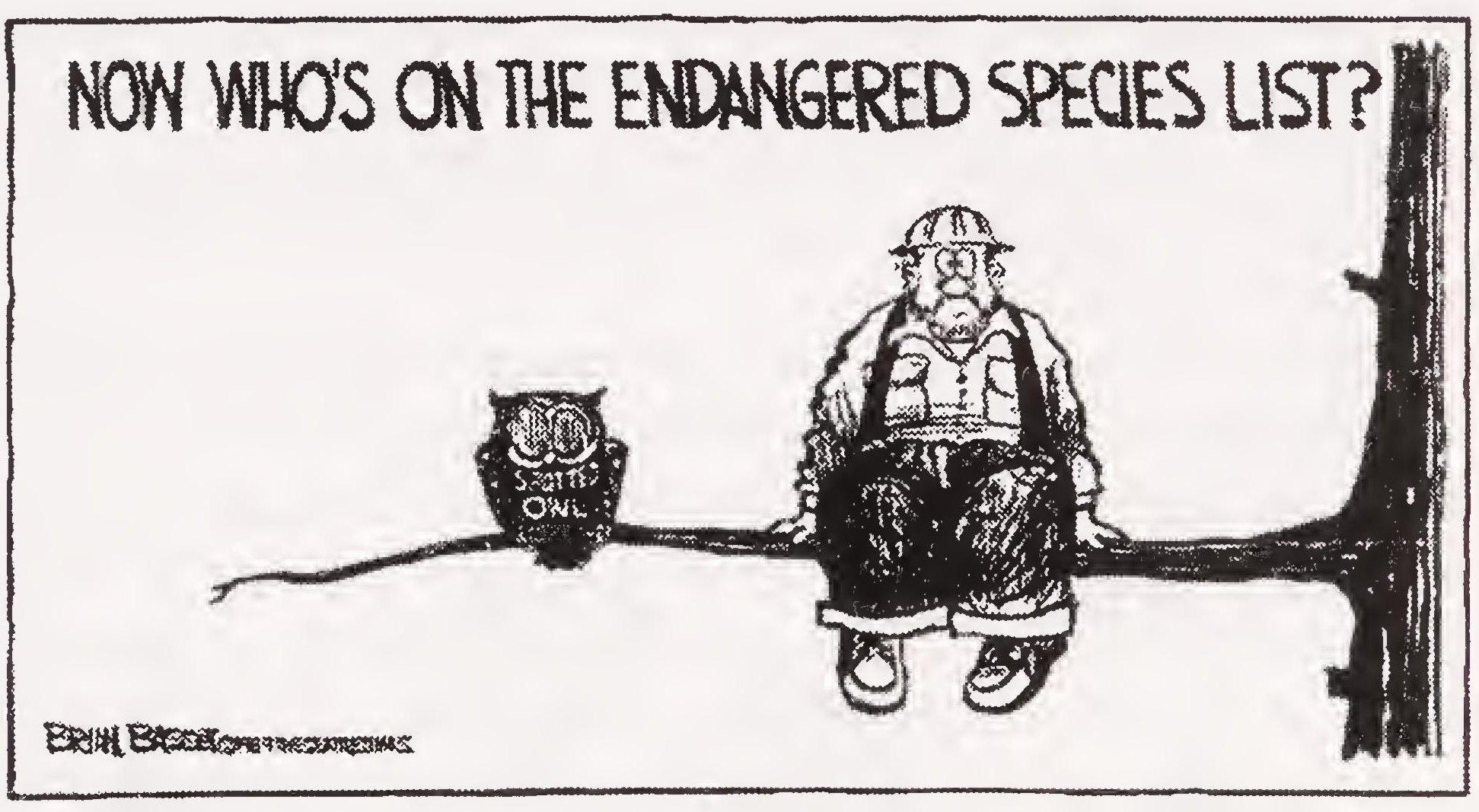
Defenders of loggers were portrayed as hand puppets mouthing the industry’s party line, as right wing extremists, or neo-Nazi brutes.
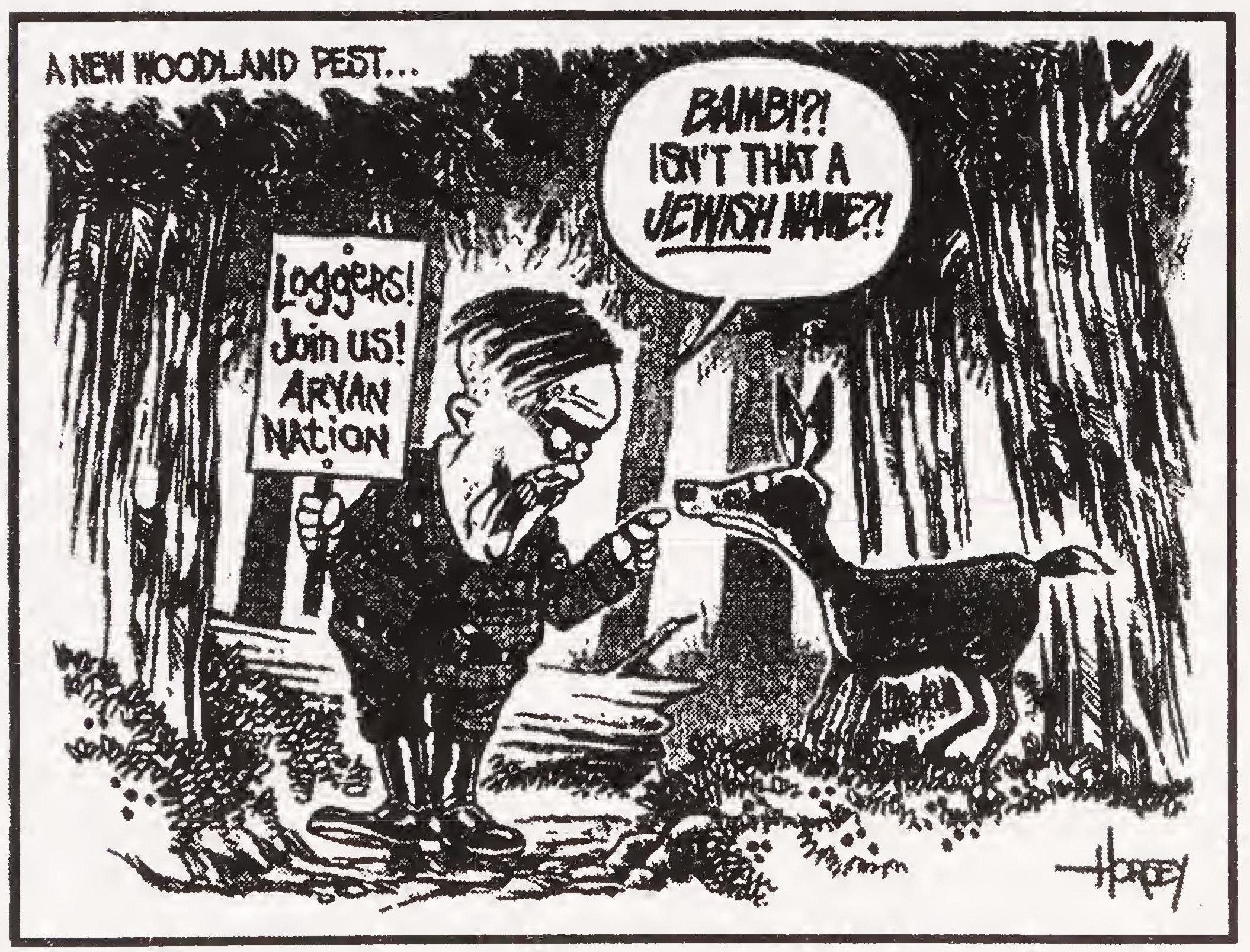
This type of offensive depiction of white supremacists as allies of the wise use movement was part of a foundation campaign to smear any who challenged the moral authority of environmentalism.
Pulitzer Prize-winning political cartoonist David Horsey may or may not have been aware of the organized smear tactic when he drew that cartoon—he did not respond to my repeated inquiries.
At one time or another, the wise use movement was depicted as being tied to nearly every “unacceptable flavor of the month”—Moonies, LaRouchies, Scientologists, neo-Nazis, militias, the Oklahoma City federal building bomber, and to arsons, assaults, rapes, death threats, and even murders, none of which mentioned the names of suspects or any arrests or convictions. If an enviro was the target, it must be wise use.
Simple accusation of guilt was enough to discredit goods producers and their defenders.
The media held a hanging and didn’t even bother with a trial.
Timber workers were particularly vilified.
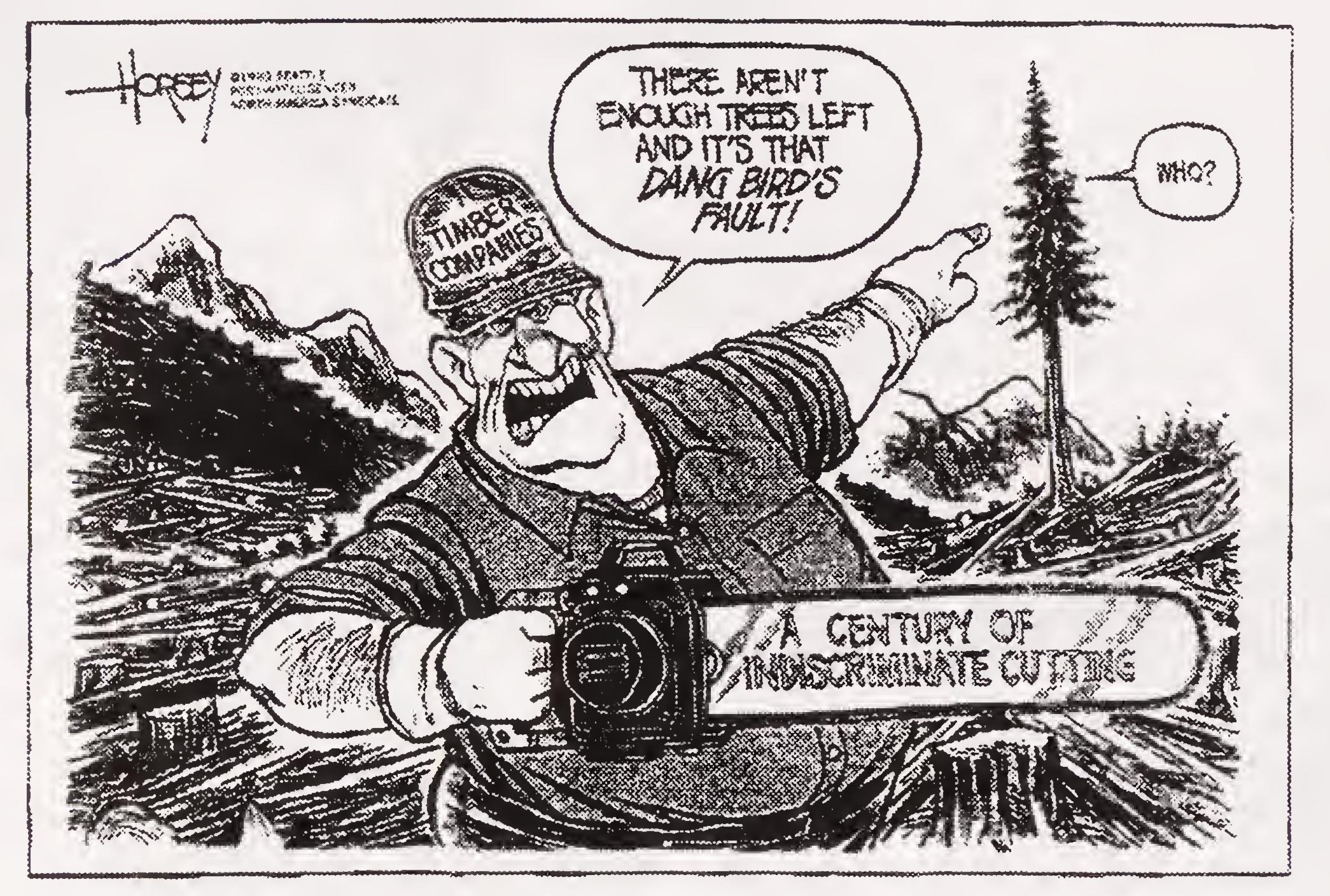
Such depictions are offensive to workers for at least three reasons. First is the image of workers as stupid sloppy people. Newspapers, which would not dream of depicting racial or ethnic minorities in demeaning ways, had little compunction depicting timber workers in such a manner.
The second reason for offense was the depiction of the workers as the industry. Workers do not decide which timber sales to harvest or how, yet workers were held responsible for the purported “sins” of the industry and thus for their own misery.56
The third reason is the trickery of the cartoon’s premises: “there aren’t enough trees left” (while showing one tree left) and “it’s the owl’s fault.” There were plenty of trees left (if there weren’t, what were the environmentalists trying to stop them from cutting?) and loggers well understood that the scarcity of trees was artificially created by environmentalist lawsuits, not by anything the spotted owl did.
The “century of overcutting” was a political slogan: loggers shook their heads at greens saving “old growth” that had been legally designated as America’s timber supply during that century. The greens were simply trying to move the goalpost onto the next playing field. More bizarre, some of that “old growth” had grown into “forest cathedrals” only since the first wave of Pacific Northwest logging in the 1890s— it was actually second growth, but the environmentalist “experts” didn’t know it.
If it looks old, don’t cut it.
Richard Larson, associate editor of the Seattle Times, found himself attacked by environmentalists and fellow editors when he wrote a column about some of those inconvenient truths, particularly that the environmental movement had already stopped logging in all but a tiny remnant of federal lands where commercial timber harvest and replanting was still permitted. Larson was forced to shut up.57
Loggers felt the truth—and their lives—had been turned inside out by newspapers and their editorial cartoons.
Urban readers accepted such portrayals without thought or objection.
They did not know or care that vast commercial forests remain and have long been designated as America’s timber supply.
They did not know or care that vast noncommercial forests have been permanently protected, never to be logged.
Loggers had been vilified into moral exclusion.
The urban newspaper portrayals matched urban reader prejudices. The urban newspapers knew their urban audience.
But their urban audience did not know what was behind their own urban prejudices.
Grant-driven environmental groups.
Prescriptive foundations.
Zealous bureaucrats.
They’re destroying America’s resource class.
They’re destroying America’s property owners.
No one sees.
No one cares.
Silent Scandal Footnotes
4a. Ronald Inglehart, Modernization and Postmodernization: Cultural, Economic, and Political Change in 43 Societies, Princeton University Press, Princeton, 1997.
4b. The 1997 Development Report Card for the States (book and CDROM), Corporation for Enterprise Development, 777 N. Capitol St., N.E., Suite 410, Washington, DC 20002.
4c. “Big gap between urban, rural in Washington,” by David Postman, Seattle Times, Tuesday, March 3, 1998.
6a. “Dramatic Urban-Rural Prosperity Gap in Washington State Economy : Slump in natural-resource industries such as timber widen disparity with high-tech Seattle area,” by Mark Jewell, Associated Press, Los Angeles Times, Sunday March 15, 1998, p. 4.
6b. “Locke Plan Aims to Bridge State’s Urban-Rural Gap — Areas are Worlds Apart Financially,” by Mark Jewell, A.P., Seattle Times, Sunday, February 15, 1998, p. Bl.
7. “Dramatic Urban-Rural Prosperity Gap in Washington State Economy,” Los Angeles Times.
11. Data tabulated by Paul F. Ehinger & Associates, Eugene, Oregon. 14a. Telephone interview, February 25, 1999.
14b. Organic Administration Act of June 4, 1897, 16 U.S.C. 437–475, 477–482, 551. Environmentalists dispute that this 1897 law correctly expressed the intent of the Act of March 3, 1891, that established the forest reserves, which were renamed “national forests” in 1907. For the legislative history of that 1891 Act, see: U.S. Congress, House, 5 0th Cong., LtSess., 18 88, Report No. 778. The report addressed the original purposes of the forest reserves. “The bill provides ‘...that lands chiefly valuable for timber of commercial value, as sawed or hewed timber, shall be classified as timber land;’ that the land shall not be sold, but the timber on the land in legal subdivisions of 40 acres shall be appraised and sold on sealed proposals to the highest bidder, and shall be removed from the land within five years from the date of sale, the timber so purchased to be deemed personal property for all purposes, including taxation.”
15. On July 5, 1988, twenty-four Earth First!ers were arrested for blocking access to Okanogan National Forest Building for one day, in protest of timber sales said to affect lynx habitat. Arrested were: Bradd Mitchell Schulke of Seattle; David Fleak Potter of Seattle; John Craig Lilburn of Missoula, Montana; Michael Joseph Robinson of Santa Cruz, California; Lincoln Warren Kern of Seattle; Camalla Juanita
Moore of Seattle; Kirsten Lee Pourroy of Bellingham; Michael Phillip Peterson of Republic; George William Callies of Seattle; Karen Louise Coulter of Seattle; Tracy Lynne Katelman of Berkeley, California; Joanne Dittersdorf of Bellingham; Elizabeth Jane Fries of Bellingham; Thomas Grey of Bellingham; Peter Jay Galvin of Portland; Philip Randall Knight of Bozeman, Montana; David Eugene Helm of Ferndale; Kurt Stein Newman of Bayside, California; Lyn “Lee” Georges Dessaux of Santa Cruz, California; Todd Douglas Schulke of Seattle; Gregory Joseph Wingard of Kent; Steven Gary Paulson of Lenore, Idaho; Mitchell Alan Friedman of Bellingham; and Kimberly Dawn Reinking of Berkeley, California.
16. Paul F. Ehinger & Associates, 1998.
17a. Telephone interview, February 26, 1999.
17b. “Battered Communities: How Wealthy Private Foundation, Grant-Driven Environmental Groups, and Activist Federal Employees Combine to Systematically Cripple Rural Economies,” Center for the Defense of Free Enterprise, Bellevue, Washington, June, 1998, p. 31.
17c. “Battered Communities,” p. 30.
18. “Battered Communities,” p. 31.
19a. 405 U.S. 538, 92 S.Ct. 1113.
19b. “Privatization: Toward More Effective Government,” Report of the President’s Commission on Privatization, David F. Linowes, Chairman, March, 1988, p. 242.
19c. All data on federal land ownership comes from Public Land Statistics, 1996, Table 1.3, “‘Comparison of federally owned land with total acreage of States, fiscal year 1994f Government Printing Office, Washington, D.C., 1996. Available online at http:// www.access.gpo.gov/blm/im-ages/l-3-96.pdf.
20a. Hawaii is the only state in the Union to have formerly been a constitutional monarchy that was illegally overthrown by U.S. military intervention, and had its own land tenure system in place. The relatively small amount of federal land in Hawaii today is either military base sites or purchases that were designated national parks such as Hawaii Volcanoes and Haleakala National Parks. To complicate matters, a Native Hawaiian movement is using old Hawaiian Kingdom law to cast clouds on modern titles because the chain of title was broken by some illegal act, such as the 1893 American overthrow of Queen Lili’uokalani’s monarchy, asserting that modern titles are therefore invalid. A native title company is filing such reports at the Hawaii Bureau of Conveyances and preventing actual sales. Courts will have to resolve this issue. Who owns Hawaii could become a significant question in time.
20b. Land area from 1992 National Resource Inventory — Table 1 (USDA) URL: http://www.ngq.nrcs.usda.gov/NRI/tables/1992/tablel .html. Includes federal trust land, tribal and TVA land areas.
21. Data on governments comes from 1992 Census of Governments, Volume 1, Number 1, Government Organization, Bureau of the Census, Department of Commerce, Washington, D.C., 1996, p. 7.
22a. Telephone interview, May, 1998.
22b. IRS database, available online at http://www.nonprofits.org/loc.
23. W. Alton Jones Foundation brochure and statement in Environmental Grantmaking Foundation 1996 Directory, p. 303.
25. Freedom of Information Act response, File Code: 6270 (MBS #96-05-23), November 20, 1996, USDA Forest Service, Mountlake Terrace, Washington.
26. See footnote 15.
29. Organization data compiled from various sources, Encyclopedia of Associations, online from Dialog database; Foundation Center grant guides from multiple years.
30. The Bullitt Foundation, Environmental Grantmaking Foundations 1996 Directory, Environmental Data Research Institute, Rochester, New York, 1996, p. 81.
33a. “Heiress leads fight to save old forests,” by Lynda V. Mapes, Spokane Spokesman-Review, Monday, August 23, 1993, p. Al.
33b. “Harriet Stimson Bullitt and Priscilla Bullitt Collins — The Bullitt Sisters: Has Life Among the Sheltered and Well-off Prepared Them for the Rough-and-Tumble Arena of Environmental Causes? by Theresa Morrow, Seattle Times, Sunday, November 11, 1990, (Pacific Magazine), p. 10.
33c. “Golden opportunity splits rural town — Chesaw, Washington, is divided over plans for a new mine,” The Spokane Spokesman-Review, by Lynda V. Mapes, November 29, 1993, p. Al.
34. Note to Bonnie Lawrence, May 1998.
35a. “UM ‘environmental’ class spurs ethics debate,” by Erin P. Billings, The Independent Record, Helena, Montana, Saturday, Oct. 12, 1996, p. Al. See Chapter 4 for the expanded story, p. 140/f
35b. “Environmental Group Appeals for Change in U.S. Mining Laws,” by Associated Press, Rocky Mountain News, Friday June 24, 1994, p. 22A.
35c. “Newmont to Take $33.8 Million Write-Off,” by Kerri S. Smith, Rocky Mountain News, Saturday January 6, 1996, p. 47A.
36a. See website http://www.nwf.org/nwf/northeast/nfp/pgm_nfal .html.
36b. Robert Shankland, Steve Mather of the National Parks, Alfred A. Knopf, New York, 1951.
37. Alan Gottlieb and Ron Arnold, Trashing the Economy: How Runaway Environmentalism is Wrecking America, Free Enterprise Press, Bellevue, Washington, 1994, second edition, p.362^
38. Transcript of EGA Fall Retreat, 1992, from tape, “Session 2: North American Forests: Coping With Multiple Use and Abuse.”
41a. Compiled from Foundation Center records.
41b. “Governor Angus King says it’s a historic moment for Maine, and he’s right,” editorial, Ellsworth American, Ellsworth, Maine, March 11,1999.
42. Gina Brosig, “Long Term Implications of Conservation Easements,” American Farm Bureau website http://www.fb.com/issues/analysis/ easement.html., Feb. 25, 1998.
43a. Telephone interview March 11, 1999.
43b. EPA website http://www.epa.gov/envirofw/html/gics/gics_query.html.
45. Telephone interview, March 30, 1999.
47. Telephone interview, June 6, 1999.
48. Telephone interview, June 20, 1999.
49. “New Ethic for Forests Unveiled — U.S. Agency to Alter Goals for Public Lands,” by Paul Rogers, San Jose Mercury News, Monday, March 29, 1999, p. 1A.
51. Published in “Feeding at the Trough,” white paper by Center for the Defense of Free Enterprise, Bellevue, Washington, May 1995.
52. “Senate Confirms Babbitt Despite Questions About His Activism,” by Martin Van Der Werf, Arizona Republic, Friday, January 22, 1993, p AL
53a. “The Hidden Danger of Moral Persuasion: The Clinton Plan Laid Bare,” interview with Dr. Robert Lee, Evergreen, June 1996, p. 46.
53b. Robert G. Lee, Broken Trust Broken Land — Treeing Ourselves Erom the War over the Environment,Book Partners, Wilsonville, Oregon, 1994.
54a. Rock Creek Environmental Impact Statement, Chapter 4: Environmental Consequences, p. 4–131. Written by Mark Kelly. The referenced studies were written by academicians and published in various academic journals.
54b.Richard Manning, One Round River: The Curse of Gold and the Fight for the Big Blackfoot, Henry Holt, 1998.
54c. Quoted in “Trouble in Timber Town: A Way of Life Is Torn Up By Its Roots,” by Sandra Hines, Columns, December 1990, p. 10.
55. A Response to “Forty Years of Spotted Owls? A Longitudinal Analysis of Logging Industry ” by Matthew S. Carroll, Charles W. McKetta, Keith A. Blatner, and Con Schallau. See also, Matthew S. Carroll, Community and the Northwestern Logger: Continuities and Change in the Era of the Spotted Owl, Harper-Collins, New York, 1995.
56. Political cartoons by Dave Horsey, Seattle Post-Intelligencer, and Brian Bassett, Seattle Times, all circa 1989–90.
57. “From timber towns, a cry for compassion,” by Richard W. Larson, associate editor, Seattle Times, Sunday, October 6, 1991, p. A16.
Part Two: The Bewildering Arrays
Chapter 2: Prescriptive Foundations
Many wealthy foundations have turned away from their original responsive position to become prescriptive, designing programs of their own and setting the political agenda. Since the late 1980s, the foundation community has become increasingly left-wing, activist, coordinated, bullying, and prescriptive. The Environmental Grantmakers Association has become a strategizing center that targets vast wealth against the resource class. Today a bewildering array of prescriptive foundations invisibly shapes the environmental movement, causing alarm among environmentalists as well as those in the resource community.
PHILANTHROPIES THAT PROMOTE MISANTHROPY. They command immense capital, yet produce nothing. They finance utopian projects, yet destroy productive enterprises. They empower those who create only social change. They disable those who produce all our material goods. They preach social justice, yet wreck the resource class and minorities. They work against the individual. They promote big government. Their vast projects induce bizarre consequences such as anti-capitalist programs destroying small enterprises and concentrating wealth in big corporations. Their wealth is matched by their intellect, their cunning and their absolute ruthlessness.
That, to many, is a fair description of the environmental grantmaking community.
This growing stream of “big money” support has boosted the environmental movement’s power in a time of declining grassroots contributions.
But it came at a cost. The Golden Rule applies: who has the gold rules.
Submission to money hasn’t been all bad for environmentalism. In one of history’s ironies, many new generation heirs of wealthy families are emerging as environmental true believers, now guiding foundations built on the profits of “evil polluters” to destroy the industries that made them rich. They may be less radical than some would like, but they’re taking a severe toll on rural goods production and the resource class.
At least 2,500 grantmakers—foundations and corporations—fund the environmental movement, according to Environmental Data Research Institute (EDRI). The annual dollar amount can only be estimated.663
The Foundation Center’s National Guide to Funding for the Environment and Animal Welfare describes more than 1,200 grantmaking foundations and about 90 direct corporate giving programs, with 379 of them donating more than $356 million to the environmental movement in 1992. That’s 379 foundations—less than 20 percent of the 2,500 known funders—whose $356 million must be a small fraction of the total.66b
The Environmental Grantmaking Foundations 1997 Directory profiled 740 foundations that collectively donated nearly $500 million to environmental organizations, somewhat less than a million per foundation.660
The Boston Globe estimated a total of $4 billion a year. It is not likely that 2,500 grantmakers each donated an average of $1.6 million to green groups. Half that is probable. Government grants may bring it to $4 billion.66d
The 2,500 or so environmental grantmakers account for about 6 percent of all 45,000 foundations in America, which in turn make up only about 3 percent of all 1.5 million present non-profit organizations.
The total non-profit sector is important to consider, even though it is not all environment-related, because of the connections between organizations, as we shall see. The total non-profit sector accounts for 7.8 percent of all U.S. employment. Such economic power cannot be dismissed.666
In fact, the total non-profit movement—NGOs, or Non-Governmental Organizations—annually spends more than $1 trillion in 22 countries studied by the Johns Hopkins Comparative Nonprofit Sector Project in its 1998 report, “The Emerging Sector Revisited.” If viewed as a nation, it would rank eighth in economic power.66f
As of 1993, the United States had approximately 1.4 million tax-exempt organizations with operating expenditures of some $500 billion. That’s half of all our hospitals, half of all our colleges and universities, almost all of our symphony orchestras, 60 percent of our social service agencies and most of our civic organizations.668
The Foundation Center, a New York non-profit, reports about 45,000 grantmaking foundations contributed $19.46 billion in 1998, a 22 percent jump over the $15.98 billion reported for 1997. Stock market gains and a record number of new foundations—more than 50 each week—account for the increase.673 Although Internal Revenue Service records don’t exactly correspond to Foundation Center estimates of how many foundations exist, they do reflect the same growth trend. In 1989, the IRS says, 37,000 private family foundations (those with single donors) filed the required 990 tax forms, compared with 54,500 in 1997, a growth rate of 47.3 percent. The value of private foundation assets grew 35 percent from $164.8 billion in 1990 to $222.5 billion in 1994, the last year for which there are figures.676
BASICS OF NON-PROFIT ORGANIZATIONS
Non-profits are: (1) organizations; (2) that are not part of the governmental apparatus; (3) that do not distribute profits to their directors; (4) that are self-governing; and (5) that serve some public purpose that has been judged by the U.S. Congress (and in some cases state and local legislatures) to entitle them to full or partial exemption from many forms of taxation.
Categories of non-profit organizations:
Charitable. These include educational, religious, civic, health, and similar organizations.
Social. Fraternal orders and mutual benefit societies, but not night-clubs and similar self-interest groups.
Trade associations. Chambers of commerce, labor unions, industry associations, and the like.
Political. Propaganda groups, political party organizations, committees for legislative action.
The U.S. Tax Code includes government and municipal organizations, including administrative bodies such as road and water districts. However, economists include only nongovernmental organizations (NGOs) in the reports cited in this chapter.
Tax exempt. Certain non-profit organizations are exempt from taxation, though they may be taxed on income from businesses they conduct.
Tax deductible. Individual donations to qualified charitable non-profit organizations may be deducted from your personal federal income taxes. However, donations to political and certain other non-profit organizations are not tax deductible.
In the U.S., voluntary giving to non-profits amounted to more than $143.5 billion in 1997. Most of it went to civic causes such as fighting illiteracy, hunger, and homelessness, or for children’s hospitals, and united funds. An unknown part went to agenda-driven social activism.683
Federal grants to non-profits were approximately $130 billion in fiscal year 1996. How much federal money went to environmental groups has never been sorted out of the total. Two billion is likely.68b
A comparison of funding for left-leaning and right-leaning groups is revealing. Economics America, Inc., editors of The Right Guide and The Left Guide, found that “financial figures are still considerably less for the Right than their counterparts on the Left.” Conservative and libertarian causes that protect private property and the resource class are far outstripped financially by those who act to harm them.68c
What this means to American society is impossible to understand without going inside the environmental grantmaking community and listening to their own words.
Stagnation
By the mid-1980s the environmentalist victories of the early ’70s were fossilized in federal regulatory programs. The Wilderness Act of 1964 was quietly administered by bureaucrats while hordes of unregulated hikers who paid no entry fee loved the wilderness to death. The Clean Air Act and Clean Water Act amendments submerged as pages of details in the Code of Federal Regulations that torpedoed little firms out of business and left Fortune 500 companies with fewer competitors. The Endangered Species Act grew within the U.S. Fish and Wildlife Service and the National Marine Fisheries Service, casting its pall of no-use over small private property owners across the nation. Interior Secretary James Watt, the eco-ogre of the Reagan administration, had resigned in humiliation over a tasteless and politically incorrect joke told at a luncheon.
By 1985, environmental groups had migrated to Washington, jettisoned their amateur naturalist leaders, sprouted lawyers and public relations consultants in top spots, and watched their grass roots rot. Even sympathetic journalist Mark Dowie argued in his book, Losing Ground: American Environmentalism at the Close of the Twentieth Century, that the nation’s biggest environmental groups had lost touch with their grassroots constituencies. He quoted Bill Turnage, former director of the Wilderness Society, describing a major reason why: “If a foundation had a large interest in Alaska and a lot of money, you definitely had a large interest in Alaska.”68d
BASICS OF FOUNDATIONS
A foundation is a modern innovation to provide for the endowment of non-profit enterprises and the establishment of an association or corporation to carry out its founder’s plans.
Most foundations are set up as charitable trusts. The grantor conveys money or property by a deed of trust to a named trustee or trustees, to be disbursed as the instrument directs.
The charitable trust may or may not be incorporated. Most modern foundations are corporations. Technically, the foundation is the document of endowment or incorporation, but the term usually means the organization that administers the fund.
Both public charities and private foundations form part of the nonprofit structure of the environmental movement.
Public charities are charitable organizations supported by members of the general public. They are allowed to operate programs to accomplish their tax-exempt purpose. Most environmental groups are classified by the IRS as public charities.
A private foundation is a charitable organization that is funded by one or a few persons rather than the general public. Although subject to stricter rules than a public charity, a private foundation is tax-exempt just like a public charity and may carry on the same activities. Often, a private foundation simply makes grants to public charities instead of operating its own programs.
Dowie grasped that non-profit organizations were increasingly turning to private foundations—and in the process allowing the foundations to set the political agenda. The money came rolling in, but the brash little volunteer-driven environmentalist David of the 1960s grew not into a great king after Earth Day, 1970, but turned into just another well-heeled special interest Goliath strutting around Capitol Hill.
Enviro lobbyists worried more about pay and perks than about the issues. Enviro staff worried more about fundraising than the issues. Enviro field organizers worried more about field trips than the issues.
The glamour was gone. So was the effectiveness.
Some of the money men noticed.
Chief among them was Donald K. Ross, director of the New York City-based Rockefeller Family Fund. Ross, born in 1944, was a hardcore activist who cut his policy teeth from 1974 as a young lawyer with the Ralph Nader-founded New York Public Interest Research Group (NYPIRG), and was soon elevated to executive director.
In 1979, after the near-disaster at Pennsylvania’s Three Mile Island nuclear power plant, Ross organized two anti-nuclear rallies, one in Washington, D.C., that brought 65,000 protesters to the Mall (Ross said it was 125,000). Ross emphasized coalition-building for this rally, bringing in Friends of the Earth, the Association of Machinists and others to augment the usual leftovers from Vietnam war protests.
The other was the nation’s largest anti-nuclear rally, nearly 200,000 people, at New York City’s Battery Park landfill. Ross convinced stellar speakers to show up at both rallies, including Jane Fonda, Tom Hayden, Ralph Nader, Bella Abzug, and Barry Commoner, with singers including Bonnie Raitt and Pete Seeger. Both audiences chanted, “Hell no, we won’t glow!” and “Two, four, six, eight, we don’t want to radiate!”703
Ross showed himself in one NYPIRG triumph after another to be a canny strategist and bold tactician.
He became director of the Rockefeller Family Fund (RFF) in January 1985 at the age of 40. It was a different world, a tight little island of Standard Oil wealth converted to an investment portfolio containing common stocks of oil and gas companies such as Amerada Hess and Unocal, mining companies including Asarco and Freeport-McMoRan, and timber firms including Weyerhaeuser and Boise Cascade.70b
The foundation had been established in 1967 by Martha, John, Laurance, Nelson, and David Rockefeller (the daughter-in-law and grandchildren of John D. Rockefeller). In its earliest years, the Fund was led by third-generation family members. Laurance was the real force; his clever deals—secretly buying up private land, donating it for national parks and then getting the visitor concession—had built RockResorts, the family’s for-profit hospitality industry empire, into a thriving venture.
From 1970 onward, members of the next generation (referred to as “the cousins”) comprised a majority of trustees and provided board leadership. In 1978, the first member of the fifth generation was elected to the board, and today half of the trustees are from the fifth generation.
They all remember how Grandpa (or Great-Grandpa or Great-Great-Grandpa) got rich. Old John D. had a simple method: Take over the competition. Eliminate those you can’t take over. Combine forces and rule.
The board was entirely family members. It wasn’t a huge foundation, granting only a million or two each year, but it got a lot of bang for the buck and it enjoyed an influence on other funders disproportionate to its size in the foundation world. It was one of only a handful of foundations that had figured out how to drive social change with intelligently targeted money. It regarded itself as a “catalyst” for non-profit groups, i.e., it generated areas of activism that weren’t there before.
By funding startups and convincing other donors to join in, the Fund leveraged its relatively small assets and magnified its focused staff-work into big public impact. Imagination and creative grantmaking were the hallmarks. The person who had devised the Family Fund’s strategy of leverage and focus was Robert W. Scrivner, who served as the Fund’s director from 1972 until his death in 1984.
The Fund needed someone to carry on the strategy and perfect it.
Donald K. Ross was the man.
Ross wasted no time. He was particularly interested in “catalyzing” the environmental movement. The Council on Foundations—the lobbying, litigating and strategy arm of the foundation community (with 1,600 grantmakers that collectively hold $143.4 billion in assets and in 1997 gave away $7 billion)—steered Ross to its Environmental Grantmakers Affinity Group.
Within a few months Ross found himself talking to five other bigmoney foundation leaders in the affinity group when they discovered they would all be in Washington the next week. One of them said, let’s all get together Saturday. They spent that Saturday talking about common interests and asking about each other’s specific programs.71
When it was over, they felt it had been so useful they decided to do it again at least once a year. The next year nearly twenty people showed up and it became clear they were on to something.
In 1987 they decided they needed a secretariat and officially organized themselves as the Environmental Grantmakers Association with Don Ross as coordinator. It was not and is not incorporated. Strictly a voluntary gathering of donors. They exchanged grants lists and published a “directory” of foundation program interests. For a couple of years Jon Jensen of the Pew Scholars Program in Conservation housed the association in his University of Michigan offices, but it got too big and Don Ross brought it into the Rockefeller Family Fund’s office. Today there are more than 200 EGA members, including a few corporate funders such as Arco Foundation and Chevron.
The Environmental Grantmakers Association has been characterized as “command central” of the environmental movement (there isn’t really any such thing) and “the cartel of eco-money” (close enough, although a number of lesser eco-money power centers also influence events). EGA has indisputably been the most powerful shaping force on environmentalism in the past decade.
From EGA’s official beginning in 1987 a small cluster of member foundations worked closely and set an interventionist tone. The core clique included the Rockefeller Family Fund (New York), Pew Charitable Trusts (Philadelphia), W. Alton Jones Foundation (Charlottesville, Virginia), Bullitt Foundation (Seattle), Surdna Foundation (New York), Beldon Fund (Washington, D.C.), Schumann Foundation (New Jersey), the Joyce Foundation (Chicago), and the Cummings Foundation (New York), among others. These are quintessentially prescriptive foundations.
ENVIRONMENTAL GRANTMAKERS ASSOCIATION MEMBERSHIP CATEGORIES
Membership in the EGA is open to all foundations and giving programs which act primarily as grantmakers, not as grantseekers, and whose philanthropic purposes include the protection of the natural environment.
1. Private Foundation or Charitable Trust
Foundations whose giving is funded exclusively by income on an endowment. Files IRS Form 990-PF.
2. Community Foundation
Funded in part or whole by endowment. Grantseeking limited, usually to enlarge endowment.
3. Corporate Foundation or Giving Program
Funded by endowment or a percentage of corporate profits.
4. Public Foundation
Publicly supported grantmaker funded primarily by endowment or single source of income. Files IRS Form 990.
5. Coordinative Organization
Publicly supported organization whose primary purpose is to coordinate grantmakers. Generally supported by member dues.
What exactly does it mean to be “prescriptive?” It has several levels.
The most superficial was identified by Mother Jones—a magazine published by the Foundation for National Progress, a non-profit organization receiving donations from foundations (1996 income $4.1 million)— which wrote, “by deciding which organizations get money, the grantmakers help the agenda of the environmental movement and influence the programs that activists carry out.”72
This is passive prescription. It amounts to simply funding groups that are already doing what you like, and ignoring or blackballing the rest. It merely reinforces good behavior and extinguishes bad. You don’t need to attach strings to your money because the recipients have done it for you. Mother Jones didn’t get it quite right: You’re not helping the agenda of the recipients, you’re driving your own with selective grants.
But what happens if nobody is doing what you want done? What if the whole movement falls into stagnation?
Consider this exchange transcribed from a session of the 1992 Environmental Grantmakers Association annual conference:
Chuck Clusen (American Conservation Association): I think the [environmentalist] community as a whole is not very strategic. And I think we need to start rebuilding that. And figuring out how to not only get the most bang for the buck, but how to make it lasting bangs. And to do several things at once, and so on.
Anne Fitzgerald (Switzer Foundation); Do you detect, though, a resistance in the larger organizations to becoming grant driven?
Donald Ross (Rockefeller Family Fund): Yeah. I think a lot of them resist.
Chuck Clusen: A number of us have been involved in this, Anne. There’s definitely a feeling on the part of the not-for-profit organizations that in cases of some of the campaigns that they resent funders, not just picking the issues, but also being directive in the sense of the kind of campaign, the strategy, the style, and so on. I guess, coming out of the advocacy world, and having spent most of my career doing it, I look at it as, if they’re not going to do it on their own, thank God funders are forcing them to start doing it...The lobbying is not there in Washington. It’s not being delivered. And, you know, I don’t want to name names. I could name all the organizations that in many issues, you know, just how little they have on the Hill and how ineffectual it is in being connected to the grass roots and so forth.
Anne Fitzgerald: Do you think that’s because the organizations have gotten so—certainly the major organizations—have gotten quite big and therefore bureaucratic?
Chuck Clusen: A lot of those organizations are bureaucratic. And when you compare it to the way, you know, a for-profit organization is run they don’t by and large have the management. I mean there’s not strategic decisions being made and then implemented. What you basically have, a lot of these organizations are a series of very bright, talented, self-initiating people who do their own thing, who resist any kind of supervision or resist any kind of coalition building or working cooperatively with others.
Hooper Brooks (Surdna Foundation): I think that basically the problem is most of these are not only bureaucracies, but they spend most of their time hitting their members for more money and sending them newsletters instead of getting out to the public. And I don’t think you can neglect thinking about that. I do think we do have to get prescriptive.
Donald Ross: I think that there are things that could be done. I think funders have a major role to play. And I know there are resentments in the community towards funders doing that. And, too bad. We’re players, they’re players.
But I think we touched on a lot of problems, the internal problems within these big groups, the warring factions within them who are all trying to get resources, and there’s too many groups and too few resources, and all that.
I think the fundamental effort that has to be made is a reorganization of the movement. I don’t think it’s realistic to think that groups like Sierra Club or NRDC are going to disappear and reform into something new. They’ll stay, and they’ll still send out those newsletters. I think we have to begin to look much more at a task force approach on major issues that is able to pool. And the funders can drive that.
And I think there isn’t one of them, even the biggest, National Wildlife, or Audubon or Sierra Club, that has the capacity to wage full scale battles on major issues by themselves. They don’t have the media, lobbying, grass roots organizing, Washington base, et cetera, litigation, all wrapped in one organization.
And so the trick, I think...where funders can play a real role is using the money to drive, to create, ad hoc efforts in many cases that will have a litigation component coming from one group, a lobbying component coming from another group, a grass roots organizing component coming from yet a third group with a structure that enables them to function well.74
That’s quite an ambitious project, reorganizing a whole movement and turning it into a segmented, complex, coordinated, disciplined army of many units. It means continued support for the old organizations that won’t go away, and vigorous recruitment or creation of new targeted groups. But Ross, who left the Family Fund in 1999, was right: funders can drive that.
The EGA has driven that. That is aggressive prescription.
There is one higher level: absolute prescription, pre-selecting grant recipients and accepting no uninvited applications, as we shall see.
Today there is an astounding multiplicity of little environmental groups growing up to cover every conceivable issue, plus coalitions with leftleaning movements of all sorts—peace groups, women’s groups, labor organizations, minority groups. Today the movement consists almost solely of grant-driven activists—and many of them don’t even know it.
A short surf almost anywhere on environmentalist websites will uncover examples. An easy one is the Environmental Defense Fund website (home page at www.edf.org). Click on their Publications icon and scan the Reports menu. Just pick the first thing on it: Biotechnology.
Click on that and it will take you to a report titled, Biotechnology’s Bitter Harvest: Herbicide-Tolerant Crops and the Threat to Sustainable Agriculture. Its lead authors have Ph.D.s behind their names, but they have environmental group employer names there too. The last credit reads, “A Report of the Biotechnology Working Group.”
What’s the Biotechnology Working Group?
It’s a task force. Just like Don Ross suggested.
Why does it exist?
Some leaders of foundations in the Environmental Grantmakers Association want to shut down biotechnology research to save nature; others want to shut down biotechnology research because it might solve real problems and hurt the credibility of alarmist projects like the Bitter Harvest report; others want political control of it; others want financial control of it. EDF leaders share some of these goals, but are unwilling to commit more than a modest effort to them.
A perfect place for the task force approach.
Or the Working Group approach, to use a widely favored buzzword.
Click on the Biotechnology Working Group link and you find yourself on a page that tells you BWG “is composed of representatives of public interest organizations and a state agricultural agency and citizen activists who are presently working on biotechnology-related issues in the environmental, agricultural, consumer, labor, and public health fields. The purpose of the group is to strengthen the influence of the public interest community on the development of biotechnology by sharing information, coordinating activities, and developing action strategies on specific issues.’’ Getting to have a familiar ring, isn’t it?
We find that the Biotechnology Working Group is “a project of the Tides Foundation, supported by foundation grants and in-kind contributions from its member groups.”
The chart on the next page explains the complex structure behind the EDF Report.
IRS TAX CODE SECTIONS
Section 501(c)(3): Religious, educational, charitable, scientific organizations. If dominantly supported by the general public, files annual report Form 990. If declared a private foundation by the IRS, files Form 990-PF
Section 509(a)(1): Proof of public support (from members of the general public). Required to avoid classification as a private foundation.
Section 501(c)(4): Educational and lobbying organizations. Contributions generally not deductible. Files Form 990.
The Star Nest
What is the Tides Foundation? It is one of the Environmental Grantmakers Association’s most fascinating members because it is not a private foundation, but is a public charity. It has 501(c)(3) and 509(a)(1) IRS designations, which allow it to seek contributions and distribute them where desired—how to reorganize the environmental movement.
It’s not a traditional foundation. It doesn’t have an endowment. Instead, people and institutions that, for one reason or another, don’t want to be publicly identified with a certain cause give money to Tides as donor-advised funds, a little-known charitable giving vehicle that allows donors to recommend uses of their donations and also to remain anonymous (more about that later).
Tides becomes the “fiscal agent” (money funnel) of any group that donors wish to fund or to create to fit their agenda. Tides gives the recipient shelter under its tax exemption. Tides can train new leaders and equip their organizations to stand alone or simply run a temporary ad hoc operation to fill a short-term need. Thus, Tides has created a haven for donor-selected nongovernmental organizations that, for various reasons, would rather not obtain their own tax-exempt status from the Internal Revenue Service. In this manner Tides has nurtured literally hundreds of new groups to plague the resource class and rural communities.
The Tides Foundation was founded in 1976 by Drummond Pike, a left-wing activist in California, as a vehicle to promote social change and support new, controversial and even radical efforts.
The Tides Foundation originally supported three different but related programs: 1) grants: a) grantseeking, i.e., they obtained funds from large foundations, and b) grantmaking, i.e., they spent the money on other non-profit groups; 2) projects, i.e., they created or recruited existing, startup or temporary groups to fit any social engineering agenda with donor-advised funds; and 3) management contracting, i.e., they contracted with their own projects to provide them with financial, management and program assistance.
One stop shopping for all your left-wing needs.
BIOTECHNOLOGY WORKING GROUP A PROJECT OF THE TIDES FOUNDATION
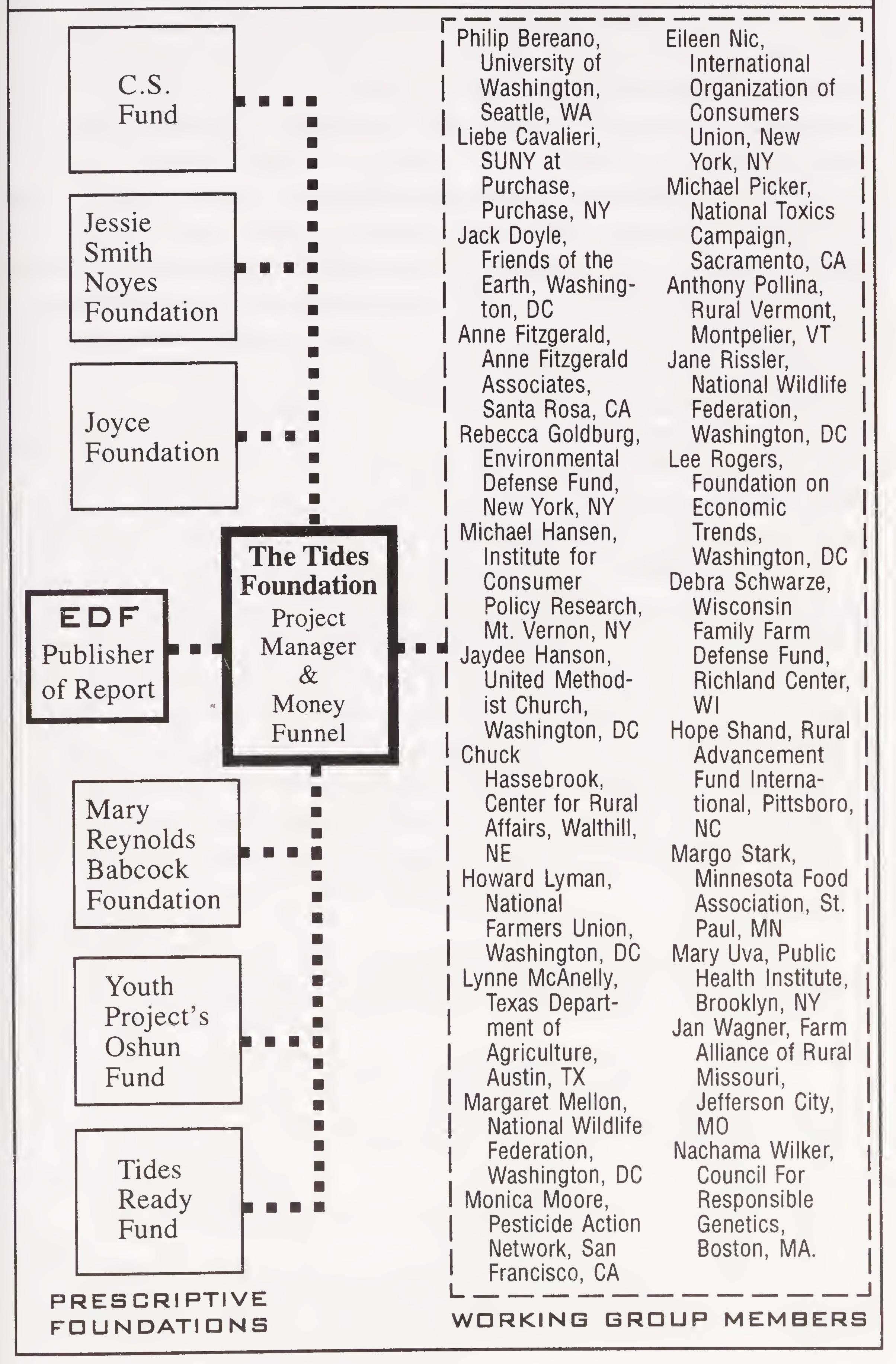
If an organization wanted to be a Tides Foundation project, essentially they turned over all of their administrative non-program activities to the Tides Foundation and paid the foundation 8% of their gross revenue. All organization employees were then employed by the Tides Foundation, provided with a benefit package and operated under the foundation’s personnel policies. All governmental filings, tax reports, and annual reports were prepared and submitted by the Tides Foundation. All legal contracts were reviewed by TF lawyers prior to their being executed. All purchases greater than $250 had to be OKed by TF program representatives before purchase. Staff hirings/firings had to be reviewed by TF representatives. TF assigned an individual to the organization to assist with day-to-day non-programmatic operations. A fundraising plan was worked out and closely monitored. Sources of potential funding from other foundations were directed toward the program by TF representatives. If the project proved effective, the group might end up with its own articles of incorporation, moving to its own offices, with its own funding sources, legitimately doing the activism it had been groomed for. The public didn’t know who paid for its grooming.783
The San Francisco Bay Guardian reported, “Wealthy patrons give big chunks of money to Tides—and their names are kept confidential. The Tides donation is completely tax deductible. But the donor can discreetly designate an organization that he or she wants to see receive the money—and Tides will pass the donation along, minus a small administrative fee. Often, the recipient group doesn’t know where the money really came from. And there’s no way for the public to find out either. By the end of the 1980s Tides had significantly expanded another of its tasks: providing a tax shelter to small non-profits unable or unwilling to win tax-exempt status from the federal government.”78b
Drummond Pike gained favor with John Peterson “Pete” Myers, director of the highly-focused W. Alton Jones Foundation. In 1992 Jones contributed to seven identifiable Tides donor-advised funds: $40,000 for the Student Environmental Action Coalition in Chapel Hill, North Carolina; $37,000 for Reducing Pesticide Risks Project; $30,000 for Least Cost Energy Analysis Project; $45,000 for the Nuclear Safety Campaign; $20,000 for the Project for Participatory Democracy; $15,000 to the Project for Particpatory Democracy for the Military Production Network; $20,000 for the Rural Alliance for Military Accountability.780
Pike also gained favor with Rebecca Rimel, president of the giant Pew Charitable Trusts (over $15 million from Pew). In 1993 alone, Pew contributed to six identifiable Tides donor-advised funds: $600,000 to manage the Pew Global Stewardship Initiative “and related grantees;” $275,000 for the Business Industrial Efficiency Initiative; $95,000 for the Environmental Working Group; $25,000 for the U.S. Network for Cairo 1994 (a temporary organization to boost the United Nations International Conference for Population and Development); $75,000 to publish a source book on the 1994 Cairo U.N. Conference; $2,872,000 for the Waste Reduction and Recycling Institute.793
In the early ’90s, Tides got donor-advised funds not only from Jones and Pew, but also from Columbia Foundation, the Foundation for Deep Ecology, the Richard and Rhoda Goldman Fund, the William and Flora Hewlett Foundation, the Homeland Foundation, the James Irvine Foundation, the Roberts Foundation, the Hoffman Foundation, the Charles Stewart Mott Foundation (General Motors money), the Nathan Cummings Foundation, the Ford Foundation, the Jessie Smith Noyes Foundation, and the Bullitt Foundation. By the end of 1996 the Tides Foundation had $55.3 million in assets, most of it supporting donor-advised funds.79b
Until 1996, the donor-advised fund projects were managed by the Tides Foundation. But to protect the Foundation from legal action that might be taken against any of those groups that might get in trouble—and more than a few harmed parties have considered lawsuits against environmentalists for ruining their lives—the Tides Center was spun off in April 1996, funded by a Tides Foundation grant of $9 million. A year later the Tides Center’s income was $38,813,246, and assets had grown to $16,080,055. It has its own tax exemption and deductible status.
THE DONOR-ADVISED FUND
A charitable giving vehicle which enables a donor to make an outright, irrevocable cash contribution through a simple letter of agreement. The recipient then acts as a steward of the contributed monies, and can use them to operate projects or invest them for both growth and income; if income is earned, it must be distributed annually. The donor may make periodic recommendations regarding distribution of the fund’s income; as long as these recommendations are non-binding, the donor will receive an income tax deduction for the monies contributed.
BENEFITS
The donor may stay actively involved, recommending different charities to receive distributions from the Donor Advised Fund each year.
The donor enjoys administrative convenience.
Giving to other charities may be done anonymously.
Donor receives an immediate income tax deduction for the full value of the gift.
Bypasses capital gains taxes on long-term appreciated securities.
A Fund can be establish quickly and easily, with a minimum of paperwork.
The legally separate Center now manages all “projects,” except for seven that were retained by the Foundation due to “imminent plans” by each group to incorporate separately from Tides. The Center also operates its own philanthropy, providing grants to affiliated groups and related projects. At the turn of the century, the Center expected to be managing more than 260 projects in 28 states and five countries. More than 400 staff members will be spending $30 million annually on project management.
Yes, that’s more than two-hundred-sixty “projects” Tides operates.
A truly bewildering array all by itself.
The spin-off of the Tides Center coincided with the move of the whole Drummond Pike empire in mid-1996 to new facilities in the 55-acre Letterman Hospital complex at the Presidio of San Francisco, a former military base declared surplus by Congress and transferred to the National Park Service as part of Golden Gate National Recreation Area (now National Park).
The Tides Foundation topped the list of sixteen organizations with their winning bid to lease the plum site, with its 1889-era hospital building and circa-1920s additions, nestled in a hollow just west of the Presidio’s Lombard Street gate. Presidio General Manager Bob Chandler said Tides won because “they fit very well into the management plan’s purposes for a science-education center” and because of “their good track record and financial capability to deliver.” Others thought Drummond Pike’s funders’ pull with the Clinton administration had something to do with it.
In 1996 Congress created the Presidio Trust, a federal corporation set up as a public-private partnership, to manage most of the Presidio. President Clinton appointed six of the Trust’s seven-member Board of Directors in April 1997 (Interior Secretary Bruce Babbitt appointing the seventh), with a mandate to become self-supporting within fifteen years.
The Tides Foundation, after performing a major rehab including expensive earthquake reinforcement, gave their new digs the pretentious name, “Thoreau Center for Sustainability.” It’s touted as the most “environmentally correct” facility in the nation, featuring solar panels, tiles made from recycled car windshields, double-glazed operable windows, natural ventilation, energy-efficient light bulbs, toxic-free materials, cotton insulation (recyclable), and wood harvested by Native Americans.
The Thoreau Center is home to twelve non-profit organizations including the Tides Foundation, the Bicycle Coalition, Wilderness Society, Resourceful Women, the Transnational Resource and Action Center, the Ecological Literacy Project and the Institute for Global Communications.
Some Tides donor-advised fund groups, such as the Political Ecology Group, an aggressive in-your-face organization, are quite small. Others, such as the Transnational Resource and Action Center and its Corporate Watch program, are medium sized. Yet others, including the Pew Center for Civic Journalism and the Institute for Global Communications, are quite large.
As projects of the Tides Center these non-profit organizations are not required to file with the IRS any specifics about their own financial operations. They operate under the Tides Center’s tax-exempt status. It’s probable that some of the more than 250 Tides “projects” would not qualify for tax-exempt status for one reason or another.
Secrecy is one of the major advantages of Drummond Pike’s leftist incubator and emporium. The Form 990s filed by Tides with the IRS are remarkably unrevealing. For example, information regarding exactly how each project is spending its money is not disclosed. So when Pew Charitable Trusts awards almost $13 million in grants in 1995 and 1996, Tides’ Form 990 doesn’t tell us what it’s for.
However, Pew does have to reveal what it spends its money for, so a really determined researcher can plow through Pew’s massive Form 990s for those years, match up contributions to Tides, and see what the stated purpose of each grant is.
There’s a hitch, as usual. If the donor gives the grant “for general support,” you haven’t a clue what the recipient really used it for.
Then there’s compensation: non-profits have to reveal on their Form 990s the compensation of their five highest-paid employees (Schedule A, Part I) and of the five highest-paid persons for professional services (Part II). Many of the people Tides names in these two sections are actually project directors for donor-advised fund programs. But Tides is not required to indicate which projects those people worked for.
However, it’s possible with other help to figure out who some of them are. In 1992, Malka Kopell ($68,071) was the second highest paid “Tides employee” and was actually project director of Community Focus, a San Francisco activist group. In 1995, Ed Fouhy ($174,656) was actually executive director of the Washington, D.C.-based Pew Center for Civic Journalism, one of Tides’s largest projects. Also in 1995, Pam Solo ($111,000) was actually executive director of the Social Venture Network, which represents some 450 “socially responsible” business owners, investors, and activists.
Drummond Pike himself took a salary of $77,083 in 1992, which was lower than his highest-paid project director, Mary Kelly ($85,900).
It’s difficult to know what to believe in the Tides Form 990 reports, however, because the story shifts as time goes on. For example, in the 1992 Form 990 employee compensation section, China Brotsky ($51,000) was listed as Tides executive vice president. A 1996 biographical sketch, however, didn’t mention her ever being an “Exec V Pres,” as the Tides Form 990 stated. Here’s the bio sketch version:
China Brotsky, Director, Special Projects, Tides Foundation. China works as Director of Special Projects for the Tides Foundation and Tides Center. She joined Tides in 1990 as the Foundation’s Chief Financial Officer. She has also served as Vice President for Operations at Tides. As Director of Special Projects, China managed the restoration and development of the Thoreau Center for Sustainability, in the Presidio National Park—home to Tides, TRAC and IGC. China Chairs the Advisory Boards of both IGC and TRAC. She also sits on the Board of Directors of the Greenpeace Fund and is a member of the Organizing Board of the Political Ecology Group.82
It doesn’t tell us much about what jobs Tides employees really do, but it certainly shows us how extensively networked they are.
The anti-corporate star of the Tides empire is Joshua Karliner, Executive Director of Transnational Resource and Action Center and editorial coordinator of Corporate Watch. Karliner has taught global environmental politics at the University of San Francisco, served as Earth Summit Coordinator for Greenpeace International, and in the 1980s was founder and executive director of the Environmental Project on Central America. Quite a few Greenpeace connections in Tides.
It’s not clear whether all this is perfectly legal.
It even annoys far-leftists, who feel that foundations are impeding leftward progress by imposing a less radical agenda, not enhancing it, as bizarre as that sounds to the average American rural dweller.
Nyah, nyah, my radical agenda’s more radical than yours?
The very-left San Francisco Bay Guardian published a whole raft of anti-foundation articles in 1997, even one questioning whether Tides was following IRS rules properly.
Guardian writer Martin Espinoza asked Larry Wright, public affairs officer for the Northern California District of the IRS, about Tides and its 250-plus projects. Wright responded that it’s unusual for a 501(c)(3) non-profit to have that many projects under its tax-exempt umbrella.
“Tax-exempt status is not transferable,” Wright said. A non-profit holding the 501 (c)(3), he added, has to prove that the activities of any and all of its sponsored projects satisfy the same stated tax-exempt purpose as that cited by the organization in filing with the IRS.
‘Tn general when you have an organization that has established its own offices, its own directors, all of its activities have to be directly related,” he said. “You can’t just set up a clearinghouse; it can’t pass along its tax-exempt status.”833
Maybe you can.
If you’re the Tides Foundation. Or the Tides Center.
The puppy mill of the environmental movement.
Computers for Social Change
The Tides Foundation’s most successful project has been the creation of a worldwide computer network for left-wing activists, embodied in two organizations residing in the Thoreau Center: the Institute for Global Communications and the Association for Progressive Communication. The history of the Association for Progressive Communication (APC) began in 1984, when Ark Communications Institute, the Center for Innovative Diplomacy, Community Data Processing, and the Foundation for the Arts of Peace—all located in the San Francisco Bay Area—joined forces to create PeaceNet, the world’s first computer network dedicated exclusively to serving leftist movements.836
In 1987, PeaceNet became a project of the Tides Foundation, and the Institute for Global Communications (IGC) was formed to direct and support its activities through the usual contractual arrangement.
Parallel to this, with seed money from Apple Computer and the San Francisco Foundation, in 1982 the Farallones Institute created EcoNet to advance environmentalism. Farallones transferred EcoNet to the newly-formed Institute for Global Communications in 1987.
ConflictNet, “dedicated to serving nonviolent conflict resolution, dispute mediation and arbitration,” according to its foundationese purpose statement, joined IGC in 1990. During the ’90s came LaborNet and WomensNet—the five making up the IGC Networks.
The Institute for Global Communications began collaborating with a similar network in the United Kingdom, London-based GreenNet, in 1987 joining together seamlessly to demonstrate that transnational electronic communications could serve left-wing causes.
This transatlantic link was so successful that, with the support of the MacArthur, Ford and General Service foundations and the United Nations Development Program, by late 1989 IGC helped to establish five more networks, in Sweden (NordNet), Canada (Web), Brazil (AlterNex), Nicaragua (Nicarao) and Australia (Pegasus). In the spring of 1990, these seven organizations founded the Association for Progressive Communications (APC) to coordinate the operation and development of this emerging global network of networks.84
Today, APC has more than 25 member networks, and more than 40 “partners” not yet with full member capabilities, with more than 50,000 subscribers in over 100 countries.
APC provides: Internet access; training and support for users, trainers and facilitators; news and information services; communications consulting; online collaboration strategies and methodologies website development; public and private workspaces (mailing lists and newsgroups); customized information tools (databases and search engines). In countries without reliable communications infrastructure, APC uses links to low-tech sources and helps with improvements.
You can see why the Environmental Grantmakers Association loves the Tides Foundation and Tides Center.
R — E -A — C — H.
If you’re a logger or a miner or a rancher or a farmer or a trapper or a resource worker or property owner of any kind, with APC and IGC, the enviros worldwide can be on your case before you know you have a case.
There are so many limbs and branches growing out of the Tides operations it’s nearly impossible to track them all.
How so?
Tides projects have projects.
For example: Transnational Resource and Action Center (TRAC), that anti-capitalist, anti-corporate outfit, as we know, is a Tides project. Corporate Watch, an anti-corporate, anti-capitalist online web magazine, is a project of TRAC edited by TRAC’s executive director.
For example: Corporate Watch is also a project of the Institute for Global Communications, which is a Tides project (see chart opposite).
For example: The Clearinghouse for Environmental Advocacy and Research (CLEAR), an opposition-research organization that finds and smears anyone who doesn’t like what environmentalism does to them, is a project of the Environmental Working Group. The Environmental Working Group, an anti-pesticide, anti-industry, anti-resource-class task force supported by donor-advised funds, is a Tides project.
Projects within projects within projects.
TIDES TROUBLEMAKING TREE
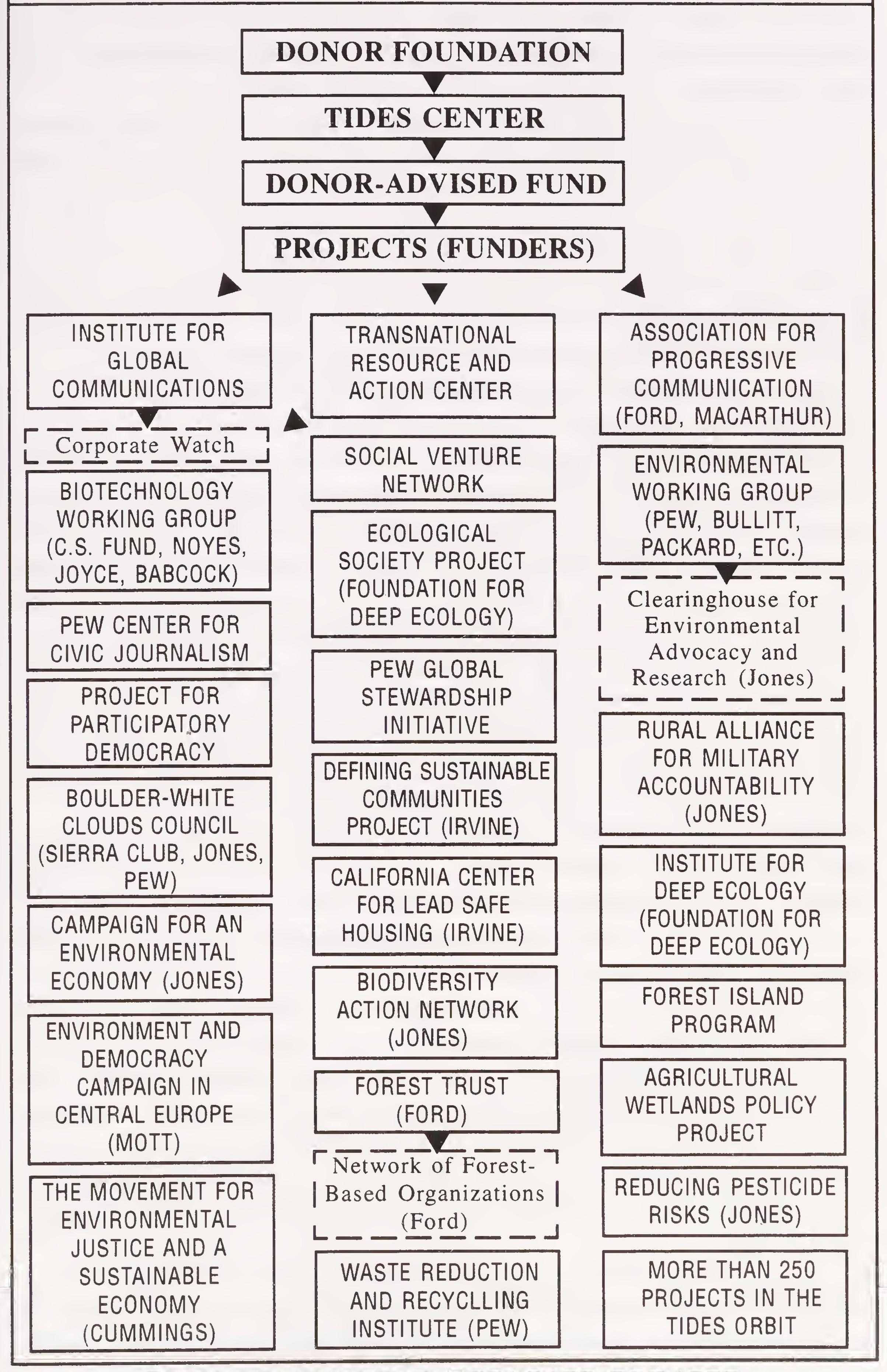
EACH SOLID BOX = SEPARATE PROJECT
Dash-line box with arrow = Project of project
Tough Act
“Philanthropic foundations are sometimes criticized for having a social agenda,” said the blonde Virginian to a University of Pennsylvania audience. “Well, you know what? They’re right!”86a
That’s RebeccaW. Rimel, unapologetic, ruthless, powerful, and noisy in public. She’s president of Pew Charitable Trusts, fifth-largest U.S. foundation in terms of assets, with more than $4.7 billion, and third in grantmaking behind Ford and W.K. Kellogg. She sees to it that Pew’s environmental grants rank only behind those of the John D. and Catherine T. MacArthur Foundation of Chicago and the Richard King Mellon Foundation of Pittsburgh.
Rimel’s generosity keeps the Tides Foundation ferocious.
And a lot of other environmentalist operations, too.
There’s just one hitch.
They do what she wants. Or else.
Sam Hitt, head of the Forest Guardians in Santa Fe, New Mexico, told High Country News in 1995, “When Pew steps in, it’s like a death star in the solar system. They set up their own gravitational field and everyone begins to revolve around them. I’ve watched activists go through this dance of making themselves look fundable to Pew by altering their priorities to meet Pew’s goals. I’ve had it with those guys.”86b
Rimel is utterly unfazed by such grassroots criticism. Under her leadership, Pew has become a dynamic force in philanthropy. She has presided over what Council on Foundations head Dorothy Ridings calls “the most radical transformation of any charitable institution.”860
Beck, as her family calls her, got to her lofty perch by pure brains, talent and guts. Less than 20 years ago, she was an emergency room nurse in Charlottesville, Virginia, from a working-class family, no elite schools, no connections with the hot-shot academic institutions that supply most executives to the Golden Donors.
Rimel came to a quiet, closeted Pew in 1983 as director of the foundation’s health program, selected by Tom Langfitt, an eminent neurosurgeon specializing in head injuries and one of the nine owners of stock in the Glenmede Trust Company, the controlling family entity of the Pew Charitable Trusts. Dr. Langfitt had first met her in 1979 at a conference and was astounded at an innovative paper she had written about brain injuries, unheard of in a person lacking a doctor’s degree, whether Ph.D. or M.D.
Langfitt made sure Rimel got grants to continue her research. When he later became dissatisfied with Pew’s health program, he invited Rimel to apply for the job, an act of faith. She got the job, learned fast and worked hard. By 1985, Rimel was Pew’s vice president in charge of health and human services, conservation and religion. When Langfitt became Pew’s president in February 1987, he purged the executive director, three of the four vice presidents (but not Rimel) and 13 of 15 program officers. Langfitt wanted to leverage Pew money like Robert Scrivner was leveraging the Rockefeller Family Fund’s money. He clearly thought Rimel could do it: in 1988, she became Pew’s executive director at age 37. A lot of insiders were angry at her rapid rise.
Urged on by Dr. Langfitt, Rebecca Rimel rebuilt Pew. She immediately hired a headhunter, former New York City deputy mayor Edward Hamilton, and told him, “I want candidates from nontraditional fields. If they have some foundation experience, OK, but they have to be real-world people.” He found her six new program directors and eleven associates.
One of those directors came on board in 1990 and grew into the hidden menace of the resource class and property owners: Joshua S. Reichert, a man of remarkable background and connections and the real reason Pew’s environmental program has been so successful. Rimel had the brains and the money and the ruthless will, but Reichert knew where the levers of power were.
Reichert holds a doctorate in social anthropology from Princeton (Laurance Rockefeller went there), with undergraduate work at the University of California at Davis. He spent time as an activist with the United Farmworkers, dealing with migrant laborers and Native American groups on farm labor conditions, bilingual education, and economic development.
He then went to the Inter-American Foundation, created by Congress as an agency of the United States, which provides assistance to grassroots organizations in Latin America. As a representative of the IAF, Reichert learned the bureaucrat trade and made many international connections that would propel him into the foundation world.
He caught the eye of the North Shore Unitarian Universalist Veatch Program, which hired him as executive director. The Veatch Program, established by a gift from congregation member Caroline Veatch in 1959, is a typical funder of “justice, equity, and compassion” projects with an extensive environmental component (1993 environmental grants, $2.1 million, 1994, $1.8 million). Barbara Dudley later served in the same job, and she went on to become head of Greenpeace in the United States. Dudley was an early participant in the Environmental Grantmakers Association.
Reichert then became executive vice president for conservation programs at Conservation International, a 1987 breakaway from The Nature Conservancy that made its own reputation “saving tropical rainforests” through debt-for-nature swaps. CI was created by Peter Seligmann, a former Nature Conservancy executive and ace fund-raiser. CI introduced Josh Reichert to everybody in Washington he didn’t already know.
After producing marine conservation films, he moved on to the National Security Archive as interim director. The Archive is an odd hybrid, “an independent non-governmental research institute and library” located at the George Washington University in Washington, D.C. Don’t let the academic setting fool you. It’s a “progressive” front: the Archive collects and publishes declassified documents acquired through the Freedom of Information Act (FOIA), but mostly those that push a left-wing policy agenda. Its website looks like an anti-war, anti-nuclear, anti-conservative bumper sticker—and it’s funded by the W. Alton Jones Foundation, which has only two purposes: environmentalism and anti-nuclear activism.
The Archive also looks like another one of those donor-advised funds: financial affairs are administered by The Fund for Peace, Inc, a New York-based tax-exempt corporation established in 1957 “to encourage research and public education on international affairs.” The Archive’s advisory board is chaired by Russell Hemenway, president of the National Committee for an Effective Congress, a “progressive” Democrat-oriented political action committee established by Eleanor Roosevelt and friends in 1948.
By the time Rimel’s headhunter came looking for him, Joshua Reichert had a Ph.D., worked as a labor activist, had been a federal bureaucrat, served as an executive in a big-time environmental group, led a foundation, and directed a left-wing outfit with connections to a left-wing political action committee. He knew a lot of important people. A lot of important people knew him, which is what matters.
He was real-world enough for Rebecca Rimel.
Then came two real-world men who had learned their trade from Donald Ross: Thomas Wathen and John Gilroy, who came to Pew Charitable Trusts in Rimel’s reconstruction.
With Rimel as their boss, Reichert, Wathen and Gilroy became the bully boys of environmental philanthropy.
Take this money. Do with it as we say. Make sure it works.
“We are very product-oriented,” Reichert told the Boston Globe. “We need to demonstrate a return on these investments ... that is measurable.”
Pew’s 1995 $590,000 investment in the Alaska Conservation Foundation and the Alaska Coastal Rainforest Initiative could be measured easily: it killed two long-term timber contracts that the U.S government had begged for in the 1950s to stabilize a seasonal fishing-only economy.
An east-coast newspaper said of the return on this investment, “In
Alaska, environmentalists credit Reichert with devising the national strategy that helped bring an end to two subsidized logging contracts in the Tongass National Forest.”89
Product-oriented.
Pew’s biggest product is unemployment for the resource class.
Reichert told eco-writer Mark Dowie, “I don’t want someone who knows the facts, or can articulate them persuasively; I want someone who wants to win and knows how.”
He got it in Tom Wathen.
He helped arrange a $450,000 Pew investment in the Southwest Forest Alliance that strategized the sawmill shutdowns in Arizona that we saw in Chapter 1 (page 17). It was Pew behind the scenes; the lawsuitwielding Southwest Center for Biological Diversity was part of the Southwest Forest Alliance. They won.
Precision Pine & Timber, Inc., closed its Snowflake, Arizona, planer mill in March 1995 because of court action that prevented harvesting timber in the Apache Sitgreaves National Forest southwest of Greer. At question was whether the Forest Service had performed a proper environmental review. The restraining order was granted by U.S. District Judge Paul Rosenblatt in a lawsuit brought by environmentalists Peter Galvin of New Mexico (interestingly enough, Galvin is another one of the Earth First !ers arrested in the site occupation of the Okanogan National Forest headquarters in 1988, mentioned on pages 25–26), the Greater Gila Biodiversity Project and the Southwest Center for Biological Diversity. In such lawsuits a bond is required to compensate the other side if a lawsuit fails. However, Judge Rosenblatt set the bond at only $1, saying the environmentalists were acting in the public interest and had limited resources.
Judge Rosenblatt had no idea who was funding his plaintiff. By 1998, some of the master strategists behind the attack on Southwest logging were sitting on a $4.7 billion endowment. (Full story begins p. 130.)
Ruthless. As the Boston Globe reported,
Inside the downtown Philadelphia offices of the nation’s fourth largest charity, Pew Charitable Trusts, Joshua Reichert plays a subtle game of kingmaker. As the man in charge of doling out the single largest block of money earmarked for environmental causes, Reichert’s ideas have a way of becoming reality.
When Reichert suggests two environmental groups should merge, they quickly meet to discuss the idea. When Reichert became frustrated that environmentalists are losing the public relations wars, Pew created a public relations firm to join the fray. If Reichert doesn’t like the way a group is being run, he withholds its money.
Most importantly, Reichert consistently pushes environmentalists to be practical, even if that means bruising egos or accepting compromises that purists detest. Along the way, Pew has reshaped the debate on issues such as logging, air pollution and energy conservation— and made some enemies, too.
“They have been bullies.... They are arrogant,” said Beth Daley, vice president of the National Center for Responsive Philanthropy in Washington, D.C., which monitors foundations.903
The New Pew.
The old Pew was quite different, the philanthropy of Sun Oil Company baron Joseph Newton Pew Jr., a Republican Party boss who detested government regulation. The Pew Charitable Trusts is actually seven individual trusts established between 1948 and 1979 by the four sons and daughters of old Joe Pew.
Until 1948, the Pew family gave away money as a matter of conscience through personal donations. They went to hospitals, schools and cultural institutions in the Philadelphia area: to Presbyterian Church activities, to conservative organizations and publications. They gave money to the John Birch Society and other anti-communist organizations. They did it by writing checks to their favorite charities without planning, processing, evaluation or follow-up. It wasn’t until 1977 that anybody managed the Pew donations at all, then Robert Smith, a bright young vice president of the oil company, did it.
Things have certainly changed since then.
Rimel’s prescriptive stance jars with the passive giving practiced by the heirs of Sun Oil founder Joseph N. Pew. Aggressive prescription accurately describes Rimel’s approach in pumping over $38.6 million in 1998 into causes that Pew himself would have loathed. She herself earned $330,470 in 1995. She sits on many boards, including the Council on Foundations, the foster parent of the Environmental Grantmakers Association.
The Philadelphia Inquirer quoted former program director Kevin Quigley as saying, “The donors would not only be rolling in their graves these days, they would be gyrating at very high speeds.” To hell with donor intent.90b
Dead hands have no power. Rebecca Rimel does.
Her power comes from the $4.7 billion endowment money in Pew investment portfolios as of 1999. The trusts made $205 million in investment income in 1993 from timber stocks such as Weyerhaeuser ($16 million) and International Paper ($4.56 million), mining stocks such as Phelps Dodge ($3.7 million), and oil stocks such as Atlantic Richfield ($6.1 million).91
Rimel’s Pew insists on working the environmental movement through coalitions. The Philadelphia Inquirer wrote that Pew “has relentlessly pushed environmental groups to work together in alliances.” Going it alone does not allow leveraging investments or finding models for replication. Characteristic Pew coalition grants include:
Community Farm Alliance, Frankfort, Kentucky. $130,000. “For the Southern Sustainable Agriculture Working Group, a 50-organization network in 13 southern states.” The “community farm movement” joins organic farmers to urban and suburban consumers who put up money in advance for a year’s worth of home-delivered groceries as produce comes in season, sharing the farmer’s risk. The Alliance also helps organic farmers organize, pushes to legalize hemp growing for fiber, and advocates elimination of pesticides and chemical fertilizers.
Greater Yellowstone Coalition, Bozeman, Montana. $600,000. “For the Northern Rockies Ecosystem Protection Campaign to protect the forested wildlands and watersheds of the Northern Rocky Mountains.” Foundationese for “anti-mining, anti-logging alliance.”
The Minnesota Project, St. Paul, Minnesota. $70,000. “To support the Campaign for Sustainable Agriculture, which includes approximately 500 farming and environmental groups from around the country working to strengthen federal agriculture policies that enable more environmentally sound practices.” Get out your foundationese dictionary, you can feel the anti-industry gremlins lurking in there everywhere.
B.C. Wild, Vancouver, British Columbia, Canada. $1,140,000. “To achieve protected status for a minimum 12 percent of British Columbia’s threatened ancient forests and other wilderness areas.” This anti-mining, anti-logging coalition includes the World Wildlife Fund Canada, Sierra Club of B.C., Canadian Parks and Wilderness Society, and Sierra Legal Defense Fund.
Opponents
Among the first major problems that arose to thwart Pew’s inexorable march to environmentalist victory was the wise use movement. This grassroots response to environmentalist destruction of the resource class and property owners was the most alarming thing that had ever happened to environmentalists.
In 1992, the Environmental Grantmakers Association addressed the problem at their annual retreat, held that year in Washington State’s San
Juan Islands at the cushy Rosario Resort. In a session titled, “The Wise Use Movement: Threats and Opportunities,” two foundation presenters told the tale.92
Debra Callahan, W. Alton Jones Foundation grassroots coordinator (she’s now head of the League of Conservation Voters) explained:
What we’re finding is that wise use is really a local movement driven by primarily local concerns and not national issues. We tend— you know, when you think of Ron Arnold and you think of Wise Use, you know—you think of command and control, top-heavy, corporate funded front groups that are organizing local people to get involved, get out there and attack environmentalists.
And that was the assumption I walked into this whole thing with. And, in fact, the more we dig into it, having put together a fifty— really constructed over a number of months—a fifty state, fairly comprehensive survey of what’s going on with respect to wise use organizing activity, we have come to the conclusion that this is pretty much generally a grass roots movement, which is a problem, because it means there’s no silver bullets.
It means this is, is, you know, something that is going to have to be confronted in states and communities across the country in different ways depending on what the various local issues are that those wise use groups are dealing with and campaigning on.
Environmentalists have never admitted this guilty knowledge in public. It is too devastating. However, Callahan said as much, reproduced here from a verbatim transcription of the taped session:
What people fundamentally believe about environmental protection is that, no it’s not just jobs, and no it’s not just environment, why can’t we have both?
The high ground here is capturing that message, ok? And in fact the wise use movement is trying to capture that message. What they’re saying out there is “we are the real environmentalists. We are the stewards of the land. We’re the farmers who have tilled the land and we know how to manage this land because we’ve done it here for generations. We’re the miners and we’re the ones who depend for our livelihood on this land. These guys live in glass towers in New York City. They’re not environmentalists, they’re elitists. They’re part of the problem, and they’re aligned with big government and they’re out of touch. So we are the real environmentalists.”
And if that’s the message that the wise use movement is able to capture, we are suddenly the equivalent of incumbents in this election year. We’re really unpopular.
It is significant that the foundations were concerned about the wise use movement as a threat to their message and popularity, not to the environment.
Foundation leaders knew they were causing massive economic damage to rural communities, as confirmed by co-presenter Judy Donald of the Washington, D.C.-based Beldon Fund:
There are, as Deb has made clear, ordinary people, grass roots organizations, who obviously feel their needs are being addressed by this movement. We have to have a strategy that also is addressing those concerns. And that cannot come from environmentalists. It can’t come just from us. That’s the—I think that’s the dilemma here. People—it’s not simply that they don’t get it, it’s that they do get it. They’re losing their jobs.
The entire conference had centered around the word “transition” with a new meaning: rural cleansing, the replacement of resource jobs with service jobs. Foundation leaders knew it was class warfare, the elite class eliminating the resource class. Barbara Dudley, then of the Veatch Program, now of Greenpeace, stated this guilty knowledge bluntly:
This is a class issue. There is no question about it. It is true that the environmental movement is, has been, an upper class, conservation, white movement. We have to face that fact. It’s true. They’re not wrong that we are rich and they are up against us. We are the enemy as long as we behave in that fashion.
Their solution: split the wise use movement apart with “wedge issues” and marginalize it with a smear campaign. This exchange between Judy Donald and Barbara Dudley illustrates:
Judy Donald (Beldon Fund): And I think if we pay for meetings where environmentalists get together to forge a strategy to counter wise use we may be going down the wrong track here. We have to be encouraging meetings where environmentalists and non-envi-ronmentalists, you know, and people who are losing their jobs talk about their real—both of their—concerns and together come up with a local solution.
And of course in the process the connections to the right wing have to be exposed, the connections to the extraction industry have to be exposed. I think we really should be thinking about all the ways in which we can bring those two communities together.
Barbara?
Barbara Dudley (Veatch Program): I just want to add that I think it’s important not to just think about what we might fund to counteract this movement, but we need to think about what we shouldn’t be funding. Because we have done a lot of funding of the family farm movement and let me tell you they are not fond of environmentalists. And deservedly so. There is a major environmental funder who is very big into sustainable agriculture whose quotation is now being spread throughout the family farm movement and it is: “I don’t give a damn if we’re left with only one farmer as long as he farms without chemicals.”
And that, I can’t tell you, from the work we’ve done with the family farm movement, how many times I have been embarrassed to be associated with environmentalists, and with environmental grantmakers and their projects. I don’t know how many of you funded the Beyond Bee/campaign, but that project has done more damage to any potential alliance between family farmers or ranchers or cattlemen and the environmental movement.
These upper class funders immediately got busy with projects designed to smear the wise use movement. Typical grants:
W. Alton Jones Foundation, Virginia, all in 1993:
Maine Audubon Society, Falmouth, Maine. $26,250. “The Grassroots Action Project, a project to promote coordination and organization efforts in the conservation community to counter anti-environmental efforts.”
Missouri Coalition for the Environment Foundation, St. Louis, Missouri. $20,000. ‘“Exposing Unwise Abuse’ in Missouri.” Grassroots organizing against environmental backlash activities in the Ozark Mountains.
Piedmont Environmental Council, Warrenton, Pennsylvania. $25,000. “Property Rights Project.”
Society for the Protection of New Hampshire Forests, Concord, New Hampshire. $26,250. “The Grassroots Action Project, a project to promote coordination and organization efforts in the conservation community to counter anti-environmental efforts.’
Vermont Natural Resources Council, Montpelier, Vermont. $26,250. “The Grassroots Action Project, a project to promote coordination and organization efforts in the conservation community to counter anti-environmental efforts.”
Western States Center, Portland, Oregon. $20,000. “To support WSC’s efforts to research, assess and oppose anti-environmental activities and to promote support for environmentally sustainable economic policies.”
Clearinghouse on Environmental Advocacy and Research, Washington, D.C. $145,000. “For the creation of a national information clearinghouse to collect and disseminate information on environmental backlash.”
Jessie Noyes Smith Foundation, New York, in 1993:
Western States Center, Portland, Oregon. $15,000. “For research, public education and coalition building addressing Wise Use movement and need for sustainable development.”
The 1997 Environmental Grantmaking Foundations Directory lists 16 foundations that specifically fund anti-Wise Use movement groups.
| FUNDERS DONATING TO WISE USE OPPONENTS | |
|
Alaska Conservation Foundation Beldon Fund Bullitt Foundation Educational Foundation of America Flintridge Foundation Foundation for Deep Ecology Maki Foundation McKenzie River Gathering Foundation The John Merck Fund |
Patagonia, Inc. The Public Welfare Foundation Rockefeller Family Fund Town Creek Foundation Universalist Unitarian Veatch Program at Shelter Rock Winslow Foundation Margaret Cullinan Wray Charitable Lead Trust |
“We must identify our enemies and drive them into oblivion.” Rural cleansing. Dismantling industrial civilization piece by piece.
Joshua Reichert has helped Pew create several environmental organizations, including a public relations firm which, according to the Philadelphia Inquirer, “played a key role in pressuring President Clinton to approve new air pollution rules” (see pages 210–215).95a
The public relations firm began very quietly in 1993 as Reichert circulated a proposal to other foundation leaders to join in funding a new venture he called “Environmental Strategies.” Its foundationese mission statement was “to assist environmental organizations to conduct public education campaigns on priority national environmental issues.”95b
What that really meant was to help environmentalists split the wise use movement with wedge issues and smear wise users as being antienvironment rather than being anti-environmentalist.
Most of the people who received Reichert’s proposal had been at the 1992 Environmental Grantmakers Association retreat and agreed with Chuck Clusen’s panel that no single Green Group had produced a fullspectrum power and pressure machine. Most agreed with Hooper Brooks that the foundations had to become prescriptive in order to force into existence the coalitions and alliances which could form that machine. The real job of the new public relations group would be to create synthetic coalitions. Reichert’s concept paper for Environmental Strategies said:
For considerable sums of money, public opinion can be molded, constituents mobilized, issues researched, and public officials button-holed, all in a symphonic arrangement. There are media spots, direct mail drops, phone banks, and old fashioned lobbying, tactics employed in specific target areas, all informed by opinion research. While business and industry has made extensive use of them, environmentalists have been slow to employ and, equally important, to coordinate these new political arts. As a result environmentalism has fallen behind in a political arms race that requires even higher levels of organized constituent involvement to influence officials and engender administrative or legislative action.96
Environmental Strategies was very quietly incorporated in Washington, D.C., on February 4, 1994. The incorporators were: Frances Beinecke, Natural Resources Defense Council; Donald K. Ross, Rockefeller Family Fund; Douglas Foy, Conservation Law Foundation; and Thomas Wathen, Pew Charitable Trusts (which gave $650,000 for startup through the Tides Foundation—another donor-advised fund).
Who are these symphonic arrangers?
If you’ve visited the Yale University campus, you know the name Beinecke seems to be everywhere, Beinceke Plaza, Beinecke Library. The NRDC’s deputy director at the time, Frances Beinecke (Yale Class of ’ 71), is the daughter of William S. Beinecke, a businessman who was the principal donor of the Beinecke Library. Frances is a trustee of the Yale Corporation, governing board of the university. She has since become the NRDC’s executive director (1998). She co-founded the New York League of Conservation Voters (NYLCV) in 1989 with Paul Elston (her husband), Robert F. Kennedy Jr. and Larry Rockefeller, a lawyer with NRDC. When she helped incorporate Environmental Strategies, she was earning $88,718 a year at NRDC, with a $10,284 benefit package, a nice frill to the family fortune. She’s rich and powerful and connected.
We know Don Ross well enough already.
But who’s Douglas Foy? Aside from being the head of the Bostonbased, foundation-nourished Conservation Law Foundation, he’s a Princeton man (Class of ’69) —the old school tie to Joshua Reichert. Foy received Princeton University’s Woodrow Wilson Award in recognition of his achievements, which were cited as an example of Wilson’s vision for “Princeton in the nation’s service.” He’s very much the strategic thinker, as he showed himself in a lecture at his alma mater, stressing “that top-down regulation by government is an abject failure and that local involvement in environmental issues is essential since it fosters credibility and teaches what community means.”97
Tom Wathen, last of the incorporators, had been an all-around Pew operative, Reichert’s front man in the field cultivating the grass roots while Josh and Rebecca Rimel traipsed here and there, perhaps to the Amazon rain forest with Joseph N. Pew’s grandson, J. Howard “Howdy” Pew II, an avid outdoorsman who visits environmental hot spots on grandpa’s money.
Environmental Strategies received a good dose of start-up money ($125,000) from the W. Alton Jones Foundation, even though Jones didn’t sign on as a named incorporator. The Pew/Rockefeller/Jones cluster pressured other foundations to fund their effort: Jessie Smith Noyes Foundation, Public Welfare Foundation, and the Florence and John Schumann Foundation, among others, joined in. Environmental Strategies started with $2 million but no leader.
By the summer of 1994, Reichert had interviewed scores of candidates for the top jobs at Environmental Strategies before finding the right team.
The original staff is indicative: it was a virtual Who’s Who of Democratic Party politics. Philip E. Clapp, executive director, was a member of the national steering committee of Environmentalists for Clinton-Gore. Mike Casey, media relations director, came directly from the Democratic Congressional Campaign Committee. Staffer Arlie Schardt served as press secretary for Al Gore’s unsuccessful presidential bid. Schardt runs his own outfit, Environmental Media Services. Hardball players all.
The media contracts were handled by Washington, D.C.-based Fenton Communications, long a favorite of the far left: During the 1980s, for example, Fenton Communications had contracts with the Christie Institute and the communist regimes of Angola and Nicaragua as a registered agent of a foreign government. Fenton Communications is best known for engineering the Alar scare that destroyed hundreds of family apple orchard businesses. David Fenton talked CBS’s “60 Minutes” into reporting as fact an unproven claim by Beinecke’s Natural Resources Defense Council that Alar, a root-applied chemical used to ripen apples, was a serious cancer risk to children. Horrified parents across the nation quit purchasing apples as a result of the report, which bankrupted whole communities of apple orchardists. In fact, the government was already phasing out Alar (which the NRDC knew) and not a single case of any disease at all was ever attributed to Alar. Shardt’s Environmental Media Services shares office space with Fenton Communications.
That original name, Environmental Strategies, was not very cuddly. Two months after incorporating, on April 3, 1994, the incorporators changed it to Environmental Information Center and went public in November. Even that wasn’t good enough, because it’s now called “the National Environmental Trust.”
From “Strategies” to “Trust” with “Information” in the middle.
The archetype of foundationese.
The PR outfit’s first task was to combat the emerging wise use movement, then to create a new grassroots movement for environmentalists who had lost their authentic supporters.
The Environmental Information Center’s original PR kit said it was “founded in November 1994 to combat environmental misinformation and help strengthen grassroots support for environmental protection.” (No mention of the Environmental Strategies incarnation.)
Then the adequately grant-driven Environmental Information Center launched a series of “Strategy Sessions” in a dozen cities across the country to get things moving. The sessions were for local environmental group leaders only, no reporters invited. The programs went like this:98
After a hosted breakfast, EIC executive director Phil Clapp opened each session with a short pep talk about the goals of the meeting, how the Endangered Species Act debate was shaping up, and comments from a trusted (and already-funded) local leader.
Then came a session called “Coalition-Building” where everyone said who they were, who they’d been working with, and how they built a winning coalition in their area of specialization.
A “Message” session produced a handout ballot for everyone to vote on which messages they found to work best with fellow activists, general public, legislators, and media.
Just before lunch came the guts of the spontaneous grassroots campaign. The schedule said, “Discussion of successful techniques including targeting, canvassing, literature drops, petitions, press conferences and stunts, direct mail, phone banking, sign-on letters, constituent visits, paid ads attacking foes and defending friends, radio and TV actualities and PSAs, talk shows, newspaper op-eds, letters to the editor; and editorial board briefings, and opposition research and debunking, opinion polls.”
In the Seattle session, organizers from the Pacific Northwest, Northern Rockies, and Alaska told attendees what they’d found did and didn’t work in their campaigns.
After lunch, David Fenton of Fenton Communications told the group about the media, its role in politics, and how to use it better.
Fenton stressed, “Educating the media so as to educate the public,” and gave examples from actual news reports. The Seattle session featured a Post-Intelligencer story he had planted on how logging kills salmon.
Fenton also emphasized “reaching different audiences on the Endangered Species Act such as religious, scientific, health, and children’s constituencies. How we avoid creating sympathy for the other side.”
John Hoyt of Pyramid Communications led a short panel discussion on what works to get on the radar screen of a member of Congress, followed by role playing on a visit to a reluctant congressman’s office, using the technique of showing news media results to members and staff for maximum payoff.
Late in the day the group split into sections to discuss goals for the next 10 weeks, then worked backwards to set priorities, assess the people and resources needed, decide who does what, and write a timetable.
They ended the day trading phone, fax and e-mail information, then retired to cocktails for an hour of “informal discussion and networking.”
At no time did anyone talk about doing anything directly on the ground in the environment.
Only a few invitees in the room had any idea of the magnitude of the campaign they had been invited into, and none knew who was paying for it.
As the EIC’s Strategy Sessions rolled across the country, environmental groups by the dozen put their hands out for large grants to “reinvigorate the grassroots,” an activity that hadn’t previously interested them. They got the money. And did what they had been taught.
Media outlets subsequently reported a large and spontaneous growth of grassroots environmentalism. Why did the media cooperate?
Public Media Center:
$300,000 from Pew Charitable Trusts. “To design, coordinate and place series of issue and information bulletins in major newspapers to inform and educate policy makers, opinion leaders and American public about global stewardship issues.”
Foundation for American Communications:
$75,000 from W. Alton Jones Foundation. “To train journalists to cover environmental issues in the context of major current events, and to put these issues into a local perspective.”
Center for Investigative Reporting:
$100,000 from W. Alton Jones Foundation. “For reporting on current dynamics of national environmental organizing efforts.”
$105,000 from Florence and John Schumann Foundation. “For research on environmental conflicts in the West.”
Center for Media in the Public Interest:
$25,000 from Florence and John Schumann Foundation. “To train activists to effectively use advocacy media.”
Society of Environmental Journalists:
$50,000 from W. Alton Jones Foundation. “To improve the quality and visibility of responsible reporting on key environmental policy issues.”
World Media Foundation:
$250,000 from W. Alton Jones Foundation. “For a weekly environmental news and information program, LIVING ON EARTH.”
Environmental Media Association:
$25,000 from Heinz Family Foundation. “Toward creating public service announcements (PSAs) on the environment.”
Cartoonists & Writers Syndicate:
$100,000 from W. Alton Jones Foundation. “Ecotoons: A project to syndicate and publish collections of political cartoons with environmental themes.”
And so forth.
Oh, God!
Probably the most enchanting move of the Pew/Rockefeller/Jones cluster of foundations was the creation of the Evangelical Environmental Network. If you enjoy religion a la mode, you’ll love this. The Evangelical Environmental Network (EEN) launched a multi-million dollar public relations campaign in January 1996 to convince the American people that the Endangered Species Act is the “Noah’s Ark of our day.”
The builders of that ark, Congress, were mostly Republicans in 1996, and they were considering the addition of property rights language to the Endangered Species Act, which meant that the government would have to pay when environmental regulations deprived property owners of the use of their property. The prospect of actually paying for what they took from property owners horrified environmentalists, who realized it would bankrupt the United States Treasury instead of the United States citizenry.
They had to get the message out that Congress wanted “to gut the Endangered Species Act.”
They had to recruit the biggest voice around.
God.
Fenton Communications was as close as they could get.
According to the Washington Post, “The Environmental Information Center, a Washington-based organization funded by the Pew Charitable Trusts and other foundations, is underwriting the cost of ad production” for the EEN’s Endangered Species Act campaign. Fenton did the rest.l0la
EEN touted itself as a “mainstream coalition of evangelicals concerned about the environment.”
The mainstream of what was not clear.
One of EEN’s key leaders was Ron Sider, professor of theology at Eastern Baptist Seminary in Wynnewood, Pennsylvania, and president of Evangelicals for Social Action, which founded the network. Sider is one of the leaders of “Call to Renewal,” a religious coalition established to counter the Christian Coalition. Sider had also been an outspoken critic of the GOP’s “Contract with America,” telling Christianity Today magazine... (Oh, yes, this might explain why the magazine took note:)
(Pew Charitable Trusts: $135,000 to Christianity Today, Carol Stream, Illinois. “To convene forum on population and consumption issues among leading evangelical theologians and analysts and to produce special issue of Christianity Today on global stewardship.”)
...that the GOP plans to “slash $380 billion from programs for the poor” while giving “$245 billion in tax cuts to the rich and middle class”— a statement virtually indistinguishable from the White House line.
Which shouldn’t be too surprising, since the Clinton administration was part of the project all along. Interior Secretary Bruce Babbitt for some reason had started giving speeches about his religious beliefs, about how he had been born a Catholic, left the Church, learned Hopi religious beliefs one summer, and “came to believe, deeply and irrevocably, that the land and all the plants and animals in the natural world are together a direct reflection of divinity, that creation is a plan of God.”
Washington Post columnist Coleman McCarthy quoted Babbitt, and called it “a deeper, richer Catholicism.”
“In late January, 1996,” wrote McCarthy, Babbitt “invited to his office ten religious leaders who have been similarly awakened. They came to tell the secretary, and the country, about their group, the Evangelical Environmental Network.”101b
Babbitt acted appropriately surprised.
The Evangelical Environmental Network was co-founded by Calvin DeWitt, president of the Christian Environmental Council and professor of environmental studies at the University of Wisconsin — Madison. In a January 31, 1996, EEN press release, DeWitt said: “People in their arrogance are destroying God’s creation, yet Congress and special interests are trying to sink the Noah’s Ark of our day—the Endangered Species Act. Few legislative issues ought to be as clear for Christians as this one. The Christian faith teaches respect for the works of God.”102
Who says religion and politics don’t mix?
Not to mention a little hypocrisy about special interests.
There is no chart representing the linkages in this Evangelical Environmental Network-Environmental Information Center-Fenton Commu-nications-Pew Charitable Trusts-Rockefeller Family Fund-Natural Resources Defense Council-Environmental Law Foundation-Democratic Party-Christian Environmental Council-Bruce Babbitt-Department of the Interior-Al Gore-Evangelicals for Social Action-Washington Post-Christianity Today-And Who Knows What Else melange because once you got below the top few boxes it would just be an inky blob of lines.
And besides, it would be unseemly to have the top box labeled “GOD.”
Tom Wathen left Pew in 1997 to become executive vice president of EIC, renamed “National Environmental Trust,” and executive director Phil Clapp moved up to President. All the power players were in place.
The Wrath of Pew
One of the first coalitions to emerge from EIC’s Strategy Sessions was the Endangered Species Coalition, an array of 230 large and small national, regional and local environmental groups. In 1993, Pew gave $300,000 to the National Audubon Society as fiscal agent for the coalition. W. Alton Jones Foundation gave $50,000. Audubon housed and paid the staff.
It didn’t do a great job. Especially after the Republicans won Congress in 1994.
So the coalition hired former Indiana Democrat Congressman Jim Jontz in January 1995 to pull together some kind of winning campaign. He had a staff of seven and reported to a 12-member steering committee. Jontz’s campaign was based on daily communication between staff in D.C. and activists around the country who used the information to put pressure on their congressional delegates.
Yes, that’s lobbying, and yes, foundations can contribute money to non-profits that lobby as long as they follow specific rules.
Pew donated $75,000 to the coalition in March 1995, and promised to match that amount in November. Josh Reichert and Tom Wathen tried unsuccessfully to get other foundations to join Pew in continuing support for the flagging coalition.
Tom Wathen encouraged Jontz to submit a proposal adding a capital-intensive media campaign to his grassroots strategy. Wathen also suggested hiring the Environmental Information Center to direct the whole campaign.
Jontz was not happy with that, but tried to work with Phil Clapp to design a media and grassroots campaign with a $600,000 budget, and nearly $400,000 more in “maybe-money” from other foundations. Million bucks. Jontz and Clapp couldn’t get along. The coalition steering committee voted in August to keep Jontz instead of hiring Clapp.
Wathen was annoyed. Reichert was annoyed. Pew pulled its $600,000 and the whole million disappeared.
Carl Pope, executive director of the Sierra Club, a member of the coalition, made a lot of calls to fix things up.
It didn’t work. The next week, the steering committee changed its mind and put Clapp in charge. Within another week, Audubon unilaterally fired Jontz and the entire coalition staff of seven. High Country News reported, “Neither the steering committee nor any of the 230 groups they represented knew the firings were coming. According to Liz Raisbeck, director of government affairs for National Audubon in Washington, D.C., Audubon was in a financial crunch and could no longer fund the coalition.”103
Sure.
W. Alton Jones Foundation
W. Alton “Pete” Jones’s foundation didn’t start out in 1944 the way it is now. Pete Jones was a hardheaded, straight-talking pioneer oilman. Born in 1891, he went from childhood on a bleak Missouri farmstead to head the Cities Service Company and own an estate in New York.
On January 3, 1962, Jones was killed in the crash of an airliner taking off from Idylwild airport. He left most of his money to his New Yorkbased foundation “to promote the well-being and general good of mankind throughout the world.” Too bad he wasn’t a little more specific.
For much of its early history, under the direction of Jones’s widow, the foundation gave primarily to museums, artists, and playwrights. In 1982 Occidental Petroleum bought out Cities Service Company and sent the value of the foundation’s 1,774,621 shares through the roof. Suddenly it was one of the 100 richest charities in the United States.
Widow Nettie Marie Jones hired Charles H. W. Foster, former dean of the Yale School of Forestry, as director of the foundation, which moved to Charlottesville, Virginia in 1980. They still gave money for cultural programs, but took the pulse of the times and began concentrating on their “Secure Society Program” and “Sustainable Society Program” initiatives (“Society” has since been changed to “World”).
When Nettie Marie Jones died in 1991, the second and third generations took over. Daughter Patricia Jane (Jones) Edgerton became president. Her husband, Milton Thomas Edgerton, is not a trustee, but their son, Dr. Bradford Wheatly Edgerton (a Los Angeles plastic surgeon), became Vice President and Trustee, and architect daughter Diane Edgerton Miller became Secretary (now Vice President). Bernard F. Curry, an older generation holdover (born 1918) and former bank vice president with Morgan Guaranty Trust, became Treasurer (now a trustee only).
The five remaining trustees included James S. Bennett, a CBS and Walt Disney television producer; William A. McDonough, a noted architect (he resigned, but we’ll meet him again in a few pages); James R. Cameron; Scott McVay (executive director of the Geraldine R. Dodge Foundation); and another third generation son, William A. Edgerton, a Charlottesville architect who designed a residential community featured in the U.S. Department of Energy’s website, “Center of Excellence for Sustainable Development” (he’s now the Foundation’s Treasurer).
On February 1, 1990, 40-year-old zoologist John Peterson “Pete” Myers was hired as director at a salary of $149,776, with $29,833 in benefits. Myers had been senior vice president for science and sanctuaries of the National Audubon Society in New York, and brought with him all of Audubon’s connections. Myers remained on Audubon’s board of directors for years, one of many interlocking directorates that will unfold.
Shortly after he took the Jones job, Myers, who got his Ph.D. in zoology at the University of California at Berkeley, told the Richmond News Leader, “There’s a shift taking place in the foundation. We’re figuring out what needs to be done and then trying to find an organization to do it. There’s also a shift toward thematically grouped grants based on issues and toward larger, longer-term grants.”104
Myers took Jones from responsive to prescriptive.
When Myers arrived, the Jones foundation had an endowment of $200 million, the 75th largest in America. At the end of 1998 its investments had grown to $413,750,908—modest only by comparison to the billions of Pew or the Ford Foundation. What Jones lacks in size it more than makes up for in focus, spending all $32 million of its 1998 grants on its twin obsessions, anti-nuclear activism and environmental activism. The money for cultural programs has virtually disappeared.
Jones has, in the past few years, emphasized book publication, supporting authors, publishers like Island Press, and promotional tours— virtually a self-publishing venture getting messages out to justify its approaches to dismantling industrial civilization.
Island Press, a division of the Center for Resource Economics (1996 assets $2,716,223), is environmentalism’s premiere publishing house, funded since 1984 by MacArthur, Geraldine Rockefeller Dodge, Charles Inglehard, Richard King Mellon, Burlington Northern and others.
Island Press’s 1997 book Nature’s Services: Societal Dependence on Natural Ecosystems made a no-brainer point: “Free of charge, natural ecosystems provide a multitude of valuable services for people and the human economy.” Gee, we didn’t know that. Pew’s Joshua Reichert wrote the introduction, so maybe his fellow Ph.D.s were just talking down to us.
In fact, Pew was behind the whole effort, which began after dinner one night at an Arizona meeting of the Pew Fellows in Conservation and the Environment. One brilliant soul, Gretchen Daily, a Stanford University professor of biological science, noted to her fellow Fellows that the failure to price natural events was a major hindrance to the formulation and implementation of policy. These policy-minded scientists needed a book on what every farmer knows: nature does stuff free that keeps us all alive. If they could put a price on that stuff, they could blame humans for hurting it in dollars and cents and drive policy against industrial civilization.
A number of Pew-supported scholars agreed to help write Nature’s Services, and the first draft was presented at the next Pew Fellows annual meeting, in Purity Springs, New Hampshire, and refined into the product that got to the bookstores. It was paid for by the Packard Foundation, Pew Charitable Trusts, and W. Alton Jones Foundation. Daily was supported during the development of the book by the Winslow and Heinz foundations and by Peter and Helen Bing. Peter Bing, a wealthy Los Angeles M.D., is also a Stanford University trustee. The Bings have funded much of Daily’s work.
Blurbs for Nature’s Services say about the authors: “Their findings clearly demonstrate that these services—providing clean water, pollination, pest control, climate regulation, flood control, and fisheries, to mention only a few—are not only invaluable, they are irreplaceable. While insufficient information was available to calculate the economic value of all—or even most—ecosystem services, those which could be quantified measured, at a minimum, many trillions of dollars annually.”105
Unlike most economists, this team only tallied the assets column and didn’t subtract the liabilities to make a balance sheet. Evidently nature’s disservices such as disease, food poisons, pests, earthquakes, volcanoes, floods, and severe weather don’t count. Or, more likely, they blame it on human activity to further justify dismantling industrial civilization.
W. Alton Jones’s most tasteless book effort to date was a self-serving platform for Pete Myers, a diatribe against man-made chemicals, bought and paid for by the Jones foundation and titled, Our Stolen Future: Are We Threatening Our Fertility, Intelligence, and Survival?—A Scientific Detective Story. It removed all doubt whether the foundation was promoting a little propaganda now and then.1063
In March 1996, foundation director John Peterson Myers joined with grandmotherly Theo Colborn (ensconced as a senior fellow at the foundation) and crusading Boston Globe journalist Dianne Dumanoski to write this disaster-of-the-month epic. As critic Ron Bailey noted in Philanthropy, “The book was underwritten by the foundation from conception to its splashy national promotion. Its conclusion, in brief, is that ‘some manmade chemicals interfere with the body’s own hormones.”’106b
Nobody asked why Vice President Al Gore wrote the book’s foreword. They didn’t need to. Gore is part of their network. More about that later. Gore wrote that studies have linked synthetic chemicals to a whole parade of horribles, including “low sperm counts, infertility, genital deformities, hormonally triggered human cancers such as those of the breast and prostate gland; neurological disorders in children, such as hyperactivity and deficits in attention; and developmental and reproductive problems in wildlife.”
To promote the book, Jones funded Environmental Media Services (EMS), a PR firm headed by former Gore staffer Arlie Schardt, who we met briefly back on page 97. Before founding Environmental Media Services in 1993, Schardt served as national press secretary for Al Gore’s 1987–88 presidential campaign, executive director of the Environmental Defense Fund, and covered politics and the civil rights movement for 8 years at Time magazine. He was also the news media editor at Newsweek, a writer at Sports Illustrated, associate director of the ACLU and editor of Foundation News magazine at the Council on Foundations. Notice how the Council on Foundations seems to be lurking in the background everywhere we go.
Schardt is currently chair of the Center for Citizen Initiatives (formerly the Center for US-USSR Initiatives), which operates environmental, urban agriculture and small business development programs in the former USSR.
And, oh, yes, Environmental Media Services is a Project of the Tides Center. What a surprise.
Shardt’s EMS rolled out a major PR campaign that included a national book tour, an appearance on NBC’s Today show by Theo Colborn, and multiple press conferences at the National Press Club in Washington. It was praised by everybody except a New York Times writer named Gina Kolata, who had the temerity to question the validity of the claims made in this mighty book. The Environmental Information Center bought a quarter-page ad on the Times’s own editorial page to rip her a new bodily orifice. No dissent allowed. If you’re rich enough.
Turns out Kolata was right.
As Ron Bailey wrote,
Are these synthetic chemicals really causing hormonal harm?
Many prominent scientists don’t think so. “Implausible,” asserted the director of the University of California Berkeley’s National Institute of Environmental Health, Dr. Bruce Ames, in testimony before the U.S. Senate last year.
John Giesy, Professor of Toxicology at Michigan State University and past president of the Society of Environmental Toxicology and Chemistry says, “Frankly, Colborn doesn’t know very much. She reads the entire literature and picks and chooses things that support her preconceived views.”
Stephen Safe, a professor at Texas A&M University and a noted expert on environmental estrogens agrees: “If you look at the book carefully, it’s a very unscientific presentation.”107
Skepticism by the scientific community wasn’t the worst the book got. The W. Alton Jones Foundation was about to get its foot caught in its own wringer: the urge to leverage one program with another backfired.
The Jones foundation funded researcher John MacLachlan at the Xavier/Tulane Center for Bioenvironmental Research in New Orleans. MacLachlan claimed to have discovered that very weak estrogen “mimics” such as toxaphene, endosulfan, and dieldrin became massively potent when combined. Combined manmade estrogens are synergistic! The prestigious scientific journal Science published MacLachlan’s results in June, 1996, adding both an editorial and a popular report. Sensation!
Synthetic endocrine disrupters in combination hit the headlines. Myers was ecstatic. In an October 1996 speech to regional EPA pesticide inspectors, he said that MacLachlan’s paper had a significant policy impact: “I believe that we are entering into a new era of scientific awareness about the health risks of pesticide use. And this new understanding has already led to a dramatic shift in the underpinnings of national food safety laws, most obviously the 1996 Food Safety Act.”
Lynn Goldman, Assistant Administrator of the Environmental Protection Agency, bought it. You could just see her dreaming up all the new regulations.
But MacLachlan’s findings couldn’t be replicated, either by him or by other scientists. Every attempt to confirm synergism in synthetic estrogens came up empty. EPA’s Goldman made excuses for MacLachlan, suggesting that the yeast cell line that they used to do the assay had been lost, or something.
After months of stalling, MacLachlan had to publish a complete retraction in Science. The editorial staff couldn’t recall such a clearcut withdrawal.
Jones pretends nothing happened.
When you’re that rich, the facts don’t matter.
When you’re that engrossed in messages, what do you need the real world for?
Jones is headquartered in downtown Charlottesville on High Street. The social tone of this smug Southern town is set by the ultrarich. As Outside magazine wrote of it, “You might get the idea that Charlottesville is the personal fiefdom of movie stars, billionaire polo players, and UVa’s 18,011 college snots.”108a
You can bump into Sissy Spacek or Jessica Lange at the grocery store or espresso stand. But probably not the Edgertons at their Timber Creek Farm. The job opportunities are limited if you’re a newcomer, giving rise to a class of modem gypsies with a money umbilical to Washington, D.C., 110 miles north. The ambience nourishes the Jones foundation’s belief that it knows how to run your life better than you do.
The Ketchup Mafia and Friends
Mozambique-born Teresa Heinz (Teresa is pronounced “tah-RAY-zah”) is a leading stockholder in the $10 billion H.J. Heinz Company, vice chairman of the 300,000-member Environmental Defense Fund, and as chairman of the Howard Heinz Endowment in Pittsburgh, Pennsylvania, gave out $8.2 million in environmental group grants in 1996. She funneled $447,923 to EDF in 1993 through her personal charity, the Heinz Family Foundation and donated $750,000 in 1997 from the Heinz Endowments.
Teresa Heinz, no longer the Audrey-Hepburnesque beauty of the ’60s but still attractive as she enters her ’60s (said one newspaper), has been deeply involved in environmental causes for decades. Very dedicated. Her Heinz Family Foundation’s reports state the following: “Contributes only to pre-selected organizations; unsolicited applications not considered.” Absolutely prescriptive.108b
Wren Winslow Wirth is the wife of Timothy E. Wirth, former Senator from Colorado, former Clinton administration State Department environmental official, now president of Ted Turner’s United Nations Fund. He’s the small potatoes of the family. Wren is president of the Winslow Foundation, assets $20,077,168 in 1996, annual grants a little under a million dollars a year, almost all to environmental groups.
Wren sat on the board of directors of the Environmental Defense Fund from 1983 to 1998, recruited by her close friend (since 1970) Teresa Heinz. Teresa is also treasurer of Wren’s Winslow Foundation. The Winslow Foundation’s reports say, “Grants are made to pre-selected organizations only.” Absolutely prescriptive.1093
Francis W. Hatch is chairman of the Boston-based pharmaceuticalrich John Merck Fund, a former Republican candidate for governor of Massachusetts, and son-in-law of Serena Merck. He is the top funder of New England environmentalists, $1.4 million in 1993, $1.3 million in ’94, $1.4 million in 1995, and similar grants thereafter. The John Merck Fund’s reports state the following: “The Fund generally supports preselected organizations. It discourages the submission of unsolicited applications.” Aggressively to absolutely prescriptive.10913
Socialite Teresa Heinz embodies the power and connections in the intricately networked foundation world. She virtually symbolizes the interlocking nature of environmental funders. “It is an extraordinarily incestuous world out there,” said Robert Schaeffer, a Boston-based consultant who represents several groups that are heavily funded by foundations.1090
The Heinz Endowments, which are really two entities— the Howard Heinz Endowment, established in 1941, and the Vira I. Heinz Endowment, established in 1986—give large grants to people Teresa Heinz knows personally, such as environmentalist architect William McDonough, a family friend who once employed Heinz’s son.
McDonough was also a trustee of the W. Alton Jones Foundation for years. McDonough also designed the new headquarters for the Environmental Defense Fund in 1985—and was still one of the five highest paid professional service providers in 1991 at $91,913. He also designed the corporate campus for Gap, Inc. (Gap’s Donald and Doris Fisher give over $2 million a year to environmental groups through their Gap Foundation). He also designed the headquarters of the Heinz Family Offices in 1994. A 1997 Heinz Endowments grant for $50,000 went to the University of Virginia to support the Institute of Sustainable Design and to launch the Center for Sustainable Design and Civic Leadership, McDonough creations.
William McDonough is a Yale graduate and practicing architect, founder of William McDonough & Partners Architects and Planners, which moved from New York in 1994 to Charlottesville, Virginia. He moved because he was appointed Dean of the University of Virginia School of Architecture, and resigned as a W. Alton Jones Foundation trustee.
In 1996 the “Green Dean” won the first Presidential Award for Sustainable Development, the nation’s highest environmental award, from President Bill Clinton. How did his name get to the Clinton administration? Teresa’s chum Wren’s husband Tim’s chum Al Gore, maybe?
Extraordinarily incestuous.
McDonough has served as advisor to Businesses for Social Responsibility and the Social Venture Network, both projects of the Tides Center.
Extraordinarily incestuous.
Heinz herself is quite a veteran: in 1989, she helped stop a highway through the Amazon jungle, and in 1984 she and husband Senator John Heinz created a foundation that paid for causes such as a guide to socially responsible grocery shopping and a public relations firm that recruits Hollywood stars to support environmental efforts.
Following the 1991 death of Sen. Heinz in a freak helicopter-plane crash, Teresa Heinz turned the two endowments into aggressive supporters of the environment, mainly in Pennsylvania. In 1993, she made one of the biggest environmental gifts ever, $20 million for the H. John Heinz Center for Science, Economics and the Environment, a think-tank / research center. The idea was to bring environmental groups, industry, academia and government together to cope with environmental problems. If the track record of such mediatory efforts is any indication, industry will compromise away its ability to do business, piece by piece, year by year.
Teresa Heinz is now the wife of Sen. John Kerry.
She speaks foundationese fluently: The Boston Globe wrote in 1997, “If existing environmental groups can’t do the job, foundations may set up new ones. This year, officials at the Heinz Endowments of Pittsburgh set up a $700,000 organization to scrutinize deregulation of the electric industry, complete with a ‘grassroots’ co-ordinator to whip up support among groups such as the elderly and organized labor.”110
This is what the grant description in Heinz reports said: “Greater Harrisburg Foundation: $700,000 for support of the Pennsylvania Energy Project, Sustainable Systems Research and the Millennium Project, among others, in order to ensure a sustainable energy future for Pennsylvania.”
No mention of deregulation. No mention of astroturf installation.
SMALL SAMPLE OF MASSIVELY INTERLOCKED ENVIRONMENTAL FUNDING LINKAGES.
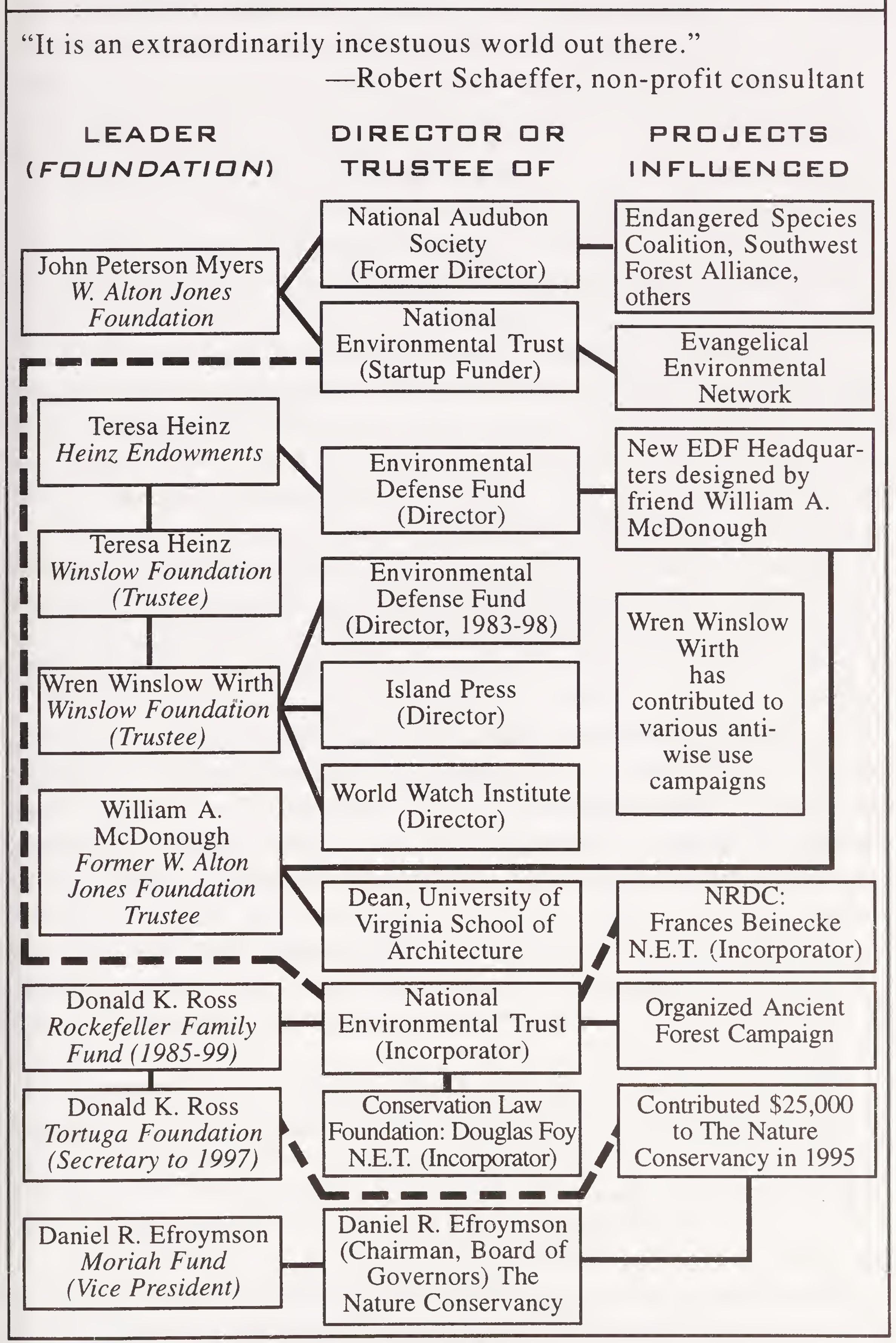
Among the less visible Heinz grants that will one day haunt us is the 1996 $90,000 grant to Redefining Progress, a San Francisco non-profit, for a tax shift program to stop economic growth in favor of quality of life, a foundationese concept if ever there was one. Let them eat quality.
You can read the latest grants for yourself at http://www.heinz.org.
The Winslow Foundation’s grants tend to follow the lead of the inner circle of the Environmental Grantmakers Association. Nothing very innovative, but deadly. Wren Wirth authorized $25,000 to the Alaska Conservation Foundation for “General support to groups working to protect Alaska’s bioregional ecosystems,” foundationese for shutting down the last pulp mill remaining in Alaska by choking off Ketchikan Pulp’s timber supply.
Another Winslow $25,000 grant went to the Appalachian Mountain Club in Boston, “To aid in the coordination of a three-year New England regional response to the Property Rights/Me Firsters Movement (otherwise known as the Wise Use movement).” That bit of vilification was actually written by Winslow officials in their grant description.
“We are rich and they are up against us.”
Francis W. Hatch is the reason why environmentalists in the Northern Forest Alliance are buying up chunks of Maine and trying to peddle them to the government instead of just pushing for nationalization in the form of gigantic new national parks, as originally envisioned (see pages 35–43).
Seeing the impact the wise use movement was having in rallying support for private property and the resource class, Hatch realized that the only way to achieve the goal was to stop the visible, controversial, confrontational tactics in favor of a gradual, incremental, forest-enveloping campaign spoken in foundationese—and a smear campaign against wise users.
As the Boston Globe said of Hatch, he “pressed environmental groups to gain clout by mobilizing grassroots support and not to underestimate the anti-environment ‘wise use’ movement, helping to make New England groups stronger than those elsewhere.”112
Some groups, such as Restore: the North Woods, run by former Wilderness Society staffer Michael Kellett, didn’t like the idea of wimping out, and didn’t stay in the Northern Forest Alliance orbit. Kellett’s anticorporate ideology blinded him to the fact that the final result would be the same: private parties would no longer own the majority of New England, the government would.
Most environmental group leaders saw Hatch’s point. They took his money and did what he said. Other foundations pushed them, too.
In addition to the anti-wise use astroturf “Grassroots Action Project” grants noted on pages 39 and 40, the John Merck Fund gave in 1995:
Conservation Fund, $60,000. “For two demonstrations of sustainable forestry and economic development of lands in northern New England.”
Environmental Information Center, $60,000. “Two grants to support public education and media activities.”
Natural Resources Council of Maine, $40,000. “To increase member involvement in environmental debates, and to build media coverage and public awareness of environmental issues.”
The Tides Center, Environmental Media Services, $25,000. “For coverage of critical environmental issues.”
Hatch spent a total of $704,500 in New England in 1995.
The Merck Family Fund, run by Francis W. Hatch III, spent $226,000 in New England in 1994.
Geeks With Sucks
Paul Brainerd is the epitome of the Microsoft Millionaire, even though he didn’t come out of Microsoft. He started his millions not in the proverbial garage, but in a studio apartment below Seattle’s Pike Place Market by creating PageMaker, software that turns a desktop computer into a miniature publishing house.
That was the beginning of Aldus Corporation, a pioneer of desktop publishing. Brainerd made about $120 million when he sold Aldus to Adobe Systems for $525 million in 1994. He took a year off in Alaska “to clear my head,” and then turned from a computer magnate into a philanthropist and environmental activist. He used the proceeds from the deal to endow the $50 million Brainerd Foundation. Since then, the foundation has awarded about $6 million in grants to environmentalist group projects across the Northwest and Alaska.
Brainerd emphasizes his lifelong love of the outdoors, and his childhood in an Oregon timber town, with visits to his parents’ summer cabin and long nature walks.
Brainerd’s brand of prescriptive intrusion, like many other funders, has crossed international borders to impose his will on other nations. His funding has helped turn 11 million acres into non-resource areas in British Columbia, Canada, and, most recently, prompted a two-year moratorium on mining along Montana’s Rocky Mountain Front.
Dozens of other rich Northwest nerds who have checked out of the computer world are beginning to think about what to do with their money, and Brainerd has made himself a model for them to follow.
“Certainly the potential is here in terms of wealth and brainpower,” Brainerd told the Seattle Times. “The question is whether it can be harnessed and organized.”114
Get in the harness, rich guys. Brainerd wants to take you for a ride.
Brainerd started a non-profit organization called Social Venture Partners in 1997 to inspire Microsoft Millionaires to give away their money and teach them how to do it with a strategy similar to venture capitalists, applying those principles in making its grants. Social Venture Partners’s first round of grants totaled $300,000. Brainerd tells his peers about the quasi-erotic gratification of philanthropy (“It feels good”) and is quoted by nearly every national publication that writes on the phenomenon of high-tech giving.
When he discovered that non-profit environmental groups often owned outdated computer technology, Brainerd partnered with the Bullitt Foundation to start ONE/Northwest. The organization has helped set up Web sites for environmental organizations and established more than 200 e-mail discussion lists, connecting activists around specific causes. It has also built an online database of more than 1,200 conservation organizations.
Brainerd is fiercely political. In a 1998 Seattle Times analysis, Brainerd ranked No. 25 of the state’s top 50 political patrons of the 1990s, contributing nearly $130,000 from 1992 through 1996 to political candidates that environmental groups ranked as friends. He has also started a political-action committee called Conservation Strategies.
Intelligent. Thorough. Pitiless.
Brainerd occasionally hosts conclaves with environmentalists in his penthouse condominium above the Pike Place Market, where they can gaze at his art collection and admire the city’s skyscrapers through the floor-to-ceiling windows while plotting strategy about how to eradicate the hydroelectric industry by removing dams in the name of saving salmon or how to take more land away from the resource class.
Lord Turner and Lady Jane
“How to become the biggest landowner in America and give money to radical environmental groups” could be the theme of Ted Turner and his Turner Foundation.
Ted Turner gives new meaning to the trite phrase, “mixed bag.” His is one of the most astounding free enterprise success stories in history, with his self-made broadcast empire of CNN and his megabuck deal with Time-Warner. He has cut one of the most dashing figures in modern times with his outstanding sportsmanship, his colorful foot-in-mouth problems that earned him the monicker, Mouth from The South, and his bizarre marriage to anti-business activist, tycoon, and former actress, Jane Fonda. Although he has no college degree, he is widely read, particularly in history and the Bible. And he has given money to more radical environmental groups than just about anyone else in the foundation community.1153
Turner’s is also the only major foundation I have tracked that has never given grants with strings attached—at least strings that I could detect.
In fact, one of Turner’s grantees, New Mexico’s Forest Guardians, sued the Forest Service over some bison that were ruled to belong to Ted Turner but the environmental group felt should belong to the government. The bison were part of a land deal between the federal government and Pennzoil Corp, nearly 20 years ago and were never formally transferred to the U.S. Forest Service. So when Turner bought Vermejo Park Ranch from Pennzoil in 1996 the Forest Service determined that the bison remained with the ranch. Forest Guardians wanted them back in the possession of the government and sued because they felt the Forest Service didn’t fight hard enough.115b
It was quite a stink. Forest Guardians obviously felt no strings.
Turner has faithfully given Forest Guardians annual donations in substantial ($25,000 and $30,000) amounts.
It’s hard to imagine a more “no strings attached” situation.
Turner Foundation is also run the least formally.
Founded in 1990, the Turner Foundation has only family trustees: Ted Turner (his full name is Robert Edward Turner III) and Jane Fonda (whom Turner married in 1991), plus Turner’s five children: Jennie Turner Garlington, Laura Turner Seydel, Beau Turner, Rhett Turner, and Teddy Turner.115c
Executive Director Peter Bahouth was hired by Turner from Greenpeace USA at $43,750 a year (by 1997 it had crept up to $124,000).
The Turner Foundation makes all its money from dividends and sale of stock. It gives money to 450 to 500 grantees a year. Some goes to mainstreamers such as the National Audubon Society, but a large amount goes to radical outfits run by former Earth First!ers or—as the Boston Globe wrote—“Turner gives to upstart grassroots groups, such as antilogging radical Tim Hermach.”115d
Hermach is one of a small group of radicals who refused to accept money from the Rockefeller Family Fund-W. Alton Jones-Pew Charitable Trusts bunch because they were unwilling to dance on the end of big money strings. Turner enjoys giving money to the most radical of causes, which means he need attach no strings to get the performance he wants.
In selecting grantees, each Turner Foundation trustee is expected to have an understanding of the more than 4,700 applications received each year. Audubon magazine reported how the grant approval meetings actually proceed:
“That’s an amazing thing to watch,” says executive director Bahouth. “The family members go through four huge ring binders of proposals. And they’re as familiar with requests for $2,000 or $10,000 projects as they are with $200,000 proposals. Sometimes they’ll argue for the former over the latter. And after being engaged in the issues brought to them by 4,700 proposals, they’ve got a very good idea of what’s going on out there.” (The National Audubon Society received more than $110,000 in grants from the foundation for 1998.)
The energetic debates over how the Turner Foundation bestows its money can be a source of family squabbles-—especially when funding votes go against the wishes of its paterfamilias.
“I don’t think Dad enjoys getting voted down on pet projects,” says a grinning Beau Turner. “But he accepts it when it happens. And he knows, from the way we’ve voted, that we’re involved in the issues. We’re acting democratically as a family, considering choices for some pretty serious projects wisely.”1163
Unfortunately for the resource class, some of those pretty serious projects are not very wise where people are concerned. Turner money has tipped the balance in many projects that put loggers, miners, ranchers and farmers into ruin.
Ted doesn’t mind.
He’s rich and he doesn’t like loggers, miners, ranchers and farmers. He has a hobby to keep his mind off those he hurts.
He collects land.
Ted Turner is currently the Number One private landowner in the United States, running a teeter-totter contest with Number Two, timber baron A. A. “Red” Emmerson of California’s Sierra Pacific Industries, who is making land deals that will propel him to the Number One spot—for a while.
In Montana, Nebraska, New Mexico, Colorado, Georgia, Florida, South Carolina, and Argentina, Ted owns 1.35 million acres, more land than The Nature Conservancy, which owns or has conservation easements on 1.17 million acres in this country.1166
What does he do with this land?
He plays God.
Well, God with a cash register. A true neofeudal lord.
He restores nature. He’s pulled out fences, forbidden pesticides, reintroduced native predators such as falcons and wolves, sold off the traditional ranch livestock—mostly cattle and domesticated sheep—that came with the property, replacing it with native bison and desert bighorn sheep. Fired most of the cowhands.1173
Turner says it’s to restore the land to its pristine condition so people can come see it in the future and know what the wild west was really like.
But they’d better bring plenty of cash if they want to look.
Visitors who want to see what the wild west was really like will have to pay some wild prices. On Turner’s ranches, there is elk hunting for nearly $10,000 a week during the season. Streams are open to fishing— for a price.
The ranch’s lodge can accommodate up to 75 guests. Not free. Not cheap.
When Turner bought the 578,000-acre Vermejo Park Ranch in New Mexico for just under $80 million it made him owner of nearly 1.5 percent of the state. He already owned two other ranches in New Mexico, plus five in Montana and Nebraska.
As his hunting and lodging is not charitable, his venture into bison breeding is not just for looks or the ecology.
He started raising them on one of his Southern plantations. “I got three” of the animals, he said. “Then they had babies, and then I started dreaming about having 100. Then I said, ‘OK, I’ll get 1,000 of them.’ And then, I started thinking about 10,000.”
Russell Miller, general manager of Turner’s ranches, said Turner sold about 900 bulls in 1995 for meat at prices of $750 to $1,500 and a handful of bulls to breeders for about $2,500 each.117b
And getting rid of all those exotic species like cattle and sheep so he can reintroduce native critters has an unspoken side, too.
The trees.
Turner logs them. Sells the logs. For money. To be cut up in a sawmill and made into stuff. For people to use. Like houses. And paper.
A lot of his environmentalist grantees won’t believe that.
In fact, a story that keeps circulating tells how a group of devoted environmentalists who live in Southern Colorado sneaked across the state line and onto a timber baron’s forested property where they took secret videos of these terrible people—loggers—cutting trees down. The environmentalists then showed the videos around to embarrass the bad timber baron for desecrating the land.
When the video got around to the timber baron, he scratched his head. He wasn’t cutting any trees on his land—it was his personal getaway, not one of his commercial forests. And besides, the terrain didn’t look familiar. Looked more like the neighbor’s property, that Ted Turner fellow’s.
TED TURNER LAND OWNERSHIPS THE YEAR ENDED 12/31/98
TURNER LAND: 1.37 million acres in 14 U.S. properties.
Plus 11,000 acres in Rio Negro and Neuquen provinces, Argentina (Patagonia).
SOUTH CAROLINA:
800 acres Saint Phillips Island, Beaufort County, South Carolina coast. Rice plantation.
5,000 acres Hope Plantation in Colleton County directly across the Edisto River from Prospect Hill.
Turner granted conservation easements on both properties to the Nature Conservancy.
FLORIDA:
1984. 8,079.5 acres Avalon Plantation, Jefferson County near Capp. $8 million payment to the estate of Mrs. Alexandra McKay, the remarried widow of paint manufacturer Benjamin Moore.
Property manager: George Purvis.
1998. 2,776-acre Magnolia Hills Plantation, Jefferson County.
MONTANA:
Russ Miller-manager of Turner Ranches, western properties.
May 1996. 32,093-acre Roe Ranch in Beaverhead County ranch from Centennial Livestock. Several miles of the Red Rock River meander through the property, just south of the Clark Canyon Reservoir.
44,000 acres. Snowcrest Ranch 17 miles south of Alder, Madison County, in the heart of Ruby Valley.
107,000-acre Flying D Ranch in Gallatin County 30 miles west of Bozeman. $20 million, or $187 an acre.
NEBRASKA.
44,744 acres Milligan Ranch south of Rushville in northwest Sheridan County for $8.45 million. Bought from Milligan Farms and Ranches of Hooper, Neb, payment amounted to $188 an acre. That is well above market value, said Sheridan County Assessor Karen Palmer.
1995. #1. 32,000 acre Spike Box Ranch in 1995. Cherry County.
1996. #2. Coble family ranch, about 9,600 acres and offered to sell the remainder of their ranch this year (1997). Cherry County.
1997. #3. 10,168 acres in the Sand Hills, southwest of Valentine. It is the second large property addition by Turner since he bought the Spike Box. The latest parcel sold for $2 million Cherry County records say.
NEW MEXICO.
210,000-acre Ladder Ranch west of Truth or Consequences in Sierra County.
360,000-acre Armendaris Ranch, located in Socorro County in southern New Mexico along the banks of the Rio Grande south of Socorro.
1996. 578,000-acre Vermejo Park Ranch, Colfax County, State Highway 555 leads to gate and ends. Ranch straddles the New Mexico and Colorado border. Paid for by a company owned by Turner, Vermejo Park L.L.C. Price guessed between $70 — $90 million, informed speculation: about $100 million. David Vackar, manager. Elk hunting for $8,500 a week.
ARGENTINA:
Patagonia: Primavera, or Springtime, an 11,000-acre ranch that straddles the border of Rio Negro and Neuquen provinces, about 50 miles from a Patagonian resort town within 50 miles of the regional capital, San Carlos de Bariloche. $8 million ranch.
The timber baron did a little checking. The story goes that he found loggers on Ted Turner’s ranch cutting trees left and right.
Well, who can you believe these days?
How about Atlanta magazine? Right in Ted Turner’s home town. They wrote:
Turner Ranches is the largest commercial producer of bison in the country. The Flying D has 3,000 head. There are another 9,000 on other ranches. Even though the properties are laboratories for environmental management techniques, they are also a business, and they are run that way. Hunters pay $9,500 each for four-and-a-half-day guided elk hunts on several ranches. Timber is harvested. Bison are sent to market. The difference is that in Turner country sustainability is never sacrificed for short-term profits.1203
And PennzEnergy has announced plans to drill some 500 oil wells on Ted’s Vermejo Park Ranch for a 3% royalty, estimated to be worth $81 million over 20 years. Oil is not just for short-term profit.
Turner has become notorious for not being beloved of his neighbors. On his Avalon Plantation in Florida, he appears to be a naughty man:
Dressie Sloan, of the Jefferson County NAACP, has accused broadcasting executive Ted Turner of trying to get rid of his poor neighbors.
She said Turner has not extended electric lines across his 8,100-acre plantation in the Panhandle to the homes of five black families who live by batteries and kerosene.
“One word from Mr. Turner, and they’d have their lights,” Sloan said. “He has the power and the money to do it, but he wants to squeeze them out.”120b
Turner clearly doesn’t like too many people. He told the annual meeting of the Society of Environmental Journalists in Chattanooga, Tennessee in 1998 that global public attitudes and actions toward the environment must go through a “natural revolution” if we are to survive on earth. Turner also challenged the Judeo-Christian view of a God separate from nature, the philosophy that man has “dominion over the earth” defined as the opposite of “stewardship,” and the maxim: Be fruitful and multiply.
“We’ve done that, all too well,” Turner said, referring to overpopulation on a global scale.120c
Turner, who has five children, suggested that families have only one child for the next century, so that the world’s population could fall to just 2 billion people. “We could live in a kind of Garden of Eden. The majority of the world lives in hell, anyway.”1213
Ask Dressie Sloan.
Turner probably has little idea of how much of a hell he has made out of the lives of the resource class and others.
We’ll see more of Turner and his money in the next chapter.
Many foundations act aggressively or absolutely prescriptive.
Big ones, little ones.
Hundreds of them.
They are intricately networked.
They know each other. Their friends know each other.
They go to the same conferences.
They belong to the same associations.
They form the integral, inseparable, and indispensable tissue of the environmental movement. Environmentalism cannot be understood in any terms that do not incorporate and analyze prescriptive foundations.
Prescriptive foundations have a vision for your future.
Whether you like it or not.
And they have the money to make it happen.
“A lot of the environmental movement’s message has been embedded in the society,” said the Conservation Law Foundation’s Doug Foy. “In many ways, we’ve won.”121b
They have transmogrified the environmental movement from a grassroots citizen response into an institutionalized, calculated, strategized, orchestrated, computerized, elite-driven ideological instrument that is destroying property owners, the resource class, and industrial civilization piece by piece.
When confronted with this charge, they will speak foundationese.
Short Sampler of Foundations Shaping American Environmentalism
PEW CHARITABLE TRUSTS, Philadelphia. SOURCE OF WEALTH: Sun Oil (Sunoco). 1998 ASSETS: $4.7 billion. 1998 ENVIRONMENTAL GRANTS: $38.6 million. The most influential funder. Called “results-oriented” by friends and “a bunch of bullies” by critics. Creates new groups, demands personnel changes in recipients. Chief architect of forest preservation campaigns. Environmental boss Josh Reichert is overwhelming and canny. Expert at creating coalitions of cross-interest groups with money to small corps of trusted agents.
FORD FOUNDATION, New York. SOURCE OF WEALTH: Ford Motor Company. 1995 ASSETS: $7.5 billion. 1995 GRANTS: $17 million. Provided start-up money in 1970 for Natural Resources Defense Council. Global agenda minimizes its power over U.S. groups. However, gave $2.9 million in 1997 to promote “environmentally benign development” in the Northwest.
W. ALTON JONES FOUNDATION, Charlottesville, Virginia. SOURCE OF WEALTH: Citgo Oil. 1998 ASSETS: $413.7 million. 1998 GRANTS: $32 million. Donates solely to environmental and antinuclear groups. Pressing international banking system to adopt environmentalist agenda. Creates new groups and pressures old. Fights wise use movement with nationwide smear campaign.
JOHN D. AND CATHERINE T. MacARTHUR FOUNDATION, Chicago. SOURCE OF WEALTH: Insurance, real estate. 1995 ASSETS: $3.3 billion. 1995 GRANTS: $16.7 million. The MacArthurs owned vast Florida real estate, shopping centers, development companies and paper mills. Today, investment portfolio pays for activists in the Florida Keys, fights developers. Most grants go to international groups, to “genius” grants, to Chicago institutions, or education.
HEINZ ENDOWMENTS, Pittsburgh. SOURCE OF WEALTH: Food processing. 1995 ASSETS: $1.1 billion. 1996 GRANTS: $8.2 million. Teresa Heinz turned the two family endowments into aggressive funders of environmentalists, mainly in Pennsylvania. In 1993, gave $20 million for research center. Gives “genius” grants. Teresa Heinz is a major player in environmental politics and vice chair of the 300,000-member Environmental Defense Fund. Heinz Endowments gave $750,000 to EDF in 1997.
ROCKEFELLERS, New York City. SOURCE OF WEALTH: Standard Oil. 1994 ASSETS: $2.7 billion, among six foundations. 1996 GRANTS: More than $16.5 million, six foundations combined. Rockefeller Foundation, Rockefeller Brothers Fund, Rockefeller Family Fund, Winthrop Rockefeller Foundation, David Rockefeller Fund, and Rockefeller Financial Services, Philanthropy Department. Does not include donations of American Conservation Association, Jackson Hole Preserve, Inc., Colonial Williamsburg Foundation, and other Rockefeller philanthropies. Funds environmental movement worldwide. Donald Ross, former head of Rockefeller Family Fund, was long the power behind American environmentalism. Ross helped start Environmental Grantmakers Association. Lee Wasserman replaced Ross in 1999. Wasserman, longtime environmentalist, was formerly a Pew consultant, director of Environmental Advocates in Albany (funded by Ross’s Tortuga Foundation connection), an unsuccessful 1996 candidate for the New York House of Representatives, and director of the Environmental Planning Lobby in Albany.
BRAINERD FOUNDATION, Seattle. SOURCE OF WEALTH: Desktop publishing. 1996 ASSETS: $40 million. 1996 GRANTS: $1.4 million. Paul Brainerd, who virtually invented desktop publishing with Pagemaker software, sold his company in 1994. Foundation is dedicated to environmental activism and upgrading computer resources at environmental groups. A model for hundreds of “Microsoft Millionaires” who are deciding what to do with their money.
DAVID AND LUCILE PACKARD FOUNDATION, Los Altos, California. SOURCE OF WEALTH: Hewlett-Packard. 1996 ASSETS: $7.38 billion. 1996 GRANTS: $13 million. The 1996 death of David Packard, a pioneer of the computer revolution, nearly tripled value of foundation’s stock. May become the top funder of environmentalists.
BULLITT FOUNDATION, Seattle. SOURCE OF WEALTH: Television stations. 1996 ASSETS: $100 million. 1998 GRANTS: $5.06 million. Death of Dorothy Bullitt in 1989 turned a little charity into a major player, boosting the value of the charity tenfold. Under Earth Day founder Denis Hayes, Bullitt backs a bank that loans money only to environmentalists’ companies.
JOHN MERCK FUND, Boston. SOURCE OF WEALTH: Merck Pharmaceuticals. 1995 ASSETS: $102.7 million. 1994 GRANTS: $1.2 million. Led by Francis W. Hatch, former Republican candidate for governor—and son-in-law of Serena Merck—is top funder of New England environmentalists. Viewed as a liberal funder willing to back controversial issues and small groups. Pressed environmental groups to gain clout by mobilizing grassroots support and not to underestimate the wise use movement, helping to make New England groups stronger than those elsewhere.
WINSLOW FOUNDATION, Princeton, New Jersey. DONOR: Julia D. Winslow. 1994 ASSETS: $49.2 million. 1996 GRANTS: $2 million. President Wren Winslow Wirth was a long time board member of the Environmental Defense Fund, and is married to former Senator and Clinton subcabinet officer Timothy E. Wirth, now president of Ted Turner’s United Nations Fund. Old friend Teresa Heinz is Treasurer. Winslow grants are influenced by the EDF agenda and by close friend, architect William A. McDonough, who was a trustee of the W. Alton Jones Foundation, whose director J. P. Myers was a board member of the National Audubon Society.
JESSIE B. COX CHARITABLE TRUST, Boston. SOURCE OF WEALTH: Wall Street Journal. 1993 ASSETS: $55 million. 1995 GRANTS: $1.1 million. After Jessie Cox’s death in 1982, her children interpreted her broad will to include funding environmental protection. Has invested heavily in preserving forests of northern New England and urban groups such as Alternatives for Community and Environment in Roxbury. Like Merck Fund, Cox has urged grassroots activism to mask elitist reality. 1995 report underwritten by Cox, Merck and others said movement needs less confrontational approach.
Prescriptive Foundations Footnotes
66a. Environmental Data Research Institute, Environmental Grantmaking Foundations J996 Directory, 4th Edition, Edith C. Stein, publisher, Rochester, 1996, p xv.
66b. Margaret Mary Feczko, Ruth Kovacs, and Carlotta Mills, editors, National Guide to Funding for the Environment and Animal Welfare, The Foundation Center, New York, 1994, p. vii.
66c. Resources for Global Sustainability, Environmental Grantmaking Foundations 1997 Directory, 5th Edition, Rochester, 1997, p xv.
66d. “Environmental Donors Set Tone — Activists Affected by Quest for Funds,” by Scott Allen, Boston Globe, Monday, October 20, 1997, p. Al.
66e. “Nonprofit groups gaining in power — Organizations creating big movement,” David Briscoe, Associated Press, Seattle Times, Sunday, November 8, 1998, p. All.
66f. Lester M. Salamon, et al., The Emerging Sector Revisited, Johns Hopkins University, 1998.
66g. Lester M. Salamon, Holding the Center: America’s Nonprofit Sector at a Crossroads, available online at http://www.ncf.org/ ncf/publications/reports/holding_the_center/hc_contents.html.
67a. “Grants Soar as Foundations Grow in Number and Worth,” by Judith Havemann and William Branigin, Washington Post, Sunday, April 18, 1999, p. A2.
67b. Ann Kaplan, editor, Giving USA 1998, The American Association of Fund Raising Counsel, Inc. (AAFRC) Trust for Philanthropy, Washington DC., 1998.
68a. Citizens Against Government Waste, Phony Philanthropy: How Government Grants are Subverting the Missions of Nonprofit Organizations, by David E. Williams and Elizabeth L. Wright, November 17, 1998, Washington, D.C., p. 1.
68b. Alan Abramson and Lester Salamon, The Nonprofit Sector and the Federal Budget: Update as of September 1997, The Independent Sector, Washington D.C.
68c. “Organizations in The Right Guide,” the editor, The Right Guide, Economics America, Inc., Ann Arbor, Michigan, 1998, p. vi.
68d. Mark Dowie, Losing Ground: American Environmentalism at the Close of the Twentieth Century, MIT Press, Cambridge, Massachusetts, 1995, p. 49.
70a. “The Protesters: 65,000 Protest Dependence on A-energy; 65,000 March on Capitol, Score Nuclear Dependence,” by Paul W. Valentine, Karlyn Barker, and Thomas Morgan, Washington Post, Monday, May 7, 1979, p. Al. See also, “200,000 at nuclear protest,” by Robin Herman, New York Times, Monday, September 24 1979, p. 1, sec. 2.
70b. Rockefeller Family Fund, Inc., Form 990-PF, Part II, 1985.
71. The story of the Environmental Grantmakers Association’s beginnings came from a telephone interview with Pam Maurath, EGA staff, in December 1992.
72. “Oiling the works: How Chevron bought its way into environmentalism’s power circle,” by Eve Pell, Mother Jones, March-April 1991, p. 39
74. Transcript of E.G.A. Fall Retreat taped session, “Environmental Legislation: Opportunity for Impact and Change,” October 3, 1992.
78a. “We can’t afford a full office and staff. Where can we turn?” Internet Nonprofit Center, http://www.nonprofit-info.org/npofaq/03/14.html. A project of the Evergreen State Society, Seattle, Washington.
78b. “The New Power Brokers,” by Eileen Ecklund, San Francisco Bay Guardian, October 8, 1997.
78c. W. Alton Jones Foundation, Form 990-PF, Part XV, 1993.
79a. Grants for Environmental Protection and Animal Welfare, 1994/ 1995, The Foundation Center, New York, 1995.
79b. Foundation Center records.
82. Tides website http://www.corpwatch.org/trac/about/about.html.
83a. “Tax Exempt Secrecy,” by Martin Espinoza, San Francisco Bay Guardian, October 8, 1997. Available online at http://www.sfbg.com/ News/32/02/Features/secret.html.
83b. “Computer Networks and the Emergence of Global Civil Society: The Case of the Association for Progressive Communications (APC),” by Howard H. Frederick. Paper presented at the annual conference of the Peace Studies Association, Boulder, CO, February 28, 1992.
84. Website of Institute for Global Communications, http://www.igc.org.
86a. “Shaking the Foundation — Pew’s Rebecca Rimel has Big Money to Give and an Activist Agenda to Pursue,” by Steve Goldstein, Philadelphia Inquirer, Sunday, March 8, 1998, Al.
86b. “Who knows best: grassroots or foundations?” by Mike Medberry, High Country News, October 16, 1995 (Vol. 27, No. 19).
86c. “Shaking the Foundation,” Philadelphia Inquirer.
89. “The Greening of a Movement — Big Money is Bankrolling Select Environmental Causes,” by Scott Allen, Boston Globe, Sunday, October 19, 1997, Al.
90a. “Teresa Heinz: Senator’s wife uses influence, donations to effect change,” by Scott Allen, Boston Globe, Sunday, October 19, 1997, p. A31.
90b. “Shaking the Foundation,” Philadelphia Inquirer.
91. Pew Charitable Trusts, Form 990.
92. The session was based on two reports: 1) “The Wise Use Movement: Strategic Analysis and fifty state Review,” by MacWilliams Cosgrove Snyder, Clearinghouse on Enviromental Advocacy and Research, Washington, D.C., September 1992, revised March 1993. (Forbes magazine called it “The Search and Destroy Strategy Guide.”) and 2) “The wise use movement,” released by Pete Myers and Debra Callahan, W. Alton Jones Foundation, Charlottesville, Virginia, February, 1992.
95a. “Shaking the Foundation,” Philadelphia Inquirer
95b. “Environmental Strategies: Concept Statement,” by Joshua Reichert, Pew Charitable Trusts, Philadelphia, 1993, p. 3. Quoted in Dowie, “Losing Ground,” p. 50.
96. “Environmental Strategies,” Reichert, p. 6. Quoted in Dowie, p. 51.
97. Human Valuation of the Environment: A symposium in celebration of Princeton University’s 250th Anniversary. “From Courtrooms to Town Hall: The Third Generation of Environmental Law.” Available online at http://www.princeton.edu/~pei/News4.html.
98. Program of session, provided by an anonymous attendee.
101a. “Tending God’s Garden — Evangelical Group Embraces Environment,” by Bill Broadway, The Washington Post, February 17, 1996, p. C8.
101b. “The Noah Movement,” by Colman McCarthy (editorial), The Washington Post, February 10, 1996, p. A23.
102. Evangelical Environmental Network press release, by Dr. Calvin B. DeWitt, Washington, D.C., January 31, 1996.
103. “Who knows best: grassroots or foundations?” by Mike Medberry, High Country News, October 16, 1995, (Vol. 27, No. 19).
104. “Out to Save the Earth — With $12 Million a Year,” by Carlos Santos, Richmond News Leader, June 10, 1990, p. F-l.
105. Natures Services; Societal Dependence on Natural Ecosystems by Gretchen C. Daily (Editor), introduction by Joshua S. Reichert, Island Press, Washington, D.C., 1997.
106a. Theo Colborn, Dianne Dumanoski, John Peterson Myers (Contributor) Our Stolen Future : Are We Threatening Our Fertility, Intellgence, and Survival?-A Scientific Detective Story, Plume (An imprint of New American Library), New York, 1997.
106b. “Leading the Charge: The W. Alton Jones Foundation’s environmental scare tactics,” by Ronald Bailey, Philanthropy, Vol. XII, No. 3, July/August, 1998, p. 16.
107. “Leading the Charge,” Philanthropy, 16.
108a. “Charlottesville, Virginia,” by Mike Steere, Outside magazine, July 1995.
108b. Foundation Center records.
109a. Foundation Center records.
109b. “Teresa Heinz,” Boston Globe.
109c. “Environmental Donors Set Tone,” Boston Globe.
110. “Environmental Donors Set Tone,” Boston Globe.
112. “The Greening of a Movement,” Boston Globe.
114. “Sowing the Seeds of Philanthropy,” by Susan Byrnes, Seattle Times, Monday, February 15, 1999, p. Al.
115a. See biographies such as: Riding A White Horse: Ted Turner’s Goodwill Games and Other Crusades, by Althea Carlson, Episcopal Press, 1998; Ted Turner : It Ain’t As Easy at Is Looks : A Biography by Porter Bibb, Johnson Books, 1997; Citizen Turner: The Wild Rise of an American Tycoon by Robert and Gerald Jay Goldberg, Harcourt Brace Children’s Books, 1995.
115b. “Transfer of buffalo invalid, Forest Service finds — Agency says NM owned by Ted Turner, by the Associated Press, The Dallas Morning News, Wednesday, January 20, 1999.
115c. 1997 Form 990-PF, Turner Foundation, Statement 7 and Statement 9.
115d. “Greening of a Movement,” Boston Globe.
116a. “Welcome to Turner country,” by Donovan Webster, Audubon, Friday, January 1, 1999.
116b. “On Ted Turner, Peggy Lee and a Certain Retired Bull,” by James Warren, Chicago Tribune, Friday, January 15, 1999, Tempo.
117a. “Turner Conservation Work Spans Nation,” by Julie Anderson, Omaha World-Herald, Sunday, December 27, 1998.
117b. “Buffalo roam in Turner’s vast empire on range / Mogul owns 1.3 million acres for pastoral pursuits out West,” by Geraldine Fabrikant, New York Times, published in Houston Chronicle, Friday, November 29, 1996.
120a. “Beau Turner,” by Maryanne Vollers, Atlanta Magazine, August 1998. 120b. “Ted Turner Accused of Keeping His Neighbors in the Dark,” by Associated Press, Orlando Sentinel, Monday, December 4, 1989, p. B3.
120c. “Ted Turner Calls for Environmental Revolution,” by Jerome Simpson, Environmental News Service, Wednesday, 14 October 1998.
121a. “Ted Turner: ‘At Time Warner, We’re All Pissed Off,”’ edited by Thane Peterson, Business Week Online, February 6, 1997.
121b. “Environmental Donors Set Tone,” Boston Globe.
Chapter 3: Grant-driven Greens
A bewildering array of organizations call themselves environmentalists. The “greens” are a diverse, disparate and divergent lot. Some connect to the broader “progressive” movement of anti-corporate campaigns. Some limit themselves to foundation-driven rural cleansing plans, agreeing with the ideology, blind to the despotism, and feeling no strings. Others, especially the largest and wealthiest green groups, are controlled by a board of directors salted with foundation officers. Some radical groups are able to attract equally radical funders who give with no strings attached. All green groups operate on other peoples9 money and those other people have agendas that harm the resource class.
THERE ARE ABOUT 1 2,000 ENVIRONMENTAL GROUPS in America. That’s the estimate based on the Internal Revenue Service’s Publication 78, Cumulative List of Organizations.
Most of them are grant-driven.
We’ve seen some of the machinery of grant driven greens. How green groups became grant driven to begin with: dissatisfaction of foundations with an environmental movement grown bureaucratic and detached. The foundations’ determination to reorganize the movement. New emphasis on media, polling, and messages. Foundation-driven outreach to bring a wider constituency to the environmental debate, such as left-leaning advocates in the religious, scientific, and journalistic communities.
We have seen grumbles from environmentalists who resented being grant driven, and Don Ross’s, “Too bad. They’re players. We’re players.”
We will see that some green groups are all too eager to go along with foundations “not just picking the issues, but also being directive in the sense of the kind of campaign, the strategy, the style, and so on,” in Chuck Clusen’s words (p. 73)—as long as it comes with money and power.
The Coalition Model
Today the dominant green group pattern is the coalition. The day of the stand-alone green group is waning, although the familiar institutional names like Greenpeace and the Sierra Club will stand indefinitely. It’s how they’re working that has changed and is still changing.
Foundations have forced green groups to work together, as we have seen. But how, exactly, do they work together? How are these coalitions formed, how do they choose leaders, how do they operate?
A classic example of the late 1990s coalition model can be found in the Southwest Forest Alliance, much like the Northern Forest Alliance we examined in Chapter 1 (pages 36–43). It is a confederation of more than fifty Southwest-based green groups, some of them well-known giants, some so small they don’t even appear to be incorporated and have no entries in the IRS Cumulative List of Organizations (see the Southwest Forest Alliance member list opposite).
In the April 15, 1996 issue of High Country News, reporter Peter Aleshire described the Alliance’s origins thus:
They lobbied. They staged sit-ins. They crashed town hall meetings. They chained themselves to trees. They scrounged for pennies and sued every despoiler of public lands they could find.
The guerrilla tactics of the Southwest’s disparate environmental activists have worked. They have contributed to an enormous decrease in logging in the region’s 11 national forests: Less than half the timber that fell there in 1990 falls today. And a blockbuster lawsuit last year [1995] forced the Forest Service to halt virtually all logging in the Southwest until federal biologists study its effects on the threatened Mexican spotted owl.
But the activists knew their victories were temporary. Without permanent protection, the last ponderosa pine and mixed conifer forests could still fall. They also realized that enduring change in forest management required public outcry to force the hands of reluctant politicians and Forest Service administrators. And to accomplish that they needed something they never have enough of — money.
So last year [1995] the leaders from 50 groups, including the Southwest Center for Biological Diversity, the Sierra Club, Audubon Society and the Forest Conservation Council, banded together under the name The Southwest Forest Alliance. They went after the big bucks, and they hit the jackpot.
The Pew Charitable Trusts has promised a two-year, $500,000 grant to the Alliance, if it can come up with a matching $425,000 — a sum it is well on its way to raising.1313
1999 SOUTHWEST FOREST ALLIANCE MEMBER GROUPS131b
|
• Amigos Bravos Friends of the Wild Rivers • Arizona Audubon Council • Arizona League of Conservation Voters • Audubon El Paso • Audubon of Northern Arizona • Audubon Prescott • Border Ecology Project • Carson Forest Watch • Central NM Audubon • Committee of Wilderness Supporters • Earthlaw • Forest Conservation Council • Forest Trust • Friends of the Gila River • Friends of the Owls • Huachuca Audubon • Land and Water Fund of the Rockies • Lifenet • Maricopa Audubon • National Audubon Society • National Parks and Conservation Association • New Mexico Environmental Law Center • New Mexico Forest Partnership • New Mexico Wilderness Study Committee • Public Forestry Foundation • Rio Grande Bioregional Project |
• Rio Grande Restoration • Sante Fe Forest Watch • Sierra Club — El Paso • Sierra Club — Grand Canyon Chapter • Sierra Club – Prescott • Sierra Club – Rincon • Sierra Club — Rio Grande • Sierra Club — So. NM Group • Sierra Club — SW Regional Office • Sierra Madre Project • Sky Island Alliance • Sonoran Bioregional Diversity Project • Southern Rocky Mountain Service Corps • Southwest Center for Biological Diversity • Southwest Environmental Center • Student Environmental Action Coalition • Student Environment Center • T&E Inc. • The Sustainability Project • The Wildlands Project • White Mountain Conservation League • Wildlife Damage Review • Youth Ecology Corps • Zuni Conservation Project • Zuni Mountain Coalition |
That’s so wonderful it sounds impossible.
It is.
The grant application says it went a little differently.1323
The cover sheet is a standard Pew item with the usual Please attach a copy of this completed form to the front of your grant proposal.
It reads:
Tax Name of Organization: National Audubon Society, 700 Broadway, New York, N.Y. 10003–9510.
Name of Program to be Funded: The Desert Forests Campaign. [It will be renamed the Southwest Forest Alliance a year later.]
Name and Title of Head of Program: Mr. David Henderson, New Mexico State Director — National Audubon Society.
Grant Request: (amount) $225,000/yr. (duration) Two years. (purpose) To build a campaign that will lead to the permanent protection of the Southwest forest ecosystem through a series of legislative and administrative forest reserves and citizen sponsored forest managment plans.
Oddly, nowhere in the accompanying proposal can we find those 50 refreshingly diverse groups of the creation myth, only 11 rather lookalike usual suspects:
The Desert Forests Campaign is being organized by Arizona Audubon Council, Carson Forest Watch, Earthlaw, Forest Conservation Council, Forest Guardians, Forest Trust, Greater Gila Biodiversity Project, Maricopa Audubon, Sierra Club Plateau Group, Southwest Center for Biological Diversity, and Southwest Audubon. National Audubon Society will act as the Campaign’s fiscal sponsor.132b
Audubon is in total control. Three of the eleven organizers were Audubons (Maricopa Audubon’s president was Charles Babbitt, brother of Interior Secretary Bruce Babbitt). Three others are Santa Fe-based outfits that practically live in each others’ hip pockets. No Hispanics. No Native Americans. Not even anyone born in New Mexico.
Where are those 50 legendary originators? The proposal promised to create a “Grassroots Support Network.” It said, “Two grassroots activists will be hired to organize Northern New Mexico, Northern Arizona, and the Southern forests.” Wait for the money.
The eleven-page Audubon proposal, dated October, 1994 and titled “The Desert Forests Campaign: Protecting the Bio-Economic Diversity of Southwest Forest Ecosystems,” is divided into four sections:
I. Background, Threats and Opportunities.
II. The Desert Forests Campaign.
III. Campaign Structure.
IV. Project Budget and Request to Pew Charitable Trusts.
The Background paints an idyllic picture of a planetary Eden in Arizona and New Mexico, “sky islands” of high elevation mountain forests above the desert floor, lush and luxuriant vegetation, arroyos abounding in rare plant and animal species. It reads like a travel brochure.
Then come the Threats: if Audubon and friends don’t stop the logging and mining and ranching, Southwestern forests will die. The worst threat is that, as a result of environmentalist successes, the baddies are stepping up the devastation.
Up to this point, it’s all pretty much standard foundationese. Now it gets interesting. Here’s Audubon’s take on
Opportunities
It is readily apparent that this new level of threats is a response to successful, if less than systematic, environmental activism. The Forest Service has adopted our language, co-opted our concepts, and become more sophisticated in its management and justification. It is now time for the environmental movement to evolve as well. The next five years offer an excellent opportunity for the environmental community to come together in a systematic pro-active campaign to attain permanent forest protection through the legislation of a network of forest reserves and conservation biology based management plans.
Structurally, the Southwest is in an excellent position to attain this goal:
An informal network of all the major forest activists already exists.
We are remarkably unified in our vision and are well poised to organize a major campaign. In the last two years we have worked together on numerous lawsuits, petitions and appeals. Most recently, we worked together to produce a comprehensive critique of the Kaibab National Forest’s proposed Forest Plan amendment.
Because clearcutting has not been the predominant method of logging Southwest forests have not been converted to tree farms. Significant, unprotected roadless areas and forest areas still exist.
Because Southwest forests are so diverse and support so many endemic species, they are uniquely suited to a biodiversity based forest campaign.
The Southwest is unique in that virtually all its water originates on National Forest land. Clean, abundant water is far and away the
most valuable resource in this region and is in direct conflict with excessive logging and grazing.
Ninety percent of Southwest forests are managed by U S Park or Forest Service. The rest is managed by three Native American Nations. With so few agencies involved, all with federal environmental mandates, strategizing and coordination will be made easier.
The timber industry is a minor economic force in the Southwest. Its continued and inevitable decline will not cause the kind of upheavals evident in the Northwest.
Tourism is the Southwest’s largest industry. Arizona is the most popular destination birding area in the country. Permanently protecting our forests will increase and diversify the region’s economy.
The Southwest is one of the most urbanized regions in the country. Seventy-five percent of its population lives in Albuquerque, Tucson or Phoenix. The other twenty-five percent is largely concentrated in a handful of smaller cities. This population is recreationally oriented and can be reached very efficiently.
Native American and traditional Hispanic cultures continue to thrive and are recognized as integrated parts of Southwestern culture. These communities and the values they represent are dependent upon healthy forest ecosystems....
Finally, other regions such as the Southern Appalachians and Northern Rockies are organizing or proposing similar campaigns. These efforts will lend credibility to one another, creating a favorable climate for systematic regional and national forest protection.
We’re not speaking foundationese anymore. This is War Room talk. Somehow it sounds less like Dave Henderson of Audubon’s New Mexico outpost than Tom Wathen and Joshua Reichert of Pew Charitable Trusts.lt is not what either Audubon or Pew would say in public.
“Clearcutting has not been the predominant method of logging Southwest forests. ” Southwest forests are still diverse and rich in species; there is still abundant clean water. In other words, the people who live there already do an excellent job of keeping Southwest forests healthy. Not for public consumption.
“Ninety percent of Southwest forests are managed by U S Park or Forest Service. ” They’re subject to federal laws. Easy to get into court. Easy to lobby in Congress. Easy to influence through their network of federal employees who are members of allied environmental groups. Not for public consumption.
“The timber industry is a minor economic force in the Southwest,” and its destruction “will not cause the kind of upheavals evident in the Northwest. ” A plain acknowledgement that environmentalists caused the Northwest’s devastating unemployment, something Pew has spent a lot of money denying. And a strategic kissoff of timber workers as easy prey. Not for public consumption.
“The Southwest is one of the most urbanized regions in the country. ” A clear understanding of the urban-rural power gap and how to exploit it. Not for public consumption.
“Other regions such as the Southern Appalachians and Northern Rockies are organizing or proposing similar campaigns. ” Clear knowledge of the whole grant driven green network’s plans. Not for public consumption.
The rest is similarly straight talk.
Section II, The Desert Forests Campaign itself, had two components: Forest Proposals, essentially What To Do, and Biodiversity Advocacy, essentially How To Do It.
The Forest Proposals centered around a multi-pronged strategy:
Ecologically based forest management proposals will be developed for each ecosystem including every National Forest and Native American Nation which choose to participate. The proposals will form the core of the legislative and Forest Plan proposals. They will also be used for multi-species conservation plans, public education and administrative resistance.
The logic of this strategy is sheer intelligence; it will use the Endangered Species Act as a legal bludgeon and the media to legitimize their destruction of the resource class. The strategy of the Biodiversity Advocacy proposal, however, is sheer power.
National Forest Management Act and Endangered Species Act petitions, appeals and litigation have provided the environmental movement its strongest tools. They have been used less than strategically, however, when focused on single species. Activists in the Southwest have petitioned for 32 endangered species and have thus far been very successful in strategically using these laws to obtain permanent ecosystem protection, create administrative legal tools, and create acute pressure points in need of immediate conservation resolution....
Listed species will be used in strategic multi-species litigation and administrative appeals to protect critical forest stands and watersheds. Unlisted species will be subjects of Endangered Species Act petitions. Multi-species, ecosystem based recovery plans and critical habitat petitions will be developed and incorporated as integral parts of the forest plan proposals.
Species are mere surrogates for a power move to control federal lands for the greens to use, excluding all others. There could be no straighter path to removing resource extraction from all federal land in the Southwest. The sophistication of the implementation plan is breathtaking:
Urban Mobilization and Media / Public Education
Because the Southwest populace is largely concentrated in less than a dozen urban centers, with 75% in Phoenix, Tucson and Albuquerque, it can be efficiently reached by a directed urban mobilization campaign. Mobilizing public support will be crucial to effectively reach the legislature and create widespread interest in forest reform.
In year one we will conduct strategic planning sessions with professional consultants to develop a compelling message best suited to the unique geographical and cultural conditions of the Southwest. We anticipate the first years design work to include:
An analysis of strengths, weaknesses, opportunities, and threats (SWOT), to determine (a) what successful / unsuccessful media messages Southwest forest activists have utilized; (b) how well we are packaging the meaning of our activism; (c) what our strengths and weaknesses as a movement are, (d) what resources are available within our coalition; (e) what resources need to be brought in from outside.
Polling and / or focus groups to gauge current public sentiment and knowledge, determine how well our message has gotten across, how well the industry and the anti-environmental movement’s message has gotten across, and assess how much desert-dwelling urbanites know about Southwest forests and their plight; development of a compelling vision and messages targeted at specific audiences at specific times.
Design of an outreach program capable of transmitting and selling the vision and messages.
A public relations professional in Phoenix has agreed to work pro-bono to develop an initial vision, message and communications plan.
We expect to begin the outreach education campaign in earnest by year two. An urban canvass will begin operating in year two as part of the outreach program. New Mexico PIRG has expressed interest in contracting canvass work in New Mexico.
Grassroots Support Network
Developing an effective grassroots network is critical. Grassroots activists will be instrumental in developing and lobbying for local forest proposals. They will also file administrative appeals and provide on the ground knowledge to all facets of the campaign.
Grassroots activists will be teched-up and tied into an electronic network which includes computers, faxes, modems, a Desert Forest Conference on Econet, and a regular newsletter.
Good communication among activists is necessary to develop consistent positions, quick, effective response, and timely, accurate information flow.
Media, mapping, forestry and appeals workshops will be regularly organized in each of the three eco-regions to create activist groups where they are needed to support existing activists. A forestry specialist will also be available to aid in on ground analysis.
Two grassroots activists will be hired to organize Northern New Mexico, Northern Arizona, and the Southern forests.
Section III, the Campaign Structure, makes very clear who is going to farm those grassroots once they sprout: “The Campaign will be overseen by an 11 member board representing the campaign organizers.”
And, “A Steering Committee of 5 people will act on behalf of the Board. The Steering Committee will ensure Campaign goals, strategies, and programs are implemented.”
In other words, a tiny handful of people get to spend the money.
And what about that money?
There was a great deal more to this project than became publicly apparent.
As in the Northern Forest Alliance (pages 36–43), where funding was unclear because some went through a fiscal agent—The Appalachian Mountain Club—and some went directly to the participating groups, so the Southwest Forest Alliance had multiple funding avenues, the National Audubon Society as fiscal agent, and direct grants to the participating green groups. The Northern Forest and Southwest Forest campaigns obviously used the same model.
Section IV, Project Budget and Request to Pew Charitable Trusts, tells all:
The Desert Forest Campaign seeks $225,000 per year for two years from the Pew Charitable Trusts to implement The Desert Forest Campaign in Arizona and New Mexico.
The Campaign is a three year, $1,514,100 commitment by a network of grassroots and national environmental organizations. National Audubon Society will serve as the fiscal sponsor for the Campaign, with participating organizations receiving contracts from NAS to implement specific Campaign components. The following budget narrative provides an explanation of revenues and expenditures depicted on the budget form attached, and discussed year by year changes in the allocation of project funds as they are adjusted to meet the changing emphasis of the campaign as it evolves over a three year period.
Revenue
In year one, total project revenue is expected to be $496,545 with Pew Charitable Trusts contributing $225,000, or 45% of the total. Other foundations will contribute $226,145. Existing commitments to individual groups implementing portions of the Campaign include the Turner Foundatiom, for biodiversity advocacy, grassroots mapping, litigation and appeals ($50,000), the Harder Foundation for appeals and public education work ($10,000), the Sierra Club ($2,000) for mapping, the McCune Foundation ($15,000) for economic and cultural resource effects analysis of Conservation Plans, and the Ruth Brown Foundation ($5,000) for biodiversity advocacy. Other foundations being solicited by participating organizations for Campaign related work include the W. Alton Jones Foundation, the Ruth Mott Fund, Recreation Equipment Incorporated, the Santa Fe Community Foundation, the Surdna Foundation, the C. S. Fund, Foundation for Deep Ecology, [illegible] Foundation and Fund for Wild Nature, the Rockefeller Foundation, the Florence Schumann Foundation, the Nathan Cummings Foundation and the Tides Foundation.
Additional revenues are expected from business sponsors ($10,000), including the Business for Social Responsibility network in New Mexico, from individual members of participating organizations ($15,000), and direct funding of campaign costs and labor from participating organizations ($20,400).
After reading Chapter 2, you may harbor some doubts about who approached whom to originate this proposal. Dave Henderson may have indeed written it, but it certainly has the whiff of Environmental Grantmakers Association thinking about it.
National Audubon Society was clearly not reluctant to be placed in fiscal control of a 50-member, multi-million-dollar coalition: the prestige and bragging rights alone were worth the controversy Audubon doubtless anticipated.
Forest proposal coordination was contracted to the Forest Conservation Council. Biodivervsity advocacy, most of which has been litigation, was contracted to the Southwest Center for Biological Diversity and Earthlaw, a Denver-based public interest law firm.
It is clear that a great deal of foundation legwork had already been done before the proposal was presented to Pew. It is significant that this grant proposal names 17 Environmental Grantmakers Association funders on its face, but only 11 environmental groups.
Joshua Reichert approved the proposal in late 1994 for 1995 payment. The J.N. Pew Jr. Charitable Trust 1995 Grants list published the following entry:
National Audubon Society, Inc., New York, New York
For the Southwest Desert Forests Campaign. In support of the work of 48 environmental organizations to secure designated reserves within the national forests of Arizona and New Mexico (partial matching grant). $450,000 2 yrs.139a
The Campaign went to work, but soon ran into a public relations fiasco. When news of the Pew grant broke in late 1995, the commissioners of Rio Arriba County in northern New Mexico were furious. This sparsely settled county of mostly Hispanics and Apaches was in upheaval over a lawsuit filed by two Campaign members, Sam Hitt of Forest Guardians and John Taiberth of the Forest Conservation Council. The suit, like those envisioned in the Campaign’s proposal, was supposed to protect the threatened Mexican spotted owl, but had forced a halt to logging and restricted firewood gathering, even though owls had only been found in one remote area. It was the firewood that ignited first.139b
For hundreds of years, rural Hispanics have gathered firewood here. This is their land under the Treaty of Guadalupe Hidalgo, given to them in Spanish land grants as far back as the late 17th century.
It was bad enough when the Forest Service took control in the early 1900s.
Now they found that a green group lawsuit was keeping them from their firewood and their local logging—and that some new Campaign was planning to do the same to everybody in the Southwest.
In December, 1995, angry Hispanics joined timber and mining workers in Santa Fe, where they hanged and burned an effigy of Hitt and Taiberth.
“Environmentalists haven’t wanted to take the blame for their actions,” said Max Cordova, leader of the 300 families of the Truchas Land Grant. “Until they recognize that, how can we deal with them?”
The conflict attracted national media, including the New York Times, Los Angeles Times, CBS, NBC and talk radio—but not the way Audubon and Pew planned it.
The stories pitted the poor families and their survival against white, urban environmentalists more concerned about a bird than about people. The L.A. Times wrote:
Antonio De Vargas, who organized last week’s demonstration and mock hanging, once led a campaign to scale back logging by a foreign-owned timber corporation that local people feared would denude the forests and leave local communities without a timber supply.
But when the litigation over the owl threatened to put his home-grown logging operation, La Compania Ocho, out of business, said DeVargas, it was time to part company with the environmentalists.
“It turns out they are no different from anyone else who has come in here,” he said. “They just want to take control over our destiny.”1403
De Vargas wrote a stinging three-page critique of the Campaign proposal, concluding:
In short, the organizers will seek to suspend, through the legal system and media, all current economic activities of those who have subsisted on the land for generations. The forests will thus be preserved for posterity and incidentally, for those many monied interests who enjoy or profit from recreational usage, and who contribute to the Audubon Society.1405
But Pew’s money and Audubon’s managers said the Desert Forests Campaign had nothing to do with the lawsuit.
The Southwest Forest Alliance carried on its mission of rural cleansing.
The Montana Initiative Wars
Not all grant-driven greens are out to save wilderness, endangered species and open space. Changing the political process itself has become the focus of certain groups such as Washington, D.C.-based Americans for the Environment (AFE).
According to its innocuous-sounding website, AFE is “a non-profit organization dedicated to helping citizen activists use the political process to solve environmental problems, providing Americans concerned about the environment with the knowledge and skills needed to participate effectively in the electoral process.”
That’s foundationese for, “The aim is to change the law to disenfranchise as many for-profit corporations as possible, then use the changed electoral system to eradicate for-profit corporations completely.”
Here we have the nexus between environmentalism and the broader “progressive” movement as described in the section on the Tides Center (p. 76ff). Extreme progressives such as Alliance for Democracy are operating a “Death Sentence” campaign to revoke corporate charters and put an end to corporations altogether. They have hundreds of allied groups. They are quite serious. They have petitioned states to revoke the corporate charters of Unocal, Stone Container, Philip Morris and other companies.141
Americans for the Environment is not quite as ambitious in its anticorporate aspirations. They favor more incremental methods, such as ballot measures.
Using the Initiative and Referendum process, it’s possible to drum up a ballot proposition campaign to change environmental laws in ways the legislature would never do. Propositions have the benefit of populist appeal: it is easy to make the public forget that corporations produce more than filthy pollution and filthy profits. When you command campaign skills like the Environmental Grantmakers Association and its beneficiaries do, it’s no surprise that environmentalists have been able to win 62% of their ballot campaigns (59 out of 95 measures in several dozen different states in the period 1990–94). This is noteworthy since the overwhelming majority of ballot measures on all issues fail.
As most Americans would guess, it’s illegal for a tax-exempt nonprofit 501(c)(3) organization like Americans for the Environment to influence elections, so they confine themselves to teaching others how to do it—conferences, workshops, special projects and publications. To stay out of jail, AFE neither supports nor opposes candidates for public office, nor committees, entities, campaigns, or organizations working for the election or defeat of any candidate or party.
Others are organized under nonprofit laws for political action committees and can legally conduct and finance electoral campaigns. Foundations, as most Americans would never guess, can support such campaigns by carefully driving their grants through several large loopholes, mostly by funding “educational” activities closely tied to ballot measures—strategically timed polls, studies, surveys, voter registration campaigns, and such.
| Type of Proposition | |
| [I] Initiative | An initiative is a measure placed on the ballot as the result of a popular effort, such as a petition drive among registered voters, for the purpose of proposing a new law, resolution, or constitutional amendment to be voted on by the electorate during an election. |
| [R] Referendum | A referendum may be placed on the ballot by a state legislature, or because of a constitutional requirement, or in some instances by citizen petition. The term referendum broadly refers to a measure on an election ballot that is subject to voters’ approval or disapproval, allowing voters to approve or reject an act of legislature or amend the state constitution. |
| Status of Proposition | |
| Awaiting Approval | Title and language of measure have not been approved by state election officials. |
| Circulating | Petition signature drive in progress |
| Certified | Measure has been placed on the ballot by the state election board or secretary of state |
| Deadline | Last day to submit signed petitions to state election officials |
| Additional Terms | |
| Constitutional Amendment | A constitutional Amendment can be originated by the legislature and placed on the ballot. In some states the electorate may propose, through petition, an initiative to amend the constitution by ballot vote; the amendment must then be ratified by a requisite number of votes. |
| Bond Measure | State and local governments issue bonds to finance capital projects. In most states, the least expensive type of bond, general obligation bonds-pledging the full faith and credit of a government- need voter approval. Although G.O. bonds are financed by general funds, an issue of target specific revenues, such as property taxes, for repaying the bond. Revenue bonds, which must pledge a reliable source, such as user fees or other funds generated by the project, do not require voter approval. |
| Direct Initiative Amendment | Occurs when constitutional amendments proposed by the people are directly placed on the ballot and then submitted to the people for their approval or rejection. |
| Indirect Initiative Amendment | Occurs when constitutional amendment proposed by the people must first be submitted to the state legislature during a regular session. |
| Direct Initiative Statute | Statutes proposed by the people are directly placed on the ballot and then submitted to the people for their approval or rejection. |
| Indirect Initiative Statute | Statutes proposed by the people but must be submitted to the state legislature during a regular session |
| Popular Referendum | Occurs when the people have power to refer, through a petition, specific legislation that was enacted by the legislature. |
—courtesy Americans for the Environment
The Alliance for Justice, a Washington D.C. campaign reform organization, published a 1996 study titled Seize the Initiative, “a tool for nonprofit organizations on the legal do’s and don’ts of ‘seizing the initiative.’”They can do “education.”1433
A section called “An Overview of the Law” offers strong advice:
“[T]he staying power of the coalition in 1996 were due, in part, to the clear understanding by 501(c)(3)s of permissible activities under the tax code and election law. Such an understanding should be the initial step in any initiative campaign.”
Education is permissible. Although most environmentalist ballot measures deal with specific reforms such as banning hog farms (Colorado, 1998, won), or stopping the use of forestry herbicides (Oregon, 1998, lost), or some other rural cleansing particular, the big target of their coalition with other “progressives” is “campaign finance reform.”143b
Campaign finance reform is based on the platitude, “money in politics is bad,” which really means your money in politics is bad, my money in politics is good. Ellen Miller, executive director of the non-profit group, Public Campaign, said of campaign finance reform, “It is the reform that makes all other reforms possible.”1430
Translation: “Kick your opponents off the playing field and it’s easier to win the game.”
Public Campaign, like Americans for the Environment, is a non-profit, non-partisan organization. It says it is “dedicated to sweeping reform that aims to dramatically reduce the role of special interest money in America’s elections and the influence of big contributors in American politics.”
One of Public Campaign’s eight directors is John Moyers, executive director of the Florence and John Schumann Foundation, 1997 assets, $88,509,775. Grant-driven progressives.
Publications such as the Funders’ Handbook on Money in Politics, published by the Ottinger Foundation, list dozens of campaign finance reform groups, including the Association of Community Organizations for Reform Now (ACORN) “Money and Politics Project;” Working Group on Electoral Democracy; Western States Center “Money in Western Politics Project;” U.S. Public Research Interest Group Education Fund — Americans Against Political Corruption; Eliminate Private Money; Missouri Alliance for Campaign Reform, and on and on.
What happened at Montana’s ballot box in 1996 reads like a screwball comedy script for political Armageddon: a coalition of nonprofit organizations campaigned, qualified and won a state ballot initiative to outlaw for-profit corporations from contributing to state ballot initiative campaigns.
Their battle cry was, “Make Montana Safe From Out of State Big Money.”
Two-thirds of their campaign was paid for by out of state big money.
But nobody knew that.
Their measure, Initiative-125, passed by a 52–48 percent margin.
1–125 banned all for-profit corporations from making either cash or in-kind contributions to ballot issue campaigns. It also extended that ban to the majority of nonprofits (for-profit corporations can use nonprofits as front groups). The only nonprofits that were allowed to make contributions were those that:
-
Were organized for political purposes;
-
Did not have any for-profit corporations as members;
-
Received less than 5 percent of their income from for-profits; and
-
Did not engage in business activities.
This new law posed some serious questions about the free speech rights of business owners. The Montana Chamber of Commerce and the Montana Mining Association sued in 1997. Both suits named Ed Argenbright, Montana’s commissioner of political practices, as a defendant. Five leftwing organizations filed as defendant-intervenors.
After months of legal wrangling, U.S. District Court Judge Charles Lovell declared 1–125 unconstitutional in late 1998. Argenbright and the five groups took the case to the Ninth U.S. Circuit Court of Appeals.1443
In the beginning, it all looked so local and grass-rooty and so—well, so Montana. No one suspected that Initiative-125 was hatched in Massachusetts, funded out of Washington D.C., Hollywood, Santa Barbara, and Atlanta, and shepherded through the appeals court by a Boston group that gets enormous grants from a New Jersey foundation.
The first anybody saw of the campaign was a University of Montana course notice in mid-1995. The Course Flow said there would be an Environmental Organizing Semester in Spring 1996. It said “weeks twelve through fifteen will focus on the planning and execution of a petition drive.”144b
The syllabus announced that the professor who would teach the 12-credit Environmental Organizing Semester was one C. B. Pearson, who, according to his resume, was the former executive director of MontPIRG, the former executive director of Montana Common Cause, had been an assistant organizing director of the Fund for Public Interest Research back in Boston, Massachusetts, and was the former executive director of CalPIRG.145a
MontPIRG, incidentally, occupies an office on the University of Montana’s campus.
The syllabus also announced guest lectures by Jonathan Motl, Helena attorney and head of Montana Common Cause, the group sponsoring the campaign finance reform initiative, 1–125, and Lila Cleminshaw, a member of Montanans for Clean Water, sponsors of an anti-mining initiative, 1–122.
The syllabus gave two important dates:
Thursday April 18, 1996
* Morning: Direct Democracy: The Initiative Process
Friday April 19, 1996
* Morning: On-going campaigns —- Spring 1996; possibilities clean water and campaign finance issues.145b
Students on those dates did more than study. They went out and gathered many of the signatures needed to put both 1–122 and 1–125 on the ballot. According to state law, a public officer or employee may not use public time, equipment, personnel or funds for any campaign activity persuading or affecting a political decision. The University of Montana is a state-supported institution.
When questions arose about the ethics of this activity, attorney Motl said the 14 students enrolled in the course received instruction on the signature-gathering process during class time, but circulated the 1–122 and 1–125 petition on their own. Motl thought the students probably took votes among themselves on which petition they would circulate. He added that course expenses and its professor, C. B. Pearson, were entirely supported by private funds and thus nothing illegal transpired.1450
Private funds? That came as a surprise. Whose private funds?
Eric Williams of Environomics, a Montana-based consulting firm, began to snoop around.
Turns out that Motl was not just a guest speaker. He also served as “special consultant” to the Environmental Organizing Semester to “assist in the development and release of the investigative report and the petition portions of the course.”145d
Then too, Williams discovered, a group called Montana Environmental Information Center had paid Pearson “a small consulting fee very early in the campaign just to help them plan the petition gathering stage.”1456
Williams dug further. He found that in early June of 1996, C. B. Pearson sent a letter to a foundation requesting grants for the 1–125 campaign. His cover letter to the Stern Family Fund, a $2.5 million foundation granting primarily to government and corporate accountability projects, said:
I am the campaign manager for the petition drive to qualify Initiative 125, active with MontPIRG, their Foundation MontPIRF, Common Cause and the League of Women Voters, and will be the campaign manager for the fall campaign.
We are in the process of completing a comprehensive study on the role of corporate money in the Montana Initiative process.”146
Attached to Pearson’s fundraising letter was A Proposal To Get Corporate Money Out Of Montana’s Initiative Process. It was beginning to look a lot like the National Audubon Society proposal to Pew Charitable Trusts for the Southwest Forest Alliance.
Pearson’s proposal revealed a far more convoluted plan than the public knew about:
The coalition of supporters for 1–125 are led by MontPIRG, Common Cause and the League of Women Voters. We expect to expand the coalition once we have qualified the initiative. Outreach has been completed to over 30 different organizations. Both the Montana Trial Lawyers Association and the Montana Lung Association have shown a strong commitment to joining in the effort but have not done so on paper yet. We fully expect the support of AARP and United We Stand. Other potential supporters include labor and senior citizen groups as well as environmental groups.
The timing for proposing 1–125 could not be better. Two important citizen initiatives which will draw large direct corporate contributions are moving to the 1996 ballot. Initiative 121, a minimum wage petition has recently made the ballot. The Montana Chamber of Commerce looks to be the main opponent. The other initiative is 1–122, a clean water initiative targeted at mining companies, particularly cyanide heap-leach gold mines. Multi-national gold mining companies are the identified opponents. These two initiatives should demonstrate to the people of Montana the problem of unlimited direct corporate contributions as well as act as a good target for media hits and organizing public opinion for our reform. Both initiatives enjoy wide-spread public support in recent public opinion polls. The opponents to 1–122 have made it clear that they will raise as much money as necessary to defeat the initiative and are using the fact that there is no limit on giving to ballot campaigns in their fundraising materials.
“We will focus on who the messenger is (most likely the League) and the message. We have had some luck at this point in cutting the message to our benefit.”
The current list of opponents reads like a who’s who among corporate bad guys. Opponents include the lobbyist for Western Environmental Trade Association, (WETA), the primary lobbying outfit for the timber and mining industry in the northwest and a main wiseuse organizer, the lobbyist for the tobacco companies in Montana who is also the person running the campaign against the clean water initiative, and the executive director of the Chamber of Commerce.
No money has been allocated for polling and message development. There have been discussions with Celinda Lake [noted Democrat pollster] on possible polling options but nothing has been firmed up at this point. Celinda has talked about the possibility of tieing [sic] our polling questions to an existing poll to help save costs, etc.
We will focus on the seven major counties and their media outlets along with a county by county media and grassroots organizing strategy.1473
How similar all these proposals are when you get into them. The reliance on urban media for rural cleansing. The vilification of resource producers. The secret advance planning among colleagues. The hidden funding by prescriptive foundations. The use of popular organizations as fronts.
The 1–125 campaign’s use of the League of Women Voters was particularly egregious. The League received prominent media notice as a leading proponent of 1–125, but the League didn’t report spending a dime towards its passage. It was all talk and no financial contribution.147b
In fact, the League was paid to be a supporter. According to reports submitted to the IRS, MontPIRG paid $3,000 to the League of Women Voters for “Campaign Finance Reform/I-125” a month and a half before election day, but what happened to the money is unknown.1470
Another question about the proposal: why did Pearson emphasize those two other initiatives, 1–121 and 1–122? It was no accident. Americans for the Environment gave us the reason. In June of 1996, when this trio of campaigns was heating up in Montana, AFE published The Populist I&R Movement: Direct Democracy in Action. It said,
There is a fourth, indirect benefit which can accrue to ballot initiatives that arouse powerful public sentiments. When a particular proposal is contentious enough to actually bring out voters who would not otherwise come to the polls on election day (and environmental issues are sometimes of this type), there can be a spill-over effect on the other issues or candidates on the ballot ... Under the right conditions, environmentalists could enjoy a long-term electoral benefit by employing the same technique if they could devise a cohesive national ballot measure strategy, put more resources into obtaining expert guidance from campaign consultants, expand their use of focus groups and polling, and test (for instance through exit polls) whether or not environmental and animal welfare ballot measures can create a “surge vote” that can have an effect on voter turnout and the outcome of candidate races.148a (Parentheses in the original.)
Was anyone backstage coordinating these campaigns to create a “surge vote?”
Of course. The 1–125 and 1–122 campaigns paid MacWillams, Cosgrove, Snider, Smith & Robinson Consulting (MCSSR), of Takoma Park, Md., more than $78,000 to provide advertising, consulting, retainer and other services.148b Recall, it was MacWilliams Cosgrove Snider that did the 1992 anti-wise use “Search and Destroy Strategy Guide” (note, p. 126).
Lake Research, Inc., of Washington D.C. was paid a modest $2,000 by Montanans for Clean Water/For 1–122 for “Professional Services,” but nothing for the 1–125 campaign.1480
The string-pulling hub was Ralph Nader’s Boston-based Center for Public Interest Research (CFPIR), C. B. Pearson’s old stomping grounds. The Funders’ Handbook noted:
During 1996, CFPIR supported eight state projects through an integrated Campaign to Get Big Money Out of Politics. This campaign had two objectives: to advance the policy debate on money in politics, and to educate and unify the reform community.”148d
So—there was an integrated campaign behind the Montana Initiative Wars, just like the Southwest Forest Alliance and the Northern Forest Alliance. Well, we should be expecting it by now.
When all the money supporting 1–125 was counted by Montana’s commissioner of political practices, six entities had paid the bulk of the total reported $114,980. They were:
-
The Montana Public Interest Research Group, Missoula, Montana. $31,640.81.
-
U.S. Public Interest Research Group, Washington, D.C. $35,000
-
The 2030 Fund, Inc. a PIRG entity, Santa Barbara, California. $40,000.
-
Common Cause, Helena, Montana. $5,296.82
-
Hollywood Women’s Action Fund, Hollywood, California. $ 1,000.00 • Individuals $1,945.00
-
Reynolds, Motl & Sherwood (Motl’s law firm) contributed $97.50 of in-kind services.
-
The Montana Public Interest Research Foundation, Missoula, Mont., created a non-reported study, Big Money and Montana’s Ballot Campaigns, that became a crucial campaign component, but was an “educational” product that did not have to be reported as a campaign contribution.
Raw funding score:
-
66 percent came from California and Washington D.C.
-
92 percent came from Public Interest Research Groups (PIRGs), both in-state and out of state sources.1493
-
Only 2 percent came of individual Montanans.
The final irony came after Judge Lovell ruled 1–125 unconstitutional. Attorney Jonathan Motl had the Boston-based National Voting Rights Institute file a notice of appeal on behalf of the defendant-intervenors. NVRI assumed full responsibility for handling the appellate phase of the case. Thus an out of state organization represented the citizens of Montana when 1–125 moved to the Ninth Circuit Court of Appeals.149b
The National Voting Rights Institute gets a big percentage of its money from the Florence and John Schumann Foundation of Montclair, New Jersey. NVRI had a 1997 total revenue of more than $1.21 million, of which $812,113 came from the Schumann Foundation. $175,000 came from the Ford Foundation (New York City) and $65,000 from the Joyce Foundation (Chicago). All but $47,531 of NVRI’s $1.21 million came from donations of $10,000 or larger, none of which were from Montana.1490
There’s one more thing to be learned from the Montana Initiative Wars: Don’t underestimate the power of the PIRGs. They may soon cram their “democracy” down the throat of an electoral system near you.
C . B. Pearson’s old outfit, the Boston-based Fund for Public Interest Research, paid PIRG programs in Montana during 1996:
Montana Membership Education and Services Project: $11,367
Montana Public Education and Outreach Project: $11,281
Montana Citizen Lobbying Project: $1 1,281150a
None of this showed up in the 1–125 campaign reports, but it supported campaign related activities. The Fund also gave $31,200 to U.S. PIRG in 1996, which was the second-largest contributor to the 1–125 effort.
Pearson really understands how these campaigns work: they always release a big study at a crucial point to steam up the public. The study, of course, has been thought out and agreed upon long in advance of the campaign; only the wording is left until the proper moment. In the 1–125 campaign it was Big Money and Montana’s Ballot Campaigns, co-authored by Pearson and Hilary Doyscher, a University of Montana Student. Others, including Jonathan Motl, were listed for special thanks.15013
The study was performed under the auspices of Montana Public Interest Research Foundation (MontPIRF), a 501(c)(3) sister organization to MontPIRG, which is a 501(c)(4) lobbying group. The study was paid for by grants from several foundations, notably the Turner Foundation in Atlanta.
In fact, a grant from Turner Foundation was used to create MontPIRF in the first place—a 1993 $10,000 contribution to the Montana Public Interest Research Group. MontPIRG never got the check. Instead, in 1994 that $10,000 went to the brand-new organization called the Montana Public Interest Research Foundation, IRS documents show.150c
In late January 1994 MontPIRF received the $10,000.150d The new organization’s main product that year was a study titled “If Money Could Talk.” That study was the big bomb in the passage of Montana’s Initiative 118, an earlier and less stringent campaign finance reform measure.
In 1996 Turner gave MontPIRF another $10,000.150e
That year, MontPIRF’s primary product was the Big Money study that touted 1–125 as “the solution to this problem” of corporate contributions. The 1996 Funders’ Handbook on Money and Politics, considered the most comprehensive guide on campaign finance reform organizations across the country, stated that MontPIRF’s 1996 campaign finance reform “Project Budget” was $10,000.150f
In addition to the Turner money, MontPIRF received two grants from the U.S. Public Interest Research Group Education Fund (located at the same Washington, D.C. address as the U.S. Public Interest Research Group) between July 1 1995 and June 30 1997. The first grant was for $1,000, the second for $5,000.150g
Outposts
The “progressive” anti-corporate network overlaps the environmental movement in numerous layers. It is revealing to see how grant-driven some of these groups are. One we mentioned in passing a few pages back (p. 143) advertises itself thus:
Western States Center is a unique regional organization of activists, community leaders and progressive elected officials in eight Western states: Alaska, Idaho, Montana, Nevada, Oregon, Utah, Washington and Wyoming.
The Center was founded in 1987 to challenge the isolation felt by many western communities facing similar social, economic and environmental challenges, and to help stimulate creative and successful organizing efforts in the West. Our vision is a vigorous and informed grassroots democracy, supporting a new generation of public leaders and an agenda of social and economic justice and environmental protection.1513
For such an impassioned devotion to grassroots democracy, the Western States Center has a remarkably small membership fee income: Zero. Its 1996 income of $1,374,596 included $1,235,000 in foundation grants. No grassroots. Almost totally grant driven.15113
An analysis of the Center’s 1996 expenditures shows that the bulk of its money went into personal pockets: $321,672 for staff wages, $45,999 to managers, $428,357 to consultants. Executive Director Dan Petegorsky got $46,000 in salary and $6,461 in benefits. It’s a green welfare shelter for radical activists.
The Center’s five 1996 programs and expenditures were:
-
Community Leadership Training Program, $205,035;
-
Western Progressive Leadership Network, $260,267;
-
Western Voter Participation Project, $166,250;
-
Money in Western Politics, $149,204.
-
Wise Use Public Exposure Project, $ 139,824.151c
Each of these programs is an agenda item of a specific cluster of foundations. Grant information comparing two years of the Western States Center income illustrates the magnitude of prescriptive foundation funding and power over projects. The charts on the next two pages are filled with some familiar names—and others less known but no less ideologically controlling.
| GRANTMAKER | 1994 | 1995 |
| Tides Foundation | $ 20,000 | 1,000 |
| Tides Foundation/Pequod Fund | 30,000 | 20,000 |
| Tides Fndtn./Zuckerman Family Fund | 0 | 15,000 |
| A Territory Resource | 45,725 | 11,015 |
| Albert A. List Foundation | 80,000 | 44,000 |
| Carnegie Corporation of New York | 25,000 | 0 |
| Ottinger Foundation | 10,000 | 0 |
| Bullitt Foundation | 70,000 | 80,000 |
| Tides Fndtn. 777/Environmental Fund | 20,000 | $2,500 |
| Jessie Smith Noyes Foundation | 20,000 | 0 |
| W.K. Kellogg Foundation | 113,573 | 0 |
| HKH Foundation | 20,000 | 0 |
| Schumann Foundation | 106,259 | 130,000 |
| Public Welfare Foundation | 50,000 | 40,000 |
| Angelina Fund | 20,000 | 0 |
| McKenzie River Gathering Foundation | 1,500 | 0 |
| Citizens Vote, Inc. | 15,000 | 0 |
| Beldon Fund | 17,500 | 20,000 |
| Oregon Community Foundation | 7,500 | 0 |
| Equity Foundation | 500 | 0 |
| Black United Fund | 500 | 500 |
| Fund of the Four Directions | 10,000 | 10,041 |
| W. Alton Jones Foundation | 20,000 | 0 |
| Funding Exchange | 15,000 | 13,000 |
| Alida R. Messinger | 40,000 | 50,168 |
| Surdna Foundation | 30,000 | 35,000 |
| U.S. West Foundation | 5,000 | 5,000 |
| Carpenter Foundation | 1,500 | 0 |
| Common Counsel | 750 | 0 |
| Kongsgaard-Goldman Foundation | 10,000 | 0 |
| Philanthropic Collaborative, Inc. | 12,066 | 5,000 |
| Margaret Reed Foundation | 0 | 14,500 |
| Christensen Family Foundation | 0 | 1,000 |
| Global Environmental Project | 0 | 8,000 |
| Tides Foundation/Alki Fund | 0 | 5,000 |
| Tides Foundation/Anonymous | 0 | 1,000 |
| Veatch Foundation | 0 | 45,000 |
| Bauman Foundation | 0 | 15,000 |
| Turner Foundation | 0 | 20,000 |
| Heart of America Fund | 0 | 10,000 |
| Ettinger Foundation | 0 | 10,000 |
| Harder Foundation | 0 | 13,500 |
| N.W. Fund for the Environment | 0 | 12,500 |
| Brainerd Foundation | 0 | 3,000 |
| New World Foundation | 0 | 20,000 |
| Peace Development Foundation | 0 | 1,650 |
| Washington Mutual Foundation | 0 | 5,000 |
| Environmental Support Center | 0 | 2,110 |
| True North Foundation | 0 | 15,000 |
| Area Foundation | 0 | 10,000 |
| Institute for Adv. Journal. | 0 | 1,000 |
| Anonymous | 15,000 | 0 |
| Miscellaneous Foundation | 0 | 1,102 |
| TOTALS | $832,373 | $746,586 |
WESTERN STATES CENTER
FOUNDATION GRANTS — 1994 — 1995
Western States Center obviously took note of the Montana Inititiatve Wars. Their 1996 Form 990 says they gave these grants to Noncharitable Exempt Organizations:
-
$5,000 Montana Alliance for Progressive Policy;
-
$2,000 Montana Women’s Vote;
-
$5,000 Montanans for Clean Water.
Western States Center also appears to serve as a pass-through for considerable amounts of money on a routine basis. Their financial statement shows the following grants and contracts to others:
| 1994 | 1995 | |
| Coalition for Livable Washington | 10,000 | 0 |
| Progressive Leadership Alliance | 8,550 | 0 |
| Voters Education | 64,300 | 0 |
| Montana AFL-CIO | 13,000 | 0 |
| Equality State Policy Center | 13,381 | 17,100 |
| Peace Development Fund | 0 | 11,650 |
| United Vision for Idaho | 0 | 27,075 |
| Utah Progressive Network Educ. Fund | 0 | 19,000 |
| Conservation Voters of Oregon | 0 | 1,316 |
| The Oregon Not In Our Town Project | 0 | 600 |
| Blue Mt. Work Group | 0 | 19,000 |
| Rural Organizing Project | 0 | 1,473 |
| Wyoming Grassroots Project | 0 | 2,800 |
| Miscellaneous | 9 | 0 |
| TOTALS | $109,240 | $100,014 |
Anti-corporate or environmental activism, it’s still about money and power.
Circuit Riders
If the Montana Initiative Wars was all that was going on in Montana, mining would be in better condition. That wasn’t all that was going on.
The Washington, D.C.-based Mineral Policy Center, founded in 1988, is a single-purpose stand-alone organization that understood the need for coalitions before foundation powermeisters made it fashionable.153
Part of the reason is that foundation powermeisters made up an important part of its board of directors from the beginning.
MPC’s major contribution to the coalition cause has been the Circuit Rider program of outreach to identify or generate mining opposition in critical areas, provide technical assistance to local anti-mining groups and influence local government against mining.
That was something else that was going on in Montana.
While the circuit rider was visiting your green group, you were part of a de facto coalition.
The MPC circuit rider staff position was created in 1989 with a $149,000 grant from the Northwest Area Foundation. The concept was institutionalized with field offices opened later in Montana and Colorado.1542
The Mineral Policy Center fills an interesting single-issue niche in the movement. It spread its expertise around Montana (and the rest of the U.S.) in the years before the Montana Intitiative Wars, fighting individual mining operations with the following armory:
-
Lobbying for laws that will make mining economically unfeasible— primarily by repeal of the 1872 Mining Act, elimination of the land patent system, demands for high hardrock mineral royalties, exorbitant reclamation bonding levels and other statutory obstructions.15413
-
Filing lawsuits, usually with other groups such as the Sierra Club, in which MPC is a co-plaintiff against mines. Obtained power over mining companies through membership on court-mandated resolution committees.1540
-
Organizing and training local opposition groups into effective anti-mining propaganda and action networks.154d
-
Generating reports, photos, videos, studies and bad media for mines or proposed mines.154e
-
Orchestrating appeals during the mine permitting process, usually with a local group in the lead position.154f
-
Acting as nanny for anti-mining groups newly created by the Tides Foundation (e.g., Boulder-White Clouds Council in Idaho).
-
Working with legal specialists on anti-mining lawsuits, e.g., Roger Flynn, a former Environmental Defense Fund lawyer who founded the for-profit “Western Mining Action Project” in 1994. WMAP’s for-profit status makes it impossible to track funding, an intelligent tactic for total secrecy, yet foundations donate to it despite its for-profit status, particularly through National Audubon Society acting as fiscal agent.
The Mineral Policy Center’s co-founders, former Sierra Club official, Philip M. Hocker, and Stewart L. Udall, Interior Secretary from 1961 to ’69, had close ties to money—and an abiding intent to shut down the mining industry. Hocker resigned in 1997 to be replaced by Stephen D’Esposito, who previously ran the lobbying arm of Greenpeace USA for many years with an annual budget at times in the $30 milliond- range and worked with Greenpeace International, a substantial international network.
MPC’s original board of directors included several foundation officers: MPC director Deborah E. Tuck is also the executive director of the Ruth Mott Fund, an offshoot of the General Motors fortune of Charles Stewart Mott. MPC director John P. Powers is also a senior director of the Educational Foundation of America (the Prentice Hall textbook publishing fortune). Early funders also included Gilman Ordway, heir to the 3M fortune. Here again we see the pattern of privileged heirs acting to destroy the industries that gave them their elite status—or to protect their established interests from competitors by promoting onerous regulations that thwart newcomers and less well-capitalized rivals.
MPC’s seed money came from a cluster of highly prescriptive private foundations including W. Alton Jones Foundation ($50,000); the American Conservation Association ($45,000), as Chuck Clusen mentioned on page 38, a Rockefeller Brothers Fund / Jackson Hole Preserve, Inc. instrumentality; and the Northwest Area Foundation ($149,000), a Minneapolis foundation with heavy environmentalist emphasis.1553
Stewart Udall once stated, “The most important piece of unfinished business on the nation’s natural resource agenda is the complete replacement of the Mining Law. It permits, and indeed it encourages, uncontrolled despoilation of the public lands with irreparable damage to other resources. In far too many instances, there is no justifiable social or economic benefit from this destruction.”155b
Udall, responsible for the national parks while Interior Secretary, and Laurance Rockefeller were connected through RockResorts, the Rockefeller holding company that owned numerous national park resort concessions: Jackson Lodge at Grand Teton National Park, condos near Haleakala National Park on Maui, Caneel Bay Resort at Virgin Islands National Park, and others.1550
The Rockefeller Brothers Fund sponsored a 1977 study titled The Unfinished Agenda which recommended repeal of the 1872 Mining Act. The Rockefeller motive for ending the 1872 Mining Act was entirely anticompetitive, in part to protect its Colorado Fuel and Iron Company (the end of the patent system would mean only established wealthy operators could afford to own or prospect for minerals) and in part to protect its national park concessions, which were created by first buying up scenic land, then donating it to the United States with the stipulation it be made a national park by Congress after backroom deals had been made to obtain the resort concessions.
A scan of 5 3 grants from 1989 to 1997 shows that MPC is backed by at least 23 private foundations that have collectively invested a minimum of $4,306,000 in support since 1989. The private foundations that fund MPC are primarily members of the Environmental Grantmakers Association that also fund MPC’s allied groups.
MPC donors: American Conservation Association; Beldon II Fund; H. W. Buckner Charitable Residuary Trust; Bullitt Foundation; Compton Foundation; The Educational Foundation of America; General Service Foundation; W. Alton Jones Foundation; The Joyce Foundation; The J. M. Kaplan Fund; Richard King Mellon Foundation; Charles Stewart Mott Foundation; Ruth Mott Fund; The New-Land Foundation; Northwest Area Foundation; Jessie Smith Noyes Foundation; The Pew Charitable Trusts; Public Welfare Foundation; Rockefeller Family Fund; The Florence and John Schumann Foundation; Surdna Foundation; Town Creek Foundation; Weeden Foundation.
A few sample grants from 1995 to 1997:
Brainerd Foundation: $20,000 to support the Northwest Circuit Rider Program in its efforts to provide ongoing technical, organizing and outreach assistance to communities throughout the Northwest that are affected by hardrock mining [aimed at Montana in particular].
Brainerd Foundation: $3,000 Hardware and Technical Assistance Grant.
Bullitt Foundation: $30,000 in 1996, $25,000 in 1997.
Global Environment Project Institute: $20,000.
Ruth Mott Foundation; $50,000.
Patagonia: $5,000. “MPC works to raise public awareness about the impacts of the mining industry. Our grant supported the group’s ongoing efforts to reform the 1872 Mining Law as well as its public awareness campaigns.”
Pew Charitable Trusts: $70,000. To support environmental reform of federal hardrock mining policies through research and education, media outreach and support to local environmental groups.
Recreational Equipment Inc: $10,000. To help bring grassroots activists to Washington, D.C. to testify and participate in lobbying efforts to repeal the 1872 Mining Law.
Rockefeller Family Fund: $25,000. The second installment of a two-year grant totaling $60,000 for general support to bolster the Center’s work to regulate mining, and to clean up and prevent environmental hazards.
True North Foundation: $25,000
Turner Foundation: $40,000 in 1995.
Wilburforce Foundation: $50,000 For general support.
Others now emulate the circuit rider idea.
W. Alton Jones Foundation in 1995 started a circuit riding project to help grantees who were behind the technology curve “learn about and make effective use of technology,” and help “technologically savvy organizations make better use of their resources.”1573
The main methods to accomplish these goals include providing hands-on technical assistance and one-on-one training from circuit riders, and providing funding for tools ranging from hardware and software, to classroom training, to Internet access.
W. Alton Jones says that its goals for circuit riding “do not encourage the use of gee-whiz technology for technology’s sake, but the appropriate use of the right tool. Today, that tool is generally a computer connected to the Internet with any of a number of hardware accessories and software programs.”
Jones hired its circuit rider with politics in mind. “We didn’t want a pocket-protector computer geek. Instead, we looked for someone who understood politics and the political process. Someone who’d be as comfortable in the halls of Congress as in the innards of a software program.”
Even after Jones hired their Circuit Rider, they didn’t put him on the next plane out of town. “We plotted a strategy. We had limited time and we had to spend it wisely. Target group—65 advocates at over 50 organizations.”
Jones picked a high-horsepower consultant to advise their circuit rider program: ten, a member-owned communications technology cooperative founded in 1980 with the support of the Ford Foundation and the Carnegie Corporation. With its 4,500 nonprofit member organizations, ten operates three programs: group purchasing, consulting and training/educa-tion.
Termites
Within the visible mounds of big coalitions and towering campaigns, termites burrow in the form of small, local and tightly focused anti-re-source groups. They can devastate mining, logging, ranching, and farming by constant appeal writing, media releases, and hook-ups with other environmental groups that place one obstacle after another in the way of legitimate resource operations.
The Boulder-White Clouds Council, Inc., based in Ketchum, Idaho, is one such termite: small but intensive, formed in 1989 as a donor advised fund project of the Tides Center by environmentalist Pat Ford, who is not only president of BWCC, but is also the paid campaign director of Save Our Wild Salmon, vice president of the Idaho Conservation League, and a board member of the Greater Yellowstone Coalition.157b
Ford’s Council works in one small area, the Boulder-White Clouds mountain region near Ketchum. By coincidence there is a mining region there too.
The Boulder-White Clouds Council office is quartered in a building co-owned by Thomas Hormel, an heir of the Spam money. Hormel is a director of the Global Environment Project Institute (GEPI), which also occupies the building and donates to the Boulder-White Clouds group. These quarters were arranged for B WCC by another slaughterhouse heir, J. Christopher Hormel, chairman of GEPI.
The building is full of friends’ offices: Environmental Resource Center (which received $36,700 in 1996 from the Hormels’ Global Environment Project Institute); the Idaho Conservation League; the Idaho Conservation League Public Lands Committee, the Snake River Alliance, and Southern Idaho Solid Waste.
So this little group isn’t really so all alone.
The Boulder-White Clouds outfit gets its anti-mining money from a cluster of foundations, some more prescriptive than others: Borestone Mountain Poetry Awards Foundation, Brainerd Foundation, Bullitt Foundation, Global Environment Project Institute, Harder Foundation, Hu-man-I-Tees Foundation, Lazar Foundation, Meyers Charitable Family Fund, Ruth Mott Fund, Patagonia, REI, and the Woodshouse Foundation.
BWCC makes life miserable for mining companies in the area, with considerable help from the Mineral Policy Center and from another termite, the Western Mining Action Project (mentioned p. 154), which is basically a one-man operation of attorney Roger Flynn, former (1994) staff member of the Environmental Defense Fund, who still shares space with EDF’s Boulder, Colorado, office. Although WMAP is a for-profit venture that pays taxes, it still gets charitable grants. I could trace $160,000 in grants directly to WMAP through foundation records, $100,000 of which came from Educational Foundation of America (the Prentice-Hall publishing fortune) as a start-up grant in 1994, and $60,000 from the Bullitt Foundation in 3 separate grants, which went first to the National Audubon Society as fiscal agent and thence to WMAP158
Flynn has also worked for the Colorado Mining Action Project and the Land and Water Fund of the Rockies.
All these little connections tend to get lost in analyses of the environmental movement, but they are far more numerous than the big well-known groups and coalitions. The little termite groups are perfectly adapted to fall in with any number of coalitions in the new style, swelling the ranks and adding their mite of credibility to that of others.
800-Pound Gorillas
The Nature Conservancy is by far the richest environmental group in terms of assets and income stream, with 1997 total revenues of $421,353,191 and assets of $1,484,494,203.159a
TNC, as it likes to abbreviate itself, also has a squeaky clean reputation for being “science driven, non-confrontational and businesslike,” in the words of Daniel R. Efroymson, former Chair of TNC’s Board of Governors. It calls itself “Nature’s real estate agent.”
TNC operates the world’s largest private nature preserve system, 1,340 preserves under Conservancy management consisting of 1,177,000 acres the Conservancy owns or has under conservation easement. TNC’s membership stands at 900,000. It has protected 10.5 million acres in the U.S. since its incorporation in 1953.159b
Millions of people reading upscale magazines have seen TNC’s wonderful print ad picturing an eagle soaring above a majestic landscape with the great cutline, “We have friends in high places.”
Certainly such a popular and non-controversial organization can’t be grant driven, can it?
Well, yes and no.
Yes, in the sense that in 1996 it received a whopping $203,886,056, or “60 percent of its annual revenue from grants awarded by foundations, businesses, and individuals.”1590
1996 FOUNDATION GRANTS RECEIVED BY THE NATURE CONSERVANCY
$1,159,765 Environmental Federation of America
$610,000 David and Lucille Packard Foundation
$575,000 John D. and Catherine T. MacArthur Foundation
$450,000 Mary Flagler Cary Charitable Trust
$150,000 Wallace Alexander Gerbode Foundation
$126,000 Charles Stewart Mott Foundation
$93,000 San Francisco Foundation
$61,500 Compton Foundation
$57,500 George Gund Foundation
$54,000 Richard and Rhoda Goldman Fund
$50,000 Heinz Family Foundation
$35,000 General Service Foundation
$25,525 Fanwood Foundation
$ 15,000 Weeden Foundation
$15,000 New-Land Foundation
$2,500 Morningstar Foundation
$ 1,500 Tides Foundation
$1,000 Hauser Foundation
No, in the sense that The Nature Conservancy itself gives so many grants “to partner organizations” and has so many foundation and corporate moguls on its Board of Governors that it constitutes a consolidated power center rivaling even the archetypal Environmental Grantmakers Association.
1999 INTERLOCKING NATURE CONSERVANCY -FOUNDATION AFFILIATIONS
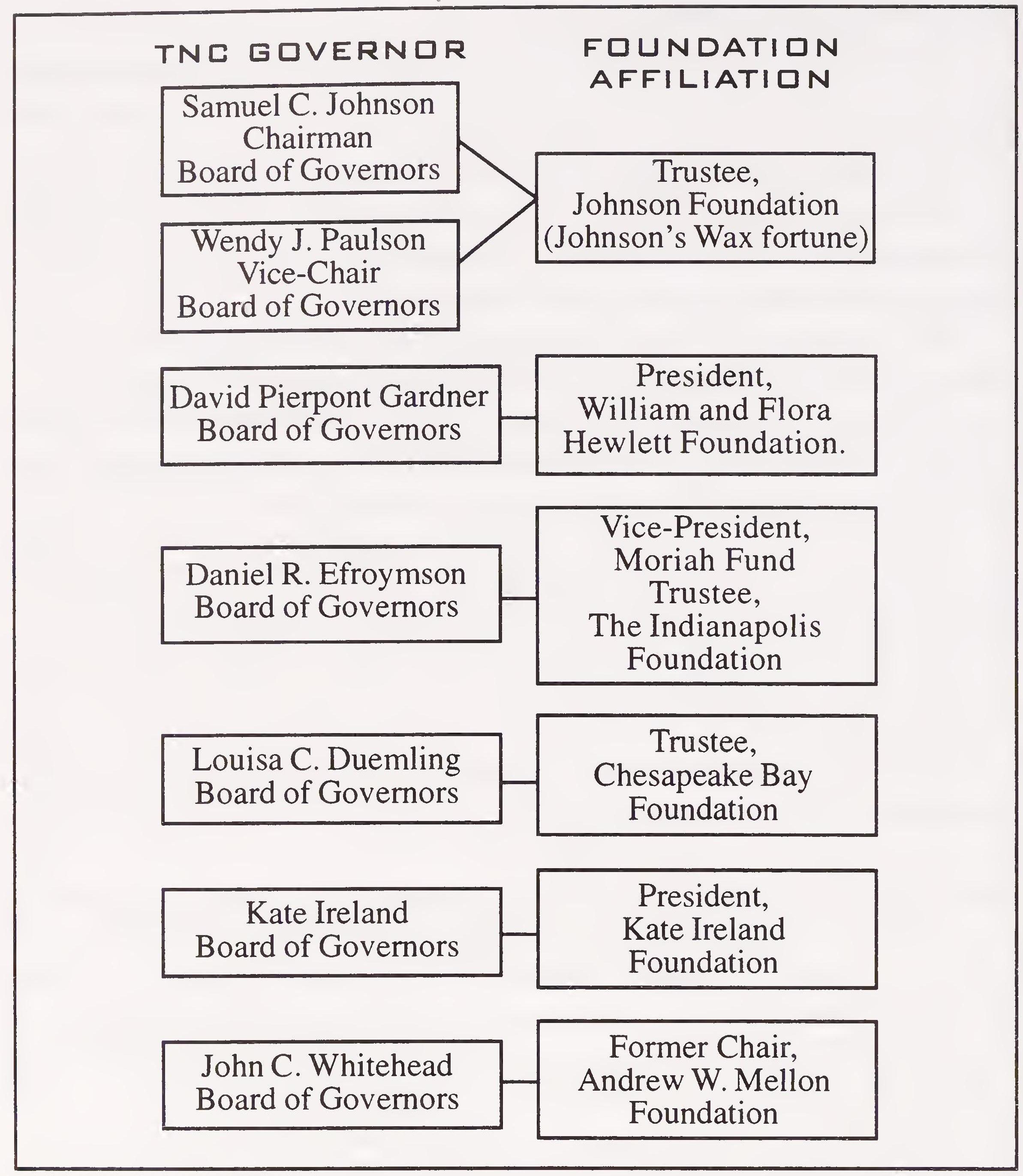
It is difficult for the ordinary person to grasp the power, wealth , and connections controlled by the Nature Conservancy elite. The thirty-two members of TNC’s Board of Governors, plus John Sawhill, President and Chief Executive Officer, include at least seven foundation officers (chart above) and at least nine corporate officers (opposite), current or former. Retired or former corporate and foundation officials do not entirely lose their influence, and in fact may gain through board positions such as the popular Nature Conservancy. The public policy influenced by this small group of people touches millions of lives every day, but few are aware.
1999 INTERLOCKING NATURE CONSERVANCY-CORPORATE AFFILIATIONS
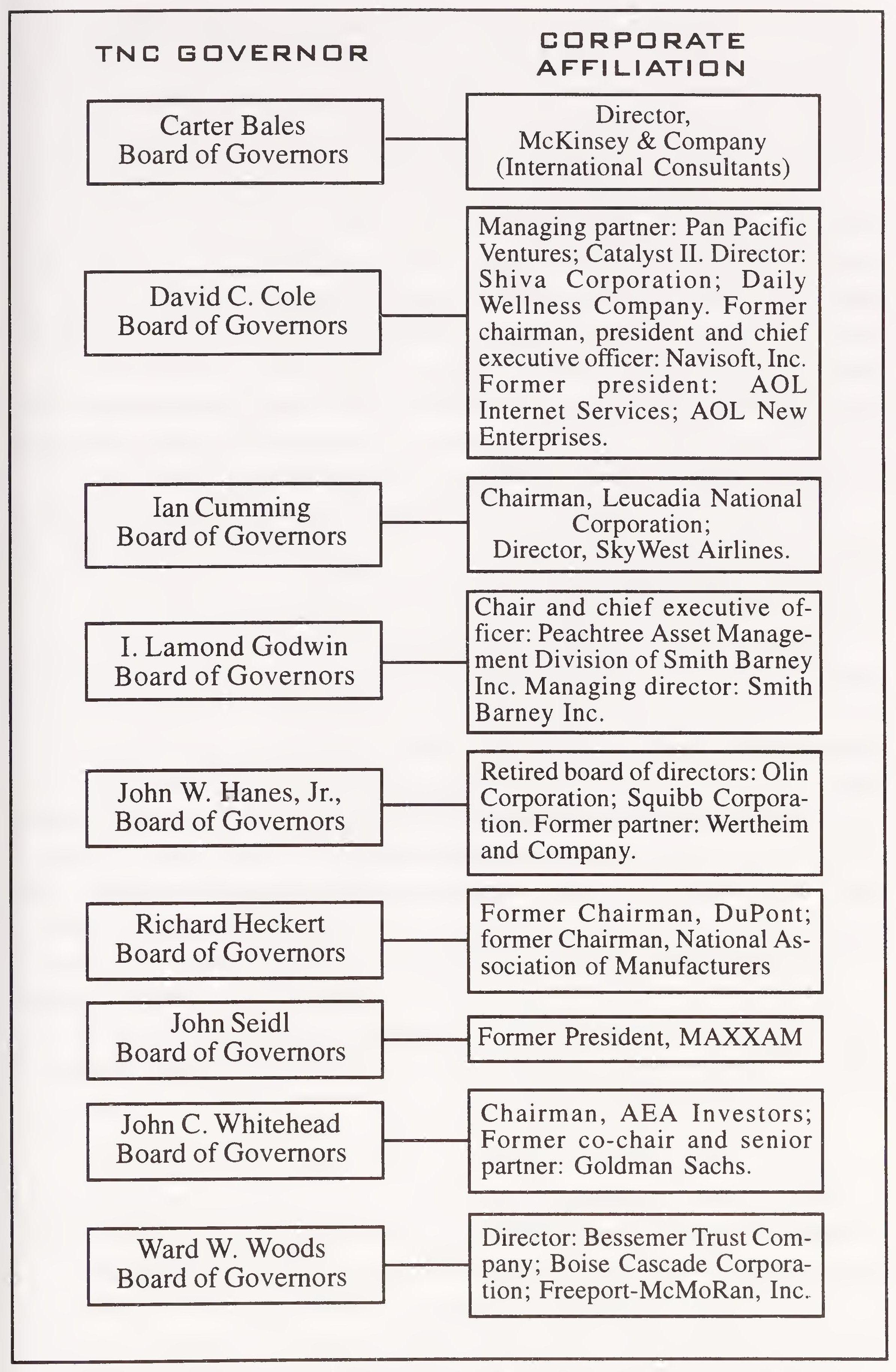
John C. Sawhill, President and chief executive officer of The Nature Conservancy ($203,723 salary, 1998) is a walking influence center by himself. He is president emeritus of New York University, chair of the H. John Heinz, III, Center for Science, Economics, and the Environment, and chair of the Electric Power Research Institute Advisory Council. He is a member of the President’s Council on Sustainable Development and the Commission on the Future of the Smithsonian Institution, a board member of Environment for the Americas, the Whitehead Institute for Biomedical Research, and the Center for Strategic and International Studies (CSIS). He is a former partner of McKinsey & Company, Inc.and a former U.S. Deputy Secretary of Energy.
Sawhill’s unpaid position with the Heinz Center indicates that he’s one of Teresa Heinz’s favorite people. It was her $20 million grant that created the Center, recall. And she gives generously to TNC.
TNC has 274 employees and officers who are paid over $50,000 a year each. In 1996, TNC paid 50 firms or individuals over $50,000 for consulting, fundraising, legal counsel and other professional services. TNC paid out $15,792,253 in grants to partner organizations.
TNC is not only Nature’s real estate agent, it’s not doing bad as Nature’s securities investor, either: in 1996 it received $26,886,460, or 8% of its total income, from capital gains on the sale of securities. TNC also got $12,235,056, or 4%, from dividends and interest on securities. What exactly all this securities trading has to do with saving nature is open to question, since TNC’s investment portfolio is standard rich folks stuff with a lot of common and preferred stock in “capitalist, polluting, toxic, desecrating, bad-nasty corporations,” mixed with mutual funds, bonds and U.S. government obligations totaling $434 million in 1996.
Then there’s the real estate. TNC say it owns or has under conservation easement 1,177,000 acres in its private preserve system. Good. TNC also says it has protected 10.5 million acres in the United States. Good. If they own only 1.17 million of that 10.5 million, what happened to the other 9.3 million acres?
They sold a lot of it to the government.
Whoa.
The Nature Conservancy bought private land from private owners who thought it would remain in private hands and sold it to the government?
Yep.
Isn’t that illegal?
Nope.
The government asks them to do it some of the time.
A letter from the Deputy Regional Director of the U.S. Fish and Wildlife Service (USFWS) to the Nature Conservancy dated August 30, 1985, reveals a long-standing government agreement for TNC to buy private land: “We are appreciative of The Nature Conservancy’s continuing effort to assist the Service in the acquisition of lands for the Connecticut Coastal National Wildlife Refuge.”163a
In this and numerous other letters, the government clearly agrees to pay TNC “in excess of the approved appraisal value.”I63b
Similar agreements for the federal government to buy TNC property at top-dollar prices exist all over the nation.1630
One federal officer who conducted such excess-cost purchases, Robert Miller, a chief of the realty division of the USFWS, was later hired by TNC at a high salary.
The Nature Conservancy is a conduit for the nationalization of private property. Nearly ten million acres so far.
Is it still going on?
According to the most recent figures available, in 1996 TNC received $3 7,8 5 3,205, or 11% of its total income, from sale of private land to federal, state, and local governments for use as parks, recreational areas, and nature preserves. Such land goes off the local tax rolls.
On top of that, The Nature Conservancy gets government grants and contracts worth millions each year. Green welfare. In 1996 they got $3 3,297,707, or 10% of their total income, from government contracts.
So Nature’s real estate agent, which asks you to join up for 25, 35 or 50 bucks, was already in your taxpaying pockets to the tune of $71,150,912 in 1996.
TNC is a public charity, according to the IRS. Why doesn’t TNC give the land to the government? What, and miss 37 million bucks?
Maybe TNC is a little greedy, and maybe not very “science driven,” but those quiet land deals are more or less “non-confrontational and businesslike,” as board member Efroymson claimed. Two out of three’s not bad.
Then there’s the case of the Moraine Nature Preserve in Indiana. It’s also known as Gibbs v. The Nature Conservancy, Case H92-0371, Federal District Court for the State of Indiana, Northern District.
TNC helped create Indiana’s Moraine Nature Preserve and wanted to enlarge it. They particularly wanted to enlarge it with the 135-acre farm of Professor Frederic A. Gibbs, M.D., now deceased. According to court papers, TNC also wanted to increase their income with Dr. Gibbs’ entire estate.
Professor Frederic A. Gibbs, M.D. was a world famous neurologist. He and his wife, Erna, pioneered the field of electroencephalography (EEG) and in 1951 they received the coveted Lasker Award in Medicine for their work.
Their son, Dr. Erich Gibbs, said: “After my mother died of cancer in 1987, Dad’s health declined sharply. He transferred responsibility for his affairs to my brother and me.”
Both sons are also medical researchers.
“In his waning years, my father became legally blind, physically frail, and increasingly confused. By the time he was 84, he could not read, even with powerful magnification. As his Alzheimer’s-like condition worsened, he became increasingly irascible, hating to be supervised. Caring for him became more and more difficult.
“Toward the end, the only place that he seemed reasonably at peace was on the Gibbs family farm in the northwest corner of Indiana, very close to Valparaiso. Here, with the help of dear friends, we carefully choreographed round-the-clock care so as to avoid fueling his paranoia about being supervised.
“During the summer of 1991, a neighbor accidentally wounded himself in the side with a shotgun and struggled to Fred’s home. While the frantic caregivers called for emergency response and rendered first aid, this great physician, who had more than once in his career tended an injured person in circumstances of great personal risk, just wandered around the yard unconcerned, unable to grasp the significance of the situation.
“Things went as well as could be expected until The Nature Conservancy and local TNC supporters barged onto the scene.
“Behaving as friends and loved ones, this group offered to take Fred for outings and to participate in his care. In point of fact, they charged expensive lunches to his credit cards; secretly rifled through all the private papers in his home; took him to meet with attorneys; and turned him against his family.
“They wanted the Gibbs farm and Fred’s estate, which they imagined to be worth millions, in order to expand their pet project, the Moraine Nature Preserve. This ‘preserve’ is hardly pristine. It is adjacent to what is perhaps the most notorious landfill in Indiana. And almost all of the land that has been acquired for the preserve has, like the Gibbs farm, been completely plowed and grazed during the past century.
“When the plot surfaced, TNC believed it had already acquired critical documents that would turn over Fred’s estate and the farm to TNC upon his death. Supposedly he had carefully read, fully understood, and signed a new will that would leave virtually everything to TNC and nothing to his family.
“The Gibbs family, accompanied by legal counsel, met with TNC attorneys to explain that TNC had all its facts wrong—Fred had not been competent for years; had actively campaigned against TNC when he was vigorous, was not wealthy (having donated large sums to medical research); and had no control over his estate, which included only a partial interest in the family farm. We had what we perceived to be overwhelming medical and legal documentation, which included affidavits from scores of Fred’s esteemed medical colleagues. This information was offered to the highest levels of TNC management. TNC’s response was to ignore the evidence and accuse the family of having defrauded Fred and thereby TNC, as the beneficiary of Fred’s estate.
“There was nothing the family could legally do to deny TNC and their supporters access to him. At one point, TNC supporters put Fred on a commercial jet, unaccompanied, so he could attend the annual meeting of one of the societies he had founded. He collapsed on arrival, disoriented, hallucinating and his heart unstable. He had to be hospitalized in a strange location. When he was sufficiently stable to fly in the company of a physician, he was transferred back to the Chicago area for further hospitalization, which included surgery.
“Shortly afterwards, TNC supporters sneaked Fred out of the nursing home where he was recuperating, and had him meet with one of the lawyers in their group. TNC and its supporters turned the last years of Fred’s life into a torment. We will never forget him weeping in one of his more lucid moments and trying to ask our forgiveness for having fouled up in some way that he could not understand.
“After Fred passed away in 1992, the family sued TNC in Federal Court. From our point of view, the case was open and shut. We were convinced TNC would not have the audacity to go to court and risk a directed judgement. We were naive.
“The first few law firms that we retained withered under TNC pressure and abandoned us in the midst of critical proceedings. Fortunately we finally obtained extremely capable and courageous representation.
“At trial, TNC presented witnesses to testify that Fred read the newspaper every day and that he was actively involved in doing research.. They even presented a nationally recognized medical ethicist, who testified that individuals can make rational decisions about the disposition of their estates, though they might be incapable of making rational decisions regarding their daily affairs.
“TNC might actually have won this case, were it not for the fact that the secretary for an attorney on the TNC side turned over the attorney’s phone log to the Gibbs family. This phone log proved to be the missing link that tied everything together.
“When the messages were enlarged on huge posters for the jury to see, the effect was dramatic. There were messages stating that Fred could not be convinced to sign TNC’s documents and asking the attorney what to do next. There was a message that Fred’s Alaska State bonds were coming due and asking if the caller should get a safe deposit box in which to put the papers.
“It became so absurd that the jury began to laugh as the attorney repeatedly said during cross-examination that he could not recall the significance of his own messages, one message after another.
“On October 27, 1993, the jury found that undue influence had indeed been exercised over Dr. Frederic Gibbs. TNC was ordered to pay court costs and relinquish any claim on his estate.
“Without missing a beat, TNC attorneys filed a motion to set the jury verdict aside and asked for a retrial. When that was denied, TNC filed an appeal to the Seventh Circuit Court of Appeals. They lost the appeal.”
The sad postscript to this horrifying story is that the Gibbs family could not recover its staggering half-million-dollars in legal fees and other trial-related costs and losses. In order to cover these expenses, the Gibbs farm was sold.166a
Another story of land grabbing:
In 1993 TNC tried to bully a German professor, Dr. Dieter Kuhn, into selling some land he owned in rural Illinois. Al Pyott, Illinois director of TNC, threatened Dr. Kuhn that if he did not cooperate in the creation of Cypress Creek National Wildlife Refuge, his land would be taken by force of condemnation through Pyott’s influence with the U.S. Fish & Wildlife Service, which was listed in the local phone book in the same entry with TNC. Pyott wrote:
The Nature Conservancy has, starting in 1987, made numerous efforts to contact you by letter, by phone, and through your agent, Mr. Clay, in an effort to discuss some basis for the acquisition of your property in Pulaski County.
If your land is not acquired through voluntary negotiation, we will recommend its acquisition through condemnation.166b
TNC head John Sawhill had to write a letter of apology to Dr. Kuhn.166c Sawhill may have been prompted to apologize by Congressman Glenn Poshard (D-IL), who told TNC that if they continued their campaign of threats and bullying land owners, he would withdraw support for future refuge acquisition funding.166d
Such clashes led to a 1994 General Accounting Office report titled, “Land Acquisitions Involving Nonprofit Conservation Organizations.” It had been requested by Congress in the wake of a May 1992 Interior Department Inspector General Report on problems with these types of acquisitions, including undue benefits in financial gains.167
The GAO tried to determine the actual profits made by non-profit groups selling private land to the federal government, but could not. Two groups, the Trust for Public Land and the River Network, refused to provide Congress with their financial information “because of contractual obligations concerning confidentiality.” Others used bookkeeping methods that made each transaction look like a loss (compared to an imaginary “market value” on land for which there was no market).
The Nature Conservancy was found to have sold one property to the Forest Service for over $1 million that had been donated to it. The profit on this parcel, after expenses, was calculated at $877,000.
Stung, The Nature Conservancy responded to this controversy by declaring that it would in the future donate lands to the government that had been donated to it, but said this would “pressure them into fund raising.”
Overall, TNC said its bookkeeping methods showed it took a net loss on the private property it sold to the federal government. TNC did not calculate the loss to county and school district tax rolls as part of the social costs of its transactions.
Maybe TNC is not very “science driven” and “non-confrontational” when it comes to land and money, but they’re certainly “businesslike,” as board member Efroymson claimed. One out of three’s not totally bad.
Okay, so TNC has its hand in the taxpayer’s till and plays hardball in court and claims to have government bully boys backing up threats to condemn some property. But they wouldn’t violate that “businesslike” ethic of theirs by playing dirty politics in lobbying, would they?
The following entry in TNC’s internal Bioreserve Handbook describes the Norden Dam farmland irrigation proposal on the Niobrara River in Nebraska back in the early 1980s. The TNC description below was written in 1991 by John Flicker, then-vice president, to describe how TNC defeated the project:
We developed three theaters of action:
1. All “swing” Members of the House
In a typical water project vote, about 1/3 of the House will always vote no, about 1/3 will always vote yes, and about 1/3 are swing votes. Using a Sierra Club computer program, we applied several criteria, such as the 22 previous water project votes, to determine who the swing members would be. It gave us a target audience of about 130 swing members.
2. The Nebraska Delegation
The House will tend to support the united local delegation. If the delegation is split, other members feel free to vote their conscience. We needed a split Nebraska delegation.
3. Nebraska State Government
Congress expects the Governor and the state legislature to strongly support a local water project. If they don’t, Congress won’t throw money at them that they don’t want.
Each theater of action had strategy. The strategy started with theme. It positioned the issue as a taxpayer issue instead of an environmental issue. Several messengers were brought into the strategy to deliver the message to particular audiences:
— The Nebraska Tax Limit Coalition: Conservative anti-tax, antigovernment organization.
— The Nebraska Water Conservation Council: New organization created to conduct door-to-door canvassing.
— Save the Niobrara Rivers Association: Local landowners group who serve as the plaintiff in the NEPA litigation in federal court.
The information, the players, and the money were the key factors in the campaign.
We had a personal relationship of trust with one member of each organization who controlled that organization. We then sent money to each organization to assist them in carrying out the strategy. No one but TNC knew the entire strategy.
In Nebraska, TNC was always behind the scenes. We never made public statements. Everything was done through surrogates who were credible in their own right.
Outside of Nebraska, TNC was more open. We designed a national campaign for each TNC state chapter to secure the swing congressional members in each state. Chapters agreed to take on local campaigns to assure votes from their states....
It took three years to implement the strategy. In the end, the Nebraska delegation split on the issue. A resolution in the Nebraska legislature supporting the project was blocked. The Governor withdrew support. The House of Representatives voted to withdraw all funding and to kill the project [in 1982].
More importantly, we did it in a way that did not alienate TNC in Nebraska. Since then, the Kiewit Foundation has given money to TNC, and the editor of Omaha World Herald has become chairman of the Nebraska Chapter.168
“Everything was done through surrogates.” We will see that again and again in environmental group projects.
TNC must be delighted with this science driven, non-confrontational, businesslike deal.
That was a long time ago. Is TNC still doing this kind of lobbying? In fiscal year 1996, TNC spent $419,729 on lobbying. In 1997–98 TNC spent $993,396 on lobbying.
Perhaps The Nature Conservancy will open their current handbooks to public inspection so we can see what dirty tricks they might or might not be playing these days.169a
The Nebraska Chapter of The Nature Conservancy said in April 1999 that John Gottschalk, publisher (not editor) of the Omaha World Herald, was once on their board of directors. In April, 1999, Gottschalk denied ever being chairman of TNC’s Nebraska Chapter. The Kiewit Foundation had no idea TNC was behind the killing of the Norden Dam project.
A substantive question arises about the 1,385 corporate associates and the large number of businesses that work with and donate money to The Nature Conservancy: Why?
Why corporations give to environmental groups, which, given their “progressive” colleagues, appear to do nothing but harm corporate interests, is a question addressed by two scholars in some depth.
Marvin Olasky, who teaches journalism history and media law and ethics at the University of Texas at Austin, pointedly noted that “love of mankind” (the dictionary definition of philanthrophy) plays a relatively small part in corporate grant making.
Professor Olasky wrote that personal, ideological and utilitarian reasons prevail:
Contributions are made for one or more of three very practical reasons. First, corporate executives may direct funds to groups personally important to them, a choice often based on peer pressure or spousal involvement. Second, ideological considerations come into play because liberals and conservatives generally view the world in different ways. Third, public relations managers make calculated professional judgements as to which potentially critical groups need to be placated.169b
In other words, how can we get the most public relations bang for the buck and help a few groups that subscribe to our own beliefs (or those of our spouses)?
Of Professor Olasky’s three, public relations approval clearly outweighs everything else in corporate giving to environmental groups.
Robert H. Nelson, a professor of environmental policy at the School of Public Affairs at the University of Maryland and a senior fellow at the Competitive Enterprise Institute, has a more machiavellian take on corporate giving to the environmental movement: It is a way for strong corporations to obtain government regulations so expensive they will price weaker competitors out of business. The result is a legal monopoly in a high-cost market.
Professor Nelson’s way of stating it is more elegant: “Regulations behave as the private rights of the regulated.” The result is the same.170
Bob Nelson first explained his theory to me while I was interviewing him in 1981 for a book I was working on. He was then a policy analyst at the Department of the Interior, working in the Office of Policy Analysis, which serves the Office of the Secretary.
I told him it was difficult for me to grasp that an industry would commit suicide by giving rope to its hangmen. He patiently explained that only the weakest part of an industry dies under heavy regulation, and those weaker firms don’t contribute to environmental groups. The stronger survivors have bought a valuable service from environmentalists: lobbying by those who can occupy the moral high ground with strength sufficient to win against industry’s vigorous pretense of defense.
The implications of Nelson’s theory are disturbing. Is there collusion to influence public policy between corporate or trade association leaders and environmental group leaders that are not the strictly arm’s-length relationships of adversaries?
Is the adversary process of lobbying environmental policy being compromised by “sweetheart deals” between the most powerful on both sides, corporations and environmental groups?
Serious questions for future public policy.
Comprehensive Coalitions
Now back to the coalition model: The whole idea of reforming the environmental movement with a coalition strategy is to gather power.
Coalitions aimed at fundamental production points such as control of raw materials would obviously be most effective in the long run—no economy can operate without raw materials.
To date, the most comprehensive coalition to appear on the scene is the Wildlands Project. This coalition is the most radical in purpose: to “re-wild” America, that is, to gradually remove people and raw material production from the rural United States with no definitite stopping point. In their own words:
The Wildlands Project calls for reserves established to protect wild habitat, biodiversity, ecological integrity, ecological services, and evolutionary processes. In other words, vast interconnected areas of true wilderness and wild lands. We reject the notion that wilderness is merely remote, scenic terrain suitable for backpacking. Rather, we see wilderness as the home for unfettered life, free from human technological and industrial intervention.
Extensive roadless areas of native vegetation in various succes-sional stages must be off-limits to human exploitation.
To function properly, nature needs vast landscapes without roads, dams, motorized vehicles, power lines, over-flights, or other artifacts of civilization, where evolutionary and ecological processes can continue. Such wildlands are absolutely essential to protect biodiversity.171
If that didn’t sink in, read it again. Yes, it’s written in foundationese, but it’s low foundationese, not high foundationese. Low foundationese says a rural cleansing project is one that “must be off-limits to human exploitation,” while high foundationese would say it’s a “rural transition enhancement to enable more environmentally sound employment” or something similarly mush-mouthed.
The Wildlands Project has proposed to set aside at least half of North America for “the preservation of biological diversity.” The resulting “wildland reserves” would contain:
-
Cores, created from public lands such as national forests and parks, allowing for little, if any, human use;
-
Buffers, created from private land adjoining the cores to provide additional protection;
-
Corridors, a mix of public and private lands usually following along rivers and wildlife migration routes;
but would allow no cities, roads, homes, businesses, no aircraft overflights, or natural resource extraction, i.e., an endlessly expanding area of America would be depopulated and de-developed.
A decade ago such proposals would not have been taken seriously.
In the late 1990s they had become part of Clinton administration policy through Al Gore (see pp. 234–246). We have seen the Clinton road moratorium. We have seen Clinton proposals to breach dams on the Columbia River. We have seen the bewildering array of Clinton manipulations in Chapter One. All moved the nation toward Wildlands Project goals.
We work in cooperation with independent grassroots organizations throughout the continent to develop proposals for each bioregion. The list is growing of groups that promote the vision of an ecologically sound North America, and we have included a list of many with whom we work to achieve our hopes and goals.
The Wildlands Project welcomes all groups and individuals interested in supporting these issues, and we look forward to working with these organizations.1723
The Wildlands Project is technically a coalition strategy project with a single lead organization: North American Wilderness Recovery, Inc. (1996 budget: $606,050), based in Tucson, Arizona. The organization is an outgrowth of a 1981 Earth First! idea called the North American Wilderness Recovery Project.172b
Funders of North American Wilderness Recovery include the Turner Foundation, which has donated $195,000 to its Tucson headquarters (1993: $25,000; 1995: $15,000; 1996: $35,000; 1997: $120,000); Patagonia; the Bullitt Foundation; the Lyndhurst Foundation and numerous other “golden donors.”
North American Wilderness Recovery has been supported by foundation grants since before 1992, particularly by Doug Tompkins’ Foundation for Deep Ecology, in annual amounts ranging from $50,000 in 1992 to $150,000 in 1996 and 1997. The Richard and Rhoda Goldman Fund gave $75,000 in 1996 and the Educational Foundation of America gave $50,000 in 19 97.
In 1999 there were 23 “cooperating groups” or “colleagues” listed in Wildlands Project materials (see list opposite).
Each “cooperating group” has its own specific goals that reinforce the goals of the Wildlands Project. These groups are also grant-driven, with dominant funding from prescriptive foundations: Alliance for the Wild Rockies, MT (1996 budget: $305,099); California Wilderness Coalition, CA ($135,087); Northwest Ecosystem Alliance, WA ($246,632); Sky Island Alliance, AZ ($25,371); Coast Range Association, OR ($106,396); Forest Guardians, NM ($229,85 8); Northern Appalachian Restoration Project, NH ($119,993); Southern Rockies Ecosystem Project, CO ($46,712).
Wild Earth magazine, published in Richmond, Vermont, is anon-profit periodical. “The Wildlands Project is a separate non-profit organization that acts as a sister organization to Wild Earth. Wild Earth serves as the publishing voice for The Wildlands Project, and as an independent voice for the new conservation movement.”
|
Alaska Wildlands Brad Meiklejohn Eagle River AK 99577 |
Conservation Biology Institute Reed F. Noss, Ph.D. Corvallis OR 97330 |
| Yukon Wildlands | Forest Guardians |
| Juri Peepree | John Taiberth |
| Whitehorse YUK Y1A5T6 | Santa Fe NM 87505 |
| Yellowstone To Yukon | Sky Island Alliance |
| Bart Robinson | Jack Humphrey |
| Canmore AB T1W 2V7 | Albuquerque NM 87106 |
| Northwest Ecosystem | Hill Country Wild |
| Alliance | Chris Wilhite / John Andrews |
| Mitch Friedman / Tom Platt Bellingham WA 98225 |
Austin TX 78713 Minnesota Ecosystems Recovery |
| Siskiyou Project | Project |
| Kelpie Wilson | Mike Biltonen |
| Cave Junction OR 97523 | Red Wing MN 55066 |
| LEGACY-The Landscape | Greater Laurentian Wildlands |
| Connection | Robert Long |
| Curtice Jacoby Arcata, CA 95518 |
South Burlington VT 05403 Appalachian Restoration Campaign |
| Conception Coast Project | Than Hitt |
|
John Gallo Santa Barbara CA 93101 |
Athens OH 45701 Southern Appalachian Biodiversity |
| California Wilderness | Project |
| Coalition | Mary Ann Paine |
| Rich Hunter Davis CA 95616 |
Asheville NC 28802 Wildlaw |
| Wild Utah Project | Ray Vaughan |
|
Jim Catlin Salt Lake City UT 84111 |
Montgomery AL 36104 Southeast Wildlands Project |
| Grand Canyon Wildlands | Linda Duever |
|
Council Kelly Burke |
Micanopy FL 32667–0949 |
| Flagstaff AZ 86002 | Paseo Pantera Project — Wildlife Conservation Society |
| Southern Rockies | Jim Barborak |
|
Ecosystem Project Bill Martin / Marianne |
Gainsville FL 32609 |
| Moulton | Wildlands Mexico |
| Nederland CO 80466 |
Rurik List Metepec 3 MX Mexico |
1999 KEY WILDLANDS PROJECT COOPERATING GROUPS
The Wildlands Project is sufficiently institutionalized that literally hundreds of its projects may be circulating within administrative agencies at any given time. The resource class is simply swamped by the volume of issues they must confront.
Fiscal Agents
Even the most elite of the old-line conservation groups, the Wilderness Society; has adopted the coalition strategy wholeheartedly. The Wilderness Society’s 1999 “Message from the Chairmen Christopher Elliman and Bert Fingerhut, emphasized the point:
We realize that we cannot achieve our goals unless we work with other groups committed to protecting America’s greatest places. The proliferation of local organizations has provided us with a growing number of dedicated allies. In addition, we are more active than ever in coalitions such as the Alaska Coalition, the Northern Forest Alliance, and the Utah Wilderness Coalition. During the past year we have even helped forge two new coalitions: the ForestWater Alliance and Americans for Our Heritage and Recreation.174
There is a reason: the Wilderness Society was the first fiscal agent of a grant-driven environmental campaign—the early 1990s’ Ancient Forest campaign of the Pacific Northwest. The Wilderness Society was the first mainstream group to lend its power to foundation funders in order to reform the environmental movement on the coalition model. The Wilderness Society hardly had a choice. Things were not going well in the movement.
By the mid-1980s when Don Ross and Josh Reichert and Pete Myers, et al., decided to reorganize environmentalism, the Wilderness Society, the Natural Resources Defense Council, the Friends of the Earth, and Environmental Action—along with the Sierra Club, Greenpeace, the National Audubon Society, and virtually every other sizeable environmental group—had turned inward to their own constituencies.
They had busied themselves sending out direct mail appeals, developing sharp elbows getting to the television cameras, and hitting the phone banks to increase the donation level of high-dollar contributors. There was intense competition for a limited amount of money. The movement had fragmented and lost its grass roots.
Don Ross explained to his Environmental Grantmakers Association peers in 1992 the impact this inwardness had on issues:
About six EGA members, seven EGA members, pooled about a million dollars to wage a lobbying effort, a lobbying / media strategic effort on the Ancient Forest legislation this year [1992]. And the assumption going into that effort was that there was very strong grass roots activity in the Northwest, strong national lobbying in Washington, D.C., and that the problem was the issue wasn’t an issue in most of the rest of the country, and the connections between the Washington lobbying and the Western enthusiasm was not present, and that this effort would fill that gap.
The great lesson was that our assumptions were wrong.
The major one was that the lobbying presence in Washington was pathetically weak. And what a lot of the effort went into was shoring up what we thought was our strong point, the Washington presence....
But there was a real vacuum. I think a lot of us have been blinded by their balance sheets.
You say this is a 20 million dollar group and this is a 30 million dollar group. They really aren’t.
What they are, it seems to me, is, in that $20 million are 30 separate projects, perhaps, each one of which has two or three staff on it. And there’s no ability on the part of most of those groups to mobilize their total organizations behind any issue.
So you look at a group that has a 30 million dollar budget that puts out direct mail talking about its commitment to the forest issue and then you look at its real internal commitment to that forest issue and it’s one part-time lobbyist in Washington, maybe, who’s doing three other issues in addition to that forest issue. And there’s nothing else back there. And that’s really what that lesson came out. It was a very depressing lesson. Because there was real money in that.175
The solution was the task force approach, to forge coalitions among groups that each possessed limited capabilities, but collectively could wield power effectively.
Their campaign-level intervention began in the autumn of 1990 at the Environmental Grantmakers’ annual retreat, held that year in Estes Park, Colorado, when a group of funders including the Rockefeller Family Fund, Pew, W. Alton Jones, Surdna and Bullitt got to talking about the Pacific Northwest forest issue and agreed to meet again in a special strategy session a few months later at the Bullitt Foundation’s Seattle bailiwick.
In 1990 the forest issue was a hit for environmentalists in the Northwest. The Northern Spotted Owl had become a celebrity bird for shutting down the timber economy under the Endangered Species Act.
In April of the year before, a small crew of Earth First !ers had trucked a big Douglas fir log around the country on a 19-city tour to raise national awareness of habitat as well as the owl.
In September of 1989, a National Audubon Society television feature broadcast on Ted Turner’s TBS network, Ancient Forests: Rage Over Trees, notched up public awareness a little more.
An Ancient Forest Protection Bill was drafted and ready to run through Congress, sponsored by Indiana Democrat Jim Jontz.
At the Seattle strategy session the funders agreed on a program to project nationally the kind of energy and enthusiasm they saw in grassroots groups in the Northwest. They neglected to agree on the details. Don Ross explained to his foundation peers the next year:
The Ancient Forest stuff was pooled within the Wilderness Society, actually acted as the fiscal agent. There was a three person board set up, with the Wilderness Society having one of the seats, to manage that money as a separate venture from the Wilderness Society—they were writing checks....
It’s complicated because there are three organizations [Americans for the Ancient Forests, the Ancient Forest Alliance, and the Western Ancient Forest Campaign] that are really involved in it that at various times have worked very closely together and at other times had a high degree of tension between them and not a great deal of communication. And partly we funders are responsible for it because at the very same time two separate groups of funders picked two separate horses on which to lavish large sums of money to run media campaigns. And despite great efforts to get them to work very closely together, it sometimes worked not as well as one would want.176
The two national campaign horses on which the two groups of funders lavished large sums of money were Fenton Communications and Chlopak, Leonard and Schecter, both media strategy firms of Washington, D.C.
David Fenton we have already met (pages 97ff).
Robert A. Chlopak is the former staff head of the Democratic Senate Campaign Committee, who brought deep experience with political campaigns to the ancient forest project. In addition, he had worked several years for Sawyer-Miller, a Washington, D.C.-based public relations, advertising, and media strategy firm, a strong credential.
The three groups they funded were:
-
A grassroots group, the Western Ancient Forest Campaign (now known as the American Lands Alliance), which was controlled by a four-person board of directors made up of grass roots in California, Oregon and Washington. Its base of activity was Washington, D.C.
-
Americans for the Ancient Forests, a synthetic group headed by Bob Chlopak. Billed itself as “the advertising arm” of the third group:
-
The Ancient Forest Alliance, another synthetic group, this one a shell coalition of six other groups: 1) Americans for the Ancient Forests, 2) National Audubon Society, 3) Sierra Club, 4) Sierra Club Legal Defense Fund, 5) Western Ancient Forest Campaign, and 6) The Wilderness Society. Mostly a figurehead group to lend credence to Chlopak’s political and media operation. The Alliance did send out a political action alert letter in March 1993 to a large mailing list (see pp. 222–223).177
The Environmental Grantmakers Association core foundations poured a huge amount of money into these three groups and their fiscal agent, The Wilderness Society :
Western Ancient Forest Campaign
1991 $100,000 The Pew Charitable Trusts through Headwaters Community Association Ashland, OR
1991 $25,000 Rockefeller Family Fund, Inc.
1992 $132,500 The Bullitt Foundation
1992 $20,000 Foundation for Deep Ecology
1992 $25,000 HKH Foundation
1993 $25,000 Richard and Rhoda Goldman Fund
1993 $75,000 Surdna Foundation, Inc.
1993 $200,000 The Pew Charitable Trusts
1993 $65,000 The Bullitt Foundation
1993 $15,000 Foundation for Deep Ecology
1993 $25,000 Ruth Mott Fund
1993 $100,000 W. Alton Jones Foundation, Inc.
1994 $100,000 The Pew Charitable Trusts
1994 $65,000 The Bullitt Foundation
1996 $20,000 Foundation for Deep Ecology
1996 $14,000 Turner Foundation, Inc.
1997 $50,000 Rockefeller Brothers Fund
Americans for the Ancient Forests
1992 $100,000 Surdna Foundation, Inc.
1993 $150,000 W. Alton Jones Foundation, Inc.
1993 $70,000 The Bullitt Foundation
1993 $50,000 Surdna Foundation, Inc.
Ancient Forest Alliance
1992 $10,000 The Gap Foundation, through the Wilderness Society for California Ancient Forest Alliance.
The Wilderness Society as fiscal agent or directly for the project:
1992 W Alton Jones $250,000 to advance public understanding of ancient forests.
1992 W Alton Jones $100,000 For multi-constituency organizing and to disseminate educational information about public land management policies.
1992 W Alton Jones $75,000 To develop set of policy recommendations that can minimize job loss in communities in Pacific Northwest while maximizing environmental protection.
1992 W Alton Jones $50,200 To undertake nation review of public perceptions of environmental protection efforts.
1992 Ruth Mott $25,000 For national education campaign on ancient forests of Pacific Northwest.
1992 Town Creek Foundation $100,000 (unspecified).
1993 Bullitt Foundation $40,000 for Northwest Forests.
1993 Pew $200,000 to conduct national education campaign in support of ecosystem reserve for ancient coastal rainforests in Pacific Northwest.
1993 Pew $100,000 For analysis of employment impacts and economic benefits of preserving ancient rainforests in Pacific Northwest.
1993 Surdna $150,000 2-year grant. To compile in public document, specific of what must be done for ecosystem management of federal forests.
1993 Ford $300,000 Toward organizational shift toward environmental and development.
Donald Ross told his EGA peers that the Fenton and the Chlopak segments of the project received about $1 million each. Two million dollars to destroy the resource class in the Northwest. The media blitz they created was impressive, but not always what they wanted:
Donald Ross: Fenton uses this technique in a lot of his campaigns and it’s pretty effective: He gathered together four or five activists, Jeff DeBonis of the Association of Forest Service Employees for Environmental Ethics, Andy Kerr, Michael Stewartt of LightHawk and the like, and scheduled intensive visits to major media centers, New York City, Los Angeles, where they would spend two or three days with back-to-back meetings briefing editorial boards, news directors, feature writers. And there is no question that that effort produced a torrent of media, which involved everything from evening news, television stories on the forest to editorials to features in some of the newsmagazines and the like.
It was an effort that was loosely coordinated with the political work that was going on [Chlopak’s segment], but very loosely coordinated.
And in some respects that revealed one of the problems of the effort: while it was successful in getting media, often times the media blitz was three months before any real political action was taking place and so by the time the political action was there and you wished it was on the evening news or you wished it was the editorial in the papers that people were picking up that day, it was stale news. It was Ancient News.179
They were finding out the hard way that they needed a better central control point and a better coalition model. Ross concluded:
There is no organization today that can wage any one of these national campaigns by itself. And given the experience on the forest issue and others, I’m somewhat pessimistic that a collection of national groups are going to be able to get together and divvy up the work in an effective way and manage a campaign.
What I keep thinking about now on these national efforts is that— and this would take a major role by large funders to help drive this— is that there’s almost a modular kind of a campaign where you would take people from different groups and take different expertises together to assemble, so you’d end up with a task force of people from maybe five or six different groups that were under some central direction.
Part of the problem in the forest campaign is you had a lot of these elements including lots of these media folks, paid and free, but there was no central direction and no one was able to really say, okay, like a quarterback, you go this way, you go this way, you do this, you do that. There was never a control mechanism. So it became too chaotic.
There was the first explicit statement of the coalition model we saw at the beginning of this chapter in the Southwest Forest Alliance, with the
National Audubon Society as fiscal agent and Pew as control point for a large number of groups with their own constituencies and funders. This is the dominant model of environmentalism today.
And green groups have discovered how to create a grant-driven coalition on that model by building-in foundations from the ground up.
The Taku Strategy
Nothing could make this point better than an internal document written in 1998 by a cluster of environmental groups intent on stopping a mine in British Columbia, Canada. It is a long document, reproduced here without comment.180
TO SAVE THE TAKU RIVER A Coordinated Campaign Strategy Outline Prepared by: Michael Magee Sierra Defence Fund (604) 685–5618 magee@sierralegal.org In coordination with Taku Wilderness Association Nakina Centre for Aboriginal Life and Learning Sierra Club of British Columbia Environmental Mining Council of B.C. BC Spaces for Nature David Suzuki Foundation Northwest Institute The River League American Rivers Southeast Alaska Conservation Coalition Walter & Duncan Gordon
THE CAMPAIGN NEED
The Taku wilderness is under threat of pending developments that impact on the lives and well being of the Taku River Tlingit First Nation (TRTFN) and the ecological integrity of one of North America’s last remaining magnificent wilderness areas.
An aggressive, thoughtful and strategic campaign is urgently needed to stop the immediate threats to this area and to establish a plan for the longer term protection of its environmental values and of the people in the region.
In a serious effort to achieve these goals a coordinated strategy was organized in Vancouver in September of 1998 amongst key groups in the U.S. and Canada dedicated to preserving the Taku wilderness.
The groups who participated in this meeting and will continue to work on the project include:
Taku Wilderness Association
Nakina C. A. L. L. (Centre for Aboriginal Life and Learning)
Sierra Club of British Columbia
The River League
BC Spaces for Nature
Sierra Legal Defence Fund
Northwest Institute
Environmental Mining Council of British Columbia
American Rivers
Southeast Alaska Conservation Coalition
Groups who were not in attendance at the meeting but will play a role in a coordinated campaign include:
The David Suzuki Foundation
Earthjustice Legal Defense Fund
The purpose of this document is to:
-
Provide a multi-organization, coordinated campaign outline that illustrates the specific goals, objectives, strategies, tactics, organizational structures, relationships and funding that will be required to win.
Background
The Taku River watershed is an 18,000 square kilometer (4.5 million acre) unroaded tract of land near the town of Atlin in northwestern British Columbia, Canada. This immense watershed, equivalent in size to the state of Massachusetts is the traditional homeland of the Taku River Tlingit and contains habitats representing 5 biogeoclimatic zones ranging from high plateaus to lush coastal temperate rainforests. It contains some of the richest wildlife habitat on the West Coast of North America and is home to grizzly bears, moose, caribou, black bear, mountain goat, salmon and many species of migrating birds. These species thrive here in large numbers due to the area’s essentially untouched nature and the fact that it is only accessible by float plane, riverboat or by foot. This region is the highest producer of salmon on the Southeast shore of Alaska and Northwest British Columbia.
This spectacular area is now threatened by a proposal to construct a 160 km access road needed to re-open the Tulsequah Chief Mine located on the Tulsequah River just upstream from B.C.’s border with Southeast Alaska. The road is needed in order to transport ore to the shipping tidewaters of Skagway. Proponents, Redfern Resources Ltd., claimed that the Tulsequah Chief Mine will provide nine years of profitable mining activity. While this scenario has appeal for some factions, the mine would introduce massive quantities of Acid Mine Drainage to the watershed, endangering water quality and aquatic habitat for salmon and other wildlife. The proposed road also threatens the survival of a recovering woodland caribou population and threatens to disrupt grizzly bear habitat. The cumulative effects of this road would be increased hunting and poaching pressure, roadside developments, spur roads to new mining claims, and logging of the fragile boreal forest and globally endangered temperate rainforest. Wildlife experts both within and outside of government disagree with the proponent’s claims that impact on wildlife in the Taku will be minor.
Current Status of Development
Redfern Resources is continuing to push ahead aggressively with their plans to establish the Tulsequah Chief Mine. There are several obstacles to this which include:
-
A review by the International Joint Commission (IJC). The United States has requested that this issue be referred to the International Joint Commission for investigation as there are serious threats it will affect trans-boundary waterways. As this document is being written there has been no formal agreement from Canada referring it to the IJC, however, Canada has requested another meeting with the United States to review the agenda for eventual referral to IJC. The State Department has responded aggressively and is becoming increasingly educated with the Canadian Federal Government’s delaying tactics, this in turn has served to delay some of the Special Use Permits (SUP) into December of 1998.
-
Redfern Resources share prices are sinking and the company is increasingly unstable. This vulnerability is more evident when the financial assumptions of the Tulsequah Chief Mine proposal are examined more closely. Given the current economic conditions there is high probability of exploiting this vulnerability and exposing the mine as financially non-viable.
-
There continues to be the possibility that the Taku River Tlingit First Nation (TRTFN) will challenge the provincial mine approval process. Should this take place it would pose a serious threat to the future development of the mine.
Campaign goals and objectives
-
Stop the Tulsequah Chief Mine.
-
To stop the mine in such a way that it ensures a developmental moratorium on the Taku Watershed.
-
To ensure that a comprehensive Land Use Planning process is completed that is agreeable and inclusive of the Taku River Tlingit River First Nations (TRTFN).
Strategies
-
Stop the Tulsequah Chief Mine
The strategic objective in the early stages of this campaign will be to stop the mine from proceeding in such a way that establishes a moratorium on the area for further development. This will be achieved through several tactical components including:
• A coordinated trans-boundary political effort focusing on the U.S. Congress and key legislators within Alaska and Washington D.C. Given the mine’s potential negative impact on a highly profitable Alaskan fishery and waterway it is highly probable that the U.S. Congress can be leveraged to take further defensive actions against such a threat.
A comprehensive economic analysis of Redfern Resources. This would include closer scrutiny of Redfern shareholder interests, current mineral prices and the underlying financial calculations they have used to substantiate the mine proposal. This data will be critical in establishing within the financial community and policymakers of the financial weaknesses of the Tulsequah Chief Mine proposal and other similar initiatives that are being explored in the Taku Watershed.
-
Solidarity and support for the Taku River Tlingit First Nation (TRTFN). The TRTFN have been considering taking further legal and political action based on their aboriginal rights to oppose the approval of the mine. The TRTFN must be given adequate capacity support and resources to defend any such actions should they be taken.
-
The International Joint Commission. While it would be the objective to stop the mine development long before any IJC reference is undertaken, the reference itself needs to be used to increase profile of the issue. Further pressure needs to be brought to focus on the Canadian External Affairs to make a final decision in referring this matter to the IJC. Most importantly, the process of moving the complaint to a formal investigation by the IJC must be used as a key media opportunity for heightened exposure on the Taku and to support the above noted initiatives.
-
Ensure a Development Moratorium
The Tulsequah Chief proposal has generated heated debate and attention in the local community, within the TRTFN, with the B.C. government and the U.S. One of the process issues that has been given the most attention is the weaknesses in the provincial approval process for the mine. This has underscored the significant need to develop a comprehensive land use plan that considers the socioeconomic future and ecological integrity of the Taku wilderness. To complete this a moratorium on development will need to be established. It is the objective of this campaign to stop the Tulsequah Chief Mine in a manner that provided ample financial and economic deterrence to future developments until a land use plan is agreed upon.
-
Ensure a Taku Land Use Plan
The success of establishing a comprehensible protected area in the Taku will depend largely on the longer term work and creditability of the Land Use Plan. Significant capacity support will have to be established for key groups including the TRTFN to complete work related to scientific, legal and social economic research.
For the purposes of this proposal, we will focus on the first two points. A planning committee will be established to work on the longer term details on requirements of a Land Use Plan. This will be the subject of a future proposal.
Campaign Structure
There will be several components to the campaign structure to ensure quick campaign development, decision-making and proper tactical assignments. The structure will be as follows:
-
Taku Network: the Network will include all organizations and individuals who wish to support the campaign initiatives overall. This will be an information sharing Network with organizations receiving regular briefs and a being called upon for specific actions when necessary.
-
The Taku Steering Committee: this will be the key groups with a more direct involvement and interest in the Taku campaign. The Steering Committee will assist in guiding overall priorities and policy directions. The members of this committee will include:
Taku Wilderness Association
Nakina C. A. L. L. (Center for Aboriginal Life and Learning)
Sierra Club of British Columbia
The River League
BC Spaces for Nature
Sierra Legal Defence Fund
Northwest Institute
Environmental Mining Council of British Columbia
American Rivers
Southeast Alaska Conservation Coalition
The David Suzuki Foundation
Earthjustice Legal Defence Fund
-
The Executive Committee: this committee will be a smaller group from the Steering Committee that will set the strategic direction of the campaign, make decisions on a regular basis and coordinate the activities of the key organizations. The Executive Committee members include:
Don Weir, Taku Wilderness Association
Alan Young, Environmental Mining Council of B.C.
Rick Careless, BC Spaces for Nature
Mike Magee, Sierra Legal Defence Fund
The campaign will have established several working groups to develop the critical strategic components. These working groups will be a combination of groups and individuals from the Network, assigned to groups depending on area of expertise. Each working group will have a lead organization.
Note: For the purposes of this proposal, working groups are assigned “global” budget estimates. Specific proposals for working groups would be submitted by the lead organization. These proposals may vary from the global estimates depending on the scope of the plan produced by the working group. The working groups include: • COORDINATION (i.e. the Executive Committee):
This working group will largely be the work of the Executive Committee and a staff coordinator. Lead organization will be the Environmental Mining Council of British Columbia with support from the Sierra Legal Defence Fund. Budget estimate: $30,000 (CDN)
-
TRANS-BOUNDARY STRATEGIES:
This working group will include BC Spaces for Nature, American Rivers, Southeast Alaska Conservation Coalition, Earthjustice Legal
Defence Fund, Sierra Legal Defence Fund, Taku Wilderness Association. Lead organizations will be BC Spaces for Nature and Taku Wilderness Association. Budget estimate: $40,000 (CDN)
-
MEDIA AND COMMUNICATIONS:
This group will assist in cultivating major media stories, executing media strategies for specific initiatives, training and capacity support for key Network organizations. The group will include David Suzuki Foundation, Sierra Legal Defence Fund, The River League, Sierra Club of B.C., Earthjustice Legal Defence Fund. Lead organization will be Sierra Legal Defence Fund. Budget estimate: $30,000 (CDN)
-
ECONOMICS:
This group will initiate a review of the underlying financial assumptions of the Tulsequah Chief Mine and the real costs and benefits of development in the Taku wilderness. The work will include an examination of Redfern Resources. The group will include BC Spaces for Nature, Taku Wilderness Association, Environmental Mining Council of BC. Lead organization will be the Environmental Mining Council of BC with support from BC Spaces for Nature. Budget estimate: $40,000 (CDN)
-
COMMUNITY DEVELOPMENT AND LIAISON:
This group will focus on cultivating relationships and understanding in the local community. Work will include ongoing relationship building and support for the TRTFN and the Nakina CALL and communications with local industry and government officials. It may, from time to time, include capacity support for the TRTFN. The group will include the Taku Wilderness Association, Nakina CALL, The River League and The David Suzuki Foundation. Lead organizations will be the Taku Wilderness Association and the Nakina CALL. Budget estimate: $30,000 (CDN) • RESEARCH:
This group will initiate the longer term planning and research that will be required for a proper land-use planning process. In the initial stages the group will identify the key socioeconomic, legal and scientific intelligence that will be required to accomplish such a plan. Working group members will include the Nakina CALL, Northwest Institute, Sierra Club of BC and The River League and the Taku Wilderness Association. Budget estimates will be developed as the necessary elements of the research are identified. It’s expected this part of the overall strategy will be the subject of future funding proposals in later stages of the campaign.
Working Timelines:
For the purposes of this proposal the time lines are broken down into immediate and short-term modes. Medium and long term plans will be developed through the working groups and distilled through the Executive Committee for future presentation.
IMMEDIATE TERM: November 1998 through to January 1999 (three months). The goal in the short-term is to establish secure funding for the working groups and to initiate the strategy outlined in this document. Bridge funding will be necessary to hire a coordinator, provide an office and for capacity support to a few key groups such as the Taku Wilderness Association. This will be the work of the Executive Committee with lead initiative from Sierra Legal Defence Fund.
The working groups will have completed their medium and longterm campaign plans by the end of January 1999.
SHORT TERM: February 1999 through to June 1999 (six months).
By this point a coordinator will be well in place, funding secured (or at least identified). The Trans-Boundary Working Group should have well underway its tactical moves related to the International Joint Commission, Congress, and the Alaskan government. The Economics Working Group should have completed its initial review of the financial assumptions of the mine, the investor community, shareholder activity and other related economic factors. The Media Working Group should have significant work completed on cultivating major media stories on the Taku including CBC and CTV national news and the New York Times and Washington Post.
Draft
Taku Campaign Fundraising Strategy December 1998
Note: All grant amounts in U.S. dollars except where noted. All project goal amounts in CDN dollars.
Coordination: EMCBC is lead organization
Goal: $48–60,000
First Priority
Endswell Fund-$15,000 CDN committed EMCBC core-$10–15,000 CDN available Weeden Foundation-$15,000
Lichen Foundation-$10,000 CDN
TRTFN Land Protection Plan (while not central to campaign, critical to ground First Nation and strengthen the community commitment to legal challenge of Redfern permit.)
Goal: short-term $2,000 for consultant to work with TRTFN to develop proposal.
Long-term $200–300,000 over 2–3 year period to complete the plan.
Robert Schad Foundation — Bolton, Ontario
Hewlett Foundation
Packard Foundation
W. Alton Jones Foundation
Rockefeller Brothers Fund
Paul G. Allen Forest Trust??????
TRTFN Litigation and Community Liaison: SLDF is lead organization and fiscal agent for the TRTFN.
Goal: $180,000 of which $150,000 is the total estimated cost of Art Pape’s representation of the TRT $30,000 for Atlin community nurturing.
Litigation:
Brainerd Foundation — $20,000 March 1999 docket
Endswell Foundation-$10,000 CDN committed
W. and D. Gordon Foundation-$20,000 CDN
W. Alton Jones Foundation-$30–50,000
Lannan Foundation — $50,000/year. Possible two-year approach?
Wilburforce Foundation-$30,000
David Suzuki Foundation-30,000 CDN
Community Liaison:
Tides donor funds-$20,000
True North Foundation-$10,000
Turner Foundation $10,000???
Media and Communications
Lead group: SLDF
Goal: $30,000 for direct media work and training for TRTFN TR and other core actors.
Lichen Foundation-$10,000 CDN
Kongsgaard / Goldman Foundation-$10,000 Surdna-$20,000?
Community Support
Lead groups: Taku Wilderness Association (TWA) and Nakina CALL Goal: $30,000
Foundation for Deep Ecology-$10,000-contact John Davis
W. & D. Gordon Foundation-$20,000
Kinney Watershed Foundation-$10,000 U.S. committed 12/98 to TWA
Transboundary Strategies
Lead groups: BC Spaces for Nature and TWA
Goal: $40,000 *does not include support for U.S. groups in
Southeast Alaska
W. & D. Gordon Foundation-$20,000 CDN
Weeden Foundation-$10,000
K/G Foundation $7,500
True North-$10,000
Lazar Foundation-$7,500
G. Economics/Corporate financing strategy
Lead groups: E.M.C.B.C. plus BC Spaces for Nature
Goal: $30,000
Foundation for Deep Ecology-$10,000
Tides Foundation-donor funds-$10,000
Lichen Foundation-$10,000
GLOBAL BUDGET
Note: lead organizations will submit funding proposals for specific components of the coordinated campaign. The budget figures presented here reflected the general needs that will be created by lead organizations taking on their respective work in coordination with other groups. These budget figures may alter once the working groups finalize their work plans in the immediate term. The global budget was derived to establish a coordinated pattern for submission of proposals to fund or from lead organizations.
| COORDINATION | $30,000 |
| TRANS-BOUNDARY | $40,000 |
| ECONOMICS | $30,000 |
| MEDIA AND COMMUNICATIONS | $40,000 |
| COMMUNITY DEVELOPMENT AND LIAISON | $30,000 |
| RESEARCH | future pending |
| TOTAL GLOBAL BUDGET (one-year) | $170,000 |
Any questions?
Grant-Driven Greens Footnotes
131a. “Can Southwest activism and money coexist?,” by Peter Aleshire, High Country News, April 15, 1996 (Vol. 28, No. 7).
131b. Southwest Forest Alliance website, http://www.swfa.org/ member_groups.html.
132a. Cover letter, “The Desert Forests Campaign: Protecting the Bio-Eco-nomic Diversity of Southwest Forest Ecosystems,” October 1994.
132b. “The Desert Forests Campaign: Protecting the Bio-Economic Diversity of Southwest Forest Ecosystems,” October 1994, p. 10.
139a. Form 990-PF, Pew Charitable Trusts, 1995, Statement 9.
139b. “In New Mexico, an Order on Elusive Owl Leaves Residents Angry, and Cold,” New York Times, p. 16, Sec. 1, Sunday November 26 1995.
140a. “Firewood Issue Fuels Battle in New Mexico Mountains Forests: Villagers say suit limiting access to key heating source puts wildlife protection ahead of human needs,” by Frank Clifford, Los Angeles Times, Friday December 1, 1995, p. Al.
140b. “Summary and Critique of The Desert Forests Campaign Proposal,” no date, provided by Antonio De Vargas.
141. “A Call to Citizens: Will Real Populists Please Stand Up.” by Ronnie Dugger, The Nation, August 1995. See also websites such as “Revoke Stone Container’s Corporate Charter!” (http://bcn.boulder.co.us/environ-ment/earthfirst/LaSierra/Stonecol.htm); “The Case Against Unocal in One Page” (http://www.heed.net/docl .html).
143a. Gregory L. Colvin and Lowell Finley, Seize the Initiative, The Alliance For Justice, Washington D.C., 1996, p. Hi.
143b. Americans for the Environment website, http://www.afore.org/prop98/ index.htm.
143c. Peter Montague, “Big-Picture Organizing, Part 6: Money in Politics,” Rachels Environment & Health Weekly, January 26, 1995.
143d. Funders> Handbook on Money in Politics, Ottinger Foundation, Amherst Mass, and CarEth Foundation, Amherst Mass. Feb. 22, 1996.
144a. “Political practices official fighting to reinstate ban on corporate contributions,” by Erin P. Billings, Missoulian, December 23, 1998.
144b. “Environmental Organizing Semester: An Environmental Leadership Training Course,” an attachment to the University of Montana Credit Course Proposal for Extension Teaching, July 26, 1995.
145a. C.B. Pearson, resume, supporting documentation for request of University of Montana approval of Environmental Organizing Semester, Missoula, Mont.
145b. Spring 1996 Syllabus, Environmental Organizing Semester, Green Corps and the University of Montana.
145c. “UM ‘environmental’ class spurs ethics debate,” by Erin P. Billings, The Independent Record, Helena, Montana, Saturday, Oct. 12, 1996, p. 3A.
145d. “An Environmental Leadership Training Course, Introduction,” Environmental Organizing Semester, Green Corps and the University of Montana.
145e. C.B. Pearson deposition, Montana Chamber of Commerce, et. al. v. Ed Argenbright, July 29, 1998, p. 64.
146. C.B. Pearson, letter to Michael Caudeil-Feagan, Stern Family Fund, Arlington, VA, June 7, 1996.
147a. “A Proposal To Get Corporate Money Out of Montana’s Initiative Process,” June 7, 1996.
147b. Report of Receipts and Expenditures to the Commissioner of Political Practices, Citizens for 1–125, 1996.
147c. Montana Public Interest Research Group, IRS Form 990, 1996, Missoula, Mont.
148a. Roy Morgan and David Schauffler, “The Populist I&R Movement: Direct Democracy in Action,” Americans for the Environment, Washington, D.C., June 1996.
148b. Report of Receipts and Expenditures to the Commissioner of Political Practices, Montanans for Clean Water, and Citizens for 1–125, 1996.
148c. Report of Receipts and Expenditures to the Commissioner of Political Practices, Montanans for Clean Water, 1996.
148d. “Center for Public Interest Research, The State PIRGs’ Campaign to Get Big Money Out of Politics,” Funders’ Handbook on Money in Politics, Ottinger Foundation, Amherst Mass., and CarEth Foundation, Amherst Mass. Feb. 22, 1996.
149a. Report of Receipts and Expenditures to the Commissioner of Political Practices, Citizens for 1–125, 1996.
149b. “The Legal Challenge, Litigation Program of the Institute,” National Voting Rights Institute web page, world.std.com/-nvri/, Boston, Mass., April 4, 1999.
149c. National Voting Rights Institute, 1995 IRS Form 990, Boston, Mass.
150a. Fund for Public Interest Research, IRS Form 990,1996, Boston, Mass.
150b. C.B. Pearson and Hilary Doyscher, “Big Money and Montana’s Ballot Campaigns: A Study of Contributions to Montana’s Ballot Elections from 1982 to 1994,” Montana Public Interest Research Foundation, Missoula, Mont., September 1996.
150c. Turner Foundation, Inc., 1993 IRS Form 990, Atlanta, Ga. and Turner Foundation, Inc., 1994 IRS Form 990, Atlanta, Ga.
150d. Turner Foundation, Inc., 1994 IRS Form 990, Atlanta, Ga.
150e. Turner Foundation, Inc., 1996 IRS Form 990, Atlanta, Ga.
150f. “Montana Public Interest Research Group,” Funders ’ Handbook on Money in Politics, Ottinger Foundation, Amherst Mass, and CarEth Foundation, Amherst Mass. Dec. 5, 1996.
150g. U.S. Public Interest Research Group Education Fund, IRS Form 990, 1995 and 1996, Washington, D.C.
151a. Western States Center website, http://www.epn.org/westernstates/. 151b. Western States Center, 1996 Form 990, Part IV-A, lines 15 and 16. 151c. Form 990 for 1995 and Form 990 for 1996, plus website.
153. Mineral Policy Center website: http://www.mineralpolicy.org/.
154a. All foundation funding data for Mineral Policy Center is from Foundation Center records, Form 990 reports and IRS database.
154b. “Sides Dig in on Mine Law Debate,” Wednesday, March 20, 1991, The Christian Science Monitor.
154c. “Reformers Make Claim on Private Mines’ Yields,” Thursday, March 11, 1993, USA Today.
154d. “New forces draw attention at mining conference — Environment, technology spotlighted in Albuquerque,” Sunday, February 20, 1994, The Denver Post. See also Mining Conservation Directory (94, edited by Thomas J. Hilliard. January 1994,143 pages: “This activist group directory serves as a guide to local action on mineral development threats. It lists more than 340 U.S. and international organizations working to prevent environmental destruction from mining.”
154e. See MPC website.
154f. “Old Law Gives Miners the Gold, U.S. the Dross,” Monday June 13, 1994, Los Angeles Times.
155a. All MPC foundation grants from Foundation Center records.
155b. This well-known quotation has appeared numerous places, and can be found on the MPC website, and in their periodical, Clementine, The Journal of Responsible Mineral Development.
155c. See my book with Alan Gottlieb, Trashing the Economy, pp. 116–121, for the Rockefeller in the national parks story.
153a. See the W. Alton Jones website, www.wajones.org.
153b. Boulder-White Clouds Council newsletter.
158. “Victor groups fight gold-mine land deal,” Saturday, December 14,1996, The Denver Post. See also, “Mine lawyers seek activists’ records,” Saturday, January 25, 1997, The Denver Post.
159a. Form 990, Part 1, 1997, The Nature Conservancy.
159b. All figures from Nature Conservancy website at http://www.tnc.org/ welcome/about/about.htm.
159c. The Left Guide, 1998, p. 374.
163a. Deputy Regional Director, USFWS, to Dennis Wolkoff, TNC Eastern Regional Office, August 30, 1985.
163b. Philip Tabas, TNC Legal Counsel, Eastern Region, to Robert Miller, USFWS, Newton Corner, Massachusetts, November 7, 1986.
163c. Getting Rich: The Environmental Movement’s Income, Salary, Contributor, and Investment Patterns, with an Analysis of Land Trust Transfers of Private Land to Government Ownership, Center for the Defense of Free Enterprise, Bellevue, Washington, 1994, pp. 26–32.
166a. Telephone interview with Dr. Erich Gibbs, April, 1999.
166b. Albert E. Pyott to Professor Dr. Dieter Kuhn, May 26, 1993.
166c. John C. Sawhill to Professor Dr. Dieter Kuhn, July 9, 1993.
166d. “Poshard draws line for environmental group,” by Martia Ross, Southern Illinoisian, June, 1993.
167. Department of the Interior — Office of Inspector General Audit Report No. 92-1-833.
168. The Conservancy Bioreserve Handbook, Arlington, Virginia, 1991.
169a. Informants state that at least ten such manuals exist: Natural Heritage Program Operations Manual; Preserve Selection and Design Manual; Stewardship Manual; Trade Lands Operations Manual; Personnel Manual; Finance Manual; Development Manual; Operations Manual; Bioreserve Manual; Protection Manual. I am in possession of specific “bioreserve handbooks” for sites in California and the Great Lakes.
169b. Marvin Olasky, Patterns of Corporate Philanthropy, Capital Research Center, Washington, D.C., 1987, p. 1.
170. Telephone interview with Robert H. Nelson, May, 1999. See also his book, Public Lands and Private Rights : The Failure of Scientific Management (The Political Economy Forum), University Press of America, 1995.
171. “The Solution: Big Wilderness,” The Wildlands Project website, http:/ /www.twp.org.
172a. See Wildlands Project website.
172b. All financial data from Foundation Center records and IRS database.
174. The Wilderness Society website, http://wilderness.org/abouttws/ annualreport97 .htm.
175. Environmental Grantmakers Association 1992 Fall Retreat. Workshop Session 23: Media Strategies for Environmental Protection.
176. Environmental Grantmakers Association 1992 Fall Retreat. Workshop Session 19: Environmental Legislation: Opportun ity for Impact and Change.
177. Political alert letter dated March 3, 1996.
179. Remaining Donald Ross quotes from Environmental Grantmakers Association 1992 Fall Retreat. Workshop Session 23: Media Strategies for Environmental Protection.
180. Taku document obtained from governmental source on condition of anonymity.
Part Three: Ecoligarchy
Chapter 4: Zealous Bureaucrats
An ecoligarchy of activist bureaucrats is working to create a new society in their own image. Many are former environmental organization executives who occupy top level positions within the federal government. Many are civil servants who belong to advocacy groups. Top bureaucrats dole out vast federal subsidies for green welfare. They operate programs that devastate natural resource production. They usurp powers claimed by Congress and the courts. They operate in secrecy and cover their acts with lies. They influence innumerable decisions that shape your future.
EVERYBODY WANTS TO RULE THE WORLD.
Bureaucrats get to do it.
No complex civilization can run without bureaucrats. The problem is not bureaucrats. The problem is bureaucratic abuse. Dangerous bureaucrats.
Which bureaucrats are most dangerous? Most aren’t dangerous at all. By and large, the American bureaucrat, from lofty Cabinet officer to lowly civil service entrant, is honest and decent. As in every aspect of the human condition, however, there are always a few that bear watching.
Which ones? Fortune magazine said, “There isn’t much challenge in identifying the obvious threats—headline-grabbing heads of giant Cabinet departments, such as Carol Browner of the Environmental Protection Agency and Bruce Babbitt of the Interior Department. The real trick is to anticipate threats from more obscure bureaucratic outposts. And only experts know where they lie in wait.”198a
Identifying the threats to the resource class is relatively easy: they include all of the political appointees from environmental groups in the bureaucracy. During its tenure, the Clinton administration appointed more than 50 activists from advocacy groups (next two pages). All had ties to foundation money. All used facts generated by experts fed with agenda-driven government or foundation money. Some persecuted and prosecuted career experts who came up with inconvenient facts.198b
Complicating the problem is money—hidden taxpayer money flowing from government grants to those who support the administration’s political agenda; private money flowing from wealthy foundations to activists who support the administration’s political agenda.
The invisible threats to the resource class potentially include all members of environmental groups employed in the bureaucracy, particularly such grant-driven internal pressure groups as Public Employees for Environmental Responsibility and Forest Service Employees for Environmental Ethics. Such membership is kept secret as a matter of federal privacy policy, even though it materially affects the lives of the regulated.
The Mean Green
Vice President Al Gore is the most obvious of the obvious threats. He is the man who wrote the 1992 best-seller Earth In The Balance, a sour-eyed view of our “dysfunctional” society, surprisingly negative—and revealing—for a politician, son of a Senator, born to politics. In its pages, Gore openly expressed his environmental extremism.
Al Gore has close ties to key prescriptive foundations that share his views, particularly W. Alton Jones Foundation, as we shall see.
Every environmental issue Gore has promoted in the Clinton administration received highly orchestrated foundation-funded activist support.
We don’t usually think of foundation money driving federal policy. In the world of Al Gore, it does. The external resources available to Gore give him unprecedented power.
Albert Arnold Gore is arguably the most powerful vice president in modern history. To this man President Clinton turned over large chunks of critical policy turf, not just the early much-hyped “reinventing government” project, but also areas of government that intrude into every aspect of your daily life: the environment, energy, technology, information systems, housing.2013
SAMPLE OF FORMER ENVIRONMENTAL GROUP LEADERS IN THE CLINTON ADMINISTRATION
| NAME | GREEN GROUP | ADMINISTRATIVE POSITION |
| Robert Armstrong | Trust for Public Lands | Assistant Secretary of Interior, Land & Minerals Management |
| Kathleen Aterno | Clean Water Action | Former Deputy Assistant Administrator, EPA Office of Administration and Resource Management |
| Bruce Babbitt | League of Conservation Voters | Secretary of the Interior |
| Jim Baca | Wilderness Society | Former Director of the Bureau of Land Management, later Mayor, Albuquerque, New Mexico |
| Donald Barry | World Wildlife Fund | Counselor to the Assistant Secretary for Fish and Wildlife & Parks |
| Carol Browner | Citizen Action | EPA Administrator |
| David Doniger | Natural Resources Defense Council | Senior Counsel to EPA Assistanct Secretary for Air and Radiation |
| J. Charles Fox | Friends of the Earth | Special Assistant (Reinvention), EPA Administrator Carol Browner |
| George T. Frampton | Wilderness Society | Assistant Secretary of the Interior for Fish and Wildlife & Parks; Chair, Council on Environmental Quality |
| David M. Gardiner | Sierra Club | Former Assistant EPA Administrator for Policy Planning and Evaluation |
| T. J. Glauthier | World Wildlife Fund | Associate OMB Director for Natural Resources, Energy and Science |
SAMPLE OF FORMER ENVIRONMENTAL GROUP LEADERS IN THE CLINTON ADMINISTRATION
| Douglas Hall | Nature Conservancy | Assistant Secretary of Commerce for Oceans and Atmosphere |
| Robert Hattoy | Sierra Club | Special Assistant to the Secretary of the Interior |
| Jean Nelson | Natural Resources Defense Council | EPA General Counsel |
| Mary D. Nichols | Tennessee Environmental Action Fund, Southern Environmental Law Center | Associate EPA Administrator for Air & Radiation |
| Rafe Pomerance | Friends of the Earth, World Resources Institute | Deputy Assistant Secretary of State for Environment, Health and Natural Resources. |
| Daniel Reicher | Natural Resources Defense Council | Deputy Chief of Staff and Environmental Counsel, Department of Energy |
| Alice Rivlin | Wilderness Society | Former Director of the Office of Management and Budget, former Federal Reserve Vice Chairman |
| Aileen “Ali” Webb | League of Conservation Voters | Former Director of Public Affairs, Department of Agriculture |
| GeoffWebb | Friends of the Earth | Former BLM Deputy Director for External Affairs |
| D. Reid Wilson | Sierra Club Political Action Committee | Director of Public Liaison Division, EPA Office of Communications, Education & Public Affairs |
| Brooks Yaeger | National Audubon Society, Sierra Club | Director, Office of Policy Analysis, Interior Department |
Clinton also assigned to him the social and economic development programs of the United Nations, giving him global issues such as climate change and population control.201b
The threat Gore presents was put succinctly by Bonner R. Cohen, editor of EPA Watch and a senior fellow at the Arlington, Virginiabased Lexington Institute:
For Gore and his followers the object of the game is to put power in as few hands as possible and to ensure that those hands are either in Washington or in some United Nations body amenable to the vice president’s influence. If they can’t be co-opted by federal grants or political appointments, then state and local officials will be ignored.2010
Gore’s contempt for those who disagree with him is well-known. Capitol Hill regulars who watched him as a senator during hearings recall his insolence. A favorite trick was to pose a question and let the witness start to answer, then begin whispering with a staffer. If witnesses paused so the senator could hear them, Gore instructed them to continue, then resumed his private conversation.
He wouldn’t even give the witness the courtesy of pretending to listen.
Gore is severe in forwarding his environmental goals and ferocious in fighting his opponents outside of government. He put his power behind the campaign against the wise use movement, even to the point of planting negative stories in the media.
On February 24, 1994, ABC News Nightline with Ted Koppel ran a report titled, “Environmental Science For Sale.” It was an investigation of the wise use movement, but with a surprise.
Koppel opened with a blunt revelation: He told viewers that Vice President Al Gore had given him the story, a highly unusual move in a medium that normally goes to extremes protecting sources.
Koppel explained that he and Gore had met by chance waiting for an airplane, and, over coffee, Gore urged him to investigate connections between the wise use movement and such elements as big industry, Lyndon LaRouche and the Unification Church of Rev. Sun Myung Moon—the exact smear campaign message recommended in the Environmental Grantmakers Association’s 1992 annual meeting.
Where did Gore get this message? While Koppel explained to viewers that Gore’s office had sent him a stack of documents, an image of the fanned-out papers filled the TV screen. In such graphics, the top document is always totally illegible to preserve anonymity.
However, peeking out from behind the first of Gore’s documents was a letterhead reading “MacWilliams Cosgrove Snider”—authors of the antiwise use “Search and Destroy Strategy Guide” commissioned by the Wilderness Society and funded by the W. Alton Jones Foundation.
Vice President Gore, Koppel told his viewers, was particularly concerned about Dr. Fred Singer of the Washington, D.C.-based Science and Environmental Policy Project, well known for debunking the ozone depletion and global warming scares.
Climate change dogma is one Gore won’t allow to be challenged.
Laws have been passed against important industrial chemicals because computer models predict them to deplete ozone or cause global warming. Dr. Singer pointed out flaws in computer models, noting that realistic risk assessments rather than computerized guesswork or emotional scare tactics are needed for sound public policy.
Michael Oppenheimer of the Environmental Defense Fund told Koppel he was so worried about the wise use movement because, “If they can get the public to believe that ozone wasn’t worth acting on, that they were led in the wrong direction by scientists, then there’s no reason for the public to believe anything about any environmental issue.”
What about Singer’s Moonie ties and big industry money? When asked by Nightline, Dr. Singer acknowledged having accepted free office space and science conference travel expenses in the past from the Unification Church, as well as funding from large industries.
The Moon support lasted only a short time, but the industry funding continued. “Every environmental organization I know of gets funding from Exxon, Shell, Arco, Dow Chemical, and so on,” said Singer.
“If it doesn’t taint their science, it doesn’t taint my science.”
Koppel remarked, “In fairness, though, you should know that Fred Singer taught environmental sciences at the University of Virginia, that he was the deputy administrator of the Environmental Protection Agency during the Nixon Administration, and from 1987 to 1989 was chief scientist at the U.S. Department of Transportation. You can see where this is going. If you agree with Fred Singer’s views on the environment, you point to his more impressive credentials. If you don’t, it’s Fred Singer and the Rev. Sun Myung Moon.”
Koppel noted that Dr. Singer’s predictions about the low atmospheric impact of the Kuwait oil fires was accurate and the environmentalists’ forecast of doom was wrong.
At . the end of the Nightline feature, Koppel said, “The measure of good science is neither the politics of the scientist nor the people with whom the scientist associates. It is the immersion of hypotheses into the acid of truth. That’s the hard way to do it, but it’s the only way that works.
“There is some irony in the fact that Vice President Gore—one of the most scientifically literate men to sit in the White House in this century— is resorting to political means to achieve what ultimately should be resolved on a purely scientific basis.”203a
So it backfired. But, why ask the media to pick on Fred Singer?
Gore was pursuing a vendetta against Singer, and it was not going well. Gore needed a bigger hammer, and television is a bigger hammer.
It had started with an April, 1991, article on global warming by Fred Singer, Chauncey Starr and Roger Revelle, all prominent scientists, in the house magazine of Washington’s Cosmos Club, which goes to about 3,000 members—not exactly the leading journal for Beltway policy wonks.
The authors of “What to do about Greenhouse Warming: Look Before You Leap” concluded: “We can sum up our conclusions in a simple message: The scientific base for greenhouse warming is too uncertain to justify drastic action at this time.”203b
This mildly provocative article was selected for reprinting in a scientific volume on global warming, and advisory editor Justin Lancaster offered no objection to its inclusion—at first.
Then came two hitches: First, Roger Randall Revelle, geophysicist and oceanographer, honored as “the grandfather of the greenhouse effect,” had been Al Gore’s teacher at Harvard University as well as his mentor after graduation. Gore mentioned Revelle frequently in his book, Earth in the Balance. Revelle died of a heart attack at the age of 82 shortly after the Cosmos article appeared.2030
Second, the obscure Cosmos article became famous because it was quoted in a July 1992 New Republic opinion piece by Newsweek writer Gregg Easterbrook. Titled “Green Cassandras,” it noted Al Gore’s long association with Professor Revelle and cited the Cosmos article for its downplaying of global warming and any need for hasty political response.
Then Easterbrook’s remarks got picked up in a nationally syndicated column by George F. Will, and other columnists quickly took up the chant. It was Big News.
Very Big News, because Al Gore was running for vice president at the time. The Cosmos article’s message turned up in the televised 1992 vice presidential debates, challenging Gore’s environmental credibility. The mere suggestion that Earth was not in the balance and that Candidate Gore had no idea what he or his scientific mentor were talking about could not be tolerated.
Gore personally telephoned Justin Lancaster, the editor of the forthcoming reprint—an oceanographer who had been a decade-long Revelle associate—to see whether the Cosmos article accurately reflected Prof. Revelle s views.
Lancaster began a series of faxes to Gore staffers Katie McGinty and Anthony Socci on how to respond to the New Republic article. They talked about a written response to the Easterbrook article and the possibility of having Revelle’s name removed from any further reprints of the Cosmos piece.
Lancaster prepared a letter for publication and faxed it to Gore’s office with the cover note, “Is this close to what the Senator had in mind?”
Over a period of several months Lancaster made appeals by letter and telephone to Singer, to the editor of Cosmos, and to the editors of CRC Press, the firm that was reprinting the Cosmos article, demanding that Revelle’s name be removed. Lancaster charged that it did not reflect Revelle’s views and that Singer had taken advantage of Revelle at a time of ill health for the purpose of embarrassing Senator Gore. Gore staff member Anthony Socci wrote a similar demand to CRC Press.
On October 24, 1992, Fred Singer was dropped from the list of speakers at a Roger Revelle Memorial Symposium at Harvard.
Lancaster attended the Harvard symposium, where he distributed and later attempted to publish a statement claiming that “Roger Revelle was not an author” of the Cosmos article, that Dr. Singer “entered Revelle as a coauthor despite his objections,” and that “subsequent to Revelle’s death in 1991, Singer ambitiously distributed the article and has sought republication in a singular attempt to undermine the pro-Revelle stance of Senator Al Gore.”
It was that final false claim that Fred Singer wouldn’t take. He filed a libel suit against Lancaster, represented by the Center for Individual Rights, a public-interest legal group in Washington. Lancaster was supported in his defense by the Natural Resources Defense Council and the Environmental Defense Fund.
Singer’s lawyers obtained documents and sworn statements from Lancaster. They began to stack up against Gore.
Among the discoveries was a letter from Dr. Revelle to Congressman Jim Bates written July 14, 1988, saying, “Most scientists familiar with the subject are not yet willing to bet that the climate this year is the result of ‘greenhouse warming.’ As you very well know climate is highly vari-
able from year to year, and the causes of these variations are not at all well understood. My own personal belief is that we should wait for another ten or twenty years to really be convinced that the greenhouse effect is going to be important for human beings, in both positive and negative ways. From this belief I conclude that we should take whatever actions would be desirable whether or not the greenhouse effect materializes. A transition to nuclear power and development of publicly acceptable means for water and energy conservation are actions of this type.”
Fred Singer’s lawsuit was quietly turning into a disaster for Gore.
When the opportunity appeared, Gore sent a pile of foundation-funded anti-wise use documents to Ted Koppel at ABC News.
They went to veteran producer Tara Sonenshine. She wrote the story as if she were Gore himself. It was a hatchet job, plain and simple. It crucified, among others, University of Virginia Professor Patrick Michaels—who, like Fred Singer, challenged global warming computer models—for his funding from industry.
Sonenshine’s segment was scheduled to air early in February, but Koppel didn’t like its unfair tone and demanded changes. During an acrimonious staff meeting, Sonenshine departed. It’s not clear whether she was fired or resigned.2053
It was also not clear at first that Sonenshine and Gore were so close.
Then the Washington Post reported that Sonenshine had been appointed special assistant to the president and deputy director for communications at the National Security Council.205b
Ten days later, “Environmental Science For Sale” was broadcast, much changed, a combination of clips from Sonenshine’s work and a remake by respected ABC News producer Jay Weiss.
A few months later, Fred Singer reached an out of court settlement with Justin Lancaster. Lancaster issued a statement in which he “fully and unequivocally” retracted his claims against Fred Singer.
Message: Don’t mess with Al Gore’s beliefs or take the consequences.
Al Gore may not possess the charisma and grace of the classic American politician. To the general public, he is smart, but wooden and boring. He seems distant even when he’s trying to connect. His remarks on the environment sound like some ancient Greek oracle.
But he knows how government works.
It works through an army of friends, inside government and out— foundations, activists, ex-staffers, and supporters—who will work and push and bully anyone necessary to turn beliefs into policy. Al Gore has the best environmentalist network ever assembled. Bonner Cohen understands The Gore Green Network:
Their mastery of the federal regulatory machinery is enabling the Gore brigades to put policies in place that have behind them the force of law. So insidious is the process that even Gore’s severest critics don’t realize how badly he is beating them. With each new regulation issued by a Gore loyalist, and with each new “research” grant approved by one of his lieutenants, America’s social fabric undergoes a subtle but enduring change. The cumulative effect of the countless small steps his people are taking will bring about that “wrenching transformation of society” Gore postulated in his book, Earth in the Balance. Even if the political winds shift, sweeping Gore and his minions from power, they will leave behind them an edifice that was built to last. Undoing Gore’s legacy will require an act of will worthy of Nietzsche.206a
This “cumulative effect of countless small steps” is known in Beltway parlance as Mission Creep.
As Pranay Gupte wrote in Forbes, “mission creep is to a government agency what new markets are to a business. It involves a gradual, sometimes authorized, sometimes not, broadening of a bureaucracy’s original mission.”20613
It is a way to concentrate money and power beyond what Congress originally approved when it funded an agency.
Playing mission creep is an old game in Washington. Rare is the little bureaucracy that does not grow up into a big bureaucracy, and such failures to expand are usually the result of an unskilled Empire Builder at the helm, or the honorable bureaucrat who administers policy instead of trying to make it.
The Gore Green Network can be sorted into three tiers, based on their degree of personal, bureaucratic, and political affinity:
1) The Mission Creeps. Personally loyal former staffers placed into key bureaucratic positions and non-profit pressure points.
2) Gore’s Green Gang. Top policy circle who owe Gore their government positions, or support for their appointments, or their influence in the administration.
3) Gore’s Green Galaxy. Politically resolute environmentalist friends with money, power, and tenacity. The Clinton administration made itself mission creep incarnate. Nobody ever played the game with greater skill than Al Gore. Gore’s Green Galaxy contains a constellation of talented...
THE MISSION CREEPS (MOST INFLUENTIAL FORMER GORE STAFFERS)
GOVERNMENT
Carol M. Browner, Administrator, Environmental Protection Agency, exCitizen Action employee, Florida environmental regulation director. Husband Michael Podhorzer is lobbyist with Ralph Nader campaign reform organization, Citizens Fund. Gore Senate staff, transition team.
Kathleen McGinty, former Chair, President’s Council on Environmental Quality, left to join husband Karl Hausker of Center for Strategic and International Studies on assignment in India. Gore Senate staff.
NON-PROFIT
Arlie Schardt, president, Environmental Media Services, Gore 1988 presidential campaign national press secretary, former executive director of Environmental Defense Fund.
Debra Callahan, director, League of Conservation Voters, Gore 1988 presidential campaign field director, former grassroots director, W. Alton Jones Foundation.
GORE’S GREEN GANG (TOP POLICY CIRCLE)
| Bill Richardson, Energy Secretary, ex-Ambassador to United Nations, former Representative from New Mexico. | Bruce Babbitt, Interior Secretary, ex-president, League of Conservation Voters, former governor of Arizona. | George Frampton, director, Council on Environmental Quality, former Wilderness Society president, exInterior official. | Maurice F. Strong, Founder, United Nations Environment Program, Canadian businessman, exgovernment official. Gore NGO contact. |
| Timothy E. Wirth, Turner United Nations Foundation, ex-State Department environment official, former Colorado Senator. | Jonathan Lash, World Resources Institute, Co-chair of President’s Commission on Sustainable Development. | T. J. Glauthier, Office of Management & Budget natural resources director, ex-World Wildlife Fund policy director. | Gregory Simon, Senior Domestic Policy Adviser, exstaff of House Science, Space and Technology Committee. |
| Richard Holbrooke U.S. Ambassador to United Nations. Gore 1988 presidential campaign foreign policy adviser. | James G. Speth, Dean, Yale School of Forestry and Environmental Studies, former EPA director, ex-U.N. official. | Rita Colwell, Director, National Science Foundation, decides who gets environmental research grants. Gore selected her. | Eileen Claussen, Pew Center on Global Climate Change, ex-EPA official. Served with Wirth at State Department. |
Mission Creeps
CAROL M. BROWNER
Born: Dec. 16, 1955, Miami, Florida
Administrator, Environmental Protection Agency
Appointed at Gore’s specific request
Education: University of Florida (undergraduate)
University of Florida Law School
Worked for Nader-founded Citizen Action
Gore’s Senate staff legislative director
Secretary, Florida Department of Environmental Regulation
Transition director for Vice President-elect Gore
Husband: Michael Podhorzer, lobbyist for Citizens Fund
Carol M. Browner is the political animal par excellence. She’s tough. She’s aggressive. She’s an ideologue with sufficient savvy to hide it. Early on she served as a staffer in the Florida House of Representatives, then legislative assistant to former Sen. Lawton Chiles. She met husband Michael Podhorzer while working for Citizen Action, a nationwide consumer, campaign reform, and environmental lobbying group founded by Ralph Nader in 1979. It claims 3 million members, an annual budget of $4.5 million (much of it from the usual prescriptive foundations), affiliates and chapters across 30 states, making it the largest consumer organization of its kind.208a
The EPA Bailiwick: Browner runs one of the creepiest of the mission creeps: from a modest beginning in 1970, the EPA has acquired nearly 20,000 employees and an annual budget of $7 billion. The numbers are a poor measure of EPA’s power because 1) its regulations have the force of law, 2) the agency can jail people, 3) it can close factories, 4) it can override the judgments of local authorities, and 5) it subsidizes friendly scientists and environmental groups with government grants. A powerful instrument of rural cleansing.
EPA is perhaps the federal agency most susceptible to mission creep. It was created by President Richard Nixon in a reorganization order. Congress didn’t authorize it or give it a mission or define its regulatory powers. It was stuck together from a mish-mash of existing federal programs. It took over what eventually grew into thirteen environmental statutes, each with its own constituencies.20815
EPA became the perfect instrument for a federal power grab, turning local issues—chemical spills, groundwater contamination, abandoned dump sites—into federal matters.
EPA administrators were not slow to see the possibilities. Douglas Costle in 1978 shifted the focus of the agency to protect not just the environment but also health—your health.
People care about the environment, but we’re much more concerned about our health. Tell Americans about an alleged threat to our health and we break out in a sweat. If it’s cancer, we panic. Costle launched the EPA on a cancer hunt, looking for carcinogens in foods and air and water. Cancerphobia expanded his agency’s reach and wrung more money from Congress. Asbestos. Dioxin. PCBs. Alar. Sunlight.209
Creep, creep, creep. Through several administrators.
Then came Gore and Browner.
Browner put scads of mission creeps from environmental groups into top EPA jobs. A sample:
Kathleen Aterno, Clean Water Action: Deputy Assistant Administrator, EPA Office of Administration and Resource Management.
David Doniger, Natural Resources Defense Council: Senior Counsel to EPA Assistant Secretary for Air and Radiation.
J. Charles Fox, Friends of the Earth: Special Assistant (Reinvention) to EPA Administrator Carol Browner.
David M. Gardiner, Sierra Club: Assistant EPA Administrator for Policy Planning and Evaluation.
Jean Nelson, Natural Resources Defense Council: EPA General Counsel.
Mary D. Nichols, Tennessee Environmental Action Fund, Southern Environmental Law Center: Associate EPA Administrator for Air & Radiation.
D. Reid Wilson, Sierra Club Political Action Committee: Director of Public Liaison Division, EPA Office of Communications, Education & Public Affairs.
Browner’s loyalty to Gore’s centralizing vision can be illustrated by her victories in two key areas: racheting up regulations by decree and subverting local government decisions.
Regulations: EPA has gained a reputation for imposing many unnecessary costs on American industry, dismantling industrial civilization piece by piece—costs that do more to satisfy bureaucratic zeal than to clean the air or water. Browner gave EPA a lot of that reputation.
Her most spectacular victory came in 1997 over clean air regulations. The Clean Air Act requires the EPA to review standards for assorted pollutants at least every five years. These standards are legal definitions of what qualifies as healthy air. Once levels are set, the EPA wrangles with states, localities and industries over how they can be met. Compliance plans often stretch out over a number of years. Air quality has improved dramatically since passage of the Clean Air Act amendments of 1990. Cities that spent fortunes complying with clean air rules hoped— especially in areas that needed new jobs—that the standards would remain stable. They thought they had done the job. The EPA’s own data showed that particulate levels had a huge drop over the previous decade. Most cities expected to be removed from the list of so-called nonattainment areas for ozone and particulate matter—smog and soot.210a
But the American Lung Association had sued the EPA in 1993, forcing the agency to review the existing standards regarding ground-level ozone and particulate matter. EPA examined 5,000 scientific studies, held public meetings and submitted its preliminary findings to a panel of outside scientists. On the basis of the data, the decision could go either way.
In November of 1996, Browner, following Gore’s plan, set up a power play of breathtaking scope: she abruptly announced the most significant rewriting of federal air quality standards since the 1970s—the administration had already failed to get BTU taxes through Congress, and a secret 1994 White House memo proposed no fewer than 39 different taxes and fees on energy the administration could impose under existing statutes, without having to get congressional approval. This was the followup.210b
The new regulations would force scores of states and cities to do their State Implementation Plans (SIPs) all over, either finding new ways to cut pollution or facing sanctions, including the loss of federal highway money. It was a risky but bold way to begin phasing out the use of coal and other fossil fuels, as Gore had recommended in his book.
Why did Browner decide on such a massive and controversial rewrite?
It was a strategic strike to defend bigger plans. Here’s how it worked:
When the Republicans took over Congress following the 1994 midterm election, EPA found itself embroiled in a series of conflicts with the new GOP majority on Capitol Hill. In addition to pushing legislation aimed at reducing regulatory burdens on businesses and local governments, Republican lawmakers also sought to cut the budgets of wayward agencies.
With its long history of well-documented complaints from the regulated community, EPA was an inviting target. Browner handled the threat crudely at first, according to a report by the National Wilderness Institute:
On March 15, 1995, Dr. Rosemarie Russo, director of EPA’s lab in Athens, Ga., received a phone call from EPA headquarters in Washington, DC. This was no ordinary phone call; it came from Acting Assistant Administrator Dr. Gary Foley. Foley asked Russo if anyone on her staff had good connections with any members of Congress.
Prompting the call was a vote in the House of Representatives scheduled for that afternoon on a bill sponsored by Rep. Clifford Stearns (R-Florida) which would cut EPA’s budget. Foley explained that EPA employees were being asked to contact lawmakers and try to persuade them to vote against the bill. According to notes Russo made during the conversation, Foley said EPA employees should go about this “without getting into trouble.”
Russo told Foley that the only person on her staff with such connections was microbiologist Dr. David L. Lewis who was friends with Rep. Charlie Norwood (R-Georgia). She asked if she should pass the request on to Lewis, and Foley answered affirmatively. According to Lewis’s testimony, Russo was told by Foley that the instructions originated in the office of Administrator Browner.
For his part, Lewis flatly refused to contact Norwood, pointing out that having government employees lobby Congress from their offices and during government business hours was a clear violation of the Anti-Lobbying Act of 1940 which strictly prohibits executive branch employees from engaging in such activities. Russo agreed that the request was probably illegal.2113
Both Lewis “and Russo accused EPA of wrongdoing and were subsequently harassed with false accusations by Browner’s lieutenants, likely violating federal whistleblower protection laws. Both had to retain attorneys to defend themselves. After an extended legal action, EPA settled with Lewis, but reneged on their agreement. Russo is still fighting.
As it turns out, Stearns had proposed a bill to de-fund the National Endowment for the Arts (NEA), not EPA. So EPA headquarters had solicited an illegal act to lobby against something that didn’t even exist.
That wasn’t all. Nineteen EPA officials signed and published a letter protesting “egregious conduct” by EPA under Browner, ranging from creating backdated documents for filing with a federal court to punishing career scientists for the “wrong” answers in their research.21 lb
President Clinton mistrusted the Browner-Gore proposal. So Browner arranged to get help from the Pew-funded Environmental Information Center, which “played a key role in pressuring President Clinton to approve new air pollution rules,” according to the Philadelphia Inquirer.2110
Browner also had a ready-made army of outside supporters to push for the new regulations—all funded by EPA grants.
American Lung Association. Between 1990 and 1994, the EPA gave the lung association’s national office and its various state chapters more than $4 million. In 1995, the EPA gave the group close to $1 million more. The ALA sued the EPA almost every year, claiming the agency wasn’t complying with the nation’s clean air laws, which the EPA welcomed because each suit expanded the reach of the agency.2123
Natural Resources Defense Council. In 1995 alone, the council got more than $1 million from the EPA. NRDC has repeatedly sued the EPA, always charging that the EPA isn’t doing enough to protect public health. Between 1993 and 1996, the agency paid more than $150,000 for the NRDC’s legal costs. Several NRDC air pollution studies were funded in part by grants from the EPA.
World Resources Institute. $310,000 cumulative grants from EPA. $4,180,702 in total government funding, or 24 percent of its total $17,565,180 1995 revenue. WRI head Jonathan Lash is one of Al Gore’s top policy circle insiders, well regarded for his loyal support of the Kyoto Protocol, lower automobile emissions through higher gas taxes, and as a supporter of Browner’s new air regulations. Lash came to WRI in 1993 from the Environmental Law Center at the Vermont Law School where he directed the environmental law program. He was Vermont Secretary of Natural Resources and a senior staff attorney for the group mentioned above, the Natural Resources Defense Council.
New York University. $383,008 in 1996 over three years to Professor of Environmental Medicine George D. Thurston to study “acidic particulate matter.” An activist advocate, Dr. Thurston organized dozens of scientists and health professionals at the Institute of Environmental Medicine at NYU School of Medicine, asserting that the current standards “are not sufficiently protective of public health. Tens of thousands of hospital visits and premature deaths could be prevented each year by more stringent air quality standards for these two pollutants [ozone and particulate matter].”212b
Harvard School of Public Health. $196,185 in 1996 over three years to Professor Joel Schwartz (a MacArthur Foundation “genius” grant recipient) to study “ultrafine particulate matter.” Schwartz appeared as the main scientific witness at a May 1997 press conference held by the Natural Resources Defense Council at which he said the tiny specks in his study “have killed more people than AIDS” over the past five years. He vilified a meeting of scientists gathered to discuss the new regulations as “industry thugs” because they had accepted industry funding. Harvard’s School of Public Health accepted $3 million in EPA grants in 1996.
SAMPLE OF EPA BRANTS TO ENVIRON MENTAL URBANIZATIONS
| BREEN BROUP | CUMULATIVE EPA BRANTS |
|
American Lung Association Washington, D.C. headquarters |
$2,815,169(1994) $300,000 (1997) $475,647 (1999) |
| American Association of Retired Persons (AARP) Senior Environmental Employment Program. Over 800 enrollees served EPA in clerical and technical positions, 40% in EPA offices. | $20,937,108 |
| American Farmland Trust | $85,000 |
| Appalachian Mountain Club | $5,000 |
| Center for Environmental Law and Policy | $40,000 |
| Center for Marine Conservation | $180,000 |
| Citizens for a Better Environment | $148,987 |
| Earth Share (Environmental Federation of America). Supports 44 other environmental groups. | $998,855 |
| Environmental Defense Fund | $2,120,643 (1995–1999) |
| Green Mountain Institute for Environmental Democracy | $1,232,380 |
| Lawyer’s Committee for Civil Rights, Environmental Justice Community Outreach Project | $81,391 |
| The Nature Conservancy | $2,529,483 (26 EPA grants between 1995 and 1997) |
| National Association of Physicians for the Environment | $350,000 |
| North American Association for Environmental Education | $3,635,722 |
On cue, Carl Pope, executive director of the Sierra Club, said, “These standards mean fewer sick days for workers, lowered health care costs and more kids in school instead of the hospital.”
Playing the children’s health card always works, as Douglas Costle first realized. What member of Congress wants to face reelection hung with the stigma of holding out on sick kids?
Forbes magazine noted that attendees of Capitol Hill hearings snicker at Browner’s constant references to her son, Zachary, when she testifies on environmental issues. But she never misses a chance to repeat the message. In her prepared testimony before Congress, Browner asked, “How do I put a dollar value on reductions in a child’s lung function or the premature aging of lungs or increased susceptibility to respiratory infection?”
“If we can focus on protecting the children ... we will be protecting the population at large, which is obviously our job,” she told Forbes.2^
As Bonner Cohen asked: Who said that was her job?
Nobody, but that’s what mission creep is all about.
Congress was furious that Browner didn’t consult with them first before acting on this oppressive and costly new regulation.
In June, 1997, Rep. John D. Dingell (D-MI), then-ranking minority member of the House Commerce Committee, along with several prominent Democrats, threatened publicly to “go to war” with the White House over the standards.
By early July Browner painted Bill Clinton into a corner. The president had stayed out of the fracas as long as he could, but at the approach of his scheduled July 26 speech at a United Nations summit on the environment, European allies criticized him for being slow to agree to a timetable on reducing greenhouse gases blamed for global warming.
Then the grant-driven Environmental Information Center went to work—in an editorial campaign pooh-poohing the costs, ostensibly aimed at heavy industry, but in fact aimed at Clinton. “The U.S. Environmental Protection Agency (EPA) has proposed updates to the Clean Air Act that would cut soot and smog,” wrote EIC’s Thomas E. Natan. “Based on about 250 scientific studies, EPA believes that 15,000 premature deaths could be prevented. The agency estimates that health and social benefits would save an average of $17 for every $1 spent on pollution control.”
Now Clinton was furious. But he couldn’t say so.214b
By tinkering with the details, Bill Clinton found a way to save face and stalemate Congress. Particulate standards would be delayed for five years to allow completion of a nationwide monitoring network. Cities would then have at least another two years to devise a strategy for reducing air pollution. Leniency was promised to states participating in pollution programs.
On July 25, 1997, Bill Clinton came out in support of Carol Browner.
Clinton’s decision was clearly seen as a tactical victory for Browner. Clinton administration officials even told the Washington Post of their resentment and said Clinton did not appreciate the public pressure.2153
It was a daring gamble for Browner and Al Gore, for it set them up to implement the global warming treaty without Senate ratification. The Kyoto Protocol and the new regulations both dealt with ozone and particulates— no coincidence. Now she didn’t need to bother with Congress.
The goalpost had been moved onto the next playing field.
Until a federal appeals court struck the standards down in 1999 as an unconstitutional delegation of congressional law-making authority.215b
Subverting local governments: One of Browner’s first actions after installing her environmentalist friends in EPA jobs was to set up the Office of Environmental Justice within EPA.
The environmental justice movement began in 1985 when Warren County, North Carolina, was selected for a polychlorinated biphenyl (PCB) landfill near poor, mostly minority communities. The decision sparked widespread protests, marches and more than 500 arrests, including District of Columbia Delegate Walter Fauntroy (chairman of the Congressional Black Caucus). They didn’t stop the landfill, but they put “environmental racism” on the map and created the counterphrase “environmental justice.”2150
Two environmental justice activists, Benjamin Chavis, Jr. (Commission for Racial Justice), and Robert D. Bullard (Clark Atlanta University), served on the Clinton transition team in the natural resources and environment cluster and assisted in preparing a briefing book for newly designated EPA Administrator Carol Browner.
Al Gore, of course, was the touchstone. In a December 1993 speech at the African American Church Summit in Washington D.C., he cited environmental discrimination as a national problem.
On February 11,1994, President Clinton signed Executive Order 12898 on Federal Actions to Address Environmental Justice in Minority Populations and Low-Income Populations, ordering federal agencies to consider the health and environmental effects of their decisions on minority and low-income communities.215d
A White House report on EPA performance stated:
The agency’s future lies in promoting not only environmental safety, but environmental justice as well. Administrator Browner is acting to resolve both issues with major initiatives, and EPA’s senior management must follow through on her proposals.2150
The mission creeps another creep. The Office of Environmental Justice enforces various laws and passes out taxpayer-funded grants for studying the effects of pollutants on poorer, mostly black, communities.
Sounds wonderful. It has a down side: federal agencies have a new tool for subverting state agencies and perpetuating rural poverty.
Example: In January 1997, Louisiana’s Department of Environmental Quality approved a $700 million polyvinyl chloride plant to be built by Japanese-owned Shintech in the predominantly black southern Louisiana town of Convent, on a chemical plant-lined stretch of the Mississippi river dubbed “Cancer Alley” by environmental justice activists. Shintech would create 195 good-paying jobs in an area with 60% unemployment and low incomes.2163
On May 22, 1997, Tulane Environmental Law Clinic filed a petition on behalf of 19 groups opposing the Shintech project. The St. James Parish Chapter of the National Association for the Advancement of Colored People supported the project.
On September 10, 1997, Browner told Shintech no go. Blacks would suffer disproportionately from potentially cancer-causing emissions of the plant.216b
Louisiana Economic Development Director Kevin Reilly said, “It is demeaning and despicable for these people to play the race card.” He said that poor people and blacks had little health risk and would have greatly improved quality of life from good jobs and access to health care.
In the April 1998 Journal of the Louisiana Medical Society, Vivien Chen and other researchers from the Louisiana State University Medical Center reported that the incidence of cancer in black women, white women and black men was below the national average in the river parishes. The cancer incidence for white men was equal to the national average, but no higher.2160
That’s the incidence rate. The death rate of those who did get cancer, however, told a different story: black men and women in those parishes had above average mortality from cancer, as did white men. Only white women, who had a below average incidence of cancer, also had a cancer mortality rate below the national average.
Incidence rates may reflect toxicity.
Death rates may reflect poverty and no access to medical care.
Environmentalists only talked about the mortality rates, not the incidence rates.
Maybe Cancer Alley isn’t cancer alley after all. It’s Poverty Row.
After a bitter legal wrangle, in September 1998 Shintech scrapped the project.2173
Score: Browner 1, State of Louisiana, 0.
After this victory, an Environmental Justice conference was arranged in Louisiana so the National Environmental Justice Advisory Council (NEJAC), a federal advisory committee to the EPA, could visit “hot spots” in the region.
A local committee was assembled to arrange the tour.
Included on this planning committee were Carol Gaudin and Ernest Johnson, President of Louisiana NAACP, two African Americans who supported Shintech’s project.
When Browner discovered they were on the committee, the two received telephone calls from EPA telling them they were no longer on the committee.217b
Rural cleansing, EPA style.
Now, what about Browner’s husband, Michael Podhorzer?
He’s a lobbyist for Citizen Action, according to newspaper accounts. Questions have arisen about possible conflicts of interest with two lawyers married to each other, one in government and another in a special interest group trying to influence government.
The Washington Post ran a 1994 feature on potential conflicts among married lawyers that mentioned Browner:
William McLucas, head of the SEC’s enforcement division, is engaged to Kaye Williams, a former SEC lawyer who last fall became assistant general counsel for the Securities Industry Association, the trade group representing firms regulated by the SEC. Williams says there’s no problem: “We are both lawyers who have ethical obligations to keep client information privileged.” Besides, she adds, she doesn’t deal with enforcement issues.
That’s the same attitude taken by Environmental Protection Agency Administrator Carol Browner and her husband Michael Podhorzer, a lobbyist with the consumer group Citizens [s/c] Action. Although the organization is involved in many environmental issues, Podhorzer says he handles only health issues.2170
As if EPA didn’t handle health issues.
But there’s more to this.
Website postings say Podhorzer is actually with Citizens Fund (1996 income: $3,609,576; Assets: $888,839), the 501(c)(3) arm of Citizen Action. Citizens Fund provides research, training, organizing and networking support for the national issues campaigns of Citizen Action.2183
The twin organizations not only operate health campaigns, they’re big in the campaign reform arena we examined in The Montana Initiative Wars.
Here’s what the Ottinger Foundation Handbook says:
As a 501 (c)(4) organization, Citizen Action lobbies for campaign finance reform through its Campaign for a Responsible Congress program. The Campaign organizes reform supporters at the district level in targeted states, uses Citizens Fund research to focus media attention on money in politics, and airs paid television spots on the issue in targeted markets.
One of the most ambitious and far-reaching money-in-politics projects in the country, Citizen Fund’s reform program works to build state-level coalitions for publicly-financed campaigns. Citizens Fund publishes reports on the connections between campaign contributions and public policy, and organizes in support of public financing of political campaigns in eleven targeted states.
Citizens Fund research shows how campaign contributions buy special favor from legislators, enabling wealthy, corporate donors to profit at taxpayers’ expense. For example, a study released by Citizens Fund in January detailed the potpourri of special favors which the proposed balanced budget amendment offered 1994 Republican campaign contributors.21815
So Citizens Fund does a lot of things besides health issues. What Citizens Fund doesn’t do is tell you where it gets its money. As you may guess, it’s mostly from the usual prescriptive suspects: W. Alton Jones Foundation, John Merck Fund, Beldon Fund, Joyce Foundation, Surdna Foundation, Turner Foundation, Schumann Foundation, Nathan Cummings Foundation, Ruth Mott Fund, Ford Foundation, and others.2180
A key example: While Browner headed EPA, her husband’s group got money from W. Alton Jones Foundation “To inform public about health and environmental threats posed by pesticides and to promote protection and policy reform,” $60,000 in 1995; “To build public support for implementing least toxic methods of pest control in and around school building and public spaces,” $25,000 in 1996.
Who regulates pesticides? EPA. Who’s sleeping with the Administrator? Michael Podhorzer, Citizens Fund, who handles only health issues.
Let’s follow this another step: W. Alton Jones Foundation tells us its grants are by invitation only. Did they invite the Citizens Fund pesticide-related grants? The board members knew that their director, John Peterson Myers, was working on his pesticide-related book, Our Stolen Future. Funding the EPA Administrator’s husbands’ group certainly wouldn’t hurt their chances of having her mentor Al Gore write the book’s introduction (p. 106). Especially not after giving grants to Gore’s buddy and 1988 presidential campaign press secretary, Arlie Schardt, to do the book’s publicity through his Environmental Media Services, a project of the Tides Center, which won the contract to locate its headquarters in a national park run by a trust influenced by Interior Secretary Bruce Babbitt.
And Gore’s 1988 presidential campaign field director, Debra Callahan, was given a nice job with W. Alton Jones Foundation as grassroots director. She went on to a nicer job in the spot Bruce Babbitt once occupied as president of the League of Conservation Voters before he was tapped for Interior Secretary. President Clinton spoke at the League’s 1998 annual dinner, introduced by Deb Callahan.
If that’s not “a potpourri of special favors,” what is?
KATHLEEN ALANA MCGINTY
Born: 1963, Philadelphia, Pennsylvania
Chair, Council on Environmental Quality, left office in 1998 to join husband on assignment in India
Appointed at Gore’s specific request
Education: St. Joseph’s University (B.S. in Chemistry, 1985)
Columbia University Law School (1988)
1-year American Chemical Society fellowship, Gore Senate staff Permanently hired by Gore at Carol Browner’s suggestion when fellowship expired; top environmental staffer
Member, U.S. delegation, U.N. Conference on Environment and Development in Rio de Janiero 1992
Husband: Karl Hausker, Ph.D., Adjunct Fellow of the Center for Strategic and International Studies; 1993–1995, deputy assistant administrator of EPA’s Office of Policy, Planning, and Evaluation; 1987–1992, chief economist, Senate Committee on Energy and Natural Resources
Katie McGinty is one of 10 brothers and sisters who grew up in a Philadelphia city cop’s household. At St. Hubert’s Catholic High School for Girls she made the varsity basketball team and scored a free throw in their triumphant league championship game in 1981. Her undergraduate major was chemistry. During her three years studying law at Columbia University in New York, she also took courses in Columbia’s graduate schools of biology and chemistry and worked 15 hours a week clerking for various New York law firms.220a
After winning a one-year fellowship to Senator Al Gore’s staff in 1989, she proved herself by the usual long hours sustained by pizza and Chinese take-out, but more by her sharp insight and ambition. It was legislative staffer Carol Browner who recommended she be hired permanently as senior legislative assistant for energy and environmental policy.
The time on Gore’s staff gave her impressive experience. She served as congressional staff coordinator for the Senate delegation to the United Nations Conference on Environment and Development held in June 1992 in Rio, as well as an official member of the U.S. Delegation to Negotiations on the Framework Convention on Climate Change and the Antarctic Protocol.2206
During the presidential campaign in 1992, McGinty served as liaison with environmental lobbyists, calling them to make sure that every negative remark President Bush made about then-governor Clinton’s plans to clean up the air or water got the sharpest rejoinder and the most intelligent policy response.
She was only 29 when she was sworn in as the youngest officer of the Clinton White House.
Some scoffed.
Big mistake.
Fortune magazine got it right: “One of Washington’s little secrets is that the young, anonymous aides who labor in the bowels of the White House are more influential in setting policy than any Cabinet officer. When it comes to the environment, that certainly is the case with Katie McGinty.”2200
Katie McGinty was originally appointed as deputy assistant to the president and director of the newly created “White House Office on Environmental Policy .”220d
On February 8, 1993, President Clinton said, “We are today changing the way government works, replacing the Council on Environmental Quality with a new office that will have broader influence and a more effective and focused mandate to coordinate environmental policy.”2206
That little word “coordinate” conferred power on Katie McGinty beyond anyone’s imagination.
Al Gore said, “In the last administration when the spotted owl controversy arose, there were five different positions taken by six different executive branch agencies. Now, there were a lot of reasons for that, but one reason surely was that the White House was not organized in a way that gave the President the opportunity to have a hands-on coordination of policy. This will change that.”
It did.
In practical terms, it meant that Katie McGinty sat on White House teams with cabinet officers several ranks above her and ended up controlling—“coordinating”—good chunks of their departments.
No matter that Congress had “a lot of reasons” to set up those departments the way they were, in part to reflect the diversity of their constituencies and to keep too much power from being concentrated in too few hands.
Now the power was all in one place.
McGinty was running the administration’s environmental policy from the beginning. Although she had only twelve full-time staffers and a handful of interns, she was Gore’s trusted commander and she put his agenda in place. She was one of the few who could step into his office down the hall any time she wanted.
Timber Queen: She was immediately put in charge of the Pacific Northwest Timber Summit, planned for early April, 1993, in Portland, Oregon. The Summit conference was a Clinton campaign promise that Al Gore intended to keep.
The President announced the conference on ABC Kids Town Meeting in late February while responding to Elizabeth Bailey, a young girl whose logger father had been put out of work by environmentalists:
“First of all,” said Clinton, “the problem has been made worse because the United States government has not come up with a solution. So that as you may know, the courts have stopped logging all over northern California and Washington and Oregon, including some places where people should be allowed to log. So I have committed myself to organize, along with Vice President Gore, a forest summit. And the Secretary of the Interior, Bruce Babbitt, in particular, is doing a lot of work on that now. We’re trying to set up a forest summit out there to bring all the people together to try to come up with the best compromise that will permit us to save not just the spotted owl, but the other point I wanted to make is, the old-growth forest that remains, and still let people log.”221
Now it was up to Katie McGinty to make it happen.
While the president reassured America that its forest policy would henceforth be based on science and not politics, McGinty convened an interagency group including the Departments of Agriculture, Interior, Labor, Commerce, Education, and EPA to craft a one-day conference.
Their assignment was to end the legal gridlock and save both jobs and the forest.
While the inside group worked on the invitation list, the format and other organizational details, Katie McGinty was also arranging the environmental movement’s response and the post-conference decision-making team.
Shortly after President Clinton announced the timber summit, she was in contact with leaders of the Ancient Forest Alliance, discussing how to mobilize as much of the environmental movement as possible.
The Ancient Forest Alliance, recall, was the shell coalition of the biggest national green groups, brought together by core foundations in the Environmental Grantmakers Association (pp. 176–179).
By early March the Alliance had arranged the environmentalist position on the timber summit to McGinty’s specifications: preliminary enthusiasm for the President’s search for “the best compromise,” tinged with skepticism sufficient to set up a post-conference drive for less goods and services from federal forests—rural cleansing.
On March 8 the Alliance sent out a direct mail appeal:
Dear Friend of the Environment,
The last remnants of our magnificent ancient forest ecosystems need your help—NOW! After years of overcutting, violations of the environmental laws, and political gridlock, the real battle is about to be joined. And the stakes are incredibly high!
For more than a decade, the Reagan and Bush Administrations, together with their allies in the timber industry, have waged an irresponsible and unprecedented campaign to liquidate ancient forests on public lands in the Pacific Northwest and California.
But President Clinton has promised change—and a Pacific Northwest Forest Summit to develop a solution that will protect biological diversity in the region’s forests and promote economic diversity in its communities.
While specifics of the summit remain unclear, no single event will have a greater impact on the survival of our old-growth ecosystems.
Already, rich and powerful special interests have cranked up their lobbying machines to perpetuate the myth that jobs and environmental protection are incompatible. And they’ve aimed their assaults at the President, Members of Congress, and other policy-makers who can influence the summit and its outcome.
The timber barons would like nothing better than to continue business as usual—cutting the ancient forests until there is nothing left to cut.
The big companies started logging the virgin forests of New England in the 1800’s and literally sawed their way across the country. In the process, they wiped out the “big trees” and left devastated regional economies in their wake.
Now they want to finish the job by logging this last fragment of our ancient forests in the Northwest. The timber industry isn’t up against the ancient forests—it’s up against the Pacific Ocean!
That’s why it is imperative that President Clinton and your representatives in Congress hear from everyone who cares about biodiversity and the fate of our forests. They have to know that the American people support ancient forest protection.
We’ve enclosed “A Citizens’ Resolution for America’s Ancient
Forests,” which outlines four principles that are crucial to any ancient forest solution. It is imperative that President Clinton and Members of Congress adopt these principles.
They need to hear from you!
The ancient forests of the Pacific Northwest and California need your help. We are counting on you because of your longstanding commitment to ancient forest protection. Thank you for whatever you can do!
Sincerely,
Robert A. Chlopak
Americans for the Ancient ForestsCarl Pope
Sierra ClubJim Owens
Western Ancient Forest CampaignBrock Evans
National Audubon SocietyVawter Parker
Sierra Club Legal Defense FundMichael A. Francis
The Wilderness Society223
On March 27, the National Audubon Society issued an action alert that expanded on the “four principles” of the Resolution. They demanded that the solution must:
-
Be based on sound science, not politics;
-
Establish a forest reserve system which will ensure the survival of this endangered ecosystem and the plants and animals that depend on ancient forests for their survival;
-
Provide specific direction to agencies responsible for managing the Pacific Northwest forests so that the poor forest management practices of the past are not repeated;
-
Include the eastside forests of Washington and Oregon (east of the Cascade Range) and the northern Sierras of California;
-
Provide for responsible long-term management of areas outside reserves;
-
Offer re-investment in Northwestern communities, family assistance, and worker retraining programs;
-
Examine the issue of raw log exports;
-
NOT tamper with existing environmental laws or restrict citizen access to courts.
Planting these demands in advance was a masterful rural cleansing move that reflected Al Gore’s agenda rather than Bill Clinton’s, and it would ultimately generate conflict within the administration.
The direct mail piece itself was unremarkable propaganda: Typically, it made no acknowledgment that environmentalist lawsuits had created the Pacific Northwest timber crisis, as Clinton obliquely admitted to the girl during his ABC Kids Meeting—“the courts have stopped logging”— and blamed the suffering of loggers on their own overcutting, simply blanking out the realities of sustained yield and already-preserved lands in favor of the “nothing left to cut” mythology.
Katie McGinty’s Ancient Forest Alliance contacts had funded many of those court actions:
By 1993 the Sierra Club Legal Defense Fund (1991 budget, $8.7 million) had received:
1991 W. Alton Jones Foundation: $200,000 “For Ancient Forest Litigation Project, to continue litigation encouraging sustainable management of national forests of Pacific Northwest.”
1992 W. Alton Jones Foundation: $150,000 “To enforce land protection laws and protect ancient forests through litigation.”
1992 Ruth Mott Fund: $30,000 “For general support of Pacific Northwest Ancient Forest Preservation Campaign.”
1991 Nathan Cummings Foundation: $40,000 “To safeguard old-growth woodlands of Pacific Northwest and to cooperate with Canadians trying to protect ancient forests of British Columbia.”
1992 Nathan Cummings Foundation: $40,000 “To safeguard old-growth woodlands of Pacific Northwest through variety of legal and educational strategies.”
Plus many other “general support” grants that affected forests.
All six groups of the Ancient Forest Alliance were well funded in 1993 to promote the Gore / McGinty agenda for the timber summit: Americans for the Ancient Forests 1993 grants:
W. Alton Jones Foundation: $150,000 For public education efforts for protection of ancient forests of Pacific Northwest.
Bullitt Foundation: $70,000 For Northwest Forests program. Grant made through Earthlife Canada Foundation.
Surdna Foundation: $150,000 To continue intensive, nationwide educational campaign on nation’s stake in protecting remaining old growth forests of Pacific Northwest.
Western Ancient Forest Campaign 1993 grants:
W. Alton Jones Foundation: $100,000 For public education efforts toward protection of ancient forests of Pacific Northwest.
Ruth Mott Fund: $25,000 For grassroots advocacy on Northwest ancient forests.
Foundation for Deep Ecology: $15,000 For general support.
Bullitt Foundation: $65,000 For Northwest Forests program.
The Pew Charitable Trusts: $200,000 To coordinate public education activities of local conservation organizations in Pacific Northwest working on ancient forest preservation.
Surdna Foundation: $75,000 To continue partnership of local and national advocates for ancient forests in Washington, D.C., to intensify regional organizing in Northwest and to press for U.S. Forest Service budget reform.
The Wilderness Society 1993 grants:
Bullitt: $40,000 For Northwest Forests.
Pew: $200,000 To conduct national education campaign in support of ecosystem reserve for ancient coastal rainforests in Pacific Northwest.
Pew: $100,000 For analysis of employment impacts and economic benefits of preserving ancient rainforests in Pacific Northwest.
Surdna: $150,000 2-year grant. To compile in public document, specifics of what must be done for ecosystem management of federal forests.
National Audubon Society 1993 grants:
Bullitt: $80,000 For Northwest Forests program.
W. Alton Jones: $125,000 To monitor implementation of President Clinton’s proposed forest plan for Pacific Northwest.
Sierra Club Legal Defense Fund 1993 grants:
Bullitt: $10,000 For Northwest Forests program.
This concentrated foundation influence on the Clinton Forest Summit was completely hidden. None of this was reported in the media. None of this was public knowledge.
The Non-Timber, Non-Summit Timber Summit: The timber summit, renamed the “Forest Conference” by the White House—“think forests, not timber,” as one analyst put it—put Katie McGinty to one of her first tests of power in the administration.
No representatives of national groups were allowed on the agenda, only affected Northwest residents. The Ancient Forest Alliance and the timber-related Northwest Forestry Association reportedly disagreed over virtually every aspect of the session, from who should participate in it, to what issues should be on the table. However, the Alliance got Diana Draper of an Audubon chapter in Oregon and Vic Sher of the Sierra Club Legal Defense Fund’s Seattle office seats at the table.226
What nobody knew was that McGinty had put together an elite team of loyal government scientists weeks earlier to “develop” a plan after the conference—a plan that was essentially decided upon in advance.
The public hype evolved into news conferences, vigils, and rallies with a carnival atmosphere in the days just before the event, with an environmentalist-sponsored concert of ’60s-era rock performers one night, and a logger-sponsored country-western concert the next.
The Setup: At 10:30 a.m. on April 2, 1993, in Portland, Oregon’s Convention Center, the real media circus began. The President and Vice President each made an opening statement. Around the table sat Agriculture Secretary Mike Espy, Interior Secretary Bruce Babbitt, Labor Secretary Robert Reich, Commerce Secretary Ron Brown, EPA Administrator Carol Browner, Deputy Director of the 0MB Alice Rivlin, and Science and Technology Adviser Jack Gibbons.
In an eight-hour hearing, nearly fifty speakers told emotional stories about jobless workers and their distressed families, and environmentalists told how the forest was being destroyed.
The session resembled the “economic summit” Clinton held in Little Rock, Arkansas, before his inauguration—three separate roundtables with a succession of four- and five-person panels, each person making a brief statement, then the President leading a discussion of the issues of that roundtable.
Roundtable 1—Who Is Affected And How, focused on environmentalists and forest workers, with an assortment of locals including a fisherman, tribal leader, and an Archbishop.
Roundtable 2—Ecological and Economic Assessments: the White House called it “the expert panel” because it was mostly academicians, economists and biologists.
Roundtable 3: Where Do We Go From Here? was the most varied, with industry, environmentalists, bureaucrats, and others talking about ways to create jobs that use fewer trees. Rural cleansing dressed up.
Clinton clearly enjoyed directing the detailed policy discussion, a role well suited to his “I feel your pain” style. It was his show, and he capped it off with a closing statement that promised something for everyone, but no winner-take-all solution.
The media reported key messages:
Roundtable 1: Diana Draper, a lawyer and Audubon Society activist, said that the disappearance of some animal species was like the auto engine lights that signal impending breakdown. They are “the equivalent of all the lights coming on at once,” she said.
Roundtable 2: “So little is left that environmentalists are not in a position to compromise that any further,” said Andy Kerr of the Oregon Natural Resources Council. “The forest has been compromised all it can stand.”227a
Roundtable 3: Bob Doppelt of Pacific Rivers Council warned that the declining forests were damaging spawning areas so badly that several species of fish could become endangered. And the impact of that, he implied, would make the battle over the spotted owl pale by comparison.
Katie McGinty had delivered the goods.
It took two months for the Forest Ecosystem Management Assessment Team (FEMAT) to come up with the Clinton plan.
Clinton had promised to solve the timber crisis “scientifically,” to “integrate science into policy” with “ecosystem management” (actually “conservation biology,” a much more ideological approach). Roughly, the idea is to look at all wildlife species in a given region, assess their habitat needs, determine how much habitat remains, then decide how much, if any, logging may occur.
The public did not realize the full implication of the conservation biology approach: human use of the earth comes last after everything else. People are just another species and are treated as objects.
Ecosystem management, on the other hand, does put people in the equation, integrating what is biologically possible with human expectations to decide where they intersect and how to manage the land.
“Integrating science into policy” has its own problems: scientists can be just as ideological as any other citizen. But they claim moral authority, and FEMAT scientists were in a position to impose their views as policy. If they decided people came last, then people came last.
The Sting: The FEMAT assessment team was a pre-arranged, preselected Katie McGinty Special. Led by biologist Jack Ward Thomas—a veteran of 27 years with the Forest Service, who would be appointed Chief seven months later—it was stacked with Gore loyalists with impressive scientific credentials who were accustomed to making ethical judgments and calling them science.22713
Thomas had been made team leader because he was one of the “Gang of Four” scientists who had published a noted study on old-growth forests that supported the conservation biology approach. The career paths of the other three scientists would likewise prosper with Gore and McGinty.
There was no question of FEMAT’s scientific qualifications. There was no question they were inappropriately trained to make moral judgments. There was no question that they were out of touch with the people they would affect and insulated from the consequences of their actions.
The plan they were about to write was intended to become law.
University of Washington Professor Bob Lee, who had spoken on Roundtable 2 at the Forest Conference, was invited to advise on the FEMAT process. He was appalled at what he found.228a
The FEMAT team didn’t bother to gather information so that others could decide on proper policy, said Lee, they had already made the policy themselves. Some of the FEMAT scientists suggested that gridlock couldn’t be solved until the pluralist political system was short-circuited by putting “scientists” in political authority. Bob Lee didn’t know about McGinty. He told them, “Science demands chronic doubt, not obedience to authority.” They told him to shut up. He resigned and wrote a book about it, Broken Trust, Broken Land.
His conclusion:
A few ecological “scientists” are succeeding in trapping people in a monopoly on “ecological morality.” Massive social and economic disruption seems inevitable if scientifically justified plans are to be implemented. Human suffering is seen as regrettable, but necessary in order to protect nature.228b
When the FEMAT scientists got through making their moral judgments on Northwest forest species, the most timber they could find left to harvest was 1.2 billion board feet—about half of what the White House expected and one quarter of the Northwest’s historic level. The Clinton Forest Plan was the ninth of their ten proposed alternatives, “Option Nine.”
FEMAT’s Option Nine imposed new forest reserves on commercial timberlands to protect endangered species, with only salvage logging allowed—recovery of damaged timber from storm blowdown, insects, disease and fire.
Option Nine also included $1.2 billion in worker relief over five years— money to retrain workers, which would permanently reduce the skilled timber labor force. Rural cleansing with rural welfare.2280
Now the administration had to sell the plan to Congress.
On Wednesday, June 23, Katie McGinty unveiled the forest plan to Speaker of the House Tom Foley (D-WA) in his second-floor capitol office, seeking support to turn the plan into law. Foley was furious with what he saw and told McGinty that lichen on old-growth trees in the rainy Northwest was getting more protection from the administration than people. McGinty came back empty-handed.229a
The conservation biology approach had met its first critic.
A week later Interior Secretary Bruce Babbitt tried to soothe Foley but got similarly blunt treatment. Foley said it was misleading to claim “that the administration had chosen an option that expanded or maximized the timber cut,” he said. “In fact, the plan reduces timber operations by 80 percent from historic levels. It means huge job losses in communities; it comes close to meeting the goals of people who want to end timber operations.”
It was clear that Congress would not support the president’s “Forest Plan for a Sustainable Economy and Sustainable Environment” when he released it on July 1. Consequently, Clinton decided to implement his plan administratively and through the courts, avoiding the Congress and Foley. Clinton dropped parts of the plan that would require new legislation, and therefore Foley’s cooperation.
The Clinton plan instantly became part of the gridlock.
Forest industry groups challenged FEM AT in court. On March 21, 1994, U.S. District Judge Thomas Penfield Jackson ruled that the scientists preparing the FEMAT report had violated the Federal Advisory Committee Act by failing to open its proceedings to the public and by selecting information from a limited circle of scientists. Jackson had no power to stop the president from using the report, but invited the plaintiffs to challenge the plan if it was adopted by the administration.2295
When the plan was adopted, the industry groups followed Judge Jackson’s advice and challenged the plan. Their suit was consolidated in Judge William Dwyer’s court with other lawsuits, and they did not prevail. The “big multinationals” lost again.229c
The agencies then imposed the FEMAT report as part of their normal forest management activities. And when they needed an excuse to stop a legitimate timber sale, there was always a friendly foundation to fund a lawsuit and always a friendly environmental group to file it.
But back in early August of 1993, the administration announced it would extend the FEMAT process to the national forests in eastern Oregon and eastern Washington, in what later became known as the Interior Columbia Basin Ecosystem Management Project. It would become another bureaucratic nightmare for rural resource people (p. 260).
At the same time, attention shifted to the salvage logging allowed by the Clinton plan. On August 16, the National Wildlife Federation called for no salvage logging in reserves.230”
On September 2, the Western Ancient Forest Campaign sent out an action appeal against Option 9 itself: “While the Administration has painted Option 9 as an innovative protection plan, it represents risky management at its worst. Unless activists generate a loud and strong response, the Administration will implement Option 9. The ancient forests of the Northwest deserve better.”2305
Practically every forest-related environmental group in the nation did the same. The environmental movement stood solidly against the Clinton forest plan. Push the goalpost farther left.
McGinty’s army was set to torpedo Bill Clinton’s forest plan.
In December of 1993, Jack Ward Thomas was appointed Chief of the Forest Service, U.S. Department of Agriculture.
The next year was not a happy one for loggers. Between harvest reductions in the Northwest and various anti-logging lawsuits elsewhere, federal timber sales in 1994 were the smallest since 1955. Then record wildfires swept the West for the second summer running, destroying four million acres of timber and hundreds of homes and leaving dozens of forest fire fighters dead. The forest industry’s long-ignored claims that the fuel buildup of downed timber was creating a forest health crisis suddenly commanded respect.
That fall, administration officials tried to defuse environmentalist criticism of the Forest Service’s salvage program, renaming it the Western Forest Health Initiative and began shopping it around Capitol Hill. In November, Republicans swept Congress, placing key forestry committees in the hands of GOP timber-state lawmakers.
Now the salvage logging issue heated up. Bill Clinton the politician found that he could quiet the roar from the resource community by offering salvage timber sales. Congress wanted more timber and found they could get the administration to release it in salvage sales for forest health.
The foundations and grant-driven greens went into a panic. A successful salvage logging program worked out between the administration and Congress would set back rural cleansing for years, perhaps indefinitely. They had to mobilize to stop salvage logging. But how?
The Salvage Rider: On July 27, the White House signed the 1995 Emergency Supplemental and Rescissions Act which contained a rider to end the timber paralysis with salvage logging. To cut the endless chain of environmentalist lawsuits, the bill suspended the most onerous environmental laws for specified timber sales through 1996.231a
Clinton had vetoed a similar measure earlier, but signed this one under pressure—his popularity ratings were sagging and he needed the other items in that budget bill.
After Clinton signed the bill he instructed the Departments of the Interior, of Agriculture, of Commerce and the Environmental Protection Agency to enter into a memorandum of agreement to speed up the timber release.
It was a declaration of war.
Al Gore, Katie McGinty, the foundations and the grant-driven greens were determined to block those salvage sales.
McGinty knew how.
Shortly after Bill Clinton signed the “Salvage Rider,” as it was quickly dubbed, Katie McGinty summoned Forest Service officials to a meeting. It was supposedly routine, although it had never happened before. Forest Service Chief Jack Ward Thomas and Director of Timber Management Dave Hessel came to the Old Executive Office building with their boss, Jim Lyons, the Assistant Secretary of Agriculture for Natural Resources and Environment.231b
The meeting room was full of lawyers, including Peter Koppelman from the Justice Department—deputy assistant to Lois J. Schiffer, Assistant Attorney General for Environment and Natural Resources—who seemed to be presiding over the meeting along with Dinah Bear, general counsel of the Council on Environmental Quality. Katie McGinty sat at the conference table with several of her staff.
Thomas gave a detailed presentation on how he interpreted and intended to implement the law, based on intensive study of every line in the rider. The lawyers disagreed with Thomas on interpretation of the salvage rider. McGinty disregarded Thomas and his presentation.
When the meeting was over, both Lyons and Thomas realized that McGinty and her colleagues had no interest in their views whatsoever. They both thought she was putting the Forest Service under her thumb.
Their suspicions were soon confirmed: McGinty called another meeting the next week, this one in the office of the CEQ. Lyons and Thomas stayed away, although a number of agencies sent representatives. Hessel sat through the meeting, explaining how he was going to implement the salvage logging program, listening to instructions. He knew that his views were being politely ignored and felt his control over timber management slipping away.
The meetings with McGinty’s staff became a weekly ritual.
She began a legal challenge of the salvage rider, demanding reinstatement for the environmental reviews specifically exempted by legislation.2323
Jack Ward Thomas didn’t back down. He insisted that salvage logging was essential. He insisted that clearcutting was a proper management tool regardless what environmental groups said. He insisted on many other things Katie McGinty didn’t want to hear. And he backed up Dave Hessel’s salvage logging program.
Jim Lyons told Thomas to get rid of Dave Hessel. Thomas refused.
Katie McGinty, without explanation or discussion, ordered a series of Hessel-approved timber sales withdrawn. She used the weekly meetings to interfere in assessments, planning, and selection of alternatives in planning. Environmental groups were targeting specific timber sales and feeding McGinty the information. She obligingly shut down as many as possible and obstructed the rest.
McGinty was running the Forest Service.
Protest demonstrations popped up at one timber sale after another. The Sugarloaf sale in southern Oregon produced 219 arrests before it could be logged. The Roman Dunn sale, east of Eugene, Oregon, suffered more than $50,000 in eco-sabotage.232b
The Pacific Northwest had grown a radical grassroots network of small, highly localized groups, essentially one group per forested watershed. Most of them stood aloof from the foundation sphere—refusing to pull their punches for foundation bosses—but all had contacts with grant-driven trainers, organizers, media agents and supply sources. And those contacts had contacts with Katie McGinty.
In early September a federal judge released an injunction on 8.5 million board feet of arson-burned timber in Warner Creek, above Oakridge, Oregon.2320
Environmentalists had sued on the grounds that releasing the sale would encourage arson—although no suspect was ever identified, environmentalists insisted it was a logger.
Doug Heiken of the Oregon Natural Resource Council said, “Nonviolent civil disobedience will start when the logging starts in Warner Creek and not a moment sooner.”
Thomas Creek Lumber & Logging of Lyons, Oregon, had until the next August to remove 520,000 board feet of timber it had paid for.
Siege Mentality: Heiken missed his guess. In November of 1995, radicals trenched and barricaded Forest Service Road 2408, the only route in Willamette National Forest leading to the Warner Creek sale. They built a drawbridge and allowed only other protesters into the forest. Federal law enforcement agents did nothing to remove them.232d
It was the beginning of a blockade that lasted 11 months. The protesters built a fort and dug 6-foot-deep trenches in the road. They camped there fall, winter, spring and summer. They got press all over America.2333
During 1996, eight timber sale protests cost at least $1,010,931 over budget for extra federal law enforcement. Federal law enforcement did nothing to remove the protesters from Warner Creek.233b
Peter Koppelman blamed the 104th Congress for “totally disrupting the peace.” He said the salvage rider “has caused civil war in the forest.” He was in contact with environmental groups and law enforcement.2330
In early August, Katie McGinty ordered the Forest Service to withdraw the Warner Creek timber sale.
In mid-August, Forest Service law enforcement officers went in on a Friday afternoon, bulldozed the protester’s structures, chased away about a dozen protesters, and arrested five.233d
Three were later convicted of criminal trespass, but the judge declined to impose any sentence.2330
Jack Ward Thomas retired October 10, 1996.
The next July, Forest Service officials in Oregon met with a pro-timber citizen group, the Yellow Ribbon Coalition, to discuss problems loggers were having with vandalism on Forest Service jobs.
Darrell Kenops, supervisor of Willamette National Forest, and Bruce Gainer, the forest’s chief law enforcement officer, met with coalition director Merrilee Peay and four members in the group’s Springfield, Oregon, office. Newspapers had published Peay’s editorials about the siege.233f
Peay’s account of the meeting:
After we discussed the vandalism, the conversation turned to Warner Creek and why law enforcement hadn’t removed the environmentalists for eleven months.
Bruce Gainer told us, “We have this all under control.”
I said, “Then how come the Warner Creek protest was allowed to go on so long?”
Bruce Gainer said, “This went a lot deeper than you know.” Kenops was silent.
I said that we had heard that the order to not take down the protesters came from Katie McGinty’s office.
Bruce Gainer said, “You don’t have to look any farther than that.”
Kenops just looked down at the table.233g
On June 14, 1999, Bruce Gainer said he had no recollection of any discussion of Warner Creek during this meeting.23311
Peay stands by her story.
The Democratic Process: On Thursday, February 12, 1998, Al Gore chanced upon Congressman Jim Turner (D-TX) at a freshman Democrat meeting. Turner buttonholed Gore and explained that high winds had swept through East Texas two days before, wreaking severe damage on their national forests.
Turner wrote Gore in a February 20 letter, “One issue that I would request your immediate assistance on is the need to move quickly to salvage and remove the timber from the national forests.”
On March 10, Katie McGinty sent a five-page letter to the Forest Service giving her blessing to the salvage sale.
On March 11, Rep. Turner’s office issued the following release:
The U.S. Forest Service has been authorized to proceed immediately with salvage of the 270 million board feet of timber left on the ground by high wind storms that swept through East Texas last month, Congressman Jim Turner announced today.
The environmental regulations standing in the way of the salvage were waived by the Council on Environmental Quality in Washington, D. C. Congressman Turner, who enlisted the assistance of Vice President Al Gore to obtain the waivers, said the decision represented a victory for “common sense over strict regulation.”2343
In a short time, the salvaged timber from a Democratic Texas District was cut and on its way to the mill and the market—jobs and products.
It was the only salvage timber sale Katie McGinty ever approved.
She could afford it by 1998. President Clinton and Vice President Gore had been safely reelected. But back in 1996, they were in trouble because of such salvage sales. McGinty had helped them win reelection by finding a way to nullify the problem and win back enviro support.
Grabbing the Land: McGinty’s idea was a bold stroke that skirted legality and defied Congress. Just prior to the 1996 election, Katie McGinty convinced President Clinton to make a surpi ise proclamation of 1.7 million acres of land in southern Utah as a national monument, the largest protective designation in almost 20 years. It caught everybody off guard, especially the Utah congressional delegation.234b
Environmentalists hailed the move and supported his reelection.
The area was known as the Grand Staircase-Escalante, named for two popular hiking destinations long proposed for protection by the Southern Utah Wilderness Alliance (SUWA)—1996 income: $1,507,595; assets: $1,433,915.
It created a huge stink: beneath the preserve’s Kaiparowits Plateau lies what may be the nation’s largest untapped energy reserve. It contains an estimated 62 billion tons of clean-burning, low-sulfur coal, 3 to 5 billion barrels of oil, and 2 to 4 trillion cubic feet of natural gas.
None of that is ever likely to be available.
The Southern Utah Wilderness Alliance has been trying to keep that wealth from ever being developed since it received its nonprofit IRS status in 1984. SUWA is a grant-driven green group funded by a familiar cluster of prescriptive foundations bent on rural cleansing in 5.7 million acres of the Southwest. SUWA’s approach was to declare large areas off-limits to all roads, motorized travel and resource extraction under the Wilderness Act of 1964. Former Democratic Congressman Wayne Owens was chairman of the board for SUWA.
Sample grants to Southern Utah Wilderness Alliance:
1989 Rockefeller Family Fund $25,000 For efforts to preserve five million acres of southern Utah’s Canyon Country as wilderness.
1990 Rockefeller Family Fund $25,000 For efforts to preserve five million acres of southern Utah’s Canyon Country as wilderness.
1991 Rockefeller Family Fund $25,000 For campaign to preserve more than five million acres of Utah’s Canyon Country and to create greater national awareness of battle for a unique wilderness.
1992 Florence and John Schumann Foundation $60,000 For traveling exhibit about public lands in Utah.
1993 W. Alton Jones Foundation $30,000 To use litigation to gain enforcement of environmental legislation and to oppose compensation suits that might have negative impact on environmental protection.
1996 Pew Charitable Trusts $100,000 To cultivate support from business community for wilderness preservation campaign.
National Monuments are an odd classification of land within the National Park Service: the president can unilaterally create them by proclamation under the obscure Antiquities Act of 1906, without congressional approval. The law was intended to protect archaeological sites such as cliff dwellings and other places of scientific interest, but many presidents have used the proclamation power to protect natural areas that Congress rejected as parks or wildernesses, so there has long been a political dimension to national monument designation. The new monument would be managed by the Bureau of Land Management.
How rural cleansing in the Utah canyonlands evolved from a prescriptive goal of wealthy foundations through grant-driven green groups into public policy is a study in secrecy, lies, Katie McGinty and Al Gore.
Secrets: In the summer of 1995, Southern Utah Wilderness Alliance issues director Ken Rait escorted Katie McGinty through the area that would become the new national monument. Gore and McGinty had adopted the 5-million-plus acre wilderness goals for the area that had been urged by SUWA and its prescriptive foundation funders.
A sense of urgency pervaded this visit: the Republicans now controlled Congress, and the Utah delegation was supporting a bill that proposed to designate 2.1 million acres as wilderness instead of the 5 million-plus acres the administration wanted.
McGinty was “on vacation” in and around the area for the better part of two weeks. A newspaper account said Rait used the visit as an opportunity to lobby McGinty for preservation and that she was struck by the beauty of the region. McGinty appears to have discussed the possibility of designating the area a national monument with SUWA officials, the Sierra Club, and other environmental groups—election year was coming up, and green groups were not happy with Clinton and the timber rider.236
At about the same time, Bruce Babbitt’s Interior Department began to study the details of using a national monument to trump Congress. SUWA and other environmental groups had a direct line into Babbitt’s office through his special assistant, Geoff Webb, who previously worked for Friends of the Earth and had spent considerable time in Utah for the environmental group working on nuclear waste storage and coal leasing issues. Webb had served as Bureau of Land Management Deputy Director for External Affairs during Jim Baca’s abrasive nine-month tenure as BLM Director, and got assigned to Babbitt after Baca was fired in February of 1994 for antagonizing ranchers, loggers, miners, property owners and practically everyone else in the resource class.
The evidence that staff at Interior discussed the monument idea near the time McGinty toured Utah with Ken Rait is clear: In July of 1995, Interior Department Solicitor John Leshy assigned staff attorneys to evaluate the legalities of national monument designation, particularly the details of how to avoid the lengthy environmental review required by NEPA, the National Environmental Policy Act of 1969. Dave Watts and Robert Baum studied the issue and reported back on August 3, 1995:
To the extent the Secretary proposes a national monument, NEPA applies. However, monuments proposed by the president do not require NEPA compliance because NEPA does not cover presidential actions. To the extent that the president directs that a proclamation be drafted and an area withdrawn as a monument, he may direct the Secretary of the Interior to be part of the president’s staff and to undertake and complete all the administrative support. This Interior work falls under the presidential umbrella.2373
Why would anyone in the Clinton administration want to know how to declare a national monument without environmental compliance? The only plausible answer is to avoid a public process and act in secrecy.
The proposal for a national monument in Utah thus originated with the Interior Department. Now the problem was how to create a paper trail to make it look like the idea came directly from the president.
The presidential umbrella they required, of course, was held by Katie McGinty. As election year began to heat up, she held a series of meetings with her staff on the Utah national monument plan.
The Paper Chase: On March 18, 1996, McGinty and her staff discussed creating a fake letter from the president to Bruce Babbitt. McGinty was in a hurry because she wanted to announce the new national monument in April, preferably as part of Earth Day celebrations. James Craig Crutchfield in the Office of Management and Budget drafted the letter and Linda Lance, CEQ Director for Land Management, edited it. Lance sent a cover e-mail with the letter to McGinty and six staffers, explaining:
Attached is a letter to Babbit [s/c] as we discussed yesterday that makes clear that the Utah monument action is one generated by the Executive Office of the President, not the agency.237b
Their phony letter began:
Dear Secretary Babbitt,
The President has asked that we contact you to request information within the expertise of your agency. As you know, the Congress currently is considering legislation that would remove significant portions of public lands in Utah from their current protection as wilderness study areas. Protection of these lands is one of the highest environmental priorities of the Clinton Administration.2370
Lance was not sure this was the best approach, and asked at the end of her cover e-mail, “Also, do we know whether the canyonlands and arches areas we’re considering would be affected by the Utah wilderness bill.”
McGinty told Lance this approach wouldn’t work. Back to the drawing board. The next day Lance sent an e-mail to McGinty and four key staffers (reproduced here without editing or corrections):
I completely agree that this can’t be pitched as our answer to their Utah bill, but i’m having trouble deciding where we go from here, if we delink from Utah but limit our request for info to Utah, why? if we instead request info on all sites that might be covered by the antiquities act, we probably get much more than we’re probably ready to act on, including some that might be more compelling than the Utah parks? am i missing something or lacking in creativity? is there another Utah hook? whatdya think?
I’m getting concerned that if we’re going to do this we need to get this letter going tomorrow, almost everything else is pretty much ready to go to the president for decision, although some drafting of the formal documents like pres, memos still needs to be done.238a
The first fake letter didn’t fly. The Justice Department wanted a broader presidential request to insure that Interior’s administrative record would be sufficient to stand up in court if challenged, but Lance rejected the idea and wrote a new bogus letter, which she sent with the following e-mail:
Attached is a minimalist approach to the letter to Babbitt. Contrary to what justice may have suggested, I think it’s important that he [the president] limit the inquiry to lands covered by the antiquities act, since that’s the area in which he can act unilaterally. To make a broader request risks scaring people, and/or promising followup we can’t deliver.
I realized the real remaining question is not so much what this letter says, but the political consequences of designating these lands as monuments when they’re not threatened with losing wilderness status, and they’re probably not the areas of the country most in need of this designation. Presidents have not used their monument designation authority in this way in the past—only for large dramatic parcels that are threatened. Do we risk a backlash from the bad guys if we do these—do they have the chance to suggest that this administration could use this authority all the time all over the country, and start to argue that the discretion is too broad?
I’d like to get your view, and political affairs, on this. Maybe I’m overreacting, but I think we need to consider that issue.23813
Lance’s remarks were prescient, because once the monument was designated and the secrecy of its creation became known, Congress indeed argued that the president’s national monument proclamation power was too broad, and the House passed a bill to rein it in.
McGinty had the timber rider to worry about and this Utah letter problem was depressing her. On March 25, she e-mailed her staff:
I’m increasingly of the view that we should just drop these Utah ideas. We do not really know how the enviros will react and I do think there is a danger of “abuse” of the withdraw/antiquities authorities especially because these lands are not really endangered.2380
The urgency of re-election overcame McGinty’s serious doubts: she immediately agreed to let Linda Lance and another CEQ staffer, Tom Jensen, meet with Interior staff to iron things out. Only four days later she sent a memo to President Clinton recommending that he sign an attached letter to Babbitt (by this time it was the fourth draft).
There is no indication Clinton ever saw this memo.
Adding Escalante: The meeting of Lance and Jensen with Interior staff in the Secretary’s conference room was productive. An e-mail reported:
They discussed three new candidates for National Monument designation in Utah (Kiparowitz, Grand Gulch, and Escalante), each with pros and cons, and Interior agreed to review these options further. Interior/NPS complained that their park proposal was morphing into a Utah proposal, but Tom and Linda dismiss this complaint.239
The new areas were significant because they had long been advocated for protection by the Southern Utah Wilderness Alliance and its prescriptive foundation funders. However, the e-mail added:
According to Linda Lance, the Parks Initiative is not currently on the President’s schedule and no event is likely before the President’s mid-April international trip. May/June is a more realistic timeframe. Interior may not be happy about this, but they created a false urgency by citing a pending Gingrich parks proposal. (It now appears that the only imminent Republican proposal is the Senate Omnibus lands bill, which is on hold because of Utah wilderness.)
Gold Mine Sweeper: The May/June date didn’t materialize. Katie McGinty was deep in another controversy, this one involving Yellowstone National Park. In 1989, Crown Butte Mines, Inc. proposed to develop a Montana site known as the New World Mine near Yellowstone Park. Grant-driven green groups denounced the project as a threat to the Yellowstone ecosystem, even though the mine was two miles downstream from the nearest park boundary.
To prevent the mine’s development, Superintendent of Yellowstone National Park Michael Finley had worked with fourteen environmental groups and invited the United Nations World Heritage Committee to investigate the threat posed to Yellowstone by the proposed Crown Butte mine.
The UN team recommended a huge buffer zone around the park and on December 5, 1995, placed Yellowstone on its list of sites “in danger” though even the Draft Environmental Impact Statement had not yet been completed.2403
Bruce Babbitt touted the designation as merely an attention-getting gesture to stop the mine, but Congress wondered how such administration moves affected U.S. sovereignty, particularly the power of congressional oversight. The House passed a bill to control such United Nations designations on United States property.2406
Katie McGinty went behind the scenes brokering a complex deal to stop the New World Mine, trying to get Crown Butte executives to agree to a land swap in return for its rights to an estimated $650 million in gold. The company would get federal land worth $65 million, but Crown Butte would agree to set aside $22.5 million to clean up water pollution problems at the mine site, almost all of which was private property not subject to the mining law.
The company had invested about $37 million in exploration, permits and engineering, but the foundation-funded Greater Yellowstone Coalition had kept the project on hold for six years.
And Bruce Babbitt kept complaining about the “antiquated” Mining Act of 1872 that allowed big corporations to claim federal land for only $5 an acre, never explaining all the later general mining laws that made such cheap land such an expensive investment.
McGinty was hoping for an agreement that could be announced during the president’s vacation in August.
Back to the Fake Letters: The Utah project heated up again in midJuly, when it looked like the opportunity for a presidential “event” to announce the national monument would be coming soon. Tom Jensen wrote yet another draft of the fake Babbitt letter and sent it with the following e-mail to fellow CEQ staffer Peter G. Umhofer on July 23:
Peter, I need your help.
The following text needs to be transformed into a singed [s/c] POTUS [President of the United States] letter ASAP. The letter does not need to be sent, it could be held in an appropriate office (Katie’s? Todd Stern’s?) but it must be prepared and signed ASAP.
You should discuss the processing of the letter with Katie, given its sensitivity.2400
The rewrite of the fake letter was by this time merely a matter of changing tiny details for the paper trail. Jensen also supplied a cover letter for Katie McGinty to send to the POTUS recommending that he sign the attached Babbitt letter. McGinty was pleased with the result.
Three days later, Interior Solicitor John Leshy sent a memo to Charles Wilkinson, a University of Colorado professor enlisted to write the legal proclamation establishing the monument. It warned him any public release of information could prevent the monument from being formed.2413
Both Interior and CEQ had assurances that the White House would approve an announcement soon. Feeling the time pressure, McGinty e-mailed the following to CEQ staffer Todd Stern on July 29:
The president will do the Utah event on Aug 17. However, we still need to get the letter signed ASAP. The reason: under the antiquities act, we need to build a credible record that will withstand legal challenge that: (1) the president asked the secy to look into these lands to see if they are of important scientific, cultural or historic value; (2) the secy undertook that review and presented the results to the president; (3) the president found the review compelling and therefore exercised his authority under the antiquities act. presidential actions under this act have always been challenged, they have never been struck down, however.
So, letter needs to be signed ASAP so that secy has what looks like a credible amount of time to do his investigation of the matter, we have opened the letter with a sentence that gives us some more room by making clear that the president and babbitt had discussed this some time ago.241b
That August 17 date didn’t work, but this time the Office of the President got the Babbitt letter and White House Chief of Staff Leon Panetta responded to it—but he knew nothing about it and needed to be briefed. Katie McGinty e-mailed Marcia Hale, staffer at the White House:
Leon Panetta asked that I prepare talking points for you to use in making calls to certain western elected officials regarding the proposed Utah event.
My notes indicate that Leon wanted you to call Governor Roy Romer, Governor Bob Miller, former Governor Mike Sullivan, former Governor Ted Schwinden, Senator Harry Reid, Senator Richard Bryan, and Representative Bill Richardson to test the waters and gather their reactions.
The reactions to these calls, and other factors, will help determine whether the proposed action occur. If a final decision has been made on the event, and any public release of the information would probably foreclose the President’s option to proceed.2410
Polling these Democrat politicals—none from Utah—and “other factors” (which included Southern Utah Wilderness Alliance, the Sierra Club, and select foundation funders) got positive responses.
POTUS Clinton signed the fake Babbitt letter on August 7, evidently no more aware of its deceptive history than Panetta had been.
Clinton’s attention was on his vacation to Yellowstone National Park. McGinty had finished the negotiations with Crown Butte. On August 12 he announced to the nation—while the Republicans were nominating Bob Dole as their presidential candidate in San Diego— that his administration had just “saved” a national park with a land trade.
Clinton told the audience of dignitaries and celebrities including the late John Denver: “The agreement that has been reached with Crown Butte to terminate this project altogether proves that everyone can agree that Yellowstone is more precious than gold.”
At the end of his speech, Clinton had Katie McGinty sign the agreement with Crown Butte executives to the applause of all.242
The day after the Yellowstone announcement, Clinton asked McGinty for information about the proposed Utah announcement “event.”
On August 14, 1996, the day before the now-unnecessary Warner Creek protesters would be arrested, and three months before the presidential election, Katie McGinty wrote to President Clinton:
PURPOSE OF THE UTAH EVENT
The political purpose of the Utah event is to show distinctly your willingness to use the office of the President to protect the environment. In contrast to the Yellowstone ceremony, this would not be a “feel-good” event. You would not merely be rebuffing someone else’s bad idea, you would be placing your own stamp, sending your own message. It is our considered assessment that an action of this type and scale would help to overcome the negative views toward the Administration created by the timber rider. Designation of the new monument would create a compelling reason for persons who are now disaffected to come around and enthusiastically support the Administration.
Establishment of the new monument will be popular nationally in the same way and for the same reasons that other actions to protect parks and public lands are popular. The nationwide editorial attacks on the Utah delegation’s efforts to strip wilderness protection from these and other lands is a revealing recent test of public interest in Utah’s wild lands. In addition, the new monument will have particular appeal in those areas that contribute most visitation to the parks and public lands of southern Utah, namely, coastal California, Oregon, and Washington, southern Nevada, the Front Range communities of Colorado, the Taos-Albuquerque corridor, and the Phoenix-Tucson area. This assessment squares with the positive reactions by Sen. Reid, Gov. Romer, and Rep. Richardson when asked their views on the proposal.
Opposition to the designation will come from some of the same parties who have generally opposed the Administration’s natural resource and environmental policies and who, in candor, are unlikely to support the Administration under any circumstances. It would draw fire from interests who would characterize it as anti-mining, and heavy-handed Federal interference in the West. Gov. Miller’s concern that Nevada’s sagebrush rebels would not approve of the new monument is almost certainly correct, and echoes the concerns of other friends, but can be offset by the positive response in other constituencies.2433
Ken Rait of the Southern Utah Wilderness Alliance was in Washington while McGinty prepared this memo for Clinton. He says he knew nothing of it.
Lies: Three weeks later, in a time-honored ritual common to the Washington scene, the Utah monument plan was leaked to the press, in this case to Tom Kenworthy of the Washington Post. McGinty notified the White House and her staff on Friday, September 6:
We learned late today that the Washington Post is going to run a story this weekend reporting that the administration is considering a national monument designation. I understand that there are no quotes in the story, so it is based only on “the word about town.” I have called several members of Congress to give them notice of this story and am working with political affairs to determine if there are Democratic candidates we should alert. We are neither confirming nor denying the story; just making sure that Democrats are not surprised.243b
Stunned disbelief was the immediate response by members of Utah’s congressional delegation and Utah’s Republican governor, Michael Leavitt. None had an inkling that the president was even thinking about establishing an almost 2,700-square-mile preserve in the red-rock wild lands of south-central Utah.243c
Environmentalists and the Washington Post knew all about it. Post reporter Tom Kenworthy sent the following e-mail to CEQ staffer Brian Johnson after writing the leaked story, asking for more leaks:
Brian: So when pressed by Mark Udall and Maggie Fox on the Utah monument at yesterday’s private ceremony for [Arizona Representative] Mo [Udall], Clinton said: “You don’t know when to take yes for an answer.” Sounds to me like it’s going forward. I also hear [Colorado Governor] Romer is pushing the president to announce it when he’s in Colorado on Wednesday. Give me a heads up if its imminent—I can’t write another story saying it’s likely to happen, but it would be nice to know when it’s going to happen for planning purposes—Tom Kenworthy.
ps—thanks for the packet.2443
Local governments in Utah went crazy with their congressional delegation, which scurried to find out what was going on, especially Representative Bill Orton, the only Democrat. He was sure this was going to cost him his seat in the coming election (it did). Nobody could learn anything.
Governor Leavitt got the story by fax on Sunday, the day after it appeared on page 3A of the Washington Post. On Monday he called Bruce Babbitt asking about the monument plan. “I don’t know,” said Babbitt. “Call the White House, that’s their thing.” Leavitt called the White House. At first they said it was a mistake, but said they’d get back to him.
It was Wednesday before a staffer returned his call. “Yes,” was the message. “There’s a serious proposal, but no decision.”
Leavitt asked: “What’s the timing?”
The staffer waffled. Bad sign. “It sounds like a policy decision’s been made,” Leavitt told the staffer. “I need to come to Washington to see Panetta, or the president.”
While Leavitt was getting nothing from this staffer, Tom Kenworthy of the Washington Post e-mailed Brian Johnson of Katie McGinty’s staff this short, cheerful message:
south rim of the grand canyon, sept 18—be there or be square244b
Leavitt got a White House appointment for the next Tuesday and flew to Washington the Sunday before. On Monday, Ken Rait of Southern Utah Wilderness Alliance told the governor that there would be an event at the Grand Canyon.244c
Rait later said he couldn’t remember conveying the message.
The governor does remember.
The Tuesday White House meeting brought out Leon Panetta and Katie McGinty. For half an hour Leavitt, with state planner Brad Barber assisting, explained his own plan for the region, years in preparation, and begged them to hold off, saying that he needed to talk to the president.244d
The Deseret News published the following account of what happened next from an interview with Leavitt:
[Panetta] says “don’t be too harsh on the president because there’s still time for your input.”
Panetta tells Leavitt, “You made a very compelling case,” adding that Rep. Bill Orton, D-Utah, has also made a strong argument against the proposal.
“It is clear to me that Bill has put in some licks,” Leavitt says.
“I said, Tf this is compelling, then the president of the United States needs to know that he is setting aside a part of my state that is equal in size to Rhode Island, Delaware and Washington, D.C., put together.’”
Leavitt is exaggerating but only by a few thousand acres. Panetta’s eyes widen.
“He was very surprised,” says Leavitt, who, with Panetta, pores over a map of the area, color-coded to show private, state and federal lands.
“What are these little blue squares?” wonders Panetta, pointing out the dozens of sections of state trust lands that would be claimed by the monument.
I said, “I need to talk to the president ... and (Panetta) says, “Stay by the phone.”245a
The president was off campaigning in Illinois and hard to reach. Leavitt stayed near the phone. At midnight in his hotel room, Leavitt gave up and turned in.
At 2:00 a.m. his phone rang.
“Governor, the president of the United States.”
They talked for half an hour. Leavitt realized the monument would happen no matter what he did. So he offered to draft a memo recommending a commission of state and local government officials to set boundaries and to solve a number of management questions.
Clinton said, “Go ahead.”
U.S. News and World Report reported that both Leon Panetta and senior presidential adviser George Stephanopolous expressed strong doubts to McGinty.
This could cost Orton his congressional seat, Panetta fumed, angry that his former House colleague and fellow Democrat had been kept out of the information loop by a “sneaky” McGinty. Panetta said he’d recommend that the president not go through with the plan. Stephanopoulos concurred. McGinty flared and threatened to quit, yelling that it was the right thing to do and too late to stop it now.245b
McGinty later said the story was not at all true. U.S. News stands by its story.
On September 18, Bill Clinton flew to the South Rim of the Grand Canyon and announced the creation of the Grand Staircase-Escalante National Monument to an audience of hundreds of environmentalists and celebrities including Robert Redford who knew where to be and when.
The administration had to honor decade-old mining leases to the Dutch firm Andalex Resources Inc., but said it had the authority to deny ancillary permits the firm would need to build roads on federal lands to get the mined coal out.
Utah Senator Orrin Hatch called it “the mother of all land-grabs.”
The House Resources Committee began a congressional investigation of the secrecy and lies behind the new national monument. They asked for documents. They waited six months. Chairman Don Young obtained subpoena power and sent federal marshals to the White House at midnight to get the memos you have read in this account.2463
Katie McGinty handled all environmental issues much the same way. When she departed the CEQ in November 1998, her list of achievements was long.
The trail of human despair she left in rural America was longer.
Bounty Hunter Bureaucrats
Let’s say that you’re an advocate for corporate reform. Let’s say you pay two federal bureaucrats $350,000 each for whistleblowing on Mobil Oil Company for underpaying royalties. Then you must be the Washington, D.C.-based Project on Government Oversight, Inc. (POGO).
A nonprofit watchdog group, POGO awarded the money to Robert L. Berman, senior economist at the Interior Department’s office of policy analysis, and Robert A. Speir, an Energy Department official, as part of a $45 million settlement against Mobil. POGO received $1.2 million from the settlement and split $700,000 between the two officials for their “public service.”2466
Danielle Brian, POGO’s executive director, began looking at royalty payments in 1994 and filed a lawsuit under the False Claims Act in 1997, charging oil companies were ripping off taxpayers by underpaying federal royalties in California by an amount that may have exceeded $250 million. Congressional investigators suspected that the payments by POGO may have been intended to influence regulations tightening royalty policies.
In a sworn deposition in August 1998, Brian said POGO did not pay whistleblowers and provided only moral, not financial, support. However, when it was learned in April 1999 that the two employees had been given the money in the fall of 1998, POGO issued a press release saying the cash had been given for their work as whistleblowers.
Berman and Speir had been trying to fix royalty abuse for more than a decade, POGO said. “We felt their role was equally as important as ours and that they should be rewarded for the courageous stands they took,” said Beth Daley, POGO’s spokeswoman.
The Justice Department launched a criminal investigation into the payments. POGO’s Daley, as well as Berman and Speir, insists there was no wrongdoing involved.
Poe Leggette, a Washington lawyer who represents oil and gas producers, said, “These two employees were either working for the public or working for POGO. If they were working for the public, then it was clearly improper for POGO to pay them a so-called ‘award.’ If they were working for POGO, the Justice Department might be examining whether there was a bribe.”247a
House Resources Committee Chairman Don Young (R-Alaska) wanted cash payments to federal whistleblowers stopped. “We have a duty to ensure that laws we enact are faithfully executed and that no federal employee is free to sell his services to the highest bidder,” he said.
POGO’s website states: “Our mission is to investigate, expose, and remedy abuses of power, mismanagement, and government subservience to special interests by the federal government.”24715
POGO reported a 1997 income of $305,673 and assets of $110,592.
Sample Foundation grants to the Project on Government Oversight: 1992 W. Alton Jones Foundation $35,000 To monitor cleanup activities of
Department of Defense and Department of Energy military contractors and to publicize abuses.
1993 W. Alton Jones Foundation $35,000 To monitor U.S. Departments of Energy and Defense on their implementation of environmental programs and use of environmental restoration funds.
1993 The Scherman Foundation $20,000 For general support.
1993 Town Creek Foundation $10,000 Purpose not specified.
1994 Richard and Rhoda Goldman Fund $20,000 For general support.
1994 The Educational Foundation of America $30,000 For program, Illegal Burning of Toxic and Hazardous Substances at Air Force Base Area 51 in Nevada.
1995 The Scherman Foundation $10,000 For general support.
1996 The Scherman Foundation $20,000 For continuing support, general support.
The POGO case also raises the question: when foundations write highly specific grants, are they legally responsible for the recipient’s actions?
An important question for public policy
Serving Ideology
Two environmental groups, Forest Service Employees for Environmental Ethics and Public Employees for Environmental Responsibility (PEER), consist of federal bureaucrats with the goal of changing federal policy from within to promote “biological diversity,” which, as we shall see, has the inevitable consequence of placing human use of the earth, particularly federally owned earth, last after everything else.
Nobody elected them to do that.
Both groups were started by Jeff DeBonis, a former timber sale planner with the U.S. Forest Service. He left federal employment to form the Oregon-based Association of Forest Service Employees for Environmental Ethics (AFSEEE) in 1989. AFSEEE quickly became a whistleblower protection and media contact group similar to POGO. AFSEEE is heavily grant-driven (See funding history charts following two pages).
DeBonis departed AFSEEE to start Public Employees for Environmental Responsibility (PEER) in 1993, a new group doing the same thing with bureaucrats in the Bureau of Land Management, Bureau of Reclamation and other agencies. PEER’S 1997 income was $569,449 with assets of $121,358.
Both groups received $100,000 startup grants from W. Alton Jones Foundation and major funding from the familiar cluster of usual suspects in the Environmental Grantmakers Association: Donald Ross’s Rockefeller Family Fund, and other names we have seen many times, including Bullitt, Cummings, Pew, Surdna, Schumann, and Turner.
Both green groups promote rural cleansing and the eradication of the resource class.
AFSEEE dropped the “Association” after DeBonis left and is now known as Forest Service Employees for Environmental Ethics (FSEEE). Former Sierra Club Legal Defense Fund attorney Andy Stahl took over as executive director.
The Encyclopedia of Associations shows AFSEEE as a for-profit organization at its startup, but foundation funding came anyway, and the group received its IRS tax-exemption ruling in October 1995.
The group’s literature says that it “Works to create a responsible value system for the Forest Service based on a land ethic which ensures ecologically and economically sustainable resource management. Seeks to revise and replace the Forest Service’s present practice of encouraging overuse of public land by timber companies, mining firms, and cattle owners with a more ecological system of resource management. Acts as a support system for Forest Service employees who do not agree with the Service’s present land management ethics.”
ASSOCIATION OF FOREST SERVICE EMPLOYEES FOR ENVIRONMENTAL ETHICS SAMPLE FUNDING HISTORY
| YEAR | AMOUNT | FOUNDATION | PURPOSE OF GRANT |
| 1990 |
$100,000 $15,000 $20,000 $10,000 |
W. Alton Jones Foundation Rockefeller Family Fund Nathan Cummings Foundation Beldon Fund |
To foster new, sustainable management vision among U.S. Forest Service workers |
For seed money for new national organization, which challenges U.S. Forest Service to adopt resource management policy that will protect national forests For start-up costs for federation of professional foresters working for responsible national timber policy
For seed funding for new organization which promotes ecologically and economically sustainable policies within Forest Service |
| 1991 |
$25,000 $20,000 $29,200 |
Rockefeller Family Fund Nathan Cummings Foundation Columbia Foundation |
For organizing campaign among Forest Service employees to influence resource management policies, and to protect free speech rights of whistleblowers For government employees working towards more ecologically sensitive U.S. Forest Service For public education and outreach program that works to reform U.S. Forest Service so that it will preserve old growth forests on public lands and will adopt management practices that give priority to environmental preservation and sustainable forestry practices |
| 1992 |
$100,000 $15,000 $40,000 $25,000 $20,000 $10,000 $40,000 $150,000 |
W. Alton Jones Foundation HKH Foundation Nathan Cummings Foundation Mary Reynolds Babcock Foundation Ruth Mott Fund Town Creek Fndtn. Bullitt Foundation Pew Charitable Trusts |
For general support Unspecified For general operating support and For employees working to develop more ecologically sensitive U.S. Forest Service For chapter organizing and development in southeast U.S. For second-year program support Continuing support To expand work in Pacific Northwest To encourage sustainable forestry within National Forests System by providing better support to agency personnel committed to forest protection and by establishing monitoring system to encourage good stewardship |
ASSOCIATION OF FOREST SERVICE EMPLOYEES FOR ENVIRONMENTAL ETHICS
| SAMPLE FUN | DING HISTORY | ||
| YEAR | AMOUNT | FOUNDATION | PURPOSE OF GRANT |
| 1993 |
$30,000 $10,000 $20,000 |
Mary Reynolds Babcock Foundation Town Creek Foundation Turner Foundation |
For chapter organizing and monitoring teams in southeast U.S. to combine public education, chapter development and forest-monitoring teams to locate and publicize poorly managed sites, thus pressuring Forest Service to clean up sites and prevent further degradation Continuing support Forest projects |
| 1994 |
$80,000 $50,000 $45,000 $100,000 $15,000 $25,000 |
W. Alton Jones Foundation Mary Reynolds Babcock Foundation Bullitt Foundation Educational Foundation of America Wallace Genetic Foundation Turner Foundation |
To develop environmental impact assessment of U.S. Forest Service management practices on eastern slope of Cascade Mountains For Southeast organizing and monitoring project To use expertise of U.S. Forest Service employees to draft legally and biologically defensible forest plan for Eastside forest and to evaluate current forest plans of each national forest in western Montana and Idaho For Protecting Integrity and Ethics Program Unspecified Forest projects |
| 1995 | $30,000 | Compton Foundation | For Ecosystem Management Project |
| 1996 | $50,000 | W. Alton Jones Foundation | To improve United States Forest Service environmental policies and to support employees who challenge unsustainable forest practices in Pacific Northwest |
| $30,000 | Bullitt Foundation | For Cedar Films to produce videos for forest managers and general public, that focus on Siuslaw National Forest | |
| $60,000 | Pew Charitable Trusts | For matching grant for preparation of two conservation alternatives to official forest management plans | |
| $100,000 | William & Flora Hewlett Foundation | For Conflict Resolution and Security Training Program, Green Grazing Program | |
| $60,000 | Pew Charitable Trusts | For matching grant for preparation of two conservation alternatives to official forest management plans |
Translation: FSEEE bureaucrats are subverting congressional policy to conform with their ideology of ending resource use of government lands, paid for by foundation money.
In early 1999, grant-driven FSEEE’s director Andy Stahl discovered a method to send e-mail messages to 27,000 Forest Service employees, asking them to sign on to a letter urging President Clinton and Vice President Gore to shut down forest roads in rural America for environmental reasons. He got tremendous response from hundreds of low- and mid-level bureaucrats who signed his letter.
When rural industry defenders asked for the same e-mail privilege, Forest Service Chief Mike Dombeck changed policy and none of the more than forty pro-resource groups that asked for the same access got it.
Stahl gloated over his shut-out. “It’s called democracy,” he said. “Communication should be free and open.”251
Evidently some communications are more free and open than others.
PEER says of itself: “Public Employees for Environmental Responsibility is a private, nonprofit organization that provides uniquely valuable services to government employees charged with safeguarding the nation’s natural resources.
“Agency employees—scientists, land managers, law officers, and others—are on the cutting edge of natural resource protection. PEER believes they represent our nation’s most effective line of defense against abuse of public lands, wildlife mismanagement and threats to human health.
“Rather than work on environmental issues from the outside, PEER works with and on behalf of these resource professionals to effect fundamental change in the way their agencies conduct the public’s business. Above all, PEER promotes environmental ethics and government accountability.”
PEER, like FSEEE, is heavily grant-driven (see chart on following page).
PEER also spends its time and foundation money smearing the wise use movement. One of its most bizarre campaigns was launched at a May 1995 news conference in Washington attempting to link wise use leaders with the bombing of the Oklahoma City Federal Building (!).
PEER’S Jeff DeBonis hired a room in the National Press Building, sitting at the microphones with Jim Baca, the fired former BLM director, and David Helvarg, a Sierra Club writer whose book The War Against the Greens claimed the wise use movement was responsible for crimes against environmentalists, but neglected to mention any prosecutions or convictions. The PEER news conference was organized by David Fenton of Fenton Communications, who we met in Chapter Two.
PUBLIC EMPLOYEES FOR ENVIRONMENTAL RESPONSIBILITY SAMPLE FUNDING HISTORY
| YEAR | AMOUNT | FOUNDATION | PURPOSE OF GRANT |
| 1993 |
$100,000 $40,000 $10,000 $25,000 $40,000 |
W. Alton Jones Foundation Florence & John Schumann Foundation Compton Fndtn. Bullitt Foundation Educational Foundation of America |
To analyze Bureau of Land Management’s forest management practices and encourage reform. To recruit, organize and support civil servants committed to upholding public trust through responsible management of nation’s environment and natural resources Unspecified For program support For environmental expose of Bureau of Land Management’s Western Forest Management |
| 1994 |
$20,000 $40,000 $25,000 $10,000 |
Bullitt Foundation Surdna Foundation Turner Foundation Compton Fndtn. |
For investigation and assessment of Bureau of Land Management’s forestry management program based on information from agency’s employees and on-site verifications For general support for new organization which empowers federal and state environmental employees to press for sound, science-based environmental and natural resource management Unspecified Unspecified |
| 1995 |
$100,000 $15,000 $15,000 $10,000 $25,000 $50,000 |
Florence & John Schumann Foundation Beldon II Fund Richard & Rhoda Goldman Fund Foundation for Deep Ecology Turner Foundation Charles Stewart Mott Foundation |
To support public employees committed to environmental quality and government accountability For general support For BLM Forestry Project, investigation into BLM’s forestry practices For general support Unspecified For support |
| 1996 |
$100,000 $75,000 $45,000 $10,000 $35,000 |
Florence & John Schumann Fndtn. W. Alton Jones Foundation Jessie Smith Noyes Foundation Bullitt Foundation Turner Foundation |
To encourage environmental quality and government accountability To document incidents of violence and harassment against public employees of environmental agencies and pursue legal solutions For project with Citizens Coal Council For public lands forestry project Unspecified |
At the news conference, DeBonis called for congressional hearings on violence by the wise use movement. The link to the Oklahoma City federal building bombing was a connect-the-dots exercise in which the Michigan Property Rights Association had monthly meetings that James Nichols, a militia supporter at that time being held as a material witness in the Oklahoma City bombing, had once attended.2533
Therefore, DeBonis implied, anything bad that happened to a federal employee was the fault of the wise use movement.
Fenton Communications had arranged for California Democrat Representative George Miller, ranking minority member of the House Resources Committee, to deliver a similar message and call for similar hearings, letting some time elapse in order to give the media story continuity and momentum.253b
Miller staged a news conference a week later (on the Capitol steps, for added drama) calling for congressional hearings “to assess risks to employees and the public.’’
Justice Department spokesman Jim Sweeney dismissed claims of wise use linkage as “speculation.’’ The FBI found nothing.
Miller’s hearings were never held for lack of evidence.
The “link” between the wise use movement and the Oklahoma City bombing, DeBonis and crew alleged, was the militias.
Baca admitted there was no proof of a link between militia groups, the wise-use movement, and anti-government violence, “other than that there’s an atmosphere of militancy and a lot of common threads in their beliefs.”
Baca asserted that the militia movement focuses on protecting citizens’ rights to carry guns, while the wise-use movement is concerned with overturning environmental regulations that limit economic uses of private and public lands.
Such mischaracterizations were essential to the smear campaign.
But why were guns brought up?
The only reason that makes political sense is that the Clinton / Gore gun control agenda was going through Congress at the time. Activists and foundations wanted to do every thing they could to make guns and gun owners unpopular.
But what do foundations have to do with the gun control agenda?
Funding Gun Control
The Washington Post reported in a 1999 story, “Some of the nation’s leading private foundations and philanthropists such as billionaire George Soros are pouring millions of dollars into research and support in the battle to control gun violence.”254
Soros’s Open Society Institute was the first private group to directly help finance a lawsuit against a firearms manufacturer. It contributed $300,000 to plaintiffs in a successful Brooklyn, New York, case.
Elisa Barnes, a plaintiffs’ attorney in the case, said Soros’s contribution “made all the difference in the world” in winning the verdict, which held nine gunmakers liable for practices that allowed criminals to obtain guns.
Soros built his wealth on foreign currency exchange dealings. He established the Center on Crime, Communities and Culture in 1996 to fund crime prevention programs. It has since dispensed more than $13 million.
The 1999 Littleton, Colorado, high school massacre occurred just as representatives of thirty private foundations were at the Council on Foundations annual meeting in New Orleans discussing anti-gun efforts. Nancy Mahon, who directs Soros’s New York-based Center on Crime, Communities and Culture, said the shootings made the funders “all the more determined to make a difference.”
Increasingly, foundations are coordinating their anti-gun efforts as they do their environmental issues. Mahon’s center helped organize the Funders Collaborative for Gun Violence Prevention, a consortium that raised $11 million in seed money. “The strategy is to show leadership from the philanthropies and say this is an important issue for our country,” said Mahon.
The Funders Collaborative works to treat guns as any other consumer product and thus subject them to similar regulations and liability laws. The campaign is showing effects. Encouraged by successful lawsuits against the tobacco industry, numerous cities have adopted a similar strategy against gun manufacturers, trying to force the firearms industry to pay the costs of both accidental and criminal shootings.
Chicago’s Joyce Foundation, a member of the Environmental Grantmakers Association, was the first to target guns as a “health” issue. It has handed out $13.2 million in 82 grants to 55 organizations working on gun issues since 1992. The foundation was endowed by heiress Beatrice Joyce Kean, who died in 1971. The Joyce family’s wealth, like the Bullitt foundation’s, originally came from the timber industry.
Joyce funds the Environmental Defense Fund, The Tides Foundation — Environmental Working Group (which works closely with FSEEE and PEER), and Sierra Club Legal Defense Fund, among many others.
“We need to see guns as a public health issue,” said Deborah Leff, the foundation’s former president who created its gun control program. “Nobody wants to see children being shot.”
Playing the children’s card always works.
Sample Joyce Foundation Anti-Gun Grants
1992 Childrens Defense Fund, DC, $10,000 For planning process to implement range of strategies against guns and violence.
1993 American Bar Association. Fund for Justice and Education, DC, $25,000 To organize national conference on guns and violence and to develop proposals for controlling firearm violence.
1993 Center for Teaching Peace, DC, $10,000 For Alternatives to Violence program in East Saint Louis, IL.
1993 Childrens Memorial Foundation, Chicago, IL, $58,865 To establish and hold first national conference of Handgun Epidemic Lowering Plan (HELP) network, group of public health professionals concerned about gun violence.
1993 Harvard University. School of Public Health, Cambridge, MA, $375,000 To establish Harvard Project on Guns, Violence and Public Health to reposition gun violence as public health issue and promote public discussion of strategies to reduce gun violence.
1994 Violence Policy Center, DC, $130,000 For general support of work on gun violence policy, analysis and education.
1995 Physicians for Social Responsibility, DC, $40,000 Toward launching national gun violence prevention program.
1995 National Opinion Research Center, Chicago, IL, $121,189 To conduct, analyze and disseminate results of nationwide survey of public attitudes on gun violence issues.
1995 NAACP Legal Defense and Educational Fund, NYC, NY, $25,000 To develop strategy for participation in effort to prevent gun violence/
1995 Michigan Trauma Coalition, East Lansing, MI, $414,858 For general support for Michigan Partnership to Prevent Gun Violence, effort to unite practitioners in medicine, law and public health to reduce gun violence.
1995 Foundation for National Progress, San Francisco, CA, $30,000 To expand coverage of gun violence in Mother Jones magazine.
1995 American College of Physicians, Philadelphia, PA, $91,807 To survey physicians and surgeons regarding experiences with and knowledge of gun violence issues and to disseminate findings among physicians and broader public.
1996 Violence Policy Center, DC, $200,000 To continue and expand research and public education activities focusing on gun violence as public health issue.
1996 Physicians for Social Responsibility, DC, $60,000 To expand Gun Violence Prevention Program, which enlists and trains physicians to help reframe gun violence as public health issue and to prevent gun injuries and deaths
1996 National Opinion Research Center (NORC), Chicago, IL, $145,237 To conduct and analyze national public opinion poll on gun policy issues.
1996 Minnesota Institute of Public Health, Anoka, MN, $ 15 8,700 To launch statewide initiative to reduce and prevent gun violence in Minnesota and to create state firearms injury reporting system.
1996 Johns Hopkins University. School of Hygiene and Public Health, Baltimore, MD, $620,000 For general support for Johns Hopkins Center for Gun Policy and Research.
1996 Harvard University, Cambridge, MA, $400,000 For continued support and expansion of Squash It campaign to prevent youth violence at School of Public Health in Boston.
1996 Community Media Workshop, Chicago, IL, $20,000 To inform journalists covering 1996 Democratic National Convention in Chicago about promising Chicago efforts on variety of urban issues, including school reform, welfare reform, employment, gun violence and the arts.
1996 Boston University. School of Public Health, Boston, MA, $300,000 To develop and maintain gun violence prevention World Wide Web site.
1996 American Academy of Pediatrics, Elk Grove Village, IL, $80,000 To train pediatricians from around country in skills that would enable them to return to their home districts and mobilize pediatricians there around firearms injury prevention counseling and advocacy.
1997 Public Policy Forum. Researching Community Issues Project, Milwaukee, WI, $114,895 To build public awareness of gun violence issues in Wisconsin and to build consensus among public and policymakers to treat firearms as consumer products.
1997 Physicians for Social Responsibility, DC, $150,000 For gun violence prevention program which enlists and trains physicians to help reframe gun violence as public health issue by acting as spokespersons with policymakers, media and their patients.
1997 National Opinion Research Center (NORC), Chicago, IL, $176,406 For annual national survey of public attitudes on gun policy issues.
1997 Medical College of Wisconsin. Department of Emergency Medicine , Milwaukee, WI, $361,551 To establish Midwest Firearm Information Center and to augment its current firearm injury reporting system by adding newly available federal data.
1997 Illinois Council Against Handgun Violence, Chicago, IL, $250,000 For On Target Coalition, network of organizations working to reduce gun violence in Illinois.
1997 Duke University. Office of Research Support, Durham, NC, $317,733 To conduct and oversee research to produce accurate estimate of annual cost of gunshot wounds in United States.
1997 Childrens Memorial Foundation, Chicago, IL, $200,000 For Handgun Epidemic Lowering Plan (HELP) Network, national network of health organizations and others committed to preventing gun violence through public health approach.
1997 American Medical Association, Chicago, IL, $80,000 To produce, distribute to physicians, publicize and evaluate effect of guidebook on health aspects of firearms.
1997 Violence Policy Center, DC, $221,000 To develop and coordinate media strategy for national effort to reduce gun violence.
All these grants played directly to bureaucratic and congressional gun control initiatives, either through specific pressure group tactics or through media pressure. Even the feisty and supposedly independent magazine Mother Jones, a staunch foe of hidden financial influence, had its own financial influence from the Joyce Foundation.
You never know where foundation influence is going to lead.
And that’s the problem with wealthy foundations, grant-driven greens, and zealous bureaucrats: their intersections are invisible, unpredictable and overwhelming.
Rubik’s Bureaucracy
Foundation influence on bureaucrats is like a Rubik’s Cube with all the little cubes not only able to rotate, but also able to magically change color so you can never solve the puzzle.
Just when you think you have one layer of bureaucracy figured out, you don’t.
A new layer pops up and you’re back to cube one.
And that takes us full circle back to the nation’s worst urban-rural prosperity gap of Chapter One, Washington State’s Columbia River Basin, and the people we met in its northeastern quadrant towns of Omak and Republic and Colville.
The layers of foundation-influenced bureaucracy that rural people have to live with are so thick in the Columbia River Basin that attempts to draw them on a map baffle even cartographers, who draw maps for a living.
They have the Forest Service and Bureau of Land Management with timber and grazing regulations. They have the Bureau of Reclamation with water and irrigation regulations. They have the U.S. Fish and Wildlife Service with Endangered Species Act regulations. And they have the Al Gore / Katie McGinty nightmare, the Interior Columbia Basin Ecosystem Management Project, a replay of the FEMAT process that was promised back in 1993 at the Forest Conference in Portland, Oregon.
All this on top of state Growth Management Act regulations, State Environmental Protection Act (SEPA) regulations, and many others.
The people in Omak and Republic and Colville have a hard time keeping up with all that while trying to make a living.
Recall, the Columbia Basin is half of Washington State. The poor half. The morally excluded half.
The State Employment Security Department can draw you an unemployment map so you can see at a glance the urban-rural prosperity gap. The populous urban Seattle-Tacoma metroplex counties—King, Pierce and Snohomish—have low unemployment numbers. Most Columbia River Basin counties don’t.
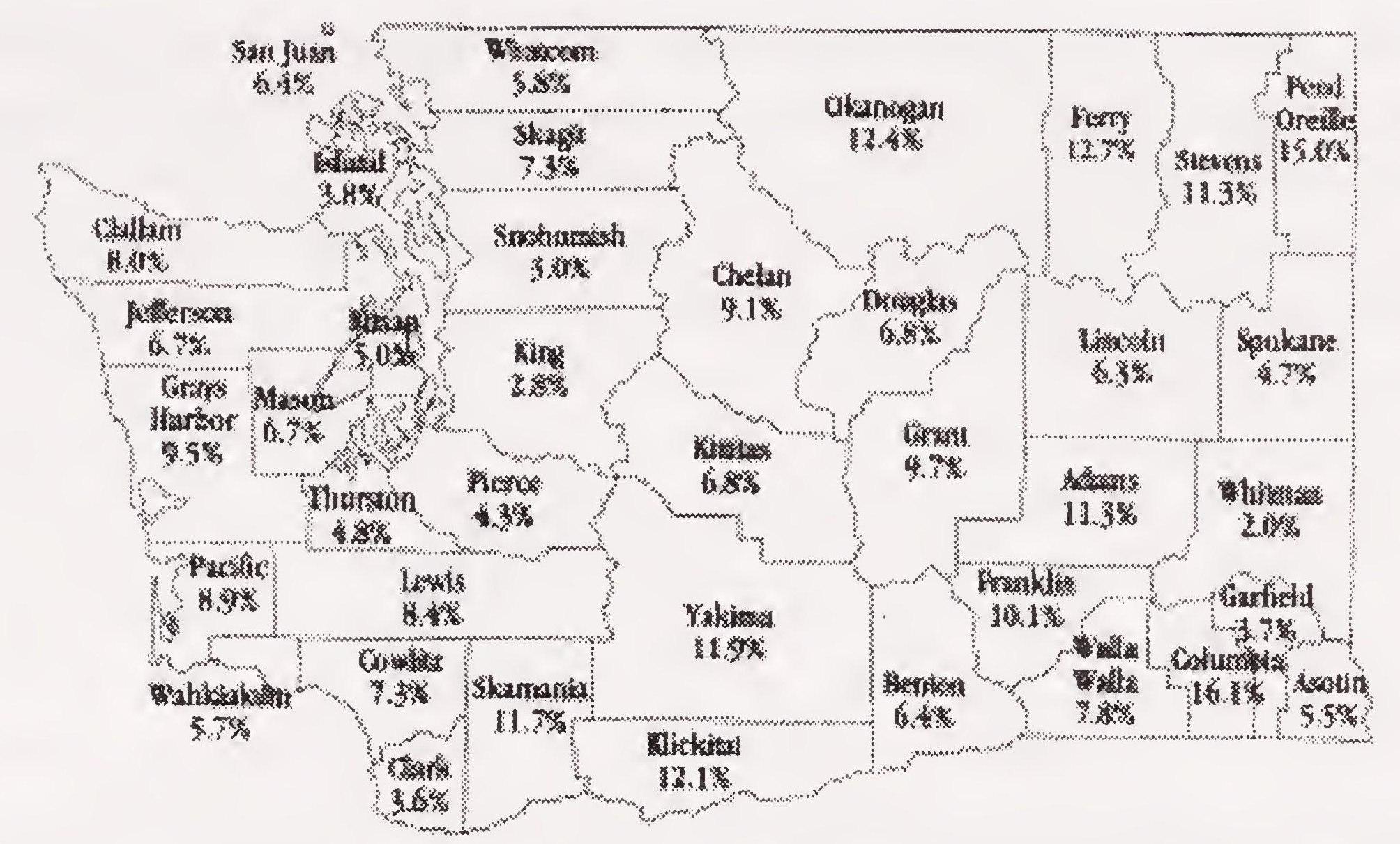
Washington State = 4.7% United States = 5.0% Not seasonally adjusted
—Source: State of Washington Employment Security Department, 1998
The state is 26.8% federally owned. The Forest Service manages most federal lands in the state.
Then there’s the Interior Columbia Basin Ecosystem Management Project. It’s called ICBEMP for short. Locals pronounce that “Ick-Bump” or “Ice-Bump,” depending on their mood. It is a monstrous 144 mil-lion-acre project covering parts of seven states, wrapped around nearly 75 million acres of federal land and 69 million acres of state, tribal, and private land.
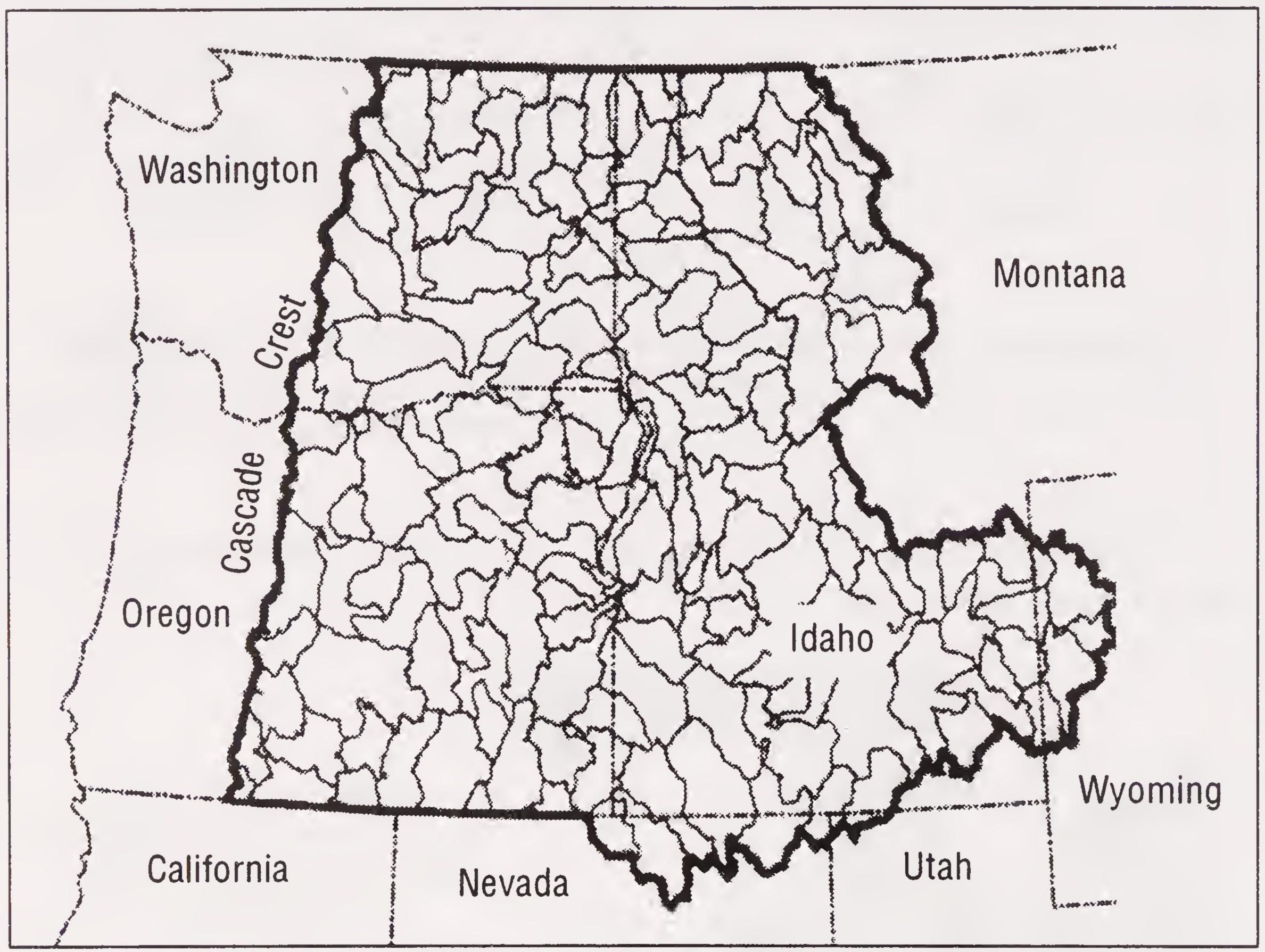
—Based on ICBEMP, Upper Columbia River Basin DEIS, Vol 1., Ch. 5, p. 5.
I.C.B.E.M.P. OUTER BOUNDARY AND INNER WATERSHEDS
BLM and National Forest lands: 74,777,000 acres (52%); State and other Federal lands: 9,845,000 acres (6%); Tribal lands: 5,473,000 acres (4%); Private lands: 54,375,000 acres (38%); Totals: 144,480,000 acres (100%).
This grandiose planning area was demanded by the National Audubon Society in its March 23, 1993, action alert (p. 223) prior to the administration’s Forest Conference. McGinty consulted with foundation leaders and green groups on the early concept. The lead national green group that shaped ICBEMP was the Wilderness Society, in concert with a regional lead group, Pacific Rivers Council, based in Eugene, Oregon.
It was the Pacific Rivers Council that promoted the watershed-based strategy you see reflected in the administration’s map above. It is an administrative move to gain authority over rivers, touted as a “conservation strategy.” This “strategy” was paid for by a number of 1993 grants to Pacific Rivers: Pew Charitable Trusts $50,000; Surdna Foundation $30,000; W. Alton Jones Foundation $40,000; Bullitt Foundation $40,000; the James Irvine Foundation, $100,000; the William and Flora Hewlett Foundation $100,000; the Ford Foundation $100,000; the Ruth Mott Fund $15,000; 1994 grants: Pew Charitable Trusts $150,000; Rockefeller Brothers Fund $60,000; and 1995 grants: Northwest Area Foundation $348,000. Many more grants in the $10,000 to $20,000 range drove this strategy for capturing water and water rights away from the resource people of the Columbia Basin.
The Wilderness Society, as we have already seen (p. 177^, was abundantly funded for “ancient forest” issues by the usual suspects, and acting as fiscal agent passing foundation money to smaller groups for specific projects. In addition, the Wilderness Society’s Seattle office received $150,000 from the David and Lucille Packard Foundation “For Eastside Ecosystem Management Project in Interior Columbia River Basin” in 1995–96. The Washington, D.C. headquarters received $40,000 in 1996 from the Bullitt Foundation “To complete economic and ecological analysis of government’s Interior Columbia Basin Ecosystem Management Project process, seek appropriate changes in final plan and train activists to monitor implementation of management plan that results.” As ICBEMP developed, the Wilderness Society’s tracks were clearly visible on the documents, as we shall see.
The administration had doubts about giving the power to shape ICBEMP to environmental groups—decision-making power, not merely advisory power—but really had no choice. The 1993 Forest Conference was intended to produce a plan that would break the gridlock of environmentalist lawsuits against timber sales, but only on the west side of the Cascade Mountains—in the “owl forests,” as the White House called them.
Success for any plan that might come out of the conference required cooperation from environmental groups—particularly the Sierra Club Legal Defense Fund, the Wilderness Society, and the National Audubon Society, all plaintiffs or fiscal agents in key spotted owl lawsuits—to voluntarily release court injunctions they had won against a substantial number of timber sales. The administration had to offer them a quid pro quo. An Eastside plan for the interior forests was part of the price.
Al Gore and Katie McGinty had long embraced the conservation biology approach and dreamed of imposing it on the entire nation. They realized even a Democratic Congress was not likely to do that.
Conservation biology could be applied administratively in many places, but only in limited size. The Environmental Protection Agency, for example, was beginning to outline a number of “ecosystem demonstration areas” in each of its ten regions, some of them, such as the San Francisco Bay/Delta Estuary Initiative, quite large.
But the interior of the Pacific Northwest offered real scope. The watershed of the Columbia — Snake River system was immense. Powerful green groups and their foundation funders wanted an Eastside plan, and could be counted on to apply pressure for the most restrictive plan possible in the largest area possible.
Now the trick was to make it happen as quietly and effectively as possible, avoiding publicity and public outcry.
Easy: There would be no stand-alone executive order to establish the Eastside project. The order would be embedded in another document on another subject, like Congress does with amendments on an appropriations bill.
When the Clinton Forest Plan was released on July 1, 1993, it contained an “ICBEMP Rider.”262a
Few noticed beyond the environmental groups and their foundation funders that helped put it there.
The Forest Plan contained two directives prompted by Katie McGinty: 1) “the Forest Service [is] to develop a scientifically sound and ecosystem-based strategy for management of eastside forests,” and 2) the “strategy” should be based on a scientific study, the “Eastside Forest Ecosystem Health Assessment” completed just three months earlier by a team led by Forest Service scientist, Dr. Richard Everett.
The Forest Plan was signed by the president.
The “strategy” evolved into ICBEMP.
Everett had no advance notice that the White House would direct the agencies to base their strategy on his study. He never even met anyone from the White House. His study had been requested by Senator Mark Hatfield (R-Oregon) and Speaker of the House Tom Foley (D-Washing-ton) and ordered by the Agriculture Secretary and Forest Service in 1992. McGinty evidently regarded it as a windfall: it embodied the ecosystem management approach, it was fresh, and it sampled the appropriate area.
Late in 1993, Everett received notification that he had been appointed science team leader for the Eastside Ecosystem Management Strategy, as it was known before it was renamed ICBEMP. Then Jack Ward Thomas was appointed Chief of the Forest Service.
When Thomas and Bureau of Land Management Director Jim Baca signed the charter of the Eastside Ecosystem Management Strategy on January 21, 1994, it said, “Thomas M. Quigley, Manager, Blue Mountains Natural Resources Institute, will be the Science Team Leader.”262b
Quigley was an economist, not a natural resource specialist, and had never been a team leader. However, he and Thomas had been close colleagues for a long time. The boss gets to pick his (or her) team leaders.
Would ICBEMP have come out any differently had Everett done the job? Everett says he doesn’t know, but, based on his earlier work, he would likely have used a smaller team than the 300 or more Quiqley hired, and would have spent less than the $40 million ICBEMP ultimately spent.
There might have been another consequence: it would have left land use decisions to the managers and political decision-makers. Also, the human impact of ICBEMP would have been much easier to see. As it was, the Draft Environmental Impact Statement of ICBEMP made it impossible to tell who got hurt and how much.
People like Charles McKetta of the University of Idaho, who tried to get the ICBEMP team to do a clear and clean socio-economic assessment, were excluded out of hand. The ICBEMP crew did everything in its power to obscure and confuse the question of who got hurt and how much.263a
Everett would not likely have done that. His loyalty is to science, not to Al Gore. He makes a crucial distinction between ecosystem management, which is what ICBEMP was supposed to do, and conservation biology, which is what ICBEMP actually did:
“Conservation biology,” says Everett, “puts emphasis on biodiversity and its sustainability over time. It is concerned only with plant and animal habitat and does not consider human use of the land. Ecosystem management attempts to include the human population and its growth. Ecosystem management asks: What is biologically possible on the land? What are the human expectations of the land? And where is the intersection of those two?”263b
ICBEMP, unlike FEMAT, was not organized as a Federal Advisory Committee subject to open meeting laws. After learning from the successful court challenge to FEMAT, the administration chartered ICBEMP as a joint project of the Forest Service and BLM with agency line officers doing the work, thereby avoiding public scrutiny.
The people of Washington’s northeastern tier of counties— Okanogan, Ferry, Stevens and Pend Oreille—present the Columbia Basin problem in microcosm.
Jackie Shiner of Republic, Washington—and chairman of the nonprofit watchdog group, Upper Columbia Resource Council—says, “We’ve watched our lives turn into one day of anxiety after another since ICBEMP started. We’ve seen the aggressive nature of the Forest Service and the environmental groups that appear to be running it. The smaller rural communities have well-founded fears of being swallowed up by the federal government.”2630
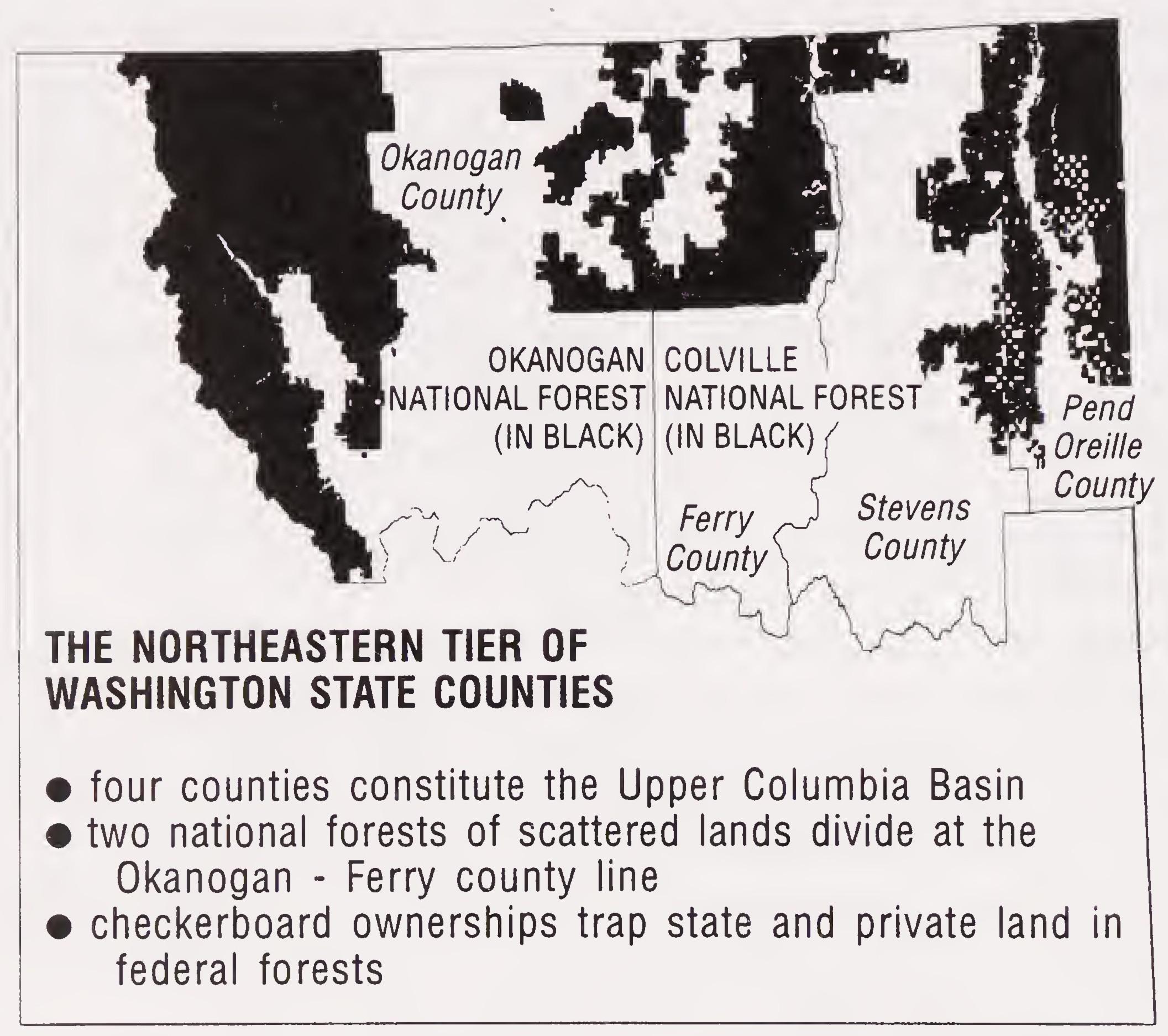
Bret Roberts, coordinator of the non-profit Ferry County Action League, says the Colville National Forest, which covers parts of Stevens, Pend Oreille, and Ferry counties (map above), is already imposing conservation biology on the ground, and has been since 1994, although no Environmental Impact Statement or Record of Decision has been approved.
Roberts notes the insider power of the Wilderness Society in drawing boundaries and making management decisions that the Forest Service appears to be adopting. The required Environmental Assessments for each of the smaller areas show Forest Service maps that copy Wilderness Society maps.264a
“It would appear that people in the executive branch of our government are allowing the Wilderness Society to exercise power in managing our national forests,” said Roberts. “Not only is this wrong, but it also makes me ask myself, ‘Have our government officials become pawns? Or are the environmental groups the pawns and they’re just too stupid to see it?”’
“We kept seeing Wilderness Society maps at Forest Service public meetings. We kept seeing Wilderness Society land use recommendations becoming policy, especially about eliminating our roads. We had to object. So, in late 1998, 206 local people signed a petition to the District Ranger.”2646
The petition requested: “Please send each petitioner Wilderness Society roadless area maps which were entered as part of the public record by the Forest Service at the Open House in Republic. How will their ideas be used and which environmental groups did the Forest Service work with in incorporating that data prior to the public input?”
The Forest Service never revealed the environmental group names.
All three Ferry County Commissioners requested that the Department of Agriculture’s Inspector General, its top law enforcement officer, investigate the undue influence being exerted inside their national forest ranger districts by members of Forest Service Employees for Environmental Ethics (FSEEE) and Public Employees for Environmental Responsibility (PEER).
Commissioner Dennis Snook said, “The Inspector General declined to investigate in a letter to the commissioners. Before we made the letter public, PEER called us and angrily demanded to know why we had requested an investigation of insider access and undue influence of their members upon the Forest Service. Only we knew that the investigation had been requested.”265
The irony of that phone call eluded the PEER officer.
The fact that such information leaked from the Agriculture Department’s top cop to a private advocacy group speaks volumes.
What kind of insider access and undue influence had the Ferry County commissioners suspected?
The Forest Plan of the Colville National Forest has targets for producing goods and services. They’ve never been met.
They were supposed to offer 123.4 million board feet of timber for harvest. In 1997 they offered 59.1 million. Only 30.4 million board feet actually got harvested. They were supposed to pay the state $5 million. They paid $1.5 million.
Were these decisions influenced by Forest Service employees who were members of FSEEE or PEER?
A number of local Forest Service employees are well known members of FSEEE: Cindy Reichelt, Public Affairs Officer of Colville National Forest is FSEEE’s Secretary/Treasurer, and her husband, Dennis Reichelt, Genetic Resources Specialist of Colville National Forest, is active with her.
Which FSEEE or PEER members have influence over resource decisions is something the government will neither investigate nor reveal.
The Wilderness Society and Pacific Rivers Council pressured for even lower national forest production targets. Al Gore and Katie McGinty made sure the Forest Service listened, and the numbers decline.
Al Gore and Katie McGinty were particularly intent upon destroying the mining industry, as we have seen in the Yellowstone and Grand Stair-case-Escalante episodes. Around the time that ICBEMP was starting up, a confidential White House memo came to light showing the lengths to which they would go to stop any mine anywhere—even in Canada.2663
Dated May 14, 1993, only a month and a half after the big Forest Conference, Katie McGinty wrote to six cabinet-level officers about plans to stop the proposed $5 billion Windy Craggy copper mine in British Columbia’s Tatshenshini River valley. She asserted that “both the President and Vice President have expressed great interest” in the Tatshenshini and convincing the British Columbia cabinet to ban mining there by offering to incorporate the region into a “protected zone” with “US lands such as glacier Bay National Park and the Tongass National Forest.”
“The President,” McGinty wrote, “would like to make an announcement on this with Prime Minister [Brian] Mulroney when he visits on June 1.”
McGinty told the cabinet officers “to designate someone to attend a brief meeting on Monday, May 17, a 1:00 in room 360 at the Old Executive Office Building to develop a substantive and strategic plan of action. I would like to receive a draft of the plan by c.o.b. [close of business] Wednesday, May 19.”
McGinty mentioned that “an interagency working group on Windy Craggy has been meeting since last year.”
That working group was part of the transition team before Clinton’s inauguration. In December of 1992, Al Gore had used a decision by the United Nations to designate Alaska’s Glacier Bay National Park a World Heritage site as a platform to announce that he didn’t want the Windy Craggy mine to go ahead. Canadian officials were not amused.266b
Thomas Cassidy, general counsel for American Rivers, the lead green group working on the Tatshenshini issue, proclaimed the mine dead. “Our view is that this new designation should end all consideration of the proposed Windy Craggy mine.”
American Rivers at the time was being funded by W. Alton Jones Foundation, Pew Charitable Trusts, Bullitt Foundation, Surdna Foundation, Richard King Mellon Foundation, George Gund Foundation, American Conservation Association, and others among the usual suspects.
The iron triangle has a long reach.
The same anti-mining pattern was woven in the Columbia Basin.
Anne Novakovitch of Curlew, in Ferry County, points out that the Forest Service mapped a “habitat corridor” in its plans directly over the K-2 Mine operated by Echo Bay Mining Company.
“That creates an opening for environmental groups to come in and take the mining company to court for harming habitat,” she said. “They’re just trying to drive mining out of Ferry county, which has traditionally been a mining county.”2673
The Endangered Species Act has become a weapon to destroy water rights and irrigated farms. In Okanogan County’s Methow Valley, Peter Morrison saw the U.S. Fish and Wildlife Service suspend his water permits on six ditches watering about 1,000 acres of crops—ostensibly it was to save salmon, steelhead and bull trout listed for protection under the federal Endangered Species Act.267b
For the first time in nearly 100 growing seasons, the ditches were dry.
“I think it’s terrible that they treat people this way,” said Donald Johnson, mayor of Winthrop. “We are the taxpayers. It’s our water. Our authority is just taken away. We have no rights. Our land will dry up.”
No similar shutdowns were made on the Toit and Green River watersheds that provide water for Seattle, although salmon use those rivers, too. Urban economies are sheltered from the Endangered Species Act. Rural economies are destroyed with the Endangered Species Act.
What if Seattle were required to remove all buildings and restore its original salmon streams such as Yesler Creek and Denny Creek that today are filled with skyscrapers and parking garages?
The Endangered Species Act has the power to do just that.
Alliances of environmental groups have pressured the U.S. Fish and Wildlife Service to list the Canadian lynx as an endangered species, and Pacific Rivers Council leads the push to list the bull trout and other fish species as threatened or endangered.
Mike Poulson of Connell, chair of the Washington Farm Bureau Natural Resource Committee, said “Environmental groups are just drawing lines on maps around places they want to kick people out of and then claiming it’s lynx habitat or bull trout habitat. It’s just another way to turn rural communities into ghettoes.”267c
The same applies to every other species that environmental groups push to have listed as endangered: a tool for rural cleansing.
Bonnie Lawrence of Omak worries about zealous bureaucrats at the state level. She said, “Here in Okanogan County we have the Loomis Forest, a state common school trust lands property managed by our Department of Natural Resources (DNR). Logging and grazing income is earmarked for K-through-12 school construction. We had spent several years preparing a Loomis Landscape Plan that was supposed to resolve problems and manage the forest.
“Several environmental groups sued—under the Endangered Species Act on behalf of grizzly bears—to stop logging and roads in the Loomis. Our Commissioner of Public Lands, Jennifer Belcher—who was a Washington Nature Conservancy board member—entered an out-of-court settlement with them, which led to a campaign for the green groups to ‘buy’ 25,000 acres of the Loomis for fair market value. The claim was that the green groups would pay for the land and timber value and replace school funds.
“There went our management plan—ironically, it had been designed to improve lynx habitat. The settlement also squelched expert testimony that the Loomis doesn’t even contain grizzly habitat. Yet, the DNR’s agreement to file a grizzly management plan with the U.S. Fish and Wildlife Service for the Loomis Forest is part of the lawsuit settlement. If the Loomis is treated as grizzly habitat, it would complete the lockup.
“Everything about this deal has been cloaked in secrecy. Commissioner Belcher promoted the lowball price of $13 million, but a dozen school districts don’t agree, and have come out against the sale. When the school districts requested a copy of the appraisal, their request was denied. Appraisal reviews came up with conflicting prices— $13 million, $17 million, $30 million. Anonymous donors gave money to the green groups to pay for the Loomis, something that would never be tolerated if a coalition of loggers wanted to buy it for sustained yield timber management.
“Then at a monthly Board of Natural Resources meeting, State Senator Bob Morton [R-7th District] revealed that there was another appraisal, valuing the Loomis at $27.46 million—done by the DNR staff in a secret 1998 meeting. Yet Commissioner Belcher would not acknowledge the fair market value judgment of her own staff.
“Documents provided to Sen. Morton showed a trail of internal staff e-mails planning how to deal with the backlash over the varying appraisals. The $27.46 million appraisal was kept secret within the DNR. Sen. Morton told Commissioner Belcher that withholding information from the Board made it appear there was fraud and that she should step down. Belcher denied any fraud, but would not make public the internal documents that had been provided to Sen. Morton, and he withheld them as well to give her the opportunity.
“The whole session was broadcast on the government cable channel. The newspapers did not even mention any of this controversy.”268
State officials can behave just like federal officials when driven by the same ideology.
Resource Class Exit. What is happening in the Columbia Basin is happening on all the national forests in America.
Goods producers and property owners are being starved out.
Their communities are being colonized by urban elites who want them removed.
Their production is being pushed offshore, to “elsewhere,” to other nations less able to manage resources.
Federal policy is effectively colonizing those other countries to make up for the prohibited domestic production, even as foundations and green groups pressure to shut down goods production worldwide.
The combined influence of prescriptive foundations, grant-driven environmental groups, and zealous bureaucrats has driven the people of the Columbia Basin and the rest of rural America to desperation and despair.
The iron trinagle has changed public opinion so that the urban majority does not care.
They are on the brink of total victory.
They have made biodiversity all-powerful.
The implications of this social change were stated plainly by former Forest Service Chief Jack Ward Thomas in an address to Resources for the Future in April, 1999:
The overriding policy of the management of the national forests is the preservation of biodiversity. That policy or objective will be executed first. Then, if possible, maybe some production of goods and services.
This situation has evolved as a direct result of the Endangered Species Act and the regulations issued by the Forest Service pursuant to the National Forest Management Act, which says the purpose of the ESA is “the preservation of ecosystems upon which threatened and endangered species depend.” The clause in the regulation says preservation of “all native and desired nonnative vertebrates will be maintained in viable numbers well-distributed in the planning area.” That regulation being more stringent even than the ESA.
The period after the passage of ESA has seen an ever-increasing number of species of plants and animals considered “threatened” or “endangered.” Usually significant numbers of these species are found in the national forests. Oddly, not because the situation is worse than before but because conditions are relatively better. Every such species requires special consideration from management.
With every such “listing” the Service gains a management partner with complete veto authority over proposed actions. Now, couple this with the requirement of the above-described clause in the Federal planning regulations and the consequences of a number of Federal court rulings, then consider the actions. It becomes crystal clear that biodiversity retention is the overriding mission or objective of the Forest Service.
Now that evolved set of circumstances bothers me. It bothers me a lot. It does not bother me so much as being a policy or a mission or objective; it does bother me that it has simply evolved out of a series of laws and pursuant regulations, court cases, and policy directions. It would be a simple matter to ratify that or reject it by Congress or the Administration. If that’s determined to be the overriding objective, so be it. If the Congress disagrees it has the duty to clarify that situation or quit pounding the agency for carrying out that objective. Frankly, I don’t think we are going to see any such clarification. That would take some nerve and I don’t think that exists. I think it is far easier to mollify constituents on the extremes of the preservation-exploitation debate by leaving the Forest Service in the middle.
But I will say this to my friends in Congress and in the business of extracting and processing natural resources: If you expect anything other than a constant decline in the availability of goods and services from the national forests resulting from this de facto mission, you are dreaming about what was and not what will be.270
Former Chief Thomas did not expand his remarks to include a bothersome point: the Endangered Species Act also applies to private property.
Are we to expect the same “constant decline in the availability of goods and services” from that too?
Is the American Dream about what was and not what will be?
Zealous Bureaucrats Footnotes
198a. “Washington’s Most Dangerous Bureaucrats, by Jeffrey H. Birnbaum,” Fortune, September 29, 1997, on-line edition, http:// www.pathfinder.com/fortune/1997/970929/dan.html.
198b. “Environmentalists Become Insiders in Administration,” by Maura Dolan, Oregonian, Sunday, March 28, 1993, p. A21.
201a. “Wild ‘N’ Crazy Gore Quietly Expanding Power of his Office,” by Kenneth T. Walsh, Rocky Mountain News, Sunday July 18, 1993, p. 4A.
201b. “The population and the wealth of nations,” by Richard Grenier, Washington Times, Monday, September 12, 1994, p. A19.
201c. Telephone interview with Bonner Cohen, May, 1999.
203a. “Environmental Science For Sale,” ABC News Nightline, Ted Koppel, Transcript No. 3329, February 24, 1994.
2Q3b. “What to do about Greenhouse Warming: Look Before You Leap,” by Fred Singer, Chauncey Starr and Roger Revelle, Cosmos, April 1991.
203c. Obituary: “Roger Revelle, Oceanographer and Population Expert; at 82,” Boston Globe, Wednesday July 17, 1991, p. 27.
204. This section is based on: “’Global Warming’ Libel Suit Reaches Settlement,” news release by Center for Individual Rights, Washington, D.C., May 24, 1994; and “Singer’s Global Warming Libel Suit Reaches Settlement,” Global Warming Network Online Today, Alexandria, Virginia, May 27 and May 31, 1994.
205a. Telephone interview with Rogelio “Roger” Maduro, Leesburg, Virginia, February 25, 1994.
205b. “The Federal Page — In The Loop,” The Washington Post, February 14, 1994, by Al Kamen, p. A13.
206a. Telephone interview with Bonner Cohen, May 1999.
206b. “Carol Browner, master of mission creep,” by Pranay Gupte and Bonner R. Cohen, Forbes, October 20, 1997, p. 170. Online at http:/ /www. forbes.com/forbes/97/1020/6009170a.htm.
208a. “Latest Cabinet Picks are Mostly Social Liberals — 3 Women Add Diversity to Team of Moderates,” by Knight-Ridder Newspapers, Atlanta Constitution, Saturday December 12, 1992, p. A8.
208b. EPA History Office website, contains links to publications covering issues and administrative documents at http://www.epa.gov/his-tory/.
209. Accounts of EPA cancer hunts may be found in: Fear of Food: Environmentalist Scams, Media Mendacity, and the Law of Disparage-
merit, by Andrea Arnold, Free Enterprise Press, Bellevue, Washington, 1990; and The Asbestos Racket: An Environmental Parable, by Michael Bennett, Free Enterprise Press, Bellevue, Washington, 1991. 210a. “EPA Tells 22 States to Curb Smog-Causing Pollution,” Saturday Oc
tober 11, 1997, Los Angeles Times. See also, “EPA Tells States to Clean Air — Or Else Federal Highway Funds Could Be Withheld, the Agency Said. PA. and N.J. Need Make Only Modest Improvements,” Sunday, October 12, 1997, Philadelphia Inquirer.
210b. Secret memo, “Climate Change Action Plan,” was later leaked.
211a. “The People v. Carol Browner: EPA on Trial,” National Wilderness Institute, http://www.nwi.org/SpecialStudies/EPAReport/Overview.html.
211b. “Blowing the whistle on EPA’s widespread abuse,” letter signed by 19 EPA scientists, Washington Times, Wednesday, June 10, 1998.
212a. All EPA grant data from Grants Information Query Form at EPA website, http ://www.epa.gov/envirofw/html/gics/gics_query.html.
212b. “A Bad Air Day Will industry lobbyists foul up the E.P.A’s newly proposed regulations?” by David Corn, The Nation, March 24, 1997.
214a. “Carol Browner, master of mission creep,” Forbes, October 20, 1997. 214b. “Clinton, Rubin reported ‘distressed’ over EPA’s strict new air standards,” Washington Times, Monday, June 30, 1997.
215a. “Clinton Backs EPA’s Tougher Clean Air Rules,” by Joby Warrick, John F. Harris, Washington Post, June 26, 1997, p. AOI.
215b. “Air Quality Standards Rejected by Appeals Court Environment: EPA construed Clean Air Act too loosely in setting rules for smog and soot, judges say. Ruling is seen as setback for Clinton administration,” by Robert L. Jackson, James Gerstenzang, Los Angeles Times, Saturday May 15, 1999, p. Al.
215c. “The Environmental Justice Movement: Continuing the Struggle for Civil Rights,” (sub)TEX Volume 1, Issue #5 (February 1995). Online at http://www.utexas.edU/students/subtex/.web/volumel/issue5/ Environmetal_Justice.shtml.
215d. Executive Order 12948 Amendment to Executive Order No. 12898, January 30, 1995.
215e. Environmental Protection Agency—Part 1: Accompanying Report of the National Performance Review, Office of the Vice President, Washington, DC September 1993.
216a. “Carol Browner, master of mission creep,” Forbes.
216b. “The Shame of Shintech: A Political Game where everyone loses,” by J. Michael Havelka, WasteBiz. Online at http://www.wastebiz.com/html/ body _oct9 7f3. h tml.
216c. “Does Environmentalism Kill?” by Michael Gough, EPA Watch, March 10, 1999.
217a. “Judge refuses to halt Shintech bias claim hearing,” Baton Rouge Advocate, Tuesday, September 1, 1998. See also, 217a. “Environmental justice test case averted by chemical company — Manufacturer will not build in poor, black community,” The Baltimore Sun, Saturday, September 19, 1998.
217b. “The Environmental Justice Movement: Continuing the Struggle for Civil Rights,” (sub)TEX.
217c. “Married With Conflicts Bill & Hill & Rod & Carla & the Problem of Capital Power Couples,” by Owen Ullmann, Mike McNamee, The Washington Post, April 10, 1994, p. Cl.
218a. See www.citizensfund.org.
218b. “Citizens Fund, Campaign Finance Reform Program,” Ottinger Foundation Handbook, December 5, 1996.
218c. All cited grants in Foundation Center records.
220a. “Making the Team Takes Her to D.C. — Clinton Drafts a Philly Native to be His Special Assistant on the Environment and Energy,” by John J. Fried, Philadelphia Inquirer, Sunday January 17, 1993, p. DI.
220b. “From Philadelphia to a Top U.S. Environmental Post,” by Andrea Shalal-Esa, Philadelphia Inquirer, Thursday December 9, 1993, p. G5.
220c. “Washington’s Most Dangerous Bureaucrats, by Jeffrey H. Birnbaum,” Fortune, September 29,1997, on-line edition, http://www.pathfinder.com/ fortune/1997/970929/dan.html.
218d. “White House Office to Coordinate Environmental Policy — President Designs New Office to Streamline, Strengthen Policy — Focus on Environment and Economy, Global Issues,” White House Office of the Press Secretary, February 8, 1993.
220e. “Statement by the President and Remarks by the Vice President on New Environmental Policy,” White House release, February 8, 1993.
221. “Remarks by the President in ABC Kids Town Meeting,” February 20, 1993, White House Library website.
223. Ancient Forest Alliance direct mail letter dated March 8, 1993.
226. “The Forest Summit — Learning How to Live With the Owl,” by Kirk Johnson, Seattle Times, Sunday March 28, 1993, p. A15.
227a. “Clinton Calls on Cabinet to Craft Forest-Jobs Plan,” by Paul Richter, Los Angeles Times, Saturday April 3, 1993, p. 1.
227b. For the full list of FEMAT team members, see file, “Ecosystem Management Assessment Working Group,” White House Library website.
228a. Telephone interviews with Bob Lee, May, 1999.
228b. Broken Trust, Broken Land: Freeing Ourselves From The War Over The Environment, Robert G. Lee, Book Partners, Wilsonville, Oregon, 1994, p. 40.
228c. “Clinton Backs a $1 Billion Plan to Spare Trees and Aid Loggers,” by Gwen Ifill, New York Times, July 1, 1993.
229. “Clinton vs. Foley — House speaker is furious at plan to protect Northwest forests,” by Paul Koberstein, High Country News, July 26, 1993 (Vol. 25 No. 13).
229b. “Timber Firms Say Ruling Saps Clinton Plan,” by Eric Pryne, Seattle Times, Tuesday March 22, 1994, p. B3.
229c. “Timber Industry Takes Loss in Court,” Seattle Times, Friday July 1, 1994.
230a. E-mail transmission, “Stand Up for Ancient Forests,” Written 7:54 am Aug 16, 1993 by nwfoga in cdp:en.alerts.
230b. E-mail transmission: “Topic: Ancient Forest Comments Needed Now,” Written 7:18 am Sep 2, 1993 by wafcdc in cdpbiodiversity
231a. H.R. 1944, “Emergency Supplemental Appropriations for Additional Disaster Assistance, for Anti-terrorism Initiatives, for Assistance in the Recovery from the Tragedy that Occurred at Oklahoma City, etc.”
231b. Telephone interviews with Dave Hessel, June, 1999.
232a. “Clinton to Seek Way to Override Logging Ruling,” Seattle Times, Sunday, October 29, 1995.
232b. “Environmentalists Get Ready For Summer of Logging Protests,” by Dana Tims, Oregonian, Monday, June 3, 1996, p. Al.
232c. “Judge Clears the Way for Salvage Logging; Opponents Vow Fight,” by the Associated Press, Seattle Post-Intelligencer, Friday, September 8, 1995, p. Bll.
232d. “Activists Barricade Forest Road,” Oregonian, Friday, November 24, 1995.
233a. “Protesters Dig In to Save Old-Growth Forests Environment: From blocking a road to updating a Web page, activists rally to deter logging in Northwest,” Jeff Barnard, by the Associated Press, Los Angeles Times, Monday, August 26, 1996, p. 5.
233b. FOIA letter from Forest Service Special Agent Thomas J. Lyons, dated October 9, 1996. File Code 6270–1 (96-122-R6).
233c. “The Last Frontier — The ‘Salvage Rider’ Isn’t Saving Forests, It’s Decimating Them,” by Anne W. Semmes, Earth Action Network website.
233d. “Forest Service Agents Clear Out Protesters’ Camp,” by Bryan Denson, Oregonian, Saturday, August 17, 1996, p. BOI.
233e. “Oregon Judge Opts Not to Sentence Trio in Warner Creek Protest,” from correspondent and wire reports, Oregonian, Thursday, August 7, 1997, p. BIO.
233f. “Eco-Protests are Treated Too Tenderly,” by Merrilee Peay, Oregonian, Wednesday, August 7, 1996, p. B7.
233g. Telephone interview with Merrilee Peay, May, 1999.
233h. Telephone interview with Bruce Gainer, June 1999.
234a. Copies of the Jim Turner and Katie McGinty documents are available from Rep. Turner’s office.
234b. “GOP Aims to Head Off Monument ‘End Runs’ — Murkowski bill would require studies — and congressional approval,” by Lee Davidson, Deseret News, Monday, September 30, 1996.
236. “Even Wilderness Group Was in the Dark — Clinton aide pushed for monument despite strong doubts expressed by others,” by Karl Cates, Deseret News, Thursday, January 16, 1997.
237a. White House e-mail files: August 3,1995. To: Raynor [Robert] Baum. Re: Antiquities Act. Signed, Dave [Watts].
237b. White House e-mail file: Creation Time/Date: 19-MAR-1996 19:02:00.00. Creator: CN=Linda L. Lance/O=OVP. Subject: Letter to Babbit [sic] re monuments. To: McGinty, K; Glauthier, T; Jensen, T; Bear, D; Fidler, S; Crutchfield, J; Shuffield, A.
237c. White House e-mail file: attachment 3 Creation Time/Date: 19-MAR-1996 19:01:00.00. Subject: Parksltr.
238a. White House e-mail file: Creator: CN=Linda L. Lance. Creation Date/ Time: 21-MAR-1996 18:36:00.00. Subject: Re: KM’s comments on yesterday’s monument letter. To: McGinty, K; Jensen, t, :bear, d; :crutchfield, j; :glauthier, t.
238b. White House e-mail file: Creator: CN=Linda L. Lance. Creation Date/ Time: 22-Mar-1996 18:56:00.00. Subject: redraft of president’s babbitt letter and question. To: Glauthier, T; McGinty, K; Jensen, T; Bear, D; Crutchfield, J; Beard, B.
238c. White House e-mail file: Creator: McGinty Creation Date/Time: 25-MAR-1996 13:21:00.00. Subject: Re: redraft of president’s Babbitt letter and question To: T. J. Glauthier; Linda L. Lance; Jensen T.; Beard, D.; Crutchfield, J.; Beard, B.
239. White House e-mail file: Creator: James Craig Crutchfield (Crutchfield J) (OMB). Creation date/time: 3-Apr-1996 10:09:39.50. Subject: Parks Initiative update. To: TJ. Glauthier; Ron Cogswell; Bruce D. Beard; Marvis G. Olfus; Linda L. Lance; Thomas C. Jensen.
240a. “The Yellowstone Affair: Environmental Protection, International Treaties and National Sovereignty,” by Jeremy Rabkin.
240b. “In The Loop — The Federal Page — Squashing the Muffin,” by Al Kamen, The Washington Post, December 15, 1995, p. A23.
240c. White House e-mail file: Creator: Thomas C. Jensen (Jensen, T) (CEQ). Creation date/time: 23-Jul-1996 15:30:42.34. Subject: Potus letter re: Utah. To: Peter G. Umhofer CC: Kathleen A. McGinty.
241a. “Behind Closed Doors: The Abuse of Trust And Discretion In The Establishment Of The Grand Staircase-Escalante National Monument.” Majority Staff Report, Subcommittee on National Parks & Public Lands, Committee on Resources, U.S. House of Representatives, One Hundred Fifth Congress, First Session, November 7, 1997, Washington, D.C.
241b. White House e-mail file: Creator: Kathleen A. McGinty (MCGINTY— K) (CEQ). Creation date/time: 29-JUL-1996 09:31:39.65. Subject: Utah letter. To: Todd Stern.
241c. White House document: August 5,1996. Memorandum to Marcia Hale. From: Kathleen A. McGinty. Re: Utah Event Calls.
242. Remarks by the President in Announcing Agreement to Save National Park From Mine Development, Yellowstone National Park Wyoming 11:25 A.M. MDT, White House Library.
243a. White House memo. August 14, 1996. Memorandum to the President. From: Katie McGinty. Subject: Proposed Utah Monument Designation and Event.
243b. White House e-mail file: Executive Office of the President, September 6,1996. To: Elisabeth Blaug, Thomas C. Jensen, Brian J. Johnson, From: Kathleen A. McGinty, Council on Environmental Quality. Subject: Wkly report graphs.
243c. “President Considers Carving National Monument Out of Utah Land,” by Tom Kenworthy, The Washington Post, September 07, 1996, p. A3.
244a. White House e-mail file: Creation Time/Date: 1 O-Sep-1996 14:36:00.00 Creator: Kenworthy, Tom. Subject: Utah, again. To: smtp: johnson.
244b. White House e-mail file: Creator: ken worthyt. Creation date/time: 11-SEP-1996 22:22:00.00. Subject: Utah. To: johnson.
244c. “How Leavitt Tried to Stop Clinton’s Escalante Plan, In Deseret News interview, governor tells about his llth-hour efforts in D.C.,” by Karl Cates, Deseret News, Thursday, January 16, 1997, A15.
244d. Telephone interview with Brad Barber, July, 1999.
245a. “How Leavitt Tried to Stop Clinton’s Escalante Plan, In Deseret News interview, governor tells about his llth-hour efforts in D.C.,” Deseret News.
245b. “Topic: Coal-gate — Clinton’s ‘mother of all land-grabs’ — On the sly, he created a huge preserve in Utah,” by Michael Satchell, U.S. News & Report, January 20,1997.
246a. “Republicans Leave No Hearing Unheld In Seeking Culprit — White House official gets scolding for not telling who advised Clinton,” by Lee Davidson, Deseret News, Friday, September 27, 1996.
246b. “Subpoena Authorization Approved For Inquiry Into Questionable $700,000 Payment To Two Federal Employees,” news release by House Committee on Resources, Don Young, Chairman, June 9, 1999.
247a. “Payments to Interior, Energy staffers draw scrutiny,” by Audrey Hudson and Jerry Seper, Washington Times, June 2, 1999.
247b. http:// www.pogo.org.
251. “Agency says thanks, but no thanks, after e-mail flood,” Deseret News, Monday, April 5, 1999.
253a. “Militia Link Suspected in Acts Against Federal Land Workers — The FBI is Examining March Bombings of Forest Service in Nevada,” by Heather Dewar, Philadelphia Inquirer, Tuesday May 9, 1995, p. A15.
253b. “Threats to U.S. Agents on Public Lands Detailed House Democrat Seeks Hearings on Violence, Condemns Rhetoric of Republican Colleagues,” by Susan Schmidt, Washington Post, May 10, 1995, p. A20.
254. “Legal Assault on Firms Is Armed by Foundations,” by David B. Ottaway, Washington Post, Wednesday, May 19, 1999; p. Al.
262a. Forest Plan for a Sustainable Economy and a Sustainable Environment, White House release, July 1, 1993.
262b. Project Charter, INTERIOR COLUMBIA RIVER BASIN ECOSYSTEM MANAGEMENT FRAMEWORK AND SCIENTIFIC ASSESSMENT and EASTSIDE OREGON AND WASHINGTON ENVIRONMENTAL IMPACT STATEMENT Signed January 21, 1994, Director, USDI Bureau of Land Management, Chief, USDA Forest Service. Online at http://www.icbemp.gov/news/charter.html.
263a. Prof. McKetta’s studies include, “A Study of the Effects of Changing Federal Timber Policies on Rural Communities in Northcentral Idaho,” by M. Henry Robison, Charles W. McKetta, and Steven S. Peterson, University of Idaho, Moscow, Idaho, February 1996.
263b. Telephone interview with Richard Everett, July 1, 1999.
263c. Telephone interview with Jackie Shiner, July, 1999.
264a. Eastside Draft Environmental Impact Statement, Volume 1, Chapter 2, p. 191. U.S.D.A. Forest Service. See also, Lone-Deer Ecosystem Management Project Environmental Assessment. USDA Forest Service Colville National Forest June 1999. Robert L. Vaught, Forest Supervisor. Fig. 3–11 “Conservation Groups Areas of Concern, Harvest Units in Proposed Action,” “Conservation group areas of concern — as delineated by the Wilderness Society.” Chapter 3, pps. 61–63.
264b. Telephone interview with Bret Roberts, July, 1999.
265. Telephone interview with Dennis Snook, July, 1999. Letter from Dallas L. Hayden, director, Program Investigation Division, U.S. Department of Agriculture, Office of Inspector General, dated October 8, 1998, to Dennis Snook, Chairman, Ferry County Board of Commissioners, stamped received by Ferry County Oct. 20.1998. Hayden’s letter misspelled Ferry County as “Perry County.”
266a. White House Memo dated May 14, 1993, confidential to Secretaries Babbitt, Brown, and Espy, Administrator Browner, Counselor Wirth, and Lt. General Williams, cc. to Tony Lake and Leon Fuerte, from Katie McGinty.
266b. “Al Gore comes out swinging against proposed B.C. mine,” by Mark Hume, Vancouver Sun, December 15, 1992, p. Al.
267a. Telephone interview with Anne Novakovitch, July, 1999.
267b. “Irrigation Curbs are a Rude Awakening in Methow Valley,” by Lynda V. Mapes, Seattle Times, Sunday May 9, 1999, p. Bl.
267c. Telephone interview with Mike Poulson, July, 1999.
268. Telephone interview with Bonnie Lawrence, July 1999.
270. Address to Resources for the Future, Jack Ward Thomas, April 30, 1999, Washington, D.C.
Chapter 5: Corporate Takeover
Corporations are the next target of prescriptive foundations, grant-driven greens, and zealous bureaucrats. Their victory in decimating rural America’s resource class by closing access to federal lands is nearly complete. Encouraged, the iron triangle is attempting to expand into all corporate activity, following their dream of bringing about a new “environmental age, ” which will replace the “industrial age, ” so that “extractive” industries vanish and “renewable” industries thrive. They devise vast government grants for zero-emission automobiles while choking °ff ^e natural resource supply needed to build those cars. They undermine corporate structures by placing “stakeholders” on an equal footing with “shareholders, blurring notions of ownership with concepts of control. But they have made a fatal error. They believe the thrust to narrow economic activity can be stopped at a point of their choosing. The true believers among them will never stop. The undue influence triangle is a runaway train that will one day crash with all of us aboard.
IT’S NOT EASY BEING GREEN IF YOU’RE CORPORATE.
No matter what corporations do, it’s never green enough. They’ve tried everything. Conflict. Cooperation. Resistance. Innovation. Buyoffs. Public Relations. No model produces the desired results—public acceptance. Somebody always targets you.
Corporate Green
Gore’s Green Galaxy contains a constellation of non-profit organizations that push businesses to “go green.” “Go green” means stop extracting natural resources, retire the resource class, and go into high tech or service businesses, where greens can pretend that they don’t need natural resource extraction (while their Internet messages use electricity equivalent to one pound of coal burned for every two megabytes transmitted).2803
The President’s Council on Sustainable Development was convened by the Clinton administration to harness corporations to green group ideology by promoting high-minded goals that sounded wonderful but silently eliminated natural resource extraction as part of a proper society. Jonathan Lash, a Gore insider, was co-chair of the Council.2806
Lash is well networked with the “green business community,” which consists of more non-profit grant-driven organizations than for-profit businesses, and most of the for-profit businesses are seeking federal grants.
The premier “green business” group is Boston-based CERES, Inc.— Center for Environmentally Responsible Economies (1997 income $1,033,578, assets $555,800). CERES was formed in 1989 with a grant from the Jessie Smith Noyes Foundation to promote the “Valdez Principles,” now renamed the “CERES Principles.” The “Valdez Principles” resulted from the disastrous 1989 Exxon Valdez oil spill in Alaska, which became the platform for the emergence of CERES.280c
The original CERES coalition consisted of fifteen green groups, several “socially responsible investors,” the public pension funds of California and New York City, and some 200 Protestant denominations and Catholic orders. They used the strategy of shareholder resolutions to get their green business program on the corporate radar screen.
The ten “principles” are not enforceable, and cannot be used in litigation by environmental groups against corporations, but are more a credo, a green “This I Believe” statement for corporate bigwigs. In their current form, the ten principles are:
Protection of the Biosphere. We will reduce and make continual progress toward eliminating the release of any substance that may cause environmental damage to the air, water, or the earth or its inhabitants. We will safeguard all habitats affected by our operations and will protect open spaces and wilderness, while preserving biodiversity.
Sustainable Use of Natural Resources. We will make sustainable use of renewable natural resources, such as water, soils and forests. We will conserve non-renewable natural resources through efficient use and careful planning.
Reduction and Disposal of Wastes. We will reduce and where possible eliminate waste through source reduction and recycling. All waste will be handled and disposed of through safe and responsible methods.
Energy Conservation. We will conserve energy and improve the energy efficiency of our internal operations and of the goods and services we sell. We will make every effort to use environmentally safe and sustainable energy sources.
Risk Reduction. We will strive to minimize the environmental, health and safety risks to our employees and the communities in which we operate through safe technologies, facilities and operating procedures, and by being prepared for emergencies.
Safe Products and Services. We will reduce and where possible eliminate the use, manufacture or sale of products and services that cause environmental damage or health or safety hazards. We will inform our customers of the environmental impacts of our products or services and try to correct unsafe use.
Environmental Restoration. We will promptly and responsibly correct conditions we have caused that endanger health, safety or the environment. To the extent feasible, we will redress injuries we have caused to persons or damage we have caused to the environment and will restore the environment.
Informing the Public. We will inform in a timely manner everyone who may be affected by conditions caused by our company that might endanger health, safety or the environment. We will regularly seek advice and counsel through dialogue with persons in communities near our facilities. We will not take any action against employees for reporting dangerous incidents or conditions to management or to appropriate authorities.
Management Commitment. We will implement these Principles and sustain a process that ensures that the Board of Directors and Chief Executive Officer are fully informed about pertinent environmental issues and are fully responsible for environmental policy. In selecting our Board of Directors, we will consider demonstrated environmental commitment as a factor.
Audits and Reports. We will conduct an annual self-evaluation of our progress in implementing these Principles. We will support the timely creation of generally accepted environmental audit procedures. We will annually complete the CERES Report, which will be made available to the public.
Now if we could only get a few foundations, green groups, and zealous bureaucrats to be so forthcoming about their activities....
CERES currently has 54 investor, environmental, religious, labor and social justice groups in the coalition and boasts more than 40 corporate endorsers of their principles, including nine Fortune 500 companies.
Sun Oil was the first Fortune 500 company to endorse the CERES Principles—the Pew Charitable Trusts original shares of Sun Oil and Rebecca Rimel’s gang may have had something to do with that. “Extraordinarily incestuous.”
Sun got CERES in the door of other large companies such as Arizona Public Service, Bethlehem Steel, Catholic Healthcare West, General Motors, H.B. Fuller and Polaroid. Today, 46 companies and organizations have endorsed the CERES Principles.
CERES’s foundation funders include the Beldon Fund, Beldon II, the Foundation for Deep Ecology, the Joyce Foundation (of anti-gun notoriety), Town Creek Foundation, New-Land Foundation, John D. and Catherine T. MacArthur Foundation, and the Charles Stewart Mott Foundation. Much of the Mott money came from General Motors, which is why CERES got in that door.
Stephen Viederman, president of the Jessie Smith Noyes Foundation is a member of the CERES board of directors, along with second-rank officials from the Natural Resources Defense Council, Sierra Club, Friends of the Earth, National Wildlife Federation, World Wildlife Fund, among others. Denis Hayes, president and CEO of the Bullitt Foundation, is honorary co-chair.
With a board like that, you can imagine what a business-friendly coalition CERES must be.
Other organizations pushing business to “go green” include the Virginia-based Global Environmental and Technology Foundation (1996 income: $6,760,832; Assets: $1,009,388). Hank Habicht, chief executive officer, and Tom Harvey, founder.282
GETF co-sponsored the January, 1999 National Town Meeting for a Sustainable America with the President’s Council on Sustainable Development, a four-day conference that drew some 3,000 federal, state and local officials, corporate executives, air and water pollution experts, teachers and students to Detroit, Michigan. It gave Al Gore a platform for talking to voters about such issues as suburban sprawl, shrinking family farms, traffic congestion, the “rebirth of old factory sites” and the need to preserve rivers.
It also gave the administration a platform to announce plans to create a “center for global climate change and environmental forecasting” to better to better deal with “problems caused by carbon dioxide and fossil-fuel emissions.” Transportation Secretary Rodney E. Slater also announced that communities will be allowed to borrow federal transportation experts to help plan projects, to design a “tool kit” of best practices for communities and to offer training sessions to local officials and citizens who want to learn how to seek federal funds for projects.2835
GETF also helped arrange a January 1999 session for Virginia’s Environmental Business Council (EBC), a quasi-governmental organization established in 1998 to promote the state’s 2,600 environmental businesses. The EBC was the work product of Virginia state agencies and the White House Council on Environmental Quality, which jointly drew up its plans— one of the last projects approved by Katie McGinty before she departed. CEQ gave the new organization links to 24 Federal programs that directly support the development of new environmental technologies. Companies attending the January 21 meeting were briefed by federal officials on the most effective means of accessing the business opportunities offered by these federal programs.2835
GETF is funded by the Ohrstrom Foundation.
The for-profit segment of the “green business” community is heavily dependent on government grants and contracts for its existence. Your tax dollars at work.
Other organizations influential in the “green business” community include Sustainable Business.com, an online-only project of The EnviroLink Network (1996 income: $179,302; assets: $38,571), a Pittsburgh-based non-profit green group operating on the Internet. Sustainable Business.com president Rona Fried, Ph.D., has become an authentic Guru of Green Business with a vastly informative website and frequent cogent commentary. Fried’s writings offer probably the clearest view into the mindstyle of Gore’s Green Galaxy. Here are excerpts from one of her more pointed articles:
Steel, often thought of as the symbol of the Industrial Revolution, now carries a recycling symbol. More than half the steel produced today is made from scrap. Paper mills are moving from the forest to the cities, as they hone in on the source of abundant feedstocks — scrap paper. In New Jersey, a state with little forest cover or iron ore, 13 paper mills run only on waste paper and eight steel mills manufacture steel largely from scrap. Why is this? Natural resources are increasingly scarce and thus more expensive; waste is plentiful and increasingly, abundant.
The blueprint for how business is conducted is shifting from Industrial Age operating assumptions of “take, make and throw away” to fit the situation society faces today. It makes sense to use scarce natural resources sparingly, and keep them circulating in the system. Society, in its instinctual desire to survive, is tightening the screws on companies that refuse to play by the new rules. The authors of Interface Inc.’s 1997 Sustainability Report say, “We believe institutions that continuously violate these [natural] principles will suffer economically. The walls of the funnel will continue to impose themselves in the form of environmentally concerned customers, stricter legislation, higher costs and fees for resources and waste, and tougher competition from companies who anticipate the narrowing limits and adjust accordingly.”
Companies, these days, find more freedom through adaptation and reinvention than by retaining the status quo, an indication that a profound transformation is underway. Leaders from many disciplines believe we are witnessing and participating in a societal transition on a scale comparable to the Agricultural and Industrial Revolutions -the Environmental Revolution....
A 1997 survey of Canadian and American executives conducted by the Society of Management Accountants of Canada asked business leaders why their company considered sustainable business practices important. The most important reason given, after compliance with legal requirements, was “because it’s the right thing to do.”
In our global economy, many corporations post revenues and assets higher than the gross national product of many countries. Business is a more powerful institution than government. As global consciousness and social values come to the forefront, the private sector is increasingly called upon to go beyond compliance and participate in fundamental ways as leaders of society. The Industrial Age view that business’ sole function is to produce products, services, and profit is less and less acceptable to society.
Carl Frankel sees it this way: “A handful of powerful forwardthinking decision-makers and policy-formers can really make a difference. We are battling for the hearts and minds of 50 people. That’s why people like Ray Anderson of Interface are really important.”284
It is remarkable how isolated from resource producers these people are. It is as if there were no real people out there providing food, clothing, shelter and all other material goods. These savvy business leaders virtually ignore the need for natural resource extraction in their eagerness to tout the virtues of closing all the loops. Most astonishing, these highly intelligent people can talk about “the walls of the funnel narrowing” only in the context that they, the early adaptors, will beat out the laggards. They never ask where the narrowing stops.
They do not ask because they believe they are in a favored position.
They are not.
They have no idea that the iron triangle exists. They are captives of a juggernaut, not captains of a dream machine.
The movement they ride has a final destination beyond their imagination, and zero extraction of natural resources has inevitable consequences.
That stark reality is a step beyond Gore’s “advanced” thinking.
The inhabitants of Gore’s Green Galaxy cannot see that the moral imperative driving their own adopted movement will not allow the narrowing to stop just because their business is green:
You Can Never Be Green Enough.
Environmentalism is a moral crusade. Moral crusades generate true believers, not accommodating neighbors.
In a moral crusade, positions can only harden.
You Can Never Be Green Enough.
For every neighbor who says, “Maybe this is green enough,” there will always be a true believer who says, “No, this is not green enough.”
Such greener-than-thou combats generate a never-ending spiral of allegations: “compromise,” “capitulation,” “sellout,” “betrayal,” “opponent,” “enemy,” “target.”
The demands will increase.
The walls of the green business funnel will intersect.
As they are already intersecting for rural America’s loggers, miners, oil and gas explorers, ranchers, farmers—all resource producers.
Quirks
The narrowing funnel walls often take bizarre twists. Consider one of the best-known cases of a corporate giant trying to be green: McDonald’s and the styrofoam hamburger box.
In the late 1980s, many environmental groups voiced opposition to non-biodegradable packaging, particularly plastics such as styrofoam. McDonald’s restaurants liked the styrofoam fold-over “clamshell” sandwich package because of its light weight and insulating properties that kept a burger just right for the consumer.
It was a time when stringent new regulations were poised to shut down one-third of the nation’s landfills and local legislation was being proposed to ban many plastic packaging products.
McDonald’s opposed such measures, but was not deaf to pressure groups. It had recently stopped cooking its french fries in beef tallow because of green group outcry. The company was looking to improve its image as environmentally and nutritionally conscious at the lowest possible real cost.286a
Shelby Yastrow, McDonald’s senior vice president, said that the firm’s marketing studies indicated neither a loss of market share nor a potential market gain as a result of environmental issues. McDonald’s had little economic incentive to dump the styrofoam clamshell.
It came as a surprise, then, when on August 1, 1990, after intense negotiations, the McDonald’s Corporation and the Environmental Defense Fund (EDF) jointly announced that the styrofoam clamshell would be replaced by coated paper wrapping.
Further, the unlikely couple agreed to a six-month joint task force to identify ways of dealing with the hundreds of millions of pounds of trash the fast food company generated each year.
EDF would get no money. The task force was set to look at possible solutions, including redesign of packaging and shipping materials to do more with less, and the potential for composting that might turn waste french fries into potting soil.
McDonald’s also pledged to annually purchase $100 million of products made with recycled materials to build and equip its restaurants.
The company subsequently established a recycling program of its own called McRecycle USA.
EDF President Fred Krupp said, “We are determined to see McDonald’s make fundamental changes in the way it operates. It’s time to turn the golden arches green.”
Because of their joint effort, McDonald’s and EDF won the President’s Environmental and Conservation Challenge Award.
Why did McDonald’s allow EDF to tell it how to run its business?
The real reason is that Fred Krupp hijacked a national campaign against McDonald’s organized by the grassroots Citizens Clearinghouse on Hazardous Waste. Now known as the Center for Health, Environment and Justice, the feisty group was founded in 1981 by Lois Gibbs, leader of the campaign at Love Canal.286b
The Citizens Clearinghouse on Hazardous Waste, despite its popular reputation of running on a shoestring budget, had enough foundation backing to give McDonald’s a severe case of public relations heartburn.
They got money from: W. Alton Jones Foundation, the Bullitt Foundation, Mary Reynolds Babcock Foundation, Ford Foundation, the John Merck Fund, the Moriah Fund, Charles Stewart Mott Foundation, Jessie
Smith Noyes Foundation, George Gund Foundation, the Florence and John Schumann Foundation, Town Creek Foundation, the Public Welfare Foundation and others.
Krupp barged in and offered McDonald’s a deal with his much bigger and richer organization (grant-driven by some of the same foundations) in return for less than the Hazardous Waste bunch wanted.
Krupp gained a victory which the EDF has since highlighted prominently in its fundraising.
However, part of the deal was that McDonald’s could not use the settlement in its marketing or advertising.
But it wasn’t green enough. Ralph Nader said of the proposed joint study, “By concentrating on ‘waste management’ rather than offering to end the production of waste, McDonald’s ignores the human health dangers posed by hazardous chemical emissions produced as McDonald’s unneeded plastic and styrofoam packaging is manufactured. Grassroots environmental groups are not convinced that McDonald’s is serious about creating a better environment.”
Mark Dowie, author of Losing Ground, said the EDF-McDonald’s arrangement was an example of “high-level capitulations” that “unfortunately allow companies such as McDonalds to look a lot greener than they are. The corporate exploitation of ‘win/win’ compromising has been relentless, with company after company competing through paid and free media to out-green one another. Such activity on the corporate food chain is both predictable and understandable. But environmental complicity, and its own public relations-driven tendency to turn compromise into false triumph, illustrates the impending moral bankruptcy of many mainstream organizations.”287
Something nobody mentioned: Teresa Heinz—a major stockholder of H.J. Heinz Company—sat on EDF‘s board.
H.J. Heinz was a major supplier of products to McDonald’s.
That could be a powerful motive to rescue McDonald’s from a bruising grassroots campaign and polish its environmental image.
Is that what really happened?
Nobody asked, so we don’t know.
With this classic case open to so many interpretations, what is the public to make of corporations cooperating with green groups?
-
It’s insincere corporations “greenwashing” only for public relations purposes.
-
It’s opportunistic environmental groups trying to 1) show the public how reasonable they are; and 2) show their members how powerful they are.
-
It’s a genuine effort to reach an accommodation between businesses and environmentalists rather than remaining stuck in conflict.
-
It’s a hidden agenda of one elite protecting another elite.
Private Timberlands
The public got over losing the McDonald’s styrofoam burger box with minor trauma. The firm’s reputation as an environmentally responsible business has survived despite the true believers’ attempts to tarnish it.
But the private timberlands of America present a more serious problem. With the end of goods production on federal forests in sight, the private timberlands of America will be our only source of domestic forest products. If that too is eliminated, the public will not get over it so easily.
It is reasonable to ask whether even the most prescriptive foundation or grant-driven green group would use their bureaucrat allies to cut off such a vital part of the nation’s economic production as private forests.
Conn Nugent of the Nathan Cummings Foundation provided some insight into that question when he described the mission of the environmental movement to the 1992 Environmental Grantmakers Association annual meeting: “The current use of the earth by humans is unsustainable. And the damage is done through billions of microeconomic behaviors. And stopping, modifying or transforming those behaviors at any place along the economic spectrum from the raw material to the land fill, through the law or through culture, is what we do in this business.”
The funnel walls are now narrowing on private timberlands.
Why? At that same 1992 meeting, Ted Nordeau of the Consultative Group on Biological Diversity—a consortium of grantmakers that promotes biodiversity projects—voiced a view widely held by environmentalists: “Species don’t know the difference where the property lines are. And if we’re thinking about horrors, if we’re thinking about ecosystems, if we’re thinking about sustainability of ecosystems biodiversity, some kind of melding of the private and public forest interests has to be brought together.”
Pressure to reduce or stop private forest production comes from the usual iron triangle sources:
-
green group lawsuits using the Endangered Species Act, which has jurisdiction over private property as well as federal lands;
-
foundation grants promoting the end of timber harvest on private lands—e.g., the Tides Center has a donor-advised fund project called Wood Reduction Clearinghouse to protect natural forests by reducing human wood consumption;
-
federal and state regulations that reduce or eliminate private timber harvests, e.g., California’s Forest Practices Act.
To these we add the movement for “environmentally preferable purchasing,” one of Conn Nugent’s “cultural” means of “stopping, modifying or transforming” our “unsustainable” behaviors: the concept of buying products or services that result from practices judged to be environmentally sound.
The “environmentally preferable purchasing” movement ranges from • organic crops grown in soils on which no pesticides have been applied for three years, to
-
claims of “recycled content” and “biodegradability,” to
-
energy-efficient home appliances and safe cleaners, to
-
“cruelty-free” products not tested on animals or that contain no animal products, to
-
questions of minimizing transportation to and from the workplace and substituting electronic communications for paper.
And many other items.
Compliance with “environmentally preferable” standards may be guaranteed by the producer or certified by a third party.
The problem with self-guaranteed compliance is credibility. Will the purchasing public believe the claims of the producer?
The problem with third-party certification programs is the opportunity for illegal undue influence on markets. If a certification program links producers to retail outlets or end users, it could be seen as price fixing or restraining trade in non-certified products. The Green Seal standard-setting organization has been publicized by Bruce Babbitt’s Department of the Interior on a special website:
The U.S. Department of the Interior is committed to the concept of environmentally preferable purchasing of products and services. The Department has identified “Green Seal,” an independent, nonprofit standard-setting organization, as potentially useful to prospective vendors and Department employees alike in defining environmentally preferable objectives.
Accordingly, we are making Green Seal standards available to Department employees and other users of this website. The U.S. Department of the Interior does not specifically endorse Green Seal or any other standard-setting organization nor does it specifically require or endorse these standards. As other standard-setting organizations become known to the Department, links to these organizations will be added to this website.289
Note the cautious wording used to avoid anti-trust lawsuits—necessary because market- or end user-linked certification programs fall into a questionable restraint-of-trade area by their very nature. If you lock sellers out of a market because they don’t agree with your version of “green,” you could find yourself explaining that to the Federal Trade Commission.
Forest products have now moved into this arena.
Two major types of private-land sustainable forestry programs now compete for acceptance:
-
an industry-based “Sustainable Forestry Initiative” operated by the American Forest and Paper Association (AFPA), and
-
a certification accrediting program operated by the Forest Stewardship Council (FSC).
The AFPA program applies only to producers: the only members are timberland owners who wish to practice sustainable forestry according to standards approved by the association’s board of directors. It is not a certification program and has no links to markets or end users.
The Sustainable Forestry Initiative requires companies to adhere to five principles (each with detailed standards):
-
Sustainable forestry
-
Responsible practices
-
Forest health and productivity
-
Protecting special sites
-
Continuous improvement.
Compliance is monitored by an Expert Review Panel. In addition, a Voluntary Verification system allows third-party audits. Industry firms seem to prefer Certified Public Accountant auditors with no interest in the outcome. Fifteen firms have been thrown out of AFPA for non-compliance.
The FSC program, which only accredits certifiers, and does no certification itself, applies to timberland owners, mill owners, wholesalers, retailers, and a mix of green and social justice groups, including a church. Forest Stewardship Council members include:
-
green groups: American Lands Alliance (formerly Western Ancient Forest Campaign); Environmental Defense Fund; Forest Trust; Friends of the Earth, GreenPeace; National Wildlife Federation; Natural Resources Defense Council; Rainforest Action Network; Sierra Club; Wilderness Society; World Resources Institute; World Wildlife Fund;
-
retail lumber outlets: Home Depot; Big Creek Lumber Company; Northland Forest Products;
-
timberland and mill owners: Collins Companies; Big Creek Lumber Company; Columbia Forest Products; Art Harwood of Harwood Lumber;
-
a certifier: Scientific Certification Systems;
-
and Native American tribal organizations;
among others.
In order to be FSC certified, a company must:
-
Meet all applicable laws
-
Have legally established rights to harvest
-
Respect indigenous rights
-
Maintain community well-being
-
Conserve economic resources
-
Protect biological diversity
-
Have a written management plan
-
Engage in regular monitoring
-
Maintain high conservation value forests
-
Manage plantations to alleviate pressures on natural forests.
An FSC website stated: “Wood products coming from FSC endorsed forest operations can carry the FSC label. Because the products carry the FSC label, environmentally and socially conscious consumers will be able to distinguish among different products and can choose to support well managed forests. Consumers, through their purchasing decisions can encourage producers to manage their forest in an environmentally and socially responsible manner. Producers, distributors and retailers can be rewarded with increased market share and/or a premium price for their efforts.”291
FSC certification requires tracking the chain-of-custody of the wood to prevent contamination with non-certified wood in order to carry the FSC label.
Supporters of both systems mistrust the other.
FSC supporters say the AFPA program needlessly takes too many trees out of private forests. Too much production.
AFPA supporters say the FSC program needlessly leaves too many trees in private forests. Too little production.
FSC supporters say that the industry has such a bad reputation that its own program can never win public acceptance, which will only invite further government intrusion into the management of private timberlands.
AFPA supporters say that FSC impinges so heavily on owner decision-making ability that it is as bad as government intrusion, and that its environmentalist members are separately pushing for harsh regulation of private timberlands anyway.
Each denies the others’ claims.
The AFPA standards are applied by owners of 55 million acres, while FSC certifiers cover 4.5 million acres in the U.S., 31 million worldwide.
The AFPA program covers U.S. producers of 90% of pulp and paper and 50% of solid wood, while the FSC covers no pulp and paper and less than 1% of solid wood.
The Forest Stewardship Council is worth examining because it is built upon an organizational model that can affect any industry.
The FSC, founded in 1993 in Ontario, Canada, was started with a 1992 seed money grant of $ 100,000 from the MacArthur Foundation “To establish international organization to monitor certification practices regarding sustainable harvesting of forest products.”
The impetus came from the 1992 “Earth Summit” in Rio de Janiero, Brazil, where participating nations agreed that “one of the most important roles consumers could play in protecting the planet was to make better decisions about the products they buy.”292a
Agenda 21, the summit’s blueprint for an environmentally sustainable future, encouraged governments to expand “environmental labeling to assist consumers to make informed choices.”292h
The MacArthur Foundation and the Rockefeller Brothers Fund were the “thought leaders” of the global certification campaign.
A number of environmental groups, including FSC’s current green group members, got together with foundation executives around the summit to talk about it. FSC was the result.
The MacArthur Foundation gave another $25,000 to FSC in 1993, at a location in Richmond, Vermont, and another $350,000 in 1996 to FSC at its current headquarters in Oaxaca, Mexico.
In addition, Surdna Foundation gave FSC $100,000 in 1997 at its Vermont office.
Publicly accessible IRS master files show no listing for the Forest Stewardship Council, so income and asset data are not available.2920
It is difficult to track the money going to the Forest Stewardship Council from foundation records because numerous fiscal agents have received funds on behalf of the FSC:
-
the Moriah Fund (Daniel Efroymson) gave $45,000 for FSC to Jonathan Lash’s World Resources Institute in 1996;
-
the Rockefeller Brothers Fund gave $150,000 for FSC to the New England Environmental Policy Center and $200,000 for FSC to the New England Natural Resources Center, both in 1997;
-
the Pew Charitable Trusts gave $200,000 for FSC to the New England Environmental Policy Center in 1997;
-
the Ford Foundation gave $330,000 for FSC to the New England Environmental Policy Center in 1998.
Connections. Perhaps more significant than its funding sources, the Forest Stewardship Council is part of a larger foundation-driven campaign built on the coalition model we examined in Chapter Three (pp. 13Qtf).
The most closely related organization in the coalition is Certified Forest Products Council, based in Beaverton, Oregon. Launched in 1997, CFPC is a trade association promoting certified forest products.
CFPC is technically not linked to FSC—no interlocking directorates— but it was created by the same people in the same foundations that created FSC, and, as we shall see, participates in programs coordinated with FSC by organizations we have already met.
In 1995, the MacArthur Foundation and the Rockefeller Brothers Fund, along with others, decided to further promote forest product certification, and gave grants to a consulting group, Environmental Advantage (EA) of New York, to design a market mechanism that would drive certification in the U.S. market—something like a recruiting arm for FSC.
They held meetings with various industry people from Home Depot, The Gap, Anderson Corporation, Starbucks Corporation, and others, also attended by the Natural Resources Defense Council, World Resources Institute, World Wildlife Fund, and others, to discuss creation of a “buyer’s group” based on a European model being operated in the United Kingdom by the Worldwide Fund for Nature, parent organization of the U.S.-based World Wildlife Fund. That is, an environmental group would operate the new trade association.
The businesses in the discussion bluntly told the foundation people, “If you want to create such an organization in the U.S., it will not be run by an environmental group. It will be a stand-alone entity run by business for business. If not, we’re not interested.”
Amounts paid to Environmental Advantage for this certification study: MacArthur Foundation: $225,000 in 1995, two grants in 1996, one $375,000, another, $40,000. Rockefeller Brothers Fund: $35,000 in 1997. Wallace Global Fund, $45,000 in 1997.
After two years of discussion, they incorporated the Forest Products Buyer’s Group in January of 1997. The group contracted with a New York headhunter to conduct an executive search, which resulted in the hiring of David Ford as president. Ford came from the timber industry, and was probably the only experienced timber association executive in the United States who supported third-party certification.
He had the right background: he’d worked for the Washington, D.C.-based National Forest Products Association before it reorganized to become the American Forest and Paper Association, and later worked for the Beaverton, Oregon-based Independent Forest Products Association, which represents smaller independent timber companies.
Ford says, “I saw certification as a tool that would allow us to create the kind of public credibility that we needed to be able to go back and operate on public lands. The conflict model didn’t work. Based on my experience in D.C., we had lost the war. Our social license to practice forestry—granted through Congress and the administration—was revoked. We needed a vehicle that would re-create a level of trust and understanding that would allow us to move forward. Certification was it.”294a
Ford came on board and got things moving. In September, 1997, the Good Wood Alliance merged with the Forest Products Buyers Group to form the Certified Forest Products Council.
The Good Wood Alliance, founded by Scott Landis, author of two noted woodworking books, had been a group of small wood-using businesses that wanted environmentally friendly raw materials for their products, mostly furniture, cabinets, and artisan goods. Originally named Woodworkers Alliance for Rainforest Protection (WARP), the Good Wood Alliance published a quarterly journal, Understory, funded for most of its seven years by W. Alton Jones Foundation. Understory was kept and is the journal of Certified Forest Products Council. Good Wood was noted for its online directory of certified wood producers.294b
The Good Wood Alliance gained acclaim with its wood objects and sculpture for the exhibition Conservation By Design, held in 1993 at the Museum of Art, Rhode Island School of Design, and which completed a tour of American galleries. Designers and artists from North America, Europe and Australia participated.
David Ford and his new organization applied for and received grants from the Compton Foundation ($50,000 in 1997), Ford Foundation ($200,000 2-year grant in 1998), Pew Charitable Trusts ($200,000 2-year grant in 1998), and others. 1997 income was $471,076, assets $223,838. Ford says he was not pressured by the foundations in any way.
The Certified Forest Products Council has prospered under Ford’s direction. Ford does not work with timberland owners or sawmills, but comes at certification from two perspectives: recruiting sellers of wood products and consumers of wood products. He contacts firms of any type to see if they have environmental policies of their own and whether they would be interested in certified products for new construction and remodeling, then seeks suppliers for those interested.
CFPC received a 1998 award of excellence in advertising from Architectural Record magazine.
There have been a few lumps: Those dreams that “producers, distributors and retailers can be rewarded with increased market share and/ or a premium price for their efforts” are proving elusive.
In a 1999 column in Understory, CFPC board member Paul Fuge wrote, “The lure of a price premium for certified wood products was promoted by forest certifiers and accepted as gospel by many hopeful retailers in the mid-1990s. Several consumer surveys lent support to the popular assumption that a pool of eager consumers would be willing to vote for good forestry with their wallets, and a 10 percent premium for certified wood products was widely anticipated. With all due respect to those pioneering surveys, I believe they were fundamentally flawed by a reliance on consumer opinions rather than actions.”2953
Fuge’s message was that the price premium is not there. People are not very willing to pay more for green products at the checkstand.
“It’s not price premium, it’s market share,” says David Ford.
That remains to be seen. Part of this hope seems to be pegged on big retailers like Home Depot selling only certified forest products. That could be legally tricky.
David Ford is well aware of the anti-trust implications of certification: “The first thing I did here was go out and hire legal counsel to draft an anti-trust policy statement. Every time we have a meeting we have anti-trust counsel present. I am going to extremes to avoid any anti-trust problems.”
Frank Gladics of Independent Forest Products Association—Ford left IFPA for CFPC and set up offices right across the hall from his old employer—says the real motive of the few timber owners who have agreed to certification is peace with environmental groups that were putting them out of business.
Gladics is skeptical. “I don’t see any change in behavior of the environmental groups in the Forest Stewardship Council. I know that Wade Mosby of Collins Pine talks about becoming a local hero and poster child for environmental businesses, with free publicity and all of that. But the polarization is still there.”295b
Ford says, “I think the real problem is that some of the companies don’t like us having direct dialog with some of their customers about these issues.”
Many wonder about the relationship of CFPC with the Forest Stewardship Council and its big environmentalist component.
Ford says, “We don’t have a relationship with FSC. We’re an independent non-profit group. We evaluate many certification schemes. Right now we say FSC’s is the best choice. But we have no relationship.”
His organization’s funders don’t seem to know that.
A 1997 grant description of the Wallace Global Fund reads:
Americans for the Environment (AE) — $50,000
Support for the Sustainable Forestry Public Education Campaign, an integrated communications effort headed by the public relations firm of MacWilliams, Cosgrove, Snider, Smith and Robinson. The Campaign coordinates the efforts of the Certified Forest Products Council (CFPC), Forest Stewardship Council (FSC), and several environmental NGOs to brand the FSC as the preeminent independent, third-party certifier of forest products, and to design strategic media plans for the FSC and the CFPC to further the common goal of sustainable forestry.296
Wait a minute.
Who’s running this show?
Why is this money going to Americans for the Environment?
You will recall from Chapter Three (pp. 140#) that Americans for the Environment describes itself as “a non-profit organization dedicated to helping citizen activists use the political process to solve environmental problems, providing Americans concerned about the environment with the knowledge and skills needed to participate effectively in the electoral process.”
What exactly are we going to vote for about certification? Are we going to face ballot initiatives banning the sale of non-certified products from private forests?
And why MacWilliams, Cosgrove, Snider, Smith and Robinson? Most people describe them as a “media strategy” firm. They do focus groups, consultations and message design—to rearrange your mind, as Bob Lee might put it.
MacWilliams, Cosgrove, Snider is also the firm that produced the anti-wise use “Search and Destroy Strategy Guide,” which recommended that funders do a smear campaign and drive wedges between wise use groups as the best way to deal with those who oppose environmentalists.
What are they going to recommend to funders about private timberland owners who do not agree with certification?
The Wallace Global Fund also gave 1997 sustainable forestry grants to New England Environmental Policy Center, Forest Stewardship Council-International, and World Resources Institute.
The “extraordinarily incestuous” tag certainly fits the certification movement (see diagram opposite for a partial view of the connections).
FOREST CERTIFICATION FUNDING RELATIONSHIPS
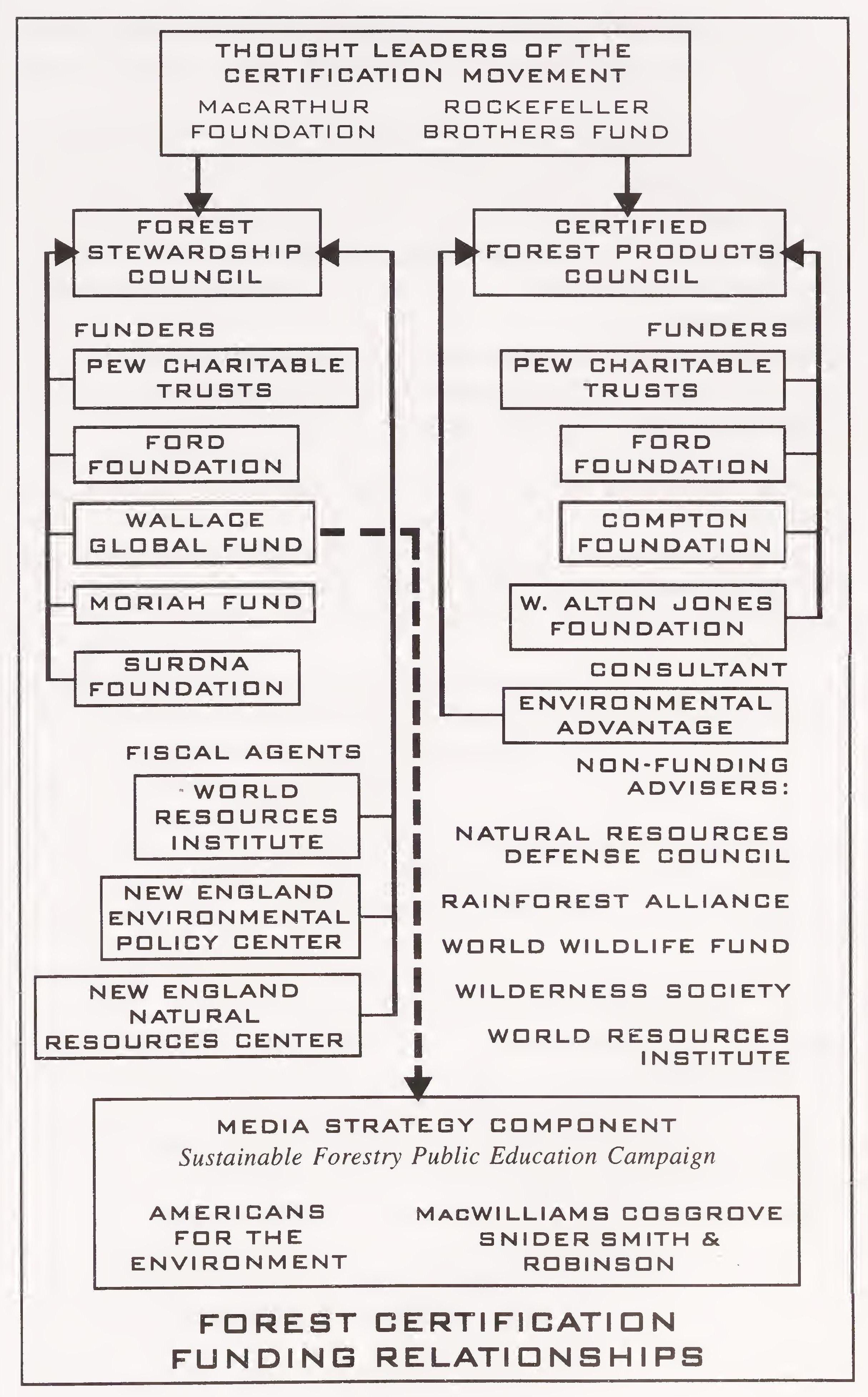
There is no doubt of David Ford’s sincerity in wanting to step out of the conflict of the past three decades and bring people together to find solutions.
He knew nothing about the Wallace grant to Americans for the Environment. The MacWilliams Cosgrove Snider Smith & Robinson group did some consulting for CFPC on strategy, but Ford and his board of directors were not happy with the results and hired their own public relations consultant. CFPC subsequently used MCSSR from time to time on highly specific and limited issues, such as critiquing print ads before placing them in magazines.
There is some doubt whether the extraordinarily incestuous connections in the certification movement will end the conflict or simply carry it underground where undue influence cannot be seen.
That is a question which, in its broadest form, faces all corporations today.
Is some coalition of prescriptive foundations, grant-driven greens and zealous bureaucrats influencing the future in ways you cannot see?
Corporate Takeover Footnotes
280a. Mark P. Mills and Peter W. Huber, “The Internet Begins With Coal,” Greening Earth Society, Washington, D.C., June 1999.
280b. White House Office of the Press Secretary : Monday, June 14,1993, “On Earth Summit Anniversary President Creates Council on Sustainable Development For Economic Growth, Job Creation, Environmental Protection,” Washington, D.C.
280c. www.ceres.org.
282. www.getf.org.
283a. “New Transportation Dept. Center to Study Environmental Issues,” by Stephen Barr, Washington Post, May 2, 1999, p. A6.
283b. “Environmental Business Council Slates Statewide Meeting to Plan Export and Industry Growth Initiatives,” GETF news release, January 21, 1999, Annandale, Virginia.
284. “The State of Environment & Business,” by Rona Fried, Ph.D., www.sustainablebusiness.com.
286. “The Greening of McDonald’s; Fast-Food Giant to Study Ways to Reduce Its Garbage,” by Martha M. Hamilton, Washington Post, August 2, 1990, p.Cll.
286b.http://www.essential.org/cchw/cchwinf.html.
287. “Covering The Earth With ‘Green PR’” by Joel Bleifuss, PR Watch, Volume 2, Number 1, First Quarter 1995.
289. www.doi.gov/oepc/gseal.html.
291. www.web.net/fscca/
292a. “Informed Consumers Can Protect the Planet,” by Rodrigo Prudencio, Christian Science Monitor, Wednesday, July 10, 1996, p. 19.
292b. www.unesco.org/general/eng/programmes/science/programme/ environ/agenda21 /
292c. IRS master files at www.irs.ustreas.gov/plain/tax_stats/soi/ex_imf.html produce no result for the entry Forest Stewardship Council.
294a. Most of this section, including the account of the organizing procedure for CFPC, is based on a telephone interview with David Ford, July, 1999.
294b. http://www.web.apc.org/goodwood/menu.html.
295a. “Whither Green Premiums?” by Paul Fuge, Understory, the publication of the Certified Forest Products Council. Winter 1999, Volume 9, No. 1. Online at http://www.greendesign.net/understory/winter99/ index.html.
295b. Telephone interview with Frank Gladics, July, 1999.
295. www.wgf.org/grants97_env.html.
Epilogue: Futures
Envision living without electricity. No petroleum. Roads with no traffic. Factories crumbling ruins. Corporations extinct, swept away in public outcry. No new metal production because mines have been outlawed. No lumber because logging is forbidden. No ranching or fishing because no one is allowed to harm animals. The vegetables that make up the human diet are grown by hand labor without mechanical power and without beasts of burden. Technology is a fading memory. Collectives and philosopher-kings rule bio-regions everywhere. Shrinking human populations are surrounded by expanding wilderness. Disease visits often and none can control it. Industrial civilization is dead. Humanity has gone back to nature.
IF YOU’VE READ THIS FAR, NOT SO IMPOSSIBLE.
Overdrawn, yes. To underline the point:
Environmentalism has consequences.
How overdrawn is this appalling image?
We have seen in these pages arrogant, secretive and deceitful foundations, grant-driven green groups, and powerful government officials unduly influencing your future behind closed doors. We have seen corporate entanglements.
How will this affect you?
If the things you have read in this book are true—and I invite you to test every sentence—is the above paragraph out of the question?
At the farthest extreme, are we to take seriously the words of David M. Graber, a research biologist with the National Park Service, in his prominently featured Los Angeles Times book review of Bill McKibben’s The End of Nature:
I, for one, cannot wish upon either my children or the rest of Earth’s biota a tame planet, be it monstrous or-—however unlikely—benign. McKibben is a bio-centrist, and so am I. We are not interested in the utility of a particular species or free-flowing river, or ecosystem, to mankind. They have intrinsic value, more value—to me—than another human body, or a billion of them....
It is cosmically unlikely that the developed world will choose to end its orgy of fossil-energy consumption, and the Third World its suicidal consumption of landscape. Until such time as Homo sapiens should decide to rejoin nature, some of us can only hope for the right virus to come along.”302a
Tom Clancy made a best-seller of such human extinction sentiments: Rainbow Six, a novel in which a wealthy and ecologically-enlightened pharmaceutical mogul contrives, with a few powerful allies, the murder of every last human being, courtesy of “the right virus”—genetically enhanced, undetectably packaged, and ingeniously distributed by our drug tycoon. Everyone is to die except for a few thousand carefully chosen environmentalists saved to watch the re-wilding of the planet from a specially built multi-million dollar secret base.302b
But that’s just entertainment, isn’t it?
Of course.
And Clancy wrote Rainbow Six because outrageous statements like Graber’s have struck a potentially lucrative spark with the public, didn’t he?—the real-crime fame of The Unabomber Manifesto, eco-prophetic books like anarchist John Zerzan’s Future Primitive, the formation of groups with crazy names such as the Voluntary Human Extinction Movement, ad nauseam—well, didn’t he?
There’s no danger there, is there?
Respected scholars wonder. And have wondered for some time.
Back in 1982, social analyst Robert Nisbet wrote,
It is entirely possible that when the history of the twentieth century is finally written, the single most important social movement of the period will be judged to be environmentalism. Beginning early in the century as an effort by a few far-seeing individuals in America to bring about the prudent use of natural resources in the interest of extending economic growth as far into the future as possible, the environmentalist cause has become today almost a mass movement, its present objective little less than the transformation of government, economy, and society in the interest of what can only be properly called the liberation of nature from human exploitation. Environmentalism is now well on its way to becoming the third great wave of the redemptive struggle in Western history, the first being Christianity, the second modern socialism. In its way, the dream of a perfect physical environment has all the revolutionary potential that lay both in the Christian vision of mankind redeemed by Christ and in the socialist, chiefly Marxian, prophecy of mankind free from social injustice.”303
One may reasonably wonder whether “the liberation of nature from human exploitation” might in real life look like a Tom Clancy novel.
If you see enviromania all around you, are you concerned? Do you see it in nature shows on educational television, in wildlife features on cable channels such as Discovery and A&E, in Saturday morning kiddie cartoons such as Captain Planet, in Disney films such as Pocahontas? Do you see it in Al Gore’s book, Earth in the Balance, where he wrote that the goal of preserving the environment will be the fundamental organizing principle of society in the coming century? Do you see it in federal laws and administrative initiatives?
George Reisman, Professor of Economics at Pepperdine University’s Graziadio School of Business and Management in Los Angeles, sees it:
The environmental movement openly declares its hostility to the Industrial Revolution, which masses of unthinking people take to mean opposition merely to black smoke belching from factory chimneys. It should be clear ... that the fact is that even if environmentalism does not succeed in removing modern technology from the world, it can easily succeed in recreating pre-1750 conditions for the masses of people in the presently advanced countries, merely through throttling further rapid progress in agriculture and mining. The environmental movement is often characterized as elitist. It is elitist. Economically, it is a latter-day movement of feudal aristocrats, seeking the existence of a privileged class able to pocket the benefits of the economic progress that has taken place up to now, while denying those benefits to the broad mass of the public. It is a movement of monopolists, typified by the mentality of homeowners of the type who, having gotten ‘theirs,’ seek to stop all further development of land in their area. It is the movement of neofeudal mentalities who desire a world of broad open spaces for themselves, spaces that are essentially ownerless, and who care nothing for the plight of crowded, starving masses, who are to be denied the benefit of access to those open spaces, which are to be closed to all development. Essentially it is the old story of the feudal lords who are to have vast forests set aside for their enjoyment, while the serfs dare not remove a log for their fires on kill an animal for their meal.304
If the things you have read in this book are true, environmentalism is throttling rapid progress, not only in agriculture and mining, but also in every other sector of material goods production, including energy and transportation—goods that keep you alive.
If the things you have read in this book are true, there are neofeudal lords setting aside huge chunks of America for themselves and their elites while working to deny the benefits of progress to the public.
If the things you have read in this book are true, the environmental movement is in the process of dismantling industrial civilization piece by piece.
As we have seen, the structure of the environmental movement is not so simple as we thought.
It should be clear now that it consists of an iron triangle of
-
wealthy foundations,
-
grant-driven environmental groups, and
-
zealous bureaucrats
welded together in an undemocratic, elitist political coalition that controls our future far more than the public believes, and perhaps even could believe.
This handful of people with charitable tax-exemptions influence public policy to destroy the lives of hundreds of thousands of goods producers.
They act behind a veil of secrecy.
They lie about their actions.
They were not elected.
They are totally unaccountable.
What is to be done?
Epilogue Footnotes
302a. David A. Graber, “Mother Nature as a Hothouse Flower,” Los Angeles Times Book Reviews, Sunday, October 22, 1989, pp. 1–9.
302b. Tom Clancy, Rainbow Six, G. P. Putnam’s Sons, New York, 1998.
303. Robert A. Nisbet, Prejudices: A Philosophical Dictionary, Harvard University Press, Cambridge, 1982, p. 101.
304. George Reisman, Capitalism: A Treatise on Economics, Jameson Books, 1996, p. 316.
Bibliography
Books
Alan Abramson and Lester Salamon, The Nonprofit Sector and the Federal Budget: Update as of September 1997, The Independent Sector, Washington D.C.
Andrea Arnold, Fear of Food: Environmentalist Scams, Media Mendacity, and the Law of Disparagement, Free Enterprise Press, Bellevue, Washington, 1990.
Ron Arnold, At the Eye of the Storm: James Watt and the Environmentalists, Regnery Gateway, Chicago, 1982.
Ron Arnold, Ecology Wars: Environmentalism As If People Mattered, Free Enterprise Press, Bellevue, Washington, 1987.
Ron Arnold and Alan Gottlieb, Trashing the Economy: How Runaway Environmentalism is Wrecking America,Second Edition, Free Enterprise Press, Bellevue, Washington, 1994.
Ron Arnold, EcoTerror: The Violent Agenda to Save Nature — The World of the Unabomber, Free Enterprise Press, Bellevue, Washington, 1997.
Michael Bennett, The Asbestos Racket: An Environmental Parable, Free Enterprise Press, Bellevue, Washington, 1991.
Porter Bibb, Ted Turner : It Ain’t As Easy at It Looks : A Biography, Johnson Books, 1997.
Althea Carlson, Riding A White Horse: Ted Turner’s Goodwill Games and Other Crusades, Episcopal Press, 1998.
Matthew S. Carroll, Community and the Northwestern Logger: Continuities and Change in the Era of the Spotted Owl, Harper-Collins, New York, 1995.
Alexander Cockburn and Ken Silverstein, Washington Babylon, Verso, New York, 1996.
Theo Colborn, Dianne Dumanoski, John Peterson Myers (Contributor) Our Stolen Future : Are We Threatening Our Fertility, Intellgence, and Survival?-A Scientific Detective Story, Plume (An imprint of New American Library), New York, 1997.
Gregory L. Colvin and Lowell Finley, Seize the Initiative, The Alliance For Justice, Washington D.C., 1996.
Gretchen C. Daily (editor), Nature’s Services; Societal Dependence on Natural Ecosystems, introduction by Joshua S. Reichert, Island Press, Washington, D.C., 1997.
Mark Dowie, Losing Ground: American Environmentalism at the Close of the Twentieth Century, MIT Press, Cambridge, Massachusetts, 1995.
Economics America, Inc., The Right Guide, Ann Arbor, Michigan, 1998.
Environmental Grantmaking Foundations 1996 Directory, Environmental Data Research Institute, Rochester, New York, 1996.
Margaret Mary Feczko, Ruth Kovacs, and Carlotta Mills, editors, National Guide to Funding for the Environment and Animal Welfare, The Foundation Center, New York, 1994.
The Foundation Center, Grants for Environmental Protection and Animal Welfare, 1991–1992, New York, 1992.
The Foundation Center; National Guide to Funding for the Environment & Animal Welfare, New York, 1992.
Robert and Gerald Jay Goldberg, Citizen Turner: The Wild Rise of an American Tycoon, Harcourt Brace Children’s Books, 1995.
Alan Gottlieb, editor, The Wise Use Agenda, Free Enterprise Press, Belleuve, Washington 1988.
David Helvarg, The War Against the Greens, Sierra Club, San Francisco, 1994.
Ronald Inglehart, Modernization and Postmodernization: Cultural, Economic, and Political Change in 43 Societies, Princeton University Press, Princeton, 1997.
W. Alton Jones Foundation, “The wise use movement,” by John Peterson Meyers and Debra Callahan, Charlottesville, Virginia, February 6, 1992.
Ann Kaplan, editor, Giving USA 1998, The American Association of Fund Raising Counsel, Inc. (AAFRC) Trust for Philanthropy, Washington DC., 1998.
Robert G. Lee, Broken Trust Broken Land — Freeing Ourselves From the War over the Environment,BookPartners, Wilsonville, Oregon, 1994.
MacWilliams Cosgrove Snider, “The wise use movement: Strategic Analysis and Fifty State Review,” Clearinghouse on Environmental Advocacy and Research, Washington, D.C., March 1993.
Richard Manning, One Round River: The Curse of Gold and the Fight for the Big Blackfoot, Henry Holt, 1998.
Robert H. Nelson, Public Lands and Private Rights : The Failure of Scientific Management (The Political Economy Forum), University Press of America, 1995.
Marvin Olasky, Patterns of Corporate Philanthropy: Public Affairs Giving and the Forbes JOO, Capital Research Center, Washington, D.C., 1987.
M. Henry Robison, Charles W. McKetta, and Steven S. Peterson, “A Study of the Effects of Changing Federal Timber Policies on Rural Communities in Northcentral Idaho,” University of Idaho, Moscow, Idaho, February 1996.
Lester M. Salamon, et al., The Emerging Sector Revisited, Johns Hopkins University, 1998.
Robert Shankland, Steve Mather of the National Parks, Alfred A. Knopf, New York, 1951.
Articles and Studies
Matthew S. Carroll, Charles W. McKetta, Keith A. Blatner, and Con Schallau.A Response to “Forty Years of Spotted Owls? A Longitudinal Analysis of Logging Industry. ”
Center for the Defense of Free Enterprise, “Battered Communities: How Wealthy Private Foundation, Grant-Driven Environmental Groups, and Activist Federal Employees Combine to Systematically Cripple Rural Economies,” Bellevue, Washington, June, 1998, p. 29.
Center for the Defense of Free Enterprise, Getting Rich: The Environmental Movement’s Income, Salary, Contributor, and Investment Patterns, with an Analysis of Land Trust Transfers of Private Land to Government Ownership, Bellevue, Washington, 1994.
Citizens Against Government Waste, Phony Philanthropy: How Government grants are Subverting the Missions of Nonprofit Organizations, by David E. Williams and Elizabeth L. Wright, November 17, 1998, Washington, D.C.
Corporation for Enterprise Development, The 1997 Development Report Card for the States (book and CDROM), 777 N. Capitol St., N.E., Suite 410, Washington, DC 20002.
Ronnie Dugger, “A Call to Citizens: Will Real Populists Please Stand Up,” The Nation, August 1995.
Environmental Grantmakers Association, 1992 Fall Retreat. Workshop Session 23: Media Strategies for Environmental Protection.
Douglas Foy, “From Courtrooms to Town Hall: The Third Generation of Environmental Law,’’paper prsented at Human Valuation of the Environment: A symposium in celebration of Princeton University’s 250th Anniversary.
Howard H. Frederick, “Computer Networks and the Emergence of Global Civil Society: The Case of the Association for Progressive Communications (APC),” paper presented at the annual conference of the Peace Studies Association, Boulder, CO, February 28, 1992.
Pranay Gupte and Bonner R. Cohen, “Carol Browner, master of mission creep,” Forbes, October 20, 1997.
David Helvarg, “Anti-enviros are getting uglier: the war on Greens,” The Nation, Nov 28, 1994 v259 nl8.
David Helvarg, “The anti-enviro connection (paramilitary groups and antienvironmentalists),” The Nation, May 22, 1995 v260 n20.
Thomas J. Hilliard, editor, Mining Conservation Directory ‘94, January 1994. Sandra Hines, “Trouble in Timber Town: A Way of Life Is Torn Up By Its Roots,” Columns (University of Washington magazine), December 1990.
Bob Lee, “The Hidden Danger of Moral Persuasion: The Clinton Plan Laid Bare,” interview with Dr. Robert Lee, Evergreen, June 1996
Peter Montague, “Big-Picture Organizing, Part 6: Money in Politics,” Rachels Environment & Health Weekly, January 26, 1995.
National Audubon Society, grant proposal to Pew Charitable Trusts, “The Desert Forests Campaign: Protecting the Bio-Economic Diversity of Southwest Forest Ecosystems,” October 1994.
Ottinger Foundation, Funders’ Handbook on Money in Politics, Amherst Mass., with CarEth Foundation, Amherst Mass., Feb. 22, 1996.
C.B. Pearson and Hilary Doyscher, “Big Money and Montana’s Ballot Campaigns: A Study of Contributions to Montana’s Ballot Elections from 1982 to 1994,” Montana Public Interest Research Foundation, Missoula, Mont., September 1996.
Eve Pell, “Oiling the works: How Chevron bought its way into environmentalism’s power circle,” Mother Jones, March-April 1991.
Sierra Defence Fund, To Save the Taku River,” A Coordinated Campaign Strategy Outline, Prepared by: Michael Magee, Vancouver, British Columbia, Canada, 1998.
Ken Silverstein and Alexander Cockburn, “The Collapse of the Mainstream Greens,” CounterPunch, Vol 1, No. 17, October 1, 1994.
Fred Singer, Chauncey Starr and Roger Revelle, “What to do about Greenhouse Warming: Look Before You Leap,” Cosmos, April 1991.
Leslie Spencer, “Fighting Back,” Forbes, July 19, 1993.
Donovan Webster, “Welcome to Turner country,” Audubon, Friday, January 1, 1999.
Government Reports and Documents
Department of Commerce, 1992 Census of Governments, Volume 1, Number 1, Government Organization, Bureau of the Census, Washington, D.C., 1996.
Environmental Protection Agency—Part 1: Accompanying Report of the National Performance Review, Office of the Vice President, Washington, D.C., September 1993.
“Privatization: Toward More Effective Government,” Report of the President’s Commission on Privatization, David F. Linowes, Chairman, March, 1988.
Project Charter, Interior Columbia River Basin Ecosystem Management Framework and Scientific Assessment and Eastside Oregon and Washington Environmental Impact Statement, Signed January 21, 1994, Director, USDI Bureau of Land Management, Chief, USDA Forest Service.
Public Land Statistics, 1996, Table 1.3, “Comparison of federally owned land with total acreage of States, fiscal year 1994f Government Printing Office, Washington, D.C., 1996.
U.S. House of Representatives, “Behind Closed Doors: The Abuse of Trust And Discretion In The Establishment Of The Grand Staircase-Escalante National Monument.” Majority Staff Report, Subcommittee on National Parks & Public Lands, Committee on Resources, One Hundred Fifth Congress, First Session, November 7, 1997, Washington, D.C.
White House, Executive Order 12948 Amendment to Executive Order No. 12898, January 30, 1995.
White House, Forest Plan for a Sustainable Economy and a Sustainable Environment, July 1, 1993.
Index
ABC Kids Town Meeting, 221
Adams, Mary, 42
Adirondack Council, 38
African American Church Summit, 215
Agency for International Development,
agriculture, under attack, 46–47
Alaska, 68
Alaska Conservation Foundation, 88, 112
Alaska Lands Coalition, 38
Alliance for Democracy, 141
Amador, Don, 49
American Association of Retired Persons, EPA grants to, 213
American Conservation Association, 38–39, 155, 266
American Farm Bureau, 42
American Forest and Paper Association, 290–293
American Heritage Rivers Initiative, 9
American Lands Alliance, 176
American Lung Association, 210, 212–213
EPA grants to, chart, 213
American Rivers, Inc., 266
Americans for the Ancient Forests, 176, 223 grants received, 177, 224–225
Americans for the Environment, MO-142, 147, 296–297
Americans for Our Heritage and Recreation, 174
Ames, Bruce, 107
Ancient Forest Alliance, 176 constituent groups, 177 grants received, 178 and Timber Summit, 222#
Andalex Resources, Inc. 246
Anderson Corporation, 293
Anderson, Ray, 284
Appalachian Mountain Club, 38,41, 43, 112, 137
EPA grants to, 213
appeal writers, 15, 29, 137
appeals, 11, 15, 17–18
appeals, chart, 12–13 grazing permit, 8–9, 45–47 mining permit, 8–9 oil drilling permit, 47–48 timber sale, 8–9, 12–13
Apple Computer, 83
Arco Foundation, 71
Army Corps of Engineers, 44
Arnold, Ron, 92
Asarco, 53–54, 70
Associated Press 4–6
Association of Forest Service Employees for Environmental Ethics (AFSEEE), see Forest Service Employees for Environmental Ethics (FSEEE)
Association for Progressive Communications, 83–84
Atlanta magazine, 120
Atlantic Richfield, 91
Audubon magazine, 116
Babbitt, Bruce, 104, 198–199, 207, 219, 221, 229, 289
as Interior Secretary, 101–102, 199,207,226
and League of Conservation Voters, 52, 104, 219
role in Escalante affair, 236#
Babbit, Charles, 132
Baca, Jim, 199, 236, 251,262
Bahouth, Peter, 115
Bailey, Elizabeth, 221
Bailey, Ron, 106
ballot measures, see initiative and referendum process
Barber, Brad, 244
Bassett, Brian, 62n
Bates, Jim, (Congressman), 204
Battered Communities, ix
Battle Mountain Gold Company, 33
Baum, Robert, 236
Bear, Dinah, 231
Beinecke, Frances, 96–97
Belcher, Jennifer, 268
Beldon Fund, 72, 93,218, 282
Benesch, George, 45–47
Berman, Robert L., 246
Bethlehem Steel, 282, biodiversity, 171, 248, 263
Biotechnology Working Group, 75–77 diagram, 77
Bing, Peter, 105
Blue Mountains Biodiversity Project, 23–24
Blue Ribbon Coalition, 48–49
Boeing Company, 4, 6
Boise Cascade Corporation, 70
Boston Globe, 66, 88–89, 106, 110, 112
Boulder-WhiteClouds Council, 154, 157–158
Brainerd Foundation, 113^ 123,156, 158
Brainerd, Paul, 34, 113ff
Brian, Danielle, 246
British Columbia (Canada), 266
Brooks, Hooper, 73, 96
Browner, Carol, 198–199, 226 husband, see Podhorzer, Michael profile, 208–219 son Zachary, 214
Bullard, Robert D., 215
Bullitt, Harriet, 32
Bullitt (Collins), Patsy, 32, 34
Bullitt Foundation, 29, 72, 79, 123, 158, 175, 266, 282, 286 background, 29–30, 32–33 grantee list, 30–32
grants, 34, 156, 172, 248–249, 252, 261
Bureau of Indian Affaris, 21
Bureau of Land Management, 44–47, 235, 257
activist employees, 248^ land area managed by, 20, 50
Bureau of Reclamation, 8,44–46,257
Bush administration, 222
California Forest Practices Act, 289
Callahan, Debra, 92, 104, 207, 219
“Cancer Alley,” 216
Canyon Resources, 34
Cassidy, Thomas, 266
CBS News 60 Minutes, 98
Census of Governments (1992), 21
Center for the Defense of Free Enterprise, ix
Center for Environmentally Responsible Economies (CERES), 280–282
Center for Health, Environment and Justice, 286
Center for Individual Rights, 204
Center for Investigative Reporting, 100
Center for Marine Conservation, 52
Center for Public Interest Research, 148
Center for Resource Economics, 105
Central Texas Rare Species Conservation Plan, 9
CERES Principles, 280–281
Certified Forest Products Council, 293–298
Champion International, 42
Chavis, Benjamin, Jr., 215
Chen, Vivien, 216
Chevron Corporation, 71
Chlopak, Leonard and Schecter, 176
Chlopak, Robert, 176, 178, 223
Christian Coalition, 101
Christian Environmental Council, 102
Christianity Today, 101
circuit riders, 153, 157
CITGO, 22,
Cities Service Company, 103
Citizen Action, 217–218
Citizens’ Clearinghouse for Hazardous Wastes, 286–287
Citizens Fund, 217–218
Clancy, Tom, 302
Clapp, Phil, 98, 102–103
Clean Air Act, 8, 68, 210
Clean Water Act, 9, 44, 68
Clearinghouse for Environmental Advocacy and Research (CLEAR), 84, 95
Clinton administration, 8–9,101,104, 109, 171 environmental advocates in, chart, 199–200
Forest Plan, 228# 262 Clinton, President William, 95, 110, 198, 214–215, 219, 221, 239, 245, 251
Clones, Daphne, 4
Clusen, Chuck, 38, 73, 96, 130, 155 coalition model, 130, 170
see also Northern Forest Alliance Code of Federal Regulations, 68 Cohen, Bonner, R., 201, 206 Coleburn, Theo, 106 Coleman, Tim, 14, 22, 26 Collins Pine, 195 Collins, Clark, 48–49 colonization of rural America, 269 Columbia University, 220 Colville (Washington), 10, 257–258 Colville National Forest, 11, 26, 50, 265
Common Sense Resource League, 33 Community Farm Alliance, 91 Competitive Enterprise Institute, 170 Compton Foundation, 39, 294 ConflictNet, 83 conservation biology, 261–264 defined, 263
Conservation Fund, 42 Conservation International, 87 Conservation Law Foundation, 96–97, 121
Consultative Group on Biological Diversity, 288
Contract With America, 101 Corporate Watch, 81–82, 84 Corporation for Enterprise Development (CFED), 4
Costle, Douglas, 209, 214
Council on Environmental Quality, 52, 220, 231,283
Katie McGinty as Chair, 231# Council on Foundations, 71, 86, 90, 254
Council on Foundations, continued
Environmental Grantmakers Affinity Group of, 71
Cowardin, Dick, 49
Jessie B. Cox Charitable Trust, 38-
39,41, 123
Crown Butte Mines, Inc., 239
Crown Jewel mine, 33
Crutchfield, James Craig, 237
Nathan Cummings Foundation, 72, 79, 138, 218, 248–249, 288
Cypress Creek National Wildlife Refuge, 166
Daily, Gretchen, 105
dams, breaching, 171
DeBonis, Jeff, 178, 248, 251, 253
Denver, John, 242
Deseret News, 244–245
Desert Forests Campaign, 132#
D’Esposito, Stephen, 154
DeVargas, Antonio (“Ike”), 140
Development Report Card for the
States, 4–5
DeWitt, Calvin, 102
Dingell, John D., (Congressman), 214
Geraldine R. Dodge Foundation, 39
Dole, Bob (Senator), 242
Dombeck, Mike, 49, 251
Donald, Judy, 93
donor-advised fund, 76, 78–81
definition, 79
Doppelt, Bob, 227
Dowie, Mark, 68, 89, 287
Draper, Diana, 226–227
Dudley, Barbara, 87, 93
Dumanoski, Diane, 106
Dwyer, William (Judge), 229
Earth Day, 237
Earth First!, 14, 26, 89, 172, 176
Earth in the Balance, 198, 203, 206,
303
Earthlaw, 139
Easterbrook, Gregg, 203
Eastside Ecosystem Management
Strategy, 262–263
Echo Bay Mining Company, 266
ecoligarchy, 197#
“ecological morality,’’ 228
ecosystem management, 263
Edgerton, Bradford Wheatly, 104
Edgerton, Milton Thomas, 104
Edgerton, Patricia Jane (Jones), 104
Edgerton, William A., 104
Efroymson, Daniel R., 42, 159–160, 167
Ehinger, Paul E, 16
Elliman, Christopher, 174
Emmerson, A. A. “Red,’’ 116
Encyclopedia of Associations, 27, 248
Endangered Species Act, 8–10, 44, 68, 98, 135, 175, 258, 267,269–270
Endangered Species Coalition, 102
En strom, Mary, 50
Environmental Action, 174
Environmental Advantage, 293, 297
Environmental Data Research Institute (EDRI), 66
Environmental Defense Fund, 75, 108–109,158,202,204,254,286 EPA grants to, 213
Environmental Grantmakers Association, 35, 38, 41, 65, 7, 90–91, 138, 141, 159, 174–177, 201, 222, 238, 254
Environmental Information Center, 98
environmental justice movement, 215
Environmental Law Institute,
Environmental Media Association, 100
Environmental Media Services, 97–98, 106, 113, 219
Environmental Protection Agency, 44, 108, 198 grants, 43
Office of Environmental Justice, 216
Office of Pesticide Programs, 44 regional ecosystem demonstration projects, 9, 261–262
Environmental Strategies, 95#
Environmental Working Group, 79, 84, 254
Environomics, 145
Espinoza, Martin, 83
Evangelical Environmental Network, 100#
Evangelicals for Social Action, 101
Evans, Brock, 37, 41, 223
Everett, Richard, 262–263
Fauntroy, Walter (Congressional Delegate), 215
federal land management, 19–22
Fenton Communications, Inc., 97,99, 176, 178, 253
Fenton, David, 98–99, 253
Ferry County (Washington), 6,7, 34, 263–265, 278n
Ferry County Action League, 264–265
Ferry County commissioners, 265
Fingerhut, Bert, 174
Fink, Dennis (Commissioner), 17–18
Finley, Michael, 239
fiscal agents, 2, 76, 174#
Fisher, Donald and Doris, 109
Fitzgerald, Anne, 73
Flicker, John, 167
Florida Keys National Marine Sanctuary, 50–52
Flynn, Roger, 154, 158
Foley, Gary, 211
Foley, Tom (Speaker of the House), 229, 262
Fonda, Jane, 70, 115
Forbes, 206, 214
Ford, David, 293–298
Ford Foundation, 79, 86, 122, 218, 286, 292, 294
Ford, Pat, 157–158
forest certification, 288–298 funders, chart, 297
Forest Conference, 53,225–228,258, 260
Forest Conservation Council, 131, 139
Forest Ecosystem Management Assessment Team (FEMAT), 53, 227, 258
Forest Guardians, 86, 115, 132, 172–173
Forest Legacy Program, 36
Forest Products Buyers Group, 294
Forest Service, U.S.D.A., 11,15,17, 18, 45–46, 50, 115, 131, 167, 257, 270 25-percent payments, 15 activist employees, 248# description, 43
Katie McGinty and, 231/ land area managed by, 20 Payments In Lieu of Taxes, 15 Jack Ward Thomas as Chief, 230–233
Forest Service Employees for Environmental Ethics, 50, 178, 198, 265 profile, 248 grants received, chart, 249–250
Forest Stewardship Council, 290–297 ForestWater Alliance, 174
Fortune, 198
Foundation Center, viii, 66,67
Foundation for Deep Ecology, 79, 138, 172, 282
Foundation for National Progress, 72 “foundationese,” 25–26, 29, 83, 91, 95, 98, 110, 112, 121, 171
Foy, Douglas, 96–97, 121
Frampton, George T., Jr., 52, 199, 207
Freedom of Information Act, 88
Freeport MacMoRan, 70
Fried, Rona, 283–284
Friedman, Mitch, 25, 59n
Friends of the Earth, 174, 236, 282
Fuge, Paul, 295
Fund for Peace, 88
Fund for Public Interest Research, 145, 149
Funders Collaborative for Gun Violence Prevention, 254
Funders Handbook on Money in Politics (Ottinger Foundation), 143
Future Primitive, 302
Gainer, Bruce, 233
Galvin, Peter, 59n, 89
Gap, Inc., 109, 293
Gates, Bill, 5
Gaudin, Carol, 217
General Accounting Office, 167
George Washington University, 88
Gibbs, Erich, 164–166
Gibbs, Erna, 164
Gibbs, Frederic A., M.D., 163–166
Gibbs, Lois, 286–287
Gibbs v. The Nature Conservancy, 163#
Gilroy, John, 88
Glacier Bay National Park, 266
Gladics, Frank, 295
Global Environmental and Technology Foundation, 282
Global Environmental Project Institute, 158
global climate change, 202 global warming, 203–205
Glowaski, David (Mayor), 17–18
Goldman, Lynn, 108
Richard and Rhoda Goldman Fund, 79, 172
Good Wood Alliance 294
Gore, Vice President Albert, 106,110, 171, 221, 251, 266, 282 anti-wise use attacks, 201–205 profile, 198#
salvage release for fellow Democrat, 234
staff members, 220
Gore’s Green Galaxy, 206, 280, 282
Gore’s Green Gang, 206
chart, 207
Gottschalk, John, 169
Graber, David M., 302
Grand Canyon,
Greater Yellowstone Coalition, 91
Growth Management Act, 258
Golden Gate National Park, 80 Grand Staircase-Escalante National
Monument (Utah), 9, 246, 266
Grassy Mountain mine, 35
Greater Gila Biodiversity Project, 89, 132
Greater Yellowstone Coalition, 157 greenhouse warming, 203–205
Greenpeace, 93,130, 154,174
Green Seal, 289–290
gun control, 253–257
gun control grant list, 255–257
Gupte, Pranay, 206
Hagerty, Ancer (Judge), 25
Hall, Jim (Commissioner), 22, 26
Harvard School of Public Health, EPA grants to, 212
Hatch, Francis W., 41, 109
Hatch, Orrin (Senator), 246
Hatfield, Senator Mark, 262
Hausker, Karl, 212
Hayes, Denis, 282
Heiken, Doug, 232
Heinz, John, Senator, 110
H.J. Heinz Company, 108
Howard Heinz Endowment, 108
Heinz Endowments, 122
Heinz, Teresa, 108# 162,287
Helvarg, David, 253
Hemenway, Russell, 88
Henderson, Dave, 134, 138
Hermach, Timothy, 115
Hessel, Dave, 231–232
William and Flora Hewlett Founda
tion, 79, 261
High Country News, 103, 130–131
Hilderbrant, Irene, 34
Hirons, Tom, 17
Hirst, Bob, 33
Hitt, Sam, 86
Hocker, Philip M., 154
Home Depot, 293, 295
Hormel, J. Christopher, 154
Hormel, Thomas, 158
Horsey, David, 56
House Resources Committee, 246
Hoyt, John, 99
Idaho Public Land Users Association, 49
Independent Forest Products Association, 294
Independent Petroleum Association of
America, 47–48
industrial revolution, 303
Inland Empire Public Lands Council, 28
initiative and referendum process, 141 chart, 142
Institute for Global Communications, 81
Inter-American Foundation, 87
Interface, Inc., 284
interlocking directorates, 111, 160–161
foundation leaders, diagram, 111
Internal Revenue Service, 67, 129–130
Interior Columbia Basin Ecosystem Management Project (ICBEMP), 9, 229, 258, 260–265
International Paper Company, 42,90 “iron triangle,” 2, 53, 304
Island Press, 105
Jackson Hole Preserve, Inc., 155
Jackson, Thomas Penfield (Judge), 229
Jeffers, Jim, 6
Jensen, Jon, 71
Jensen, Tom, 239–240
Jewell, Mark (AP reporter), 4, 6
Johns Hopkins Comparative Nonprofit Sector Project, 66
Johnson, Brian, 243–244
Johnson, Donald, 267
Johnson, Ernest, 217
Jones, Nettie Marie, 104
Jones, W. Alton “Pete,” 22, 103#
W. Alton Jones Foundation, Inc., 22–23, 25–26, 29, 72, 78, 92, 97, 102, 107, 122, 157, 175, 218, 266, 286, 294
Al Gore connection, 198, 219 grants, 94–95, 138, 155, 261 profile, 103#
Jontz, Jim, 102–103, 176
Joyce Foundation, 72, 218, 254, 282 gun control grants list, 255–257
Karliner, Joshua, 82
Kellett, Michael, 37, 112
W.K. Kellogg Foundation, 86
Kennedy, Robert E, Jr., 96
Kenops, Darrell, 233
Kenworthy, Tom, 243–244
Kerr, Andy, 178, 227
Kerry, John (Senator), 110
Ketchikan Pulp, 112
Kettle Range Conservation Group, 14, 22, 24–26
Kiewit Foundation, 168
Kliegman, David, 34
Kolata, Gina, 107
Koppel, Ted, 201–205
Koppelman, Peter, 231, 233
Knight, Phil, 26, 59n
Krupp, Fred, 286
Kuhn, Dieter, 166
Kyoto Protocol, 215
Lake, Celinda, 147
Lake Research, 148
Lancaster, Justin, 203–205
Lance, Linda, 237–239
land ownership, 19–22
Langfitt, Tom, 86
Larson, Richard, 57
Lash, Jonathan, 207, 212, 280, 292
Lawrence, Bonnie, 267–268
League of Conservation Voters, 52,
92, 104, 219
League of Women Voters, 146–147
Leavitt, Michael (Governor), 243-
246
Lee, Robert, 53, 228
Leff, Deborah, 255
Left Guide, The, 68
Leggette, Poe, 247
Leshy, John, 236, 241
Lewis, David L., 211
Lexington Institute, 201
LightHawk, 178
Locke, Gary (Governor), 6
Loomis Forest (Washington), 267-
268
Los Angeles Times, 4, 302
Los Padres National Forest, 50
Louisiana Department of Environ
mental Quality, 216
Louisiana-Pacific Corporation, 16
Love Canal, 286
Lovell, Charles (Judge), 144
Lynch v. Household Finance, 19
Lyons, Jim, 231–232
John D. and Catherine T. MacArthur Foundation, 86, 122, 282, 292–294
role in forest certification, 292–294
forest certification funding relationships, chart, 297
MacLachlan, John, 107–108
MacWilliams Cosgrove Snider, 148, MacWilliams Cosgrove Snider Smith & Robinson, 148, 296–297
Magee, Michael, 180
Mahon, Nancy, 254
Maine Conservation Rights Institute, 37
Manning, Richard, 54
Mather, Stephen, 36
McCarthy, Coleman, 101
McDonald’s Corporation, 285–288
McDonough, William A., 104, 109 McGinty, Kathleen A., 204,207,266 profile, 219–221 role in Escalante affair, 236/ role in ICBEMP, 260# and Timber Summit, 221#
McKetta, Charles, 263
McKibben, Bill, 302
Richard King Mellon Foundation, 39, 86, 266
John Merck Fund, 39, 41, 109, 123, 218, 286
Michaels, Patrick, 205
Michigan Property Rights Association, 253
Microsoft, 6
Miller, Ellen, 143
Miller, George (Congressman), 253
Miller, Russell, 117
Mineral Policy Center, 35, 153# 158
Minnesota Project, 91 mission creep, 206# defined, 206
Mission Creeps, 206# chart, 207
Mobil Oil Company, 246
Montana Chamber of Commerce, 144 Montana Common Cause, 145–146
Montana Initiative Wars, 140#
Initiative-125,144
Montana Mining Association, 144
Montana Public Interest Research ’
Foundation, 150
Montanans for Clean Water, 145
Montanore mine, 35
MontPIRG, 145–150
Moon, Sun-Myung, Rev., 201
Moraine Nature Preserve, 163–164
Moriah Fund, 39, 160, 286, 292
Morrison, Peter, 267
Morton, Bob (Senator), 268
Mosby, Wade, 295
Mother Jones, 72
Charles Stewart Mott Foundation, 79, 282, 286
Ruth Mott Fund, 218
Motl, Jonathan, 145, 149
Mountain States Legal Foundation, 47
Muecke, Carl (Judge), 17
Mulroney, Brian (Canadian Prime Minister), 266
Multiple Use-Sustained Yield Act of 1960, 10, 47
Myers, John Peterson (“Pete”), 78, 104, 106–108, 174, 219
Nader, Ralph, 68, 70, 148, 287
National Association for the Advancement of Colored People, 216
National Audubon Society, 17, 37, 102–104, 132^ 174,176,223,261
National Center for Responsive Philanthropy, 90
National Committee for an Effective
Congress, 88
National Endowment for the Arts, 211
National Environmental Justice Advisory Committee, 217
National Environmental Policy Act of 1969, 8
National Environmental Trust, 98
National Forest Management Act of
1976, 135, 269–270
National Forest Products Association, 293
national forests, 43, 45, 130^ national grasslands, 43
National Marine Fisheries Service, 44, 68
national monuments, 235
National Oceanic and Atmospheric
Administration, 44, 50
National Park Service, 36, 302 land area managed by, 20
National Parks and Conservation
Association, 36
National Resource Inventory, 20–21
National Resources Conservation
Service, 20, 22
National Security Archive, 88
National Voting Rights Institute, 149
National Wildlife Federation, 43,230, 282
Natural Resources Defense Council, 43, 96–97, 174, 204, 282, 293 EPA grants to, 212
Nature Conservancy, 42, 50, 52, 87, 159
anti-democratic campaigns, 50–52, 167–169
grants received, chart, 159 interlocking foundation affiliations, chart, 160
interlocking corporate affiliations, chart, 161
Nature’s Services, 105
Nelson, Robert H., 170
New England Environmental Policy
Center, 292, 296–297
New England Natural Resources Center, 292, 297
New England Forestry Foundation, 41
Newman, Jon, 11
New Mexico Audubon Society, 134
New Republic, 203
New World mine, 239
New York League of Conservation Voters, 96
New York Public Interest Research
Group, 69
New York Times, 107
New York University, EPA grants to, 212
Newmont Gold, 35
Nichols, James, 253
Nightline (ABC News), 201–203
Niobrara River, 167
Nisbet, Robert, 302–303
Nixon administration, 208
Noranda Inc., 35
Nordeau, Ted, 288
Norden Dam Project, 167–169
North American Wilderness Recovery, Inc., 172
Northern Forest Alliance, 35,37,41–43, 112, 137, 148, 174
Northern Forest Lands Council, 36
Northern Forest Land Study, 36
North Shore Unitarian Universalist
Veatch Program, 87, 93
Northwest Ecosystem Alliance, 25, 27, 172–173
Norwood, Charlie (Congressman),
211
Novakovitch, Anne, 266–267
Jessie Smith Noyes Foundation, 79, 97, 280, 287
Nugent, Conn, 288–289
Occidental Petroleum, 103
Ohrstrom Foundation, 283
Okanogan County (Washington), 6, 263–264, 267
Okanogan County Citizens Coalition (OC3), 34
Okanogan Highlands Alliance, 27,34
Okanogan National Forest, 11, 14, 26, 89
Olasky, Marvin, 169
Omaha World Herald, 168–169
Omak (Washington), 258, 267
Omak Wood Products, 11, 14
Open Society Institute, 254
Center on Crime, Communities and culture, 254
Oppenheimer, Michael, 202
“Option Nine,” 228#
Oregon Natural Resource Council,
232
Orton, Bill (Congressman), 245
Ottinger Foundation, 218
Our Stolen Future, 106, 219
Outside magazine, 108 over-regulation, 7
Owens, Jim, 223
Owens, Wayne (Congressman), 235
Pacific Rivers Council, 227, 260
David and Lucille Packard Foundation, 123
PageMaker, 34, 113
Panetta, Leon, 241–242, 244–245
Parker, Vawter, 223
Patagonia, Inc., 156, 158, 172
PeaceNet, 83
Pearson, C. B., 144, 149
Peay, Merrilee, 233
Pend Oreille County (Washington), 6, 263
Perschel, Bob, 42
Peterson, John (Representative) 43
Peterson, Mike, 14–15, 25, 59n
Pew Center for Civic Journalism, 81
Pew Charitable Trusts, 35,39,41,71, 78, 86# 96, 101, 122, 131# 175, 282,294
grants, 134,156,248–249,261,292
Pew Fellows in Conservation and the
Environment, 105
Pew, Joseph N., Jr., 90
Pew Scholars Program in Counser-vation, 71
Phelps Dodge, 34, 90–91
Philanthropy, 106
Phildelphia Inquirer, 90
Pike, Drummond, 76, 78, 80
Gifford Pinchot National Forest, 50
Podhorzer, Michael, 208, 217–219
Polaroid Corporation, 282
Pope, Carl, 103, 214, 223
Poshard, Glenn (Congressman), 166
Poulson, Mike, 267
Precision Pine & Timber, Inc., 89
Predator Project, 25, 28 prescriptiveness, absolute, 73–74, 109 aggressive, 73, 109 passive, 72
President’s Commission on Sustainable Development, 280,282
President’s Commission on Privatization, 19
Presidio of San Francisco, 80
Presidio Trust, 80
Princeton University, 87, 97
Project on Government Oversight, Inc. (POGO), 246–248 grants to, 247
property rights, 19
propositions (ballot), see initiative and referendum process
protest demonstrations, timber sale, 232–233
Public Campaign, 143
Public Employees for Environmental Responsibility, 50,198,248,265 grants received, chart, 252 profile, 251
Public Interest Research Groups,
Public Media Center, 99
Pyott, Al, 166
Pyramid Communications, 99
Quigley, Thomas M., 262–263
Rainbow Six, 302
Rait, Ken, 236, 243, 244
Reagan administration, 68, 222
Redford, Robert, 246
Reichelt, Cindy and Dennis, 265
Reichert, Joshua S., 87, 96–97, 103, 105, 134, 139, 174
Reilly, Kevin, 216
reinventing government, 198
Reisman, George, 303–304
Republic (Washington town), 10, 257–258
Resources for the Future, 269
Restore: The North Woods, 112
Revelle, Roger, 203–205
Richardson, Bill, 207, 241
Ridings, Dorothy, 86
Right Guide, The, 68
Rimel, Rebecca, 78, 86^ 97
profile, 86–87
riparian area regulations, 8
River Network, 167
Riverwind, Asante (alias of Michael Christensen), 25
Rivlin, Alice, 226
roads, 17, 182, 232–233, 251, 268 moratorium, 9, 251
Roberts, Bret, 264–265
Rock Creek EIS, 53–54
Rockefeller Brothers Fund, 122,155 role in forest certification, 292–297
Rockefeller Family Fund, 35,69^ 96, 122, 156, 175, 248–249
Rockefeller, John D., 70
Rockefeller, John D., Jr., 70
Rockefeller, Larry, 96
Rockefeller, Laurance S., 38, 70, 87, 155
Rockresorts, Inc., 70
Romer, Roy (Governor), 241, 243
Rosenblatt, Paul (Judge), 89
Ross, Donald K., 69# 73,96–97,122, 130, 174, 176, 178, 248
rural cleansing, 3, 17–18, 22, 33, 35, 42, 47, 48, 217
rural unemployment, 3–7 rural-urban conflict, 3–4 Russo, Rosemarie, 210–211
Saint Louis County (Minnesota) 17–18
salvage logging, 229
Salvage Rider, 230–234
San Francisco Bay/Delta Estuary Initiative (EPA), 9, 261–262
San Francisco Bay Guardian, 82
San Francisco Foundation, 83
Sawhill, John C., 162, 166
Schardt, Arlie, 97–98, 207, 219
Schiffer, Lois J., 231
Florence and John Schumann Foundation, 72, 97, 13 8, 218, 248, 252, 287
Schwartz, Joel, 212
Science, 107
Science and Environmental Policy
Project, 202
Scientific Certification Systems, 291
Scrivener, Robert W., 71
Seattle Post Intelligencer, 99
Seattle Times, 33, 114
Seligmann, Peter, 88
Sher, Vic, 226
Shiner, Jackie, 263
Shintech, 216–217
Singer, Fred, 202–205
Slater, Rodney E., 283
Sleepless in Seattle, 33
Sider, Ron, 101
Sierra Club, 29, 38, 103, 130–131, 138, 167, 174, 214, 223, 236, 261,282
Sierra Club Legal Defense Fund, 223, 248, 254
Snook, Dennis (Commissioner), 265
Socci, Anthony, 204
Society of Environmental Journalists, 54, 100, 120
Society of Management Accountants of Canada, 284
Solon, Sam (Senator), 17
Sonenshine, Tara, 205
Soros, George, 254
Southern Utah Wilderness Alliance, 234^244
grants received, 235
Southwest Center for Biological Diversity, 17, 89, 131–132, 139
Southwest Forest Alliance, 89,130^ 148,179
Speir, Robert A., 246
spotted owl, 55, 175
lawsuits, 16–17
job loss data, 16
mill closure data, 16 restrictions, 8
Stahl, Andy, 248, 251
State Environmental Protection Act (Washington), 258
Standard Oil, 70
Starbucks Corporation, 4, 293
Starr, Chauncey, 203
Stearns, Clifford (Congressman), 211
Stephanopolous, George, 245
Stevens County (Washington) 6,263
Stewartt, Michael, 178
Strong, Maurice, 207
Sump, Bob, 7
Sun Oil, 90, 282
Surdna Foundation, 39, 41, 72, 138, 175, 218, 248, 261, 266, 292
Sustainable Business.com, 283–284
Sustainable Forestry Initiative (AFPA), 290–292
sustainability, 290–297 defined, 10
Sweeney, Jim, 253
Taku Strategy, 180–189
Taku Wilderness Association, 180ff
Tatshensheni River, 266
Tennessee Valley Authority, 20
Thomas, Craig (Senator), 52
Thomas Creek Lumber & Logging, 232
Thomas, Jack Ward, 227, 230, 233, 262–263, 269–270
Thoreau Center for Sustainability, SO-81
Thurston, George D., 212
Tides Center, 80–83, 106, 141, 157,
219, 288
programs, diagram, 85
Tides Foundation, 76, 138, 154
timber sale appeals, 11, 17–18
appeals, chart, 12–13
Timber Summit see Forest Confer
ence
Toiyabe National Forest, 45
Tompkins, Doug, 172
Tongass National Forest, 89
Transnational Resource and Action
Center, 81–82, 84
Trout Unlimited, 43
Trust for Public Land, 43, 167
Tufts University, 37
Tulane Environmental Law Clinic,
216
Turnage, Bill, 68
Turner, Beau, 116
Turner Foundation, 29, 114^ 138,
150,156,172,218,248,250,252
Turner, Jim (Congressman), 234
Turner, Ted, 114^
land ownership, chart, 118–119
TBS, 176
United Nations Fund, 109
“two Americas,” 4
Udall, Morris, 243
Udall, Stewart, 154–155
Umhofer, Peter G., 240
Unabomber Manifesto, 302
Unification Church, 201–202
United Nations Conference on Environment and Development, 220
United Nations Development Program, 84, 201
United Nations World Heritage
Committee, 239–240, 266
U.S. Census Bureau, 22
U.S. Department of Agriculture, 43
Inspector General, 265
U.S. Department of Commerce, 44
U.S. Department of the Interior, 198,
289
Office of Policy Analysis, 170
Office of Surface Mining, 44
Minerals Management Service, 44
U.S. Department of Justice, 238,253
U.S. Department of Transportation,
202
U.S. Fish and Wildlife Service, 163, 166, 257–25 8, 267
land area managed by, 20,44,68
U.S. News & World Report, 245
University of Idaho, 263
University of Maryland, 170
University of Montana, 144–147
University of Virginia, 202
Upper Columbia Resource Council, 34, 263
urban-rural prosperity gap, 4–7, 35
Utah Wilderness Coalition, 174
Vaagen Brothers Lumber Company, 10
Vaagen, Duane, 10–11, 14–15, 23
Valdez Principles, 280
Veyhl, Erich, 37
Viederman, Stephen, 282
vilification of resource producers, 53
Virgin Islands National Park, 119
Virginia’s Environmental Business
Council, 283
Voight, Bob, 37
Voluntary Human Extinction Move
ment, 302
Wall, Gale, 25
Wallace Global Fund, 296–297
Warner Creek timber sale, 232–233
Washington Farm Bureau Natural
Resources Committee, 267
Washington Post, 101,205,243–244, 254
Washington Wilderness Coalition, 29
Wasserman, Lee, 122–123
Wathen, Thomas, 88–89,96–97,102- 103, 134
Watt, James, 68
Watts, Dave, 236
Webb, Geoffrey, 200, 236
Weeden Foundation, 40
Weiss, Jay, 205
Western Ancient Forest Campaign, 176, 223, 225, 230
Western Environmental Trade Association, 147
Western Mining Action Project, 154, 158
Western States Center, 95, 151–153 grants received, chart, 152 grants to others, chart, 153
wetlands regulations, 8
Weyerhaeuser Company, 70, 90
White House,
Office on Environmental Policy, 220
“Western Forest Health Initiative,” 230
Wild Earth magazine, 172
Wild Horses and Burros Protection
Act of 1971,46
Wilderness Act of 1964, 68
Wilderness Society, 37, 42, 52, 68, 81, 112, 223
grants received, 178, 225
as fiscal agent, 174# role in ICBEMP, 260–265
Wildlands Project, 170#
key cooperating groups, chart, 173
Wilkinson, Charles, 241
Will, George F, 203
Willamette National Forest, 233
Williams, Eric, 145–146
Windy Craggy mine, 266
Winslow Foundation, 109, 112, 123
Wirth, Timothy E., 109, 207
Wirth, Wren Winslow, 109 wise use movement, 95, 296 opposition funders, 95, 112
Wood Reduction Clearinghouse, 288
Woodworkers Alliance for Rainforest
Protection, 294
World Resources Institute, 292, 293
EPA grants to, 212
Worldwatch Institute,
Worldwide Fund for Nature, 293
World Wildlife Fund, 43, 282, 293
Wolfe, Art, 54
Wright, Larry, 83
Yale Corporation, 96
Yale University, 96
Yastrow, Shelby, 286
Yates, George M., 47–48
Yellow Ribbon Coalition, 233
Yellowstone National Park, 239–240, 242, 266
Young, Don (Congressman), 246–247
“zero cut,” 14
Zerzan, John, 302
THE TRILOGY
If you found undue influence compelling, you’ll want to understand the environmental movement in total depth—which means you’ll want to own the entire Ron Arnold Exposing Environmentalism trilogy that tells it all:
TRASHING THE ECONOMY: How Runaway Environmentalism is Wrecking America, by Ron Arnold and Alan Gottlieb 670 pages, revised edition, paperback, $19.95. Profiles of sixty leading environmental groups, who they are, where they came from, who gives them money and what they do with it!
EcoTerror: The Violent Agenda to Save Nature — The World of the Unabomber by Ron Arnold 336 pages, paperback, $16.95. Probes the dark side of environmentalism, lists hundreds of crimes committed to “save nature,” names the convicted, tells who’s not a criminal, and explores the reasons behind environmentalist violence.
Buy the first two and we’ll send a copy of the third in the trilogy— UNDUE INFLUENCE—absolutely free! Great for gift giving!
Yes! I want to own THE TRILOGY Trashing the Economy and EcoTerror....$36.90.
Add $3.00 shipping and handling for two books....$6.00.
One copy of Undue Influence....FREE!
Total amount....$42.90
Free Enterprise Press books are distributed by Merril Press.
____Check made to Merril Press Or Credit Card: ___Visa__MasterCard ___American Express ___Discover
Card Number Expires
Name___________
Street________
City State___ZIP
Mail to: Merril Press, PO Box 1682, Bellevue, WA 98009 Telephone orders: 425-454-7009 FAX orders: 425-451-3959
[1] Although there has not been a full mapping of state resources directed towards “eco-terrorism,” the prioritization of the environmental and animal liberation movements by state agencies is clearly illustrated by its prominent treatment in the FBI’s Terrorism 2002–2005 report, which classifies terrorism cases as either domestic or international. It is noteworthy that 23 of the 24 recorded “terrorist incidents” from 2002 to 2005 were allegedly perpetrated by domestic terrorists. With the exception of one white supremacist firebombing, all of the domestic terror acts were identified as being carried out by “special interest extremists active in the animal rights and environmental movements.” Whereas criminal investigations once dominated FBI interests, 7,306 of the FBI’s 13,000 agents have now been transferred to “counterterrorism squads.” Terrorism 2002–2005 is available from the FBI website, www.fbi.gov
[2] For a discussion of the historical emergence of animal and earth liberation activism, as well as several essays discussing strategies for radical activists see Steven Best and Anthony J. Nocella, II (eds). 2006. Igniting a Revolution: Voices in Defense of the Earth. Oakland: AK Press.
[3] Steven Best. 2006. “Rethinking Revolution: Animal Liberation, Human Liberation, and the Future of the Left.” International Journal of Inclusive Democracy, 2/3.
[4] Operation Backfire in particular illustrates the extensive political and economic energy that sustains the Green Scare. The operation was the largest round-up of eco-activists in American history. Repercussions of the arrests are on-going and include legal battles as well as the deep fractures that the Operation has created within the movement. The FBI-led efforts include infiltrations, paid informants, and present many indications of other COINTELPRO-like tactics. The divides created by the co-operating defendants is a particularly expressive indication of the government efforts to dismantle the movement. Information about these cases is updated regularly on infoshop.org.
[5] During the Senate hearings on “Eco-Terrorism” in May 2005, Senator Barack Obama, while still supporting the Green Scare in general, delivered an opening statement that critiqued the disproportional nature of the criminal attacks against eco-justice activists. He stated, “The FBI has indicated a downward trend in the number of crimes committed by these groups [ALF and ELF] – approximately 60 in 2004. While I want these crimes stopped, I do not want people to think that the threat from these organizations is equivalent to other crimes faced by Americans every day. According to the FBI, there were over 7,400 hate crimes committed in 2003, half of which were racially motivated. More directly relevant to this committee, the FBI reports 450 pending environmental crimes cases involving worker endangerment or threats to public health or the environment.” To our knowledge, current statistics on the total costs of the Green Scare are not available.
[6] There are several instances where activists have applied for work at HLS. Many have made it inside and, after establishing themselves over the period of several months, they have been able to procure secret documents, gather video evidence, obtain lists with contact or privileged information, among other things. It has been reported that HLS now requires potential employees to eat hamburgers during job interviews in the attempt to “out” animal liberation activists.
[7] Jerry Vlasak, US Senate Committee on Environment & Public Works full hearings on Eco-Terrorism, Wednesday, October 26, 2005.
[8] Sandro Contenta, “Grave Robbers,” Toronto Star, October 29, 2005.
[9] Lauren Mills, “SHAC’s Attack goes Multinational,” Daily Telegraph, October 20, 2002.
[10] For a comprehensive list of companies that have broken commercial relationships as an explicit result of SHAC’s activism, visit www.shac.net (accessed September 13, 2007).
[11] Rosie Murray-West, “Securicor to Quit Animal Testing Lab,” Daily Telegraph, January 31, 2004.
[12] Ibid.
[13] After the NYSE announcement, an unidentified group (whose website has clear links to the medical research lobby) purchased a full-page New York Times advertisement. The ad features a balaclava-wearing white male in a leather jacket under a large headline that reads: “I CONTROL WALL STREET.” The ad accuses NYSE officials who had been “reportedly threatened” of “running scared.” Aside from being read by all NYT readers, the ad received widespread coverage after several major newswire services ran stories focusing on the political consequences and the industries’ displeasure with the NYSE. Within the coverage, the victory of the SHAC campaign was encoded as a capitulation to terrorism.
[14] www.fur.org (accessed January 9, 2008).
[15] Senator Inhofe is well known for his adamant denial of climate change. His financial relationship with Exxon has been heavily detailed by activists at exxonsecrets.org, and sourcewatch.org.
[16] epw.senate.gov January 10, 2008).
[17] Boykoff, see endnote #4. Jennifer Earl. 2003. “Tanks, Tear Gas, and Taxes: Towards a Theory of Movement Repression.” Sociological Theory, 21/1: 44–67.
[18] Corporations like Pfizer, Wyeth, and GlaxoSmithKline joined the United Egg Producers, National Cattlemen’s Beef Association in vocal public support of the AETA. See Will Potter, “Animal Enterprise Terrorism Act Signed into Law,” Earth First Journal, January, 2007, 8–9.
[19] Project Censored, a research group out of Sonoma State University, ranked the passage of the AETA 20th in its 25 Most Censored Stories of 2008. See www.projectcensored.org (accessed January 5, 2008). Project Censored also note that the vote on the bill was held hours earlier than scheduled, with what appears to have been only six (out of 435) Congress persons present. This fact was excluded from mass media coverage.
[20] See the No AETA website at www.noaeta.org (accessed September 26, 2007).
[21] See www.furcommission.com (accessed January 13, 2008).
[22] We are indebted to the excellent analysis of the AETA by Will Potter, available on his blog, Greenisthenewred.com. See www.greenisthenewred.com (accessed September 19, 2007). The full text of the AETA is available at: www.govtrack.us (accessed October 2nd, 2007).
[23] The term “reasonable fear” has been highly problematized among legal commentators and critics of the legislation because of the general climate of fear-mongering perpetuated by Green Scare agents. Karen Pickett. 2007. ‘A Tree-Hugging Terrorist Behind Every Bush?’ ZMAG, 20/8. Will Potter. 2007. ‘Animal Enterprise Terrorism 101.’ Herbivore Magazine: October, 2007.
[24] According to AETA author Senator Inhofe, another rationale for implementing the new legislation was to protect tertiary businesses targeted by SHAC. However, the conviction of the SHAC 7 also discredits that claim and, again, highlights the real motivation behind the AETA: the formalization of animal liberation activism as “terrorism.”
[25] Department of Justice, Press Release, March 2, 2006.
[26] A jpeg file of the FCI Sheridan’s incident report can be viewed here: www.foodfightgrocery.com (accessed October 16, 2008).

[27] Richard Ericson. 2007. Crime in an Insecure World. London: Polity.
[28] H.R. 1955 is available at www.govtrack.us (accessed January 14, 2008).
[29] After this writing, it came to light that Sadie and Exile hold both racist and transphobic views. The anarchist community has parted ways with them.
[30] In theory, the task of a grand jury is to examine the validity of an accusation before trial. In practice, grand juries are used to force information out of people: by granting an individual immunity regarding a specific case, a grand jury can compel him or her to answer questions or else go to prison for contempt of court.
[31] The FBI’s Counter-Intelligence Program (COINTELPRO) existed officially from 1956 to 1971 and probably continues to this day in some form. Aiming to “expose, disrupt, misdirect, discredit, or otherwise neutralize” the activities of groups like the Black Panther Party, the Program utilized a wide variety of dirty tricks. Houses and offices were searched and documents stolen without any warrants having been issued; rumors were spread in order to foster mistrust and even violence between different organizations or factions within them; group members were harassed through the courts or even wholly framed for crimes they did not commit; infiltrators and agent provocateurs were distributed within target constituencies; no act of psychological warfare or blatant violence was ruled out. The program was finally exposed when radicals broke into an FBI Office and seized documents relating to the secret program, circulating them to various sources under the name of the “Citizens’ Commission to Investigate the FBI.”
[32] It does appear that Operation Backfire defendants could have done better at limiting the flow of information inside their circles. Rather than organizing in closed, consistent cells, the defendants seem to have worked in more fluid arrangements, with enough crossover that once a few key participants turned informant the government had information about everyone.
[33] This is not to say that all visibility is good visibility. Media attention was a significant factor in the conflicts that wracked Eugene. Such visibility can divide communities from within by creating the appearance that spokespeople have more power than everyone else, which provokes jealousy and stokes ego-driven conflicts whether or not what’s on the screen reflects reality on the ground. Those who fall prey to believing the media hype about themselves become dependent upon this attention, pursuing it rather than the unmediated connections and healthy relationships essential for long-term revolutionary struggle; the most valuable visibility is anchored in enduring communities, not media spectacles. There are reasonable arguments for using the media at times, but one must be aware of the danger of being used by it.
[34] I wish to acknowledge collegial assistance and helpful comments from Jeffrey Kaplan, David C. Rapoport, Ron Arnold and Jean Rosenfeld.
[35] Bricolage refers to the process of amalgamating bits and pieces of ideas and practices originating among diverse cultures into new cultural forms. This is an apt description for much contemporary religious production.
[36] See Bron Taylor (ed.), Ecological Resistance Movements: The Global Emergence of Radical and Popular Environmentalism (Albany, NY: State University of New York Press 1995) and B. Taylor, ‘Resacralizing Earth: Pagan Environmentalism and the Restoration of Turtle Island’, in D. Chidester and E. T. Linenthal (eds), American Sacred Space (Bloomington, Indiana: Indiana University Press 1995) pp.97–151.
[37] Since 1995 such campaigns have led to thousands of arrests in northern California over the so-called Headwaters forest complex, producing significant concessions from the government and landowners. Sustained road blockades in Oregon have produced two major victories for environmentalists defending old growth forests. B. Taylor, ‘Earth First! Fights Back’, Terra Nova 2/2 (Spring 1997) pp.29–43.
[38] On 22 January 1998 Kaczynski pleaded guilty to being the anti-technology serial bomber who between 1978 and 1995 killed three people and injured 23 others.
[39] See Appendix A for more about the alleged Unabomber-Earth First! link.
[40] Brent L. Smith, Terrorism in America (Albany: State University of New York Press 1994) p.129.
[41] Martha F. Lee, ‘Violence and the Environment: The Case of “Earth First!” ’, Terrorism and Political Violence (hereafter TPV) 7/3 (Autumn 1995) p.124; See also Martha Lee, Earth First!: Environmental Apocalypse (Syracuse, NY: Syracuse University Press 1995). Lee’s alarm has intensified: ‘Individuals who hold such beliefs are capable of wreaking significant havoc on ... human civilization.’ See ‘Environmental Apocalypse: The Millennial Ideology of “Earth First!” ’, in T. Robbins and S. Palmer (eds), Millennium, Messiahs, and Mayhem (New York and London: Routledge 1997) p.133. See Appendix A for more discussion of efforts, including by Martha Lee, to link the Unabomber and Earth First!
[42] Ron Arnold, Ecoterror: The Violent Agenda to Save Nature — the World of the Unabomber (Bellview, Washington: Free Enterprise 1997).
[43] Luc Ferry, The New Ecological Order (Paris: Bernard Graset 1992; reprint Chicago and London: University of Chicago Press 1995). In various works animal rights theorist Tom Regan has leveled a related attack on the environmental fascism of all ‘holistic’ environmental ethics. See John Clark’s telling critique of Ferry’s work which, he claims, provides ‘absolutely no support to his thesis that authoritarianism is implicit in the ecology movement’. Ferry’s central failure, Clark says, was failing to observe that the Nazi view of nature was thoroughly anthropocentric and instrumental, never suggesting that nature and non-human creatures have interests or rights deserving respect. J. Clark, ‘The French Take on Environmentalism’, Terra Nova 1/1 (1996) pp.112–19.
[44] Michael W. Lewis, Green Delusions: An Environmentalist Critique of Radical Environmentalism (Durham: Duke University Press 1992); George Bradford, How Deep Is Deep Ecology? With an Essay-Review on Women’s Freedom (Ojai, California: Times Change Press 1989); and J. Stark, ‘Postmodern Environmentalism: A Critique of Deep Ecology’, in B. Taylor (ed.), Ecological Resistance Movements (note 3) pp.259–81. Even Michael Zimmerman, an early and prominent proponent of ‘deep ecology’ and a scholar who had been drawing on the anti-modernist and anti-technological writings of Martin Heidegger for his constructive efforts, dramatically reversed field, embracing enlightenment liberalism, when confronted with Heidegger’s Nazi past. See Michael E. Zimmerman, Contesting Earth’s Future: Radical Ecology and Postmodemity (Berkeley: University of California Press 1994), and M. Zimmerman, ‘Ecofascism: Threat to American Environmentalism?’, in Roger Gottlieb (ed.), The Ecological Community (New York and London: Routledge 1996) pp.229–54. For a critique of Zimmerman’s effort as a reactionary form of deep ecology that legitimates an environmentally destructive, market capitalism, see Val Plumwood, ‘Free Market Deep Ecology’, The Ecologist 26/5 (Sept./Oct. 1996) pp.234–5. Deep ecology is a philosophy developed by the Norwegian Arne Naess, positing that nature has value apart from its usefulness to humans.
[45] Few know about the Manson Family’s ecological concerns, provided as follows in a description on their Internet site of their notion of ATWA: ‘ATWA — Air, Trees, Water, Animals. ATWA is your survival on earth. It’s a revolution against pollution. ATWA is ATWAR with pollution — a holy war. You are either working for ATWA — life — or you’re working for death. Fix it and live or run from it and die.’
[46] Jeffrey Kaplan, ‘The Postwar Paths of Occult National Socialism: From Rockwell and Madole to Manson’, in J. Kaplan and Helene Loow (eds), Cult, Anti-Cult and the Cultic Milieu: A Re-Examination (2 volumes) (Stockholm: Stockholm University & the Swedish National Council for Crime Prevention 1998). Since 1996, Kaplan and I have been comparing notes about the respective groups we study. He has found a number of quotations in Nazi tabloids that he rightly concludes could have appeared, at least were their genesis unknown, in radical environmental publications. His work also highlights the occult and neo-pagan spiritualities animating much Far Right thought which he provocatively notes raises questions about possible affinities and cooperation between the Far Right and radical environmentalists. For a good overview of recent scholarship looking at Nature Religion in National Socialism, see also Edvard Lind, ‘Religion of Nature’, in J. Kaplan, Encyclopedia of White Power (Santa Barbara, California: ABC Clio, forthcoming).
[47] Colin Campbell, ‘The Cult, the Cultic Milieu and Secularization’, in A Sociological Yearbook of Religion in Britain 5 (1972) pp. 122–4.
[48] Bron Taylor, ‘The Religion and Politics of Earth First!’, The Ecologist 21/6 (Nov./Dec. 1991) pp.258–66; idem., ‘Evoking the Ecological Self: Art As Resistance to the War on Nature’, Peace Review 5/2 (1993) pp.225–30; idem, (ed.), Ecological Resistance Movements (note 3); idem., ‘Earth First!’s Religious Radicalism’, in C.K. Chappie (ed.), Ecological Prospects: Scientific, Religious, and Aesthetic Perspectives (Albany, NY: State University of New York Press 1994) pp.85–209. On the racist right, see Jeffrey Kaplan, Radical Religion in America (Syracuse, NY: Syracuse University Press 1998); ‘Right Wing Violence in North America’, TPV 7/1 (Spring 1995) pp.44–95; and “The Postwar Paths of Occult National Socialism’ (note 13).
[49] Bron Taylor, ‘Diggers, Wolfs, Ents, Elves and Expanding Universes: Global Bricolage and the Question of Violence Within the Subcultures of Radical Environmentalism’, in Kaplan and Loow (eds), Cult, Anti-Cult and the Cultic Milieu (note 13).
[50] For example, many express support for the radical nature-focused MOVE movement, depict the Chaipas insurrection as a kindred movement and support many of the activities of the Animal Liberation Front, a clandestine complex of shadowy, autonomous cells that have been responsible for numerous arson and other attacks on animal industry and research facilities in North America and Europe.
[51] Earth First! activist Judi Bari was one of two victims of a 1990 bombing probably perpetrated by one of her adversaries in the Northern California ‘timber wars’. Afterward she became one of Earth First!’s strongest advocates of non-violent tactics, even strongly criticizing the practice of tree spiking for risking injuries to timber workers.
[52] Most but not all such sympathetic statements inhere to the Unabomber’s ideological affinity for ‘wild nature’ and hostility to technology rather than to his terrorist tactics.
[53] For the latest series of debates about violence (and a related debate about whether the journal should print articles that seem to promote it), see Gary McFarlane and Darryl Echt, ‘Cult of Nonviolence’, Earth First! 18/1 (1 Nov. 1998) pp.3, 17; Rod Coronado, ‘Every Tool in the Box’, Earth First! 18/2 (21 Dec. 1998) pp.2, 21; Lacey Phillabaum, ‘Censoring the Journal’, Earth First! 13/3 (1998) p.2; and the forum in Earth First! 18/4 (20 March 1998) pp.7–11. During this time the journal staff managed to overturn (during the February 1998 activist’s conference) a 1993 policy censoring articles ‘that could reasonably be interpreted to advocate violence or physical harm to human beings’. Many activists thought that, especially in the global context, such a restriction was naive — failing to recognize how environmental degradation is already a life and death struggle in many regions — and that sometimes violence might be justifiable.
[54] As Kaplan states, no one can ‘fully appreciate the millenarian worldview without considerable interaction with the group’s leadership and with its adherents ... There is simply no substitute for fieldwork.’ Jeffrey Kaplan, ‘Interpreting the Interpretive Approach: A Friendly Reply to Thomas Robbins’, Nova Religio 1/1 (1997) pp.30–49.
[55] See B. Taylor, ‘Diggers’ (note 16).
[56] It is important, but not the focus of this article, to recognize that most injurious violence in North America has been against environmentalists. See David Helvarg, The War Against the Greens: the ‘Wise-Use’ Movement, the New Right, and Anti-Environmental Violence (San Francisco: Sierra Club 1992); Andrew Rowell, Green Backlash (London: Routledge 1996).
[57] This article reports on a bomb that exploded at a Hydro-Quebec transmission tower and states that dynamite that had failed to detonate was removed by authorities from two other towers. See Anonymous, ‘Powerline Sabotage’, Live Wild or Die 5 (1995) p.21.
[58] For example, by Ron Arnold in Ecoterror (note 9) p 144, which refers to the ‘multiple stabbings’ without explaining that no blood was drawn, due to the bulky winter coats worn by the victims
[59] Quotes from 4 July 1997 interview with Lee Dessaux, Nicolet National Forest (Wisconsin)
[60] The back side of this ‘Free Ted Kaczynski’ handout included this text:
Joan of Arc and the 19th century abolitionist John Brown employed violence and gave their lives in struggle These visionaries were considered demented by their contemporaries, but are now revered It may be that the Unabomber will be looked upon similarly, as a kind of warrior-prophet who, as Arleen Davila wrote, ‘tried to save us’ To un-learn our illusions is to begin to save ourselves ... Return to Wild Nature — Destroy the Worldwide Industrial System — FREE TED KACZYNSKI
Some movement activists viewed this flyer as a joke. Others attributed such statements to ‘cointelpro’ operations designed to discredit the movement and erode public support for it. This flyer, however, was distributed by a long-term movement participant, making implausible such a rejoinder in this particular case. It is worth noting, however, that the case of Earth First! activists Darryl Cherney and the late Judi Bari, who sued the FBI and other law enforcement authorities for violating their civil rights after a bomb exploded in their car in 1990, continues to work its way through the courts. Cherney and Bari believe the authorities’ response to them was part of an FBI cointelpro operation. For a description of the lawsuit effort, see Judi Bari, ‘FBI Files Reveal New Civil Rights Abuses in Earth First! Bombing Case’, Mendocino Environmental Center Newsletter Issue 15 (Spring 1994) p.6. For background on cointelpro operations, see Brian Glick, The War at Home (Boston: South End Press 1989).
[61] Rik Scarce, Ecowarriors (Chicago: Nobel Press 1990) pp.187–200.
[62] Rod Coronado, ‘Letter to Friends’, Earth First! 12/8 (22 Sept. 1992) pp.17, 25.
[63] United States of America v. Rodney Adam Coronado, US District Court for Western District of Michigan, No 1:93-CR-116.
[64] Ecoterror (note 9) pp.267–9. Coronado was eventually convicted and sentenced to prison for this crime. To his credit, Arnold attempts to be factually accurate. He has even reported statements by a law enforcement officer that put some young monkeywrenchers in a sympathetic light (p.205). In my view, this lends some credibility to the descriptive efforts in his book. Unfortunately, Arnold tends to take many reports by movement enemies and law enforcement authorities at face value, and tends to ignore the context in which actions occur. He called a barricade erected by Earth First!ers to protest and halt temporarily the environmentally destructive Barstow to Las Vegas desert a ‘death trap ... designed to cause a fatal accident’ (pp.38–9). He made this charge, parroting uncritically the spin and outrage expressed by the racers and by the public officials who had authorized the race. Yet he ignored or failed to ask probing questions to learn that race rules precluded racers from riding their bikes, under power, through the tunnel. Riders had to dismount because even without the barricade, attempting to ride into this tunnel could be fatal. When I asked the designer of the barricade, Mike Roselle, about this incident he replied that the tunnel’s ‘measurements were 6’ high by 8’ wide and about 200’ long. A rider sitting on his bike would be about five feet high, so the dangers of high speed racing in a dark tunnel are obvious.’ Roselle stated that race rules, including information about the ban on riding through the tunnel, and requiring the entire route to be inspected the morning of the race before it was to begin, were leaked to him by a sympathetic wilderness society activist. (E-mail message from Mike Roselle, 11 May 1998. His recollections cohere with those of an activist I interviewed in July 1997 who wishes to remain anonymous.)
Even more problematic is the way Arnold frames his interpretations and definitions. He calls many acts of civil disobedience and sabotage that do not risk injuries to anyone (other than the activists themselves) ‘violence’ and ‘terror’. When I expressed to him during a 17 June 1997 telephone interview that I thought this was misleading, Arnold told me he used the word ‘ecoterror’ rather than ‘ecoterrorism’ to avoid the implication that physical violence is always involved. This was not, however, made clear in his book, and this claim is hard to sustain when considering the genre and tone of his book.
Moreover, Arnold unconvincingly denies any distinction between terrorism and sabotage and uncritically adopts the FBI’s definition of terrorism (p.12). Arnold also assumes that an intent to kill or maim exists whenever activists take part in actions where injuries could result. These criticisms suggest that Arnold’s book requires careful scrutiny. Yet Arnold has tried harder to verify facts than some academic observers and newspaper columnists (such as Linda Chavez, ‘What Motive for Unabomber?’, USA Today 10 April 1996, A). Moreover, he has documented in more detail than any other source how widespread (and costly) direct action environmental resistance (including sabotage) has become. He also analyzed fairly the May 1990 incident when a bomb exploded under the car seat of Earth First! activist Judi Bari, concluding that neither she nor her companion Darryl Cherney were knowingly involved in transporting the bomb or in planning to use it (Ron Arnold, Ecoterror [note 9] pp.256–63).
[65] ‘Tara the Sea Elf’ explained in Earth First! that the elves had created 20 clandestine cells in England by 1993, subsequently coordinating numerous attacks (including arson) on corporations in Europe and North America. Tara the Sea Elf, ‘The Earth Liberation Front’, Earth First! 16/7 (Sept.-Oct. 1996) p.18.
[66] My thanks to James Barnes who reviewed a draft of this article and in a 24 July 1998 e-mail message clarified that graffiti was found only at the Detroit site.
[67] This was explained to me by logger (and ‘wise use’ partisan) Tom Hirons. He said that although no one had yet been injured by tree spiking, the real risks occur in the mill, for when saw blades hit spikes they can shatter and ricochet. He also expressed anger at another tactic employed by some Earth First!ers — the dumping of silicone in a crankcase — which, he said, can make an engine explode. He concluded, ‘I consider Earth First! nothing more than a terrorist group.’ Hirons also confirmed that the prevalence of monkeywrenching was costing him dearly for security ($1,000 a month), and that even hiring watchmen does not guarantee the protection of one’s equipment (interview, 3 March 1992, Portland, Oregon).
[68] In the Santa Cruz power line incident, authorities easily turned public opinion against the saboteurs by explaining how the lack of power put at risk infirm individuals dependent on electrically powered life support systems.
[69] After information about the incident arrived at the Earth First! journal, and a subsequent internal debate, a report about it was published with this disclaimer, ‘The Earth First! journal staff is not advocating any actions reported in Earth Night News. There were concerns about printing the shooting incident but we felt it would be deceitful to report the monkeywrenching while ignoring the gunfire.’ Originally in Katuah Journal, reprinted as ‘Arson, Monkeywrenching, and Gunfire in Katuah’, Earth First! 13/3 (1993) p.31.
[70] David C. Rapoport, ‘Fear and Trembling: Terrorism in Three Religious Traditions’, American Political Science Review 78 (Sept. 1984) p.671.
[71] For this see Bron Taylor, ‘Diggers’ (note 16).
[72] For one extreme example, a letter from someone claiming responsibility for the May 1990 bombing of Earth First! activist Judy Bari’s car stated (after accurately describing the type of bomb used), ‘I built with these hands the bomb that I placed in the car of Judi Bari This possessed demon Judy Bari ... [told] the multitude that trees were not God’s gift to man but that trees were themselves gods and it was a sin to cut them. My Spirit ached as her Paganism festered before mine Eyes, I felt the Power of the Lord stir within my heart and I knew I had been Chosen to strike down this demon The wicked shall know no Refuge .... I AM THE LORDS (sic) AVENGER.’
[73] As did Howard Hutchinson, Executive Director of the Coalition of Arizona and New Mexico Counties, who in a 30 Jan. 1997 telephone interview explained to me his reasons for airing a 1993 radio advertisement with the following, alarming narrative, ‘Did you know that modern environmentalism is rooted in pagan worship?... Many of these environmental leaders aren’t just demanding better conservation practices, they are seeking a total transformation of society, one that seeks to destroy or totally restructure our current economic system and [dismantle] technology and civilization.’ New Mexico Earth First!, ‘Deep Ecology Cults’, Earth First! 3/6 (21 June 1993) p.25.
[74] Jeffrey Kaplan, ‘The Anti-Cult Movement in America: A History of Culture Perspective’, Syzygy: Journal of Alternative Religion and Culture 2/3-4 (1993) pp.267–96.
[75] See notes 8 and 9. See also Thomas Robbins and Dick Anthony, ‘Sects and Violence’, in Stuart Wright (ed.), Armageddon at Waco (Chicago: Chicago University Press 1995) originally, and later, Thomas Robbins and Susan J. Palmer, ‘Introduction’, in Millennium, Messiahs, and Mayhem (note 8) make a helpful distinction contrasting two types of variables that should be analyzed when assessing the likelihood of violence emerging from a group or movement: ‘endogenous factors implicating the leadership, beliefs or organization of the group’ and ‘exogenous or environmental factors often involving some kind of hostility or persecution in the movement’s environment’ (pp.16–17). They acknowledge that exogenous repression can contribute to and provoke violence. Robbins especially, however, fears that an emphasis on such factors can obscure the criminal culpability of those in radical groups. See also T. Robbins, ‘Religious Movements and Violence: A Friendly Critique of the Interpretive Approach’, Nova Religio 1/1 (Feb. 1997) pp.13–29 and for a rejoinder see J. Kaplan, ‘Interpreting the Interpretive Approach’ (note 21) pp.30–49.
[76] Jeffrey Kaplan, ‘The Context of American Millenarian Revolutionary Theology: The Case of the “Identity Christian” Church of Israel’, TPV 5/1 (Spring 1993) pp.30–82; idem., ‘Right Wing Violence in North America’ (note 15).
[77] Yet she was also clear that the time was not ripe to take up arms. Nicholas Wilson, ‘Judi Bari Dies But Her Spirit Lives On’, Albion Monitor (5 March 1997), <http://www. Monitor.Net/Monitor>. See Judy Bari, ‘Monkeywrenching’, Earth First! 14/3 (2 Feb. 1994) p.8, and idem., ‘The Secret History of Tree Spiking’, Earth First! 15/2 (21 Dec. 1994) pp.11, 15, for her arguments against tree spiking, especially that it does not work. See also Steve Marsden, ‘Kalmiopsis EF! Replies’, Earth First! 13/1 (2 Nov. 1992) p.30, who argued similarly that the tactic is ineffective, while former timber worker Gene Lawhorn argued that spiking was dangerous to workers because management does not care about worker safety. See Gene Lawhorn, ‘Why Earth First! Should Renounce Tree Spiking’, Earth First! 10/8 (22 Sept. 1990) p.9. See also Jamie Melanowski, ‘MonkeyWrenching Around’, The Nation (2 May 1987) pp.568–70, for specific dangers to mill workers posed by tree spiking. On the other hand, after Leroy Watson, ‘Spikin”, Earth First! 2/2 (21 Dec. 1981) p.6, first introduced and promoted the tactic, many more writers have defended it, including Dave Foreman, who has advocated many forms of ecotage (e.g. Dave Foreman, ‘An Environmental Strategy for the 80s’, Earth First! 2/8 (21 Sept. 1982) p.7, Paul Watson who claims to have invented the tactic, Paul Watson, ‘In Defense of Tree Spiking’, Earth First! 10/8 (22 Sept. 1989) pp.8–9, and idem., ‘In Defense of Tree Spiking’, Earth First! 15/3 (2 Feb. 1995) pp. 10–11. Watson might have written the article attributed to Leroy Watson; see also William Haywood, ‘Tree Spiking’, Earth First! 4/4 (1984) p.14; George Wuerthner, ‘Tree Spiking and Moral Maturity’, Earth First! (1 Aug. 1985) p.20; Mike Roselle, ‘Forest Grump’, Earth First! 15/2 (21 Dec. 1994) p.23; idem., ‘Meares Island: Canada’s Old Growth Struggle’, Earth First! 5/3 (2 Feb. 1985) pp.1, 5; idem., ‘Spike a Tree for Me’, Earth First! 15/3 (2 Feb. 1995) p.9; Alexander Berkman, ‘Of the “War on Drugs” and Tree Spiking’, Earth First! 9/4 (21 March 1989) p.35; CM, ‘An Appraisal of Monkeywrenching’, Earth First! 10/3 (2 Feb. 1990) p.30; and Anonymous, ‘Comment on Spiking’, Earth First! 2/3 (2 Feb. 1982) p.6. Cf. the recent letters continuing the tree spiking debate by May, Haun, Bari, Woo and Lawhorn in Earth First! 15/3 (2 Feb. 1995).
[78] The ALF is made up of autonomous underground ‘cells’ known for liberating captive animals and for arson attacks on meat factories and research laboratories. The ALF in the United States has at least two publications devoted to their activities: Underground: The Magazine of the North American Animal Liberation Front Supporters Group and No Compromise: The Militant Direct Action Magazine of Grassroots Animal Liberationists & Their Supporters.
[79] Interview with Judi Bari, Willets, California, Feb. 1993. Bari further explained that underground groups should not hold or attend movement gatherings and asserted, ‘I’m not against monkeywrenching, most of it, but I can’t talk to EF! because I’m totally discredited.’ She was referring to her stance renouncing tree-spiking which was extremely unpopular in many movement sectors. Long-term Earth First! activist Andy Caffrey believes that much of the anger by Earth First! activists toward Bari was due to resentment about her trying to impose an anti-tree spiking and anti-monkeywrenching rule on the entire movement, a perception Bari believed was unfair. But this perception was widespread, and was reinforced by her apparent efforts to get Earth First! as a whole to renounce monkeywrenching at the national Earth First! rendezvous in California in 1995. This endeavor was consistent with Bari’s belief that Earth First! should develop a mass movement. Bari later articulated a similar sentiment, noting that the Zapatistas in Mexico are mindful that they are an underground organization and they don’t publish a ‘Zapatista Journal with tips on taking down powerlines’. She declared that Earth First! in the US should divide into Earth First! and ELF factions, just as the movement did in England, allowing the original group to focus on non-violent civil disobedience and the latter one to focus on sabotage: ‘Civil disobedience and sabotage are both powerful tactics in our movement. For the survival of both, it’s time to leave the night work to the elves in the woods.’ Judi Bari, ‘Monkeywrenching’, Earth First! 14/3 (2 Feb. 1994) p.8.
[80] Nicholas Wilson, ‘Judi Bari Dies But Her Spirit Lives on’ (note 44).
[81] Bron Taylor, ‘Diggers’ (note 16).
[82] Jeffrey Kaplan, ‘Right Wing Violence’ (note 15) p.47.
[83] Ibid., p.46.
[84] As David C. Rapoport and Jeffrey Kaplan pointed out (personal communication), in most guerrilla wars, familial ties are often not severed. Kaplan suggests, however, that ‘leaderless resistance’ whether radical right, anarchist or green often depends on breaking ties.
[85] These conclusions are drawn from a careful reading of the declarations submitted to the court by three court-appointed psychiatric experts. For details see Appendix B.
[86] On the role of dehumanization in terrorist violence, see Ehud Sprinzak, ‘Right-Wing Terrorism in a Comparative Perspective: The Case of Split Delegitimation’, in Tore Bj0rgo (ed.), Terror From the Extreme Right (London: Frank Cass 1995) pp.17–43, esp. p.20.
[87] Robbins and Palmer, ‘Introduction’, in Millennium, Messiahs, and Mayhem (note 8) pp.20–21.
[88] Dave Foreman was clearly the most charismatic of Earth First!’s founders, but was unsuccessful at ‘reducing internal pluralism’ and failed to convince those with other views. His opponents in the movement had ‘inhibitions against unconditional obedience’. Some of which makes it difficult to establish charismatic authority (Robbins and Palmer, ‘Introduction’ (note 8) p.21). Although Foreman clearly wanted a smaller group more in line with his own views, on his own anti-authoritarian principles, he did not aspire to, and indeed feared, leadership of the charismatic variety (various personal communications with the author since 1989). One possible exception here are the ‘Environmental Rangers’, a militia-like radical green group that threatens to use firearms to defend the Blackfoot river in Montana against despoliation by mining. Interestingly, however, the leader of this group has willingly complied with Earth First!’s non-violence code when participating in civil disobedience protesting logging in the so-called Cove-Mallard roadless area in Idaho.
[89] Cascadia Forest Defenders, ‘Barry Clausen: The Unreal Truth’, <http://www.Igc.Apc. Org/Cascadia/Clausen.Html> (1996).
[90] Jeff Kaplan points out, however, that the anti-abortion rescue movement also sees life as sacred and some of them turned to deadly force, suggesting that the contradiction can be resolved in the terrorist’s mind through a simple, rational calculus. By killing one doctor, X number of babies are saved. He wonders, ‘Why would radical environmentalism be immune to such logic?’ (e-mail message, April 1998). His point is well taken. It only takes one individual to adopt such a logic for terrorism to occur. But in general, ‘intrinsic value’ theory that reveres all life places a strong prima facie barrier against the turn to violence.
[91] According to the prosecution’s 4 May 1998 sentencing memorandum, ‘In June of 1995, late in his bombing career, Kaczynski sent a manuscript (which came to be known as the ‘Unabomb Manifesto’) to newspapers under the alias ‘FC espousing an ideological basis for his crimes. He [Kaczynski] claimed that he ‘had to kill people’ to ‘get a message before the public’ that technology was destroying mankind. While Kaczynski adopted the pretense that he was killing for the greater good of society, two points are clear from the writings seized from his home. First, his desire to kill preceded by several years any serious concerns about technology. Second, he wanted to kill not out of some altruistic sense that he would thereby benefit society, but, in his own words, out of ‘personal revenge’ and without ‘any kind of philosophical or moralistic justification’.
[92] Henceforth simply ‘manifesto’. It is widely available on the Internet and was published on 19 Sept. 1995 by The Washington Post.
[93] For further details see Appendix B.
[94] See section 198 of the manifesto, for example: ‘Primitive INDIVIDUALS and SMALL GROUPS actually had considerable power over nature; or maybe it would be better to say power WITHIN nature. When primitive man needed food he knew how to find and prepare edible roots, how to track game and take it with homemade weapons. He knew how to protect himself from heat, cold, rain, dangerous animals, etc. But primitive man did relatively little damage to nature because the COLLECTIVE power of primitive society was negligible compared to the COLLECTIVE power of industrial society.’
[95] ‘Manifesto’, section 206.
[96] Shortly before I submitted this article for publication, during his 3 May 1998, sentencing hearing, Kaczynski issued a statement claiming that the government in its sentencing recommendations made ‘false and misleading statements’. He argued that ‘by discrediting me personally, they hope to discredit my political ideas’. He then promised to have more to say in later this regard, ‘I ask that people reserve their judgment about me and the Unabomb case until I have a chance to respond.’
[97] ‘Manifesto’, section 183.
[98] ‘Manifesto’, section 194.
[99] See ‘Manifesto’, section 184 and the related endnote #30. I wonder if these sentiments are among those in the letter to Earth First! from ‘FC found in Kaczynski’s cabin. As of this writing the full text has not been released by authorities.
[100] M. Roselle, ‘Forest Grump’ (note 44) p.23.
[101] M. Roselle, ‘Movement Building Basics: Please Open to Michael 3:16’, Earth First! 18/4 (20 March 1998) p.8.
[102] In one recent case, for example, a 19-year old ALF activist named Douglas Joshua Ellerman was convicted of a March 1997 pipe-bombing of a Utah Fur Breeders Agricultural Co-op Faced with a 35 year prison sentence, Ellerman agreed to cooperate with law enforcement officials, and five of his associates were soon arrested His prison sentence was reduced to seven years See Sheila McCann, ‘Animal Rights Bomber Gets 7-Year Prison Term’, The Salt Lake Tribune, B4 For earlier coverage see Anonymous, ‘35 Year Sentence for ALF Activist’, No Compromise 8 (1998) p 5, and Anonymous, ‘Josh Ellerman Update’, Underground 10 (Spring 1998) p 8 Interestingly, apart from the Unabomber, this may be the most extreme ALF action in America yet, but it occurred too late to lend credibility to Arnold’s Ecoterror title Although arson is a common ALF tactic, this may have been the first use of explosives by ALF activists in North America Interestingly, despite its claim that it practices nonviolent direct action, neither of these ALF support tabloids expressed discomfort about the use of explosives and No Compromise included an address for legal support Apparently, in the minds of these ALF supporters, there is no morally significant difference between arson and bomb attacks, for such attacks are considered nonviolent if directed at property, not people
[103] Ron Arnold was unaware of the shooting incident I described above and apparently of the extent of violent-sounding rhetoric that I have documented in ‘Diggers’ (note 16) Arnold’s book does reinforce my growing impression that there is a small overlap, and an increasing one, between radical environmental and animal rights activists This development deserves further empirical scrutiny (In October 1997 Arnold told me he was working on a revised edition of Ecoterror that would correct a couple of minor errors and contain significant new information )
[104] Also, according to Arnold’s Internet site, the ‘Ecoterror Response Network’, Barbarash and Thurston were convicted of torching several trucks belonging to the Billingsgate Fish Company But in e-mail and telephone communications on 10 and 11 May 1998, David Barbarash stated that only Thurston was charged and convicted of the fish company crime When I asked him about the possible motive, he stated, ‘I’m assuming that the grievance against the fish company would not have been any different than the grievances you will find against any company which kills or exploits animals for food Most animal liberationists do not draw a line between fish, crustaceans, and other species ’ He later qualified this statement that he was referring to the animal liberationists he knows best, and acknowledged a wide gap between such wilderness oriented animal liberationists and that of more urban-oriented Animal Liberation Front and animal rights activists
[105] E-mail message, 10 May 1998
[106] With regard to the ‘explosive substances’ charge, Barbarash told me that the ‘items seized during one of the raids last year were not explosives at all, but items which they say can be used in the construction of an incendiary device’ According to movement tabloids, Thurston faces an additional charge of ‘impersonation’, which Barbarash said has something to do with possessing a false identification card See Gina Lynn, ‘Courageous Activists Under Fire’, Underground 10 (Spring 1998) p 14, and ‘Dogged by the Mounties in the Great White North’, Earth First! 18/5 (1 May 1998) p 9 See also ‘Charges Laid in “Razor Blade” Case’, a 27 March 1998 news release issued by Sargent Russ Grabb, Media Relations, the Royal Canadian Mounted Police (604) 264–292, and Rick Ousten, ‘Activists’ “secret” lives probed’, Vancouver Sun, 30 March 1988, A1
[107] Although Barbarash’s own animal liberationist friends may not prefer one species to another, most animal liberationists prioritize efforts to save sentient creatures, usually mammals
[108] Barbarash, for example, in a letter written from prison for the above-mentioned crimes, exhorted readers to greater rebellion:
Let’s hit them where it hurts the most Figure it out Be secure Be tribal Go for the jugular There are many options to focus on; it doesn’t matter where, so much, as it matters when — time is running out . Our lives on this Earth are but the blink of an eye in the time and age of this planet. But our actions in this day will have an effect which could determine the future.
My brother and sister warriors, I love all of your courageous spirits. My prayers and magic are with you on the front lines.... be proud and supportive of each other.... Keep in touch, my family. Hoka Hey!. Geronimo Lives Forever!
See D. Barbarash, ‘Greetings from a Northern Alberta Concrete Bioregion!’, Earth First! 14/7 (1 Aug. 1994) p.9. Occasionally rhetoric suggesting that activism can significantly change the course of history is heard, but such rhetoric rarely if ever qualifies as millenarian optimism. At best, activists think they have ‘a ghost of a chance’, to borrow a phrase from a song by Earth First! musician Danny Dollinger.
[109] She recently published the lead article in No Compromise explaining Earth First! to ALF activists, arguing that habitat destruction is an animal rights issue, and urging greater collaboration between these movements. See Anne Archy, ‘Frontline Forest Defense for Earth and Animal Liberation’, No Compromise 8 (1998) pp.16–19.
[110] Terms common in environmental philosophy for the wholistic ecosystem and species-oriented approach are ‘ecocentrism’ (ecosystem-centered ethics) and ‘biocentrism’ (life-centered ethics). Although animal liberation and rights philosophies are often also concerned for such things, when push comes to shove, they privilege individual creatures over the well-being of ecosystems. If they do not, then they become traitors to their philosophy, converting to wholism.
[111] Bill Devall and George Sessions, ‘Direct Action’, Earth First! 5/1 (1984) pp. 18–19, 24. Illustrating, however, that everything continues to be contested among radical environmentalists, Spike and Friends, ‘Cult of Ass Kissing’, Earth First! 18/4 (20 March 1998) p.10, single out such professors for ‘depraved todying that passes for activism’ that promotes a nonviolence code certifying ‘we will not destroy any property’. While urging that activists refuse to be restrained by the dominant society’s rules and advocating sabotage, these anarchistic writers suggested that more aggressive resistance prevents violence.
[112] E.g., ‘Apocalypticism is also, at least in its catastrophic manifestations, decidedly dualistic. Absolute good and evil contend through history such that there is no room for moral ambiguity.’ Robbins and Palmer, ‘Introduction’, in Millennium, Messiahs, and Mayhem (note 8) p.6.
[113] David C. Rapoport, ‘Messianic Sanctions for Terror’, Comparative Politics 20/2 (1980) pp. 197–8.
[114] Kaplan, ‘Right Wing Violence’ (note 15) p.52.
[115] Martha Lee, Earth First! (Syracuse: Syracuse University Press 1995).
[116] Rapoport, ‘Messianic Sanctions’ (note 80) p.201.
[117] Ibid., p.204.
[118] As explained to me by several activist-participants.
[119] Indeed, it might even be worth suggesting the politically incorrect (and problematic) possibility that the eros-charged nature of Earth First! gatherings — their celebration and encouragement of widespread reveling in and experimentation with sexuality, their approval of gender-bending, bisexuality and gay- and group sex (so long as these are fully consensual) — might prevent at least one kind of ‘deprivation’ that political theorists suggest might provide the ‘real’ impetus toward radical rebellion.
[120] See Christopher Manes, ‘Paganism as Resistance’, Earth First! 8/5 (1 May 1988) pp.21–2, for a movement discussion of the importance of play.
[121] Eric Hoffer, The True Believer (New York: Harper 1951). When I presented an earlier version of this article at the November 1997 meeting of the American Academy of Religion, David Rapoport reminded me that much of the radicalism of the 1960s started as Yippie-like fun-fests, but did not end up that way. His point is well taken, frustrations can multiply, transforming the character of a movement or of some of its participants. Jean Rosenfeld’s cautions are also relevant in this regard, illustrating how quickly millenarian groups can ‘alternate between peaceful and violent phases’. J. Rosenfeld, ‘Pai Marire: Peace and Violence in a New Zealand Millenarian Tradition’, TPV 7/3 (Autumn 1993) pp.83–108. She also suggested (during the aforementioned American Academy of Religion session) that the likelihood of violence emerging from millenarian groups escalates during periods of official repression. I simply do not find close the comparisons between these examples and the groups I have studied. Rosenfeld writes, for example, ‘a millennial movement does not respond to threat or force in conventional terms, but acts according to its own revelation concerning God’s plan. When it is attacked, it may resist to the last person. When it is least vulnerable, it may perceive a delay of God’s judgment and pour its energies and expectations into peaceful religious creations’ (p.96). Such theistic assumptions are largely absent from the worldviews of most radical environmentalists. In my view, this absence reduces the prospects for violence emerging from them. Indeed, if Rapoport is correct (and this seems right to me) that (1) with religiously-motivated terrorism ‘the transcendent source of holy terror is its most critical distinguishing characteristic; the deity is perceived as being directly involved in the determination of ends and means’ [David C. Rapoport, ‘Fear and Trembling’ (note 37) p.674] and (2) that religious terrorists believe ‘only a transcendent purpose which fulfills the meaning of the universe can justify terror’ [ibid., p.659], then again, I would suggest widespread terrorist violence is unlikely to emerge from radical environmental groups.
[122] Jeffrey Kaplan, ‘Absolute Rescue: Absolutism, Defensive Action and the Resort to Force’, TPV 7/3 (Autumn 1995) pp.128–63.
[123] Jeffrey Kaplan, ‘The Anti-Cult Movement in America’ (note 41) pp.267–96.
[124] Formal response at the 1997 American Academy of Religion meeting. Melton also noted that, in general, ‘the bodies are not found with apocalyptic groups’, and when this does occur, ‘it is usually triggered by the paranoia of the society around them’.
[125] See Arnold’s Ecoterror (note 9) p.12, for an uncritical recitation of this definition and his entire volume for an example of the result of such an overbroad definition. Brent Smith (note 7) pp.3, 160, at least tries to defend the use of the FBI definition, but his use of the term contributes to his tendency to express greater alarm than the facts he compiled would suggest is necessary.
[126] As identified by D.C. Rapoport in ‘Messianic Sanctions’ (note 80) pp.196–7.
[127] See Noel Molland, ‘A New Spectre?’, Underground 1 (Summer 1998) pp.21–2, who added that although he disapproves of violence he nevertheless thinks readers should know about it.
[128] The Unabomber case might be called a “crucial counterexample,” in contrast to what Gerring (2007) calls “confirmatory,” “disconfirmatory,” and “pathway” crucial cases.
[129] See the Supplementary Material and Herrada (2003) for further information about the Labadie Collection’s Kaczynski Papers.
[130] On the history of Earth First! and radical environmentalism, see Lee (1995), Taylor (2008), and Woodhouse (2018).
[131] Kaczynski’s notes cannot be taken at face value, because authors may downplay or simply misrecall their intellectual influences. However, Kaczynski’s claims about what he had and had not read appear to be credible: none of them are contradicted by the extensive body of archival evidence.
[132] Kaczynski’s relationship with Zerzan was complicated, and I cannot adequately summarize it here. Kaczynski’s correspondence with Zerzan is available in the Labadie Collection, University of Michigan, Boxes 14 and 15.
[133] I have suggested elsewhere that “bioprimitivism” is an apt label for Kaczynski’s ideology (Fleming 2022).
[134] Julie Herrada, “Letters to the Unabomber: A Case Study and Some Reflections,” Archival Issues 28, no. 1 (2003/2004): 35–46.
[135] “Ted Kaczynski Papers, 1996–2014 (majority within 1996–2005),” University of Michigan Library Finding Aid, https://findingaids.lib.umich.edu/catalog/umich-scl-kaczynski (accessed December 20, 2023)
[136] “UNABOM Collection,” Pennsylvania Western University Islandora Site, https://harbor.klnpa.org/california/islandora/object/cali%3A885 (accessed December 20, 2023).
[137] The events of Monday, April 24, 1995, have been reconstructed through extensive telephone interviews with the involved California Forestry Association staff including Eleanor Anderson, Michelle Goldsberry, Jeanette Grimm, Sophia Runne, Bob Taylor, Melinda Terry, Lisa Tuter, and Donn Zea. Bill Dennison read drafts. Dialog has been recreated with their critical advice as close to verbatim as possible.
[138] The denomination of the Eugene O’Neill stamp in the Prominent American series, coil version (1305C) issued January 12, 1973, was one dollar, for a total postage of $9.96. The Unabomber used the O’Neill stamp on five of the ten bombs he sent through the mails.
[139] “Text of Letter from ‘Terrorist Group,’ Which Says It Committed Bombings,” New York Times, Wednesday, April 26, 1995, p. A16.
[140] Arne Naess, “The Shallow and The Deep, Long-Range Ecology Movements: A Summary,” Inquiry 16 (Oslo, 1973), pp. 95–100.
[141] Martha F. Lee, Earth First! Environmental Apocalypse, Syracuse University Press, Syracuse, 1995, p. 38.
[142] Bill Devall and George Sessions, Deep Ecology: Living As If Nature Mattered, Gibbs Smith, Publisher, Peregrine Smith Books, Salt Lake City, 1985, pp. 70–73.
[143] Dave Foreman, Confessions of an Eco-Warrior, Harmony, New York, 1991, p. 26.
[144] The leading voice for this method is the Voluntary Human Extinction Movement, P.O. Box 86646, Portland OR 97286–0646.
[145] Quoted in Fortune magazine, Daniel Seligman, “Down With People,” September 23, 1991, p. 215.
[146] Dave Foreman, Howie Wolke, and Bart Koehler, “The Earth First! Wilderness Preserve System, ” Earth First! vol. 3, no. 5, Litha / June 21, 1983, p. 9.
[147] Dave Foreman, John Davis, et al., “The Wildlands Project Mission Statement,” Wild Earth, Special Issue, 1992, p. 3.
[148] Dave Foreman and Bill Haywood (pseudonym), editors, EcoDefense: A Field Guide to Monkeywrenching, A Ned Ludd Book, Tucson, 1987. The identity of Foreman’s anonymous “co-editor” Bill Haywood has never been released; some believe it was Mike Roselle, some believe Foreman worked alone. Using Big Bill Haywood’s name does, however, reveal Foreman’s sympathies. The real William Dudley Haywood was an early leader of the “Wobblies,” the International Workers of the World. He was arrested with 164 other IWW members in 1917 and convicted the following year on charges amounting to treason and sabotage. While out on bail during appeal, he jumped bail and fled to Russia, where he died in 1928. Bill Haywood’s Book: The Autobiography of William D. Haywood was published in 1929. See also, Edward Abbey, The Monkeywrench Gang, J. B. Lippincott, New York, 1972.
[149] “Terrorism fears grow at home — Earth First!, other groups stir fears of injury, deaths,” Phoenix Gazette, Saturday, March 17, 1990, by Ed Timms, Dallas Morning News, p. KI.
[150] “Acquiring organizational legitimacy through illegitimate actions: a marriage of institutional and impression management theories,” Academy of Managementjournal, October 1992 vol. 35 no. 4, p. 699, by Kimberly D. Elsbach and Robert I. Sutton.
[151] A scholarly analysis of the structure and behavior of Earth First can be found in Martha F. Lee, Earth First! Environmental Apocalypse.
[152] “U.S. Widens Earth First! Indictments,” Arizona Republic, Saturday, December 15, 1990, by Lisa Morrell, p. B9. See also, ‘“Monkey Wrench’ Activist Linchpin In Sabotage Trial,” Arizona Republic, Sunday, June 9, 1991, by Jonathan Sidener and Lisa Morrell, p. Al.
[153] “Earth First! Trial Halted. Activists Accept Plea Deals In Alleged Sabotage Plot,” Arizona Republic, Wednesday, August 14, 1991, by David Cannella and Jonathan Sidener, p. Al.
[154] Plea Agreement One, felony conspiracy, United States of America v. David William Foreman, CR-89-192-PHX-RCB, Filed September 6, 1991, p.12. Plea Agreement Two, misdemeanor depredation of government property, United States of America v. David William Foreman, CR-89-192-PHX-RCB, Filed September 6, 1991, p. 2.
[155] Christopher Manes, Green Rage: Radical Environmentalism and the Unmaking of Civilization, Little, Brown & Company, Boston, 1990.
[156] “Researcher Freed After 159-Day Term,” Seattle Times, Wednesday, October 20, 1993, by Associated Press, p. B3.
[157] “Animal Rights Activist Enters Guilty Pleas In Arson, Theft,” Portland Oregonian, Tuesday, March 7, 1995. Compiled by staff and wire reports, p. B5.
[158] “Open Letter from Rod Coronado: Spread Your Love Through Action,” Earth First Journal, March, 1995, as posted on the World Wide Web at http:// www.envirolink.org/arrs/coronado.html.
[159] “Briefly,” USA Today, Tuesday, July 17, 1990, p. 2A.
[160] U.S. Department of Justice, Report to Congress on the Extent and Effects of Domestic and International Terrorism on Animal Enterprises, U.S. Government Printing Office, Washington, D.C., August, 1993, p. 8.
[161] Captain Paul Watson, Earth Force! An Earth Warrior’s Guide to Strategy, Chaco Press, Los Angeles, 1993, Foreword by Dave Foreman.
[162] Screaming Wolf [pseudonym attributed to Sidney and Tanya Singer], A Declaration of War: Killing People to Save Animals and the Environment, Patrick Henry Press, Grass Valley, California. Patrick Henry Press was established by Sidney and Tanya Singer.
[163] “Gaia Liberation Front: A Modest Proposal,” http://www.envirolink.org/orgs/ coe/resources/glf/glfsop.html. Posted winter solstice 1994 by GLF, P.O.Box 127, Station P, Toronto, Ontario M5S 2S7, Canada.
[164] Dave Foreman and Bill Haywood (pseudonym), editors, EcoDefense: A Field Guide to Monkeywrenching, A Ned Ludd Book, Tucson, 1987, p. 14. Edward Abbey, in response to a magazine article I wrote (“EcoTerrorism,” by Ron Arnold, Reason, February 1983, vol. 14, no. 10, p. 31), sent me a scrap of a note insisting that ecodefense was “not terrorism” because it only injured property and not people, a distinction he appeared to hold sincerely, however incorrectly.
[165] FBI Terrorist Research and Analytical Center, Terrorism in the United States: 1994, Washington, D.C., U.S. Department of Justice, 1995, p. 24.
[166] “Letters From Serial Bomber Sent Before Blast,” New York Times, Wednesday, April 26, 1995, by James Barron, p. 1.
[167] “Radical Enviros on the Move Again,” by Donn Zea, California Forests Today, April, 1995, p. 5. The quotes are excerpted from “Forest Grump,” Earth First!, vol. 16, no 2, Yule, December 1994 / January 1995, by Mike Roselle, p. 23. Expletives were deleted by Zea.
[168] “Explosion Kills 1 in Lobbyists’ Office, No Indication That Package Bomb is Linked to Oklahoma, Official Says,’’ Chicago Tribune, Tuesday, April 25, 1995, by Associated Press, p. 3.
[169] Telephone interview with Sacramento Police Chaplain Mindi Russell, July 31, 1995.
[170] “Stunned Community Remembers ‘Great Guy,”’ San Francisco Examiner, Tuesday, April 25,1995, by Tom Abate, Venise Wagner and Steven A. Capps. Scott Winokur and Jane Kay contributed to this report, p Al.
[171] News transcripts, KTVU San Francisco / Oakland, Two Jack London Square, Oakland, CA 94623, programming for April 25, 1995, by Bob Hirschfeld, archive: 1887, p. 1.
[172] Telephone interviews with Candace Boak, July 19, 23 and 25, 1996.
[173] Gula [pseudonym], “Eco-Kamikazes Wanted,” Earth First!, vol. 9, no. 8, Mabon / September 22, 1989, p. 21.
[174] Darryl Cherney, quoted in Sixty Minutes Transcripts, vol. 22, no. 24, March 4, 1990, p. 3.
[175] Six issues have been published in various locations: No. 1, 1989; No. 2, 1990; No. 3, 1991; No. 4, 1994, No. 5, 1995; No. 6, 1996 (48 pages). An advertisement in Earth First Journal Vol. 16, No. 2, Yule, December 22, 1995, p. 37, called for editorial contributions for No. 6 to be sent to P.O. Box 2732, Asheville, North Carolina 28802.
[176] “Mother nature’s army; guerrilla warfare comes to the American forest,” Esquire, Feb. 1987, vol. 107, by Joe Kane, p. 98.
[177] “Logging Protester Arrested — ‘Doug Fir’ Descends From Lofty Perch,” The Washington Post, May 22, 1985, by United Press International, p. A13.
[178] Martha F. Lee, Earth First! Environmental Apocalypse, p. 123, fn 185, 58.
[179] “Mr. Monkeywrench,” Harrowsmith, Vol. Ill, No. 17, September-October, 1988, by Kenneth Brower, p. 44.
[180] As quoted in “War of woods: Logging terrorism,” Bellingham [Washington] Herald, Sunday, September 17, 1989, by Leo Mullen, p. Al.
[181] “Madman or Eco-Maniac? Conspiracy Theorists See Environmental ‘Hit List’ as Unabomber Fodder,” The Washington Post, April 17, 1996, by Richard Leiby, p. Cl.
[182] The Second Annual Wilderness Conference, Friday, April 21 1989 and Saturday, April 22, 1989, John Ascuaga’s Nugget, Reno, Nevada.
[183] “400 Bid Farewell To Bomb Victim. Lobbyist Mourned, Praised At Service,” Sacramento Bee, Saturday, April 29, 1995, by Patrick Hoge, p. Bl.
[184] “Murderer’s Manifesto: Threatening more attacks, Unabomber issues a screed against technology,” Time, July 10,1995 Volume 146, No. 2, by John Elson.
[185] “Professor Replies To Unabomber — UC Berkeley Psychologist Sympathetic To Some Ideas, Critical Of Violence,” San Francisco Chronicle, Tuesday, July 4, 1995, by Michael Taylor, p. Al.
[186] Photocopy of Unabomber typewritten text provided by The New York Times, August 7, 1996.
[187] “Unabomber claims he told motives in ’85 note,” San Francisco Examiner, Sunday, July 2, 1995, by Seth Rosenfeld, p. 1A.
[188] Memo dated May 26, 1987 from Robbie Andersen of the Timber Association of California to members, “Getting serious about environmental terrorism.”
[189] Letter to the author from the Office of the Sheriff-Coroner, County of Mendocino, Ukiah, California, signed by Undersheriff Larry Gander, dated August 16, 1996.
[190] “Environment Radicals Target Of Probe Into Lumber Mill Accident,” Los Angeles Limes, Friday, May 15, 1987, by Larry B. Stammer, p. 3.
[191] “Shelter Rejects Bison Activist — Humane Society Won’t Take His Help,” Bozeman Daily Chronicle, Saturday, March 9, 1991, by The Associated Press, p. 1A.
[192] “Animal Activists Blamed in Wide Ranch Sabotage,” Los Angeles Times, Sunday, November 19, 1989, by Charles Killinger; Mark A. Stein, p. 1.
[193] “Earth First! Burns Dixon Livestock Auction,” National Wool Grower, March 1989, by Debora Thomas Hood, p. 30.
[194] “Caller Claims Dixon Fire Set; Livestock Auction Heavily Damaged,” Sacramento Bee, Monday, January 30, 1989, by Clark Brooks, p. Bl.
[195] “Barry Clausen: Flim Flam Man or Private Dick?” Earth First Journal, Beltane (May-June), 1996, by James Barnes as posted on the Earth First World Wide Web Site, http://envirolink.org/orgs/ef/beltane96/beltane96a.html.
[196] Telephone interviews with Schene, Dorris and the Solano County Sheriff’s Department, September 20, 1996.
[197] “Breaking the Alf; Animal Liberation Front,” London Dimes, Sunday, May 7, 1995, by David Leppard, Features Section.
[198] “Police Chiefs Apologize For Bomb Blunder; Animal Rights Campaign,” London Times, Tuesday, June 12, 1990, by Lin Jenkins and Arthur Leathley, Section: Home news.
[199] “Medical Researchers Offer Reward In Fight Against Terrorism; Animal Rights Bombing Campaign, London Times, Tuesday, June 12, 1990, by David Sapsted, Section: Home news.
[200] “Eco warriors,” (Interview with Mike Roselle), Playboy, vol. 40, no. 4, April 1993, by Dean Kuipers, p. 74.
[201] “Saboteurs Block Path Of Desert Cycle Racers,” Los Angeles Times, Sunday, November 29, 1987, by George Stein, p. 3.
[202] “Protecting The Environment,” Los Angeles Times, Tuesday, December 8, 1987, letter from William Freeman, p 6.
[203] “They shoot scientists, don’t they? Animal Liberation Front,” London Times, Saturday, November 7, 1992, by Thomas Quirke, Features section.
[204] “Animal militants hunted after Pounds 2m island inferno; Isle of Wight,” London Times, Thursday, August 25, 1994, by Michael Horsnell, Section: Home news.
[205] “Candy Tainted, Says Animal-Rights Group,” Seattle Times, Saturday, January 4, 1992, by Times News Services, p. A5.
[206] Memo copy provided by Tom McDonnell.
[207] Telephone interview with Tom McDonnell August 15,1996. Internet postings were found in cdp:gea.news, December 30, 1994, written 1:47 PM, evidently originating from Bellingham, Washington.
[208] “The dirty war on hunting,” British Columbia Report, July 17, 1995, by Robin Brunet, p. 12.
[209] News Release, Royal Canadian Mounted Police, issued by Criminal Intelligence Branch, “E” Division, signed by R.G. MacPhee, Insp., dated 1995 07 18, one page.
[210] “Letter Defends Blast — ‘Militant’ group writes to Province,” Vancouver Province, Wednesday, July 26, 1995, by Paul Chapman, p. A4.
[211] “Communique #2,” undated unsigned letter from Militant Direct Action Task Force to the Vancouver Province, two-pages typewritten. Spelling and grammatical errors have not been corrected.
[212] “Group tells media why it mailed bombs — Letters outline Militant Direct Action Task Force’s anger over genetic tampering, ‘corporate fascists.’” Toronto Globe & Mail, July 27, 1995, by Robert Matas, p. A4.
[213] Ibid.
[214] “Two newspapers publish Unabomber’s thoughts,” Reuter, New York, August 2, 1995 at 1:53 p.m. EDT, by Arthur Spiegelman.
[215] “‘Hit List’ Had Unabomber Targets — Terrorist’s Possible Link To Underground Newspaper Probed By FBI,” Sacramento Bee, August 3, 1995, by Cynthia Hubert and Patrick Hoge, p. Al.
[216] “Excerpts from Unabom’s Manifesto,” Washington Post, Tuesday, August 2, 1995, p. A16-A17.
[217] Freedom of Information Act response dated May 6,1996, FOIPA No. 394025/ 190-HQ-l 129969.
[218] Deposition of Erik Ryberg, Highland Enterprises, Inc., v. Earth First! et al., Case No. CV-28511. District Court of the Second Judicial District, State of Idaho, County of Idaho, April 5 and 6, 1994, p. 240. Deposition of John Kreilick, Highland Enterprises, Inc., v. Earth First! et al., Case No. CV-28511. District Court of the Second Judicial District, State of Idaho, County of Idaho, February 15, 1994, p. 80–81. Deposition of Robert Amon, Highland Enterprises, Inc., v. Earth First! et al., Case No. CV-28511. District Court of the Second Judicial District, State of Idaho, County of Idaho, February 8 and 9, 1994, p. 236, 256, 259.
[219] “Bombthrowing: A Brief Treatise,” Earth First! Wild Rockies Review, Vol. 6, No. 1, 1993, by Pajama [pseudonym of Erik Bowers Ryberg], p. 9.
[220] “National News in Brief,” San Jose Mercury News, Saturday, April 1, 1995, by Mercury News Wire Services, p. 9A
[221] “Heated Rhetoric Set Stage For Oklahoma Blast,” San Francisco Chronicle, Monday, May 1, 1995, by Bill Wallace, p. A13.
[222] “Eco-warriors: Packing heat, and a vegetarian lunch,” Washington Times, National Weekly Edition, Vol. 3, No. 20, May 19, 1996, by Valerie Richardson, p. 1.
[223] “Activist warns of future violence,” Idaho County Free Press, Grangeville, Idaho, July 5, 1995, no author, p. 1.
[224] “Activists say Forest Service is trying to discredit them,” Lewiston Morning Tribune, Lewiston, Idaho, July 12, 1995, by Kathy Hedberg, p. 1A.
[225] “Desperate Defenders of Nature; Environmental Activists Are Hardening Their Tactics—Including Some Who Don Khaki And Carry Arms—In What They See As A Last-Ditch Effort To Protect The Northwest from A Mining And Logging Boom,” Los Angeles Times, Tuesday, January 9, 1996, by Kim Murphy, p. 1.
[226] “Across The USA,” USA Today, Wednesday, August 16, 1995, p. 9A.
[227] “Government’s Presentencing Memorandum,” in the case United States of America v. Rodney Adam Coronado, No. 1:93-CR-116, United States District Court for the Western District of Michigan, Southern Division, by United States Attorney Michael H. Dettmer, pp. 19, 20.
[228] “Animal Rights Case Suspect Is Ordered To Pay Restitution,” Portland Oregonian, Thursday, August 17, 1995, from staff, wire and correspondent reports, p. D5.
[229] “U.S. Agents Probe Animal Group’s Weapons Arsenal Investigation: Van Nuys organization has a $100,000 stockpile, including assault-style guns, authorities say,” Los Angeles Times, Sunday, January 15, 1995, by Josh Meyer, p. 1.
[230] Posted by spardee@igc.apc.org in igc:talk.pol.guns, cdp: ef.general.
[231] Interview with Thomas L. Kelly at Reno, Nevada, May 11, 1966.
[232] “Industrial Society and its Future,” Washington Post, Tuesday, September 19, 1995, by the Unabomber, separate pullout, 8 pages.
[233] “The Terrorist Tract That’s Hot Reading — Unabomber’s Published Manifesto Gets the Attention He Sought,” The Washington Post, September 23, 1995, by Marc Fisher, p. Cl.
[234] “Unabomber’s Essay Was Trimmed a Bit; Newspaper erred, left out a paragraph,” San Francisco Chronicle, Friday, September 22,1995, Kevin Fagan, Michael Taylor, p. A2.
[235] Correction, Washington Post, Friday, September 22, 1995, p. 1.
[236] Telephone interview with Tony Snow, Thursday, August 22, 1996.
[237] “Unabomber Gores Technology,” Detroit News, September 21, 1995, by Tony Snow, p. A13.
[238] “The Terrorist Tract That’s Hot Reading — Unabomber’s Published Manifesto Gets the Attention He Sought,” The Washington Post, September 23, 1995, by Marc Fisher, p. Cl.
[239] Brent L. Smith, Terrorism in America: Pipe Bombs and Pipe Dreams, State University of New York Press, Albany, 1994, p. 125.
[240] “Wrenches Give Way To Words — Eco-Sabotage Guru Turns To Persuasion,” Arizona Republic, Saturday, June 1, 1991, by Hal Mattern, p. DI.
[241] Memorandum regarding Earth First Statement of Principles and Membership Brochure, Sept. 1, 1980, by Dave Foreman, p. 1. Cited in Martha F. Lee, Earth First! Environmental Apocalypse, p. 39.
[242] Telephone interview with Prof. Reksten, September 4, 1996. Telephone interview with Steve Adams, September 7, 1996. Telephone interview with Bruce Ely, September 4, 1996.
[243] All four students obtained valuable first photographs of Kaczynski’s capture. They contracted with agency Gamma-Liaison in New York and pooled their earnings, each receiving one-fourth of the income.
[244] ABC News Transcript #6067, World News Tonight with Peter Jennings, EST Edition, April 3, 1996, pp. 2–3.
[245] Affidavit of Special Agent Donald J. Sachtleben, FBI, to U.S. District Judge Charles C. Lovell, United States District Court, Helena Division, District of Montana, Criminal Complaint in the case of United States of America v. Theodore John Kaczynski, filed 96 APR 4 AM 10 58, p. 1 of 4.
[246] Interview with Barry Clausen in his office, May 30, 1996.
[247] ABC News Transcript #6069, World News Tonight with Peter Jennings, EST Edition, April 5, 1996, p. 1.
[248] Lane County Sheriff’s Office, mugshot profile, Hemstreet, Leslie Anne, event #940911, dated 8/19/1996, Court records of recognizance release, initial plea of not guilty, trial plea of no contest, conviction and sentencing, case number 96-21634A.
[249] “Federal agents searching for vandals,” Eugene Register-Guard, Wednesday, October 30, 1996, p. AL
[250] Deposition of John Kreilick, Highland Enterprises, Inc., v. Earth First! et al., Case No. CV-28511. District Court of the Second Judicial District, State of Idaho, County of Idaho, February 15, 1994, pp. 21–23
[251] “NFN 2nd International Temperate Forest Conference Schedule,” Internet posting by Jake Kreilick in Earth First bulletin board cdp:ef.general, 4:54 PM Oct 17, 1994.
[252] “The Unabomber Case: Logging, Mining Issues in Montana Raise Concerns About Kaczynski Aftermath: Some wonder if collisions between nature, technology got Unabomber suspect’s attention. Environmental controversies hit close to his home,” Los Angeles Times, Saturday April 6, 1996, by Kim Murphy, p. A12.
[253] “An Open Letter to ABC Network News from the Earth First! Journal,” written 12:37 AM April 7, 1996 by Earth First staff, Eugene, Oregon, Internet posting at cdp.ef.general, 3 print pages. Also posted on Earth First World Wide Web site.
[254] “Acquiring organizational legitimacy through illegitimate actions: a marriage of institutional and impression management theories,” Academy of Management Journal, Oct 1992 v35 n4 p699(40), by Kimberly D. Elsbach and Robert I. Sutton.
[255] “When a Utah Animal-Rights Activist Told Authorities Of a Suspect in a Bombing by a More Radical Group Misery Was Her Only Reward; ‘Reward’ For Tipster Is A Strip-Search,” Salt Lake City Tribune, Monday, January 13,1997, by Stephen Hunt, p. Al. Activist Anne Davis received a warning saying, “You talk, you die.” Also, interview February 24, 1997, with Joanna Logan, former newsletter editor (1987) for Northwest Animal Rights Network, Seattle. Logan said six members claimed hearing others in the group discuss threats and intimidation toward dissidents and others.
[256] Ibid.
[257] Deposition of John Kreilick, Highland Enterprises, Inc., v. Earth First! et al., Case No. CV-28511. District Court of the Second Judicial District, State of Idaho, County of Idaho, February 15, 1994, p. 43.
[258] Ibid., p. 47–48.
[259] Ibid., p. 56.
[260] Ibid., p. 62.
[261] Ibid., p. 92, 97. Kreilick used the pseudonym Jake Jagoff.
[262] Martha Lee, Earth First! Environmental Apocalypse, p. 125. See also Greg King, “Redwood Action Team Report,” Earth First vol. 9, no. 4 (Eostar -March 21, 1989), p. 19.
[263] “Whatcom County’s activists take crusades far afield,” Bellingham Herald, Monday, September 18, 1989, by Leo Mullen, p. A5.
[264] “Madman or Eco-Maniac? Conspiracy Theorists See Environmental ‘Hit List’ as Unabomber Fodder,” The Washington Post, April 17, 1996, by Richard Leiby, p. Cl. The story contains an error: in fact, the “Eco-Fucker Hit List” appeared in the second issue of Live Wild Or Die in 1990. The first issue was published in 1989.
[265] Deposition of Erik Ryberg, Highland Enterprises, Inc., v. Earth First! et al., Case No. CV-28511. District Court of the Second Judicial District, State of Idaho, County of Idaho, April 5 and 6, 1994, p. 126.
[266] Clausen provided me with the names, which included an individual under investigation for participating in both the 1990 Santa Cruz power line sabotage and for the 1987 $5.1 million arson at the University of California at Davis, Animal Diagnostics Laboratory.
[267] Both memos are in Freedom of Information Act request file FOIPA No. 394025/ 190-HQ-11299669, dated May 21, 1996.
[268] ‘“Hit List’ Had Unabomber Targets — Terrorist’s Possible Link To Underground Newspaper Probed By FBI,” Sacramento Bee, August 3, 1995, by Cynthia Hubert and Patrick Hoge, p. Al.
[269] Telephone conversation with ABC News producer Sarah Koch, September 6, 1996.
[270] ABC News This Week with David Brinkley, Transcript #754, April 7, 1996, p. 1–2.
[271] “One Focus of Inquiry: The Selection of Targets,” The New York Times, April 8, 1996, by Neil MacFarquhar, p. B8.
[272] “The International PR Machine: Environmentalism d la Burson-Marsteller,” Earth First Journal, vol. 14, no. 3, Brigid, February-March 1994, by Carmelo Ruiz-Marrero, p. 9.
[273] Biographical essay on Murray Bookchin by Janet Biehl, in Anarchist Archives at http://www.miyazaki-mic.ac.ip/faculty/dward/ANARCHIST_AR-CHIVES/archivehome.html.
[274] Telephone interview, September 13, 1996. Mr. Hagener established the date of the meeting in his scheduling log.
[275] Telephone interviews September 9 and 13, 1996. Mr. Brown established the dates of his contacts with Kaczynski in his appointment books.
[276] World News Tonight with Peter Jennings, ABC News Transcript #6073, April 11, 1996, EST Edition, p. 3.
[277] “Kaczynski May Have Followed Environmentalist Rhetoric,” All Things Considered (NPR) Transcript 2181, April 12, 1996, Segment #14, pp.15–16.
[278] “Earth First!, the Press and the Unabomber,” The Nation, May 6, 1996, by Alexander Cockburn in his bi-monthly column, Beat The Devil, this column written with Jeffrey St. Clair, p. 9.
[279] Telephone conversation with ABC News producer Sarah Koch, September 6, 1996.
[280] “Hit by a List / Matching up targets and attendees,” Newsday, Wednesday April 10, 1996, by Stephanie Saul and Knut Royce; special correspondent Jane Meredith Adams in Sacramento contributed to this story, p. A7.
[281] “Suspect’s List of 70 Names — Corporations, UC Professors, Scientists on Alert, ” San Francisco Examiner, Friday, April 12, 1996, by Seth Rosenfeld, p. AL
[282] “Are Environmentalists Responsible for the Unabomber?” Boston Globe, Tuesday, April 23, 1996, by Jeff Jacoby, Op-Ed Page, p. 15.
[283] “On the Prowl,” American Spectator, June 1996, p. 15.
[284] “Adrift in Solitude, Kaczynski Traveled a Lonely Journey,” Los Angeles Times, Sunday, April 14, 1996, by Times Staff Writers, p. 1.
[285] “What’s It Gonna Take?” reprinted with [anonymous] author’s permission from “Live Wild Or Die!” #4 (1994), posted on the World Wide Web page, “Animal Liberation Frontline Information Service,” http://envirolink.org/ALF/articles/ug/ug2_l9.html.
[286] “Tools, weapons among items in Kaczynski’s cabin” USA Today Online, posted June 5, 1996.
[287] “ABC News This Week With David Brinkley,” April 7, 1996, Transcript #754, p. 3.
[288] “World News Tonight With Peter Jennings,” April 8, 1996, Transcript #6070, p. 1.
[289] “Unabom Probers Study Clues — Voice Message, Letters May Point To Terrorist,” Sacramento Bee, Wednesday, April 26, 1995, by Cynthia Hubert and Patrick Hoge, p. Al.
[290] Left-wing groups studied included the May 19 Communist Organization, composed mainly of leftovers from the 1960s Students for a Democratic Society, Weather Underground and Black Panthers; the United Freedom Front; the Provisional Party of Communists; and FALN (Armed Forces of National Liberation), one of ten Puerto Rican groups that claimed responsibility for bombings and assassinations in the early 1980s, and others. These groups are strongly committed to the destruction of American imperialism and capitalism. Leaders of several of these organizations were trained in Castro’s Cuba and followed Carlos Marighella’s “Handbook of Urban Guerrilla Warfare,” which is available to readers in For the Liberation of Brazil, Penguin Books, Baltimore, 1971.
[291] The Christian Identity Movement is based on an anti-Semitic, anti-black belief that Aryans, not Jews, are God’s chosen people and that America is the promised land, reserved for the Aryan people of God. Sharing that belief are leaders of: the Aryan Nations; the Covenant, Sword and Arm of the Lord; Ku Klux Klan and the Sheriff’s Posse Comitatus, among others. Rightwing terrorist groups all justify the use of terrorism as a prelude to war— the Armageddon, which will establish Christ’s kingdom. See Bruce Hoffman, The Contrasting Ethical Foundations of Terrorism in the 1980s, The Rand Corporation, Santa Monica, California, 1988.
[292] Roselle’s words were quoted as, “We don’t need Foreman in Earth First! if he’s going to be an unrepentant right-wing thug.” “Earth First! Co-founder Quits — Is Unhappy With Group’s New Focus,” Arizona Republic, Wednesday, August 15, 1990, by Sam Negri, with materials from the Associated Press, p. Bl.
[293] Brent L. Smith, Terrorism in America: Pipe Bombs and Pipe Dreams, State University of New York Press, Albany, 1994, p. 125.
[294] Ibid., p. 32.
[295] FBI Terrorist Research and Analytical Center, Terrorism in the United States: 1994, Washington, D.C., U.S. Department of Justice, 1995, p. 24.
[296] Office of the Attorney General, The Attorney General’s Guidelines on General Crimes, Racketeering Enterprise and Domestic Security/Terrorism Investigations, Washington, DC, March 7, 1983.
[297] Guidelines, p. 13. Earth First’s rhetoric could place it in this category.
[298] Guidelines, p. 16.
[299] Guidelines, p. 13.
[300] Brent L. Smith, Terrorism in America, p. 27.
[301] Today’s official definition of terrorism is designed to protect civil rights guaranteeing social and political expression as much as to allow the FBI investigative flexibility. It resulted from criticism of FBI misconduct uncovered during the Senate Watergate hearings in 1973 and the 1975 Senate Judiciary Committee investigation that found the FBI’s COINTELPRO activities to be illegal. COINTELPRO, the FBI’s abusive Counterintelligence Program of domestic spying, agents provocateurs, faked documents and disinformation campaigns, was formally discarded. Congress and the public rejected the role of the FBI as “political cops” and forced the dismantling of FBI domestic intelligence units. In August 1976 FBI Director Clarence Kelley moved investigations of terrorist organizations to the General Investigative Division from the Intelligence Division, where critics said respect for the rule of law “had been nonexistent.” Whether these changes cured the problem remains a matter of dispute. See Tony Poveda, Lawlessness and Reform: The FBI in Transition, Brooks/Cole, Pacific Grove, California, 1990.
[302] Interviews with several field law enforcement agents in each of three federal agencies have brought up mention that unnamed “higher-ups” have stopped specific investigations of ecoterrorist groups and suspects in progress, usually under the rubric of avoiding illegal domestic intelligence operations.
[303] Keene Report, May 16, 1995, by David Keene, Keene & Associates, Alexandria, Virginia. I verified the report with Keene by telephone December 19, 1995. His source was present at the meeting, and expressed willingness to repeat it in a court of law or congressional hearing.
[304] Association of Forest Service Employees for Environmental Ethics: Town Creek Foundation gave $10,000 in 1992; Ruth Mott Fund gave $20,000 in 1992; Nathan Cummings Foundation gave $40,000 in 1992; HKH Foundation gave $15,000 in 1992; Mary Reynolds Babcock Foundation gave $25,000 in 1992; W. Alton Jones Foundation gave $100,000 in 1992. Public Employees for Environmental Responsibility: Educational Foundation of America (the Prentice-Hall fortune) gave $40,000 for an anti-BLM study in 1993; Bullitt Foundation gave $25,000 in 1993.
[305] The URL is http://envirolink.org/ALF/doa/nadoa92.html.
[306] The URL is http://envirolink.org/ALF/contact.html.
[307] U. S. Department of Justice, Criminal Division, Report to Congress on the Extent and Ejfects of Domestic and International Terrorists on Animal Enterprises, Washington, D.C., by Scott E. Hendley and Steve Weglian, Office of Policy and Management Analysis, September 2, 1993,32 pages.
[308] Public Law 102–346, August 26, 1992; codified as 18 U.S.C. § 43.
[309] Telephone interview with Kathleen Marquardt, October 8, 1996. See also Kathleen Marquardt, AnimalScam: The Beastly Abuse of Human Rights, with Herbert M. Levine and Mark Larochelle, Regnery Gateway, Washington, D.C., 1993, p. 135. The House bill was H.R. 2407, Prevention of crimes against farmers, researchers, and other livestock-related professions. The Senate bill was S. 544, Protection of animal research facilities from illegal acts. A report was filed in the House by the Committee on Agriculture, H. Rept. 102–498.
[310] U. S. Department of Justice, Office of Legislative Affairs, Letter of Transmittal, by Sheila F. Anthony, Assistant Attorney General, and Eugene Branstool, Assistant Secretary, Marketing and Inspection Services, U. S. Department of Agriculture, Washington, D.C., September 2, 1993, 2 pages. Identical letters were sent to the President of the Senate and the Speaker of the House.
[311] Telephone interview with Ben Hull, October 7, 1996.
[312] United States Code, Title 18 — Crimes and Criminal Procedure, Part I — Crimes, Chapter 91 — Public Lands, Section 1864 — Hazardous or injurious devices on Federal lands.
[313] Henry Campbell Black, Black’s Law Dictionary, Fifth Edition, West Publishing, St. Paul, 1979, p. 223.
[314] District Attorney’s Information for violation of ORS 167.207, State of Oregon v. Frances Paula Downing, Criminal Activity in Drugs, Filed July 7, 1978, Circuit Court of the State of Oregon for Josephine County, Vol. 117, page 2022.
[315] Reason magazine, in the person of then-editor Marty Zupan, thoroughly tact-checked and verified all referenced incidents.
[316] “Clean Air, Clean Water, Dirty Fight,” CBS News 60 Minutes, Leslie Stahl, September 20, 1992.
[317] Henwood’s show is broadcast each Thursday by listener-supported station WBAI in New York City. The debate with Hermach was broadcast November 3, 1994. Henwood, an economist, is also the publisher of Left Business Observer and author of The State of the U.S.A. Atlas: The Changing Face of American Life in Maps and Pictures, Simon and Schuster, New York, 1994. His latest book is Wall Street, from Verso, 1997.
[318] November 17, 1994.
[319] Rozek listed these items: The collected works of Karl Marx and Frederick Engels, particularly Marx’s Capital and Engels’s The Dialectics of Nature-, Max Weber’s Economy and Society, Emile Durkheim’s The Division of Labor and The Elementary Forms of Religious Life-, Sigmund Freud’s The Future of an Illusion and Civilization and its Discontents; Carl Jung’s Archetypes and the Collective Unconscious; Jurgen Habermas’s Theory of Communi-, cative Action; Ronald Inglehart’s The Silent Revolution; Abraham Maslow’s Motivation and Personality, Second Edition; Lovejoy and Boas’s Primitivism and Related Ideas in Antiquity; Lewis Coser’s The Functions of Social Conflict; Lewis Feuer’s Ideology and the Ideologists; Teilhard de Chardin’s The Phenomenon of Man; Hugh Dalziel Duncan’s Symbols In Society; Luther Gerlach and Virginia Hine’s Lifeway Leap and People, Power, Change.
[320] “Who Put the ‘Wise’ in Wise Use?” Forest Voice, vol. 8, no. 1, January-February 1995, by Victor Rozek, p.12.
[321] This incident was kept quiet by the foundations. A radical environmentalist publication called Cascadia Planet later recounted these events.
[322] The Foundation Center, Grants for Environmental Protection and Animal Welfare, 1994–1995, New York, 1995, grants number 883 (p. 26), 2205 (p. 67), and 3201 (p. 93). Form 990, W. Alton Jones Foundation, 1993.
[323] Alexander Cockburn and Ken Silverstein, Washington Babylon, Verso, New York, 1996, p. 225.
[324] Alexander Cockburn and James Ridgeway, Political Ecology: An Activist’s Reader on Energy, Land, Food, Technology, Health, and the Economics and Politics of Social Change, Times Books, New York, 1979.
[325] “The Collapse of the Mainstream Greens,” CounterPunch, Vol 1, No. 17, October 1, 1994, edited by Ken Silverstein and Alexander Cockburn, p. 1
[326] “The wise use movement,” released by Pete Myers and Debra Callahan, W. Alton Jones Foundation limited-distribution document, Charlottesville, Virginia, February 6, 1992.
[327] “The Wise Use Movement: Strategic Analysis and Fifty State Review,” MacWilliams Cosgrove Snider, Clearinghouse on Environmental Advocacy and Research, Washington, D.C., March 1993.
[328] “Fighting Back,” Forbes, July 19, 1993, by Leslie Spencer, p. 43.
[329] “The anti-enviro connection (paramilitary groups and anti-environmentalists)” (Cover Story), The Nation, May 22, 1995 v260 n20, by David Helvarg, p. 722(2). See also, “Anti-enviros are getting uglier: the war on Greens,” (Cover Story), The Nation, Nov 28, 1994 v259 nl8, by David Helvarg, p. 646(4).
[330] “Beat the Devil,” The Nation, Volume 260, Number 23, June 12, 1995, by Alexander Cockburn, p. 850.
[331] News release: “Militias Linked to ‘Property Rights’ Movement; Federal Employees Leader Asks for Hearings,” Fenton Communications, May 2, 1995, contact Charles Miller or Helen Pelzman, 202-745-0707.
[332] “First They Kill Your Dog,” Muckracker: Journal of the Center for Investigative Reporting, Fall 1992, by Jonathan Franklin, p. 1.
[333] “Earth First!”, Sixty Minutes Transcripts, vol. 22, no. 24, March 4, 1990.
[334] “Clean Air, Clean Water, Dirty Fight,” CBS News 60 Minutes, Leslie Stahl, September 20, 1992.
[335] “Clear Air, Clean Water, Dirty Fight—Update on Past Stories,” CBS News 60 Minutes, Leslie Stahl, January 9, 1994. The voice-over of Leslie Stahl said, “This Florida woman, Stephanie McGuire, told us that because of her beliefs about protecting the environment, she had been slashed, burned and raped, but the State of Florida Law Enforcement Department says that’s probably a lie.” McGuire was also a featured “victim” in Jonathan Franklin’s “First They Kill Your Dog,” and David Helvarg’s Sierra Club book, The War Against the Greens. CBS News 60 Minutes was the only one of them to run a retraction.
[336] “Environmental Science For Sale,” ABC News Nightline, Ted Koppel, Transcript No. 3329, February 24, 1994.
[337] “The Environmental Movement’s Latest Enemy,” ABC News Nightline, Ted Koppel, Transcript No. 2792, February 4, 1992.
[338] Telephone interview with Tom Ward of the Unification Church, New York, March 10, 1994.
[339] Telephone interview with Rogelio “Roger” Maduro, Leesburg, Virginia, February 25, 1994. The actual individuals behind the anti-treaty call-in campaign were Tom McDonnell of ASI (see p. 42ff), consultant Michael Coffman, Ph.D. and Kathleen Marquardt of Putting People First.
[340] Telephone interview with Prof. Patrick Michaels, Charlottesville, Virginia, February 25, 1994.
[341] “The TV Column,” The Washington Post, February 8,1994, by John Carmody, p.C4.
[342] “The Federal Page — In The Loop,” The Washington Post, February 14, 1994, by Al Kamen, p. Al3.
[343] “Media Notes,” The Washington Post, June 21, 1995, by Howard Kurtz, p. DI.
[344] “Cockburn Responds,” The Nation, Volume 261, Number 5, August 14, 1995, p. 150.
[345] Dave Foreman and Bill Haywood [pseudonym], editors, EcoDefense: A Field Guide to Monkeywrenching, “Forward!” by Edward Abbey, Ned Ludd Books, 1985, p. 7.
[346] Andrew Rowell, Green Backlash: The Subversion of the Environment Movement, Routledge, London, 1996.
[347] Jacqueline Vaughn Switzer, Green Backlash: The History and Politics of Environmental Opposition in the U. S., Lynne Rienner Publishers, Boulder, 1997.
[348] Telephone interviews by the author with Mark J. Quinnan, the only one of the Eco-Raiders that can presently be located, November 18, 23, and 30, 1996, and telephone interviews with Pima County Sheriff’s Deputy Duane Wilson, now retired, the lead investigator in the Eco-Raider case, November 19 and 25, 1996, and from clipping files on the Eco-Raiders in the libraries of the Tucson Citizen and the Arizona Daily Star.
[349] Telephone interview with Rick Wilson, former superintendent of Tucson schools and assistant principal at Canyon Del Oro High School. Wilson said that Rowe had later been killed in a traffic accident.
[350] Quoted in Ecotage, edited by Sam Love and David Obst, Pocket Books, New York, February 1972, pp. 145–46.
[351] Photo caption only, no related story: “No-Returns Returned,” Arizona Star, Monday, April 3, 1972, photo by Joe Gold, p. Bl.
[352] ‘“Guerrilla war’ hits new homesites,” Tucson Citizen, Wednesday, February 14, 1973, by Sam Negri, p. Al.
[353] “Raiders are sued by Estes,” Tucson Citizen, Tuesday, January 8 1974, no byline, p. B2.
[354] “Vandals hit new homes on city’s Northwest,” Tucson Citizen, Friday, March 23, 1973, no byline, p. Bl.
[355] The exact cost was never determined, but the $1 million estimate by the end of 1972 was probably not far off the mark according to Bill Estes. II of the Estes Company. Telephone interview with Estes November 14, 1996.
[356] “Vandals’ toll heavy in housing,” Tucson Citizen, Wednesday, March 21, 1973, no byline, p. B4.
[357] Quinnan said the Eco-Raiders believed the public reports to be exaggerated. He refused to believe the higher figures my research had uncovered. Telephone interview with Quinnan, November 23, 1996.
[358] “What is the Sound of One Billboard Falling?” Berkeley Barb, November 8–14, 1974, by Tom Miller, p. 12.
[359] Miller’s story mentioned the New Times spread. The Barb’s own story was not published until after the Eco-Raiders were out of jail.
[360] “Vandalism Blamed on ‘Ecology Raids,”’ Arizona Star, Thursday, February 15, 1973, by Ken Burton, p. Al.
[361] This incident was discovered by Sergeant Duane Wilson after he learned the identity of Chris Morrison and ran his records. Sheriff’s Department officers had actually stopped different Eco-Raiders several times without realizing who they were. Interview with Duane Wilson, November 19, 1996.
[362] “Vandals plug door keyholes,” Tucson Citizen, Friday, July 13, 1973, no byline, p. B2.
[363] “Wave of vandalism hits builders,” Tucson Citizen, Saturday, July 14, 1973, no byline, p. Bl.
[364] Quinnan volunteered comments on Walker’s “growing extremism” in two interviews, November 18 and 23, 1996.
[365] The law enforcement story was given by former Sergeant Duane Wilson, now retired, in telephone interviews with the author November 19 and 25, 1996,
[366] Quinnan was unaware he had been pursued by police dirt bikes that night, although he recalled the raid on C&D Pipeline Company. Interview with Quinnan, November 23, 1996.
[367] The name is fictitious. Duane Wilson would not reveal the name of a paid informant.
[368] “Four Accused of Vandalism,” Arizona Star, Tuesday, October 2, 1973, no byline, p. Bl.
[369] “3 Men Enter Guilty Pleas On Eco-Raider Charges,” Arizona Star, Thursday, October 25, 1973, by Art Arguedas, p. Al.
[370] “Estes Suit Charges 5 With Vandalism,” Arizona Star, Tuesday, January 8, 1974, no byline, no page. See also “‘Raiders’ are sued by Estes,” Tucson Citizen, Tuesday, January 8, 1974, no byline, no page, Citizen library.
[371] Telephone interview with Bill Estes II, November 14, 1996.
[372] “Earth First!” Smart, September — October 1989, by Susan Zakin, p. 91.
[373] Telephone interview with Ken Sleight, November 18, 1996.
[374] Telephone interview with Captain Paul Watson, September 26, 1994.
[375] Deposition of Alex Pacheco, in the case of Berosini v. People for the Ethical Treatment of Animals, et al., March 9, 1990.
[376] “Fox Hunting: Clash of the Classes — English Animal Rights Groups, Preservers of Country Life Face Off,” The Washington Post, March 1, 1992, by Glenn Frankel, p. A22.
[377] David Henshaw, Animal Warfare, Fontana Paperbacks, London, 1989, pp. 53–54.
[378] Ibid., p. 57.
[379] “Crusaders against cruelty: Whether sabotaging hunts, fire-bombing or burgling, anti-vivisectionists are sure right is on their side,” London Independent, Monday, December 12, 1988, by Nicholas Roe, p. 21.
[380] “The Great Silver Spring Monkey Debate,” The Washington Post Magazine, February 24, 1991, by Peter Carlson, p. wl7.
[381] “The Silver Spring Monkeys,” by Pacheco and Francione, in In Defense of Animals, edited by Peter Singer, Blackwell, New York, 1985.
[382] Peter Singer, Animal Liberation: A New Ethics for Our Treatment of Animals, New York Review, distributed by Random House, New York, 1975.
[383] “Activist Ingrid Newkirk fights passionately for the rights of animals, some critics say humans may suffer,” People Weekly, Oct 22, 1990, Vol. 34, No. 16, by Susan Reed, p. 59. See also, “Are animals people too? Close enough for moral discomfort,” The New Republic, March 12,1990, by Robert Wright, p. 21.
[384] “The Great Silver Spring Monkey Debate,” The Washington Post Magazine, February 24, 1991, by Peter Carlson, p. wl5.
[385] The most detailed account of Earth First’s origins is in Susan Zakin’s Coyotes and Town Dogs: Earth First! and the Environmental Movement, Viking Penguin, New York, 1993 (hereafter, Zakin). However, this section also relies on Rik Scarce, Eco-Warriors: Understanding the Radical Environmental Movement, Noble Press, Chicago, 1990; “Mr. Monkeywrench,” Harrowsmith, September / October 1988, by Kenneth Brower, p. 41; and Martha F. Lee, Earth First! Environmental Apocalypse, Syracuse University Press, Syracuse, 1995 (hereafter referred to as Lee); and telephone interviews with a former Earth Firster close to Dave Foreman who requested anonymity.
[386] One version was so wildly inaccurate it had Foreman, Kohler and Wolke leaving Washington, D.C. and driving west in the VW minibus to form Earth First. “The idea born in that rambling VW trip across the continent became Earth First!” “No Compromise!,” Portland Oregonian Northwest Magazine Section, Sunday, November 25, 1984, by Katherine Dunn, p. 10.
[387] Kenneth Brower, “Mr. Monkeywrench,” Harrowsmith, p. 43.
[388] Gordon Solberg, Dry Country News, cited in Earth First! 2, no. 4 (March 20, 1982), p. 3. Cited in Lee, p. 32.
[389] Http://www/unm.edu/~noise.
[390] Dave Foreman memo dated September 1, 1980 cited in Lee, pp.33–34.
[391] Dave Foreman quoted in Lee, p. 35.
[392] Aldo Leopold, Round River: From the Journals of Aldo Leopold, ed. Luna Leopold, Oxford University Press, New York, 1953, pp. 158–165. See also, Aldo Leopold, A Sand County Almanac, Oxford Univerity Press, New York, 1949, p. 188.
[393] “What You Can Do,” Earth First!, Yule, December 21, 1980, Volumn [sic] 1, Number 2, p. 2.
[394] From an interview with George Draffan, in Lee, p. 37.
[395] Christopher Manes, “Green Rage,” Penthouse, May, 1990, p. 51.
[396] For details of the research, see Edward Taub, “Somatosensory Deafferentation Research with Monkeys: Implications for Rehabilitation Medicine,” in Behavioral Psychology in Rehabilitation Medicine: Clinical Applications, 1980.
[397] Richard Morgan, Love and Anger: An Organizing Handbook for Activists in the Struggle for Animal Rights and In Other Progressive Political Movements, second edition, Westport, Connecticut, Animal Rights Network, 1981.
[398] “The Great Silver Spring Monkey Debate,” The Washington Post Magazine, February 24, 1991, by Peter Carlson, p. 15.
[399] Draft of “Correction and Clarification,” reached by the Multi-Door Dispute Resolution Division of the District of Columbia Superior Court, David R. Anderson, Esquire, mediator, in the case of Alex Pacheco v. Katie McCabe, Civil Action 90-0A01627, February 15, 1990.
[400] Science, December 11, 1981.
[401] Paid advertisement by PETA, Washington Post, September 20, 1981.
[402] Taub v. State, 296 Md. 439, 463 A.2d 819 (Md. 1983).
[403] Quoted in Howard Goodman, “Medical Ethics and Animals, Inside, Fall, 1987, p. 98.
[404] James M. Jasper and Dorothy Nelkin, The Animal Rights Crusade: The Growth of a Moral Protest, The Free Press, New York, 1992, p. 47.
[405] Ingrid Newkirk, Free the Animals! The untold story of the U.S. Animal Liberation Front and its Founder, Valerie, Noble Press, Chicago. 1992, 372 pages.
[406] Susan Reed and Sue Carswell, “Animal passion,” People Weekly, January 18, 1993, vol. 39 no. 2, p. 34.
[407] “Activists Subpoenaed In Animal-Lab Thefts,” Philadelphia Inquirer, Wednesday, October 3, 1984, by Martha Woodall, p. Bl.
[408] “Animal Rights Activists Stage Sit-In at NIH to Protest Experiments,” The Washington Post, July 16, 1985, by Mark Katches and Eve Zibart, p. D3.
[409] Jennie Dusheck, “Protesters prompt halt in animal research,” Science News, July 27, 1985. See also Barbara J. Culliton, “HHS halts animal experiment,” Science, August 2, 1985.
[410] “The Rise of Medical Vigilantes,” The Washington Post, September 8, 1987, by Abigail Trafford, p. zl5.
[411] “University of Pennsylvania Head Injury Laboratory,” in Newsletter, 1985 -The Year In Review, Animal Legal Defense Fund Newsletter No. 1, 1986, p. 2. See also, Jennie Dusheck, “Protesters prompt halt in animal research,” Science News, July 27, 1985, p. 53.
[412] Telephone interview with Douglas Plumley, December 16, 1996.
[413] Memo to Directors of Forest Protective Associations, James B. Corlett, Oregon Forest Protection Association, 1326 American Bank Building, Portland, Oregon 97205, July 9, 1980.
[414] “Bald Mountain Road Work Continues,” Grants Pass Courier, April 27,1983, by Paul Fattig, p. Al.
[415] Telephone interview with Johnny O’Connor, December 16, 1996.
[416] Telephone interview with Dick Payne, December 17, 1996.
[417] Telephone interview with Les Moore, December 17, 1996.
[418] An Earth Firster on the site told the Grants Pass Courier that Foreman stayed in front of the truck for about 100 yards. “Dave tripped and the truck went part-way over him. Then the crew jumped out and gathered around him,” said the unidentified witness. “Earth First! Leader Jailed,” Grants Pass Courier, Thursday, May 12, 1983, by Paul Fattig, p Al.
[419] “Activist Makes Point, Before Being Found Guilty,” Grants Pass Courier, Thursday, August 25, 1983, by Paul Fattig, p. Bl.
[420] Helen Wilson quoted in Lee, p. 51.
[421] Dave Foreman, “The Reichstag Fire—1981,” Earth First! Newsletter, vol. 1, no. 7, (Lughnasad [sic] / August 1, 1981, pp. 7–8.
[422] “Earth First! Announces ‘Ecotricks’ Contest,” Earth First! Newsletter, vol 1, no. 7, (Lughnasad [sic] / August 1, 1981, p. 8.
[423] Lee, p. 55 and note 63, p. 167.
[424] Dave Foreman, “Earth First!,” The Progressive, vol. 45, no. 10, October 1981, pp. 39–42.
[425] Lee, pp. 18–19.
[426] Much of this section is paraphrased from the web site of “The Ballad of Ned Ludd,” Techno-Folk Opera by Corinne Becknell and Marty Lucas, the liveliest account of the Luddites ever. URL: http://town.hall.org/places/ludd_land/index.html.
[427] See Dinwiddy, J.R., From Luddism to the First Reform Bill (1987); Liversidge, Douglas, The Luddites: Machine-Breakers of the Early Nineteenth Century (1972); and Thomis, Malcolm I., The Luddites: Machine-Breaking in Regency England (1970).
[428] Lee, p. 65.
[429] Dave Foreman, “Ludd Readers,” Earth First! Newsletter, vol. 2, no. 4 (Eostar Ritual / March 20, 1982, p. 11.
[430] Dave Foreman, Howie Wolke and Bart Koehler, “The Earth First! Wilderness Preserve System,” Earth First! vol. 3, no. 5, Litha / June 21, 1983, p. 9.
[431] Memorandum regarding Earth First Statement of Principles and Membership Brochure, Sept. 1, 1980, by Dave Foreman, p. 1. Cited in Lee, p. 39.
[432] “The Animal Liberation Front: Army of the Kind,” PETA Factsheet, Miscellaneous #5, no date, Washington, D. C.
[433] “‘Saboteur’ Describes Sinking of 2 Whalers, Does Not Confess; Says Activist ‘Team’ Scuttled Vessels,” Arizona Republic, Saturday, November 15, 1986, by Knight-Ridder, p. AL
[434] Dean Kuipers, “The Tracks of the Coyote,” Rolling Stone, June 1, 1995, p. 54.
[435] Report to Congress on Animal Enterprise Terrorism, August 1993, p. 14.
[436] Interviews with county law enforcement officers nationwide revealed a pattern of monkey wrenching crimes that appeared in the wake of traveling Earth Firsters, some of which are listed in Chapter Four. Ben Hull and Carla Jones, law enforcement agents of the U.S. Forest Service, stated in interviews it was their opinion that the pattern was real.
[437] Government’s Sentencing Memorandum, United States v. Rodney Adam Coronado, July 31, 1995, p. 6. See also, Dean Kuipers, “The Tracks of the Coyote,” Rolling Stone, June 1, 1995, p. 54.
[438] “Eco-warriors group targeted key research,” Detroit News, March 13, 1995, by Paige St. John, p. B4.
[439] Robert A. Heinlein, Stranger in a Strange Land, G. P. Putnam’s Sons, New York, 1961.
[440] Margot Adler, Drawing Down the Moon: Witches, Druids, Goddess-Worshippers, and Other Pagans in America Today, Beacon Press, Boston, 1979, second edition 1986.
[441] J. E. Lovelock, “Gaia as seen through the atmosphere,” Atmospheric Environment, no. 6, p. 579, 1972.
[442] James E. Lovelock, Gaia: A new look at life on Earth, Oxford University Press, New York, 1979, 157 pages.
[443] Newsweek, March 10, 1975, p. 49.
[444] “What’s It Gonna Take? Live Wild Or Die #4, anonymous, 1994. There are numerous books in the occult literature on vanishing, for example, see Invisibility: Mastering the Art of Vanishing. A guide to hiding yourself from sight using techniques culled from alchemy, rosicrucianism, medieval magic and advanced yogic practices, by Steve Richards, The Aquarian Press, Wellingborough, Northhamptonshire, England, April, 1982, 160 pages.
[445] “Environmental radicalism backed — Local response favorable,” Portland Oregonian, January 23, 1983, by John Hayes, p. C2.
[446] Lee, p. 56.
[447] “The Environmental Guerrillas,” Boston Globe Magazine, March 27, 1988, by Jim Robbins.
[448] Lee, p. 56.
[449] “Arrests cut short acid rain protest,” Rapid City Journal, Friday, October 23, 1987, by Hugh O’Gara, p. 1.
[450] “4 Youths Die in Md. Explosion; Powerful Blast Rips Doors Off Bethesda Garage,” The Washington Post, January 1, 1989, by Paul Duggan and Lisa Leff,p. Al.
[451] “Police Look for Clues In Blast That Killed 4; Youths May Have Been Involved in ‘Prank,’” The Washington Post, January 2, 1989, by Fern Shen, p. Bl.
[452] “Home Blasts Fascinated Md. Student, Friend Says; Mail-Order Books Were Used in Experiments,” The Washington Post, January 4, 1989, by Paul Duggan, p. Bl.
[453] “Chemical Pipe Bomb Suspected in 4 Deaths; Exact Type of Blast May Never Be Known,” The Washington Post, January 5, 1989, by Paul Duggan, p. DI.
[454] Telephone interview with Detective Joseph Chan, currently of Alameda County, California, District Attorney’s investigations office, March 1, 1996.
[455] “Cleveland Amory Joins Animal Demonstrations,” San Francisco Chronicle, Wednesday, April 20, 1988, by Martin Halstuk, p. B7.
[456] Freedom of Information request to University of California Police Captain Pat Carroll, dated March 1, 1996. BATF Case No. 89–0048.
[457] “Labs a Target of Rights Activists — Animal Researchers Feel Hunted,” San Francisco Chronicle, Friday, October 1, 1993, by Janet Wells, p. Al.
[458] “Battling the Animal Liberation Front,” by Assistant Chief Harry R. Hueston II, University of Arizona Police Department, in The Police Chief, September 1990, p. 52.
[459] Ibid.
[460] Terrorism in the United States, 1989, Terrorist Research and Analytical Center, Counterterrorism Section, Criminal Investigative Division, U.S. Department of Justice, Federal Bureau of Investigation, Washington, D.C., December 31, 1989.
[461] Dave Foreman, “Goodbye Ed,” Earth First! vol. 9, no. 4, Eostar / March 21, 1989, p. 19.
[462] Edward Abbey, Desert Solitaire: A Season in the Wilderness, McGraw-Hill, New York, 1968, p. 255.
[463] Zakin, p. 371.
[464] James W. Clarke, American Assassins: The Darker Side of Politics, Princeton University Presss, Princeton, New Jersey, 1982, p. 148.
[465] Clara Livsey, M.D., The Manson Women: A “Family ” Portrait, Ricahrd Marek Publishers, New York, 1980, p. 57
[466] Zakin, pp. 371–372.
[467] Second Superseding Indictment, United States v. Davis, et al., No. CR-89-192-PHX
[468] “Agent Says FBI Tailed Defendant To Nuke Plant,” Phoenix Gazette, Friday July 26, 1991, by Anthony Sommer, p. B13.
[469] “2 Sides Meet At Animal-Research Rally,” Philadelphia Inquirer, Sunday February 4, 1990, by Jerry W. Byrd, p. B2.
[470] Letter on PETA letterhead dated May 8, 1990, addressed to a resident of the same street as Morrison and signed by “Ann Cynoweth, Researcher.”
[471] “PETA Smells a Lot of Bologna,” PETA News, September / October 1990, p. 26
[472] “Slaying of Veterinary Dean Stirs Animal Rights Controversy,” Lexington Herald-Leader, Wednesday February 28, 1990, by The Associated Press, p. A4.
[473] “Slaying of Dean Remains a Mystery,” Memphis Commercial Appeal, Tuseday February 5, 1991, by The Associated Press, p. D12.
[474] “Environmental Group Says It Won’t Spike Trees,” San Francisco Chronicle, Wednesday April 11, 1990, by Elliot Diringer, p. A24.
[475] Darryl Cherney, quoted in Sixty Minutes Transcripts, vol. 22, no. 24, March 4, 1990, p. 3.
[476] Zakin, p. 386.
[477] “Earth Day power outage — Power poles cut; cops investigate,” Santa Cruz County Sentinel, April 23, 1990, by Steve Perez, p. Al.
[478] “Outages cut woman’s lifeline,” Santa Cruz County Sentinel, April 23, 1990, by Maria Guara, p. Al.
[479] “Group claims responsibility — Letters say ‘sabotage’ directed at PG&E,” Santa Cruz County Sentinel, April 25, 1990, by John Robinson, p. Al.
[480] Zakin, p. 387.
[481] Affidavit for Search Warrant, Municipal Court of the Oakland-Piedmont Judicial District, Sergeant Robert A. Chenault, Oakland Police Department, May, 25, 1990.
[482] “Bomb charge absurd, says activists’ friend,” Santa Rosa Press Democrat, May 27, 1990, by Tobias Young, p. A5.
[483] “Bomb hurts timber activists,” Santa Rosa Press Democrat, May 25, 1990, by Blews W. Rose, Mike Geniella, and Alvaro Delgado, p. Al.
[484] “Private investigator probing bomb blast,” Sacramento Union, Tuesday, May 29, 1990, by The Associated Press, B3.
[485] “D.A. Won’t File Charges In Bombing Of Earth Firsters,” San Francisco Chronicle, Wednesday July 18, 1990, by Martin Halstuk, Al.
[486] Internal security reports show that both fake pipe bombs and real ones have been placed in or near the Eugene, Oregon Hyundai site during 1996.
[487] “San Francisco Car-Bomb Victims Allowed To Sue FBI,” San Francisco Chronicle, Friday, September 4, 1992, no byline, p. A26.
[488] “FBI Won’t Open Car Bombing Files — Environmentalists, Congressman Protest Agency’s Refusal,” San Francisco Examiner, Friday, October 1, 1993, by Eric Brazil, A5.
[489] Zakin, p. 394.
[490] “Earth First! Co-Founder Quits — Is Unhappy With Group’s New Focus,” Arizona Republic, Wednesday August 15, 1990, by Sam Negri, p. Bl.
[491] “Animal-Rights Groups’ Motive Questioned,” Portland Oregonian, Wednesday June 19, 1991, by Ty Weisdorfer, p. E07.
[492] “Animal-Rights Group Claims It Started Big Edmonds Fire,” Seattle Times, Sunday, June 16, 1991, by William Gough and Dave Birkland, p. Al.
[493] United States v. Rodney Adam Coronado, Government’s Sentencing Memorandum, Case No. 1:93-CR-116.
[494] “Animal Rights Case Suspect Is Ordered To Pay Restitution,” Portland Oregonian, Thursday, August 17, 1995, by staff, wire and correspondent reports, p. D5.
[495] “Monkeywrenching” Earth First, February 1994, by Judi Bari, p. 8.
[496] “Victory for Sierra Club Dissidents,” San Francisco Chronicle, April 23, 1996, by Alex Barnum, p. Al.
[497] “We Few, We Happy Few, We Band of Fledgling Monkey wrenchers, Learning to Speak in Sound Bites,” Outside, October 1996, v. xxi, no. 10., by Tad Friend, p. 48.
[498] “Highland Enterprises bulldozes Earth First!; Jury awards Blewett more than $1 million in suit over Cove-Mallard protest in 1993,” Lewiston Tribune, Thursday, October 31, 1996, by Kathy Hedberg, p. 1A.
[499] “Fire destroys ranger station,” Eugene Register-Guard, Thursday, October 31, 1996, by Lance Robertson, p. Al.
[500] “Vandals target Detroit ranger station,” Eugene Register-Guard, Tuesday, October 29,1996, by Lance Robertson, p. IC.
[501] “Federal property becomes a target,” Portland Oregonian, Thursday, October 31, 1996, by Dana Tims and Bryan Denson, p. 1A
[502] “Scare clears out ranger station,” Eugene Register-Guard, Friday, November 11, 1996, by Lance Robertson, p. IC.
[503] “Judi Bari has breast cancer,” Santa Rosa Press Democrat, November 2, 1966, Mary Callahan, p. 1. “Judi Bari, environmentalist, Earth First activist” (obituary), Seattle Times, March 3, 1997, p. B8.
[504] “Sale brings a show of force,” Eugene Register-Guard, Saturday, November 2, 1996, by Lance Robertson, p. 1A.
[505] “The Cyber-Maxims of Esther Dyson,” New York Times Magazine, Sunday, July 7, 1996, by Claudia Dreifus, p. 19.
[506] The original 1961 edition of Webster’s Third New International Dictionary, the authoritative dictionary of the American language at the time, defined “environmentalism” as “a theory that views only environment rather than heredity as the important factor in the development of the individual or a group—compare hereditarianism.” The 1971 edition has an entry for environmentalist (“one concerned with the quality of the human environment, esp a specialist in human ecology) but none for environmentalism. Merriam-Webster, Inc. files show its earliest record of “environmentalism” in the Annual Report to the Stockholders by the President of ITT in 1970: “...our broad obligation to society at large through many programs as well as social action, urban affairs, environmentalism and consumerism.” Telephone interview with editor E. W. Gilman of Merriam-Webster, Inc., Springfield, Massachusetts, November 15, 1996.
[507] Aldo Leopold, A Sand County Almanac, p. 240.
[508] Ibid., p. 238.
[509] Ibid., p. 261.
[510] Ibid., p. 261.
[511] Ibid., p. 262.
[512] Ibid., p. 239.
[513] The text of the Opinions in Sierra Club v. Morton is in Christopher D. Stone, Should Trees Have Standing: Toward Legal Rights for Natural Objects, William Kaufmann, Inc., Los Altos, California, 1974.
[514] John Donne, Devotions XVII: “No man is an Hand, intire of itselfe; every man is a peece of the Continent, a part of the maine; if a Clod bee washed away by the Sea, Europe is the lesse, as well as if a Promontorie were, as well as if a Manner of thy friends or of thine owne were; any man’s death diminishes me, because I am involved in Mankinde; And therefore never send to know for whom the bell tolls; it tolls for thee.”
[515] Arne Naess, “The Shallow and the Deep, Long-Range Ecology Movement. A Summary,” Inquiry 16 (1973): pp. 95–100.
[516] Arne Naess, Gandhi and Group Conflict: An Exploration of Satyagraha— Theoretical Background, Oslo, 1974; “Spinoza and Ecology,” in S. Hessing, ed., Speculum Spinozarnum 1677–1977, London, 1978; “Through Spinoza to Mahayana Buddhism, or through Mahayana Buddhism to Spinoza?” in J. Wetlesen, ed., Spinoza’s Philosophy of Man; Proceedings of the Scandinavian Spinoza Symposium 1977, Oslo, 1978; “Self-realization in Mixed Communities of Humans, Bears, Sheep and Wolves,” Inquiry 22, 1979, pp. 231–241.
[517] Bill Devall and George Sessions, Deep Ecology: Living as if Nature Mattered, Peregrine Smith Books, Salt Lake City, 1985, particularly Chapter 6, “Some Sources of the Deep Ecology Perspective,” p. 70.
[518] Michael Brown and John May, The Greenpeace Story, Dorling Kindersley, London, p. 9.
[519] Rik Scarce, Eco-Warriors, pp. 4–13
[520] Lee, p. 149.
[521] Bron Taylor, “The Religion and Politics of Earth First!,” Ecologist vol. 21, no. 6, November/December 1991, p. 259.
[522] “Ecologist to Unabomber? Culture: So-called radical environmentalists may fight rough but aren’t terrorists,” Los Angeles Times, Friday, May 17, 1996, by Bron Taylor; p. 9.
[523] Abraham H. Maslow, Motivation and Personality, Second Edition, Harper & Row, New York, 1970, p. 51.
[524] Ibid., p. 61.
[525] Arthur O. Lovejoy and George Boas, Primitivism and Related Ideas in Antiquity, Octagon Books, New York, 1973, first published by The Johns Hopkins Press, 1935, p. 7, p. 103.
[526] Christopher Manes, Green Rage: Radical Environmentalism and the Unmaking of Civilization, Little, Brown and Company, Boston, 1990, pp. 225–226.
[527] Hesiod, “Works and Days,” in Hesiod: The Homeric Hymns and Homerica, English translation by Hugh G. Evelyn-White, Loeb Edition, published in the United States by Harvard University Press, Cambridge, 1914, p. 11.
[528] Lovejoy and Boas, p. 7.
[529] Gilgamesh, translated from the Sin-leqi-unninni version by John Gardner and John Maier, Vintage Books, New York, 1984, p. 68, p. 73.
[530] Diogenes Laertius, VI, 72. See the Loeb Edition, Diogenes Laertius: Lives of Eminent Philosophers, translated by R. D. Hicks, Vol. II, published in America by the Harvard University Press, Cambridge, 1925, p. 75.
[531] Dio Chrysostom, Discourses, X, 29–30. Edited by J. von Arnim, 1893.
[532] Andre Haynal, Miklos Molnar and Gerard de Puymege, Fanaticism: A Historical and Psychoanalytical Study, Schocken Books, New York, 1983, p. 17.
[533] Interview by Martha Lee with Dave Foreman, cited in Lee, p. 36.
[534] Haynal, Molnar and de Puymege, p. 38.
[535] Sigmund Freud, The Future of an Illusion (1927), WW. Norton & Company, New York, translated by James Strachey, 1961, pp. 18–19.
[536] Sigmund Freud, Civilization and its Discontents (1930), W.W Norton & Company, New York, translated by James Strachey, 1961, p. 69.
{1} New Jersey has no area classified as nonmetropolitan
{2} Omak Wood Products filed for Chapter 11 bankruptcy in 1997. Its sawmill is closed. In March 1997 Omak listed 540 employees. The plywood plant closed in 1998. A new owner, Washington Veneer, a subsidiary of Quality Veneer, reopened the plywood plant with 3 80 employees in 1999. Net loss, 160 jobs.
{3} California mill closures include only facilities in the following counties: Siskiyou, Trinity, Shasta, Mendocino, Butte and Tehama. Closed mills all had a dependence on federal timber. Owl areas of redwood region counties Humboldt and Del Norte were excluded.
{4} Mill jobs lost: 15,599; logging jobs lost, 7,055; not segregated in chart. Data from mills closed by fire, strikes, and those not dependent on federal timber, including Weyerhaeuser mills, were excluded from this analysis. Woods job losses were calculated on the basis of 1.2 jobs per million board feet of harvest decline. Area studied includes only lands subject to Spotted Owl or President’s Forest Plan Option 9 rules. Some excluded mills may have been dependent upon “owl forests.”