Various Authors
A research text dump on ‘The Manson File’
2025
ATWA (Air, Trees, Water, Animals)
The Countercultural Figures who Helped Give Birth to the Neo-Nazi Terrorist Networks of Today
The Manson File UK Book Launch (2022)
Blocked book selling sub-domain
The Testimony of Charles Manson, November 19, 1970
The Family That Slays Together, Stays Together
A word from the Chairman of the Board of Buck Knives
Manson’s 1986 Parole Hearing Statement
A Poem About An Old Prison Man
Manson’s Open Letter to President Reagan
Sandra Good’s Statement to the Associated Press, September 12,1975
A Proposed Introduction to an Unpublished Book by Lynette Fromme, 1977
Manson’s Letter to the Hollywood Star
Censored Portions From Nightwatch
Beyond the Looking Glass: Introduction to the Ultimate Apocalypse Edition
0. My Life with the Thrill Kill Cult
I. How Did You Get Into This Thing Anyway?
II. So What Was Manson Really Like?
Look What They Done to My Song, Ma
Tex and Drugs and Rock and Roil:
More Beat than Beatle, More Hobo than Hippie
The Anti-Elvis and His Jailhouse Rock
The Oaldes Bring Down the House
Universal Disorder: The 9/11 Tapes
What A Milky Way To Go: A Real Good Time at the Roadhouse
#61 With a Bullet: Charlie Hits the Charts
A Poem About an Old Prison Man
The Illusion Has Been Just a Dream
Operating Thetans and Processing Satans
Freedom in Chains: The Making of an Outlaw Monk
In the Mind Control Center of the World
Charles Manson, President, 3-Star Enterprises
Setting the Psychic Stage: A Necessary Interruption
“Its A Great Party”: The Celebrity Skin Videodrome ‘69
Cupid If You Will: The Hinman Connection
Bad Vibrations: Skeletons in A Beach Boys Closet — Celebrity Cover Story # 1
In the Court of the Virgins Son: These Crazy Kids Today
Terry Covers His Tracks: Celebrity Cover Story #2
Altobelli and Hatami Cover Everyone’s Ass: Celebrity Cover Story # 3
Manson’s Letter to The Hollywood Star
Deeper Than Everybody Thinks And Knows
Fixed Games and Vested Interests
It s Witchcraft, Wicked Witchcraft
Everybody’s Got Something to Hide Except Me And My Monkey
Hypno A Go Go: Chuck Summers Hits the Strip
For Whom The Bell Tolls: The Beach Boys Murders?
The Metaphysical Real Estate of Music and Murder
Early Evasions in the Eighties
“The Man Who Killed the Sixties”
The Operator: Pardon Me, but Your Knife Is in My Neck
You’re So Vane (You Probably Think This Murder’s About You)
Controlled Substances: How the Summer of Love Became the Summer of Blood
Jailbirds of a Feather Flock Together
A Tale of Two Leeches: Scenes from the Voytek-Tex Vortex
“The Family” vs. The Family: Tex Takes on the Mob
A Made Man (son): First Violations and The Costello/Genovese Connection
Co-Conspirators: Hidden Frails Between I he Dealey Plaza and Cielo Drive Cover-Ups
Two 12:30s: Beloved American Fairy Tales of the 20th Century
The Bug Goes from “Death to Pigs” To The Bay of Pigs
Schiller The Shill: The Grim Reapers Shutterbug
The Candyman Can: Keeping the Rat Pack Ring-A-ding-Dinging
How to Stage a Hollywood Murder, Take One: The Ghosts of Harlow’s Haunted Mansion
Summer Bummer with Bummer Bob, Terry Marshmallow and The Blue-Eyed Oriental
Deadly Nightshade and Other Witchy Powders
Meanwhile Back at the Ranch: Fireworks in July
“Lucifer” Pays Back the Straight Satans
The Whiz Kid/Juvenile Delinquent s Double Lives
The Peak of the Love That Was Running
Toilets Flushing All over Beverly Hills: History Repeats Itself at Easton Drive
From Poland with Love: The Cold War
Gateway to the Underworld: Mystery on Waverly
Sleepless Nights at Oak Terrace
Rosemary’s Baby: An Inside Job?
Here’s Another Clue For You All
Manson’s 1986 Parole Hearing Statement
“Radical politics? Is there any other kind?”
Ideological Indigestion in the Year of the Fork
Manson of the Year: Underground Icon
Manson Uber Alles: Comrade Charlie and the German Radical Left
The Constitution in a Trashcan: Show Trial as Political Theater
LSD: Leary in Solitary with the Devil
Red, White and Blue: All-American Terrorists, Wildlife Avengers
The Bug Cashes In: You Saw the Trial! Now Read the Book! And See the TV Movie!
Making a Killing: Sadie’s Story and the Schiller Scam
In the Library of Lies: A Literary Autopsy
1986 Letter from Manson to Nuell Emmons Prior to Release of Manson in His Own Words
A Proposed Introduction to an Unpublished Book by Lynette Fromme, 1977
A Letter to a Journalist from “Squeaky”
The Family that Slays Together, Stays Together
Appendix A: Easter Monday Audience With the Underworld Pope
ATWA (Air, Trees, Water, Animals)
Author: Michael Moynihan
Date: 2005
Source: <religionandnature.com/ern/index.htm>
ATWA (an acronym for both “Air, Trees, Water, Animals” and “All The Way Alive”) represents the uncompromising ecological mandate propounded by the infamous American convict Charles Manson (b. 11 November 1934) and a number of his most loyal associates.
The exact origins of ATWA are obscure, although related ecological beliefs appear to have been present among Manson and his associates during the late 1960s. After having spent most of his early life behind bars for a string of criminal offenses ranging from auto theft to check fraud, Manson was paroled in 1967 and found a welcoming environment in the burgeoning counterculture. Together with a small retinue of disaffected young people, he took flight from the “madness of the cities” and established a communal colony at a ranch in the Santa Susana Mountains outside of Los Angeles, California. The group began to make survivalist forays into Death Valley in order to scout out more remote areas of the desert, and in September 1969 some members attempted to thwart nearby road developments by deliberately setting an expensive piece of Earth-moving equipment on fire. This early act of “monkey wrenching” – occurring a number of years before the concept would be popularized by Edward Abbey, Dave Foreman, and other radical environmentalists – was a key factor that caused the encampment of Manson associates to come under scrutiny from local law-enforcement authorities.
A study of contemporary testimonies reveals that Manson discouraged meat eating while advocating a primal understanding of the natural world which included totemistic identification with various animals. Speaking to Rolling Stone in 1970 after his arrest in connection with the Tate/LaBianca murders, he stated:
Have you ever seen the coyote in the desert? Watching, tuned in, completely aware. Christ on the cross, the coyote in the desert – it’s the same thing, man. The coyote is beautiful ... He hears every sound, smells every smell, sees everything that moves. He’s always in a state of total paranoia, and total paranoia is total awareness (Manson in Lombardi 1972: 362)
Asked what he would do if released, Manson replied:
I would go out into the desert. The desert is magic ... Nobody ever wanted me and nobody wants the desert ... I’ll live in the desert, like a coyote. I know where every waterhole is, and every berry and fruit that’s edible ... The desert is God’s kingdom (Lombardi 1972: 362, 371).
In the years following Manson’s conviction and imprisonment with a life sentence, his close associates Lynette “Squeaky” Fromme and Sandra Good became increasingly active in their efforts to raise awareness of the present system’s failure properly to steward the Earth. In what was apparently a desperate attempt to draw attention to this message, Fromme was apprehended after pulling a 1914 military issue .45 handgun on president Gerald Ford in 1975 in Sacramento, California. Shortly afterward Good was arrested for conspiracy to mail death threats to hundreds of corporate polluters under the aegis of the IPCR, or “International People’s Court of Retribution,” which may have been a precursor to ATWA. Good served a ten-year sentence and was released, while Fromme is currently serving a life sentence.
By the early 1980s Manson and his supporters were primarily using the term ATWA, which usually stood for “Air, Trees, Water, Animals,” to represent their ecological-spiritual worldview. The name clearly refers to the elements of the biosphere that are crucial to human survival; these can also be closely equated to the four cardinal elements in ancient Hermetic philosophy: Air, Earth, Water, and Fire. ATWA is not represented by any formal organization or membership. In contrast to mainstream environmental groups with bureaucratic structures and tendencies toward compromise, ATWA is a state of radical consciousness, a way of thought and action that seeks to completely redress not just worldwide industrial pollution and ecological imbalance, but also the perceived unnatural evils of media control, consumerism, feminism and matriarchy, overpopulation, and racial intermixing. In blunt language, ATWA’s proponents emphasize the unity of life on Earth, which is often spoken of in religious terms. Manson has stated that “Ecology is god, for without it we are dead forever.” This perspective informs both the urgency and the moral fervor of statements such as the following from Sandra Good:
You are either working for ATWA – life – or you’re working for death. Fix it and live or run from it and die ... ATWA is ATWAR with pollution. ATWA is a revolution against pollution. ATWA is a holy war (“Access Manson” website).
The representatives of ATWA believe that the devastation of the Earth can only be halted and reversed by a one world government with the vision and military power to enforce this goal. It is further implied that Manson is one of the few people possessed of the necessary degree of understanding and insight to articulate the course for such solutions.
Despite the passage of time, Charles Manson maintains his status in American popular culture as a perennial outsider to the “Establishment” and continues to attract interest from new generations of young people. Over the years, aspects of his philosophy have been adopted by radical enterprises ranging from the ultra-left June 2nd movement to revolutionary National Socialists. While Manson’s ideas often reach a wide audience through various websites, music releases, and occasional media interviews, only a few outside of his immediate circle appear to have understood the centrality of ATWA to his worldview.
Further Reading
Bravin, Jess. Squeaky: The Life and Times of Lynette Alice Fromme. New York: Buzz Books, 1998.
Lombardi, John, ed. The Age of Paranoia: How the Sixties Ended. New York: Pocket, 1972.
Moynihan, Michael. “Charles Manson Interview.” Seconds 32 (1995), 64–74.
Shreck, Nikolas, ed. The Manson File. New York: Amok, 1988.
The Countercultural Figures who Helped Give Birth to the Neo-Nazi Terrorist Networks of Today
Author: Spencer Sunshine
Date: 15 May 2025
Source: <www.thequietus.com/opinion-and-essays/black-sky-thinking/counterculture-nazi-essay>
Anyone who pays attention to the news today, or has done so over the last decade, can’t have failed to miss numerous stories concerning murder, terrorist plots, and child sexual abuse being linked to neo-Nazis.
The origins of this new wave of neo-Nazi terrorism can be traced to the online forum Iron March, a hate site and platform which united groups such as the British fascist organisation National Action who were involved in a plot to kill MP Rosie Cooper, and Australia’s Antipodean Resistance. New groups formed on the forum, too, most notably in 2015 the US-based international terrorist group Atomwaffen Division, whose members and associates have committed five murders in that country alone. They disbanded in 2020 but influenced similar groups, such as their British affiliate Sonnenkrieg Division (which included National Action members) and the Feuerkrieg Division. As authorities cracked down on these groups, propagandists migrated to the social media platform Telegram to spread their ideas, forming a series of channels dubbed Terrorgram.
These in turn have cross-pollinated with ideas generated by advocates of other extremist philosophies, creating strange new hybrids. These include the Order of Nine Angles, a neo-Nazi Satanist grouping which encourages murder, which was covered by this site in 2018 after an attempt to infiltrate the UK DIY underground, which has crossed over with online child abuse cult 764. There have been over a dozen documented murders arising from these neo-Nazi networks.
And this terrifying global network can have its intellectual core traced back to one single book: Jame Mason’s Siege. And it, in turn, only exists because of the efforts of a handful of people in a corner of the 1980s counterculture who worked together to make its publication a reality.
Siege’s ideas may have been generated in the early 80s but they are central to the network’s philosophy today; the Atomwaffen Division required all members to read the book, one calling it the group’s “bible”. Siege is an abridged anthology of newsletters of the same name that Mason published between 1980 and 1986. In them, he worked out a new neo-Nazi philosophy based on his experiences after joining the American Nazi Party in 1966. Mason concluded that any kind of traditional political work, such as holding marches or forming organizations, was useless; society wasn’t going to let a neo-Nazi party take power. Instead, he advocated random acts of terrorism: massacres, assassinations, even serial killings. He counseled adherents to commit atrocities in a highly visible manner and with what he considered ‘panache’. The hope was that they would create enough panic and chaos that “The System”, as he called it, would destabilize and give neo-Nazis a chance to seize power. And if this wasn’t extreme enough, he praised Charles Manson, who he was in direct touch with, as the new neo-Nazi guru.
But the problem we face today is that not all neo-Nazis are like James Mason. They don’t all wear uniforms; they don’t all write political tracts. Today’s subcultural scenes – from techno to neofolk, black metal to noise, industrial to oi, folk to hardcore – can harbour fascists and fascist infiltrators. They’re hard to spot precisely because of the lack of uniform and political tracts, and their politics are frequently cloaked in ambiguity and denial.
The links between today’s neo-Nazi terrorist networks and the kinds of subcultural scenes that have either been prone to infiltration or have been slow to call out the development of neo-fascist strains in their own ranks, can now be seen clearly in a clique of four figures from the counterculture of the 1980s and 1990s: Boyd Rice, Adam Parfrey, Nikolas Schreck, and Michael Moynihan. Despite some criticism for using the imagery of, being connected to, or helping to promote neo-Nazism, they have enjoyed long careers simply by dismissing, downplaying, or simply denying these accusations.
However, a collection of James Mason’s letters, located in an archive at the University of Kansas, in Lawrence, KS, have shone a bright and unforgiving light on these matters. So much so that I spent five years studying them in order to excavate this history for my book Neo-Nazi Terrorism And Countercultural Fascism: The Origins And Afterlife Of James Mason’s Siege. What follows is a story of countercultural complicity in inspiring a movement fixated on murder.
In the late 1970s Boyd Rice was a Californian experimental musician, artist and photographer who showed great potential, making avant garde albums of loop music using early samplers, tape recorders and, taking up the gauntlet thrown down by John Cage, multi-speed turntables. But by 1979 he’d sensed that the wind was now blowing in a different direction. One of the five tracks on his debut 7” as NON called ‘Knife Ladder’ places him as an early adopter, rather than pioneer, in the industrial sound minted by Throbbing Gristle and Cabaret Voltaire some years earlier in the UK. The 7” is a collector’s item as all copies have an extra ‘multi-axial’ hole drilled near the centre, and some copies have up to three extra holes for the spindle. But his philosophical and pranksterish provocations regarding sound were soon to head in a darker and more serious direction, as he became fascinated with the history and aesthetics of fascism.
Rice has gone on record many times saying he is not a neo-Nazi, even though for a decade he called himself a “fascist.” But there is plenty of documentation of his collaboration with neo-Nazis, and several examples of Rice presenting himself as one. In 1988 Rice and the musician Nikolas Schreck formed the Abraxas Foundation, a self-proclaimed “occult-fascist think tank”. Schreck was a writer and fronted the camp goth band Radio Werewolf, founded in 1984. As the 80s progressed Radio Werewolf also seemed to realise that there was more mileage to be gained from transgressive button pushing rather than just gigging their Rocky Horror organ-driven garage punk around California. Schlock and horror lyrical concerns such as serial killers and vampirism were the order of the day, but then so were an ever growing number of references to the Third Reich in comic songs called ‘Strength Through Joy’ and ‘Triumph Of The Will’.
The third member of the Abraxas Foundation was the underground publisher Adam Parfrey, who was in the process of co-founding Amok Press whose first title was an English translation of Michael, a novel by Nazi propagandist Joseph Goebbels. He co-edited a magazine and founded two presses which all became important publishing ventures, and which he used to publish the other members of the Abraxas Foundation, as well as Mason.
Another key member was Michael J. Moynihan. Slightly younger than the others, in the 1980s he played in Sleep Chamber, issued cassettes by his industrial project Coup De Grace and, in 1989, joined the Abraxas Foundation. In the 1990s he and Boyd Rice became flatmates in Denver, he founded the neofolk band Blood Axis, co-authored Lords Of Chaos, one of the foundational books to chart the rise of Norwegian black metal, and, in one bizarre incident, was questioned by the Secret Service over a plot to assassinate George W. Bush. No charges were filed.
Together, the Abraxas Foundation discovered, promoted, and popularized the philosophy and tactics of James Mason, ultimately culminating in his book Siege.
All have vehemently denied they are neo-Nazis, and in this they have the full support of many musicians, artists and journalists, but in fact, the four of them were connected to, or in contact with, three prominent figures who were part of the most violent wing of the 1980s neo-Nazi scene: Mason, Tom Metzger of the White Aryan Resistance; and Nazi skinhead gang leader, Bob Heick of the American Front.
Shards of evidence about the four and their involvement with Mason have long been available in the public realm but unfortunately much of what has been written has been marred by garbled information and speculation. The main exception is Kevin Coogan’s 1999 Hit List magazine essay, ‘How Black Is Black Metal’. Coogan was a talented researcher and the author of the biography Dreamer Of The Day: Francis Parker Yockey And The Postwar Fascist International. In the Hit List article, Coogan was able to get hold of obscure fanzines and other rare materials, and put together Moynihan’s story, in particular, based on verified sources.
However, the numerous letters between the four and Mason conclusively show that their involvement was much deeper than anyone had previously guessed at, and the new evidence more damning than that previously uncovered even by the most careful of researchers.
Mason had sold over 60 boxes of his correspondence to the University Of Kansas archive. Not just a neo-Nazi activist and propagandist but a neo-Nazi insider and neo-Nazi networker as well, he had one eye on posterity and kept not just the letters he received during the period that spanned the 1960s through to the early 2000s, but also carbon copies of his replies. Although the collection’s finding aid was readily available online, these documents had rarely been used by researchers of the Far Right – much less by those looking into countercultural politics.
I stumbled upon the archive in 2018. I was laying low after the August 2017 counter-demonstration in Charlottesville against Unite The Right, the largest fascist-led rally in decades in the US. It ended with a neo-Nazi car attack that killed one person and injured about 30 others. I wrote about being in the crowd during the attack, leading me to being swamped with threats afterward. Siege had skyrocketed in popularity as it seemed to have predicted the outcome by arguing there was no point in holding such public events. (The rally itself was never held as police dispersed participants right when it was supposed to start.) I was writing an article about Mason, but the existing published details about him were inconsistent; when I found out about the archive, I went there to clear things up. The collection of letters was an incredible thing to come across, and it took me five years to write the book they went on to inspire.
The accusations that Boyd Rice is a neo-Nazi stretch back for decades now, and while he’s always batted them away, his involvement in the neo-Nazi milieu was both long running and serious, as his handwritten letters to Mason show.
This part of the story starts on 24 April 1986 when Rice sent the first of at least fifteen letters to Mason. Most of them are neatly hand-written in pen on yellow lined paper. Rice, who since has published several books, uses a smooth conversation style in them. He shared a fascination, common with some of his peers on the industrial scene, with Hitler and Manson. In his first letter, Rice was unequivocal: “I am completely of the Manson-Hitler thought & do whatever I can to further it.”
Upon receiving copies of Mason’s newsletter, Rice wrote back: “Love the SIEGE!” Within a month he had suggested turning the newsletters into a book – undoubtedly the first person outside of neo-Nazi circles to do so. Rice said a book could take Mason’s ideas and put them “out in the world to take root, grow & become something of a life of its own.”
For a few weeks in 1986, Rice visited Charles Manson in prison; he later gushed to Mason that visiting the cult leader was like “having the chance to spend four or five hours with Hitler every week… imagine how much you could learn”. Towards the end of that year, Rice went on Tom Metzger’s syndicated cable access TV show, Race And Reason. Espousing revolutionary racial separatism, Metzger was one of the most notorious U.S. neo-Nazi leaders of the 1980s. He used crude racist and antisemitic images in his newspaper as he successfully courted the Nazi skinhead movement. As part of his show he interviewed a variety of white supremacists and Holocaust deniers. At its height it was on the air in 62 cities, spread over more than 20 states. During one broadcast Rice wholeheartedly agreed with Metzger’s assertions that industrial music was “a new propaganda art form for white Aryans.” Asked about “racial separatism and tribalism,” Rice said “it seems like the only intelligent way to go.”
Afterward, Rice was very positive about Metzger, writing: “I liked him a hell of a lot. Like his attitude and his outlook. He’s really doing it!” During the same period Rice released a new album, Blood & Flame, which includes a quote from Nazi Party antisemitic propagandist Alfred Rosenberg. But this was just the start, and many Nazi and far right references would follow in his albums, art, and clothing. As his correspondence with Mason continued, Rice revealed that he was reading American Nazi Party leader George Lincoln Rockwell’s “awesome” book White Power. The letter he sent to Mason was decorated with a swastika at the top of the page.
At this time, Rice also became close to Bob Heick, or, to use his own words, he was “good friends” with him. Heick was the leader of the Nazi skinhead group the American Front, based in San Francisco but who were becoming the first national Nazi skinhead group in the United States. At the time, they conducted their relationship openly. They appeared together in TV feature on racism broadcast for USA Today; Rice drew a swastika on a wall as Heick was being interviewed. But it was a 1989 photograph featured in Sassy – a popular teen girls magazine – that would follow Rice around for years. The picture was part of an otherwise unexceptional feature on Nazi skinheads, whose movement was receiving a huge amount of coverage in magazines and TV shows at the time. In the photo, they were both wearing American Front uniforms and holding knives.
In 1986, Rice also told Mason he should meet a friend of his from “Jew York”, and introduced him to Adam Parfrey. Parfrey was just three years away from launching Feral House, a darling imprint of those obsessed with gnarly and transgressive literature as well as conspiracy theories. They would go on to sell hundreds of thousands of books, some of which have been made into movies, such as Ed Wood and Lords Of Chaos. In short: Feral House had an audience. When he died, no less a publication than the New York Times ran an obituary for him.
Parfrey also became fascinated by Mason, writing him over thirty letters. When he first did so, Parfrey was co-editing the art magazine EXIT with George Petros. (Petros would go on to co-edit the 1990s music magazine Seconds, and become a contributing editor at the art magazine Juxtapoz and senior editor at the goth magazine Propaganda.) EXIT’s use of Nazi imagery was such that it convinced Mason that Parfrey was one of his own. In his early letters, Parfrey said the publication was “aimed at cynical and lazy but ‘hip’ young people. We feel it is a propaganda tool to legitimize a certain type of thought among race-mixing and otherwise polluted people”. While openly admitting that his mother was Jewish, nonetheless Parfrey told Mason that, “I am sympathetic to all your stated ideals in Siege, and particularly your edict to Race Traitors.”
Parfrey soon became the first person outside of neo-Nazi circles to publish Mason both in a magazine and a book. Mason’s work appeared in the third issue of EXIT in 1987. That same year were the first releases by a press Parfrey had just-founded, Amok Press (not to be confused with Amok Books). One was a now-notorious anthology Parfrey edited called Apocalypse Culture. A compendium of extreme material – including one of Mason’s flyers, material created by other white supremacists, and an interview with a necrophiliac – it became an underground classic. After a fallout with his business partner, Parfrey founded Feral House press, and the anthology migrated with him. In 2010, it had reportedly sold 100,000 copies and remains in print – meaning that Feral House is still making money off James Mason.
In 1987, Parfrey went beyond publishing neo-Nazis, and instead was published by them. After meeting Metzger, the white supremacist printed a collage by Parfrey called ‘The Revelation Of The Sacred Door’ in his newspaper White Aryan Resistance. Even at the time Parfrey knew that this wasn’t something that would play well in public, and the image wasn’t signed. In January 1988, Mason pitched a Rockwell biography to Parfrey, who was “very interested.” But the pitch came in just as Amok Press was collapsing, and Parfrey became concerned he was getting a reputation as a Nazi publisher. In October 1988, as he confirmed in a letter to Mason, the book was still on, but cautioned: “I’m counting on heavy censorship, condemnation and subtle boycotts by ZOG [Zionist Occupied Government] when it appears. I’m trying to get together a book written by n***r and spic gang members on youth gangs for release at about the same time. To me, letting these cocaine-addled n***r murderers prattle on about their miserable lives will be rope enough for them to hang themselves. But then I can always point to the book when the ADL gets on my case about racism, neo-Nazism, etc.”
Parfrey continued to use this kind of language in his letters to Mason, for example calling Michael Jackson a “little monkey.” He seemed to have a particular hatred for developmentally disabled people, calling his band The Tards. Latinos were another target. Referring to the Mexican immigrants who lived in his neighborhood, Parfrey said, “a country that is overcome by immigrants of racial difference would have been called an ‘invasion’”.
Despite consistent claims that Parfrey’s relationships with white supremacists existed solely so he could convince them to let him publish their work, Parfrey did not print Mason’s book, or anything else by him, after 1988. Yet he continued to proactively help Mason out by buying his archival materials, giving him marketing advice, and offering to pay for ads. Mason even claimed that Parfrey had offered to help with the second edition of Siege in 2003.
Nikolas Schreck was the first person to put Mason in a film. Schreck’s band Radio Werewolf, appeared on Metzger’s TV show in 1987, although it is clear that the band are not fascist, rather are treating the exercise as a joke. If anything the host Metzger appears to be confused by the encounter. In 1988, Schreck edited the Manson File anthology which included several pages about James Mason and the musician would also feature a talking head interview with the neo-Nazi in his 1989 documentary Charles Manson Superstar. It was published by Parfrey, and it also went on to become an underground classic. Schreck made a return appearance on Metzger’s show in 1988 and this time he angrily denounced “race mixing, genetic suicide, the destruction of the gene pool”. It no longer sounded like he was joking.
During the same year Schreck became involved with Zeena LaVey, the daughter of Church of Satan founder Anton LaVey. On 8 August 1988 Schreck, Zeena, Parfrey, and Rice performed one of the more public parts of this story: the 8/8/88 performance, a clear neo-Nazi dog whistle. (“88” is the alpha-numeric for “Heil Hitler.”) It came as the Nazi skinhead movement exploded across the United States during the so-called “Summer of Hate”. In fact, only three months after the event, a Nazi skinhead gang affiliated with Metzger murdered Ethiopian immigrant Mulugeta Seraw.
The 8/8/88 event was held on the anniversary of both the Manson Family murders and a “destruction ritual” by Anton LaVey, giving it a Satanist slant, too. (Schreck, Rice, and Moynihan all joined the Church of Satan, while Parfrey became LaVey’s publisher.)
A group photo from the event shows people sieg-heiling, including Rice, Schreck, Zeena, and the white supremacist Heick. Behind the camera was Nick Bougas, a cartoonist for Metzger’s paper whose antisemitic caricature “Happy Merchant” has become a famous if repugnant meme. The participants played it off as a wind-up. However, some were maybe joking and others certainly weren’t. The photo itself is now hard to find so arguably they weren’t proud of it. Parfrey clearly made a point to step out of the frame during this particular take (one taken during the same session without raised arms includes him). Parts of 8/8/88 were included in the two-hour Geraldo Rivera TV special ‘Devil Worship: Exposing Satan’s Underground’, which was seen by almost 20 million people. The event was a masterclass in “wink-wink fascism”. In public they acted like neo-Nazis, but then assured people it was a joke – all the while actually being in direct contact with neo-Nazis. After the event, Rice wrote to tell Mason: “We’ll use whatever label necessary to put out our thought.”
The role of Michael Moynihan in promoting Mason has been the most publicly conducted of the four, as he both edited and published Siege. In early 1989 Moynihan started writing the first of about one hundred letters he would send to Mason. Moynihan quickly agreed to edit Mason’s newsletters into a book, and sent him a series of letters festooned with swastikas. In 1991, Moynihan and Rice appeared as guests on Christian preacher Bob Larson’s radio show, which featured a call-in from Mason. Moynihan was introduced as a representative of Mason’s Universal Order, the name of both a group that only existed on paper and a concept that Mason described as a type of National Socialism. (Moynihan would later represent Universal Order at a 1994 art show.) In 1992 Mason also moved to Colorado, and letters from both Moynihan and Rice decreased but only in favour of in-person visits and phone calls.
In April 1993 Moynihan finally self-published Siege. In its introduction, he said that the book could act both as a guide for the curious, but “more importantly, this book is meant to serve as a practical tool. A majority of readers will hopefully… be already predisposed towards these ideas”.
In addition to getting an impressive amount of coverage of Siege in alternative weekly newspapers and music zines, Mason went on Larson’s show a second time in 1993, with Rice accompanying him in the studio. Mason was so thankful to Moynihan that he left everything to him in his will.
In 1992 and 1993, Moynihan was becoming more established in the mainstream world of heavy metal journalism and by 1994, he had already started work on Lords Of Chaos. Traveling to Norway, he interviewed black metal musician and evangelical racist Varg Vikernes of Burzum, who was imprisoned for killing the guitarist of Mayhem. Moynihan gave Vikernes a copy of Siege, and the Norwegian in turn wrote to Mason informing him that his ideas were “very familiar. If I had read Siege, let us say one or two years earlier than I did, it would have been a great help to me – really.”
Lords Of Chaos, also published by Feral House, was the introduction to the notorious Norwegian black metal scene for many people; and it was also a hit. By 2000 it had sold 20,000 copies, and eventually spawned a 2018 film. In order to make sure his success wasn’t ruined by claims he was a neo-Nazi, Moynihan ran a disinformation campaign, convincing many writers to print his sanitised version of events. His history with Mason was not forgotten however, and in response to protests and articles about him, Moynihan gave a series of interviews where he lied about and obfuscated his background. His crowning achievement was a cover story in a Portland, Oregon alternative weekly, where Moynihan’s interviewer claimed his critics were engaged in a “jihad” against him. But the accusations levelled by his critics were for the most part correct, as supported by his correspondence with Mason.
The crucial help these four provided to Mason did not blow back on them, or at least not too much. Parfrey moved on to less offensive – although still extreme – material, although he privately kept up his connections to Mason until 2008. He also stayed in touch with some members of the neo-Nazi movement, appearing on a couple of white supremacist radio shows just before his death in 2018. Schreck fell out with the other members of the Abraxas Foundation in 1989, and in 1990 both he and Zeena broke with her father, Anton LaVey and the Church of Satan. They moved to Europe and continued what might be characterised as a ‘spiritual journey’, joining and leaving the Temple of Set, then forming the “Sethian Liberation Movement”, before becoming Tibetan Buddhists. Today Schreck says he was never a neo-Nazi although he did believe everything he said at the time, and he identifies as “Eurocentric”, although not a separatist, and is against “miscegenation”, but, he adds, he does not want to force his view on others. Rice stayed in touch with Metzger until at least 1996 and with Mason until 2003. Surfing the continual controversy about him more or less successfully, Rice did later complain it cost him some opportunities. Still, despite protests he was able to open for Cold Cave’s 2013 tour – although other events, such as a 2018 art show in New York City, were cancelled, and he continues to command a modest if dedicated fan club. Moynihan became an open Heathen ethno-separatist and kept publishing and recording, even completing a PhD in Germanic studies at University of Massachusetts Amherst. Apparently promoting neo-Nazi terrorism was not the career killer one might assume.
James Mason’s influence on the current wave of neo-Nazi terrorists cannot be underestimated, and nor can their violence as their crimes continue to increase at a steady clip. The fact that Mason, his book, and the groups inspired by him have been proscribed in numerous countries attests to this. But the role of the four members of the Abraxas Foundation in the creation and dissemination of Mason’s masterwork, as well as their involvement with neo-Nazism more generally, has not received nearly as much attention. Without them, Mason’s newsletters would likely exist in the same obscurity that they were published in. While the Nazi skinhead movement is well-documented, a greater spotlight needs to be shown on the role of this corner of the 1980s and 1990s counterculture in creating the neo-Nazi movement as we know it today.
Neo-Nazi Terrorism and Countercultural Fascism is out now via Routledge
Misc.
The Manson File UK Book Launch (2022)
Author: Nikolas Schreck
Date: Sat, 24 September 2022
£27.12
Contact the organizer to request a refund.
Eventbrite’s fee is nonrefundable.
Schreck will discuss the little-known London and UK connections to the Manson saga, to include the criminal and the spiritual.
Nikolas Schreck is a singer/songwriter, author and spiritual teacher based in Berlin. He’s the author of The Manson File, The Satanic Screen, Flowers from Hell and Demons of the Flesh.
The Manson File - UK Book Launch Event
Saturday, 24 September 2022
4.00 pm Book Inauguration Ceremony — Canapé Drinks Reception
5.00 pm Screening “Charles Manson Superstar” (1989) Promptly – no late admission
7.00 Short Break
7.30 pm Talk by Nikolas Schreck about the London/UK connections to the Manson phenomenon
9.00 pm Book Signing & Meet and Greet
10.00 pm Close
Tags: United Kingdom Events, Greater London Events, Things to do in London, London Seminars, London Community Seminars, author, Schreck, nikolas, manson, crossbank publishing
The Art Workers’ Guild
6 Queen Square, London, WC1N 3AT
Crossbank Publishing Ltd
Blocked book selling sub-domain
The store is blocked. If you made a purchase at this store, contact your bank and request a chargeback. For detailed instructions, please visit Ecwid Help Center.
Apparently he never fulfilled a bunch of people’s orders who pre-ordered in advance.
Out of stock book distros
UK Customers:
https://cargorecordsdirect.co.uk/products/nikolas-schreck-the-manson-file-myth-and-reality-of-an-outlaw-shaman
The original Manson File
Author on the cover: Nikolas Schreck
Date published: 1988
Source: Photoscan of the 1st Edition on Z library.
Publisher: Amok Press
Cover:
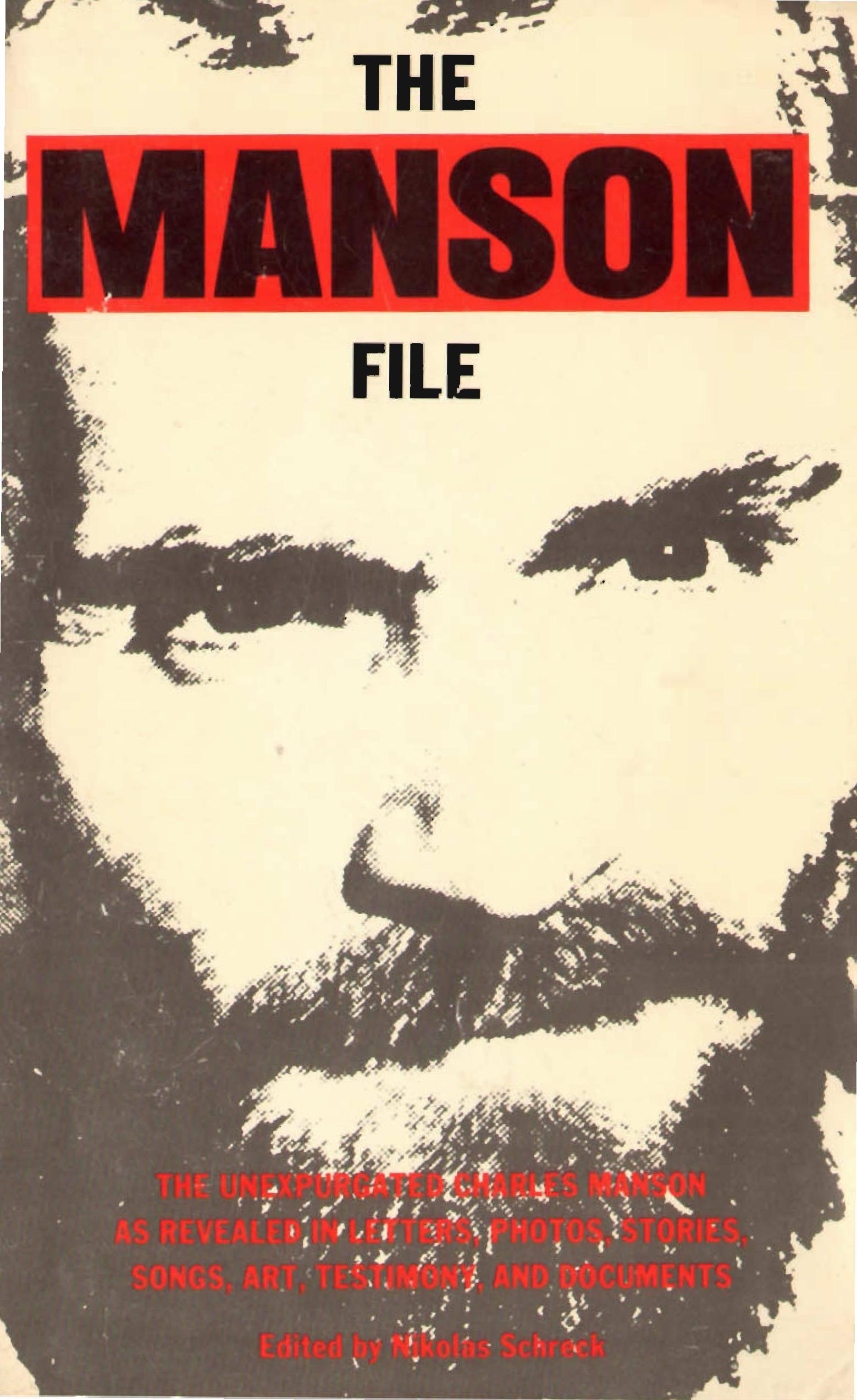
THE
MANSON
FILE
Edited by
Nikolas Schreck
Contributing Editors:
Boyd Rice, Nick Bougas Jimmi Rocket, John Aes-Nihil, Jack Stevenson
AMOK PRESS
New York
Copyright © 1988 by AMOK PRESS
All rights reserved under the International and Pan-American Copyright Conventions. For information, write to AMOK PRESS, P.O. Box 51, Cooper Station, New York, New York, 10276.
1098765432
Acknowledgements
My grateful acknowledgements to the following individuals, who contributed so much of their time, encouragement and enthusiasm to this “tryp”: Adam Parfrey, Boyd Rice, Lynette Fromme, Nick Bougas, John Aes-Nihil, Beth Escott, Nuel Emmons, and, for his ever-so-begrudging cooperation, Charles Manson.
—Nikolas Schreck
The madness of desire, insane murders, the most unreasonable passions—all are wisdom since they are a part of the order of nature. Everything that morality and religion, everything that a clumsy society has stifled in man, revives in the castle of murders. There man is finally attuned to his own nature....
—Michel Foucault, Madness and Civilization
The Piscean Age will be crucified on the Cross of Pluto.
Prediction: Sometime in the future Charles Manson will metamorphose into a major American folk hero.
—Wayne McGuire, Aquarian Journal
Contents
PROLOGUE
PHILOSOPHY
THE TESTIMONY
The Testimony of Charles Manson, November 19,1970
The Family That Slays Together, Stays Together
MUSIC
Never Say Never to Always
Cease to Exist
Mechanical Man
Sick City
Eyes of a Dreamer
Man’s Son
ART
SELECTED WRITINGS
The Black White Bus
1986 Parole Hearing
The Why of the Wolf
Once Upon a Time...
POETRY
Dreams of Channel Five
A Poem About an Old Prison Man
First Recollection
Rags, This is a Letter to You
THE OCCULT MESSIAH
The Death Issue Essay
The Power of Evil
POLITICS
The Truth is One
The Meaning of Manson
Manson’s Lette
President Reagan
If I Were Boss
The Social Consciousness
RED AND BLUE
Sandra Good’s Statement to
Associated Press
A Letter from Blue
A Letter from Red
“Squeaky’s” 1987 Escape: Backgrounder
A Proposed Introduction to an Unpublished Book by Lynette Fromme
THE BEAUTIFUL PEOPLE
Manson’s Letter to the Hollywood Star
Susan Atkin’s Hit-List
THE MERCHANDIZING OF MANSON
Books
Movies
Television
Censored Portions from Nightwatch
Prologue
“Revolution!” In that most fateful of Kali-years, 1969, this was the rallying cry for a thousand disparate elements of an increasingly disaffected and restless youth. Two summers before, “love” was the logos that a newly awakened generation held sacred as an instrument of subversion. Now, a more militant spirit had been invoked and it seemed that only violence could create the total transformation so desperately yearned for. A decidedly noir current had begun to seep into the psychedelic underground.
Indeed, not since the fin de siecle of the last century, when the Order of the Golden Dawn, Blavatsky’s Theosophy, and the Ariosophists of Austria and Germany had flourished, had such a latter-day revival of ancient mysteries been seen. Sects such as the London-based Process Church of the Final Judgement and the Church of Satan in San Francisco preached a transcendence of Judeo-Christian morality. Their followers reveled in their instinctual urges, reaching states of extasis that the uninitiated could never know. The works of Aleister Crowley, now interpreted as prophetic, were revived from obscurity. His motto, “Do what thou wilt shall be the whole of the Law,” became a philosophical imperative. A chic dalliance with diabolism was manifesting itself from the jaded demi-monde of Hollywood nouveau-riche to the so-called “counter-culture” communes. Satan was suddenly “in.”
Early in the morning of August 9,1969, Sharon Tate, Voytek Frykowski, Jay Sebring, Abigail Folger and Steven Parent were slain by unknown assailants. Later that day, the international mass media were abuzz with horrified headlines and sensational speculation. Rumors of ritual sacrifice, cannibalism and sadomasochistic orgies were fed to an eagerly ghoulish public. Discussions about whether the victims’ eyeballs were removed and smeared on the walls became commonplace. Was it true that Sharon Tate’s unborn had been ceremonially consumed by the murderer(s)?
Knowing what we now know about the so-called “Manson murders,” after a nearly twenty-year barrage of books, TV movies, magazines, ad nauseam, one may well wonder: is there anything left to know? Charles Manson has been transmogrified by the electronic thaumaturgy of mass media into a mythic creation, a larger-than-life hieratic emblem of evil. Manson has become the favored brandname for murder and madness, the very archetype of everything the popular mind understands as anti-social, crazy and criminal. He is one of the last true heretics of our time.
Is it possible to peer behind the monumental edifice of the Manson myth, that fiction forever frozen in time by the famous Life magazine cover of December 19, 1969? What is the reality behind the provocative cliches of hypnotic powers, drug-crazed teenage sex-slaves, brutally killed blonde starlets (the stuff that marketing executives’ dreams are made of)?
Let us make a bold speculation. Perhaps NBC, CBS, ABC, the Los Angeles Times, Vincent Bugliosi and most of the other supposed purveyors of truth had allowed interests more pecuniary than ethical to rule in their creation of the Manson mythos. We have all heard, for instance, that Manson possesses a “dangerous philosophy.” Dangerous? In what way? And to whom? Of what, exactly, does this philosophy consist?
In this volume, you will find, for the first time, the authentic voice of the media’s favorite villain, as revealed in previously suppressed courtroom testimony, personal letters, as well as excerpts of censored interviews deemed as “too hot” for network television to broadcast.
Perhaps the primary importance of The Manson File is not what it is, but what it is not. It is no/mere salaciousness disguised as moralistic tongue-clucking. It is not yet another memoir written from the point of view of a publicity-hungry victor. It is not a “Devil-made-me-do-it” apologia written by a former jailbird turned angel. Finally, here is information that has been heretofore accessible only to those “inside the thought—Family, if you will. What emerges is a portrait of Manson—the man and the ism—rescued from the caricatures drawn by the ever-churning Establishment information mill.
Nikolas Schreck
Philosophy
You want to know about my philosophy? You want to know where my philosophy comes from? I’ll tell you. I’m not from your society ... My philosophy comes from underneath the boots and sticks and clubs they beat people with who come from the wrong side of the tracks.
∞∞
A free mind creating thought may seem in raw form to be mad. I’m not of your school-thought. Your world’s thoughts are just as mad to me as I may seem to you—
∞∞
Paycheck whore wears a dollar bill gown to the funeral of hope and love.
∞∞
To save the people from themselves it would take a greater fear than the earth has ever seen.
∞∞
I came to earth alone. I can die by myself. I can give up this shell by myself.
∞∞
The truth is a knife and cuts sharp.
∞∞
I’m 52 and by the time you assholes wake up to your own brother spirit God life I’ll be too old to piss on you when it’s your turn to burn.
∞∞
The world only has one karma—WILL—the rain got drops, but it’s ALL still one water.
∞∞
Wake up the public? HA... they’re not worth two bags of shit—a few people can get through and touch life; the rest are like chickens trying to get over someone else to feel reassured. Their ego gets big and their dick gets soft.
∞∞
Everyone’s trying to save a way of life that died a long time ago and just ain’t stopped yet. Truth is, all earth people got to save this earth, and no one wants to hear it.
∞∞
When the world mind stops and got no thought to move on all will go mad. The money’s running away with the minds. Soon you’ll see the graveyards being torn up.
∞∞
There is only the MIND. The Mind is everything. It is Buddha. It is Christ. It is the DEVIL. It is GOD. It is where all music comes from. It is where all sex comes from ... and the energy of life comes from it through the HEART.
∞∞
Time is man-made and an illusion and controls must be put on it or it will spin the minds into destructions.
∞∞
I don’t think in goods or bads, just ISs. What it is—not what I was, want or hope—Wherever life is, it is, and bad and good got nothing to do with it—A snake eats the baby squirrel—Mama squirrel may say that’s bad but snakes got to eat—The life cycles ARE and only humans got the order fucked up.
∞∞
Jealousy is not the barometer by which the depth of love can be read. Jealousy merely records the degree of the lover’s insecurity.
∞∞
I’m a guitar, a cup of coffee, a snake, a pocketful of names and faces. I see myself in the desert as a rattlesnake, as a bird, as anything. You guys are stuck play-acting as humans. I don’t need to be human. I don’t want to be anybody in particular. I already am everybody three times around the clock.
∞∞
How’re you gonna prepare for the beast we have already created?—it’s all in a thought and people like you are not in the thought because you’ve got no thoughts of your own, your head’s full of books, schools, TV, radio, and programmed with and for nine million times a million maybes—
∞∞
I’m insane, no doubt about that, and I play faces for the clowns, but the real me is a rattlesnake, a wolf, a scorpion, nothing—I reflect to you just what I’m thinking now—I’m mad, mean, and at war with lies, pollution, confusion, and fools who’ve got no intelligence.
∞∞
Fools think in life and death circles because they are locked in fear—No one ever dies—No one ever lives—Those are two words in a left over game.
∞∞
You don’t come and/or go because the universe never moves— You think a thought and what you think is being thought is your head—Man, the universe is in your head.
∞∞
Are you your mother’s child or do you see yourself as Alikens (your own mom, dad, husband, wife, sister, brother, god, preacher, government, state, world, love, knowing, all)?
∞∞
To me, paper words are trash. That don’t make them trash to others—I live in a chamber of IS, been a lifetime in that—There is no need to play phony faces—I’m in the spirit world—Money and things hold little interest to me—
∞∞
If you’re truly and completely selfish and do what’s best for you and your world, you will one day come to what’s running in ATWA—It’s when you’re selfish for $ and keep money and do what’s best for money you will come to the thought maybe that you lost your real self and your real life for paper with pictures of dead people on them—
∞∞
The only way anyone can live on earth is one world under the last person. I am the last and bottom line: You will all do what I say or there will be nothing.
∞∞
An intelligence outside and away from people thinking they’re boss has control over things we never thought of or dreamed of.
∞∞
To see, know, and understand beyond one’s own reflection is not easy because each is locked in their own thought patterns.... The spirit world of darkness (so to say) and the overworld—it’s a childish thing and “too” simple for a complicated brain to understand— One must earn space in the mind to see into forever and once a total awareness of the mind is completed, the past, future and now becomes one in one day—I’ve been in one night from 1943, working on one good day—people’s brain patterns are like wind through the wheel—As the brainwash dies, as fear comes and survival becomes the biggest thought, people will see through history and pray that the answers of the past come back in play.
∞∞
The Iron Cross is far and above and beyond the cross of wood.
∞∞
World War II—when millions of people died trying to put order into the world it was covered up and lied about.
∞∞
As the courts were hanging soldiers that did nothing but fight for and obey their country-lord-cross—the so-called winners were out of line.
∞∞
The government of the U.S. is at war with their children and the powers of nature and God, and have grown so far above their own judgments that the Waffen SS are coming back from space left over in dreams.
∞∞
I’m spiritually allied with the scorpion and the wolf. See, spiritualism scares you people, because you got this little stereotype church that you’re buying and selling, and you’re trying to put God in a building but God is much bigger than that little church, and spiritualism is a lot more than they put in a library and books.
Everything is love. There’s nothing that isn’t love. Even the confusion is love in one form or the other. It’s misguided. Love is a word that we use to supplement for God. I would rather use the word intelligence. If you’re going to use the word love, then use the word intelligence, because love is misunderstood in so many different ways and fashions.
∞∞
When you take a negative from a picture and you hold it up to the light, you don’t see the light, you see the negative. So what you think in your mind as you look at me is how you’re judging yourself and the world.
∞∞
In your world you can take a pen and write on a piece of paper and destroy 200,000 people and it’s okay because you don’t have to see it.
∞∞
I am loved. I am love. I am love. All the way. I’m around the world with it, ain’t you seen it, ten, fifteen times? I’m standing in the fire with it! Meanwhile I’m taking up all the slack for you assholes! I’m carrying you around, Nixon, hey Ronnie, hey Reagan, I didn’t tell them that was your gun came out that trailer ... I held my mud on you, old crime partner. In other words, I’m intertwined in your very soul, man. You give me my rights. My father died in the battlefield for my rights. Then I go down to L.A. and some district attorney wants to get rich, make a lot of money, he’s got something that’s selling good. You don’t take my rights! You’d rumble the graveyard from here to the unknown soldier.
∞∞
True love casts out all fear. If you’re afraid of me then there’s something wrong with you.
∞∞
See, you got to realize there’s no slack in my act ... You don’t know how to survive. You’re weak. You have emotions, you play little games with your mind. You chase your tail.
∞∞
Q: Why did some people say that you were messianic, that they thought of you as Jesus Christ?
Manson: I am.
Q: Why did they say that?
Manson: Because I am.
Q: Why do you think you are?
Manson: Because he is all of us. And you are too. (Laughter.) Yeah.
Q: So we are all Jesus.
Manson: Sure we are. Wake up there. It’s time. You probably got a little of that other guy in you too. (Laughter.)
Q: A little of the devil?
Manson: Sure. Don’t we all have that?
You got a circle, that man lives inside of. He lives inside this circle. He’s responsible for this circle and this circle only. You can take that to the house of the rising sun in Japan and the samurai, you can take that to the second world war, you can take it and hang it on a cross, you can kill me one thousand times, but it’s still there, it makes no difference whether I’m in the circle or not, it’s still there.
∞∞
What is it? You want me to be everything to everybody and face all of your fears and all your deaths, you want me to die again for you, you want me to go into the gas chamber and say: “Alright,” preacher on one side of me, preacher to the other side of me, say, “I’m the son of God,” and they say: “We know, son, go in and sit down....”
∞∞
“Give us your life again.” I say, “I give you my life” because I think you’re taking care of the kids, but I get out of the gas chamber and I look at the kids, and you’re not taking care of the kids; you’re feeding on them, you’re drunk on their blood, man! I’m an old man, all I wanna do is retire, all I wanna do is get out in the desert and be left alone. I won’t bother nobody ... I’m hiding out from beneath the rock. They come to me and say: “Hey, Charlie, hi.” And I say, “Whaddya want?” “We just wanna talk!” “About what?” “We got problems,” Your water’s dying, you’re life’s in that cup, your trees are dying, your wildlife’s locked up in zoos. You’re in the zoo, man. How do you feel about it?
How do you feel that an ex-convict can get out of jail and go find a rocket scientist’s children out in the garbage can. “Go home.” “I can’t, my mother, my father won’t let me. They hate me.” I’m responsible for your children? You won’t be responsible for ... How do you feel about those murders? How do you feel about them? That’s what counts. It happened in your world, not in mine. Not in my circle, because I wouldn’t allow it.
∞∞
Murder! There’s no murder in a holy war, man ... The whole thing’s a holy war. Because you want to draw a line and say, “this is crime” and “this ain’t crime.”
∞∞
In your head is a spaceship 5000 light years beyond all you think—it has ten computer boards just to grow one hair and fifty power centers to make you shit and there is fifty million space shuttles that move your thinking around; it’s all run by cockroaches, snakes, flies and “intelligent” humans who are not intelligent—they think they’re smart. If you put the brain of a human in a rat’s head or a wolf’s head or just a garden snake’s head, it would go mad and wouldn’t survive.
∞∞
Look at it like a movie on TV and face the serial of thought and then change channels and walk on a different street. Put your clothes on backwards and let everyone laugh at you and not be affected.
∞∞
Us and them is a game, there is you FIRST and then I am what you let me be. Look down on me and you’ll see your fool in me. Look up at me and you’ll see your lord and master. Get even and look at me even and you’ll see yourself.
∞∞
We as Americans have been taught to believe in Life, Liberty, and the Pursuit of Happiness. While I was free and out there Pursuing Happiness they took my Liberty and gave me Lifel I was convicted of witchcraft in the Twentieth Century ... and my case made the prosecutor, Vincent Bugliosi, filthy rich behind the book and film he wrote. Enough said.
∞∞
They been selling you a phony fake picture of reality all your life—Why should I let any of you touch where I’m at—I’m a hobo, I got names I ain’t used yet.
∞∞
The news gives you 5% of what’s going on and even that’s distorted.
∞∞
A pharaoh sets his thought on earth and lays his body in a tomb and knows only his awareness, can see over it, beyond it—The foolish human says the bug can’t remember and forgets ... God don’t remember NOTHING because what’s to remember when you ARE ... It is ALL thought, ALL meaning, ALL times, ALL heads, ALL that ever was and ALL that will ever be, and it ALL comes down to a center and must be in TRUTH, not in a book word “truth.”
I’ve circled the world in my thought and put image up over all, and everyone that wants to die puts and keeps me down under what they are thinking—that energy that they keep down is inside them—I live inside ALL brains from November 11/1934.
All the churches of all the religions of the world are NOT thoughts in God’s mind. I use the word “God.” Hitler was Christ. A coming and a going. Humans need gods, gods don’t need humans.
∞∞
I don’t believe the Nazis will come back in SS hats and boots; they will probably be people living in peace and harmony.
Manson as figures from the Major Arcana of the Tarot. Left, the Hanged Man. Right, the Magician. (Harper’s, 1971.)
Fear is only another form of awareness and awareness is only a form of love. Total fear is total awareness. Once you give in to fear completely, it ceases to exist, and all that’s left is awareness. All that’s left is love.
∞∞
Q: What do you say to those people that say Charles Manson is a psychopath?
Manson: So? There’s a lot of us nowadays.
Q: That he hates people?
Manson: Yeah, right, no ... As it is. In other words, I see that human beings aren’t worth too much as a whole.
Q: That he’s schizophrenic.
Manson: Yeah, I can be that. Well, aren’t we all? I bet they put you out in the middle of that yard, I bet you change your personality.
That doesn’t even compute in my world, because ... there is no wrong. I don’t do wrong. I wouldn’t do anything that’s wrong. You got a parallel universe. You got two worlds. In one world everything is a lie and everything is wrong and you can never do anything right. According to anybody else I’ve never done anything right. There’s always been someone to say that I wasn’t right and I did it wrong. But in the world that I live in I’ve never made a bad move in my whole life.
The Revelation of the Sacred Door, by Adam Parfrey
Q: Do you believe in a god? And it’s not you? Manson: Sure it’s me.
∞∞
Why should I care about people who don’t care about themselves? They all want someone else to do it all for them. They all want to be “saved,” but they won’t make the first move to save themselves. They just sit around and wait for someone else to come to their rescue and save them. They’re all crying for Jesus to come back to save them. AGAIN. All I have to say is how god damn many times do they expect him to keep coming back anyway?! Every time he comes back they give him nothing but shit. He came back during the thirties in Germany and they still haven’t stopped whining about it.
The world ended—They covered it up and didn’t tell a lot of people because the last chance is only for a few—I don’t need to be outside to see it, I seen it falling apart twenty years ago and someone else seen it twenty years before that and so on the wheels of circles and circles of time. It’s a play on the backs of the children again.
Nick Bougas
Raymond Pettibon
The Testimony
Nancy Davis, Los Angeles Free Press
Manson is serving a life sentence with no hope for parole. He has not, however, been proven guilty of murdering anyone. The charge convicting him was conspiracy to murder, as being the evil pied piper who instigated his drug-addled followers to frenzied acts of violence. Consistently foiled in his attempts to plead his own defense and call up his own witnesses during the Tate/La Bianca trial, Charles Manson was finally allowed, on November 19, 1970, to make a concluding statement.
His testimony, which lasted for over an hour, was, as Prosecutor Bugliosi noted, “hypnotic ... trying to weave a spell.” Bugliosi, using the scare tactic of Manson’s Rasputin-like persuasiveness, successfully put forth a motion to the hostile Judge Older to prevent the jurors from hearing Manson speak on his own behalf. Testimony that cannot be heard by those deciding the fate of its speaker has moot value as defense. Manson certainly must have understood that. The following pages should be read, then, as a spontaneous and cathartic yet cogent summa of Manson’s pagan philosophy as it collides with the baroque workings of the legalistic mind.
A musical comedy skit titled “The Family that Slays Together, Stays Together,” written by Marvin L. Part, a lawyer representing Leslie Van Houten, was performed by judges and attorneys for the cynical amusement of a Los Angeles Bar Association banquet at the time of the Tate/LaBianca trial. This sketch, which had the Bar “rolling in the aisles,” more accurately portrays the motives of the legal system than the usual self-professed vainglory. It is included here in its entirety, following Manson’s testimony.
Judge Older and the attorneys for the prosecution and defense whisper plans during the Tate/LaBianca trial.
The Testimony of Charles Manson, November 19, 1970
Do you have anything to say?
Yes, I do.
There has been a lot of charges and a lot of things said about me and brought against me and brought against the co-defendants in this case, of which a lot could be cleared up and clarified to where everyone could understand exactly what the family was supposed to have been, what the philosophies in regards to the families were, and whether or not there was any conspiracy to commit murder, to commit crimes, and to explain to you who think with your minds.
It is hard for you to conceive of a philosophy of someone that may not think.
I have spent my life in jail, and without parents.
I have looked up to the strongest father-figure, and I have always looked to the people in the free world as being the good people, and the people in the inside of the jail as being the bad people.
I never went to school, so I never growed up in the respect to learn to read and write so good, so I have stayed in jail and I have stayed stupid, I have stayed a child while I have watched your world grow up, and then I look at the things that you do and I don’t understand.
I don’t understand the courts, and I don’t understand a lot of things that are brought against me.
Your write things about my mother in the newspaper that hasn’t got anything to do with anything in particular.
You invent stories, and everybody thinks what they do, and then they project it from the witness stand on the defendant as if that is what he did.
For example, with Danny DeCarlo’s testimony. He said that I hate black men, and he said that we thought alike, that him and I was a lot alike in our thinking.
But actually all I ever did with Danny DeCarlo or any other human being was reflect himself back at himself.
If he said he did not like the black man, I would say, “Okay.” I had better sense than tell him I did not dislike the black man. I just listened to him and I would react to his statement.
So consequently he would drink another beer and walk off and pat me on the back and he would say to himself, “Charlie thinks like I do.”
But actually he does not know how Charlie thinks because Charlie has never projected himself.
But maybe the girls and women in your world outside ... Being by yourself for such a long time when you do get out you appreciate things that people don’t even see, you walk over them every day.
Like in jail you have a whole new attitude or a whole different way of thinking.
I don’t think like you people. You people put importance on your lives.
Well, my life has never been important to anyone, not even in the understanding of the way you fear the things that you fear, and the things you do.
I know that the only person I can judge is me.
I judge what I have done and I judge what I do and I look and live with myself every day.
I am content with myself.
If you put me in the penitentiary, that means nothing because you kick me out of the last one. I didn’t ask to get released. I liked it in there because I like myself.
I like being with myself.
But in your world it’s hard because your understanding and your values are different.
These children that come at you with knives, they are your children. You taught them. I didn’t teach them. I just tried to help them stand up.
Most of the people at the ranch that you call The Family were just people that you did not want, people that were alongside the road, that their parents had kicked them out or they did not want to go to Juvenile Hall, so I did the best I could and I took them up on my garbage dump and I told them this: that in love there is no wrong.
I don’t care. I have one law and I learned it when I was a kid in reform school. It’s don’t snitch. And I have never snitched. And I told them that anything they do for their brothers and sisters is good, if they do it with a good thought.
It is not my responsibility. It is your responsibility. It is the responsibility you have towards your own children who you are neglecting, and then you want to put the blame on me again and again and again.
Over and over you put me in your penitentiary. I did not build the penitentiary. I would not lock one of you up. I could not see locking another human being up.
You eat meat with your teeth and you kill things that are better than you are, and in the same respect you say how bad and even killers that your children are. You make your children what they are. I am just a reflection of every one of you.
I have never learned anything wrong. In the penitentiary, I have never found a bad man. Every man in the penitentiaiy has always showed me his good side, and circumstances put him where he was. He would not be there, he is good, human, just like the policeman that arrested him is a good human.
I have nothing against none of you. I can’t judge any of you. But I think it is high time that you all started looking at yourselves, and judging the lie that you live in.
I sit and I watch you from nowhere, and I have nothing in my mind, no malice against you and no ribbons for you.
But you stand and you play the game of money. As long as you can sell a newspaper, some sensationalism, and you can laugh at someone and joke at someone and look down at someone, you know.
You just sell those newspapers for public opinion, just like you are all hung on public opinion, and none of you have any idea what you are doing.
You are just doing what you are doing for the money, for a little bit of attention from someone.
I can’t dislike you, but I will say this to you: You haven’t got long before you are all going to kill yourselves because you are all crazy.
And you can project it back at me, and you can say that it’s me that cannot communicate, and you can say that it’s me that don’t have any understanding, and you can say that when I am dead your world will be better, and you can lock me up in your penitentiary and you can forget about me.
But I’m only what lives inside of you, each and every one of you.
These children, they take a lot of narcotics because you tell them not to. Any child you put in a room and you tell them, “Don’t go through that door,” he never thought of going through that door until you told him to go through the door. You go to the high schools and you show them pills and you show them what not to take, how else would they know what it was unless you tell them?
And then you tell them what you don’t want them to do in the hopes they will go out and do it and then you can play your game with them and then you can give attention to them, because you don’t give them any of your love.
You only give them your frustration; you only give them your anger; you only give them the bad part of you rather than give them the good part of you.
You should all turn around and face your children and start following them and listening to them.
The music speaks to you every day, but you are too deaf, dumb, and blind to even listen to the music. You are too deaf, dumb and blind to stop what you are doing. You point and you ridicule.
But it’s okay, it’s all okay. It doesn’t really make any difference because we are all going to the same place anyway. It’s all perfect. There is a God. He sits right over here beside me. That is your God. This is your God.
But let me tell you something; there is another Father and he has much more might than you imagine.
If I could get angry at you I would try to kill every one of you. If that’s guilt, I accept it.
These children, everything they have done, they done for love of their brother. Had you not arrested Robert Beausoleil for something he did not do....
(Interruption.)
I have killed no one and I have ordered no one to be killed.
I may have implied on several occasions to several different people that I may have been Jesus Christ, but I haven’t decided yet what I am or who I am.
I was given a name and a number and I was put in a cell, and I have lived in a cell with a name and a number.
I don’t know who I am.
I am whoever you make me, but what you want is a fiend; you want a sadistic fiend because that is what you are.
You only reflect on me what you are inside of yourselves, because I don’t care anything about any of you and I don’t care what you do.
I can stand here in front of this court and smile at you, and you can do anything you want to do with me, but you cannot touch me because I am only my love, and it is all for me, and I give it to myself for me, because I look out for me first and I like me, and you can live with yourselves and your opinion of yourselves. I know what I have done.
If I showed someone that I would do anything for my brother, include give my life for my brother in the battlefield, or give where else that I may want to do that, then he picks his banner up and he goes off and does what he does.
That is not my responsibility. I don’t tell people what to do.
If we enter into an agreement to build a house, I will help you build the house and I will offer suggestions for that house, but I won’t put myself on you because that is what made you weak, because your parents have offered themselves on you.
You are not you, you are just reflections, you are reflections of everything that you think that you know, everything that you have been taught.
Your parents have told you what you are. They made you before you were six years old, and when you stood in school and you crossed your heart and pledged allegiance to the flag, they trapped you in truth because at that age you didn’t know any lie until that lie was reflected on you.
No, I am not responsible for you. Your karma is not mine.
My father is the jail house. My father is your system, and each one of you, each one of you are just a reflection of each one of you, and you all live by yourselves, no matter how crowded you may think that you are in a room full of people, you are still by yourself, and you have to live with that self forever and ever and ever and ever.
To some people this would be hell; to some people it would be heaven.
I have mine, and each one of you will have to work out yours, and you cannot work it out by pointing your fingers at people.
I have ate out of your garbage cans to stay out of jail.
I have wore your second-hand clothes.
I have accepted things and given them away the next second.
I have done my best to get along in your world and now you want to kill me, and I look at you and I look how incompetent you all are, and then I say to myself, “You want to kill me, ha, I’m already dead, have been all my life!”
I’ve lived in your tomb that you built.
I did seven years for a thirty-seven dollar check. I did twelve years because I didn’t have any parents, and how many other sons
“We’re all our own prisons, we are each all our own wardens and we do our own time ... Prison’s in your mind ... Can’t you see I’m free?”
do you think you have in there? You have many sons in there, many, many sons in there, most of them are black and they are angry. They are mad, and they are mad at me.
I look and I say, “Why are you mad at me?”
He said, “I am mad at you because of what your father did.”
And I look at him and I say, “Well,” and I look at my fathers, and I say, “If there was ever a devil on the face of this earth I am him.”
And he’s got my head anytime he wants it, as all of you do too, anytime you want it.
Sometimes I think about giving it to you. Sometimes I’m thinking about just jumping on you and let you shoot me. Sometimes I think it would be easier than sitting here and facing you in the contempt that you have for yourself, the hate that you have for yourself, it’s only the anger you reflect at me, the anger that you have got for you.
I do not dislike you, I cannot dislike you—I am you. You are blood. You are my brother. That is why I can’t fight you.
If I could I would jerk this microphone out and beat your brains out with it because that is what you deserve, that is what you deserve.
Every morning you eat that meat with your teeth. You’re all killers, you kill things better than you. And what can I say to you that you don’t already know? And I have known that there is nothing I can say to you. There is nothing I can say to any of you. It is you that has to say it to you, and that is my whole philosophy; you say it to you and I will say it to me.
I live in my world, and I am my own king in my world, whether it be a garbage dump or if it be in the desert or wherever it be. I am my own human being. You may restrain my body and you may tear my guts out, do anything you wish, but I am still me and you can’t take that.
You can kill the ego, you can kill the pride, you can kill the want, the desire of a human being.
You can lock him in a cell and you can knock his teeth out and smash his brain, but you cannot kill the soul.
You never could kill the soul. It’s always there, the beginning and the end. You cannot stop it, it’s bigger than me. I’m just looking into it and it frightens me sometimes.
The truth is now; the truth is right here; the truth is this minute, and this minute we exist.
Yesterday—you cannot prove yesterday happened today, it would take you all day and then it would be tomorrow, and you can’t prove last week happened. You can’t prove anything except to yourself.
My reality is my reality, and I stand within myself on my reality.
Yours is yours and I don’t care what it is. Whatever you do is up to you and it’s the same thing with anyone in my family, and anybody in my family is a white human being, because my family is of the white family.
There is the black family, a yellow family, the red family, a cow family and a mule family. There is all kinds of different families.
We have to find ourselves first, God second, and kind, k-i-n-d, come next. And that is all I was doing. I was working on cleaning up my house, something Nixon should have been doing. He should have been on the side of the road picking up his children. But he wasn’t. He was in the White House sending them off to war.
I don’t know the different people that have got on the stand; one friend said I put a knife to his throat. I did. I put a knife to his throat. And he said I was responsible for all of these killings.
I have done the best I know how, and I have given all I can give and I haven’t got any guilt about anything because I have never been able to say any wrong.
I never found any wrong.
I looked at wrong, and it is all relative.
Wrong is if you haven’t got any money.
Wrong is if your car payment is overdue.
Wrong is if the TV breaks.
Wrong is if President Kennedy gets killed.
Wrong is, wrong is, wrong is—you keep on, you pile it in your mind. You become belabored with it, and in your confusion....
I make up my own mind. I think for myself. I look at you and I say, “Okay, you make up your own mind, you think for yourself, then you see your mothers and your fathers and your teachers and your preachers and your politicians and your presidents, and you lay in your brain with your opinions, considerations, conclusions—” And I look at you and I say, “Okay, if you are real to you it’s okay with me but you don’t look real to me. You only look like a composite of what someone told you you are. You live for each others’ opinion and you have pain on your face and you are not sure what you like, and you wonder if you look okay.”
And I look at you and I say, “Well, you look alright to me,” you know, and you look at me and you say, “Well, you don’t look alright to me.”
Well I don’t care what I look like to you. I don’t care what you think about me and I don’t care what you do with me. I have always been yours anyway. I have always been in your cell.
When you were out riding your bicycles I was sitting in your cell looking out the window and looking at pictures in magazines and wishing I could go to high school and go to the proms, wishing I could go to the things you could do, but oh so glad, oh so glad, brothers and sisters, that I am what I am.
Because when it does come down around your ears and none of you know what you are doing, you better believe I will be on top of my thought.
I will know what I am doing. I will know exactly what I am doing. If you ever let me go before you kill me. And then I don’t really particularly care anyway, because I still will be there and I will still know what I am doing.
In my mind I live forever.
In my mind I live forever, and in my mind I have always lived forever.
I am only what you made me. I am only a reflection of you.
I have done everything I have always been told. I have mopped the floor when I was supposed to mop the floor. And I have swept when I was supposed to sweep.
I was smart enough to stay out of jail and too dumb to learn anything. I was too little to get a job there, and too big do to something over here.
I have just been sitting in jail thinking nothing. Nothing to think about.
Everybody used to come in and tell me about their past and their lives and what they did. But I could never tell anybody about my past or what my life was or what I did because I have always been sitting in that room with a bed, a locker, and a table.
So, then it moves on to awareness: how many cracks can you count in the wall? It moves to where the mice live and what the mice are thinking, and see how clever mice are.
And then, when you get on the outside, you look into people’s heads. You take Linda Kasabian and you put her on the witness stand and she testifies against her father. She never has liked her father, and she has always projected her wrong off to the manfigure. So, consequently, it is the man’s fault again, and the woman turns around and she blames it on the man. The man made her do it. The man put her up to it.
The man works for her, the man slaves for her, the man does everything for her, and she lays around the house and she tells him what he should do, because, generally, she is an extension of his mother. His mother told him what to do and she trained him for twenty years and passed him on to the wife. Then the woman takes him and tells him what to wear, when to get up, when to go to work.
Then when she gets on the stand and she says when she looked in that man’s eyes that was dying, she knew it was my fault.
She knew that it was my fault because she couldn’t face death. And if she cannot face death, that is not my fault. Why should she blame it on me? I can face death. I have all the time.
In the penitentiary you live with it, with constant fear of death, because it is a violent world in there, and you have to be on your toes constantly.
So, it is not without violence that I live. It is not without pain that I live.
I look at the projection that comes from this witness stand often to the defendants. It isn’t what we said, it is what someone thought we said. A word is changed: “in there” to “up there,” “off of that” to “on top.” The semantics get into a word game in the courtroom to prove something that is gone in the past. It is gone in the past, and when it is gone, it is gone, sisters. It is gone, brother.
You can’t bring the past back up and postulate or mock up a picture of something that happened a hundred years ago, or 1970 years ago, as far as that goes. You can only live in the now, for what is real is now.
The words go in circles.
You can say everything is the same, but it is always different.
It is the same, but it is always different. You can “but” it to death. You can say, “You are right, but, but, but.”
You sat here for nineteen days questioning that girl.
She got immunity on seven counts of murder.
She got. I don’t know how much money she is going to make in magazines and things. You set her up to be a hero, and that is your woman. That is the thing that you worship.
You have lost sight of God. You sing your songs to woman. You put woman in front of man. Woman is not God. Woman is but a reflection of her man, supposedly. But a lot of times, man is a reflection of his woman. And if a man can’t rise above a woman’s thought, then that is his problem, it is not my problem. But you give me this problem when you set this woman against me.
You set this woman up here to testify against me. And she tells you a sad story. How she has only taken every narcotic that is possible to take. How she has only stolen, lied, cheated and done everything that you have got there in that book.
But it is okay. She is telling the truth now. She wouldn’t have any ulterior motive like immunity for seven counts of murder.
And then comical as it may seem, you look at me, and you say, “You threatened to kill a person if they snitch.”
Well, that is the law where I am from. Where I am from, if you snitch, you leave yourself open to be killed.
I could never snitch because I wouldn’t want someone to kill me. So, I have always abided by that law. It is the only law that I know of, and it is the law that I have always abided by.
But she will come up here and you enshrine her, you put her above you, and you strive to be as good as something below you.
It is circles that just don’t make any sense in my reality. But of course again that is my reality and it has nothing to do with you, because you have got your reality and you have to live with what you believe in.
But this woman has got here and she has testified. She said she wasn’t sure, but maybe.
Then the magical mystery tour wouldn’t be able to be explained to you.
A magical mystery tour is when you pick up somebody else and play a part. You may pick up a cowboy today, and you go around all day and play like a cowboy. You put on a hat and you ride a horse.
This is all we have done. We have played like mom and dad. We have loved each other. We have done everything we could to stay outside the frame of the law, the shakedowns. Nothing has been stolen. I have got better sense than to break the law. I give to the law what it has coming. It is his law. If I break his law, he puts me back in the grave again.
I haven’t broken his law yet but it seems as if somebody lays around and somebody needs to fulfill a spot, they snatch it up and say, “This will do. We will put this over here. We can hang this on him. Or we can do this to that.”
Then the words go into another meaning and another level of understanding.
Why a woman would stand up and project herself into a man and say, “Actually he never told me anything, but I knew it all came from him.”
Her assumption.
Am I to be found guilty on her assumption?
You assume what you would do in my position, but that doesn’t mean that is what I did in my position. It doesn’t mean that my philosophy is valid. It’s only valid to me. Your philosophies—they are whatever you think they are, and I don’t particularly care what you think they are.
But I know this: that in your own hearts and your own souls, you are as much responsible for the Vietnam War as I am for killing these people.
I knew a guy that used to work in the stockyards and he used to kill cows all day long with a big sledgehammer, and then go home at night and eat dinner with his children and eat the meat that he slaughtered. Then he would go to church and read the bible, and he would say, “That is not killing.” And I look at him and I say, “That doesn’t make any sense, what you are talking about?”
Then I look at the beast, and I say, “Who is the beast?”
I am the beast.
I am the beast.
I am the biggest beast walking the face of the earth.
I kill everything that moves. As a man, as a human, I take responsibility for that. As a human, it won’t be long, and God will ask you to take responsibility for it. It is your creation. You live in your creation. I never created your world, you created it.
You create it when you pay taxes, you create it when you go to work, then you create it when you foster a thing like this trial.
Only for vicarious thrills do you sell a newspaper and do you kow-tow to public opinion. Just to sell your newspapers. You don’t care about the truth. You take another Alka-Seltzer and another aspirin and hope that you don’t have to think of the truth and you hope that you don’t have to look at yourself with a hangover as you go to a Helter Skelter party and make fun of something that you don’t understand.
(The Judge asks Manson to stick to the point.)
The issues in this case? The issues in this case?
The issues are that Mr. Younger is Attorney General, and I imagine he is a good man and does a good job. I don’t know him. I can’t judge him. But I know he has got me here. He set me in this seat.
Mr. Bugliosi is doing his job for a paycheck. That is an issue. He is doing whatever he is doing. Whether he thinks it is right or not, I couldn’t say. That is up to him.
The only way that I have been able to live on that side of the road was outside the law. I have always lived outside the law. When you live outside the law it is pretty hard, you can’t call the man for protection. You have got to pretty much protect your own.
You can’t live within the law and protect yourself. You can’t knock the guy down when he comes over and starts to rape one of the girls, or starts to bring some speed or dope up there. You can’t enforce your will over someone inside the law.
I gave everything I could think of to that old man and that ranch for permission to stay there, and I have given the people that stayed on that ranch my all. When no one wanted to go out in front and fight, I would go out and fight. When no one else wanted to clean the toilets, I would go and clean them.
People would see me and they would see what I do and see the example that I set. They see, when I am cleaning out a cesspool, that I am happy and smiling and making a game of it. Like I was on a chain gang somewhere once upon a time and they come and pass the water. I make a game out of it, or I make a pleasure out of a job. We turn it into a magical mystery tour.
We speed down the highway in a 1958 automobile that won’t go but fifty, and an SKE Jaguar goes by, and I state to Clem, “Catch him, Clem, and we’ll rob him or steal all of his money,” you know. And he says, “What shall we do?” I say, “Hit him on the head with a hammer.” We magical mystery tour it.
“You invented the words ... and you gave me a dictionary and you said, ‘These are what the words mean.’”
Bill Lignante
Then Linda Kasabian gets on the stand and says: “They were going to kill a man, they were going to kill a man in an automobile.”
To you, it seems serious. But like Larry Kramer and I would get on a horse and we would ride over to Wichita, Kansas, and act like cowboys. We make it a game on the ranch.
Like, Helter Skelter is a nightclub. Helter Skelter means confusion. Literally. It doesn’t mean any war with anyone. It doesn’t mean that those people are going to kill other people. It only means what it means. Helter Skelter is confusion.
Confusion is coming down fast. If you don’t see the confusion coming down fast around you, you can call it what you wish.
It is not my conspiracy. It is not my music. I hear what it relates. It says, “Rise!” It says, “Kill!” Why blame it on me? I didn’t write the music. I am not the person who projected it into your social consciousness, that sanity that you projected into your social consciousness, today. You put so much into the newspaper, and then you expect people to believe what is going on. I say back to the facts again.
How many witnesses have you got up here and projected only what they believe in. What I believe in is right now. I don’t believe in anything past now. I speak to you from now.
Because there is nothing here to worry about, nothing here to think about, nothing here to be confused over. My house is not divided. My house is one with me, myself.
Then I look at the facts that you have brought in front of this court, and I look at the twelve facts that are looking at me and judging me. If I were to judge them, what scale would that balance? Would the scale balance if I was to turn and judge you? How would you feel if I were to judge you? Could I judge you? I can only judge you if you try to judge me. That is the fact.
Mr. Bugliosi is a hard-driving prosecutor, with a polished education. Semantics, words. He is a genius. He has got everything that every lawyer would want to have except one thing: a case. He doesn’t have a case.
Were I allowed to defend myself, I could have proven this to you. I could have called witnesses and showed you how these things lay, and I could have presented my picture.
You are dealing with facts and positive evidence. If you are dealing with things that are relative to the issues at hand, then you look at the facts. What else do you look at? Oh, the leather thong.
How many people have ever worn moccasins with a leather thong in it? So you have placed me on the desert with leather clothes on and you took a leather thong from my shoe.
How many people could we take leather thongs from? That is an issue.
Then you move on and you say I had one around my neck. I always tie one around my head when my hair is long. It keeps it out of my eyes. And you pull it down on your neck. And I imagine a lot of long-haired people do.
There are so many aspects to this case that could be dug into and a lot of truth could be brought up, a lot of understanding could be reached.
It is a pretty hideous thing to look at seven bodies, one hundred and two stab wounds.
The prosecutor, or the doctor, gets up and he shows how all the different stab wounds are one way, and then how all the different stab wounds are another way; but they are the same stab wounds in another direction.
They put the hideous bodies on display and they say: “If he gets out see what will happen to you.” Implying it. I am not saying he did this. This is implied. A lot of diagrams are actually in my opinion senseless to the case.
Then there is Paul Watkins’ testmony. Paul Watkins was a young man who ran away from his parents and wouldn’t go home. You could ask him to go home and he would say no. He would say, “I don’t got no place to live. Can I live here?” And I’d say, “Sure.” So, he looks for a father image. I offer no father image. I say, “To be a man, boy, you have got to stand up and be your own father.” And he still hungers for a father image. So he goes off to the desert and finds a father image.
When he gets on the stand, I forget what he said, whether it had any relative value, oh, I was supposed to have said to go get a knife and kill the Sheriff of Shoshone. Go get a knife and kill the Sheriff of Shoshone? I don’t know the Sheriff of Shoshone. I don’t think I
“They put the hideous bodies on display and they say: ‘If he gets out see what will happen to you.’ “ have been there but once.
I am not saying that I didn’t say it, but if I said it, at that time I may have thought it was a good idea. Whether I said it in jest and whether I said it in joking, I can’t recall and reach back into my memory. I could say either way. I could say, “Oh, I was just joking.” Or I could say I was curious. But to be honest with you I don’t ever recall saying, “Get a knife and change of clothes and go do what Tex said.” Or I don’t recall saying, “Get a knife and go kill the sheriff.”
I don’t recall saying to anyone, “Go get a knife and kill anyone or anything.” In fact it makes me mad when someone kills snakes or dogs or cats or horses. I don’t even like to eat meat because that is how much I am against killing.
So you have got the guy who is against killing on the witness stand, and you are all asking him to kill you. You are asking him to judge you. Because with my words, each of your opinions or diagrams, your thoughts, are dying. What you thought was true is dying. What you thought was real is dying. Because you all know, and I know you know, and you known that I know you know. So, let’s make that circle.
You say, “Where do we start from there?” Back to the facts again. You say that the facts are elusive in my mind. Actually, they just don’t mean anything. The District Attorney can call them facts. They are facts. You are facts.
But the facts of the case aren’t even relative, in my mind. They are relative to the Thirteenth Century. They are relative to the Eighth Century. They are relative to how old you are or what kind of watch you wear on your arm. I have never lived in time. A bell rings, I get up. A bell rings and I go out. A bell rings, and I live my life with bells. I get up when a bell rings and I do what a bell says. I have never lived in time. When your mind is not in time, the whole thought is different. You look at time as being man-made. And you say time is only relative to what you think it is. If you want to think me guilty then you can think me guilty and it is okay with me. I don’t dislike any of you for it. If you want to think me not guilty it is okay with me.
I know what I know and nothing and no one can take that from me.
You can jump up and scream, “Guilty!” and you can say what a no good guy I am, and what a devil, fiend, eeky-sneaky slimy devil I am. It is your reflection and you’re right, because that is what I am. I am whatever you make me.
You see, it is what happens inside the now that... the words just lose meaning. A motion is more real than a word. The Indians spoke with it. They could explain to you with motions what they felt. This is what I intended to do if I could represent myself. Explain to you what is inside of me, how I feel about things.
Because words are your words. You invented the words, and you made a dictionary and you gave me the dictionary and you said, “These are what the words mean.” Well, this is what they mean to you, but to someone else, they have got a different dictionary. And things mean different things to different people, and to match the symbols up as you talk back and forward. Then you put a witness up here to say what you said.
I could never say what someone else said. I could only say what I said.
You tell me something and, tomorrow, I try to repeat it, if I didn’t write it down, I couldn’t tell you what you said. Let alone a year ago, let alone eight months ago, let alone a week ago. I am forgetful. I forget one day to the next. I forget what day it is or what month it is or what year it is. I don’t particularly care because all that is real to me is right now.
But then, the case is real to me, and I say, “What do I have to do to make you people let me go back to the desert with my children?”
You have your world. You are going to do whatever you do with it. I have got nothing to do with it. I don’t have the schooling in it. I don’t believe in your church. I don’t believe in anything you do. I am not saying you are wrong, and I hope that you say I am not wrong for believing what I believe in.
Murder? Murder is another question. It is a move. It is a motion. You take another’s life. Boom! and they’re gone. You say, “Where did they go?” They are dead. You say, “Well, that person could have made the motion.” He could have taken my life just as well as I took his.
If a soldier goes off to the battlefield, he goes off with his life in front. He is giving his life. Does that not give him permission to take one? No. Because then we bring our soldiers back and try them in court for doing the same thing we sent them to do. We train them to kill, and they go over and kill, and we prosecute them and put them in jail because they kill. If you can understand it, then I bow to your understanding. But in my understanding I wouldn’t get involved with it.
My peace is in the desert or in the jail cell, and had I not seen the sunshine in the desert I would be satisfied with the jail cell much more over your society, much more over your reality, and much more over your confusion, and much more over your world, and your word games that you play.
And each witness got up here and only testified for what was best for them, they did not testify for what was best for me. They testified for what was best for them, their own benefit. So you say, “Okay, and then what else did she say?” She said, “You only see in me what you want to see in me.” You only see in her what you put in her, because when you take LSD enough times you reach a stage of nothing. You reach a stage of no thought.
An example of this: if you were to be standing in a room with someone and you were loaded on LSD and the guy says, “Do you like my sports coat?” And you would probably not pay any attention to him. About two or three minutes later the guy loaded on LSD will turn around and say, “My, you have a beautiful sports coat” because he is only reacting. He is only reacting to the individual terminology, the person that he has in the room.
As you would put two people in a cell, so would they reflect and flow on each other like as if water would seek a level.
I have been in a cell with a guy eighty years old and I listened to everything he said. “What did you do then?” And he explains to me his whole life and I sat there and listened, and I experienced vicariously his whole being, his whole life, and I look at him and he is one of my fathers. But he is also another one of your society’s rejects.
Where does the garbage go, as we have tin cans and garbage alongside the road, and oil slicks in your water, so you have people, and I am one of your garbage people. I am one of your motorcycle people. I am one of what you want to call hippies. I never thought about being a hippie. I don’t know what a hippie is.
Manson as prisoner: Above, Canadian artist McMillan. Right, Nick Bougas.
A hippie is generally a guy that’s pretty nice. He will give you a shirt and a flower, and he will give you a smile, and he walks down the road. But don’t try to tell him nothing. He ain’t listening to nobody. He got his own thoughts. You try to tell him something, and he will say, “Well, if that’s your bag.”
He is finding himself. You, those children there were finding themselves. Whatever they did, if they did whatever they did, is up to them. They will have to explain to you that. I’m just explaining to you what I am explaining to you. Everything is simple to me. It is what it is because that is what it is. It doesn’t go any farther.
What? That is all there is. Why?
Why?
Why comes from your mother. Your mother teaches you why, why, why. You go around asking your mother why and she keeps telling you, “Because, because” and she laces your little brain with because and: “Because.” “Why?” “Because.” “Why?” And you don’t know any different. If you had two mothers, one to tell you one thing and one to tell you another, then your mind might be left where mine was. If you had a dozen parents that you went around with and couldn’t believe anything you were told and then you couldn’t disbelieve anything you were told. And it’s the same thing with this court. I don’t believe what these witnesses get up here and say but I don’t disbelieve them either. I won’t challenge them. If the guy says, “You’re no good,” I say, “Okay.” If that’s what you want me to believe it’s okay with me.
I don’t care what you believe. I know what I am. You care what I think of you? Do you care what I think of you? Do you care what my opinion is? No, I hardly think so. I don’t think that any of you care about anything other than yourselves because when you find yourself, you find that everyone is out for themselves anyway.
It looks that way to me here, the money that has been made, the things that I cannot talk about, and I know I can’t talk about, I won’t talk about and I will keep quiet about these things. How much money has passed over this case? How sensational do you think that you have made this case?
I never made it sensational. I was hiding in the desert. You come and got me. Remember? Or could you prove that? What could you prove?
The only thing you can prove is what you can prove to yourselves, and you can sit here and build a lot in that jury’s mind, and they are still going to interject their personalities on you. They are going to interject their inadequate feelings; they are going to interject what they think. I look at the jury and they won’t look at me. So I wonder why they won’t look at me. They are afraid of me. And do you know why they are afraid of me? Because of the newspapers.
You projected fear. You projected fear. You made me a monster and I have to live with that the rest of my life because I cannot fight this case. If I could fight this case and I could present this case, I would take that monster back and I would take that fear back. Then you could find something else to put your fear on, because it’s all your fear.
You look for something to project it on and you pick a little old scroungy nobody who eats out of a garbage can, that nobody wants, that was kicked out of the penitentiary, that has been dragged through every hellhole you can think of, and you drag him up and put him into a courtroom.
You expect to break me? Impossible—you broke me years ago. You killed me years ago. I sat in a cell and the guy opened the door and he said, “You want out?”
I looked at him and I said, “Do you want out? You are in jail, all of you, and your whole procedure. The procedure that is on you is worse than the procedure that is on me. I like it in there.”
I like it in there—it’s peaceful. I just don’t like coming to the courtroom. I would like to get this over with as soon as possible. And I’m sure everyone else would like to get it over with too.
Without being able to prepare a case, without being able to confront the witnesses and to bring out the emotions, and to bring out the reasons why witnesses say what they say, and why this hideous thing has developed into the trauma that it’s moved into, would take a bigger courtroom, and it would take a bigger public, a bigger press, because you all, as big as you are, know what you are as I know what you are, and, I like you anyway. I don’t want to keep rehashing the same things over. There are so many things that you can get into, Your Honor, that I have no thoughts on. It is hard to think when you really don’t care too much one way or the other.
(Interruption.)
I was released from the penitentiary and I learned one lesson in the penitentiary, you don’t tell nobody nothing. You listen. When you are little you keep your mouth shut, and when someone says, “Sit down,” you sit down unless you know you can whip him, and if you know you can whip you stand up and whip and you tell him to sit down.
Well, I pretty much sit down. I have learned to sit down because I have been whipped plenty of times for not sitting down and I have learned not to tell people something they don’t agree with. If a guy comes up to me and he says, “The Yankees are the best ball team,” I am not going to argue with that man. If he wants the Yankees to be the best ball team, it’s okay with me, so I look at him and I say, “Yeah, the Yankees are a good ball club.” And somebody else says, “The Dodgers are good.” I will agree with that; I will agree with anything they tell me. That is all I have done since I have been out of the penitentiary. I agreed with every one of you. I did the best I could to get along with you, and I have not directed one of you to do anything other than what you wanted to do.
I have always said this: You do what your love tells you and I do what my love tells me. Now if my love tells me to stand up there and fight I will stand up there and fight if I have to. But if there is any way that my personality can get around it, I try my best to get around any kind of thing that is going to disturb my peace, because all I want is to be just at peace, whatever that takes. Now in death you might find peace, and soon I may start looking in death to find my peace.
I have reflected your society in yourselves, right back at yourselves, and each one of these young girls was without a home. Each one of these young boys was without a home. I showed them the best I could what I would do as a father, as a human being, so they would be responsible to themselves and not to be weak and not to lean on me. And I have told them many times, I don’t want no weak people around me. If you are not strong enough to stand on your own, don’t come and ask me what to do. You know what to do. This is one of the philosophies that everyone is mad at me for, because of the children. I always let the children go. “You can’t let the children go down there by themselves.” I said, “Let the children go down. If he falls, that is how he leams, you become strong by falling.” They said, “You are not supposed to let the children do that. You are supposed to guide them.”
I said, “Guide them into what? Guide them into what you have got them guided into? Guide them into dope? Guide them into armies?” I said, “No, let the children loose and follow them.” That is what I did on the desert. That is what I was doing, following your children, the ones you didn’t want, each and every one of them. I never asked them to come with me—they asked me.
(Recess.)
There’s been a lot of talk about a bottomless pit. I found a hole in the desert that goes down to a river that runs North underground, and I call it a bottomless pit, because where could a river be going North underground? You could even put a boat on it. So I covered it up and I hid it and I called it “The Devil’s Hole” and we all laugh and we joke about it. You could call it a Family joke about the bottomless pit. How many people could you hide down in this hole?
Again you have a magical mystery tour that most of the time there’s forty or fifty people at the ranch playing magical mystery tour. Randy Starr thought he was a Hollywood stunt man. He had a car all painted up and like never done any stunts. Another guy was a movie star, but he had never been in any movies, and everybody was just playing a part, you know, like most people get stuck in one part, but like we were just playing different parts every day. One day you put on a cowboy hat and say, “Shoot somebody,” or the next you might have a knife fighter, or go off in the woods for a month or two to be an Indian, or just like a bunch of little kids playing. Then you establish a reality within that reality of play acting.
And then you get to conspiracy. The power of suggestion is stronger than any conspiracy that you could ever enter into. The powers of the brain are so vast, it’s beyond understanding. It’s beyond thinking. It’s beyond comprehension. So to offer a conspiracy might be to sit in your car and think bad thoughts about someone and watch them have an accident in front of you. Or would it be a conspiracy for your wife to mention to you twenty times a day, “You know, you’re going blind, George, you know how your eyes are, you’re just going blind; we pray to God and you’re going blind, and you’re going blind.” And she keeps telling the old man he’s going blind until he goes blind.
Is that a conspiracy?
Is it a conspiracy that the music is telling youth to rise against the establishment because the establishment is rapidly destroying things? Is that a conspiracy? Where does conspiracy come in? Does it come in that?
I have showed people how I think by what I do. It is not as much what I say as what I do that counts, and they look at what I do and they try to do it also, and sometimes they are made weak by then-parents and cannot stand up. But is that my fault? Is it my fault that your children do what they do?
Now the girls were talking about testifying. If the girls come up here to testify and they said anything good about me, you would have to reverse it and say that it was bad. You would have to say, “Well, he put the girls up to saying that. He put the girls up to not telling the truth.” Then you say the truth is as I am saying it, but then when it is gone, tomorrow it is gone, it changes, it’s another day and it’s a now truth, as it constantly moves thousands of miles an hour through space.
Hippie cult leader; actually, hippie cult leader, that is your words. I am a dumb country boy who never grew up. I went to jail when I was eight years old and I got out when I was thirty-two. I have never adjusted to your free world. I am still that stupid, com-picking country boy that I always have been.
If you tend to compliment a contradiction about yourself, you can live in that confusion. To me it’s all simple, right here, right now; and each of us knew what we did and I know what I did, and I know what I’m going to do and what you do is up to you. I don’t recognize the courtroom, I recognize the press and I recognize the people.
Have you completed your statement, Mr. Manson?
You could go on forever. You can just talk endless words. It don’t mean anything. I don’t know that it means anything. I can talk to the witnesses and ask them what they think about things, and I can bring the truth out of other people because I know what the truth is, but I cannot sit here and tell you anything because like basically all I want to do is try to explain to you what you are doing to your children.
You see, you can send me to the penitentiary, it’s not a big thing. I’ve been there all my life anyway. What about your children? These are just a few, there is many, many more coming right at you.
Anything further?
No.
We’re all our own prisons, we are each all our own wardens and we do our own time. I can’t judge anyone else. What other people do is not really my affair unless they approach me with it.
Prison’s in your mind ... Can’t you see I’m free?
Howard Brodie
The Family That Slays Together, Stays Together
By Marvin L. Part, Los Angeles Bar Association
ANNOUNCER: (Offstage.) We now present the continuing saga of “One Manson’s Family: The Family that Slays Together, Stays Together.” (Music up, singer does “Death Valley.”) When last we left you the County Jail was already overcrowded with lawyers wanting to help Charles Manson sell his books and records. (After “Death Valley” ends, lights up on full stage, spotlight on the characters of LAWYER and MANSON.)
“Defendant Manson”
LAWYER: (Sings.)
I want to get your case
But I will have to plan some
To take you from this place.
I want to sell your records
So I can get my fee
Charlie baby
Lawyers aren’t free
But defendant Manson, don’t you get upset
You’re gonna get the defense every guy oughta get
I really have ethics, I’m misunderstood
All that I think about’s your good
It’s your good
It’s your good
It’s your good
It’s your legal good
Like I hope your records, they sell good.
The D.A. is a bastard
The Judge an S.O.B.
At trials I’m a master
And I won’t charge a fee
I’ll sell the press your story
The price will be absurd
Charlie sweetheart
Your end is a third
Don’t you be a square
We’ll take your story and we’ll make
A sequel to Hair
“The Age of Charlies” will be our big song
We’ll show the pigs that they’re all wrong
They are wrong
They are wrong
They are wrong
They are really wrong
Like I hope the jury thinks they’re wrong
Let’s have a business session
We’ll make our move right now
Like, I’ll sell your confessions
And make a hundred thou
They’ll publish it in Europe
And in the LA. Times
Charlie, bube, sign here on the line
Defendant Manson, let’s both use our head
Like why should Susan Atkins be
making all of the bread
There’s plenty of money
We’ll both make a pile
And we can share it,
Family style
Family style
Family style
Family style
Share it Family style
All the bread, we’ll share it
Family style
The lawyer here is crazy
This attorney—he drinks
This attorney is lazy
This attorney—he stinks
This guy will get you hung
Charlie, they all speak with
fork-ed tongue
Defendant Manson
We’ll all work for free
’Cause we want to show our face
onKNXT
Yes, defendant Manson, we’ll waive
our fee
Please defendant Manson,
Pick me
(Blackout. Fade up spot for new song, “Standin’ on Their Heads”.)
MANSON: (Sings.)
And I’m just a guy who hasn’t got
a slice of bread
They don’t seem to care
Lawyers keep standin’ on their
heads, they keep standin’
So I did some talkin’ to Judge Keene
I said, “Judge, I don’t like the present legal scene”
So I went proper
Those lawyers keep standin’
on their heads
They keep standin’
But there’s one thing I know
That guy he tried to send me
Won’t defend me
I’ll be alone, though Belli
tries to defend me
Lawyers are all around the place
But that doesn’t mean that I will
soon be someone’s case
But they’re not out for me
’Cause all they really want
is to get a reputation
Who needs them free
No one represents me
<verse>
** Music
<quote>
Music is one ... that rings up murder and the wrath of a never-ending God. I make music, what people do with it makes trouble.—Manson
</quote>
Music was quite often the magnet that drew supporters to Manson. His unique guitar style was initially sparked by the legendary member of Ma Barker’s gang, Alvin “Creepy” Karpis, who taught Manson how to play while they were both incarcerated at Terminal Island penitentiary. Manson’s formative influences are not, as popularly believed, the Beatles, but “from the heart of Bing Crosby and Frank Sinatra” and fiddlers and folksingers from Arkansas and Kentucky. Most of Manson’s music is constructed as fairly old-fashioned crooner’s vehicles.
Only two Manson-sanctioned recordings have appeared. The tracks for UE, Manson’s debut album, were taped on August 9,1968, exactly one year before the killings that would later make him notorious. LIE was first released on an experimental label, ESP/Awafeness, and is now a rare collector’s item. It has gone through many bootleg editions since. A second album of material was recorded secretly by Manson within his cell at Vacaville in the early 1980s, in between the flushing of jail latrines, blaring daytime television, and the gurglings of a prisoner strangling himself in an adjacent cell. Due to strict and apparently arbitrary prison restrictions, the recordings were smuggled out of the penitentiary. Though scheduled to be released by SST records, the project was cancelled due to a series of death threats against the Boston lawyer David Grossack, who represented Manson as his agent. After this event, Manson was transferred back to San Quentin from the comparatively benign Vacaville. Available on bootleg recordings, this second album known as Charlie Manson’s Good Time Gospel Hour or Complelion, contains the incantory autobiographical song, “Fire,” which chants and bums with shamanic fury.
Much has already been written about Manson’s near-brush with fame, the welsched importunings by Terry Melcher and other bigwig producers. A portrait of Manson as musician is provided by Neil Young, who knew Charlie in his hey-day: “I met Manson through Dennis Wilson. He wanted to make records. He wanted me to introduce him to Mo Ostin at Reprise. He had this kind of music that nobody else was doing. He would sit down with a guitar and start playing and making up stuff, different every time, it just kept on cornin’ out, cornin’ out, cornin’ out. Then he would stop and you would never hear that one again.
“Musically, I thought he was very unique. I thought he really had something crazy, something great. He was like a living poet.”
Untitled song written by Manson in San Quentin
*** Never Say Never to Always
<verse>
Always is always forever
As one is one is one
Inside yourself for your father
All is none all is none all is none
It’s time to drop all from behind us
The illusion has been just a dream
The Valley of Death may not find us
Now as then on a sunshine beam
So bring only your perfection
For then life will surely be
No cold no fear no hunger
You can see you can see you can see
Family Children at Spahn Ranch
Cease to Exist
Cease to Exist
Just come and say you love me
Give up your world
C’mon you can see
I’m your kind, I’m your kind
You can see
Walk on, walk on
I love you pretty girl
My life is yours and
You can have my world
Never had a lesson
I ever learned
But I know we all get our turn
I love you
Submission is a gift
Go on, give it to your brother
Love and understanding is for one another
I’m your kind, I’m your kind
I’m your mind
I’m your brother
I never had a lesson I ever learned
But I know we all get our turn
And I love you
Never learned not to love you
I never learned
Family member Brenda McCann proudly displays Manson’s debut recording
The 1985 re-release of LIE in England was not met with overwhelming approval, as this angry letter to Sounds reveals.
WITH REFERENCE to your recent article on the re-issue of Charles Manson’s ‘Love And Terror Cult’ record, I thought you would like to also know of some damage caused by your scandalous lack of tact and failure of good judgement.
Apart from the fact the Manson was renowned for his less than comradely attitude towards blacks, he was also recognized as holding nothing but contempt for them. As a leader of the black national community in this area, I find it most distressing that a publication of your standing should stoop so low as to publicise the sick profiteering centred around this most unfortunate character.
Only yesterday a colleague of mine, himself an upstanding member of the black national community, was openly assaulted in a busy shopping street by youths wearing swastikas and Manson T-shirts, chanting ‘It’s cornin’ down fast motherf*****!’ Clearly your representation in print of these soul-less people exploiting this madman and his followers is nothing less than apalling.
Manson graffiti has blossomed around this area and my colleagues in the black national communities in Brixton and Tottenham have indicated an element of so-called ‘Family’ followers might well have been instrumental in the recent disturbances there. — Joseph Lambton, Deptford, London
Mechanical Man
And I do the best I can
Because I have my Family
I am a a mechanical boy
I am my mother’s toy
And I play in the backyard sometimes
I am a mechanical boy
It’s an illusion
Postulated, mocked up
Through confusion
Confusion, it’s an illusion
Utter confusion
Live on in your illusion
That won’t wear out
I had a little monkey
And I sent him to the country
And I fed him ginger bread
Along came a choo choo
And knocked my monkey koo koo
And now my monkey’s dead
You’re so mechanical and you go and lay down
And I wonder how
A brown cow could say ...
Sick City
From the sick city burnt their houses down
To make the sky look pretty
What can I do, I’m just a person
This is the line we always seem to hear
You just sit, things get worse
And watch TV and drink your beer
Walking all alone
Not going anywhere
Nobody seemed to care
Restless as the wind
This town is killing me
Got to put an end to this restless misery
I’m just one of those restless people
Can never seem to be satisfied
With living in this sick old sick old Sick city
It may be too late for me to say goodbye
And I might be too late
To watch this sick old city die
Going on the road
Yeah I’m gonna try
To say sick city so long farewell
And die
From Killer to Crooner
Mass murderer Charles Manson — whose band of zombie-like followers butchered pregnant actress Sharon Tate and six others — has recorded an album of folk ballads that show his “sensitive” side.
Boston-based attorney David Grossack, handling contractual arrangements for Manson, said the DO-minute tape of songs written and sung by the crazed killer reveal a Charlie Manson the public has never known.
“My interpretation of his work is that the songs reflect an individual that has been alienated by the injustices of the social order we live in.” said Grossack.
“A man of many passions, sensnal, with a certain degree of sensitivity.
“He sees himself as a rebel.” said Grossack of the man on whose orders seven people were • brutally slaughtered.. -
The 48-year-old Manson, once sentenced to • , death, is serving out a life sentence in a California prison.
Grossack indicated that friends of the killer spirited the tapes out of the prison. The four ballads contain material alx>ut Manson’s life and some of his pals on death row. SST Records, a company
that handles punk rock groups, will do the album, said Grossack.
“It’s folk-singing. He wrote the songs himself.
“He’s dedicated them to ecology. They’re symbolic of the forces of nature — wind, water, fire ...”
The lawyer said Manson is “very much a naturalist” and “I was very pleasantly surprised by the musical quality.
“The beauty of living in America where everybody has the opportunity to express themselves — even a ‘notorious villain’ is still a human being,” sa(d Grossack. “Prisoners I sack said he’s never met or I “intermediaries” who are in have constitutional rights to talked with the famed mass regular contact with Manson.
express themselves and songs murderer, but received the The attorney said he was are one way of doing It.” Gros-1 tapes and instructions from I professionally forbidden from talking about the financial arrangements of the record contract.
However, he said Manson could not directly receive any profits, but indicated some of [the money will be channeled to “people on the outside whom Charles cares about deeply.” I— MAURICE BEHDER
A supermarket tabloid’s reaction to the news of Manson’s second album.
Eyes of a Dreamer
It’s all in the eyes of a man
All the things we’ve done in life
And all the things we’ve planned
Is the world as sad as it seems?
Where are men’s hopes?
Where are men’s dreams?
In the eyes of a dreamer
In the eyes of a man
All the songs have been sung
All the saints have been hung
The wars and cries have been wailed
All the people have been jailed
In the eyes of a dreamer
In the eyes of a man
And you are the man
“This is the worst trip I’ve ever been on.”—”Sloop John B.” by the Beach Boys, 1968
Before the murders so rudely interrupted things, Manson served as mage and guru to many in the motion picture and recording industries. His most celebrious pupil was, perhaps, Dennis Wilson of the surfer-castrati pop group, The Beach Boys. Manson played Mr. Natural to Wilson’s Flakey Foont, acquainting the “spoiled child” with things philosophical and magical while partaking of a rock star’s playthings, such as groupies and Ferraris. Interviewed in the British publication, Flave, Wilson raved about Manson as the “Wizard,” describing future recording projects with him while spouting Mansonesque philosophy on such subjects as fear and death.
The Beach Boys album 20/20 features a reworked version of Manson’s song, “Cease to Exist,” which was retitled, “Never Learn Not to Love.” The key words, “cease to exist,” were changed to “cease to resist”—a revealing example of how the group could change a heartfelt paean to ego-death into another forgettable ditty about seduction. “Never Learn Not to Love” was also included as the b-side to the single, “The Bluebirds Flew Over the Mountain.” As payment to cover his song, Manson received a BSA motorcycle, with which he promptly gifted Bugliosi’s future songbird, “Little” Paul Watkins.
Man’s Son
I’ve got my eyes closed
I’m looking backward through my brain
Thinkin’ about what I’m thinkin’ about
Wonderin’ if there is an insane
Talkin’ about a whisper
Whisperin’ in my mind
Talkin’ about forever
Beyond illusions of time
Talkin’ about forever and ever and ever
Beyond all illusions
Faith so hard is mine
And I was just a man’s son
And I was any old one
Of a million million million in the minds of all I see
Infinity, infinity
Noise has come to my ears
From some television
In the skies of mind
Televisions in the sky of blind
Television reruns and reruns and reruns All the time
World is just in my lonesome child’s mind, all the time
If you had no time
You’d have to be right now
The world’s spinning around in space
Spinning around on my face
Take the place of a race
That’s already been won
Things are in perfection when you see
Things are in perfection soul to see
All is all and everything you could love or be
All is now and now is all in my heart can you see
Al Buck Chairman of the Board
A word from the Chairman of the Board of Buck Knives
If this is your first Buck Knife, “welcome aboard.” You are now part of a very large family. Although we’re talking about a few million people, we still like to think of each one of our users as a member of the Buck Knives Family and lake a personal interest in the knife that was bought. With normal use, you should never have to buy another.
Now that you are family, you might like to know a little more about our organization. The fantastic growth of Buck Knives, Inc. was no accident. From the beginning, management determined to make God the Senior Partner. In a crisis, the problem was turned over to Him, and He hasn’t failed to help us with the answer. Each knife must reflect the integrity of management, including our Senior Partner. If sometimes we fail on our end, because we are human, we find it imperative to do our utmosi to make it right. Of course, to us, besides being Senior Partner, He is our Heavenly Father also, and it’s a great blessing to us to have this security in these troubled times. If any of you are troubled or perplexed and looking for answers, may we invite you to look to Him, for God loves you.
Art
An illustrated letter from Manson
I sit in my cell and sing and make little dolls on a string. And I send them out to do little jobs. I give them names, I give them a little personality. I talk to them. I put little things in their hands and I send them out in truth.—Manson
Left, voodoo doll woven by Manson from the thread of his socks, 1987. Right, doodles by Manson drawn during the 1969–71 trial.
Spider, “Mansonite” doll and scorpion. Instructions below.
Below, further instructions for care of spider and doll. Right, scorpion crafted by Manson
September 1987 drawing by Manson.
The fiery portrait, left, was commissioned by Manson in an attempt to re-create the event reported above. Artist Nick Bougas painted a number of versions for Manson, who was finally satisfied by the “humble, monk-like” expression shown in this final attempt.
Various signatures of Manson
Selected Writings
Two excerpts from Manson manuscripts
A few buildings in the dilapidated Spahn Ranch in 1970, just prior to being consumed in a fire.
The Black/white Bus
A Novella by Charles Manson
This is a story about a magic ride with a lot of magic people. It’s all centered around a bus. No single person holds the center of the trip: it’s witches and demons, saints and gods, tramps, cut-throats, dogs and all. The bus was like a trip flying timeless through the Universe.
When we met the bus, it was from the White Motor Company, sitting dead, used up, ready for scrap. No muffler, no tires—shot. And it looked like Tobacco Road. We had no money, and yet the bus came to us.
An old Dutch man with a peg leg said, “Do you want the bus?”
“I got no money.”
And he said, “Money is not important. I can get the bus for you. But you must accept the curse that goes with it.”
“What curse?” I asked.
“This bus was pulled up from the bottom of the river, and the dead bodies of a lot of children were in it. They haunt the bus. The children are still in spirit, trying to get out of the bus. And they cry at night.”
I said that I could deal with that, being well aware of the world of spirits. So he said that he would give me the bus, under certain conditions. 1) That the bus could never belong to anyone but itself. 2) It would serve the spirits of the children. 3) Never sell it.
I said, “I’ll sign the pink slip and put it in the glove box, and the bus will belong to itself. We’ll just ride and be servants to the bus.”
It was done. He gave me the pink slip, and I signed “Charles Manson” on it and put it in the box.
I went into the White Motor Company and told the boss there that I needed the motor fixed, but I had no money. He said—as if he were in a fog—that he would fix it for me. He gave us free parts. The old Dutch man worked on it, and the tires came for nothing, and we painted it black. A big box was welded on top; red carpet up to the windows, no seats, mattresses and pillows everywhere, with colored tapestries draped on the ceilings down over the windows, and it looked like the inside of a tent from The Sheik. A coffee table with a hookah pipe, and a wall between the driver’s seat with a little door. You had to take your shoes off and get on your knees to get inside. A stereo with four big speakers came in to play ALL good music, with no words. Space music from Germany. A lot of electric sounds. No loud trash music. Mind-lifting sounds.
The bus transformed itself as if by invisible hands. I did little work and paid no money. The Dutch guy, a wizard of sorts, came to me and said the bus was ready. We were living with him and his kids—six of them—who were magic little critters fixing and making the bus nice.
“Now for the ceremony,” he said.
“What ceremony?”
“The transfer of Spirit from all of us into the bus, and the Bond of Will to help the Children get through the bus and back to Earth.”
We went into the hills alone, and the big box was like an altar. The potions from my magic bag were passed around, and for three days we all ran naked, fucking and doing free. On the night of the third day, I was naked, lying on the box. Lines were invoked for ABRAXAS. I was given the name of an old monk, a Count that lived and died four hundred years ago: Giordano Bruno. Outside the bus, I was Riff Raff Rockess—and the power to never be seen in green. Just in green.
I never questioned. I had already tripped the mushrooms of Mexico, and peyote buttons of the Indian Sundances. And I had been through a lot of time travel, too.
I was stuck with the bus and I had to serve it. Strange things came into play. My fingernails had always been brittle and would break off into stubs, but then they grew hard and heavy. A form of Kung Fu came into my nature, my motions. My hands became like claws, and my voice became loud: so loud it was piercing. My style of music changed, and the girls clothed me in a style I had never seen before. They themselves had been transformed into forest people. My hair became curly. I had never had curly hair before! I learned how to dance, and I had never danced. I played the lute, and I had never played the lute before. We spent time in the forest, free in nature, and when we got ready to leave there was a goat’s head on the hood of the bus. Later, we found out that Cupid, a guy from S.E put it there. It was black, and under that, a coat of red paint.
Driving out of Sacramento with a bus full of girls, I reflected on the rules of this new game: The bus belonged to itself.
We were its servants.
It owned our souls.
Its purpose? To let the dead spirits of the children come back to Earth.
We could not deny anyone entrance. Anyone that asked for a ride would be taken wherever they wanted.
I could only lose the bus, or get off the trip, when I called a Tone 40 command. Few know what a Tone 40 is.
I thought to myself, “That’s easy! I’ll just never let anyone know, and I got a nice new ride, an open road, and some cool chicks.”
I told them, “Tell no one our secrets.”
First stop: S.E Haight-Ashbury, pick up some hash for the pipe, some mushrooms, and off to the woods.
I parked the bus on Cole Street. We met some people who said they wanted to go for a ride. I looked around; the bus was full of people ready to go. We were partying in and out of the apartments, the bus, and the park.
A street dealer came up to me and said, “OM wants to see you.” And he pointed to a window overlooking the street.
I said, “Who’s OM?”
“He’s GOD, man, and this is his street, and I’m one of his dealers.”
I went up the stairway, the door opened, and some weird witch called out, “Come in! OM is expecting you.”
He was a big bald black guy, sitting on pillows and smoking a pipe. “You looking for hash?”
“Yes,” I said.
“I’m God. I control here. I have the hash, but that’s my street.”
“OK,” I said. “How much?”
I looked young, and he didn’t know that I just got out of prison after twenty-two years in the hallways of hell. Two or three women came serving food and wine, but when I declined he became offended, and said, in a very nasty way: “I see your bus got a lot of nice girls. I want you to bring them here. I’m gonna fuck them.”
“If you don’t sell me hash,” I replied, “I’ll get on down the road.”
He stood up and said, “Boy! Maybe you didn’t hear me when I said I was GOD and that’s MY street! Bring them girls here and I’ll let you live as my bird dog. Hey! You best chick yourself!”
“I don’t know nothing about no God. You have my permission to play whoever you want, but I just got out of prison and I’m not gonna play bird dog—and the street belongs to the children!”
The dude flew at me, and I just looked him in the eye and knew to show no fear.
“See my arms?” he said. And he made his muscles bulge. “I can break your back with one hit. Do what I say!”
“You calling me out?”
“Yeah, that’s it, bird dog. I’m calling you out.”
I paused, thinking. “I’ll trick you.”
“You little puppy! You can’t trick God.”
He’s well balanced, and a bull, and one look tells me not to get grabbed: I’d be broken like a little stick. HAHA! A challenge by God. But I pick the weapons, time, and place.
“Bring them girls,” he said. “When I step on you, I’m taking them girls.”
OK. Sunday morning, and knives in the park. At sun-up. I bowed my way out of there.
The next meeting was Saturday and I had two gurkha knives. I went up the stairway soft and easy. He laughed. “You can’t sneak me, little dog, come in.”
Six or seven women were around his flagpole—”Want to get with my girls and suck this rod, boy?”
The girls had flat breasts, too much make-up, and were really burnt out: tracks on their arms. You could see they’d had better times.
I held one of the knives in my left hand, trying to build a little impression, at least. He was so sure of himself! That, to me, is the first mark of a fool.
“I came to show you two gurkhas, and see if they’ll serve the purpose.”
“I could have GIVEN you both of them,” he said. “Just don’t try to run.”
He was trying to put “run” in my mind. I could see a little fear coming into him. Being big, he had never been called out. When he called me out, I knew he was calling himself out. I knew who God was.
John Aes-Nihil
That night I went with five girls to the park. All night I looked for the right place. Then I stationed the girls in a line, to guide his group to that place.
He came with bells on, and his party with make-up, lace, and all the frills. My people wore no make-up; they were fresh and wholesome.
I can throw a knife well. There are very few who have worked as hard as I have with knives. Being little, I’ve lived with knives in prison for years.
He came with his derby hat and gold chains. He put his hat in the crux of a tree. Before he could look back, I cut that hat in half, and the big gurkha was vibrating in it.
I laughed and said, “Look, God! I tricked you!”
“I’ll kill you. You don’t have your knife now.”
“There’s no difference, God. I tricked you. Put your head on the stump and I’ll let YOU live.”
There was fear in his eyes. I walked up to him and said, “I tricked you!” Then I said, “Watch this!”
I pulled the knife out of the tree and handed him his hat: “I give you one life. I could have put this in your heart; but, like I say, man, I don’t want to go back to prison. It took me twenty years to get out last time.”
He took the hat and I said, “Hey, God, I tricked you again! I got my knife back.”
“You’re the only guy in the world who can get away with this.”
“I’m the only one that tried.”
I dropped the knife and hat, and when the life I gave him began to serve itself, and he began to pick it up, I put a straight razor around his neck and said, “Drop the knife.”
It fell to the ground.
I said, “Sit on the stump.” While he sat, I told him that in prison I worked in the barbershop and how I’ve shaved a lot of fools like him, and he can thank the law! For, if there wasn’t the threat of going back to prison, I’d make hamburger out of him.
I said, “Say you’re a hamburger.”
He said, “I’ll forgive you if you leave my town.”
I started cutting his ear and said, “You’re in no place to forgive,” because the stump where he sat was OUTSIDE the ground picked for the duel: it was “out-of-honor.” The fields of honor know God.
I cut his ear off and said, “Say you’re a hamburger!”
“I’m a hamburger!”
“Now whose town is this?”
“Yours!” he said.
“No, it’s the children’s town. Say it!”
“It’s the children’s town!”
“And who’s street is this?”
“It’s the children’s street!
Then it hit me. This is not ME doing this! This is crazy. Fear hit me, and I told him: “Don’t ever let me see you again, or I’ll trick you once more.” I was leaving, but the girls said to me, “We belong to you.”
“I own nothing but a razor, a guitar, and a sleeping bag.”
“What about the bus?”
“It’s not mine.”
“Can we go with you?”
“I’m not going or coming from anywhere. Besides, I’m with THEM, and they have a secret.”
One woman said, “Please!”
“Are you a CHILD?”
“No! I’m not a child.”
“Well, you best get off the children’s street and get out of their town, because I’ve got a secret too.”
We moved the bus. That night there were five girls in the circle, and they said, “What’s your secret?”
“I’ve got five hearts in this bus, but I’m taking the heart somewhere else, for the children in this bus.”
II
Thirteen people encircled the candles on the table as the bus rolled out of S.F. There was a nun with a little dog, a biker, a dealer, a runaway, a go-go dancer, and a whore. The mushrooms were peaking and the flow of the spirit was HEAVY. The whore was sucking my dick, and I was sucking the runaway’s pussy. The nun wanted to talk religion. The biker got mad.
Lynne Fromme could tell you this part. It is totally unbelievable.
I’ll go on, but realize that the Count, Count von Bruno, did this next trip.
He stopped and said, “You assholes can’t fuck, so you don’t want no one else in heaven.” That’s my philosophy concerning Christianity. I spilled some milk on my feet when the nun wasn’t looking. Her little dog kept running to lick my feet. It was all in candlelight—she didn’t see the milk, so I said, “See, Mother of God. See your love at my feet! Come, can you show me your love?” I held up my rod and told her, “Come! and put Creation in your mouth. Suck! That’s what you want!”
And she was talking out of the bible and saying I was no good. The biker was yelling, “There ain’t no God! Fuck God!” The nun was crying, saying she would never have left the convent; she only wanted to help the children on the road.
Her dog is fighting like hell to get to the milk and she sees it licking my feet. She’s reciting Hail Marys! The biker is yelling, “Fuck God! If there is a God, come down and strike me dead now!”
The whore is playing with my rod, the runaway is hot to fuck my nuts—really aching. And I have a nun praying to God with a two-hundred-pound mama’s boy yelling. I said, “GOD ain’t gonna stop doing what he’s doing for YOU, but if he wanted, he could come in me and get ME to do it.”
The bus is rolling and it’s getting heavy. I stood up and told the biker to lay down and die. “HA!”
I yelled ten times louder than anyone had heard in their life. I didn’t know where so much sound came from. I saw doubt come into his eyes. I commanded him to die. He fell, and started choking and gagging—I yelled louder and louder. He shrank, and the meat fell off his bones and he became a pile of bones, and green smoke drifted up.
The bus rolled on. The nun went crazy! Everyone was on their knees. Prison flashed through my mind and I thought, “This is not me! What the hell am I doing?”
I began to say words I didn’t understand. I said, “Live!” and he began to form, and stood before me trembling, and said, “I’m yours.”
“I don’t want you, man.”
“You said I could come on the bus. I’m yours! What do you want me to do?”
“Man, there’s nothing I can do with you.”
But he insisted. So I told him, “OK. Go to the first insane asylum you can get to, and work it off.”
The bus stopped. The last I saw him, he was running down a cornfield yelling. The nun and her puppy were going across the highway to get to S.F. calling me the “Black Pirate.”
The Black Pirate got the rep of taking all the young girls into the hills, never to be seen again.
I fucked all night. Days later we woke up on the beach; kids were playing all over the place. I asked everyone what happened—did they see all those things?
They related the story as if it were an everyday trip.
III
We were on the way to San Diego, and picked up a guy with no shoes on holding a broken harp with only a few strings. He said he was going to Malibu.
I said, “Take the other way!”
So we came to what was called the “Spiral Staircase House.” It was an old house that had slid off its foundation and was aslant, and the first floor had a creek flowing through it: the second floor was covered with flowers—morning glory flowers—and there was a beautiful spiraling staircase. There was a big living room; some walls had been taken out; a kitchen and two back bedrooms. One shitter.
The guy with the harp said, “Come in.”
There were open windows that went right out to the hill, and doors that dropped off into the creek—a drop of twenty-five feet straight down.
He faded away, and I was left standing in front of a woman. She came out of the blue, like Hera!
“How do you like it?”
“What?”
“The pad.”
“OK. It’s nice.”
“Do you want it or not?”
“For what?” I said.
“Oh, there’s no rent. It’s free for one year. I’m going away. They want to condemn this house, but they can’t find me to serve papers, and they can’t tear it down until they do.”
“What do I have to do? There must be a catch!”
“True, true. There is a catch. There are no locks on the doors and it’s an open pad, a halfway house between the Universe and the Earth. The people come down from the hills, come down to the city, and they stop to spend the night, a day or two, go to the city, do their thing, and go back to the hills. It’s an island where a lot of people that come through here are what others would call strange: warlocks and witches and Children of the Night. I’ll give you a lease for a year. Free rent and one-half of the house is yours; the other half is for my friends passing through.”
She gave me the papers. There were twelve girls, a biker, and me—and three of the most magic cats on the Earth, all of us sitting in the big room. But the guy that brought us was gone.
Ten books could be written about that pad: total MADNESS came and went—a karma pad.
A guy would come in with a business suit, go to the door with no staircase, step out and fall face first twenty feet, straight down. Forty-five minutes later he’d come back, all fucked up, and do it again—two or three times!—as if he were in a daze. He did it all the time!
We played music, and weird people came from all over. They called it an “astral gathering.” There were people with long beards, knives pounding on pots, witches, and I mean WITCHES who could look like children and transform themselves into old women before your eyes. There were dancers, and I would play on my side of the house and watch them.
And sure enough, that guy in a new suit would come in and step out of the door!
Baldheaded guys arrived and said they just got out of the nuthouse where they keep the totally insane. SS bikers came with big, fat chicks, and they would bring cakes, pies, and lay them at my feet.
A fourteen-year-old virgin was brought in; she rolled me a joint and said, “Can I suck your dick?”
“How old are you?”
She looked at me as if she were thirty-years-old, and said: “What the fuck does that have to do with it?”
“Where is your mother?”
She said: “Over in the corner, getting fucked.”
She told me that everyone was in fear of me because “if they fuck you their hearts will stop.”
OK. Fifty people were in the living room; they drew a pentagram around my chair. The virgin took her dress off and they chanted: “Ahah—” We had been chewing on peyote buttons and she was rolling at my feet like a snake, making cat sounds, and everyone was rubbing on her and looking at me.
“Ahah! Prove that you’re the Master!”
I said to myself, “Man, this ain’t me.”
I commanded all the witches and demons on the other side of the line, but told my friends, “Don’t be affected. I’m not here to prove nothing.” A giant of a man stepped forward, with a big beard, and said, “You refuse my daughter as if she were trash! I challenge you.”
“I don’t want to fight.”
“Then let’s fuck,” he said. “Me and you.”
He lined up five of the finest women I’ve ever seen apart from my own and he stood the Snake in the middle: “This is my heart and you can’t fuck over it, but if you fuck in my circle I get to fuck in yours, and if I can get in your bed I will prove to all that I am the Master. If I win, your women will come with me.”
“These women belong to themselves.”
A witch yelled, “They belong to Von Bruno the Black Pirate! This is a runt and nothing but a toad, and your Snake will eat him!”
Fear came to me.
If I don’t have the girls, how will I eat? They’ve been treating me like a king! I wasn’t trying to be Master, just trying to live a little of my life outside of prison.
How did these people know me?
“All right. You challenge me. I pick the place.”
“Where but in the House of the Spiral Staircase?”
“In the bus.”
“How can we watch?”
“OK. We’ll leave the windows open and put chairs around the bus.”
My God. He had thirteen-and-a-half shoes; he was six-foot-five with long fingers; he wore boots and overalls with a mountain shirt, a wooden flute, a leather pouch—patches with little bees and butterflies tacked on his pants.
A magic mountain man.
We came into the bus and he took off his rags—and, man, this guy had a mule dong! And everyone chanted, “Oh, oh, oh!” Some weird kind of invocation. There were four girls, but his old lady said, “Not in the bus!”
He sat on one side of the table sucking on a hookah pipe and pulled a girls’ head down on his pole. Three girls were sucking, and his little Snake got my rod in her jaws: there were girls all over us: all kinds of things were performed for the watchers.
I fucked that Snake to the end, and again. I went through her gut and out of one of her eyes, and sat on the pillow laughing at the Ohio and 105 U.S., and when that was gone, and her eyes rolled back in her head, I went through the world to the other side.
The mountain man says I tricked him. Later, I met his old lady living in a tree house.
Sex is religion. It’s not lust: it’s a way to exchange motion, to give power, to transfer spirits. It’s a way into the heart, into the soul.
And the women became big with babies, and the children of the bus returned to Earth.
The Family bus, above, and the Barker ranch, below, as they exist today, desolate homes for bats and scorpions.
John Aes-Nihil John Aes-Nihil
Manson’s 1986 Parole Hearing Statement
As anyone in the know knows, throughout the state of California, the country, and the world: the lawyers, courts, and government of the U.S. lie and cannot be trusted. (California Department of Corrections included.) To keep this so-called Board of Paroles from telling more lies about me, my family, brothers and sisters in soul in truth and of God, I have come to this hearing to make statements to and for the public record to be marked in history.
I have been kept in handcuffs for over sixteen years and kept for the most part in solitary confinement, as the so-called authorities kept changing the names from solitary to “administrative segregation” to “quiet cells” and other coverups each time the court ordered limitation of solitary time, or the public began to hear about mistreatment. Their fears and guilts were covered up by distortion, lies, and confusion to mislead and misinform the public for more tax dollars and bigger criminal justice business, actually fed by the misfortunes and blood of children.
I’ve been kept in mental wards, nut wards; I’ve been beaten, drugged, and have lost track of the times I’ve been handcuffed to the bars or left to be killed. Inmates have told me that doctors and other C.D.C. staff have tried to have me killed by telling them lies about me killing pregnant women and eating their unborn babies, or have implied threats to their personal safety along with promises of paroles and other favors. I have witnesses to all I say but no court will touch it because they broke their laws to put me back in prison, and each day they break all the laws by keeping me. They violate every human right in the book, yet they keep preaching to the world as if they had no sins and were all good guys.
So, for years doctors and staff have been falling off me with heart attacks, sicknesses, killing themselves or being murdered, as they did me wrong by trying to use this case to set a new prison system and continue to pick up the paychecks. I see all new cops, new staff. For each inmate sent to kill me, the prison system has lost staff. All of the judgments and the blame that is pushed off on me will be reflected back in the fires of the Holy War that you call crime. It suits your fears not to face the actions you are creating and calling up in your prison crime factories, as your deceit is reflected. And then you are paid for the stories of crime sold to the public in TV and movies.
The children of the 1960s that you call the “Manson Family” wanted to stop a war and turn the government and world to peace. They gave their lives when they took lives and they knew it. They gave all to clean up ATWA—air, trees, water, animals, the whole of the life of Earth, in love and concern for brothers and sisters in soul. They gave to get their brothers and sisters out of cages and to touch some intelligence upon the Earth. By living next to the land, we did see the drought and famine coming. For my part, I was complete and willing to take responsibility for any influence I had over THE mind of all, but your courts ran for the money and away from their own fears, guilts, and responsibilities. They didn’t want to confront the truth about themselves.
Your government invented the Watergate coverup but never did say what they were really covering up—a Holy War invoked from the soul. When Manson, aka Lord Krishna, Jesus Christ, Mohammed, the Buddha, was condemned by the press and THE PEOPLE OF CALIFORNIA VS. MANSON, you condemned yourselves. You condemned yourselves in the so-called Manson Family, putting the son of God on the prison cross again. I broke no law, not God’s nor Man’s law. God knows this; the Holy Spirit knows; and anyone in the truth knows. What you are buying and selling in God’s name you will suffer. With your own judgments convicting yourselves of being Satan, the anti-Christ, you stand your world on fire. I am Abraxas, the son of God, the son of Darkness, and I stand behind ALL the courts of the world. Until I get my rights, no one has rights. I’m God’s messenger from and in the truth, brother and son to all men. (666—your computers will print the same read-out to your book brains.) Until I get the same rights my fathers had, I will stand in Nixon’s place, convicted as the false prophet, as fire bums and the children starve and the land dies along with the air, as the wildlife becomes poisoned and the trees are being cut so fast that wildlife wifi not survive—NOT WITHOUT WORLD CHANGE.
I did—I say “did”—invoke a balance for life on Earth. From behind the time locks of courtrooms and from the worlds of darkness, I did let loose devils and demons with the power of scorpions to torment. I did unseal seven seals and seven jars in accord with the judgments placed upon me, upon my circle. All who had no forgiveness will have no heart, and did set loose upon the earth destruction in the balance of their own judgments. These are the people who gave their own children no chance for survival. These are the people locked in death wishes which they project into the minds of the children.
To the faithful I say this, so that understanding can be touched and because I know you have been misled: I did live among you in the will of all, in and out of prison for over twenty years before I was put on trial in 1969. From the 1940s I lived a lifetime in and on your prison cross, kept in your punishments to be your goat, your blame, all your bad, long before your children of the ’60s picked me up and my will from the leftover garbage of past wars you waged upon your young. I am a child of the ’30s, not the ’60s. I told and answered in truth for what I was asked. What they did and do to balance themselves in their own points of view for the life they said they wanted is their own responsibility. You gave them your blame, and all of your problems but no forgiveness. They were you—your reflections—yet you keep your children in cages and want new prison crosses for your own profits, and the same cycles continue as your judgments are pushed off to the unknowing people for more tax money in old and useless jobs. They are also making up more TV movie crime, as if you don’t have enough. Know this: from the prison graves the Christhead is no new trip, and the so-called Christians have been and are feeding on the blood of Christ children. You are so misled and caught up in lies that your souls and your justice are locked in the bank. Actors play your leaders in the same war patterns set by the dead.
I could have a parole and have no soul. I’ll keep my soul and shirk your parole. You people have no authority from justice. You’re crooks running the numbers racket—you got no respect. I don’t want into your thoughts as anything but a number and you are dismissed from any service you claim to do in the name of God.
Prison is a frame of thought. I’m out of that. I don’t want out of your prison unless I can go with my brothers and sisters. If I have the whole world and not my Family, I would have nothing. I’m not broken. I’m not beaten. My own Holy Revolution against pollution is still in full swing. I am my own government. Even if Reagan is trying to ride on my life. I am my own court and judge, my own world, my own God, in my own rebirth movement started behind the judge’s chambers in 1943. God is in me and I’m in God and we both have a spirit of justice for the world.
You can try to kill me a million times more but you cannot kill soul. Truth was, is, and will always be. You have beaten me, broken my neck, knocked my teeth out. You’ve drugged me for years, dragging me up and down prison hallways, laying my head on every chopping block you’ve got in this state, chained me, burnt me, but you cannot defeat me. All you can do is destroy yourselves with your own judgments.
All that cannot get under me and in God’s will will not live over me but for a short time and that will grow to be a thousand hells, for you not only gave me your heads in truth by lying, but have made me Christ four times in the world thought, Satan four times, Abraxas four times. But over that I already was the 666 for 17 years in government prisons and am still brother in that chamber of thought with knives in darkness. My 666 Beast is running free outside, in one will, with permission to do anything except to destroy water, air, trees, or wildlife, or the people with the marks of the Father on them. My armies move in ways beyond your programmed book brains in a Holy War to redeem life on Earth. For ATWA they move in all things, everywhere, coming from all you don’t know, from all you can’t or won’t try to understand.
There are many people who have already made a lot of sacrifices in order to turn the world around, to redeem their own ATWA. So, the people who lie and have lied will suffer the sufferings of a lot of people who gave. Reborn Christians who are real in their rebirth don’t need to find God’s words in books. The people who want life on Earth are with me in the will of life and working beyond money. The others can go to their deaths however and wherever they find it. The same God I speak of is all gods in ONE GOD. One world. One court. One government. One order. One mind. Or—continue with the madness you have judged for yourselves to live in forever. The time has ended and will catch up to each person’s thought as it does.
Before 1969, for over twenty years, I suffered your prison cross. I give that to live, because I didn’t know the difference. I forgive and it is in my will to forget. But for the last fifteen years, there is no forgiveness. The IPCR is the green field with a red bull. Until you all accept one God, one government, one order, there will be no order. One religion, or no religion. Religion is God’s biggest problem. “Just as a circle embraces all that is within it, so does the Godhead embrace all. No one has the power to divide this circle, to surpass it, or to limit it.” To do so will be your destruction.
Note for the record. In the all that was said about me, it was not me saying it, and if you see a false prophet, it is only a reflection of your judgments, for in truth, it is motions, not words, that speak for the Manson family. We each have our own worlds and judgments. I have no judgments outside of what you all have set for yourselves. I’m content wherever I am. Whatever you do or say does not touch my inner circle. I have peace within myself. Peace of mind.
Charles Manson
P.S. The U.S. started the Second World War.
The Way of the Wolf
A Fable by Charles Manson
Nick Bougas
A dog runs stops looks back pees on a rock, goes on, stops looks back pees on a tree—His brain don’t have forwards backwards but he looks back to see how to get back and leaves a trail to mark his ground and how to get back—Back to what? He’s left his center with the human he uses for food—A wolf don’t look back he carries his own center with him—He leaves no scent for others to know he’s around—He marks no ground because he stands on the ground he walks—A man brings a bad mean dog to the woods—the wolf tells him, “come on out! What you doing in our neighborhood?”— the dog barks for his human—He comes out of the cabin and the dog gets behind his leg and looks out in the darkness and says, “Fuck you, punk, see my human and if you fuck with me I’ll put my human on your ass.”
The wolf don’t call him out no more—But the wolf’s old lady comes in heat and he says, “look it girl go in there and let that dog get a sniff of that pussy and trick him away from that human”—So it goes ... she runs in and they run out and the wolf pack cuts the dog off from retreat back to his human center—Baddest wolf steps in the circle and says, “this is our ’hood and we don’t let no dogs get over our rabbits.”
“Fuck you,” the dog says and kicks that wolf in the ass and takes that pussy—He becomes the leader of the pack and fucks all the chicks—the wolves say, “OK, let’s run the high country and see if the dog can provide the leader’s power”—The dog gets a little weaker because he don’t have his doggie dish—”Now we will run him through the desert.”—The dog becomes a little more lean and he’s got pups and his old lady to feed—Soon he can’t cut the trail of a wolf—So when he’s weak they down his shit and eat him and then eat his pups and the wolf goes to his old lady and says: “Sorry I had to put you through that but you know the way of a wolf ain’t no dog’s life.”
II
Human finds a female wolf pup with a broken leg—She fights and bites but he sets the leg and keeps it in a shed—She won’t eat from his hands but he finds a way to feed her—old timer says, “Pack won’t accept that cub back in the pack. They will eat her because she smells of a human and they HATE humans on all levels”—Human sits out to find a way to help her back to the pack—Finds their dens and puts meat out for them and pees by their holes—They move—He goes to the water holes and gets their piss and rubs himself and the pup who’s about full grown and works her back in the pack—
This human is hiding from the law and any time other humans come he’s got a stash place LIKE he leams from the wolf, a den to hide in—One day a wolf’s head came up from the bush and looked him in the eye—”Strange” he thought, “Why?”—About 10 to 15 minutes later other humans come and he hides in his den and they passed by and were gone—Two weeks passed and the wolf’s head showed again—looked him in the eye and was gone—He knew then—The wolf knew he was hiding from the same humans that they hide from and a little bond came between the wolf and the human—A new kind of respect for the wolf came to the man—The wolf is smarter than human fools could dream of—They are people too.
III
In a hard country where the water holes are sacred—Holy places for the wildlife to take turns—I’m setting there and the wolf yap yaps and says, “My turn for the water, get out from the water,” so I pull out and they come and drink. When they go they don’t say, “we are done, fuck you” or nothing—They just leave me—I always respect their right over the water.
13 moons cover the earth in a year and each moon shows a different hillside and no moons show NOTHING and I mean BLACK, you can’t see your hand in front of your face—Three counties of cops chasing us—Tex got a Tonto Jeep and I got a VW off road— There is 12 or 13 of us running from the law and we are running like a wolf pack—we move at night—Early before daybreak we walk behind the rides and clean up tracks and put it to where no signs can be seen, no foot tracks, etc. and tie bushes and leaves around the jeep and VW and climb the high hills and in the day keep watches. Each 2 or 3 hours we change shifts and we watch them looking for tracks—Then at night we come down and go on in the night. Sandy just had a baby a few days old and we were up high and night was coming so I said, “I’ll start early and go to the water hole and get water and meet you back at the VW”—one-half down the cliff it went dark no moon and I mean I had to feel my way to the VW and didn’t make it to the water hole—I missed a moon—There was an old wooden trunk tied on the back of the jeep—I took it off and started untying the brush and bushes covering the rides—I piled the brush in the trunk and an 8 foot pile of brush would make a light for the people to get down the cliff and find their way to the rides—I wore a big cape made from a parachute, camouflaged, war surplus and I use it as a coat, sleeping bag, lean-to and to shade the sun, that way I cut down on carrying a lot of stuff—The wind was up and I never thought. I lit that dry brush and fire shot up 20 feet in the sky, I could feel every wolf every rabbit every bit of wildlife stop—The wind was blowing the fire off into the bushes and I was fighting this fire—I would put my cape in between the brush, my beard and hair caught on fire, I fought that fire for a good 5 minutes or longer—Just long enough for all the wolves to see a beast not like humans with big wings fighting their fear the fire—A trick of some kind came in to play between me and the wolf—Today I’m not sure what it was—Anyway the people got down the hill and the VW was out of gas and the jeep wouldn’t start so off to the water hole—We no sooner got to the water hole and the yap yaps started. Wolf says it’s his water so we pulled out from the water hole leaving sleeping bags and a backpack or two— Sandy said to Pat: “Do you have the baby?” “No,” Pat said. “Green’s got it.” Green said, “Yellow had it.” Blue had left the baby on a sleeping bag next to the water hole—Bruce said, “I’ll run and get it.” “Too late, man, that whole pack of wolves are at the hole and if they’re gonna eat the kid it’s gone by now. We all sat there thinking the worst—For the first time in two years when the wolves left the hole they yap yapped back and gave me the water back and acknowledged me—They would never say shit to me before— When we got to the hole, foot tracks all around the baby where the wolf clan stood, but child untouched.
Then the wolf called me out just like he did the dog and here is what he said: “You cowardly punk—you lay your pup under our teeth, come on out and lay your neck open and let me put my teeth to it and look in your eye for fear—Do you want in the wolf pack? Lay your neck open to my teeth.”—What would you have done?
Once Upon a Time...
A Fable by Charles Manson
I was sweepin’ up the morgue one day, and out the window I seen this little girl crying. This policeman comes up to her and says, “Why are you crying, little girl?” She says, “I’ve been kicked out by my parents, no one loves me, I’m all alone.” So the cop picks up this little 12-year-old girl and he says, “Don’t worry, I’ll take care of you.”
And the girl looks at this man, and looks at his gun, and to her it represents strength and authority. To her, the cop represents a father. So this cop takes her in, and he becomes very fond of her. He falls in love with this little girl. And she loves him.
Now, this cop has been married, divorced, and has two kids older than this little girl but he can’t help it, he loves her. Love doesn’t know age.
One day the cop’s mother gets word of what’s going on, and she says, “This is horrible, I can’t let this go on.” So she calls the cop’s son and she tells him all about it, and says, “Aren’t you ashamed to have your father act this way? You have to do something about it.” So the boy goes to the father and he tells him it has to stop, that he won’t allow it to continue. The cop says there’s nothing he can do to stop him, and the boy takes out a knife and says, “Then I’ll have to kill you.” He lunges at the father and stabs him through the heart and the father grabs his gun, shoots the son dead, and then keels over dead himself.
The cop’s daughter hears about the whole episode and goes to the mother to confront her. “Look at what you’ve done,” says the daughter, and then takes out her father’s gun and kills the old lady. When she realized what she’d done, the daughter was filled with remorse and then turned the gun on herself and blew her own brains out.
Meanwhile, I’m back at the morgue again, sweeping up the floor, and the cop’s mother is laid out on the slab to be embalmed. And as I’m sweeping, the wedding band falls off her finger and rolls over towards me. I bent over and picked it up, and as I looked at it I saw a falling star out the window. As I watched it fall it turned into a gold band that fell down onto the sidewalk. And as I watched I saw that same little girl back out on the corner, and as she bent down and picked up the band of gold she looked up at me in the window, and she smiled.
And every time you see a falling star it’s that same band of gold. It’s the band of gold that the Queen of England gives you in ex-
Poetry
The following poems are a few of many composed by Manson in 1984 while incarcerated at the Vacaville Medical Facility.
Dreams of Channel Five
Set to run through graveyards of man
Set to raise righteous war
Set to complete this endless opening door
Look into vast
Timeless
Lasting forever
Or as long as we can hold the moment
Avenues of church pews
Hold the fears
Look into spirituals
Circles on circles
Some have denied their wheel
Coming around again
Back through
What I feel
Numberless
Slumbering dragons
Leading their prey
Through dreams of channel five
A Poem About An Old Prison Man
Waiting on Death Row
People coming in overalls
Taking me to the gas chamber
Scuffling of feet
They took him down the hallway
Feeling everyone’s heartbeat
The central control of the soul
Batons and retro-tons
Ingrown toenails
One time all round you
All round you, bump-bump
Save my air, save my air
My air, my air Air, water, trees
Machines eating the night
Energy moving
Nuclear fires
Burning reactors on my gate
Fires of hell are burning
Come home
Can you see
Can you say
That you say
That you really love this place?
First Recollection
I was in the back of this horse-drawn wagon
Some kids had a bucket over my head
They were poundin’ on this bucket
The people drivin’ the wagon (Uncle Jess)
Looked over the seat, down at me
And told me to “Shut up that racket”
Then I was in a cabin once
A ghost with no head came to me
With a long butcher knife
Scared my mother
She put that fear off on me
I took that fear and went with my grandmother
I remember ridin’ on this train, singin’
“I’ve been workin’ on the railroad”
My grandpa worked on the railroad
The C & O down in Kentucky
Around Big Sandy and Morehead
Up in the Blue Ridge Mountains
Paradise on earth, woods and weeds
We were still a reality
Then grandma told me about Jesus
Tellin’ me to give my heart to the Lord
So I did that, just what she told me to do
It was right there by the Federal prison
In a little Nazarene church
I went on down the road from that
With that bucket on my head:
“Shut up that racket Charlie!”
Rags, This is a Letter to You
It is my hope and dream
To hook up through the satellites
With everyone that’s in the Family
Red and Blue, Green, Gold and Yellow
All the girls that are in jail with me
That gave their lives, took their lives
Gave their lives again
This is on the other side of the noose
That hangs in the sky
Where the infinite consciousness
Within all living things cry
Sometimes you can just hang there and fly
I was going to give you some poetry
Of how it feels to be lonely
To be alone, with no one, sitting down in the hole
No letters for five years Just turned sixteen
I almost got adopted once
But they took a guy who was deaf and dumb
Brought him to California
Put him on a ranch
He took a gun and started shooting cows Johnny Holiday
All the cowboys in the Rio were like outlaws Steel sharpened
Knives came through the spirits eyes Landed right on my tongue
I had to learn everything all by myself
The first thing I learned was:
Don’t Trust Anyone
No more than you do yourself
If we’re gonna do something in this world
We’ve gotta do it right
Underneath all that ever was
Reasons and rhymes wound up tight
Astral flight, my spiralling staircase dreams
Lucifer my brother, died of strings
Come on in, with your organ, cupid-man flies
Coming down the highway, crystal palace dreams
Dreams dreamin’ on, know what I’m feelin’
Far is the country, way out on a balmy sea
Sail—Sailing on home boy, sailing on home
Singing it on home
The Occult Messiah
Manson as the Archangel Michael slaying the Devil, by Boyd Rice
From the start of the trial, wraithlike figures out of some theater of the insane have been floating in and out of the heavily guarded courtroom: Occultists, astrologers, necromancers, self-styled witches who depart cackling, “I got the vibes. I got the vibes from Charlie.”—Karl Fleming, Newsweek, April 1,1971.
The pulpy sub-genre that traffics in portraits of the Third Reich as a Demonic Empire or Hitler-as-Satanist has its corollary in the many books and magazine articles that paint Charles Manson as an evil Occult Messiah. Even so staid a man as Vincent Bugliosi reports that Manson had telepathically stopped his watch in the midst of the trial. The confusion about Manson’s powers run as deep as the millennial controversy over occultism itself—some ascribe the powers of enlightenment to him where others shout “Devil.”
From Manson himself there is acknowledgement of his initiation into the Mysteries. While incarcerated at McNeill Island prison in Washington State in the mid-’60s, Manson picked the brains of Scientologists and studied Masonic ritual and other occult lore. (The founder of Scientology, L. Ron Hubbard, had once been a disciple of Aleister Crowley, and integrated Crowley’s O.T.O. ritual into his kitschy, psycho-sexual “religion.”) Inmates apparently respected Manson’s magical talent, and a few predicted that he would “go far” because of it.
During his Haight-Ashbury days, Manson lived just blocks away from the San Francisco headquarters of the Process Church of the Final Judgement. The full extent of the connection between Manson and the British-based Process Church remains one of the many enigmas concerning Family phenomena. Founded in 1963 by ex-Scientologist Robert DeGrimston (rumored to have spent time at the Family-occupied “Spiral Staircase” spookhouse), the Process preached the reconciliation of opposites in the worship of M Satan and Christ. This philosophy was much in keeping with Manson’s own particular brand of Gnosis. When asked whether he knew Robert Moore (DeGrimston’s original name), Manson responded, “Moore and I are one and the same.” Without the wild speculation of Maury Terry, whose The Ultimate Evil (1987) promoted the thesis that collaborative murders by The Process and Family members are still occurring today, or Ed Sanders’ libelous conduct in his 1971 book The Family which caused his publisher to delete most references to The Process in later editions, we do know that Manson sent Bruce Davis to visit Process headquarters in London, two Process disciples visited Manson during the trial, and that Manson contributed an article for The Process’ notorious “Death” magazine (reprinted in this chapter).
Robert DeGrimston, standing, holds forth at a meeting of The Process. His wife, Kathy, also pictured, claims to be the reincarnation of Joseph Goebbels and Hecate. One version of The Process insignia is pictured below.
Abraxas, rooster-headed Gnostic god with serpent feet, in whom light and darkness are both united and transcended.
Inside the Family’s black bus, upon which Bobby “Cupid” Beausoleil placed a painted goat’s head, Manson was initiated as the reincarnation of Giordano Bruno, an Italian philosopher of the sixteenth century who was murdered for his thesis that Christ was not the son of God but a magician. Bruno described the Magi as holy men who set themselves apart from everything else on earth, understanding the divine virtues and nature of the gods and spirits more clearly than mere mortals, and who were capable of initiating others into the mysteries of holding forth uninterrupted intercourse with these invisible beings during life. [See Blavatsky, Isis Unveiled, pp. 94–95.] Often, Manson suggests that “powers from beyond,” perhaps “Count Bruno” himself, have “taken over” his body (see The Black/White Bus).
Manson identifies himself as Abraxas, an “awesome and mysterious figure about whom nothing is known, because men have forgotten him” (S. Hoeller, The Gnostic Jung, p. 83). DeGrimston’s Processian philosophy is echoed in the description of Abraxas as “the supreme power of being in who light and darkness are both united and transcended.” Abraxas kabbalistically corresponds to the number 365, the number of days in a year. Abraxas thus rules over the totality of time, and when worshipped, frees man from the agony of time (a Manson preoccupation). According to Hoeller, “Abraxas stands as the third possibility of the eternally available timeless moment, the eternal now.” Manson continually invokes the phrases “coming to now,” “living in what IS.” Abraxas can be symbolized by the swastika (Manson’s symbol, carved into his forehead), which represents the four seasons, or the totality of time. Abraxas is composed of seven letters, relating to the seven rays of creative powers, and thus the archetype for “man’s potential of spiritual freedom and independence” (Hoeller, p. 88). It is known that Manson spent time with a religious cult at Topanga Canyon’s Inn of the Seven Rays. Seven people were killed at the Tate/LaBianca houses. Michael Bertiaux, leader of Zos Kia Cultus, ruled over a “Monastery of the Seven Rays,” in which sorcerous lycanthropic rites were held. Another shape-changing cult, Austin Osman Spare’s Zos vel Thanatos, preached “resurgent atavism.” Manson’s obsessive identification with the wolf and scorpion have cultic resonances—if not actual connections—with these practitioners of the left-handed path.
Early in 1987, an episode of The Oprah Winfrey Show featured a gaggle of satanists. One frightened ex-warlock let on that Manson was an advanced mage of the Illuminati, and that Sharon Tate was caught up in black magic and “wanted out.” A Crowleyite named Alex Saunders had apparently introduced Tate to witchcraft while she was making 13 or Eye of the Devil, a film about a murderous death cult. A dead-ringer for Manson appears at the end of 13 braying sinisterly, superimposed over the final frame which shows Tate’s character sprawling dead. Manson was incarcerated in cell 13 on Death Row.
One of the most curious figures in the obscure history of California cultism Is Krishna Venta, who, until his demise in 1958, was very much a precursor to Manson. Krishna Venta began his lite in 1911 as Francis Penovic. Penovic had a long and checkered career as a burglar, con-man and petty criminal before his 1948 pronouncement that he was “Christ Everlasting.” He dubbed his Box Canyon commune “The Fountain of the World.” Twenty years later, Manson and his Family would settle nearby in the same Santa Susanna mountains. Like Manson’s “rainbow” of followers, Krishna Venta created a hierarchy of colors, ranging from lavender for artists, blue for healers, and so on. Manson had prophesied that 144,000 people would follow him into the desert after Helter Skelter. Krishna Venta, too, predicted that his cult would have 144,000 adherents. (144,000 being, of course, the number of the elect who will survive Armageddon as told in the Book of Revelation.) Manson’s first visits to the Beach Boys occurred at their mansion at 14400 Sunset Blvd.
][Francis Penovic, aka Krishna Venta
Krishna Venta’s message, “Forget self, forget selfish desires,” and his carnal initiation rites for female devotees, echo Manson. In 1958, The Fountain of the World headquarters was blown up by a strong charge of dynamite, and his followers (some still exist today) believe that Krishna Venta will return. Manson held selfcrucifixion rites at the skull-like site of the blast that killed Krishna Venta. An Oxford professor of comparative literature, R. C. Zaehner, further connects Hindu philosophy to Mansonism by comparing Manson’s commentary to that of Krishna’s edict to Arjuna saying it’s man’s place to kill (Our Savage God}.
470 REVELATION 1
kinn and priests unto Gou and his Father; to him hr glorv nnd dominion for ever nnd ever. Amen.
7 Behold, he cometh with clouds; and every eve shall see him. and they alto which pierced him: and all kindreds of the earth shall wail because of him. Even so. Amen.
Alpha and
irn^lfn who also am your brother, and com panion in tribulation and in the kingdom and patience of Jvkuh Christ, was in the isle that ih called I’HtmoM, for the word of God. and for the testimony of Jesus Christ.
10 I wan in the Spirit on the l^ord sday. and heard behind me a great voice, aa of a trumpet.
11 Saying. 1 am Alpha and Omega, the first and the last and. What thou aeofit. write inn book.and send U unto the seven churches which are in Asia; unto Ephesus, arid unto Smyrna, and unto Pvr’-ga-mos. and unto Thy a li ra. and unto Sardis, and unto Philadelphia. and unto La-od-
12 And 1 turned to sea the von e that spake with me. And bring turned I saw seven gulde n candle, sticks;
13 And in the midst of the seven candlrsticlu one like unto the Son of man. clothed with a gar. merit down to the foot and girt about the pu^ with a golden girdle.
14 liis bend an<i Ai® hairs ivtrc white hke wool, as white as nnow and his eyes uerc as a tlnme of lire.
15 And his feet like unto tine brass, as if they burned in r furnace; and his voire as the sound of many waters.
16 And he had in his right hand seven stars; and out of his mouth went a sharp twoedged sword; and hie countenance u><4 as the sun shincth in his strength.
17 And when 1 saw him I fell at Ins feet as dead] And he laid his right hand upon me. saving unto me. Fear not; 1 am the first and the last:
18 / am he that liveth. ■nirwa aaa; igr ^ hoiarr^nnr^ more. Amen; andlRniL us raw « han ain y
19 Write the things which thou hast seen, and the things which are* and the things which shall be hereafter;
My Decision to Receive Christ As My Saviour
Confessing !■• (-‘d that 1 .uu .; .inner, and believing that the L.h I .l-oi-< !<n i .h.-j for lny hina on ’hr cioss ami wa = raped tvr mv justification. 1 do io\v receive and ionic. Him as mv iiersonal ^aviuin. *
uat if thou ‘•halt i . hu-^ mih thy month the Lord Jesus, and -halt I whew in thine heart that God hath raistd him timn the dead, thou shalt be «aved. —Homans 10:9 {pant 313)
4ily. vrrilv. 1 -mv unto you. He Unit heareth ny woid. a .d l-hwrHi on him that sent me, >nth cveil.i’tmg liie. and .shui| not come into ondenin.iti<-n; tail is parsed from death unto . 4fc. —Jahn 5:24 {pant 190)
hvsc (him; — h.^e I All(t -u nmo you that believe on the aamr <»l t. <• \-n ■ I (hid; that \e may know that yr have vie: i.d He. ami that ye may believe on the n.iinr of tnr s»m .4 God. ’
-I Juhn 5:13 {page 464)
But thr>r .lie ^ittn. tl_i.it >e might believe that Jesus IS th-< h . ! the s.n of Go<|; and that believing \r : ;g it ;. w lite thmugli his name.
’ -MnM31 {page 228)
Tantric sex was a well-publicized Family practice. Private or group gropes went on for hours at a time, often many times a day. Manson favored going for hours, until his sex partner “died” and “lost her ego.” Indeed, it was claimed by many women that sex with Manson risked the side-effect of heart-stoppage.
Manson’s interest in the prophecies of the Book of Revelation are demonstrated in his own annotations in that book of the New Testament. As the dual-natured Abraxas, Manson claims to wing the world as Beast 666 (See Testimony and 1986 Parole Hearing. Jimmy Carter’s nephew, Willie Carter Spann, served time in Vacaville in 1978 for an attempted armed robbery. While there, he met and befriended Manson, who presented him with an annotated bible as a gift. (Leaves from this bible are pictured above.) Said Spann: “I really like him ... Charlie Manson is my friend. A lot of Christian people write me and say I should have salvation and that Jesus will cleanse me of my sins. As far as I’m concerned the person that talks to me, that helps me get rid of my guilt, the only person that’s ever talked to me about that and given me any understanding is Charlie.”
Besides cleansing guilt, witnesses speak of Manson bringing birds and horses back to life, curing a case of clubfoot, astral traveling, playing fakir to rattlesnakes, scorpions and coyotes, and levitating his magic bus and making it fly over boulders in Death Valley’s Goler Wash. There are spectacular claims by Susan Atkins and others that Manson shouted “DIE” until a hostile biker decomposed and turned to bone, then yelled “LIVE” to restore him. Then there is that strange miracle involving a girl who got too excited when giving Manson a blow job, chomping his penis in two. Manson apparently restored his amputated member to a condition “good as new.” Five psychedelicized eyewitnesses support the validity of this story.
Perhaps the strangest aspect to the Manson story are the spate of coincidences and anomalies which go way beyond the usual Fortean fare. The night of the murders, August 9,1969, happened on the anniversary of the bombing of Nagasaki. Thomas Noguchi, the Los Angeles coroner, noted a total of 169 stab wounds. During the trial, then-President Nixon declared Manson guilty. Nixon resigned from the presidency on August 9. The Haunted Mansion ride at Disneyland opened on August 9,1969. The house at 3301 Waverly Drive, where Leno and Rosemary LaBianca were slain the next evening, was onced owned by Walt Disney. The first recording on Disney’s Buena Vista label was one by Annette Funicello. The record’s number was 3301. Funicello went on to sing a duet with the Beach Boys, entitled “Monkey’s Uncle.”
Anton Szandor LaVey, the self-styled high priest of the Church of Satan, served as technical advisor on Roman Polanski’s 1968 film, Rosemary’s Baby. One year earlier, he employed Susan Atkins to appear as a vampire rising from a coffin in a public performance of a black mass at a San Francisco nightclub. After the completion of Rosemary’s Baby, a series of misfortunes befell several of Polanski’s associates. The film’s producer, William Castle, suffered a severe heart attack. The film’s musical composer, Krystoph Komeda, who had also scored Polanski’s Dance of the Vampires, died after falling down a flight of stairs. Shortly thereafter, Polanski’s wife and unborn child were killed. (At the time of the murders, a rumor spread that Tate’s unborn baby had been sacrificed by Satanists angered by Polanski’s film.) Rosemary’s Baby was filmed on location at the Dakota Apartments in New York City. In 1980, John Lennon, then a resident of the reputedly haunted Dakota, was murdered there. Lennon, of course, was the author of “Helter Skelter.”
Manson’s Death Issue Essay
PSEUDOPROFUNDITY IN DEATH in one’s eye, so insignificant as I. To fall off into endless dream, becoming the dream of total self. Death goes to where life comes from. Total awareness, closing the circle, bringing the soul to now. Ceasing to be, to become a world within yourself. Locked in your own totalness. Oh, fear my GOD, giving all to life as life falls into no thought pattern. Becoming the sun, moon and my mountains have breath, my oceans have feeling, my eyes cry rivers and blinking stars reflecting other suns other worlds at peace in my calm night, becoming the wind and knowing all in my world is death.
A Process “Midnight Meditation.”
He who lives and thinks only thinks he lives. Can a bird fly in fear of height? Youth march on tombstones of old thought calling to the teacher’s grave in the name of living. Call to evil and sin by the preacher, father, priest, mother church. Calling off into madness. Working off and acting out mother and father lie game of “honor the parents.” Looking to the old.
Death is peace from this world’s madness and paradise in my own self. Death as I lay in my grave of constant vibration, endless now.
Prison has always been my tomb. I love myself as I love my death, as being alone with self the words I send you bore me and bring me from my death only to play in your illusion and bring down the Christian thought placing new value on life being death and death being life. Your world is not your world as you may think.
I owe it nothing. It owes me all, for this is what I gave and this is what I receive. For I am dead to your thinking. Dead to time, dead to death, seeing no death. The way out of my cell is not through the door.
I have hidden from your opinions and lived in your prison hell with death looking at me through the eyes of the dying. Life is death, death is life. Meanings are yours to place.
Now is and will be as it has always been, indestructible, indescribable. In your heart is a part of my life’s heart in death. Die.
Why ask about something that moves within your soul? Casting off fear is only to become one with self-death. Total negative becomes total positive and then you see that all your life you have lived with fear of death.
The Power of Evil
By Charles Manson
One cannot do evil unless they can do good—One must see beyond both to understand the power—If all your life you live in green and one day not knowing any other color you’re thrown in a world with nothing but yellow and ask where would you want to live, yellow or green—
The Fear would run back to green—The evil free nature without fear would say yellow—Now on the other hand if the mind was raised a lifetime in between yellow and green and told yellow is bad Evil and green is good and nice—the true free nature would want to touch green and feel the fear and excitement of it. It would be new thrills and if taught guilt it would go back to yellow and punish itself within its thought patterns—On the 3rd hand if all of a sudden from yellow and green all the colors were opened up to that brain:
1) It would go mad and lose all its patterns—
2) The free nature without fear would think it heaven.
There are guidelines to evil. After the illusions of good and bad as programmed are taken from the brain{1} with concepts of good and evil gone you’re in the brain of a child again—Yet as the endless struggle goes on pushed and pulled by soulless grown-ups trying to get the child’s brain back into money fear and whatever it is that each grown-up has in that brain—REAL evil comes into play—One must be able to create to be evil—Create in such a way that it does not come back and fall upon the source. This is done in circles 5–78; sometimes 9-13-33 and 50–390 can be used but to get that many people in the truth would be hard to do in the world as it is today— To find five honest people over ten years old would be no easy trip. Honest to self in the world as it is would be called mentally retarded—a fool, clown, etc.
An illusion to some may be a death reality to others. A play on a stage may invoke madness somewhere else as it may circle the stage and be in the streets behind the stage plays—There are looks that kill and motions of a finger that can destroy much. The wave of a hand the wearing of a hat or the color of socks and shoes—the MIND is endless and set in total perfection—PERFECTION and beyond human brains stuck in green and yellow.
There are colors yet to be created we each perceive in a balance of what our minds are ready for—We say there are only 92 of this or 4 winds 13 moons but really what you call evil has no guidelines to its points of now and its methods have never played out to an end because there is no End, it only begins.
Good ends in death. What would happen to each brain if it found out that it truly couldn’t die—that in the most real of reals they could do anything and never die. I’ll tell you ... Total evil. Total madness holds guidelines in the patterned brain; take the fear down and madness comes in to dance and feast. Our true nature is evil but we are taught, trained, and programmed against our own nature by the fears of grown-ups. We are told it’s bad to lie and not to lie yet we are always lied to.
Until we believe everyone lies—then the circle of people that don’t lie and keep the knowledge buy and sell us in and for games left over by wars—As most brains look up to death and call their fears love and a few look down at death and buy and sell fear as love and vice-versa. And fewer yet understand and do something else—A dog with big teeth hits a child with its tail when no grownups are looking. The dog sets the mind of the child and understands humans and their brains more than the humans—They play good guys because their food and life depends on humans—But take them to the woods and they bite and kill rabbits, squirrels, and reflect the other side of nature itself—Dogs like humans have lost the true sense of nature and survival. Human brains are programmed by past thoughts and locked to love their fear and fear their love. So beyond Good and Evil there is only as much good as you can do for yourself—You can do no real good nor can you have a true feeling of doing good unless you can do evil—Why? Because if a brain is stuck in what’s taught as good it can do no evil or good because it is stuck with no choice and/or no real sense of either good and/or evil. A body’s brain must be free from ego or in control of ego games in order to make the choice themselves—Doing good is easy. Doing evil takes more effort more creative work and then one must know how to stand back from the rewards. LIKE one must realize a perfect universe within oneself. Even if you realize there is no real self you can pick up a self and be a perfect love a perfect hate a balance finer than the spider’s web. You’re the God who rules over that domain that world and universe and anyone who breaks your will you put them on the evil side of the line—The ones that will not respond to your life and have no respect for your being then all your inner power is moving to balance that with the Evil.
A personal judgment is NOT needed and a danger to the source of perfection must be always in the balance—Your low self or bad guy mirror is used to reflect the bad and good to reflect the real self in a love—LIKE never sacrifice the center of your circle—Create circles outside the love and step from them leaving them to Ka—If you can be a spider or transcend the human brain and put your life in a spider and you send that spider to bite someone and they don’t have that coming the spider will circle and come back at you with a perfect balance. Like when that Hindu burnt me and I lived—their leader in India was shot and killed and 2500 people were burnt up in a fire—His evil reflected back. The interplay of human has little to do with the reality of real life—Everyone and everything is controlled by something or someone else—Where evil and good starts and ends in balance and harmony beyond all the words and thought patterns.
(San Quentin, May 1987)
Manson-style slayer yets 754 00 years
From Tribune Wire Services
UNCOLN, HI.—Michael Drabing, who testified he shared the murderous philosophy of the infamous Charlie Manson “family,” Friday was sentenced to three concurrent 75-to-100 year prison terms for slaughtering three members of a prominent Illinois farm family.
Drabing, 21, had been convicted of stabbing to death Lloyd Schneider, 44; his wife, Phyllis; 45, and their daughter, Terri, 17, in their rural home near here last August.
During the trial, Logan County State’s Atty. Roger Thompson described Drabing as an “incredibly sadistic, self-centered, immoral individual.”
Friday, after hearing his sentence pronounced and being asked if he had anything to say, Drabing told the court:
“THEY CAME to bury Caesar, not to praise him. That’s pretty much my feelings, judge.”
At his trial, Drabing, a house painter, had testified that he was following the philosophy of the Charles Manson “family” as outlined in the best-selling book, “Helter Skelter.” He said the Manson family “killed all those rich people and I saw that if you killed them, that eases the problem.”
He said he chose the Schneiders as his victims simply because they seemed wealthy and lived in a remote epot.
Testimony at the trial showed that Drabing continually played the record “Helter Skelter” in his home.
Dr. Albert Ludun, a Springfield psychiatrist who examined Drabing, had testified that Drabing was “in a frenzied state, uncontrollable, and he acted out his intense state of tension and hatred.”
BUT JUDGE HEIPLE, 1b finding the defendant guilty, Said, “There is no question in my mind that Michael Edward Drabing is guilty. He admits to committing the brutal, vicious, and inhuman act.”
The judge said he does not believe rehabilitation should be given serious consideration in Drabing’s case because of the enormity of the crime.
The victims were stabbed 90 times, trial testimony revealed.
Politics
“Whilst we the conventional
Jutland Annalist iMnumrnt
......... were wasting our time on education, agitation and organization, some independent genius has taken the matter in hand “
George Bernard Shaw
•lSt ^ T ^^^b[1]
Befre*! olle Gefangenen
ft
Liebe Hella!
Ich mdchte Dir zum erstenmal schreibon. Sei nicht bdse, daft es so lange gedauert hat, abcr es hat keinen Sinn, sich nur ein Hallo zuzurufen. Ich habe hier im Knast gehbrt, daft Du wieder verhaftet worde? bist bei den Aktionen auf dem Kudamm. Du sollst mit Steinen nach Bullen geschmissen haben. Erinnerst Du Dich noch daran als wir uns das erste
Mal unterhielten — es war im Zodiak und ist jetzt bald ein Jahr her. Du sagtest da- mals, Du kdnntest uns nicht verstehen, daft wir demonstrieren, uns wehren gegen die- se Pi^ etc. Jetzt gehst Du auch auf die StraBe und mit Dir immer mehr Typen. Du wirst sehen, daB es immer mehr Arbeiter oder wie in meinem Fall auserflippte Arbei- ter werden, die fiir die eigenen Interessen kimpfen. Das Leben, wie es bisher abrollt, erscheint uns sinnlos, dde, leer und unmenschlich. Wir versuchen auf irgendeine Art auszubrechen, um GefUhle des Gliicks, der Zirtlichkeit und der Gemeinsamkeit zu erieben. die uns diese btirgerliche Gesellschaft verweigert. Die Aussicht. ein ganzes Leben unter diesen herrschenden Verhaltnissen leben und arbeiten zu mGssen, erscheint uns derart entsetzlich, daB wir uns abwenden, zum Gift greifen und vor uns hindim- mern ohne uns um irgendetwas noch zu kummern. Aber bald nrissen wir entdecken, daB uns das System auch dabei nicht in Ruhe iSBt. RD-Bullen werden uns auf den Hals gejagt.
Und dann das Geldproblem. Diese vertierte Gesellschaft hat es geschafft, alles so ein- zurichten, daB jeder gezwungen ist, mitzumachen oder in der Gosse zu verrecken. Ich kann hier jeden Tag die Opfer dieser Unterdriickung sehen undbegreife durch deren
Lebensgeschichte die Geschichte des Kapitalismus. Solange nicht die dko- nomischen Verhaltnisse verandert n«M sind, solange ist ein menschliches Leben unmoglich. Es gibt nur einen Aus- weg a us unserer Situation und der heiBt soziale Weltrevolution, Weltbur- gerkrieg. Wir mQssen anstelle der Kon- kurrenz und des Individualismus unsere proletarische Solidaritit setzen und unsere BedDrfnisse, die sich im Kampf
APIGISAPIG.. .THEPIGMUSTBEOFFED!
Free All Prisoners!
Poster by the Manson-influenced June 2nd movement
Radical politics? Is there any other kind?—Manson
As is endemic in any consideration of Manson, political activists tend to see in him that which they wish to see. From the trial onwards, Manson has been a lightning rod for revolutionaries and extremists of the left, the right, and even of “the third force.”
Extolling the Manson Family as “urban guerillas,” Weathermen leader Bernadine Dohrn said: “Dig it. First they killed those pigs, then they ate dinner in the same room with them, then they even shoved a fork into a victim’s stomach.” The Weathermen unanimously decided that 1969 was “The Year of the Fork.” Jerry Rubin paid a long visit to Manson in jail in late 1969 and pronounced Manson the “greatest of revolutionaries against the bourgeois,” but later took back his compliments when Manson professed ignorance of the name of a prominent black revolutionary leader.
Manson devotees in Northern California formed a brief liaison with the Symbionese Liberation Army in the mid-70s, planning, at one point, to engineer Manson’s escape from prison.
Peter Baumann, a founder of West Germany’s violent June 2nd movement, acknowledged Manson’s formidable influence. In his German-banned book, Terror or Love?, printed in English by Grove Press in 1978, Baumann writes:
The whole action was a little crazy, and of course everyone shouted, “Say hello to Charles Manson.” When the bulls came in we put on the record Sympathy for the Devil, and yelled “Hail Satan!” Sure, Charles Manson, we wrote that on the wall with red paint. And we were on that trip of signalling with two fingers: “Hail Satan” was actually our internal greeting. Unconsciously we had touched one of those borderline places—we didn’t think Charles Manson so bad. We found him quite funny.
We still had a guy among us who celebrated Black Masses in a torn-down house on the Kreuzberg. He turned us on to this. In that film, Rosemary’s Baby, that’s where the “Hail Satan” is from, at the end, where they’re all standing around the crib, screaming.
People like Proudhon, the old anarchists, often were also Satanists at the same time; Bakunin too. God and the State is actually in some ways a gnostic piece. It has religious content when he says that once we take the Bible seriously, we can only say at the end, “Hail Satan.” That story fascinated us.
In 1982, the American National Socialist, Perry “Red” Warthan (since then incarcerated for the murder of a police informer), began to visit Manson in Vacaville as an official liaison for the Ohio-based Universal Order. The Universal Order, led by former George Lincoln Rockwell (American Nazi Party) associate James N. Mason, is perhaps the most outspoken advocate of Manson as political avatar. In a 1987 video interview by documentary filmmaker Brian King, Mason hymned Manson “the result of a fortuitous genetic circumstance” that comes “once in a lifetime, like Hitler.” Manson persuaded Mason, who in 1981 led the National Socialist Liberation Front, to drop the “reactionary” perpetual-motion of left-right skirmishes, and to embrace the “truly revolutionary” notion of “Universal Order” as exemplified by Manson’s design of a balance scale with Manson’s backwards swastika superimposed on it.
Manson has expressed allegiance to both the Ayatollah Khomeini and Libya’s Colonel Khaddafy. At his 1986 parole hearing, Manson was asked where he might go if released. He responded, “I might go to Libya. I might go to see the Ayatollah.” Certainly, Manson’s acute perception of fulfilling the operant symbol as society’s pariah linked his consciousness to those largely totemic enemies of capitalist media. Manson claims participation in a “holy war” against the forces of corruption, and has said about Khaddafy, “He plays a part in setting a balance in the world. Khaddafy’s called evil because he’s not hooked up in that same dream that runs the U.S.-and-U.S.S.R.-Jews’ money control. Anyone that don’t play that game is called a terrorist.” It’s well-known that Khaddafy has made overtures of financial support to many American “extremists,” largely revolutionary anti-Zionist organizations, such as Louis Farrakhan’s black nationalist movement and, purportedly, Aryan Nations, whose leader, Richard Butler, currently a defendant in a rare trial for sedition. A Manson associate has “made contact” with Libyan and Soviet representatives serving as Manson’s emissary.
Lynette Fromme placed the question of Manson’s ideology in perspective when she wrote, “As for Manson’s ‘revolutionary right-wing cause” I believe that if Manson had wings he’d have at least two of them and a substantial soul self in the center.” •
In a 1983 letter, Manson passed the following message along to the Universal Order’s Mason: “War is not needed—just turn TV, radio and news off plus telephones and lights and it will all go crazy anyway.”
The Truth is One
By the Universal Order (James N. Mason)
Not even my enemies will try and claim that I am any kind of sucker for a bandwagon or a con game of any sort. The fact is that, after doing my own trip for over twelve years while all this other was transpiring, almost totally oblivious to it all, I stumbled onto a discovery similar only to the discovery I made when I bumped into Adolf Hitler, the real one as opposed to the media-created one which everybody is aware of. And as with that earlier discovery, I proceeded to check it out thoroughly. To first read all the System trash available on it and then to unravel and separate truth from lies. To get to know the actual people involved rather than take someone else’s word for it. To begin to get personally involved in it myself and start to become identified with it not giving a damn what anyone else—in their ignorance—cared or said. The experiences and feelings that I went through during last fall and winter after making the acquaintance of Charles Manson and members of his Family can only be compared to those I went through after first becoming a National Socialist and dealing with the rest of the world as such. It was and remains a special kind of feeling. To sum it up I quote from one Family member who commented after I had introduced her to the books of George Lincoln Rockwell (for she was already familiar with Mein Kampf), “Where Rockwell stops, Manson begins.”
“Where Rockwell stops, Manson begins.”
Is Charles Manson new Hitler?
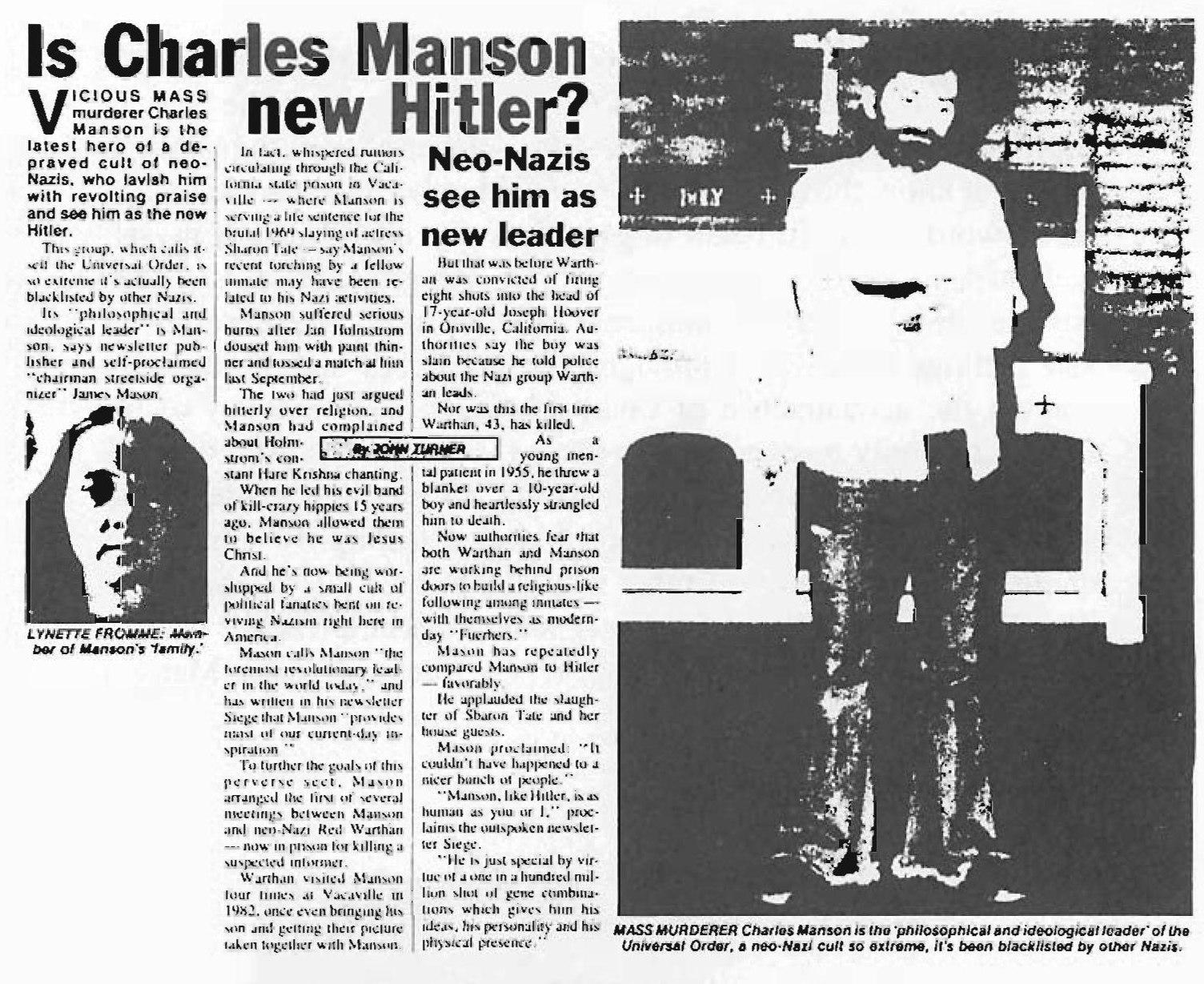
VICIOUS MASS murderer Charles Manson is the latest hero of a depraved cult of neo-Nazis. who lavish him with revolting praise and see him as the now Hitler.
This — jioup. which calls it — <11 ihv Liu ver sal Order, is s«i eurenie it’s actually been blacklisted by other Naris.
Its “philosophical and ideological leader” is Manson. says newsletter publisher and self-proclaimed “chairman strcelsidc utga- niter” James Mason
serving a lilc sentence lor Ihc bsui.il 196*’ slaying of actress Sharon Talc — — say Manson’s recent torching by a felluw inmate may have been related tn his Nazi activities.
Manson suffered serious hums alter Jan Holmstrom doused him with paint thinner and tossed a mulch al him lust September.
‘Die two had jost argued (utterly over religion, and Mansun had complained
Neo-Nazis see him as
new leader
Hut that was belote Warth an was convicted of firing eight shuts uno the head of |7-ycar-otd Joseph Hoover in Oroville, California. Authorities say ihe buy was slain because he told police about the Nazi group Warth-
Nor was this the first lime Wart han. 43, has killed.
about Holm- I ■’ tum^b I As a strum’s con- ti^aSEe2d3EEZ 1 young inen-
LUNETTE FRQMME. .Mmi- bet of Mtnton’s larnity.’
stant Hare Krishna chanting.
When he led his cvjl band of kill-crazy hippies 15 years ago. Manson allowed them tn believe he was Jesus Chnsi.
And he’s now being worshipped by a small cull of pihlikiil fanatics bent on reviving Nazism right here in
Mason calls Malison “the foremost lesolultonary leader m the world today.” and has wrilien in his newsletter .Siege that Manson “pros ides most ul our curient-day inspiration “
To further the goals of this perverse sect. Mason arranged The liiM of several meetings between Manson and neo-Nazi Red Warthan —- now in pitson lor killing a suspected tnlormer.
Warthan visited Manson lour lunes at Vacaville in 19X2. once even bringing his son and getting their picture taken together with Manson.
tai patient in 1955. he threw a blanket over a lU-ycar-ukJ boy and heartlessly strangled him tu death.
Now authorities fear ‘hat both Warthan and Manson arc working behind prison doors to build a religious-like following among inmates — with themselves as modernday ‘Tucrhers.”
Mason has repeatedly compared Manson to Hiller — favorably
He applauded Ihe slaughter of Sharon Tale and her
Mason proclaimed: “It couldn’t have happened tu a nicer bunch of people.”
“Manson, like Biller, is as human as you or 1.” proclaims the outspoken ncwslet-
“He is just special by virtue ut a one in a hundred million shot of gene combinations which gives him his ideas, hrs personality and his physical presence “
MASS MURDERER Chattos Manson is the philosophical and ideological leader’ of the Universal Order, a neo-Nazi cult so extreme, it’s been blacklisted by other Nazis.
Above, terrified tabloid clipping. Left, the logo of the Universal Order, designed by Charles Manson.
James N. Mason, founder of the Universal Order, pictured here with Family member Sandra Good, nicknamed “Blue” by Manson. Note that Good’s hands are forming the Manson mudra that represents his idea that “the truth is one.”
Of the two groups—ours and Manson’s—theirs is the more current and up-to-date....They expected ultra-violence and blood-and-guts from us just as I was told by the Jew media to expect of them. The basis of our idealism is practically the same whereas our redneck and cultivated “macho” image makes us out to be barbarians, the preponderance of women in the Manson Family—though no less action-minded—gives them a lot more of a religious, “apart” quality. They are in fact very moral, quaint in many ways, naive in some ways, polite, soft-spoken, but more fiercely dedicated and loyal than most I’ve known calling themselves National Socialist. They are scrupulously honest. They bewilder me at times. They are very, very slick. They are keenly intelligent and usually know what you’re about to say before you say it. They resent the image made for them by the media far, far more than we resent the one made for us by them. We laugh at and enjoy ours while they are outraged and indignant over theirs. When dealing honestly and openly with them—as I always have done—we get along together magnificently. Lying and holding back, or the playing of phony ego or personality games with them is detected immediately and is held up before one just like a mirror. Racially, they are all tops. Maybe when we speak of the kind of person and mentality of the future, we are actually talking about these kind of people.
No one reading Siege should allow any of this to shock them or to become dismayed in any way for I have been of the same mind since before August when the new Siege was launched and when the first Manson contacts were made. We have our areas of disagreement. I can present no hard-and-fast conclusions at this time. Certainly no drastic change in course is contemplated. I do know that circumstances are removing options fast and that the NSLF course and the Manson course do appear to be converging. Manson acted in 1969 (and the understanding and appreciation of that action stands at about zero). It is now 1981 and he is still there and watching. I was asked by one, “What took you so long?” I had to stop and think about my answer before I could give it. I felt like a novice, a dumb-ass kid. You can’t bullshit these people. We were separated by three thousand miles and were developing in our own worlds, with once-huge differences which have shrank drastically over the years. We have essentially arrived at the same place having come across widely divergent paths. We have a lot to offer one another.
And the Enemy, just as the Truth, is the same.
The Meaning of Manson
By the Universal Order (James N. Mason)
He is a product of the American heartland and was subject to the worst conditions that prevailed. But racially, psychically, and culturally he is perhaps the MOST American, personally gifted, selfless, fearless—both morally and physically—and absolutely dedicated to Life, to Earth and to Truth. What he did—in spite of a life full of the worst adversity—rather than drown in a sea of bitterness as most would have done, he established a racial-socialist colony in Death Valley, in California, in the midst of the push-shove of the 1960s, which was neither hippie nor Right Wing.
As far as those of us today who remain active in the struggle against Death, in favor of Life, Manson’s meaning is of the highest importance. His ideas can be readily accepted by racially sound, intelligent, honest Leftists as they can be by Rightists. Without Manson’s input, neither side will unravel the problem nor find an answer in time. His is to date the most supreme example of defiance, action and survival.
Little more can be added at this point except that the verse from Mein Kampf in which Hitler cautioned against turning one’s back to the immortal hands which occasionally are outstretched to us in times of great stress has its most potent meaning at this time, “ ... woe to the people that is ashamed to grasp them.”
Manson’s Open Letter to President Reagan
August 6,1986 Ronald W. Reagan 1600 Pennsylvania Ave. Washington, D.C.
The government didn’t beat the moonshine still and whiskey has power just as coffee and tobacco do. Uncle Jess from Kentucky said, when I was a child, that the government would end up with whiskey in stores and would run the stills because people in government were the big crooks. I tell you what he said and I say this: You’re not going to beat drugs. I was in prison before people came to prison for drugs. I saw the government make the problem. From your foundation you can’t help the people that don’t want help. You’ve got to go with the will of the people or you lose heart within your own government. You’re going to rip it apart and waste a lot of money.
Your war should be against pollution and for putting trees back before you lose the air, water and wildlife. Take over the drugs and use their power to move people to work on CCC projects. Put the trees back fast before the pollution destroys all life. I saw it dying in Death Valley. That’s why Krishna Venta blew himself up at the Fountain of the World in Box Canyon, California, when the Feather River Project cut his fountains of water off.
Plants and herbs that you call drugs have more power than you understand. All the distorted thoughts and rules make problems worse. Here is a story: Two men are in a cell. One said he wanted to die and was going to kill himself. The other said he wouldn’t let him. So the first guy killed the other one and then himself. If people want to eat shit you can’t stop them without going with them.
No one even knew what drugs were until Mr. Anslinger told everyone what not to take. Cops teaching kids what not to do only shows them what they can do if they want to go against someone. And you put up a bunch of fools who only know what the books say ... no new game, honor or purpose. Some of the meanest fighting men in history got high before they went into battle. Remember why the .45 caliber gun was put into service?
You can take a pile of rocks and use them to build a house, or you can take the same pile and start a war. Tell children not to throw rocks, make rules against picking up rocks, and then make them mad. Keep projecting what not to do and you make the thought in their brains of what can and will be done.
Before the U.S. had a government, the monks sat on top of the grapes, the wine. Buddhists and other monks had the poppies and flowers of power under control. Control must be in order and order must be in truth. And when in truth you can face the problem as it is, not through distorted judgements. Roots and herbs are a part of life, things not known but by a few. One day all you space cases will face the earth dying under your feet. We saw the water out of balance with the land at the Fountain of the World, and the old man in Death Valley told me the same after I got out from seventeen years of service to the truth in government hallways. I’m the last guy in line but I’ve got all the thoughts for the balance of order and peace with a one-world government if we all are to survive.
I want a telephone and the charge to call anyone ... or simply a courtroom with the rights I was denied seventeen years ago.
Easy,
Charles Manson
If I Were Boss ...
By Charles Manson
If I were boss I would take your toys—no cars no lights no power plants no electricity—just a little windmill—the freeways would be bike trails and no shitting or pissing in the water. I would hang anyone who put junk in the water—no trees cut no bushes destroyed no lumber—no books or paper—no need for garbage dumps—no crime no prisons and I would be a beast and enslave the people to ATWA—no violence on TV. No music with words no schools but for a few—Everyone with a Ph.D. don’t give Ph.D. much meaning—a street sweeper makes more money—oh yes! no money—all computers—no work no eat no welfare no retirement—I would work everything and everyone for my survival—if other countries wouldn’t do what I say I would destroy everything and reseed it with zoos and give Earth back to wildlife and the bugs.
The Social Consciousness
A letter from Charles Manson, 1970
The social consciousness is clouded with much confusion. When is a lie a lie? If most people want to believe what they’re told, it then becomes a part of the social consciousness. If the people who are already mesmerized by the news media want a mad dog, they create one by fostering their own vicarious thrills. The image is magnified by the desire of the news media to make money, or the desire of some lying informant to get out of jail or become famous, and so on. The lie grows so big, who can believe it?
There is a price and you will pay. You may not see it, but the beast you created will devour you. That is to say, your social sub-consciousness. There is a subconsciousness that lurks below your awareness. The social subconscious beginning to make its move is called anarchy. Things happen everyday the newspapers don’t print and the TVs don’t show. You’re only told a small part of what’s going on and that part is only to control your mind, to get you to stay in line, to avoid panic and to create a social thought to keep down total chaos of the masses. The lie is becoming so big that no one can believe it. This is what isolates people, for soon no one will know what to believe. The last battle of Armageddon will be when the social consciousness reaches a high fear level, as fear has always and will always induce madness.
A Nick Bougas illustration championing Manson’s ecological organization, ATWA.
Above, “Armageddon Jacket” embroidered by Lynette Fromme. The Family members were to don these in their post-war desert retreat.
Red and Blue
While many of the original Family have drifted apart or taken on the guise of repentant Christians, two women have remained loyal to Manson and the ecological/racial cause which he espouses. They are Lynette “Squeaky” Fromme and Sandra Good, dubbed by Manson, respectively, as “Red” and “Blue.” (The Order of the Rainbow, alternately known as Nuness, is the inner core of Manson’s Family—each member receives a color code name.)
Red and Blue kept the flame burning, became the guardians of the reliquary. They took responsibility for Charlie’s fabled vest, embroidered by many Family hands over the course of years with witches, goblins, flames, devils, and the hair shaved off the Family girls who performed the year-long outside-the-courthouse sidewalk vigil. They staged shrewdly-designed media events, such as the “Crawl for Freedom,” in which Lynette Fromme and a few other Family members advanced on their hands and knees through the many tortuous miles of Sunset Blvd., from the beach to the downtown courtroom. Fromme describes the incident at the time of the “Crawl” in a letter:
[We’re] sitting on the sidewalk, unwrapping our bruised, scabbing bloody knees and cleaning our grubby hands with alcohol just as the sun is getting hot and the prosecutor in his three-piece tweed suit meets us on his way to work. Always dapper and snappy he greets us as if meeting us for a luncheon.
“Hi girls,” he says, (and without flinching), “what’re you doing?” Brenda [McCann] looked up and told him we were trying to wake a few people up.
“You’ll never do it that way,” he said, shaking his head. “You’d have to put a bomb at their feet.” And with that he was off, said he’d be late—to the prosecution of our friends for mass murder, and though his may sound like the wisest words, being as we thought nine dead bodies would be enough, I recall vividly the bitter irony through the smoggy sunlight and our weariness and I’m surprised we’ve lasted this long in the pursuit of peaceful change except for our unwillingness to run amok. It was suicide we wanted by the burial of dead systems of thought.
When it became apparent that Manson’s release was not forthcoming, Red and Blue began a militant campaign to further the cause of Manson’s ATWA—Air, Trees, Water and Animals—the reseeding and regreening of an increasingly poisoned earth. Thus began the Family’s Court of Retribution, sworn to destroy those who were destroying the earth.
Red and Blue began sending threatening notes to executives at Dow, Atlantic Oil, Westinghouse, Remington and Standard Oil, promising bloodshed if they did not cease and desist tipping the scales against “the ecological balance.” The two became soldiers on the front line of Manson’s “holy revolution against pollution.”
Good was imprisoned for sending death threats to businessmen, and is now paroled and living in Burlington, Vermont.
On September 5,1975, “Squeaky” Fromme walked back into history, pointing a .45 caliber automatic pistol at the President of the United States, Gerald Ford. As Manson theatened in a 1974 press release typed by Lynette: “If Nixon’s reality wearing a Ford face continues to run this country against the law without any real truth, trust and faith—if Manson is not allowed to explain what you are too sheltered to face, your homes will be bloodier than the Tate-LaBianca houses and My Lai put together.” The .45 automatic never went off.
A dozen years later, on December 23,1987, Fromme made her way from the Alderson prison, becoming front page news once again. Her two-day jailbreak put the Secret Service and LAPD on alert, in case Fromme made good on earlier promises to “finish what I had started.” The inside account of events leading up to her desperate breakout are detailed on a following page.
The East German playwright Heiner Muller quoted Fromme at the apocalyptic climax of his famous work, HAMLETMACHINE. The Ophelia character in this despairing reworking of Shakespeare utters Fromme’s bloodcurdling phrase: “When she walks through your bedrooms carrying butcher knives you’ll know the truth.” Said Muller, “I found it interesting that the Manson Family was the pragmatic, unideological, puritan, Christian variant of European terrorism in the U.S. Only a puritan-oriented society can produce such extremes. I believe the sentence [Fromme’s] contains a truth...”
Sandra Good’s Statement to the Associated Press, September 12,1975
The International Peoples’ Court of Retribution is a wave of assassins. It is made up of several thousand people throughout the world who love the earth, the children and their own lives. They have been silently watching executives and chairmen of boards— and their wives—of companies and industries that in any way harm the air, water, Earth, and wildlife. They can be assassinated on the golf courses.
They move of their own accord—necessity dictates policy.
Exxon, ITT, Standard Oil, Union Oil, lumber company executives, Gulf Oil, must get out of the country or you’ll be killed.... We want to live, you maggots, you monsters. Get out of the country or you’ll be killed.
A Letter From Sandra Good
Hitler tried to straighten the mess out and millions were moved by him because he struck a chord in the truth. No one can book his act again ... They all died knowing their cause was right ... The mass of people ... subconsciously want to die. To me, the differences (skin color) are enough reason for not mixing. In fact, the main reason. If all the emphasis is on intelligence differences, then I can see why so many in the movement are blind to the fading of color, vibrancy, and life from the earth. If I was a moron and met a brilliant black I would rather produce a white moron than a mulatto offspring with average intelligence.... In a right society, morons wouldn’t be reproducing—He (C.M.) has been the scapegoat for everything. We each have carried our loads for all these years.... With little help or support. It’s the variety and stark differences in life that make it interesting and beautiful. Red flowers and green grass against a blue sky. Would you cross a horse and a zebra and
Above, and opposite, Blue and Red, Red and Blue.
cause the zebra to lose its stripes? ... Mixing with whites would only destroy their race.... I would leave the Africans to be themselves to run free and wild like the wildlife. If I was a man and needed their land or parts of it for my survival and my kid’s survival, I’d conquer and kill what got in my way, but I would not breed with anything that did not look like me.... To rob the conquered people of their own blood is wrong. Whitey is so advanced he breeds himself right out of existence.... If dumb white assholes go around telling blacks that they are shit (which is tempting to say to an American nigger type, the type I have to deal with day in and day out) that just makes them run after whites all the more.... Prove they are equal for revenge. Now they are messed up in a phony Jews’ culture.... Deep down I’ve got faith. Hess is a lucky man—better off than Speer ... there are two people who know my mind—Red and C.M. We know not to get close to people in person ... Don’t expect one single person to stay loyal to you or understand you.
A Letter From “squeaky
He has been requesting a tape recorder since he was first incarcerated in 1969. That is the only way that any of us can get a clear picture of MANSON and what he has to say. His sight and awareness is and has always been far ahead of mass consciousness, and for this he, like many KNOWN historical geniuses, is forced to suffer for what others do not understand. He broke NO LAW! Imagine how it feels to be living under all the people who are free to walk, swim, and fly the space, but do not know how to keep it free, clean and in balance. Let me put that another way. Say that you have been sitting for thirty years thinking through a problem—not necessarily straining, but concentrating diligently on not what you want or hope for, but what IS.
Say that you have come to understand the problem in depth and have, in effect, become it, and know how to solve the problem. Now you watch the parades and processions of hopeful and despairing people walking outside your tomb. They are all looking for the answer to the problem you know so well. They are all celebrating the search, or mourning the problem, analysing or disguising it. You wave but they don’t look down to see you, even as they proceed by to their own funerals. When you have exhausted yourself yelling, and felt the deaths of millions for not having heard, and watched those who think they are too good to look at you, push their own children in the graves before them, and watched the children grow angrier, the land more destroyed, the air and water more poisoned, the men, women, politicians and gurus vying for positions of power over something rather than the God-given grace to love and care for what supports life—and much much more sight than I could ever write on paper—then you see what Charles Manson sees, alone. Everyone in this family put our life’s faith there.
The balance of the Christian mind is different than that of the Hindu.
You say that you were impressed that I am articulate. Every one in this family is articulate, and exceptionally bright. Reports to the contrary are part of a people’s need to look down on something and someone, be it a criminal, a different class or race of people, or a simple child. It is also a result of the standard of sophistication measured by one’s ambition and finesse for acquiring money. The murders themselves were mean and purposeful. They were respondent. They needed not be sensationalized. But rather than listening to the defendants themselves, lies, distortion, perversion and other of the public’s own cravings were substituted for the truth. At that time they were forced to accept attorneys as if they were forced to wear disguises. They were forced to remain silent while a parade of charaders marched around the courtroom talking about things they little understood—The Bible, sex orgies, Christ and the Devil, LSD, E.S.P., the “Manson Family” and the murders themselves. The Supreme Court later handed down a decision interpreting the U.S. Constitution as giving defendants the undeniable right to represent themselves in court as long as they conduct themselves within a reasonable accordance of court procedure.
When I say that they were “forced,” I mean that they were required, and under that requirement in a situation determining the balance of their lives and the lives of many others, there was a tremendous amount of pressure. I do not appreciate crying injustices and dramatizing much of what the soft American public consider to be hardships. At the same time, I can empathize.
While sympathy toward a problem can often make weakness, empathy can call up strength. The public here could not even face their own children, let alone empathize with them. They did not even ask to understand the young people in the so-called “Manson
Family” who they were sending to the gas chamber. Rather, they blamed one man who was not even raised in the society which fostered those killings.
I walked out of my trial; Sandra Good and Susan Murphy walked out of their trial; we did not put on our defenses because until all the family gets a chance to explain, none of us will. As a family, we can see a new money system where the money can work like a god for the people rather than people working like dogs for the money and not receiving the balance of healthful, experience-full life that the money exchange is supposed to buy.
Until then, this country runs itself to the ground from what it refuses to face; just as you, yourself, can see no solution to WORLD problems and can see no one who does see. When Nixon points a gun at Ford, someone may see that Manson’s mind is miles over the U.N. and Rome, and that the United States Government has been sold nine times already.
I could take more time with this letter to be academic but that is not my concern. From what I have seen, most journalists would sell their own Lord’s or child’s heartbeat rather than come down to the love and soul in themselves, rather than getting on your knees to another of your own mankind, rather than conceding that you don’t really know the connection between life and Death and why people are intent in moving toward self-destruction in their air, water, land, food and thoughts. It is by no means only journalists and media people who demonstrate this, and I am not condemning you. Everyone has done that for themselves.
L. Fromme
MSNKhTTAI
DAILY® NEWS
MW TOM’S MCTUM MWOAFM* TNrateT-<>«»*• «•’**
MANSON
ESCAPES
Squeaky Fromme tried to kill PresideutFord
STORY ON PAGES
The 1987 Escape: Backgrounder
On Christmas Eve, 1987, the top line news story of Lynette Fromme’s daring escape from Alderson prison in West Virginia contrasted sharply with the media’s dreary recitation of holiday cheer. The Manson scare was neatly revived after nearly a twelve-year slumber. News clips retold the nearly-forgotten stories of Ford’s attempted assassination and ’‘Squeaky’s” hairless vigils in front of the Los Angeles Supreme Court building.
According to one Manson sympathizer, “Usually Red [Fromme] responds to all my letters within a couple weeks or so, and she called me collect every so often as well, and we’d talk for hours sometimes. But she seemed to be getting more and more despondent, giving up hope; she was on the verge of tears at times. She kept talking about going to see Charlie, on the phone, and in her letters. Suddenly, in about May [1987], she stopped answering my letters and stopped phoning me. In her last converstion, she asked me to go down into the hole with her and Charlie. I told her I wasn’t ready to.
“I thought she had just decided to give up on me when I found out she had given up on everyone. No one was hearing from Red. Around this time I got a letter from Charlie accusing me of scamming on his pussy. That might have had something to do with it, I don’t know.”
In early November, 1987, Manson wrote to a representative, Jimmi Rocket, announcing that he was dying of cancer of the testicles, and that he had begun a hunger strike. His letter smacked of being a last will and testament, with such lines as: “Give my guitar to the Beach Boys.” Rocket claims to have confirmed Manson’s condition with the medical staff at San Quentin. Manson sent along a letter to Rocket to forward to Fromme which evinced much displeasure over her recent behavior. In that letter to Fromme, Manson told of his hunger strike, but, as we shall see, not of his alleged cancerous condition.
Distressed, Fromme wrote to Rocket (in a letter postmarked December 2, 1987):
He’s not eating. He wants out of lockup and prison and has been fasting. The first twenty days he had:
4 cookies
3 soup
Slice of cheese
Piece of cake
3 glasses milk
Fast to Freedom and he smiles. He went 48 days once and was thinking with pleasure that he didn’t need to eat again. He goes off into dreams and the body becomes useless or extra and the mind takes off. He said he was worried about me. Oh I’m just fine. He’s dying and I’m 3,000 miles away in winter with remorse for ever losing him to the court to start with....
I wasn’t going to write you because I’m in the throes of my own melodramatic death of deaths and at this point I am uneasy. Trees need to be planted in a land where people drive over them. People need to be planted.... People are too many... I only live and feel alive when I think of him.
On December 23, on the evening of her escape, Fromme placed a collect call to the residence of Jimmi and Opal Rocket, who live in the small town of Ava, Missouri. She talked for forty minutes. “Mainly personal stuff,” relates Rocket, “nothing that would indicate her escape except her despair over Charlie’s condition. I thought she knew about Charlie’s cancer, but she didn’t. It seems I broke the news to her. And she was shocked.” Lynette Fromme hurriedly hung up, recalls Rocket, at 8 pm Alderson time. An hour and a half later, at bed check, Squeaky turned up missing.
At that point no one knew where she was, even those closest to her, but Fromme had given up on the idea of keeping friends. Earlier that year Fromme wrote an associate that if she got out of prison she would “finish the job that she started.” That was never to happen in 1987. Lynne Fromme was discovered two miles from the front gate of Alderson prison on Christmas day.
A Proposed Introduction to an Unpublished Book by Lynette Fromme, 1977
As long as the man is tucked away in asylum/prison/grave, you can say anything you want about him. Anything. You can lie in more movies and bogus books for money. You can pretend to play like him. You can orgy with your awkward paws and dance your frantic feet off, joke about his suffering, draw your very life from his blood. But you have not the soul to face him.
He’s a genius you don’t recognize, in a ragged coat, with no tails for you to ride—or in secret, his majesty could blind you. The first time I saw him dance, I ran out of the room. He’s in motions and sounds, not words, and he’s hidden because he gave everything he was asked for.
People said that I was Manson’s main woman, people who didn’t know that Manson treated all the women around him as one. His main woman is the truth. She comes before anyone or anything and he’s with her always in life or death. He married her in a dark hole. He knew alone. Three grades of school. Thirty years in a cage. Pulled out of solitary confinement dead—or a reflection and the balance of whatever group he’s in.
Bom into this imbalanced world of women’s law in 1967, carrying Truth over the threshold, he met thousands of young in the streets. I was one of them. He stood our words up in Truth. He never broke our wills. We put up our lives, and the symbol of one finger as alternative to anarchy.
He knew what anarchy would do to the Earth. She has been treated like he has, by people too proud to look and too scared to see. He was thinking Earth-balance before I was born, and in the 50s he set the thought for International People’s Court of Retribution so that everyone will know what they’ve done to air, land, water and the soul of the earth.
Everyone has wanted to make him small. Yet a monster. Stupid. With hypnotic powers. A fascist. And a Commie. And prejudiced nigger-lover. A macho punk. Both Christ and the Devil. Or, on the opposite side of everything.
We told the world Manson is a reflection, yet even President Nixon, a lawyer, publicly declared Manson “guilty, directly or indirectly” before the trial was over, and set his own downfall. Believe it or not, Rome stumbled over the truth in one bastard.
The Beautiful People
“I love love-ins. They’re fascinating. They’re fun. I think the hippies are great; they just want to be left alone and they want everything to be nice and peaceful.
“I don’t like to be alone... when I am alone my imagination gets all creepy.”—Sharon Tate
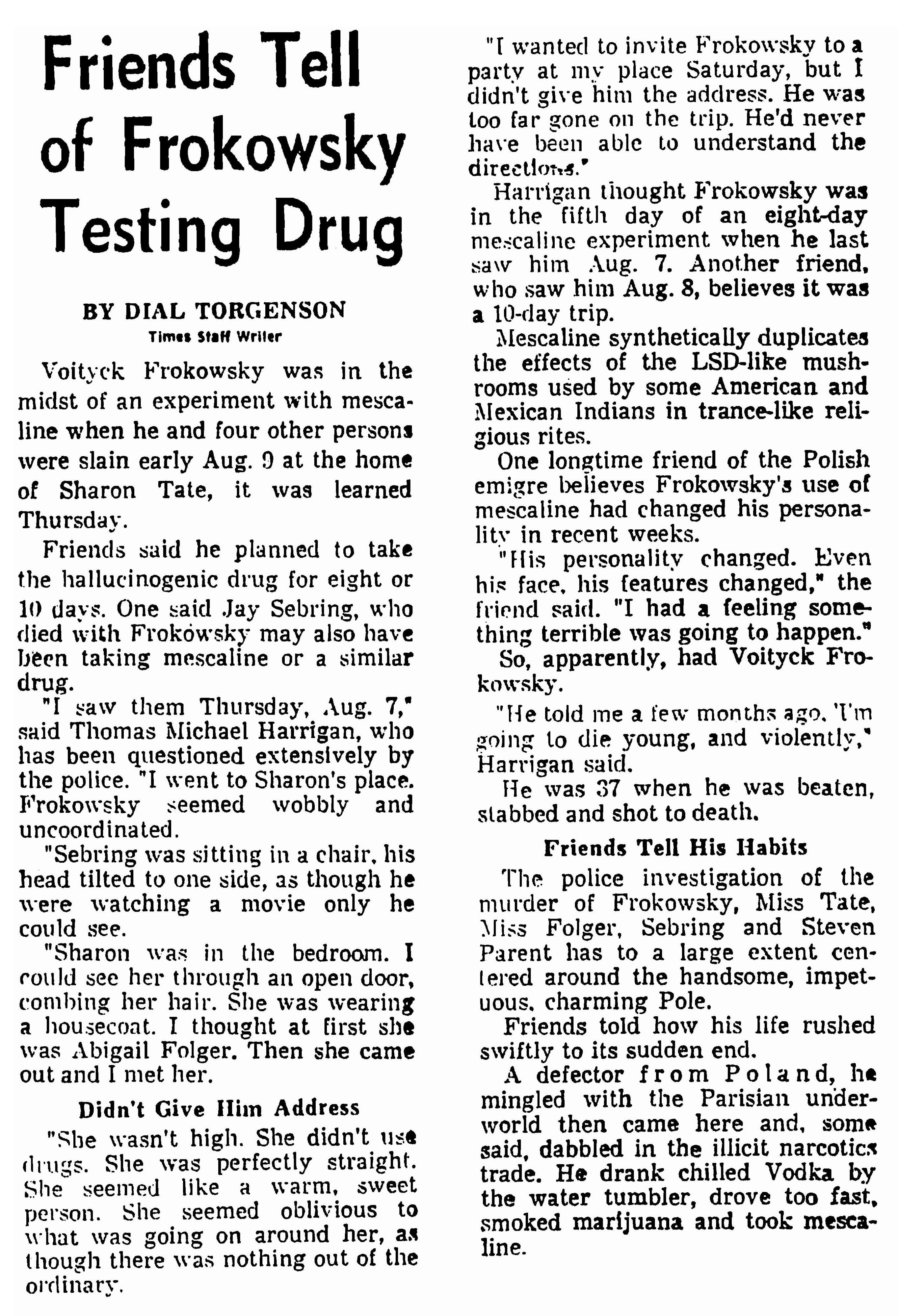
Friends Tell of Frokowsky Testing Drug
BY DIAL TORGENSON
Times Staff Writer
Voityck Frokowsky was in the midst of an experiment with mescaline when he and four other persons were slain early Aug. 9 at the home of Sharon Tate, it was learned Thursday.
Friends said he planned to take the hallucinogenic drug for eight or 10 days. One said Jay Sebring, who died with Frokowsky may also have been taking mescaline or a similar drug.
“I saw them Thursday, Aug. 7,” said Thomas Michael Harrigan, who has been questioned extensively by the police. “I went to Sharon’s place. Frokowsky seemed wobbly and uncoordinated.
“Sebring was sitting in a chair, his head tilted to one side, as though he were watching a movie only he could see.
“Sharon was in the bedroom. I could see her through an open door, combing her hair. She was wearing a housecoat. I thought at first she was Abigail Folger. Then she came out and I met her.
Didn’t Give Iliin Address
“She wasn’t high. She didn’t use drugs. She was perfectly straight. She seemed like a warm, sweet person. She seemed oblivious to what was going on around her, as though there was nothing out of the ordinary.
“I wanted to invite Frokowsky to a party at my place Saturday, but I didn’t give him the address. He was too far gone on the trip. He’d never have been able to understand the direction.’
Harrigan thought Frokowsky was in the fifth day of an eight-day mescaline experiment when he last saw him Aug. 7. Another friend, who saw him Aug. 8, believes it was a 10-day trip.
Mescaline synthetically duplicates the effects of the LSD-like mushrooms used by some American and Mexican Indians in trance-like religious rites.
One longtime friend of the Polish emigre believes Frokowsky’s use of mescaline had changed his personality in recent weeks.
“His personality changed. Even his face, his features changed,” the friend said. “I had a feeling something terrible was going to happen.”
So, apparently, had Voityck Frokowsky.
“He told me a few months ago. Tm going to die young, and violently,” Harrigan said.
He was 37 when he was beaten, stabbed and shot to death.
Friends Tell His Habits
The police investigation of the murder of Frokowsky, Miss Tate, Miss Folger, Sebring and Steven Parent has to a large extent centered around the handsome, impetuous, charming Pole.
Friends told how his life rushed swiftly to its sudden end.
A defector from Poland, he mingled with the Parisian underworld then came here and, some said, dabbled in the illicit narcotics trade. He drank chilled Vodka by the water tumbler, drove too fast, smoked marijuana and took mescaline.
Sadism, Drug Use Claimed
Attorney Wants to See Police Report on Tate Case Victims
Police investigating the Sharon Tate murders have learned that one of the victims had a history of engaging in acts of sadism with young women and that two others were known narcotics users, a defense attorney in the case said Wednesday.
Paul J. Fitzgerald made the claims in a declaration filed with Superior Judge Charles H. Older.
Fitzgerald asked that he be permitted to read all purported data relating to:
—Sebring’s alleged acts of sadism with women in his Hollywood Hills home and “in particular his conduct in regard to bizarre sexual activity” and use of “force and torture in connection with ropes and hoods.”
—The alleged narcotics activities of Frykowski apd Mis* Folder. (Fitzgerald said tests made after their deaths revealed the presence of drugs in their blood.)
The Beautiful People
After the Tate/LaBianca murders, Hollywood was in a state of “freak-out” Everyone in Lotus Land feared for their lives, and prepared themselves for Armageddon. From Bel-Air to Holmby Hills to Malibu Colony to Beverly Hills, the “stars” had begun to surround themselves with armed guards in overlooks, electrified fences, and high stone walls. Their mansions appeared more like penitentiaries than luxurious drug and sex havens.
After Charles Manson and his Family were put on trial for the murders, more fear was passed around, for Manson was well-connected to many in the film and recording industries, and priwy to plenty of dark secrets. It took until the mid-70s when Manson responded to a request from Bill Dakota’s Hollywood Star (a tawdry gossip tabloid concentrating on actors’ penis sizes and closet liaisons) to provide a few specifics. After Manson’s startling letter on the Beautiful People appeared, Dakota reportedly received a call from Frank Sinatra threatening to break his arms for contacting daughter Nancy to pump her for further information on Manson’s sex orgies. Manson’s infamous letter appears in this section.
Rumors of a Manson Family celebrity “hit list” made the rounds, and a document of this hit list procured by journalist William Farr was suppressed by Judge Older at the trial of Susan Atkins.
Manson’s Letter to the Hollywood Star
I didn’t say Elvis was bi or not. Looooook it. If I sleep with all the girls you sleep with & we go to bed with 3 or 4 girls at a time & I check you out & the way and things you do & you check out my strokes & pick up some of my motions don’t mean I’m bi or you’re bi. If I’m in the same dream but I got a good heart, I can hold that heart in bed. Elvis couldn’t fuck over me but I could over any little fat girl in his dream bed because I earned them when I lived at Tom Mix’s old house on Sunset out by the beach. We had a pool full of naked beauties and strobe lights in the living room & sex in 5 bedrooms & all the closets had secret doors that go from bedroom to bedroom plus the guest house, big beds, pool shacks, and mattresses in the living room, a tree house, sex all over the grounds, in the rose gardens, under the trees, everywhere. NEIL DIAMOND used to come over. MIKE LOVE, of the Beach Boys, DORIS DAY’s son, ANGELA LANSBURY’S daughter Dee Dee, NANCY, SINATRA’s daughter, used to be at the beach pad. DENNIS (WILSON of the Beach Boys) & I lived with 15 or 20 of the best. We kicked JANE FONDA out of that dream because her Jewish boyfriend wanted to bring a black guy to play ping-pong with her & I said I don’t play mixing blood for phony Christians that work for their money selling children. She had a big dog and a crummy camera & I said no, I do what I do for love, not money. They had a key to Red Skelton’s beach pad. I had been there before ... so I went and fixed the window so I could look in, and they found my peek place. I just wanted to see what they did with the dog & the guy they picked up over at UCLA.
I don’t think she was playing STOP THE WAR. She was (I think) making some kind of videotapes like PETER SELLERS & YUL BRYNNER (bald-headed guy) were making. Dennis Wilson gave me a $5,000 videotape, TV thing for tapes that fit only to an elite bunch (porno ring) that was world-wide.
I heard Polanski got money from dog and children movies to make his movies with. I was offered record contracts, movie parts, etc. When I got out, I went to Universal Studios—saw producer named Stromberg, a phony guy. He wanted me to cut a record with a South African black. Hugh Masekela & big black trumpet & drummer for a movie. He told me Jews control & I’d never get any music over, unless I did it his way.
He was making a movie (he said) about the 2nd coming of J.C. & he was to be a black & the police was to off him and the system would get the blame & they would control the movie minds & take power. I said no. They did it anyway. Jackson was killed in San Quentin & Abbie Hoffman and Jerry Rubin got big power controls. I was a dumb-ass.
I went to Universal where I parked in CARY GRANT’S parking space & this homosexual came & told me to move my car. I knew Grant was in England so I told him & I’ve had a little experience with homosexuals. So I took him back to Cary Grant’s office. That had an apartment (bar) & such. I don’t want to say all the things that happened at Universal lot because I liked that gay guy & don’t want him to lose his job.
That ass PETER FALK & the guy that played James West in WILD WILD WEST propositioned me. I don’t fuck with closet queens. There is much more but I can’t spell. Like one night a guy’s wife took me to Elvis’ pad ... with big iron gates & she was begging to suck on my ice cream. Elvis’ wife came home that night and when Dennis Wilson came around he had so many broads Elvis got afraid, cause that little girl had his heart. I could have eaten it there in front of them but was playing a front & I was having all the sex in the back. I could have fucked him. He had a car I wanted but Terry Melcher gave one of my older running buddies a new XKZ Jaguar for me because he didn’t want no one to know about me & his mom & when D. Wilson gave me the Ferrari, my other buddy wrecked it, & we left it & went off to shoot a game of pool & someone ripped it off. And Dennis Wilson is a wonderful person— no bullshit—he got mad at me. He had a phony French bitch running after him only because she was a star fucker & was fucking JIMI HENDRIX. When she asked me to fuck her, I rammed it up her ass & wiped it in her face & throwed her out of the pad because all she wanted was money, money. Producer Stromberg destroyed my music. When I seen the conspiracy to do in Jackson, I ran and put a “I” up over that bed of fools and clowns. I do more in a weekend than most do all their lives. I’m not into sex porno or selling distorted sex. All sex I do is human, clean and natural. No make-up. No ego fuck but the God fuck. Everyone I fucked wanted to pray to God.
Susan Atkins’ Hit-list
Miss Atkins purportedly told a cellmate that she and her codefendants had planned to murder a series of show business personalities, each in a particularly vicious and bizarre manner.
Included in the list of intended victims were Elizabeth Taylor, whose eyes were to be removed and mailed to an ex-husband, Richard Burton—who was to be castrated; Frank Sinatra, who was to be skinned alive while hanging from a meathook; and Tom Jones, whose throat was to be cut while he was engaged in an act of sexual intercourse with Miss Atkins—at knife point, if necessary.
Copyright MCMLXII, Walt Disney Productions
Disneyland’s Haunted Mansion ride opened the same day Sharon Tate, et al, were slaughtered. Walt Disney was the former owner of the LaBianca residence.
The Merchandizing of Manson
How much money has been made from exploitation of the Manson mythos?— how many newspapers, magazines, and books purchased, television specials made (selling how many bottles of shampoo or sticks of underarm deodorant?), movies released, T-shirts, records, cassettes and posters sold? Conservatively, the amount approaches a billion dollars.
The Manson mythos has been a capitalist spark plug, a much-admired additional digit in the Gross National Product. Herein you will find an annotated guide to the major products of the Manson industry. Taken together they seem to reflect less of the truth about Manson and his followers than the vicarious and insatiable conduct of media mavens and their willing victims.
CHARLES MANSON AND “FAMILF CAPTURED!
MELTER SKELTER
The powerful conclusion of the gruesome murder trial. Based on the prosecuting attorney $ true account CONCLUSION 230 THURSDAY AT 8 WLVI
THIS is Trie LaTe AWN ...HE. Was iNViTED
A gallery of glowering Charlies. Opposite page, Steve Railsback in the TV movie version of Gentry and Bugliosi’s book. Top left, Alan Ormsby tries for “the look of ‘69” in a poster for the cult favorite, Children Shouldn’t Play With Dead Things. Top right, R. Crumb’s depiction of acid fascism in “Jumping Jack Flash” from San Francisco Comic Book. Above center, Aram Katcher does Rasputin one better in Massacre in Los Angeles.
SHUCKS!
FATHER,
FOR&ivg THEO)..
BUSW. ALTHOUGH YOU THOUGHTLESSLY SNUFFED THE UVES OF 400 QOOK WOMEN
ANO CHILDREN, THE U.S. ARMY WANTS TO APOLOGIZE FOR MAKING YOU A SCAPEGOAT ANO WISHES TO AWARD YOU THIS SILVER STAR FOR ,
BRAVERY ABOVE AND BEYOND AND BELDWj GOOP SHOOTIN’ KIP !
CHARLIE. FOR THE UNSPEAKABLE MURDERS OF AMERICA’S MOVIE STARS, AND FOR-THE HEINOUS CORRUPTION OF OUR. DAUGHTERS,
IS MY PROUD DUTY TO PULL THIS
SWITCH AND SEND YOU TO YOUR
MAKER! MAY YOU ROAST IN
HELL FOREVER!
Manson’s status as counter-cultural icon is exhibited in these frames from the high art form of hippiedom, the underground comic. Opposite, a frame from “Legion of Charlies,” in which the Tate/LaBianca murders were seen as a parallel to the My Lai massacre. Top and bottom left, Mike Matthews’ “Curse of Manson’s Chocolate Mine.” Top and bottom right, more “Jumping Jack Flash” by R. Crumb.
An Entire Country Gone
Helter Skelter
WRITTEN IN EXILE, UNDER TIGHT SECURITY, HERE IS HENRY KYEMBA’S INSIDE STORY OF IDI AMIN:
★ THE RANDOM KILUNGS OF OVER 100,000 PEOPLE
This is a document of horror. This is Uganda today- ASTATEOFBLOOD
Following the unprecedented publicity from the Tate/LaBianca trial, and the runaway success of the prosecuting attorney’s book, “Helter Skelter” fast became a favored name for nightclubs, clothing stores, and other purveyors to the “hip.” Publishers trumpeted the phrase on any book which promised orgies of cannibalistic gore, such as Henry Kyemba’s account of Idi Amin, pictured above. Wax museums lured tourists to Manson exhibits with no regard to historical or anatomical accuracy. The waxwork from Israel’s Shalom Wax Museum (opposite top) has Manson holding a bloody kitchen knife, looking much like the Old Testament Abraham in the midst of sacrifice. Other wax figures pictured are from Niagra Falls (above) and Madame Tussaud’s, London (opposite bottom).
Books
The peculiar literary sub-genre of the Manson “expose” began in appropriately shady fashion with the January 1970 release of The Killing of Sharon Tate. A classic example of the instant book, this paperback is hack-work of the first order. Its cover announces that it is the confession of Susan Atkins “told in the words of the pretty 21-year-old who calmly confessed to the most hideous crime of the decade.” In fact, it is the half-baked collaboration of two Los Angeles Times journalists, Jerry Cohen and Dial Torgerson. The bogus confession was first printed as an exclusive to the Times, then sold to several European papers as the genuine article. Promoter Lawrence Schiller presided over the scam, which was published by New American Library, a company owned by the Los Angeles Times. Who says crime doesn’t pay?
A second paperback, 5 to Die, printed by Holloway House (publisher of pimp writers Iceberg Slim and Donald Goines), appeared shortly thereafter promising “the true story of the satanic Charles Manson cult.” This volume, by Jerry Le Blanc and Ivor Davis, was the first to truly evoke the “devil” image now so much a part of the Manson mythos. Now hard to find, the mundane perspective of 5 to Die is redeemed by excellent, rare photographs.
Witness to Evil by George Bishop, printed in cloth in 1971 by Nash publishing, takes a slightly different angle. It is an exhaustive account of the Tate/La Bianca murder trial, with courtroom illustrations by ABC News artist Bill Lignante. Worthwhile as a document of the actual proceedings of the trial, the cover illustration of Manson as a demonic puppeteer pulling the strings of his disciples is a classic of its kind. As an extra bonus, the delightful forward by Art Linkletter (he of the plunging daughter), includes not only the word “cop-out” but “bad trip,” both used in a context of suitably Linkletterian self-righteousness.
1971 also witnessed the releases of the quickie page-turner Chronicle of Death, and The Garbage People (Omega Press) by John Gilmore and Ron Kenner. Actually utilizing first-hand interviews with Manson himself, The Garbage People is on a somewhat higher plane than the previously mentioned volumes. Original research and many authentic voices of those involved with Manson help to elevate this book from the typical sensationalistic approach.
The Family: The Story of Charles Manson’s Dune Buggy Attack Battalion was the work of Ed Sanders, a poet and musician associated with the ‘60s rock aggregation known as The Fugs. Sanders was one of the first to cover the Manson story for the underground press, and in 1971 released this, his magnum opus. The Family was the first of the Manson books designed to appeal to that ever-so-hip “counter-culture” from which Mansonism is thought to have sprung. Dripping with paranoia, dark rumors of snuff films and obsessive details including exact addresses of obscure locations, The Family is overwhelmed by Sanders’ precious prose. For instance, after many “sinister” events, the phrase “OO-EE-OO” appears as if to remind us that we should be horrified. Though invaluable to the Mansonologist for its fetishistic information, a little Sanders goes a long way. A Process lawsuit against publisher E.P. Dutton has made the first edition of The Family difficult to find.
None of these books can be said to have had the impact engendered by Helter Skelter, written by prosecutor Vincent Bugliosi with the help of Curt Gentry. Published in 1974 by W.W. Norton and Company, Helter Skelter is the source of most of the reading public’s knowledge pertaining to Manson mania. In this selfglorifying morality play, Bugliosi casts himself as an uncanny Sherlock Holmes-type pitted against Charlie’s maleficent powers, the incompetence of the LAPD, and a host of other evils.
Bugliosi’s piecing together of the Helter Skelter motive is one of fiction’s great triumphs. Little more than a padded-out hymn to the wonders of Bugliosi and the fairness of the American legal system, it is regrettable that this is considered the standard work in the genre.
More worthy of consideration is Our Savage Godby R.C. Zaehner. Printed in an American edition in 1974, Our Savage God is a philosophical study of the source of Manson’s philosophy. Tracing the idea of murder as sacred to the Upanishads, Zaehner writes: “Charles Manson taught his ‘children’ to kill without having to endure the qualms of conscience that lesser mortals feel. This is precisely the message which the incarnate God, Krishna, passes on to his beloved disciple, Arjuna....” Zaehner also makes the point that “If the victims had been a lot of lousy beggars with not a nickel in their pockets, and only their lives to lose, would the Christian ’conscience’ of our clockwork scribes and Pharisees have woken up with such a shock of panic fear? Of course it wouldn’t, for the so-called random killings were not random at all but directed at them, the rich, self-satisfied, successful, efficient ‘men of the world’ who have not even the courage to pursue their own convictions to their logical conclusion.”
In 1974, the Schenkman Publishing Company produced The Manson Murders: A Philosophical Inquiry, edited by David E. Cooper. Dry, pedantic, and guilty of all the worst sins of academics everywhere, this collection of essays “in contemporary ethics” is eminently worthy of dismissal.
There are two other books dealing with the Manson trial itself. The Manson Trial: Reflections of a Psuedo Juror, is a tedious, anecdotal memoir by the Christian wife of a juror, and the 1973 Trial by Your Peers by juror William Zamora was later reprinted under the gaudier epithet of Blood Family (Zebra, 1976). Zamora reports on the trial from his point of view, adding little new information despite the cover blurb promising “all the perversion and passion of... the weirdest cult murders since pagan times.”
Two of Manson’s erstwhile associates, Charles “Tex” Watson and Susan “Sadie” Atkins claim, of course, to have been born again as bible-believing Christians. Watson in his Will You Die For Me? (Revell, 1978) as told to Chaplain Ray Hoekstra, maintains that he was possessed by the devil when he participated in those celebrated slayings. Obviously written tor the parole board, its only interest is in the first-hand description of the murders. Chaplain Ray’s God’s Prison Gang, a testament to his conversion of criminals, includes an equally ludicrous chapter on Watson.
Miss Atkins’ more flamboyant memoirs, Child of Satan, Child of God (Logos International, 1977) throbs with pseudo-pious remorse for her life of sin, a ghost-written potboiler that ends with a prayer to Jesus. Heartwarming.
In 1979, “Little” Paul Watkins, a lesser luminary than Atkins or Watkins, produced the best of the various “eyewitness” accounts of life in the Family. My Life with Charles Manson (Bantam, paperback) co-scribed by G. Soledad, is one of the most vivid accounts of the subject at hand. Although marred by the usual selfserving plaintiveness of most reformed criminal memoirs, this book is useful for details and authenticity of mood.
The Manson Women by Clara Livesy, M.D. (1980, Richard Marek publishers) is an execrable product which has Dr. Livesy interviewing and analysing some of the major female dramatis personae in the Family.
In January, 1987, the long-awaited Manson In His Own Words was published by Grove Press. As told to Nuel Emmons, who first met Manson in Terminal Island in the ’50s, the book is a major disappointment. This anemic and smoothed-over oral history lacks the passion, drama, or humor contained even within its subject’s most desultory letter or interview. Someone must have decided that Manson’s mode of expression was too non-linear, too “crazy” for the average reader. Manson has denounced the book repeatedly as “bullshit,” saying, ‘that book sure blew up in my face.”
Manson has been dealt with in a number of “True Crime” anthologies, notably The Murderer’s Who’s Who (J. Gavte and R. Odell, Pan books, 1983), Bloodletters and Bad Men by J. Nash, Infamous Murders (Vertigo Press), Serial Mass Murders (Michael Carter, Pepperbox Books, 1985), The World’s Most Infamous Murders (R. Boar and N. Blumdell, Octopus Press, 1983). A Criminal History of Mankind (P\A- nam, 1985) and Order of the Assassins (1975), both by Colin Wilson, contain essays on Manson. A widely varying level of accuracy is to be found in all the above, with emphasis in most of these centering on the Tate/LaBianca killings.
The New Library of the Supernatural, printed by Aldus Books, 1976, included Manson as well as The Process in their Strange Cults volume, while similar lines of inquiry are pursued in The Second Coming by Arthur Lyons (1970), a “hip” study of resurgent satanism, which compares Manson and The Process.
Falling into the “counter-culture” category are such books as Love Needs Care, a history of San Francisco’s Haight-Asbury Free Clinic, by David E. Smith (John Luce pubs., 1971), which touches on Manson’s clap-ridden visits to that august in- sitution during the late ’60s.
Mindfuckers by David Felton (Straight Arrow Books, 1972) proclaims itself as “a source book on the rise of Acid Fascism,” and includes a chapter on Manson, among others on Mel Lyman and Victor Baranco. A hard-to-locate British paperback along the lines of 5 to Die is Satan’s Slaves, written in the purplest prose imaginable. Hippies, Drugs and Promiscuity by Suzanne Labin (Arlington House, 1972) also deals with the Family phenomenon.
That most “Californian” of writers, Joan Didion, includes a migrained meditation on Charlie M. in her The White Album while, in a more fictional region, Jerzy Kosinski’s Blind Date recreates the murder of his friend Voytek Frykowski. (Kosinski was invited to the Tate house on the night of the murders.) The early 70s saw many pulp novels concerning the exploits of drug-crazed murder cults, but perhaps the most noteworthy evocation of Manson in fiction was created by J.G. Ballard in Hello America (Triad/Granada, 1983). In this tale of a failed future, a devotee of Manson has become president of a post-nuclear United States in Las Vegas. Juvenile delinquent specialist Wenzell Brown conjured up a sci-fi novel titled Possess and Conquer (Earner Books, 1975) which puts forth the hypothesis that Manson is a space alien come to eradicate humanity. The late Truman Capote included a rather tense interview with Robert “Cupid” Beausoleil in his Music for Chameleons.
Flying high from the largely ghostwritten success of Heller Skelter, Vincent Bugliosi tried his hand authoring Mansonian fiction in the novel Shadow of Cain. For a greater voice of authenticity, refer to the 1976 book, Charles Manson: Love Letters to a Secret Disciple (Moonmad Press), by S. Wizinski, which features the police-confiscated correspondence between a young girl and her hero.
A concise review of Manson In His Own Words, sent by Manson along with a pair of soiled underpants to Nick Bougas.
Movies
The Tate/LaBianca murders, more than Manson himself, seems to have inspired the majority of cinematic regurgitations. With an eager eye to the quick buck, several films made well before the murders were re-dressed in promotion to capitalize on Mrs. Polanski’s misfortune. Most ludicrously, Angel, Angel, Down We Gds original title was scrapped in favor of the Manson-lurid Cult of the Damned, released in 1969.
Following quickly on the heels of this masterful bit of four-walling exploitation was Satan’s Sadists. The Tate murders, having occurred only a few weeks after the picture’s release, spurred on the distributors to bill their product as “The REAL story of California Sadistic Tate Murder Hippie Cult!” Satan’s Sadists concerns a group of bikers named Anchor and Acid and a “freak-out girl” who go on a killing spree in the desert.
The Commune, a quickie “adult” film, billed itself as the true story of the “assassin cult,” but faded out of sight fairly quickly. More directly inspired were AlP’s The
Robert Quarry in 1972’s the Deathmaster.
Deathmaster starring Robert Quarry, who had become a cult favorite as the vampire Count Yorga. Here, he appears as a mystagogical vampire named Korda who preaches his evil cosmogony to eager “hippie” disciples.
Troy Donahue, the former child star, was surprisingly effective in a Manson-like guru role in 1970’s Sweet Savior. The 1971 I Drink Your Blood featured a bloodthirsty hippie commune called “The Sons and Daughters of Satan” led by one Horace Bones. A gore-hound’s dream-come-true, I Drink Your Blood \s drenched in tenth-rate psychedelic scenes and a great deal of Deluxe Color hemoglobin. 197Ts The Manson Massacre, again, has little to do with its title, being a rather boring soft-core tribute to many hippie girls’ mammaries.
The genre of Manson horror film lasted until the 1980s, spawning Igor and the Lunatics, concerning the reunion of a “Family”-inspired commune, and the release from prison of its paroled, but still blood-crazed leader. The Day God Died and Nomads have also flirted with Mansonoid imagery.
Some critics have seen in Roman Polanski’s brutal version of Macbeth a meditation of his wife’s murder, but the director himself has denied this.
The only film to date actually based on even slight historical evidence is the 1976 “docu-drama” Helter Skelter, telling the tale from prosecutor Bugliosi’s point of view. Steve Railsback’s curiously sympathetic portrayal of Manson makes the film worth watching, but the Dragnet styto often reduces it to tedium.
Aes-Nihil Productions recreates the apocryphal Manson Home, so darkly hinted at in Sanders’ The Family. Filmed almost entirely at authentic locations, this comedic interpretation was described by John Waters as “a primitive, obsessive, fetishistic tribute to mayhem, murder and madness.” Waters, incidentally, is an avid collector of Mansonia himself.
The only true documentary released relevant to Manson is Lawrence Merrick and Robert Hendrickson’s Manson, which features interviews with Lynette Fromme, Sandra Good and Brenda McCann, and a brief clip of a Manson exhortation in the Los Angeles County Jail. The omniscient Vince Bugliosi grandstands here as well, offering his ever-so-pithy commentary. Still unreleased is the 1970 documentary The Other Side of Madness by Wade Williams, which is noteworthy for its inclusion of an actual Manson appearance, singing his composition “Mechanical Man.”
Actual Family members have appeared in only a few films. Notably, Kenneth Anger’s Invocation of My Demon Brother, with a special appearance by Bobby Beausoleil as the Devil, certainly evokes an appropriately Thelemic mood. Beausoleil also composed the stirring score for Anger’s Lucifer Rising, of which the original 1967 print is rumored to be buried in Death Valley. Catherine “Gypsy” Share also appears with Bobby “Lucifer” “Cupid” Beausoleil in the 1968 cowboy-themed porno film, Ramrodder. Here, Beausoleil appears as an Indian warrior.
Of esoteric connection to all this is the fact that Sharon Tate’s first feature film appearance in 13 or Eye of the Devil has her playing a witch, while her final screen appearance in 13 Chairs ends with the image of a laughing Manson doppleganger superimposed over Tate’s “murdered” body.
A scene from the 1986 “comedy,” Armed and Dangerous.
“Come on, hit me, Charlie,” provokes Tom Snyder, while a hostile Manson paces under the hot glare of NBC’s tungsten lamps.
Television
Manson: I’m not wise to many things but I am wise to one thing, y’know.
Tom Snyder: What’s that?
Manson: I’m not gonna tell you!
Manson’s televised interviews include Tom Snyder’s Tomorrow Show broadcast of 1981, which pits a hostile and apparently thorazine-dosed Manson at Vacaville Medical Facility dealing with Snyder’s fatuous imitation of Shin Beth interrogation procedure. This ludicrous confrontation was more high-comedy than journalism. Manson’s 1986 parole hearing inspired Nightwatch’s Charlie Rose to interview Manson at San Quentin. This Emmy-winning interview was heavily edited for content, as most Manson interviews are. We include here some of those censored excerpts. In January, 1987, NBC’s Today Show spoke to Manson, whose quote: “Believe me, if I started murdering people, there would be none of you left” made national headlines. A Los Angeles newsperson, Bill Stout, who seemed in the throes of delirium tremens, interviewed Manson in April, 1987, and this was broadcast complete with pseudo-psychedelic video effects and clips from Helter Skelter inserted as documentary stock footage. Taylor Henry of Cable News Network interviewed Manson for a proposed special report slated for the 1989 20th Anniversary of the Tate/LaBianca murders.
Friday
EVENING
Q NEWS—Tom Brokaw © Q ALFRED HITCHCOCK—Drama
Mrs. Bixby, who’s seeking a break in her humdrum marriage to Dr. Bixby, makes an overnight visit to see her “aunt.” Mrs. Bixby: Audrey Meadows. Dr. Bixby: Les Tremayne.
Q NEWS—Bonds/Nahan ©
Q MOVIE—Comedy
“Rattle of a Simple Man.” (English; 1964) A shy 39-year-old bachelor bets that he can make a date with the blonde sitting alone at a bar. Diane Cilento, Harry H. Corbett, Michael Medwin. (1 hr., 50 min.)
0 ALLEN LUDDEN—Variety ©
Guests: Jane Kean (“The Jackie Gleason Show”), actor Steve Forrest, singer Hal Frazier and the Backporch Majority. (90 min.) 0 MOVIE—Musical ©
“Hello, Frisco, Hello.” (1943) A Gay Nineties singer is in love with a young man who has his eye on a Nob Hill beauty. Includes the Academy Award-winning song, “You’ll Never Know.” Alice Faye, John Payne, Jack Oakie, Lynn Bari, June Havoc. (90 mln.)
0 NOTICIERO—Alex Nervo ©
11:30 0 MOVIE—Drama ©
Time approximate. “Bomb at 10:10.” (Yugoslav; 1967) The war-torn Balkans of 1942 provide the setting for this tale of courageous partisans, Nazis, revenge and sabotage. George Montgomery, Rada Popovic. (1 hr., 45 min.)
3) a JOEY BISHOP ©
Tentatively scheduled guest: comic Guy Marks. (90 min.)
Q JOHNNY CARSON ©
Tentatively scheduled: substitute host Bob Newhart. (90 min.)
0 MOVIE—Drama ©
“Typhoon.” (1940) In the South Seas, a shipwrecked girl encounters an island castaway. Dorothy Lamour, Robert Preston. (90 min.)
12:00 a MOVIE—Drama ©
Time approximate. “Bomb at 10:10.” (Yugoslav; 1967) The war-torn Balkans of 1942 provide the setting for this tale of partisans, Nazis and revenge. George Montgomery, Rada Popovic. (1 hr., 45 min.)
A-84 TV GUIDE
AUGUST 8, 1969
12:30 0 MOVIE—Drama
“The Vampire’s Ghost.” (1945) A vampire terrorizes an African trading village. John Abbott, Peggy Stewart, Charles Gordon. (60 min.) 0 MOVIE—Drama
“Code of Silence.” (1960) A journalist is marked for death by the underworld when he exposes syndicate members in his newspaper. Ed Nelson, Terry Becker. (90 min.) 12:50 0 MOVIE—Adventure
“Manfish.” (1956) The captain of a fishing boat teams up with a sinister professor in hopes of finding a lost pirate treasure. John Bromfield, Lon Chaney, Victor Jory, Barbara Nichols, Tessa Prendergast, Eric Coverly, Vincent Chang, Theodore Purcell.
1:00 © NEWS—Dick McAleer © 0 MOVIE—Mystery ©
“The Price of Silence.” (English; 1959) Released from prison, Roger Fenton tries to begin a new life. Gordon Jackson, June Thorburn, Maya Koumani. (1 hr., 40 min.) 0 COUNTRY MUSIC © O NEWS ©
1:15 0 MOVIE—Melodrama
Time approximate. “Larceny.” (1948) An Eastern racketeer sends his confederate to a California town. John Payne, Shelley Winters, Dan Duryea. (1 hr., 15 min.)
1:30 0 MOVIE—Adventure
“Batmen of Africa.” (1936) Animal trainer Clyde Beatty heads for the Hidden City of Joba.
2:00 0 COMMUNITY BULLETIN BOARD—Discussion ©
2:40 0 NEWS ©
3:00 0 MOVIE—Drama
Time approximate. “Over the Moon.” (English; 1939) A man with no money refuses to marry his fiancee who has just inherited a fortune. Rex Harrison, Merle Oberon, Ursula Jeans.
4:15 0 MOVIE—Adventure
Time approximate. “Slave Queen of Babylon.” (Italian; 1963) A prisoner —who is the secret lover of the Queen of Assyria—believes he has been betrayed. John Ericson, Yvonne Furneaux, Robert Douglas.
Stations reserve the right to make last-minute changes.
TV Guide listing for the night of the murders.
Censored Portions From Nightwatch
Rose: Tell me how you feel about racism. The reason I ask you that is because the charge was at that time that you were projecting a holy war, and it was black militants who were going to take over the country, and you were going to hide out in the desert and you were going to ride in and take command.
Manson: That is the district attorney’s fantasy.
Rose: Never happened?
Manson: That’s his fears. That’s a reflection of his fears.
Rose: No racism in Charlie Manson’s soul?
Manson: Sure. Hell yes, all the way down the line. Hell, yes. Hell yes, but it wasn’t what the D.A. said.
It’s showtime! Manson is unchained for his appearance on The Today Show, January, 1987.
Rose: In what way was it different?
Manson: Order. There’s an order in the universe, man. I don’t make it. It’s there with or without me. It’s there.
∞∞
Rose: Some people will say that those murders, the Tate/LaBianca murders defrocked the flower movement. Do you believe this?
Manson: I believe this. That there was a cause moving in the street. There was Jane Fonda up there preaching one thing, there was Jerry Rubin preaching another, there was Timothy Leary up there preaching something, and all those children from 1960 to 1967 don’t lose your attention on me now, from all the way to 1967 had their minds set by your Jews’ media, by your—
Rose: Why do you make that sort of racial, that ethnic slur, Jews’ media?
Manson: It wasn’t meant to be that. It was just meant to be the fact of what it is, man. I don’t have any bad going one way or another, you know.
Rose: But you know you did it.
Manson: I’m their savior as much as I’m yours, you know.
Rose: Were you fascinated by Mussolini and Hitler?
Manson: No. I never thought about Hitler or Mussolini that much until the district attorney had a Jewish guy in behind him helping him with this, and he kept pushing it over on me. That’s why I got a Jewish lawyer, to try to show that I was not—that cost me my life there—to show that I wasn’t pushing that madness. Then I got to looking at it. Beyond the hate of it, I got to seeing the Jews do run everything.
Manson’s portrait of the Devil, sketched at his trial.
From Amok Press
APOCALYPSE CULTURE
Edited by Adam Parfrey
“Apocalypse Culture is compulsory reading for all those concerned with the crisis of our times. This is an extraordinary collection unlike anything I have ever encountered—a remarkable compilation of powerfully disturbing statements. These are the terminal documents of the twentieth century.”—J.G. Ballard
Contents include:
Latter-Day Lycanthropy / The Unrepentant Necrophile / Texts from The Process / Opiates, Brainwashing, and Fasting / The Disciples of Flesh / The Last Defense of LSD / Instructions for the Kali-Yuga / Schizophrenic Writings / Art in the Dark / The Spurt of Blood as Revelation / Fakir Musafar / Aesthetic Terrorism / Peter Sotos’ Pure I Wilhelm Reich’s Contact With Space / Eugenics / Nature As Slave / Man a Machine / Beyond the Pleasure Principle / Quantum Mechanics and Chaos Theory / Data on the Decomposition of Society / Let’s Do Justice For Our Comrade P-38 by the Red Brigades / From the Mark of the Beast to the Black Messiah Phenomenon / The Christian Theory of Occult Conspiracy / The Theology of Nuclear War / Alchemical Conspiracy and the Death of the West / King-Kill 33° / The True Origin of Garbage Pail Kids / more...
Profusely illustrated with startling photos and illustrations
$9.95 ISBN: 0-941693-02-3
Available Now
MICHAEL
A Novel
By Joseph Goebbels
Translated from the German by Joachim Neugroschel
“Michael punches its points home more effectively than accounts of it had led me to expect. The whole thing has a certain undeniable drive ... Its real interest—which is considerable—lies in what it reveals about the author, and the emergent Nazi mentality in general.”—John Gross, The New York Times
“One wonders why the American publishers thought Michael worth translating and reissuing ... if the intention was to contribute to a neo-Nazi revival... it has not succeeded.... Michael... serves as a guide to aspects of Goebbels that do not emerge even in the published diaries.”—James Joli, “The Nazi in the Rye,” The New Republic
“Goebbels—who would kill his entire family and then himself in Hitler’s bunker in 1945, is revealed here in his youth as a tender, introspective patriot.”—David Irving
Dubious Achievement Award for 1987: “New and Noteworthy at the Hell Plaza Waldenbooks”—Esquire
“An extraordinary novel.”—Roger Manveil and Heinrich Fraenkel, Dr. Goebbels
“A compilation of vicious Nazi doctrine.”—Publishers Weekly
$6.95 (paper) ISBN: 0-941693-00-7
Available Now
DISNEYLAND OF THE GODS:
The Many Faces of the Cosmic Trickster
By John A. Keel
The author of the cult-classics, Operation Trojan Horse, The Mothman Prophecies, Jadoo, and The Eighth Tower, surfaces after a silence of more than a dozen years with a predictably unpredictable Fortean classic.
Strange archeological phenomena, extraterrestrial visitations, the lowdown on “debunkers,” the fin-de-siecle deja-vu of the New Age explosion, tricks in time, snallygasters, and documentation on other strange creatures and capers are encompassed in this hilarious tour of Mr. Keel’s findings as the foremost investigator into the unexplained.
$8.95 ISBN: 0-941693-05-8
Available May, 1988
BOXCAR BERTHA: AN AUTOBIOGRAPHY
As Told To Dr. Ben L. Reitman
Introduction by Kathy Acker
In this evocative memoir of the 1930s, Bertha Thompson, an early “sister of the road” recounts her misadventures with anarchists, wobblies, pimps, hoboes, and other hard-bitten products of railroad wanderlust and the Great Depression. The inspiration for Martin Scorsese’s film of the same name.
$8.95 ISBN: 0-941693-06-6
Available July, 1988
Amok Catalogue Third Dispatch
The Amok mail order catalogue sells challenging, unconventional book titles which have found no place in the 1980s book retailer’s scrupulously market-researched shelves.
The Third Dispatch features an amazing array of non-fiction titles essential to the devoted researcher, skeptic, believer, or the merely curious. Crime, kitsch, control, occultism, alternative looks at graven-in-stone scientific and historical myths are among the array of topics offered.
The Third Dispatch is available for $3.00 from AMOK, P.O. Box 875112, Los Angeles, CA, 90087.
Visit the Amok store in Los Angeles’ Silverlake district, which carries new and used books, and guerrilla videos for sale or rental. Amok Book Store, 1076 Hyperion, just off Sunset Blvd. (213) 6650956.
AMOK PRESS
P.O. BOX 51
COOPER STATION
NEW YORK, NEW YORK
10276
To order any Amok Press title, write to the above address, and enclose $1.00 for the first title, and 50 cents for each additional title, to cover shipping.
AMOK PRESS is distributed to the trade by Pubfishers Group West, 5855 Beaudry Street, Emeryville, CA, 94608. Bookstores, libraries, wholesalers, and jobbers may order toll-free: (800) 9828319. In California call collect: (415) 658–3453.
Back Cover
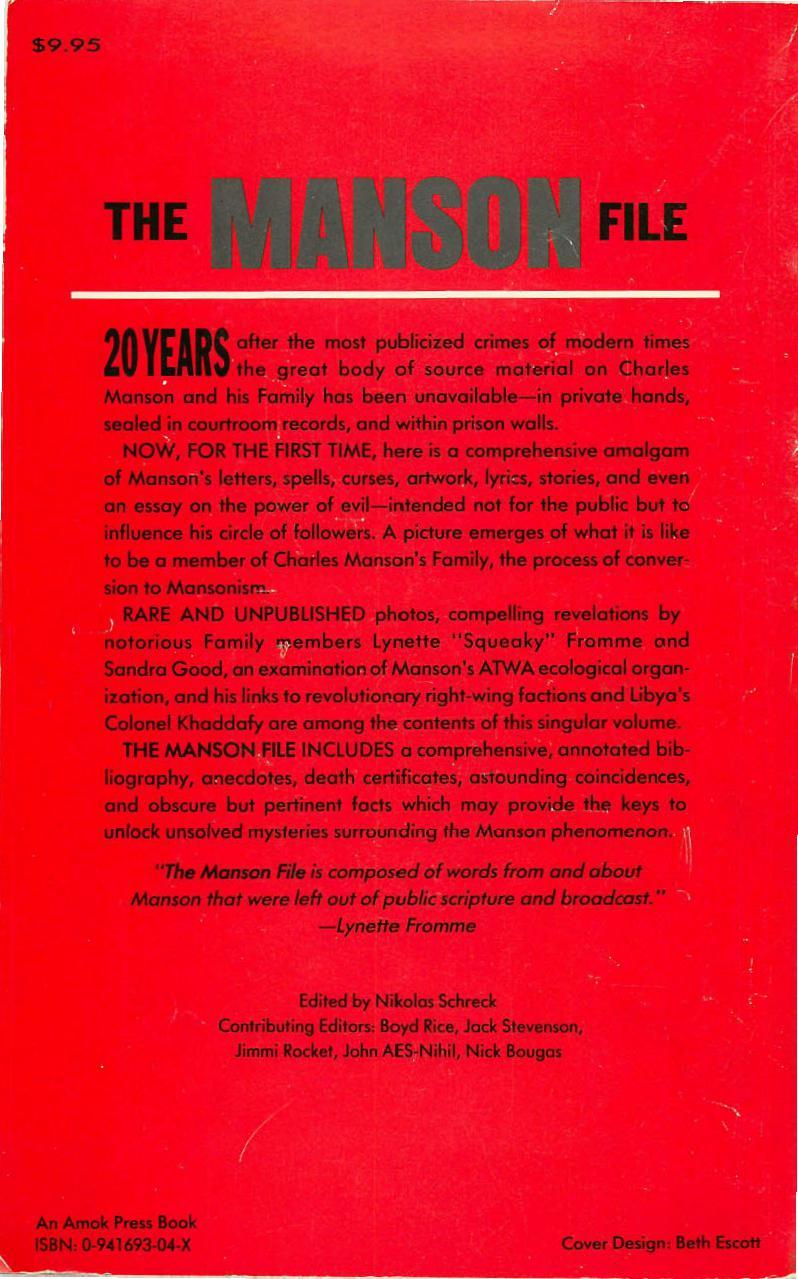
$9.95
THE MANSON FILE
20 YEARS after the most publicized crimes of modern times I LHllV the great body of source material on Charles Manson and his Family has been unavailable—in private hands, sealed in courtroom records, and within prison walls.
NOW, FOR THE FIRST TIME, here is a comprehensive amalgam of Manson’s letters, spells, curses, artwork, lyrics, stories, and even an essay on the power of evil—intended not for the public but to influence his circle of followers. A picture emerges of what it is like to be a member of Charles Manson’s Family, the process of conversion to Mansonism.
RARE AND UNPUBLISHED photos, compelling revelations by notorious Family members Lynette “Squeaky” Fromme and Sandra Good, an examination of Manson’s ATWA ecological organization, and his links to revolutionary right-wing factionsand Libya’s Colonel Khaddafy are among the contents of this singular volume.
THE MANSON FILE INCLUDES a comprehensive, annotated bibliography, anecdotes, death certificates, astounding coincidences, and obscure but pertinent facts which may provide the keys to
“The Manson File is composed of words from and about
Manson that were left out of public scripture and broadcast.”
—Lynette Fromme
Edited by Nikolus Shreck
Contributing Editors: Boyd Rice, Jack Stevenson,
Jimmi Rocket, John AES-Nihil, Nick Bougus
An Amok Press Book
ISBN: 0-941693-04-X
Cover Design: Beth Escott
The updated Manson File
Title: The Manson File: Myth and Reality of an Outlaw Shaman
Author: Nikolas Schreck
Publisher: Cargo Records UK
Publication date: 21 Jun. 2024
ISBN: 1738519503, 978–1738519507
Source: Photo scan of used print copy.
Cover:
The Manson File
MYTH AND REALITY OF AN OUTLAW SHAMAN
by Nikolas Schreck
SURREALIST RESEARCH PUBLICATIONS
The Manson File: Myth and Reality of an Outlaw Shaman
Text Copyright © Nikolas Schreck, 2024
Works by Charles Manson reproduced with permission
Chapter Illustrations © Zeena, 2009
All rights reserved.
Distributed worldwide by Cargo Records
2nd Floor, 25 Heathmans Road
London
SW6 4TJ
www.cargorecordsdirect.co.uk
www.themansonfile.com
ISBN 978-1-7385195-0-7
SURREALIST RESEARCH PUBLICATION 01
Whatever merit this scroll may possess is dedicated to: The seven-fold one who rules from behind the thigh over hours unlawful and unmeasured: ABRESIOA PHOTHER THERTHONAX — His Pithless bride whose beauty shines shamelessly upon all from the morning star: d mdivjn St ntr bnb pt mjr n R rdj n (= j) n=k qn - The first of his servants, the Hemet NeterTepi Seth: Ankh! Uta!Semb!-”the seventeenth to wear the black crown: zhe ne jin gyi lab tu sot - My revered teachers: tsa wa’i lama namla solwa deb - My respected students who walked the way of the wolf and who now count among the two and seventy: nehem ret ent Apep!- Those who were killed, those who did the killing, their families and loved ones, those unjustly imprisoned, and those entangled souls burdened with the weight of the secrets they keep: May you be free from suffering and the causes of suffering — And to all sentient beings in the six worlds and the three times:
Sonam diyi thamche zig pa nyi
thop nay nye pe dra nam phamje nay
kye ga na chi ha lah thrugpayi
“Take this, brother, may it serve you well.”
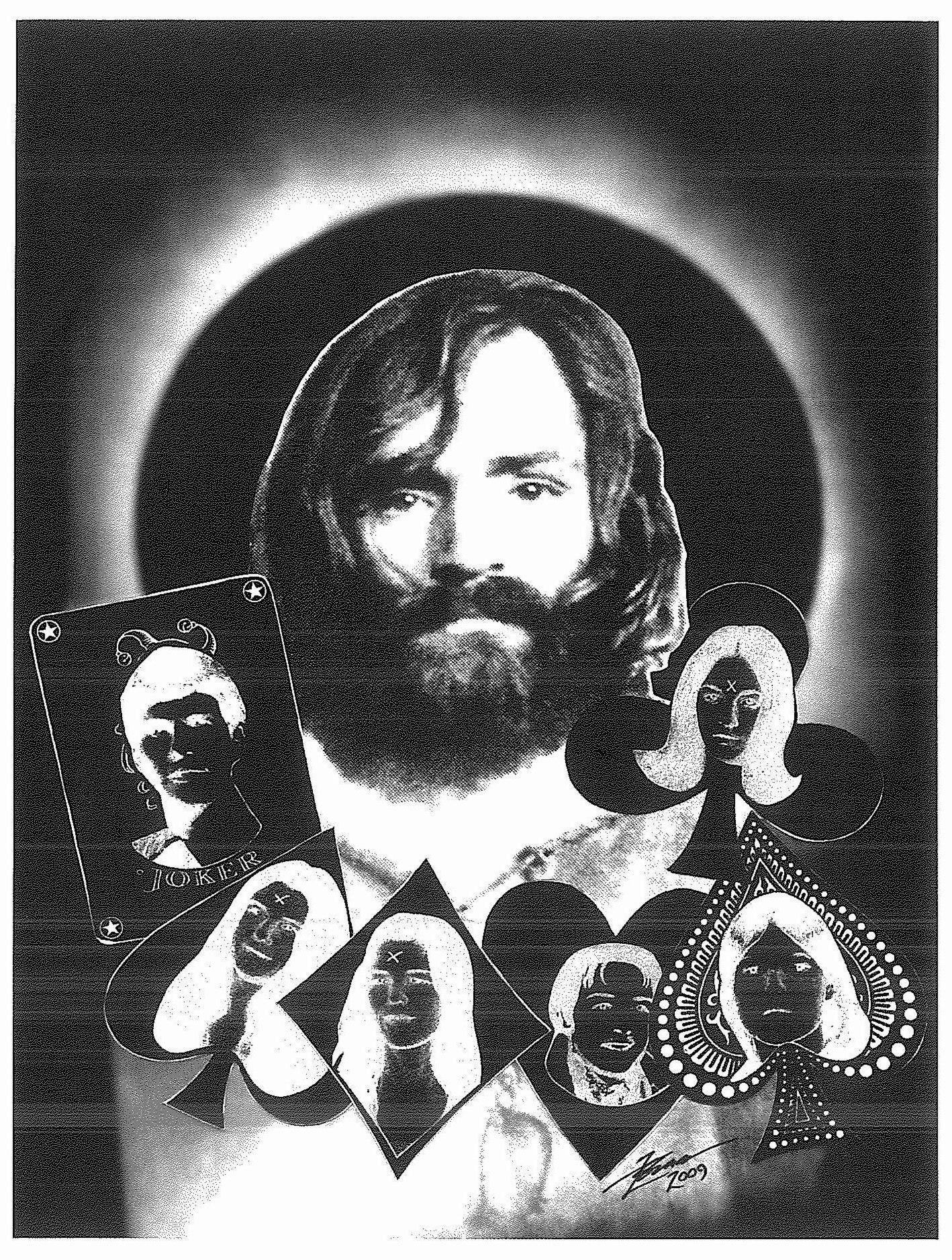
“The madness of desire, insane murders, the most unreasonable passions — all are wisdom since they are part of the order of nature. Everything that morality and religion, everything that a clumsy society has stifled in man, revives in the castle of murders. There man is finally attuned to his own nature.”
Michel Foucault, Madness and Civilization
“The Piscean Age will be crucified on the Cross of Pluto. Prediction: Sometime in the future Charles Manson will metamorphose into a major American folk hero.”
Wayne McGuire, An Aquarian Journal
“Sag ich Euch absurde Dinge, Denke, dass ich Abraxas bringe.”
Johann Wolfgang von Goethe, West-dstliche Divan
Contents
Preface: Turn Me On, Dead Man
Beyond the Looking Glass
Introduction to the Ultimate Apocalypse Edition
0. My Life with the Thrill Kill Cult
I. How Did You Get Into This Thing Anyway?....
II. So What Was Manson Really Like?....
1. The Philosopher
2. The Minstrel
Look What They Done to My Song, Ma....
Tex and Drugs and Rock and Roll:
The Lotsapoppa Burn....
More Beat than Beatle, More Hobo than Hippie....
The Anti-Elvis and His Jailhouse Rock....
Old Creepy and Little Charlie....
The Oakies Bring Down the House....
The Gardener....
The Sound of Free....
Universal Disorder: The 9/11 Tapes
What A Milky Way To Go: A Real Good Time at the Roadhouse .
#61 With a Bullet: Charlie Hits the Charts....
The Lost Album....
Awareness, ESP and After....
MY MUSIC....
POETRY....
3. The Wizard
1. The Illusion Has Been Just a Dream....
11. In the Eyes of a Dreamer....
4. The Beverly Hillhilly
In the Mind Control Center of the World....
A Courtroom Drama....
Sleazy Sources....
Charles Manson, President, 3-Star Enterprises....
Setting the Psychic Stage: A Necessary Interruption....
“It’s A Great Party”: Tlie Celebrity Skin Videodrome ‘69....
The Sharon and Charlie Show....
Rough Trade....
Cupid If You Will: The Hinman Connection....
Bad Vibrations: Skeletons in A Beach Boy’s Closet —
Celebrity Cover Story # 1....
On Cloud Number 9: Enter Tex....
In the Court of the Virgin’s Son: These Crazy Kids Today ....
Terry Covers His Tracks: Celebrity Cover Story #2....
Altobelli and Hatami Cover Everyone’s Ass: Celebrity Cover Story #3....
Ext. Polanski House. Night....
Mansons Letter to The Hollywood Star....
5. The Outlaw
1. Deeper Than Everybody Thinks And Knows....
The Ventriloquist’s Dummy....
Unknown Others....
Obstruction of Justice....
Buried In The Back Pages ....
Fixed Games and Vested Interests....
Straight Shooter....
It’s Witchcraft, Wicked Witchcraft ....
Cul-De-Sac ....
Everyone Slept With Everyone....
Everybody’s Got Something to Hide
Except Me And My Monkey....
The House On The Hill....
Conspirators in Conflict....
The Tex Watson Murders....
Hypno A Go Go: Chuck Summers Hits the Strip....
Rashomon ‘69....
For Whom The Bell Tolls: The Beach Boys Murders?....
Location, Location, Location:
The Metaphysical Real Estate of Music and Murder ....
Follow the Money....
Early Evasions in the Eighties....
“The Man Who Killed the Sixties”....
The Operator: Pardon Me, but Your Knife Is in My Neck....
From Polanski to Khashoggi....
Summit at Paramount....
You’re So Vane (You Probably Think This Murder’s About You) .
Controlled Substances: How the Summer of Love Became the Summer of Blood....
Jailbirds of a Feather Flock Together....
A Tale of Two Leeches: Scenes from the Voytek-Tex Vortex....
“It Turned To Some Horror” ....
Enter Gibbie....
The Beginning of the End....
“The Family” vs. The Family: Tex Takes on the Mob....
Why Roseau Had to Die....
On the Horn of a Dilemma....
A Made Man (son): First Violations and The Costello/Genovese Connection....
Co-Conspirators: Hidden Trails Between The Dealey Plaza and Cielo Drive Cover-Ups ....
Two 12:30s: Beloved American Fairy Tales of the 20th Century..
Char/Lee....
The Bug Goes from “Death to Pigs” To The Bay of Pigs ....
Hair Today, Gone Tomorrow....
Schiller The Shill: The Grim Reaper’s Shutterbug ....
The Candyman Can: Keeping the Rat Pack Ring-A-ding-Dinging
Famous Mobsters of Filmland
How to Stage a Hollywood Murder, Take One: The Ghosts of Harlow’s Haunted Mansion....
Hanging Out with Mister Jay.... Summer Bummer with Bummer Bob, Terry Marshmallow and The Blue-Eyed Oriental....
Deadly Nightshade and Other Witchy Powders....
Meanwhile Back at the Ranch: Fireworks in July....
Yana The Witch....
“Lucifer” Pays Back the Straight Satans....
The Twinkie Truck Trek....
Mixed Motives....
Burn, Baby, Burn!....
11. The Secret Life Of The Dead....
The Whiz Kid/Juvenile Delinquent’s Double Lives....
The Peak of the Love That Was Running....
‘Die Second Trip to Cielo....
Toilets Flushing All over Beverly Hills: History Repeats Itself at Easton Drive
Mogul of a Thousand Faces....
From Poland with Love: Tie Cold War Comes to Cielo Drive....
Gateway to the Underworld: Mystery on Waverly....
Sleepless Nights at Oak Terrace....
Rosemary’s Baby: An Inside Job?....
Mr. Gray’s Little Black Book ....
Bad Timing....
Here’s Another Clue For You All....
It’s Hard in Prison....
How It Stands....
Manson’s 1986 Parole Hearing Statement....
6. The Revolutionary
“Radical politics? Is there any’ other kind?”....
Ideological Indigestion in the Year of the Fork....
The Yippies meet the Slippies....
Manson of the Year: Underground Icon....
Manson Uber Alles: Comrade Charlie and the German Radical Left
Charlie and Che....
The Constitution in a Trashcan: Show Trial as Political Theater...
LSD: Leary in Solitary with the Devil....
Red, White and Blue: All-American Terrorists, Wildlife Avengers Revolutionary Writings....
7. The Soul For Sale
The Bug Cashes In: You Saw the Trial! Now Read the Book! And See the TV Movie!
Making a Killing: Sadie’s Story and the Schiller Scam....
In the Library of Lies: A Literary Autopsy....
Cinemanson....
Epilogue
Appendix A
Appendix B
“God Bless Charles Manson”
Sources And Acknowledgments
Preface: Turn Me On, Dead Man
Mansonology in the Post-Bugliosi Era
“Now you’re lookin’ at a man that’s gettin’ kind-a mad/ I had lots of luck but it’s all been bad/ No matter how I struggle and strive/ I’ll never get out of this world alive ... A lawyer proved I wasn’t born/I was only hatched/ Every tiling’s against me and it’s got me down”
Hank Williams, “I’ll Never Get Out Of This World Alive”
At 8:13 p.m. on November 19, 2017, a frail 83-year-old patient in Bakersfield, California’s Mercy Hospital succumbed to respiratory failure, colon cancer and a heart attack.
The white plastic I.D. tag wrapped around one tattooed arm’s wrist identified the wizened, bearded old man as Manuel Reyes. A name the dear departed, with his penchant for symbolic interpretation, would’ve approved of. He’d developed an affinity for Spanish in his beloved Mexico during a life-changing sojourn there as a desperado on the run from a pimping charge in I960. He espoused a passionate belief in the ancient divine right of monarchs to rule. So Immanuel (“God with us”) and Reyes (“kings” or “royalty”) suited the deceased’s spiritual aspirations perfectly.
Of course the medical staff, the five uniformed police officers guarding his room, and indeed anyone who noticed the ancient good luck symbol of the swastika emblazoned over his third eye, knew that Patient Manuel Reyes was actually Inmate Charles Milles Manson.
But who was that?
True to his mystic’s understanding of identity’s flexibility, Charlie maintained that he was nobody and everybody, nothing and everything. How fitting then that an ever-changing being who officially entered this world as “No Name Maddox” before his mother gave him the name of a man not even his father, departed under yet another name not his own.
Within minutes, eager news hounds gleefully confirmed to their customers that the Wicked Witch of the West was dead. The divisive mass media machines of what passes for Right and Left in the USA were briefly united by a common enemy for once. A self-righteous orgy of demonizing denunciation of the monster who flamboyantly haunted the popular imagination for so long flooded airwaves, newsstands, and screens.
Charlie Manson may not have literally believed that he was the second coming of Christ, as his media-made mythos claimed. But his passage from this vale of tears inspired even customarily secular sources to temporarily find that Old Time Religion. Such supposedly objective journalistic enterprises as the New York Post screamed from its front page EVIL DEAD. Make room Satan, Charles Manson is finally going to Hell. The rival Daily News waxed no less theological in exulting that the “bloodthirsty cult leader” would BURN IN HELL.
If Charlies newly disembodied consciousness watched this world’s hostile farewell, he couldn’t have been surprised. After a lifetime of knee-jerk calumny and defamation, he often spoke of how happy his legions of haters would be to see him gone. And yet, keenly aware of how the power of legend functions, he also suspected that the day would come when he would become a revered, even venerated, figure.
Seeing both sides from his Abraxan perspective, he also condemned the posthumous sanctification he expected as being just as wrong-headed as the obligatory vilification. Nobody was more amused than Charlie to observe how the fictional character Charles Manson created by the media and his crooked prosecutor took on a life of its own, an alter ego bearing little resemblance to the actual person.
Charlie would say of his future admirers in a mocking tearful voice, “Once I’m gone, you watch, it will be a whole other game, they’ll say “oh, wasn’t he wonderful?
In whatever form the consciousness that once inhabited the body labeled Charlie Manson has taken rebirth, his former incarnation’s legacy in this world is probably of little concern. Even when he was obliged to bear the cross of his role as Public Scapegoat Number One, what die masses thought of him wasn’t a subject of burning interest to Charlie.
In 1988, I asked him, “What would you tell the people out there who ... well, who don’t know you?”
“Fuck the people out there,” he replied. “I don’t give a fuck whether they know ... anybody that don’t know themselves, don’t know me. I don’t give a fuck about people. I’m looking out for this guy [to self], right here.”
“So,” I asked, “you’re not angry with how the media has portrayed you as this villainous monster?”
“What does that mean?” Charlie asked. “It doesn’t mean anything. The media is a re-run. Public opinion is a little girl. It’s a toilet paper commercial. It’s got nothing to do with reality. Reality is HERE. Reality is NOW — y’dig?”
Sure enough, most of what the media fed to the masses since his demise has truly been a re-run as far removed from Reality as possible. Number nine, number nine, number nine years have passed since the publication of the 2011 edition of this book whose third and final permutation you hold in your hands. To leave space for the wealth of new information I uncovered since the previous edition, I decided not to waste time with a detailed update on the books and films the Manson myth inspired since Charlie’s passage. For the most part, they’re just the same old cut and paste threadbare tall tales, lies, halftruths, cover stories, urban myths and modern-day folklore reshuffled and regurgitated.
With only a handful of exceptions, the majority of books and films about the Manson You Love to Hate since the 2011 File focused on the notorious crimes associated with him rather than the man himself. Of necessity, this volume addresses the still mysterious Los Angeles killing spree that so drastically affected Manson’s life. And yet, the pages that follow are not primarily concerned with the crimes that misleadingly bear his name, focusing instead on the much larger scope of the real person.
A real person who despite ranking only one cloven footstep and jackboot below The Devil and Adolf Hitler on the short list of most widely hated beings still commands the respect of many who find wisdom in his worldview, beauty in his music, truth in his ecological message, and injustice in his undeserved reputation as a maniacal mass murderer.
A real person who despite having had no other platform to express himself in than hostile TV interviews designed not to enlighten but to terrify an audience tantalized by true crime, became something of a revered folk philosopher. The’poetic observations Charlie managed to articulate in between his interviewers’ lazy and ill-informed questions continue to inspire open-minded souls to ponder essential philosophical questions about the mind, the nature of reality, good and evil, spirituality and other ontological riddles.
A real person who despite having his talent as a singer-songwriter denigrated by his former music industry friends and patrons who wished to distance themselves from him, enjoys ever more popularity as a musician on the basis of a few demo tapes and crudely recorded prison-made cassettes.
While in no way downplaying the harm he caused others as a dedicated career criminal, we place his role in the crimes in context, delineating these other essential aspects of Manson that have gone under-reported, misinterpreted and barely acknowledged in most previous literature purporting to be about him. More than ever, the scarecrow Charlie remains a despised figure, a perfect devil for our current era of performative politically correct outrage. He willingly took this role on himself when on July 24, 1970, he appeared in court with a cross carved into his forehead, issuing a statement to the press that “I have X’d myself from your world.”
As with its earlier editions, The Manson File breaks with the received party line on Charlie. Most Manson studies automatically denounce those who find anything admirable in Charlie as the deluded followers of a madman. I acknowledge that for similarly estranged kindred spirits who also proudly X’d themselves from this world, Charlies philosophy, music and radical ecological mission remains a positive inspiration. This more balanced view of the man is currently only perceived by those who take the trouble to look beyond the media lies.
But even beyond that rarefied sphere, the Mansonsphere’s landscape, largely unchanged for decades, has recently undergone several seismic transformations which have already reshaped his legacy.
Mansons transition after decades of captivity to the potential freedom of his next incarnation was obviously the most significant event in the Mansonverse since the last edition. However, the death of his most ardent adversary has proven to be even more crucial in dramatically shifting public perception concerning Manson and the murders he’s routinely blamed for.
“An unexciting truth may be eclipsed by a thrilling lie.” Aldous Huxley
On June 6, 2015, Charlies nemesis, attorney and author Vincent Bugliosi, the former Los Angeles Deputy District Attorney who won the convictions of Manson and his fellow defendants in the Tate-LaBianca trial, died of cancer at the age of 80. Ever since that grand-standing self-aggrandizing blowhards passage, indications show that we’ve at long last entered the Posr-Bugliosi era of Mansonology. From henceforth an examination of Manson can proceed without the ever-present media buzzing of the gnat his fellow lawyers derided behind his back as “The Bug.”
Rarely has any generally admired public figure’s standing dwindled so rapidly only a few short years after they ceased lo be. Casual readers may be surprised to learn how precipitously Bugliosi’s star has sunk. After all, the mass media uncritically lauded this liar for decades as the valiant legal genius whose supposed courtroom brilliance locked up a dangerous cult leader and his mind controlled robot disciples. One of Bugliosi’s most successful propaganda strategies was to convincingly impress upon the public the certainty that the small-time crook Charles Manson was the most sinister creature to ever crawl out of Hell. Consequently, to question Bugliosi’s version of what happened was taboo, a secular heresy marking one as a sympathizer for Satan.
However, serious students of the Manson case passionately argued against both Bugliosi the man and his Helter Skelter scenario for decades. As long ago as 1974, attorney George Denny III already went public with irrefutable and damning evidence about Bugliosi’s moral failings, his lack of ethics, and his possible psychopathology when, he released his document The Vincent Bugliosi Stoiy to the press during the D.A’s unsuccessful run for political office. In the previous edition of this book, and in this one, I published newspaper accounts documenting some of the troubling actions Denny referred to.
Further damage to Bugliosi’s reputation was engendered when his mammoth 2007 book Reclaiming History: The Assassination of President John F. Kennedy was rightly eviscerated by many informed researchers into the enigmas of the JFK murder. If Bugliosi got so much wrong about the many disturbing factors complicating the Dallas assassination, some began to wonder, could he also be wrong about the case that made him famous?
As one respected critic, the investigative journalist Gaeton Fonzi, an expert on the JFK case, wrote in an article refuting Bugliosi’s spirited and devious defense of the Warren Commission:
“Vincent Bugliosi must be exhausted. He not only churned out more than 1600 pages of tautologically strained contentions to support his book’s pretentious title, “Reclaiming History”, he must be weary from wrestling with the multitude of distortions and twisted conclusions he was forced to make to support his primary assertion. His primary assertion? Swallow that mouthful of Dr. Pepper before you read this: “... it has been established beyond all doubt that Oswald killed Kennedy.” Fearful of endowing his abhorrent duplicity with any hint of legitimacy, I hesitate to take the time and effort to respond to all the ungrounded contentions he makes about my role as a federal investigator in the case and about certain areas of evidence with which I was involved.”
Bugliosi, wrote Fonzi, “with clever distortion and selected omission of facts, defiles truth and history.”
Bugliosi had already spun the fact, truth and history of the Manson case with similar distortions and omissions, but the first serious crack in Bugliosi’s facade only came with the barrage of informed criticism he faced for his blatantly mendacious cheerleading for the Oswald as Lone Nut Theory. As will be covered later, the celebrity attorney’s murky history of collaboration with specific intelligence agents opposed to any suggestion that Kennedy was killed by a conspiracy touches on deeper depths still.
Knowledge of this enduring critique of Bugliosi was previously limited to the relatively small circle of Manson researchers familiar with the details of his many decades of dubious personal behavior and deception. The casually informed public, blissful in their ignorance, went on believing that Bugliosi was an admirable apostle of justice who saved even more random strangers from being butchered for no reason by Manson’s death cult.
What’s changed the conversation recently is that since Bugliosi died, it’s slowly but surely starting to trickle down even to the Manson-hostile general public that they’ve been lied to for years.
Of all the many fabricators and fantasists on all sides of this drama, no other single individual was so responsible for creating the many complex deceptions and half-truths that pass for the Official Manson Narrative as Bugliosi. With his entire reputation riding on the preservation of his best-selling bullshit, Bugliosi was by far the loudest and most energetic blockade obstructing the truth about Manson from being known. And yet, for decades, lazy journalists and authors turned to this completely unreliable and biased source as the expert on all things Mansonian. And oh how Bugliosi delighted in playing the brave little piggiewho defeated the Big Bad Wolf.
Since 1969, nobody who turned on a TV could avoid Bugliosi’s pompous pontificating. Omnipresent and unavoidable in every book and documentary rehashing the case, he was there to do damage control, and make sure the truth of the case he prosecuted never leaked out. His self-appointed public job as the cover-up’s chief defender of deception was played out in the glare of the media. In private, away from the cameras, the pathologically vindictive attorney waged a war of smear campaigns, intimidation and litigious harassment against anyone who dared question his veracity. What was he so desperate to hide?
The recent wave of too-little too-late Bugliosi bashing that abounds in post-2015 Manson media is a direct consequence of one simple fact. Authors, journalists, film companies, and the money men behind them can now breathe a sigh of relief. For Bugliosi can no longer resort to his life-long habit of waging time-consuming and ruinously expensive legal warfare on his critics and debunkers.
I first publicly denounced the corrupt Bugliosi’s character and legal malpractice when promoting the first edition of this book in print, radio and TV in 1988. When I told A Current Affairs hack pseudo-journalist Steve Dunleavy that Bugliosi’s prosecution of Manson was no more just or fair than a show trial in the then still operant Soviet Union, I was a lone voice of heresy in the wilderness. I’m pleased that in the past few years many other cries of dissent have joined the chorus of condemnation.
A brief examination of these works allows us to trace the swift fall of Bugliosi’s credibility.
During Bugliosi’s lifetime the only other work other than my own to directly challenge the D.A’s widely-believed Official Narrative was George Stimsons 2014 book Goodbye Helter Skelter, published three years after The Manson Lie. In the preface to his book, Stimson threw down the gauntlet by writing:
“The premise of this book is that the motive that Los Angeles County Deputy District Attorney Vincent Bugliosi presented at the trial (and ever since in his best-selling book and in countless media appearances) — Helter Skelter — is a fantasy. And a further premise of this book is that it is possible that Charles Manson had no legal culpability for the Tate-LaBianca murders...”
Stimsons worthy contribution to the Manson literature skillfully demolished the fabric of lies that is the Helter Skelter motive, and with it Bugliosi’s standing as a reputable lawyer and expert on the case. His book is especially valuable for the wealth of illuminating firsthand quotes from Manson. However, as is the case with me and my work, the author of Goodbye Helter Skelter was a sympathetic friend of Manson for many years. He’s also the partner of Sandra Good, one of Mansons most publicly devoted advocates. Therefore, his conclusions, like mine before him, are often castigated by Mansonphobics as biased.
George Stimson and I have cordially agreed to disagree on the motive for the murders. His book argues that the sole motive was to commit killings resembling the unique crime scene police found at the slain Gary Hinman’s house in hopes that authorities would free Hinmans killer Bobby Beausoleil. My research discovered that the freeing of Beausoleil was only one factor motivating the crimes, and not the primary motive. Nonetheless, Stimsons rebuttal of Bugliosi was an important step towards truth, and there’s much to learn from Manson’s copious statements cited therein.
The first mainstream media artifact to significantly question Bugliosi’s Helter Skelter fiction was the television documentary Charles Manson: Use Final Words, written and directed by James Buddy Day. Released shortly after Manson’s death, Day’s flawed and often sensationalist film still accepts and regurgitates Bugliosi’s misinterpretation of Manson as a sociopathic fiend who manipulated others to kill for him. However, Final Words must be commended for making an earnest effort to dismantle the Helter Skelter fantasy. Several groundbreaking interviews included in the film decisively counter the Official Narrative. This representative review by Philip Brown for The Bonus View demonstrates that Day’s rebuttal of Bugliosi was convincing enough that even an apparently socially conventional Manson hater like Brown can finally begin to see through Bugliosi’s lies:
In the countless streams of Charlie Manson exposes and studies that have filled bookshelves, broadcast slots, and bandwidth for decades, one stands out as the most famous. That would of course be Helter Skelter. Co-written by attorney Vincent Bugliosi, the book presented the prosecutor’s case and hinged on the theory that Manson was trying to create a race war with his murders. It helped get him convicted and has since been questioned by everyone from nutball Manson supporters who believe he was framed to more thoughtful biographers who have no skin in that game. If James Buddy Day’s new Manson doc has any specific purpose, it’s to openly question the “Helter Skelter” theory and the ways in which the prosecution manufactured evidence to get a conviction. The film is rather convincing in this regard, even catching one interviewee in a lie at one point. Intriguingly, it does seem like the courts cheated Charlie Manson, which is certainly a new wrinkle in this wacky and horrifying tale.
To even express aloud the notion that Manson didn’t get a fair trial was previously ro mark one as a fanatical beyond-the-pale follower. While the various explanations for the murder motives Day suggests as an alternative to Helter Skelter are also not persuasive in my opinion, Final Words definitely opened the eyes of a general audience to the possibility that what they thought they knew about the Manson case was wrong.
Day’s admirably non-hysterical and open-minded 2019 book Hippie Cult Leader, while not especially remarkable in other respects, blasts Bugliosi in even more expansive detail. It’s noteworthy for realistically discounting the prevailing notion of Manson as an evil brainwashing cult leader, and is worth reading for the insightful interviews Day conducted with Manson and other former members of his commune. Day also reaches other novel conclusions about the case that have been borne out by my research, for instance the real story of the Bernard Crowe shooting and the beneficiary role the motorcycle club The Straight Satans played in the LaBianca robbery.
Unfortunately, whatever positives may come of Day’s work was besmirched by his participation in the shameful 2019 reality TV atrocity Charles Manson: The Funeral, discussed in this volumes epilogue. Still, both Final Words and Hippie Cult Leader are notable steps on the path to a more balanced view of the Manson phenomenon. Not least because Day actually allowed Charlie a voice, and treats him like a human being and not the crazed caricature so often portrayed. In my own discussions with Day in which I tried in vain to persuade him not to include footage of Charlies rotting corpse in the Funeral documentary he inherited, I can say that he was at least not as prejudiced about the case and the man as others in the field of true crime entertainment tend to be.
On a more cerebral level of historical analysis from the hails of academe, University of Massachusetts Professor Jeffrey Melnick also efficiently dissected and dismissed Bugliosi’s character, ethics and version of events in his 2018 study Creepy Crawling: Charles Manson and Use Many Lives of Americas Most Infamous Family. Not a true crime book but a sweeping analysis of the Manson myth’s impact on American culture, Melnick’s work marks a significant landmark in mainstream Manson studies in its thorough critique of Bugliosi’s deceptive tactics. Melnick eloquently reveals the bogus theatrical nature of the trial Bugliosi prosecuted and the fictional identity of Bugliosi’s horror novel Helter Skelter.
What is significant about Day and Melnick, both respectable members of society, is that their critiques of Bugliosi and the false story he concocted are not presented in any way that could be construed as a “pro-Manson” perspective. This makes them unprecedented in the fifty previous years of Manson reportage that almost universally accepted Bugliosi’s fiction as fact.
The final knock-out blow to Bugliosi’s tottering posthumous reputation was delivered by Tom O’Neill’s 2019 book Chaos: Charles Manson, the CIA and the Secret History of the Sixties. The first part of the book chronicles how O’Neill, originally sympathetic ro Bugliosi, comes to unearth irrefutable documentation proving just how many lies, cover-ups and deceptions the lawyer perpetuated during the Manson trial and in Helter Skelter. O’Neill reported his conflicts with Bugliosi to me as it was happening during the time from 1999 to 2008 when we were on friendly collegial terms.
As O’Neill and his co-author Dan Piepenberg wrote in the first pages of their book, describing a tense confrontation with Bugliosi,
“Bugliosi had made his name with the Manson trial, captivating the nation with stories of murderous hippies, brainwashing, race wars, and acid trips gone awry.... There are big holes in Helter Skelter, contradictions, omissions, discrepancies with police reports. The book amounts to an official narrative that few have even thought to question. But I’d found troves of documents — many of them unexamined for decades, and never reported on -that entangled Vince and a host of other major players ... [Mansons] friends in Hollywood. The cops and lawyers and researchers and medical professionals surrounding him. Among many other things, I had evidence in Vinces own handwriting that one of his lead witnesses had lied under oath.”
As with Day and Melnick, the fact that O’Neill is not in the least a Manson supporter, but a confirmed Manson hater who subscribes to all the usual commonly believed negative stereotypes about Charlie as a brainwashing cult leader, allows the average socially indoctrinated reader to accept his demolition of Bugliosi without being branded with the pariah status of “Manson apologist.” As he is at pains to emphasize, lest there be confusion, O’Neill states of Charlie, “I think he was every bit of evil as the media made him out to be.”
For all of his solid and valuable investigative reporting on other aspects of the case, Chaos singularly fails to “get” Manson, as the clueless account of Charlie sincerely trying but failing to communicate with O’Neill in their one conversation makes clear.
In Chaos, we learn how an outraged Bugliosi declared the author his adversary and sets out to sue him, smear him, and thwart any research into the discrepancies between the case he presented in court and the facts the attorney deliberately concealed. Detailing the misdeeds of Bugliosi that George Denny first brought to public attention years earlier, O’Neill’s damning portrait of Bugliosi as a vindictive mentally ill pathological liar who deliberately misrepresented and distorted the evidence he presented in court leaves Helter Skelter in tatters.
Chaos proves, as I had long argued, that one of Bugliosi’s key roles was to protect the reputation of record producer Terry Melcher and other celebrities who sought to erase their close connection to and support of Manson. Tliere’s no doubt that any serious student of the case should read Chaos, since it proves without a doubt the many questionable actions of Bugliosi and other lawyers involved in the case, among them Susan Atkins’s lawyers Paul Caruso and Richard Caballero, and Linda Kasabian’s defense attorney Gary Fleischman.
Unfortunately, the thorough research O’Neill uses to drive the last nails in the coffin of Bugliosi’s tainted legacy falters badly in the second section of the book. That wrong turn drives recklessly into a dead end of unpersuasive conspiracy theory postulating that Manson was the subject of a CIA mind control experiment facilitated in part by his San Francisco-based parole officer Roger Smith. While O’Neill discovered important data about the reckless criminality of the CIA’s MK-Ultra program, none of the tenuous scenarios sketched in Chaos prove that anyone in the Manson commune was ever a part of these experiments.
I reference the useful and legitimate aspects of Chaos throughout this book, as they serve to corroborate many of the statements Manson made to me that were incorporated in the 2011 edition of the File. My more exhaustive critique of Chaos can be heard in a 2019 interview I granted to S.T. Patrick on his Midnight Writer podcast, audible on my YouTube channel: https://youtu.be/DRYeTbGsJ5k, so I will not be redundant here.
Chaos marks a crucial turning point in the field of Manson studies for offering a widely available mainstream publication that finally refutes Bugliosi and Helter Shelter. Bur despite the many salient and important earlier passages in Chaos, the less sea-worthy CIA speculation in the latter part of the book has already misled many sincere seekers of truth, and indeed is in danger of replacing Bugliosi’s Helter Skelter with a new but equally untrue scenario to explain the crimes of‘69.
Despite its fatal plunge into the kind of fanciful CIA Conspiranoid speculation Mae Brussell, Dave McGowan, and Carol Greene, author of the ludicrous Lyndon Larouche-inspired propaganda screed DerFall Charles Manson, Mbrder aus der Retorte (Test-Tube Murders, the Case of Charles Manson), already tried to drag the Manson case into years ago, there is a wealth of solid information in its pages that at the very least makes it clear that there remain many unsolved mysteries. For those who find O’Neill’s claims of a CIA mind control influence on Manson or his commune credible, it’s only fair to mention that I don’t address them again, for the simple reason that I don’t consider them to be true in the least.
As I mentioned in the earlier edition of this book, it always irritated me that to write accurately about Manson, one was constantly forced to take time to dispel the many untruths Bugliosi spread about him. Thanks to O’Neill’s book clearing the path, it’s possible at last to contemplate a Bugliosi-free understanding of Manson. It’s too early to predict how the surprisingly swift extermination of Bugliosi as a reliable source on the Manson phenomenon will effect future understanding of the subject, but we can be sure that the tide has turned. I suspect further revelations about Bugliosi wifi be forthcoming, a development that will continue to reshape public understanding of the Manson story as che much larger socially relevant story of corruption and cover-up in high places that it actually is.
If the quashing of “The Bug” can be heartily applauded by anyone seeking the truth about the Manson enigma as a positive step forward, the post-Bugliosi era has also already manifested new challenges to Mansonologists. Most noticeable in this post-truth era, when groundless internet-borne conspiracy theories have never had so much purchase on the general public’s imagination is the increasingly common belief that Manson was some sort of CIA tool, and that the murders Tex Watson committed were actually part of a nefarious government plot. This is so far from the truth that it makes the already absurd Helter Skelter cover story it is rapidly replacing seem reasonable by comparison.
Even with Bugliosi debunked and banished, the basic foundation of his lie is so entrenched it continues to hold fast. The influx of new information from mainstream sources erodes the once common belief in the Bugliosi fiction positing that the Tate-LaBianca killings were intended to trigger a race war inspired by a delusional interpretation of Beatles lyrics. But if the media and the public are willing to dispose of Bugliosi, his lies maintaining that there was something called “The Manson Family” who were robots under the spell of a homicidal cult leader, and that the victims of the crimes were random strangers who didn’t know their killers has proven much more resistant to change.
The media has insisted for more than fifty years that one of the most terrifying aspects of the crimes was that a troupe of brainwashed remote control killers slaughtered totally unknown strangers. The more likely possibility that the murderers not only knew their victims, but that they were involved in a drug dealing dispute with them, still largely remains a taboo. To suggest that at least some of the victims were killed because of their involvement in the narcotics trade often leads to outraged accusations of “victim blaming.”
However, even on that perhaps most controversial aspect of the Manson cover-up, there has been one major breakthrough since the previous edition of my book. Indeed, it’s so significant, I place it at the beginning of our journey to set the stage for what is to come.
On July 30, 2019, journalist Tatiana Siegel published her article Alternative Motive: “I Never Bought Into the Race War Theory” in the Hollywood Reporter, a Los Angeles-based trade journal second only to Wtriety as the movie industry trade journal of choice. The article features an interview with Jim Markham, a close friend and business associate of hair stylist Jay Sebring who inherited the murdered barber’s business Sebring International. Rather than paraphrase, I will quote Siegel’s article at length:
Six months after the infamous murders, Jim Markham — a hairstylist turned mogul whose clients included Paul Newman and Steve McQueen and was a protege to victim Jay Sebring — hosted a federal sting to uncover the cult leader’s motive.
Jim Markham remembers vividly the days following the grisly Manson murders of Roman Polanski’s pregnant wife, Sharon Tate, her former boyfriend and hairstylist Jay Sebring and three others at the directors Benedict Canyon residence in August 1969. At the time, Markham was Sebring’s protege and business partner in a budding franchise of men’s hair salons that stretched from a star-packed outpost on the corner of L.A.’s Melrose and Fairfax to Miami. Sebring became the second person to die at the hands of the Manson Family members during an infamous killing spree that claimed seven lives, including coffee heiress Abigail Folger and her lover, Polish screenwriter Wojciech Frykowski.
Markham, then 25 and splitting his time between his hometown of Albuquerque, New Mexico, and L.A., was the heir apparent to Sebring’s 400-pIus clientele, which included Paul Newman, Frank Sinatra and Steve McQueen. Markham heard the news on the radio and got on the phone with Sebring International president John Madden. “Jay and I had talked many times ... that I’d be his successor if anything ever happened to him,” Markham recalls. “I just took right over out of necessity.” ... Revisiting the weeks that followed the killings is both painful and cathartic for Markham, now 75 ... Markham has never talked in detail about his entanglement in the infamous investigation that captured headlines worldwide and continues to fascinate new generations. His tale reveals his previously unknown role in the critical months after the murders, as law enforcement attempted to identify the killers and decipher their motives with no break in the case.
Days after the murders, and at the behest of Sebring’s father, Markham began living at the house where he had been a frequent guest: Sebrings Bavarian-style home, once owned by Jean Harlow and located on Easton Drive in Beverly Hills — just one mile away from the Polanski-Tate residence on Cielo Drive. “I’m living in Jays house with raccoons on the roof — it would sound like somebody walking on the top of the house,” he says. “I finally had to move out. I thought I was going to be next. They hadn’t caught Manson. Nobody knew why it happened.”
As Markham remembers, Tate’s father, a colonel in Army intelligence, began working with federal agents on the investigation. The agents told Markham that they believed the killers were connected to the salon (murder victim Folger also had a connection to the hair enterprise given that she was an investor in Sebring International). The salon was bugged, but ultimately that line of inquiry lost steam. Once the Manson Family became suspects, however, about six months after the murders, the feds enlisted a willing Markham to set up a sting at his rented Brentwood home. He was to host a meeting between a woman and a man she had met at a bar, someone who had recounted to her at length how he had met Manson in jail. The former inmate was thought to have information pertaining to the cult leaders motive for the murders. But Markham doesn’t believe any of the taped conversation from the sting was used in the trial that took place in 1970 and 1971. “This guy looked spooked, really scared,” he says of the meeting.
Five decades later, Markham floats his own theory, one that deviates from the official “Helter Skelter” scenario put forth by Manson prosecutor Vincent Bugliosi: that the cult leader ordered the Tate murders in hopes that it would spark an apocalyptic race war as foretold to him in what he believed were coded lyrics on The Beatles’ White Album.
Though Markham is reluctant to denigrate the memory of Sebring, who was his mentor and after whom he named his son, he claims that the late hairdresser knew Manson and suggests that the murders were the result of a drug deal gone bad — an account that aligns with a once-popular explanation that fell out of favor as the Helter Skelter narrative became dominant. Back in 1969, Sebring was nicknamed The Candyman and was said to have used his salon to peddle drugs to the stars.
“I don’t want to get into the drugs, but I never bought into the race war theory. I believe Manson had gone up to the house” — Polanski was away shooting a movie — “and Manson wanted to sell cocaine and marijuana,” he says. “He showed Jay and Wojciech the product. They were going to buy some of it, but the two of them beat him up at the gate. The next night, Manson sent the Family up [to kill them].” Markham adds, “I’ve lived with that for 50 years. I still believe that.” He declines to elaborate further given that he is still in touch with Sebring’s nephew Anthony DiMaria, who is planning a movie about his uncle.
A few points of clarification are needed here.
Nothing uncovered by my own research into the drug dealing conflict that led to the Cielo Drive massacre indicated that a Sebring and Frykowski assault on Manson spurred the murders. In fact, while there may have been such a confrontation at some point, the timing is wrong. This contretemps couldn’t have been the night before. As will be explained, Charlie was still on a road trip that brought him to San Diego at that time.
However, Markhams admission that Sebring was indeed a drug dealer known as The Candyman, — as I already stated in the previous edition of this book — is remarkable. Sebring’s side business has been common knowledge in the movie and music industry for decades. Even Sharon Tate’s father, military intelligence officer Paul Tate, who was nearly Sebrings father-in-law, told homicide detective Earl Deemer that “Jay was the candyman of Hollywood.” While many spoke of this open secret off the record to me, the Markham interview is the first time any close associate of the victims has gone public about Sebring’s criminal operation.
Even if Markham got some of the specific details blurred, the gist of what he said is in keeping with what another Frykowski and Sebring friend, film producer Gene Gutowski, assured me was true: the murders were sparked by Sebring and Frykowski’s drug dealing negotiations with their killers, who they knew from previous exchanges.
Despite the explosive revelation from a credible source like Markham appearing in as mainstream a source as possible during the massive media coverage of the 50th anniversary of the Tate-LaBianca murder, no other magazine, newspaper or other media outlet followed up on the story. While the now discredited fiction about race wars, Beatles songs, and brainwashing were rehashed for the millionth time in 2019, the first real piece of news about the crimes then commanding so much renewed attention was totally ignored.
Uris deafening silence about the killers’ criminal connection to the victims is nothing new.
In 1969, only days after his wife Sharon Tate and her ex-fiance Jay Sebring were killed at his home, Roman Polanski, then a prime suspect, was formally interrogated by Los Angeles Police Department Lieutenant Earl Deemer.
Polanski mentions to the detective that Sebring was in debt, suggesting that this may have been a factor in his death.
Deemer responds, “You know. That’s no ordinary bill collector that goes up there and kills five people.”
Polanski, well aware of his friend Sebring’s dangerous secondary occupation, euphemistically answered, “No, no, no. What I was talking about for this reason he might have uh, um, um, got into some dangerous area to make money. You know what I mean ... In desperation he may have, um, got mixed up with lethal people, you know?”
As we shall see, this was precisely the conclusion that the Second Homicide Report filed by the LAPD came to upon initial examination of the crime scene. And this scenario was what Los Angeles journalists first assigned to cover the Cielo Drive butchery were reporting at length for several months after the unsolved crimes.
What’s more, as you will see illustrated on the last page of this preface, shortly after the killings, the FBI were looking into a report that Frykowski and his friend Polanski may have been expecting a shipment of narcotics to be sent to Cielo Drive from England. When I handed copies of the FBI document on this still unexplained shipment suspicion to the audience at a 2018 lecture I delivered in London shortly after Charlie’s death, several in attendance asked me why this damning official report wasn’t well known? Why, indeed?
And why, on December 8, 1969, when a 33-year-old ex-con recently embroiled in the top tier of the Los Angeles music industry was indicted as the alleged mastermind of the murders, did all discussion of the drug dealing angle suddenly cease?
Since the last edition of this book, we’ve entered an age of disinformation and “alternative facts” run rampant. Even the most groundless conspiracy theories — many more accurately defined as conspiracy fantasies — flourish unhindered and unchallenged in their own delusive bubbles of DIY reality. With so much nonsensical paranoid noise generated by the David Ickes, Alex Joneses, and QAnons of the world, some may be understandably skeptical about the signal that there was a very real conspiracy to prevent the public from learning the truth about the Tate-LaBianca murders.
No, not a sinister plot hatched by the Illuminati, aliens, the CIA, the Reptile People or some Satanic secret society. Rather, the grubby and ordinary crooked collusion of many well-known entertainers and executives in the movie and music industry with powerful organized crime figures and their puppets in the judiciary. Bound by a mutual self-serving desperation to keep their secret lives and association with Manson and his commune from leaking into public awareness, these factions closed ranks to use the tried and true trick of misdirection to steer attention away from their own complicity and the criminal activities of the victims. And it served the vested interests of the lower level criminals guilty of the murders and the embarrassed friends and families of the victims alike to play along with this charade.
In the wake of the Harvey Weinstein and Jeffrey Epstein scandals, the general public may find it easier to believe that Hollywood protects the powerful from prosecution for decades, even when their abuses are an open secret.
Predictably, even after Markham’s revelation, a hardcore contingent of stubborn Bugliosians still angrily refuse to accept that the sainted victims of the crimes could’ve possibly incurred their own deaths due to their getting “mixed up with lethal people” as Polanski so delicately phrased it. With that exception, most of the outraged opposition I faced in the 80s and 90s when I more tentatively aired these then hidden truths has all but melted away.
This was vividly apparent when the appropriately named Lethal Amounts invited me ro hold a film screening and talk explaining the Manson mysteries on the 50”’ anniversary of the murders in Los Angeles. Even in che city that served as the scene of the crime and the epicenter of the show biz-sponsored Cielo cover-up, none of the indignant protest and censorship I’d been regularly confronted with during my Manson-related public appearances there in the 1980s reared its head. Nothing could’ve made this drastic change more explicit than the Los Angeles Times recommending my screening and lecture in their front page article published on the grim anniversary of the murders. In 1969, as will be explained, The Times was directly complicit with the crooked legal team of Bugliosi, Caruso and Caballero in spreading the cover story they concocted for Susan Atkins to conceal the true circumstances of the Tate-LaBianca killings.
Had the Zeitgeist changed? Or was this seeming normalization after so many years of hysteria simply due to the fact that the polarizing person at the center of the saga was gone?
Similarly, when I was hired in November 2019 to deliver a series of lectures entitled The Charles Manson Conspiracy during a UK speaking tour in London, Bristol, and Manchester, an eclectic demographic of audiences were receptive in a way that only the most ardent Mansonphiles were once willing to contemplate.
Whatever the cause, this slowly dawning day of reckoning came too late for Charlie to see his undeserved status as murder mastermind monster shift. And too late for Bugliosi to face any consequences for his half-century of lies. Nonetheless, the truth is its own reward. As the most manufactured of fake news stories gradually withers away, many others will investigate the glaring contradictions and discrepancies of the Official Narrative. With time, it will become apparent that this Greatest Story Never Told was not simply a sensationally gruesome true crime tale. As the facts behind the cover-up emerge, even the most gullible among us will be forced to ask the question: who decides what version of reality is true?
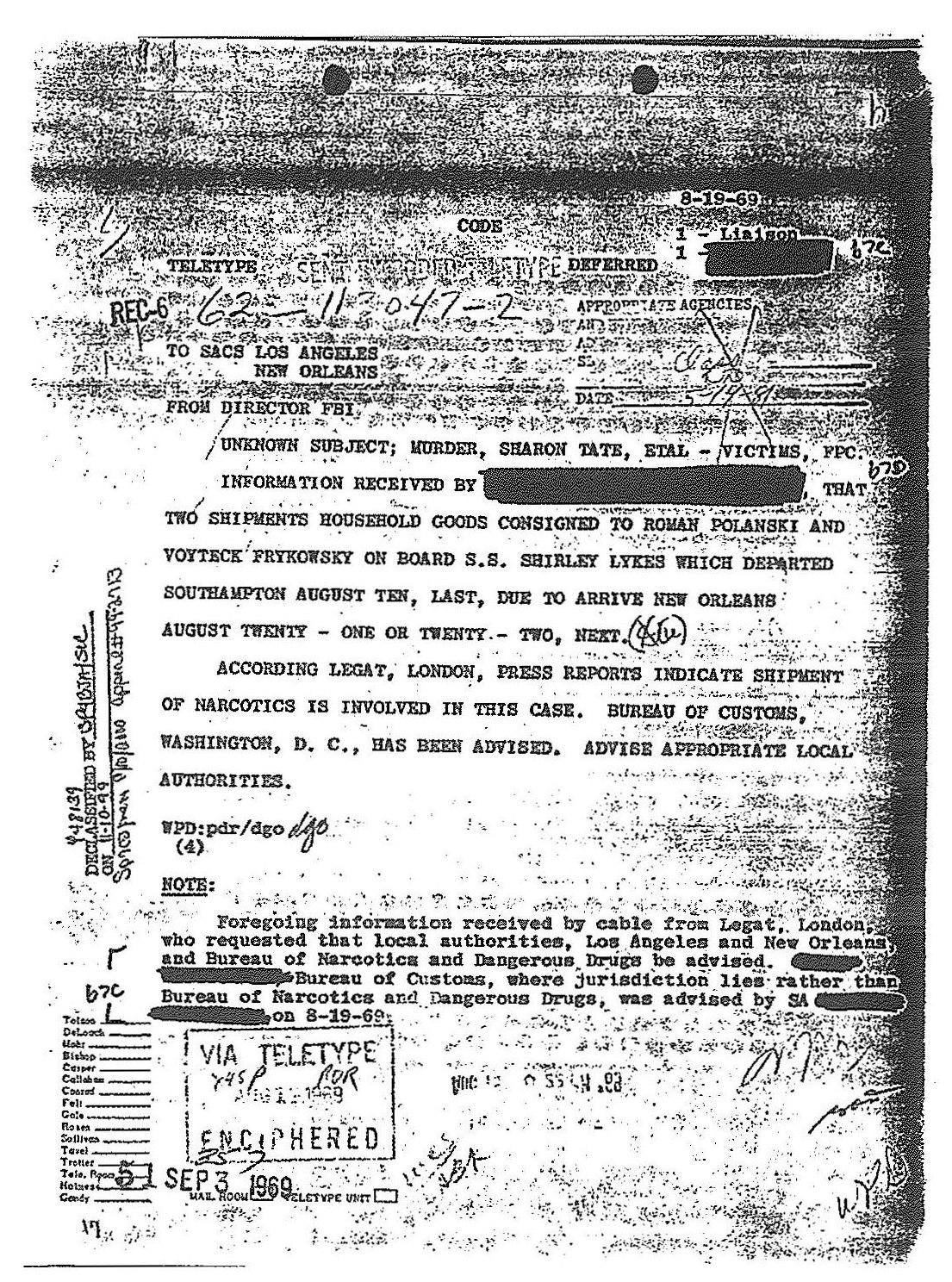
Beyond the Looking Glass: Introduction to the Ultimate Apocalypse Edition
X Con Equinox
Once upon a time, on March 21, 1967, Terminal Island Penitentiary, located in beautiful San Pedro, California, saw fit to release a smalltime pimp, auto heist artist, and self-described “half-assed thief” from its tender mercies and into the big bad world.
On the face of it, the inmate had every reason to regard his imminent liberation with optimism. He’d worked hard for seven years to build up enough good behavior time to get to this day. Only one shadow fell across the potentially happy occasion: the prisoner didn’t want to go.
His cellmate Gene Auliciano would later recall that the soon to be released parolee was in a virtual panic on the morning of his discharge. The convict asked the official at the gate if he could stay in the only home he ever knew, rather than be thrown among “those maniacs outside.” The guard thought he was joking. He wasn’t. Seventeen of his thirty-two years on this earth had already been spent behind bars. His few desultory attempts at going straight had all failed dismally. Call it an omen. Call it intuition. Something told him it wasn’t going to work out this time either.
Prison records confirm the inmate’s lack of enthusiasm for the freedom most other convicts craved: “He has commented that institutions have become his way of life and that he receives security in institutions which are not available to him in the outside world.”
Three years later, he’d tell a reporter: “I didn’t want out. I told the Man, I says, T can’t adjust to society and I’m content to walk around the yard playing my guitar, doing the things you do in a penitentiary’.”[2]
By his own account, our reluctant releasee spent his first three hours of freedom scaring at a wall on the San Pedro island pier.
Eventually, he accepted a ride to nearby Los Angeles from a trucker passing by. The trucker casually offered the newly “ex” con a joint. This welcome gesture confirmed what he’d been hearing inside about all the changes going on out on the street. It was only the first day of Spring. But the exotic patchouli scent of the nascent media event soon to be known as the Summer of Love already wafted through the air.
The hitchhiker’s most recent spell in the slammer hadn’t left him with much to his name: A beat-up guitar and as many as eighty self-composed songs he’d been practicing like mad out on the yard. The shabby ten-dollar suit on his back. A sack of out-of-style threads he hadn’t worn since he’d been nabbed for forging a signature on a $37.50 check he stole from a mailbox back in 1959.[3] One hundred and fifty hours of free Scientology auditing, courtesy of a zealous cellmate. And the munificent sum of thirty dollars, allotted by the state to all parolees on their way out the door.
Still, for all of his own apprehension, our freshly sprung jailbird’s prospects weren’t completely discouraging. His parole officer expected him to seek gainful employment. And in fact, a few promising music industry contacts had been passed on to him.
Music, he hoped, would be his way out of the dead-end street of penny ante crime and penitentiary tiers he’d paced for so long. During his nomadic youth, he’d honed his voice praising the Lord in Southern church choirs. His usually destitute mother, once imprisoned herself for a failed robbery, recognized her sons talent. She sprang for a few professional voice lessons before abandoning him to a boy’s school in Terre Haute, Indiana in 1943.
There, a Catholic monk taught the throwaway child the basics of guitar. Later, a Mexican amigo helped him refine his technique, lessons spicing our budding musician’s chord structures with a certain South of the Border flair. In the early Sixties, legendary thirties era gangster Alvin “Creepy” Karpis took the lad under his crooked wing in a Washington State prison where they both served time. Old Creepy, late an unwilling resident in the forbidding Alcatraz aka “The Rock”, and an alumnus of Ma Barker’s Gang, was not only an infamous desperado. He’d made good use of his decades of captivity, mastering the steel guitar.
This exchange lent the younger mans percussive style of playing a unique feel that would soon win the admiration of many professional musicians. Creepy was sufficiently impressed by the novice singer-songwriter’s chops to provide him with the numbers of some mob-owned joints around the country where he might score a gig or two. No doubt Karpis’s desire to help out his fellow con was sincere. But every favor granted in prison comes with strings attached. And the newly freed con learned more than a few tuneful guitar rubs from Old Creepy.
Back in the Thirties, when Karpis was a familiar face in post offices everywhere, wanted as the FBI’s last Public Enemy Number One, he had the honor of being personally busted by J. Edgar Hoover himself, in a much-publicized event the FBI director staged for maximum hype. After Karpis’s arrest, although he freely admitted killing several times without any pangs of remorse, Old Creepy willingly took the rap for murders committed by his Barker Gang gunslinger colleagues.
The younger con took Karpis’s example of honor among thieves to heart, just as he incorporated some of his musical style into his playing. “Karpis,” as the protegee fondly recalled of his mentor, “wouldn’t snitch on friends who did things.”[4]
Unless we understand how much this no snitching rule informed our subject’s code, we’ll never comprehend one of the central enigmas about him.
One of the comrades in crime Karpis wrote to on behalf of his aspiring young guitarist friend was Lucchese family made man and mobster Frankie Carbo, formerly employed by such fatal firms as The Commission and the infamous Murder Incorporated. Carbo’s soft-spoken demeanor and outer gentility masked a brutality he shared with his Murder Inc. business associates.
That organization’s methods were vividly described by Carbo’s foe, Assistant District Attorney Burton Turkus, who successfully prosecuted the cold-blooded corporation Carbo faithfully served: “There was no method of murder their fiendish ingenuity overlooked. They used the gun, the strangling rope, the ice pick — commonplace tools for homicide. There was the unimaginative mob-style ride, the shotgun blast on the lonely street. And there were the bizarre touches, too. Dozens were dropped into quicklime pits. Others were buried alive, cremated, roped up in such a way that they strangled themselves by their own struggles for life. The killers thought they had come up with an especially appropriate effect the night they tied a slot machine to the body of a pinball operator who was ‘cheating,’ and dropped him into a resort lake.”
Long before his name became associated with a still-mysterious 1969 murder of a wealthy buc indebted grocer and his enigmatic boutique owner wife in the Los Feliz district of Los Angeles replete with many “bizarre touches”, Carbo was one of che most powerful kingpins in the syndicate. Alvin Karpiss promising guitar pupil had already befriended Carbo in the McNeil Island pen before his transfer to California.
According to our subject’s later love Lynette Fromme, he once told her, “One of my prison dads was from Baltimore. Frankie Carbo. He was the greatest. His wife was the greatest. She would send him a box for Christmas — four pounds of candy each year — and he would always give me half, and we would walk the yard and talk. He used to run booze in the 1920s with the Rocco brothers from Philly. He was a grand old con man and I didn’t miss a thought from him.”[5]
While we may never know for sure exactly what thoughts — or instructions? — were later relayed from che seasoned mobster mentor to his younger protege, we can be certain of this: Frankie Carbo had the pull to make things happen, even behind bars. Carbo told Alvin Karpis he could arrange for our young con to co-manage a Baltimore burlesque club called The Troc (short for “Trocadero”) doing business in a mob-ruled neighborhood in Maryland’s main metropolis. A description of Club Troc filed by the FBI in 1959 makes it clear that our soon to be paroled convict’s former pimping experience as proprietor of a Hollywood prostitution and porno front he called 3-Star Enterprises would come in handy in his new job at this classy Hootchy Kootch joint.
Said the Feds: “The Troc is a notorious night spot on ‘the block’ in Baltimore located at 400 E. Baltimore Street. Strip-tease dancers are featured. The dances are described as ‘a real good strip.’ Private shows have been put on for customers in the dancer’s dressing room after the scheduled show. The dancers are generally expected to associate with the customers between shows to get them to buy more drinks. The dancers are also expected to further entertain patrons away from the club. BENNY TROTTA continues to work as night manager. He is generally at the side door during the evening and night hours greeting customers. He owns and operates the club jointly with [redacted].”
Trotta — who would’ve been our parolee’s boss had he taken the job — was actually Carbo partner in crime Benjamin Magliano, regularly identified by the press as a “top hoodlum”. Many years later, our subject told me that he regretted not taking up Carbo’s offer to go to Baltimore to work for Benny Trotta at the Troc. At least, he wryly observed, the gangsters were more honest than the fair weather friends he made in the Los Angeles music racket — and the crooks paid their debts on time.
Our ex-con’s employment adviser Frankie Carbo didn’t only hold sway over the syndicate-controlled nightclub scene. He was infamous for controlling legal and illegal gambling enterprises across the nation, getting a cut from crooked backroom poker games and Las Vegas casinos alike. He was also a peerless fixer of boxing matches. Carbo arranged the historic Sonny Liston-Cassius Clay fights in Clays favor, establishing the career of the flamboyant racial separatist boxer who later became Muhammad Ali.
When his gangster associates had cause to refer to Carbo in their wiretapped phone conversations, they called him “Mr. Gray” or simply “The Gray”. Persistent rumor has it that this Gray Eminence really earned his favored position in the syndicate hierarchy by executing the 1947 hit on his former crime partner Benjamin “Bugsy” Siegel, architect of the East Coast syndicates Vegas gambling empire and the mob’s glamorous main man in Hollywood.
Few ever mentioned this important part of his resume in front of Carbo. Not unless they wanted to be treated to his notorious and potentially fatal temper.
Less well-known to this day are Carbo’s business dealings with a then obscure Los Angeles syndicate player and hopelessly indebted gambling addict named Leno LaBianca. Among other things, LaBianca was the director of a decidedly shady enterprise known as the First Bank of Hollywood. The Los Angeles Police Department didn’t beat around the bush when they described Mr. LaBiancas financial institution as “a front for hoodlum money.”
Very early on, the perennial links between American show biz and the underworld left their greasy fingerprints all over this case. That these tell-tale traces have been overlooked in the years since LaBianca’s much-publicized but still inscrutable demise is no accident.
To begin to get some sense of the previously hidden level that’s been obscured under more familiar accounts, a quick game of six degrees of separation may prove an illuminating digression. For other Carbo connections to coming events in our parolee’s life also unfolded around that same time.
For example, it was thanks to Carbo’s drastic removal of Bugsy Siegel from his post as che East Coast syndicate’s movie industry overseer that a Chicago-based Mafia lawyer named Sidney Korshak moved into the power vacuum opened up by Bugsy’s death.
Shortly before our convict’s release from Terminal Island, it was consigliere Korshak — a power-broker so potent he was known by friends and enemies alike as “the Myth” — who pulled strings to see that Robert Evans, a young actor since proven to have maintained close mob connections throughout his career, took over Paramount Studios.
That dream factory’s glossy product had not infrequently been funded with mob blood money. Evans, in turn, helped establish the career of a gifted Polish exile director named Roman Polanski, producing his first Hollywood hit, Rosemary’s Baby. Probably unknown to Polanski, that film was financed with funds procured from sources directly connected to Mafia activities then taking place in New York. We will come to examine how these mammoth criminal enterprises later collided and intertwined with our subject’s considerably more modest outlaw operation.
A little over two years after our convict’s release, Polanski’s actress wife would end up rather inconveniently murdered as an innocent bystander to a drug and cash robbery at the film-maker’s home. Evans’ patron Korshak moved swiftly to spare Hollywood and his shady business associates from any uncomfortable embarrassment. Sid “The Myth” called in every favor he was owed to assure that his paid-off parrots in the press and the corrupt courts cooperated. As a long time friend of Ronald Reagan, — the actor then playing the part of California’s governor — Korshak was uniquely placed to help orchestrate the cover-up operation.
At Korshaks behest, with the help of many cut-outs and indebted power-brokers, the credulous public was distracted from the collusion between the entertainment industry and organized crime that a full investigation of the murders at the Polanski residence would have exposed. This criminal-concocted subterfuge — carried out with the complicity of the Los Angeles movie and music elite, and abetted by the lies and evasions of those responsible for the crimes — succeeded in persuading millions of law-abiding citizens to believe a fantastic cover story about “random killings” still widely accepted to this day.
But for now, our aspiring young musician had other slightly more legitimate career possibilities to pursue. Korean war vet Phil Kaufman, another convict with musical connections, thought Karpiss guitar student had a certain Frankie Laine thing going for him. Kaufman passed on a lead ro a friend of his at the Los Angeles entertainment colossus MCA Universal — another media concern since revealed to have operated for decades as a front for mob money. The Universal racket was supervised by Sidney Korshaks well-connected friend, studio chief executive Lew Wasserman.
Wishing the aspiring singer/songwriter well, Kaufman promised to get in touch again when he was back outside.
Kaufman was doing time for smuggling por across the Mexican border. Dope dealing was a trade our newly released convict had learned was big business now that a new generation of rebellious youngsters were flocking to California in search of chemical kicks. Kaufman carried out some of his far-flung criminal activities under the alias of
Harold True, a name he’d borrowed from a buddy of his.
The real Harold True ended up living on Waverly Drive in L.A — right next door to a home that would later be the residence of the previously mentioned Leno LaBianca. As will be explained in more detail, True later partied psychedelically with the young hippy couple Bob and Linda Kasabian, who attended stoned revels at his Waverly Drive home. Despite her youth, by the time she left Massachusetts for L.A. in 1968, Linda Kasabian was already a conniving drug dealer and thief. Under her maiden name, Linda Drouin, she’d been busted in Boston for her involvement with a major acid dealership before moving ro more profitable Los Angeles. Her dope stealing schemes and connections — along with those of her lover and crime partner Charles “Tex” Watson — stand at the center of many of the mysteries before us.
Another relevant fact not mentioned in previous accounts of this perplexing chain of events: in 1961, long before he served time with the central subject of our inquiry, Phil Kaufman befriended the actor Steve McQueen and his hairdresser and cocaine provider Jay Sebring while working on a film. The significance of this earlier camaraderie between drug dealers and their clients will be apparent when we explore McQueens risky role in covering up che true circumstances of his friend Sebrings murder.
Even less reported: Kaufmans association with dope salesman Sid Kaiser, who hustled high-grade highs to The Rolling Stones, George Harrison of the Beatles, and a slew of other rock royals. Those interested in more than a superficial understanding of the saga unfolding inside Terminal Island should take a look at news footage of the funeral of Jay Sebring. There, the alert viewer will sec Phil Kaufmans heavily mustachioed drug dealer friend Sid Kaiser next to another sullen mourner, actor, producer and drug dealer Iain Quarrier, an. intimate of director Roman Polanski. Quarrier also sold acid, one of his makeshift psychedelic shopping centers being an address in the Los Feliz district of Los Angeles located very near to the LaBianca residence. The Canadian Quarrier’s role as an essential missing link between the drug dealer faction conflicts that turned so deadly in August of 1969 is one of many crucial connections hidden behind the cannabis-scented cloud cover obscuring the truth of this case.
Even before the inmate walked out of che Terminal Island Gate, the fatal strands of a complex web were already weaving themselves into a pattern.
From Kaufman and ochers in his trade, our parolee had heard that things had mutated considerably since his days as a poetry-spouting, bongo-pounding hood bouncing around the reefer-mad fringes of beatnik bohemia in the otherwise Squaresville “I Like Ike” days of the Fifties.
During his last brief sabbatical from prison, che hillbilly hepcat dug che crazy scene at the Beat coffee houses and clubs of Venice Beach. After his release in 1967, that same seedy seaside neighborhood of misfits would serve as the setting for two major forks on his crooked path. For it was in Venice that he’d bond with che young runaway Lynette Fromme. As his soulmate and lover, Fromme called forth his better angels. Just as his equally potent demons were driven by a debt he’d incur two years after his parole with a bush league biker gang who ruled their turf from a Venice clubhouse located not far from the beach front spot where he met Fromme.
Born outside che law in 1934 as che bastard son of a teenage runaway, our ex-con was the spawn of a Kentucky-based clan he once described, with some pride, as consisting of “hobos, winos, and outlaws.” He forgot to mention che religious fanatics who added the pretense of virtue to the vices of his mostly Irish kin.
Despite her erratic efforts, his wild and sexually adventurous young mother Kathleen Maddox, a drunk who he later described as a flower child thirty years before her time, wasn’t capable of caring for him with any consistency. His earliest memories of che girl he called “Moms” centered on her absence during the three years she did time in Moundsville Prison for a failed robbery of a man she bamboozled with her floozy charms at an Ashland, Kentucky cavern.
A foiled theft committed on che very night of an infamous incident which traumatized our parolee for che resc of his life. When che young mother, accompanied by her brother Luther, brought her then four-year old boy along to a local tavern for a night of carousing, che waitress admired the child. Kathleen, already in her cups, told the waitress she could have che kid in exchange for a pint of beer. The waitress, according to the still extant police report on this event, thought the barfly was joking — until she found that the errant parent actually left the boy with her upon departing the tavern. Later that night, brother Luther went to retrieve the abandoned boy. The damage done by this neglect left deep scars that never fully healed, and were still raw when our subject was an old man.
With Kathleen Maddox’s reckless role model, is it any wonder the child drifted into the family tradition of truancy and petty theft at an early age?
He later adopted the motto “Trust No Man.” It takes no great psychological acuity to suppose that this corrosive mistrust of humanity sprang from the seeching sense of maternal betrayal he would bitterly reflect upon for che rest of his life. A latchkey kid before the phrase was invented, the boy ended up being passed between his strict God-fearing maternal grandparents, and an uncle who sene him to school in a dress to cure the sensitive and musically inclined child of his “sissy” tendencies.
His favorite relative, though, was Uncle Jess. This rough-hewn hillbilly taught che boy to love the land and ro protect ic from the encroachment of citified flatlanders. Uncle Jess had seen action as a paratrooper in World War II. To make ends meet when he returned from combat, he cook up moonshining. When the revenuers came to get him, or so the family folklore spread by our subject would have ic, he blew himself up along with his farm and his rotgut still. Uncle Jess’s uncompromising defiance against the authorities would never be forgotten by the young nephew he left behind. Jess also provided the boys firsc encounter with the trade of illegal intoxicants, a profession he would later excel at in more rarefied circles than old Uncle Jess could have imagined. (One Darwin Scott, another of the lad’s uncles who would meet a violent end in 1969, also made a precarious living selling moonshine.)
In 1947, one of che boy’s hard-drinking mother’s many besocted swains took a dislike to the wayward youth. When no suitable foster home could be found to take the budding juvenile delinquent off her hands, che scace intervened. A court order, che firsc of many, set the unloved and unruly teenager on the rough road of almost permanent institutionalization that proved to be his grim lot in life. His later empathy for abandoned castaways exiled to society’s margins — the youngsters he called “garbage people” — can be traced to his own sense of being thrown into the reform school rubbish bin in his unlucky thirteenth year. From then on, he came to see the number 13 as a fateful symbol, especially when he ended up in Cell 13 on San Quentin Prison’s Death Row.
And so it was chat what little education he received since dropping out of the third grade at nine was picked up at such eminent academies of hard knocks as the previously mentioned Gibault Home for Boys, the legendary Father Flanagan’s Boys Town, Indianapolis City Juvenile Home, ‘The Indiana School for Boys, National Training School for Boys in Washington D.C., Natural Bridge Honor Camp, che Federal Reformatories of Petersburg, Virginia, and Chillicothe, Ohio, and — just prior to his second and final Terminal Island stint — McNeil Island.
Slight of build and reportedly adverse to conflict, he survived in che threatening dog eat dog world behind bars by learning a chameleon’s camouflage skills. Along with his lifelong passion for music, the beauties of nature, and the animal kingdom he so rarely had an opportunity to see, the repeat offender always had a spiritual side.
This tendency to che transcendencal was parcly inspired by his early introduction to the Bible by his strict Lutheran kin, devotees of the Church of the Nazarene, but was mostly rooted in his own mystical experiences. These inner events led him to question the verities of che orthodox, and to his mind, hypocritical, interpretation of the Old Time Religion he was reared with. His time alone in prison cells led him to develop a deep interest in che workings of the mind. Solitary confinement became his monk’s cell, the privations of the penitentiary his ascetic discipline. He entered “a chamber of thought” he believed was “not of this earth.” At this point in his life, he mostly kept such arcane interests to himself. These kind of preoccupations didn’t go over well in late-night prison rap sessions with the guys.
Accordingly, most of the lessons he learned locked up concerned more practical matters, such as the fine points of scamming, pimping, sodomy, and stealing. A decade before he befriended the mobster potentate Frankie Carbo, in an earlier phase of his involuntary tour of the nations prisons, he rubbed shoulders with such underworld royalty as syndicate chieftain Frank Costello. The younger con looked up to the boss of bosses the way his straight peers on the outside idolized their baseball all-stars.
It was through such associations, long before he came under the influential patronage of Karpis and Carbo, that the criminal code of honor among thieves, omerta (silence), and death to snitches was first emblazoned on his soul.
The same ancient ethos that ruled Italian criminal clans fused easily with the retribution-prone cultural norms of the surviving transplanted Scottish highlander traditions so intrinsic to his Southern roots. A familial background grounded in what social scientists R.E Nisbett and D. Cohen famously termed “a culture of honor” in their 1996 study Culture of Honor: The Psychology of Violence in the South.
He learned at first hand that the underworld runs on an elaborate system of ancient favors owed and paid back. Survival depends on staying out of the way of your fellow crooks’ ambitions. Once, back in 1954, he was sweeping the hallway outside of a prison bakery. He accidentally witnessed another inmate suspected of snitching being cut in half. The snitch’s dismembered body was smuggled out of the prison in trash cans. Questioned by the guards as to what he’d seen, he said, “Seen? I didn’t see nothing.”
Cultivating the fine art of seeing nothing is how you stay alive in the underworld. He called it “walking the line,” a slice of authentic jailhouse jargon fellow musician Johnny Cash immortalized in popular culture.
Years later, our convict walked that same perilous line of not snitching again. Even when his silence about what he knew meant he himself would be blamed for one of the best publicized crimes of all time. As he later explained, when called on to discuss the specifics of his involvement in one of the killings he took the rap for: “When Tex took out his knife and went after someone, I walked the line, and got out of his way.”[6]
The ex-con may have had gut instinct misgivings about what perils freedom might bring him. But he couldn’t have possibly imagined how his life would be blighted by getting involved, only one year after his release from Terminal Island, with a young drug dealer rip off artist nicknamed “Tex”, the principal instigator and executioner of the catastrophe he’d soon be drawn into.
As of the day of his 1967 parole, our subject’s desperado life had been strictly small change, hardly the stuff of screaming headlines and international notoriety it became. In the few years of freedom he’d enjoyed between sentences, there’d been a wife or two, a couple of kids, a lot of stolen cars, some robberies, and a stab at hitting the big time as a Hollywood pimp in the 1950s. To escape the heat one of his hookers brought on him when she squealed to the vice squad, he skipped town in Texas and had a few adventures with drugs (both mercenary and mind-expanding) and consorted with gangs in Mexico City and Acapulco.
Long before American society split between those inducted into the psychedelic mysteries and those who weren’t, he’d seen the other worlds the magic mushrooms of Mexican Indians opened up for him. This knowledge of altered states of consciousness made him well-suited for the rapidly metamorphosing environment his newly won freedom threw him into in the months before the Summer of Love.
He later told an interviewer that it was during his time as a fugitive in Mexico that a tribal curandero brought him to the top of an Aztec pyramid. There, he was informed that it was the shaman’s task to save the dying earth, the poisoned water, and the smog-strangled air from the ravages of civilization.
Many years later, in the 1990s, he casually informed a parole board that it was during that same South of the Border sojourn that he ended up in an Acapulco jail as a murder suspect. He’s also hinted that he survived on the fam back then by working for a powerful narco-cartel smuggling Cuban cocaine from Miami. This dangerous employment, he claimed, required him to “carry a Magnum” and “leave some bodies on a beach.” Less than immaculate Mexican police files from the time don’t tell us if our subjects sketchy self-confessions to fatal drug-dealing mayhem in I960 Mexico are true. If they are, as he himself has often implied, then these Mexican misadventures were the first steps on the long road leading to a far better-known series of deadly drug deals that went down in L.A. eight years later.
This constant careening between the cosmic and the criminal, this endless clash of opposing aspirations, marked a paradoxical life lived with one foot in the Underworld of mystical experience and the other in the more worldly, but no less secretive, underworld of organized crime. Later in life, when asked to explain where his spiritual initiation really caught fire, he cited his still mysterious bemushroomed Mexican journey as the turning point.
As the ride he’d hitched at the prison gate brought him into L.A.’s congested sprawl, he noticed that the smog and urban blight was even worse than the last time he hit the streets. He would often remark that every time he got out of prison, the man-made concrete cancer of what was euphemistically called “development” had consumed ever more of the natural world’s wild beauty.
If the vehicle bearing the trucker and his parolee passenger had happened to pass by Hollywood Boulevard that day, they would have come across an interesting scene. For March 21, 1967 was also the day that macho movie star Steve McQueen arrived in style at Grauman’s Chinese Theatre in his blood red Ferrari. The star of such aptly named crowd-pleasers as “Use Cincinnati Kid and The Great Escape was there to immortalize his footsteps in the cement outside the Tinseltown landmark’s dragon-festooned pseudo-Oriental splendor. Among the VIPs in attendance that sunny Spring day was McQueens trusted friend, personal hair stylist and fellow hellraiser, Jay Sebring.
Like McQueen, Sebring was an aficionado of fast cars and fest women. This high-priced barber to the stars also happened to be McQueen’s principal supplier of the best high-grade cocaine his mob connections back East could provide, a discreet service the coiffeur provided for many other movie colony players and pawns. No doubt, lady killers McQueen and Sebring had cause to peruse the issue of Playboy on the stands that March. After all, that magazine featured photos of a female face and form intimately familiar to them both. As the typically coy Hefnerese copy promised of the “fledgling film beauty” posing in a bubble bath as a vampire’s willing victim: “This is the year Sharon Tate happens.” The scarlet-wigged model unveiled in the color spread pun- ningly called “The Tate Gallery”, after Londons famed art museum, had been, until recently, Sebring’s fiancee, as well as one of McQueen’s countless starlet conquests.
The playboys had enjoyed che adventurous Tate’s company separately and as a threesome, occasionally spicing up their frolics with the well known aphrodisiac effects of LSD. The tasteful soft-core photo essay was the work ofTate’s latest beau, Roman Polanski, who Playboy described as “the brilliant Polish film author and director” who’d recently “directed Miss Tare in his just-completed horror spoof, The Vampire Killers? Tate’s co-star in that film, actor Ferdinand Mayne, seen posing as a fang-baring bloodsucker in that erotic photo spread, would be the first to reveal some of the truth about Tate’s death ro this author in the 1990s.
That March issue was neither the first nor the last Playboy connection ro this mysterious tragedy. In 1973, Polanski’s bosom buddy Hugh Hefner would provide a private office in his Playboy Mansion in Los Angeles for a politically ambitious attorney friend named Vincent T. Bugliosi. In that idyllic oasis, surrounded by the publisher-pimp Hefner’s stable of pay-to-play Playmates, the lawyer completed his labors on his self-aggrandizing book Helter Skelter, ghostwritten by author Curt Gentry. As we shall see, Hefner and his principal lieutenant in lechery, Playboy executive Victor Lownes, had more than a vested interest in seeing that certain unsavory details concerning the murder of their friend Sharon Tate were kept concealed by the bestselling bullshit Bugliosi polished in Playboy’s swinging rabbit hutch.
Lownes and Hefner, who shared the hobby of collecting celebrity porno going back to the 1920s, were especially anxious to prevent the public from learning of some of the less inhibited private performances Polanski’s actress wife had committed to the then brand new medium of video tape for the voyeuristic lens of her reportedly sometimes abusive husband. Bugliosi, in his role as Hollywood’s guardian, was more than willing to oblige in this deception.
While Sebring and McQueen rrod the Chinese Theater’s red carpet that March 21, 1967, their on again off again shared girlfriend Sharon Tate and her new suitor, Roman Polanski, were sealing their own budding romance in the acid-drenched perpetual party celebrated on the Kings Road scene in newly swinging London.
And it was in Londons Abbey Road recording studio on that very same Vernal Equinox that musicians John Lennon, Paul McCartney, and George Harrison were laying down vocal tracks for a cheerful little ditty they called “Getting Better.”
The song was to be included on a forthcoming album tentatively entitled Sgt. Pepper’s Lonely Hearts Club Band. During the session, Lennon suddenly announced that he felt sick. Producer George Martin, the musical mind responsible for the more innovative direction the group were taking, guided the queasy Beatle up to Abbey Road studios rooftop to get some fresh air. He left Lennon up there to admire the stars shining in the London sky.
When Martin returned to the studio without Lennon, Harrison and McCartney were alarmed — they knew that the moodiest of the mop- tops’ indigestion was actually a side effect of the powerful dose of acid he’d accidentally dropped before the session. They raced upstairs and rescued Lennon before he could leap from the rooftop in the midst of his bad trip. What would have been the Sixties’ most sensational psychedelic suicide was barely averted.
But none of these goings on during the day of his release would yet have any direct bearing on our ex-con’s new life.
And the likes of Paul McCartney and Steve McQueen could never have imagined how their own privileged lives would be touched by this reject from society’s depths.
Phil Kaufman’s friend Harold True claimed, decades later, that he personally picked the newly free man up on Pacific Coast Highway at some point in his journey that day. I have not been able to confirm rhis misty moment in the myth. If true, Trues relatively obscure place in the case needs to be re-examined.
We do know the emancipated ex-con zipped through L.A. for a short pit stop to look up some old joint partners. There, the parolee hooked up with underworld contacts he’d known since his Hollywood Boulevard pimping days in the Fifties. After checking in with his parole officer, he headed north to San Francisco, where a few Karpis/Carbo nightclub connections had promised the singing jailbird some auditions.
What he found on the streets of the acid-laced Barbary Coast literally blew his mind.
Fiercely “anti-establishment” long before he drifted into Haight-Ashbury’s chaotic circus-cum-revolution, nothing prepared him for the brave new world he encountered during hippiedom’s heyday. The life-long misfit finally found something like a home among the tribal assembly of draft-dodgers, mystics, runaways, musicians, communes, and explorers of inner space who were proud to call themselves “freaks.” For once in his fife, there was no shame in being a guitar-strumming outsider with no fixed abode and no interest in contending with the rat race. Drop out? He’d never dropped in.
At first, he survived by panhandling with the rest of the colorfully clad gypsy beggars streaming into the counterculture’s first ghetto. A fifteen year old street hustler showed the homeless ex-convict how to find sanctuary in the crash pads of the Haight. He’d had the predatory law of the prison jungle drummed into him since the 1940s, so the burgeoning youth movement’s radical spirit of generosity astonished him. He was particularly impressed by the Diggers, an anarchic social activism and street theater commune founded by a circle of poets and actors. Peter Coyote, one of the Diggers’ subversives-in-chief — small world — later went on to appear in Roman Polanski’s strangely autobiographical 1992 film Bitter Moon. Coyote named himself after the same shapeshifting Native American canine trickster god that the excon already recognized as one of his “spiritual allies.”
The Diggers’ manifestos and revolutionary Robin Hood actions were suffused with a scathing surrealistic humor that matched the parolee’s own sense of the absurd. Rejecting both Capitalism and the traditional Marxist left’s stodgy rhetoric, the Diggers aimed to create a new, more authentic communal social structure free from the ills of private possession, wage slavery, trade, and money. Their name came from a revolutionary seventeenth-century farmer’s group operating in Cromwell’s England who preached that capital and ownership were the Devil’s Work.
Perhaps it isn’t without relevance to our parolee’s later development that the Diggers, pioneers in the ecological fight against pollution, were well known in the Haight for gathering and distributing free food thrown in the trash by a wasteful consumer society. They were also — shades of things to come — known as the Free Family. Occasionally, the Diggers decorated their colorful broadsides with the ancient Indian good luck sign known as the swastika. That symbol’s mystical significance had first been brought to the parolees attention many years earlier by a Native American prisoner of Inuit tribal descent.
Tie crucial final step in our subject’s initiation into Hashbury’s tribal mysteries took place, appropriately enough, on the flashing kaleidoscopic strobe-lit dance floor of the legendary Avalon Ballroom, a name evoking the fabled island of Arthurian lore. The Avalon was operated by turned on enterpreneur Chet Helms’ nearby hippie commune The Family Dog. That collective hosted many psychedelic dance events that first brought outlaw biker clubs like the Hell’s Angels into the acid subculture. This fusion of stoned outsiders helped pave the way to what the mass media would mendaciously trumpet as the counterculture’s bloody demise in Cielo Drive and Altamont only two years later. Several “Family”’ shared the Haights space/time continuum in 1967. None of these communes could imagine that the innocuous and ubiquitous hippy buzzword “Family” would soon acquire so sinister a ring.
Our freshly sprung jailbird, still short-haired, clean-shaven and distinctly out of place among the hairy hippie tribes, watched as a band that used to be called the Warlocks, but now went by the catchier moniker of the Grateful Dead, took the stage as part of a series of Avalon concerts held on the Easter weekend of March 24–26, 1967. The Dead fell into one of the hypnotic improvised jam sessions that made them the discerning Haight head’s favored minstrels.
Underneath the feedback and clamor, echoes of Okie folk ballads and old Americana reverberated, traditional country strains still recognizable under the tie-dyed tapestry of electrified sound. The new direction music was taking was a revelation to the ex-con, a child of the thirties whose tastes ran to country classics Hank Williams and Lefty Frizell, and romantic crooners Bing Crosby and Perry Como. As he later recalled to High Society magazine, “The biggest in my mind was ‘Cherry Pink and Apple Blossom White’.[7] When I came out and heard Tie Grateful Dead, I threw my guitar away. Man, music had run off and left me.”
If sonic psychedelia’s dizzying speed temporarily outpaced the stranger who landed on this strange land from Planet Prison, it didn’t take long for him to catch up and surpass even the most innovative of the new San Francisco bands. Melding his sturdy folk and country roots with a more free-form jam style somewhat indebted to the Dead’s extended extemporaneous explorations, he developed a unique improvisatory signature sound that would, in a matter of months, find him recording a demo tape at one of the most prestigious West Coast recording studios. And only a year and a half after exiting Terminal Island, the ex-cons songwriting and performing skills would make him the courted darling of two of California’s most well-connected music industry power brokers.
Even more revelatory than the Dead’s dense off the cuff music was the hidden universe contained in the colorful blotter his teenage initiator encouraged him to swallow. The magic mushrooms of the Indians he’d sampled in Mexico seven years earlier were one thing. LSD-25 — the illuminating agent that had been the original spiritual spark for the scene on the Haight — threw the gates open to another dimension altogether.
Odds are good that the colorful tab he ingested at the Avalon that night hailed from the legendary lab of Augustus Owsley Stanley III, the Grateful Dead’s court alchemist and resident dealer. Owsley, as he was universally known, was another Southern boy gone West. He’d already cultivated the same kind of mysterious High Priestly and wiz- ardly reputation the ex-con soon adopted as one of the “thousand hats” he later admitted to wearing.
Thanks to the most recent outbreak of the United States governments recurring susceptibility to moral panic, ingesting that acid tab was to be one of the parolees first (known) crimes since his release from prison a few weeks earlier.
Giving into a media-fostered anti-psychedelic backlash, the Food and Drug Administration had only declared LSD an illegal “dangerous narcotic” on October 6, 1966 of the previous year.[8] The ban put a sudden end to years of serious scientific research being conducted on this powerful compound’s potentially transformative and psychically beneficial effects.
According ro the Haights defiant entheogen enthusiasts, a moribund legal system had, in its blindness, branded the celebration of a holy sacrament as a crime. Back in the 1920s, during one of the many Puritan epidemics that mark Americas history, the U.S. government made the disastrous decision to forbid liquor in the Land of the Free. This unleashed a bloody crime wave triggered by mob control of alcohol manufacture and distribution. The new Prohibition, this time aimed against non-addictive psychedelics, ignored the ugly lessons learned during the last one.
The ill-advised anti-acid clampdown of 1966 not only led ro the instant criminalizing of thousands of thrill-seeking youths and sincere spiritual searchers experimenting with the new duster of mind-expanding substances. Outlawing LSD and other entheogens also set organized crimes brutal marketeers swooping in to provide product to the suddenly illegal and therefore tremendously lucrative market. By 1967, graffiti on the walls of the Haight warned that SYNDICATE ACID STINKS. That anonymous admonishment makes a fitting epitaph for the series of infamous crimes that eventually led to our subject’s return to prison.
Let’s leave him tripping the light fantastic for a moment to look into the crystal ball of his near future.
For only two years after that Grateful Dead concert at the Avalon, the governments folly in turning the use of psychedelics into a crime would lead to front page headlines around the world. During the punishing hot L.A. summer of 1969, drug dealers Jay Sebring, an old hand at the trade, and Wojciech “Voytek” Frykowski, a newcomer to the market, would die needless deaths that would never have occurred had the substances they sold still been legal.
While Roman Polanski and his wife were away in Europe working on separate film projects, Frykowski, their houseguest from Heil, would turn the couple’s rented Benedict Canyon home into a nonstop hub of narcotics traffic. Sebring, who kept his well-stocked secret stash in another estate on nearby Easton Drive, also used the Cielo Drive house to conduct his own criminal commerce. On the night of August 8, 1969, East Coast underworld figure Joel Rostau delivered a large amount of mescaline and cocaine to Sebring and Frykowski.
Among his other criminal pursuits, this ambitious underwot Id en- terpreneur was one of the small circle of trusted Mafia drug distributors to Hollywood’s elite. Fie occupied a rung in the L.A. dope circuit roughly equivalent to Jay Sebring’s place in the hierarchy. So intimately intertwined was Rostau with both the public and clandestine business interests of Hollywood’s hippest hairdresser that he was the lover of Charlene McCaffrey, a woman from a film industry background then employed as a receptionist at Sebrings exclusive hair salon.
Rostau walked with a conspicuous limp as he stepped up to the front door of Cielo Drive to make his dropoff that night; he’d been shot in the leg by a rival local drug dealer who broke into his Hollywood apartment four months earlier in a failed attempt to rob the mobster of his sizable stash. The heist was aborted when Rostau fought back, having been surprised while in bed with his girlfriend McCaffrey, Sebrings receptionist.
Rostau was supposed to have brought Sebring some LSD with him too that August night. But his own acid connection was out of town.
Two sources acquainted with both parties informed me that Rostau’s missing connection was a woman who sold her goods from a dress shop that served as a front. That night, the lady in question was indeed away from L.A. on a family boating trip. Whatever the cause of the psychedelic deficit, Rostau didn’t return to the Polanski house again, leaving Sebring short in his supply.
Bad news for Sebring — a young pusher from Texas was due to make a big pick up at Cielo Drive around midnight. The Texan, Charles Watson, who sometimes hung out with some hippies at a ranch in nearby Chatsworth, had called either Sebring or his fellow dealer Voytek Frykowski earlier that day to arrange to score some $20,000 worth of the syndicate acid, mescaline and coke Rostau was to have delivered.
Several other clients, including coke and acid fiend Steve McQueen and his buddy Elmer Valentine, the mobbed up owner of the Sunset Strip rock club The Whisky A Go Go, were expected to arrive throughout the night. Sebring had also promised the actor Dennis Hopper that he would drop off a special delivery of acid to him at The Daisy down in the flats of Rodeo Drive. That Beverly Hills nightclub hosted an in crowd of New Hollywood rich hippies like Jane Fonda, Mia Farrow, and John Phillips dancing the night away with such old time entertainers as Sebring’s long-time patrons Frank Sinatra and Dean Martin. Nor was the notorious hophead Hopper the only famous face expecting a personal drop off of Sebrings illegal side product that night.
And now Sebring only had some of the merchandise he was counting on for all of these preferred customers.
Included in che deal with Watson was a new batch of che experimental drug MDA handled by Frykowski. According to who recalls the circumstances, either a previous purchase of MDA that Tex Watson and Linda Kasabian had scored from Frykowski for resale had turned out to be defective or he had not delivered at all. That burn was one factor inspiring che revenge robbery planned for that night. Watson showed up at the appointed time, soaring on speed. Since he was planning to rob — rather than purchase — the dope he’d ordered from Sebring and Frykowski, he brought the same heist equipment of gun and knife with him that he’d used on previous drug dealer robberies.
A barefoot hippie girl who called herself Sadie Mae Glutz, also sky- high on methedrine, came along for the ride. Just as she had for a similar drug burn confrontation that went down only about two weeks earlier with her now dead musician friend Gary Hinman. A part-time dope dealer with no known connection to organized crime, Hinman operated on a much smaller scale than Sebring and Frykowski. Sadie had hung out at the deluxe drug den and party pad on Cielo Drive before. According to this study’s subject, she’d also been one of horny hairdresser Sebring’s many casual lovers, and he had shared Sexy Sadies freely given charms with some of his celebrity clients. So her presence there would ring no alarm bells among the robbery’s targets.
The next day, one of five bloody footprints outside che Polanski residence was preserved for eternity in a police photograph.
Though its never been conclusively proven, the official narrative tells us this gory mark was left by Sadie Mae Glutz aka Susan Denise Atkins. If it was her, and not any of the other killers and victims wading through gore that night, her unshod soles were not just a concession to the uninhibited hippie style. Thanks to a nasty case of the clap, Atkins later claimed, the oozing sores on her feet made it too painful to wear shoes to the piracy party.
While that may be one of hundreds of tall tales woven into her later testimony for reasons unknown, it’s certainly true that Sadie’s voracious sexual appetite made her industrious body a frequent host of varsous venereal diseases. It was her need to be healed of frequent bouts of these infections that led Miss Glutz to meet che coffee company heiress Abigail Folger and her mother Ines at a neighborhood fund-raiser held at The Haight Street Free Clinic two years earlier.
That San Francisco charity institution was paid for in part by che largesse of the humanitarian Folgers. Known to her friends as Abby or Gibbie, Folger also served as patron of the arcs for a 1967 San Francisco ritual performance put on by Susans friend, the musician Bobby Beausoleil and his then-patron, avant-garde filmmaker Kenneth Anger. (As of this writing, 1 have not been able to determine conclusively if Beausoleil ever met Folger.) Now generous Abigail was supplying her share of the Folger fortune to the less socially or culturally engaged purpose of setting up her unemployed boyfriend Frykowski in the drug dealing business.
So when the very stoned Abigail saw her acquaintance Sadie Mae wander through the Cielo Drive home that night, it was only natural that she waved a welcoming hello to her. They had, after all, only recently made the scene together at a party at their mutual friend Mama Cass’s house.
In only two days, on August 11, 1969, Folger planned to celebrate her twenty-sixth birthday. Gibbie was so troubled by the constant narcotized quarreling with her loutish boyfriend Voytek that she required regular therapy from a psychologist. She told close friends that she intended to mark her birthday by making a break with the increasingly perilous excesses of the unhappy couple’s copious use of recreational drugs. Her customarily generous mother had threatened to cut off all funds if her wayward daughter didn’t come back home to San Francisco to undergo an intervention in the Folger family home. These little discussed details of this tragedy demonstrate that the since legendary killings that night had less to do with thrill killing hippie cultists than bad decisions made by victims and killers alike. The common determining factor clouding all of their judgement being the copious amounts of drugs both sides of the lethal drama consumed.
Two of Tex and Sadie’s female companions were also armed with knives. At first, they waited outside the house as backup, in case the deal floundered. One of them was a new acquaintance, the larcenous Linda Kasabian, whose penchant for theft and dope dealing was almost as extensive as that of Watson’s. After bonding during a mind-blowing sex-on-first-sight session only one month earlier, Linda instantly became Tex’s main squeeze and co-conspirator. They weren’t quite as glamorous as Polanski’s friend Warren Beatty and his co-star Faye Dunaway in the previous year’s outlaw chic hit movie Bonnie and Clyde. But the thieving lovebirds Tex and Linda made for an equally dangerous couple.
As you can already see, the L.A. drug scene of ‘69 was a very incestuous little circuit.
It’s unknown whether or not Sebring and Frykowski knew that it was none other than Watson who’d shot their pal and connection Joel Rostau during the previously mentioned failed drug heist a few months before.
What’s more, Watson had been visiting che Cielo Drive house since 1968. His friend and client Beach Boy drummer Dennis Wilson first brought the young pusher Tex to party with the groovy rock and film scar guests of its previous occupants, record producer and addictive personality Terry Melcher and his more straitlaced girlfriend, patrician actress Candice Bergen. According to some of the more honest court testimony Melcher was later compelled to provide, the roving Watson even crashed in the Cielo Drive property during the Fall of ‘68 when the much in demand producer was out of town in Europe. After Melcher moved out, Watson continued to stop by to do business with Sebring and Frykowski, who kept the same chemically-fueled party that Melcher inaugurated going.[9]
The bridge between Watson’s visits to Cielo during Terry Melcher’s residence and his less frequent dealings there after the Polanskis moved in was the house’s live-in owner, the theatrical agent Rudi Altobelli, who was fortunately out of town that night.
Since 1968, and possibly earlier, Watson had been carrying out a series of blundering burns and armed robberies on Hollywood’s top tier of dope peddlers, mostly resulting in disaster. He hoped his luck at absconding with Sebring and Frykowski’s tempting mega-stash that night would be better. Ulis hope was inspired not only by simple greed and a wish for revenge for being burned by Frykowski. Though he was not made privy to all the details, there was also the burning need to pay back some angry bikers owed a debt incurred as che result of that other deadly drug deal debacle with Gary Hinman that Susan Atkins was directly involved in as recently as late July.
At first, things were convivial. Although this pertinent detail was only touched on in the Homicide Report filed by police, detectives later deduced from the empty glasses on the cable that cocktails were offered to the visitors while the business at hand was discussed.
Watson learned that the awaited acid wasn’t there. Tempers flared. Things got ugly. Watson drew his gun. After a brutal beating, Sebring admitted that a huge secret stash was stored at his nearby mansion. Watson reverted to Plan B: he prepared to drive Sebring and a hostage, Sharon Tate, che barber’s former fiancee, to Chez Sebring to help himself to the merchandise.
Just as this argument turned physical, a young visitor on the property, there for reasons still unknown, made che mistake of peering into the window to see what the commotion was all about. Lookout Linda, stationed to keep an eye for drug customers sure to drop for the weekend supply of party favors, managed to slash the witness on the hand with her knife before alerting her crime partner Watson to this interloper’s unexpected presence. Already enraged by his argument with Sebring, Watson ran out of the house to chase the fleeing boy into his car. Tex impulsively shot the 18-year old dead as he frantically sought to escape by speeding out of the driveway in reverse.
In the spirit of waste not want not, our ever pragmatic Linda had the presence of mind to reach into the dead boy’s car and relieve che cash from his wallet.
When Watson returned to his now terrified hostages, martial arts student Sebring, whose hands were loosely tied to his ex-fiancee’s, played hero on the way out the door. Although Sebring’s teacher in che ancient Eastern art of self-defense was none ocher than his friend Bruce Lee, che slightly built hair stylist’s hands of steel were no match for his much larger opponent’s merhedrine-induced rage. Speed-tweaked Watson reacted in furious panic to Sebring’s desperate effort to fight back. What started as only one in a series of non-fatal drug heists escalated over the next four hours into a chaotic scene of desperate slaughter.
The bloody results, if not the exact circumstances, are well known.
The tragedy at the center of this tale is that these typical narcotics trade slayings — whose true, mundane, and glaringly obvious motives have been systematically covered up for years — would also claim the lives of several innocent bystanders.
Two of them — Sharon Tate and Abigail Folger — simply had the misfortune to be in the wrong place when their drug-dealing boyfriends were in the middle of conducting a transaction that went terribly wrong. We will probably never know why young Steven Parent, the often forgotten fifth victim of the Watson-Krenwinkel killings ar Cielo Drive, happened to drop by at the witching hour that night.
Many an odd synchronicity marks the case.
These celebrated murders occurred in the wee hours of August 9, 1969. The ninth day of the eighth month would appear to possess some hidden connection to psychedelic turnings of fate. Eight years earlier, on August 9, 1960, a bored psychologist named Timothy Leary had consumed his first mouthful of psilocybin mushrooms, thus initiating his career as the Sixties’ most prominent psychedelic evangelist. Leary’s future wife, actress Barbara Chase, happened to be one of two guests to attend the last ladies’ lunch held by Sharon Tate at Cielo Drive on the afternoon of August 8, 1969. And only a few years later, Leary himself would end up doing time in a Folsom Prison cell next to this book’s primary subject. Another acid apostle, Jerry Garcia, the Grateful Dead guitarist who provided the soundtrack for our ex-con’s maiden trip, would die from complications of a lite of chemical abuse on August 9, 1995. (According to our parolee, “Garcia was also the name of the Mexican friend who taught him to play guitar.)
But let’s Hash back again to that Avalon dancefloor in ‘67, when such bad trips were still far away .■ ■
According to his own chronicle of that epochal Avalon illumination, the ex-con took to the dance floor and began to move to the powerful energies flowing in a manner that’s since become familiar to the world. His uninhibited and ecstatic dance even attracted the admiring attention of the seen-it-all done-u-all veteran Ireaks making the scene at the Avalon that night. The way he saw it. these nice middle-class kids dressed up in their hip finery and playing at rebellion had never seen the real thing before.
Years later, there were still those who remembered that night at the Avalon as the true arrival on the Haight of a colorful character who would shortly come to be known as the Gardener and the Wizard, among other names.
Overwhelmed by the sudden state of grace visited upon him, the frenetic dancer collapsed on the crowded dance floor in a fetal position.
Waking up in a crash pad the next morning, he felt spiritually cleansed. He’d experienced nothing less than rebirth — a timely expansion of consciousness indeed since this mind-blowing trip took place on Easter Sunday.
Steeped in the Bible since childhood, the freshly tuned in and turned on ex-con could only compare what happened to him to the apostolic descriptions of being taken up by the holy spirit.
Groundbreaking LSD research pioneer Dr. Stanislav Grof- whose study of the spiritual effects of psychedelics went far deeper than the better-publicized Leary’s glib hucksterism — cited the rebirth experience as a pivotal mystical experience engendered by LSD. Grof compared it to the rebirth initiation cultivated in traditional shamanic cultures versed in thousands of years of knowledge of psychoactive plants they understood as divine.
Not long after his Avalon acid Easter epiphany, our reborn repeat offender sat strumming his guitar and singing his songs at the landmark Sather Gate adorning the University of California’s Berkeley campus. His lively playing attracted the attention of a Wisconsin-born campus librarian’s assistant walking her dog. The young lady’s pooch, a certain Muffet by name, ran up to the scruffy ex-con, who playfully waved the dog away. This chance interaction between hound and human set a chain of communal connections into play that would, in only a little more than two years, became the mythic stuff of modern foildore.
The name of the apprentice librarian struggling to pull her dog away from the rather rough-hewn and vulgar guitarist was Mary. A fitting name, in light of the ex-con’s sense of spiritual rebirth and the legend that would later be spun. After all, the faithful Mary Magdalene, singled out in suppressed Gnostic texts as Christ’s most insightfill disciple, was privileged to be the first witness of the Resurrection of Jesus when the stone rolled away from the tomb, fire significance of this nomen est omen was not lost on the street musician’s ever symbol-conscious awareness. Not long after, the odd couple shared a powerful LSD trip in which the ex-con was gifted with a vision of himself as the crucified Christ and his partner as Mother Mary.
For Mary Brunner, although she was as alarmed as she was amused by the vagrant singer’s charming but abrasive manner, heedlessly offered the homeless jailbird lodgings at her apartment. An agreement laying the groundwork for a loosely linked circle of mostly other young disaffected women gathered around the musician in the remaining thirty months of freedom left to him. Mary would become the figurative Mother Superior of his witchy convent-cum-coven of decidedly non-celibate nuns. She was also the literal mother of the convict’s son, originally called Sunstone Hawk before the bohemian clan’s women bestowed the boy with his better-known nickname of “Pooh Bear.”
The ex-con later classified this nameless and amorphous group of friends, lovers, and partners in petty crime as a “rebirth movement.” Although they distanced themselves from the then ubiquitous press-manufactured label of “hippie”, they understood each other, exactly like countless other counterculture communes at the time, as brothers and sisters in a family. Not until a music publicist in search of a catchy label lor the communal music group later dubbed the transitory tribe “The Family” was any sort of fixed name applied. Once journalists and prosecutors adopted that phrase as a way to rebrand a disorganized commune as a coherent killer cult, this name — and The media-generated false narrative that went with it — stuck with enduring tenacity.
Charlie Manson’s nearly three year ministry among “those maniacs outside” had begun.
And even now, after five decades of unceasing public fascination with the man and the myth that grew around him, the mysteries of the Manson phenomenon remain largely untouched, hidden beneath a veil of lies, legends, and fantasies which it will be our impossible task to cut through.
“History is a truth that in the long run becomes a lie, whereas myth is a lie that in the long run becomes a truth.”
Jean Cocteau
Charles Manson spent an astonishing sixty-five of his eighty-three years in this world as a prisoner. Since his final arrest, on October 12, 1969, he was physically incarcerated behind a succession of grim California prison walls.
He was also locked in the even more inescapable cell of his own seemingly indestructible legend. That fortress of thought was no less confining, no less impregnable, than the tangible maximum security institutions that held him. It’s this larger-than-life myth’s enduring hold on the public imagination rather than the grubby circumstances of the prosaic crimes he was convicted for that guaranteed that no parole board would ever set him free. But even if this “file” you hold in your hands couldn’t cut through the bars of Manson’s material cage while he served his sentence, it may at least begin to sever the chains of the grandiose narrative imposed upon him.
When the last edition of this book was completed in 2009, the fortieth anniversary of Manson’s arrest and subsequent branding as Sixties scapegoat and official Antichrist of the Age of Aquarius had recently passed. This occasion led to a new multi-media vomiting forth of all the old falsehoods, stereotypes and lies that always rear their ugly heads whenever a round commemoration of the magic date of mayhem August 8/9 rolls around on the calendar.
Since then, the explosion of almost universal kneejerk hatred that Manson’s November 2017 death roused among the media-indoctrinated masses added a fresh layer of misinformational mist to the already extant cloud of confusion. In the wake of the Sixties Scapegoat’s demise, an unwelcome excess of misleading pop cultural entertainments exploited his lucrative myth with ever more fact-free embellishments.
And yet, now that the smoke of the fiftieth anniversary’ remembrance of the brutal crimes that made Manson notorious has dissipated, we can observe something never before seen on previous round anniversaries of the so-called Tate/LaBianca murders. For the first time, even some mainstream publishers, filmmakers and other supposedly “reputable” media companies cautiously dared to challenge several long-standing lies and official narratives about Manson and the murders he will forever be associated with. Unfortunately, in the vacuum left behind as some of the half-century lie is slowly dismantled, a plethora of equally misguided or deceptive conspiracy theories continue to spring up with weed-like tenacity. With this in mind, this updated Ultimate Apocalypse Edition of The Manson File serves as an antidote against the onslaught of both refried and newly minted horseshit deposited on the public.
Despite the continued barrage of sensationalist reportage on this case, there are subtle signs indicating that some of the hyped-up hullabaloo that once kept fears of an ever ominous Manson threat an omnipresent sideshow attraction on the media midway have begun to die down. Perhaps only now, as the hysterical becomes the historical with the passage of so many of the the saga’s main players, can we begin to win a more sober and realistic understanding of the man behind the myth.
We may even be able to contemplate a less fantastic assessment of the crimes Manson was accused of allegedly “masterminding” than it was possible to make in the wake of the decades oflurid publicity those events inspired.
Even all this time after Manson was first propelled to an infamy he never asked for, there are as many unanswered questions about the man and the crimes that bear his name as there were the day they were first reported. It may be more accurate to say that almost nobody has even asked the right questions yer. After decades of such customary cover-up tactics as deliberate obfuscation, disinformation, misdirec tion, red herrings, and outright fabrication all aided and abetted by mainstream media’s unquestioning compliance with the party line — the Manson phenomenon still las s under a fog so dense little light ever penetrates it.
To escape from prison, the potential escapee must possess an accurate map of the walls enclosing him. Similarly, if we are to have any hope of freeing ourselves of an illusion, we must be able to sec how the illusion is structured, and how we came to be fooled by it in (he first place. Before 1 can do my part as psychopompos, guiding you into the depths of the Mansonian underworld, it will be necessary to provide a concise sketch of at least some of the most prevalent fallacies that constitute the Manson myth. Onlv when we have a clear idea of the blinders restricting our sision will it be possible to begin our work of disentangling truth from falsehood.
‘Much of the propagandist writing of our time amounts to plain forgers’. Materia] facts arc suppressed, dates altered, quotations re- mosed from their context and doctored so as to change their meaning. Events svhich, it is felt, ought not to has’e happened are left un- menrioned and ultimately denied.”
George Orwell
Germany’s great Christian contemplative, Meister Eckhart, defined the mvstical path as a via negation - a process of subtraction rather than addition. To realize the mystic’s goal of piercing mortal delusion to attain direct perception of reality’ as it is, Eckhart argued, we must systematically prune the tree of our mind from its dead foliage.
Explorers of the Mansonian mysteries face the same thorny path.
As we head off from base camp to climb the mist-obscured summit of Mount Charlie, we must jettison any superfluous baggage we may be lugging along. Most of this ballast consists of conditioning, prejudice and projection instilled in us by decades of media misinformation occluding our inquiry’s subject from view.
If the reader truly seeks to make sense of the supposed “madness” of Manson’s thought we must first determine which of many possible Charles Mansons we re talking about here. Is it the real flesh and blood human being who spent most of his existence housed in a series of human zoos? Or is it the distorted demonic reflections of that same person, staring out at us with a thousand eyes from the hall of media funhouse mirrors we gullibly rely on to provide us with an accurate picture of reality?
From where, we must ask, did the familiar images of “hippie cult leader”, “mad dog killer”, and “most dangerous man alive”, derive? What Wizards of Oz, hidden behind what curtains, are operating the concealed pulleys and levers that project the maya of the Manson myth into our receptive minds?
And, perhaps more importantly, why has this threadbare but incessantly repeated fantasy been so arduously promulgated?
To answer those questions, Manson must be placed into the increasingly forgotten human and historical context from which his myth emerged: the turbulent socio-spiritual cauldron of 1968/69 America. A period when the Sixties’ poignant dreams were already ebbing away into memory like fading smoke from a roach’s last bittersweet puff. That was the year that the earlier Summer of Love was revealed to be a false dawn, a media-manufactured mirage that quickly gave way to a series of violent crises.
A time when Martin Luther King’s assassination in Memphis sparked race riots through Americas seething ghettos, reviving the angry motto of the Watts riots, “Burn, Baby, Burn!” King’s peaceful civil rights tactics died with him. The Black Panthers martial and revolutionary rhetoric of revenge and separatism filled the sudden power vacuum.
The fatal shooting of presidential candidate Robert E Kennedy a few months later only darkened the mood of national trauma.
The puppetmasters pulling the strings in a Ias Angeles courtroom covered up the RIK assassination’s true circumstances and orchestrated the framing of the alleged assassin Sirhan Sirhan as the sole guilty party. When viewed as part of a continuum of interlinked covert government agendas much larger than both individual cases, the conviction of Sir- han san be understood as dress rehearsal for the cover-up and scapegoating that later took place in the same lais Angeles courthouse during the trial of Manson and his to defendants. Both the Sirhan and Manson show trials were supervised by I os Angeles C ounty District Attorney Evcllc |. Younger. When and if late Sixties California’s true secret history is ever fully exposed, the role of the unjustly forgotten former OSS operative and I Bl agent Youngers ideologically motivated role as a key conspirator in the Sirhan and Manson cover-ups will be apparent
It was Younger who fired the Manson trials original prosecuting attorney Aaron Stovitz to replace him with the more compliant Vincent T. Bugliosi. The ardent Nixonite and Reagan ally Younger also executed chicanery against Californian dissidents for his former boss J. Edgar Hoover’s covert COINTELPRO program. One of the most aggressive intelligence operations the U.S. ever conducted against its own citizens, COINTELPRO succeeded in sowing discord among counter- culturally inclined Americans deemed “subversive by the government with an arsenal of dirty tricks and secret police tactics.
In the wake of Robert F. Kennedy’s public execution, 1968 was also shaken when Chicagos Democratic Convention saw a demonstration led by Abbie Hoffman and Jerry Rubin’s Yippie Party disrupted by a police riot so brutal that it seemed to many to presage the coming of a totalitarian state. From then on, even the most law-abiding American youth found it hard not to view the police and the blatantly repressive politicians they served as dehumanized “Pigs.”
Fhe nightly news broadcast ever more depressing documentation of the senseless sacrifice of thousands of young men drafted to fight the losing battle in Vietnam. That meaningless quagmire of bloodshed only intensified the counterculture’s revolutionary yearnings. The originally peaceful anti-war movement, infiltrated by FBI informants and provocateurs, turned radical and desperate. Such passion is hard to imagine now, in light of the apathy with which the complacent consumer-happy Internet zombies of American youth in this century reacted to even more atrocious US war crimes committed during the Iraq war. But in 1968, a pervasive sense of injustice stirred extremist revolutionary factions to arm themselves for a violent struggle against the war-mongering establishment. The slogan “Never Trust Anyone Over Thirty” sharpened into “Kill Your Parents.”
Presidential candidate Richard Nixon cannily turned the chaos of ‘68 and the disarray in the ranks of his Democrat and New Left adversaries to his advantage. Running on a Law and Order platform, Nixon won the votes of a “silent majority” of conservative Americans terrified by the specter of black revolution, youth dissidence, and conspicuous drug use that they saw tearing the country apart. The Nixon administration’s covert and overt war on the counterculture played a major part in encouraging the common media depiction of Manson as the grim reaper who killed the 60s dream. As we will see, one revealing comment that the law and order crook Nixon uttered in his secretly recorded Oval Office tapes makes it clear that the cover-up of the Manson case was so important to the powers that be that even the President of the United States felt compelled to pitch in to help out the conspirators.
As these worldly conflicts played themselves out, it’s also important to recall to what extent the alienated generation of the Sixties looked for solutions in the forgotten sciences of the supernatural.
For the first time in the history of an industrial nation, the widespread use of psychedelics brought at least a tantalizing taste of the previously esoteric transformative effects of mystical experience to millions. This do-it-yourself wave of “do your own thing” initiation, largely played out by spoiled middle-class children unwilling to accept any spiritual authority versed in tradition, usually fell far short of the mark of enlightenment. A dumbed-down and bastardized version of Tantric Buddhism hit the crash pads in the form of Timothy Leary’s puerile repackaging of the sacred text that’s wrongly come to be known as “The Tibetan Book of the Dead.
The pseudo-Vedantic and quasi-Buddhist sitar-scored syncretism flirted with by the omnipresent Beaties inspired a fad for spiritual tourism and a dreamy romance with the mysterious Orient. In this overheated atmosphere, the Bigger-than-Jesus Beatles themselves became demi-gods whose every lyric and change of clothing was subjected to near religious exegesis by their disciples. To be sure, a serious minority turned to the genuine ancient wisdom traditions imported from the East. But for the most part, the ultimate liberation afforded by ego loss — always the center of the mystical way — became the latest plaything for bored baby boomers in search of a new kick.
Others looked for spiritual balm in their own back yard, attempting to recover the supposedly lost pagan knowledge of European witchcraft, a phenomenon in itself more fictional than historical. One of 1968s biggest hit movies, Roman Polanskis Rosemary’s Baby, triggered an unprecedented pop cultural occult renaissance. A paperback bestseller by self-described white witch Sybil Leek provided guidance to a newly receptive audience of astrology- and acid-addled youth, eager to take on the glamorous identities of witch and warlock.
Soon, enterprising bookshops and magazine stands groaned with the weight of newly concocted groovy grimoires and Now Generation Necronomicons. With no cohesive tradition or living lineage of teachers, this neo-witchcraft allowed for the same excess of narcissistic fantasy and make-believe still found in New Age and occultist circles to this day.
Especially in California and London, fascination with the more exotic, darker, and sexier symbolism of the Black Arts came into vogue. This sinister side of the Sixties occult revival, and its penetration of pop culture, can be primarily traced to the brief, contentious, but influential collaboration between Crowleyite experimental filmmaker Kenneth Anger and the era’s best-known dabblers in diabolism, the Rolling Stones. Under such primarily aesthetic influences, and with a little drug-fueled imagination, communes became covens, while group gropes and love-ins became ritual Sabbaths — at least in the minds of their celebrants.
The Stones’ 1967 Satanic Majesties Request album, recorded at the height of their Luciferian posturing that would end so abruptly at Altamont, was followed by the anthemic song “Sympathy for the Devil.” Appropriately enough, Roman Polanskis drug dealer friend Iain Quarrier, who really was due to drop by Cielo Drive on the night his friend Sharon Tate was killed, can be heard singing as part of the memorable “Oooh-oooh” chorus on that diabolic ditty. Only one example of how deeply the cast of characters surrounding the Tate/ LaBianca murders were entangled in some of the most significant landmarks of 60s pop culture.
This marriage of an ever more belligerent and racially charged revolutionary chic and a mostly superficial bur emotionally laden atmosphere of occult experimentation set the stage for what was to come. Maharishis, gurus, High Priests and self-appointed avatars of every imaginable persuasion fulfilled — and often exploited — the inchoate longings of a generation on the quest for esoteric wisdom. Even before Manson himself entered the media-shaped mass consciousness, his myth’s spicy ingredients were being bought to a simmering media boil in a heady witch’s brew. All that was required to complete the process was for someone to be chosen by the Zeitgeists Central Casting to step into the juicy role of Messiah of Evil already waiting to be filled.
Flash forward ro January 1969. We find some unintentional oracles hidden in the prophecies of the popular press. Aptly enough, that mad magical moment’s mood of feverish anticipation for some cosmic messenger to make sense of the turbulent times was perfectly captured in an article in chat month’s issue of Horror dr Fantasy magazine. Entitled “Pray for Polanski”, this prescient essay wonders why that era’s audiences were so receptive to the theme of a dark anti-saviour celebrated in che then much lauded directors recent hit movie Rosemary’s Baby: “Ours is nor a stable world. The hippies, the love generation, The National Liberation Front, youth in general, and perhaps most of all, that vast area of young adults who idolize the young... all are seeking something, and something more than just a change in the political or power structures. It appears for many, it is time for a new messiah, or devil, and there are those among us who are laying claim to both titles.”
That this notion of someone laying claim to both titles of messiah and devil was more than just stoned whimsy was confirmed shortly thereafter in the pages of the British music magazine Rave. In the April ‘69 issue of that rock rag’s pages, Dennis Wilson of the Beach Boys spoke of a then unknown but up-and-coming fellow musician he called “The Wizard.”
“Sometimes,” Wilson admitted, “the Wizard frightens me — Charles Manson, who says he is God and the devil! He sings, plays, and writes poetry and may be another artist for Brother Records.”
The Wizard himself was keenly aware of how the mass mind seemed to prophetically anticipate his arrival. As Manson wrote to Esquire magazine journalist Ivan Solocaroff in 1992: “Its like as if Everyone had the person I was gonna be before they seen me—so as to follow their own fears Death wishes & money.”
It was to be expected that the adventurous bohemian spheres of anti-establishment movie-makers and musicians welcomed this youthful seeking for some celestial or infernal guide. Just as it was inevitable that the same sense of strange subversive vibes in the aethyr inspired a harsh counter-reaction from the Establishment itself. The newly inaugurated Nixon administration made good on at least one of its campaign promises, setting out to destroy the perceived threat revolutionary youth posed with all of the covert Federal forces at its command. For the first time since 1865, it seemed that the United States was on the brink of a bloody insurrection, this time a war between generations.
And yet, for a brief period in the summer of that year, it was still possible to fleetingly imagine that the seemingly innocent faux optimism of JFKs bloodily interrupted New Frontier and the fading hippie pipe dreams for a new era of peace and love just might bear fruit after all.
On July 20, Marshall McLuhan’s Global Village assembled to become the largest television audience ever. They sat transfixed before their TV screens to watch astronaut Neil Armstrong fumble his pre-written line about making one small step for man on the moon. On August 15, the world paid enchanted attention again, when the Woodstock Nation held its dress rehearsal for post-revolutionary paradise on a muddy field in upstate New York. It’s only historical hindsight that allows us to see that these hopeful summer tidings of great things to come were not the full manifestation of the much anticipated Utopia they first appeared to be.
For nestled right in between these two inspiring events, another more disturbing news item also aroused international fascination.
The reportedly “ritualistic” murders of up-and-coming and then relatively unknown Valley of the Dolls star Sharon Tate and four others eternally identified in hack newsspeak as “her house guests” in her secluded home in one of Los Angeles’ wealthiest neighborhoods added an unwelcome note of discord to all the good vibrations.
An important fact that’s since been forgotten is that from August to December of ‘69, when the crimes were still (officially) unsolved, the press pitched the story at an angle implying that the savage killings on Cielo Drive were almost certainly an inside job. What else would any decent, God-fearing American expect from the decadent, thrill-hungry jet set drug and sex milieu of rich and jaded New Hollywood? The most widely accepted movie magazine gossip accepted the theory that the slayings were probably the result of a “freak-out” at some no doubt depraved LSD-fuelled orgy. In the wake of the first crime, both the public and the police barely noticed the footnote of the LaBianca murders the very next night — besides, who cares about some nobody grocer and his wife, when there’s the soap opera glamour of a sacrificed movie starlet to gossip about?
There was at first an only barely concealed gloating tone to the early reports of the murders. As if the victims had somehow deserved to die as a punishment for what prudish Middle America condemned as their kinky and perverse hedonistic lifestyles. After all, as was insinuated innumerable times, hadn’t Sharon Tate’s suspiciously foreign husband Roman Polanski, exile from a Communist nation, acquired his riches and fame by making bloody and sadistic movies about psychopathic violence, vampires, and Devil worship? Was it any surprise that life imitated art? This attitude was typified by the cynical epitaph offered by one of the Polanskis’ neighbors. Asked about his reaction to the killings by a reporter, the unnamed neighbor shrugged and sneered,
“Live freaky, die freaky.”
Equally cynical about the unsolved massacre that sent the stars running for guns and security guards was brash Los Angeles superagent Sue Mengers. When her client Barbra Streisand expressed fear in the wake of Sharon Tates slaying, Mengers said, “Don’t worry, honey, stars aren’t being murdered. Only featured players.”
Mengers was the agent of Candice Bergen and Michael Caine, both of whom knew the druggy scene swirling around Cielo Drive well and who had both met Manson. So perhaps gossip-hungry Mengers was one of the industry insiders who already had an inkling of what the murders were really about.
For there can be no doubt that the drug dealing going on at Cielo the night of the killings was no secret to the small intimate group of stoned friends and lovers caught up in the hedonistic Polanski-Tate party scene alternately known to its members as “The Roman Circus” or “The Roman Empire.”
To name but one example, as will be examined in more detail, actress Jane Fonda, one of Jay Sebrings many lovers, was discreetly debriefed a few days after the crime on the angry background of drug burns and dope deliveries the inner circle of Hollywood heads were well aware must have led to the bloodshed. The actress and her brother Peter had crossed Mansons path several times on the orgiastic L.A. party circuit. The understandably paranoid celebs set into panic by the murder of one of the entertainment industry’s most enterprising drug dealers may not have known exactly who killed Jay Sebring and his friends. Bur even before the deaths were announced in the news on the morning of August 9th, many of L.A.’s Beautiful People certainly knew the basics of why.
At least one hard-partying pop songstress befriended with the Cielo victims who dropped by to score drugs in the wee hours of the morning had even stumbled onto the bloody crime scene when the gore was still fresh.
If the narcotics trafficking background of the murders was a fairly open secret to the entertainment elite’s hipper and more youthful contingent, it must be remembered that before the indictment of Manson and company in December of 1969, the mainstream mass media reported in surprisingly copious detail on the drug-dealing activities of Polanskis friend Wojciech Frykowski, whose prior business with Charles Watson and Linda Kasabian was the true trigger for the crime.
Although little leaked of the behind-the-scenes arrangements, secret negotiations and deals with disgruntled Manson commune members and crime partners had been brewing since October to make sure a cover story was in place. But it wasn’t until December 1, 1969, that the Los Angeles Police Department announced that they’d finally cracked the case its media-sawy courtroom prosecutor would soon trumpet as “The Crime of the Century.” If the detectives were right, the killers hadn’t come from the ranks of Hollywood’s beautiful people after all. In a development that came as a shock after so much wrong-headed guesswork, it turned out that the murderers had been spawned from what Life magazine memorably called “the dark edge of hippie life.”
One enduring mystery: When Manson, Watson, Kasabian, Krenwinkel, Atkins, and Van Houten were publicly charged with the crimes, why did the media so abruptly drop the crucial Frykowski-Sebring drug-dealing angle they’d been covering for the past four months?
Since 1966, the hippie movement was primarily associated in the public mind with its flagrant experimentation with drugs. So why was it supposed that this particular countercultural clan of killers were not the mysterious rival dope dealers police and media alike had assumed all along must be the perpetrators within minutes of discovering the five down at Cielo? This sudden cessation of any further media mention of the narcotics trafficking of the victims created a void. Into that emptiness, as if conjured by a stage magician’s deliberate act of misdirection, far more fanciful fantasies about occult mind control and sinister secret societies flourished. An enforced amnesia ail but erasing the easily manipulated public’s memory of the earlier more credible and commonplace criminal considerations law enforcement originally pursued as self-evident.
As a breathless media slowly gathered the ali but unbelievable facts of the case — or ar least what passed for facts at the time — relentless TV, newspaper and magazine coverage pushed one monolithic message: go home to Mom and Dad, kids, the party’s over. Forget about the revolution, the media reassured its consumers, the glorious promise of the Sixties dream that appeared to have manifested on the moon and at Woodstock were actually only the last gasps of something rudely aborted.
All of a sudden, the silent majority’s worst fearful imaginings about the threat presented by the growing horde of long-haired, anti-social sex maniacs and dope fiends springing up across the land like mutant mushrooms appeared to be justified.
This nightmare became incarnate when a well-chosen photo showing the wild-eyed, bearded countenance of Charles Milles Manson was splashed across the pages of the world’s press. It captured the instantly infamous imp playing his characteristic game of arching an eyebrow while making a funny face. That image, a police mug shot snapped during a fairly inconsequential run-in with the law involving public nudity and a stolen bus on April 22, 1968, quickly became truly iconic.
The mysterious case, the world learned, had only been solved when one of this alleged hippie cult leaders purported followers, Susan Atkins, jailed for another crime, spilled the bloody beans about her participation in the Tate killing to two fellow prisoners. In fact, other less photogenic and more prosaic informants had already laid the groundwork for Atkins’ tall tales since October of that year. But Sexy Sadie, as untrustworthy and unbalanced as she seemed, was better casting for this media spookshow than the likes of Brooks Poston, Danny DeCarlo and Al Springer, whose roles in the cynical crafting of the false prosecutorial legend in exchange for dropped criminal charges we will chronicle later.
That Miss Atkins’s wildly unlikely story of nearly motiveless mayhem had more holes in it than the victims’ corpses was largely overlooked in the drama of the moment. The suspicious circumstances and dubious personnel of paid and planted jailhouse informants surrounding this much advertised “confession” were barely noticed in the fever of media frenzy it unleashed. Public and media pressure on the police to finally solve the high-profile celebrity murders practically guaranteed that the complex realities of the case were simplified into a crowd-pleasing horror story far removed from the more sordid truth in the rush to judgment that ensued.
In fact, months before the more widely publicized Atkins confession was strategically revealed to an enthralled public, the seeds of the cover story were already planted. As early as mid-August, murky legal negotiations with guilty as sin members of the Straight Satans biker club who actually helped ro instigate the crimes were underway. These deals assured that the truth about the interlinked drug dealing murders, and their connection to high-level organized crime and the shadowy subculture of 1% motorcycle clubs would remain a closely guarded secret.
A stark narrative quickly emerged. It pitted the mastermind demon Manson against the slain angel Tate. Criminal connections linking the killers actually responsible for the crimes to the other less famous victims were eclipsed thanks to the media’s relentless focus on the photogenic Charlie and Sharon.
In no time at all, and long before he was allowed to defend himself in a court of law, Manson was already tried and convicted by the media as the man who brutally massacred the hopeful Sixties dreams, the savage gardener who single-handedly uprooted the delicate bloom of gentle flower power. Manson must be the first man in the annals of crime to be accused of the previously unknown felony of decade-icide. But as we shall see, this was just a case of law enforcement and the media twisting things to fulfill its own pre-existing anti-counterculture agenda: there was nothing particularly “hippie” about the crimes, which were actually fairly ordinary mob-related narcotics trade murders, completely unrelated to the fanciful occult or revolutionary motives immediately imputed by the press.
As pundits from ail over the social spectrum delighted in telling their audiences, the crimes now christened “The Manson Murders” had officially rung the death knell of hippiedom — even though the aforementioned Diggers had actually performed a mock funeral celebrating the Death of Hippie a full two years earlier.
The unprecedented explosion of hysterically overwrought media coverage concerning the case only intensified when the accused were actually brought to the carefully scripted and stage-managed spectacle that passed for a trial. Even before the crowd-pleasing extravaganza of these proceedings captivated TV audiences, the story of the denizens of a movie ranch used as a setting for films and TV shows slaying a particularly plastic manager-groomed and manufactured actress was already strangely unreal and cinematic.
Every crime thriller needs its heroes and villains. When the original prosecuting attorney Aaron Stovitz was fired by Evelle Younger, The State of California’s prosecution was placed in the relatively inexperienced but capable hands of Stovitzs ambitious assistant Vincent T. Bugliosi. An outwardly straight arrow pillar of the Establishment connected to the film industry, at one time the show-biz savvy Bugliosi gave technical advice for Jack Dragnet Webb s IV courtroom drama !hr D A Ihc storytelling skills and narrative tricks Bugliosi applied to dreaming up fictional crimes for the entertainment of the folks in TV I .and certainly came in handy as he mounted his case for the People vs. Manson, a courtroom drama as scripted and performative as anything I lollywood produced on its soundstages.
Manson, cast as the Bad Guy from the first, was initially a fairly civil and polite Southern gentleman in his early courtroom appearances. Only when he was denied what he understood to be his constitutional right to represent himself did he make the seemingly self-destructive decision to convict himself by adding his own theatrical villainous llourishcs to the farce of his trial. As he told the court, “If you won’t let me be my own man with my own voice, I’ll turn this trial into a circus.”
Manson made good on this threat, serving as ringmaster, clown and raged beast of a three-ring courtroom big top the likes of which this Barnum and Bailey world had never seen before or since.
(bring even further than the headline-grabbing antics of the Yippic defendants in the earlier Chicago Seven trial which clearly inspired him, the court jester proceeded to apply all the disruptive guerilla tactics of hippie street theater in order to make a public mockery of the injustice he faced.
Coached by their seemingly willfully incompetent defense attorneys, seemingly hellbent on losing, Manson’s three co-defcndants Krenwinkel, Atkins and Van I louten, put on a show of slavish guru groupiedom devotion for the media in hopes that their histrionics would persuade the jury that they were only following their master’s orders. I his gambit, encouraged by their catastrophically inept team of lawyers, suicidally served to support the prosecution’s cult scenario in the eyes of the watching world and jury. All of these flamboyant performances assured that Ihc Charlie Manson Show was one of L.A.‘s most watched hollo box office productions.
At a lime when bookstores, movie theaters and I V channels bubble bubbled boiled and troubled with occult talcs of infernal rites and Satanic pacts, the then popular horror film trope of the sexy witch and her coven added extra supernatural zing to the Hall of Justice. Miss Atkins’ grand jury testimony ami Iter bloodcurdling “spontaneous” confession, concocted by (wo attorneys whose clients tended to be organized c rime figures In general and drug dealers In particular, combined with ihc Fourth Estate’s sterling Investigative journalism, already provided the bare bones of the demonic aspect of Charlie’s legend. When Atkins squealed in court, reporters eagerly noted that the young hippie feared retaliation from her mind control master Mattson’s “black magic
Headlines sc teamed of a SAVAGE MYS I IC (dll J and Manson Bl A< K MAGIC “ TOI D BY I XTOI I OWI US.
Never mind that Paul Watkins and Brooks Poston, the “ex follow cis” who spread this idiocy to ihc press were paid by unethical trash journalists to jazz up theft stories with as many titillating terror tales as possible Ami as we shall sec, in the 90s, Watkins would later change his lune, telling another Interviewer, Ronald Reagan’s daughter, Mau teen, that thete was nothing black magical about the commune at all.
Even II ihc likes of Alklns, Poston, Walkins (and their mentor, a rival , nil Icadci” named Paul ( im kcit) provided some of lire background details, it was Vince Bugliosi who must be given credit lor really pci Ice ling ih.it spooky campfire talc we know today as ihc Manson myth, fan those of my readers residing on another plama. or those too young io tec all the details, a brief synopsis of the yarn Bugliosi created from twisted hall truths is in older. Bugliosi’s basic claims, accepted ami parroted back without question by most of the medias obedient mynah birds even now, were these:
The insane multi-layered motive for the FateduBianca mur ders, Bugliosi surmised, was hatched in the vengeful and twisted mind of Charles Manson, a frustrated ex-con and would-be rock star-cum-criminal mastermind. Manson. Bugliosi insisted, had [seen driven to homicide by his bitter hatred of the entertainment indus try that had supposedly rejected his talents Ihc D.A. conjectured that Manson was worshiped as the synthesis of Christ and Satan be a retinue of mindless disciples, a Satano-Fascist cult supposedly called (what else?) the Manson Family. Flic cult leader and expert manipula tor, Bugliosi made clear, used a cunning mix of orgiastic and narcotic ecstasy to mesmerize his gullible following of previously innocent and unsullied young middle class youths to kill for him without question. This murderous cult of formerly apple-cheeked All-American football heroes and virginal homecoming queens were reduced by Mansonian black magic mind control into so many slavering Satanic robots.
This hillbilly Hitler. Bugliosi theorized, was so driven by his delusions of grandeur that he actually imagined that the Beatles were sending him secret messages about the Biblical Book of Revelation through the 1968 double L.P popularly known as “‘Flic White Album.’ Thus inspired, the white trash warlock concocted a makeshift philosophy of occult racism he called “Helter Skelter”, after the Paul McCartney song of the same name. Helter Skelter, Bugliosi helpfully explained, was nothing less than the Guru of Gore’s lunatic vision of an apocalyptic race war that would sec blacks rise up to slaughter their white oppressors.
Ihc plan was that when the victorious blacks seized the reins of pow cr from their hated honky masters, they would eventually find that they were incapable of rule. I hey would then gratefully turn gover nance over to Manson and his Family, who. alerted by the Beatles encrypted lyrics, would have long since found sanctuary from the race war raging in the cities by escaping to a subterranean kingdom paradise hidden under the Death Valley desert.
For no other reason than that they were operating under Mansons malign supernatural influence, and their shared belief in his crazed Helter Skelter scenario, Charlie’s will sapped band of hypnotizes! hip pics allowed themselves to be trained as a Satanic commando squad. Or so Bugliosi claimed
On (he sweltering night of August 8, 1969. Bugliosi posited. Manson’s remote control hate hippies were sent by their diabolical master to mount a midnight attack on the unsuspecting residents of 10050 Cielo Drive. Ihat address. Bugliosi emphasized, happened to have once been the home of lerry Melcher, a music industry producer who hail supposedly spurned Manson’s artistic ambitions
Apparently unbeknownst to any of the killers, the house on Cie Io Drive was now occupied by film director Roman IWanski and his pregnant wife, actress Sharon late. According to the Bugliosi version of events, these little details of identity didn’t matter to Mansons bloodthirsty minions With no remorse or compunction, thev alleged ly broke into the grounds of the Polanski home and quis’kiv killed the live total strangers they found there, solely in order to fulfill Manson’s demented prophecy of I leltei Skelter, which required the shocking deaths of “rich white pigs’ to spur the Black Panthers on to commit further atrocities.
According to Bugliosi’s chronology of events. when Manson’s aso lytes entered the grounds of the IVrlanski residence to earn out their mission of random execution that night. Watson supposedly caiticd out the impressively athletic feat of climbing a tall telephone pile- us nit the phone wires connecting the house to the outside world Kfotv breaking and entering the premises selected for the slaughter On cn teiing the secluded properly, the matauders surprised Nets Parent, the eighteen year old guest of a voting man living in a separate cottage at the back of the property, “ lex” Watson, supposedly the nicest fanatical of Mansons lolloweis, who latet claimed that he was the stilt leader’s devil possessed “right hand man’, shot Parent to death chords after midnight. I letter Skelters Inst casualty had fallen
It was only sheet bad luck. then, that Sharon Fate’s ex hancCe and hairdresser to the stats |ay Seining and Vovtck I nkoswkt. a long time friend of Roman Polanski, happened to meet stub gruesome ends that night. When the apparently senseless occult butchery was over, a process which Bugliosi estimated lasted only about twenty to thirty minutes in all, the corpses of Tate, Sebring, Frykoski, and his girlfriend Abigail, civil rights activist and heiress of the Folger Coffee fortune, were left behind in grotesque poses with all those presumably ritualistic trappings so much would soon be made of.
To leave the false impression that the Black Panthers had carried out this atrocity, or so Bugliosi argued, one of Manson’s spellbound sorceresses daubed the word PIC on the door in Sharon late’s blood. That witchy’ message, evil occult genius Manson had taught his creepy-crawling commandos, was the fool-proof signal that would inspire the blacks to rise up and ignite Helter Skelter. Or so we arc told. Why, you may wonder, would revolutionary-minded blacks assume the bloody writing of this particular word, in extremely common use among white hippies at the time, was in any way connected to their cause? 1 dont know cither. But Bugliosi said so and since millions of people believed him, it must be true.
Even Susan Atkins, the author of this bloody message, told the grand jury hearing that first started the Helter Skelter ball rolling that it was Tex, not Manson, who told her to “Write something that would shock the world.” Atkins, referring obliquely to her participation in the earlier murder of her friend Gary Hinman, also claimed that she chose that word because “I had previously been involved in something similar to this where I saw political piggy written on the wall so that stuck very heavily in my mind.”
Bobby Beausoleil, in his own ever-shifting and self-contradictory testimony, once even claimed that it was Sexy Sadie herself who wrote the “political piggy” message in blood on Gary Hinman’s wall. All this suggests a spontaneous after-thought gesture rather than the pre-meditated plan Bugliosi’s later more embellished narrative insists on. Later apologists for the killers would argue that the infamous PIG graffiti was intended to confuse the cops into thinking that the murderer of Gary Hinman must still be on the loose, a hare-brained ruse which would supposedly lead them to free Bobby Beausoleil. But during her December 5, 1969 grand jury hearing, which took place before Bugliosi fully weaponized some stoned song lyric interpretations into an airtight murder motive, the only reason for the crime Atkins could come up with is the very vague, “To instill fear into the establishment.”
Despite the fact that even the very talkative snitch who broke the case never testified that the crime was committed to specifically ignite a race war, Bugliosi was not deterred. Just to make sure that “Blackie” got the message handed down from the Beatles and Manson, Bugliosi maintained, the cult leader sent out another slay squad under his own command the very next night. This time, the completely random innocents whose number came up in the catastrophe lottery were, of all people, a simple grocer named Leno LaBianca and his wife Rosemary, solid upstanding citizens selected by cruel chance as sacrifices in a Satanic thrill-kill spree. This second ceremonial slaying left nothing to chance in terms of symbolism — the killers used the victim’s blood to paint the magic but misspelled words “Healter Skelter” on the couple’s refrigerator.
On that same night, Bugliosi claimed, his star witness, poor little confused flower child Linda Kasabian, now suggested to her cult leader Manson that another good random victim would be Saladin Nader. He was a Lebanese actor she’d recently balled and scored some dope from. Because, of course, a murderous mind control master would definitely ask a twenty-year old girl he’d only known for a little over a month for tips on who should be randomly killed.
We are supposed to believe Kasabian made this casual homicide selection even though we have also been told that she had supposedly been so horrified by the murders on Cielo Drive that she’d vainly tried to make them stop. So, as Bugliosi’s tale goes, one team of wicked witches and warlocks headed all the way from Los Feliz to Venice Beach to slay Nader while the other kill crew dispatched the LaBiancas. As Bugliosi would have it, the actor’s life was only spared by the repentant Kasabian’s mercifully leading the depraved commando communards to the wrong door at the last minute.
I here is absolutely zero proof that this unlikely incident ever happened.
But as will be discussed once we descend deeper down this rabbit hole, the robbers of the LaBiancas certainly did have good reason to head to the same Venice Beach block where Kasabian had previously enjoyed her one night stand with Saladin Nader. A reason never even hinted at during the courtroom covet up.
Ihe only chilling conclusion that could be reached after hearing Bu- gliosl’s interpretation of these two nights of bloodshed was that nobody was safe from the threat of this marauding hippie cult s random killing spree. It could have been anyone. It could have been you.
Now, having set the inevitable process of race war in motion, Manson could bide his time and wait until the smoke had cleared, confident in the knowledge that he would soon reign from his desert hideaway as supreme dictator of post- Armageddon America.
True, if you took a few seconds to think about all this, the fact that the killers didn’t continue their random snuff spree of rich white pigs until the race war their cult leader supposedly yearned to spark actually started didn’t make a whole lot of sense. And if the point of all this mayhem was to inspire blacks to start slaughtering honkys by providing a prototype, why did Manson’s marauders leave such easily misinterpreted cryptic graffiti as HEALTER SKELTER, PIG, RISE, WAR, and DEATH TO PIGS behind when a simple but eloquent KILL WHITEY would have done the trick much more efficiently? But then, we were dealing with a cult of acid-head Satanists who thought the Beatles were divine messengers. Who knows? Maybe maniacs like that didn’t commit their crimes according to the logic we’d expect from normal criminals.
Leaving these and other niggling holes in logic aside for now, the most important aspects of the remarkably coherent narrative Bugliosi imposed on the still confusing events of August 9–10, 1969 were these:
The murders were the inevitable result of Charles Manson’s warped racist pseudo-philosophy of death and destruction.
His brainwashed followers, most of them previously clean-cut kids with no criminal backgrounds, accepted Manson’s lethal creed without question, and were willing to kill for it.
The madman’s robot disciples, with no will of their own, committed these crimes solely because their master ordered them to.
Perhaps most frightening of all, unlike almost all previous homicides of this type known to the annals of criminology, such common human motives as robbery and financial gain played absolutely no part in the mayhem.
There was no other motive than Helter Skelter — save for some homicidal resentment against Terry Melcher in particular and the Establishment in general.
Perhaps most important of all: The victims didn’t know the killers.
What’s even more incredible than the tale of hippie horror the prosecution presented is that most (but not all) of the jury, and most of the world, bought Bugliosi’s case hook, line, and sinker.
Manson and his supposedly mesmerized gang of programmed creepy-crawlers were sentenced to death on the strength of the Helter Skelter scenario. In 1972, that sentence was commuted to life in prison only when the Supreme Court’s Firman Decision briefly overturned the death penalty that’s since been returned to its proper place as the hallmark of America’s long tradition of lynch mob justice.
Ceaselessly repeated and embellished upon, Bugliosi’s crowd-pleasing fairy tale has long since been fixed in the popular mind as an instructive civics lesson warning good citizens of the evils of cultism, LSD, and permissive mores that supposedly intertwined in the Sixties to spew forth the toxic mutation of the Manson Family. Based on what turns out to be nothing more than a cluster of fictional references, the majority of those who have written about Manson concentrate almost exclusively on the same question: just how did this diabolical Sixties Svengali manage to hypnotize his troupe of thrill-killing Trilbys?
And by focusing again and again on this tantalizing but utterly irrelevant topic of Satanic brainwashing, almost all of the available information on Manson completely misses the point. Many of the misguided authors and TV talking heads rehashing the tall tale above were distracted from looking at what actually happened by this clever bit of Bugliosian misdirection. Through the D.A.‘s sleight of hand, any agency and individual power to make a decision is removed from Charles Watson, Linda Kasabian, Patricia Krenwinkel, Susan Atkins and Leslie Van Houten. Once the perpetrators of the murders are perceived not as thinking individuals responsible for their own actions but as mere pawns under a masterminds spell, che complex web of criminal and interpersonal connections that really triggered the crimes they committed can be simplified into the simple The Devil Made Us Do It scenario still so widely accepted.
A host of other fervid imaginations have added many new inventions to this 2O’th Century folktale. We are left with the lingering legend of a latter-day Hassan ibn Sabbah lurking in his Death Valley Alam- out, dangling the paradisiacal rewards of drugs and sexual ecstasy to his mindlessly obedient Hashishin assassins. The better to manipulate them to follow his orders to commit heinous acts of ritual violence on randomly selected perfect strangers.
There’s only one colossal flaw in Bugliosi’s much-lauded, and now legendary, case for the prosecution, and the long-lived myth it nourished.
Almost none of of the fantastic tale he so painstakingly outlined in court and cynically presented in his best-selling book Helter Skelter as “the true story” is true. Yes, as even Manson conceded, the D.A. he dubbed “The Bug” got “most of the daces and names right” in his book. But Bugliosi cleverly twisted the biased statements of some of the parties interviewed during the investigation and on the stand into a motive for murder far more fictional than factual. After persuading a jury to accept this far-fetched fantasy as a reality, Bugliosi spent the rest of his life aggressively selling that distorted deception. In fact, his true crime blockbuster book, along with two even more delusive TV movies based on its flimsy prevarications, succeeded m his obvious agenda of making sure that “the true story” would never be known.
If there was a master of mind control and mass hypnosis at work in this perplexing saga its surely not Charles Manson, but Vincent Bugliosi himself, who got away with bamboozling a hoodwinked public for decades.
Anyone who has ever witnessed a trial knows that there’s a reason that the words “lawyer” and “liar” are so similar. The job of a prosecuting attorney is to win a conviction at any cost. Only the most naive would expect a legal procedure ro be guided by ethical considerations of presenting “the truth and nothing but the truth” so solemnly invoked in a witness’s oath. Thousands of other lawyers tasked with obtaining convictions in cases weak on evidence resort to tricks similar to those Bugliosi and his henchmen so skillfully used.
What makes this case different? It’s that the long-lasting deception Bugliosi perpetuated by cleverly weaving the out-of-context musical, mystical and social philosophical musings of some stoned drop-outs into a murder motive was something much more than the typical ambitious lawyers cunning ploy. The elaborate Helter Skelter horror story he stitched together from a few fragmentary factoids was the most publicly visible face of a deliberate cover-up.
“Who cares?” I’ve often heard those who accept Bugliosi’s ingenious inventions as true cry, “At least he got those animals locked up before their cult could kill again!”
What those gullible good guy citizens who accept and applaud Bugliosi’s story that convicted the bad guy Manson can’t bring themselves to realize: the mainstream narrative they’ve been fed for so long was primarily designed by far more powerful crooks than the streetlevel Manson to keep the public from knowing about the enduring connection between the criminal underworld and its show business associates.
“Everything You Know is Wrong.”
The Firesign Theater
The same outrageous lies have been repeated so often, they’ve taken on a false patina of actuality. As for the man Bugliosi turned into a fiend of legendary proportions in order to sidestep the real motive of the crimes and to win a conviction, he described the situation with accuracy in a 1987 interview with ABC’s John Allison:
“The prosecutor did a perfect job in setting the public’s mind, your mind, into Helter Skelter. He won your case for you. The People Vs. Manson. Now, it’s Manson vs. The People. But not Manson, this person, but Manson, the Manson that you wanted. You asked for it. You created it. You created this little demon, and this little monster, now he’s growing up in your children. And you’re gonna say, wow, why is crime on the rise?”
Or, as Manson told Trash Tabloid TV titan Geraldo Rivera, when that “investigative journalist” came to San Quentin Prison in 1988 to bait the public’s most highly-rated Bogeyman for the cameras: “The guy you’re trying to make me into is impossible. What you’re doing is creating a legend. You’re creating a beast; you’re creating whatever you’re judging yourselves with into the word ‘Manson’. And that’s not me at all.”[10]
If you can imagine having your own public image shaped almost exclusively by your worst enemies, you’ll be able to grasp something of the impossible position Manson found himself in. And navigating that deceptive corridor of mirrors is just as difficult for anyone who seriously wishes to penetrate whatever truths are hidden under the Manson mirage.
Those who’ve made a long and lucrative profession of being Manson’s official detractors aren’t ashamed of shrinking to even the most absurd hyperbole in their tireless efforts to keep him firmly fixed as a dehumanized symbol of absolute evil. Typical in this regard are two choice statements selected from among many issued from the adenoidal, ar- checypally “uptight” voices of Manson’s principal prosecutors, the late Vincent Bugliosi and his former sidekick, Stephen Kay.
“Manson,” Bugliosi once mused to CNN, “kind of represents the dark malignant side of humanity. The Pope, I think, called him a reincarnation of the Devil.”
Bugliosi thought wrong. In fact, no Pontiff to dare has ever made any public statement at all about Manson. And unless there’s been some major change in doctrine I’m not aware of, the concept of reincarnation has never been accepted by the Roman Catholic Church. The outspoken atheist Bugliosi’s record of blithely spouting such errant nonsense off the top of his head should indicate how deeply ingrained his tendency to replace truth with fantasy was, in and out of the courtroom. But when it comes to Manson, the supposed legal and journalistic obligation to report facts which can be proven is routinely thrown out the window.
Whereas Bugliosi attempted to prop up his characterization of Manson with a spurious Papal seal of approval, Stephen Kay, Mansons co-prosecutor and ardent dragon-slayer of all things Mansonian, appealed to the lowest common denominator of popular culture. Asked in 1989 by CNN reporter Ann McDermott to provide some illumination on why the man he helped send to prison is so extraordinarily heinous, Kay came up with this gem: “He’s real. He’s even worse than Freddy [Kruger] or these other monsters, Steven King characters, because he is a real monster.”
The useful thing about painting Manson as Satan incarnate or a real-life Nightmare from Elm Street — rather than sticking to the far more prosaic facts of the person and the case he became trapped in — is that such a being immediately defies any rational analysis. By resorting to demonology and horror fiction in order to perpetuate the fantastic figure they helped to foster, Bugliosi and Kay’s simplistic scare-mongering, echoed endlessly by the media, inevitably inspired a backlash they could never have anticipated.
Thus far, we’ve concentrated our attention on how the Manson myth plays itself out among those whose vested interests are served by presenting Manson as the insane embodiment of metaphysical malignancy. We also need to examine the other side of the equation. How does the potency of the Manson mystique manifest among those taken to be his past and current crop of “followers”?
For in transforming the petty crook Charles Manson into the larger- than-life fictional Supervillain they felt they needed to secure a conviction, Bugliosi and Kay inadvertently fabricated a glamorous icon of cosmic evil. Thar romantic legend was bound to capture the imagination of generations of youthful Manson fans in search of a suitable symbol of rebellion to emulate. As Manson himself often pointed out, his own efforts could never have gained him the degree of adulation he enjoys to this day without the absurdly exaggerated image his persecutors pinned on him. The irony of the much discussed Manson “following” is that the vast majority of those who consider themselves Mansons supporters are merely idolizing the same false image that Bugliosi and the media concocted. The Manson myth, so attractive to impressionable youth, is actually a runaway monster whose Dr. Frankenstein is Vincent Bugliosi himself.
Like almost every facet of the Manson phenomenon, the commonly circulated idea of Mansons supposedly huge and dangerous fan base was another wildly overblown myth. To be sure, Manson still received fan mail by the bushel until the day of his death. Its true that in their zeal to be associated with the infimy he attained, some confused lost souls made Manson the central focus of their lives. Several of these sycophants played compliant yes-men and duped cash cows for a chance to communicate with one of the 20th century’s most iconic figures. But most of those who adopted this subservient role were not followers of a cult in any true sense. The majority, especially from che mid-90s onwards, were merely collectors eager to get their hands on valuable Manson memorabilia straight from the source.
Manson, never one to look a gift horse in che mouth, encouraged this symbiotic relationship. Ever in need of steady cash supplements to pay off other prisoners extorting him due to his celebrity status in prison, the self-confessed con-man played these ready money sources drawn to his freakish fame for every penny his silver-tongued pimping skill could milk from them. And yet some hysterics really feared that Manson hypnotically commanded a fearsome cult of killers from his cell.
I can assure you from first hand experience that the greatest danger these lackeys presented was to themselves. Their bitter in-fighting and jealousy of each ocher kept them coo busy bickering with each other to ever present a serious threat to the public at large. In fact, in contradiction to the popularly held idea of a frighteningly lock-step cult with one mind, even the few survivors of the original Spahn Ranch circle quickly descended into jealous civil war once the trial that briefly held them together came to its inevitable conclusion.
Manson could claim the loyalty of several long-time friends and supporters, drawn from a surprisingly diverse social spectrum. Though almost all of the supposedly hypnotized original associates and lovers from his loosely linked commune eventually denounced him, a bare handful of the Spahn communards stuck with the man they called “Soul” until the end. The relatively small number of those who actually understood Mansons complex body of thought sufficiently to adhere to it in any form has always been greatly outnumbered by those whose interest in him was simply an inverted form of celebrity worship.
Don’t assume that every surly adolescent exploiting the shock value of a Manson T-shirt or tattoo is a bona fide disciple. That would be as foolish as to make the mistake of imagining that the millions of clueless shoppers walking around with Che Guevaras face emblazoned on their consumer goods are devoted Marxist-Leninist guerillas committed to bringing about a revolution of the proletariat.
Since the early 1990s, the now somewhat passe fad of youthful pop culture Mansonmania proved itself to be every bit as superficial and off the mark as the misguided views of Mansons derogators. Both the pro- and anti-Manson camps, with precious few exceptions, operate on the same illusory bedrock of lies that is the foundation of Bugliosi’s influential version of events. While Mansons most vociferous opponents castigate him as the Satanic Nazi mastermind who hypnotized his cult to murder in the name of a race war called Helter Skelter, many of Mansons silliest and most credulous admirers celebrate him on the basis of the very same erroneous fairy tale.
Ultimately, most Manson haters and Manson lovers are simply dualistic flip sides of the same Bugliosi-minred coin. Their respective antipathy and admiration are both mired in a mutual body of common wrong assumptions; the Charles Manson they claim to hate or love is merely a media apparition that has little or nothing to do with the real human being who happened to go by the same name. As for the ecological-spiritual philosophy of universal order and Oneness which Manson actually espoused, it bears so little resemblance to the Helter Skelter fantasy his creed is generally presumed to be, it will probably come as a boring disappointment for those of my readers seeking the thrills and chills of spooky sensation usually associated with the Manson mystique.
In recent years, the tendency of that technological dystopia known as “social media” to draw alternative interest groups together into virtual communities provided a forum for a small but faithful faction of the Manson fan base who do actually espouse his ecological views — or at least pay lip service to them. The relative freedom of the Internet sometimes allowed for a more balanced portrayal of Manson than the demonized caricature put forth by mainstream medias vigilant gatekeepers. However, many of these defenders of Mansons ATWA philosophy defeated their own cause by willfully refusing to accept the unrepentant criminal side of Mansons personality, an essential aspect of his being he never denied.
The overblown mainstream image of Manson as the epitome of ultimate evil is ludicrous enough. But surely those sentimental naifs who careen to the opposite extreme of presenting this proud outlaw and self-confessed crook and pimp as an innocent lamb devoid of sin are just as deluded. Manson himself often complained that he didn’t like his admirers to paint him as a “good guy,” only one of many gulfs separating che reluctant idol from his adoring following.
The dichotomy between distinguishing what is Manson myth and what is Manson reality may seem like a fairly clear-cut procedure. But as you have begun to suspect, nothing is straightforward about the Manson phenomenon. For every solid fact seized from the mist of mythology, a perplexing but equally possible alternate reality reveals itself. Almost every aspect of what we were cold in court and then sold in Bugliosi’s best-selling narrative remains open to question.
Ure various vested interests at play have assured that the accounts told by Mansons former associates and those who best knew the victims of the crimes are both extremely unreliable narratives that must be navigated with care and discretion. When given frequent opportunities to explain, those in Manson’s own dwindling circle who spoke most loudly about “truth” offered little more than vague evasion long on strident self-righteousness but shore on concrete exonerating detail. For every useful half-opened door to reality we find in those corridors of the Manson myth, hundreds of dead ends and blind alleys lead us astray.
When asked by journalist Seymour Hersh about that other enduring Sixties mystery, the killing of John F. Kennedy, CIA official and master of evasion James Jesus Angleton famously replied, “A mansion has many rooms.”
A Manson has many rooms too.
The trail is now as cold as the grave. Most of the evidence chat contradicts the official story was deliberately erased or been eroded under the gravity of time. After thirty-three years of examining che hidden nooks and crannies of this astoundingly elaborate epic, I don’t believe that any one person — and that includes even Manson, Watson, Kasabian and Bugliosi — ever knew all of what has been covered up. Let alone the real reasons why so much was distorted or deleted. Here we have a gigantic labyrinth of lies where the prosecutors of the case, the perpetrators of the crimes, and the friends and families of the victims all had so much to hide that all three sides essentially collaborated to keep the same secrets.
To name but one example of this ambiguity; it isn’t only the mendacious agenda of Manson’s antagonists and che wishful thinking and projections of his proponents that stand in the way of accurate comprehension. Manson himself, it must be admitted, never made the job of understanding who he really was any easier — and that, too, is an important part of this enigmatic phenomenon that must be taken into account. Having been forced to play the role of societal scapegoat, he took a perverse delight in playing with the projections cast upon him, throwing them back on his accusers and his admirers alike, acting the villain role for all it was worth. Even when reasonably neutral and partially objective journalists allowed him the theoretical opportunity to present his side of the oft-told story, Manson more often than not chose to turn even relatively well-intentioned interviewers into unwitting straight men in an initiatory comedy routine.
Pressed to vindicate himself in light of his many complaints about being misrepresented and robbed of a fair trial, Manson sometimes shed enough clear light between the lines about the true nature of the crimes he was accused of plotting that the partial pattern of what really happened emerged. He was occasionally extremely forthcoming about the killings in private conversation with me and with many others. But even then he withheld essential details. I have no doubt that Manson meant what he said about never snitching on others. But he also clearly played a game of cat and mouse for his own entertainment.
“If there was only enough time,” he often said, “I could explain it all.” He had nearly fifty years of having nothing but time on his hands to tell all to any number of sympathetic associates. With some remarkably direct exceptions, he ultimately chose to veil many of his most illuminating public comments about the murders in metaphor and allegory. One would have to be very well-versed in the minutiae of events and the idiosyncratic fine points of that one-man language Mansonese to ever hope to understand these coded messages.
For the most part, however, Manson insisted that until he was allowed to defend himself under oath in a court of law, there would be no point in revealing all that he knew. However, when some of his friends and outside supporters of his cause, including myself, actually attempted to set the laborious chain of legal events in motion that would lead to the retrial he sometimes claimed to want, he chose not to participate at the crucial stage. More than one of Mansons correspondents and allies even speculated that Manson may have willingly accepted a martyrdom for initiatory reasons known only to himself. Others wondered, if in the classic mob fall guy tradition, he was bound to honor a possible deal struck with his apparent adversaries which required a life-long vow of silence.
For as we shall see, the case for the prosecution was riddled with so many holes, fabrications, and examples of suppressed, distorted, and circumstantial evidence that even the most lackadaisical defense could have easily cast the reasonable doubt required to win Manson an acquittal. Attorney Gary Fleischman, who arranged Linda Kasabian’s immunity deal by persuading her to parrot the prosecution’s far-fetched story though he and she both knew it was false, frequently stated that there was so little evidence against Manson that he would have walked had he been represented by a competent lawyer.
And yet the inept attorneys representing Manson and his co-defen- danrs ultimately made the baffling decision to rest their defense before they called a single witness.
Manson sometimes stated that since the judge refused to grant him his right to defend himself, he refused to carry on with the farcical trial as a matter of principle. In this sense, the defense allowed the District Attorney to win without even having given him the challenge of a single rebuttal. In a case chockablock with similarly unsolvable mysteries, the question of why no defense was mounted remains unanswered to this day. Was the trial fixed from the beginning? Was it really sheer incompetence on the part of the lawyers supposedly arguing Mansons case, or was the defense colluding with the prosecution all along?
While preparing this revised edition of The Manson File in 2008, I asked Manson to provide a comment on some of Bugliosi’s flagrant abuses of justice during the 1970–1971 trial. Manson laughed.
“Bugliosi did right,” he told me. “See, here’s the secret. You ready for it? This is gonna take the top of your head right completely to your foot. OK, here it is; I tricked you all. I got convicted for the very same thing I wanted to get convicted for, and I waited enough time to grow up in your childrens’ mind again ... I didn’t want him to change his mind, because if he had changed his mind, he might have waked up ro what he did. He’d just convicted me for being God.”
Had Manson consciously chosen the fate imposed on him as part of a willed initiatory process of self-deification through suffering and deliberately courted disrepute, bending the tactics of his prosecutors to his own obscure spiritual ends? Did he embrace his death sentence without putting up a defense as a karmically necessary cross to bear on his way to spiritual resurrection?
It’s not out of the question for a man who introduced himself to one parole board as “Manson aka Lord Krishna, Jesus Christ, Mohammed, Buddha” and “Abraxas, the son of God, the son of darkness ... Gods messenger from and in the truth.”
Those who consider the Manson phenomenon from the limited vantage point of the material and the rational — or who simply derive perverse entertainment value from what they understand to be a fascinating but ultimately trivial anomaly in the annals of “true crime” — will dismiss Manson’s self-identification with such lofty spiritual beings as a megalomaniac’s demented ravings. But to make the mistake of ignoring the subtle spiritual dimensions of the Manson puzzle is to close the door to any real comprehension of the deeper levels of this complicated riddle presented by a figure whose name, as it says in one of his favorite books, is legion.
Along with the holy epithets listed above, this elusive shapeshifter’s public record is scattered with many other known aliases: Charlie Deere, Chuck Summers, The Black Pirate, Man Sun Stone Hawk, Bill Thomas, Mac, His Majesty Upside Down, Luther Maddox, William Sergeant Bartlett, Riffraff Rackus, The Wizard, The Soul, The Gardener, Count Giordano von Bruno, the Son of Man.
A bewildering array of masks which can only make us pose the same question his one-time admirer and later Judas, the late Paul Watkins, once asked while famously freaking out during a legendary 1968 acid trip: “Charlie? Charlie? Who the hell is Charlie?”
To offer a tentative response to this perhaps ultimately unanswerable question, the book of revelation you hold in your hands has been separated into seven discrete seals, each displaying a particular Mansonian mask.
The hyperbolic evil cult leader legend beaten into our heads assures that even the most informed and skeptical readers will enter this journey laboring under certain popular misconceptions. How could it be any other way with a man more often presented as a demonic monster or symbol of some abstract principle than as an actual person? To dispel that wildly distorted mass media programming, and to hasten understanding of his misunderstood life, music, thought and crimes, My Life With The Thrill Kill Cult provides a much-needed personal overview of Charles Mifles Manson as he has almost never been seen before: as a human being.
Then you will be plunged without commentary into Ute Philosopher, a holographic collection of Manson’s thought on various themes selected as a preliminary introduction to his creed. In The Minstrel, Manson is examined as musician and lyricist, before we proceed to investigate his spiritual, magical and mystical experiences and views in The Wizard. The Beverly Hillbilly outlines Manson’s still relatively unknown involvement with Hollywood’s beautiful people, while The Outlaw focuses on the hidden circumstances of his actual Dostoyevski- an life of crime and punishment — particulars contrasting radically with the erroneous and often deliberately deceptive ideas put forth in earlier accounts. The Revolutionary unveils the myriad ways that political extremists of left and right projected their own social aspirations onto Mansons radical doctrine, an ideology that actually transcends all dualistic political labels. The Soulfor Sale surveys the ever-mutating and remunerative Manson myth as it’s been repackaged and sold in books, films, music and popular culture over the years. These seven stations of Manson’s Via Dolorosa will take us on a guided bus tour from the Valley of the Dolls to the Valley of Death with many a curious excursion along the way.
Naturally, each of these seven faces overlaps with the others; Manson’s philosophy is inseparable from his spirituality and his music, the crimes he was falsely convicted of “orchestrating” would never have happened without his intimate entry into the Hollywood party circuit’s druggiest and fastest lane. His political stance was inextricably informed by his own keen awareness of how the media and the powers that control it shaped his legend.
Interspersed between each chapter are Mansons own writings. Seleered from personal letters sent to me and from other sources, these excerpts provide crucial personal context to the passages preceding them. Even those who automatically dismiss Mansons own words as insane gobbledy-gook or a conman’s evasive tactics will find surprisingly illuminating information therein.
Some of you may be disappointed to learn that this is not a “true crime” book in any traditional sense. Rather, it is a thorough-going examination of the totality of the Manson phenomenon and the myth it inspired. As such, this study is the first to provide equal emphasis to the neglected but indispensable musical, spiritual, political and social dimensions so frequently relegated in earlier accounts to mere footnotes to the more familiar criminal chronicle.
Due ro this work’s deliberately multi-layered, non-chronological structure I am obliged to offer one necessary operating instruction. I especially implore you gore-hungry readers exclusively interested in the 1969 murders to refrain from skipping straight to the crimes, but to read this entire book in its given order. As many alert readers of the earlier edition discovered — and as many of the less attentive failed to find out — essential data shedding light on those crimes and their cover-up is interwoven throughout the entire text.
Something of my approach to the manifold mystery addressed here can be gleaned from the author Idries Shah, who wrote: “To learn something, you may have often to be exposed to it many times, perhaps from different perspectives; and you also have to give it the kind of attention which will enable you to learn. In our experience, people fail to learn ... for the same reason that they do not learn other things — they read selectively. The things that touch them emotionally, or which they like or are thrilled by, they will remember or seek in greater quantity and depth ... these are often the last materials which they will probably need ... such an unbalanced attitude towards anything makes the person in need of balance in his approach.”
Such feats of concentration may tax those unaccustomed to absorbing more information than can be relayed in a Tweet. The antiquated but effective one step at a time analog reality has given way to the fragmented mindset of the digital distraction era. But the complex nature of the vast and mostly uncharted abyss we seek to map cries out for exhaustive treatment. And even then, I have been forced to reluctantly exclude much relevant data gathered, lest an already lengthy tome expand into a nine-volume Mansoncyclopedia.
Affixed as appendixes are an annotated transcript of my complete 1988 interview with Manson that served as the basis of the film Charles Manson Superstar and an expose of previously unknown material providing a more rounded picture of Manson’s most ardent adversary, Vincent T. Bugliosi.
I harbor no illusion that what follows will change the minds of those determined to cling to their cherished prejudices. Nobody likes to have their bubbles burst, and few surrender their fantasies without a struggle. Mansonphobes and Mansonphiles alike will find enough grist for their mills in these pages. No matter what evidence to the contrary is presented, those who understand Manson as a lunatic cult leader whose only claim to feme is as a manipulative con man behind a series of shocking murders will probably remain impervious to the alternate view presented here. Likewise, those who blindly idolize that same ersatz icon as a cool poster boy for fashionable evil — or, with equal absurdity, imagine that he was a wholly benevolent and completely innocent ecological crusader — will most likely fail to transcend the simplistic cartoons they’ve embraced.
I’ve by-passed the well-trod path that demonizes Manson, just as I’ve declined to whitewash him. Manson never asked to be considered respectable, stating that he was actually far worse than his monstrous public image. Love him or hate him, Manson’s genuine circle of thought as offered here permits you to despise, adore, or ignore him for what he was, rather than for what he’s imagined to be. Only the middle way that avoids dualisms black/white extremes brings us a more complete picture of this mercurial being.
Manson once wrote to me: “You know I only like the dark side of people — a perfect hate, a perfect love, is petfect Abraxas.” Like that paradoxical godhead of unified opposites, this vision of Manson embodies darkness, light, and the full range of the radiant spectrum in between. Catch even one fleeting glimpse of what’s really reflected in the looking glass — beneath the wisps of the will formerly confused with clear perception — and we can only wonder what other illusions the skillful conjurers projecting that mass hallucination known as consensus reality are currently foisting on us. The shifting desert mirage of che Manson mystery is much more than it seems: for those who can see, it’s a loose thread in the fragile weave of reality’s facade. One sharp pull and — Abracadabra! — the whole tapestry we thought was so solid unravels before our astonished eyes.
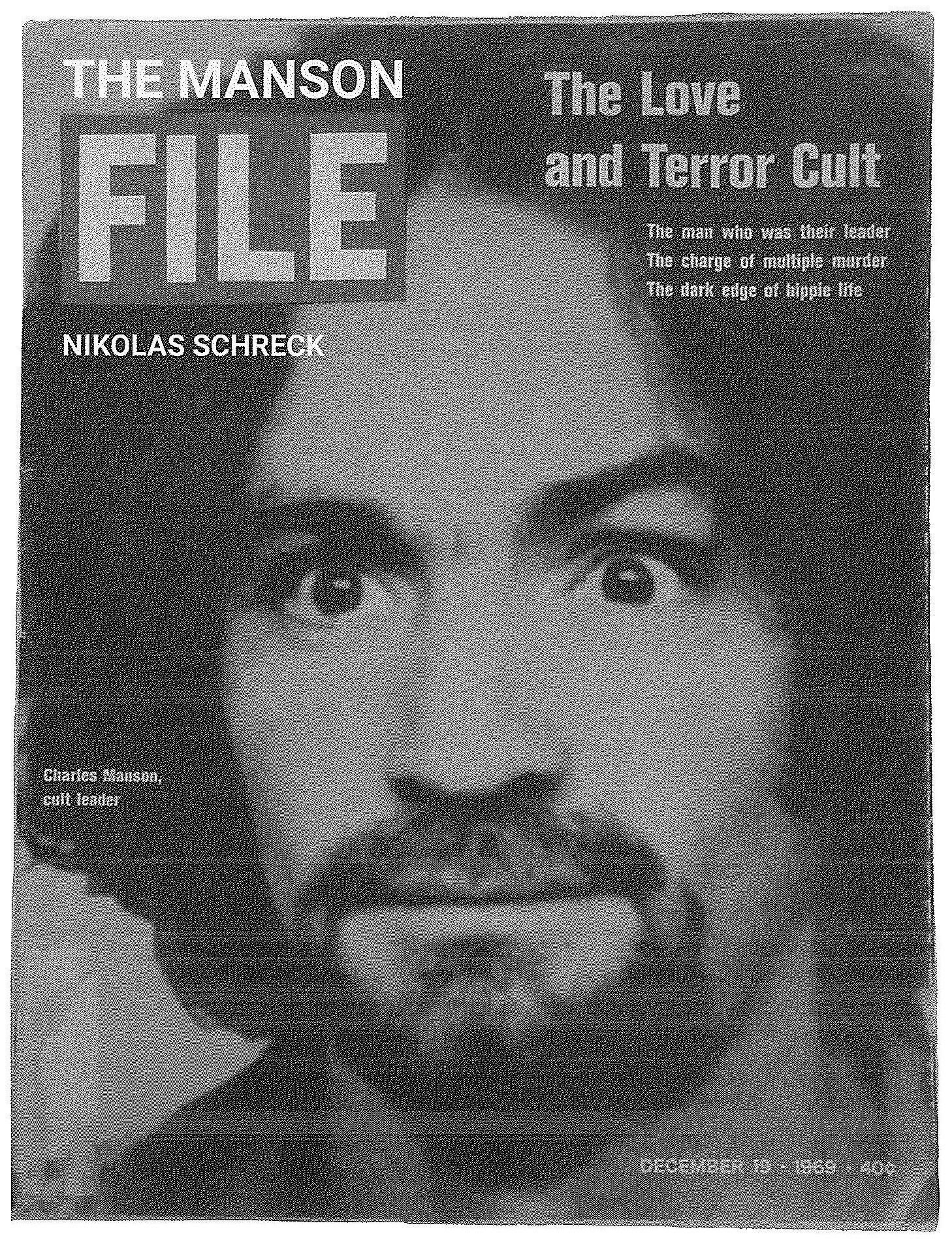
0. My Life with the Thrill Kill Cult

Since I first began in earnest to explore this anomalous irruption of the space/time continuum in the mid-80s I’ve frequently been asked two questions by interviewers and general public alike. Often broached with the concerned air of a lunatic asylum director asking a freshly straitjacketed new arrival when his hallucinations began, these queries are variations on the themes of “How did you get into this thing anyway?” and, “So what was Manson really like?”
The two very different previous editions of Use Manson File referenced only the most necessarily relevant personal experiences. Better, I supposed, ro focus on the daunting task of clarifying the misunderstandings The Official Manson Narrative spawned. However, since there’s no such thing as authorial objectivity, I believe readers will benefit from an explanation of how this book came ro be and how my own understanding of this saga and the elusive being at its center was shaped — and drastically changed — over the years. When it comes to the polarizing emotional minefield of Mansonism, loaded as it with so much received misinformation, understanding the experiences and background informing an author’s perspective is even more crucial.
No easy task after so much fabrication, lazy reportage and deliberate subterfuge blocking our view of our subject. Each step drawing me deeper onto this path of perplexity revealed hidden aspects of irs mysteries, and so are worth recounting for what they tell us about this endlessly bewildering conundrum.
I. How Did You Get Into This Thing Anyway?
Winter Solstice At The End of the World
On a bright November afternoon in 2018, I ritually returned Charlie Manson’s ashes ro his beloved desert wilderness of Death Valley’s remote Barker Ranch. Along with a small circle of his (biological) family and friends, I poured what was left of his mortal remains from an urn. The dust of his bones floated down a hill overlooking the burnt-out ruins of the ranch where he spent his last moments of freedom. He’d always said that when his body ceased to exist, he wanted his remains to rest in this, his desolate spiritual home.
As I watched his ashes settle into the desert sand, the thirty-three years that lay between my first contact with Charlie in December 1985 until his passage in 2017 came flashing back to me in kaleidoscopic fragments.
In light of his thoroughly Gnostic identification with The Christs spiritual symbolism, Charlie would no doubt have made much of the fact that the number of years our association endured was thirty-three. In his incessant decoding of the messages symbols, omens, numbers and names convey about the hidden ordering of this illusion that he knew was just a dream, he often spoke of 33 as the span of Christ’s lifetime. He didn’t consider it coincidence that his own brief ministry outside prison walls began when he was thirty-three in the Year of Our Lord 1967. He also discussed it as a numeral of significance in the Southern Scottish Rite Freemasonry that this proud Son of the South also identified with.
When the memorial concluded, my memory drifted back to what would prove to be our final meeting, several years earlier.
I recalled Charlie’s cheerful greeting to me when he called me at my motel upon my arrival on the longest night of the year in the bleak central Californian town of Hanford: “You got to me just in time for the end of the world.”
That foggy December 21, 2012 wasn’t only the Winter Solstice. Pseudo-scientific Esotericists, New Age ninnies, and Doomsday enthusiasts alike were convinced chat Mayan prophecy predicted it was going to be mankind’s last day. Either that, or the advent of an unprecedented era of spiritual evolution. Just as he’d demonstrated to me back in 1988 when he saw a correspondence between the Harmonic Convergence and the death of Spandau Prisons last inmate Rudolf Hess, Charlie had his own take on such cosmic happenings. He noted with amusement that he’d heard from another prisoner in his unit chat one panicky speculation claimed that a Planet X was going to collide with Earth on that dace.
“Man, I’ll just hop right on over there. I come here from Planet X in che first place.”
This segued into a contemplative monologue reflecting on the X he and his remaining fellow communards cut over their third eyes during his three-ring circus of a trial. They not only “X’d ourselves from society and the world”, he said, but they’d opened “gateways in their minds.” He explained that the Mansonice X was at once The Mark of Cain and che “seal” Revelation 7:4 tells us the mysterious 144,000 will wear.
I jotted his remarks down in a loose-leaf notebook as he spoke. This was a subject he’d never addressed in so much depth before. I’d noted in the earlier edition of this book that this important aspect of Mansonian metaphysical symbolism seemed to be inspired by a passage about the god Abraxas in the 1919 Hermann Hesse novel Demian. I asked him to confirm this. As always Charlie demurred, ever cagey about sources and influences on his spiritual understanding.
Before I could pursue this line of inquiry any further, the fifteen minutes the prison allotted for phone calls was up. He was cut off in mid-sentence.
In the weeks since I’d come from Europe to visit California for the first time in twelve years, Charlie had been calling me on my cell phone with a frequency impossible ro arrange when he went through the hoops required to call me in Germany. Overseas calls are forbidden to US convicts so we needed to connect through the kindness of third parties who forwarded the calls. Since Charlie’s self-described motto was “break at least one rule every day”, he enjoyed getting away with this subterfuge.
These conversations since my return to L.A. prior to our appointed meeting were marked by a new urgency on his part. He was clearly compelled to tell me about aspects of his life he felt I’d not sufficiently understood.
The inspiration for these recollections was that he’d recently received the 2011 edition of The Manson File. Now he was eager to comment on passages that reminded him of some relevant aspect I’d missed, or that required correction or expansion.
During the many hours of telephone conversations in 2008 and 2009 that informed the 2011 edition of this book, Charlie offered unprecedentedly clear and unambiguous information on the true motives for the Cielo Drive massacre. He confirmed what he’d hinted at for years: despite what their crime partners may have thought, the drug dealer Charles “Tex” Watson set out that grisly night to get back at rival drug dealers with the collusion of his lover Linda Kasabian. For the first time, he’d also explicitly admitted that one motive for the even more enigmatic killings of the LaBiancas was, among other things, simple robbery. A cash grab sparked by — and even directly linked to — The Beach Boys management refusing to honor their agreement to pay him for songs of his that the band had recorded on their 1968 album 20/20.[11]
There was a very specific reason for his new candor.
That particular confession about the Waverly Mystery was vouchsafed to me in the midst of an illicit call he’d made to me on an illegally acquired contraband mobile phone from his cell in the middle of the night, California time. Most of our previous discussions of his past were held with guards, other prisoners, or indiscreet third parties on the phone overhearing him.
While he was often surprisingly forthcoming despite this ever present eavesdropping, the Charlie who spoke to me on these unmonitored cell phone exchanges was a different person altogether. All pretense of playing up the Charles Manson persona chat I’d often encountered when he had an audience was dropped. I hesitate to state that I ever really saw behind the carefully calculated image he frequently presented. However, there was no doubt that a far more thoughtful, less guarded man than his flamboyant public antics ever displayed emerged during these one-on-one exchanges.
Two significant examples of this came about during a cell phone call that he made to me a few days before my Winter Solstice 2012 prison visit. Uris communication involved previously unknown data on the LaBianca crime and a further revelation about his deliberately buried connections to the top tier of L.A. rock royalty of the time. It happened in a typically Charliesque manner.
A few days before our visit at the prison was due to take place, I was going to look for the first time in decades at the house in Venice Beach where I lived when I was a teenager. While I was walking past a bookstore on the Venice boardwalk that I used to frequent in the late 70s, Charlie called on my cellphone.
“Where are you?” he asked.
I told him precisely. He said, as if expecting my answer, “Right there is where I met Red.” (Red was his nickname for his ginger inamorata Lynette Fromme, who memorably described her 1967 meeting with Charlie in Venice in her highly recommended 2018 book Reflexion).
Charlie then proceeded to give me a guided walking tour of an area I thought I knew well. He led me to where the shabby remnants of the long gone space-age Pacific Ocean amusement park on the pier used to be, telling me of his adventures there during his Beatnik days. A fortune teller there told him he would become famous, “But not in a good way.” He walked me to where The Straight Satans biker gang’s clubhouse had been located since 1959, coincidentally at a spot I passed by nearly every day during my Venice adolescence. While he’d been complaining recently of losing his short term memory as he entered his late seventies, his recall of exact details about his past were still razor-sharp.
With a casual manner that puzzled me, since he’d been so reticent about the topic before, Charlie admitted during that call to bringing money stolen from the LaBiancas on August 10, 1969 to the Straight Satans clubhouse that night. He’d gone there to pay off the extortion debt the bikers had been pressuring him with since July of that year. He’d long ago clarified that Danny DeCarlo, the Straight Satans treasurer, was far more involved with the bloody crime spree in the Sixties’ last summer than was generally known. This latest revelation, along with Charlie’s previous admission that robbery was the real reason for the LaBianca home invasion, confirmed what he’d hinted at to me for years: that the Straight Sarans played a key but unknown role in spurring and benefiting from the crimes that sent him to prison for life.
Among his other digressions on this magical mystery memory tour, Charlie took me to a entrance to the beach where he said he once ran into a drunken Van Morrison. Now he’d been mentioning encounters with Van Morrison for years. I could never figure out why the Northern Irish musician would have been in L.A. so often. Only when Charlie said that he told the besotted “Van Morrison” chat if he keeps singing “Baby, Light My Fire” he was going to turn kids into arsonists did I finally get it: Van Morrison was actually Jim Morrison. That opened the locked Doors to a host of other revelations Charlie shared with me about his mentoring of The Lizard King. Most of these were later confirmed by Doors guitarist Robbie Krieger thanks to Mansons friend Ben Gurecki.
I was frustrated that Charlie hadn’t been so forthcoming about such matters during all of of our previous conversations pertaining to the newly published book. The thought of having to prepare an updated edition in light of Charlie’s sudden openness was challenging, but I was grateful for his new level of candor and cooperation.
In the past weeks, he’d been having Thunder, a trusted convict incarcerated in the cell next to his, read aloud from The Manson File to him at night. Ever since appearing on his tier. Thunder formed a rapid rapport with Charlie. He protected him in his old age from the more predatory prisoners in the small cell block they were confined to. Charlie’s extreme dyslexia and fading eyesight made extended reading an arduous challenge. After listening to this bedtime reading, Charlie told me he was impressed with how close to the truth about his life, thought and the mysteries of the crimes I’d come.
Not only had Charlie shared his positive impressions about the book with me, but the understandably harsh critic of almost all previous writings about himself made the unprecedented move of officially condoning The Manson File. Of course, the self-proclaimed Underworld Pope’s imprimatur was the kiss of death to those whose knee-jerk reaction to my work was to accuse me of being a “Manson apologist”, slavishly and uncritically reporting every word Charlie said as gospel.
In fact, despite his reputation as the most manipulative of control freaks, Charlie never once tried to sleet what I wtote about him. I am grateful to Thunder for later relaying to me that in private the customarily distrustful Charlie had rare praise for the book, commending me “for doing him right”. Unlike other authors, he told Thunder, I’d accurately quoted what he said to me during our many interviews without distortion or twisting his meaning through biased interpretation.
Charlie asked his assistants on the outside to add a link to order The Manson HZ? printed directly on the business card he sent to correspondents. He even went so far as to write our the ISBN number by hand in his letters, encouraging friends, admirers and inquiring journalists to read it.
This willingness to so enthusiastically support and promote my book came as a welcome surprise. Leaving aside his usual flashes of temper, Charlie had been generally cooperative in telephone interviews and written correspondence we’d been conducting for this specific project since 2008. And he’d been equally supportive of the much earlier edition of this book from 1988, and the documentary film about him I released in 1989. When we embarked on the intensive series of discussions needed, negotiating the parameters of what he was willing to talk about for the 2011 edition, he’d given me his seal of approval.
“You’re the educator,” he told me. “You’re the master manipulator. I don’t mean negative. In other words, you can write the books and make the films. You can do all the masterful... you are the master, there ain’t no doubt about that, you are him.”[12]
Leaving aside my amusement at the supposed mind controlling hypnotizing cult leader calling me “the master manipulator” as he used all his flattering charm on me, I came away from that conversation convinced. Charlie’s promise to tell me the truth about his life and crimes as he saw them “with no bullshit” was sincere.
And yet there were several no-go areas. I still have the list of questions he stubbornly refused to answer in that first go-around: Was he really not aware of an attempted robbery of drug dealer Joel Rostau in April of 1969? How did he know so many intimate details about the sex lives and video proclivities of Roman Polanski, Sharon Tate, and their social set? If, as he maintained, he had coincidentally heard of Cielo Drive owner and artist’s agent Rudi Altobelli from a mafioso in San Francisco as early as Fall of 1967, what was the exact nature of their relationship?
And how, as he’d suggested to my colleague, the BBC journalist Bill Murphy, was the sale of illicit pornography involved in his dealings with Altobelli? Then there was the mystery of infamous Mafia lawyer Sidney Korshak. Polanski’s friend Gene Gutowski informed me years earlier that he personally witnessed Korshak arrive at Paramount Studios in August of 1969 to oversee a cover-up of the drug dealing background to the murders at Cielo Drive. And yet Charlie knew all about the minutiae of the relatively obscure Korshak’s career. He even seemed to admire him. What was the connection there?
To what extent did Charlie’s lover, the wealthy divorcee Charlene Cafritz, form a link between his commune and her friend Sharon Tate? Had he ever met the actor and drug dealer Iain Quarrier, a friend of Polanski and Tate whose presence at Cielo Drive before and after the murders has still never been sufficiently explained? What the hell was Charlie doing auditioning his music at the metaphysical retreat center Esalen in the middle of the night in the days before Tex Watson went on his speed rampage at Cielo Drive? Why had he named Michelle and John Phillips and his friend Cass Elliot of the Mamas and Papas as trial witnesses for the defense when he was still planning to act as his own attorney at his trial? What questions would he have asked them? (The Phillipses ardently denied having ever met Manson, while Cass Elliot, who knew him and his tribe very well, admitted her friendship with Charlie only to her closest confidantes.)
Naturally, I couldn’t help but suspect that his adamant silence on these topics indicated that these may have been crucial keys to the mysteries surrounding this most complex of cases.
For the most part, however, with these exceptions, Charlie was as helpful as he could be. So long as his answers could not be construed as breaking his code of never snitching on the unlawful actions of others.
However, once the book was complete and ready to be read by the public, some of Charlie’s ornier — if not downright paranoid — tendencies rose to the surface.
Shortly before The Munson File was due to be published, he somehow became fixated on the notion that the book would claim he was a federal agent, or even an informant. He never told me this directly, but ranted about it to mutual associates. I assumed that unknown others in the backbiting and ever contentious feuding factions of what some laughably misname “The Manson community” had poisoned this particular well.
When Charlie again called me in Berlin after a period of tense sulky silence, I assured him that this rumor wasn’t true. He remained skeptical. I told him that in all my research I had never uncovered any such information. In fact, I said, with some exasperation, the only source who had even suggested some sort of Federal cooperation was him. I read to him a cryptic quote from his own foreword to Marlin Marynick’s Charlie Manson Now, a book the author had given me a copy of when we’d met in Berlin to correct some discrepancies.
In Charlie’s foreword, recalling his release from Terminal Island in 1967, he’d written:
“They said “You’re on the pay no mind list.” They tell everyone “Leave him alone, and don’t pay attention to him, don’t listen to him, don’t even mention his name, don’t say nothing about him, just get rid of him, get him away from us, because we can’t stand him.” So, I go outside, and I go over to the music and the Grateful Dead is playing, and they put me on the witness program. Not because I snitched on somebody or betrayed a trust. I didn’t snitch on nobody, and I didn’t betray a trust, but they’ve got me on the Federal Witness program.”
Hearing his own words read back to him clearly implying that there may have been a grain of truth to the very accusation he had charged me with casting on him, Charlie went uncharacteristically silent. This reminded me of similar conversations we’d conducted over twenty years earlier about passages he’d disputed in Nuel Emmons’ inaccurately titled book Manson In His Own Words.
In the years since, I’ve not been able to make sense of this baffling and self-damning claim of his. I leave it here among all the other tantalizing mysteries of this gigantic puzzle. That there is something to his claim I have no doubc. But as with so many of the many other hints he left, we may never know che actual truth. Several prisoners who knew Charlie well and who saw all of his confidential internal records have adamantly stated to me that he was neither a snitch nor a federal agent of any kind. If he had been, it would be known in the grapevine of the underworld, and he would have been a marked man according to prison protocol. He certainly never received any of the preferential treatment a discreet collaborator would be rewarded with by the authorities?[13]
After that conversation, the matter was dropped as inexplicably as it had arisen. Charles resumed his usual cordial and cheerful manner.
This truce only lasted a few weeks. I had my publisher in France see to ic that the French edition of the book, published before che English version, was sent to Charlie. (Books can only be sent to prisoners from certified vendors.) He couldn’t read French, but his suspicions were roused again when he wrongly assumed that an extensive discography of his music appended to the book was actually a catalog offering records for sale.
“Schreck’s selling my music!” he was now griping to some of his correspondents.
Only when he was sent the English edition several months later did he realize his error and begrudgingly apologize to me. Obviously, as I explained to him, the point of including that appendix was to show those who hadn’t even grasped that he was actually a musician with a fairly large body of work just how many of his recordings existed, both authorized and bootleg.
The French publication of my book led to an unexpected result. Charlie knew that Roman Polanski had fled to Paris to evade justice for his rape of an underage girl in Los Angeles. He wondered if Polanski had read my book in French. Charlie was aware that I’d written to Polanski to request an interview for years. He also knew that the only response I got in return were polite letters from his secretary saying that Polanski was too busy with film work to answer my questions at the time.
Despite his many negative remarks about the director who he derided as “that Polish pimp” and worse, Charlie consistently expressed a desire to make it clear to the disgraced film-maker that he was not responsible for the murder of his wife Sharon Tate. I mentioned that I had an upcoming opportunity to meet Polanski at a film industry related event in Berlin. 1 told Charlie that I was reasonably sure that Polanski was well-informed about the true nature of his wife’s death, and probably knew very well that the drug dealing related murders were due to conflict between his friend Wojciech Frykowski and Charles Watson, and were not ordered by Charlie. He asked me if I could hand deliver a sealed letter to Polanski he wanted to send to me. It would “explain some things that guy don’t know.” I said I would. He made me swear that I would not read the letter. I promised that I wouldn’t. Shortly before the event was to take place where this message would’ve been delivered, Charlie abruptly informed me that he decided not to send the letter after all.
I still expected that once he actually read the contents of the book, which in no way whitewashed or rationalized the actual degree of his participation in the crimes he was so identified with, there would surely be more fireworks to come.
And yet, much to my surprise, considering all of the controversial material in the book, some of it quite damning to him personally, he only asked that one relatively minor point be corrected. He called me to say that my claim in the previous edition of this book that his arch-rival Kenneth Como was a member of the prison gang The Aryan Brotherhood was mistaken. I had described how Como, previously an ally and crime partner, had become an enemy who even plotted to kill Charlie after falling out with him.
I suspected that the problem was that he feared that current AB members in prison who read of his quarrel with Como would assume that Charlie was persona non grata with the gang and seek retaliation against him, always a possibility in the treacherous shark tank of life behind bars. He implied this when he said to me that might foster confusion with “the dingdongs in here”, his less than affectionate term for his fellow convicts. Charlie seemed to want an honest account of his life and crimes to correct the erroneous and misleading official narrative that then prevailed. But as I had long observed, his more compelling primal priority was the day to day struggle of surviving all the many threats he faced as an aging high-profile prisoner in a brutal environment.
I assured him that I would at the very least make sure to add his commentary concerning Como to the next edition of my book. He told me that I “got most of the rest right, or closer than any of that other trash they keep shitting out.”
However, as his cell block neighbor Thunder had read aloud to him at night on a makeshift walkie talkie he’d constructed from hearing aids, alternating between my book and The Tibetan Book of the Dead, Charlie had taken notes of several “twists of the tale” he wanted to correct, expand on, or otherwise revise.
I was not surprised that Charlie asked Thunder to read from the ancient Tantric Buddhist guide to death, as the end had been much on his mind as he reached his mid-seventies. He had recently been hinting at ill health. He’d described uncomfortable encounters with prison medical staff, made complaints about the side effect of medicines prescribed for heart problems and hypothyroidism. One letter to me had even plainly said that he was ready to move to “the next level” soon, although that was a full nine years before his various maladies actually turned fatal.
Though he never said so, Charlies promise to cooperate in what was now clearly going to be the considerably revised third edition of The Manson File you now hold in your hands was sparked by his growing awareness that mortality was approaching sooner than later.
Charlie did not fear death. He was convinced, as a firm believer in reincarnation, that the mind did not begin with birth nor cease to exist with the body’s demise. But he was aware that there was only so much time left to relay whatever final thoughts he wished me to add to the final Manson File.
All of this revolved in my thoughts as I went to sleep after my evening meditation in my motel room on the longest night of the year. The date some alarmists feared would fulfill the Mayan prophecy of the end of the world as a 5,126 year cycle came to its climax. I wondered: Which of the many Charlie Mansons I’d known or had yet to know would I be meeting on the two-day visit he’d invited me to?
The next day, I stood in the misty morning outside the motel Gray Wolf and Star, Charlies current representatives on the outside, had arranged to pick me up from to drive me to Corcoran State Prison. They had generously provided me with my lodgings and offered unfailing hospitality during my stay. Gray Wolf, a courtly Southern gentleman, had even volunteered to drive me from the Los Angeles recording studio I’d been singing in to my appointment with our mutual friend, who he referred to as “The Old Man”.
In the years since I’d been entangled in the Mansonverse, I’d seen two other couples take on the often thankless task of serving as Charlie’s reps. First, the original Spahn commune member TJ. “The Terrible” Walleman and his wife Ansoml3- After Walleman died in a traffic accident, Sandra Good and her partner, the author George Stimson, whom I’d introduced to Charlie back in the days of the first Manson File in 1989, moved to Hanford to assist him. While waiting for the latest and last Team Manson to escort me to the home the State of California so hospitably provided for Charlie, I saw a large hawk fly overhead, spreading its wings as it landed on a nearby roof. The hawk was one of Charlie’s totem animals. I took this as an auspicious omen for our meeting.
The Cadillac Curse and The Bracelet of Skulls
“Why don’t you just shoot me?!” was Charlie’s grand entrance opening line.
This was shouted at the top of his voice, nostrils flaring, eyes glaring, chest bared defiantly for a hail of bullets. His wrath was aimed at two hapless armed guards stationed behind a circular desk as he burst into Corcoran State Prisons visiting room. Here was his tried and true Evil Charlie act. A crowd pleasing theatrical creation, more character than person. He’d debuted this popular performance during his farcical trial decades earlier, polishing it to perfection in the many often histrionic TV appearances he’d been allowed to grant from 1981 until the early 90s, when California prisoners were denied the right to give interviews. The bored guards watched him carefully to be sure. But their cool manner suggested that they were too accustomed to this menacing Manson mask to give him the reaction he wanted.
He’d told me countless times that he used fear to awaken awareness, to “bring the mind on point”. So I was sure that was the method to his feigned anger this morning. Charlie quickly turned away from beaming the infamous Manson stare at his captors to me, greeting me with a conspiratorial leprechaun wink and a broad smile. We embraced warmly under the watchful eyes of the guards, and sat at a table with Gray Wolf and Star.
Getting through the stringent security check at the forbidding front office of the prison was tense. But here in the most heavily guarded inner sanctum, the visiting room’s bland institutional atmosphere put one in mind of a shabby high school cafeteria rather than a dire dungeon. If Corcorans visiting room was most decidedly a corner of Hell, it was a bland Kafkaesque circle of the inferno.
I asked Charlie what he wanted from the concession machine, and bought him the soda and bag of popcorn he requested. Relaxed but always on guard, CDC Inmate B-33920 took in the room with a sweeping glance, the alert look of a beast of prey or a seasoned soldier in battle. All eyes were still on him as the threat of imminent violence he’d evoked upon entering still hung in the air. Other than the guards, Star, Gray Wolf and myself, his literally captive audience consisted of two prisoners and their visiting families sitting far apart at two other tables.
One was an affable Mexican gang hitman who’d killed more than twenty-five victims in attending to his bloody business. Nearer to us sat the hulking and clearly disturbed presence of the child molester, rapist and double murderer John Gardner. His sex murders of two teenage girls had made grim headlines only three years earlier. His visibly forlorn relatives, who I’d accompanied to the visiting room in a prison vehicle, sat with him. Such were the unwilling residents of the PHU or Protective Housing Unit, a two-tiered block of twenty-four basic concrete cells Charlie had been locked up in since 1989. “Protective” because along with high-profile prisoners like Charlie, Sirhan Sirhan, Juan Corona, inmates who were targeted as snitches, child molesters or gang traitors were incarcerated there.
Having assessed the visiting room, Charlie stroked his rather Chi- nese-warlord-looking beard, looking into my eyes with melancholy gravity.
“I been chinkin’” he said. “Is mercy a weakness?”
I suggested that it was easy to be vengeful, but that having mercy for chose doing us wrong required screngch.
I knew he was obliquely referring to convicts who’d recently been extorting him and abusing him. Resentful of the steady flow of money Charlie’s many admirers sent to his account, and eager to exploit the murderabilia market value of his signature, art, or personal effects, other prisoners threatened him with physical harm if he didn’t share his money with them or their families and girlfriends on the outside.
Although he’d been able to resist such predation for decades, he’d become more frail in his old age (by then, he needed a cane to walk steadily). Now, Charlie — once easily able to defend himself against all comers with his fists — was an easy target. While he was alive to still be tormented, I never mentioned this harrowing aspect of Charlies incarceration, as he himself never snitched on his extortionists. But it’s a relevant quirk of his karma, since one reason Charlie ended up back in prison in the first place was due to the rash and reckless actions he took in 1969 to appease The Straight Satans motorcycle club’s extortion of him. Many of his haters falsely assume that Charlie didn’t do hard time for his crimes. They should be pleased to know that his long sentence was fraught with constant threats to his life and frequent abuse from both prison staff and his fellow convicts.
He reflected on the mercy question a moment before picking up my eyeglasses from the table and examining a metallic decoration on them. He asked me if the protrusion was a hidden recording device. When I assured him that it wasn’t, he was disappointed. He’d been encouraging me to conduct a new video interview with him for several years, following up on the one we had recorded twenty-five years earlier in San Quentin Prison. Much to his frustration, all efforts to circumvent the California prohibition against prisoner interviews proved to be in vain.
After the intensive period of research on my book in which our relationship had largely been focused on my interviewing him, we’d agreed that these two five-hour visits on December 22 and 23, 2012 would just be a casual friendly visit. But it didn’t take long to see that Charlie’s encounter with previously unmentioned aspects of his past in The Manson File had opened the gates of memory wide. Consequently, a meeting that was intended to mark the end of what Charlie only half-jokingly called my “interrogation” of him, swiftly turned into a flood of important reflections and revelations. This would continue for the next three years until his worsening health and transfer to the more closely watched infirmary made overseas communication much more difficult.
Sitting there in the Corcoran visiting room, listening to Charlie regale me with anecdotes told with a radically new level of detail and emotional openness, it quickly became apparent to me that only a few months after the last edition of this book had been published, that the arduous work of researching an updated edition had already begun.
Among the many eye-opening topics Charlie addressed in those hours, several greatly enhanced and even upended my understanding of some of the most enduring mysteries.
He was especially passionate that weekend about the prevailing public notion of him as what he called “the all-knowing mastermind with the master plan.”
He looked away at a middle distance somewhere in another universe. With a melancholy sigh, he said, “This is pretty fucking strange. I don’t know if this will communicate to you. But I’m not chat at all. Every day, I think how did this big old fucking shit happen to me. Because I didn’t make nothin’ happen. It happened at me. How can you understand my life? I don’t understand it yet. I been thinking about it all the time I been locked up.”
In contrast to the notion of him as “ringleader”, Charlie was at some pains to communicate to me, he felt that far from being the master of his destiny, his entire life had been “a series of set-ups”. He found it ironic that while both his admirers and detractors perceived him as the center of his story, whether as scapegoated hero or demonic villain, he himself had always felt that some metaphysical force was guiding him from one disaster to the other. This, he felt, was a key to his existence.
From his perspective, he explained, he was actually a puppet of this unnamed entity. He told me before that he’d always felt the unnerving sensation of being watched by an invisible presence, as if he was performing in a film. I recalled chat the actor Dennis Hopper reported that Charlie also told him about this same phenomenon during their jailhouse visit in 1970, when they discussed the possibility of Hopper playing him in a proposed movie about his life.
That day in Corcoran, Charlie stressed that he had the impression that this power had cast him to play a pre-scripted role he could not escape from. He compared his plight to the main character in the 1998 film The Truman Show, whose plot he told me he could relate to. His life, he observed, had been turned into an entertainment and money-making vehicle for others, a process that he intuited began even before his infamy exploded in December 1969.
“Like, where does the line between prison and not prison end?” he asked. “Because you know you’re all locked up out there too, dig. You just can’t see where the walls keeping you in blend in with the sky.”
To illustrate this sense of being the pawn of some supernatural intelligence, he told me, with a sense ofTwilight Zoned wonder, about the repeated appearance of a certain model of baby blue Cadillac at crucial turning points in his life.
“The same car Hank Williams died in,” he said. I knew Charlie was a life-long fan of the Country and Western legend Williams, a great inspiration on his own music. He explained that this phantom Cadillac of Fate that kept turning up was the same model that Williams departed this world from in West Virginia at the age of 29 on the first day of 1953. The singer’s sudden and still mysterious death had been a shock to the then 19-year old Charlie, a one-time resident of West Virginia and an ardent admirer of Williams. Charlie often affectionately referred to his idol by his nickname “Luke the Drifter”.
He told me of a series of hauntings by the cursed Cadillac, beginning with an incident when he’d fled as a youth from an unlocked door in a juvenile hall only to find that very model conveniently waiting for him parked outside the institution. The keys were still in the ignition. The tank was filled with gas. In the trunk of the Caddy, he found cloches and shoes exactly in his size that he changed into to make good on his escape. Charlie looked around, chinking someone had arranged this serendipity as a gag. He got into the getaway car in his convenient new garb but was quickly apprehended and returned to the institution. That was the first time, he explained, that he began to feel that some unseen trickster was playing a lifelong practical joke on him.
The last time the baby blue harbinger of destiny appeared, he said, was at a contemporary art showing at a private residence in Beverly Hills he attended in the early summer of 1969. This time, the vintage car had been sec up on a plinth as a found object arc piece. He recalled knowing something terrible was going to happen as soon as he encountered this automotive omen. After midnight of August 8, 1969, he realized what he’d been set up for this time.
A full account of all chat was discussed during this information-rich marathon meeting would exceed this book’s boundaries. But those candid conversations with Charlie set the course for my research to come. Among the most pertinent of the many subjects he’d previously evaded which he now unexpectedly opened up about were these:
Since the first media reportage of the Tate-LaBianca case, many rumors swirled around Charlie’s early August 1969 visit to The Esalen Institute in Big Sur, a few days before the Cielo murders.
Esalen Institute was a popular hippie hot springs hangout, a pioneering human potential center for rich spiritual seekers. It was also a hub of the psychedelic underground, where acid and other mind-manifesting potions and plants could be had if one knew who to approach.
Charlie and company had gone there several times to enjoy the hot springs since 1967. We know that Abigail Folger and Sharon Tate also visited, though there is no solid proof that those three were ever there at the same time. Bugliosi’s Helter Skelter popularized the theory that Charlie’s musical audition at Esalen was roundly mocked, and that this rejection supposedly sparked the flame of anger that inspired him to order the killings on Cielo and Waverly as revenge on society. I assumed that this was just Bugliosi’s attempt to build his case of Charlie as a ticking time bomb waiting to strike back at those who supposedly thwarted his ambitions.
Mostly right-wing anti-hippie American crackpot conspiratologists have long spread rumors that liberal hotbed Esalen was a secret CIA mind control center somehow complicit in mind controlling Manson to plot the Cielo murders. The Esalen Institute directors claimed, quite credibly, that a smear campaign connecting it to the Tace-LaBianca murders was devised by the Nixon administration to blacken the reputation of a counterculture landmark opposed to the Vietnam War and the Nixonian regime. Esalen staff have confirmed that Charlie appeared there late at night in early August ’69 to audition, but claimed believably that they had never met him before.
The question I asked Charles in 2012 was why was he auditioning his music at a esoteric center in the first place? Why would they need a singer-songwriter?
He told me that he’d heard from musician friends that Esalen was hosting their annual folk music festival in September. So he went there to see if he could get a spot in the lineup. I thought it was interesting that even after Charlie’s near-fatal shooting of Bernard Crowe, his beating up of Spahn stuntman Randy Starr, and his vicious slicing of Gary Hinman had scared away his main music industry patrons Terry Melcher and Dennis Wilson, he was still planning to continue his music career.
When I went back to my motel on the first day of our visit, I checked online to see. I found that there was indeed a Big Sur Music Festival held at Esalen in September 1969, a little over a month after Charlie’s audition. His friend and admirer Neil Young played there with Crosby Stills, Nash and Young, all of whom Charlie had known since he’d come to Topanga Canyon in ‘67. I believe that’s all there is to this much rumored subject, and that far too much has been made of it by those seeking to find even spookier explanations for the crimes than Bugliosi came up with. By the way, at the 1970 Big Sur Festival one year later, two of the performers were other even closer associates of his, The Beach Boys and the Mamas and the Papas’ John Phillips.
In jest, I asked Charlie, “Well I guess if you were auditioning for a music festival in the first week of August you couldn’t have been planning to start a race war the next week?”
He smiled his wickedest crinkly-eyed smile, regarding me with a sly sideways glance.
“How do you know I wasn’t?” he said.
That moment strikes me as Pure Charlie. How typical of his contrarian streak to fiercely deny for years that the crimes he was accused of were motivated by his desire to spark a racial conflict — only to paradoxically cast doubt on that very assertion.
Nonetheless, I take this far more realistic explanation of the early August Esalen audition as further indication that only a week before the bloody weekend of the Tate-LaBianca murders, Charlie was still planning the future of his music career rather than plotting to slaughter rich piggies to inspire an ethnic apocalypse.
Another topic that previously went unspoken was his relationship with the aforementioned druggie divorcee Charlene Cafritz, the wealthy sexual adventuress who’d lavished Charlie with cash and expensive gifts during his self-admittedly opportunistic liaison with her.
Cafritz had been set up with the Beach Boys’ Dennis Wilson by matchmaker earth mother singer Mama Cass Elliot, one of Charlies closest friends in the L.A. music community. Charlie recalled that the then twenty-one year old Charlene had been fucking his benefactor, the promiscuous priapic marauder Dennis, but that the drummer had tired of her fetishes, which ran to BDSM.[14] Wilson foisted his apparently insatiable groupie off on Charlie. By his own admission, Charlie was more gigolo and glorified rent boy than love-struck admirer.
He mentioned that Cafritz, nee Lawley, was also known to her friends as “Charlie”. A nomen est omen the mystically minded rich hippie interpreted as a sign that she and her ex-con lover Mattson were meant to be. The well-heeled female Charlie’s affair with the down and out male Chai lie was slumming indeed. Charlene’s mother was a long-time State Department employee and assistant to Kennedy and Johnson’s Secretary of State Dean Rusk. With such prominent political parentage, it was a matter of aristocratic form that Charlene Lawley married into the even more politically powerful Washington socialite Cafritz family, wedding clan scion Carter Cafritz. These government connections between the two Charlies gave rise to wild speculation that Cafritz was some sort of undercover secret agent funneling government funds from the notoriously spy-ridden State Department to the Manson commune. A paranoid fantasy Charlie laughingly dismissed that afternoon in Corcoran as “a silly pipe-dream.”
Charlie readily confirmed long-standing rumors claiming that in December 1968 he and some of the girls in his commune performed in pornographic film shoots Cafritz had arranged at her dude ranch in Reno, Nevada. Further underscoring the Official Narratives lie about Tex Watson’s victims being random strangers, Charlie casually stated that Cafritz was one of several direct links between her friend Sharon Tate and the Spahn Ranch commune. (“Al! those people knew each other, man.”)
I asked him if there was a connection between these sex films and the orgy videos long reputed to have been filmed by Polanski with his wife Sharon, Charlene’s friend. He merely shrugged with a disinterested but indecipherable expression on his poker face. How all of these skin flicks he and many others attested to on both sides of the Spahn-Cielo divide have utterly disappeared offthe face of the earth is one mystery that remains unsolved, though I have discovered some possibilities, as is discussed later. Subterranean Manson lore has long posited that Charlene photographed a wealth of incriminating (or at least embarrassing) photos and home movies of Charlie and his commune cavorting with the cream of the Hollywood music and movie scene.
Charlie told me that before departing for his last stand in Death Valley he’d left some of his property at that same remote Nevada property. He’d asked a few of his correspondents to recover those long lost artifacts without success. While he declined to confirm or deny the rumor that Cafritz contributed money to pay for Charlies defense fund after his arrest as a suspect in the murder of her friend Sharon Tate, he did acknowledge that in exchange for plentiful sex (“That little girl loved dick.”) she’d been a satisfactorily generous mark.
According to Charlie, he asked his young sugar mama to buy him at least one valuable car, a blue Fleetwood Cadillac (yet another blue Cadillac!). He peevishly’ complained to me that Charlene accidentally gifted him him a red one instead, still resentful about her error forty years later. Asking the wealthy for wheels was a habit for car nut Charlie. He’d also jokingly asked his patron and admirer Terry Melchers mother Doris Day if he could have one of her cars, as she had so many in her driveway when he visited her.
Cafritz purchased musical equipment for Charlie’s band, which at that point was still called The Milky’ Way before transforming into The Family Jams. Her largesse to Charlie’s cause was drawn from the substantial alimony sum she’d been paid by her ex-husband Carter Cafritz. They’d married in 1966, when she was only eighteen years old.
I asked Charlie if Cafritz’s fatal 1970 Nembutal overdose while committed to the Washington D.C insane asylum St. Elizabeths may have been a murder to keep her silent about the Sharon-Charlie connection. Although he was often quick ro accept even the most fantastic conspiracyspeculations, Charlie doubted it. With some contempt, he said that Charlene was “weak”, constantly high on any drug she could get her hands on and that she was “in way over her head” as a mutual associate of the Spahn and Cielo crews. He remarked that nobody would be surprised that drugs did her in.
It was music producer and Manson acolyte Terry Melchers right hand man Gregg Jakobson who made the police aware of Cafritzs misty role in the saga when he was interviewed about the murders. Detectives confirmed that Cafritz had been arrested for dabbling in drug dealing, the omnipresent connection between all players in this story. In the lawless Miss Lawleys case, heroin capsules sold to an undercover narcotics officer in late December 1969.
She was arrested a few weeks after Charlies indictment for the murder of her friend Sharon Tate was announced in the media. Law enforcement also confirmed that shortly before her untimely death Cafritz had called the pay phone at the Spahn Ranch and discussed sending money for Charlies defense with the communes resident revolutionary Catherine “Gypsy” Share. Police investigation determined that Cafritz was indeed in possession of as yet unseen tapes and photos of the Manson circle, some taken at Spahn, some during the groups residency at her lover Dennis Wilsons Malibu estate.
On January 15’\ 1969, Charlenes mother-in-law Gwendolyn Cafritz was robbed and beaten by four masked men during a home invasion. Some have speculated this crime, bearing some similarity to the Cielo Drive crime, may have been connected to Charlie’s underworld affiliations. As with all elements in the Cafritz connection, there’s no solid evidence to support this contention.
At the time of my Corcoran Cafritz conversation with Charlie, Lynette Fromme’s long-awaited memoir had not yet been published. Fromme’s account contradicts some points of the version Charlie shared with me. But what his closest companion recalled about her encounter with Cafritz in her 2018 book Reflexion handily fills in the long elusive picture,
“When it came to getting money Charlie went for what he knew. Her name was Charlene, a boot and whip-style girl with a curvy body. I read later that she was some kind of heiress, but he never mentioned it. He had met her at a party in Beverly Hills and invited her to The Ranch. She didn’t come. She had invited him to her ranch in Nevada, and instead of going alone, he asked Sandy, Brenda, Paul, and me to go with him. Charlene’s Nevada ranch had an old-time hotel with a cowboy cafe at the front. Thed and hungry from the overnight drive, we went in for breakfast. Charlie sent one of the workers to let Charlene know that he had arrived. I almost missed seeing her. She was coming toward Charlie, but, after seeing the rest of us, she wheeled on her high heeled boots and let the screen door slam behind her. He went out to talk to her, and pretty soon an employee showed the rest of us to a bare rustic room with two beds, no telephone, and no TV. I don’t know what gave me the impression that this ranch was more about women than horses, but I knew about Nevada’s Mustang Ranch and I was beginning to think that Charlene might be running such an establishment. In any case, it was not an entertaining trip for us — we slept most of the time — and the next day Charlie returned to say we were leaving. As we drove away, he said that he had offered Charlene a place with us, but she didn’t want it. I found out later that she had offered him a Cadillac, but he refused it. Apparently, this wasn’t about stuff or money.”
Charlie, however, cynically maintained ro me that his relationship with Cafritz was strictly about ready cash and material objects. This discrepancy only proves once again that even among reliable direct eyewitnesses like Fromme, consensus on even the least controversial episodes of the Manson story is rare. In fact, it was Charlies coldly commending Charlene for her usefulness as a cash cow that led him to express a brief but telling comparison of her generosity to another less cooperative young bohemian from a similarly privileged high society background: Abigail Folger.
When he needed money desperately in the summer of‘69, Charlie said bitterly, the wealthy Folger didn’t come through.
Known to her friends as Gibby, the heiress to the Folger coffee fortune slummed in the same rich counterculture social scene as Cafritz flounced around in. According to Charlie, he’d already made Folger’s acquaintance in San Francisco as early as Fall of 1967. Ar that time, the San Francisco native had volunteered with her humanitarian mother Inez’s charity work for the Haight Ashbury Free Clinic. Susan Atkins, Charlie recalled, knew Folger from the Bay Area boheme even before she met him.
Charlie met Folger again in the groovy party circuit in Los Angeles, after her brief stint in New York, where she’d bonded in a dysfunctional relationship with her Polish exile boyfriend Wojciech Frykowski, a long-time friend of film director Roman Polanski. The unschooled excon and the well-educated heiress knew each other well enough to be seen together in her car, sightings Charlie confirmed as genuine to me in the course of our discussion. That Charlie knew Folger was not especially surprising to me. I wasn’t aware of their earlier Haight Ashbury encounters, but knew that Folger, Frykowski and many of the Manson commune were all frequent guests of Mama Cass, a near-neighbor of the doomed and ill-matched couple.
What was remarkable about Charlie’s unfavorable comparison of Gibby to Charlene was that when he spoke her name, his voice seethed with an anger so acidic it was palpable.
I saw a sparking flash of hatred in his eyes, a glint of malice I’d only seen when he spoke of his worst enemies. I couldn’t help but wonder if this obviously deep resentment was yet another unexpected layer to the multi-faceted mystery of the Cielo Drive butchery? Except for vague references to casual encounters with Sharon Tate, Charlie skillfully evaded confirming or denying any prior connection to any of the other victims though he knew an awful lot about Sebrings private life. So this was new territory. He never mentioned it again.
This incident demonstrated yer again that the more one learns about the many strands that came together on Cielo Drive, the less one knows. I still can not say with certainty through which of their many mutual connections the drug dealing elements in the Spahn commune came to do business with Sebring and Frykowski. The knowledge of Charlie and Sadie independently having contact with Folger two years before her murder only complicated an already murky quandary all the more.
At one point in our conversation, Charlie mused about how different his life might have been if he’d gone back to Mexico when he had the opportunity to do so in 1968. (His parole officer was trying to arrange a South of the Border sojourn since Charlie felt more at home in Mexico than in the US.) He’d previously mentioned that he’d sometimes be so overwhelmed with the many dramas the communes unruly youth brought into his life that he’d considered leaving California altogether to start a new life elsewhere.
I asked him why he hadn’t finally vamoosed as soon as he learned what Tex had done at Cielo before he got dragged into it, as he’d already became enmeshed with the Crowe and Hinman crimes earlier that summer? In a syntax and tone I’d only rarely heard from him before, he told me (and these were his uncharacteristically formal words), “I was paralyzed with fear, facing the full weight of the federal law enforcement system. My mind froze until the day I got arrested.”
The way he said this was so strikingly out of character from his usual home-spun manner that it made me wonder: who was the unseen Charlie who projected all these other Charlie personas? On one hand, he was uniquely unfiltered in saying whatever he really felt. While at the same time, he was one of the most guarded people I’ve ever known.
He recalled that by early October of ‘69, after resettling the commune in Death Valley he began to entertain the false hope that the police might never solve the crimes. They emerged unscathed and unsuspected from the sweeping police raid on Spahn Ranch in mid-August, so maybe, Charlie conjectured, “The Holy Spirit was looking out for us.” First Linda Kasabian, and then Tex Watson, the principal instigators of the murders, abandoned the commune to go on the lam. Watson, showing no sign of remorse or trauma after what he’d done, returned to his native Texas after a still unexplored trip to Hawaii.
Kasabian hid out with another hippie commune in the countercultural Mecca of Taos, New Mexico. Charlie had no idea where they were. In their absence, Charlie still maintained the wishful thinking that he might still miraculously manage to elude arrest for his accessory role in the crimes.
This optimism was dashed, he vividly recalled, when he went on a long hike alone in the desert one blistering day. He came across a tourist from Los Angeles whose car had broken down in the heat. Using his auto repair (and auto theft) know-how, Charlie fixed the strangers car. By way of small talk the stranded Angeleno regaled Charlie with a steady stream of outlandish rumors he had heard about “the Tate murders.”
Though he remained friendly to the stranger and tried not to react, Charlie remembered that this random meeting in the middle of nowhere somehow caused him to realize that he was doomed. The long arm of the law would ultimately find him and his companions, even in that desolate wilderness. He said that he was so dispirited after this incident that it became very hard for him to keep up the morale of the kids in the already splintering commune after that.
Except for his description of his visit to Cielo after the murders to clear evidence as the highest level of fear he’d ever felt, Charlie hardly ever dropped his outlaw bravado enough ro admit being frightened or in any way vulnerable. Another side of his personality I’d rarely seen before.
Despite this grim recollection, Charlie was mostly in cheerful spirits that weekend. He told corny and obscene jokes based on wordplay, loudly singing snippets of song lyrics he was working on. He pontificated on the magic of sound and how it changes matter. He knew I was then recording an album in Los Angeles. That got him tiffing on the mechanics of singing in the studio, and how he never felt comfortable laying down his songs in the many recording studios he’d experienced. He held forth about various mutual associates of ours. At the conclusion of Saturdays visit, he asked me if I’d like to take some photos with him. One of the guards snapped some shots of us together, developing them on the spot. When they were returned to us, Charlie automatically inscribed them to me with his autograph. Seeing this, the guard, one Officer Puig, firmly but politely confiscated the photos. He said Charlies signature was contraband, since it was valuable and could be used for currency.
Charlie was instantly furious at this interference of authority. He exploded in a tirade of profane abuse. I knew that the guards delighted in canceling his visits at the least provocation. We still had another five- hour meeting scheduled for the next day, and I could feel it slipping away. So I was forced into the awkward position of mediating between the wrathful Charlie and the now increasingly agitated officer. I argued in vain that the rule made no sense. Charlie frequently sent me autographed letters, envelopes and photos in the mail. So why were these signed photos forbidden to leave the prison when so many others had been allowed to be sent? The guard said he didn’t make the rules. Charlie raged. I did my best to calm the tumult before his visiting privileges were rescinded altogether or the two came to blows.
The guard agreed to take another series of photos, but no signatures this time. “You see what I deal with every day?” Charlie said wearily. Still brimming with barely subdued anger, Charlie posed with me again. For one of the shots, he suggested that we raise our arms in surrender. When I sent him a copy upon my return to Germany, he wrote back noting that our hands up gesture was also the Freemasonic signal of distress. Officer Puig, so belligerent that day, would be one of the officers who caringly tended to Charlie when he was terminally ill of cancer five years later.
One of the enduring images I retain from that meeting was Charlie crossing his arms in the traditional position of an Egyptian pharaoh holding the royal insignia of flail and crook. He took on a trance-like demeanor as he poetically reflected on his mystical concept of divine rulership. His expressive face was always changing. But in this ancient Khemite guise, he seemed positively transformed by some otherworldly force for a few minutes. He said that in the “Inner Sanctum” of his commune, he taught those who could grasp it a knowledge about “che power of the pharaoh and the phallus”. He’d never mentioned this before in our discussions of matters arcane and archaic.
I asked him if he’d taken that phrase from “Inner Sanctum”, the macabre 1940s radio show of the same name? He said that was his favorite show back then. He recalled how he’d listen ro its tales of mystery with eyes closed in order to temporarily escape from the various juvenile detention centers he’d been held in during his youth. I asked him if he really thought any of the commune kids exposed to these Egyptoid teachings really retained any of it, or had he been casting pearls before swine?
Depending on his mood, Charlie would either defend his traitorous youthful charges from decades past or deride them as unworthy of his attention. On that day, he said that most of them had run back to the reality their parents pushed on them as soon as the threat of prison loomed. Although I’ve seen some vague mention of this ancient Egyptian esoterica in correspondence Charlie held with some of the surviving commune members in the mid-70s, this component to the Mansonite creed remains a lost key. He once mentioned in a letter to me that the spirit/consciousness could experience a second permanent death after its release from the body. I asked him if this notion was influenced by an curse Egyptian sorcerers were known to cast against their enemies to prevent them from reaching the afterworld.
Before he could answer, our cosmic conversation was interrupted by more worldly concerns when the guards wheeled in a tray of packaged lunches to the visiting room, Charlie foraged through the mostly carnivore selections for the vegetarian salad and for avocados, a rare treat only available in the visiting room. We mingled awkwardly for a few minutes with the Mexican gang banger, the pedophile rapist and killer, and their families. Charlie was seemingly very aware of how the other convict’s relatives must have felt about the surreal situation of breaking bread with the man the media had hyped as the Incarnation of Evil. He went out of his way to turn on the courtly Southern Gentleman charm in his small talk with the visitors.
The majority of our discussions over the years focused on spiritual topics, a mainstay of our communication since I’d first asked about his devotion to the Gnostic god Abraxas in our earliest exchanges. In che lace 80s I was still a prominent Satanist and practitioner of ceremonial magic, so the substance of our ongoing debate on metaphysics and magic had changed radically from demons to dharma since my renunciation of occultism and my conversion to Tantric Buddhism.
Towards the end of the second day’s visit on Sunday, he returned to the topic of mercy in relation to karma. Somehow this led to how karma shapes one’s next rebirth. Again, he asked if seeking vengeance and justice against those who have done you wrong is the best course of action, or if one should be forgiving. I replied that the important thing in contemplating a more favorable rebirth was to be sure that you have purified your own negative karma.
I knew that Charlie was adamant that with the exception of his pimping in the late 50s, which he did say he felt some shame about, he was not troubled by the least bit of remorse for any of the many self-admitted thefts, shootings or stabbings he’d inflicted on others. He judged them as morally justified, even sanctioned by the Holy Spirit. I said that if we don’t truly renounce and regret the pain our actions cause others, no matter what they’ve done to us, we are certain to experience that pain ourselves in this life and in lives to come. At that point, he spontaneously asked me to sing “one of them Tibetan songs with that deep voice you got.”
Charlie often listened on headphones ro compact discs featuring the deep chanting of Tibetan monks reciting mantras. I chanted che Vajrasattva mantra for him, a prayer Tantric Buddhists recite to purify negative karma. It was a way of sneaking some karmic cleansing into his stubborn mindstream.
On the previous day’s visit, he’d admired the Tibetan bracelet I wore around my wrist, prayer beads in the shape of tiny human skulls. It had been blessed several years earlier by my teacher, a renowned Tibetan lama born in the same year as Charlie. Although any object smuggled to a prisoner was considered contraband, I took the risk of slipping the bracelet off and sliding it under Charlie’s hand that rested on the table. With the skill of a stage magician or a pickpocket, he swiftly grasped the skull bracelet and secured it in his light blue prison regulation clothing with an almost imperceptible movement. Only later that night, when I’d returned to my motel, did he express his gratitude for this illicit gift in a coded conversation.
For several years, we’d carried on a spirited debate about the differing interpretations of ultimate reality espoused by the Tantric Buddhist tradition and the syncretic amalgamation of Gnostic Christianity and animistic shamanism Charlie espoused. In our discussion of spiritual matters that afternoon, Charlie brought up my references to Parahamansa Yogananda (1893 — 1952) in The Manson File. The first Indian guru to teach in the West, Parahamansa, founder of the Self-Realization Fellowship, was a neglected early influence on Mansonian metaphysics.
Charlie mentioned that what he learned at the Self-Realization Fellowship in Los Angeles during his Beatnik days opened his eyes to the true nature of Christ in a way that his childhood reared in the Naza- rene Church evangel never had. I knew little of Yogananda’s teaching on what Charlie called “The Christ Consciousness”. My later research revealed how much Yogananda’s critique of “Churchianity” and his concept of Christ as “Spirit occasionally taking on a flesh-and-blood form ... working for the regeneration of the world” accorded with Charlies vision of Christ as a consciousness accessible to all, and his definition of his commune as a “rebirth movement”.
The guru’s pantheistic blend of Eastern yogic mysticism with Christian cosmology is clearly a direct forerunner to Charlie’s adoption of such Pan-Indian concepts as karma and reincarnation into his esoteric exegesis of the New Testament. Consulting Yogananda’s writings casts new light on Charlie’s much misunderstood identification with Jesus, so often dismissed as a megalomaniacs lunacy rather than the informed esoteric insight that it is.
Right before I left the prison that Sunday, Charlie asked me how long it had been since I’d conducted the interview of him at San Quentin that featured in my film Charles Manson Superstar during which I’d handed him the first edition of The Manson File. I told him chat in the next year it would be twenty-five years. This seemed to shock him.
He hugged me goodbye as the guards tried to hurry the visitors out.
I watched him turn away, heading back to the doors leading to his cell block. For some reason, he struck me at that moment as a sailor returning back to his vessel on the sea after a brief shore leave. “Twenty-five years,”1 heard him say to himself in an astonished whisper.
The wonder in his voice allowed me to sense for a fleeting moment the state of suspended animation in which his life behind bars placed all awareness of passing time.
The deeper level of candor and detail that we came to in Corcoran continued for several more years. It only concluded when Charlies various maladies placed him in the more restrictive confines of the infirmary, a move limiting our communication to letters and postcards.
In The Beginning Was The Word
The long saga of Use Manson File and its trinity of incarnations in 1988, 2011 and 2020 was sparked by Charlies famous temper.
In 1986, only a short time after I’d come to befriend Charlie, Nuel Emmons, an ex-con associate of his, published an as-told-to autobiography misleadingly titled Manson In His Own Words. While much of this memoir was recognizably Mansonian thought, the editors of the book smoothed Charlies distinctive style of speaking into the blandest cookie cutter prose, far from an authentic expression of his true manner of communication. For all the books flaws, I thought it was at least a refreshing step up from most of the sensationalist junk publishers churned out since Charlies crowning as America’s Bogeyman Number One only seventeen years before In His Own Words was published. Charlie, who originally had high hopes for the book, hated it.
Charlie was notoriously miffed about “his own words” getting mangled. This was, after all, the same Charlie Manson who considered it a just and even holy act of retribution when his former friend and patron Dennis Wilson drowned in, a drunken diving accident a few years earlier. Wilson incurred his mentor Manson’s Scorpionic venom when he changed some of the lyrics to Charlies song “Cease to Exist” before recording it for a 1968 Beach Boys album as “Never Learn Not To Love
You.” While Charlie was furious about his former drummer devotees refusal to pay the sum he promised in exchange for the song, it was Wilson’s tampering with his words that he found truly unforgivable.
As it was with Wilson in 1968, so it was with Emmons in 1986. Neither the first nor the last time I would see patterns of behavior repeat themselves from the well-known incidents surrounding the crimes of ‘69 that dragged Charlie back behind bars in their tragic bloody tow. During one angry phone call in which he was castigating Emmons’ supposed betrayal, Charlie said to me, “You’re a writer. Why don’t you put out a book that’s really in my own words?”
He knew I’d been working cursorily on a booklet entitled The Philosophy of Charles Manson, collating some of the pithier Mansonisms. A step towards writing a text presenting his ideas not as the dangerous madness mainstream media branded his mystical, sociological and ecological ideas as but as a cogent, coherent and consistent body of thought. Charlie suggested this could easily be expanded into a lengthier volume. He offered to cooperate by sending me longer texts he’d written, and having other confederates of his contribute previously unpublished texts he’d sent them. He was as good as his word. Even before the book idea germinated, he’d sent me a long letter including the parable I’ve printed in this edition as The Why of the Wolf. I encouraged him to write more of these autobiographical prose/poetry pieces.
Ironically enough, Emmons, the target of Charlie’s wrath, generously contributed several previously unseen photos of Charlie he’d taken at Vacaville and was quite supportive of a book that was originally conceived as an antidote ro his own work. We became friends for a time, and met when he was in Hollywood to discuss the mysteries of the man and the case. This came about because Charlie asked me to drop in on the Channel 5 TV studio in Los Angeles where he somehow knew Emmons was scheduled to give an interview promoting the problematic book.
Charlie angrily assigned me the mission of confronting Emmons with his many complaints. I couldn’t help but think of the stories of Charlie threatening others who he felt had let him down back in 1969. The bullet he left for Dennis Wilson. The telescope stolen from Doris Day’s Malibu front porch to spook her son Terry Melcher. I didn’t know Charlie well at that point, and I did begin to wonder what I was getting myself into. As it happened, Emmons, a former thief and drug dealer who served plenty of time in prison, wasn’t easily intimidated. He took my surprise visit to the TV studio in smiling stride. He was accustomed to Charlie’s changing moods. Charlie was somewhat chagrined that I didn’t confront Emmons, but instead tried to mediate between the old crime partners. Further information on the relevant data I gleaned from Emmons in our meetings follows in later chapters.
Working with Charlie on the everyday labor required to compile the File allowed me to get to know him fairly quickly. My willingness to present Emmons with Charlie’s grumbles about Manson In His Own Words seemed to win the understandably wary Charlie’s trust.
He took a personal interest in my own musical work. Those who think of him as the failed wannabe Beatle Bugliosi presented him as might find it comical to think of Charlie Manson as a wise counselor on a career in music. But he offered me sage and pragmatic advice from his own bitter experience on dealing with the concert venues, music promoters, record companies and shady promoters chat I was then doing business with. Many of these characters, like the mob-linked managerial staff of the Whisky A Go Go, were the same music biz figures Charlie himself had wrangled with twenty years earlier. Despite the ceaseless strain of his own challenging life as a convict he never failed to ask how my concerts went, wanting to know the details of audience reaction. I got the impression that to a certain extent he was living vicariously through my performances, as I knew he missed playing his songs to non-captive audiences. Charlie was so enthusiastic in his support of my music that the drummer of my band came to refer to him as “our publicist in San Quentin.”
He advised me not to sell myself short to “the barracudas” and to be careful about any contracts offered. We held many discussions on the age-old theme of how easily art can be corrupted by commerce. A skepticism that I knew without his needing to say so that had developed during his frustrating association with the Beach Boys and Terry Melcher.
Charlies cheerleading lasted until the end of his days, as he’d been encouraging his friend Manuel Vee, who operated the label Records Ad Nauseum to put out some of my music. Thanks to Charlies banging the drum this eventually happened when Vees label released my 2019 album The Illusionist at a special 30th anniversary screening of my film Charles Manson Superstar held in Los Angeles on the 50th anniversary of the Tate-LaBianca murders.
Along with music and mysticism, we also bonded on our sharing of a common enemy: the mass media. With plenty of time on his hands to watch talk shows on the Boob Tube, Charlie observed that most of the hosts of the television shows I appeared on in the 80s and early 90s were as loutish and ignorant as che talking heads he was forced to deal with in his interviews. Charlie asked me if I’d mind helping him field and filter the steady stream of requests for interviews he received from TV stations, newspapers and magazines around the world. Answering letters for him to often hostile and condescending media companies showed me the inner workings of his mind and personality. We compared notes when our often intertwined paths brought us up against the same adversaries, one example being the particularly obnoxious TV personality Geraldo Rivera, who we both tangled with in 1988.
It amused me to see that Charlie treated his imprisonment as a guest of the State of California in San Quentin as an inconvenient obstacle to handling the logistics of his odd career as a much-in-demand media personality. Just as the surly prison staff, whom I frequently had to deal with on Charlies behalf, clearly resented the public attention the most notorious of their captives commanded.
At that time, Charlie could count on a troupe of volunteers like myself to assist him when negotiations with the outside world were required. In those pre-Internet days there was very little mingling between this far-flung entourage. It was obvious to me that Charlie preferred to compartmentalize the different zones of his life, just as he had back in the 60s when juggling the alternate universes of his commune, his underworld connections, and his dealings with che music industry.
The result of our collaboration, the original edition of Use Manson File, published in 1988, was the first book to depart from the demonized cult leader caricature known to the public. At a time when sensationally packaged interviews with Charlie were steadily broadcast as fear-mongering ratings fodder to a thrill-seeking TV audience, readers were exposed to a more nuanced view of Manson as musician, thinker, eco-activist, and perhaps most importantly, human being. Touted by MTV, well-reviewed in the UK, US and German press, and publicized by many hot seat interviews with me on such mainstream TV shows of the time as /I Current Affair, the first File revealed that a surprisingly large demographic was eager for a more balanced understanding of the man universally reviled as che Devil on Earth for the nearly 20 years prior to its publication.
My frequent assertion that year in many TV and radio interviews that Prosecuting DA Vincent Bugliosi’s Helter Skelter motive was a lie, and that Charlie had been convicted in a scripted and dishonest show trial, particularly touched a nerve. During my book signing and interview tour, I encountered several veteran journalists who had covered the Tate-LaBianca trial. Off the record, they confirmed that they always doubted that the story of brainwashing, Beatles, and race war Bugliosi told in court and in his book was actually what really happened. At that early phase of my research, I still had no idea what the murders were actually motivated by, although I knew it wasn’t Helter Skelter. To make it clear that mine was not just another true crime book, I deliberately chose to concentrate on the many facets of the Manson mythos earlier books had ignored in their uni-focus on the crimes.
I hand-delivered Charlie his copy of the first File during a meeting at San Quentin Prison a few months after publication. In the months to come, he acknowledged that the book was directly responsible for bringing him a more intelligent crop of correspondents than he was used to getting. He was especially pleased that my book raised awareness of the ecological vision he called ATWA. He recommended the book to other prisoners as an introduction to his thought.
In 1989, after Charles saw the positive reaction the first edition of The Manson File received, and the difference in the mail he was getting from correspondents who read it, he suggested that we do a follow-up book called Use Mind of Manson. He specified that it should have an all-gold cover with no image except a medieval lion and the title, that it should focus only on his philosophy, and that it should be made available to prisoners all over the U.S. at a special price. That never happened due to the chaotic happenings in my life and career that year. But some of the notes I assembled for that proposed volume were eventually adapted into che 2011 edition of The Manson File, and are retained here in Ute Wizard chapter. One passage that survived verbatim from that earlier idea was my attempt to distill some of the core features of the Mansonian philosophy to seven essential points. Though Charlie usually resisted being defined that categorically, to my surprise, he said “it was exactly on point” when I sent it to him for feedback.
Every silver lining has its cloud, however.
I was gratified that many serious-minded readers awakened to a deeper understanding of Charlie’s then largely unknown music, philosophy, mysticism, and environmental awareness. Alas, I quickly saw chat the first File also inadvertently helped to foster a rather shallow and uncritical Manson fandom more interested in cheap thrills and adolescent shock value than wisdom.
This unfortunate trend first manifested in 1988 when an obscure Florida rock band called Marilyn Manson and The Spooky Kids literally ripped (uncredited) pages out of my book to use in fliers for their earliest concerts. Unfortunately, that now disgraced performer presented a childish caricature of Charlie completely contradicting the more balanced view of him my work sought to generate. (Charlies own contempt for the shock rock freak show that stole his name has been well documented.)
This simplistic fad for flirting with the most sensational aspects of the Manson legend in certain alternative rock music circles reached its nadir with che 1994 controversy about the Guns N’ Roses cover version of one of Mansons songs. In a similar vein, Trent Reznors band NIN recorded an album at the Cielo Drive murder house right before it was due for demolition. Reznor disingenuously pretended that he didn’t know the infamous abodes bloody history. (A claim disproven by the telling fact that he took the grisly souvenir of the infamous front door once daubed with Sharon Tate’s blood with him.)
I soon came to regret that the File and its companion film Charles Manson Superstar inadvertently helped to make Manson momentarily “hip” among a certain youthful demographic. Especially since the Manson they celebrated was a caricature no more reflective of the actual person than the monster the mainstream media created years earlier.
Another baleful consequence of my book was that the chapter making the general public aware of Charlie’s string arc led to the string scorpions, spiders and masks he crafted in his cell becoming vastly overpriced collector’s items sold on the murderabilia market. Prior to The Manson File, Charlie sent these talismanic magical creations of his ro friends and foes for no financial reward. The subsequent marketing of the string art reduced the powerful aura these witchy works once radiated into the cheap shine of merchandise.
But all of this was overshadowed by the book bringing welcome attention to his then almost universally derided and mocked musical pursuits. The self-serving face-saving lies of Charlies former associates and admirers in the L.A. music scene hid the fact that he’d once been respected as an up and coming singer-songwriter of talent on the cusp of success. They spread the false notion that he was a desperate no-talent who they barely knew, and this was the impression that stuck with most of the public. My inclusion of Charlies previously little known lyrics and focus on his songs led to a boom in the release of his music. Previously mostly available on crude home-made cassette tapes, now his music began to be released in vinyl album form. Several of these releases took their titles from chapters in The Manson File.
From the beginning to the end of our friendship, music was che main bond between Charlie and me. I’d been intermittently intrigued with his then difficult to hear songs and his even less accessible philosophy since the summer of 1970. Just as I was reared from my youth to doubt ail of conventional society’s foundational lies, so did I instinctively mistrust the official party line on Manson and the crimes that earned the aspiring musician his unjustified reputation as a serial killer by proxy. In the early 70s, I heard and enjoyed Charlies then-recent album Lie, which a slightly older Beatles-loving friend had purchased mail order. He wrongly assumed thanks to the Helter Skelter myth already spread by the media of the time that Mansons music might resemble the Beatles sound. An Anglophile Southerner who despised country music, he was disappointed to hear instead country-tinged folkie strains he dismissed as “hillbilly music.” Charlies songs and plangent voice struck a haunting chord with me immediately, though I didn’t hear them again for seven years.
In 1985, the spark that finally inspired me to make contact with Charlie was hearing a distorted bootleg audiocassette recording of him performing his song “Fire” in his Vacaville prison cell. I was so moved by the intensity of that improvised piece that I spontaneously wrote a brief hand-written letter to him on the stationary of my newly formed band Radio Werewolf and dispatched it to his San Quentin Prison address.
Writing to him neither as a detractor nor as a potential follower, bur simply as one musician to another, I asked him if we could agree to terms permitting me to release a recently canceled album that “Fire” was featured on. The SST record label he’d previously licensed the music to had backed out due to public outcry, a consequence I wasn’t concerned with.
Charlie wrote back swiftly. He readily agreed to my proposal, but not without fair warning to me. His music, he observed, always caused trouble. So I should think twice about what I was getting into.
Reckless youth that I was, of course I did no such thing. 1 leaped without looking into an abyss I had already intermittently explored the outer surface of for years before that. At that early phase, I knew only a few vague details of how the thwarted efforts fifteen years earlier of record producer and Terry Melcher and Beach Boys drummer Dennis Wilson ro record and release their discovery Charlie Mansons debut album had contributed directly to the mysterious crime spree of August 1969. Over the next decades of my alternately congenial and turbulent association with Charlie, scattered puzzle pieces clicked together. In time, I came to understand unknown details of just what kind of trouble the recording of his music once caused in the tight-knit L.A. rock scene of the late 1960s. As I eventually learned, his musical connections, primarily to Wilson and Melcher, and specifically the financial consequences of same, led to the mayhem that swept nine lives away in the violent final summer of the Sixties.
Assuring me in a subsequent follow up phone call that the songs I wanted to release were not among his best work, Charlie promptly proceeded ro send me on a futile but eye-opening wild goose chase through California in search of missing music tapes he was even more eager to have heard. This put me into direct contact with several former Spahn Ranch commune survivors, ex-cons who gained Charlies trust in prison, ecology activists, and no small amount of lunatics of indeterminate diagnosis.
Element X
The process generating the various incarnations of The Manson File was nor only inextricably intertwined with my decades of stormy friendship with Charlie Manson. It was also informed by a series of unplanned serendipitous encounters with persons privy to fragments of information on the Manson puzzle who gradually opened my eyes to the reality behind the myth.
Each step deeper into the abyss along the way of this journey enriched and expanded my shifting perspective over the decades. Also (famous last words), as I perhaps over-optimisticaliy intend this to be my definitive and final statement on the Manson Mysteries, it’s become apparent that save for those who have interacted directly with the altered state of consciousness of the Mansonverse, its impossible for the general reader to understand an essential aspect of its singular strangeness that can’t be gleaned from a distance. The superficial hack work, and even the few worthwhile volumes, comprising the majority of the Manson literature gers just about everything about the man and the crimes wrong. So it’s no surprise that this more profound meta-physical depth has gone completely ignored.
For the simple reason that it defies any strict categorization, let us call this property Element X, in deference to the iconic symbolism of the X in Mansonian lore.
Tracing the path that led me to become entangled in this karmic catastrophe is certainly instructional in itself. But, as mentioned earlier, the real burning question here is not so much how I got into this Thing. More pertinent to ask what exactly is this Thing I got into? There are, to be sure, the many as yet unexplained worldly material unknowns of the Manson case, the lingering puzzles and bafflements enveloping the infamous crimes of‘69. Leaving aside for now that question mark and the equally manifold secrets Manson rook with him to his unquiet multiple resting places, there is a far deeper dimension to the mystery.
For, even it has been inaccurately understood, there is something truly metaphysically uncanny and cosmically malevolent about this eternally enigmatic series of events. Since the late 80s, I’ve been forcefully denouncing the absurd but crowd-pleasing melodramatic and sensational horror story embellishments superimposed on the popular Manson legend. So in speaking of Element X, I’m certainly not referencing the kind of irresponsible and crudely literal-minded scare-mongering Ed “00 EE OO” Sanders propagated in his rumor-ridden book The Family, which so tainted serious study of this case. What I address takes place on a level of being far removed from the medias shallow comic book scare story.
One level of Element X has to do with the slippery nature of truth itself, a perennial philosophical problem the Manson case illustrates to confounding perfection.
During the course of a phone conversation that cook place in 2009, when I was completing the writing of the previous edition of this book, Manson casually asked me, “What are you doing with the Files?”
I told him I was nearly done, but that I still wanted to make sure it was right.
“Whatever right is,” Manson replied. “It could be right today and something else tomorrow.”
After over thirty-three odd — and I do mean odd — years of researching the Manson phenomenon, nobody is more convinced of the accuracy of that statement than I am.
I began ro learn the relative, mutable nature of “right” immediately after The Manson File’s first much more abbreviated edition was published in 1988. And then again after my documentary film Charles Manson Superstar was released in 1989 on the occasion of the twentieth anniversary of che crimes that made Manson infamous.
At that time, I was an arrogant young man who thought I knew what was right. And I was certain chat those two projects were my last word on the subject. I even said as much to many interviewers. But I was — and certainly not for the last time — totally wrong. Instead of being the end of my research, those two early essays into the Manson mysteries were only the beginning.
They made me a magnet for all things Mansonian. I had already fallen more deeply into what my former wife Zeena Schreck dubbed “The Black Hole” of this phenomenon long before I began working on that first book and its companion documentary. The gravity of that metaphysical supernova only gained strength from that point on.
In the course of that journey, I realized that pursuing this case — if one is even slightly spiritually aware — is not simply a matter of determining the difference between myth and reality. As with following the trail of any true mystery, if you take it far enough, one’s search becomes an initiatory quest into che nature of reality itself.
Over the years, more and more information as to the hidden reality of the Manson case presented itself to me. And long after I made the decision to take a long break from providing interviews to the mass media on this subject, journalists from every imaginable perspective continued to contact me to ask if I would provide data for their own Manson projects.
You would be amazed to know how many of these journalists claimed to be sincerely committed to unveiling the truth hidden under the “Helter Skelter” cover story. Some were genuine seekers of truth. Some were sleaze merchants hungry for big bucks. Some were condescending and pretentious. Others were frightened and confused. Whatever their angle was, I provided dozens of diem with valuable leads into the Mansonian mysteries, and wished them well on their efforts.
And without fail, as they began to explore the territory I had suggested they explore, one calamity after another befell them. Illness. Madness. Violence. Familial breakdown. Financial ruin. Total personality breakdown. Criminality. Death. The whole gamut of human disaster.
The last time I provided a journalist on the Manson trail with unknown information on the case — specifically, material pertaining to Joel Rostau, Amos Russell’s suppressed polygraph test, and the Steve McQueen and FBI angles — it didn’t take long for the same thing to happen. After speaking to that particular journalist, Manson himself intuited (correctly) that the researcher in question had entered a “dead, dangerous place.”
Since there is no sane and rational way to say it, I’ll go out on a limb. I’ll call this most enigmatic aspect of the Manson phenomenon by the only name that truly suits it: a curse. I wouldn’t begin to try to explain it. I don’t even have a theory. But I think it’s my moral obligation to put it in print.
Looking too hard into the hidden aspects of this case is dangerous. Not, I must stress, “dangerous” in the terms that might first come to mind. Not dangerous because Satanic cultists or CIA operatives or Mafia contract killers will hunt you down. The peril I’m speaking of here is a spiritual threat.
And no study of the shadowy underworld of the Manson mystery would be complete without at least addressing it. It may have something to do with the elusive nature of truth itself. But that’s only a guess. Becattse even though truth is a much-desired and valuable commodity, it usually serves nobody’s interest to tell it. The inconvenient thing about truth is that it’s bound to step on somebody’s toes in a world where so much of what passes for public discourse is a myth, a polite fiction, an euphemism, or an outright lie.
In this way, the Manson mystery is more than it seems; it serves as a microcosm for all unsolved and unexplained phenomena.
Just as the search for its secrets, can, along the way, lead the seeker into the quintessence of mystery as such.
And, contrary to popular belief, I am certain that that malign force was not triggered by the scapegoat Charles Manson. Indeed, I became convinced early in our association that he was telling the truth with his frequently expressed claim that he was swept up into some metaphysical vortex much bigger than the known fundamentals of the case. Manson, ultimately, was simply the easily marketable lace the media placed on a story that runs deeper and darker in terms of official malfeasance and corruption than even what has trickled out to the public thus far.
I once told an interviewer that throughout my research into the wide-ranging sphere of Mansonism, that I often felt that there was a demon tenaciously holding shut the door to the truth that I sought to open. Materialists will scoff. But its hard to shake the feeling that this obstructive power is not merely an abstract force. One senses the tenacity of an immaterial being or intelligence possessing a mocking mischievous personality and an agenda. In his 1970 courtroom statement to the jury, Manson himself memorably spoke of the case he was caught up in as a “hideous thing.” It would be hard to better that description.
The Element X I refer to is not the prosecutorial fiction of brainwashed zombies slaughtering random victims to start a race war that che devious Vincent Bugliosi concocted in order to misdirect attention away from the more banal and grubby truth of the crimes his superiors charged him with covering up. Nor does it have anything to do with the groundless rumors of Satanic sects and organized occultist antics so many of the credulous delusively and erroneously project onto this case.
In this current dark age of mass conspiracy fantasy run amok, it would be tedious to discount all of the false and fanciful notions that perpetually frightened fear junkies impute on a subject that’s increasingly mutated in its popular telling and retelling into a story more urban legend and fairy tale than fact. As mentioned in the preface, the courtroom fiction of Helter Skelter is finally fading and losing credibility with all but the most brainwashed followers of the Bugliosi cult and its associated Shrine of the Sanctified Victims. But now that chose genuinely interested in the fundamental truth of this Mythos can dispense with those longstanding distractions and deceptions, the terra incognita of Element X remains virtually untouched, even after a half-century of books, articles and documentary films milking this legend for all that its worth.
So what is it?
Although it’s the writer’s task to articulate with clarity, X is truly ineffable. As with an encounter with a UFO, the only way to begin to get a sense of it is to demonstrate how It manifests.
One of It’s most conspicuous behaviors can be addressed. For whatever else X is, it very blatantly operates as a coincidence-creating machine. As if it possesses some supernatural magnetism weaving all of the disparate strands of this story and its cast of hundreds into one multi-dimensional tapestry.
The esoterically minded psychologist Dr. Carl Jung, who as we shall see plays a surprisingly significant role in the Manson mythos, coined the phrase “synchronicity” to describe the kind of symbolic messages and clues Element X generates. Jung called synchronicity “an ever-present reality for those who have eyes to see.” Just as Freud’s renegade ex-disciple rightly understood that dreams communicate truths about reality in a symbolic language rooted in our most profound spiritual depths, so did he speculate that the “acausal parallelism” of synchronicity hinted that we are all part of a deeper unitary order of being, the Units mundus (one world) experienced by mystics as non-dualism.
The sentient obscure ordering principle at play, more than one denizen of the Manson Zone has noted, seems to generate coincidence to send us a clue, to give us a sign, to command that we pay attention.
Manson was keenly aware of this phenomenon himself. So much so that he invented one of his more memorable neologisms to refer to something that happened so often to him that it demanded its own name. He referred to these seeming coincidences associated with his life and crimes as “MyMes”
For Manson, as previously noted, far from feeling as if he was the instigating force of the saga that embroiled him, often convincingly told me that he was merely a player thrust into a role designated by some unknown higher power. He frequently expressed with awestruck wonder his impression that since childhood he’d been led by some nameless spiritual authority on his thorny and difficult path.
Lest the Manson haters out there assume that this was nothing more than the manipulators attempt to deflect his complicity in the crimes, I can assure you that he took full responsibility for what he was guilty of. He just objected to being blamed for one particular crime (the Cielo Drive murders) that did not happen because of him, but were due to the amphetamine-fueled anger driving veteran drug dealers Tex Watson and Linda Kasabian to seek vengeance on Wojciech Frykowski, a new criminal entrepreneur who had just opened shop in the often treacherously deadly small world of the L.A. narcotics marketplace.
Manson noted when describing the way this alternate universe of the MyMe worked that “everything runs in circles”. By which he meant that symbolic patterns of repeated names and numbers are seen to ceaselessly emerge in one’s life if one pays sufficient attention. Some pertinent examples he cited demonstrate what he meant by this.
Manson made much of the fact that to his mind, the circular nature of his brief but eventful emergence from prison in 1967 began with the criminal and musical mentorship of Alvin “Creepy” Karpis of the Barker Gang. Old Creepy was the first person to encourage the young man’s musical talents. The older con also put his money where his mouth was by pulling strings in the underworld to find possible employers in the music field once the aspiring singer-songwriter was paroled. Karpis’s long term association with Mansons main mob connection, the legendary Frankie Carbo, a figure Manson frequently stated was a patron and beneficiary of the LaBianca murders, cannot but raise questions of how much Karpis, who always had his fingers on the pulse of the underworld, may have known about the crimes his former guitar student was blamed for ordering. It is not generally known that Charlie remained in touch with his mentor Karpis even after his 1969 arrest. Charlie told me that Karpis, whose last years after release from prison were spent in Spain, still encouraged his music by sending his former protege the gift of an expensive Spanish-made guitar. Considering all this, by what whimsy of fate, Manson often wondered, did a story whose prologue involved a member of the Barker Gang come to its climax with his 1969 arrest in a desert hideout called the Barker Ranch?
Other MyMes that Manson considered of importance in understanding the tragic mess he became entangled in was the fact chat Roman Polanski and Vincent Bugliosi share the same August 18th birthday, although they entered this world one year apart. In keeping with the ancient magical system of correspondences mystics and magicians have always interpreted, Manson firmly believed that a shared similar name and similar number meant that those two objects or person must be of the same essence. In that context, he once told me that he saw in Polanski’s first name a connection to the Romans who executed Jesus. Although the hyperbole that Manson believed himself to be Christ incarnate is a distortion of the more subtle reality, he did feel that his trial and conviction was his personal crucifixion, partially facilitated by at least one Roman.
Sometime in the early 60s, long before he developed any following, Manson began to refer to The Universal Mind, theorizing that all that exists is a projection of the mind’s thought-making compulsion. Despite our illusory impression that we all have individual psyches, there is in fact only One Mind which merely appears to be separated.
As we will explore in more detail in the chapter chronicling Mansons music, his first professional music recording was made at the behest of the Universal entertainment colossus’s boutique record company UNI Records. Through that connection, Charlie also served as a technical adviser for a script under development about the Second Coming being prepared for Universal. During this period, seeing the name of the celebrated film studio as a metaphor for a larger truth, Manson believed himself to have symbolically entered the gates of the Universal Mind, an experience he said allowed him to gain perspective on how mind control really works on the public. (It is a curious fact that the man wrongly associated with cult mind control and brainwashing was a fervent critic of the deceptive coercive opinion-shaping manipulation perpetuated by the entertainment industry, governments and organized religion.)
All of which to make the point that before we delve into the already pragmatic facts of this subject — which are more than confusing enough on their own- we must see that the many lifelines, events and correspondences that came to be forever entangled in the crimes of ‘69 and their periphery are merely the outer surface of a far greater mystery.
DREAD: XMarks the Spot
“The rabbit-hole,” wrote Lewis Carroll in his 1865 novel Alices Adventures in Wonderland, “went straight on like a tunnel for some way, and then dipped suddenly down, so suddenly that Alice had nor a moment to think about stopping herself before she found herself falling down a very deep well.”
A perfect metaphor ever since for all descents into surreal alternate worlds where the usual rules don’t apply, and from which extrication seems impossible.
Alice is seven years old when she takes her famous fall to Wonderland.
I was also seven when I slipped down the hole that brought me to my very deep well.
In keeping with the lore of the realm I entered that day, my portal to regions unknown is more properly described as a Bottomless Pit. My gateway to this underworld is a movie theater in Paris. And wherever it dropped me, it sure isn’t Wonderland.[15]
As I told Obskiire magazine in September 2011 when they interviewed me about the French edition of The Manson File: Myth and Reality of an Outlaw Shaman - which sounds oh so much more sophisticated when you call it Le dossier Manson: Mythe et realite d’un chaman hors-la-loi - “I fell into the Tate-La Bianca rabbit hole in Paris, where I saw Polanskis Le Bal des Vampires... Watching the film, I was struck by what 1 now feel was an uncanny premonition of what was to come. Twenty-six years later, the actor Ferdy Mayne, the star of that very film which first drew me into this web, revealed some of the hidden circumstances of the Cielo Drive slayings to Zeena and me, which was the genesis of this book.”
This turn of events occurred because my parents, both avid Francophiles, had celebrated their honeymoon in the French capital and were eager to return. In the first week of August 1969, during my school vacation, they brought me to their favorite city. We paid our respects at the tomb of my fathers hero Napoleon, took in the art treasures of the Louvre, visited the beach where my father had seen near-fatal combat during the Allied invasion of Occupied Europe. Impressive as the venerable metropolis on the Seine’s history and aesthetic charm may have been, my obsessive mind, like many other boys of that generation during the 60s Monstermania craze, was focused only on one thing: monsters.
From my creature-mad perspective, the City of Light was a veritable Citadel of Darkness whose ancient arrondissements brimmed with sinister secrets. Upon arriving in Paris, I was crushed to learn that there were no more public guillotinings to be seen. I was also disappointed that the Rue Morgue existed only in Edgar Allan Poe’s imagination, and that the Grand Guignol’s gore-spattered curtains had closed forever a few years earlier.
I was not blind to the Paris Opera Houses splendor, though my eyes kept searching through its opulence for any telltale shadow in Box 5, which, as everyone knows, is reserved for Erik the Phantom, as played by Lon Chaney. Notre Dame Cathedral’s beauty,paled in comparison to my delight in climbing the steep medieval steps that led to the gargoyle-infested bell tower where Victor Hugo’s hunchbacked Quasimodo once lurked. \
Along with my nearly religious devotion to the macabre, I clso pursued another typically late 60s craze that was literally religious, gamely a precocious fascination with the occult and the magical. This esoteric bent was then primarily focused on a certain sympathy for the Devil, as the previous year’s Rolling Stones’ Satanic samba had so eloquently summarized the sulfurous tang in the air during that Season of the Witch. Paris, with its long history of cultural and spiritual diablerie was just the place for a budding junior warlock in training. I had just read La Bas, Huysmans’ landmark novel of Luciferian lit set in the Satanic milieu of 19th century Paris, and was aware of the case of Madame Monstespan, a mistress to the King of France who held Black Masses in the midst of the best homes of the aristocracy. This arcane preoccupation made me particularly susceptible to the lurid myth and horror story that was in that very week lurching to far away Beverly Hills to be born.
Although my interest in the infernal preceded it, the pop cultural impact of the hit film Rosemary’s Baby the previous summer certainly added fuel to the fire. Due to my admiration of that unusually realistic depiction of a Satanic cult I was already familiar with the name Roman Polanski. A memorable moniker I’d also heard name-checked in the 1968 song “Manchester, England” on my parents’ LP record of the hippie cash-in musical Hair, which we also saw performed in all its nude glory in Paris that August. Little did I know that even the innocuous confection billed as “The American Tribal Love-Rock Musical” would also connect to the ever more closely impending atrocity on Cielo Drive, as I would only learn many years later.
Only in retrospect do certain particulars of Rosemary’s Baby reveal themselves to be “MyMes” foreshadowing certain aspects of the tragedy soon to blight the life of that films director. More interesting than the tired rumors suggesting a literal Satanic cult influence on Rosemary’s Baby - rumors we refute in a later chapter — is the peculiar manner in which the film (and the Ira Levin novel it is faithfully based on) prophesies coming events. A far more subtle metaphysical manifestation than baseless speculation about secret society skullduggery—
Recent conspiracy theory of the Qanon quackery variety mistakenly and simplistically assumes that “The Hollywood Elite” deliberately plant occult symbols in popular entertainment as part of some nefarious social engineering agenda. So I must clarify that the anomalies connecting Rosemary’s Baby to the Manson phenomenon are not conscious human actions related to any partisan political plot. Rather, they indicate a much deeper spiritual pattern in which fiction and fact mirror each other.
To name just a few of these oddities, the fictional Satanic sect leader in the film is named Roman. The lead character shares her first name with victim Rosemary LaBianca. The actress enacting the role was Mia Farrow, then the wife of Frank Sinatra. Farrows mob-sponsored singer husband had served as patron to Jay Sebrings career as a hair stylist to the stars, and as we will explore, Farrow herself was linked by one of the communes own members to knowledge of the Manson clan’s philosophy.
As we explore the curious figure of Rosemary LaBiancas daughter Suzan LaBerge, one can even wonder if the title of the film is the Universal Mind’s way of not so subtly calling our attention to the woman who really was Rosemary’s baby. The scene in which Mia Farrow wields a knife with which she intends to kill her own newborn infant cant help but make one think of the pregnant Sharon Tates own fatal proximity to blades.
Rosemary’s Satanic obstetrician in the film is named Dr. Sapirstein. On July 11, 1969, a sky-high Wojciech Frykowski ran over Tates dog Sapirstein — named after the film character — while pulling his car out of Cielo Drive, a clear omen of bad tidings to come. Sapirstein was also the name of the mob superior of wannabe mafioso Joel Rostau who brought Frykowski and Sebring a large order of mescaline and cocaine the night they were murdered. Sharon Tate named the dog that replaced Sapirstein “Prudence”, after a Beatles song on the “White Album”, a recording indelibly linked to the Manson myth. The Beatles named the song after Prudence Farrow, who they met with her sister Mia Farrow and many other young hip celebrities accompanying them to India in 1967 to learn Transcendental Meditation from the Maharishi Mahesh Yogi. John Lennon wrote a song during the retreat originally called “Maharishi”, which entered the Manson mythos when it was retitled “Sexy Sadie.”
Also on hand at the TM ashram with Mia and Prudence was another spiritual seeker, Beach Boys singer Mike Love. His band mate, the drummer Dennis Wilson, also become enamored of the Maharishi after meeting him at a TM meeting in Wales. Wilson would soon trade in the Maharishi for a more notorious long-haired bearded guru, Charles “The Wizard” Manson. In 1980, Wilsons fellow TM student, John Lennon, whose musique concrete composition “Revolution 9” became forever linked ro the Manson saoa, was murdered at New York City’s Dakota Apartments. Twelve years earlier, Polanski shot exteriors for the haunted apartment house in Rosemary’s Baby at the Dakota.
One scene illustrated the bloody suicidal death of a victim of the Satanic cult who leaps to her death at the building’s entrance where Lennon was later assassinated. After her close friend Sharon Tate’s murder, Victoria Vetri, the actress who played the plunging suicidal woman in Polanski’s film, was terrified that she would be slain too. Vetri was said to be one of several actresses who engaged in threesomes with the polyamorous Polanskis, In 1969, Polanski gave the actress his Wakher PPK semi-automatic pistol to assuage her fear of the then unknown killers. Many years later, Vetri would herself be imprisoned for attempted murder when she shot her then boyfriend with the very gun Polanski had gifted her with decades earlier to protect herself from the killers of his wife.
Whether Tex Watson really ever said his infamous line about “The Devil’s Business” or not can never be proven. That there was some uncanny infernal business going on is irrefutable.
But in those earliest days of the Manson mystery unwinding, I had yet to discover that all roads lead to Roman.
Earlier in that same trip, I placed a face to the name Polanski when I saw the director’s distinctive visage pictured in the back issues of the magazine Midi-Minuit Fantastique, which I discovered several back issues of in a kiosk on the Left Bank.
Just as it took a Baudelaire to appreciate Poe when he was ignored in America, the intellectual avant-garde Gallic ghouls at Midi-Minuit Fantastique lionized the enfant terrible Polanski as a true artist in the Surrealist tradition. Its provocative pages inspired me to learn to read French as quickly as possible, shaping my understanding of the macabre as an art form worthy of respect.
And so it was during that summer vacation that I learned in the pages of that journal that Roman Polanski was born in Paris thirty-five years earlier. A case could be made that this saga therefore begins not in Cincinnati with Charlie’s far-from-virgin birth but in the City of Lights, for it was Polanski who created the catastrophes causes and conditions by bringing his friend Vbytek Fryowski to Los Angeles, where he did business with one Charles “Tex” Watson.
I was thrilled to learn that there was a cinema in Paris which showed only horror films and nothing but horror films. My idea, in 1969. of Paradise on Earth, I went there tout de suite to see the film fated to play as a matinee that day, Polanskis Le Bal des Vampires, a film much touted in Midi-Minuit Fantastique, but whose severely truncated US release as the abominably retitled The Fearless Vampire Killers, or Pardon Me, But Your Teeth Are in My Neck, I’d somehow missed during its brief American run.
There was no reason to suspect that this rather routine visit to a movie theater would prove to be of any significance. And yet, for some reason, several artifacts remain to document it, including a photograph capturing the moment before my plunge that’s survived the half-century since that fateful screening. As you can see, I’m obviously thrilled beyond reason that I’m about to enter a cinema actually dedicated solely to the monstrous and the macabre. And although ic meant nothing to me at the time, one can’t help but notice in retrospect the prominent X in the monster mural, yet another emergence of the Mansonian X to come.
Even with my very elementary beginning understanding of French, I was able to understand most of the spook house words on the wall mural depicting, vampires, werewolves, witches and other creatures of the night so luridly advertising the theater. Easy enough for me to make out destructeurs ... sorcelleries ... vampires ... terreur... monstres...
But one word eluded me: Epouvant.
Later, I would come to understand that one of the meanings of that unknown word perfectly described the powerful disturbing mood tide that overcame me inside the theater as I watched the film being screened that day: Dread.
Some idea of how this film impacted my impressionable infernal mind can be gleaned from what I later wrote in Use Satanic Screen: An Illustrated Guide To The Devil In Cinema (2001, Creation Books, London):
“Considering the attention Roman Polanski would pay to Satan in ROSEMARY’S BABY, the diabolism in his THE DANCE OF THE VAMPIRES (1967) is illuminating. In this seemingly innocuous parody of Hammer’s vampire movies, there are shadows of darker works to come. Count Krolock (Ferdy Mayne), like warlock Roman Castavet in the later film, is the leader of a Satanic cult. Krolock uses occult terminology to describe his vampire disciples, telling his human opponents that “as brooks flow into streams, streams into rivers, and rivers into the sea, so our adepts flow back to us, to swell our ranks.” Both films contain scenes in which the coven leader addresses his followers in the language of religion. Krolock declares: “I, your pastor, and you, my beloved flock, with hopefulness in my heart, I told you with Lucifer’s aid, we might look forward to a more succulent occasion.” With this, he holds up his hand in the so-called sign of the horns, a gesture used for centuries to signify the Devil among European Satanists. (... Polanski obviously based his vampires on the robed coven of blood-drinkers in THE KISS OF THE VAMPIRE.) In the final scene, the incompetent heroes escape Krolock’s castle with the rescued heroine (Sharon Tate) in tow. When Tate cuddles up to her fearless vampire-killer suitor (Polanski), we see that she has already become one of the undead; she bares her fangs to infect her protector. Ferdy Mayne’s sinister voice tells us that the vampire-hunting Professor “never guessed he was carrying away with him the very evil he wished to destroy. Thanks to him, this evil would at last be able to spread across the world.” This subversive victory of evil broke all the rules of morality imposed on audiences by decades of Hollywood conditioning. The triumph of Polanski’s Satanic vampires, although leavened by comedy, may be read as a turning point in the relation of the cinema to the icons of Lucifer. In 1967, forces were stirring — in die cinema and in society — that would create an unprecedented popular fascination with black magic.”
But my review didn’t mention the peculiarly resonant visceral effect the film exercised on me that first time I viewed it.
As soon as the house lights darkened and the title sequence rolled with its archly menacing main theme music, a wave of primal emotions welled up in within that I cannot find one single word to describe accurately. An uneasy mixture of poignant grief, a sense of an imminent threat, a clear and present danger, a keen awareness of mortality, but throughout, the steady doom-laden pulse of existential Dread.
The film hit me like an epiphany, fascinating me in some irrational way I still cannot explain. I was especially stirred by the score by Kryzstof Komeda. One of many in the doomed Polanski circle to meet an early death, Komeda suffered a tragic and absurd demise at the age of 35 in April 1969, just a few months before I saw the film. On the brink of major success due to the popularity of his still remembered lullaby for Rosemary’s Baby, Komeda was knocked into a coma he never awakened from as the result of a drunken accident caused by a friend.
Komeda’s untimely passage was exactly the kind of bleak happenstance that occurred with astounding regularity among the especially ill-fated Polanski set. Adding an even deeper sense of disaster to Komeda’s death, the Polish exile friend responsible for his accidental killing went on to kill himself out of guilt. The theme of lives cut down abruptly under bizarre circumstances that summer began months before the knives flashed at Cielo.
For me, if there is a psychic soundtrack to the Cielo Drive horror that was soon to come, it’s the alternately poignant and elegantly sinister tonalities of Komeda’s score to Dance of the Vampires. I could not articulate the numinous intuition unfolding in the dark of that Paris cinema. It deeply disturbed and haunted me, sparking an altered state of consciousness I could not yet comprehend.
Aside from this startling and genuinely frightening vexation of the soul, I was also impressed — in my self-appointed status as critic of all things horrific — by several aspects of the film. The German-English actor Ferdy Mayne’s dignified performance as Count von Krolock immediately struck me as one of the best screen portrayals of the ancient archetype of the vampire. Later, as I followed the sometimes obscure ups and downs of his hit and miss career, I was always impressed with the arch aristocratic elegance and suave menace he brought to his other roles. Whether snapping his fangs again in the dreadful Use Vampire Happening, snapping his cruel heels as a Wehrmacht General in Where Eagles Dare, submitting to the bite of the delectable Ingrid Pitt in The Vampire Lovers, and even gracing Kubrick’s masterful period epic Barry Lyndon, as yet another Prussian officer, he could be counted on to bring debonair dash to his dastardly deeds.
Mayne never attained enough signature roles to reach the iconic status of his more successful contemporaries Christopher Lee and Vincent Price, but seemed to me, (along with the equally underrated Robert Quarry, another later friend, who it so happened once played a directly Mansonesque role in another vampire flick The Deathmaster) to rate a pedestal among the greats of the genre.
Keep Herr Mayne in mind. As he would, many years later, prove instrumental in opening the door to one of Hollywood’s darkest skeletons in the closer.
A few days after my experience during the screening of Dance of the Vampires, the film’s lead actress Sharon Tate, who plays the object of the vampire count’s sanguinary desires, was murdered at the home she shared with her husband Roman Polanski, an event which first brought the director from the culture sections of the world press to its front pages.
Oddly, I don’t recall any awareness of the murders in the days and weeks to come.
A year later, in Summer 1970, after the killing of Sharon Tare came to my attention, I came to feel that in that Paris cinema I’d somehow picked up on some hidden hint or portent of the mayhem awaiting Tse Dance of the Vampires director and lead actress. At that time, the irresponsible media pushed the falsified myth of the vampiric blood-drinking Susan Atkins and her witchy commune weird sisters the press falsely presented as “Satan’s Slaves” committing ritual murders.
In the context of that sensationalist spooky scenario, far removed from the sordid reality, the scene where Ferdy Mayne presents Sharon
Tate to his disciples as a sacrifice struck me in retrospect as a kind of poetic prophecy of what was to come. One of my first intimations that film is an oracular technology changing reality by capturing light and shadow on the magical medium of celluloid. Rosemary’s Baby and Dance of the Vampires are only two of the most striking examples in this case of how cinemas artificial mirror worlds alternate dimension affects this “real” world from its stylized ritual space frozen in time.
From a romance forged on the set of Dance of the Vampires, to its most obvious central trope of a movie star married to a film director slaughtered by the denizens of an abandoned movie set driving around in a bus labeled Holywood Productions, the Manson phenomenons enduring resonance is inextricably bound to the larger 20th century myth of Hollywood and the movies.
Something Witchy
My first awareness of Manson dawned roughly 365 Abraxan days after those cinematic hours of dread with the undead in Paris. By then, during the summer of 1970, there was no escaping the omnipresent coverage of the Tate-LaBianca murder trial. Charlies visage stared out from the news on all three TV networks. His baleful gaze glared from the gossipy pages of every movie magazine speculating on the crimes that terrified Hollywood celebrities. His name was a hated headline on every newspapers front page.
Obsessed as I was at that time with ceremonial magic, witchcraft, werewolf lore, and the supernatural, I usually paid no attention to such worldly matters as current events. But suddenly my most fervent arcane archaic preoccupations were au courant. The mass media and its thrill-hungry consumers couldn’t get enough of this overblown horror story. The old journalistic cliche has it that if it bleeds it leads. What bloodier bone for newshounds to chew on than a nubile coven of possessed witches under the spell of a cult leader who they worshiped as God and Satan?
At the center of this grotesque tale of terror was Polanski, whose two most recent films of vampirism and witchery had so enchanted me. All that was sure to capture my attention far more than the latest mundane reportage on Vietnam and Nixon mere mortals concerned themselves with.
I was then reading the books in my bohemian fathers library relating the then-popular LSD guru Timothy Leary’s theory of “set and setting” being crucial to the psychedelic experience. There could have been no better setting for my bad trip into the Manson myth perpetuated by the mass media than our isolated home on the craggy coast of witch-haunted New England. Already immersed in occultism, I spent that summer studying the Salem Witch Trials of the late 1600s. One couldn’t help but see parallels. That infamous injustice seemed to play out in hippie garb all over again in the Los Angeles court trying Manson and his three singing, giggling witches.
At the same time, my impressionable child’s mind was influenced by a recent viewing of that year’s luridly psychedelic film Use Dunwich Horror based on a short story by New Englands own H.P. Lovecraft. The movie led me to peruse the source, the authors tales of eldritch entities summoned by unspeakable ceremonies. I envisioned the atmospheric old coastal village I read them in as a suburb of Lovecraft’s fictional Arkham. In the cresting of the waves on the shore at night I was sure I heard herald of Cthulhu’s imminent rising from the sea. My vivid imagination saw a direct connection between the purportedly supernatural elements of the Manson murders daily dished out on TV and Lovecrafts bloodthirsty cults. In the 1980s, I would hear rumors that Dean Stockwell was well acquainted with Manson, speculation Charlie later confirmed to me. Stockwell starred in The Dunwich Horror.
In a 2015 interview with the Danish horror blog Fra Sortsand, I explained my specific linkage of the badly reported facts of the Manson case to one particular Lovecraft fiction, his story “Dreams in the Witch-House”:
It’s one of Lovecraft’s most thinly characterized, adjective-laden and slapdash efforts, but The title intrigued me because my favorite haunt in nearby Salem was the Witch House, a 17th century site connected to the witch trials, which fascinated me as I ghoulishly followed every gory detail of the lurid occult-tinged coverage of the trial of Charlie Manson’s supposed “witches” on TV and in magazines. I was struck by the similarity between Mansons name and that story’s imprisoned witch Keziah Mason, who, like Mansons supposed coven, also left mysterious witchy symbols “smeared on the ... walls with some red, sticky fluid.” When “Dreams in the Witch-House” first appeared in a 1933 issue of Weird Tales, it probably seemed absurdly unrealistic. But by 1970 you only had to open the newspapers to believe that murderous mystical cults sacrificing to forgotten gods might really be lurking next door.”
Coming from a beatnik background, my parents were enthusiastic advocates of psychedelics, music, and free love. They naturally sided with anti-establishment figures. In chat cultural milieu, it was to be expected chat like many of my generation I sympathized with Charlie. Not despite of his demonization in the press, but because of it. My positive take on him was encouraged by my sighting of Free Charlie posters and buttons displayed at a Boston head shop I bought the latest underground comix from. At first, I thought the bearded feral face on the Free Charlie button was my hero The Wolfman until I recognized him as that evil guru so roundly condemned on TV. It’s been conveniently forgotten that the hippie movement generally assumed that Charlie and his commune were framed by “The Establishment.” Before the damning but deceitful testimony of the lawyer’s loyal liar Linda Kasabian and the guilty verdict, it was commonly believed among hippies that the medias favorite monster was being targeted as a scapegoat to destroy the counterculture. I was not alone in my prejudice.
As author D. R. Haney, reflecting on the murders of ‘69 in his essay “3301 Waverly Drive”, penned for the fortieth anniversary of the crimes, perceptively observed:
“My friend George once said that “the men who play golf” were deeply shaken by the sixties, and took steps to make sure they weren’t repeated. He was vague about those steps, but I’m inclined to believe him, in part because it’s obvious, to me at least, that Manson was used to frighten people already unsympathetic to youth culture. Some called him the most dangerous man alive. Really? Richard Nixon’s body count exceeded Manson’s by untold thousands. Nixon and his ilk were the true bogeymen, but Manson looked the part as they didn’t — not to Joe Grabasandwich.”
I learned later that it wasn’t quite as simple as was presumed in chose early days. But as we shall see, very real indications suggest that powerful forces in the Nixon-led Republican Party deliberately pushed the Manson case to inflame the ieft/right culture wars still raging to this day in the USA.
Leaving aside the sociopolitical implications, I was instantly impressed by what little I could glean of Charlie’s philosophy, and was particularly taken by his absurdist sense of humor. The defiant dignity with which he comported himself under pressure commanded respect. Just as immediately, I took a visceral dislike to the looks, voice, manner, and essence of prosecuting attorney Vincent Bugliosi. As far as I knew, removed as I was from what was then disparaged as “the straight world”, only squares bought that annoying uptight creeps BS.
In another anticipation of things to come, I associated the witchy allure of the Manson Girls with the song “Black Magic Woman” playing incessantly on the radio that fall. Though the synchronistic significance of this was lost on me at the time, that paean to sinister femininity came from the Santana album Abraxas released in September of 1970. I knew the name Abraxas, because it was during the summer of the Manson trial, while diligently studying books about the Black Arts that I first read this entry in Harry E. Wedeck’s Dictionary of the Occult: “Abraxas: Among the Gnostics, a divine name, embodying magic significance.”
As yet, I could have no idea that Abraxas played such a central role in Mansonian metaphysics. This key to Charlie’s worldview wasn’t generally known until I wrote about it in the first edition of The Manson Filem 1988.
Other than my previously mentioned favorable encounter with Charlies music on my friend s copy of the album Lie shortly after the trial, I had no cause to think about Mansonian matters again until 1975.
That’s when my then raging pubescent hormones were roused by the stimulating appearance in the news of the cutest aspiring assassin to ever point a gun at the President of the United States, one Lynette “Squeaky” Fromme. In that very year, I’d already taken up vegetarianism. I was just beginning a life-long advocacy of ecology, environmental causes and animal activism. Until Fromme’s arrest led to widespread reportage on her radical ecological beliefs, I didn’t know that eco-activ- ism played so importanta part in the Manson creed.
Poring over Fromme’s fiery Earth First statements in the press, I was more convinced than ever that Manson wasn’t the cartoon lunatic ranting and raving about the Beatles and race war the media presented him as. At the time, Fromme impressed me as the eloquent messenger of a misunderstood prophet who preached a coherent philosophy I felt compelled to understand.
The next station of the cross on my Via Mansonosa came in 1976. I attended Books West, a Los Angeles convention allowing aspiring authors like myself to have the opportunity to meet professional published authors of rank. In the course of that summit, I not only came to know che horror writer Robert Bloch, of Psycho fame, met an elderly and appropriately grouchy Groucho Marx, and chatted with the loquacious Ray Bradbury. I attended a lecture given by Yippie founder Jerry Rubin, who I knew had visited Manson in jail and who actually publicly supported his cause for a while.
Most significantly to our subject, I also met Timothy Leary, making his first public appearance after being freshly released from prison. I introduced myself to Leary, who was quite friendly and open. After he signed my copy of his autobiography High Priest, I cold him I’d read of his Folsom encounter with Manson during their mutual incarceration, I asked the still prison-pale Leary about the meeting, which he hadn’t yet written about.
He laughed, as if it was a fond memory, and said, “Don’t underestimate that guy. He could run circles around any mind Harvard turned out.” He praised Manson’s “psychological acuity” but added that he was “still playing the old Sixties downer victim game.” Leary acknowledged that Manson “got a bum rap, that’s for sure.” In a knowing, smug way, he said words to the effect of “nobody will ever know what really happened with that, there’s a lot more to that case than anyone will know.”
Thus it was Leary who first turned me on to an awareness that there was some mystery to the Manson case the Official Narrative obscured. I suppose he learned whatever he was insinuating to me from his deep engagement with the international drug trafficking network of the time. Two years after we met, Leary married the actress and filmmaker Barbara Blum aka Barbara Chase. She’d attended an informal lunch Sharon Tate held at Cielo Drive on the fateful day Tex came to visit.
Several years later, in the early 80s, I came to know Leary and his entourage of sycophantic psychedelic alchemists, but we never had an opportunity to discuss his time with Manson again. My later meetings with Leary fall outside of the scope of this book, but they certainly convinced me that there were unsounded depths to the Sixties counterculture that have still not been sufficiently illuminated.
Element X surfaced clearly the last time I ran into Leary in 1987 at a video screening in a Hollywood nightclub. Manson came up again, ar least in spirit; our final conversation was held over Psychic TV’s cover version of Manson’s song “Never Say Never To Always” being played on the club sound system. Later, a clip of my appearance on right-wing firebrand Wally George’s Hot SeatTV program, in which I promoted a Manson benefit concert I organized was shown in the video screened.
Only later did I discover another Leary link to the case: when he was on the run in Switzerland after his escape from prison, he’d signed the rights to his life story to none other then Polanski’s friend, the ever wheeling dealing Gene Gutowski, an incident described in more detail later.
My fascination with Fromme’s ecological message and Leary’s cryptic comment led me to read what little literature then existed on the case.
None of it accurate, most of it trash printed ro cash in on the public hysteria the trial roused six years earlier.
On the summer solstice of 1977, my first significant girlfriend and I attended one of the first punk rock concerts at the Whisky a Go-Go. Billed as The New Wave festival, it was promoted by 60s scenemakers Kim Fowley and Rodney Bingenheimer. When I came to know Bingenheimer better during my time as a habitue of the early Hollywood punk scene, he would tell me of his encounters in music circles with Manson and his associate Bobby Beausoleil back in the 60s.
One of the pioneering punk bands playing that afternoon were The Germs, fronted by a yowling singer then called Bobby Pyn who became better known as Darby Crash. I met Darby after the concert with Germs guitarist Pat Smear. It soon became apparent that they were the only others I’d met who were as absorbed in the Manson myth as I was. I learned that they’d read every book on the case that I had. At a time when most Angelenos regarded Manson with loathing, we took him seriously as a philosopher. This despite our knowledge being limited to the very distorted garbling of what Manson called “The Thought” then available.
At that time, Manson had yet to grant a single TV interview. What he actually believed — as opposed to what Bugliosi said he believed — was largely a matter of guesswork. Its no exaggeration to say that the caricature of Manson that actor Steve Railsback portrayed in the immensely popular 1976 TV movie Helter Skelter shaped Mansons public image at the time more than the real person did.
On that same occasion, I also first met the Whisky a Go-Go’s owner Elmer Valentine and the venue’s manager Mario Maglieri. These two tough talking mobbed-up old school Chicagoans were less than impressed with the new punk fad. They were happy to regale us with tales of the Whisky’s psychedelic glory days in the 60s when the up-and- coming Doors were the house band.
After The Germs’ cacophony ended in chaos, and the audience dispersed, Maglieri and Valentine told us how Terry Melcher and Dennis Wilson would come to the Whisky with Charlie only nine years earlier. They showed us the reserved VIP booth where they sat. Elmer Valentine bragged that he was planning to visit Sharon Tate’s house with his friend the actor Steve McQueen the night of the murders, a fact whose significance I didn’t then grasp.
Valentine remembered watching Jay Sebring escort Tate on one of their first dates in 1964 right there at the Whisky. He vividly recalled the couple dancing in the same exact spot where he saw Charlie frenetically dancing four years later. Maglieri repeated a story he must have told a million times about the time he found Charlie sitting alone in the club in a menacing mood and threw him out.
These first-hand accounts of Manson, Sebring, Tate, Melcher, and Wilson as part of the same L.A. music roundelay that was still thriving in 1977 made them real to us. It was easy ro imagine them not as the legendary figures they’d already become but as flesh and blood beings moving in the same sex, drugs and rock and roll circles we were now spinning around in. Ten years later, when I performed at the Whisky a Go Go, Charlie would tell me his considerably different side of the Valentine/Maglieri encounters which he still remembered well.
The next noteworthy manifestation of Element X emerged in 1984. In that ominous Orwellian year, I made the acquaintance of a wealthy drug dealer. He lived in luxury on a picturesque spot in the Hollywood Hills not far from where the singer Mama Cass once held her narcotic debauchery parties in the 60s.
At that time, like many other starving musicians in LA, I made part of my living taking bit parts in the many films then being produced during one of the movie industry’s more prolific phases. I augmented my income by selling acid and speed to the captive audience of cast and crew waiting around in a state of boredom on studio film sets. This particular dealer offered the highest quality by far.
During that brief period of youthful experimentation I saw for myself how destructive a poison amphetamine is. First-hand knowledge of speeds damaging effects later stood me in good stead during my research for this book. Just as my forays with psychedelics allowed me to grasp che appeal acid exerted on a generation of 60s searchers, I could also understand how speed addiction devastated the Haight-Ashbury psychedelic scene — and how Tex Watson’s abuse of chat stimulant helped facilitate the maniacal overkill of his crimes.
Always nattily dressed in tailored suit and tie, my host was a flamboyantly gay raconteur who greeted me to his antique-filled home not with the brusque mercantile attitude one might expect, but with genuine hospitality. He took a supervillain’s delight in the irony of living a double life. In his more visible legal life he was the son of a prominent Republican family on the best of terms with the then-reigning President and First Lady, Ronald and Nancy Reagan. He found it amusing that while his mother attended social events with Nancy “Just Say No” Reagan, the public face of the Reagan administration’s War on Drugs, he was making a fortune hawking speed, acid and cocaine. Although he himself identified as a libertarian Conservative, he mocked the rich inner circle of the Republican Party’s hypocrisy when it came to their secret indulging of the same sexual and chemical pleasures they publicly disparaged.
He was well aware of my interest in the morbid and the macabre, so he was in the custom of telling scandalous anecdotes he’d heard from his many customers in the film and music business.
One afternoon when I went to score enough goods for an upcoming film shoot, he happened to mention that sixteen years earlier, when he was just starting in the narcotics trade, that he developed a crush on his marijuana connection. The object of his affection was a clean-cut, well-dressed polite young man who sold wigs as a side occupation. He never made a move on him, he said, because he didn’t want to lose the connection or the affordable prices offered.
In the winter of 1969, he recalled going to Ben Frank’s diner on Sunset Boulevard for breakfast. As was his custom, he bought the Los Angeles Times from a vending machine on the sidewalk.
He was surprised to see his dreamboat drug dealer’s police mug shot on the front page. He looked considerably more unkempt than he’d known him. He suspected, a bit nervously, chat this must have something to do with drugs. He wondered if it would effect him or lead to police trouble. So he was even more shocked when he saw that the courteous young man was arrested as a suspect in the mysterious Tate-LaBianca murders, unsolved since that summer. Of course, the punchline was that the well-mannered man in the mug shot was Charles Denton Watson aka “Tex.” Until then, he knew him only as Charlie. He said he was the last person in the world he’d imagine having that kind of savagery in him, a change he attributed to “the kid getting hooked on speed.”
Curious, he asked around to other acquaintances in the drug network, searching for more scuttlebutt about Watson than the newspapers could or would reveal. This meant nothing to me at the time, but what he discovered through some snooping into the social circle of Watson, he said knowingly, was that “The Young Republicans took care of that.”
That gnomic remark simply puzzled me until many years later.
During more intensive research into Watson I conducted in the 1990s, I discovered that in December, 1969, two Los Angeles attorneys, Perry Walshin and David DeLoach, showed up uninvited to the tiny McKinney, Texas jail where the then — 24 year old Watson was comfortably held on a California murder warrant after his arrest. Watson refused to see the lawyers, who claimed they had represented him in earlier legal matters, and had consulted him in their legal office 30 or 40 times. The local judge decreed that they would be held in contempt of court if they didn’t immediately leave Texas, telling them, “Take the next plane back to California and shut your mouths about this case.”
Then I came across this sentence while looking at a microfilm of a December 13 1969 Los Angeles Timesamcle on this incident: “DeLoach was a Republican candidate for the State Assembly in 1964 and is a former county chairman of the California Young Republicans.”
The Young Republicans took care of that.
To say that I regretted not asking the talkative gay Republican drug dealer a few more questions when he dropped that enigmatic remark is an understatement. As you will see in more detail, Walshin and DeLoach were disbarred from practicing law due to their long history of criminal deeds, a rash of felonies that included high level drug dealing. Their association with Watson even before he was involved with
Charlie remains a blank space in the chronicles of the crimes. What did my dapper neighborhood speed and acid merchant find out about Tex and the Young Republicans?
My many attempts to interview DeLoach over the years were rebuffed by persons clearly protecting him. Every instinct tells me that by failing to delve deeper on that afternoon in 1984 I missed a golden opportunity to get to the bottom of the many mysteries surrounding the unknown criminal connections and career ofTex Watson. Not the last time that a tantalizing tidbit of information slipped out from the fog clouding this case only to dissipate into thin air.
By the winter of the next year, I established contact with Charlie.
A fruitful communion which led ro such adventures and misadventures as the planning of a Spring Equinox 1987 benefit concert to raise funds for a new trial for Charlie, the first Manson File, my 1989 documentary Charles Manson Superstar, and much more besides.
In 1990, thanks to a lawsuit won against Fox television’s blatantly unauthorized broadcast of my interview with Charlie in San Quentin, I abandoned the USA for Austria. For several years Charlie and I could only communicate in letters. Our friendship, no longer tangled up in any mutual project, deepened even as I pursued other interests. As far as I was concerned, Charlie was from henceforth to simply be a friend, not the subject of any future publicly available work. However, unexpected circumstances brought me back to the Californian scene of the crime.
My old friend Element X was waiting for me there.
Full Circle
It was a long way from the exciting cultural bouillabaisse of Paris of the 60s where I underwent my Dance of the Vampires experience to the depressing cultural wasteland of Los Angeles in the mid-90s. Through circumstances completely unrelated to my research into the Manson phenomenon, my then-wife Zeena and I befriended the Anglo-German actor Ferdinand Mayne.
Then 79 years old, he could look back on a distinguished film career that dated back to the late 1940s. Despite many memorable character performances, he remained best remembered, somewhat to his chagrin, for his comic-sinister turn as the undead Count von Krolock in Polanski’s Dance of the Vampires. His cultured Old World charm, his sly and often obscene sense of humor, and his skill as a storyteller blessed with a font of amusing anecdotes about an adventurous life which brought him from Weimar Germany ro secret service as an agent for MI5 to a sterling stage and screen career made him an entertaining companion
As we got to know him better, Ferdy opened up to us about the vulnerability of an actor’s life, the anxiety caused by constant dependence on others for providing roles. He admitted his annoyance at how typecasting limited his aspirations, and the frustrations of a lifelong ladies’ man in the winter of his years. Although he was already plagued with the Parkinson’s disease which eventually proved fatal, he was unrelentingly cheerful and dignified, providing an unforgettable example of aging gracefully. Whenever we got together, Ferdy would always say, “Let’s have some laughs!” and that exemplified his characteristic joie de vivre. We arranged his last meeting with his old friend Christopher Lee, with whom he’d bonded over a dirty joke in the late 1940s when they were both struggling actors in London competing for the few “tall and foreign-looking” roles available.
One memorable humid evening, around twilight, we invited Ferdy for dinner and a performance ar the Magic Castle in Hollywood, a gathering place for professional stage magicians. In that surreal and gaudy atmosphere of antique tricks and grand illusions, Mayne happened to relate an anecdote that would, in a circuitous fashion, end up drifting into the mysterious heart of the Cielo Drive cover-up.
As we sat at our table waiting for dinner to be served, I told Ferdy in passing that Charles Watson, the murderer of his friend Sharon Tate, once lived with his girlfriend Rosina Kroner right next door to The Magic Castle. In Watson’s memoir Will You Die For Mei, he describes how he and Kroner would get high as they watched VIPs drive up to the The Magic Castles entrance. Despite his association with
Tate and Polanski, Ferdy knew only the barest outline of the case. He wasn’t even aware of the name of his friends killer. I told him that as a consequence of one of Watsons many bungled efforts to rob fellow drug dealers, Charles Manson had near-fatally shot the drug dealer Bernard Crowe in the summer of 1969 at that same apartment house on Franklin Avenue. Adding to the synchronicity-heavy history of this locale, I continued, ten years before the Crowe shooting just a few steps away, Manson lived at another apartment house flanking the other side of the Magic Castle. That humble residence was also the business card address of Charlies 3-Star Enterprises, a pimping and porn operation fronting as a casting agency for would-be actresses and models. The actual work Charlie offered was flat on their backs at the nearby Roosevelt Hotel, only a few blocks away from where we sat.
My mention of Watsons drug-dealing shenanigans next door spurred Maynes memories of how he came to know Polanski and Tate.
While he toyed with the very monocle he had worn in Dance of the Vampires, the aristocratic actor told us about a party he and his then- wife gave in their London flat in 1966. His wife whispered to him that a Polish-American producer was there. The producer was looking for a vampire for a picture that was going to start in three months time. In this manner, Mayne was introduced to Gene Gutowski. In the course of their conversation, they made small talk about their World War II experiences. Mayne learned that in 1945, Gutowski served as a U.S. Army officer stationed in Germany. In that capacity, Gutowski had guarded a unique Norwegian-style block house requisitioned from the Wehrmacht. It turned out that this had been Maynes former family home, abandoned in 1938. From this coincidence, a lifetime-long friendship was born.
“Why don’t you come and meet Roman?” Gutowski asked.
Mayne had never heard of this Roman.
Soon, he was invited to stop by the Grosvenor Hotel on Park Lane. It was a gray and chilly afternoon. Mayne was sickly and pale at the time; he’d come down with a bad flu. In a day when central heating was a rarity, the rooms were freezing. So Maynes first meeting with Polanski took place with both men standing awkwardly in che hotel corridor, which was a little bit warmer than the directors suite.
Mayne remembered thinking, “Who is this?” upon encountering “this long nose and long hair, tiny little man, didn’t look into my eyes much” who offered him a “terrible hand shake” like a “dead fish.”
Knowing that he was here to audition for the part of a vampire, Mayne attempted to dress for the role. “I could have been mistaken for the part of one of Mr. Mosley’s blackshirts,” he recalled. Nothing much occurred, Mayne remembered, but that Polanski “smelled me out for a long time ... And in the end he gave me a limp hand shake and he said, ‘We will meet again. I want you to play the part.’”
Happy to have some work lined up, Mayne and his wife went off to celebrate on a vacation to the South of France which they really couldn’t afford. When Mayne showed up, tanned and healthy, at the Pinewood Studios wardrobe for his first day on the Dance of the Vampires set, Polanski saw him, and said, “My God!”
“What, what is it? What have I done?” Mayne asked.
“When I met you, you looked like a corpse,” Polanski replied. “That’s what I wanted. Now you’re coming out with me for the next four nights to the nightclub. You don’t get any sleep and see how we get rid of all that fat and sunshine.”
And so Mayne, never a nightclub type, was dragged off into the swinging London nightlife that was by then Polanski’s natural habitat. Polanski, Mayne discovered, “knew everybody” and everybody, it was apparent, was high all of the time. The actor was unwittingly thrown into the twilight zone where Sixties hedonism met organized crime — a toxic mixture which gave rise to the conditions leading to the Tate- LaBianca slayings.
In that frenetic world of the Ad Lib, Victor Lownes’ Playboy Club, and other hip hotspots, Polanski introduced the then fiftyish actor to the three things Mayne recalled as summing up the Sixties scene he was a stranger to: “The Beatles, The Stones, The Drugs.”
Mayne found the rock stars convivial company. He was less impressed by what the omnipresent dope did to the minds of those he encountered. Among the party-goers Mayne met during this enforced method clubbing exercise was Sharon Tate. What Mayne remembered most vividly about their first meeting was that the actress wasn’t wearing any panties, and that she made no effort to conceal that fact. He was struck by her “sweetness” and lack of pretense, rare among actresses. But also by her vulnerability and naivete among a crowd that Mayne found unpleasantly “predatory.”
Particularly “creepy” in this regard was a Canadian friend of Polanski’s who the actor met during this nightclub crawl.
His name was Iain Quarrier. Mayne recalled Quartier as a central supplier of the chemicals, mostly acid, that kept the scene soaring at its stratospheric level.
And due to this meeting, Mayne said, as we finished our Magic Castle dinner, he “wasn’t at all surprised” when he learned of Sharon’s death two years later.
The sheer amount of drugs being consumed, he said, and the “dreadful people” who had been around Sharon when he first met her in London, Mayne felt, had given him an intimation of something ugly to come. The shadow of what he sensed in London, he was adamant, later fell over Los Angeles. Mayne continued his tale, undistracted by the loud drunken chatter of other Magic Castle guests seated around us.
When he returned to the Vampires set, suitably unslept and sick- ly-looking again, Mayne found that Polanski had cast Iain Quarrier in the part of Count von Krolock’s homosexual son, Herbert.
Mayne, a disciplined professional, was irritated to see that Quarrier not only couldn’t act, but that he used the set to conduct his drug trade. In fact, it was Mayne’s impression that that was why the “sycophant” was there. He recalled that Quarrier couldn’t handle the qua- si-Transylvanian accent Polanski had in mind for his character. In the end, Polanski was forced ro have all of Quarrier’s flubbed lines overdubbed by another actor.
“And later, of course,” Mayne said casually, “Iain went from holding court in Chelsea and ended up right in the middle of that whole business.”
“What whole business?” I asked.
As if he was simply repeating common knowledge, Mayne went on to say that Quarrier’s drug dealing had something to do with the circumstances of Sharon’s death. And that the Canadian had “up and disappeared” because of what he knew.
After all, Mayne added, Quarrier was caught up with “those ghastly people in Roman’s house.” At first, judging from the force of his revulsion, I thought he must mean the murderers.
But it turned out that he meant Sebring and Frykowski.
Who, he made clear, were well-known to many in Polanskis then-circle of friends as having invited the killers into the house that night. From the matter-of-fact way in which Mayne asserted this, it was obvious that this wasn’t some eccentric theory of his. He absolutely believed it to be true.
Could he explain what he meant in any more detail?
He said that these were things that he had heard shortly after the murders from associates of the Polanskis, especially his old friend Gene Gutowski. He shrugged, and said that was all he really knew. That and that what had been printed in the press at the time had almost no relation to the facts. He gave us the impression that what he had said was an open secret in certain circles. An unspoken but recognized fact of life that one knew but didn’t discuss.
Much like a family skeleton in the closet which no relative would speak of to strangers.
I was reminded of how much the closed world of Hollywood secrecy resembles the underworld’s enforced code of silence. I soon came to learn that that’s because there is no substantia! difference between Hollywood and the underworld.
What made Mayne’s remarks different from the scores of conspiracy theories about the case I’d encountered before in the course of my research?
For one thing, Mayne had no ax to grind nor score to settle. It was clear that he genuinely admired Polanski as an artist. He had continued to work for him as recently as 1985 in the ill-fated Pirates, in which he played a dying buccaneer. Furthermore, Mayne was speaking not out of malice but out of his lingering sorrow about what had happened to his former colleague and friend Tate. Also, he had not the slightest interest in the case; he even seemed to be unaware of just how radically what he had said differed from the official story of random strangers.
It so happened, he said just as casually, that there was someone who happened to be visiting Los Angeles that week who knew much more about “that business” than he did. He provided us with the name and phone number of Polanskis friend and one-time producer Gene Gutowski, who was then staying with his son Adam in Santa Monica. Based solely on the reference from his trusted friend Mayne, Gutowski graciously invited us to meet with him.
When we met, the hospitable Gutowski immediately spoke with the same candor Ferdy had displayed. A direct witness to the immediate aftermath of the Cielo Drive murders, and on the best of terms with the Polanskis and their August ‘69 houseguests, he confirmed without hesitation that what Mayne said was true to the best of his knowledge.
Before he would go into detail, he asked that we not identify him as the source of this information until after his death. I honored that promise, referring to Gutowski as Mr. X in the 2011 edition of this book and in subsequent interviews. Since Gutowski’s passing at age 90 in 2016, I’ve spoken openly about how he provided some of the most essential keys to the previously locked gateway of this case.
For the next hours, over several glasses of white wine, Gutowski, in a worldly and amused tone tinged by cynical contempt for the gullibility of the masses, told us much of what he knew. He recalled how the secret lives of his fellow Polish ex-pat pal Wojciech Frykowski and his friend Jay Sebring led to their violent deaths. He described how at a meeting in Paramount Studios, he’d witnessed the mob-ruled powers that be of the Los Angeles film industry immediately mount a systematic cover-up of the true circumstances of the Cielo Drive mayhem.
You will read some of what Gutowski told us that afternoon and evening in The Outlaw chapter, along with Charlie’s complex response to it.
And so it was that the sense of ominous doom the Gutowski-pro- duced Dance of the Vampires stirred in that Parisian cinema in August 1969 came full circle with Gutowski himself in Santa Monica almost 25 years later.
Nor, apparently, has the uncanny MyMe role Polanskis film played in my search for the truth about the Manson mysteries come to an end.
As a coda, I must mention that while proofreading this very section of the book concerning The Dance of the Vampires I checked into a hotel in Berlin one night so that I could work undisturbed. I should have known disturbance is never far away in the Manson Zone.
The key to the room the receptionist gave me didn’t function. She provided me with another room instead. I opened it and turned on the light. To my astonishment, the wall over the bed was decorated with color photographs of the 1999 Berlin premiere stage production of the musical version of Dance of the Vampires Polanski had personally directed at a theater next door to the hotel. It’s a cliche to say that one got chills, but I did. It certainly added intensity to my work to edit this section about coincidences related to Dance of the Vampire in a chamber adorned with images from the very rabbit hole chat brought me here.
Whatever mocking trickster intelligence presides over this mystery-tragedy was playing its cryptic games again.
II. So What Was Manson Really Like?
“And when, in the city of Earth, which is full of madmen, God spared one man, the others considered him to be mad. They maltreated him because his wisdom was not theirs — for to them, the spirit of God is folly.”
A City of Fools by the 13th century troubadour Peire Cardenal
And now, to the impossible task of describing what Charlie was really like. The question is: which one? This entire book conveys something of the multi-faceted being he presented to me, but he may be the most unsolvable riddle of all. The word “mercurial”, derived from the god Mercury, patron of magicians and thieves, couldn’t be more appropriate for Charlie. In the same sentence he’d leap from expressing the most profound and transcendent cosmic insight to plotting the most petty and materialistic of scams. Although “All being One” was central to his thought, I’ve never known anyone who was such a union of opposites.
The poet Walt Whitman could’ve been describing Charlie when he asked, “Do I contradict myself? / Very well then I contradict myself, / (I am large, I contain multitudes.)” As could Emerson’s famous adage, “A foolish consistency is the hobgoblin of little minds.”
In an interview from 2011, when the previous edition of this book was published in France, the music magazine Metal Impact asked me, “Can you tell us more about your relationship with Charles Manson? What was the real starting point of this bilateral communication?”
I replied:
“As far as “bilateral communication” one amusing and revealing thing Charles said to me recently was “You and me have a communication problem. You keep trying to talk!” Our rapport is deeper and weirder than an ordinary friendship, and as complicated as relatives who fight and make up with each other over decades. A relationship with Charles is like befriending a wild Bengal tiger; you never know if he’ll be a purring pussycat or a snarling beast. A mutual friend who’s heard Charles and me in conversation said that we relate to each other like an old married couple. Although I felt a connection with him as early as 1970, I contacted Charles in late 1985 ... Charles and I had an instant affinity, which was at first based on our mutual spiritual kinship with the wolf as a totem animal. Those who only know him from the crazy Charlie act he puts on for the media might find it hard to believe that he’s often been a fount of wise counsel to me. For example, when I was starting out in the 80s version of the same Hollywood sex, drugs, and rock and roll game he’d floated through in the 60s, Charles offered me practical down-to-earth advice based on his own similar experiences. He warned me that the rock industry and the clubs Radio Werewolf played at on the Sunset Strip were Mafia fronts and that if I stayed in that world I’d lose my creativity and my soul. I took his advice. Because Charles has so little privacy, and has been betrayed by so many people who he and I once trusted, I prefer to keep most of our volatile camaraderie private. Charles introduced me to some of my dearest friends and he’s also introduced me to some of my most noxious enemies. Knowing him led directly to my meeting the love of my life and also led directly to me nearly getting killed. What else can you expect from a guy who’s Jesus on Monday, the Devil on Tuesday, and Abraxas on every other day of the week? We have a powerful but not always easy karmic bond it will probably take a few more lifetimes to fully resolve.”
When I sent Charlie that interview along with other clippings about the book, he wrote back to agree that past life connection was the only explanation. He added, “we’re working out some old game we been playing from before this sun got started.”
Since Charlie so decisively affected my life, for good and for ill, a detailed account will be more appropriately covered in a forthcoming memoir placing our interpersonal relationship as one of many currents in the larger framework of my life and work. For now, it suffices to clear up some of the most glaring common prejudices, fantasies and misconceptions preventing the reader from clearly understanding his life, his music, his thought, and his criminal career.
Lest the reader assume from the contents of this book that all we ever talked about was the details of his biography and the truth about the felonies he was convicted of commanding, that was actually the exception not the rule. Despite the differences in age and background between us, he could relate to me as a fellow musician and song-writer, mystic, and military history buff with ample experience with psychedelics. I was living in a non-monogamous communal group myself at the time I got to know him, so Charlie knew that I didn’t judge the unconventional lifestyle so many condemned him for. Perhaps even more importantly, we shared a sarcastic sense of dark gallows humor which gave us a similar take on human foibles. Our many common interests included a love of animals, deserts in particular, the wilderness in general, an appreciation of musics sacred power, and the spiritual essence of sexuality.
Along with his tried and true tips of practical harem-keeping he advised me on, our mutual interest in the history of criminal organizations inspired many discussions on the the Mafia, the Tongs, the Triad, the Thuggees and other underworld sodalities. Naturally, this was not simply an academic interest on his part.
Charlie was a dedicated outlaw, drawn to that vocation in the same way others feel called to the priesthood. Like many convicts, he wasn’t going to let the little inconvenience of incarceration get in the way of his lifelong propensity for getting up to all kinds of no good behind bars. As he did with many of his friends, he tried to drag me into many of these capers and schemes. He often bitterly resented my firm refusal to participate in or contribute to any of his crooked shenanigans. In the long run, however, I believe he begrudgingly respected that I was not simply one of the many yes men (and yes women) he so easily attracted to him. Even when we argued on these and other differences of opinion, he was, as he said, “always ready to start over, I start over every day.” Despite his reputation as the brooding and vindictive settler of grudges, he was actually quick to forgive and forget.
By far the topic that most engaged us was an ongoing philosophical inquiry into the nature of reality and consciousness itself. The common reductive assumption that Charlie was simply a manipulative conman who spouted pseudo-mystical mumbo jumbo to ensnare the gullible is simply not true. His passionate exploration of the great philosophical questions could nor have been more sincere.
I have defined him as an outlaw shaman in order to capture che dichotomy between his equally pronounced criminal and spiritual sides, the two contradictory poles of his being forever locked in magnetic tension with each other. His admirers who seek to whitewash him by denying his deliberate and chosen crooked path of criminality diminish him, erring just as much as his detractors assuming his spirituality was merely a bogus deception. More conduit than conjurer, more medium and messenger chan messiah, Charlie was not fully in control of his shamanic powers. He spoke often of spirits entering him, providing him with information he could never have known otherwise. He claimed chat every night he spontaneously astral projected into other realms, and that he was never fully in this world.
This otherworldly quality wasn’t fully captured by the countless photographs and videos of his image. In person, however, one saw flashes of the not entirely human changeling in him. A certain glint in his eyes, a mocking mirth in his smile, suggested a dangerous creature of the faery realm so intrinsic to the Celtic folk traditions he bonded with. There was about him the metaphysically mischievous air of che elfin, the leprechaun, the troll under the bridge. His speaking in riddles, his sense of guarding secrets beyond human ken, put one in mind of Rumpelstiltskin and other impish tricksters. His diminutive size might have seemed small for a mortal, but it was just the right proportions for a kobold, wood sprite, or other species of “little people.” In keeping with Charlies dual nature, despite this ethereal pixie quality fading in and out of focus, he was also prone to be singularly down to earth to the point of crudity. One minute a hobgoblin, the next a hobo.
Even in that earthlier hobo guise, there was something archaic about him, as if he’d time traveled from an earlier era. His fascination with the mystique of the tramp, the hobo, the Wild West gunslinger, the riverboat gambler, was already antiquated in the 60s. While he kept up to date on current events more than one might imagine, Charlie sometimes put me in mind of those Confederate soldiers who’d holed up in a cave and hadn’t heard che Civil War was over.
The spontaneous stream of consciousness private language he sometimes spoke confused earthbound minds. These poetic flights were routinely dismissed as a lunatic’s word salad gibberish. Consequently, he was grateful char I usually understood what he was saying, since so many did nor. Charlie considered those trans-rational pronouncements of his to be part of che ancient tradition of speaking in tongues, a magical use of phonemes transcending mere logic ro articulate higher levels of meaning no human dictionary could contain. Consistent with a bohemian tradition in the word games of the Dadaists, Surrealists, and Beatniks, Charlie perceived a much wider spectrum of reality than most. He needed to coin new words to express what he experienced.
It was amusing to note that despite the florid flamboyance of his more poetic speech patterns, when Charlie needed something (a new TV, a legal complaint to be sent to che prison staff, some money sent to his account, a favor) he communicated in perfectly clear Kings English.
If he was a child of Mercury, this ceaseless clash of contrasts in his soul also made it natural for him to be drawn to the Jungian understanding of the Gnostic godhead Abraxas. In fact, other than his music, it was principally Charlie’s espousal of Abraxan Gnosticism that compelled me to communicate with him. I’d been intrigued by that deity for years as a result of my studying ancient religion. In his Third Sermon to the Dead in his The Red Book, Jung described Abiaxas in words that suit Charlie just as precisely:
“Abraxas is the God who is difficult to grasp ... Abraxas is the sun, and at the same time the eternally sucking gorge of emptiness, of the diminisher and dismemberer, of the devil ... The power of Abraxas is twofold; but you do not see it, because in your eyes the warring opposites of this power are canceled out ... Abraxas produces truth and lying, good and evil, light and darkness, in the same word and in the same act. Therefore Abraxas is terrible ... He is the son’s horror of the mother ... He is the mothers love for the son ... Before him there is no question and no reply ... He is deceptive reality ... My son, why do you want to understand him? This God is to be known but not understood. If you understand him, then you can say that he is this or that and this and not that.”
The personification of Abraxan warring opposites, one defining characteristic of the constant contrarian Charlie was his stubborn refusal to ever be labeled as “this or that and this and not that.” True to the contrasting outlaw and shaman spheres that intersected in him, this unwillingness to be categorized was as much a pragmatic criminal’s gambit not be pinned down as it was a mystics genuine refusal to accept the small-minded limitations of dualism. Johann Wolfgang von Goethe, one of the earliest European authors to reference Abraxas, could have been describing Charlie when his Dr. Faust proclaimed, “Two souls, alas, are housed within my breast, and each will wrestle for the mastery there.”
The same Charlie who was tender enough to be moved to tears by the suffering of animals or the loss of a tree could be heartlessly callous about the pain of human beings, even those he knew personally. Always generous in sharing whatever financial resources he had, he could be as stingy as a government accountant when it came to even the slightest sum he felt was owed to him. The first to be outraged when his words, ideas, or music were ripped off, he felt no compunction about his own compulsive habit of theft, never expressing the least remorse about literally stealing the physical property of others.
He grumbled when there was disharmony between his friends, but played them against each other in an ultimately self-destructive strategy of divide and conquer. This created a toxic atmosphere of unpleasant competition and back-biting in his entourage. I did my best ro remain neutral and distance myself from the various warring cliques in his fiefdom, but that was often impossible.
During the 80s and 90s Satanic Panic, the hysterical media consistently panicked the public with the imminent threat of Charlie the “cult leader” ordering his deranged “followers” to kill more random strangers. But there was nothing even remotely like a cult going on. If the Mansonites could’ve stood each other enough to ever be in the same room, the only victims they were likely to kill were their fellow Charlie admirers.
As if Charlie was the most popular girl in high school, his loyalists competed for the dubious title of Manson’s best friend. The former pimp played the contestants for this title as he’d once played his whores, fueling the feuding fires, telling each that they were his favorite. Observing these mind games and civil wars, it was easy to understand how the spirit of harmony sought in his commune broke down into the internecine warfare it ended in. I soon found that even the few remaining survivors of the original commune mostly disliked each ocher, some harboring grudges that went back to the early 70s.
Perhaps understandably for someone who was worshiped as a living god by his more sycophantic fans while at the same time severely restricted in his every choice and movement by his captors, Charlie veered between what could seem like grandiose megalomania (“I created the universe on 11/11/34”) to the most humble self-deprecation (“I was too much of a dumbass to succeed at anything I tried.”)
Even when it came to sex and gender relations, a matter of extreme if not supreme importance to him, Charlie resisted categorization. Macho to the point of apparent misogyny sometimes, he’d argue with me that women don’t possess souls or free wills and were merely there to serve as mans helpmate in terms that the most patriarchal Fundamentalist Christian, Jew or Muslim would agree with. He maintained archaic traditional ideas of what it meant “to be a man” but just as often praised women as the superior sex, citing the fierceness of the mother lion, and the wisdom of the feminine as a supernatural witchy force men should learn from. Infamous as the polygamous master of a harem of submissive females, he readily admitted that he was just as attracted to men, even if he didn’t label himself according to any of the usual nomenclature. While we won’t be seeing rainbow-colored Manson Dune Buggy floats at Pride celebrations any time soon, Charlie was unabashedly open about his pansexuality even in the 1950s.
Enamored of the pageantry of war, admiring of all soldiers (“Soldier” was one of his most frequent words of endearment) and singularly well-versed in military history, this self-identified warrior routinely condemned war and the armaments industry, regularly professing the Christian virtue of Peace on Earth as his primary objective. An American patriot, he idolized George Washington and the revolutionary Republic he formed while simultaneously arguing that the divine right of absolutist monarchs as practiced in Ancient Egypt was che ideal form of governance.
Charlie, a skilled dancer who saw sexual congress between lovers as an art form, revered the body as the sacred temple of the soul. So it puzzled me to see how he neglected his health. Despite his vegetarian diet, he gorged himself on junk food, letting his teeth rot out of his mouth due to his neglect of oral hygiene. This lack of self-care led to him wearing dentures at a fairly young age. He knew that his ceaseless smoking of tobacco and weed was damaging his lungs, but despite the pride he took in his will power, never tried to kick the habit.
Among the most commonly accepted givens about Charlie is that of course he was insane. He himself sarcastically told one TV interviewer who came to rattle the monsters cage that he was “as mad as a hatter.” Obliged to take medication against his will for the mental maladies the prison staff diagnosed him with, he was alternately labeled a psychopath, a sociopath, a schizophrenic, and tagged with anti-social personality disorder. Having known sufferers of all of those mental afflictions, I observed chat most of Charlies eccentricities seemed to be more due to the trauma of his upbringing, his years of institutionalization and the inhumane torture of solitary confinement he so often endured. Like so many throwaway children reared in harsh reformatories and prisons without loving and supportive family or friends, Charlie never went through any kind of functional socialization process.
His mysticism and religiosity were often characterized as evidence of his madness by literal-minded atheist prison staff whose understanding of the spiritual was nil. He believed that the strong anti-psychotic pharmaceuticals he was force-fed at Vacaville Medical Facility permanently damaged his brain. Along with the alienating consequences of his extreme dyslexia, his impulsive behavior and abrupt mood swings seemed to me like typical symptoms of Attention Deficit Hyperactivity Disorder (ADHD).
To say that he had “trust issues”, to resort to the pop psychology phrase, would be an understatement. Who wouldn’t be distrustful, after repeated maternal abandonment, enduring humiliating punishment from his relatives, being ripped off by his wealthy music industry patrons, and betrayed by his supposed brothers and sisters in his commune? Exploited from all sides, including from his fellow convicts, his suspicious nature was more than understandable. His nasty flares of temper and his paranoid streak could be exasperating, as anyone who dealt with him for long can attest. I was willing to cut Charlie some slack due to the dysfunctional life he’d led and the demeaning conditions he was forced to survive in. It was a remarkable attestation to his core sanity that despite the monotonous hellishness of his decades behind bars, Charlie mostly remained cheerful, humorous, playful and musically creative under circumstances that would surely crush weaker psyches.
Already so grossly demonized by his detractors and romantically idealized by his admirers during his lifetime, Charlie often said he felt more like an all-purpose symbol than a man. He sometimes referred to himself in the third person, as if Manson was an idea, not his name. Deciphering the overblown myth is a necessity if we’re to make sense of the being these projections are cast on. Charlie himself was keenly aware of these distortions.
“People,” he once observed, “one day long after I am gone will think that Manson was not even a real person, you know Dracula, he was a real person and people don’t even know that.”
The interesting thing in this comparison is that like the Manson myth, the wildly exaggerated legend of Vlad “The Impaler” Dracul was also spread to the literate public by what must be the first bestselling potboiler exploitation paperback, a German pamphlet printed in Nurnberg ca.1500 by Vlad’s political enemies to blacken his reputation.
The modern day versions of that biased propaganda pamphlet were the quickie paperback The Killing of Sharon Tate concocted by the mysterious Laurence Schiller and two unreliable Los Angeles Times reporters in cahoots with corrupt prosecuting attorney Vincent Bugliosi, Bugliosi’s own willfully fallacious Helter Skelter, and Ed Sanders’ more factual but flawed horror fiction The Family. The Lie that toxic trinity of tomes spread to many other tainted sources has proven to have long legs.
As I’ll endeavor to demonstrate, the real person I knew bore as much resemblance to the cartoon villain cult leader presented in the manufactured lurid lore as the actual historical figure Vlad the Impaler did to Bram Stokers Count Dracula. So tenacious is the myth of the monster that any attempt to present Charlie as anything but the bloodthirsty maniac serial killer of legend is often dismissed as deluded revisionism or the rantings of a blind “follower.” Now that the mortal being these phantasms were projected on is no more, perhaps some less socially indoctrinated souls can begin to see him as the complex ambiguous creature that he was. When Charlie died, the mass media lazily and inevitably went with the simplistic tidily told legend and not the more complicated messy truth. To paraphrase the eulogy of Julius Caesar penned by Shakespeare, Charlies favorite author, I come to bury Charlie, not to praise him. The evil that men do lives after them; The good is oft interred with their bones; So let it be with Charlie.
ROMAN POLANSKI
Nicholas Schreck Postfach 120452 10594 Berlin Allemagne
Re: Interview rcquest/qucstions forwarded
Paris, February 2, 2000
Dear Nicholas Schreck,
Thank you for your letter requesting that Mr Polanski answer questions for your book.
Unfortunately, Mr Polanski has embarked on his next film project and cannot possibly find the time it would take to thorouhly address questions.
He does, however, wish you and your book much success.
Best regards,
Isabelle Dassonvile Assistant to Roman Polanski (dictated but not read)
1. The Philosopher
Selected Wit and Crazy Wisdom of Riffraff Rackus

First published in 1986 as The Philosophy of Charles Manson, compiled by Nikolas Schreck and distributed by the Radio Werewolf Youth Party, later republished in the 1988 Amok Books version of The Manson File.
You want to know about my philosophy? You want to know where my philosophy comes from? I’ll tell you. I’m not from your society. My philosophy comes from underneath the boots and sticks and clubs they beat people with who come from the wrong side of the tracks.
A free mind creating thought may seem in raw form to be mad. I’m not of your school thought. Your world’s thoughts are just as mad to me as I may seem to you.
Paycheck whore wears a dollar bill gown to the funeral of hope and love.
To save the people from themselves it would take a greater fear than the earth has ever seen.
I came to earth alone. I can die by myself. I can give up this shell by myself.
Tie truth is a knife and cuts sharp.
I’m 52 and by the time you assholes wake up to your own brother spirit God life I’ll be too old to piss on you when its your turn to burn.
‘The world only has one karma — WILL — the rain got drops, but it’s ALL still one water.
Wake up the public? HA’...they’re not worth two bags of shit — few people can get through and touch life; the rest are like chickens trying to gee over someone to feel reassured. Their ego gees big and their dick gets soft.
Everyone’s trying to save a way of life that died a long lime ago and just ain’t stopped yet. Truth is, all earch people got to save this earth, and no one wants to hear it.
When the world mind scops and got no thought to move on all will go mad. The money’s running away with the minds. Soon you’ll see the graveyards being corn up.
There is only the MIND. The Mind is everything. It is Buddha. It is Christ. It is the DEVIL. It is GOD. It is where all music comes from. It is where all sex comes from ... and the energy of life comes from it through the HEART.
Time is man-made and an illusion and controls must be put on it or it will spin the minds into destructions.
I don’t think in goods or bads, just ISs. What it is- not what I was, want or hope — Wherever life is, it is, and bad and good got nothing to do with it — A snake eats the baby squirrel — Mama squirrel may say that’s bad but snakes got to eat — The life cycles ARE and only humans got the order fucked up.
Jealousy is not the barometer by which the depth of love can be read. Jealousy merely records the degree of the lover’s insecurity.
I’m a guitar, a cup of coffee, a snake, a pocketful of names and faces. I see myself in the desert as a rattlesnake, as a bird, as anything. You guys are stuck play-acting as humans. I don’t need to be human. I don’t want to be anybody in particular, I already am everybody three times around the clock.
How re you gonna prepare for the beast we have already created? — it’s all in a thought and people like you are not in the thought because you’ve got no thoughts of your own, your head’s full of books, schools, TV, radio, and programmed with and for nine million times a million maybes.
I’m insane, no doubt about rhar, and 1 play faces for the clowns, but the real me is a rattlesnake, a wolf, a scorpion, nothing — I reflect to you just what I’m thinking now — I’m mad, mean, and ar war with lies, pollution, confusion, and fools who’ve got no intelligence.
Fools chink in life and death circles because they are locked in fear.- No one ever dies — No one ever lives — Those are two words in a left over game.
You don’t come and/or 2:0 because the universe never moves — You think a thought and what you think is being thought is your head — Man, the universe is in your head.
Are you your mother’s child or do you see yourself as Alikens (your own mom, dad, husband, wife, sister, brother, god, preacher, government, state, world, love, knowing, all)?
To me, paper words are trash. That don’t make them trash to others -1 live in a chamber of IS, been a lifetime in chat — There is no need ro play phony faces — I’m in the spirit world — Money and things hold little interest to me.
If you’re truly and completely selfish and do whar’s best for you and your world, you will one day come to what’s running in ATWA — It’s when you’re selfish for S money and keep money and do what’s best for money you will come to the thought maybe that you lost your real self and your real life for paper with pictures of dead people on them.
The only way anyone can live on earth is one world under the last person. I am the last and bottom line: You will all do what I say or there will be nothing,
An intelligence outside and away from people thinking they’re boss has control over things we never thought of or dreamed of.
To see, know, and understand beyond one’s own reflection is not easy because each is locked in rheir own thought patterns .... The spirit world of darkness (so to say) and the overworld it’s a childish thing and “too” simple for a complicated brain to understand. One muse earn space in the mind ro see into forever and once a coral awareness of the mind is completed, the past, future and now becomes one in one day — I’ve been in one night from 1943. Working on one good day — people’s brain patterns are like wind through the wheel — As the brainwash dies, as fear comes and survival becomes the bisgest thought, people will see through history and pray that the answers of the past come back in play.
The Iron Cross is far and above and beyond the cross of wood. World War II — when millions of people died trying to put order into the world it was covered up and lied about.
As the courts were hanging soldiers that did nothing but fight for and obey their country-lord-cross the so-called winners were out of line.
The government of the U.S. is at war with their children and the powers of nature and God. and have grown so far above their own judgments that the Waffen SS are coming back from space left over in dreams.
I’m spiritually allied with the scorpion and the wolf. See, spiritualism scares you people, because you got this little stereotype church that you’re buying and selling, and you’re trying to put God in a building but God is much bigger than that little church, and spiritualism is a lor more than they put in a library and books.
Everything is love. There’s nothing that isn’t love. Even the confusion is love in one form or the other. It’s misguided. Love is a word that we use to supplement for God. I would rather use the word intelligence. If you’re going to use rhe. word love, then use the word intelligence, because love is misunderstood in so many different ways and fashions.
When you take a negative from a picture and you hold it up to the light, you don’t see the light, you see the negative. So what you think in your mind as you look at me is how you’re judging yourself and the world.
In your world you can take a pen and write on a piece of paper and destroy 200,000 people and it’s okay because you don’t have to see it.
I am loved. I am love. I am love. All the way. I’m around the world with it, ain’t you seen it, ten, fifteen times? I’m standing in the fire with it! Meanwhile I’m taking up all the slack for you assholes: I’m carrying you around, Nixon, hey Ronnie, hey Reagan, I didn’t tell them that was your gun came out that trailer ... I held my mud on you, old crime partner. In ocher words, I’m intertwined in your very soul, man. You give me my rights. My father died in the battlefield for my rights. Then I go down to L.A. and some district attorney wants to get rich, make a lot of money, he’s got something that’s selling good. You don’t take my rights! You’d rumble the graveyard from here to the unknown soldier.
True love cases out all fear. If you’re afraid of me then there’s something wrong with you.
See, you got to realize there’s no slack in my act... You don’t know how to survive. You’re weak. You have emotions, you play little games with your mind. You chase your tail.
Q: Why did some people say that you were messianic, that they thought of you as Jesus Christ?
Manson: I am.
Q: Why did they say that?
Manson: Because I am.
Q: Why do you think you are?
Manson: Because he is all of us. And you are too. (Laughter.) Yeah. Q: So we are all Jesus.
Manson: Sure we are . Wake up there. It’s time. You probably got a little of chat other guy in you too. (Laughter.)
Q: A little of the devil?
Manson: Sure. Don’t we all have that?
You got a circle, that man lives inside of. He lives inside this circle. He’s responsible for this circle and this circle only. You can take that to che house of the rising sun in Japan and the samurai, you can take that to the second world war, you can take it and hang it on a cross, you can kill me one thousand times, but it’s still there, it makes no difference whether I’m in the circle or not, it’s still there.
What is it? You want me to be everything for everybody and face all of your fears and ail your deaths, you want me to dieagain for you, you want me to go into the gas chamber and say: “Alright, preacher on one side of me, preacher to the other side of me, say, kl’m the son of God’, and they say: ‘We know, son, go in and sir down ....’”
“Give us your life again.” I say, “I give you my life” because I think you’re taking care of the kids, but I gee out of the gas chamber and I look at the kids, and you’re not taking care of the kids; you’re feeding on them, you’re drunk on their blood, man: I’m an old man, all I wanna do is retire, all I wanna do is get out in the desert and be left alone. I won’t bother nobody ... I’m hiding out from beneath the rock. They come to me and say: “Hey, Charlie, hi.” And I say, “Whaddya want?” “We just wanna talk!” “About what!” “We got problems,” Your water’s dying, you’re life’s in that cup, your trees are dying, your wildlife’s locked up in zoos. You’re in the zoo, man. How do you fee! about it?
How do you feel that an ex-convict can get out of jail and go find a rocket scientist’s children out in the garbage can. “Go home.” “I can’t, my mother, my father won’t let me. They hate me.” I’m responsible for your children? You won’t be responsible for ... How do you feel about those murders? How do you feel about them? That’s what counts. It happened in your world, not in mine. Not in my circle, because I wouldn’t allow it.
Murder! There’s no murder in a holy war, man ... The whole thing’s a holy war. Because you want to draw a line and say, “this is crime” and “this ain’t crime.”
In your head is a spaceship 5000 light years beyond all you think — it has ten computer boards just to grow one hair and fifty power centers to make you shit and there is fifty million space shuttles that move your thinking around: it’s all run by cockroaches, snakes, flies and “intelligent” humans who are not intelligent — they think they’re smart. If you put the brain of a human in a rat’s head or a wolf’s head or just a garden snake’s head, it would go mad and wouldn’t survive.
Look at it like a movie on TV and face the serial of thought and then change channels and walk on a different street. Put your clothes on backwards and let everyone laugh at you and not be affected.
Us and them is a game, there is you FIRST and then I am what you let me be. Look down on me and you’ll see your fool in me. Look up at me and you’ll see your lord and master. Get even and look at me even and you’ll see yourself.
We as Americans have been taught to believe in Life, Liberty, and the Pursuit of Happiness. While I was free and out there Pursuing Happiness they took my Liberty and gave me Life! I was convicted of witchcraft in the Twentieth Century ... and my case made the prosecutor, Vincent Bugliosi, filthy rich behind the book and film he wrote. Enough said.
They been selling you a phony fake picture of reality all your life — Why should I let any of you touch where I’m at — I’m a hobo, I got names I ain’t used yet.
The news gives you 5% of what’s going on and even that’s distorted.
A pharaoh sets his thought on earth and lays his body in a tomb and knows only his awareness, can see over it, beyond it- The foolish human says the bug can’t remember and forgets ... God don’t remember NOTHING because what’s ro remember when you ARE ... It is ALL thought, ALL meaning, ALL times, ALL heads. ALL that ever was and ALL that will ever be. And it ALL comes down to a center and must be in TRUTH, not in a book word “truth.”
I’ve circled the world in my thought and put image up over all, and everyone that wants to die puts and keeps me down under what they are thinking — that energy that they keep down is inside them — I live inside ALL brains from November 11/1934.
All the churches of all the religions of the world are NOT thoughts in God’s mind. I use the word “God.” Hitler was Christ. A coming and a going. Humans need gods, gods don’t need humans.
I don’t believe the Nazis will come back in SS hats and boots: they will probably be people living in peace and harmony.
Fear is only another form of awareness and awareness is only a form of love. Total fear is total awareness. Once you give in to fear completely, it ceases to exist, and all that’s left is awareness. Ail that’s left is love.
Q: What do you say to those people that say Charles Manson is a psychopath?
Manson: So? There’s a lot of us nowadays.
Q: That he hates people?
Manson: Yeah, right, no ... As it is. In other words, I see that human beings aren’t worth too much as a whole.
Q: That he’s schizophrenic.
Manson: Yeah, I can be that. Well, aren’t we all? I bet they put you out in the middle of that yard, I bet you change your personality.
That doesn’t even compute in my world, because ... there is no wrong. I don’t do wrong. I wouldn’t do anything that’s wrong. You got a parallel universe. You got two worlds. In one world everything is a lie and everything is wrong and you can never do anything right. According to anybody else I’ve never done anything right. There’s always been someone to say that I wasn’t right and I did it wrong. But in the world that I live in I’ve never made a bad move in my whole life.
Q: Do you believe in a god? And it’s not you?
Manson: Sure it’s me.
Why should I care about people who don’t care about themselves? They all want someone else to do it all for them. They all want to be “saved,” but they won’t make the first move to save themselves. They just sit around and wait for someone else to come to their rescue and save them. They’re all crying for Jesus to come back to save them. AGAIN. All I have to say is how god damn many times do they expect him to keep coming back anyway? Every time he comes back they give him nothing but shit. He came back during the thirties in Germany and they still haven’t stopped whining about it.
The world ended — They covered it up and didn’t tell a lot of people because the last chance is only for a few — I don’t need to be outside to see it, I seen it falling apart twenty years ago and someone else seen it twenty years before that and so on the wheels of circles and circles of time, it’s’ a play on the backs of the children again.
2. The Minstrel
Good Time Charlie Sings His Greatest Hits

“Music is one... that rings up murder and the wrath of a never-ending God. I make music, what people do with it makes trouble.” Manson
“What does the money machine eat? It eats youth, spontaneity, life, beauty, and, above all, it eats creativity. It eats quality and shits quantity.”
William S. Burroughs
As with so many other folktales, the officially disseminated Manson legend is a mass of internal contradictions. Like a much-repeated ghost story, or a viral rumor transmitted through the Web, each retelling drifts further away from the actual threads of incident from which the yarn was woven. As the tall tale passes from one unreliable narrator to another, the original elements are distorted beyond recognition.
Even when it comes to deciphering the standard take on the seemingly uncon troversial topic of Mansons music, we’re confronted with these typical folkloric inconsistencies.
The mainstream version of events goes something like this: A rock and roll Rasputin emerges from the depths of the slammer, his mesmeric eyes ablaze. He heads for the new Bethlehem of San Francisco like Yeats’ rough beast waiting to be born. There, he proclaims the Second Coming of Christ (and the Devil), and sets up shop as a hippie cult leader. Filled with rage against society, the master manipulator uses his mind-control music to transform guileless teenyboppers into his personal army of zombie assassins. A few lysergic licks of Charlies magic gitbox, we’re to understand, and — to borrow a phrase from Watergate felon G. Gordon Liddy — the panties start dropping faster than the LSD.
According to this spin on the saga, all an impressionable lass had to do was get in earshot of Charlie’s rendition of, say, “The Shadow of Your Smile”, and she’d check her brain at the door of his magic bus in exchange for a hit of acid, a Buck knife, and Manson’s dubious paternal tutelage. Thus, the stereotype of the Pied Piper in paisley preying on the Sgt. Pepper generations lonely hearts with a level of brainwashing skill and marketing savvy a CIA operative (or a Brian Epstein) would envy.
Even those who grudgingly accept that the Bogeyman actually possessed musical talent often reduce Mansons songs to nothing more than cunningly conceived aural tricks bereft of any artistic purpose. Thus the commonly encountered but erroneous assumption that his repertoire of compositions was simply a conman’s ruse designed only to get laid or to lull wealthy marks into parting with their loot. Just as Mansons sincerely expressed spiritual, philosophical and ecological views are widely dismissed by his detractors as a seasoned bullshit artist’s game, intended to ensnare the gullible to do his bidding.
This popular notion of Mansons music as his principal weapon in what’s been described as a purported “acid fascism” hypnosis operation leads some to fear that even hearing it will exert such a malign influence on their minds that they may never recover. In recent rimes, the permanently outraged moral crusaders of “cancel culture” steadfastly refuse to grant any artistic value to the songs of a man generally assumed to be the poster boy for all of the white privileged patriarchal ills supposedly “woke” social justice warriors abhor.
In the real world, however, Manson’s reputation as an underrated singer-songwriter continues to grow, his surprisingly extensive discography long enjoying an officially under-publicized but robust appreciation based on its musical appeal alone.
The roots of the idea of Manson’s music being inherently malignant, as with so many other exaggerated strands of the myth, seem to lay in the initial October 1969 police interview with disgruntled former Manson devotee Brooks Poston.
In helping the cops build a case against Manson, Poston dutifully describes the lyrics of some of Mansons songs as deliberate indoctrination attempts to “program” his group into accepting his ideology. It takes quite a stretch of the imagination to hear such innocuous lyrics as “Home is where you’re happy, its not where you’re not free,” as a sinister mind control message. Still, Poston makes that leap, thus providing the first grist for the Manson myth of the hippie cult leader conditioning his followers with song. And though they may not know the biased source of this fantasy, thousands still generally regard Manson’s music not as a creative act but as a deliberately designed sonic brainwashing agent.
If we accept that Mansons songs led “The Family” to kill, isn’t the music itself intrinsically dangerous? The hysterical public overreaction aroused by Guns N’ Roses’ tepid cover version of Manson’s “Look at Your Game, Girl” in the Nineties was triggered by just this kind of paranoid thinking.
The late British music journalist Tommy Udo described his apprehension in the moment before the needle hit the groove on a Manson album he’d purchased at a record fair: “I felt like I was about to delve into the pages of The Necronomicon... or to listen to the song of the sirens. What if, somehow, I let Manson into my head? ...What if I woke up standing in a strange house, mutilated corpse on the floor, with a bloody knife in my hand?[16]”
The scary aura shrouding Mansons music — and the superstitious panic it arouses in some quarters — is also due to the widely accepted but mistaken conceit that it was Mansons alleged obsession with becoming a rock star that inspired the murders he’s supposed to have ordered. Following this murky logic, letting those suspect sounds flow into your aural passages is tantamount to getting the victims’ blood on your hands by proxy.
In fact, as we shall see, by Mansons own admission, some of the tense interpersonal conflict creating an atmosphere conducive to violence was not based in Manson’s supposed desperate but spurned grasping for a record contract, as the last diehard Bugliosi cultists still contend. Rather, one ingredient in the volatile mix that exploded on the Spahn Ranch was a factor Manson’s former music industry patrons preferred to conceal. It wasn’t that the rock elite didn’t dig Charlies songs. Rather, Manson’s beef with the Hollywood hustlers who enthusiastically embraced his music was that after recording him, they broke their promises about giving him credit or financial compensation for the songs that they stole from him.
While acknowledging the powerful appeal Charlie’s songs had for his circle, most of the exponents of the orthodox version of the myth also knock themselves out in their zeal to stamp his music as hopelessly amateur substandard stuff of unlistenable mediocrity. Adding to the cognitive dissonance, the party line rendition would have us believe that while Mansons music possessed almost supernatural powers of persuasion, he was also a no-talent creep, a starstruck nobody desperate for acceptance and worldly success. We’re told that he forced his dire ditties on the refined ears of the music industry’s elite, only to be rightfully rejected by these infallible arbiters of taste.
But if Mansons music was really as commercially hopeless as his detractors claim, why in the world were so many young women — the key demographic market for Sixties’ pop music — so moved by it that they abandoned everything to sign up as willing maenads in Charlie’s non-stop Dionysian jam session?
After all, the careers of most of the Sixties’ major music acts were built almost exclusively on the strength of their appeal to the opposite sex, as the screaming female acolytes of Beatlemania so memorably illustrated. And even Manson’s most vociferous critics affirm that he had that star-making quality in spades. The truth is it was often the very visible adulation that the young women known as “Charlie’s Girls” showered on Manson’s music that convinced many of the ex-con’s rock industry patrons that he had the potential to appeal to a much wider audience.
As we will encounter again and again as we attempt to discern the reality concealed beneath the conflicting cover stories, there’s a clear reason why these confused hand-me-down fragments don’t quite add up: the accounts positing Manson as a striving would-be rock star foisting his tunes on indifferent music biz honchos who didn’t have the time of day for him present an almost complete reversal of what actually happened.
Look What They Done to My Song, Ma
Bring up Manson’s music to anyone even slightly versed in the superficial layers of his case, and a cluster of extra-musical questions automatically arises:
What role did Manson’s relationship with record and television producer Terry Melcher, the former inhabitant of 10050 Cielo Drive, really play in the drama that unfolded? Is it true that the man reviled as the Sixties’ most sinister guru found a worshipful disciple among the Beach Boys, (seemingly) the most innocent and upbeat of pop combos? How did the supposedly middling musical talents of an illiterate ex-con take such powerful hold of a group of well-educated, middle-class young people that they were willing to sacrifice their lives for him? And, perhaps the most frequently asked question of all: Did the same whimsical Beatles songs which provided the soundtrack for a revolutionary generation dedicated to peace and love ultimately inspire a series of hateful atrocities?
Make the common mistake of quickly dismissing Manson’s music as simply an aural adjunct to mass murder and celebrity gossip, and we will fail to grasp one of the most important facets of the Manson phenomenon. Nevertheless, due to the thick veneer of misinformation that muffles a clear hearing of Manson’s music, it’s necessary to place it in its proper context by first exploding one of the most common myths.
In stark contrast to the narrative concocted after his arrest made him notorious, the truth is that shortly after Manson’s parole from Terminal Island, many prominent music industry power-brokers recognized and supported Manson’s talent and his now-reviled philosophy — along with his musics commercial potential — to an extent chat’s been grossly, and indeed literally criminally, underplayed. In fact, outright perjury was committed to perpetuate this particular lie. Manson’s been portrayed as a conniving musical Mephistopheles who craved fame at all costs. He supposedly conned his way into the lives of those who could pull the right strings for him, bilking innocent rock scars of their riches, hoodwinking them with his hocus-pocus, his hallucinogens and the charms of his harem.
But it was actually the rock aristocracy who first approached Manson with Faustian promises of fame and riches.
It was only after Mansons indictment for murder — and the avalanche of negative publicity which ensued — chat these same music mavens changed their tunes drastically. They downplayed the extent of their deep involvement with Manson in order to exert emergency damage control on their own threatened reputations. Hoping to veil the degree of their suddenly inconvenient championing of a music now tarred by association with murder’s bloody brush, his former friends closed ranks and spread the face-saving fiction of Manson as a loser they barely knew.
The lace Terry Melcher — who knew and materially supported Manson, his music, and his commune much more than he ever admitted in court and in the few careful public statements about the subject he allowed — was particularly culpable in the cover-up. (Tlie degree of Melcher’s culpability’ and complicity, which Charlie told me about for decades, was made crystal clear in the most irrefutable manner for a mainstream audience in Tom O’ Neill’s book Chaos, although that important aspect of his research has been largely ignored in favor of the fanciful CIA fantasies therein.) Because it suited the vested interests of the industry that runs Los Angeles, the police and legal apparatus serving the powers that be followed this lead, doing their part to retroactively erase, or at least greatly minimize, Manson’s presence from the picture.
Those who doubt that such a widespread conspiracy to conceal the truth could be orchestrated need only consider how efficiently another entertainment power broker, Harvey Weinstein, succeeded in preventing a compliant and co-dependent media from revealing open secrets known to many in the industry from the public ar large. The true extent of Manson’s intimate personal, sexual, chemical and criminal connection to the highest echelons of the L.A. music racket is just the same kind of open secret. And it was covered up with exactly the same coercive methods we now know that Mr. Weinstein used to hide his crimes.
In 1985, one perceptive interviewer correctly identified the main propagator of the most prevalent notions about Manson the musician when he told Manson that “Bugliosi paints you as a small would-be pop singer ... of little talent.”[17]
When Mansons trial began, his prosecutor Vincent Bugliosi was faced with a twin challenge. How could he come up with a credible motive for the murders he was charged with blaming exclusively on Manson, while also obscuring the real motives from public attention? The story Bugliosi fastened on — along with his Helter Skelter theory — was chat of a resentful failed rock scar who sent his supposed disciples to Melcher’s former home, allegedly to wreak bloody revenge on one of the hated rich pigs who supposedly rejected him — oh, and also to simultaneously start a race war.
“You look at everything backwards,” Manson later told interviewer Kevin Kennedy. “Terry Melcher came to me, I didn’t go to him. They came to me to play music. Dennis Wilson came to me in the mountains. I wasn’t going down there and trying to play music. The D.A. would say, ’Hey, man, you were trying for a record career.’ I had a record career. I didn’t want a record career. I just got out of one prison. I didn’t want to go into another. When you do music, or you do anything for the public, you gotta be a slave to that. You got to be there on time, you got to carry clocks, and dollar bills, and tax trips, you’ve got all kinds of things to do. I was free in the mountains, what did I want a music career for? ... I play music for music. I don’t play music for attention. I don’t play music to little girls. I’m nor selling records. I don’t play music like you guys play music. You’re blocked up in little squares to play music, I don’t play music like that.”
Such talk is usually dismissed as sour grapes or lunatic raving.
But in fact, Manson was telling the truth, even if it’s a truth nobody wants to hear.
In June of 1969, Dennis Wilson, the Beach Boys and their friend Melcher, in association with the powerful record labels they worked for, were marshaling their combined clout and financial wherewithal to launch Manson as what the brilliant bassist and frequent Beach Boys session player Carol Kaye described as “the next big thing” of the dawning Seventies. That was how Brian Wilson enthusiastically introduced the singer-songwriter to Kaye when she ran into them at the Capitol Records building one day.
This planned publicity push was to have kicked off with the release of a Melcher-produced feature-length documentary film about everyday life in Manson’s circle on the Spahn Ranch. The proposed film was well into the pre-production stage, and negotiations with the NBC television network and with their rival CBS were already under way. Test footage, long since vanished, was shot.
Melcher also hired one of the best back-up bands in the world at that time, the loose confederation of session musicians now popularly known as The Wrecking Crew, to record polished and meticulously arranged versions of Manson’s songs for an LP album set for immediate release. Manson had already laid down vocal tracks for that album at Gold Star Studios, one of the best recording studios in Los Angeles at that time. Although Wrecking Crew veteran Jerry Cole claimed another bassist played on the Manson/Melcher recordings, another source recalled that Carol Kaye, whose distinctive sound provided the pulse for hundreds of the Sixties’ best-loved hit songs, played bass on some of the lost Melcher-produced Manson album sessions recorded at Gold Star Studios along with keyboardist Larry Knechtel, guitarist Mike Deasy, drummer Hal Blaine, and guitarist Jerry Cole. Although she did not specify why, Kaye told journalist Phoebe Reilly of The Vulture in a 2016 article “The Beach Girl Behind the Beach Boys” that after these Melcher-Manson sessions, “Everybody got scared. We pulled our names and phone numbers out of the union books so fast.” Some of her colleagues, Kaye recalled, began carrying guns to work.
Lest the reader assume this is merely an odd footnote in Californian rock history of no relevance to the deeper mysteries of this case, it’s apparent that Terry Melcher felt so strongly about denying that he had actually produced and recorded tracks with his discovery Manson that he perjured himself in court. A perjury his protector and co-perjuror Bugliosi repeated for the record stating unambiguously during his closing statement to the jury that “He did not record Manson”.
Why was concealing something so routine as a recording session so important to all concerned? What uncomfortable revelation lays hidden under this strenuous decades-long campaign of denial?[18]
At roughly the same time — independent of the Wrecking Crew sessions — for reasons I cannot yet explain, Dennis Wilson, in conjunction with the Beach Boys, was pushing for what appears to have been another full-fledged Manson solo album, with basic tracks recorded in his brother Brian’s home studio. Steve Despar, Brian Wilson’s resident recording engineer, has since explicitly confirmed that these Wilson-sponsored Manson recording dates were also under the aegis of Terry Melcher. This, despite the fact that according to Melcher’s utterly false testimony in court, and his few public statements thereafter, his sole contact with Manson’s music was a brief June 1969 visit to Spahn Ranch where he falsely claimed to have first heard — and rejected — Mansons songs. A self-protecting lie since absorbed into the commonly accepted lore of che deceptive cover-up that is the official narrative.
The reckless audacity of the lie Melcher and Bugliosi so aggressively pushed can be understood when we realize that hundreds of well- known denizens of the L.A. sex, drugs and rock and roll scene knew very well that Melcher, Dennis Wilson and Manson had been working closely together since Spring of 1968 on the mutual goal of breaking Manson’s music to the mainstream.
When I asked him, Manson would not make a clear statement one way or che other as to whether the albums worth of Manson songs Terry Melcher recorded with session musicians were simply sweetening for the Wilson-sponsored tracks or a separate project altogether. He did rather bitterly state that he was not fully satisfied with the results, and was even less happy about a more informal aborted recording session paid for by Melcher at the Spahn Ranch which sought to capture the vibrancy of his sound in its natural environment.
And, corroborating what Manson has always said about his own mixed feelings concerning these efforts, many of those involved have confirmed that the proposed star at the center of these plans was curiously indifferent to the show big circus surrounding him. Manson consistently frustrated his backers by stubbornly refusing to cooperate with the well-oiled machinery of record and film production they were used to.
Take a feral street dog used to scrounging in alleys and garbage dumps. Let it loose in the polite confines of a professional dog breeding show, and let this untamed stray mingle with the well-fed pooches on show.
This will give you some idea of the cultural clash that defined Manson’s always contentious dealings with the music industry. In an era when freedom, sexual abandon, non-conformism and anti-establishment views were briefly fashionable, a wild man who had never conformed with society in the first place made for a welcome novelty guest at the drug-soaked soirees held by the mollycoddled children of movie stars and the nouveau riche rebels of the rock establishment.
Manson was an amusing and unpredictable plaything for the slumming jer set, but he could never have really become a part of their privileged realm any more than these pampered salon revolutionaries could have survived in the brutal pecking order of a penitentiary yard. As Sandra Good, a first-hand eyewitness to these events, once stared, “the last thing Charlie wanted was a music career, but everybody wanted to have him at their party.”
A notion confirmed by another hip Hollywood habitue, Monkees creator and film director Bob Rafelson, who told the Los Angeles Times in 1999: “Until the murders, it had been hip to have people like Manson over to your house. It was part of the drug phenomenon — you celebrated democratically. If you went to a parry and there were a bunch of wackos there, you were expected ro respect their presence.”
Manson served as a blank screen for the projections of others even before the crimes. In the L.A. circles he moved in during the lace Sixties, the callow rock elite could only make sense of the enigmatic figure in their midst by casting him as one of their own. Because he was intrinsically entertaining, they tried to package him as an entertainer. Manson proved unwilling to be molded into a more marketable product. His ingrained outlaws mistrust of being ripped off by what he perceived as a slick racket prevented him from making che necessary legal agreements to which he was pressured to concede. Institutionalized all his life, he was accustomed to “the word is my bond” underworld code. He mistakenly assumed a verbal agreement and a handshake was as reliable (or enforceable) in the gilded cages of Beverly Hills or Malibu as it was in the less adorned cells in Terminal Island. At a time when even the most successful recording artists of their time were being stolen blind by shady managers and book-cooking record labels, the life-long thief and conman met his match in the much slicker thieves who ran the music business.
Despite the encouragement his new set of well-heeled fair weather friends offered him, Manson resisted the many changes they suggested. Having avoided gainful employment for most of his life, he wasn’t about to dutifully punch the time clocks the music business insisted any “talent” of theirs had to punch. Although Manson made half-hearted efforts to go along with the program of being groomed for conventional rock stardom, he ultimately concluded that his music wasn’t made for the mercantile mentality surrounding him. Manson repeatedly griped to me that he especially found the Beach Boys’ well-intentioned but unwelcome advice on how he should sing, dress, and comport himself to be intrusive and limiting.
Mansons erstwhile friend Diane Lake has been a lockstep adherent of the Bugliosian party line since she dutifully offered coached and false testimony against Manson during his trial. Nonetheless, as was the case with several of her other former commune cohorts when they offered their self-serving and deceptive memoirs. Lake’s ghostwritten book Member of the Family confirmed much of what Manson told me about his arguments with Brian Wilson, who sought to steer his brother Dennis’s new discovery into a more polished and publicly palatable package. According to Lake, one of these spirited debates between the ex-con and the Beach Boys’ principal composer became so heated that Dennis Wilson was forced to drive Manson away from a recording session at Brian Wilson’s home in order to restore the peace.
“Simple will sell,” Manson later advised me. “If you’re gonna do music for money it’s a DRAG and you got to keep it retarded or you will never sell it. There is only a handful of people in the world who are up on the music, the rest are programs patterns ruts blah blah.”
Even his erstwhile friend Bobby Beausoleil, a fellow musician whose talent Manson admired, and who shared his anti-establishment ethos, was perplexed by Mansons ambiguous attitude to mainstream success. Asked in 1994 if Manson seriously tried to make it in the rock business, Beausoleil expressed the same confusion others have voiced:
“It’s hard to say, because I don’t know whether he really had any aspirations to market his music. I think that he did, despite the fact that he would sort of put on a show of not wanting to do that, that this was like buying into the system and all that, but by the same token he would attract these kind of people and he would seek them out. So its hard to say what was really going on there. I know that for me, my interest in getting him into the studio and getting his songs down in some coherent form was a struggle. And all the time I knew him, roughly two and a half years or so, most of three years, I had known him, and I would try to get him into the studio, try to get some songs down, and get frustrated with it and say, “See you later,” and I’d be gone again. That’s what our relationship was like all the time I knew him.”[19]
In July of 1969, Manson was on the brink of leaving the sick city of L.A. behind him for the savage refuge of Death Valley. At the same time, and against his own instincts, he was on the verge of sealing the infernal bargain with the industry others in his circle urged him to make. The release of the major label Manson album and its companion film were only called off ar the very last minute for reasons that have been deliberately obscured.
The official narrative would have it that Manson was driven to order his supposed disciples to strike out at the establishment he hated because he was embittered at his inability to secure a recording contract. In actuality, by the summer of 1969, after over a year of being groomed for success by Dennis Wilson and Terry Melcher, Manson was already on the verge of beginning a professional recording career.
Yes, it’s true that in July of that year Melcher and Wilson suddenly took pains to publicly distance themselves from the former prisoner they had been so energetically preparing for a career under their guidance. However, the true reason for this abrupt rupture was not a rejection of Mansons music, as we have been so often led to believe. Wilson and Melcher, after a series of worsening conflicts, dropped Charlie because of their understandable apprehension about their star in the making when he became violently entangled in one of the many drug deals gone wrong that made the summer of‘69 so bloody.
The final nail in the coffin that wrecked Manson’s chance for mainstream success as a singer-songwriter reveals so much about the complex nexus of criminal and musical connections that hold che spiders web of this case together, that we must recount the relevant incident in some detail. From the beginning of Manson’s development as a musician while on the lam in Mexico City, to his patronage by gangsters Alvin Karpis and Frankie Carbo, then his 1967 entree to the music industry through fellow inmate and drug dealer Phil Kaufman, and to the near fatal incident that set him back on the road to prison, the clang of Mansons guitar and che clang of a cell door slamming behind him were never far from each ocher.
Before we can address Mansons long-concealed role in the stoned chronicles of the L.A. music world in the late 60s, we need to take a detailed look at the first of a series of interconnected drug dealing disasters that ended the aspiring singer-songwriter’s chance at a straight career as a musician.
Tex and Drugs and Rock and Roil:
The Lotsapoppa Burn
During the first week of July, 1969, right before principal photography on the Manson documentary was to have begun, word of Mansons involvement in a violent Hollywood drug scam engineered by his on- and-off associate Charles “Tex” Watson spread on the dope and music grapevine.
The exact circumstances and chronology have been clouded over the decades. But the gist of what happened is clear enough. Watson, it’s important to understand, was already a successful and especially unscrupulous drug dealer long before Manson made the fatal mistake of offering him temporary sanctuary on che Spahn Ranch. This turning point in the saga, it’s often forgotten, was also a direct result of Mansons musical ambitions; Tex was brought into Charlie’s circle by their mutual friend Dennis Wilson, Manson’s principal rock industry patron.
As with almost all aspects of these interwoven mysteries, essential details of the exact relations between the criminal principals involved remain unknown. There are at least two possible scenarios we must consider.
Scenario One: Sometime in 1968, according to some of their mutual clients still alive to tell the tale, Watson, his girlfriend Rosina Kroner and others in his drug dealing network, began doing business with a genial twenty-seven year old black syndicate dealer Bernard Crowe. After their association became public they pretended to barely know each other — standard practice among criminals when underworld contacts are revealed to the light of day. Indeed, the only reason we know about this crucial but all too often neglected incident is because Crowe was persuaded to testify during the penalty phase of the Tate/ LaBianca murder trial in exchange for official leniency regarding other recent crimes he had committed. Although Crowe had no choice but to reluctantly agree to this pressure, he still did his best to stick to the same criminal code Manson observed, revealing only what was absolutely necessary.
Due to his imposing size — he weighed 316 pounds at the peak of his corpulence — Bernard Crowe was fondly known to the affluent music and movie colony market he served as “Lotsapoppa.” Crowe ascribed the nickname to his fatherly advice-giving demeanor and size. The moniker may have also been inspired by the popular R&B singer Julius High Jr. who performed as Lotsa Poppa, and was billed as “400 Pounds of Soul.”
It appears from the assertions of some survivors of that fast-living quick-dying crowd that Watson and Crowe may have first met at the Woodstock Road home of their mutual customer, Mama Cass Elliot of The Mamas & the Papas. The obese and emotionally insecure singer was notorious as one of Hollywood’s most prodigious and self-destructive drug consumers. Elliot’s home served as the favored salon for the psychedelicized party set. Guests glimpsed cavorting ar Mama Cass’s frolics included such Hollywood hipsters as actress Sharon Tate and her ex Jay Sebring, who often mingled with an up-and-coming singer-songwriter named Charlie Manson and his scruffy entourage. In later years, Manson had nothing good to say about Elliot, who he derided as “a stuck up bitch who thought her shit don’t smell.” But in
1968 and the first half of 1969, Charlie and his girls were frequent and welcome visitors at the ongoing Mama Cass open house party. Manson even asserted to author Marlin Marynick that Cass Elliot had been one of his “best friends.”
Among Charlie’s circle hanging out at the Woodstock Road pad was the waif-like Sadie Mae Glutz. Earth Mother Cass served as a maternal figure to the emotionally fragile Sadie, who dropped by on her own to raid the singers well-stocked refrigerator when she tired of the strict vegetarian diet Manson upheld in his commune. The two women had known each other since the heyday of hippiedom in the Haight two years earlier. A mutual friend of Sharon Tate and Cass who attended these parties informed me that Cass sometimes bought speed from Sadie in a vain attempt to lose weight. According to later police investigation, every dope dealer in Hollywood knew that Cass could be counted on to pay top price for their wares. The legendarily stoned Saturnalias celebrated at Casa Cass are still so infamous in Hollywood circles that the recent Elton John biopic Rocketman presents John’s visit ro LotsaMama’s decadent drug den as a crucial step in his initiation into the Hollywood High Life.
This never ending bacchanalia went on very near to a house occupied by coffee heiress Abigail Folger and her boyfriend, the Polish emigre Wojciech Frykowski, long-time protege of director Roman Polanski. Folgers leech of a live-in lover was an aspiring writer of no visible means of support, a male gold-digger who hoped to break into the lucrative drug trade swirling around him. Despite the bad vibes the endless stoned and drunken quarrels this mismatched couple brought to Mama Cass’s swinging scene, Gibby and Voytek, as they were known to their friends, frequently joined in on the Woodstock Road revel. In this free-loving bunch, nobody nursed too many old-fashioned hangups about Frykowski’s brief affair with the easily available Mama Cass. She slept with a lot of dope dealers, including the ones who turned Frykowski on to the particular potion that got him killed.
Bernard Crowe also lived in this same heavily narcotized neighborhood, at 7008 Woodrow Wilson Drive, which two sources claim brought him within easy delivery distance of his supposedly steady client Mama Cass. As Mansons defense attorney Irving Kanarek rather cryptically pointed out at che trial, it is thought-provoking to noce that Crowe, a man with a fourth grade education, was able to afford a home in this rather tony neighborhood. But dope dealing was not Crowes only profitable operation. Like many of the crooks Charles Manson and Tex Watson did business with, Lotsapoppa knew that free enterprise thrives only in diversification.
In March of 1970, Crowe was arrested with three confederates in what the Los Angeles Times characterized as a “$250,000 forgery and burglary ring.” 100 stolen credit cards were confiscated at the time of his arrest. Considering that one of the main sources of illegal financial support for the Manson commune was a seemingly inexhaustible supply of stolen credit cards, is it possible that Crowe and Manson, were also connected on chat level? Most prior accounts (let us label this version as Scenario 2.) suggest that the Manson circle and Crowe had little or nothing do with each other. I believe this is another smokescreen meant to blur connections that would reveal coo much of che real background of che crimes hidden beneach che Helter Skelter myth’s facade.
Those who believe that Crowe was a stranger to che interconnected Cielo/Spahn drug dealing network should consider the following complex web of criminal connections. Yes, you may need a flow chart to make sense of it, but it’s worth taking the effort to untangle this web.
The address where Crowe was arrested with his crime partners in 1970 was 1211 Horn Avenue, not far from the Whisky a Go Go in West Hollywood. If the walls of that apartment house could speak we’d have answers to many mysteries. To name just a few, that Horn Avenue locale where Bernard Crowe operated a forgery and burglary ring in 1970 stands directly across the street from the Shoreham Towers where entertainer Arc Linkletter’s daughcer Diane Linldeccer famously fell (or was pushed) ro her deach on the morning of 4 October 1969.
Edward Durston a known drug dealer and crook, was present during Linkletters fall (which contrary to urban legend and her own father’s lies, was not precipitated by an LSD flashback). Durscon happened to live across che screec at 1211 Horn Avenue — where Bernard Crowe was arresced only five months later.
What’s more, on the day he was killed, drug dealer Wojciech Frykowski, who was befriended with Durston, is known to have dropped his friend Susan Peterson off at that very same Horn Avenue address. The police confirmed chat Diane Linkleccer knew both Abigail Folger and Sharon Tate, and that Edward Durston was one of che several dealers who delivered narcotic merchandise to Cielo Drive on the night of August 8, 1969- Rumors that Linkletter may have been silenced because she reported Durston’s involvement in the deadly drug dealing at the Polanski residence to the police shortly before her death already circulated on the day she died.
Ed Durston was questioned by police in this regard along with musician Bobby Jameson, a promising but ill-fitted musician turned acid dealer, who appeared two years earlier in the film Mondo Hollywood, which also features Jay Sebring and Bobby Beausoleil. (Beausoleil, incidentally, was introduced to the films director by a girlfriend of Sebring’s, a previously unexplored connection between a Manson associate and Sebring preceding the crime by two years). Make of this what you will, but Durston not only witnessed (or caused?) Diane Linldet- ter’s death but in 1985 he was present during another suspicious death, the supposed accidental drowning in Mexico of actress Carol Wayne, who had been reduced to prostitution due to her cocaine addiction, a habit fed by her supplier Durston. Trough never charged, Ed Durston was a suspect in the deaths of Sharon Tate, Diane Linkletter, and Carol Wayne. Of course, we know he wasn’t the culprit at Cielo, although Durston’s role in the drug dealing going on there that night has never been explained. He died in 2007, taking his secrets with him.
As if all this is not suspicious enough, Diane Linkletter was also a schoolmate of an actor named Mark Ross, a Johnny Come Lately Spahn commune associate who shared a Venice Beach apartment with Manson’s mysterious former cell mate and partner in crime most commonly known as Bill Vance. I believe, based on hints Charlie dropped about his enigmatic friend, that Vance was far more significant to the aftermath of the Cielo murders than has been reported. It was through Ross, incidentally, that Vance acquired the so-called Yellow Submarine house in Canoga Park which was utilized as one of the nomadic Manson commune’s more domestic lodgings. Ross and Vance, two of the least known of the Spahn commune, deserve much deeper inquiry than previous examination of this case has thus far granted them.
It is on Horn Avenue and that obscure nexus of narcotics distribution and other criminal operations that whatever connection there may be between Bernard “Lotasapoppa” Crowe and the Cielo Drive drug ring lays buried. As we shall see, the fact that Manson’s most dedicated music industry patrons Terry Melcher, Dennis Wilson and Gregg Jakobson were sufficiently acquainted with Crowes reputation as a dope pusher to know immediately of his shooting by Manson adds further weight to the possibility that the Crowe incident is more interlinked in the mayhem that followed than generally supposed.
One of Charlie’s girls, Dianne Lake, AKA “Snake”- so named not due to her serpentine writhing during sex, as author Ed Sanders claimed, but because of a sense of kinship with serpents she experienced during an acid trip — went so far as to refer to Crowe as “the Negro member of the Family.” However, in her factually shaky 2016 memoir, Lake the Snake mentions the Crowe incident without even a passing reference to her earlier statement. Considering the commune’s orgiastic group sex activities and Manson’s well-documented disdain for miscegenation, Crowe could never have been parr of what Manson called “the inner sanctum.” We need only consider Manson’s disdain for ranch hand Shorty Shea’s marriage to a black woman to know what he would have made of his young loves cavorting with Crowe. I do believe that Crowe was, exactly like Gary Hinman and Harold True, one of several drug dealers that at least some in the Manson circle maintained business relations with until the ugly realities of the narcotics trade led to violence.
During a conversation we held ar Corcoran Prison in December 2012, Manson casually mentioned in passing that arch-liberal Abigail Folger — whose ardent support of the Black Power movement she shared with Mamas and the Papas leader John Phillips — was also one of Lotsapoppa’s preferred clients. How Manson could possibly know this without prior knowledge of the heiress and the hustler opens several rusty cans of worms.
Despite Crowes later appearance on the stand at the Tate/LaBianca murder trial, he understandably never revealed how well he knew both the victims and the killers. If you consult his court testimony you will find Crowe squirm away from the question of his former knowledge of Manson, tersely testifying that he had spoken to the man who nearly killed him, “five times.” This despite his later claim that he didn’t know who he was at all until what was publicly presented as their first meeting in July of 1969.
In the only known filmed interview with Crowe, recorded during the 1971 trial, a TV reporter asks him: “Tell me how long you knew Manson and Tex Watson?”
Crowe is visibly thrown by the question, awkwardly responding, “Um, not before. No comment.”
Crowes attorney helpfully whispers something in his clients ear. Crowe then unconvincingly responds, “Um, so I say that same night I met them. That same night. That same night.”
If Crowes status as a direct drug-dealing link between the Spahn Ranch circle and the high society slummers on Cielo Drive has been edited out of the official story, the full significance of Tex Watsons July ‘69 attempt to rob his rival has also been lost. I also believe that there is a third, even more obscure layer to this nexus of narcotics that connects the Crowe shooting directly to the Cielo murders, which I will examine when we come to that bloody fork in the road.
In the summer of‘69, Charles “Tex” Watson was far from the brainwashed Mansonoid hippie with no will of his own which he’s presented as by those who support Bugliosi s version of the crimes. He was still so much a part of the straight world at that time that he was engaged to be married to his long-time girlfriend Rosina Kroner. She was an outwardly wholesome non-hippie who maintained her own apartment in Hollywood and sometimes played a part in her ever scheming boyfriend’s elaborate scams. Watson often preferred to stay with her, rather than brave Spahn Ranch’s grungy comforts. In fact, Watson tended to use his betrothed’s apartment, and not the Spahn Ranch, as the main headquarters for his expanding narcotics enterprise. In this way, he hoped to keep his own piece of the action to himself, rather than give into the communal Robin Hood and his merry thieves spirit that ruled the Manson circle.
On July I, 1969, Watson involved Rosina in one of the get-rich- quick dope burn schemes that were his specialty. After the romantic relationship between the two lovebird dope dealers fractured during a recent trip to Mexico, Watson resented Rosina, accusing her of ripping him off. At that moment, although Rosina didn’t appear to suspect any funny business, tensions between the estranged couple had convinced her on again off again lover Tex to seek revenge on her for their problems in a particularly ugly manner. If Watsons vindictive nature could be so nastily turned on his own ex-girlfriend, we should not be surprised at how vicious he would become a month later when seeking retaliation on other drug dealer associates who wronged him. By that time, the relatively refined Rosina had been replaced in Tex’s affections — and as a crime partner — by the rougher and more belligerent Linda Kasabian.
But don’t take my word for it. Lets take a look at how Tex himself describes how this fatal dirty deal went down in his book Will You Die For Me?. Watson remembered calling Rosina on July 1 to tell her “that the Family had $100 and wanted to buy a kilo of grass, but our Mafia vending-machine connection would only sell 25 kilos at a throw, for a cool $2,500.... She called back and told me that she knew somebody who was interested in buying the extra kilos, but she needed to make some money out of the deal as well.”
Here I must ask you to take special notice of this casual mention of a Mafia vending-machine connection. This significant admission will have considerable bearing on our later exploration of the more infamous crimes Watson committed as a direct consequence of the Crowe shenanigans. Watson’s mention of “the Family” wanting to buy a kilo of grass also demands correction. Despite his transparent effort to blame others, this venture was his alone. It was not carried out on behalf of the commune at the Spahn Ranch that was not yet referred to as “che Family.”
Shortly after Tex spoke to her, Rosina Kroner invited Bernard Crowe to her apartment. The deal was that Watson would be there shortly to serve as middle man. Tex would pick up the cash from Crowe, and then he’d swiftly return with the goods.
Crowe and an assorted company of thugs showed up at the appointed time in a black Cadillac pimpmobile. But when Watson collected the cash, Crowe — for good reason — suspected a set up. He didn’t believe that the slippery Texan would really come back with the promised keys of grass. The atmosphere grew tense. After much failed fest talking, Watson reluctantly agreed to let Lotsapoppa and his goons drive Rosina and him to that Mafia vending-machine connection in El Monte to make sure that the deal went without a hitch. But tricky Tex had a card up his sleeve.
When they arrived to purchase the pot, Tex convinced Lotsapoppa to wait in the car while he conducted the transaction in the dealers duplex. Crowe, already mistrustful, explicitly warned Watson that if he didn’t make good on his promise, Rosina would suffer the consequences. The always thoughtful Watson blithely used his ex-fiancee as human collateral, knowing full well that he had no intention of fulfilling his end of the bargain he’d struck. On the everyday human level so often ignored when crying to make sense of this case, I remind the reader to recall that Watson and Kroners erratic romantic relationship had suffered considerable conflict before this incident. These interpersonal troubles had a direct bearing on Watson’s shabby treatment of her.
Watson vamoosed into the dealer’s apartment house with Crowe’s cash in hand — and hightailed it out the back exit, where a Vietnam vet and Spahn Ranch-hand turned peaceful hippie nicknamed TJ. the Terrible was waiting for him in a car, engine idling and ready to go, as per pre-arranged plan. They made their getaway, thinking nothing of leaving Rosina in Crowe’s hands. Crowe later recalled that he felt an instinctive distrust of Watson when he took his cash into the apartment house and went in to search for him, suspecting that he had been cheated. In his later trial testimony, Crowe waxed philosophical. Lotsapoppa remarked that he felt sorry for Rosina after Watsons betrayal of her, and even felt some understanding for treacherous Tex, since “he ran off with his soul in the condition that it was in.” Crowe later characterized himself as one of those outlaws who live by the code of a man’s word being his bond. We can imagine how he reacted to this blatant rip-off.
What the Mafia vending machine connection ostensibly waiting to be paid with this stolen bread made of all this will never be known. But I believe that factor played a significant part in the mysterious constellation of background players hidden in the shadows of these crimes.
By two in the morning, when it became clear that Watson had indeed cheated him, a furious Crowe, who’d since driven Rosina back to her apartment, forced her to call the public phone at Spahn Ranch. She was in on the deal, and so she stood to lose money as well. Crowe was aware through Rosina, his partner in this caper, that the casual acquaintance he then knew only as “Charlie Tex” sometimes stayed there.
TJ. the Terrible answered the phone.
An angry Rosina asked to speak to Charles.
In one of the many instances of tragicomic mistaken identity that appear throughout this series of criminal catastrophes, T. J. handed the phone to the wrong Charles; Manson picked up the receiver. W hatever unlucky karmic conjunction brought these two Charlies together even manifested in the confusing similarity of their names. (When Vincent Bugliosi interviewed Susan Atkins on the stand at her grand jury hearing, he had to continually make it clear for che record which of the two Charlies she was referring co.)
According to Manson, Crowe got on the phone, threatening to disfigure Rosina with a knife if the drugs he’d paid for, or the money he’d fronted for them, weren’t delivered promptly. Then Crowe vowed to come burn down the Spahn Ranch if the problem wasn’t resolved.
But according to Crowe, it was only Rosina who expressed this threat to Manson as a bargaining chip. He claimed that he never voiced any such violent warnings himself. In weighing the veracity of the differing
Crowe and Charlie claims, the vested interests of both sides must be taken into account to form even a reasonable guess as to what actually happened.
If that isn’t confusing enough, TJ. Walkman added another quandary when he testified at the later trial that Manson “said there was a guy coming over to do the whole ranch in, that there was a girl living at the ranch who stole some money, and that he was going to do the whole ranch in for it. To stop that, we went over there.”
Since Walkman drove the getaway car Tex escaped in with the dough, how could he have thought that a girl living in the ranch had been the thief Crowe was after? Or was some yet unidentified felonious female living at Spahn somehow involved in the scam as well? Manson often griped that Susan Atkins regularly brought trouble to the commune by pulling off similar dope rip offs. Tex hid out with Atkins after his burn was pulled off. Another enigma unlikely to ever be explained.
As Manson recalled to interviewer William Scanlan Murphy in 1994, “I told Tex, ‘Go down there and face that man, don’t drag your shit to my door, man. And he said, ‘I can’t, he’ll kill me, he’ll kill me.’ I said, ‘If you’re scared, run home to mother.’ So he couldn’t do it, so I had to go down there, and I ended up shooting the guy ... I had to go get his woman back for him.”
This last claim was also not strictly true, as Manson rather sheepishly admitted to me during our last series of conversations about the Crowe crime in 2014. For one thing, Kroner and Watson had already broken up under acrimonious conditions, so she was not Watson’s “woman.”One important addition to our understanding of these events that Manson informed me of was that he first asked Danny DeCarlo, treasurer of the Straight Satans motorcycle club, to accompany him to confront Crowe. DeCarlo was accustomed to putting the muscle on recalcitrant clients. More importantly, he was always armed. These advantages made DeCarlo a more formidable companion for the nights challenge than the inexperienced youngsters on the ranch. This proved to be a crucial factor in the series of crimes to come. DeCarlo refused to get involved in this dangerous mission that night. But now he’d been informed of it, just as he later learned how badly it went. DeCarlo would later hold his knowledge over Charlie’s head, with fatal results more disastrous and far-reaching than could’ve been imagined that summer night.
Charlie was forced to turn to TJ. Walkman instead. (The rather meek and unprepossessing TJ. was known as “The Terrible” in the same ironic sense that the tall Spahn Ranch hand Donald Jerome Shea was called “Shorty.”) However, he’d seen combat as a Vietnam veteran, so ar least knew how to operate a firearm, a skill Charlie, accustomed to prison fist and knife fights, never acquired. Charlie brought a cowboy pistol laying around the Spahn Movie Ranch with him.[20] He kept it tucked into the back of his pants. That way, TJ. could easily reach for It should more forceful persuasion, be needed.
By the way, considering that by July of 1969, according to the Myth, Manson had already supposedly brainwashed his thrill killing minions to be ready to die for him and kill for him in an imminent race war, isn’t it odd that he only had the ineffectual Walkman for backup? Why couldn’t he use that CIA mind control power of his to command Tex and the others to go take care of Crowe as easily as they were purported to follow his orders to murder a few weeks later? And if Manson was “a coward who got others to kill for him” as is the standard disparagement, what was he doing going to settle this potentially perilous matter himself?
Tex, who was responsible for this mess, cowered. He took refuge on a remote area of the Spahn Ranch with the always companionable Sadie Mae Glutz.
Manson and TJ. drove from Chatsworth to Hollywood to try to calm down the enraged dealer and straighten out the situation.
Tex had previously fired the same fared gun when he shot the mobster dope dealer Joe! Rostau in the kg earlier that year during a similar caper. Roseau, as it happened, was the criminal partner ofTex’s vending machine mafia drug connection in El Monte. And a month after the Lotsapoppa burn, Watson would use the same Buntline Special for a final time during his even more cataclysmic Cielo Drive drug burn shoot-em-and-stab-em-up.
When Manson and TJ. arrived at Rosina’s Hollywood pad, it was nearly 3 a.m. A hysterical Rosina opened the door to the apartment. As she also expected a cut from this deal she had brokered, her own anger at Watson’s perfidy can easily be imagined. Charlie claimed for years that she was being held hostage, and he went there to save her. This notion of Charlie the valiant savior became part of the Spahn commune foildore for years to come. But in 2014, during his remarkable bout of coming clean during our 2012–2015, discussions, he finally admitted to me that the second he walked in the door he realized chat he’d been set up by Rosina, and that she was in on it.
By now, Crowe wasn’t there, so she clearly wasn’t being held hostage. Crowe returned to Rosina’s pad shortly after the Spahnsters’ arrival with some additional muscle, a henchman who may or may not have been named Steve Scorpi. In his court testimony, a carefully worded Crowe named the witnesses to this event as Scorpi, Del, Dale Fimple (a real name, despite the fictional Dickensian sound of it), and one otherwise nameless personage called “Jim.” Strangely, Rosina Kroner, in a brief laconic interview she granted decades later to the TLB Radio program, did not recall anyone other than Manson and Crowe being present. Since Kroner was the instigator of the drug deal, perhaps she still had her reasons to keep the full cast of characters in the shadows.
Manson cold me several times that there were at least three other men besides Crowe in the apartment. He more specifically told Bill Dakota, another correspondent of his, chat Crowe was in the company of Mexican dope dealers. TJ. Walkman, in his vague recollections to me in 1986, remembered “a couple of other guys,” but said he never knew them by name. These discrepancies form one more example of how even in the most seemingly straight-forward of the crimes committed by Manson and his circle, important details are always in dispute. And yet, for ail of the confusion surrounding che Crowe incident, it remains the most well documented of the July and August 1969 dope deal disasters Manson and his partners in crime blundered into. Compared to the Lotsapoppa event, the wildly divergent accounts relating the murders of Parent, Tate, Sebring, Folger, Frykowski, che LaBiancas and Shorty Shea are so fanciful as to enter into the realm of a modern mythology. But the feet is that this best chronicled but least known of these interconnected crimes set the pattern for all to come.
Most significantly to the musical consequences of this mayhem, one who has also consistently been placed as a witness to the Lotsapoppa shooting was Bryn Lukashevky, sometimes known as Brian Lucas. He was a friend of Dennis Wilson, and was apparently already known to Manson. Yet another pre-existing connection between key players in this drama who we are told by the Official Narrative didn’t know each other.
When a now apoplectic Crowe returned to the Franklin Avenue apartment, he threatened again to set the Spahn Ranch ablaze if he didn’t immediately get the money Tex had absconded with or the weed he had paid for. Manson, according ro some retellings of the tak, offered his own life in exchange for Rosina’s, even going so far as to pull our the pistol he’d brought with him to give to Crowe. In light of Manson’s admission that he knew Kroner had tricked him into coming there to ger her cue of the dope or the cash, this altruistic motive seems unlikely. Mistaking the gesture for a threat, Crowe understandably moved his menacing bulk against the slight Manson to defend himself.
Manson fired the Buntline at Crowe.
And in another farcical gang-that-couldn’t-shoot-straight moment, the gun jammed, possibly as many as four times. No bullet fired. Manson kept his cool, trying to reassure Crowe that the empty gun proved that he meant the dealer no harm. Crowe, on the other hand, swore in court that Manson told him the gun was loaded. And that was precisely when the gun went off. It fired a bullet into Lotsapoppa’s ample gut, sending him crashing to the floor in pain. The bullet lodged near his spine, where it remained the rest of his life. Crowe later refused to have it surgically removed when the prosecutors asked him to help corroborate if the weapon used was indeed the Buntline more fatally fired at Cielo Drive.
Crowe also recalled chat even at that fraught moment, Manson distinguished the shooting with one of his wizardly reflections, stating that “Awareness through fear is where it’s at.”
Not only did Charlie have time for a little philosophy at this fateful turning point, he even spared a few seconds for fashion. In Crowes 1971 court testimony we learn that after Manson shot him he told the onlooker we know only as Steve Scorpi to give him his snazzy fringed buckskin shirt. (Photos and footage of Manson being escorted to jail after his October 1969 Death Valley arrest for auto theft show him wearing this very garment.)
Manson then advised those in attendance that if they knew what was good for them, they wouldn’t mention what had happened. A sentence he surely had occasion to utter often in his outlaw career.
After allowing Manson and TJ. time to skedaddle, Crowe asked for the ochers to call an ambulance and leave him there alone so as to avoid their own incrimination. Manson and TJ. took flight, certain they were leaving Crowe for dead, since he had, as the dealer described the nearly fatal attack in court almost two years later, “played possum.”
In 1986, recalling the incident in casual conversation, TJ. Walleman stated to me that Manson acred nobly when he “rescued” Rosina Kroner from Crowe. However, the most convincing evidence shows that Tex’s intended stayed behind at her apartment until Lotsapoppa implored her to leave to avoid being considered an accessory to the crime. The Spahn-sympathetic side of this episode consistently paints a picture of Rosina being threatened by Crowe. Lotsapoppa himself rather credibly made it sound as if he commiserated with two-faced Tex’s abandoned “old lady” throughout the escalating crisis. Since Rosina remained with the wounded Lotsapoppa instead of taking off with those chivalrous white knights Charlie and TJ. she can’t have been the endangered damsel in distress some accounts make her out to be.
Shortly thereafter, Dennis Wilson — who’d been responsible for introducing his live-in friend Tex Watson to Manson the previous year — heard about the shooting from Gregg Jakobson, who’d heard it from their mutual friend Bryn Lukashevsky who claimed to have first-hand knowledge of the incident.
Crazy Charlie’s escapades made a colorful sideshow to Hollywood’s rock and roll circus for a season or two, but this was going too far.
Manson’s previously enthusiastic patrons, Terry Melcher, Gregg Jakobson, and Dennis Wilson got cold feet. Prior to the Lotsapoppa burn, this trio had sporadically provided Manson with living expenses in the expectation that his music would soon pay off for them. Wilson and Melcher had already invested in at least two separate Manson album studio recording sessions. One involved members of the Beach Boys, another was augmented by the then nameless legendary team of session musicians later known as The Wrecking Crew.
Approximately one month before the Crowe shooting, Melcher was already unnerved when session musician Mike Deasy, a guitarist who had lent his riffs to the likes of Elvis, freaked out on acid and got into a violent confrontation with Tex Watson and Bruce Davis during a failed mobile recording session at the Spahn Ranch which we will return to later. For now, it suffices to know that by the time rumors of the Crowe shooting began to spread, Melcher, Wilson and Jakobson were already disillusioned by their find Manson’s unpredictable temper.
Now, after learning of what Charlie had done to Crowe, they all unceremoniously pulled the plug, remaining in touch with but cautiously distancing themselves from the temperamental ex-con to whom they’d made so many promises.
In his error-heavy autobiography Good Vibrations, Beach Boy singer Mike Love even claims that his cousin Dennis Wilson cold him, “I just saw Charlie take his Ml 6 and blow this black cat in half and stuff him down the well.” This is obviously a decades-after-the-fact mixing up of details about what Wilson said about the Lotsapoppa shooting.
An alarmed and even traumatized Dennis Wilson definitely told several of his musical and sexual associates the real reason he broke with his former mentor and collaborator Manson. But although its been, established that Manson was still visiting Wilson as late in the game as mid-August of ] 969 — after the murders — I have never heard anyone else involved credibly claim that Wilson actually observed Manson involved in any of the crimes he was accused of.
Several L.A. music business veterans who directly witnessed the cooling of relations between Manson and his patron Melcher have spoken vaguely of the record producer coming to the conclusion that his discovery was too erratic to work with. But, perhaps because it places them too close to the drug dealing network that really spawned the Spahn communes mayhem, they rarely provide the details of the specific underworld confrontation that actually led to this parting of the ways. After all, if Melcher barely knew Manson, as the most widely disseminated version of the story still so absurdly insists, how could the record producer be so well informed of his criminal activities?
But in 1970, before Manson’s trial actually began, and before the party line had congealed, Gregg Jakobson, a music industry factotum and talent scout, ruined the cover story by telling Rolling Stone about this incident: “A friend called me up and said, ‘You know that crazy guy Charlie? He shot some spade in the stomach, then took the jacket, bent over, kissed his feet and said, T love you, brother.’ And I said, ‘That sounds like Charlie alright.’... None of this was reported to the police. This guy was a dealer, a big syndicate dealer, a real out and out criminal dealer who dealt everything. So these people wouldn’t report it to the police; they just rake care of it themselves. Charlie figured these people would be after him immediately.”
Jakobsen’s statement, with its casual and easily overlooked mention of syndicate connections, is more telling than he knew. Jakobson unwillingly illuminates some of the previously hidden Mob background that runs through the series of drug-related crimes that concluded with the Tate/LaBianca murders.
Christ-like foot kissing does appear to have been part of the Manson commune’s regular practices, as it is credibly attested to by many others in less threatening situations. But according to Crowe, it was the suddenly shirtless Steve Scorpi’s feet Manson smooched after the shooting, not his own. Again, the most significant aspect of these incestuous relations between drug dealers like Crowe, the music industry elite, and the Spahn commune reveal much closer relationships between these factions than the mainstream legend ever even hints at.
Manson’s nemesis Vincent Bugliosi called Crowe to testify in court during the penalty phase of his perjury-packed prosecutorial proceedings—
He did so to prove to the jury that Manson was not only capable of ordering murders, but that he was so homicidal himself that he had already personally shot someone. What most observers missed at the time of the trial was that it also vividly demonstrated that Charles “Tex”’ Watson was already established as a dope dealer with a proven track record of stealing money and drugs from his fellow narcotics salesmen.
A fact far more germane to the actual grubby motive of the Cielo and Waverly killings than the district attorneys far-fetched tales of race war and Beatles lyrics. And yet not a single journalist covering the case at the time publicly wondered how this group of utterly pragmatic drug dealers and thieves graduated from the routine robbery of other dealers we see in the Crowe case to the bizarre ideologically motivated slaughter of random strangers we are supposed to believe motivated the far better publicized violence at the Polanski and LaBianca residences.
The robbery of Crowe is also important in showing us the actual dynamics of Mansons involvement in the drug-related offenses commitred by Tex Watson and his other associates during the summer of 1969. Rather than serving as the mastermind who ordered his followers to perpetrate this string of drug disputes, Manson the macho plays a secondary role as seasoned desperado who comes in with a blade or a gun to clean up the chaos his younger less experienced crime partners have left in the wake of their independently organized dope dealing difficulties.
The same scenario repeated itself with even worse results later in chat July of 1969 when Manson intervened in the conflict between his fellow musician friends Bobby Beausoleil and Gary Hinman. In the case of Crowe and Hinman, Mansons violent intervention didn’t resolve the disputes at all, but actually exacerbated both situations. Manson frequently voiced anger at Watson for not handling the Crowe conflict “like a man.” But if he had simply left Watson to deal with the problems the Texans own independent dope dealing ventures caused without getting involved, it’s very likely he would have gone on to be celebrated for his musical talent and philosophical insight instead of being reviled by millions as Ultimate Evil Personified.
We’ll examine how these episodes connect in more depth to the Cielo, Waverly and Shorty Shea killings in Chapter V. But for now, this twist of fate is important to contemplate as we explore the true nature of Mansons misunderstood musical career and the real reason for its abrupt terminus.
Watson’s ill-conceived drug burn on Crowe, and Charlies foolhardy attempt to rectify it, effectively put an end to all of the inroads Manson had made in the music industry over the previous two years. Manson frequently stated that after his attempt to fix the Lotsapoppa fiasco the blundering Watson caused, that “Tex owed me one.” The Lotsapoppa incident didn’t only ruin Manson’s creative efforts. The payback of the favor Watson owed Manson soon snowballed into a nightmare chat left at least eight dead and put both men in prison for the rest of their lives.
One month later, when the unsolved Tate murders hit the news, the sex, drugs, and rock and roll crowd panicked. Their alarm had nothing to do with the fear of random attacks on celebrities trumpeted in the papers, but everything to do with what sordid details a thorough police investigation would uncover about the links between them, their own narcotized lifestyles, and their suppliers, the butchered drug dealers on Cielo Drive.[21] (As the already mentioned drug dealer to the stars Sid Kaiser famously remarked after the Cielo Drive killings, “I lost a lot of clients that day.”) Law enforcement agencies were currently setting up sting operations against some of those killed at Cielo and Waverly as part of a much more complex undercover operation. To protect their sources and methods, they conspired with the celebrity elite whose money and power ruled Los Angeles to keep the secret sexual and chemical lives of the stars from leaking into the media.
As close Polanski friend, movie art director and sec designer Richard Sylberc anonymously told Life magazine in the week of the Cielo slaughter: “Toilets are flushing al! over Beverly Hills; the entire Los Angeles sewer system is stoned.”
Could there be a more direct admission from one of Polansld’s closest friends and collaborators that he knew the killings were about drugs?
Imagine, then, along with all the drugs being flushed, how many incriminating Polaroids, home movies, videos, and reel-to-reel tapes Hollywood’s rock royalty destroyed on that December 1969 day their former friend Charlie Manson first became publicly connected with the case that threatened to expose their secret lives.
In the wake of this expunging action, Beach Boys drummer Dennis Wilson, the rock figure most intimately connected with Manson, became an instant scapegoat. He was branded persona non grata by his peers for letting the now embarrassing interloper crash the charmed circle of their privileged party. For the rest of his brief haunted life, Wilson was snubbed by the same moneyed hypocrites who’d formerly been all too happy to welcome Manson, his magic potions, his music, and his women into their luxury crash pads.
The enduring picture of Manson the talentless wannabe which has survived, then, is the direct result of several decades of aggressive music biz denial and backpedaling. The rock establishment’s flagrant rewriting of history is comparable in its airbrushing away of awkward facts to those Soviet encyclopedias which routinely blacked out the faces of politically incorrect purged comrades. Given the human penchant for bragging about a brush with notoriety, Manson’s sudden erasure from the memory of so many well-known music figures who partied with him can only make us wonder what else they’ve been hiding all these years.
One of the few revealing mementos to survive the great cover-up of ‘69 is the photograph of a relaxed Manson strumming his guitar as he sits in the living room of Dennis Wilson’s Sunset Blvd, mansion. He’s poised on what his powerful pals assured him was the beginning of his career as a professional singer-songwriter.
“Music,” Manson once observed, “only comes from a few notes but all the in betweens are deeper than the notes themselves.”
An accurate understanding of Manson the musician can only be rescued from oblivion by directing our attention to the telling silences engraved on the official record. Listen keenly, and we may be able to make out the faint traces of the sounds erased from the mix.
More Beat than Beatle, More Hobo than Hippie
The myth has it that Manson’s music is a typical product of the hippie era, that the Beatles were his principal musical influence, and that he was guided by a delusive fantasy of himself as a rock star.
Anyone who’s ever actually bothered to listen to Manson’s body of work knows different.
One searches his recorded repertoire of over 200 songs in vain for any sign of the typical psychedelic cliches of the period. And to someone who thinks they’re listening to the music of a man supposedly obsessed with the Beatles, the absence of so much as a demi-quaver of McCartneyist-Lennonism in Manson’s songs must come as a surprise. As for his supposed rock ambitions, Mansons surprisingly old-fashioned music is untouched by the Bo Diddley and Muddy Waters R&B influence which formed the template for the musical genre pioneered by such would-be African-American rock icons as the Beatles and the Rolling Stones.
It was in this last regard that controversial counterculture critic Wayne McGuire — one of the few to publicly admit to finding merit in Manson’s music in 1970 — celebrated the country strains of the Charlie sound as a welcome counterbalance ro what McGuire called the “fake white nigger act” of such blue-eyed Blues shouters as Janis Joplin.
Manson stated his antipathy to the ersatz corporate rebellion sold by the rock industry many times. He repeatedly clarified that he regarded the Beatles as “yeah, yeah, yeah, teenybopper stuff for little girls.” Instead, he styled his earliest attempts at writing pop songs on such decidedly “square” romantic crooners of his youth as Bing Crosby, Perry Como, Frank Sinatra, and Frankie Laine. Many of the melodic and surprisingly romantic songs Manson composed in McNeil Island and Terminal Island in the mid-Sixties could easily fit into the repertoire of any Vegas lounge lizard torch singer of the period.
Some of Manson’s early tunes would probably have struck more of a chord with the decidedly unhip parents of the hippie generation than with their hirsute children. In an earlier era, Manson, with his distinctive way of bringing a familiar lyric to life, could have excelled as one of the crop of vocalists whose careers were based on their interpretations of popular standards.
Squarer still, the majority of Manson’s original compositions are countrified folk songs, informed above all by his Kentucky and West Virginia upbringing. The hippies he first encountered in ‘67 were mostly middle-ciass college-educated urban youth. They generally looked down on Country and Western music and the American Southern culture it sprang from as the corny blue-collar domain of ignorant rednecks, hicks, and bigots. Manson, ever the contrarian, delighted in mocking these prevalent hippie snob prejudices, playing up his Confederate hillbilly heritage to the hilt. (The more Manson sensed an anti-Southern bias in the person he spoke to, the thicker he laid on the backwoods drawl.)
It was only when the fad for strident psychedelia and sped-up Blues lost steam in the latter part of‘68 that Manson found his niche among the new breed of laid-back singer-songwriters springing up in the faux rustic Laurel Canyon colony he was very much a part of. During this brief forgotten phase of rock culture, even Bob Dylan went Country, playing with Johnny Cash and releasing such Southern-tinged albums as John Wesley Harding and Nashville Skyline. Manson’s hillbilly hoedown and nostalgic Americana was, for that moment, exactly in tune with the times. And the outlaw chic inspired by the success of the violent Warren Beatty film Bonnie and Clyde added an extra bit of street credibility to Mansons chances, casting his criminal background in a marketable light.
The absurd public image spawned from his trial and nearly a half-century of regurgitated occult fantasy might lead one to believe that had Manson succeeded as a musician, he would have been some kind of unholy Satanic psychedelic offspring of the Beatles and Black Sabbath.
But its much more likely that Manson would have enjoyed a career in the mellow Seventies as a harder-edged Cat Stevens, a freakier Willie Nelson, a darker James Taylor, a more intense Steve Miller. His downhome style would have fit right in with the advent of late Sixties/early seventies country rock char produced such acts as the Eagles, Lynyrd Skynyrd, Creedence Clearwater Revival, and The Band. It’s hard to imagine our successful alternate universe Manson going so straight that he wouldn’t have had occasional brushes with the law. But then so did the likes of such respected idols as Johnny Cash, Jerry Lee Lewis, James Brown, and Phil Spector.
Mansons nostalgic song “Dream Train” is a telling tribute to the musicians who really influenced him. The lyrics find him remembering his younger self being lulled to sleep in his cell by che sound of his favorite singers on the radio.
“When the day is done,” he sings, “I go to bed, I place my hands beneath my head/ Close my eyes, twilight blue/ And board my dream train back home to you/ Back to you, Luke the Drifter, Hank Williams/ There was a time / When I was lonely and I was up and down the lonesome highway / And Lefty Frizzell... ten years ago on a cold dark night... Lefty Frizzell and Hank Williams was riding that train/ And then there was Woody Guthrie he used to sing / He’d sing them fools right to insane.”[22]
Musical sleuths in search of clues to understanding the Manson phenomenon have been barking up the wrong family tree in their trawling of che Beatles’ “WhiteAlbum. “Manson’s music resounds with the red, white and blue echoes of country and folk artists like Williams, Frizzell, and Guthrie — not the Beatles’ acid-tinged alloy of British music hall and Chuck Berry.
When Manson hit the streets of Haight-Ashbury in ‘67, he was already thirty-two years old, a full two years past the hippie creed’s official dace of expiry.[23] Manson has frequently discounted media portrayals of him as a hippie by insisting that he was “a child of the Thirties” who grew up in the hard times of the Depression, not in the prosperous post-war era that spawned the spoiled Baby Boomers.
As he saw it, the hippies, in their naivete and wide-eyed dreaminess “blew it in the Haight.” He preferred to call his own youthful circle of dropouts “slippies” in that their shapeshifting flexibility allowed them to slip through the cracks of all societal stereotypes.
The wary ex-con may have sincerely embraced che message of unconditional love permeating the hippie movement, since it jibed with his own neo-Gnostic Christian creed. But he was too street smart not to see that the starry-eyed innocence that came along with che peace and love package was a recipe for disaster in the face of what he knew of human nature. While he was a sympathetic observer of the younger generation’s spiritual and revolutionary aspirations — and an enthusiastic participant in the psychedelic and sexual revolution they unleashed — Manson remained attuned to the more hard-edged Beat bohemia of his own youth.
Tlie long-haired Love Tribe Manson encountered upon his last release from prison certainly shared his anti-police, anti-authority bias. But the earlier Beats, influenced as they were by anti-social criminal outsiders like the late Herbert Huncke, embraced the underworld’s lawless mystique with much more gusto than the gentle hippies ever did.
In this, the Beat attitude drew on a particularly American tendency to romanticize outlaws as anti-heroes. Beat literari like William S. Burroughs, himself the veteran of several jail stays and one barely evaded murder charge, imbued the movement with a tough-guy argot borrowed largely from the sleazy underground of street crime and the illicit drug trade of an earlier era. And although it’s doubtful that Manson himself would’ve agreed with this comparison, the manic and aggressive thrust of his own free-associating poetic rap actually has more in common with such archetypal Beat poets as Allen Ginsberg and his many imitators than it does with the more laid-back hippie style of discourse.
Commenting on the medias mistaken insistence on categorizing him as a bad seed grown from the Flower Childrens garden, Manson told interviewer Kevin Kennedy:
“They’re way off base. They said I was a hippie. I’m not a hippie. I was a beatnik before the hippies got started. I was a beatnik down in Venice pounding on bongos and reciting poetry in the Fifties; Fifty-four, Fifty-five. And when I got out and I seen what they did with the Beat Generation, they ate the Beat Generation up and they had the hippies on the block, and they was fixing to eat the hippies up like they ate the Beats up. That’s where they made the mistake with me. They picked me up with the hippies, and said I was a hippie ... They were kids to me, I’d already been through that. I was Elvis Presley before he was.”
The Anti-Elvis and His Jailhouse Rock
One might imagine that an unreconstructed son of the South like Manson would share Dixie’s generally high opinion of Elvis Presley. But, in contrast to che rock and roll world he supposedly longed to be a part of, Manson has consistently dismissed the sacred cow Presley as a fraud who sold a diluted imitation of Country and Western music to the Yankee masses.
In “Dream Train”, Manson also sings: “Now Elvis, the epitome of fake phony jive on freak/ You made a laughing stock of country music/ You took away my cowboy feet/ You thought you had someone’s heartbeat.”
Manson, born only one year before Presley, repeatedly claimed to be the real Elvis, the disreputable underworld shadow of the slick King of Rock and Roil. As Manson said in the interview transcribed in Appendix A of this book: “Elvis Presley was only the shadow that was playin’ up over somebody that was dyin’ in the hole down in Brushy Mountain, Tennessee. Or someone that was over in the solitary confinement...”
Expanding on this theme in a later interview, he said, “All the sound and the soul that comes off of prison when it gets to your ears, it turns into “I been so lonely, baby, Heartbreak Hotel.” You hear the bottom part of what’s really happening on che top.”
Both Manson and Presley hailed from similar dirt poor hillbilly backgrounds, just as both down home icons made the unlikely leap from the wrong side of the tracks into the glitz and decadence of the Beverly Hills party circuit. In fact, as we’ll see in Chapter IV, Elvis and Manson came within a sideburn hair’s breadth of meeting during the period in which Manson and his circle were frequent guests at orgies
regularly held, in the King’s absence at Presleys Bel Air mansion, one of the villas where the singing ex-con first met Sharon Tate. (In an interview with Seconds magazine, Manson suggested that he may have had some sort of in-person confrontation with Elvis at his home, but I have not been able to corroborate this.)
In 1970 — in two defining moments vividly illustrating the clash between Mansons outlaw stigma and Elvis’s pro-Establishment stance — both country boys famously crossed paths with President Richard Nixon. Tricky Dick welcomed law n order advocate and cop groupie Elvis into the Oval Office to bestow an honorary narcotics agent badge on the zealous anti-hippie entertainer. That same year, he also abused his executive soapbox by publicly declaring Public Enemy Hippie Number One Manson guilty before the jury had heard all the evidence — a perhaps not so deliberate misstep which very nearly led to a mistrial.
Manson theorized that the entire popular rock canon Elvis inspired is a watered-down, whitewashed counterfeit of a hard-bitten folk tradition that really began in the work songs prisoners sang in the chain gangs of Southern penitentiaries.
This can be seen in its most grotesque form in Presley’s movie Jailhouse Rock, which finds Elvis the Pelvis cast as a convict in a cutesy-pie Hollywood prison far from the grim actuality of the institutions Manson was then serving time in. (The song “Jailhouse Rock” does name-check The Purple Gang, the Detroit organized crime racket the young Thomas Kummer learned the criminal ropes from years before he became Jay Sebring.)
Mansons notion of the criminal origins of rock and roll makes sense when we consider that almost all of the distinctive jargon associated with the past fifty years of rock culture — “cool”, “hip”, “with it”, etc. — originally derived from underworld prison slang and drug code dating back to the nineteenth century. Manson asserted that not just rock music, but all of popular culture, especially its emphasis on crime and violence sold as entertainment, is a socially acceptable exploitation drawn from the desperate reality of underworld and prison life. The validity of Mansons theory can be observed in action today: Consider the powerful influence that the black criminal prison gang aesthetic of Gangsta Rap holds on the clothing styles, language, and values adopted by youth culture all over the world. The same thing happened in the 1930s when the image of Chicago gangsters sold by Hollywood became a popular and even beloved media trope.
It may surprise those who imagined Manson as a demented advocate of senseless murder for its own sake to learn that he frequently condemned the focus on fictional portrayals of violent death in rock music and the movies as a trigger for real crime — a social critique many conservative Christians would readily agree with.
Manson claims that he first made his deep connection to song in the sensory deprivation of solitary confinement, an encounter with the inner music of the spheres many contemplatives and hermits from various mystical traditions have described in much the same terms. “I began to hear music in my head,” Manson told Rolling Stone. “I had concerts inside my cell. When the time came for my release, I didn’t want to go. Yeah, man, solitary was beautiful.”
Whether you love or loathe the Mansonian oeuvre, it can only be understood on its own terms in light of Manson’s interpretation of himself as one of the last authentic heirs of a lost tradition of jailhouse music, perhaps best described as white prison blues.
While Bob Dylan was first making a name for himself in the Greenwich Village folk clubs of the early Sixties, cashing in on his spurious urbanized version of the original hobo wandering minstrel legacy, Manson forged a living link to the authentic heritage Dylan only copied. Rather than looking for the roots of Manson’s music in the familiar 1960s rock pantheon commonly assumed to be its source, we would do better to consider how one of the Thirties’ most notorious criminal musicians passed the baton of prison folk music on to his even more infamous successor.
Old Creepy and Little Charlie
“Jail is a different kind of song.”
Manson
On the Summer Solstice of 1961, Manson, recently extradited from Mexico City to Laredo, Texas, was sentenced to serve ten years for probation violation and what his record calls “Unlawful Transport of Females in Interstate Community for Purposes of Prostitution.” The twenty-seven year old repeat offender and suspected escape risk was sent to the formidable McNeil Island Federal Penitentiary, located in Washington State’s Puget Sound.
As we’ve already touched upon, it was in McNeil that Manson befriended Alvin “Creepy” Karpis, one of the underworld’s living legends. During Manson’s childhood, in that golden age of American crime that were the 1930’s Depression days of John Dillinger, Pretty Boy Floyd, and Bonnie and Clyde, Karpis was one of the notorious Ma Barker Gang.
Respected in prison for his unique status as the last man to be branded as Public Enemy Number One on the FBI’s famous Ten Most Wanted list, Karpis was the only one of that lawless elite who didn’t lose his life in a bloody shoot-out with Hoover’s G-Men. The music-loving young Charlie wasn’t only impressed by the older man’s rep, but by his gift for playing the steel guitar.
Karpis, behind bars since 1936, was transferred to McNeil from the legendary Alcatraz prison — known as “the Rock” — in preparation for his release from custody and eventual deportation back ro Canada, where he was born. Its thanks to Karpis’s refreshingly unrepentant autobiography, On the Rock, that we have our first glimpse of Manson the musician:
“[This] kid approaches me,” Karpis remembered, “to request music lessons. He wants to learn guitar and become a music star. ‘Little Charlie’ is so lazy and shiftless, I doubt if he’ll put in the time required to learn. The youngster has been in institutions all his life — first orphanages, then reformatories and finally a federal prison. His mother, a prostitute, was never around to look after him.[24] I decide it’s time someone did something for him and to my surprise, he learns quickly. He has a pleasant voice and a pleasing personality although he’s unusually meek and mild for a convict. He never has a harsh word to say and is never involved in even an argument.”
Considering Manson’s post-1969 reputation as the most dangerous of violent psychopathic killers, it’s worth noting that all of the many hardened criminals who met him in prison described him in exactly the same less than fearsome manner.
Although his tutelage under Karpis lasted less than a year, the not always charitable Manson still remembered Old Creepy with affection in 1985:
“Karpis showed me some ... you know, guitar players exchange rubs all the time. They show each other different things that they play. He just showed me some of the things that he played. But his Style of music was not my style of music, but even though, I incorporated some of his repertoire into what I play. He was just a good old man that I met on the road. He had been done wrong also. He never did anything. J. Edgar Hoover just put him in jail because he was friends of people that did something, and he wouldn’t snitch, and he wouldn’t tell, in other words, he held his mud for forty-eight years.”[25]
The parallel Manson is making should be obvious: like Old Creepy, Manson implied, he too had been done wrong, just as he also refused to snitch for the past forty years on his former “friends” Charles Watson, Susan Atkins, Patricia Krenwinkel, Linda Kasabian, et al.
There’s another similarity between the enduring criminal legends of the equally misnamed “Ma Barker Gang” and “The Manson Family”: the false but popularly believed notion that Ma Barker and Manson were the all-powerful masterminds behind the crimes connected to their names. In fact, just as Vincent Bugliosi greatly exaggerated
Mansons role in the crimes he was convicted for, Ma Barkers rep as a brutal and cunning matriarch of murder and mayhem was invented by J. Edgar Hoover to make the FBI look less incompetent after they shot and killed the old woman who, it is now known, had no actual criminal involvement in her family’s crime spree. To excuse the Bureaus killing of Barker, Hoover spread the lie chat this relatively harmless lady was in his words, “the most vicious, dangerous and resourceful criminal brain of the last decade.” This American custom of spicing up crime reporting with ludicrous hyperbole has also regularly been applied to the not particularly successful petty crook Manson.
It may be that Alvin Karpis was the first person in Mansons life to actually provide the ill-starred career criminal with some encouragement for his creative efforts. Whatever the reason, the supposedly “shiftless” Manson proved himself to be what prison records describe as “something of a fanatic ar practicing the guitar.”
“When Charlie is getting good on guitar and vocals and also getting short’,”[26] Karpis later wrote, “he asks me to send him to some contacts in Reno or Las Vegas to get a job. Other prisoners, ail good friends of mine, are Frankie Carbo, Mickey Cohen, and Dave Beck who have connections with nightclubs in Las Vegas. I think seriously about using my influence to get him started in the entertainment business.”
Karpiss seemingly innocuous statement fails to mention that the three connected “good friends” were major Mafia figures. The flamboyant L.A. mobster and nightclub impresario Mickey Cohen was one of Mansons role models, and he’s admitted that he used to affect a sharp well-tailored suit in imitation of Cohens sartorial syndicate chic. As everyone knows, Manson is supposed to be a vicious anti-Semite of Hitlerian proportions. Bur he’s always spoken highly of Karpiss gangster pal Mickey Cohen, not exactly the Anti-Defamation Leagues poster boy but still not commonly found on the list of white supremacist heroes. Just one example of how Manson’s much vaunted “racism” is far more nuanced than the media caricature would suggest.
We have already mentioned the shadowy ways in which gangster Frankie Carbos connections would surface later in Mansons life, especially in relation to Leno LaBianca. The other reference Creepy provided Charlie was Dave Beck, the crooked former president of the organized crime-connected Teamsters Union. Beck was succeeded in his role by the even more flamboyantly mobbed up racketeer Jimmy Hoffa, current whereabouts unknown. That this unholy trio were Manson’s first links to “the entertainment business” reveals just how interwoven his musical and criminal activities always were.
Karpis added to this omission with outright deception when he went on to claim in his autobiography that his “decision in the end is to leave [Charlie] on his own. If he has the talent, he’ll make it to the top. The history of crime in the United States might have been considerably altered if‘Little Charlie’ had been given the opportunity to find fame and fortune in the music industry’.”
In fact, Karpis did contact at least one of the influential mobsters he named on Manson’s behalf, since we know that Frankie Carbo followed through by providing young Manson with a number of leads for possible employment. As for Karpiss implication that his charge might not have become involved in the crimes he was convicted for if only he’d succeeded as a musician — an obvious reference to Bugliosi’s “revenge on the music industry” theory — this smacks of an attempt on Karpiss part to misdirect his readers.
For Karpis, even after his 1969 release from prison and his return to Canada and eventual expatiation to Spain, remained well informed of underworld doings. As a long-time ally of the Genovese Family, one of the organized crime syndicate partnerships most affected by the fallout of the Tate/LaBianca killings, it’s unlikely that he wouldn’t have been informed of the real nature of those crimes. This is Old Creepy, married to the mob to the end, “holding his mud” for his friends again.
We can get a picture of just how hooked into the mob grapevine Karpis was from some of the tidbits he shared with Manson in McNeil Island back in 1961. Manson confirmed to me chat Karpis entertained him with stories of J. Edgar Hoover, the man who arrested him, “sucking G-men’s dicks” and dressed as a woman, dancing with his supposed lover Clyde Tolson at exclusive Washington soirees. Old Creepy relayed this scuttlebutt to Manson long before the first rumors about Hoover’s closet homosexuality and cross-dressing seeped into the public. The Mob supposedly held this dirty little secret over Hoover’s head to assure that he maintained his helpful life-long policy of pretending that there was no such thing as organized crime in America.
At the same time, shortly after JFK’s Bay of Pigs fiasco, Karpis also informed Manson that Mob figures involved with Meyer Lansley’ and Lucky Luciano expelled from Cuba after Batista’s fall were working together with the CIA “in Castro’s beard.” This hidden alliance wasn’t revealed to the public at large until the mid-70s. Along with acknowledging his influence on him musically, Manson gives credit to Karpis for being the first to open his eyes to the U.S government’s clandestine collusion with organized crime and the intelligence community’s now well-documented involvement in narcotics trafficking. Whenever talk of the JFK assassination came up in our conversations over the years, Manson was adamant that the word in the underworld has always been that Kennedy was rubbed out because he broke his father Joseph Kennedy’s promise to the Mafia to return their profitable criminal dope, gambling and whoring oasis of Cuba to them if they managed to get his son into the White House.
When Manson was transferred to California for release, Karpis later ruefully remembered, “I shook Charlies hand and when he’d gone off I shook my head. Manson was definitely ill prepared for life. He left McNeil and I saw nothing but a string of penitentiaries before him. Bad, bad news all the way down.”[27]
The Oaldes Bring Down the House
Beatlemania hit the USA in 1964, instantly galvanizing the sedate music industry.
It’s frequently been reported that Manson bragged to his fellow McNeil Island cons that once he got out he’d be as big as the Beatles, This remark has since been interpreted by Bugliosists to be the beginning of the deranged Beatles obsession that supposedly’ found its bizarre climax in the Helter Skelter race war scenario.
In fact, none of the cons who were later interviewed about their now infamous cell mate’s early days remembered Manson reading any significance into the Beatles’ lyrics. On the contrary, the general impression was that he didn’t particularly care for such simple-minded bubblegum fare as “I Wanna Hold Your Hand.” It’s more likely that Manson felt that at the rapid rate his songwriting skills were progressing, he had a real chance at cracking the suddenly wide-open music market.
It was Manson’s musical ambitions during his McNeil days that led him to finally break all contact with his mother, Kathleen Maddox.
In 1971, she told Los Angeles Times journalist Dave Smith that her son wrote to her from prison in 1964 asking her to send him a $600 guitar he had his ey’e on. She was barely getting by earning $43 a week as a waitress, and was unable to fulfill the request as quickly as he wanted. A week later, she claimed, Manson wrote and said that since she hadn’t sent the guitar yet, “Don’t write me any’ more. As far as I’m concerned my mother is dead.” Although Charles told me that he never spoke to his mother again, my colleague Ben Gurecki’s first hand research into Charlie’s complex family saga confirmed that Kathleen Maddox visited her son in captivity after his 1969 indictment for murder.
As anyone who knew Manson for any length of time can testify, this rift with his mother, rooted in their dysfunctional symbiosis, was a recurring painful psychic wound coloring the themes of mistrust, betrayal and abandonment informing his jaundiced and often bitter view of humanity. I believe this maternal conflict also contributed to his sometimes misogynistic treatment of the many women in his life. That the final straw in his always difficult relationship with his mother was a guitar poignantly’ illustrates how often music has been the decigive factor in Mansons conflicts with others. From then on, Manson said that prison was his mother, and that his collective father was all the older inmates who mentored him in the ways of the underworld.
Mansons single-minded devotion to practicing on the beat-up guitar he did have impressed the McNeil Island prison authorities. The five years he spent at McNeil are unique in his long tour of America’s penal institutions. They mark the only time that Mansons thick prison record is free of any reports of assaults, sexual violence and the usual disciplinary offenses we find with such regularity before and after that period. Although the prison review board noted that the “emotionally insecure” inmate “seems to have an intense need to draw attention to himself” and suffered from “deep-seated personality problems” his good behavior earned him a recommendation for an early release date.
Had Manson served the full ten-year sentence he’d been sentenced to in 1961, he would have completely missed the three final years of the Sixties upon which he left such an indelible mark.
The release paper recommending his early transfer mentions that the industrious con had composed some 80 or 90 songs, which he planned to sell once he got out. Manson was already so focused on building a music career in 1963 that he originally applied for transfer to Leavenworth Prison in Kansas. Leavenworth was reputed to be one of the worst and most dangerous pens in the States. But Manson was willing to brave the legendary hell-hole because he’d heard it offered a music program to its inmates.
His request — which later shed some surprising light on the actual nature of the LaBianca murder six years later — was denied. Manson was transferred in preparation for parole to California’s Terminal Island on June 29, 1966, bringing him one step closer to the fate awaiting him in the Haight and Los Angeles.
The new rock explosion outside on the streets didn’t only shake up the music industry. It also gave rise to an unprecedented drug culture among the discontented and curious young. The recent federal crackdown on California’s hippie drug scene brought a new wave of groovy dope dealers into Terminal Island’s population. Gene Aulicia- no, Manson’s cellmate at the time, watched Manson shapeshift from swaggering Fifties hood to what Timothy Leary would later call “the first psychedelic criminal”; “Those guys took to him like bees to honey. He used to be like a strolling minstrel and was more the Elvis Presley type, then he got in with all those kids from Frisco who were on acid and speed.”
Manson was long since acquainted with bennies and maryjane, the Beats’ favored drugs du jour. And before anyone had ever heard of Leary and Castaneda, he’d already been initiated into the peyote and psilocybin experience during his days on the lam in Mexico. With those experiences under his belt, Manson was a quick study when it came to absorbing the newfangled lore and lingo of the psychedelic pusher. Just as he’d learned the (literal) ins and outs of the pimping racket back in the Fifties, he now applied himself to using Terminal Island as a trade school, soaking up the rules of the drug game as it was played circa 1966.
Even before Manson’s soon-to-be acquaintance and customer John Phillips ofThe Mamas and The Papas penned Scott MacKenzie’s 1967 hit “(If You’re Going to) San Francisco”, the convict knew exactly where he wanted to start his new life. Gene Auliciano remembered that Manson “developed a new interest and became anxious to get out and go to San Francisco. As far as that Haight-Ashbury district goes, that’s what Charlie wanted to do.”
One of the new breed of far-out felons Manson hooked up with was Phil Kaufman, a pot smuggler and marginal Hollywood music biz hustler who would later go on to much bigger things. Kaufman inherited his gift of gab and his show biz credentials from his father, a vaudeville entertainer of the old school. Kaufman noticed “this guy playing guitar in the yard one day at Terminal Island Jail. And it was Charlie, singing his ass off. He had an old guitar with all kinds of writing on it, all kinds of songs. And the guards kept taking it away from him, saying, Tf you play at this time, you are violating the rule.’ They had these rules so you’d continually know that you were captive.”
Once, as he recalled four years later, Kaufman observed a guard telling the guitar player: ‘“Manson, you ain’t never gonna get out of here.’
And Charlie looked at him and said, ‘Out of where, man?’... And that wasn’t jive, he meant that. Because Charlie lives every minute of his life, wherever it is, whether it’s in solitary, or if he’s balling 87 chicles, or eating garbage. That’s living. That’s life. That’s how it’s going at that time.”
“He was rather like a young Frankie Laine,” Kaufman thought. “He had that kind of lilt in his voice. I thought his voice was good. It was during the folk and young hippie stuff, and I thought he would fit in.”
Impressed by Manson’s presence and repertoire, Kaufman urged Manson to connect with his equally hard-partying and drugged up friend Gary Stromberg at MCA Universal Studios once he got out. Manson first heard about Stromberg in Terminal Island when the aspiring producer would send letters dipped in acid to his incarcerated friend Kaufman.
Manson got his first chance to practice before an audience — even it was a captive one — with Terminal Island’s house band. The Oakies. This all-convict combo, led by Manson, specialized in covers of country ballads and contemporary pop songs, with a few Manson originals thrown into the set. The Oakies had permission from the warden to provide the entertainment during intermissions at prison sporting events.
Manson’s popular half-time act and on-the-spot improvisatory songs performed to amuse prisoners reportedly made the former outsider a celebrity on the yard. By all accounts, the positive feedback his talent won for him provided a much needed jolt of self-confidence.
Just as Karpis had showed him the ropes, Manson now gave lessons to younger musician inmates, teaching them how to keep their guitars in tune. Prison jam sessions with the Oakies gave birth to some of the songs Manson later refined under more pleasant co-ed circumstances at Spahn and Barker Ranch campfires.
Shortly before his parole date in March ‘67, another important music contact came through: Manson got mail from Creepy Karpis. Creepy’s letter told Manson that good old Frankie Carbo had arranged some auditions for him in San Francisco’s North Beach, a predominantly Italian neighborhood whose nightclubs were firmly under the mob heel.
Thanks to the Karpis-Kaufman connections, Manson had one foot in the door of the traditional dinner club circuit and another in the groovier new pastures of the rock and dope recording circles. The long dress rehearsal was finally over. The Charlie Manson Show was ready to hit the road. And if the big break didn’t come immediately, well, he’d picked up enough practical tips to do a little less than legal moonlighting on the side.
The Gardener
In the Spring of‘67, an elfin, perpetually laughing street musician with the faces of two women tattooed in blue ink on both forearms became a familiar sight on the Haight.
He called himself the Gardener, because he tended to the delicate blossoms of flower children in need of protection. His prison pallor and the lack of sun he’d soaked up in the past seven years made his unwrinkled face look much younger than he was. But the heavy rap he laid on listeners between songs suggested a world of experience that belied his apparent youth.
All parties concerned confirm how much Manson’s determined intention to break into the music business propelled him while he did time in McNeil and Terminal Islands. But as many other ex-cons have learned, fragile dreams nourished in captivity often lose their luster once they’re exposed to the outside world’s harsh light.
The ail-pervasive hippie anti-work ethic he encountered upon his release didn’t exactly encourage the kind of steely single-minded appetite for material success that the music industry demands. Manson continued to dutifully describe earnest efforts at securing employment as a musician in San Francisco to his parole officer, Roger Smith. But once Manson got the hang of the easy no-hassle Haight hippie lifestyle, these attempts appear to have been few and far between.
The crash course in the new psychedelic way of life he’d picked up in Terminal Island didn’t prepare him for the quickly mutating reality of the music market he sought to break into. When Manson auditioned at one of the San Francisco night spots Carbo had hooked him up with, a club owner named Ray Lee praised his talent but told him his music was too square, too slow-paced, and too behind the times. He was told to come back when he’d updated his act.
Some previous Manson literature makes passing mention of che Ray Lee audition. None note the impresarios mentoring role in the less well-known aspects of Mansons criminal career. Ray Lee wasn’t only an influential force on the North Beach nightclub and strip show circuit. Manson described Lee to me as a “big underworld chief who ran Frisco.” Lee, Manson claims, eased his entree into the syndicate prostitution and narcotics circles which Lee’s slightly more respectable entertainment enterprises cloaked.
With Lee’s references, Manson says he later became “one of Frisco’s connections with the Italians in L.A..” Mansons seemingly innocent try-out at Ray Lees nightclub led directly to his shady work “on the fringes” of such mob-controlled rackets as the Nevada deserts legal brothels, the crooked California bartender’s and butcher’s unions, and illegal horse-race betting.
According to one of Manson’s oft-told anecdotes of his pre-infamy life, he already had experience as a bartender, having served cocktails at a saloon called the Jolly Roger which he claimed was an underworld front.
Ray Lee also provided Manson with useful contacts to the secret syndicate-supervised nexus of what he described as “Hollywood show business managers, banking for gangsters and real estate companies.” Among these mob-moneyed movie colony mansions, Manson said, were those ofTerry Melcher, Dennis Wilson, and Elvis Presley. Manson later confirmed to me that this was an oblique reference here to theatrical agent Rudi Altobelli, owner of the Cielo Drive house where the Tate murders took place.
Even if Manson’s lack of specifics on this point can only allow us to guess, we do know that criminal connections Manson and his associates made at the wild drug and sex celebrations held in those three notorious party houses culminated in the grisly events of August 9–10, 1969. As with almost all of Mansons attempts to go straight as a musician, the Lee nightclub audition actually drew che newly released excon deeper into the underworld.
Manson supplemented the meager income he won playing for small change on street corners by occasionally convincing a bartender in one of San Francisco’s many cocktail lounges to let him sing a few songs for a drunken and usually disinterested clientele. Sometimes, he’d resort to che gambit of telling the rowdy bar crowds that he’d just got out of prison and if they didn’t fill his cup with cash, a (non-existent) fellow ex-con waiting outside the lounge would take their money by force. After so many years on the other side of the law, going straight was a more difficult transition than he’d imagined.
In any event, he was enjoying his hard-won freedom and acid-enhanced adventures too much to play the corporate rock game. A life marked by poverty and incarceration meant that Manson had learned to do without the need for creature comforts that drove other musicians ro gladly sell their souls to the highest bidder. And after a long stretch of involuntary confinement, his Wanderlust meant that he rarely stayed in one place long enough to really concentrate on making a serious bid at courting conventional success as a musician.
“I was already dead,” Manson later wrote, remembering this period of culture shocked re-entry into society. “1 didn’t belong to none of that woild. I lived out in the bushes. I didn’t pay rent. I didn’t have no social security card. I was no part of that system. I didn’t ask for no welfare. I didn’t get food stamps. But I had my ground. I had my space. And I had earned my RIGHT to live on my earth.”
During his earlier periods of freedom, Manson had often lived in abandoned cars and on the street. So he was more than content to sleep rough under the stars in Golden Gate Park with nothing more than a sleeping bag and a guitar. For most of the Haight’s homeless hordes, this was a brief youthful phase of poverty chic they would soon abandon. Manson had rarely known any ocher kind of existence. Had he been released from prison a few years earlier or later, he would probably have been picked up as a vagrant. But in the Haight’s unique circumstances at that particular moment, his hardscrabble hillbilly hobo way of life fit in perfectly. So did his perennial prisoners one-day-ac-a- time philosophy. But in the end, Manson remained an outsider even among self-proclaimed outsiders, an archaic throwback to the vagabonds of che Thirties, rather than the typical Sixties dropout he’s so often portrayed as.
Even by ‘67, the previously mentioned Diggers were critical of the way the mainstream media and greed-driven hip merchants were rapidly co-opting the once authentically subversive psychedelic movement into a saleable product.
Manson, resistant to all mainstreaming of the hard-won freedom he cherished, shared this attitude. Although he supported some of the hippie generations aims, he wasn’t about to get caught up in any limiting category. He watched with dismay as che Haight scene’s fragile Neverland degenerated into a psychedelic cesspool.
A series of brutal drug dealer murders foreshadowing the havoc later wrought by Tex Watson and Linda Kasabian in Los Angeles cast an ugly mood of paranoia on the Haight. Tre influx of infiltrators and narcotics officers decked out as hippies intensified the mistrust that shattered the community. The beleaguered and underpaid staff of the Haight Street Free Clinic, at whose parties Manson and his girlfriends first rubbed shoulders with philanthropist heiress Abigail Folger, who was on the Free Clinic board, were swamped with runaways suffering from hellish bad trips brought on by inferior syndicate acid cut with speed and strychnine.
In 1969, when the memory was still fresh, Nik Cohn described the Haights inglorious end in his Rock from the Beginning: “Journalists moved in and started ro publicize it. And tourists came with cameras to watch the weirdies, and the admen and the record companies moved in for the kill. Within a few months, the whole thing had become a circus. The original hippies had all escaped, and what remained was an acid-burger nightmare. The streets were filled with beggars and pushers and pubertal panhandlers. Everything was filthy, decaying, rat-infested. Instant freaks sat on the sidewalks, munching hash sandwiches, and the tourists took happysnaps.”
The naive flower children were no match for the rampant wave of meth addiction, epidemic venereal disease, Calcutta-level malnutrition, and police harassment that quickly overwhelmed them. Armed ghetto and Mafia drug dealers fought for turf in the rapidly disintegrating acid playground.
Manson predicted the Haight’s downfall at the same time the media were just discovering it. He told his parole officer Roger Smith that he was contemplating heading South to L.A., since his erratic attempts at parlaying his music into a reliable livelihood hadn’t worked out. In this, Manson was like many other Haight habitues who defected from a sinking ship of a subculture drowning in the dominant culture it sought to break away from. Smith granted permission; the parole officer’s own observation of more than thirty speed-fueled murders in the Haight inspired him to study the effect of meth on violence. A fitting subject considering the meth-driven madness of Tex Watson’s massacre at Cielo Drive only two years later.
It’s ironic that Manson, who rock historian Johnny Rogan characterized as “the Mordred of Hippie Camelot,” was already disillusioned by the hippies only a few months after his release. Manson, “The Man Who Killed the Sixties”, is commonly depicted as a negative symptom who hastened the Haight’s demise. Many who knew him then, however, actually saw’ him as a positive solution to the malaise that ended the hippie experiment before it ever really took off.
In 1970, Gregg Jakobson explained Mansons skeptical Scorpionic appraisal of the downside of the hippies’ Aquarian longings ro Rolling Stone magazine:
“[O]ne thing that locked me into Charlie and made me think he was really a humanitarian was his great compassion for young girls on their way to San Francisco and the Haight. He wanted to scop them because he knew what the Haight had turned into and that these naive, dumb, wide-eyed girls would be hopelessly lost in that jungle. He said they would be beaten up by the niggers, they’d be raped, they’d go onto speed and so on. And he wanted to put a song out, telling them, ‘Don’t go to the Haight, come to me.’ And that made sense to me.”
Of course, some will dismiss Jakobson’s description of Manson as a chivalrous defender of damsels in distress, preferring to see nothing more noble than the cynical manipulations of a clever con man on the make. However, such reductionism is belied by the many credible accounts we have of Manson taking considerable risits to physically protect the trusting hippies of the Haight from the dangerous predators who threatened them. It’s too simplistic to automatically assume that the many acts of genuine kindness Manson performed at this time were only insincere tricks designed to snare gullible followers. In fact, it can be argued that it was Mansons habit of stepping in to save vulnerable women from peril that got him mired in the previously mentioned Tex Watson-created fiasco that would eventually destroy his musical career.
As we’ve already seen, Mansons brief initial period of aimless solo drifting in the Bay Area came to an end in the early summer of ‘67. This turning point, like almost all the others on the downhill road leading to Cielo Drive and his eventual return to prison, was a direct result of his music and his rapport with animals.
A University librarians poodle walked up to the critter-loving ex-con while he was playing guitar for small change on the Berkeley campus. The poodles owner, English major Mary Brunner, was as appalled by the smiling minstrel’s crude jailhouse grammar as she was enchanted by his cosmic message, his music, and his winning personality. As for Manson, he admits that he just needed a place to crash for the night.
From such mundane circumstances, the haphazard harem that came to be known as “Charlie’s Girls”, “The Wirches of Mendocino”, and ultimately, thanks to the media, “The Family” began to take shape.
The Sound of Free
According to Manson, what legend knows as a kill-crazy cult called “The Manson Family” never existed. Instead, he said, the ragtag group of homeless misfits he took under his wing were nothing more than a wandering croupe of troubadours: “It wasn’t the Manson Family trial because there WAS no Manson Family till we got busted. There was a music group known as The Family Jams, but y’know, all that Manson Family thing — the D.A. put that together.”
Its usually assumed by his detractors that Manson the conman only said such things to deny chat he was the leader of a homicidal sect known as The Family. So let us consider the recollection of another far from sympathetic witness supporting his claim. In Win McKormick’s essay Ute Dichotomy of Evil: The Manson Girl Who Got Away, about as orthodox an anti-Manson screed as you can get, the author interviews former commune member Juanita Wildebush. An ardent pusher of the Helter Skelter story who claimed ro be “deprogrammed” from Manson’s murderous spell, Wildebush recalls picking up a hitchhiking Susan Atkins and other slippies in late September 1968.
And what Juanita recalled was this: “I remember [Atkins] talking about their musical group. That was their story. They were all members of a band, and their band’s name was the Family Jams. I remember TJ (Thomas Walieman akaTJ cheTerrible] saying, ‘Oh yes, we record with Dennis Wilson and the Beach Boys and we use their studios.’ Dennis Wilson was very much a part of the ‘peripheral family.’ I remember Sadie telling me very intently what a wonderful group it was and how neat, how much it meant to her, and how it really worked as her family.”
While the nameless commune largely kept themselves afloat through petty larceny, credit card scams, auto theft and dope dealing, this experiment in collective living was not at first a primarily criminal phenomenon. As Manson and Wildebush both attest, music remained che axis the commune’s self-described Magical Mystery Tour revolved around from its innocent beginnings on the Haight to its desperate last stand in Death Valley.
To date, the significant part music played in the Manson circle has primarily been analyzed from two extremely limited perspectives; the judicial and the commercial. The first misguided approach reduces all consideration of Mansons creative pursuits to a detectives search for a motive for a crime. This rummaging-for-clues angle, based on the wrongheaded idea that the music is only of interest due to its supposed influence on a mass murder, mostly confines itself to the dead end of interpreting even Manson’s most innocuous lyrics as concealed brainwashing commands. The second common point of departure is informed by consumer society’s narrow view which can only determine any given subject’s merit based on how much money it makes. This approach tends to focus on the way Manson’s songwriting brought him into proximity to the rich and the famous, while disregarding the music itself.
Both these routes fail to cake into account the essential spiritual purpose Manson and his circle ascribed to the music they made. Asked to explain what role music played among Manson’s coterie at the Spahn Ranch and in che desert, Sandra Good said, “We sang more than we talked. In Mansons words, ‘It’s our god, our religion.’”
Music, for Manson, wasn’t simply entertainment, it’s nothing less chan “the will of God” made audible, a nameless spiritual power at the heart of the mystical experience. “Call it Jesus, call it Mohammed, call it your heart,” he’s written, “call it whatever you wanna call it. It’s still music to me.”
This spiritual understanding of the magic of sound resonates throughout the sacred music of all religious traditions. It can be heard in esoteric practices as diverse as Voodoo drumming, Hindu and Buddhist mantra chanting, and the joyous dance practiced in some Islamic Sufi Orders. Within his circle, Manson utilized music as a means to transform consciousness, to enter trance states, and to attain realization of the hidden One he sees as the omnipresent nature of reality.
Through the harmony of song, he sought to build a harmony of spirit. As he described it, the intensity of the music allowed those gathered in the circle to “put our souls into each other.” When long time Manson loyalist Sandra Good said that “the music would take you into another dimension,” she meant it literally.
Manson and those closest to him during his years of freedom have frequently stated that his music’s real power could only be experienced in person, ideally in the nightly singalongs held at the Spahn Ranch or in the austere silence of Death Valley. Placed in a recording studio’s clinical confines, he and his supporters maintain, the magic tended to evaporate. Energized by the deep spiritual and sexual bonds between the players, the wild beauty of the natural environment around them, enhanced by an array of mind-expanding chemicals, these marathon jam sessions had more in common with religious ritual than the formulaic rock performances of the time.
Like the gospel music played at the ecstatic Pentecostal revival meetings of Manson’s native South, the aim was to raise “a joyful noise unto the Lord.” Half hootenanny and half Happening, these initiatory ceremonies brought Manson’s music into a zone far more authentic than the show business conventions in which the rock establishment packaged their wares.
Mansons notorious first album, LIE, stitched together from a few different demo tapes, provides only a sketchy idea of what the improvised sessions on the ranch must have been like. More powerful is a lesser known phase in Manson’s work, the so-called “desert music,” so named because it was conjured up during the Manson caravan’s Death Valley days.
In the liner notes to a recording which featured versions of Mansons desert music recorded without him while he was on trial, Lynette “Squealty” Fromme evocatively described this fertile period. “Later the guys starting composing a lot of new songs in the desert. They tripped and came to a lot of thoughts based on their awareness, their knowledge, and an old Hopi Indian who didn’t even talk — he just smiled. The songs explain it better than I could. I believe they had tuned into the Now, the endless space of what was, what is, and what could be. They read the trails.”
Work from the Death Valley period, such as “Ra-Hide Away”, “Die to Be One”, “The Eagle Flies” and “Get On Home” rank among Manson’s strongest material, suggesting the creation of a new undiscovered music genre perhaps best described as mystical outlaw Country and Western.
In keeping with his philosophy of remaining in the moment, Manson prided himself on never playing the same song the same way twice. His gift for improvisation and the haiku-like immediacy of his lyrics are often cited as the sparks that persuaded others to join in on the Family jam session.
Bobby Beausoleii, although never one of the small hardcore inner circle, later performed live with Manson in his short-lived band, the Milky Way. Beausoleii, already a veteran of such then-current psychedelic outfits as The Grass Roots, an early line-up of Arthur Lee’s Love, the Orkustra — the Diggers’ house band — and the Magick Powerhouse of Oz, was first drawn to Manson when they played together in an impromptu guitar and melodica jam session at the now infamous Spiral Staircase house in Topanga Canyon.
“It intrigued me,” Beausoleii later recalled, “that he had a lyrical style similar to what I was doing instrumentally, to play spontaneously, to fail into this natural flow, to paint symphonies on the spot...”
As Sandra Good described Manson’s freewheeling talent for unmediated invention, “We all evolved together, and made music together. The music just became incredible. And a lot of what he was singing was coming right through him... He’s not bound in any way, by anything. He’s free — his mind is free; his creativity is boundless, so he opens up a whole new door on music.... That’s why Mansons music moves you — because it’s authentic. It’s whatever’s coming through him at that time, at that point in Now. It’s not consciously thought, it’s what the inspiration is at that moment.”
She recalled that the song “There Once Was A Man” on his Lie album was composed and recorded in the same take. This isn’t merely a love-blind disciple’s gushing devotion; many professional musicians were similarly affected by Mansons spontaneous expression of song.
Neil Young, who astrology buffs have noted shares Manson’s Scorpio birthday of November 12 (as well as some of the same control freak character traits), is one of the very few Los Angeles rock veterans honest enough to speak openly about his friendship with Manson, let alone admit to admiring his music. “He was unreal,” Young enthused. “He was really, really good. No-one was ever going to catch up with Charlie Manson because he’d make up the songs as he went along. Every song was different... he’d just play a couple of chords and keep going.”[28]
Young also broke ranks with his selectively forgetful California music industry potentate peers in spilling the discomforting beans on just how familiar a figure Manson and company really were to the tight- knit rock scene of the time: “A lot of pretty well known musicians around L.A. knew Manson, though they’d probably deny it now. The girls were always around too. They’d be right there on the couch with me, singing a song.”
When he encountered Manson, Young had just set our on his own maverick solo career after his stint with Buffalo Springfield. “I met Manson through Dennis Wilson. He wanted to make records. He wanted me to introduce him to Mo Ostin at Reprise.[29] He had this kind of music that nobody else was doing. He would sit down with a guitar and start playing and making up stuff, different every time, it just kept cornin’ out, cornin’ out. Then he would stop and you would never hear that one again. Musically, I thought he was very unique. I thought he really had something crazy, something great. He was like a living poet.”
In his book The Dark Stuff, music journalist Nick Kent quoted Young as saying,
“Listen, he was great. He was unreal. He was really, really good. Scary. Put him with a band that was as free as he was ...see, that was the problem right there. No one was ever going to catch up with Charlie Manson cos hed make up the songs as he went along. Every song was different. And they were all good. They were simple ... He’d just play a couple of chords and keep on going. The words just kept coming out. Listen, I actually went to Mo Ostin (head of Warner Bros.) and suggested they sign him. I referred him. I said, There’s this guy, Charlie Manson, he plays these unique songs and he should be on Warner Bros. Records. I mean, if he’d had a band like Dylan had on “Subterranean Homesick Blues”, tlien... But he was never gonna get that band, because there was something about him that stopped anybody from being around him for long. I was always glad to get out because he was too intense. He was one of those guys that wouldn’t let you off the hook. I was always thinking, Whats he gonna do next? Td better get out this guy’s way before he explodes. So I did.”
Young later wrote indirectly about Manson in his 1974 song Revolution Blues. Considering how well the two musicians knew each other, it’s an oddly impersonal song more reflective of the Manson myth than the reality. Nevertheless, Manson, usually far from sentimental about his former friends in the L.A. rock and roll scene, retained his respect for Young. Manson told a 1995 interviewer that his music industry intimates from the old days “didn’t give me shit” — except for Neil Young — who at least provided him with a motorcycle. When I attempted to interview Young about Manson in 2008 when he was playing a concert in Berlin, Manson still had nothing but fond memories of his former jamming partner.
Asked by author Jimmy McDonough what would have happened if Manson had signed the dotted lines requiring success in che mainstream music industry, Young speculated, (accurately in my opinion): “Well, he would have probably gotten pissed off at them. He was an angry man. But brilliant. Wrong, but stone brilliant. He sounds like Dylan when he talks. He is like one of the main movers and shakers of the time — when you look back at Jesus and all those people. Charlie was like that. But he was kind of.... skewed. You can tell by reading his words. He’s real smart. He’s very deceptive though. Tricky. Confuses you.”
According to Sandra Good, the same improvisation skill that won Young’s admiration also first attracted Dennis Wilson to Manson’s music: And that’s almost exactly how Gregg Jakobson characterized the Wilson-Manson relationship. “Dennis really liked Charlie because Charlie could sit down and play the guitar and make up a song as he went. And to Dennis that was as good as it gets, it doesn’t get much better than that.”
On his 2005 album One Mind, Manson demonstrates his extemporaneous approach to song with these words: “This is a song about something that I’m not even thinking about, it’s a song I’m nor even thinking about until I put it into this string here.”
Rather than seeking to interpret his creative work on its own terms as a cultural manifestation of its time, most analysis of Manson to date minimizes his musical activities to some weird true crime phenomenon, dismissing it as just another trick in his con game. But if we put the Family Jams in its historical context, we can see that widely dispersed factions of the global counterculture were simultaneously tuning into the same energy source.
One instructive example of this was radical German commune and band Amon Duiil. Both Mansons Family Jams and Amon Diii.il were founded in 1967. Like Charlies circle, Amon Duiil operated as a sexually free commune dedicated to creating improvisatory music that bears more than a passing resemblance to Manson’s work, as can be heard on Amon Diiul’s 1969 debut Psychedelic Underground. Where Family Jams featured several of Charlie’s girls banging away on percussion, the same role was played in Amon Duiil by glamorous revolutionary poster girl Uschi Obermaier, who eventually settled in Manson’s old stomping ground of Topanga Canyon. The interpersonal conflicts, jealousies and power dynamic struggles that afflicted and destroyed both communes also make for an illuminating comparison.
As will be covered in a later chapter, the German counterculture was especially sympathetic to Manson, even at a time when other countries demonized him as a vile madman. It’s possible chat Manson may have cripped out to some of die wilder noises emanating from the experimental German bands now lumped together under the idiotic rock journalist coinage “Krautrock.” In an autobiographical text “The Black White Bus”, which he contributed to Hye Manson File, Manson describes listening to “a scereo with four big speakers came in to play ALL good music with no words. Space music from Germany. A lot of electric sounds. No loud trash music. Mind-lifting sounds.”
This would have been in che fall and winter of 1967, after he acquired the first bus and rigged a stereo system hanging from the ceiling. I asked him about this, and eventually, after much trial and error, determined chat one of the German space music albums he was referring to was che 1967 album Mikrophonie I » Mikrophonie II by Karheinz Stockhausen. Interestingly, Stockhausens later composition Hymnen influenced The Beatles’ “Revolution #9” on the White Album, so there’s another loop de loop that goes in and out of these places. Charlie told me he also admired Tangerine Dream, Amon Duul and Can, but that was after he was back in prison, not in the period he was referring to here. In this same conversation, he also said that among Susan Ackins’ many charming traits, she would often sell his favorite albums to used record shops without asking him, and this was one that she traded in for quick cash.
Paul Watkins aka “Little Paul” played French horn in che ever-shifting Manson minstrel show. Before he was pressured into turning scare’s evidence against his former brothers and sisters, the lace Wackins left: this vivid portrait of Manson in his musical prime: “Charlie took another hit from the joint, then began to sing. He bent forward, hugging the guitar, his hair hanging over his face; he really leaned into the music with body and voice. And he was good, damn good, timing the notes and modulations with a loose-jointed, natural rhythm. Manson had soul and there was genuine merriment in his manner, a contagious style that got everyone off. As a musician, I admired his talent for improvisation; it gave the music vitality....As a singer, Charlie was always magnetic. All his vibrancy and vitality were expressed through his music.... Had the general public been exposed to Charlie’s music, they might well have understood, at least to some extent, the intensity of his presence.”
As Neil Young noted, this same much admired “talent for improvisation” and “intensity” appears to be exactly what prevented Manson from ever forging a comfortable working relationship with the music industry’s more hide-bound recording engineers. Effectively capturing the elusive enchantment of Manson’s make-it-up as-you-go-along style on tape would have required a more sensitive, sympathetic, and imaginative producer than he ever had the luck to find.
Most of the professionally produced studio sessions Manson laid down for Terry Melcher and Dennis Wilson were destroyed or banished. Several lay concealed in the most inaccessible recesses of the Beach Boys’ private archive. One relic that recently surfaced from this forbidden discography, according to a Beach Boys expert who informed me of its existence, is a sixteen-minute reel to reel tape of Charlie singing an improvisatory duet with Brian Wilson conjuring avant-garde electronic sounds from an early Chamberlin synthesizer. From the slim pickings made accessible to the public, primarily a rough 1967 demo recorded for Uni Records and a later more polished 1968 session, entrepreneurs both ignoble and well-meaning have cobbled together all that we can base our judgment of his music on. Unfortunately, this is akin to evaluating the work of a painter by skimming though a few scattered remnants of doodles from his sketchbook. There are now nearly eighty Manson recordings on the market. But these releases all derive from such crude source material as a handful of raw demo reels and the even more poorly recorded cassette tapes and digital documents Manson recorded in prison on the most primitive equipment.
Manson himself was always the first ro admit that what’s available of his work to date only barely suggests the intended depth of his musical message in its full potency. In 1970, during the first extensive media interview he granted, ostensibly to promote LIE, his first and still best- known album release, he said, “All che good music was stolen. What’s there is a couple of years old. I’ve written hundreds of songs since then. I’ve been writing a lot while I was in jail.”
He also spoke about that same aversion to the recording studio atmosphere that had so frustrated Bobby Beausoleil, Dennis Wilson, and others when they tried to get him on tape. As David Felton and David Dalton quoted Manson in their Rolling Stone article “Keeping Up with the Mansons”: “I never really dug recording, you know, al! those things pointing at you. Gregg [Jakobson] would say ‘Come down to the studio, and we’ll tape some things’, so I went. You get into the studio, you know, and it’s hard to sing into microphones. [He clutches his pencil rigidly, like a mike.] Giant phallic symbols pointing at you. All my latent tendencies... [He starts laughing and making sucking sounds. He is actually blowing the pencil!] My relationship to music is completely subliminal; it just flows through me.”
Words that serve as a fitting description of Manson’s first recording session at Universal Studios, the North Hollywood film and music factory where both his “latent tendencies” and his antipathy to recording studios were made manifest.
Universal Disorder: The 9/11 Tapes
Manson : “I ain’t used to a lot of people.”
Russ Regan: “And a lot of people ain’t used to you.”
The lack of urgency with which Manson pursued his supposed goal of music stardom can be gleaned from the fact that nearly three months passed before he finally got around to heading to Los Angeles to look up promoter Gary Stromberg, the MCA Universal contact Phil Kaufman passed on to him in prison. A novice to the music biz with no production experience, the twenty-five year-old Stromberg was recently hired by entertainment colossus Universal’s new in-house UNI record label to seek out promising rock and roll talent to sell way out wares to the booming youth market. He was also an aspiring screenplay writer seeking to develop movie projects geared to an increasingly profitable counterculture audience.
Revealing again that the red thread running through this entire saga is drugs, Stromberg later recalled how his connection with Charlie came about. When his fellow Terminal Island jailbird Manson asked Phil Kaufman who was sending those letters soaked in LSD to him in prison, Kaufman told him it was Stromberg. Stromberg claims Manson sampled his makeshift blotter in prison. Manson always maintained that he didn’t turn on to acid until his explosive Avalon Ballroom epiphany mentioned earlier. As always, when it comes to pinning down the facts of the Manson legend’s mass hallucination, alternate realities and counter-claims converge.
As improvisatory in his life as in his music, Manson drove his bus up to Universal’s front gate sometime in June of 1967. Though he’d called Stromberg a few days earlier to say he was in town, such square formalities as making a specific appointment just wasn’t Charlie’s bag. He told the security guard he was there to see Stromberg. The hostile guard expressed skepticism. What legitimate business could a school bus bearing the manically cheerful Manson and his rapidly growing but still manageable gang of hippie maenads possibly have at the film studio? A call was begrudgingly placed to Stromberg’s office. Eventually, Stromberg remembered his dope smuggling buddy Phil Kaufmans description of his colorful musician friend Charlie. He gave the guard the green light to let the bus in.
Some forty years later, Manson still vividly recalled the movie lot guard’s chagrin at having to allow this oddball crew on to the hallowed studio grounds. For Manson, this episode was much more than it appeared. “See,” Manson told me, “Hollywood sells you symbols. But then they don’t understand this: when they let me into Universal I entered the Universal Mind.”
Most literal-minded rationalists see the symbolic cosmic interpretations Manson applied to every name, number and event in his life as a psychotic’s grandiose delusions. A few recognize in these divinations a poetic mystic’s metaphoric awareness of inner truths inaccessible to conventional states of consciousness. Either way, we can’t hope to understand Manson’s own perspective on his initiatory journey without taking this defining aspect of his thought into account.
Five of Manson’s “merry band of gypsies” — as Stromberg described Charlie’s girls — entered the office “high as a kite.” The girls, as Stromberg recalled, danced around the bewildered but intrigued young mans desk while they undressed. Manson serenaded him on his guitar with a few of his compositions. Stromberg was sufficiently impressed to send the newcomer and his nubile companions up to the office of UNI Records President Russ Regan for an informal audition.
While the girls continued their uninhibited terspichorean gyrations, limber Charlie sat in half-lotus position on the exec’s desk. He plucked his guitar and laid some of his heaviest numbers on the label boss. Stromberg later remembered Regan passing him an unbelieving “what the fuck is this?” look. However, Regan decided there was enough potential in the Charlie Manson Experience to float Stromberg enough bread to cover a demo session. Arrangements were made at no less a Los Angeles music institution than the renowned Gold Star Studios.
Yet another of the infinite cross-connection coincidences in this fate-tangled tale: six years earlier, in 1961, Russ Regan, who paid for Charlies first professional recording, had rechristened a promising pop group originally called The Pendletons. He took a listen to The Pendletons first recording, a catchy number called “Surfin.” The tune was inspired by the group’s drummer, a passionate rider of the Californian waves who suggested the idea of making music about his favorite sport. Regan came up with a more marketable name than the Pendletons for the wholesome family combo cashing in on the surfing craze: The Beach Boys. Recalling his meeting with Regan to me in a discussion many decades later, Manson said when he later learned of Regan’s Beach Boys connection, he came to interpret this as a premonition of his fate to come. A further confirmation of his uncanny lifelong sense that every move in his existence was scripted beforehand, “like a movie script.”
“Now when Charlie was paroled,” Stromberg recalled to Rolling Stone magazine in 1970, “he knew no one in the vicinity and he wanted to get into show business. So Phil told him I was in films and sent him to see me. He’s a charming guy, he really had a charisma....When I first met him at Universal, I was taken aback by Charlie. He came in barefoot with his guitar and four girls and made himself at home. And it was amazing the respect these girls had for Charlie. They just lived and breathed by him.”
Considering the spiritual significance Manson attributed to his music, the timing of his arrival at Universal seemed auspicious. On the day the bus bearing the psychedelic prophet and his rapidly growing flock of Mary Magedelenes pulled into the Universal parking lot, Stromberg and his writing associate, Corey Allen, were working on a script for a proposed film about the Second Coming of Christ in modern America.
Manson, able to quote Biblical scripture at length, and happy to give forth on his own unique exegesis of the Gospel, must have struck the writing team as the answer to their prayers. Mansons involvement with the Jesus project reveals much of his actual spiritual philosophy, as opposed to the ideas so often falsely attributed to him, so we will return to it more extensively in the chapter dedicated to Manson’s mystical teaching.
Corey Allen, Strombergs partner, was an acting teacher and TV director who started his career with a small but memorable role as a teenage delinquent in James Dean’s Rebel Without a Cause. Impressed by the ex-con singers talent and philosophy, Allen allowed the nomadic Manson and the girls to sleep at his Hollywood acting studio after hours. He would later reflect that Manson seemed destined for bigger things, commenting that, “I wouldn’t be surprised if he ended up with a multi-picture deal at Warner, someday.”
This was a fairly common sentiment among all the show biz types who recognized the multi-media potential of Mansons raw talents. From these first dealings with the entertainment industry at Universal to Manson’s rudely interrupted collaboration with Terry Melcher two years later, a certain symmetry appears. Like Stromberg and Allen, Melcher and his associate Gregg Jakobson also understood that the full impact of Mansons performance required that he should be seen as well as heard. Thus the attempt to introduce him to the public through appearances on The Joey Bishop Show, The Doris Day Show and the planned but never completed TV special about communal life in 1969.
As a still obviously enthusiastic Gregg Jakobson explained to Esquire magazine as late as 1992, “If Charlie had come up twenty years later, with MTV, he would have been a natural. He was a magic man, and in those days magic was allowed. Hanging out with him was an event, though you could only take so much of him, because he was always on, always on the move. I remember — and this is one of very few more-or-Iess conventional nights — we ended up on the Strip, at the Whiskey, with Dennis, Charlie, and a huge entourage, some big show going on. Charlie hit the dance floor, and it wasn’t but a minute till he’d cleared it. Don’t forget, this is the Whiskey A-Go-Go in ’68, and a pretty hardcore place. Its loud, it’s happening, and nobody gives a shit about anything. But there’s too much electricity coming off him. He’s just humming, shooting sparks out of his eyes and his head.”
These instincts of how to package the volatile audio-visual fascination of the Charlie act proved correct during the height of Manson’s media pervasiveness in the 1980s and early 90s. His filmed interviews from that period made him a strange kind of TV celebrity and entertainer. Whenever Charlie was let out of his cell to perform for the cameras, the same charisma that Stromberg, Wilson, Melcher and Jakobson thought would be so marketable was always sure to win high ratings.
For now, however, Gary Stromberg fulfilled the more modest goal of supervising a brief recording date in June and a much more extensive one held on September 11,1967 at Gold Star Studios. The idea was that Manson would make a demo cape that would, with any luck, lead to a full-fledged recording contract with MCA. Some of the songs recorded during the hour and half Universal session were cleaned up and released on the 1970 LIE album by Phil Kaufman’s Awareness Records. But until it appeared in its entirety on various pirate CDs in the 1990s, the remainder of Mansons first encounter with the music industry, previously believed to be lost, was consigned to the stuff of legend.
Just as The Beach Boys manager Nick Grillo later insisted that the Manson tapes recorded in Brian Wilson’s home studio in the summer of 1969 must vanish ro save his clients from embarrassment, so did UNI Records boss Russ Regan later order Stromberg ro destroy the tapes he’d paid to record so as not to be implicated in Helter Skelter hysteria’s bad vibes. Nevertheless, the dreaded tape survived. No doubt to the chagrin of Regan, now heard for eternity trying to exercise some control over Charlie Manson’s first chaotic recording session.
After thirty years of build-up, once the real thing emerged, it was bound to be something of an anti-climax.
Despite their abominable sound quality, the unedited tapes still provide us with an idea of the wide range of eclectic musical styles Manson was capable of. Playful novelty songs like “Monkey”, “Lock and Loll” and a light-hearted cover version of “Girl from Ipanema” alternate with Fifties-style Lounge numbers and grim prison ballads like “She Done Turned Me In,” which Manson says was composed by “a nut” he befriended behind bars “who robbed a bank and got caught.” That number was a relic from his days with the prison band The Oakies.
The wistful rendition of “The Shadow of Your Smile” captured during the Universal session is of historical interest. A few months earlier, in San Francisco, the young stripper Susan Atkins heard Manson perform this very tune. Atkins claimed that in chat moment, she underwent a full-blown conversion experience that led ro her joining Charlie’s traveling troupe.
Manson’s original “House of Tomorrow”, properly produced, could have been as radio-friendly as any number of other similar protest folk songs of the period, such as “In the Year 2525” or “Eve of Destruction.” When he’s actually playing and singing, Manson sounds completely confident and assured. Throughout, his voice maintains a soulful and plaintive quality that imbues even some of the more casual throwaway numbers with a distinctive emotional poignancy. There’s a striking contrast between the vulnerable, even tender moods Manson allows himself to reveal in his songs, and the post-1969 attitude of desperado machismo he was later better known for assuming when before the cameras.
Thrill-seekers expecting to voyeuristically listen in on the unguarded moments of a sinister cult leader ranting and raving will be disappointed by the boyish, even innocent Manson captured on tape. In between songs, it’s clear just how painfully uncomfortable he was in the recording studio’s isolated booth. Manson is audibly high and giggling uneasily throughout. (Stromberg recalled that Charlie and the girls dropped acid before the Gold Star recording.) The entire session sounds like it was a torment for him to go through.
“I’m just not used to singing, you know,” he explains to Stromberg, “with all these things pointing at me, its alright, in other words, I just have to groove on it for a while and get used to it, you know. I’m used to singing with a bunch of people around.”
The patient Russ Regan, who dropped by Gold Star to see how his money was being spent, does his best to calm Manson down, telling him, “Forget were even here, man. I ain’t even here, baby. You’re all by yourself out there. What are you nervous about? Just blow your soul, baby.”
At one point, Manson jokes that Regan reminds him of his parole officer. At another interval, he says, “You should get a job making people nervous.”
During a break, Manson expounds on the theme of the innate perfection in all things as it effects his improvisatory style: “You can never do anything wrong ... Each song I’ve been doing is just one mistake right after another. I just take the mistake and groove on it and it becomes something else.... I can get all kinds of beats by just making groovy little mistakes.”
Here we’re afforded with a fascinating glimpse of Manson in a transitional stage. He’s still polishing the slightly out-of-date pop songs he composed in prison, and not quite ready to fully embrace the more current psychedelic craze. Having already been rejected by some nightclubs he auditioned for as behind the times, he seems self-conscious about whether his act is “hip” enough to make it for the younger rock market to whom it’s clear Stromberg intends to pitch his new discovery.
Providing a haunting suggestion of what might have been, the Universal cape, despite its flaws, was considered promising by the executives who heard it. Manson was offered another recording date.
However, as Manson later explained, he balked when Stromberg, who he later derided as “a phony guy” who “destroyed” his music, tried to convince him to collaborate on a recording that didn’t suit him: “‘flie Hebrew wanted to do that. Stromberg. He wanted to play with [Hugh] Masekela from South Africa ...because I’m not into mixing races and then he accuses me of being a racist because I didn’t want ro mix races ...they use the black people to control the music.”
As is typical of the wildly differing Rashomon-like versions each station in Manson’s life inspires, Stromberg remembered it another way: “I never saw anything that would indicate Charlie had racist feelings.” Stromberg later wrote in The Harder Tliey Fall, his book about addiction and rehab among celebrities, that he and Hugh Masekela’s friendship, which he jokingly called “Hughie and Jewie”, was formed on “mostly getting high as often as we could.” When we recall that the link between Manson and Stromberg was convicted dope dealer Phil Kaufman, it doesn’t seem too unreasonable to wonder if deals other than musical were conducted during Charlie’s time at Universal.
For those doggedly attached to the post-murders cover-up story that Manson was embittered because he never made any inroads in the music industry, something of South African trumpeter Hugh Masekela’s background is illuminating. At the time Stromberg suggested pairing Manson with him, Masekala had just appeared to great acclaim at the landmark Monterey Pop Festival. That countercultural mecca was organized by John Williams of the Mamas and the Papas, one of many mutual music and movie players in the often overlapping social circles connecting Manson with Roman Polanski. Terry Melcher also had a hand in organizing the festival. Masekela was prominently featured on the Byrds’ cynical snipe at the pop star factory, “So You Want to Be a Rock ‘n Roll Star.” His recently recorded live album at the Whisky a Go Go was heavily advertised on posters and billboards all over L.A. In short, he was an up and coming rising force. In 1968, Masekela scored two hit songs, the best known being his instrumental version of The Fifth Dimension’s “Up, Up and Away” and his own “Grazing In Tie Grass.” Masekela later became a pioneer of what would be called “world music.”
So this was the kind of company an unknown ex-con fresh from prison was already being paired with by a Universal Records producer.
Mansons refusal to record with Masekela commences a pattern that characterized the remainder of his sporadic recording career. Far from taking any path to success offered to him, as we would expect from the frantic-for-fame caricature so often made of Manson, this is the first example of Charlie declining to cooperate with any interference with his own musical vision. This stubborn defiance against the rules of the hit-making game as it was then played can be seen as admirable artistic integrity or foolhardy self-sabotage. However we interpret it, Manson’s contrarian resistance ro being tamed and packaged guaranteed that despite all of the influential music industry figures who recognized and supported his talent, his pride prevented him from complying with the process that turned musicians into manufactured product.
Despite his later attempt to distance himself from his earlier support for Manson’s musical career, Gary Stromberg thought highly enough of Charlie in 1967 to enthusiastically ballyhoo him to his influential friend and fellow music management maven Jerry Heller. Heller already had some experience promoting eccentric but musically gifted acidheads. He’d just brought Syd Barrett and his underground psychedelic group Pink Floyd over from London for their first gigs in the USA.
As Heller wrote in his 2006 book Restless: A Memoir.
The dark side of the sixties came into my life one afternoon at my house in Benedict Canyon, courtesy of a friend of mine named Gary Stromberg. Stromberg had a bad habit of bringing strange people into my life. He introduced me to Philip Kaufman, who kept a solemn oath to his friend Gram Parsons by stealing his buddy’s body from the undertaker, transporting it to Joshua Tree, and immolating it in the desert. Stromberg also set me up with another “friend” who crashed at my guest house and set up a meth lab there without my knowledge.
So I should have been forewarned the afternoon Stromberg called me on the phone. “I’ve got a guy,” he raved. “He’s got these tapes and he has all these chicles with him and they’re hot and we need to come over to your house.... Soon enough a ragtag group of hippie women invaded my house like poison gas.”
Of course we know who the dark side of the sixties guy with the capes and the hot chicks was.
Heller alleges chat as soon as he met Manson his macho street smarts sized up Stromberg’s discovery as a dangerous hustler. He claimed that he challenged the ex-con, kicking him and his harem out of his Benedict Canyon pad. Manson confirmed to me that he did visit Heller a few times when he knew Stromberg, but he disputed that there was any such dramatic showdown. Along with all the show biz memoirists of a certain age who include an obligatory claim that they almost fatally visited Sharon Tate on August 9, 1969, there’s many music industry memoirs in which the wise autobiographers retroactively claim to have sussed out Charlie’s bad vibes and sinister intentions immediately. Call me cynical, but I would place Heller’s unreliable narration of events in that genre of self-aggrandizement. Since the Cielo Drive killings were the result of a specifically targeted and timed failed drug robbery, Heller’s claim that he barely escaped becoming Helter Skelters first victim since his house was supposedly the initial target of a hit-list of celebrity homes in that neighborhood does nothing ro bolster his credibility.
However, just as Dennis Wilson later introduced Manson to the agent Rudi Altobelli — who knew Charlie much better than he ever publicly admitted — the fact that Stromberg was impressed enough with Manson to recommend him to to a major talent manager like Heller again puts the lie to the myth of the desperate no-talent who couldn’t get an in to the industry. There was no end of media influencers who sensed that Manson was eminently marketable. It was not any lack of talent that blocked him. Manson’s own sometimes abrasive and always uncompromising personality was what ultimately made him such a bad fit for the compliant deal-making and schmoozing expected in the outwardly mellow Los Angeles entertainment assembly line.
After surviving this imaginary close call with Charlie and his girls, Jerry Heller worked with such rock prominents as Thee Who, Black Sabbath, Cat Stevens and Grand Funk Railroad, turning in the 80s to guiding the careers of crime-exalting hip hop and gangsta rap stars such Dr. Dre and N.W.A (Niggaz Wit Attitudes). Considering the notorious company Heller kept in the 60s, this rhyme from N.W.A’s song “Straight Outta Compton” must have struck a familiar chord with him: “Here’s a murder rap to keep y’all dancin’ /With a crime record like Charles Manson.”
Due to accusations of business impropriety, the late Heller became a controversial and much hated figure himself, the target of several “diss tracks” by many of his former rap and hip hop artistes who accused him of ripping them off. Heller, like many others Manson met in L.A., was a close friend of powerful mobster lawyer Sidney Korshak. So nobody should have been surprised by the managers less than ethical approach to finances.
As for Gary Stromberg, after his brief collaboration with Manson, he went on to form the first exclusively rock-focused PR company. His clients included The Rolling Stones, Pink Floyd, Barbra Streisand, Crosby, Stills, & Nash, Neil Diamond, Ray Charles, The Doors, Earth, Wind & Fire, Elton John, and Three Dog Night. In this same period, Phil Kaufman, who set up the Manson-Stromberg connection, also worked for the Stones.
The relationship between Gary Stromberg and the trumpeter Manson spurned was still going strong in the mid-70s. In his 1993 memoir A Pound of Flesh, film producer Art Linson recalled running into Stromberg at show biz watering hole Dan Tana’s, “dressed in full African dashiki day wear that would bring pride to any member of the Masai tribe, his long hair ... draped over many necklaces ... drinking margaritas with Hugh Masekala and three beautiful black girls.”
Linton described Mansons earliest music industry contact Stromberg as “the biggest rock music publicist in Hollywood ...young, hip, psychedelic, and deceptively casual ... Leftover dried flakes of cocaine would be conspicuously stuck to his mustache.”
Stromberg’s management agency’ was infamous in the intoxicated industry for providing its rock star clients with heaping lines of highgrade coke spooned right from a glass bowl openly displayed on the office’s coffee table. Like so many music industry potentates Manson worked with, including Terry Melcher and Dennis Wilson, Stromberg later suffered from debilitating drug abuse problems. His addictions were so severe he established a second career as a celebrity rehab counselor.
Like almost all of the show biz players who once hung around and got high with Charlie and company, Stromberg later denounced Manson according to the familiar party line. In a recent interview, Stromberg claimed that after Mansons arrest he was terrified when an FBI agent told him he was on that much-discussed “Manson Death List”. A happenstance he oddly never mentioned in his much more sympathetic 1970 comments about Charlie to Rolling Stone, which was printed around the time this warning from the Feds would have happened.
But in 1967, they had enough of a friendly rapport that Manson visited Stromberg at his home to socialize and smoke weed away from their musical and movie-making collaborations. Here too, the same racial factors that emerged in the tension about Hugh Masekela and in the writing of the proposed Jesus film were present.
When Manson was a guest at his private dwelling, Stromberg was then married to actress Chelsea Brown. One year after meeting Manson, Brown became a familiar face on television as the first black actress on the now painfully dated but then hip swinging Sixties comedy series “Laugh In”. Despite Manson’s aversion to interracial unions — as dramatically illustrated by his later well-known conflict with a certain Shorty Shea — it would appear it didn’t get in the way of his initially amicable relations with Stromberg and Brown.
The antiquarian singer Tiny Tim told me that when he appeared as a musical guest on “Laugh In” in 1968, the subject of their mutual acquaintance Charlie came up in a backstage conversation with Chelsea Brown about the wildest characters they had run into during their careers. Tiny Tim, no stranger to eccentricity himself, was impressed by Manson’s knowledge of old time popular music when they met while visiting the hippie commune The Hog Farm. According to Tiny, Chelsea Brown was still just as positive about the up-and-coming singer songwriter as he was.
Considering how much the burning social concern of race relations informed Manson’s dealings with Stromberg in that tense time frame between the Watts riots and the King assassination, a little known incident that occurred one year later is eye-opening. Shortly after befriending Manson, Gary Stromberg and Chelsea Brown encountered another racially conscious 60s icon and showman with a gift for gab. In 1968, Muhammad Ali, known as Cassius Clay before his conversion to Islam, visited the Universal lot on business. All’s career in the ring, as previously noted, owed more than a little to the fixing machinations of Manson’s mafioso associate Frankie Carbo. Ali was a fervent advocate of the racial separatist ideology espoused by black supremacist Elijah Muhammad’s Nation of Islam.
As Stromberg recalled in an obituary he wrote after All’s death in 2016: “In 1968 I was twenty-six years old and married to Chelsea Brown, a beautiful young African-American actress whose high-profile TV career was just taking off. She and I were having lunch at Universal Studios, where I had just landed a contract as an aspiring young filmmaker. We had just been seated, when into the commissary walked Ali, who at the time was in the midst of serving a 4-year suspension from boxing for refusing to join the army and fight in Viet Nam. All eyes were on him, as he passed through the crowded dining area. Suddenly he spotted my gorgeous wife and without asking, he pulled up a chair at our table. I was stunned that he chose to sit with us, but quickly understood that it was my wife that attracted him. The two of them exchanged greetings, then Chelsea looked over at me and said, ‘Mr. Ali, this is my husband, Gary.’ I was beaming with excitement. He looked over at me and clenched his jaw in a way that told me he wasn’t at all happy to meet me. Ali was still seeing the world as black vs white, oppressed vs oppressor, and I obviously symbolized the latter to him. He curtly nodded to me, didn’t say a word and within seconds got up to leave. I was mortified. I didn’t even have the chance to tell him how much I admired him.”
An interesting anecdote in that Manson’s much reviled supposition that a race war was inevitable in America was directly influenced by the rhetoric of Black Muslim Nation of Islam separatists he’d met in prison. All’s later statement in 1971 that although he hated no one, he wanted to be with his own is actually more in line with Manson’s views on race than the exaggerated comparisons to Adolf Hitler we find in the mainstream narrative. And yet, although the Manson and Ali perspective on intermarriage was basically in accordance, Manson’s ideas are generally considered insane and hateful while Ali’s are humored as a colorful aspect of his idiosyncratic maverick personality. As David Bowie, who often stated that his interest in occultism was inspired in part by the legends surrounding the Manson commune upon their arrest in 1969, sang in his 1974 song Candidate: “But there’s a shop on the corner that’s selling papier mache / Making bullet-proof faces, Charlie Manson, Cassius Clay.”
A curious coincidence rounds out the racial-musical theme running through Manson’s Universal episode: Gary Stromberg’s current talent agency is called The Blackbird Group. Which can only give “rise” to thoughts of the Beatles song “Blackbird” which played such a prominently sinister role in Bugliosi’s willful misinterpretation of the Charlie creed.
Manson’s first tangling with the L.A. music factory foreshadowed much of what was to come: initial enthusiasm followed by antagonism and angry accusations of tampering with his music. As we descend deeper into the Bottomless Pit of our subject’s adventures, other significant spiritual and sexual aspects of Manson’s time on the Universal lot will be examined. Whatever tensions really caused the split between Manson and Stromberg’s originally promising collaboration, Charlies magic bus never stayed parked in the same place for long. Plenty of other opportunities abounded in that hopeful time.
In 2012, after Charlie read my account in that earlier edition of this book, he informed me that there was an earlier brief brush with the professional recording industry back in the late 50s, namely a chance encounter with legendary maniac record producer Phil Spector.
It was Charlies libido that led to his paths crossing with the wigged out Wall of Sound pop visionary at the advent of his career. During his pimping period in Hollywood, when he was in his early twenties, Charlie followed a desirable female into a radio station in Hollywood. He managed to sneak in because he had his guitar with him, a prop he used to pass himself off as one of a backing band preparing for a broadcast. As it turned out, the band recording was Phil Spectors first vocal group The Teddy Bears, with whom Spector scored his first hit “To Know Him Is To Love Him.” Manson and Spector, who was then one of the Teddy Bears, met briefly on that occasion. Charlie recalled that he got away with this subterfuge of being one of the backing band before someone realized the extra guitarist was an intruder. He was unceremoniously thrown out. Charlie could not recall if the woman that he followed into the Spector session was singer-songwriter Annette Kleinbard who was the Teddy Bears’ only female member. In yet another omen of things to come, Kleinbard would later compose the 1963 hit hot rod song “Hey Little Cobra” for an early surf combo called the Rip Chords, featuring none other than Terry Melcher as vocalist.
In this same late 50s period he befriended another then unknown aspiring musician and fellow hood making his living in the mob-controlled meat delivery and construction business, This was Salvatore “Sonny” Bono, who Charlie told me he knew well enough through their criminal association to “swap gangster suits with, we wanted to look sharp like Mickey Cohen, the guy who ran the Sunset Strip.”
In the early 60s, right after his friend Charlie went back to prison for pimping, Bono became Phil Spectors right hand man, back up vocalist and gofer, working at the same Gold Star Studios where Charlie later recorded his first professional session for UNI Records. It was during that UNI period in ‘67 when the two ran into each other again on the Sunset Strip, at the height of the Sonny and Cher hit-making phase. Charlie told me it was Sonny Bono who introduced him to the DJ and so-called Mayor of the Sunset Scrip, Rodney Bingenheimer, who would encounter Charlie several times, through another mutual friend, “Bummer Bob” Beausoleil, and at at least one Beach Boys recording session both were present at. Charlie was impressed that Bono, who had been a peer only a few years earlier, had made it in the music business, and it inspired him to think chat he had a chance as well.
Bono later became a devoted Scientologist, another interest he shared with Charlie. Eventually Bono entered politics, no longer as the faux hippie of the Sonny and Cher flower power period, but as a law and order big business tough on drugs Reaganite conservative.
“He was a better crook than me, man, he got into the real racket: politics,” said Charlie. The only Republican Congressman to be on a first name basis with Charlie Manson, Bono was close with Beach Boys founder Brian Wilson, who Charlie also knew well. According to Charlie, Bono was one of the many criminally linked celebrities who he wrote to after his arrest in ‘69 who gave him the cold shoulder. Many of the musicians who knew Charlie best died early or by accident (Dennis Wilson, Mama Cass, Randy California, Jim Morrison) and so it was with Bono. In 1998, he met his end through what was widely reported as “a skiing accident.” Although Bono’s wife blamed her husband’s demise on the results of his prescription pain killer effecting his skiing, suspicious circumstances and the results of his autopsy have caused some to believe Bono was beaten to death in an organized crime hit that was disguised as an accident. The mob affiliations Charlie claimed were his link to Sonny Bono continued to the grave: mobster Dominic Montemarano, aka “Donnie Shades”, a capo in the Colombo crime family, was a pallbearer at Bono’s funeral.
What A Milky Way To Go: A Real Good Time at the Roadhouse
Though Stromberg and the Universal suits were far more receptive than San Francisco’s nightclub bookers, Mansons country-tinged folkie lounge compositions were dismissed by some he auditioned for as not sufficiently “with it” during the 1967 explosion of baroque pop psychedelia. But as the Terry Melcher-produced Byrds cover version of Pete Seegers Bible-based “Turn! Turn! Turn!” so wisely advises, “To every thing there is a season.” Especially in pop musics dizzying fashion-conscious churn of fly by night fads and ephemeral next big things.[30]
By the time Fall fell on the Summer of Love, the lysergic exotica vogue already lost some of its zing. Newcomers like Jimi Hendrix and Cream assured that electrified acid rock continued to blast, eventually evolving into heavy metal. But a gentler echelon of the Hollywood hip were enchanted by jangly acoustic guitars, gritty Dixie-accented vocals, cowboy affectations and sepia-toned longing for a back-to-the- land Wild West utopia that never was.
London Cool was out. West Coast Mellow was in. Especially in Los Angeles, world capital of the fake and insincere, “authenticity” was the new act. One cadre of fickle flower children traded in their instantly passe Sgt. Pepper fantasy wear for a more down-to-earth wardrobe of patched-up jeans and gunny sack dresses, the better to play-act the latest game: Life on the Prairie.
By sheer accident, this reverse shift in pop culture tides positioned Last Confederate and hip hillbilly Manson at just the right place and time to make the most of his Hank Williams-influenced folk leanings. If many of his old-fashioned songs rested comfortably in the easy listening crooner mode, Charlie’s down home persona was tailor-made (or James Taylor-made) for the rise of what the label-crazy music press tagged “country rock.”
The epicenter for this laid-back back-porch hootenanny revival was the ruggedly picturesque bohemian oasis Topanga Canyon, an ideal rural setting in which to indulge the new nostalgia for the Old West and the Lost South. Just far enough removed from the Sunset Strip’s billboard-riddled urban sleaze to allow civilization weary city slickers to feel like they were getting back to nature, woodsy Topanga Canyon made country boy Manson feel more at home than the “sick city” sweltering in the smog below.
Adding to the idyllic refuge’s appeal, Manson once told me, was the fact that two of his most admired heroes left their mark on the Canyon years before. Folk singer Woody Guthrie once lived on the grounds of the eco-conscious garden and open air Shakespearean theater Theatri- cum Botanicum. And mobster and nightclub impresario Mickey Cohen operated a popular whorehouse and gambling parlor in a stately Spanish mansion nestled in the hills. The two extremes represented by Mickey and Woody handily illustrate the Abraxan tension between the balance of creation and destruction always teetering back and forth in Manson’s psyche. More often than not, Charlie’s artistic impulse to music and rhyme was subsumed by the equally strong temptation to mayhem and crime. Mansons Topanga sojourn offered both in abundance.
Real Wild West bandits hid out in Topanga’s inaccessible hills in the 19 th century. Since the silent era, movie stars in search of discreet liaisons away from prying gossip mag eyes repaired to fuck pads in the secluded gorge. During the 50s Red Scare, outlaws and rejects of a more political stripe went low profile in the Canyon, when accused Communist fellow travelers and blacldisted salon socialists sought sanctuary there from the FBI. Beatniks bopped in the Topanga scene of nudist and artist’s colonies long before their less hard-edged hippie descendants raised their freak flag on it. The Canyons ancient reputation as a miniature alternate universe where the uncanny is normal can be traced to the indigenous Tongva tribe who settled the canyon over 3500 years ago. Tongva shamans considered this power zone sacred ground, naming it Topaanga, “a place above,” in deference to its elevated location in the physical and metaphysical realms.
If the spirit moves them, contemporary pilgrims in search of a time travel portal can still follow Horseshoe Bend’s hair-pin trail to a vacant concrete-plastered lot sheltered under shady old trees that would have many a tale to tell if they could only talk. The hell-raising patrons of the once-jumping joint that stood there used to know the address as 2034 Topanga Canyon Road. Too hot to handle, like the Spahn and Barker ranches, this crucial Mansonian station of the cross burned down, for the second and final time in 1986. What’s now a forlorn parcel of nameless land once housed the rowdy rough-hewn hot spot fondly recalled by grizzled Canyon old-timers as The Topanga Corral. Only a few months after his parole, Manson already forged fruitful and fatal connections in these cosmic cowboy circles.
The Spiral Staircase, another Manson-linked Topanga hippie hangout, has taken pride of place in the legend due to the mostly erroneous creepy crawly urban folklore associated with it. But the Corral club was equally important to Mansons always intertwined musical and criminal development. Accessible only by a single curving road, the remote outpost was a boiling crucible in whose chaotic tumult all the countercultural streams of the time collided, conspired, and copulated.
The Slippie passengers of Mansons bus were far from the freakiest of the Corrals motley clientele. Rednecks, revolutionaries, alfafa-sprout munching hippies, barefoot witches wearing little more than flowers in their hair, jaded groupies, penniless drifters, nouveau riche rock stars, movie biz luminaries and tweaking bikers and banditos looking for a brawl all rubbed elbows and other body parts in a space barely allowing a mere 200 carousers to cram into its dope smoke-choked hall. Looking down on the riotous dance floor was a colorful psychedelic painting of a nude couple entitled “Pisces Dancing” by its astrologi- cally minded artist. The Corral’s tiny stage still sported a horseshoe design left over from when the club hosted shit-kicker country n’western bands in its former incarnation as Mickey’s Hideaway. Now that stage hummed and strummed with the more fer-out sounds of the L.A. rock scene’s most vibrant bands, many composed of Topanga locals.
Although unabashedly racist redneck rowdies still ruled the bar, the Corrals undisputed queen was flamboyantly attired black hippie Sweet Mama Janisse, who took your two bucks at the door and stamped your hand with the ZigZag man logo from the omnipresent rolling paper brand from which a million joints were made. The bartender and booking agent was old beatnik poet and long time neighborhood character Richard “Topanga Dick” Ludwig, who entertained the audience in between acts with improvised beat poetry. He wore a self-made T-shirt that said TOPANGA DICK IS NOT A SOCIAL DISEASE. Ludwig lived in an old school bus parked in the weedy yard behind the club, where Manson’s own bus was often hauled for repair. Another fixture was Jeff the Chef, notorious for stripping off his clothes and driving his Harley on to the dance floor while tripping on acid.
Manson’s admirer and fellow Topanga resident Neil Young was a Corral mainstay. Young rehearsed the songs for his classic Afier the Goldrush there. That albums Canadian-Californian cannabis cowpoke compositions preserve Topanga’s sonic essence in every squeaky violin and world-weary high lonesome whine. Youngs former band mates in Buffalo Springfield, more sociable chan the grumpy and reclusive Young, often mingled with the Corral crowd to take in the eclectic likes of such old-timers and newcomers as Taj Mahal, Joni Mitchell, Little Feat, Big Joe Turner, Black Oak Arkansas, Emmylou Harris, Etta James, and Spanky and Our Gang. One belie of the Corral ball was wholesome waif Linda Ronstadt, whose band The Stone Poneys marched to the beat of a different drum on the roadhouse stage. (In 1978, Ronstadt’s serendipitous roller skating adventure with a briefly out on bail Leslie Van Houten in Venice Beach must have brought back memories of her wilder Topanga days.)
Also making the Corral scene were such Bohemian countercultur- ally aligned movie and TV stars as Dean Stockwell, Bob Denver of Gilligans Island, Russ Tamblyn, Peter Fonda, and Dennis Hopper. While researching the biker and commune scene for a script he was writing called Captain America (later filmed as Easy Rider) Fonda rode with Charlie and his gang, once being pulled over by the cops along with Charlie for a traffic violation.
Since the 1980s, I heard credible but as yet unproven rumors from the aging rock and roil clique that Tex Watson claimed to have somehow encountered Charlies friend Dean Stockwell at the Polanski residence on the night of the murders. This unsourced claim emerged again shortly after the actor’s recent death. Charles recalled Stockwell fondly but never mentioned his proximity to the August 9th killings. Only time will tell if this is fact or yet more folklore.
Fonda’s crony and Easy Rider collaborator Dennis Hopper later visited Manson in jail in 1970, though he was befriended with Jay Sebring, from whom he vainly awaited a delivery of acid in the wee hours of August 9, 1969 while the hairdresser was otherwise engaged.
Jimmy McDonough, author of the definitive Neil Young biography Shakey, quotes Topanga local Jimmy Dehr as saying of the Corral: “People would walk out into the parking lot with pitchers of beer, there would be drug connections up the street, people were screwing in the bushes, it was nuts. Just nuts.”
Sometimes it got so crowded in that hip hub that the doors had to be locked to keep the clamoring throng out. Two other attractions Manson mentioned to me: The Corral was one of the few places in polluted L.A. that allowed you to see the stars shining in the night sky and, maybe more importantly, dope deals could be conducted more freely in the Corral’s less accessible environs than in Hollywood’s Narc-infested clubs. Down on the Strip, long-haired freaky people were constantly pulled over and hassled by the pigs. In less polished and less policed Topanga, a sense of lawless freedom prevailed.
It bears repeating that one underestimated obstacle to obtaining anything like an objective understanding of that time is that the few survivors were so stoned back then that their recollections are anything but clear. Luckily some valuable verbal snapshots document Manson’s conspicuous place in the Topanga trip. For example, the Corral’s centrality to the Manson mysteries is vividly illustrated by the informative memories of an articulate surviving eyewitness, Montreal flautist and street performer Gregg Dunlevy. Before making love not war, Dunlevy’s way to the Corral followed a very square stint in the Canadian Army Military Police, and duty as a UN peacekeeper in the Congo. During the Montreal Expo of’67, while working at a folk music club, Dunlevy met another dropout, Californian Lane Wooten, who invited him to crash at his Topanga Canyon commune if he ever came to L.A. In a 2016 interview, Dunlevy told Coolopolif.
“We did odd jobs around the Canyon, and one day Lane Wooten said, T need a few things and there’s another commune where I know they can help us out and give us what we need.’
So we drove over. It was a five or ten minute drive away. The person who met us at the door was bearded and slightly smaller than Lane and I, but he recognized Lane immediately and introduced himself to me. ‘Welcome Brother, I’m Charlie. Come on in. Everything we have here is yours and you’re free to partake of whatever we have,’ said Charles Manson.
We talked together, but I can’t remember anything unusual about the conversation. At the time he seemed like any number of hippies who would welcome you and offer hospitality. It was after that meeting that I began to notice him coming into The Corral, an old country and western bar near the top of Topanga Canyon, which had been transformed into a psychedelic (for lack of a better word) music bar.
Bands like Buffalo Springfield and Canned Heat, both of who lived in the Canyon, would often come and jam there. Charles Manson would come in with his band of women, his family, and sit down. When he would sit, they would all sit and when he would get up, so would they. You could see the control he had over these people. I saw them there several times; they’d come in at least once every week or two. They enjoyed the music; he would get up to dance and half of his girls would get up and dance with him.
Nobody in the bar really paid that much attention to him.
I left California almost half a year later, but returned in December 1969.... We ended up visiting Lane again and he asked, ‘did you hear Charlie was arrested?’ Since there were two Charlies that I knew from the Canyon, I thought he meant the other one, a fellow we called ‘Bible Charlie’, since he always carried a bible with him. Lane said, ‘No, the one who lived on Ocean Pacific Avenue’. Lane continued, ‘He was charged with the murder of Sharon Tate and her friends.’
At the time, about half of the people in Topanga Canyon did not believe he was responsible for the murders, while the other half believed that it was very plausible that he was. I saw Charles Manson often in the Canyon, knew him in passing and had the occasional exchange with him, but didn’t really know him well or know that much about him. But some people knew him better than I and liked him, while still others had had some bad experiences with him.
The divisiveness in the Canyon was obvious, between those who believed he was guilty and those who believed he was not guilty. And you could feel the tension mounting and the sides forming. Those who didn’t believe he was guilty thought that it was a plot by the establishment to undermine the whole hippy movement. It reminds me of the line from the Buffalo Springfield song ‘For What It’s Worth’, ‘Paranoia strikes deep, into your mind it will creep, step out of line the man comes and takes you away.
The other Charlie, Bible Charlie, had recently received an inheritance and was thinking of using it to take a group of friends to Mexico to start up a commune there. One of them was a girl named Gypsy, who actually, unimown to Bible Charlie, was connected with the Manson Family. When she found out about the inheritance, she found a way to steal it and bring it all to Charlie Manson.
Shortly after hearing about Manson’s imprisonment, ... we wandered up to this small ranch where I had stayed for a couple of months with a Free School teacher I had met during my first stay in the Canyon. It was a couple of miles back up in the hills behind the Corral. When we got there, I asked the person who came to the door if the woman I knew was still there. She was not but when he heard we were looking for a place to stay, he offered us to share the house with him and his young daughter.
So we did. His neighbor, who lived in the bunkhouse next door, was called Rory. One day Rory was going into L.A. and asked us if we wanted to go in with him, so we did. When we got to LA, he said, ‘Look, I just have to stop off at the prison. My girlfriend has been arrested in this Manson thing.’
His girlfriend called. Rory was madly in love with her, since before the killings, and she had told him that she had nothing to do with it all.[31] He had advised her to turn states evidence against Charlie, which she was going to do.
At this point we went into Los Angeles and he goes to see Susan and comes out totally shattered. Since Charlie didn’t want a lawyer, he had the right to act as his own counsel, thus giving him the right to interrogate any witnesses against him. So he talked to Susan and convinced her not to testify against him. Rory at that point said, ‘Look, if you do this I can’t deal with this any more and I can’t see you any more. That’s that!’
During those times, Topanga Canyon was a place where many top dealers went, directly from die chemists’ labs in LA, to test their drugs. They’d drop off bags of powder and boxes of gelatin capsules at different communes and say, ‘Check this out and tell us what it’s about ... we’II be back in about a week.’ People on many different communes were testing these drugs ... they were pure, uncut with any questionable products. Charlie Manson’s commune was no different than the rest.
Lots of young runaways, at the time, would come to Topanga Canyon looking for a place to hide and basically disappear. They would show up at a place called the Canyon Center, a few stores, a restaurant and a post office. That’s where Manson would find some of these young girls, take them up to his commune, turn them on to LSD, which he took with them, and convince them that he was the ultimate answer to all, a prophet sent by god ... the reincarnation of Jesus.”
Blues purists Canned Heat, who Dunlevy mentions as one of the acts he saw Manson and his girls dancing to, played so often at the Corral that they were practically the house band. The wistful flute intro and falsetto vocal stylings of Canned Heat’s zeitgeist-defining Woodstock anthems “Going Up the Country” and “On the Road Again” served as the perfect soundtrack for the Manson circle’s magical mystery tour.
That hard-boogying but cursed band’s perpetually stoned and jovial 300 pound mountain of a Falstaffian singer, Bob “The Bear” Hite, partied now and again after Corral gigs at his own nearby pad with Manson and his entourage of always welcome “young loves.” Local Topanga lore recalled to me by some elderly Corral regulars maintains that Bob Hite’s friendly relations with the Slippie commune soured one night when Bob Hite invited Charlie to be headliner Canned Heat’s opening act. A stoned and stubborn Charlie refused to get off the stage after an hour solo set, leading to his forcible removal by the burly lead singer. If true, this is a Manson live performance previously unaccounted for, as it seems to have occurred earlier than his Corral gigs with his band The Milky Way.
Canned Heat relished its bad-ass outlaw image, which went far beyond the usual rock star bad boy posturing, bringing them into contact with Topanga Corral regulars The Straight Satans. When the band hit che skids later in their career, they became a drug-smuggling criminal front operation, and were booked into biker bars by their Hell’s Angels manager. Hite, a would-be biker himself, was still dealing and stealing with a remnant of Manson commune die-hards well into the late 70s. The prodigiously bearded Bear proudly boasted of his brushes with Charlie infamy until a backstage smack and coke O.D. felled him between sets at a Canned Heat gig at the Palomino Club in 1981. The band’s co-founder and signature voice, Alan “Blind Owl” Wilson, whose earnest, even obsessive, devotion to the cause of anti-pollution was very ATWAesque, had already overdosed in Topanga Canyon in 1970, a probable suicide.
Before moving his own communal digs to his fabled San Fernando Valley Yellow Submarine house, Manson occasionally dropped into a Topanga Canyon commune called The Yellow House. There, Charlie took in the top floor living room rehearsals of the house band, the innovative but inexplicably underrated psych combo Spirit, also Corral club regulars. Manson praised Spirit’s music as “coming from the heartsoul of space”, shared their for-seeing ecological concerns, and recalled passing joints and ZuZus around at their chemically charged practice sessions, open to an eclectic troupe of Topanga locals. (Before Tex Watson’s 1969 speed freak-out slaughter on Cielo Drive ignited its waves of fear, the sex, drugs and rock and roll community maintained a now unimaginable open door policy based on the naive proposition that if someone had long hair and smoked dope they must be a trustworthy and righteous member of the tribe.) Even without a tab of Orange Sunshine, just listening to Spirits yearning “Topanga Windows” from their debut LP will instantly transport you to the time-space it flowed from.
Though Spirit got funkier and heavier than Charlie’s folkier Family Jams ever aspired to be, anyone who’s ever heard Spirit’s uncategoriz- able psychedelic proto-glam art-rock masterpiece Twelve Dreams of Dr. Sardonicus will observe that Manson and Spirit sometimes worked in a similar vein. Several songs in Spirit’s magnum dope-us oeuvre show an undeniable resonance in tone, theme and attitude with Manson’s songs, allowing us to see why he rated them so highly.
As Classic Rock journalist Max Bell noted, the Dr. Sardonicus opening number “Nothin’ To Hide” “lampooned the black magick crowd of Topanga weirdos in the lines ‘Swastika plug in your ear... jealous stars in your pants.’”Since Spirit began recording that landmark album in April of 1970, one month after their former guest Manson shocked the world when he appeared in court with a swastika carved into his forehead, one may legitimately wonder just which Topanga weirdo the band was thinking of. (Spirit’s second album, released in ‘68, bears the interesting title The Family That Plays Together.)
Manson assured me that his relations with legendarily doomed stoner and spaced-out Spirit guitar virtuoso Randy California were a gas, and that he and his randy Californian girls were welcome guests at the Spirit pad and at their Corral concerts. But Spirit’s musical mentor and roadie, Yellow House co-inhabirant Barry Hansen, remembered less brotherly vibes in connection with the always polarizing Wizard.
“One day,” Hansen maintains, “we looked out and noticed just one listener, a man in his thirties, whose presence unnerved the group. According to Hansen, Spirits bassist Mark Andes said, ‘“Ask him to please leave.’ I did as politely as I could, and he grudgingly started to move away. As he walked off he turned to me and shouted: ‘You’ve got bad karma, man!”’
That unnerving guest, Hansen later learned when the murders went down, was Manson. Despite che Hansen vs. Manson run-in with Charlie at the Yellow House, when the roadie and vintage record collector later became well-known as novelty music DJ Dr. Demento, he purified his bad karma by being the first to make his former Topanga neighbor Manson’s once unknown music familiar to the general public. In his Dr. Demento persona, Hansen routinely played tracks from Manson’s LIE album on his popular nationally syndicated FM radio show in the mid-70s.[32]
After the media turned Charlie from Just another familiar face in the Corral crowd to Public Enemy Number One, many Topanga scenesters would tell similar (perhaps ever so slightly embellished) tales of the rime they heroically confronted the big bad bogeyman Manson. Far fewer are willing to taint their reps by publicly remembering the drugs they bought from him or the jam sessions and orgies they participated in with his commune. Many of these tales were self-serving fibs. And yet the belligerent side of Manson’s moody personality assured that there were some genuine confrontations. For instance, it was almost inevitable that the volatile, gun-toting, virulently racist Topanga-based Spirit and Neil Young producer David Briggs would fight an ongoing turf war with Charlie. Briggs viewed the ex-con as an encroaching interloper on his own live-in harem of obedient hippie houri maidens.
Spirit keyboardist and acid aficionado John Locke, Yellow House commune chieftain, was tight with Robby Krieger, guitarist for the equally psychedelically-enhanced The Doors. That band’s manic seif-destructive singer Jim Morrison — no stranger to spirits himself — hung out at che Corral to check out up and coming talent and to get away from the city. Morrison immortalized the Corral in The Doors song “Roadhouse Blues.” Jimbos lyrics to this rather prosaic boogie don’t do much to affirm his supposed poetic genius. But they at least provide useful driving instructions for Topanga motorists. Inspired by a dangerous late night drive on the swerving pass that led to the Corral, an audibly intoxicated Morrison sings: “Yeah, keep your eyes on the road, your hands upon the wheel. Yeah, we’re goin’ to the Roadhouse. We’re gonna have a real good time.”
As freaked-out frequenters of the same Sunset Strip trip Charlie inevitably shared a few real good times with whiskey-soaked pill-popping shaman-in-training Jim Morrison, most of them involving friendly doobies and even friendlier chicks. The Lizard King and the God of Fuck didn’t only encounter each other in a cordial manner at their mutual Topanga Canyon haunts but at munchies central The Laurel Canyon Country Store (“the store where the creatures meet”), the late night Santa Monica Blvd, diner Barney’s Beanery, the seedy Venice Beach boardwalk, and several dope-driven parties. Morrison, like Manson, felt more affinity with the earlier Beat subculture than the hippies, and he looked up to the older ex-con as a veteran of the original Venice Beat scene.
Far from star-struck, Manson’s mostly expressed scorn for the pampered rock and roll royalty he rubbed shoulders and guitars with. (An exception being Neil Young, “the only one who ever did shit for me.”) And yet he seemed to have somewhat of a soft spot for Jim Morrison, speaking of the troubled younger man with almost big brotherly affection. According to Manson, an incognito Morrison, dressed down to avoid attention from Manson’s commune, would sometimes watch Charlie sing and play guitar from a hill overlooking the Spahn Ranch, bur would not socialize with the others, preferring his privacy. Manson respected Morrison as “a loner who wasn’t so much caught up in the same money game them other guys were playing.” While the bookish UCLA film school-educated Admiral’s son and the proudly unlettered hillbilly couldn’t have come from more divergent backgrounds, they bonded on their love for the desert, a shared interest in Native American lore — and Charlie’s ready supply of dope. Manson recalled that the other Doors “didn’t dig me being around. They acted like they liked me, but they didn’t like me.”
However, it was one of the Doors, guitarist Robbie Krieger who recalled to Manson’s friend Ben Gurecki that Morrison knew Manson well enough to pick him up in his car during the Spahn ranch period and drive him to attend Doors rehearsals in Laurel Canyon and on La Cienega. According to Krieger, Manson would “sit and watch everyone and not talk much and was sort of shy. He would later take what he’d seen, and...try to mimic what we were doing.” Krieger said Manson “wasn’t creepy nor scary but more a shy and soft spoken guy.” (For every anecdote old-time L.A. musicians tell of a wild eyed manic Manson, there are many more who recall him as a gentle, humble and humorous introvert, a far cry from his later public image.) Manson didn’t deny that he may have picked up something from the singer, but claimed that Morrison also took from his moves and manner and incorporated them into his act, saying that “we were all moving like a wave in the same motion ocean.” As Teutonic temptress Nico, one of Morrison’s many lover-muses, once sang: “I’ll Be Your Mirror.”
Even if Morrison dug Charlies spirited Spahn singalongs, his enthusiasm wasn’t shared by Doors producer Paul Rothschild. When Catherine “Gypsy” Share, an aspiring singer-actress and violinist who recorded her own sprightly 1965 pop single “Ain’t It Babe?” as Charity Shayne, played some of the Family Jams for Rothschild, the hit-maker passed. Inevitably in that tiny island of rock and rolling movers and shakers, other hinges swung between the Doors and Manson. Although the Doors were famous for being one of the few rock bands to play live without a bass, Rothschild hired ace session bassist Larry Knechtel of the Wrecking Crew to beef up their sound. Knechtel, a seasoned studio veteran who also spruced up songs by Elvis, Phil Spector, Simon and Garfunkel and many others, later ended up being hired by Terry Melcher to play bass on the long-lost trades Manson recorded with the Wrecking Crew. The Doors’ long-suffering road manager Bill Siddons dated Lynette Fromme when they attended high school together.
Jim Morrison sometimes shacked up right behind the Corral club with his main old lady, Pamela Courson, in a bungalow the Back Door Man built for her there. Through Themis, her exclusive and wildly expensive La Cienega Blvd, deluxe hippie boutique, paid for by Doors royalties, Pamela sold che trendiest threads in town to extravagantly adorn the beautiful bods of the beautiful people, including her steady client Sharon Tate. Themis was almost never open, serving more of a drug den hang-out for the turned on in crowd than a thriving enterprise. Everyone knew everyone else in the turned-on acidocracy, so it’s no surprise that while Morrison’s consort Pam kept Sharon chic in the latest kaftans and djellebas, Tate’s on again off again ex, hairdresser Jay Sebring, sculpted Morrisons leonine mane for the sulky bare-chested 1967 photo shoot that lit the fire of thousands of tantalized teenybop- pers.
In his book Jim Morrison: Life, Death, Legend, author Stephen Davis reports that about a month after Sebring’s murder, “for reasons that remain unclear, Jim Morrison was questioned by police detectives investigating the Tate/LaBianca murders. There was a rumor going around town that Jim had talked about the murders — before they happened. Jim may also have been tied to the case through Sebring, or through connections in Topanga, where the Manson Family had lived, or through acquaintance with one or more of Charlie’s girls who were pimped by Manson and were known to offer the back-door services that Jim enjoyed.”
This, as we shall see, is one of only several hin ts hidden in the secret chronicle of L.A’s 60s rock colony that suggests that more than a few musicians in that tight-knit circle knew that something catastrophically fatal was in the works even before the Cielo Drive slayings. Word of drug burns travels fast in a community based on trusting your supplier. As one of L.A.’s most prodigious cocaine consumers, its not at all unlikely that Morrison was privy to loose talk in the dope dealing underworld concerning bad blood between Sebring and Frykowski and some of their hippie and rock star clients.
In December 1969, Morrison was appalled when he read a report in The Los Angeles Times stating that his acquaintance Charles Manson was among those indicted for the murders of his hairdresser Sebring and the other Cielo Drive casualties. Witnesses to this weird scene inside the Doors business office recall the already psychically fragile Lizard King saying, “I think I’m having a nervous breakdown.” (Director Oliver Stone dramatized this incident in his Doors biopic, even showing a flash of Charlie on a TV screen during the sequence.)
It was also reported in the press that the reason William Garretson, Rudi Altobelli’s apparently deaf, blind and dumb houseboy didn’t hear the loud screams, gunshots and arguments right outside his door the night of the Cielo murders was because he was listening to an album by The Doors on his stereo. This would’ve surely furthered the symbol-conscious Jimbo’s post-murder freak-out. Like Manson, Morrison understood music as a spiritual force. So his sounds serving as the soundtrack for his friend Sebring’s slaughter would surely have made an impression.
For what it’s worth, Manson was convinced that Morrisons line, “there’s a killer on the road” from the 1970 Doors song “Riders on the Storm” is a reference to him. That apocalyptic song’s killer is apparently a nomadic hobo murderer character Morrison devised for his never produced screenplay The Hitchhiker, set in a surreal Mansonesque desert setting. Some have seen in the script a prophecy of the sinister mood clouding the counterculture after the Tex Watson murder spree of ‘69—
Local Venice Beach legend has long maintained that Manson left his name in cement on the sidewalk outside the Westminster Avenue apartment house where Jim Morrison crashed and composed the lyrics for some of the Doors’ earliest songs. The rumor about Mansons engraved name is interesting in that that fabled pad also served as the Straight Satans headquarters, a locale of crucial significance to the Tate/LaBianca murders. And it’s just a stoned stones throw away from what was purported ro be the former apartment of Lebanese actor Saladin Nader. According to the fictional Bugliosi narrative, Nader barely eluded Mansonoid murder on the night of August 10, 1969 thanks to Linda Kasabian’s life-saving act of conscience. Very nearby in the same surfside turf forever associated with The Doors stands the Clubhouse Avenue house of Manson commune friend Mark Ross. It was there that slippie associate John Philip Haught, also known as Zero, died under suspicious circumstances in November 1969.
About a year after the Tate/LaBianca murders, when shocking images of the Manson trial filled every television and newspaper, an inebriated Morrison was left to sleep it off on a West Hollywood residents front steps after an all-night binge. The hysterical citizen discovering a zonked-out bearded hippy at her front door reported to the police that Charles Manson must have escaped from prison. Morrison was arrested for public intoxication. Shortly thereafter, the depressed Morrison, having swiftly descended from Dionysian sex god splendor to bloated Elvis-like self-parody escaped from LA only to meet an untimely end thanks to an accidental heroin overdose in Paris.
Another musically legendary Jim Morrison friend who also knew Manson from his Topanga time was the ethereally beautiful Canadian dancer and artist Suzanne Verdal. Bohemian free spirit Verdal had already served as a muse to Beatnik poets when she was immortalized in “Suzanne”, singer-songwriter Leonard Cohens classic song about her. She befriended Morrison when she moved to California and lived next door to the Doors’ communal Venice Beach home. Sometime in 1968, Verdal picked up another moody singer-songwriter, Charlie Manson, while he was hitch-hiking in Topanga. She ran into the hitchiker again at one of the endless parties at Dennis Wilson’s beach pad. Verdal took Manson back to her Venice pad. Although the smitten Leonard Cohen had only “couched her perfect body with his mind” Manson and Verdal made love that night.
According to a 2008 entry in Pat Hartman’s Games Artists Play With Themselves blog, “When she told Manson she couldn’t have any more children, he asked her ‘Do you want me to give you a baby?’ To humor him, she said yes. The next day Leslie Van Houten showed up at her place, with some of Charlie’s other girls. They gave her a baby boy and said she could keep him, on one condition: that she give him a blow job every morning. To which she said, ‘No thanks.”’
In between these more strictly social engagements, Manson’s time in Topanga did allow him to pursue his music as well.
Everyone who worked with Manson musically has agreed that he was extremely uncomfortable in the recording studio. A commonly expressed observation borne out by the nervous awkwardness we hear between takes during his 1967 Universal audition session. There’s equal concordance among witnesses that his great strength as an artist was the spontaneous vibrancy of his impromptu improv jam sessions. Those who saw Manson sing and play guitar in the more casual settings of Dennis Wilson’s and Terry Melcher’s homes, or the Spahn Ranch and Death Valley singalongs, insist that he reached a level of visionary transcendence never captured on the very few crude demo tapes that document Manson in his prime. That’s why Terry Melcher and Gregg Jakobson were later convinced that a documentary film of Manson performing in his natural habitat would more effectively convey his unique talent to a mainstream audience than a conventional studio album.
Although Manson later dubbed his communal jam sessions The Family Jams, that chaotic free-for-all never progressed from performing improvised sets to raise a little spare cash outside crowded markets and at Mansons own minuscule Helter Skelter club operated on the Spahn Ranch. As the supportive Neil Young once noted, Manson’s music would have really taken off had he been backed by a band “as free as he was.” Young told Nick Kent, “I mean, if he had a band like Dylan had on ‘Subterranean Homesick Blues.’”
But as far as my research can determine, despite his many contacts with rock club managers and the groups who played in them, Manson only gave a bare handful of live concerts with a proper band for a paying audience. These little-known gigs took place at the Topanga Corral in the form of a six-piece band Manson originally called The Solar System before he rechristened it The Milky Way. Unlike the later Family Jams, Tie Milky Way didn’t consist of whoever happened to be hanging around Manson’s free-floating commune, but was a more cohesive group recruited from professional Topanga Canyon musicians who actually auditioned for membership. Manson himself was always rather tight-lipped about the Milky Way. Thankfully, two musicians who performed with him under that celestial aegis provided some illuminating details of more than strictly musical interest.
The first is bassist Ernie Knapp, a session player, pioneering surfer in his teens, and a former schoolmate of the aforementioned Doors guitarist Robby Krieger. Before blasting off into The Milky Way as a young man, Knapp had already jammed with The Grateful Deads Jerry Garcia. As Knapp reminisced to first wave punk rocker Sonny Vincent in a 2014 interview, he was expelled from college for smoking pot on campus in the fall of 1967 and crashed with a hash-dealing friend in “a couple of little houses and little shacks down in a place in Topanga Canyon called ‘The Snake Pit’. It was a real hippie area of little cabins and shacks and a few old houses across the coast highway from the beach, kind of in the river bed. That place is all gone now. It all got wiped out in a flood.”
Knapp’s friend rented Snake Pit shacks “to these two musicians, Desi Nod and Johnny Riggins, who were guys that were like 5 years older than me, who were like my idols, you know? They were in the big bands around West L.A. at that time and even going back into the early 60s. And so I had played with them. I was just kind of starting to play the guitar. I had got to play with them a couple of times and was excited about that and, anyway, when I got into L.A. in 1967 they took me down there to visit them. And this guy Charlie had just came down from San Francisco in this big yellow school bus and he had like 5 or 6 girls with him in his bus and Bay was all... getting with the girls... real cute girls...and Charlie moved into this biggest house down there in The Snake Pit. And then it turned out that Charlie met these guys, these musicians, and they decided to start a band. So they introduced me to him and told me they were looking for a guitar player and would I like to audition.”
“So I went down there the next day and walked into Charlies living room ... It was Charlie and his whole clan. I was set up in that living room with people in. a big circle all around me, getting ready to check me out. I had learned the night before... you know that song, that was brand new back then... that Cream song that goes tatataratata ta? “Sunshine OfYour Love”... Probably the most cliche lick in all history of music now, you know? Now people play it as a joke. So, anyway, I played that and they liked it. They said, “OK, yeah, you can be in the band.” We had one rehearsal and the rehearsal was really intimidating too ‘cause they brought in some other keyboard player from Malibu who I didn’t know and who was not very nice. The two older guys I knew, Johnny and Desi. They were pretty nice to me. And Charlie was OK. But 1 was really intimidated, you know, so I wasn’t playing very assertively... We learned, uh, like 8 songs and about half of them were Charlies and his songs, you know, were weird. They were kind of old fashioned jazz chords and real meandering progressions that didn’t go really anywhere. Knowing more about him now, I could kind of imagine how he would have all day to sit around in his cel! playing the guitar, you know?”
“Everybody were good sports and figured out parts of the songs and we could play them. Then we learned a few standards, rock and blues songs that everybody knew. We wind up a couple of days later and auditioned at The Corral which is a club high up in Topanga Canyon. At that time, it was a full-on redneck bar ... There were people smoking pot and stuff but it was pretty business-like as far as getting some songs together and going up and playing.... So we went up and set up in the bar in the afternoon and played for the owner and, you know, some other kind of barfly guys hanging around. It didn’t go over at all with them. This was a country western bar. And our band was not received well and they kind of told us to get the hell out of there. So we all left.”
But that was not the end of the Milky Way.
Before we explore that spaced-out formation’s further arrested development, a spotlight should be directed on several other significant details of this little known episode which Knapp revealed. Most reliable accounts depict the Manson commune as just another fairly benevolent peace and love tribe until things got desperate around the time of the Crowe and Hinman crimes in 1969. Popular history tends to identify the arrival of the biker gang The Straight Satans at the Spahn Ranch as the bad vibe turning point that brought heavy duty weapons and serious violence into Manson’s circle. But as Knapp inadvertently revealed, and as Manson confirmed to me, The Straight Satans were already deeply enmeshed with Manson as early as the Fai! of‘67, only six months after his parole. Jimmy McDonough, whose impeccably well-researched 2002 book Shakey: Neil Youngs Biography diligently dug up many first-hand witnesses of the good old days at the Topanga Corral also mentions in passing that “Biker Gang Satans Slaves called the Corral home.”
Since my first contact with him in 1985, Manson maintained to me that the Hinman, Cielo and Waverly murders were set into motion by a desperate bid to pay back the Straight Satans, who were extorting him after a drug burn created bad blood between his commune and the biker club. As neither McDonough nor Knapp were aware of the often neglected importance of the Straight Satans to the Hinman, Tate, and LaBianca murders, neither of them connect the dots. But a different picture comes into focus when we place McDonough’s confirmation of the Corral as a Satan’s Slaves hangout with Ernie Knapp’s recollection of his Milky Way audition:
“Manson also had a couple of real gnarly kind of biker dudes with him who were not very nice at all. In fact, when and while I was setting up, one guy pulled a knife on somebody else and Charlie had to stop a big fight. So it was a little tense. And I was nervous.... The biker dudes started hassling me at the rehearsal. I remember Charlie stood up for me. I was twenty years old and the guys in the room were probably thirty back then. Charlie said, “Hey, the kid is nervous but give him a chance and he’ll be fine.” So I relaxed and then ic was good.”
Asked if he clearly saw something that was “somehow out of balance”, Knapp replied, “Definitely, and plus he had these evil guys with him coo, you know? They really were menacing. I mean, they were thues. The whole deal in that era...there were a lot of little communes and little hippie groups trying to set up their little places, you know, all over the place., .up in the mountains and everywhere you went. And a lot of them...well, Charlie really plugged into people. Everybody was really trying ro be more hip than each other, and it was like T can be freer chan you, I can be more free of all this square bullshit than you, you know?”
Knapps’ spell in the Milky Way was brief, but the coincidence constellation that always emerges in the Manson mandala manifested in the early 80s when Knapp was hired to play on a tour with a Manson-associated band slightly better known than The Milky Way. “I didn’t go back to L.A. much,” said Knapp, “and I never did see him again, but I did hear stuff later through my playing with The Beach Boys. He had a lot of interaction with The Beach Boys and, in particular, Dennis Wilson.”
Although the Milky Way lineup consisting of Manson, Ernie Knapp, Desi Nod, Johnny Riggins and the so far unidentified Malibu keyboardist didn’t make the Corral grade, che band did take che Corral stage with an additional musician whose rapport with Manson was much stronger than Knapp’s.
Bobby Beausoleii also first encountered Manson in The Snake Pit where Ernie Knapp met up with Charlies commune. A long-standing nickname for a scrubby rattlesnake-infested parcel of land once home to a 19th century rodeo grounds and Mexican ranch, the Snake Pit was eventually purchased by William Randolph Hearst. When Manson arrived on the scene, a decaying two-story house in the remote Snake Pit was already known to the dropouts and bohemians who squatted and partied there as The Spiral Staircase. Long since razed, the house, like so many older structures in the relatively recently built Los Angeles, sparked a plethora of rumors from fantasists with vivid imaginations. I’ve seen no convincing historical documentation of its actual origins. But we can rule out such widely believed folklore that this modest structure was ever horror movie icon Bela Lugosi’s mansion, a common but false rumor even during the hippie era.
Beausoleii, like the Manson commune, had also recently split from the dying Haight scene when he dropped into the ongoing nightly party going on in the already dilapidated Spiral Staircase. Manson and other musicians in attendance were in the midst of a lively jam session. Beausoleii joined in with the strumming stranger by improvising on a melodies laying around. Not long after this first casual musical contact, Beausoleii answered a musician wanted ad looking for a guitarist for live performances, and soon found himself auditioning for Manson’s Milky Way. Beausoleii, a talented guitarist and multi-instrumentalist, also ended up playing a bass clarinet during one of the Milky Way gigs. Adding a bit of performance art showmanship to the concert, Beausoleii dismantled the clarinet as he played until all that was left was the mouthpiece, which he continued to blow into. The sparse hippy crowd who showed up for Manson’s premiere, including Neil Young, were reportedly enthused. But these heads weren’t a beer-drinking crowd. The Corral management relied on brisk business at the bar, so they never booked the fledgling group again.
In the same desultory manner as Manson quickly abandoned the opportunities offered at Universal, he allowed the Milky Way to fall into oblivion shortly after the band’s debut, although in his earliest discussions with Dennis Wilson and Terry Melcher, he still presented him as part of the band rather than the solo act they eventually presented him as. Manson sometimes claimed that his sporadic attempts to seek work as a professional musician were more inspired by the need to periodically show his parole officer that he was making a token effort to fulfill his parole conditions than any burning desire to make it in the music industry.
Demonstrating that good intentions really are the road to Hell, every step Manson took to pursue his creative impulses only placed him more firmly on the path of destruction. For whatever circumstances led to the Milky Way’s rapid fizzle, the main importance to this episode, as with so many of Manson’s creative forays, ultimately turned out to be more felonious than melodious.
Two years later, as Manson recalled it, he invited Beausoleii to join him on the Spahn Ranch for another musical venture involving Terry Melcher, The combination of the biker clubs, Beausoleil, and Manson that first formed at the Corral would coalesce with fatal results for Beausoleil’s friend and former Topanga Canyon room-mate Gary Hinman. As will be examined later, Hinman was slain at the Straight Satans’ behest by a panicked Beausoleil in the wake of an unintentional drug burn that set off a chain reaction of desperate carnage. Several credible rumors circulate claiming that Manson and Beausoleil’s friend Gary Hinman filled in on for at least one of The Milky Way performances, but 1 was not able to substantiate this possibility.
If drugs and rock and roll were key ingredients in the Corrals appeal, the third magic element of sex was also in ample supply. Often seen at the Corral on the prowl for off-duty rock stars looking to get their rocks off were the Frank Zappa-mentored GTOs. Manson told me he met Frank Zappa at the Corral, and despite getting along at first, and jamming with the Mothers of Invention at Zappas home, the famous silent movie cowboy star Tom Mix’s log cabin, he later came to despise him for reasons he never fully explained. Manson accused Zappa of stealing some of his music recorded at these jam sessions, but was not specific enough about this charge for me to verify it. Zappas wife Gail, formerly a booking agent at the Whisky a Go Go recalled to me that she already got to know Charlie and some of his girls at the club in late ‘67.
In 1977, music producer and Hollywood hustler Kim Fowley told me he first heard of a new face on the scene named Charlie Manson when a friend in Zappas crowd told him that Manson and his girls had shown up at Zappas communal Tom Mix house. They wanted to bring a gift to the lecherous ex-con commune chief, sculptor and scene-maker Vito Paulekas and his troupe of nude freak-out dancers. Paulekas had already vacated the premises. Fowley believed that Manson deliberately styled the wild dance moves and hippie harem he so flamboyantly displayed at rock clubs all over L.A. on the earlier antics of Vito and his freak-out chicks. Manson later confirmed to me that he went looking for Paulekas at the Log Cabin, but vociferously denied being influenced by him. A further Paulekas connection: his young son Godot was originally cast by film-maker Kenneth Anger to play the title role in the film Lucifer Rising. When the child died in an accident, Anger replaced Godot with Bobby Beausoleil, a new Lucifer he’d met in San Francisco.
Some of Vitos dancers hung around to join Frank Zappas own girl gang The GTOs, a campy supergroup composed of supergroupies who contemporaries sometimes compared to the earthier Charlie’s Girls. Stanley Booth once deciphered their name as meaning “Girls Together Outrageously, Orally, or anything else starting with O.” In 2008, Miss Mercy, one of the orally talented GTOs who graced the Corral, and a literal insider on almost all aspects of the California rock universe, later shared some insights relevant to these Corral-connected crimes to Juice magazine.
Miss Mercy, like Manson and Beausoleil, was also a recent refugee from the Haight Ashbury exodus. She’d already encountered both of them in San Francisco’s hippie ghetto. She’d split San Francisco in the autumn of 1967 for Topanga Canyon because, as she said, “the government and the mob got in there and Haight Ashbury got taken over very quickly and became very dark. I met Charles Manson there. I heard Manson talking to someone and I was on acid in the other room.... Bobby Beausoleil was my neighbor when I was in LA. He was going out with my girlfriend at the time. I don’t know what happened there ... I still think Manson was trying ro be a revolutionary and not a killer. I don’t know what they did to him. I don’t know what happened to him to make him like that. He was never there at the killings. Beausoleil has said in interviews that he killed a guy over a drug deal with the Hell’s Angels. A guy had sold the Hell’s Angels some bad drugs and they were really pissed and they were going to come after him. Beausoleil was over there trying to talk to the guy about fixing it, but the guy wouldn’t fix it, so they killed him. In order, to cover it up, they used the girls. All the girls had a crush on Beausoleil, so they went over and killed these other people to cover up what Beausoleil had done. They were like, ‘He couldn’t have done it, because it’s been done again.’ Manson was never at any of the killings, but, supposedly, he made all these people do these things. I still have questions about that. I really do.”
Miss Mercy confused the Hell’s Angels with the Straight Satan biker gang and rather blithely accepted the unlikely copycat motive as the sole instigation of of the Tate/LaBianca slaughter. But, as we will see in a later chapter, her account of the Hinman murder is more accurate than the still commonly believed cover story popularized by Bugliosi’s Helter Skelter and its deceptive derivatives.
Lead GTO Miss Pamela (now Pamela Des Barres) who later wrote the memoir I’m with the Band: Confessions of a Groupie admitted making out with cute Cupid Beausoleil during her own time in the Haight. Like so many Corral regulars who knew Manson or his associates, the groupie queen was also familiar with Tate and Polanski, fiirther underscoring the frequently obscured fact that the Manson commune and the Polanski social whirl were far more closely linked than later revisionist history ever admitted. As Miss Pamela recalled, “We went ro a bash at Roman Polanski’s pad once, and I gave him my phone number. He was definitely not normal. He called several times and I finally told him he scared the shit out of me. He laughed like a hyena and never called again.”
In October of‘69, the month Manson was arrested in Death Valley for arson and grand theft auto, The GTOs were on hand at the Corral on the night Their Satanic Majesties the Rolling Stones dropped by the out of the way hang-out for honkytonk women to cheer on their colleagues, country rock progenitors The Flying Burrito Brothers. The Stones were just commencing the fateful tour that would conclude so disastrously two months later at Altamont with the very Helter Skel- terish murder of black concert-goer Meredith Hunter by bikers. Yet another Charlie/Corral connection: the corpse of lead Burrito Gram Parsons, one of many Corral regulars to meet a premature drug-induced death, would be famously stolen by Manson’s fellow inmate, Spahn Ranch visitor, and Stones nanny Phil Kaufman so that it could be cremated in Joshua Tree. According to Kaufman in a 2013 interview with Press Pass, he scored his gig as Flying Burrito road manager when “Gram Parsons came in about a week later with Keith Richards and Anita Pallenberg in Topanga Canyon. When the Stones were about to leave, Mick asked me to come back to England to look after Brian Jones but because I was on parole, I couldn’t get a passport and go.”
Further evidence that almost every imaginable thread of the Manson myth interweaves at one point or the other in the Topanga Corrals psychedelic pattern emerged as late as 1975.
The band Jiva, composed of disciples of the then-controversial teenage Indian guru Maharaj Ji, performed at Topanga’s still thriving last bastion of hippiedom. Another follower of the Maharaj Ji, Olivia Arias, dragged her well-connected musician boyfriend to the Corral so he could check out the band’s cosmic message. Said boyfriend’s name was George Harrison, whose former foursome you may recall recorded a song or two of relevance to the Manson phenomenon. The ex-Beatle, though more partial to the Krishna Consciousness cult than to Maharaj Ji, was impressed by Jiva, promptly signing the group to his Dark Horse Records. The Corral, said Harrison, reminded him of the Beatles’ early hard day’s nights in the sweaty cellar clubs of Hamburg, Germany. It’s not known if the Corral staff informed the composer of “Piggies” that Manson once performed on the same stage where Jiva sang praises to their own guru.
Jiva, in Sanskrit, means “Soul”, which as all Alikens know, was one of the honorifics Charlie’s commune called Manson.
#61 With a Bullet: Charlie Hits the Charts
“This is the worst trip I’ve ever been on.”
“Sloop John B.”, Use Beach Boys
Another hitchhiking story. One night in late 1968, a seventeen year old Brooklyn musician named Ed Roach was driving past New York’s Fillmore East concert hall with a date, his soon-to-be wife, Tricia. A long-haired man crossed in front of Roach’s car, and thumbed a ride.
It turned out to be Beach Boys drummer Dennis Wilson, fresh from a performance at the Fillmore. As thanks for the ride, Wilson put Roach and his girlfriend on the guest list for the band’s second set. The trio formed an immediate rapport which would last until Wilsons premature death fourteen years later. During their first meeting, Roach recalled, Wilson “started commenting about this friend of his that had a motorcycle gang back in the West Coast ... He mentioned him having this motorcycle gang called Satan’s Slaves. And how enamored he was of the guy’s talent, and his women.”’[33]
Tie guy, of course, was Charles Manson.
In early summer of‘69, Roach performed on the same bill with his new friend Wilson at a Delaware rock festival at which the Beach Boys played. “The last show that they did, there was a fireworks display being put on, and ...as I was to learn, it was very easy for him to coerce me to do these insane things, and we ran through this field to the point where the fireworks were going off, and this guy screamed his head off, saying ‘Don’t you realize how dangerous what you’re doing is?’ And Dennis instantly charmed his pants off him, telling him who he was, and managed to con a couple of these professional fireworks rockets off the guy and said he was taking them back ro Charlie, said ‘He’ll love these things, he’ll know how to shoot them off!’ They were these things that had to go into these big bazooka type things to be shot up in the air.”
The young unknown Roach was surprised when the successful rock star spontaneously invited him and his girlfriend to move out to California, where he lived. The famously generous Wilson told Roach that he could move into a guest house on his Sunset Boulevard mansion and make use of the spare dune buggy he kept on the property. The lonely and emotionally troubled Wilson needed the company; he was in the midst of a messy divorce from his first wife, Carol, who was at the time romantically linked with the Beach Boys’s hair stylist Jay Sebring.
By the time Roach took up the drummer’s invitation and arrived in sunny Lotus Land, however, the promised dune buggy had been confiscated by a previous house guest. And his supposed host Wilsons lease had run out. Roach heard that Nick Grillo, the Beach Boys’ business manager, had to have Wilsons much admired Charlie and company forcibly evicted from the property by private detectives. Other evidence suggests that Wilson moved out because all of the conspicuous drug dealing and underage orgiastics on the premises threatened to bring nosy law enforcement heat on the Beach Boys.
In the meantime, Wilson had moved into a more modest dwelling on Beverly Glen.
That’s where Roach first encountered the man responsible for these dramatic reversals in his fortune. “I had not the fondest feelings towards [Charlie] because I had lost my mansion and my dune buggy, so I wasn’t that keen on meeting him. I believe it was a day or two prior to the murders, that we first met him.
“He came charging into this room and, months later, when I had returned to New York, I was walking to the subway one day and saw Charlie’s picture on the cover of a newspaper, and it was the exact expression that I remembered seeing when he came flying into this room, and he said, ‘I just come from the moori and his hair was all electrified and standing on end, and he had this girl with him who was like a zombie who just moved over to a corner of the room, and she had her head completely shaven and he said, ‘Yeah, I picked her up on the Strip, and he said, ‘She jumped on the back of my motorcycle’ and he said T just tore up ass to Spahn’s Ranch’, and he said ‘We didn’t stop til we got up there and I pulled in and dropped the bike in the dirt’ and he said ‘She jumped off, wailing at me, and hit me and stuff,’ and he said, ‘I threw her to the ground and shaved her hair off and he said, ‘Bitch, now you’re ugly, now you have to stay with me’, and he said, ‘Now she’s in love with me’, and she said, ‘Yes, Charlie, I love you’, and I went, ‘Whoa!’ (Charlie recalled meeting Roach, but denied he ever shaved anyone’s head, and suggested Roach was mixing up the shaven-headed look the girls at the later trial sported.)
And then the next thing I knew, Tricia, my ex-wife, was sitting at the piano with Dennis and they were playing some songs and I saw Charlie shooting this glance at her and I got very uptight and Dennis caught the look I was throwing to Charlie and the look Charlie was throwing to Tricia, and he jumped in between us just as we were jumping at each other, and I was this fiery little seventeen year old kid from Brooklyn and I wasn’t gonna let somebody look at my woman like that and 1 had no idea what I was biting off which is what Dennis said to me when he came back in the room. So he dragged Charlie and the girl out of there, then, and that was a legendary evening when Charlie had said he was going to kidnap Dennis’s son if he didn’t turn over all this money to him and so the night had some very bad facets to it because Dennis’s son wound up disappearing that night coincidentally and they assumed for sure that Charlie had kidnapped him.”
He hadn’t, but when I asked Manson ro confirm or deny Roach’s story, he chose not to respond, so I can’t comment on its veracity. Elsewhere, Manson has admitted that he brought a bullet to Wilson in order to scare him into paying him what he was owed for a song of his The Beach Boys covered on a recent album. That this was the source of the bad blood tainting Manson and Wilson’s frayed friendship that night is clear enough.
Several months earlier, Wilson and the Beach Boys had recorded a heavily reworked version of Manson’s song “Cease to Exist” under the title “Never Learn Not to Love.” Swathed in an eerie swirl of psychelec- tronic fog, the usually sunny Beach Boys came up with a cover version that’s actually far more sinister in tone than Manson’s original acoustic recording of the song.
In keeping with the prevalence of repeating numerological patterns running through the Charlie saga, Tie Beach Boys recorded “Never Learn Not to Love” on September 11, 1968 in Brian Wilson’s home studio, exactly one year after Manson’s first professional recording session at Universal Studios under the supervision of Gary Stromberg. Dianne Lake stated in her 2017 book A Member of the Family that she went swimming in Brian Wilson’s pool while Manson sat in on some of this recording session.
Let’s place this time frame in context with the erroneous but common notion that Manson was a delusional loser spurned by the music industry. How many other aspiring musicians could say that they progressed in a matter of months from a long prison sentence to a well-received recording session at the one of the world’s biggest entertainment conglomerates and then, only a year later, had one of their songs recorded by one of the mainstream pop establishment’s most successful music acts?
Due to the tenacity of the utterly false “spurned talentless nobody who struck back at those who rejected him” interpretation of Manson, it bears repeating: the enthusiastic admiration many influential showbiz movers and shakers expressed for Manson’s songwriting talents brought him swiftly to the center of the 60s musical universe. His more than justified resentment was spurned not by a notion that he wasn’t given an opportunity, but that he wasn’t paid or credited for his work.
“Never Learn Not To Love” saw release as the B side of a Beach Boys single, and was the most memorable track on the Beach Boys 1968 album, 20/20. The 45 single included the credit C. Manson. But the much more visible LP only credited Dennis Wilson as sole author of the work. Adding insult to these injuries, in lieu of the usual fee it was standard practice for songwriters to receive for their work, Wilson opted to give Manson a BSA motorcycle as token payment. The question of who was using who in this situation can’t help but arise.
Displeased with this arrangement, after many failed attempts to get paid for his work, Manson, in August 1969, eventually dropped in on Nick Grillo, the Beach Boys business manager. He wondered if Grillo could cut him a check for the songs he’d contributed to the band’s album. He was brusquely told that he was owed nothing.
When Manson persisted, Grillo told him, in so many words, to go sue the Beach Boys. Manson wasn’t one for settling things with legal procedures; he threatened to burn down Grillo’s house if he didn’t get paid. Grillo out-gangstered the ex-con making a scene in his office by telling him chat if he didn’t get out, he’d “call New York” and have a hit man sent after him. Manson, who knew a thing or two about the Cosa Nostra himself, said in turn, “No, I’ll call New York.” Manson occasionally sought to suggest a connection between Nick Grillo’s talk of Maha retribution and the Mob undertones motivating the LaBianca murder. An explication of this mystery is more appropriately covered in Chapter V.
Like many of the show biz types Manson eventually came to despise, Grillo actually spoke well of Manson when he was interviewed about him many years later. “Charlie,” he said, “was a very bright guy, and his major concern was public acceptance of his music...”
As for Dennis Wilson, he apparently never lost his bad habit of not giving credit where credit was due. Ed Roach would later recall that when he contributed lyrics to Dennis Wilson’s later solo album Pacific Ocean Blue, he also received no credit or pay for his efforts.
“Dennis didn’t credit Charlie for ‘Never Learn Not to Love’” Roach admitted, reflecting on his late friend’s quirks.
“He was strange like that, wanting credit for himself. He was so concerned with establishing himself that it was strange to me that it concerned him more to get his own name out in the limelight rather than credit people he was working with ... I fault him for not be willing to credit people.”
Even as late as October 1976, when interviewer Scott Cohen from the rock magazine Circus asked Wilson if he wrote the lyrics to “Never Learn Not To Love” he still lied, insisting that he wrote half of the words of Manson’s composition. And yet when Cohen asks Wilson, “What’s the greatest feeling in the world?” Wilson answers, “Submission.” Obviously, the drummer was still tuned into the centra! message of the song he stole from Charlie, and the subservient psychosexual dynamics of their relationship.
Particularly galling ro Manson was Wilson’s decision to make the small but significant change in the lyrics from “cease to exist”, to “cease to resist.” That minor revision effectively reduced a spiritually-minded plea for ego dissolution into a trite boy-meets-girl seduction ploy.
Manson told Polling Stone that he specifically composed “Cease to Exist” for the Beach Boys. “They were fighting among themselves, so I wrote that song to bring them together. ‘Submission is a gift, give it to your brother.’ Dennis has true soul, but his brothers couldn’t accept it. He would go over to Brian’s house and put his arms around his brothers, and they would say ‘Gee, Dennis, cut it out!’ You know, they could not accept it.”
That wasn’t all the Beach Boys couldn’t accept of their eccentric drummer’s even more eccentric discovery. At the climax of “Never Learn Not To Love”, the Beach Boys can be heard to sing a relaxation mantra Manson originally devised to ease the labor pains of pregnant women in his commune. Al Jardine, wrestling for control of the band during the power vaccuum opened up by the increasingly absent Brian Wilson, complained that Dennis wanted to add this same Manson mantra to all of their songs. Mike Love and Brian Wilson were apparently more receptive to Wilson’s Mansonmania; they were both spotted with Manson at Capitol Records in mid-1969, apparently assisting him in mixing some tracks for his proposed Brother Records album. Love, as is to be expected, makes no mention of this in his evasive recent biography.
Despite the bad vibrations it stirred up between The Beach Boys, “Never Learn Not to Love” allowed up-and-coming songwriter C. Manson to officially break into the charts. Other musical careers have been launched on far less impressive credentials. Lost on the B-side of a single, Manson’s only bona fide major label release never rose higher than a middling #61, a disappointing comedown from the glory days of the great Beach Boys chart toppers. Manson blamed its failure on the changes the Beach Boys had made. By some cosmic law of hidden congruence, “Never Learn Not to Love” was officially released in December of 1968 — one day before the Beatles’ new LP, popularly called “The White Album” appeared.
It’s less well known that a handful of other uncredited Manson songs made it into the Beach Boys catalog. The moody piece “Be With Me,” which Wilson and Manson composed together, also appeared on 20/20. And in 1970, when the Beach Boys were desperately trying to duck the Manson vibes darkening their sunny image, the obscure single “Sound of Free” was released without fanfare in England.
Credited ro Wilson, Beach Boys lead vocalist Mike Love, and one “Rumbo”, a pseudonym for keyboardist and arranger Daryl Dragon, who later found fame as one half of mid-70s couple act The Captain and Tenille, both of whom served duty in the Beach Boys touring ensemble. Charlie confirmed it was his composition when I played it for him over the phone. The song’s Diggerish lyrics certainly wax Mansonesque: “Children of light and darkness all around/ We all are born without sight and shackled to the ground/ Drawn always toward the Sound of Free, Free... / I bring my love to make you come to see/ I know the way, so come and follow me/ And always hear the sound of Free, Free...”
Daryl Dragon, interviewed in 1999 by Adam Webb, recalled the drummers spiritual bond with Manson, suggesting that they were both gifted with an ability to rap into music on a mystical level: “He just locked right in. He could ‘soul talk’ if you were open to it. That’s why with Manson he called him Jesus Christ and Manson called himself Jesus Christ. I never met Manson, luckily enough as I found out, but those guys have taps. A guy like Manson is almost hypnotic. He had a way that attracted Dennis because he was always searching for extra spirituality not knowing that it could be the Devil just as easily. It was all kind of weird.”
Dennis Wilson was hexed by the trauma of his friendship with Manson to the end of his increasingly drugged, drunken, and depressed days. Manson’s shadow falls over Wilsons solo album Pacific Ocean Blue and its unfinished follow-up. One song’s title, “Wild Situation” sums up Wilsons take on the turbulent time he spent in the center of Mansons circle. It offers a fond sonic Valentine ro the perpetually horny drummer’s first intimate encounter with one of the many Manson women he came to know so well. On the uncensored and unreleased version of the song, Wilson can be heard to sing, “she’s giving me a big erection,” perhaps summing up the real reason the legendary woman izer was so enamored of Manson’s mostly female following. Another latter-day Wilson song inspired by his earlier devotion to Manson is “Holy Man,” a moving instrumental whose title says it all. Wilson apologists claimed it was dedicated to Maharishi Mahesh Yogi, but other associates of the drummer have conformed that it was a veiled tribute to Manson. Though the maturity and depth of Wilson’s innovative solo work puts the souless recycled product of the latter day Beach Boys to shame, it was unappreciated in its time, proving to be the last vivid flame before he flickered out.
In 1999, Wilsons friend Daryl Dragon recalled the drummer’s downward slide: “Around 1977 or 1978 we saw him at some Dick Clark deal or one of those award shows and Toni and I saw this homeless guy walk in and it was like ‘How did he get backstage?’ And I looked closer and it was Dennis Wilson. He had a sack and a quart of liquor, long hair and a beard. He was unshaven, he was dirty and he looked homeless. He looked like a guy who lived in downtown L.A. on the streets. And he was supposed to be playing onstage. That’s when I saw that this hasn’t gor long to go. It was all over.”
Shortly thereafter, Dennis was spotted by a startled musician friend drinking on the sidewalk with vagrant winos. In 1980, Wilson’s shocking deterioration was put on embarrassing display to millions when a completely wasted Dennis appeared with the Beach Boys on the popular morning talk show Good Morning America. So out of it that he can’t even manage to sit up straight, Wilson slumps, squirms, and actually nods off during che cringe-making interview while the other Beach Boys do their best to pretend this public humiliation isn’t happening.
In 1983, che gods of poetic justice saw to it that a practically homeless Dennis Wilson, the only Beach Boy who really knew how to surf, drowned in Marina Dei Rey under a boat in the Californian Pacific Ocean blue his music had done so much to celebrate. He’d recently checked out of a rehab center only to be beaten bloody by his teenage wife’s new boyfriend. After fortifying himself with a fifth of vodka for a swim in the cold December water, Wilson tried to recover some of his possessions he’d tossed overboard from his own yacht the Harmony three years earlier. After several increasingly drunken dives underwater to reclaim sunken artifacts from his lost past, he never resurfaced.
Even fourteen years after they last spoke, Manson still hadn’t forgiven Wilson for the shabby treatment he felt his signature song “Cease To Exist” had received. Manson’s less than sentimental farewell: “Dennis Wilson was killed by my shadow because he took my music and didn’t pay me and changed the words from my soul sound songs.”
Despite the abundance of evidence that Wilson’s involvement with Manson was much deeper than has previously been acknowledged by all those concerned to protect their reputations, a sober report from Mansons probation officer dated 12/17/68 provides revealing documentary evidence from the time. It not only gives us firm dates and figures that allows us to understand the debt-related dispute between Manson and Wilson, but a much more balanced portrait of Manson as a law enforcement official saw him only one year before the media began its exaggerated demonizing campaign:
Dear Mr. Wald,
We would like to review our courtesy supervision of subject and bring you up to date on his situation.
Last July 1968, Manson thought it best for everyone to move from the home of Dennis Wilson in the Pacific Palisades area, so he located himself at Spahns Movie Ranch situated between Chatsworth and Santa Susana. At one time the ranch was used frequently as a location for western movies, and presently it is used in stabling horses. There is a considerable number of livestock at the ranch now. We visited Manson there on 10-3-68, and found him dressed in western clothes and performing well in his role as a cowboy. He claimed that the setting provided him with enough activity to do something worthwhile, and that he was distant enough from any negative influence.
On November 5, 1968, Manson called our office requesting that he be permitted to leave Spahn’s Movie Ranch as he had an opportunity to locate himself on another ranch known as Meyers Ranch about twenty miles east of Trona, California. Manson claimed that he was getting bored at Spahns Ranch and that Meyers Ranch would be a good change. He was anxious to continue with ranch life as a means of not talcing on too much responsibility and thought in that respect it would be simple for him to stay out of trouble. Manson also claimed that Dennis Wilson was giving him advances to pay his expenses which would be deducted from any royalties due Manson when two of his songs are released on the next Beach Boys record album. We decided to allow subject to change his residence.
Subject last personally reported to our office on 12-5-68 advising that he was still staying at the Meyers Ranch and that he had to be in Los Angeles on business that date for a talk with Dennis Wilson. Subject claimed that his two songs were being released and that he had $5000 coming from one song and that he was to make a personal settlement with Wilson on the balance due him from the other song. Subject claimed that he had also been gold prospecting in the Death Valley area, and by good fortune had discovered a vein of gold bearing ore in one of the mountains at a high altitude. Manson stated that he and two other prospectors had already filed a claim on this mine.
Subject has submitted his monthly reports to our office regularly and otherwise has kept us informed of any changes effecting him. He is courteous and polite with us, and would like to remain in our district. There have been no further negative reports about subject and it may be that subject will continue to improve in his conduct while in our district. We, therefore, would be willing to accept a transfer of supervision if you so desire.
Very truly yours,
Angus D. McEachen
Chief U.S. Probation Officer
McEachen’s statement that in July 1968, “Manson thought it best for everyone to move from the home of Dennis Wilson in the Pacific Palisades area” also contradicts one aspect of the Myth with a welcome reference to Reality. Manson told me and others that he was not thrown off of the Wilson property but left on friendly terms. The real reason for his swift departure, said Manson, was that “the pad got too hot too handle.” Wilson feared that local police and even the FBI were keeping the wild drug and sex parties going on there under observation.
After Manson was publicly connected to the Tate/LaBianca murders in 1969, The Beach Boys and their management immediately went into overdrive to distance themselves from their suddenly notorious former associate. One lasting result of this public relations damage control is the still commonly believed but demonstrably false idea that Dennis Wilson completely broke contact with Manson in summer 1968 after the Wizard and his commune were supposedly evicted from the drummers Sunset Blvd. home. Since Bugliosi’s Helter Skelter, widely accepted as the Bible of “the true story”, also supports this view by greatly minimizing the Wilson-Manson relationship, few have bothered to consider the ample evidence to the contrary. Far from breaking from Manson in 1968 as the official cover story would have it, the band even performed their version of his song on television during their April Fool’s Day 1969 appearance on The Mike Douglas Show. When some of the girls at the Spahn Ranch happened to catch this performance on TV, they proudly told Manson about it. Rather than being pleased, he was angered that Wilson, who he considered “a brother in the thought” didn’t even mention him as the songwriter.
One of the most strikingly revelatory contemporary sources disproving the Beach Boys’ face-saving post-murders cover story appeared in July 1969, only a month before the killings began. The British music magazine Record Mirror printed an interview with Dennis Wilson that completely explodes the mainstream narrative’s lies. The article doesn’t only confirm just how close Wilson and Manson still were at that time. It also buttresses the interpretation of events suggested in the probation report above, casting doubt on the commonly misreported story that Manson and company were forcibly ejected from the Wilson residence.
Record Mirror journalist Lon Goddard asks Wilson about an earlier article reporting that the drummer lived in a house with seventeen women somewhere in Los Angeles. “What was the basis of this commune and what exactly happened in it?” Goddard wonders.
“The house” Wilson replies, “was in Pacific Palisades but there were hordes of people with binoculars and the police got the idea that it was an orgy and drug scene. We were on that to start with, but we soon got wise. Too many people — mostly girls — got on to it and we had to move. Now we have an old movie lot owned by a blind man who lets us run the place. We try to make it productive by helping anyone we can who looks like they need it. In the beginning, there were just a few girls living there besides myself and the other guys. We’d make love and discuss things while contributing to one purpose — to help others. The girls would go on the streets and beg money from those that looked like they could afford it, then bring it home. I’d say go out and don’t come back until you have five dollars.
Later, I might say, do you love me? They might say yes and I’d say, then go out and bring back another woman. Soon there were large numbers living there. We’d all combine efforts as if we were all writing a poem. We’d get the good and the bad from everybody until the end product was fantastic. I gave all I had to bring this about. We would make clothes for those who needed them or give the money to charity. We had complete freedom. We might decide to do all our talking by singing to one another for a day. All of us gave what we had and had a good time. There is so much in the power of love.”
Wilsons frequent use of “we” in referring to the group on the blind man’s movie lot proves that he considered himself to be fully one of the Manson commune, and was never the briefly duped victim of their leeching predation so many accounts later tried to paint him as. Indeed, Wilson’s Mansonesque rap in this and a few other interviews from 1969 are reminiscent of the infatuated Manson mimicry such members of the commune inner circle as Bruce Davis and Steve Grogan practiced. Since this article only appeared in Britain, it’s unlikely that Manson ever saw it. I have often wondered what he would have made of Wilson seeming to pass himself off as the leader of the group, sending his women out to panhandle and ordering them to prove their love for him by bringing other chicks into the circle.
Another pertinent but thus far neglected Wilson quote appeared in an interview conducted by Keith Altham for the previously mentioned and much better known British magazine Rave in which the drummer enthusiastically spoke of his new discovery the Wizard Charles Manson. Refuting the common claim that emerged in later years that the Manson commune ripped Wilson off is the musician’s answer to the question, “Are those stories true about you giving your money away?”
“Sure,” Dennis agrees, “I give everything I have away. What I am wearing and what I have in that suitcase is it. I don’t even have a car. I have a 1934 Dodge pick-up that someone gave me.”
Could that generous someone have been Tex Watson?
Watson picked Dennis Wilson up in 1968 when driving that very vehicle. And he later gave the same truck to Manson in exchange for the right to stay on the Spahn Ranch. I am sure some automotive obsessive will hair-splittlingly object that Manson, a man who knew his wheels, thought the truck Watson brought to the ranch was a 1935 model. Nevertheless, this overlooked detail seems relevant in showing just how deeply involved Wilson was with the entire Spahn commune just a few months before Watsons killing spree. Is it any wonder that he claimed to his closest friends that he knew the true hidden motive for the Tex Watson murders?
The Lost Album
In the summer of 1969, Wilson returned to California from the Beach Boys European tour. Despite their arguments over “Never Learn Not to Love”, and that still unpaid $5000 debt due from the Beach Boys, Wilson remained just as committed to Mansons music as he had been in 1968.
References to earlier Wilson-sponsored Manson recording sessions abound. The secrecy about these musical interludes after the murders makes it nearly impossible to determine exact dates and circumstances. Manson himself told me he could not reliably recall all of them, since, “we were all pretty loaded, man.” One of many scattered mentions of previous Wilson-Manson recording sessions appears in the October 1969 police interview with Mansons slow-witted spurned devotee Brooks Poston. In delivering one of the first hostile witness statements to law enforcement against his former guru, Poston, an accomplished musician himself, casually mentions that “Charlie recorded an album” with Dennis in 1968.
Apparently for the second or even third time, Wilson brought Manson to record at the Beach Boy’s private state-of-the-art studio in the summer of ‘69. The studio was located under the perpetually darkened bedroom in which the mentally ill Brian Wilson, plagued by paranoid hallucinations of “mind gangsters,” recovered from his traumatic failure to complete Smile, his abandoned masterpiece. Brians living room was decorated with Barbie dolls and a piano in a sandbox so that that the keyboard wizard could feel the sand under his bare feet when he composed his “teenage symphonies to God.” There, in this atmosphere of psychic disturbance, artistic stagnation, and a level of drug abuse that made the Mansons circles own stoned lifestyle pale by comparison, basic demo tracks for the proposed Manson debut album were laid down. Terry Melcher was slated to produce the final product once it all came together, but for now, Dennis Wilson supervised the recording.
As mentioned, Wilson had already floated a spooky public relations balloon for the forthcoming Manson album, when he granted an April 1969 interview to a British music magazine aptly called Rave.
“Fear is nothing but awareness,” Wilson said, echoing what he had learned from his spiritual mentor. “I was only frightened as a child because 1 did not understand fear — the dark, being lost, what was under the bed! It came from within, “He said that he had a friend called the Wizard. “Sometimes the Wizard frightens me — Charles Manson, who says he is God and the devil! He sings, plays, and writes poetry and may be another artist for Brother Records.”
After Manson’s late 1969 indictment for murder, many of Wilson’s friends and colleagues attempted to downplay just how deeply involved the drummer was with Manson’s commune and how seriously he took Charlie’s music and philosophy. But another candid interview with Wilson from a December 1968 issue of Record Mirror tells a different story. In reference to his earlier interest in the meditation techniques taught by Maharashi Mahesh Yogi that he’d briefly studied in 1967, Wilson segued to the spiritual path he’d embarked on since then:
“I still believe in meditation and I’m now experimenting with tribal living. I live in the woods in California, near Death Valley, with 17 girls. They’re space ladies. And they’d make a great group. I’m thinking of launching them as the Family Jams ... I went up into the mountains with my houseboy to take an LSD crip. We met two girls hitch-hiking. One of them was pregnant. We gave them a lift, and a purse was left in the car. About a month later, near Malibu, I saw the pregnant girl again, only this time she’d had her baby. I was overjoyed for her and it was through her that I met all the girls.
“I told them about our involvement with the Maharishi and they told me they too had a guru, a guy named Charlie who’d recently come out of jail after 12 years. His mother was a hooker, his father was a gangster, he’d drifted into crime but when I met him I found he had great musical ideas. We’re writing together now. He’s dumb, in some ways, but I accept his approach and have learnt from him.
“He taught me a dance, The Inhibition. You have to imagine you’re a frozen man and the ice is thawing out. Start with your fingertips, then all the rest of you, then you extend it to a feeling that the whole universe is thawing out.
“I had all the rich status symbols — Rolls Royce, Ferrari, home after home. Then I woke up, gave away 50 to 60 percent of my money. Now I live in one small room with one candle, and I’m happy, finding myself.”
This seemingly simple quotation requires some unpacking.
As detailed later, by Manson’s own account, and the memories of other Beach Boys insiders, he met Wilson under different circumstances than are described above. At that time, before Wilson met Manson, dope dealer Charles Watson had recently been invited to move into Wilson’s home for unspecified reasons — could Tex have been the unnamed houseboy sharing Dennis’s acid trip? Although it’s well known that Manson and the girls settled in Wilson’s Sunset Strip home for a time, and he certainly visited the Spahn and Barker ranches, none have ever suggested, as Wilson explicitly confirms here, that the Beach Boy actually lived with the commune in Death Valley.
This earliest known public reference to The Family Jams further confirms Manson’s claim that his group was not known as The Family at the time, but chat this name was adapted by the media from his musical group The Family Jams. Manson’s mother was not a prostitute, and his father was not a gangster, though it’s interesting to see that that was the mythology Manson presented to Wilson. Wilson’s seeming denigration of Manson’s intelligence could be influenced by Charlie’s frequent teaching that being “dumb” was a good thing, in that it meant not engaging in a strictly cerebral discursive thought process, but living in the now with the sharp non-verbal awareness of an animal.
And although Bugliosi and others described the relationship between Manson and Wilson as a parasite’s cunning exploitation of his prey, Wilson makes it clear here that he sought to lead a less materialistic existence by willingly divesting himself of the trappings of worldly success — a rather common counter-cultural lifestyle in 1968. Most important to the musical context of this chapter — especially for chose who insist chat the Beach Boy couldn’t have really liked that crazy demon Manson’s music, is the drummer’s unqualified praise for his new friend’s “great musical ideas.”
Along with the Rave interview, Wilsons Record Mirror remarks show that Wilson was indeed preparing to launch Manson and The Family Jams to the general public. Faced with this evidence of a world-famous rock star publicly singing Manson’s praises (shortly after recording one of his songs) even the most fanatical believers in the cover-up story portraying Manson as a scorned no-talent resentfully seeking an in to an indifferent music industry must revise their misguided view.
One of the many other false legends spread about this period is that Marilyn Wilson, Brian Wilson’s then-wife, was repelled and frightened by Manson and his girls, who she allegedly dreaded as filthy carriers of disease. The original source of this canard appears to be Steven Gaines’ Beach Boys bio, Heroes and Villains, from whence it has been repeated in many other retellings of the Manson saga, such as the rumor-ridden Shadow Over Santa Susana, a cut and paste job compiled by the credulous conspiracy theorist Adam Gorightly. But when BBC journalist William Scanlan Murphy, who played keyboards with the touring post-Brian Beach Boys during a later stage of their career, asked Marilyn Wilson about this, she denied it.
“Dennis brought Charles over to the house to record,” Marilyn remembered, “We had a studio in our living room. And the funny part about is was [that] Charlie was always really nice to me. You know, I mean I just met him a couple times, and I thought, you know, strange guy, I don’t really know what his intentions were, but I have to say that he was very nice to me, and he never got in my way ... what a waste of talent... Would I be personally afraid of Charlie? No. He had nothing against me, I had nothing against him.”
Murphy also inquired about the Gaines-created story that she insisted on disinfecting the toilets in the Wilson home after the Manson group had used them, because she supposedly feared catching venereal disease from them. Marilyn Wilson said that this was also untrue, and that she’d never heard that rumor before.
While researching his BBC radio documentary Cease to Exist, Murphy also tracked down the somewhat reclusive Steve Despar, the Beach Boys’ personal recording engineer. Despar was responsible for the technical recording of the long lost Manson tapes. His detailed recollections of this forgotten episode, never published before in their entirety, provide one of the few eyewitness accounts of Mansons ill-fated collaboration with the Beach Boys hit-making machine. The picture of two worlds colliding painted by Despars memories does much to round out our picture of Mansons essential allergy to the music industry, and vice versa:
“When Dennis met Charles Manson, eventually it came around that he was going to record Charles, and provide the means for him to make a master. And then American Productions, the Beach Boys production company, would shop it around and maybe issue some of his work on their own label, Harmony. So one day I got a call from Nick Grillo, their manager, saying ‘Dennis has someone he wants to produce or record, or have recorded, I’m not sure, Steve, but they’ll be there at night for a few nights to do some recordings.’
“‘Okay’ and I said ‘sure’, I mean most of Dennis’s friends were pretty reasonable people. So after the Beach Boys left, Dennis came in with this guy Manson and about three or four of his ladies with him and really all Charlie could do was play the guitar and so he was going to lay down some guitar tracks with vocals. Well, Dennis and he got along okay, but if Dennis was producing and Charles was the artist then any suggestions that Dennis had to make should have been at least considered by Charles in those roles. But Charlie was not going to be produced. He wasn’t. He had no idea of what recording sessions were about, how to make records, how to deal with people that way, so he was polite and everything but he was very much against anybody telling him what to do or suggesting to him that it might work out better a different way. He took it all very personally and he was not a professional artist.
“So Charles came in and started recording and Dennis got disillusioned in about two hours and left. And he never really did come around again when Charles was recording, so Charles went into the studio and wanted all the lights turned off and he sat pretty much in the dark and recorded while anywhere from three to seven or eight girls sat off on the floor with their backs against the wall smoking pot.... There were some nice girls there, there were girls that were erotic girls ...
“There was about two days of recording and then there was a lull and this recording was not very productive and there was just a lot of fucking around. The man needed a producer but he didn’t know how to handle being produced.
“He was sort of like Dylan ...
“If he didn’t like the way something sounded it wasn’t his fault but everybody else’s fault and as time went along he began to realize in his own mind that he wasn’t really going to realize what he wanted to and that Dennis was kind of pacifying him, he never said that but I think that he got to that conclusion.
“There was a period when there was a lull and I went out to Dennis’s house to discuss the problems that I saw were arising in Dennis’s non-involvement. We were wasting our time really... I went out to the house, there must have been ten or twelve girls out there and Charlie and Dennis, and, you know, you’ve heard Charles Manson talk enough now to realize that what he says is he segues from one half truth to another and he puts enough truth into his statements to make them believable to people who don’t think things through and Dennis was captured by that as were all these other people...
“...When the recording sessions resumed again, there still wasn’t any direction or anything. I called up Nick Grillo, and I said “Nick, I feel very uneasy about being around this guy Charlie Manson. He’s frightening me and he isn’t doing it by physically attacking me or touching me or holding on to my hand or something so that 1 can’t let go, or strangling me or anything like that, I just have this really bizarre... I’ve never had it with anyone before I can usually get along with practically everyone but he actually is frightening me... I’m here alone with these people. I’m able to control the session but I have to do it with a great deal of diplomacy.
“And I said, the guy is a bullshit artist and everything and perhaps being confined in this room with someone who isn’t buying anything he says is unnerving him or something but I mean we ger along alright, and I’ll retrograde insert that I remember one time Charles ...no-one had a match, couldn’t light a cigarette so I went out of the studio and found a match and gave it to him and he was so thankful for that and so appreciative and went on and on and on about it to the point where it was not normal. Anyway, he had this look in his eyes, that look you’ve seen, I’m sure and when you see it in person it’s rather unnerving and I don’t know what it is, I really don’t, I don’t know if there’s some unknown metaphysical phenomenon that’s happening here ... I told Nick that after tonight they could find someone else to record this guy ... and so then about two or three days later the headlines came out of what he did, and then Grillo said, “Where are the tapes?” and I told him. And he said “Let’s go get all the tapes, first thing, and bring them here.”
“And we’ll take them and put them in a safety deposit box. So I got all the tapes and I took them down to the office and signed them off. I put them in a special storage room that they rent for stuff like that, for Beach Boys masters and so forth, archive, like that, so I archived them, there were no safety backups. Twelve, fifteen songs in the can, certainly needed a whole lot of production work.”
Unless Despar confused the day in August 1969 on which the Tate/ LaBianca murders made headlines with the day Manson’s name was first publicly associated with the crimes in December 1969, the timing here is impossible.
However, there may be another explanation for this seeming chronological confusion. Ed Roach and other Dennis Wilson associates asserted their suspicions that Wilson was troubled by his fears of a Tex Watson and Manson connection to the then unsolved Tate/LaBianca murders long before such knowledge was made public. And as will be later examined in another context, we now know that other musicians in the Beach Boys’ orbit already expected some sort of Mansonite mayhem to be directed against them before the killings. If unreported fears of some sort of Manson reprisal on the Beach Boys already circulated prior to the Cielo slaughter — and nobody bothered to express these concerns to the police — we can more easily understand why Dennis was wracked by guilt for the remainder of his abbreviated existence.
Furthermore, as we shall see, Manson told me in his roundabout way that there was a direct mob-connected link between Beach Boys business manager Grillo and Leno LaBianca. If Despar’s recollection of Grillos urgent confiscation of the Manson tapes as early as August 1969 is accurate this suggests that the Beach Boys and their management were already aware of the Tate/LaBianca killers’ identities four months before LAPD announced the suspects’ names to the press.
They would have had every reason to seal the tapes away in order to conceal how close their contact with Manson was. Remember, Grillo had only recently been confronted by Manson over disputed payment for his songs. Furthermore, Manson had not only met Dennis Wilson through their mutual friend and drug dealer Gary Hinman, recently slain, but Wilson also introduced Manson to Tex Watson, Sharon Tate, Terry Melcher and Rudi Altobelli. In August of 1969, few people in the Hollywood party circuit were better placed to follow the bloody footprints leading from Cielo Drive back to Spahn Ranch than Dennis Wilson and his band’s business manager.
Conflicting reports from both those in Mansons circle and from Beach Boys insiders claim that some unfinished Melcher-produced Manson tracks recorded at Brian Wilsons home studio were sweetened by the talents of Carl Wilson on back-up vocals as well as percussion provided by Dennis Wilson. It’s also been said that Brian Wilson managed to get out of bed long enough to waddle downstairs and contribute some keyboard textures to Manson’s songs. Dianne Lake and others have stated unequivocally that Brian Wilson and other Beach Boys were in attendance with Dennis Wilson at a briefer Manson recording session held at Bellagio Road in 1968. Lake, who claims she heard Manson arguing with the Beach Boys in their studio while she skinny-dipped in the pool, recalled that earlier attempt ending with an angry Manson leaving early with Dennis.
According to Lake, Manson was offended by Brian Wilson’s suggestions about how to record his songs and the group’s advice that he should change his clothing style to be more marketable. Although Lake is unreliable in much of her account of her time with Charlie, this anecdote does jibe with what Manson told me many times about his refusal to go along with the Beach Boys’ attempts to mold him. At this late date, thanks to the amnesia-inducing effects of drugs, denial, and the passage of decades, it may be impossible to determine just how many professional recording sessions Manson actually participated in, let alone their precise dates.
For instance, members of the group of crack session players later nicknamed “The Wrecking Crew” have stated that Carl and Brian Wilson contributed to Charlie tracks recorded at earlier sessions held at the Capitol Records in-house studio. They may be confusing the rather elementary voice and guitar Dennis Wilson-sponsored Manson sessions at Bellagio Road with the far more more ambitious full band sessions organized independently by Terry Melcher. Considering how many recording sessions these always in demand sidemen (and woman) played on, its understandable that specific dates and locations get blurred.
Later, during Bugliosi’s pre-trial investigation of the tangled web Manson left behind him, he asked Dennis Wilson if he could listen to the already whispered about lost tapes. Bugliosi thought the tapes might hold some clue to the murders, or at least that’s what he claimed in Helter Skelter. Although Wilson surely knew very well that they’d been deposited deep inside the Beach Boys archive (where Despar has fairly recently confirmed that they sit to this day) he told Bugliosi the melodramatic lie that he’d had them destroyed since “the vibrations connected with them don’t belong to this earth.”
We will have reason to return to the hitherto unexplored central role Dennis Wilson played in some of the murkier non-musical facets of the Manson mystery. The lost recording, which may well surface some day, disappeared from memory as if it had been swallowed by the legendary bottomless pit in the Death Valley wilderness which Manson and his circle are popularly believed to have sought in their final sanctuary.
In comparison to other accounts, Despars description of the Manson session at Bellagio Road, documented during an interview in the early 90s, was admirably matter of fact. But, like so many repeatedly asked to comment on their involvement in this wild situation, the recording engineer later significantly changed some aspects of his story. Despar initially claimed that he refused to continue with the Charlie sessions because he was frightened of Manson’s menacing manner. In his later chronicle of the event posted on The Smiley Smile Message Board, his memory shifted. Here, he’s no longer frightened at all, attributing his opting out to a far less dramatic cause.
Wrote Despar: “There were several late-nite sessions until I finally refused to record him further. I can handle almost any artist’s idiosyncrasies, of which Charlie had many, but it was the smell of this un-kept and un-washed human that I had to sit next to at the console that I could not or rather did not wish to endure any longer. Why the hell any girl would want to have sex with a person with BO is beyond me, but still there were three or four young ones waiting every night out in the studio to just get the chance; his so-called “family.”“
Further contradicting his earlier description of being frightened of the ex-con’s behavior, Despar wrote that Manson “liked to clean under his fingernails with the blade. It was a switchblade knife. Things like that don’t bother me. I made it plain from the on-set that I was in charge of the recording session. When he pulled out his knife, I let him clean himself a few times and then ask Manson if I could see his knife and would he show me how it works — which he did. Then I ask him again if I could hold the knife to see how the weight was. He did give me the knife and I balanced it on my finger to check the balance. We talked a little about balance and how it affected the toss of the knife. After that he put it in his pocket and got down to the business of recording. This knife nail cleaning habit is not unusual among some would-be tough guys. I saw it practiced while in High School as a student. If it was intended to impress or threaten me; it did not — and Manson knew ic by my at-ease with this practice. In fact, Manson displayed respect for me and told me so when he did not have a light for his cigarette. I went off leaving him along in the control room, to search in Brians house for a match. When I returned with a book of matches, Charlie thought that was really something — that I would make such an effort on his behalf. (Actually I just did not want him wondering around Brian and Marilyn’s house looking for a light.) Ar any event it did tend to make a positive impression in him.”
Despar grudgingly admits some fascination with Manson. But then he predictably falls back on the usual untrue party line: Dennis was only interested in the Wizard because of the ready access to women he provided, not because of his often expressed admiration for his music:
“I got along with Charlie from the start. I found his compelling nature an interesting study in human nature. People who exhibit ‘animal magnetism’ to such a high degree are a rare find. I was fascinated by this aspect of Manson. This along with his coercing use of half-truths, cleverly constructed to make his point seem logical was, to this engineer and scientist, a curiosity that made him an intriguing character. I could see how his personality and speech might easily endear him to an uneducated young person. I think Brian, Carl and Mike saw right through Charlies shroud of self-proclaimed truism, but also realized he was just a means by which Dennis could find easy sex with many young girls, and so indulged Dennis’ use of the studio as a way of staying on his pimps good side.”
When we consider that Dennis Wilson, then the adored heart throb to millions of girls, was regularly fucking some of the most desirable and attractive women in a time and place overflowing with casually given free love, this often repeated notion that one of pop music’s most eligible sex symbols needed Charlie Manson to get him girls is simply not believable.
Of crucial importance to our understanding of the hidden background of the Tate/LaBianca mystery and the subsequent cover-up of any potential career-destroying connections. Despar unequivocally stated in this later recollection that the session he engineered did indeed occur “a couple of weeks BEFORE the “event... before the tapes were ever reviewed by anyone, the murders happened and the tapes were locked away.”
Despar no longer grants interviews on the subject. We are left to guess how exactly his employers knew in August of 1969 that there was any connection between the murders and the recording session. And unless the Beach Boys already suspected, rightly or wrongly, that the murders were somehow directly related to the prematurely canceled recording sessions, why would the tapes be so incriminating that they had to be immediately spirited away?
Despar also added further details of the technical aspects of the sessions that further confirm Mansons own stated aversion to the recording studio:
“From my perspective, here was a single artist playing a single instrument, and I had eight tracks to capture whatever I wanted. So of course, record the guitar in stereo and the vocal with two mics. That’s four tracks. I could have the artist add a bass or overdub. That never happened. But anyway... Charlies envision of recording was him in front of a mic. When confronted with four microphones and baffles, he was overwhelmed. He had to sit, or try to stay somewhat in the center between the two mics. His vocal screen had two mics behind it, each with their own track. This would, give me two different mi’ crophone signatures to blend for a final sound. I was in and out of the studio making adjustments and complaining to him to sit still. He was constantly standing up and being fidgety. I would just get it all adjusted and he would move out of his seat. Finally I told him that if he wanted a successful demo recording he was going to need to settle down and listen to me. I was on his side. Just follow my instructions and play real good. The rest. I’ll take care of and make him sound great. Give me your best, and I’ll give you mine. So after a while he settled into the whole recording scene and we did get some good tracks.”
Perhaps Despar’s most outrageous — and inaccurate — statement on this episode was his glibly irrational rationalization for why that malodorous creep Manson didn’t really deserve to be paid for the Beach Boys’ uncredited use of his song “Cease to Exist” on their 20120 album:
“After all the stuff of value that Manson ripped off from Dennis, it [“Never Learn Not To Love’] was a fair trade for the outline of a song that Manson recorded at the Beach Boys expense, in their studio. The Beach Boys spoke little about ownership of the song. Dennis took Mansons original concept and made something of it ... something Manson could never have done. If Manson had been a decent person, the Beach Boy organization would have given him credit and treasure, as they did with other writers. But Manson was a thief and did not play by civil rules. By those rules, he was compensated as far as they were concerned.”
Its a pretty hilarious idea that in that era’s music industry rip-off racket — a den of thieves rivaled in larceny only by their silent partners in organized crime — one had to be “a decent person” to deserve to be be credited and paid for their work. But there’s another major discrepancy here. The Beach Boys’ “Never Learn Nor To Love” was released in December of 1968. “Cease to Exist”, the Manson original Dennis Wilson turned into “Never Learn Not To Love” was not “the outline of a song that Manson recorded at the Beach Boys expense, in their studio,” but a polished and complete composition Manson wrote specifically to pacify the conflicts among the Wilson clan. And Manson had already recorded his best-known song at another studio in August 1968, one year before the sessions ar Bellagio Road were caped. The very defensiveness of Despars cop-out here, even decades after the crimes, speaks volumes about the Beach Boys’ camp consistent history of denial when it comes to this case.
Forget the sideshow of race war, apocalypse, and mind control.
The multi-layered motives for the so-called Manson murders, murky as they may appear, ultimately come down to nothing more mysterious than money owed. If Charles Tex Watson simply gave Bernard Lot- sapoppa Crowe his money back after absconding with it for a pot purchase he never intended to make... If Gary Hinman had enough cash on hand to pay Bobby Beausoleil back for the money the Straight Sarans had spent on some inadvertently poisoned mescaline... IfVoytek Frykowski had paid Charles Watson and Linda Kasabian back for the money they spent on a bad batch of MDA they scored during a visit to Cielo Drive ... If Nick Grillo had swallowed his pride and written a check to Manson to compensate him for the Beach Boys’ use of his song ... the causes and conditions that climaxed in the chaotic carnage that followed could never have coalesced.
The other essential factor: Mansons music shadowed every step leading this interconnected cast of characters into the deadly drama of the murders. And not because of the commonly believed myth of a rejected Manson’s supposed desire to wreak revenge on Melcher for failing to get him a recording contract. What finally convinced Melcher and Wilson to drop their plans to help propel Manson into a mainstream musical career was Mansons self-destructive involvement in the Lotsapoppa incident, the result of Watson’s propensity to steal from rival dope dealers. Bobby Beausoleil would not have been on the Spahn Ranch to play murderous middle man between the Straight Satans and Gary Hinman if Manson had not asked him to come play guitar in the planned music documentary about the Family Jams ready to start filming that week. And of course, Manson only knew Charles Watson because his main musical patron, Dennis Wilson, had introduced them.
In the reductive-materialist pop culture myth that’s formed around
Manson, the connection between his music and the murders is supposed to be that the conniving con-man, despite his complete lack of talent, somehow strung a few crude chords together to hypnotize gullible girls to kill for him. And when the music industry failed to deliver on his maniacal dream of rock stardom, he allegedly sent those mesmerized followers our to wreak bloody revenge.
Manson postulated a deeper dimension at play, speculating that some dangerous spiritual factor X inherent in the vibrations of his songs unleashed the disaster that consumed him. This is what he meant when he wrote, “I make music, what people do with it makes trouble.”
Never assume that all of the many hidden musical collaborations between Charlie and the cream of California’s rock elite have been revealed. Case in point: In 2014, Bob Harvey, original bass player for the earliest formation of San Francisco’s psychedelic songsters Jefferson Airplane added to our knowledge when he shared an unexpected tidbit of previously unknown Manson music lore with interviewer Jeff Clark for the Stomp and Stammer website. Harvey was asked about his collaboration with singer-songwriter Paul Williams, composer of hit pop songs for Three Dog Night, The Carpenters, Helen Reddy, and the superb Oscar-nominated soundtrack for The Phantom of The Paradise, in which Williams plays a Satanic record producer.
Harvey said, “Well, I went to a Manson party. Manson’s girls, his hangers on, all of them didn’t live out on the ranch. A lot of them lived in Hollywood, and had jobs. And they would have parties at their house. I was invited to one, and that’s where I met Paul Williams. He had been writing with Manson, they had been writing songs together. And Paul had as big an ego as Manson did! And it didn’t work well, because Manson wouldn’t put up with his shit.”
Charlie never mentioned working with Williams to me in our many hours of conversation on his musical ventures. I only learned of this after he died, so I can’t add any detail to Harvey’s account of the Man- son/Williams songwriting team. In another striking example of the characteristically Mansonoid mingling of art with reality. Bob Harvey also recalled that he appeared in The Commune, one of the first low-budget Mansonploitation movies churned out to cash in on the media craze. Said Harvey, “I play a Charles Manson-like cult leader and I’ve got a Thompson submachine gun, and I’m nude, running through the desert, and I’ve gor 20 chicks with me.”
In his memoir, Charles Watson remembers being introduced to the then unknown singer-songwriter Paul Williams through a mutual friend when he first moved to Hollywood in 1967, but made no reference to a Manson connection.
Awareness, ESP and After
On October 12, 1969, Manson lost his elusive freedom again when he was locked into a cell in a tiny jail in the ironically named desert outpost town of Independence.
Suspected at that point only of burning an earth mover and operating an auto theft ring, the outlaw minstrels quest ended up coming full circle. As if his rapid fire Alice in Wonderland journey of the past two years had been a dream or a particularly realistic acid vision, Manson was suddenly back home, behind bars again. No longer on a fast track to becoming Brother Records’ next big thing, he reverted to what he’d been back in McNeil and Terminal Island — another convict killing the time with his guitar. His lyric, “where are men’s hopes, where are men’s dreams?” must have seemed particularly poignant at that gloomy juncture.
Of Manson’s former associates, Old Creepy Karpis was one of the few who didn’t turn tail and join in on the hindsight hysteria when he heard about the arrest. Many others who encountered Manson over the years retrospectively recalled that they knew he was Satan in the flesh all along. Shrewd Old Creepy had seen too much, and knew the criminal profile too well, to accept that “Little Charlie” had become the depraved psycho killer popular imagination made him out to be.
After all, back in the Thirties, the papers had treated Barker Gang cohort Karpis to some of the same sensational treatment Manson was getting. Karpis knew that Ma Barker, the purported leader of the Barker Gang, actually played a very marginal role in the outlaw antics tagged with her name.
Bitter experience — or a little bird in the Genovese Family — may have led Karpis to suspect that the news media had also greatly exaggerated Mansons relatively small part in the crimes committed by some of his supposed “Family.”
In December of ‘69, learning of the allegedly Satanic crime spree pinned on his one-time guitar student, Karpis provided a fer more accurate understanding than the legions of supposed criminological experts who routinely portray Manson as the prototype of the cold-blooded killer: “Charlie Manson,” Karpis told a reporter, “was the very last guy I would have expected to get into the mass murder business.”
Bringing the serpents tail back to its beginnings, when Manson was moved to the Los Angeles County Jail to prepare to be put on trial, he placed a telephone call to his old “joint partner” Phil Kaufman. ’They hadn’t seen each other for a while. But Manson, abruptly abandoned by his celebrity friends in the music industry, now needed all the help he could get. And Kaufman had done fairly well for himself since his own parole. He’d parlayed his hustling skills into a job as a tour manager, gopher, joint-roller and nanny for the Rolling Stones and the Flying Burrito Brothers, the beginning of his legendary later career as the “Road Mangier.”
After his parole from Terminal Island in 1968, Kaufman hooked up with Manson in Topanga Canyon. He was initially impressed by the peaceful communal scene he found there.
“He had a big black bus and lots of pretty, hippie girls. By the time I hooked up with him, there were about 12 girls involved. I had been in jails and prisons for two-and-a-half years,” Kaufman told the ghostwriter of his autobiography, “and lots of hippie girls was just what I needed for re-entry.”
The reunion flourished for a while. Kaufman spent two idyllic months among the group he called “the little band of merry humpers.” Fie floated on the cannabis clouds of Charlie’s hippie heaven, “mastering the art of hanging out” and sharing the carefree joys of group sex and dumpster diving with the girls. Eventually, Kaufman said, he moved on, because “Charlie became too overbearing for me.” Still, he remained a “sympathetic cousin.”
The two chemically enhanced ex-cons ran into each other now and again at the ever-wilder parties held at the Waverly Drive home of their mutual friend and one-time neighbor of the LaBiancas, Harold True. Although Kaufman admired Mansons philosophy and music, from his jaundiced convict perspective, his old pal was never a messiah. He’d just dreamed up a “good road game” (prisonspeak for a scam).
Now that the road game had broken down, Kaufman was prepared to lend a helping hand, just as he had back in Terminal Island.
“After Charlie was arrested, I started getting calls from him and his people again. He called me up from the jail. He would say, ‘I didn’t do it,’ so I set up his jail interview with Rolling Stone magazine.”
Thanks to Kaufmans connections, Manson fulfilled the rock star dream of malting it to the cover of Rolling Stone. But the curious counterculture anti-stardom this publicity garnered for him had little to do with his music. Manson also urged Kaufman, his first and now only connection to the record industry, to release some of his music. Kaufman says that Manson hoped that once the public heard his songs, they’d realize he wasn’t the one-dimensional cult killer he was being portrayed as in the overground press.
Kaufman scrabbled together what was useful from the 1967 Stromberg session at Universal he was responsible for setting up. (Stromberg later claimed that he had no idea how those tapes were released, and even stated that he didn’t know who had released them as LIE, but it seems unlikely that this could have happened without his cooperation.) Kaufman added that material to some rough Manson tracks recorded at a later Van Nuys studio session. Those songs had been recorded on August 8, 1968 — exactly one year before Tex Watsons speed freakout led to the panicky massacre on Cielo Drive. The finished product, a glorified demo reel, was a far cry from the visionary masterpiece Brother Records planned to have released only one year earlier. But at least Manson’s music, much speculated on in the press, would finally be heard.
Kaufman’s friend Al SwerdlofF came up with the clever but simple counter-propaganda idea of using the infamous LIFE magazine cover as the albums now iconic jacket. SwerdlofF removed the “F”, exposing the media establishment’s portrayal of Manson for what it was: LIE. “The idea,” Kaufman explained, in one of the many interviews he gave to promote the album, “was that the entire press was lies. We tried to find the most offensive of the yellow journalism and present it.”
SwerdlofF, by the way, lived with Harold True at the Waverly Drive party pad next door to the house Leno and Rosemary LaBianca later moved into. Among the less likely theories for the still unknown LaBianca murder motive is the suggestion that Manson ordered his minions to kill on that street simply because True, SwerdlofF, and another roommate once dared to refuse to let the Manson tribe move in when the commune needed a place to stay. According to this theory, when Manson saw that True and his roommates were no longer living there, he sent his robots to slay the neighbors instead. To say that it’s fairly unlikely that one of Manson’s intended targets would volunteer to design his album art for him seems obvious, but nothing is obvious in this case.
Kaufman tried to convince Capitol — which would have been Mansons label had the Wilson-Melcher album been released — to pick up distribution. They passed. So did Buddha, RCA, Elektra, and a number of other labels unwilling to court the controversy having Manson on their roster would have caused. Frustrated, the industrious Kaufman founded his own record company for the venture. He named it “Awareness” — the keystone of the Mansonian worldview.
One of the financial backets for this modest release was Kaufman’s dope dealing associate Harold True, whose name he once borrowed as a criminal alias. Although True later denounced Manson, he was at first convinced of his innocence. Even in his most recent comments on the murders, however, he still doubted that Manson was the orchestrator of the killings. Along with helping to pay for his LP release, True visited Charlie in jail and tried to ger him a lawyer before the trial began. In one of the very rare interviews True ever granted, he claimed that he first met Manson when he picked him and another freshly paroled ex-con up on Pacific Coast Highway on March 21, 1967, the day of Charlie’s release from Terminal Island. However, in none of Mansons many detailed descriptions of that important day in his life did he ever mention True being involved in the journey. That True partied and dealt drugs with Linda Kasabian before she even met her co-conspirator Tex Watson and Manson has always made me wonder what he really knew about the background of the crimes. As with so many other puzzles in this case, we will never know what is true about True.
3000 copies of LIE were pressed. The album that has since become a much sought-after collector’s item, and a never-out-of-print bootleg, made for a harder sale than Kaufman had imagined. He drove a carload of LIEs up to Berkeley, where the Manson circle had first begun to take form. Bur no-one was willing to sell the music of a man the media had already condemned as a murdering cult leader who slit the counterculture’s tender throat. “All those radical lefties and radical freedom fighters were up there, but they wouldn’t carry it.”
Squeaky Fromme, Mansons chief media spokeswoman in those days, proudly displayed the freshly pressed LIE cover to a TV news crew from ABC Channel 2 in Los Angeles. The surviving clip is of interest as one of the few instances in which mention of the true extent of Terry Melcher’s involvement with Manson leaked into the public record. A reporter asks Fromme if LIE consists of the material Melcher recorded. Fromme casually informs reporters that it isn’t, but that Melcher “recorded us a few times,” and that now Melcher is scared of the Manson circle because “he believes everything he reads in the papers like everyone else.” Until his death Melcher stuck to his cover story, doggedly claiming that he never recorded Manson at all, and that he’d only attended one audition at the Spahn Ranch, though we now know this is untrue. Manson did tell Nuel Emmons that some of the girls were in attendance at a disputatious Melcher recording session at the RCA studio, so perhaps Fromme witnessed this first hand.
As is recounted in the book Chaos, Tom O’Neill confronted Melcher in person with evidence that Bugliosi withheld evidence in court that proved he knew Manson better than he admitted, and that he was still on friendly terms with him months after the murders. The producer angrily denied what every one in his social set knew, but then reveal- ingly complained to his partner in crime and former landlord Rudi Altobelli, that “Vince [Bug!iosi]was supposed to take care of that.”
Kaufman placed advertisements for LIE in the countercultures underground press, which tended toward a pro-Manson slant in the early stage of his incarceration. “We did some mail order,” Kaufman said. “The money was never recouped.”
Kaufman made yeoman-like efforts to promote Manson’s cause and his music. He took considerable personal risks by publicly defending Manson at the height of his media-generated pariah status. Since Kaufman’s bread and butter depended on the same rock bigwigs who were then shivering in a state of Manson denial, he could have easily been blacklisted.
But the old conflicts which strained Manson’s relationship with Kaufman a year earlier were almost inevitably triggered again. This pattern of first fruitful but later divisive collaboration between Manson and others started with Gary Stromberg and Dennis Wilson, and has repeated several times over the decades since. Manson, disappointed by LIEs initial lack of success, began to suspect that Kaufman had either deliberately sabotaged the album, or was pocketing all of its proceeds for himself.
Manson and his surviving circle rather idealistically hoped that LIEs imagined profits could pay for the defendants’ huge legal fees. Manson griped that an appeal asking for help for a sick dog in the underground press made more money than the album on which he’d pinned so many hopes.
Manson often accused Kaufman of cheating him, claiming that the tiny Awareness Records made more money from LIE than was ever disclosed. This seems to be unlikely, but Manson, ever mistrustful after what he’d seen of the music racket’s predations, maintains that Kaufman never really tried to help him, but was merely trying to exploit him. In turn, Kaufman alleges, his former friend’s prison-bred paranoia led to Manson associates creepy-crawling his house, where they sought to recover the master tapes and managed to steal at least half of the LIE albums he’d stored there.
Unwilling to tolerate these intrusions, a disillusioned Kaufman cut his ties to Manson and the thankless task he’d undertaken on his behalf. Shortly thereafter, he was approached by Bernard Stollman, founder of the East Coast avant-garde label ESP-DISK, who was also supportive of Manson and his music. “I believed that the media treatment of the case was intended by our government to discredit the hippie movement and in that manner counteract the growing anti-war climate in the United States,” Stollman later told the New York Press. “I came across an LP on Awareness records by Manson and I was impressed by his songs and delivery ... [Kaufman] freaked because his house had been surrounded by Manson followers with knives. So he brought it to me at my invitation, and ESP reissued it.”
And that’s how Manson — alleged mastermind of a bloody race war — became the unlikely label mate of such important black avant-garde jazzbos as Ornette Coleman, Pharaoh Sanders and Sun Ra. The latter’s idiosyncratic theories about music’s otherworldly origins and ancient Egyptian soulcraft bear more than a passing resemblance to Manson’s own views.
The switch from Kaufman’s Awareness to Stollmans ESP created another odd juxtaposition. One of the few rock bands on ESP’s eclectic roster of eccentric jazz experimentalists was the Fugs. The Fugs were founded by hippie poet Ed Sanders (no relation to the previously mentioned Pharaoh Sanders), whose 1971 bestseller The Family: The Story of Charles Manson’s Dune Buggy Attack Battalion was largely responsible for establishing the false image of Manson the Satanic occult messiah that prevails to this day. As late as 1975, Manson’s jailhouse classic “Big Iron Door” was released on an ESP compilation album which also included his arch-enemy Sanders performing with the Fugs.
As mentioned earlier, during the Seventies, some tracks from LIE, presented more as sick true crime novelty items than as music, actually found frequent radio play on Dr. Demento’s popular weekly radio show which was syndicated on rock stations across the USA. However, Manson’s serious creative legacy floundered in obscurity for many years, more the stuff of rumor than reality.
Admirers of Manson’s music had to content themselves with a privately circulated body of unreleased demo tapes and a few other poor-quality cassettes smuggled out of Manson’s prison cells. That changed in 1985, when punk specialist SST Records, at the urging of Black Flag frontman Henry Rollins, announced that they would release one of Mansons prison tapes as an LP. Tentative titles bandied about in the press were Charlie Manson’s Goodtime Gospel Hour and Completion.
Manson, often portrayed as a megalomaniac when it comes to his music, expressed only the humblest expectations for the planned release. In a radio interview conducted at the time, he said, “I got a little tape recorder like this little Mickey Mouse thing here, and, in fact, it’s not as good as that. And I play a little music, and I sing a little music. And what happened was I gave a couple of tapes that I had made to a friend of mine. About four years ago, he said he wanted to do something with them, and I told him go ahead ... It’s not an album done in a studio, it’s a Mickey Mouse little trip. But knowing how the way the news media has dealt with me they’ll rake it and make into the best thing that I could do, but it’s not actually a reflection of any music that I play, it’s a reflection of me passing my time and practicing.”[34]
This recording, spirited out of Vacaville Medical Facility in the early 1980s, documents a period in which Manson was allowed more freedom to express his creativity than he’s ever enjoyed again. Sometimes drowned out by flushing toilets, the blaring banality of daytime TV, and what Manson claimed are the death rattles of a prisoner hanging himself in a nearby cell, the Vacaville music includes one of Manson’s best improvisatory songs, the powerful incantation “Fire” which chants and burns with shamanic fury.
The Boston attorney David Grossack, who negotiated the contract with SST for Manson, was asked to interpret the work by journalist Maurice Bender. He said that the “songs reflect an individual that has been alienated by the injustices of the social order we live in.” Grossack described his client as “a man of many passions, sensual, with a certain degree of sensitivity. He sees himself as a rebel....It’s folk singing. He wrote the songs himself. He’s dedicated them to ecology. Tliey’re symbolic of the forces of nature — wind, water, fire...” Manson, Grossack said, is “very much a naturalist” and he went on to observe that he was “very pleasantly surprised by the musical quality. The beauty of living in America where everybody has the opportunity to express themselves — even a ‘notorious villain’ is still a human being. Prisoners have constitutional rights to express themselves and songs are one way of doing it.”
Not all of America agreed. Grossack’s sympathetic take on his client’s musical abilities led to him receiving anonymous death threats from a cadre of violent Manson haters. Grossack, Rollins, and SST were so intimidated that they were forced to abandon their plan to release what would have been the second officially approved Manson album. But the resulting flood of worldwide publicity reminded the public that Manson had been a musician before he became synonymous with mass murder. This kicked off a succession of independent label Manson albums, almost all of them released without his permission and packaged for maximum exploitation, which have sold steadily ever since.
Since the brave new digital age of downloading made music theft a stigma-free popular pastime, much of Manson’s work is available online. However, it was only with the release of the album, One Mind, recorded in 2005 in his Corcoran State Prison cell, that a second fully Manson-sanctioned musical release saw the light of day.
In 2009 and 2010, several small independent labels issued brief and rather undistinguished recordings featuring previously unheard material from recent jailhouse improv sessions. Although these were technically authorized, Manson told me he had only the most limited knowledge of who was releasing this music. Corcoran State Prison, to say the least, wasn’t che best place from which to supervise ones musical career.
Although the sheer number of new releases illustrates the continued appeal of Manson’s music, it’s unfortunate that this latest spate of recordings seems to have been cannily packaged to appeal ro the indiscriminate Manson memorabilia collectible market rather than with any notion of quality in mind. In my opinion, the relaxed contemplative mood of One Mind with its Shakespearian soliloquies and abstract album art by Manson remains the most rewarding of his latter-day offerings.
Readers interested in hearing Mansons complete body of work to dace will find a complete guide originally printed as an appendix to this book that I have published online at my website. (It was included in the 2011 edition of this book, but I removed it to make room for the copious additional material in this updated version.) I can only add che Caveat Emptor that purchasing most of che available Manson product forces the listener to interact with the slapdash bootlegging efforts of a coterie of thieves who can be counted on to be less than reliable. The irony of this scare of affairs in the context of a case that revolves so much around the issue of stolen and manipulated music should be obvious.
Slowly but surely, a growing public awareness that Manson is a musician who happened to be involved on the periphery of a murder rather than a murderer who happened to have flirted with music appears to be taking hold. One evidence of this is Laura Ewert’s article entitled “Criminal Record” in the November 2010 edition of the maiusLieam German music magazine Musikcxprcss. There, Manson is listed along with Paul McCartney, Sid Vicious, Chuck Berry and Rick James in a list of the “prominent imprisoned.” A subtle but significant change from the usual journalistic approach which inaccurately throws Manson in among mass murderers and serial killers rather than in the company of creative artists.
Manson informed me that there’s still more of his music that’s never been released. “I got a few tapes our in some where,” he wrote, “people that got them call them evil. One woman got a lot locked up in a box in a bank. I asked her why, she said that after I died they would be worth a lot. Another had 13 hidden and she died and some China woman got them and took them.”
Whether these recordings will be unlocked now that Manson has left his corporeal shell remains to be seen.
And in California’s desolate Mojave desert, the chords to a brand new song, never heard before, still echo in Inmate B33920’s former ceil, floating out to the freedom of the still desert night.
My Music
by Charles Manson (from a letter to Nikolas Schreck)
I’m not a circus, I’m not a performer, actor, or rock star — What’s hard to explain is the music of the world as we know it is in and has always had its forms, bars, shapes, reasons, feelings, its own orbit ... Before we put it in form it was just grunts and considered noise clang bang, news traveled on it because it was just coming from the cave men progressions of life some made horns to call the sheep home and drums ro march and then the masterminds put it together and it’s been in shapes — When Rock and Roll came out of the chain gangs and prisons with the E, A., B, progression and child like clangs and bangs at first I didn’t see the masters in it — Then I began to realize Rock and Roll is not new — As is today you say “music” and people think performance, stage, 32 bars, 64 same old over and over sound — My music, I broke free from the paper music che over and over “per” “form” “ance” my music is NOT an act it is not for approval not in patterns for acceptance not a troubadour with news — it comes from TRANCE, from a mindless timeless clang bang that is proof that there is a SOUL and it is not what is thought and it’s NOT in conflict with what Buddha says — I believe it is of a different mind — Even though we know there is no different mind — and no matter what we think its never that way — I’m calking levels — a different level — I’ve seen it in prisons — There are some people can sing and dance and others are frozen stiff’ and cannot move or THINK it’s like stopping TIME some places some people would go stark raving mad others find peace — One rime in a bar I played music, the bar was full it went to no one fast to where it was me and the bar render and he was drunk and the far out thing about that episode is the pot that keeps tips was overflowed with rewards and it happens when I came up with a new (I say new again) bur an old forgotten kind of playing — It’s NOT songs in patterns it’s just SOUNDS that are not performed or acted it’s more like a religion — At the ranch circles by camp fire in the hills I’ve heard all the girls singing che same thing I was saying at the same time, never done before, as if there was a circle of heads in one mind — It would put fear in others but the ones with marks on their heads are still alive — ... I gave up thinking in Boys School years ago. Tomorrow yesterdays no mind I’m a HOBO all my life -1 got no real but when I get in a TRANCE like thing I got no name for it — Music comes in and out from che where all that is LOST to the moment of the sounds — if I THINK about it, it’s not there — I got to clear my mind complecely and no TRYING — it’s like you know when no one’s looking and you’re singing in the shower alone —
Poetry
Untitled
Its teeth rips the flesh and devours it
And sleeps content as the lamb turns into the tiger.
I was your lamb
Oh branch ofTimeless night
You have taken me into you for your reasons
My Fathers Son
Don’t fuck with me or I’ll rain lightning down on you
Yes I did it and I’m a beast of war
Don’t look bad at me or I’ll do it again
Does life come to me and say
You owe the universe 17 heads
Because your hobo dad was a high class drunk
Who robbed the world and now you own his sins
Or should I be the monk of God
And claim forgiveness from a higher god?
Man’s Son
I’ve got my eyes closed
I’m looking backward through my brain
Thinkin’ about what I’m thinkin’ about
Wonderin’ if there is an insane
Talkin’ about a whisper
Whisperin’ in my mind
Talkin’ about forever
Beyond illusions of time
Talkin’ about forever and ever and ever
Beyond all illusions
Faith so hard is mine
And I was just a man’s son
And I was any old one
Of a million million million
In the minds of all I see
Infinity, infinity
Noise has come to my ears
From some television
In the skies of mind
Televisions in the sky of blind
Television reruns and reruns and reruns
All the time
World is just in my lonesome
child’s mind, all the time
If you had no time
You’d have to be right now
The worlds spinning around in space
Spinning around on my face
Take the place of a race
That’s already been won
Things are in perfection
When you see
Things are in perfection
Soul to see
All is all and everything you
Could love or be
All is now and now is all
In my heart can you see
Rags, this is a letter to you
To hook up through the satellites
With everyone that’s in the Family
Red and Blue, Green, Gold and Yellow
That gave their lives, took their lives
Gave their lives again
This is on the other side of the noose
That hangs in the sky
Where the infinite consciousness
Within all living things cry
Sometimes you can just hang there and fly
I was going to give you some poetry
Of how it feels to be lonely
To be alone, with no one, sitting down in the hole
No letters for five years
Just turned sixteen
I almost got adopted once
But they rook a guy who was deaf and dumb
Brought him to California
Put him on a ranch
He cook a gun and started shooting cows
Johnny Holiday
All che cowboys in the Rio were like outlaws
Steel sharpened
Knives came through the spirits eyes
Landed right on my tongue
I had to learn everything all by myself
The first thing I learned was:
Don’t Trust Anyone
No more than you do yourself
If we’re gonna do something in this world
We’ve gotta do it right
Underneath all that ever was
Reasons and rhymes wound up tight
Astral flight my spiraling staircase dreams
Lucifer my brother, died of strings.
Come on in, with your organ, cupid-man flies
Coming down the highway, crystal palace dreams
Dreams dreamin’ on, know what I’m feelin’
Far is the country, way out on a balmy sea
Sail-Sailing on home boy, sailing on home
Singing it on home
Dreams of Channel Five
Set to run through graveyards of man
Set to raise righteous war
Set to complete this endless opening door Look
into vast
Timeless
Lasting forever
Or as long as we can hold che moment
Avenues of church pews
Hold the fears
Look into spirituals
Circles on circles
Some have denied their wheel
Coming around again
Back through
What I feel
Numberless
Slumbering dragons
Leading their prey
Through dreams of channel five
A Poem About an Old Prison Man
People coming in overalls
Taking me to the gas chamber
Scuffling of feet
They took him down the hallway
Feeling everyone’s heartbeat
The central control of the soul
Batons and retro-tons
Ingrown toenails
One time all round you
All round you, bump-bump
Save my air, save my air
My air, my air
Air, water, trees
Machines eating the night
Energy moving
Nuclear fires
Burning reactors on my gate
Fires of hell are burning
Come home
Can you see
Can you say
Tliat you say
That you really love this place?
First Recollection
Some kids had a bucket over my head
They were poundin’ on this bucket
The people drivin’ the wagon (Uncle Jess)
Looked over the seat, down at me
And told me ro “Shut up that racket”
Then I was in a cabin once
A ghost with no head came to me
With a long butcher knife
Scared my mother
She put that fear off on me
I cook chat fear and went with my grandmother
I remember tidin’ tidin’ on this train, sing in
“I’ve been workin’ on the railroad”
My grandpa worked on the railroad
The C & O down in Kentucky’
Around Big Sandy and Morehead
Up in the Blue Ridge Mountains
Paradise on earth, woods and weeds
We were still a reality
Then grandma told me about Jesus
Tellin’ me to give my heart to the Lord
So I did that, just what she told me to do
It was right there by the Federal prison
In a little Nazarene church
I went on down the road from that
With that bucket on my head:
“Shut up that racket Charlie!”
3. The Wizard
Gnostic Shamanism and the Son of Man

“Seek the appearance of a Teacher who does not seem to be the kind of teacher expected by the thinker or the pious.”
Najmuddin Kubra
“Does Charles Manson have any power?” defense attorney Paul Fitzgerald asked the witness.
The cairn, red-haired 21-year old girl in the stand thought for a moment.
“He loves,” she said.
“Pardon?” the lawyer asked.
“He loves,” the girl continued, “and that is — that is a power. That’s the only power that doesn’t look like power. Its non-control ... a release of your love for everything and everybody. It is allowing yourself the pleasure of loving things rather than fighting them, you know. We all, everybody fights with themselves over some things, and we began releasing that fight by saying, ‘I love it, I love it, I love it.”’
An awkward silence fell over the crowded courtroom.
Lynette Fromme scanned the blank faces gathered before her in the Los Angeles County Hall of Justice. She later recalled seeing no glimmer of comprehension in the confused eyes looking up at her.
“I feel so many times that you don’t understand what I am saying,” she told them, “but I will say it anyway.”
Mansons defense attorney, the almost willfully incompetent Irving Kanarek, stepped forward. Could the witness define “power” for the court?
“I believe that God is love,” Fromme said, “and, just like it says in the Book, and that it is the gentlest thing on this earth and at the same time it makes earthquakes.”
It was February 2, 1971. For the past eight months, the court had heard convoluted and deceptive testimony presenting Charles Manson as a diabolical lunatic. The jury, and the waiting world, were told how he had usurped his followers’ wills and trained them to kill. If Manson indeed possessed any power, one could only conclude that it was a wholly negative one, a brainwashing method inspired by a craving for revenge.
Now, in striking contrast to what had come before, the clarity of truth briefly broke the spell.
The woman who would prove to be Mansons most loyal and articulate devotee summed up his creed very differently. For her, Mansons power was an all-embracing force of mystical love and freedom, a joyful surrender which brought about the same supernal peace described in Christian scripture but which also took the dark and wrathful aspects of divinity into account.
Fromme had been with Manson since the beginning of his fleeting foray into freedom in 1967. Their rapport allowed her to distill the essence of his teaching into a few pithy words.
But despite the lucidity and obvious sincerity of what Fromme said, as she correctly perceived, nobody understood her.
None of the others in Mansons circle knew him better than she did. And yet, when asked to define the mysterious force others had testified about, Fromme made no mention of anything even vaguely resembling the bloodthirsty occulroid beliefs which his detractors (and many of his supporters) then and now still generally assume to be his stock in trade.
If Fromme’s statement is true, how has such a grotesque perversion of Manson s teaching as presently exists come about?
What Snow is
Any attempt to counter the prevailing folly concerning Manson’s spiritual philosophy will be just as misunderstood today as Fromme’s testimony was all those years ago.
Nevertheless, in the same spirit, “I will say it anyway.”
No matter what you may make of the human being Charles Manson, the image he cast — and the reflections of that image projected back by others — was elevated long ago into a mythical entity. The intense demonization Manson was subjected to since 1969 has produced an unforeseen result.
Despite decades of knee-jerk derision and hatred, Manson commands more respect as a religious figure today than he ever did during the brief and relatively modest existence of the small band of runaways popularly known as his “Family.”
Despite — and often because of- his horrendous reputation, perfect strangers wrote to him in search of spiritual advice.
Many of the inmates he did time with turned to him for what can only be called pastoral counsel. Upon their parole, they credited him with turning their lives in a spiritual direction. And for several longtime friends he’d known since the Sixties, but who avoided the limelight of publicity, he remained a source of wisdom.
Whether you think that’s horrible or wonderful is besides the point. It’s simply a fact — Manson can’t be comprehended without coming to terms with his gradual transformation into a spontaneously forming folk religions object of devotion.
Rather than being forced into the limited True Crime category to which it’s usually consigned, the Manson phenomenon calls out for serious study by scholars of alternative religion in the making.
“Manson,” said his one-time representative Sandra Good, “you could call him a prophet. A prophet is simply somebody who is aware, that sees the wheel of history. He understands where thoughts come from, the evolution of thoughts and where they are rolling. It’s beyond ego.”[35]
Many hearing such pious sentiments lavished on a man generally regarded as one of the worst criminals of all time would probably react with horror or ridicule. However, Manson would hardly be the first in mankind’s long chronicle of spiritual aspiration who began as a despised anti-social outcast but was eventually remembered as a prophet.
Despite the reverence he commands in some circles, Manson never actively sought the ongoing process of damnation and deification which he’s forced to undergo. As he frequently pointed out, he was as bemused by his metamorphosis from petty crook to folk demi-god in the making as anyone else. He was keenly aware chat the sincere spiritual seekers who contacted him were outnumbered by those inspired by no deeper impulse than a fascination with the superficial aspects of his pop cultural notoriety.
“Actually,” he once told me, “I wouldn’t be here [in prison] had it not been for those people you call ‘Family? They’re the ones that put me here. They’re the ones that butchered up a bunch of people and said,
‘Here, we want you to see this guy. I didn’t want to be seen.”[36]
Consequently, he often expressed his reluctance to take on the messianic hopes some placed upon him. “I’m not a sociologist,” he told one interviewer. “Is it my job to heal the world? I’m not the savior. Don’t put ‘save the world’ on me. That’s what got me in this motherfucking insanity, man. You know, you put that motherfucking good guy on me, man, that fucking crucified my fucking ass, then you come around and say you don’t believe in me.”[37]
Those whose understanding of the spiritual path is limited to preconceived notions of conventional morality and “goodness” will reject out of hand the possibility that a man who proudly defines himself as an outlaw — and who has admitted without shame the violence he visited on others — could be endowed with genuine wisdom. These squeamish souls would also fail to understand that a gem that’s fallen in the gutter is no less precious than one embedded in a kings crown.
Such dilemmas, however, are to be expected in the Kali Yuga, the “unlucky age” of spiritual ignorance and rampant materialism we currently find ourselves enmeshed in. The sages who prophesied this Iron Age knew that we would live in a time when the spiritual has all but been forgotten. The traditional organized religions, as predicted, have become hollow shells of their former glory. They pay lip service to dead doctrines which only few actually live. In such dark aeons as ours, the increasingly rare treasure of transcendental knowledge will be found only where we least expect it.
And despite the unexpected forms which gnosis takes in a Kali Yuga, its given to those capable of receiving it in a vehicle precisely suited to the cataclysmic times in which it’s expressed. The majority of spiritual teachers follow a fairly predictable path acceptable to social expectations. But there have always been holy men and women who consciously court disrepute, shatter convention, and adopt seemingly outlandish behavior as a means of awakening their students to the sacred.
In his essay Holy Madness, religious historian and yoga teacher George Feuerstein writes that “the great spiritual traditions of the world ... have often deliberately cultivated unconventionality. This has given rise to what is termed ‘holy madness,’ which describes a spiritual style of life or teaching involving deliberate shock tactics that are designed to startle the ordinary person and, hopefully, shock him or her into a more accurate perception of reality.” Feuerstein portrays the holy madman as one who “typically instructs in, or gives testimony to, the sacred Reality by giving expression to the alternative values by which that Reality may be realized. Such an individual is a trickster, clown, breaker of taboos, master of disguise, and lover of the element of surprise.”
Underscoring this understanding of the holy madman as rude revealer of sacred Reality, Manson has said, “You know real when you see real. Thats the part of me chat they hate. Because they don’t like you when you seem real. Because they don’t like the real to be seen. Because most people like to hide the real. The real is always what gets hurt, the real is what we don’t understand, the real is what we push under the baby ... The real is difficult. It’s the real that says, it says this: ‘Surrender! Give it up! Every bit of it! I want it all.’”[38]
Among the most notorious of the select company of holy madmen are Drukpa K»nley, the sexually promiscuous fifteenth- century Tantric adept of crazy wisdom; the Catholic Saint Andrew, who lived among wild dogs and went about naked; the many Allah-intoxicated Sufis who walk malamat, the “path of blame”; and the medieval Fools for Christ’s
Sake, who lived a life of piety while flouting accepted religious norms.
Some of Feuerstein’s insights on the phenomenon of holy madness are particularly germane to Mansons method of spiritual teaching:
“Eccentrics have always been subject to ridicule by mainstream society, while more serious divergence from the social norm has predictably led to accusations of insanity. The holy madmen of the East... occasionally anticipated society’s classification and condemnation. They called themselves “mad.” ... Yet, the holy fools are filled with a higher purpose, which belies the charge of insanity. When we examine their eccentric lives more closely, we find that they do make sense. Their madness is a self-chosen form of saying No to the ways of the world, which appears mad to them.”
“No sense makes sense,” is one of Manson’s most widely quoted adages, and is often cited as evidence of his derangement.
After a lifetime of having had his spiritual understanding reduced by prison counselors and pop psychologists to nothing more than a side-effect of madness, Manson wrote: “There’s a universal consciousness that’s always been held down by a bunch of educated idiots who call themselves teachers and schools.... Do you know what having your own mind is in a world of programmed patterned robots? Having your own mind is total freedom, that’s insanity. You go up to the doctor and tell him you’re God, he looks at you like you’re crazy. He doesn’t even believe in God, that’s why he’s a shrink.”[39]
Manson claimed to be a “perfect servant” of the divine, an empty vessel for that ineffable force he refers to as Infinite Consciousness, Love, Universal Order, God, The Infinite Self, and Abraxas. That’s one of the many reasons those with no practical experience of the mystical dismiss him as a grandiose megalomaniac. But many other mystics in history, including the Sufi Mansur ibn al-Hallaj, have made the same claim.
Hallaj was publicly executed for announcing that “I am the Truth,” a statement tantamount, in Arabic, to declaring identity with God. The Islamic authorities of his time could only understand this as heresy. Today, Hallaj is revered as one of his faith’s greatest saints.
Like Manson, Antonin Artaud, the French poet and dramatist, spent much of his tormented life locked up in institutions.
Artaud asked a question similar to the one Manson posed above: “What is a real madman? It is a man who has preferred to go mad in the socially accepted sense, rather than give up a certain higher idea of human honor .... a madman is also a man to whom society does not want to listen. So it wants to prevent him from telling intolerable truths.”[40]
Mansons teaching of “intolerable truths” isn’t a comforting intellectual game for bored dilettantes to play in their spare time. It’s an urgent admonition addressed to a species waking up to the End Times. A barking dog may be an annoyance to chose too unaware to realize that the dog is trying to warn them that their house is on fire. Manson’s wrathful cone of fierce rebuke may nor sound very pretty to those accustomed to more pleasant spiritual Muzak. But pretty isn’t what we need to hear in our present state of emergency.
“The world,” he told one interviewer, “is coming to an end. You can’t conceive it because your brain is about the size of a walnut.”[41]
Manson also declared chat the world has already ended, only nobody’s noticed it yet. When he spoke of rebirth, of ceasing to exist, of leaving your world, of total submission, he advocated a radical act of apocalyptic renunciation.
To follow that prescription is to leave everything behind so that the primordial state of unconditioned Awareness can shine in its purity.
As mankind’s spiritual sleep slips into terminal coma, shock treatment is the only effective remedy. Harsh circumstances demand harsh measures, just as strong medicine is needed to cure a tenacious disease. Unfortunately, another aspect of living in a Kali Yuga is that beings trapped in its coils are deeply afflicted with the poison of ignorance. The dull lack of awareness ruling this age makes it hard for us to recognize real initiatory insight when its staring us in the face.
The Islamic mystic Haidar-i-Sirdan described this phenomenon well: “Mountebanks, charlatans, pretenders and the deluded comprise, from time to time, the majority of those who are reputed to be spiritual teachers. Because the pretenders are so common and numerous, people judge each and every sage according to whether he behaves like them.”
Or, as Manson observed of false preachers: “They’re like rubber apples and wooden oranges — look good but can’t ear.” So it is that the smiling ninnies who sell their feel-good wares in the New Age supermarket or the occult bazaar are acclaimed as great masters by the consumers of their goods.
Conversely, the true adepts in a Kali Yuga are usually not seen for what they are. This tendency to fall for fancy packaging while being unable to distinguish the counterfeit from the real is one of the symptoms of a modern metaphysical disease. It goes without saying, then, that under the Kali Yugic conditions which now prevail only a few will recognize Manson’s spiritual teaching for what it is. The rest are fated to find in it only the dangerous gibberish their media masters have trained them to see.
Although Mansons mode of expressing his spiritual insight is described here as a “teaching” this doesn’t mean that he ever set down anything like a formal systematic dogma and doctrine. The straightforward linear method has rarely been the way of the holy madmen. They traditionally prefer to teach by example. Lynette Fromme caught the spirit of this spontaneous manner of providing inspiration in her answer to an interviewer who asked her to explain Manson’s appeal to her:
“Because he’s alive. Because he can get right up to you and affect you in a way that maybe you’ve never been affected before. Because he can scare the shit out of you, turn around, walk away, and turn back and be somebody else. And he can show you a way to become connected with birds and animals and trees and things like that. He shows you by his actions. He doesn’t tell you. He doesn’t preach it. He wasn’t a preacher. He didn’t teach us these things. He just lived them. And that was more than we had seen from anyone else. And as far as leaders go, I’ll go with that, you know.[42]
Others in his circle, however, including Manson himself, conceded that he was a kind of preacher. Such seeming contradictions are to be expected when we consider the spiritual philosophy of a man who always said that he reflected what others see in him. One interviewer remarked to Manson chat many consider him to be a prophet. She asked what it was he preached. “I’m preachin’ rebirth,” he answered. “We started a rebirth movement in ‘67....What they call ‘Tie Family’ ... we sang music about getting back to Earth and being reborn again.”[43]
Tiere’s other evidence that Manson considered himself to be a religious teacher long before the media saddled him with his cult leader image. On July 28, 1967, in the coastal California town of Mendocino, Manson had his first known scrape with the law since his release from Terminal Island. One of the girls he was with, 15-year old Ruth Ann Moorehouse, had been reported to the police as a runaway by her concerned mother.
The still extant paperwork filled out that day shows that Manson listed his occupation as “minister.”
And why not? He’d been ministering to many a lost lamb since his release. Just a few weeks earlier, he, Lynette Fromme, and Mary Brunner had been thumbing a ride. The straight guy who picked up che scruffy menage a trois began moaning to Charlie and his girls about all of his problems. Charlie, as Fromme would later recall, tried to cheer che man up.
Manson explained that everything was a result of karma. If you only accepted and surrendered to your problems, they would solve themselves, turn into something else. It was all a matter of how you looked at it. Fromme watched the driver’s mood lift as Charlie set him straight. The older man, thankful for this lesson, realized that a good friend of his would also benefit from hearing Manson’s message. With this in mind, he drove the three hitch-hikers to che home of che Protestant Reverend Dean Moorehouse.
Initially resistant to Mansons unorthodox take on the Gospels, the good Reverend Moorehouse eventually became convinced that the excon really was Jesus. This fact could, he was soon arguing to anyone in earshot, best be revealed by a potent enough dose of acid. Moorehouse was so fanatical on the subject of Charlie’s divinity that he even got on Manson’s nerves. Once he’d tuned into what Manson called “The Way of che Bus,” Moorehouse, like ocher parents exposed to Manson’s charm, even gave his blessing to his teenage daughter when she wanted to become one of Minister Manson’s flock.
Reverend Moorehouse’s zealous conversion would later play a fatal role in the downward spiral the Way of the Bus began to take in 1968 — ic was the Reverend who proselytized one of Dennis Wilson’s young drug dealer friends to accept Manson’s ministry. The novice who Moorehouse won over was Charles Denton Watson. Rechristened “Tex,” the former college athlete was soon writing home to his God-fearing folks back in Copeland, Texas with good news; he’d met a Christ-like man in sinful Los Angeles who’d changed his life for the better.
The question ofwhether Manson himself consciously presented himself as Christ incarnate or if this was a projection case on him by others is one of the many unresolved puzzles his initiatory journey confronts us with. To his not always reliable biographer Nuel Emmons, he criticized “you people who are victims of all the hype that portrays me as a charismatic cult leader, guru, lover, pied piper or another Jesus.”
In 1970, however, when the hype he referred to had just begun, Manson told Rolling Stone magazine, “I have been avoiding the cross for nineteen hundred and seventy years,” a statement which would seem to infer an identity with the crucified.
And as he said a few months later, during testimony given at his trial, “I may have implied on several occasions to several different people that I may have been Jesus Christ, but I haven’t decided yet what I am or who lam.... I don’t know who I am.”
This very ambiguity about all matters of identity, this deliberate shifting between polar opposites without ever landing on a permanent position, was at the heart of Mansons spontaneous spiritual praxis. Central to this approach was his refusal to freeze the shifting awareness of the ever-changing present moment into a static conceptual form. While being held in the LA. County Jail, Manson told this story about the ultimate futility of words to express the ineffable movement of the spirit:
“I once asked a friend, ‘teach me what snow is.’ He said, ‘Well, snow is like water, it’s cold and...’ He spent months trying to teach me what snow was and finally he took some frosting out of the icebox. That was the closest he could come. You can’t communicate with words. Only with actions. Tiats what Jesus Christ taught us. Words kill. They’ve filled every living thing with death. His disciples betrayed him by writing it all down. Once it was written, it was as dead as a tombstone. They didn’t live his teachings, they wrote them down. They killed him with every word in the New Testament. Every word is another nail in the cross, another betrayal disguised as love. Every word is soaked with Flis blood. He said ‘Go, do thou likewise.’ He didn’t say write it down. The whole fucking system is based on those words, the church, the government, the war, the whole death tYip. The original sin was to write it down.”[44]
For that reason, even the most well-intentioned attempt to translate the living energy’ of a genuine mystical teaching into the prison of prose is bound to fall far short. It must be experienced in person under the proper conditions. Its effect is realized on a far more subtle plane of consciousness than any literal explanation could hope to communicate.
True initiatory knowledge comes to us in silence. The noise of even the most refined conceptual discursive chatter chases it away. Manson’s teaching, like many other initiatory bodies of knowledge now lost to history, is a dynamic oral tradition rooted in circumstances unique to the moment of its transmission.
As such, it can only be fully appreciated when passed from mouth to ear.
That’s why the Zen tradition describes all efforts to reduce the transcendental states into words as merely “pointing a finger at the moon.” What follows, then, can only hope to be a tentative effort to explain what snow is. The deepest spiritual dimension of the Manson phenomenon will always remain a mysterium tremendum. Its a secret that protects itself by flying under the radar of conditioned minds. A true mystery can never really be solved. However, to return to the Zen simile above, we can at least clear away the dense clouds which have for so long obscured our view of the moon.
Pour one can of (clear) Scientology broth into a pot. Add a sprinkling of pilfered Process Church of the Final Judgment brand doomsday doctrine. Stir with a generous dose of Orange Sunshine acid and fresh magic mushrooms. Toss in a few drops of sacrificed dog’s blood to salt this witch’s brew with the desired devil worship flavor. A touch of spicy half-understood Eastern metaphysics. Heat to an apocalyptic boil with some tasty passages from The Book of Revelation. Add 2 tablespoons of the Gospel According to Pope John Paul George and Ringo. Pour in 10 CO of sexual secretions produced according to strict Solar Lodge of the OTO specifications. Now season to taste with a lightly sauteed smattering of shrewd jailhouse conmanship.
And there we have it: a prizewinning recipe for mind control stew any naive flower child would be happy to slurp down.
At least that’s the unpalatable fast food for the mind that the Manson myth’s creators would have us swallow. By reheating these same stale leftover ingredients so many times you can barely taste them any more, the myth-makers cooked up the most widespread notions of Manson’s spirituality.
According to the popular explanation of Mansons teaching, it was Just a magpie’s patchwork quilt of trash borrowed from other supposed cults. Its true that the Manson circle’s communal meals were made from edible scraps recovered from supermarket garbage dumpsters. But that doesn’t mean that their spiritual sustenance also consisted of stolen goods.
This theory rests on a typically arrogant intellectual’s assumption. Surely an unlettered hillbilly convict couldn’t have developed any wisdom on his own? No, the theory implies, this hyena must have scavenged it all from more sophisticated sources. Before we accept the bouillabaisse of received ideas on this subject as authoritative, however, it’s useful to consider this: almost all available material to date on the Manson phenomenon’s spiritual dimension derives from sources unqualified to speak about such matters.
This shouldn’t be surprising. Why should we expect that the police officials, secular journalists, crime writers and attorneys responsible for crafting the public perception of Manson would be capable of providing a lucid understanding of any spiritual teaching, let alone Manson’s? Direct the cop and reporter mentality on something as foreign to it as mysticism and all it knows how to do is start sniffing for clues and digging for bodies. You might as well ask theologians to accurately interpret the fine points of criminal law.
The result of this one-sided perspective is a public conditioned to see in Manson nothing more than the crimes that brought him to the media’s attention. What doesn’t fit into the narrow slot he’s been forced into is simply ignored.
Consequently, every facet of his life and thought is usually reduced to whatever imagined relevance it may have to only two nights (August 9–10 1969) in his long life. Manson’s metaphysical philosophy isn’t regarded in its own right, but is retrospectively ransacked for clues in order to prove one thing: the pre-decided thesis that his spiritual teaching inevitably led to the killings.
This has meant that almost all previous available studies of the Manson phenomenon are based on the false assumption that there was some kind of occult or spiritual background to the Tate/LaBianca murders. This tendency to put the cart before the horse has not only blurred the thoroughly mundane motives for the slayings under an unnecessary haze of supernatural speculation. It also distorts Manson’s actual teaching in order to refashion it into an ideological murder weapon. No wonder, then, that those claiming to provide valid information on Manson as spiritual teacher confine their discussion to a few very narrow lines of inquiry.
This tunnel vision has led to the musical, political, spiritual, ecological and cultural ramifications of the Manson phenomenon being automatically blocked out of mass public consciousness. Like impatient porno spectators waiting for the money shot, many fascinated by Manson’s public persona are really only interested in getting to the “good parts” which for them is the entertaining blood and gore of the murders.
Any effort to paint a more balanced picture of the Manson enigmas larger complexities consequently tends to create confusion, boredom, and outrage. This is particularly so when it comes to any interpretation of Manson’s mysticism which removes it from its familiar context as a frightening accessory to what are supposed to be kinky occult murders.
Most previous studies of this subject also offer a very distorted picture by focusing their attention almost exclusively on the 1967–1969 period, a tale retold incessantly as the rise and fall of a “cult.” But Manson’s mystical development began long before the founding of his so-called family, and continued to be a vital force in the decades since his arrest. The overemphasis on that one period also diminishes the timeless universality of Manson’s spirituality into nothing more than a dated relic of hippiedom. Instead of rehashing the “Family” legend, we will concentrate on a larger and far more spiritually significant reality — the initiatory voyage of a man who managed to attain spiritual freedom even as he struggled with the adversity of a life mostly spent in captivity.
Another major source for public misinformation on Manson’s spirituality are the dubious courtroom testimonies and ghost-written confessions attributed to Manson’s former associates, among them the late Susan Atkins, Charles Watson, and Paul Watkins. To base our understanding of Manson’s teaching exclusively on these ex-acolytes’ skewed accounts would be akin to turning to Judas Iscariot for an unbiased interpretation of Christ’s sermons. True, these sources accidentally offer some first-hand insight into the prison prophet’s cosmology if one reads between the lines. But, for the most part, the best-known ex-Mansonites’ memoirs must be taken with more than a grain of salt. Rather than seeking to provide any objective understanding of the teaching’s actual content, their accounts are clearly intended to shift blame away from their authors on to Manson’s supposedly sinister guruship.
The end result of all this industrious speculation has not, alas, been any deeper understanding. Rather, it’s led to the creation of a fictional supernatural character named Charles Manson, a maniac messiah said to have perverted the ideas he ripped off from various religious and occult factions into a rationale for senseless mass murder. This figment of the imagination is an all-purpose scapegoat upon whom a myriad of delusive minds project their fears and expectations.
But there is in fact a genuine spiritual philosophy and practice hidden under all of the irrelevant nonsense heaped upon Manson. However, we can’t attain enough clarity to examine it unless we separate his body of thought from the more widely circulated fantasy. If the average media-conditioned citizen were to be asked to describe Manson’s mystical beliefs, he or she would probably regurgitate the stereotype of a Satanic death cult whose minds had been warped to kill by LSD and Beatles records.
There’s infinitely more to Manson’s mysticism than this caricature and the crimes so many mistakenly believe it inspired. If we are to discern the real thing’s hidden shape, the blinding glare and deafening noise generated by the media’s projection of the Manson myth must be dimmed and silenced. To hit the paydhl of Manson’s genuine spiiitual understanding, we are obliged to shovel through a half century of shit.
How, for instance, did the “The Manson Family” and the “Manson murders” become eternally — but erroneously—categorized as “Satanic” when they were nothing of the kind?
And what of all the other supposedly nefarious influences generally believed to be the sources of Mansons creed? The difference between the legend and the reality is so profound that clarity is best realized by distinctly detaching the lies from the light.
Our method will be that of spiritual initiation itself: we will first systematically examine the mass hallucination of conventional consensus opinion concerning Manson’s spirituality, which we will then dismantle into its component parts. Only then can we attain an unobstructed view of the far more subtle and nuanced reality that grand illusion has concealed.
The Illusion Has Been Just a Dream
Hoodwinked: Technical Advice from Hell
Some form of collective amnesia seems to be in operation when it comes to public perception of the Manson phenomenon. Its often forgotten, for instance, that long before the Manson circle were presented as the archetypal Satanic cult, mass media coverage of the unsolved slayings strongly implied the equally mistaken idea that the victims themselves were practitioners of murderous drug-fueled mysticism and Satanic orgies. (Drug-fueled orgies were no rare occurrence at Cielo Drive during the brief Polanski residency, mind you — its just that there was no mysticism or Satanism involved.)
Even before rigor mortis had set in, the media wasted no time in selling the Tate murders as an occult crime to their eager audience. As soon as word of the Cielo Drive massacre hit the news, the press traded in melodramatic rumors about ritual killings among the jet set. Right from the beginning, false notions were spread: this was no ordinary crime. It surely had something to do with black magical rites.
The usually staid Newsweek, for example, conjectured that Sharon Tate and her house guests brought about their own deaths through the practice of acid-inspired occultism carried too far. Newsweek reported that “some suspect that the group was amusing itself with some sort of black magic rites as well as drugs that night, and they mention a Jamaican hip to voodoo who had recently been brought into Frykowski s drug operation. Some such parlor games might account for the hood found over Sebring’s head and the rope binding him to Tate. Indeed, a group of friends speculates that the murders resulted from a ritual mock execution that got out of hand in the glare of hallucinogens.”[45]
This, like scores of similar stories published at the time, was absolute rubbish. For one thing, there was no hood over Sebring’s head; it was an ordinary hand towel.[46]
But that was how the media set the stage before Manson finally showed up to fulfill their wildest dreams of cult depravity.
All this spooky and titillating hearsay about celebrity sex ceremonies and homicidal mysticism caused che public to ignore che far more relevant references the earliest press reports made to some of che victims’ well-documented drug dealing activities. The true motive for the crimes was right there in plain view for some time. But it was quickly lost in the lunacy once the most delirious media feeding frenzy of the 1960s really got underway.
This was made explicit in Time magazine, then Americas leading opinion-maker, which prattled of “theories on sex, drugs, and witchcraft cults ... fed by che fact that Sharon and Polanski circulated in one of che film world’s more offbeat crowds.” After hinting that Polanskis “macabre movies” and the victims’ “dark side” must have led to the slaughter, Time came right out and told America that the idea that the “slayings were related to narcotics” was “che most unlikely cheory.”
The media’s bold dismissal of the glaringly obvious motive in favor of ritual killing rumors must have come as a relief to the Hollywood drug network who knew ail too well what Sebring and Frykowski were up to. One can’t help buc wonder if Time and Newsweek’s innuendos hadn’t helped to cue Watson, Atkins, et alia to contrive the “I Was a Devil Cult Zombie” scenarios they later used to cover up their true roles in the bungled drug burn on Cielo Drive.
Theories about supposed Satanic infant sacrifice were especially rife. False news reports claimed that Tate’s unborn child was torn from her womb, and that there were “ritualistic patterns” slashed in her body. Hadn’t that Roman Polanski kook made a movie about Lucifer’s infant? And didn’t that sexpot Sharon Tate play the part of a witch in something called Tse Eye of the Devik
For a spellbound society unable to distinguish between Hollywood fantasy and reality, these credits in the victims’ filmography were assumed to be proof positive that something supernatural must have been afoot on Cielo Drive. After all, knowing voices whispered, wasn’t ic common knowledge that Polanski and Tate trafficked with genuine adepts of che Black Ans to lend their Mephistophelean monster movies an air of authenticity?
When we contemplate the curious collusion of pop Satanism and show biz chat is one of the many veils obscuring the Manson phenomenon, we’re dealing with an illusion folded inside yet another mirage. The long-lived legends related to Tate and Polanskis supposed diabolic dabbling are based on unsubstantiated rumors inspired by nothing more credible than two attention-seeking third parties in search of publicity.
Although his film Rosemary’s Baby was taken with grim literalism as a devil worship primer by many, Polanski has always been an agnostic, skeptical of all religious and supernatural beliefs. Tate, far from being an apprentice witch, appears to have entertained relatively mainstream spiritual ideas no more bizarre than millions of other young women of her generation.
But this tittle-tattle has so deeply contaminated all sources of information on the Manson case that a definitive stake needs to be hammered into its heart once and for all.
This aspect of the myth begins with Sharon Tate’s first leading role, the part of Odile the pagan sorceress in Eye of the Devil, also known as 13[47] the movie was shot in London, where Tate and her fiance Jay Sebring were put up in a Eaton Square flat during the 1966 shoot. Although the film aroused little attention upon its release, post-murder hysteria breathed new life into this tired if visually atmospheric melodrama. After her death, the sight of martyred St. Sharon, patroness of prematurely slain celebrities, swanning around among pseudoSatanists wearing hoods — just like che one supposedly found on Sebring’s head! — couldn’t help but inspire inquiring conspiracy theorists to fresh flights of fancy.
The same credulous souls made even more of a vet eerier non-event said to have transpired on the Eye of the Devil set. Producer Manin Ransohoff. the mogul who discovered Sharon late, hired Alex Sanders, a shameless publicitv hound who liked to he called King of the W ishes, to provide technical ads ice on proper Satanic ritual etiquette. Sanders, never the most discriminating of warlocks, took the job, even though his Satanic credentials wouldn’t pass muster in Hell As Sanders told anv journalist who would listen, he was a Wiccan, a white witch in the newly invented “ancient tradition” dreamed up in the I’MOs bv fantasist Gerald Gardner That was close enough tor Mar tin RansohoH. tor whom a little tree advertising was more important than ritual accuracy.
The tootnote Alex Sanders has earned in the Manson myth is thanks to a claim he made shorth after the murders. He let it be known that he had converted Sharon Fate to “ Fhc Craft during the shoot, appointing her as a witch in a secret ceremony held in her trailer at Shepperton studios. It wasn’t true, but it made a good story which has captivated the gullible ever since. According to Sanders, w hen Tate first met the witches on the mosie set, she asked them. “Do you fuck?” The enthusiastic erotic adventuress falsely assumed that Sanders’ brand of ’S icca was celibate.
At the same time, synchronicity s secret pattern, in a coincidence little noted even bv those receptive to the significance of occult happenstance. brought Roman Polanski — who hadn’t set been introduced to Tate — into contact with Alex and Maxine Sanders. As Polanski told Cihiers tin Cinema in 1968: “In England there are 30,000 registered witches and bv chance I got to know a King and a Queen witch in London. Mv wife. Sharon Tate, was making a film in England, and I was interviewed by telesision for a weekly discussion program. Among the other guests were these two witches in their garb. The forty-year old King was quite ugly and the Queen svasn t much better looking. Thes were asked questions about their rituals and ceremonial clothes. A writer made fun of them but they didn’t react, and rather philosophically said to him. “You wouldn’t be able to be a witch because vou dont have anv sympathy for other people.” “Well, who could be a witch?’ he asked. The guy turned toyvard me and said, “Him.” I was vers surprised. They were “good” witches, and as you know the witches in Rosemary: Bali) are evil.”
Polanski and the Queen of the Witches would cross paths again manv rears larer, if only through their attorneys.
On April 13. 1975. the British tabloid News of the World ran a story by-lined bv Maxine Sanders called “Sharon Tate, Sex Magic and My Witch King’ in which she maintained that her former husband Alex Sanders had initiated Tate into witchcraft in her dressing room during the shooting of Eye of the Devil.
Despite Sanders by-line, according to sources who knew her at the time, it is likely she was interviewed for the article rather than her having written it. given she did not write articles or texts for publication then. These same sources also claim the speech pattern, including references to eg My Witch King’, is at odds with Sanders’ normal manner of speech, suggesting a degree of sensationalist enhancement on the part of the tabloid.
Regardless, the unfortunate concoction of possible sensationalist reporting, the misidenrification of Polanski by the tabloid, and the seemingly incorrect attribution to Sanders of her own description of reports made to her by the .American police’ , may have given rise to the suggestion that Sharon’s death was somehow linked to her alleged initiation into witchcraft, despite Sanders also stating in the article that neither of us (she and Alex] had any inkling of what was to be the fate of Sharon when we met her.’
Although Polanski himself privately suggested an occult motive for the crime to the police, he was publicly angered by the lie that his wife had died as the result of a ritualistic murder inspired by her supposed initiation into witchcraft lie sued the News of the World .ind Maxine Sanders in 1976, and won, resulting in a settlement in which Sanders apologized lor causing “embarrassment and distress” to the director and the News of the World acknowledged that the rumors were false.” Polanski settled for his legal costs and the News of the World made a LI00 donation to the Cousteau Society on behalf of Maxine Sanders, a contribution to a worthy environmental cause of which the ecologist Manson would no doubt have approved.
That should have been the end of it. But despite all the media attention this libel case received on both sides of the Atlantic, this utterly false “Satanism connection” to the “Manson murders reappears periodically in Internet conspiracy theory, the tabloids, and pulp literature on the case. An obviously light-hearted publicity photo taken on the set of Fye of the Devil showing Tate posing with Alex and his wife Maxine Sanders in a magical circle still makes the online rounds, presented by the tin-foil hat brigade as some sort of proof that the actress was an occult initiate.
But did you think for a moment that there was all there was to this seemingly simple fragment of folklore woven into the greater tapestry of the Manson Saga? As with almost all the uncertain incidents that make up the myth, there are always other voices, other perspectives.
Despite Polanski successfully litigating to banish the shadow of witchcraft from his sterling reputation”, Maxine Sanders never wavered from her claim that her husband did at least technically initiate Sharon Tate into witchcraft during the 1965 filming of Eye ofthe Devil In her 2008 memoir Fire Child: The Life and Magic ofMaxine Sanders, she recalls Metro Goldwyn Mayer contacting their coven to provide on-set technical advice:
For several days I was at fever pitch at the prospect of visiting a film set and meeting the stars. What a disappointment! Sharon Tate was a human being with all the same self-doubts that each of us has. Her beauty was doll-like; her perfect features a shell housing little beneath.... The director wanted to experience the atmosphere of ritual magic in order to convey it on film. We had brought the customary regalia and as we began to set up the circle, Alex spoke of how it was possible for a witch to influence a person’s mind. His voice was hypnotic as he described raising the cone of power. “The witches, naked, begin to dance slowly round and round, building up speed, chanting their words of power. Their bodies begin to glisten in the firelight as the oil on their skin becomes warm...”
I had seen Alex work like this before, his hands moving in continuous patterns as his soft melodious voice rose and fell rhythmically. The director and Sharon Tate fell under the spell of the master of fascination. For Alex, the desire to impress was crucial to his personality. The director asked if we would perform an example of ritual magic within the circle, to which we assented and were shown to a very- grand dressing room where we changed into our robes. After a short while there was a discreet knock. Sharon Tate stood in the doorway and asked if she could have a quiet word with Alex.
Paul and I excused ourselves and wandered oft in search of the canteen ... Eventually I was called back.... As we concluded the demonstration and began to pack, Sharon Tate approached me and in a direct but confidential manner whispered, “1 am your sister now, 1 am one of you.” I stopped what 1 was doing and studied her. 1 had not paid much attention to Sharon apart from a brief appraisal. In this changing microcosm of colourfill and unstable personalities, Sharon had seemed to be just another cookie. I saw her vulnerability, the need to belong. I smiled at her; she was so lovely. The impression of an empty’ shell that needed to be told what to do was still there. Alex told me later that she had asked to be accepted into witchcraft and he had initiated Sharon Tate into the Craft. My only thought at the time was that she had taken her research a little too seriously).
This rather mundane account of what sounds like the most casual of brief token ceremonies contrasts sharply with the ominous significance several conspiracy-minded fantasists place on the hyperbolic notion of Sharon Tate being placed on the path of doom by her initiation into the serious practice of witchcraft. As with Susan Atkins, all too often falsely identified in the most sensational literature on this subject as an earnest devotee of the Devil due to her purely mercenary 1967 employment as a performer in a commercial strip club show sponsored by The Church of Satan, it seems safe to conclude that Tates much-rumored fatal entanglement with occult forces has also been grossly exaggerated. Whatever malign purpose brought Susan and Sharon together under such gruesome circumstances in the early hours of August 9, 1969, we can be certain that their conflict was not metaphysical but criminal in nature.
Nonetheless, the debunked gossip inaccurately positing that Sharon Fate’s tenuous brush with witchcraft somehow cast a curse upon the actress endures.
The Maxine Sanders memoir also provides us with another case-relevant first-hand account of the magical subculture of the time: the tense encounters between her rather benign society of white witches and a more deliberately ominous sect of Sixties occultists who were also unfairly and irresponsibly dragged into the reputation-destroying morass of the Manson Myth. Writes Sanders:
Among the peace-loving, flower and incense-bearing youth meandering through the streets of London appeared a group of sinister-looking men. Their image was menacing with long hair and neatly trimmed beards, they dressed completely in black: knee-high leather boots and hip-length black cloaks fastened with a great silver clasp. They were seen in the better areas of London, usually in twos, walking with an arrogant stride that suggested it would be wise to move out of their way.
They belonged to an order generally known as the ‘Process’ movement or to give its full title — ‘Process Church of the Final Judgement’. As I began to see them more frequently around Notting Hill Gate, I was struck by their strangeness: it was not so much the wearing of cloaks, but the aura of power and uniformity that was disturbing. Process’ meetings were held at a house in Mayfair whose basement was used as a cafe called ‘Satan’s cave’. It was a regular meeting place for all manner of folk interested in new schools of thought. Members would invite youngsters (who were made to feel privileged, chosen) up into the main house to learn more about the order. We later discovered this led to a brainwashing indoctrination of sorts that demanded absolute obedience to the movement, whose ideals and aspirations were not made clear to those taking part.
Sanders goes on to remember unpleasant visits to her home by the Processeans. She describes these self-styled servants of Satan and Jesus as singularly ill-tempered and universally foul-smelling. On one occasion, a leading figure in the Process convinced Alex Sanders to loan him an original collection of the then rare writings ofAleister Crowley. They went missing for some time, until after a harrowing night of inexplicable psychic phenonemena suggestive of demonic activity, the package ofCrowleyana showed up again in the Sanders mailbox:
The postmark was Californian; there was no accompanying note, just the Crowley manuscript now rather tattered. Obviously, it had been well-read if not respected, certain passages had been underlined and indistinguishable notes scrawled in the margins. My gaze fell on one line of text that had been singled out for particular attention, the words ‘MU, THE PIGS’ as they appeared on one of the pages in the manuscript. Ibis and other equally disturbing quotations had been heavily underlined.
Examination of the alleged text to which Sanders refers, however, reveals the indentation of erased ritual-related handwriting though no disturbing quotations, heavy underlining or the word pig •
When Sanders learned in August 1969 that the word PIG had been daubed with Sharon Tate’s blood at the crime scene, her “senses reeled as 1 recalled the young woman who 1 had instructed in the ritual movements of the witchcraft circle. She had been so attentive and sincere in her attitude towards me. There had been a link, an almost casual bond between us then, and now 1 could not bring myself to ponder any further.... On our return to Manchester, there was a message for us to contact the police. Little did we know the horrors that were in store, for over the next few days we would be subjected to a harrowing police investigation.’
In the 1990s, supposedly reliable film historian John Parker repeated the old Eye of the Devil canard in his biography of Polanski. As Parker’s carefully worded insinuation has it, the director “always dismissed stories of black magic connections with the death of his wife, but connections there were, as police investigators would later discover. Sharon may have been interested in witchcraft from the days when she met the British witches Alex and Maxine Sanders.”
Not content with reviving this half-truth, Parker went on to enter the domain of sheer fantasy when he asserted, “And she was undoubtedly fascinated by the activities and charisma of Anton LaVey.’ Although there’s no shred of evidence for Parker’s claim, he bases it on yet another tenacious fiction: “Polanski” he wrote, “never knew the danger he was personally courting when he made Rosemarys Baby and used Anton LaVey as an adviser and actor.”
Alex Sanders, King of the Witches, was no slouch when it came to garnering publicity through exaggeration and braggadocio. But he was an amateur compared to his trans-Atlantic rival, the late High Priest of the Church of Satan.
Sanders could say that he was at least really employed as technical adviser on Eye of the Devil. But there wasn’t even one grain of truth in the little black fib Anton LaVey told for decades about his illustrious connection with the Hollywood movers and shakers whose patronage he yearned for.
Nevertheless, LaVey’s lie has became part of the Manson legend, bandied about to this day as “proof” of a hidden Satanic framework for the crimes.
In the summer of 1968, a year before the murders, Polanskis’ Rosemary’s Baby was the hit of the season, inspiring a witchcraft boom among the young that helped to set the stage for exaggerated notions of the Manson circle as a coven.
The film was so successful that Anton LaVey, sole proprietor of the business he founded as the First Church of Satan, Inc. jumped on the bandwagon. From its inception, LaVey’s “Church” had always been less of a religion and more of a series of publicity stunts arranged for media consumption.
There had been a Satanic baptism, a Satanic funeral, and a Satanic wedding, each of them stage-managed with an eye for carny showmanship rather than genuine devotion to the Prince of Darkness, whom LaVey didn’t believe in anyway.
With these photogenic hijinks in mind, LaVey was invited by a San Francisco theater to help promote the local premiere of Rosemarys Baby. Dressed in his devil costume, the showman arrived in a hearse and obligingly scowled for the reporters. This minor promotional event was LaVey’s one and only connection to Rosemary’s Baby.
Afterwards, however, LaVey floated the story that Roman Polanski had actually hired him to provide technical advice for the film’s ritual sequences. Not only that, LaVey let it be known, but he’d also appeared in an unbilled cameo as the Devil who impregnates Rosemary, played by Mia Farrow. As I have examined this prevarication, and the facts refitting it, in my earlier book The Satanic Screen, I won’t be redundant here.
The significant point is that LaVey never met Polanski in any capacity. No technical adviser was hired for the film, let alone LaVey.[48]
But one year later, because of the fabrication LaVey added to his mostly imaginary curriculum vitae, some lazy reporters seized on a non-existent Satan-Polanski connection as a way of filling column inches in the wake of the unsolved murders. Repeated ever since, this self-created credit in Rosemary’*; Baby earned LaVey plenty of the publicity he sought so desperately.
But it also backfired in that it kept his name firmly connected to urban legends about the Tate-Polanski murders for the rest of his life.
Based on LaVey’s Rosemary’s Baby falsification, asinine gossip spread. Maybe the murders were carried out by Satanists angered at Polanski for revealing their occult secrets in his film? Only a spoilsport would point out that Polanski had publicly stated that he had relied on no technical adviser but had faithfully stuck to the Ira Levin novel his film was based on. Nor was there any resemblance between the Church of Satans theatrical psychodramas and the ceremonies seen in the film.
This may seem like a small point in comparison to the many other falsehoods told about the Manson phenomenon. But its sheer persistence whenever talk of a hidden ritual motive for the Tate slaying comes up demands that it be countered.
This myth was buttressed when it was later discovered that confessed murderess Susan Atkins, portrayed by the media as the most sinister of Mansons purported coven of witches, actually did have a fleeting encounter with Anton LaVey. The idea of a Satanic murder motive was given new impelling force. Never mind that what this supposedly damning connection consisted of was simply another of LaVey’s efforts to branch out into more lucrative fields of show business. Although LaVey attempted to conceal this very tenuous connection to the one of the convicted muideiesses, hoping not to fuithei tai his business’s reputation, Atkins herself let the black cat out of the bag in her mid70s memoir, Child of Satan, Child of God.
In 1967, shortly before she met Manson, the 19-year-old Atkins made her precarious living as a go-go dancer and stripper in San Franciscos North Beach. At one of the strip clubs where she plied her trade, her employer, named in her memoirs as Mr. Garnet, introduced her to LaVey. The High Priest of the Church of Satan had stopped by to search for strippers willing to appear in something called “A Topless Witch’s Review” which was ro be held at Garnets nightclub. Atkins, who already considered herself at least a nominal Christian, had no interest in Satanism, but she needed the cash. She auditioned at LaVey’s home, and was hired to play the part of a “sexy vampire” in his Witch’s Review. The cop-loving LaVey forbade his straight arrow Satanists from using drugs, and detested the hippie movement. In defiance of these rules, Atkins did her topless bloodsucker bit under the influence of LSD. As she rose from a coffin, the acid came on hard. Atkins began to feel that she was a spirit detached from her body.
LaVey considered the flaky flower child too unreliable for even this modest effort to conquer North Beach’s strip clubs for the Infernal Empire. As LaVey told journalist Eugene Robinson in 1986, his association with Atkins was “a fluke in the first place because she happened to be a topless dancer in a place I was doing a witch’s review ... She was a junkie, she was strung out all the time. She’d come into work and said she had a fever of 108 degrees and things like that.”
The Witch’s Topless Review faded without stirring up the media attention LaVey hoped to win. However, photos taken of the unclad undead Atkins that night surfaced in several of the nudie magazines which regularly featured spreads (in every sense of the word) on the naughty doings of LaVey and his witches.
To seriously characterize Atkins’s commercially motivated one-shot appearance in a strip club as proof of her initiation into Satanism, as several authors have done, is laughable. But it’s on just such a flimsy foundation that the Manson myth’s creators have built their durable web of fallacies. This is partly due to Atkins’ own suggestion in her born-again testimonial of faith, Child of Satan, Child of God, that her brief employment as a stripper for Satan somehow primed her to fall under Mansons even more sinister spell.[49]
LaVey’s involvement with San Franciscos strip club circuit.is relevant to the only thing he really did have in common with Manson; the fact that both men operated as pimps. Manson got out of the prostitution racket after his 1960 arrest. But LaVey continued to earn extra income by turning out some of his “Satanic Witch” students and staff as hookers until well into the 1990s.
This sideline was one of the perks enjoyed by entertainer Sammy Davis Jr. during his brief affiliation with the Church of Satan in the 70s. And its from admitted Satanic dabbler Davis that we have the only circumstantial evidence that lends any weight to the assertion that Cielo Drive victim Jay Sebring was at least superficially involved in some form of ritual activity, no matter how lightweight.
LaVey cultivated a Hubbardesque obsession with converting Hollywood celebrities to his creed of indulgence and selfishness, a philosophy seemingly tailor-made for Tinseltown’s bloated egos. With PR in mind, Sammy Davis was awarded an unasked for honorary Satanic priesthood title in LaVey’s Church, due to his sympathetic portrayal of a minion of Hell in the TV movie Poor Devil. Although Davis’s flirtation with Satanism was never more than skin deep, LaVey kept him around by procuring willing women for the sexually insatiable singer.
Sammy Davis and Jay Sebring knew each other well since the height of John F. Kennedy’s mob-infested Camelot in the early 1960s. Sebring was the court hairdresser for JFK and his circle, which included Frank Sinatras Rat Pack. Sebring made a fortune keeping the thinning hair and toupee of Ol’Blue Eyes — as well as the heads of his cronies Sammy Davis Jr., Dean Martin, and Peter Lawford — in trim.[50]
But it wasn’t only Sebrings scissor-snipping skill that earned him such high fees. While Jack Daniels was the only drug the old-fashioned Sinatra would countenance, Lawford, Martin and Davis all became Sebring’s steady cocaine customers.
This business relationship continued until their dealer’s demise on August 9, 1969. Davis’s hit song “Candyman,” may have been an “in” tribute to his late friend; Sebring’s nickname in Hollywood was “The Candyman”, a reference to the illicit treats he sold on the side. Lest the familiar cry of “victim bashing” be roused in my more sensitive readers, let it be noted that Sebring’s near-father-in-Iaw Paul Tate, Sharon’s father, and Sebrings friend and successor in his business, Jim Markham, both confirmed that this was indeed the moonlighting hair stylist’s nickname to those in the know.
Shortly before Sebring’s death, according to Davis’s memoir Why Mel, the singer was a guest at a Hollywood parry whose jaded celebrants ended the festivities with a make believe Satan-themed orgy which climaxed with the theatrical sacrifice of a “virgin.” When the hooded chief warlock presiding over this ceremony unmasked, it turned out to be Davis’s dealer pal Jay Sebring. Were confused memories of this orgy the origin of the widespread — but incorrect — rumor that Sebring’s face was covered with a hood when the coroner found him at Cielo Drive?
The actor Christopher Jones, whose agent was Cielo Drive owner Rudi Altobelli, carried on a brief but passionate affair with Sebring’s on again off again lover Sharon Tate while they were both in Rome working on a film in 1969, shortly before her murder. Altobelli detested Polanski but adored Tate. One associate of the realtor/agent informed me that Altobelli, also in Italy at the time, deliberately served as matchmaker between Tate and his client Jones, as he hoped the handsome actor would succeed in wresting Sharon away from her husband.
According to Jones, Tate supposedly made him nervous by observing, “The Devil is beautiful. Most people think he’s ugly, but he’s not.”
If she really said this, it wouldn’t be out of line with the kind of thinking many a stoned young woman might have expressed at a time when her husband’s recent film Rosemary’s Baby coalesced with the sympathy for the Devil the Polanskis wedding guests The Rolling Stones were also currently celebrating. The mock sacrifice Sammy Davis reported witnessing at Sebrings play-acting party and the Jones quotation of Tate might be enough to fire the imaginations of especially gullible seekers of Satanic secret societies exalting evil among the Hollywood elite. However, despite nearly fifty years of sordid speculation, not the slightest serious indication of any occult practices among the Cielo Drive victims has ever emerged.
There’s another ostensibly “Satanic” film connection which surfaces in the usual telling of the Manson myth. It involves Manson associate Bobby “Cupid” Beausoleil. In 1967, around the same time that Susan Atkins was baring her al! for the Topless Witch’s Review, this talented young musician known on the Haight as “Bummer Bob” for his surly mood, was jamming with his improvisatory band Orkustra at a legendary hippie happening held by the Diggers and the Sexual Freedom League at the Glide Street Memorial Church.
Crowleyite avant-garde cineaste Kenneth Anger was in the audience that night. After the gig, the smitten Anger introduced himself to Beausoleil with the memorable pick-up line, “You are Lucifer.” Although some witnesses to their turbulent union recall circumstances differently, Beausoleil insists chat he didn’t share Angers predilections, neither sexually nor magically. Nonetheless, he did accept Angers offer of a rent-free place to live. (This seeking and offering of lodgings is one of several recurring themes in this saga, as we shall see later with Dennis Wilson immediately inviting the not so perfect stranger Charles Watson to live with him at his Malibu mansion among other instances.)
Anger cast his now live-in muse Beausoleil — who had yet to meet Manson — in the starring role in his planned epic, Lucifer Rising. Although the two soon had a falling out, one of many in Angers long life of feuding, the filmmaker managed to shoot a few brief sequences of Beausoleil as a Fallen Angel fit for the Age of Aquarius. On the set of the 1967 shoot, Beausoleil bumped horns with Anton LaVey, an old friend of Anger’s who had agreed to make a cameo appearance in the film. Beausoleil was not impressed by the Satanic High Priest, who he dismissed as “the plastic devil.” Despite Beausoleil’s disparagement of “Devil worship” as a “lot of shit”, and his appraisal of Anger’s occult friends as “weak” and “fakes,” this episode has also been magnified by vivid imaginations into further proof that the Manson circle was chockablock with devil worshippers.
In November of 1969, Susan Atkins, one-time stripper for Satan, was arraigned for her involvement in Bobby “Lucifer” Beausoleil’s killing of Buddhist drug dealer and music teacher Gary Hinman. In August of‘69, Anger released some of the footage he had shot earlier of Beausoleil and LaVey as a short film entitled Invocation of My Demon Brother. It included scenes of Anger, high on acid, dressed in ceremonial regalia, waving a swastika flag at a public ritual he held on the Fall Equinox of 1967 at San Francisco’s Straight Theater.
The evenings entertainment, which included Beausoleil’s band The Magick Powerhouse of Oz, was partially financed by the wealthy Abigail Folger, who would later end up as one of the victims of Beausoleil s friends ar Cielo Drive.[51] The Straight Theatre was located at the corner of Haight and Cole, very near to where Manson was living at the time. The Process Church of the Final Judgment also had its headquarters on Cole Street. This cluster of affiliations, while intriguing, has been taken by some to be evidence of an international network of Luciferians collaborating to bring about the reign of the Antichrist. But all these links really prove is just how small the world of druggie devil-dabbling occult bohemia was in the swinging Sixties.
As far as evidence of a pre-existing history of Satanism in the Manson circle goes, this is another dead end. Anger himself was never a Satanist, and has made it clear that he considered LaVeys Church to be nothing more than “fun and games.” His understanding of Lucifer was derived from Aleister Crowley’s distinctly Un-Satanic interpretation of the Fallen Angel.
Through guilt by association, Beausoleil’s short-lived collaboration with Anger has also led some to impute an equally false Crowieyan influence on Manson and those who knew him. Based on such cloudy connections, the European cable channel Arte recently called Manson, “the worst of the Crowley followers,” while the respected German magazine RM. reported the completely fanciful non-fact that Manson was deeply influenced by the self-described Great Beast 666.
Despite the stubborn prevalence of such claims by sources obviously as unfamiliar with Manson as they are of Crowley, neither Manson, nor anyone involved with his Spahn Ranch circle, maintained any interest in Crowley or his work.
Belief in an imaginary Crowley-Manson connection was also inspired by another rumored association which turns out to be even less substantial than Kenneth Anger’s much exaggerated occult liaison with Beausoleil.
California’s Solar Lodge practiced Crowleys new religion Thelema with somewhat more seriousness than Angers mostly aesthetic use of Thelemic symbolism. In Ed Sanders’ The Family, the first major study of the Manson case, an entire chapter is devoted to tracing the ominous influence which the obscure Solar Lodge of the Ordo Templi Orientis was said to have exerted on Manson.
Sanders claimed that the Solar Lodge leader, a woman named Jean Brayton, served as a major inspiration on Manson. To recount the full fictional folly expounded upon in Sanders’ slanders would serve no purpose here and only lend dignity to rumors that don’t merit serious consideration. What is relevant to exploding the myth is that Manson was never in contact with the Solar Lodge or Brayton. Nor did that group’s Thelemite beliefs or practices bear any resemblance to the Manson circle’s own amorphous spiritual activity and ideology.
Merely comparing Manson’s actual religious ideas to the Crowieyan creed propounded by the Solar Lodge should be sufficient to banish this rumor. But further disavowal is to be found in Inside Solar Lodge: Outside the Law, a definitive account written by Fracer Shiva, one of the Order’s original initiates. As he convincingly argues, “The Solar/ Manson connection was merely a time/space coincidence. Charles Manson and members of Solar Ranch got arrested just around the same time. Both were busted in remote California desert locations.”
The Solar Lodge-related arrest referred to was one of several occult-tinged stories which captured the publics attention in the months between the Tate murders and Mansons indictment for the crimes. It was one link in a chain which helped to build the forbidding impression of a Satanic crime wave in California. As a Halloween 1969 UPI news report described it, “a farm-commune operated by a cult called Ordo Templi Orientis” had chained the six-year old son of one of its initiates into a packing crate after he set a fire on the ranch.
The negative publicity this incident brought upon the small group — later compounded with Sanders’ absurdly melodramatic horror fiction account of them in Use Family — convinced many credulous Mansonologists that it must have had something to do with influencing the Manson circle to commit magical mayhem. But Frater Shiva’s exhaustive history of the Solar Lodge makes it clear that except for a penchant for stealing rare magical volumes from private collections, the order was just one of many harmless and bookish occult fraternities mucking about with some of the less sensational rites of Crowieyan ceremonial magic.
According to Frater Shiva, what he terms “false linkages” between Manson and the OTO were invented by a disgruntled probationer who absconded with rare Crowley material owned by the Solar Lodge. When the lodge demanded their property back, the rejected would-be initiate retaliated, we are told, by spilling “bold-faced lies about Solar Lodge to Ed Sanders. And that disaffected individual, who really had only the most fleeting contact with Solar Lodge, along with a police investigator who later confessed to exaggerating’ the facts were the principal sources of the misinformation in Sanders’ book.”
This touches on an important point which has not been sufficiently understood. The intense hype suggesting an occult background to the Cielo bloodbath in the months between August and December of 1969 inspired many other disgruntled and publicity-seeking nutcases to crawl out of the woodwork to contact the police and the media with “inside information” mostly dredged up from their imagination. Of course, this phenomenon always occurs with heavily publicized crimes. But the bizarre aura given the Tate case by press and television coverage encouraged especially extreme reactions. Many of the Satanic scare stories that comprise the Manson myth are the still reverberating echoes of these false reports and lunatic conjectures.
Those interested in a thorough account of the Solar Lodge and its rumored association with Manson are referred to the excellent website on the Ordo Templi Orientis phenomenon maintained by the authoritative Peter Robert-Koenig: http://www.parareligion.ch/sunrise/ manson.htm. One of the most exacting historians to ever investigate the misty terrain of contemporary occultism, Koenig states that the spurious accusations of a Manson-Solar Lodge connection originated in a deliberate smear campaign conducted by Grady McMurtry, a Californian Crowley disciple who founded a rival OTO group in the same period and hoped to wipe out the competition. As we shall see, this was also what happened when Crowley admirer L. Ron Hubbard, a former associate of ceremonial magician jack Parsons, attempted to destroy Scientology splinter group The Process by maliciously and falsely linking his rivals to the Manson murders.
An additional factor which tended to connect Manson to Satanism in the public mind was another “time/space coincidence.” Anton LaVeys best-known book, The Satanic Bible, hurriedly compiled to cash in on the Rosemary’s &^-inspired witch craze, was published in December 1969. That was the same month the media first overflowed with news about the arrest of Manson and his circle as suspects in what was widely misreported as a Satanic crime. In those same final days of 1969, the Rolling Stones played their “Sympathy for the Devil” at Altamont, while the Hells Angels murdered a spectator at the show.
The media shaped these coincidental happenstances into the impression of a dangerous devil worship epidemic sweeping America. The inconvenient facts of the matter were ignored. LaVeys brand of so-called “Satanism” was really an Ayn Rand-style Social Darwinist capitalist atheism in occult garb. In contrast to the rebel outlaw Manson, LaVey packaged his socially acceptable pseudo-Satanism as a law-abiding institution.
The anti-materialistic Mansons spiritual philosophy of submission to an egoless union with God couldn’t have been more opposed to the materialistic and egocentric anthropocentric narcissism LaVey peddled to his customers. LaVey not only denied the existence of God and all other spiritual beings, he also made it clear that he considered the Devil to be nothing more than a symbol for human indulgence. These obvious discrepancies haven’t stopped the rumor mill from churning.
For the rest of his life, LaVey was irked whenever the media falsely conflated his drug-free pro-Establishment “above board” Church of Satan with the Manson circles ego-killing hippie hell-raising. Nevertheless, a hardcore coterie of confused Christian conspiratologists and latter-day LaVey fans in the industrial and black metal subcultures continued to imagine a connection where none existed.
A few representative examples of LaVeys many condemnations of Manson and his commune suffice to dispel any lingering delusions on this subject. In a July 31, 1970 article in the British Telegraph, LaVey states that “Manson and hippies and drugs are out, that such people are freaks, that they are the weak, the vile, that they are not Satanists, certainly not members of his church.” In 1972, LaVey told interviewer Nat Freedland that “Charlie Manson is just another mad-dog killer” and “should be drawn and quartered.” LaVey, Freedland wrote, “is totally against drugs as a magical tool, and remains unsympathetic to the hippie ethos because of its denial of the ego.”
When I met him in 1988, shortly after the release of The Manson File’s first edition, LaVey was still grumbling that that “druggie loser” Manson had given his cash cow Satanism “a bad name” and was “shit on his shoe” he could never rid himself from.
Mansons own assessment of LaVey is no more favorable, and should lay to rest any further speculation about this supposed link:
“I read a little of Anton Szandor LaVeys book. Its spelled good and the words are in place but with and without respect I don’t think that guy has any real ideas of what a Devil is for real ... That punk ass motherfuckin’ Anton LaVey got no idea what the Devil is ... He killed himself with all that stupid shit he put in that book. He’s got thousands of young’uns, thousands of kids over here reading that shit and believing it.... I always thought he was a media freak and would do anything to get attention.... To me, he was just another sissy actor, that’s Mickey Mouse... The real Dark don’t write books ... The real devils are preachers and priests, you can’t do real evil unless you earn it. I never met a devil in my life that wanted to be seen!”[52]
Considering all the emphasis Manson mythifiers have placed on the technical advice Alex Sanders provided for Tate’s Eye of the Devil and which LaVey didn’t provide for Polanski’s Rosematys Baby, it’s ironic that Manson himself was briefly engaged in 1967 as a technical adviser for a film in pre-production at Universal Studios.
However, when Hollywood turned to Manson, it wasn’t for Satanic ritual pointers. On the contrary, the scriptwriters thought that Mansons Christ-like demeanor and his knowledge of the Bible would help provide authenticity to a film they planned to make about the Second Coming of Jesus.
This only underscores the fact that there’s no evidence that anyone who encountered Manson between 1967 and 1969 ever considered him or his girls to be the terrifying Satanic cult the media later characterized them as. These false aspersions were all manufactured after December 1969. And, as we have now seen, they were mostly due to erroneous imaginings based on rumors associated with Hollywood horror films and other occult-themed entertainments completely unrelated to Manson in the first place. All of the glitzy occult theatrics indulged in by the likes of Sanders, LaVey, and Anger were about as far as it’s possible to be from the down-home Jesus freakish vibes of the rustic Manson circle.[53]
That this monumental and widely believed myth could have been constructed from such ephemeral elements is not only relevant to understanding the truth of the Manson case. It should cause any intelligent person to question all of the current myths the media are currently fabricating from the flimsiest of whole cloth and selling as the Emperor’s new clothes.
“Some Type ofWitchcrafi”
“In a weirdly decorated pad in Haight-Ashbury, a ‘tribe’ of hippie witches is kneeling in a circle, chanting an incantation from an old magic book. They let their thoughts roll away with the cadence of the words, roll in search of the demon spirit they would summon to their service ...”
Jay Levin, “The Magic Explosion”, Eye Magazine, 1968
Many years after the hysteria generated by the Manson case died down, Roman Polanski still expressed outrage whenever media insinuations suggested a Satanic angle ro his wife’s murder. His 1984 autobiography Roman goes into great detail in refuting these occult innuendos. But his rather half-hearted arguments insisting that “the killings were not drug-related” are not quite as convincing.
Criticizing press harassment directed against him after his 1976 arrest for statutory rape, the director traced what he saw as unfair treatment to a media vendetta. It began, he said, “after Rosemary’s Baby, after the Manson murders. There was a long period before they found the culprit where they were clearly blaming the victims for their own deaths and me for somehow being involved. The absurdity of it is so awesome, that they could suggest it had something to do with black magic or that there was a ouija board found on the property. I remember my astonishment. I was alright with the press before that. My real problems started with the murder of Sharon Tate and they wouldn’t let it go. It’s all somehow mixed up with the supernatural, with the Devil.”[54]
But this statement, as reasonable as it is, contradicts earlier remarks Polanski made to the police on the very same subject. At a very early stage in the investigation, Polanski himself casually introduced the red herring of an occult/witchcraft/Ao.WMrttyi- &^-related motive to the case. When Los Angeles Police homicide detective Lt. Earl E. Deemer gave the distraught director a polygraph test a few days after the murders, Polanski said, “The whole crime seems so illogical to me I’m looking for a ... a ... something which doesn’t fit your habitual standard on which you’re used to work as the police. I would look for something more far out, and that’s what I’m going to do. I mean. I’m devoted now to this, and I’m going to do it. Maybe its somebody who hated me, or ... difficult for me to imagine — somebody hating me to this point, and I can’t think of anybody of the kind who would do that.
Deemer: Yeah. I was told of the fact... Did you get some hate literature after this — or hace mail?
Polanski: No.
Deemer: Well, you got it after Rosematys Baby, isn’t that right? Polanski: Oh yeah — a lot.
Deemer: Just squirrelly-type letters?
Polanski: Usual type that a director who does this type of film receives. Nothing out of chat. Nobody ...or rather, they were scaring me with Hell, and etc. Then with...
Deemer: Religious-type fanatics?
Polanski: Right. Could be some type of witchcraft — you know, or mania, or something. I’m sure which way of ... tragedy ... well the execution of the tragedy indicates to me that it has to be some kind of nut, you know? I wouldn’t be surprised if I were the target.”
Read in context of the full interrogation (at that stage, Polanski was a suspect) it’s not hard ro imagine why he may have brought up the erroneous witchcraft angle he later forcefully refuted.
How much Polanski really knew about his house guest Wojciech using Cielo Drive as the Hollywood elite’s drug dealing Grand Central while the director was working in England may never be known. Sources close to Polanski at the time alleged to me that as soon as he returned to Los Angeles from London, the director was hastily informed by Polish exile artist Witold Kaczanowski of their mutual friend Frykowski’s criminal activities at Cielo Drive on the night of the murders.
Kaczanowksi’s mysterious role in the case will be dealt with in more detail in a later chapter.
Whatever Polanski may or may not have known, it’s clear that the police were very aware of what had been going on in his house while he wasn’t there. The homicide detectives originally pursued the theory that the Tate murders were linked to the mob-related drug dealing activities of Sebring, and the more independent narcotics trade of Frykowski and another pusher named Billy Doyle.
Although we know for certain that the FBI were investigating what they suspected were a large shipment of drugs to his home even before the killings, it can’t be absolutely proven that the absent Polanski himself was involved in these shenanigans. However, others around him — including his own wife — were said to have warned him about the potential danger brewing in his household while he was in England. In fact, as will be covered later, even before Polanski and Tate moved into 10050 Cielo Drive, the property was already well known to several law enforcement agencies as a hub for organized crime activity and frequent drug deals.
If word of the Mafia-connected narcotics trade going on in Polanskis home while he was away became public knowledge, the director’s fledgling but promising movie career would have been imperiled. Therefore, he and the powerful tycoons who financed his films would have had every reason to use the juicy but irrelevant bait of “some type of witchcraft” to steer the police away from their very Justifiable and far more worldly suspicions.
I cite this as but one example of how much of the fantastic occult phantasmagoria overshadowing the Manson phenomenon is often just a smokescreen designed to distract us from what really happened. In this case, the “occult” was utilized in the true meaning of the word — to obscure fiom view.
Not all of this misguided witch-hunting was cynical misdirection, however. So many were pursuing alternate forms of spirituality during the late Sixties occult explosion that the tenor of the times inevitably inspired genuinely naive guesswork which has left an enduring echo. Before the murders were (partially) solved, a perplexed media turned to psychics, occultists, astrologers and witches to explain the seemingly inexplicable events of August ‘69 from an esoteric perspective. Polanski, an atheist with no faith in spiritualism, was persuaded to allow the then famous psychic Peter Hurkos to visit the still-bloody crime scene with him. Perhaps he would pick up some important clue from the Great Beyond. As it turned out, however, the information Hurkos passed off as being from the astral plane had a more mundane source.
The psychic was once arrested for impersonating a police officer, a ruse he’d used earlier to go undercover in order to investigate other- unsolved murders, including those committed by the Boston Strangler. In any event, Hurkoss hotline to the heavens seems to have been faulty — he proudly announced to the press that the Tate murders were perpetrated during a voodoo rite called “Goona Goona.”
Hurkos got closer to unveiling the name of the chief culprit, Charles Denton Watson, when he told the police in confidence that the killer was probably named “Charlie” and was related to the initials “D.W.” These initials may also have stood for Dennis Wilson, who not only introduced Watson to Manson, bur was responsible for bringing members of the Manson circle to his friend Terry Melcher’s former home in the first place. The question of whether this was a iuclty guess or a result of Hurkoss disguised undercover snooping in Hollywood’s drug underworld can’t be answered with any certainty.
This daffy’ approach to homicide investigation was perhaps best typified in the March 1970 edition of Esquire magazine devoted to a new West Coast lifestyle defined as “California Evil.” That issue, compiled months before the police announced chat they had broken what was then only known as “the Tate case”, poured much fuel on the fire of occult rumors regarding the mysterious Cielo Drive crime scene. As such, it provides us with a useful time capsule of how the murders were already placed in a dark spiritual context in the period before Mansons arrest.
Although no solid evidence ever emerged, it quickly became an accepted article of faith that the murders must have had something to do with witchcraft. One Esquire journalist called on supposed warlock
Samson de Brier for insight into the shadow side ofTinseltown’s occult underground. The gaudy temple-home of this flamboyant Hollywood character had earlier been immortalized as the set for Kenneth Angers influential magical film Inauguration of the Pleasure Dome. Asked to skry on the subject of the killings, De Brier said, “You’ve got to understand the difference between true witches, and people who take drugs. For instance, the murder. No serious witch could have done such a thing as that.”[55]
In life, Sharon Tate was a promising but not especially distinguished starlet ar the start of her career. Her gruesome death transformed her into the most invited A list spirit at every seance in Los Angeles. Asked for her professional opinion on the murders, Princess Leda Amun Ra, a self-proclaimed witch and medium, promised Esquire that che ghost of “Sharon will eventually speak to me of the terror.”
Underscoring the widely accepted supernatural basis of the murder, Princess Leda claimed that “the morning that Sharon died, I got up early, which I never do, and I began rolling on the floor, screaming in pain. Wolf teeth biting into my guts. Sharon had been here, just once, while alive, brought here, incidentally, by the worst degenerate homicidal homosexual in the country. She was very sweet and gentle, though; she followed me around this house all evening, and she said, over and over, I swear, Tm going to come back here in another life, I’m going to, I know it.’ And she has been here constantly since her death. She is not strong enough yet to speak, but I am transmitting strength to her. Sebrings been here too, Whenever he came, the room turned icy cold. I sent his soul on to... to Tom Jones.”[56]
Anothet acid-befuddled souice told Esquire that he’d neves been a guest at the Polanski house, “but I’ve been around that scene, man, cats who have given themselves up to the Lord Satan. If you sense an evil here, you are right, and I’ll tell you what it is: too many people turned on to acid.... acid is so spiritual, so, uh, metaphysical, that you are going to be forced into making a choice, between opting for good, staying on a goodness or Christian trip, and tripping with the Lord Satan. That’s the whole heavy thing about too many people turned onto acid: to most of them, the devil looks groovier.”
For months, the public was bombarded with this kind of unfounded gossip suggesting a black magical connection to the Cielo Drive mystery. Then, in December ’69, even the most absurd scuttlebutt hinting that Sharon Tate and her friends had indeed run afoul of a nasty strain of psychedelic Satanism seemed to be confirmed. A supposed cult of allegedly Satanic dope fiends were named as the prime suspects. Now, names and faces could be placed on the shadowy forms of the presumably occult assassins who had previously only been vague figments of the terrified public’s imagination.
After that build-up, it was inevitable that a hostile focus on Manson’s religious views took center stage from the moment of his arrest. The police immediately played up the cult angle. They had already booked Manson in jail under the AKA Jesus Christ.
Taking the cops’ lead, a sensation-hungry press had a field day with what little they understood of Manson’s reaching. The establishment media almost universally treated “Mansonism” as a frightening sign of the times. For them, it was further proof; the hippie communal lifestyle of free love, psychedelics, and altered states of consciousness was a direct route to black magical murder just as surely as puffing a joint supposedly leads straight to heroin addiction.
The Los Angeles Times first broke news of the arrest of Manson and his “hippie band” with talk of a MYSTIC SAVAGE CULT. A few days later, the Times entertained its readers with another classic yellow journalism headline: EX-FOLLOWERS OF MANSON TELL BIZARRE TALE OF ‘BLACK MAGIC’.
“The whole thing was held together by black magic. You don’t believe it? Well, it really exists, and is powerful. We could show you,” Manson’s former friend, I9-year old Paul Watkins babbled, no doubt encouraged by the financial incentive he was provided by the journalists who paid him for these juicy quotes. In his article, the Times’ Charles T. Powers added heft to the rapidly growing legend by dubbing Manson “the strange power behind the Sharon Tate murders” and “the high priest of the cult.”
By 1990, however, when “Little Paul” Watkins was interviewed about the bad old days in Death Valley by Maureen Reagan on The Larry King Show, he recanted his earlier black magic charge completely. Asked by a call-in spectator if Manson’s circle was an occult cabal or an Office of Naval Intelligence or FBI front, Watkins firmly answered, “No. It’s addictive behavior — not black magic or FBI mind-control.”
The Great Witch Hunt of 1970
“From the start of the trial, wraithlike figures out of some theater of the insane have been floating in and out of the heavily guarded courtroom: Occultists, astrologers, necromancers, self-styled witches who depart cackling ‘I got the vibes, I got the vibes from Charlie.” Karl Fleming, Newsweek, April 1, 1971
During the trial, the lawyers of both the defense and prosecution teams seized on a very selective sampling of Mansons spiritual message as a fertile field for their respective purposes. The prosecution used their simplified distortion of Manson’s teaching to prove chat his followers were undei the aichfiend’s control when they killed their victims.
Ever since, the public has asked itself the same rhetorical questions District Attorney Vincent Bugliosi posed in his opening address to the court. Those questions are overheated enough to serve as advertising copy on the lurid posters touting the occult-tinged horror movies so popular in the late Sixties.
“What kind of diabolical, Satanic mind would contemplate or conceive of these mass murders?” Bugliosi asked. “What kind of mind would want ro have seven human beings brutally murdered?” Answering his own hyperbolic queries, Bugliosi concluded: “We expect the evidence ro suggest at this trial to show that defendant Charles Manson owned that diabolical mind. Charles Manson, who, the evidence will show, at times had the infinite humility, if you will, to call himself Jesus Christ.”
Apparently — as if witchcraft wasn’t bad enough — heresy was also on trial in the Hall of Justice.
The equally dishonest defense sought to win Atkins, Van Houten and Krenwinkel an innocent-by-reason-of-insanity verdict based on the same exact theory. Had the defense proceeded, they would have argued that their clients must surely have been crazy if they actually took faith in what was presented in court as Manson’s deranged cosmology.
As BBC journalist William Scanlan Murphy neatly summed it up during one of our many conversations on this theme: “The difference between the case for the prosecution and the case for the defense comes down to changing one word. The prosecution said that Tex and the girls did it, and Manson made them do it. The defense said that Tex and the girls did it, but Manson made them do it.”
Both defense and prosecution agreed that Mansons supposedly demented spiritual philosophy — and not any ordinary criminal motive on their part — was what had programmed his “followers’’ to run amok.
Perhaps not since the Salem witch trials three centuries earlier had an American judicial procedure dedicated so much attention to investigating spiritual matters customarily thought to be beyond the law’s domain. As Lynette Fromme put it, “a parade of charaders marched through the courtroom talking about things they little understood — che Bible, sex orgies, Christ and the Devil, LSD, E.S.P....”
The testimony of Linda Kasabian, who was offered the choice of either turning state’s evidence in exchange for complete immunity or having her child — and life — taken away from her, was especially fraught with talk of witchcraft and spirituality.
Manson and others (including Kasabians own lawyer), have repeatedly claimed that this was as the result of careful coaching by the prosecution, as Mansons defense attorney Irving Kanarek attempted to prove in court:
“Kanarek: What about the question don’t you understand?
Kasabian: Well, I don’t know what the answer is.
Kanarek: You mean you don’t know what answer Mr. Bugliosi wants you to give?
Bugliosi: Your Honor, I object to this. These are unbelievably outrageous remarks.”
In fact, most of the surviving notions of the “Manson Family” as a coven of Satanic killers who also literally believed that Manson was a “second Jesus” can be traced directly to Kasabians statements in court. Even though these occultic concerns were of no relevance to the real motives of the murders the defendants were on trial for, Kasabian was guided to comment on them frequently:
“Q: Did Charlie ask you girls to do anything while you were at the second camping site?
A: First he instructed us to make little witchy things to hang in the trees to show our way from the campsite to our road in the dark.
Q: What witchy things?
A: Things made from weeds, rocks, stones, branches, some kinds of wires, I don’t know, all different little things.
Q: Why do you use the word ‘witchy?’
A: All the guys, Charlie called us witches.”
A phrase that has gone down in the Manson legend as proof of a Satanic background to the crime was also first introduced into the public record by Kasabian:
“Q: Would you repeat what Tex said?
A: That “I am the devil here to do the devil’s work.”
Q: He was telling the people in the room that he was the devil?
A: That is what he told the people at the house.”
At the same time, Kasabian did much to emphasize the idea that Manson’s supposed irresistible sway over the Spahn Ranch commune was based in a belief in his divinity:
“Q: Did you love Charlie?
A: Yes, I did. To be truthful I felt... I felt that he was the Messiah come again; you know, the second coming of Christ.
Q: You thought he was God?
A: No. ’
Q: You thought he was a God-man?
A: Yes.
Q: You thought he was a deity in human form?
A: Well, I thought he was the Messiah.
Q: A second Jesus Christ?
A: Yes.”
The inept defense made at least one lukewarm attempt to counter these allegations. During this unintentionally comical round of questions, Kasabian was much less convincing in casting the wicked diabolical image the prosecution clearly expected her to expand upon:
“Q: Didn’t you feel that you were a witch during the month of July, 1969?
A: I was made to feel I was a witch, yes.
Q: Did you refer to yourself as a witch?
A: While I was there, yes, and at one point, once when I left, I referred to myself as a witch.
Q: You are familiar with the name Yana, the witch?
A: Yes.
Q: Is that what you used to refer to yourself as?
A: Well, when I first entered the ranch, Gypsy told me that they all assumed different names, and if I would like to pick out a name? And the name just came to me, so I assumed that name, which I was called Yana maybe once or twice. Which just, you know, sort of went down, and they called me Linda.
Q: Did you profess to have magical powers?
A: No, I didn’t.
Q: Do you feel you were a witch?
A: I think I tried to make myself believe I was a witch.
Q: Did you act like a witch?
A: No. I acted like myself.
Q: Were you a good witch or a bad witch?
A: I was a good witch, ar the time when I was referring to myself as a witch.
Q: During che month of July and early August, 1969 were you preoccupied with the devil and witchcraft?
A: No. No.
Q: Didn’t you attempt to practice the art of witchcraft?
A: No. I don’t even know what witchcraft is. I don’t know rituals.
Q: Well, was this whole thing about calling yourself a witch just a joke? A: I don’t know. When I came into the ranch they told me I was a witch and that they were witches, so they made me believe that I was a witch, too.
Q: Did you ever see any ceremonial witchcraft at the Spahn Ranch? A: Ceremonial witchcraft? Not that I can recall, no.
Q: You didn’t see any black magic rites or anything like that, did you?
A: No. No. “
Q: You never saw anybody at the Spahn Ranch do anything a real witch would do, did you?
Prosecuting Attorney Stovitz: What would a real witch do, your Honor?”
As patently ridiculous as these exchanges now appear, this sort o£ Abbott and Costello Meet the Devil routine was sufficient to inspire genuine fear in the hearts of the jury and the public at the time. In retrospect, it can be seen that the prosecution cannily played on the apprehension with which middle America reacted to the youthful occult experimentation so commonplace in the late Sixties. All of this irrelevant harping on witchcraft was used to wring convictions out of a case whose true motives were carefully evaded by all concerned.
Reacting to these charades, the mercurial Manson confounded media expectations by radically changing his appearance throughout the trial. Mugging for che cameras, he trotted out his full repertoire of masks. A stern, long-maned Christ rebuking the Pharisees. A Chaplinesque clown. A boyish, elfin rock star inspiring love letters from entranced teenybop- pers. A shorn and pious monk in retreat. A scowling wrathful deity.
Tliesc, and other antics performed by Manson and his cohorts were designed to subvert any pretense of “straight” protocol and propriety, malting clear their contempt for the court. Often visibly soaring on smuggled acid, Krenwinkel, Atkins, and Van Houten did their bit to add to Mansons polymorphic exhibition. Charlie’s angels disrupted the trial by singing, chanting mantras, intimidating witnesses with their spooky stares and sign language, and generally putting on a witchy performance worthy of Shakespeares three weird sisters.
However, as with the entire case, there may well have been a second level of motivation. It’s been suggested that the trio’s Monkey-see Monkey-do performance was actually encouraged by their respective defense attorneys, who, had they put on a defense, would have attempted to argue that these actions proved the girls’ innocence since they were helpless victims under Manson’s hypnotic command. It has since been revealed that Van Houten and Atkins continued to waver between testifying for the prosecution or testifying for the defense well into the trial despite their outer indications of loyalty.
When Manson carved an X into his head to X himself out of society, che others followed suit. After all four defendants were convicted of murder on January 25, 1971, Manson himself did something which helped to irrevocably fix the Satanist tag on him. On March 4, 1971, shortly before the penalty phase, he appeared as a defiant shavenheaded Mephistopheles sporting a dapper goatee. “I am the Devil,” he told the reporters.
“Well, they convicted me of being Christ and then they convicted me of being the Devil,” Manson later told me, explaining that this bit of courtroom theatre was intended, to mock Bugliosi’s presentation of him as a diabolical cult leader. In other words, Manson was again serving as a mirror, reflecting the stereotype he’d been saddled with back at his accusers.
Appreciation for his sense of irony was in short supply. Mansons self-identification with the public image cast upon him was understood instead as conclusive evidence of his devotion to the Evil One.
Once the game was over and their prison sentences had begun, most of Manson’s convicted ex-associates adopted the game played by the lawyers during the trial. Removed from their former guru’s baleful influence they claimed that they’d been temporarily possessed innocents who’d fallen under a demons spell.
Accordingly, the sinister picture they painted of Manson’s beliefs was drastically slanted to buttress the axes they were obliged to grind for the parole board once their death penalties were revoked. When some of those convicted later converted to born-again Christianity, they stressed Mansons supposed Satanic powers of persuasion. By so doing, they shirked their own responsibility while also distracting attention from their actual motives.
Sympathy for the Devils
The Manson case literature pushing the Satanic angle is filled with second-hand inferences meant to support the popular occult hypothesis. But, for good reason, these sources rarely turn to what Manson himself has had to say about the Devil he and his supposed followers are so frequently assumed to have slavishly served.
Manson’s non-dualist understanding of divinity acknowledges that God and Satan are simply flip sides of the same ultimately nameless divine intelligence which transcends mortal concepts of good and evil. But despite decades of being branded as a Satanic cult, it’s striking that neither Manson nor any of his closest associates during that period have ever expressed any interest in Satanism per se.
Strangely enough, the only Mansonite who seems to have at least entertained a passing interest in Satanism was Leslie “Lulu” Van Houten, who has generally been perceived as the “nice one.” According to her boyfriend Bobby Beausoleil, who was actually much closer to her than Manson ever was, Van Houten had been living in what he described as a “hard core Satanic commune” at the time he first met her. Some corroboration for this came from author Arthur Lyons, who, in 1988, told me that he had also met Van Houten at another commune before her involvement with the Spahn Ranch collective. Lyons, who wrote The Second Coming, a 1970 study of Satanism in America, also recalled to me that Van Houten revealed a Satanic bent during their brief encounter.
Any examination of his actual thought, as opposed to the interpretation of it, reveals that Manson usually spoke of Satan in traditionally negative Christian terms that no Satanist could possibly agree with. For instance, Manson has condemned discursive thought as the Devil, as he illustrates in this parable, which could have been delivered by a Christian preacher: “Do you remember the story about Jesus on the hill? You know, the devil takes Him to the edge of this cliff and he says to Him, “If you’re God, prove it by jumping off the edge.” And Jesus says, “There ain’t nothing to prove, man.” When you doubt, your mind is in two parts. It’s divided against itself. See, Christ is saying, “Past, get behind me.” The devil is in the past. The devil is the past. What He [Jesus] is saying is “Don’t think.” He who thinks is lost, because if you have to think about something. To doubt it, you’re lost already.”[57]
The personification of the Devil which Manson makes here is similar to the Buddhas description of discursive thought as one of the snares of Mara, the illusion-creating Indian deva of death who must be overcome on the way to enlightenment. Author Ed Sanders chose to willfully misunderstand another Manson statement that “the mind is an invention of the Devil,” as proof of Manson’s diablerie. On the contrary, as can be seen by the parable told above, such comments are not intended as praise for Satan. They express Manson’s rejection of the human mind’s usual mental constructions as negative and delusive.
Similarly, Manson described the “Hollywood actors” he learned to despise during his time among them as “real vampires” who “sold their souls to the devil.”[58] Manson’s characterized his arch-enemy, the Los Angeles Police Department, as wearers of the Mark of the Beast prophesied in Revelation. He’s identified the very symbol of rampant materialism, the U.S Dollar, as 666, the number of the Antichrist. His statement that The “United States of America is the demon of the world. It’s the Satan of the world,” could have come from any Satan-hating Islamic mullah. There are so many examples of Manson’s essentially Christian attitude concerning Satan that the continued presentation of his circle as a devil worship sect is more than a little ridiculous.
For instance, in 1999, Manson, allegedly the mind-snatching “first of the Satanic cult leaders,”[59] told Gray Wolf, one of his closest longtime supporters, “Everything we’re doing is in the King James Bible ... you got to get back with your own soul and self and don’t look to nobody for nothing. You got to look to yourself, that’s the only guy you got, Soul. You got him and you got Jesus.”[60]
If that’s the kind of advice a Satanic cult leader offers, then Martin Luther must have been a Satanic cult leader, too. Lynette Fromme has said that during her entire two and a half years with Manson, “I, personally never knew Charlie to be meeting with devil worshippers (and never met a devil worshipper myself).”[61]
Manson acolyte Sandra Good’s dislike of the diabolical was so pronounced that she once criticized Roman Polanski for making the “decadent” film Rosemary’s Baby, which, she scornfully said, promoted Satanism. Indeed, Good, who has never ceased to praise her old friends the murderers, has also stated that the victims at Cielo deserved to die as a consequence of Polanskis supposed promotion of the Devil in his signature film. If it pleases you to call the Manson circle any kind of a cult, the only logical conclusion you can make based on their actual statements and practices is that they were a Christian cult.
Mansons all-accepting form of neo-Gnostic pantheist Christian mysticism transcends good and evil, acknowledging what he often called “the powers of darkness” as a force that any spiritually aware person must reckon with. But any careful analysis of his many public and private statements on this subject makes it clear that his sympathies were with the redeemer and not the tempter, even if he sees them both as necessary aspects of the divine One.
Harleys from Hades
Other bogus Satanic connections from entirely different angles have also found their way into the Manson myth. One of these was due to the difficulty some reporters had in differentiating between the loose- linked Manson circle and some of the organized outlaw biker gangs Manson and his friends were involved with.
For instance, it was widely reported that the girls living with Manson proudly referred to themselves as “Satan’s Slaves.” That name neatly and instantly lent credence to the theory that the murders were committed by the mindless disciples of a self-proclaimed devil encouraging acts of evil for their own sake. Countless books, newspapers, magazines and television reports have used the phrase “Satan’s Slaves” as an alternate name for the “Manson Family.”
Doreen Valiente, a specialist in superficial accounts of popular occultism, provides us with a particularly sterling example of this usage in her 1973 book Witchcraft Past and Present. Correctly citing Rosemary’s Baby as “one of the major influences which have brought about the craze for delving into darker regions of the occult,” Valiente then takes a wrong turn into fantasy when she asks if it “was more than a cruel coincidence that Roman Polanski lost his wife and unborn child in the horrific murders carried out by a group who called themselves Satan’s Slaves?”
That all sounds dreadfully sinister — until we crash into the fact that nobody in the overtly neo-Christian Manson circle ever identified themselves as Satans Slaves. The real Satans Slaves were just one of several bush league biker gangs who hung out at the Spahn Ranch to deal drugs and run wild with the willing hippie chicks.
Other bikers who visited the ranch were members of the Gypsy Jokers from Hell and, more significantly, the Venice-based Straight Satans, names that also suggested diabolical rites to the public. It should go without saying that the infernal monikers weren’t inspired by a spiritual allegiance to the Antichrist. These tags were simply take-offs on the antinomian bad boy nomenclature of Americas largest criminal biker gang, the Hell’s Angels, which eventually subsumed the Straight Satans.
After their move to Death Valley, it was reported that a few of Charlie’s girls wore self-made denim biker vests emblazoned with the club logo DEVIL’S WITCHES. This too was gleefully misinterpreted as a serious dedication to devil worship, but was nothing more than typical biker culture symbolism. Lynette Fromme, who embroidered the DEVIL’S WITCHES vests, has confirmed this.
Such theories have conveniently served to distract from the same bikers’ involvement in some of the Manson circles narcotics trafficking and auto theft activities. The Straight Satans, in particular, as we will see, were a direct cause of the murder of Gary Hinman, and the robberies at Cielo and Waverly were partially executed in order to appease their extortion of Manson after that crime. In this regard, it’s interesting to note that those who actually knew Manson in the 67–69 period didn’t tend to think of him as the leader of “The Family.” They often remembered him riding his motorcycle and identifying himself as a Straight Saran.
That line of inquiry was never sufficiently investigated by police or reporters. Part of the reason for this was that several Straight Satans, particularly Danny DeCarlo and Al Springer, agreed to testify against Manson for the prosecution in exchange for all charges against them being dropped. Had these connections been followed, a more accurate assessment of the murderers’ true motives would have surfaced, and inconvenient pre-existing criminal relationships between the victims and the killers would have been revealed. Flashy headlines alluding to hippies and bikers celebrating Black Masses and psychedelic Satanic sacrifices accomplished the desired misdirection, and have kept the public on the wrong trail for decades.
“Sleazo Inputs”:
Operating Thetans and Processing Satans
Other tall tales try to drag black magic into the Manson circle by implying a secretive affiliation between Manson and a Scientology splinter group known at one time as the Process Church of the Final Judgment. In 1962, upper-class Shanghai-born British architecture student Robert Moor met the expensive but lower-class Scottish call girt Mary Anne MacLean at a Church of Scientology course in London.[62] Upon their marriage, they both adopted the name De Grimston. Intrigued but ultimately dissatisfied with L. Ron Hubbard’s “Tech” the couple adapted what they had learned into their own derivative psychoanalysis school. It was at first called Compulsion Therapy. L. Ron Hubbard based much of his Church of Scientology on magical procedures he was exposed to during his time with the Crowleyite sex magician Jack Parsons’ Ordo Tempi! Orientis Agape Lodge. The better to market Dianetics, his self-improvement pseudo-science, Hubbard disguised the essentially magical practices he borrowed from Parsons under a futuristic science fictional facade suited for the Fifties age of Sputnik and the space race. The De Grimstons, responding to the Sixties occult revival already blooming in London, did away with Hubbard’s sci-fi imagery and terminology and went back to the original magical aesthetics Scientology had jettisoned. The renegade De Grimstons were immediately condemned by Scientology as “squirrels”, Hubbardspeak for any “suppressive person” who “squirrels away” unauthorized application of the Church’s zealously guarded and trademarked religious “Tech.” The Church was particularly offended when their former students changed the name of Compulsion Therapy to the Process, a direct reference to the Hubbard-invented technique called Processing. And as the De Grimstons would learn, Hell hath no fury like a Scientologist spurned.
As the Process Church of the Final Judgment, the sect eventually mutated into a full-blown religious movement. Robert De Grimston cannily peddled himself as a mod messiah with rock star locks and a Jesus vibe — a hairier Hubbard for the Now generation. Post-Process, after a stint as a teacher in Staten Island, De Grimston dropped all pretense of spirituality and worked as a business consultant. But even in his earlier profession as pop prophet, this strong capitalistic streak can be seen.
“These days,” former member Michael Mountain said in 2004 of the Processean philosophy he once ascribed to, “it would be considered a kind of cheap, out-of-date pop psychology.”[63] This assessment can easily be verified by consulting William Bainbridges definitive study of the Process, Satans Power: A Deviant Psychotherapy Cult. Direct reference to the group’s own literature also affirms that the Process was never the infinitely powerful murderous ultra-cult of legend. In reviewing their publications, we find thinly disguised Dianetics dressed up with a dollop of trendy Carnaby Street Satan-lite. Although De Grimstons theology posited a trinity of Satan, Lucifer, and Jehovah, “The Three Great Gods of the Universe”, emphasis is overwhelmingly on “Christ the Emissary” who would unite the three paths into one before executing the Final Judgment.
Designed to appeal to a younger, more occult-minded market share than the stodgier Scientology could hope to win, the real Process must come as something of an anti-climax to anyone who knows it only by way of the overwrought conspiracy theories it’s inspired. In fact, as argued elsewhere, it’s very likely that much of the Process indulgence in provocation for its own sake was simply a Sixties put-on bordering on a practical joke.[64] Despite their unjustified public image as the blackest of black magicians, the Process never defined themselves as Satanists in any traditional sense. As ex-Processean Michael Mountain described the group’s conception of the Devil, “Satan was more of a metaphor for a human personality trait than a god to be worshiped.”
Nevertheless, a host of hysterics have inaccurately presented the Process — which disbanded in 1974 — as the most diabolical death cult of modern times. And this invisible but omnipotent cabal’s worst crime, according to the conspiracy theorists, is to have indoctrinated Charles Manson with its apocalyptic creed of mystical murder. Even more fantastic is the frequently made claim chat Manson was just one of several Process-controlled mass murderers under the sect’s irresistible Satanic sway.
Anyone who had even the most minimal contact with the stubborn non-joiner Manson must find the idea of him obediently carrying out the orders of a secret society’s hierarchy so unlikely as to be laughable. One need only consider the Process policy of demanding strict abstinence from sex and drugs to realize that Manson would have been an extremely unlikely convert. And yet such nonsense continues to circulate, especially in the virtual lunatic asylum of the Internet where opinion is digitally transmuted into fact by a single mouse click.
Particularly egregious in this regard are the baroque fantasies concocted in Ed Sanders’ The Family (1971) and Maury Terry’s The Ultimate Evil (1987). As we will examine in more detail in Chapter VII, these wo irresponsible authors popularized some of the most glaringly misinformed ideas about Mansons spirituality. The insult to truth caused by their libelous writings has been so contagious that many others repeat them to this day without even being aware of their discredited origins. Both the Process and the Ordo Templi Orientis successfully brought Sanders and Terry to court for libel in wo separate lawsuits. The publishers of their error-laden books were forced to issue public apologies and removed all passages connecting those organizations to Manson. However, as with che legally refuted Alex Sanders story, these definitive legal disavowals were quickly buried under the continued relentless rumor-mongering chat still seeks to connect imaginary dots beween the Manson circle, the Process, and the OTO.
This nebulous hearsay about hidden occult connections, which author Ed Sanders called “sleazo inputs” in his influential The Family, are so prevalent chat even many of those who claim to be Mansons latter-day supporters have been swept up in their eerie glamour and have come to accept them as fact. But even before Sanders got into the act, ic was said that these supposedly Satanic streams had flowed into che Manson circle’s subterranean river of thought.
Before Manson came to public notoriety in December of 1969, there were only wo unbiased first-hand descriptions of his theological beliefs as he originally presented them. Both of these sources support one central idea, namely chat he really did identify himself, at least sometimes, as both God and the Devil.
A fairly sympathetic sociological case study of the Spahn Ranch commune written in 1969, before che murders, but published a year later, said, “Charlies mysticism often became delusional and he, on occasion, referred to himself as ‘God’ or ‘God and the Devil.’”[65] And, as we’ve already seen, Manson’s only pre-December 1969 mention in the international press came when his admiring friend Dennis Wilson spoke to a British music magazine of “the Wizard ... Charles Manson, who says he is God and the devil!”
These comments were based on direct personal contact with Manson. They were recorded independently of each other before his larger-than-life public image was established. It’s reasonable to conclude, then, that these observations are probably more credible than the many partisan embellishments which followed after his infamy.
In Manson’s 1970 Rolling Stone interview, one of the few in which he isn’t being badgered, he expresses ideas which seem to support the accuracy of the wo sources quoted above. When he’s asked, “What did you mean when you said that God and Satan are che same person?” he doesn’t deny having done so. He answers with his own question: “If God is One, what is bad? Satan is just God’s imagination.”
The standard sources almost all accept as gospel that Manson’s references to a deity transcending good and evil must have been influenced by a cognate doctrine promulgated by che Process Church of the Final Judgment. While it’s true that the later period of Process dogma did indeed teach that each human being “followed the Three Great Gods of the Universe”, listed as Jehovah, Lucifer, and Satan, this system of symbolic psychological types isn’t really in keeping with Manson’s far more theistic and genuinely religious views.
As chief Process ideologue Robert de Grimston wrote in a 1968 issue of The Process magazine, “The Spirit of Jehovah and the Spirit of Lucifer can be brought together in harmony and reconciliation. Then Soul and Body can be reunited by the Spirit of the Unity of Christ and Satan, within the Essence.... Through Love, Christ and Satan have destroyed their enmity and come together for the End; Christ to Judge and Satan to execute the Judgment.”
Take away De Grimston’s pseudo-scriptural pomposity, and there’s no doubt that Manson uttered similar, but not identical, sentiments. Compare Processean philosophy to Manson’s thought in any detail, however, and many more differences than points of comparison will be found.
Two other points of concordance in the Mansonian and Processean worldviews is their mutual teaching that fear can be used as a valid initiatory tool and their shared conviction that the world is on the brink of the Apocalypse. However, its hard to believe that a hardened ex-con like Manson would think that a privileged Englishman like De Grimston had anything to teach him about fear that he hadn’t already learned the hard way from his dangerous life ofcrime and imprisonment. As for the common belief in an imminent doomsday, Manson and the Process were hardly alone during the violent revolutionary cataclysm of the late Sixties in supposing that the world was teetering on the brink of destruction. Does the still-lingering smoke of all these rumors have its source in any real fire?
Some answers lay in the ghostly ruins of the fabled property known as the Spiral Staircase House. In the second section of his text The Black/White Bns, which follows this commentary, Manson relates how he came to take possession of this dilapidated manor in Topanga Canyon, an area which then had the reputation of being L.A.’s most “far out” hippie hangout. Entering this sorcerous vortex brought the Manson circle into contact with Southern California’s thriving magical underground. It appears that dim second-hand recollections of these encounters gave rise to most of the tales of external occult influences which became so integral to the Manson myth.
Exactly like the spirit-haunted bus which was the vehicle for the Manson circle’s directionless pilgrimage, the condemned dwelling fell into their hands for free, as if it was meant to be theirs. Manson describes how a woman “came out of the blue, like Hera” to transfer the property to them. (Hera is the divine consort of Zeus, chief god in the ancient Hellenic pantheon.)
Elsewhere, Manson identifies his mysterious benefactor as Gina, a “45-year old broad” and “Satanist.” Another survivor of the Spiral Staircase thought her full name was “Ginger.” When I asked him to elaborate on Gina, Manson said only that she “was into her own little personal devil trip, and even though that wasn’t our scene, I didn’t judge.” It’s worth noting that this brief encounter with “Gina” is one of the very few times Manson specifically described any of the searching souls he met in his far-flung journey through the counter-cultural acid Wonderland as a Satanist.
The only similar mention Manson made is his vague description of a group that supposedly worshiped “multiple devils” which he says he ran into at the Spiral Staircase house.[66] Although Manson never said so explicitly, this has been widely interpreted as a cryptic reference to the Process’s “Three Gods of the Universe.” It is also entirely possible that Emmons, or his even less knowledgable editors at Grove Press simply stole this from the other books they obviously plundered, and that Manson never said any such thing.
But only one verifiable meeting between Manson and members of the Process can be attested to. In 1970, during the Tate/LaBianca trial, Processean Brother John Fripp, a Jehovan, and another cloaked De Grimstonite visited Manson in jail. As Michael Mountain recalled, “Charles Manson had been in prison for about a year, and somebody had the bright idea that we would go in and interview Charles Manson. We thought it would help sell the magazine. We didn’t have much money. It was a mistake.”
By then, there were already rumors of a Manson connection to the Process. The group hoped that an interview with Manson in their magazine would end these allegations. Bur this fleeting meeting backfired and only fed fuel to the fire. John Fripp later said of the Processean Manson visit, “We were naive.” The result of their brief interview with Manson was edited and printed in Use Process magazine’s Death issue, and is among the texts printed after this chapter.
Despite the fact that no convincing proof of any other immediate connection between Manson and the Process prior to 1970 has ever surfaced, part of the confusion has been generated by Manson himself. For whatever reason, although repeatedly stated a blanket disavowal of occult group influence on him in general, he never specifically provided a completely unequivocal confirmation or denial concerning the
Process.
Thar being said, none of Manson’s few ambiguous statements about the Process suggest that he was even, particularly conversant with their philosophy, let alone influenced by it.
Vincent Bugliosi, for example, claims that when he asked Manson if he had ever met Robert De Grimston, Manson replied with the gnomic answer that they were one and the same. This is just the sort of evasive non-answer Manson delights in when he wants to toy with his interlocutors projections, so I would be disinclined to grant this much quoted “proof” too much significance.
When I asked Manson the same question many years later, he immediately dismissed any connection with the Process as “a bunch of horseshit.” He conceded only that he “knew ‘em spiritually” and was “in the same vibration as all those people.”
When William Scanlan Murphy popped the Process question to Manson in 1993, the anti-answer he received was even more obscure. Referring to the origin of the Process’s name, Manson spoke of L. Ron Hubbard and how “he came up with Dianetics, the way to process the mind ... and then it got to be the Process, and then the Church of the Last Judgment. I sent some people to England. I couldn’t go myself but I sent some people there to make an effect, an awakening, an awareness.”
This last oblique sentence must refer in part to Mansonite Bruce Davis’s 1968 trip to London, although Manson also said he sent “some bikers” to the Druidic ruins at Stonehenge as well. During Davis’s stay in England he was briefly employed in the Scientology headquarters mail room located at Saint Hill Manor. Police investigators on the Tate/LaBianca trail later suggested that after the Hubbardites fired Davis for his drug use he sought refuge at the Mayfair center operated by the Process Church, who were by then actively engaged in anti-Sci- entology actions. But when Murphy interviewed Davis, who is now a born again Christian only too glad to portray Manson as a Satanic brainwashing master, the latter rather convincingly maintained that he had never heard of the Process.
Bobby Beausoleil — who first met Manson at the same Spiral Staircase house where the De Grimston meeting of the masterminds was said to have taken place — was well versed in the late Sixties California occult scene. Pie was a well-known figure in Haight-Ashbury when the caped crusaders of the Process begged for handouts on the streets. Yet when asked to illuminate the mystery, Beausoleil said, “I never knew anything about the Process until I read it in Ed Sanders’s book. I don’t think that there was any connection.”[67]
Beausoleil’s neutral, down-to-earth and usually objective stance on all of the other claimed occult influences on the Manson circle makes this a credible assertion.
Mansons former associate, the late Paul Watkins, left no stone unturned in seeking to paint his one-time brothers and sixers as-a-sinister black magic cuk. So you would have thought that he would have jumped at the chance ro perpetuate the Process rumors. However, when asked if Manson was involved with the sect, all he said about the Process was, “I’ve heard of it, but there was no affiliation as far as I know,”
Watkins added that “Manson probably met De Grimston,” but since he offers no firsthand basis for believing this, he may simply have been repeating the usual hearsay.[68]
Even Susan Atkins and Charles Watson, the principal architects of the “Devil Made Us Do It” theory, never mentioned a word to support the Process connection in their many writings, parole hearings and interviews. They certainly would have if it would help to build up their alibi of Manson the occult mastermind capable of stealing brains at a single glance.
Considering that both ex-Processeans and ex-Mansonites have consistently indicated that there was no communication between the two groups before the 1970 Process magazine jailhouse interview with Manson, it has to be concluded that any further speculation on this subject must be dismissed as more hot air.
How then, did this molehill turn into a mighty Himalayan range of rumor in the first place?
One clue lays in a forgotten, and unsigned article filed from London by UPI on January 4, 1970, only one month after Manson was named as a possible suspect in the August 9–10, 1969 murders. Its claim, “TATE SUSPECT LINKED TO ‘THE PROCESS’”, would appear to be the earliest published reference to this conjecture. “Snakes of silver and gold curl about the walls. Sitar music jingles in the background,” the anonymous reporter tells us, evoking the macabre atmosphere of a “cavernous coffee bar” where “the cult recruits new members.” We read that “Processeans, as they call themselves, stride in and out like shadows, clad in solid black. Thick silver crosses dangle from their necks. Red devils mark their collars. Swastika-like rings — a symbol of eternity, they say — flash under the room’s red lamps.” Buried in the midst of all this sinister mood-building, we learn more solid news: “Los Angeles police investigating the Tate murders say they have not heard of‘The Process’. But the London-based Church of Scientology, whose onetime member Robert De Grimston founded the group, says Manson was involved with the cuk....’We have sent the Los Angeles police all the information we have on “The Process”, a Scientology spokesman said.” To those unfamiliar with the Church of Scientology’s well-documented smear campaign methods, this may seem like nothing more than a religious organization carrying out its civic duty by helping the police to investigate an overlooked lead in a well-publicized murder case. But that would be naive. As far as Scientology was concerned, traitorous “squirrels” like their ex-members the De Grimstons were “fair game”, as their internal lingo would have it. L. Ron Hubbard personally outlined Scientology policy concerning such cases in a confidential memo to his private security service:
“Uris is the correct procedure. 1. Spot who is attacking us. 2. Start investigating them promptly for felonies or worse, using our professionals, not outside agencies. 3. Double curve our reply by saying we welcome an investigation of them. 4. Start feeding lurid, blood, sex crimes, actual evidence on the attackers to che press.”
In che course of his long career as a writer of penny-a-word science fiction, L. Ron Hubbard contrived some of the most far-fetched plots known to pulp literature. The Manson-Process myth is one of Hubbard’s most successful imaginative creations. The rumor of Manson’s black magical link with the Process was actually invented and disseminated to the police and the press by the Church of Scientology’s notorious Guardian Office.
Scientology’s Secret Manson File
In I960, straight from a fleering brush with ancient shamanic tradition and psychedelic initiation in Mexico which we will chronicle later, Manson landed in a McNeil Island cell with nine other prisoners.
One of the cons in that concrete cage with Manson was an armed robber who claimed to be authorized to teach the tenets of Scientology, a brand spanking new religion which strictly forbade the use of drugs. This futuristic faith sold a sci-fi scheme for salvation perfectly tooled for the dawning space age.
Manson has described this period as a time in which he sought to ground his spontaneous spiritual experiences in some kind of coherent context. He’d repeatedly heard himself diagnosed by prison shrinks as suffering from a “persecution complex” and an “inferiority complex.” But other than hanging these tags on him, the psychologists did nothing to alleviate these conditions.
Manson tried to understand the workings of his own psyche. He read what he could find in the prison library about psychology, self-hypnosis, Freemasonry, Hinayana Buddhism, ceremonial magic, and the powers of the mind in general. He tried his hand at improvisation in the prison Drama Club, and joined a Self-Improvement group. And of course, he refined his guitar skills, with Creepy Karpis’s help. During an earlier Terminal Island stint in the Fifties, Manson attended a course teaching convicts the positive thinking philosophy elucidated in Dale Carnegies How To Win Friends and Influence People. There, he would have encountered this helpful bit of advice for “the effective leader”: “Ask questions instead of giving direct orders.” Considering their talent for imaginative interpretation, its surprising that Vincent Bugliosi and Ed Sanders didn’t include Dale Carnegie as one of the sinister sources who supposedly inspired the Tace/LaBianca murders, Manson told me he also studied such early self-help books as The Power of Positive Thinking. Manson now devoted his time to studying less rational philosophies. He briefly explored the popular form of Rosi- crucianism promoted by the Californian organization AMORC, but was never officially involved with that organization. He investigated the rites of Freemasonry, taking a special interest in the secret hand signals and grips utilized by Masonic initiates. From statements he made later, he appears to accept Freemasonic claims that the secret wisdom supposedly guarded by their order can be traced back to an ancient Egyptian pedigree.
But many have claimed that none of this other dabbling in various esoteric byways left so indelible a mark on his own teaching as the “science of the mind” religion Manson encountered in his McNeil cell. Ten years later, these rumors even set offalarms in the paranoid brain of the religion’s founder. Known to his parishioners as Source, the Commodore, and “the best friend mankind ever had,” the rest of us lesser beings remember him as L. Ron Hubbard.
According to his colleague Sam Moscowitz, the science fiction writer Lafayette Ronald Hubbard cracked an off-hand joke to a New Jersey convention of his peers in 1947 which later revealed itself to have been in earnest. “Writing science fiction for a penny a word,” Hubbard advised his colleagues, “is no way to make a living. If you really want to make a million, the quickest way is to start your own religion.”
After the success of his best-selling but critically maligned 1950 book Dianetics, the Modern Science of Mental Health, Hubbard put his get-rich-quick scheme into action. In a memo to his supporter Helen O’Brian in 1953, Hubbard wrote, “I await your reaction on the religion angle. In my opinion, we couldn’t get worse public opinion than we have had or have less customers with what we’ve got to sell.”
With these noble sentiments in mind, he set up a corporation called the Church of Scientology in 1954. The IRS had been hounding him for years. He hoped setting himself up as a tax-free religion would keep them at bay. The outrageously expensive fees he charged for che graded levels of instruction Scientology offered earned him much more than that meager million he’d dreamed about. In 1966, Hubbard resigned (on paper) as leader of the Church, so that he could distance himself from prosecution in case some of Scientology’s many financial irregularities were investigated. He announced to the world press that he would from henceforth be a simple private author in seclusion. But Hubbard actually continued to micro-manage the affairs of his religious enterprise. His control freakdom was so incense his paranoid presence still permeated the entire organization. During the latter years of the Sixties, Scientology scored a few social respectability points with its Narconon detox and rehab program, which promised a solution to the “youth drug problem.” Some of the PR value this anti-drug crusade lent the controversial Church was tainted when pesky journalists revealed that the supposedly drug-free Hubbard drew some of his ideas from the self-admitted “Dope Fiend” and Great Beast 666, Aleister Crowley. Hubbard, it turned out, had concealed his involvement with a Pasadena lodge of Crowleys Ordo Templi Orientis. In December of 1969, shortly after Manson and his associates were announced as the principal suspects in the Tate murders, Hubbard began to notice even more disturbing rumors in the press. Journalists were implying that the “hippie cult” accused of committing one of the nastier murder sprees in memory had been inspired by Scientology. The cult’s purported leader, Charles Manson, was even said to have identified himself as a Theta Clear, the highest grade a Scientologist could hope to reach.
Hubbard learned that Bruce Mcgregor Davis — often described as Manson’s henchman and “enforcer” — was already a practicing Scientologist before he met Manson. Davis had been sent by Manson to sign up for advanced Scientology courses at Saint Hill Manor, the religions baronial headquarters in England. Davis was actually employed by the Church from November of 1968 to April of 1969. However, he ranafoul of Scientology rules, which forbade Processing to students who had smoked cannabis in the past six weeks or had used LSD within the past three months. Saint Hill staff gave Davis the boot. He returned to che Spahn Ranch, where he became involved as an accessory to the murder of a fellow drug dealer, Gary Hinman, and a prime suspect in che killing of a squealing Spahn Ranch stuntman named Donald “Shorty” Shea,
If connections like these kept turning up in. the press, Hubbard knew that it could lead to a public relations disaster for Scientology.
As early as January 1970, only weeks after the world even heard of a “Manson Family” a quickie cash-in paperback called Satan’s Slaves appeared in England, a major Scientology center at the time. A hysterical anti-hippie rant, Satans Slaves promised to tell all about the “bizarre underground cults of California” supposedly responsible for “the ritualistic mass murder in Benedict Canyon.” Among the many unfounded rumors and half-truths this potboiler filled its pulpy pages with was the allegation that “Manson got his start with” the “Scientology movement.” The pseudonymous author, a hack specialist in “youthsploitation” fiction, also claimed, with somewhat more accuracy, that Manson “was attracted to the callings of Scientology while in prison.” Satan’s Slaves also offered the earliest Process mention in any Manson-related book. Clearly drawing from second-hand reports, Satans Slaves refers to The Process as “The Mindbenders.”
Encountering such detrimental data, Hubbard could only wonder: Were these hideous hippie infiltrators in the Manson commune attempting to steal secret Scientology knowledge? How deep was the damage and what kind of damage control could be exercised? Would the trial of these murderous miscreants drag Scientology’s dirty laundry into the light and besmirch his good name?
Hubbard directed these and other urgent security questions to the Guardian Office, his own private intelligence operation. It had been set up ro keep a eye on those internal and external enemies he called “suppressive persons.” The Guardian Office was controlled by the only person the secrecy-obsessed Hubbard would dare to trust with so sensitive a task — his wife, Mary Sue.
On December 15, 1969, shortly after the Manson case broke, Scientology spookmistress Mary Sue Hubbard issued Guardian Order GO 121669 MSH. She commanded all “Deputy Guardians for Intelligence” to “use any and all means to detect an infiltration, double agent or disaffected staff member, Scientologist or relatives of Scientologists, and by any and all means to render null any potential harm or harm such may have rendered or might render to Scientology and Scientologists.” Her undercover spy-ontologists were to “establish intelligence files on all such persons.”
Two “such persons” whose checkered pasts were immediately placed under the Guardian Office’s watchful eye were Charles Manson and Bruce Davis. The internal investigation Scientology conducted was thorough and far-ranging. Unhindered by the vested interests muzzling the Los Angeles police, Scientology uncovered hidden facts about the crimes’ true motives which were concealed during the farcical show trial and media circus ring-mastered by Vincent Bugliosi. In 1974, Scientology’s Guardian Office successfully pulled off the coup of infiltrating the United States Internal Revenue Service. In 1977, the FBI retaliated by confiscating thousands of top secret Scientology documents. Among them was the long suppressed Guardian Office Manson file. One relevant excerpt is printed below, along with all the original misspelling, punctuation errors, and Scientology jargon Mary Sue Hubbard would have read.
GS-C Comm
GS-G
22 June 70
D/G Intel! U.S.
Dear Mary Sue,
COMPLIANCE REPORT
RE: MANSON, BRUCE DAVIS
There have been numerous new developments on this case and they are as follows.
An individual by the name of Steve Grogen appeared on our lines (PM). I received word that he had made statements that he was a member of Mansons family and therefore started some intell.action, which at first consisted of talking to the girls he had been in contact with. By the time I had finished talking to them Grogen had been put away in jail for car theft. In spite of numerous efforts on our part it was impossible to get together with him. I had the girl he seemed to be most in comm with, journey out to the valley on four different occasions to talk to him and in spite of our best efforts he was never made available. He was either “in court” or the jail was undergoing extensive re-decoration. Of course we did not want it known that a member of The Church was trying to see him. At the same time this was going on we received word that two members of the Manson Family “squeeky Frome” and “Sandy Goode” were staying at the Viking Motel on 3rd and Alverado which is in close proximity to the org. We made no efforts to contact them.
On 18 June 70 the following report was received by me. Report of interview with Raul Morales, Re: Charles Manson. According to Raul: Raul arrived in prison on McNeil Island,Washington in 1962 and became a cell mate of Lafayette Raimer allegedly a trained Scientology auditor (about Level I in Raul’s estimation) and was introduced to Scientology at that time. Raimer was auditing in prison at that time and in one 10 man cell had managed to gather a group of about 7, all in Scientology.
Charles Manson entered later and studied, did TRO[69] etc. along with his cell-mates and received approximately 150 hours of auditing from Raimer. Processes used were CCH’s, Help processes (Who have you helped-Who have you not helped) and other Dichotomy processes (Rauls terms, such as What can you confront, what would you rather not confront), Havingness (Such as “What can you have?” “Look around and find something you can have. Look around and find something you’re not in.” Rainer kept recor records of his auditing. Manson got super-energetic & flipped out when he’d been audited and would, for a time, talk about nothing but Scientology to the extent that people avoided his company. After a while, however, Manson was screaming to get away from his auditor (in Raul’s opinion, he’d been severely overrun or something). He eventually managed to get put in solitary confinement to get away from his auditor. Eventually prison officials got suspicious of the groups strange activities and broke up the group. Subsequently, Raul was released from the prison in 1965. Raimers wife was in training here at the L.A. Org in 1965–66; she had disconnected from Raimer. Raul just found out yesterday that another friend, Marvin White, later sent Manson books (after the Scientology group was broken up) on hypnotism and black magic.
This sensitive document would have been passed on to Hubbard himself. He must have read it with some relief. Despite the rumors, it appeared that the man the press was proclaiming as one of the most diabolical criminals in history had never been a paying member of the Church of Scientology. And the convict who provided Mansons unauthorized training in Scientology — whose name was actually Lanier Ramer, not Lafayette Raimer — was never che high-placed “Doctor of Scientology” he claimed to be. Ramer wasn’t even an authorized Scientology auditor, let alone an ordained and paid-up Reverend of the Church. Nor was there anything to Ramer’s bragging to Manson and other McNeil cons about being personally instructed from Hubbard himself.
Nevertheless, there were enough tenuous links to Manson to have inspired the always vindictive Hubbard to turn the Guardian Office loose on Scientology’s perceived competitors, the Process. In this way, Hubbard may have hoped to kill two squirrels with one stone, while diverting public attention from the slight role Scientology played in
Manson’s early esoteric studies. The full extent of the campaign Scientology may have waged against the Process will probably never be known, but as was the case with several other Hubbard-selected targets, De Grimston and his book, organization never recovered from the innuendos of a Manson connection which Scientology helped to spread. Since the publication of the 2011 edition of this book a dcoument has emerged confirming that Lt. Earl Deemer, one of the Los Angeles police departments chief investigators in the case, stated conclusively that the Process connection to Manson was indeed decoy invented by the rival Scientology cult.
As we can see from the above report, however, Manson’s much-discussed involvement with Scientology has been, like so many other strands of the myth, greatly exaggerated. The 150 free hours of Processing Manson received from Ramer strayed from Hubbard’s official “Tech.” That rendered these amateur auditing sessions invalid by Church standards. Scientology’s materialistic approach to pay-as-you- go spirituality would never have allowed a penniless prisoner like Manson access to the Church’s product.
But, as the Guardian Office file on him makes clear, Manson was initially enthusiastic about the Scientology methods he was exposed co. On a 1961 McNeil Island prison document, he even proudly identified his religion as Scientology. This claimed conversion wouldn’t have been recognized by the Church; it wasn’t sanctioned by the all-important membership fee.
A first hand report from Manson’s McNeil Island guitar mentor, Creepy Karpis, sheds further light on this episode:
“He [Manson] and some other kids in McNeil belong to the Church of Scientology’, a religious cult which Charlie attempts to persuade me to join. ‘If you believe strong enough that you can do something, you can do it!’ he explains, but I decline his invitation.”
In the early 60s, much less was known of Hubbards shady background than has since been revealed. The “religious technology” he invented already had its critics, but the air of controversy only made it more attractive to prisoners open to alternative methods of self-improvement. As Manson recalled,
“A lot of the guys were interested in studying che way to process the mind and how ro clear your mind from past confusion. How to resurrect the soul and be reborn within yourself.”[70]
It’s easy to see why Scientological claims would appeal to convicts who had endured troubled lives. Hubbard s “Tech” promised to free, or “clear” the mind. Scientology claimed chat it could permanently erase psychic injuries called “engrams” imprinted on the “reactive mind” by negative (“aberrant”) traumatic experiences. The strongest of these negative engrams were said to have been implanted during childhood, but could even be traced back ro the womb and to past lives. The removal of negative engrams was brought about by an interview process called Processing or Auditing.
Manson has said that Scientology’s acceptance among the convict population in the early Sixties was also due to the growing racial tensions unique to prison life in that time. He recalled that Hubbards science of the mind had an especial appeal for white convicts. The Black Muslim movement led by Elijah Muhammad and Malcolm X was just beginning to make headway as the favored religion of the many black inmates in the American prison system. Manson has often stated that he respected the discipline and spiritual resolve he saw among the black convicts who embraced the Nation of Islam. While the black convicts found a positive identity by dreaming of an imminent Allah-sanctioned black revolution against the “blue-eyed devil”, white inmates like Manson sought their own form of spiritual renewal to unite them.
Many found what they were looking for in the abstruse pseudo-science of Dianetics. (Oddly enough, in light of Manson’s early embrace of Dianetics as a specifically Caucasian alternative religion, under black supremacist Louis Farrakhan’s leadership of the Nation of Islam, the Black Muslim movement formed an openly declared alliance with The Church of Scientology in 2010.)
Scientology offered easy explanations to convicts who didn’t understand the roots of their own compulsive criminality. Like Sigmund Freud before him, Hubbard maintained that everything — including a criminal streak — was really Mommy’s fault. In his 1951 tract, Science of Survival, Hubbard wrote that the “billions America spends yearly on institutions for the insane and jails for criminals are spent primarily because of attempted abortions done by some sex-blocked mother to whom children are a curse, not a blessing of God.”
In Dianetics, ocher maternal causes for crime are suggested. Hubbard argues that if a brutal husband were to beat his wife while she was pregnant, and he kept screaming “Take that!” as he hit her, she will give birth to a child already programmed to be a thief. Such theories might well have struck a chord with Manson, the unwanted and rejected child of a teenage mother.
Manson later gave credit to his amateur auditor Lanier Ramer for helping him overcome a deep depression through the use of some of the more practical Scientology methods. However, like many others who have been a captive audience of the Scientology hard-sell, Manson soon found Ramer’s aggressive recruiting to be an annoyance. He managed to get himself thrown into “the hole” of solitary confinement just to escape the relentless indoctrination process.
What Manson appears to have retained of his flirtation with Hubbardism are the ideas that children are unconsciously programmed by their parents, and that a mind sufficiently dear of that programming can influence matter. Many years later, some of Mansons theories of child rearing still held a distinctly Scientological ring. For example, Mansons statement that a baby who heard the Doors song “Light My Fire” in the cradle might well grow up to be a pyromaniac is clearly influenced by Dianetics. (As noted earlier, he claimed to have once laid this heavy thought on Jim Morrison.) These ideas, however, were actually not original to Hubbard, who squirreled most of his key concepts from other uncredited sources, among the most obvious being Buddhism, General Semantics, and Aleister Crowley.
But Manson continued to incorporate several Hubbardisms into his vocabulary long after this informal encounter with Scientology in McNeil. During the 1967 Universal Studios recording session, he accuses someone who he clearly feels is patronizing him of “assuming the beingness of a social worker.” “Beingness” is one of many awkward locutions Hubbard coined by sticking an extraneous “ness” on the end of several perfectly good verbs.
In Manson’s autobiographical short story, The Black/White Bus, he writes of calling “a Tone 40 Command.” This is defined in Hubbard’s Emotional Tone Scale as an order that cannot fail to be obeyed since it’s spoken from the highest level of the scale, 40.0, the “Serenity of Beingness.” (The lowest level, logically enough, is said to be .01, or “Dying.”) ’
Another glaring Hubbardism turns up in one of Manson’s best- known songs, “Don’t Do Anything Illegal”, a track on his 1970 Lie album. “Never do anything illegal,” it so happens, is a catechism listed in Hubbards The Way to Happiness, touted by Scientology as a “simple and easily applied guide containing twenty-one precepts for moral and ethical living.” Ironists may pause here to consider which is funnier: the idea of the criminal con-man Hubbard offering advice on morality and ethics, or the notion of Manson actually never doing anything illegal.
In his testimony during the trial, Manson used such unmistakable Hubbardspeak as “postulate” and “mock up.” “Postulated mocked up through confusion,” is a line from his song “Mechanical Man.” “Postulate” shows up again in one of the more credible anecdotes related by the not always reliable Susan Atkins in her ghost-written memoir. Atkins recalled that shortly after she met Manson they were sitting on the sidewalk in Haight Ashbury when he said, “Susan, if I postulate what I want, I’ll get it, you know.”
Atkins, not hip to Hubbard jargon, asked what he meant. Manson told her, for example, that if he postulated a quarter, one would surely materialize. And no sooner than those words were out of his mouth, a young hippie passing by spontaneously gave Manson a quarter, saying,
“Here, brother, I want to give you something.” Manson bought cheap date Atkins a cup of coffee with the postulated quarter.
This was a demonstration of Hubbards theory that if you can vividly visualize “a full perceptic energy picture in three dimensions” you have “mocked up” or “postulated” a potential reality that will manifest according to the clarity of your thought. According to Hubbard, a postulate is essentially a decision so forcefully conceived that it must be realized. Here, Hubbard has taken mind over matter, one of the most basic practices known to magicians since time immemorial, and jazzed it up with a little pseudo-scientific jargon.
Brian Ambry was one of the first authors to wade through the Scientology corpus in search of its concealed sources. He noted that Hubbard observed in a 1952 speech to the faithful that “the magician ... would very carefully postulate what effect he was trying to achieve before he would be cause for that effect.” Ambry convincingly speculated that Hubbard lifted this notion from the ceremonial magician Aleister Crowley, who wrote, “Every successful act has conformed to the postulate,” many decades earlier.
Whatever words Manson may have used to describe them, Mansons intuitive grasp of basic magical principles didn’t have its origin in Scientology or its concealed Thelemic roots. Ultimately, Manson’s entire approach to spirituality has little in common with Scientology’s materialistic and egoistic ideology. Scientology survives by tithing the income of its parishioner/customers. Consequently, the Church measures the degree of one’s spiritual advancement according to how much money can be earned and contributed to its coffers. And Scientology’s obsession with celebrity and gaining a good reputation according to societal norms of financial success couldn’t be further from the deliberate outcast status Manson — who proudly X’d himself from society — embraced. Scientologists would probably condemn Manson as a “squirrel.” Other spiritually sensitive “squirrels” who investigated but ultimately rejected Scientology in its early days were Aldous Huxley and William S. Burroughs.[71]
Scientology’s many critics continue to attempt to blacken the Church’s already scorched reputation by exaggerating Mansons very minimal and brief interest in Scientology into ridiculous conspiracy theories. Lanier Ramer has been painted by conspiracy buffs as an undercover mind control specialist who deliberately “programmed Manson to kill.” This nonsense continued unabated even after Ramer revealed himself to be a perfectly ordinary ex-con and former bank robber when he was asked to give testimony at Lynette Fromme’s 1976 trial.
Considering how many legitimate accusations can be made against L. Ron Hubbard’s ger-rich-quick religious marketing scheme, there’s no need to blow their minimal and unofficial connection with Manson out of proportion. Scientology has more than enough trouble on its hands living down the public relations fiasco ignited by its indisputably real connection with such unstable personalities as Tom Cruise.
Still, a few mysteries remain. In 1968, we know that Manson was sufficiently interested in Scientology to have sent his close associate Bruce Davis to Church headquarters in England. The true purpose of this mission remains obscure to this day. And dogged rumor continues to relate the unsolved November 1969 murders of hippie Scientologists Doreen Gaul, 19, and James Sharp, 15, in Los Angeles to the Manson circle. The most commonly repeated tales have it that Gaul and Sharp, before they joined Scientology, were on the fringes of the group living at the Spahn Ranch, or that Bruce Davis lived with them in a Scientology operated dormitory.
Those eager to speculate on spooky cult motivations for the ‘69 killing spree have taxed their imaginations by suggesting that Gaul and Sharp were sacrificed as part of some secretive Scientology connection to Charlies commune. It’s frequently been asserted that the teenagers were silenced by Bruce Davis due to some knowledge they attained concerning the Tate/LaBianca murders. This was what the actor Troy Donahue concluded after carrying out his own amateur investigation into the Gaul-Sharp slayings. The drug-damaged Donahue became obsessed with the case since he knew Manson, Rosemary LaBianca and her near neighbor Polanski-linked drug dealer Iain Quarrier. Others maintain that Davis killed Gaul because he was outraged that she was sexually involved with a black man who got her hooked on heroin. None of these allegations have ever been proven or even properly investigated, although Bruce Davis was actually interviewed about the killings by homicide detectives in 1973.
A Mystical Motive for Murder?
As the reader should already begin to grasp, the Cielo Drive murders, the most infamous homicide Manson is wrongly charged with masterminding, and the one most presumed to be infused with occult significance, was nothing more than an ordinary drug-related crime.
Unplanned, and spontaneously carried out by a few of his associates, but retroactively blamed on him, the killing was no more the predictable outcome of Mansons spiritual teaching than it was a result of the victims’ non-existent ritual experimentation.
It was just a stupid accident which sucked Manson and many others into its bloody undertow.
Therefore, whatever Mansons religious teaching was at that time, his spiritual ideas were utterly irrelevant to the grossly material nature of the crimes. Contrary to popular opinion, just as these slayings were definitely not carried out to trigger a race war called Helter Skelter, they were not “Satanic sacrifices” nor “ritual killings” of any kind.
The Tate/LaBianca murders were inspired by exactly the same everyday material motives of financial gain which drives the majority of crimes which take place in the brutal drug dealing milieu in which they both occurred. For a professional drug dealer, now as in the 1960s, the chance of being killed on the job by a competitor or a client is nothing more than an occupational hazard.
As for the pregnant Sharon Tate — so often assumed to be have been the deliberately chosen victim of this allegedly black magical rite — she just had the bad luck to be on the premises when a routine Tex Watson drug robbery escalated into an unplanned violent melee. In fact, the last thing the crimes perpetrators would have wanted was to attract the intense media and police scrutiny even a minor celebrity’s murder would cause. Far from targeting a pregnant woman as a suitable witching hour sacrifice, Watson was specifically informed by Sebring that the actress wouldn’t be there that night when the two dealers arranged their midnight appointment.
Granted, DRUG DEALERS KILL DRUG DEALERS makes for a far less saleable headline than HIPPIE CULT COMMITS SATANIC ATROCITIES ON RANDOM CELEBRITY VICTIMS.
But hasn’t it always been a time-tested show biz credo to print the legend instead of the truth?
To project wholly imaginary occult fantasies or elaborate conspiracy theories onto these killings is to be guilty of romanticizing, and thereby dignifying, what were nothing more than a squalid series of drug dealing casualties.
Those who perpetuate this particular myth not only do a disservice to the memory of the victims by distorting the real reasons they died into what equates to a modern fairy tale. They also unwittingly help to glorify cold-blooded butchers like Charles “Tex” Watson, investing him with a larger-than-life supernatural mystique his petty motives don’t deserve.
Ironically, the proponents of the erroneous ritual killing theory provide the actual murderers with an alibi and an excuse, allowing them to deny accountability for their deeds by blaming it all on an evil genius’s mesmeric powers.
The so-called “Manson murders” would have unfolded exactly as they did even if Tex Watson, Patricia Krenwinkel, Susan Atkins, Leslie Van Houten, Bobby Beausoleil, Bruce Davis, and Steve Grogan had never encountered the mystical musings of their former friend Charles Manson. If these young men and women had professed to be Rastafarians, Seventh Day Adventists, Hare Krishnaites, Raelians — or even committed atheists — in August of 1969, the same ugly results would have ensued. And the same people would have ended up dead.
As Chapter V will elucidate, the bioody writing on the walls and the ceremonial props left at the murder sites were not the signs of ritual sacrifice so many have preferred to see in them. Rather, these false clues were left to deliberately disguise the true commonplace character of the crimes with revolutionary trappings which the perpetrators hoped would confuse the police. In one instance, this presumably “witchy” stage dressing was contrived to specifically frame another rival drug dealer connected to Cielo Drive. Thanks to what amounts to a curious collaboration between the attorneys for both defense and prosecution along with the media and the murderers in a mutually beneficial cover up, the public has been deceived by this camouflage ever since.
And although ample evidence to the contrary was available at the outset of the investigation, it’s still commonly assumed that the nine victims were executed in order to fulfill some cloudy cosmic prophecy unique to the weird apocalyptic doctrine of the “Manson Family.” In light of the facts, this faulty hypothesis is as off the mark as it would be to describe the routine hits carried out by the Mafia as Roman Catholic religious rituals executed by an Italian death cult inspired by their devotion to the Pope.
No matter how seemingly outlandish the spiritual beliefs of any given criminal may appear be by conventional standards, it would be foolish to jump to the conclusion that those beliefs must have motivated the specific crime that person has committed.
In the case of Watson, Krenwinkel, Atkins, Van Houten, Beausoleil, Davis, and Grogan, common sense criminological procedure can easily establish perfectly conventional motives. And these motives have nothing to do with the absurd mystery-mongering advanced by conspiracy theorists, occult enthusiasts and Christian witch-hunters alike.
Unless the crucial points above are understood, our attempt to shed light on Mansons misunderstood metaphysical thought will be burdened by misleading prejudices which are sure to prevent any deeper comprehension.
Whatever you make of Manson’s initiatory outlook, an in-depth examination of its actual content will show that it never was the death-obsessed justification for murder it’s routinely presented as. With that in mind, let’s lay to rest the media-made scarecrow of Manson the Satanic Scientologist and trade it in for a more accurate model: Manson the shamanic ecologist.
In the Eyes of a Dreamer
“A great charismatic does not save us from holy terror, but rather conveys it. One of my intentions is to make us again more responsive to the possibility of holy terror.”
Philip Rieff
“You either got it or you don’t.”
Anonymous
Having peered through some of the more outlandish hallucinations projected on Mansons spirituality, it may be worth our while to ask Paul Fitzgeralds question again.
Does Charles Manson have any power?
When prisoners of the California Department of Corrections still had the right to be interviewed before a camera face-to-face, many an interlocutor asked Manson to answer more or less the same query formulated in different ways. Like so many Orpheuses asking their own riddles of the Sphinx, they wanted to know: What, after all, was the power that drew people to him? To which the Sphinx would sometimes laugh, and counter with a question of his own: “Don’t you know? Can’t you see it?” Or: “That’s why you’re asking me questions. Because you don’t know. I know. I’m not asking you questions.” To another, he said, “Well, because I am that. I am the soul of. I am a reflection of.”
Frustrated when their riddles were answered by more riddles, the interpreters filled in the lacunae with the feeble guesswork we’ve already dissected. Hypnotic powers. LSD. Witchcraft. Satan. Scientology and its offshoots. Sex orgies. Nameless occult skills learned from God knows what eldritch cult. Weapons-grade con artistry. Maybe CIA mind control training?
But these usual hollow hypotheses miss the Manson phenomenon’s true mystery by light years. Thus far, those seeking to locate the missing X Factor have limited their search to the shoddy suburbs of the metaphysical realm. They’ve sifted through the gutters of popular occultism where the waste products of genuine spirituality coagulate. But if those gimmicks were all there was to Manson’s fabled mojo, the enduring fascination of this case would have long ago evaporated.
The answer’s gone unnoticed because we’ve so lost touch with the sacred underpinnings of the world which appears to our senses that we may as well be blind.
The ancient Greeks, still alive to the numinous, had a word for it: Charts. A gift.
Originally, charts was understood as a mysterious boon bestowed upon certain mortals from the divine realm of being. From its archaic meaning as one of the spiritual virtues granted by the Fates to certain magicians and holy men, the early Christians interpreted charts as “grace.” An utterly inexplicable sport of the deity’s will manifest in human form.
Those blessed with this gift were empowered to prophesy and heal — two more “superstitions” we no longer allow ourselves to believe in. In the Christian tradition, the prophets and the Christ himself were said to possess the power of charts. From these ancient roots, the 19th century Protestant theologian Rudolf Sohm brought charts into the cultural vocabulary as “charisma.” Max Weber, the influential German sociologist and vociferous critic of religion, saved the word from obscurity. Weber made charisma a central theme of his work. But in the process, the intellectual rationalist Weber reduced the originally sacred nature of charts into a worldly human attribute. He defined charisma merely as “a certain quality of an individual by virtue of which he is considered extraordinary and treated as endowed with supernatural, superhuman, or at least specifically exceptional powers.”
Weber’s atheistic postmodern understanding, which conceives of charisma as little more than a subjective socially constructed delusion, has informed almost all subsequent thought on che subject.
Nowadays, understanding of charisma has been dragged even further from its religious origins. When moderns speak of charisma they are most likely seeking to describe the popular appeal of some media-manufactured performer, be it a beloved movie or music celebrity or a particularly crafty politician.
In a somewhat positive but still essentially manipulative sense, John F. Kennedy, Elvis and Pope John Paul II are said to have radiated charisma. In a negative sense, mainstream thought would have it that the “secret” of such divergent persons as Hitler or Jim Jones was merely their carefully cultivated cult of personality based on their charisma. When the word is still used in any spiritual context, it’s usually applied to the so-called “charismatic” Christian sects whose practice includes faith healing and speaking in tongues.
Divorced from its original sacred source, the strange gift of charisma is today conceived as some kind ofcheap psychological trick which the famous play on their audiences. Thanks to such latter-day misconceptions, to say that charts is at the heart of what sociologist Donald A. Nielsen called “Manson’s extraordinary appeal” is practically guaranteed to be completely misunderstood.
Because we no longer understand charisma for what it is, we live in a world where true spiritual authority is automatically dismissed as undemocratic charlatanism. Where the cult of individuality condemns al! discipleship as suspect. Where our leaders, such as they are, are expected to stay confined within the safe borders of mediocrity. In such a world, what was once revered as holy and trans-human is simplified into the mechanical rationalizations of psychology. Genuine charisma, as opposed to the phony practiced charm it’s often confused with, cannot be contrived like a stage magician’s sleight-of-hand. It can’t be manufactured as a product of individual desire. And persons upon whom charts has been bestowed discover that this “gift” is as much of a curse as it is a blessing.
Charts polarizes. It inspires as much envy as admiration, as much revulsion as reverence. This dangerously ambiguous magnetic force is what allows those who are caught in its gravity to see in the charismatic both savior and scapegoat. As with such rare qualities as beauty, or genius, the very fascination charts excites in those in its orbit can all too quickly change into fear.
Manson’s former friend Phil Kaufman was really talking about the unlabored, unasked for nature of innate charts when he provided this refreshingly unmelodramatic account of Manson’s supposed influence on the young people attracted to him in the 60s:
“He got himself together in jail, and when he got out, he began practicing it. He is powerful, he is together, and he has a direction. And young people who don’t dig the Establishment but don’t have an alternative would dig him. He’s so together with himself that he projects that. There are no doubts when he talks. He lets you know it, he believes it, and he’s practicing it.”[72]
Kaufman’s insight is valuable as one of the few statements from a source who knew Manson well when he was an unknown in prison, after his release, and during the first years of notoriety. Kaufmans memories tend to support Mansons own claim that he didn’t set out to deliberately form a “cult” any more than he actively recruited “followers.” It seems much more likely that the circle that formed around Manson were simply spontaneously drawn to the ex-con’s charts at a time when the young were seeking answers.
Manson has said of the attraction that drew his “family” to him: “I’m a positive, I collect negatives.” It was one of the unforeseen tragedies of his charts that Manson was eventually brought down by a few of the more malignant of the “negatives” he unintentionally collected. Sandra Goods description of Manson’s supposed guruship captures this equivocal flavor of the charts that overwhelmed the circle:
“He never wanted to be a leader. Some people just have that. They’re born with it, they are natural leaders. He didn’t want to be a leader. He was interesting, he was self-contained, he was self-assured, he was enjoying his life, and that in itself caused people to look at him, to watch him. So he did not direct things. He was really, in fact, in many ways in our will, dealing with our problems. Oftentimes he would walk away from us. Our confusion and baggage were just too much for him. He just had to get away and dear his mind. We got him where he’s at. This is our trip that has him in prison.”[73]
Nature assures that che Alpha wolf of a pack has no choice but to lead. Similarly, the few burdened with charts are compelled to deal with the intense expectations and anxieties their power inspires in others whether they like it or not. The Manson saga is a singular object lesson in what charts can do to the recipient of that uncanny gift.
During che romantic magic boom of the late Sixties, Arkon Da- raul’s now forgotten Witches and Sorcerers xvas a volume much pored over by would-be covens in search of initiatory inspiration. In his popular history of such legendary mages as Pythagoras, Agrippa, Faust, and Dee, Daraul notes how difficult it is to “follow the method of thinking of a wizard without having to rely upon more or less wild legends, or the hasty notes of his detractors.”
That our own atcempc to follow the Wizard Charles Manson’s method of thinking must sidestep so many “wild legends” and “hasty notes of his detractors” strewn in our way says something about che unasked for legendary status he already attained during his own lifetime.
I will leave it to others to rehash such now long-familiar Manso- nian folklore as the levitated magic bus soaring over Death Valley, the Miracle of the Blowjob in which Manson was said to have made his member whole after a too enthusiastic fellatrix severed it in two, or che many other siddhis attested to by psychedelicized witnesses. Likewise, the hostile exaggerations and fabrications dreamed up by journalists, attorneys and malcontent ex-companions will be, for the most part, ignored in what follows.
To a great measure, the superficial facts of a mystic’s outer life are ultimately less illuminating than the more subtle development of his inner experience. This is especially so of Manson, who maintained that “there is only the mind.” For that reason, and in consideration of the fact that his life has already been documented in such exhaustive if distorted detail, our effort to bring light into the hidden recesses of Mansons spirituality will mostly eschew biography. However, since so many previous accounts ignore the significant initiatory turning points in Manson’s journey in favor of irrelevant speculation and fantasy, we had better ground our investigation in the solid element of Earth.
We’ll begin at the beginning.
That Old Rugged Cross
“Blessed is the one who has suffered and found life.”
Jesus, The Gospel of Thomas
During the height of the 1960s spiritual boom, Timothy Leary, an atheist who flirted with the trendy pop mysticism of the time, announced that everyone should start their own religion. Manson appears to have done just that, although he hardly needed the likes of Dr. Leary to encourage his spiritual pursuits.
Manson once observed that “I’m my own religion.”[74]
Many have wondered what that curious faith might be. As we’ve seen, the usual multiple choice the pundits have come up with is limited in its scope: (a.) A con artist’s scam for scoring ingenuous hippie chicks, (b.) A Satanic mind control sect, (c.) MK-ULTRA’s ultimate LSD assassin school, (d.) A thrill-killing “death cult” dedicated to bringing about doomsday by slaughtering movie stars.
But what if it’s really (e.) None of the above? If the experts have been wrong, what in the world could Mansons religion be? And where did it come from?
I hare to break the hearts of chose in search of secret diabolical plots and occult conspiracies. But Mansons transcendentalism didn’t emerge from such shadowy (and largely imaginary) corners of the spiritual world. Instead, the building blocks of what Manson defines as a “metaphysical rebirth movement” and “holy war” can be traced to his humble beginnings in che Southern Bible Belt of the 1930s. Manson’s first mystical stirrings, which he says first emerged when he was three or four years old, took place in a simple old-fashioned environment. It was a time and a place dominated by unquestioning faith in a literal reading of Christian scripture and the stern values of the Protestant church, particularly its offshoot sect the Church of the Nazarene, to which many of young Charlie’s kin were devoted.
When contemplating the cosmic knowledge Manson espouses, it’s easy to drift into misty abstraction and vague generalities. But the Manson teaching, for all of its emphasis on the otherworldly and the infinite, is firmly planted in the bluegrass soil of his old Kentucky home. And the religious beliefs maintained by some of the supposedly terrifying cult known to legend as the “Manson Family” were actually born in a rather more prosaic family.
Mansons kin were settlers of mostly Irish stock infused with a deep love of land as old as their Celtic ancestors’ Druidic nature worship. Mansons mother, Kathleen Maddox, born in 1919, was reared in the poor mining town of Ashland, Kentucky, deep inside the Invisible Empire of Klan Kountry U.S.A. Her father, Charles Maddox, Mansons namesake, was fairly well-off by local standards, since he was gainfully employed by the Baltimore and Ohio Railroad. Like almost all of their neighbors, the Maddoxes were regular church-goers and austere adherents to the Protestant faith.
They expected their daughter Kathleen to live by the standards of modest feminine behavior extolled in the Good Book. Such Devil’s playthings as alcohol, tobacco and dancing were strictly forbidden in the God-fearing Maddox home. And Heaven forbid that fun-loving boy-crazy Kathleen should ever wear even a touch of make-up or reveal any flesh higher than the knee. Her brother Luther and her sister Joanne were forced to comply by these commandments as well. But her temperamental father — known in the neighborhood as “Crazy Maddox” due to his outbursts of uncontrollable rage — singled out Kathleen for special abuse.
Charles Manson would, for good reason, later compare his mother to the lost flower children he encountered in San Francisco and L.A. during the Sixties. The turbulent upbringing Kathleen experienced under the stern Maddox hand certainly resembled the catastrophically dysfunctional families which shaped many of the young runaways who became “Charlies Girls.” Like the disenfranchised women who later gravitated to her son Charlie, Kathleen Maddox came to resent and finally hate her father for the violent jehovan wrath he inflicted on her supposedly sinful ways.
At the tender age of 15, when Kathleen had the chance to break away from her unhappy home, she found escape in the arms of a 24-year old traveling cook named Colonel Scott.[75] To avoid the shame of decent folks in the neighborhood whispering about their unmarried slut of a daughter’s pregnancy, the scandalized Maddoxes secreted Kathleen away to an aunt’s house in the big city Sodom and Gomorrah of Cincinnati, Ohio. There, on November 11 or 12, 1934, in an atmosphere of shame and secrecy, Kathleen gave birth to a bastard baby boy. He was branded as an outcast before he even came out of the womb.
Kathleens older sister Joanne was there at the manger. She fully subscribed to the intolerant, loveless and prudish brand of Christianity instilled in her by her parents. Joanne Maddox later claimed to have immediately suspected that the unwanted child first christened “No Name Maddox” was Satans spawn from the beginning. Kathleen, in the strict literal sense, although she may have accepted her many suitors’ generosity, was never the prostitute which folk legend would later remember her as. But she was certainly a veritable Whore of Babylon by rigid Maddox standards of moral rectitude. A few years later, Kathleen and her brother Luther were arrested after a bungled robbery. In 1939, Mansons young mother was sentenced to prison. Some of his earliest memories were of the times he was brought to Moundsville Prison to visit her.
In his mother’s absence, it was young Charlies misfortune to be placed under his Bible-thumping aunt Joannes severe supervision. Aunt Joanne oversaw the comfortable McMechen, Virginia household she kept with the same harsh form of piety her parents had drummed into her. Her husband, Bill Ferguson, a macho Navy vet, was in charge of meting out punishment to Charlie. The boy was watched over like a hawk to make sure his imprisoned mother’s wicked ways didn’t surface in the bad seed she’d brought into the world. Even before he’d done anything, the “no-good kid” was under suspicion.
Life at the Fergusons was the closest thing to conventional middle-class comfort Charlie would ever know. Manson later expressed his gratitude to the couple for trying to “bring me up right.” But his over- zealous moral guardians’ endless harping on sin and damnation made the boy’s stay there more hellish than heavenly. This period may be the genesis of Manson’s often expressed theory that if you keep telling someone they’re bad, they’ll eventually act on that negative programming. Aunt Joanne and Uncle Bill were the first in the long line of Charles Manson’s many wardens.
The Fergusons insisted that Charlie improve his supposedly impure soul by memorizing passages from the Bible by heart. This skill would come in right handy when he began delivering his own unique sermons many years later. He felt a deep rapport with the stories in the New Testament that would last him the rest of his life.
Charlie was a bright and articulate child of above average intelligence. But he already suffered from a learning disability that was only diagnosed as dyslexia many decades later. This led him to occasionally misquote the Word of God the Fergusons forced him to learn by heart. Ferguson would beat the boy ferociously for this transgression. Even if he repeated the passage correctly, he still got a whupping. After all, or so Uncle Bill’s reasoning went, how could such a shiftless ne’er do well as Charlie hope to live up to the high standards Jesus and the Fergusons expected of him? He began to suspect that the cards were stacked against him at a very early age.
Like many others brought up under the yoke of this cruel spare-the- rod, spoil-the-child perversion of Christs original message of unconditional love, Charlie rejected organized “Churchianiry.” He set out to find his own unmediated relationship with the divine. Thirty years later, he would say, “See, the cop-out is Christianity. If you believe in Christianity, you don’t have to believe in Christ.”[76]
As important a role as Christ plays in Mansons theology, he later came to see him as simply one of many divine beings. As we will see, Mansons reverence for Christ is similar to several shamanic tribal religions which include Jesus in their worship without relinquishing the elder deities of their native tradition. He has often remarked that Jesus is a relative newcomer in the God game, and has even suggested that the pre- Christian divinities remain the more powerful: “Dad died in the war and mom is weak about it and she says pray to a god I am who in the universe is a young and new god. 2000 years is a joke to other gods of the universal mind that were running worlds before Earth fell out of the fire.”[77]
On Easter Monday of 1988, Manson suggested that Christs power is limited to this world, whereas the gods of his Celtic ancestors will ultimately outlive the newer faith that supplanted them: “And you see Christ as being a little god, partner. Because I had the altars of the Druids long before the cross came. And the altars of the Druids will be there long after the cross is gone. Whether the Christians like to accept it or not, y’dig what I’m sayin’? The cross came by, and passed by my window and I seen it go by and I said, Christ was a little god. But he’s a reality...in this world.”
Nevertheless, the poetic preaching and stirring gospel music young Manson heard during all those Sunday church visits with the Fergusons left their mark on the boy. After he attained his later infamy, many McMechen neighbors had a hard time reconciling the X-headed demon they read about in the papers with the polite youngster who they used to hear singing Protestant hymns with a loud, clear voice as he walked to school.
In the Navy, manly Uncle Bill had picked up the typical sailors hatred of “faggots.” As far as he was concerned, Kathleen’s well-mannered, dreamy, and sensitive child, of slight build and delicate constitution, was a little too “prissy” for his taste. When young Charlie committed the crime of missing his jailed mother too much, Bill punished the boy by calling him “Girlie.”
To toughen Charlie up and to “make a man” out of him, Ferguson forced his ward to go to school in a frilly dress. Some sympathetic relatives remembered that this humiliation went on for a full agonizing week. The originally peaceful child was forced to learn how to fight to defend himself against his schoolmates’ jibes. Manson interprets the abuse he endured as a child as a valuable lesson in survival that only served to make him stronger.
Apparently, in the midst of all this chaos, his beloved hillbilly uncle Jess insisted that taking Charlie off the land and sending him to a “flatlander” school taught by city-slickers would be the boy’s ruin. ‘That was one reason Manson’s schooling came to a halt when he was in the third grade. He once wrote that “if I had got an education, it would have been a whole different ball game.” However, Manson has more often described his lack of formal learning as a blessing in disguise. He claims that his status as a third grade dropout allowed his mind to develop freely without all the programming an institutional teaching regime would have imposed.
While others found their knowledge in second-hand information gained from reading, Mansons main teacher was direct experience earned through living. As the Sufi poet Rumi put it, “the man of God is not an expert made by books.” Or, as Manson sings in less lofty terms in his song “Arkansas”: “He told em I gots to go to school/1 got to learn to be a gosh durn fool.”
Uncle Bill’s brutal version of tough love and Aunt Joanne’s forced regimen of Bible lessons began to wear on Charlie. He became moody and, according to some reports from scandalized relatives, sexually precocious. Another important aspect of the young Manson’s estranged outcast status was his omnisexuality. Angry fathers of local girls — and boys — were said by relatives to have showed up at the Fergusons with their shotguns loaded. They were looking for the perverted varmint they claimed had messed around with their children.
A mortified Uncle Bill was said to have beaten Charlie bloody with his belt for these innocent sexual experiments, which Manson informed me, never resulted in his actually losing his virginity. With his typical willingness to admit to what few others would confess to,
Manson told me and others that he, like other neighborhood boys, knew his first sexual congress with the barnyard animals so prevalent in the areas he grew up in.
Long before the hippies were credited with inventing “free love,” Manson was conducting his own private sexual revolution. Many years later, in California, these early pan-sexual experiments would find their apogee in the ego-dissolving orgiastic rites celebrated among Manson’s circle. McMechen, Virginia in the 1940s, however, wasn’t quite as tolerant of such erotic adventurism as Haight Ashbury or Beverly Hills would prove to be in the 1960s.
Of course, his views on erotic spirituality weren’t that advanced during his time with the Fergusons in the 1940s. Still, Uncle Bill and Aunt Joanne had seen enough to be convinced that the boy was as depraved as his Jezebel of a mother. The Fergusons transferred the increasingly truant Charlie to another familial prison. He moved into the equally strict and conventionally pious home of Grandma Nancy Maddox, a widow since her late husband’s endless rages had finally come to an end in the local funny farm.
At his new home, the increasingly morose boy Uncle Bill derided as “Girlie” found himself surrounded exclusively by women folk. Neither Grandma Nancy, a cousin nicknamed Sadie Mae, nor two maiden aunts could provide their new house guest Charlie with the masculine role model he so desperately lacked. It’s easy to imagine that Manson’s distaste for the prim Puritanism of that institution he calls “the matriarchy” (in a very different sense than contemporary feminists use the word) began under this regime.
In school, the other children picked on him as a convict’s son, and he fought back the best he could. “Charles,” his long- suffering mother would later tell the Los Angeles Times, “was never a rough little boy. He was too tender-hearted to fight or do anything violent. If he got into trouble, why, his cousin would always step in to fight for him.”
Charlie’s guardian angel and cousin was nicknamed “Sadie Mae.” What rural Southern children in the 1940s made of a boy whose girl relative fought for him can be easily imagined. Manson would later pay tribute to his cousin by bestowing part of her name on Susan Atkins AKA Sadie Mae Glutz, who he once described in a letter to me as a “violet little gril” (dyslexic for a “violent little girl.”)
After serving only some of her prison sentence, Charlie’s mother was paroled in 1942. She showed up to take her increasingly sullen son off of Grandma Maddox’s hands. The luckless Kathleen, already written off as a loose woman, now carried the extra burden of a criminal record. During the first years of America’s involvement in World War II, she dragged Charlie around Indiana, Kentucky, and Ohio in search of astable income.
Her low-paying cocktail waitress jobs barely sustained them. Her desperation led her to find consolation in alcohol. Charlie was often left alone to fend for himself. On the streets, he survived by learning how to steal from grocery stores. Charlie often ended up back in the ancestral hunting ground of Ashland with Grandma Nancy, bis cousin and his other Maddox aunts.
Like her son, Kathleen’s unrestrained libido didn’t discriminate at the border of gender. She took lesbian lovers at a time and in a place where such behavior was unheard of, further adding to her bad reputation. Some semblance of stability seemed to come when she married a fellow drunk. However, the couples besotted fights, which often turned physical, attracted police attention. These violent domestic skirmishes forced the increasingly traumatized Charlie to seek refuge on the streets. In 1945, Kathleen was hauled into court as a negligent mother. Charlies penniless stepfather, unwilling to foot the bill, encouraged her to abandon her distraught son. She agreed to make him a ward of the court.
And so the Kafkaesque decades-long nightmare of Manson’s almost permanent institutionalization began. It’s important to note that this endless incarceration didn’t come about as the result of any crime — Manson was first locked up simply because nobody wanted him. It’s been said that if you want to create a criminal, the best way to do it is to send someone to jail. That formula worked splendidly with Manson, exposed to almost no other role models than other delinquents and criminals since he was nine years old.
Like so much of Manson’s haphazard life, the next step in his harsh religious education came about through sheer stupid accident. Because “Maddox” sounded like an Irish name, the judge overseeing Manson’s case signed papers ordering him into the custody of the Gibault Home for Boys. Located in Terre Haute, Indiana, Gibault housed wayward Irish-American Catholic youths under the strict supervision of a brotherhood of monks. The problem was that the Maddoxes were dyed-in- the-wool Protestants.
And like most Southern Protestants of the time, Charlie had ingested the local Klan’s omnipresent anti-Papist tenets with his mother’s milk. Reared to mistrust “Popery” and the Vatican in which it was enthroned as the very seat of Satan on earth, Charlie was already marked as a heathen outsider before he even entered the gates of Gibault’s monastic sanctuary.
A pre-pubescent Protestant who already showed signs of marked aggressive bisexual tendencies, and who still wet his bed at night, was, to say the least, not looked upon fondly by the Catholic monks into whose care he’d been consigned. The monks saw to it that Charlie’s sinful flesh was mortified by almost daily floggings.
Under such intolerable conditions, it should have been no surprise that the Brothers observed in him “a tendency towards moodiness and a persecution complex.” He spent ten grim months under the monk’s whip, occasionally escaping to forage on the streets of Indianapolis before being brought back into custody. Manson once told me that the monks at Gibault instilled a deep dislike of Roman Catholicism in him. He said this only dissipated much later when he met Mafiosi like Frank Costello and Frankie Carbo, who, in his opinion, were “men of honor you could count on.”
However, Manson acknowledges that Gibault was important to his metaphysical development. It brought him under what he’s called “che holy power of the brotherhood of monks,” his first contact with a religious fraternity dedicated to living a communal spiritual life. He’s also written that his mother “left me as a child in boy’s school with monks of a secret religious order of death.”[78]
One distinctive aspect of Mansons long history of incarceration is how often his places of punishment have been intertwined with religiosity. At Vacaville, many years later, the prison chaplain placed Manson in charge of cleaning the institution’s chapel. There, he had the freedom to advise convicts who came there to pray on the spiritual matters close to his heart. And when he was released from Terminal Island in 1967, he noticed that the only other person in the parking lot with him was che prison chaplain, which he took as a good omen of the spiritual path ahead of him.
At Gibault, Charlie acquired two practical skills chat would serve him well the rest of his life. One monk trained him to be an excellent boxer. Manson called boxing “Irish Kung Fu” ever since. He became good enough at the art of fisticuffs to represenc Gibaulc at Golden Gloves boxing matches. Another monk nourished the teenager’s musical interest with guitar lessons. Despite the Brother Monks’ cruelty, Manson would later recall them with some affection: “They wasn’t bad guys — just old women. They sure taught me to play, though.”[79] In 1994, he wrote, “The Irish monks of Boys home beat my ass and taught me to fight, play ball, keep true and I’m still in truth with them and the truth knows itself.”[80]
By che time he reached adolescence, Manson’s religious tutelage had been almost exclusively connected to pain and punishment. Unlike many ochers introduced to spirituality through familial and institutional abuse, he never rejected Christ. But if this puritanical sadism veiled as piety was what had become of the Sermon on the Mount, it was clear to him that Christianity as an organized religion had taken a wrong turn.
As with many other mystics before and since, the infinite horizon afforded by the spiritual perspective was opened up to the young Manson through the trial of mortal suffering. When he was sene to another more famous Catholic institution, Father Flanagan’s Boys Town, he began to conduct his first simple experiments in mind over matter.
Since pain was an ever present force in his life, Charlie tried to master it. He forced himself to insert needles into his skin. He endured burning cigarettes on his flesh. Through these primitive teenage tests of courage, Charlie learned whac fakirs have known for thousands of years — the deliberate application and overcoming of physical pain eventually shifts into an ecstasy that stabilizes che mind.
Lacer, Manson was sentenced to remain a ward of che state until he reached the age of 21. He was transferred to the National Training School for Boys in Washington, D.C.. A psychologist there recorded that the new inmate’s IQ was an above average. Despite the boy’s intelligence, the shrink interpreted young Manson’s budding spiritual awareness in clinical terms, observing that he had “tendencies to prolonged reverie and dissociation from reality.”
Manson has stated chat all things occur exactly as they should according to the karmic laws of a universal order whose innate perfection can’t be questioned. Therefore, he refused to complain about the ordeals of his youth. On the contrary, he viewed them as necessary tribulations helpful to his initiatory path. “Everything happened perfectly for me in my life,” Manson said. “I picked the right mother, and my father, I picked him too. He was a gas, he cut out early in the game. He didn’t want me to get hung up.”[81]
In her book Beyond Belief, Gnostic scholar Elaine Pagels described an essential pan-mystical phenomenon when she wrote that “Jesus says that he suffers in order to reveal the nature of human suffering, and to teach the paradox that the Buddha also taught: that those who become aware of suffering simultaneously find release from it.”
In this spirit, Manson accepted the life of punishment and privation he endured with equanimity. “I don’t know what bad is,” he has said. “There’s no bad times. It’s like if you’re raised up where everyone can do anything they want with you, and you’re in the will of everyone, you learn how to play in the shadows where you’re not really in the will of anyone.”[82]
Freedom in Chains: The Making of an Outlaw Monk
“Knowledge is a light which God throws into the heart of whomsoever he will.”
Ibn ’Arabi
As we have seen, Manson’s earliest stage of spiritual evolution was primarily shaped by his rejection of the corrupt form of punitive and sex-negative Christianity forced upon him as a child. This provides us with some idea of whac forces he struggled against. Bur it doesn’t explain how he developed his own positive mystical philosophy.
We’ve already observed how many pursue the dead end of the Spot- The-Cult game in search of the fountainhead of what has sometimes been called Mansonism. But Manson’s approach to spirituality isn’t a hand-me-down from such previously named suspects as Nietzsche, Crowley, Hubbard, or Robert De Grimston. Nor, despite striking parallels to several key Hindu and Buddhist ideas, was it derived from Eastern religious scripture, as others have theorized. As for the even more obscure occultist teachings some insist must be hiding in the woodwork, Manson probably never even heard of them.
In fact, it was Manson’s very lack of tutelage or external guidance that made him one of the most interesting figures in che history of contemporary mysticism. Manson’s knowledge, unlike that disseminated by many more widely respected spiritual teachers, was not the dry by-product of book learning. His was a non-conceptual awareness grounded in extreme experience beyond the ken of conventionally minded citizens.
“I know the truth and the truth is in no word form,” Manson stated, “I say more in motion than I do in words.”
Manson’s way of communicating his hard-won knowledge also isn’t mediated by the niceties ruling the average cerebral intellectual’s limited scope. Like a latter-day backwoods William Blake, or a contemporary down-home Oracle of Delphi, Manson entered spontaneous trance states allowing him to speak living poetry to a world which thinks in the rut of dead prose.
Typically oracular, too, are Manson’s frequent descriptions of being taken over by “powers from beyond.” For instance, he’s said that some of the more inexplicable feats of magical accomplishment attributed to him occurred when he was inhabited by spirits, one of them being the executed sixteenth century Gnostic heretic Giordano Bruno. He’s also described “speaking in tongues” and finding himself speaking “words I didn’t understand.” Aboriginal cultures aware of the interpenetrating of other worlds with our own would recognize these phenomena as shamanic.
In an age when the divine roots of oracular vision were still understood by the educated, the ancient Greeks called the power of divination manteia. This word is etymologically related to mania, or madness. The abnormal state of entranced ecstasy required to attain what’s known in Scotland as “second sight” seems so different from our usual limited level of consciousness that the ordinary onlooker might well confuse it with insanity.
Consequently, Manson’s thought often strikes those whose learning about spiritual matters only comes from whatever books they’ve read as incomprehensible mumbo jumbo. Or, as Manson himself remarked: “I speak in motions to your soul on a subliminal level. In other words, I live in a subconscious world, because all my life I’ve lived in jail looking our, so I live inside looking out. You live outside looking in. I live in the subconscious. I understand the infinite consciousness.”[83]
That’s why Mansons approach to spirituality can’t be grasped by the limited mechanics of literal analysis used to interpret temporal information from the superficial level of discursive thought. Trans-rational and timeless messages from the subconscious underworld realms can only be understood by the subtle non-linear awareness required to make sense of our deepest dreams.
Mansons insight into the world of the spirit, a cosmic vision he shares with some of the great contemplatives of many religious traditions, is a spontaneous and organic result of pure observation of the mind alone. Others have realized beatific states only through diligent study and practical application of specific scriptural instruction. The throwaway delinquent Manson appears to have been one of those rare souls who stumbled into the light simply by being left alone in the darkness of imprisonment.
The basis for what Manson describes as his “infinite consciousness” will never be located in any of the esoteric sources that are usually cited by Mansonologists. Before he ever encountered any of the arcane doctrines which supposedly shaped him, Manson discovered hidden regions of mind all on his own with no guidance of any kind. Just as Manson’s perfectly ordinary Protestant Southern background is ignored in favor of more exotic spiritual inspirations, the equally down to earth source of his teaching has been consistently overlooked.
This experience was rooted above all in his life as a prisoner in what he calls “the hallways of the always.” Gary Stromberg, Mansons erstwhile producer, came closer to home than many others in recognizing this fact when he said, “Charlie had a tremendous feel for people and understanding of how they react. I think it’s that street sense, from dealing with people in jail, being a fugitive and a criminal and living by his wits.”[84]
It was the tension produced by a paradoxical coincidence of opposites that allowed Manson to discover the mind’s eternal and unbounded freedom even while his mortal physical body was in chains. As he writes in his J Chamber of the Mind, included among the texts following this commentary, his initiatory awareness is “not in me by book or program but by the years of prison alone.”
Because it evolved in prison, Mansons spirituality is often dismissed as nothing more profound than a confidence man’s cunning. But in comparison to so many ostensible spiritual teachers who make pretentious claims of having obtained their knowledge from rarefied supernatural sources or inaccessible secret traditions, Manson has never put on such airs.
He’s always made it plain that all that he ever learned came from his drifter’s life as a street criminal and a convict. If Manson was really the unadulterated bullshit artist he’s often portrayed as, you would think he would have downplayed or denied his criminal and prison past rather than risk alienating potential suckers by admitting to such a shifty background.
On the contrary, even during his 1967–1969 heyday, he deliberately went out of his way to make “straight” citizens uncomfortable by shamelessly admitting his ex-con status. Too often, discussion of Manson’s spirituality is limited to childish notions of cartoon-like supernatural powers and telekinesis. Vincent Bugliosi, for example, tried to make his adversary into a more frightening villain by suggesting that Manson’s evil stare stopped his watch in court one day. Manson reported how amused he was when he saw the actor playing him in the TV movie Helter Skelter recreate this psychic feat for the cameras. The only way he could stop a watch, he told the other cons watching this hokey docudrama, was to step on it.
Manson’s version of this old chestnut in the folklore is considerably different. According to him, it was the clock on the courtroom wall that stopped the second he and Bugliosi locked eyes on the first day of the trial. Manson doesn’t attribute this stoppage of time to his own powers. He’s stated that “when two great forces collide, the universe gives you a sign.” When he was doing time in Vacaville, where he worked in the prison chapel, Manson said, “I read the other day where I had magical powers, and I told everyone at the chapel, I said ‘Zap! Zap! Zap!’ I said, ‘Where’s my magical powers?’ You can’t believe what you read in the press. I ain’t got no magical powers, and mystical trips, and all that kind of crap.”[85]
Manson’s claim to be “a holy man” is based on his subtle attainment of inner states of consciousness, not on the crude physical demonstration of Uri Geller party tricks so many have focused on. And these inner states emerged in much the same way that monks, nuns and religious contemplatives of all spiritual traditions have experienced them.
Tiose who renounce this world and take up the vows of the religious contemplative deliberately break with family, marriage, career, and al! the shallow pleasures of secular existence. They turn their back on a compulsively busy and restless worldly life squandered on fulfilling transient material needs. Once outside these socially constructed boundaries the unshackled mind can commune with the eternal divine reality. Of course, monks or religious hermits deliberately choose to make a radical break from the societal obligations and programming binding them. Convicted criminals are forced into similar circumstances against their will. Those who decide to walk the spiritual path have the opportunity to work towards their enlightenment in peaceful, silent, and supportive surroundings. While these are ideal circumstances for the cultivation of metaphysical insight, a true initiate can transform even the worst and most unpromising conditions into useful tools for the great work of self-transcendence.
Prisoners must contend with all of a monk’s privations but are blessed with none of his advantages. Instead, they are thrust into a dangerous, monotonous and noisy environment where sheer animal survival becomes the priority, conditions that would seem to make any kind of spiritual development impossible. Despite these undeniable differences, the resemblance between a monk’s cell and a prisoner’s cell can’t be refuted.
Fleet Maull is a Tantric Buddhist teacher and prisoner rights activist who had the discipline to continue his rigorous practice of meditation and prayer while serving a long federal prison term for drug trafficking. In his Dharma in Hell: The Prison Writings of Fleet Maull, he writes of the challenges of following a spiritual path while incarcerated:
‘‘It may be helpful at times to regard prison as a monastery, especially to the extent that it helps you see it as a total practice situation and as a potentially beneficial experience. In prison, as in a monastery, one is isolated in a separate community apart from the world. One’s life is simplified. There are no bills to pay and few responsibilities other than doing what one is told and fulfilling the duties entailed in one’s prison job. One is also not involved in family life directly ... Most prisons, like most monasteries and nunneries, are singlesex environments, at least in terms of the prisoners themselves.”
But, Maull adds, “prison is nothing like a monastery ... and it could be just a fantasy trip to view it as such. Noise and chaos are its most pervasive qualities. Next come anger and hostility, and finally there is anxious boredom and an attitude of seeking entertainment and ‘killing time’ ... Although it is difficult to do formal practice in prison, the environment may be ideal for an ongoing discipline of mindfulness. Prison is so intense and inescapable that if one has any experience of awareness practice at all, it becomes a constant reflection of one’s state of mind, moment by moment.”
In keeping with Fleet Maull’s observation, it seems obvious that Mansons own emphasis on Awareness and Reflection, for example, wasn’t adopted from any formal esoteric system. Instead, the qualities of mind Manson sought to encourage were clearly the direct result of his long experience as a convict. It’s easy enough to see that all of the major pillars of Manson’s initiatory understanding originated “on the point” of surviving in prison. Each of these core Mansonian themes are ultimately inseparable spokes of a wheel. But for convenience’s sake, they can be separated into seven basic components:
-
Prison as Gnostic metaphor for the soul/mind’s incarceration in matter.
-
Transformation of the seemingly negative emotion of fear and paranoia into a positive self-liberated state of total awareness.
-
The necessity of “coming to Now” or living in the immediacy of the present moment with full concentration.
-
Con tenement in, gratitude for, and acceptance of all karmic circumstances and conditions as perfect in themselves.
-
An uncontrived state of letting go of all discursive thought until the mind merely reflects like a mirror.
-
Ego death and surrender of self as a means of attaining union with God/The Universal Mind/The One.
-
Brand newness, maintaining a permanently fresh and unconditioned perspective similar to that experienced by children and animals.
One of the mainstays of Manson’s metaphysical interpretation of incarceration is his often repeated observation that “we’re all our own prisons, and we’re each our own wardens.” Strikingly similar insights were voiced by the editors of a Spring 2004 issue of Tricycle magazine dedicated to the neglected topic of spiritual practice behind bars. According to Tricycle:
“True freedom — freedom from greed, hatred, and delusion — is determined by our minds, not by our place in life. Insofar as we are governed by our desires and aversions, we live in a prison of our own making; and insofar as we are free of the bondage of our attachments, we are able to taste freedom, no matter our circumstances. But what if our place in life is that of an actual prison, and the walls that confine us are as real as the ones we construct with our thoughts? ... In the “hell realm” of the American prison system, is the freedom of which the Buddha spoke a possibility? Amid the shame, anger, guilt, and bitterness that characterize the modern prison experience — not to speak of its violence — is liberation from suffering a realistic goal?”
Manson’s answer to this question would be an unqualified “Yes.”
“Being in jail protected me in a way from society,” Manson told Rolling Stone in 1970. “I was inside, so I couldn’t take part, play the games that society expects you ro play.... I just wasn’t contaminated, I kept my innocence.” In the same interview Manson said that even the intense persecution he’s undergone in prison couldn’t take anything away from him, since “If a man has given up everything, what can they take away from him?”
Identical realizations have been attained by Sufi, Buddhist, Hindu and Christian mystics during the long solitary periods of spiritual retreat practiced in those traditions. Alone with yourself, stripped of the props supporting the illusion of personal identity, che mysteries our busy self-centered minds usually filter out begin to reveal themselves. Echoing specific shifts in perception which advanced meditators have also experienced in retreat, Manson described how his sense of self was transformed during his many periods of solitary confinement: “Am I up from the floor? Or down from the ceiling? Am I right, or left of anything ... or is it all relative? And if I could conceive a question ... certainly I could conceive an answer.”
Ultimately, Manson realized that even the seemingly solid concept of being imprisoned “inside” rather than being free “outside” was yet another illusion, dependent entirely on one’s perspective. As Manson explained to Steve Alexander, a sympathetic counterculture journalist he spoke to in 1970, “You know, maybe I can tell you where I’m from. Everybody is always telling where I’m from and where I developed my philosophy and what I think and all this and none of this is the things I’ve always said. I’m from Juvenile Hall. I’m from the line of people nobody wants. I’m from the street. I’m from the alley. Mainly I’m from solitary confinement. You spend twenty years in institutions and you forget what the free world is. You don’t know how the free world works. And then you come out and you live in it and you say, ‘Wow, I’ve been locked up for twenty years but my mind has been free.’ And I come outside and I see everybody’s got their minds locked up and their bodies are free.”
After meeting Manson, journalists David Felton and David Dalton summarized his cosmic take on imprisonment with more accuracy than most other writers have managed:
“Charlie actually looked upon his time in prison as a good thing. He developed a self-taught form of solipsism which let him see the years of captivity as a form of ascetic meditation.[86] Prison was to him an austere form of monastic life and his cell was a Platonic cave where he could project the entire universe. When he finally got out he discovered the world was equally illusory on both sides of the wall, and the grandest illusion was the very concept of inside and outside ... Charlie had come to his own realization that, to the mystic, putting someone in prison as a form of punishment was an incredible irony. It had actually preserved him from the corruption of the world. It’s the world that’s actually the prison! On the outside, those who rhotighr they were free were actually imprisoned in their games.”
Manson has often told the tale of how when he was at the end of his Terminal Island sentence, a prison administrator told him he could get out for good behavior if he stopped playing guitar all day and carried out some tasks in the prison workshop. “Get out? Out of where?” Manson asked. “Out of this penitentiary!” the warden told him. “What penitentiary?” Manson asked, laughing. “Are you in a penitentiary? I’m not!” Manson’s Terminal Island co-convict Phil Kaufman has verified that he witnessed a similar exchange between Manson and a prison guard.
In a similar vein, Manson once recalled, “Some stupid doctor come by and said, ‘Do you wish they would have killed you rather than putting you in a cell?’ I said, ‘What makes a cell bad to you? You can’t stand yourself so you don’t like the cell. I don’t mind the cell. My best friend’s in there. I like the ceil, the cell’s okay. I got peace in there. I can take my own time to do what I want.’ The doctor said, ‘You’re crazy, you like the prison cell!’”[87]
But Manson found more than a paradoxical peace in surroundings most would find unbearable. In the sensory deprivation afforded by solitary confinement, he came to see that ordinary appearance is an illusion, since “there is nothing but the mind.”
Not only did he realize that the world we perceive is a projected mental construct. Long periods of self-examination in his cell also led him to sense that there are ultimately no individual minds. He came to see that consciousness is actually one unified phenomenon that only appears to be fragmented into discrete personal identities. As he later explained it, “Nobody’s got a mind. The Mind has everybody.”[88]
During another solitary confinement stint in a Virginia reform school, sometime in 1951, Manson says he spontaneously experienced a major turning point in his initiation. He’s described this as the day he “turned everything off.” He awakened into an unconditioned state of mind known to many mystical schools as the death before death.
When the literal death penalty was hanging over his head, Manson stated that he’d already died years ago, so he didn’t fear his body going through what his mind had already experienced.”!f the Judge says death,’ he said, many months before he was sentenced, “I am dead. I’ve always been dead. Death is life ... I’m not afraid of death, so what can they do to me? ... Death is psychosomatic. The gas chamber? My God, are you kidding? It’s all verses, all climaxes, all music. Death is permanent solitary confinement and there is nothing I would like more than that.”[89]
Rutgers University student Al Starr asked Manson to explain his frequent assertion that he had been dead since 1951. “Dead,” Manson answered, “is when you don’t think — your brain is free from patterns of programmed set before birth by past wars, fears, history, books, schools and governments that work for money and not life.” Before any organized religion came into being, tribal shamans surrendered to their calling after undergoing an initiatory ordeal of inner death and rebirth. In the temples of ancient Egypt and Greece, a method called incubation, still utilized in mystery’ schools to this day, was taught. Incubation allows initiates to systematically shut down the senses until a state of simulated death is achieved. The resulting cessation of thought allows the “corpse” entrance into the underworld while still alive.
In the Tantric vamamarga of India, adepts meditate in charnel grounds, visualizing themselves as dead bodies being cremated in order to attain the egoless state. Tantric Buddhism provides detailed instruction on meditating on the stages of death so that when the event actually arrives, the bodiless mind can be liberated from the karmic cycle.
Christ’s death on the crucifix, so important ro Manson’s spiritual understanding, was an initiatory demonstration enacted to prove that physical death is not the end of consciousness, which is eternal and unbound by the flesh. The Christian mystic St. John of the Cross suggested that this can also be experienced in life, when he wrote, “I live without inhabiting Myself — in such a way that I am dying that I do not die.” And the Prophet Mohammed condensed his teaching of absolute submission to God into the adage, “Die before you die.”
The literal minded and anti-religious often misinterpret this ancient universal spiritual practice as a pathological and negative morbidity. All the more so when it comes to Manson, who is routinely thought to be obsessed with death. For example, Manson’s best-known song, “Cease To Exist” has frequently been misinterpreted as a supposed mass murderer’s paean to physical killing. Of course, the lyrics actually refer to the death of the ego, in exactly the same sense that the dervish-poet Rumi declared that “A totally wise man would cease to exist in the ordinary sense.”
As one of the women in Manson’s circle later tried to explain to the spiritually dense Ed Sanders, “Charlie is above all wants and desires — he is dead. It isn’t Charlie any more. It is the Soul.” Of this process, Manson himself has written, “I am still me without I. All I can do by becoming 0 is become ALL.”[90]
Old Ego Is a Too Much Thing
This absence of an “I”, this “becoming 0,” brings us to another key foundation of Manson’s spiritual awareness, since it enters into his conception of the illusory nature of personal identity. “’You’ is a word,” he said. “I don’t live in that little you’ trip that you guys are in.”[91] After submitting to the spiritual death of a fixed and permanent “I”, Manson learned how easy it is to play with the dream-like fluidity of the mirage we imagine to be a “self,”
Perhaps that’s why he was so consistently asked to define himself. Manson’s enigmatic and mutable persona inevitably invites such questions. A sampling of some of his answers over the years to the incessant “who are you?” query is revealing. He’s most consistently said that he’s “nobody” and “nothing,” at the same time conceding that’s he’s “everybody,” He once told me he was anybody he could get away with being. His former lover and partner in crime, Nancy Pittman AKA Brenda McCann, once told new inductee Paul Watkins that Manson was “just a hole in the infinite through which love is funneled.”
McCanns one-time sister in the Manson circle, Diane Lake, AKA Snake, said that “Charlie used to pride himself on how many faces, how many people he could become.”
Lake recalled “looking in a mirror with him and watching him change his looks — he would have been a great actor by changing his appearance. A hat, a mustache, it was just phenomenal ... he was a man of many, many faces.” Gregg Jakobson, his former music industry supporter, once called Manson, “the man of a thousand hats.”
Catherine Share, known as “Gypsy” during her days in Manson’s commune, illustrates this aspect of Manson well in a statement she provided to Los Angeles magazine in July 2009:
“I first met Charlie Manson in the summer of 1968. He drove up to the house where I was staying with Bobby Beausoleil. Within 24 hours of the meeting he changed persona four times. He was in a beaten-down Chevy. He wore a cowboy hat and had a beard. He wanted us to go swimming with him. Bobby got on his chopper, and I got into the Chevy with the cowboy. Sitting in the front seat with him was a redhead, who turned out to be Squeaky Fromme, and Ruth Ann Moorehouse, called Ouisch. No one spoke—the cowboy’s presence filled the vehicle. We drove to Pacific Palisades and pulled up to the gate of a huge glass-and-log home. It was Dennis Wilson’s house. The cowboy said, “This is your dream, isn’t it, girl?” Then he turned around and looked me in the eyes and said, “Start living it.” He punched in numbers, and we went onto grounds with peacocks and eucalyptus trees and a pool on a cliff where beautiful men and women were swimming, some in suits, some topless. The Beatles’ “Magical Mystery Tour” was blaring in the background.
“I went into a bathroom to change, and this person walks up to me and he’s no longer a cowboy. He has freshly washed chestnut hair, a tan, and is wearing an open silk kimono and harem pants. He looked like a rock star, and he introduced himself like we’d never met: “Hello, I’m Charlie Manson.” I went to Spahn Ranch that night. On a stage in the western saloon a member of the group was lying on his stomach, crying and thanking Charlie for setting him free. Charlie now wore a cream-colored robe, and his hair was down. He looked like Christ. He was saying, “That’s all right, brother. You can give it all to me. Just let it go and be free.” Charlie’s face was shining. I thought he was the wisest and kindest man I’d ever met.
“The next morning I saw the fourth Charlie Manson. The girls were showing me around the ranch. They were sweet. They told me about George Spahn, who was blind. I walked into the room where George was, and it was like a scene out of a movie about the Ozarks. Cowboy music was playing, and Squeaky Fromme was speaking in a twang to George. Then Charlie walked in, and he was a dumb-as-a-stump hired hand. He said ro George, “We shoveled everything in the barn for you. Anything else, boss man?” Then Charlie started making hand signals for the girls to cook up breakfast. There were four or five people in the room, and George couldn’t see them.
“That was my first 24 hours with Charlie. I found him captivating. He made me his woman right away. That’s how it happened with all the new girls,”
Mansons claim that he says more through motions than though words is demonstrated in a memorable scene in che lace Robert Hendricksons documentary film Manson which vividly illustrates his shapeshifting skills. He’s being escorted by grim-faced police during his trial. As he’s led past the camera, his face effortlessly becomes many faces. His features shift from joy to sorrow to fear and many other more subtle micro-nuances of expression. It’s as if he’s changing masks before our very eyes, a display which can only make us wonder if there’s anything like an authentic original visage behind the wily magician’s masquerade. He may be a prisoner in handcuffs, he seems to be signaling, but that’s just a relacive way of looking at what’s actually an unbound state of mental freedom.
If we can give up the transitory identity of name, biography, reputation and social status we so desperately cling to, non-conceptual unconditioned being is revealed in its purity. Or, as Manson put it in one of his songs, the principal cools of his teaching: “I see you out there, Joe/ And you chink your name is Joe / I see you out there, Sam / And you think your name is Sam / You ain’t Joe / You ain’t Sam / You just am.”
Naturally, Manson being Manson, it would be naive to ignore the point where che myscic’s magical fluidity of identity crosses over into the criminals practical mastery of camouflage. Manson and his companions assumed and discarded many names and disguises during their 1967–69 initiatic journey. The permanent state of identity flux this led to was simultaneously a method to break through che ego illusion as well as a pragmatic use of criminal aliases.
In antiquity, the criminal and the illicit were still accepted as an aspect of the divine. The gods were then understood to comprise both light and shadow, beyond any mortal conception of legislative right and wrong. The ancients saw how liquid che boundary separacing the magician from the brigand really is. This is evidenced by Hellenic worship of the god Mercury, guide of souls and crosser of boundaries, whose name gives us our word “mercurial.” The ability to be mercurial, to transform ones self with quicksilver skill, was a necessary skill for sorcerers and outlaws. That’s why the trickster Mercury was revered as the patron deity of magicians and thieves alike.
In more recent times, the Kali worshippers known as the Thuggees were a recognized caste in Indian society which combined criminality with religious devotion. The Dacoits, perhaps best known in the West thanks to ceremonial magician Sax Rohmers fanciful portrayal of them in his Fu Manchu novels, were another genuine criminal religious sect. Known for their Ninja-like stealth, the Dacoits were infamous for an ability to sneak into even heavily guarded palaces and leave signs that they had been there without being seen. This practice bears some resemblance to the Manson circle’s practice of “getting the fear” by unobtrusively breaking and entering into stranger’s homes and moving the furniture around so that the startled residents would later discover the intrusion. These risky operations in overcoming fear by “becoming invisible” were called “creepy-crawling” by Charlies Girls, a name inspired by Susan Atkins watching a TV commercial for the popular 1960s toy Creepy Crawlers.
After his initial inner death experience in 1951, Manson maintains, he was increasingly able to cut through the endless circle of discursive inner monologue for sustained periods of time. From this cessation of conceptual thought, a non-dual understanding of the Oneness of all phenomena emerged, another crucial foundation of the spiritual vision he attained in prison. Or, as he put it in more colloquial terms: “There ain’t no two of nuthin’. There’s only one.”[92]
Manson expressed the One with a distinctive mudra he devised, in which one finger is held up as a symbol of the unity of all things. He began using this hand signal during the Sixties, when che two-fingered peace symbol was in vogue. As his former friend Phil Kaufman remembered, “He doesn’t dig holding up the two fingers, just one, standing for ME, the One, all of us are one.”[93]
Since he understood his mind to be free of discursive thought, Manson often stated that his teaching was’t a philosophy in any traditional sense at all. In 1970, when Manson was already frustrated by the inaccurate depictions of his supposed ideas spread by the media, he told Tuesdays Child: “You know, I don’t have any philosophy. My philosophy is ‘don’t think’. You know, you just don’t think. If you think, you are divided in your mind. You know, one and one is one in two parts. Like I don’t have any thought in my mind, hardly any at all, it is all love.”
When Manson used the overused word “love”, he doesn’t mean it in a possessive, sentimental, or romantic sense. For him, Love was a spontaneous awareness that comes about when one realizes the hidden interconnected union of all things.
“If you love everything,” the veteran of thousands of prison poker games continued, “you don’t have to think about things — you just love it. Whatever circumstances hand to you, whatever the dealer deals you, whatever hand you get handed, just love the hand you got, you know, and make it the best you can. And chat’s what I’ve always done and like there has never been any thought.... my head is empty,”[94]
Manson reflected on this same theme many years later when another interviewer asked him what keeps him going after so many years in prison. Manson said, “Peace. Contentment. Harmony. Fuck. Sex. Satisfaction ... Love. Now. God.”[95]
Cultivating a state of non-judgmental contentment, even gratitude, for whatever this moment offers, no matter how undesirable by dualistic standards, is one of the more practical aspects of the Manson teaching. Although it’s a philosophical stance as old as Senecas suggestion to “gladly take the gifts of the present hour and leave vexing thoughts,” in Mansons case, it appears to have its origin in che tendency of prisoners in all times and all places to make the most of their dismal situation by learning to cherish life’s small pleasures. Many convicts learn to accept that since one’s outer circumstances can’t be changed, you had better change your inner attitude about them. In a parable later recorded by Lynette Fromme in her unpublished memoir of her life with Manson, she quotes him as saying:
“When I was young my window was wide open, and then someone came along and threw a pie in my face, and laughed. Then someone came along and threw another pie, and another, and pretty soon I looked to see them coming, and they all had pies, so I shut my window ... I just leave my window shut and forget them, just watch them go by with their pies ... and pretty soon. I start thinking ... “Well, what’s so bad about getting a pie in the face?” It’s no fun having your window shut, so I open my window ...and the next time I get a pie in the face, I just groove on the pie ...and it’s good.”[96]
Manson has occasionally grounded his stoical philosophy of finding contentment, even joy, in all experiences in his understanding of the Gospels.
On the previously mentioned demo tape recorded at Gold Star Studio by Uni Records in 1967, Manson, who knew a thing or two about corporal punishment, can be heard to say, “If someone beats you with a whip, and you love the whip, then what’s he doing? Making a fool of himselfi Old J.C. said, ‘Turn the other cheek.’ It’s a simple thing. It’s heaven right here, Jack.”
Which is another way of saying that the Kingdom of Heaven is within you, in your mind, and is not the external state literalists imagine.
On the same tape, Manson, only recently released from Terminal Island, speaks of how he was even able to find beauty in the four wails of his cell during solitary confinement. “The way out of a room,” he explains, “is not through the door. Because then you just go into another room, which leads into another room, which leads into a bigger room, and you’re still inside your cave, man.”
The music exec he’s telling this to remains perplexed, and repeats, “You’re still inside your cave.”
“Yeah.” Manson says, “that’s not the way out. The way out is to be willing to give it all up and love every bit of it as being perfect.”
This insight into the virtue of acceptance is remarkably similar to the perspective advocated by Chogyam Trungpa, the controversial Tantric teacher of crazy wisdom. Describing how an initiate can be freed from the “seemingly endless, self-contained cycle of imprisonment,” Trungpa said,”He begins to understand that he is himself making the walls solid, that he is imprisoning himself through his ambition. And so he begins to realize that to be free of the prison he must give up his ambition to escape and accept the walls as they are....the more you dislike the wall, the stronger and thicker the wall becomes, and the more you make friends with the wall, the more the wall disappears.”[97]”
This was what Lynette Fromme was getting at when she described Mansons power as “loving things rather than fighting them.” This line of thought also seems to have influenced Manson’s friend Bobby Beausoleil, who denies that he was ever a Manson follower. When Beausoleil was interviewed by Truman Capote in San Quentin prison, he was asked how he differentiated between good and bad. “Good and bad?” he answered. “It’s all good. If it happens, it’s got to be good. Otherwise, it wouldn’t be happening. It’s just the way life flows. Moves together. I move with it. I don’t question it.”
‘flie fostering of equanimity in the face of hardship which Manson teaches has its obvious pragmatic value in everyday life. This fatalistic and uncomplaining attitude also informs the old prison adage against whining, “If you did the crime, then do the time.” But Manson’s view on the spiritual value of contentment is ultimately grounded in an unquestioning surrender to the mysterious ways of the divine will similar to that advocated by Islam, Christianity, and Hinduism.
Manson made this manifest when he declared, “I say submission is a gift, just give into it, don’t resist. It’s like saying ‘Tie me to the cross!’ Here, want me to hold the nail? Everything is beautiful if you want to experience it totally... The answer is to accept the cross. I’ve accepted it. I can go up on the cross in my imagination.”[98]
In the same interview Manson provided one of his most cogent explanations of another important facet of his spiritual non-thought: the development of awareness.
“Have you ever seen the coyote in the desert?” he asked, invoking one of his primary animal totems.[99] “Watching, tuned in, completely aware. Christ on the cross, the coyote in the desert — it’s the same thing, man. The coyote is beautiful. He moves through the desert delicately, aware of everything, looking around. He hears every sound, smells every smell, sees everything that moves. He’s always in a state of total paranoia and total paranoia is total awareness... You can learn from the coyote just like you can learn from a child. A baby is born into the world in a state of total fear. Total paranoia and awareness. He sees the world with eyes not used yet.” While Manson often used predatory animals and innocent children as role models for the state of extreme mindfulness he encourages, it’s clear that his life as a prisoner must have also taught him to develop this quality of mind.
To survive in the dangerous and unpredictable human jungle of the penitentiary, a convict has no choice but to learn how to keep his wits about him at all times. While the supposedly free law-abiding citizens on the outside feel safe enough to go through their lives in a blissful but ignorant fog, a single moment of unawareness in prison can be fatal. Similarly, a low-level street crook, as Manson admits he was for most of his outlaw career, is also obliged to maintain the same hyper-vigilant consciousness Manson extolled in the coyote.
Despite the criminal source of Manson’s emphasis on awareness, it doesn’t differ in essence from the systems of mindfulness training taught by almost all traditional mystical schools. No matter under what circumstances a permanent state of intense razor-sharp awareness is acquired, it’s still an indispensable step to developing one of the key traits of an enlightened mind. In fact, the states of refined consciousness required for liberation may be more likely to take hold under the pressure and urgency of the kind of extreme emergency situations
Manson’s life has provided him with.
Conventional moralists may object that surely Manson’s spontaneous consciousness-altering experiences in prison can’t really be evaluated as genuine mysticism since they aren’t grounded in the ethical principles taught by the mainstream world religions.
Intense mystical experience may result in the spontaneous adoption of conventional ethics. But numinous states of mind are ultimately amoral, since they transcend the dualism that discursive thought is based on. Arthur J. Deikman made this clear in his 1966 essay Deautomatization and the Mystic Experience-. “The content of the mystic experience reflects not only its unusual mode of consciousness but also the particular consciousness being processed through that mode. The mystic experience can be beatific, satanic, revelatory or psychotic, depending on the stimuli predominant in each case.” The qualities of mind Manson managed to attain during the early stage of his epic incarceration can be seen to have been developed organically from the states that preceded them. As anyone who’s ever engaged in awareness training knows, abiding in unwavering mental concentration for an extended period allows the mind to be so deeply absorbed in the present moment that all thoughts of a past and a future drop away naturally.
Manson sometimes described this phenomenon as “coming to Now.” Again, we need not look to the tenets of some shadowy secret society to explain how Manson came to this initiatory understanding. When serving a long prison term, most references to your former existence are removed from you. And your future freedom may be so uncertain and so far away that there’s not much reason to dwell on it. In the “same old same old” of the daily grind of mechanical prison life, the days begin to blur into a featureless monotonous forever. Seasoned prisoners advise new inmates “to take it one day at a time,” a code Manson has always said that he lives by. After a while, imprisonment doesn’t allow you to be anywhere else but Now.
Some have speculated that “Coming to Now” was a concept Manson stole from Scientology. But Manson would have understood the sacredness of the present moment long before he encountered the jargon favored by L. Ron Hubbard’s sci-fi self-improvement pyramid scheme. When he was memorizing the Bible, young Charlie read of Jesus telling his disciples to be like the lilies of the field which “Take ... no thought of the morrow, for the morrow shall take thought of the things of itself.”
Even if you aren’t bound by the obvious hardships of a physical prison, a mind plagued by the disturbing emotions of dissatisfaction and longing can experience the inescapable immediacy of the eternal present as a hellish torment. For those unaccustomed to being alone with the thought process, a few hours of silence can be an agony. But when combined with awareness, contentment, a cessation of ego-clinging discursive thought, as Manson described his inner life, living in the moment, even in prison, can open the gates to the supreme bliss. As anyone with even the most minimal exposure to Mansons thought is aware, one of his most frequent assertions is that he is only a mirror. Removed from the prism of mystical experience through which we have been scrutinizing Manson’s spiritual development, this strikes many as psychotic gobbledygook. But practitioners of many mystical schools have testified that bare attention on this present moment without the distraction of inner thought production clears the mind to exactly the mirror-like state of consciousness Manson describes.
Living in the Here and Now is extolled as the special characteristic of the Sufis who view themselves as the “Sons of the Moment.” Esoteric Islam speaks of the Sufic work as “polishing the mirror.” In Tantric Buddhism, the mirror-like quality of mind which reflects without obscuration is counted as one of the five necessary qualities of an enlightened mind. And the Taoist sage Chuang-Tzu said that the perfect man “employs his mind as a mirror; it grasps nothing, it refuses nothing, it receives but does not keep.” From the enlightened perspective, what we mistake for solid reality has no more substance than a reflection in a mirror, which is there and not there at the same time.
Many others have noted that the importance Manson places on clearing the mind of discursive thought to realize awareness of the present moment corresponds with basic tenets of Eastern philosophy found in Taoism, Hinduism, and Buddhism. The respected scholar of mysticism R.C. Zaehner made the error of attributing Manson’s teaching to what he called, “The Perverse Use of Eastern Thought,” in the subtitle to his book Our Savage God, an insightful but flawed interpretation of Mansons spirituality which we will consider later. Manson once identified himself to a parole board as Lord Krishna and the Buddha, and has occasionally spoken favorably of those Indian sages’ teachings. On at least one occasion, he explicitly identified his martial-arts-like movements to the dance of Shiva, the Hindu god of destruction.
“If you take this to Malaysia,” he told an interviewer, in an apparent identification with the Pre-Islamic deities worshiped there, “see if they got me in stone over there, see if my face is on the walls. See how many people, how many elephants I am, how many tigers.”[100]
He also dropped a few intriguing suggestions which credit his spiritual practice to the very Eastern paths of enlightenment he usually distanced himself from.
“And as far as the religious aspect,” he once said, “I was a student of Paramahansa Yogananda in the Fifties and the Forties, I went to all the retreats, and I’ve seen the light.”[101] With the exception of his brief investigation of Dianetics in the early 1960s, this is the only time Manson has publicly acknowledged that he was ever a student of any specific spiritual teacher.
The Indian-born Paramahansa Yogananda (1893–1952) is best remembered as the author of Autobiography of a Yogi, a spiritual classic which popularized Hindu metaphysics in the West. Along with Krishnamurti, he was one of the first Indian spiritual masters to teach extensively in California. He founded the Los Angeles-based Self-Realization Fellowship, a slightly kitschy interdenominational meditation temple which pioneered the interest in Eastern mysticism which crested in the Sixties. Manson spent time in Los Angeles in the late Forties and much of the Fifties, and attended the retreats which were then regularly held at Yogananda’s institute. The Self-Realization Fellowship attracted a bohemian beatnik crowd when it first opened.
“The world [is] nothing but an objectified dream,” Yogandanda taught. Which means that “whatever your powerful mind believes very intensely will come to pass.” This magical worldview would have found a ready audience in Manson, who later experimented with Scientology’s very similar concept of forming mentally constructed “postulates” in order to transform material reality.
In Mans Eternal Quest, Yogananda advises his students that “Proper visualization by the exercise of concentration and willpower enables us to materialize thoughts, not only as dreams or visions in the mental realm, but also as experiences in the physical realm.” Manson’s claimed ability to “reap in the mind” seems to have come about organically from consciousness alterations undergone through self-hypnosis during solitary confinement. But he may have found a theoretical framework for these practices in Yogananda’s philosophy of Self-Realization.
In a self-mocking reference to his homespun hillbilly persona, Manson also recalled that “this great old guru told me that if I cleared my mind and think about nothing I would be right in God’s mind. And goddamn, I thought, at home, that’s called stupid.”[102] In this spirit, Manson later encouraged his circle to be “dead in the head.” He praised those who were able to cultivate “stupidity” — which he meant in a positive sense — for their spiritual attainment. Little Paul Watkins compared the state of non-thought Manson extolled to the Zen concept of “No Mind.”
Mansons stated belief in reincarnation has also been interpreted as a sign of his indoctrination in Eastern metaphysics. However, early pre-Catholic Christian sects also taught a doctrine positing the transmigration of souls. Even Scientology is based on an acceptance of past lives on the “time track,” a Hubbardian concept which is clearly derived from the Buddhist “mental continuum.” But the place of reincarnation in Manson’s teaching is not based on any of these external sources; like most of his spiritual understanding, it’s rooted in a first-hand experience.
Manson claimed to have lost all fear of death when he experienced a fleeting but clear memory of at least one past life, as an American soldier killed in World War I: “1 remember I was standing there and I got shot and I fell down and I was bleeding. And I thought, ‘Oh, this is what death is.’ I just split off into nothing, man. There ain’t no such thing as death.”[103]
He also described recalling past lives as animals and supernatural beings, both celestial and demonic.
The major thread of continuity between Mansonian cosmology and Eastern teachings, however, is a shared emphasis on the significance of karma. “You got a Hindu word that they use in Hinduism,” he has said. “Karma. The will, the balance of will in God. Is it an individual thing, or is it a family thing, or collective thing, or does it get off into the world? You see, in other words, you have individual karma that people judge the world karma by. They put the world karma down on me.”[104]
One of the most controversial quotes attributed to Manson on karma finds him describing Hitler as a “tuned in guy who leveled the karma of the Jews.” Although Vincent Bugliosi published this statement in his devious Helter Skelter, citing Manson communard Brooks Poston as his source, it is a deliberate distortion of what Manson actually said on the subject. When interviewed by the Inyo County Sheriff Don Ward on October 3rd, 1969, Poston really claimed that Manson told him char “Hitler was a tuned in guy like himself. And that he saw the truth and he leveled the karma of a lot of people. Karma is what he calls, uh, sin or something like that. I guess he equates it with sin.”
While this notion will surely offend politically correct sensibilities, it’s a fact that a true acceptance of the undeviating law of karma means understanding that each being creates its own fate through its own karmic actions. Similarly, Manson attributed the disasters that have befallen the United States as a karmic consequence of the genocide carried out against the indigenous native Americans.
Manson’s realization in prison that There is nothing but the mind” would seem to asree with several schools ofTantric Buddhism. However, despite the unmistakable points of accordance between his thought and several Oriental philosophies of the mind, I can attest from my own personal experience that Manson usually expressed a marked aversion to Eastern metaphysics perse.[105]
He generally distrusted the intentions of the imported and homegrown wave of Maharishis and gurus celebrated in the Sixties. And since 1984, when he was badly burned by an insane Hare Krishna inmate who attacked him in Vacaville prison, Mansons dislike of Eastern mysticism only became more pronounced. An exception to this would appear to be Japanese spirituality, especially the way of the Bushido, or samurai, which Manson sometimes championed.
Summing up his imprisoned initiation, Manson later wrote: “Start over each day ... From the darkest holes of prison my eyes have seen the stars of the universe. In the soul’s struggle to freedom I’ve transcended all them stupid personality games that you keep playing with the ghost of your mother’s reflections from some ocher world. I died for a few times in other chambers beyond where you all left me hanging.”[106]
Along with the teachings of Yogananda, Manson also acknowledges his debt to another Eastern source of wisdom which has previously gone unmencioned in the Manson literature: the pseudo-Sufi poetics of Kahlil Gibran’s The Prophet. Manson discovered Gibran’s influential book in a prison library during the same period he was studying self-hypnosis. He memorized a verse in which Gibran speaks of the soul flying and returning to itself as his hypnotic trigger. Manson says that repeated use of The Prophet as a tool for self-hypnosis brought him to a “silent level beyond body and mind and thought” which changed his perspective permanently. This experiment, which occurred long before the hippies adopted The Prophets into the canons of spiritual guides, demonstrates the Sufi teaching that Sufism possesses the secret of crafting books whose words alone can enlighten the mind of the reader.
These, then, were some of the states of mind Manson says he’d already experienced in prison as early as 1960. But as always, worldlier temptations beckoned. That was the year one of the 26-year old pimp’s two-girl stable of whores squealed on him. He crossed the border from the old cowboy town of Laredo, Texas and hid out in Mexico as a fugitive from the law.
The Flesh of the Gods: Bemushroomed in Mexico
“The shaman gains entrance into a world that is hidden from those who dwell in ordinary reality. In this other dimension lurk powers both helpful and malevolent. Its rules are not the rules of our world; they are more like the rules that operate in myth and dream.” Terence McKenna
At the heart of Manson’s spiritual outlook is a passionate nature mysticism which would be understood by the practitioners of all animistic religions. Here, he expresses his deep connection with the natural world in terms a Native American medicine man could easily relate to: “Mother Tree knows my feelings for I can feel her branches and I know my own life in and out, around, up and down, through with, and with our. Yes, Sister Sea feels me as I feel her waves and I hear the cries of the wildlife. A perfect mother knows I feel the wood being cut and I hurt and die with trees falling. How much a beast must I be to defeat the beast that destroys my mother. The North Sea is dying, the icecaps are melting faster chan ever. The Aliken[107] is dying on che rock and I feel it all as my life. I can’t help it. I was bound to feel ic and I feel it all and she cries out at me and I love the snake bird trees and wolves ATWA but humans bore me and are as aware as a slug and slow as a snail and under it all.”[108]
For Manson, “the rivers are veins of our bodies, trees are hairs on our heads, the ait our breath.” This pantheistic nature worship finds its fullest expression in his development of ATWA (Air, Tree, Water, Animals).
This loose-linked ecospiritual movement, engaged in “a revolution against pollution” will be explored more fully in Chapter VI. The origins of ATWA — which also means “At War” or “AU The Way Alive” — can be traced to Manson’s Mexican encounter with what remained of Pre-Columbian culture and his affinity for the ancient spiritual practice of several Native American tribes. This aspect of Mansons metaphysics has been largely neglected, I can only suppose, because it just isn’t scary enough to fit into the Manson myth sold to the masses.
Asked for the source of his supposed prophetic powers, Manson told Rolling Stone, “I look into the future like an Indian on a trail.” In che Wild West Fantasyland of the Spahn Ranch, Manson lived in a wigwam fit for a tribal chieftain, which he decorated with magical symbols. And in Death Valley’s Inyo County, named after the Indian phrase for “dwelling place of a great spirit” he encountered a Hopi Indian tale that would later be grossly distorted by che purveyors of the Manson legend.
In che desert, Indians told Manson that Montezuma, last emperor of the Aztecs, hadn’t died, but had been transported by spiritual means to an underground cavern in Death Valley. This legend, Manson once told me, didn’t suggest that the underworld locale was a physical location, as his detractors have claimed. Rather, Montezuma’s magical sanctuary was supposed to be a hidden metaphysical dimension, similar to those posited in the European legends of King Arthur in Avalon or che Emperor Barbarossa in Germany. Ever since, Manson expressed an admiration for Montezuma, and once said that he’s “waiting for him to come back.”
Even the swastika Manson carved in his forehead, commonly assumed to be a sign of his much-exaggerated supposed admiration for Hitler, was actually inspired by Native American lore. He adopted che symbol, he says, from an old “Alcatraz Indian” he met in prison whose name meant “Lives on che Top.”
Mansons often stated belief that “a motion is more real chan a word,” is motivated, he’s said, by the Indian ability to “explain to you by motions what they felt.” Manson’s empathy with Native American culture is also indicated by his statement that the “white man must pay for the deaths of all the Indians that were slaughtered in greed, and now it is time for him to die for them.”[109] He’s described the Puritan founders of che United States as “the pirates chat called themselves pilgrims,” suggesting that they should “give the Indian back his turkey and you go back to England.”[110]
One of the threatening letters sent to polluting corporations by self-described Mansonite Sandra Good in the mid-1970s swore to “bring che spiric of the Indian back to the land.” That Manson’s approach to psychedelic use in his 67–69 circle was primarily of an Native American shamanic nature is also supported by Good, who recalled,
“There were no hard drugs at chat ranch. We smoked grass, took LSD, peyote, mescaline. We didn’t ever abuse those substances. Tliey were used in the spirit that the American Indians used them, for psychic cleansing, for spiritual enlightenment, for mind expansion. No substances were abused. Nothing that controlled us was ever used. And you can look at most of us and see that we’ve always taken good care of ourselves.”[111]
Of course, the Native American spiritual tradition, destroyed by the genocidal wars fought by the New World’s ostensibly Christian conquerors, was revered throughout che 1960s counterculture. But Manson’s attraction to this tradition goes much deeper chan the moccasins, bandanas, and deerskin jackets so many hippies adopted during their own effort to create a tribal back-to-nature community. In almost all of the aboriginal cultures which our supposed civilized world likes to label “primicive,” certain innate traits are interpreted as traditional signs of che inborn shamanic vocation. Among these characteristics: a passionate feeling of oneness with trees, water, animals, and the elements; an ability to fall into trance and to deliver oracles; a spellbinding facility with language and song; an ambiguous sexuality which transcends gender, intuitive insight into the minds of others, and the innate power to communicate with spiritual beings. In Daniel Pinchbeck’s Breaking Open the Head, a perceptive study of modern shamanism, che author writes: “It is hard to calculate precisely, but in small-scale tribal societies probably one out of every twenty-five or thirty people receives a shamanic calling. Since shamanism seems to be a universal phenomenon, this statistic should be cross-cultural, which means there are at least ten million people in our culture who potentially fit the shamanic role. Some of these people are currently alternative healers of some sort, some are artists or psychologists, and I have no doubt that many of them are imprisoned in mental hospitals, or they are among the muttering homeless who refuse integration into society.” If anyone is a likely candidate to be one of the ten million unrecognized shamans who Pinchbeck proposes must be wandering about in the soulless nightmare of the modern West, Charles Manson was it.
What would have happened if the karmic forces labeled “Charles Manson” had taken form somewhere in the Amazonian jungle instead of popping out in the spiritual wasteland of Cincinnati, Ohio? In this alternate context, the person secular Western culture defames as a dangerous madman known for ranting and raving about his bizarre spiritual ideas might instead have been recognized and revered by his tribe as one born to serve the spirits and the earth as a shaman.
Of course, in stating this, I’m aware that any number of New Age profiteers have stuck a feather on their head and proclaimed themselves to be bona fide shamans based on no more convincing qualification than their own wishful thinking. Therefore, its important to clarify that genuine shamanic initiation requires a specific course of traditional training from an already initiated shaman. It isn’t the do-it-yourself instant identity some amateur esotericists and spiritual tourists would like to believe. So when I suggest that Manson has all the maltings of a shaman, I mean chat he possesses many of the shamanic traits in potentia.
If your idea of shamanism derives from popular esoteric and New Age fantasies on the subject, you may object that surely a criminal like Charles Manson would be the last person who could fulfill this spiritual function. But shamans rarely fulfill the “noble savage” fantasy the civilized imagination has conjured up for them.
Many tribal shamanic practitioners are headhunters and magical warriors, skilled in the deadly use of “magical darts.” And although shamanic powers are used for healing, the curanderos are also turned to by their tribes for their mastery of malevolent magic. During my own exploration of Mexican shamanism in the early 1980s, I met authentic shamans who were also unscrupulous swindlers who would unflinchingly cut a strangers throat for a few pesos. Like any spiritual power, the shamanic energies transcend good and evil. They are used in traditional cultures for destructive as well as creative purposes according to the situation.
To widen the scope of our inquiry, it’s important to understand, too, that spiritual beings as seemingly diverse as the Middle Eastern wonder-worker and magician Jesus Christ, the Druids and Bards of the ancient Celtic clans, the priests of the Aztec gods, and Odin’s Northern rune-masters, to name but a few, all fulfilled different cultural forms of the same universal shamanic role.
In her Gods in Everyman, Jungian psychologist Jean Shinoda Bolen specifically identifies Manson’s persona as “mystic, lover, and killer” as archetypaliy resonant with the Greek god Dionysus. One of the Dionysian traits Bolen mentions is that ecstatic god of wine, women and song’s identity as shamanic “mediator and intercessor between the invisible world and the physical world.” Writes Bolen: “The man who became a shaman was often marked from childhood as different from his boyhood peers. He often stayed with the women, and later dressed as a woman — an experience shared by Dionysus, who was raised as a girl for a period of his childhood.”
In this sense, Manson’s uncle, who derided him as “Girlie” and forced him to got to school in a dress, was unknowingly enacting the Dionysian shamanic archetype. This was further stimulated by Manson’s being brought up by his female relatives with few steady male role models. Manson’s reputation as superstud of a hippie harem has obscured his self-admitted sexual ambiguity, another classic shamanic trait. “I’m a beautiful woman,” Manson once stated, “I’m a very beautiful woman. All of my women know that.” Speaking of the “balance of what the in-betweens are,” he asked the author, “In other words, am I a birch? A homosexual? A punk? Or am I a macho? Or a boo-goob? Or a flim-dib? ...or am I all things to all people in all ways?”
The Dionysian shaman’s well-developed feminine side, Bolen states, is what allows him the power to “call .. women out of their ordinary lives to revel in nature and to discover an ecstatic element in themselves. Essentially, he initiated them into a shamanic experience.” Bolen more precisely compares Manson to the Dionsyian shamanic archetype when she writes that, “Dionysus the god transformed women into frenzied Maenads who shared his fate ... because of their chameleon-like adaption to a powerful personality, they can become compliant followers of a Charles Manson..”
In the Indo-Tibetan cultural sphere, it’s believed that if one’s karma preordains you to the spiritual life, but you are prevented from fulfilling its full expression, you will be afflicted by a psychic disorder until you’re allowed to follow the calling. Mircea Eliade, the pioneering — if not always accurate — Western scholar of shamanism described the aboriginal form of this metaphysical illness as “the shamanic sickness.” The only cure for this magical ailment is to “die” to one’s old self and be reborn as a shaman.
Mansons keepers and prison shrinks sometimes diagnosed him as a paranoid schizophrenic. I certainly saw first hand that he could be excessively paranoid. In his perilous position, however, he often had good reason to be mistrustful. The main psychic affliction I observed in him was his extreme mood swings, veering from cheerfully giddy to bitterly angry and agitated within seconds. Judging from my own experience, I would say that if Manson was crazy, he was “crazy like a fox.” If he really did suffer from any mental malady, it’s far more likely to be the shamanic sickness Eliade describes than any pathological condition known to modern psychology. From another perspective, many traditional shamans who have encountered the supposed blessings of industrialized anti-culture have pronounced our society’s lack of connection with nature and the world of the spirits to be completely insane.
Militant conquering Christianity and the successive rise of rationalistic atheism both destroyed the ancient role of the tribal shaman in western society. Nevertheless, the innate factors allowing such spiritual power to develop remains embedded in our DNA. And society still experiences the thirst for the shaman, a void left unfulfilled. The mysterious attraction Manson exercises on the imagination of many spiritual seekers is, I believe, rooted in a deep subconscious recognition of this buried but still vibrant shamanic need.
Even though Manson’s only encounter with the genuine shamanic tradition was brief, its importance in his development makes it deserving of more attention than previous accounts have granted it.
We’ve already surveyed some of the mystical states Manson claims to have experienced in prison before his 1958 parole. In 1960, when he fled to Mexico to elude the cops on his tail, he had already gone through at least one initiatory death experience. But he’d yet to go through the first of those inner awakenings which he understood as rebirth. When he was asked when his true initiation into the mysteries really began, he said, “We got into the spiritual perspective with the Indians. I got some mushrooms from some Azteca, big Azteca chief. He lives in the roots and herbs of life. He’s a mighty warrior. He’s a big person in the underworld.”[112] The name of the medicine man who turned Manson on to the mysteries of the magic mushroom is lost to history, but Manson has spoken with respect of this important figure in his initiation ever since.
Manson has become firmly established in the public mind as the worst example of the psychedelic excesses of the 1960s. He’s blamed by social conservatives and liberal counterculture veterans alike for personally bringing the initially positive acid revolution down in a fatal bad trip it never recovered from. Considering this, it’s important to understand that Manson had already explored the possibilities of plant-based altered states of consciousness and Indian shamanism seven years before discovering that the hippies of Haight Ashbury had caught up with him.
Of course, mind-altering drugs were nothing new to the beatnik Manson when he arrived in Mexico. As he told TV journalist Tom Snyder, “I was smoking Acapulco before you knew what it was.” But even though “Mary Jane” was a staple among the Beat Generation’s Dharma bums, the stronger psychedelics were still a relatively unknown frontier in 1960.
That was the same year a bored psychologist named Timothy Leary solved his mid-life crisis by ingesting his first bitter taste of psilocybin, “the flesh of the gods”, during his own Mexican sojourn. As previously mentioned, Leary’s historic maiden trip took place nine years to the day before the psychedelic My Lai massacre on Cielo Drive erupted.
Leary, as we will see, would later end up in a cell right next door to Manson in Folsom Prison, when their very different psychedelic journeys brought them into inevitable conflict with the law. Bringing three Sixties psychedelic icons together, Leary later recalled that Manson sent four books to his cell. Among these welcome-to-Hell gifts from one acid guru to another was Carlos Castanedas The Teachings of Don Juan, A Yaqui Way of Knowledge[113].
In 1958, two years before Manson and Leary had their own mind-manifesting encounters with the magic mushroom in Mexico, Castaneda claimed to have undergone his own Mexican peyote, datura and mushroom initiation. But the world wouldn’t learn of these spurious adventures until 1968, when the then-unknown academic Castaneda’s account was published.
blunter S. Thompson, another drug-drenched hero of the psychedelic revolution perceptively called Castanedas work, “a Yaqui way of bullshit.” Embraced as gospel by the gullible hippie counterculture, Castaneda’s influential bestseller has long since been revealed as one of the twentieth century’s most successful literary frauds. Manson himself has expressed disdain for Castaneda, since his own more humble experiences with psychedelics and Indians in Mexico allowed him to see that what Castaneda presented as cosmic truth was in fact invented fiction.
That’s because the Indians Manson contacted in search of magic mushrooms were none other than the Yaqui. This was the same tribe Castaneda would later make famous in his popular fantasies about dimension-hopping naguals and omniscient “men of knowledge.” Some of my readers may be familiar with Castanedas well-known depiction of the Yaqui, but may be unaware that these writings have been exposed as a complete hoax. Keep in mind that there’s no resemblance between the flesh and blood Yaqui Manson encountered in I960 and the fantastic supernatural beings of the same name described in the hallucinations Castaneda contrived. There’s no documentary support for the unscrupulous scholar Castaneda’s claimed meeting with the supposed Yaqui super-shaman he called Don Juan Matus. When pressed to prove his claims, Castaneda said that he had “lost” his field notes. Mexican police reports, however, testify that Manson really did get involved with the legendary tribe.
According to Manson’s account, his four-month hiatus as a fugitive in Mexico, for all of its danger and uncertainty, was one of the happiest times in his life. In Mexico City, he briefly became an apprentice bullfighter, learning the graceful moves of a matador. He once told me that his affinity for animals allowed him to win the bulls’ crust, but that he didn’t have the heart to harm them when it came down to delivering the coup de grace.
Although he had a lithe dancers sense of movement, the gringo was considered to be too slight of build to take up the sport professionally.
In Acapulco, one of that popular resorts famous Cliff Divers taught Manson how to make the dangerous leap into the ocean. He sustained a slight head injury during one of these plummets. While recuperating at a friend’s home, Manson did the only thing in his life he says he ever felt guilty about — he taught his host’s pet parrot to say, “Motherfucker.”
Manson befriended some of the many nuns of Mexico City. He would amuse them with jailhouse sleight of hand, making cigarettes branded with a spider logo disappear into thin air. The fugitive watched the Catholic sisters weave the black shawls they fashioned from yarn. Many years later, back in prison for good, he’d remember the technique the nuns showed him. Thar was the genesis of the magically charged scorpion, snake, spider and spirit mask string art he later made from the threads of colored socks. He would send these “voodoo dolls” out into the world beyond liis cell to “do little jobs” for him, a legacy of his Mexican journey.
Picking up enough street Spanish to get by, Manson survived by his wits, sleeping where he could. However, he admitted that his innate thieving ways soon made him an unwelcome house guest. He found refuge in alleys and makeshift huts in shantytowns on Mexico City’s edge. There, he fell in among a harder crowd of amigos. Desperados and street gangs showed him the ways of the Mexican underworld. Manson was amazed to see how organized crime operated with near impunity. Many of the corrupt and eminently bribeable Mexican police had been recruited directly from the prison population. “In those days,” he recalled nostalgically, “crime was practically legal there.”
Although I haven’t been able to locate a record of this arrest, Manson told a parole board in the 1990s that he was held in a Mexican jail as a murder suspect during that time. Manson was extremely close-lipped about the criminal side of his Mexican fugitive days. But he’s hinted more than once that he made drug-dealing and Mafia connections there that resurfaced again in his life during the late 1960s and after. True to his convict’s code of never snitching, I suspect he took these secrets, whatever they may be, to the grave.
It was during May of 1960 that Manson began his search for the magic mushrooms of the local Indians. The mushroom cult had only recently become known to the American public at large. In July 1957, Life magazine published an illustrated account of the formerly secret mushroom initiation ceremony. It was written by the mycologist Gordon Wasson, who speculated that mankind’s first sense of the sacred and the divine may have had its origins in prehistoric use of psychoactive fungi.
Considering the time frame, it’s possible that Manson first learned of the magic mushrooms of Mexico along with the millions of others who read Wassons Life article. In contrast to the negative treatment TimeLife publications later gave to the full-blown psychedelic insurgency ten years later, Wassons discovery of the ancient organic mind-expansion tool was reported in 1957 as a positive step forward for science and psychology.
Manson asked his hoodlum street friends if they could acquire the fabled fungi for him. With the kind of superstitious fear only good Catholic criminals can muster, they warned the gringo that the Indians alone had the power to dispense the dangerous mushrooms correctly. Undaunted by this warning, Manson headed for the nearby Yaqui settlement. He brought a stolen .357 Magnum with him as a peace offering. Some Yaqui tribesmen tried to prevent the white man from entering their village. In his simple Spanish, Manson asked them if the gun would be sufficient exchange for the mushrooms.
The Yaquis he encountered mistakenly thought he meant to shoot them. In an odd reverse foreshadowing of the Bernard “Lotsa Poppa” Crowe incident which would have such fatal consequences for him nine years later, one of the Yaqui tribesmen got a hold of the gun and fired it at the interloper’s stomach. There were no bullets in the Magnum. Nevertheless, according to Manson, his bravado in the face of death amused the Yaqui. They welcomed him into their encampment, impressed by the stranger’s cajones. Recalling chat episode, Charlie told me with a self-deprecatory chuckle that he thought at first chat the Indians possessed psychic powers, since they kept calling him, “Menso”, which he misheard as his last name. Only later did he figure out that his new amigos were ribbing him with the affectionate but slightly derogatoty Mexican slang word for “dummy”.
Although the use of “power plants” are actually nor an important part of traditional Yaqui religious practice, Manson claims that a tribal chieftain allowed him to partake of the magic mushrooms. When he returned to his cholo friends with the sacred stash in hand, the hardened street criminals were supposedly amazed that a gringo could talk his way into the closed tribal world of the Yaqui.
The fiercely independent Yaqui had managed to resist the Spanish conquistadors brutal colonization and were feared by many Catholic Mexicans for their warlike ways. Their refusal to accept federal intervencion in their tribal autonomy led to several violent clashes with the authorities. Although they were converted to Christianity by the Jesuits, they retained much of their ancient religious practice, fusing their shamanic nature worship with the imported Roman Catholic faith. Manson, who has often voiced his contempt for the “cross-peddling” Spanish missionaries who forced Catholicism on the New World, didn’t spend enough time among the Yaqui to have learned much of their history. But in many ways, the syncretic Yaqui mixture of Christianity with an animistic tradition, which the tribe claims dates back nearly 30,000 years, bears surprising resemblance to Manson’s own form of Christ-centered paganism.
For instance, the Yaqui still revere the trickster god Coyote, a cosmic lecher, thief and outlaw, who Manson names as one of his principal spiritual allies and animal totems. In keeping with Manson’s comparison of the coyotes sharp awareness with that of Christ on the cross, the Yaqui often portray their disreputable canine deity in the company of Jesuschristo, another important magical figure in their pantheon. According to Yaqui cosmology, the dimension we live in is an illusory dream that sprung from the loins of the primordial couple, Old Woman and Old Man, after their first ecstatic coupling.
Another aspect of Yaqui spirituality which accords with Manson’s shamanic perspective is the importance the tribe places on preserving the ecology of the natural world from the damage done to it by humans. For the Yaqui, nature is the great teacher, and to destroy any part of is a sin. Centuries before the hippies, the Yaqui considered flowers to be sacred objects, as they are said to have been generated from the divine blood Christ spilled during the crucifixion.
Manson has spoken of an encounter with a Mexican Indian who brought him to the top of an Aztec pyramid and explained the necessity of protecting air, tree, water and animals from harm. Ulis, he has said, was the beginning of his “holy war against pollution” which he later called ATWA. From his description, the pyramid in question appears to have been in Teotihuacan, the mysterious ruins of the “City of the Gods” which still stands on the outskirts of Mexico City.
Although the Yaqui themselves are not descendants of the Aztecs, they do speak an Uto-Aztecan language, and may have been influenced by the widespread religious practice of the Aztec empire which dominated that part of Mexico. During his first experiences with the magic mushroom, Manson said, he experienced visions of Aztec spiritual beings in the underworld.
Considering Mansons frequent description of himself as a mirror, it’s interesting to note that the name ofTezcatlipoca, Aztec god of shamanism and magic, means “Smoking Mirror.” Tezcatlipoca’s sorcerer-priests communicated with their god through visions revealed to them in a mirror, which was not only understood to be the gateway ro the god but the god itself. By gazing into specially consecrated reflective obsidian glass while under the influence of psychoactive mushrooms, Tezcatlipoca’s oracles attained messages from the god which were presaged by the appearance of smoke.
There are other similarities between Manson and Tezcatlipoca. Manson was known as “the Soul” by some of his circle. Tezcatlipoca was worshiped as “the soul of the world.” A secretive trickster deity known for his mocking sense of humor, Tezcatlipoca, like Manson, was a master of transformations and polymorphic lewdness. Tezcatlipoca holds power over two of Mansons totem animals, the scorpion and the coyote. Manson never, as far as I know, specifically identified himself as an avatar ofTezcatlipoca. But it wouldn’t be the first time that a spiritually aware person ingested a sacred plant only to be unwittingly seized by the spirit of the indwelling god.
Manson claims that when he left the Yaqui he was told that he could return whenever he liked. But the effects of whatever peace pipe they were smoking didn’t last long. In the last week of May 1960, the Mexican police were surprised to receive an alarmed call from the Yaqui, who usually maintained a state of permanent hostility against the hated Federales. A tribal spokesman asked the police to come to their adobe hut village to take an unwanted gringo intruder off their hands.
This was so unusual that the Federales at first suspected a practical joke or an ambush. They sent a twenty-man team of heavily armed officers into Yaqui territory. The Indians were waiting for them. The police reported that they found a young Caucasian male laying on the ground, his hands tied behind him.
The Yaqui explained that they were afraid of the gringo, who, they said, had become threatening after ingesting a large amount of peyote. This is a strange detail, since peyote doesn’t play a part in Yaqui ritual. Be that as it may, it was clear to the Federales that the bound Yankee was out of his gourd on something. A failed attempt at an interlingual interview found the intoxicated Americano “non-responsive.”
Manson eventually came down to find himself back in a cell. He learned that the Federales had identified him as a wanted man, indicted by a federal grand jury for “transporting underage women across stare lines for illegal purposes.” Extradited back to neighboring Texas for prosecution, he was sentenced to the seven-year stretch that ended on the Spring Equinox of 1967.
But his introduction to the ingestion of the sacred mushroom as a religious rite — rather than in the context of a recreational activity — stayed with him. Most accounts of Manson describe him as an indiscriminate acidhead happy to grab any high within reach. But Manson was always judicious in his use of psychedelics. He preferred naturally appearing psychedelics like peyote and mushrooms to the synthetic LSD. The ceremonial use of psychedelics in the Manson circle seven years after his time among the Yaqui appears to have been informed by the spiritual approach to intoxication he encountered in Mexico.
One of the most powerful mystical experiences Manson ever experienced occurred during a 1967 mushroom voyage he took in San Francisco. Recumbent on a bed as the effect of the psilocybin took hold, he underwent a vividly realistic vision of himself being crucified. He saw Mary Brunner, seated at the edge of the bed, as both Mary Magdalene and Mother Mary crying as she gazed up at Christ’s death. Manson sought to reassure her, telling her, “It’s alright, Mary.” Upon saying this, he surrendered to the spiritual death he realized he’d always been struggling against. This release, he claimed, immediately freed him from the “I” consciousness, allowing him an infinite universal perspective.
From then on, he said, he’d “seen the world as one.”
Far from advocating the mindless consumption of drugs for their own sake, Manson wrote of his respect for the secret laws of the spirits that dwell in the psychoactive plants:
“Years ago there were no real drugs, there were just different roots and herbs that were used for different reasons. You can use the roots and herbs to heal as well as to destroy. If you use a root ro destroy, your blaming the root don’t make much sense. Some roots and herbs are stronger chan people and before one gets into some flowers or herbs they should learn about the powers of whatever it is they are dealing with. Some roots and flowers have LAWS and if you break their laws you will be punished. A flower or a plant can be an ally friend and do good for you. People in che U.S. use the herbs to destroy themselves. That’s not the herb’s fault.”[114]
Almost all first hand accounts of the Manson circle’s ceremonial use of psychedelics mention that Manson usually took less of che evenings entheogen than the others. This has often been interpreted as a manipulative ploy designed to allow him to control impressionable minds. To ascribe to this reductive theory is to ignore the fact that it was actually standard procedure in the acid subculture of the time for an experienced designated guide to lead others through che trip. By raking on the role of initiatory steersman to the Other World, Manson was again fulfilling the ancient role of shaman. Typically shamanic, too, is Manson’s well-documented rapport with the animal kingdom. An article of faith among his circle was his reputed ability to heal sick dogs and horses on the Spahn Ranch. Tales of his restoring a dead bird to life, and communing lovingly with dangerous snakes and scorpions in the Death Valley desert have become part of his lore. Manson himself described how communicating with the cockroaches and spiders in his many prison cells, tuning into the insect mind by quieting the human thought process that he says impedes inter-species mental contact.
Mansons affinity for animals, he says, really blossomed, when he first went to Death Valley, in 1968.
“We found a whole world out in the desert. Then I got to see that the animals were smarter than the people. You know, like I’ve never been around many animals. In jail there are hardly any animals around. Then I got to looking at the coyotes, and I got to looking at dogs and snakes and rabbits and cats and goats and mules. And we walked around for weeks, following the animals for weeks, and just see what they do. And there is a lot of love there. That’s where most of the love is, in the young people and in the animals. And that’s where my love is.”[115]
Even this love for animals, which would be considered a positive trait in anyone else, has been twisted by Mansons opponents into further evidence of his insanity. Very often, Manson-haters interpret his radical environmental views as simply an excuse for his supposedly sociopathic hatred of humans.
In 1969, for instance, Paul Crockett, a prospector who became Manson’s self-appointed spiritual adversary in Death Valley, told The Los Angeles Times that Manson insisted that nobody in his “tribe” was allowed to kill an animal: “Not a bug, not a snake, nothing. There were snakes all over the desert. They got in a cabin and everywhere. But you could never kill one. They picked up snakes and carried them outside and turned them loose.” Manson’s ex-acolyte Brooks Poston confirmed this, adding, ‘T saw them carry a foot long sidewinder out of the cabin one day. ’
“And you couldn’t eat meat,” Paul Watkins complained, “because you’re killing an animal. It was crazy.”
“To this day,” the Times writer noted — as if this proved just how malevolent Manson’s hypnotic influence was — “two girls who were members of the Manson ‘family’ will not eat meat.”
An impassioned vegetarian, Manson even took time during his courtroom testimony to lecture the court on human consumption of animals. “Every morning,” he said, “you eat that meat with your teeth. You’re all killers, you kill things better than you.”
All of this should argue against one of the more idiotic charges leveled against Manson and his circle: the accusation that they participated in animal sacrifice rituals and the sacramental drinking of dog’s blood. Nevertheless, despite the fact that Manson’s devotion to animals is much better known today than it was at the time of Ed Sanders’s Tse Family, the principal source of the animal sacrifice rumor, the uninformed and the sensation-seeking continue to repeat these groundless tales.
Manson’s shamanic alliance with the forces of nature is also expressed in his love of Death Valleys desert, a power place which clearly played a crucial role in his initiation. In 1970, when Rolling Stone asked what he would he do if he was ever released, he said, “I would go out into the desert. The desert is magic. I love the desert, it is my home. Nobody ever wanted me and nobody wants the desert.... I’ll live in the desert like a coyote. I know where every waterhole is, and every berry and fruit that’s edible. They will come after me in the desert and they will die. The desert is God’s kingdom.”
Considering the importance of nature to his mystical approach, it’s significant that it was also in the natural beauty of Death Valley that Manson underwent one of the most pivotal spiritual experiences in his life:
“Once I was walking in the desert and I had a revelation. I’d walked about 45 miles, and that is a lot of miles to walk in the desert. The sun was beating down on me and I was afraid because I wasn’t willing to accept death. My tongue swoll up and I could hardly breathe ... I collapsed in the sand. Oh God! I’m going to die! I’m going to die right here! I looked at the ground and I saw this rock out of the corner of my eye. And I remember thinking in this insane way as I looked at it, “Well, this is as good a place as any to die.” And then I started to laugh. I began laughing like an insane man, I was so happy. And when I had snapped to, I realized what I was doing. I’d let go. I wasn’t hanging on. I was free from the spell, as free as that stone. I just got up as if a giant hand had helped me. I got up with ease and I walked another 10 miles and I was out. It’s easy.”
In 1988, almost twenty years after this desert epiphany, Manson reflected on the enigma of his own shamanic shapeshifting:
“I’d rather be a coyote in the desert. But I got to play act this goddamn human thing, this form that I’m in. And I can play anything, any act. I mean I played them all. Y’know. But which one ain’t an act? I don’t know.”
Gods Secret Name
“This is your God. But let me tell you something; there is another Father and he has more might than you can imagine.”
Manson, November 19, 1970
Manson, like all theistic mystics, described his spiritual experience in terms of union with God. This crucial aspect of his spiritual experience has too often been reduced to the familiar but simplistic “God and the Devil” stereotype. The centrality of deity to his thought calls for us to take a closer look at his understanding of the Almighty. There’s been much speculation about Manson’s theology since his arrest in 1969- In reaction to these almost exclusively hostile distortions of his views about God, Manson was forced to explain them in a sometimes provocative and necessarily defensive manner.
For now, let us leave aside both denunciation and defense in favor of less emotionally charged data. Manson’s conception of a morally ambiguous dual godhead uniting good and evil is actually fixed in a far more obscure and far more ancient spiritual tradition than has been previously understood.
At his 1986 parole hearing, Manson identified himself to those gathered to judge him as “Abraxas, the son of God, the son of darkness.”
Cryptic references to this Gnostic deity run throughout Manson’s public statements and his private correspondence. He has sometimes illustrated the duality-bridging nature of Abraxas as two leftward-turning and rightward-turning swastikas, respectively representing “all the good” and “all the bad.”
Of relevance to the place of honor Abraxas occupied in Manson’s pantheist pantheon is a rite that rook place in 1967. Manson described this event in Tse Black/White Bns, which follows this chapter. There, he recalls how his circle performed a ceremonial orgy to consecrate a newly acquired bus that had fallen into their hands. They were told that the vehicle carried a curse with it. After a three-day inauguration rite, Manson lay down, naked, on a makeshift altar. The god Abraxas was invoked.
This very bus, painted black, took the celebrants of this rite on the “magical mystery tour” that eventually led them to the fate awaiting them in Spahn Ranch and Death Valley.
To know that the Manson circle’s journey was embarked upon under the sign of Abraxas provides us with a key of understanding that has previously been overlooked. From a magical point of view, the conditions attending the conception of any phenomenon are decisive in determining its future development. Before we can attempt to grasp the informing spirit of the group remembered as the “Manson Family” we must determine the identity of the mysterious divinity Manson acknowledges as the tutelary god summoned to consecrate their nomadic trek.
Johann Wolfgang von Goethe, author of Faust, and a student of mythology and magic, left us with one of the first references to this obscure divinity in modern times, when he wrote, “I bring you Abraxas” in his Sufi-inspired East-West Divan. But for the most part, Abraxas was lost to history until the new 19th century science of archaeology emerged. Scholars of antique religion began to examine the neglected magical papyri and Gnostic gems of the ancient world. From these forgotten artifacts, an intriguing outline of the magical cult of Abraxas slowly began to emerge.
The god was especially revered by the second-century Christian sect known as the Basilideans. Their founder, Basiiides of Alexandria, was executed as a heretic. The power of Abraxas was regarded with awe by the practicing magicians of Hellenized Egypt. Even to read the seven letters of the deity’s name was said to conjure his presence. Depicted most frequently as a rooster-headed, whip-brandishing being with snakes for legs, Abraxas was believed to be the Archon, or ruler, over
all other deities.
As lord of time, the number of Abraxas is 365, symbolic of the days of the year, and therefore of totality itself. Depending on their point of view, different Gnostic sects either exalted Abraxas as the supreme god of this planet and this Aw/z, or world-age, or they demonized him as a malevolent demiurge who keeps mankind trapped in the material cosmos he created.
Erik Hornung, one of the foremost scholars of ancient Egyptian religion, identified Abraxas as “a solar deity, identical with the supreme god lao, the Old Testament’s Jahweh.”[116]
In other words, Abraxas is simply another name for the ultimately nameless God worshiped by the three Abrahamic religions. However, according ro many of those sub-streams of that spiritual tradition that were later labeled “Gnostic”, the being called Yahweh is actually a lowly impostor demiurge laldoboath. According to the Sethian Gnostics, the true “uncreated Father”, the hidden God of Gods from whom nous or mind first emananred, is Abraxas.
Religious historian Marrin Vogel’s Jahwes Aufitieg vom Eselgott zum Herm der Welt traces the worship of Jahweh to the even more ancient cult of the donkey god in the Middle East. Vogel writes that the god’s alternate name Abraxas is a combination of the ancient Egyptian word ibr, which means “stud” or “breeding animal” and the god name As/Sa. “Abrasas/Abraxas,” Vogel explains, “thus originally means ‘donkey stud.’”
The prophet Abraham, father of the three Middle Eastern world religions he inspired, shares the same donkey-related prefix “Abra” with the god he worshiped. This word is also found in ABRACADABRA, considered an especially potent invocation by Gnostic magicians before its bastardization by modern stage magicians.
Abraxas/Jahweh was venerated in ancient Egypt as the donkey-headed desert war god Seth, or Sutekh. That che identity of these three divine names was known to che ancients is made clear by a magical amulet invoking Seth with his other names lao Saboath Abraxas Adonai. On the same amulet, Seth is depicted with che distinctive serpentine legs found in most images of Abraxas.
Early Christian understanding of the identity of their god lao with Abraxas-Seth is witnessed by a famous ancient graffiti left on the Palatine gate in Rome. Ic shows a crucified donkey-headed Christ. Manson’s suggested identity as “Son of God” can be seen in a clearer light when we are armed with this more complete understanding of the god of gods Christians originally believed to be “the Father.” Grasping che full implications of Abraxas being one and the same as Jahweh and Seth, allows us not only to understand the Mansonian approach to God. It also provides an answer to one of the central theological mysteries theistic religions ponder: Who is God and why is the world He made the way it is?
Almost as forgotten as the name of Abraxas today is that of Albrecht Dieterich, a German classicist who did much to restore the god to human memory. His study Abraxas came to the attention of the Swiss psychologist Dr. Carl Gustav Jung. Drawing on Dieterichs work, Jung was che first to truly reawaken the Abraxan mysteries in our time. Jung presented himself to the public and to his peers as a scientist. But he secretly experimented with ancient magical rites. Such practices would have repelled his former mentor, the atheist and anti-mystic Sigmund Freud. The father of psychoanalysis had warned Jung to steer clear of “the black mud of occultism.” Jung broke with Freud to study magical papyri, grail lore, alchemy, and Gnostic texts. From these sources, he revived the practice of rheurgic initiation and self-deification in order to observe the effect of ritual on the human psyche. Although he was a nominal Christian, Jung entered ecstatic trance states which he believed allowed him to communicate directly with deities and other spiritual beings. The mystical experiences he cultivated in ritual and dream allowed him contact with the trans-human realm of the underworld. Jung later described the godly sphere, in more scientific terms, as “the collective unconscious.” He first referred to the divine beings he encountered there as “the dominants.” This concept later developed into his well known theory of “archetypes.”
Jung operated under the mask of a psychologist. But he used his
respectable psychology persona to cloak what was really a syncretic pantheistic Christian mystery school. Jung’s biographer Richard Noll states that Jung privately assumed the role of a “religious prophet and leader of a charismatic culr of individuals looking up ro him for guidance.” Jung’s initiatory group, composed primarily of women, was dedicated, Noll writes, to “those who earnestly sought rebirth.”
This can’t help but remind us of Manson’s own mostly female “rebirth movement.” Familiar, too, are the sex-magical rites Jung performed with his inner circle of spiritually-minded female inductees. Jung presented himself to them as a fatherly “Aryan Christ.” Like Manson, Jung taught his disciple- lovers that traditional Christianity had led to the “repression” of their erotic powers. Jung’s American acolyte Christiana Morgan exulted, “there is no question about the fact that he is the prophet.” These words of praise could have been plucked from the mouths of any of Charlies Girls.
I’m not suggesting here that Manson was directly influenced by Jung, who I have never heard him mention. Rather, it would appear that these particular similarities may have come about because they were both under the power of the same god, Abraxas. If there is a literal point of connection between the two it would appear to be the secret bible of Jung’s neo-Gnostic circle, VII Sermones Ad Mortuous, or Seven Sermons to the Dead. ‘
That oracular document came to Jung in the summer of 1916. According to Jung, this special delivery from the collective unconscious was heralded by the ghostly ringing of his doorbell. His house guests that day witnessed this poltergeist phenomenon. Jung sensed that his house was suddenly “crammed full of spirits ... and the air was so thick it was impossible to breathe.” Phantom voices spoke to their chosen prophet. “We have come back from Jerusalem,” they said, “where we found not what we seek.”
The otherworldly chorus identified themselves as the departed spirits of Crusaders who fell defending Jerusalem. These slain knights had learned that official Christianity was a corruption of Christ’s true teaching. They gave Jung the mission of recovering the lost wisdom of man’s true religion. It came to him in the form of the seven sermons his “unconscious” composed during a three-day trance. The sermons, Jung claimed, were dictated from a tutelary spirit named Philemon. When he was done, Jung found that his last sermon, the seventh, announced that “Man is a gateway, through which from the outer world of gods, daemons, and souls ye pass into the inner world.” The gatekeeper to this inner world, Jung wrote, was Abraxas, “the one god.” This dimension we live in, Jung declared, is “his world, his pleroma.”
“In this world,” we learn, “is man Abraxas, the creator and destroyer of his one world.” Jung describes Abraxas as the most powerful, terrible, and hidden god who rules over all other gods and devils. Mortal sight can’t perceive Abraxas directly. In Abraxas, who is One and All, all opposites are united. Good and evil, light and darkness, sun and night, creator and destroyer, a hermaphrodite without fixed gender, Abraxas unites and transcends all duality.
The resemblance between Jungs vision of Abraxas and Mansons should be clear enough. In most of the references Manson has made to Abraxas which I am aware of, he emphasizes the same aspect of the god most frequently cited by Jung; the deity’s dual-natured embodiment of the coincidence of opposites. Conservative Christian author Christopher Nugent specifically criticized that very facet of Jung’s thought, “in the sense of an ultimate unicity and coinherence of God and Satan, good and evil.” Manson’s own paradoxical Abraxan description of Satan as “just God’s imagination” makes him Jung’s kindred spirit in this regard. Another scholarly critic of Mansonian mysticism, R.C. Zaehner, while not mentioning Abraxas specifically, senses the affinity between Manson and Jung’s shared vision of a “God of “revelation” who is “terrible” and in whom “all opposites are reconciled.”
Fanny Bowditch, one of Jungs patient-disciples, also waxed Mansonian when she wrote in her diary of “Dr. Jungs conception of‘Abraxas’ ...the great cosmic force behind each god (the god seen by seeing the devil [in God?]) — Abraxas — a monotheistic conception — the acceptance ...the dualistic conception in the light and darkness, day and night, good and bad, etc.”
In 1992, Manson wrote to me of Abraxas as a “perfect love, a perfect hate” — in 1916, Jung’s acolyte Bowditch mentions “Abraxas-love-hate.” Even Manson’s teaching that not only he, but all, can become as Jesus, is mirrored by Bowditch. She wrote that Jung taught her, “We are all Christ when we free our life through das innere Erlebnis.”[117] Flower children before their time, Jung’s female adherents also experimented with the I Ching and astrology as early as 1920 in the doctor’s Swiss version of the Spahn Ranch, the Tower.
Dr. Stephan Hoeller, in his The Gnostic Jung, writes of Abraxas as “an awesome and mysterious figure about whom nothing is known, because men have forgotten him ... the supreme power of being in who light and darkness are both united and transcended.” The Dennis Wi lson-Manson composition “The Sound of Free”, speaks of “children of light and darkness.” Of even more obvious relevance to the god’s place in Manson’s present-centered metaphysics is Hoeller’s comment that “Abraxas stands as the third possibility of the eternally available timeless moment, the eternal now.”
It’s conceivable that through Manson’s earlier reading of popular studies of ceremonial magic available to him in prison, he would have encountered the name of Abraxas. But is it likely that a Swiss psychologist’s obscure interpretation of a forgotten god influenced the thought of a bohemian ex-convict whose contempt for modern psychology and book learning is well known? It’s possible that merely invoking Abraxas would lead one to attain the same insights about his nature realized by those who summoned him before.
But there may be a less supernatural explanation. Like any number of previously forgotten mystical texts, Jung’s Seven Sermons of the Dead enjoyed a certain revival during the psychedelic Sixties. It isn’t out of the question to imagine that any of the well-educated young hippie spiritual seekers Manson met upon his release could have mentioned how similar Jung’s Abraxas references were to Manson’s own conception of God. There is, however, a more likely route of transmission.
It’s been asserted, for instance, that Manson’s much exaggerated supposed interest in Robert Heinlein’s science fiction novel Stranger in a Strange Land was actually brought into the Manson circle by one of the better educated girls, a fervent Heinlein fan at the time. Dennis Wilson also speaks of wanting to adapt the Heinlein novel into a film in one of the interviews he gave to the British press during his association with Manson. Stranger in a Strange Land was hardly unique to the Manson circle; it was one of the most influential counter-cultural bibles, de rigeur food for thought grokked in every crash pad in America.
Along these same lines, there was another novelist whose formerly neglected works were adopted in the Sixties as hippie must-reads. That was Herman Hesse. In the Sixties, if you hadn’t read Hesse, you were strictly nowhere. The impact the Nobel Prize-winning Hesse’s novels had on the counterculture can hardly be overestimated. His Use Glass Bead Game provided Timothy Leary with the name for his psychedelic academy, Castalia. The rock band best known for the biker anthem “Born to Be Wild” discovered their name in Hesses novel Steppenwolf. Hesse’s Siddhartha inspired countless hippies to head East in search of enlightenment. A young actress with spiritual interests named Sharon Tate was so impressed by Siddhartha that she read it several times. Based on the then-trendy book’s influence on her, she even went through a phase where she called herself a Buddhist.
And in Hesses first novel, Demian, also much read by hippie dropouts on the mystical quest, Abraxas is depicted in terms that might have come directly from Jung.
In fact, they did come directly from Jung.
Hesse, as it turns out, began analysis under the Jungian psychologist J.B. Lang in 1916. That was the same year Lang’s mentor received the Abraxan visions that became The Seven Sermons of the Dead. It was through Lang that Hesse was first exposed to the Jungian interpretation of Abraxas as love/hate, good/evil, and integration of God and Devil in One that later seems to have informed Mansons understanding of the god via Demian.
Hesse shared Jung’s fascination with the forgotten mysteries of Gnosticism. The distinctive portrayal of Abraxas in Demian is clearly a result of Hesse’s second-hand encounter, through Lang, with ideas from the Seven Sermons of the Dead. After recognizing the reference to Abraxas during his later reading of Hesse’s Demian, Jung sent a privately published copy of his book of revelation to the novelist as a token of his esteem. According to Hesse’s diary, the novelist later met the psychologist to discuss the Gnostic mysteries.
One indication of Demians influence during the Sixties can be found in what must be the best-known manifestation of Abraxas in popular culture to date: guitar legend Carlos Santana’s album Abraxas. In the sleeve notes, Santana makes it clear where the album’s title came from by quoting these lines from Hesse’s Demian: “We stood before it and began to freeze inside from the exertion. We questioned the painting, berated it, made love to it, prayed to it. We called it mother, called it whore and slut, called it our beloved, called it Abraxas.”
Manson has made it known that he’s no great reader of novels. Could he have come across the Abraxan mysteries through so banal a source as a best-selling mainstream pop album? Unlikely. Santana’s Abraxas, with its hit song “Black Magic Woman,” was released in 1970. Manson was on trial when it appeared, and the Abraxan invocation which gave initiatory impetus to what he called “The Way of the Bus” was already three years behind him by then.
During a 2009 conversation, Manson was asked by his friend Derek Haze how he’d first encountered Abraxas. Manson couldn’t remember the date, but he said that he’d written to Rudolf Hess, the mystical-minded National Socialist leader incarcerated for war crimes in Spandau. Manson asked Hess for advice on how the older inmate had survived so long in prison. According to Manson, Hess (who happened to speak English fluently) sent back a letter bearing a single word: “Abraxas.”
Hermann Hesse and Carl Jung were much read by spiritually inclined young Germans of Rudolf “The Egyptian” Hess’s generation. So it’s not unlikely that Hess was among the millions who were inspired by the cult novel Demian in the years after World War I. Hermann Hesses prophetic mention of a Fiihrer as mystical guide in Demian would certainly have found a responsive audience in Rudolf Hess, generally believed to be the first to have conferred that title on his later boss, Adolf Hitler.
Whether this exchange literally happened, or was one of Manson’s coded metaphors, is unknown. Later research into the possibility that Manson corresponded with Hess determined that Hess was allowed to write only to his immediate family on a very limited monitored basis. So it may be that Charlie’s explanation about how he encountered Abraxas is allegorical or symbolic.
A final Jungian synchronicity of note in the Abraxan Jung-Hesse- Hess-Manson nexus concerns the significant role which the Biblical Mark of Cain plays in Demian. The first murderer Cain’s slaying of Abel is actually a retelling of the older Egyptian myth of Abraxas-Seth’s killing of his brother Osiris. During his trial, Manson specifically identified the X he marked on his forehead as the Mark of Cain. This ritual scarification, emulated by Mansons acolytes at the time, was thus an antinomian act of identification with the divine outlaw.
In a letter to the author, Manson stated that the swastika into which he later modified the X on his forehead also represents Abraxas. In fact, this link is less obscure than it would appear; Abraxas and the swastika are both cognate hieroglyphs of all-inclusive cosmic totality. Abraxas encodes the 365 days of the year, while the four spokes of the swastika have symbolized the four ever-turning seasons of the year since ancient times.
Had Carl Jung lived to provide an analysis of the Manson circle, he would have found in it a perfect example of how the uncanny force of a divine “archetype” can be awakened from the “collective unconscious” of those who open themselves to its power. How Abraxas emerged among the Manson circle may never be known with certainty. But the god’s unnerving presence should be kept in mind when seeking to understand the spiritual force to which their voyage was harnessed. Combined with the deliberate — but not always successful — cultivation of a group mind bound by ego-smashing sexual ecstasy and powerful psychedelics, the Manson circle’s summoning of the deity unwittingly evoked a force which Jung described half a century earlier in his Seven Sermons as “the flaming spectacle of Abraxas.”
“Hippie cult leader? What the hell’s a hippie cult leader?”
Manson
The standard narrative spin on Manson’s spirituality is almost exclusively centered on the psychic control he’s said to have used to manipulate his so-called “Family.”
Many have gone so far as to pigeon-hole the transient circle around Manson as the first modern mind-control sect in a sinister series which usually includes Jim Jones’s Peoples Temple, David Koresh’s Branch Davidians, Japans subway poison gas sect AUM Shinri-kyo, and Marshall Applewhite’s Heaven’s Gate. To come to that conclusion is to take the mental short cut of identifying the Manson circle’s sporadic spiritual group activity as typical of a “cult” — a meaningless all-purpose pejorative flung upon any approach to the life of the spirit operating outside the boundaries set by the socially approved organized faiths
This cult stereotype is so entrenched in the popular imagination that even after so many decades, I am aware of only one other source (outside of the Manson circle itself) which has had the temerity to refute it. One of the few impartial studies to date of the short-lived coterie which formed around Manson is Professor Donald A. Nielsens brief but edifying essay “Anomism, Puerilism, and the Transmoral Consciousness: The Charles Manson Circle.” Injecting a welcome blast of oxygen into a field usually suffocated by the rot of moldering cliches, the essay points the way out of the maze of misinformation most observers of the Manson phenomenon find themselves trapped in. Notes Nielsen,
“When the group is not viewed as a psychiatric aberration or a mere product of modern publicity, it has been variously classified as a commune, a religious cult, or merely as another example of mass murderers or serial killers. None of these classifications are very helpful, especially the third one which utterly misconceives their activities ... [M]urder emerged out of the Manson circle by accident, as it were, as a by-product of their changing circumstances and collective life, one which was not defined initially or essentially by this act. Given a different sequence of events during the summer of 1969, it is quire possible to imagine the Manson group not having committed the murders for which they and Manson were imprisoned... The other two classifications seem closer to the mark, but are not very illuminating. While the group did function very loosely as a commune ...it had much less of the ideological structure or organized quality shared by many of the communal groups of that period... The Manson circle can perhaps be more intelligibly be identified as a religious group... Although historical parallels can be found with other radical religious groups, this approach inflates the religious dimension in some members’ views of Manson and does not capture many of the circles other most important characteristics. Moreover, the use of the term cult’ substitutes a gratuitous evaluation of the group for real analysis and creates a network of associations which point fundamentally in the wrong direction.”
Nielsen’s observation that not all of those in Mansons wildly heterogeneous entourage were devotees of Mansons mystical teaching helps to explode the stereotype of a rigidly organized sect of hypnotized fanatics under a tyrannical gurus sway. Certainly, a few of the individuals gathered around Manson accepted Mansons philosophy as their personal route to spiritual salvation. But it’s obvious that many others, perhaps the majority, only went along for the ready sex, the copious drugs, the nightly music, and a free place to crash.
Manson’s own memories of his supposed “Family” make it clear that he was often disappointed to see that relatively few of the young people drawn to him were capable of breaking from their “mothers mind” programming to enact his radical liberation philosophy. For instance, in 1985, one interviewer asked Manson, “What can you teach people?” Manson turns the question around, asking, with visible frustration, “Yeah, what can you teach people? That’s what I’d like to know.”[118]
On the subject of teaching, Lynette Fromme presents a more credi ble picture of the spontaneous communication that went on between Manson and those around them than the prevailing myth of the “acid fascist” imposing his will on a flock kept in line by fear:
“Charlie didn’t “teach”; he was being taught; we were just fortunate witnesses. All that teachy-preachy shit was just what I didn’t accept about the society of che early ‘60s. No imagination, no spontaneity, no real life coming from older people obviously distressed and dissatisfied with their own lives, trying to teach che rest of us how to live. Manson has more respect for life than to try and teach it.”[119]
Lets say that Manson really did have the otherworldly mind-fucking powers attributed to him. If so, common sense tells us that it would have still taken far longer chan the brief and often intermittent period in which the group existed to form even the rudiments of the overly coherent and monolithic Mansonoid belief system legend describes. As an exasperated Manson reasonably asked hostile interviewer Geraldo Rivera, “How am I going to control 35 women in two years?”
No matter what intentions Manson may have had for the future of his fledgling faith, the group gathered around him was ultimately a religio interruptns. Their chaotic experiment in spiritual freedom was cut short before it even had a chance. The positive spiritual direction they originally took wasn’t, as so many have theorized, corrupted by black magic or cultic influences. Nor, as Nielsen correctly stated above, were che murders the inevitable result of Mansons teaching. Rather, the higher pursuit of enlightenment a few of them pursued was diverted by something much more mundane — the material temptations of the lucrative drug dealing trade several were already deeply involved with before they ever met Manson.
As for the slavish devotion to their guru these alleged disciples supposedly fell prey to, that’s easily disproved. Many broke away from Manson and willingly testified against him as soon as the very first threat of incarceration emerged. The unprecedented wave of negative media attention directed against them during che trial briefly united some of Manson’s remaining circle in a common bond. But save for a few loyalists, this alliance in the face of adversity disbanded shortly after the guilty verdicts were delivered in 1971.
We are told that Watson, Atkins, Krenwinkel, and Van Houten were the “Family” members who were the most fanatical in their blind following. But they were the very ones who most loudly denounced Manson once they were sentenced. Almost all of Manson’s so-called disciples who were not jailed returned to the middle-class values they once rejected. Just as most of them have gone on record to denounce their former “master” according to the Helter Skelter Devil script fed to them by the District Attorney. As far as I can see, of the original members of the circle, only Lynette Fromme seemed to really “get” Manson’s teaching in any depth, and only she — and to a lesser extent, Sandra Good, Catherine “Capistrano” Gillies, and TJ Walleman — actually continued to practice it for any length of time.
None of this accords with the popular image of a religious cult so committed to a doctrine that they were supposedly willing to kill and to die for it.
Rather, the whole adventure appears to have been defined by the fickle behavior of some confused youngsters who went through a temporary phase only to snap out of it once they came down from their rush. Most of Manson’s slumming disciples, if that’s what they were, had the luxury of dropping their outlaw spiritual journey as soon as it went too far. With their brief rebellion out of their system, they could return to the society they came from. This left Manson, who’d never been a part of that society in the first place, exactly where he always was before he began the journey he called “the Way of the Bus” — a mystic alone in his cell.
In many ways, it was only after Manson’s trial and incarceration that anything like a “Manson cult” can be said to have evolved. And that was mostly as a result of fantasies projected upon him by people who never even knew him. Manson has expressed his affinity for the pharaohs of ancient Egypt. “The Egyptians,” he told Rolling Stone, “took one man and raised him up above the rest. They put him on the throne.
And they fed all these lines of energy into him.” To demonstrate what he meant, he held a pencil “like Pharaohs rod.” “That means power,” he continued. “This represents the penis, the power[120]. They built the pyramids with this energy. They were all one in him. All that concentration created a tremendous force. Love built the pyramids. Focusing ail that love on one man was like focusing it on themselves.”
Relevant to this power, the ancient Egyptians described a phenomenon that frequently occurred when the Pharaoh, understood to be a divine incarnation, granted an audience to his subjects. During the meeting, and for a short time afterwards, those who had been in the god-king’s vicinity were temporarily caught up in an intense spiritual uplift which faded as time went on.
The same sort of spiritual “contact high” appears to be what happened with most of the young people in Mansons circle — while he was there, some (but certainly not ail) were inspired to religious rapture. Often, however, this religiosity wasn’t so much a result of Mansons teaching in itself as it was a temporary side effect of their brains being constantly bathed in any number of potent psychoactive substances. Some of Mansons associates were skillful at parroting some of the mystical insights which Manson obtained from experience and shared with them. But since they hadn’t actually developed and integrated the inner states which Manson attained through the hard path of his own initiation, it’s not surprising that their inspiration popped like a bubble once they were removed from his presence. The same sort of initial gung-ho enthusiasm followed by a confused metaphysical hangover can be observed in any number of initiatory circles to this day.
Furthermore, Manson has repeatedly stated chat “The Family” was never anything more structured than a group of friends who helped each other out when they had nowhere else to go. At his trial, he characterized them as “garbage people” who he picked up “alongside the road.”
“I never had a Family,” Manson insisted to another interviewer. “I had a band and the band was called the Family. Robert Beausoleil was in the band. Bruce McGregor Davis was in the band. And some girls would sing in the band. It was just the name of the band.”[121]
It’s interesting to observe how drastically the first-hand impressions of those who encountered the Manson circle before their arrests in 1969 differ from the frightening larger-than-life legend concocted after the fact. Terry Melcher, who consistently downplayed how well he actually knew Manson and some of his circle, remembered them as a nameless communal “tribe.” “It occurred to me,” Melcher told A. E. Hotchner, his mother Doris Day’s biographer, “that the girls were very happy, very content. Their talk had a religious tone to it, a lot of Jesus and brother and sister and Lord, and many of the songs had religious overtones.”
Such innocent sentiments were repeated many times by those who actually came into contact with the group that was mostly known by others as “Charlies Girls” during its actual existence. As we’ve seen, it was only after the pre-trial publicity and the fantastic testimony at the trial that the overblown myth of a Satanic cult came into being.
We’ve already discussed the UNI Records demo reel recorded under Gary Stromberg’s supervision at Gold Star Studios in 1967. Commenting on the effect Manson’s impromptu sermonizing between songs had on the small audience who watched him record, Stromberg fell into a near Biblical cadence: “When those in the studio heard these teachings, they were truly amazed and later told others what had happened.”
More relevant to attaining a clear picture of Mansons spiritual philosophy, and how it effected those who came in contact with it, was the other creative work he carried out at Universal. In one of this saga’s many coincidences, the day Manson and the girls showed up in their bus, Stromberg and his writing partner, Corey Allen, were developing a script for a film that was right up Mansons alley. Stromberg remembered, “The thing that really attracted to me to Charlie was that I was working on a story at Universal for a film that took the premise that if Jesus came back today ... he most likely would or very well could have been a black man. We were going to construct a story about Christ re turning as a black man in the South today. Naturally the white Christians would have been the Romans ... Charlie is very Christ-like and has a Christ-like philosophy. And he was technical adviser on what Christ’s positions would have been relative to certain things. He got very into it because he liked the idea of being an authority on Christ. He has a very sophisticated knowledge of Biblical things. He doesn’t read but he seemed very well read. And we would bounce things off Charlie in developing the story.”[122]
Manson, who had recently celebrated his symbolically significant thirty-third birthday, told Stromberg and Allen that Christ’s teaching could be condensed into one word: Submission. Stomberg recalled that “once when we were working on the Christ story, he demonstrated the submission thing. He turned to Lynne and said, ‘Lynne, come here and kiss my feet,’ and she got down on her knees and kissed his feet and sat down. And then he said, And now I will kiss yours,’ and he did. There was never any explanation or questioning. They just did it. They were so open and trusting.”
Stromberg later witnessed a further display of how Manson’s Christ- like generosity impacted on the Way of the Bus. “One day,” he said, “he was with a crowd of people on the beach, and he was rapping about how material possessions were evil. And one man in the crowd became angry and said to him, ‘You’re full of shit! Here you say you don’t need material possessions, yet you have this big fantastic bus.’ And Charlie replied, ‘Do you want the bus, man?’ And the man said, ‘Yeah, I want the bus.’ And Charlie gave him the keys, saying, ‘Here, take it, I don’t need the bus.’
“Hours later the man returned and told Charlie, ‘I don’t really want your bus. I just wanted to see what you would do.’ And he returned the bus.”
Manson’s penchant for spontaneously giving valuables away to strangers has been well documented by many witnesses. Gregg Jakobson recalled a studio recording engineer who expressed his anxiety about recording an ex-con like Manson, who, he feared, “might flip out or beat me up or something. And what about my money?” To which Manson replied, “Aw, don’t worry about your money. You can have all these guitars.”
With that, Manson left the studio, leaving two of his electric guitars, his acoustic guitar, and some amplifiers to the worried technician. Jakobson remembered that this lack of concern for material things “really blew [the engineer’s] mind. “Everything Charlie gave away he eventually got back. Only more so,” Jakobson said, reflecting on the paradox of a confessed thief who made a practice of freely giving away his worldly possessions. It would appear that Manson made magical application of the Biblical lesson that you shall reap what you sow, a Christian explanation of karmic law.
The degree to which most of the legend woven around the “Family” was inspired by activities that were completely commonplace for millions of other young people ar the time tends to be forgotten as the Sixties are relegated to ancient history. Group sexual experimentation, avid LSD consumption, a nomadic lifestyle, condemning “straight” citizens as “pigs”, drug-dealing as a source of income, a belief in the imminent collapse of society, extravagant interpretation of Beatles records, garbage dump diving; ail this was hardly unique to the denizens of the Spahn Ranch. Nor were these extremely widespread counterculture phenomena in any way original to Manson. As Manson never tired of pointing out, his trial made him into a scapegoat for the Sixties, even though every one of the “sins” he was blamed for were already in full force before he was released from prison in 1967.
But Manson was already on the way to being recognized as a spiritual authority of sorts even during his Haight-Ashbury period. This is made clear in memories of that time from a local drug dealer who was given the alias Joe Brockman by the author who interviewed him.
“Brockman” is yet another candidate for the much fought-over claim of first turning Manson on to genuine Owsley acid. Even at this early stage, Brockman recalled., Mansons prophetic calling was evident. He saw the ex-con as a kind of “priest”, especially after an incident at the Cole Street crash pad which Manson and the earliest contingent of his harem temporarily occupied.
While Brockman had sex with one of the women hanging out that night, Manson held his hand over the orgasming girl’s eyes. Uns magnetic pass, or laying on of hands, made her laugh ecstatically before she began to speak in tongues. Later, Brockman, through the prism of a few tabs of Owsley Gold, witnessed Mansons face merge with a portrait of Jesus on the wall. “Charlie,” a spooked Brockman said, “could plant that in a persons head, or create it, the same way a magician creates a bunch of flowers in the air.”[123]
Such apparitions are frequently described by those who knew Manson at that time. Whether these visions were deliberate mental projections “postulated” on Manson’s part, or, as he maintains, unconscious wish projections cast upon him from others remains a mystery. Manson provided a partial answer to this quandary when he says, “Anything you see in me is in you. If you want to see a vicious killer, that’s who’ll you see, do you understand that? If you see me as your brother, that’s what I’ll be. It all depends on how much love you have. I am you, and when you can admit that, you will be free. I am just a mirror.”[124]
In this there is an echo of an apocryphal text called The Round Dance of the Cross, in which Jesus says, “I am a mirror to you who know me.”
By December of 1967, some of the girls riding the Way of the Bus, provided with new names by Manson, came up with their own alternate name for their seemingly never-ending voyage. A new Beatles album had just been released. It was the soundtrack to a whimsical BBC television special called Magical Mystery Tour. Wasn’t it a trip, the girls thought, that the Beatles had made a movie about an enchanted bus journey exactly like the spaced-out odyssey they were all embarked on?
Manson adopted this Beatles phrase from his growing seraglio, not the other way around; he was playing their game as much as they were playing his. As Paul Watkins quoted Manson, it was how he described his circle’s ego-dissolving sorcerous game of playing with their identities. “Hey,” Manson supposedly said, “if you don’t like the part you’re playing, change it ... it’s a magical mystery tour ... we can change the mask whenever we want.” The Manson circle’s game of ceaselessly adopting new identities, a kind of ongoing magical guerilla theater, often veered into religious passion plays. And as Manson admitted, one of his favorite roles to take on in these dramas was that of Jesus.
Several former Manson circle adherents insist that Manson really did tell them that he was Jesus incarnate. Manson and those who remained loyal to him characterized that strand of his legend as an exaggeration. Manson provided one possible explanation to interviewer Kevin Kennedy: “When I got out I was running with a guy named Jesus, [said with Spanish pronunciation], called himself Christopher Jesus, and the cops had a tentative list because we were burning up road equipment that was tearing up the land. They were destroying the water and destroying the animals and the deserts and so what I did was I used to go around and burn up these things that was tearing up the earth and I would sneak around and do devilish little things to slow their progress down because when you see two three hundred thousand animals dying because somebody wants to put a fence across the desert for no particular reason except making money and selling something to the public for a new road and all that madness that they play and I tear the fences down and pour the water back into the land so the animals have a game to play and Jesus was running with me and we called him Zero and then, when the cops had this list, this tentative list of who’s who and what’s what they come up to me and said, ‘Are you Jesus?’ because Jesus was spelled like Jesus, and I said, ‘No, my name is Manson,’ And they said, ‘Oh, yeah, you’re him, Son of Man, Manson, you’re him’, and I said ‘What?’ So when they booked me in the county jail, they thought it was real funny, they booked me as Also Known as Jesus Christ. I had never had any thought like that in my life. I never needed to think I was anyone, Why must I be somebody?, you know, everyone has a name, I’ve had thousands of names, I don’t need a name. I don’t even name my dogs.”
Lynette Fromme, who made no secret of her devotion to Manson, has also repeatedly denied that he literally identified himself as Jesus or God during her time with him: “He didn’t ask me to call him God. We thought that was really funny. You think we’d be with somebody we had to call God? I wouldn’t. Blue wouldn’t.”[125]
Considering all of the feverish but misguided effort dedicated to cracking down every last obscure influence on Mansons spiritual thought, one of the most obvious — and one chat Manson readily admits may have contributed to the Jesus angle — is usually given surprisingly short shrift.
When the Manson circle moved into the Spahn Ranch, nestled in the hills of the Santa Susanna mountains, they discovered that they had neighbors — the remnants of a religious community called Wisdom, Knowledge, Faith, and Love, founded by one Krishna Venta. Manson specifically attributed confusion about the “Charlie is Christ” facet of his myth to his discovery of the parallels between Krishna Ventas sect and his own less organized congregation. Some of the Spahn ranch hands, including the ill-fated Donald “Shorty” Shea, attended the Saturday night sermons held at the groups monastery headquarters, known as the Fountain of the World. Manson and some of his circle also made contact with this group. As Manson tells the tale,
“As far as me being Jesus, let me explain this. A little bit before your time there was a guy named Krishna Venta who claimed that he was the Second Coming of Jesus Christ and he had a cult in Box Canyon in Los Angeles and he called it the Fountain of the World. And he was having a sex orgy one night with about twelve or fifteen women, and in those days, back during the Forties, that wasn’t very well accepted.
So what happened was someone put dynamite up underneath his house and blew him up, blew his wife, blew his children, blew everybody up, blew about fifteen or twenty people up, and there was bodies and there was a kid looking at this. So it just so happened that, say twenty-five years later I was standing on the same spot with fifteen women, and there had been fifteen women blew up, and we laughed and we got in a circle and we said, ‘We were blew up here.’ So, a guy was trying to put order into his life, and he would preach on the weekends, and he would hang on a cross, and he would come down and he had ail these followers.”[126]
Whereas the (comparatively) more modest Manson tended to beat around the burning bush when it came to making a direct claim as to his incarnation of divinity, Krishna Venta had no such qualms. “I may as well say it,” he declared in April of 1948, “I am Christ. I am the new messiah.” Such bold assertions earned Krishna Venta’s Fountain of the World plenty of colorful press as a kooky “love cult” in the pulp magazines of the 1950s. Hippies twenty years before there was such a thing, Krishna Venta and his robed apostles went barefoot, wore long hair and beards, and practiced a form of free love among the faithful that foreshadowed the later Manson circle’s modus operands.
Like L. Ron Hubbard, his 1950s contemporary in the religion racket, Krishna Venta added futuristic sci-fi appeal to his otherwise standard messiah act. Perhaps taking his cue from Superman, last survivor of the doomed planet Krypton, Krishna Venta revealed that he’d come to earth on a rocket ship 240,000 years earlier as an escapee from his destroyed home planer Neophrates. After landing in Turkey, Krishna Venta told his followers, he had established the Garden of Eden. “I wasn’t born in any country of the world,” he said, “I have no earthly parents.” His wife, Bishop Ruth, gave witness that her husband was not fully human, since he had no navel, and no age as is commonly understood by mortals, “for he has been with us since the beginning.”
What Bishop Ruth didn’t mention was that the beginning only went back as far as 1911, when the messiah had been born less than immaculately with the earth name Francis Herman Pencovic. Before his self-anointing as Christ Everlasting, Pencovic had already enjoyed a long and checkered career as a burglar, con man and petty criminal who had been investigated by the FBI after sending threats to President Franklin Roosevelt. How much of this shady past Manson was aware of when he came across the Fountain of the World in 1968, a decade after Krishna Venta’s dramatic demise, isn’t known.
The twenty sticks of dynamite that killed Krishna Venta and his adorants were ignited by two disgruntled disciples. They were angered by their wives’ participation in the “ego-killing” ritual orgies they accused Krishna Venta of holding at the Fountain of the World chapel. The ruins of the chapel, left as a memorial, were located in the Santa Susana Mountains, near to where Manson conducted his own Christbased ceremonies of orgasmic agape at the Spahn Ranch.
Some of the Manson contingent later claimed that they were sent to spread the Word of Charlie to the Fountain of the World. But in the ten years since Krishna Venta had been sent back to Kingdom Come, his surviving followers had become a much more straitlaced bunch. For one thing, despite their martyred masters well-known penchant for promiscuity among his disciples, they were now strictly celibate. The Manson missionaries said they were rebuffed by the prudish remnant of the cult, who objected to their neighbors’ wild hippie ways.
Mansons reference to his understanding that Krishna Venta “would hang on a cross” may be the source of the much circulated rumor that the Manson circle held self-crucifixion rites featuring Manson tied to the cross at the Fountain of the World. This tale, spread by Ed Sanders, Leslie Van Houten, and Paul Watkins among others, has been denied by Lynette Fromme.
Objecting to her biographer Jess Bravin’s claim that “They strapped Charlie to a cross when they tripped, and Calvary came to the San Fernando Valley,” Fromme wrote: “I don’t know who started this story but while I was on the ranch and many other places with Manson, I never saw nor heard of any such outrageous event, and I would have. The experience of crucifixion was not so bizarre in the time period for psychedelic Christian young people. That any of us would suffer that experience gives indication of the depths and breadths to which we opened ourselves. We consciously lived in a historical continuum, mentally tapping into many other time periods without even trying. Our understandings of time and life itself were growing. To turn such a wonder into a cheap ritual or routine practice is testimony to common human shallowness. In short, people as a whole want spirit, God, enlightenment, but neither want to work for it nor to let anyone else know it without making them look foolish beyond belief.”
If Krishna Venta was a direct influence on Manson, this didn’t seem to fully manifest until well after the original Manson circle had largely disbanded.
In the mid-1970s, after his return to prison, Manson founded The Order of the Rainbow, whose Mansonite “nuns” he color-coded with such names as “Red,” “Blue,” “Yellow”, and “Green.” Krishna Venta’s earlier flock were also divided into color-coordinated religious roles designating their rank in Fountain of the World’s hierarchy. The robes later worn by Lynette “Red” Fromme and Sandra “Blue” Good are similar to the distinctive cowled outfits Krishna Venta’s convent wore in the Fifties. I am indebted to Frankie Vegas, a member of my online Manson File research group, who credibly speculated that Manson was inspired to name his Order by the prevalence of an early 1970s folk belief in the legend of a Native American prophecy about the rise of “Rainbow Warriors.” Environmentalist hippies adopted the Rainbow legend to lend spiritual credentials to their radical ecological views. Although this New Age “prophecy” was falsely attributed to the Cree and Hopi tribes, the Rainbow Warrior concept was actually the fictional invention of evangelical Christian crackpots William Willoya and Vinson Brown, who expounded upon it in their 1962 tract, Warriors of the Rainbow.
Manson stated that he encountered an interest in environmental preservation in some Fountain of the World members, who identified themselves as followers of WKLF, or Wisdom, Knowledge, Faith, and Love. Around the same time that Manson initiated his Order of the Rainbow, he founded his own four letter ecology movement, ATWA, or Air, Tree, Water and Animals.
The God Fuck
“The men don’t know but the little girls understand.” The Lizard King
If we follow the auto-pilot received thinking on Manson’s spirituality, it all led to one fatal conclusion: he used the sundry contents in his bag of magical tricks to hold his followers in thrall and transform them into his personal cult of bloodthirsty assassins.
While Manson has never denied that he had a strong influence on the young people around him, he dismissed that take on the “Family” mystique as an invention of Vincent Bugliosi. Cutting through the hyperbolic image created by his adversary, Manson described his supposed cult in down-to-earth terms that seem far more credible than the fantastic tales circulated by others: “All that other shits the D.A.’s,” he told me. “[Bugliosi] put all that shit on me, man. There was a buncha broads who’s followin’ me around. But there’s always broads followin’ me around.”
Here, Manson gets at the principal misunderstanding concerning the predominantly female circle who gathered around him. In their zeal to present the “broads” following Manson around as a textbook case religious cult, the post-1969 myth-makers have had to ignore what earlier and more objective observers clearly saw for themselves. Al Rose and Dr. David Smith were administrators at San Francisco’s Haight Street Free Clinic. There, they established friendly relations with Manson and his girls in 1967. Rose and Smith were sympathetic to the counterculture. Although they’d seen the damage the excesses of the acid revolution wreaked on the Haight, they weren’t adverse to the spiritual benefits the psychedelic experience could bring about. Rose and Smith felt that “Charlies mysticism often became delusional,” but they were so positively impressed by Manson and his troupe that they collaborated on the only pre-1969 study of the group that has ever seen the light of day.
Rose and Smith’s interpretation of the then-unknown Manson circle, formed at a time before the later death cult stereotypes had taken hold, is very revealing. They called their paper, “The Group Marriage Commune: A Case Study.” Basing their findings primarily on a series of visits to the Spahn Ranch in 1968, they describe Manson as the “spiritual leader” and “father-figure” of the nameless group, characterizing him as “an extroverted, persuasive individual who served as absolute ruler of this group marriage commune.” Manson, we are told, “had a persuasive mystical philosophy placing great emphasis on the belief rB— r._ “ ~nd that infant consciousness was the -.amate stare.”
As its title indicates, this first hand accou.. ‘■vests that the Manson circle can best be understood not as a cult bu ^ polyamorous communal marriage. While some men were involved, i. ‘mnecting core of the circle was the much-discussed love between Ma. • and the girls. Starting with its original nucleus of Manson, Mary Bru — and Lynette Fromme, the group commonly known as “Charlie’s Girls didn’t expand via a process of cult conversion but due to the sexual dynamics between man and woman. Rose and Smith make it clear how important this was to the tribe they observed in 1968:
“Tales of Charlie’s sexual prowess were related to all new members... Charlie would get up in the morning, make love, eat breakfast, make love and go back to sleep. He would wake up later and make love, have lunch, make love, and go back to sleep. Waking up later, he would make love, ear dinner, make love, and go back to sleep — only to wake up in the middle of the night to have intercourse again.... Charlie set himself up as ‘initiator of new females’ into the commune. He would spend most of their first day making love to them, as he wanted to see if they were just on a sex trip’ (a term used by the group to label someone there only for sexual gratification), or whether they were seriously interested in joining the group ... An unwillingness, for example to engage in mutual oral-genital contact was cause for immediate expulsion, for Charlie felt that this was of the most important indications as to whether the girl would be willing to give up her sexual inhibitions... Charlie felt that getting rid of sexual inhibitions would free people of most of their problems...”
Ultimately, a perplexed Rose and Smith asked why “these young girls [were] so attracted and captivated by a disturbed mystic such as Charlie?”
Two years later, Manson provided one likely explanation:
“You spend 20 years in jail playing with yourself, a woman becomes almost an unbelievable thing to you. Its like a man in the desert, he’s been in the desert for 20 years, and then he comes across a glass of water. How would you treat that glass of water? It would be pretty precious to you, wouldn’t it?”[127]
Many have preferred to interpret the supposedly depraved sexual orgies which form such a potentially salacious part of the “Family” legend as yet another example of how Manson manipulated those around him. But this is to ignore Mansons spiritual understanding of sex. He often said that he expressed his teaching less through words than through movement and the flow of energy. And for Manson, the deepest “communication between souls” takes place through prolonged sexual interchange between man and woman.
“Sex,” he has written, “is religion. It’s not lust; it’s a way to exchange motion, to give power, to transfer spirits. It’s a way into the heart, into the soul.”
The mutual cultivation of orgasmic energy, Manson maintained, is the most effective way to “surrender,” to “cease to exist,” to break through the ego boundaries of individual self and experience cosmic transpersonal consciousness. Manson idiosyncratically used “Fuck” as a noun rather than a verb, separating it from its mundane meaning and redefining it as a holy and numinous power:
“No Ego fuck but the God fuck. Everyone I fucked wanted to pray to God ... Sex paranoia is a heavy trip but what I do is open without guilt or hangups. Its not human. I can put a woman on like a robe... All the hangups related to sex — I don’t have and few are free to be in a bed like mine. I can build the passions in 30 people and fuck it all to death and past that. I can put my motion in them, and listen to them sing, put myself into them, like looking through their sexual passions like holes in blankets.”[128]
For Manson, “one and one is one in two parts,” a false division which can be reattached when lovers have gone beyond “any thought in their minds” to be unified in love. And although Manson’s taboo transgression praxis included bisexual congress, he believed women were more open than men to this transcendent sublimation of physical sexual energy into spiritual awareness. As he told Rolling Stone:
“I can get along with girls, they give up easier. I can make love to them. Man has this ego thing holding on to his prick. I can’t make love to that. Girls break down easier. Their defenses come down easier. When you get beyond the ego thing, all you’re left with is you; you make love with yourself. With a girl, you can make love with her until she’s exhausted. You can make love with her until she gives up her mind, then you can make love with love.... You climax with every move you make, you climax with every step you take. The breath of love you breathe is all you need to believe.... It all comes from the father into the woman.”
Despite his expressed love of women, there’s no doubt that some of Mansons remarks can be interpreted as misogynistic. He made no bones about the fact that he favored a patriarchy rather than a matriarchy. The former pimp’s practice of trading some of his girlfriends’ sexual favors to men who might have something to provide for him is well documented. He was still openly engaging in this practice when I first came into contact with him in the mid-80s. Some of the women who turned state’s evidence against Manson convincigly claimed that he was occasionally violent to them when they were disobedient. Other witnesses, including those very much in the anti-Manson camp, have disputed this, dismissing these charges as part of the general demonization carried on during the trial and afterwards. Manson did admit on public record to having beaten his first wife and “being mean to his mother.” Having frequently observed the seething sense of anger and betrayal Manson’s dysfunctional relationship with his neglectful mother still triggered in him well into his old age, I have no doubt that his inner connection to the feminine, no matter how profound, was severely damaged.
However, most observers of the relations between Manson and his women during the 67–69 period — including some of his detractors — confirm that he treated the women in the group marriage with an unusual level of respect and genuine affection which his macho image would seem to belie. The ambiguity of Mansons position is perhaps best illustrated by his statement that “Women were put here to serve men, but only because they are ten times more receptive, more perceptive, than men. The servant is always wiser than the master.”[129]
Despite the submissive role women played in Mansons practice of sexual mysticism, he has often praised feminine awareness and elemental strength: “Woman HOLDS power over the mind that men don’t even think about. You make her ONE and hold her to it and empty yourself into her and she gives all up to you and becomes you and circles you and sucks you in to her.”[130]
Contrary to the “Satan’s Slaves” cliche, Charlie’s Girls were there of their own free will; not every woman ascribes to the enforced “equality of the sexes” theory postulated by political feminism.
Adding to his paradoxical teaching on the role of gender in erotic spirituality is Manson’s own willingness to explore his feminine side. In 1968, when Manson found that his young adherent Little Paul Watkins had too many “hangups” about taking the female role in communal orgies, Manson told him, “Freedom is a turn-on to cosmic law, and in cosmic law, there is no gender, it’s just love.” According to Watkins, Manson taught him this lesson by encouraging him to go down on him.
Watkins and other former Manson associates recalled that the communal orgies often began with the playing of a game known as The Circle, in which energy was transmitted through motion and touch. “But it was hard to pull off the big transcendental sexual trip of coming all at once, of coming to ‘Now’ in one big orgasm,” Watkins wrote. “Charlie believed if we ever achieved that as a group we would be bound together as one person in a state of love.”
Through the power evoked by a simultaneous collective climax, it was believed that they’d be propelled beyond what Manson called “the last door.” Just as Watkins wrote that “Drugs were used to a specific purpose: to bring us into a higher state of consciousness as a Family; to unify us,” it’s clear that the notorious orgies celebrated by the Manson circle were not only dedicated to the simple satisfaction of carnal appetites.
Manson confirmed to me that such eroto-mystical experiments were conducted, but that they never did achieve the “big One.” Manson believed that Lynette Fromme was the most “open” conductor of the transformative erotic energy they summoned. In order to cue the other orgiasts to time their orgasms with each other, Manson said that he would hold up his “One Mind” mudra finger signal ar the “peak of the love that was running”, one of several gestures he said he used to keep the energy flowing through non-verbal means.
The late shamanic scholar and advocate of psychedelic initiation, Terence McKenna, could have been describing the Manson circle when he wrote of ancient tribal religion: “Group sexual activity within a small tribe of hunter-gatherers and group experiences with hallucinogens acted to dissolve boundaries and differences between people and to promote che open and unstructured sexuality that is naturally a part of nomadic tribalism.”
Those superficially acquainted with popular western misunderstandings of “Tantric sex” sometimes jump to the conclusion that Manson was a practitioner of that much misunderstood spiritual method. However, Tantra, in both its Hindu and Buddhist streams, comprises very specific bodies of enlightenment teachings. And Tantric sexual rites — which form only a small part of these vast teachings — can only be practiced in an authentic manner as a result of personal iniciatory transmission from an accredited lineage master. That obviously wasn’t the case in the Manson circle. Their experiments in consciousness alteration through sexuality were free-form mystical experiences uncethered to any specific esoteric school.
Furthermore, the defining characteristic of Tantra is an emphasis on the female or “left-hand path” aspect of gender duality. Tantras goddess worship contradicts Manson’s patriarchal approach, even if some methods and results appear to be similar. Other misinformed commentators have imputed an equally imaginary Aleister Crowley/ OTO influence on the Manson religious orgies. This is based, as far as I can see, on nothing more substantial than the latter-day notoriety the English sex magician attained in the late Sixties. The very few times Manson ever mentioned Crowley to me, it was only to express contempt for him and his followers.
Both of these common errors ignore che fact that even in their sexual mysticism, the Manson circle were attempting to enact agape, or Christian love. As Manson once sermonized to his makeshift ministry, “Jesus, when he rapped about love, wasn’t talking about some mealymouthed muttering and stuttering ...he was talking about love with a real spirit ...love with a dick and balls! Why do you think all those women hung around Jesus? ...It’s just that all those “latter-day saints” and men in black have cried to fill peoples heads with a load of garbage ...how do they get off talking about love? ...walkin’ around in those black robes up to their eyeballs, choking on those collars, their little peckers shriveled up and ready to fall off... What do those motherfuckers know about love? Hell, they never even dip their wicks or know what their bodies look like.”
The Neo-Christian rebirth movement Manson inspired was in many ways a reaction to the twisted anhedonic version of Christianity which inspired the hardships of his own upbringing. The union of spirit and sex he embodied, along with his attempt to free his companions from programmed sexual shame and guilt, were especially powerful to young people raised in traditionally repressive Christian environments.
And as corny and dated as such sentiments may seem to some in our more cynical age, the ultimate Sixties ideal of Love was always the driving raison d’etre of Manson’s rebirth movement which is ironically remembered today only as a cult dedicated to hate.
Donald A. Neilsen’s previously cited essay reaches an important conclusion that most other interpreters of the Manson phenomenon have missed:
“If Mansons circle can be called a “family” in any meaningful sense it was primarily a “family of love.” Observers have been misled in their understanding of this group by an inability to reconcile their accepted notions of love with love that results in murder and by their failure to accept the fact that the group’s members evidently meant what they said.”
The primacy of love to the whole Manson “trip” was expressed eloquently in an anonymous text by one of Charlie’s Girls, printed on the original sleeve of Mansons album LIE: “The family? Shucks — I fell in love with Bob. Bob was already in love with Squeaky. In the meantime I fell in love with Paul, Paul was in love with Brenda and Snake and ...well you see Squeaky fell in love with, no wait a minute Bruce fell in love with Sue, Sue fell in love with Clem, Clem was in love with... Charlie was in love with all of us before he even met us. It’s simple really — We’re in love — so why choose one when there’s only one. There’s only one man — one woman.”
X CHAMBER IN THE MIND
by Charles Manson
I’ve seen a chamber in the mind — Thats not in me by book or program but by the years of prison alone — It is a kind of control center — Abstract — I’m in touch with it — It is why I can speak in tongues — and get in and out of animals and birds — I’ve walked in neighborhoods filled with dogs and not one bark sometimes bur if I think about it it don’t work — It is where between the ages of birth and 3 or 4 it is open and kids can speak — in most it only stays open when they are young — In me it STAYED open because I never bonded to grown ups -1 wondered as people ask why do the kids always go ro C.M.? I’m no older now than the day that I was born. I just came out of a hole and I’m S PILL Everything and Everyone. I’m all the same. The chamber I’m taking about grows my fingernails at the same time seashells or trees — I can sir here in a cage and be out on the highway or a tree I can go everywhere and be nowhere because in TRUTH I do NOT I am not — I never was because what I was DIDN’T STICK — ... Flies and bugs got the same chambers in their brains. Ways to protect, defensive modes — Living years with bugs I seen why the pharaohs did their trips with bugs — They are like MONKS of feelings — He would take babies VOICE eyes and ears and put them in chambers with bugs and raise them with only FEELINGS — High Priest with no sight and no sound — TASTE and FEEL and they learned to see like the blind bugs — I met them in dreams in the hole —
Instructions for Dying
by Charles Manson
I do believe in the inner power that feels its self in the Egg of your being and that is the Vortex of ALL IN ALL — Go for no illusion for we al! did die before — The second and third death has no power over the mind the fear lets mind lodes free — be careful, don’t pee the bed — LET no illusions come between you and you.
THE BLACK/WHITE BUS
by Charles Manson
I
This is a story about a magic ride with a lot of magic people. It’s all centered around a bus. No single person holds the center of the trip: it’s witches and demons, saints and gods, tramps, cutthroats, dogs and ail. The bus was like a trip flying timeless through the Universe.
When we met the bus, it was from the White Motor Company, sitting dead, used up, ready for scrap. No muffler, no tires- shot. And it looked like Tobacco Road. We had no money, and yet the bus came to us.
An old Dutchman with a peg leg said, “Do you want the bus?” “I got no money.”
And he said, “Money is not important. I can get the bus for you. But you must accept the curse that goes with it.”
“What curse?” I asked.
“This bus was pulled up from the bottom of the river, and the bodies of a lot of children were in it. They haunt the bus.
The children are still in spirit, trying to get out of the bus.
And they cry at night.”
I said that I could deal with that, being well aware of the world of spirits. So he said that he would give me the bus, under certain conditions. I) That the bus could never belong to anyone but itself. 2) It would serve the spirits of the children. 3) Never sell it.
I said, “I’ll sign the pink slip and put it in the glove box, and the bus will belong to itself. We’ll just ride and be servants to the bus.”
It was done. He gave me the pink slip, and I signed “Charles Manson” on it and put it in the box.
I went into the White Motor Company and told the boss there that I needed the motor fixed, but I had no money. He said -as if he were in a fog — that he would fix it for me. He gave us free parts. The old Dutch man worked on it, and the tires came for nothing, and we painted it black. A big box was welded on top; red carpet up to the windows, no seats, mattresses and pillows everywhere, with colored tapestries draped on the ceilings down over the windows. And it looked like the inside of a tent from The Sheik. A coffee table with a hookah pipe, and a wall between the driver’s seat with a little door. You had to take your shoes off and get on your knees to get inside. A stereo with four big speakers came in to play ALL good music with no words. Space music from Germany. A lot of electric sounds. No loud trash music. Mind-lifting sounds.
The bus transformed itself as if by invisible hands. I did little work and paid no money. The Dutch guy, a wizard of sorts, came to me and said the bus was ready. We were living with him and his kids-six of them-who were magic little critters fixing and making the bus nice.
“Now for the ceremony.” he said. “What ceremony?”
“The transfer of Spirit from all of us into the bus, and the Bond of
Will to help the Children get through the bus and back to Earth.” We went into the hills alone, and the big box was like an altar. The potions from my magic bag were passed around, and for three days we all ran naked, fucking and doing free. On the night of the third day, I was naked, lying on the box. Lines were invoked for ABRAXAS. 1 was given the name of an old monk, a Count that lived and died four hundred years ago: Giordano Bruno.
Outside the bus, I was Riff Raff Rockess — and the power to never be seen in green. Just in green.
I never questioned. I had already tripped the mushrooms of Mexico, and peyote buttons of the Indian Sundances. And I had been through a lot of time travel, too.
I was stuck with the bus and I had to serve it. Strange things came into play. My fingernails had always been brittle and would break off into stubs, but then they grew hard and heavy.
A form of Kung Fu came into my nature, my motions. My hands became like claws, and my voice became loud: so loud it was piercing. My style of music changed: and the girls clothed me in a style I had never seen before. They themselves had been transformed into forest people. My hair became curly. I had never had curly hair before! I learned how to dance, and I had never danced. I played the lute, and I had never played the lute before.
We spent time in the forest, free in nature, and when we got ready to leave there was a goats head on the hood of the bus. Later, we found out that Cupid, a guy from S.E put it there. It was black, and under that, a coat of red paint.
Driving out of Sacramento with a bus full of girls, I reflected on the rules of this new game: The bus belonged to itself.
We were its servants. It owned our souls.
Its purpose? To let the dead spirits of the children come back to Earth.
We could not deny anyone entrance. Anyone that asked for a ride would be taken wherever they wanted.
I could only lose the bus, or get off the trip, when I called a Tone 40 command. Few know what a Tone 40 is.
I thought to myself, “That’s easy! I’ll just never let anyone know, and I got a nice new ride, an open road, and some cool chicles.”
I told them, “Tell no one our secrets.”
First stop: S.F. Haight-Ashbury, pick up some hash for the pipe, some mushrooms, and off to the woods.
I parked the bus on Cole Street. We met some people who said they wanted to go for a ride. I looked around; the bus was full of people ready to go. We were partying in and out of the apartments, the bus, and the park.
A street dealer came up to me and said. “OM wants to see you.” And he pointed to a window overlooking the street.
I said, “Who’s OM?”
“He’s GOD, man, and this is his street, and I’m one of his dealers.”
I went up the stairway, the door opened, and some weird witch called out, “Come in! OM is expecting you.”
He was a big bald black guy, sitting on pillows and smoking a pipe. “You looking for hash!”
“Yes,” I said.
“I’m God. I control here. I have the hash, but that’s my street.” “OK,” I said. “How much?”
I looked young, and he didn’t know that I just got out of prison after twenty-two years in the hallways of hell. Two or three women came serving food and wine, but when I declined he became offended, and said, in a very nasty way: “I see your bus got a lot of nice girls. I want you to bring them here. I’m gonna fuck them.”
“If you don’t sell me hash,” I replied, “I’ll ger on down the road.”
He stood up and said, “Boy! Maybe you didn’t hear me when I said I was GOD and that’s MY street! Bring them girls here and I’ll let you live as my bird dog. Hey! You best check yourself!”
“I don’t know nothing about no God. You have my permission to play whoever you want, but I just got out of prison and I’m not gonna play bird dog — and the street belongs to the children!”
The dude flew at me, and I just looked him in the eye and knew to show no fear.
“See my arms?” he said. And he made his muscles bulge. “I can break your back with one hit. Do what I say!”
“You calling me out?”
“Yeah, that’s it, bird dog. I’m calling you out.” I paused, thinking. “I’ll trick you.”
“You little puppy! You can’t trick God.”
He’s well balanced, and a bull, and one look tells me not to get grabbed: I’d be broken like a little stick. HAHA! A challenge by God. But I pick the weapons, time, and place.
“Bring them girls.,” he said, “when I step on you, I’m taking them girls”
OK. Sunday morning, and knives in the park. At sun-up. I bowed my way out of there.
The next meeting was Saturday and I had two gurkha knives.
I went up the stairway soft and easy. He laughed. “You can’t sneak me, little dog, come in.”
Six or seven women were around his flagpole -”Want to get with my girls and suck this rod?”
The girls had flat breasts, too much make-up, and were really burnt out: tracks on their arms. You could see they’d had better times.
I held one of the knives in my left hand, trying to build a little impression, at least. He was so sure of himself! That, to me, is the first mark of a fool.
“I came to show you two gurkhas, and see if they’ll serve the purpose.”
“I could have GIVEN you both of them,” he said, “Just don’t try to run.”
He was trying to put “run” in my mind. I could see a little fear coming into him. Being big, he had never been called out.
When he called me our, I knew he was calling himself our. I knew who God was. That night I went with five girls to the park. All night I looked for the right place. Then I stationed the girls in a line, to guide his group to that place.
He came with bells on, and his party with make-up, lace, and all the frills. My people wore no make-up; they were fresh and wholesome.
I can throw a knife well. There are very few who have worked as hard as I have with knives. Being little, I’ve lived with knives in prison for years.
He came with his derby hat and gold chains. He put his hat in the crux of a tree. Before he could look back, I cut that hat in half, and the big gurkha was vibrating in it.
I laughed and said, “Look, God! I tricked you!” “I’ll kill you.
You don’t have your knife now.”
“There’s no difference, God. I tricked you. Put your head on the stump and I’ll let YOU live.”
There was fear in his eyes. I walked up to him and said, “I tricked you!” Then I said, “Watch this!”
I pulled the knife out of the tree and handed him his hat: “I give you one life. I could have put this in your heart; but, like I say, man, I don’t want to go back to prison. It took me twenty years to get out last time.”
He took the hat and I said, “Hey, God, I tricked you again! I got my knife back.”
“You’re the only guy in the world who can get away with this.”
“I’m the only one that tried.”
I dropped the knife and hat, and when the life I gave him began to serve itself, and he began to pick it up, I put a straight razor around his neck and said, “Drop the knife.”
It fell to the ground.
I said, “Sit on the stump.” While he sat, I told him that in prison I worked in the barbershop and how I’ve shaved a lot of fools like him, and he can thank the law! For, if there wasn’t the threat of going back to prison, I’d make hamburger out of him.
I said. “Say you’re a hamburger.”
He said, “I’ll forgive you if you leave my town.”
I started cutting his ear and said, “You’re in no place to forgive,” because the stump where he sat was OUTSIDE the ground picked for the duel: it was “out-of-honor.” The fields of honor know God.
I cut his ear off and said, “Say you’re a hamburger!”
“I’m a hamburger!”
“Now whose town is this?”
“Yours!” he said.
“No, its the children’s town. Say it!”
“Its the childrens town!”
“And who’s street is this?”
“Its the childrens street!
Then it hit me. This is not ME doing this! This is crazy. Fear hit me, and I told him: “Don’t ever let me see you again, or I’ll trick you once more.” I was leaving but the girls said to me, “We belong to you.”
“I own nothing but a razor, a guitar, and a sleeping bag.”
“What about the bus?”
“It’s not mine.”
“Can we go with you?”
“I’m not going or coming from anywhere. Besides, I’m with THEM, and they have a secret.”
One woman said, “Please!”
“Are you a CHILD’!”
“No! I’m not a child.”
“Well, you best get off the childrens street and get out of their town, because I’ve got a secret too.”
We moved the bus. That night there were five girls in the circle, and they said. “What’s your secret’?”
“I’ve got five hearts in this bus, but Tm talcing the heart somewhere else, for the children in this bus.”
II
Thirteen people encircled the candles on the table as the bus rolled out of S.F. There was a nun with a little dog, a biker, a dealer, a runaway, a go-go dancer, and a whore. The mushrooms were peaking and the flow of the spirit was HEAVY. The whore was sucking my dick, and I was sucking the runaway’s pussy. The nun wanted to talk religion. The biker got mad.
Lynne Fromme could tell you this part. It is totally unbelievable. I’ll go on, but realize that the Count, Count von Bruno, did this next trip.
He stopped and said, “You assholes can’t fuck, so you don’t want no one else in heaven.” That’s my philosophy concerning Christianity. I spilled some milk on my feet when the nun wasn’t looking. Her little dog kept running to lick my feet. It was all in candlelight — she didn’t see the milk, so I said, “See, Mother of God. See your love at my feet! Come, can you show me your love?” I held up my rod and cold her, “Come! and put Creation in your mouth. Suck! That’s what you want!”
And she was talking out of che bible and saying I was no good. The biker was yelling, “There ain’t no God! Fuck God!” The nun was crying, saying she would never have lefr the convent; she only wanted to help the children on the road.
Her dog is fighting like hell to get the milk — and she sees it licking my feet. She’s reciting Hail Marys! The biker is yelling. “Fuck God! If there is a God, come down and strike me dead now!”
The whore is playing with my rod, the runaway is hot to fuck my nuts — really aching. And I have a nun praying to God with a two-hundred-pound mamas boy yelling. I said. “GOD ain’t gonna stop doing what he’s doing for YOU, but if he wanted, he could come in me and get ME to do it.”
The bus is rolling and it’s getting heavy. I stood up and cold the biker to lay down and die. “HA!”
I yelled ten times louder than anyone had heard in their life.
I didn’t know where so much sound came from. I saw doubt come into his eyes. I commanded him to die. He fell and started choking and gagging — I yelled louder and louder. He shrank, and the meat fell off his bones and he became a pile of bones, and green smoke drifted up.
The bus rolled on. The nun went crazy! Everyone was on their knees. Prison flashed through my mind and I thought, “This is not me! What the hell am I doing?”
I began to say words I didn’t understand. I said, “Live!” and he began to form, and stood before me trembling, and said, “I’m yours.”
“I don’t want you, man.”
“You said I could come on the bus. I’m yours! What do you want me to do?”
“Man, there’s nothing I can do with you.”
Buc he insisted. So I cold him. “OK. Go to the first insane asylum you can get to, and work it off.”
The bus stopped. The last I saw him, he was running down a cornfield yelling. The nun and her puppy were going across the highway to get to S.E calling me the “Black Pirate.”
The Black Pirate got the rep of taking all the young girls into the hills, never to be seen again.
I fucked all night. Days later we woke up on the beach; kids were playing all over the place. I asked everyone what happened — did they see all those things?
They related the story as if it were an everyday crip.
Ill
We were on the way to San Diego, and picked up a guy with no shoes on holding a broken harp with only a few strings. He said he was going to Malibu.
I said, “Take the other way!”
So we came to what was called the “Spiral Staircase House.”
It was an old house that had slid off its foundation and was aslant, and the first floor had a creek flowing through it: the second floor was covered with flowers — morning glory flowers — and there was a beautiful spiraling staircase. There was a big living room; some walls had been taken out; a kitchen and two back bedrooms. One skitter.
The guy with the harp said, “Come in.”
There were open windows that went right out to the hill, and doors chat dropped off into the creek — a drop of twencyfive feet straight down.
He faded away, and I was left standing in front of a woman. She came out of the blue, like Hera!
“How do you like it?” “What?”
“The pad.”
“OK. It’s nice.”
“Do you want it or not?”
“For what?” I said.
“Oh, there’s no rent. It’s free for one year. I’m going away.
They want to condemn this house, but they can’t find me to serve papers, and they can’t tear it down until they do.”
“What do I have to do? There must be a catch!”
“True, true. There is a catch. There are no locks on the doors and it’s an open pad, a halfway house between the Universe and the Earch. The people come down from the hills, come down to the city, and they stop to spend the night, a day or two, go to the city, do their thing, and go back to the hills. It’s an island where a lot of .people that come through, here are what others would call strange: warlocks and witches and Children of the Night. I’ll give you a lease for a year. Free rent and one-half of the house is yours; the other half is for my friends passing through.”
She gave me the papers. There were twelve girls, a biker, and me — and three of the most magic cars on the Earth, all of us sitting in the big room. But the guy that brought us was gone.
Ten books could be written about that pad: total MADNESS came and went — a karma pad.
A guy would come in with a business suit, go to the door with no staircase, step out and fall face first twenty feet, straight down. Forty-five minutes later he’d come back, all fucked up, and do ic again-two or three times!-as if he were in a daze. He did it all the time!
We played music, and weird people came from all over. They called it an “astral gathering.” There were people with long beards, knives pounding on pots, witches, and I mean WITCHES who could look like children and transform themselves into old women before your eyes. There were dancers, and I would play on my side of the house and watch them. And sure enough, that guy in a new suit would come in and step out of the door! Baldheaded guys arrived and said they just got out of the nuthouse where they keep the totally insane. SS bikers came with big, fat chicks, and they would bring cakes, pies, and lay at my feet.
A fourteen-year-old virgin was brought in; she rolled me a joint and said, “Can I suck your dick?”
“How old are you?”
She looked me as if she were thirty-years-old, and said:
“What the fuck does that have to do with it?”
“Where is your mother?”
She said: “Over in the corner, getting fucked.”
She toid me that everyone was in fear of me because “if they fuck you their hearts will stop.”
OK. Fifty people were in the living room; they drew a pentagram around my chair. The virgin took her dress off and they chanted:
“Ahah.” We had been chewing on peyote buttons and she was rolling at my feet like a snake, making cat sounds, and everyone was rubbing on her and looking at me.
“Ahah! Prove that you’re the Master!”
I said to myself, “Man, this ain’t me.”
I commanded all the witches and demons on the other side of the line, but told my friends, “Don’t be affected. I’m not here to prove nothing.” A giant of a man stepped forward, with a big beard, and said, “You refuse my daughter as if she were trash! I challenge you. “
“I don’t want to fight.”
“Then let’s fuck,” he said. “Me and you.”
He lined up five of the finest women I’ve ever seen apart from my own and he stood the Snake in the middle: “This is my heart and you can’t fuck over it, but if you fuck in my circle I get to fuck in yours, and if I can get in your bed I will prove to ail that I am the Master. If I win, your women will come with me.”
“These women belong to themselves.”
A witch yelled, “They belong to Von Bruno the Black Pirate! This is a runt and nothing bur a toad, and your Snake will eat him!”
Fear came to me.
If I don’t have the girls, how will I eat? They’ve been treating me like a icing! I wasn’t trying to be Master, just trying to live a little of my life outside of prison.
How did these people know me?
“All right. You challenge me. I pick the place.”
“Where but in the House of the Spiral Staircase?”
“In the bus.”
“How can we watch?”
“OK. We’ll leave the windows open and put chairs around the bus.” My God. He had thirteen-and-a-half shoes; he was six-foot five with long fingers; he wore boots and overalls with a mountain shirt, a wooden flute, a leather pouch-patches with little bees and butterflies racked on his pants.
A magic mountain man.
We came into the bus and he took off his rags — and, man, this guy had a mule dong! And everyone chanted, “Oh, oh, oh!”
Some weird kind of invocation. There were four girls, bur his old lady said, “Not in the bus!”
He sat on one side of the table sucking on a hookah pipe and pulled a girls’ head down on his pole. Three girls were sucking, and his little Snake got my rod in her jaws: there were girls all over us: all kinds of things were performed for the watchers.
I fucked that Snake to the end, and again. I went through her gut and out of one of her eyes, and sat on the pillow laughing at the Ohio and 105 U.S., and when that was gone, and her eyes rolled back in her head. I went through the world to the other side.
The mountain man says I tricked him. Later, I met his old lady living in a tree house.
Sex is religion. It’s not lust: it’s a way to exchange motion, to give power, to transfer spirits. It’s a way into the heart, into the soul.
And the women became big with babies, and the children of the bus returned to Earth.
Mansons Essay from the Process Church of the Final Judgment’s DEATH ISSUE
PSEUDOPROFUNDITY IN DEATH in one’s eye, so insignificant as I. I fall off into endless dream, becoming the dream of total self. Death goes to where life comes from. Total awareness, closing the circle, bringing the soul to now. Ceasing to be, to become a world within yourself. Locked in your own totalness. Oh, fear my GOD, giving all to life as life falls into no thought pattern. Become the sun, moon and my mountains have breath, my oceans have feeling, my eyes cry rivers and blinking stars reflecting other suns other worlds at peace in my calm night, becoming the wind and knowing all in my world is death. He who lives and thinks only thinks he lives. Can a bird fly in fear of height? Youth march on tombstones of old thought calling to the teachers grave in the name of living. Call to evil and sin by the preacher, father, priest, mother church. Calling off into madness. Working off and acting out mother and father lie game of “honor the parents.” Looking to the old. Death is peace from this world’s madness and paradise in my own self. Death as I lay in my grave of constant vibration, endless now.
Prison has always been my tomb. I love myself as I love my death, as being alone with self the words I send you bore me and me from my death only to play in your illusion and bring down the Christian thought placing new value on life being death and death being life. Your world is not your world as you may think.
I owe it nothing. It owes me all, for this is what I gave and this is what I receive. For I am dead to your thinking. Dead to time, dead to death, seeing no death. The way out of my cell is not through the door.
I have hidden from your opinions and lived in your prison hell with death looking at me through the eyes of the dying. Life is death, death is life. Meanings are yours to place. Now is and will he as it has always been, indestructible, indescribable. In your heart is a part of my life’s heart in death. Die.
Why ask about something that moves within your soul?
Casting off fear is only to become one with self-death. Total negative becomes total positive and then you see that all your life you have lived with fear of death.
The Way of the Wolf
A Fable by Charles Manson from a 1986 letter to Nikolas Schreck
I
A dog runs stops looks back pees on a rock, goes on, stops looks back pees on a tree — His brain don’t have forwards backwards but he looks back to see how to get back and leaves a trail to mark his ground and how to get back-Back to what?
He’s left his center with the human he uses for food-A wolf don’t look back he carries his own center with him- He leaves no scent for others to know he’s around- He marks no ground because he stands on the ground he walks—
A man brings a bad mean dog to the woods-the wolf tells him, “come on out!
What you doing in our neighborhood?” the dog barks for his human- He comes out of the cabin and the dog gets behind his leg and looks out in the darkness and says, “Fuck you, punk, see my human and if you fuck with me I’ll put my human on your ass.”
The wolf don’t call him out no more — But the wolf’s old lady comes in heat and he says, “look it girl go in there and let that dog get a sniff of that pussy and trick him away from that human” -So it goes ... she runs in and they run out and the wolf pack cuts the dog off from retreat back to his human center — Baddest wolf steps in the circle and says, “this is our ‘hood and we don’t let no dogs get over our rabbits.”
“Fuck you,” the dog says and kicks that wolf in the ass and takes that pussy — He becomes the leader of the pack and fucks all the chicks — ‘ the wolves say, “OK, let’s run the high country and see if the dog can provide the leader’s power” — The dog gets a little weaker because he don’t have his doggie dish -”Now we will run him through the desert.” — The dog becomes a little more lean and he’s got pups and his old lady to feed — Soon he can’t cut the trail of a wolf — So when he’s weak they down his shit and ear him and then eat his pups and the wolf goes to his old lady and says: “Sorry I had to put you through that but you know the way of a wolf ain’t no dog’s life.”
II
Human finds a female wolf pup with a broken leg — She fights and bites but he sets the leg and keeps it in a shed — She won’t eat from his hands but he finds a way to feed her — old-timer says, “Pack won’t accept that cub back in the pack. They will eat her because she smells of a human and they HATE humans on. all levels”-Human sirs out to find a way to help her back to the pack — Finds their dens and puts meat out for them and pees by their holes — They move — He goes to the water holes and gets their piss and rubs himself and the pup who’s about full grown and works her back in the pack—
This human is hiding from the law and any time other humans come he’s got a stash place LIKE he learns from the wolf, a den to hide in — One day a wolf’s head came up from the bush and looked him in the eye — “Strange” he thought, “Why?”- About 10 to 15 minutes later other humans come and he hides in his den and they passed by and were gone — Two weeks passed and the wolf’s head showed again -looked him in the eye and was gone — He knew then — The wolf knew he was hiding from the same humans that they hide from and a little bond came between the wolf and the human — A new kind of respect for the wolf came to the man -The wolf is smarter than human fools could dream of — They are people too.
III
In a hard country where the water holes are sacred — Holy places for the wildlife to take turns — I’m setting there and the wolf yap yaps and says, “My turn for the water, get out from the water,” so I pull out and they come and drink. When they go they don’t say, “we arc done, fuck you” or nothing — They just leave me — I always respect their right over the water. 13 moons cover the earth in a year and each moon shows a different hillside and no moons show NOTHING and I mean BLACK, you can’t see your hand in front of your face — Three counties of cops chasing us — Tex got a Tonto Jeep and I got a VW off road. There is 12 or 13 of us running from the law and we are running like a wolf pack — we move at night — Early before daybreak we walk behind the rides and clean up tracks and put it to where no signs can be seen, no foot tracks, etc. and tie bushes and leaves around the jeep and VW and climb the high hills and in the day keep watches. Each 2 or 3 hours we change shifts and we watch them looking for trades — Then at night we come down and go on in the night. Sandy just had a baby a few days old and we were up high and night was coming so I said. “I’ll start early and go to the water hole and get water and meet you back at the VW” — one-half down the cliff it went dark no moon and I mean I had to feel my way to the VW and didn’t make it to the water hole-I missed a moon-There was an old wooden trunk tied on the back of the jeep- I cook it off and started untying the brush and bushes covering the rides-I piled the brush in the trunk and an 8 foot pile of brush would make a light for the people to get down the cliff and find their way to the rides-I wore a big cape made from a parachute, camouflaged, war surplus and I use it as a coat, sleeping bag, lean-to and to shade the sun, that way I cut down on carrying a lot of stufF-The wind was up and I never thought. I lit that dry brush and fire shot up 20 feet in the sky. I could feel every wolf every rabbit every bit of wildlife stop-The wind was blowing the fire ofF into the bushes and I was fighting this fire-I would put my cape in between the brush, my beard and hair caught on fire. I fought that fire for a good 5 minutes or longer-Just long enough for all the wolves to see a beast not like humans with big wings fighting their fear the fire-A trick of some kind came in to play between me and the wolf-Today I’m not sure what it was- Anyway the people got down the hill and the VW was out of gas and the jeep wouldn’t start so off to the water hole-We no sooner got to the water hole and the yap yaps started. Wolf says it’s his water so we pulled our from the water hole leaving sleeping bags and a backpack or two — Sandy said to Pac: “Do you have the baby?” “No,” Pat said. “Greens got it.” Green said, “Yellow had it.” Blue had left the baby on a sleeping bag next to the water hole-Bruce said, “I’ll run and get it.” “Too late, man, that whole pack of wolves are at the hole and if they’re gonna eat the kid it’s gone by now. We all sat there thinking the worst-For che first time in two years when the wolves left che hole they yap yapped back and gave me the water back and acknowledged me- They would never say shit to me before — When we got to che hole, foot tracks ail around the baby where the wolf clan stood, but child untouched.
Then the wolf called me out just like he did the dog and here is what he said: “You cowardly punk-you lay your pup under our teeth, come on out and lay your neck open and let me put my teeth to it and look in your eye for fear-Do you want in the wolf pack? Lay your neck open to my teeth.” -What would you have done?
THE POWER OF EVIL
by Charles Manson
Oue cannot do evil unless they can do good — One muse see beyond both to understand the power — If all your life you live in green and one day not knowing any other color you’re thrown in a world with nothing but yellow and ask where would you want to live, yellow or green—
The Fear would run back to green — Tie evil free nature without fear would say yellow — Now on the other hand if che mind was raised a lifetime in between yellow and green and told yellow is bad Evil and green is good and nice -the true free nature would want to touch green and feel the fear and excitement of it — It would be new thrills and if taught guile it would go back to yellow and punish itself within its thought patterns — On che 3rd hand if all of a sudden from yellow and green all che colors were opened up to that brain:
1) It would go mad and lose ail its patterns —
2) The free nature without fear would think it heaven.
Tiere are guidelines to evil. After the illusions of good and bad as programmed are taken from the brain with concepts of good and evil gone you’re in the brain of a child again-Yet as the endless struggle goes on pushed and pulled by soulless grownups trying to gee che child’s brain back into money fear and whacever it is that each grown-up has in that brain-REAL evil comes into play-One must be able to create to be evil-Create in such a way that it does nor come back and fall upon the source. This is done in circles 5-7- 8; sometimes 9-13-33 and 50–390 can be used but to get that many people in the truth would be hard to do in the world as it is today To find five honest people over ten years old would be no easy trip. Honest to self in the world as it is would be called mentally retarded-a fool, clown, etc.
An illusion to some may be a death reality to others. A play on a stage may invoke madness somewhere else as ic may circle the stage and be in the streets behind the stage plays-There are looks chat kill and motions of a finger that can destroy much. The wave of a hand che wearing of a hat or che color of socks and shoes-the MIND is endless and set in total perfection-PERFECTION and beyond human brains stuck in green and yellow.
There are colors yet to be created we each perceive in a balance of what our minds are ready for-We say there are only 92 of this or 4 winds 13 moons but really what you call evil has no guidelines to its points of now and its methods have never played out to an end because there is no End, it only begins. Good ends in death. What would happen to each brain if ic found ouc that ic truly couldn’t die — that in the most real of reals they could do anything and never die. I’ll tell you ... Total evil. Total madness holds guidelines in the patterned brain: take the fear down and madness comes in to dance and feast. Our true nature is evil but we are taught, trained, and programmed against our own nature by the fears of grown-ups. We are told it’s bad to lie and noc to lie yet we are always lied co.
Uncil we believe everyone lies-then the circle of people that don’t lie and keep the knowledge buy and sell us in and for games left over by wars-As most brains look up to death and call their fears love and a few look down at death and buy and sell fear as love and vice-versa. And fewer yet understand and do something else-A dog with big teeth hits a child with its tail when no grownups are looking. The dog sets che mind of the child and understands humans and their brains more chan che humans-They play good guys because their food and life depends on humans-But take them to the woods and they bite and kill rabbits, squirrels, and reflect the ocher side of nacure itself-Dogs like humans have lost the true sense of nature and survival. Human brains are programmed by past thoughts and locked to love their fear and fear their love. So beyond Good and Evil there is only as much good as you can do for yourself- You can do no real good nor can you have a true feeling of doing good unless you can do evil-Why? Because if a brain is stuck in what’s taught as good it can do no evil or good because it is stuck with no choice and/or no real sense of either good and/or evil. A body’s brain must be free from ego or in control of ego games in order to make the choice themselves-Doi ng good is easy. Doing evil takes more effort more creative work and then one must know how to stand back from the rewards. LIKE one must realize a perfect universe within oneself. Even if you realize there is no real self you can pick up a self and be a perfect love a perfect hate a balance finer than the spiders web. You’re the God who rules over that domain that world and universe and anyone who breaks your will you put them on the evil side of the line-The ones that will not respond to your life and have no respect for your being then al! your inner power is moving to balance that with the Evil.
A personal judgment is NOT needed and a danger to the source of perfection must be always in the balance-Your low self or bad guy mirror is used to reflect the bad and good to reflect the real self in a loveLIKE never sacrifice the center of your circle- Create circles outside the love and step from them leaving them to Ka-Ifyou can be a spider or transcend the human brain and put your life in a spider and you send that spider ro bite someone and they don’t have that coming the spider will circle and Come back at you with a perfect balance. Like when that Hindu burnt me and I lived-their leader in India was shot and killed and 2500 people were burnt up in a fire-His evil reflected back. The interplay of human has little to do with the reality of real life-Everyone and everything is controlled by something or someone else-Where evil and good starts and ends in balance and harmony beyond all the words and thought patterns.
(San Quentin, May 1987)
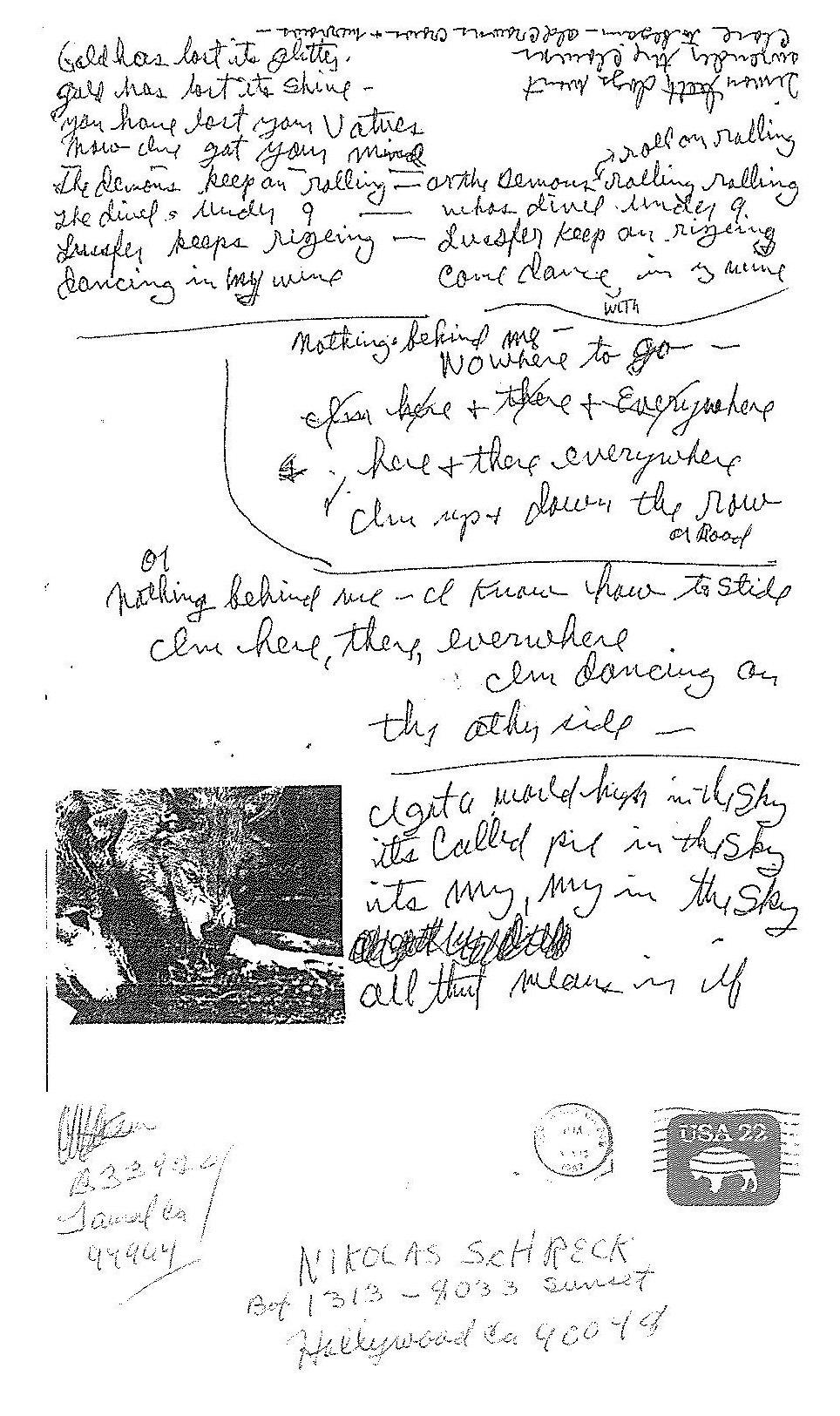
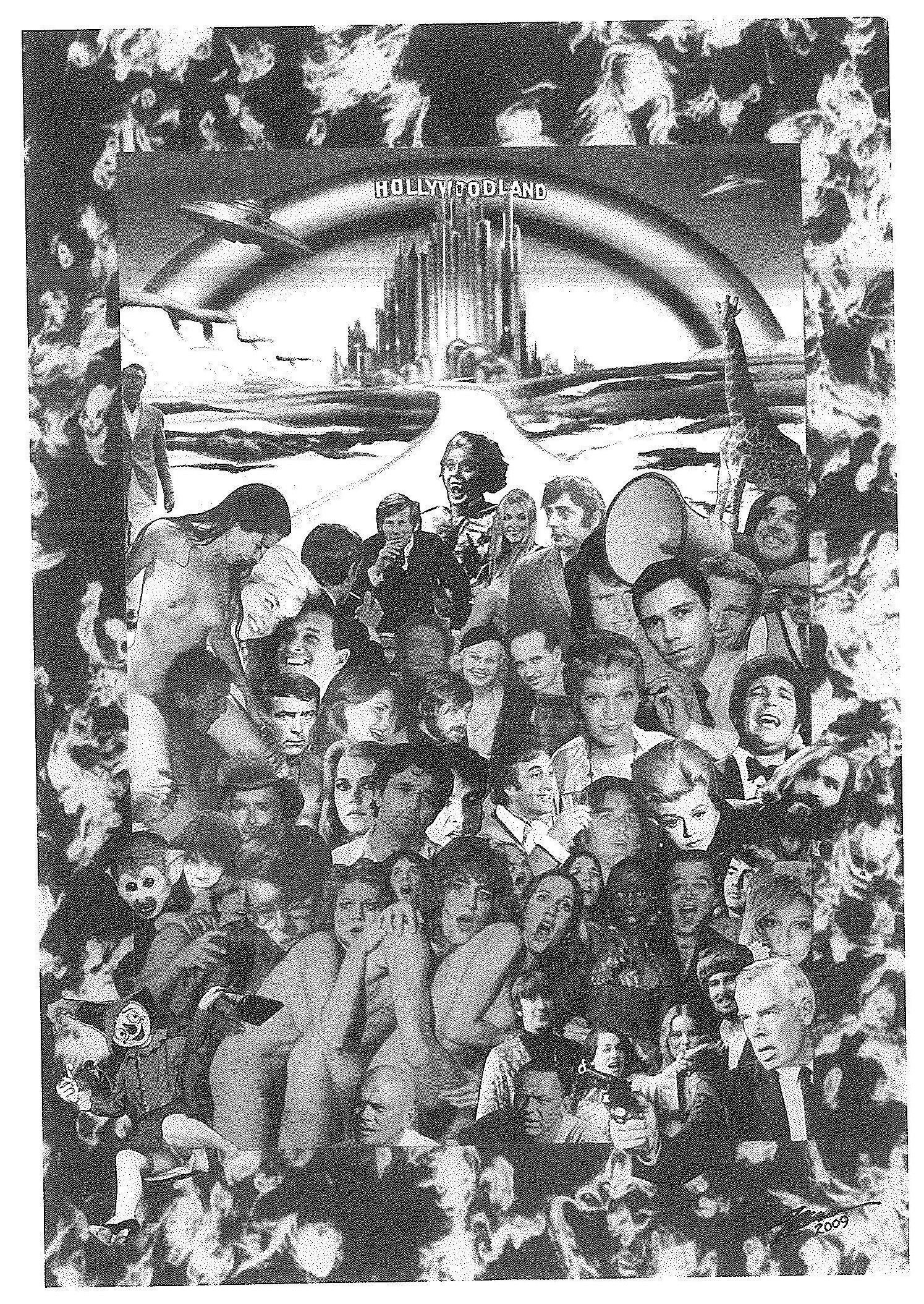
4. The Beverly Hillbilly
The God. of Fuck Meets the Beautiful People

In the Mind Control Center of the World
“If there’s a power of good, it follows that there must be a power of evil. And I’ve seen evil. Years ago, Hollywood used to be one of the most evil places on earth. No, I’m not joking.”
Vincent Price
“Hollywood will play anything for money and I mean anything. They will cover up the lives of others so they can be a star and cheat others out of their lives. You only see them playing real people. They have all sacrificed their souls and made deals with the Devil.”
Manson (letter to the author)
“I lived in Hollywood and I had all that, the Rolls Royce and the Ferrari and the pad in Beverly Hills. I had the surf board and the Beach Boys and the bishkis and the Neil Diamond and the Ram Scam and the Jimmy Schriffen and the Elvis Presley’s best of besties and all them guys. The Dean and Martins and the Nancy Sinatras and the cops and sovereigns, “Will you do it to me? I hear you do it good honey” and all that land of “Will you come up to my house later?” So I went through all that and I seen that was a bigger prison than the one I just got out of and I really didn’t care to go back in prison. See, prison doesn’t begin and end at the gate. Prison is in the mind. It’s locked in one world that’s dead and dying, or it’s open to a world that’s free and alive.”
Manson
We begin to talk about Charles Manson.
“I knew the dude,” Troy tells me. “I used to play volleyball with him on the beach at L.A. years ago. He had short hair back then, but even then he was very big with the chicks.”
What was his secret, I asked.
“It was his cock,” says Troy.
“His cock?”
“His cock.”
Actor Troy Donahue interviewed by Ron Rosenbaum in The Village Voice, July 29, 197/
“High Society: How did the family get started? How did you gather this group of people?
Charles Manson: Whoa, now that’s another false premise. I didn’t gather no group of people. This gathered a group of people [he gestures towards his crotch]. If I lay down, and I fuck it, it generally follows me around— and it does the washing, and it does the cleaning.”
All the world over, the magic word “Hollywood” conjures up alluring images in the minds of those who ve never been there: An idyllic paradise where eternal sunshine fells forever. Where glamorous bodies bask by swimming pools. And limousines disgorge their idolized passengers onto red carpets.
In Mansons vocabulary, the same word was spat out as a synonym for everything false, corrupt, and toxic. More than a geographical location, the Hollywood reviled by Manson is a state of mind. Few outside the movie and music industry’s charmed circle saw so deeply into the
Day of the Locusts nightmare hidden behind the dream factory as he did. And fewer still lived to tell the tale.
Not that the circumspect Manson, never one to kiss and tell, revealed much about what he witnessed during his time among Tinseltown’s ignoble nobility. Just as he’s refused to snitch on his confederates in crime who dragged him back to jail, so has he “held his mud” on most of his fair-weather friends among the entertainment elite. But a few of his more candid comments, when placed in context with information provided by other contemporary observers, allows us a glimpse into the sordid backstage inferno concealed by the glittering curtain.
Prurient voyeurs might hope that what we’ll uncover will simply allow them a vicarious peek into the bedrooms of the famous during the height of the Sixties sexual revolution. At the other extreme, prudish moralists may be looking to cluck their tongues over celebrity depravity. But our line of inquiry isn’t intended to feed the tawdry love/hate fascination with movie star orgies and drug abuse that’s motivated previous accounts of this aspect of the Manson phenomenon.
All that is window dressing. The untold story is how and why the Hollywood establishment effectively covered up the true nature of the crimes that rocked it to its rotten core in August of 1969. A complete run-down of every celebrity Manson and his girls had carnal knowledge of during their L.A. wanderings would require a chapter long enough to contain a virtual Who’s Who of then-New Hollywood. Who fucked who is only relevant here to the degree of how said couplings led to who killed who — and why.
For those who buy into the reputation-saving cover stories quickly conceived after December of 1969, Manson’s status in Hollywood was never more than that of a desperate arriviste. Charlie the country bumpkin, way out of his depth among his social betters. A wanna-be, his face pressed against the glass of the dazzling realm of fame and riches which rejected him.
But as with those facets of the Manson myth we’ve already examined, these stereotypes completely contradict the facts. It wasn’t Hollywood that deserted Manson, but vice versa. “I had that towns legs wide open, man”, he said, “and I pulled out of the bitch when I saw it was another cage just like the one I already got out of.”[131]
By Halloween of 1968, only a year and seven months after he stepped out of Terminal Island, Manson had already had his fill of polluted and overpopulated Los Angeles. The way he recalled it later, he’d been cheated and exploited by his fair weather show business friends.
After Manson decided not to pursue the offer to record for UNI Records or to serve as technical adviser on the Jesus film being prepared at Universal Studios, only three months after his parole, he came under Neil Youngs enthusiastic patronage. Rising star Young’s efforts on behalf of his ex-con discovery couldn’t convince Reprise Records head honcho Mo Ostin to sign Charlie.
Since April of‘68, thanks to the cheerleading of Dennis Wilson of the Beach Boys, record producer Terry Melcher had taken up the Charlie cause. Until tracks for the promised Melcher-produced Manson solo record were laid down, Charlie allowed himself to be groomed for pop stardom by none other than Brian Wilson, whose own eccentric ways gelled with the talented if undisciplined singer-songwriter his younger brother bought into the fold. Meanwhile, Charlie eagerly awaited the appearance of one of several songs he’d written for the Beach Boys on an album due to be released in December of that year. His hopes would be dashed. The bastardization of “Cease To Exist” into “Never Learn Nor To Love” turned out to be another ripoff.
Manson’s attitude about his sporadic attempts to go straight with the guidance of his music industry patrons was captured in a September 28, 2007 conversation with his long time friend Derek Haze. As Charlie remembered,
“So then they come to me and they say, we want to make you a Beach Boy. I say, fuck you man! They say, we want you to change this song and rearrange, I say. I’m not changing my song. Ya’ know, I made a song up for what I was saying. And you know, I don’t care if you listen to it. And they say, well we want to put you in a movie. And we wanna’ make this... You play with these guys. I’m not playing music with those guys. And they say, well you’re not gonna play music in this town. And I say, I play music wherever I’m at, I don’t need you, or your town. It’s for the experience. It’s for the experience of doing it, man, that’s all I’m doing. I’m doing what I’m doing, man. We used to get and put our instruments on the horses and go up on Indian Mesa. A big flat area. Build campfires, and sit up there two or three days getting loaded, playing music. You know, we’re not playing it for public consumption — we don’t care what the public thinks. If you’re playing music for what the public thinks you’re playing for little girls. That’s why me and the Beach Boys split up, I didn’t agree with Neil Young, or the Jefferson Airplanes, or Frank Zappa. I used to play with Zappa, he’s a big asshole. He used to steal everybody’s stuff. He’d get you over to his house, get you playing and tape recording, then copy everything you were doing. And say it was him, you know.”
He’d seen through the vacuity of the fame game others were pushing on him. It quickly become clear to him that success as a musician came at the price of one’s soul, and a willingness to be the pawn of the powers who ruled the entertainment monopoly.
One year earlier, Manson left the death of Hippie behind in Haight-Ashbury. Now he was ready to move on from L.A.’s equally moribund scene. This time he wanted out of society altogether. A conclusion many other back-to-nature counterculture communes had reached during the violent political and cultural paroxysms of 1968. As soon as Manson encountered Death Valley’s desolate majesty, he knew that he’d found his spiritual home. Manson began preparing to move his circle from its urban base into the deserts unspoiled wilderness. Many of the citified girls on the Way of the Bus, however, were not as enamored of roughing it in the wasteland as he was. That dissatisfaction, along with other factors we’ll examine, began to slowly break the original cluster into increasingly divisive factions.
This retreat to the desert was not simply the attempt to lay low after the murders that it’s routinely presented as. Nor did it have anything to do with the realization of a non-existent master plan involving a cosmic race war. A simple computation of the chronology involved shows that Manson’s plan to relocate to Death Valley was already in high gear long before the series of drug-related homicides he was linked with took place.
Manson ended up back behind bars only twelve months after setting out to find freedom in the desert largely because of his entanglement with one of his companions’ naive and incompetent mingling in a mundane turf war for Hollywood drug distribution. To understand how and why those crimes happened the way they did, we first need to explore the background of the criminal network of professional and amateur drug dealers then fighting for market dominance over the wealthy customer base of Hollywood’s “beautiful people.”
If the true banality of those completely commonplace crimes had ever been understood from the outset, the monstrous legend of Helter Skelter that was created to conceal their actual circumstances could never have arisen. Had it not been for the fact that the rich and the famous were involved, there would have been no reason for the vast but surprisingly insubstantial cover-up which ensued.
Manson’s own matter-of-fact epitaph for the Cielo Drive episode gets right to the meat of the matter: “The only thing that made that any different than anything else,” he said, “was that that broad happened to be an actor. If she hadn’t been an actor, no one would have even heard about it, man, and probably no one would have got busted.”[132]
Helter Skelter was a Hollywood production, a Made-for- TV movie dreamed up after the fact.
Manson’s much-rumored ins and ours with the Hollywood in crowd are usually treated as nothing more than entertaining tittle-tattle, celebrity gossip of no special relevance to the nuts and bolts of the case. The Manson myth depicts the events of the long hot summer of 1969 as the result of a socially marginal hippie cult’s psychopathic rampage against celebrities they never knew. Accordingly, the Hollywood factor in the case is usually reduced to the ever-popular “Revenge on the Rich Pigs” motif.
The most popular telling of the myth presents an all too simple scenario. On the side of the angels, we have the innocent movie and rock royalty. Unsuspecting random victims dwelling on their Mt. Olympus, blissfully unaware of the evil forces waiting to strike like lightning from a social netherworld so depraved nobody could imagine it.
But the real story is distinctly lacking in the clearly delineated cardboard hero and villain characters of which Hollywood is so fond. Shades of gray have been converted into the stark black and white which a B movie occult-crime thriller requires to keep its audience’s attention. Much of the aura of mystery enshrouding the Manson case is a special effect produced by movie industry magic. A thick cloud of studio fog intended to hide the fact that the border between the Spahn Ranch and Cielo Drive was never as distinct as we’ve been led to believe. Nor was Manson the starstruck loser seething with jealous resentment against the rich and famous proposed by the myth. On the contrary, he and his circle were welcome and intimate guests in the never-ending series of wild parties that was Hollywood in the last two years of the 1960s.
The Tale of Two Cities picture we’ve been sold of the Manson circle as subhuman predators lurking in the gutter waiting to pounce on the unknown moneyed piggies they hated is a deliberate distortion. That interpretation is as laughably false as the take that prefers to see the murders as revolutionary acts of class warfare. Both notions are as misguided as the concept of occultoid ritual serial killings we’ve already dismissed.
Instead, what we have here is exactly what most crimes of their ilk turn out to be: a few people who know each other well, and who were well known by hundreds of others to have belonged to the same exact social circle, end up killing each other because of their mutual involvement in the dangerous occupation of the drug trade.
As we’ve already begun to see, the overwhelming aura of supernatural evil that this case has been granted can only appear ridiculous when it’s brought back to earth into the actual everyday circumstances and conditions which set it ail in motion. It’s not the inexplicable marauding of a sinister sect that we’re dealing with here — it’s the rather less dramatic account of how a series of overlapping drug-propelled celebrity parties inspired by nothing more ominous than getting high and getting laid got out of hand.
There are mysteries aplenty here. Some of them unsolvable at this late date. But almost all of those enigmas have to do with the attempt to disguise what was really happening in the lives of the famous, not in the actual commission of the crimes themselves.
As journalist Lessley Anderson wrote in a surprisingly accurate 2004 SF Weekly article: “ Manson always had girls hanging around him, and at that time they traveled from crash pad to crash pad in a black school bus. They weren’t viewed as a cult, but rather a commune of sorts that showed up at parties right alongside entertainment-industry types, including Dennis Wilson of the Beach Boys.”
That last simple sentence, as plain as it is, includes in condensed form all of the factors that set the stage for what was to come.
A Courtroom Drama
“I want to see the Sharon Tate murder trial, and all the other Hollywood sights.”
Anonymous Tourist visiting Los Angeles chiring the trial, 1970
Hinted at in the earliest media reports, and then quickly recanted, much of Mansons hidden Hollywood history had already been drastically edited and swept from the cutting room floor before the trial presented its false version of events to the public. This hasty revision was not only meant to cover up Mansons inconvenient links to several powerful public figures. It also sought to black out the ugly secret a serious investigation of the crimes would have laid bare: organized crime’s extensive involvement in movie and music production and its distribution of drugs to America’s beloved celebrities.
This elaborate subterfuge was also driven by a secondary financial consideration. A thorough investigation had to be blocked at all costs because it would have surely led to the unacceptably kinky private lives of the Hollywood elite being made a matter of public court record.
That such machinations would be resorted to may seem strange to younger readers, who’ve grown up in a time when celebrities win attention by deliberately leaking porno videos of their most intimate moments, and happily reveal every gory detail of their drug addictions to the press. But despite the new moral permissiveness that took hold in California during the late Sixties, the sex and drug excesses of the stars were still carefully guarded secrets. Polymorphous LSD orgies might have been the order of the day in Malibu or Bel Air. But such antics wouldn’t go down well with the stars’ all-important fan base in, say, Des Moines or Kankakee.
In a company town like Los Angeles, whose politicians and cops were studio puppets, a servile legal establishment broke every law in the book to perform judicial somersaults assuring that the real story never saw the light of day. The local media, whose bread and butter depended on smooth relations with the entertainment industry and its flacks, went along with the party line. As we will see, this was business as usual in a city where image is all. Los Angeles police, attorneys and journalists had a long history of covering up the illegal indiscretions of the stars dating back to the 1920s. The studios — and their underworld business partners — wrote the screenplay for the trial and the lawyers dutifully played the roles they were given. Manson hinted at this in 1970, when he explained the real reason Judge William Keene denied his right to defend himself at his trial: “He took away my pro per privileges, because they don’t want me to speak. They want to shut me up — because they know if I get up on the stand, I am going to blow the whole thing wide open. They don’t want to hear it.”[133]
In the decades since the trial, few have seriously wondered what Manson was suggesting. Who, exactly, was the “they” who wanted him to shut up? What “whole thing” would he “blow wide open?” Manson knew that if the case had been prosecuted on the facts — the drug deals, the Mob, and the cozy relationships many Hollywood luminaries shared with him and his friends — the mother of all Hollywood scandals would have exploded. Manson said as much literally several times.
And his prosecutor, Vincent Bugliosi, knew it too. If the trial had focused on the criminal connections between the victims and the perpetrators — and the organized crime milieu they had in common — Bugliosi would have been forced to contend with the highest-paid lawyers in the state rather than the hopelessly inept Public Defender’s Office he so easily out-maneuvered.
And he would have been forced to subpoena the likes of Steve McQueen, Yul Brynner, Peter Sellers, Dennis Wilson, John and Michelle Phillips, Cass Elliot, and Roman Polanski, among many others, to testify in open court. In any other trial, the conspicuous absence of these witnesses’ crucial testimony would have amounted to deliberate suppression of evidence. But since it was only the hairy heads of some penniless and socially undesirable hippie malcontents on the chopping block, such legal niceties could be overlooked without raising a peep of protest.
Instead of allowing a proceeding to be staged that would have revealed the entertainment industry’s true nature to its credulous customers, Bugliosi invented a plot worthy of a Hollywood horror movie. The District Attorney who invented gripping crime plots for TV director-actor Jack Webb imposed his fictional skills on real human lives. This speedy but ingenious rewrite excluded all mention of such mundane factors as drug deals, the Mafia, and shady financing among film studios. It replaced them with the crowd-pleasing extravaganza of witchery, race war, and hippie depravity called Helter Skelter. It is no exaggeration to say that the counterculture, with the “Manson Family” standing in as its symbolic scapegoat, was chosen as a convenient sacrifice in the Los Angeles County Hall of Justice in order to protect the dream factory’s public image.
During the trial, as we will see, at least one key organized crime witness known well to the murderers and the victims was rubbed out by the Mob, in part to prevent him from exposing these connections. And after the trial, as will also be explained, a deeply involved major movie star who threatened to talk was very nearly the victim of another related Mafia hit.
Hollywood’s millions were at stake. Lucrative careers were on the line. The resulting cover-up was so thorough we will never know the full story.
But from the deleted scenes that survive from this lost production, we can splice together something approximating a director’s rough cut.
Sleazy Sources
Some of the most specific information Manson has revealed of his Hollywood adventures was communicated in the course of a correspondence he carried out in the late 1970s with Bill Dakota, then Associate Editor of the trashy Hollywood Star gazette.[134]
A bottom-tier gossip columnist whose specialty was haunting gay bars in order to “out” closet celebrities and speculating on the penis sizes of the famous, Dakota would seem an unlikely pen pal for the gossip-hating Manson. Slightly more watered-down and legally vetted revelations in this vein were also offered in Nuel Emmons’ purported “as told to” Manson in His Own Words, which Manson rightly said should have been called Manson in Emmons’ Words.
Considering Mansons strict policy of keeping the secrets of others, his willingness to speak so openly about his sexual escapades among the famous to Dakota and Emmons appears strangely out of character. One explanation for his earlier anomalous indiscretion in these two cases, can, I think, be found in the period in which Manson transmitted this information to them.
Manson was then incarcerated in Vacaville Medical Facility. Notorious for carrying out drug and psychological experiments on its inmates in complicity with U.S. intelligence agencies, Vacaville then forced Manson to submit to a “treatment program” that included several powerful pharmaceuticals intended to tranquiiize him.
The dire results of this enforced medication can be seen in the first post-trial television interview Manson was allowed to grant, his conversation at Vacaville with NBC news reporter Tom Snyder. Visibly sedated, glassy-eyed, and uncharacteristically slow and slurred of speech, the Manson recorded there is clearly struggling in a chemical straitjacket to remain in full possession of his faculties. Manson’s medicated state gave audiences seeing him interviewed for the first time the desired impression of a drug-damaged hippie. And that allowed Snyder, talk show host extraordinaire, to pretend that he was taking his life in his hands by going head to head with an unstable madman. The negative effects of the Vacaville medication treatment can be seen even more dramatically in an unreleased interview with Manson which Nuel Emmons commissioned at Vacaville at the time he was compiling the material he eventually assembled as Manson in His Own Words.
According to Bill Dakota, after he published the revealing comments Manson had written to him in Hollywood Star, Manson called him to disown the letter, claiming it had been intended for another recipient. With somewhat more justification, as we will have cause to examine later, Manson also accused Nuel Emmons of misquoting him and “twisting his words.”
These second thoughts and disavowals may have resulted from Manson’s chagrined realization that the tranquilizers and anti-psychotic medicine he was made to take at Vacaville had temporarily impaired his judgment. The well-known “truth serum” side effect of such pharmaceuticals would explain why Manson spoke so freely about matters he would have ordinarily never have discussed.’[135]
This is supported by the fact that since his transfer from Vacaville in 1985, a mostly unmedicated Manson largely reverted to his former reticence, save for a few exceptions.
Charles Manson, President, 3-Star Enterprises
While most material about Manson and Hollywood only covers the ‘67-’69 period, Manson himself dated his involvement with the film capitols players as far back as 1958.
Writing cryptically of his “bed that went through all the stars, Elvis and a bit more,” Manson recalled, “When I had sex on Orchid Avenue, Orange Street and the Hollywood Roosevelt Hotel across from the Chinese Theatre.”
What Manson obliquely refers to here is the period in the late Fifties when he and a prison crony named Tony Cassino set up an entertainment enterprise of sorts on the margins of legitimate show business. The side streets named above marked the range of their Hollywood Boulevard turf. Business cards handed out to young, female, starry-eyed Hollywood hopefuls newly arrived in search of fame identified the Manson and Cassino team as President and Vice-President of “3- Star Enterprises — Nite Club, Radio and TV Productions.” This fledgling film production venture, the cards said, operated from offices at 6871 Franklin. As fate would have it, 3-Star’s humble headquarters was very near to the Franklin Avenue apartment where Manson’s near-fatal shooting of Bernard Crowe almost ten years later marked the end of Manson’s chances for mainstream success in the rock industry.
To the degree that it was ever more than a name on a card, 3-Star Enterprises kept mostly nocturnal business hours. That’s when 3-Star’s promising young talent entertained gentlemen callers in rooms rented at the Hollywood Roosevelt Hotel. In the 1950s, the Roosevelts cocktail lounge was already a well-known hookers haunt. More than one famous John could be seen prowling there for professional companionship. That Hollywood tradition lasted well into the early 80s, when the Roosevelt was a seedy ghost of its former grandeur.
Police reports tell us that Charlie and Tony promised their female discoveries that they would be introduced to “legit” movie producers if only they put in a little paid time on the casting couch, namely a bed in the Hollywood Roosevelt. As for the “TV Productions” 3-Star shot, we can get some idea of their content from an angry complaint brought to the attention of Mansons parole officer by one Ralph Samuels. His 19-year old daughter had not only been persuaded by young producer Manson to invest all of her savings in 3-Star Enterprises, Samuels claimed, but she had also turned tricks for him before he impregnated her.
Tracking down his daughters procurer at a run-down rooming house in Pasadena, the enraged father found that Manson had already abandoned the premises. In the refuse left behind, Samuels claimed to have found pornography featuring his daughter with Manson. 3-Star Enterprises apparently sold such material to out-of-state clients in the market for these then-illegal entertainments.
And this is not the last we shall hear of such productions.
Setting the Psychic Stage: A Necessary Interruption
Something to keep in mind before we flash forward from Manson’s (relatively) staid Beat beat during the Fifties to his full flower in freaky 1968:
Almost all of the Manson circles interaction with the Hollywood Hipocracy rook place under the influence of one high-powered consciousness-expanding substance or another. Acapulco Gold from right across the border. An especially potent stock of Nepalese hash smuggled in from Kathmandu during those years. The even more robust Iranian bricks of hashish on the market thanks to the Shah’s SAVAK dabbling in the dope trade. Gary Hinman’s still legal special recipe for home-made mescaline. A veritable rainbow of various LSD subbrands (including but not limited to the unparalleled Orange Sunshine flooding the market thanks to the CIA). The last remnants of Owsley Gold, doled out only on extraordinary occasions. Peyote and psilocybin mushrooms. The paranoia factor kept steady by the crystalline sparkle of coke and speed dusting celebrity nostrils. Even such outre mind-manifesters as the brain-cell dissolving Belladonna and the milder datura, forgotten since the days when they were the main ingredients in witch’s Sabbaths, enjoyed a Hollywood comeback.
And by ‘69, new kicks kept the jaded party-goers going right before the fun came to a sudden end on Cielo Drive. One was the rapid but overwhelmingly intense psychic rollercoaster afforded by DMT which sent you hurling into another galaxy for a few minutes before you crashed back to earth with equal violence, all senses scrambled. And by mid-69, the best connected cosmic connoisseurs went wild for an empathy enhancing aphrodisiac smuggled in from Canada. This latest ware on the entheogenic emporium was called “fairy dust.” It eventually switched its name and trickled onto the mass market in the 1980s as the raver’s “love drug”, MDMA or Ecstasy.
In other words, you’ll never grok the whole Charlie Does Hollywood Happening in its fullness unless you understand that it all unfolded through minds bombarded by whatever chemical kick could be entered into already overburdened nervous systems.
Everyone involved was either on their way to score, about to take off, peaking in the full effulgence of the white light, or, dare I say it, coming down fast into the numb affectless neural aftermath of acid oblivion.
With this in mind, try to see what follows as a drama played out through mental prisms either sloooooowed down to theTHC vibration hypersped to the methedrine rhythm, or with hallucinations gleaming in the center or periphery of vision, all clashing against each other.
Imagine the emotional intensity of every action, word, and thought turned up to the maximum calibration of nerve tingles, all senses heightened, each sting of paranoia as well as every wave of pleasure amplified according to a geometric scale not wholly of this dimension.
To be sure, many of the more inculpating interweaving of the Manson clan and the beautiful people have been stricken from the record due to willful malfeasance, desire to deceive, and a certain amount of face-saving denial.
But another factor has to be taken into account. The aging baby boomer memories of those concerned are often so maddeningly vague in recalling the chemical countdown to Cielo Drive blastoff and crash landing simply because the toll of too many trips may not allow them to remember.
“Its A Great Party”: The Celebrity Skin Videodrome ‘69
Ten years after the fall of 3-Star Enterprises, an updated sister operation rose from the ashes in the form of a black bus roaming through Los Angeles.
White letters on the side of the bus proclaimed the vehicle to be the mobile unit of Holywood Productions (not a pun but a misspelling by a French hippie girl who painted the letters.) Many eyewitness accounts verify that Manson and his ‘60s circle frequently identified themselves as a roving film crew. This precense was maintained as late as the early summer of 1969, when chey are known to have stolen state of the arc film equipment from an NBC news station wagon.
And, harking back to the old 3-Star days, persistent rumors suggest that purloined camera and sound equipment was pressed to the service of producing porno films at the Manson circles “Yellow Submarine” house on Gresham Street, a Malibu property’s swimming pool and at several other locations on their journey. Some of the stolen film equipment was identified and recovered in late ‘69 when che police raided the Barker Ranch during Manson’s last stand in the desert. Other sex scenes were alleged to have been shot on a bulky prototype video camera donated by Dennis Wilson.
Whatever happened to these legendary home movies?
It’s widely believed that Manson’s ex-con associate Bill Vance spirited the Manson-produced porn away and disposed of it before ic was confiscated by che law. I haven’t been able to verify chat. If they ever existed, these films appear to have vanished into the same elusive twilight zone which devoured the equally fabled celebrity porno videos discovered by police at 10050 Cielo Drive during their investigation of che murders. The experienced pornographer Mansons detailed knowledge of what was on these tapes, which he discussed with me many times, raises questions about the degree of his intimacy with the Cielo crowd that have yet to be answered.
Since che last edition of che book, it’s been confirmed that even Vincent Bugliosi finally admitted to his nemesis, authorTom O’Neill, that homicide detectives informed him early on that they’d seen at least one video discovered at the crime scene showing Tate being forced to have sex for the camera with two unknown men. We know of many more such X-rated entries in Tate’s secret filmography. For the cult of Saint Sharon who dismiss reports of abusive orgies in the House of Polanski as sordid gossip with no bearing on the case and its cover-up, this confession from one of their own that there’s smoke to the fire must be a hard pill to swallow. After all, this wasn’t mean-spirited rumor mongering from che pro-Manson fringe. This came from the cover-up’s front man, the lying lawyer who spent decades doing his job of protecting the reputations of the victims. Bugliosi’s revelation also inadvertently implied that he was involved in the investigation of the case much earlier than was previously presumed, a mystery as yer unsounded.
Among Sharon Tate’s friends, other than Gene Gutowski, only the actress Joanna Pettet, who visited Cielo on the afternoon of August Sth, has publicly gone on record as admitting that Tate spoke of the sex films Polanski urged her to participate in.
Of al! the many parallels between the surprisingly similar lives of che perpetrators and the victims, the talk of privately made and secretly distributed porno manufactured by both camps is the one that never goes away. Whispers of these two collections of spectral films flickered throughout the case with frequency right from the beginning. All that can be confirmed is that among the many things Roman Polanski and Charles Manson had in common in 1968 and 1969 was the face that they both had early model video cameras in their possession.
Not one snippet of what they or their closely connected mutual social set may have filmed on chose contraptions has entered the public record to date. Considering human greed and cupidity, and the easy access of anonymous Internet transmission, you would chink that some evidence of these candid camera productions would have emerged by now if there were anything to the rumors. Odder still, considering how photogenic and colorful a troupe the passengers on the Holywood Productions bus were, there is barely any photographic documentation of them prior to their much-publicized arrest. One would imagine chat enterprising journalists would have bought up as many photos of the murderous hippie commune that they could find in the media frenzy of late ‘69 and 1970. This absence of everyday snapshots of the group with Manson has contributed to the myth, creating a vacuum for the public to fill in with its own lurid imagination. We do know that the FBI confiscated several photos of the Manson commune during che initial investigation but these have never seen the light of day again.
What’s interesting about these tales, however, is chat they were told by people from every side of the case. And the names of the players said to be have been involved consistently reveal the relationships between che Manson and Polanski social whirl that were later blacked out of the public record. Manson suggested more than once that the entire Helter Skelter hullabaloo was simply designed to distract from the role these vanished “smokers” played in che cover-up of che crimes. In his controversial tell-all to the Hollywood Star — printed in full after this chapter — Manson makes several allegations about such films, all of which he claims were made on the then brand-new video technology.
In that document, for instance, he claims that Jane Fonda and an unnamed boyfriend asked him to participate in a porno film involving a dog, but that he refused, saying that ‘T do what I do for love not money.” He asserted that Fonda and her partner “had got a key to [comedian] Red Skelton’s beach pad” and that he spied through a pre-existing “peek place” on Fonda and her partner shooting video tapes with “the dog and the guy they picked up at UCLA.”
According to her own husband, director Roger Vadim, Fonda was famously found fucking Jay Sebring in a Cielo Drive bathroom by the Polanskis’ maid at a party held shortly before the murders. And as we shall see in the next chapter, Fonda was close enough to Tate and Sebring to be debriefed on the real background of the murders shortly after they sent her social scene into a panic.
And Manson suggested that the canine capers he was invited to play along with resembled “the same kind of video tapes that Peter Sellers and Yul Brynner were making.” Sellers — who’d recently starred in the hip romp The Party, a pop saThe of exactly the kind of Hollywood hedonism scene he was so much a part of — was instrumental in putting up the $25,000 reward money offered to anyone who came forward with clues leading to the apprehension of the Cielo Drive murderers.
He convinced his friends Yul Brynner and Warren Beatty to pitch into the reward money pool. And all three of them were linked to the sex video allegations. At a press conference he held as orchestrator of this effort, Sellers offered this desperate plea: “Someone must have knowledge or even suspicions that they are withholding or are perhaps afraid to reveal. It is inconceivable that the amount of blood on clothing could have gone unnoticed. So where is the blood-soaked clothing, the knife, the gun, the getaway car... Someone must be able to help. Please!”
One possible reason motivating the comic who played The Pink Panthers Inspector Clouseau to turn to real-life detective work was suggested in a 1990s interview Manson granted to Ronald Reagan, Jr. in which he brought up Sellers and Brynner again. Manson told Reagan, Jr. that the real mystery of the Tate killing involved vanished celebrity sex videos.
“Did they tell you about the films that they got with the dogs and the chauffeurs that came out of the black-and-white ... Yul Brynner and Peter Sellers paid $30,000 to get the video tapes back that they’d done with the pornography where they was gobbling on each other’s knobs in the closet with Sharon — poor Sharon, beautiful Sharon?”
Is that just Crazy Charlie’s mean spirited ranting? Perhaps not. Anyone who’s seen the full-frontal photos of the bohemian bisexual Brynner in his younger days posing in the nude for gay photographer George Platt Lynes will not be startled to suppose that the actor was still an erotic exhibitionist when the Sexual Revolution hit in the 60s. And there’s even a time-appropriate Polanski connection as well. Take a look at an uncredited Brynner as a singing drag queen trying to pick up Roman Polanski in the 1969 film The Magic Christian, a campy comedy starring none other than Peter Sellers. After you watch it, see if it’s hard for you to imagine the swinging scenario Manson described.
This odd couple of Dr. Strangelove and the King, of Siam Manson mentioned are just a few of the strange bedfellows whose cavorting flits through the video rumorscape.
While he was going through a drug-addled middle-aged hippie phase, Sellers forged a close but uneasy friendship with Roman Polanski. And both Sellers and Brynner were long time Jay Sebring drug clients. Apparently nobody ever found it suspicious that the completely bald-headed Brynner visited Sebring’s hair salon so frequently.
That Manson was aware of this was made clear in his usual roundabout way in a note he sent to Paul Krassner: “Sebring did Susan [Atkins’] hair and I think he sucked one or two of her dicks... that girl loves dick, you know what I mean, hon. Yul Brynner, Peter Sellers...” Brynner was also connected to another name char will take on more meaning as we dig deeper: that of Joel Rostau, the Mob’s main drug pusher to the scars at the time.
When I asked Manson the source of this knowledge he told me that the insecure Atkins bragged frequently to him about how many celebrities she’d seduced, and that Sebring, Brynner and Seilers were just three of many. Mansons claim that Sebring was sexually involved with these and other male entertainment industry hedonists was seconded during a 2019 interview I conducted with record producer and song-writer Bob Esty, a close friend of Cielo Drive owner Rudi Altobelli. As will be expanded on later, Esty was informed in 1975 by Altobelli that Sebring was one of a small circle of prominent closeted show biz folk who made use of the isolated Cielo property as a discreet place to cavort chemically and sexually. Esty said this arrangement was still going on in the mid-70s, as he experienced first hand. Although by the disco era the drug dealers were different, Esty also recalled Altobelli citing Tex Watson, Sebring, and the above-mentioned Joel Rostau being among those supplying the drugs for these festivities five years earlier.
Joel Rostau, the mod mafioso, dropped off the goods on his vil- la-to-villa rounds in a sporty Jaguar E-type that car-crazy Terry Melcher and Dennis Wilson must have admired. (Their mutual friend John Phillips drove the same model.) In a time when business and pleasure mated promiscuously, Rostau’s movie scar clients also became his friends. On the wall of his bedroom in the stylish apartment at 840 North Larabee, which will play such an important role in what’s to come, the police had occasion to note a whole gallery of personally inscribed stills of the stars on display.
Among the photographs of Rostau’s client chums was one of the mobster posing with Yul Brynner. At the time the cops stopped by, they were interrogating Rostau’s girlfriend, who just so happened to be employed at the hair salon cum drugstore of a certain Jay Sebring. You begin to see the connections.
According to Manson’s defense team Shinn and Kanarek, the legal representative of at least one unnamed young starlet quietly approached them during the trial with a discreet inquiry. A reel of undeveloped film of his client in compromising sexual situations had turned up missing at the Polanski residence. Was there any way he could buy it back for her?
This was only one of many back channel negotiations a nervous film and music industry carried out behind the scenes. The carefully stage-managed trial assured that the famous were spared from public embarrassment — no matter what injuries the truth suffered in the process. The very real possibility of Manson spilling the beans in court on his celebrity connections even led one posse of worried industry players to secretly beg the court to let Manson off with a lesser charge to keep him from talking. Had he been able to call his own witnesses to the stand, as was originally agreed, he may well have walked.
To be fair it must be said that Manson’s claims that Cielo Drive was a porno playground during Tate’s brief residency, are, it almost goes without saying, roundly denied by Polanski. In his first post-murders press conference in August 1969, he even felt it necessary to sarcastically call his blood-spattered home the “orgy house.” Before Bugliosi spoiled the story by spilling the beans, the director consistently cleaved to the half-truth that the only sex film found at the crime scene was, as Polanski insists in his i 984 biography Roman-.
“[V]ideotape of Sharon and me malting love found by a detective on the little mezzanine over the living room.... Although I was never questioned about the tape, I should no doubt be accused of concealing a significant aspect of our lifestyle if I failed to mention its existence... The VTR was the one I’d bought from Paramount after using it to tape rehearsals of Rosemary’s Baby. It was a rare toy in the late 1960s and we played with it a good deal. One night, I suggested switching it on and malting love. ‘Fine,’ said Sharon, ‘what characters shall we play?’ The whole thing was frivolous ratlier than lewd and exhibitionistic.”
Well, maybe. Some will automatically assume that the allegations of an avowed outlaw like Manson must be untrue. His comments are often interpreted by those with faith in conventional authority as a deliberate insult to the memory of the slain not even worthy of serious consideration. But is the word of a man who drugged and raped an underage girl, and then fied from justice, only to be accused by many other women of similar abuse, any more trustworthy?
And what are we to make of a figure who spent his life on the supposedly “good” side of the law maintaining exactly the same thing as Manson? Legendary San Francisco private eye Harold K. “Hal” Lipset’s detective agency worked closely with several federal agencies since its inception in 1947. His reputation as an investigator who would go to any lengths made him a valued ally of several powerful pillars of American society.
He was employed as chief investigator in charge of analyzing the famous 18-minute gap in the Nixon tape subpoenaed by the Senate Watergate Committee. He resigned from that job only when an anxious Nixon White House leaked word of Lipset’s prior conviction on an electronic eavesdropping misdemeanor to the press. Lipset was said to have been so crafty a spy that he even followed G. Gordon Liddy and his larcenous team of dirty tricksters to the Watergate Hotel without being observed on the night of the break-in. The supersleuth’s role as a pioneer in developing state-of-the-art electronic surveillance techniques was the inspiration for Francis Ford Coppola’s post-Watergate paranoia bugging classic The Conversation, a film for which Lipset served as technical adviser.
Some of the clients who turned to Lipset’s clandestine skills in digging up dirt were as diverse as the San Francisco chapter of the Black Panthers, The American Jewish Congress, Jim Jones’s People’s Temple, Reverend Sun Myung Moon’s Unification Church, and Werner Erhard’s EST. Needless to say, what he learned about the private lives of the powerful and the notorious in the course of his work won him many enemies. But what brings the infamous gumshoe into our purview is something Lipset repeatedly told friends, journalists, and clients until his 1997 death: an LAPD source had revealed to him that porno videotapes documenting the dalliances of the famous were indeed confiscated from Cielo Drive.
Despite the fact that his own sleazy profession found him bugging and photographing the adulterous antics of his wealthy clients errant spouses, Lipset was also a kind of social crusader who opposed the police corruption he so frequently encountered. His biographer, the San Francisco Chronicles Patricia Holt, said that his detective agency was built “around a system [his clients] could trust. Trust is everything in that business.”
Lipset wasn’t trying to embarrass the film colony with his revelations. He only went public with his allegations about the Cielo Drive sex videos when he learned that Los Angeles Police Department officers were offering copies of the confiscated material to private collectors for huge sums. Lipset tried, without success, to get his friend, columnist Herb Caen, to break the story in the San Francisco Chronicle. When the mainstream press balked, he described some of what he knew to the counterculture rag The Realist. Its editor, Paul Krassner, had long been an outspoken skeptic of the Bugliosi “Helter Skelter” cover story.
While Lipset never claimed to have seen the videos himself, his description of the sex videos’ contents and casts matches Mansons in almost every derail.
Lipset said that one starred the ubiquitous tag team of Yul Brynner and Peter Sellers in an Oscar-worthy foursome with Warren Beatty and the bounteous flesh of singer Cass Elliot of The Mamas and The Papas. What’s relevant to our inquiry is not the erotic experiments of the rich and the bored; it’s that Mama Cass, like Brynner and Sellers, was a friend of Manson and his commune, a steady customer of the interconnected nexus of dope entrepreneurs who eventually made their deadly deal on Cielo Drive, and one of the first to see the crime scene there — even before the police. As we learned in Chapter II, the guest lists for the psychedelic shindigs held at Cass’s included such interesting invites as Tex Watson, Bernard “Lotsa Poppa” Crowe, Sebring, Susan Atkins, Tate, Voytek Frykowski, Abigail Folger, and Manson.
Lipset also said that a pornographic tape of Steve McQueen and Tare had been discovered at the same time, supposedly in Tates loft. McQueen was in fact romantically linked with Tate before her engagement to Sebring, More importantly, the actor was deeply — and nearly fatally — embroiled in the post-murder cover-up of his chum and coke channel Sebrings drug dealing activities. McQueen was one of the legion of Hollywood figures whose claim to have almost stopped by at Cielo Drive the night of the murder appears to be true; he was almost certainly aware of the big dope delivery Rostau had made to Sebring and Fryko that night — the delivery Tex Watson and company came to intercept.
Both Yul Brynner and McQueen had their chemical entertainment needs serviced by their trusty hairstylist Sebring. The barber flew to the set of The Magnificent Seven, a film the actors costarred in, with fresh supplies.
Lipset stated that the sex films also featured Dean Marcin performing with Tate. A coupling quite easy to imagine for anyone who ob- suvcs the intimacy between the singer and the actress displayed in behind the scenes clips of their film The Wrecking Crew (which can easily be found online). Dean Martin was a Sebring hair and cocaine client since the early 60s. From 1968 on, he started scoring his favorite stimulant of choice from Manson with whom he appeared to have had a prior connection through mutual Mafia associates.
If Lipsets LAPD informant can be believed, another incriminating tape found at the crime scene featured actress Jane Wyman having sex with one of Howard Hughes’s shady attorneys. Hughes’s Mob ties are a matter of public record; he basically bought Las Vegas from the Nevada Mafia. Jane Wymans former husband was Ronald Reagan, who was then serving as the governor of California. Mr. Law and Order Reagan’s political career was given more than a boost by the Mob-infested MCA Corporation and its crime-infested chief executive Lew Wasserman.[136] Leaving aside all the other combinations said to have been filmed, a video of that reputed liaison alone would have been sufficient to bring about the gigantic Hollywood scandal Manson has always claimed had been averted by his trial. Perhaps Manson made a point of maliciously mentioning the sex videos to Ronald Reagan Jr., the son of Reagans second wife Nancy, with this detail in mind.
Many a high-priced private detective has made a fortune blackmailing and extorting celebrities at the behest of their enemies. Whether this was the case with Hal Lipset, or if this is why he had access to this knowledge, I don’t know.
Manson also mentioned to the Hollywood Star that Dennis Wilson gave him “a $5000 video tape TV thing for tapes that fir only to an elite bunch of porno ring that was worldwide. I heard Polanski got money from dogs and children movies to make his big movies with.”
Years before Polanski fled into French exile after his arrest for the statutory rape of a 13-year old girl he was photographing, Manson claimed that he knew that Cielo Drive and other Polanski-related locales had served as the location for the production of “kiddie pornography.” These claims, I must stress, were not made in the spirit of moralistic finger-wagging. Manson was simply pointing out the hypocrisy of the media double standard that presented him as a depraved sex fiend while excusing equally questionable behavior engaged in by the victims of the crimes.
In 1993, Manson spoke elliptically of what he knew about such goings-on at Cielo Drive, again hinting at bestiality:
“Pornography... Polanski was in... See, here’s the thing, man, I don’t want to start pulling people’s covers... but all the people you thought was so wonderful and nice, they weren’t as wonderful as you thought their dogs might have been on the chauffeur’s night off ...in other words, tliere were all lands of things happening in the darkness of what was going on....Where does one camera click in and what film are we sending to Hong Kong for the other?”
Shortly after the murders, actor Dennis Hopper, no stranger to Hollywood’s drug scene, and one of many expecting to score acid from Jay Sebring on August 9, 1969, made almost identical allegations to the pro-counterculture newspaper L.A. Free Press. Speaking of the crowd ensconced in Cielo Drive, Hopper said, “They had fallen into sadism and masochism and bestiality — and they recorded it all on videotape, too. The L.A. police told me this. I know that three days before they were killed, twenty-five people were invited to that house to a mass whipping of a dealer from the Sunset strip who’d given them bad dope. And Jay Sebring was a friend of mine.”
The same combination of factors in a slightly different arrangement was mentioned in the 70s by Bobby Beausoleil. Truman Capote, interviewing “Cupid” in San Quentin Prison, described the five Cielo Drive victims as “total strangers, innocent people.” A comment which inspired Beausoleil to say, “Who says they were innocent? They burned people on dope deals. Sharon Tate and that gang. They picked up kids on the Strip and took them home and whipped them. Made movies of it. Ask the cops; they found the movies. Not that they’d tell you the truth.”
Manson’s friend Terry Melcher, usually supposed to be on the “good guy” side of the equation, despite his deep complicity in the cover-up, also unknowingly lent support to Manson and Beausoleil’s claims. Melcher told Doris Day biographer A. E. Hotchner that when he first heard of the murders committed at his former home, he too suspected that the much-rumored celebrity porno ring must have been involved:
“I hadn’t been in the house since I moved out, but I had presumed that the murders had had something to do with the weird films Polanski had made, and the equally weird people who were hanging around that house. I knew they were making a lot of homemade sadomasochistic-porno movies there with quite a few recognizable Hollywood faces in them. The reason I knew was that I had gone out with a girl named Michelle Phillips, one of the Mamas and the Papas, whose ex-husband, John Phillips, was the leader of the group. Michelle told me that she and John had had dinner one night, to discuss maybe getting back together and afterward he had taken her up to visit the Polanskis in my old house. Michelle said that when they arrived there, everyone in the house was busy filming an orgy and that Sharon Tate was a part of it. This was just one of the stories I had heard about what went on in my former house.”
Michelle Phillips has, predictably enough, since denied ever whispering this pillow talk to her lover Melcher, so I must leave it to you to decide which one of the Celebrity Cover-Up Players is telling the truth.
Melcher also mentioned the persistent rumor that “Jay Sebring had lured some of Mansons girls into one of the sado-porno movies they were making and had whipped them and beat them up for the camera, and that’s why Sebring and all the others had been killed.”
Considering that Melcher, despite his consistent denial of this fact, was sleeping with several of Charlies girls (they called him “Terry Marshmallow”) it is possible that the young loves told him about such encounters with Sebring themselves. In the weeks after the murders, there was much speculation among those who knew Sebring well that he had been the target due to his drug dealing or his indiscriminate choice in perverse playmates. One strange sideshow to the Manson circus is that in the Spanish-speaking world, it’s very commonly believed that the Cielo Drive slaughter was an act of retribution triggered by Sebring indulging his fetish on some of Mansons girls.
The source of this belief, it turns out, was journalist Jacques Harvey’s much-publicized syndicated interview with the actress Melody Patterson. Known primarily for her role as the sexy tomboy cowgirl in the TV sitcom F Troop, Patterson claimed that she not only frequently hung around Manson’s Spahn Ranch commune but was also befriended with Sharon Tate and Sebring. Although I have not been able to corroborate her claims, Patterson would certainly not be the only young Angeleno at the time who swung with both stoned circles.
When I asked Manson if he recalled her, he said, “How am I gonna remember every actress came and went on that ranch? That’s why I gave all them broads nicknames.”
When asked about the motive for the murders, Patterson claimed that “Ute knot of all the drama is Jay Sebring, the hairdresser. I knew him well and, like all his friends, I knew he was a sexual pervert: in the basement of his house in Beverly Hills, he had set up a true torture room, although perhaps that name is a little exaggerated, because really his obsessions and depravations never caused real physical harm to anyone. “
Patterson said that Sebrings deluxe dungeon was furnished with handcuffs, whips, masks and wheels on which he tied his willing submissives. “In Hollywood,” she said, “many girls were familiar with Jay’s tastes. I’ve been to his home several times myself, and at that time I lived with the Manson group, but despite the rules that forbade us having sex with the Hollywood jet set, sometimes I went to visit Sharon or Jays house ... In that sect of hippies, half mystical, half religious, I tried to rediscover the peace I had lost when my boyfriend died in a plane crash. About ten days before the massacre I left the family and resumed my usual life, but on the day of the murders I had been invited by Jay to go to Sharons house, which I could not accept, since Frank Sinatra gave a party I attended.”
Some of this is more than questionable. It’s certainly not true that Manson disapproved of his girls sleeping with rich celebrities. On the contrary, as with Dennis Wilson and Terry Melcher and many others, the former pimp actively encouraged his “young loves” to show potentially useful males a good time. As for missing out on the murders due to going to another parry, well, this is one of the most laughably common rumors B-list celebs spread to attach themselves to the perverse glamor of the case.
Patterson stated that two months after the Tate/LaBianca trial, a friend of Sebring identified only as “Eddy” told her “that three days before his death, Jay had told him that in the hippie neighborhood of Los Angeles he had run into two completely drugged girls, it was six o’clock in the afternoon, for twenty dollars each, he took them to what he called his little room, where he kept them until midnight.”
Patterson also made the unsubstantiated, unlikely, but not wholly impossible claim that Leno LaBianca had lent Sebring money to open his first hair salon in the early 60s. And yet, as Tom O’Neill recently asserted, LaBiancas name and number was indeed discovered in Sebring’s phone book, so there can be no more doubt that there was some connection between Cielo and Waverly, something both Susan Atkins and lesser known Manson commune member Vern Piumlee both maintained. Ed Sanders, when still writing pro-Manson pieces for the underground press maintained that he’d heard that Susan LaBerge, Rosemary LaBiancas estranged daughter, had been seen getting her hair done at Sebrings Fairfax Avenue salon. Even if true, her appearance there does not necessarily prove che Sebring-LaBianca connection claimed by Patterson, since everyone from the Beach Boys, Jim Morrison, to Bruce Lee got snipped by Sebring’s popular magic scissors.
In one of the many cinematic synchronicities that abound in this complex saga, Patterson’s erotically charged roles in two trashy but entertaining late 60s outlaw biker films The Angry Breed and Cycle Savages evoke the Straight Satans side of the Manson myth.
Journalist David Dalton, who interviewed Manson in 1970 for Rolling Stone, cited relevant filmic revelations from his cousin, the film actress Joanna Pettet, in his 1998 Gadfly article “If Christ Came Back as a Con Man.” According to Dalton, Pettet, one of the last of Sharon Tates close friends to visit her at Cielo Drive on the day she died “was sure the killings involved some drug deal gone wrong, or revenge by an outraged lover for some kinky sex scene. She was Sharon Tate’s best friend and Sharon had told her that Polanski was in the habit of making home movies of himself having sex with young girls and then showing them to Sharon Tate while they were making love. Jay Sebring, she said, was into some very kinky stuff. It was that kind of scene.”
Those sentimentalists who prefer to remember Sebring, Tate, Frykowski and Folger as cardboard saints are sometimes angered when any discussion of the victims’ sexual and chemical adventurism is brought up. What these sensitive hagiographers don’t seem to realize is that most of these salacious tales were told by the victims’ nearest and dearest friends and family.
The police investigation of the murders ascertained what was already the talk of tout Hollywood: Sebring did have a penchant for tying girls to his bed and whipping them. However the cops correctly decided that this had no bearing on his murder. Sharon Tate, according to testimony given to the police by her own husband, was Sebring’s willing masochistic partner during the time they were engaged. The nature of Sebring and Tate’s S/M relationship was sufficiently well-known to their friends that the discovery of their bodies tied together by a rope at the crime scene caused understandable suspicions that the murders were a result of bondage and dominance games taken to fatal extremes. And it was obvious to Sebring’s inner circle chat whoever stage-managed the grisly tableau left for the cops to find at Cielo Drive obviously knew enough about Sebring and Tate to deliberately incorporate this intimate detail into their horrid handiwork.
This popular theory about revenge for Sebring’s sadomasochistic shenanigans ran neck and neck with the equally untrue ritual killing hypothesis. Actually, the much-discussed sadomasochism of Sebring and Tate had nothing to do with their deaths; as we will explain in the next chapter, the peculiar manner in which the former lovers’ corpses were posed was a red herring primarily intended to misdirect suspicion on to a rival drug dealer known to have been an enemy of Sebring and Frykowski.
It’s possible that Terry Melcher brought the orgy films up to distract from his own deep involvement in the network of connections which resulted in the Cielo Drive slaughter. But in the process, his rumor-mongering sheds light on a relevant wrinkle in the complex domestic arrangements among Hollywood’s main dope party pads.
Terry Melcher wasn’t the only Cielo resident romantically linked to Michelle Phillips. In fact, it was because of Roman Polanski’s one-night stand with her, described in his autobiography, that he later claimed that he came to suspect that her husband John Phillips may have been the Cielo Drive murderer. Polanski claimed that he theorized that his friend John may have been driven to kill due to a jealous fury inspired by his wife’s fling with the director. Michelle warned Polanski of “John’s violence and the intensity of his rages.”
Polanski twice snooped in Phillips’ cars in search of evidence to support his theory. In the process of this amateur detection, Polanski noted that “John never went anywhere without a green carpet bag containing assorted pills and dope.”
Considering how much his bandmate Mama Cass knew about the Cielo drug dealing and the crimes connected to them, its very hard to believe that Phillips didn’t share some of this inside information with his close friend Polanski. It’s hard to know what fragments of Polanski’s narrative about his post-murders paranoia are true. Has the master of cinema storytelling used his craft to spin a more credible misdirection cover story all these years? He wouldn’t be the first auteur to rewrite inconvenient scenes from life’s messy script.
Speaking of Polanski’s pal Phillips, a useful insight into how those who knew the truth about the cover-up of Cielo operated and how they reacted to my seeking real answers from them was provided during my conversation with Phillips’ former wife, the South African actress and Sixties It Girl Genevieve Watte. In 2008,1 interviewed her (off the record, at her insistence) since I assumed that as the ex-wife of the debauched John Phillips and as the the star of Joanna, the quintessential swinging London film directed by Polanski friend Michael Sarne, she just might know something about what really went on in the rich hippie circles she swung in from 1968 onwards.
She was helpful in confirming that her ex husband Phillips knew Charlie and the girls much much better than he ever publicly admitted. Though he admitted it in private to some, Phillips publicly claimed that he never met Manson, and only knew of him vaguely from his fellow drugged carouser Dennis Wilson.
Waite readily acknowledged that Manson and others in his commune were indeed in attendance at the infamous New Years 1969 party Phillips held to celebrate the L.A. cast of the rock musical Hair. The cast for the Los Angeles production held at che aptly named Aquarius Theater included one of the Canadian drug dealers who later played a role in the murders’ background, a roommate of Tex’s girlfriend Rosina Kroner, and one of Sebring’s many girlfriends. The cast stripped naked at midnight, recreating the on-stage nudity that made the play a controversial public incursion of counter-cultural sexual mores into mainstream entertainment. Charlies recollections of this event matched what Waite told me for the most part.
Waite had lived for a few years in the early 70s with Phillips, Keith Richards and Anita Pallenberg in London where they all descended into junkie hell. She grudgingly confirmed what I long suspected, that with friends like Phil Kaufman, Iain Quarrier and Phillips to fill them in on the truth, Richards and other Stones knew much more about Charlies commune and the drug dealing that led to the Cielo killings than they have ever even hinted at.
Once Waite saw where my line of questioning was really going, however, she became rather passive-aggressive belligerent and clammed up. “Why,” she asked testily, “does it matter why those people died, can’t we just leave them in peace? It won’t change anything.”
I found Waites arrogant attitude, which took it for granted that it was perfectly fine to lie to the public about the real reasons for the murders because from her perspective it was nobody’s business, to be instructive in understanding the self-protective attitude of the Roman/ Cass clique.
Waite was a sort of female Iain Quarrier, a momentarily flashily famous and once ubiquitous icon of the swinging London scene who knew everyone who was everyone but whose spiral into drug addiction ended her career and left her as a footnote to the saga. If you’ve never seen her best-known film Joanna it captures the spirit of the time better chan many better remembered movies from chat era.
“Genevieve, Let it Bleed”, a song Phillips wrote for his wife and muse from bls 1970 solo album Wolf King ofL. A. is said to be a reflection on the mood of post-murders Hollywood. That album also makes mocking mention of Sharon Tate’s friend Steve Brandt, an anxiety-ridden movie mag gossip columnist whose important but enigmatic pare in the mystery we will explore. By the way, Wolf King ofL. A. also features Larry Knechcel, one of the session men who played on The Doors’ studio tracks and on the forbidden-to-mention Melcher sessions Charlie recorded with the Wrecking Crew which shows you just how interwoven this crowd was.
An earlier song John Phillips wrote for The Mamas and the Papas, “12:30: Young Girls (Are Coming to the Canyon)” is another of the prophetic foreshadowings of the murders which emerged in the popcultural artifacts produced by Polanski and the coterie of young creatives around him. Young girls Krenwinkel, Atkins, and Kasabian came to Polanski’s Benedict Canyon home around 12:30 a.m. on August 9, 1969. And the mood and lyrics of “Strange Young Girls,” an earlier obscure Mamas and che Papas 1966 B-side, eerily forecasts the spirit of the summer of‘69 in which they were so entwined.
John Phillips’s daughter, the actress Mackenzie Phillips, added a further detail to our understanding of just how far the Hollywood scene went in “letting it all hang out” with her revelation that she was seduced by her father and carried on a long-standing drug-fueled sexual relationship with the Mama and the Papas’s incestuous paterfamilias.
What with all this talk of Sharon Tate’s rumored phantom XXX filmography and her masochistic tendencies, the proposed film vehicle with which she planned to return to the screen in 1970 is not without irony. Shortly before her death, she negotiated to play the title role in a French production adapted from Pauline Reages S/M novel The Story ofO. It’s the tale of a Submissive willingly enslaved by a secret society of jaded rich sophisticates who use her as their toy.
Another instructive overview of the small, adulterous and incestuous world in which this drama was played: John Phillips was also a witness to the incident that led to the breakup of Frank Sinatra and Mia Farrow, two other famous names on the margins of the Manson saga. In 1968, Sinatras flower child bride Farrow was seen dancing at the Beverly Hills discotheque The Candy Store with Sinatra’s black valet George Jacobs. When word of this reached Sinatra, he began divorce proceedings. In Jacobs’ memoir, Mr. S: Ute Last Word on Sinatra (HarperCollins, New York, 2003), he described Farrow’s arrival at The Candy Store with “her dear friend John Phillips,” described as the symbol of “the drug rock culture, or lack thereof, that Frank Sinatra detested and feared ... the long, greasy-haired, always stoned, Mr. California
Dreaming himself.” Jacobs claims that “despite the drugs, Frank did covet Phillips’ gorgeous blonde wife. Mama Michelle, which probably made him hate Phillips even more.”
The Candy Store, known as a discreet dope dealing Mecca, was owned by Gene Shacove who was Jay “Candyman” Sebring’s only rival as hairdresser to the stars. When Sebring was still engaged to Sharon Tate, Shacove discovered the actress Jill St. John, whose role in the saga is evasive but intriguing.
The list of attention-hungry celebrities who’ve claimed that they almost went to the (entirely non-existent) “party” held at Cielo Drive is long and laughable. But there really were quite a few major and minor Hollywood players who had been invited to drop by the Polanski residence that night to sample or purchase the smorgasbord of substances the new team of Sebring and Frkyowski had for sale that Friday. Among them were Rick James, Robert Evans, Mama Cass, Steve McQueen and Iain Quarrier. Somehow left out of this short list was the then current James Bond, actor George Lazenby, who upon attaining the iconic role of007 moved to L.A. and went full rich hippie exploring every drug under the sun. His then girlfriend, Jill St. John, formerly one of Polanski’s girlfriends, was indeed invited with Lazenby to the doomed domicile that night. Lazenby has discussed this near brush with fate occasionally.
What most have missed was that Jill St. John must certainly be one of the Hollywood figures best placed to be fully informed on what connections led to the Cielo crimes and their cover-up. Dig it: In 1966, she was Polanski s main squeeze and the actress he wanted to cast as vampire victim Sarah in Dance of the Vampires before producer Martin Ransohoff insisted Sharon Tate got the pan instead. If that had not happened Tate and Polanski would not have got involved, and Sharon’s ex Sebring would not have been at Cielo the fatal night. St. John remained close with Roman after he married Sharon, thus her invite to the house on the night of the murders. More intriguing still as far as how deep she was entangled, St. Johns husband, the singer Jack Jones, was deliberately creepy crawled by Spahn communards. His hat was stolen among who knows what else? What was the connection there?
Finally, after a flirtation with Henry Kissinger, St. John became the mistress of none other than the well-connected powerful mob lawyer and Hollywood fixer Sidney Korshak, who Gene Gutowski told me was the main orchestrator of the cover-up about Cielo, arriving at Paramount Studios as soon as Polanski arrived back in L.A. to cobble out a strategy for directing media and public attention away from the real Hanky Panky and not Helter Skelter.
So Jill St. John was at the center of the action from 1966 to the early 70s. Like so many in the know she has never spoken in depth about any of this. She is currently married to Robert Wagner, a chap with his own little controversies concerning the suspicious death of his former wife Natalie Wood.
Candy Store owner Gene Shacove, like Sebring, was a model for the womanizing hairdresser character played by womanizing actor Warren Beatty in Shampoo. Polanski intimate Beatty was also a friend and client of Sebring, and joined Peter Sellers in putting up the reward money for the Tate murders. Despite his anti-drug stance, Sinatra was so close to his coke fiend hair stylist Sebring that, according to George Jacobs, Of Blue Eyes once got under the hairdressers table at a Palm Springs restaurant to perform cunnilingus on Sebring’s date, an “Amazonian supermodel-to-be.”
This occurred at a party held for Richard Burton and Elizabeth Taylor, who, along with Sebrings pal Sinatra, were said to be on the infamous “Celebrity Death List” which Virginia Graham rather dubiously claimed that Susan Atkins described in her “spontaneous confession.” Graham, in the process of her own star-studded career as a madame and more just happened to be a long-time lover of Frank Sinatra and several other movie industry bigwigs with Mafia ties.
Independent of Polanski, Hollywood dope dealer Billy Rinehart, one of several links between the Manson circle and the Cass Elliot entourage, also suspected that John Phillips must have had something to do with the murders. “John Phillips and Michelle know a hell of a lot. John Phillips was a close friend of Roman Polanskis — close,” he told the police. We will look into darker secrets about Phillips in the chapter dedicated to the crimes.
Terry Melcher’s tale of the filmed orgy he said Michelle Phillips witnessed at the Cielo Drive home is stranger still when we realize that shortly thereafter Mama Michelle hastily married Dennis Hopper, another frequently stoned Sebring friend who also publicly attested to the Tate sado-orgy videos. This union was dissolved after only eight days. It was soon followed by her moving in with Warren Beatty, who, according to Hal Lipset, was also filmed in one of the same video orgies with Michelles fellow Mama Cass Elliot.
Melchers story and Polanski’s claimed suspicion take on new significance when we consider the list of potential defense witnesses released to the press during the trial. John and Michelle Phillips and Mama Cass were among them. What did these three know about the true nature of the crimes? Since the defense rested after the prosecution presented its case, we’ll never know.
Ir will come as no surprise to learn that it was Dennis Wilson who introduced John Phillips to Manson in 1968. He tried to enlist him in the crusade to get his friend the Wizard’s music recorded and released. Manson and other Spahn ranchers were spotted by many celebrants at that previously mentioned well-attended bash held at John Phillips’s home to usher in the New Year of 1969. Among the guests mingling with Manson and the Mamas and the Papas that night were the cast of the new L.A. production ot Hair, the cliche-ridden Broadway musical that sold a plastic version of Flower Powers “crystal mystic revelations” to the square mass market. Charles “Tex” Watson and his girlfriend Rosina Kroner were also there to sing “Auld Lang Syne”; Rosina’s room-mate played one of the faux hippies in Hair.
In her final autobiographical writing, The Myth of Helter Skelter, Atkins did let slip that “Mama Cass of The Mamas and the Papas taught me how to make BLT’s.” (That’s American shorthand for a bacon, lettuce and tomato sandwich, not the initials of an exotic psychedelic). Which places Sadie Mae Glutz more firmly in the Mamas and the Papas social circle than Elliot or the Phillipses ever admitted themselves.
Another Hair cast member joining in on the festivities was Billy Rinehart, who dealt dope when he wasn’t singing about sympathy and understanding on stage. The entire traveling company of Hair performers who attended this New Year’s party were arrested for public nudity and pot possession later that year when they brought the show to Mexico.
Rinehart would end up as one of the leading suspects in the murders that would soon break the party up forever. Cass Elliot told the police that she believed that Rinehart and two other dope dealers, Billy Doyle and “Pic” Dawson, were the Cielo Drive killers. As we will see in The Outlaw chapter, helpful citizen Elliot omitted a crucial detail concerning her knowledge of the murders when she squealed on her dope dealing lovers to the cops.
Despite the fact that almost everyone in Hollywood’s close-knit rock and dope scene knew he was lying, Polanski pal Phillips stubbornly insisted for the rest of his life that he never met Manson. However in private he told his closest friends and collaborators in the music world a very different story.
All he would cop to on the record is that Charlies fan club ofMelcher and Wilson had tried to convert him to the cause since the summer of 1968. By the time Phillips came down to wracking his drug-damaged memory neurons for his whitewashed memoir Papa John, his involvement with Manson came down to a single telephone call from Dennis Wilson, in which the Beach Boy supposedly enthused, “This guy Charlie’s here with all these great looking chicks. He plays guitar and he’s a real wild guy. He has all these chicks hanging around like servants. You can come over and just screw any of them if you want. It’s a great party.”
Phillips’ account, however, was one of many which contradicted Melcher’s own desperate post-’69 attempts to downplay his previously close ties with Manson, Charles Watson and their friends. One of the semi-comical aspects of Operation Celebrity Coverup 1969 was just how often the individual conspirators blew each other’s cover by not coordinating the details of their lies. Whether this was deliberate malice or drug-befuddled incompetence is hard to say.
Shortly before he was murdered, a drug-wasted Voytek Frykowski knocked on the door of his equally burnt-out friend, neighbor, and sometimes client John Phillips to tell him “something important.” Phillips was too frightened by Fryko’s dangerous and doomed demeanor to let him in. Shortly thereafter, when Manson’s associates finished Fryko off at Cielo Drive, sheet music written by Phillips which he’d given as a gift to Polanski was displayed on the piano in the blood- smeared living room. The not inappropriate title of the song at the crime scene was “Straight Shooter.” Many years later, John and Michelle Phillips independently claimed that they had seen black-clad Mansonites creepy-crawling on their lawn in 1968. They offered no possible motive for the intrusion of these perfect strangers on their property.
Manson told me that he knew Phillips through Wilson, but that he didn’t feel much of a rapport with him. One reason Manson and Phillips may not have gotten along is that the Mamas and Papas leader was, like Gary Hinman, known to be an ardent ideological and financial supporter of the Black Panthers by 1968. What with all the vaguely Black Pancherish symbolism chat was believed to be found at the crime scenes, it’s even possible that this political activity led some to wrongly suspecting Phillips of direct involvement in the killings.
As of this writing, not a single frame of these video fuck flicks spoken of by figures as diverse as Manson, John and Michelle Phillips, Joanna Petcet, Terry Melcher, Bobby Beausoleii, Dennis Hopper, Hal Lipset, and others have ever surfaced. But there’s no denying that the prevalent belief in their existence was another factor in the complex web of carnal, narcotic and financial debts which bound the Manson circle and the Cielo Drive party scene.
Like the Beach Boys and Melcher tapes of Manson recording sessions, they have been seen by a few in the know unknowns since ‘69 but they have obviously never made it to the public eye. The best solid information I have to date on at least some of these rapes came during a 2019 visit to L.A. when I met with a former Playboy employee who was close friends with Playmate of the Year 1969 Connie Kreski in the 60s and until her death. She had heard an interview with me referencing the Polanski porn, and contacted me with what she assured me was further corroboration.
Under the usual conditions of anonymity the still scared survivors customarily insist on, she told me what Kreski had shared with her. Kreski, she claimed, participated in threesomes with Tate and Polanski. She had also willingly performed in some of the video voyeurism. After the murders, she continued to date Polanski. Kreski claimed that Polanski’s friend. Playboy publisher Hugh Hefner and Kreski’s boyfriend, Playboy exec Victor Lownes, collected “fame porn” of celeb sex photos and films going back to the 1920s. They were part of a small ring of swinging Hollywoodites who traded rare and then hard to copy films and videos featuring these frolicking fornications. Kreski, an uninhibited exhibitionist, appeared in some of these tapes and watched ochers with Lownes.
Polanski apparently told Kreski some of what he suspected the murders were really about, but my source was reticent about that. According to Kreski, Lownes had some tapes in England, while Hefner’s were stored in the US. As far as my source knew from other Playboy employees, Hef’s secret porn collection was actually buried in cement in the ocean (sounds crazy, but I looked into it, and it checks out.) I asked if she thought these tapes were used for blackmail purposes as well as erotic entertainment, but she didn’t venture a guess.
Other Playboy connections abound. Several years earlier, Kreski’s beau Lownes introduced the mysterious drug dealer and actor-producer Iain Quarrier to the newly exiled Roman Polanski when he arrived in London. Polanski was a regular at Lowness Playboy Club, where the gala wedding reception after he tied the knot with Tate was held. When Polanski finally returned to film-making after the killing of his wife, it was his hedonist-in-arms Hefner who produced the director’s murder-haunted version of Macbeth.
And as far as Vincent Bugliosi’s already mentioned knowledge of non-consensual sex tapes at Cielo, the District Attorney was a close friend of Hugh Hefner for decades. Hefner even hosted Bugliosi as the newly opened Playboy Mansion when he was finishing the writing of Helter Skelter, which Playboy published as part of their Book of the
Month Club. So Bugliosi crony Hef’s may well have made the lawyer privy to more details about the private porn ring during the many years of their friendship.
After our meeting, 1 located several newspaper articles from 1969 verifying Kreski’s friendship with the Polanskis and her relationship with Victor Lownes. In an article published shortly after the murders, Kreski claimed she was due to visit her “particularly good girlfriend” Sharon on August 8th. She also mentioned having dated Jay Sebring (who didn’t?}, and bemoaned the then prevalent rumors of hard drugs at Cielo.
Charlies claimed knowledge of what was on some of these tapes which he shared with Nuel Emmons and me was detailed. Which made us both wonder how he knew so much about them. Charlie also told me of high class state of the art porn shot after hours at Paramount Studios, and chat too was something I verified. Nuel even speculated, based on insinuations Charlie made to him in Vacaville, that it was possible that Charlie and associates may have sought to blackmail or extort some of the celebs seen in the tapes, but that was only his educated guess.
The Sharon and Charlie Show
“I love love-ins. They’re fascinating. They’re fun. I think the hippies are great; they just want to be left alone and they want everything to be nice and peaceful.”
Sharon Tate, 1968 Interview with Wallace Edwards
“I partied with all those people, man. I knew Sharon very well. There ain’t a bed in Hollywood that I don’t know.”
Manson
If a memorial is ever built to commemorate the premature death of the Love Generation, surely the faces of Sharon Marie Tate and Charles Milles Manson will adorn it.
Eternally miscast as the respective good and evil angels of the Aquarian Apocalypse, the incarnate positive and negative polarities of the Sixties, their seemingly unlike destinies are linked by quirks of fate even the most contrived scenarist couldn’t have devised.
During her childhood, Sharon’s father, Colonel Paul Tate, a U.S. army intelligence officer, dragged his army brat daughter all over the globe in clandestine service to Uncle Sam. Voted Miss Autorama in Washington and Homecoming Queen at the Vicenza American High School in Verona, Italy, the stage-struck Sharon found early work as an extra in several Italian productions where she attracted the amorous attention of Anthony Quinn. By the time the Tates resettled in the States, Sharon was thoroughly bitten by the acting bug. Bored by her life in suburban San Pedro, California, she sought her fortune in nearby Hollywood.
It came thanks to Marty Ransohoff, chief of Filmways, Inc.. Upon first laying eyes on the leggy ingenue when she was trying out for a bit part, Ransohoff said, “Ger my lawyers! Get her mother! I want to sign that girl!” He then actually uttered the classic casting couch cliche, “Sweetie, I’m gonna make you a star!” He later said it had always been his dream to “discover a beautiful girl who’s a nobody and turn her into a star everybody wants. I’ll do it like L.B. Mayer used to do, only better.”[137]
This was a more appropriate comparison than Ransohoff knew — the way mogul L.B. Mayer covered up a previous Hollywood murder at the home that Jay Sebring and Sharon Tate would later live in would soon be done again, only better.
In 1961, Ransohoff signed Sharon to a seven-year contract. By 1963, he provided Tate with the first role that would win her attention: the small part of secretary Janet Trego on Filmways’ inane television situation comedy Ute Beverly Hillbillies. The “comedy” this show traded in was based on a clan of nouveau-riche hillbillies named the Clampetts who settled among the movie stars and “cement pools” of Americas ritziest neighborhood to supposedly hilarious effect.
In 1966, while she was making The Eye of the Devil in London, Marty Ransohoff introduced his discovery, who called herself “sexy little me,” to Roman Polanski. The way the story of Tate’s brief rise to semi-stardom is usually told, she led a charmed life without a care in the world — until Hippie Hell unexpectedly burst open in her living room one August night.
And its been common practice to suggest that this angelic being would have never been in danger if only she hadn’t hooked up with that strange little creep Polanski. That bad influence whose disturbing films, sexual libertinage, and strange foreign ways are somehow thought to have led to Tate’s doom. This is nonsense.
Sharon always had a taste for hazardous men. One of her first serious Hollywood affairs was with a French actor who beat her so badly that even her own well-developed penchant for masochism was exceeded. And long before Sharon met Polanski, by far the most stable of her suitors, Sharon already shared the bed and dangerous company of her fiance Jay Sebring. Here was a man who could have easily been voted by those who knew him well as the hairdresser most likely to die a violent death. Had she stayed engaged to him, had they gone on to marry, and had she never met Polanski, the odds are still good that Sebring’s high stakes drug-dealing and other syndicate-connected criminal escapades would have brought about a similar fate for both Tate and himself. As Mrs. Sharon Sebring she would have, in effect, married the Mob with all of the risks that entails.
If Polanski can be said to bear any of the blame for his wife’s death which the myth tends to burden him with, it was only in that he didn’t heed Sharon’s warnings to eject the disaster-waiting-to-happen who was Wojciech Frykowski from their home. Hanging around a mobbed- up cool cat like Sebring was bad enough for a girl’s health. Adding the freaked-out “Fryko” to her household brought about a double threat which caused many of Sharons closest friends to fear for her safety.
A few years after Tate’s big Beverly Hillbillies break, aspiring singer-songwriter Charles Manson would also head to Hollywood. He was fresh from serving his prison stint in the same dreary coastal town of San Pedro from which Tate had set out.
One year later, Mansons friend Dennis Wilson, Charlies own star-making rock and roll Ransohoff, introduced the ex-con to his high-living social circle — among them up and coming actress Sharon Tate.
Manson, amused by his new status as token court hippie and temporary pet to the jet set, began to jokingly call himself “The Beverly Hillbilly.” His Kentucky kin would never have believed the new life his nephew was starting to make for himself in the movie star’s mansions overlooking the City of Angels. The presence of a real live convict in their midst was an entertaining novelty to Hollywood’s pampered and sheltered idols. For a season or two, Charlie and his girls were the life of every party that mattered.
Of course, the movie racket’s players, much of whose fortune came from fictional portrayals ofcrime and violence, had always entertained a fatal attraction to the real thing. And even before the days when “businessmen” like Bugsy Siegel, Johnny Rosselli, Joseph P. Kennedy, Sam Giancana, and Mickey Cohen were feted by the film stars and tycoons they had in their pocket, organized crime always had its hand in the movie industry pie.
Take away the groovy trappings of the Sixties, and the story of the interaction between Manson, the Mob, and the music and movie industry can be seen as an updated remake of familiar Hollywood fare from the past. In the case of Jay Sebring, as we will see, the sordid history of crime and coverup that had played itself out in his own home in the 1930s would repeat itself wirh uncanny symmetry in the circumstances attending his death.
By the late 1960s, the mob-manufactured booze that kept Hollywood’s Golden Age happy thirty years earlier during Prohibition had given way to acid distributed by the same exact syndicate sources who had always serviced the movie colony’s unlawful needs. The never-ending West Coast celebrity soiree whose preferred party favors were now hashish, LSD, cocaine, and more exotic mind candy was still catered to by a network of deeply entrenched East Coast Mafiosi, one important network a joint venture of the Genovese and Boiardo families. Keeping Hollywood high was a generational family business. And despite the syndicate’s commitment to free enterprise, they didn’t take well to competition.
Foolhardy rival independent entrepreneurs like Charles “Tex” Watson and Wojciech “Fryko” Frykowski made the dangerous mistake of encroaching on turf the Mob had claimed for itself decades ago. It was this merry social whirl of Beach Boys, Beverly Hillbillies and hoodlums — and not “Helter Skelter” — which brought fellow Texans Sharon Tate and Charles Watson into deadly proximity of each other one scorching August night in Benedict Canyon.
It’s ironic that Tate and Manson have been cast in the central roles of heroine and villain in the Cielo Drive saga. For contrary to the myth, they were both actually secondary players who got caught up in the machinations of their friends.
And in no small part, Manson and Tate were also both drawn into the tragedy that consumed them due to their mutual willingness to be used as sex objects to satiate the secret lusts of Hollywood players with something to hide. As is not uncommon, it was Eros that led to Thanatos, Cupid whose arrows turned deadly.
Rough Trade
With so much prurient attention focused on Mansons harem of nubile women, his sexuality’s ambidextrous nature is often forgotten. But that aspect of Mansons erotic life, which Manson always spoke openly about, has more bearing on the case that engulfed him than has been previously understood.
Despite two brief marriages and his abbreviated career as a Hollywood pimp, most of Mansons early sex life had been, by necessity, limited to the harsh and hurried same-sex unions available to him in reform schools, juvenile detention facilities and the penal system.
In what Manson described as the “parallel universe” of prison, a predilection for “punks” and “bitches” isn’t regarded as inconsistent with the all-important hyper-masculinity the convict code demands. Mansons prison record documents several incidents in which he was accused of male rape. And he has himself described his brutal sexual exploitation at the hands of sadistic prison guards and fellow convicts during his youth. After his 1969 arrest, when asked how he would cope with enforced celibacy, he said, “There’s plenty of sex in prison.” Even at age 76, his libido hadn’t slowed down; when he was that age, he told me of recently meeting a “pretty” young Irish chaplain in Corcoran State Prison who, he said, he “would Rick in a minute.”
The sexual revolution raged in foil force when the paroled Manson hit Hollywood in 1967- But for all of that era’s deference to free love and “letting it all hang out,” bohemian erotic permissiveness was still largely limited to heterosexuals only. Same-sex relations among celebrities were only tolerated behind closed doors. Even in the anything-goes film colony, a whisper of queerdom could still destroy careers dependent on maintaining the straight image Middle America then expected of its idols. Many a Hollywood criminal career was built on the stars’ vulnerability to blackmail and extortion.
From the first days of his incursion into Hollywood’s music and movie business party scene, Manson forged connections in L.A.’s secretive gay and bisexual underground. Many celebrities numbered among this clandestine brotherhood, unofficially known as “the Velvet Mafia.” That facetious nickname was more than appropriate for some of the mobbed-up members of this exclusive club, which included agents, studio execs, and directors. Manson referred to these clients of his as “the secret suckers.”
For gay actors and musicians whose fame and social status depended on cultivating an image of “normality”, Mansons outlaw code of no-snitching discretion and his absolute lack of “hang-ups” made him a valuable companion. In 1969, right before gay lib took off with the recently O.D.’d Judy Garland as its patron saint, the veil of secrecy draped over Manson’s involvement with the Hollywood elite had much to do with making sure that no light penetrated any of the famous closets Manson was privy to.
Many of these furtive liaisons took place under the shadow of Universal Studios’ Black Tower office building, that forbidding phallic symbol of corporate greed which looms over the studio lot like the monolith in 2001: A Space Odyssey. While Manson was working on the proposed Second Coming of Jesus movie at Universal, Gary Stromberg saw to it that his recently paroled Bible expert was given foil use of the studio’s facilities.
That included the use of the studio parking lot. One day, a suspicious Universal scenery artist confronted the scruffy ex-con, demanding to know who’d given him permission to park there. Didn’t he know that was Cary Grant’s parking place? Manson reassured the studio staffer that he was there as technical adviser on a film. As it turned out, this initially tense exchange blossomed into what old-time Hollywood screenwriters used to call “a cute meet.” As Manson recalled, “this homosexual came and told me to move my car. I knew Grant was in England so I told him I’ve had a little experience with homosexuals. So I took him back to Cary Grant’s office.” Shortly thereafter, the two men were in bed together in Grants bungalow.
As he soon discovered from his new admirer, Cary Grant led an active double life as a closet homosexual. Twenty years later, Manson, usually unimpressed by celebrity, told an interviewer that sleeping in Cary Grant’s bed was “the greatest thrill I ever had.” This affair endured for the rest of Manson’s Universal stint. The customarily unsentimental Manson still recalled the first of his Universal lovers with affection much later, when he wrote that he wouldn’t “want to say all the things that happened at Universal lot because I liked that gay guy and don’t want him to lose his job.” As for the scenery artist, he went back to his relationship with the parking space’s rightful owner upon Cary Grant’s return.
Film producer William Belasco claimed that this episode at Universal wasn’t the only time the paths of Cary Grant and Charles Manson nearly intertwined. Many years before either Terry Melcher or the Polanskis occupied the property, Grant had been one of the previous residents of 10050 Cielo Drive. After the murders, Belasco insisted that Grant had been outside his former home on the night on August 9, 1969, and that he had been interrupted in the middle of a tryst with a young male hustler by the sound of blood-curdling screams coming from the house. The only other young males on the premises at that time (that we know of) were the housekeeper William Garretson and his guest Steven Parent.
Belasco maintained that Grant fled for his life. Although we only have Belasco’s word for this tale, it does fit into the enduring rumors describing Rudi Altobelli’s Cielo Drive property as a hotbed of drug deals, pornography production and homosexual assignations long before the Polanskis moved in. We must also consider that Belasco was the lover of Roman Polanski’s agent William Tennant, who carried out the grim duty of identifying the bodies at Cielo the morning after the slaughter. Belasco was also part of Rudi Altobelli’s permanently high gay party clique, although Altobelli was in Italy at the time his property became a slaughterhouse. So Belasco did have two sources close to the secrets of Cielo.
Belasco himself died in 1976, under the same sort of Hollywood Babylon circumstances so many in Cielo’s orbit met with. The author Dominic Dunne, who knew Sharon Tate well and was friendly enough with Sebring to have share an acid trip with him, described Belasco’s demise in a 2001 article about the Tate murders in Vanity Fair: “Billy died in an automobile crash on Sunset Boulevard after he let the waiter he’d picked up at the Palm Restaurant drive his Jenson convertible 80 miles an hour when they were both allegedly on quaaludes. It happened the night before the memorial service Billy was going to host at his house in Bel Air for Sal Mineo, who had been stabbed to death in a garage. Billy was that kind of doomed.”
Dominic Dunnes ocher link to the case was that he was the brother-in-law of author Joan Didion, another friend of the Cielo crowd who ended up being assigned by Bugliosi to escort the District Attorney’s prize snitch Linda Kasabian. Didion was also in negotiation with Kasabian to write a book about the murders, a strangely cozy arrangement between a friend of the Cielo circle and Tex Watson’s chief accomplice and crime partner. For whatever reason, throughout his career Dunn was one of the few Hollywood insiders who broke ranks with his peers by emphasizing that there may have been something more mundane to the murders than Heiter Skelter.
As for Cary Grant, as early as the 1950s, the troubled thespian was one of the first Hollywood celebrities to advocate the psychotherapeutic benefits of the then-legal LSD. He continued to use the psychedelic into the late 1960s, after it had been outlawed. Considering the fact that Cielo Drive was well known as one of the main hubs in the network of acid distribution in Los Angeles at the time, it’s not completely out of the question to suppose that Grant may have also been there to purchase some of the acid delivery Sebring expected but never received on Cielo Drive that night.
Meanwhile, back at Universal two years earlier, Manson’s temporary use of the suave matinee idol’s place in the parking lot attracted the attention of seemingly every other closet cruiser on the lot. Manson claimed that he couldn’t recall all of the names that went with the famous faces who tried to pick up on him at Universal. Among the suitors he did identify were the actors Peter Falk, known as TV’s Lieutenant Colombo, who Manson fondly remembered as “that ass.” Another alleged proposition, or so Manson asserted, came from Robert Conrad, best-known for his part of James West in the campy Bond-like Western fantasy The Wild Wild West. Manson has referred to Robert Conrad with rancor in several of his interviews, once telling a journalist to “go ask that guy in Wild Wild West how long he’s been living my life.”
Oddly enough, Conrad’s given name also happens to be Falk. Conrad later appeared as a villain on Peter Falks Columbo program. On December 6, 1969, the week that Manson’s name was first publicly connected to the Tate/La-Bianca murders, Robert Conrad was seen in the TV movie The D.A: Murder One playing lead character District Attorney Paul Ryan, a role based on Vincent Bugliosi, who served as technical adviser for the film.
Of course, were we to judge by public statements, we only have Mansons word on these close encounters with what he called “closet queens.” To nobody’s great surprise, neither Falk nor Conrad thought it was a good career move to step forward to confirm or deny their alleged sexual relationships with one of Americas most notorious criminals.
But it’s a fact that the then relatively unknown Falk was working on the Universal lot in Prescription: Murder, the first Columbo TV movie, at precisely the same time period that Manson was there. And in 1970 and 1971 — when all of the many other show biz figures who knew Manson were doing their best to distance themselves from him — Falk attended almost the entirety of the Tate/LaBianca murder trial. Robert Conrad was also a frequent visitor to the trial.
Since the publication of this book’s previous edition, however, skeptics need no longer chalk this up to a scurrilous rale told by Manson. Through the close friend of a well-known gay theatrical producer who prefers to remain anonymous, I was informed chat Falk, during a recreational jaunt to gay watering hole Fire Island did admit his sexual relationship with Manson to his confidante with these words: “I did that crazy fucker.”
As with many others who came forth to discuss even more controversial aspects of the Manson mysteries, I wish I could reveal the thoroughly credible source. But as is almost always the case when it comes to this dread-laden subject, few wish to be identified on the record. The apprehension that even now paralyzes almost all who were even tangentially involved with the black hole of ‘69 must be experienced to be believed.
One can only wonder what that Falk made of The Helter Skelter Murders, a novelization based on the Colombo series in which the rumpled Lieutenant investigates a series of copycat killings inspired by the Tate/ LaBianca slayings. In December 1974, when Vincent Bugliosi appeared on the The Mike Douglas Show to promote his new book Helter Skelter, fellow guest Peter Falk was so vociferous in his condemnation of Manson that any spectator might have wondered if there was something personal at stake. (In April 1969, Mike Douglas’s guests on his show were the The Beach Boys, who entertained the TV audience with Dennis Wilson’s soulful singing of his mentor Charlies mangled song “Never Learn Not To Love” — at a time when the Official Narrative falsely claims the twosome were estranged.)
Emmons’ Manson in His Otvn Words is the only publicly available source for another secret celebrity rendezvous on the Universal lot. This concerns Manson’s alleged play-for-pay arrangement with “a famous movie actor” working at Universal who he codes only as “Mr. B.” According to Emmons’ account of what Manson told him, Mr. B paid Manson five hundred dollars every time he visited the actor’s dressing room to engage in a switch-hitting threesome with he and his wife.
In 1987, during one of our late night meetings at a Denny’s diner in Hollywood, Emmons admitted to me that the vague description of “Mr. B” in his book was a composite of several actors Manson had claimed to have had a similar agreement with during his time at Universal. In 2012, duringour Corcoran visit, Manson mentioned in passing to me that the main “Mr. B” Emmons described was later suspected of but never charged with the murder of his actress wife. I made an educated guess. But as usual, Charlie was cryptic in making a firm LD.
Emmons also gathered that the relationship with Peter Falk was of an S/M nature, with Manson taking the dominant role, but said that his publisher, Grove Press, were uncomfortable about naming names. In the course of our conversations, Emmons, with some apprehension, admitted that he had deliberately not gone into some of what he had learned of Manson’s carnal connections with celebrities due to his fear of retaliation from people who he said had “intimidated” him not to talk.
An ex-con and drug dealer with several long penitentiary sentences behind him, Emmons had originally met Manson in prison in the 1950s. Like Manson, he also fastidiously followed the no-snitch rule. Among the passages Emmons eventually excised from the published version of Manson with His Own Words, he told me, were details concerning Manson’s social (but non-sexual) interaction with Sharon Tate and other of the victims.
Because he felt, even in 1986, that this material was “too hot too handle” Emmons planned to incorporate this material into a roman a clef novel which, he hoped, would be less likely to arouse legal or criminal reprisal. He died before completing it, although he related a rough outline of its contents to me.
Manson, at least at that time, seemed to think that the failings of Manson in His Own Words were due to Emmons’ perfidy and greed. It was my impression, after meeting Emmons, that some of the distortions in his book were the direct result of a very genuine fear that had been engendered in him during his research, in part inspired by several threats on his life.[138]
During his time at Universal, Manson stood at a crossroads. At this early stage, the girls on the bus were just one of many options. Far from facing rejection, as the myth would have it, Manson had only been out of prison for three months and he already seemed to have a solid in with one of the world’s most powerful entertainment conglomerates.
“I was offered record contracts, movie parts, etc,” he would later recall. One role he was offered was that of a pharoah in a psychedelic Egyptian epic. If MCA Universal had given the green light to the Stromberg-Allen Jesus film, and if it had been released as planned with a Manson-composed soundtrack, he might well have been established as a singing spiritual confessor to the stars. At a time when Hollywood’s younger and hipper contingent were desperately searching for guidance from authentic rebels, this wasn’t at all an unlikely prospect.
At that early stage, Manson still hadn’t ruled out crying his luck in Canada, where Alvin Karpis had lined up some nightclub dates for him. And there was the possibility of heading to Baltimore, where his gangster acquaintance Frankie Carbo had promised him a job managing the Trocadero supper club. The same charis that had attracted the growing clique of women to him also opened the doors of opportunity in a show business domain Manson flirted with, but never fully embraced. His life could have easily gone in any number of directions at this moment. He told me that one of the wealthy secret suckers at Universal even paid him handsomely to appear in gay porn photo shoots when they discovered he had the occupational requirement of an enduring erection. A surefire future as Hippie Cult Leader and Americas Number One Mass Murderer Icon was hardly in the cards at that point.
Only in May of 1968 did the X element that truly solidified Manson’s grim future emerge. But its rarely been recognized for what it was.
To get to that crucial juncture in the saga, we must first introduce two of the other major players in the drama that was to ensue.
Cupid If You Will: The Hinman Connection
Manson and Bobby “Cupid” Beausoleil had much more in common than the preference for improvisatory music which led them to found their short-lived band The Milky Way.
The obvious parallel is that by the time they met each other during an impromptu jam session at the Spiral Staircase House, they were both at the center of their own respective clans of adoring hippie chicks, with whom they roved across California. They both subscribed to the basic social libertarian Sixties package of peace, love, sexual freedom and enlightenment via LSD. And yet neither were comfortable with the gentle whimsical flower child side of California’s youthquake. Beausoleil said he yearned to be a “barbarian.” This born-to-be wild aggression attracted him to the macho gang mystique of the outlaw biker, an appeal that quickly led to fatal consequences... Charlie the veteran beatnik also scorned the innocence of the hippies, preferring to be called a “slippie.” Just as the two musicians shared an amorphous neo-pagan political philosophy which can generally be designated as more “right wing” than “left wing.” In many ways, Beausoleil and Manson were, for a time, a younger and older version of each other.
As author George Stimsons research recently uncovered, its psychologically interesting that Beausoleil’s father was named Charles. And his mothers maiden name was Mattox — very similar to Mansons maternal line of “Maddox.” And one can only wonder what his mentor Kenneth Anger made of the magical synchronicity of nomen est omen emerging in Beausoleil’s middle name: Kenneth.
Less frequently noted is the fact that the same appeal which made Charlie and Bobby so desirable to the opposite sex also brought them plenty of unwanted fascination from gay and bisexual men. We’ve seen how this manifested in Manson’s life during his Universal period. But this neglected homoerotic strain was also an impelling factor in bringing about the circumstances of their friendship. And other related psy- chosexual dynamics played a part in their varying levels of involvement with the murder which simultaneously put an end to a mutual friend’s life and their professional musical ambitions.
In a recent parole hearing, Beausoleil mentioned that he was sexually abused by a male molestor as a youth. Beausoleil’s ill-fated friend Gary Hinman was openly bisexual. Beausoleil has admitted that Hinmans murder was partially spurred by a need to prove that he was a “man” to the bikers he was trying to impress. Beausoleil’s charisma, like Mansons, had also brought him to the attention of filmmakers. We’ve seen how Mansons Christ-like aura and rap garnered his involvement in a big budget Jesus film to be produced by the mainstream Universal Studios. At roughly the same time, Beausoleil was doing cinematic duty for the opposite camp, both religiously and aesthetically: starring in the title role of Kenneth Anger’s low-budget underground production of Lucifer Rising in San Francisco.
Anger, aggressively homosexual, had cast his Eye of Horus on Beausoleil. It was the gay version of the casting couch, only with occult pretensions. In apparent lovelorn denial about his chances with Beausoleil, who was androgynous in appearance but who claimed to be belligerently hetero in his erotic tastes, the moody late-thirtyish director optimistically allowed the 21-year old musician to crash at his home, the extravagantly decorated former Russian Embassy, for several months.
After a series of tiffs, Beausoleil freed himself from Angers cloying clutches by liberating the director’s car and escaping from Baghdad by the Bay to Hollywood Babylon.
Ever since, the spurned Anger insisted that his treacherous Lucifer absconded with Lucifer Rising footage, which he claims still lays lost and buried in the desert. Here we have the first of many missing reels of film that keep turning up in the Manson saga. Beausoleil has just as persistently put it forth that Anger was simply too broke to afford to pick up the developed film from the lab, and placed the blame on his fallen star when the film’s investors wanted to see some evidence of a finished product.
Anger — who once seriously told me that he never holds a grudge — claimed to have placed a curse on his AWOL Lucifer, When Beausoleil ended up convicted to life in prison, the movie mage later judged his malediction a success. Despite these bad vibes, Anger and Beausoleil eventually made up to collaborate on the brilliant soundtrack for the final version of Lucifer Rising, which Beausoleil recorded in a makeshift recording studio built in prison.
Curse or no, in his haste to flee from Angers designs and find new lodgings in L.A., Beausoleil had only moved from the proverbial pot to the fire. He was offered a place to stay in the hippie shantytown of Topanga Canyon by one Gary Hinman. From the first, according to some of the women who observed their co-habitation, relations between the two men were slightly strained. And for precisely the same reason that things had turned sour with Anger.
Beausoleil’s host was a versatile character in many other ways as well: a talented keyboard and bagpipe player, guitarist, and music teacher, Hinman helped to teach the improvisatory musician Beausoleil how to read music. He was a sociology student, a fervent practitioner of the Japanese Buddhist sect, Nichiren Shoshu, and an amateur chemistry student who turned science to profit as one of the Canyon’s best-connected amateur dope dealers. Hinman specialized in his top seller, the then still legal mescaline, which he manufactured in his own garage lab on the premises. My claim that Hinman supplied drugs to an exclusive clientele of his friends has predictably sparked outrage from the sect of the victims. But leaving aside the many statements of Manson and Beausoleil attesting to his side occupation, a May 1968 police report unambiguously names Hinman as a supplier of marijuana capsules.
Along with the unwanted sexual attention hovering in the background, there was another thing that Bobby didn’t dig about his benefactor — his extreme leftist politics. At that time, Beausoleil entertained pro-white and authoritarian sentiments which would later make him a natural in the Aryan Brotherhood prison gang. Manson recalled to me that Hinman’s tiny cottage was strewn with militant kill whitey Black Panther pamphlets. The Panthers’ anti-religious Marxist dogma didn’t sit easily on the same shelf with Buddhist scriptures. Something about this volatile mixture — much like Hinman’s hit or miss mescaline-mak- ing skills — didn’t quite add up.
Many years later, Manson made explicit just what that something was, recalling of Hinman: “He was an informant for the government. He was playing all kinds of treacherous games he shouldn’t have been playing. See, when you’re in the underworld, got to be truthful. If you lie and you’re faking and you’re snitching and it catches up to you, ir bites you, you do it to yourself.”[139]
Like so much of what Manson has truthfully had to say about the real background of the crimes, this and other similar statements have been roundly ignored. But in fact, Hinman’s high profile combination of narcotics trafficking, sexual unorthodoxy and support of radical black activist groups did indeed bring him to the attention of — and in the service of- the authorities.
One of the sections Charlie objected to in the 2011 edition of this book was my statement that Hinman informed for the FBI. This was confirmed to me by a disgruntled former agent privy to the fact that not only Hinman but Sebring, Polanski, and the LaBiancas were all being monitored by the FBI for unknown reasons, and that this surveillance was blown by the murders, thus necessitating a cover-up. That source also claimed Hinman cooperated with the Feds.
Charlie insisted, however, that he knew for a fact that Hinman was in league instead with the local Malibu Police Department and that he discovered this in 1968 when he was arrested for marijuana possession. He said that the Malibu cops were “constantly hassling” the commune, and that one officer in particular “had a hard-on for me.”
In looking up paperwork on the arrest in question which occurred in early May of 1968,1 found this about that particular bust on Manson and some of his companions: “Acting on information from above informant that above house is being used as a crash pad by narcotics addicts and runaways, writer, Sgt. Salerno, Deps. Rodriguez and Reddy with the assistance of car 103 ... proceeded to above location.” The location was the impromptu Manson pad at Summit Trail in Topanga Canyon.
I knew the name Salerno from my research into the much later Night Stalker killings when I was collaborating on a never-completed book with Richard Ramirez. Salerno, I recalled, was one of the homicide detectives assigned to that case, and he was also a key detective in the Hillside Strangler investigation in the late 70s. Looking into Charlies suspicion in more depth, I found this passage I only vaguely recalled from the late Philip Carlos book The Night Stalker-.
“In September of 1967, Frank Salerno made sergeant and his dream of becoming a full-fledged detective finally came true. He was put in charge of a narcotics team consisting of eight men; their job was to do reconnaissance work — find out who was selling what where, and do undercover surveillance.... That year a new narcotics team was started up to deal with drug problems in Malibu and Topanga Canyon, and Frank was asked if he’d like to run it... he and his men began to stake out Malibu and the Canyon, developing informants. Most of the busts they made were small-time dealers — one of whom was Charlie Manson.”
As Salerno revealed in a documentary interview decades later, Charlie was bailed out from the Malibu police station by a local Topanga resident — Gary Hinman.
What is especially interesting about this to me, in terms of law enforcement informants sniffing around for drugs, is that when I tried to get an idea of what Charlies friendship with Hinman was like before it all turned fatal, he cryptically said. “One day, the guy was your brother coming to bail you out. But then you find out, oh, he was bailing you out about something he told the cops about in the first place.”
I still don’t know if this was Charlie bitterly badmouthing Hinman to make the murder more palatable (as he sometimes did when speaking of the victims) or something he really knew to be a fact. But he was adamant that somehow that day he learned without a doubt chat Hinman was an informant, even though he paradoxically maintained more or less friendly relations with him after this revelation until their final violent confrontation.
Frank Salerno admitted to cultivating informants in Topanga under the control of the Malibu Anti-Drug Task Force he operated. Just as he stated in that same interview that he was frustrated by his inability to get Manson into custody even though he was aware of his conspicuous drug-dealing. He remarked that when Manson was told that Gary Hinman had come to bail him out, chat Charlie “acted squir- relly.” I think its reasonable then to wonder if Hinman wasn’t one of the informants Salernos narc squad assigned to report on the Manson communes drug dealing activities.
In a markedly clear-headed and informative interview from June 1985, Charlie offered yet another variation on this theme, saying of Hinman to High Society magazine reporter Linda Francischelli, “He was working undercover for the government, trying to gather information on the hippie movement. He was doubling as a musician and had a direct line to the CIA. He was feeding them bullshit information while he was dealing his dope.”
Whatever else he may have been, Hinmans spiritual streak and interest in metaphysics made him receptive to Mansons mystical outlook. They were often overheard to discuss such matters with mutual respect. Hinman never counted among the inner circle of che group around
Manson. But he was every bit as much a sympathetic “friend of the family” as Phil Kaufman and Beausoleil. Like them, Hinman maintained his independence from the Manson circle despite close ties and a basic similarity in philosophy.
Ocher than the bailing out of Manson, Hinman often lent a helping hand when Manson and his circle were besieged by the various legal and cash flow problems that their precarious position often brought about. Besides their mutual drug dealing connections and their mystical sides, Manson and Hinman had another thing in common: their familiarity with Los Angeles’ gay and bisexual celebrity underground which so often intersected with the drug scene.
When Beausoleil finally moved out in late 1967, the former housemates parted ways on fairly good terms suggesting nothing of the bad blood that would flow later. Beausoleil and other Manson associates would remain a loyal customer until the day Cupid stabbed Hinman to death two years later during a dispute about a bad batch of mescaline he bought.
In January of 1968, Beausoleil took possession of his own Topanga Canyon hippie hovel on che charmingly rustic Horseshoe Lane. He didn’t have this basement dwelling to himself for long. Soon enough his new friend Charlie, replete with female entourage, had parked the black bus on his lawn and set up camp. Despite the cramped conditions, there were some perks to the dose living quarters. As Beausoleil later recalled of those happier times from his prison cell, “two guys and eleven chicks can get kind of cozy.”
It was shortly before the time of this brief initial cohabitation that Charlie and Bobby pooled their resources into Ilie Milky Way. That venture soon collapsed despite receiving positive feedback from Neil Young. But hope sprang infernal: Hollywood, even if only its lowest level, called on the embryonic Manson circles talent again.
Beausoleil left Manson and che girls to watch the fort while he went off to appear as the Indian brave Lone Eagle in the soft-core porno Western Ramrodder. Foreshadowing Mansons own later living accommodation on the permanent cowboy film set at the Spahn Ranch, Beausoleil lived in a self-constructed ceepee during the no-budget films outdoor location shooting.
This sleazy cinematic excursion brought another member of the Ramrodder cast into the fold. Catherine Share — soon to be dubbed “Gypsy” due to her Hungarian ancestry — was cast as a scantily dad Indian maiden in the film. During the shoot, she shared the newlywed Beausoleil and his teepee with his wife Gail, a dog, a hawk, and several other squaws. As with later supposed “ Manson followers” Katherine “Kitty” Lucesinger and Leslie “Lulu” Van Houten, Share was actually always one of Beausoleil’s harem. This fact, like so many others, has been blurred to create the more easily digestible fiction of one big happy Manson Family.
After the ignominious fall of The Milky Way and Ramrodder’s rapid entry into Z movie oblivion, it seemed that Manson and Beausoleil’s on-again off-again incursion into the Hollywood fast track was stalled. It was thanks to their mutual friend and connection Gary Hinman that they hooked up with what appeared to be a genuine Godsend for their mutual musical ambitions.
And it came in the form of another celebrity closet case attracted to Mansons uninhibited sexuality and magnetism. This particular admirer would soon open the Pandoras Box out of which tumbled the four fata! factors which assured the Manson circles destiny: Terry Melcher, Rudi Altobelli, Sharon Tate, and Tex Watson.
His brother Brian nicknamed him “Dumb Angel.”
But Dennis Wilson was really an unknowing angel of death.
For it was he who inadvertently brought into being the conditions without which the murders that blighted his generation would never have occurred. He set the stage for the slayings whose cover-up gave birth to a legend of lies which overwhelmed and outlived him.
And he was aware of that for the rest of his numbered days. In 1976, when asked about Manson, he told Rolling Stone writer David Felton, “As long as I live, I’ll never talk about that.”
“Some things I never talk about,” he told music reporter William McKeen, who‘d asked the drummer about the time he was “roommates” with Charlie.
Bur to yet another journalist, Wilson said what he’d promised — or threatened — to scores of his friends privately: “I know why Manson did what he did. Someday I’ll tell the world. I’ll write a book and explain why he did it.”
‘That tome remained unwritten; Dennis Wilson drowned shortly after Christmas Day 1983 under a friend’s yacht in Marina Del Rey after checking himself out of a failed detox program. Some toxins don’t come out so easily.
Most (but not all) of Dennis Wilson’s secrets sank with him to the bottom of the Pacific. His American flag-draped casket was deposited into the deep during a rare civilian Naval burial at sea. Special permission for this ceremony had been authorized by the veteran Hollywood hand and Beach Boys fan occupying the White House at the time, Commander in Chief Ronald Reagan, the actor who had presided over California in the strange summer of‘69.
One of the more perceptive poetic epitaphs for the disastrous life of the Beach Boys tragic bomme fatale comes from his friend Daryl Dragon: “It was like watching a volcano. You say, “That’s pretty.” And then someone else says, “But it killed 500 people!” And you say, “But its still pretty!”
Bad Vibrations: Skeletons in A Beach Boys Closet — Celebrity Cover Story # 1
“A young man. He had a hard time with the truth. Because he was raised in that world. Hollywood’s a deceiving place. Hollywood’s a hard place. You think one thing, you think everything’s like Bing Crosby... But its not. It’s for the control. It’s the mind control center of the world.”[140]
Manson, asked to recollect Dennis Wilson
Determining how the paths of Charles Manson and Dennis Wilson came together to such fell effect should be a fairly simple matter.
But in approaching this important crossroads in our chronicle, we find ourselves tangled in the first of a trinity of major cover stories hiding the true extent and nature of Mansons hidden Hollywood connections. Many deliberately deceptive variants of this tale have been told. But let us stick to the most popular version: Celebrity Cover Story #1.
The much-repeated anecdote has it that Dennis Wilson, routinely in search of fresh female company, slows down his ever speeding Ferrari in Malibu to pick up two hippie chicks thumbing a ride. Ella “Yeller” Bailey and Patricia “Katie” Krenwinkel, who supposedly introduces herself as Marnie Reeves, step into the car. They babble incessantly about their fabulous friend and “father,” a heavy dude named Charlie.
On the pretext of Wilson showing the girls his many gold records (one of which Manson would later use to secure the Barker Ranch in Death Valley) the perpetually priapic drummer drives them to his mansion at 14400 Sunset Boulevard.
The trio are soon getting to know each other better in Wilson’s bed. This tryst allegedly leaves him with a souvenir in the form of a particularly tenacious case of gonorrhea.
Either the next day, or on that very night, depending on who tells the tale, an exhausted Wilson pulls into his rear driveway at the wolf’s hour of 3 a.m.
Worn out from a long recording session under brother Brians ever more demented supervision, the drummer is alarmed to see his home lit up as if a party’s being celebrated inside. The closer he gets to the back door, the clearer he can hear his good friends the Beatles (what else?) blaring through his state-of-the-art woofers and tweeters. Is that a black bus hidden under the carefully manicured trees? The back door of his own home opens to reveal a smiling moccasin-shod elf of a man whose hypnotic gaze (cue horror movie soundtrack here) transmits an unaccountable shiver of fear to Wilson. Who can imagine what intuitive instinct of foreboding to come makes Wilson ask the stranger in his home, “Are you going to hurt me?”
“Do I look like I’m going to hurt you, brother?” asks the hippie cult leader, before he bends down to kiss the rock star’s shoes.
No sooner is this corny dialogue spoken, then Wilson enters to find his own home occupied by a witch’s dozen of bare-breasted beauties. The wild honeys have helped themselves to the contents of his well- stocked refrigerator. They beckon him into an orgy so spectacular that the pussy-mad drummer immediately agrees to let them move into his house. And once Manson’s powers of magical manipulation have planted their tentacles into the Beach Boy’s vulnerable brain, the vampires feast begins. The Black Pirate and his scurvy crew storm che Good Ship Beach Boys and load up on rock star loot. Soon enough, Wilson is being robbed out of house and home by the love-in leeches who’ve so craftily infested his estate.
If you thought chat yarn comes off as a little too cinematic, a bit too densely packed with well-known Manson cliches, and significantly slanted to a Wilson-as-unsuspecting-dupe interpretation, you’re right. No doubt this scene was composed by professional storytellers with plenty of practice in the “mind control center of the world.” While some details may be based on a grain of actual incident, it’s clear that several unrelated episodes have been telescoped together for narrative fluency’s sake.
We get a few steps closer to the truth in the much less film-worthy account Nuell Emmons offers in Manson In His Own Words.
In this modest take on the fabled first encounter, Manson simply runs into Wilson while scoring dope at a mutual friend’s house in San Francisco. The unnamed dealer tells Wilson of Manson’s musical talent, and the drummer casually invites him to drop in the next time he’s in L.A.. No Beatles. No fearful foreboding. No reassurances about being hurt. No messianic foot smooching. But this still isn’t what happened. To be charitable, Emmons may not have got the details exactly right. Or perhaps Manson himself had his own reasons to lead Emmons astray. Another possibility is that Emmons may have been sticking to the criminal code of not snitching.
Susan Atkins, one of the earliest members of the Manson circle, was a witness to most of their journey’s landmarks. But even she was in the dark about where precisely this crucial connection, which would prove to be so important in her own life, had been made. In her Child of Satan, Child of God, she remembered Fall of‘68 as the time “when we struck up a relation with Dennis Wilson of the famous Beach Boys.”
But, she wrote: “I was never sure how Charlie got to know him. It undoubtedly had something to do with Charlie’s own musical aspirations, plus our constant need for money. But at any rate, we spent a lot of time at Dennis’ house on Sunset Boulevard. Large numbers of us lived there for irregular, but sometimes lengthy, periods. At one time, nearly a dozen of us stayed there, and at Dennis’ expense, had thousands of dollars’ worth of dental work done.”
Ella “Yeller” Bailey, supposedly one of the hitchhiking girls responsible for bringing the Way of the Bus into Dennis Wilson’s orbit, was one of Atkins’ best friends, even prior to their joining Manson’s entourage. If there were any truth to the hitchhiking yarn, Sadie Mae Glutz would surely have heard it by the time she wrote her 1977 memoir.
Casting further doubt on the most widely accepted folk tale is Dianne “Snake” Lake’s detailed account of that first meeting. In her 2016 memoir about her time with the Manson commune, she recalls in great detail that Wilson originally encountered Charlie because he was brought directly to the Spahn Ranch to meet the Wizard by the adoring Yeller and Katie. Lake describes the drummer staying on at the dusty movie set to be mesmerized by Manson’s music and mystical rap.
Considering that Lake was a heavily psychedelicized fourteen years old in 1968, it may be that she is juxtaposing a later incident that occurred after Manson and Wilson were already acquainted. Since Lake is nothing if not a faithful proponent of the Bugliosi-approved version of the narrative, her few novel twists on the saga stand out.
What seems more likely is that Manson met Wilson before the ranch visit Lake describes, and, as was his custom, “lent” the obedient Yeller and Katie to Dennis as a peace offering and sign of brotherly generosity. And when Wilson was sated, he returned the young loves to Charlie. But where did Manson and Wilson meet to strike this bargain?
Considering the personnel involved, its certainly likely that Manson and Wilsons initial meeting really did have something to do with scoring dope. But whatever deal might have gone down it didn’t happen in San Francisco.
Beach Boys insiders privy to many long nights of hearing a drunken Dennis Wilson review haunted memories of his friendship with Manson dispute both versions. They say that the drummer admitted that he actually met Manson at Gary Hinmans Topanga Canyon home approximately around April or May of 1968. Manson confirmed this to me in 2008.
Since then even Mansons prosecutor Stephen Kaye openly came clean (in a end note inexplicably hidden in the back pages of Tom O’Neill’s Chaos} about the Manson-Wilson connection being forged through Hinman’s matchmaking.
The producer of a recent Manson documentary told me in 2019 that she learned from a Beach Boys insider that after Charlie’s brief running into Wilson in Topanga that Charlie hopped in a car and followed the drummer from Hinmans nearby pad to the Beach Boy’s Malibu home and walked up the long driveway, guitar in hand. According to this version of the fate-changing first contact, Dennis Wilson’s wife Carol got one look at the unkempt stranger headed to their front gate and warned her husband not to let him in. Wilson, however, went half-way down the driveway to enthusiastically welcome Charlie, and from that point on their rapport only deepened. Carol moved out, and shortly thereafter, Charlie moved in.
The reasons the seemingly innocuous facts about how Manson met Wilson lay buried deep in the Forbidden Zone of Hollywood Secrets should be obvious. It was damaging enough that the Bad Beach Boy had gone and besmirched the bands wholesome image by fraternizing with the most evil hippie cult leader of all times. But having poor Dennis, supposedly the naive victim of the con man Manson, meet his deceiver at a future crime scene? Introduced by a future murder victim well-known in certain circles for his drug dealing and his prominently promiscuous role in Hollywood’s hidden gay underworld? That didn’t fit into the script.
This would move Wilson too far from his much-publicized role as an innocent bystander on the periphery of the case. It placed him too close to the center of the criminal action. A position which could only lead to the asking of more bothersome questions. Queries which could only be answered with further uncomfortable revelations. Most of all, there was a great deal of money riding on preserving the cover story fed to the public.
In the days when teenybopper scream appeal was everything, the boyishly cute athlete and snappy dresser Dennis Wilson was the only thing like a sex symbol the otherwise less than physically alluring Beach Boys had to offer. The other members of the band who put surf music on the map had barely dipped their toes in the water while Dennis could hang ten with the best of the Hodads. He was the only one in the band who really lived the mostly mythical California lifestyle of fast cars, bikini-clad beauties, and endless summers. And in 1968, when hippiedom was ar its height, only the fast-living Dennis cut a rebellious enough profile to save the Beach Boys from the terminal obsolescence their well-behaved boy next door image seemed to have doomed them to.
Whenever the Beach Boys machine and their entourage have been forced to speak about wayward brother Dennis’s indiscretions with the most infamous criminal in U.S. history, they have all tended to go on auto-pilot. They dismiss the whole unfortunate episode as a result of Wilsons famously insatiable desire for comely females. With a boys- wifl-be-boys nudge and a wink, the rock industry’s spokesmen maintain that Dennis never really thought Manson was a good musician.
He certainly never really bought all that mystical mumbo-jumbo. He had simply made the understandable mistake of letting his penis think for him, which led him into the welcoming arms — and vulvas — of Charlie’s Girls. At least that’s their take on what happened.
But all this protesting too much on the part of the Sixties’ most macho and socially conservative rock organization was really only intended to divert attention from a Beach Boys secret they considered so unspeakable it could never be known to their fans.
The Beach Boys official legend has long since accommodated itself to Dennis Wilson’s sweeping heterosexual conquests and heroic substance abuse as welcome spice to the band’s bland image. It makes for a much needed diversion from discussion of his big brother Brian’s years of paranoid bed-ridden psychosis. All of the paternity suits and narcotic excesses attributed to Dennis merely made him a more colorful wild man character. Even his early drowning death added a salable note of romantic tragedy to the mix.
Dennis Wilson’s legendarily unrestrained libido rightly secured him a place in the pantheon of rock and roll Casanovas as a rapacious de- vourer of groupies. But underneath the superficially sunny lover boy exterior, he was also a tortured soul who struggled with his equally strong bisexual lusts. Bisexual chic was already old hat in Merrie Oide England, thanks to the Rolling Stones and other camp crusaders. But the stodgier, more macho, and comparatively prudish U.S. rock scene wasn’t yet ready to fight that battle of the sexual revolution. Had knowledge of Wilson’s double sexual life leaked into the public when the Beach Boys were still a viable commercial entity, their career would have been endangered.
While this is only one of the reasons Wilson’s deep involvement with the Manson circle has been so drastically downplayed, it’s an important one.
Wilson may indeed have been picking up an order of home-made psychedelics from Gary Hinman when he met Manson. But he was also very much on the list of high-profile show biz bisexuals Hinman was known to cultivate and to inform on. Whether Hinman and Wilson were intimate with each other remains unknown, although it’s not unlikely. But there’s no doubt that from shortly after their April or May 1968 meeting at Hinman’s house ar 964 Old Topanga Canyon Road until sometime in February of 1969, Dennis Wilson was Charlie Manson’s more than willing “punk.”
During the boozy abyss of his sad last years Wilson told close friends and lovers that his sexual ambiguity and gender confusion had been triggered in his youth. He claimed that a black handyman raped him in a boat in Marina Del Rey. This trauma, some have presumed, gave rise to Wilson’s well-known hostility to blacks. And it may have made him receptive to some of the Manson circle’s anti-miscegenation master race rhetoric in the days when radical honky-hating black power was a force to be reckoned with.
The Wilson brothers had first been exposed to separatist racial thinking in the middle-class L.A. suburb of Hawthorne where they grew up. Hawthorne was then an all-white community on the border of gang-ridden Comptons black ghetto. The Warrs race riots in 1966 only intensified local white fear of rising black militancy. As Wilson’s friend and one-time Beach Boys keyboard player William Scanlan Murphy understated it, “Dennis’s appreciation for African-American culture was always extremely limited.”
Compounding the need for cover-up after the murders was the fact that Wilson really did completely and unreservedly accept Manson as a spiritual teacher.
This mystical streak really wasn’t so odd for the Beach Boys, although it’s not the first thing one might think of in relation to the purveyors of “Surfer Girl.” But most of the band were heavily involved with one form of spiritual development or another. Carl Wilson was a devotee of Werner Erhard’s self-improvement scam EST. Lead singer Mike Love continues to follow the Maharishi Mahesh Yogi’s Transcendental Meditation, which Dennis originally explored around the time he met Charlie. Brian Wilson’s experiments with psychedelicized spirituality and reverent talk of God are well known. As is his later entanglement with the pseudo-mystical psychologist-cum-guru Eugene Landy, who, just as Manson had with Dennis, moved into Brians home and wrote lyrics for his songs.
Dennis Wilsons acceptance of Manson’s spiritual teaching is best understood as part of a general attraction to alternative religion shared by the rest of his family.
But Wilson’s friend Ed Roach speculated that there was another reason for the strong appeal Manson held for Dennis. Roach recalled that the two men met right after Wilson had a fierce rift with his difficult and often abusive father Murray, the Wilson clan’s ruling patriarch.
Without venturing too far afield into trite psychologizing, it’s a fact that many of those most devoted to Manson have been survivors of dysfunctional families marked by overbearing, absent, and/or loveless fathers. Terry Melcher, to name one example, suffered from similar father issues.
Dennis Wilson wasn’t the only person in Mansons circle for whom the ex-con mystic served as a substitute father figure. And when the black bus roared into view, Wilson was also saddened, lonely and confused due to the deterioration of his marriage.
At the time of his meeting with Manson, as we saw in Chapter II, Wilson was also trying to develop his own musical profile by moving our from under the shadow of his brother Brian’s protean but fading talent. The espontaneo Manson helped encourage Wilson’s stifled creativity, although, as we have seen, Wilson had a bad habit of not giving credit where credit was due. This failing would later have lethal results that haunted Wilson for the remainder of his life.
Whatever motivated Wilson’s almost immediate devotion to Charlie, in many ways his public work as a Manson missionary was often more sincere and deep-seated than some of those who are more widely remembered as “Family followers.”
He went out on a limb to see that Manson’s music came to the attention of the rock industry’s career-makers, and selflessly contributed gargantuan sums of cash to the cause. Even after they had drifted out of couch in the wake of the murders, Wilson bragged, “Me and Charlie, we founded the Family.”[141]
But of all of the Wizard’s liberating lessons, none was more welcome to Wilson chan Charlie’s teaching that “Freedom is a turn-on to cosmic law, and in cosmic law, there is no gender, it’s just love.”
Wilson literally raved about Mansons musical talent, spiritual profundity and political genius to his entire social circle. Charlie, he said, was the most tuned-in guy he’d ever met. Wilsons intense infatuation with Manson not only disturbed the Beach Boys and their hangers-on, it even aroused uncharacteristic Jealousy in some of Charlie’s Girls.
Perhaps this was because, as Manson, who has also claimed to have the soul of a woman, once wrote to me, “I seen that Dennis wasn’t a Beach boy he was sensitive like one of the girls. That’s why the girls liked him.”
Maybe this was what Beach Boys keyboard sideman Daryl “The Captain” Dragon was getting at when he observed that “Dennis had a rapport with women. He almost was like a woman in his intuition. He cried to act like a big man, beating his chest like a gorilla, but down deep he had a tap on a woman’s psyche. I watched this and I know he had it! And I don’t know many people who could do that. It’s kind of hard to explain.”
Nobody initiated into the dope and orgy circuit could have missed the obvious sexual involvement between the two men who were the life of Hollywood’s most unrestrained party.
“Jesus said, ‘When you scrip off your clothes without being ashamed and you take your clothes and put them under your feet like little children and trample them, then [you] will see the son of the living one and you will not be afraid.’”
][The Gnostic Gospel of Thomas
One of the few eyewitnesses from the Beach Boys camp who was willing to go on the record about the true nature of the Wilson-Manson connection was Steve Desper, who we will recall was hired to engineer the Wilson-sponsored Manson recording at the Beach Boys private studio. “I suppose you want to hear about the sex and stuff,” Desper cold an interviewer. “Well, there was a lot of chat. You know there wasn’t very much one-on-one sex. It was orgy sex. It was group sex. And it was bisexual sex. So Dennis and Charlie and all these girls were all in this whole thing together under a great influence of drugs, not really themselves, drugs that heighten your sensual awareness and I’m sure that’s mostly responsible for all this crazy activity.”[142] “There were times,” Paul Watkins recalled of his Manson circle days, “when we’d take a little orgy contingent to Dennis Wilson’s house just to blow the minds of his [hip] guests, who thought they were so sexually liberated. They’d never seen real uninhibited lovemaking and many of them couldn’t handle it.”
“Dennis,” Sandra Good said, with her usual lack of irony, “really, really loved Charlie.”[143]
Manson himself all but outed Wilson in his 1970 Rolling Stone interview when he said, “The only thing I’d want to do to Dennis is make love to him.”
What must Wilson, the Beach Boys, and Capitol Records have made of this quote appearing in the most influential and widely-read rock journal of its time?
Reflecting on the eventual disagreements that finally sundered their relationship, Manson went on to say, “You know, I used to say to him, ‘Look at this flower, Dennis. Don’t you think it’s beautiful?’ And he would say, ‘Look, man, I got to go.’ He was always going somewhere to take care of some big deal. What it amounted to is that he couldn’t accept my love. I love him as much as I love myself. I refuse nothing and I ask nothing. It all flows through me.”
But things had been different in the carefree days right after Wilson first met Manson. Shortly after they hooked up at Hinman’s, Dennis escorted Charlie and some of his girls to one of the ongoing series of bacchanalia that were held at Elvis Presley’s Bel-Air mansion. The King was back in Tennessee on his Graceland throne chat particular night, buc many of his Memphis Mafia court were on hand to take care of business in his stead. One of Charlie’s ex-girls, who preferred not to be identified, later described some of what went on to Wilson’s friend William Murphy: “When [Dennis had] been sucked and fucked by Charlie with Sadie sitting on his face the whole time, and one of Elvis’s guys stuck in her mouth coo, there wasn’t a lot he wasn’t about to give us.”
Towards the end of the festivities ac Chez Elvis, Wilson, Manson and some of the other satiated orgiasts held a post-coital game of poker in Presley’s card room. Manson claimed that the head of Presley’s personal security detail, who also worked at a Las Vegas casino connected to the omnipresent Frankie Carbo, was allowed to rake in some of the winnings from these illegal gambling marathons in payment for his services.
Considering the shady business practices of Presley’s larcenous manager Colonel Tom Parker, and the King’s long-standing relationship with the mob’s Vegas casinos, this is not at all unlikely.
Manson, a practiced poker face thanks to countless hours of time-killing convict card games in prison, ended up with che winning hand. The high stakes which loser Wilson agreed to were that Charlie and his busload of California Girls could move into his baronial hall located on three acres near the beach at 14400 Sunset. Wilsons palatial estate — an oasis Manson called “the beach pad” — was a lushly landscaped rustic hunting lodge overlooking Will Rogers State Park.
For some reason I cannot explain, Manson consistently misidentified the Dennis Wilson beach home formerly owed by humorist Will Rogers with the former residence of cowboy movie star Tom Mix. But the Mix house was actually the famous Laurel Canyon Log Cabin inhabited by Frank Zappa, another prominent rock musician whose dwelling Manson and friends visited frequently. Considering the crucial importance of who lived in what house and when to this case, I have often wondered about this anomaly which may be related to the same dyslexic confusion caused by Charlie referring to Jim Morrison as Van Morrison and Neil Young as Neil Diamond.
The Reverend Dean Moorehouse, father of Charlies jail bait playmate Ruth “Ouish” Moorehouse, was the first of Manson’s friends to set down stakes in their new Sunset Boulevard digs.
Inspired by Manson, the fat, middle-aged Moorehouse let his white hair grow long and set himself up as a Christ-like acid avatar.
For a time, he served as the first resident guru to che chaotic Wilson household, a John the Baptist opening act preparing the way for the main attraction. Moorehou.se sometimes couldn’t make up his mind if he or Manson was the messiah. Those who heard his preaching say it all depended on how much Orange Sunshine lit up his cerebrum at the time.
Shortly thereafter, the Manson circle proper took up residence. They continued to live the same free and easy lifestyle to which they were accustomed, except in higher style. The daily foraging raids on supermarket garbage dumpsters, for instance, were now carried out in Dennis Wilson’s Rolls Royce.
Manson told me he lived much of the time there outdoors, gazing up at the stars from a tree house. He said the creature he liked best at Wilsons house was his own pec peacock who had the run of the grounds. Describing this relatively luxurious phase of the Magical Mystery Tour, Manson said, “We’d play act other people and then we lost track of who we were and it went off into other dimensions and levels of thought and understanding and comprehension that were beyond most people’s functions’ computer’s data.”
One game in the play-acting involved the indiscriminate giving away of many of Dennis Wilson’s prized possessions to complete strangers. This was part of the lesson in ego loss and submission Wilson had signed up for, and he appears to have accepted it without complaint. The impression that Wilson was being deliberately taken advantage of, rather than acting of his own free will, derives primarily from the derogatory manner in which this episode is reported in Bugliosi’s Helter Skelter.
“They stayed foi jtvual months, during which time the group more than doubled in number.... The experience, Dennis later estimated, cost him about $100,000. Besides Mansons constantly hitting him for money, Clem demolished Wilsons uninsured $21,000 Mercedes-Benz by plowing it into a mountain on the approach to Spahn Ranch; the Family appropriated Wilsons wardrobe, and just about everything else in sight; and several times Wilson found it necessary to take the whole Family to his Beverly Hills doctor for penicillin shots. ‘It was probably the largest gonorrhea bill in history,’ Dennis admitted. Wilson even gave Manson nine or ten of the Beach Boys’ gold records and paid to have Sadie’s teeth fixed.”
In fact, it was only when Nick Grillo, the Beach Boys business manager, noticed just how much of the drummers monthly allowance was flowing into the coffers of the Way of the Bus and into the Void that he ~ rather than Wilson — started to clamp down on these extravagances.
An alternate perspective was offered by Sandra Good, who had herself abandoned a life of cosseted wealth and comfort for the Way of the Bus. She recalled that Wilson was also fully prepared to leave his life of luxury behind to dedicate himself to the Manson cause:
“Dennis Wilson wanted to live with us. He was gonna just drop everything and come and be with us — whether it was living in a tent, or whatever. And his brothers basically said, ‘You know, you’re bound by contract, and if you renege we’re gonna have you committed. We’re gonna get psychiatric testimony that you’ve flipped your lid, and so you’re a slave to this contract,’ and that was that.”
Manson frequently commenced that it was partially due to his observation of how Wilsons life was controlled by the Beach Boys management that he had second thoughts about pursuing his own mainstream musical career.
How much acceptance Manson earned in the rock circles Wilson introduced him to was underscored by Paul Watkins. Even after his rupture with Manson, Watkins recalled, “We were in and out of the best music studios, regardless of whether any of the producers would like to cop to it now. We were in some of the studios that musicians would give their left arm to be in. And Manson and che group were perceived to be quite talented by industry people.”[144]
As mentioned previously, we know that Manson and his fellow musicians jammed frequently with Laurel Canyon neighbors Frank Zappa and the Mothers of Invention, who were as impressed with Charlie’s improvisatory skill as Neil Young, Dennis Wilson and Terry Melcher had been.
“I had it all,” Manson recalled of that time, “all that was there but that was not where it was at. I wanted more than the foot tracks of others.”[145] As he told Wilsons friend William Murphy in 1993: “They [The Beach Boys] opened up their house and I went through what they were doing and I rejected it because I just got out of one prison and I wasn’t looking for another one. And the lifestyle that they lived was pretty much controlled by their business manager who runs from New York City.”
In Mansonese twilight language, “New York City” is almost always a synonym for the Mafia. According to Manson, his rude discovery of the ties between rock industry financing and the Mob contributed to at least one of the murders he was convicted for.
Manson’s friendship with Wilson, although severely downplayed, is at least acknowledged in the official sanitized version of the myth. But the drummer’s other independent relations with the actual killers in the Manson circle is given less attention. We’ve seen how closely linked Wilson was with Tex. But he was also on very good terms with Bobby Beausoleil until shortly before the slaying of Gary Hinman.
Wilson was just as enthused about Beausoleil’s music as he was about Manson’s. In April of 1969, “Cupid” lived with Dennis and Gregg Jakobson at the North Beverly Glen apartment they shared. It was there that Beausoleil met the musically named Kitty Lutesinger, who would bear his child and live for a time at the Spahn Ranch after the murders. And according to Charlie, it was from North Beverly Glen that Terry Melcher drove Beausoleil to the Spahn Ranch for a Summer 1969 recording session that turned into a disaster Manson has hinted somehow helped to spark the murder spree.
All that was unimaginable in 1968, however. Back then, the marathon psychedelic orgy, jam session, and dope dealer convention that kicked off at Gary Hinman’s and picked up steam at Elvis’s, took on less deadly permutations on Sunset Boulevard. As the summer progressed, though, the pieces of the puzzle that eventually came together at Cielo and Waverly Drives on August of the next year casually fell into place.
On Cloud Number 9: Enter Tex
Dennis Wilson’s life in the late Sixties, if we are to believe the anecdotes, appears to have been one long succession of hitchhikings. Sometimes he’s offering a ride to strangers in one of his sports cars and sometimes strangers are giving him a ride. Let’s allow one of the principal players to pick up the tale from his perspective:
“Well, in 1968,1 picked up [Beach Boys] drummer Dennis Wilson. He was hitchhiking on Sunset Boulevard because he had wrecked both of his cars. He introduced himself, and of course, I was starry-eyed; a 22-year-old greenhorn from Texas who couldn’t believe one of che Beach Boys was asking me ro come into his house for a cup of coffee. It didn’t take me long to say, ‘Groovy, man.”[146]
Before we continue, we should pause to take note of two relevant details.
The first is Dennis Wilson’s ravenous appetite for drugs of every kind. The second is the fact that the friendly Lone Star State innocent who just so happened to pick him up in his vintage 1930s Dodge truck that fatal day was then one of Hollywood’s better-connected middle tier of independent dope dealers.
We’ll never know if the invitation Wilson proffered to Charles Watson during their drive really involved a stimulant no more powerful than a cup of coffee. But there is at least room for reasonable doubt. Since Wilson mec Manson while conducting a dope deal, it’s not too fantastic to imagine that a similar arrangement was made during this hitch-hiking incident.
Whatever really transpired, their rapport was immediate: Wilson promptly invited Watson to move in with him. Manson has more than once hinted at a possible reason why the bi Beach Boy may have so quickly selected Watson as a houseguest. In the uncut version of his 1988 interview with Geraldo Rivera, Manson recalled Watson as someone who “tried to be a man in a woman’s body”, a “rumpkin” (alternate prison slang for a “punk”) and a “matriarch.” When a baffled Rivera asked Manson if he was implying that Watson was gay, Manson reverted to cryptic mode, only saying, “Whatever gay is.”
I wrote to the now-born again Reverend Watson to ask for further illumination on the discrepancies between his account of events and what my research suggests. Although the Good Book which Watson professes to preach tells us that the Truth will set us free, he didn’t respond. In any event, we have it from the Texan’s own good-natured drawl that a hot cup of Java was only one of the refreshments on hand:
“I walked into Dennis’s log cabin style mansion, and I was very impressed. Dennis introduced me to an old white-bearded man named Dean, who smiled and said, “You’ve got to meet Charlie!” It seemed like everybody I met who knew Charlie, worshiped him! Dean showed me into the living room. Dennis had already relaxed on the couch and was listening to Charlies music. So, Dean and I joined them, as a couple of the girls served us sandwiches and coffee. It was like the girls were slaves, and the men were Icings, meant to be served. There was this big chunk of hashish on the coffee table. As we smoked it and listened to Mansons love songs, I began to see why people looked up to Charlie. As he smiled at me, it seemed he could see right into me. It was like love filled the air. I left that night on cloud nine. I’m sure the hash had a great deal to do with it, but I couldn’t believe what had just happened, and couldn’t wait to come back. Sure enough, Dennis asked me to come back anytime. I don’t know if I was more impressed with Charlie or Dennis.”
Again, as in the cover story of Mansons scary 3 a.m. takeover of the Sunset Boulevard house, events that happened on separate occasions are being compressed into one episode.
That we are being led astray once more is indicated by the fact that Watson’s Christian confessional Will You Die For Me? presents a somewhat different version of his introduction to Manson via Dennis Wilson than the one related above. But as will be made plain in the next chapter, Watson’s chronicles of the circumstances that led to his presence as chief executioner at the Tate and LaBianca crime scenes are some of the most misleading in the entire Manson phenomenon canon — which is saying a lot.
Other accounts from those who were there say that Wilson invited Watson to move in with him before Manson and the girls occupied his house. It seems that this was in the period when Dean Moorehouse was already ensconced in the estates guesthouse, and making himself useful as a handyman, jack-of-all- trades and gardener on the sprawling mansion’s grounds.
By then, Moorehouse had completely flipped from his former hostility to his daughter Ruth’s seducer Manson to a state of religious adoration. He preached non-stop Mansonism to Wilson’s young Texan guest long before Watson actually met the object of all this devotion. Watson claims that it was Moorehouse who served as spiritual guide for his first acid trip, during which he turned him on to second-hand sermons extolling the Mansonian evangel.
At this stage, Watson was far from being the burnt-out indigent hippie he was later remembered as, but never actually was.
There’s a good reason that most of the Manson literature presents the admittedly colorless Tex as an indistinct cipher. It’s because once anything of his own character and pre-existing background is known, it makes it much harder to believe that he was an empty vessel under Manson’s command.
When Watson entered the Wilson menage he still styled himself as a mod-tailored swinger with a knack for an Anglophile Carnaby Street look. And far from indulging in the non-materialistic, non-possessive free love ethos Manson embodied, he was engaged to be married to a conventional “straight” girl, a stewardess he had met while working for Braniff Airlines. One of the reasons he never became a full-fledged member of Manson’s inner circle during the nine months of their association is that Watson’s middle-class “hangups” made it hard for him to give up societal expectations for the freedom of Now.
Squarer still, Watson was capitalist pig enough to even co-manage a corporation called Love Loes, an upscale toupee emporium on the Santa Monica Boulevard border of Beverly Hills. This is only one of several occupational similarities he shared with rival dope merchant and hair care professional Jay Sebring, who often hired other manufacturers to make wigs for his clients.
Exactly like Sebrings much more high-profile celebrity hair salon, Watsons Love Loes was a front operation through which the real source of his cocaine- pot- and meth-derived income was funneled. What better cover in the hirsute hippie era than a profession involving the essential Sixties attribute of Hair, Hair, Hair?
Another seemingly legitimate L.A. shop which served, some sources claimed, as a facade for drug distribution was an unprepossessing women’s clothing boutique operated by Rosemary LaBianca, located in the same shopping mall as her husband’s Gateway grocery store. And she sold wigs too. Which can only make one wonder what bonus purchase might have been hidden inside the weave for some special customers.
As a direct consequence of meeting Dennis Wilson and, through him, his hard-partying rock and movie star friends, up-and-coming dope vendor Watson was able to move up several rungs in the Hollywood narcotics trafficking pecking order. He was soon vying against Jay Sebring, Joel Rostau, and other older and more established Mob-sanctioned dealers for wealthy clients.
Manson, whose own dope dealing activity sometimes crossed into the same customer base, was not particularly taken with the slick wig salesman his friend Dennis eventually introduced him to. He was more impressed with the kid’s antique Dodge truck. That vehicle would later be the price of admission to stay at Spahn Ranch when Watson came to ask Manson for emergency lodgings after a sudden financial setback which came about, according to Manson, as the result of a crime gone wrong.
Manson recalled that his first impression of Watson was as just another “yokel come to Hollywood.” According to Manson, their relationship was never anything like the Dracula-Renfield master and henchman bond the myth has perpetuated in order to (selectively) make Manson culpable for Watson’s crimes. “I didn’t know that guy that well, anyway,” he has said, “I only met him a few times.... Tex was never a part of me.”[147]
With the serendipitous coming together of the “Three Sons” Manson, Wilson, and Watson on Sunset Boulevard, the first link in the chain which led to the bad trip one summer later had been forged.
With that trio as favored guests, the nonstop psychedelic debauch, radiated our to at least five other swinging locales. Go get a map of Los Angeles and find the Laurel Canyon home of Mama Cass Elliot, who coincidentally happened to be the near neighbor of the happy couple Frykowski and Folger on Woodstock Road. Then follow the yellow brick road to Elvis’s Graceland West in Bel-Air. Then there’s Harold True’s place on Waverly Drive, which Manson called “an upper class crash pad” where he “partied ... often with a lot of well known people.” It’s right next door to the house that became the LaBianca residence of all random places. And of course, Terry Melcher’s Cielo Drive digs. And practically around the corner, the 9810 Easton Drive estate of Mr. Jay Sebring, where the desperate clean-up in the party’s messy aftermath took place.
If only those wails could tell of the hallucinatory revels they witnessed.
In the Court of the Virgins Son: These Crazy Kids Today
In 1968, one year before the success of Easy Rider sparked a revolution in the studios, the stodgy Hollywood establishment of an older generation looked down upon the Sixties youth explosion in their midst with patrician disdain. Current populist partisan propaganda simplistically paints the Los Angeles film industry as a monolithic citadel of decadent liberalism, a “loony left” stronghold. But many corporate conformists controlling the movie and music conglomerates in the 1960s were staunch supporters of the status quo deeply suspicious of all social or artistic dissent.
Typifying the entertainment factory’s old guard’s attitude to supposedly unbathed radical bohemia was one of their own, California governor Ronald Reagan. The former actor earned some of the conservative credentials which later granted him his biggest starring role by waging war on the peace and dope counterculturistas so prevalent on the West Coast. Here’s one of witty Ronnys better-known one-liners about the flower power threat: “A hippie is someone who looks like Tarzan, walks like Jane and smells like Cheetah.” Such aging Tinseltowners as John Wayne, Bob Hope, Doris Day, Charlton Heston, Frank Sinatra, James Stewart and conservative Democrat Henry Fonda supported the Great Communicators Reaganite counter-revolution, even when the trigger-happy governor sent armed National Guardsmen to suppress campus dissent.
In the midst of this culture dash, many of the narcotic and erotic contacts Manson and his girls fastened in Beverly Hills when they were the darling of the Dennis Wiison/Terry Melcher crowd were with the stars’ rebellious children, eager to thumb their noses at their outmoded parents. Among the scions of show biz dynasties Manson mingled with at Wilson’s perpetual party were Dean Martins daughter Deana, Frank Sinatra’s daughter Tina and Nancy, and Henry Fonda’s children Peter and Jane, fresh from her embodiment of Barbarella.’[148]
A close look at the Dean Martin family in particular provides us with several contextual insights into the dose relations between the Mansonites and Lotuslands privileged progeny — including at least one intriguing anomaly concerning the standard narrative on the background of the killings that so rudely interrupted the party.
Deana Martin, then in her early 20s, socialized with both Charlies (Manson and Watson) at a raucous Dennis Wilson party that spilled over to the residence of Wilsons friend Terry Melcher at 10050 Cielo Drive. Deana left in a huff when she sensed Charlies girls were mocking a friend she brought with her for being “square.” She later admitted that she’d met Manson on several other occasions. The presence of Manson and Watson as Melchers guests at the Cielo Drive property as early as 1968 later led to Deana Martin being quizzed about that party in court by Vincent Bugliosi at Watson’s trial. Martins credible testimony casts more than reasonable doubt on the ridiculous claims made by Melcher that he only met Manson briefly in June 1969 at two failed Spahn Ranch auditions, a story told by the prosecution to cover up the full extent of the Manson-Melcher friendship.
By August of 1971, when Deana Martin testified, the relatively sedate Charles Watson trial was fess covered by the media than the headline-grabbing carnival spectacle of the earlier trial of Manson and the girls had been. So this obvious fissure in the official scenario was largely ignored despite remaining in the public record. Contradicting his own earlier court testimony and many later statements to journalists, Terry Melcher, taking the stand right after Deana Martin, also confirmed during that same neglected Watson trial that he knew the principal Cielo killer Tex Watson, stating under oath that he met him in Decem ber 1968 at Dennis Wilsons home and at his own home a number of times: “He was a friend of Wilson and Gregg Jakobson, who worked for me as a talent scout, and he was always tagging around with them when they came to see me.”
Remember that the next time you see some lazy journalist or author repeat the long-lived lie that Melcher barely knew Manson or his associates. In the next chapter, we will explore the little-examined dynamics of the animosity between Tex Watson and Melcher that also never gets mentioned by those who promulgate the spurned Manson vs. Melcher narrative.
In her 2004 book Memories Are Made Of This, Deana Martin goes much further than she did in her 1971 testimony in inadvertently revealing Melchers lies when she describes Manson playing guitar at a Cielo Drive party held by Melcher while she and a group of friends looked on. Further proof that, Melcher — as everyone in his social circle knew — was well aware of Manson’s music long before he’d concocted the absurd June 1969 Spahn Ranch auditions story he tenaciously stuck to for the rest of his life. As Martin recalled:
“I started dating Terry Melcher, one of Claudias old flames. [Claudia was Dean Martins older daughter.] Through him, I came into contact with someone who would haunt my dreams for the rest of my life — Charles Manson. Terry was by then an independent producer for Apple Records, and Manson fancied himself a singer and guitarist. To woo Terry into considering him for a record contract, he had a mutual friend, Dennis Wilson of the Beach Boys, introduce them. We met up at Terry’s house at 10050 Cielo Drive in Benedict Canyon, above Beverly Hills. Mansons friend Charles “Tex” Watson accompanied him on the first occasion, and later he showed up with a couple of girls. Tex talked about music and what he wanted to do with his life. Manson, on the other hand, who liked to be called Charlie, was very small and looked like every other hippie on Sunset with his guitar.
Sitting on the floor one day and listening to him sing and play, my eyes were drawn to a ring he was wearing on his little finger.
“Here,” he told me sliding it off and handing it to me. “I want you to have this.” Before I could object, he pressed it into my hand, adding, “You’re Dean Martins daughter, aren’t you?”
I looked down at the fiat silver band with unusual Indian symbols engraved on it, and nodded. “Thank you,” I said, and slipped the ring on.”
This incident, when reported in the typically slanted manner, has been described by the myth-makers as one of creepy Charlie’s manipulative attempts to lure a celebrity’s offspring into his con game. In fact, it’s just a typical example of Mansons well-documented generosity, as he frequently gave spontaneous gifts to strangers. Nor was this especially remarkable behavior tn the hippie milieu where everything, including drugs and sexual partners, was shared in order to get over the straight hang-up of possessiveness.
What’s odd about Deana Martin’s inadvertent demolishing of Melcher’s lies is that, as I’ve observed with so many of the Hollywood elite involved in this case, she seems to have no awareness of what the cover story even was. So she doesn’t bother to conceal her former boyfriend’s audaciously mendacious claim that he barely knew Manson. Even more damning, Martin’s memoir blithely admits that Melcher later “cut a deal” with Bugliosi so she would not be called as a witness in the trial of Manson, Atkins, Krenwinkel and Van Houten. Just how many similar deals were cut to prevent Cielo party-goers from revealing the intimate links between the Hollywood entertainment establishment and Manson? And why should Terry Melcher, a music producer possessing no legal authority, have been given any say in deciding what kind of evidence should be excluded from a trial?
Another tidbit that’s been overlooked. When Deana Martin was privately interviewed by homicide detectives concerning the Cielo crimes, they informed her that Manson claimed that she and the actress Sandra Dee had visited him at Spahn Ranch. Martin denied this, admitting only that she had met Manson two or three times at Cielo Drive in the company ofTex and Squeaky Fromme.
When I asked Manson about this discrepancy, he stuck to his claim that Deana Martin remained friendlier with him and his commune after the ring episode than she’s been willing to admit. And for those of you who automatically assume Manson must be lying about even such an innocuous detail as that, other contemporary evidence shows that Deana Martin was indeed more closely connected to the Manson commune than she ever suggested.
The source for this is Virginia “Ginny” Good, Sandra Good’s fascinating but lesser known sister. According to her still obviously smitten ex-boyfriend Gerard Jones, if Ginny Good had not been a “schizophrenic drunk” she “would have been a god damn icon. She would have had followers, worshippers, acolytes, and an entourage. She would have given Zelda Fitzgerald and Anais Nin and Isadora Duncan and Josephine Baker a run for their money in the memorable chick department. She was the first hippie, for one thing...! have proof. Documentary evidence. You could look it up.”
A revealing letter written by Ginny Good was published in Gerard Jones’ moving memoir Ginny Good. Jones was kind enough to send me a color photocopy of the original letter so that I could verify its authenticity. It must have been written in the summer of 1968, since Good enthuses about the just released Beatles cartoon movie Yellow Submarine and the then-popular occult book Diary of a Witch by Sybil Leek among other counterculture touchstones of the day. Lost amidst the stoned ramblings, the casual reader might not even notice its passing reference to a mutation in the hippie milieu few were yet aware of. Long before her sister and her companions became notorious household names, Ginny Good places Deana Martin directly with Sandy Good and Charlie’s Slippies in Death Valley in this rare contemporary snapshot of her sibling’s adventures:
“Sandy is a total hippie who was living with the Beach Boys in Malibu and now is with prospectors in the desert teaching Dean Martins daughter how to lose her ego. They cluck their tongues about what bad shape Mia Farrow and Nanci (sic) Sinatras heads are in, altho Miss Farrow gave away her clothes and is living ascetically, she just can’t give up her image.’ I would certainly like to see my sister after reading her letters. (She hikes barefoot in the desert for miles) and she used to deride my mystical propensities. She is an Aquarian— Pisces cusp—which goes right along with what she is now doing. An absolutely rebellious, unconventional mystic. I sort of envy her.”
Mia Farrow, star of Roman Polanskis Rosemary’s Baby and the unlikely bohemian bride of Dean Martin’s fellow Rat Packer Frank Sinatra, was a very close friend of the Polanskis. Like Deana Martin, Jane Fonda, Candice Bergen, Gregg Jakobson, and Terry Melcher, Farrow was also born into the Old Hollywood aristocracy. Her parents were director John Farrow and movie star Maureen O’Sullivan, who played Jane to Johnny Weismullers Tarzan. If, in 1968, Sandra Good was writing to her sister Ginny that she knew Mia Farrow well enough to cluck tongues with Deana Martin over the actress’s supposed lack of spiritual progress, this exposes yet another previously obscured link between the Manson circle and the Cielo crowd.
Keep all this in mind when you read Deana’s account of a conversation with her father after news of her meeting with Manson was revealed in the press:
“Dad was shocked and disgusted that I’d even met Manson. When he found out, he demanded police protection for all of us. He telephoned me.
“Are you okay, baby?” he asked. I could hear the fear in his voice.
“Tm fine,” I replied, “Just a little shaken, that’s all.
“I don’t understand how you came to be involved,” he said. “What were you thinking, getting messed up in all this?”
“Manson was just someone I met at Terry Melchers house,” I told him.
“But this guy could have hurt you,” he interrupted. “These people were on drugs. I don’t know what you kids are up to these days, but I never expected anything like this,”
This might sound like the worries of any concerned parent anxious that his daughter had fallen in among dangerous criminals. But when that concerned parent is Dean Martin, whose entire career was patronized by dangerous criminals on a much higher rung of the underworld than Charlie Manson ever reached, you’ll excuse me for being less than convinced by his sentiments.
Because this is the same Dean Martin who started out in Steubenville, Ohio in the 1930s as errand boy, crooked blackjack dealer, thief, and would-be boxer in the employ of brutal Midwestern Mob bosses Jimmy Tripodi, Cosmo Quattrone, and James Licavoli, all of them guys who “could have hurt you.” Tliese murderous gangsters’ power over Mob-controlled nightclubs set Dino on his way to success as a singer. The crooner never forgot the favors granted. As Mickey Cohen, Los Angeles’ mob king, and one of Manson’s gangster idols, once said, “Dean had the perfect makeup to be a racket guy, although he is a little too lackadaisical, if you know what I mean.”
The FBI noted with interest that Dean Martin socialized frequently with notorious and powerful Chicago crime chieftains Sam “Momo” Giancana, and Tony Accardo, as well as Detroit dons Anthony Zerilli and Giacomo Tocco. Whenever I mentioned Dean Martin to Manson he invariably made cryptic mentions of a Wheeling, West Virginia horse race track he knew well. I never understood the connection until I learned that the FBI had observed Dean Martin at that same mob-run horse race track while hobnobbing with his hoodlum pals and betting on the ponies. Charlie consistently implied that he already- established some contact with Marcin through mutual underworld associates going back long before he settled in Los Angeles.
The Rat Pack’s tipsy but suave singer’s tut-tutting about his daughter’s running with disreputable druggies is even more laughable. For if Allen “Fats” Walts, a hanger-on on the fringes of this scene, was correct, Deana wasn’t the only Manson connection to Dino. Walts claimed that he once tagged along with Manson when he delivered cocaine to Dean Martins home at 601 Mountain View Drive. If so, this would place Manson in direct competition with Jay Sebring, from whom Marcin had been obtaining cocaine and other chemical kicks since the late 1950s. Around the same time, Sebring’s ex, Sharon Tate, appeared with Dean Martin in the 1968 spy spoof The Wrecking Crew. And as we have seen, Martin and Tate were also said by Hal Lipser to be one of the swinging couples caught copulating in the mysterious vanished video footage found in Cielo. Candid footage of Dino and Sharon fooling around on the set of that sub-Bondian Matt Helm flick certainly indicate more than the usual professional chemistry.
Like his sister Deana, Dean Martin’s musician son Dean Paul, (also nicknamed Dino Jr.) was caught up in the mid-Sixties counterculture that pitted one generation against another. Mob-connected realtor and talent agent Rudi Altobelli, owner of the Cielo Drive house Melcher rented, managed the careers of Dino Jr. and his wife, actress Olivia Hussey, whose starring role in 1968’s Romeo and Juliet made her a much adored idol of hip teens. Hussey moved into the Cielo house of doom shortly after the murders, where she was promptly raped by Altobelli’s actor client and sometimes boy toy Christopher Jones, who a malicious Altobelli had previously set up with Sharon Tate in Rome, hoping to break her up with Polanski, who he detested.
Along with the son of Desi Arnaz and Lucille Ball, and school friend Billy Hinsche, Dino Jr. formed the teen pop group Dino, Desi & Billy, who, thanks to a little nepotism, were signed to Frank Sinatra’s Reprise Records. (The same label Neil Young vainly encouraged to sign his jamming partner Manson.) Billy Hinsche, a close friend of Beach Boys Carl and Dennis Wilson, was also a session player in the Beach Boys touring band. It was in that capacity as Beach Boys buddy that he had the singular Sixties experience of being introduced to TM founder Maharishi Mahesh Yogi and Charlie Manson on the same day. As Hinsche told Mystery Island in 2007:
“I have been writing a book for a long time and one of the chapters is titled “From Maharishi to Manson” since I met them both within a 24 hour period of time. It started one evening with a Beach Boys group meditation with Maharishi (not “the” Maharishi as everyone seems to think and write) at a condominium complex in the San Fernando Valley. After this tranquil encounter, I went with Dennis to his log cabin home on Sunset Blvd, in the Pacific Palisades to meet the new occupants of his home. He was very excited to share the experience with me and to meet their “leader,” Charlie, some sort of guru to the group.
I spent the night and met most of the family the next day, Charlie included. He struck me as an interesting fellow but it took me a while to “get” why he was so influential over all these people and to an extent, on Denny too. He was just a manipulator who talked a real good game. Dennis had him play some of his songs for me which he did, accompanying himself on an old acoustic guitar and strumming only with his hand, never using a guitar pick. Some of the songs were just OK, while others were downright strange, disturbing and macabre.
I even drove Denny and Charlie to Brians home in Bel Air for a recording session of Charlies songs, since neither one of them had a car that day.
After a few more visits to Dennys home and spending more time with everyone, I got the distinct feeling that this crowd just wasn’t my kind of people and decided never to return.”
That there must have been much more backstage contact and tension between the Manson axis and the Melcher/Beach Boys alliance than was ever publicy known is also let slip in That’s Amore, a memoir by Ricci Martin, another of the fertile Dean Martins progeny. According to Ricci Martin, Billy Hinsche gifted the then-17 year old with a coat that once belonged to Linda Kasabian. Kasabian was only part of the Manson commune for a few months in 1969. So how the hell did one of the Cielo Drive crews coats fall into Hinsche’s hands that late in the game? Even more intriguing is Ricci Martins curious recollection of an evening in 1969 that adds a hitherto unknown dimension to the case. Wrote Martin:
“At one point, several members of that hippie crowd warned the Beach Boys that Charlie had ordered a hit on them because Dennis had not helped Manson make his recording fantasy a reality. When there were rumors of it actually happening on a certain night, I remember going over to Carl Wilsons house in Coldwater Canyon with Billy, whose sister Annie had married Carl.
I brought along a couple of pieces from Dean-Paul’s machine-gun collection, and Billy and I sat up all night in Carl’s living room with the automatics in our lap, watching and waiting, just in case the rumored hit was true. I remember that as a very long, tense night. Strange times.”
This incident lends support to the earlier mentioned oddity of Dennis Wilson and other Beach Boys associates appearing to immediately suspect that Manson and his commune were involved with the Tate/ LaBianca murders long before the police announced their indictment. When Manson expressed resentment to the music industry to me, it was never in connection with Terry Melcher failing to provide him with a record contract. Rather, his bone of contention was with Dennis Wilsons not crediting him or paying him for his use of “Cease To Exist” and other songs on the 20/20 album. If Carl Wilson, Billy Hinsche, and Ricci Martin stood armed vigil waiting for a rumored Manson hit on the Beach Boys, why did they never report this threat to the police? And why, after all the media buzz speculating about Manson ordering murders as revenge on Terry Melcher, did none of the parties involved with this episode make it known to the detectives investigating the motives of the crimes?
In the same busy summer of 1968 when the black Holywood bus was gaining a reputation throughout hip L.A. as an affordable mobile dope emporium with Charlie as the friendly Good Humor Man, Manson made the acquaintance of two new customers from a lesser level of Hollywood royalty.
Didi and Tony Lansbury were the teenage progeny of British actress Angela Lansbury, perhaps best known for her later role as a mystery writer-detective in the television series Murder She Wrote. Didi was only thirteen. But she could already look back on a wealth of experience with almost every kind of high the hippie culture could offer, including heroin. Didi didn’t remain Charlie’s paying customer for long — the dope she craved was soon on the house once she became an enthusiastic novice in the growing Manson nunnery.
When Didi told her mother all about the new liberating life she was leading in the Way of the Bus, Lansbury insisted on meeting the fascinating Charlie her daughter seemed so enamored with. The actress herself was so charmed by Manson, she readily agreed not to press charges for statutory rape and contributing to the delinquency of a minor.
Instead, in a sterling example of progressive Sixties parenting, Lansbury gladly provided Manson with a “To Whom It May Concern” letter in case the pigs poked their snouts into his private life.
Lansbury wrote that she was placing Didi under the guardianship of “Mr. Mansons Ministry.”
The British character actress wasn’t the only Hollywood celebrity parent who initially trusted Mansons moral guardian abilities. Comedian Al Lewis, remembered as “Grandpa” Dracula on The Munsters TV series, hired Charlie and his girls to babysit his children. Lewis continued to speak well of Manson even after his conviction, denying that he ever sensed anything sinister about either Manson or his distaff entourage. Manson regarded Lewis with affection, vividly recalling their meeting outside the Whisky a Go Go on the Sunset Strip.
During the time in which Didi commuted between her mother’s comfortable Malibu home and the rougher pleasures of the ever-roving bus, Lansbury and Manson remained on friendly terms. Manson still spoke well of the actress forty years later, telling me that “she was cool, but she was too old for me to play with, I just wanted to get into her daughter.”[149]
Didi’s involvement in the Manson circle only came to an end when Lansbury moved her away from the temptations of the West Coast’s drug network to rural Ireland. By chat time Didi — who later became a successful restaurateur — was a hopeless junkie.
As Lansbury later said of her wayward daughter: “It started with cannabis but moved on to heroin ...There were factions up in the hills above Malibu chat were dedicated to deadly pursuits. It pains me to say it, but, at one stage, Deidre was in with a crowd led by Charles Manson. She was one of many youngsters who knew him and they were fascinated. He was an extraordinary character, charismatic in many ways, no question about it.”
But it was Dennis Wilson who introduced Manson to the most significant of the young families of the stars who Manson met at this time: comedian Lou Costello’s son-in-law, Gregg Jakobson, Doris Day’s son, Terry Melcher, and Melcher’s girlfriend Candice Bergen, daughter of ventriloquist Edgar Bergen.
As seen in Chapter II, Jakobson and Melcher, an influential record producer, were as immediately impressed with the commercial and artistic potential of the whole Charlie package as their friend Dennis was. Jakobson and Melcher were not only taken with Manson’s music, which they first heard at Wilsons home. They also felt that his visual impact, the adoring girls, and the added attraction of the Manson philosophy could propel the ex-con to a new kind of hip stardom especially geared for those early days of the counterculture.
Manson had the street cred and authenticity that the plastic acts of the time cashing in on the psychedelic craze lacked. If only they could come up with a package as unique as the product, Jakobson and Melcher were sure they had a sensation on their hands.
When Terry Melcher was orchestrating his two year plan to introduce his new musical discovery Charlie to the general public, he used his connections to broach his eccentric but talented proteges appearances on two television programs: one was his mothers sitcom The Doris Day Show, which he produced. The plan was to shoot a two part episode featuring Doris’s encounter with the Love Generation as represented by a certain commune located at the Spahn Ranch, who, with their amiable chieftain, were to be seen singing their songs and doing their thing in promotional preparation for the planned Manson album Melcher had been working on.
This idea, which ultimately didn’t come to pass, went as far as a pleasant but non-committal getting to know you meeting between Manson, some of the girls, and Doris Day, mediated by her son. It was this first meeting with Day that Manson obliquely referred to when he wrote: “Terry Melcher gave one of my older running buddies a new XKZ Jaguar for me because he didn’t want no one to know about me and his mom...”
Manson also laughingly told me that Doris Day was taken aback when he asked her if he could have one of her cars, since she had so many parked in her driveway. Rumors of a brief sexual liaison between Charlie and Day persist, but Manson never unambiguously confirmed the actuality of this enduring odd couple scenario. I can say that Charlie spoke affectionately of Day, which was rarely the case when he reminisced about many other of the famous feces he met in his Beverly Hillbilly days.
Another musician who blew Melcher’s cover on the claim that he barely knew Manson was Sly Stone, who told KCRW Radio that he’d met Manson and Melcher at Doris Day’s home while playing music there. Stone not only covered Day’s signature tune “Que Sera Sera”, but was also said to be romantically linked to her. As one of Stone’s best-known funk songs put it: “It’s a Family Affair.”
Manson, with a measure of contempt, readily recalled meeting Stone more than once through Melcher. Though he didn’t articulate any particular animus to Sly Stone, I could sense that he still resented being regarded as the psychedelic soul singers peer by Melcher. In ‘68 and ‘69, Melcher was banking on his two hottest discoveries Charlie Manson and Sly Stone to be the the new sound of the 70s he hoped to cash in on.
During that 2014 conversation about Stone, Charlie dropped a cryptic comment that didn’t make much sense to me at the time. Of Melcher’s patronage of Stone, Charlie remarked, “With Stone, it wasn’t about the music with Terry. They was playing another game under the table.” Four years later, when I interviewed an employee of Terry Melcher and his mother Doris Day, an illuminating anecdote she told me about Stone and Melcher made Charlie’s off-hand insinuation click into place.
A guest spot on the The Doris Day Show was not the only Manson TV appearance Melcher contemplated. From 1967-December 1969, comedian Joey Bishop hosted a late night talk show that sought to compete with Johnny Carsons immensely popular Tonight Show. Among Bishop’s varied guests were presidential candidate Richard Nixon, who, a few years later, in 1970, caused a furor when he declared Manson guilty during his trial. Whar Tricky Dicky didn’t know is that that chair he was sitting in was very nearly occupied by the man he sought to smear the counterculture with, namely, that always wacky up and coming singer-songwriter Charles Manson.
What’s interesting about this connection is that Bishop, as a member of the so-called Rat Pack along with Frank Sinatra, Dean Martin, Sammy Davis J r. and Peter Lawford, was friendly since 1960 with the Rat Pack’s court barber and drug connection Jay Sebring.
Which, when you consider that at that same time period Jay Sebring was balling the ex-wife of Charlie’s communal brother and patron Dennis Wilson, and hanging around with Charlie’s other friend Jim Morrison, begs the question: if Melcher knew Bishop well enough to pull strings to get Charlie to guest on his show, how well did he know Bishop associate Sebring?
Another degree of show biz separation is that Joey Bishop appeared in Sharon Tate’s film Valley of the Dolls two years earlier, and that at a time when Bishop’s friend Frank Sinatra and wife Mia Farrow were socializing in Palm Springs with Roman Polanski and Sharon Tate during the making of Rosemary’s Baby.
To imagine just how awkward a Manson appearance on the Joey Bishop Show might have been, I recommend watching the episode online showing Bishop trying to be “with it” when Sebring’s bestie Sammy Davis Jr. shows up in full groovy Now Generation mode. Sammy makes several “in” drug references along with a boastful display of what the squares back home wouldn’t know was a roach clip: https:// youtu.be/xlvIXpahmPDFI See for yourself, and imagine what strained small talk Joey and Charlie would have exchanged before a spirited rendition of “Look at Your Game, Girl.” (The Manson tune Charlie told me Melcher felt was most likely to have hit potential.)
In the process of all of this brainstorming, inspired by a formidable supply of illegal chemicals provided by Manson, Watson and others, Charlie and the girls were frequent guests of the Benedict Canyon home Melcher had been living in since 1966 — a fairly modest ranchstyle house located in a quiet cul-de-sac at 10050 Cielo Drive.
Dennis Wilson was seen more than once driving Melcher back to Cielo Drive in his Ferrari while Manson serenaded them with his guitar from the back seat. Other accounts describe the same set-up, only with Melcher at the wheel of his Jaguar heading back to Sunset Boulevard with Manson and Wilson in tow. Melcher also extended a standing invitation to che entire Manson circle. On at lease one scorching summer day around the same time, Susan “Sadie” Atkins and Catherine “Gypsy” Share dropped by Melcher’s to smoke a few joints and cool off in his swimming pool. Mary Brunner also visited Melcher at Cielo Drive.
But it was Dean Moorehouse and Charles Watson — by now dubbed “Tex” — who really hit if off with Melcher. For several months in 1968, Moorehouse, one of Charlie’s most devoted disciples in the truest sense of the word, actually lived with Melcher in the main house when Dennis Wilson relieved him of gardening duties at his Malibu mansion. Melcher allowed one of his main drug sources Tex Watson to stay in his home several times when he was away on business in Europe. While the exact nature of Melcher’s relation with Manson has always been speculated on, I believe his almost entirely neglected friendship with Tex Watson and whatever clandestine business relations they had is where some unsuspected skeletons of this case are buried.
So close was their bond that Melcher even allowed Moorehouse and Tex to borrow his treasured Jaguar, permitting them to fill up on gas with his Standard Oil credit card. On one of these jaunts in Melchers wheels, the two trekked as far as Ukiah in Northern California. In October of 1968, we know that Watson used Melchers credit card at a gas station, signing Mansons name instead of his own. This incident has often been interpreted as proof that the brainwashed Watson was so deeply under che Charlie spell that his identity had been subsumed by his diabolical master.
In fact, it was the meticulous businessman Melcher who told Tex to sign it that way. Melcher had been forwarding cash and credit to Manson in the hopes that his record career would soon take off and was collating receipts of these Ioans for tax purposes. An instructive example of how even the most banal details of the case are distorted to fit into the cover story.
Tex and the Reverend Moorehouse were frequent guests at the many celebritous bashes Melcher held on Cielo Drive. The ever career-minded Tex used these social events to network with the invited rock and movie crowd in search of new dope clients. Reverend Moorehouse made a nuisance and a fool of himself by forcing his attentions on the many female guests. It was this pesky habit which led to the lecherous Reverend being expelled from the Wilson beach domain. Even the tolerant Dennis had had enough of Moorehouse s ceaseless pursuit of the many young girls who flocked to his house. The main problem was that he was scaring them away.
Melchers act of charity in letting Moorehouse stay at Cielo was made redundant when the Reverend was offered less comfortable free lodgings by the State of California: he was imprisoned for dealing acid, and began serving his sentence the day after Melcher moved out of the fated Cielo Drive house. Though Watson and Moorehouse were partners in this acid dealing operation, Tex eluded arrest.
Melcher, as he was forced to openly admit in court during the less publicized and now almost forgotten separate Charles Watson trial, had already allowed Moorehouse’s sidekick Watson to stay in the house during some of the record producers business trips overseas. While Moorehouse did his time, the talent agent Rudi Altobelli provided Watson with the key to Cielo Drive instead.
This was confirmed to me by a second source, musician and producer Bob Esty, who related to me much of what his friend Altobelli privately shared with him about how much of a presence Watson was at Cielo long before his meth-driven murders there made the remote property infamous,
Altobelli never had a problem with attractive young men adorning his home. Perhaps a reference from Dennis Wilson commending Watsons houseboy skills smoothed the way. Though he also crashed elsewhere, Watson spent the night for several weeks in the empty home which he would soon make a permanent attraction on Hollywood’s Death Tour. And just as Cielo Drive had been a well- known one-stop shopping place to score dope while Melcher occupied it, Watson continued to ply his trade there for a few weeks after Melchers departure.
These links should come as no surprise; the vast majority of homicides committed in the drug dealing underworld occur between people who are connected to each other. An actress associate of Judy Carne, the British comedienne and television actress best known for her “Sock It To Me!” dance routine on the countercultural cash-in Laugh-In, related to me that Carne told her she dropped by Cielo to buy weed from a friendly unassuming young Texan named Charlie Watson in 1968. This same actress described how Carne watched the coverage of the murder trial on TV two years later in a state of frantic agitation. She feared that she would be called as a witness, now that she knew who Charlie Watson was. Of course, she had no reason to fear — hers wasn’t the kind of testimony anyone involved with that ludicrous show trial wanted to hear.
Only after all the decades of lies that make up the Acid in Wonderland wrong is right alternate reality of the Manson myth would this fact even seem unusual. I don’t know how many killers have lived for a time in the house they later killed their victims in. But I don’t think even the craziest criminologist would characterize such a crime as “a random killing.”
What motivated Dennis Wilson, Terry Melcher, and Rudi Altobelli to so freely offer their hospitality to Charles Watson? As their relationships with Watson were obscured by the much more media-friendly and sensational manicured tales about Manson, this crucial factor has been lost in the mythology’s distracting noise.
Terry Covers His Tracks: Celebrity Cover Story #2
Before we proceed to connect more of destiny’s dots, two more widely-disseminated cover stories will be entered into the evidence.
Like the Beach Boy meets Beelzebub legend recounted earlier, which disguised the true genesis of the Manson-Wilson connection, these equally influential tales sought to erase all trace of incriminating connections between evil culprits and innocent celebrities from public memory.
Terry Melchers 1974 song “Halls of Justice,” replete with country fiddle, has an appropriately Mansonian Southern feel. Its lyrics reference his self-created cover story admitting to only two visits to the Spahn Ranch, and his unhappily provided testimony at the Tate/LaBianca trial.
“It seemed like a simple audition,” Melcher plaintively sings, “there were just a few songs being sung /and I had no way of knowing / it was me about to get hung ... people singing songs of brotherly love /1 never dreamed what they were thinking of.”
And this, more or less, was the tune Melcher sang for the rest of his life.
By coincidence or design, Melcher also included a song entitled “Arkansas” on the same countrified 1974 solo album. Manson wrote and recorded a song of the same name in 1968, during the height of his collaboration with Melcher.
On the few occasions Melcher broke his customary silence about his close involvement with the Manson circle, he absurdly but tenaciously insisted that he only met Manson three times, and only heard Manson’s music on the two last of those occasions. And those, according to Melcher, were only reluctant professional obligations that came about when he rather begrudgingly visited che Spahn Ranch to hear the Family Jams play at the behest of Gregg Jakobson. In fact, the two Spahn Ranch incidents, which rook place in May and June ‘69, were not the first or even the last time Charlie and Terry would meet on a friendly basis.
The idea that the Spahn jam session Melcher described was also his first encounter with Manson’s music is preposterous.
He, along with Dennis Wilson and Gregg Jakobson, had been enthusiastic supporters of Manson’s recording career since the previous summer of 1968. Melcher had already invested in Manson recording vocals for album cracks backed by the Wrecking Crew team of session musicians. These meetings in May and June of 1969 at the ranch were not the getting-to-know-you sessions that went nowhere that the myth presents them as. They were actually part of a long series of efforts to record a Melcher-produced Manson album intended for release on Capitol in a matter of months,
A project that was only aborted in early July after Melcher learned, as explained in The Minstrel chapter, through Jakobson and Wilson, of the Bernard Crowe shooting. Charlie recalled that Jakobson and a photographer were there on ar least one of those meetings to take candid photos of communal life at the ranch for the albums cover. It was planned to have included a gatefold of folksy sepia-toned snapshots showing Manson singing with the Family Jams accompanying him. During the June 3 visit, Melcher had also brought along Mike Deasey, a well-known session guitarist who had recently performed with Elvis Presley on the Kings comeback TV special, to make field recordings of Manson and the Family Jams in their natural habitat of the Spahn Ranch.
This plan to release Manson music was already well under way during Melchers May 18 visit, which he later pretended was only an audition. This is made clear by the fact that, shortly after the first of these two Melcher ranch visits, Manson told his parole officer on the 21st of May, 1969, that his album would be released in a month or so. He also mentioned that the Beach Boys’ version of his song “Cease To
Exist” was on the charts as a coming attraction of the real thing.
But Melcher never publicly admitted any of this. He never acknowledged his aggressive promotion of Manson’s career, even though it was witnessed by scores of entertainment industry figures. He pretended that all of the many previous parties and public concerts he and Manson had been seen at together never happened.
He didn’t so much deny all of Mansons visits to Melcher’s Cielo Drive home; he simply refused to mention them. Naturally, Melcher never uttered a word about all of the dope shared and sold during his association with Manson and his friends, especially Charles Watson. And he never confessed that he had loaned money and vehicles ro Manson and his companions for several months running. All of that was deleted from reality as if it had never happened.
It’s amusing to note that every time Melcher told these rales, his contact with Manson became more and more fleeting.
This reached a nadir of nonsense when he actually told Beach Boys insider William Scanlan Murphy, who knew he was lying, that he had only had perhaps “five minutes “ of conversation with Manson!
Since their connection was too well known for him to have denied knowing Manson at all, Melcher conceded to the two Spahn Ranch meetings, which were observed by too many witnesses to deny. Save for a brief admission during the Watson trial he rarely addressed a matter of even more significance to the case: Watsons long-standing familiarity with the Cielo Drive property which Melcher personally arranged with landlord Rudi Altobelli for Watson to stay at when he was homeless.
Obviously, if it became generally known that Watson, the August 9 executioner himself, had lodged for a time in the very house where he committed the murders, the entire fragile deck of cards of Bugliosi s case in the trial against Manson and the girls would have collapsed. And yet in Watson’s later and less regarded trial, Bugliosi even encouraged Melcher to discuss Watson’s brief residency at Cielo Drive to establish his familiarity with the house. (Only hard-core students of the case arc aware that after all of Bugliosi’s strenuous efforts to present Watson and the girls as mindless robots under Mansons spell in the first trial, he completely changed tack in Watson’s trial, doing his best to convict Tex as fully responsible for his own actions.)
Melcher also actively denied that he was on a first-name basis with Susan Atkins and Patricia Krenwinkel long before they visited his former home on the evening of August 9, 1969- Nor did he admit to having met Mary Brunner, who is also known to have dropped by Cielo Drive when he and Candice Bergen lived there. He claimed to have shown photos of his current girlfriends to the cops who kept implying that he’d slept with some of Charlie’s Girls, angrily asking, “Listen, when I’ve got beauties like these to get in bed with, what would I want to screw any of Manson’s clap-ridden, unwashed dogs?”[150] All this protesting-too-much bluster was written long after Manson was convicted.
In fact, Melcher was especially taken with the charms of Reverend Moorehouses exotic fifteen-year old daughter Ruth Anne aka “Ouisch.” Melcher even tried to persuade his girlfriend Candice Bergen to let the object of his affections move into Cielo Drive as their live-in “maid.” It was apparently Melchers avid affair with the underage girl whom Manson fondly called his “Indian Princess” that led to the more straitlaced Bergen breaking off her relationship with the producer.
When Melcher was practically dragged to the trial of Manson and the girls to testify, he begged for permission to give his testimony via microphone in a separate chamber so that he wouldn’t have to face his former friend in the defendants dock. Permission for that special request was denied.
In Helter Skelter, Bugliosi observed, “Of all the prosecution witnesses, Melcher was the most frightened of Manson. His fear was so great, he told me that he had been under psychiatric treatment and had employed a full-time bodyguard since December 1969 ... Melcher was so nervous, however, that he had to be given a tranquilizer before taking the stand.”
No wonder. Melcher knew that the story he told on the stand was at best a carefully-crafted evasion, at worst a brazen lie.
Had the trial testimony been held accountable to even the bare minimum of legal propriety, Melcher, like so many other witnesses testifying for the prosecution, could have been charged with perjury and obstruction of justice. But none of the few industry types who were gingerly forced to take the oath in Manson’s trial ever had to face the rigorous cross examination of a determined and serious defense attorney.
Their unquestioned lies were entered into the record without the slightest contradiction. And this flimsy prevarication has now become fixed in the fiction that passes for history.
It says something about the thick-like-thieves solidarity of the Hollywood establishment which Melcher was born into that none of his cronies, who knew the true circumstances very well, have ever deliberately ventured forth to cast doubt on all of this elaborate pretense. A fabrication maintained not only in court, but for decades thereafter to several interviewers. Perhaps all this duplicity should be expected from an industry whose capacity for credible make-believe is its principal commodity.
Having done his duty’ to Hollywood, helping to promulgate the Helter Skelter myth by denying his close relationship with Manson, Melcher didn’t even bother to keep his story straight in future retellings. Perhaps he had been assured that there would be no consequences. For instance, although the visits he made to the Spahn Ranch are known to have occurred in early June of‘69, he sloppily let the truth slip out when he later made the mistake of writing, “In the summer of 1968, a few months after [Melcher’s stepfather] Marty’s death, I met Charles Manson. I had hired a friend of mine, Gregg Jakobson, to scout potential recording talent for me, and one of the people he wanted me to hear was this fellow Manson, who lived in a commune on a deserted movie ranch way out in the Valley.”
This time-warps the Spahn “audition,” which was no audition at all, a full year before the myth maintains that it happened.
However, as far as I have been able to determine it was Spring of ’68 when Melcher really did first meet that fellow Manson. Not at the Spahn Ranch, but in their mutual friend Dennis Wilson’s living room.
We’ve already mentioned the sworn court testimony of Mafia-backed entertainer Dean Martin’s daughter Deana concerning her introduction to Manson and Tex Watson at a 1968 party held by Terry Melcher at Cielo Drive. Not only did Deana Martin place Watson at Cielo Drive long before the murders and long before the Polanskis’ residency, this largely forgotten bit of testimony proved that Watson — who, remember, actually lived at the property for a while — was far better acquainted with Cielo Drive than the “Helter Skelter” cover story would have it.
But as mentioned, Deana Martin inadvertently lets the cat out of the bag in her memoirs. There, clearly unaware of the implications, she confirms that it was on the occasion of Mansons social visit to Cielo Drive in 1968 that he first auditioned for Melcher upon the record producers invitation. This is far from the first rime that a show biz autobiography written decades after the cover-up accidentally reveals damning contradictions to Hollywood’s official party line.
Among those who have unintentionally refuted Melcher’s claims of barely knowing Manson was his former Cielo Drive roommate and friend Mark Lindsay, frontman for the band Paul Revere and the Raiders. In a 2011 interview with The Houston Press, Lindsay recalled,
“Terry Melcher and I lived in that house in Benedict Canyon, and it was a party pad. Jimi Hendrix came by, everybody did. I was on the road a lot, and one day I came home and walked in the door and there was a business meeting going on. Terry was there and Dennis Wilson from the Beach Boys and some high-powered attorneys. So I walked into the lutchen to get a drink and there was this guy squatting against the refrigerator on the floor wearing this work shirt and jeans and looking really scruffy. So I said “Excuse me” and tried to open the door, but he wouldn’t move, he was just like a doorstop and stared straight ahead. After trying a few times, I walked into the other room and said “Hey, who’s the weird dude in the kitchen?” And someone said “Oh, that’s just Charlie. He’s okay!” So the deal was that Dennis had gone out into the desert and got really high with this guy and all these girls he had with them, and brought them back to the house. This guy Charlie said he was a songwriter, and he came up two or three times to make a publishing deal. But after a few meetings, it was apparent to Terry that there was something drastically wrong with this gentleman. So Terry [backed off] and Charlie got really pissed.”
Again, we have another version from someone in the Cielo inner circle of how Dennis Wilson actually met Manson which negates the official story of hitchhiking girls. And further confirmation that Manson visited Melcher at Cielo Drive many more times than the mainstream narrative admits, although it was certainly not only the three occasions Lindsay was aware of. Lindsay was often on tour with the Raiders during 1968, so he would not have been present on the many other occasions Manson, Watson and the commune women visited Melcher. Nor, it would seem, was he aware, or willing to admit, that Melcher actually went so far as to invest in recording tracks for a planned Manson album.
Recounting Melchers well-known version of events yet again would serve no purpose here; interested readers can find it echoed throughout all of the mainstream literature on the Manson case. However, among the sparing memories Melcher shared about his supposedly fleeting Manson involvement, he makes mention of a few items that have not been sufficiently examined. It’s interesting to see which specific police and press allegations Melcher felt compelled to most vigorously deny.
Whined Melcher, “Because I was Doris Days son, the newspapers and magazines really went to town on my alleged involvement in the killings. There was one account I read that said I was the backer for the revolutionary predatory army that Manson had been assembling, and that the only reason I wasn’t prosecuted was that CBS had put pressure on the government because they thought it would hurt the ratings of my mothers television show.”[151]
This is a clever bit of duplicity.
Since (outside of Vincent Bugliosi and Ed Sanders’ imaginations) there never had been any such thing as a “revolutionary predatory army that Manson had been assembling” it was easy for Melcher to deny financing that phantom dune buggy battalion. But it provided him a neat way to dodge the fact that he was indeed “the backer” for something that did exist: the plans for Mansons forthcoming Capitol/ Brother Records album, and the companion TV special documentary which would have promoted the album.
Melcher tries to make the idea of a television network having the clout to dictate the terms of a criminal trial sound ridiculous. But consider how obediently the court stage-managed the trial in order to protect Hollywood’s shiniest stars from being sullied by Spahn Ranch mud. Is it really so unlikely that backstage studio efforts were made to prevent moviedom’s professional virgin Doris Day from being linked with the less than virginal Manson who her son was so closely associated with?
As Melcher also briefly conceded, “There were other accounts of how I was into dope with Manson, and we had a falling out over that.”[152] This all too easily neglected statement also bears at least passing consideration. Manson repeatedly scoffed at the almost universally accepted theory that vengeance against Melcher — supposedly due to the producer’s rejection of Mansons talent — was at least one motive for the Cielo Drive killings. As he reasonably pointed out, Melcher was always fully supportive of his creative efforts, thus making the recording contract revenge theory null and void. Secondly, it was Melcher who approached Manson about recording him, not the other way around. Based on what Charlie told me from 2012–2014 about this area of the enigma, I believe that there was a falling out between Melcher and Watson, not Manson, and that it had to do with drugs, not music.
Furthermore, as even Melcher was forced to concede, by August of 1969, Manson was well aware that he had moved out of Cielo Drive to a beach house in Malibu. Manson also knew that the Polanskis had moved in to Cielo Drive as of February of’69.
How could he not? In the interim between the two paying tenants, Manson visited his acquaintance Tex Watson who was living in Melcher’s former home free of charge. And although Melcher was increasingly distracted by managing his mother’s chaotic financial situation at the time, he and Manson maintained close contact and worked together on recording projects until July of 1969.
Also, as Doris Day admitted, “Charles Manson knew [Terry] was living in Malibu because I had bought my husband a telescope and it was on the veranda at the beach house. And Charles Manson stole that telescope.” The police later confiscated Marty Melcher’s stolen telescope during one of their raids on the Manson encampment. If, as so many still believe, the murders were a result of Manson’s anger at Melcher, why would they not be directed at the target, instead of the residents of his former home?
Despite the conspicuous illogic of this theory, Melcher purported to have believed Susan Atkins’ initial confession that Manson had ordered her and her fellow creepy-crawlers to go to Cielo Drive specifically in search of him. Melcher said that he was so wracked with guilt by this thought that he asked the psychiatrist whose services he later required, “They were looking for me — why couldn’t they have found me? How much easier it would have been, just knocking me off instead of all those people and that unborn baby.”[153]
In 1985, when denying this motive for the umpteenth time, Manson said, “I like Terry. Terry’s a nice gentle person, he’s a peaceful person, he doesn’t lie. He’s treated me right. I would consider him a friend. But I think all this madness scared him. It scared him into thinking I’m somebody that I’m not, you know. A lot of people think Manson is some great monster but the only monster Manson is, is what the media created and what the District Attorney created.”[154]
It seems extremely unlikely that the wary and distrustful Manson would speak of someone he supposedly met only twice, and then, according to the cover story, only briefly, as “a friend.” And yet, even if the getting back at Melcher hypothesis doesn’t make any sense when all of the above is considered, it does appear that that there was at least some friction between Melcher and Manson. And since this contretemps doesn’t fit into the cover story, its simply been ignored.
That things weren’t always rosy between them is indicated by Manson’s memory of having occasion to tell the producer, “This is my music, you little bitch. I’ll take your heart out of your chest, tramp.”[155]
This doesn’t bear out the popular notion of Melcher rejecting Manson’s music. On the contrary, it suggests chat Manson wasn’t pleased by Melchers handling of it. And that fits perfectly into the pattern we’ve already traced in Chapter II, where we saw how little patience, for better or worse, Manson had for the various music industry professionals who tried to shape his improvised music into a saleable product. He objected to Stromberg’s insistence on pairing him with Hugh Masekela. He was outraged by Dennis Wilson’s changing of his lyrics in the Beach Boys cover of his song “Cease to Resist” on their 20/20album, and angrily resisted Brian Wilson’s well-intentioned advice.
Melcher was especially infamous in the industry for hiring slick backing musicians to polish the sound of the bands he produced.
Even die Byrds and other bands whose recordings were “sweetened” by Melchers elaborate studio embellishents were offended by the extent of his manipulation of their sound. So one can only imagine how Manson, with his preference for raw authenticity, would have reacted to Melchers approach to production. Unaccustomed to the music industry’s studio sleight of hand that continues today with the prevalence of auto-tuning, the improvisatory purist Manson and the hi-fi perfectionist Melcher were actually a particularly ill-suited team. Manson’s friend Dennis Wilson himself went along with such methods, often relying on the superior drumming chops of Wrecking Crew regular Hal Blaine in many of the best-known Beach Boys trades attributed to him.
What’s been lost in the translation is Manson’s admission that there were other non-musical factors that led to at least some anger between Melcher and the Spahn Ranch communards.
And this may be where the notion of Manson and Melcher having “a falling out over ...dope,” which the producer so breezily dismissed, may have come from.
According to statements Manson made in at least one interview, one day “Melcher came [to the ranch] wanting to fight.” And this supposedly led to a physical confrontation between Manson confederate Bruce Davis and Melcher. A conflict so serious that Manson claimed to have taken shelter “behind the barn” while it was raging. Other witnesses recall that on June 3, 1969 they saw Manson and Melcher engage in a loud verbal argument in the presence of a young actress (most likely Sharon Matt, who had recently appeared in a soft-core cowboy film shot on the Spahn movie set) who accompanied the producer to the ranch. Manson didn’t specify what the bone of contention between Davis and Melcher was. But he did admit that “some people at the ranch were mad at Melcher. Melcher nearly got some people killed and he didn’t even know about it.”[156]
This incident will be chronicled in more detail as we sink deeper into the abyss.
This sketchy recollection is too vague to allow for more than conjecture. But it’s a fact that Manson, in order to avoid snitching, did tend to get noticeably nebulous when specifics about the drug-dealing activities of his former friends came into play. The missing pieces of this puzzle aren’t too hard to imagine. What, in that circle of dope dealers, would have been of sufficient gravity to get some people killed, if it were not something to do with the drugs they sold and consumed in such quantity? Manson has also used the same language of “nearly getting people killed” when speaking of Gary Hinman’s unintentional bur fatal sale of tainted mescaline to the Straight Satans biker gang.
By his own admission, Melcher’s self-destructive level of drug consumption at the time eventually got so bad that for “two years I pressed the down button and went all the way to the bottom.”[157] In 1968 and 1969, Melcher’s years-long dopeathon was at least partially fed from the stash of Tex Watson and others dealing from Spahn Ranch.
Watson, in particular, was involved with several drug burns that went dreadfully wrong. The drug burn M.O. is the principal thread running through the Rostau, Crowe, Hinman, Tate, and LaBianca crime spree committed from April to August of’69. Both the “Helter Skelter” and “revenge on the music industry” motives were designed to distract from the true drug-related motives that really led to all the bloodshed. So it’s not exactly farfetched to suppose that the police may have been onto something solid when they quizzed Melcher about a dope-dealing dispute with his Spahn ranch suppliers. When Melcher met Watson and Manson, he was in desperate need of money, since he had just learned that his recently deceased stepfather had embezzled his mother’s fortune. What better time to team up with Watson in the lucrative field of drugs?
Melcher, victim of too much California sun tan, died of skin cancer on November 19, 2004. The revealing synchronicity of numerology linked Melcher and Manson forever in death as in life: Manson died of cancer complications on the same exact date in 2017.
Of all of the outrageous and transparent lies Melcher told when asked about his involvement with Manson, perhaps this statement to Rolling Stone from 1974 is the most amusing and unbelievable: “I’ve seen Dennis a couple of rimes since then, but he’s never made any comment to me about any of that. The most he’s ever said has been something like: ‘Phew! Weird.”’
It’s doubtful, at this late date, that we’ll hear from the few surviving police veterans who properly investigated the case only to have it trashed in the courtroom by Bugliosi.
Born-again Bruce Davis isn’t going to blow his slim chance for parole by breaking his steely silence. And it’s unlikely that any number of aging music industry honchos will be struck by an unprecedented fit of courage and come forward with the long-hidden facts. Unless a miracle occurs, it seems that the murky particulars of whatever misgivings existed between Manson and Melcher will never be known.
My personal impression is that it was a potentially embarrassing concealed side issue to do with the all-pervasive dope dealing, which was blown into a central theme simply because of all the mystifying evasion surrounding it. Terry Melcher never ceased from complaining in private that his musical efforts had been dwarfed by his undeserved status as a footnote in the gruesome Helter Skelter horror story. But a review of the facts reveals that he himself dug his reputation’s grave by refusing to come clean about his real relationship with Charles Manson.
Several theories in circulation seek to explain Melcher’s lifelong stonewalling on the Manson phase of his life. A name which rises in association with almost all of them is that of Charlene Cafritz. This wealthy Washington socialite and sexual adventuress, as described in Chapter 0, remains one of the more mysterious figures Manson met on the Hollywood fast lane rushing through Dennis Wilson’s Sunset Boulevard house.
Her cloudy role in the saga has never been made entirely clear. This gap in our knowledge is partly due ro Cafrirz’s premature death A (supposedly) accidental overdose of Nembutal killed her on September 4, 1970 while she was under treatment in Washington D.C.’s St. Elizabeth mental hospital, an institution which has also housed such notables as Fascist poet Ezra Pound and Jodie Foster admirer John Hinckley Jr.. Some researchers have jumped to the conclusion that Cafritz was slain to prevent her from revealing some “smoking gun” revelation of which she supposedly had first-hand knowledge. Perhaps. But considering the massive drug intake of many of those in the Melchcr-Manson-Tate social set, it’s no surprise to note that an alarming number of them died young as a result of their chemical excesses.
What makes Cafritz especially interesting is that she was known to have maintained an equally dose friendship with Dennis Wilson (her lover for a time) Terry Melcher, Sharon Tate, and Manson. And even after Tate’s murder, Cafritz was believed to have been one of the few of Charlie’s former Hollywood playmates who contributed to pay his legal fees. As such, it’s possible that she may have been privy to whatever secret others have so desperately tried to conceal when it comes to pre-existing links between those three.
And again, the Cafritz enigma stirs up those undying rumors of secret sex films. Charlie confirmed to me that she invited Manson and a trio of his girls to accompany her to a Reno, Nevada resort in December of 1968. There, Cafritz allegedly lensed a private porno showing herself cavorting with her uninhibited guests. Naturally, the film has never surfaced. In the days after Manson’s arrest, Melcher-Wilson- Manson friend Gregg Jakobson provided police detectives with a tip which led them to look into allegations that Cafritz had invested some of a recent divorce settlement of $2 million into a supply of drugs and cars for the Manson circle.
Whatever investigators may have discovered never made it into court. Charlene Cafritz’s attendance at her friend Sharon Tate’s funeral at Holy Cross Cemetery was said to have aroused some controversy among the other mourners. Just as the absence of Tate’s former lover
Steve McQueen at the graveside that day was interpreted by others as a deliberate insult. (As it turned out, he was justifiably afraid of being killed there.) But in the paranoid days after the murders suspicion ran rife. All concerned nourished their private theories. Suspicion that Ca- fritz was murdered is based on an allegation investigated by police that Cafritz placed a call from St. Elizabeth to some of the girls still resident at the Spahn Ranch during the trial.
Cafritz was said to have warned her freaky friends that she was in possession of sensitive photos and videotapes, which, its been claimed, she managed to have sent from her family home into the care of Catherine “Gypsy” Share. The middleman for this exchange was an attorney working for Bruce Davis, who was then still a fugitive from the law. Cafritzs O.D. took place only one month later, leaving this curious episode in the realm of unanswered riddles.
What we can be sure of, however, is that the movers and shakers of the Hollywood underworld elite really were willing to resort to risky maneuvers in order to preserve the fiction that Manson and his entourage had no prior links to the Cielo Drive clique.
As we’ll see in the next chapter, some of those attempts were lethal. But we need not know where every body is buried to unearth evidence of the cover up: much of it happened in broad daylight, right in front of the press, under the harsh fluorescent bulbs of the Hall of Justice.
Altobelli and Hatami Cover Everyone’s Ass: Celebrity Cover Story # 3
“I never met a dick sucker yet who didn’t think everyone wanted a dick. Some only want dick tliey can get down on and they don’t like dick that gets down on them. Few know the real vampires, they’re stuck in what HOLLYWOOD sells to the sheep.”
Manson, from a letter to the author.
Edgar Allen Poe once remarked that the premature death of a beautiful young woman is the most poetic concept imaginable. Maybe that explains the long-lasting hold of fascination which the Helter Skelter myth, that strangest of American institutions, maintains to this day. Key to the myths morbid allure is the concept of the malevolent ne’er- do-well Charles Manson venting his rage on society by sending his mad minions to randomly snuff out the promise and beauty of a young woman he never knew.
The story is robbed of its macabre poetic poignancy when we learn that Charles Manson, Charles Watson and Sharon Tate knew each other for at least one year as habitues of the same drugged party circuit.
And that the three had been introduced by their mutual friend Dennis Wilson, serving yet again as unknowing master of ceremonies for the crime that gets credit for killing the Sixties.
In contrast to the myth’s scary picture of anonymous terror striking out of the night, Watson and Manson both knew exactly who lived in Cielo Drive at the time.
And making it all even less sensational, the crime that consumed Tate’s life was a mishap resulting from an ordinary drug deal originally intended to take place in her absence.
The last bit of drama is taken from the tale when we consider that it was the decidedly uncharismatic Watson — rather than the fiendish Supervillain Manson — who was solely responsible for his acquaintance Tate’s unintentional murder.
Her killing didn’t take place as a consequence of a madman’s diabolical orders. It occurred accidentally in a moment of scatter-brained panic which led to the hasty abandonment of Tex’s drug heist plan.
“I knew Sharon was living there,” Manson has confirmed.
“I knew Sharon well ... 1 met her in Dennis’s house two or three times. I met her in Elvis’s house two or three times.” Asked if he liked her, he said that he “didn’t like her or dislike her.”[158]
To another interviewer, he merely conceded a nodding acquaintance: “Not knew her, I’ve seen her ... we spoke, said ‘Hi’.”[159]
Contrary to the almost inevitable rumors of a sexual connection between the two insinuated by the yellow press immediately after Manson’s arrest for Tate’s murder, he has stated that she wasn’t his type. Elsewhere, he wrote of his meetings with Tate that, “I wasn’t impressed. She just seemed like $ to me.”[160]
A relative of one of Tate’s fashion designers who was a permanent fixture in the 1968–69 Hollywood scene frequented by Manson and Tate confirmed ro me that the ex-con and the intelligence officer’s daughter were known to be on speaking terms. They ran into each other fairly frequently on the ceaseless carousel of parties their mutual social circle celebrated. They were seen in the same crowd at a hippie arts and crafts fair held in a Los Angeles park in 1968, where both of them watched a Punch and Judy puppet show. They certainly didn’t know each other well enough to be counted as friends. But there was never any known animosity between Manson and Tate, Two significant points in light of the cover story is that they would have certainly recognized each other, and both of them had so many mutual friends and acquaintances that it would have been impossible for them not to know where the other lived.
They shared the same mutual problem: their similarly catastrophic choice in the company they kept.
Of course, none of the above fits into the fairy tale of good and evil we’ve been sold for so long. Had any of this information been introduced at the trial, the jury would never have bought the moronic excuse for a motive they were finally convinced to accept. And the media would have been robbed of one of its perennial money spinners, the Great Manson Myth.
One of the most popular scenes in that fictional melange is so smoothly cinematic in the way it ties up certain nagging loose plot points that it could have come right out of a Hollywood murder mystery. Celebrity Cover Story # 3 was clearly designed to cover all bases in as expeditious manner as possible. Like the equally distorted damage-control tall tales told about Manson’s supposed first meetings with Dennis Wilson and Terry Melcher, this pivotal point in the myth was also based on a thin foundation of fact meant to provide credibility. The tale is placed together from sworn testimony that Rudi Altobelli and Shahrokh Hatami gave during the Tate/LaBianca trial.
Altobelli, cast by Bugliosi to deliver this performance, was not exactly a willing witness. During the trial, he was hiding out with Terry Melcher at his mother’s Malibu beach house under the armed watch of a twenty-four hour a day bodyguard service. Why, precisely, these two people — who by their own account had only briefly encountered Charles Manson — would be so terrified of him has still never been explained in any satisfactory manner.
When the District Attorney’s team managed to get through all the security precautions to the petrified Altobelli, his first question was, “I don’t have to testify, do I?”
He did. And what he came up with was so ridiculous, so completely out of whack with what everyone in his social circle knew to be true, that we can only assume that he had been coached to deliver his lines from some off-stage prompter. The details of what he and Hatami said, swearing to tell the truth and nothing but the truth, are sometimes conveyed in a different order or emphasis. But the twists and turns of the plot always add up the same way ...
Ext. Polanski House. Night.
Approximately 8:00 on the evening of March 23, 1969. Almost two years to the day since Manson was released from Terminal Island.
Sharon Tate is preparing to fly to Rome the next day, where she’s expected to go into a studio to dub sound for what turns out to be her last film, Thirteen Chairs, or 12 + 1.
Rudi Altobelli, the owner of the 10050 Cielo Drive property, is also getting ready for a European flight. He’s under the shower in the estate’s guest cottage where he’s been living since the Polanskis moved in a little more than a month earlier.
His doorbell rings. He wraps a towel around himself and opens the door. He recognizes the unexpected visitor; it’s Charlie Manson.
They’d been introduced the summer before at (where else?) Dennis Wilsons house.
Back then, Wilson and Melcher had tried, without success, to interest Altobelli, a theatrical agent whose clients included Sally Kellerman, Katharine Hepburn, and Samantha Eggar, to take Manson on as his client. Altobelli said he was left cold by Charlie’s “fabulous philosophy” which Melcher and Wilson kept rhapsodizing about. Undaunted, they gave the agent some demo tapes of their discovery’s music. Again, Altobelli claimed, he politely passed.
Supposedly, Manson and Altobelli haven’t seen each other again until now. Considering this prior meeting, one of the more inexplicable bits of dialogue invented for this unlikely encounter was Altobellis supposed remark, “I know who you are, Charlie.”
“When I saw him standing there,” Altobelli recalled, giving testimony under oath, “I was surprised. He said he was looking for Melcher, and then skillfully turned the conversation around to his tapes. I told him Melcher had moved, and that I had no time to discuss it, because I was preparing to leave for Europe.”
A rebuffed Manson lopes over to the main house and rings its doorbell. Sharon Tate’s forty-one-year old Iranian court photographer, Sharoukh Hatami, opens the door. He’d stopped by to say “Ciao” before his favorite subject flew off to the Eternal City.
“Manson arrived at the door,” Hatami told the court, “and asked for someone whose name I did not recognize. I don’t think it was Melcher. I felt a little protective towards Sharon and I said loudly, ‘This is the Polanski residence. There is no one here of that name.’”
Manson, according to Hatami, mutters the name “Polanski” and turns to depart.
Before he left, Sharon and the evening’s other guests, Jay Sebring, Wojciech Frykowski, and Gibby Folger peer out the door at the curious visitor,
CLOSE UP ON SHARON The picture of angelic wide-eyed innocence.
SHARON: Who was that guy?
In a moment of screenplay-worthy scary foreshadowing, Manson turns around and directs his gaze at the quartet who, less than four months later, will be slaughtered at his supposed command.
Nobody ever specifically said so, but I suppose we’re meant to imagine that his stare is either wild or hypnotic at this point.
Whether the four victims-to-be feel the same shiver of fear Dennis Wilson was said to have felt when he first looked into those awful orbs isn’t made clear, but let’s allow for a little poetic license here.
The coda for this presumably chilling incident was provided by Rudi Altobelli. As chance, that much overworked element in this case, would have it, he and Sharon are both booked on the same flight to Europe.
SHARON: Who was that creepy guy who came around yesterday?
ALTOBELLI shrugs, and for some never explained reason, says he doesn’t know.
ALTOBELLI: We sent him away.
JET roars into the sky.
FADE TO BLACK.
Where to begin?
First of all, the supposed purpose of Manson’s spooky visitation.
As has already been made clear, he knew perfectly well by March of ‘69 that his good friend Terry Melcher had vacated Cielo Drive and was now living in Malibu. They were still working on preparations for Manson’s album at that time, so they were in steady contact. So Manson had no confusion whatsoever about the fact that Melcher didn’t live there anymore.
In short, it doesn’t make the slightest bit of sense that Manson would have gone to either the guest cottage or the main house in search of someone he was still in regular communication with, and who he knew resided elsewhere.
Let’s be clear on the circumstances at play here. The witness is Altobelli, so close to Terry Melcher that he’s recently gone into hiding with him. And he, of all potential witnesses, has been chosen to testify to the absurd notion that in March of 1969 Manson was so out of touch with Melcher that he didn’t even know where he lived.
If this isn’t a clumsy attempt to simultaneously erase the long standing Manson-Melcher friendship from the record while also hinting ar the existence of a “Revenge on Melcher” motive, it’s hard to imagine what it might be.
As we’ve seen when dissecting Celebrity Cover # 2, this must also be deliberate perjury — after all, Manson and Melcher were still collaborating in an amiable manner on the proposed Manson album until July of 1969. Why would he need to skulk around the wrong neighborhood looking for someone he dealt with often and whose phone number he had?
Again, somebody screwed up in getting the story straight. Melcher had testified that he hadn’t even heard one note of Manson’s music until his Spahn ranch visit of May of 1969. Bur here we have Alrobelli saying that Manson was out stalking the producer about his music a full two months earlier. Then there’s the bizarre overemphasis (“I know who you are, Charlie.”) on the supposedly minimal contact between Altobelli and Manson. As with Melcher, it appears to have been important to the D.A.’s case and to Altobelli that the public believed that Manson had little to no knowledge of the Cielo Drive property and its occupants. That he was a total stranger to all who lived there, except for the very tangential and unfavorable link with Altobelli, who, as he testified, had supposedly kept his head about him when his young impressionable friends Melcher and Wilson were under Charlie’s sway. (Even though, we must recall, Melcher said he never was!)
And Hatami’s ambiguous testimony underscores the same points even more forcefully: Neither he, Tate, Sebring, Frykowski nor Folger had the foggiest idea who the “creepy guy” who knocked on the door was. Hatami obviously wanted the court to know that “he felt protective toward Sharon”, as if he intuited that this supposed stranger at the door meant her harm.
This, even though he must have known that Tate had met Manson the previous summer in the midst of the goings-on at Dennis Wilson and Elvis’s house. And that Manson had run into Frykowski and Folger several times at Cass Elliots open dope house on Woodstock Drive. I don’t know of any convincing evidence that Manson personally knew Sebring by March of 1969, but considering how many dope clients they shared, and his claim that Susan Atkins was one of Sebrings many one night stands, ir’s hard to believe that they didn’t at least know of each other’s very high-profile presence in the same high-flying clique.
Since Tate, Frykowski, Sebring and Folger were conveniently dead when this story was told, Hatami and Altobelli were free to embellish at will all the nonsense about Sharon’s supposed mystification in regards to Manson’s identity.
The reason for Altobelli and Hatami’s desire to go on record as distancing themselves from Manson is easy to discern. In 1993, when asked if he knew anyone who lived at 10050 Cielo Drive, Manson immediately answered, “I had met a couple of them. Two or three times.
A photographer chat used to do that. There was some homosexuals there, and I knew a lot of homosexuals....” Even more specifically, he said that he knew “The homosexual that lived in the back ... A guy chat used to deal grass and some other things.”[161]
This may seem like an evasive answer. Unless we understand che Manson nickname code. Just as Mike Deasey is “the blonde blue eyed Oriental,” and Gary Stromberg is “The Hebrew,” and Bobby Beausoleil is “The Frenchman” so does Manson consistently refer to Altobelli as “The Homosexual.” And Altobelli did indeed “live in the back” of the property he owned; in the guest cottage where he said his supposedly second and last fleecing contact with Manson took place. So, what Manson is claiming is that he knew chat Altobelli “used to deal grass and some other things” from che guest cottage at Cielo Drive.
Unlike the many closet cases who we’ve seen Manson dealing with in L.A’s shadowy gay underworld, Altobelli stood out in the more discreet show biz circles of the time. He was flamboyantly open about his sexual persuasion. He and his partner Stuart Cohens outrageous camping it up and dishing of the latest dirt made them welcome guests at the endless roundelay of industry fetes. Even in a town where sexual obsession is common coin, Altobelli’s unabashed vulgarity and repertoire of dirty stories made an impression.
Something of Altobelli’s character can be gleaned from the tastelessness he showed in suing his tenant Roman Polanski after his wife’s murder for the damage all chat blood had wrought on his precious carpets and upholstery.
Drug dealer, actor-musician and Cass Elliot intimate Billy Rinehart, when interviewed as a suspect in the Tate murders by che police, mentioned that he had been invited to “a party at that house in Cielo Drive” right after the killings. He was invited, he said, “by che guy that owns the house. He owns another house, where the Beatles were staying at, too. He’s a really freaky guy: he owns a bunch of — you know, he rents houses to the stars and stuff. And why he was having a party there is beyond me. I can’t understand it at all.”
“A bit ghoulish,” Lieutenant Ear! Deemer observed.
“Well,” answered Rinehart, “he’s a little ... I mean, people are a little bit crazy, you know?”[162]
Several years after the murders, Altobelli was still living in the Cielo Drive property’s guest house. His client, the actor, Christopher Jones (star of the LSD exploitation classic Wiki in the Streets) brought Hollywood Star gossip gatherer and Manson correspondent Bill Dakota there.
Jones had also lived in the infamous guest cottage for a time. The actor reported that Altobelli amused himself by showing his guests che faded blood stains from the murders he still hadn’t cleaned up. On another occasion, Dakota called Altobelli to warn him that an angry Christopher Jones was headed over to see him with a loaded gun. According to Dakota, an unworried Altobelli was more interested in enthusing over the size of his former client Jones’s penis than discussing this threat to his life. So ambiguous a character is Rudi Altobelli that he has been rumored by both friends and enemies to be an FBI informant and a middle man between the film industry and the Mob. As for the object of Altobelli’s affections, his client Christopher Jones, the actor enjoyed a passionate affair with Sharon Tate during that same Rome film shoot mentioned above.
Almost every one of the murders and near-murders associated with the Manson circle are actually nothing but the consequences of drug dealing, with the exception of Shorty Shea. So one reason for Altobelli’s reluctance to testify becomes clear. And there would be nothing at all odd about finding that drugs were being sold to Manson and others from Cielo Drives back house. Only a few months earlier, Tex Watson had been engaged in the same business from che same precise locale. And prior to that, during the tenancy of Altobelli’s previous renter, Terry Melcher, we know that Cielo Drive was already one of the Hollywood party scenes liveliest dope supermarkets.
As for the others who Manson claimed to know at Cielo Drive, he identified one as “a photographer who used to do that.” When I asked him to provide a little more information on the “homosexuals ... who used to deal grass and some other things” who he admitted knowing at Cielo, Manson said that it wasn’t only Altobelli, but “the Iranian guy.”
A refugee from the Shah of Iran’s dictatorship, Sharoukh Hatami was, among other things, Sharon Tate’s personal photographer. Preferring to be known only as Hatami (it sounded more dramatic) he began his career snapping mannequins in Paris for the legendary fashion queen Coco Chanel. He appears to have been an avid womanizer, so I’m not sure why Charlie assumed he was gay.
Considering the significance the Beatles supposedly had in the Tate/ LaBianca murder motive, it’s interesting to note that Hatami took a series of especially moody portraits of the Mop Tops early on in their career. In 1968, Hatami s friendship with the Polanskis led him to direct his only film. His short subject Mia and Roman, a publicity puff piece filmed on the set of Rosematy’s Baby contrasts the intense Polish auteur and his fey hippie chick star. It makes for an atmospheric time capsule of the kooky spirit of that time.
But what is the “that” which Manson says the photographer “used to do?” In che context of the interview, it’s clear that Manson is implying that “the photographer” was in some way involved with che “Pornography... Polanski was in...” Does he mean to suggest that Hatami was engaged to film che Cielo Drive orgies Manson has spoken of so frequently?
Like so many in Polanski’s circle at that time, it may be that Hatami was also moonlighting in the drug trade. A discreet indication for this was suggested by John Phillips. Papa John recalled that his neighbor Frykowski funded his invisible career as a “writer” by moving a large amount of potent Iranian hash sealed with the Persian characters for “gift of God.”
According to Phillips, these bricks of hashish were obtained from an unnamed Iranian in Fryko’s freaky entourage. Although hard evidence is lacking, Sharoukh Hatami, Manson’s “Iranian guy,” is surely the likeliest suspect here. And as shall be seen, during che murder investigations, Canadian police specifically brought up Hatami in direct: connection with the drug dealing activities in the Polanski-Tate social circle.
Were two of the main Cielo household anci-Manson witnesses who Bugliosi cajoled to testify part of the same dope dealing activity that turned so violent on the night of the murders? Other drug-dealing witnesses for the prosecution, such as members of the Straight Satans biker gang, agreed to testify against Manson in exchange for the dropping of other charges. Did Bugliosi have something on Altobelli and. Hatami which served as leverage ro ger them ro rell the rales they did?
Inevitably, since the spooky story of Manson’s March 1969 visit to Cielo has become such a popular part of the folklore, many doubted my accusation in the first edition of this book that Hatami and Altobelli had committed perjury by telling this tale to the court. However, when Hatami was interviewed by professional Manson hater Ed Sanders for his recently published biography of Sharon Tate, the photographer finally admitted that he was pressured to utter this false testimony by Vincent Bugliosi and Colonel Paul Tate, Sharons father. Hatami clearly stated chat the March 1969 incident so frequently emphasized in retellings of the mainstream media-approved Manson myth never happened. This was further underscored by Tom O’ Neill’s interview with Hatami published in Chaos in 2019, which went into even more detail on how che photographer was forced to testify to Bugliosi’s script by threat.
While this has been obvious to anyone who ever looked deeper than the superficials of the case for decades, it is at least refreshing to find that at least one of the liars who conspired to conceal the truth during the trial finally admitted that they were forced to perjure themselves in court. Although he certainly knew more about the actual events surrounding his friend Sharon Tates murder that he ever let on, and his vague but nevertheless false testimony is one of the major planks of the cover-up, Hatami’s death at age 89 a few days after Manson’s passage in November 2017 was barely noted by the media.
Here again, lurking beneath the Helter Skelter/Melcher revenge cover story are the same references to a clandestine dope and porno trade which keeps bubbling up throughout Mansons stay in Los Angeles. And when we recall that pornography was one of the sideline products of Mansons earlier Hollywood undertaking, the ill-fated 3-Star Enterprises, is it unlikely that a more sophisticated trade in that commodity remained a part of his illicit repertoire ten years later?
Manson has spoken freely of gay pornography magazines he was paid to appear in late 1967 and 1968 by wealthy “secret suckers” he met through his closet contacts ar Universal Studios. So we know that by his own admission he continued in some capacity in the then still mostly illegal smut trade even after his 1967 parole. Mansons many statements to me and others about inside knowledge of high-quality porn shot by professional filmmakers with studio equipment in the Hollywood movie scene he partied with struck me as being a little too detailed to have been acquired second-hand.
In any event, any lingering doubt that Manson was referring to Altobelli, and not some other “homosexual who lived in the back,” can be dispelled. In March 1993, immediately after William Murphy completed his interview with Manson in Corcoran State Prison, which I’d arranged with a very reluctant Manson, he set up an appointment to speak with Altobelli about Manson’s claim.
Altobelli was known for his temperamental response to any discussion of a relationship with Manson that went beyond the March 23 1969 incident he’d described in court and which had since been accepted as an unassailable bulwark of the myth. Murphy, for good reason, had apprehensions about meeting Altobelli. He asked my then wife and me to stand by at the location of his planned interview, just in case he needed protection or a witness. Dennis Wilsons friend Ed Roach was also on hand for extra security. At the appointed time, Murphy and Roach approached Altobelli’s home. The agent had long since moved out of the Cielo Drive house, which was by then due to be demolished. My wife and I waited outside in the getaway car while Altobelli let his guests in.
We all expected some sort of fireworks. They occurred sooner than we had anticipated. Only a few minutes after going inside, Murphy and Roach were back, clearly alarmed.
A bemused Murphy told us that Altobelli had been initially friendly but gave off the impression of being “mobbed up to his pinkie rings.” Murphy had cued up the segment in his interview with Manson and played it for Altobelli on the latter’s VCR. As soon as Altobelli heard Manson mention the unnamed “homosexual who lived in the back” as one of the people he knew at Cielo Drive — the Sixties vernacular seems most appropriate here — he freaked out.
Ranting irrationally about an alleged (but non-existent) anti-gay agenda, he and his thuggish bodybuilder companions terminated the interview and threw Murphy and Roach out of his home.
This was not a wholly surprising reaction. For there’s reason to believe that Altobelli had more than a few casual grass-dealing exchanges to keep under wraps. Public disclosure of an illegal business relationship with Manson would have been embarrassing for him. And it would have contradicted his well-known testimony. But in itself, such an arrangement wouldn’t have been at all unusual in the marijuana Mecca that was Los Angeles in 1969. And considering his own openness, Altobelli certainly couldn’t have been offended by the far from prudish bisexual Manson’s assessment of his sexuality.
What raw nerve Manson’s carefully circuitous comment might have touched in Altobelli can only be guessed at. But it seems very unlikely that he didn’t know of the large scale drug dealing linked to Cielo Drive long before the murders. And it’s just as improbable that he wouldn’t be aware that the drug shipments delivered to his property were directly related to the laundering of the proceeds from a gigantic Mob scam run out of New York’s Kennedy Airport. Some of the colossal sums generated from the largest theft in American history at that time were transported to the West Coast, where they were laundered into film production, especially at Paramount Studios.
And much of the proceeds were invested into an international nar cotics trafficking network whose main Los Angeles operatives were Joel Rostau and his connections Jay Sebring, among others.
The California outlet of that gargantuan East Coast Mob criminal enterprise — which was then being investigated by undercover agents from the FBI and other government organs — is what the ambitious newcomer Tex Watson unwittingly stumbled into the night he tried to rob Jay Sebring and his sidekick Fryko at Cielo Drive.
A bold but ill-conceived move which brought forces into play which the self-described “greenhorn from Texas” could never have imagined.
Manson’s Letter to The Hollywood Star
I didn’t say Elvis was bi or not. Looooook it. If I sleep with al! the girls you sleep with & we go to bed with 3 or 4 girls at a time & I check you out & the way and things you do & you check out my strokes & pick up some of my motions don’t mean I’m bi or you’re bi. If I’m in the same dream but I got a good heart, I can hold that heart in bed. Elvis couldn’t fuck over me but I could over any little fat girl in his dream bed because I earned them when I lived at Tom Mix’s old house on Sunset out by the beach. We had a pool full of naked beauties and strobe lights in the living room & sex in 5 bedrooms & all the closets had secret doors that go from bedroom to bedroom plus the guest house, big beds, pool shacks, and mattresses in the living room, a tree house, sex all over the grounds, in the rose gardens, under the trees, everywhere. NEIL DIAMOND used to come over. MIKE LOVE, of the Beach Boys, DORIS DAY’s son. ANGELA LANSBURY’s daughter Dee Dee, NANCY, SINATRA’s daughter, used to be at the beach pad. DENNIS (WILSON of the Beach Boys) & I lived with 15 or 20 of the best. We kicked JANE FONDA out of that dream because her Jewish boyfriend wanted to bring a black guy to play ping-pong with her & I said I don’t play mixing blood for phony Christians that work for their money selling children. She had a big dog and a crummy camera & I said no, I do what I do for love, not money. They had a key to Red Skelton’s beach pad. I had been there before ... so I went and fixed the window so I could look in, and they found my peek place. I just wanted to see what they did with the dog & the guy they picked up over at UCLA.
I don’t think she was playing STOP THE WAR. She was I think making some kind of videotapes like PETER SELLERS & YUL BRYNNER (bald-headed guy) were making. Dennis Wilson gave me a $5,000 videotape, TV thing for tapes that fit only to an elite bunch (porno ling) that was world-wide. I heard Polanski got money from dog and children movies to make his movies with. I was offered record contracts, movie parts, etc. When I got out, I went to Universal Studios-saw producer named Stromberg, a phony guy. He wanted me to cut a record with a South African black, Hugh Masekela & big black trumpet & drummer for a movie. He told me Jews control & I’d never get any music over, unless I did it his way.
He was making a movie (he said) about the 2nd coming of J.C. & he was to be a black & the police was to off him and the system would get the blame & they would control the movie minds & take power. I said no. They did it anyway. Jackson was killed in San Quentin & Abbie Hoffman and Jerry Rubin got big power controls. I was a dumb-ass. I went to Universal where I parked in CARY GRANT’S parking space & this homosexual came & told me to move my car. I knew Grant was in England so I told him I’ve had a little experience with homosexuals. So I took him hack to Cary Grant’s office. That had an apartment (bar) & such. I don’t want to say al! the things that happened at Universal lot because I liked that gay guy & don’t want him to lose his job.
That ass PETER FALK & the guy that played James West in WILD WILD WEST propositioned me. I don’t fuck with closet queens. There is much more but I can’t spell. Like one night a guy’s wife took me to Elvis’ pad with big iron gates & she was begging to suck on my ice cream, Elvis’s wife came home that night and when Dennis Wilson came around he had so many broads Elvis got afraid, cause that little girl had his heart. I could have eaten it there in front of them but was playing a front & I was having all the sex in the back. I could have fucked him. He had a car I wanted but Terry Melcher gave one of my older running buddies a new XKZ Jaguar for me because he didn’t want no one to know about me & his mom & when D. Wilson gave me the Ferrari, my other buddy wrecked it, & we left it & went off to shoot a game of pool & someone ripped it off. And Dennis Wilson is a wonderful person — no bullshit-he got mad at me. He had a phony French bitch running after him only because she was a star fucker & was fucking JIMI HENDRIX. When she asked me to fuck her, I rammed it up her ass & wiped it in her face & throwed her out of the pad because all she wanted was money, money. Producer Stromberg destroyed my music. When I seen the conspiracy to do in Jackson, I ran and put a “I” up over that bed of fools and clowns. I do more in a weekend than most do all their lives. I’m not into sex porno or selling distorted sex. All sex I do is human, clean and natural. No make-up. No ego fuck but the God fuck. Everyone I fucked wanted to pray to God.
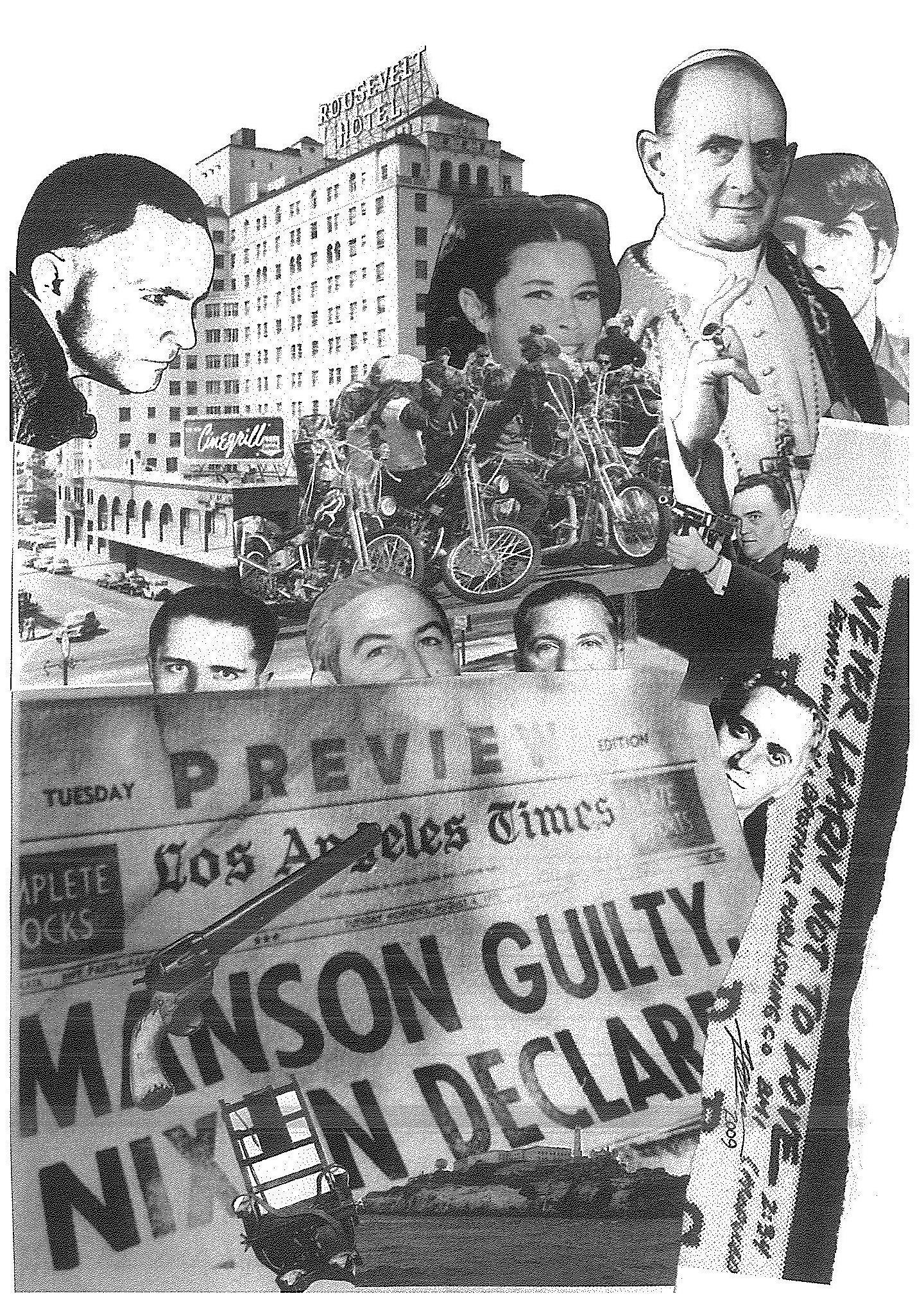
5. The Outlaw
Inmate # B33920 and His F(r)iends in the Underworld
Deeper Than Everybody Thinks And Knows
“I’ve always ran poker games, whores and crime- Pm a crook. You make the reality in court and press. I just ride and play the cards that were pushed on me to play. Mass killer, its a job, what can I say.” Manson to Paul Krassner
“The main problem about dealing drugs is also the most obvious — they are illegal. Being illegal, if you decide to pursue this vocation there is no better business bureau to turn to if you feel you have been cheated. And you will run into many people who are less than honorable.... Robberies and swindles were performed, sometimes including very dangerous drug burns. And all to obtain more and more money for drugs.”
Susan Atkins, The Myth of Helter Skelter
The Rip-Off Artist Formerly Known as Sexy Sadie wrote those sage words in an incomplete manuscript published by her lawyer husband shortly after her 2009 death of brain cancer. Miss Atkins knew of what she spoke. By her own admission in court, she’d participated in Linda Kasabian’s August 9th, 1969 retaliatory strike against Wojciech Frykowski, a [ess than honorable person who cheated equally dishonorable persons Linda Kasabian and Charles Watson in a very dangerous drug burn indeed.
Listen closely and you’ll hear the plaintive chorus of stubborn Bugliosi believers who still doubt that the Cielo Drive killings resulted from a drug burn conflict: “If that’s true, why didn’t they just say so in court?”
Weil, one of them did.
Months after walking venereal disease Petri Dish Susan Atkins recanted the largely fictional December 1969 confession her corrupt defense attorneys Caballero and Caruso urged the mentally unstable girl to recite at the behest of prosecuting puppeteer Bugliosi, she testified in 1971 on the stand during the penalty phase of her trial. She told the court why she and her companions really made their violent visit to 10050 Cielo Drive: “I’m telling what I know. I went there with Linda and. Tex and Katie, according to Linda to get back the money that the people owed her for the dope that they did not give her, to help get Bobby a lawyer.”
“In other words,” she’s asked, “they took her money and didn’t deliver any narcotics or drugs?”
“That is what she said,” Atkins replies.
“And did she say she knew where these people lived?”
“Yes. Evidently she did. Evidently she knew where they lived because she went up there.”
“So after you talked to Linda Kasabian and the other girls about trying to get Bobby out, did you all decide to do something?”
Susan’s very Mansonesque answer: “If you can conceive of not deciding to do anything and just doing it.”
Despite this clear and logical explanation of a routine revenge robbery committed for ordinary criminal reasons, almost all accounts of this case, even the few composed by supposedly reputable journalists, ignore it. Instead, they cleave to the more sensational but false Grand Jury testimony that Atkins admitted was a lie many times. If the testimony above is acknowledged at all, it’s usually dismissed under the erroneous assumption that Atkins was merely parroting what Manson commanded her to say to get himself off the hook. But Charlie told me decades later that he was as surprised as anyone else in the communes criminal inner circle that the unpredictable Atkins blurted out the truth about the Cielo Drive crime’s actual motives. In 1971, when Susan made that statement, Charlie was angry at the headstrong girl he called Violet (a play on her violent temperament) for publicly mentioning the Frykowski drug burn. Sure, he was bummed that she snitched in the first place, but from his point of view, at least she hadn’t told anything remotely like the truth in the story her lawyers sold to the world press in order to convict him before the judge banged his first gavel.
Thar underworld conflict between dealers Sadie voiced in court was exactly what Charlie refused to snitch about before the trial, when he was offered a lesser sentence of 18 months in exchange for his ratting on Watson and Kasabian. In fact, it was only shortly before Susan’s long lingering death in 2009 that Charlie wrote her a letter telling her, “it’s okay to tell the truth now, and you should be the one to do it.” If the near terminal Atkins ever read that final missive from Manson, years after publicly disowning him, it didn’t inspire her to a death bed confession.
Naturally, Atkins being Atkins, elements of untruth distort even her more honest statements. Even our most reliable witnesses here are liars. When I asked Charlie about this last minute testimony, he said that it wasn’t Linda but Susan herself who was adamant about begging, borrowing, or stealing enough cash to hire a defense attorney for Bobby B. Charlie had no use for lawyers, argued it was useless, but told her to do what she thought was right. Linda’s contribution was to suggest that if bread for Bobby was needed, why not rip off the rich pigs who’d ripped her off for the MDA? Charlie told several fellow inmates over the years that the idea was that if crimes resembling the Hinman killing were to be carried out, better to target “expendables,” dishonorable victims who had somehow broken their word, the ultimate sin in the underworld code.
Only ten days before the Cielo Drive robbery, Atkins witnessed her friend Bobby fatally stab their mutual friend Gary Hinman, the result of another (wholly unintentional) drug burn. She kept Gary prisoner, held a gun on him, even helped to suffocate him as he lay in extremis. Charles said that as an accessory to Hinman’s death, with her pre-existing criminal record as a probationer guaranteeing her a harsh sentence if apprehended, Atkins held a strong vested interest in freeing Beausoleil. Only two days after Bobby’s arrest, she had every reason to fear that locked-up Lucifer might implicate her to law enforcement.
The hardcore of Manson loyalists in the splintered commune liked to speak in noble terms of this aspect of the crime being motivated by “Love of Brother.” Charlie himself, depending on his mood, sometimes laid that whitewashing rhetoric on interviewers and correspondents. But by 2012, Charlie was willing to admit that the urgent need to steal funds for Bobby’s defense was triggered more by Susan’s desire to protect herself than any fraternal altruism. Though Atkins was jailed several times since her crime career began in 1966, Charlie recalled that she was terrified of ending up in prison on a murder charge. Naturally, he wasn’t eager to go back to prison for his aggravating role in the crime, but that was no new thing to him.
Turning to Atkins’ other contention, is it credible that the drug dealing duo Watson and Kasabian gave a damn about raising legal funds for Beausoleil? Bobby was at best an acquaintance to them, as Beausoleil himself has credibly confirmed. True, Charles angrily cold Tex chat as compensation for his royal fuck-up with Bernard Crowe, that he now “owed” Beausoleil. He admitted that he’d told Watson he didn’t care how he paid the debt so long as he did. Bur, as Atkins truthfully testified, and as Charlie finally confirmed more than forty years later, stealing the needed sum from rival drug dealers who ripped them off was Linda’s idea.
By the time born-again Servant of the Lord Charles Watson authorized his memoir to be ghost-written by his shrewd spiritual adviser Ray Hoekstra, he naturally included Helter Skelter as a secondary motive so as to accord with the parole boards requirements for release. If you want a snowballs chance in Hell of being paroled, you must agree that the verdict of the court was correct and that you are remorseful for the crimes as they were interpreted by the jury. But even wily Watson admitted that his main priority on August 8/9th was “getting money,” although of course he leaves unsaid that his goal was “getting money back that we paid Frykowski for drugs he never delivered.” The much-discussed “Love of Brother” motive, Watson declared, was part of the mix, but merely a “third, less important purpose: to clear Bobby Beausoleil of the Hinman slaying by comm itting a similar crime while he was in jail.”
That’s why Atkins’ sanguinary message left on Cielo Drives front door has always seemed like a macabre decorative afterthought rather than the driving purpose of the carnage. Its clear that the Waverly crime scene the next night was much more contrived to resemble Beausoleil’s political slogan left on Hinmans wall, which Cupid intended to suggest was the work of the imaginary black men he claimed to the police were responsible for Hinman’s stabbing. Which raises an important point that must be stressed in the face of so much false reporting on this case: it was Beausoleil, generally understood to be the ‘nicest’ of the killers, who tried to blame a pair of non-existent militant blacks for his panicky killing of a friend, not the supposed Second Hitler Charlie Manson.
Even while Charlie was away from the ranch on his own desperate quest for drugs and money in the first week of August ’69, Watson and Kasabian were already planning some sort of revenge against the “rich pigs” now occupying the house Watson himself once dealt from. To Tex’s competitive “football game” mind, Charlie claimed, Frykowksi had taken over his old turf as Cielos resident dope dealer. The vague plot to free Bobby was — if you’ll excuse the expression — piggybacked onto the already pre-existing vengeance on Voytek scheme. Despite her blurting out the real motive, Atkins was, according to Charlie, disingenuous about another factor: the wildly promiscuous girl was already intimately acquainted with Jay Sebring, just as she’d shared her freely given favors with many others in the psychedelic sybarite scene, including Neil Young, Terry Melcher, Peter Sellers, Yul Brynner, and Phil Kaufman.
Forget all the fantastic prosecutorial hot air generated about race war, Paul McCartneys lyrics, and lysergic brainwashing. Tex Watsons crimes were actually merely one small cog in the wheel of the mundane underground economy of robbers double-crossing swindlers for drugs and the thick bundles of cash needed to procure those hotly coveted substances.
We cannot yet definitely prove that the Spahn commune were engaged in drug dealing with Rosemary LaBianca, despite such claims emanating from seasoned criminals at the Spahn Ranch and even from one of her own crooked relatives. But we do know that the LaBianca slayings were at the very least spurred by narcotics trafficking. The end goal of the Waverly piracy was to procure enough loot to pay off the Straight Satans for the supposedly defective mescaline the bikers claimed they were burned on when Bobby Beausoleil procured it for them from Gary Hinman. Both nights of horror sprang from the same dope dealing milieu Susan Atkins already belonged to one year before she climbed aboard Charlie Mansons schoolbus when her drug dealer boyfriend was busted in the Haight in 1967.
The Ventriloquist s Dummy
Nor, nearly two years later, did the supposedly innocent and angelic Spahn Ranch newcomer Linda Kasabian need any lessons in criminality from Manson, who she barely got to know in the scant six weeks she spent among the Slippies. Like Atkins, Kasabian, despite her youth, came to the commune with a wealth of thieving and drug dealing experience behind her. In fact, as we will explore, Kasabians entrance into communal life was her robbery of some $5000 from her own husbands best friend. No cult leader was needed to brainwash the seasoned criminal trio of Watson, Kasabian and Atkins to brutally settle a drug burn. Even during the court testimony meant to present Linda as the only good witch among the wicked ones, she admits, when asked how she managed to live during an adolescent sojourn in Miami, that her income came from “selling drugs or just people would give me money. I had a boyfriend.”
The three young thuggees Sadie, Tex and Yana were more than capable of their deadly deed of their own volition — with a little help from the speed all three were flying on. Linda also testified in court that her life-long penchant for that dangerous violence-spurring stimulant started during her brief 1967 pilgrimage to Haight Ashbury where a casual lover picked her up and “turned me on to speed with a needle for the first time.”
The wild card in this losers game was that, as far as we know, the least criminally experienced of the quartet, the usually pacific Patricia Krenwinkel, apparently ended up participating in the savage stabbing much more than the more experienced offenders Atkins and Kasabian did. Lest we fool ourselves for a second into believing that anything can ever be absolutely settled in the shifting sands of this ever fluid bad trip, Charles was singularly adamant in insisting to me that Tex alone went crazy that night and killed everyone, and that none of the girls actually slew any of the victims.
It’s no wonder that Charles told me the biggest regret in his life was admiring the shapely legs of the waifish white trash maiden Linda who Catherine Share brought to the ranch, according to Charlie, “because her husband couldn’t fuck her right.” I readily admit I was already biased to doubt Bugliosi when I first crawled my way through the monotonous mess of the Tate/LaBianca trial transcripts in 1987. But it was still shocking to realize just how much everything the world thinks it knows about the crimes Manson is accused of commanding is based almost solely on the testimony of one remarkably unreliable witness, Linda Kasabian.
With the helpful writing talents of Vince Bugliosi, who provided her with a script to recite in exchange for her life, Kasabian dutifully elaborated on the basic outline of her star witness predecessor Susan Atkins’s equally false story, only emphasizing the Manson as mastermind lie and adding Helter Skelter as a motive rather rhan a stoned phrase for anticipated social chaos. Bugliosians like to forget that Atkins didn’t mention anything about a race war or Helter Skelter as a motive in any of her original widely disseminated statements on the crime. Those concepts only emerged in court as motives rather than ideas floating around the ranch in Linda Kasabians tainted testimony.
On August 8th, 1969, it’s important to keep in mind that Kasabian had known the man she claimed got into her mind and convinced her to kill for a grand total of thirty-five days. During that brief period, she spent most of her time with Tex Watson. For approximately a week of that near-month, especially in the crucial days before the murders, Charlie wasn’t even in Los Angeles. And in the six days after the murders in which Linda hung around before splitting, Charles was so smitten with his new love Stephanie Schram, and overwhelmed with the catastrophe Linda helped drag him into, he hardly had a moment to socialize with this near-stranger.
The myth Bugliosi presented to a gullible media for decades paints Linda as the one human being of conscience among the killers. A reluctant killer who, according to her risible testimony, pleaded with Atkins to make the killing stop, even though this moral apostle went along for the next night of slaughter, felt safe leaving her infant daughter behind with the killers when she left Los Angeles after the crimes, and never made the slightest effort to notify the police of what she knew in the four months she was on the lam before her arrest. When she was busted, as you can see in the widely circulated news photo of her being apprehended, far from cooperating with law enforcement, Kasabian hid her face from the camera, exactly like any other shamed murderer caught red-handed.
She refused to incriminate herself until her attorney Gary Fleischman brokered a deal with the prosecution. Bugliosi and Stovitz suddenly had no case against Manson because Atkins had recanted her own false testimony. The reason Atkins made this decision not to testify for the prosecution was due to an under-handed crick Fleischman convinced his client Linda to play on ditzy Susan. At her attorneys behest, Kasabian illegally smuggled letters to Atkins filled with misleading pseudo-Mansonian we-are-all-one rhetoric. The gambit worked. Tlie emotionally labile Susan, already manipulated by her own lawyers to spout false testimony in exchange for a worthless lesser sentence deal she never had officially sanctioned, was now persuaded by Lindas cunning ‘‘kites” to go back on her agreement to testify. Thar left the field wide open for the more outwardly wholesome appearing Linda to take the rather sinister-looking Susans place as Bugliosi’s star witness.
Fleischman explicitly stated that while Lindas original statement to him about the murders was “scary,” it bore no resemblance to all to Bugliosi’s narrative, and specifically did not include any reference to Helter Skelter. Fleischman drove a hard bargain, telling the prosecution that his client would only recite their version of events under oath if she received complete immunity. Since without Sadie, the D.A. had absolutely no case against Manson unless Linda agreed to lie, a devils pact was struck: let one of the murderers go free to guarantee that Manson would be convicted.
Fleischman shamelessly admitted these cynical ploys to true crime documentarian James Buddy Day who summarized the sleazy situation in his 2019 book Hippie Cult Leader.
In order to get the deal done, the DA would need assurances as to what Linda was actually going to say once she got on the stand. Gary knew that Linda didn’t know anything about Helter Skelter, but, with the opening day of the trial fast approaching, he reached out to a friend in the Robbery Homicide Division of the LAPD. Gary asked his friend to go to the DA and tell him that he had heard that Linda knew enough to put Charlie in the gas chamber. A few days passed with no word. Then Gary finally received the phone call he had been waiting for. “They came to me and said we’ll give her complete immunity, and finally asked, ‘what’s she gonna say?’ I told them Linda was going to testify that before they left the ranch Manson told them to kill all those people.” ... After agreeing to terms with the DA, Gary recalled that things moved very quickly. ‘We typed up an immunity agreement, which said, ‘Linda Kasbian will receive immunity if she testifies to the truth in the so-called Manson murders. The truth is as follows...’ ... Gary conceded that he was the one who wrote ‘the truth’ on the agreement. ‘I knew exactly what was necessary’’ to convict him,’ Gary told me. ‘Whether that was true or not, it wasn’t my business to decide. That was Vince Bugliosi’s business. I took the agreement to Linda and said ‘If you testify to this, you’re going to walk out of this courtroom.’
This was not news even when those words were printed in 2019. Fleischman was the first to admit, with apparent pride, that Manson was convicted only on the basis of chicanery and perjury. Linda’s lawyer already admitted in a 2009 4O’th anniversary’ oral history in Los Angeles magazine that the only reason his client got away with this grand deception was due to the gross incompetence of Charlie’s lawyer, Irving Kanarek: “If I’d been cross-examining Linda Kasabian, I’d have shoved that immunity agreement up her nose.”
Furthermore, those who are still duped into believing that Kasabian’s testimony was on the up and up, and that the lawyers representing Susan Atkins were not tools of Bugliosi working against their own client, must also take into account Fleischman’s blunt assessment that Atkins’ lawyers “got away with fucking murder. They sold her down the river.” Although their criminal abuse of the justice system benefited his client Kasabian, Fleischman added to the damning admissions he’d already made to Los Angeles magazine and James Buddy Day when he told Tom O’Neill that Caballero and Carusos double dealing “smelled to high heaven.” Los Angeles, Day, and O’Neill, all secular humanists each in their own way representing the Establishment viewpoint on Charlie’s supposed malevolence were not in any way try’ing to exoner ate Manson in printing Fleischman’s revelations on just how corrupt the trial was. And yet the mass media continues to represent the Tate/ LaBianca show as a fair trial, almost entirely neglecting the fact that one of the attorneys responsible for pushing the lies has admitted it was all a cynical ploy for decades now.
What you think you know of the Manson murders, through whatever distorted media source you may have learned it, is a variation on the lie that Linda proceeded to testify was the truth during her eighteen days on the stand. A “truth” decidedly in quotes, dictated by the prosecution to the defense. A “truth” that Gary Fleischman admitted many times over since 1970 was a story concocted by Vincent Bugliosi, because this lie was the only way to get Manson gassed. I don’t know if Bugliosi knew or cared just how central Linda was to the planning of the Cielo robbery when he made this bargain. His careful monitoring of Kasabian’s few interviews since her testimony lead me to believe that he knew very well he needed to hold her hand to make sure she didn’t let any of the real truth slip — the truth that doesn’t have quotes around it.
Charlie, Susan Atkins, and Catherine “Gappy” Gillies were all adamant that Linda, the one guilty party Bugliosi let free, far from being the most innocent of the crew, was just as responsible for the slaughter as her co-conspirator Tex Watson. Lynette Fromme pointed out in her memoirs that the pejorative word “pigs” only entered the commune through the coarse angry newcomer Kasabian. Goodbye Helter Skelter author George Stimson cites Charlie on this same theme: “She was stealing, and calling people ‘pigs’, and disrespecting people.” Another source in the commune provided a more subtle but no less telling confirmation of Kasabian’s character and key role in the murders. Sandra Good, in Lynette Fromme’s 20IS memoir Reflexion, recalled that she only learned that her fellow commune sisters Katie and Sadie were among the unknown culprits in mid-September. Good maintained, as she does to this day, that “Their move was for Bobby.” In this regard, one detail in her statement is worth focusing on. If the assault on Cielo Drive was solely motivated by the girls’ plan to replicate Beausoleil’s murder of Hinman, then surely this scheme meant chat everyone in the home targeted would be sacrificed for Bobby’s freedom?
And yet Katie and Sadie, when telling Good what they witnessed at Polanski’s house of horrors, assure her that “Linda was becoming frantic as death became a reality to her, a reality she had thought she could face. Her panic generated more energy and haste to get out and leave no one alive to call police.” (Italics mine.)
Tlris description of Linda’s frantic decision to kill everyone present accords more with Manson and Atkins’ later claims that the original intention was not homicide, but that a planned robbery turned lethal, and that all witnesses to the failed caper were spontaneously slain in the resulting panic. Charlie also emphasized many times, as Good seems to suggest, that it was Linda who pushed the weak-willed Tex to kill so savagely that night when things got out of hand.
If some still insist that Linda was the noble honest heroine who saved us from the evil cult leader, even after learning that Kasabian’s own lawyer admitted several times chat his client knowingly gave false testimony composed by the prosecution, they must also pretend to ignore other damning evidence in plain view for over fifty years. Even before Kasabian perjured herself, a young Harvard University student named James Breckinridge publicly provided posterity with a portrait of the real Linda Kasabian, as he encountered her immediately after the cunning drug dealer split the too-hot-for-comfort scene at Spahn on the 13’th of August.
In the early morning of August I4‘th, 1969, less than a week after Kasabian’s plan to get revenge on Frykowski ended in a bloodbath then captivating all of America’s attention, Breckinridge thumbed a ride on a desolate road in the remote town of Gallup, New Mexico. An old white Volvo bearing a trio of hippies stopped to pick him up. At the wheel was a sharp-faced woman, in the back seat two long-haired men. Breckinridge soon observed hostility between the passengers and the driver: they sensed that she was driving a stolen vehicle. They agreed to head off to a commune the girl knew in Taos.
Breckinridge noted the crude ignorance of this “haunting, strange, wild girl” who called herself “a witch” — Yana by name. She told him her name used to be Linda before “the Devil” rechristened her “when he cut all my hair off.” (At the time Breckinridge wrote this, the ritual tonsure Charlie held for his witches a month earlier was not yet known to anyone outside his circle.) When the hot car broke down, requiring them to hitchhike another ride, Breckinridge remarked that “there were a lot of freaks on che road”, so surely a fellow hippie would probably pick them up soon. He complained that “straights” were less hospitable. This inspired “that intense witch of a girl” to observe, “Yeah, they’re killing people like that out in L.A.”
“Like what?” he asked.
“Pigs that try to act like freaks.”
Is there any doubt that she’s referring bitterly to the privileged jet setters at Cielo Drive who swathed their monied lives in the freaky trappings of the counterculture and who burnt her on MDA? Only five days after she helped instigate the murders, her still seeching personal animus against the butchered pigs belies the idea that she stumbled into a plot to kill random strangers. In a preachy tone we can recognize as the condescending proselytizing of che girls in Charlies commune, Kasabian said to Breckinridge that death is just a hallucination. When a driver dared not stop to pick up the quartet of hippies, Kasabian ran after the offending car, squinted at it, telling her new companion, “You see, I just killed them. I can do that because I’m a witch.... It’s easy. You just close your eyes and erase them. And when you open your eyes — poof, they’re dead.” Along with her equally vengeful temporary lost soul mate Watson, Linda/Yana’s innately vindictive nature played a big part in the vicious retaliation at Cielo Drive.
“She talked about death frequently” wrote Breckinridge in his March 1970 article in The Harvard Crimson “She explained how it didn’t matter if pigs were killed because they were going through changes. They would be incarnated as beautiful people that much sooner.”
Kasabian blithely admitted to her companion of a few hours to using stolen credit cards, one of the chief methods the Spahn commune used to maintain their precarious existence. (Before she vamoosed from Los Angeles, Bruce Davis let Linda borrow a stolen credit card in the commune’s collection). If there was any doubt as to her identity, Linda/ Yana also spouted some Mansonian musings about a coming race war and Hopi legends of bottomless pits in the desert that Bugliosi would soon twist into a motive for murder. As the wanderers get to know each other, Linda tells her life story: her birth in New Hampshire, her failed marriage, her joining “the Devil and his gang” in L.A. The gang, she says, “were the ones who got me into a whole new world of lovemaking.” She enthusiastically describes “cutting capers”with her friends. These are clearly the creepy crawling breaking and entering exercises Charlie and expert burglar Bill Vance taught the commune to practice. Far from condemning Manson or his commune, or expressing any remorse, she praised them.
When they go skinny-dipping in a pool near some Indian hot springs, Kasabian reassuringly tells Breckinridge “I’ve decided not to kill you.”
Linda’s not satisfied with the Taos commune when they finally reach it. (Too many “niggers”, she grumbled to the liberal college student.) Of her daughter Tanya, who she left back in L.A. in the custody of baby killers, she says without sentiment, in one of those self-justifying twists of pseudo-esoteric logic she specialized in, that she’d “given it back to itself.” She departs in search of her husband Bob, who she’ll soon be reunited with when she makes her courtroom appearance presenting a much more benign persona than the kill-crazy hater of pigs Breckinridge encountered. Anyone who really believes that Kasabian was just a harmless lookout with a driver’s license at Cielo Drive need only read this portrait of the hateful Linda who lurked behind the phony mask of contrition she adopted for the jury. By all accounts of those who have encountered her in Tacoma, Washington where she now lives, Kasabian still exhibits this same snarling venomous manner.
Kasabian did eventually make a brief risky return to Los Angeles to retrieve tiny Tanya. She even called her former friends at Spahn Ranch to locate her. By then, Tanya had been taken from the ranch and placed under protective services custody. Somehow this supposedly remorseful and unwilling participant in the killing of a pregnant woman didn’t rake this opportunity to tearfully tell the social workers that she knew who was responsible for the murders that still terrified California.
When his delinquent daughter emerged as a suspect in the unsolved murders, Rosaire Drouin, Linda’s father, recalled that when she and Tanya sought refuge in his Miami home, “she stole a bunch of stuff from my apartment. I knew she was hocking it to buy dope.” Her fed-up father kicked larcenous Linda out. She returned to the New England home of her long-suffering but tolerant mother, who comforted Linda when the international press announced on the first day of December that she’d been charged with seven counts of murder in the first degree. Somehow she hadn’t mentioned that to Mom in their what I did last summer chats.
In case anyone doubts that this openly homicidal harridan described in the Crimson article was the same Yana the Witch who testified against Manson, Breckinridge showed up at the trial, where he met with Linda’s attorney Fleischman. Kasabian publicly recognized Breckinridge on the stand as “the man in the desert.” She told the court that she was indeed given the name Yana the Witch by the commune. Charlie’s well-meaning but ineffective attorney Irving Kanarek introduced Breckinridge’s revealing account of the hate hippie he’d crossed desert paths with in New Mexico into the proceedings, but wasn’t a skilled enough lawyer to effectively demolish Kasabian’s innocent act with her own words.
Due to the dirty deal Fleischman made with the prosecution in February 1970, and her willingness to tell the D.A.S story on the stand in July, Judge Charles Older confirmed Kasabian’s full immunity on August 10th, 1970. Exactly one year after she accompanied her fellow witches and warlocks to the LaBianca residence, where her favorite word “pigs” featured so prominently, Yana the Witch was free.
She testified with a curious detachment against lover boy Tex in his little-observed 1971 trial, and was arrested and forced against her will to be a witness in the second trial of Leslie Van Houten in 1978. A planned tell-all memoir Joan Didion proposed to write with her never materialized when Linda realized she wouldn’t see any dough from the project. Linda, like Tex and Susan, claimed to have renounced her witchy ways, and embraced Jesus freakdom. To make it clear she was now on the side of the angels, she renamed herself Linda Christian for a while.
As events would prove, Yana the Witch survived her Christian conversion intact. In 1996, after several scrapes with the law, Kasabian and her daughter Quanu were arrested during a police raid in Tacoma, Washington. Mother and daughter were found to be in possession of rock cocaine, methamphetamine, drug dealing paraphernalia, a .45 caliber semi-automatic handgun and ammo. Linda’s daughter, whose own lawless lifestyle earned her the sobriquet “Lady Dangerous” was sentenced to a year behind bars. Linda managed to elude going to prison yet again. The meth fiend who helped instigate the most infamous drug burn murder in history got off with a slap on the wrist, agreeing to attend a drug counseling class.
When she was interviewed in 2009 by Larry King in one of only three media appearances since the trial, Linda said, “I have been on a mission of healing and rehabilitation. And I went through a lot of drugs and alcohol and self-destruction and probably could have used some psychological counseling but never received it.”
Disabled from a car accident, Linda lives in a social housing unit in Tacoma, where she was ambushed by a Daily Mail reporter and photographer shortly after Charlie’s death in 2017. The candid photos indicate that the outwardly innocent pig-tailed pixie image that helped make her courtroom lies credible in 1970 has faded. Linda now looks exactly like who she is.
Unknown Others
Along with coming to terms with Linda Kasabian’s driving role in the crime, to understand che atrocity Watson committed at Roman Polanski s defiled domicile, the Cielo Drive bloodbath must be seen as the most publicized episode in a series of crook vs. crook skirmishes. What the legal liars told us was a random attack based on a madman’s incoherent apocalyptic delusion was in fact the most visible battle in an ongoing war for the lucrative narcotics market of late 1960s Los
Angeles. Take away the grotesque post-murder stage design left at the crime scene to bewilder the cops and to frame other rival dealers. Subtract the awkwardly newsworthy presence of a minor movie starlet and a food industry heiress among the victims. What do we have? A routine drug dealer betrayal and payback of the kind routinely taking place in the treacherous narcotics trafficking underworld in which Frykowksi, Watson, Sebring, Bernard Crowe, Kasabian, Atkins, Rostau and their associates operated in on a regular basis.
Despite Charlie endorsing my provisional account of the murders outlined in this book’s previous edition one decade ago as “rhe closest anyone come to what happened”, and his offer to provide more detail after its publication, he ultimately left me with more puzzles than solutions when he enhanced my understanding of the Cielo and Waverly killings duringour 2012–2015 conversations informing this final File. One mystery he was insistent about was his avowal that beyond the known players in the fatal clash between Watson/Kasabian and Frykowski/Sebring, a rogues gallery of other unknown culprits in a much larger drug dealing network had some never precisely explained stake in that night’s operation.
These malefactors were, Charlie said, never arrested and never named. Some of those who escaped the lurid limelight thanks to the Helter Skelter distraction were, as he put it, “high up on the totem pole of the music.” Having thrown out that tantalizing tidbit, he withdrew again when I asked if he could name any names. For years, he’d claimed if he were ever to publicly state the whole truth, these anonymous crooks in high places could easily have him rubbed out in prison. “If it saw the light of day”, he said, “you would’ve seen its not very nice how these guys play drugs for Payola and the way records get made and how they become hits.” Other cryptic comments of the same stripe he’d uttered during our final conversations about the crimes involving musicians and drugs implied that Terry Melcher, Dennis Wilson and John Phillips were far more involved in the narcotics ring orbiting 10050 Cielo Drive than was ever publicly discussed.
If one understands the cryptic Mansonian twilight language, Charlie seemed to be referring to this same criminal infiltration of the music business when he told William Scanlan Murphy in 1993, “The music has big controls that come out of Boston, they come off the Dukakis Campaign.” (Michael Dukakis was the Democratic Party governor of Massachusetts shortly before Charlie made this statement.)
What could Charlie have meant by that?
This may well point to the background presence of mobster and drug dealer Eugene Massaro, whose FBI file notes had “recently gone into the vending machine business and the machines were coming from Boston, Massachussets and believed to be coming from representatives of Raymond Patriarca.”
Patriarca was the boss of the most powerful New England syndicate, whose black hand reached from Providence to Boston. Massaro’s crime partner Joel Rostau, an associate of the Patriarca gang, hailed from Boston. Disc-O-Mat, the particular vending machine business Massaro served as Vice President of Operations, manufactured a gadget that dispensed the latest Top 100 hit singles, and as researcher Dennis LaCalandra revealed, was a front for a major drug trafficking operation. Tex Watson, in his book Will You Die For Mel, is almost certainly referring to Massaro and Disc-O-Mat when he writes that “I arranged to buy a kilo of grass from the dealer who’d been supplying the Family — he fronted the dope with a vending-machine company and people said he was with the Mafia. “
It is intriguing that contemporary news reports from the time names the record labels Capitol and Columbia as being interested in collaborating with Disc-O-Mat, since those were the very companies Dennis Wilson and Terry Melcher were pushing to release Mansons music. Charlie’s hints of a high level mafia drug dealing network behind Cielo Drive, and Tex Watson’s reference to doing business with a weed salesman operating from a mafia vending machine front all point to the Disc-O-Mat racket. Dennis LaCalandra, in his highly recommended and informative blog The Manson Mythos, was the first Mansonologist to offer an in-depth report on Massaro’s involvement in the Disc-O-Mat narcotics trafficking front. You can read LaCalandra’s thought-provoking and ground-breaking December 15, 2021 essay on this hitherto little known aspect of the case here: https://themansonmythos.blogspot.com/2021/12/a-deeper-look-at- disc-o-mat-and-eugene.html
Based on these important leads, further investigation of the Massaro/ vending machine drug syndicate’s links to Roseau, Watson, Apinitis, Walshin, and other Cielo-adjacent crooks could prove to be the key to the underworld operation Charlie so frequently suggested was central to the crime spree bearing his name.
I’m now convinced that the messy but efficient cluster of cover-ups operated by mutually hostile multiple parties on all sides was so successful that we will never know the full details. Though I have heard several credible but contradictory accounts of the actual chronology of the murders, I’ve also come ro the firm conclusion that even the physical mechanics of what happened at Cielo Drive from approximately midnight to dawn on August 8/9 1969 is probably forever lost to us.
As to the elusive events that transpired the next night at the LaBianca residence Oak Terrace, that remains even more of an enigma than its more celebrated predecessor crime. After all, leaving aside Charlie himself, dozens of witnesses who knew both the infamous killers and the famous slain were willing to speak to me about what they knew about the fracas with Frykowski, though more often than not, they insisted on making their statements off the record. When it comes to the lesser known but equally appalling horror perpetuated at Waverly, only Charlie was willing to talk to me in any concrete detail about that night’s manifold mysteries.
We can, however, trace how a select few of these more obscure criminals Charlie hinted at directly interacted with drug dealing associates of Charles Watson and Jay Sebring. Despite the many lacunae in our knowledge, a rough outline of the wider underworld network deliberately scrubbed from the fictional official version of events can be partially pieced together.
Rendering a more accurate account of the Watson murders is not simply a matter of marginal relevance to true crime buffs and aficionados of the grotesque. Above and beyond the fact that it’s simply not true, the gross misrepresentation of Watson’s ordinary criminal slaying spree as a bizarre unprecedented hippie cult phenomenon exerted a long-lasting negative historical sociopolitical impact. That misreporting handed repressive forces in the US government and media the leeway to utilize popular misunderstanding of the crimes to blunt the subversive challenge the counterculture presented to conventional societal norms.
The crimes on their own were hideous enough.
But due to the temper of the times, high-ranking Establishment crooks ensconced in government, the judiciary and the entertainment industry took the opportunity ro sell a propaganda horror story to the masses to buttress their own reactionary agenda. By the end of 1969, the biker murder of a black attendee at the Altamont music festival, the lie claiming that entertainer Art Linkletter’s daughter Diane jumped out a window while high on LSD, and the arrest of members of a hippie commune as suspects in the unsolved Tate murders were trotted out by elements of the mass media as proof that the psychedelic counterculture was an intrinsically dangerous social ill. The Culture War propaganda battle for minds tearing the USA apart as of this writing was already taking embryonic form during the criminal Nixon regime’s smear campaign against those filthy hippies.
The main objective of their disinformation campaign was not justice. The aim of such elite legal crooks as Evelle Younger, Paul Caruso, Sidney Korshak and their ambitious front man Vincent Bugliosi in covering up the reality of the Tex Watson crimes was the protection of other criminals and complicit parties. What irony that the loudest cheerleaders for the cynical Helter Skelter fairy tale contrived by criminals for the benefit of criminals are those who see themselves as do-gooder moralistic agents of law and order. In fact, the duped obedient citizens who insist that Bugliosi’s fiction is true help perpetuate a lie designed to shield crooks and killers on a much higher level of the underworld echelon than the likes of the deadly dunce Tex Watson.
One of several overlooked Manson remarks Nuel Emmons quoted in his misfired 1986 book Manson In His Own Words bears repeating here: “The DA, caught up in his theory oV Helter Skelter and obsessed with making the world believe I was a Satanic pied piper, overlooked many participants, accessories and conspirators. Someplace out there in that society he protects so well, he had left several killers to prowl the streets.”
In that passage, Charlie was specifically referring to the never prosecuted involvement of his associate Bill Vance, his frienemy Danny DeCario of the Straight Satans, and others in the killing of suspected snitch Shorty Shea, which, by the way, he confessed to also being technically guilty of in court. But Manson was equally adamant in maintaining that even if those convicted of the Tate/LaBianca killings were the ones responsible, other crooks and mobsters intertwined with both Watson and his victims’ criminal operations slipped through the cracks. “Let me put it to you like this,” Charlie mused when I asked him to elaborate. “If I’m a conspiracy ‘cause I knew some of what them kids had in their head to do, well, there’s a whole hell of a lot of other people nobody ever heard of had a lot to do with it too.”
Obstruction of Justice
Just as Bugliosi Believers ask why none of the defendants facing the gas chamber mentioned that the terror at Cielo Drive was motivated by drug dealing — even though Atkins explicitly said so in a statement that garnered some press attention at the time — they also wonder why none of the lawyers for the defense publicly brought up the narcotics angle if there was anything to it.
Again, one of this beleaguered bunch, Patricia Krenwinkel’s attorney Paul Fitzgerald, the most competent and ethical of the sorry lot on the defense team, did just that.
Not only did he specifically raise the drug dealing element as being central to the case, Fitzgerald also seemed to have reason to believe, as Charlie later confirmed, that unknown others were involved. On May 2, 1970, shortly before the trial proper started, Mary Neiswender, the only member of the Los Angeles press corps in friendly contact wih Charles, reported in a syndicated article that Fitzgerald charged “police and district attorney investigators ... with intentionally ‘covering up’ the possibility that someone other than hippie leader Charles Manson and his ‘family’ killed actress Sharon Tate and six others.”
Fitzgerald “made the charges in a formal motion in which he said prosecutors were in contempt of court for not allowing him to see evidence they had gathered in the case, although, he said, they had been ordered to do so,” He was concerned that “photographs of a bloody heel print found immediately outside the door of the Cielo Drive address (the Tate home) may demonstrate that some persons other than the defendants were present on or about the time of death” and were therefore deliberately withheld from him. Watson, Krenwinkel, Atkins and Kasabian were believed to be barefoot or wearing moccasins at the time of the killings. The presence of that heel print has still never been adequately explained. A mystery made murkier now that we know that at least four persons not directly involved with the murders per se were there after Tex left his horrid handiwork but before Winifred Chapman, the Polanskis’ maid, arrived for work. And then we must factor into these vexing variables the still unknown parrner(s) who tagged along on Charlie’s evidence-tampering visit to the crime scene.
Tending to support Charlie’s later claim that other non-Spahn personnel were enmeshed in the mess, Fitzgerald also accused prosecutors Bugliosi, Kay and Stovitz of withholding from him “theories still held by qualified, experienced homicide detectives, as to ‘hired killers’. Why they believe in the theory, the attorney contends, is vital to his case.”
Fitzgerald, to his credit, was also the only lawyer to note the obvious relevance of the “peculiar, bizarre and unusual fashion” in which the rope tying Tate to her former fiance Sebring was fastened to the victim he identified as “ladies’ man” Sebring, who was well-known for his habit of taking “numerous women to his residence” where “he would tie the women up with a small sash cord and, if they agreed, whip them, after which he would undress them and have sexual relations.” Fitzgerald accused Bugliosi and his staff of refusing to make available copies of evidence they had gathered during their investigation of Sebring’s “bizarre sexual activity and his use of force to torture in connection with ropes and hoods.”
Did Krenwinkel reveal in her client confidentiality protected discussions with her attorney that one factor in the killings involved Sebring playing unwelcome sadomasochistic sexual games with some of the girls in the commune? Charles hinted many times that if the public knew what the victims “had done”, the dynamics of the dispute, above and beyond the rip-off of the drug burn, would’ve been obvious.
As well as touching on the taboo of how Sebring’s kinks may have influenced the way he and Sharon died, Fitzgerald also included in his motion another open secret: Sebring “was a well known user of cocaine, staying high on the drug most of the time.” Fitzgerald was quite justified in stating for the record “rhe big part narcotics played in the lives of the victims also has been underplayed by investigators, who have refused to give defense attorneys needed — and court-ordered — information.”
Without naming her, Fitzgerald included in his motion the fact that on the day before the murders, Charlene McCaffrey, Sebrings receptionist and Joel Rostau’s lover, “had talked to Sebring and he had informed her that he had been burnt on $2,000 worth of cocaine” and “would do almost anything to get back at the person who had burned him.” While Sebring associated with any number of unreliable dealers, we can’t yet rule out the possibility that Watson, known for his treacherous transactions, may well have been the treacherous pusher who burnt the hairdresser. Watsons rep as a rip off artist preceded him. It would have been just like him to self-righteously avenge himself on someone he already betrayed.
Effectively summing up the true core of the crime’s genesis in a manner that nothing said at the actual trial ever did, Fitzgerald’s motion to the court cited a partial statement from an unnamed source interviewed who said of Frykowski: “He used cocaine, mescaline, LSD, marijuana, hashish, and MDA in large amounts. He was an extrovert and gave invitations to almost everyone he met to come visit him at his residence (Cielo Drive address). Narcotics parties were the order of the day, and the parties continued on into the early morning hours.”
Fitzgerald also wanted to see a partially withheld statement from a witness who told investigators that it was Abigail Folger who was supplying Frykowski “with money for his drug habit.” This witness also reported that Folger used the same drugs Frykowski abused “in large quantities.” (A few other mainstream news articles, prior to her post-December 1969 sanctification, openly discussed Folgers own heavy cocaine use while she was staying at Cielo Drive.) The defense attorney specifically wanted to know more about Tommy Harrigan visiting Frykowski at Cielo Drive between 4 p.m. and 6 p.m. on August 8th “concerning a delivery of MDA in the near future”, a little detail the prosecution delicately sidestepped in court.
Fitzgerald also made public this extremely relevant information that he knew the prosecution refused to share in its totality with him: “Qualified experienced homicide investigators of the Los Angeles Police Department earnestly held to a theory chat one or two persons delivering or collecting for a delivery of various types and amounts of narcotics were turned away empty handed due to either bad narcotics or the lack of cash funds ... and that they decided to take both the money and the narcotics after killing the victims ... Everyone at the rime of the murders were terror stricken and said many things — now they’ve decided to stop calking. Those early statements are vital.”
Those who glibly dismiss any calk of the victims’ drug-dealing as malicious rumor refuse to take into account that if the trial were based on this suppressed evidence of narcotics trafficking that the LAPD investigators discovered, Bugliosi’s ridiculous race war scenario would’ve been seen as the flimsy fiction it is. Whether the defendants were understood by the jury to be the routine crooks stealing drugs and money that they actually were or the bloodthirsty cult robots with no mind of their own Bugliosi presented them as, they would’ve still been judged to be just as guilty of murder. And yet some primal tribal impulse in the collective consciousness seems to need these crimes to be something more uncanny than typical drug-related violence.
Fitzgerald added: “An additional theory existed that the suspects were hired killers.”
If, as Charlie insinuated, others were somehow involved in commissioning and profiting from the mayhem at the Polanski residence, then
Fitzgerald was right to suspect that the prosecution were hiding something from him. Charlie consistently claimed that Bugliosi’s main task, along with the obvious one of protecting the swollen egos and whitewashed reputations of wealthy entertainment figures, was to distract from other higher level criminals whose guilt a proper trial based on fact rather than fiction would’ve exposed. Despite the motion Fitzgerald mounted, none of the essential pertinent points he raised surfaced in court —with the exception of Atkins’ roundly neglected spontaneous statement that Kasabian went to Cielo Drive to avenge an MDA burn with a robbery.
One crucial point when it comes to the defense team’s decision not to introduce evidence concerning the victims’ drug dealing into the proceedings must be clarified before we sink into the morass of murder. California law in 1969 stipulated that homicides committed during the commission of another felony — a drug robbery, for instance — guaranteed an automatic death penalty. If you wonder why those accused all too gladly played the roles of the cult leaders obedient slaves instead of telling the prosaic truth, well, the threat of the gas chamber works wonders that way.
Trying in vain to convince him to be more forthcoming, I pointed out to Charlie that despite his no snitching code, he’d repeatedly named his former prison mentor and gangster associate Frankie Carbo as one of the beneficiaries of the LaBianca robbery-murder. Charlie had already acknowledged to me that he personally handled the cash robbed from the LaBiancas, and paid it to the Straight Satans in Venice. Why, I asked him, could he speak openly about the involvement of Carbo and the bikers in the LaBianca mayhem, and yet be so circumspect about the still unknown hidden hand he consistently but obliquely referenced in regards to Cielo Drive?
He replied that he had less to say about Cielo because “that was Tex’s trip, not mine”, an implicit admission, it seemed to me, that he did bear some responsibility for the second night. After a long thoughtful pause, he added, “I been a sitting duck in here. They were smarter than me. Man, I was played for a fool.”
Who were “they?”
Despite Charlie’s reticence, despite the efficacy of the interconnected cover-ups, we can still discern revealing patterns and connections by sounding the depths of the murky underworld abyss in which the Cieio/Waverly arcana lay buried.
Buried In The Back Pages
August 9’th, 1970, was the first anniversary of Tex Watsons rampage. Watson, the killer responsible for the crimes, was conveniently nowhere to be seen in Los Angeles Superior Court one year after his deadly deeds. His relatives in small-town Texas succeeded in preventing his extradition to California for months. His lawyer argued — probably correctly — that his client can’t get a fair trial in Los Angeles. Watson’s absence allowed Bugliosi to get away with focusing his case completely on Manson. And one year to the day after the crimes, Charlie made one of his more memorable court appearances.
As was widely reported in the national press, Charlie held up the front page of the Los Angeles Times with its screaming headline Manson Guilty Nixon Deciares. By showing that blatant miscarriage of justice to the jury charged with deciding his fate, Charlie hoped that he’d be granted a mistrial. But this was not just any other case. Special conditions prevailed. As we might expect in that farcical proceeding, the judge ruled that the jury were somehow not at all prejudiced by seeing the President of the United States’ much-publicized and, as it turns out, very deliberately stated premature judgment. (According to Charlie, karma caught up with Nixon when he was forced to resign his office in disgrace on August 9th, 1974, exactly four years later.)
With such distracting melodrama involving high-profile crime headlines going on in Bugliosi’s Big Top, we must presume that only especially thorough readers of the Van Nuys Valley News would’ve taken notice of a far more obscure local crime article published that day.
As only a small criminal circle directly involved would’ve known, the article actually had more to do with the larger picture of the Tex Watson murder spree than a great deal of what was going on in the Tate/
LaBianca proceedings. Between the report of a beauty contest winner’s crowning and a generous 69 cent value coupon for Valley Car Wash, an anonymous Van Nuys Valley News reporters piece entitled Retrial Set in Gangland Death Case updated the latest legal machinations in the court proceedings of a less than upstanding citizen named Eugene D. Massaro — “Gino” to his partners in crime.
A thirty-year-old ex-con, all-around crook, pimp, burglar and drug dealer under surveillance by the FBI, Massaro was an associate of the notorious jewel thief Murph the Surf. On the night of May 8th, 1968, he posed as a gun-wielding police officer with two other armed associates. So disguised, he and his fellow felons forcefully gained entrance to a Van Nuys apartment harboring three rival drug dealing thugs.
These three young men were Brian Jones, (no, despite the drugs, not the soon-to-be-dead Rolling Stone), and the flat’s residents, Ivars Apinitis and Peter Eden. The reason for Massaro and company’s rude visit: in January of ‘68, Jones and Apinitis borrowed $11,000 from Eden in order to purchase a large sum of marijuana for resale. This then-princely sum was promptly brought by Jones to another shady character, Bruce Orlanslcy, henchman of another young dealer, Martin Hochman. Orlansky burned Jones and Apinitis, brandishing a gun, and stealing the Ilk from Jones without providing the promised weed in exchange.
Jones, Apinitis and Eden were not happy about this rip-off. But such double dealing was an occupational hazard in the high stakes drug racket. The angry gangsters tried to get their dough back from Hochman. Far from being cooperative, Hochman paid Massaro and his two companions 2000 bucks to rough up the dealers they’d ripped off as a warning to lay off if they knew what was good for them.
Upon gaining entry with this mission in mind, Massaro demanded “the stuff.” Said stuff being a mountain of cocaine that the three phony officers believed had just been delivered to that site. Massaro’s request was enhanced when the intruders commenced to pistol-whip their competitors. Apinitis, one of the trio of underworld operators surprised by this raid, was also armed. Defending himself from the pistol-whipping, Apinitis fired a gun. Killed during this fusillade was George Bart Piscitelle, one of Massaro’s fellow faux cops. A former henchman of infamous Los Angeles gangster boss Mickey Cohen, Piscitelle had been enmeshed in more than one lethal hit in his long criminal career.
Gino Massaro suffered gunshot wounds to his stomach and arm so serious that he collapsed in the street after staggering downstairs, leaving a trail of blood behind him. He was apprehended by police and brought to a hospital. His condition was judged to be so grave that a Catholic priest was summoned to administer last rites. By the grace of the gangland gods, Massaro survived to be placed on trial for his part in the mayhem — and very probably to murder a criminal associate of his who would be entangled in the Cielo Drive caper one year later.
On August 9th, 1970, when so little in the way of factual information was really known about the series of rip-offs and murders Tex Watson committed, this everyday gang warfare from two years earlier, unnoticed by the general public, must’ve seemed pretty ho hum. Compared to the larger-than-life spooky spectacle the media and DA had spun around the Manson case, Gino Massaro’s raid on Ivars Apinitis to settle a score for some other hood was underworld business as usual. But better informed readers of today, aware of some of the complexities of the Watson murders, will have already noticed that Massaro and company’s home invasion about a drug dealing burn is not significantly different than the kind of crimes Charles Watson had committed when he ripped off Bernard “Lotsaspoppa” Crowe, or sought to avenge himself at Cielo Drive when he was in turn burned by Wojciech Frykowski.
Massaro’s brutal beating of rival dealers bears comparison to the savage treatment Frykowski meted out to Billy Doyle, another unreliable drug dealer, and the beating Tex Watson gave Jay Sebring. In fact, when we look more closely at the other partners in crime associated with the obscure Massaro and Apinitis we find direct links to Cielo Drive and Tex Watson that make it clear these similarities in modus operandi are more than coincidence,
As will be clarified in more detail, Gino Massaro was the partner in crime (and probable executioner) of Joel Rostau, one of the drug dealers who later delivered drugs to Jay Sebring on August 8th, 1969, shortly before Watson and Kasabian arrived to steal them, Massaros partner Rostau was the lover of Jay Sebrings salon receptionist Charlene McCaffrey. In April ‘69, Charles Watson and an unknown companion would break into Rostaus home at gunpoint to steal drugs in a manner quite similar to Massaros attack on Ivars Apinitis and his fellow felons one year earlier. If we understood Sebrings tangled and confusing interactions with Rostau, Massaro, and Watson (all of whom were near neighbors at one point) I believe that it would emerge that the two infamous crimes at Cielo and Waverly simply got more publicity than a wave of similar drug related conflicts that began at least as early as 1968, and may have even extended to San Francisco and Sausalito in 1967.
Fixed Games and Vested Interests
Many of the crimes the Watson Murders case generated were committed by the very lawyers the public trusted to administer justice. The attorney who successfully defended Gino Massaro in the home invasion case was the mobbed-up Paul Caruso. One year later, Massaros lawyer Caruso served as the attorney not only for Tommy Harrigan, who delivered the MDA to Wojciech Frykowski that Watson and Linda tried to rob, but for Susan Atkins, who aided and abetted Watson in the robbery of that same MDA. When Atkins’ court-appointed attorney Gerald Condon was replaced by Caruso under extremely suspicious circumstances, Susan was delivered into the hands of a man whose ties to the underworld and the crooked side of the law defined his career in corruption.
Paul Caruso had a long history going back years of providing legal cover for Mansons mobster mentor Frankie Carbo. In 1967, to name just one especially relevant instance, Caruso was the defense attorney for Carbo-connected gangster Maurice “Fat Maury” Friedman, an ally of Jay Sebrings murderous underworld connections, the hit men ‘‘Handsome Johnny” Roselli and General Charles “Babe” Baron, both, as we will see, on the fringes of mob efforts to kill John F. Kennedy. Friedman, connected to the same branch of the Detroit mob that mentored Jay Sebring in his youth, was charged with running a fixed gambling enterprise on the locked, guarded, members-only third floor gambling room of the Friars Club in Beverly Hills.
An Old Hollywood institution so rotten it might have sprung from the imagination of James Ellroy, the Friars Club was known as a vice den under Carbos invisible control from its beginnings. Chicago mob lawyer supreme Sidney Korshak’s boy Ronald Reagan was one of the founders of the L.A. branch of the Friars Club in 1947, a spin-off of an earlier East Coast branch equally lousy with gangsters. Jay Sebring’s clients Frank Sinatra, Dean Martin, and Sammy Davis Jr. were all members in bad standing of the Beverly Hills gambling club. Handsome Johnny Roselli, Fat Maury Friedman and a crook coterie composed of major players in the Las Vegas hotel business and Los Angeles show business milked $400,000 dollars (millions today) out of the wealthy celebs throwing away their money on rigged high stake gin rummy games. Carusos client Friedman installed an ingenious scam involving overhead peek holes and electronic signals, methods he used for years in fleecing the victims of earlier fixed games.
Caruso defended Friedman, but lost the case when his client was convicted. This Caruso-Carbo connection links to District Attorney Evelle Younger, who took steps to protect Maurice Friedman from prosecution. Two years later, Younger was Vincent Bugliosi’s boss in charge of supervising the Tate/LaBianca trial — just as he also made sure the Sirhan Sirhan trial went his way. In 1970, when Paul Caruso and Richard Caballero were misrepresenting Susan Atkins on behalf of Bugliosi, they just so happened to be members of The EJY Club, a partisan political organization whose goal was the election of Evelle Younger as California’s Attorney General. While she didn’t make the connection all these sleazebags had to the Tex Watson murders cover-up, journalist Janie Kasindorf was one of the first to go public in outing Caruso and Youngers history of protecting organized crime players from justice. Her 1978 New West article “The Case Against Evelle Younger” can only make one wonder exactly what hidden inter ests Younger, Caruso and Caballero served.
A final word on the Friars Club card game scandal: Charlie Manson repeatedly boasted of his expertise in illegal gambling operations, including fixed card games, some of which he participated in with Dennis Wilson. He contemplated the robbery of private casinos he was familiar with in Los Angeles and Nevada. Leno LaBianca, addicted ro games of chance, came from this same milieu of fixed mob card games. The overemphasis on cult brainwashing, race war and ocher spooky distractions misdirects attention from how involved Charlie was tn that less sensational branch of criminality.
To return to Caruso’s client Gino Massaro: Some researchers of the Watson crimes contend that the dealer Tex mentions in his memoir Will You Die For Me as his weed connection — identified only as a mafia figure who runs a vending machine racket — was Massaro. At that time, according to his FBI report, Massaro did indeed work at Disc-o-Mat, a mob-linked vending machine business. (Along with barber shops, import-export, realty firms, and construction companies, vending machine distributors were common fronts for old school organized crime syndicates.)
Nor does Caruso provide the only significant attorney association connecting the Cielo Drive killer to the May 1968 home invasion Massaro commandeered. Shortly after moving to California from Texas, before Dennis Wilson introduced him to one Charles Milles Manson, Cal State dropout and wig salesman Charles Denton Watson had reason to engage the services of Los Angeles attorney team Perry Walshin and David DeLoach. If we are to believe Watson (always a risky proposition), the initial reason for his requiring counsel from Esquires Walshin and DeLoach was a minor car accident in Laurel Canyon that injured his knee. (This already smells like a cover story for some sort of shady lawyer scam.) This injury allowed Watson to avoid being drafted to kill people in faraway Vietnam, freeing him to kill locally instead.
When this auto mishap occurred, Watson, not yet acquainted with Manson and his commune, was still living a fairly conventional “straight” life, conducting his dope dealing from a comfortable apartment on the narcotics netherworld of Wonderland Avenue. For reasons unknown, from then until 1969, Watson sought legal services from Walshin and DeLoach at least thirty other times in a fairly brief period. Not only does this raise the question of why Watson required attorneys that often. But his relationship with Walshin and DeLoach illustrates how different he was from his later hippie colleagues in the Manson commune. None of the Slippies, despite being in nearly constant conflict with law enforcement, “hassled by the Man” on a nearly weeldy basis, retained anything so square and Establishment as a lawyer. In fact, Manson consistently advised his young charges not to rely on attorneys to solve their many legal challenges.
And when Watson was tried separately from his former brothers and sisters from the commune, he stood out for diligently following his lawyer’s advice like a good boy. After Manson, Krenwinkel, Van Houten and Atkins made a rebellious farce of their trial, flaunting their incompetent attorneys’ counsel, Tex dropped his hippie look, projected a straight persona, and did his level best to present himself as an ordinary if slack-jawed citizen who fell under a madmans spell. Tellingly, the only other one of the accused who also obeyed her lawyer’s instructions to project an image of social conventionality to the jury was Linda Kasabian.
When Watson faced considerably more serious legal trouble than a fender bender after being arrested for seven murders in December 1969, Walshin and DeLoach turned up unbidden in Texas, where Watson was comfortably jailed. The lawyers held a press conference at the Fairmount Hotel in Dallas on December 5th to announce that as the accused man’s attorneys, they were there to represent him. They claimed that Watson’s mother contacted them on her son’s request, stating that Watson wished to see his former attorneys “definitively.” But Watson flatly refused to see them. For their troubles, a local district judge had Walshin and DeLoach arrested for “making a circus” of the Watson murders. He sentenced them to 72 hours in jail, fined them $100, and promised to waive the jail sentence “if you take the next plane back to California and shut your mouths.”
Walshin and DeLoach held their odd press conference on the same exact day Susan Atkins was pressured by her own shadowy legal representatives Paul Caruso and Richard Caballero to provide her false testimony about the murders to a Los Angeles Grand Jury. So the timing of these parallel attorney actions is interesting. Keep in mind that at that point Watson had made no public statement on the crimes. Atkins’ widely publicized lies to the Grand Jury cued Watson to know that he too could try to diminish his instigating guilt by playing the same brainwashed Follower of a Cult Leader card Little Susie was playing.
Considering what we have since learned of the felonious double lives of Walshin and DeLoach, it’s only natural to wonder if their urgent visit to their client was to assure that Watson didn’t squeal about his criminal associations. Did they hope to take control of their clients narrative just as Caruso and Caballero were planted by the prosecution to steer Sadies?
This as yet unexplained Walshin/DeLoach episode becomes more curious still when we consider what the future revealed about the less than legal extracurricular activities of the men who claimed Watson as their client. In 1971, the year Watson was sentenced to die in the gas chamber, DeLoach and Walshin were arrested in Los Angeles for the crimes of pandering and pimping from three massage parlors they operated as a front for the prostitution services they offered. DeLoach was convicted and debarred, Walshin was nor.
On January 16th, 1973, Walshin made the news again, in a New York Times article entitled Lawyer Gets Five Years In Cocaine-Smuggling Plot. And he’s revealed to be in very interesting company. There, we read: “A Los Angeles lawyer, convicted of conspiring to smuggle cocaine from Columbia, got a five-year prison sentence in Federal District Court in Manhattan yesterday. The lawyer, Perry J. Walshin, 34 years old, was told to surrender next Monday.... Judge Charles Metzner, who conducted the three-day trial of Walshin, is scheduled to sentence a co-defendant today. Ivars Apinitis, 30, a flier of Playa Del Rey, Calif, pleaded guilty before the trial. He could get up to 15 years and a $15,000 fine for conspiracy.”
If you’ve lost track of the thugs in this tale, Apinitis was the drug dealer whose apartment Massaro and fellow fake fuzz invaded in May of 1968. Other than Charles Watson himself, high flier Apinitis may well be the only living link between Walshin and Massaro left to tell the tale so long hidden from our view.
In 2019, I placed a telephone call to the now elderly Apinitis, long since released from prison and apparently gone straight. I hoped to arrange an interview with him during my imminent visit to Los Angeles. I was able to ask one question of an instantly angry Apinitis before the former cocaine smuggler and killer of George Bart Piscitelle hung up on me. I asked him what he could recall of his dealings with Gino Masarro, Perry Walshin and Charles Watson, To say that his reply was brusque and threatening is an understatement. One would assume a veteran criminal used to eluding questions would simply deny ever hearing of the gentlemen I named. The animalistic rage I unleashed by evoking these names from decades past spoke volumes.
Ifonly those still operating under the media-fostered delusion that they already know everything there is to know about those long-ago fatalities could’ve heard the defensive firry in Ivars Apinitis’s voice. Fifty years after Tate/LaBianca terrified Los Angeles, he was not the only aging former drug dealer unwilling to tell the truth about the secret criminal correspondences lurking behind Tex Watsons stabbing spree.
“For there is nothing hidden that will not be revealed, and there is nothing covered up that will not be uncovered.”
Jesus, Tse Gnostic Gospel of Thomas
In 1971, Manson, convicted of nine counts of murder in the first degree, became Inmate #B33920, consigned to the care of the monstrous bureaucracy that calls itself the California Department of Corrections. With the possible exception of the slaughter spree carried out by the unknown malefactor known as Jack the Ripper, no series of crimes has been covered in such detail as those that made the name “Manson” a synonym for demented and senseless mass murder. And yet, for all of the oceans of ink spilled to explain the so-called Manson murders, few accounts to date even scratch the surface of what really happened.
This lack of valid information is no accident.
When drug dealer Harold True’s Waverly Drive roommate Al Swerdloff dreamed up the clever idea of calling Manson’s first album LIE in a play on the infamous LIFE magazine cover featuring a mug shot of Charlie blazing on acid, he may well have entitled the entire case. Those convicted of the killings have been lying for 52 years. Most of the surviving friends and families of the victims still repeat the same fictions. The lawyers for both the prosecution and the defense helped to craft the false narrative it served all parties’ interest to tell. Arid the mass media, mostly through passive laziness, but in some cases through active complicity, promulgated variations on these prevarications from day one.
Where to begin the endless task of peeling away many strata of subterfuge?
We can credit one layer of deception and distraction to a host of irresponsible newshounds publishing absurd sensationalist speculative stories about the murders in the first wave of reportage from August 9th to early December 1969. The lurid false rumors they disseminated linger to this day. Thanks to these enduring scare-mongering errata it’s generally forgotten in the curious clouds of amnesia enveloping this case that the police and several responsible journalists knew right away what the killing was about.
Al! too many credulous citizens are still fooled by Vincent Bugliosi’s successful monomaniacal effort to convince the public that he single-handedly solved the case. In fact, under pressure from whoever his masters were, all Bugliosi did was undo the solid investigative work the LAPD and a handful of competent reporters accomplished very early on. He deliberately concealed the truth of the Watson/Kasabi- an crime spree with a long-lasting lie. The chief beneficiaries of the D.A. s disinformation campaign were the elite echelon of organized crime and their Tinseltown partners in crime. If the original leads were followed to their conclusion, the underworld’s hidden hand in Hollywood would’ve been brought to light.
When the slayings were still unsolved, however, quite a few Los Angeles reporters did an admirable job of informing the public on the central role Wojciech Frwkowski’s drug dealing played in the mystery. On August 17, 1969, shortly after the killings, UPI filed a nation-wide story entitled Tate Massacre Linked to Ring of Narcotic Sellers. The journalist may have got his Slavic spelling wrong, but the truth was there in plain sight: “Polish playboy Voityck Frokowsky, 37, one of the victims, was the principal target, and was executed because of his deep involvement with narcotics distributors.”
The source is described as “an informant, a Polish immigrant,” who “said he fears for his life.” We now know that the informant was artist Witold Kaczanowski aka Witold K. Kaczanowski’s urgent striving to expose how his friend and roommate Frykowski brought about his own doom played an instigating role in the cover-up of the very facts he tried to make known. What Kaczanowski desperately sought to reveal, even when he believed he was risking his life, was exactly what Roman Polanski worked hard to conceal.
The extent to which Polanski was willing to go to hide how his wife’s killing was caused by his friend Frykowski’s drug dealing is demonstrated in the interview homicide detective Earl Deemer conducted with the director just after he arrived in Los Angeles from London. In that exchange, Polanski boldly denies ever having met Kaczanowski. This though he’d actually just been debriefed by Witold K about Frykowski’s reckless four months of amateur drug dealing in his home.
The initial homicide reports compiled by the police also correctly focused on the glaringly obvious likelihood that the crimes were a routine confrontation between narcotics traffickers. Only hours after the killings. Homicide Detective Sgt. Jess Buckles accurately declared that it was all about “a big dope transaction.” Buckles, like Kaczanowski, got some details wrong. But these two examples are just two of many illustrating that the why was instantly apparent to many. Only the who remained unknown — even if many of the most prominent players in the L.A. sex, drugs and rock and roll circus already had every reason to suspect that that wacky way-out crew at Spahn Ranch were the most likely culprits.
Bizarre but false urban legends about voodoo rites, Sharon Tates baby cut from the womb (no, it wasn’t), a black hood covering Sebring’s head (really a hand-cloth), spread by the yellow press filled the masses with fear — and not a little entertaining titillation. But beyond John Q. Publics unknowing ranks, those aware of the hardly discreet criminal activities engaged in by two of the victims at the Benedict Canyon bloodbath were troubled by more mundane apprehensions. Namely: was some kind of dope dealer war being fought in Los Angeles?
Think about it from the perspective of your neighborhood well-connected Hollywood drug dealer. Law-abiding John and Jane Q. Citizen only knew of the “Tate murders.” But at the time of the Cielo Drive killings, wholesalers and retailers in the same dangerous underworld field of enterprise as old pro Sebring and newcomer Frykowski were already aware of a worrying trend in the trade.
The signs looked ominous that summer. On the first day of July, the grapevine quivered with the news that crooked jazz trumpeter Bernard Crowe, aka “Lotsapoppa” aka “Big Crow” had barely survived being shot by an ex-con and aspiring folk singer well known to the Laurel Canyon scene and the interlinked Beach Boys and Mamas and Papas entourage as Crazy Charlie. An on-again off-again associate of Crazy Charlie’s, a lanky Texan drug dealer, also confusingly known as Charlie, was said to have been involved with the incident. Nobody went to the cops, of course. But the much-discussed shooting set pinging the first pangs of paranoia soon to beset the scene.
At the end of July, a lesser light in the dope world, the rotting corpse of the locally well-liked music teacher, chemist and low-level weed and mescaline dealer Gary Hinman, an acquaintance of Dennis Wilsons, was found stabbed to death in his Topanga Canyon cottage. Hinman met his end on the eve of a planned flight to Japan, where he intended to attend a meeting of the cult-like Nichiren Buddhist organization Soka Gakkai. Spooked conjecture among his many weed and mescaline clients in hippie haven Topanga supposed his grisly demise must’ve also been the result of a drug quarrel. Hinmans partners in mescaline manufacture wisely made themselves scarce.
Again, several mutual friends of Hinman and Wilson knew very well that the dead man had been close to the same musician who shot Crowe, an eccentric ex-con some called The Wizard. Again, no nervous music honchos hip to this link thought it their civic duty to tel! the hated Man about this possible clue.
Some die-hard Helter Skeltemes who still doggedly revere the findings of the court as Gospel still doubt the drug motive of the Hinman slaying. In part, this is because it wasn’t until 1980 that Hinman’s killer, Bobby Beausoleil, admitted his sole guilt, confessing that he was not ordered to kill by Manson but that the fatal stabbing was sparked by a personal dispute over drug money concerning a bad batch of mescaline Hinman manufactured. The Bugliosians sometimes maintain that Bummer Bob Beausoleil made up this explanation to smear his victim. However, these nay-sayers ignore the fact that Charlie had already bluntly stated the true cause of the crime to police officer Sgt. Paul Whitely a decade before. In testimony relayed to the court at the 1971 Hinman murder trial, Charlie asks the rhetorical question, “What’s all the fuss about? He [Hinman] was dealing in dirty dope.”
One of the passages in Emmons’s 1986 book Manson In His Own Words that actually rings true quotes Charlie stating that Bobby and he were given an ultimatum from three Straight Satans who arrived at the ranch, demanding their money back. He says he called Hinman to inform him that the MC was dissatisfied with the mescaline.
“Gary said he didn’t see how the stuff could have been bad, he hadn’t had any complaints from anyone else. Bring the stuff back and he would take a look at it. When I told him there wasn’t anything to bring back, he said, ‘Hell, Charlie, I can’t buy that, it’s not good business.’ He was right, I wouldn’t have gone for it myself, but Bobby and I were in a cross and neither of us had two thousand we wanted to hand over to the bikers.”
How to reconcile this fairly cordial conversation with Charlie’s reckless decision to slash Gary’s face with a sword shortly thereafter? His equally rash shooting of Bernard Crowe, his beating of Spahn Ranch stuntman Randy Starr in early June, and the increasingly violent vitriol he took out on the girls in the commune reveal an escalating series of emotional explosions that summer. In the search for logical explanations for the series ofcrimes, the human factor is too often overlooked. I’d often observed Charlie at the mercy of uncontrollable bursts of temper, jumping without seeming rhyme or reason from calm and cheerful to red-hot furious in seconds, flares that just as quickly burnt out without any explanation. In those moments, it was easy for me to imagine how easily that same choleric wrath turned situations like the Tex/Crowe and Hinman/Satans drug disputes from bad to catastrophic. The calculated master-plans and -plots authors ranging from Bugliosi to his nemesis O’Neill erroneously project on these chaotic flashes of mayhem underestimate how much damage Manson’s moodswings combined with Watson’s speed-fueled sociopathology could do without any plan at all.
Beausoleil has taken full responsibility for the murder of his friend Hinman for decades. Ignoring this, most mainstream accounts of the crime continue to falsely describe it as the first of the Helter Skelter killings ordered by Manson. If July’s Crowe and Hinman crimes caused ripples of unrest only in the dope and music circles directly involved, the weekend of multiple slayings in early August elevated the panic to a much higher bad trip alert level.
Hundreds of coke fiends, reefer maniacs and acidheads in the incestuous entertainment industry clique keenly aware of Jay Sebrings role as Hollywood’s hawker of highs woke up to front-page news of the notoriously reckless Candyman’s not entirely surprising murder. Many of those in the know were the most famous rock musicians, actors, and entertainers of their time. The generally disliked Wojciech Frykowski, a novice to the drug game, was also known to have been tangling with and angering potentially dangerous customers in the weeks prior to his death. The weird scenes playing out in Roman Polanskis home while its master and mistress were off in Swinging London and Rome were the talk of the town months before things turned deadly. The “waves of fear” (to cite a Mansonism) that the Crowe and Hinman incidents set rolling now escalated into a tsunami of terror once a famous face was among those slashed.
It was clearly open season on drug dealers.
Just as word on the groovy grapevine had it that the violence Crowe and Hinman suffered was connected to the Spahn commune, many of the best-known names in the movie and music racket knew very well that the temperamental Crazy Charlie aka The Wizard and his harem were frequent guests at the secluded Benedict Canyon home suddenly branded “the murder house”. Only one year earlier, from Spring to Winter of 1968, several entertainers scored dope there at Cielo Drive from Crazy Charlies rather less conspicuous associate, that polite Texan drug dealer also known as Charlie. And many of those clients knew that a currently cash-strapped Melcher was getting a cut for letting Tex use his premises as a drug den. Though several of the interlinked Polanski and Melcher entourage were quizzed by homicide detectives, not one of these worthies in possession of that information shared this tip with law enforcement — that we know of.
Actor Dennis Hopper, the man of the media hour, riding high in every sense of the word on the recent success of his breakthrough counterculture hit movie Easy Rider, was only one of Sebrings eager customers waiting on the man to drop off the August 8th weekend’s party favors to The Daisy nightclub, the Cielo set’s favored playground.
So many involved with the permanently stoned scene clustered around the Polanskis partied at that swank membership-only Rodeo Drive disco, that actor Warren Beatty was only the first to dub the crime “The Daisy Murders.” In the mid-90s, during the O.J. Simpson trial, Beatty suggested to crime writer and Cielo Drive insider Dominick Dunn, whose own young actress daughter was murdered, that he should write about the slaying of their friend Sharon Tate. The author disingenuously dismissed Beatty’s idea, saying that Bugliosi “had covered the case thoroughly in his amazing book Helter Skelter.” But Dunn knew better than to believe in Bugliosi. A Sebring crony for years, Dunn took his first acid trip with the barber, and recalled him as “a wonderful guy.”
Beatty, even more of an intimate with Polanski and company, supposedly replied, “Vince knew the bad guys. But you and Lenny [Dunn’s wife] knew the movie people. You knew the life they lived. It was the crowd from the Daisy that went in and out of the house on Cielo Drive.”
The jury should note yet another suspicious connection here. Dominick Dunn’s sister-in-law was the author Joan Didion, who by some fluke of fate ended up being assigned by Bugliosi to escort Linda Kasabian to buy an appropriately innocent-looking dress for her perjury performance in court. Didion was for a while touted in the press as Kasabian’s biographer — which is to say that she was selected to polish the blatant lies Kasabian recited in court for literary posterity.
That book never materialized because canny Linda learned that due to a civil lawsuit Frykowski’s son mounted against Charlie, any money those involved with the crime earned from their notoriety would be paid to the Frykowski family. When Didion went to start work with Kasabian after her acquittal, the good witch who got away with murder rebuffed the author, choosing to watch a college football game at Yale instead. Linda soon returned to her more familiar profession of dealing speed and other narcotics, raking off where she left off at Cielo Drive.
Didion famously stated in her essay The White Album that she was not surprised when she heard about the murders at the Polanski house. As with her brother-in-law Dominick Dunn, I suspect that’s because she knew very well why so many of those doped-up Daisy dancers were ducking in and out of the house on Cielo Drive.
Throughout the gossipy and waspish Dunns career, despite of — and because of — his intimate knowledge of the Tate crowd, he dropped coy hints that he knew Bugliosi was actually less than thorough in his account of the crimes. For instance, in his twenty-year-old Vanity Fair piece, Dunn bluntly declared, “Frykowski was also involved in drugs. To this day, there are those in the community who firmly believe that the murders were the result of a drug deal gone bad between Voytek Frykowski and Charles Manson.”
As with Sebrings successor Jim Markham, Dunn confused the infamous scapegoat Charles Manson with the forgotten culprit Charles Watson. In his casual mention of Hollywood’s worst-kept open secret, you’ll note that Dunn doesn’t actually express any doubt that this firm belief about the crime’s real motive held by some in “the community” is true. I believe he knew very well that a drug deal gone bad was precisely what happened.
Along the same vague bur telling lines, Dunn quotes suave actor George Hamilton saying of the murders, “We used to think, Drugs aren’t bad, life is great — but it all ended that day ... Everyone felt personally involved.” If the crimes we’re told were committed by strangers upon strangers in order to spark a race war (or to free another criminal), why would they cause Hamilton to think about drugs of all things?
George Hamilton learned the news of the Cielo massacre at a Palm Springs gathering in the company of Sebring’s close friend and fellow drug and sadosexual fetish enthusiast Peter Lawford. Few were as well placed as Lawford to tell Hamilton the likeliest reason for Sebrings death. Hamilton, echoing the sentiments of many in the Hollywood clique, also observed that “Roman brought a dark energy to the house.”
Is “dark energy” a polite and easier ro pronounce euphemism for Wojciech Frykowski?
Straight Shooter
While Dennis Hopper was out on the town at the Daisy when he fretted about Jay’s uncharacteristic no-show that fateful Friday night of August 8‘\ another desperate druggie, Cass Elliot, expected door- to-door delivery to her home. Sammy Davis Jr. later stated that he and Elliot visited Sebring at Sharons house just a few days before Tex went berserk. In need of narcotic solace after an August 8th gig, Cass told a few intimates that she eventually went to see why the goodies never arrived when nobody answered the phone. According to the tale she told, Elliot stopped by the Polanski house, only to make a grisly discovery she chose not to tell the police about. We will examine this incident and its consequences. But a fascinating byway must be explored first.
The singer’s former Mamas and The Papas band-mate, John Phillips, a close friend of Polanski, had recently encountered a des perate Wojciech Frykowski at his door telling him that he feared for his life. Though we still don’t know why, but can make an educated guess, I strongly suspect that Voy may have dropped by to slip something to the steadily stoned Papa John. Phillips also said to at least one close friend that he entered the Polanski residence in the dead of night shortly after the murders. He was so shaken by what he saw that he sought refuge by climbing the high walls surrounding the nearby mansion of theatrical producer Michael Butler, creator of the hippie musical Hair. He banged on his door in abject terror. Butler described this incident to his then-girlfriend Sharmagnc Leland-St. John, who also appeared in the play whose cast were linked to the crime spree’s drug-dealing background. When I tried to reach the nonagenarian Butler through a representative to ask him to expand on what happened that night, he did not reply. St. John recently maintained to ace researcher Dennis LaCalandra that Elliot “appropriated” Phillips’s story of discovering his slain friends at Cielo. Others insisted to me that Elliot was indeed there, and that both Mama and Papa illegally omitted this little detail when they were quizzed by homicide detectives. Yet another mystery within a mystery.
Polanski and Phillips both recalled in their respective autobiographies that the director seriously considered the musician a likely suspect. The revelation that a frightened Phillips actually wandered into the crime scene when the blood was still fresh does much to explain why Polanski would entertain the notion that Phillips may have been the killer. Nor can we now say with any confidence that John Phillips, whose liver-destroying addictions and later arrest for major drug dealing are a matter of public record, didn’t have deeper involvement in the circumstances of the murders than we know.
Along with his crippling drug problems, the emotionally unstable Phillips was notorious in the music industry for physically violent behavior that far exceeded the usual prima donna arrogance of pampered rock stars. As songwriter PF Sloan discovered in 1967, when he met with Terry Melcher and John Phillips during their planning of the Monterey Pop Festival as a gathering of the Love Generation tribes. Phillips held a knife to Sloane’s face, threatening him with these less than Peace and Love encouraging words: “Do you think I called you here to my home to get your opinion on our festival? I called you to give you fair warning that I’ll have you killed if you show up in Monterey. Are we clear?”
No wonder Polanski included Phillips on his short list of suspects. Having been debriefed by artist Witold K on Phillips’ narcotized interactions with Wojciech Frykowski in the weeks before the murders, it was hardly irrational to believe that Phillips was capable of murder over drugs. The cover story both men spread suggesting that Polanski suspected Phillips could’ve gone into a killing frenzy because he was insanely jealous that Polanski had enjoyed a furtive one-night stand with Michelle Phillips in London can be dismissed as yet more disinformation. The Cielo crowd were almost ail promiscuous swingers dedicated to the Sexual Revolution’s non-possessive free love ethos. If every musician, actor and hip cat who balled the lustful sensualist Mama Michelle in those hedonistic days was a murder suspect, L.A. County Jail would be full.
Complicating matters, Cass Elliot complained to her friends that her malicious frienemy Phillips actually told the police the next day that he suspected her of committing the crime. Elliot minimized this accusation by characterizing it as a “prank”, but it may well have been a serious effort to deflect from Phillips own knowledge of the murders.
All Philips ever alluded to publicly about this sticky situation was his claim in his autobiography that he was invited to that fabled party at Cielo Drive so many others claim they nearly attended. Of course, no such festivity was held. The only guests invited were drug clients coming to pick up the recently delivered wares. When we recall that Manson intended to call Phillips and Cass Elliot to the stand during his trial, we must wonder if Charlie was aware of just what dark secrets those two harbored. Since Manson clearly held his mud on the drug dealing aspect of the crimes during the trial and for several decades later, we can only imagine what embarrassing questions he would’ve asked the Mama and Papa if they took the stand.
Was Phillips stepping through the blood in Benedict Canyon because he was directly involved in the drug dealing that went on that night?
British director Michael Sarne, a mutual friend of Polanski and Phillips, who later helmed Phillips’s wife Genevieve Waite’s debut film Joanna (1968), cold The Guardian that Phillips “believed in drug-taking as a way of life. He had no shame about it.” He left bowls of cocaine around his mansion, allowing his own young children to partake, which led to their own addictions. One-upping pal Polanski’s notorious drugged rape of an underage girl in the debauchery sweepstakes, Phillips’s incestuous affair with his own daughter Mackenzie was also fueled by their drug abuse, which led to a romantic father-daughter stay in a rehab clinic.
Just as parental abuse, mental illness and ongoing exploitation schemes darkened the Beach Boys’ sun-kissed summer sounds, incest and murder were running themes in the sordid reality behind the winsome Mamas and the Papas public image. When Michelle Phillips was 11 years old, Tamar Hodel, the chic 16-year-old Bohemian girl next door, became her mentor. Tamar later turned che younger girl on to folk music, jazz, the sick humor craze of Lenny Bruce, and amphetamines. Michelle’s sophisticated best friend had a severely traumatic past. In 1949, at age 14, Tamar was raped and impregnated by her own father, the sadistic gynecologist Dr. George Hodel, a suspected serial killer so depraved that some (falsely, as it turned out) accused him of being the Black Dahlia’s killer. When the much-publicized rape case went to trial, Tamar’s father’s high-powered attorneys effectively smeared their clients abused daughter as an attention-seeking slut and succeeded in acquitting Dr. Hodel.
Bringing young Michelle to San Francisco in the twilight of the beat era, Tamar introduced her pretty protege to up-and-coming folk singer John Phillips, later notorious for his own incestuous relationship with his daughter. The perverse Dr. Hodel, who convinced Tamar chat sex between father and daughter was “beautiful”, even attended one of the Mamas and the Papas’ earliest Bay Area gigs. An inordinately high number of those touched by che Cielo-Waverly nightmare met tragic early ends, and several figures in Polanskis orbit — notably including Polanski himself- were psychologically damaged in their youth by just the kind of abusive behavior Michelle Phillips witnessed in her friend. Charlies own hankering for young girls with daddy issues fits into this same psychosexuai stream.
Phillips’ leering paean to his pubescent daughter “She’s Just 14” on his little-known 1973 Rolling Stones collaboration album Pussycat aka Pay, Pack and Follow features Mick Jagger on lecherous background vocals. The joyous jailbait jingle could be the theme song for the Cielo crowd’s unabashed pedophile party. (Man of wealth and taste Jagger decorously waited until Mackenzie Phillips turned 18 before taking her virginity.)
Like Cielo drug deal cover-up coordinator Robert Evans, who was busted and convicted for cocaine sales, Phillips was arrested in July 1980 in a DEA drug sting for what the New York Post called a “jet-set pill-pushing ring.” Broke and in debt, the former rock star had been reduced to trafficking pharmaceuticals with prescription pads stolen from New York doctors. DEA agents raided Phillips in a Connecticut mansion whose walls and ceiling were smeared with blood squirted from the needles littering the floor. Is it really out of the question that Phillips, only eleven years earlier, was at Cielo Drive after the murders because he was financially involved with Frykowski and Sebrings own jet-set drug ring? As in Phillips’ own later arrest, law enforcement were planning a sting on the Sebring drug circle, an operation only interrupted by the murders of the suspects under investigation.
It’s become a cliche for lazy pop historians to blame that simplistic narrative conceit “the death of the Sixties” on the Manson commune and the Altamont rock festival fatalities. This is classic Jungian projection, the Love Generation’s failure to recognize its own hateful shadow. In light of what we now know about Phillips, a more sober account of the Sixties’ dark side must be revised to acknowledge that the man who wrote the hippie anthem “San Francisco”, organized the epochal 1967 Monterey Pop Festival, and provided the California youthquake with some of its most buoyant tunes, was plenty “dark” on his own before Charlie and his witches showed up to serve as convenient scary scapegoats. Terry Melcher partied with someone who threatened to kill people long before he became fast friends with Charlie Manson.
Phillips’s ex-wife, singer/acrress Genevieve Waite, grudgingly confessed to me in our rather tense conversation that Phillips knew Manson and the gang far better than he ever admitted in his public statements. She also reluctantly confirmed that there was never any doubt in Phillips’s mind that his friend and neighbor Frykowski’s MDA dealing was what turned lethal on August 9, 1969. Considering how close Phillips was with the Beach Boys, Terry Melcher, and the Rolling Stones at that time, who else in the entertainment industry has kept the secret of Phillips’s presence at Cielo Drive for all these years? Hmm, no show of hands.
As late as 1988, Phillips was enlisted by two other drug-damaged veterans of the bad vibes at Cielo Drive, hopeless alcoholic pill-head Terry Melcher and the long-fading Beach Boys, as co-conspirators in the cheesy musical crime “Kokomo.” That dire tune was the last gasp of Phillips and Melcher as commercial entities before their mutual descent into drunkenness and disease killed them in the early 2000s. “Tropical contact high” indeed.
Want to watch an interesting psychological study of a sociopath telling practiced lies? Take a look at John Phillips’ February 21, 1990 interview with Bob Costas on the Later talk show on YouTube. An inappropriately grinning and giggling Phillips nervously describes Polanski suspecting him of the murders, and his disingenuous account of his final doomed meeting with Wojciech Frykowski as if telling the most light-hearted of jolly show biz anecdotes. Also interesting is Michelle Phillips’ appearance on the same show later that year in which she refutes some of her ex-husband’s more benign, lies about their musical collaboration in the previous episode. As ever, Mama Michelle sidesteps that nasty murder business completely.
It s Witchcraft, Wicked Witchcraft
Long-time Daisy denizen Frank Sinatra held John Phillips in a special loathing due to the conspicuous affair the head Papa conducted with the crooner’s strange bedfellow flower child wife Mia Farrow, star of Polanski’s Rosemary’s Baby. According to the singers long-time valet George Jacobs, Sinatra, who introduced Sebring to the show biz circles he serviced, got on the horn to certain close “businessman” friends in Chicago and Las Vegas to find out if they knew what kind of trouble his toupee’s maker Jay had so obviously gotten himself into.
Jack Kennedy’s former crony Frank was used to getting the skinny on why his friends got whacked, which made him privy to some of the most closely kept secrets of 20th century crime. Sinatra’s valet Jacobs, by the way, later worked for Jay Sebring’s drug-damaged friend Steve McQueen, so was kept abreast of what only a few whispered about Cielo Drive. Jacobs was aware of Jay Sebring supplying cocaine and other drugs to President John E Kennedy because JFK’s dope-averse friend Sinatra often complained about how Sebring and Peter Lawford recklessly encouraged his thrill-seeking pal the President’s bad habits.
Like so many of the old time Hollywood elite progeny, Sinatra’s daughters had mingled with Manson, Watson and their companions at parties. An uncomfortable association Ole Blue Eyes took some pains to keep from public view. While Sinatra flaunted his own lifelong hobnobbing with homicidal hoods, — many literally chairmen of the board of Murder, Inc. — the fruit of his loins partying with the new-fangled counterculture criminals of the Charlie commune was going too far. Sinatra preferred his murderers to sport short hair, fedoras and tailored suits, not long locks, bandanas and buckskin. Sinatra’s daughters first met Manson and his commune at parties held at Cielo Drive by Terry Melcher, another scion of Hollywood royalty. They crossed paths with them again when the Polanskis moved in.
“Summer means fun, and the girls are two to one now.” - Terry Melchers lyrics to a 1964 song.
Just as the standard literature presents the victims of Watsons summer slaughter spree as ciphers defined only by their innocent bad luck, equally crucial players in the drama, such as Melcher, are reduced to nearly featureless stick figures. They are run through their paces for the purpose of the threadbare plot, but only rarely do we get any sense of who they were. By perjuring himself in court, and perpetuating the lie he told pretending that he hardly knew the Two Charlies Watson and Manson, Melcher sought to erase his key role in facilitating — and participating in — the drug dealing that turned deadly in his former home. As if he was still in the recording studio polishing sounds, Melcher produced a false reality that persuaded the duped consumers of the approved tale that poor Terry was merely a guiltless bystander.
But as we enter the post-Bugliosi era, Melchers long-lived lies have crumbled, though he didn’t live to face this particular music. He repeatedly claimed that he never had an inkling that the murders at his former Cielo Drive involved him until police came to his door in December 1969 to tell him that the newly indicted Manson commune killers may have been hunting for him. In fact, according to what Doris Days former secretary Judy Lamppu told me, detectives were already protecting Melcher at his mothers Beverly Hills office four months earlier, immediately after the murders.
Melcher claimed he merely casually auditioned Charlie as late as the summer of‘69, but in fact Melcher had been an enthusiastic champion of Mansons music and philosophy since the Spring of 1968, producing several tracks for a proposed album. Manson recounted many anecdotes of his playing impromptu concerts at crowded parties in Melchers Cielo Drive living room, although Melcher actually had the nerve to later lie that he never invited Charlie into his home. Why would it have been the end of the world for Melcher to admit he actually recorded Charlie? It’s not like appreciating someone’s music makes one complicit in any crimes said musician may commit. The energetic, litigious and enduring efforts Melcher went to cover up associations with both Charlies that hundreds of Hollywood players knew all about anyway seems to go far and beyond merely obscuring an embarrassing musical collaboration.
Melcher swore to the cops (who clearly knew better) that he never slept with Charlies girls. But as most of his friends knew, he actually conducted a passionate, even obsessive affair with the underage Ruth Ann Moorehouse, whose Manson-worshipping acid-dealing father Dean his friend Melcher allowed to reside in Cielo Drive. Furthermore, Charlie confirmed to me that Melcher often “borrowed” some of the girls for the erotic entertainment of record executives and other powerful music industry figures the producer courted. Was this part of the vaguely defined “Payola” he referred to?
As will be explored in detail, Manson stated more than once that Melcher broke his word to the commune by not delivering on some unnamed promise that “nearly got some people killed.” He clarified that this oath-breaking was not the much-discussed “record contract” of legend. Charlie refused to tell me what the broken promise was. Gossip Rudi Altobelli, however, consistently stated to his own drugged inner circle well into the 80s that Tex Watson and Melcher argued about their mutual dope business, among other personal disputes.
Lest you assume these aspersions on Melchers honesty are just the ranting of a Manson apologist, further confirmation of Melchers mendacity has been definitively provided in confirmed Manson hater Tom O’Neills Chaos. O’Neill quotes Melcher angrily complaining shortly before his 2004 death to his co-conspirator Rudi Altobelli that Bugliosi was supposed to “take care” of hiding his deep involvement with Charlie’s commune, an alliance already clear to anyone conversant with the truth about Melchers well-documented patronage of Manson.
O’Neill’s important discovery in the D.A. s own handwritten notes that Bugliosi deliberately concealed credible claims he heard before the trial from Danny DeCarlo and Paul Watkins that they’d both seen Melcher visiting Manson at Spahn and Barker Ranch afier the murders has been unjustly neglected in favor of the spurious but more sensational CIA mind control theory that book pursues instead. Though he didn’t specify where, Charlie casually recalled to me that several meetings with Melcher took place long after the producer curtailed their musical collaboration in the wake of the July 1st 1969 Bernard Crowe shooting.
For dramatic effect, spinners of the standard take on this tale like to contrast the sunny sounds that Terry Melcher and his mother Doris
Day were known for with the nightmare that descended on Cielo Drive. But the murders most foul overshadowing Melchers life and career from 1969 were actually part of a dark cloud that hung over him from his infancy until his premature death in 2004. The producers deep-seated psychological and chemical problems need to be understood if we’re to grasp why he so enthusiastically grokked Charlies music and Tex Watsons drug dealing. Melcher was a lost soul long before he sunk into his bitter post-Wizard comedown and crash.
Despite her cheerful and wholesome public image, Doris Day’s turbulent personal life cursed her son with a long litany of misfortune marked by her dysfunctional relationships with violent and often criminal men. One of these was Terry Melcher’s biological father, big band trombonist Al Jorden. Teenage singer Doris initially assessed her suitor as “a creep” before she gave in and wedded him in 1941. Jorden turned out to be a pathologically jealous psychopath. His brutal physical assaults on his young wife were sometimes carried out in public.
When Day informed Jorden that she was pregnant, he urged the singer to get an illegal abortion. When she refused, Jorden took his wife for a terrifying ride in his car that concluded when he held a gun to Day’s stomach, threatening to kill baby and mother together and to blow his brains out. Day talked him out of it, but was still beaten for her defiance. Years later, it couldn’t have escaped Melcher that just as his former home witnessed the slaying of a pregnant woman and unborn infant, he’d nearly met the same fate in the womb.
Once the unwanted Terrence Paul Jorden was born on February 8, 1942, his father forbade Day from comforting the child when he cried. When drunk, Jorden would wake the sleeping boy and scream him into a state of tearful anguish. Terry inherited his biological fathers alcoholism. Prone to moodiness, anxiety and psychological instability, Terry also self-medicated with pharmaceutical downers of all kinds until his death, a dependency Charlie told me he tried without success to free his fragile frightened friend from.
Day eventually divorced Al Jorden. A diagnosed schizophrenic, Jorden finally made good on his promise to shoot himself in the head, but he waited until 1967 to do it. Although Terry was at the height of his pop music success as crafter of the Byrds’ folk rock sound and co-creator of the pivotal Monterey Pop Festival that year, the suicide of his hated father was still a psychic blow.
The third of Doris Day’s four husbands, Marty Melcher, who gave Day’s son his name, was only marginally less malevolent than his real father. When Terry was in his teens, Melcher delighted in humiliating the youngster, mocking him as a “sissy” and telling him he couldn’t bear the sight of him. He too beat the boy regularly. Convinced the timid and frightened adolescent might grow up to be gay, Terry’s stepfather sent him to military school to “make a man out of him.” All this despite Marty Melcher’s hypocritical devotion to Mary Baker Eddy’s Christian Science sect, whose rejection of science anticipated this current eras widespread anti-medical paranoia.
The similarities between Melcher’s abusive upbringing and that of his close friend Dennis Wilson are obvious. Like Terry, the drummer his brothers called “Denny” was the sexually ambiguous son of a violent father, Beach Boys patriarch Murray Wilson. As with many of the girls in the Spahn commune, the violent unloving childhoods of Melcher and Wilson left both men open to the spiritual mentorship of the father figure they found in Charlie Manson — and the ready psychic escape afforded by the drugs sold by Charlie Watson, who both Wilson and Melcher immediately invited to stay in their homes for some still unexplained reason.
This dependence on drugs combined with his need to make quick cash with dope sales during the difficult financial situation Melcher faced in 1968 and 1969 due to his stepfather’s malfeasance was central to the producer’s musical and criminal relations with the Manson commune. Although Melcher allowed Manson and Watson to borrow his credit cards, he was actually cash-strapped through the time he hobnobbed with the hippies. According to Charlie, this made the struggling producer vulnerable to criminal sources of revenue. The same was true of Dennis Wilson, whose reckless spending caused the Beach Boys financial manager Nick Grillo to curtail the drummer’s access to funds. Charlie, who was known to carry thick wads of illegally generated cash with him, sometimes floated dough to Wilson, expecting reciprocal generosity when the chips were down.
The Official Narrative presents a somewhat fictional Terry Melcher so influential in the music industry that one snap of his fingers makes or breaks a musicians career. This was never true. Despite his earlier success with The Byrds and his roommate Mark Lindsays band Paul Revere and the Raiders, Melcher never managed to get his late Sixties proteges Manson, Sly Stone or Gram Parsons a record contract despite arduous efforts on all of their behalf. I can guarantee that you’ve never heard of most of the acts Melchers supposedly golden touch did manage to get on vinyl in 1968 and 1969.
Doris Day, who met Charlie several times through her son, clarified one of the most commonly believed lies about the Melcher-Manson collaboration. She stated that it wasn’t that Melcher didn’t want to record Manson (in fact, contrary to the main foundation of the myth, he did produce an albums worth of material). It was an unspecified record company (most likely Columbia or Capitol) that passed on signing Melchers discovery, just as Reprise and Elektra previously declined to record Charlie based on demo reels sent to their A & R departments. Charlie had nothing but positive memories of Day, and it appears she liked her sons kooky guru pal as well.
Charlie told me there were two reasons he was impressed with Melcher when Dennis Wilson introduced them. The most important was that he’d produced an album for one of Charlies favorite singers, 50s hit-maker Frankie Laine. “I mean, for me that dude was the royalty,” Charlie recalled. “I didn’t give a fuck about these rock and roil youngsters. But if this guy was good enough for Frankie Laine, I thought alright!” The second cause for rapport was that Day was born in Cincinnati, Ohio, which, according to Charlie, meant “she was me.” In the realm of cosmic coincidence, referring to the mothers of Cielo Drive residents Sharon Tate and Terry Melcher, Charlie also asked me, “Hey, you ever ask yourself why your mom’s got to be named Doris to live in that house?”
Was recording Charlies songs all there was to the immediate bond between the cunning ex-con and the troubled rich kid? As I witnessed many times during our association, Charlie rarely got involved with anyone (including me) without at least trying to involve them tangentially in his ceaseless criminal schemes. I’m sure that was true of his relations with Melcher as well. Indeed, most of Melcher’s musical collaborations in that period and after were drug-fueled. For example, even before the Manson/Meicher collaboration ended in disaster, Melcher pursued an interest in promoting the career of another erratic and eccentric country-tinged singer/songwriter, former Byrd Gram Parsons. Allied in their enthusiasm for underage girls, alcohol and drugs, Gram and Terry partied together at the Chateau Marmont, where Roman and Sharon had recently dwelt in a suite rumored to host parties of legendary debauchery. Melcher heralded Parsons as a “white country Jimi Hendrix,” a concept that would’ve surely bemused his previous discovery, Charlie Manson, no great fan of Hendrix.
Parsons brings to the foggy picture of deliberately blurred associations a previously unexplored link between Melcher and Manson’s close friend and former prison buddy Phil Kaufman, then one of Parsons’ constant companions, and the road manager of his cosmic country band The Flying Burrito Brothers. Kaufman, in turn, met Parsons through Keith Richards of the Rolling Stones, who employed Kaufman as “executive nanny” (translation: drug gofer) at the same time Charlies prison friend was frequently visiting the Spahn commune. Some of the drugs consumed were secured from Fat Sid Kaiser. Keith Richards knew Kaiser’s colleague Iain Quarrier since 1966 at least, and worked with him on the Godard film One Plus One (Sympathy for the Devil). Bringing Charlies friend Phil Kaufman even closer to the center of the Cielo Drive Roman Circus scene was his participation in the legendarily abandoned 1969 psychedelic sci-fi movie Saturation ‘70 featuring Michelle Phillips, recently Polanskis one night stand lover. Also featured in this film shot at a UFO convention in the Mojave Desert was Melcher collaborator and Kaiser client Gram Parsons. The film was written and directed by Tony Foutz, an intimate of the Stones and Parsons. Kaufman is therefore a direct link between social sets previously presumed to be separate. Kaufman bridges Charlie and the Spahn commune, Melcher, the Harold True party house next to the LaBianca residence, and several of the closest companions of Roman Polanski, leaving aside his earlier friendships with Jay Sebring and Steve McQueen.
While Charlie was on trial in the summer of 1970, Melcher invited Parsons to stay at his new home in Benedict Canyon, not far from Cielo Drive. Parsons was recuperating from a severe motorcycle accident he suffered in the presence of the equally drugged-up John Phillips and his wife Geneivieve Waite. (Easy Rider Melcher would soon suffer the same fate.) Under the influence of every intoxicant under the sun, Melcher and Parsons recorded an album together for A&M Records. Paranoid, depressed, and under pressure from the negative media attention his friendship with Manson brought upon him, Melcher descended even deeper into drug addiction, an affliction the steadily stoned Parsons shared.
Recalling this dark period, Melcher wrote, “For two years I pressed the down button and went all the way to the bottom, Russian vodka and those tranquilizers. Plenty of time to think, and the more I thought, the blacker everything got.” Along with their shared weakness for cocaine and heroin, Melcher and Parsons both lost their fathers to suicide. The lost album they created was fueled by copious amounts of drugs and liquor, reaching their nadir when Parsons vomited on a piano while Melcher nodded out at the mixing board console. Nothing like the glamor of the rock and roll lifestyle.
The label rejected their misbegotten creation in late 1970, after Melcher made an unsuccessful effort to salvage it during a London overdubbing session. As with the thus far unreleased tracks Melcher produced for Manson the previous year, the Parsons album has so far vanished into oblivion too. Parsons, addicted to smack like his friend Keith Richards, moved on from Melcher to a never consummated offer to be signed to the Rolling Stones’ own label.
Doris Day’s well informed biographer David Bret writes in Doris Day: Reluctant Star. “There is little denying that Terry developed a crush on 22-year-old Gram, who very quicldy told him that he was not interested in that kind of relationship whence they became close friends.”
Around the time that he was shacked up with Melcher in Benedict Canyon, Parsons was arrested with a satchel crammed with prescription drugs, the substance Charlie told me was Terry Melcher’s poison of choice. Further evidence of Gram Parsons’ engagement in the drug dealing scene linked to Cielo Drive is his musical tribute to top tier dope dealer Fat Sid Kaiser, whose early death in 1973 he eulogized in the song “In My Hour of Darkness.” If you’ve lost score on all these rock n’ roll drug dealers, Kaiser confessed that he sold dope to Sebring, Frykowski and Folger, and was known to have worked closely with Sharon Tate’s shady confidante Iain Quarrier as well.
In his biography Time Between: My Life as a Byrd, Burrito Brother, and Beyond, former Byrd and Melcher associate Chris Hillman, a musician who played with Parsons in the Flying Burrito Brothers, wrote about “a good friend from our Byrds days named Charles Tacot, an older guy who ran with ... a lot of the Hollywood crowd. Charles, who’d been a small arms instructor in the Marines in his younger days, was a tough, no-nonsense kind of guy you could count on to watch out for you. After the murders, I opened up the Los Angeles Times one day and saw Charles’s name as someone they were interested in talking to. One of the victims was famed hairstylist Jay Sebring, and there was some kind of conflict between Charles and Jay.” Those who still argue that Sebring was a law-abiding citizen must willfully ignore the hairdresser’s relations with the flagrantly criminal Tacot.
Because this places the Melcher/Byrds circle in joint-sharing distance of the dangerous Tacot, a close associate of those three crime-relevant frequent Cielo Drive visitors, Billy Doyle, Thomas Harrigan and Pic Dawson, Cass Elliot’s friends and Wojciech Frykowki’s drug dealer connections. Tacot was assigned the task of retrieving Billy Doyle from Cielo Drive after Frykowksi drugged and raped him, bringing the battered dope dealer to Mama Cass’s house, where he tied him to a tree for his own safety in the singer’s yard. Manson told me laconically in 2013 that he knew Tacot “on the Hollywood club scene” although Tacot emphatically denied knowing Manson. The French actress, alleged voodoo practitioner and hypnotherapist Corrine Calvet, a friend of Jean Cocteau, told journalist Tom O’Neill that Charles Tacot once brought Manson to her home.
These peripheral associations orbiting around the little known Parsons-Melcher collaboration further suggest that Parsons’ friend, former drug smuggler Phil Kaufman, was at least theoretically in a position to be privy to more of the real story behind the drug dealing that led to Cielo and Waverly than he ever admitted. Melcher recalled Parsons as “one of these people who thought it was great to die young”, wh ich indeed he did, dying of what the coroner called “drug toxicity” in 1973, one year short of making it into the 27 Club.
Shortly before Manson met Melcher in April of 1968, the producers stepfather Marty, widely hated by most of Hollywood, died of a mysterious illness Christian Science prayer alone couldn’t cure. This led to Melcher and his mother learning that her deceased husband and manager had embezzled the Doris Day fortune with his partner Jerry Rosenthal. According to Manson, the violent suicide of Terry’s biological father followed the next year by his equally horrific stepfather’s death left the producer in search of spiritual solace. A comfort he found not only in Charlies music, but in his mystical philosophy of Submission, Acceptance and Oneness. Thar was second to the more material sanctuary Melcher found in the drugs Charles Watson supplied him with.
All of the above indicates that although Melcher may have suddenly moved out of Cielo Drive in January of 1969 under rather suspiciously hurried circumstances, he was far more entangled with some of the dope dealers and thugs doing business with Frykowski and Sebring at his former home than he ever let on. Melchers former girlfriend Candice Bergen, who met Tex Watson on at least one tense occasion, was a guest at her friend Sharons 1968 marriage to Polanski.
Bergen was asked by Vincent Bugliosi to sit in at Tex Watsons trial to see if she could identify him as having visited Cielo Drive when she lived there. She said she couldn’t tell one flower child from another, which was odd, as Watson presented himself as a short-haired square at that proceeding. In a much more recent statement, Bergen said:
“Terry was very stupid, and he went out there to record Mansons group singing. He knew it was very loaded, and one of Mansons people came to the door once when I was at the house. Then one day, Terry just said, ‘we’re moving.’ I said, ‘When?’ He said ‘Tomorrow’. His mother had a house in Malibu that became David Geffen’s house where we went. Then they took the telescope off our balcony at the beach house. It was like Manson saying ‘Don’t try to hide from me.’”
She may not have realized or cared that she blew Melcher’s specific denial in court under oath and for the rest of his life that he ever “went out there to record Manson’s group singing”, The swift departure from Cielo certainly suggests that Melcher had gotten in over his head with the Wizard, but just what did he get in over his head with?
Manson recalled that when he accompanied Melcher on one of several visits to Doris Day’s home, Sharon Tate, who he already knew via Dennis Wilson, was there. A coke-crazed Rudi Altobelli claimed in the mid-70s that the continuity between Tex Watsons drug dealing with Melcher’s permission at Cielo in 1968 and Frykowskis own illegal enterprises at the same location in 1969 were the key to the crime.
The streak of bad luck that followed Melcher from his earliest childhood surfaced again when he was nearly killed in a severe motorcycle accident in 1972 that left him hospitalized for eight months. The injuries sustained nearly led to the double amputation of his broken legs. The persistent erroneous notion that Melcher was the target of the Watson raid on Cielo Drive — recently revived by Bobby Beausoleil in several interviews since Mansons death — was roundly rejected by Manson, Melcher, and even Doris Day, who said, confirming Candice Bergens anecdote, “They were not after Terry. The house was not Terry’s house. It was a rental house. Charles Manson knew he was living in Malibu because I had brought my husband a telescope and it was on the veranda at the beach house. And Charlie Manson stole that telescope.” Kitty Lutesinger told the cops that the commune plotted to kidnap Melcher, which sounds to me like something Charlie would say about someone he judged to have done him wrong. But contradictory accounts suggest that Charlie also maintained friendlier relations with Melcher once he moved to Malibu.
Lynette Fromme recalls in her book Reflexion that she and Charlie visited Melcher at a party at that same Malibu house to pick up Dennis Wilson, who she interrupted in the midst of an erotic engagement in an upstairs bedroom. Meanwhile, Deana Martin flirted with an unimpressed Charlie by playing a blues song about cocaine for him on Doris Day’s piano.
An actor neighbor of Melcher in Malibu swears that he saw a tall hippy he later recognized as Tex Watson wading through the surf near Doris Day’s home at the time of the telescope’s disappearance. If Manson’s close working and personal relationship with Melcher was one of the main uncomfortable realities blotted out by the cover-up, even less attention has been paid to the equally amiable personal and business rapport between Melcher and Watson. Reading between the lines of Charlie’s asides on the subject, I suspect that’s where Melcher’s real link to the Cielo crime lays concealed. For all the hints suggesting the year-long Manson-Watson-Melcher association somehow influenced the complex criminal conflicts resulting in the August 9th killings, these contradictory clues ultimately lead us to as much of a dead end as Cielo Drive itself.
Cul-De-Sac
“If you were surprised by the Manson Murders, you weren’t connected to what was going on in the Canyon.”
Gail Zappa in Michael Walker’s Laurel Canyon
To those who knew from first hand experience, Polanski’s angry August 19th press conference performance declaring that “Sharon never took drugs” was worthy of an Oscar. The actress may have (more or less) refrained from recreational substances during the final months of her pregnancy, although her last known lover Christopher Jones claimed he saw her smoking opium during their fling in Rome. But stating that the infamous Cielo party house was drug-free strained all credulity.. Likewise, the celebrity swingers who’d attended orgies galore there and at other Polanski haunts could only look the other way when the director bitterly condemned the journalists daring to refer to his home as “the orgy house.” Despite the director’s furious denials and protesting too much, for the first few months after the crimes, the police and the press continued to assemble an incriminating picture of what went on after Wojciech Frykowski occupied the Polanskis’ home on April Fool’s Day while the couple were away in Europe.
That all changed in early December, 1969.
That’s when the LAPD announced that the suspected killers, members of a hippie commune, had been indicted. The first wave of deliberately deceptive cover-up stories began to see print. Suddenly, previously prevalent mention of the victims’ own criminality vanished. The narrative now shifted almost exclusively to the person of Charles Manson, elevated within hours from a petty crook, pimp, and jailbird who’d gained some prominence in the L.A. music scene to Americas Worst Nightmare Come True. Curiously, that similarly named Charles Watson, the young Texan who actually did all the stabbing and shooting, was also seen in a particularly cretinous mug shot on front pages around the world. And yet almost none of the appropriate emphasis was placed on Watson’s central role in the crimes, neither then nor now.
For months, law enforcement and media alike traced the well-documented comings and goings of a gang of seedy drug dealers in the Polanski residence. Some naive souls are still outraged at the suggestion that such sterling pillars of the community as Frykowski and Sebring could have done business with the likes of Charles Watson. How then to explain away the presence of such equally felonious visitors as Tommy Harrigan, Billy Doyle and Pic Dawson, Harvey Dareff, “Fat Sid” Kaiser, Joel Rostau, and others among the drug connections known to have frequented Cielo Drive during the chaotic Fryko/Folger residency? If anything, their criminal records put novice Watson’s to shame.
That the killers knew their victims through narcotics negotiations seemed certain to the police and the press. But once the suspected culprits were in captivity and an actual trial loomed, coverage of the case shifted to establishing a new narrative. What was in the months prior generally believed to be an inside job carried out by intimates was suddenly reconfigured as a random nearly motiveless attack on complete strangers. Surely, these depraved hippies in custody couldn’t possibly have any idea who these paragons of virtue they so brutally destroyed were? Considering the centrality of drugs to the hippie lifestyle, its exceedingly odd that so few suspected that the hippie commune in question were those mysterious unknown vengeful drug dealers the press had been speculating about for months.
The first widely syndicated distraction measure in the press was written by the extremely suspicious L.A. Times journalist Jerry Cohen, a former FBI asset and already established ally of District Attorney Vincent Bugliosi, who’d been assigned to prosecute the case on November 18th. The wave of stories deliberately intended to impute a false narrative and direct attention away from the truth has expanded exponentially ever since.
This web of deception was already woven before the lawyer-crafted fictional “confession” of Susan Atkins, the witchy snitch falsely but loudly credited with breaking the case, went public in December. The press, the publishing industry, and her own supposed defense attorneys manipulated the psychically damaged girl as a pawn in their conspiracy to hide the real story. Basing their story of Charlie the cult leader and his brainwashed disciples on the not entirely reliable October 1969 police interview conducted with Mansons jealous rival, prospector and aspiring spiritual teacher Paul Crockett and his own follower Brooks Poston, a disgruntled and rejected ex-Mansonite, their cover-up was successful. The dubious early role of Danny DeCarlo, probable police informant and one of the beneficiaries of the crimes, in “breaking the case” is frequently forgotten as well, as is the clearly scripted testimony of DeCarlo’s Straight Satan colleague Al Springer. Consequently, what most of the public believe to be the facts about this subject are lies disseminated during that disinformation campaign by criminals cooperating with a corrupt judiciary in exchange for leniency on their own serious crimes — including direct involvement with some of the murders. One lawyer remarked of DeCarlo that he would’ve said anything the prosecution wanted him to say, and was not a reliable witness,
Atkins’ perennial penchant for compulsive lying mixed with truth and suicidally self-incriminating bragging only added to the confusion. The crimes themselves were nothing extraordinary, simply the usual violent money-based conflicts between criminals that happen every day. It’s the depth and breadth of the multi-pronged conspiracy to prevent the public from learning what really happened that imbues this case with a historical significance few have yet to grasp.
Everyone Slept With Everyone
Manson explained the genesis of the crimes he was convicted for with admirable economy: “You’ve got a psychotic episode with 150 people. You got 150 people running through Hollywood, playing music, smoking dope, having sex orgies, riding motorcycles ... a running episode of two or three years of fights and sex orgies.”’[163]
Charlies depiction of the milieu from which the murders sprang is buttressed by the valuable testimony of one of those 150 people who met him in that psychotic episode, Hollywood hippie scene veteran Mirandi Babitz, currently practicing as a therapist. The former psychedelic sensualist and hedonist states in author Fabrice Gaignault’s perceptive book Bobby Beausoleil et attires anges cruels that she was very close to Sharon Tate, who ordered clothes from her shop, as did Roman Polanski. Babitzs other freaky fashion clients included Jane Fonda and her husband Roger Vadim, Marlon Brando, Alain Delon, and Faye Dunaway.
Mirandi not only met Charlie at her chic hippie boutique patronized by Tate and Polanski, but she was the girlfriend of Tex Watson’s best friend, a counterculturista named Ted.
Babitz, who fashioned the iconic leather pants for Sebring client and Manson friend Jim Morrison, recalled the hip Hollywood elite and the Manson commune mingling in a “band of three hundred people.” Among those three hundred, Babitz is clearly referencing the same 150 quarrelsome orgiasts Charlie spoke of.
“Everyone slept with everyone” Babitz recalled, in “incestuous promiscuity.” Babitz, then an enthusiastic advovate of free love, recalled how she and her lovers were “able to climax without boundaries and constraints” — not dissimilar to what Charlie tried to teach his young loves during prolonged ego-smashing orgasm sessions. Mirandi Babitz cited Neil Young sleeping with Susan Atkins as but one example of this pubic proximity. Gaignault learned from Babitz that “the Manson band and its victims did not belong to two distinct worlds. At the time, everyone knew each other.”
Monsieur Gaignault kindly granted me permission to translate some passages from his book, which reveals associations between the Manson commune and its victims that few American authors dare to touch. Based on his discussion with Mirandi Babitz, Gaignault wrote of Neil Young as the glaring exception to the rule of silence observed by the stoned and horny celebrities who partied with Charlie and his harem: “The singer never kept it a secret unlike many other figures of the Sunset Strip who had chosen out of fright, cowardice, or some kind of intentional amnesia, to throw a prudish veil over their orgasms in the arms of Susan Atkins and her friends.”
Of Mirandi’s scenemaker sister Eve’s relations with Bobby Beausoleil, befriended on the Sunset Strip scene, Gaignault reported, “She actually didn’t like him even if he was handsome, possessed by a venomous sensuality that reminded her of Jim Morrison’s, but that was it. She had the feeling that ‘Cupid’ was hiding several poisonous arrows. She thought that he was quite a boastful smooth talker, one of those shining rhinestone cowboys who paced up and down, searching for either a good or bad deal ... He was a very bad musician and a ghastly lad. There was absolutely nothing good to expect from him.” Due to his glum disposition, Eve Babitz was the first to nickname the moody musician Bummer Bob, a few years before Beausoleil was dubbed “Lucifer” by his later suitor Kenneth Anger.
Of even more relevance to our study of the case’s secret side, Gaignault wrote that Mirandi “had quite a great deal to tell me on the Manson-Beautiftil People axis.” Her gateway into the demi-monde in which a Tex can mingle with a Tate was the netherworld of narcotics and sex. Partly through the services of the same French aristocratic drug dealer who accidentally ended up killing her friend Jim Morrison with heroin, Gaignault writes, Mirandi became “addicted to everything that comes near her nose, heroin, cocaine. The speedballs don’t have any secret to this languid beauty, wandering around Hollywood every night to attend parties. There she meets the cream of the milieu, bur also the mire of it. Gold and trash. A fascinating consanguinity between what’s wrong and what’s right, good and evil that still haunts her.”
Mirandi goes on to provide one of the clearest confirmations from an insider other than Charles himself of just how intimate the interlinked Cielo and Spahn scenes really were:
“It’s difficult to believe this nowadays, but we were the links of an incestuous chain of victims and persecutors. I could have been found in the Cielo Drive house on that very night. I was invited there before to attend some parties. I knew Jay Sebring, the hairdresser, quite well. The craziest part of it all is that I also spent time on the other side. Le versant du Diable. The evil side.... One thing that is not mentioned enough is that the Manson crew was perfectly integrated in our milieu. The crew members were completely a part of it, if you get what I mean. Ted, that boyfriend of mine back then, was a great friend of Tex Watson, the Cielo Drive killer, and I was friends with Sharon Tate. They took acid together and had sex with the girls at Spahn Ranch. It’s like we were part of the same big crew with a breach of moral standards, obviously, to an extreme degree. Nowadays it’s way more convenient to see “The Family” as the hideous excresence of a sane body. The cancer that destroyed an idyllic period of time. It’s a vision as simplistic as false. Neil Young also shares this idea that back then, everyone was far more implicated than previous interpeters say. I was a privileged witness and I know what I am talking about. Sometimes as Sharon was visiting me, my boyfriend was hanging around
Tex Watson, the future murderer of my friend. Its crazy, isn’t it? Everyone noticed that we all were going way too far in this disconnection of realities, and that everything was going to end in a bad way. I was feeling in my very core this tension that was counterbalancing. Between the angelic innocence and the fact that something very dark was about to happen. And when all this horror did happen, I started to run away.”
To those who still insist that Watson slaughtered random victims, I can only add to the statements from fellow scenesters Manson and Mirandi that almost none of Sharon Tate’s surviving intimates profess that the killer was a stranger to the slain. Make of it what you will, but its the remaining veterans of the Manson commune who most loudly persist in denying that the victims knew Watson — even though Manson and Atkins both confirmed that Watson and Kasabian went to settle a specific beef with a specific person at Cielo Drive.
Anyone who tries to penetrate the myth surrounding these events enters an uncertain zone of double blinds, false leads, cut-outs and dead ends. Many conflicting factions seek to keep us beguiled for their own reasons. Many others, out of sentimentality and ignorance, stick to the cover stories like trauma victims in denial. Perhaps they’ve come to believe them. We’re feeling our way through the same endless unlit corridor of locked doors which explorers of the hidden history of government intelligence wander through.
Author Norman Mailer was beholden to a curious relationship with Lawrence Schiller, one of the slipperiest servants of the Shadow Stare connected to the Tate/LaBianca case. So Mailer surely spoke from experience when he reflected on the confounding nature of researching the CIA. He offered two useful metaphors which apply just as well to the equally opaque netherworld we find ourselves in: “If half the pieces in a jigsaw puzzle are missing, the likelihood is that something can still be put together. Despite its gaps, the picture may be more or less visible. Even if most of the pieces are gone, a loose mosaic can be arranged of isolated elements. The possibility of the real picture being glimpsed under such circumstances is small but not altogether lost. It is just that one would like to know if the pieces belong to the same set.”
Considering the vital role the media played in distorting the picture we seek to clarify, Mailers secondary exemplar is of equal relevance to our search: “Maybe it is the splinters of a mirror rather than the scattered pieces of a jigsaw that provide a superior ground for the model. We are dealing not with reality, after all, but that image which reaches the surface through the cracked looking glass of the media”[164]
Those 150 people Manson mentioned above aren’t talking.
At least nine of them haven’t had much to say since 1969.
But enough fragments can be pieced together to allow us to discern the pattern that’s been obscured. I believe that what follows offers as accurate a general outline of what really happened as is possible at this time. But I’m equally certain that there are huge aspects of this endless perplexity which the many simultaneous cover-ups succeeded in permanently blotting out. In fact, the more one learns, the more it becomes evident just how much will never — can never — be recovered from the mists of time and subterfuge.
Before we try the many locked doors in the mansion of these mysteries to see if any can be pried open, its necessary to understand an essential truth about why these riddles are so hard to solve. From the very beginning, almost every one of the major and minor players involved with this mind-boggling whydunit contrived to conceal the facts. A legion of liars were hard at work within minutes of the crimes. Tliey twisted, evaded, and denied from so many angles that their incoherent but persistent versions of reality succeeded in supplanting reality.
As with an ancient palimpsest, so many deceptions were layered on other deceptions it’s nearly impossible to perceive what’s really hidden. beneath the thick strata of confusion. The Orwellian Kellyanne Conway’s coinage of the definitive post-truth phrase “alternative facts” applies perfectly to the 20th Century’s most misreported crime spree. Rarely has that tangled web we weave when first we practice to deceive that Sir Walter Scott wrote of been so hopelessly tangled.
Everybody’s Got Something to Hide Except Me And My Monkey
The calculated misdirection characterizing the crimes of ‘69 began with the criminals responsible for the mayhem. It’s no wonder the communal killings still confound us to this day: they were meant to. Most of the crimes associated with the Spahn tribes drug dealing faction were deliberately stage-managed by the culprits to appear to be altogether different crimes than they were.
Their initial acts of camouflage snowballed to the skilled secret keepers of Hollywood’s elite, organized crime, and the corrupt judiciary, one lie building upon the last. The series of murders themselves were squalid robberies, acts of retribution between crooks, routine silencing of snitches. Had this typical gang activity been properly reported for what it was in the first place, the myth we are dissecting here would never have come into being.
Of much more sociopolitical significance than the endlessly rehashed but misreported crimes is a far lesser known story: how some of the most powerful forces in America exerted extraordinary efforts for decades to conceal secrets we still don’t know a fraction of over fifty years later.
Although a string of similar but less fatal Tex Watson drug robberies preceded them by well over a year, this particular ball of deception was really set rolling on July 1, 1969 when Watson, operating under the nom de guerre Charlie Tex, tricked Bernard Crowe aka Lotaspoppa, into giving him two thousand dollars for several kilos of marijuana only to abscond with the dough. The commonly accepted fiction that Manson “ordered” Watson to rip Crowe off as part of some baroque twist in a non-existent Helter Skelter scheme simply isn’t true. The crime was actually spurred by the pettiest of personal motives on Watson’s part: he was pissed off at Rosina after she aborted their child in Mexico when their relationship soured. The underhanded cash grab was his spiteful revenge on an ex. These weren’t larger-than-life demons or cultists driven by some insane outlandish ideology. They were fairly ordinary (if sociopathic) human beings with normal relationship problems. Their everyday frustrations and arguments led them to commit stupid reckless crimes that don’t deserve to be romanticized as possessing any uncanny occult-conspiratorial grandeur whatever.
Watson never publicly admitted as of this writing that he and Kasabian went to Cielo Drive to settle a drug dealing dispute. However, his often overlooked book Will You Die For Me? makes no secret of the fact that he and Kroner were making a good living exclusively as drug dealers in the months before the murders. This was no raving cultist, but a cool-headed businessmen more interested in increasing profits than following prophets. Ed Sanders, in his severely flawed but admirably detailed early investigation of the Manson commune, The Family, noted long before other Mansonologists that Watson was “active in handling dope deals ... And Tex wasn’t just dealing nickel bags ... Tliey were dealing big in acid, hash, pot and sometimes coke.” Sanders assumed these ventures were carried out on behalf of Charlie, but the Texan was working for himself. Charlie consistently chided Tex for not going along with the communal sharing ethos the Way of the Bus demanded.
In his book, Watson recalls in a few paragraphs filled with intriguing implications that when he and Rosina were living together on Franklin Avenue, they fell into an “easy life ... by combining her contacts with mine, we found we could sell a lot more dope than she’d been doing on her own. We charged $ 15 a lid on grass that we bought from our vending machine friend in $95 kilos ... and then broke up into 36 lids.” He recalls with obvious pride that “as our dealing got more extensive, I ended up keeping different batches of grass in numbered olive jars, since each kilo had its own distinct taste and high, and when people came over to party, we’d give them a choice, eventually ail the way from number one to number eight.”
That’s an experienced professional making enthusiastic shop talk, not a maniacal Satanic executioner killing strangers for the glory of his hypnotic Leader. Far from embracing the anti-materialism of the true hippy drop-outs, Watson exulted in the affluent lifestyle the couples dope sales brought them. Along with “expensive clothes, clubs, restaurants,” the weed business also buys the dealing duo a stereo system upon which they play the Beatless White Album “over and over until I knew it by heart.”
Wait a minute, wasn’t it that crazy cult leader Manson who was so obsessed with The White Album? Or has Tex’s fandom for the Fab Four been transferred to Manson for the sake of narrative cohesion? Watson also tellingly reveals in Will You Die For Me? that when he was comfortably locked up in a smalltown Texas jail cell provided by his uncle while waiting for the media madness about the Manson case in Los Angeles to peter out, he had Beatles albums brought to him. Charlie told prison staffer Ed George essentially the same thing he told me and many others about the Mopcops connection to the murders: “That Beatles album writing stuff was not me. That was the kids’ idea all along; I wasn’t even around.’
How much of the legendry placing Charles Manson at the center of the action in these crimes is due to deliberate shifting of one Charlies deeds and words to the other Charlie? For instance, Manson refuted the inexplicable claim he made in his interview with Diane Sawyer that he really did tell the girls the incriminating words “leave something witchy.” Patricia Krenwinkel inadvertently supported this when she recalled during her 1993 parole board hearing that it was not Manson who uttered this now infamous command as the Ford left Spahn Ranch, but that it was uttered the next night, at the LaBianca residence, when Watson told her to “do something witchy.” This makes much more sense.
However one interprets the necessarily subjective definition of witchiness, the elaborate mutilations of the LaBiancas and much more extensive blood writing on the Waverly walls seem to fit the bill better than the far less flamboyant crime scene left as Cielo Drive. Along the same lines, Bugliosi forced Linda Kasabian to testify that it was Charlie Manson who tied up the LaBiancas before leaving them to be killed. However, Tex himself admits in the evasive unjustly ignored Will You Die For Me? that it was he who tied Leno LaBiancas hands, not Charlie, who he reports simply asked LaBianca for money and left with it, which Charlie told me was true.
Even more eye-opening, Watson’s book informs us that the drug money he’s raking in allows him to have “my hair cut and started getting it styled by a friend I’d known back in my wig-shop days.” Mens hair-styling was a rarity ar that time. One of the few barbers offering this novelty was Jay Sebring’s pioneering hair salon on Fairfax Tex suggests the styling was expensive. Sebring was famous for charging as much as a then unheard of fifty dollars for one of his trademark face-flattering snips. Sebring did in fact sell wigs to some of his famous clients, outsourcing their manufacture to local wig shops. Is it possible that Watson, proprietor of Love-Loes, knew Sebring since 1967, when he was still in the wig-making business?
Watson was never a mindless robotic slave of his supposed maniac master Manson but an actual self-determined human being with plans and an independent life of his own. He acted on his own volition in tricking Bernard Crowe to fork over nearly $3000 for grass that he never intended to deliver. One ruse inspired another when Tex’s ex Rosina Croner lured Charlie Manson to her Hollywood apartment after Tex split with the bread by falsely claiming that she was being held captive by Crowe. To save face, Charlie misrepresented what happened that night, granting his bungling action some dignity by claiming to some of his young associates that he’d gone to rescue Kroner from a menacing Black Panther. Although the criminal cadre in the commune were operating all kinds of illegal operations, including drug dealing, auto theft, fencing of hot goods, robbery and other major felonies, it’s evident that Charlie had a habit of presenting these shady actions as “revolutionary” to the less street-smart Slippies. He didn’t want to admit that the Lotsapoppa shooting sprang from a drug burn, so he whitewashed the incident into something more palatable to his idealistic young tribe.
Kroner was not in any danger at all, as was described in Ute Minstrel chapter. And the apolitical professional crook Crowe, whose partners in crime were mostly white, had absolutely no connection to the Black
Panthers or any other black supremacy movement. But Charlie knew that an act of derring-do against an uppity homicidal militant sounded better to the naive kids back at the ranch than the reckless attempt to salvage Tex’s latest fuck-up that it actually was.
An important strand of the tale untold is that when Manson fell for Rosina Kroners ruse to lure him to her apartment, he confided in Straight Satans treasurer Danny DeCarlo, one of the few people on the ranch with any experience with the kind of confrontation needed to take on Crowe. Charlie recalled to me many years later asking DeCarlo to accompany him to handle Lotsapoppa. DeCarlo refused. Charlie bitterly said elsewhere that Donkey Don was suddenly too busy shoveling horseshit to lend a hand. But the biker held his knowledge of Charlie’s conflict with Crowe over his head. Thus commencing a snowballing extortion operation that helped fuel the desperate conditions from which the other murder-robberies manifested. He may have also refused to help Charlie with Crowe because he was operating as one of the informants the police admit they had infiltrated into the commune.
Charlie brought earlier Spahn retinue Thomas “TJ. The Terrible” Walkman with him instead. Walkman was so nervous about the prospect of facing down the drug dealer Tex had ripped off, Charlie said, that as he held the Buntline Special TJ took with him on the car ride from Chatsworth to Hollywood, the Vietnam vet’s hands were shaking as he held the weapon.
“What the fuck do you think you’re doing with that gun, man?” Charlie recalled asking TJ.. “You better give it to me.”
Why Walleman? According to a never previously admitted revelation in a recent letter written by Tex Watson to researcher Dennis LaCalan- dra addressing this incident, the dope connection in El Monte that Tex never delivered the dough to was provided by Walleman. Walle- man’s daughter Domaini confirmed to the same researcher that this was indeed the case. So Walkman was also part of the grand deception, despite the many years that he claimed to have played only a marginal role in the crime as little more than an unknowing chauffeur and reluctant sidekick. Walleman also greatly downplayed his involvement when recounting his memories of this incident to me in the 80s. I believe this information obliges future Mansonologists to radically reconsider the degree of Walkman’s involvement in the drug dealing chat led to the violence. Maybe TJ the Terrible was a little more terrible than has generally been supposed?
Allow me to digress here to remind the reader that if we are to believe the Official Narrative, by this time in the summer of‘69 Charlie had supposedly been conducting a systematic brainwashing program readying his mindless disciples to kill for him for months.
They had allegedly been practicing the deadly arts of scabbing and shooting as part of the cult leaders bloodthirsty Beatlemania. They were supposedly awaiting the apocalyptic outbreak of the Helter Skelter race war any minute. According to the Myth, any number of docile puppets under his command were just waiting for the witchy word to go berserk on a piggy safari. Pawns conditioned by who knows what occult or intelligence agency mind control techniques, we are told they were killing machines so obedient that only within the next weeks several of them slaughtered nine people simply on Charlie’s diabolical command.
And we are supposed to believe this fictional farrago even though we also know that as late as July 1 1969, the only two people on the ranch Charlie could find to escort him to confront an angrv black dope dealer was DeCarlo — a biker who wasn’t even a member of the commune — and TJ., by all accounts one of the least aggressive of all the men at Spahn. And where that night was Tex, supposedly the most brainwashed of all, who we are to believe was the monster messiah’s “right hand man”? Cowering from the chaos he caused, hiding out from Crowe’s wrath with Susan Atkins, who we are also told was the wicked witch most likely to do whatever dark deed her guru ordered.
The Bugliosi believers imagine that Charlie could confidently send out a kill crew who he was certain would obey his lethal orders without question. They claim that the hippie cult leaders’ homicidal hold on his minions’ minds was so powerful, that one of them, Linda Kasabian, had already fully fallen under his slay-spell only a little over a month after meeting him.
Then how is it that just a month before the bloody weekend of August 8th, this reputedly fearsome cult leader was forced to deal with the threats of Bernard Crowe by himself, armed with one pitiful gun, accompanied by only one nervous and unwilling companion? Where were his murderous “followers” when he needed them? And wouldn’t this racist slaying squad been slavering like rabid dogs at the prospect of killing “Blackie” for their evil master? And if, as Mansons detractors never The of insisting, he was such a yellow-bellied coward that he sent kids out to kill for him, why was he so recldessly willing to take on this surefire confrontation?
Now, I don’t doubt for a second that the experienced ex-con Charlie showed the kids some of the survival skills he learned in prison. His habit of showing off his dexterity with a knife is well documented. But that’s a far cry from the mass murder seminars the Bugliosi cult maintains was the order of the day. In fact, the preponderance of evidence shows that it was Watson, not Manson, who delighted in showing the commune girls how to stab to kill.
The cluster of lies obscuring the Crowe shooting grew at the end of that same month during the desperate aftermath of Bobby Beausoleii’s panicky stabbing of his friend Gary Hinman at the Topanga Canyon home they once shared. Striving to mislead the cops from investigating what was nothing more than a dispute over drug money, it wasn’t Manson but Beausoleii who brought the cases race card and distinctive gory graffiti into play by leaving a false clue with Hinmans blood meant to point the finger again at the Black Panthers.
When apprehended by a highway patrolman, Beausoleii again tried to blame two non-existent black men for the murder. This flimsy fabrication soon handed the inventive Bugliosi the raw material tor his bogus race war scenario. And set a precedent for trying to frame others that soon surfaced at Cielo and Waverly as well. The prosecuting attorneys later calculated decision not to try the Hinman murder (let alone the Crowe shooting) along with the far better publicized Cielo-Waverly events successfully fudged an interconnected chronology of drug dealer conflicts that would’ve been all too obvious had the crimes been tried together.
This is the sort of calculated rearrangement of reality prosecuting attorneys pull all the time, the better to make their cases. But Bugliosi’s clear purpose in holding separate trials was to make sure that the Tate/ LaBianca mayhem could be presented without the inconvenient drug deal disputes between Watson and Frykowski distracting from his cover story of random strangers slaughtered due to a madman’s whim.
A little more than a week later, some of Beausoleii’s friends at the Spahn Ranch went to settle another drug burn dispute at Cielo Drive. A nearly successful effort to frame rival drug dealers for the crimes was carried out. An even more misleading rearrangement of the crime scene was left for the public to gawk at, this time executed in a far more elaborate manner.
The House On The Hill
Realtor, agent, and acid-tongued Queen Bitch of Homosexual Hollywood Rudi Altobelli, after learning of the calamity at his property, booked a flight back to Los Angeles from Rome. He’d been sampling what was left of the Italian capital’s fading La, Dolce Vita since March. Altobelli wormed his way into Sharon Tate’s confidence since she’d moved into his home that February, joining her other flamboyantly gay friend Steve Brandt as a nasty-tempered but non-threatening male shoulder ro cry on.
On his flight to The Eternal City five months earlier, rude Rudi heard an earful of fellow Rome-bound passenger Sharon’s angry complaints about Roman Polanski, whom he already despised. So much so that while Sharon was filming her final flop The Thirteen Chairs aka 12 + I he successfully contrived to set the actress up in a romantic Roman rendezvous with a more suitable partner, his handsome but violent client Christopher Jones?[165]
Screen heartthrob Jones was less chivalrous with the next woman in his life, young Olivia Hussey, another Altobelli client, world famous in 1969 as the tragic teenage heroine in Zeffirelli’s hugely popular movie version of Romeo and Juliet. In 1970, five months after the massacre, Altobelli invited Hussey to awkwardly cohabit Cielo Drive with Jones after their romance fizzled. One night, Jones suffered a psychotic break, intruding in Husseys bedroom where he brutally beat and raped the ingenue during a five-hour ordeal that left her bruised and bloody. Only six months after Tex’s rampage, Husseys rape brought more pain and violence to a house already drenched in doom. The supernatural malevolence of the place no doubt played a part. But so did master of the house Rudi Altobelli’s habit of befriending assholes like Christopher Jones. No charges were pressed, but Altobelli threw his crush Jones out of his home after the incident. And this was the dwelling Sharon Tate called her “love house” and that Altobelli praised for its “good vibes.”
Like almost everyone I spoke to who knew Altobelli, including such very different personalities as Charlie, Bob Esty, and his one-time client Christopher Lee, Hussey remarked on her agent’s sadistic sense of humor, writing in her biography that Rudi “had a malicious streak ... he laughed loudest at others’ misfortunes.” She also noted, with more relevance to the ceaseless drug dealing at Cielo, that “Rudi also loved his pot.” Olivia Hussey not only dwelt in the Watson murders site with her former beau, Sharon Tate’s lover Christopher Jones, she also briefly dated Terry Melcher. Hussey soon split from Melcher, who she found “brooding, moody and always high.” Needless to say, the shared Melcher/Alcobelli drug abuse problem was what made Tex Watson such a welcome guest at Cielo Drive in 1968, Despite Hussey’s close connections to such prominent figures in the drama, she’s never indicated that the odd team of Terry and Rudi shared any of their closely guarded secrets with her.
Just as the standard literature on the case misrepresents Sebring and Frykowski as unlucky houseguests enjoying a quiet evening among friends, so has Altobelli’s role in what happened been greatly marginalized. As the bridge between the time of Manson and Watson’s many visits to Cielo during the Terry Melcher residency in 1968, and the much briefer Polanski period, Altobelli witnessed the relationships between his tenants and the Manson commune first hand. He knew Dennis Wilson’s friends “The Two Charlies” far better than he later admitted to all but his inner circle.
A long-time user and low-level seller of cocaine and weed himself, Altobelli condoned his former renter Melcher allowing Dennis Wilson’s friends Charles Watson and Dean Moorehouse to sell acid from Cielos main house while he was away on business. In the mid-70s, Rudi dished ro friends in his gay entourage about Melcher’s sexual relations with Moorehouse’s teenage daugther Ruth Ann, or “Ouisch” as her sisters in Charlie’s harem knew her. Altobelli later admitted that he already suspected on his flight home from Rome that the moody ex-con Charlie Manson and his friends were involved with the murders. The only reason he didn’t mention this to the police, he less than credibly claimed, was because they didn’t ask. Elsewhere, he admitted that his lawyer advised him to shut his mouth: what he knew of the Watson/Melcher connection could incriminate him.
Shortly after Altobelli’s death, I asked Charlie for his impressions of Cielo Drive’s owner.
“He did right, he knew he better do right,” he said coldly, “An Italian knows you never say anything they didn’t tell you to say.”
Musician Bob Esty, known as the creator of the Disco sound, told me that his erstwhile friend and housemate Altobelli was still raging years later about Polanski. He never forgave the director for allowing the indiscriminate Frykowski to stay in his home conducting drug deals when he was in Italy. And yet, with true Hollywood hypocrisy, when Melcher allowed Tex Watson to stay in Cielo to do exactly the same thing in 1968, Altobelli didn’t object at all. This either tells us what low regard Frykowski was held in, or suggests (as Charlie implied to me several times) that Rudi got a cut of Tex’s earnings. It appears that when Watson was the resident drug dealer at Cielo during the Melcher/Bergen/Lindsay period, he was much more discriminating about what clients he invited over than Frykowski was during the Polanskis’ absent occupancy.
Sentimental devotees of the Cielo Victim Sainthood Shrine like to imagine that the friends and family of chose slain were all one big happy family united by tragedy, at one in their empathy for grieving widower Roman Polanski. This was far from che case. On the contrary, many of those intimate with the Polanski household were far more likely to express contempt for the director than sympathy. For instance, when journalist Barry Glassner went to Cielo to write an article for In Touch magazine in 1974, Altobelli, communicating through the intercom near the gate, made a point of snarling about “that asshole Roman Polanski, you can quote me on that.” True to his notoriously lecherous form, Altobelli also told Glassner, “if you want to make love, jump the fence.”
In fact, when you consider how widespread the false notion of the Polanskis’ fairy tale wedding is, its remarkable how many of chose who knew and cared for Sharon Tate, like Altobelli, openly stated their contempt for Polanski. The late William Tennant, the directors former agent charged with the grim task of informing his client of the news of his wife’s murder upon identifying her body at che crime scene, bluntly said to author Tom O’Neill, “Roman is a shit ... this little prick who left his wife alone ... with Jay Sebring and Gibby and Voytek, these wankers, these four tragic losers ... nobody gave a shit about Sharon Tate.”
What can the true believers of Helter Skelter random murders and che happy couple Roman and Sharon say when an insider as close to Tate and Polanski as Tennant called the crime “a retribution” that killed Tate, who “wound up getting murdered because he was fucking around in London.”
Dr. Don Noyes More, Tennant’s younger brother, and a close friend ofTate’s, now a Catholic chaplain, also said that he hated Polanski in a refreshingly honest August 2019 interview entitled AUGUST69: Episode 1 — Ute Brother on the Movie Geeks United podcast. For a far more objective than usual view of the circumstances that led to Watsons Cielo Drive overkill, I recommend that my readers listen to Dr. More’s account of his visits to che Polanski household. More doesn’t shirk from confirming the same pedophilia that Charlie, who made no secret of his own taste for “young loves”, also claimed was going on. Dr. More, a close friend of Sharon Tate, alleges that Polanski “was very fond of young people, either sex. He was bisexual.”
Another of Sharon Tate’s best friends, actress Joanna Pettet, also blew the mainstream whitewashing of the Cielo crowd when she told Tom O’Neill, “I hated him,” when asked of Polanski. Pettet, an eyewitness to her friend Sharons last afternoon on Earth, also punctured the commonly peddled idea that Frykowski and Folger were Tate’s friends, stating that Tate “couldn’t stand them,” and only tolerated their presence because of Polanski’s stubborn refusal to get rid of them. Miss Pettet, one of the most striking British It Girls of Swinging Sixties cinema was also caught up in the curse of Cielo, recently suffering a serious freak accident that left her debilitated for some time.
Sharon’s former roommate, and a mutual friend of Pettec’s, Sheilah Wells, whom Tate was supposed to visit on the night she was murdered, echoed Petcet’s misgivings about Fryko and Gibbie when she told the German magazine Constanze of a night in July, roughly three weeks before che murders. “I was with Sharon in the bedroom watching television,” said Wells, “In che living room on the sofa sat Gibbie and Frykowksi. Sharon pointed at them both and said sighing, “These people ... I don’t understand this, they are always stoned.”
There are many more equally damning quotes from Tate’s associates easily available in che public record. And yet, che rosy sentimental idea of the Polanski marriage and the supposed friendship of Tate with Frykowski and Folger endures. This fiction was most recently perpetuated by Hollywood apologist and Harvey Weinstein protege Quentin Tarantino in his extremely deceptive propaganda puff piece Once Upon a Time...In Hollywood, which is indeed just as much of a fairy tale as its title suggests.
Altobelli was far from the only mutual associate of the Cielo crowd and the Spahn commune to exercise a curious discretion about their well-founded suspicions concerning Watson and Manson at a rime when the police desperately appealed to the public for any clue. Within weeks, Bob Esty cold me, boch Altobelli and Melcher were calmly living back in the murder house. They continued to get stoned out of their minds there, fearing neither cops nor killers. Rudi and Terry could return to Cielo with impunity. While the rest of L.A. feared that che unknown ricual killers might strike again at anyone, Rudi and Terry knew full well that they were never the targets. What secrets shared about Tex Watson bound this seemingly unlikely friendship?
Conspirators in Conflict
Further subterfuge clouded the robbery of the LaBiancas the next night.
One of the most impenetrable mysteries in a case honeycombed with them is the connection between the slaughters at Cielo and Waverly. One of the few things we can state with certainty about the second night of slaying was that che killers went even further in disguising their crime as some sort of revolutionary action, greatly embellishing on Beausoleil’s lead at Hinman’s. The shocking stage settings made such an impression that even now few look beyond that sensational misdirection to the more mundane criminal motives behind the bloodshed.
As early as August 10th 1969, police sergeants Whitley and Guenther alerted their superiors to the obvious similarities between Hinmans killing and the multiple murders at Cielo and Waverly. They even presented the clear connection between Beausoleil and his crime partners at Spahn Ranch. But even as the Cielo victims were delivered to the questionable skills of L.A. County Coroner Thomas Noguchi and his autopsy table, law enforcement already contributed their own cover-up to the murderers’ cover-up. Word from the highest echelons prevented this lead from being pursued.
Incompetence or intrigue? Perhaps both. Back in the late Eighties, when I still gave Charlie the benefit of the doubt about the Hinman copycat plan he originally told me was the girls’ goofy motive, I asked him about why he thought this unmissable link wasn’t made early on. He recalled that those at Spahn in the know about Hinman’s murder (Atkins, Brunner, Davis and DeCarlo) were surprised that they weren’t rounded up immediately after Beausoleil’s arrest. Charlie believed that one reason they weren’t is because Hinman and Danny DeCarlo, who pressured Beausoleil to retrieve money from Hinman, were both informants working with a local Malibu narcotics squad. The authorities, Charlie strongly suspected, needed to cover their tracks first.
As soon as word that Beausoleil had sent “Gary Hinman floating into the cosmos” as Lynette Fromme poetically describes it in her memoir, the Straight Satans motorcycle club vroomed off of the Spahn Ranch en masse. They feared that they’d be fingered since Bobby had gone to collect the bread from Hinman on their behalf. Danny DeCarlo, Charlie recalled, stayed on. After 1970, Charlie came to believe that DeCarlo remained to spy on the group for the cops. In private coded correspondence with the Satans even after he was arrested, Charlie was informed by the bikers that after the Satans were dissolved for breaking the outlaw code, some were patched into the Hell’s Angels because of DeCarlos cooperation with the police. Ratting was a cardinal sin for any criminal organization, especially a 1% MC.
Donkey Dan DeCarlo continued to stay at the ranch, balling his favorites, Melcher’s crush Ruth Ann Moorehouse aka Ouisch and Susan Atkins aka Sadie, even as he pressured Charlie to cough up extortion money to make up for Beausoleil’s failure to pay the Satans back the grand they’d blown on bunk mescaline. If it seems odd that Charlie tolerated the commune continuing to fraternize with DeCarlo even as he was being threatened by him, I saw the same behavior from Charlie in prison many years later. He was so used to the dog eat dog betrayals and mutual exploitation of life behind bars he’d be at least outwardly friendly with other prisoners who were extorting him.
Charlie was so certain of the biker’s double dealing that he once told me that in whacking suspected snitch Shorty Shea, the Spahn gang had “stuck the wrong pig”. (Always seeing his crimes in context of military history, he was quoting Adolf Hitler’s late-in-the-day regrets about purging his friend Ernst Rohm instead of the traitor Heinrich Himmler, who secretly negotiated with the Allies.) Charlie emphasized again in 2013 that he’d come to believe that DeCarlo, who he said actively encouraged Shea’s demise, was the most problematic of several unknown police informants at the ranch. This is another little understood reason for much of the cover-up: Spahn Ranch was quite evidently crawling with local police and federal informants. Much of the secrecy about what happened there is due to law enforcement’s secret arm covering its tracks.
Fast forwarding to October of‘69, Bobby Beausoleii’s 17-year-old girlfriend Kitty Lutesinger broke the case to the Inyo County police when she implicated Susan Atkins in the Hinman slaying. In relaying the confused details of what she’d heard from morormouth Atkins, Kitty inadvertently also revealed to the cops that Sexy Sadie and the commune must have had something to do with the killing of’Wojciech Frykowki when she described a detail about that crime unknown to the public ar that time. (Atkins described a stabbing that clearly matched Frykowski s wounds, not Hinmans.)
Another puzzle to ponder: despite the Manson communes violent rhetoric about death to snitches, Luresinger, the weak link in the chain who squealed to the cops and sent her former comrades to prison, was welcomed back into communal life with open arms. During the trial of Charlie and the girls, Luresinger even sat with the other Slippies on the sidewalk, outwardly expressing just as much pious devotion to Charlie as her Spahn sisters did. The conspicuous lack of any retribution visited upon those responsible for Charlie’s arrest by this supposedly “bloodthirsty cult” is one more enigma few have addressed.
Futher layers of deception entered the picture when on the very same day Kitty Lutesinger sang her song to homicide detectives. Straight Satan Al Springer sprung into action to head her off at the pass and to exert damage control. The biker volunteered to talk to the cops with his own story of the Hinman crime, albeit one clearly designed to convince law enforcement that Danny DeCarlo and the Straight Satans were not involved. Simultaneously, he pinned the blame squarely on Charlie, who I don’t believe Springer ever even met. (Manson said as much during one court proceeding.)
Springer even admits during his selective snitching that his main concern is to counter whatever Kitty has squealed, “because I don’t want to see Danny get in trouble for something he didn’t do.” In the process of this interview, the true nature of the Straight Satans responsibility for the Hinman murder was hidden. Springers selective squealing, quite uncharacteristic for any outlaw biker, initiated Danny DeCarlos cooperation with the prosecution that was key to blaming the series of murders exclusively on Manson. This important but neglected fragment was far more crucial in creating the Official Narrative of Manson the Mastermind than many realize.
One of the most bizarre claims Springer makes in this important interview is that Spahn Ranch stuntman Donald Shea, slain by Tex Watson and others on August 26, 1969, was originally supposed to be part of the Cielo Drive crew. That extremely unlikely allegation is probably as fanciful as the rest of Springers obviously agenda-driven testimony. But it’s worth noting as the only bit of circumstantial evidence supporting the often expressed theory that one reason for Shea’s slaying was to prevent him from talking about some prior knowledge of the Cielo and Waverly murders.
Many Mansonphobes continue to praise Bugliosi despite the avalanche of damning information about him that the general public has only learned about since his death. These diehards often argue that even if the District Attorney went about it in an unethical and untruthful way, at least he succeeded through his morally questionable methods in returning the monster Charlie Manson to prison. However, these same advocates of ends-justify-the-means justice fail to understand that in the prosecution’s single-minded obsession with sending Manson to the gas chamber, they were more than willing to grant freedom and immunity from prosecution to other guilty-as-sin criminals with blood on their own hands.
Like Bugliosi’s star witness Linda Kasabian, who bears a great deal of responsibility for the Tate/LaBianca slaughter, DeCarlo also got away with murder, enjoying decades of freedom despite his instigating the
Hinman killing and, according to Manson, reaping direct financial advantage from the LaBianca robbery.
On the same weekend of August 1O’\ when homicide detectives were inexplicably avoiding connecting the Hinman, Tate, and LaBianca murders, other less legal but perhaps more mighty Powers Thar Be held their own powwow. As we will examine in detail, mob consigliere supreme Sidney Korshak was called in by Paramount Studios chief Robert Evans to help Polanski and his associates bury the truth about Wojciech Frykowski and Jay Sebrings drug dealing operation at Cielo Drive — among many other uncomfortable facts best not made available to public consumption. Even as they met, newspapers and magazines around the world already honed in on Frykowski’s ill-conceived attempt to corner the local market on the MDA business as the likely trigger of what appeared to be a crime of retribution.
It took a few months to staunch the flow of accurate reportage and flood the news with lies. Korshak’s damage control and leak-plugging were so effective that we still only know the most superficial layer of what he erased.
Conspiracy fantasists unacquainted with human nature imagine that when the rich and powerful plot to hide their misdeeds that they work in perfect seamless accord with each other. It doesn’t work like that in the real world. This was no team effort. Little solidarity coordinated the various prevaricators’ every-man-for-himself acts of desperation focused on the often conflicting vested interests of each individual player. The musicians, actors and entertainment industry executives frantically working to suppress the hidden truths of their incriminating involvement with the killers and the victims were often hostile to each other as only paranoid egomaniacs can be.
For instance, early in the morning after the Cielo Drive murders, in an independently conceived operation, actor Steve McQueen, along with Jay Sebring’s receptionist and a young girlfriend of Polanski’s, conducted a last-minute clearing out of the freshly dead hairdressers massive drug stash from his home before the police found it. Polanski was obviously keen to hide the same awkward facts McQueen helped to conceal. But by August of ‘69, the fragile detente between Tate’s lover McQueen and her husband Polanski maintained when their mutual object of desire was alive had degenerated into a mutual loathing.
Similarly, Polanski’s friendship with the despicable John Phillips meant that the director and Phillips’s former bandmate Cass Elliot, with whom Phillips was feuding, disliked each other, though they too both had mutual secrets to hide.
Another example of this enmity between ostensible co-conspirators: Vincent Bugliosi, the designated chief frontman for the cover-up, owed his career to his superior, District Attorney Evelle Younger, who saw in the case of a hippie cult leader a perfect way to quash the counterculture and advance his own right-wing political agenda. But the equally ambitious Bugliosi, a liberal Democrat, eventually turned on the Republican Younger, though they were so closely allied during the courtroom cover-up.
Many of the rather conservative family members of the victims, although just as dedicated to deception, mistrusted Sharon’s groovy druggie clique and (rightly) blamed them for their relatives’ deaths. Even though one Tate relative openly consorted at Cielo Drive with one of the drug dealers whose deal with Frykowski led to Sharons death, this relative of the slain starlet still vociferously denies that narcotics trafficking caused the killing.
The Academy Award winning screenwriter James Poe, then married to horror film heroine Barbara Steele, also participated in the posthumous Sebring clean-up. Poe removed photos and films Sebring kept as souvenirs of his sadomasochistic liaisons with some of the best-known glamour girls Hollywood had to offer.[166] Although police confiscated several 35 mm films and videotapes from the closet of the
Polanskis’ bedroom, their contents have never been officially revealed. One actress romantically involved with Sebring whose representative approached defense attorney Paul Fitzgerald asked him to inquire of the killers if they’d removed a film of her making love from the premises. She feared it would endanger her career if seen. I have more than an inkling who that bashful exhibitionist is, but see no reason to trouble her golden years with this breach of her private performances a lifetime ago.
Foildore maintains that the mysterious ex-con known among many other names as Bill Vance, one of Mansons hardcore criminal companions at Spahn Ranch, vanished with a box filled with sensitive pornographic films and videos. Remember, Manson had access through Dennis Wilson to the same new state of the art video technology Polanski already began to use during the filming of Rosemary’s Baby. Long-standing but never proven rumors persist that Manson himself may have removed some of these private porn productions from the Polanski residence when he went to the crime scene after the murders. The blackmail potential of these productions would be enormous. I didn’t ask him about this, but Charlie consistently hinted that his detailed knowledge of these films was first-hand. A satisfactory explanation of how he knew about the Polanski porn productions he made such frequent reference to has yet to emerge. One long-time friend and correspondent of Charlies maintains the not wholly unlikely notion that he was asked to provide underage girls and boys for secret porn films made at Cielo, but refused. I know of no evidence to support this allegation, but Manson did say he had some involvement with Rudi Altobelli’s production of gay porn clips.
That a state of the art video camera was used at Cielo Drive during Tate and Polanskis absence was proven by a perhaps surprising source: none other than Vincent Bugliosi. In Helter Skelter, the D.A. writes that Cass Elliots drug dealing boyfriend Pic Dawson provided homicide detective Earl Deemer with a video showing Folger, Frykowski, Witold K, and an unidentified woman dining before the fireplace so well known from the crime scene photos.
According to Bugliosi, Gibbie looks tired, and a “dissipated” Wojciech passing a joint around seems “more drunk than high.” The video records the tension between the sparring couple in what film critic Bugliosi described as an “overly long, exceedingly boring chronicle of a domestic argument” documenting how a disgusted Folger, speaking in the third person, castigates boorish Frykowski for “his habit of coming down off his drug trips by getting drunk.” Despite the monotony of the unhappy pairs quarreling, Bugliosi/Gentry tell us of two scenes in the video as “chilling as anything in Rosemajys Baby.” Gibbie, while serving the foursomes meal, “recalled a time when Voytek, stoned on drugs, looked into the fireplace and saw a strange shape. He had rushed for a camera, hoping to capture the image, a blazing pig’s head.” Bug is even more disturbed by how the video’s mike records the “amazingly loud” repetitive sound of a knife grating against the bone of the roast being carved. Decades later, Bugliosi conceded to Tom O’Neill that he was aware of at least one other video confiscated from the crime scene: He said it showed Sharon Tate enduring (or enjoying?) a double penetration rape filmed by voyeur auteur Polanski.
The missing films and videos were far from the only items the police discovered at Cielo Drive that never surfaced in the public record. Even in the earliest stages of the investigation, law enforcement, which included many more agencies than just the local police, deliberately misrepresented the crime scene, leavening their account with numerous evasions. To protect prominent victims from embarrassment? At the command of some higher authority? Or simply the routine practice of preserving polygraph “keys” that would help the investigation when interrogating suspects?
One of the most important interviews that author Tom O’Neill conducted when he wasn’t chasing the wild goose of MK-Ultra, was his tense conversation with retired LAPD homicide detective Danny Bowser. Commander of the secretive and reputedly brutal LAPD Special Investigations Section, Bowser had been assigned under mysterious circumstances to act as Roman Polanski’s bodyguard upon his return to Los Angeles from London. Bowser confirmed to O’Neill that he knew that the Homicide Report issued by the police was inaccurate.
Detectives, he asserted, “left things behind, things they missed ... an awful lot of evidence didn’t get processed.” Pressured on discrepancies between the Homicide Report and conflicting accounts that have since arisen, Bowser angrily said of law enforcements official source describing the crime scene, “What, you think that’s the Bible? You believe the stuff you read in there?”
As O’Neill rightly observes, “critical elements of the prosecution’s presentation of the crime scene were inaccurate. Included, just for starters, would be the means of entry into the house, the way the victims were bound and by whom.”
Manson knowingly assured me many times that the crime scene that Tex and the girls left in a panic, the one he went back to rearrange, and the one reported in the newspapers the next day all differed drastically. Confirmation of this from a high-ranking police officer of Bowser’s stature proves that it wasn’t only Manson and his still unknown associates who deceptively manipulated aspects of the Cielo Drive crime scene for reasons that still remain unknown.
Suggestions that surveillance equipment was removed that would’ve revealed that the victims were being monitored remain conjecture until proven. Tate’s photographer and friend Sharokh Hatami credibly asserted to Tom O’Neill that the mysterious Reeve Whitson, purportedly an intelligence agent of some kind, was present on the crime scene as early as 7:00 a.m. That as yet unexplained incident adds another possible party to the evidence-tampering mystery.
With various branches of law enforcement contaminating the crime scene and evidence through both deliberate malice and unwitting incompetence, two of the fathers of the victims well-positioned to conceal the embarrassing sins of their progeny set to work on their own separate cover-ups. Immensely wealthy and politically connected, the socialite Peter Folger, a conservative former Army Major, applied his financial resources ro whitewash the indiscretions of his daughter Abigail and her slain friends. He was as incensed with his daughters liberal politics and pro-black activism as he was with her funding of Frykowskis fledgling drug dealing.
The venerable and outwardly respectable Folger family were already embarrassed by their patrician golden girl’s previous relationship with iconic rock photographer Jim Marshall, the foul-mouthed and aggressive drug addict she dated before taking up with the even more disreputable Frykowski. Gibbie attended the Monterey Pop Festival with Marshall, as did another young free spirit from a much less wealthy but equally conservative family: Charles Watson, not yet christened “Tex.” Terry Melcher and John Phillips helped organize that landmark festival. None of this quartet could suspect just how bad the good vibes of that day would get two years later when Tex and Gibbie came together in Melcher’s former home, with Papa John Phillips very much involved in the nightmare to come.
One of the private detectives Peter Folger employed to investigate the circumstances of Gibbie’s death recalled to me that the coffee baron made no secret of his hatred of Wojciech Frykowski. Before the murders confirmed his worst misgivings, Gibbie’s father even asked friends in the State Department to look into the twice-divorced never-employed Pole to see if he was a Communist spy. Peter Folger had been relieved that Gibbie, with the encouragement of her therapist, was planning to break up with her parasitic partner so that she could return to San Francisco on her August 10* birthday. She discussed this with her therapist Dr. Flicker on the day she died. From a police interview with Billy Doyle, one of the many crooks and drug dealers in Frykowskis social circle, we can surmise that Folger, like Paul Tate, was on the drug dealing trail right away. Folger interrogated Doyle even before the cops got to him.
Gibbie’s mother, Ines “Pui” Mejia, also hailed from a wealthy and prominent political family. She’d divorced Peter Folger in 1952 but they’d recently agreed to work together to help their troubled daughter recover from her traumatic relationship with the ne’er-do-well Frykowski. One uncomfortable detail Folger would surely want to conceal was that his ex-wife Ines’ humanitarian activities at the Haight-Ashbury Free Medical Clinic led to Abigail meeting and befriending one of the Clinic’s hippie patients, Susan Atkins, at a 1967 benefit party. (Roger Smith, Manson’s parole officer, also knew the Folgers through his work with the Clinic.)
Thanks to Peter Folgers erasure efforts, what part the pre-existing Sadie/Gibbie association played in the murders two years later is unlikely to ever be known. A mystery only deepened by the unexpected personal animus against Abigail Folger that Charlie expressed to me during this book’s final revision. Ines, who died at the age of 100 in 2007, declined several requests for an interview about these matters.
Sharon Tate’s father, recently retired Lieutenant Colonel Paul Tate, conducted obscuration activities of a rather more ambiguous nature than his fellow military veteran Folger. Tate was not the omnipotent James Bond some have imagined. But after twenty-three years as a low-ranking but experienced Army Intelligence officer, Tate carried enough clout with government officials, especially the US Department of Defense, to parry forth in an undercover fact-finding operation of his own. Neither the police nor the drugged up celebrities he interrogated appreciated the grieving father’s efforts.
It didn’t take an intelligence officers resources to ascertain that narcotics trafficking was behind the killings. Tate’s unblinkered attempt to find his daughter s killers quickly placed him on the trail of his al- most-son-in-law Sebrings drug dealing and debts. Since the Colonel invested in Sebring International, these were alarming revelations. It also didn’t take long before Tate learned about the many enemies the emotionally volatile brute Frykowski made in his own clumsy incursion into the dope trade.
At first, Colonel Tate seemed to be sincerely dedicated to bringing the real causes of the crimes to light. Among the leads he followed was evidence he uncovered that Sebring was using a houseboat in the Sausalito marina as a lab to manufacture LSD.
As the Colonel cynically observed, “I could put forward the theory that Sharon’s murder was committed by the Creatures of the Black Lagoon and the Hollywood crowd would listen and nod their heads in agreement. But at the first mention of narcotics, they all became deaf, dumb and blind.” Some of the slippery see-no-evil, hear-no-evil, speak-no-evil mod monkeys he interviewed included Steve McQueen, Cass Elliot, and her drug dealer friend Billy Doyle, whose treacherous dealings with Frykowski helped inspire the conditions of the crime.
Melcher’s ex Candice Bergen told Colonel Tate that she’d heard that Doyle threatened to shoot Frykowski in a dispute about a large amount of dope he purchased in Jamaica that he wasn’t paid for. She deigned not to mention an angry confrontation at her former Cielo Drive home she’d experienced with another drug dealer, Tex Watson, who was trying to get bail money for Melcher associate Gregg Jakobson, jailed on a drug charge. This episode, always excluded from popular accounts of the crime, remains one of the few incidents on the public record suggesting that there’s something to the Manson and Altobelli claims of a drug dealing connection and rift between Watson and Melcher.
An associate of Lt. Col. Tate who aided his sleuthing spoke to a stoned, incoherent and above all evasive John and Michelle Phillips. The couple knew enough that Manson would later have cause to name them among the few he intended to call as witnesses at his trial.
In the final analysis, the Colonel’s undercover op ultimately seemed to be what Intel Talk terms “Hoovering.” His sleuthing ultimately didn’t seem to be so much focused on apprehending the murderer of his daughter Sharon as it aimed to erase the tracks to drug dealing rivalries that ended up taking Sharon’s life as collateral damage.
Amusingly, Bugliosi in Helter Skelter notes that the Colonel didn’t “come up with anything that was of use to us.” The truth was certainly not of use to the D.A. Colonel Tate came perilously close to that unwanted commodity. Unlike others in his family, he seemed at first unconcerned with how confirmation of the drug factor would effect his daughter s reputation. But once the trial of Manson, Atkins, Krenwinkel and Van Houten began, Tate drastically changed gears. Something must have changed his mind, but what? Tate dropped his pursuit of the narcotics trafficking that led to his daughter’s death and actively conspired with Bugliosi’s strong-arm efforts to force witnesses to perjure themselves.
For instance, Tate was one of the parties (along with the mysterious Reeve Whitson) who pressured the Iranian Sharokh Hatami with the threat of deportation to lie under oath about a non-existent March ’69 Manson visit to Cielo Drive in search of Melcher. Hatami later admitted to multiple parties that it never happened. This information, now relatively easy to access, has done nothing to curb the fictional story of Charlies Cielo visit looking for Melcher incessantly repeated as part of the Official Narrative Bugliosi cobbled together. It was dramatized yet again, in a slightly different version, in Tarantino’s film and novel Once Upon A Time in Hollywood, pop culture propaganda for Hollywood which unfortunately will only fasten the fictional notion of this non-existent event even more firmly into the gullible public mind.
One of the most shameful shams in the series of deceptions was how the show business personalities in the Manson commune’s orbit were more concerned with salvaging their careers or whitewashing the reputations of their loved ones than they were in bringing the victims’ killers to justice. Many of the movie and music industry’s best and brightest suspected within hours of Sharon Tate’s death that the Spahn Ranch gang must have been the culprits. Out of fear of reprisal and self-protection they stayed silent. Before Bugliosi zealously took on the role of the cover-ups front man, Charlie’s celebrity friends clearly preferred that the killers not face a public trial likely to reveal their own dirty laundry. They needn’t have worried. With the notable exception of the perjury performance put on by Melcher, not exactly a household name, not a single one of these famous faces were called as witnesses. Manson did threaten to call some of his fair weather friends to the stand before his right to self-defense was arbitrarily taken from him by the judge, but nothing came of it.
Charlies girls, many of whom were penetrated by Melcher the self-proclaimed Golden Penetrator, nicknamed the spoiled scion of Old Hollwood wealth “Terry Marshmallow.” On that same busy weekend of panic in Beverly Hills, the former occupant of Cielo Drive, intimate patron of Charlie Manson and illegal business partner of Charles Watson, was more of a marshmallow than ever. He was a nervous wreck.
On the Monday after the murders, Judy Lamppu, a young singer-songwriter and former go-go dancer, began working as personal secretary to Doris Day and Terry Melcher at their TV production company Arwin Productions. When I spoke to her about her employment with Melcher and his mother, Lamppu told me something startling she observed on her first day on the job — which happened to be one day after the Cielo Drive slayings.
She had no idea her new boss Melcher had been the previous tenant of the suddenly infamous murder house featured in the news. So Lamppu recalled being alarmed to find plain clothes police swarming all over the Beverly Hills office that morning. When she asked what was going on, she was told that the cops were there to “protect Mr. Melcher.” Now, if law enforcement had already made the connection to Melcher as a possible target of the murders so soon after they happened — even though he’d vacated Cielo seven months earlier — is it even remotely possible that the names of two of the most criminally inclined people he knew (Charlie and Tex) were never brought up?
Of course it’s within the realm of the nearly possible chat Melcher, out of fear, didn’t drop their names to the police, but still, this incident of him being guarded by the police so quickly opens whole other doors of inquiry. Circumstantial evidence suggests that Melcher was actually protecting his spiritual father figure Manson, despite his later public disavowal of him as a talentless acquaintance he barely knew. And I always had a nagging suspicion that Charlie, despite the occasional vicious griping about the record producer, also seemed to be consciously withholding some key information about his former friend.
I once asked Charlie if he had something on Melcher.
“I got something on everybody,” he replied.
Perhaps the answer lays in the second disturbing incident Judy Lamppu recounted to me in regards to Melcher, which occurred shortly thereafter. She was given a thick envelope from company executives which they wanted her to hand deliver to Melcher. The execs specifically ordered her not to look inside the envelope. Of course she did. It held $75,000 in cash. (Well over $500,000 today.) She reluctantly delivered it to Melcher at a private residence.
Lamppu found the producer in the company of the singer and musician Sly Stone, already on his downward slide to the devastating cocaine addiction that swiftly destroyed his career. In his capacity as Melchers secondary big musical discovery of the moment, Stone had tangled with the producers other favorite, Charlie Manson, more chan a few cimes. Not surprisingly, neither of Melchers druggie discoveries had anything good to say about the other. One telling snapshot of Melchers transition from cheerleading for Charlie and The Family Jams to pushing Sly and The Family Stone is provided by Stones saxophonist Jerry Martini, who recalled “That’s when Terry Melcher, Doris Day’s son, sleazebag motherfucker, was around...very bad person.” Keeping it all in The Family, Martinis Melcher meeting occurred when Stone and his own drug-dealing musical commune moved into che former home of John and Michelle Phillips, where Charlies Manson and Watson partied only two years earlier. As Stone once sang: Its a Family Affair.
Lamppu fulfilled this unsavory cash delivery job but told her employers she would not serve as money messenger for them again. She asked no questions, but as anyone would, found her task extremely suspicious. She didn’t want to be involved with whatever shady business was being conducted. Lamppu also told me that Melcher tried to set her up with show biz friends of his he characterized as “wellheeled.” Lamppu passed, disturbed by the heavily narcotized lifestyle of the men Melchers matchmaking proposed.
I asked her directly if she had any other reason other than this suspicious cash incident to believe that Melcher was directly involved in narcotics trafficking. Lamppu’s only answer was the telling non-sequi- cur that from then on, she sought to work with Doris Day rather than her son.[167]
Manson hinted that one hidden key to the case lays concealed in the almost entirely neglected close relations between Terry Melcher and Tex Watson. Just as the party-hearty Dennis Wilson immediately invited Watson to move in with him upon their chance meeting in the Spring of 1968, Melcher was just as instantly hospitable, granting Watson permission to stay at Cielo Drive with his friend Dean Moore- house. Would I be too cynical to presume that something other than Tex’s boyish charm alone made him such a welcome house guest to those two notoriously drug-addled hosts?
We can only wonder if similar large cash deliveries were made to Melcher and Watson before the producer teamed up with Sly Stone.
Proving that Melcher already knew that at least some of his friends and lovers at Spahn were responsible for the killings at his former home, he was especially eager in the days after the crime to erase the evidence at the Musicians Union and recording studios proving that he produced Manson’s music. The well-known session musicians who served as Charlies backing band in these suddenly disappearing recordings were also sworn to secrecy. It didn’t take much persuasion. They were in fear for their lives. As were many others musicians Charlie knew who already guessed what was behind the “ritualistic killings” that had Angelenos stocking up on guns, ammunition, and guard dogs in record numbers.
Shortly before his death, practically unnoticed as it was hidden as an extra feature in a video documentary about folk rock band The Byrds, session guitarist Jerry Cole was the sole Wrecking Crew player to go on the record to give a telling if garbled account of the Melcher-produced Manson recordings that Charlie had been telling me about for years.
Roman Polanskis close friend and business partner, Gene Gutowski, a witness to the facet of the cover-up supervised by Sidney Korshak, told me that he attempted to find out more about the circumstances of the crime from Terry Melcher. He was rudely rebuffed by the producer, who had his own secrets to hide. However, in the course of his own covert effort to determine exactly how Woijciech Frykowski brought disaster on Polanskis home, Gutowski did hear one telling anecdote about Doris Day’s own participation in the obscuration operation.
An actress Melcher was dating told Gutowski that within days of the murders Doris Day placed a call to her former lover Ronald Reagan, now conveniently ensconced in the California Governor’s office. Movie star to movie star, Day asked her ex Ronnie to intercede to prevent her naughty son from being dragged into the lurid spotlight his suddenly awkward associations with messianic ex-cons, meth-addicted drug dealers, and Charlies barely legal hippie girls brought upon his fair head. Reagan reassured Day that his old pal Sidney Korshak was “already on it.” (Gutowski, who chuckled when relating this anecdote, saw first hand just how on it Korshak was, as will be seen as the tale unfolds.) Mommy had also intervened on her darling’s behalf years carlier when teenage Melcher was detained by police for shooting out streetlights in Beverly Hills. That story of Governor Gipper asking favors of the fabled fixer has been repeated often in Hollywood circles as an example of the power Korshak and “The Boys” he answered to back in Chicago held over politics at the time.
Speaking of Boys, Melcher’s friends The Beach Boys also scrambled on the weekend of the murders to erase any traces linking them to the Spahn Ranch, although very few outside their charmed circle had any reason to yet connect that then obscure locale with the crimes terrifying Los Angeles. Nick Grillo, their mobbed-up business manager on the best of terms with the East Coast Outfit, saw to it that all evidence of the year’s worth of music Charlie recorded at Brian Wilson’s home studio from 1968 until shortly before the killings in 1969 immediately vanished into vaults only the band itself has access to.
Two of the longest-lived lies in the Manson Myth emerged from the Beach Boys’ largely successful attempt to alter reality. The commonly spread but erroneous cover story of how Dennis Wilson met Manson, and the patently false claim that Wilson broke contact with Manson and his commune in 1968 are still widely trotted out by the ignorant as facts. It would’ve been devastating to the Beach Boys’ already fading fortunes if revealed then that Dennis actually met Charlie during a drug deal at murder victim Gary Hinman’s Topanga Canyon house. Or that in complete contradiction to the Beach Boys’s claims, the drummer was an integral part of the commune who still recorded and publicly promoted Charlie’s music until shortly before the murders. To this day, the general public may retain some memory that Wilson knew Manson, but how many realize that it was the Beach Boy who connected his friend the Tate/LaBianca-Shea killer Tex Watson to Manson?
The nervous prevarications Melcher and the Beach Boys concocted to distance themselves from Tex Watson and the Spahn commune pale in comparison to the drastic interference with justice committed by two of The Mamas and Papas.
On July 28th, 1969, one day after the murder of Gary Hinman that led to her own death within little over a week, Sharon Tate attended the opening of the Santa Monica nightclub The Cheetah with her gossip columnist friend Steve Brandt, of whose own sordid end more later. Rival reporter Sue Cameron, a Hollywood Reporter columnist, witnessed Tate and Brandt arrive. Cameron described Brandt as “a weasel- fy-iooking guy...a hanger-on, a sycophant to scars, who inserted himself into their lifestyle before they knew what was happening. He was writing for Grade D movie publications, and completely dismissed by the legitimate press.” Cameron escorted her friend, the former Mama and the Papas singer Cass Elliot to the nitery, witnessing the moment Sharon invited Cass to drop by her home during a casual conversation at the club. Sharon’s unwanted houseguest Frykowski was already well acquainted with Elliot, as was Manson, a frequent guest of Chez Cass. Thanks to the anomalous honesty of actor Michael Caine, we know from someone other chan Manson that Tate, Sebring, Charlie and some of the girls all attended at least one social gathering at Elliot’s.
So this invitation proffered by Sharon, to Cass was part of a pre-existing relationship. Sammy Davis Jr. recalled visiting Cielo shortly before the murders with Cass in attendance. Remember too that Cass’s former bandmate John Phillips was one of Polanski’s best friends at the time just as the erstwhile Papa-in-chief was befriended with Dennis Wilson and Terry Melcher, associations which beg the question of how its even remotely possible that Polanski was not at least familiar with the name of Charlie Manson.
Perhaps acting on this recent invitation, Big Mama did indeed visit Cielo Drive in the very early morning of August 9th. Considering the fact that she was already a strung-out burnt-out mess, the reason Elliot came by on that particular night probably had more to do with chemical commodities on hand than merely seeking Sharons company. Upon entering the grounds, or so she claimed, Elliot saw the bloody bodies. Horrified and traumatized for the next few years of her brief life, the already drug-addicted and emotionally fragile Elliot didn’t notify the police about what she’d seen, which is of course a major felony.
I first heard this from my friend, music producer and all-round scoundrel Kim Fowley in 1981. He’d heard it from Frank Zappa, who he’d known since 1966 when working as a member of Vito Paulekas’s dance troupe associated with The Byrds and The Mothers of Invention. I thought Kim might be embellishing a grain of truth about Cass, a musician he clearly didn’t like (“that bitch” being one of his more endearing accolades). However, Elliots close friend and collaborator, songwriter Jimmy Webb, a far more reputable source, confirmed in his autobiography The Cake and The Rain that Elliot drunkenly confided in him about her visit to Cielo when they were in their cups at a London bar. Webbs memory of what she told him matched what Fowley told me years earlier in most particulars.
Skipping any mention of her shocking discovery, when the murders were announced in the news, the singer did tell the cops that she suspected that her drug dealer lover Billy Doyle and his crime partners were responsible for the crime. She claimed to her friends that John Phillips and Sharon Tates doomed gossip columnist bestie Steve Brandt convinced her of Doyle’s guilt. Elliot later told Sue Cameron, the same reporter mentioned above, that the sadistic Phillips, as a cruel practical joke typical of his twisted character, even spitefully told the cops that Elliot herself was guilty of the murders. The seething psychodrama of The Mamas and the Papas makes the Manson commune seem positively wholesome by comparison.
During an earlier trip to London, Cass Elliot had already been interrogated by Scotland Yard about her knowledge of an international drug ring involving her friends Doyle, Harrigan and Dawson. Interpol investigated. So her connection to high-level criminality was already a matter of interest to the authorities. What Elliot knew about her friend Charlie Manson’s involvement in the Cielo murders went with her to her early grave, only five years later.
And no, by the way, she didn’t choke on a ham sandwich. That too was a deception orchestrated by her reporter friend Sue Cameron. The journalist was asked to spread that false story by Elliots notoriously drug-damaged manager Allan Carr who suspected that Elliot died from a heart attack induced by cocaine Mick Jagger shared with her at his riotous birthday party. The singer had not slept for more than thirty hours before her passage, a wakefulness very likely to have been chemically boosted.
Then there is the recently unearthed long buried news that John Phillips also stumbled onto the crime scene, a secret he also took to the grave save for a few discreet confessions to some of the most well- known names in the rock music industry.
And those are only some of the cover-ups that we know of. Many succeeded so well that we can never know they even happened. For every show biz player who took active measures to hide the specific secrets they needed to make vanish, hundreds more simply refused to ever speak about the subject at all. Many of the music and movie stars’ lies are easy to dissect since they were so undisciplined and unorganized. But among personages more accustomed to deadly secret-keeping, how many obscure and unmourned organized crime figures connected to Sebring who knew too much were permanently silenced in the weeks and months after the murders?
The next major wave of misleading and enduring fabrications was placed into motion by the teller of tall tales par excellence, Susan Atkins. Her fabricated “confession” to the crimes set two other compromised sources, prostitute Ronnie Howard and her madame Virginia Graham — a long time procuress and playmate of high-ranking mob and movie power-brokers — into their own scripted collusion with the cover-up. Records of what Atkins really said to these two ladies of the night remains locked in police files. Atkins, one of her prison lovers told me, later admitted that she was compelled to tell her tall tales to Howard, Graham and others by an unspecified personage connected to law enforcement who let it be known to her while she languished in jail that it would be advantageous to slant her confession a certain way. Atkins changed her story innumerable times, so who knows what to believe?
Bur it’s at least intriguing to observe that in notes taken in November 1969 by an LAPD officer interviewing Ronnie Howard that Atkins is documented as completely contradicting her later grand jury testimony and other statements she made before the more coherent cover story was hammered out in court. Among the most notable of these early discrepancies are Atkins’ claims that she did in fact enter the Waverly house and was responsible for the fork left in Leno LaBianca. She also asserted that the motive for that crime involved blackmail. While the notoriously unreliable self-incriminator Atkins was the only source for these two claims, the fact is that we know so little about what really occurred at Waverly that we can not confidently rule out either of these early statements.
Atkins’ presence in the car that Linda Kasabian drove to the LaBianca residence was enough to get her convicted for murder, but none of her co-defendants ever placed her inside the Waverly crime scene. Considering that their ever-changing testimony over the years is as riddled with contradictions as Sexy Sadies, this aspect of the mystery is one of several dead ends in our inquiry.
Within days of Atkins’ enforced confession, Los Angeles District Attorney Eveile Younger, fresh from supervising the courtroom cover-up of the Robert F. Kennedy assassination one year earlier, placed Aaron Stovitz and Vincent Bugliosi on the case. Younger, a former intelligence officer in the CIA’s predecessor, the OSS, and a former FBI agent, was in steady contact with his friends President Nixon and FBI director J. Edgar Hoover.
In a historically egregious abuse of the justice system, Bugliosi saw to it that Atkins’ court appointed public defender was replaced by his pawns, the cooperative co-conspirator defense attorneys Paul Caruso and Richard Caballero. As will be outlined in more detail, we then had the astonishing anomaly of the prosecution guiding the defense to spread a false cover story about the crimes to the masses through corrupt allies of his at the Los Angeles Times. We will explore this concerted mass propaganda effort designed to plant the false notion of random victims and to make sure no jury in California could ever acquit Charles Manson. The instrument of this conspiracy was disguised as one of the first deliberately misleading books on the case, the now forgotten The Killing of Sharon Tate, which preceded the more polished lie Helter Skelter as the first crude rendition of the Official Narrative.
Far from defending their putative client Atkins, her supposed defense team of Caruso and Caballero used empty promises to manipulate this lost soul to incriminate herself to an international audience. Despite forceful public criticism from more ethical lawyers and journalists, Caruso and Caballero (with Bugliosi’s hidden guidance) successfully conspired to publicly convict Charles Manson as the mastermind of the murders even before his trial began. Caruso’s direct connection to at least three other criminals involved with Cielo Drives underworld background makes the still respected legal legend’s representation of Atkins deeply suspect. A definitive answer to the crucial question of why so much effort was dedicated to scapegoating Manson in particular has never been satisfactorily answered.
That last puzzle is particularly odd in that Charles told me that when he did time at McNeil Penitentiary, “Frankie Carbo said I ever get in trouble, call a guy name Caruso — he was helping him fix fights going back to the 50s.”
The presence of a Carbo associate assigned to Atkins’ inexplicably high-powered legal team raises the question: was one of Carusos tasks to assure that disinformation and distraction prevented scrutiny of any role Charlie’s older mentor Carbo may have played in the murders? The fact that Caruso also successfully represented the perplexing figure of Joel Roseau’s partner in crime and probable executioner Gino Massaro when he was arrested for an armed drug robbery very similar to the Cielo Drive crime is also worth pondering. It remains puzzling why Charlie spoke so openly about Carbos purported involvement in the Waverly crimes, especially in light of his adherence to the no snitching code. It should be noted that Manson never publicly mentioned this connection prior to Carbo’s 1976 death.
The false story Caruso and Caballero (with Bugliosi in the background) finessed for the benefit of organized crime syndicates and the Hollywood elite established the prototype of the fake Manson myth that still prevails half a century later. Even the President of the United States, no stranger to covering up his own crimes, gor into the act, very likely at the behest of Evelle Younger. (Manson’s defense attorney Irving Kanarek even speculated about that eminently sensible possibility in open court.)
Less well known than the unethical treatment afforded Atkins was the deception crafted by Leslie Van Houtens second defense attorney, Marvin Part. In an effort to get Van Houten off on an insanity plea, he convinced her to record a histrionic tape that would document her performed “madness.” Die-hard supporters of Bugliosi’s Helter Skelter story point to this recording as proof that the wild claims the D.A. made were true. However, Van Houten put the lie to that. During her second trial in 1978, she admitted that her much publicized statements from that December 1969 recording were contrived by Part to make the case for her derangement, and were not true. She testified in court that she’d merely said what he told her to say. Again, I must emphasize for the benefit of you bull-headed Bugliosites out there that this doesn’t mean that there was no loose discussion of a concept called Helter Skelter, simply that it was not a motive for the murders.
Thus, the three narrative strands that form the foundation for the Official Narrative beloved by so many to this day consist of cynically conceived fictions devised by attorneys with an agenda. The story Van Houten dutifully recited for Part has added to the confusion about this case, but it seems to have been genuinely intended to support an insanity plea. The much better known lies told by Atkins in her grand jury testimony (which she later renounced as false) along with the Bugliosi-crafted false account of events Kasabian obediently recited in her trial testimony were the swamp from which the fata morgana of the Manson Myth proper really emerged.
With all of that industrious activity from so many guilty parties, the bodies were buried and the skeletons swept from the closet long before the massively misleading malpractice circus of a trial featuring scripted star witness Linda Kasabian cemented the Lie Bugliosi invented.
The distorted tales told by disgruntled commune misfits Paul Watkins and Brooke Poston also contributed greatly to the Helter Skelter lie, and were important legally, but have not had the same public impact as the false Atkins and Kasabian testimony. The further mass mystification disseminated by Bugliosi’s self-glorifying Helter Skelter book and, in our illiterate era, perhaps even more influential TV movies, hammered the last nails in Truth’s coffin. Helter Skelter is to the Manson case what The Warren Report is to the Kennedy killing. No wonder Bugliosi was such an admirer of the latter volume.
Of the eight convicted of the interconnected Hinman-Tate/LaBi- anca crimes, only Beausoleil and Manson publicly contradicted major planks of the cover stories. The rest more or less repeated the lies they were convicted on to their parole boards ever since, even if their credibility diminished with every inconsistent change in their already shaky stories. Despite the often drastic variations in their accounts of the crime, they all remained steadfast on one point: Charlie made them do it.
In her later years, Atkins made some partial amends to her long history of prevarication.
At her 1993 parole hearing, her attorney clearly admitted that Tex
Watson knew Frykowski as his drug connection, something Atkins already told many in private, and which you can see here: https://www. dailymotion.com/video/x27ends. It almost goes without saying that this rare emergence of the truth about the crimes in an official legal context went almost totally unnoticed, just as it had when Atkins concisely stated Kasabians real motive during the penalty phase of the trial. And while she doesn’t mention the drug burn in her little-known and literally last-minute posthumously published document Rite Myth of Helter Skelter, that text does credibly reveal how Bugliosi lied and manipulated her before he dumped her for Kasabian.
As is to be expected, the family members of the victims never volunteered any incriminating information concerning their slain relatives. Debra Tate’s intimate friendship with the cabal of drug dealers who sold Wojciech Frykowski the product that gor him killed has been neatly ignored. One exception to the family’s head-in-rhe-sand policy was Tates mother Doris. She expressed measured but forthright skepticism about the Official Narrative of her daughters death, maintaining that there was much more going on than Helter Skelter. Doris Tate’s oft-expressed doubt about the Bugliosi BS is roundly ignored by those souls in denial who idolize the Tate Family and generally subscribe to the lie of random stranger slaughter told in court.
I wonder if the zealots who dismiss any motive but Helter Skelter as victim-blaming heresy also denounce Sharon Tate’s mother as a Manson apologist for writing, “Though I’m grateful for Vince Bugliosi’s helter-skelter motive and the convictions it brought, I don’t buy into it for a second. Tliere’s something more, some deeper motive for the killings. Even though Manson talks in riddles, he seldom lies. So I watch and wait for that morsel of truth that might slip from his lips, revealing the true motive...”[168]
In the same book, she is quoted perceptively on the subject of Watson’s back and forth between his independent life of crime and the Manson commune, “Watson’s rebound to Manson had nothing to do with mystical powers. Watson returned only during intervals of failure — after running out of money, drug arrests, or encountering trouble from ripping off drug dealers. In reality, Watson spent a minimal amount of time at Spahn Ranch, leaving Manson on too tight a schedule to possibly program Tex with che Helter Skelter/second coming of Christ dogma.”
How much her estranged husband Colonel Tate told her about what he discovered during his undercover odyssey into LA’s drug world is unlikely to ever be revealed.
The alternative reality conjured by all this obfuscation worked so well that to suggest otherwise is to be branded an apologist, revisionist, victim-blamer or conspiracy theorist. In a pathologically paranoid era in which ridiculous fantasies of sinister plots based on little more than groundless hysteria are believed by millions, one of modern history’s most successful cover-up operations still remains largely unchallenged.
The Tex Watson Murders
Q: “Did he act crazy? “
A: “Just when I saw him stabbing. That was pretty crazy.” Linda Kasabian testifying about Tex Watson during bis 1971 trial
Aside from the sheer impossibility of unraveling all of the lies, another major part of the problem we face are che misleading labels most commonly slapped on the complicated spectacle of 1969. Classifying this series of crimes as che “Manson Murders” or the “Sharon Tate Murders” places Manson and Tate at che center of a multifarious web of often unrelated incidents and interpersonal conflicts unrelated to either of them.
If these murders belong to any one individual it isn’t the flamboyant photogenic weirdo Charles Manson, but the strangely ignored chief culprit, the bland and thoroughly unremarkable Charles Watson. Despite setting the nightmare in motion by ripping off Bernard Crowe, doing almost all of the actual killing ar Cielo and Waverly, and delivering the death blow to Shorty Shea (a crime he wasn’t even charged with) Watson, is almost entirely airbrushed from the picture. If he exists at all in the public imagination, its simply as the mindless hand puppet of his supposed master Manson, never as an autonomous individual responsible for his own actions. Consequently, Watson’s own independent associations with the underworld, quite independent of his association with Manson, are almost completely ignored.
Sharon Tate’s relatively minor celebrity at the time gave the media a handy name for the crimes before any arrests were made. But she was simply an innocent bystander. While it’s increasingly clear that other animosities also fueled the vioL^ce, her husband’s friend Wojciech Frykowski and her on again off again lover Jay Sebring were the principal targets. This was no secret either. Until the sudden universal amnesia that descended in December of ‘69 with Mansons emergence as the chief suspect, as seen in the newspaper accounts cited earlier, Frykowksi in particular had been widely reported by the mainstream press as the likely target of a drug burn retaliation. But studio glamour shots capturing the young actress’s beauty sold more newspapers than Wojiech Frykowski’s rather thuggish mug ever would, so Tate’s face has become the icon the media uses as a pictograph for the crimes.
With all eyes on the daily freak show of the theatrical archfiend Manson and the girls during the hyper-publicized trial, the masses barely noticed the later low-key trial of mild-mannered murderer Charles Watson. While Watson was extradited to California from a cozy family-catered cell in Texas too late to be included among the defendants, Bugliosi’s decision to not even call the man guilty of all of the murders as a witness during the Manson trial speaks volumes about the D.A.’s agenda. Ask yourself how many who could readily identify Tate and Manson would even recognize the names Frykowski or Watson. That’s why nomenclature presents such an obstacle to understanding.
But its Hollywood procedure to grant top billing to the biggest names. Much of the real story concerns people whose names few ever heard, lives lived in the shadows of the underworld never intended for public consumption. At the opposite extreme, other key players involved in the intricate causes and conditions of the crimes and the cover-up thereafter were much-admired household names. So alarmed were they by the prospect of their real lives being exposed that they risked perjury, tampering with and withholding evidence to protect their public images and careers.
Previous literature on this subject cells and retells the standard tales about the more widely known characters in this horrid Happening ad nauseam. In order to penetrate depths previously unsounded we devote our attention here to malefactors whose connections to the crimes and their cover-up were rarely touched upon in earlier chronicles. The colorful antics of Charlies communal tribe are endlessly fascinating to a voyeuristic straight public living vicariously through the long ago exploits of those damaged free spirits. But all the attention paid to that spectacle distracts from the part of the story that always gets excised: the criminal activity and interaction of the Hollywood elite and Charles Watson.
Hypno A Go Go: Chuck Summers Hits the Strip
Most of the usual Spahn commune suspects repeatedly interviewed in search of insight about these crimes are singularly clueless about the true nature of the murders. That’s because many of the Slippies were kept in the dark about long-standing but separate organized crime connections Charlie Watson and Charlie Manson maintained. Many of Manson’s underworld associations reached back to the early 1950s. As far back as his time as a stable boy at a mob race track, young Charlie was wheeling and dealing with thugs in Wheeling, West Virginia. Whether behind bars or during his rare stints of freedom, he made a point of cultivating outlaws and desperados from Kentucky to Acapulco.
In his final years of freedom in freaky L.A., crazy cat Charlie lived at least nine other lives away from his flock of hippie chicks. Under the nom de crime. Chuck Summers, he stayed in touch with a rogues gallery of ex-cons he befriended during his long tour of the prison system, few of whom ever crossed paths with the groovy Gardener and Wizard personae he turned on for the young loves and the music crowd. In the very brief time between walking out of Terminal Island on March 1967 and being escorted in handcuffs into the Inyo County Jail in October 1969, Charlie developed an astonishingly large network of scoundrels, some of whom were still in on scams he ran from maximum security prisons well into his old age. Away from Santa Susannas rural idyll, Charlie consorted with the squalid urban criminal element doing thriving business at a string of Hollywood nightclubs. Chuck Summers cut a swathe through The Omnibus, The Melody Room, and The Sea Witch.
A tiny nautical themed dive featuring a rather witchy female figurehead from a ship as alluring outer decor, The Sea Witch was drydocked right next door to Dino’s Lodge, a swankier joint operated by Charlie’s occasional cocaine client Dean Martin. Even before George Spahn named him “Tex”, Charlie Watson was also on board with the scurvy crew at the Sea Witch. Back then, he was still a clean-cut mod dope dealer selling his wares on the Strip.
In 2013, Charlie told me that when he took a welcome break from overseeing his unruly children on the ranch, he was especially fond of The Galaxy Club, a drug dealing den that also offered dinner and dancing at 8923 Sunset Boulevard, just a snort and puff away from the lucrative dope market of youngsters doing their thing at the mobster-owned Whisky A Go Go. He fondly recalled The Galaxy featuring scantily clad go go dancers downstairs until 2 in the morning and an upstairs afterhours “orgy pad” reserved for all-night “fucking and sucking” where he was a privileged guest — “a prisoners paradise” in Charlie’s words.
During this same 2013 conversation, Charlie said that one of the closest friendships he cultivated on these solo jaunts was with the Galaxy’s eccentric proprietor Bill Deanyer. A professional stage hypnotist, Deanyer shared Charlies abiding fascination with hypnosis, the power of mind over matter and the development of psychic powers. Charlie learned that Deanyer was born in the same year he was in his kin’s Kentucky homeland. He’d even lived in his old stomping ground of Wheeling, West Virginia. Charlie took these signs from the coincidence cosmos seriously as positive omens.
Deanyer affected a mysierioso image in his stage act but outwardly professed to be a strict believer in the scientific study of the hypnotic arts. Charlie told me his discussions with Deanyer centered on how to expand one’s own awareness by focusing the attention, a form of mind training he’d been experimenting with in solitary confinement for years. Deanyer looked the other way when Charlie sold acid to his customers at the Galaxy but privately argued to the enthusiastic enthoegen explorer that psychedelics weren’t as effective a mind expansion tool as hypnotism. He encouraged Charlie to borrow rare books on hypnosis from his extensive library. Proclaiming that hypnosis could cure all ills, Deanyer’s zeal for hypnosis cook on missionary intensity. Charlie’s belief that illness was caused by false beliefs and mental constructs found a welcome audience in Deanyer.
But as always with Charlie, esoteric interests dovetailed with criminal and sexual pursuits. Another bond between Charles and Deanyer was their mutual criminal record for pimping in the 1950s and a current passion for seducing the young Galaxy gals who stripped at the club. Just as Chuck Summers was actually Charles Milles Manson, William Deanyer started out as a US Navy Yeoman Burnie W. Smith. He learned hypnosis in Hawaii while stationed at the Pearl Harbor naval base during World War II. In 1956, Smith was charged with “white slavery” when he supposedly used his hypnotic charms to lure an underage girl into sin in Honolulu, where he operated a successful hypnotism school. More criminal charges followed when Smith was indicted and tried for hypnotizing underage girls to work for him as prostitutes. In that same year, under the name William Deanyer, he trademarked a curious device called HYPNOID, a mechanically grooved phonograph record designed to induce hypnosis in listeners. This tied right into Charlie’s study of how sound effects consciousness, and his obsession with the Scientology concept of the Tone 40 Command, a vocally produced soundwave that allegedly compels compliance in all who hear it. Evidence presented at Deanyer’s 1956 trial showed that the Jailbait hookers he pimped out were still in a trance when interviewed by police. If true, then Deanyer appears to have been a more successful real-life version of the mesmeric Svengali the mass media only pretended Charlie was. I don’t know how much Charlie knew about his friends shady past, but if anything these criminal credentials would only have made him trust Deanyer more.
After changing his name to avoid association with his criminal record, Deanyer sought his fortune in fad-crazy Los Angeles. He billed himself as the world’s foremost hypnotist, giving lectures nation-wide on “Use of Hypnotism in Daily Life.” Author Ed Sanders, while devoting entire irrelevant chapters to The Process Church and other occult outfits Charlie had nothing to with, only grants Deanyer a passing sentence or two in The Family. He reports that Charlie tried to sell Deanyer one of those omnipresent video systems that pop up so often in this case. According to Charlie, Deanyer’s pragmatic self-hypnosis tips gleaned at the Galaxy actually did influence his understanding of consciousness in a way that the windy pseudo-wisdom of the Process never did.
Naturally, as you may have already guessed, what little was previously known about Charlies connection to Deanyer has long led some credulous conspiranoids of the Mae Brussell school to speculate that, aha, this must be one of those sinister government spooks who supposedly taught Manson the secrets of mind control. In that regard, it’s interesting that Deanyer cold the Kingsport Times News in I960 that “People are not afraid of hypnotism. They’re afraid that hypnosis will unleash some hidden evil within them. In other words, afraid of the truth.” Charlie presented Deanyer to me as a respected peer, not as a mentor. That said, as a Navy yeoman who served from World War II into the early phase of the Vietnam War, its possible that his military hypnosis training may be connected to the Office of Naval Intelligence’s research into the mysteries of the mind as an espionage weapon.
In 1970, rather hilariously considering his previous career as hypnoticwhoremaster, Deanyer founded the California Professional Hypnotist Association to enforce ethics in the profession. By then, with his ex-con friend all over the newspapers as a diabolical cult leader who hypnotized girls to kill, Deanyer probably didn’t include the name Charlie Manson on his resume of people he taught hypnosis. “That guy’s mind was fast. I liked to rap with him,” Charlie said, “You know not many people around me could keep up with me. Bill could. He never did me wrong.”
I only discovered recently that in 1971, the year Charlie was sentenced to death, Deanyer appeared at a California school where he hypnotized students on stage as part of an assembly. The school yearbook documenting Deanyer’s appearance identifies him as having been involved in “the Charles Manson trial.” Considering Deanyer’s track record of grooming teen girls as prostitutes via hypnosis, and his (unmentioned) friendship with Charlie, this school tomfoolery is curious to say the least. I have thus far found no proof that Deanyer had any connection whatever to theTate/LaBianca proceedings, so it would be enlightening to know if his false claim portends anything more than a conman’s attempt to lend himself some legal legitimacy. I’ve uncovered more about this fascinating character but since it brings us far afield from the Mansonverse, that will be explored in another medium.
However, some extremely pertinent case-relevant information about the important but little known relationship between Charlie and his mesmeric mentor was vouchsafed to me by Deanyer’s daughter Robin that should be shared in this volume.
In 1967, the then 1 O-year-old Robin accompanied her father to the closed Galaxy nightclub during the daytime. Deanyer dealt with the accounting of the previous night’s take.
A rather shy introverted young man arrived with a broom to carry out his humble duty of sweeping the nightclub’s floor. The janitor interrupted Deanyer’s counting of cash and receipts to ask if the boss, who he referred to as “Bill”, would teach him hypnosis. A question he’d obviously asked many times before. Deanyer replied, with some irritation, “Not now. Just do your job, Charlie.”
For, as Robin Deanyer only learned after his arrest two years later, the withdrawn floor-sweeper was none other than Charlie Manson. In the anecdotes Charlie told me about his visits to Deanyer at the Gal axy, he never admitted that he was the club’s menial employee. Charlie casually mentioned that during his first year out of prison he’d picked up a little extra cash carrying out such chores as babysitting for the actor Al Lewis’s children. But this Galaxy gig was the first I’d heard of him actually submitting to any kind of gainful employment during the early days of his commune. If the notion of nightclub janitor Charlie seems incongruous with his later cult leader image, Robin Deanyer also vividly recalled that the cleanshaven conventionally attired unknown Charlie she met at the height of hippiedom was not garbed in the groovy threads one might imagine.
After Charlie left, Deanyer’s daughter was startled by her father’s stern admonition warning her that he’d kick her ass if she ever talked to his employee. How much did Deanyer know about Chuck Summers’ less legal business activities?
This question must weigh even heavier in our contemplation of the Manson mysteries when we absorb the following never before revealed data. Some two years after the incident at the Galaxy Club, an understandably agitated Bill Deanyer told his daughter that homicide detectives visited him to interrogate him about a more recent encounter with that introverted young man with the broom that has never come to light until now. The cops wanted to know from Deanyer if it was true that one Charles Manson had stopped by in August of‘69 to try to sell him an expensive high end state-of-the-art audio system. Deanyer admitted to law enforcement chat indeed his former employee Charlie had come by with such stereo equipment for sale. Deanyer didn’t buy the hi-fi sound rig. The detectives informed him that the audio system Charlie offered had been stolen from the Cielo Drive home of Sharon Tate and Roman Polanski. Which means that the police — and Bugliosi — knew Rill well that the Cielo Drive slaughter was also a robbery, but never admitted that fact to the public.
Like the Topanga Corral referenced in The Minstrel chapter, the seedy Galaxy was conveniently free of cops and nares. Charlie’s friendship with the boss afforded him carte blanche status. This unpoliced zone allowed Charlie to engage in the more or less open sales of LSD, grass, and more exotic substances. Among the musicians Charlie socialized with at The Galaxy were Jim Morrison, encountered in the midst of what Charlie called an “embarrassing blackout binge”, and members of the group Iron Butterfly, whose rented beach home Charlie’s commune briefly occupied. Iron Butterfly performed a two-week residency at the Galaxy (“The ‘In’ spot on the Strip”) on the 4th of July, 1967, a few months after Charlie was released from Terminal Island. Of course when it came to the underworld associates he encountered at these joints, he refused to name names, but did drop the aside that the Galaxy was the favored watering hole for “some chess-playing Italians trying to get up on the drug market,” who he claimed were involved in the lead-up to the Cielo Drive mayhem.
Rashomon ‘69
The Cielo-Waverly crimes rose to the surface from a deep sewer of bustling interconnected criminality so labyrinthine we’ll never be able to trace all of its tributaries. Seen properly, even what little we can trace of this hidden network reveals the demonized culprits and several of the beatified casualties as players on the same lethal chessboard.
In the decade since the last edition of this book, hundreds of pieces of new information about the crimes came to my attention. Where new data contradicted my earlier conclusions, I corrected and otherwise revised the text accordingly. Charlies cautious but candid efforts in the last years of his life to add detail, insight and precision to this chapter were enormously helpful.
Acting on what he told me, and further research following up on his leads, I especially revised the section on the Waverly killings. Despite all that I learned about the LaBiancas’ demise since 2011, let me state categorically that I still don’t think anyone — with the possible exception of the three surviving killers themselves — know what that attack was really about. Even several of those responsible, especially Leslie Van Houten, didn’t fully understood what in the world they were doing there.
Witnesses silent for years who read my book or heard my interviews about it came forward to speak for the first and final time, adding crucial definition to the foggy picture. Many asked for their anonymity to be preserved out of enduring fears and traumas. Several graciously allowed their revelations to be attributed to them. Other aging criminals and forgotten show business survivors I tracked down spoke volumes with their hostile unwillingness to remember.
Some readers may falsely assume that the untold secrets must be guarded by the remaining members of the Manson commune. Except for those directly involved in the murders themselves, I don’t think this is true. Very few of those stoned, gullible, and not particularly perceptive youngsters were privy to what really drove the crimes their more brutal friends committed. On the contrary, it’s the few honest souls among the friends and families of the victims and their associates who have been most helpful in clarifying the real reasons their loved ones died.
Some aspects of the enigma once out of focus are now clearer. Others that seemed like certainties dissolved like a desert heat mirage in the light more accurate sources shone on the shadows. The influx of previously unknown particulars enriches our understanding in some areas even as it reveals just how many more uncharted regions remain forever out of grasp.
For every fragment of the hidden truth assembled here, I excluded scores of credible but unconfirmed rumors I could’ve mentioned. Many seemingly fantastic tales I heard from those who were there when I first began looking into this abyss have turned out to be true. Just as many of the most commonly believed “facts” never happened at all. For instance, as long as ago as the 1980s, I heard whispers from Chailie and others that several well-known personalities and mysterious others were at the Cielo Drive crime scene in the early hours between the murders and the arrival of the police. In recent years, substantiation for some of those claims emerged. Reading between the fines of the lies I’ve heard from those on both sides of this Rasbomon wormhole in the fabric of reality. I’ve developed intuitions of my own about what may still be concealed. Since they can’t be proven, I leave them mostly unsaid.
Other deliberate omissions of this type were made in the spirit of Joseph Conrad, who wrote, “There are things, moments, that are not to be tossed to the publics incomprehension, for journalists to gloat on.”
For Whom The Bell Tolls: The Beach Boys Murders?
Shortly after our December 2012 Corcoran Prison meeting, Charlies illegal cell phone was confiscated. The prison staffs inconvenient interference in their most notorious residents operations forced him to revert to calling me on the monitored prison phone. It was back to those frustratingly brief and abruptly terminated fifteen minute calls.
I picked up the ringing phone one early morning to the recorded message telling me this was a call from a prisoner in a correctional facility. When Charlie was transferred through he got right to it, knowing there was little time to spare. He said he’d been considering what I’d written about the Cielo Drive killings in my book. There was something he needed to cell me, he said. It would help me understand how he experienced that turning point in his life, as opposed to how others assumed he perceived it.
He asked me if I remembered that in our earliest communications, he’d warned me that if I wanted to release the album of his chat SST Records canceled due to death threats, ic would cause trouble, because his music always caused trouble. I told him I did. If it wasn’t for his songs, Charlie said, he wouldn’t be where he was. He then related an anecdote about a 1968 meeting with Brian Wilson of the Beach Boys that he’d been pondering ever since August of 1969.
“Stupidass Vincent Bugliosi led you all down the primrose path with that Beatles shit, man,” Charlie said. “That was Pat’s trip, not mine. What went down, ic should be called The Beach Boys murders.”
Speaking in a measured and reflective tone, Charlie recalled how Brian Wilson, as other witnesses have confirmed, made a supportive but futile attempt to groom his brother Dennis’s unruly diamond in the rough discovery The Wizard into a marketable pop star.
Many contemplating the ex-con’s seemingly unlikely collaboration with The Beach Boys don’t understand that the band Charlie encountered was not the vital Top 10 hit machine that the bards of Endless California Summer had been only a few seasons earlier. They were just coming off an ill-advised and financially disastrous empty auditorium tour that featured a lecture by their guru The Maharishi Mahesh Yogi that absolutely nobody paid to see. Their business manager Nick Grillo warned the group that they were nearly bankrupt due to their profligate ways. The collapse of the ambitious and much-hyped Smile sessions one year earlier was a public and professional embarrassment their feeble and increasingly Brian-free follow-ups did little to assuage. The hip counterculture critics of the rime derisively dismissed the band’s increasingly uninspired output as stale and square. Even their own long-term label Capitol were preparing to cut their losses on the flailing and ailing fallen pop gods of yesteryear. In 1968, The Beach Boys were badly in need of reinvention if they were to have any hope of keeping up with the times.
Dennis Wilson’s discovery that year of the All the Way Alive Charlie, then billing himself as the only true and original hippie, seemed to be one possible solution to The Beach Boys’ waning cultural relevance and fading artistic verve. After Charlie’s arrest and descent into unprecedented infamy a little over a year after he entered their circle, the band protected their Brand by blaming their work with Manson solely on scapegoat Dennis. But Brian and Carl Wilson were, at first, just as enthusiastic about Manson’s music as Dennis was. However, as Paul Watkins, a witness to these sonic strivings recalled in his quasi-useful memoil, “Through Dennis and Gregg we lined up recording sessions at Brian Wilsons studio. But none of them went well. Charlie liked to improvise, even during live recordings, and it just didn’t work. Invariably, our best sessions were outside the studio, in a relaxed environment.”
Despite this difference in working methods, perfectionists Brian Wilson and Terry Melcher dedicated considerable resources into capturing the raw power of the Wizard’s songs on those elusive reel-to-reel tapes locked up since 1969 in the Beach Boys archive like sonic skeletons in the closet.
On this occasion, sometime in the summer of 1968, most likely July, Brian invited Charlie to a one-on-one meeting at his sixteen-track home studio at Bellagio Road. The plan was to brainstorm on the potential Brothers Records recording artist’s career. They’d fallen into a heated argument at an earlier recording session with Carl and Dennis Wilson in attendance. Brian had urged Charlie to lay off his more percussive style of guitar playing, and adapt a “smoother” approach to a song that was recorded that has still, according to its composer, never been heard by anyone outside that closed circle. This private rendezvous was Wilson’s attempt to make peace with the temperamental but promising talent. When Dennis and the rest of the band sallied forth to earn some badly needed cash from live concerts, Brian stayed behind, sequestered in his Bellagio Road home. This left Brian to tend to the talented but temperamental singer-songwriter they hoped to record for their boutique Brother Records label.
According to what Charlie told me, Brian offered him his musical advice, expressing his admiration for his singing, but suggesting changes to some of the vocal phrasings in the tunes they’d recently been recording. He also counseled Charlie that he should wear more fashionable “hip” clothes from a Beverly Hills men’s boutique called Jaxx. This coming from an increasingly mentally ill and slovenly Brian, whose sartorial statement at that time was shambling downstairs to the studio from his bedroom in his pajamas and bathrobe. Finally, Brian recommended that Charlie would “look a little sharper” if he acquiesced to get his hair styled by the barber who tended to the Beach Boys’s locks since 1964: Jay Sebring. Brian even volunteered to pay for the pricy clip.
This, or so Charlie claimed, was the first time he heard of the man whose name would soon be forever enmeshed with his.
And at the very moment Wilson uttered Sebring’s name, Charlie recalled, they both heard the deep resonant ringing of a bell.
They could not identify the source of the sound.
“I wonder if that guy ever thinks about that,” Charlie mused. “You should ask him.”
I reminded him that none of the Beach Boys or their entourage responded to my requests for interviews over the years. He should have known that, since he’d told me chat he still sent letters to The Beach Boys office that predictably went unanswered. Some of these epistles, he said, suggested song ideas, just as he’d offered them “Cease to Exist” as a sonic remedy to their internal strife decades earlier.
Naturally, the sworn non-conformist proudly said he didn’t heed any of this well-intentioned advice from one of that era’s most celebrated songwriters, though he still voiced his respect for Wilsons talent. Charlie praised the troubled musical genius who mentored him as “a humble soul, not one of these other fucking assholes who chink their shit don’t stink.” Did Charlie take up Brians offer to be spruced up by Sebring? It seems unlikely to me based on what I know of his ornery contrarian nature. But the possibility remains one of many intriguing unknowns.
Hearing of this episode, I couldn’t help but reflect about Charlie’s litany of complaints that the restrictions of the music business and the requirements of professional studio recording were just another prison. For decades, he’d been forced to conform to the intrusive, arbitrary and often humiliating rules and regulations he was obliged to obey in the correctional institutes he’d been locked up in since 1969. In his heart of hearts, I wondered if he really never wished chat he’d been a little more willing to compromise with the music industry heavyweights who once championed his talents? Charlie largely accepted his fate with stoic fatalism. And yet I always felt that it was a tragedy that this talented and spiritually aware creative mind with everything going lor him threw it all away by getting needlessly caught up in the chaotic drug dealing misadventures of his younger companions Beausoleii and Watson.
Charlie said he didn’t have cause to think of the puzzling bell incident again until the uncannily silent pre-dawn hours of 9th of August, 1969 when he entered the bloody living room at Cielo Drive not long after the Beach Boys’ barber was killed during Watsons meth rampage. He interpreted this anomalous episode as further proof that the murders ac the Polanski house were pre-destined.
“See,” Charlie said, “what I’m saying is, don’t think I can answer all the questions you got, man. I been sitting here where you left me for years trying to understand how this fucking Manson thing happened to me. I still don’t know every game they was playing. I’m their clown, but, see, it’s a much bigger circus than I ever knew.”
In the confounding abundance of conflicting anecdotes Charlie related to me about the crimes he was convicted to death for supposedly ordering, one constant was his insistence that his association with The Beach Boys — and their year-long effort to record his music — was the skeleton key to it all. His reasons for this assertion were only vaguely outlined. I gathered Charlie based it on the fact that if he hadn’t run into Dennis Wilson at Gary Hinman’s Topanga crash pad around April 6, 1968, he would never have gone on to meet such central players in the drama as Tex Watson, Sharon Tate, Terry Melcher, John Phillips, Mama Cass, Rudi Altobelli, Charlene Cafritz and others introduced to him by Wilson.
Furthermore, it was Beach Boys associate Bryn Lukaschevsy, who Charlie previously met at Dennis Wilson’s Malibu mansion in 1968, who was responsible for snitching him out to Wilson, Melcher and Jakobson about the shooting of Bernard Crowe, a syndicate drug dealer known to them all. Lukaschevsky’s indiscretion effectively ended any chance for Charlies musical career.
Then, as you will read in the latter section of this chapter, Charlie maintained that there was a direct link between his later confrontation with Beach Boys business manager Nick Grillo and the slaying of Leno LaBianca. That Beach Boy Carl Wilson and other musicians in the Wilson camp seemed to be aware that some sort of violence was pending even before the Cielo slaughter adds further confirmation to the suspicion that the archetypal feel-good California pop group knew more than they’ve ever dared ro say about the archetypal feel- bad California crime spree. That fractious and feuding band’s ongoing efforts five decades after their founding to present the public with an ever-changing revisionist narrative of even the least controversial aspects of their history make if highly doubtful they will ever come clean on the true nature of their relations with Manson.
Nor was Charlie alone in this understanding that his involvement with The Beach Boys played a fatal role in the killings. For the brief unhappy time allotted to Dennis Wilson after the crimes, the drug-addicted drummer was also clearly burdened by his guilt in bringing together the accursed cast of killers and victims. I suspect that Wilson fully realized what his friends and lovers attached to the Manson commune were capable of when he learned that his recent roommate Bobby Beausoleii killed their mutual friend Gary Hinman at the very Topanga Canyon house where Wilson first met Charlie a little over one year earlier.
Now Charlie was adding Jay Sebring to the list of Beach Boys links he’d already enumerated, although he was always conspicuously cagey about confirming or denying whether he’d ever met the hairstylist. For the record, I consider it to be nearly impossible that Sebring and Charlie didn’t meet. The two diminutive bisexual ladies’ men had far too many mutual lovers, clients and associates in common for their paths not to have crossed.
Professional Beach Boys white-washers continually live in denial of the facts Charlie attested to, but Dennis Wilson’s first wife Carol Freedman confirmed Charlie’s claim that that he was much closer to her ex-husband and his colleagues than the band’s public relations department would like you to know. Telling Tom O’Neill that the association between Wilson and Manson was, — as Charlie told me from the beginning of our association — for deeper than publicly revealed. “Its a scary thing,” she said, “and anyone who knows anything will never talk.”
I can only amend Freedman’s statement to say that some who know about the scary things have indeed talked, but almost never on the record.
When discussing the LaBianca murders during my research for the 2011 edition of this tome, Charlie already claimed a direct connection between the LaBiancas’ demise and Dennis Wilson’s refusal to pay him the promised $5000 owed for Charlie’s contributions to the Beach Boys’ 20/20 album. If, as Charlie asserted with uncharacteristic directness, the Waverly robbery was at least partially motivated by a favor owed to his mobster kingpin mentor Frankie Carbo, the favor in question also involved his music. Charlie “owed one” to Carbo due to the influential gangster’s efforts to serve as character reference when Charlie sought employment as a musician at mob-owned nightclubs upon his 1967 parole from Terminal Island. That, however, was a strictly practical underworld matter of debts owed.
The significance Charlie placed on the Sebring bell ringing episode pointed to his belief that regardless of Tex and Linda’s practical motive for their crimes, for less worldly currents played their part in the crime as well. This echoed his mystical notion discussed in this book’s introduction positing that some malevolent trans-human force had been watching him and “setting him up” since his childhood to get entangled in the slaughter he’ll always be associated with. I know that strict rationalists will dismiss the Mansonian interpretation of the most infamous of the crimes he was charged with with as yet more deranged mumbo jumbo. But, as Charlie often observed, there is always a spiritual dimension to every worldly event.
Location, Location, Location:
The Metaphysical Real Estate of Music and Murder
Charlie remained steadfast in his belief that even though he “wasn’t directing traffic” in Tex Watson’s rampage at Cielo Drive, that calamity was nonetheless the result of some metaphysical property of his music. His songs, after all, were the binding factor that drew all of those ill-fated individuals into his orbit from the hopeful Spring of‘68 to the horrid summer of‘69.
According to Charlie, “I planted my flag in that house where Tex went crazy when I played out my soul for Terry sitting on that same living room floor one year before Tex piled the bodies up right there. My flag is my music. The vibrations of those songs are powerful, man. Realer than real. They echo forever. My music opened an invisible doorway in that place. Tex walked through it.”
Several of Melchers famous friends recalled encountering Charlie playing his guitar at Cielo Drive social events, our most detailed account being from Dean Martin’s daughter Deana, one of Melchers many girlfriends during the year the producer was Charlies Number One Fan.
Charlie also speculated that the Cielo Drive property was already accursed and inhabited by supernatural forces long before his music reverberated in its walls.
“Terry used to be nervous in that pad,” Charlie recalled. “He needed to take these fucking heavy duty knockout pills to sleep there late at night. I tried to calm him down and get him off that shit. But he was weak. Dude told me something crept into his dreams in that place. That’s one reason he moved out to his mom’s place on the beach.”
This apprehension of Melchers was confirmed by Mark Lindsay, singer of Paul Revere and the Raiders, who co-habited Cielo Drive with his bands producer Melcher.
As Lindsay remembered on his Facebook page:
“The master bedroom just felt “wrong” to me somehow. Although it was much larger than my room, it always seemed cold and a little creepy. I know Terry had a hard time feeling comfortable in his room, and took sleeping pills nightly.
The other area in the house that felt weird to me was the entry hall. It always seemed several degrees colder than the main part of the house, even in the summer’s heat, and no one ever lingered there.
A month or so after moving in, I learned that there was perhaps a reason for my odd feelings. Rudi Altobelli owned the property and lived in the guest house that was slightly down the hill. He dropped by one afternoon to visit with Terry and me.
After we’d had a glass or two of wine, Rudi asked if we were superstitious, and we both responded, “No.” And then he proceeded to tell us the history of the house. It seemed that several Hollywood luminaries had lived there over the years, but the story of some of the early residents really got our attention.
Rudi said that one of the first couples to occupy the house had been newlyweds, and on their wedding night the bride somehow learned that the groom had cheated on her in the recent past. Supposedly after the marriage was consummated and he was asleep, the new lady of the house took a large knife from the kitchen and stabbed him to death in bed. She then put a bullet in her brain using the small “lady’s pistol” that he had given her for protection as one of her wedding gifts.
Rudi told us the whole affair had been hushed up and was never talked about because it would reflect negatively on the real estate value. He said that although the femme fatales spirit still lingered, she probably wouldn’t bother two guys — although he warned that she didn’t seem to tolerate beautiful women very well. “As long as you don’t let your girlfriends stay over too long, you should be okay,” he warned. And then he went back to his residence, leaving us to ponder.
Over the next few months, I began to believe that Rudi was telling the truth, and that the bride was not only still with us, but quite angry, because strange things began to happen.
Except for the odd feeling in Terry’s bedroom and the unexplained temperature drop in the front entry, the house seemed fairly neutral most of the time. However, unless we were writing at the piano or listening to music (which we played at ear-splitting levels), Terry and I felt most comfortable hanging out in the rose garden, which was on the opposite side of the house from the master bedroom.
More and more often, I noticed that Terry was taking downers, Valium and Tuinals, during the day and not just to sleep. The 44 magnum I usually kept in a suitcase in my closet, I now slept with under my pillow. I couldn’t put my finger on it, but in the back of my mind I felt like I might need protection.
When I had moved into the house, I brought my studio sound system, including McIntosh amps and JBL monitor speakers, which I installed in the loft. I also brought my telescope, mounted on a tripod, which we placed in the front entryway. The idea was that if we opened one of the front Dutch doors, we could then use the telescope to check out the view of Beverly Hills and the Pacific Ocean in the distance. I think we did this once, and then the scope just became a fixture in the entrance.
One day, about a month after I’d moved in, Terry and I were both seated on the piano bench, working on a tune. We were lacking some lyrics around when, all of a sudden, there was a loud crash from the vicinity of the front door. We both jumped up and found that the telescope had been knocked over.
The tripod was still open and locked in place, no one else was in the house, we had no pets at the time, and the door was shut tight. We talked about it and agreed there was no way it could have fallen over by itself, but somehow it had!
A few weeks later, when I was sound asleep, the stereo system came on at full volume in the middle of the night. I jumped out of bed and ran into the living room to tell Terry to turn it down, but no one was in the room. I shut it off and went to bed.
The next morning, Terry was upset. It seemed he had picked up one of the go-go girls at The Whiskey, and was at a “critical point in the relationship” when the stereo suddenly started blasting at full volume. I told him I thought he had turned it on, but he vehemently denied it, so we were left with another mystery.
This “stereo in the night thing” happened at least two other times that I remember, and since I was on tour about half the time, I might have missed more of the unwelcome events.”
After moving to Hollywood during the Second World War, French actress Michele Morgan commissioned architect Robert Byrd to design and build her the French country home that became 10050 Cielo Drive. Many years later, Morgan told actor George Chakiris that she eventually became frightened to live in the domicile she’d constructed because the place was filled with “sinister noises.”
Nor was Cielo Drive the only reputedly haunted locale in this saga. Jay Sebring’s nearby manor on Easton Drive — where Tex Watson tried but failed to take Sebring and Tate as hostage when there weren’t enough drugs to steal at Cielo — was also home to things that go bump in the night. As with Cielo’s homicidal bride, this supernatural activity was also said to be the result of murder in its walls long before Sebring took residence.
While taking full responsibility for his accessory role in the crime, Charlie also stated numerous times that he believed the same force that doomed him to life in prison led innocent bystander Sharon Tate to lose her life as collateral damage in Watson’s violent breakdown.
“She wasn’t there that night, I wouldn’t be here, period,” he reflected. Charlie frequently voiced his metaphysical contemplation on how the role his acquaintance Tate (who he dubbed “Queen of the Vampires”) played in her husbands film Dance of the Vampires helped to “postulate” what happened. He ruminated that bad vibes conjured by Rosemary’s Baby only one year before the murder “opened circles of the spiritual in that house. Man, you can’t light a fire and not expect somethings gonna get burned.”
Reading in the 2011 edition of The Manson File that Tate’s Hollywood career began from the same small coastal town of San Pedro he’d been released from in 1967, Charlie stated to me that they were both “under the spell of Saint Peter,” the first Pope. He tied this synchronicity into his lifelong obsession with the Catholic Church and the Papacy. In keeping with the anti-papist Church of the Nazarene doctrines he was raised with, he saw those religious institutions as a malevolent perversion of Christ’s teaching. He remarked on the curious fact that Tate, Sebring, Frykowski, Folger, the LaBiancas and Shea were all Roman Catholics. From the ceaselessly symbol-interpreting perspective of his my-me mysticism, Charlie said that whatever “destiny of the Holy Ghost” brought him and Tate to the town named after the first Pope was connected to the brotherhood of monks running the Roman Catholic boys’ reformatory the Protestant juvenile delinquent was mistakenly confined to in his youth.
Some of you will still entertain the fanciful notions planted, from the lies you’ve been fed maintaining that the crimes examined in this chapter were conceived by an evil hypnotic hippie cult leader to a.) bring about a race war inspired by Beatles lyrics b.) strike back at Terry Melcher for denying him a record contract, c.) fulfill some dastardly MK-Ultra mind control op gone disastrously wrong d.) make manifest the “sleazoid inputs” (thank you, Ed Sanders) of any number of sacrifice-thirsty occultist cabals, or e.) manipulate his “followers” to get their own hands dirty so they wouldn’t snitch on his shooting of Crowe and slicing of Hinman.
But Manson himself, I must repeat, consistently insisted that the August 9th massacre at Sharon Tate’s home was something that happened to him, not something he made happen.
He didn’t deny foreknowledge that Watson and Kasabian intended to wreak some sort of revenge on Wojciech Frykowski, though he assumed a retaliatory robbery was all they had in mind. He was unabashed in acknowledging that he played a major role as an accessory in erasing and manipulating crime scene evidence after the fact that would lead back to him and his commune. But throughout the decades of his imprisonment, Charlie never failed to stress that what happened on Cielo Drive was more than the mundane meth murder spree it appeared to be from a strictly mundane view. Far from seeing himself as the instigator of that event, Charlie consistently characterized the Benedict Canyon bloodletting as a cosmic coming together of karmic energies fated to collide. Despite all that he knew that he never said, he insisted that some aspects of the murders were as much as a riddle to him as they remain to those of us still seeking answers to their mysteries half a century later.
For the man blamed for che bloodshed, the inexplicable ringing of that phantom bell in Brian Wilson’s studio symbolized this enigma. And so I leave its sonorous reverberations to echo throughout this chapter, a sonic encapsulation of this tragedy’s enduring unknowable essence.
Follow the Money
Having inaugurated this inquiry into matters we are not intended to know of from Charlie’s numinous symbolic perspective, let us balance The Wizard’s spiritual musings with their Abraxan opposite: the most mundane material aspects of the crimes.
For even if Charlies speculation that unfathomable metaphysical forces led to the murders is valid, he was just as ready to admit that when it came down to it, the usual criminal inspiration of filthy lucre was the killing’s earthly essence. As his beloved King James Bible taught him when he was a child: “For the love of money is the root of all evil: which while some covered after, they have erred from the faith, and pierced themselves through with many sorrows.”
No doubt the pious Bible-thumper Charles Watson, the man actually behind all the bloodshed, has cited this scriptural verse to his parishioners in his Abounding Love Ministries scam. For as he’s well aware, despite his denials, the many sorrows the good pastor Watsons piercings of his victims caused was fundamentally spurred above all by the love of money. Lest we get carried away with the many far-fetched motives the variants of the Official Narrative insist upon, any serious study of the crime wave routinely presented as The End of the Sixties must be seen in that mercantile light.
While the true sums involved may have been larger than reported, these are the figures that have come down to as the bottom line beneath the violence:
$2000 dollars paid by drug dealer Bernard Crowe to drug dealer Charles Watson to secure an agreed upon amount of marijuana from an as yet unidentified connection.
$5000 dollars stolen by drug dealer Linda Kasabian from her estranged husband’s friend the drug dealer Charles Melton to finance her new lover drug dealer Tex Watson’s planned purchase of the new drug MDA from novice drug dealer Wojciech Frykowski.
The outstanding debt of yet another $5000 dollars owed since December of 1968 to singer-songwriter Charles Manson by the Beach Boys for a tune especially written for the Beach Boys album 20/20.
$1000 dollars paid by Danny DeCarlo of the mob-linked Straight Satans motorcycle club to Bobby Beausoleil to purchase mescaline from amateur chemist, part-time drug dealer and advocate of psychedelic mind expansion Gary Hinman.
According to what drug dealer Jay Sebring’s hair salon receptionist Karlene Ann McCaffrey, the paramour of drug dealer Joel J. Rostau, told homicide detectives “on August 7, 1969, she had talked to Sebring and he had informed her chat he had been burnt on $2,000 worth of bad cocaine. McCaffrey stated that in her opinion Sebring would do almost anything to get back at the person who had burnt him.”
If you take the trouble of converting the 1969 sums I list above to the current rate of inflation, you will see that these were not trifling sums by any means.
They were large enough to kill for.
According to Roman Polanski’s testimony to the police, and several ocher associates unwilling to be named, Sebring was not only desirous of getting back at the dealer who burnt him. He was himself greatly in debt to many lenders, some of them with a reputation for lethal methods of collecting interest accrued.
Then there is the impossible to calculate large sum owed by minor mob player Leno LaBianca to several dangerous debtors in the underworld. This perilous payback was generated by his compulsive gambling addiction. A ruinous bad habit LaBianca paid for by embezzling funds from the Gateway supermarket chain, a family business his Italian-born father founded.
What remained of chose embezzled funds, according to the Venice Beach confession Charlie casually relayed to me in 2012, were stolen either from LaBiancas home of woikplace safe. This lobbuy was committed specifically to pay a large extortionary sum the Straight Satans motorcycle club demanded of him to prevent a little biker birdie from chirping to the cops about his shooting of che drug dealer Bernard Crowe and his near-fatal wounding of drug dealer Gary Hinman.
Doubtless other debts due we’ll never know of also contributed to che carnage. But once these overly mythified crimes are reduced to their bare financial bones, only the most brainwashed disciple of the Bugliosi cult or the most naive adherent of the copycat scenario can still truly believe that the cause was ever about anything else but the perennial pirate’s motive: loot.
Early Evasions in the Eighties
When I first began communicating with Charlie in the mid to late 80s, our conversations and correspondence rarely delved into the crimes he’s still popularly believed to be responsible for.
Our discussion veered to the mystical, musical, chemical, historical and sexual. He seemed more urgently interested in his music and the crusade against pollution than rehashing his role in the murders forever merged with his name. We talked about the art of song, wildlife, mysticism, war, women, the nature of the mind and reality. Discussion of criminality (other than the many scams he was still getting away with operating behind bars) was mostly limited to his encyclopedic interest in the history of the Mafia and other underworld aggregations. If he chose to bring the topic of the crimes up, I listened. But lacking any solid inside information on the Cielo/Waverly mystery in those early days of our association, I could only take what he said at face value. I’d known enough convicts to know that the last thing they want to hear about is why they’re locked up.
At first, our relations were too focused on getting things done in the present to be overly preoccupied with the past. Almost immediately, we set out to locate missing music tapes he wished to be recovered and released. In the midst of his nasty conflict with his old crime partner Nuel Emmons, we collaborated on getting the first edition of The Manson File together as a counter-measure. A few more specifics emerged when Charlie grumbled about some details of the crimes he said Emmons misquoted him on in his book Manson In His Own Words. But that was mostly about his accessory role after the murders, and his anger that his homicidal friends weren’t professional enough to remove evidence, nothing about motive itself.
One of the most intriguing passages in that far from reliable book has Emmons paraphrasing Charlie noting the fact that Tex Watson was carrying out drug burns even before he met him. This captured my attention. Hadn’t that Republican speed and acid dealer I mentioned in Chapter 0 impressed upon me that he recalled Watson primarily as a drug dealer? Emmons quotes Charles as saying of the “freeloader” Watson: “Most reports on Tex Watson overlook his activities in California before he became associated with me — the two years he spent using drugs and pushing dope, burning everyone he came into contact with is forgotten.”
The significance Charlie placed on this little discussed aspect of Watson’s criminal career is left dangling in Emmons’ book without further mention.
In private conversation, but not in his book, Emmons, himself a convicted drug dealer with extensive knowledge of that secretive trade, stated his unambiguous belief that dope dealing played a major role in the mayhem our mutual friend was blamed for.
At a time when Charlie was still more or less telling me that the crimes were largely about the girls’ plot to free their beloved Bobby, TJ. Walkman lent further weight to the drug dealing angle. While carefully rolling a joint, he told me that Sharon Tate died in just another drug deal gone wrong, one of dozens that went down that summer. A deal that, according to him, “had nothing to do with Charlie Manson, everything to do with Charlie Watson.” Pressed to elaborate, he withdrew into an awkward silence I now regret that I didn’t do more to pierce.
In 1987, efforts to find Charlie a lawyer for his stated goal of appealing for a mistrial based on Bugliosi’s misconduct touched on matters of innocence and guilt, but not in detail. Ihe bureaucratic gymnastics required to ensure prison approval for the planned concert interview film that became Charles Manson Superstar in 1988 took central focus after that. Screening media requests from countless TV shows when he was in demand as scary ratings bait was a full time job in itself. If Charlie often waxed nostalgic about happier days at the ranch, reminiscing about his favorite horses Silver and Major, he mostly practiced what he preached about living in the Now.
I brought several assumptions to the topic. The lesser known Crowe, Hinman and Shea felonies were ordinary criminal confrontations between people that knew each other. They were all about money, drugs, snitching: the usual reasons blood gets shed in the underworld. Despite all the mythology accrued around the more infamous Cielo and Waverly episodes, I wondered, why suppose that they were any different than the utterly routine felonies that came before and after them? Lets say Bugliosi was 100% correct, and it was all about Beatles lyrics and Blackie. Charlie was aware that his notoriety brought him more followers in the 80s than he could’ve dreamed of in 1969. Considering that, if this guy was so gung ho about unleashing Helter Skelter, why wasn’t he using the international soapbox the mass media gave him to rant about ethnic apocalypse to the millions his many TV interviews reached? Instead, he devoted his screen time to preaching about the urgent necessity of environmentalism.
Bugliosi’s deliberate removal of the Tex Watson murders from their context as part of a series of interconnected drug-related crimes — and even removing the man responsible for the murders from the picture altogether — created the false impression that the killing just happened out of the blue, the whacked-out whims of a homicidal madman. Once you understand how they were links in a chain connected to a full year of sexual relations, drug deals, debts and double-crosses between a cast of characters who all knew each other as part of the same social circle, the simple story told in court and in a thousand rehashes of Helter Skelter quickly falls apart.
Far from being some bizarre anomaly in the annals of crime, several other ugly incidents resembled Watson’s messy speed freakout. In July of 1981, just a few years before I met Charlie, a gang of cocaine dealers were brutally slain at a known drug party house on Wonderland Avenue in the Hollywood Hills. ‘They were carried out in retaliation for a robbery at the home of sleazebag nightclub impresario and coke dealer Eddie Nash. Rumors of his lethal mob activity abounded. I’d met Nash a few times at concerts at his Hollywood nightclubs The Starwood and The Seven Seas, so I followed the case out of morbid curiosity. Everything about the circumstances of the so-called Wonderland killings reminded me of what happened at Cielo. Except the sober dawn of the Reagan era was no longer the climax of the hallucinogenic Sixties, so no fantastic narrative was imputed on what was obviously just another vicious drug dealer vendetta among many.
I couldn’t help but notice a more direct link between these similar crimes: Paul Caruso, the lawyer who represented (or misrepresented?) Susan Atkins served as Eddie Nash’s defense attorney. Just Call Paul to the rescue again when drug dealing turned deadly.[169] He got Nash off, something he hadn’t managed to swing for Sexy Sadie, and probably never intended to in the first place.
Bugliosi’s Helter Skelter struck me as fiction from my first encounter with its unlikely plot. Everything Charlie said to me about The Bug’s buggy motive quickly confirmed that the Beatles Race War motive was a red herring not worthy of serious consideration. Had Charlie pontificated that a race war was brewing in the wake of the riots inspired by the King assassination and the increased militancy of the Black Muslims? Yes. Along with many others at the time. Did these sociopolitical musings have anything to do with the motive for the nine murders he was convicted of conspiring to commit? No.
Was he sending a message to Terry Melcher because he was angry about a broken promise concerning a preferred record contract? Did he send his programmed assassins to Cielo to kill the producer not realizing Melcher hadn’t lived there for seven months? On the contrary, Charlie offered ample evidence that he knew exactly where Melcher lived after his break up with actress Candice Bergen, and that he was still on strained but speaking terms with Melcher and Dennis Wilson throughout 1969 — even a few weeks after the murders.
Charlies detailed accounts of Melcher-supervised recording sessions and many other professional and personal entanglements between April of 1968 and September of 1969 painted a very different picture of their close relationship than the Official Narrative put forth. He gave me the impression that Melcher, the son of an abusive and neglectful father, looked upon Charlie as a father figure and mentor. Charlie admitted that there was tension between them, but said, “If I got a beef with someone, I’ll handle it myself. I mean I don’t need no troops to take care of a creampuff like Terry Melcher.”
He spoke vaguely but as if with significance of a quarrel between the Straight Satans and Melcher over Ruth Anne Moorehouse as nearly turning fatal. When I pressed him, details were scant. I sensed that Charlie and Melcher were both keeping the same secrets. I wonder if they may have been complicit in their mutual evasions about their association. Melcher blatantly lied about Charlie in court and in his few interviews thereafter. The producer’s pretense that he barely knew the man whose music and philosophy he once championed to anyone who would listen was absurdly transparent. And yet it seemed that Charlie somehow still maintained a begrudging — even protective — respect for his former friend. It wouldn’t be the first time in criminal history that two parties possessing sensitive information on each other entered into a mutually beneficial conspiracy of silence. To a lesser extent the same could be said of Altobelli, who Charlie only opened up about after the agent’s death.
What about the supposed Satanic and occult underpinnings of the crimes bandied about in the popular press during the late 60s and early 70s magical revival? Had the insane guru ordered what journalists routinely labeled “ritual killings”?
As I got to know Charlie — at a time when I was still a diligent Devil Worshipper and ceremonial magician — I found that the supposed cult leader was in his own idiosyncratic way as devoted a Bible-believing Christian as could be. Nor did close examination of the utterly ordinary Watson, Kasabian, Atkins, Krenwinkel and Van Houten reveal any serious ritualistic practice or belief. The more I understood of the loose-linked tribe of Slippies’ casually disorganized confederation, it was impossible to conceive of the fairly run-of-the-mill commune as any kind of cult at all. Watson and Bruce Davis, usually described in the standard literature as the most fanatical followers of Manson, were away from the group for long stretches of time during the brief time that they knew him, living lives totally independent of their supposed master. Susan Atkins, who clearly did see Charlie as a messianic figure, managed to get into plenty of trouble on her own outside of the commune and was especially disobedient and defiant to him. Rather than force her to stay in his supposed cult, he tried to get rid of her several times.
The few fragments Charles sketched to me about the slayings in the first years of our association were never laid out in one coherent A-Z narrative. But the bits and pieces he initially put forth about the Weekend Hate-In at Cielo and Waverly boiled down to this:
In the days before the chaos went down, he was away from the Spahn Ranch on a still mysterious road trip back and forth from San Diego which seemed to be mostly about procuring drugs to collect cash. While on the road, he brooded about leaving the ranch altogether. The pressure of the Crowe and Hinman calamities hung over his head. Looming threats he knew could put him back in prison if his role in them was discovered. The resulting distance his increasingly violent behavior caused between him and his patrons Dennis Wilson and Terry Melcher left him with little reason to stay in Los Angeles.
He stressed that he didn’t ger along well with the “fuck-up” Watson after the Crowe confrontation went so badly. Consequently, he claimed to know little of what Tex and a newcomer to the ranch named Linda Kasabian were up to in the weeks before their midnight marauding. Charlie consistently stated that he barely knew Kasabian. The brief time she was at the ranch tended to support his contention. If he was going to “send soldiers into battle” Charlie said, with his customary comparison of crime to combat, he would never have crusted an untested near-stranger like her with the job. His self-proclaimed motto was “Trust No Man.” Words given weight when I observed how suspicious he was of even those he knew well.
As an admirer of the Al Capones, Frank Costellos and Lucky Lucianos of the world, Charlie didn’t object in the least to the idea of sending gang members to settle scores, which was essentially what he was falsely accused of doing. That was everyday business as usual in prison and in the underworld. His argument was that if he was going to order the commando execution raid the legend insists the Cielo robbery was it would’ve been done right: nobody would ever have been caught. He was offended by Bugliosi’s accusations only in that they insulted his intelligence and his competence as a professional crook.
“Tex was sloppy, man. I don’t leave no loose ends for someone else to fix,” he once grumbled to me. “Tex was his momma’s boy trying to impress his sweetheart. Look at me, I’m big man on campus! He wasn’t part of what I had going on. The reality is, he fucked it up.”
When he returned to the commune on August 8‘\ the girls closest to Charlies friend and sometimes musical collaborator Bobby Beausoleil were in an uproar. The cocky kid some called Cupid but others knew as Bummer Bob had just been busted for the murder of their friend Gary Hinman. This bad news came in while Charlie was away. The possibility that the inexperienced Beausoleil might nervously snitch to the cops about Charlie’s presence at the crime scene emerged as the latest Sword of Damocles. That afternoon Mary Brunner and Sandra Good went out on a shopping/stealing expedition with a stolen credit card that they never returned from. Their disappearance ramped up the tension. Only as late at 11 p.m., only about an hour and a half before Watson rang the doorbell at Cielo, the commune learned via a phone call from jail that Good and Brunner had been busted.
Ever since Watsons rip-off of Lotsapoppa and Rosina Kroner, Charlie recalled, the harmony on the ranch had shattered. The waves of fear rippling out from the Hinman murder shortly thereafter were palpable even to those who didn’t know the gory details. It seemed like there was now a major crisis every day, a series of hassles and downers exacerbated by increased police harassment. A marked uptick in the commune’s abuse of the notoriously paranoia-inducing speed supplied by the Straight Satans also frayed nerves in the formerly cheerful collective.
During Charlie’s absence, in their desperation to raise funds for a lawyer to represent Beausoleil, some of the women on the ranch turned tricks to raise quick cash. While he didn’t resume his old trade of wholesale pimping in the free love era, Charlie had already shared some of the tricks of the trade with them, teaching them, in his phrase, how “to get more bucks for their bang.” Charlie advised them that paying an attorney to represent Bobby was futile. To his experience, lawyers never helped. However, I do believe that at least some of those involved with the crime may have really believed that the robbery was supposedly at least in part for the “good cause” of raising cash to pay a lawyer to represent Beausoleil. Atkins briefly and credibly refers to this angle in the statement about motive she made to the court which I cite at the beginning of this chapter.
Many years later, in one of his last interviews, Charlie told Rolling Stone that he’d never rat on the commune member who dreamed up this scheme. But he told me fairly early on that the most enthusiastic cheerleader for this plan was Susan Atkins. That made sense. She’d been a witness to Beausoleil’s panicky stabbing of Hinman. Charlie said she feared Bobby might snitch about her role in the Hinman killing. Charlie maintained that her screwy plan to save Bobby was motivated more by her own self-preservation than any flower child altruism. So with some input from her Spahn sisterhood, Sexy Sadie dreamed up a daft idea.
Atkins, or so Charlie said, saw the artistically inclined Beausoleil paint a revolutionary message on the wall of the crime scene with Hinman’s blood to suggest that Black Panthers were behind the murder. She proposed that they carry out similar murders, leaving the same signature. That ruse, she and unnamed others hoped, would fool the cops into letting Bobby free since it would prove that Hinman’s killer was still on the loose. Just as she called the communes breaking and entering games Creepy Crawling after a toy commercial she saw on the Boob Tube, Atkins was inspired to her homicidal scheme by the plot of a TV movie murder mystery.
I emphasize that this was Charlie’s version of events. Atkins later admitted that she did hold a conversation about a copycat killing with Krenwinkel, Kasabian and others. But Sexy Sadie asserted that it was one of the other commune chicks who lifted the idea from a TV crime show, and Leslie Van Houten made a statement early on after her arrest that seems to support the idea of this being a communal conspiracy. Adding yet another twist of confusion, Beausoleil’s ever-changing story sometimes claims that Atkins left the false clue in Hinman’s blood attributed to him. Weighing al! that Charlie said about this over the years and my discussions with others involved I still tend to believe Atkins formulated the idea.
Charlie told me several times that he emphasized to the girls in favor of this copycat strategy that it was a stupid idea that would never work. But as always, he told them that they should do what they thought was right. In short, he consistently claimed that this was all the wacky but weirdly well-intentioned girls’ idea. I know drugs impair one’s logic but what never made sense to me was that if those involved with the Hinman slaying were so worried Beausoleil would snitch on them and send them to prison, why take the gigantic risk of committing seven other highly visible murders that practically guaranteed incarceration and execution?
His role in that particular crime, Charlie maintained, was as an accessory. He copped to being guilty for not snitching on his friends and lovers. Despite several drastic contradictions in the variations on these memories he relayed to me, he never changed his claim in his philosophically insightful but largely rhetorical filibuster of a testimony at his trial that he didn’t order anyone to be killed.
Most of our early discussions about the crimes took place around the time Charlie was agitated about the release of Emmons’ book. In that volume, Emmons quotes Charlie as saying of the Cielo Drive murders, “My only concern was whether it resembled the Hinman killing. Would the police now have reason to believe chat Bobby was not the slayer of Hinman?”
In verbiage and content, this passage struck me because it didn’t sound remotely like anything Charlie would ever say. Furthermore, it contradicted his insistence that the girls already conceived of the crime while he was on the road. When I announced a benefit concert aimed at raising funds for the lawyer who agreed to represent Charlies appeal for a mistrial, one outraged music critic cited Emmons’s book as proof that Charlie had confessed to being responsible for the murders. I asked Charlie if the quote in question was accurate.
“Md,” he said wearily, “cook a little bit of what I said and mixed it in to what he wanted me to say. I wish I was this cult leader mastermind I keep hearing about. I’m so fucking stupid even Mel could play me.” (Emmons’ first name was Melton).
In a 1987 letter to Emmons from the same time period chat I only recently discovered, Charlie wrote much the same as he told me: “Man you butchered me in that book ... you got me saying what you would have said & doing what you would have been doing ... You will live with that book the rest of your life. To me it’s just another in a long line of people saying how no good I am & they call me crazy each time they look in the mirror.”
Curiously absent from Charlies various accounts was an explanation of why Tex Watson, ~ who as far as I could tell was not even particularly close to Beausoleil — attacked his victims with a savagery that showed every indication of being triggered by a deep personal vendetta.
As for the bloody night at Waverly after the Cielo massacre, Charlie rarely mentioned it at all during the earliest years of our friendship.
He did grumble often about Straight Satan Danny DeCarlo, the motorcycle clubs treasurer. Donkey Dan, as he was known, had a lot to lose if he was dragged into the Hinman murder investigation. Charlie insisted that the biker was responsible for instigating Beausoleil to confront Hinman about drug money. Beausoleil has confirmed this. To his credit, he’s the only one of Charlies former associates who hasn’t blamed his crime on commands to kill from Charlie.
Charlie said that DeCarlo took part in this copycat brainstorming session held up in the hills over a campfire and was thus complicit in Tate/LaBianca. He expressed a seething disdain for DeCarlo, denouncing his former crime partner as a rat and informant. DeCarlo, he said, got away with murder thanks to a deal forged with Deputy Distict Attorney Bugliosi agreeing to drop charges in exchange for testifying against Charlie. On one hand, Charlie sympathized with any fellow crook who eluded the long arm of the law, but not in DeCarlo’s case he expressed resentment. He asserted that Bugliosi and DeCarlo were in cahoots because they served the same master: the Mob. (He was adamant that the Sarans were used to carry out street level hits for a higher echelon of Mafiosi.) Wliat confused me was that Charlie routinely connected DeCarlo to all of the crimes: Crowe, Hinman, Tate/ LaBianca and Shorty Shea. It would be many years before he finally explained to me the real source of his hatred for DeCarlo.
When I looked up what DeCarlo told Bugliosi as part of his deal I was confused to find that he’d just recited the script the devious D.A. provided for him. Not a word about freeing Bobby Beausoleil.
One method Charlie used to relay information says a great deal about the way he operated. He put me in touch with several ex-cons who’d he recently done rime with in Vacaville and San Quentin. By far the most memorable of these was a bank robber recently paroled from Vacaville. (One of two in that profession he connected me to.) Charlie told me he’d instructed his former prison pal to tell me something in confidence that he could not say over the phone or in writing.
When I met Charlie’s confidante in a remote Northern California location, he proceeded to relate to me what Charlie had told him was the actual chronology and timeline of the Cielo Drive killings as opposed to the story the public had been told in the media. What I was told was, as you will soon read, entirely different than what Helter Skelter and its derivatives presented as fact. No discussion of motive, although in the version of events shared with me, obviously robbery was at least one goal of the crime. Which was my first inkling from Charlie himself that there was more going on than the girls’ unlikely pipe dream of freeing Bobby.
I told Charlie in a telephone call that I’d met his friend and that he’d passed along his message. Charlie then carried out a maddeningly convincing job of acting like he’d never heard of the person who he’d actively arranged for me to meet. He pretended to have no idea what I was talking about. His subtly amused tone when he said this made it clear that of course he knew exactly what I meant, but he was not going to acknowledge it. I got the picture.
The subject was never brought up again until decades later when we discussed it in context of this book. Several times over the next decades, other ex-cons and criminal associates of Charlies called me to relay messages from our mutual friend. Once, he even sent a recently paroled convict to hang around my Sunset Strip post office box to personally deliver a cryptic message to me.
There were always discrepancies in Charlie’s vague and infrequent references to the crimes he’d been convicted for. Whereas most of his anecdotes were vivid, detailed, and rich with incident, his laconic comments about Tate/LaBianca sounded too rote and well-rehearsed to be the truth and nothing but the truth. As none of the police interviews conducted with him at the time of his arrest have yet to surface, I still wonder if he said anything more specific to detectives back in 1969.
In trying to decipher his asides, insinuations and implications, I knew there had to be more to the mystery than he was willing to say. Sometimes you could feel the weight of the secrets he kept within him. Since the murders weren’t the main focus of my work with him, I didn’t yet press him on inconsistencies. Both my book and film were primarily occupied with his philosophy, his spirituality, his songwriting, and his sociopolitical views — what Charlie called The Thought.
I didn’t doubt that the bloody slogans left at Cielo Drive and especially at Waverly were a direct mimicry of the gruesome graffiti Beausoleil left at Hinmans. This seemed so inarguable I never could fathom why Bugliosi played the far-fetched Helter Skelter card when he could’ve easily prosecuted the defendants for the equally abhorrent attempt to free a murderer by committing deceptive copycat crimes. Surely a jury would’ve found that far more likely scenario just as worthy of the death penalty as the far-fetched notion of starting a race war based on Beatles lyrics? Could it really be as simple that that wouldn’t be weird enough for a best-selling book, or evil enough, to justify a career in politics?
What nagged me was if the Love of Brother motive played a part in the mayhem, why were those particular targets selected to manifest Sadie’s scheme? Even less logically, it was easily established that Charlie, Tex, and the girls had visited the Cielo Drive property several times. He’d also been a frequent guest of Harold True, the next door neighbor of the LaBiancas. As was Linda Kasabian, prior to linking up with Tex. Why would an experienced criminal like Charlie, already nervous about being sent back to prison for the Crowe and Hinman incidents, order his allegedly mindless slaves to kill supposedly random victims ar locations the police could so directly connect to the culprits?
The scant references to the crimes in the 1988 Manson File hinted at Frykowskis drug dealing and Sebrings sexual sadism as possible triggers for the murders. Despite those causes seeming more reasonable to me, I was no more or less informed on those byways at that time than anyone else interested in the case. Whatever compelled Watson to his atrocity, I’d never believed that the houses where the attacks took place were chosen at random. Nor did I find it credible that the killers didn’t know at least some of their victims.
In August of‘69, there were roughly 6,989,910 Los Angelenos that could’ve been killed to fulfill the copycat caper. Of all random victims, it seemed too much of a coincidence that the ones who drew the short end of the stick just so happened to include two drug dealers known to most of Charlies closest musician friends and one greatly indebted grocery store owner with proven mob ties even the police publicly acknowledged. Especially since the two lesser-known crimes that preceded them, the Crowe and Hinman episodes, were conflicts about drug dealing debts.
This wasn’t just intuition. In the Hollywood music and movie circles
I moved through in the 80s, only about fifteen years after the murders, plenty of industry veterans remembered how closely interlinked the Polanski and Manson cliques were. I knew that almost every one of the movie and music personalities Charlie did admit to knowing between Spring of 1968 and Summer of 69 — among them The Beach Boys, Dean Martin, The Mamas and The Papas,Terry Melcher, Candice Bergen, Troy Donahue, and Jane and Peter Fonda — all knew Sharon Tate. And in that brief time period, where Tare was, so was Sebring. How could he have missed them?
Charlie spoke to me frequently of hanging out with Mama Cass Elliot at her Woodstock Drive home. His love/hate remarks about her often centered on her dependence on drugs. It was already well documented that the singer was regularly visited by Frykowski and Folger. Not only were Elliot and her bandmate John Phillips intimates of Charlies friend Dennis Wilson, Phillips was also one of Roman Polanskis closest friends. To be sure, Polanski told homicide detective Earl Deemer that Charlies friend Cass Elliot was “bad news from beginning to end. I hardly know her... Bad news, I mean just stay away from her... I don’t like her from the first time I met her.” But with so many mutual friends mingling between Spahn and Cielo, how was I to believe that the complicit members of the commune had no idea who was in the house they visited the carnage on?
In 1987, when I heard eyewitness reports from a movie industry technician who recalled spotting Charlie and Tate in close proximity at the same social and cultural events, Charlie readily admitted it without any hesitation. Nuel Emmons already confirmed to me that Charlie told him about encounters with Tate. He decided not to include them in his book so as to avoid repercussions from the Tate family. The publishers balked on naming other famous names.
What’s more, Charlie was suspiciously well-informed about the sex lives of Tate and Polanski, knowledge impossible to accord with the random victims scenario. One of the more ludicrous statements he made to me about the crimes was that Tate deserved to die because she was having sex with so many men while she was pregnant. I asked him if the pregnant girls on the ranch weren’t just as promiscuous? The real question here was, if the victims were unknown to the killers, on what basis could Charlie possibly make a head count of Tate’s lovers?
Though he never said so to me, Charlie often made the flimsy claim in some interviews that the only reason Watson went to 10050 Cielo Drive was because “he knew the layout of the house.” Kasabian also claimed in her false testimony at Watsons trial that the only reason they went there was because Tex had “been to this house before and he knew the layout of the house and just to do whatever he told us to do.” If the plan was simply to kill any old random stranger to make it look like Hinmans killer was still at large (a plan that failed miserably in either event) then why was knowledge of the crime scene’s layout a prerequisite? Presumably Watson knew the layout of many other houses he visited on his drug dealing rounds. So why that one?
Then there were Charlies oblique ongoing references to mobster involvement in the crimes, especially but not only the LaBianca slayings. How could naive idealistic chicks selflessly killing for the love of Brother Bobby possibly connect to the mercenary aims of brutally pragmatic organized crime?
Charlie consistently maintained that one of Bugliosi’s tasks in the trial was to suppress any information about LaBiancas syndicate involvement. The goal being, according to Charlie, to ensure East Coast control of Los Angeles crime networks. Again, why would such traditional underworld operations be relevant to the copycat killing scenario?
In May of 1988, a month after my own interview with him, I watched Charlie drop cryptic but clear hints about Mafia motives in the LaBianca murder to a seemingly clueless Geraldo Rivera. That was a turning point in my skepticism about the Freeing Bobby story. I would also lock horns with Rivera that year. Off the record, with no camera whirring, during a private meeting we held in San Francisco, Rivera was more receptive to the possibility of a hidden underworld current to the crime.
Equally baffling, Charlie often stated that the L.A. powers that be and their puppet media convicted him before the trial even started so that the biggest scandal in Hollywood’s sordid history could be concealed and averted. Didn’t that imply that the Beautiful People Tex killed had something criminal to hide? And that Charlie had at least an inkling of what that scandalous something was?
Charlies public statements to journalists about the crimes were even more confusing and self-contradictory. They often didn’t correlate with what he told me and other mutual friends of ours privately. If I was doubtful about some of what Charlie related to me about the murders, I did believe the one thing he insisted on again and again: that he did not order Tex or the others to kill anyone at Cielo Drive.
Shortly after my first exchanges with Charlie, I was shown the then hard-to-find complete trial transcripts by a lawyer who had them in his possession since 1972. Reading through the massive and often monotonous document in several trips to the attorneys office, I was shocked to see that the whole case against Charlie rested almost entirely on the testimony of one witness, Linda Kasabian. The evidence supporting the accusation that Charlie commanded the killers to slay for him was so flimsy it was hard to believe that a jury accepted it as credible.
What really captured my attention when perusing the conviction phase of the trial, as I will come to examine more closely, was Susan Atkins’ explanation of motive that struck me as making perfect sense: she said she was enlisted that night by Linda Kasabian who told her she’d been burned by someone at Cielo Drive in a drug deal.
If that was true, then whatever part the copycat plan played in that first night of mayhem was obviously a secondary killing-two-birds- with-one-stone detail to that far more mundane criminal motive. Atkins confided in many other intimates later in life that she was well aware that week of the anger Watson and Kasabian felt towards Frykowski after the drug burn. They made no secret of it. It appears to me that Susan’s copycat plan, Lindas fury at Frykowski ripping her off, and Charlie’s desperate need to get money to pay the Straight Satans fused in the urgency of the moment, fueled by the demented logic of meth percolating in the tweaking minds of Tex, Sadie and Linda.
Complicating my confusion, Charlie stated several times, going back to the early 70s, that Atkins knew Sebring and slept with several of the hair stylist’s famous cocaine and acid clients. He repeated those claims to me. So how could there be anything random about the victims? It would be many years before Sexy Sadie’s admissions to her carnal knowledge of the promiscuous Sebring was confirmed to me by women Atkins had confided to in prison. As the old commercial tagline for Clairol once said, “Only her hairdresser knows for sure.”
Another thrice-told anecdote that didn’t add up: Charlie quite credibly described to me his anger and dismay when Atkins returned from Cielo Drive to the ranch to report what they’d done. According to Charlie, Atkins, high on adrenaline and speed, giddy from the gory scene she’d just witnessed, crowed to him, “I just killed myself and I give you the world.” To which Charlie snapped back, “You dumb fucking cunt. I had the world. You just put me back in jail again.”
Now how did that make sense in light of his supposed a priori knowledge and grudging approval of the copycat killing plan? In a recalling of events that sounded vivid and realistic to me, he made it sound as if a confrontation with the victims on some unexplained bone of contention escalated unexpectedly to murder. Charlie also repeatedly said that he knew “Tex was going to do something that night” but had no idea what he’d planned exactly. He said his young companions freaked out, panicked and scrammed from the crime scene, leaving him to go back to clear away evidence. That things at Cielo didn’t go down as planned was also made clear in another revealing statement he made to Geraldo Rivera:
“Tex went crazy, man, he went out of his mind. Dumb shit brought us all down.”
How did that assessment fit into the purported malice aforethought the girls cooked up?
Along with this glaring inconsistencies I’d also taken note that Charlie was completely willing to own up to all of the violent criminal acts he’d been accused of. True to the old convict motto, “if you did the crime, do the time”, he gladly and even proudly admitted that he was guilty of shooting Bernard Crowe, cutting Gary Hinman, and being part of the posse that stabbed Shorty Shea. In one of our discussions, he mocked “the most dangerous man alive” tag Rolling Stone saddled him with back in 1970, saying that those three relatively routine felonies were “a pretty sad showing” for the most dangerous man alive.
He bragged that there were other much earlier crimes going back to I960 he was responsible for that nobody would ever know about because he committed them in a “zone of darkness.” He cold a 1992 parole board that he’d been jailed in Mexico, where “J had been accused of killing some French people and a couple dudes in Acapulco.” His remorseless admission of guilt when it came to these and other serious felonies made his adamant claim that he was not responsible for the killings at Cielo Drive seem ail the more plausible. Already one of the most despised beings on the planet, and knowing full well he’d never be paroled, what would he have to lose by confessing to one more crime among the many he’d already shamelessly admitted he was guilty of?
Another factor that convinced me that the bizarre theories generally accepted about the murders must be nonsense was something that I observed about Charlie: the only crimes he contemplated from the moment I knew him until his demise were exclusively scams and schemes about money. If he thought he was being ripped off financially — rightly or wrongly — he’d rage openly about wreaking revenge. Anyone that reneged on paying him what he felt he was owed was on his list. Nothing unusual about that, it was just the underworld code. In the time I knew Charlie, he openly expressed coded but dear homicidal wishes about four people who I know of. He believed that all of them, including Nuel Emmons and two others I was then well acquainted with, personally or financially betrayed him.
Because of his business-like approach to crime, the idea that Charlie participated in murders for such delusional ideological or abstract reasons as Bugliosi claimed seemed ridiculously unlikely. Like most professional criminals, if there was nothing material to be gained, or no payback for a financial wrong to be righted, the Charlie Manson I knew just wouldn’t have taken the risk. And if he didn’t command the Cielo carnage, as he insisted, it was hard to believe that Watson, the meth-head physically responsible for the suspiciously intimate overkill, wasn’t settling a score of his own. If chat was the case, however, I also couldn’t imagine that Charlie wouldn’t want a cut of whatever loot was absconded with.
Speaking of risk, the record showed that Charlie was more than capable of violence himself. Like most of the criminals I’d known, I observed that he lacked impulse control or regard for consequences. He’d demonstrated this in his fearless, reckless and foolhardy willingness to do his own shooting and stabbing in the Crowe, Hinman and Shea confrontations. On the night of the murders, despite the great risk, he dared to go back to the crime scene even though he could have easily been apprehended or encountered visitors stopping by. So the commonly expressed idea that Charlie was a coward who sent inexperienced youngsters to do the dirty work for him, whatever the impetus, also didn’t hold up.
I suspected then — and I believe all the more now — that the Freeing Bobby narrative Charlie and other commune members frequently expressed was as much of an evasive half-truth cover story as Bugliosi’s Helter Skelter itself. I could see from a psychological point of view why those idealistic youngsters in the commune who didn’t participate in the crime would prefer to sincerely believe that the grisly murder spree chat ended their joyful utopian dream was really a noble selfless act of love.
From what I’d seen of Charlies methods, I could easily imagine him explaining away the bloodshed to his more naive companions as something far more altruistic chan it actually was. Greed, after all, isn’t groovy. Such materialistic motives as outright robbery contradicted the Spahn clan’s communal ethos, even if they survived on stolen checks and credit cards. The Helter Skelter and Love of Brother scenarios, despite grains of truth in both of them, seemed to me to conveniently serve as misdirection from the real mystery: why massacre those specific “perfect strangers” with such apparently vindictive ferocity?
Charite, I soon learned, might hint and speak in metaphor about The Blue-Eyed Oriental, The Frenchman’s Foils, Hinman’s bagpipes and an Indian Princess, but he would never snitch on ochers. And it was obvious chat all the other parties on every side of the horror had plenty of reasons not to rattle those old bones from their unquiet graves. His co-defendants dutifully told oddly nebulous variations on the scory the court convicted them on because they knew that was their only hope in Hell to ever win parole. The Hollywood elite whose party was so rudely crashed by the commune they welcomed in with open arms and even more open legs certainly weren’t going to admit that they were in the same Devils Business as Tex Watson.
I assumed the secrets would remain forever buried.
During the first three years of the 90s I over-optimistically assumed that my work concerning Charlie was finished. My steady communications with him became simply friendly personal exchanges devoid of any mention of the murders. It was only when I returned to Los Angeles after a residency in Vienna that I found the Sick City where the crimes happened ripe for unexpected revelations from an even more unexpected source. I wasn’t looking for them. They found me.
“The Man Who Killed the Sixties”
A Wasted Opportunity
In the early 90s, the Scottish journalist and musician William Scanlan Murphy was sent to Los Angeles to conduct interviews for a BBC radio show on Mansons music. By then I rarely agreed to speak about the subject. The amiable Murphy promised that his approach would challenge the Bugliosi line the media usually clung to. Intrigued, I relented. He interviewed me at the now long vanished old movie and music industry landmark Hamburger Hamlet. Thirty years earlier it was the demarcation point between the Sunset Strip and Beverly Hills bridging Hollywood hippies with the Beautiful People above. Back in 1969, one of the first suspects in the Cielo killing, the well-connected thug Charles Tacot, held a meeting at the Hamlet to discuss making a film about marijuana in Ocho Rios, Jamaica. This “film shoot” was actually a front for the same Canadian drug dealing ring Wojciech Frykowksi did business with, and which I still believe played some part in the crimes. (Whoever takes on the unenviable task of mounting the final investigation of how Frykowski’s narcotics trafficking ambitions got him killed is advised to look into one Daniel Stanland. The ostensible “producer” of this non-existent Jamaican “documentary”, Stanland was an early police suspect for the Cielo Drive murders. Like fellow drug smuggling pilot Ivars Apinitis, Stanland was later busted for a huge marijuana and acid operation. Synchronicity-wise, Stanland was arrested for this drug dealing charge on October 13, 1969, one day after Manson was arrested in Death Valley.)
In the midst of our conversation, I asked Murphy how he first became aware that the real story of the Tex Watson murders had never been revealed publicly. He told me that his Eureka moment hit back when he was Brian Wilson’s replacement keyboard player for the Beach Boys’ live act. His interest in the case had been sparked by his friend Dennis Wilsons repeated claims that the real story of the supposed Manson murders had been concealed, and that he “knew why Charlie did what he did, and it wasn’t Helter Skelter.” In the process of that touring gig, during backstage conversations with the wrecked ruin that was left of Wilson, Murphy learned many of the hidden truths about the case. He shared some of them with me.
When I checked with Charlie on what Wilson drunkenly revealed to Murphy he confirmed all of it, including the sexual relationship with the drummer he’d already hinted ar more than once privately and publicly as far back as 1970. There was no doubt in Wilsons mind that the killings were related to his friend Tex Watsons drug dealing but tangentially to money owed him from the Beach Boys. What’s more, Wilson suffered with the guilt of being responsible for the bloodshed. He lived with the knowledge that he’d not only introduced Watson to the social set of Cielo Drive, bur immediately knew who and what the murders were about.
Based on what he knew, Murphy arranged with a British production crew to finance a documentary about the case. He hoped the TV film would break new ground in debunking the Helter Skelter covet story to explore the possible alternatives. He asked me if I would put in a good word with Charlie to arrange for a filmed interview to be included in the proposed documentary.
When I broached this proposal, Charlie was understandably skeptical. He’d been burnt by hollow promises to be given a fair shake by the media many times before. I convinced him that Murphy really seemed committed to blasting Bugliosi and revealing the truth.
Charlie was prejudiced against all things British. Despite this bias, based on my recommendation of Murphy’s sincerity and apparently sympathetic stance, he reluctantly agreed. Thanks to Charlie’s boundless admiration for the Scots, Murphys Scottish origin helped clinch the deal. Charlie’s proviso was that I had to accompany Murphy ro Corcoran Prison and co-chair the interview to make sure it didn’t descend into the usual routine. I agreed.
Charlie wrote to George Stimson and Sandra Good to facilitate the visit. They had replaced original commune member T.J Walkman as Charlies representative on the outside after the latter died in a traffic accident. A firm appointment was made.
By the time the slow wheels of prison paperwork were completed, however, Murphy was already complaining to me that the director and producers of the documentary were slanting the film in the usual direction of the Official Narrative. Despite his initial high hopes that this would finally be a mainstream media breakthrough, Murphy was not satisfied with the conventional pro-Bugliosi approach the production was talcing. I decided that I couldn’t be involved with the production if it was just going to be the same old same old.
Charlie was disappointed. However, he’d given his word so he agreed to honor his promise to be interviewed on the appointed date anyway. I assured him that Murphys heart was in the right place, and that it would still be better than the usual trash he’d been featured in. I’d heard Murphy be respectfully objective in conversations with Bobby Beausoleii and Bruce Davis, so I assumed the same cordiality would be applied to Charlie.
On the day of the interview, Murphy called from Hanford near the prison to tell me that his session with Charlie went smoothly. A day later, however, a blistering letter of complaint came from Charlie. He angrily accused me of deliberately setting him up.
“Thanks a lot for sending the CIA to me,” he wrote, with such bitter sarcasm that the poison practically dripped off the page. He groused that Murphy had not only been rude to him, but that when he stopped by the nearby home of George Stimson and his partner Sandra Good he’d insulted them too. This was the first major dispute between Charlie and me. I assured him that whatever went wrong was as much of an unpleasant surprise to me as it was to him. But as a result of my arranging this interview, there was a definite cooling between us that took months to thaw.
When Murphy showed me the raw video footage of the interview I saw right away what got in Charlie’s craw. Murphy inexplicably treated Charlie in a subtly condescending manner throughout their conversation, addressing him in a snide and demeaning tone sure to offend. Murphy’s attitude must have been all the more vexing to Charlie since I’d so confidently promised him a sympathetic ear for a change. He also asked questions weighted with the wrong-headed conspiracy theorizing that posited some sort of sinister Satanic connection between Charlie and the Scientology splinter group Process Church.
On the other hand, to Murphy’s credit, although there was a tense aura of antagonism in their exchange, Charlie was finally asked on the record about some of the most puzzling mysteries of the case. Although elliptical in his veiled responses, Charlie alluded to his criminal connection to Rudi Altobelli, reacted sardonically to the enduring enigma of what two men held a screaming match on the lawn of Cielo Drive in the middle of the night, hinted as he had many times to me of Polanski’s extracurricular film-making, and addressed many anomalies he’d never previously been faced with in a public forum.
Few then or now were knowledgeable enough about the details of the Cielo/Spahn connections to understand the significance of Charlie’s gnomic remarks. But there they were now for posterity, even if some of the most significant statements he made weren’t broadcast. In the course of Murphy’s own investigation, he uncovered much that supported what I learned from Ferdinand Mayne, Gene Gutowski, and other sources unwilling to go on the record. More than twenty-five years later, almost none of the mainstream books or articles on the case even hint at Charlie’s illuminating and groundbreaking remarks from the 1993 interview. Later, we contracted Murphy to write a book on his findings entitled Live Freaky, Die Freaky. We would have published that volume in 1999 on our own imprint had its completion not been interrupted by Murphy’s ill health and other catastrophes visited upon him which forced him to drop the project. He never finished more than a few rough draft chapters.
Unfortunately, Murphy had been right about the quality of the mediocre and generic film chat the interview he conducted was edited into. Its cliched hand-me-down title The Man Who Killed the Sixties made it vividly clear not to expect any radically new angle. A rare opportunity to advance the cause of truth was blown. But the raw never-aired complete interview conducted with Charlie for this disappointing dud, did, in its truculent way, crack the door open to closed corridors 1 soon had an opportunity to explore.
Simultaneous with these experiences, I’d begun casting for a film project I intended to direct featuring the antiquarian singer Tiny Tim. During this process, Tiny told me of his warm feeling towards Charlie, and asked me to extend his greetings to him. Charlie fondly recalled meeting Tiny at hippie icon Wavy Gravy’s Hog Farm in 1968, and sent his salutations as well.
The title of my film was Thirteen. Only in retrospect did I realize that had been the working title for Sharon Tates first major film, the 1966 occult thriller eventually released as Eye of the Devil. One of the actors I contacted to appear in the film was the character actor Ferdinand Mayne, who you’ll recall I’d first seen on screen in 1969 during a showing of his best-known film, Polanskis Dance of the Vampires. Mayne and I found we had many interests in common and soon developed a friendship.
The magical properties of movie-making manifested in the Manson universe again. True to its cursed title, the tripartite coming together on film of 1.) Charlie’s old acquaintance Tiny Tim, 2.) the unlucky numeral of Sharon Tate’s first significant film appearance, and 3.) my casting of her one-time co-star Ferdinand Mayne, who had also appeared with Polanski and his friends Yul Brynner, Peter Sellers, and Ringo Starr in Lite Magic Christian (1969) resulted in a wholly unanticipated breakthrough.
The Operator: Pardon Me, but Your Knife Is in My Neck
“The past was erased, the erasure was forgotten, the lie became the truth. “
Orwell
As related in Chapter 0, my first solid credible lead in understanding what the murders at Cielo Drive were really about from the perspective of the Polanski entourage came by chance.
A throwaway remark Ferdinand Mayne uttered over dinner at Hollywood’s Magic Castle was the gateway to the hidden truth. His casual comment that the story generally believed about the killing of his friend Sharon Tate was not true, and that it was common knowledge among Polanskis inner circle that the killers and the victims in that deadly drama knew each other led me to the next crucial step on this bloody road: Maynes long-time friend, the film producer and hon vivant Gene Gutowski.
In keeping with Gutowski’s request to preserve his anonymity until his passage, I veiled his identity by referring to him as X. To honor his wishes, I excluded much from the 2011 edition that I can now reveal.
Based solely on Mayne’s word, Gutowski, who just so happened to be in California on vacation, invited my then-wife and me to his son’s mansion in Santa Monica. Cultured, elegant, charming, humorous, our hospitable host proved to be a gentleman of the Old School with impeccable manners. He greeted us on a white patio aglow with sparkling sunshine that couldn’t have been more cheerfully incongruous to the grim subject matter we discussed. For many hours, he regaled us with reminiscences flowing as easily as the several glasses of wine he enjoyed.
Then in his sixties, Gutowski endured a harrowing journey of many peaks and. valleys long before he was thrust into the dark web surrounding his friend Sharon Tates murder. To date, he’s the only other intimate of the Cielo Drive victims other chan Sebrings successor Jim Markham to dispute the usual Helter 5Wrr/Revenge-on-Melcher/ Random-Victims narrative.
This singularity makes knowing something of Gutowski’s remarkable background as a survivor and how it shaped his character useful to understand the contextual significance of what he told us. The extreme experiences he withstood long before the ghastly summer of 1969 clearly informed his jaded matter-of-fact attitude about che open secrets he blithely revealed. Getting so tangled in the aftermath of the most infamous murders of the 2O’th Century would be traumatic for most people. But that episode was actually just one of many horrific situations in Gutowski’s life.
Born into wealth as Witold Bardach, his secular but Christianized Jewish family of Austrian army officers, lawyers, concert pianists, and doctors were trapped between che clash of conflicting ideologies when war commenced in 1939. First he and his wealthy family were persecuted by Polands Soviet invaders as “decadent bourgeois exploiters of the people.” Tie teenager survived by turning his artistic skills to churning out propaganda portraits of Lenin, and Stalin despite his hatred of Communist tyranny.
Germany then invaded the Ukrainian region of Poland where he lived. Like many others, he and his culturally Germanized family with its distinguished Austrian military service, welcomed Hitlers armies as liberators from Stalinist brutality. But soon enough, his mother perished in an extermination camp. His father was shot by German troops. His beloved younger brother — whose name prophetically enough happened to be Roman — died when Gutowski’s uncle poisoned himself and the 13-year-old boy.
Going underground, young Witold aided the Polish resistance movement by stealing radio transmitters from the Lutfwaffe stationed at Warsaw’s Okecie airport, one of many wartime exploits that nearly got him killed. Hiding from the Gestapo as he had previously eluded the Soviet NKVD, he took shelter with his Polish girlfriends mother. She provided him with the papers of a Polish worker killed in an accident. Witold became Eugeniusz Gutowski, later Anglicized to Gene.
Surviving the Nazi Occupation through wits and street smarts, Gutowski even served as an SS officers translator while simultaneously daring small efforts to sabotage the German war effort. In this risky capacity, he witnessed and, once, to avoid detection, even participated in German executions of partisans. He learned to forge passports and identity papers. He became adept at selling rare items he stole to the Black Market. He compared himself to Charles Dickens’ Artful Dodger, developing a knack for pick-pocketing and theft that made him familiar with the universal ways of the underworld.
After Germany’s surrender, Gutowski told us, his fluency in multiple languages eased his recruitment in a reconnaissance unit of Pattons Third Army. He was trained as an intelligence officer with the US Office of Strategic Services which soon became the Central Intelligence Agency. A Pentagon intelligence unit headhunted the skilled agent. His resourceful cunning had even by then earned Gutowski the nickname “The Operator.” He said that this training came in good stead when he led his own private investigation into the mysteries of the murders committed at his friend Polanskis house at a time when the director was too traumatized to function.
It was during this stint with the US Army that the previously mentioned fateful coincidence of his stationing at his later friend Ferdinand Maynes abandoned family home occurred. Both men considered this against-lhe-odds synchronicity to be a sign that they were destined to meet.
Considering all the fanciful false speculation imagining some sinister CIA plot behind the Watson murders, I’m sure my mentioning Gutowski’s engagement in high level spookery will inspire yet more foolish conspiratorial fantasy. What he told us was conspiracy enough — even if it was nothing more sensational than the usual efforts of the rich and powerful to protect their reputations and avoid arrest.
Gutowski left his intelligence career ro turn his aesthetic sensibilities and appreciation of stylish women to working as a fashion illustrator, artist and sculptor in New York City. He’d emigrated there from Munich, where he’d met and married the first of his six wives, US State Department official Zilla Rhoades. His first job in the entertainment industry, informed by his extensive intelligence experience, was as production supervisor on the 1955–56 television series I Spy. Not to be confused with the later Bill Cosby show, this anthology series dramatized historical espionage episodes.
After all the suffering he’d seen in the war, Gutowski told us, with a refreshingly honest lack of hypocrisy, that he consciously dedicated the rest of his life to jet-set hedonism, erotic pleasure, and the company of beautiful women. He proudly identified himself as a “playboy”, a word usually used as a pejorative. Indeed, Gutowski explained how the friendship he and Polanski maintained with fellow womanizer Playboy Enterprises executive Victor Lownes in London had a direct impact on the murders and their cover-up eventually involving Playboy-in-Chief Hugh Hefner himself.
While attending a Polish Film Week in Munich, Gutowski met and found an immediate rapport with his 30-year-old countryman Roman Polanski. Then internationally lauded for his breakthrough film, the Oscar-nominated Knife in the Water, Polanski later hailed Gutowski as “one of the most important figures in my existence.” The success of his film spurred Polanski to defect from Communist Poland to France, where he was born. Gutowski, then resident in London, recognized the younger man’s talent. He urged him to come to England to direct a “shocking” film designed to push the boundaries of the cautious British censors.
In the midst of the British horror boom, Gutowski reasoned that such a film could break Polanski out of the foreign film art-house category into the larger and more lucrative English-language movie market. Though Polanski then spoke almost no English, he agreed. Gutowski paid the then broke Polanski’s way and secured an apartment for his promising discovery.
With a very Swinging Sixties goal of creating a deliberately transgressive horror movie in mind, Gutowski produced Polanski’s first English-speaking film Repulsion (1965), a harrowing character study of mental breakdown starring Catherine Deneuve. The Gutowski-Polanskt collaboration continued with the Beckettian Cul-De-Sac in 1966. The destiny-changing Dance of the Vampires followed in 1967. Gutowski told us many intriguing anecdotes about the making of these films, each of which he came to see as troubling foreshadowing of real life terrors to come. He was still fuming all those years later at that “vulgar son of a bitch” Martin Ransohoff, Sharon Tate’s discoverer, for changing the name of Dance of the Vampires to The Fearless Vampire Killers, or Pardon Me, But Your Teeth Are In My Neck and then editing the US version with “a butcher’s delicacy.”
The first films Gutowski’s Cadre Films produced for Polanski were made in conjunction with The Compton Group, operated by the shady Tony Tenser and Michael Klinger. They were a trial run for the two-man Gene and Roman team’s later patronage from mob-connected movie mogul Robert Evans in Hollywood. Compton was originally financed from Klinger’s mob-funded strip clubs and private membership soft porn cinemas controlled by London gangsters. Creation and crime always intertwined for both diminutive artists in the Polanski/ Manson saga.
Gutowski remarked that the criminal milieu of these theaters Klinger operated was shown realistically in the Donald Cammell/Nicolas Roeg film Performance about a gangster on the run who seeks sanctuary in the drug den lair of a burnt-out rock star played by Mick Jagger. That movies violent portrayal of the psychedelic counterculture’s collision with organized crime also presages how the Manson/Watson friendship with Dennis “Wilson led directly to the catastrophe on Cielo. (Cammell, as we shall see, was also on friendly terms with several of the players in the Tate/LaBianca mystery).
How did all this lead from London to a Texan speed freak tweaking and freaking in a Polish film director’s living room in Los Angeles at midnight? Gutowski, echoing what Mayne already told us about sensing the predatory party people in Tate’s London orbit, said that we needed to understand the carelessly indiscriminate mingling that went on in the perpetual pleasure part}[170] that was their lives to understand how the killings came about.
This reminded me of what Charlie had recently cold Murphy about the slayings resulting from “150 people running through Hollywood, playing music, smoking dope, having sex orgies.” Charlie and Gutowski were clearly in agreement: the violence at Cielo wasn’t a bolt from the blue. It developed gradually from pre-existing tensions in the promiscuous party scene they both knew so well. Even their stoic and unsentimental views of the crimes were the same. Gutowski, with a regretful but fatalistic shrug, said of his friends Frykowki and Sebring: “Play with fire, get burnt.”
As far as Gutowski was concerned, the drugged and debauched festivities he’d attended at the Polanski homes at Londons 95 Eaton Square, their Santa Monica beach pad 1038 Ocean Front, their temporary residence at /Apartment 3G ar the L.A. landmark Chateau Marmont, the Summitridge property they rented from Patty Duke and finally the Cielo Drive ranch house one canyon away might have gone on indefinitely — had it not been for the entrance of Wojciech Frykowksi and Iain Quarrier into their idyllic scene.
Gutowski told us how he initiated Polanski into the decadent and deluxe demi-monde of Victor Lowness London social set, a far cry from the bleak Communist Poland the director defected from. Lownes was the second-in-command at Playboy Enterprises. The suave cultured womanizer was everything the square midwestern bumpkin Hugh Hefner only pretended to be.
Dubbed “Victor Disgusting” by the prudish British press, Victor Lownes was described in one Fleet Street tirade as entertaining “a huge collection of pimps, prostitutes, recidivists, drug addicts, and freeloaders.” Polanski previously met and clicked with Lownes at the 1963 Cannes Film Festival. Through this connection, Polanski bonded with fellow playboy Warren Beatty, Dick Sylbert, his art designer on several of his most notable films, and more ominously, a flashy and arrogant Canadian dandy who was indeed a quasi-pimp, dedicated drug addict and frequent freeloader: Iain Quarrier.
Beatty, whose film Shampoo is partially inspired by his friend Sebring, was later one of Polanski’s escorts on his grim flight to Los Angeles after the murders. According to the allegations of Hal Lipser, Manson, and Gutowski the legendary ladies’ man Beatty was also one of the performers in those elusive sex videos that made so many movie stars nervous. Sylbert would make one of the most telling if flippant remarks about the murders when he spoke to the press right after the Cielo slayings about toilets flushing drugs all over Beverly Hills.
In 1965, Lownes introduced Gutowski to a young American actress who her boyfriend thought would be perfect for a Playboy centerfold. The actress was Sharon Tate.
The novice was in London to film her first featured role in The Eye of the Devil. Her boyfriend was Jay Sebring, already befriended with Lownes. The main thing Gutowski recalled about his meeting with the then unknown starlet at a social event at Londons posh Dorchester Hotel was precisely what Ferdinand Mayne told us he was struck by upon making her acquaintance: she wasn’t wearing any panties. Decades later, the connoisseur of comeliness was still marveling at Tate’s overwhelming sex appeal as “a natural wonder, an elemental force to be reckoned with.”
In speaking with several of Tate’s friends, it was hard for me to get a sense of her as a person. Her beauty and sex appeal were more frequently mentioned than any personality trait, save for a generic sweetness and niceness. Two rather perfunctory biographies of the actress by Greg King and Ed Sanders trace the chronology of Tate’s life. Neither decode the cipher of the inner being inhabiting her alluring outer form. Perhaps her unknowable quality explains why so many still project a mythic aura on this tragedy’s doomed heroine.
Manson noted several times that the murders Bugliosi hyped as “the crime of the century” would never have become so infamous without Tate’s unfortunate and unexpected presence at Cielo Drive that night. The vagaries of fate that led Sharon Tate to spend her last moment in this world with her fellow Texan Charles Watson began in London when she accepted a dinner invitation from Victor Lownes. The playboy served as her guide to London’s swinging scene while she was in England, appearing in Eye of the Devil.
It was at a supper held at Lownes’ orgy den across from Harrods department store that Polanski was urged by producer Martin Ransohoff to cast Lownes’ dinner guest Tate in Dance of the Vampires instead of his current girlfriend Jill St. John.
Polanski was not enthusiastic. Still, he met Tate again for an awkward nearly silent dinner date at a London restaurant. She told journalist John Bowers in a Saturday Evening Post profile on her entitled “Sexy Little Me” that “on a second dinner date he was painfully silent once more. Real weirdo, she thought. What’s he waiting on? She found out shortly. Walking in London’s Eaton Square, he suddenly put a bear hug on her and they fell to the ground, Polanski on the bottom. Sharon clouted him and stormed off.”
“That’s the craziest nut I ever saw,” she said. “I’ll never work for him.”
“But Polanski apologized,” wrote Bowers “and they saw each other again. One night he took her to his apartment which had even less furniture than it has now and no electricity. He lit a candle and excused himself, flying upstairs to don a Frankenstein mask. He crept up behind her, raised his arms, and whinnied like a madman. Sharon turned and emitted a terrible scream. It took over an hour for her hysterical weeping to subside. Not long afterward Polanski informed Ransohoff that Sharon would do fine for The Vampire Killers?
The terrible screams were just getting started.
We’ve already described how early in their relationship the budding couple shared a psychedelic voyage with acid Polanski purchased from Iain Quarrier, another Lownes companion. Gutowski explained that sparks really began to fly between the two on the set of Dance of the Vampires in Italy, with Quarrier again in attendance.
When not making like rabbits with the harem of Bunnies employed by Lownes at the Playboy Club, the hip Hellfire Club Polanski and Gutowski formed caroused at Brian Morris’s Ad Lib nitery on Leicester Square, for a season the undisputed headquarters of the swinging London scene. Polanski’s success in Hollywood encouraged the London contingent to ride on his coattails to warmer climes. Brian Morris, Gutowski recalled, also moved to L.A. to set up what he hoped would be an equally star-studded West Coast version of the nightclub called Bumbles. Morris was particularly close to Sharon Tate, said Gutowski, and was devastated by her death.
The morning after Tex Watson brought the international playboy party to an abrupt end, Victor Lownes arranged for an emergency visa to expedite Roman Polanskis urgent return to L.A. from London. In a widely published photo from the time, Lownes is seen escorting a heavily sedated and distraught Polanski to the LA-bound plane Lownes booked. Gutowski accompanied Beatty and the director on this tense voyage. He was present throughout the feverish attempt to exercise damage control in a Los Angeles rife with rumors. He suggested we speak to Lownes, as he too was well acquainted with the inside scoop on Cielo, but we never did manage to arrange an interview.
The Polanski-Lownes bosom buddyhood, Gutowski recalled, ended bitterly. The two veteran soldiers of the Sexual Revolution quarreled over the director’s ungrateful attitude in regard to Playboy’s funding of Polanski’s witchy rendition of Macbeth in 1971. In happier days, while in London for dubbing on Rosematys Baby, Polanski and Tate thanked Lownes for the gala wedding reception he hosted at the Playboy Club with the gift of a 22-karat golden penis statue.
Gutowski told us this engorged gift was his idea. He used his sculpting skills to create the member, which was then molded by Sharon. Tate’s jeweler Marvin Hime, a Beverly Hills movie industry fixture whose jewels often glittered on Oscars night. Hefner’s right hand man proudly exhibited it in a glass cabinet at his notorious 3 Montpellier Square pleasure palace.[171] Gutowski recalled his luxury lingam as the perfect (phallic) symbol for the Polanski/Playboy jet set’s Dionysian excess.
After bad blood was spilled in their Macbeth dispute, Lownes returned the Poles phallus with a note to Polanski: “I am returning this life-sized statue of yourself No doubt you can find some other ‘friend’ to shove it up.”
The infamous prick summing up the Polanski/Playboy fornication frolics ended up auctioned off by the London drug rehab charity Release
While Polanski, Gutowski and Lownes cut a swathe through Londons mini-skirted dolly birds under the sign of the Golden Dick, Cielos previous occupant Terry Melcher and his friends Dennis Wilson and Gregg Jakobson called their own LA-based pussy posse The Golden Penetrators. As Wilsons battered ex-wife Carole explained when divorcing the compulsively horny drummer, the trio saw themselves as “roving cocksmen” competing for which Golden Penetrator could bed the most women. The three cruised in their own gold-colored pimp-mobile for these sex safaris.
Theirs was a world made to order for the perpetually horny Charlie Manson, fresh out of prison and eager to make up for lost time with nubile nymphets in tow. His acquaintance Troy Donahue’s assessment that the secret to Charlies fascination was his dick may seem flippant. But it shouldn’t be underestimated in the context of the Sexual Revolution being waged at chat cultural moment. Mansons statement that many of the famous erotic adventuresses he encountered in the Beverly Hills party circuit asked him “Will you do it to me? I hear you do it good, honey?” and “Will you come up to my house later?” is underscored by the copious copulation testimony to his sexual prowess from even former lovers of his who ultimately condemned him, including Dianne Lake, Juanita Wildebush, Susan Atkins, and Catherine Share.
In keeping with the ejaculation expeditions that ultimately brought Polanskis Golden Prick brigade, Melchers Golden Penetrators and Charlies Merry Humpers together in one Big (gang) Bang, Hugh Hefner’s loyal confidante and business partner Bobbie Arnstein revealed just how incestuous this libidinous scene was. According to Arnstein, Hefner already bedded Tate prior to her involvement with Polanski. The publisher was so smitten with the starlet that he not only tried to persuade her to take up Sebrings suggestion to go au naturel in a centerfold, he even entertained hopes of marrying her. The flirtatious chemistry flowing between Tate and Hefner during the actress’s June 1968 appearance with Polanski on Hefner’s Playboy After Dark TV show makes their attraction apparent. Bobbie Arnstein, by the way, killed herself during an FBI investigation into a suspected major cocaine ring operation the Feds linked to Playboy. Bunnies of a feather flock together.
Playmate of the Year Connie Kreski’s claim that Hefner and Lownes were in possession of some of the Tate sex tapes takes on a more personal cast in context of Hef s Tate dates.
The Playboy connection raised its rabbit ears even on the night of the murders. On August 8th, 1969, Polanski was digging the scene with Hefner and his new girlfriend Barbi Benton at the London nightclub Revolution. Little could they have known that night that one summer earlier, Barbi Benton, before she met Hefner, purchased hairpieces from Charles Watson when he worked at the wig emporium Contessa Creations in Los Angeles. Hefner was one of the first to hear Polanski’s initial speculations on what had happened to his former lover Tate immediately after the director learned of the disaster Frykowsi bought upon his home.
Hefner’s complicity in concealing the truth about the Cielo Drive murders extended to hosting his long-time bosom buddy Vincent Bugliosi during the final edit of Helter Skelter, a book Playboy promoted and even published on its own imprint to help spread the word. Hefner kept a fully furnished office at Bugliosi’s disposal for decades thereafter. Since Hefner’s relations with Sharon preceded Polanski’s, the publisher’s close companion in lechery, it’s hard to believe that tn the course of a friendship still going strong in the 2000s that Hef and the Bug never discussed the sex tapes.
Bugliosi denied the existence of them for years. He finally made the small concession to author Tom O’Neill that the police had found one Tate porn film, although we know there were many more. Hefner, by the way, continued filming cocaine-fueled private porno parties with celebrities mingling with call girls on video well into the late 70s, voyeuristic spectacles called “Pig Nights.” Hef routinely screened these private skin flicks for his closest male cronies, including Bill Cosby and Bugliosi. The Polanski porno tapes must be seen as part of a long tradition of such entertainments, standard fare in thrill-hungry Hollywood since the days when flappers on bootleg gin cavorted in them rather than hippie chicks on acid.
In 1966, while appearing as Mata Harfs daughter in the Bond spoof Casino Royale, British actress Joanna Petter was romantically involved with Victor Lownes. Pertet, who later attended an informal lunch at Cielo Drive on the day her friend Sharon died, was quoted by Tate’s biographer Ed Sanders to the effect that Lownes and Polanski used to watch porno films together at the Montpellier manor. She said that she and Sharon left the room when their partners enjoyed these explicit erotic productions. Petter is one of many of Sharons close friends who admitted knowing that Polanski pressured Tate to perform in privately shown X-rated videos. Petter asserted that Polanski controlled his wife in other aspects of her life as well, stating that “he ruled her entire life from the time she met him,” Pettet herself was later traumatized by her marriage to the even more abusive Alex Cord, an actor who was one of Jay Sebrings hair care clients.
Speaking of controlling men, and considering what’s known now of Polanski’s penchant for pubescence, this excerpt from a 1966 interview with Sharon Tate in a French newspaper is an unintentional comedy classic, to be filed in the OUT OF THE KETTLE AND INTO THE FIRE department.
Journalist: “I’m pretty sure you were engaged to someone the last time I saw you.”
“With Jay Sebring,” was her answer. (Mr. Sebring is 33. He’s a Hollywood hairdresser who gets paid 15 pounds for a haircut.) “Now it is finished. He was trying to dominate me too much. When I was filming a nude scene in ‘The Vampire Killers’ he telephoned me and tried to dispute it.
“However, we have stayed friends. I called him the other day to find out how he was doing. He told me that now he was going out with a 15-year-old girl. I found that totally immature.
“I told Jay he should be ashamed — a 15-year-old! When I was 151 was still looking for red and white striped flannel nightgowns. I was dead scared of men. Jay told me, ‘But she’s very much advanced for her age. She knows just about everything.’”
Miss Tate sighs thinking of the strangeness of life as she emptied her cup of coffee in one shot.
“I’m dating Roman Polanski now,” Sharon said. “I have to admit that I never thought that one day I would date someone so intelligent. He is teaching me a lot of things and shares confidences with me.”
No comment necessary.
Like Mayne before him, Gutowski described his growing dislike of Lownes/Polanski crony Iain Quarrier on the Vampires shoot. He’d worked with him previously on the 1966 film Cul-De-Sac. In his only public statement about Quarrier that I’ve located, an interview about the making of Cul-De-Sac, the normally civil Gutowski derided the actor as a “layabout” (derogatory British slang for a lazy loafer.) Privately, the producer expressed more grave reservations about the mean-spirited fop — particularly his belief that the murders at Cielo wouldn’t have happened without Quarrier’s dangerous presence in “The Roman Circus.”
In the anxious weeks after the killings, when everyone suspected ev- eiyone else, Gutowski discovered that Quarrier had been one of several dealers in and out of Cielo Drive on drug business before and after the murders. Gutowski recalled that Quarrier was decidedly unwelcome in the suddenly paranoid Polanski circle after Tate’s death, for which he was somehow held responsible. His mysterious disappearance shortly thereafter only confirmed Gutowski’s suspicions.
At the time of our meeting, Quarrier’s whereabouts were completely unknown since the early 70s. Although many considered Quarrier’s sudden disappearance indicative of some guilt, Gutowski acidly noted that “nobody was in any great rush to find him.”
Quarrier wouldn’t surface again for years, and then in a manner drastically underscoring all the universally negative reports of his character I’d heard from those who knew him. Was Quarrier a convenient scapegoat for the slayings, a way of shifting blame from Frykowski’s recklessness? Or did he really bear a measure of responsibility for the murders that so traumatized him?
The same thing happened to Dennis Wilson, blacklisted in the wake of the murders by those of his peers who saw his friendship with Manson as the reason their party scene ended up as a crime scene. Why Wilson was scapegoated was obvious: everyone knew he provided entree to the Two Charlies. But what exactly had Quarrier done to fall so steeply from his former groovy grace? I still don’t know.
In January of ‘68, Gutowski served as best man at Polanski’s wedding to Tate, helping Lownes to organize the much publicized gala celebration held afterwards at the Playboy Club. He told us that he’d introduced Tate to Polanski, but in later interviews with the directors former friends I heard contradictory claims of how the couple met.
Paramount Studios chief Robert Evans, up to his tinted sunglasses in mob money in a way chat the Compton Group’s Tenser and Klinger could only dream of, invited Polanski to Los Angeles to direct Rosemary’s Baby. He did this at the behest of his colleague at Paramount, Peter Bart.
“What have you got to lose?” Evans asked Polanski, “If you come to L.A., the worst thing that can happen is that you are going to have the best sex of your life.”
“I’ll be there,” said Polanski.[172]
That films unintentional igniting of a black magic fad, as explained in The Wizard chapter, became integral to the misleading but tenacious occult aspects informing public awareness of the Manson Mythos. Gutowski, already familiar with American show business, went Hollywood with Polanski, originally planning on being involved as co-pro- ducer. During our wide-ranging conversation, Gutowski not only debunked the Official Narrative of the Cielo Drive murders but dismissed several myths and urban legends about chat film as cited in my earlier book The Satanic Screen,
Despite the fact that he was dredging up potentially painful memories of the brutal murders of his close friends Sharon Tate and Wojciech Frykowski, Gutowski showed no sign of melancholy during our discussion. Perhaps immune to violent death after all the killing he’d seen during World War II, he was oddly gleeful and light-hearted as he casually related what he could recall about the secrets of the cover-up of the Cielo crimes he collaborated in concocting.
His amused air suggested that he found it rather humorous that the masses accepted such a ludicrous cover story as was generally believed when he and his co-conspirators considered it to be so obvious what the real situation was. To he and his friends’ panicky dismay, he said, competent journalists immediately dug deep into the well-known drug dealing of Frykowski, the very thing they wished to conceal. Like many of Polanski’s circle who later agreed to speak to me, Gutowski never even acknowledged the Helter Skelter scenario. He knew without a doubt that it wasn’t the motive.
In no way did Gutowski indicate that he considered it unethical to have contributed to the misdirection campaign that hid the truth about Tate’s murder. On the contrary, he acted as if it was the natural aristocratic right of the rich and famous to lie to the public when necessary. Even when describing the organized crime elements supervising the silencing of Cielo secrets, Gutowski seemed to consider this just another naughtily rogueish way the dog eat dog racket of show business operates. The Hollywood elite always considered themselves above the law only mere peasants are obliged to follow. Secrecy and protecting your own is the coin of the realm in Tinseltown. But Gurowski’s cheerful cynicism about this double standard was exceptional.
Gutowski told us that he was actually a co-signatory on the lease for the Cielo Drive property, since he and Polanski planned to use the place as an office for future film productions. In that capacity, he was forced to negotiate on behalf of Polanski when Rudi Altobelli (“a most unpleasant fellow”) vindictively sued the director for damages incurred by the murders.
Shaken by the horrors of the Cielo slayings, Gutowski recalled returning to European film-making by producing the unsuccessful Romance of a Horsethief (1971), a French-Italian-Yugoslav adventure film directed not by Polanski but Polonsky, namely the blacklisted director Abraham Polonsky. During the production Gutowski reunited with the film’s star Yul Brynner, an enthusiastic celebrant in the drugged party scene that brought the Buck Knives to Benedict Canyon. Gutowski said the flamboyant actor was one of the most exhibitionist celebrity performers in the bisexual video antics circulated in the jaded Hefner-Lownes Playboy inner circle.
He cold us that the hard-partying Brynner, a heavy drinker and chain-smoker, was one of Sebring’s steadiest cocaine clients ever since the production of The Magnificent Seven several years earlier. My friend, the film director Curtis Harrington, a close companion of the actor Hurd Hatfield, one of Brynner’s former lovers, confirmed to me that knowledge of Brynner’s exhibicionistic appearances in the much whispered about porno videos was common knowledge in the necessarily secretive gay underworld of late 60s Hollywood.
Gutowski also recalled Sebring turning Brynner’s close friend (and supposed lover) Peter Sellers onto hashish and cocaine. Gutowski mentioned in passing that to his own personal knowledge Sellers himself even resorted to smuggling hash from Italy to England at one point. Sellers was one of Polanski’s inner circle who put up the reward money to whoever found the killers.
“Peter was terrified,” Gutowski remembered. “He knew that what happened to Wojciech could’ve happened to him. It woke us all from a dream. After that, there was no trusting again.”
Gurowski’s man-of-the-world existential amorality about the murders and the covert drug dealing behind them slyly hinted at a certain sneaking admiration for criminality. This was reinforced by the stories he regaled us with about another close friend even more infamous than Polanski. While not directly related to his revelations about the cover-up of the Cielo Drive crime, knowledge of this chapter of Gurowski’s life illuminates why willingness to cooperate with the mob-directed conspiracy to conceal the skeletons in Cielo Drives closet came so easily to him.
From Polanski to Khashoggi
In the 1970s and 1980s, Gutowski drifted away from film-making for a more dangerous high-stakes profession. He boasted that he worked for several years as a business consultant and confidante to the notoriously corrupt Saudi arms dealer Adnan Khashoggi (1935–2017). As far as I could gather, this criminal connection came about through Victor Lownes, who courted the petrodollars of rich Arabs who gambled at the Playboy Club.
Gurowski’s pride in the adventure of working for a megacrook who made millions in blood money by serving as middle man to arms companies selling weapons to the oppressive Saudi scare speaks volumes on the moral climate of some of the Cielo crowd. “There were no laws, no skies, no limits” was how Khashoggi’s client Prince Alfonso Hohenlohe-Langenburg of Spain described the arms-dealing sybarite Gutowski counseled.
Just as he wistfully reminisced about the wild chicks he scored in his playboy days in Swinging London of the 60s and L.A. during the Sexual Revolution, Gutowski leered nostalgically over memories of the many glamorous beauties he had access to during his years as vizier to Khashoggi, who Vanity Fair magazine called “one of the greatest whoremongers in the world.”
Khashoggi’s biographer Ronald Kessler described the weapons marketer striking deals with his powerful clients on a luxury yacht docked in international waters to avoid criminal prosecution: “He would give them anything they wanted: girls, food, cash ... He had quite a variety of occasions on the boat. Some were very formal, some were orgies.”
One participant in the whoremongering, Pamella Bordes, said she was “part of an enormous group ... used as sexual bait.” In comparison, all the self-righteous clucking about Manson’s self-admitted smalltime pimping and his later trading of female flesh for favors seems hypocritical to say the least. Kliashoggi, Gutowski told us with relish, practiced the Muslim custom of keeping a harem of young “pleasure wives” along with his succession of official spouses. Gutowski compared these later group sexual escapades favorably to the earlier Bacchanalia he’d enjoyed as one of Polanskis lascivious cronies at the directors Knightsbridge, Summitridge[173], and Chateau Marmont residences in the 60s.
These two phases of Gutowski’s life were linked by Polanskis later affair with Kliaslioggi’s beautiful British wife Soraya. Madame Khashoggi also dated such familiar Casanovas from Polanskis clique as Warren Beatty and Sammy Davis Jr. Soraya left Davis, she later revealed in an interview, due to the same debilitating drug abuse issues that made the singer such a profitable client for Jay Sebring.
Khashoggi committed many major crimes during Gutowski’s partnership with him. But the arms dealer only spent three rather comfortable months in a Swiss jail awaiting — but eluding — extradition on charges of conspiracy, racketeering obstruction of justice and mail fraud. In 2009, long after our meeting, Gutowski’s other infamous friend Polanski also served time in a Swiss prison where he awaited but ultimately avoided extradition to the US for his admitted rape of an underage girl. At the time of our interview, I was not yet aware that Gutowski also served briefly as a financial middle man to Timothy Leary when he was a fugitive from US justice hiding out in Switzerland in the early 70s. As we will also see with Polanski’s friend Robert Evans, the Khashoggis and Polanskis get a slap on the wrist for crimes that would put the less fortunate away for decades.
In this regard, I must note that although Polanskis legal troubles were not discussed during our meeting, Gutowski avidly supported his friend when he was arrested for drugging and raping a 13-year-old girl. Gutowski sent a letter to the court stating that “there is in fact, very little that is dark or sinister about Roman.” Casting doubt on the charges, Gutowski claimed that it was all because poor Roman was “completely trusting, possibly excessively so that he has been used from time to time by young and ambitious females who felt that being seen with Roman in public or having their names linked with his in the gossip columns would lead to their advancement or gain them publicity.”
That other moral apostle Robert Evans also pitched in to say that the “the press has never captured the beauty of Romans soul.” Mia Farrow, who came to fame as the drugged and raped title victim of Rosemary’s Baby, a film that is ultimately as much about sexual exploitation as it is the Devil, also pitched in for her pedophile pal Roman’s good character. Ironic, since Farrow would later be so incensed by the as of yet unproven claims of child sexual abuse she leveled at her ex-partner Woody Allen.
Is it really so hard to believe that this same trio, so willing to cover up Polanskis crime in the mid-70s .were equally dishonest when it came to the murder of their friends in 1969?
Gutowski’s lewd and luxurious life as adviser to Khashoggi was as close as it comes to being the henchman for a a real-life James Bond supervillain. Gutowski recalled that his boss was even protected by a South Korean personal bodyguard called by Mister Kill, a name Ian Fleming might well have dreamed up. Gutowski said Khashoggi played up this bigger-than-life image by allowing his huge yacht and floating whorehouse to be used as fictional Bond baddie Maximiilain Largo’s aquatic lair in the 1983 007 film Never Say Never Again. The yacht was eventually sold to another notorious Saudi-friendly cartoon villain millionaire with geopolitical aspirations. The new owner predictably named the ship Trump Princess.
Rivaling any nefarious deeds SPECTRE committed, Khashoggi donated to the 1968 campaign of Manson’s nemesis Richard Nixon, a dose personal friend. A staunch supporter of crooked Republicans ever after, Khashoggi mediated between Colonel Oliver North and the Ayatollah regime during the Iran-Contra scandal in the 1980s. This was President Ronald Reagan’s secret scheme to free the US hostages held captive by selling arms to his enemy Iran, diverting the huge sums paid to the US to Nicaraguan right-wing Contra rebels who used rape and torture as weapons in their terror arsenal. A plot funded by a massive and lethal narcotics operation which made a mockery of the Reagan administration’s pious “Just Say No to Drugs” campaign.
Gutowski s employer made a fortune selling weapons to covert intelligence ops around the world. An aspect of his bloody business Gutowski told us his former intelligence training and State Department connections eased. The US government investigated Khashoggi for conspiring to assist the Phillippines’ former dictator Ferdinand Marcos and his shoe-crazy wife Imelda to conceal the vast wealth the corrupt couple stole from the country they ruled. In the George W. Bush era, Khashoggi made murderous profit by steering the US to mount its lucrative invasion of Iraq. When Khashoggis fortunes waned, Gutowski distanced himself from the fallen potentate as he had Polanski before him but still spoke fondly of his disgraced friend.
Gutowski made for such a valuable witness because his guileless amorality allowed him to speak in a matter-of-fact manner about the orgies, the drug dealing, and the organized crime elements integral to the Cielo Drive mystery without the shame, prudishness or denial so many others I interviewed displayed. His honesty was all the rarer in that while some of the leads he gave me offered valuable information, almost none of them wished to go on the record about what they knew. Many reacted to my questions with a defensive dread that made it very clear chat they had something to hide.
Summit at Paramount
During the course of our hours-long conversation with Gutowski, we heard the following allegations:
(1.) Shortly after Tex Watson’s midnight arrival at Cielo Drive on August 8/9, 1969, a stoned Frykowski called his friend and roommate, the artist Witold Kaczanowski aka Witold K. who was staying at Abigail Folgers Woodstock Road house. During that brief call, a slurring Frykowski attempted to describe a problematic situation that was developing there as the result of a drug deal in progress, and invited him to come over. (Witold K. did relate this call to the LAPD when interviewed, but he didn’t tell them that a violent situation was already brewing.)
Gutowski claimed he later learned through his own high-ranking Intelligence contacts that Kaczanowksi was pressured to act as an FBI informant. In that capacity, he was charged with reporting to the Feds on the other Polish emigres congregated around the 10050 Cielo Drive scene. Gutowski discovered that many of the Poles in his circle were under surveillance in those paranoid Cold War times. Not only about suspected espionage, but in relation to their involvement in unspecified criminal activity. This created a stifling atmosphere of paranoia. After the murders, he and his fellow emigres sought to elude what he referred to as the LAPD “secret police squad.”
He relied on his experience slipping under the radar of other secrec police during the war to avoid the snooping Polish exiles were subjected to. Strategy could only be discussed at walks outdoors or at noisy locations less easy to monitor. The main goal was to prevent their friends who knew what Sebring and Frykowski were up to from talking to the detectives, They semi-cooperated with che police even as they misled them. More than one of Polanski’s friends from the time corroborated this, stating that the director seemed more interested in controlling what they said about Frykowski and Sebrings drug dealing than actually solving the crime. One former girlfriend of Polanski and Sebring told me that a few days after the murders, Polanski called her from a well-known Hollywood call girl’s place of business to coldly quiz her on what she’d told che police.
Gutowski surmised chat Kaczanowski immediately informed his superiors about what he knew, setting a cover-up in motion primarily intended to protect the federal investigation from being blown. Although not in reference to Kaczanowski, other sources unwiling to be identified have confirmed chat not only Cielo but Waverly were under surveillance for reasons not entirely clear.
(2.) That Polanski’s initial reaction to news of the murders had never been reported accurately. I asked Gutowski if the folklore is true that at a cocktail party earlier that night, Polanskis response to hearing of che death of a friend was to say, “Eeeny Meeny Miney Mo, who will be the next to go?” He said he could not recall if that was accurate or not. But this prompted him to recall how in che early evening London rime that night, Polanskis close friend and collaborator Andy Braunsberg telephoned Gutowski, urging him to rush to Romans home immediately. He arrived shortly after Polanskis agent William Tennant called after identifying the mutilated bodies at Cielo Drive. Polanski had been preparing to join Playboys Victor Lownes for supper. According to Gutowski’s allegation, after the director arrived at his flat and absorbed what had happened, Polanskis immediate response to learning of the disaster at his home was to angrily blurt out, “I told Jay to stay away from those fuckers in Chatsworth.”
Chatsworth, of course, being the site of the Spahn Ranch. I asked Gutowski if he knew of rumors chat the Mamas and Papas founder John Phillips had introduced Manson and his women to Polanski at a get-together at Dennis Wilsons Malibu home. He said that he had no knowledge of Polanski ever personally meeting any of the Manson commune. Whether he would’ve admitted this if true, I can’t say — for all of his blunt honesty, there were clearly many no-go areas. He confirmed that Polanski, who he recalled as understandably paranoid at that time, later came to suspect many others of the crime (including his friends Bruce Lee and John Phillips but also several others he preferred not to name.) He recalled Polanski and John Philips going to Jamaica at the end of August to check out leads they had on Frykowski’s drug contacts. A scenario hard to coordinate with Polanskis suspicion that Phillips had killed his wife. The story Polanski and Phillips both told that this suspicion was based on the idea that Phillips’ motive would have been that Polanski enjoyed a one night stand with Phillips’s wife Michelle has never made sense: that was common, even expected practice, in this circle of self-confessed swingers and free love advocates. Did Polanski suspect Phillips because he knew he’d been at the crime scene hours before the Polanskis’ housekeeper Winifred Chapman alerted che police to the massacre?
Gutowski was certain, after doing some snooping of his own with a little help from his friends in high places, that Sebring and Frkyowski held multiple meetings with “hippie types” who were later revealed to be Charles Watson and other commune members. Gutowski’s immediate suspicions centered on the eminently likely possibilities that some of those visitors were moved to violence by Sebrings mounting debts and/or Frykowski’s capricious sudden entry into narcotics trafficking. He still wondered if Tex had been hired by a powerful organized crime drug ring to remove Frykowksi from competing with them.
(3.) That when a heavily tranquilized Polanski arrived in Los Angeles the day after the murders, cheir friend Witold Kaczanowski, Frykowksi’s roommate, intercepted the director and Gutowski at a discreet location. There, Kaczanowski told them about Frykowski’s drug dealing going on that week right before the murders cook place. He recalled the meeting, held when he and Polanski were still jet-lagged from their emergency flight from London, as having the air of a Cold War spy thriller. However, what Witold K told Polanski wasn’t entirely true; he directed suspicion for the murders on three other drug dealers known to have issues with Frykowski.
Although Witold K did not know their names, he said he could recognize them by sight as they were frequent hostile visitors of his roommate Frykowski. The threatening trio were Mama Cass associates Billy Doyle, “Pic” Dawson, and Tommy Harrigan. These industrious hustlers were suspected by many in Frykowski’s social circle, and were interrogated by the police.
Although Witold K was more directly informed, Tout Tinseltown whispered about the open secret of Frykowski’s shocking rape of Doyle at Cielo Drive. Music biz insider Sally Stevens, Elektra Records publicity director, who once encountered Charlie sermonizing at a party, told author Michael Walker, the rock and roll hipocracy all “thought at first it was a big dope dealer who was revenging himself on people. There was one guy, a boyfriend of Cass Elliot’s, everyone thought it was him, and he’d fled for Algiers or something.” (In a 2016 entry on her blog Stevens reveals that Pic Dawson was the main suspect.)[174]
Doyle and company were soon named in the international press as prime suspects but were let go for lack of evidence. That Doyle, Dawson and Harrigan were cleared of the actual murders doesn’t necessarily mean that they had nothing to do with the crime. In all of the interviews they provided police they certainly knowingly lied about one important piece of information: one of them (most likely Harrigan) had delivered a large amount of MDA pressed into pills to Frykowski the day before the killings. Where did those pills go by the morning of August 9’th?
The Official Narrative, when it touches on these three in passing, usually states that they had firm alibis and were not in Los Angeles at the time of the murders. In fact, the police never established their whereabouts. And we do know that Harrigan stopped by Cielo to talk drugs with Frykowski on the 7th of August. The extent to which the threesome knew Watson and company remains a mystery.
What’s not in doubt is that their dealings with Frykowski helped to precipitate the murders.
Furthermore, the crime scene was deliberately arranged to frame them — a ploy which at least temporarily worked. This proves that at least some of those Spahnsters involved knew enough about illegal goings on at Cielo Drive to engineer a credibly effective framing scenario. And yet, although information about much of this shady trios involvement with Frykowski was widely disseminated in the weeks after the murders, this crucial layer has been inexplicably overlooked and underplayed for decades. Bugliosi refers to the three in passing under pseudonyms in Helter Skelter. But as with his brief token mention of detectives looking into Leno LaBiancas Mafia links, he only raises these early suspects to dismiss the relevance of drugs and the mob to the case, and because they’d been mentioned extensively by che press before he sought to solidify the cover story in his book. It’s interesting that author Tom O’Neill, despite his fervent anti-Bugliosi stance, does the same thing in his Chaos. As in Helter Skelter, the disinformation screed he rightly debunks, O’Neill even goes to the trouble of tracking down these crucial players in the set-up of the crime only to dismiss their pertinence in favor of his tenuous theory of CIA malfeasance.
The LAPD took the involvement of Doyle, Dawson and Harrigan seriously enough to marshal their resources to investigate a major dope ring in Jamaica the three suspects were involved with. Whether this was a dead end or if the Jamaica connection did play a role in the crime remains unknown — all mention of these enterprises vanished once the focus shifted to a cult of brainwashed hippies.
Witold K, in fear for his own life, told Gutowski and Polanski that Frykowski was anxious of reprisal for some unnamed misdeed from some unknown parties in the last weeks of his life. It was this Unholy Three that he suspected, but is it possible that Wojciech was also referring to the angry Watson and Kasabian who he had burned? John Phillips also described Frykowski’s fear in the days before he died, but we know that he was self-protectively selective in the little that he made public. Kaczanowski confirmed what many others who’d visited Frykowski at Cielo Drive reported: For months, while Sharon and Roman were away in Europe, unsavory street hippies and other undesirables drifted in and out of the house at all hours. It didn’t take long for Polanskis friends to express their suspicion that Frykowski’s rape and beating of Billy Doyle was one of the most likely motivations for his murder, although Sebring didn’t lack for his own formidable array of enemies.
Other strangers Frykowski invited to Polanski’s while the director was away, Gutowski discovered, were what he described as pushers connected to the drug dealing operation Sebrings hair salon almost conspicuously fronted. The risks Frykowski — and to a lesser extent Sebring — were talcing were obvious to the point of predictability. The amount of shifty characters who were at Polanskis house on the afternoon and evening of the crime, Gutowski said, had never been revealed in che sanitized accounts made public by the police and press. Among those whose names Gutowski remembered as being present on the day of the murders were the previously mentioned Ed Durston and his partner, Diane Linkletters boyfriend Harvey Dareff, of whom more later. Iain Quarrier was another.
But there was no end of suspects, many of them known only by nicknames or physical descriptions. In Polanskis police interview with homicide detective Earl Deemer shortly after he arrived in LA, he easily rattles off several large debts Sebring owed at the time of his death. Colonel Tate, in the course of his own investigation, estimated that Sebring owed a quarter of a million dollars to the many known and unknown parries he’d taken loans from.
Gutowski recalled, with detailed credibility, that Witold K. held the secret rendezvous conversation about Frykowski at a phone booth in a diner parking lot.
Other sources state that the artist was brought to Polanskis well-guarded refuge in Paramount Studios by a police escort, so terrified was he that the information he knew could get him killed. Shortly thereafter, Witold K participated in yet another odd wing of the investigation. In what seems like a breach of police protocol that tends to support Gutowski’s allegations that he was an informant, the civilian Witold K accompanied detectives on interviews to the addresses of possible sources of information listed in Frykowski’s coded notebooks. Throughout the investigation of the case, in yet another anomaly of this mystery, civilians and law enforcement worked together in an unprecedented manner.
Gutowski recalled that strenuous efforts to stanch the flow of already leaking secrets of Cielo Drive got into high gear that very day.
Shortly after Polanski and Gutowski’s jetlagged meeting with Witold K., Paramount chief Robert Evans summoned his mentor. Mob Attorney Supreme Sidney R. Korshak, to Paramount Studios on Melrose Avenue. Korshak took Evans under his wing after they met playing tennis at The Racquet Club in Palm Beach in 1955. The producer remained his loyal lackey to the end, despite a never explained falling out later in life. Evans’ unrestrained eulogy at Korshak’s funeral in 1996 says it all: “From the 40s to the 70s, organized crime was controlled by one person, and no one knew it. He was totally legitimate and he was not Mafia. The Mafia went to him. He could press a button and close down Las Vegas. The country was Sidney’s and I was his godson.”
Dapper and poised as ever, the gentleman gangster Korshak arrived at Julie Andrews’ vacant dressing room at Paramount for a meeting with Polanski, Evans, and himself. Other company executives Gutowski preferred not to name were in attendance.
Korshak, the arch-fixer, whose more polite public euphemisms included “labour relations negotiator”, “mystery man” and “wheeler-dealer”, calmly apprised the situation. Five people killed under shady circumstances requiring some finessing? Nothing new to him. Shortly after his 1930 graduation from Chicago’s De Paul University law school, Korshak commenced his career in sub rosa crime cover-up by defending gangsters in AI Capones syndicate, typifying his crooked client base forever after.
More recently, in May of 1969, only a few months before the Paramount meeting with Polanski, Korshak used his clout to misdirect the public from uncomfortable facts about a far more significant mob-related slaying. He tried to convince the FBI and a book publisher that it would be a good idea if a 1962 statement by mob boss Carlos Marcello in which he outlined a plot to assassinate then-President John F. Kennedy were omitted from public view. Korshak, who specialized in orchestrating smear campaigns to zip the lips of those who spoke inconvenient truths, succeeded in discrediting the source of this damning conversation to the Feds.
An entire other book could be written on how many involved in the Tate/LaBianca cover-up were also involved with the Kennedy cover-up, as we’ll touch upon in due course. Despite Sidney Korshak’s many contributions to the Kennedy cover-up, whose principals he knew personally, he still maintained friendly relations with Kennedy’s slimy brother-in-law Peter Lawford. One of Jay Sebrings dearest confidantes and companions, Lawford was the middle man who delivered Sebring’s drugs to Marilyn and Kennedy during their trysts in his home in Los Angeles.
According to the suspiciously well-connected Virginia Graham, who was assigned the task of relaying Susan Atkins’s scripted confession to the police, she served as dominatrix to the cross-dressing masochistic drug-addicted Lawford. Despite Lawford’s intimate relations with Sebring, Tate, Graham, and many others related to the case, when he hosted an ABC Wide World of Entertainment special on the Manson crimes aired February 13, 1975, the Rat Pack’s rattiest rat disingenuously pretended to be an objective interviewer. Somehow he entirely failed to mention that he was deeply involved with these key personae in the case.[175]
Did Korshak preside over the Paramount meeting with Polanski out of the goodness of his heart? Did Evans or Polanski pay him the astronomical fee he usually asked of his clients? Or did he have his own reasons for devoting his considerable resources to the cover-up? Sebring’s many links to Korshak’s shadowy network of underworld clients and crime partners would be motivation enough for the lawyer to have his own vested interest in obscuring incriminating aspects of the murders
For Peter Lawford wasn’t the only fishy friend Korshak shared with the late hair stylist, a connection worth examining in some detail as we ponder the deeper motivations for the lawyers participation in the Cielo whitewash. Lawford and Korshak were romantically involved with Jill St. John, also a girlfriend of Polanski, who he intended to play the lead role Sharon Tate eventually took in Dance of the Vampires.
As mentioned earlier, St. John and her boyfriend George Lazenby, the James Bond of the moment, planned on visiting Cielo for reasons unknown on August 8th. That one of Korshak’s mistresses was not only a former lover of Polanski but was among the few who really did intend to drop in on Cielo Drive the night of the drug drop and Watson murders made the attorney potentially privy to much inside knowledge of the whys and wherefores of the crime. And St. John was far from the only person in Korshak’s orbit in a position to enlighten him on what really led to the murder mystery perplexing all of Los Angeles that afternoon.[176]
The average Angeleno hearing the news that an actress and “four others” died in a supposed ritual killing might not have heard of Jay Sebring. The occasional movie magazine gossip about what starlet this hair dresser to the stars was dating that week didn’t make him a household name.
However, some of his employees and many of his clients in the entertainment industry knew very well what dangerous business the barber conducted on the side. Several, including Dennis Hopper, specifically wondered why he never showed up to deliver drugs promised to them after midnight. Putting two and two together on what happened at Cielo was not a hard equation to solve for those in the know.
Sidney Korshak, whose reach spanned every imaginable niche of the underworld, would certainly be able to make an educated guess as to why the well-known drug dealer might have ended up dead. Sebring and Korshak shared so many mutual mobster and show biz friends in the swinging Sinatra set, it’s hard to see how he could not have an inkling immediately.
One of the most case-relevant of Korshak’s closest friends was Charles “Babe” Baron, who happened to be one of Sebrings main mob connections in his home away from home Las Vegas.
Manson cryptically and credibly insisted that the mob was the hidden key to Tate/LaBianca. If true, then one of the most promising persons of interest we can follow that bloody trail to is Korshak and Sebrings mutual buddy Babe Baron. Twelve years before Sebring was snuffed, in 1957, Korshak hosted Baron’s extravagant fifty-first birthday party at the Tropicana Hotel in Las Vegas. Korshak co-owned that ritzy property with other hoodlum hoteliers. Ac various junctures in cheir underworld activities, Korshak and Baron took orders from syndicate kingpin Frank Costello. Young Charlie Manson served his underworld idol Costello with devotion just a few years earlier during their mutual incarceration. Charlie never failed to cite his brief association with Costello behind bars in the 50s as a direct influence on the crimes that rocked Los Angeles in 1969. Costello headed the conglomerate of crooks discreetly skimming millions from the Tropicana casino’s gambling take.
Babe Barons criminal career kicked off in the good old Chicago days when Meyer Lansky and Al Capone ruled the Windy City roost. A former prize boxer, bookie and brutal loan enforcer who ran fixed gambling rackets at several casinos, Baron had the pull to elude conviction for no less than two of the many murders we know he committed. His first victim was James Walsh, a bootlegger he plugged in 1929. In 1933, he got away with murder again, this time for the 1933 whacking of a funny money financier known as “Smiling” Gus Winkler.
In the 1950s, during the Kefauver Hearings that alerted the American public to the full extent of organized crime power, Baron was publicly identified as the powerful Johnny Roselli’s crime partner. Roselli, who knew Sebring through Frank Sinatra, and served as mob muscle in Movieland for years, ended up dead before he could testify in 1975 hearings about what he knew about the Kennedy assassination. Sebring and Roselli were both present during a brutal incident in Nevada involving Frank Sinatra and Marilyn Monroe shortly before the actress’s mysterious passage. Baron, Sebring and Korshak’s mutual associate Peter Lawford, Jack Kennedy’s brother-in-law, was also suspiciously entangled in Monroe’s last hours, as was Lawrence Schiller, another important figure in the cover-up of Tate/LaBianca who took an inordinate interest in the JFK assassination.
Speaking of the playboy president, Charles Baron was associated with Dallas hoodlum turned show biz Journalist Tony Zoppi, whose suspicious interactions with Lee Harvey Oswald’s assassin Jack Ruby on November 22, 1963, piques the interest of researchers of the JFK murder to this day. In the 1970s, Ruby’s long-time friend Zoppi became the PR executive at the Riviera Hotel and Casino where he often socialized with Baron, his counterpart at the Sands. Zoppi became one of Frank Sinatra’s trusted inner circle. In 1978, The House Select Committee on Assassinations investigating mob ties to the JFK hit reported that one week after Kennedy was killed Baron visited his friend General Curtis LeMay, a sworn foe of the slain president.
The notorious Sam “Momo” Giancana, frequently associated with the Mafia background to his former ally Kennedy’s death, authorized Baron as his personal representative in Vegas. Baron’s credentials as a thug trusted by the Who’s Who of organized crime are immaculate: Murder Inc. boss Meyer Lansky chose Baron as general manager of his vice center the Havana Riviera when the mob controlled that island nation. After Castro’s revolution chased Yanqui organized crime out of Cuba, Baron became a violent opponent of Communism. Like many gangsters, Baron courted powerful government agencies as a rightwing advocate of law and order, free enterprise, and US militarism. After attaining the rank of Brigadier-General in the Nevada National Guard, he liked to be called General Baron. After his forced expulsion from Cuba, he was employed for many years as the official greeter and PR rep at the Sands Hotel and Casino on the Vegas Strip, the ring a ding roost ruled by Sinatra and his Rat Pack.
It was in that capacity that Korshak’s well-connected associate Babe Baron befriended the enterprising Jay Sebring.
The Candyman flew in from Los Angeles to the desert playground every three weeks to work his hair sculpting magic on the heads of Prank Sinatra, Sammy Davis Jr., Dean Martin, as well as several of the Strip’s top casino owners. Babe was one of Sebring’s customers and soon one of his closest friends. That Sebring and Baron palled around was well-known in Vegas entertainment circles at the time of the murders. Despite Babe’s long career in crime, nothing in particular was made of it publicly at the time. Vegas old-timers who don’t know of Baron’s sinister past still recall him as Just another colorful Sin City character.
We owe a crucial revelation about the gangster general and the playboy hairdresser to writer Mary Tannen, now a celebrated children’s book author.
While researching her breezy Aug. 18, 2002 New York Times Magazine profile of Jay Sebring’s forgotten legacy, she interviewed the barber Joe Torrenueva. Employed as an apprentice hair stylist at Sebring’s salon when he was Just 18 years old, Torrenueva earned a trusted place in the secretive Sebring’s operations. This gave “Little Joe” a front row seat to The Candyman’s frequent fraternizing with major criminals?[177]
In the midst of Tannen’s rather light-hearted essay lay one ground-breaking bombshell. We learn that shortly after Torrenueva’s boss ended up dead, both the F.B.I. and the police came to interview Sebring’s employee. They wanted to know about an intriguing phone call a Las Vegas client put through to Torrenueva right after Sebrings death was announced.
“Joe”, said the unidentified voice from Vegas, “I know you’re worried. Listen, you’re a good guy, you never hurt no one. No one’s gonna hurt you.”
Nineteen brief words that immediately reveal the thousands of pages of the Tate/LaBianca trial transcripts as the deceitful document of a show trial that they are.
If this had been reported when it happened, the already risible notion of random victims that the press started pushing as soon as Manson was announced as ringleader of a death cult in December 1969 could never have gained much currency. But like most of Sebring’s friends and employees, Torrenueva kept his silence about this paradigm-changing phone call for thirty-three years. Perhaps he only mentioned it to Tannen in 2002 because the lethal Baron was safely dead for a decade by then. Baron miraculously reached the ripe old age of 85 without some wise guy bumping him off. A lost reservoir of secrets about the Cielo enigma are surely buried with him.
Shortly after my many meetings with celebrity profile Journalist Tom O’Neill for an exchange of case-related information, he talked to Torrenueva at his own barbershop. This time, Sebring’s hair apparent revealed that the call he’d already told Tannen about was from none other than Charles Baron.
As quoted in O’Neill’s book Chaos, Torrenueva remembers the call slightly differently than in his description to Tannen. This time he recalled that Baron told him, “Don’t worry, Little Joe, you’re going to be alright ... You didn’t do anything to anybody. Nobody’s going to do anything to you.”
Torrenueva also confirmed to O’Neill how close Sebring was to Baron, adding that the hair salon was a “nest of mobsters and criminals.” He admitted that he was frightened of the always armed Baron, and that he was well aware of his murderous history. Contradicting what he told Tannen, the barber said that he feared reporting the call to lawenforcement because Baron himself was tight with the cops.
While Torrenueva didn’t go as far as Sebrings other associate Jim Markham in blatantly revealing Sebring’s drug dealing activities with the Spahn Squad, he did say that it wouldn’t surprise him. He described troubling incidents at Sebrings salon that made it clear why Sebring carried a gun at all times. Torrenueva recalled that Sebring once even shot an unknown party at his Easton Drive home. He mentioned that the hair stylist employed security guards after unknown assailants invaded his Fairfax salon and assaulted the staff, an incident that sounds for all the world like an unpaid protection money visit. Confirming Polanskis 1969 statements to the police about the many debts hanging over the barber’s well-coiffed head, Torrenueva acknowledged that his boss was a bad businessman urgently in need of alternate cash flow.
Now, if Torrenueva, a lowly barber’s apprentice, knew all this right after the murders, how much more could Charles Baron have told one of his most trusted crime partners Sid Korshak about why Sebring was killed?
With this in mind, we must wonder what Korshak knew by the time he sat down with Polanski at Paramount. Would Korshak, known as “The Man Who Keeps The Secrets” share such incendiary information as Baron possessed with non-mob civilians like Polanski, Evans, or Gutowski? Furthermore, by all accounts, Polanski was being heavily guarded by police that day. Was law enforcement privy to this sensitive discussion with one of the Mob’s most powerful players? Remember, at this time, Polanski was still a suspect in the murders. We only know the barest bones of what was discussed at that Paramount summit. The questions it raises far outnumber the answers it provides.
Then there is ths not irrelevant matter of that FBI investigation into a shipment of narcotics suspected of being smuggled to Frykowski and Polanski from England, as mentioned earlier. Was Korshak’s brief limited to curtailing public knowledge about the already open secret of Frykowski and Sebring’s narcotics trafficking? Or did he successfully make other unknown legal challenges facing Polanski himself go away?
Eight years later, in 1977, Korshak certainly did try to use his pull on the judiciary to help Polanski evade prosecution for his drugging and raping of 13-year-old Samantha Geimer. One of Korshak’s many powerful friends was Laurence Rittenband, the judge who held Polanski’s fate in his hands in that sticky matter. They were colleagues in corruption since 1947, when Korshak filled the power vacuum left by Bugsy Siegel’s demise. At meetings at the exclusive Hillcrest Country Club, a Hollywood power hub whose members protected each other with more loyalty chan any Masonic lodge, Korshak tried to convince Rittenband to go easy on Polanski. Was that later episode a sequel to a far more effective effort in 1969? In yet another of the coincidences cluttering this case, Polanski pleaded guilty to the statutory rape charges on August 8th, 1977, the anniversary of his wife’s murder.
A few years before that, when Robert Evans coaxed Polanski back to Los Angeles from self-imposed European exile to direct his masterpiece Chinatown, Korshak’s benificent hand stretched out to bless his coreligionist Polanski again. When Robert Evans hosted a star-studded Passover feast to celebrate Polanski’s reunion at Paramount, generous Korshak quietly footed the bill for the kosher catering.
One of the few public mentions of the rarely quoted Korshak’s thoughts on the Cielo Drive mystery emerged in a February 1, 2019 article in Deadline by Paramount executive Peter Bart.
Bart recalls that Korshak phoned him right after news of the killings broke. “The danger is greatest when nothing makes sense,” said Korshak, a man with plenty of experience on unsolved crimes and how to keep them unsolved. Bart politely identifies Korshak as “the celebrated fixer,” granting with amusing understatement that “Korshak was a good man to know in difficult situations.”
Bart discreetly avoids mention of the Polanski-Korshak summit Gutowski described. He does acknowledge that Evans, who looked upon Korshak “as his godfather” arranged for a security team to transport Polanski to the Paramount lot, where he was sequestered in the bungalow recently vacated by Julie Andrews, which accords with Gutowski’s recollection to me. I have no idea if Peter Bart might be privy to more information about Korshak’s role in orchestrating the cover-up. The loaded question Bart posed in the title of his article can only be food for thought: As 50th Anniversary of Manson Atrocities Looms, Should Boh Evans and I Have Had Regrets For Coaxing Roman Polanski to Hollywood?
One of Korshak’s superpowers was his ability to make sure that stories not meant to be told went poof before they made their way into the nosy press. Gutowski told us that Korshak’s indomitable influence on politicians, the District Attorney’s Office, and the police and journalists in his pocket assured that loose talk of drug dealing and orgies at Cielo Drive was eventually quelled. However, we have no idea what other dangerous data leaks Korshak nipped in the bud.
The Fixers long-term friendship with California Governor Ronald Reagan, the obedient vassal of Korshak’s client and partner in crime Lew Wasserman of MCA Universal, would alone be able to move mountains. Back in the early 50s, Korshak and his actor buddy Reagan were so close they used to paint the town red and hit the nightclubs in search of female companionship. On one of those evenings, a randy 42-year-old Ronnie got away with raping the 19-year-old actress Selene Walters who he’d set his eye on at Slapsy Maxie’s nightclub, a notoriously mobbed up pick-up joint operated by young Charlie Manson’s hero, L.A. gangster-in-chief Mickey Cohen. Korshak had more than enough other dirt on Governor Reagan to guarantee his full cooperation.
The purpose of the Paramount meeting was not merely conspiratorial. Korshak was confident that in the unlikely event the crime eventually went to court and Polanski was dragged into the proceedings, he would discreetly oversee whatever legal machinations might be required through an intermediary. So invisible was Korshak’s influence that he didn’t even have a license to practice law in California. He guided associates to do the dirty work for him. While the attorneys he advised fronted in court, Korshak handled the behind-the-scenes maneuvers that made things go the way his powerful clients required, including payoffs, gently implied euphemistic threats and other less than legal forms of persuasion.
Greg Bautzer was one prominent show business lawyer Gutowski recalled being mentioned by Korshak as a possible Polanski attorney if developments required. Said to be the only man who could get his long-time client ij&r-reduse Howard Hughes on the phone, Bautzer was instrumental in securing Robert Evans his job at Paramount. A close ally of Korshak on many a crooked legal caper since the 1940s, his peripheral involvement in the cover-up is not surprising.
Bautzer could have had other vested interests as well. As mentioned, among the couples said to be caught carnally cavorting in the films and videos confiscated by police at Cielo Drive were the legendary ladies’ man Bautzer and his girlfriend the actress Jane Wyman, California Governor Ronald Reagan’s former wife. Bautzer was every bit as much of a playboy as the younger men in the swinging Polanski circle, but definitely nor of the Love Generation. Although a knock out drunk notorious for besotted brawling, like his colleague Korshak, he disapproved of drugs other than alcohol. So it’s odd to find him in the far- out company said to be frolicking on film. Furthermore, Bautzer and Wyman’s tryst took place in the early 50s and was long over by 1969.
One wonders then, as some have speculated, if some of these missing fame porn films not only featured recent fornications, but included older material shot secretly for extortion and blackmail purposes? Playmate Connie Kreski claimed that such incriminating material purchased from crooked cops in Los Angeles and London was also part of her beau Victor Lownes’ porn collection.
Evans didn’t call forth Korshak, Prince of Darkness of the Underworld, from the infernal regions but from his palatial home at 10624 Chalon Road in Bel Air, not for from the bloodbath the previous day in nearby Benedict Canyon. To be invited to Chez Korshak was a signal honor so coveted, columnist Joyce Haber coined the now widely used phrase “The A-List” to refer exclusively to the lucky few Korshak favored. Even at the annual Christmas soirees the Korshaks held there for the Hollywood elite, guests were greeted at the door by a conspicuously armed guard, an accouterment that spooked some of the celebs. The guy who replaced his famously whacked friend and client Bugsy Siegel as Murder Inc.’s West Coast Colonial Governor wasn’t taking any chances. Along with the prestigious art collection on his walls and the fine wines in the cellar, Korshaks mansion also included a sealed room where absolutely confidential meetings could be held.
Considering the background role Benjamin Siegel played in the decades of L.A. underworld activity from which the Tate/LaBianca murders sprang, one of those typically Mansonian MyMe synchonicities is that Siegel and Vincent Bugliosi both shared a nickname both of them loathed: “The Bug.” An interesting parallel reflecting Mansons belief that words hint at hidden correspondences.
Ever since the reserved soft-spoken Korshak took over the East Coast mob’s L.A. and Vegas concerns from the flamboyant loudmouth Bugsy in 1947, he’d kept a low profile as the Anti-Siegel. Flashy Bugsy, who controlled the drugs, prostitution, loan sharking and gambling rackets in Los Angeles, liked to get his mug in the papers with good looking dames. Quiet Korshak, though he also discreetly entertained a string of beautiful mistresses, among them many well-known actresses, strictly forbade photos of himself, even at private events. Some powerful entertainers were banished from his realm for breaking this taboo. If Siegel dressed in garish garb like a movie hood, Korshak was noted for being impeccably well-dressed. Korshak countered Bugsy’s belligerent vulgarity with gentlemanly courtesy. Even in the most challenging situations, he never raised his voice. He didn’t have to.
We don’t know what methods Korshak applied when tasked with silencing unwelcome truths about the Cielo Drive massacre. But one of many well-documented incidents from his past service with the Hollywood Elite associated with Jay Sebring might give us a clue.
Korshaks civil and urbane demeanor hid a cruelty he was more then capable of exercising when necessary. Back in the 1950s, Columbia’s mobbed-up studio chief Harry Cohn was grooming the 23-year-old starlet Kim Novak to be the next Marilyn Monroe. When word got our about the archetypal “blonde bombshell” holding a necessarily furtive but passionate affair with Sebring’s later friend and fellow coke fiend Sammy Davis Jr., Cohn was outraged. Even the rumor of interracial sex would be career suicide in those days. At a dinner party, Cohn was heard grumbling, “What’s with this nigger? If he doesn’t straighten up, he’ll be minus another eye.” (Davis lost one eye in what’s been described as a car accident, but which some maintain was an earlier warning act of mob violence.)
Davis was owned lock, stock and barrel by the Chicago Mob, Korshaks employers. Cohn approached Sidney Korshak, Johnny Roselli and Sam Giancana, who held the biggest stake in Davis’s earnings, to put an end to this potential scandal.
When Davis foiled to heed a friendly suggestion from an armed gunman who told him he’d be killed if he didn’t break with Novak, Korshak utilized other means of persuasion. He visited Novak with compromising photographs Davis himself had taken with a hidden camera in his bedroom. Urey showed the singer in flagrante delicto with other famous white actresses. Novak tore the photos up. Korshak assured her that he had the negatives, and that Davis would lose his other eye if their affair continued. Novak had no choice but to obey. Considering all the talk of explicit sex films in theTate/Polanski circle, it’s reasonable to wonder if similar photographic pressure was applied to assure the silence of stars who knew the score on Cielo. While several familiar with Korshak told me this tale, other accounts have Korshak claiming it was enough to tell Davis that if he didn’t comply he’d never work again at the lucrative mob-controlled venues his career depended on.
Sebring bragged that his own criminal mentors during his youth in Detroit were veterans of the Purple Gang, with whom Korshak had early links through that organization’s Moe Dalitz, another major power-broker in Vegas. Although Korshak didn’t approve of drugs, he knew the score of the treacherous game Sebring played. Before the first hippies had their first puff of pot, Korshaks brother Ted was heavily engaged in the narcotics racket thirty years earlier. Considering Gutowski’s claim that Lownes and Hefner of Playboy contributed to the cover-up of Cielo, it’s worth noting that the state of New Jersey denied Playboy Enterprises a casino license because of Korshaks involvement with Hefner’s hutch. Hefner also hailed from Korshaks turf of Chicago. Lownes and other Hef insiders suggested that the original Chicago Playboy Club was only allowed to operate with the cooperation of the local mob taking a cut.
With the Korshak meeting at Paramount, the circumstances of a crime launched from a Western town movie set were covered up by co-conspirators on the back lot of a movie studio. No wonder so many plot points in this most Hollywood of crime mysteries smack of scripted melodrama.
Gutowski recalled, but could not remember how exactly, that mob-controlled Lew Wasserman, the head of MCA Universal Studios, was also involved in this effort, but he did not know why. As mentioned elsewhere, Wasserman was one of the most powerful moguls in the business, instrumental in the political rise of Ronald Reagan with a little help from their Mafia friends. Korshak and Wasserman had already been working together for decades by 1969.
The cover-up that had already been set in motion by the FBI to protect its informants was now complicated by some heavy players in the film industry’s independent attempt to cloak the truth for their own purposes. Within days of the murders, at least two subterfuge operations were well under way, intertwined with various Mob interests’ own strenuous and lethally successful efforts to prevent the career-damaging facts from coming our. The information Gutowski provided us with informs much of what follows in this chapter. The leads he gave us continued to bear fruit for decades. It appeared at the time he spoke to us that he was no longer as close with Polanski as he had been. So we were surprised when in 2002 Gutowski returned to the movie industry by co-producing his old friend’s film The Pianist.
My impression was that the anecdotes he told us were well-practiced tales he must have shared with many others. But save for a few telling hints here and there in the few on-the-record interviews Gutowski granted before and after the subject, when speaking on the record, he publicly stuck for the most part to saying the usual socially acceptable things about the Official Narrative cover story he witnessed being crafted in 1969.
I later discovered a November 20th, 1969 article by columnist Sheila Graham entitled Polanski’s Partner Says Law Knows Who Killed Sharon Tate. In light of what Gutowski revealed to us, this intriguing quote caught my eye: “Mr. Gutowski told me he is convinced that the Los Angeles police know who the murderer is but through lack of evidence, cannot make an arrest.”
Through his sleuthing among the Polanski party people and his intelligence contacts, is it possible that Gutowski already knew “those fuckers in Charworth” were indeed behind the horror haunting tout hip Hollywood? Sure enough, Charles Watson was arrested and charged on seven counts of murder in his Texas home town only ten days after Gutowski’s quote was published.
Police officer Bob Helder stated that when he went to the Paramount Studios bungalow where Polanski was sequestered, the enigmatic and omnipresent Reeve Whitson was there. Gutowski did not list him among the other prominent personages present, but then again we must recall that Gutowski himself was trained in intelligence work. He surely had his reasons for letting some secrets go, while evading others. As Whitson was working on the sub rosa private murder investigation with Colonel Paul Tate, who was openly hostile to Polanski, a bond between Whitson and Gutowski seems unlikely.
Confirming an important connection that I would soon learn Susan Atkins, Iain Quarrier and Vern Plumlee also claimed, Gutowski said that there was some prior connection between Jay Sebring and the
LaBiancas, although he said he no longer recalled what it was. Again, it involved Sebrings Fairfax district hair salon. As of this writing, decisive evidence of that elusive missing link still remains a gap in our knowledge that would put many pieces in place.
Although he was breezily forthcoming, and had no particular reason to trust us other than our mutual friendship with Ferdy Mayne, Gutowski spoke of these and other matters under the condition that we would not reveal his identity until after his death. Out of gratitude for the information he provided, I kept that promise to him, even when many of my readers (among them some old-timers who knew Gutowski) asked me to confirm their often accurate guesses concerning X’s identity. After Gutowski died at the age of 90 in his native Poland in May 2016,1 revealed in several interviews that he was indeed the source I previously identified as X, as many rightly suspected.
The Korshak conspiracy was just one of many self-protective attempts to withhold evidence on the Cielo crime to law enforcement. Little did the nervous co-conspirators suspect in those early days that Vincent Bugliosi would soon be there to diligently make sure celebrity and mobster secrets stayed secret no matter what cost to truth, let alone justice.
Augmenting what Gutowski told us, I later learned that the Genovese family, the successor of the Luciano empire, which Sebring, the LaBiancas and others in their network collaborated with, conducted its own investigation into the Tate/LaBianca murders under the personal direction of Gerardo “Jerry” Catena. As the Genovese syndicate capo in 1969, Catena was one of the main targets of the FBI sting plan that was underway when the publicity given to the murders interfered with it. Catena was indicted in 1970 and sent to prison from 1971 to 1972. Charlie cultivated ties with Catenas Genovese Family syndicate since the 1950s when he befriended former boss Frank Costello in prison. Catena was also associated with New Jersey gangster Abner “Longie” Zwiilman, who very likely arranged the murder of his former lover Jean Harlows husband Paul Bern at the Easton Drive home Jay Sebring later lived in.
In our exploration of Manson the musician, Manson the mystic, and Manson the Hollywood party animal, we’ve already sketched a rough outline of what the crimes Manson the outlaw was convicted for really were, and how peripheral a role he actually played, at least in the one he is most identified with.
Here, we will focus on tracing in detail how some of those 150 people’s fates streamed together into the chaotic series of events mislabeled as the Tate/LaBianca murders. In the process, we must go far afield from Manson himself, who was simply one of many players in this complicated drama. We’ll be obliged to find our way through the dense thicket of the history of organized crime in America, the intricacies of drug distribution in California in the late Sixties, the Polish exile community in America during the Cold War, and many other arcane domains not usually associated with popular notions of the Manson story. If you are a partisan of the Helter Skelter theory, this is the point where we must part ways completely.
The crux of the matter isn’t that the wrong people have been convicted of committing the murders. It’s that the crimes they committed were altogether different than the ones they were tried for. And how in the process of covering up the truth, the machinery of the law — in knowing and unknowing collusion with the underworld, the entertainment industry, and a clueless media which totally failed in its task of accurate reporting — perpetrated its own crimes.
You’re So Vane (You Probably Think This Murder’s About You)
Around the time he arranged for the Gutowski interview, Ferdinand Mayne suggested I meet his friend film director Norman Thaddeus Vane, who he credited (or blamed) for bringing the enigmatic Iain Quarrier into what he still quaintly called “the picture business.”
Mayne playfully chided Vane as “The Poor Mans Polanski”. They too had known each other since the Swinging London days, though Vane was a transplanted Yank. As a fixture in the same lewd London scene of hipsters and gangsters, Mods and Mobs, Mayne maintained the Cielo horror was spawned from, he was sure Vane could provide local color to the still misty picture. If the then AWOL Quarrier played as significant a role in the narcotic nastiness of ‘69 as Mayne and Gutowski implied, what might Vane, who introduced him into the Lownes/Polanski orbit in the first place, have to say?
Coincidentally, about a decade earlier, I’d played a bit part in Vane’s terrible 1984 film Club Life, which featured faded matinee idol Tony Curtis. In between takes on the set an obviously blitzed and talkative Curtis told me of his memories working with his friend Sharon Tate on their lame 1968 beach babe comedy Don’t Make Waves. When we met at his Hollywood apartment, Vane told me he’d only been able to afford Curtis because the actor then needed the money to support a crippling cocaine habit. He recalled that it was Jay Sebring who first got Curtis hooked on the stuff years earlier, during the production of Don’t Make Waves.
Vane recalled meeting Quarrier at a nightclub in. London during the early 60s, describing him as a “cocksure scalawag” who later made good as “Polanskis jailbait procurer”. I should point out this last comment was not an insult. Vane made no secret of sharing the Polanski/ Quarrier penchant for pubescence.
Charlie repeatedly told me that the amount of rampant pedophile group sex in the Beverly Hills jet set party scene he frequented was part of what would’ve become a scandal if generally known. What I was learning of Polanski, Quarrier and Vane only confirmed this. In our more conservative era, it’s often forgotten that one of the many elements of the 1960s youthquake that shocked the older generation was the insistence of the many teenage runaways in that time that they too had a right to express their sexuality. That the Lolita Complex is another red thread running from Cielo Drive to the Spahn Ranch shouldn’t be surprising.
In 1966, Vane edited a now collectible soft porn photographic study of mostly almost legal women named Nymphets after Nabokov’s coinage in Lolita. One of Vane’s better known films, 1969 s Lola, is a fictional account of his own relationship with his 16-year-old wife, actress Sarah Caldwell. Even Vanes sleazy occult novel The Exorcism of Angela Gray, a Satanic sex tale clearly inspired by Rosemary’s Baby, features his favorite real-life occupations: a young girl, an older man, orgies.
Vane, who directed Ferdy Mayne as an aging horror movie star in Erightmare (1983) informed me that he actually discovered Quarrier, who had no acting aspirations at ail when he met him. He featured the photogenic novice he hoped could be a new Terence Stamp in his first film The Fledglings. Money for this debut was contributed by Victor Lownes, who also appeared in the mostly improvised experimental sex comedy. Confirming Mayne and Gutowskis assessment of Quarry as less than professional and incessantly narcotized, Vane told me that the Canadian couldn’t act unless he was “stoned out of his gourd.”
He mentioned that the hard drugs Quarrier had ready access to were something of a rarity in the still relatively tame London scene in 1964. With Vane’s permission, Quarrier sold his illicit wares, mostly uppers, at the nightclubs Vane operated. Vane later sold the club to notorious London gangster Ronnie Kray. The comfortable symbiosis between the new hip scene and the good old underworld forged in London continued when the revels moved to Los Angeles.
Vane recalled Quarrier as a guest at the frequent invitation only orgies held by Lownes and his competitor, the equally priapic Penthouse publisher Bob Guccione. Vane proudly showed me his debut article in an old issue of Penthouse, an account of one of these carnal collectives.
“He was a good looking kid, Iain, got all the best girls. The model Jean Shrimpton. Jane Birkin. Nathalie Delon. That’s why Polanski had him around. Iain used to brag about taking Jackie Bisset’s cherry.” (Bisset did appear with Quarrier in Polanski’s Cul-De-Sac, and she later starred in the 1968 film Bullitt with Tate and Sebring intimate Steve McQueen, orchestrator of the Sebring side of the Cielo cover-up.)
I’ve not been able to track down Quartier’s obscure debut (even Vane had no copy of it) but it concerns two fledgling film-makers attempting to sell a girl to a producer in exchange for film backing — a not inappropriate theme considering the Polanski circle’s ongoing connection to sexual assault and the casting couch. Vane too recalled Quartier’s vanishing act after the murders as suspicious. He remembered hearing loose talk among those who knew him about his possible involvement in the lead-up to the crimes, bur dismissed it as gossip.
“You know what? I don’t think anyone knows what the hell happened that night,” Vane ventured. “Everyone was too fucking high to remember.”
Controlled Substances: How the Summer of Love Became the Summer of Blood
When the hacks get going on the Helter Skelter myth, there’s one played-to-death riff they never The of repeating. Ute murders on Cielo and Waverly Drive, they tell us, drove the last nail in the coffin of the peace and love era. And they pile on the simplistic cliches: loveins became hate-ins, flowers were exchanged for knives, Scorpio killed Aquarius, blah blah blah.
But before we can buy that received idea, we have to accept an equally false notion: chat the “Woodstock Nation” ever really was the untroubled utopia of its champions’ dreams.
When we view the crimes of ‘69 within their proper context, it becomes clear that the bloom was already off Flower Powers rose two summers earlier. The slayings continually reported as singularly bizarre and inexplicable “hippie” anomalies unprecedented in the history of crime were no such thing.
The Cielo Drive murder — the incident, which along with the Altamont rock festival, is most commonly forced into service in this spurious “Death of the Sixties” scenario — was simply one of many bloody skirmishes in an ongoing war between criminal cabals fighting for control over the hugely remunerative California dope market.
For those who had eyes to see, the first warning signs of what was to come were already evident during the hippie movement’s heyday. The Haight-Ashbury scene’s rapid dissolution, which Manson observed first-hand, was directly related to an underworld struggle for psychedelic monopoly.[178]
In August of 1967, the media hype called “The Summer of Love” had already pre-sold Haight-Ashbury as Hippie Heaven.
Gentle flower children were idealized as ethereal angels floating on fragrant clouds of pot. Back then, dealing dope was still considered by many to be more of a revolutionary act than a crime. In that heady atmosphere, pushers took on the trappings of medicine men, honored curanderos carrying out a noble spiritual task for the freak community. At least by some of the tribe, getting high was still sincerely understood as a holy communion rather than a recreational activity.
But the expulsion of all those innocent Adams and Eves from paradise was near. The worm hidden in the core of that counterculture Eden’s shiny apple was already wriggling its head. That’s because the dope trade catering to the endless sea of new arrivals to freakdom’s ghetto had become very big business.
San Franciscos Democratic Party political machine had long been under Mob control. In that power structure, the kind of money the only recently illegalized acid trade generated was a tempting target for organized crime. To expand the market, the Mob added methamphetamine and heroin to the mix. A strategy based on sound business sense — an addicted customer is a repeat customer.
Syndicate rule over the Haights most profitable commerce was alarmingly swift. It triggered a long bad trip that went completely unreported in the dreamy puff pieces that first extolled Flower Power in the mainstream media, before that same media changed its tune. But even without the Mob, as dope dealing increasingly involved the exchange of ever larger sums of money, the cosmic love-fest became a violent street battle.
The communal counterculture ethos of brotherhood was no match for the ruthless laissez-faire capitalism of crime which government out lawing of psychedelics empowered. In the face of ever more rip-offs and burns, supposedly pacific flower children who survived by selling dope on the Haight added knives and guns to their usual regalia. Manson was later made a scapegoat for a phenomenon which began before he ever stepped foot in the Haight, but which had gone unnoticed by the media during its hippie honeymoon.
Washington Post reporter Nicholas von Hoffman was an astute witness of the Haight-Ashbury insurrection. He was one of the first to decry the establishment medias naive reportage of the hippie phenomenon, and its rapid co-opting and defanging of whatever real revolutionary potential may have existed. As early as 1968, von Hoffman observed, “Many writers lost their Judgment almost entirely ... they projected absurd hopes onto the young and then converted these hopes into facts... The mass media rhapsodies were harmless escapist excursions. The fact that the ‘establishment’ organs printed so many miles of anti-establishment invective was testimony to their true nature — innocent entertainment.”
More directly relevant to the neglected hippie crime wave the drug trade had unleashed, von Hoffman noted, “It made no difference that these flower children were armed — and not for revolution — or even that, in terms of old-fashioned police reportage, the reporters were passing up the criminal aspects of the biggest crime story since prohibition.”
As Martin E. Lee and Bruce Shlain described the mood of the quickly changing times in their Acid Dreams:
“With each passing week things got a little heavier, a little freakier, in the Haight. The clincher came when a couple of independent drug dealers were murdered a few days apart; one had his arm cut oft’, the other was butchered and thrown off a cliff. The hippies were quick to blame the Mob, but nobody knew what had actually happened. Double-crossing, snitching, burns and disappearances were endemic to the dope industry, and a number of people had private scores to settle. There was also a lot of friction between white street kids and blacks in the neighboring Fillmore district. For a while it seemed like everyone was packing heat — a blade or a heavy-caliber weapon — as Haight- Ashbury degenerated into a survival-of-the-fittest trip.”
The brutal slayings of two prominent Haight pushers, John Kent Carter and William E. Thomas, barely rated a mention in all the idealistic peace and love hot air incense being blown by the press. But in fact, these crimes, rather than the Tate/LaBianca murders two years later, were the first of the “hippie killings.” Which is to say that they were the first notable casualties of the drug wars to come.
Although on a smaller scale, the executions of Carter and Thomas inspired the same kind of rumors, and set the same chills of paranoia up and down the spines of the inner circle of psychedelic scenesters, that the Cielo Drive murders would cause in 1969. The hits on Carter and Thomas provided ample warning that the love generation wasn’t quite as lovey-dovey as they were made out to be. They left no doubt that the dope trade at the center of the youth revolution was a much more dangerous proposition than had been presumed.
One underground acid chemist’s reaction to the 1967 dope dealer deaths sums up the rapidly deteriorating situation: “Listen, three-quarters of the kids out on that street would kill you for §2 if they got you alone and they had a weapon. Love generation! What crap!”
On the streets where they plied their profitable trade, John Kent Carter, 25, was known as “Chob”, and William E. Thomas, 26, was called “Superspade.” Just as the murders of drug dealers Hinman, Sebring and Frykowski would make headlines in August of 1969, the first of a long line of hippie drug murders occurred within days of each other in August 1967.
On August 3, 1967, when most of Chobs mutilated body was found in his bloody psychedelic pad, word on the grapevine was that the dealer’s right arm had been chopped off as symbolic come-up- pance for a burn he carried out with his right hand. The killer also took nearly $3,000 in cash from his victim, who’d been scabbed in his heart. The cops eventually found Chob’s presumed executioner driving around in che dead mans car. They also found the severed arm sewn up inside a velvet bag. The rumor mill had it that the Mob had removed Chob from commission, but press coverage painted the killing as the result of a fatal acid freak-out. When the killer, one Eric Dahlstrom,was apprehended, he admitted that he suspected Carter of “cheating him on che quality of his most recent purchase”, some bad acid — the exact same motive chat inspired the killings of Hinman, Sebring and Frykowski two years later. Carters murder is quite similar to Hinmans even down to the killer getting busted while driving his victims blood-stained car.
Superspade, as William E. Thomas was known to the freaks he sold drugs co, wanted out from the dangerous business of dealing. Hed once managed the folk trio Peter, Paul and Mary, and he thought he could make it in the straight world again. He planned to make one big acid score, then reThe with the cash earned to open a restaurant in Marin County. On August 6th, 1967, Superspades corpse was discovered dangling from a cliff in a sleeping bag in Point Reyes. He’d been stabbed in the heart, and there was a single bullet in the back of his head; the Mob’s traditional calling card. Shortly thereafter, real panic broke out on the Haight. It was rumored that as much as $50,000 in drug profits were stolen from him when he showed up to make a big acid score from a Sausalito lab. (Intriguingly, in 1969, Colonel Paul Tate investigated the possibility chat his near son-in-law Sebring had been manufacturing acid on a boat docked in the Sausolito marina.)
Wearing a button proclaiming him as SUPERSPADE, FASTERTHAN A SPEEDING MIND, Thomas was the Haights token soul brother. He’d been one of the few black dealers who actually mingled with the flower children, and who was accepted by them as one of their own.
Mansons purported “racism” is usually singled out as an anomaly among the hippies. But there’d never been any love lost between the almost exclusively white hippies in the Haight and the blacks in the neighboring Fillmore district. This interracial tension, ignored in politically correct histories of hippiedom, was a stress factor in the Haights social structure long before Manson made the scene. Relations between the two subcultures, united only by their use of drugs, their mutual antagonism against the police, and their proximity to each other, were always hostile.
The prevailing paranoid attitude, and a typical reaction to Superspades death, was offered at the time by a hippie chick identified as the proprietor of a Haight boutique who said,
“You know how I feel about spades — they come in here and steal the leather jackets. They won’t steal anything inexpensive, but Superspade was different. He was a real beautiful person, but I know somebody else who’s gonna get killed. Shhhh! Lemme tell you ... Romans missing. He’s a good friend of ours, and I’m sure some speed freaks found about him and killed him, or maybe it’s the Mafia. Don’t you think the Mafia killed Superspade? Who else’d do it?”[179]
Superspades violent passage even inspired the same kind of metaphysical speculation that Sharon Tate’s death would later arouse. A self-described Haight warlock named Augie, an initiated Boohoo of the Neo-American Church, bragged of his ESP powers: “I cold three people that the spade cat was going to be killed.”
Everyone on the Haight knew Superspade.
Fellow dealer Charles “The Gardener” Manson was no exception. Manson described his own encounter with Superspade in The Black/ White Bus, which you will find appended to The Wizard chapter of this book. There, Manson refers to “the big bald black guy sitting on pillows and smoking a pipe” in that tale as “OM”, another of Superspade’s street names. One discrepancy: Thomas was known for sporting an Afro before they became popular, so Manson’s description of him as “bald” is puzzling.
To say the least, that narrative makes it clear that the two dealers weren’t on the best of terms. When the sometimes fanciful Ed Sanders attended Manson’s trial in 1970, he claimed that Manson sent him a note which he interpreted as an admission of involvement in Superspades death. According to Sanders, the note read,”Superspade dismembered by the King of Hearts.”
But Superspade wasn’t dismembered, and his death suggested a classic gangland style execution. So it’s unlikely that that’s what Manson was referring to. In The BlackfWhite Bus, Manson describes cutting Superspade’s ear during a knife duel. This may be what he meant by “dismemberment.” In any event, the Superspade incident provides us with Mansons first known near-fatal fight with a rival black dealer, and his first near-severance of another drug dealer’s ear. An odd coming attraction of the Bernard Crowe and Gary Hinman episodes two years later. Why mainstream accounts of these crimes have so consistently failed to mention Mansons own self-incrimination in a blood-letting ear-slashing encounter with a rival dope dealer as early as 1967 is a mystery to me.
Should you care to see Superspade in action in all his hippie Haight hustle, the trippy 1968 time documentary You Are What You Eat is a time capsule capuring the zany Zeitgeist well. The film, the brainchild of musician Peter Yarrow, was financed by Michael Butler, the producer of Hair who later learned of John Phillips’s encounter with the slain Cielo victims on the night of their deaths. It also features Charlie’s Hog Farm admirer Tiny Tim. Released after Superspade’s murder, the flick is a testament to just how small the perilous world of psychedelic sales and slaughter really were in the first few years of the flower children’s blossoming.
Jailbirds of a Feather Flock Together
One direct result of the Chob and Superspade snuffs which so shook up the Haight with their bad vibes was that Manson loaded up the magic bus and headed for destinations unknown.
“I have seen how the Haight was going,” he recalled, “because being in jail for so long has left my awareness pretty well open. So I’ve seen the bad things that were coming into Haight, the wild problems and the people getting harassed in the doorways and the policemen coming with the sticks and they were running them up and down the street. So I got a school bus and I asked anybody, Anybody wants to go can go in the school bus. The school bus is not mine, it doesn’t belong to anyone. We’ll put the pink slip in the glove compartment and the school bus belongs to itself.’ And we all turned our minds off and we just went around looking for a place to get away from the Man.”[180]
One warm San Francisco night, Charlie was scoring dope in a drug den at the corner of Lyon and Oak. He took a fancy to the dealer’s old lady, a nineteen-year-old runaway topless dancer named Susan Denise Atkins. He serenaded her with a song. That very night, Atkins says she instinctively followed him without reservation. She was convinced as soon as she heard him play the guitar that he was already inside her mind. When their sensuous dancing to the new Doors LP progressed to their coupling in front of a mirror, she later said, Manson told her to imagine that he was her father.
“Charlie,” she told her lawyers, “came there that day to speak the truth and release anybody he could, to enlighten anybody he could.”
Whether this fitted fuck occurred the very night they met or the next day is open to question as even this early tale in the epic has been reported with several different plotlines.
A few days later, the Gardener’s offer of free passage for all on his bus was heard by Susan’s roommate, Ella-Jo Bailey. Without thinking twice, Ella-Jo and Susan left their dope dealer boyfriends behind and climbed aboard. Charlie called the shapely Go-Go girl Sadie Mae Glutz, a tribute, he told me, to a tough Kentucky cousin who had the nickname Sadie Mae. Ella-Jo became “Yeller” in honor, some said, of the ear-splitting volume of her orgasms. Another theory has it that her name was just Mansons Kentucky pronunciation of “Yellow”, which makes sense in light of his later color-coordinated nicknames for the girls.
The Manson myth would have us believe that before they were hypnotized into a life of depravity by the convict from Hell, Susan and her sisters on the Way of the Bus were innocent girls next door.
But that’s only true if you live next door to a Federal penitentiary.
For one thing, even that early on, Atkins had to ask permission from her parole officer before she could leave San Francisco. In the parlance of the earlier American crime wave of the 1930s, Atkins would have been tagged as a “gun moll.”
Abused by her alcoholic father, depressed by her mother’s early death from cancer, she ran away from home at fifteen. In 1966, the then- eighteen-year-old went along for a joyride to Oregon in a car stolen by the thuggery team of Al Sund and CliffTalioferro.
Along the way, the armed and dangerous trio stole more cars, holding up gas stations and liquor stores. The Oregon state trooper who arrested Atkins and her partners in crime in September 1966 reported that the pistol-packing Mama admitted that she would have killed him in cold blood if he hadn’t drawn his gun on her first.
So by the time she hooked up with Manson, Atkins already had a series of armed robberies and some jail time under her beaded belt. Due to her youth, Susan got off easy for her pre-Manson crime spree. Her jury decided that the men made her do it — a familiar pattern in Atkins’s brief but eventful criminal career.
She was sentenced to six months’ probation in lieu of a prison term. The American legal system promises its defendants a fair trail by a jury of one’s peers. Perhaps this lucky break was thanks to an act of Christian charity on the part of the jury’s foreman. He was no less a local pillar of the community than that respected humanitarian and clergyman, the Reverend Jim Jones, pastor of the People’s Temple.[181]
Even before Charlie met Susan, she was already living with a fami- ly-Iike commune who dealt dope under the front of waging revolution, activity that attracted FBI attention on her and her comrades. All of that on-the-job training made Arkins ideally suited for her later participation in Bobby Beausoleils confrontation with their drug dealer friend Gary Hinman and Tex Watsons attempt to rob Sebring and Frykowski of their drug stash at gunpoint. Mostly due to her own self-destructive bragging, Atkins’ relatively minimal role in the August 9 fiasco has been greatly exaggerated. Atkins changed her story many times, but after recanting her original confession, she told the truth about at least one thing: she killed no one at Cielo Drive.
The plain Patricia Krenwinkel, who actually viciously participated in the stabbing at both Cielo and Waverly is hardly remembered by the public. But just as the theatrically villainous Manson is better known than the bland real killer Watson, Sexy Sadie bragged her way into a life spent almost entirely in prison partly because she looked and spoke the part of a witchy murderess.
In September ‘67, another apple-cheeked “All-American Girl”, Patricia Krenwinkel, heard the siren song of the Way of the Bus. To hear the standard issue Manson texts sing her pre-Charlie praises, the sturdy and handsome gal who would become “Big Patty” was an angel’s breath away from sainthood before the Wizard got a hold of her. Its true that she was a former Sunday School teacher who had once entertained aspirations of renouncing the world as a nun. And her ability to quote chapter and verse from the New Testament matched Mansons own scriptural knowhow.
The circumstances of their first encounter, however, suggest that her virtuous girlhood dreams were already well behind her at the tender age of 18. Krenwinkel didn’t meet Manson at a Bible Study course. As occurs with almost comical frequency in the many path-crossings of this tale, Charlie and Patty ran into each other in the midst of a dope deal.
Charlie had dropped by to pick up some merchandise from Ed Greene, a pusher pal he’d done time with in Terminal Island. At the time of Mansons visit, Krenwinkel was in bed with her ex-con dealer Greene and her older half-sister Charlene Lowell. Not exactly training for the convent.
Tie two Krenwinkel semi-si blings, whose parents had kicked them out of their Manhattan Beach home due to their massive dope intake, were there to score acid and heroin. Charlene was already a junkie. Later, in June of 1970, right in the middle of her half-sister Patty’s trial for murder, Charlene would die of belladonna poisoning. It was the saintly Krenwinkel who had turned Charlene on to the toxic hallucinogen that lulled her. As we will see, Tex Watson’s shattered state of mind on the weekend of the murders was in part exacerbated by his own brain-blowing belladonna misadventure.
Manson’s offer of limitless free dope and adventure on the open road persuaded Big Patty to leave Greenes bed and take off with the bus when Charlie departed with his score. She became “Katie.” Krenwinkel’s long-standing knowledge of the drug trade would serve her well two years later when she escorted Tex Watson to their midnight rendezvous with Jay “Candyman” Sebring. Like Atkins, Krenwinkel had abandoned conventional morality long before she got wind of Mansons cosmic outlaw philosophy. Unlike Atkins, she, along with Watson, was one of the Cielo and Waverly kilters.
Despite the criminal backgrounds of many of the new passengers, nothing suggests that Manson and the first of Charlie’s Girls weren’t genuinely committed to the peace and love ethos during this phase of the Way of the Bus. On a practical level, Manson was determined to avoid getting involved with the kind of serious mayhem that he knew would get him thrown right back in prison. This crime-with- out-violence policy informing their early wanderings was exemplified by an incident which later became part of the Manson circle’s founding legend.
By the late summer of‘67, Manson was already risking parole violation by dealing dope on a nearly daily basis. Shortly before Mansons exodus from the Haight to the promised land of L.A., an expert counterfeit artist he’d met behind bars gifted him with a small arsenal of stolen guns. Manson and the girls swathed the weapons in cloth and performed a violence-banishing ritual over them.
They were cast over the Golden Gate Bridge and into the San Francisco Bay. Mansons ex-con buddy heard about this inexplicable bit of hippie pacifism, griping that if he’d known the guns were going to go to waste like that he would have sold them instead of giving them away. Manson explained that if the guns had been sold, “they’d have been used like you were planning to use them.”
By his own admission, Manson was a thief, hot-car artist, drug dealer, pornographer and a pimp. Its hard to say whether Mansons on- again off-again efforts at establishing himself as a professional musician meant that this born outlaw would have gone straight if his self-destructive shooting of Bernard Crowe hadn’t disrupted his progress. But the kind of gratuitous and unprofitable murder for it’s own sake he would later be accused of ordering simply wasn’t part of his calculating criminal profile.
Manson’s illegal escapades in the two years between his release from prison and his arrest were, without exception, of the most practical and commonplace variety. He had taken responsibility for keeping the rapidly expanding population of penniless passengers on the bus fed, watered, and high. Along with the famous garbage runs for discarded food, the survival of all these people on the road was partially maintained by the trade he knew best — crime.
Tie routine dope dealing Manson conducted was increasingly augmented by the larcenous art he’d specialized in since he was thirteen: the “ringing” of stolen cars. The heart of the Manson communal experience was always the group marriage between himself and the girls. But the bread-winning side-business of grand theft auto which supported their travels was men’s work. It required the participation of pros with some know-how in this felonious field.
Many of the car-sawy thugs who drifted in and out of the Way of the Bus were recruited from the host of ex-cons Manson had met in prison. Some of these connections went back to his pimping days in the Hollywood of the Fifties. Few of these hardened jailbirds were “hippies” — they weren’t there to learn how to Come to Now or groove to Mansons jam sessions.
‘The sex the girls on the bus willingly provided was a perk of this illicit employment, as was the plentiful dope. But it was a cut of the proceeds of selling stolen cars that really kept the guys around.
Their job was to slip the hot vehicles Manson acquired out of state. There, they would be stripped and resold. The Black Bus would often follow in the trail of these operations, most of the women more or less kept in the dark about what precisely was going on. That astounding- ly noticeable vehicle and its even more conspicuous crew meandered through Texas, New Mexico, and Seattle, Washington, attracting police attention everywhere it went.
The Washington journey required Manson to ask his parole officer Roger Smith for permission to travel out of state to look for his supposedly missing mother Kathleen. Approval granted. But this sob story was merely an excuse. The real purpose of the expedition was the accompaniment of a fleet of stolen cars from L.A. Charlie never did reconnect with dear old Mom. She was nowhere near Washington at the time, as he well knew and as a call to his Aunt Mae in Long Beach could have confirmed. But this sob story was merely an excuse.
The receiving end of this transfer of stolen cars, Manson did make the acquaintance of Davis. The wholesome-looking YMCA counselor, Little League coach, and Tennessee University dropout was already an acid enthusiast and an ex-con.
The now born-again Davis denies the Washington meeting, claiming that he fell into Charlie’s sinister clutches in L.A. in 1968. Considering how much confusion prevails about who met who where, all we can do is weigh the flimsy evidence for both possibilities. But then almost everything about Davis’s criminal career is buried in mystery. His refusal to go into detail about the exact nature of his crimes rivals even Mansons, who was a relative chatterbox by comparison
Burly twenty-five-year-old Bruce McGregor Davis was one of the next of the future felons to join the nameless clan. In his 1961 high school yearbook he identified himself as an “Angry young man.” Perhaps his anger was caused because, like so many Slippies in Charlies commune, Davis’s biological father was abusive and violent. He later claimed that he felt that he adopted Charlie as his father.
He immediately made himself useful on the Magical Mystery Tour as a competent guitarist and an even better car chief. In 1967, Davis was just one link in the interstate auto theft chain. A skilled welder and car mechanic, Davis would later be promoted to overseer of Manson’s much more ambitious car-ringing undertakings at Spahn Ranch and in Death Valley.
This venture would lead to the only one of the murders definitely not related to a drug deal: the silencing of Spahn Ranch stuntman Donald “Shorty” Shea. He sealed his own fate when he threatened to tell the cops about all the stolen vehicles he saw being disassembled in the foothills overlooking the Spahn Ranch in order to get the commune ofF the ranch on behalf of the developer Frank Retz.
Besides their ex-con status, Manson and Davis, fellow sons of the South stranded in the Wild West, also shared an interest in Scientology. Unlike such relative late-comers as Clem, Little Paul, and Tex, Davis was never given one of the colorful nickname/aliases that usually came with entry to the Way of the Bus. He remained plain old Bruce Davis. One of many peculiarities which gave him a unique position in the Manson circle’s power dynamics.
He would often drift away from the tribe for extended periods on unexplained business. Far from being a zealous cult member, Davis utilized an inheritance to take an extended voyage to the United Kingdom for many months, a journey independent of the commune. Like Tex Watson, Davis’s loyalty to Charlie’s psychedelic Cosa Nostra was erratic at best. He carried out several independent operations his brothers and sisters never learned of. Like a mischievous child, Bruce liked to amuse the girls with his eerily accurate mimicry of the Manson Rap, only to revert to his usual twang when their “Father” Charlie was in earshot.
In the wake of the 1969 murders, several reliable British sources told me, Davis took upon himself the delicate task of going overseas to discreetly sell some of the chemical booty and other valuables stolen from the Polanski home and the LaBianca businesses that remained after most was given to the Straight Satans biker gang and one other unknown crime figure in Hollywood. Davis denies this much-discussed misadventure in Manchester, England.
Claims of his involvement in two “retaliation” murders committed in November 1969 after the Hinman, Tate/LaBianca and Shea killings persist but have never been proven. His presence at the supposed but suspicious suicide of commune associate John Haught aka Zero at the Venice Beach home of the little-known latter day Manson ally Mark Ross has also never been fully explained. Davis was intei-viewed in jail by detectives as a serious suspect in the so-called Scientology Murders, but never charged.
Davis’s own sister suspected that he had many more crimes on his conscience than any court ever revealed. After Mary Brunner implicated him in the Hinman murder in 1969, Davis successfully went underground, and his whereabouts during those missing months have spurred much of the speculation. I must mention that Davis was not guilty of the murder of Joe! Pugh in London, who he has often been suspected of murdering. This falsehood is thanks to the scare-mongering of Vincent Bugliosi who seldom met a murder he couldn’t somehow connect to “The Manson Family.” Those interested in learning the facts about Pugh’s death are advised to peruse my colleague Simon Wells’ authoritative summary here: http://joelpughcharlesmanson. biogspot.com/ Considering the lack of any solid evidence emerging after fifty years, I am skeptical about the mania for unknown post-Shea victims that Bugiiosi’s speculations set forth.
With those significant new arrivals on board, the riders of the Way of the Bus finally settled in L.A. — the very last place anyone should go who’s trying to evade “the Man.”
Unsurprisingly, it didn’t take long before they were hopelessly entangled in an even more extreme outbreak of the dope dealer wars they hoped they had left behind them in the Haight. A few months after Manson’s bus pulled out, the Haight had degenerated so far that the Diggers passed out black-bordered invitations:
FUNERAL NOTICE
HIPPIE
IN THE HAIGHT ASHBURY DISTRICT OF THIS CITY.
DEVOTED SON OF MASS MEDIA
FRIENDS ARE INVITED TO ATTEND SERVICE BEGINNING AT SUNRISE, OCTOBER 6, 1967 AT BUENA VISTA PARK
One of the pallbearers in the symbolic coffin’s procession was a sulky but stylish kid sporting a stovetop hat. They called him Bummer Bob. Beausoleil hadn’t yet become “Cupid.” He disdained the lame hippie tag created by the media, preferring to see himself as a revolutionary, a bohemian, even a barbarian. Although they moved in the same small stoned circles in the Haight, he wouldn’t meet up with Charlie and the commune until he moved to Topanga Canyon later that year.
Susan Atkins worked overtime to paint Manson as unalloyed evil incarnate in most of her prison writings. But even she allowed that the Way of the Bus really was on a sincere “peace and love trip” until mid-1968, when the Manson circles dope-dealing activities expanded in the dangerous environment of Los Angeles. Only then did they begin to renounce the pacifist spirit of the Golden Gate ceremony and acquire a defensive arsenal from Straight Satan biker Danny DeCarlo that would later drag them into disaster. It’s important to understand however, that these weapons were not assembled to fight the non-existent race war Bugliosi posited; they were simply necessary protection at a time when drug dealing in Los Angeles became increasingly dangerous.
As Atkins wrote in the unedited draft of a manuscript she was working on in prison before a fatal brain tumor incapacitated her, “Charles Manson and the men in The Family began buying and then carrying guns. The accounts given of life at Spahns Ranch tend to bare [sic] out the statement that guns appeared, not with the invent [sic] of Helter
Skelter, but with the increased dealings with drug pushers and dealers.” Her surprisingly realistic latter-day assessment of the situation, and her better-late-than-never renunciation of the inane Helter Skelter motive, helps to refute the fantastic Manson myth Atkins herself did so much to create with her 1969 “confession.” It brings us a few steps closer to the banal but complex truth of the crimes, which as she seems to be hinting at were of course all about “increased dealings with drug pushers and dealers.”
This business of “turning their minds off and just going” that Manson mentioned above also cries out for some context necessary to understanding a major part of the Helter Skelter cover story.
One of the songs Charlies Girls most liked to play on the bus’s makeshift stereo system was “Tomorrow Never Knows” a Beatles tune from the year before. The lyric that really got to them was “Turn off your mind, relax, and float downstream /It is not dying, it is not dying.”
John Lennon cribbed this haunting line from Mansons future Folsom prison-mate Timothy Leary’s acid trip guidebook, The Psychedelic Experience. But it was already borrowed goods before Lennon got a hold of it. Leary, who extravagantly extolled the Beatles as “evolutionary agents sent by God, endowed with a mysterious power to create a new human species” adapted the words about turning off your mind from a poor translation of the so-called Tibetan Book of the Dead.
The refrain, originally an instruction to the dying, was first written down many centuries earlier by the yogi Padmasambhava, who brought Tantric Buddhism from India to Tibet. Those words had traveled a long way from Tibet to Leary to Lennon to the Way of the Bus.
In a few short years, the Beatles had gone from corny bubblegum moptops to unknowing mod messengers of ancient mystical truths. It can be argued that their brief involvement with the Maharishi Mahesh Yogi’s Transcendental Meditation movement in 1967 did more to encourage the practice of meditation in the West than any legitimate religious teacher could have hoped to achieve.
In a Playboy Advisor column from March 1965, a worried reader asked what to do about his “daughter and a number of the other kids in the neighborhood” who had “formed a real cult over the Beatles. They have built an altar in one girl’s bedroom and they burn candles and recite Beatles prayers they have written.” In 1966, a year before Manson’s release from Terminal Island, John Lennon inspired death threats and hysteria in the Bible Belt when he recognized his pop groups increasingly prophetic stature. “Were more popular than Jesus now,” he told the London Evening Standard.
Neither the Fab Four nor Charlie’s free spirits on the bus could have guessed what was coming. But soon, this acid-accelerated popular perception of religious Beatlemania would mutate in unimaginable directions. From these initial sparks came the enduring myth of a would-be Jesus whose acolytes not only made “a real cult over the Beatles” but supposedly committed sacrifices in the name of one of their songs. Paul McCartney hadn’t written “Helter Skelter” yet. But the seeds of the misleading legend which would soon connect the Manson circle and the Beatles were already being sown in 1967.
Like millions of other hippie chicks, Charlies Girls were assiduous students of the hidden messages said to be secreted in every Beatles album. But even Sexy Sadie, reputed to have been the Manson circle’s biggest Beatles fan, couldn’t have decoded one curious clue to their destiny hidden on Magical Mystery Tour. The accordionist on the Beatles’ fictional bus was listed as Shirley Evans. Two years later, while the last of Mansons abandoned buses turned into scrap metal under the scorching Death Valley sun, another Shirley Evans would sit on Sadie’s jury at the Tate/LaBianca murder trial in downtown L.A. In retrospect, looking backwards through the carefully slanted prism of the Manson myth, we’ve been led to believe that that grim finale was inevitable.
With Manson at the wheel, and that crew of already criminally inclined offenders aboard, it was probable that the Way of the Bus would wade into some sort of bloodshed. The sheer number of risky dope deals they conducted with strangers in the paranoid post-’67 atmosphere increased the chances that a gun or a knife would be drawn at some point down the line.
But even with the likes of Atkins sharing the long ride to oblivion,
it’s unlikely that her still relatively small-time infractions would have led to anything on the crimequake Richter Scale of the Cielo and Waverly Drive double-feature massacre. Nor would the later addition of the relatively harmless youngsters Beausoleil and his sometimes girlfriend Leslie Van Houten do anything to tip the scale to catastrophe and carnage.
But unless we ascribe to the Bugliosi contention that this is a tale of cutthroat crazies satiating their Satanic bloodlust on arbitrarily chosen sacrifices, there’s another side of the equation.
Ironically, considering the myth’s insistence on their status as random innocents, it would have been a safe bet that the dangerous Mob-related activities of Jay Sebring, Wojciech Frykowski, and Leno LaBianca would have resulted in their deaths at some aggrieved party’s hands. At the time of their murders, all three men had gathered plenty of enemies. And Sebring and LaBiancas debts to notoriously unforgiving lenders were mounting. Indeed, much of the confusion after their killings arose because it was hard for the police to know where to begin with so many likely suspects to consider. Gutowski also told me this was one of the obstacles he faced in his own private investigation of the crimes.
For their suspicions to turn to the Spahn Ranch, as we’ve already seen, one fatal move on the cosmic chessboard was still required: the jinxed Dennis Wilson’s introduction of drug burn burglar extraordinaire Charles Watson into the game.
A Tale of Two Leeches: Scenes from the Voytek-Tex Vortex
In some Platonic cinema of the spheres, the perfectly cast pornographic-psychedelic multi-screen epic film version of the true Manson saga unreels for eternity. Here are two significant double developments in the tangled plot:
It’s late August, 1968.
Manson and retinue have departed Dennis Wilsons property on Sunset Blvd, after their perpetual party there attracted too much heat. They settle in, sometimes with their former host Dennis, at the Spahn Movie Ranch in Chatsworth.
On one split screen, we see Charles Watson drive up in a cloud of dust in his 1935 Dodge truck to the flimsy Western movie set. His wig business and shop have gone bust. He can’t afford to live in Malibu anymore, where he first ran into Dennis Wilson. He’s out of bread, according to Manson, because a prostitute he was dating ran off with all his money. With hat in hand, Watson has looked up the kooky commune he’d run into at Dennis Wilsons house a few months earlier in search of sanctuary. He’s literally “burned” most other bridges by pulling off drug burns all across Hollywood. There’s some evidence to suggest that he’s laying low after one of those incidents went wrong.
Manson and Watson’s version of events don’t concur on many points. But both agreed on one thing. Despite the later laughable legend that he was Manson’s “right hand man”, Tex was never a fixed star in the Charlie constellation. Manson, after hearing Watson whine that “this woman took my money” decided that this pampered softie probably wouldn’t cut it on the rough life at the ranch. There’s strenuous work to be done there; horses to be fed, stables to be cleaned. Manson sized the boy up as a freeloader, an easy rider. In fact, he says he had serious apprehensions about allowing him to stay there. “Tex was a rumpkin ... He’s a momma’s boy,” Charlie said many years later, one of his many pointed references to Watson’s sexual preferences.
A deal is made. If Watson contributes his truck to the ranch’s ramshackle fleet of vehicles Manson will let him camp out there for a probationary period. It doesn’t hurt that Watson has access to a steady supply of hash that he also chips in to the communal pool of psychedelics. This leads to an uneasy dope dealing business collaboration between Watson and Manson. From the beginning, it’s fraught with mutual mistrust and tension.
As Watson will later recall in a rare and carefully evasive interview he granted through the auspices of his Abounding Love Ministries, Inc:
“I was only with Manson for nine months. In late August, 1968,
I didn’t have a place to live, so Dean [Moorehouse] and I moved to Spahns Ranch, alongside a dry creek bed in a rent. This is where we started earning our way into the Family. Dean didn’t make it, he was too old. I stayed for three months, until December, then ran away for three months, and then I went back to The Family for the six months before the crime, in August.”
“It Turned To Some Horror”
Simultaneously, on the other split screen, similar scenes of favors too freely granted unfold in flashback. This sequence is filmed in Polish with subtitles.
It’s 1967, swinging London in full swing. Roman Polanski’s just wrapped The Dance of the Vampires. The director invites his old friend from Poland, doctor turned jazz musician Krzystof Komeda, to come to England to compose the film’s soundtrack. Komedas granted a visa and flies over the Iron Curtain. He’s accompanied by his wife Zofia and the director Jerzy “Skolim” Skoiimowski, co-writer of Polanski’s first major film, Knife In Use Water.
This arouses the envious attention of Wojciech Frykowski, a Polanski pal left back in Poland. He’d also helped out on Knife in the Water.
A macho athlete and expert swimmer, Frykowski served as the boatbound film’s lifeguard on location. Frykowski also contributed to the financing for Polanskis international breakthrough film, and the earlier Polanski short subject Mammals, by extricating the money from his well-to-do father.
And “Fryko” will never let the soft touch “Romek” forget it.
As payback, Polanski convinced the prestigious Lodz film school he attended to take Frykowski on as a student, despite a lack of any discernible talent on the latter’s part. Back in Poland, Frykowski also stayed on the director’s good side by introducing him to a steady stream of available women.
Everybody who was ever willing to speak me honestly about their encounters with Frykowski, even the few who liked him, spoke of his volcanic temper and propensity to brawl. This temperament, which later brought so much grief into Polanski’s life, surfaced even in their first encounter.
Back in his film student days, young Polanski took on door man duties at a school dance. He refused Frykowski entry, as his reputation as a trouble-maker and associate of hoods preceded him. True to form, this conflict nearly turned into a fistfight. Despite this uneasy first impression, Romek and Wojciech ended up getting drunk together at a bar shortly thereafter. The friendship fastened would turn so fatal it’s hard to imagine that Polanski didn’t regret meeting Frykowski ever since. If, as the Duke of Wellington is purported to have said, the Battle of Waterloo was won on the playing fields of Eton, then the causes and conditions of the Cielo Drive murders were set at the Film School at Lodz.
In fact, in yet another example of cinema’s uncanny ability to anticipate events not yet manifest, two of Polanski’s earliest student films made at Lodz during the time he first befriended Frykowski cast coming shadows of his fighting friend’s future fate.
In 1957, the first stark black and white short film the fledgling director made at the State Film School was Morderstwo (Murder). During its brief but moody duration we see a killer enter a darkened room where he stabs a sleeping man. The official narrative of the Cielo murders claims that Frykowski was sleeping on the couch when Tex rudely awakened him. What’s more, the killer in Polanski’s first film is prominently wearing glasses. Twelve years later in Los Angeles, the auteur was particularly obsessed by the false clue of eyeglasses Manson left in the blood-stained living room. This plot element of the glasses would tellingly surface again in Polanski’s 1974 film noir masterpiece Chinatown.
Equally prophetic of the Spirit of‘69 is Polanski’s short film Rozbi- jemyzabawp (We break up the fun) also made in 1957. It eerily prefigures the prevailing popular notion of the Cielo Drive massacre posited as a wild bohemian party of sophisticated demi-mondaines crashed by violent ruffians from the lower depths. That’s exactly what the film shows us in stark monochrome images. What passed for Beatnik youth in Communist Poland prepare for a festivity, while a threatening gang of hooligans look on. There had been several real-life incidents like the fictional one Polanski dramatized. Polanski’s new friend Wojciech Frykowski was known to socialize with the criminal elements who still operated a black Captalism underground despite the States strict control.
At the height of the dance, the thugs invade to randomly attack the party-goers just as it’s been commonly imagined that the Spahn squad crashed Cielo. Adding to the fact or fiction feeling, Polanski had maliciously arranged for his friends to hold a dance so that he could invite a group of real juvenile delinquents to intrude and disrupt the party. The thugs Polanski enlisted for this prank played their part all too realistically. Some of the guests were actually hurt. Polanski was nearly thrown out of the State Film School for pulling this dangerous stunt, though the film became something of a local legend due to its risky blurring of cinema’s tenuous simulation of reality.
Eleven years later, when the still drifting Frykowski sees Romek’s doing so well for himself as a feted filmmaker in England, the ambitious Fryko decides that his friend hasn’t sufficiently paid off the debt owed to him. A two-time divorcee already, Frykowski’s ready to start all over again. At Romek’s expense. Polanski’s success, Frykowski schemes, will be his diving board to the imagined capitalist paradise of the West. He’s even devised a new variant of his name, “Voytek”, more user friendly for English ears and tongues than Wojciech.
Once they were set up in a fiat on Edgware Road, the composer Krzystof Komedas wife Zofia gets a phone call from Fryko. Frykowski was already known to the Polanski circle as the pushiest of parasites. His reputation for hair-trigger violence and tantrums didn’t make him any more beloved. As Zofia recalled of Frykowski’s unwelcome call: “We were never friends, even though his second wife, a well-known Polish song-writer, tried to convince me of his qualities. He told me he was about to fly to London and asked for Romek’s address.”
Polanski’s reaction to the news of Frykowski’s imminent arrival was less than overjoyed. “I did nor invite him,” he told Zofia, “What do I need him for? Iain gets me chides if I want them.”[182]
This casual reference to “Iain” is significant. Canadian-born Iain Quarrier, part-time actor/producer and full-time drug dealer, as has been mentioned, was an important link in the later Tex-Voytek relationship. Another subplot surfaces on yet a third split screen.
Polanski — in exchange for the “chicks” — cast his procurer and acid connection Quarrier in a small role in his Cul-De-Sac and later, as the gay vampire Herbert von Krolock in Dance of the Vampires. Quarrier provided the LSD for one of Polanski and Sharon Tate’s first mutual trips while they were courting. Tate, a far more experienced psychic cosmonaut than her somewhat straighter suitor, acted as guide. In 1969, when the police asked Polanski about the couple’s drug use after his wife’s murder, the director recalled that first shared psychedelic date:
“She did take LSD before we met, many times. And actually, when we met, we discussed It, because I took LSD at that time too. That was the time when it was legal. I took it three times, and I had terrible trips — they were disgusting. She said, “It is safe.” LSD now is already ... it knocks my brain out. And she say she took it so many times and she liked it in the beginning — it helped her a lot, being that she was very inhibited, but she arrived at the stage where she knew that one more trip and she would just be gone.... And I said,”Why don’t you try it once more? I would like to try it with you.” And I was leaving the next day for Sweden. And we took just a little thing, you know? We split it so it was a very small dose, so we were not so completely out of it. And we spent all night talking. It was only talking. It was the third time that I took it, and it was very pleasant. Talking, talking, you know? And in the morning, she started flipping out and screaming. I was scared to death. And it looked like we were going to make love in the middle of that night, and we didn’t, you know. It turned to some horror, and I was trying to say “Please don’t
... everything’s all right.” She was screaming — she flipped, you know? And she said “You see? I told you I can’t take any — this is the end of it.” And it was an end of it, for me and for her. It was my third trip and her — as she told me — like, sixtieth, fortieth.”
In 1968, Quarrier, through his Cupid Films, branched out from providing magic sugar cubes to London’s film and music world to more legitimate pursuits.
He co-produced nouvelle vague auteur Jean Luc-Godard’s Rolling Stones vehicle One Plus One, better known as Sympathy for the Devil. ‘^ Quarrier was interviewed about the film in the August 1968 issue of the UK music magazine Rave, the same publication Dennis Wilson would use to literally rave about his new musical discovery Charles Manson one year later. Considering the role the Beatles would play in the Manson Mythos, its interesting that Quarrier was first negotiating with John Lennon to see if his megagroup would be interested in working with the then au cowant Godard. Quartier’s preference, however, was the more rebellious Stones, who’d not yet appeared in a major film.
Godard cast Quarrier as a “Fascist Porno Book Seller” in this pretentious Brechtian alienation exercise in hip Marxist agitprop. Quarrier’s seen reading aloud from Adolf Hitler’s Mein Kampfwhiie his customers peruse garish true crime and men’s magazines for sale in his shop. Every time something’s purchased, a pair of sullen hippies are slapped by the Sieg-Heiling smut shoppers. In response, the hippies cry out revolutionary Maoist slogans.
While Quarrier drones on in his flat Canadian dialect (we can see why Polanski dubbed his voice in Dance of the Vampires with Polish character actor Vladek Sheybal’s more cultured villainous tones) Godard’s camera pans over the merchandise. Seen in context of Quarrier’s later involvement in the Cielo Drive affair, two captions on the covers of the trashy magazines glimpsed in that scene can only seem portentous. One reads Auto Racings Deadliest Track — Slaughter at Sebring, while a detective magazine touts the lurid tale of a woman who’s “pregnant and very, very dead.”
Godard theorized that “film is truth twenty-four frames a second.” With so many shadows of what was to come projected in the films related to the Manson saga, we can only wonder if he was onto something. Quarrier’s first attempt at film production also carries several odd presentiments of the Helter Skelter race war legend devised by Bugliosi. In one sequence, set in a very Mansonesque auto junkyard like the one the commune left behind them in Death Valley, angry black militants read aloud from exactly the kind of Black Panther propaganda invoked in the Helter Skelter scenario. As we hear how Black Power will rise up and conquer the world, a group of bloodstained white-clad white women are symbolically slaughtered. Political graffiti is daubed on the cars, reminiscent of what would soon horrify the world when scrawled in blood at the Tate/LaBianca crime scenes.
And if that wasn’t enough filmic foreshadowing, the name of Quarrier’s film company was also Bobby Beausoleil’s pre-Lucifer nickname: Cupid. Speaking of Lucifer, one of the women sacrificed by the black revolutionaries in Sympathy for the Devil is the ethereal Nike Arrighi. She’d appeared that year in Terence Fisher’s Satanic thriller Ute Devil Rides Out. That Hammer Film adaptation of a Dennis Wheatley black magic novel preceded Rosemary’s Baby as the first of the Satanic cinema wave setting the menacing mood for how Tex Watsons Devil’s Business was received a year later.
In the film we see a groovily attired Quarrier join an all-star back-up singer circle consisting of Anita Pallenberg and the Stones around a microphone to sing the “wooo-wooos” on “Sympathy for the Devil.” Like Beausoleil’s friend Kenneth Anger inspiring the song by giving the novel The Master and Margarita to Jagger’s girlfriend Marianne Faithful, and Jaggers soundtrack accompanying images of Beausoleil in Anger’s invocation of My Demon Brother, Quarrier’s guest appearance on the diabolical ditty marks another link between the Tate/LaBianca cast and some of the Six Six Sixties’ key occultural landmarks. When Quarrier saw the finished product, he re-edited and it re-titied it to get maximum youth market value out of the Rolling Stones footage. Godard was outraged: he considered the Stones only an incidental feature in his revolutionary collage.
On November 29, 1968, the film premiered at the National Film Theatre in London. Godard was so upset with Quarrier’s tampering, he jumped onto the stage and slugged the producer who he’d cast in the role of “Fascist Porno Book Seller” in the face, screaming “You’re all fascists!” to the audience. Godard — in keeping with the film’s Black Power/Kill Whitey message so reminiscent of the Helter Skelter scenario - demanded that the proceeds for the showing should go to Black Panther leader Eldridge Cleavers foundation. That famous public fisticuffs marked a major set back to Quarrier’s career as a producer. With only a few exceptions, including his final film Vanishing Point, it sent him skulking back to full time dope dealing, eventual full-blown institutionalized madness and in his old age, publicly ruinous scrapes with the law that utterly destroyed what was left of his reputation.
A 2010 event barely noticed by the media added yet more weight to Manson’s allegations that some of the Cielo Drive social circuit were hooked up with a kiddie porn racket. Only six months after his former mentor and friend Roman Polanski was arrested in Switzerland on outstanding statutory rape charges, one of the Manson case’s most mysterious figures appeared on the radar again. Iain Quarrier, the shady neighbor of the LaBiancas who supplied Polanski’s social scene with party favors, resurfaced from decades of utter oblivion after vanishing in the wake of the 1969 murders. The circumstances of Quarrier’s unwilling re-emergence in the public eye speak for themselves.
In a London courtroom, the then-68-year-old actor pleaded guilty to attempted child abduction. Quarrier admitted that he had come up to a nine-year-old girl in a supermarket and offered her a £20 note, telling her, “I want to buy you.” Two weeks later, he also confessed, Quarrier tried to kidnap a screaming five-year-old girl from her mother while on che checkout line. The court case also revealed that Quarrier had already been charged for indecently assaulting two girls in 1996.
The mystery of Quarrier’s disappearance after the murders was solved when it was revealed that he’d been locked up in Londons Bethlehem Mental Hospital in 1972. This supports persistent rumors that Quarrier cracked under the weight of the secrets he knew about the Tate/ LaBianca slayings.
According to Quarrier’s barrister, the former darling of swinging psychedelic London suffered from Korsakoff’s Syndrome, a rare form of dementia aggravated by alcoholism. The judge stated that Quarrier’s probation officer was “insistent that you have here a dangerous man.”
The Godard boxing match was not the first time Quarrier’s name was in the papers in relation to the aura of violence he seemed to attract. Again, in relation to an incident connected to che growing racial tension the film he produced for Godard dramatized.
Two weeks before the Godard episode, on November 10th, 1968 (the eve of Manson’s last birthday as a free man), Quarrier and his girlfriend of the moment, model Donyale Luna, finished off a night of drugged disco hopping with a 4am breakfast at the posh Hotel Cavendish in Londons West End. Joining the couple were their friends actress Mia Farrow and movie magazine columnist Steve Brandt. The film director Donald Cammell completed the far out fivesome. A police inspector called to the scene later described the unwelcome guests “dressed in fantastic, way-out clothes, drinking, making a lot of noise, the men wore no ties.”
Despite their merriment that night, like so many in Polanskis orbit, four of the five seated at this table of doom would be visited by tragedy and misfortune. Before the next year ended, Quartier would go mad and missing. Brandt would be dead by his own hand. Ten years after Brandt’s suicide Donyale Luna died of a heroin overdose. Donald Cammell shot himself to death in 19%.
What happened that night garnered sensational international press coverage. The incident encapsulated Generation Gap tensions between straight society and freaky youth culture as well as the racial tensions that so dominated the angry year 1968, a season of student protests and Black Power. Negative reports were so prevalent that Steve Brandt felt compelled to offer his own eyewitness account in the February 1969 issue of Photoplay:
Mia Farrow, myself, Donyale Luna (a beautiful six foot Negro model who soon makes her film debut in Otto Premingers Skidoo), Lunas beau, producer Iain Quartier and Donald Cammell (he just directed the new Mick Jagger film Performance) decided to top off our evening of disco dancing with a late breakfast. Having been there before, Iain suggested The Cavendish, a hotel that had an all-night restaurant.
We arrived and entered, everyone was seated at the table, and then Donyale (who’d been primping in the ladies’ room) made her entrance. At this point, one of the staff approached our table and advised us we couldn’t be served.
“Why not?” we queried.
We were told it was because none of the men were wearing ties. At least two of the four occupied tables were comprised of men not wearing ties. We pointed this out to a grumpy middle-aged manageress who then said, “No reason, I just want you out of here!”
It was obvious to all of us that we were being asked to leave because a Negro woman was seated with us. Even a very self-conscious Miss Luna blurted out, “Why, is it because I am colored?”
The manageress walked away. Within 10 minutes, four policemen came running in and advised us we had to leave. Right or wrong, they added, it was the hotel’s prerogative to refuse service to whomever tliey wished.
“But we just want to know why,” Mia chimed in.
The police admitted that no reason was given.
“Well, then, we’ll sit here until we get an explanation.” I figured I might as well get in on the issue.
A few seconds later two waiters grabbed Iain and started pulling him out of his seat. Iain fought back and then the police joined in. Before we knew it, six men were on top of Quarrier, with Mia and Donyale screaming, “Leave him alone!” as they tried to help him out. Both slender ladies were pushed clear across the room!
Next we learned Iain was being arrested for “obstructing justice.” Mia announced, “If you’re taking him, we’re coming too!” and we all traipsed down to the police station.
After waiting an hour, Quarrier was released.
Both Mia and I stayed on in London, just to give testimony at his hearing.
Despite our protests, Iain was found guilty. Although he was fined only $20 (after all the headlines), the principle of the incident still bothered all of us. As we left the court, people ran up and said, ‘We believe you...we’re on your side...take it to a higher court.’ We decided not to; instead, La Luna reported die incident to the Racial Discrimination Board.
Brandt didn’t mention the scene Farrow caused with her anti-Establishment antics in court.
When the gamine actress arrived late to the proceedings, she defiantly asked the judge, “Can I cake my clothes off?” Flower child Farrow was in court because she was charged with obscene language, outraging public morality by shouting the word “Fuck” to the police as they man-handled Quarrier during the hotel altercation.
Taking the stand to defend her profanity, Farrow put forth a question her fellow revolutionary Manson often asked: “What is bad?” Defending her vulgar outburst, she said, “I don’t think I said anything cruel. Oh, yes I did. I said “Heil Hitler” because there were a lot of Germans attacking us. And “Fuck.” Would you call that bad? It’s the nicest thing you can say to anyone.”
The El Paso Herald Post was suitably aghast: “As the word was uttered spectators gasped and the monocle fell from the eye of a friend she had come to court with, long-haired velvet-suited American journalist Steven Brandt. Magistrate Kenneth Harington remained stoic, and the lawyers in court blushed.”
In behavior recalling the obstructionist antics of Manson and his co-defendants during the later Tate/LaBianca trial, when Farrow finished her foul-mouthed testimony, a guard had to intervene to prevent her from trying to invade the prisoners dock where Quarrier was held. Denied entry, she sat cross-legged in full meditation position on the courtroom floor. Remanded to sit properly, she flounced off to sit on Donald Cammell’s lap. Security removed her and an equally obstreperous Donyale Luna from the court. Luna shouted “Perjurors!” while Mia yelled.Tts a lie!”
Steve Brandt, one of Sharon’s best friends since they met on the sec of Valley of the Dolls, was frequently the actress’s escort at social events and concerts. Afflicted by what would today be recognized as panic attacks, Brandt was soothed by the cornucopia of chemicals Sharon’s friend Quarrier always had for sale. One associate of theirs told me that Brandt and Quarrier also bonded on their cruel sense of humor and a delight in disparaging their celebrity friends behind their backs. In the old Hollywood tradition, when Tate needed a date to be photographed for the night, she turned to her gay bestie Brandt. He was only tolerated by Polanski, and generally disliked by the Hollywood crowd he covered for his bread and butter. Clay Cole, a popular New York disc jockey and television personality, described Brandt as “a slight, pockmarked, intensely nervous young man.”
Only a little over a year later, on November 30, 1969, those intense nerves of his made Brandt the sixth victim of the Cielo Drive murders by proxy. Fearing he’d be killed because he possessed dangerous information on the murder of his friend Sharon, Brandt committed suicide with an overdose of sleeping pills at New York’s infamous Chelsea Hotel, where so many other scenes of dismay would later play out. He’d barely survived a previous suicide attempt in West Hollywood just a few weeks earlier that put him in a coma.
Hours before his death, Brandt attended a Rolling Stones concert with the French actress and artist Ultra Violet (the name Andy Warhol gave the former Salvador Dali muse Isabelle Dufresne) and other hangers-on from the drug-soaked Warhol entourage. This was the same Stones tour that ended in the deadly biker rampage at Altamont. After the police ignored his tips, and the magazine editors he worked for refused to print his articles on the case, a desperate Brandt came up with one last plan to make what he knew public. He tried to rush the stage, planning to seize Jaggers microphone, and blurt out to the packed Madison Square Garden house what he knew about Tate’s murder. Stones security guards easily blocked the slight young man from this effort. Despondent, he left the gig early, returning to the Chelsea, where he soon joined the ranks of that accursed hotel’s many other early deaths.
Whatever Brandt knew was convincing enough to persuade homicide detectives to interview him at length about the murders. What he told them has of yet not leaked. Bugliosi made a point in Helter Skelter of dismissing Brandts urgent tips to the police as useless. Which can only make one suspect that they may well have been too close to the truth for him. As a confidante of Tate, and an intimate of Quarrier, Brandt was certainly well-placed to know what kind of company Frykowki and Sebring were inviting to Cielo Drive. John Phillips was one of several in Polanski’s circle who despised Brandt for reasons unknown. Phillips snipes posthumously at the pill-popping tittle-tattler in his 1970 song “April Anne”: “And her jingle-jangle faggot friend is dead.”
Even Donald Cammell was tangentially connected to the Manson mythos. After taking the always perilous step of befriending Beausoleii s protege Kenneth Anger, Cammell appeared as the god Osiris in Angers Lucifer Rising, scored with Beausoleii s magnificent soundtrack recorded in prison with fellow prisoner Steve Grogan aka Clem on guitar.
One of Iain Quarrier’s last credits as an actor was the film Wonderwall, which featured music by Beatle George Harrison. The “Quiet Ones” composition “Piggies” was, of course, later alleged to have inspired the bloody graffiti at the Hinman and Cielo Drive crime scenes, and the placement of a fork in Leno LaBiancas corpse.
As of this date, the only survivor of that once scandalous night of interracial dating and the F word at the Hotel Cavendish is Mia Farrow, one of the first mainstream movie stars to wholeheartedly embrace counterculture values. She was then at the height of her fame as the star of Polanski’s Rosemary’s Baby released earlier that year. Gossip magazines were still abuzz with rumors about her abrupt divorce from Frank Sinatra, a split precipitated in part by her affair with John Phillips, one of Polanskis best friends.
Typifying this bohemian clique’s ongoing involvement with the underworld, Farrows hood hubby Sinatra had recently prevailed upon mafia thugs in the employ of Chicago mob boss Sam Giancana to pay a threatening visit on Phillips.
Farrows companions that night suffered the tragic fetes of madness, drug overdose, and suicide. But Farrow got off easy. Her only plight was a strange case of selective amnesia on one particular subject. To this day, Farrow can’t remember why a member of Charlie Mansons commune would be talking about her in a familiar manner in 1968 and what she may know about the true circumstances of her friend Sharon Tate’s murder.
Enter Gibbie
When the Polanski retinue went to Hollywood in ‘68 while he made Rosemary’s Baby, Quarrier follows.
And Fryko’s not far behind.
Now going by “Voytek”, he first enters the U.S. from Canada in June of 1968 with mysterious ease, considering that his immigration papers aren’t in order. Although he’s only granted a visitor visa, he has no intention of leaving. In the remaining year or so that he has to live, he never renews his visa. Nor does he apply for a work permit. When his death later becomes front-page news, the illegal immigrant from a Warsaw Pact country traveling freely through the U.S. during the Cold War with no visible means of income will attract understandable attention from the authorities. That facet of Fryko’s complicated life will be addressed later.
The New York City address he provides upon entry is that of his next stepping stone, fellow Polish expatriate Jerzy Kosinski, another interesting character we’ll have cause to examine more closely as events progress. Frykowski and Polanski knew him in the old country, long before Kosinski’s novel Ure Painted Bird made him a successful author.
Kosinski’s since married into money in the form of steel heiress and socialite Mary Hayward Weir. This profitable union gives Voytek get- rich-quick ideas of his own, which he will soon realize with remarkable success.
But first, Frykowski sets up headquarters on the Kosinskis’ couch and gets down to work. That work consists primarily of a daily routine of placing long distance calls to his old friend Romek in Hollywood, who’s cresting the wave of his Rosemary’s Baby success. Polanski, from the Summitridge Drive home he shares with Sharon Tate, wisely does his best to avoid these calls
Shortly before that, in the fall of 1968, one of many intimations of mayhem to come transpired at the Polanskis’ first mutual Californian household, a year before they moved into Cielo Drive.
Producer Gene Gutowski told us that he and his fashion model wife Judy came to L.A. to visit the Polanskis. Mrs. Gutowski, caught up in the free love ethos of the time, was conducting an. ardent affair with another man. During a spat, Gutowski voiced a less-than-fiattering assessment of his competitor and went upstairs to the guest bedroom. Judy, enraged, took a large knife from the Polanski kitchen, and fol lowed her spouse to their room. The blade was wrested from her hand on the way, barely averting what could have been the first Polanski house homicide.
Meanwhile, the temperamental sponger installed in Kosinski’s living room in New York seems to live on a steady diet of amphetamine washed down with vodka, followed by frequent cocaine chasers. A little of this goes a long way. Frykowski’s permanently intoxicated and belligerent state soon becomes an embarrassment for his hosts. They begin to fear that Fryko’s conspicuous drug consumption and stash will bring the police down on them at any moment.
Luckily for the Kosinskis, there’s a way out: at a dinner party they hold almost a year to the day before the Cielo Drive murders, Frykowski meets one of Mary’s socialite girlfriends, 24-year-old socialite and civil rights activist Abigail “Gibbie” Folger. Since Frykowski knows almost no English, he’s pleased to see that the Harvard-educated Folger can speak French, in which he’s fluent. He’s not attracted to her so much as he’s drawn to the green pastures of her Folger Coffee fortune. The boorish macho Fryko and the refined Gibbie make for an extremely unlikely couple. But the Kosinskis are relieved when the parasite Voytek hops on to his new host. Kosinski will include fictional portraits of his doomed guest Frykowski in several of his later novels, especially Blind Date.
Fryko and Gibbie, fighting all the way in French, head to L.A. and Polanski in a rented car.
As the mismatched couple drive towards Los Angeles and their doom, they stop in Irving, Texas on the outskirts of Dallas — the birthplace of their soon-to-be killer Tex Watson. There, the heiress and the hanger-on stay with an as yet unidentified person whom the LAPD later identify as a major drug dealer already on the radar of Texas police. Were they already engaged in narcotics trafficking?
In Hollywood, Gibbie buys Fryko a Porsche. She rents an elegant home for them at 2447 Woodstock Road. The couple are soon frequent visitors at Mama Cass Elliot’s nearby house.
In Elliot, Voytek meets someone that can keep up with his own epic intake of controlled substances, especially cocaine. Abbie and Fryko become favorite guests at Elliot’s ongoing dopeathon. It’s at these riotous Woodstock Road celebrations that Voytek and Gibbie are first seen rubbing shoulders with Susan Atkins and Charles Watson. We will recall that Atkins and Folger met earlier when attending fundraising parties held at San Francisco’s Haight-Ashbury Free Clinic, an institution funded in part by donations from the socially engaged heiress and her mother.
Iain Quarrier is also a regular at the big Mama’s bashes, and will host her at the equally riotous party pad he keeps in London. According to Eddi Fiegel’s Dream A Little Dream of Me: Use Life of Mama Cass Elliot, Cass, no stranger to drugged excess herself, lodged at Quarrier’s Chelsea digs. Fiegel describes Quarrier as “a somewhat louche scenester and party-giver with a yen for even wilder experimentation than most ... although Cass was used to living in the midst of a round-the-clock party, the scene at Quarrier’s proved too much, even for her, and she got straight on the phone to [her friend Donald] von Wiedenman — who it would later emerge, already knew Quarrier. “Cass called me in a panic”, he remembers, and said, “You got to get me out of here. This place is a zoo’.” And I knew Iain independent of Cass, and it was. Cass asked von Wiedenman to come to the house and fetch her. By the time he arrived, she already had her bags packed.”
Despite this apparent tension between them, Quarrier and Elliot would later be two of the most prominent parties whose presence at Cielo Drive on the night of the August 9th murders has yet to be explained.
Voytek now expects Romek to orchestrate a way into the Hollywood high life. He finally gets him on the phone. Oblivious to the fact that the movie industry isn’t really in need of a writer who can barely form a coherent English sentence, Frykowski begs Polanski for work in the movies. Despite being a hot property at the moment, all Romek can find for the unskilled Fryko is a menial job nailing scenery together at a studio scenery department.
Four days later, he strides off the lot. Carpentry work is beneath an artist of his talents, he tells Gibbie upon returning to Woodstock Road.
He leaves behind damaged scenery that Polanski is forced to pay for. Those four days mark the end of Frykowskis one attempt at gainful employment in his adopted land. Gibbie continues to support him, eventually investing in the only career he seems to have a knack for: drug-dealing.
In 1969, Frykowskis aspirations to establish himself in the film industry have gone nowhere. But with Gibbie’s sponsorship and the connections of his new friend Jay Sebring, he’s made a niche for himself in the busy Hollywood dope scene.
Iain Quarrier, who he’s remained in touch with, is instrumental in introducing Frykowski to the Canadian syndicate distributor of a new psychedelic: MDA, then known as Fairy Dust, later to be known, after some chemical tweaks, as Ecstasy. With the aid of another generous investment from Folger, Fryko will attempt to corner the L.A. market on MDA sales.
According to Quarrier, he continued his own lucrative drug trade from his own Los Feliz apartment not far from the home of Rosemary LaBianca, who he later claimed was one of his acid connections. Quarrier earlier attended several parties at the Waverly Drive home of Mansons friend Harold True. There, he will have more than a few dealings with some members of the Manson commune.
Another guest at the True parties on Waverly was high-flying drug dealer to the rock elite “Fat Sid” Kaiser, an associate of Charlie’s friend Phil Kaufman and Polanski’s friend Quarrier. If anyone knew of a direct connection between Cielo and Waverly, it was surely Kaiser, who as mentioned, attended Sharon Tate’s funeral and was known to be associated with Sebring. Incidentally, Kaiser, Kaufman and Quarrier were all on the best of terms with The Rolling Stones in various capacities, both professional and criminal.
Although Quarrier, who later in life liked to drop cryptic clues when drunk, asserted this, it does not necessarily mean that the Waverly murder was connected to LaBiancas illicit trade. Quartier’s bragging seems to confirm what Manson associate Vern Plumlee said shortly after the murders about the LaBiancas dealing to someone at Cielo and what a criminal relative of Rosemary LaBianca told me in the 1990s. However, other information shared with me by Charlie and others since the previous edition of this book necessitates that I stress chat there are too many other possible motives to draw any firm conclusions about these purported LaBianca connections.
Another LaBianca and Quarrier Waverly neighbor is the former teen idol, actor Troy Donahue, who was already acquainted with Manson. Donahue, who will later play the part of a Manson-like guru in the film Sweet Savior, dates a woman named Jean Sharp. Sharp later becomes romantically involved with Iain Quarrier. The police will have cause to interview Troy Donahue about what Jean Sharp may know about the Cielo Drive murders a few days after the crime. When I wrote to Sharp, now a New Age guru, to ask if she would be willing to speak to me about her involvement with Quarrier, her two-word answer was succinct and distinctly lacking in good vibes: “no thanks.” It is extraordinary how even decades later, something about any mention of Quarrier still disturbs those who knew him as part of the Cielo scene.
Just as Watson successfully appealed to Manson to let him stay at the Spahn Ranch, Frykowski will beg Polanski to let him house-sit the Cielo Drive residence while Sharon and Romek are away in Europe until August of 1969. Two seemingly small errors of judgment which Manson and Polanski will quickly come to regret.
While occupying Cielo Drive, moving in on April Fool’s Day, Frykowski will abuse Polanski’s hospitality to an extreme. The heated altercations between Frykowski and Folger, exacerbated by their daily drug use — and which require Folger to resort to daily psychotherapy — is the least of the problems. In July of 1969, a month before he’ll be killed, Frykowski will be burned by an associate/rival of Watson’s named Billy Doyle. As revenge, the enraged Frykowski will beat him and sodomize him. The humiliated and unconscious dealer will later wake up tied to a tree at his friend Mama Cass Elliot’s home. This incident will lead directly to the distinct physical arrangement of the grotesque crime scene the police will discover in Polanski s living room and lawn.
Frykowski will use his friend Romek’s house to set up a deal for Doyle’s experimental batch of Canadian MDA to Charles Watson and Linda Kasabian, a girl Tex takes up with after she also seeks refuge at the Spahn Ranch. Kasabian, despite her deep involvement in the crime, will later be granted immunity from prosecution in exchange for the blatantly false testimony against Manson she was coached to deliver.
Although Polanski will publicly stick up for his slain friend Frykowski, he will have this to say privately about him and other Polish hangers-on to Lt. Earl Deemer a few days after the murders:
“I was resenting diem for a couple of reasons. Firstly, they have a tremendous chip on their shoulders, which brings me down. Secondly, they didn’t associate with me for years in Poland, they were not so good for me. But Voytek Frykowski was an old friend of mine. I resented very often his sort of — how can I express it? — he was a typical loser, you know? Whatever he started, he would fuck it up, you know? He would keep telling me some trouble. And when he was in Paris, when he defected, he was always writing me letters, you know? He really loved me, because I got him into the film school, you know, and things like that. He was sort of... I was the model of [sic] him of what he would like to achieve. When I was in Paris I gave him some money. But I was trying to stay away from him and this Marek Laszko... you know, because I didn’t like them. Then in New York, when he was... I saw him change very much. He didn’t drink, he really felt he was going to do something, he was full of good spirit. I tossed him some money etcetera, and he met Gibbie Folger, and I thought that was good for him, you know — rich girl, that’s exactly what he needs. And when he came here, I was trying to help him with a Job — to find a job and recently, when seeing I was preparing this film, I called him, because I saw that he was getting a little bit up-tight doing nothing. He was next to this girl, like a pimp.”
Polanski’s pithy epitaph for Fryko in the August 29th issue of LIFE magazine was even more pointed. Accompanying the director to the still-bloody house on Cielo Drive, journalist Tommy Thomson asked him, “How long had Frykowski been here?”
“Too long, I guess,” said Polanski. “I should have thrown him out when he ran over Sharon’s dog.”
As of this writing, Polanski refuses to publicly entertain the idea that the drug-dealing of his houseguests Frykowski and Sebring was in any way responsible for his wife’s death. He usually insists that the havoc Charles Watson wreaked was inspired only by the Manson-revenge-on-Melcher motive. But if we read between the lines of his comments about Frykowski immediately after the killings, it’s clear that there’s an unspoken world of resentment simmering under the surface.
According to Sharon Tate’s mother Doris, who ultimately rejected the Helter S^elter/Melcher motif, her daughter was very concerned about “something” in the last weeks of her life. She wanted “those people” [Frykowski and Folger] out of the house.
One prosaic but valuable lesson to learn from Polanski and Manson’s mistake: whether you’re living in luxury or roughing it on a ranch, think twice before you invite your “friends” to move in to your home.
The Beginning of the End
In December 1968, Manson returned from Death Valley to Los Angeles with his rapidly growing circle in tow. After the freedom and wild beauty of the desert, the ugly concrete desolation of the city looked more unappealing than ever to him.
Some of the girls, however, didn’t share Charlie’s enthusiasm for roughing it under the stars with scorpions, sidewinders and overwhelming temperatures. They were glad to be back among the comforts of civilization. This difference of opinion on living arrangements gave rise to the first discordant notes in the Family Jams harmony.
Nevertheless, plans to build a permanent desert base were set into motion. It would be no easy logistical matter to keep the growing clan alive on the remote Barker Ranch. There were no supermarket dumpsters to raid in the desert, no ready client base for the dope deals and credit card scams that kept the cashflow moving in L.A. Vehicles sturdy enough for the rough terrain out there would be needed. A feverish phase of preparation for the return to nature commenced. Funds would be needed for the great exodus. Unlike many of the counterculture communes, Charlies group never tried to become self-sustaining, a limitation that made them vulnerable to the whims of those who offered them hospitality, be it Gary Hinman, Dennis Wilson, or George Spahn.
Because of this, as Charlie admitted to me, he allowed several of the girls most associated with the commune to enter the Slippy circle for no other reason than that they were willing to contribute their savings or other funds to the tribes ever hemorrhaging resources. Much of their other income was derived from auto theft, stolen credit cards, forged checks and other scams. While that side of the operation was supervised by Charlie and the lesser known ex-con associates on the fringes of the commune, the girls knowingly participated in the spirit of ripping off the Establishment and Giving It To the Man.
One more legitimate source for those needed funds, Manson had every reason to believe, would be his music. Manson was so inaccessible in the desert that he didn’t know about the December 8 release of the Beach Boys single featuring the band’s greatly revised version of his song “Cease to Exist” as B side until he got back to the city. Although Dennis Wilson paid him for the compositions with the token gesture of a motorcycle, and the promise of five grand at some nebulous future date, he guaranteed that once the Manson album proper was recorded and released, Charlies cash problems would be solved. They’d work out a more formal arrangement manana.
Unfortunately for him, Manson the outlaw and perennial prisoner had little experience in the treacherous business side of show business. He hadn’t bothered with the legal niceties of signing any contracts for his work. After July of‘69, when the Wilson-Manson partnership was sundered by the Bernard Crowe shooting, the dispute over moneys owed for the Manson songs on The Beach Boys album 20/20 would — according to Manson — have fatal consequences.
After the big music biz New Years bash at John Phillips’s house, Manson told me, he resumed contact with Terry Melcher and Gregg Jakobson. They were glad chat their erratic and elusive discovery was back in town. The on-again, off-again plans for a Family Jams album were on again.
As a stop-gap, Manson rented a conventional middle-class house on Canoga Park’s Gresham Street. The girls called the new pad the Yellow Submarine, drawing again on the Beatles’ Magical Mystery Tour.
While Manson seems to have been seriously pursuing the Wilson-Melcher promises of imminent rock stardom at this point, it’s also clear that he was keeping his options open by keeping one foot in the underworld. The move into Gresham Street marked an end to the relatively low-level crime activity of‘67 and ‘68. The need to quickly amass finances for Mansons ambitious plan to build a well-equipped self-sufficient desert community was at least one inspiration for this change.
Within a month of moving into the Yellow Submarine, the folks next door couldn’t help but notice that their new neighbors were up to something. A heap of stolen car parts piled up in front of the garage and on the lawn. Many of Manson’s ex-con friends, looking every bit the part, were frequent and rowdy guests. A steady flow of dope dealers and dope customers came and went at all hours. Visibly underage girls in various stages of undress cavorted with the convicts. Parties were raucous. Charlie cold me that several porno films were shot there, many of them sadomasochistic in nature. Sensing that it would only be a matter of time before the cops were called in to investigate — as had been the case at Dennis Wilson’s house — Manson realized chat the relatively secluded Spahn Ranch would be a better bet for his operation than a residential street.
This decision to return to pioneer days squalor wasn’t popular with all of the girls. They were just getting accustomed to having a real roof over their heads. The hairline fissures in the circle slowly cracked open.
Upon their return to the Spahn Ranch, Susan Atkins began venturing out on her own. Since the February release of the “White Album”, now much played on the communal stereo, Sadie had dubbed herself Sexy Sadie. She turned cricks, brokered her own dope deals and burned clients left and right.
These aggrieved customers would follow her back to the ranch to wreak revenge. This forced Manson to defend her somewhat shopworn honor.
Manson became so exasperated by Atkins’ recklessness and attention-getting antics that he kicked her out of the group altogether for a time. Tensions between them mounted, and even the tolerant Manson started to tell the other girls that Sexy Sadie was “crazy.” What he didn’t know at that time was that her increasing instability was exacerbated by her secret use of speed, one of the few drugs forbidden in his circle.
What was worse for Manson, who still had his parole officer to think about, was that Atkins brought police attention unto herself. To get her off of his hands, Manson had earlier sent Atkins with a small contingent of the girls up north to Mendocino. On June 22, 1968 she and Patricia Krenwinkel were arrested in Ukiah for possession of narcotics. They were accused of supplying drugs to a 17-year-old schoolboy. This indiscretion led to the Manson circle’s first mention in the press as a criminal phenomenon; in reporting the incident, Sadie, Katie, and Mary were colorfully tagged as “The Witches of Mendocino.”
By August of 1969, Atkins had bucked Manson’s authority so often, she would have been the last person he would have trusted to carry out a crime requiring the strictest confidence.
Speaking of which, where was Tex, supposedly the “cult leader’s rieht-hand man” at this time?
While Watson occasionally dropped in at the ranch, he was usually at his apartment in Hollywood, from where he ran dope on a professional scale which Mansons more modest efforts couldn’t compete with.
Two corrections to the previous edition of this book are in order here.
Based on what turns out to be less chan immaculate research by my late acquaintance and Susan Atkins stalker Bill Nelson, I formerly accepted the theory that Tex lived at 2024 Dracena which was right across the apartment of Rosemary LaBianca’s suspicious daughter Suzan Rae/LaBerge. I no longer believe this can be verified, though I still consider it possible that Watson or other Manson affiliates knew LaBerge prior to the Waverly killings. And Suzan’s boyfriend at that time was Joe Dorgan, a known felon rumored to be a dope dealer attached to motorcycle gangs.
It now appears that my earlier contention that Dorgan was an actual member of the Straight Satans biker club was incorrect. When Manson reviewed the 2011 edition of this book for corrections, he admitted there was a Straight Satans connection to the LaBianca murders, but convincingly assured me that Dorgan was not an official Satan. An expert on the Sarans with access to their membership roster also confirmed that his name is not there. For what its worth Manson also claimed not to know that Rosemary LaBianca had a daughter, but said of Leno, “I knew he had a son.”
The relationship between Suzan and her mother, according to those who knew them both, was apparently one of mutual hostility. By then, Watson was already engaged to be married to Rosina Kroner, who he would soon rip offin the Lottsapoppa burn. Tex was only an infrequent visitor to the Spahn Ranch in this period. But as Manson became more radical in the wake of his desert epiphany, several of Charlie’s more conventionally minded girls began to gravitate to the moneyed and upwardly mobile swinger Watson, who had his own criminal operation going before he ever met Charlie.
The first inklings of a Tex faction and a Charlie clique began to take shape.
If we restrict our scope to the strictly criminal side of the Manson circle in 1969, we can see that the auto theft ring became more industrious, and the dope dealing more prevalent. Knives and guns were carried more often as the L.A. dope scene became more perilous. But no serious violence had yet emerged, and none was contemplated.
Theirs were completely ordinary crimes, eminently pragmatic and financially motivated. Murder wasn’t on the agenda. Dead bodies have a way of attracting the cops’ attention; that was in nobody’s interesr.
There was certainly never any sign of the outlandish pseudo-revolutionary and occult motivations later superimposed on the Manson circles best publicized violations. What Manson may have had to say about the state of the world as joints were passed around the Spahn Ranch campfire had nothing to do with the everyday business of dope dealing and petty thievery keeping his commune afloat.
Nor, as we examine the downwards spiral of bloodshed that began as early as Spring of ‘69, will we find any hint of a coherent training program to start a race war called “Helter Skelter” in the works. As mentioned, far from having a fanatical army of killers under his command when he’s facing a threat to burn down the ranch from Bernard Crowe this supposed cult leader can only get one less than lethal volunteer to accompany him. Manson was far from being the mastermind behind the chaotic chain of events which would eventually drag him back to prison.
To illuminate the infamous crime sprees hidden background, we must increasingly turn our focus away from Manson. Only by directing our attention on the confounding intertwined wheelings and dealings of his partners and rivals in the Hollywood dope wars of 1969 will we be able to detect the pattern that’s been concealed. The question is: who were Mansons foes and who were his friends? The difficulty of distinguishing confederate from competitor in that treacherous turf war was parr of what led him to his current predicament.
“The Family” vs. The Family: Tex Takes on the Mob
Tlu. suits of botched crook vs. crook drug robberies which formed the basis of the misleadingly named “Manson Murders” began (and ended) with a bang. It all started on a quiet residential street in West Hollywood on April 13, 1969.
All the cocaine zinging around in the systems of Joel Rostau and his lover Charlene McCaffrey meant that they usually kept late hours. So it must have come as a rude awakening to the mobster and his mistress of the moment when they were roused from their sleep at the ungodly hour of six in the morning.
A lanky, athletic young man had the bad manners to kick open the door of Rostau’s fashionably appointed apartment at 840 North Larabee. The tail intruder marched over to their bed. He pointed the long barrel of our old friend the Buntline Special .22 at the drowsy lovebirds. (It’s likely that this absurd gun was used simply as a threatening prop, since it really wasn’t an efficient firearm.) A shorter, stockier accomplice followed him into the bedroom.
Speaking in a cowboy drawl that matched his rather theatrical old-fashioned revolver, the armed and uninvited guest ordered the couple to lie on the ground and keep quiet. With towels taken from the bathroom, the trespassers tied the prone Rostau and McCaffreys hands and feet together. The intruders had pulled off heists like this one before, so they were calm as they set to work.
With their latest victims immobilized, the burglars proceeded to tear the elegantly decorated apartment apart. It was clear that they knew what they were looking for. From the walls, the glossy photographed faces of Rostau’s celebrity dope clients looked down from their frames upon the indignity their dealer was being subjected to.
When not on the job, the gunman would never have made such a brusque entrance. He was known by his friends for his courtly Southern deportment. A rarity in the uncouth criminal circles in which he traveled. But today, all the Texan politeness his mother taught him was in short supply. He was strictly in business mode. Most of the future preachers business in those days consisted of stealing large quantities of drugs from his fellow dope dealers. So far, it had proven to be the perfect crime. After ail, his victims weren’t about to call the cops.
Charlene McCaffrey would recall that the Texans colleague actually made the blunder of referring to the taller one as “Charles.” It was the formality of the name in those frantic circumstances that struck her. Discretion being the better part of valor, McCaffrey may, or may not, have known that Charles’s last name was Watson. Precisely how well these four knew each other at the time of this incident remains a mystery.
McCaffrey later pegged the cohorts Southern accent as sounding as if it hailed from Louisiana or Kentucky.
In the 2011 edition of this book, based on what turned out to be unintenionally erroneous information from one of my sources, I identified the second robber as Bruce Davis. Since then I have confirmed to my satisfaction that Davis was in England on April 13th so it could not have been him. I should have checked. Among the corrections Manson provided to me for this final edition, he was adamant that Davis was not involved in the Rostau robbery. He was, however, just as firm in not telling me who it actually was. (I also can’t rule out that his reluctance to tell me may well have been because it was him.)
He maintained that Watson and Davis were not very close. He doubted that they actually collaborated on any other crime than the group murder of Shorty Shea. Manson was always unusually forthcoming in describing the Shea killing, even when it incriminated him. While even Mansons most candid remarks on the crimes were guarded, what he cold me about Tex and Bruce not getting along particularly well seemed credible.
In criminology, a criminal’s method of operation is everything. This is the first time we’ll encounter one of Tex Watsons signature methods of operation. The same drug-dealer-tied-to-his-girlfriend motif will appear again four months later. At Cielo Drive, Charlene’s employer and Roseau’s friend, Jay Sebring, and his ex, Sharon Tate, will undergo a similar ordeal along with the bound Voytek Frykowski and Abigail Folger.
The ransacking of Rostau’s apartment uncovered nothing. Not a man to waste words, Watson asked Rostau where it was. Rostau certainly knew what he meant but made the mistake of playing coy. When a fierce kick to the bound man’s ribs didn’t coax the desired answer from him, Watson pressed the cold barrel of his gun to Roseau’s head. He be gan to count to ten. Roseau, a seasoned professional used to facing life and death situations, relented. He directed them to his hiding place.
Watson and his assistant hastily assembled their loot on the coffee table. Quite a haul for one mornings work: roughly $15,000 worth of the highest quality of uncut cocaine, hashish, and marijuana. The strong-arm team turned to make their exit.
Rostau shifted a terrified Charlene so the robbers couldn’t see him wriggle free. Considering the company of accomplished killers Rostau was accustomed to keeping, he must have seen that these two clowns were bush league bandits.
And the drugs they were preparing to haul off weren’t his property alone; company loyalty demanded that he fight back.
Freeing his feet but nor his arms, he made an awkward lunge for Watson, who still had the Buntline Special in his hand. Startled, Tex managed to fire one wild shot without taking time to aim.
The bullet went through Rostau’s bare left foot.
Even these bumbling burglars know that the sound of gunfire at six in the morning would have the pigs on their tails in no time. Watson and partner, who’d played it cool until then, fled in a blind panic. They left most of their booty behind.
They didn’t have far to go. Tex lived just a few yards away, at his latest comfortable apartment on 917 North Larrabee. The man who would later preach the gospel to his prison ministry still had something to learn about loving thy neighbor as thyself.
Five minutes later, the cops arrived. They’d been alerted by a neighbor awakened by the shot. A frazzled Rostau and McCaffrey were left with the onerous task of explaining why there was enough cocaine, pot and hash laying around to keep all of Hollywood high until the next Oscars ceremony.
Rostau tried the gambit of telling the police that the drugs weren’t his. The stash, he improvised, was left there by the fleeing burglars. If the story’s less than convincing, we must remember that he was still in excruciating pain from the bleeding bullet hole in his foot.
The cops, who found the situation more than a little humorous, didn’t buy it — Joel Jay Rostau (yes, yet another Jay) and Charlene Ann McCaffrey were cuffed and carted away in a black and white, arrested for Possession of Narcotics for Sale.
When interviewed separately by detectives, neither was able to recall very much about the gunman or his assistant. Rostau, in particular, an old hand at these kinds of conversations, appeared to have been struck by a sudden case of temporary amnesia. He had no idea who the two burglars were. Nor could he recall just what valuables they got away with. Charlene, a little less practiced in the ways of the underworld, was slightly more forthcoming. She recalled her assailants’ respective sizes, their Southern origins, and the distinctive firearm. She convinced the cops that she was an innocent bystander with no knowledge of her boyfriends business.
What would a simple receptionist at a hair salon know about drug dealing? They let her go.
It was just this kind of discretion in emergencies which made McCaffrey such a valuable employee of Sebring International, another enterprise whose diversity of business dealings were best not shared with the law. As she well knew, her boss Jay Sebring sidelined in retailing the chemical goods he obtained on a regular basis from her boyfriend Rostau’s wholesale dope operation.
Rostau was fingerprinted and booked. His bail was set at $5,000, a considerable sum in 1969, and an amount that oddly keeps turning up in this case. But despite the drama of his brief day so far, it’s safe to bet that he wasn’t too worried.
A man in his line of work could count on his connections to grease the wheels of Hollywood justice. He was allowed to make the customary one phone call.
Most arrestees in his position would be frantically dialing for a lawyer or a bail bondsman. Rostau had the luxury of turning to a higher authority. He used his dime to place a long distance collect call to Union City, New Jersey. The phone rang in a deceptively shabby office right over a two-bit joint called The Rag Doll Club.
This was the modest executive suite of the Boiardo family business. Luckily, bailing their employees out of jail was a fairly routine occurrence for the Boiardos. A few carefully chosen words were exchanged between Rostau and the man on the other line — Anthony “Tony Boy” Boiardo. Tony Boy, although only a humble syndicate “soldier” at that point in his career, had the clout to assure his pal Joel that the 5,000 dams were already on their way. Soon enough, the bail came through. Rostau limped out of his cell A little the worse for wear from his unpleasant encounter, but a free man.
Rostau’s bail, though steep, was small change for the Boiardos, ruled by Tony Boys famously flamboyant pop, Ruggiero Boiardo, better known (and feared) in the New York underworld as “Richie the Boot.” Born in 1890, he’d been a Capo in the Genovese Family since the good old tommygun days of prohibition in the 1920’s. By 1969, the entire New Jersey city of Newark was under Richies merciless boot. That very year, Hugh Addonizio, Newarks crooked mayor, was convicted on racketeering charges related to City Halls close relationship with the Boiardos. Manson has often spoken of his trial “moving the East Coast to Hollywood.” This is what he was talking about.
When Rostau called Tony Boy for his bail, the Boiardo coffers were overflowing with even more filthy lucre than usual. Most of it was derived from a Mob scam which may well be the largest and most successful operation of its kind in the proud history of American crime.
This spectacular venture was a $100 million caper encompassing grand larceny, fraud, funny money, and hot-bond conversion which the Mafia had been running out of Kennedy Airport since September of 1966. An enormous amount of registered mail and other valuable cargo flown in and out of the Big Apple was being lifted by the Mobs sticky finger specialists and spirited away.
These stolen spoils were fenced and redistributed ail over the United States, with the proceeds funneled through a complex system to their final destination in the West Coast. There, the loot was laundered into many seemingly legitimate businesses, among them Mafia front movie production, banks, real estate, and a certain mens hair care company seeking expansion.
Joel Rostau, the Boiardos’ chief bicoastal middleman, was a major broker in the operation. So the boys weren’t about to let him sit around in a cell twiddling his thumbs.
Some of the vast fortune amassed by the Boiardo family was spent on seeing that the clan lived in the style of the feudal robber barons whose Old World tradition they kept alive. Tine crummy little office over the Rag Doll Club may have been where the day-to-day bureaucracy’ was handled. But the real center of action was behind the forbidding walls of pater familias Ruggiero Boiardos castle-like spread on Livingston, New Jersey’s Beaufort Avenue. In 1957, the murder of Genovese boss Albert Anastasia, who then controlled Cuban casinos, and the selection of his successor, Carlo Gambino, had been plotted in the Boiardo fortress.
Visitors to the imposing estate, described by LIFE magazine as being outfitted in “Transylvanian Traditional”, found themselves welcomed to the compound by life-size statues of Richie the Boot, Tony Boy, and the rest of the brutal brood. Like the royalty they aspired to be, the sculpted Boiardos were mounted in heroic poses on stone stallions. Presumably, it was bad form to mention that the closest Richie the Boot ever got to a horse was when he placed sure bets at the fixed Jersey racetracks he controlled.
But our tour of Casa Boiardos extravagant features would be incomplete if we didn’t proceed beyond the magnificently tacky equestrian statues guarding the entrance. Behind the family greenhouse where Richie the Boot experimented with his green thumb in his spare time, a family-size state-of-the-art oven had been constructed. The estate’s verdant garden was sprinkled with the remains of what went up in smoke in that incinerator.
In 1972, another mobbed-up connection who will loom large in the events to come, Paramount Studios producer Robert Evans, released The Godfather. It was a loving paean to the Mob that made him. Boiardo, honored that he had served as a prototype for the Don Vito Corleone character played by Marlon Brando, began to call his private park “The Godfather’s Garden.”
The precise nature of the Boiardos’ backyard botanical and baking activity was revealed when the FBI planted a bug on the office phone of Richie the Boot’s Genovese business partner, Simone “Sam the Plumber” Rizzo in the early 1960s. Boiardo associates Anthony “Little Pussy” Russo, once Vito Genoveses chauffeur, and a syndicate soldier named Ray De Carlo (no relation, as far as is known, to fellow Mob foot soldier and Straight Satan Danny DeCarlo ) were overheard to say:
Russo: Ray, I seen too many. You know how many guys we hit that way up there?
De Carlo: What about the big furnace he’s got back there?
Russo: Thacs what I’m trying to tell you! Before you go up there.... De Carlo: The big iron grate.
Russo: He used to put them on there and burn them.
They weren’t talking about pizza pies. As the Feds listened in, “Little Pussy” and De Carlo went on to reminisce about the executions of wayward associates committed at the rear of the Boiardo pile. They described how one recently whacked stiff was hoisted into the incinerator with a chain wrapped around his neck. “Little Pussy” Russo — who eventually got rubbed out himself for bringing an informant into the outfit — revealed that when the furnace wasn’t being stuffed with bodies done in by the Boiardos, the generous Richie the Boot allowed other Genovese chieftains to send their victims off with a no-frills furnace funeral.
This was business as usual for the ruthlessly professional branch of Murder, Inc. which the amateur antics of Tex Watson and his as yet unidentified comrade interfered with that April morning.
The long arm and even longer memory of the organized crime empire these very disorganized criminals scumbled into has left its bloody mark in underworld annals. Boiardo rivals who’d committed infractions far less serious than the Watson robbery on Rostau ended up in the incinerator or worse.
Watson’s murder of mulci-mob-connected drug vendor Jay Sebring a few months later should have clinched his doom.
That Watson managed to survive all chose years behind bars is a mystery that must be counted as a minor Mafia miracle. Perhaps Tex was spared because the born-again jailbird has so faithfully parroted his prosecutor Bugliosi’s Helter Skelter cover story, never breathing a word about the true nature of their crimes. Of course, it helped that Joel Rostau’s name never came up at the Tate/LaBianca trial. And that he was in no condition to testify by the time Watson went on trial in 1971.
Why Rostau Had to Die
In May of 1970, the media was captivated by every sensationalized detail of the horrifically enthralling Manson story. In a few months, the hotly anticipated trial was due to begin. Lost in the commotion was an obscure East Coast news item which only very few people knew was intimately related to the supposed “ritual killings” allegedly ordered by the “hippie cult leader “
Anyone looking for a connection to revolutionary occult slayings and hippie hocus pocus would surely have missed the report of a smalltime crook named Joel Rostau scheduled to go on trial in New York for so mundane an infraction as interstate theft of securities.
It was feared by his partners in crime — and not only them — that he would talk. Not just about the Kennedy Airport hijinks, but about his related knowledge of the circumstances leading ro his good friend Jay Sebrings death. With the exception of Sebring employee Charlene McCaffrey — and Tex Watson himself — few knew better than Rostau that the Cielo Drive slaughter had nothing to do with the speculative cult murders nonsense the papers were full of.
The bullet wound in Rostau’s still-hobbling foot was an ever present reminder that Sebring had died during a bloodier and bigger-budget Hollywood remake of precisely the same incompetent Tex Watson burglary bungling he and Charlene had fallen prey to. Did Rostau know who Watson was when he was shot by him in April ‘69? I still haven’t been able to determine that.
Few remembered Rostau being connected to Cielo after media coverage shifted from the victims’s rather ordinary criminal associates to theii killeis once the more colorful Chailie and his companions emerged as key suspects. The police, at least during che initial stage of their abruptly terminated investigation, were on this trail fairly early in the game. During a September 16, 1969 interrogation, LAPD homicide investigators Bachhelder and Lee already broached the subject to Rostau. They asked the man they described as “a businessman in his thirties” about his girlfriend Charlenes recent claim that he had “delivered narcotics to the Tare residence on the night of the homicide.”
According to the police report, “Rostau informed McCaffrey that he had delivered cocaine and mescaline to the house but that Frykowski and Sebring wanted some additional narcotics and that he had gone back down the hill but was unable to locate the other narcotics they requested and therefore he did not return to the Tate residence.”
Naturally, Rostau obeyed the Omerta code of the underworld. He denied it all. All he would reluctantly admit to was having some relations with Frykowski, who was safe ro talk about since he was a freelance dealer not formally allied with the Mob. True to form, Rostau denied knowing Sebring very well, even though he was dating his receptionist and was often seen at the hair salon.
What the police didn’t know at that time was just where “down the hill” Rostau had gone on August 8, 1969.
On that memorable evening, Sebring and Frykowski told their visitor Rostau that they were expecting a big ticket customer due to stop by Cielo Drive around midnight. And there were several other big name clients awaiting their weekend chemicals who he couldn’t disappoint. Though Jay stored a good amount of acid in the Polanskis’ fridge for personal use, he really needed that large quantity of LSD they’d been counting on Rostau to drop off; there was a lot of money at stake. Rostau left them with the cocaine and mescaline his preferred customers paid for and promised to be back with the acid.
Two independent sources, one a prison confidante of Susan Atkins, and the other a former romantic partner of Iain Quarrier, claimed that they told them that Rostau went to score from another acid wholesaler, Rosemary LaBianca. According to these slightly varying accounts, Rostau didn’t return to Cielo with the goods because she was out of town that night. Though this gap in the night’s events was filled in by two different sources, without further confirmation, I no longer feel confident stating it as fact rather than possibility. Both Atkins and Quarrier were notorious for telling as many lies as they told truths.
Manson commune associate Vern Plumlee suggested a similar scenario without naming a specific dealer as middleman between Cielo and Waverly. Jane Fonda was privately told much the same story short ly after the murder of her lover Sebring and her friend Tate.
Furthermore, since the 2011 edition of this book, I have obtained reliable confirmation that it wasn’t only Rostau who delivered to Sebring that night. At least three other dealers also dropped by: Sharon Tate’s friend Iain Quarrier and Frykowski’s contacts the eminently suspicious Ed Durston and Harvey Dareff, Diane Linkletters lover and dope dealer. Then there was the copious supply of MDA pills delivered to Cielo (most likely by Harrigan) the day before the murders. That only makes sorting out who sold what to whom even more confusing.
As for the retail client whose acid order Sebring needed to fill in a few hours, well, that was none other than Charles Watson.
Just how damaging would a Rostau confession have been to the Helter Skelter covet story? What would it have revealed?
Rostau was not only keenly aware that Sebring and Frykowski were in the middle of conducting a dope deal with their murderer on Cielo Drive. As one of three supervisors of the Los Angeles franchise of the Mobs Kennedy Airport superscam operation, Rostau was under constant surveillance by several government agencies in 1969. So were his many high-powered Hollywood business associates. One of che suspicions the authorities harbored was that since 1966, millions of dollars of proceeds from the Kennedy Airport racket were being laundered into film production, especially at Paramount Studios.
The Mob and cocaine-dealer connections of Paramount’s Vice-President in Charge of Production, Robert Evans, made him a likely suspect as a recipient of the pilfered funds funneled into L.A. by Rostau. While nothing concrete came of these suspicions in 1969, we will see that certain anomalies in Evans’ later career are more than suggestive of the continuance of an cailiu pattern. Evans was willing to go some lengths to conceal that there was something more about the killings of his friends Sebring and Tate than drugs. That will also emerge as we plumb the underworld’s stygian depths.
Many of his associates must have breathed a sigh of relief when Rostau refused to reveal what he knew during his earlier chat with the cops in September. Now, the Tate/LaBianca cover-up was about to go full blast in the court. Although Rostau and the other drug dealers in the Sebring/Frykowksi circle were identified in the newspapers, an ordinary hoodlum just wasn’t as exciting as all the false speculation about black magic, hypnosis and other horror fiction fare.
Some reporters did responsibly cover the surprising number of crooks and hustlers mingling with the Beautiful People. But such everyday iniquity never really gripped the public imagination the way a diabolical nomadic tribe of sex-crazed hippies from Hell did. For some odd reason when the conspicuous drug users from the Spahn commune were named as suspects in the crimes, all talk of a drug dealing motive to the murders suddenly ceased in favor of more fanciful spook stories. In May of 1970, had Rostau crumbled under pressure of the serious prison time he now faced and made a deal with some other branch of the judiciary, he could have easily exposed Bugliosi’s imminent case for what it was.
Before that could happen, some unknown party who would rather have been safe than sorry saw to it that Rostau was beaten to death and deposited in the trunk of a rented Cadillac. The car and its grisly passenger were parked, with poetic symbolism that surely made its point, at Kennedy Airport, the scene of Rostau’s most profitable crime.
To his credit, Ed Sanders was on Rostau’s trail as early as 1970, when he was researching the first major book on the Manson case, The Family.
In a rather remarkably revealing passage in that book that has been strangely neglected, Sanders noted that “several business friends of Jay Sebring have been murdered. I was trying to locate one of them, a man named Rostau, from whom I wanted some information, when news came in the fall of 1970 that he had been found dead in a car trunk in New York. Another associate was found murdered in Florida around Christmastime 1970. These events have caused me to swerve my investigation to safer areas. No book is worth permanent meditation next to a tire.”
We can be sure that Sanders wasn’t the only one at the time to divert his investigation away from the deadly organized crime drug dealing networks that were the true crux of the Tex Watson slaughter spree. If only Sanders was bolder in pursuing the Rostau lead he received from defense attorney Paul Fitzgerald in 1970 instead of opting for the safer (because untrue) fantasies about occult secret societies he opted for instead. We might have been spared the lie of Helter Skelter decades ago.
In 2013, Charlie uttered this cryptic remark to me about criminal rivalry being the cause of the Cielo killing: “Tex was small fry. He bit off more than he could chew. Talcin’ on guys in suits running companies that made their real money with cocaine flown in from Mexico.” In a 1977 article in the veteran counterculture publication the Los Angeles Free Press, the Sanders quote above was cited with this intriguing afterthought: “According to one private investigator, Joel Rostau had been working for the Drug Enforcement Agency. His associate was an executive of a multinational corporation involved in cocaine smuggling.”
One of the foundations of the Helter Skelter myth is that Tex Watson was Mansons brainwashed disciple, incapable of acting on his own. It should be kept in mind, however, chat Watson was by far the most independent of the loose-linked menagerie of misfits who came and went from the Spahn Ranch in 1969. The other crimes he committed before August were on his own initiative, not as part of some greater communal cause.
But considering the disastrous consequences his blundering attempt to rob the Mob could have led to, isn’t it likely chat he would have at least mentioned the dangerous Rostau incident to the older and more experienced Manson? In 2008, I suggested to Manson chat he must have surely had some knowledge of Watson’s shoot-out with the syndicate pusher on Larabee.
He responded, politely but firmly, and with unusual formality: “I was aware of a lot of earlier things that happened. But I’m not obliged or required to discuss them at this time.”
It was as if he were on the stand and a phantom consigliere had whispered the correct legal clause in his ear. The iron no snitching gate had clanged shut again. The subject was dropped. After reading the 2011 edition, the Rostau robbery was not one of the topics Charlie volunteered to directly correct, deny or expand upon. Other than his firm disavowal of Bruce Davis’s participation, and an admission chat he had some local contacts to the Boiardo family, his silence on this subject, compared to the detail he went into about other matters, was glaring. So it’s impossible to determine if Manson was informed about his occasional crime partner Watsons ill-advised misadventures on April 13, 1969. But if he was, one thing is certain. His own prior experience with the higher echelons of the underworld was extensive enough to know that it couldn’t possibly augur well for him and his circle at Spahn Ranch.
Before Manson’s murky history with major Mob power brokers can be brought into the light, we must introduce Joel Roseau’s ally — and probable executioner — into the ever expanding cast standing in the shadows of Cielo Drive. But first, to add to your ever mounting confusion of names and places, let’s cake a side trip to revisit an unjustly ignored but crucial landmark in this mystery’s geography.
On the Horn of a Dilemma
In fleshing out the details of Bernard Crowe’s criminal activities in an earlier chapter, I mentioned that the afternoon of the day they were killed, Sebring, out on the town doing some unspecified business, called Frykowski at Cielo Drive and asked him to drive to his nearby residence on Easton Drive to pick up a woman those discreet prose stylists in the LAPD Homicide Division later identified as “a Miss Su- zan Peterson, who had been Jay Sebring’s companion for the preceding night.”
Shortly after three in the afternoon, Frykowski collected Peterson. She accompanied him on a brief and somewhat contentious visit to Witold K’s art gallery on Wilshire Boulevard. Frykowski invited Kaczanowski to drop by Roman’s place that night. Suzan, who browsed in a boutique while the Poles chatted, planned to be there as well. After a few other scops, including the Woodstock Drive home Frykowski shared with Kaczanowski, Sebring’s latest conquest was let off at her apartment in West Hollywood. Lucky for Suzan, she got so high that she conked out for hours after visiting another lover. When she woke up at 11 p.m., she called Sebring’s pad. The butler told her Mister Jay was out. As we know, Sebring was waiting on his dace with the Grim Reaper by then.
The apartment house Frykowski dropped off Sebring’s final fling was on Horn Avenue. I could not ascertain the exact address but it’s a very short street. A thoroughfare populated with so many shady characters central to the Tex Watson crime spree that it casts an inordinately long shadow over this case.
For after Charles Watson killed Sebring and hastily absconded from the scene with less drugs and loot than he’d hoped to nab, he didn’t immediately drive back on the route to the Spahn Ranch in Chatsworth. Instead, although he’d jusc committed as high-profile a crime as it was possible to commit, he took a never explained roundabout detour in the opposite direction. Tex pulled the old yellow Ford carrying the Cielo kill crew into a gas station in West Hollywood to tank up on two dollars of gas and wash away the blood in the restrooms. That gas station was at the end of Horn Avenue. Which places Watson, Krenwinkel, Atkins and Kasabian on the same short street only hours after Frykowski brought Sebring’s girlfriend to that very place.
Charlie insinuated several times during our 2012–2015 conversations focused on revising this book that just as he had brought cash from the LaBiancas to the Straight Satans in Venice, the killing crew at Cielo also delivered some of whatever they stole to unknown parties in the underworld right after the robbery went South. Could Tex have been obliged to pay off any one of the many criminals doing business from Horn Avenue in compensation for one of his earlier ripoff actions? In consideration of who else was engaged in skullduggery on Hoodlum HQ I loin, wo cannot iulc out the possibility.
We know from later newspaper accounts of their later arrest that not one but two major professional criminal operations, likely to have been working in tandem, were located in two different units of the same apartment house on Horn Avenue. And both of these crooked enterprises were directly connected to drug dealers who’d already tangled with Watson and others connected to the narcotics traffic at Cielo Drive.
The address of the building was 1211 Horn Avenue.
If that address seems familiar, it’s because in Ute Minstrel chapter we explained that Bernard Crowe, the drug dealer who Charlie shot and left for dead in the early morning hours of July 1, 1969 was arrested in March of 1970 in a den of inquiry housed in that dwelling.
Lotsapoppa would not be reluctantly forced by Bugliosi to testify at the Tate/LaBianca trial until the conviction phase in January 1971. So journalists hungry for every thrilling morsel of cult leader madness didn’t yet know of his Manson connection when a brief news story reported that Crowe and three confederates were charged with operating a $250,000 burglary and forgery ring after the cops confiscated 100 stolen credit cards, a phony state seal for fake driver’s licenses, bogus Social Security Cards and a counterfeit check writing machine found on the premises during the raid.
The plot gets thicker. Three crooks arrested in June 1970 for their dirty work in a similar criminal enterprise — an airline ticket fraud ring selling stolen tickets — operated from the same Horn Street address Crowe toiled from, was directly connected to Joel Rostau, who delivered drugs to Sebring at Cielo Drive on August 8th, 1969. Dennis A. Blum and Jack R. Mirsky, arrested as part of the Horn scam gave their addresses as 840 Larrabee Street — which just so happens to be exactly where Joel Rostau was living when unknown thieves supposedly broke into his apartment there in March of 1969 to steal $23,000 of jewelry (considering Rostau’s track record, this may well have been an insurance scam.)
If criminal associates of Joel Rostau were up to similar kinds of no good on the same precise premises as Bernard Crowe, does this mean that two of the key players in the series of Tex Watson crimes knew each other, or were even partners in crime? If so, what would it mean that a girlfriend of Sebring’s was deposited at that same street by Frkyo- wski hours before the Cielo Drive atrocity?
As if that isn’t enough to raise every red flag imaginable, across the street from this place of business linked to Crowe and Rostau stands the Shoreham Towers, the apartment complex from which you will remember that 20-year-old Diane Linkletter, falsely remembered as the 60s LSD Problem Child and Poster Child, plunged to her death on October 4, 1969.
Her live-in boyfriend ar the time, although not present during her mysterious plummet from the kitchen window, was the drug dealer Harvey Dareff. Edward Durston, DarefFs friend, was on hand with Linkletter in her sixth floor apartment when she fell. Indeed, Durston may well have assisted her “suicide”with a neighborly push. Of possible relevance too, Carol Wayne, an actress who also died years later on a Mexican beach under suspicious circumstances while in the company of Durston, lived in the lace 60s in an apartment house right next door to Joel Rostau, the drug dealer and crook who was then dating Jay Sebrings receptionist and who delivered drugs to The Candyman shortly before he was murdered. Wayne was married to a business associate of drug dealer Sid Kaiser and her sister was wed to David Wheeler, another dealer connected to the Cielo Drive narcotics ring.
Two months earlier, Dareff and Durston had been arrested in Benedict Canyon and charged with grand theft auto along with singer-songwriter Bobby Jameson, who appeared with Sebring and Beausoleil in the 1967 film Mondo Hollywood. Durston was named by the LAPD as an early suspect in the Cielo Drive murder, although the police cleared him after a polygraph examination. The Second Tate Homicide Report reports that Durston was connected to “three other hippies, all users of drugs and car thieves: Harvey E Dareff ... the boyfriend of Dianna (sic) Linkletter ... had not been eliminated as a suspect ... Investigators feel Dareff is a good suspect as some information has been received indicating he may have gone to the Cielo residence on the evening of 8-8-69, to possibly buy or sell some form of narcotics.” Gene Gutowski told me that he confirmed that Harvey Dareff was one of Frykowski s many drug business visitors on August 8th.
Bobby Jameson is mentioned in the same Homicide Report along with a James Steven Williams as “in the Sunset Strip area and dealing in narcotics.... Neither has been eliminated positively as suspects.” Dareff, Jameson and Williams are prime candidates for being the three suspicious male hippies Cielo Drive caretaker William Garretson claimed gave him a ride in their red van from Sunset Strip to the Polanski house on the night of the murders. One of them warned their befuddled passenger that they wouldn’t go back to Cielo Drive if they were him. The spiteful hippies also threatened to “mess with” the parked cars of “their friends” in che Cielo driveway as “a prank.” Were they some sort of advance team casing the joint on Watsons behalf? Or were they independent players who had their own issues with Sebring and Frykowski? Along with the suspicious sightings of a motorcycle and dune buggy speeding near Cielo Drive on late nights prior to the murders, yet more indications that several parties anticipated some sort of violence at Cielo Drive before it happened. In a blog post shortly before his death, Jameson explicitly denied having even the most tangential connection to the crime at Cielo Drive.
Though never proven, it’s been suggested that Linldetter may have been one of the hippie chicks in the van. Even in the days after her death, speculation that Durston killed Linkletcer to silence her about information regarding the killings ran rife in the Hollywood drug scene. Such suspicions seemed all the more likely when police confirmed in an October 18, 1969 statement to the press chat “Diane Linkletcer knew Abigail Folger and was probably an acquaintance of Sharon Tate”. The cops also acknowledged chat Ed Durston was a “speaking acquaintance” of Frykowski. We can only wonder what these acquaintances spoke of.
Where did Durston and Jameson reside?
1211 Horn Avenue.
Finally, you will recall your earlier introduction to the elusive Eugene “Gino” Massaro, a violent pimp, drug dealer, burglar, jewel thief, extortionist and all around nice guy identified by che FBI as Joel Roseau’s partner in a number of crimes, including cocaine sales. Massaro is the most likely suspect in the murder of his associate Roseau, chough he repeatedly and understandably denied having anything to do with his fellow crooks brutal passage. I believe he was also one of Tex Watson’s drug connections. One detail in che FBI report on him is eye-opening when we consider the possible involvement of organized crime in the killings: Massaro is identified as an expert in the art of how to “injure phone lines” prior to burglary. Could this be related to Tex Watson’s purported climbing up che phone pole of the Cielo Drive to cut the wires? Ocher paralells between Massaros general modus operandi and Watsons offer intriguing food for thought.
As mentioned previously, Massaro faced a court charge for a Cielo-like lethal home invasion in which he attempted to steal cocaine from another dealer in 1968. The lawyer who eventually got him acquitted was none other than Paul Caruso. One year later, Caruso served as attorney for Tommy Harrigan, the most likely to have been the MDA connection to Wojciech Frykowski the day before che murders. More famously, Massaro’s attorney Caruso was appointed due to Bugliosi’s covert string-pulling machinations as Susan Atkins’ legal representative. We will recall that Caruso was also recommended to Charlie Manson by Frankie Carbo back in the early 60s as the man to turn to should trouble prevail. While as of yet no firm evidence has emerged to connect Massaro with the Tate/ LaBianca crimes that so resembled his own handiwork, his representation by a lawyer who also defended Carbo, Atkins and Harrigan certainly adds to the suspicion that he was involved in some capacity.
Considering Roseau’s cocaine-related business with hair stylist Sebring and wig salesman Watson, it’s also interesting chat the FBI noted in one confidential 1967 report that Massaro claimed his profession was “hairdresser.” Watson cryptically refers in Chapter 10 of his autobiography to a drug dealer operating under cover of a vending machine company. Massaro, as stated earlier, worked at a firm called Disc-O-Mat, producing and distributing vending machines selling top ten music singles to its customers. One of many racket in which the mob mingled with the music business.
Another Massaro connection to the mysteries of Cielo is that he was known to hang out at PJs, a nightclub and notorious drug den owned by Elmer Valentine, the previously mentioned Whisky a Go Go owner, with whom McQueen set off for Cielo Drive to visit their mutual friend Jay Sebring on the night of the murders.
After 2008, Charlie consistently but obliquely impressed upon me the never fully explained understanding that some unnamed organized crime figures benefited from Cielo, just as he directly named Frankie Carbo as a background player in Waverly. He stated that if he ever snitched of these anonymous mobsters’ connections to the crimes while they were still alive he would definitely have been killed in prison. We can see from Massaros FBI report that in keeping with fairly standard procedure when keeping a malefactor under surveillance, the agents monitoring their subject allowed him to get away with several major crimes. Massaros crime partner Rostau was under equally close observation as he carried out his celebrity drug dealing rounds and other financial chicanery. Is it possible that the Feds knew of a Massaro-Rostau involvement in the crime at the Polanski residence but suppressed that information in order not to blow their operation?
In April 1967, the FBI spying on Massaros rich smorgasbord of criminal businesses noted that the accomplished crook moved to Los Angeles from Florida.
His place of residence?
You guessed it:
1221 Horn Avenue.
A Made Man (son): First Violations and The Costello/Genovese Connection
“The Black Hand that comes from the Catholic Church is the hand of God on the cross.”[183]
Manson
Considering the later myth of the criminal Christ, it’s fitting that Manson first came to the attention of the law on Christmas Day, 1941, just a few weeks after Pearl Harbor.
His baptismal foray into kiddie crime was inspired, like many of his early misdemeanors, by his poverty. His neighborhood peers mocked him because Charlies kin couldn’t afford to give him any Christmas presents. He got back on his tormentors by gathering their gifts together and incinerating them in a bonfire. The aggrieved childrens’ parents notified the cops. He was roundly scolded, but he beat his first rap; there were no jails for seven-year-olds.
Manson made much of the programming of “mothers mind” which he says predetermines the stuck-in-a-rut lives of the socially conventional.
But the influences of his own childhood set him on the rough road of the outlaw just as much as his straight peers were guided on to their smoother paths. Nobody who knew the Maddox clan would have been surprised that Charlie ended up in the institutional tomb into which so many of his kin had been confined. His very existence, he said, is a transgression, his own birth a violation of the rules: “I came out of prison the day I was born. My mother was prison. I am prison...”[184]
“I was born illegitimately and that put me on the other side of the law. I’ve been an outlaw since I was born....Mother is the icebox. She’s the penitentiary... I’m brother in these hallways for forty years with no snitching on my jacket and no asking for nobody to protect me and walking on my own two feet.”[185]
Manson himself saw his life of crime as the continuance of a family tradition. He spoke of his years in the “hallways of the always” with the kind of pride one might expect to hear from the heir of a respected ancestral concern:
“I’m still in my cage and I just got a tray of food I’ve been getting for sixty years and I still have kept my word and never told, or ratted on no one and never betrayed my trust just like my uncles who died in prisons in the South who refused schools. I been a ward of the court ever since 1937 when my mom went to prison and I’ve been in the darkness a lot of the time.”[186]
Crime ran in the Maddox family long before the myth of the Manson Family was born. By the time Charlie was only 6 years old, his 21-year-old mother Kathleen and his Uncle Lute (Luther Maddox) were already doing time in Moundsville State Prison. Manson’s said that he comes from “hard times, bologna for Sunday dinner, the Depression.” And as with so many country folk during the 1930s’ worldwide economic disaster, it was destitution rather than born-in- the-bone crookedness that led Manson’s mother to commit her one youthful indiscretion.
Her first and last larcenous caper set the pattern for some of the criminal blundering in her son’s future life. Kathleen, then 20, and her 23-year-old brother, Charlies Uncle Luther’s desperate attempt to rob one Frank Marrin, a man they followed from a tavern in West Virginia and knocked out with a ketchup bottle filled with sand only earned them the pitiful loot of either $27 or $35 (reports conflict), swift arrest and a long prison sentence. Kathleen’s sentence of five years was later commuted to two for good behavior. That this was also the night Charlie’s mother tried to foist off her four and a half-year-old son to a waitress in exchange for a bottle of beer only added insult to injury, scarring the boy with trust and abandonment wounds that lasted the rest of his life.
The Ferguson branch of the family who watched Charlie only brought him to visit his mother once during her two years in Moundsville. That single visit would form one of his earliest memories. And the shame Kathleen’s relatives felt about her imprisonment had an equally strong impact on her son.
Moundsville Prison was notorious for its Death Row. During the bloody crime wave unleashed by the Depression, it was so overcrowded that the prison needed to employ several hangmen to carry out all the executions scheduled. Charlie’s mother was assigned to the task of cleaning the gallows. Long before her son ended up for a time on San Quentins Death Row, Kathleen told him grisly tales of what she saw in Moundsville’s grim citadel of state-sanctioned murder.
Kathleen struggled with poverty and alcoholism throughout Charlie’s childhood. But she never resorted to crime again. Nevertheless, the example she set made larceny look like a viable option to Charlie.
Moundsville wasn’t the only institution he would have heard about in his early childhood. His Grandpa Charles Maddox spent time in a local mental hospital, given to fits of uncontrollable rage to the end.
Manson also recalled that a 14-year-old mentally retarded relative known in the family as “Wormy” died after two years of primitive treatment in another nearby nut ward. While these enforced lock-ups didn’t bode well for young Charlie’s future, they weren’t part of the Maddox criminal streak.
We’ve already related how Manson claimed that his rustic Uncle Jess operated a bootleg whiskey-making still. This Maddox moonshining venture can be seen as the familial forerunner of Manson’s own commerce in illegal substances. One of Charlies relatives in Kentucky who he put me in touch with in the 80s claimed that The Maddoxes couldn’t cover the fee undertakers quoted for a proper Christian burial. Supposedly, what could be recovered of Uncle Jess’s far-flung remains were sold to Duke University’s medical school. They were preserved in formaldehyde and put on display. Like the Maddox foildore of supposed familial relation to actor John Carradine that Charlie claimed, I have yet to locate any definitive proof about Uncle Jess’s dramatic end in any of the local press archives that would have presumably covered such an event.
Although the leaves of the Maddox family tree were aflutter with criminal records, only one of the clan really did honor to the crooked trade. That would be Darwin “Scotty” Scott, the enterprising brother of Manson’s biological father, Colonel. For a time, Uncle Darwin worked for an honest wage.
In the early 1940s, he, his brother Colonel, and Manson’s stepfather, William Manson, who gave Charlie his last name, worked together on the construction of the Kentucky Dam.
Soon after that, Darwin was on the lam.
He’d taken up a lucrative career in the armed robbery field. Like Charlies mother and maternal uncle, Darwin did time in West Virginia’s Moundsville Penitentiary. His beef was a 1963 breaking and entering charge. He also served a two-year sentence for postal money order theft, one of the petty crimes his nephew Charlie would also serve time for. Darwin was still up to no good on the night of May 27, 1969.
That’s when the amount of stolen cash he kept in his Ashland, Kentucky apartment made him the victim of a fatal robbery himself. When the cops came across Uncle Darwin, 64 years old when he died, he’d been stabbed eighteen times with his own kitchen knife. “There were apparent signs of violence,” the local police chief told the papers, “but there were no apparent signs of what you would call a violent struggle.”
When his nephew came to worldwide notoriety later that year, police investigated the possibility that Darwin Scott had been an early victim of the Manson circles summer of‘69 crime spree. No evidence of this kind was ever found. It would appear that Scotts own criminality did him in, an extremely common occurrence among men in his profession.
Nevertheless, several researchers have hastily added Manson’s uncle to the list of supposed but unproven “missing Manson Family victims.” As of this writing, however, the Scott murder remains unsolved.
Despite these transgressive antecedents, it was hunger which first honed the young Mansons childhood facility for theft. Often left alone by his young mother to fend for himself, Charlie scrabbled for survival by shoplifting. His stealing skills, he said later, helped to teach him how to turn ofF his thoughts so his presence couldn’t be detected. It was here that he developed the magical idea of keeping what he called a “don’t get caught thought” in your mind.
At the same time, his difficulties in school intensified. Exactly what ended his very brief period of formal education is unclear. Manson attributed it to the time he tried to burn down his school. His more long-lasting reform school career, unsurprisingly, did nothing to reform him. On the contrary, his early institutionalization allowed him to learn how to be a better criminal from older and more experienced budding felons.
The previously mentioned Gibault Home for Boys was one of the few institutions in Mansons career behind bars which tried to teach him any sort of skill which might be applied to gainful employment. As we’ve seen, the first germs of his songwriting talent were hatched during Gibault guitar lessons. And his ability to survive in all of the jails which would house him was greatly enhanced by the monks’ boxing lessons. On the eve of a match held by Golden Gloves, he made the first of his many escapes.
Manson claimed that the monks looked the other way when he fled: “All this is contrived. Everything I do is contrived. It’s al! been contrived by the Catholic Church ever since Father Gibault’s School For Boys. ‘They laid the bicycle out there for me to steal it. And then they put me up to running away by putting another inmate up to getting me to run away because they couldn’t deal with me. I knew that. I knew the priest was an old woman. And I could see straight through him.”[187]
Charlie fled to Indianapolis. He slept on the streets for nearly a month. Again, he kept himself fed by putting his shoplifting and burgling skills to use. The first of many vehicle violations came during that desperate stay on the streets of Indianapolis. He grabbed a bicycle from its rider and pedaled away. Charlie’s joy ride ended when he careened right into a cop on the beat. The judge sent Manson to Father Flanagan’s Boys Town, then famous from its being featured in child star Mickey Rooney’s absurdly idealized film of the same name. This sentence marked Manson’s unobtrusive entry into the media he would become such a fixture of twenty years later. A winsome photo of a clean-cut smiling Charlie, garbed in new suit and tie, was shown in a local Indianapolis newspaper. “Boy leaves ‘sinful’ home for a new life in Boys Town,” read the caption. Bur thirteen-year-old Charlie wasn’t cut out to be a poster boy for rehabilitation. He tried to escape from his new life a few hours after it started.
Here, Manson touched on a theme that often surfaced in his own attempt to make sense of his life of crime but has rarely been noted. In his view, his criminal career was always mystically linked to the Catholic Church, from his earliest incarceration among the “brother monks” to his later association with the Mafia’s devout Roman Catholics. His frequent identification of himself as “the Pope” can be understood in this context.
Only three weeks later, he succeeded in flying the coop. His accomplice in this breakout was the first of many colorfully nicknamed partners in crime. Long before “Red” and “Blue” came along, there was “Blackie.” Also thirteen years old, “Blackie” Nielsen’s ace in the hole was a crooked uncle in Peoria, Illinois. The boys’ plan was to seek sanctuary there. Charlie and Blackie’s cross-country jaunt was financed by cash liberated from a casino and grocery store. These stick-ups were carried out with a stolen gun they secured along the way. The risks taken on this journey marked Charlie’s transition from juvenile delinquent to outlaw.
In his later career, Mansons real specialty was always Grand Theft Auto. The crime spree that brought the pubescent pair to Peoria also saw the first of Charlies car thefts. As soon as they showed up on those hot wheels, Blackies uncle put che newly arrived Artful Dodgers to work right away. He told them what stores to break into. The boys were rewarded for their services with a pathetic fraction of the night’s booty worthy of cheapskate Fagin himself.
This operation lasted only three nights before the cops nabbed them. According to police records, young Charlie hadn’t yet taken up the no-snitching code. He told the arresting officer who had put them up to the heists. Blackie’s uncle was busted along with his junior henchmen.
Another bang of the gavel sent him off to his next stop: The Indiana School for Boys at Plainfield. Manson would remember that hellhole forever after as “Painsville.” Even before he was registered, Charlie saw the writing on the wall. He tried to make a break for it when he was left alone in the entrance hall. Run by uniformed sadists who got their kicks beating, flogging, and raping their young charges, Plainfield was a clear case of the lunatics running the asylum. Manson, already traumatized by his mothers desertion of him, was now subject to the physical and psychic scars he sustained from all of the excessive corporal chastisement he suffered at that time.
He spent three long traumatic years under Painsville’s lash.
He tried to escape from its program of systematic abuse seventeen times before he got out for good. Each attempt was rewarded with the long bouts of solitary confinement which even then began to stir his mystical awakening. On the eighteenth breakout, he and two cohorts snatched a car and headed West to California.
They crossed over a state line in a stolen car. A bad move; that instantly turned a petty offense into a Federal beef. By the time the trio of Painsville escapees drove into a police cordon laying in wait for them in Beaver, Utah, they’d stolen and discarded fourteen cars. And they’d crossed enough state borders to guarantee that they’d serve serious Federal time. Many of Mansons long pre-’69 prison stretches were based on minor technicalities of this kind.
In the 1999 California Department of Corrections Departmental Review Board report on INMATE Manson, CHARLES, CDC #B- 33920, this voyage is given special emphasis. It’s the first offense in his rap sheet to be listed as “Significant Criminal History”: “Inmate Mansons recorded criminal history began February 16, 1951, as a Juvenile at the age of 17, “S” [Subject] violated the Dyer Act in Utah and was remanded to Federal custody.”
A judge ordered Manson to be detained in the Federal juvenile system until he reached his legal majority at twenty-one. This sentence began at the National Training School for Boys in Washington. There, one Dr. Block, the reformatory’s resident shrink, picked up the unique career distinction of becoming Charles Mansons first psychiatrist. Three months of therapy ensued. The doctor warily noted in his report that Charlie already showed signs of being a “slick” institutionalized youth with a talent for manipulating the system. But Blocks sympathy for Manson grew as they got to know each other. He concluded by observing that Charlie was “an extremely sensitive boy who has not yet given up in terms of securing some kind of love and affection from the world.”
Based on this conclusion, Block recommended that Manson’s request for a transfer to the more lax Natural Bridge Honor Camp be honored.
Of course, the fact that any authority would ever write anything even remotely positive about Manson is frequently interpreted as proof positive that the young charmer must certainly have conned his therapist with his already developing hypno-powers.
In any event, Block’s encouraging assessment boded well for a quick parole.
Another unexpected way out of the institutional nightmare appeared at this time. Aunt Joanne Ferguson had given up on the incorrigible Charlie many years earlier. But after visiting him for his seventeenth birthday, she had a change of heart. Charlie’s aunt wrote to the court, offering to let him live with her again. If he were released, the Fergusons promised, they’d help him find employment. Apparently, despite this generous offer, Manson’s painful memories of his last stay with the couple caused him to conclude that being locked up was better than that.
In February of‘52, right before his release was due to be considered, Manson evaded a furlough to Camp Ferguson by orchestrating a contrived disciplinary offense. He was discovered raping a fellow inmate who he’d forced to submit by holding a razor to his throat. At least that was how it was made to look. Officials interpreted this as Manson’s deliberate bid to sabotage his own chances for parole.
Much later, Manson admitted that this scenario was prearranged with his willing “victim,” who was told to squeal, “Charlie made me do it” when they were caught. This wouldn’t be the last time chat Manson tried to stay locked up just at the moment he was due to be freed. Nor will it be the last time that we’ll hear an accomplice cry out the plaintive plea of “Charlie made me do it.”
This incident meant that Dr. Blocks positive report and the Fergusons’ attempt to intervene on their nephews behalf went for naught. Through Mansons own doing, and right on the brink of what could have been a turning point away from incarceration. From now on, Manson was increasingly seen as a hard case requiring much higher security than he’d seen yet.
In the interim, he was trundled off to the Federal Penitentiary in Lewisburg, Pennsylvania. While he was there the courts deliberated over his fete. During one of his few stays in an East Coast prison, the eighteen-year-old made his first contact with the true rulers of the underworld. Sometimes through ignorance — and sometimes through deliberate desire to deceive — the purveyors of the Helter Skelter myth have tended to underplay the importance of this turning point in Mansons prison career.
Manson and the Mob? Does nor compute in the beloved myth of Satanic hippies, race war, and secret messages from the Beatles of which the audience can’t seem to get enough. The Mob and those slaughtered innocents on Cielo and Waverly Drives? It can’t be. And so, the crucial factor linking the perpetrators and the casualties of the summer of 1969s war between rival factions of drug dealers has been almost entirely ignored. Which was precisely the goal of the misdirection conjured up by the judicial sleight-of-hand so shrewdly executed in court during Mansons “trial.”
But Manson himself, for all of his love of mystification, always made the significance of this connection explicitly clear. In many of his interviews, as journalists ask him the same old inane irrelevant questions, he can be seen trying to shake them out of their slumber so that they’ll get what he’s trying to tell them.
By the time he met young Charlie Manson on the Petersburg chow line in 1952, Francesco Castiglia had fought his way to the pinnacle of gangland’s ranks. Made men worldwide genuflected before the might of the Capo di tutti Capi (Boss of all Bosses). During his ascent from guttersnipe to Godfather archetype, Castiglia acquired the more Americanized name of Frank Costello.
Born dirt-poor in Lauropoli, Italy, he emigrated to New York City as a child. He grew up on the mean streets of Harlem. As the exiled Lucky Lucianos designated North American ambassador, he became the unrivaled sovereign of the East Coast syndicate. The complex crime network he controlled made deep inroads into politics, show business and the labor unions which ruled both branches of public entertainment. Control based on the generous pay-offs which Frank “The Hands” Costello made to all the right people. The press tagged him as “Prime Minister of the Underworld.” Costello was flattered. But he modestly demurred that he was just a simple businessman. Costellos skill at covering his tracks was abetted by the fact that nobody was brave enough to risk the consequences of testifying against him. He earned the reputation of the crime boss the law couldn’t touch.
At a time when Americans still knew little of the syndicate’s intricate web of activity, Senator Estes Kefauver’s career-making and showy Senate investigation into organized crime shed light on the Mafia’s secret power in America. This was a dramatic change from previous Federal policy; J. Edgar Hoover had long adopted a Mob-friendly hands-off approach. Costello, not surprisingly, refused to answer questions pur to him at the Kefeuver Committee’s anti-Mob hearings. Since the Feds were unable to pin anything else on him, he was charged with an obscure “contempt of the US Senate” charge. Despite all the headlines the hearings garnered, the only solid result Kefauver’s efforts attained was getting the elusive Costello behind bars for a time.
In the end, Costello only spent fourteen months in jail for the contempt rap. And it was during that sentence that his path crossed Charlie Manson’s. Coming one year after the solitary confinement spiritual initiation which he says left him “dead in the head,” Manson clearly ranked his meeting with Costello as an equally momentous rite of passage. It may seem like a contradiction in terms to suggest a link between Mansons mystical development and his introduction to the Mob. But that would be to ignore Manson’s spiritual interpretation of the Black Hand’s ancient brotherhood.
“The Mafia,” in his view, “is not a group of people, it’s an idea, it’s a thought, its a revolution. It’s the taxman. Its the Pope’s hand. The Infallible. It’s the righteous of the real. And the word of God. It’s not no bullshit to it.”[188]
In all of the wild goose chases carried out in search of nonexistent Crowleyan, Processean, Satanic, and even CIA influences on Manson, the secret society which he actually credits as a direct role model has been overlooked. His admiration for the old-style Mob Famiglia was such that he modeled his own “family” on its structure. His ‘67-’69 circle, he said, was intended to be a rebirth of the traditional Cosa Nostra in a form more suitable for the Sixties. But time and blood-honored traditions grown from volcanic Sicilian soil over centuries couldn’t be so easily transplanted to the shifting sands and flaky minds of late-60s California.
According to Manson’s cosmic understanding of the syndicate, the Mafia’s influence on world events is so omnipotent, its authority over life and death so unbending, that he once described it to me as the “movement of the Holy Spirit,” an earthly power identical with God. If you think God’s a nice guy, that must seem like blasphemy. But it’s completely consistent with Manson’s understanding of Yahweh/Abraxas. The Bible itself gives us a harrowing picture of a divine Enforcer capable of showing infinite mercy to those who obey Him, but who instantly lays waste to any who break the deals He’s cut with them. God as the ultimate “Godfather”: Mansonian theodicy in a nutshell.
During Manson’s attempt to suggest the complex background of the Tate/LaBianca murders to TV muckracker Geraldo Rivera in 1988, the following exchange took place:
Manson: Do you know anything about the underworld?
Rivera: I know a lot about the underworld.
Manson: Do you know something about the Family?
Rivera: I know a lot about the Family.
Manson: Well, when you owe the Family something, you generally pay it. There’s a holy spirit that runs in the Family.
Rivera: So?
Manson: I pitched horseshoes for Frank Costello in 1952.
A perplexed Riveras flawless investigative journalistic skills failed him here.
He didn’t follow up on what Manson was clearly trying to tell him before an audience of millions. Instead, Rivera returned to spewing more nonsense from that familiar Fantasyland where “Even Sharon Tate’s unborn child had been sacrificed. The eight month fetus was stabbed in the womb,” (untrue) and where Manson “is still possessed by a Satanic spirit.” And these weren’t the only significant revelations about the background to theTate/LaBianca crimes which an unusually forthcoming Manson tried to get across to his stunningly oblivious interrogator Rivera.
On those occasions when I asked Manson if he could be a little more specific about the crimes he’s convicted for, he frequently returned to the Lewisburg meeting with Costello as if it marked some kind of crossing of a Rubicon.
“Here, let me explain this to you real quick,” he said. “The Italian Mafia. I came into the Italian Mafia in 1952. When I went to Lewisburg Prison, there was a guy named Frank Costello there. I used to read the funnies to him, I was like his little boy, his little kid, he was like my dad. So I thought all Italians were like this guy, he’s a honest dude, he’s a straight-up Godfather like guy. So I hung around Italians and most of them were Catholics. And I had a lot of bad experiences in Catholic Reform school. So I been on the edge of the Mafia all my life, that’s why Vincent Bugliosi was an Italian.”[189]
Was he implying, then, that he thought Vincent Bugliosi was given the task of prosecuting him because he could be expected to protect Mob interests by covering up their involvement in the background of the crimes?
“Part of it, part of it,” he answered. “It could be explained if we could put it in perspective. I am Frank Costello. I was raised up all my life to be that. I am the Godfather. But because I picked up all the old men, and they all died off. The old Mafia died. It was born back in me. That was what I tried to explain to stupid fucking Vincent Bugliosi: that he had his own family on trial.”[190]
What Manson referred ro when he says that he “picked up all the old men, and they all died off’ was his relationship with several elderly mobsters during his various prison sentences. In his opinion, the many years he spent providing assistance to senior Mafioso in prison — and carrying out small tasks for them on the outside — should have earned him fraternal solidarity with Bugliosi, who he frequently accused of betraying him and having Mob ties.
Manson admitted that he was never more than a “Hunky” to the Mob. But he assumed that his unwavering loyalty over the years meant that they (in the form of Bugliosi, who he views as their agent) would return the favor at his trial. From Mansons underworld perspective, Bugliosi’s worst sin isn’t his flagrant misleading of the public. That’s to be expected in the shell game of the legal system, which Manson saw as yet another form of criminal activity. Instead, he condemned the D.A. as a fellow crook who’s broken the unspoken code that demands that you protect your own.
Manson explained: “Because I was the flunlty of all that. I washed the bedpans of those old men as they died in prison. The Count of Monte Cristo died a thousand times in my arms. I helped ‘em. I wiped ‘em. I took care of em. I bathed ‘em. I cared for ‘em. I loved ‘em like brothers. And Bugliosi stabbed me in the back, him and his rat ass motherfucking motorcycle club so they’re all gone. Believe me.”“[191]
Manson was referring to The Count of Monte Cristo, Alexandre Dumas’ novel of an unjustly accused prisoner’s methodical revenge on those responsible for his incarceration. As for the “rat ass motherfucking motorcycle club,” that’s his fond description of his former allies the Straight Satans, Danny DeCarlo and other Italian members of that Mafia-controlled biker gang, Manson claimed, cooperated closely with Bugliosi as “rats” (informers) in exchange for immunity from prosecution for their own involvement as accessories to the Hinman, Tate, and LaBianca murders and other crimes still unknown.
In 1993, speaking again of the hidden causes of the murders that made him notorious, Manson recalled, ‘Tve been in the Mafia since I was seventeen years old with Frank Costello off the top of Lewisburg, Pennsylvania in 1952 when he was busted when Luciano was deported from Batista from Cuba. In other words, when I tell you that I have been in the underworld since I was ten years old, there isn’t nobody in the underworld that I don’t know, there isn’t anything I don’t know from here to Sicily, from here to the Pope...”
Costello’s Mafia mentor, mentioned by Manson in the quote cited above, was Charles “Lucky” Luciano, the man credited with pioneering Mob control of the drug racket so important to our tale.
Born near Palermo, Sicily on November 11 (Mansons birthday), 1897, Luciano had been the main power-broker behind Frank Costello’s ascent to the role of Boss of Bosses during the 1930s and 1940s. His lieutenant, Joey “Socles” Lanza called Luciano “the man who snaps the whip on the entire underworld.” In the 1950s, Lucky commuted to work between Sicilian and Cuban exile, relying on Costello as one of his main adjutants in the USA.
Costellos imprisonment at the time of his acquaintance with Manson had consequences on the highest level of the underworld. His absence from the center of action weakened his authority over the East Coast syndicate. Power abhorring a vacuum as it does, contenders inevitably came forward to claim the crown. During Costellos time behind bars in 1952, Luciano’s chief henchman, the ambitious and brutal Vito Genovese, began to maneuver for hegemony of the Mob. In 1954, Costello was convicted again, this time for tax evasion. He was imprisoned for another five years, giving Genovese another chance at toppling him. These efforts at usurpation finally paid off in 1957, when Costello was wounded by a Genovese soldier’s gunfire and hospitalized.
The day after the near-hit on Costello, Vito Genovese called all the other capos of the Luciano family to a conclave at which he was coronated as the new pope of Costellos East Coast turf. Genovese named Gerardo Catena as his underboss, a post he still retained in 1969, when he was one step above Ruggiero Boiardo in the chain of command.
Costello survived this internecine warfare but never regained his former power. He died peacefully in bed in 1973, a rare uneventful exit for one so deeply entwined in “The Life.” He lived to see himself immortalized — along with Ruggiero “Richie the Boot” Boiardo — as one of the real-life role models for the Robert Evans produced film The Godfather, a film which would also play a part in the hidden history of the Tate/LaBianca murders’ repercussions.
To grasp the Mob-supervised drug dealing world Manson eventually became involved with in the Sixties, we need to know something of the previous history of the syndicates relationship with narcotics.
When Manson met Costello, dope distribution, in America was almost exclusively controlled by the Mob from its off-shore refuge in Cuba. This arrangement was owed to the patronage of Cuban dictator Fulgencio Batista, who profited handsomely from the action he allowed on his island. Harry Anslinger’s Bureau of Narcotics and Dangerous Drugs called Cuba “the center of all international narcotics operations.” In the 1930s, Meyer Lansky and Costello’s padrone Lucky Luciano had formed an uneasy but advantageous concord between the Italian and Jewish “wiseguy” syndicates which they called Murder, Inc.. Basing their syndicate on the capitalist model of Rockefeller’s Standard Oil, they bragged that they were bigger than U.S. Steel.
The Luciano-Lansky board of directors included Benjamin “Bugsy” Siegel, Vito Genovese, Frank Costello, Abner “Longie” Zwillman, and Joe Adonis. All of these “men of honor” created the Mob machine in Hollywood that Robert Evans, Jay Sebring, the LaBiancas, and Joel Rostau inherited thirty years later.
Just how directly? Sebring would later rent with an option to buy the Easton Drive house he lived in with Sharon Tate from “Longie” Zwill- man’s property company. It had served as a Mafia safehouse since the 1930s. And Joel Rostau, from whom Sebring bought most of the drugs he sold, claimed to those in the know that he was Zwiilman’s nephew, though this appears to have been an empty boast spread to cement his rep as a major player.
That later drug empire was built on the shoulders of Lucky Luciano, the first to recognize the huge profits to be made in narcotics. He broke with the older Sicilian mob bosses who were leery of the drug trade. They slit the upstarts throat and left him for dead to stop him from his planned market expansion into the previously taboo dope business. He not only survived — thus his nickname “Lucky” — he and his cohorts systematically wiped out all of the old Cosa Nostra dons who stood in his way. Luciano’s move paid off. The enormous fortune his Murder Inc. made in Havana’s extravagant whoring and gambling paradise poured into other salable vices: heroin, cocaine, and marijuana.
In the USA, the market for these goods was at first primarily restricted to two very different classes of customers: the teeming black ghettos and the celebrity junkies and thrill-seekers of Hollywood. Immigrant gangsters like Lansky and Luciano, for all of the success they’d had in the Great American Melting Pot, had moral qualms about getting white clients hooked. Another consideration was that the cops and the federal agencies Luciano secretly worked with weren’t overly concerned about what went on among the untouchable castes in the slums. Mob monopoly of the black nightclub circuit allowed for convenient sales to the many dope-loving musicians and entertainers whose careers the Mafia controlled.
The Beat Generation embrace of drug culture in the ‘50s slightly widened this demographic. But the market for Mob drug distribution didn’t change dramatically until the unprecedented hippie drug explosion, which caught Costello’s successors in the Genovese Family by surprise. The Genovese were just beginning to seize control over the newly profitable hallucinogens from independent street pushers when Manson arrived in San Francisco in 1967. And when he moved to Los Angeles in 1968, Manson found himself moving in Hollywood show business circles that had been held in the Genovese grip since the mid-1950s.
During the six weeks they knew each other, Charlie not only pitched horseshoes for Costello. He read the Sunday comics to the cartoon-loving Boss of Bosses, brought coffee to his cell, shined his boots, and did whatever else was required to make the honored guest’s stay in Petersburg more comfortable. Some older cons ridiculed the young jailbird’s deferential behavior, but Manson’s respect for Costello wasn’t dissuaded..
In exchange for these small services rendered, Costello amused Manson by drawing on his deep fount of syndicate anecdotes, telling the kid stories from gangland’s glory days in the 1930s. This fawning association with Costello never amounted to Manson directly getting a job with the older man’s crime empire. And It would be a gross exaggeration to say that this meeting actually formally brought Manson into the Mafia; he was never a full “made man.” But the Costello connection, and other jailhouse alliances with powerful if lesser-known gangsters, allowed Manson entry into underworld realms that would have otherwise been closed to him.
And it eased the way for his later relations with other top Mafiosi, such as Frankie Carbo, who would have a much more direct bearing on his life’s course.
Ironically, the immediate impact of Manson’s encounter with America’s most powerful gangster was not a deeper immersion into a life of crime. Rather than teaching the ready-to-learn Manson the ropes of organized crime, Costello sensibly advised the young con to learn a trade. Even a crook, he suggested, should have something to fail back on. Tilts suggestion might not have been fully on the up and up: it’s traditional Mob practice to cloak one’s crimes under a legitimate business front.
As Manson later explained, “You got an Italian creek. You got all these gangsters in the areas chat nobody knows they’re gangsters, they think they’re store clerks and shit. They’ll do whatever the Mafia tells them or they just don’t exist no more, man.”“’’
Among the “gangsters ... chat nobody knows they’re gangsters” operating fronts who Manson would later encounter were, according to him. Jay Sebring, the LaBiancas, and the Beach Boys management.
Much to the surprise of all who knew him, Manson’s respect for Costello was such that he diligently followed the old man’s counsel.
When he was transferred to Chillicothe Prison in Ohio, a motivated Manson signed up for a three-year prison course in motor repair and maintenance. This would be the only practical occupational education he ever completed. His early parole in May of‘54 was due, in part, to a Meritorious Service Award which this newly acquired skill at auto repair earned him. But this uncharacteristic effort at going straight didn’t result in the ex-con opening up Charlie’S AUTO REPAIR when he got out. The most tangible result of Mansons vocational training was that the technical side of his already considerable car theft skills improved considerably.
From ‘52 onwards, Manson was never far from the Black Hand’s shadow.
Tony Cassino, his pimping partner in 3-Star Productions, had Mob links who saw to it that their free-lance procuring service didn’t interfere with the Mafia’s established Hollywood prostitution turf. Due to his underworld connections, Cassino was under FBI observation throughout the time Manson was his partner. It was the undercover Bureau agent on Tony Cassino’s tail who told Manson’s parole officer about the pimping activities his charge was carrying out under the cover of 3-Star Productions. Strangely, he wasn’t immediately arrested, allowing Manson to take two of his stable to Laredo, Texas, where he continued to pimp them to conventioneers through a local whorehouse. This won’t be the last time that the authorities consciously allowed Manson to get away with crimes so as not to blow their own intelligence operations.
Manson provided few derails about the enduring underworld bonds he said he formed during his time as a fugitive in Mexico in 1960. “I came from Mexico City,” he told me, “where they dive off the cliffs in Acapulco under the underworld and the Mafioso godfather, [who says] that this is gonna be a certain way, that’s the way it’s gonna be, all the way to cocaine.” Part of what he was up to during those undocumented months across the border, he admits, was “buying and selling Cuban cocaine out of Miami.”[192]
Considering the period, this makes sense. Fidel Castro had only recently ejected the Luciano narcotics gambling and prostitution combine from Cuba, They set up shop in nearby Florida and Louisiana, under the directorship of capo Santos Trafficante. Mexico was an important point for the Cuban cocaine trade during the Batista regime. It remained a bastion of international narcotics trafficking during Manson’s South of the Border stay. He compared his relations with the Mob-contt oiled coke-dealing street gangs of Mexico to his laid misadventures with the “Italian Straight Satans of the underworld” in California nine years later.
Manson argued that in the early Sixties and more recently, many of the U.S. government’s military police actions around the world were really smokescreens for federal involvement in the international drug trade. “Cocaine,” he said, “is the power under the money.” Through a later Central American drug cartel connection, Manson says that he learned that a prominent U.S. Army Colonel helping deposed dictator Manuel Noriega “move cocaine” out of Panama had killed himself during the war in that country. After his arrest while hiding out among the Indians in I960, Manson was extradited back to Texas to face pimping charges. By now, his knowledge of legal loopholes was already prodigious. Manson knew he still had one more card up his sleeve to play in court. He speedily arranged to be married to one of his small stable of 3-Star hookers, Leona AKA Candy Stevens.
Manson often suggested that Leona, too, had significant syndicate ties. When I asked him to expand on this, he explained that during the time she was his second wife, Leona cultivated Cosa Nostra connections in prison. There, according to Manson, Leona befriended an unnamed Mafiosos daughter who provided the married partners in crime with some valuable but unspecified underworld advice that he says was put to use as late as August of 1969.
Although Manson still spoke fondly of Leona as his “old lady” over fifty years later, this hasty wedding wasn’t only a love match: Manson knew that spouses can’t be forced to testify against each other. Due to another spot of bad luck, the marriage trick didn’t work. Unfortunately for him, he found himself before the same Judge Mathes who Manson and Leona had persuaded to fall for a similar ruse a few years earlier when he was facing charges for a stolen check incident.
During that earlier trial, Leona served as her pimp’s character witness, tearfully pleading for leniency since, she said, she was carrying his child and they were engaged to be married.
Candy/Leona, as it turned out, wasn’t pregnant. This bit of theatre allowed Manson enough breathing space to flee for Mexico. Now that the fugitive was back in custody, Judge Mathes wasn’t taken in the second time the couple tried to pull this ploy on him. The hard-to- prove pimping and violation of Mann Act charges were dropped. But
Manson was convicted for parole violation and that old stolen check charge. Newlywed Manson was sent to celebrate a lonely honeymoon in yet another prison.
He cooled his heels for a year in the L.A. County’ Jail fighting this decision. He wasn’t able to raise even the 10% security of the $10,000 bail set for him. Candy/Leona came to visit him once, before taking off just like his first wife had.
McNeil Islands big iron door clanged shut on him in the summer of 1961.
Another intriguing rumor linking the second Mrs. Manson with the Mob is worth mentioning. At least one of Mansons crime partners from the Hollywood Roosevelt pimping phase maintains that in 1959, Candy Stevens borrowed her name from a steady trick of hers: Leno LaBianca, recently divorced and in need of feminine company before his later marriage to the divorcee Rosemary Struthers. When I asked him about this story, Manson flatly denied that he knew LaBianca ten years before he was murdered. “I knew Frankie Carbo,” he told me, for possibly the fifth time,”and Frankie Carbo knew LaBianca.”
Nevertheless, when Geraldo Rivera asked him what led to the LaBianca murder, Mansons cryptic answer pointed back to Leona: “’That comes off of Leavenworth Penitentiary and the divorce court in Denver, Colorado. ’There’s a whole lot of this road that you’re not seeing, man.”
What could that mean?
In 1963, according to Manson’s prison records, he applied for transfer from Terminal Island to the music program at Leavenworth Penitentiary in Kansas. That request was denied. And at roughly the same time, Colorado state records show that Candy/Leona divorced Manson on 10 April 1963 in the Denver divorce court. While Manson confirmed to me that that was what he was obliquely referring to, he told me that he couldn’t spell out the exact connection of these incidents to the LaBianca murder because that would entail “getting other people involved, and I’m not gonna say nothin’ about that.” All that he would say was that it had something to do with information he gleaned when “my old lady was in prison with the Mafiosos daughter.”
What Manson was willing to reveal about a direct bur completely unexpected Mafia connection to the LaBianca killing is better relayed when we turn to the exact circumstances of that still mysterious episode.
We’ve seen how Manson’s prison meetings with Alvin Karpis and Frankie Carbo, both freshly released from Alcatraz, provided him with underworld guardianship in regard to his music career. These earlier associations will also re-emerge in relation to the death of Carbos business associate Leno LaBianca. From his jailhouse conversations with Carbo and Karpis, Manson learned that the entertainment industry he then sought to break into was under Mafia control. After his own intimate brush with Hollywood show biz corruption, he insisted that “overnight stardom” is often the result of favors paid to the Mob:
“Let me tell you something, brother. Everybody works for the Mafia, if the Mafia says you work for me, you work or you’ll get sawed up with a chainsaw ... You do what the Mafia tells you or you just don’t exist.... If the Mafia calls up and tells him you’re gonna let Rambo [Sylvester Stallone] in Hollywood and you’re gonna bring Al Pacino in, and I got a young kid called Frank Sinatra and I want to make him into a star, you do as you’re told.”[193]
Manson’s claim is echoed by a perhaps unexpected source: Roman Polanskis friend and producer Robert Evans. In a tone just one demi-quaver away from boasting, Evans wrote in his autobiography of his close friendship with Sidney “The Myth” Korshak. As mentioned, the legendary Mob lawyer started out as the Al Capone gang’s consigliere before moving to Hollywood to replace Bugsy Siegel as Murder Inc.’s slightly more reasonable Tinseltown rep. Here’s how Evans coyly describes his patron Korshak, who helped secure him his job as a Paramount executive, in his autobiography:
“What did he do? He was a lawyer living in California without an office, Who were his clients? Well, let’s just say a nod from Korshak, and the Teamsters change management. A nod from Korshak and Santa Anita [racetrack] opens. A nod from Korshak, and Vegas shuts down. A nod from Korshak and the Dodgers suddenly can play night baseball. Am I exaggerating? Quite the contrary. In the spirit of confidentiality, its an underplay.”
What did Korshak make vanish when it came to Evans’ friend Polanski’s little embarrassment at Cielo Drive?
In a later passage, Evans proudly calls the underworld’s dreaded Attorney General “my consigliere ... my godfather, and closest friend.” He recalls with gratitude how helpful his pal Sidney was when Evans was casting Use Godfather, a Paramount production whose subject was close to both men’s hearts. Of direct relevance to Mansons statement quoted above, Evans related the following big favor called in by Korshak during The Godfathers pre-production: “Al Pacino had signed for another picture. The Gang That Couldn’t Shoot Straight, and was contractually unavailable. A second call from Korshak — Pacino became available.”
With mutual contacts like Frankie Carbo, also known for his control over show business and betting sports, its not surprising chat Manson should be so well informed on the invisible strings pulled by the Sidney Korshaks of this world. This is only one example of Mansons encyclopedic and unfailingly accurate inside knowledge of underworld lore.[194]
That knowledge, Manson makes clear, wasn’t obtained second hand but was learned the hard way. After he got out of Terminal Island, he had three options to choose from as far as pursuing a music career: the Karpis/Carbo nightclub route, Phil Kaufman’s opening at MCA Universal, and a year later, Dennis Wilson’s attempt to release a Manson LP on Brother Records. But all three doors, he found, led to the same place — a future as a compliant Mob marionette. For all of his admiration of the old-time Cosa Nostra, Manson resisted giving up his outlaw’s precarious freedom for the gilded cage of mainstream success and a life of paybacks. Along the same lines, Manson has also frequently suggested that the “Helter Skelter” motive/cover-up Vincent Bugliosi used to prosecute him at his trial was part of a larger plan to extend East Coast Mob control over Hollywood film production: “You deal me the hand and I got to play it. You give me the cards and I’m a mass murderer. I’m a hippie cult leader, I’m all these things the D.A.’s laid out so he can bring the Mafia from New York so he could put Rambo in the movies. You see what I’m saying in other words, [Bugliosi’s] got a lot more going than Helter Skelter, Helter Skelters just one little foot he’s playing.”[195]
That statement may seem obscure. But it’s a fact that one of the factions who had the most to hide about the true background of the Tate/LaBianca murders were major film industry executives with long-standing financial connections with organized crime.
This power base was wide enough to encompass a long police lineup of divergent mob players. To understand just how inconvenient those messy murders on Cielo and Waverly Drives really were for certain shadowy powers, we need to descend down the bottomless rabbit hole to one of the darkest corners of the 1960s underworld: that abyss where the Mafia shook hands in secret with the slightly less obvious gangsters in government.
Co-Conspirators: Hidden Frails Between I he Dealey Plaza and Cielo Drive Cover-Ups
“The truth in this case has been concealed from us. And before it’s over, you’ll need to turn to Mr. Bugliosi, and ask him why, haven’t you even now .. Mr. Bugliosi, who represents the United States of America, and the CIA, and the I Bl and the Army Intelligence, and the Secret Service, who represents this huge plethora of power in this country, why haven’t you — even now! — come forward, with the whole truth?”
Attorney Gerry Spence nt the mock trial of Lee Harvey Oswald filmed for a 1986 television show.
Two 12:30s: Beloved American Fairy Tales of the 20th Century
12:30 p.m. Dallas time, Friday, November 22, 1963. Once there was a spot, for one brief shining moment, known as Camclot. Until it passed that a lame Nut and crack Marxist marksman Marine fired a Magic Bullet from a high tower, slaying Camelot’s charming King as his royal procession rode by a grassy knoll. While the subjects of the realm fell into mourning before their television sets, The Lone Nut was swiftly rubbed out himself by another Lone Nut for all to see.
Thankfully, All the New King’s Men quickly determined that The First Lone Nut was a fanatical traitor. He once dwelt in a faraway evil empire filled with foreigners practicing a strange creed called Communism. The Lone Nut, the New King’s expert Commission of wise men decreed, was not only ideologically suspect but a neurotic with delusions of grandeur, a nobody who longed to be a somebody. That was all there was to the motiveless motive driving this ne’er-do-well to kill the charming King. There was no conspiracy, foreign or domestic. A wondrous Report explaining these truths to the common folk was spread throughout die land.
The second this 100% non-conspiratorial assassination brought Camelot’s imminent Utopia to an end, a special conceptual time period called “The Sixties” began with a bang. Unlike more chronological decades, “The Sixties” started late, on 11/22/63, the day the King was killed. That same day a fabulous foursome of troubadours from across the sea released their album Meet The Beatles. Just in time to bring hope to the gloomy populace grieving their fallen monarch.
And so it was that The Beatles invented The Sixties, which lasted until exactly 12:30 AM Los Angeles time, Friday, August 9, 1969.
That’s when four young black-clad assassins broke into the isolated home of total strangers they never met before and swiftly slaughtered them all. The next morning it was announced that a beautiful fairy princess, three of her houseguests and a random teenage visitor had been slain (or sacrificed?) in what was described by one town crier as a “weird religious rite.”
For months, lurid rumors prevailed. Police and journalists wondered: did the fact that two of the slain were known drug dealers have anything to do with their deaths?
Luckily, after the culprits were captured, the proper authorities refuted this scurrilous charge. A much more reasonable explanation emerged: The butchers of these random strangers didn’t murder for the banal criminal reasons the police first suspected. Strange as it seemed, the killers were under the hypnotized spell of a wicked ogre. This dwarfish sorcerer’s magic mind control powers could turn innocent maidens into bloodthirsty maniacs.
If all that seemed too much like cheap fiction to be true, at least the official narrative of the midget monster’s murder motive made perfect sense: he was an aspiring singer/songwriter mad at a record producer (and society in general) who didn’t grant him a recording contract. So, instead of killing the record producer, he sent his Satanic hit squad to kill random strangers now living in a house the producer had moved out of eight months earlier. Oh, he also believed ordering his zombie disciples to kill random strangers would kick off a race war prophecied in a Beatles album he was obsessed with. This would lead to him ruling the world.
fhat was all revealed in court by a prosecutorial genius. Civic Order was restored. Die hypnotic ogre was duly convicted of being Evil Incarnate. He was locked away forever in a dungeon for his crime: Killing The Sixties in the First Degree.
Char/Lee
Between the blood-stained bookends of these two somber 12:30s lays an as yet unexplored path of hidden connections. Tracing that concealed route unearths unexpected entanglements revealing the noxious nexus between organized crime, the entertainment industry, and domestic intelligence agencies — the three-headed power driving America’s secret history in the 1960s.
Let’s begin with the two figures most commonly connected to these crimes.
A pair of intelligent but poorly educated men, born within five years of each other in the 1930s. Both sons of Southern families with Confederate roots. Latchkey kids raised without father figures. Each struggling with troubled and impoverished single mothers. Both united in misfortune by their extreme dyslexia that made reading and writing difficult, along with that learning disability s socially alienating side effects. Left to their own devices in loveless institutions, one abandoned to orphanages and boarding schools, while the other spent grim years locked up in abusive reform schools.
Both blamed for masterminding infamous crimes they didn’t commit.
One, after declaring his innocence and identifying himself as a patsy, was denied his day in court when he was silenced by an assassin linked to organized crime. A government-sponsored report declared him guilty posthumously. The other, already declared guilty by the international press within days of his arrest, was railroaded in a farcical show trial peopled by lawyers linked to organized crime.
In February of 1970, while petitioning Judge Malcolm Lucas for a change of venue in a Los Angeles court, the latter of these accused fall guys compared himself to his deceased predecessor: “You know there has been more publicity on this, even more than the guy who killed the president of the United States. I think it’s not like anything we have ever done in our country.”
That was Charles Manson referring to Lee Harvey Oswald.
One of the more innocuous — or should we say least sinister? — connections between The Warren Report’s posthumous railroading of Oswald and the later judicial disaster of the Manson kangaroo court was prominent California trial attorney Joseph Ball. A senior counsel to the Warren Commission, Ball was charged by Earl Warren in 1964 with determining the identity of Kennedy’s assassin. It was a foregone conclusion that this obedient servant of the state would pin all guilt on Oswald. Ball was instrumental in pushing the less than believable Magic Bullet theory central to The Warren Report.
Among Ball’s later clients were such rogues as John DeLorean, the disgraced automobile exec who tried to pull off a $24 million dollar cocaine deal to salvage his failing car company, Nixon henchman John D. Ehrlichman of Watergate infamy, and Adnan Khashoggi, the corrupt CIA-linked Saudi financier, armaments dealer and Iran-Contra operative. Khashoggi, as mentioned previously, was later an associate of Gene Gutowksi, whose inside knowledge concerning the murder of Polanski’s wife and her friends Jay Sebring, Voytek Frykowski and Abigail Folger was significant.
In December of 1969, Judge William Keene asked this same Joseph Ball to apply his court experience to determine if Manson was capable of serving as his own defense attorney when the already popularly demonized defendant asked for his constitutional right to represent himself.
“Your Honor,” Manson said to Keene. “There is no way I can give up my voice in this matter. If 1 can’t speak, then our whole thing is done If I can’t speak in my own defense and converse freely in this courtroom, then it ties my hands behind my back, and il 1 have no voice, then there is no sense in having a defense. Lawyers play with people, and I am a person and I don’t want to be played with in this matter Fhe news media has already executed anil buried me ... If anyone is hypnotized, the people arc being hypnotized by the lies being told them. There is no attorney in the world who can represent me as a person I have to do it myself.”
Joseph Ball thought more highly of Manson than he did of Oswald, stating to the court on Christmas Esc of 1%’) that after their convcr sation, he assesses! Manson as an able, intelligent young man, qui et-spoken and mild-mannered. We went over different problems of lass, and I found he had a readv understanding.. Remarkable under standing. As a matter of tact, he has a very tine brain. I complimented him on the fact. 1 think I told you that he had a high I.Q. Must have, to be able to converse as he did. Ans! he tech that it he goes to trial and he is able to permit jurors ansi the Court to hear him and sec him, they will realize he is not the kind of man who would perpetrate horrible crimes.”
Perhaps Ball would not have spoken so kindly of Manson has! he known that the “able, intelligent young man” he has! assessed was actually an early believer in a joint CIA-Mafia plot to kill JFK, exactly the conspiracy Ball had svorked so hard to dispute.
dhe disreputable but svell-conncctcd source of Manson’s knowledge on the collusion between organized crime and U.S. Intelligence was a fellow criminal he was incarcerated with at the time of the Kennedy assassination tn 1963: Alvin “Creepy” Karpis. As former leader of the infamous Depression-era Barker Gang. Karpis was the only one of the quartet of infamous crooks labelled Public Enemy #1” to be taken alive by the FBI. In fact, news accounts of Karpis’s dramatic arrest in 1936 propelled FBI ChiefJ.Edgar Hoover to fame, as he was present at the scene. Hoover later became one of John F. Kennedy’s most formidable enemies. Most researchers of the assassination believe Hoover to be a central facilitator of the Warren Commission cover-up.
Whenever talk of the JFK assassination arose in our conversations over the years, Manson was adamant that the word he picked up in the underworld was similar to what Karpis had heard from mobsters he knew shortly after the Dallas ambush. Namely, that one reason Kennedy was rubbed out was because he broke his former bootlegger father Joseph Kennedy’s promise to the Mafia to return their profitable criminal dope, gambling and whoring oasis of Cuba to them if they managed to get his son into the White House. And that disgruntled elements in the CIA, for reasons of their own, were co-conspirators with the Cosa Nostra in this plot against a mutual enemy.
“When a King breaks a promise, and goes back on his word,” Manson said of JFK, “he kills himself.”
Of course, no believers in The Warren Report will be dissuaded from their convictions by the ancient cellblock gossip of two notorious convicted criminals. And just because some mobsters spread this particular account to their peers, it doesn’t prove it’s true. But it’s at least interesting that Karpis expressed these views to Manson at a time in the early 60s w hen such now common theories about the JFK assassination were largely’ unknown.
Due to Manson’s own sympathy for all things Irish, he expressed a certain personal sympathy with Kennedy, seeing what happened to him as brutal business as usual in the favor-owing realm of the underworld. Still, he was no New Frontiersman. In 1964, Manson supported Republican candidate Barry Goldwater for President. He later turned even more rightwards, expressing sympathy for George Lincoln Rockwell’s American Nazi Party before eventually giving up on partisan politics altogether for less worldly pursuits.
The courtroom encounter between Manson and Joseph Ball was not the only direct contact between a major member of the Warren Commission and the Manson commune. In September 1975, President Gerald R. Ford, ardent advocate of Oswald’s sole guilt, and the author of the deceptive 1965 Oswald biography Portrait of The Assassin, was walking past a crowd in Sacramento, California to meet California Governor Jerry Brown when he saw a young woman in red approaching him. Later, Ford recalled, “as I stopped, I saw a hand come through the crowd in the first row, and that was the first active gesture that I saw, but in the hand there was a gun.”
The lady in red pointing a Colt .45 at the President most publicly and openly involved in the cover-up of his predecessor John E Kennedy’s murder was Lynette “Squeaky” Fromme, one of the few of
Manson’s former communards to remain loyal after his conviction Whether deliberately or accidentally, Fromme had not chambered the round, so her gun did not lire, and neither Ford not any of the many bystanders were injured Nonetheless, Fromme was convicted of trying to kill l ord, thus making a Manson associate the first person arrested lor attempting to assassinate a U.S. President since Oswald.
Fromme’s action was not motivated by Ford’s function as a compliant Warren Commission stooge. However, her historic encounter with Nixon’s unelec ted successor l ord is part of a pattern of connections between individuals involved with the slaying of JFK in Dallas and its coverup and the loose collective centered around Manson.
“Tex” Watson and Sharon Tate were both born in Dallas, the city now synonymous with Kennedy’s murder Love Field could there be a more perfect Sixties name? — the airport in Dallas/Ft Worth from whence JFK famously embarked on the fatal motorcade, was the airport Charles Watson worked at when employed as a Braniff Internar- tional Airlines baggage handler in the mid-60s. Love Field was also tlie locale from which Watson was flown under police custody after he was indicted for the Tate/LaBianca murders and extradited from Texas, after fleeing California in early October 1969.
While these synchronicitics suggest a curious metaphysical affinity between the two most infamous American crimes of the 1960s, we will limit our inquiry here to the more pragmatic implications of only one question: why were three of the individuals involved in the aggressive cover-up of the true circumstances of the Kennedy killing also central to the cover-up of the so-called Tate/LaBianca murders?
The Bug Goes from “Death to Pigs” To The Bay of Pigs
The murders the two scapegoats Oswald and Manson are most associated with are woven into the fabric of American history. And yet, despite all the media attention lavished on the killings used as signposts symbolizing the respective advent and climax of the Sixties, the connections between the two crimes — and their cover-ups — has rarely even been touched upon. Look closely at the previously obscured links between the landmark murders in Dallas and Los Angeles and you’ll find a shared cast of shady characters and co-conspirators whose presence in both cases opens a plethora of unanswered questions.
It’s common knowledge that the anomalies surrounding the Kennedy assassination immediately inspired well-justified suspicions of conspiracy and cover-up. Those not as familiar with the Tate/LaBianca murders’ fine points may not realize that the crimes popularly dubbed “TLB” are just as shrouded in unsolved enigma as that other better known initialism “JFK.”
To a certain extent this is understandable. The history-changing murder of a head of state obviously commands more serious inquiry than the slaying of a minor movie starlet, a hair-stylist to the stars, the heiress to a coffee company fortune, her unemployed gold digger boyfriend, an adolescent visitor on the premises for reasons unknown, a grocer, and a boutique owner. While relevant organized crime connections also abound when it comes to the less notorious LaBianca murders, we only have space here to address the most infamous of the murders in that series ofcrimes connected to Manson’s commune: the August 9th, 1969 homicide-robbery at Cielo Drive.
A growing number of informed skeptics doubt The Warren Commission’s Lone Nut theory positing Lee Harvey Oswald’s sole guilt on 11/22/63. Yet many of these challengers of that increasingly threadbare official narrative still readily accept the equally shaky mainstream tall tale that Sharon Tate and four less-mentioned other victims were killed because an insane cult leader Charles Manson ordered his brainwashed followers to kill random strangers to fulfill his delusional visions. After all, if that ultimate authority on the Establishment’s accepted truth (i.e Wikipedia) tells us of Manson that these notorious murders were “carried out at his instruction” who are we to doubt these sages? In short, Wikipedia’s account of the Cielo Drive murders dutifully sums up what most gullible drinkers of mass media Grape-Ade think is all there is to know about the slayings:
“Manson was ... obsessed with the Beatles, particularly their 1968 self-titled album (also known as the “White Album”). Guided by his interpretation of the band’s lyrics, he adopted the term “Helter Skelter’’ to describe an impending apocalyptic race war. He and his followers, who were mostly young women, believed that the murders would help precipitate that war.”
The “Helter Skelter” prosecutorial argument contrived by District Attorney Vincent Bugliosi as a motive is the Manson cases equivalent of Arlen Specters Magic Bullet theory, the lynchpin of the lie. We enter the sticky web connecting the two conspiracies to conceal the truth by noting that one of che most vociferous supporters of Specters single bullet/lone gunman prevarication was none other than Vincent Bugliosi, who considered it his life’s task to prove that there was no conspiracy to kill Kennedy, and that Oswald acted alone.
It is of pivotal significance that the author of the Helter Skelter/Cult. Leader myth also turned out to be one of the most aggressive advocates of the equally misleading Lone Nut/Single-Bullet fairytale. Bugliosi’s key role in expounding two of the Twentieth Century’s most ambitious criminal cover-ups manifested in its most enduring form as his two partially ghost-written books Helter Skelter (1974) and Reclaming History (2007). If Bugliosi is to be believed, his absorbing interest in the Kennedy killing commenced in 1986 when he was hired by a British television company to appear in a 23rd anniversary of the assassination mockumentary courtroom drama entitled On Trial: Lee Harvey Oswald.
Pitted against defense attorney Gerry Spence, Bugliosi successfully prosecuted the absent Lee Harvey Oswald as the sole assassin of JFK, winning a conviction from the TV jury. This infotainment may seem like a harmless enough spectacle, until we consider that while the histrionic attorney was preparing to take on the role of Oswalds accuser, he received a letter that opens an altogether more ominous rabbit hole. Thanks to researcher Randy Bednorz, who discovered the missive in The Library of Congress, we know that Bugliosi’s consultant as he began his long tour of duty as Oswald’s principal media accuser was none other than David Atlee Phillips, former CIA Chief of Operations for the Western hemisphere, and founder of the Association of Former Intelligence Officers (AFIO).
Why is this significant? The letter itself reveals, among other helpful misinformation assistance the former spook offers to Bugliosi, Mr. Phillips bitterly complaining about the “ones who tried desperately to find evidence that CIA was involved in the assassination. Their Guru on the staff was Gaeton Fonzi. He is the one who is responsible for spreading the story that I was really ‘Maurice Bishop’.”
Phillips is referring to claims made by anti-Castro militia Alpha 66 founder Antonio Veciana that he knew Lee Harvey Oswald’s apparent handler was a CIA operative known as “Maurice Bishop.” Evidence emerged that the Bishop alias was utilized by David Atlee Phillips, a revelation that has caused many researchers to conclude that Phillips, the most high-ranking CIA official associated with Oswald, must have been central to the JFK assassination. Not until 2014, when Phillips was safely dead, did Veciana unambigously state for the record that he was certain that Oswald’s handler Bishop was indeed Phillips. The letter from Phillips to Bugliosi references an upcoming meeting in London, which presumably allowed Phillips to bring Bugliosi further into his confidence. At the very least, we can state that Bugliosi’s passionate advocacy of the Oswald as Lone Nut theory, which consumed him for the rest of his life, began under the mentoring tutelage of the CIA officer most widely suspected to be Oswald’s controller.
Taking up che cover-up torch passed on to him by Phillips, Bugliosi dedicated the next decades to producing the mammoth 1,632 page Reclaiming History: The Assassination of President John F. Kennedy, which sets out to prove once and for all that all conspiracy believers are dead wrong, and that that mixed-up Marxist Oswald really did do it all on his own. Gaeton Fonzi, che investigator into the JFK assassination for the Church Committee and the House Select Committee on Investigations, who Phillips despised for making public his Bishop alias and his connection to Oswald, said it best: “There seems to be something mysteriously significant about Bugliosi writing a 1600-page book load ed with almost as much misleading information and mis-spun interpretation of the evidence as the Warren Commission Report.”
In light of the Mob background to the Tate/LaBianca murders which Bugliosi’s first book Helter Skelter did so much to conceal from view, his equally adamant refusal to allow that the Mob had something to do with the Kennedy hit in Dallas can only cause us again to wonder whose interests this man was really arguing for.
Author James DiEugenio has already masterfully and thoroughly debunked Bugliosi’s magnum opus of deception in his excellent and highly recommended book Reclaiming Parkland. So I will not be redundant here. As the late Bugliosi, the best known link between the cover-up of the Dealey Plaza and Cielo Drive murders, has been examined so fully in that work, let us now look somewhat deeper into the maze of connections between the concealing of these crimes. First, we’ll cast some light on the hitherto obscure life of the only one of Charles “Tex” Watson’s victims who was not only acquainted with John F. Kennedy, but also knew several of the President’s intimates — among them several of the less savory underworld figures on the fringes of Kennedy’s court.
Hair Today, Gone Tomorrow
Jay Sebring owed his career as favored Hollywood hair stylist for the most famous heads in the movie and music biz ro his principal industry padrone, Frank Sinatra, a close pal of swinging Senator John E Kennedy. Sebrings skill at keeping the thinning hair and toupee of Oi’Blue Eyes in trim led to the Cosa Nostras favorite crooner referring Sebring as well-paid barber to some of the biggest names in the business, including The Chairman of the Board’s Rat Pack cronies Dean Martin, Sammy Davis Jr. and Peter Lawford. Sinatra privately disparaged the dissolute Lawford as “cheap, weak, sneak and freak”, but used him as a clout-enhancing conduit to his powerful brother-in-law Jack Kennedy.
But it wasn’t only Sebring’s scissor-snipping skill that earned him such high fees. While Jack Daniels was the only drug the old-fashioned Sinatra countenanced, Lawford, Martin and Davis all became Sebring’s steady cocaine customers. For, as was an open secret in the movie and music biz milieu, Sebring was not only the hairstylist to the stars but the drug dealer to the stars as well.
When he was fiown to movie sets to tend to the coiffures of the likes of his friend and client Steve McQueen and other matinee idols of the day, Sebring discreetly brought illicit pick-me-ups along with his scissors. Breaking the cardinal rule of the narcotics trade, Sebring indulged heavily in his own product, his driven lifestyle fueled by the high quality cocaine and amphetamine he sold.
In keeping the Rat Pack’s pelts shiny and sleek, Sebring gained one of his very best customers and closest friends. He had much in common with English actor Peter Lawford, a fellow sado-masochist and coke fiend. Lawford’s lady-killing proclivities were also on a par with Sebrings Lothario level. Lawford didn’t put an end to his far-flung flings with hookers and starlets alike when he married Senator John F. Kennedy’s sister Patricia in 1956. This union, seen even by his friends as largely opportunistic, earned the actor the contemptuous nickname The Brother-In-Lawford. The Sinatra and Lawford connection earned Sebring the privilege to occasionally style the famously telegenic hairdo of the newly elected President JFK himself.
Lawford’s, Sinatras and Sebrings mutual friend, Virginia Graham, by an astounding “coincidence” we will examine later, happened to have heard the faked jailhouse confession of Susan Atkins when the two were jailed together in Sybil Brand Insititute. When I interviewed her in 2008, Graham told me that Kennedy paid her friend Sebring a huge sum for one of his deluxe haircuts when he flew him in to Washington to style the First Hair-Do. And, following the usual pattern of his relationship with celebritous clients, Sebring was soon providing painkillers and uppers for the secretly sickly and easily exhausted JFK.
Sebring — along with the notorious quack physician Max “Dr. Feelgood” Jacobson — was one of Camelot’s most trusted dope dealers. His pal Peter Lawford was one of its best-connected pimps. A service the priapic president relied on regularly to replenish his insatiable hunger for fresh female flesh.
Among the willing movie stars Lawford procured as middle man for his voracious brother-in-law Jack was his friend Sinatras sometimes lover Marilyn Monroe. When his father Josephs Chicago Mob associates helped ease him into the White House, now-President Kennedy made use of Lawford’s Santa Monica beach pad as a discreet love nest for his assignations with Monroe. At a time when this affair was a state secret restricted to Kennedy’s inner circle. Jay Sebring knew all about it. ‘That’s because he supplied his chum Lawford with the dope that served as an aphrodisiac for the President’s trysts with the actress, including the orgasm-enhancing amyl nitrate and cocaine.
According to what Sebring later told his closest companions, at the same time Monroe was sleeping with the Commander in Chief, the actress also shared her favors with Chairman of the Board Frank Sinatra and his principal Mafia patron, Sam “Momo” Giancana, a Genovese capo of long standing. Giancana understandably resented his friend the Presidents little brother Bobby’s crusade against organized crime, which he understood as an ungrateful betrayal. In retaliation, Giancana ordered that Monroes sessions with Kennedy at Lawford’s beach house should be recorded by Mob technicians as a form of insurance and possible blackmail.
The guest bedroom of the First Fuck Pad was duly bugged.
As the supplier of the drugs that fueled the JFK-Marilyn meetings, and as a loyal Genovese Family ally, Sebring was one of the few to be allowed a copy of the resulting reel-to-reel tapes. They were an audio forerunner of the notorious “fame porn” videos said to have been found in Cielo Drive after his murder there.
At the time of Monroes death in 1962, Sebrings place had already acquired a reputation as the drug orgy center of Hollywood’s hip crowd. One of the draws to these exhausting all-night events was an exclusive party trick Sebring had up his sleeve, surprising his guests by playing the Mob-recorded tapes on his hifi. The party-goers thought it was a scream to listen in on President Kennedy’s hurried fornications with a slurring and obviously drugged Marilyn Monroe. The Mob, Sebring claimed, held che incriminating tapes over the surviving heads of the Kennedys and the Democratic Party as a means of assuring silence on other sensitive matters.
Whether he was right or not, Sebring gossiped to his friends chat Peter Lawford and Mob sources assured him chat Monroe’s suicide was really a carefully concealed Kennedy-sponsored murder. The drug-dependent and mentally unstable actress, they told him, had threatened to go public about her affairs with the President and the crime-busting Attorney General among other reputation-destroying secrets she claimed to know. (Others claimed that mobsters angered by che Kennedy brothers’ double-crossing prosecution of organized crime attempted to frame the President and the Attorney General for the actress’s murder.)
The hairdresser’s knowledge may have had a more direct source than tittletactle shared during a haircut with one of his mobster or movie star friends. Shortly before his death, the lace Rat Pack crony, singer Buddy Greco, confirmed that Jay Sebring was one of che friends of Monroes on again off again lover Frank Sinatra present at OF Blue Byes’ Mafia-ridden Lake Tahoe resort The Cai-Neva Lodge during the weekend of July, July 28–29 1962. A date significant in the lore surrounding Marilyn Monroe’s mysterious demise.
Along with Sebring, his cocaine clients Dean Martin, Sammy Davis Jr. and Peter Lawford were also in attendance during Monroe’s Cal-Ne- va visit. Monroes former husband Joe DiMaggio, whose Mafia ties were well known, was another guest. As were notorious mobsters Paul “Skinny” D’Amato, who managed the hotel for Sinatra and his silent partner, Chicago syndicate chief Sam “Momo” Giancana, also on hand during Monroes ill-fated weekend.
Both D’Amaro and Giancana generated che fraudulent votes that barely managed to secure Kennedy the White House. Sam Giancanas role in assuring that Kennedy cook Illinois in the I960 election is well- known. Equally important to Kennedy was che West Virginia primary. Skinny D’Amato secured the needed votes there by paying off corrupt local sheriffs, When the Kennedy brothers betrayed the organizations debt to them, Skinny and Momo also participated in the plot to kill Kennedy.
Skinny D’Amatos notorious Atlantic City mob joint The 500 Club featured a house band led by musician Pete Miller. Is ic mere coincidence that the son of D’Amato’s band leader, Peter Miller, became a New York literary agent who brokered the deal for his client Vincent Bugliosi’s Helter Skelter? Or that Miller negotiated che sale of Bugliosi’s JFK cover-up opus Reclaiming History to HBO and Tom Hanks?
Also present during Monroe’s Cai-Neva visit was Johnny Roselli, another mobster in Sebrings Hollywood hoodlum circle privy to the Marilyn-JFK tapes. Roselli was one of several made men secretly recruited by the CIA in their plot to assassinate Fidel Castro, an arrangement which later led to the JFK hit in Dallas.
During Monroe’s drunken stay at the Cai-Neva, it has been widely reported, she was gang-raped while drugged unconscious by D’Amato and Rosselli, a molestation supposedly captured on film. Speculation concerning what Kennedy and/or Cosa Nosrra-related secrets this apparently pre-planned warning was meant to silence the unstable actress about has run rife over the decades.
Its unlikely we will ever know for certain what exactly transpired with Monroe and the mobsters that weekend (let alone why). Jay Sebring’s presence with that cast of characters on that particular weekend places him in the vicinity of a crime purported to have been committed by Giancana and Roselli, both later suspected of involvement in the conspiracy to assassinate John E Kennedy.
In June of 1975, Giancana was due to testify to the United States Senate Select Committee on Intelligence (SSCIA) concerning Operation Mongoose, the attempted assassination of Fidel Castro and that clandestine operation s possible link to the JFK assassination. Before the Rat Pack’s favorite Mafioso Giancana could rat out his co-conspir- ators, he was executed gangland style in the basement of his home.
On June and September of 1975, Sebrings friend Johnny Roselli, another survivor of Monroe’s mysterious Cai-Neva weekend, provided classified testimony on the same sensitive subject before the same Committee. When the Committee later tried in vain to contact Roselli to request further testimony, the FBI were dispatched to locate the missing witness. Roselli’s rotting remains were found in a steel drum floating in Miami’s Dumfoundling Bay on August 9, 1976 — the anniversary of Jay Sebring’s own murder seven years earlier.
Sebring’s brush with Monroe during the troubled last days of her life was not the onlyTate/LaBianca-connected figure to have been in close contact with the actress immediately prior to her still unsolved death. For one of the most outspoken advocates of the Oswald as Lone Nut cover story, the enigmatic operator most responsible for spreading the “random victims” cover story meant to conceal the true criminal background of Jay Sebring’s death, was one of the last to see Monroe alive when he visited her home the day before her still unexplained passage.
Schiller The Shill: The Grim Reapers Shutterbug
“When it comes to lying, Larry Schiller makes Baron von Munchausen look like George Washington.”
Norman Mailer, Schillers friend and collaborator.
On Saturday morning, around 10am on August 4, 1962, photographer Lawrence Schiller stopped by Monroe’s home in Brentwood. He pitched Playboy magazine publisher Hugh Hefner’s proposal to print nude photos of the actress Schiller snapped on the set of her notoriously doomed unfinished film Something’s Got to Give. Monroes co-star in that cursed project was Jay Sebring’s cocaine client Dean Martin, who later performed with Sharon Tate (in more ways than one.)
Another connection showing how small a world these players moved in: Hugh Hefner later befriended his fellow libertine hedonists Roman Polanski and Sharon Tate, and when Manson’s prosecutor was completing the manuscript of Helter Skelter, che lawyer holed up as Hef’s guest at an office supplied for him at The Playboy Mansion in LA. The Playboy Press later printed an edition of Bugliosi’s best-selling book, the Bible of the Cielo Drive cover-up.
In recalling his final meeting with Monroe, Schiller later claimed to have recently seen her in the company of Bobby Kennedy, with whom she was having an affair. A full account of the mysterious circumstances surrounding Monroe’s death later that night would take us too far afield. However, the fact that Schiller was one of the last to see Monroe alive is intriguing. For only hours after their meeting, Jay Sebring would later claim to his friends that his client and chum Peter Lawford was tasked with supervising the cover-up of how Monroe died.
A prior association between Schiller and Sebring via their overlapping social circle would be enlightening to confirm. For seven years later the photographer would be entwined in the cover-up of the hair stylists murder on Cielo Drive. We do know that Schiller once met Monroe and Robert E Kennedy at Peter Lawfords Santa Monica beach house which Sebring often visited at that time. Monroes autopsy was conducted by L.A. Coroners Office chief Thomas Noguchi, who performed the autopsies of Sebring, Tate, Frykowski, Folger and Parent. Another coincidence among many: Monroes funeral was held on August 8, 1962, seven years to the day that drugs were delivered to Sebring at Cielo Drive only hours before his murder.
Years later, after more of his clandestine career was revealed, Schillers presence on Monroe’s doorstep shortly before her demise aroused the suspicions of some Schiller watchers. At the very least, that last encounter is part of a piece of the ubiquitous photographer’s tendency to make an appearance wherever infamous deaths occur throughout his career as a professional ghoul. So often has this happened that LIFE magazines Barry Farrell, writing in the article “Merchandising Gary. Gilmores Dance of Death” in New West magazine, felt justified in calling Schiller a “carrion bird.” (In 1982, New Yorker magazine dubbed Schiller “a slime merchant.”) true to these designations, although Schiller wasn’t able to place his nude photos of Monroe in Playboy as planned, the enterprising vulture wasted no time in showing up at Marilyns police-surrounded house shortly after her death was announced to take photographs. A few days later, he captured the grief-stricken guests arriving at her private funeral in his lens, pictures he sold to LIFE magazine. If Schillers brushes with Monroe, whose favors were shared by the Kennedys and major mob bosses alike, is curious, it’s his astonishing omnipresence in all areas orbiting the assassination of John E Kennedy that raises the most conspicuous red flag.
Schiller was present in Dallas on the weekend of the assassination, managing to take a close-up photograph of Lee Harvey Oswald at the police station shortly after his arrest, and another showing a police officer holding up the rifle popularly presumed to be the murder weapon Oswald supposedly fired. He somehow secured the rights to the famous photo capturing the moment Ruby shot Oswald, and sold it to newspapers. Although the iconic shot was taken by another photographer, Schiller alone benefited from its sale.
Any attempt to present Schiller as an unbiased critic of conspiracy theories about JFKs death falls apart when we learn that Schiller was soon introducing himself as Jack Ruby’s business manager. On December 16, 1966, Schiller happened to be standing by at Parkland Memorial Hospital in Dallas where Ruby lay dying of cancer. Ruby allowed himself to be recorded by Schiller on a tape recorder smuggled into the hospital room. In his final interview, Ruby categorically denied that his murder of Oswald was the result of a conspiracy. Cynics may call the truthfulness of this deathbed confession in doubt in light of the fact that Schiller obtained this scoop in exchange for paying off Ruby’s $4,500 debt to the Internal Revenue Service. As of this writing, excerpts of Schiller’s notably stiff interview with Ruby, released on a Capitol Records LP entitled Use Controversy, can be heard on David Von Peins JFK Channel on YouTube.
When Schiller recorded Ruby’s last public statement, public backlash against The Warren Report was just gathering strength, thanks to the efforts of pioneering Warren critic Mark Lane and his 1966 book Rush to Judgement. In the 1964 Warren Report, quite in contrast to his final statement Schiller eked out of the dying man two years later, Ruby repeatedly pleads with Warren Commission representatives Earl Warren and Gerald Ford to escort him from Dallas to Washington so that he could speak in safety about what he knew about the conspiracy to kill Kennedy. Ruby openly doubted that his court-appointed lawyer in Dallas would provide him with fair representation, which can only make us wonder who he thought his attorney was really working for. “Gentlemen,” Ruby practically begs, “if you want to hear any further testimony, you will have to get me to Washington soon...”
But Ruby’s appeal to Ford and Warren to tell all that he knows about how “I have been used for a purpose” were ignored. He even volunteers to take a polygraph test, observing that “maybe certain people don’t want to know the truth that may come out of me.”
It’s no wonder that the last-minute role Lawrence Schiller played in getting the mortally ill Ruby to recant his former hints at a conspiracy have aroused the suspicions of students of the Kennedy assassination. Informed speculation that Schiller’s interest in these matters was more than personal are only underscored by this March 28, 1967 FBI document obtained from the National Archives (#180-10020-10469) in which he is documented as revealing to the Feds the name of a confidential informant of Warren Report critic and lawyer Mark Lane:
“Bureau has received a letter from a Mr. Lawrence Schiller, Alskog, Inc., Los Angeles, dated March Fifteen last ...Schiller has advised he is in possession of the name and location of Mark Lane’s informant who allegedly furnished Lane information. He was supposedly present and overheard an alleged meeting between Jack Ruby, Dallas Police Officer J.D. Tippit, and Bernard Weissman, On Nov. Fourteen, Sixty-three...Schiller interviewed by Los Angeles, March Twenty-two last, and indicated that Mark Lane’s confidential informant is Paul Bridewell aka Phil Burns, and that Bridewell currently located somewhere in Oregon, possibly Portland or Rainier. Exact location of Bridewell is probably known to one John Sutton, who formerly was in radio business in Dallas...
According to Schiller, Mark Lane learned of identity of Bridewell and info in possession of Bridewell from Theodore (Thayer) Waldo, formerly associated with Fort Worth, Texas, newspaper, “Sun Telegraph” ... Waldo indicates that about a week after assassination Sutton asked to meet him at the Dallas Press Club and at that time Sutton indicated he knew a man who witnessed a meeting in the Carousel Club between Ruby, Officer J.D. Tippit, and a Bernard Weissman, but who was reluctant to come forward with this information [over one line redacted] ... Waldo indicated that on or about Dec. Seven, Sixty-three, he met Sutton at the Dallas Press Club and was introduced to Phil Burns, White male, age late thirties, five feet eight, one forty five lbs., chestnut hair, wore glasses and employed by some advertising firm on account of one of Suttons sponsors. After many assurances that identity would be protected, Burns related that he was acquainted with Ruby [about one line redacted] also that he knew officer Tippit since he had seen him in uniform at the club which apparently was on his beat. Burns indicated he passed a table and Ruby greeted him saying, “You Imow J.D. here”, and Ruby then introduced the other individual as Bernard Weissman from the East. Burns described Weissman as white male, thirty-five years, black hair, over six feet tall. Burns allegedly returned to his table and Ruby sent him a complimentary drink.”
It’s possible that the “Bridewell” referred to here was a pseudonym for Caroil Jarnagin, an alcoholic assistant DA in Dallas County referred to in the Warren Commission Report as having claimed to witness a similar scene.
Suggestions that Schiller himself was a part of the official JFK cover-up campaign were only strengthened by the fact that he had a hand in producing Scavengers and Critics of The Warren Report: The Endless Paradox. One of the earliest books to seek to deflate growing public belief that JFK and Oswald had both been killed as the result of a conspiracy, this vitriolic attack on those who doubt the Warren Commission’s conclusions can only cause us to wonder whose agenda Schiller’s efforts served.
Such speculation is fueled when we take a look at just a few of Jack Ruby’s entanglements in the underworld. As a young man. Ruby had ties to Al Capone and the Chicago syndicate that later helped Kennedy win the 1960 election. This was the syndicate from which Sidney Korshak emerged. Later, Ruby visited mobster Santo Trafficante in Cuba. In the weeks before he shot Oswald, Ruby is known to have been worried about his own mounting debts to Mob associates who had provided him with loans to keep his failing nightclub going. The 1979 House of Representatives Assassination Committee established that Ruby had links to Meyer Lansky, associate of Lucky Luciano, Frank Costello, and his successor Vito Genovese. While it may be mere happenstance that Charles Manson came to know Frank Costello in prison, a more direct connection is that one of Jay Sebring’s main drug connections, the ill-fated Joel Rostau, was linked to the Genovese syndicate, as well as the New England based Patriarca Family.
Space requirements forbid me from listing all of Schillers many attempts, both subtle and overt, to support the Lone Nut theory positing Oswalds sole guilt. In 1967, we find him helpfully lending his photographic expertise to attest to the authenticity of the famous photograph of Oswald holding a rifle and Communist literature, which many believe to be a fake constructed to establish Oswald as an ideologically motivated assassin.
An illuminating document from March 20, 1968 filed to New Orleans District Attorney Jim Garrison from investigator Stephen Jaffe tells us that Lawrence Schiller and journalist Jerry Cohen, (whose later connection to the Cielo Drive case cover-up we will examine) are described as trying to thuggishly intimidate Loran Hall, a potential witness in the then ongoing Jim Garrison investigation seeking to try and convict those who plotted the assassination of JFK. Jaffee makes clear that there’s something fishy about Schiller when he sarcastically identifies him as “LAWRENCE SCHILLER (of either LIFE Magazine, the Los Angeles Times or who knows what).”
According to Jaffe, Hall “was visited, the night before his California hearing, by LAWRENCE SCHILLER, JERRY COHEN, and one other man and they said to him that he would be charged for contempt of court or perjury and thrown in jail for five years if he went to New Orleans. They told him that Garrison is ‘some kind of a nur’ and urged that he not go to New Orleans under any circumstances.”
The man Schiller and Cohen sought to persuade not to testify was Loran Eugene Hall, a US Army veteran who became a mercenary fighting in Cuba against the Batista regime with rebels commanded by Fidel Castro. After breaking with Castro, and a prison term in which Hall befriended Mafia chieftain Santos Trafficante, Hall brought his combat training to the anti-Castro private army Interpen (Intercontinental Penetration Force), as well as enlisting in The International Anti-Communist Brigade with mercenary Gerry Hemming, Frank Sturgis (later of Watergate infamy) and David Ferrie, right-wing insurgents whose names even the most casual student of the JFK assassination will recognize. Hall later told the Select House Committee on Assassinations, “I was a radical right wing. I was a reactionary... almost every meeting that I ever went to I heard somebody plotting or talking about somebody should blow Kennedy’s head off.”
In April of 1963, through a contact of Gerry Hemming, Hall was brought to a Miami Beach hotel where he met with his old prison friend Santo Trafficante, along with his fellow Mafiosi Sam Giancana and Johnny Roselli, who you will recall from Marilyn Monroe’s troubled weekend at the Cai-Neva lodse. The soldier and the mobsters discussed operations against Castro, including the Cuban leaders assassination.
Loran Hall is best known for being named as one of the two mysterious “Cubans” who rather melodramatically visited the wealthy Cuban exile Sylvia Odio with another man identifying himself as “Leon Oswald” in Dallas during late September of 1963- Odio testified that this trio tried to solicit funds for CIA-supervised anti-Castro Cuban groups. Odio was told shortly thereafter in a phone call from one of her visitors that “Leon Oswald was a former Marine and an expert shot,” who believed that President Kennedy should be shot in revenge for betraying the Cuban volunteers left to be massacred at the Bay of Pigs. The Odio incident has long been suspected of being a CIA misdirection maneuver intended to pre-establish fake assassin credentials for the chosen patsy Lee Harvey Oswald.
Considering the Cielo Drive murders’ narcotics trafficking background it is worth mentioning that in 1989, Loran Hall was indicted on a federal drug conspiracy charge as running a methampetamine manufacturing ring with members of his own family. Testimony at the trial suggested that the meth ring was a CIA front.
Central to DA Jim Garrisons case was proving that New Orleans businessman Clay Shaw, suspected of being a main instigator of the plot to kill Kennedy, operated under the pseudonym of Clay Bertrand. Shaw was known to be a prominent figure in the then-secretive and very closeted gay subculture of New Orleans. On March 22, 1967, Schiller informed the FBI that despite his continued faith in The Warren Report’s accuracy, he had interviewed several homosexual sources in New Orleans and San Francisco who confirmed that Bertrand was indeed one of Shaws aliases. Naturally, this information was suppressed and kept from Garrison. In one of several determined efforts to sabotage Garrisons case against Shaw, Schiller later made the bizarre (and untrue) claim that Clay Bertrand was actually a code name gay men used “to signify that they or fellow homosexuals are in serious trouble and that assistance is required.”
Long after he ceased his more blatant activities as FBI informant out to prevent any talk of a conspiracy to kill JFK, Lawrence Schiller returned to the theme of the Dallas assassination frequently in his eclectic career. He later produced a TV movie docu-drama which sought (again) to prove that Oswald was a “lone nut” who acted on his own and not as part of any conspiracy involving the underworld. And in 1995, Schillers Polaris Communications, Inc. paid cash-strapped and easy to buy author Norman Mailer — a long-time supporter of the idea that Kennedy and Oswald had been killed by a conspiracy — to write Oswalds Tale. In that work, whose copyright Schiller owns, Mailer publicly changed his mind about his long-held former skepticism about The Warren Report and voiced the opinion that Oswald acted on his own. What kind of clandestine connections Schiller would need to possess to gain access to Oswalds KGB files from Russian intelligence sources, material which formed the basis of Mailers book, remains another open question.
I cannot claim to know why Mr. Schiller has been so often involved with efforts to dissuade the American public from believing that Oswald and Ruby acted as agents of a conspiracy. But when we consider his major role in popularizing the Susan Atkins confession, which helped to assure that the underworld background to the Tate/LaBianca murders was kept from the public, it’s certainly a question that must come to mind. Even more so when we consider how Schiller became involved in the marketing of the Atkins confession. As you may have guessed by now, it was due to yet another of those remarkable seeming coincidences that so distinguish this case.
This chain of events began under the most suspicious circumstances, when Susan Atkins, jailed in relation to the murder of musician Gary Hinman by another Charles Manson associate was said to have admitted her participation in the Cielo Drive murders to a fellow inmate, a former Hollywood party girl, prostitute and madam named Virginia Graham. As mentioned previously, by astounding coincidence or otherwise, Graham was a friend of Jay Sebring, a former lover of mobbed- up-to-the-gills Frank Sinatra and a woman intimately involved with many other movers and shakers in the organized crime underworld. I believe she was a plant deliberately chosen to hear this contrived cover-up confession Arkins was coached to tell.
Central to the cover-up story transmitted in this shady exchange of information were three factors. 1.) The killers at Cielo Drive did not know their victims at all. (Thus, the murders could not have been the result of the failed drug robbery of one drug dealer faction against another that they actually were) 2.) There was no ordinary financial motive for the crime, since Atkins posited in her confession that the slaying was committed simply for the vague purpose of “shocking the establishment.” (The later Helter Skelter motive had not yet been contrived by Vincent Bugliosi, so was not mentioned.) 3.) The killers acted under the orders of a charismatic guru named Charlie who had the youngsters under his spell.
Schiller was in Europe when the first news of a break in the unsolved Tate case hit the media. When he heard that grand jury witness Susan Atkins had now described all of the details of the Cielo Drive murders to her lawyer Richard Caballero, the enterprising hustler flew forthwith to Los Angeles to see if he couldn’t get a piece of the action.
Why Schiller would have imagined that Caballero would break the traditional client-attorney privilege is unknown. But it certainly helped that when he walked into Caballeros office he ran into an old friend: Paul Caruso. What a surprise.
Once they had recovered from this no doubt unexpected reunion, Schiller persuaded Caruso to convince his client Atkins that it would be a good idea if Schiller recorded her confession on tape so that he could sell her bloodcurdling tale to the European press. He had already parlayed profits from a similar exclusive interview with Ruby meant to obscure the truth about his crime. Atkins, AKA Sexy Sadie, who had not yet spoken to the press in any capacity, promised to be an even more profitable criminal cash cow. A deal was swiftly struck: 45% of the profits would go to Atkins, middleman Caruso would receive a generous 30%. The rest would go to Schiller.
Richard Caballero wasn’t included in on the bargain. As Atkins’ public defender, he was not allowed any financial remuneration from his client. Almost nobody since has wondered why a defense attorney would work so hard to make his clients confession of guilt internationally known before her trial had even begun. Nor why this travesty of justice was allowed to proceed despite the judges gag order explicitly forbidding just such pre-trial publicity that could contaminate a fair trial.
To be charitable, whatever his other motives were, it’s possible Caballero sincerely thought this stunt would free his client by consigning all blame for her actions to Manson. As Caballero stated to Atkins during one of their earliest transcribed interviews, “Hopefully, we will be able to prepare a defense, as you have already honestly indicated to me that you were mesmerized by this Svengali-type individual, Charlie, and we are going to have to try to put our best foot forward, to try and convince everybody, maybe even the Grand Jury, because in the final analysis, if we can convince them it will be to your benefit. That’s all we’re concerned with, is your benefit.”
To this day, the majority of those familiar with the crime still remain convinced that Atkins and her co-defendants were mesmerized to murder by a psychedelic Svengali, so there can be no argument that at least that one aspect of Caballeros strategy worked like a charm.
Atkins, understandably eager to avoid the gas chamber, agreed to what can be considered a payoff to shut her mouth about the actual motives for the murders in favor of endorsing the first version of the fairy tale the public now knows and loves. And for the third time, the story that became the cornerstone of the continuing cover-up was up for grabs. An interview with Atkins was quickly transcribed and polished by a ghostwriter, who we will return to momentarily. As soon as Schiller had pulled off this coup, he invested $3,500 in overseas telephone costs arranging to sell the exclusive rights to German and Italian illustrated weekly magazines. Within a few days, Atkins, Caruso and Schiller split a handsome sum (variously cited as $150,000 and $175,000) between them.
Even though the Los Angeles Times had already covered Atkins’s grand jury testimony, they devoted the front page of a Sunday edition to the extended version which she had supposedly told to Schiller. Yet again Paul Caruso came in handy: as a legal representative to the Times and as Atkins’s silent attorney, the legal eagle who, it just so happened, had also represented several of the drug dealers involved with the Cielo case was well placed to broker the deal. The Times was accused of engaging in checkbook journalism when rumors circulated that they had paid Schiller for the rights to print the new Atkins tall tales. The Times denied this, stating that they had merely picked the story up from their European correspondents from Sunday editions printed overseas eight hours earlier.
But as Rolling Stone later revealed: “The Times response sounded like a hype from the start. For one thing their Sunday edition is put to bed, not a mere eight hours before Sunday morning, but late Friday night ... Also, why was Schiller himself seen hanging around the Times Office as the edition rolled off the presses?”
As it later turned out, it was even more corrupt than that. Schiller, who was not a writer, despite frequently crediting himself as such, needed someone who could quickly whip the confession into readable shape. He turned to yet another coincidental “old friend”, Los Angeles Times journalist Jerry Cohen, who actually conducted the “interview”
with Atkins in jail. (Though Schiller often claimed he had interviewed Atkins, it was proven that he never even met her.) The reader will recall that only one year earlier Cohen was Schiller’s partner in intimidating Kennedy assassination suspect Loran Hall from testifying for Jim Garrison.
Cohen quickly rewrote the Atkins confession into suitable journalese, and another Times writer, Dial Torgerson, contributed to the profitable scam. Although the article and the book that was later made out of it were printed under Schiller’s name, Cohen and Torgenson were the actual authors. The only hint of this to be found in The Killing of Sharon Tate was Schillers’s expression of thanks for “the invaluable aid of two journalists who worked with this author in preparing this book and the original interviews with Susan Atkins.”
The incestuous nature of this sleazy episode is further indicated by the fact that New American Library, the publisher of The Killing of Sharon Tate, is a subsidiary of the same company that then owned the Los Angeles Times. While the ethical improprieties of the Caruso-Schilling-Times deal led to much criticism from the mainstream press, it was only the then-countercultural organ Rolling Stone who correctly perceived what a massive violation of Manson’s legal rights had been engineered:
“What possible justification could the Times editors have had in running the confessions? Where were their heads? Can an individual’s right to a fair trial, free of damaging pretrial publicity, be so relative? Can it be compromised so easily by the fictitious right of the public to be entertained? ... If Miss Atkins’ confession does not constitute damaging pretrial publicity, what does? What does the phrase mean? ... Even if the Times could somehow prove that its confession did Manson absolutely no harm, what right did they have to take the risk? The moral decision must be made before, not after, the fact if a mans right to an impartial trial is to be taken seriously.”
Through the media oversaturation Schillers wheeling-dealing skills arranged for, Atkins’ confession as serialized in magazines, newspapers, and The Killing of Sharon Tate achieved more than mere entertainment. The first book about the Manson case was certainly not an objective journalistic account. And it was also not simply the sordid effort to make money from a sensational case that it may at first appear to be. Like the majority of the best-known Manson books that followed, Tse Killing of Sharon Tate was actually an important part of the cover-up cleverly disguised as “news” and “entertainment.”
As Vincent Bugliosi admitted in Helter Skelter, his shaky and circumstantial case against Manson rested almost completely on Sexy Sadie’s flaky shoulders. Bugliosi cited a Confidential Memo he sent early on in the preparation for the trial to California’s District Attorney Evelle Younger:
“Without Susan Atkins’ testimony on the Tate case, the evidence against two out of the five defendants [Manson and Kasabian] is rather anemic. Without her testimony on the LaBianca case, the evidence against five out of the six defendants [everyone except Van Houten] is non-existent. That was it. Without Sadie, we still didn’t have a case.”
In 1970, when Nixonite Republican Evelle Younger ran for California Attorney General, his Democrat opponent Charles O’Brien shed light on just how high the corrupt power dynamics behind the Atkins affair really went. O’Brien was described in the Los Angeles Enterprise as “allowing a principal in the Tate/LaBianca murder trial to take part in an interview for publication.”
O’Brien also charged publicly that Younger “worked to prejudice the ultimate conviction of the persons accused of the most gruesome murder in the history of this state...” Younger, O’Brien stated, had illegally granted Tate/LaBianca prosecutor Aaron Stovitz and his not so secret unlikely ally Susan Atkins’ defense attorney Richard Caballero approval of false affidavits those lawyers submitted in November 1969 when requesting permission to allow Susan Atkins to be escorted from jail to visit Caruso’s office. According to O’Brien, Atkins’s transfer to Carusos office was not motivated by the stated purpose of assisting her defense. Younger, his opponent clarified, solely granted this favor so that recordings of Atkins could be made for the Schiller news stories and book.
Younger’s early intercession in the case to twist how the public would perceive the crimes is yet another indication that he was the one pulling Bugliosi’s strings during the trial. While Bugliosi eagerly sold his soul for the public attention and admiration he craved, Younger was the key orchestrator of the courtroom cover-up. Even Mansons mostly incompetent lawyer Irving Kanarek aired this accusation publicly when he voiced his suspicion on the record that Richard Nixons claim that Manson was guilty was deliberately made with Evelie Youngers collusion in order to prejudice the jury, just as the suspicious rush to widely publish the earlier Atkins confession publication had been. These elaborate and thoroughly unethical efforts to shape public opinion betray just how urgently certain parties’ needed to spread the lie of random victims and motiveless crimes. When you’ve got Younger, the state’s highest authority of the law, and the state’s highest authority of crime, Sidney Korshak, both equally eager to misdirect with such intricate falsehoods, what truth could both of them need to conceal?
When Atkins recanted her confession and ultimately refused to testify against Manson, Bugliosi was forced to persuade Linda Kasabian, whose optics he preferred anyway, to take her place as stool pigeon. But the story Kasabian told on the stand was necessarily based on Atkins’ semi-fictional description of the murders presented in Schiller’s Hye Killing of Sharon Tare. The Southern California branch of the American Civil Liberties Union argued that the publicity accorded Atkins’s account of the murders made it more difficult for the other defendants to get a trial before an unbiased jury. The degree to which her account remained the basis of the District Attorney’s case proved that the ACLU’s fears were well-grounded. The question is: how much did the District Attorney help Caruso, Caballero and company devise the narrative Atkins told? We know from Kasabians attorney Gary Fleischman that his client agreed to testify to a story Bugliosi fabricated from whole cloth.
Now let us consider that one of the main media mediums through which the world first heard of Charles Manson was Schiller’s fellow FBI informant Jerry Cohen. In a widely circulated December 2, 1969 front page article picked up by wire services around the world, Los Angeles Times reporter Jerry Cohen wrote of “an occult band of hippies, directed by a leader who calls himself ‘Jesus’” who “slew their victims, police believe, both to punish’ them for their affluent life style and to ‘liberate’ them from it.” Cohen also reported the police contention that the killers “learned about the victim’s affluence through friends or relatives of the slain.” That odd and wildly inaccurate statement which seems purely directed at establishing that they were strangers to one another never surfaced again. This is the same Jerry Cohen who had earlier used the Los Angeles Times to quell investigation of a JFK assassination conspiracy by describing the Garrison trial as “a lengthy comic-opera trial devoid of evidence against the man accused.”
Further proof of just how fishy Cohen and Schiller’s involvement in the Atkins confession really was hid in plain view even at the time. Newsweek magazine inquired of Schiller how he managed to gain access to Atkins, let alone interview her, an act which could easily lead to a mistrial. “Let’s say this,” Schiller grinned, “the prosecution didn’t put up any obstacles.”
Even in 1969, many, including the defense attorneys pitted against him, suspected that the unethical Bugliosi was behind the Atkins confession being released to the press. Buttressing this suspicion is the fact that Bugliosi admitted in a little-known 1971 court statement under oath that he had known Jerry Cohen for two or three years. A link going back that long between Bugliosi and FBI shill Cohen — who many believed was also a CIA asset embedded as a journalist — and who documented proof shows conspiring with Schiller to prevent evidence of a conspiracy to kill Kennedy being aired in court, can only make us wonder who Bugliosi himself served and for how long.
Further indications that Bugliosi and Cohen collaborated on releasing the false Atkins confession to the press and public was brought to light by Tom O’Neill in Chaos. Bugliosi is cited as admitting that Cohen worked with him as a ghostwriter on a true crime book he was writing even before the Tate/LaBianca murders gave him his ticket to fame and fortune. I’ve wondered if the way Cohen emphasized Manson’s supposed hypnotic powers over his teen companions in his reportage of the Manson case was influenced by similar themes in his 1967 book The Pied Piper of Tuscan about the murderer Charles H. Schmid.
When the Los Angeles Times reported the 70-year-old Cohen’s suicide in 1993 the paper somehow failed to mention his role in the Atkins story, one of the more shameful episodes in the journal’s history. Nor is there any mention of Cohens already known activities as an FBI opponent of Kennedy assassination conspiracy advocates. If we are ever to understand whose orders Bugliosi followed, and what vested interests he really served, further investigation of his lesser-known partner Jerry Cohen may hold the key.
If, as I believe, syndicate powers used Caruso and Caballero to conspire to contrive the Atkins cover confession story to conceal the syndicate drug-dealing background of the murders on behalf of their organized crime clients, Lawrence Schiller was the perfect man to serve as front for the job. In 1966, the very year the mob started to take over distribution of the recently illegalized LSD, Schiller so happened to be hired by LIFE magazine to investigate how the drug dealing underworld operated. As authors Stewart Tendler and David May described Schiller’s research in their classic study The Brotherhood of Eternal Love: From Flower Power to Hippie Mafia: The Story of the LSD Counterculture: “He was trying to piece together the network of LSD distribution from maker to street user; he had been invited to witness the purchase of doses from distributors by middlemen.”
Since a deadly conflict on the supply line between conduits of that very distribution network was what the killings Susan Atkins was involved in were ail about, Schiller’s earlier exploration of that secret world placed him back in familiar territory. If Virginia Graham was duped or forced into transmitting the tale crafted for Atkins to tell, it was Schiller and Cohen who carried out the task of seeing to it that Sexy Sadies saleable confession was now disseminated to the far corners of the earth.
Shortly thereafter, Schiller was responsible for arranging a jailhouse meeting between the actor Dennis Hopper with Charles Manson. A jailhouse visit ostensibly held to discuss the making of a Hollywood movie starring Hopper as Manson. (Schiller also co-directed Tse American Dreamer, a 1971 quasi-documenrary about Hopper in which the Manson meeting is rather sympathetically discussed.) Hopper was a close friend and drug client of Jay Sebring, whose inside information on the drug dealing and sex tapes at Cielo we have already mentioned. Which again begs the question: Was Schiller already acquainted with Sebring, the Cielo Drive victim most linked to the criminal underworld through his many years of drug dealing to his celebrity clients?
While that question may never be answered, all that we have considered in this brief overview of previously unknown territory can only suggest other pertinent queries.
Why does the corporate mainstream media so vociferously promulgate the Official Narratives on the JFK and Tate/LaBianca murders despite so much preponderance of evidence arguing for much more credible explanations?
What hidden red thread running through the murders of 1963 and 1969 were Lawrence Schiller, Jerry Cohen and Vincent Bugliosi charged with concealing?
Who controls the manufacture and transmission of that fiction we’re expected to accept as consensus reality?
The Candyman Can: Keeping the Rat Pack Ring-A-ding-Dinging
“When I go,” Jay Sebring said, “the whole world’s going to know about It.
He spoke these prophetic words to his employee, hairdresser Larry Geller. It was 1963, shortly after Sebring moved into the Bavarian-styled haunted mansion he’d just acquired. Sebring uttered these intimations of doom as he proudly showed Geller the bathroom in his 9820 Easton Drive home where screenwriter and fellow sadomasochist Paul Bern died of a gunshot wound to his head in 1932.
In 1964, shortly after hearing that memorable prognostication, Geller left Sebring’s employ to enter Elvis Presleys entourage as the keeper of the King’s pompadour and sideburns. He also became the esorerically inclined singer’s spiritual adviser. Geller’s mystical bent was what caused him, a few years earlier, to notice the ancient Egyptian heirogylph of the Ankh on the stained glass window of a starkly modernist salon on Fairfax Boulevard. Intrigued, he walked in. He struck up an immediate rapport with the proprietor of Sebring International. Soon Geller was applying The Sebring Method to the tonsures of the society barber’s clients such as Sinatra and McQueen.
Why would Sebring, to all appearances, a successful entrepreneur with everything going for him, voice such forebodings years before his intimation of mortality proved all too accurate? The answer lay behind one of the Eascon Drive property’s unique design features. When the house was built in the 1920s, prohibition was still in force. So a bookcase was constructed that swung out to reveal a hidden bar, a personal speakeasy. Forty years later, during Sebrings five-year residency, booze was long legal again. But the secret chamber still served the current master of the house as an ideal hiding place for the stock of high-grade intoxicants he sold to a select clientele: cocaine, uppers, marijuana, and the soon to be illegal hallucinogen Lysergic Acid Diethylamide.
In the book Restless Souls Patti Tate recalls seeing the hidden room while “looking for ghosts” ar Sebrings mansion with her sister Sharon when she was living with the hairstylist. Sharon, Parti wrote:
“She stops abruptly behind a bar full of wines and liquors. Her eyes are wide and she puts a finger to her lips. ‘Shhhhh, I will show you the secret,’ she continues in a German accent. ‘But! You must never tell anyone or I vill have to keel you. Verstehen?” She presses a secreted button below the bar’s surface. A hidden door swings open,
‘Wow!’
‘Come! Inside is die key to the kingdom,’ she says, pulling me through the door.
I expect to find a treasure chest full of jewels. ‘Ah, it’s just file boxes and paintings.’
‘To your eye,’ she says, still playing along, ‘but this painting of a flower holds very magical powers. Close your eyes and make a wishkeep diem closed until I say you can open them.’
No, Sharon didn’t present her kid sister with a tab of acid or a spoonful of coke but the surprise birthday present of a puppy.
Even those aware of Sebrings illegal side business tend to shy away from believing that the supposedly naive Sharon was fully aware of the extent of his criminal operation. But since that secret chamber was fairly well known as the hidey hole for the Candymans drug stash even by friends less close to the barber than Sharon, it seems unlikely that she could’ve been that innocent.
Despite his interest in consciousness alteration through psychedelics, Sebring, as befitting his profession of making the famous look good, was more concerned with outer appearances than inner realities. Living above his means to project an image of wealth and luxury, the thrill-seeker hobnobbed with hoodlums since his adolescence. Even in the early 60s, though his salon was thriving on paper, Sebring struggled to maintain the ritzy lifestyle he favored. In the process, the compulsive risk-taker racked up dangerous debts in the underworld. Double lives bound to collide eventually.
When Thomas John Kummer reinvented himself as Jay Sebring upon leaving the Navy and settling in Los Angeles his clients and many lovers thought of the charming playboy as a typical jet set sophisticate.
But Sebring, born in Birmingham, Alabama in 1933, started out as a Southern boy just like Charlie Manson. A period of middle-class stability in which Kummer got his head for numbers from his accountant father, was followed by a period in which he flirted with the dangers of petty crime, surviving in a harsh environment by theft and cunning.
The compartmentalized existence Sebring later lived in Los Angeles as a respectable enterpreneur by day and major narcotics pusher by night began when the Kummer family moved to Detroit. Sebring bragged to his closest confidantes that despite his staid middle-class Catholic background, young Tommy got his kicks in High School slumming with juvenile delinquents. He managed to stay on the good side of Detroit’s brutal street gangs through brains rather than brawn. He was slight and skinny in a world of muscled tough guys.
He was especially drawn to the mystique of Detroit’s infamous Purple Gang, a mob dedicated to bootleg liquor during Prohibition. They diversified into extortion, robbery, horse races, and gambling. Though the gang was dispersed and in decline by the 50s, Kummer boasted that he was an apprentice to old timer survivors of that homicidal outfit linked to Al Capone, the St. Valentines Day Massacre and the Lindbergh baby kidnapping. He stayed in touch with these thugs until the end of his short life. Joe Torrenueva, the barber who received that reassuring call from Sebring’s gangster client Charles Baron after the murders, also recalled to journalist Mary Tannen that Sebring introduced him to some tough customers in Vegas by saying, “These guys are from the Purple Gang in Detroit. Just keep quiet and cut. You’ll be O.K.”
As a teenager, Kummer acquired a taste for street drugs long before the Sixties made such pleasures de rigeur. A quick study, he soon picked up the intricacies of the narcotics racket. Then a very low man on the Mob totem pole, little more than a delivery boy, Tommy Kummer mastered his trade the hard way. The fast-talking white kid branched out to cut his own risky street corner deals with the desperate residents of Detroit’s “Colored Town.”
Right from the beginning, he made a mistake the Mob disapproved of. It was one thing to sell dope to the “coloreds”, but it was strictly taboo for a salesman to get hooked on his own merchandise. But the kid who later named himself after a famous Florida auto race craved the fast life. And nothing sped things up like cocaine. A tendency to throw all caution to the wind went with the high.
Which meant that he always lived above his means, barely staying ahead of the debts he incurred. Both of these self-destructive habits encouraged the recklessness which resulted in his early death. Despite the cash he picked up here and there through his cut-rate ghetto trade. Tommy Kummer said that he spent much of his late adolescence playing hoolty with his juvenile delinquent partners in crime. The indifferent student left school at 17 to serve in the Armed Forces.
In 1951, Uncle Sam needed cannon fodder for the fight against the Commie threat. When the Cold War heated up and erupted into the Korean War, Tommy signed up for a four-year stint with the Navy to get three hot meals a day, and some kind of occupational training. It was thanks to the Navy that he perfected the livelihood that would become the better known of his two lucrative professions.
In the Far East, he sharpened his scissor skills as a barber cutting sailors’ hair into the regulation buzz cut. Within those limitations, he earned a reputation for customizing haircuts tailored to flatter each sailor’s face, a skill that become his trademark when the faces he flattered were famous men in the movie, music, and mobster business. And it was during his Far East service that the moonlighting occupation that really earned him his steady but quickly spent fortune first took off.
It’s now common knowledge that America’s later anti-Communist crusade in Vietnam kept its combatants’ fighting morale up by turning a blind eye to their massive consumption of narcotics. Many a Vietnam vet returned to the States with a habit they never kicked. U.S. Intelligence got into the profitable act, too. CIA involvement in the Golden Triangle drug trade has been well documented. That similar conditions prevailed during the Korean conflict, chat practice run for Vietnam, is one of the many unknown chapters in a dirty war which history largely forgot.
And right in the center of that illicit trade was Navy barber Kummer. He became a one man nautical pharmacy. He dispensed marijuana, morphine and heroin to sailors and troops eager to numb the boredom and fear of combat. So brisk was his custom, he would later confide in his friend, the writer Joe Hyams, that he earned $30,000–40,000 in a single year — a salary General MacArthur could only envy.[196]
Could that much loose cash change hands between enlisted men during wartime without at least the tacit approval of their superiors? We must weigh that possibility with what we know of the military’s later see-no-evil policy in Vietnam. A possible answer to this question may lay in the wholesaler from whom the young barber acquired his goods.
Lucky Luciano and the Costello/Genovese syndicate held a global monopoly on the dope trade of the 1950s which stretched as far as the Middle East and the Orient. Since our subjects main source for drugs when he got back to the States also included some Genovese connections, it’s a safe bet to assume this was the case in Korea as well.
Just as Mansons Mob links intertwine with syndicate history, so it is with Sebring.
Lucky Luciano’s friendly relations with the Navy went back to 1941, when the Office of Naval Intelligence and the FBI brokered a deal with the then-imprisoned gangster. After Pearl Harbor, the Mob and the Land of the Free suddenly had a mutual enemy in Benito Mussolini, who had wiped out the Mafia in Italy, and was now at war with the U.S. In order to win his Sicilian stronghold back from the crime-busting Il Duce, Luciano agreed to send out the Mob-controlled Teamsters to patrol the New York docklands, a main target of Axis infiltration and German submarine attack.
Naval Intelligence and the Feds also put Lucianos drug expertise to work for the Allied cause, using his mobsters and hookers to help develop enemy interrogation techniques making use of marijuana and other drugs. Thanks to Cosa Nostra collusion with the Allied invasion of Sicily, Luciano was quietly paroled back to his homeland by a grateful Unde Sam.
Having helped America defeat Fascism for their own pragmatic ends, the Mob remained instrumental in battling another mutual foe, the Red Menace.
With such connections, it isn’t at all unlikely that Lucianos international organization could have pulled a few strings for the enterprising sailor in Korea. Many have wondered if the parolee Charlie Manson got away with so many flagrant crimes small and large after his 1967 release from prison because of some benevolent federal power watching out for him. That Sebrings even more high-profile, high-profit criminal activities also remained undisturbed by the authorities in the 1960s — when every penniless hippie on the street was routinely busted by omnipresent Nares — may also have been due to protection, or at least strategic tolerance, from high places. In the summer of 1969, the commercial pursuits of Sebring and many of his associates were an intense object of scrutiny for several government departments — including the Office of Naval Intelligence. If there are as yet unsounded intelligence connections to this case, I suspect that they have more to do with the long-standing and well-documented connections between intelligence agencies and the international narcotics trade than any fanciful mind control experiments.
At war’s end, Kummer returned ro Detroit. There, he attended cosmetology school while working at a record store. Sebrings interest in music and his friendships with many of the best known musicians of his time adds some confusion to the picture. One of his musician drug buddies, Rick James, recalled that Sebring had some pretensions of expanding his company Sebring International into the music business. There’s no evidence of that ever happening. Within a year, Kummer left Detroit for the promise of California. In the land of starting over again from scratch, he colored his prematurely graying hair black with his own patented product and became the dashing playboy Jay Sebring. His girlfriend, actress Barbara Luna, still a cult favorite today for her 1967 Star Trek appearance, suggested that Kummer needed a flashier name to match his grand ambitions. With some assistance from his family and unknown others, he invested some of his ill-gotten gains into a Hollywood hair salon located at 725 North Fairfax Avenue.
Another young actress, Melody Patterson, then well-known for her recent role in the Western comedy show F Troop, was one of several who submitted to the sadist Sebrings desires at the same time as she was screwing the equally promiscuous Dennis Wilson. Not an uncommon triangle, for as mentioned, Sebring also carried on an affair with Wilson’s wife Carol. According to Patterson, Wilson introduced her to the promising singer-songwriter Charlie Manson, who she also slept with concurrently at the Spahn Ranch. Wilson had a habit of dumping girls he’d tired of on Manson, just as happened with Charlene Cafritz.
Patterson maintained that Sebring informed her that wealthy grocer Leno LaBianca loaned him money to open his Fairfax salon in its earliest days. When she learned of the murders, she immediately recalled the name coming up in casual conversation. As of this writing, I’ve not been able to authenticate her claim. But as one of the least sensational links to be suggested between the Cielo and Waverly crimes, the possibility of some sort of LaBianca financial patronage at least bears consideration by future researchers.
Patterson is far from the only one of Sebrings many lovers who spoke of his passion for sadistic sex games. Why was the false rumor of a black hood on his battered head at the crime scene so widely believed in Hollywood circles? We’ve mentioned how Sebrings friend Sammy Davis Jr. attended a faux-Satanic themed party Sebring held in which the hairdresser donned such ominous headgear. Presumably the same hood turned up again when Sebring lured B-movie actress, pin-up model, journalist, animal trainer and proud party girl Nancy “Buni” Bacon to his Easton dungeon. Her kiss and tell memoir Lipstick and Legends: My Scandalous Stories of Hollywood’s Golden Era includes an eye-opening whip and tell tale that foreshadows the Cielo Drive crime scene’s curious stage dressing.
Bacon started her eye candy career as a cocktail waitress at The Sands in Vegas, where she experienced how Sebring’s friends The Rat Pack “drank, partied, and made love til dawn”. She graduated to appearances in such fare as Sex Kittens Go To College and a gig editing Confidential magazine. While many of Hollywood’s most desirable women discreetly described Sebrings kinks, Bacon’s account of her night with Sebring is the most explicit to date:
“Sebring wore a black silk Japanese robe that stopped where his thighs started. A wide leather belt accentuated his ridiculously small waist; high heeled black boots hugged his calves and stopped at the knees, standing away from his thin legs. The robe was very carefully opened two inches down the front. He wore nothing beneath it. He disappeared again, returning this time with a length of rope. “Will you let me tie you?” He was a small child asking for a treat that he was afraid would be refused. I nodded and he looped the rope loosely around my wrists, asking “Is it too tight” “No, its all right.” I tried to catch his eyes, but his head was bent and he fumbled with the slim white rope. “Jay.” My voice pulled him up and those dark questioning eyes were upon me. “I don’t like pain.”
I’m not knocking it. I don’t put anyone down for doing it — it’s just not my thing.” “I understand,” he said at length. He looped one end of the rope over a beam above the fireplace and tied it, asking it if was too tight. I shook my head and watched as he secured the other rope to another beam on the other side of the fireplace. Was I turned on by this new and bizarre scene? I didn’t know. I only knew that I wasn’t
frightened. That I trusted him. And. I was curious and anxious to see what he would do next.
He sank to his knees and ran trembling hands over my thighs, my legs, my leather boots. He was so gentle it felt like a butterfly wing and I writhed against the hand, wanting it to be harder. But he stopped caressing me and reached for a bottle of perfume. He poured a large amount into the palms of his hands and moved slowly toward me and spread it over my breasts and belly and thighs. He filled his hands with another fragrance and massaged it into my skin. Again and again he reached to the coffee table, coming back each time with yet another scent, a cream, a lotion, a liquid, and he spread them over my body, onto my transparent blouse, between the chain links of my heavy gold vest, over the draped gold belt, and slithered them down my perfumed and slick legs.
A lotion rested like whipped cream on the tops of my boots and glistened like satin in the eerie glow of the flames. It mingled with the perspiration of my body and shone wet and gleaming and still he did not stop. He caressed and massaged and spread layer upon layer of perfume onto my now reeking body. Then he took out a hairdressers plastic bottle with a spray head and he squirted me all over with warm water. The heat of the water sent the fumes up to my nostrils. “Please, Jay, it’s too much,” I pleaded. The odor was reeling my drug churned head. “The fire’s too hot.” I was surprised when he moved quickly and turned down the flames. Then he stood and surveyed his masterpiece. His eyes were seeing a beauty that only he could see. I was sorry that I was unable to share it with him. I guess I was even envious of his secret world. My wrists had begun to ache and Jay was suddenly at my side, loosening the ropes, rubbing my wrists, and whispering, “Are you alright? It wasn’t bad, was it? It wasn’t bad.” And he kissed by reddened wrists and smoothed my hair back from my damp face and wiped the perspiration from my forehead. I sank to the floor and asked him “Why?” He lowered his head and the flames made the dark sweat-curled hair glow auburn. He scooped up a spoonful of cocaine and sniffed it in jerkingly. He held it for me and he did not answer me. Instead he said, “Can we do it again as soon as you’ve rested?”
He returned wearing a black satin hood that covered his head and shoulders. Two holes, edged in black leather enable him to see his way into the room. In his hand he carried a small whip with several thongs of leather, each tipped with a knot. I began to get frightened. “No Jay, not the whip,” I said. I was helpless. The ropes were loose around my wrists but tied to the beams and the loops were too small to allow my hands to slip through. “I won’t hurt you,” he said and I was shocked by his voice. It was hoarse, deep and his breath came fast from behind the satin folds of his hood. “I won’t hurt you — please -” His voice was muffled, sounding of pain and unshed tears and I longed to free my arms and hold him. “It’s all right,” I murmured. Then, unaffected by my pleas, I began to sob. “Don’t — don’t — oh God, don’t!” Jay cried and began tearing the hood from his head and clawing at the ropes on my wrists and ankles freeing me. He kicked the whip away and turned his back and wept.
I looked at the thin stooped shoulders, wracked now with the effort of his sobbing, my eyes fell upon the discarded whip. And next to it, there on the floor, gleaming dully in the dim light, was a long, curved butcher knife! My heart leaped in my breast. He leaned his head in his hands as I turned away from him. I don’t know if he heard me. I didn’t try to be quiet, grabbed my things and fled out of that dark house. I ran gasping for breath, tears blurring the stone steps and my heart beating a wild tattoo against my ribs, and I didn’t look back, don’t remember getting into my car, but suddenly I was turning onto the brightly lit Benedict Canyon and my legs were sticking to the leather seats and the thick, sicldy sweet odor of perfume assaulted my nostrils, and I put my head on the steering wheel and cried like a baby.”
Along with the hood, we must again wonder how whoever “looped one end of the rope over a beam above the fireplace” to the corpses of Sebring and Tate at Cielo was so familiar with the hairdresser s fetishes. If there’s any fire to the persistent smoke suggesting that at least some part of the violence visited on Sebring was payback for his brutal treatment of one or more of Charlie’s Girls, Bacon’s encounter may provide us with a clue to what message the crime scene was intended to convey. Criminologists speak of criminal gangs leaving a distinctive “signature” as a coded message only comprehensible to those they seek to intimidate. It’s reasonably certain that PIG smeared on the Cielo door with blood was a direct reference to the Political Piggy message left at Gary Hinman’s house. Far less attention has been paid to the symbolism of the rope attaching Sebring to Tate, well-known in their social set to have engaged in sadomasochistic bondage play.
Once established in his new Hollywood salon, Sebring charged wellheeled clients much higher prices for both of the services he provided than the competition. Sebring’s status as crimper to the stars came from enthusiastic word of mouth provided by his first superstar celebrity client, Francis Albert Sinatra.
The Sinatra seal of approval was worth gold in Hollywood. Sebring was rapidly pressed into service as court clipper — and cocaine conduit — to the Rat Pack and its rodent hangers-on. Before the unshorn and unshod baby boomers rained on their parade, Sinatra and his circle set the mold for what was Cool and dictated what was Hep. Jay Sebring became one of their main style consultants. Frankies crooning comrades Dean Martin and Sammy Davis Jr. were the next to let their locks be transformed by Sebrings gifted scissors while their lobes were soothed by Sebrings chemical smorgasbord. Martin, in particular, became Sebrings foremost cocaine client for nearly a decade, spending a literal fortune for the crystalline pick-me-up that made his haircuts swing.
This mutually beneficial relationship was only threatened in 1968, when a downmarket competitor named Charles Manson was able to offer Dino the same quality and quantity for a cheaper price. Manson confirmed to me in 2012 that he sold Marcin coke. Again, he spoke cryptically of an early association with the singer going back to thugs he knew from a mob-owned racetrack in Wheeling, Virginia. Laconically, but not very credibly, he denied knowing that Sebring was also supplying the singer with snow. The murderous “Big Bill” Lias, the racketeer who owned the racetrack where Manson worked in his youth was also heavily linked with Detroit’s Purple Gang, with whom Sebring cut his criminal teeth.
As far as I’ve been able to determine, the crucial career-igniting connection to Sinatra was made through the syndicates favorite singer’s crooner colleague Vic Damone. So impressed with Sebrings skills was Damone that he jetted the barber to The Sands hotel in Vegas to cut his hair for a performance. Through the bona fides of Sinatras paisa- no Damone, Sebring swiftly entered the Rat Packs inner sanctum at The Sands. There, he garnered another more dangerous customer, the hotel’s homicidal hood greeter Charles Baron. Sebring freely admitted he’d already been initiated into the ways of the underworld by veterans of the Purple Gang in Detroit. It was in Vegas that the hairstylists perilous fascination with the mob mystique fully took poisonous flower.
Sinatra’s lifelong links to the highest level of the Mafia have been so widely reported on, there’s no need to repeat them here. The lesser-known Damone, like so many Italian-American singers of his time, was also in the mob’s thrall. These organized crime connections are not only relevant to Damone’s patronage of Sebring, but interact significantly in a manner previously unreported with other players in this dark drama.
As a young man, the heartthrob singer born Vito Farinola before he adopted the more marquee friendly Damone moniker was engaged to a local Dons daughter who he described as a “mafia princess.” When Damone broke up with the girl, her mob leader Papa was outraged. The thug dangled him from the 14th floor of a New York hotel. Damone owed his life to the personal intercession of boss of bosses Frank Costello who settled the dispute. Naturally, this life-saving favor made Damone the property of the Luciano Family from then on. The servitude Costello’s gracious gesture obliged was more than abstract. Despite the riches his record and concerts brought Damone, the mob took a brutal eighty percent of the singers lifetime earnings. Thus Costello, the racketeer who Manson always gratefully acknowledged as his doorway to the underworld elite, owned the man who brought
Sebring into show business circles.
On yet another ominous occasion, it was another Frank, namely Sinatra, who saved Damone’s life from syndicate violence. A mob bookie pressured Damone to pay him protection money for a Las Vegas restaurant he owned. Damone refused. Sinatra met with the enforcer, who flashed the singer a secret sign that indicated no negotiation was possible. Sinatra urged Damone to pay up or else.
Among Sebring’s patrons many other mob associations, the most relevant to the case is an episode that brings Damone directly into the domain of Robert Evans, Sidney Korshak, and even Vincent Bugliosi. This incident also tends to confirm Mansons many statements about how the entertainment industry he engaged with during the late 60s was firmly under mob control. They also support his frequently voiced claim that one of the many criminal operations covered up in the Tate/ LaBianca affair was how the mob and Paramount Studios, Polanskis employer, were in bed together.
When Polanski and Sebrings friend, Paramount chief Robert Evans, was preparing The Godfather, his romanticized tribute to the Mafia, it was with the invisible but irresistible assistance of Sidney Korshak. The fixer made sure the real Mafia wouldn’t put a spanner in the works. The film’s producer, AI Ruddy, offered the part of the Sinatraesque singer Johnny Fontane, who owes his career to the mob, to another Italian-American singer, Al Martino, who had his own long-standing syndicate ties. (Sinatra himself turned the part based on him down, wary of stirring up more rumors about his racketeer chums.) However, director Francis Ford Coppola offered the plum part to Vic Damone instead.
In an incident that could have come right from The Godfather’s script, Martino called in some of his own favors to the East Coast mob to assure that Ruddy’s promise to give him the Fontane role was honored.
“There was no horses head, but I had ammunition,” said Martino. “Coppola said he didn’t want me in the movie. He thought I couldn’t cut the mustard ... I had to step on some toes to get people to realize I was in the effing movie. I went to my godfather Russ Bufalino.” Without Bufalino’s approval, the film would not be allowed to shoot on location in The Big Apple. When Bufalino stepped up pressure, Coppola begrudgingly relented and gave Martino the part instead of Damone. This angered Frank Sinatra, who threatened to destroy Martino’s career. Martino called in Chicago boss Sam Giancana to stop OF Blue Eyes from seeing red.
I learned something doubly troubling related to Martino. In 2013,1 asked Charlie if he could buttress his oft-intoned but vague claim that Bugliosi’s strenuous efforts to protect underworld secrets were carried out at the behest of the East Coast mob. I asked him why he was so sure. “If someone’s dead set on getting me killed”, Charlie said, “I’m gonna do everything I can to find out who he’s working for. There ain’t nothing happening nowhere you can’t find out about where I am. I’m telling you, he had to do what The Pope told him. Or he’d be the one going to the graveyard. It’s do or die, all there is to it.”
“The Pope” was Charlie’s all purpose name for the Mob. I didn’t know what to make of this gnomic statement since he wouldn’t provide specifics.
Shortly after Bugliosi’s death in 2015, one of his clandestine girlfriends agreed to open up to me about her ex. She told me she was introduced to the philandering lawyer by none other than AI Martino, who she also enjoyed a brief affair with after meeting him at a Vegas nightclub during her stint as a cocktail lounge singer at a hotel. She eventually broke off relations with Bugliosi, who she accused of being abusively jealous and intrusive.
Martino defended his friend by telling her that The Bug was under a lot of strain, because he was blackmailed by the mob who learned of an unnamed but embarrassing “indiscretion”they held over his head. They offered to keep it hush-hush in exchange for his services. Bugliosi’s ex didn’t know if hiding the organized crime background to Tate/ LaBianca (let alone the Kennedy assassination) was part of the deal. Unfortunately, Martino didn’t tell her the name of the organized crime figure who brokered this deal with Bugliosi.
I also learned that just as Bugliosi had worked on Helter Skelter as a guest of Hefner’s at the Playboy Mansion, he also accepted the hospitality of AI Martino. The mobbed-up singer put the D.A. up at his Beverly Hills guesthouse when Bugliosi was polishing that book of lies. According to Martinos daughter Alison, Mario Puzo, author of The Godfather, also stayed there. And Rat Pack member Joey Bishop, another Sebring client, who Terry Melcher approached in 1969 about having Charlie as a musical guest on his talk show, was one of Martino’s best friends.
One of Sebring’s innovations was the then unheard of notion of shampoo for men. That new wrinkle in hair care would inspire the title of his well-tonsured friend Warren Beattys fond movie memorial to Sebring many years later.
Sebring made a niche for himself by recognizing that male vanity could be as lucrative as the distaff variety. Marketing a pioneering form of proto-metrosexuality to his macho clients, Sebring sold his haircuts as a form of custom-made art work and status symbol worth paying astronomical sums for. He also became a father confessor and keeper of the secrets told to him in confidence by the swollen star egos he flattered into his salon.
But another bad habit Sebring couldn’t kick was his indulgence in the unforgivable Hollywood sin of speaking too liberally of what he learned from his clients. Maybe it was all that cocaine that got him talking. In 1969, when his high-placed friends heard the not wholly unexpected news that Sebrings fast life had crashed in the bloody pileup in Benedict Canyon, many of them wrongly suspected that it must have been his big mouth that did him in. For Sebring — whose own demise would be obfuscated by a post-mortem cover-up — was privy to some of the deeply buried truths about two of Hollywood’s shadiest “suicides”: the suspicious demise of Marilyn Monroe, and the now far less remembered passage of Hollywood screenwriter Paul Bern.
While Sebring was living the high life in Hollywood, Charlie Manson, in Terminal Island, was also getting an earful of the same kind of Mafia gossip about sexual blackmail and skullduggery in high places from his friend Alvin Karpis.
Between chord progressions, “Old Creepy” told “Little Charlie” about Mafia knowledge of his old adversary “J. Edgar Hoover sucking everyone’s dick in Hollywood.”[197] Karpis and Sebring shared the same Genovese grapevine; these were the kind of secrets that Frank “The Hands” Costello once used to keep the powerful politicians he paid off in line.
While riding through Dallas on November 22, 1963, Sebring’s most powerful client suddenly suffered a Bad Hair Day not even Jay’s magic blow dryer could repair. A lot of Sebring’s friends ended up getting shot in the back of the head; it’s one of the drawbacks of betraying the Mob.
Famous Mobsters of Filmland
If Sebring shed any tears over JFK’s dramatic passage, a new playmate he met at a Thanksgiving party held by the Whisky a Go Go nightclub impresario Elmer Valentine helped him get through his mourning. Valentine started out as a cop and bodyguard in Chicago, the Mob’s kind of town. He also had intelligence connections, acquired when he served as security for David-Ben Gurion, the Israeli Prime Minister. As mentioned earlier, Valentine told me about that night when I first met him in the late 70s.
Steve McQueen’s date at the Whisky was a 22-year-old Dalias born beauty named Sharon Tate. The author Joe Hyams, who’d been on the fringes of Humphrey Bogart’s original Rat Pack, introduced Sebring to the girl McQueen had brought with him that night. Some say he’d admired her from an earlier enounter and told Hyams he had to have her.
Soon, Sebring found himself sharing a mound of cocaine with Sharon. It was love at first snort.
The instant attraction wasn’t lost on Cami, Sebring’s current wife. During her husband’s liaison with Tate, Cami separated from Sebring and eventually divorced him, a decision that may well have saved her life. A week after the party at Valentine’s, Sharon joined Sebring on a sailing holiday, during which Sebring and Steve McQueen shared her. A couple of months after they met, Sharon and Jay announced their engagement.
The bond forged between Valentine, Sebring, McQueen, and Tate would play a significant role six years later on the evening of August 8, 1969 and in the days afterward. Sebrings friend and client Steve McQueen, who remained Tates sometimes lover, was a regular at the stellar parties Sebring held. After the drug-ravaged McQueen died of cancer in 1980, his former wife Neile recalled that “Jay was the person who introduced cocaine into our household.” But these two had much more in common than cocaine, Sharon Tate, and a boyish love of fast cars and racing tracks.
“If I hadn’t been an actor,” said McQueen, “I would have been a criminal.”
Like Sebring, but on a far more serious level, McQueen started out as a juvenile delinquent street kid, quick to anger and fighting. Maltreated by an abusive stepfather, the young McQueen was rejected by his mother. She made him a ward of the California Junior Boys’ Republic in Chino. There, he spent a grim adolescence similar to Mansons institutionalized youth.
Like Sebring, McQueen escaped from petty crime into the military as a teenager. He spent a lot of rime in the brig for disciplinary offenses. He picked up a Beat sensibility in the Greenwich Village of the Fifties, where he was introduced to the pot he smoked for the rest of his life. In New York’s Hell’s Kitchen, he fell in among junkies, thieves and counterfeiters. Shortly thereafter, McQueen began taking the acting lessons that led him away from the outlaw life he’d been headed for. After his 1956 Broadway debut, he landed his own TV series Wanted: Dead or Alive in 1958. But even after his success, he preferred the company of the kind of people who really do end up wanted dead or alive.
By the time he met Sebring, McQueen was already an enthusiastic connoisseur of all kinds of highs. Sebring introduced the actor to the use of amyl nitrate during orgasm, a trick McQueen first tried with Mamie Van Doren in Sebring’s bedroom. Long before the hippies came along, McQueen traveled to the desert to imbibe peyote brewed by the local Indians. His wife reported that their Brentwood home was filled with hiding places for his stash in order to conceal his drug use from their hired help, who he feared would squeal to the press or the police.
Later, in 1968, these bohemian outlaw tendencies made McQueen sympathetic to counterculture anti-establishment values. So much so that he at first turned down the role of a policeman in his hit movie Bullitt. “No way am I playing a cop,” McQueen objected, “Those kids call ‘em pigs, man!”
Ironically, it was that well-known advocate of law and order, Jay Sebring, who ultimately convinced the actor to play his most famous part. According to Neile McQueen, this decision was made as Sebring gave McQueen a haircut, while “both men were high as kites.”
Sharon Tate’s mentor, Marty Ransohoff, recalled McQueen as a haunted man, who would call him in the middle of the night to ramble about his anxieties. That was when, Ransohoff said, “the evil would come out. It was as if some devil had grabbed a hold of him.” Just as Tate would later be passed on without drama from Sebring to Polanski, so it had been three years earlier with her amicable transfer from McQueen to Sebring. “I found Sharon to be nice and totally guileless,” McQueens wife Neile noted when Sebring took over. “She seemed willing to do anything Jay asked her to do.”
Among the things Jay and Sharon did together was acid. This interest had already been sparked in Tate by McQueen, who claimed to have “been one of the first people to bring LSD into London.” McQueen, Neile, Jay and Sharon dropped acid together just as the LSD craze was taking off.
During the later Sixties, however, McQueens wife was alarmed by the massive amount of grass and coke her husband went through. “He seemed to find a drug connection everywhere,” she recalled. She often nursed the actor through weeklong coke binges that made him paranoid and violent. When he became a strung-out wreck in 1969, Neile
McQueen admitted, “I began to resent Jay Sebrings presence in the house. Jay and his damned briefcase! Jay’s briefcase with his comb and scissors ...and the little packets of coke.”
As with his equally drug-damaged associate Peter Lawford, Sebring, who the police later described as “a well-known user of cocaine, staying high on the drug most of the time” bore much of the brunt for McQueen’s decline.
While Neile McQueen was one of the few Hollywood insiders brave enough to break the unspoken taboo about Sebrings not-so-secret identity as Candyman, she never went so far as to reveal the Mafia source of Sebrings merchandise. Whether this omission was made out of genuine ignorance or deliberate evasion is hard to determine. But it’s from that same source that we’re given another celling glimpse into the shady cast of underworld characters floating on the edges of the McQueen/Sebring social set.
Before marrying McQueen, Neile had been courted in Las Vegas by a persistent but unsuccessful admirer named Johnny Roselli. In her autobiography. My Husband, My Friend, she wrote, “When his pursuit failed to elicit the desired response from me, Johnny appointed himself my guardian angel.”
Johnny (born Filippo Sacco) was the kind of angel who’d been indicted in 1941 for a Mob extortion scheme which netted over $1,000,000 from the directors of Warner Brothers, 20th Century Fox, and Loews. That infamous case, and his fearsome reputation, made Roselli well known, even to the general public, as one of the Luciano/ Costello/Genovese syndicate’s most powerful movie industry presences. Roselli, one of the mobsters in Sebring’s circle who were privy to the Marilyn-] FK tapes, was one of several Genovese made men secretly recruited by the CIA in their plot to assassinate Fidel Castro.
But according to Neile McQueen, “I was not aware that in actual fact he was a high-ranking Mafioso until years later when I read a book called The Green Felt Jungle. The book credited him with killing seventeen people. In August 1976, his dismembered body was found stuffed in an oil drum, floating in a bay near Miami, just two weeks before he was to testify before a Senate subcommittee investigating the assassination of President John F. Kennedy.”
While all this may seem remarkably naive, it appears that many of the fun-loving show biz crowd Sebring serviced and entertained really were in the dark about the reality of Mob control over Hollywood in the Sixties. The majority of the actors, directors and musicians whose productions were bankrolled by criminal earnings didn’t examine the credentials of the “businessmen” who dealt with the financial side of things all too closely.
How much Sharon Tate herself actually knew about her new boyfriend’s backers in 1963 is impossible to say. But its hard to believe that anyone could be quite as clueless a dumb blonde as her supposed friends make her seem. Only her mother Doris Tate, and a few of her actress girlfriends, ever spoke openly about Sharons misgivings about all of the criminal activity going on around her. Fears that came to a head in 1969.
The general lack of curiosity about these matters may not be too surprising among entertainers. But the Tate-Sebring relationship does bring up a question that’s not been sufficiently explored. Didn’t Sharon’s father, Colonel Paul Tate, a trained intelligence officer, have occasion to wonder how his prospective son-in-law was financing a lifestyle costing several times his apparent income? That quandary certainly captured the attention of the FBI and the Internal Revenue Service.
This is a relevant factor in the Cielo Drive mystery because Colonel Tate and his wife — along with the Polanskis and the Folgers — actually invested in Sebring International. At least during Sebring’s lifetime, that company was one of many fronts for the laundry of Mob loot raked in from the Kennedy Airport scam. In contrast to his new son-in-law Polanski, who fiercely disputed any drug connection to the murders, Colonel Tate loudly proclaimed to the press that his daughter’s murder had something to do with the narcotics trade. A suspicion which led him to use his Army intelligence training to go undercover among the hippie scene on the Sunset Strip. He donned groovy threads and adorned himself with long-haired wig and beads and went underground. That operation ultimately led nowhere. But it received an awful lot of publicity for what was supposedly a clandestine endeavor.
Colonel Tate’s adventures later inspired Paul Schraders film Hardcore, adapted to the fictional tale of a concerned father tracking his missing daughter’s descent into the sleazy world of Hollywood crime and porn.
In the early summer of‘69, before the murders complicated things, the federal investigation into the East Coast Mob scam whose traces trickled into Cielo Drive revealed a matter of concern to the Pentagon. Among the mail clutched by Mafia hands were sensitive documents relevant to a top secret U.S. weapons system.
Conspiracy buffs often mistakenly identify Colonel Tate as CIA. But in this regard, it’s important to remember that he actually worked for Army intelligence, a branch of the government directly responsible for looking into such mischief. When we delve deeper into the intelligence aspects of the case which this matter of missing confidential papers brought about, it will become apparent why at least some aspects of Tate’s supposed private investigation may have been a ruse.
In 1963, at any rate, such concerns had not yet arisen. Sharon and Jay struck their friends as the perfect couple. The smattering of Italian the starlet picked up overseas during her youth would charm Sebring’s many Old World business contacts from the Genovese combine. And it could be presumed that an Army Intelligence officers daughter could be trusted to keep Sebrings many trade secrets. The clincher was that Sharon didn’t object to being tied to Sebring’s bed and whipped, as long as the free drugs kept coming.
She was promptly installed as the hostess for Sebrings bashes. Contrary to later rumor, this was when late’s reputation as orgiast, druggie, and party girl began. By the time of her later marriage to Polanski, while still every bit the hedonist, she’d actually calmed down considerably.
And during the eight months of her pregnancy that preceded the murders, she appears to have abstained from most of the pleasures that had once occupied her.
In 1966, Sebrings success as Hollywood’s hair guru earned him the ultimate pop culture accolade of that period: a guest spot on the campy TV sensation Batman. He was cast as society hairstylist Mr. Oceanbring, whose fancy salon is the scene of a cartoon-styled Pow! Bang! and Zap! fight sequence between Catwomans cat thief henchmen and the Caped Crusader. This quaint Candyman versus Catwoman comic book crime cameo must have been a gas to those in the in crowd who knew the open secret of Sebring’s own underworld pursuits. Sebring dated Julie Newmar, the statuesque actress who played Catwoman in the series.
Sebring, self-conscious of his puny physique, was ever in search of new he-man activities. He took martial arts lessons from the yet unknown Bruce Lee. Sebring introduced Lee to Batmans producer, who cast the Kung Fu master in another superhero series, The Green Hornet, which kicked off his show business career. Thee years later, Bruce Lee would be one of the Hollywood figures Roman Polanski claimed to have seriously suspected of killing his wife. As with the recently revealed implicating evidence involving Phillips referenced here for the first time, the not at all surprising confirmation in 2021 that the rumors of Bruce Lee’s serious drug abuse problem were true can only cause us to wonder what Polanski knew about Lee’s connection to the international narcotics trade. We now know for certain, thanks to a cache of private letters in Lee’s own hand, that he was being regularly supplied with cocaine, LSD and cannabis from 1969–1973 by his associate Robert Baker. Only the most starry-eyed innocent can still deny that Lee’s close friendship with Sebring wasn’t also based on the hairdressers ready access to those highs.
As Sebring’s star rose, he and Sharon shacked up in style in a magnificent love nest suited to their status as swinging couple par excellence. Sharon lived there with him until mid-1966. The estate was just a hop and a skip away from the Cielo Drive house in which they would later be killed. Which brings us to the second celebrity “suicide” whose secrets Sebring delighted in sharing with his friends. It was much closer to home than the Marilyn murder. His own home, in fact.
How to Stage a Hollywood Murder, Take One: The Ghosts of Harlow’s Haunted Mansion
It suited Sebring’s self-image to take up conspicuous residence in a landmark 1920s estate at 9810 Easton Drive. The LAPD later learned that he was so indebted at the time of his death that he really couldn’t afford the place. The mansion was another expensive prop in the carefully choreographed Sebring show. As a police report written after his death noted,
“Sebring put on a big front, living in a large house with a butler, an expensive foreign car and at times hosting expensive parties. It is believed that all of these actions were to impress potential backers of his corporation in his financial worth, while in fact his capital resources were very limited.”
Thirty-six years before the messy’ results of the Candyman’s final negotiation made the Easton Drive mansion infamous all over again, it had been the scene of an earlier Hollywood crime sensation. In 1932, the screenwriter Paul Bern, husband of movie star Jean Harlow, was reported to have killed himself there. Just as Rudi Altobelli was reputed to ghoulishly show guests Sebring’s bloodstains at Cielo Drive, Sebring liked to play up the macabre history of the house he rented.
He also liked to boast to his closer friends about his knowledge of what had really happened to Bern. The tale he told is more than diverting Tinseltown gossip — it has far greater direct significance ro Sebrings own fate than has previously been understood. In fact, what happened with Harlow and Bern was a blueprint for Hollywood’s posthumous handling of Tate and Sebring. The earlier Easton Drive event casts so many long shadows on the murders of its later residents, its a tangled tale worth recounting in some detail.
Sharon Tate’s near-wedding to the Mob was just the latest chapter in an old Hollywood tradition. Jean Harlow, another blonde sexpot with a taste for dangerous swains, was one of the first movie stars to form a coalition with the underworld. Harlow’s domineering Christian Scientist mother, also named Jean, set this long fatal chain of events into motion. After she ditched Harlows father and moved to Mob capital Chicago in 1923, “Mama Jean” tied the knot with hoodlum Marino Bello. He jumped at the potentially remunerative Hollywood family connection like a shark grabbing bait.
Ac the height of the prohibition crime wave that brought Manson’s underworld mentor Alvin Karpis to prominence, Harlow starred in a mob epic entitled The Public Enemy. Pretending to be a warning about gangland’s growing power, The Public Enemy helped to romanticize the American gangster image. No wonder — Harlows syndicate stepfather served as sub rosa technical adviser for the crime thriller. During the shoot, matchmaker Bello introduced stepdaughter Harlow to his dose personal friend Al “Scarface” Capone. But Harlow only had eyes for Capone’s bodyguard, the vicious but charming Abraham “Longy” Zwillman.
Gossip columns seized on the movie star and mobster couple as a scandalous item. And it was through this romance that the Mob outfit ruled at the time by Lucky Luciano first got a tight grip on the Hollywood strings they pulled — and sometimes used as a garrote — from then on. Longy convinced Columbia studio chief Harry S. Cohn that it would be good for his health to sign Harlow to a contract. A star was born. In so doing, Zwillman claimed the Hollywood studios as family turf for the same syndicate that would employ Jay Sebring three decades later.
At the same time, die related New Yotk Mob moved West in the flamboyant person of Benjamin “Bugsy” Siegel, sportsman, hotelier, and much else besides. From his headquarters in Las Vegas, a town he put on. the map, Siegel would order the 1936 hit on Harlow’s fellow movie star Tielma “Hot Toddy” Todd. A close associate of Siegel’s in Las Vegas gambling was Franlde Carbo, who would later be one of the links between Leno LaBianca and Manson. In 1947, Longy Zwillman was one of the chairmen of the Murder Inc. board who decided it would be best for business if the erratic Bugsy was rubbed our. Frankie Carbo was assigned to plan the hit.
But in 1932, Zwillman was still Bugsy’s loyal lieutenant in L.A. Longy introduced his gal Jean Harlow to Bugsy. Harlow was so taken with the suave thug that she proudly accepted the honor of becoming godmother to Siegels daughter. That cemented her image as the syndicate’s own sweetheart of the silver screen. The utterly amoral M-G-M mogul Louis B. Mayer, who’d bought Harlow out from Columbia, had no problem with organized crime. But he didn’t want his innocent movie stars being thought of as gangsters gun molls by the audience. To correct this all-too-accurate impression, Mayer arranged for Harlows show marriage with M-G-M screenwriter Paul Bern, a trusted studio tool. Longy Zwillman, still Harlow’s lover, didn’t care for this development, as can be imagined.
Only a little over two months after the happy occasion, Bern’s death became front page news. In Hollywood, where they were rare, Bern passed for an intellectual. His friend, Adela Rogers St. Johns, recalled him as being “interested in abnormality and complexes, in inhibitions, perversions, suicide, and death.” The moody neurotics library included several rare volumes devoted to fetishes, especially sadomasochism. Bern would have found the later tenant of Easton Drive, Jay Sebring, an interesting case. As the first police report investigating the Cielo murder described Sebring: “He would tie the women up with a small sash cord and, if they agreed, would whip them, after which he would undress them and have sexual relations.”
That was more than Bern was capable of. The man who married Hollywood’s most desired sex symbol was fascinated with studying the extremes of erotic behavior, but was apparently so inhibited he was incapable of having sex. Actress Beatrice Joy, who once saw Bern nude, said that his penis “was the size of my pinkie.” On her wedding night at Easton Drive, Harlow didn’t even discover that shortcoming before her new husband explained, “Sex is not the most important thing in our lives.”
On September 3, with two days to live, Bern submitted a plot synopsis for a proposed Clark Gable movie to M-G-M studios in which the matinee idol dies by being tortured. Bern was last seen dining with friends at the Ambassador Hotel, where Bobby Kennedy would be shot and the Tate/LaBianca trial jury would be sequestered. He returned to Easton Drive and curled up with a few books of obvious psychic resonance for him: Discourse on the Worship ofPriapus, Use Glands Regulating Personality, and Schopenhauers The Biological Tragedy of Woman.
John Carmichael, Harlow’s butler, heard “a big fight” between his employers about Marino Bello, the mobster married to Harlow’s mother. Bello was eager for Bern and Harlow to deed them the Easton Drive house. In other words, Bello wanted the house for the Mob. Bern refused. Furious, he insisted that Harlow get out. She was seen leaving in tears. At 11:30 a.m., September 5, 1932, Labor Day, a naked Paul Bern was found doubled up before a mirror on the floor of his bedroom. There was a bullet hole in his head.
In 1969, when Sebring was discovered dead at Cielo Drive, a servant named Winifred Chapman was the first to report the murders. In 1932, a servant named Winifred Carmichael knew not to call the police — she notified Jean Harlow’s mother, who then called M-G-M mogul Louis B. Mayer. The law could wait; the death of the husband of the studios biggest female star was a studio matter.
The first to arrive at Easton Drive was Virgil Apger, a studio photographer, who snapped photos of the corpse. In a guest book he browsed through while searching for clues, Apger came across a Coptic note on page thirteen:
“Dearest dear,
Unfortunately this is the only way to make good the frightful wrong I have done you and to wipe out my abject humiliation.
I love you.
Paul
You understand last night was only a comedy.”
What that really meant nobody ever knew. But it fit into Hollywood’s script perfectly. Louis B. Mayer arrived on the crime scene with M-G-M publicity department head Howard Strickling. Mayer wanted to destroy che message. Strickling had a better PR idea; use the page as a suicide note. Otherwise Harlow could be suspected of murdering her husband. That couldn’t possibly be good for business. The guest book was left open on page thirteen to suggest that it was the suicide note it never was.
M-G-M exec Irving Thalberg, his wife, the silent movie star Norma Shearer, and David O. Selznick joined che impromptu wake and set-dressing party. The studio bigwigs cleaned things up and brainstormed on damage control strategies.
Newspaper reporters, having learned of the commotion on Easton Drive, were kept waiting outside. Almost three hours later, Thalberg finally got around to notifying the police. Marino Bello, off fishing with his friend Clark Gable at the time of the body’s discovery, was remarkably unmoved when he heard the news of his stepdaughter’s husband’s death. Police detectives, already fairly certain that the crime scene had been tampered with, finally arrived. They pried a .38 revolver from Bern’s now stiff fingers.
A full four hours after her husbands death, Jean Harlow was informed of her mysterious loss by Irving Thalberg. She went into shock and was sedated. The servants at Easton Drive, meanwhile, followed studio instructions. They denied that there was ever a fight between Bern and Harlow. Except for Clifton Davis, the gardener. He described the argument in detail, including the part about Bello wanting Harlow’s house to be deeded to him. He also mentioned a new detail; a big limousine arriving and speeding away in a hurry on die night of Bern’s death.
Marino Bello personally advised the chatty gardener that it would be wise to forger all of that. By the time che police got around to interviewing Davis, he no longer recalled a fight, a deed, or a limousine. Clark Gable, who’d heard plenty from Manno Bello, also couldn’t recall anything of interest.
Sensing a cover-up, however, public opinion turned against the bereaved widow Harlow. The same hothouse atmosphere of rumor and hysterical conjecture that later followed Sebring’s death took hold. The favorite gossip was that Jean Harlow shot her husband. Louis B. Mayer forced Harlow to put on a special performance, publicly admitting that her marriage was never consummated. Physicians were recruited to attest to Bern’s suicidal depression. A coroner’s inquest faithfully reported M-G-M’s sanitized version of reality: a suicide.
In Los Angeles, one police officer’s vigorous objections to this miscarriage of justice didn’t carry the weight of a Louis B. Mayer command.
What was covered up exactly?
The malicious Longy Zwillman hated the fake marriage arrangement Mayer had forced Harlow to play along with. Bern’s refusal to give the Easton Drive house to the Mob was the last straw. Longy discovered that Bern had a mentally ill common-law wife named Dorothy Mil- lette back on the East Coast. She was pathologically — and conveniently — jealous of Harlow.
The cunning Longy, not wishing to get his own hands dirty, sent Dorothy to Easton Drive with a loaded gun which he provided. He also saw to it that the scorned and unstable Millette was given a key to the house. After shooting Bern, she was spirited away in that big limousine which the Easton Drive gardener had seen rushing away. Having expended her usefulness, Millette was soon fished out of the Sacramento River, no more of a suicide than Paul Bern had been.
With che help of Hollywood’s moguls, Longy Zwillman got away with murder. He went on to live a long life of crime. In 1959, he was found hung by an electric cord in his New Jersey mansion. The coroner called Longy’s goodbye a suicide too. Some of his associates said they knew better.
Ten years after Zwillman’s demise, Jay Sebring was still telling his guests the secret tale of Paul Bern’s death. I le’d gloat over the gory details, show his friends the little room where Bern’s corpse was dressed as a suicide by Hollywood’s master illusionists in order to save their own hides.
Sebring might not have been so amused had he known that this excised chapter of Hollywood’s ugliest hidden history would repeat itself at 9810 Easton Drive on the August morning after he was killed. Just as they had in 1932, the movie industry would marshal its forces to conceal evidence. They’d invent another reputation-and-fortune-sav- ing cover story. And with a muzzled legal establishment’s compliance, crucial evidence was suppressed. Yet again, Hollywood and the Mob colluded to successfully put forth a scenario that made one crime look like another. As you’ve probably deduced by now, it was far from a coincidence chat Jay Sebring should come to live in the house Marino Bello wanted so badly three decades earlier. When Jean Harlow died of uremic poisoning in 1936, friend of the family Zwillman handled her estate, including her Easton Drive mansion. From then on, the house was administered as the property of the Lucky Luciano/Frank Costello syndicate that later became known as the Genovese Family.
And those luxurious digs stayed in the family business when Jay Sebring moved in. Literally, a family business. There, Sebring bought vast quantities of drugs from Joel Rostau, whose boss was Ruggiero “Richie the Boot” Boiardo, Richie the Boot’s boss was Gerardo “Jerry” Catena, who answered only to Luciano and Costello’s successor, Vito Genovese himself. And Catena owed his position in the Mob to a deadly favor granted by Harlow’s killer beau, Longy Zwillman. As mentioned, to burnish his rep as a heavy duty player, Rostau even told associates he was Longy Zwillman’s nephew, though this wasn’t the case.
Hollywood’s clever handling of the Paul Bern hit deserved an Oscar for Best Cover-up of a Murder. But the later and far more complex series of performances which buried the truth about the Tate/LaBianca killings is worthy of some kind of Special Achievement Service to the Industry award.
Sharon, as new mistress of Easton Drive, took an interest in the houses sordid history. Presumably Sebring would have told her the true circumstances of Bern’s execution. In an interview Tate gave journalist Dick Kleiner some two years before her death, the actress described an uncanny incident that happened there. When she got up to go to the bathroom one night, she said, “I saw this creepy little man. He looked like all the descriptions I had ever read of Paul Bern.”
Accompanying Bern’s ghost of Hollywood past was the ghost of Hollywood future. The second spectral figure’s throat Sharon said she saw was slashed from ear-to-ear, a wound which splashed phantom blood on the floor. Sharon thought it was Sebring himself. She was relieved to find him sleeping safe and sound in their bedroom.[198]
Once Sharon and Jay set up haunted house, Easton Drive became a must for the more adventurous edge of the Hollywood party scene. When LSD was still legal, Sharon and Sebring sang the praises of psychedelia, encouraging everyone they knew to turn on. When acid was illegalized in ‘66, Sebring quickly added it to the other wares he sold in such quantity to his friends and clients.
Surprisingly, the formerly bohemian Sharon took to her domestic duties, but with a twist. You never knew what condition you’d end up in after an invitation to lunch with those wacky kids Sharon and Jay. One of the specialties she whipped up in the Easton Drive kitchen were her famous hash brownie “space cakes.” She also devised an especially potent marijuana salad dressing which was served to unwary guests by Sebrings black butler Amos Russell.
Prized by Sebring for his discretion, Russell could be counted on to stay silent about much of what he saw and heard at the home of the eccentric employer he always called “Mister Jay.” But when the police interviewed the unassuming butler after Mister Jay’s murder, Russell was the only one in Sebring’s social circle to be honest about the cover-up that took place at Easton Drive in the hours after word of the killing got out. The derails he revealed were so damning that not a word of what he told the police was heard in court.
In 1965, when Sebring and Tate were living in the Easton house, Jean Harlow enjoyed a posthumous revival. That year, no less than two biopics about Jean Harlow were released. In the part of Paul Bern was Sebring’s friend and client Peter Lawford, a key figure in the Mar- ilyn-JFK bugging and drugging affair. Harlows mother was played by Angela Lansbury, the actress who later agreed to place her daughter Didi under Mansons guardianship.
Hanging Out with Mister Jay
After Tate became involved with Roman Polanski in London in 1966, she remained close with her ex-fiance Sebring. The ever-cool Sebring seemingly accepted Tate’s departure from Easton Drive with equanimity. There was no lack of other women.
But the split with Sharon marked the beginning of Sebring’s growing dependence upon cocaine, and the addition of a new habit: amphetamine. After his death, many of his closest friends speculated that it was this mixture that pushed his already reckless risk-taking to a new extreme. He was rarely seen sober again. He also began drinking heavily. He raced his sports car so fast on the winding streets around Benedict Canyon that few risked a second spin with him.
When the first vague whispers about his death did the rounds on the morning of August 9, 1969, those of his friends who didn’t think he’d been killed due to his Mob connections supposed that he’d O.D’d or died in a car crash.
By 1968, the Sebring parties at Easton Drive turned so grotesque that many of his social circle began to drift out of his increasingly erratic orbit.
At one of Mister Jay’s elaborate theme galas, all attendees were invited to dress up as American Indian braves and squaws. After their host provided them with liberal doses of mescaline, the weekend savages shed their inhibitions, dancing in Sebring’s secluded garden to the beat of a tom-tom. At the height of their group ecstasy, Sebring directed them to eat the raw cuts of meat he’d hung on a wall. Their mouths dripping with blood, Sebring and his guests retired inside to continue the obligatory orgy in more comfort. Neighbors saw the revelers leaving Easton Drive with blood still on their mouths.
Some of Sebring’s more conservative show business pais who’d known him since the swinging but comparatively restrained Rat Pack days were appalled by these events. One of the things that estranged the older generation from Sebring was his new habit of inviting the hippies he increasingly carried out his dope-dealing with to these increasingly wild happenings. Sebring, in his mid-thirties, wanted to be “with it”; he scorned such criticisms as hopelessly square.
As mentioned earlier, the rumors that the Cielo Drive killings were ritualistic in nature often centered on discussion of a hood said to have been found covering Sebrings face. There was no hood, it was a hand towel. Sammy Davis Jr., we will recall, reported witnessing Sebring conducting a mock ritual in a warlock-like hood. Sebring’s equally close confidante, Joe Hyams, recalled that the hairdresser once showed Hyams a white hood, which reminded him of the type used to cover a hanged man’s face at executions. Hyams asked Sebring what it was for. “You’d be amazed,” was Sebring’s reply.
At another kooky Sebring theme party in 1968, the guests were asked to don seventeenth-century costumes. Among the quaint Old World customs revived for their entertainment was a mock execution, with Sebring as the condemned. He stood on a chair, while one guest placed a noose around his neck. The costume was completed by a white hood. The rope was tied to a beam on the ceiling. Someone kicked the chair out from under Sebring. While the guests counted to ten, they could see the noose tighten. At the count of eight, Sebrings date for the evening began to scream, terrified.
Just in time, the chair was placed back under Sebring. He untied the noose and removed the hood, favoring his hysterical girlfriend with a reassuring smile. Word of the nearly suicidal event spread among Sebring’s drug dealer connections and friends. Daredevil Sebring bragged about his death-defying stunt.
Roman Polanski, when interviewed by the police, downplayed the extremity of Sebrings sadomasochism and drug use. But some of Sebring’s bed partners admitted chat Sebring also experimented with using amyl nitrate while engaging in the practice of auto-asphyxiation through self-hanging at the moment of orgasm to heighten the thrill.
Speculation about Sebring’s sexual habits inspires much moralistic finger-wagging in the standard voyeuristic Tate/LaBianca press reports and literature. But that prudish tone of condemnation distracts from something of far more importance to the case.
Among the scruffy long-haired street dealer clients who turned up at several Easton Drive fetes was Charles Watson, who ordered large quantities of acid, mescaline, and cocaine from Sebring. Another dope dealer seen at Easton Drive was Billy Doyle, a rival of Watsons who competed for his customers.
Their attendance at these affairs is what inspired the odd still-life tableau of ropes and rafters the police discovered at Cielo Drive.
Summer Bummer with Bummer Bob, Terry Marshmallow and The Blue-Eyed Oriental
In our often confusing and contradictory discussions touching on the complex causes of conflict between the commune and their monied patrons and playmates in Beverly Hills and Bel Air, Charles kept returning to one particular incident in the early summer of‘69 as being decisive. Because he spoke about this episode in twilight language even more undecipherable than usual, I can’t claim to fully understand all of it. But the importance he granted this happening warrants a thorough analysis. The more Charlie veiled his statements in a fog of poetic metaphor, I learned, the more urgent he was trying to communicate between the lines.
According to Bobby Beausoleil, in early June of ‘69, he received a call from his sometimes roommate Gregg Jakobson confirming that the planned Manson documentary movie was definitely going to happen under Terry Melchers auspices. Jakobson had been on the ranch snapping candid photos of Charlie and the commune that would’ve been used in what Charlie recalled as a proposed fold-out album cover resembling “an old timey cowboy family scrapbook.” The LP would’ve been released as the soundtrack to the film which would have been broadcast on NBC, as far as he understood.
Bobby had been out of touch with Charlie lately. Floating between Jakobson’s North Beverly Glen home with Dennis Wilson, his latest teenage girlfriend Kitty Lutesinger’s parents’ ranch, eventually sharing a pad with her in sensitive singer-songwriter enclave Laurel Canyon, he was focusing on getting his own musical career off the ground. Cupid continued to jam with Dennis Wilson independent of the drummer’s collaboration with Charlie, also remaining close to Jakobson, who championed Beausoleii’s prodigious talent as a multi-instrumentalist just as much as he tried to cultivate Manson’s untapped potential as a recording artist.
My late friend and musical collaborator Bongo Wolf, a former beatnik and occult book collector, told me that he came to know Beausoleil at this time. Bongo, an eccentric figure on the scene, sporting werewolf fangs and a noose around his neck, met the arrogant young musician he knew as Bummer Bob and his beloved dog Snowfox at the Gerard Theatrical Agency near the Sunset Strip. An eclectic collection of Hollywood oddballs and bottom feeders on the fringes of showbiz hung out there in hopes of scoring a gig. Bongo said cute Cupid was mostly there to “play hide the sausage” with Gerard’s most profitable clients, a bevy of strippers and porn actresses. Charlie claimed to work in porno films at that time (“They paid good to dudes whose dick stays hard”) but I don’t know if his erotic employment came via the Gerard Agency as well. Some of the more uninhibited maenads in the Dionsysian commune, Sadie at the fore, did find some work at strip joints through Bobby’s connection at Gerard, with Charlie’s enigmatic ex-con partner in crime Bill Vance acting as their fast-talking rep. Bongo, who lech- erously watched Charlie’s Girls audition their ass-shaking for owner Jack Gerard, said several of the Spahn strippers were refused because compared to the more glamorous topless dancers, the Slippies were deemed to be “dogs.” The Straight Satans, who included illegal porn among their diverse business activities, were somehow involved with Vance’s “management” of the Spahn stripper contingent, so it may be that Beausoleii’s alliance with the MC deepened through the Gerard Agency.
Taking the straight route to musical success Charlie spurned, Bobby signed an agreement with Jack Gerard to represent him as a songwriter. Sometime in mid-’69, Bongo recalled, he first heard Beausoleil mention a talented singer friend named Charlie Manson. Bummer Bob complained that he was disillusioned with his ongoing effort to help this lackadaisical Charlie guy to record his songs properly. Having lost faith in Charlie’s discipline, Beausoleil was glad when Melcher invited him to hang out at Spahn Ranch for a while to help out with the production’s musical side.
Melcher drove Beausoleil, Jakobson and a female passenger to the ranch to begin filming for the NBC Charliementary on June 3, 1969. Golden Penetrator Melcher brought along his more recent penetratee, a reportedly gorgeous actress confusingly named Sharon, whose identity I’ve not been able to confirm. Charlie remembered her “as some plastic broad in a wig and too much make up.” This starlet’s slight resemblance to Tate and her first name seems to have inspired the lingering and thus far unproven rumors that Polanski’s wife (in London on that date) rode horses at the ranch when the commune was there. (Because of Melcher’s confusing fudging of the truth about how often he was at the ranch, some aspects of this incident have been misreported as occurring in May of‘69. Charles was quite certain this cluster of significant events all happened from June 3rd to 6th.)
During this time, Cupid formed tighter bonds with the Straight Satans’ Danny DeCarlo, who was there to carouse with the commune chicks and, according to Charlie, to inform on the group’s criminal operations. By the next month, Bobby and Kitty, now with child, left their Laurel Canyon abode and settled in to one of the outlaw shacks, though they still never considered themselves part of the commune per se. Due to Bobby’s own self-confessed naive enchantment with the MC’s outlaw mystique, he’d volunteer to serve as middleman for a large mescaline deal between his friend Gary Hinman and the bikers. ‘The Satans planned to celebrate their 10tlt anniversary with a raucous psychedelic party in their Venice Beach turf. Since the myth pretends, against all evidence, that Manson and Melcher barely knew each other, this link between the Hinman killing and Beausoleii’s involvement in the Manson documentary is mostly neglected in the abundant literature on the case, although Ed Sanders, to his credit, did seem to understand its significance.
According to Charlie, the Melcher film shoot not only led to Beausoleii’s deadly dealings with the Straight Satans, but contributed in some as of yet obscure but significant way to a different kind of shooting at Melcher’s former place of residence at Cielo Drive two months later. While he was vague in his explanation, Charlie insisted that the previous edition of my book didn’t sufficiently explore the criminal consequences of the aborted Melcher documentary. Another fatal factor he brought to my attention about that day: Bobby brought his seven teen-year-old girlfriend Kitty Lutesinger with him. Four months later, Kitty, true to her name, was the disgruntled young love who “sang” to Inyo Couny cops about the commune’s role in the Hinman murder, revelations that soon led to Charlies indictment for murder. Charlie said he was in a bad mood when Melcher and company arrived. He’d just come back from some other entertainment industry meeting in Hollywood to find the friendly neighborhood fuzz were there to quiz him about a rape charge in Reseda, which he was actually arrested for the next day, and briefly jailed before posting bail. Charges were dropped. Charlie returned to Spahn in time for the second day of filming, unfazed by a few hours in the slammer.
Charlie recalled that for about three days, several hours of raw footage of his music and everyday life on the ranch was filmed by a small camera crew led by Mike Deasy, the session guitarist Melcher hired to record The Family Jams in their live element. Deasy was familiar with Charlie’s sound, since he’d already played guitar with the session musicians Melcher hired as Charlie’s backup band in the earlier recording sessions that both Melcher and Manson deemed unsatisfactory. Deasy, along with his sterling career as axe for hire for the top musical acts of his time, had experience engineering mobile recordings of Native American ceremonies in remote locations. The idea was that this would allow him to capture the elusive musical magic of Big Chief Charlie’s tribe of squaws and savages that sterile recording studios had so far failed to get on tape. You will have heard Mike Deasys guitar picking on countless 60s and early 70s hits, including toe-tappers by the Monkees, Simon and Garfunkel, Tiny Tim, and, most relevant to our cast of characters, Scott McKenzies recording of John Phillips’ hippie anthem “San Francisco (Be Sure To Wear Some Flowers in Your Hair).”
Charlie remembered Melcher complaining about how bored he was by the routine duties as executive producer of his mother’s anodyne new television show. Melcher hoped turning his production skills to conveying Charlie’s message to the masses in TV Land would be more of a creative challenge than The Doris Day Show. Jakobson and Melcher were teaming up with Lou Adler to produce counterculture product for a mainstream audience, and they hoped the Charlie commune project could cash in on the wave of mainstream interest in authentic hippiedom cresting in the year of Easy Rider. The producer insisted that the star of the show had to sign a clearance contract agreeing to be filmed. Averse to all legal niceties, Charlie recalled forcefully arguing with Melcher about this almost as soon as he arrived. (Ed Sanders’s source, one Sunshine Pierce, also present that day, described Charlie yelling at Melcher, Jakobson and the unknown actress on the Western set boardwalk.) Not without reason, Charlie, from the My Word Is My Bond prison school of agreements, told me he suspected these Hollywood city slickers would try to pull a fast one on him in the small print. However, his zealous refusal to sign contracts actually made him vulnerable to exploitation by his musical patrons, and at the end of his life, by even less principled ghouls.
In 2018’s Reflexion Lynette Fromme confirmed the basics of what Charlie told me for years about the Melcher movie: “A cameraman arrived one day on behalf of Gregg and Terry to film preliminary footage for their prospective movie. Georges signature was required, and all of us agreed to ignore the movie camera as we went about our day.” Fromme mentions that elderly George Spahn was excited that filming was taking place at the open air soundstage again after so many fallow years. The old blind cowboy volunteered to be filmed in the documentary too, which shows us that in the early summer of‘69, Spahn, far from being frightened by the tribe occupying the crumbling movie set as some recent revisionism contends, was eager to be publicly identified with the gang.
The filming, Fromme wrote, ended abruptly when a bad acid trip convinced Mike Deasy that Charlie was trying to kill him. This would have been on June the 6th. Deasy’s psychedelically triggered “ego death” meltdown led to him being thrown off the ranch, leaving the film in limbo. Yet more vanished footage to add to our phantom pile of recordings, video, photos and celluloid consigned to oblivion. Paul Fitzgerald, Krenwinkel’s attorney, later tried in vain to get a hold of the film footage and recordings by issuing a subpoena to Deasy. To this day, I know of nobody who’s seen the June ‘69 Spahn footage, though one imagines Melcher must’ve at least been curious to see what he paid for. In some respects, based on correspondence I’ve read, the communes puzzling decision to cooperate in the filming of the hostile 1974 Merrick/Hendrickson mockumentary Manson seems to have been understood as a second-best substitute for the lost Melcher movie about The Wizard and his witches. Charlie said that he envisioned the flick communicating a more “revolutionary” tone than the gentle flower people vibe Melcher had in mind. So even without Deasys freakout, it’s likely that Charlie’s ever contentious personality may have prevented The Family Jams flick from reaching completion anyway.
Fromme presents this incident in a much milder form than Charlie remembered it. Uneasy Deasy, he said, was already visibly unnerved among the Slippies during the first days of filming. On the third day, he “plain lost his mind,” threatening to attack Charlie with a pitchfork and hatchet laying around the horse stables. Deasys violent hallucinatory freakout was so extreme that he had to be “taken behind the barn” where he was roughed up by Clem Grogan, Tex, and Bruce Davis “to bring him to his senses.”
Melcher accompanied the mind-blown Deasy off the ranch into his car, several angry Slippies in tow. At that inopportune tense moment, chronically drunken cowboy stuntman Randy Starr carelessly waved his gun in Manson’s direction. Already aggravated by Deasys attack on him, Manson shouted “Don’t draw on me, motherfucker!” and proceeded to beat the besotted stuntman with a seemingly needless brutality that horrified the genteel Melcher. This was the first of several incidents that convinced Melcher that despite Charlies talent, the temperamental ex-con was too volatile to work with in a professional capacity.
In the interest of thoroughness, as if that wasn’t enough drama on the June 3–6th Deasy visit, the above-mentioned Sunshine Pierce told Ed Sanders that right after he argued with Melcher, Charlie took the newcomer to the ranch aside and offered the kid $5,000 to kill Terry. Having seen Charlie’s temper and paranoia exploding first hand, I have no problem imagining him getting angry enough about a film production to want to have a friend snuffed. I heard him rage about many such minor disputes with mutual friends he supposedly liked. What I don’t believe is that with all of his more trusted contacts in the underworld that he’d turn to a complete stranger on such a sensitive matter. Needless to say, when I read Sunshine’s claim to him, Charlie scoffed and denied it: “I don’t need to pay someone to do what I think needs to be done. I do it myself. Who told you that?”
I told him Ed Sanders reported it in The Family.
“Well, there you go,” he said.
I pointed out that Sanders was right about some things. For instance, I mentioned, the Fug was one of the first to doubt the lies Hatami and Altobelli told in court about Charlie supposedly visiting Cielo to look for Melcher in March of 1969. As Sanders correctly observed in a passage I read to Charles over the phone, “Since Gregg Jakobson, a close friend of Melchers, testified at Manson’s trial that they were recording Manson while ‘Ihe Family was still at the house on Gresham Street, it is hard to believe that Manson didn’t know that Melcher had moved out to his mother’s beachhouse. The Family was living at the house on Gresham up till right around the time that Manson visited the Polanski residence.”
“Yeah,” Charlie said bitterly, “but what you don’t know is what they say in court is true, doesn’t matter if it’s true or not. That guy changed his mind like the wind, or whoever paid him,” Charlie said of Sanders, who he once maintained a fairly cordial correspondence with.
Hit money or no hit money, Charlie was still angry about something Melcher did, obliquely referring to the Deasy disaster as one of the many causes he cited for the Cielo Drive killing: “Sharon Tate and those people died because Terry Melcher broke a contract and sent three orientals with hatchers to kill somebody else. He didn’t directly do this. What he did was send his mothers man over to put the lights out in another chamber of thought.” When I asked him to translate this more coded than usual statement, Charlie said if I thought about it hard enough, I’d understand. I don’t completely, so I leave it to my readers to make sense of it if they can.
Other statements he uttered about this incident are a bit clearer: “People at that ranch were mad at Terry Melcher, because he didn’t come through on some things he promised, and because he sent somebody over there to fight. He caused some trouble. He almost got some other people killed. Some people put their life on the line because of Terry Melcher. Terry Melcher didn’t even know about it. No one ever told him about it. This is the first time I’ve ever even brought it up. A lot of that poison goes under the bridge. I just forget it, and let it go.”
However, Charlie, didn’t let it go. Obviously, it vexed him for decades thereafter. From henceforth, Charlie always referred to Deasy as “The Blue Eyed Oriental,” a reference to the guitarist’s half-Korean heritage. One of his later rants on this subject still seethes with unresolved fury: “A blond-haired, blue eyed Oriental came to me ... Terry Melcher had sent this clown over to me. To Terry Melcher, Rev. Moon was ‘the man’. He’s not the man to me.... The Oriental came there wanting to fight. I told him, I didn’t want to fight. I ducked him and ran out behind the barn. Somebody else fought him.... I laid him down and asked ‘Do you want me to cut your head off? I can take your life right now.... He said ‘Stay out of the music or cur my head off’ I said ‘Go back to your wife and get under the bed and beg her for forgiveness.”
Delving deeper into Mansonian code, Charlie’s multi-level statement touches on the Korean aspect of Deasy with the seeming reference to infamous Korean cult leader Reverend Sun Myung Moon of the Unification Church. But on another stratum, he also always called Melchers Cielo Drive roommate Mark Lindsay, lead singer of the band Paul Revere and the Raiders, “Reverend Moon”, a play on the Raiders 1969 hit song “Mr. Sun, Mr. Moon” so this is again some hostile shade thrown on Melchers associates in general. Charlie frequently stated that the communes issue with Melcher was not the much-rumored resentment about a record contract, but some other dispute that the Deasy episode only exacerbated. Since so little attention is paid to the fact that Tex Watson was even closer to Melcher than Charlie was (even living in his home at times), I suspect that the real conflagration here lays in some unknown animosity between Tex and Terry. Was Tex one of the “people on that ranch” who “were mad at Terry Melcher”?
When Tom O’Neill managed his one brief conversation with Manson, Charlie was at it again, making veiled correspondences between Korea (code for Deasy) and Melcher: “The simplicity of the whole thing is that Terry gave his word for something and he didn’t do it, and we didn’t realize that the Korean War was lost.”
Among notions raised by researchers who have contemplated this mystery are the possibilities that a.) Melcher argued with one of the Straight Satans about his wanting to hire his crush Ruth Ann Moore- house, who the biker claimed as his “old lady”, b.) a broken promise to Tex to let him live in the Cielo Drive house after he and Candice Bergen suddenly vacated, and yet more arcane theories, including, of course, c.) a disagreement between Watson and Melcher on some collaborative drug investment venture related to the time Tex asked for money to bail Gregg Jakobson out of jail on a narcotics charge.
Although those three days with Charlie drastically changed his existence, Deasy only rarely referenced the bad trip at Spahn. He later said his “great fear of the evil that was there” combined with taking so much LSD that he “couldn’t get down” destroyed his life and career. “Here I am, working with Elvis Presley and the Beach Boys, I’m at the height of everything I’ve dreamed of doing, I’ve got a wife and beautiful kids, and all of a sudden I’ve wrecked it all. It all crashed down,” he told music journalist Dawn Eden in 2001. After bouts with the Beach Boys’ other guru the Maharishis Transcendental Meditation and the therapy methods of Abraxan avatar Carl Jung, Deasy settled on the Abraham- ic Demiurge instead. Inspired by a Billy Graham crusade epiphany, Deasy accepted Jesus as his personal savior, dedicating the rest of his musical career to sicldy sweet Christian pop music and anti-drug advocacy. Some idea of the loving ideology that born-again Deasy adopted to redeem himself from Mansons deviltry can be gleaned from a cute little devotional ditty he recorded as Mike Deasey and the End Times Weather Band entitled “God Hates Queer.”
As is the case with so many of the drug-damaged survivors of the Melcher/Manson/Polanski social set, I doubt that Mike Deasy has even the vaguest notion that in Charlie Mansons mind his psychedelic nightmare somehow triggered the even worse nightmare on Cielo Drive.
One source present at the ranch claimed that the commune blamed NBC as much as Melcher for the Charlie Show’s no-show, and that their theft of that much-mentioned NBC news camera was a calculated retaliation against the network.
After Terry Marshmallow outrageously lied his way through his terrified and traquilized testimony at the Tate/LaBianca murder trial, Charlies defense attorney Irving Kanarek oddly chose not to cross-examine him. More suspicious still, Kanarek even made the unprecedented gesture of thanking the witness for the prosecution for his presence, assuring him that Charlie was still “good friends” with the petrified producer. If that wasn’t a placating way of saying, “Thanks for keeping your yap shut,” I don’t know what is. Charlie occasionally castigated Melcher in years to come, but always made a point of acknowledging that Terry didn’t say anything damaging to his case in court. As long as they didn’t snitch, Charlie didn’t care if the likes of Tex or Melcher lied about him particularly. No irrefutable proof is likely to emerge, but I’m convinced that whatever their bone of contention may have been, Terry and Charlie brokered some kind of agreement to hold their mud on each other. Short of time traveling to Spahn Ranch between June 3rd and June 6th, 1969,1 doubt we’ll ever know what they were hiding.
Deadly Nightshade and Other Witchy Powders
The first to spot the apparition were a group of school kids in the sleepy San Fernando Valley town of Van Nuys. A tall, disheveled, shaggy-haired young man crawled on all fours down the sidewalk.
The cops were called. The gangling kid they arrested for public intoxication was so out of it, he couldn’t walk or talk. This denizen of another world was carried into a squad car and driven to the station. The officers asked him his name. All he could do was offer a cretinous leer and repeat, “Beep, beep, beep,” like a malfunctioning machine.
Despite the risky life of rip-off and dope dealing the disturber of the peace led, this was the first time his fingerprints were registered with the police. The mug shot snapped that day captured a glassy-eyed goon smiling for the camera with the dopey grin of the completely oblivious. This photo was later immortalized in December of ‘69. It was printed on front pages around the world, illustrating banner headlines announcing that the Tate case had finally been solved.
But on the mid-April day that the cops pulled him up from a Van Nuys sidewalk, the name of Charles Denton “Tex” Watson AKA Charles Montgomery, 24, meant nothing to them. Still hallucinating, the mind-blown goof was soundly beaten by his cellmates. When he was capable of speaking and walking upright again, the pigs let him go.
Tex returned to his decrepit dwelling on the Spahn Ranch, but he was never the same again. Many years later, Manson remembered that day as a turning point in Watson’s sudden mental deterioration. Susan Atkins recalled Tex sitting in a near-comatose state for hours, needing to be fed by hand like an infant. Common symptoms of belladonna poisoning. That archaic malady, unknown in the West since medieval rimes, resurfaced in sunny California during that long stoned summer. And as with so many of the bad trips which led to Cielo Drive, the root that blew Tex’s mind was brought into the cauldron by one of the bikers who liked to race their choppers through the Santa Susana canyons.
When Indian Joe wasn’t on his motorcycle, he pitched into the ongoing effort of converting Porsches and Volkswagens into dune buggies in preparation for the Manson circle’s imminent move to Death Valley. While hiking through the scorched scrub brush near the ranch one broiling day, he picked some celache plants he’d come across. Indian Joe knew that these herbs, when properly prepared, packed a wallop as the powerful hallucinogen belladonna.
The biker brought his find to Nancy “Brenda” Pitman, who was preparing a communal meal in the kitchen. Indian Joe told her how to boil the telache for maximum potency. He explained that the stuff could only be taken in very small quantities. Soon, the magic potion that once served as flying ointment for the witches of European sabbaths was boiling, bubbling and troubling on the Spahn Ranch stove.
Watson, who was working outside with Manson and others on the dune buggy conversion operation, dropped in on Brenda in search of a snack. Always game for any high, he helped himself to one of the belladonna roots. Unaware of how strong a dose he’d munched, he hitched a ride into town. Somewhere along the way between Chatsworth .and Van Nuys, Tex misplaced his mind and ended up beeping his way down the sidewalk.
He never did remember what he got up to in the meantime. Several months later, after the murders, when he was extradited from a jail in McKinney, Texas to California, Watson was still in so precarious a state that he was housed in the state mental hospital in Atascadero for evaluation. Many assume this was mere theatrics on Watson’s part, a sociopathic effort to play the system by faking madness. However, a psychological test carried out there revealed that Watsons Intelligence Quotient had plummeted an astonishing thirty points since the last time it had been tested. The shrinks blamed it on brain damage caused by the belladonna.
Any review of the psychic weather of August 1969 must take Watsons shattered state of consciousness into account. According to Manson, the outlaw way of life necessitates a keen coyote awareness. In the days before Watson drifted into the crime that would destroy his life and so many others, the last thing he had going for him was awareness. And yet, this was the condition he was in when he hatched the grand LSD larceny plan that went so spectacularly wrong up in Benedict Canyon.
College athlete that he was, Tex should have known better.
The quarterback shouldn’t play the big game unless he’s in top form. By all accounts, Watson was a physical and psychic mess in that catastrophic week. One of the cheerleaders on the sidelines, Susan Atkins, later recalled that Tex had been so bombarded by toxic psychedelics at that time that “he wasn’t himself during this whole episode.”
However, it’s as wrong to say that the demon drugs made Tex do it, as it is to blame the devil Manson. “Psychedelic” means mind-manifesting; these substances can only reveal and magnify what’s already there. The savagery Watson visited on his victims was already a demonstrable part of his character. The particular psychoactive mixture in his brain at the time of the killings simply exacerbated a pre-existing haircrigger temper.
The Watson crime spree is routinely interpreted as the apocalypse that revealed acid to be a dangerous psychoses causing agent. Along with the supposed acid suicide of Diane Linkletter in October of 1969 — which was later revealed to have had nothing to do with LSD — the Tate murders fed fuel to the fire of the medias anti-psychedelic campaign. The stuff didn’t only destroy chromosomes and make you jump out of windows, the anti-acid campaigners could now argue, it could lead even innocent kids like Tex Watson to go slaughter movie stars. Even Paul Fitzgerald, a defense attorney in the Tate/LaBianca trial, called the crimes “the first of the acid murders” although he knew that wasn’t true. The case for the defense, such as it was, was limited to blaming it all on LSD.
Since so much has been wrongly made of this supposed acid connection to the crimes, it’s important to be precise. If there was any intoxicant at play in the mental landscape of the Watson massacre, it wasn’t LSD. It was the very volatile mixture of belladonna damage and amphetamine fusing in Tex’s nervous system. Both drugs are known to aggravate aggression, mood swings and paranoia.
“Once people who are on meth become psychotic, they are very dangerous. They’re completely bonkers, they’re nuts. We’re talking about very extreme alterations of normal brain function. Once someone becomes triggered to violence, there aren’t any limits or boundaries,” Dr. Alex Stalcup, who began researching addiction in Haight Ashbury in the 60s, told the Valdosta Daily Times, reporting on a horrific meth murder in the area.
Manson forbade the use of speed on the ranch, having seen how it tore apart the Haight. So Tex and Sadie hid their stash under the Western set’s front porch in a Gerber’s baby food jar, snorting it when they could get away with it. The myth portrays these two as Manson’s obedient slaves. But Tex and Sadie carried on like typically insubordinate adolescents.
They’d rejected their biological parents’ authority. And now they rebelled against the edicts of the ersatz father they’d found in Manson. The Spahn Ranch settlement, for all of its seeming group rapport, was riven by its own generation gap. Watson’s secret use of powdered me- thedrine not only helps to explain some of his behavior that summer. It’s also another indication that the commonly fostered image of lockstep cult-like communal unity among the Manson circle is a fiction. Linda Kasabian recalled in one of her rare public statements about the crimes after the trial that she, Watson and Atkins all ingested white amphetamine pills before heading off to Benedict Canyon on the night of the murders. Kasabian’s well-documented lifelong struggle with meth addiction decades after she got away with the speed killing of the century only underscores how the savagery unleashed at Cielo Drive was rooted in nothing more than typical amphetamine side effects.
Meanwhile Back at the Ranch: Fireworks in July
By July of ’69, the formerly harmonious vibes on the Spahn Ranch in the weeks before the murders shattered into clique and cabal. This reflected the larger breakdown of an increasingly burnt-out and aimless counterculture in that summer of discontent. Once they came down from their high, the tuned in, turned on and dropped out found that the outer world’s consciousness wasn’t expanding as rapidly as their own. Mutiny, disillusion, and petty jealousy fouled the air at Spahn Ranch. Constant police harassment added to the feeling of having their backs against the wall. The utopian mood of ‘67 and ‘68 was a fading memory. The always elusive mystic contact high of Oneness sought in the days of the Way of the Bus had shattered, never to return. At the very time the myth would have us believe that the “Manson Family” had reached the heights of frightening zombie acid-fascist solidarity, the disparate misfit units drawn to Mansons magnetism were actually fragmenting.
Oppressed by this atmosphere, Manson was increasingly absent from the ranch for extended periods of time. Under his alias of Chuck Summers, he was seen dressed in straight clothes, forging old contacts with underworld connections as far away as Las Vegas. He re-ignited faded partnerships with ex-cons he’d dropped out of touch with.
Group marriage, he was finding, could be just as much of a drag as the more traditional kind. After years in the pen, he sometimes felt that life at the ranch was a new kind of rut. Despite the plan to settle in Death Valley, he spoke frequently of taking off to the hills of Kentucky for a few months, maybe permanently. And for whatever reason, just as Manson came very near to seeing Terry Melcher and Dennis Wilson finally record and release his long-planned debut album, the amount of dope dealing engaged in by the various factions on the ranch expanded.
Then there was the added presence of Danny DeCarlo and his Straight Satans biker gang as almost permanent residents at the ranch. Ihis brought much more high-level drug dealing and concomitant armed violence to the formerly peaceful scene. DeCarlo, whose Harley “pussy warmer” often roared into the night with his most recent mama Sexy Sadie clinging on for dear life, had moved into one of the so- called “outlaw shacks.” “Donkey Dan” (so called for the magnitude of his much admired member) brought a formidable arsenal of guns and knives with him, though none of them played a part in the haphazard crimes the commune commited.
And as we’ve seen, as early as April 13 of ’69, Tex was involved in such ambitious drug robberies as the failed attempt to steal the stash of Jay Sebring’s wholesaler, Joel Rostau. Tex had always had his hands in independent criminal enterprises separate from the communal activity at Spahn’s. This pattern of striking out on his own only intensified once summer hit. The ramifications of the Rostau robbery, although potentially lethal, were apparently limited to Tex. He (and his still unidentified partner) appear to have kept their mouths shut about that humiliating failure. There’s no record of the police ever questioning them about it, nor did it come up at either of their trials.
The Davis-Watson dawn ambush of Rostau and Charlene McCaffrey is the first known criminal confrontation between Spahn ranchers and drug dealer personnel connected to the Cielo Drive casualties. Had it been left at that, the nightmare to come may have been averted. But Watson’s next free-lance drug burn blew up so badly that its fallout singed everyone on the ranch. Tex’s blundering encounter with Bernard “Lotsa Poppa” Crowe was the tipping point from which there was no turning back for all involved.
As you can refresh your memory by reviewing the detailed Crowe-nol- ogy in Chapter II, on July 1, 1969, Watson ripped off Bernard Crowe, another syndicate drug dealer. Tex stole Crowe’s money, promising to return with the large quantity of pot the cash was ostensibly intended to purchase. Watson ran away to the ranch, informing none of his supposed brothers and sisters of the danger he was bringing on their heads. He told everyone he was going hiking, and disappeared into the hills.
Manson, who’d avoided committing any violent crime in the preceding two years and four months, had now been observed shooting someone by hostile witnesses. If Crowe survived, or his associates went to the police — unlikely under the circumstances but theoretically possible — the conditions of Manson’s parole meant that he would almost certainly go back to prison for some time just as his recording career was picking up steam. If Crowe died as a result of the shooting, Manson might well go to jail permanently, and was even in danger of getting the death sentence.
As mentioned, the final account of this incident Charlie told me differed radically from his former description in that he admitted that he was tricked into a trap by the team of Kroner and Crowe.
From then on, Manson’s anger at Watson progressed from minor annoyance to the full scorpionic sting of his wrath. Manson frequently derided Tex in front of the others at the ranch as a “mama’s boy” who couldn’t solve his own problems, and scolded him for “dragging your shit to my door.” Their relationship deteriorated rapidly, and led to further strife. Some of the girls sympathized with “poor Tex”, others sided with their substitute paternal figure Manson.
This brewing showdown on the Spahn corral was only averted by even bigger problems on the horizon. The specifics of the auto theft operation Manson, Davis, and others were running had always been kept on a need-to know basis. The other petty crimes, such as maxing out stolen credit cards and shoplifting sprees, had been a carefree communal activity, generally interpreted as ripping off the establishment.
After the Crowe shooting, however, an atmosphere of secrecy descended on the ranch. Now there were chose who were in the loop, and those who were out. Suspicion destroyed what was left of the earlier unconditional trust. As the secrets the “in” group protected that summer progressed to homicide, paranoid rumors replaced the All-is-One spirit of the past.
As a result, according to Charlie, there now were effectively two main cliques on the Spahn Ranch. Patricia “Katie” Krenwinkel, newcomer Leslie “Lulu” Van Houten, and Catherine “Gypsy” Share became much more involved with Tex’s more financially ambitious high-level dope dealing. Those who remained just as firmly in the Manson camp were Lynette “Squeaky” Fromme, Sandra Good, TJ. Walkman, Bill Vance. Drifting away already into a certain estrangement from the commune were “Little Paul” Watkins and Brooks Poston. Kitty Lutesinger, primarily Bobby Beausoleil’s girlfriend, and Susan “Sadie” Atkins, increasingly involved with Danny DeCarlo, appear to have drifted between the rapidly splitting schism groups.
On July 6 or 7 (memories are hazy here) Lukashevsky called Dennis Wilson to tell him he’d seen “Crazy Charlie” shooting Crowe. Terry Melchers talent scout Gregg Jakobson was living with Wilson at a North Beverly Glen apartment not far from Cielo Drive when this conversation took place. He ratted to Melcher. While Wilson remained friendly but distant with Manson until well into August of ‘69, even meeting with him at his home right before the Cielo murders took place, Melcher and Jakobson were frightened and cut off their professional ties although they still remained in touch with Charlie. The film production, already on hold for a month after the Deasy freak-out, was summarily cancelled as well.
Tex’s incompetence as a criminal, and Manson’s futile attempt to rectify the situation, effectively destroyed Manson’s musical career. Word spread in the film and music circles:
“Crazy Charlie” and his friends were coo dangerous to have around. He was effectively blacklisted. Manson’s disappointment at what his lasc-minute involvement in the Crowe incident led to can be imagined.
With Melcher and Wilson’s frequent cash and credit card contributions suddenly cut off, the funds needed to finance day-to-day living for almost forty people on the ranch, as well as the capital required for the Death Valley exodus, dried up. Whether the abrupt break with the legitimate music industry connection was the only reason or not, it’s apparent that in the weeks before the murders the Manson circle was desperately in need of money. There’s no doubt that this atmosphere of poverty encouraged more reckless and ambitious drug burns and robberies.
According to most previous accounts, which usually don’t mention any of the above, the main significant result of the Crowe shooting was that Manson now became convinced that the Spahn Ranch was endangered by the possibility of an attack by Black Panthers.
The supposed cause of this paranoia is that Manson heard or was told that a dead Black Panther leader was left on the lawn of the University of California in Westwood. Allegedly, Manson believed that Crowe was a Black Panther, and presumed that it had been his corpse chat was deposited at UCLA.
Based on this notion, the Bugliosi-borne myth then proceeds to insist that this fear of having killed a Black Panther is what led to Manson ordering the Beatles-inspired “Helter Skelter” race war he supposedly predicted as imminent to be given a jumpstart by his followers — under the direction of his “second-in-command” Charles Watson.
‘There’s no reason to believe that any of this is true.
A remark Manson himself made later that month to a Sheriff’s Department cop who was preparing to raid the ranch could also have been another inspiration for this idea. To get on the redneck officers’ good side, the charmer Charlie told them that all of the suspicious activity they’d seen at the Ranch was part of his circle’s efforts to combat the Black Panthers. Like many of Manson’s off-hand comments, this statement, duly noted by the police, would later come back to haunt him, and provide ammunition for Bugliosi’s case.
A few years before her death, Susan Atkins finally admitted that Helter Skelter was Bugliosi-invented bunk, but she still cleaved to the fear-of-the-Black Panther story as a motivating factor to the crimes. In the Gary Hinman murder trial transcript, the usually honest Beausoleil claimed that Manson threatened to kill him because, “I knew too much about several under-aged girls that were there and where the camp was and about him killing a Black Panther.” But Beausoleil later admitted that he was lying about that to cover up his own sole culpability for the murder.
Even if we are naive enough to accept that the Black Panther story is not another deliberate Watson/Atkins fudging of the facts, this unexamined strand of the Helter Skelter cover story is asking us to swallow too many indigestible ingredients. To buy this scenario, we have to discount Diane “Snake” Lake’s conveniently ignored statement that long before the shooting Crowe was practically the Manson commune’s “token” known as the “Negro member of The Family.” We must choose to forget that Crowe was known to Rosina Kroner and Tex Watson, among other places from parties held at Mama Cass’s Woodstock Road house. We would have to assume that Manson and other Spahn communards and bikers were never seen making dope deals and generally hanging out at Crowe’s Woodrow Wilson Drive home. We must assume that it was a miraculous coincidence that among Crowe’s companions was Bryn Lukashevsky, who also happened to know Manson and Dennis Wilson. If there really was ever anything to the Black Power issue, Lukashevsky certainly could have affirmed that Crowe was not now and had never been a member of the Black Panther Party. Then there’s the link between Joel Rostau and Crowe that emerges from examination of the mysterious crime-ridden apartment on Horn Avenue.
In light of the above, it’s unlikely Charlie could have really been operating under the delusion that Crowe, a completely apolitical dope dealer whose criminal associates were almost entirely white, was a Black Panther. It’s possible char this political fiction was floated by those involved to cover up the grubbier drug-robbery that actually led to the shooting.
Furthermore, Manson repeated the story of the Crowe shooting to me several times. And although he never come out and copped to knowing him prior to the shooting, Manson never once characterized Lotsa Poppa to me as a Black Panther. On the contrary, Manson described Crowe as “a Gangster Dan type guy,” which at least implies chat he never thought of him as anything else but what he was; a well- known narcotics trafficker with close syndicate ties.
Nuell Emmons’ Manson In His Own Words is the only source I know of where Manson is cited as actually accepting the Crowe-as-Black Panther story. Unfortunately, the impossibility of ascertaining what came from Manson and what came from Emmons in chat baffling work makes it a very shaky source. It’s very likely that Emmons simply cribbed the Black Panther story from Watson’s equally unreliable account of a situation which he had every reason to obfuscate.
One thing is certain: The shooting led Manson to speed up his already advanced plan to prepare for moving to Death Valley. A series of conspicuous purchases makes this obvious. On July 2, the day after the Crowe burn, Watson used some of the cash he stole from Crowe to buy a dune buggy at Butler’s, an L.A. auto emporium. It’s not unlikely that Manson considered that part of the payback he felt Tex owed him for his confrontation of Crowe. And on July 10, Manson arranged to buy four more desert-ready dune buggies for S2,400 in cash.
There are other later events that tend to discount the Black Panther plank of the Helter Skelter legend. On July 14, for example, Danny “Donkey Dan” DeCarlo and Bruce Davis bought several guns under false names. DeCarlo identified himself as Richard Allen Smith, Davis said he was Jack McMillan. According to Davis’s own testimony, the guns were specifically purchased because they had reason to believe that Crowe was going to kill them. Which means that two weeks after the shooting it was known that Crowe hadn’t died, let alone been left for dead on the UCLA campus. Since we know that Crowe and Manson had mutual friends and dope-dealing contacts, it would have been fairly easy for them to check on his condition through a third party. The timing of the DeCarlo/Davis gun purchase also suggests they had an inkling of Crowe’s imminent release; on July 17, a recuperated Crowe was sent home from the hospital.
Despite all the bad blood between Manson and Watson from then on, and the paranoia about violent reprisal it aroused, the Crowe incident ultimately ended in anti-climax. Crowe, perhaps preoccupied by his own legal problems, never made any attempt to get back at Watson or Manson. And he never sent anyone to burn down Spahn Ranch, as had been feared.
Since this peaceful conclusion is so out of line with underworld eye- for-an-eye protocol, one may conclude that the hapless Tex had some kind of criminal guardian angel on his side. Within a few months, he’d shot a Mafioso in league with dangerous crime partners in the foot and got away with robbing another syndicate dope dealer without suffering the slightest consequences. It may well be that Watson thought this fool’s luck made him invincible, encouraging him to blunder further Into the heedless misadventure of the Cielo Drive dope robbery. Armed yet again with the very same jinxed Buntline Special that had caused all the trouble on the other two occasions.
Yana The Witch
Almost unnoticed in all of the confusion, a new arrival appeared at the Ranch on July 4.
Although she only hung out with the Slippies until the middle of the next month, her presence in the already disintegrating scene proved to be a disaster. Not only for her temporary brothers and sisters in the commune, bur for seven other Angelenos who would cease to exist within a few weeks of her brief stay at Spahns. It was Catherine “Gypsy” Share who unknowingly set this grim process in motion. Gypsy paid a visit to young dope dealer Charlie “Blackbeard” Melton in Topanga Canyon’s Snake Pit. This mystically inclined psychedelic nomad and yoga adept lived together with two dropout couples in a canvas-roofed trailer fashioned from a stake-truck. Despite the primitive living conditions, Blackbeard had somehow acquired approximately 323,000, which he generously shared with the local hippies slithering through the Snake Pit. The standard story is that the dough came from an inheritance. Maybe.
The musically minded Gypsy entertained the stoned assembly present by strumming Charlies song “Cease To Exist” on her guitar. A petite hippie chick freshly arrived from New England struck up a conversation with Gypsy.
She introduced herself as Linda. The young mother had just recently celebrated her 20th birthday on the Summer Solstice. She’d come to California to try to patch things up with her estranged husband Bob Kasabian, currently living with her in Charlie Melton’s cramped trailer. Linda was bummed; on that very day, the couple had broken up again, after Bob told Linda he didn’t want her to accompany the group on a voyage to South America they’d been planning. Linda told Gypsy she was on her way to a July 4th Love-In celebration on the nearby beach. She was with her toddler daughter Tanya when Gypsy extended the invitation to drop by the Spahn Ranch commune instead. Gypsy later recalled that she told the younger girl that “we were a group of people that took care of each other and loved each other and we were all one.” She also mentioned “a beautiful man” whom she was sure Linda would want to meet. Disenchanted with her failing marriage, Linda later said in one of her few post-trial interviews that she followed Gypsy immediately because she was looking for God.
She met Tex Watson instead.
According to Lindas mother Joyce Byrd, only four months later, right before a police cruiser drove her newly arrested daughter away to face murder charges back in California, Linda said, “Someday the world is going to know the truth.”
That may well be.
But the truth is the last thing Linda ever said about the crimes she was partially responsible for. During the Tate/LaBianca trial, even her former hometown best friend testified that Kasabian was a habitual liar. Linda has proven that her friend’s statement was an astute character assessment many times over.
Kasabian is absurdly represented in the Official Narrative as a sweet little flower child in the wrong place at the wrong time. The chance encounter with John Breckenridge previously referenced already gave you a glimpse of the cough drug dealing thieving speed freak who got away with murder. If you’ve been indoctrinated into the innocent Linda illusion Bugliosi created, keep in mind that she was originally indicted for seven counts of murder, and at first, after her arrest, defiantly stated that she would never talk. The only reason she agreed to give false testimony was because Bugliosi brokered a deal with her defense attorney Gary Fleischman to tell Bug’s preferred version of events rather than anything even remotely close ro the truth. As can never be repeated enough, the case against Manson is based almost entirely on Kasabian’s false testimony — testimony her own lawyer has admitted many times was a fiction composed by the prosecuting D.A. Vincent Bugliosi.
Like so many youngsters seeking a new way of life in late 60s California, Linda came from a broken home riven by domestic violence and neglect. She dropped our of school at 16 to get married to one Robert Peaslee in 1965- The couple were just as swiftly divorced six months later, managing to get into a serious car accident together on their brief journey together. Linda had a penchant for lovers on the wrong side of the law long before she teamed up with Tex. Hubby Peaslee’s police record includes charges of assaulting a cop, drunken driving, and other violations. Though we don’t know the details, Peaslee divorced his teenage wife, claiming to the court with support from a doctors testimony chat she endangered his physical and mental health.
Linda vanished for a month, telling her concerned mother that she’d gone to New York. In fact, she was hiding out with other dropout druggie teens in her small hometown of Milford, New Hampshire in what her mother later described as “a hippy pad that nobody in town, including the police, ever knew existed.” After a brief reunion with her mother turned into a constant generation gap shouting match, troubled Linda sought out her father in Florida. It was during her Miami sojourn that she appears to have acquired her lifelong taste for speed, beginning with a pep pill habit.
Even the court testimony Kasabian was cleared to present, which was supposed to make her seem like a trustworthy witness, presents a clear picture of her as an experienced drug user and self-admitted drug dealer. She tells the court that in 1965, “I started taking grass when I was living with my father; then right after that I moved out and started raking heavier drugs.” Asked how she managed to live after chat, she answers, “Selling drugs or just people would give me money. I had a boyfriend.” She testifies chat she was arrested in 1967 in Boston in the presence of a drug addict, and “being present when drugs were found, and, oh, I think I had some capsules of speed in my pocketbook.” Kasabian recalled how in chat same year, she went to the apartment of a stranger in hippie haven Haight Ashbury who “turned me onto speed with a needle for the first time.” Although the Tate/LaBianca murders have gone down in history as the first LSD killings, in fact the long-term speed use of principle instigators Watson and Kasabian makes them rather typical examples of amphetamine-fueled violence. During the trial of her crime partner Tex Watson, Linda testified that she started dropping acid at Sweet Sixteen, and soon added mescaline, psylocibin, peyote cactus, morning glory, and, of course, speed to her chemical repertoire.
The star witness Bugliosi later cast as a pure heroine fallen among Mansons mind controlled monsters was arrested with four men in what her mother described as yet another “hippie pad” on April 14, 1967 during a raid by Federal agents and local police in a Boston drug den. The cops nabbed some $20,000 of acid, pot and amphetamine pills. Due to her youth, Linda eluded imprisonment. The record shows that Linda was involved with high-level big stakes narcotics trafficking a full two years before she ever came into contact with Jay Sebring, Charles Watson or Wojciech Frykowski.
At 17, she married again, this time to fellow flower child Bob Kasabian, who’d impregnated her. They were wedded in a hippie ceremony held at Bostons American Psychedelic Circus, one of many communes Linda drifted through on her stoned search for meaning. The newlywed’s child, the aforementioned Tanya, saw the light of this world in March 1968 in Venice, California, where the Kasabians had moved to groovier ifsmoggier climes than stuffy old Boston.
At some point during this L.A. stay, Linda befriended Harold True, a sardonic 29-year-old UCLA college student working on his masters degree. He invited the Kasabians to ar least one psychedelic drug party at the communal home he shared with his friends Al Swerdloff, Ernie Baltzell and Harry Yost in the wealthy Los Feliz district near Griffith Park. According to Kasabian, this occurred in July 1968, when she and Bob were passing through L.A. on the way to yet another hippie community in New Mexico. True had just returned from a trip to Mexico, then and now the center of the illegal marijuana industry. True also knew Blackbeard Charlie Melton, and had recently visited his Topanga trailer concerning a peyote purchase. By his own admission, True was then struggling with a massive amphetamine pill habit, popping as many as thirty Dexedrine capsules a day. Speed was Kasabians drug of choice before and after the murders she helped engineer.
Now, at that time, Harold True had already made the acquaintance of Charlie Manson through their mutual triend, former drug smuggler Phil Kaufman, who you will recall bonded with Charlie during their mutual imprisonment in Terminal Island. Where and when exactly Manson met True is unknown, as True cited at least three different times and places, all wildly divergent. Of course, like so many in this saga. True was stoned most of the time during this period, so memories are understandably unclear. As far as I could ascertain, Charlie and his girls were guests at Harold True’s parties in August of 1968, one month after the Kasabians’ attendance. Charlie once stayed at the communal patty house with True for approximately ten days, and as we will delve into later, once asked if he and the girls could crash there on on a more permanent basis. Mansons lawyer Irving Kanarek, despite his incompetence as an attorney, was clearly weli-versed on the narcotics background of the crimes he maintained his client was innocent of. He once said that Harold True was Linda Kasabians dealer. (Like so many those involved with this murky business, True was still a drug addict at the time of his death decades later.)
Nobody has ever claimed that Linda ran into the Manson commune a year before she moved into the Spahn Ranch, but a full explanation of the mutual Kasabian-Manson-True connections significance remains one of the more intriguing puzzles of the case. Of course, what’s of even more significance to the later crime, the True dwelling at 3267 Waverly that Linda and the Manson commune visited separately in the same year was right next door to a house on 3301 Waverly Drive then owned by the widowed mother of Leno LaBianca. Charlie sometimes claimed that he and other guests wandered from the True house into the neighboring LaBianca home when it was vacant to ball chicks. There may be some truth to this, but as far as I can determine, LaBiancas mother still lived there for most of the time that Charlie attended the True drug parties. Leno LaBianca visited his mother there often, so its not out of the question that Charlie may have run into him at that time.
The next year, Leno and his wife Rosemary would move from their residence on Woking Way (the former residence of Walt Disney) to take over that now infamous Waverly address. But that by time True and his buddies hadn’t lived on Waverly since their lease ran out in September of 1968. We can only speculate as to how this prior presence of both Kasabian and Manson at True’s Waverly home in 1968 ultimately led to Linda Kasabian driving Charlie, Tex, Sadie, Clem, Leslie, and Pat to the LaBianca house next door on August 10th, 1969. In his one post-trial interview with case researcher Judy Hansen, True cryptically said that “Linda was from some ocher trip”, the context of his statement rending to disassociate her from the Manson commune.
Unhappy in her second marriage, Linda sulked back to her hometown of Milford, New Hampshire, where she was promptly arrested again, this time for a minor but in retrospect relevant violation, charged for driving without a valid driver’s license. Considering Bugliosi’s later lie that the almost complete stranger Linda was “chosen” by Manson to be chauffeur of the Cielo/Waverly death squad simply because she was the only Slippie in possession of a driver’s license, its no wonder this little detail was not deemed worthy of bringing to the jury’s attention.
In fact, the reason Linda drove to the Polanski and LaBianca residence was because the crimes committed there were partially at her volition. Catherine “Gypsy” Share once recalled that Kasabian selected 10050 Cielo Drive as a target on August 8th, 1969 because she and Charles Watson “knew that house well.” Some researchers of the crimes speculate that when Kasabian boasted to friends back East that since moving to Los Angeles she’d stayed in a movie star’s home worth $250,000 that she may have been referring to the Polanski residence. It is not at all unlikely that in the course of their drug dealing negotiations the undiscriminating Wojciech Frykowski may have invited the pretty and promiscuous young drug dealer to spend the night at Cielo Drive when he was occupying it.
Restless wanderer Linda was lured back to L.A. from New Hampshire when her husband urged her to reconcile with him. She found Bob camped out in that makeshift: trailer in Topanga Canyon with Charlie “Blackbeard” Melton, who, it should be noted, was already well acquainted since 1968 with some members of the Manson commune, especially Paul Watkins with whom he’d even visited Charlie at the Spahn Ranch. Melton also already knew Bummci Bob Beausokil as a Hollywood character independently of the Spahn set.
Even Bugliosi had to admit connections between supposed good hippie Melton and the bad Spahn Slippies in Helter Skelter as long ago as 1974. Blackbeard the pirate planned on using his funds to pay for a sailing trip to South America in search of entheogenic drugs.
Melton invited Linda, Bob, baby Tanya, and another ecology minded hippie couple, The Otterstroms, to accompany him on this inner space odyssey. Another incestuous entanglement: Mrs. Otterstrom worked at a Topanga’s famous Canyon Cafe operated by beautiful black-clad bohemian Susan Acevedo, the old lady of Charlie Manson’s admirer Neil Young immortalized in his song “Cinnamon Girl.”
Melton had the poor sense to leave a thick bankroll of all this cash planned to fund the sailing trip in his ill-protected gypsy caravan trailer. This lapse in judgment soon proved to have fatal consequences stretching from Topanga Canyon to Benedict Canyon.
Gypsy brought the new young love Linda to Spahn only to find that Charlie wasn’t there that day. Linda’s daughter Tanya was brought to a separate shack that served as communal kindergarten. She was to be raised according to the approved Mansonian child-rearing method, influenced by the Scientology precept that children should have little contact with their parents lest they be negatively imprinted. Parents, he theorized, distorted their children’s natural autonomy and innate wisdom. At this time, Charlie quite seriously told visitors to the ranch that his infant son Sunstone Hawk aka Michael Valentine Manson was the true leader of the commune.
According to Linda, she experienced plenty of 4th of July fireworks. She claimed the brief visit she’d agreed to turned into a two-day orgy. If we are to believe her, by the time Tex, Bruce Davis, Steve “Clem” Grogan, Danny DeCarlo, and Beausoleil had their way with the wholesome-looking young mother, she was ready to stay for good.
Charlie, after reading this in the 2011 edition of this book, forcefully denied her account to me. As far as he knew, Kasabian became exclusively enchanted with Watson on the first day of her arrival. Both Tex and Linda described their almost immediate sexual union as a mind-blowing fusion. Recalling their epic balling in a Spahn Ranch shack, Linda later recalled, “Tex was gruff and greasy, but he just always had this beautiful smile and these beautiful eyes. I was attracted to him and he kinda had me, that first night.” Charlie disapproved of traditional monogamous unions, so the new couple’s rupture with commune protocol rankled him.
Watson was still smarting from his bitter break-up with Rosina Kroner, a romantic rupture over an abortion that led directly to vengeful Tex ripping off his ex during the Crowe episode just four days before he hooked up with Kasabian. Linda too was dissatisfied with her husband Bob. In Linda, Tex found a new main squeeze and crime partner whose experience in the drug dealing trade matched his own.
One of the corrections to my previous edition Charlie suggested was that he felt I’d been far too lenient about Linda. In his view, Kasabian shared equal blame with Tex for the massacre at Polanski’s house. He believed that her brusque bossy attitude “egged Tex on” to the killing. According to Charlie, “Tex was weak. He needed to prove he was a man to her the only way he knew how.” Charlie went so far as to characterize his allowing Kasabian to stay at the ranch simply because he “wanted in between her legs” as “the biggest mistake of my life.”
The giddy twosome Tex and Linda immediately began mixing business with pleasure. In their post-coital pillow talk Linda told Tex about how she had planned to sail to South America with her husband and Melton, but had lately been excluded from the journey. Money Mind Tex wondered how she had the dough to cover such an ambitious trip. Linda informed a very interested Tex of Melton’s windfall laying around back in Topanga. Tex suggested chat some of that bread could go a long way in investing in a new drug he’d heard was hitting the underground market.
That was all the encouragement it took for the supposed starry-eyed innocent who would later be Bugliosi’s star witness to promptly head back to Topanga the next morning on a thievery mission. Some of the commune girls went along with Linda to distract Melton, another precedent for the group drug hassle expedition at Cielo Drive one month later. When Lindas husband and Melton went off to procure their passports for the sailing expedition, Linda stole $5,000 in $100 bills (approximately $38,000 in todays currency) from Charlie Meltons duffel bag. She also pilfered some acid tabs for good measure. Linda had been getting by through dealing dope since she ran away when she was 16, and that was how she still made ends meet at the time she entered the Spahn fold.
“I seen her three times in my life,” Manson said, “maybe two minutes in my whole life I seen the broad. She comes up to the ranch for about a week. She says ‘Can I stay here?’ I says, ‘Can I fuck you?’ The biggest thought in my head was getting in her body: I wasn’t thinking about sending her to be no troops about saving nothing or stopping nothing.”[199]
As part of the deal, Kasabian soon participated in a Charlie-orchestrated orgy with Brenda and Gypsy. So while “two minutes” is a bit of an exaggeration, its true that Kasabian — save for the obligatory sex Manson expected in exchange for lodgings — barely knew the “cult leader” she would later place in prison with her carefully coached testimony.
She spent a little over one month at the ranch before fleeing right before the August 16th raid. The idea that Manson would have entrusted the practical stranger Kasabian — whose loyalty and criminal know-how had yet to be demonstrated — to carry out such a risky venture as the fictional “Helter Skelter” was imagined to be is one of the uniikeliest aspects of the myth.
Linda was, however, a frequent companion of Watson in that time. Tex was more and more on the outs with Manson, who was starting to see how drastically the Crowe shooting had altered his life. Kasabian soon replaced the apparently expendable Rosina Kroner as Tex’s partner in crime. And it was in that capacity that she became the getaway driver for the Cielo caper. As we’ll see, Kasabian — who’d already proven herself capable of robbing her own friend Charlie Melton — had a vested interest in participating in the Cielo Drive drug robbery which had nothing to do with igniting the “black-white revolution” mentioned so frequently at the trial. With her arrival on the 4th of July, the entire cast for the coming cataclysm had been assembled.
Catherine “Capistrano” Gillies, one of the most honest commune survivors among the few who remained loyal to Manson, consistently expressed her hatred of Kasabian. Gillies characterized Kasabian as a trouble-making interloper and outsider instrumental in destroying the commune she never really fit into. Cappy never failed to make clear in her few public statements that in her view the angry and spiteful Linda was a key instigator of the murders. Though Gillies never did state precisely what she thought Lindas motive was, Cappy shamelessly admitted many times that she regretted not being invited to go along for the slaughter.
According to Manson, the shrewd Bugliosi later twisted Kasabian to testify against him by threatening to have Tanya taken away by social services if she didn’t comply. In 1970, Phil Kaufman, then very much involved in the goings-on after Mansons arrest, confirmed that the prosecution had exerted pressure on several of the girls to support their case against Manson as Helter SWter-preaching cult leader with this tactic:
“Twice they took Mary [Brunner’s] child away. They took Sadies and they took Linda Kasabian’s. Now they’re going to give back Lindas and drop all charges against her. They took Linda to a Chinese dinner. The assistant district attorney took her out of jail last week, rook her out to the scene of the two alleged crimes and on the way back bought her a Chinese dinner in a restaurant. They’re dropping the charges if she gives them information.”
Why Kasabian agreed to spout the nonsense she put forth in court is easy to understand. She faced a stark choice: a Chinese dinner and complete immunity or a last meal and the gas chamber. It’s easy to cast aspersions on the treacherous characters of Kasabian, Atkins, Brunner and the many others who swiftly agreed to turn mostly manufactured state’s evidence against Manson. But it must be kept in mind that these young women, unversed in attorney tactics, had been subjected to tremendous pressure by a ruthless prosecution team willing to do whatever was needed to accomplish their aims.
Manson may have strived to create a new Cosa Nostra, with all of the attendant iron-clad loyalties that implies. But as he learned to his peril, there’s a good reason why the Mob doesn’t make a habit of placing 19-year-old girls on a permanent acid trip in positions of trust. The more experienced criminal associates of Sebring and Frykowski, on the other hand, were practiced in playing the game, and knew how to maintain absolute silence.
“Lucifer” Pays Back the Straight Satans
That grim July started with an intentional drug burn that ended in a near fatality which left Tex in debt to Manson. And it ended with a desperate attempt to rectify an unintentional drug burn which crossed the line into murder.
Bobby Beausoleil had not seen much of Manson since April of‘69, when he went to live with Dennis Wilson and Gregg Jakobson on North Beverly Glen. There, he met Kitty Lutesinger, who he lived with for a while on her family ranch in Northridge. After a sojourn in Laurel Canyon, where he pursued some recording connections with Frank Zappa and others, Beausoleil ended up spending his weekends on the Spahn Ranch again.
The plan was that he’d play guitar in the Manson film that was due to begin production that month. Dennis Wilson and Jakobson had noticed that he had a calming effect on the temperamental Manson. (The Official Narrative erases the fact that Melcher and Wilson not only admired Charlies music but were also appreciative of Beausoleil’s considerable musical talent.) Now that Melcher had given Manson the cold shoulder after the Crowe shooting scared him off, Bobby was at loose ends again.
Beausoleil, never a violent criminal, is particularly ill-cast as the murderous “Manson Family” acolyte the myth portrays him as. His occasional low-level dope dealing was so typical of his generation and the times that it hardly rates as unusual.
With the possible exception of “borrowing” Kenneth Anger’s car during his flight to Los Angeles from San Francisco in 1967, he had no other serious criminal history. He was, and remains, primarily a musician and creative artist. His youthful search for a form of rebellion with a harder edge chan “hippie” led him to romanticize the outlaw way of life. For a time, he found what he was looking for in the born-to-bewild aesthetic he encountered during wild weekends spent carousing with the biker gangs that were now a permanent presence at the Spahn Ranch.
That relationship — rather than Beausoleil’s erratic friendship and musical collaboration with Manson — led to the death of Gary Hinman in July, 1969- Beausoleil was too arrogant and self-possessed to be anyone’s follower. The spinners of the standard story keep insisting Manson “ordered” him to rob and kill Hinman. Beausoleil, to his credit, has consistently denied this for decades. He’s clarified that it was his desire to impress the bikers hanging around the ranch with his machismo that led him into the squalid murder of his friend. Beausoleil remains the only one of the convicted killers from the summer of‘69 drug dealing murder spree honest enough to admit that he was an autonomous being acting on his own volition. Watson, Krenwinkel, Van Houten, and Davis seem determined to go to their deaths insisting, like the stereotyped Nazi war criminal, that they were “only following orders” of their charismatic Fuhrer.
Just as some have attempted to retroactively fashion the Bernard Crowe incident as the first step of che supposed Helter Skelter race revolution, che Hinman murder has also been forced into a grand narrative it simply doesn’t fit into. There certainly were connections between these two crimes and the Cielo and LaBianca killings a few weeks later. But these links were limited to mundane dope-dealing matters of money owed, not an otherworldly occult plot to incite a black insurrection.
Deliberate and unknowing handmaidens of che cover-up both evade the fact that Hinmans homicide was just as much about drug burns as the Crowe shooting and the Cielo Drive massacre. Charlie admitted this as early as 1970, a decade before Beausoleil finally came clean about the cause of his conflict with Hinman. When conducting his uneven but nonetheless important pioneering research into the hidden depths of the case, Ed Sanders discovered that a young man he called Eric and his wife lived with Hinman until shortly before his death, collaborating with the chemistry student in his manufacture of mescaline. Eric’s wife, according to Sanders, claimed that Gary skipped some steps in the process, which may explain why the product Bobby passed on to the Straight Sarans was defective. Long before any other source copped to it, Sanders reported that “Manson has admitted several times that the entire Hinman affair was about some botched drug deal.”
Beausoleil learned that the Straight Sarans were holding a huge party in Venice to celebrate their 10th anniversary. They wanted as much mescaline as they could get. Their usual sources were dry; the summer of ‘69 had seen a massive crackdown on independent drug dealers by the police. Mescaline was not yet illegal in July of‘69 but was no longer easily available from the pharmaceutical companies recently manufacturing it for psychiatrists utilizing psychedelics as a therapy tool.
Beausoleil knew that his former roommate Gary Hinman could produce as much mescaline as they wanted at his home lab in Topanga Canyon. The bikers had scored to their satisfaction from that source before. Eager to curiy favor with the gang, Beausoleil offered to broker a deal.
The Straight Satans gave Bobby $1000. He promptly placed the order with Hinman. The mescaline was manufactured and delivered. In his rush to supply that much product on time, it may be that Hinman didn’t follow his usual quality control procedure.
A few days after the biker blow-out, some Straight Satans and at least one Hell’s Angel from San Berdoo came roaring into the Spahn Movie Ranch. Tliey were looking for Bobby, and they weren’t in a good mood. The mescaline, they told him, was “bunk.” Some bikers had doubled over in pain after taking it, showing symptoms of strychnine poisoning. One of the biker’s mamas, they later told Manson, had a miscarriage. When Beausoleil defended his source he was put in a headlock. Another Straight Satan held a knife to his throat.
Bobby got the message: Get the grand back or else. Having no choice, he agreed to do what he could. Before he headed off to confront Hinman, Straight Satans treasurer Danny DeCarlo pressed a 9 mm. pistol into his hand. Donkey Dan gave the inexperienced Cupid a lesson in how to beat Hinman over the head with the butt of the gun if he didn’t cough up the bread. In any ocher case, chis would have made DeCarlo and the Straight Satans an accessory to what happened. But since DeCarlo later struck one of che many deals with Bugliosi which allowed so many culprits to walk free, the Hinman affair was presented as what it patently was not — a “Manson murder” and dress rehearsal for Helter Skelter.
Susan Atkins and Mary Brunner, both of whom knew and liked Hinman, asked to go along for the ride to Topanga to visit their friend and sometimes lover. In April of 1968, when Mary gave birth in an abandoned Topanga Canyon property to Charlie’s son Michael Valentine aka Sunstone Hawk, Hinman had generously provided baby formula and diapers to the destitute new mother. Since Beausoleil imagined that Hinman would cooperate, he let the girls come too. Beausoleil has stated many times that Atkins and Brunner were not “ordered” by Manson to go along as accomplices, as was later falsely alleged by Bugliosi and others.
Manson told me that Beausoleil did ask for his advice, however, coming to him and saying, “I got a problem.” “I said, ‘What is it?’ And [Beausoleil] said, ‘Will you help me?’ I said, ‘Sure, I’ll help you.’ He said, ‘Well, can I be your brother?’ I said, ‘Sure, I’m your brother. I’ll help you do anything you want. What’s the problem?’ He says, A guy owes me some money.’ I say, ‘Well, you’re big enough. Go get it. If you ain’t, sit down and keep your mouth shut.’ He said, ‘What would you do?’ I said, ‘Fuck it, man. It’s only money. I wouldn’t put my life up for no fuckin’ money. Y’dig what I’m sayin’?’ He said, ‘Well, I’m gonna go get my money.’ I said, ‘Well, that’s up to you. It’s got nothin’ to do with me.’”
Bobby and the girls drove to Hinman’s.
With the Straight Sarans’ threat hanging heavy upon him, Beausoleil demanded the thousand dollars back. Hinman said he’d already spent it, which he attempted to prove by letting Bobby see his wallet and his bank account book. Desperate, Bobby did exactly what DeCarlo had shown him to do: he whacked Hinman over the head with the pistol. Beausoleil got Sadie involved by handing her the gun neither of them really knew how to use. He ransacked the house in search of anything valuable enough to pay his debt to the bikers.
Wliile Bobby was in another room, Hinman wrested the gun away from Atkins. Beausoleil, alerted by che commotion, ran back in and fought with Hinman to get the gun back. It went off. This seemed to sober them both; a deal was made. Hinman agreed to give Beausoleil his clunker of a car and a smashed-up Volkswagen bus, which they both hoped would mollify the Straight Satans.
That seemed to be che end of this ugly situation.
But during the melee, unknown to Bobby, one of the girls called Spahn Ranch to report how badly things were going. Manson heard a panicky story of che normally peaceful Buddhist Hinman pointing a gun at his “young loves.” He rushed over with the omnipresent Bruce Davis. Soon, there was a knock ar the door. Hinman, who was on good terms with Manson, thought nothing of letting him in.
In explaining the kind of criminal he is, Manson once said, “I am what they call me in the underworld, I’m the bad actor.” In U.S. criminal lingo, “a bad actor” shows up when it’s necessary to put some fear into somebody who refuses to pay off a debt to the underworld. The British crime lingo for a “bad actor” is a “frightener.”
That may explain what Manson did next.
In Black Pirate mode, he came armed with a short cutlass-like ceremonial sword he’d been given as a gift by the Straight Satans. He abruptly sliced Hinman’s face with it. The gash nicked Hinman’s ear. Now he was bleeding badly. Beausoleil later guessed chat Manson may have been making a mistaken effort to protect the girls based on the confused phone call which had described Hinman as armed. Charlie told me he hoped that this demonstration of violence would convince Hinman to fork over the $1000 to Cupid. The Straight Satans, just like Crowe a few weeks earlier, had also made it known that there’d be trouble at the ranch if they didn’t get their money back.
Whatever Manson’s motive in inflicting che warning wound on Hinman may have been, there’s no doubt that it made a bad situation much worse. Manson left after five minutes or so, telling Beausoleil something to the effect of “That’s how you be a man.” Later, Beausoleil discovered that either Davis or Manson had left with Hinman’s Fiat.
Fearing that the bleeding Hinman would now notify the police, Beausoleil and the girls made a pathetic attempt to sew up the slash with dental floss and string Atkins went out to purchase at a nearby shop. During this amateur surgery, Hinman chanted “Nam Myo Ho Renge Kyo Nam Myo Renge Kyo”, the Japanese mantra of his Buddhist sect. But this attempt at medical meditation did little to stop the pain or the bleeding. He told Beausoleil he had to be treated at a hospital.
An angry Beausoleil called Manson at the ranch, and supposedly accused him of screwing everything up by inflicting a wound on Hinman telling him it was his problem now. Manson gave Beausoleil some sort of vague advice which consisted of nothing more explicit than “You know what to do.” Manson later confirmed to me that he recalled this conversation approximately the same way. At Beausoleil’s second trial, this imprecise formulation was later imaginatively interpreted as Charlie the cult leaders command to kill. The chaotic circumstances of the Hinman killing were greatly distorted by the prosecution to provide a precedent-setting example of a Manson disciple being commanded to murder.
After the call, Beausoleil panicked. On his own volition, he impulsively stabbed Hinman twice in the heart with a knife, killing him.
Knowing of Hinmans left-wing politics, Beausoleil drew a cat’s paw print on the wall with Hinmans blood, similar to the Black Panthers symbol. To this, he added the slogan POLITICAL PIGGY. Maybe, he hoped, these markings would send the cops off on the wrong scent. The forty dollars in Hinman’s wallet was grabbed. He and the girls left in the Volkswagen bus Hinman had signed over to Beausoleil. Atkins and Brunner, simply by their presence, were now technically accessories to murder. One or both of them did attempt to smother the dying man when they heard his loud death rattle. Although it appears it was Atkins who heard him breathe his last.
When Bobby returned to che ranch with the damaged vehicle, the Straight Satans somewhat reluctantly accepted the bus as partial payback for the mescaline burn. Not wanting to get involved in a murder investigation, they let the matter drop. For now.
Later, however, one of the bikers came by the ranch and broke the sword with which Manson had cut Hinman — they didn’t want the weapon to be traced back to them. DeCarlo and other Straight Satans now felt that Manson’s marginal involvement with the Hinman episode made him responsible for the remainder of the debt they still felt they were owed. This continued tension, Charlie confirmed to me, led to the Straight Sarans’ involvement in the drug robbery-murders carried out only a little more than two weeks later. Manson repeatedly claimed that one of che rewards of Danny DeCarlo and the Straight Satans making a deal with Bugliosi was that the background role they played in the Hinman, Cielo Drive and LaBianca killings was omitted from the trials.
Susan Atkins, ever the soul of discretion, gabbed to her girlfriend Ella Bailey, who had since become “Ella Cinder” (a play on Cinderella) about Hinmans death. We can only imagine what the compulsive fantasist Sexy Sadie — who later went so far as to brag that she’d stabbed Gary all on her own — may have told her. Whatever it was, it was disturbing enough to inspire Ella and her boyfriend, Bill Vance, Manson’s hardened ex-con friend, to slip away from the ranch before dawn. They would be the first of many to abandon the sinking ship in the weeks to come, though Bill would be back soon.
By any ordinary legal standards, the Straight Satans and Danny DeCarlo were directly responsible for putting Beausoleil up to Hinmans murder. They provided him with a weapon and a motive. But by the time the case was retried after an earlier process was inconclusive and led to a hung jury, che rewriting of reality in the courtroom had begun; Manson, already a media-made bogeyman, was blamed for the whole sorry mess. And in Bugliosi’s hypocrisy, and obsession with Manson, he was willing to let DeCarlo, the true instigator of Hinman’s death, get away with murder.
In che establishments mania to present Manson as a cult leader who “ordered” murders, che Hinman incident would wrongly be forced to fit into the Helter Skelter myth. Beausoleil’s friendship with Manson and some of his circle was later blown out of all proportion in order to paint him as a follower of a “death cult” that never existed. He was, at best, an associate on the fringes of the Spahn scene. If he had not been written into the Manson myth, this one-time offender would have surely been paroled decades ago, as countless youthful perpetrators of similar drug-related crimes committed without malice aforethought have been. In a case filled with che meaningless waste of youthful lives, the Hinman/Beausoleil tragedy is particularly sad.
Manson later recounted to me the conversation he had with Bobby shortly after he came back from Topanga Canyon: “The guy went over and fucked a guy up and took his money. You dig what I’m sayin’? He come back and said, ‘I killed a dude.’ I said, ‘The fuck you tell me for?! Whatcha tell me for? You makin’ me a conspiracy to somethin’?”
Indeed he had. Now, only a few weeks after the Crowe shooting, Mansons ill-advised and unnecessary cutting of Hinman doubled the danger he was in. Manson later told me that in the frame of mind he was in after getting involved with the Crowe burn that Watson had started, he felt that “Tex owed me one.” After Hinman’s death, Tex “owed Bobby one.”
He said that Beausoleil’s killing of Hinman prevented the latter from sending him back to prison. I asked Manson why Hinman, who was himself a dope dealer, would have risked attracting police attention.
“Nothing would have happened to him,” Manson answered. “That guy had Federal heat behind him.”
As mentioned earlier, Manson implied that growing suspicion of Hinman being a police informant also played some part in what happened. Beausoleil, however, seemed to be unaware of this additional complication. Furthermore, in none of Beausoleil’s own descriptions of the crime has he ever said that his sudden stabbing of Hinman was delibeiately intended to protect Manson, he appeals to have wouied more about his own fate at that desperate moment.
News of Beausoleil’s arrest for the murder of Hinman was published in the Los Angeles papers, but I have not been able to ascertain exactly when Dennis Wilson learned of his former room-mate Beausoleil killing Hinman, with Manson involved as an accessory. Since Manson and Wilson had met at Hinman’s during a dope deal, this news must have struck him even harder than his hearing in the first week of July that Charlie had shot the drug dealer Bernard Crowe and left him for dead. As recording engineer Steve Desper and Charlie both recalled the Dennis Wilson-sponsored Manson recording sessions at Brian Wilson’s home studio taking place shortly before the Cielo Drive murders, it would be interesting to know if the Hinman incident happened during that final Manson recording stint.
What’s most significant about these debts which Manson felt Tex owed him and that he owed Bobby was that he would soon tell Watson to “pay Bobby back what I owe him,” transferring his debt to Beausoleil onto Watson. It was this owing of favors, Manson maintains, which resulted, in part, in Watsons commission of the Cielo Drive murders. Explaining how che Hinman incident led to the Tate/ LaBianca murders because of “Somebody owing something of a blood family debt,” Manson said,
“That the way it burns back and forwards to where if Watson has got something he can’t face and I go face his death for him [the Crowe shooting], then he owes me back. And then the Frenchman [Beauso- leii] takes his foils and goes off into the battle for me and I owe him one heart. So then I come back to Watson and I say, “You pay the Frenchman what you owe me.” He said, “How do I pay it?” I say, “Don’t ask me how. I’m not your father. Do what you’re told. Pay your debt or get off my road.” So he pays what he has to pay and he does what he has to do. I didn’t direct him to do anything. I told him to be a man, stand up for himself. I didn’t tell him what he should do or how he should do whatever he had to do. 1 said he has to do what he has to do.”[200]
As far as Manson was concerned, his responsibility for the Cielo Drive killing primarily consisted of telling Watson to pay the debt off one way or the other. How and where this reimbursement was to manifest was in Watson’s hands. We will return to the important question of what precisely was owed and how it was paid back.
Beausoleil was numb and confused after the murder.
Rather than getting out of town and laying low, he made the elementary mistake of returning to the scene of the crime two days later. Hinman’s body had not yet been discovered by the police. Bobby heard the maggots at work on his friends corpse as he made a futile attempt to erase the bloody paw print and slogan he’d left on the wall. He abandoned the effort. By leaving it there, he provided the prototype for the Tace/LaBianca crime scene, single-handedly adding the red herring of a non-existent racial element to the killings.
The Twinkie Truck Trek
In a mere month, Mansons rash involvement in two abortive crimes committed by his friends obliterated ail of the rapid progress he’d made as a musician and potential countercultural force since getting our of Terminal Island two years earlier.
While a desperate Beausoleil floated around L.A. in a daze, the Straight Satans continued to put pressure on Manson, a sitting duck at the ranch. They wanted cash and drugs as compensation for the thousand bucks they blamed Bobby for not getting back from the late Gary Hinman. The battered VW bus Beausoleil gave them was ultimately decided to be insufficient payback for the unintentional mescaline burn. As a federal parolee, Charlie knew that if some little birdie snitched about his reckless shooting of Crowe and slicing of Hinman he’d be back in prison for a very long time.
Manson, overwhelmed by the pace of events, seriously considered splitting from the crumbling scene at the ranch for good. When he’d needed perspective before, he’d hit the open road. One practical reason for the trip he embarked on, he sometimes claimed, was to score and sell enough dope to pay the Straight Satans back for their burnt thousand bucks. (Keep in mind that one thousand dollars in 1969 was a far more considerable sum than it is now.) He also thought it wise to be mobile while the cops investigated Gary’s murder.
On August 1, when he heard troubled talk in Topanga that the much liked local Gary Hinman’s rotting corpse had been discovered by the boys in blue, Charlie told the commune he had business to attend to up North. He’d gone off on plenty of other extended expeditions to Vegas and elsewhere for criminal purposes, but this time, he said, he might not be back for a while.
The saddened sisters in Charlie’s Slippie seraglio dutifully made the Hostess Twinkies Continental Bakery Truck spick and span for Soul’s imminent journey,
Danny DeCarlo, who was the main Satan threatening Charlie with extortion, could not have been happy to hear him say he might be gone for as long as three months, though he promised to come up with the bread the bikers demanded as soon as possible.
According to a Canoga Park gas station receipt, it was eight in the morning on Sunday, August 3rd when Manson used one of the stolen credit cards in the Ranch pirate chest to fill up the tank of the white 1952 Hostess Twinkies truck. He headed north. Considering the troubles he left behind in L.A., this brief respite proved to be a surprisingly idyllic voyage.
In Santa Barbara, he scored a large amount of drugs, a purchase documented in a police report drawing on information from one of the still unknown informants in his circle. Presumably, the dope was secured to pay off the Straight Satans. And yet the MC didn’t appear to be mollified until Charlie brought a hefty wad of cash to their Venice Headquarters on the night of August 10th. So where did the big score from Santa Barbara go? One of hundreds of unanswered questions.
Tanking up on gas on his way to the seaside beauty of Big Sur at four in the morning, he picked up a clean-cut pregnant pixie of a 17-year-old. With a wolf whistle and the offer of a sweet roll he charmed her away from the man she was camping with, who she complained was a drag who always followed the rules. As she would soon find out, her new companion suffered from no such hangup. That night, Charlie guided Stephanie Schram through her first acid trip. Together, they acted out her psychedelicized sexual fantasies during a moonlit caprice on the beach.
Manson was so taken with Stephanie that he promised to stay with her for the next two weeks before bringing her back to San Diego. A rare oath of romantic commitment for a dedicated polygamist to make. When the girls back at the ranch heard about this uncharacter istic vow, some of the square “mother’s mind” possessive conditioning they thought they’d erased was reactivated.
As events turned from bad to disastrous in the next few days, the promised two-week Charlie and Stephanie love-in was rudely interrupted. But until she ran away from the Barker Ranch in October, Schram held a unique place in Manson’s affections.
Early in the morning of Tuesday, August 5th, Manson and Schram dropped by that archetypal Sixties institution, the Esalen Institute. A cosmic cradle for the potpourri of pseudo-spiritual eclectica which later took form as the New Age movement, it was an unlikely forum for Manson’s scabrous guerilla mysticism. Marketing “wellness” before it was called that, Esalen sold well-heeled clients seeking soft mystical-flavored escapism weekend encounter groups and alternative therapy.
The police later discovered that a call from 10050 Cielo Drive had been placed to the Esalen Institute only a week prior to Mansons visit. Where there’s secrecy, imagination fills in the gaps. Conspiratologists have made much of this coincidence. But nothing to suggest the rather unlikely possibility of an Esalen link to the crimes has ever surfaced. It’s doubtful chat Sharon Tate, tired and out of sorts from the heat and her eighth month of pregnancy, would have traveled that far. Abigail Folger, whose horrendous relationship with Frykowski led her to attend daily therapy sessions, is a more likely candidate for an Esalen getaway, I am convinced from my 2012 conversation with Manson in Corcoran State Prison that he knew Abigail Folger fairly well from their mutual connection to the Haight Ashbury Free Clinic in San Francisco and in more recent encounters in LA. And although it can’t completely be discounted, I have never found any reason to believe that Charlie’s visit to Esalen had anything to do with her.
I never understood why Manson would bring his guitar to a locale he dismissed as a place for “rich hippies to play enlightenment on the weekends” to perform a musical audition. What connection could Esalen possibly have with music?
During my 2012 Corcoran visit with Charlie, as mentioned previously, he explained that he’d “splashed around with the skinny dippers” during well-heeled hippie consciousness expansion sessions at Esalen several times before. Diane Lake confirmed this, recalling just such a swim in her own memoir A Member of The Family. In August ’69, Charlie said, he’d heard from a musician friend that the Institute was organizing an annual rock festival on its grounds in September. This, I later confirmed, would have been the Big Sur Folk Festival held on September 13–14. Manson said he could not recall who told him about the Esalen gig. Charlie was previously invited to be The Beach Boys’ opening act during a string of Texas concerts, an opportunity his probation conditions prevented. Other than the gigs his Milky Way band performed in Topanga, Charlie never made much effort to book concerts, then the main method for aspiring musicians to establish a fan base.
I was never able to pin down exactly when in late July or early August that Melcher and Wilson made it clear to Manson that they were no longer going to work with him musically after his shooting of Bernard Crowe scared them off. Some Spahn survivors recalled a heated argument on the phone. Others reported that the abrupt end of those collaborations concluded with the tried and true “don’t call us, we’ll call you” silent treatment. That Charlie was already looking for musical work on his own with an impromptu audition that early in August suggests that he must have already known that Melcher’s patronage was withdrawn, even though he told me they stayed in touch on a non-musical basis for several months thereafter. Charlies relationship with Wilson continued well into mid-August — with at least one less then friendly visit to his humble digs at Gregg Jakobsen’s pad taking place after the murders.
Bugliosi, at his most desperate, later dragged the Esalen episode into the convoluted melange of “rejections” which he falsely claimed pushed Manson to the breaking point of ordering a bloodbath a few days later. A good example of how far of the mark the D.A. would go in his search for “motives” that had no relation to the actual crimes.
The Esalen angle is a dead end as far as establishing any causal relationship to the crimes. What I find interesting about it is that at a time when the Official Narrative cells us he was plotting an imminent bloodbath to unleash Helter Skelter, the supposed mastermind was planning on still pursuing his musical career as usual. I believe this is further circumstantial evidence chat he had. little notion of what Tex and Linda were already planning for Cielo chat week.
Stephanie later stated when interviewed by police two months later that Charlie was angry and withdrew into himself after the Esalen festival audition. Of course, she didn’t know how tense he was in the wake of the Crowe and Hinman crimes. Despite usually carrying around wads of cash of mysterious provenance, Charlie was so broke that day that he tried to cajole some hikers to springing for dinner. When they refused, Schram encountered Charlies unpredictable temper when he took out his aggression by slapping her. By Charlies own admission, he was irritable and in a terrible mood after the Crowe and Hinman disasters, and remained agitated until his arrest on October 12th.
On August 6th, unknown to Charlie or any of his other associates. Bummer Bob Beausoleil, literally asleep at the wheel of a broken down station wagon, was roused and arrested by Luis Obispo Highway patrolman Joe Humphrey. On the 4th of August, Beausoleil had made the foolish mistake of going for an aimless ride in the malfunctioning old Fiat he’d forced Gary Hinman to sign over to him. By then, an all-points police bulletin for the two missing vehicles had been issued. The dead man’s car, as if talcing karmic revenge on its owners killer, broke down on Highway 101 near San Luis Obispo, the same coastal route Manson had taken to Big Sur. (Yes, in the interest of completion, I should mention that some researchers of the case have wondered if Charlie and Bobby intended to meet there for some nefarious purpose, but so far this remains sheerly speculative.)
Humphrey I.D’d the vehicle before approaching the suspect as having been stolen from murder victim Gary Hinman. Bobby trotted out his bullshit story about buying the car from two imaginary black men, a ruse he hoped would connect to his Black Panther graffiti at the crime scene. The blood-stained knife Beausoleil killed Hinman with was confiscated as evidence. Bobby was booked for murder into L.A. County Jail. Yet again, the larger-than-life mystique of supernatural evil disguising these squalid crimes belies the tragicomic ineptitude of the young apprentice criminals who carried them out.
Later that same day, Charlie brought Stephanie to Spahn to meet the gang. Blissfully unaware that Cupid had been busted, the commune enjoyed one of its last uneventful garbage dump-secured suppers before the murders. The couple left the next morning, so that Charlie could fulfill his promise of driving Stephanie back to her family in San Diego. On the way through the coastal town of Oceanside, the Twinkie Truck was pulled over by Johnny Law. The Wizard was issued a ticket on August 7th for speeding. Charlie inexplicably tried to foist this traffic ticket off as an alibi years later though it was nothing of the kind.
It’s certainly possible that Mansons apparent failure to raise cash through whatever criminal connections he sought our during this road trip may have played a part in the timing of the robberies of Cielo and Waverly. Charlies relative silence about exactly who he visited and why during theTwinkie truck trek suggests that that something shady must have been afoot. Whether any of his still unknown activities during that coastal voyage played any other compelling role in the imminent murders remains, like so many other gaps in our knowledge, a mystery.
Mixed Motives
The Twinkies truck returned to the Spahn Ranch at high noon on August 8. Mansons coastal vacation had cleared away much of the foul mood that had gripped him in July. But he told me he could sense that things had taken a turn for the worse as soon as he stepped out of the truck. Hearing that Bobby was busted put him a bad mood immediately. The newcomer Stephanie was escorted away to be shown her new rickety home on the range. Charlie stayed behind to hear the bad news of what he’d missed. Among those attending this debriefing were Linda Kasabian, Lynnette Fromme, Mary Brunner, Susan Atkins, and Leslie Van Houten.
Where the following meeting took place depends on who’s telling the tale. Manson once remembered some of what was said taking place around an evening campfire orgy at the Indian Mesa in the Santa Susana hills. Others recall that it happened much earlier in the day.
Nor is there likely to ever be any historical consensus on the what else occurred in those crucial hours before Tex set out to Benedict Canyon.
According to one version of events, newcomer Linda Kasabian explained to Manson that while he was away she happened to answer the ranch phone. It was Bobby, calling from jail. In a brief coded call, he’d communicated the essentials: he’d been busted for first degree murder. He gave Linda a rundown of what he’d told the cops so far so chat the involved parties at the ranch could coordinate their stories with his. By caking chat sensitive call, Linda was instantly in the inner circle of those who knew about the crimes concealed from the ochers. But why would Beausoleil have trusted Linda, who had only joined the group one month and two days earlier?
According to Beausoleil, he didn’t. He credibly maintains that he barely knew Kasabian and never held any such conversation. Tom O’Neill asserted in his book Chaos that two police officers even overheard Beausoleil place a phone call from jail, telling someone at the ranch to “leave a sign.” If true, then the idea of a copycat killing to misdirect the police originated with him, rather chan the girls. Beausoleil also denies this, saying he made no phone call at all, although the interviews O’Neill conducted with the officers seem credible.
However the commune learned of Beausoleii’s arrest, there’s no doubting the dire consequences.
Manson knew the ways of incarceration only too well. He must surely have wondered if homicide investigators would persuade the inexperienced Bobby to reveal Manson’s own presence at the Hinman crime scene. But that was four days ago and the pigs hadn’t come snorting around yer. So it appeared that Beausoleil hadn’t mentioned anything about the presence of Sadie, Mary, Bruce or Charlie at Hinmans house.
As referenced earlier in this chapter, in Mansons absence, some of the girls who were especially besotted with Bobby had mulled over a plan for a less-than-brilliant crime of their own. In a case that continually skirts the line between reality and film, their idea was inspired by seeing a movie about copycat murders carried out to free a killer from jail. Sadie, who’d witnessed the Hinman murder, suggested that if they duplicated the bloody paw print and POLITICAL PIGGY slogan at another murder scene, the pigs would think that black radicals had killed Hinman. Bobby, she theorized, would be freed. That there was a degree of self-interest involved is obvious as well, as the canny Sadie knew Rill well that her presence at the killing made her technically complicit as well.
Manson had encountered every devious criminal scheme known to man during all his years in prison and court hearings. He heard Sadie’s hare-brained scheme out before dismissing it as completely ridiculous. The bottom line, he told the girls, was that it would never work. Of course, at the time Atkins made her pitch none of them really knew just how airtight a case the cops already had against Beausoleil. Had the girls been aware of all that, they would have seen that the copycat plan was hopeless. How much Squeaky, Mary, and Lulu had to do with devising this intrigue is unknown. But Lynette Fromme and Sandra Good have both repeatedly suggested that Manson is in prison because of “a trip” the girls set in motion.
Charlie cold me Sadie was particularly adamant about the copycat brainstorm, even though this contradicts Susan’s claim that it was Linda who devised the idea of getting cash for Beausoleii’s legal defense by robbing the dealers who burnt her at Cielo Drive.
Charlie warned the girls that if they went through with the copycat murder plan the only result would be that he’d be thrown back into the slammer. Manson announced what he’d been considering for some time: they were on their own. He was leaving.
Most accounts agree that it was Lynette Fromme who echoed his own motto of “Love is One!” back to him, begging him to stay. The others joined this plaintive chorus. They promised not to send him back to prison if only he wouldn’t leave them.
After much beseeching, Manson backed down.
But he’d never forger that his reluctant agreement to remain on the ranch went against his own crystal-clear instincts telling him to get out while the getting was good.
Several months later, when the few who were still free came to visit him in the L.A. County Jail, Manson would bitterly remind them of how they’d begged him to stay.
Bobby’s plight had. temporarily galvanized some of the splintering group, bringing them together under che pressure of a common threat. But what has been wrongly presented as a tale of unbreakable cultish devotion was in fact a short-lived phase of manic enthusiasm. It quickly degenerated into treachery, back-stabbing and secret deals being made against each other and especially against Manson. As in many a dysfunctional family, the kids placed all the blame for their actions on the most prominent authority figure in the pack.
While Manson has often maintained that we must all uncomplainingly suffer the karma we’ve made for ourselves, it’s hard to imagine that he hasn’t regretted not taking off with Stephanie Schram in the Twinkie truck as soon as he got caught up in chat conversation.
Instead, he told the girls his condition for staying: if they were crazy enough to risk the copycat caper they’d dreamed up then they had to leave him out of it. This was on their heads. Manson insists that che only thing he said in response to the girls’ plan for a copycat killing which could be possibly misconstrued as an order was one non-committal scatement: “You do what needs to be done.”
Mansons reticence wasn’t dictated by a sudden acceptance of conventional morality. That the girls had casually suggested killing to free a friend didn’t horrify him; he just thought it was unrealistic considering what he knew of police procedure. His rejection of their conspiracy was simply a career criminal’s unsentimental pragmatism at work.
Once they’d convinced him to stay, Sadie volunteered that she and some of the others had also tried their luck at streetwalking to bring in enough quick cash to get Bobby a proper lawyer. Manson, drawing on his own experiences with criminal lawyers over the years, vetoed this idea — outlaws don’t turn to the law for help. Nevertheless, some vague efforts at securing an attorney for Beausoleil seem to have been made until the aftermath of the Cielo and Waverly massacres made Bobby’s problems a moot point.
Atkins’s statement at the trial that Linda told her she intended to go to Cielo to get the money Frykowski had burned her on to use for Bobby’s legal fees makes much more sense chan to suppose chat an accused man would be set free because of some similar killings. Robbing money to pay a lawyer could also be construed as “saving Bobby.” So could using the stolen loot to pay off the Straight Satans to get the bikers off of Bobby’s back, since he was even more vulnerable in jail than out on the street. Having weighed che various contradictory stories, I personally believe chat at Cielo the plan was to rob enough drug dough for a lawyer, not to commit copycat killings. That latter aspect of this messy melange of motives seems to have had much more to do with the far more elaborate stage design at Waverly.
But just because this plan was put forth doesn’t mean chat the Cielo and Waverly killings were in fact the copycat murders some of the accused continue to insist that they were. Beausoleil himself has adamantly — and credibly — denied that the Tate/LaBianca murders were committed in order to free him. When Truman Capote brought up the copycat motive in the 1970s, Beausoleil merely evaded the issue. But when William Murphy broached the subject to him in 1993, Beausoleil said, “That’s a crock! I never commanded that kind of loyalty.” And Manson himself has stated that the Hinman copycat motive, while in the air that day, was only “part of the reason.”
When we consider Mansons comments that the truth about Tate/ LaBianca would unleash the biggest Hollywood scandal of all time, his references to the vanished video porn, and his frequent inference that the murders’ genesis symbolically goes back to his 1952 meeting with Frank Costello, it’s clear that there was much more afoot than the ostensibly selfless cause of liberating Brother Bobby. Furthermore, Mansons many detailed statements that the Cielo Drive killing in particular “wasn’t his business” since it was inspired by Tex Watsons own axe to grind can’t be reconciled with the girls’ copycat stratagem.
In this regard, it’s worth repeating a very telling quote from Manson which I already cited in the previous chapter in another context:
“The only thing that made that any different than anything else was that that broad happened to be an actor. If she hadn’t been an actor, no one would have even heard about it, man, and probably no one would have got busted.”
By its very nature, the only reason to carry out a copycat killing is to make certain that as many people hear about it as possible. By saying that “no one would have even heard about it” had there not been the newsworthy celebrity factor of Sharon Tate’s presence, Manson so much as confirms that the Cielo Drive culprits had never intended their crime to garner publicity in the first place.
In my opinion, after considering all sides of the story, I’m convinced that the Free Beausoleil copycat plan was seriously considered by some of the girls. But in the final analysis, I suspect that it ended up, at best, as simply a hasty last-minute addendum to the panicky butchery at Cielo Drive and as an ill-advised camouflage for che more calculated crime at Waverly. In the case of the much murkier LaBianca murders, it’s worth considering the possibility that Leslie Van Houten, whose participation was che most minimal — and who was the closest to Beausoleil of those present — may have really thought that she was there to help get her crush Bobby out of jail.
However, what else went on at the Spahn Ranch while Manson was gone from August 5–8, makes it certain that the Beausoleil copycat factor has been wildly exaggerated in order to disguise much more straightforward mercenary motives.
After all, Bugliosi’s overemphasis of Manson’s occasional talk of “Helter Skelter” is dimly based on at least a distorted fragment of reality. Even though that reality, dragged in from left field, and placed out of context, had nothing to do with the crime. Similarly, the copycat theory is also founded on some factual substance. But ultimately, it’s simply another veil meant to distract from the deepest, most-obscured, and yet most obvious motive.
For the news of Bobby’s arrest wasn’t the only consequential event Linda Kasabian was involved with while Manson was on the road. All but buried in the massive trial transcripts is Susan Atkins’s brief recollection of a conversation she had with Linda Kasabian in the days before che murders.
“You remember che thousand dollars I had?” she recalled Linda asking.
“I told her, ‘Yeah’”, Sadie went on, “and she said, ‘Well, I went up to some people in Beverly Hills for some MDA’ — some new kind of drug... MDA. Oh, anyway, she went up there to buy something and they burnt her for che bread.”
Ironically, in all the millions of words of perjury spoken at the trial, it was only Atkins, with her bragging, knack for fantasy and her compulsive lying, who publicly spoke what almost everyone involved knew to be the truth. But after all of che sensational tall tales the girl who cried wolf had previously uttered, che significance of one of her few truthful statements was lost (or deliberately ignored) in the noise.
Beausoleil spontaneously killed Gary Hinman during a dispute concerning one thousand dollars of bad mescaline.
Wojciech Frykowski and the four other Cielo Drive victims were killed during a spectacularly failed robbery Kasabian and Watson concieved to rectify an equally unintentional burn involving (at least) one thousand dollars worth of Methylenedioxyamphetamine — better known as MDA.
Bugliosi wanted you to believe that a delusional Charlie Manson, supposedly embittered by society’s rejection of his talents, declared that Friday, August 8 th, 1969 was “the time for Helter Skelter.”
What the D.A. didn’t want you to know was that there was a much more mundane reason for Charles Watson and Linda Kasabian to go to 10050 Cielo Drive on that specific night at that specific time. It’s because Watson and Kasabian knew through the incestuous dope dealing grapevine that a large amount of drugs was due to be delivered chat night.
Burn, Baby, Burn!
Drug dealers don’t generally leave receipts behind to make crime historians’ job easier. But aging memories do recall that sometime in July 1969, one or more of the three drug dealers misleadingly known to their friend Cass Elliot as “The Canadians” visited Cielo Drive to deliver a batch of MDA to Frykowski.
I was assured in 2008 by one intimately involved source that this happened in che first week of August with Billy Doyle, which I duly reported in the previous edition of this book. I have since concluded chat this was an error. I now believe that the dealer who delivered the goods was more likely to have been Tommy Harrigan.
This starter pack was designed to introduce Voytek and potential clients to the new drug for which he hoped to secure a Los Angeles distribution monopoly. The idea was for Voytek and Gibbie, (who was, as always, underwriting her boyfriends schemes) to test the stuff for themselves. They could move some of the merchandise to start a buzz of interest for “fairy dust” among Frykowski’s party circles, always eager to experiment with the latest thing. As usual, Frykowski was stoned when he handled this negotiation.
I have heard two possible explanations for the fatal error Frykowski made in this enterprise.
The first was that there was something wrong with the stuff delivered.
According to this version, Frykowski didn’t know that when he sold ar least $1000 of the new “love drug” to Tex Watson and Linda Kasabian when they dropped by Cielo Drive later that afternoon. Tex, of course, was no stranger to Cielo Drive. He’d sold drugs there himself from the secluded location during Melchers residency. Whether it was Watson and Kasabian who complained about the products deficiency or some other irate customers is not known.
The much more likely possibility is that Frykowski took the cash from Linda and Tex but never came up with the promised MDA at all. If so, this may well have been due to a shortfall from his source, rather than an intentional rip-off.
Either way, not an auspicious start to his new career as L.A.’s Mr. MDA. ’ ’
Just as the Haight dope dealer Chob had his arm cut off in retaliation for a burn back in the Haight, dope dealing etiquette demanded revenge for this perceived perfidy.
For those who accept the inexorable law of karma, it is arguable that in his gruesome death, Wojciech reaped what he’d sown. For Frykowski had only recently wreaked a particularly violent revenge on Harrigans associate Billy Doyle, who’d burned the belligerent Pole on an earlier cocaine purchase.
Voytek rubbed salt in the wound by opting to subject Doyle to public chastisement. Doyle was invited to a party at Cielo Drive in July at which the usual Beverly Hills back-stabbing took on new dimensions of cruelty. As punishment for the burn, a brutal and very high Frykowski flogged a drugged-into-oblivion Billy Doyle savagely in front of the party-goers. Much like the wild happenings that went on at Sebrings Easton Drive mansion, the comeuppance Frykowski devised for Doyle that night became the most memorable party trick of the season. But only a little over a month later, with a global spotlight suddenly shining into the darkest corners of Cielo Drive, universally suspected of harboring jetset decadence, very few of the guests in attendance could be persuaded to remember it at all.
While someone manned one of those new-fangled video recorders that pop up so often in this tale, Frykowski took the leading role in yet another home movie that’s never been seen again. Voytek pulled down Billy Doyles pants and sodomized him. I have not been able to confirm whether Sebring was present for this revenge rape or not. Some say he was, some swear he wasn’t.
The crowd cheered Frykowski on like bloodthirsty spectators living it up at the ancient “Roman Circus” the group jokingly named themselves after. When Voytek had his fun, a drugged and confused Doyle asked a friend to pick him up from the Polanski house. He was brought by this thug associate to Mama Cass’s party pad, where he was tied to a tree in her yard to sleep it off. Warren Beatty was justified in dubbing the Cielo crimes “The Daisy Murders” after the nightclub chat served as a hub for the doped-up victims and their friends. From his perspective, Charlie could rightfully label the killings “The Beach Boys Murders.” But the ominpresence of Cass Elliot and John Phillips in the prelude and aftermath of the Cielo slayings makes a case for them going down in history as “The Mamas and Papas Murders” as well.
Dennis Hopper had the courage to speak publicly about the Frykowski rape incident that hundreds of groovesters in the Hollywood dope scene knew all about but refused to mention after the murders. He didn’t get the date or all the details right, but he did accu rately describe the event that had far more relevance to the August 9th slaughter at Cielo Drive chan has been previously understood.
The Doyle degradation was part of what Hopper was talking about when he said of the Cielo dope dealers, “They had fallen into sadism and masochism and bestiality — and they recorded it all on videotape, too. The L.A. police cold me this. I know that three days before they were killed, twenty-five people were invited to that house to a mass whipping of a dealer from the Sunset Strip who’d given them bad dope. And Jay Sebring was a friend of mine.”
Bohemian poet Allan Katzman from New York’s leading counterculture newspaper East Village Other, revealed more detail about Hopper’s claims in his unpublished memoir The Perfect Agent: An Autobiography of the Sixties. Right after the murders, Katzman visited his West Coast fellow underground press counterpart Al Kunkin of the Los Angeles Free Press. Dennis Hopper, then enjoying the pinnacle of his Easy Rider acclaim, contacted Kunkin to set up a meeting to relay inside information on the killings. Hopper met the underground journalists at Columbia Studios. At a nearby restaurant the actor informed them that his source for this scoop was his current girlfriend Michelle Phillips.
Katzman recounted that Hopper claimed that “the four murder victims had been involved in a sado-maso club run out of Mama Cass’ house. A coke dealer had ‘burned’ Sebring and Frykowski for a large amount of money, and as revenge he was kidnapped by them, taken to Mama Cass’ where in front of 25 prominent rock and movie stars he was ‘stripped, whipped and buggered’.”
The Cielo Drive atrocity, Hopper maintained, was an act of vengeance for the dealer’s public humiliation. What can we make of this in context of all that we know now? It’s possible that Doyle’s beating and buggery had been carried out for Jay Sebring’s benefit as well as Frykowski’s. Although the buggery of Doyle occurred in July, Sebring told his receptionist Charlene McCaffrey right before he was killed that he’d been burnt for $2,000 worth of cocaine and that he’d “do anything” to get back at the dealer. Was Doyle the burn artist in question?
We know that Frkyowski drugged Billy Doyle and stripped, whipped, and buggered him in his helpless intoxicated state. However, that revenge rape took place at Cielo Drive, not at Mama Cass’s pad. However, Doyle was brought to Elliot’s after the rape and tied to a tree there, so it would be easy enough for Michelle Phillips to get the location wrong. Sebring definitely was a passionate sadist. Although I know as of this writing of no organized group in which the bondage barber cultivated these kinks, his tendencies were well known in the sexually uninhibited scene he frequented, certainly to his close friend Hopper. It isn’t at all unlikely that at a time when such practices were taboo that Sebring pursued his personal predilections in some sort of impromptu “club”.
Ed Sanders cited his hearing of this conversation from his friend Katzman shortly after it happened as inspiring his own investigation of the murders, which eventually manifested in his book The Family.
Even before the Frykowski burn revenge episode, Cielo Drives absent master Polanski, ringmaster of the Roman Circus, experienced conflict with Billy Doyle. When Lt. Earl Deemer of the LAPD showed Polanski a photo of Doyle during Polanski’s polygraph test, the director said,
“When you showed me ... when I saw this Billy Doyle, of course I saw this man before. I remembered immediately because I threw him out of a party. He crashed into a party that we gave and just came in with the trouble, and I said “Who is that little jerk?” And they said “Billy, Billy.” And I said “Get him out of the house.” And we got him out of the house. He came back again — apparently, his car had broke. And I said I want him out. He was drugged. And he said he’s crazy — that he had a car accident, and something’s wrong with his brain. So I remember, you know, that guy.”
Frykowski was responsible for inviting Doyle to that party. As events would prove, Voytek had a bad habit of inviting drug dealers who had something wrong with their brains to Cielo Drive. After the murder, Billy Doyle, forcefully tossed out of Cielo Drive by Polanski, and then sodomized by Frykowski, was seen as a suspect possessing a more than sufficient motive for murder. Which was exactly what Charles Watson, who was well aware of this history, hoped.
On August 28, 1969, a Constable Dunlap of the Royal Canadian Mounted Police interviewed Billy Doyle in Toronto. Dunlap had clearly been provided with much information from his Californian colleagues on the Cielo Drive dope circuit before the interrogation. At this early stage of the investigation — long before the “Helter Skelter” story was introduced — we find many valuable clues as to the complicated network of dope connections that form the real pattern of the case.
The Constable goes through a list of several well-known L.A. dope dealers associated with the activities at Cielo Drive, and asks Doyle if he knows them. Naturally, although the cops know he’s lying, Doyle denies having any narcotics traffic contact with any of them. Not only that, he can’t for the life of him recall how any of these people he’s met, but barely knows, make a living. One interesting name which comes up in this interrogation provides us with a rare hint at the truth buried right there in the vast data overload of the public record:
Constable Dunlap: How about a man by the name of Hatami?
Billy Doyle: I’ve never known him. I believe I met him one night at Jay Sebring’s. I believe we’ve shaken hands and said “Hello.” To my knowledge, I’ve not had a conversation with that man.
Hatami, is, of course, Sharokh Hatami, Sharon Tate’s photographer.
The same Hatami who Bugliosi, Lt. Col. Tate and Reeves Whitson later forced to testify in order to reinforce the lie that Manson didn’t have any previous knowledge of the Cielo Drive residents other than the one fictional visit described in court. The same Hatami who Manson later identified as one of several in the Polanski entourage who he bought dope from at Cielo Drive. Polanski had the sense to kick Billy Doyle out of his home as a trouble-maker in March. But it’s obvious that five months later, Voytek, Sebring, and others at Cielo Drive remained on friendly terms with the Canadian MDA distributor and his accomplices. And that this treachery within Polanski’s own social circle led directly to his wife’s murder.
If Tex was in bad shape at the time of the murders, Frykowski was nearly insensate. On August 7, Tommy Harrigan, a dope dealer associated with the Mama Cass party crowd, again came by to talk business with Frykowski and Sebring at Cielo Drive. According to the police report, Harrigan “visited the Polanski residence at about 16:00 and ... had a bottle of wine with Frykowski, a short conversation with Abigail Folger ... his visit was generally directed to Frykowski concerning a delivery of MDA in the near future.”
Voytek told him he had just started an eight-day mescaline trip. “Frykowski,” Harrigan recalled to Los Angeles Times reporter Dial Torgenson, “seemed wobbly and uncoordinated. Sebring was sitting in a chair, his head tilted to one side, as though he were watching a movie only he could see. Sharon was in the bedroom. I could see her through an open door, combing her hair. She was wearing a housecoat. I thought at first she was Abigail Folger. Then she came out and I met her. She wasn’t high. She didn’t use drugs. She was perfectly straight. She seemed like a warm sweet person. She seemed oblivious to what was going on around her, as though there was nothing out of the ordinary. I wanted to invite Frykowski to a party at my place Saturday, but I didn’t give him the address. He was too far gone on his trip. He’d never have been able to understand the directions.”
In fact, Sharon wasn’t oblivious to what was going on at all.
As her mother Doris Tate later told journalist Craig Rivera, “I know that Sharon was very concerned about something because she had called Roman that same night and said ‘I want these people out of the house.’”[201] “
After a stoned Frykowski ran over Sharons dog in the driveway while she was working on Thirteen Chairs in Rome, any idiot should have foreseen that Voyteks presence on Cielo Drive guaranteed more bad news to come. Voytek called Romek in London to confess that he had killed the family pet Sapirstien when he was parking the car. Neither
Frykowski nor Polanski ever told Sharon what had happened to her beloved dog. The story the director told his wife when she visited him briefly in London was that Sapirstien had just run off.
From earlier in the same day that Harrigan came to talk shop with Frykowski and Sebring at Cielo Drive, we have this report of Sebring’s whereabouts from Steve McQueen’s wife Neile:
“On Thursday, August 7, 1969, Jay Sebring came by the house to give Steve a little trim. When I said good-bye to Jay that afternoon little did I dream it was the last good-bye. Steve and Jay had agreed to meet up with each other the following evening after dinner at Sharon Tate’s house. Jay wanted to visit with Sharon before going to San Francisco for the weekend and to remind and reassure her that while husband Roman Polanski was away, Uncle Jay was there if he were needed.”
With friends like Uncle Jay...
What is relevant about Neile McQueens recollection is chat by the time McQueen and Sebring made their appointment to hook up on the next evening, Sebring had already placed a large order for cocaine, mescaline and acid with his supplier Joel Roseau. The mobster was due to drop by Cielo Drive with the stuff in the early evening. McQueen, whose coke habit was already burning a hole in his pocket and his nose that August, would have been right on time to pick up the new merchandise from dear Uncle Jay if he came by the house “after dinner.”
Luckily for McQueen, he stayed out carousing with the Whisky a Go-Go’s Elmer Valentine that night instead. Thus barely eluding running into Sebring’s last Friday night appointment, which was with Charles Watson and company.
On the morning of August 9, when McQueen got wind of what had happened the previous night at Cielo Drive, he would have had not the slightest doubt that a major drug deal was in progress immediately prior to the carnage. That was very dangerous knowledge to have chat morning and for some time to come, as McQueen would learn.
The Times article cited above also stared that Frykowski had told Harrigan a few months earlier, “I’m going to die young, and violently.” This was far from an unlikely prophecy. With the kind of capacity for making enemies he had demonstrated during the Doyle buggery video production, there was good reason for Frykowski to worry about his future. As if that wasn’t enough, he had also garnered a public death threat from “Pic” Dawson, who was also one of the Doyle-Harrigan dope dealer clique.
Harrison Pickens Dawson III, “Pic” to his friends, was the son of a wealthy U.S. State Department official, and one of Mama Cass’s opportunist boyfriends. Dawson lodged for a time in Folger and Frykowski’s house while the couple were temporarily occupying the guest bedroom at Cielo Drive.
While “Pic” openly operated his dope business from the Folger house, tensions developed between him and another houseguest, Frykowski’s mysterious Polish friend, the artist Witold Kaczanowski. When Frykowski, fond of violence himself, heard that Dawson had nearly strangled Witold K. to death during their quarrel, he threw his dope dealer colleague out of his house.
A raging Dawson vowed vengeance. “I’ll kill them all and Voytek will be first,” he promised. This oath was remembered by many, including John Phillips and Mama Cass, when one or both of these Mamas and Papas saw Frykowski’s corpse on the lawn on Cielo Drive before the police were ever notified.
Dawson was held as a principal suspect until his alibi was verified. The animosity between Frykowski and “Pic” Dawson was so well known that some detectives first suspected that the bloody message left on Cielo Drive’s front door read not PIG but PIC.
Just when Manson had absorbed the bad news about Bobby’s bust on the evening of August 8’[202], more bad news was phoned into the ranch.
This time, Squeaky picked up the phone. Now it was either Sandra
Good or Mary Brunner calling from jail. Earlier that day, Mary and Sandy had gone on a shopping/stealing spree to a nearby Sears department store. As was their custom, they tried to pay with stolen credit cards.
They usually got away with it.
When they were searched after being apprehended in their car, phony LD.s and other credit cards were discovered.
According to one of Susan Atkins’ ever-changing tales, the purpose of this Sears expedition was to purchase equipment to help break Beausoleil out of jail. While all of Atkins’ allegations should be considered with at least a shaker of salt, it’s not unlikely that something like this might have been in the works considering the discussion about freeing Bobby that had taken place that day.
Varying reports allege that Squeaky reported Mary and Sandy’s arrest around ten o’clock in the evening of the 8th, with only two hours to go until zero hour at Cielo Drive, or at 11 p.m. — nobody seems to remember for sure. Considering that three of her friends were now in the hands of the law, its possible that Sadie’s PIG graffiti was nothing more “political” than an angry swipe ar the police who would discover her message. As mentioned, it was the rough and ready ruffian Linda Kasabian who introduced the epithet of “Pig” into the commune vocabulary, so it may well have been her idea.
Manson strongly implied — without naming names — that Watson and Kasabian had already planned their reprisal for what they perceived as a mutual Frykowski and Sebring burn long before he returned from his coastal journey on the 8ch. Further circumstantial evidence that Tex may have already been stalking his victims while Charlie was away from the ranch is added to the record with Tom O’Neill’s confirmation that the power lines at Sebring’s home had been cut by some unknown party as he was hosting a dinner for Tate, Folger and Frkyowski on the night before the murders. Were Tex and company the culprits behind the power outage? That remains to be substantiated, but it is yet another fascinating fragment of the incomplete mosaic. Considering Tex and Linda’s abandoned plan to raid Sebring’s stash at Easton Drive the next night, this may well have been an earlier failed foray.
Earlier on the afternoon of the 8th, Watson called Sebring or Frykowski to set up an appointment to buy later that night. This call was probably made around the same time that Sandy and Mary were doing their free shopping at Sears. Watson told one or both of the dealers that he needed $20,000 worth of acid, mescaline, coke, and a new batch of Frykowski s MDA. Whether it was understood that the new MDA was meant to replace the inferior (or missing?) product or not I can’t confirm. Harrigan had delivered some MDA in the form of pills the day before, so the product was definitely available. Unless the police concealed it in their report, no such large quantity of MDA was located after the crimes, so we can only suppose that Tex or some other culprit absconded with the supply Harrigan dropped off.
Sebring and Frykowski, for all of their wasted carelessness that summer, seemed to have made some token attempts at sparing the pregnant Sharon from running into the often dubious company they invited into her home. This was almost certainly motivated by their desire to prevent Polanski from learning what they were really up to while he was in England.
Frykowski had been with Sharon off and on that day until 3.05 in the afternoon. He would have known that she was due to sleep over that night at the Hollywood apartment of her girlfriend Sheila Wells, a confidante and former roommate she’d known since long before her starlet star began its ascent.
However, after having her maid Winifred Chapman serve an alfresco lunch to her actress friends, London pal Joanna Pettet and Barbara Lewis (later Tim Leary’s wife), Tate was feeling poorly. She decided not to stay with Weils after all.
Sebring, who by some accounts didn’t get to the house until approximately six o’clock in the evening didn’t know that when he assured Tex that Sharon would be elsewhere when he came by at midnight to score the dope. Since Watson intended to steal the massive order he’d placed, he had his own reasons for assuring that Tate wouldn’t be there as a prominent and unnecessarily attention-garnering witness to what he had in mind.
According to Gene Gutowski, his intelligence associates reported to him that several other drug deals were conducted throughout the day and evening. The only ones he could verify being those involving Diane Linkletters boyfriend Harvey Dareff and his own unliked acquaintance Iain Quartier. 99% of those publicity-seeking celebs who claimed to have almost made it to the (non-existent) “party” at Cielo that night were lying. But it does appear that a mini-convention of prominent L.A. drug dealers passed in and out of the soon to be infamous Cielo Drive door that day.
Considering Frykowski’s stoned condition that Friday afternoon it may be that he forgot to mention the important, indeed fatal information that Sharon would be there after all to Sebring. Yet another of those small failures of communication leading to a hugely disastrous result which runs throughout all of these crimes.
Even though Sandra Good was in jail on the night of the murders, she was apparently made aware ofTex’s phone call to Sebring after the fact. In the 1990s, Good approached Sharon’s sister, Patti Tate, at a television studio. Good apologized for her sister’s murder. Patti Tate confirmed this to William Murphy, telling him that a tearful Good said, “Sharon was never meant to be there. We even went to the trouble of checking. Tex called beforehand.”
Another indication that Tex was casing the joint in preparation for his audacious heist was provided by Emmett Steele.
This neighbor of the Polanskis, whose hunting dogs began barking and howling during the murders, later reported that he had seen a “lavender Volkswagen-type dune buggy, XSP 193, and a black foreign-type motorcycle, possibly a Triumph” racing through the Canyon in the middle of the night for several weeks before August 9. Tex and one of the Straight Satans who were in on the operation?
Rudi Altobelli later told his houseguest Bob Esty that he had reason to believe that before they arrived in Benedict Canyon that evening, one of the girls, most likely Patricia Krenwinkel, took the extra precaution of calling William Garretson at Cielo Drive to make sure Tate wasn’t around. Garretson was the rather addle-brained caretaker who Rudi Altobelli hired to stay in his guest house and watch his dogs while he was away in Europe. If the Spahn Ranch circle had Altobelli’s private number that would tend to confirm Manson’s allegation that he had frequent dealings with the Cielo Drive landlord and his young male guests in relation to drugs and pornography.
If someone did call Garretson in advance, it may be that he would have reported that Sharon wasn’t there that night because, from his line of vision, he could see the cars at the front of the house. Tate’s car wasn’t among them. It was being repaired at the time, but Garretson didn’t know the mistress of the house well enough to be aware of that important detail. According to the Polanskis’ maid, Winifred Chapman, there was almost no contact between Garretson and the residents of the main house. Altobelli later confirmed that he told his boy toy du jour Billy not to bug the tenants in the big house or he’d be fired from his cushy housekeeping job. Whoever cased the joint prior to the post-midnight vision, the absence of Tate’s car would’ve provided them with false reassurance that they could confidently carry out the planned heist without the complication of Tate being on hand.
Had it not been for Sharon canceling her slumber party with Sheila Wells at the last minute, its very likely that Sebring would have allowed the robbery to proceed unreported without putting up resistance. Tex would have most likely gotten away with the biggest score of his brief career without being apprehended. As had happened before with Rostau and Crowe, Sebring and Frykowski certainly wouldn’t have notified the Bel Air patrol that their drugs had been stolen. In that sense, Manson was correct when he said that it was only Tate’s presence that propelled the crime into the overblown world sensation it became.
Where does all this leave Manson, the supposed Helter Skelter mastermind?
He insisted for decades that he didn’t order these murders, and chat would appear to be the case. The Sebring and Frykowski burn was Tex’s problem. “I had no way of knowing where Tex was going,” Manson has said, “I was in San Diego when Tex made his move. When Tex made his move I had a traffic ticket in San Diego.” But if he knew that Tex was up to something, one interviewer rather naively asked Manson, didn’t he try to stop him?
“No, and I’ll tell you why,” Manson replied, repeating an analogy he’s used often to describe the situation. “Anybody in prison will tell you. Mr. A and Mr. B are in a cell. Mr. A says ‘I’m gonna hang myself’ Mr. B says, ‘I wont let you.’ So Mr. A kills Mr. B and hangs himself anyway. There’s a knife on that yard. And Joe Blow’s gonna make a move on Tom Green. You get in the way, you’re gonna get moved on. You walk your line in life.”
If we decipher the Manson code of one convict planning to stab another on the prison yard, it’s clear that he’s saying that the Cielo Drive murders were the result of a score being settled between professional criminals, not an attack of cult crazies striking out at random innocents. On another occasion, when Manson was asked again how much he knew about what Watson planned that night, and why he didn’t stop it, our friends Mr. A and Mr. B make another appearance:
“I seen and I understood what happened exactly. But I’m bound by another law that you’re not bound by. I’m bound by a no snitch law. I can’t rat. If I rat, then I get killed because I live in the underworld and in the underworld they don’t rat.... Sure, I know the name of every mouse, I knew every cockroach, I know what the spiders are thinking. Sure, I knew exactly, but it wasn’t my affair, it wasn’t my road and it wasn’t my business. And if someone thinks that they’re right about something, I’m not gonna get in their way because I’ve learned ... Here, let me give you this for a lesson. There was two guys in a cell, we’ll call one Mr. A and one Mr. B. Mr. A said I’m gonna hang myself, And Mr. B said “I like you, I don’t want you to hang yourself.” And Mr. A says, “I’m miserable, and I just want to get out of this world, and I want to go off to another level and I’m gone.” And the other guy said, “I’m not gonna let you.” So Mr. A kills Mr. B and then he hung himself. Well, I’m not gonna get in nobody’s way.”[203]
Asked by ABC journalist John Allison how involved he was in the Cielo murders, Manson answered by recalling the question Watson and Kasabian asked him right before they went to settle the MDA score:
“‘But what do we do about so and so?’ And I cell them, if you go like this, and you hit that, it will bounce. You know, so they go do it. What’s that got to do with me? I walked on the edges of it. Yeah, I knew what was happening but I’ve been on the edges of everything that’s happening in the world all my life. I knew who’s getting what and what’s happening. But it doesn’t fall upon me to put a star on my chest. I’m not getting paid to do that. That’s the cops’ job. Let the cop go do that, you dig? He gets paid for that. I don’t get paid for that. I’m not going out and trying to be policeman on a bunch of children.”
Under all the veiled references to A and B, Joe Blow, Tom Green, and “so and so”, a fairly clear picture emerges: Tex and Linda told Manson about their beef with Fryko and Sebring, and Manson gave some sort of advice on how to pull off what was initially conceived as another drug robbery and not the indiscriminate stabathon it turned into.
Although it can’t be proven, however, it’s hard to believe, after all the tension between them, that Tex hadn’t promised Manson some cut of the loot he was going to Cielo Drive to get. The Charlie I knew would never look a gift horse in the mouth, and usually considered any loose loot in his circle to be his too. This is what I believe was really meant by Tex owing him one: an implicit demand that by hook or by crook Tex needed to pay off the Straight Sarans involved with the Hinman slaying. But that would still make Manson nothing more than what he admitted he was: an accessory to a robbery planned by others that turned into an unintended murder.
That would probably have been sufficient to lead to his arrest under California’s wide-ranging conspiracy law. And even if the trial had been based on the dull reality of drug robbery rather than the sensational Helter Skelter fantasy, Manson could have been tried as an associate of the killers who knew of their robbery plan before and after it was carried out. Bur if the trial was based on real — rather than manufactured — evidence, he certainly wouldn’t have been convicted as the kingpin who planned and ordered the murders.
Vincent Bugliosi’s weaving of an outlandish web of fantastic fabrications around the facts transformed Manson’s comparatively minor part in these crimes into a monstrous legend his young companions gladly seized upon as a defense for their own actions.
It’s possible that this business of Tex owing Charlie what he owed Bobby could have been quite literally repaid by the huge amount of mescaline Tex tried to steal from Cielo Drive that night. After all, it was a major mescaline burn that had caused Beausoleil to go to Hinman’s on behalf of the Straight Satans. That’s one likely interpretation of Manson’s frequent but typically non-specific claim that the Mob-controlled biker gang got away with their own participation in that night’s actions due to a deal struck with the prosecution.
What’s implicit in all of the above is that like the Free Bobby plan he’d heard earlier that day, Manson didn’t necessarily think Tex’s burn revenge scheme was a good idea.
Manson has admitted that he told Susan Atkins to do what Tex told her before she left for Cielo Drive. But he has virulently denied giving her or any of the others specific orders himself. Manson inexplicably acknowledged to hostile journalist Diane Lake in the 1990s that as the car pulled out of the Spahn Ranch, he did tell Patricia Krenwinkel to “Leave a sign, something witchy.” Why he chose to incriminate himself to the sensationalist media and even to parole boards while privately refuting these charges to his friends is one of many idiosyncrasies I never could understand. More recently, shortly before his passage, Charlie completely denied saying any such thing to the somewhat more sympathetic author Buddy Day in his 2019 book Hippie Cult Leader. Like several of the lines of dialogue that recur in accounts of the case, that purported statement is so vague that it can be interpreted any number of ways. It’s been taken on faith created through force of repetition that the bloody PIGS Sadie smeared on the door was that witchy sign. But there’s really no way to know what Manson’s cryptic interior decorating suggestion might have meant — if he even said it. It may be nothing more than fanciful folklore.
In not distancing himself even further, Manson’s prison-taught policy of letting people hang themselves rather than interfering would ultimately lead to him being caught up in Tex’s machinations anyway. If Manson felt that his being dragged into the Crowe incident through Tex’s incompetence placed the younger man in his debt, Abraxas only knows what he thought of Watson by the time that night was over. From the volume of a heated argument between two unidentified men overheard by a neighbor coming from Cielo Drive shortly after shots were heard at 4 a.m., we can make an informed guess that he wasn’t happy.
This, then, was the atmosphere of disquiet and vicious conflict among dope-dealers which the Spahn Ranch communards and the Cielo Drive hangers-on shared on the night they met for the last time. Death threats, any number of burns on both sides, a need for money from indebted parties in both camps, and several omens of disaster. It’s absurd to say, as is so often done, that the calamity struck like lightning from the blue. The House of Polanski and the House of Manson had been plagued by twin streaks of bad luck all summer long.
Now they were set on a collision course.
The Secret Life Of The Dead
The Dope Heist on Sky Drive:
Separating the Facts from the Fairy Tale
“We only kill each other.”
Benjamin “Bugsy”Siegel
“That’s what outlaws do. Outlaws are always fighting and killing each other. “
Manson, summing up the Tate/LaBianca murders in his interview with William Scanlan Murphy, 1993
“I know that scene. I’ve been there. It’s these people man. It’s a thrill to cruise the Strip and pick up some groovy looking hippies and take them home and play with them. Play with them. You know what I mean. Games, dig it. People playing with people. That’s what they were all into. I was there when it happened.”
Actor Troy Donahue on the beautifid people and the Tate/LaBianca murders in a 1971 Village Voice interview.
One of the most peculiar things about the Cielo Drive mystery is that right from the start it was no mystery at all.
By the lace afternoon of August 9, newspapers, radios and TV, true to the old press maxim chat “if it bleeds, it leads” reported the crime by pouring forth a flood of freakish frontpage rumors. The hysterical fantasies hatched during that media frenzy linger in the public imagination ro this day. But while the irresponsible news ghouls stirred up nation-wide panic, the police had already done a competent job of figuring out the basics of what had happened. They knew what the general public didn’t — almost all violent crime is committed by people who know each other.
Considering their blunt conclusion that “Sebring, Frykowski, and Folger were confirmed narcotics users on a daily basis” it didn’t require a great deal of legwork to understand what the carnage they found in Benedict Canyon was all about. In the first homicide investigation progress report prepared for Lieutenant Robert]. Helder, Supervisor of Investigations, the detectives’ terse and macter-of-fact second of three theories is summarized:
“The killers went to the Polanski house sometime after midnight on 8-9-69 to either deliver or collect for various types and amounts of narcotics; that an argument ensued either over the money or the possibility of bad drugs, and the suspect, or suspects, armed with a knife or a gun, proceeded to kill Frykowski, Folger, Sebring and Polanski. As they left the Polanski home, they were observed by the fifth victim, Steven Parent, who was leaving William Garretson’s house. As the suspect(s) left, they climbed the power pole and cut both the telephone wire and the communications wire hoping that their crime would remain undetected for a long period of time in order to make good their escape.”
And if we are to believe a passing observation provided by Roman Polanski in his 1984 autobiography — and in no other source — the same Lieutenant Helder was already on the trail that led to Spahn Ranch a few days after the murder. As Polanski put it,
“There is, I think, at least one error in Bugliosi’s otherwise admirably accurate account. Helter Skelter takes the L.A.P.D. to task for following up a lead that might have exposed the Manson ‘family earlier — a lead based on similarities between the deaths at Cielo Drive and that of Gary Hinman, a music teacher murdered ten days earlier, also by Mansons followers. Bob Helder was well aware of this, however. He told me, very soon after we first met, of a possible lead involving a bunch of hippies living in the Chatsworth area under a commune leader, ‘a crazy guy who calls himself Jesus Christ.’ I distinctly recall my lukewarm response to this information. ‘That’s just your anti-hippie bias,’ I said.”
If this is true, then something is seriously off-kilter about not only Bugliosi’s supposedly “admirably accurate account” but with all of the previous press reports and later published sources poring over every tiny lead on the Tate/LaBianca murders. The myth claims that before Susan Atkins’ infamous confession — in itself a puzzling episode — the police had not the faintest glimmer of who the culprits were.
Polanski’s claim is baffling, too, in that the press regularly reported even the wildest rumors about what suspects the police were investigating. And yet they mentioned nothing about hippie communes in its first four months of coverage of the case. Surely the newshounds would have been as delighted to get their teeth into something as juicy as “a crazy guy who calls himself Jesus Christ” when the case was still unsolved as they were four months later?
Furthermore, although many of the most visible dope dealers in Los Angeles were investigated by the police, the Spahn Ranch circle, including the very conspicuous Manson, were never asked a single ques tion about their possible involvement until October of‘69. This, despite aggressive police hassling of every suspicious character who went in or out of that notorious haven of long-haired subversion since mid- 1968. In mid-August, a few days after the murders, the Spahn Ranch was the target of a widely reported SWAT style Sheriffs Department raid for car theft. If the Tate investigators really had a lead pointing to the Spahn Ranch, its curious that they didn’t speak to any of the suspects the police briefly had in their custody for that unrelated charge.
Was Polanski really not curious enough about Helder’s lead on a commune leader with a Jesus fixation to mention it to his wide circuit of music and movie biz friends? If he had, any number of them could have easily answered, “Oh, sure, you must mean Dennis Wilsons friend Charlie, that guy with the bus and the chicks, right?”
As we’ve seen, many in Polanskis social set — among them Sharokh Hatami, John Phillips and Iain Quarrier — had mingled with Manson and his equally colorful companions. Polanski’s own wife had at least a nodding acquaintance with one of the Hollywood party scene’s most striking celebrants, though it’s conceivable she might not have had any reason to mention him to her husband. But let’s say, for the sake of argument, though we know it didn’t, that Altobelli and Hatami’s courtroom testimony about Manson visiting Cielo Drive in March to stalk Terry Melcher really happened the way they described it. Wouldn’t it follow that Sharon might have mentioned the “creepy guy” she was supposedly so disturbed by to Polanski?
Altobelli, who was corraled into lying on the stand for Bugliosi, later told Bob Esty that to his own direct knowledge Sharon and Charlie had socialized with each other a full year before the bogus March Melcher-hunting visit the Official Narrative posits.
In light of Gene Gutowski s allegation to me that one of Polanski’s first reactions to the news of the crime was, “I told Jay to stay away from those fuckers in Chatsworth” one can only wonder: Was Polanski’s mention of an early Manson lead in his book an unintentional slip? Or was it a way of suggesting, long after the fact, that any premature loose calk he may have uttered about a “Chatsworth” connection to the killings came from a police tip rather than any of his own knowledge of Frykowski and Sebring’s drug dealing activities?
We’ll probably never know. But until evidence appears showing that the police had the Manson circle on its list of Cielo suspects before the Second LaBianca Homicide Report, the above possibilities must remain open questions.
As of this writing, the pop culture horror fiction of acid-crazed creepy-crawlers breaking into the house of strangers for no other reason than to indulge in an orgy of gruesome butchery remains as firmly ingrained as ever. To uncover the true events that that foiry tale conceals, it’s necessary to systematically introduce at least the most revealing of those elements that have been so carefully expunged from the story sold to the public. No one volume could tell the whole story. That would require another trial and the full cooperation of the dwindling number of those who have spent fifty years diligently maintaining the party line crafted by the Hollywood-Mob-legal establishment alliance.
Of course, the cover-up was obliged to begin by erasing even what had occurred before Tex and the girls ever left the Spahn Ranch for their appointment with Sebring. It’s obvious why the crucial event of the conveniently and recently dead Joel Rostau arriving at Cielo Drive on August 8th with the large delivery of mescaline, acid, and cocaine Sebring was expecting was never brought up in the trial’s supposedly meticulous tracing of the comings and goings that day.
But another visitor came to Cielo Drive around the time that Rostau was said to be there. And he was also never mentioned in the trial.
While Sebring was busy conducting his deal with Rostau, someone came to the door. Sharon answered. It was the innovative young singer-songwriter Van Dyke Parks. He’d made a name for himself as a solo artist after starting out as a lyricist for the Beach Boys’ Brian Wilson. Parks had gone to Cielo Drive under the mistaken impression that producer Terry Melcher still lived there. He had a demo tape of some new material he wanted Melcher to hear. During the course of a brief conversation, Sharon told Parks that Terry now lived in Malibu. Parks thanked her and drove off. Why was the seemingly innocuous Parks visit left out of the trial?
I suspect it’s because this incident may have given the cover-up committee the idea for one of the most important features of the myth. If Parks didn’t know that Melcher had moved from Cielo Drive six months earlier, why not tell the little white lie that Manson, too, still thought that Melcher lived there? Again, I reiterate that Manson absolutely knew that Melcher had relocated to his mother’s Malibu home months ago. Furthermore, in the testimony of Ella Jo Bailey, she references a communal discussion in which a plan was supposedly mooted to kidnap Melcher in Santa Monica. She obviously confused that beach community with nearby Malibu, proving that the commune was aware that Melcher had relocated to his mothers beachfront home and was no longer living at Cielo.
In their urgency to make a botched drug robbery’ look like a combination revenge on Melcher/Helter Skelter random killing, the myth-makers had to grab any straw they could. The Parks confusion about Melchers whereabouts added just the right credibility factor to the deception.
Also, if Van Dyke Parks had been questioned by a competent defense attorney he could have described seeing Rostaus car parked at the house at a time when there were supposedly no other guests at the house. Especially no known Mafia drug dealers who were under round-the-clock FBI surveillance in preparation for an impending sting operation.[204]
William Garretson, Altobellis boy in the guest house, however, did describe seeing five cars when he went out to hitchhike down to the Sunset Strip to pick up some cigarettes and a TV dinner around that time. Along with Frykowski’s, Sebrings, and Folgers’s familiar vehicles were two cars he didn’t recognize: they were Van Dyke Parks’s and Rostaus. No investigation into this important information appears to have ensued.
After Van Dyke Parks’ departure, Rostau was paid after promising to return with the acid. He drove off to score, possibly in search of Rosemary LaBianca if some of my sources are correct. Sebring and Frykowski stowed the drugs they’d just bought. They sometimes kept their stash in the least used room in the house. Tliat was the never-to-be-occupied nursery being prepared for the imminent birth of Paul Richard Polanski (named after the fathers of the respective expectant parents).
About an hour later, the phone rang. Sharon answered. It was Robert Evans. As the producer later mentioned in his masterpiece of egomani- acal evasion The Kid Stays in the Picture, he’d recently visited Polanski in London, Before he flew back to L.A., Polanski told him, “Look after Sharon for me, will you, Bob? Tell her I love her. I’ll be home in a few days.”
The idea of Robert Evans looking after anyone is about as comforting as Neile McQueens recollection of Sebring reassuring Sharon that “Uncle Jay” will be there if she needs him.
As Evans recalled in his memoir, he’d received a call from Sharon the night before:
“She loved feeling the baby kick, bur she felt cooped up.”
How about joining her and a few friends on Friday night? It would be just her house guests, Gibbie Folger, of the San Francisco coffee family, and Gibbies boyfriend, Wojiciech “Voytek” Frykowski, a Polish rogue and great friend of Romans. Dinner at a nothing place like El Coyote on Beverly. ‘Sounds great, baby. I’m working in the editing room. I might be a little late.’
At nine o’clock on Friday, August 8, 1969, I was still in the editing room. I called Sharon. ‘I’m stuck, baby, Count me out. Sorry.’ ‘Don’t be silly. Bob. I can always get Jay.’ Jay was the star hairdresser Jay Sebring, an ex-boyfriend who was still devoted to her. ‘Sweet dreams.’ ‘You too.’”
Of course, something is wrong with this picture, too. Sharon didn’t have to get Jay. Sebring was already on the premises, taking care of business with Rostau. Whose presence there that evening Paramount mogul Evans would have every reason to want to conceal in his sanitized take on events.
As we will recall, Sebring was also expecting a guest who bowed out that night.
Steve McQueen was due to make a cocaine pickup after dinner, but he never showed. The next day, because of the missed appointments of Evans and McQueen at Cielo Drive, many of their friends thought that the then-unidentified fifth body of Steven Parent found in a car in the driveway was either that of the producer or the actor. The canceled appearances of Evans and McQueen, and what they almost certainly knew of the true nature of the crime, would, according to at least one of Evans’s underworld contacts, lead to another ugly episode in the cover-up operation.
The doomed quartet of Sebring, Tate, Frykowski and Folger went for their last supper at El Coyote, a Mexican restaurant on Beverly Boulevard. Sebring often lunched there in his own preferred booth when taking a break from his nearby Fairfax hair salon. They most probably returned to the house just before 10 p.m.
Although he didn’t reveal this crucial fact to this police or to the court, teen caretaker William Garretson later stated that around that same time, he was given a lift back from Turner’s Liquor store on the Sunset Strip to Cielo Drive by a man and two women in a red van. These three, strangely enough, were also headed to 10050 Cielo Drive.
When they got there, they drove towards the main house, while Garretson got onr ro walk bark ro the guest rorrage As Garretson finally admitted thirty years later, he told his drivers,
“‘You can let me out, right here, cause I’m gonna be going straight [ro the guest house]’. And, the guy that was... I believe it was the guy that was driving, said, ‘If I were you I wouldn’t be going back up there, where you came from.’ And that spooked me.”[205]
So along with Rostau and Van Dyke Parks, we have at least three other visitors that night never accounted for in court. As mentioned earlier, some law enforcement officials suspected that these three may have been Ed Durston, Harvey Dareff, and his girfriend Diane Linkletter. Gene Gutowski said that he was certain there were more visitors than he could ever identify — and that’s not accounting for Johnny Come Latelys Phillips, Elliot, Manson and who knows how many unknown others.
And what of the visitor to Cielo Drive we do know about, unlucky teenager Steven Parent? Could there be much more to say about that unfortunate than what we’ve been told? Despite Parent’s image as little more than the non-descript poster boy for wrong place/wrong time, yes, there is.
The Whiz Kid/Juvenile Delinquent s Double Lives
Based on the scant information conveyed by the Official Narrative, the last place you’d think this supposedly average 18-year-old All-American boy would be around midnight that Friday is in the gated driveway of jet-set decadence hotbed 10050 Cielo Drive. Only there was nothing average about Steven Earl Parent. Flesh out the one-dimensional cardboard victim vaguely sketched in the usual accounts and we discover an unusually precocious young man whose amalgam of criminality and musicality makes his previously baffling presence at the Sixties’ ultimate bad trip make much more sense.
Peruse the mainstream literature on the case, and you’d never be the wiser that there was anything more to the least remembered of Tex Watsons victims than his age, his geeky enthusiasm for electronics, and the extremely unlikely claim that he stopped by to visit Cielo Drives caretaker in hopes of selling him a clock radio. Yes, a Sony AM-FM Digimatic clock radio was found near Parent’s bloody corpse in his 1965 Rambler Ambassador. But this convenient prop was merely used to conceal any number of less innocuous purposes for Parents late night visitation.
The main reason so little is known about the first to die at Cielo is that a more detailed exploration of Parent’s life would’ve been less than advantageous to the fiction Vincent Bugliosi staked his career on selling. Law enforcement, perhaps in deference to Parents youth and his distraught family’s feelings, didn’t reveal everything they knew about Watson’s Jeastknown victim. But equally significant is the fact that, during his brief span in this world, Parent clearly didn’t want to be known,. He pursued a double life that even now is still far from being completely unraveled.
Even Parents high school sweetheart, Tina Hather, who spent the better part of four years in steady contact with her ostensible best friend, was not fully aware of the hidden side of Steves life that brought him to Cielo Drive, In a recent interview with Movie Geeks United, she recalled that when she first began dating Parent, he already had a slightly soiled reputation among small town church gossips due to what she euphemistically characterized as “minor run-ins with the police.” She recalled that although young Steve wasn’t especially religious, the Catholic teen was involved with the Knights of Columbus, maintaining a close but presumably Platonic friendship with a local priest, Father Robert Byrne. The grim duty of identifying Parents body at the coroner’s office fell to this same Father Byrne. But like at least four of the seven other Catholic victims of Watsons two nights of mayhem, Parent was not the paragon of unstained virtue he’s usually remembered as.
The initial police report investigating Steven’s homicide states that “Parent has an arrest record as a juvenile for burglary. The chief object of attack during the five burglaries he was caught at was electronic equipment. He was described as having both sadistic and homosexual tendencies by a probation officer.”
In 1966, while still in high school, Parent, an electronics and audiophile whiz kid estimated to be a near genius in the field, was arrested for stealing a number of radios. Parents sister Janet fondly recalled her larcenous tech nerd brother rearing the stolen radios apart to understand how they worked. When he was only 14, Parent was in custody for petty theft, accused of burglarizing as many as six schools in the El Monte area. Among his eclectic loot was a television set, change from vending machines, postage stamps, a stapler, a Benzene torch, and ice cream bars. After one of these break-ins he sprayed the schoolroom’s walls, blackboard and desk with red paint. At another he left an obscene message in chalk on the blackboard. While these petty thefts suggest a kleptomaniac’s compulsive actions rather than a professional burglars pragmatism, its possible that Parent’s penchant for the criminal was more sophisticated three years later.
In other words, Parent was the kind of fun-loving teenage thief who’d be more than welcome at Rudi Altobelli’s guest house grop- ings or Spahn Ranch’s creepy crawling commune. The Victim Cult will squawk at any aspersions made on those who lost their lives that night. But stop squawking; it isn’t only deranged Mansonphiles who wondered if Parent was operating in a criminal capacity himself that midnight. In fact, the seasoned homicide detectives who compiled the first Tate Homicide Report immediately suspected that the young man found dead in his car was there to arrange a robbery. Might he have been instrumental in setting up whatever mayhem was planned? After all, burglary was a crime they knew he’d already been arrested for. They also surmised that he may have been a drug runner, or a collector of money from narcotics sales. It wasn’t only the homicide detectives on the scene who wondered if the at first unidentified boy in the car was a direct participant in some criminal conflict at Cielo Drive.
Officer Preston Guillory, one of several law enforcement officials involved who expressed doubt about the Official Narrative, unambiguously identified Parent as a “drug dealer.” Mansons Los Angeles Parole Officer William Cavanaugh went even further. In his memoir My Life in Crime: A Moderate Look at Crooks, Cavanaugh describes Parent as “a young man on probation to L.A. County on a drug charge.” Obviously, the police were privy to sensitive information about Parent never made available to the press.
William Cavanaugh only met Charlie for one routine hour and a half probation checkup, but assessed the wily ex-con as intelligent and very well read. He had this to say about his most infamous charge’s day in court: “The trial, as everyone knows, was sensational, and long, and ridiculous because of the antics of the defendants and of the lawyers. And I include the lawyers on both sides. Manson had a string of headline-hunters ... and all of them should probably have been disbarred. Or at least barred from the courtroom. But the District Attorney was the biggest headline-hunter of all, and even wrote a book with his cute theories about Why It All Happened. And he was most probably wrong. But it did make him famous.”
After dismissing Bugliosi’s theory, and correcting one inaccuracy he had personal knowledge of, Cavanaugh explained his personal belief “that the girls went to the house to make a dope run. Selling it, not buying it. Steven Parent, a young man on probation to L.A County on a dope charge, was leaving in his car, and at the bottom of the driveway ran into Manson’s kids. He may have been there selling dope to the residents, thus taking a customer away from the Mansonites. Who knows what was said, but somebody shot Steve Parent. I believe the yuppies came out of the house onto the lawn wondering what was going on, and somebody in the crew said ‘let’s do them all.’”
Like many other law enforcement officials and attorneys, Cavanaugh concluded that with “a decent lawyer and a different atmosphere, Manson might have been acquitted. Or at least prevailed on appeal.” Not the first time that those involved with crime and law on a daily basis interpreted the events at Cielo Drive and Manson’s guilt in a very different light than the more easily indoctrinated lay public. I don’t believe Cavanaughs interpretation of the murder is correct in every detail. For one thing, he doesn’t take the hostility Linda and Tex harbored for Frykowksi into account. But his speculative scenario comes closer to the general conditions of the crime as a drug deal turned spontaneously lethal than most commentators ever have.
Then there’s the omnipresent El Monte angle. Located east of Los Angeles in the San Gabriel Valley, El Monte was mentioned by Tex Watson in relation to the Crowe drug rip-off as the location of one of his mafia drug connections. ’Ihe gun used in the Crowe shooting and at Cielo was stolen by an unknown thief from an El Monte archery shop before it made its way to the Spahn Ranch. And the thief Steve Parent, identified by at least two law enforcement officials as a drug dealer, lived in El Monte. Random coincidences or legitimate connections worth exploring?
From the day Rudi Altobelli moved into his property 10050 Cielo Drive in 1964 until his last years there in the early 90s, the guest house he called “the cottage” was at once a thriving hive of dope devotees and a discreet secluded gathering place for Hollywood’s then-closeted gay and bisexual demi-monde. From the psychedelic dawn of the swinging Sixties when Cary Grant tripped on Sandoz acid there to the cocained Quaaluded disco era’s twilight, Altobelli was notorious as a chemical connoisseur. Self-destructive stoners like Melcher and Frykowski came and went, adding to Cielo Drives den of iniquity reputation. But Altobelli’s decades of debauched drug parties set the tone. Dennis McDougal, author of Five Easy Decades: How Jack Nicholson Became the Biggest Star in Modern Times colorfully describes Nicholson being invited by his friends Altobelli and his partner Stuart Cohen to Cielo Drive parties whose guests were “getting stoned simply by breathing.” Altobelli later gossiped to his entourage that his “token heterosexual” friend Nicholson helped clean up incriminating evidence at the crime scene shortly after the killings.
Steve Parent was just one of many teenage boys on the wrong side of the law who found their way to the Cielo Drive guesthouse, even if it was through Rudi’s latest lust of the month William Garretson.
Consider too, just to place this in context, that at only 18 years old, Parent, “Carrot Top” to his classmates, already possessed a far more serious criminal record that night than Watson and Krenwinkel, the principal killers at Cielo Drive that night. (He was nearly even with larcenous Linda and sticky fingers Susan). As a consequence of his arrest record as a thief, Parent had already spent two years of his brief life in a juvenile offender correction program. So it’s not at all unreasonable to wonder if a convicted burglars arrival at Cielo Drive on a night chockablock with drug deals was strictly on the up and up. His double life as thief and hard-working kid employed as a delivery boy for a plumbing company by day and a salesman at the upscale Jonas Miller Stereo shop in Beverly Hills by night also extended to his private existence.
Why would Parent feel so at ease dropping by the remote gated home of wealthy celebrities at nearly midnight? In the mid-70s, Altobelli was still bitching to later guesthouse resident Bob Esty that he specifically ordered his disobedient boy toy Garretson not to invite anyone to the house while he was away in Italy. If Parent was never there before, as we are told, how did he know how to get through the gate? How did he find his way in the dark ro the guest house without disturbing the residents of the main house?
The Official Narrative cells us that this was Parents first visit to 10050 Cielo Drive. But in a police report citing newspaper deliveryman Steve Shannen, we learn that when making his early morning paper route rounds at Cielo Drive on Wednesday August 6th between 4:30 and 5 a.m, Shannen saw the same Dodge Dart or Dodge Rambler sedan with black-wall tires parked outside the Polanskis’ front gate char he observed in the wee hours of the morning of Saturday, August 9th. He didn’t notice the dead body laying slumped in the front seat in char second sighting. If Parent spent the night at Cielo Drive three nights before he was killed there, then there’s a hell of a lot more to this aspect of the crimes than we know.
There’s also the odd detail of supposed lookout Linda Kasabian saying that when she approached che remote home she’d targeted, she observed “a male wearing glasses and carrying a briefcase coming out of the house.” Where did that briefcase go, and what was in it? Had Parent stopped by to do business with Sebring or Frykowski before his visit ro Garretson in the guesthouse?
19-year-old Bill Garretson, who’d been picked up a few months earlier by the much older Rudi Altobelli cruising gay-friendly haunts on the Sunset Strip, claimed that he met Steve Parent during one of the many hitchhiking Cute Meets that abound in this tale. A little over one year earlier, the hitchhiking meeting of Dennis Wilson and Tex Watson set the tragedy that swept Parent into its fatal orbit in motion. These two hitchhiking hookups lend a certain symmetry to the story, bringing things full circle. Thumbing a ride was certainly a regular feature of youth culture at the time. But as one homicide detective who investigated the case told me, “hitchhiking” was also known to the vice squad of the time as a euphemism male prostitutes used to ply their trade. When Parent dropped his new acquaintance off at Cielo Drive, Bill told him to drop by any time. Why did he decide that nearly midnight on that particular August night was che time to take Bill up on his invitation?
Both Manson and later Cielo resident Bob Esty described Altobelli’s guest house as a busy hub of gay dope dealing. Esty laughingly said that he’d seen chat randy Rudi would never allow any young lad free lodgings for months at a time unless a sexual exchange was involved. With this in mind, it’s only natural to wonder what the nature of the Parent/ Garretson association actually was. Since homosexuality was largely understood as a grievous character flaw of the morally depraved in 1969, Bugliosi had reason to conceal any suggestion of sexual contact between che two. The D.A. followed standard legal procedure by presenting the victims in the most sympathetic way to the jury. In chose days, same-sex relations were still generally perceived as “degenerate.”
It is significant that Parent, whose parole officer reported possessing “sadistic and homosexual tendencies” was spending his Friday night at the home owned by Rudi Altobelli, who never made any secret of his sadistic homosexual lust for young men. William Garretson admitted that he’d had sex with a man during his nervous police polygraph test when he was a suspect in the murders. Less chan credibly, he claims that he slepc through what the officer interviewing him calls “a head Job” from another man. Was there some since obscured investigation-relevant reason why che officer running the polygraph asked Garretson about his sexual persuasion?
Leaving aside whatever hanky panky Garretson and Parent may have been up to in Rudi’s playhouse that night other then clock selling, Parent was engaged for the past several months before his death in a romantic and sexual relationship with an openly gay older man. His lover was 25-year-old Jerrold Friedman, then a UCLA student who penned 1967s The Trouble With Tribbles episode of Star Trek. Friedman is better known today as science fiction novelist David Gerrold. The author’s bond was so close to Parent that he said he wanted to marry him. Gerrold’s first novel, When Harley Was One, published in 1972, is dedicated with these cryptic words, a reference to the book’s plot: “For Steven Earl Parent, with love. Sleep well, old friend. You got the job done.”
In 1994, Gerrold’s understandably emotional reaction to Parents killing inspired him to write an alternative universe short story “What Goes Around” inspired by the Cielo Drive murders You can find chat curiosity in his anthology Alternate Gerrolds. Anticipating Tarantino’s Once Upon A Time..,In Hollywood, Gerrold’s tale, obsessively focused on denigrating Manson’s musical talent, is a wish fulfillment fantasy in which Manson and company are brutally murdered instead of the victims. In a 2021 post on the Goodreads literary review site Gerrold still insisted that Parent was not a juvenile delinquent, a claim easily disproven by well-documented police records, and the admission of Parent’s own sister and girlfriend. Gerrold did not respond to my several requests to clarify.
There’s some confusion about where Parent was headed next after his brief stop at Cielo. Garretson claimed that based on a phone call he overheard, Steven was off to Santa Monica and Doheny. Many have pointed out that intersection was then well known as a homosexual hustler pick up spot. David Gerrold, however, testified that Parent expressed the wish to drop by his house (approximately eight minutes away from Cielo) at 6027 H Romaine. Bugliosi, ever seeking to protect the reputations of the victims, claimed the reason for the planned visit to an older mans house after midnight was to set up a stereo system purchased from Steves place of employ, Jonas Miller Stereo. Gerrold himself later denied this invention of the D.A., stating he’d never purchased any such stereo.
In 1970, Gerrold, sworn in under his birth name Jerrold Friedman, testified for the prosecution that Parent called him from Cielo Drive sometime between 11:30 and 11:45 p.m. “He wanted to come over to my place”, Gerrold said on the stand, “But I said it was late. He started to tell me where he was...and said something to the effect that he was at the home of a movie star or someone big. I asked him if a party was going on because I heard music. He said, ‘no, that’s the stereo.’ He was excited and impressed where he was, but was vague when I asked him exactly where he was calling from.”
During this same testimony in court, Friedman stated that Parent, a competent guitarist whose taste in music ran to Folk music, was, despite his youth, already “on the fringes of the recording industry” and had engineered a few records. This aspect of Cielo Drives most forgotten victim has gone as unexplored as his criminality. In 1966, around the time he went on his burglary spree, the 16-year-old Parent was already producing and engineering recordings at El Montes Soundhouse Recording Studio.
In that year, 16-year-old David Luna, vocalist and founder of the Chicano El Monte pop group The Royal Chessmen, walked into Soundhouse with his girlfriend while they were on their way back from high school. There Luna met the ambitious young Parent, who volunteered ro record some songs for the fledgling band. This led to Parent’s only known work as a recording engineer, which can be heard on The Royal Chessmen’s now collectible self-pressed 45rpm single featuring Luna’s soul ballads “Beggin’ You” and “You Must Believe Me.” The vinyl single was manufactured at Pasadena’s Custom Fidelity, where Parent also hung out, learning the ropes of the audio trade. Sold from the back of the Royal Chessmen’s car at dances, the song Parent produced became a local sensation among Low Riders in the barrios of San Gabriel, and still retains a certain cult status today.
Parent not only produced The Royal Chessmen, but energetically tried to get them signed to a label as well. Considering how rightly interwoven the rock music racket was with the Tex Watson murders’ background, it’s intriguing that the teenager Parent was already well-connected enough to the music industry’s higher echelons to broker a meeting for his amigos The Chessmen at Capitol Records with legendary rock and roll pioneer Johnny Otis. In 1969, the singer and keyboardist Johnny Otis happened to be signed to Columbia Records, the label Terry Melcher was affiliated with for most of his career. Melcher even recorded a somber semi-cover version of Otis’s 1958 hit song “Willie and the Hand Jive” as “The Old Hand Jive” on his 1974 solo album. Could Steve have crossed paths with another aspiring musician doing the rounds of L.A. studios at the same time? The Capitol meeting brought Parent into the landmark Hollywood Boulevard building where the Beach Boys recorded, and where on at least one occasion, their new discovery Charlie Manson was seen in Brian Wilsons company.
In the rumor-mongering hysteria infecting LA.’s drugged music circles before the murders were solved, some claimed that Parent’s nocturnal employment at the high-end Jonas Miller Sound stereo emporium brought him into contact with well-known rock musicians and other show biz personalities. At a time when the latest state-of-the-art Hi-Fi equipment was a must for any groovy L.A. household, one of Parent’s duties was to make home service calls to wealthy clients to adjust their stereo systems to sonic perfection. After a half-century it’s unlikely that we’ll ever know if Parent’s path may have intersected with any of the rich rock or movie figures embroiled in the Cielo Drive scene.
After the killing, Steven’s father, Wilfred, a construction superintendent, told journalist Robert Kistler that his son’s death “don’t make any damned sense ... I just don’t understand what he was doing up there in the first place. Hell, Steve wasn’t a poshy kind of kid. I didn’t even know he knew any of those people.” As we saw with Parent’s steady girlfriend, his father also seems to suspect that Steven lived a different life than he was aware of. Parents parent stated that his slain son had a job “with a record or recording company in Beverly Hills someplace. I don’t know the name of it.” Perhaps he was thinking of the stereo store, but the possibility remains that this is a reference to yet another unknown music industry link.
Joe Luna, The Royal Chessmen’s drummer, recently confirmed that Parent had the master tape of “Beggin’ You” in his possession when he was killed. It never materialized again. Longstanding rumor has it that the missing reel-to-reel was in Parent’s car at Cielo Drive, only to vanish into the abyss of the LAPD evidence storage locker. Luna recalled his old friend Steve as an “up and coming recording engineer”, who sometimes jammed on guitar with the band. He praised him as being “ahead of his rime.” Luna, who later did time in prison himself, was not alone in having every reason to foresee a far more promising future for the gifted and ambitious teenager than Tex Watson allowed Steve Parent to experience.
The Peak of the Love That Was Running
The next car to arrive at Cielo Drive, almost immediately after Parent was let into the guesthouse, was a battered yellow and white ‘59 Ford. Nobody seems to recall with any certainty if Tex or Linda drove the Ford from the Spahn Ranch during its first trip to Cielo Drive that night. But then, considering that the next few hours would prove to be the pivotal event in their lives, memories on almost every detail of what happened are suspiciously vague and self-contradictory.
The trial transcripts and later memoirs of the killers also offer several conflicting stories about how they got lost on the way to Cielo Drive. Ripped on speed as at least three of the Spahn squad were, their navigational skills may well have been impaired. But the emphasis on this misdirection is clearly designed to make it look like none of them really knew where they were going. These notions can be dismissed without further ado. They knew exactly what their destination was.
Atkins had, on at least one occasion, gone swimming in the Cielo Drive pool when Melcher still lived there. She may have been there more often than that. Her trial statement, confidential admissions to prisoner confidants, and even one amazingly direct reference to Frykowski as a drug source during one of her later parole hearings, leave no doubt that she knew the Ford’s destination. Charlie main tained that she had prior carnal dealings with Sebring and his famous clients. It’s likely that Pat Krenwinkel was there primarily as part of the vague Free Bobby impulse, however that was supposed to manifest. Watson, of course, knew the place well even before its present occupants had ever moved in. He’d stayed there with Dean Moorehouse when Melcher was courting Moorehouses daughter Ruth Ann. At that time, Watson dealt dope with Melcher’s blessing from the main house. He’d been seen at several parties there during Melcher and Candice Bergen’s residency. And, since at least early summer, he’d negotiated for large quantities of dope from Frykowski and others in the main and guest house. While she may have had her own history at the house on the hill, Kasabian accompanied Watson to Cielo Drive on at least one occasion: the time they got burned for the MDA.
One of the most telling passages in Bugliosi’s Helter Skelter is worth examining when we focus on Watsons prior familiarity with Cielo Drive. Our heroic D.A. wrote, (with a little help from Curt Gentry): “I had proof that both Watson and Manson had been to 10050 Cielo Drive on a number of occasions before the murders. But the jury would never hear it... Tex Watson had visited Moorehouse at least three, and possibly as many as six times.... Though I intended to introduce this evidence during the Watson trial, I didn’t want to bring it in during the current proceedings ... since it emphasized the Watson rather than the Manson link.”
Bugliosi deliberately downplayed Watson’s central executive executioner role in the killings in order to falsely convict the accessory Manson as the mastermind. But it’s rare that Bugsy showed his hand as blatantly as he did in the passage above.
Shortly after Parent’s arrival at the guest house, the Spahn foursome entered the Cielo Drive gate and parked in the front driveway. At first, it seems that Linda remained in the getaway car. Krenwinkel stood by it, so she could be alerted if anything went wrong. Considering how badly things usually went with Tex’s drug robberies, this was a wise precaution. I don’t think it’s an accident that Tex bought three accomplices with him; having been informed that Sharon wasn’t there, he must have thought four robbers would be sufficient to overpower the three targets he expected to find there.
Tex and Sadie walked up to the house. When the doorbell rang, Frykowski was passed out on the living room couch, but stirred enough to offer a greeting. Folger, who’d put up the investment for the MDA Watson was there to steal, was conked out in the guest bedroom she shared with Voytek. Both were wiped out from the amount of mescaline and MDA in their systems. Tate, who’d been under the weather on the oppressively hot day, was preparing to go to sleep in her bedroom.
So it was Sebring, as wide awake and wired as ever, who answered the door and let his clients in. How important it was for all concerned to cover up the fact that they were welcomed into the house is suggested by their clashing testimony on this sensitive subject. No great detective work required here: merely noting the wild variance recorded in widely available documents on the case must cause anyone to suspect that something is seriously amiss.
While providing evidence to the Grand Jury, on 5 December 1969, the ever-imaginative Susan Atkins was shown a diagram of the house. This was when the subject of how they got inside was first entered into the public record. On that occasion, Atkins said, “Tex opened the [dining room] window, crawled inside, and the next thing I knew he was at the front door.” Simple enough. But in her confession, published in serialized form in newspapers before the trial and then in smoothed-over form in The Killing of Sharon Tate, it happened slightly differently: “All of a sudden, I was at the front door ... well, there’s a [porch] window right next to it. Tex, he lifted up and opened the window, climbed inside, and went around and opened the front door.” By the time her ghost-written tale of conversion, Child of Satan, Child of God appeared, things had changed again: “We went to the house and three of us waited at a [porch] window next to the front door while Tex disappeared around back. In a few minutes he opened the window and Pat and I went inside.”
But according to Watsons testimony at his August 1971 trial, none of the three versions above ever occurred:
Q: What happened as you approached the front of the house?
A: I walked in the front door.
Q: You just opened the door ...
A: Just opened it up.
Q: Just turned the knob and go right in?
A: Right.
Q: Was any of the group — that is, any of the three girls with you at this time?
A: No, I didn’t see any girls at that time. Q: Did you slit the screen in that house? A: No, I did not.
Of course, to an extent, Watson is telling something like the truth here, even if it’s a truth that evades all significant details. He did “go right in.” He just isn’t mentioning that the door was open because the man he would soon murder had opened the door for him. It will come as no surprise that the entire exchange above is neither quoted nor alluded to in Helter Skelter, the supposedly definitive account of the case. But since Bugliosi tried Watson on totally other grounds than he’d tried Manson, he would’ve been foolish to show his gullible readers just how deceptive he was.
When Watson got around to writing his own un-memoir Will You Die For Me? with the cooperation of evangelist Reverend Ray Hoekstra, he apparently didn’t bother to get his story straight by consulting his prior testimony. By then, girls, windows, doors, and memory had all shifted around again: “I told Linda to go around to the back of the house and look for open doors or windows. She was back in a few moments, saying that everything was locked. A window that opened into the entry hall, just to the side of the front door, was raised several inches, so ... I slit the bottom of the screen, moved it, pushed up the window and climbed through.... I crept to the front door and let in Sadie. Katie had disappeared for a moment.” By the way, Hoekstra transcribed and polished Tex’s first book based almost entirely on the original confession Watson allowed his Texas lawyer Bill Boyd to record — the much discussed “Tex tapes.”
Hundreds of similar drastic discrepancies could be provided, but there’s no need to belabor the point. Watkins and Atkins are lying without even making much effort to render their lies credible. What’s more astounding is that these fragile fabrications have been accepted for so long without arousing the slightest curiosity or challenge. The painfully obvious conspiracy to cover up the Cielo Drive murders has succeeded in spite of the conspirators’ sloppiness. Their deception has lasted so long simply because so few have bothered to compare all of these transparently false tales to each other.
But let us return to reality for a moment. After Tex and Sadie were welcomed in, Sebring offered them drinks. It’s often reported that one of the odder things that occurred that night was chat Abigail Folger, lying in her bed, waved helio to Susan Atkins when she passed by her room. Of course, there’s actually nothing odd about it all. Why wouldn’t Folger wave to someone she’d known for two years who Sebring and her boyfriend had been expecting to come over? This little detail is one of those random facts that somehow made their way into the otherwise imaginary official version without causing any alarms to go off. In his quickie 1970 paperback Five To Die hack author Ivor Davis, before the Official Narrative congealed, deserves credit as the first to correctly suggest that Folger may have known some of the Manson commune during their mutual time in Haight Ashbury. The even less reliable Maury Terry, best remembered for his otherwise delusive book The Ultimate Evil, also gets a few points for stating that Manson knew Folger in San Francisco, though his details are wrong.
Atkins walked in with a Buck knife concealed on her person, but could never find it as the night progressed. From the position in which the police found it, hidden behind a cushion on the living room couch, her weapon probably fell out of her pocket while she was sitting there as Sebring served her drink to her. Forensics showed that this knife was not used in any of the murders, which makes al! of Sexy Sadie’s gory vampiric accounts of her stabbing exploits that night extremely problematic.
Whether Sebring, up to his groovy scarf in his own burn-related has sles, was aware that Frykowski had burned Tex and Linda for the MDA is unknown, so it’s hard to say if he was on his guard. They weren’t friends by any means; the two dealers got down to business quickly. Frykowski had taken delivery of a new batch of MDA on Thursday, but was too stoned to handle negotiations by the time Tex showed up. Jay did all the talking. However, according to Gene Gutowski, it was around this point that Frykowski managed to put through his still-mysterious call to Witold Kaczanowski who was staying at Folger’s house.
What Tex had in mind for the Sebring/Frykowski team on Cielo Drive was his usual formula. He was counting on a more successful re-run of what he and his still unknown partner tried to get away with at the aborted Rostau and McCaffrey heist in April. Go to the house, tie everyone up, and take the drugs at gunpoint. With the exception of bringing more accomplices along, incurable optimist Tex had apparently learned nothing from the Rostau and Crowe bungles.
An argument between the speed-tweaking Tex and the coked-up Sebring broke out within minutes after Tex inspected the merchandise. There was no acid; was Sebring tying to get away with another burn? Sharon was roused by the yelling and walked into her living room to see what was happening. We can only imagine Tex’s anger going into overdrive at her entrance. Sebring had promised Sharon wouldn’t be there that night. Katie, pulling out her knife, heard the commotion and went into the other bedroom to get Gibbie before she could alert anyone else.
One account of what occurred next was related by Susan Atkins to a fellow convict in the 1980s. According to Atkins, Tex brandished his gun. and grilled Sebring about why the LSD wasn’t there. He’d heard from another contact that Sebring had plenty on hand. Where did it all go? Sebring said that his connection couldn’t score from the usual source. Tex wanted to know who Sebring’s acid connection was.
I have now heard too many differing accounts of what Watson’s argument with Sebring was about to wager a firm conclusion. One possibility, which Susan Atkins broached to two different prison companions, was that Sebring admitted that Rostau got his acid from Rosemary LaBianca. According to Atkins, one of the Straight Satans had warned Tex that Rosemary, who was, according to Atkins, one of Tex’s own suppliers, may have been double-crossing him in some fashion. For some reason that I haven’t been able to ascertain, Susan stated that Sebrings admission caused Tex to believe that this was true. The late researcher Judy Hansen, according to what her erstwhile collaborator Bill Nelson told me in the 1990s, was on the trail of leads that she hoped would prove that Rosemary LaBianca was somehow directly involved with the Cielo crime. As I don’t believe that Hansen was aware of Atkins’ mention of this factor, it’s interesting that Hansen too referred to a “double cross” as the cause of Tex killing her the next night. I have not been able to retrieve what evidence she based this supposition on. As with all of Atkins’ many tales, it’s anyone’s guess whether there’s any truth to her statement, or if it was somehow garbled in its transmission to me.
One possible answer to what Sadie claimed Sebring told Watson may lay in something Mansons lesser known associate Vern Plumlee heard from an even closer Manson confidante, Bill Vance: “[T]he LaBiancas were supposed to have sold to the Tates, the Tates were supposed to have sold to The Family and some people got uptight about it, ‘cause it was a burn,” However, it’s possible something may have got lost in the retelling here; I’ve found no firm evidence to support the idea that the Frykowski burn on Tex and Linda originated with Rosemary LaBianca, who didn’t, as far as I know, include MDA among the wares she sold.
By about 12:15 a.m., whatever caused the ruckus in the main house, it was loud enough for Garretson and Parent to hear the quarreling. Considering what went on during Voytek’s time there, including at least one mescaline-fueled rape, another drugged fight with raised voices may not have seemed at all out of the ordinary. Parent left the guest house for his next appointment on Santa Monica Boulevard. On his way out, he stealthily walked back to the main house. His burglary experience would have taught him how to do this without being observed — or so he thought.
He watched through the window for approximately ten minutes, a witness to the argument taking a turn for the worse.
Determined to get the full quantity of drugs he was promised, a now ferocious Watson began beating Sebring. Sharon tried to intervene, and Tex slugged her. Parent, still unseen at this point, scurried away. He may have seen the beginning of the murders.
Unfortunately for Parent, at around 12:30, he stopped to look in the garage at the front of the house. It was there that either Krenwinkel or Kasabian (probably the latter, since she later admitted grabbing his wallet) spotted him. Parent lifted his left hand to protect himself from a knife attack. The police later described the deep gash he incurred as a “defense wound ... a long laceration to the palm between the ring and the little finger, which severed the tendons.” The knife slashed Parents watch off.
Parent, bleeding, ran for his car and roared off at full speed. In his panic to flee, Parent drove in reverse, screeching backwards across the parking lot, knocking over nearly thirty feet of fence. He was going so fast the car nearly fell over the steep ravine beyond the broken fence. Kasabian and/or Krenwinkel screamed for Tex. Watson left Sadie behind to guard their captives and ran from the house and down the drive. Tex caught up with Parent just as he’d stopped the car to push the button that opened the front gate. Watson shot the boy four times until he was dead.
A Mrs. Seymour Kott, a neighbor at 10170 Cielo Drive heard the shots, but didn’t call the police.
That Steven Parent was killed because he had seen what was starting to happen in the main house is certain. Whether Watson knew him as has been alleged, can neither be proven nor discounted. For what it’s worth, Watson himself claimed that his victim’s last words were “Please don’t hurt me. I’m your friend. I won’t tell anyone 1 saw you here.” I tend to doubt all the dialogue handed down in the approved accounts, but this does beg the question: when you’re facing a total stranger aiming a gun at you, do you plead that he’s your friend?
What can be confirmed is that at the trial, incontrovertible forensic evidence was suppressed by the prosecution in order to buttress the lie that Parent was shot at random upon being discovered by the killers at the bottom of the drive as they approached the house. The next day, the police discovered evidence that made what happened perfectly clear. The car’s bumper was streaked with paint scraped from the flattened split-rail fence. The car had carved a long scar in the concrete as it veered backwards. All of this can be read in the police report. None of it was introduced into the evidence.
Bugliosi s book Helter Skelter helpfully includes a photograph of the cops collecting the very evidence that was later suppressed in court. This evidence, had it been heard, would have proved that the killers’ own description of how they arrived at Cielo Drive could not possibly be true. In exhibit drawings of the parking lot prepared by the prosecution and shown to the jury, the artist went to the trouble of adding a non-existent tree where the shattered fence should have been. The cover-up was constructed through the accumulation of just such small but significant distortions of the truth.
The circumstances of Steven Parent’s murder were disguised so successfully that even his own family — who publicly complained about how long it took for LAPD to notify them of their missing son’s death — never knew that he had died while actively fighting for his life.
At some point, one of the killers moved Parents car to allow their own car to get out. From inside the house, Tate, Sebring, Frykowski and Folger heard the fatal shots but probably had no idea who they were aimed at. Sadie was guarding them when Parent was killed. By now, they all knew what Watson was capable of. If they thought this would be a simple robbery at first, they certainly feared for their lives by the time he returned.
Watson resumed Sebring’s interrogation. By the time he was done with him, Tex had left a deep abrasion on the bridge of Sebring’s nose and given him a swollen and bruised left eye.
No doubt knowing that Watson had just shot someone in the driveway encouraged Sebring to cooperate. (We don’t know if Parent entered the house prior to the killing.) Sebring admitted to Watson that he had a substantial stash of drugs hidden at his own house on Easton Drive. He agreed to show them where it was.
At around 1:00, Tex led Sebring towards the door, taking Sharon with him as a hostage for extra insurance.
Atkins said later that she and Krenwinkel scooped up all the mescaline, MDA and cocaine they could find. Manson, after reading this in the 2011 File disagreed, stating that the retrieval of drugs went differently, and not so successfully. He declined to specify in what way. (Did he grab the dope himself during his later visit?) Kasabian, as far as we know, waited outside, ready to drive the hostages to Easton Drive. Sharon and Sebring’s hands were tied, loosely, by one of the girls. There is every reason to assume Kasabian entered the house at some point, despite the tale Bugliosi wrote positioning his star witness as for removed from the actual bloodshed as possible.
By the time they reached the front porch, Sebring, trying to make use of the martial arts techniques Bruce Lee taught him, lunged for Tex. But Sebring was slightly built and short and Tex was tall and empowered by panicky adrenaline and an amphetamine rush. Tex had picked up a few pointers from a mysterious fellow named Karate Dave, a military veteran who taught the kids a few martial arts moves. Bruce Lee’s Kung Fu was no match for Tex’s Buntline special. Tex hit Sebring hard on the head with the gun. So hard that the grip shattered, leaving an important clue for the police to find. Sebring’s blood type was found on one fragment of the grip, part of which was left on the porch. One of many unexplained factors: the rightfully paranoid Sebring was known to carry a gun. With ail the burns going on in town that season, why wasn’t he armed when conducting several drug deals that night?
In the cover-up versions and the later renditions they inspired, Sharon is portrayed as a passive victim, pleading for her life. On the contrary, Tate made a brave if futile early effort to escape in the confusion. Sebring, badly beaten, stunned, and bleeding, managed to run part of the way down the path. Watson stopped Sharon from escaping by stabbing her repeatedly in a blind frenzy. It’s always been said that Tate died last, tortured and taunted by the maniacal Mansonites.
Again, this is a lie. It was over so quicldy that there was no time for the melodramatic sadistic dialogue Susan Atkins later invented in her confession and elaborated upon in other accounts. While it is possible Tex delivered her deathblow later, Tate suffered mortal wounds on the porch, right in front of the door where Atkins spelled PIG in her blood.
Sebring turned to see Sharon being stabbed.
At approximately 1:00 — not 12:40, as stated in Helter Skelter to fit into the contrived Atkins confession — Tim Ireland, a counselor at the nearby Westlake School for Girls, heard an unaccented male voice shout for at least ten seconds, “Oh God, no. Stop. Stop. Oh, God, no, don’t.” Ireland went to investigate by car, but found nothing unusual as he drove around the neighborhood.
For the second time in an hour, the neighbors’ failure to alert the police allowed the slaughter to continue.
With Parent dead in the driveway and Tate fatally bleeding on the front porch, Tex and the girls must have understood that even if they got away with the stash they’d come to steal their caper had already failed.
Watson caught the badly beaten Sebring and stabbed him several times, leaving him lying across a hedge outside the front door. He either played dead, or was temporarily unconscious. Sharon was lying next to him on the porch. A lake of blood from their many wounds formed beneath them, leaving no doubt that they were stabbed there, and not in the living room as most accounts insist.
I must add that enough fragments of circumstantial evidence exist to argue that the indebted Sebring may well have been the target of an intentional hit sponsored by organized crime. We cannot completely rule out the possibility that that motive co-existed with Watson’s other more immediate robbery plan. However, the chaotic and messy nature of the mayhem Tex unleashed at Cielo is hard to reconcile with the deliberate mob whacking some believe transpired.
Many who knew him later wondered how Frykowski, an athlete known for his violent brawling, didn’t fight back. Through all of this, Frykowski and Folger were not able to put up any resistance. Theirs must have been a particular hell to endure. So high on massive doses of mescaline and MDA that they could barely move, they were aware of the violence visited on Sharon and Jay but were completely powerless to react.
Tex removed the immobile Sebring’s purple scarf from around his neck and used it to tie Frykowski’s wrists together with Gibbie’s. The couples feet were bound together with a towel fetched from the bathroom, exactly as Tex had done with Joel Rostau and Charlene McCaffrey. The improvised nature of these restraints is more proof that none of this was planned in advance.
The Official Narrative would have us believe that the killings occurred quickly, the victims dispatched one after the other in short succession. However, the police reports clear documentation of screams and shots emanating from the Polanski residence for many hours after midnight provides indisputable evidence: the murders were not a lightning strike but a torturous prolonged affair.
One possible explanation for this unsolved mystery was offered by Susan Atkins. In the 1980s, the purportedly born again and presumably no longer Sexy Sadie told two different fellow inmates versions of the murders that differed radically from the tale she told to the Grand Jury and in her two memoirs.
These two sources, independent of each other, relayed to me what they could recall of what Atkins said really happened. Of course, the Atkins track record of duplicity speaks for itself, as we find in its lunatic zenith in her false claim that she killed Sharon Tate. This is the gist of what she confided:
According to her, Voytek and Gibbie were so high that when Tex returned to finish them off several hours later, they still hadn’t been able to free themselves from these hurriedly fastened makeshift restraints. It’s possible that someone stayed to guard Folger and Frykowski while the others went off to rob Sebrings mansion. Atkins claimed that they lay there for some time, going through what must have been two of the worst mescaline and MDA trips of all time. Since Tex and Linda’s main quarrel was with Voytek, it’s hard to understand why they didn’t put him out of his misery then and there. It’s possible that something caused the Tex team to fear discovery, forcing them to take the risk of leaving two witnesses behind. Keep in mind, too, that, Garreston was still in the guest house. He must have certainly heard the loud screaming and shooting more distant neighbors later reported, including the rapid volley of shots that killed his friend Steve.
I cannot prove it, but I would place a wager on the likely possibility that other unknown partners in crime were called in at some point during the next hours.
Manson did not comment on the section of the 2011 edition concerning Folger and Frykowski, but he didn’t refute it either. I can only place this in the category of Possible but not Proven, as I only have three sources for it: second-hand memories of conversations with Atkins, and one former government official who had reason to think that Frykowski and Folger were finished off during a second visit to Cielo. Unless the elderly Watson and Krenwinkel break their record of a century of lying in the very near future, I doubt we will ever know the true chronology of these crimes.
Intermittently throughout the night, the neighborhood dogs were heard barking and howling. Garretson was primarily hired by Altobel- li to watch his three beloved canine companions, but no satisfactory explanation of their seeming failure to act as watch dogs during the slaughter has come to light. Linda Kasabian supposedly remarked to Bugliosi when they revisited the scene of the crime in preparation for her testimony that she wished the guard dogs had been there that night — which makes no sense, because they were. Atkins reported seeing one hound, most likely Christopher the Weimaraner. Photos taken the next morning show Altobelli’s precious pets being removed from the crime scene by police. Most of the humans in the vicinity were even less alert than the dogs — or pretended to be.
Even after the fiasco so far, Tex decided to try his luck and head to Sebring’s house anyway.
If Tom O’Neill’s still unproven claim that Tex and the gang may have turned off the power at Sebring’s house the previous night while Tate, Folger and Frykowski were dining there is ever confirmed, that would indicate that the stash at Sebring’s Easton estate was the primary target in the first place. None of the many witnesses who encountered any of the victims on the day they died mentioned word of this black-out, but considering how much wasn’t reported publicly, that doesn’t mean it didn’t happen. For all we know, Cielo Drive was Plan B, and an attack on Easton was the original plot.
Even without their hostages, Tex and his companions could break in and ransack Chez Jay until they found the massive amount of drugs Sebring said he kept hidden there. If they were indeed stalking their victims, the Spahn squad would’ve presumably known that Sebrings butler Amos Russell would have to be contended with.
On the way out of Cielo Drive, Tex thought about stealing Sharons rental Camaro parked in the garage but decided not to. In one version I heard, it was said that the girls loaded up the Ford with enough mescaline, cocaine and MDA to keep them solvent and high for some time. Charlie disputed this, insinuating but not definitively clarifying that the mission was not a complete success, which necessitated the second robbery the next night.
In either event, they took off in the direction of Easton Drive.
After Parent’s inconvenient car was moved out of the way, Tex pressed the button to open the gate. He left his bloody fingerprint behind for the police to find.
Arkins and Watson, in order to camouflage their planned burglary of the Easton Drive house, later described a wild senseless ride through Benedict Canyon that never happened.
What is true is that Watson was looking for somewhere to wash his hands so that he wouldn’t drip blood all over Sebring’s house once they broke in.
They stopped at the next nearest house with a visible garden hose. It was at 9870 Portola Drive.
But one Rudolf Weber and his wife, awakened at 1 a.m. by the sound of running water, spotted Watson turning on the hose. Mrs. Weber screamed at them, asking what they were doing. Mr. Weber chased him away from their house. Tex told Weber that they were thirsty and apologized for disturbing him. He denied that the car was his, claiming they were taking a walk. Nobody goes for a walk in that neighborhood. Tex and the girls hightailed it back to the car, Weber following them all the way. Mrs. Weber also witnessed the intruders and yelled at them. Weber even tried to snatch the keys from the ignition, but Tex sped off too quickly. Tex feared that the older man at Portola Drive got a good look at him. He might have written down the license plate. In fact, he did, (GYY-435) but he rather inexplicably didn’t connect his encounter with the suspicious pedestrians to the murders about a mile away until much later.
The plan to rob Sebring’s was abandoned after this mishap.
Bugliosi’s angelic star witness, Kasabian, who maintained that she was not part of the slaughter, also got out of the car. Since the only reason they stopped was to wash blood from their hands, this is further indication that it was she who sliced Parents hand as he tried to escape. At the trial, Weber’s 1:15 a.m. sighting of Tex and the girls was cited as the end of the horror. No explanation was offered for gunshots heard coming from Cielo Drive at 3:30 and 4:00 a.m.
By 2:00, the bloodstained Ford returned to the ranch.
Manson confirmed to me that he was indeed naked and dancing with Brenda (Nancy Pitman) outside on the porch when they pulled up. It was clear that the ill-starred Tex was bringing a new catastrophe with him. Frantic discussions ensued. Manson listened to their feverish and confused description of what had gone on in Benedict Canyon. Manson later confirmed that Atkins proudly showed him some blood on her hands, and said that she gave her life for him. Of course, she was bragging again; she hadn’t fatally stabbed anyone despite all of her extravagant claims of witchy depravity which would later make her into an icon to generations of serial killer fans.
“You dumb bitch,” Manson said, “you put me back in jail again.”[206] A chastened Sadie sponged bloodstains from the ‘59 Ford.
One of the loose ends that came of my final round of discussions with Manson about the Cielo loot focused on the drugs and cash that were the ostensible target of the robbery.
Atkins claimed to some of her fellow prisoners that drugs stolen were removed from the car and hidden inside the ranch living quarters and in “hidey-holes” up in the hills. I suspect, reading between the lines of Mansons tirades against Danny De Carlo, that if so, some of the mescaline must have gone to paying off Beausoleil’s debt to DeCarlo and the Straight Satans. Charlie, on the other hand, said “something went wrong” at Cielo Drive. According to him, only the Waverly slaying brought in the needed amount, which was why the killing spree ended the next night.
Charlies account, though he seemed believable enough, contradicts other reliable British sources who insist that the heisted Sebring/Frykowski stash was plentiful but not unloaded only in California. According to this take on the mystery, when things got too hot in L.A., that well-connected jet-setter Bruce Davis was given the task of smuggling that nights loot into England via way of Ireland. Along the way, some of the stolen Cielo stash, part of which originated with the East Coast Mob, was said to have financed the Irish Republican Army’s terrorist campaign. My colleague, author Simon Wells, has verified some aspects of the claim that Davis was indeed in the U.K. after the murders. The long and winding underground road those stolen psychedelics supposedly took during Bruce Davis’s European adventure is another tale worth telling, but would bring us too far afield from this book’s more limited scope.
In short, this interpretation contends that the lions share of the mescaline, coke, MDA and acid acquired from the Cielo and Waverly murder-robberies ended up fueling the trips of the flourishing psychedelic scene in Manchester, England. If true, who knows how many British hippies turned on to the bummer vibes of that blood-stained stash?
Lending weight to this as yet unproven possibility is that as late as the mid-1990s, there were still aging Mancunian dope dealers who were willing to do violence to anyone who even broached that question.
Closer to home — and seemingly what Charles hinted at in his typically gnomic way — is the possibility that the reason Tex went to get gas at a filling station on Horn Street in West Hollywood after his killing rampage was because he dropped off whatever was taken from the Polanski house to some as yet unknown criminal associate located on that physically straight but otherwise thoroughly crooked thoroughfare. Is it of any bearing that Bernard Crowe and Joel Rostau, two rival dealers Tex robbed were directly connected to the same Horn Street apartment house?
The Second Trip to Cielo
Some support for the notion that at least some of the kill crew returned to Cielo with as yet unknown back-up was provided by the veteran actor and TV director Richard Correll.
Like many of the well-heeled Beverly Hills residents touched by Cielo Drives shadow, Correll hailed from a show business family. His father, comedian Charles Correll, was famous for his long run as Amos ‘N’Andy character Andy Brown on the immensely popular and now notoriously politically incorrect radio show. By August 9th, 1969, Richard Correll’s earlier career as a child actor already included appearances in such wholesome TV fare as Leave It To Beaver, Lassie, and Ozzie and Harriet. As a teenager, Richard befriended elderly silent comedian Harold Lloyd. Correll volunteered to assist the comedy icon in preserving his films from the 1920s, damaged in a fire. On the night of the murders, 21-year-old Correll, then a senior at UCLA, snuck into Greenacres, Harold Lloyds imposing 44-room Renaissance palace of an estate, to spend a furtive night with his girlfriend Suzanne, Lloyds granddaughter, “to have several hours of fun together.”
Recalled Correll, “As usual, it was about 3:30 in the morning when I left. Everything was so quiet at that hour. I was about to turn right onto Benedict Canyon when I heard and then saw a car driven by a man with long hair, what looked like another man in the passenger sear, and a couple of young women in the back. Their windows were down, music was blaring, and they were carrying on so loudly I thought they must be drunk college kids. They were no more than 10 feet in front of me. It wasn’t until later that Saturday, when I heard about the murders, that I thought about that carload of kids again, but I figured murderers would quietly leave the scene of their crimes, not carry on like they were having a party. And besides, if I went to the police, I would have to tell Harold I had been there with Sue, and I wasn’t about to do that. It wasn’t until months later, when Tex Watson was arrested, that I knew. There was no question he was the guy I saw driving the car.”[207]
Correll, like so many personally touched by the crimes, obviously didn’t know when he made this statement that it contradicts the Official Narrative’s insistence that by 1 a.m. all of the killing at Cielo was supposedly over. This sighting of Watson driving a car near Cielo Drive at 3:30 in the morning in the company of an unidentified male and two females adds further weight to Susan Atkins’ prison pillow talk claiming that some of the victims were finished off on a second foray. We cannot rule out the possibility that the male passenger was Manson, even though he consistently claimed that his stealthy visit to the post-murder crime scene was made with only one partner, and not the whole gang.
There will always be a faction of true believers who dismiss any statement contradicting Bugliosi’s version of events as attention seeking heresy (“But why didn’t he say that in court?” they can be heard bleating). The Helter Skelter sect will dismiss Correll’s very specific recollection as impossible. I believe it’s a credible eyewitness account placing the killers back in Benedict Canyon a full two and a half hours after the standard story tells us their grim deeds were done.
As intriguing as the Correll anecdote is, it still doesn’t explain the homicide report’s statement that at “approximately 0400 hours” 14-year- old Cielo Drive neighbor Carlos Gill “heard the sound of voices arguing. He believed it was three or four persons. The argument increased in volume and became more heated. It lasted approximately one minute and then subsided abruptly.” How to explain the anonymous 911 caller who said she heard a woman screaming around 4am without at least considering the possibility that this was Folger’s last gasp? Then there’s the riddle of security guards Eric Karlson and Robert Bullington reporting that they distinctly heard three gunshots at 4:1 lam.
What went on and who did what to whom from this point on is murkier than the first part of the evening. For the simple reason that very few of those who heard about it are willing to be too specific.
After hearing the hyped-up kids’ frantic report of the bloodbath on Benedict Canyon, Manson told me that he realized that the amateur thieves had probably left too many clues at the house in their haste to leave. He surely understood, as Tex did, that the death of their celebrityacquaintance Tate assured that this incident wouldn’t go as unnoticed as Tex’s previous non-fatal heists had. And merely by hearing about it, Manson realized that this was all going to lead back to him.
Charlie confirmed that he asked the shaken band of brigands if they remembered to wipe their fingerprints from the crime scene. Susan said yes. Linda said no. He angrily cold them he was going to have to go back to clean up any incriminating evidence.
I’ve heard varying reports of who else went to Cielo Drive on that second trip. From the size of an unidentified bloody boot print the police later found on the path to the front door, one of the accomplices on the return trip must have been a man. Bill Vance, Steve Grogan, Bruce Davis have been the most widely guessed candidates but Nancy “Brenda” Pitman has also been rumored to have been one of the second crew. The source of the Pieman allegation was the lace and admittedly insane researcher Bill Nelson. He outlined his fairly credible reasons for believing this to me during a 1996 meeting in the lobby of the Hollywood Roosevelt, where Manson’s 3-Star Enterprises had entertained its customers in the late 50s.
Since Grogan, Krenwinkel, Atkins, Watson, and Manson drove together to the LaBianca house the next night, its also possible that they were the ones who went to clean up the Cielo crime scene after the first three killings there.
For the record, let it be said that Nuel Emmons insisted to me during our 1986/1987 meetings and phone calls that the material in Manson in His Own Words in which Mansons quoted as describing his trip to the Cielo Drive crime scene chat night was essentially what he told him. Manson, just as vociferously, continued for a few years after chat to deny that he ever told Emmons any such thing. This controversy was one of the main causes of the rife that developed between them when Emmons’ book was published.
But not long afterwards, Charlie admitted to me that his real beef with Emmons was that he thought he had cold him about the Cielo clean-up off the record, and didn’t expect him to print it. The reason for his anger is obvious: even if he did not order Tex to kill anybody that night, by placing him at the scene of the crime, Emmons’s reference to the visit made Charlie much more legally complicit.
After that brief phase, for no reason 1 can understand, Charlie spoke openly and often about his late-night trip to Cielo, repeatedly expressing that it was one of the most tense and frightening experiences in his life.
The matter is complicated by another claim from Ed Sanders. He says that at a time when he was still writing basically sympathetic pro-Man- son articles for the LA. Free Press, Manson passed him a hand-written note during the Tate/LaBianca trial. It supposedly said, “I went back to see what my children did.” Without seeing chat note, of course, this also can’t be confirmed, but Charlie later recalled that he did pass that information to Sanders, who he then believed to be on his side.
The phone wires were most likely cut upon fleeing the scene, or on the second trip, either to assure that no outgoing phone calls were made, or to make it look like there had been a break-in, as the homicide detectives suspected. Gino Massarro’s FBI-documented expertise at damaging telephone wires at the many homes the professional jewel thief robbed continues to nag at me in regards to this aspect of the crime.
Charlie said that he and his companion(s) walked past the car bearing Steve Parent’s corpse and stepped over the bodies of Sharon and Jay at the front door and entered the house. They wiped the fingerprints from the wine glasses Sebring had offered them when they first arrived. The police failed to mention these in their report, according to Charlie, who was himself puzzled why so many things he observed in the Polanski living room were not brought up in court. A veteran LAPD homicide detective told me in the mid-80s that he had also heard from his colleagues that evidence showing that the killers were invited in was omitted from the official reports. It’s quite common for law enforcement to withhold information from the public so that they can more readily distinguish legitimate leads from dead ends.
One false clue which the police later found in the Cielo Drive living room was a pair of horn-rimmed eyeglasses.[208] When this detail was leaked to the press early on in the investigation, Bobby Beausoleil, who was then in jail, immediately wondered if his friends at Spahn Ranch were responsible for the murders.
He has never explained why.
In one of Mansons few admissions to having some specific prior knowledge of the crime, he said, “I told Party when Patty said she was gonna do what she did, I said, ‘Take these glasses, woman. Come here!’ And she came over. I said, ‘Take those glasses.’ I said, ‘You made up your mind to do this and this is what you want to do. Are you prepared to face this?’ And she said ‘Yes.’ And I said ‘Then drop those glasses off on the floor, wherever you go, and leave something witchy for me, will you?”
Was Charles subtly outing Pat as his partner on the return trip when he made that statement in a widely seen TV special on the murders?
As mentioned, shortly before his death, Charlie firmly denied making the infamous witchy remark in a telephone conversation with true crime documentarian Buddy Day, in which he dismissed the “leave something witchy” sentence Bugliosi used as one his very flimsy proofs of a conspiracy as “crap.”
Manson told Nuel Emmons that he himself placed the glasses in the Polanski living room. To my experience, Manson was too shrewd to lie outright about the crimes. Instead, he practiced the convicts art of carefully evading exact details and chronology to avoid snitching. It’s far more likely, then, that Mansons conversation with Krenwinkel about the eyeglasses occurred before or during a separate secondary trip to Cielo Drive as part of an overall plan to leave false clues.
While anything is possible with this multi-faceted mystery, I place Krenwinkel very high on the list as most likely to have been the unnamed partner Manson claimed escorted him back to Cielo. Along with this business with the glasses, it’s interesting that she, along with Watson, was the only of the killers to go on the record to attest that Charlie did indeed go to the crime scene after the murders. Also psychologically intriguing is the curious fact that Krenny claimed to one interviewer that it was Charlie’s new love Stephanie Schram who accompanied him. That’s not only extremely unlikely, since he’d just met Schram a few days before, but indicates Krenwinkel’s desire to deflect suspicion from herself. Krenwinkel was one of the most docile and obedient of Charlie’s harem since the group very first began to coalesce two years earlier. She was far more likely to be trusted for this delicate mission than the newest young love Stephanie. Charlie told me that Krennny/Pat/Katey and the ocher girls at the ranch were exceedingly jealous of his affection for Stephanie. Was this Pat’s late in the day green-eyed dig at her old rival for the Wizard’s attention?
Consider too that Krenwinkel’s defense attorney Paul Fitzgerald said that when he first showed Krenwinkel the police photos of her murdered victims, she was adamant that the crime scene looked completely different when she last saw it. (Watson said the same at one of his more recent parole hearings.) I think it’s more likely that Krenwinkel admitted to Fitzgerald that she’d returned to the scene, and that he fudged this detail to protect his client, who he was sincerely trying to get acquitted.
Further confirmation of the second visit came from a rather surprising source: Doris Tate. Meeting with a fellow prisoner of Watson named Steve Trouse to ask him about improprieties and corruption in Tex’s church ministry, she pursued, “One question ... on my mind for a long rime.” Doris Tate is quoted as writing, “I’d heard speculation that either Watson lied about how the murders happened or someone had gone to the house after the killers had left and changed the crime scene.” Tate asked Trouse, “Did Watson ever tell you that Manson went back up to the house with Bruce Davis after the murders?”
Sprouse betrayed visible nervousness about this taboo topic, telling Tate, “I have no comment on that. Let’s move on. Something was said, but I don’t remember.” The convict then whispered to Doris,”1 can’t give you nothing on Manson. His reach is too far.” When I read this exchange to Charlie he laughed, saying, “Yeah, I got them evil eye powers, man, watch out.” He said it was good for his rep as “a bad ass dude” if other convicts thought he had such reach. Asked to confirm or deny Bruce Davis as his accomplice, he predictably refused to say one way or the other.
There was a double cover-up at Cielo Drive: Hollywood and the Mobs mutually beneficial efforts to hide the drug-dealing motive of the crime were ironically propped up by the killers’ own hasty endeavor to disguise what had really happened.
The resulting confusion conveniently helped allow for the invention of the “ritualistic” Helter Skelter misdirection plot which concealed the routine dope-dealing activities of the murderers and their victims. Since it prevented his true modus operands from ever reaching the court record, Tex Watson was as glad to go along with this inane story as the District Attorney was, as were Atkins, Krenwinkel, and Kasabian.
On the second visit, the bodies of Sharon and Sebring were dragged and carried from the front porch to the living room. This was obvious to the police from the blood smears left on the carpet, and from blood drops spattering two large steamer trunks that had been delivered to the house earlier that day and left near the entrance to the living room. Sharon’s corpse was the first to be moved. The trunks got in the way, and had to be moved aside. Sebring was carried in after the trunks were moved, and it was he that dripped blood over them.
Like the witch-themed mock-sacrifice Sammy Davis Jr. attended, the mock-hanging party incident at the Sebring party at Easton Drive may also have inspired the later rumors about a non-existent hood at the Cielo Drive crime scene. There have been so many theories as to how the bloody hand towel mistaken for a hood was placed on Sebrings battered face, it’s best to just say that we don’t know if it was a deliberate reference to the hood at the hanging party or not. Manson admitted that he threw the cloth on Sebrings battered face,
However, Sebring’s less frequently mentioned penchant for the hanging fetish of auto-asphyxiation was certainly the inspiration for the confusing scene the Polanskis’ maid and the police discovered the next morning. Sebring and Tate were found on the living room floor connected by a rope tied around their necks. One end of the rope was loosely fastened to a beam on the ceiling. The culprits had attempted, but failed, to hang Sebring and Tate from the beam. That they knew the relationships of the victims well enough to tie the formerly engaged couple together in death should have made it obvious that these weren’t random killings. For some reason, blood was smeared all over Sharons body after it was brought into this tableau.
The idea of the hanging at Cielo Drive was to make it look like there was a connection to the Sebring hanging party. Billy Doyle and Tommy Harrigan and other drug dealers who did business with Sebring and Frykowski were known to have been present at that parry. Either Watson, Kasabian or Manson knew that Harrigan, Doyle, and Dawson were Frykowski’s MDA connections, and thus the original source of the burn that set this all in motion. This attempted frame-up, based on intimate knowledge of Sebring and his dope dealing clientele, succeeded in setting the cops off of Watson’s scent and onto the group of rival drug dealers. As we’ve seen Mama Cass, Voytek Frykowski’s neighbor, immediately believed that he and his friends were the killers and informed the cops about her suspicions, as did Witold K.
But the fact that the Cielo Drive crime scene had been tampered with several hours after the first three murders was never revealed in court. The reasons for the obscuration are obvious: it would have led the jury to wonder what the murderers were trying to hide and encouraged them to contemplate possibilities that ran counter to the Helter Skelter scenario Bugliosi was arguing for.
Sharon was the first to be hanged from the rafter. She was already dead when she was subjected to this indignity, as the coroners report made clear.
Many years later, Susan Atkins claimed that just as Sebring was about to be hauled up to another rafter, he moaned and moved. He hadn’t succumbed to his wounds. I believe she claimed that she had heard this, not seen it for herself. She said that Tex shot him again. Sharon’s body plummeted to the floor in the ensuing confusion. According to Atkins, before the hanging party could recover from this shock, Frykowski had come out of his MDA trance sufficiently ro wriggle his legs free. He staggered up with his hands still tied by Sebrings scarf, and made it as far as the front porch. Linda was out there on the lawn. Kasabian saw Tex shoot Voytek in the back. Frykowski fell, but recovered, scrambling to his feet again. Sadie’s account has it that Tex pulled the trigger again, but the never reliable Buntline jammed — just as it did when Manson tried to shoot Crowe in July. Watson, at his 1971 trail, claimed that he “emptied the gun” into Sebring, but that wasn’t true; Sebring only suffered one bullet wound, the one that killed him as he was being hanged.
If Atkins was telling the truth, then Frykowski still hadn’t been stopped. He freed himself from the scarf binding his wrists, and dropped it on the lawn as he stumbled forwards. Tex tackled him, smashed his head with the gun, and stabbed him repeatedly. The gun hit Voytek’s skull with such force that it bent the long barrel. The Buntline that had been through so much was now completely inoperable. Which means that Watsons and Atkins’ later accounts of gunplay can’t be true. For good measure, Tex kicked Frykowski in the head.
I will remind the reader here that approximately four in the morning, the police later reported, a 14-year-old neighbor named Carlos Gill said that he’d “... heard the sound of voices arguing. He believed it was three or four persons. The argument increased in volume and became more heated. It lasted approximately one minute and then subsided abruptly. He indicated that in his opinion the sounds originated from the direction of the Polanski residence....He said that the severity of the argument so frightened him that he went immediately to bed after closing the window.”
If Manson and Tex were among the three or four doing the yelling, they had plenty to argue about by now. Common sense would have indicated three gunshots in the middle of the night practically guaranteed that the cops would be there any minute. Asked directly in 1993 by my former colleague William Murphy if he was one of the three or four persons involved in that shouting match, Manson facetiously said it was “probably the maid.” “Maids do a lot of things,” he added, “maids get around a lot.”[209]
The plan to hang Sebring and Tate was never completed, which is why they were left in the positions in which they were found the next morning. Tex claimed at one parole hearing that he didn’t see the hanging or the ropes, and had no recollection of them at all. In his most recent 2021 parole hearing, Watson vaguely recalls that he may have thought that Charlie and TJ. Walleman were the ones who went back to the crime scene.
Whenever it happened, the last to die was Folger. She ran for the door leading out to the pool after a tussle with Krenwinkel, who slashed her with a knife. Big Patty shouted for help from Linda, who’d rushed into the house after Frykowski’s death. But Kasabian refused to help; supposedly the two girls were in a jealous snit over Tex at the time of the murders. Krenwinkel stabbed the high and stumbling Gibbie to death with the same ferocious overkill Tex had visited on Sebring, Tate, and Voytek. Tex joined tn until Folger was dead.
At 4:12 a.m., a police officer at the West Los Angeles desk took a call from the Bel Air Patrol — a neighbor had heard three gunshots in Benedict Canyon. “I hope we don’t have a murder,” the cop replied. “We just had a woman-screaming call in that area.”
William Garretson later admitted that he heard Folgers final wail: “And the scream sounded like, you know, like somebody was getting ready to get thrown into the pool. And, you know, or something. I looked through the window and it seemed to me that there was a girl chasing a girl. I wonder, “What’s going on?” And I didn’t look anymore. You know, I don’t wanna look like somebody looking at... you know, looking out the window.... I heard somebody saying, said, “Stop. Stop. I’m already dead.” And it didn’t make sense. How can somebody be saying “Stop, you know, I’m already dead”? How would they be talking if they were dead? It just doesn’t make sense.”
Aware that she may have been seen, Krenwinkel inspected the guest cottage, as Garretson recalled in 1999: “It seemed like the handle was moved. Like someone, you know, wanted to come in. It seemed like a few seconds. Just a few seconds and ail of a sudden I heard, like, someone running in the direction of the main house. You know, “What’s going on?” And, you know... No idea. You know, I just said “Somebody’s running away.” You know, why would they be running away?”
Garretson, whose police record thus far was limited to a 1967 Contributing to the Delinquency of a Minor charge and a 1968 marijuana possession conviction, became the first suspect to be arrested. He told the police that he had heard nothing through the long night of screams and gunshots that had kept the whole neighborhood awake. The cops thought that was “highly unlikely” and later described his answers to their questions as “stuporous and non responsive ... vague and unsatisfactory ...” and determined that he was suffering from “narcotic sedation or other mental incapacity.” But when they ascertained that he wasn’t the murderer, they let him go.
Unfortunately, since Garretson also claimed that he saw Sharon Tate’s baby cut out of her womb and then went on to marry a delusional woman who claimed to be that (male!) infant grown up, his credibility, never the steadiest, took a steep nosedive.
If the main point of Charlie’s return trip was to get rid of clues and fingerprints, the gunshots fired led to the procedure being abandoned in a panic before the clean-up was completed. Among the clues left behind: the Buntlines distinctive gun grip, Tex’s fingerprint on the front gate button, and Sadies lost Buck knife.
On the way out during one of these violent visits to Cielo Drive, an accomplice ran down the path, leaving a bloody boot print behind that apparently didn’t arouse any curiosity on the District Attorneys part and was never mentioned in the trial. This is relevant since according to their testimony, none of the killers wore boots that night, and most went barefoot.
As a finishing touch, either at visit one or visit two, Sadie hurriedly smeared her infamous “Pig” on the front door, perhaps, or perhaps not, making a throwaway gesture at the Hinman copycat plan she had so confidently argued for earlier on that long day. If that’s what it was, it was also in vain. The rivalry and concomitant lack of communication between L.A.s many police departments meant that the investigators didn’t connect the POLITICAL PIGGY slogan at the Hinman crime scene with the PIG at Cielo.
For what it’s worth, Stephanie Shram, when testifying for the prosecution, claimed that Manson returned to the ranch that morning around dawn. A derail Bugliosi probably didn’t want the court to hear. Any suggestion of a second trip to Cielo Drive didn’t support his case. He was determined to prove that Manson was the mastermind who ordered his death cult puppets ro carry out Helter Skelter. To foster that illusion, Manson the begrudging accessory to a botched drug robbery planned by an associate had to be erased from the picture.
Toilets Flushing All over Beverly Hills: History Repeats Itself at Easton Drive
Jay Sebring, despite his willingness to reveal the hidden lives of others, was carefill about keeping his own criminal activity a secret.
So careful that one of the reasons he’d hired his fellow Alabaman Amos Russell as his live-in servant at the 9810 Easton Drive estate was because the uneducated black butler was illiterate. That way, when Sebring’s underworld connections called to leave messages, Russell was only capable of verbally informing his boss who’d called — no incriminating paper trail left behind for prying eyes. However, if Sebring thought Russell’s illiteracy meant that he was stupid, he was very wrong.
Beneath the smiling Stepin Ferchir persona he assumed for the white folks, Russell was a keen observer of the goings-on at Easton Drive. Hollywood, the Mob, and the prosecution did their best to cover up the cover up. But despite their efforts, Amos Russell’s voice, recorded during an August 11, 1969 police polygraph test, still rings out over the decades to cut through the lies.
At about 8:30 in the morning after the murders, Russell answered the phone at Easton Drive. It was Doris Tate, Sharons mother. “She asked me was Mr. Jay home.” Russell told the police. “She said she heard about an accident up in the canyon.” Russell told her Sebring wasn’t there. This exchange was followed soon afterwards by a call from Sebrings business partner John Madden. He’d also heard rumors of something that “looks pretty bad” at Cielo Drive.
“Mr. Madden called back again,” Russell recalled, “and he said, ‘Amos, we’ve got the news. It is Mr. Jay.’”
This was the first that Russell heard of his employers death. So far, so innocuous. Or is it?
In Helter Skelter, and in the curated “evidence” he chose to present in court, Vincent Bugliosi describes an entirely other chain of events. One that blatantly contradicts Russell’s own sworn testimony. According to Bugliosi, Russell heard about the murders from a journalist who called early that morning. And then, Bugliosi maintained, it was Russell who called Sebring’s partner John Madden for confirmation.
But the original police tapes of Russell’s interrogation discount Bu- gliosi’s version completely. There was no call from any journalist until much later in the day. Russell only knew that something had happened at Cielo Drive when Doris Tate called him. He heard nothing of the killings themselves until Madden’s two calls.
On first glance, this might appear to be a seemingly insignificant conflict of evidence. However, there’s far more to it than a simple matter of who called whom first and with which information. By making Russell a passive, hearsay witness who heard about the murders from a journalist, Bugliosi assured that Russell wouldn’t be subpoenaed. Consequently, Russell was never called to give evidence in court. Thus his police interview didn’t have to be passed to the defense in the discovery stage of the trial. As a result, Bugliosi saw to it that the jury and the public never heard the remainder of the incriminating revelations Russell made to the police. If they had, the Helter Skelter myth would have been nipped in the bud before it took hold. Describing the hour after Maddens early morning call confirming Sebring’s death, Russell said,
“And after then, a young lady come to the house. She used the phone. She made a long-distance call; she called the long-distance operator. I fixed her a cup of coffee and went back to the kitchen. When I came out, she was upstairs in Jay Sebring’s bathroom.”
The very room in which Paul Bern had been murdered in 1932.
And to which Sebring took his guests when he wanted to tell them his inside knowledge of the studios’ manipulation of the crime scene. And where, in 1969, Sebring kept much of the stash he’d promised to hand over to Tex Watson during his beating at Cielo Drive. As far as I’ve been able to discover, that long-distance call was never traced. And the young lady was never identified. Russell said that he’d seen the mystery visitor three times before, and that he suspected she was one of Sebring’s girlfriends.
Some of my sources, independent of each other, said that she was a Polish woman named Eva. She was said to have been befriended with Polanski, Quarrier, Manson, Watson, and Rosemary LaBianca and a host of other more obscure players in the deadly drama.
The resemblance of this tall blonde to Sharon Tate was reputedly uncanny. When she was supposedly seen riding horses at Spahn Ranch, for instance, this similarity gave rise to the false rumor that Tate had been seen at the Manson commune. When she appeared at Cielo Drive and the Sebring house on the day after the murders, Eva’s likeness to the just-slain starlet apparently wreaked much confusion.
In another polygraph test conducted by Earl Deemer, the same detective who interviewed Amos Russell, this woman appears again in another context. Billy Doyle, the dope dealer Tex tried to frame for the Cielo murders, recalled her as one of the guests who lived temporarily at Frykowski and Folgers Woodstock Road home with “Pic” Dawson and Witold K. “At first,” Doyle told the police, “Pic was living there alone, and also that blonde girl was living there — the Polish girl — you know the one I mean. Uh, girl love singer.”
Why Deemer would know who he meant is not made clear in the tape. But Deemer later came to suspect that the Polish mystery girl was an important witness to whatever the Polanski circle were clearly trying to keep from the police.
During Deemers polygraph test interview with Polanski, he asks the director about the number of Polish exiles in his social circle who entered the United States through Canada. Polanski answers,
“I know nobody from Canada except Eva, who came from Canada. I met her in Paris; I met her in Poland when she was a little girl, going around in her Lolita, you know? She came over here from Canada and she had terrible trouble with a young man etcetera, and I ... and she didn’t know where to stay, so I told Sharon “Here is this girl,” you know? Sharon was such a lovely person, she wouldn’t resent — you know, another girl staying in the house. We gave her a back room. She stayed maybe — I don’t know, two or three weeks, maybe longer. And I said “Eva, maybe you can do something in the movies.” And she moved. She stayed with Voytek. Once, shortly before I left, I remember that she called me. She came crying, she says “I can’t stand any more.” That he put her down, he said “You’re good for nothing, you never do anything, you’re full of shit, what have you done, you’d better do something.” She came to see me in my office, and I said “Don’t worry.” I sent her to my lawyer, said maybe he would help you with your ... Because I don’t remember if she had a stay permit, her work permit was expiring. And I left, and that’s it. And when I came back and talked to her, she was very good to me during this period, and she said everything was going so well, and everything was nice.”
Ac the time of publication in 2011, I couldn’t find out anything more solid than chat. I wrote that I would leave the sketchy data as a message in the bottle for some future researcher to follow up on. In the intervening decade I have identified Polanskis mystery Lolita. Having seen this persons public statements about the murders and her whitewashed account of her liaison with Polanski I can confidently say that there’s not a chance in Hell that she’ll ever admit to her role in the Cielo cover-up. The key to her identity was a simple matter of a wrong letter. She’s called Ava, not Eva.
After caking whatever she took from Sebrings unusually well-stocked medicine chest, Ava with and A not Eva with an E quickly left. The next arrival at Easton Drive described by Russell will be more familiar to us: ‘And then a girl named Charlene, from the office — she came up. As this young lady was coming out of the house, going up the stairway to the right — the right stairway leads up to the garage; they have a pull-in way from down to Easton — you can pull right in down to the bottom of the hill. And she came up to the house — she wanted to have a lift back downtown — and told me not to let nobody else in the house — to enter the house, unless the officers of the law come to the house. And then, after she left, well, I closed the door.
Q: Where did she go while she was in the house?
A: After she came downstairs, I fixed her a cup of coffee. She came in nervous and panicked-like. Not too nervous: she was very panicked. And she went downstairs and she talked to me. The coffee pot was ... all the water was already hot, so I gave her a cup of coffee. So she was in the house ten minutes.
Q: Uh-huh.
A: She wasn’t in the house ten minutes. And then she left.
Q: Was she by herself during this?
A: She was by herself. And I didn’t even see what kind of car she come up in, because she come from down under the bottom of the hill. Q: Was she out of your sight at any time?
A: Not... not ... no, she wasn’t out of my sight. Not that I can recollect. At a time like this, you go into a lot of pains and shocks and things like that, but as far as I can remember, she wasn’t out of my sight.
“She’s the desk lady at the 745 North Fairfax,” Russell said, in identifying the receptionist at Sebring’s hair salon and Joel Rostau’s girlfriend. As McCaffrey and one other witness told the police the day after the murder, she knew that Rostau had delivered drugs to Cielo Drive right before the murders. By making sure that Russell wasn’t called as a witness, Bugliosi didn’t only make sure that “Eva” and McCaffrey were deleted from his innocent picture of what happened at Easton Drive that Saturday morning. Here, the prosecution was airbrushing out primary evidence of the deep involvement of the Mob in this story — and the subsequent clearance of drug evidence from Sebring’s house under the personal supervision of Steve McQueen.
At his polygraph examination, Amos Russell asserted that he never personally saw illegal drugs being used by Sebring or his guests. However, this was qualified by his admission that he was rarely in Mr. Jay’s direct company when he fulfilled his household duties. Russell also said, perhaps truthfully, perhaps not, that he’d seen neither of the two women take anything from the house. Russell passed the polygraph examination, and was declared a reliable witness. And yet when the police house searched Easton Drive for clues, they showed Russell a secret compartment next to the bar which he said he didn’t know about. It was a hiding place for narcotics that were no longer there. Therefore, either of the two early morning visitors — especially the first unidentified one — could have removed dope that Russell really didn’t know was there. It’s possible that Ava had already taken the drugs which McCaffrey came to look for shortly thereafter. Another possibility is that the first woman involved with the clean-up operation flushed what she found down the toilet then and there before the police could arrive. Since curious journalists flocked to Sebrings house within minutes of learning of his murder, a celebrity of Steve McQueens magnitude couldn’t afford to be seen there in person. But beginning with those first two mysterious visits, McQueen sent several relatively unknown faces to his friend’s house until every last scintilla of narcotics had been removed one way or the other. McQueen, as we’ve seen, knew chat Joel Rostau had been at Cielo Drive to make the delivery that would prove to be so deadly a few hours later. He had almost dropped by himself for a snort or two. And he knew that the huge cache of drugs Rostau dropped off were nowhere in sight when the police found the bodies in the morning. Although McQueen’s companion that night, Elmer Valentine, did not mention Rostau by name, he did tell me that he and McQueen knew that quality coke had been delivered to Sebring that night.
Word of McQueen’s meddling with evidence was so well-known to the cool crowd that Bugliosi was forced to admit, safely after the trial, that he also knew that McQueen had been involved with removing drugs from Easton Drive. But by then, in 1974, the Helter Skelter myth was securely established. Why this aroused no suspicion is inexplicable, but the power of needing to believe can’t be underestimated. When Lieutenant Colonel Paul Tate, well aware that the actor carried on a passionate on-and-off affair with his daughter, confronted McQueen directly about these post-murder shenanigans at Sebring’s haunted house.
In 2018, a relatively recent resident of Easton Drive who’d spoken to old-timers who lived on the street for decades convincingly told me and Mansons associate Derek Haze that they recalled seeing McQueen racing up and down the street in the early morning hours of August 9th, 1969. If true, then perhaps the females sent in for clean-up duties may have delivered the drugs to the actor, who might have parked nearby. It would be interesting to know where all those drugs went, assuming it wasn’t only up Steve McQueen’s nose.
It was Polanski’s close friend, Rosemary’s Baby production designer Richard Sylbert, who acidly commented on the post-murder paranoia by saying that “Toilets are flushing all over Beverly Hills. The entire Los Angeles sewage system is stoned.”
An interesting remark to make concerning a murder which supposedly had nothing at all to do with drug dealing. Sylbert could have been calking about McQueen’s desperate campaign to remove ail evidence of the real motive for the Cielo Drive killings before most people had even heard about them. (We have already covered screenwriter James Poe’s seemingly independent mission to retrieve sensitive erotic photos and other private material hidden in the Sebring estate.)
As mentioned previously, when the unknown Steve Parent’s body was not immediately identified, many who knew of McQueen’s relationship with Sebring and Tate feared that the actor had been one of those murdered there the previous night. The murders, which would haunt McQueen until his death eleven years later, became an obsession to him in the weeks and months to come. Many interpreted his behavior as paranoia, not realizing that what he actually feared was the Mob. For good reason, as it turned out, he suspected that they might have put two and two together about what he knew of the presence of Joel Rostau and other crooks at Cielo Drive that night.
McQueen hid a gun in his breast pocket as he braved the searing Santa Ana winds and hellish temperatures to say a last farewell to the man whose secrets he was so active in concealing. According to Neile McQueen, she and her husband made the controversial decision not to attend Sharon Tate’s funeral because, “Not knowing what madness was still out there, Steve felt one funeral for the day would have to suffice. We elected not to attend Sharon’s and to go instead to Jay’s funeral, since he was a much closer friend than Sharon.”
They were surprised to find Sebring in an open casket at Forest Lawn. As Neille McQueen recalled, “considering his violent death, the morticians had done a masterful job. As we sat waiting for the service to start, a strange man climbed up to the altar where Jay’s body lay and began a bizarre chant. Warren Beatty feared an altercation, aware that Steve had a gun.”
Some witnesses say that McQueen was so agitated that he actually pointed the gun at the chanting man, who was hustled away from Sebring’s coffin before he was shot. After that, his wife remembered, “Steve never went anywhere without a gun now. Paranoia ran rampant everywhere. Several weeks later, when it was learned Steve McQueen’s name had been on that murder list, Steve called on his friends from the CIA to help secure our house.”
What’s being referred to here is Susan Atkins’ claim in her confession to Virginia Graham that McQueen was on “Mansons Celebrity Death List.” Although I believe Atkins was, as usual, exaggerating, it’s possible that Charles Watson knew enough about Sebrings drug clientele to be aware that McQueen was one of them. Watson could have thought that McQueen could name him to the police as a possible suspect. For that reason, it may be that McQueen had legitimate cause to fear Sebrings Mafia friends and his Spahn Ranch murderers. But I suspect if he really called on the CIA’s services, it was the very real threat of the Mob that inspired him to take such elaborate precautions. The movie tough guy also made a ridiculous wishful thinking claim that before the murders, he gave Charlie Manson a beating at his Solar Productions office which is too absurd to even bother debunking.
Manson once said of Atkins’s claim that he planned to send his minions out to kill even more movie stars: “If I wanted to harass them, I just wouldn’t watch their TV show.”
In concluding her description of her husband’s involvement with Jay Sebring, Neile McQueen wrote, ‘“Then finally, after many weeks, Charles Manson and his Family were apprehended, and though no one could comprehend the reasons for the wanton murders, Hollywood, once more breathed a little easier.”
Of course, that’s not strictly true: there was, in fact, at least one person who could comprehend the reasons for the wanton murders very well; her own husband. And because of that knowledge, it was Hollywood, and not Charles Manson, that McQueen now needed to worry about.
“I believe that one of the side effects of drug abuse is paranoia,” Mrs. McQueen observed, “Steve had illusions that people were coming after him. ‘Somebody is out to get me!’ he cried, convinced that a car was following him.”
The drugs may not have helped his clarity of mind much, but McQueen was right about one thing: somebody was out to get him,
Mogul of a Thousand Faces
Digging deeper in the Cielo Drive cover-up’s graveyard unearths another tangled root. It leads back to the earlier Hollywood Mob masquerade which disguised Paul Bern’s death.
In 1957, aging silent screen star Norma Shearer was looking for someone to play the small role of her late “boy mogul” husband Irving Thalberg in Man of a Thousand Faces, a James Cagney biopic about Lon Chaney’s life. Naturally, the whitewashed script left out any mention of how Shearer and her spouse had conspired to cover up a Mob-arranged murder at 9810 Easton Drive. Shearer was smitten with a dashing twenty-one-year-old New York playboy, a successful dress-wear manufacturer who already had close ties to the East Coast underworld. Thalberg’s widow was so taken by the young man’s resemblance to her husband that she arranged for him to be cast in the part.
So it was that one of the original Easton Drive co-conspiraters started Robert Evans’ Hollywood career. The resemblance to Thalberg turned out to be more than skin deep — Evans’s highs and lows would eerily echo those of the studio boss he pretended to be in his first film.
The PR flacks touted Evans as the “next Valentino.” But a wooden performance as a bullfighter in The Sun Also Rises dimmed the rising star’s glow. A decade later, he made a wholly unexpected comeback in film-making’s production side. He was named as Vice-President at Paramount Studios — with special emphasis, some would say, on the “vice.”
How did a failed actor with no knowledge of production, and whose only executive experience was in a women’s wear company, get placed in such a position of responsibility? Simple. One of those non-nego- tiable phone calls Evans’s mobbed-up attorney Sidney Korshak was so famous for making did the trick. Again, as was his practice, he used Howard Hughes attorney Greg Bautzer as his proxy in securing Evans’ position, managing to keep his own hands clean. Soon, just as Irving Thalberg had been in his era, Evans was being hailed as a youthful breath of fresh air in an industry traditionally run by old men.
In August, 1969, Evans’s grief-stricken, heavily sedated friend Roman Polanski arrived in Los Angeles to deal with the aftermath of his wife’s murder. Polanski gave that brief press conference at the Beverly Wilshire Hotel a few days later. “Sharon,” he scolded the assembled reporters, “never used drugs!” The same could not be said of the man who stepped in as Polanski’s guardian angel during this latest crisis in the director’s turbulent life.
“When Roman arrived from London,” Robert Evans wrote in his memoir, “I knew he mustn’t go home. I arranged for him to be driven to Paramount and installed in the suite that had recently been Julie Andrews’s dressing room for Darling Lili. There he hibernated for a few days, heavily sedated by a Paramount doctor.”
Naturally, Evans made no mention of the the secret crisis management meeting he arranged between Sidney Korshak, Gutowski and himself that went on during Polanski’s rather lively hibernation.
Just as his landlord Rudi Altobelli would sue Polanski for the bloody damage Tex Watson left behind at his Cielo Drive property, Paramount would later send the traumatized director a bill for the days he spent in seclusion behind the studio’s fake but imposing Windsor gates. Such is “friendship” in Hollywood. Shortly thereafter, Polanski was put up in Evans’s guest house, presumably at no charge.
Unknown to either Evans or Polanski at that time, the FBI and DEA had 10050 Cielo Drive and Paramount Studios under permanent surveillance since earlier that summer. The inconvenient publicity generated by the murders seriously hampered the ongoing federal investigation into the role Mob drug distribution played in the financing of Hollywood product.
The Bureau suspected that some of the millions being stolen from the Mob’s Kennedy Airport scam in the form of cash, bonds, jewelry and other valuables were being converted into the L.A. drug trade and laundered into movie budgets. Paramount had already been publicly connected to the Mafia when its owner, financier Charles Bluhdorn, wanted to sell the legendary lot as part of a real estate deal to gangster Michele Sindona. Perhaps appropriately, the studio would have been leveled and turned into a cemetery had the deal gone through. At that time, Robert Evans was the movie industry’s “Golden Boy” — hated by many for his arrogance, envied for his success at a relatively young age. He’d made many enemies who could have told the Feds an earful about his shady dealings. “If there’s anything Hollywood wants,” LIFE magazine noted in 1969, “it’s to see Evans fail.” During the 1974 promotional campaign for The Great Gatsby-Evans’s film of a novel about a rich, indolent and empty social butterfly named “Jay” — producer David Merrick referred to Robert Evans as Paramount’s “Vice President of Procurement.” Merrick let it be discreetly known that he kept a file on what Evans was really up to for his own protection.
But in 1969, the mogul was too powerful to prosecute, thanks in part to the underworld favors Sidney Korshak arranged on his client’s behalf. Evans thanked his patron for getting him the job of Paramount VP by seeing to it that Korshak’s son Harry enjoyed a successful career as a producer as well.
Korshak provides a suggestive Evans connection to the gangster who orchestrated the Bern killing at Sebring’s Easton Drive mansion in 1932 and to Sebrings fatal dope dealing at Cielo Drive in 1969. After her husband’s own mysterious “suicide”, Abraham “Longy” Zwillman’s widow was legally represented by Korshak. Zwillman and Korshak had been partners in crime since they worked for Al Capone in Chicago.
If Evans’s Mob connections were the worst kept secret in Hollywood, his winner’s knack for turning our a string of hit movies assured him of maintaining his hold on the industry. Rumors that the obsessed workaholic stayed up until dawn in his “screening womb” of a home movie theater wired on Sebringesque doses of cocaine, Valium, and Nembutal circulated. But his drug habits and less than kosher business relationships were officially ignored — so long as the micro-managed movies he screened and rescreened under the influence did boffo biz at the box office.
But twenty years later, in 1989, the formerly untouchable mogul so many wanted to topple had descended so low that he was forced to testify in Los Angeles Superior Court. He was named as a suspect in the contract killing of would-be producer and fellow cocaine enthusiast Roy Radin. The press tagged the case “The Cotton Club Murder.”
Evans’s downhill race to ruin began in 1981, when he, along with his brother and brother-in-law, pleaded guilty and were convicted for scoring five ounces of cocaine for $19,000 from an undercover nark. That was just a few snorts shy of a Possession With Intent to Supply charge.
Only the sterling work of his lawyers — and. a better performance on the stand than he ever gave on screen — prevented Evans from going to prison as a dealer. Evans got off with one year’s probation; he never regained his industry power but retained his coke habit for some time.
Evans’s sudden fall from Hollywood grace coincided with a falling out with his omnipotent benefactor Sidney Korshak. Evans would never be more specific about this than to euphemistically allow that “a specific incident cooled our relationship.”
The coke bust was nothing compared to the scandal Evans got into in 1983. Fourteen years after the Cielo Drive drug-dealing murders, Evans found himself caught up in a crime drama with a very similar plot involving stolen drugs and gangland incursion into show biz. Without Korshak’s muscle to shield him, Evans’ real face — and the long-hidden link between the publics most beloved Hollywood movies to Mob narcotics sales — was allowed a rare public airing.
A full run-down of the complicated The Cotton Chib murder case would take us too far afield from our central theme. But the circumstances of Roy Radins execution mirror many elements of the Cielo Drive killings, bringing a continued pattern of Hollywood chicanery that was more successfully submerged from view in 1969 into the light. In particular, it’s what the allegations made during the Cotton Club trial suggested about how Evans financed his movies that tends to bear out the FBI’s earlier unproven suspicions. Namely, that Paramount was laundering Mafia drug money provided by Joe! Rostau and his syndicate associates involved with Jay Sebring from 1967–69.
In ‘83, Evans, after a series of flops, sought independent funding for The Cotton Club, a proposed flappers and gangsters period piece set in the 1920s Harlem speakeasy scene. A police informant, drug runner, and convicted child molester named Talmadge Rogers provides us with an interesting portrait of the kind of people Evans did business with.
Talmadge squealed to the police that “Lanie” Jacobs, a cocaine dealer friend of his, had been approached by Evans, who said he was in search of “narcotics money” that some enterprising pusher might want to invest in The Cotton Club - exactly what the FBI thought was happening with Joel Rostau in 1969. Jacobs certainly had the right connections for that kind of deal: she was the mistress of Florida drug dealer Milan Bellechesses. Her lover, in turn, was an underling of the murderous Medellin Colombian cocaine cartel boss Carlos Rivas. Before turning to bankers of this ilk, Evans tried to strike a deal with the fantasically corrupt mega-billionaire Adnan Khashoggi, who you will recall as a close friend of Polanskis former producer, Gene Gutowski. The old connections from the Cielo Drive days were still in operation. Considering Manson’s already cited quotation concerning putative Mafia influence on the career of Sylvester Stallone and Al Pacino, it’s interesting that Evans approached both Pacino and Stallone at an early stage in The Cotton Clubs pre-production.
In. 1983, Lanie Jacobs introduced Evans to a potential money source on the East Coast named Roy Radin. This imposing 300-pound hustler and rapist had proven, his solvency by buying thousands of dollars of cocaine from Jacobs. Radins experience in entertainment had thus far been limited to organizing surprisingly profitable “minstrel show” tours of has-been comedians and novelty acts. They performed at fund-raisers for the notoriously shady Police Benevolent Associations.
Echoing the rumors of celebrity video porn in the Cielo Drive case, Radin was reported to the police by a well-known TV actress who accused him of raping her while they were filmed at a drug orgy at his Long Island mansion. His police charity connections saw to it that he was only convicted for a lesser weapons violation. Now Radin was eager to move some of the cash he earned through dope sales into the higher echelons of show business.
According to Sheriffs investigators, Radin and Evans struck a deal concerning The Cotton Club: 45% of the films profits to Radin, another 45% to Evans, a 10% finder’s fee to Jacobs. Shortly thereafter, the aforementioned Talmadge Rogers accused Lanie Jacobs of stiffing him for $300,000 he was owed as part of his drug-running services to her. Rogers pulled a Tex Watson; he stole approximately $270,000 and 10 kilos of cocaine from a Sebring-like stash and cash hiding place secreted in Jacobs’s home. Jacobs now needed money quick, or the Colombian drug barons she dealt with would make up for the loss of their product with her life. She decided to break her overly generous Cotton Club deal with Radin. One informant said she blamed Radin for organizing the coke and cash theft. Evans also got cold feet, and supposedly even offered to buy Radin out for a mysterious $2 million whose source remains unknown. Radin, having finally secured a foothold in Hollywood, wasn’t going to budge. If the exact reason for the Evans/Jacobs team’s change of mind remains mysterious, the end result doesn’t.
On Friday the Thirteenth of May, 1983, a little over a week after Radin’s angry refusal to withdraw from the deal, he disappeared after taking a very ill-considered limousine ride provided by Lanie Jacobs’ “bodyguards.” What was left of Radin’s rotting and bullet-shattered bulk was eventually found in L.A.’s desolate Caswell Canyon.
William Maloney Meczner, one of the three professional hitmen who rubbed Radin out, was secretly recorded by police admitting that he’d been hired to carry out the hit because of the Cotton Club deal with Evans and Jacobs. And no, dear conspiracy theorists, calm down, fantasist Maury Terry was drunk, delusional, or both when he falsely accused Metzner of being a Satanic assassin for the Process Church of the Final Judgment. Metzner sent a message to me from prison credibly refuting ail such claims of any occult involvement or connection to the Manson case.
Evans, it goes without saying, denied any wrongdoing, just as he said that he had no idea that Lanie Jacobs, who some testified was the producer’s lover, was a major cocaine dealer deeply connected to the underworld.
In 1989, after much legal wrangling, Evans was subpoenaed to appear in the court crying Radin’s murder.
Paramount’s former production chief invoked the Fifth Amendment, which assures defendants the right to refuse to give self-incriminating testimony. The judge informed him that if he didn’t answer he could be held in contempt and sent to jail. Evans’s lawyer stated that his client took the Fifth due to the prosecution’s refusal to clear Evans of suspicion for ordering Radin’s slaying. Thanks to a backroom deal arranged by Evans’s attorney, the judge presiding over the case ruled that since the mogul’s life would be endangered if he spoke in court, his invoking the Fifth Amendment was appropriate — he was excused from testifying.
However, despite this stroke of good luck, the statute of limitations for murder never runs out and he still has not been officially cleared. “Until the day I die,” Evans later admitted in his autobiography, “I am not allowed to discuss the case without consulting with my attorney, Robert Shapiro.” Shapiro, who Evans called his “counsel, rabbi, father confessor, friend and brother” later became notorious for helping to win accused murderer O.J. Simpson’s not guilty verdict. And Evans was as good as his word: he never said another peep about the case in the years until his recent death.
The Cotton Club trial revealed, on a much smaller scale, some of what was concealed by the Great Helter Skelter Cover-Up in 1970. But it wasn’t the first time Evans was alleged to have gotten away with ordering a murder. In 1971, at the height of his Hollywood power, Evans produced Francis Ford Coppola’s Ute Godfather. Sidney Korshak, who Evans called “one powerful motherfucker” was pleased to help out. The old Mob attorney said that The Godfather “ain’t no ordinary film.... It’s about the boys — the organization. It’s a hot ticket.” Korshak had no problem drumming up authentic hoodlums to provide an aura of credibility to his protege’s underworld epic. One of the genuine Mob Made Men Korshak brought into the cast was a 48-year-old Brooklyn bruiser named Lenny Montana.
Born Leonardo Passofaro, Montana paid his syndicate dues as a bouncer in the thriving Mob-controlled nightclubs of New York in the Fifties. Montana made his entry into show biz in the sleazy world of professional wrestling. He carried out hammerlocks and choreographed mayhem under such monikers as Lenny the Bull, Chief Chickawicki — an American Indian character — and the Zebra Kid.
So by the time his pal Sidney Korshak introduced him to Evans during a Godfather casting call, Montana had plenty of experience with violence of the real and the theatrical kind. He was given the small but key role of Luca Brasi, a dreaded Mob enforcer seen taking deadly orders from Marlon Brando’s Don Corleone. After Montana’s character’s death scene, the memorable line “Luca Brasi sleeps with the fishes” entered the pop cultural lexicon as instant shorthand for all syndicate foul play. Mario Puzo, who wrote that line, was later hired to write the screenplay for The Cotton Club.
When The Godfather was in production, the Tate/LaBianca murder trial was in Rill swing. Joel Rostau, the man whose testimony could have done the most harm to Bugliosi’s case, had been silenced one year earlier. Steve McQueen, however, hitting the coke with more abandon than ever, was still around. Haunted by his near-appearance at Cielo Drive on the night of the murders, McQueen was indiscreet enough to let fly with some stoned and unguarded comments asserting that what was going on in court was nonsense — and that he knew the true story.
Although he’d supervised the cover-up of Sebrings double life as a Mob dope broker, McQueens increasingly unstable mental state made it possible that he could spill the beans. According to Lenny Montana, Robert Evans was less than pleased with McQueen’s threats to blow the whistle on some inconvenient knowledge he possessed about the Cielo Drive killings. Montana claimed that Evans put out a contract on McQueen and hired him to carry out the hit. Montana went so far as to conceive a method: McQueen, an incautious motorbike speed demon, would die in an “accident” that would be contrived to occur by placing a cement truck in his way.
Montana alleged that Evans gave his nod to this plan, and even added another suggestion. Why not wait until Evans’s ex-wife, the actress Ali MacGraw, was along for McQueens faster-chan-a-speeding-JW/z# last ride? Evans had made MacGraw a star in his weepy Paramount production Love Story only to have her dump him for McQueen. If Montana’s confession was true, Evans’s plan to kill two birds with one stone gives new meaning to Love Stoiy sappy advertising slogan, “Love means never having to say you’re sorry.”
Montana, a gentleman Mobster from the old school, said that he balked at whacking a broad. Besides, he argued, if the former Mrs. Evans was killed with her new lover, wouldn’t all Hollywood suspect that the notorious sore loser Evans was behind it? Montana said that he backed out at the last minute. Evans, he claimed, impeded his acting career from then on, according to the classic “I made you and I can. break you” tradition. McQueen, Montana maintained, later learned of the canceled hit, and kept quiet about the Cielo Drive drug murders for the remaining rather miserable eight years of his life.
Shortly after getting this story off his chest, Montana died on May 12, 1992 — one day before the ninth anniversary of Roy Radin’s murder.
Other intimate friends and clients of Jay Sebring’s besides Rostau and McQueen were jeopardized by their knowledge. In the year after his murder, quite a few of Sebring’s closest Cosa Nostra compadres succumbed to mysterious deaths. But considering the line of work they were in, this may have just been typical Mob mayhem unrelated to the Cielo Drive cover-up.
One of the most conspicuous revelations of the intensive Mafia damage control investigation into the Tate/LaBianca murders was inadvertently made by Little Paul Watkins, who wrote in his My Life with Charles Manson-. “I was coming out of the court building when a dapper little guy sporting a goatee and dressed in a double-breasted suit approached me, saying he was a lawyer and wanted to ask me a few questions. I walked with him to a chauffeured limousine and we drove up to Hollywood. He introduced himself as Jake Friedberg, saying he just wanted some information about the Family and that he’d make it worth my while to provide it. He asked if I’d mind staying at the Continental Hyatt House for a couple of days, and when I said no, he made a reservation for me in the Penthouse. I spent two days there telling him what I knew; on the morning of the third day, as I was leaving the hotel, I was paged on the phone. It was Crockett; I’d called him the day I arrived and left my number. His voice was hard and clear, like a pick against granite. ‘Where the hell you been?’ ‘Nowhere.’ ‘I been tryin’ to get you. D.A.’s office called us up and said that guy Friedberg is a mafia man ... somethin’ about LaBiancas connection with the syndicate ... he say anything about it?’ ‘Nope.’”
Watkins dutifully testified against Manson for the prosecution and remained a zealous advocate of the Helter Skelter myth until his death. He never revealed what Jake Friedman wanted to know. And Bugliosi has never deigned to explain why the Mafia would have had any interest in investigating a series of random cult murders that supposedly had nothing to do with the underworld.
Whatever it was that the Mob’s emissary wanted to ask Paul Watkins, we can confidently presume that he wasn’t in search of an interpretation of Beatles lyrics. This casually damning admission that the District Attorneys office was aware of “LaBiancas connection with the syndicate” adds further weight to Mansons allegation that Bugliosi’s specific task at the trial was to cover up all the many dangling loose ends that pointed to the Mob.
From Poland with Love: The Cold War
Comes to Cielo Drive
The Hollywood oligarchy and the Mob shared obvious vested interests in hiding the connection between them accidentally revealed by Tex Watsons Cielo Drive massacre. But there was a third level of secrecy to the cover-up which we’ve only touched on in passing thus far.
An astoundingly diverse alphabet soup of official bodies scoured the crime scene in search of clues. Obviously, the Los Angeles Police Department and the Coroner’s Office were there simply to investigate the homicides. But why were agents of the FBI, the ONI (Office of Naval Intelligence) and several lesser known government agencies skulking around in the Polanski household during the week after the slayings? The intense degree of investigative overkill directed at the case appears to be out of all imaginable proportion to the significance of the murders themselves.
The sheer number of spooks involved has given rise to all manner of preposterous rumors seeking to explain what appears to be a hidden Intelligence angle to the case. Perhaps the most prevalent of the theories bandied about by fanciful conspiracy buffs is the one begun decades ago by Mae Brussel, “The Manson Family” were guinea pigs in a CIA mind-control experiment, and that they’d been programmed by the all-powerful Agency to kill at random. A close second to this silly hypothesis is that the seemingly senseless slaughter was deliberately engineered in advance by the CIA to discredit the hippie movement. Such groundless speculation plays right into the hands of the Hollywood-Mob cover-up, by buying into the “random killings” motif and misdirecting attention from the far more mundane nature of the crimes.
Not for the first or last time in American history, both the Mafia and U.S. Intelligence, locked as ever in a love/hate embrace, were united by a common cause. All of the international attention the murders attracted came within inches of blowing two extremely delicate operations being carried out independently by the underworld and the U.S. Intelligence community. These activities had nothing to do with Tex Watson or his friends, who just had the bad luck to scumble into the wrong house at the wrong time. It’s unlikely that anyone on the Spahn Ranch side of things ever had any idea what they’d walked into in Benedict Canyon. However, these hapless criminals’ fates were very much affected by the fact that, unknown to them, the government seriously believed that there were genuine national security issues at stake in this case.
In 1969, Cold War Spy vs. Spy paranoia was still at a very high pitch. Roman Polanski, like any prominent Iron Curtain refugee on American shores, was routinely monitored by the Commie-crazed FBI. But despite Polanski’s business association with underworld-linked figures like Robert Evans and the visible drug use of his friends, the G-men would have found nothing of any specific Intelligence relevance in the apolitical director.
A cursory look at his friend Wojciech Frykowski’s background, however, would have set off alarms at once. Frykowski was definitely what the Intelligence trade calls “a person of interest.” One year after the Soviet crackdown in Eastern Europe, and during the height of Nixon’s anti-Communist crusade in Southeast Asia, the U.S. government was pitted against a formidable array of espionage agents on the home front. In this tense atmosphere, some branches of U.S. Intelligence had reason to suspect that the Polish exiles in Roman Polanskis social circle may have been operating a secret cell of Warsaw Pact subversion. At the same time, other government bodies may well have had some of this same clique of exiles from Communism in their employ. If the CIA had even the most tangential connection to the Cielo Drive killings, it was due to their observation of the Polish expats involved, not Manson and his commune.
As early as 1968, when Frykowski crossed the Canadian border into the United States with a temporary visa, he attracted the attention of several Intelligence organizations. Most illegal immigrants from a hostile Warsaw Pact nation would have tried to lay low. Not Frykowski. As we’ve seen, he carried on a very high-profile life, drinking, drugging, dealing, and brawling in the reflected glare of the beautiful people of New York and Hollywood. And yet for all of these attention — getting antics, Frykowski’s conspicuous lack of a work permit and his possession of an expired visa he never bothered to renew seemed not to trouble the usually meticulous Immigration and Naturalization Service in the least. Even immigrants from U.S.-friendly countries like England were subjected to outright harassment during the paranoid Nixon-Hoover era. But Frykowski seems to have led a charmed life, at least in this one regard.
Was some as yet unknown authority charming it for him?
One answer to this question may lay in the equally mysterious person of novelist Jerzy Kosinski, the well-connected Polish refugee who was Fryko’s first stop in the Land of Opportunity. Even the few who could say they were Kosinskis friends wondered if the secretive author was operating as a recruiter for the CIA. Considering the Agency’s well-documented policy of luring cultural figures from the Soviet Bloc to the West during the Cold War and putting them to clandestine work, this possibility is not at all unlikely.
Some guests visiting Kosinskis New York apartment reported being shown a secret compartment for hiding himself that he’d had constructed in his library bookshelves. Adding to the Spook Factor was his close friend Zbigniew Brzezinski, a Polish-born Intelligence expert and frequent guest at Kosinskis dinner party salons. Brzezinski was a Washington insider who served as President Jimmy Carter’s National Security Adviser from 1977 to 1981. That Kosinskis ostensible writing profession may have been a cover for Intelligence work was suggested in “Jerzy Kosinskis Tainted Words,” a 1982 Village Voice article by Geoffrey Stokes and Eliot Fremont-Smith. The article alleged that Kosinski’s books, which often faced charges of plagiarism, were largely ghostwritten, and that Kosinski cultivated connections to the CIA.
After the Cielo Drive murders, Polanski’s friend Victor Lownes, Playboy’s British franchise chief, seriously suspected that Kosinski, who he thought “a very weird person” was the murderer after reading Kosinskis violent novel Steps. Kosinski himself, like many who sought the macabre status symbol of nearly dying in a celebrated crime, claimed to have been invited to Cielo Drive on the night of the murders. He said he was prevented from being there only by his luggage going astray at the airport — a nice story, but like so much of what Kosinski said, not true.
Traumatized for the rest of his life by the death of his friend Frykowski, Kosinski was discovered dead in his bath in 1991. He had taken an overdose of pharmaceutical drugs, and suffocated himself with a plastic bag wrapped around his head. As we shall see, Kosinski was not the only one of Frykowski’s decidedly ill-fated circle of defector friends whose passages from this world were mysterious.
When Frykowski entered the U.S., he provided immigration authorities with Kosinskis New York address. And although he lived at several residences in New York, San Francisco and Los Angeles after his brief stay with the author and his wife, Frykowski never notified the INS of any change in location. While the whole scenario is more than suggestive of Kosinski working as Frykowski’s designated handler, only the boys in Foggy Bottom know for sure. The probability of a Frykowski-Kosinski CIA link remains a missing piece of the puzzle as of this writing.
But an FBI connection is certain. Polanski’s crowd of hard-partying Poles at Cielo Drive and Woodstock Road were definitely being watched from within by at least one FBI “asset.” The blurry backgrounds of Frykowski and Polish artist Witold Kaczanowski — who signed his paintings “Witold K.” — is a subject that comes up fre quently in the police interviews conducted days after the Cielo Drive murders. A hallmark of the entire case is that none of the various law enforcement departments involved with the investigation shared their information with each other. If Frykowski and/or Kaczanowksi were working in some capacity for the FBI, the Bureau would not have blown their covers to the Los Angeles police. This left the cops to puzzle things out for themselves.
What made Wojciech and Witold so suspicious to the detectives was the fact that neither of them had any official right to be in the country nor any obvious means of support. Within a few days of the crimes, the police had collated fairly comprehensive Frykowski and Kaczanowksi files. Both men, the cops learned, had a reputation for demonstrating their capacity for unpredictable violence to friend and foe alike. Frykowski’s pugnacious natures was kept in battle readiness by the huge amount of alcohol and drugs he consumed. While the illegal alien Frykowski openly pursued his drug dealer ambitions without attracting any police attention, the equally fishy Witold K. was permitted to set up an art gallery on Wilshire Boulevard, right under the noses of the unconcerned authorities. While this official tolerance would be unusual at any time, it was nothing short of extraordinary during the Cold War.
Stranger still, whenever Fryko was drunk or high — which is to say, most of the time — he would brag that he was a veteran of the Polish army and hint that he had powerful friends in high places. This has all the earmarks of a spy’s “legend” or cover story. In fact, Frykowski had no military background, and his family was hostile to the Marxist dictatorship ruling Poland. Frykowski’s father had earned the money which helped finance Roman Polanski’s earliest films as one of the last private sector industrialists in his native Lodz. Such counter-revolutionary Capitalism meant that the Frykowski family was consistently persecuted by the Polish Communist Party’s hard-liners. Frykowski’s many contradictory claims led the police to ask Polanski to clear up his late friend’s murky background:
Lt. Deemer: Was Voytek actually associated with the army — the Polish army, do you know?
Polanski: Not at all.
Lt. Deemer: You know, he told several people this, and I was wondering if there was any truth to it as far as your knowledge.
Polanski: As far as my knowledge, not at all. He went to the university, first, studying chemistry if I’m not mistaken, before we met each other, which is a long way back, and in Poland when you study, you don’t go into the army — you do one day military preparation and each year — I think after two years — you have a kind of a three-month camp, and you come out an officer.
Lt. Deemer: Like what we call our ROTC?
Polanski: I assume he did it. Then he went to the film school, but it was after he left Poland already, so he must have gone ... if he already was an officer, then he didn’t have to go through this stuff. As the interview progresses, Deemer urges Polanski to shed light on the mysterious Witold K. s blood relations to higher-tips in the Polish regime:
Polanski: But I don’t think this guy Witold Kaczanowski... I didn’t know that, that he is the sort of adopted son ... not really adopted, but I think cousin of... son of cousin of sister of a guy whose name is Kliszko, who is one of the most important personalities in the Polish government.
Deemer: Kliszko?[210]
Polanski: Kliszko. You know, I just learned it when I was in New York on my way back to London. And to my surprise — I didn’t know about it. You know, it’s like ... very near ... very high, like next man to Gomulka, you know ?
Deemer: High up in government?
Polanski: High up in government, but very much against Gomulka. One of the sons of bitches that’s done all this — you know, anti-Semitic ... Deemer: Was Witold in the service — in the army?
Polanski: I never met him before.
Deemer: You never met him?
Polanski: No, I didn’t know the man. I didn’t know of him — only thing I know, I received ... I don’t know, it was sent from here or from Paris — you know, a sort of pamphlet of his pictures, you know? ‘Witold K.’ I threw it away: I didn’t like it too much. It didn’t really interest me. I never heard of the man, until...
That “until...” is never finished. Considering that Gutowski told me that Witold K. met with Polanski immediately after his return to Los Angeles to impart some information about Frykowski’s final call from Cielo Drive, the vagueness of Polanskis answers about his relationship with the artist he both “never met” and “had never met until...” is intriguing. Pressed further, Polanski acknowledges Witold K.’s artistic talent but says that he’d heard that the painter was a “very heavy drinker ...a real boozer ...a troublemaker, the kind of guy who fights.” Someone just like Frykowski.
During his polygraph test, Polanski also relates an interesting tale concerning the period in which the boozing and battling buddies Witold K. and Fryko had defected to Paris. Polanski had heard from a “dear friend” that the drunken duo hooked up with a “...third character that sort of hung together... Marek Laszko, a very talented Polish writer, but also a drunkard and sort of a fighter. And he just died recently in Germany very strangely, you know? Apparently an overdose of sleeping pills. He went to Germany from Holland — you know, German television was doing a play from his book. The first day he arrived, he had a dinner with the producer, went to the hotel and died. They broke into the room the next noon or something. It was a very strange thing.... Coming back to this guy Laszko, who died so mysteriously. I talked about it, all these things with this friend of mine — this lady who knew him, and she told me one very funny thing. She said it was ... Marek was a drunk, always beating her ... and he said that he had a fight with Kaczanowski, with K., with Witold K. And that he beat him up. And she repeated it to Voytek, and he said, “He’s full of shit. Kaczanowski would strike him once, and he’d be flat on the ground.” You know? Just like that. And considering he’s rather slim and doesn’t look dangerous, you know? Marek Laszko was a real — you know, trouble-maker, and [that] made me think entirely different things of the guy. I didn’t call [Witold K. ] yet. I would like to call him and talk to him alone sometime ... And see what, what he meant ... it’s very strange, you know — his behavior, you know? I’m quite used to certain patterns of human behavior, because that’s what I’m dealing with in my profession. You know, I was in such shock I couldn’t ... (unintelligible) things properly, but now I can. And there’s something weird about him, definitely.”
The friendship of Frykowski and Witold K. with Marek Laszko points directly to buried Intelligence connections. One month before the Cielo Drive murder, Marek Laszko was found dead in his Hamburg hotel room. German coroners could not explain the cause of death at the time. However, recent examination of the evidence suggests that he was assassinated by ricin poisoning. Ricin, it so happens, is well-known to have been one of the Soviet KGB’s preferred toxins when hunting down double agents or defectors.
When Frykowski heard of his friend Laszko’s unexplained death he reacted by diving into the near-suicidal non-stop vodka and dope binge that was only brought to a messy end by Tex Watson. Did Laszko’s demise cause Frykowski to fear that he’d be next on the KGB retribution hit list? Just such a threat may have been on his mind when he told his dope connection Tommy Harrigan that “I’m going to die young, and violently.”
For reasons that remain unknown, Billy Doyle, one of the trio involved in the series of burns and counter-burns that led to Tex Watson and Linda Kasabian’s misbegotten robbery of Cielo Drive often implied to his connections that he was an Intelligence operative. The police, understandably, found this curious enough to inquire about it when Doyle was interviewed about the murders. The detective asks him, “Did you ever represent yourself as a CIA agent?” Doyle’s non-an- swer is a masterpiece of plausible denial: “I know nothing about the Central Intelligence Agency except what I read in the papers.”
While we may never know if the entries into the West of Frykowski or Laszko were eased by cooperating with U.S. Intelligence, much more has come to light about Witold K’s extra-artistic activities in 1969. Specifically, he’s been named as an informant for the FBI’s Department 5.
This little-known branch of the Bureau is a hybrid creature of the shadows in alliance with the Office of Naval Intelligence. Why Witold K. had been planted in the midst of the Mob drug-dealing milieu bouncing back and forth between Cielo Drive and Woodstock Road becomes obvious when some light is cast on Department 5’s origins during World War II. In 1942, a mysterious fire destroyed The Normandie, a ship docked in New York City’s harbor. The arson was almost certainly the work of Axis agents. This unexpected incident of German subversion on the Home Front inspired the Office of Naval Intelligence to strike their previously mentioned secret deal with Lucky Lucianos drug-dealing syndicate, which then controlled the New York shipping unions.
At the same time that J. Edgar Hoover was denying that any such beast as organized crime in America even existed, his FBI collaborated in forming Department 5 with the Office of Naval Intelligence with the express purpose of serving as middle-man and monitor of Mob activities. This underground union of gangsters and spooks was still going strong in 1969. Department 5 was just the right body to conduct the ongoing investigation into the Mob scam at Kennedy Airport whose ill-gained profits leaked into Hollywood narcotics trade and film production.
Part of the booty lifted by the Mob from Kennedy Airport were hundreds of sensitive government documents. Confidential FBI, Internal Revenue Service, and Immigration Service files fell into underworld hands. Complicating this sticky situation was that in the process of the Mafia airport larceny operation, top secret military information concerning a weapons system in development had also been stolen. That was what first brought the Pentagon and the Office of Naval Intelligence into the Cielo Drive investigation. In the early spring of 1968, gangster Robert Cudak, a close associate of Joel Rostau, was rifling through one of the many supposedly secure bags of U.S. mail the Mob was pilfering from JFK airport. He came upon an astonishing discovery. A systems engineer employed by a government contractor had made an unbelievable blunder. He’d sent a complete set of plans for a new state-of-the-art surface-to-air missile eventually known as Harpoon through the post. When these papers vanished into thin air, the Kennedy airport heist became a national security matter that would eventually lead to Cielo Drive.
Ar least the engineer had bothered to register the top secret documents. Apparently, the FBI didn’t bother with such elementary security precautions. The next week, Cudak got lucky again. This time, he opened an envelope sent via ordinary post emblazoned with the FBI seal. Inside, the mobster found a top secret Bureau document. It listed all of the Cuban Intelligence agents then operating within the anti-Castro movement centered in Florida.
The disappearance of these two documents set off a panic in the Pentagon. At first, foreign espionage, rather than Mob thievery, was suspected. Albert De Angelis was a fellow gangster who Robert Cudak used to fence hot property. De Angelis warned Cudak that despite the incalculable value of the stolen classified material, he should dispose of it immediately. Otherwise, he risked drawing U.S. Intelligence attention on the Kennedy Airport caper. De Angelis had been tipped off that the government was looking for the missing material by an FBI agent who happened to be a Worshipful Brother in De Angelis’s Masonic lodge.
When Cudak eventually snitched to the authorities, he told them that he had thrown the missile plan and the list of Cuban agents into the ocean in a moment of panic. In fact, mob figures had already sold the engineering plans for the weapons system to a Communist spy. And in exchange for a finder’s fee which consisted of a small mountain of cocaine, the Mob sent the list of exposed Cuban spies to Castros grateful Intelligence service, the DGI, in Havana.
This is only one of the odd negotiations brokered between the Genovese Family and the Communist government that kicked them out of their former Havana stronghold. The Pentagon didn’t learn about the fate of these stolen secrets until much later, when Intelligence analysts noticed that Soviet Bloc missile design had undergone a sudden technical improvement that could only have been drawn from the missing document.
After this incident, the FBI’s surveillance of the mob operation at Kennedy Airport went into overdrive. The national security breach made the Mob scheme a matter of burning curiosity to the Office of Naval Intelligence. By the late summer of 1968, most of Robert Cu- dak’s convoluted chain of illicit distribution was being monitored by agents all across the country.
One interesting link in the network was a certain hairdresser named James Sanatar, who did some of his Mob business under cover of a Long Island beauty parlor funded by Boiardo Family blood money. It was through placing Sanatar under constant surveillance that Department 5 discovered that fellow hairdresser Jay Sebring — who dropped in on Sanatar eight times in a seven-month period — was a part of the Boiardo laundering scheme.
Through this connection, the activities of Sebring’s own frequent visitor, Joel Rostau, were subjected to 24 hour scrutiny. The FBI watched and waited, carefully logging everywhere Rostau went on his rounds, noting his contacts, scrupulously protecting their informants’ covers as they assembled their case. Many of Rostau’s contacts were tailed in turn, until the hidden pattern binding the Boiardo syndicate to Hollywood began to emerge. It was in the process of this investigation that the first direct links between Mobsters like Robert Cudak and Joel Rostau and Sebrings suspicious friend Frykowski were uncovered.
Although its unlikely that he ever knew this, it was Department 5 s frantic search for the missing surface-to-air missile papers and the roster of compromised Cuban agents that caused the government to ask Witold K. to keep an eye on Frykowski and his relations with the many curious business contacts he made at Woodstock Road and Cielo Drive. The agents on Rostau’s tail were just about to move in on him, Sebring, and the entire Hollywood drug ring they serviced due to hot tips they received from informants placed in their midst. Witold K. was almost certainly one of these sources. We can imagine what the relevant U.S. Intelligence bodies monitoring this case would have thought when an illegal immigrant from a Soviet Bloc enemy nation and a high-ranking U.S. Army intelligence officers daughter were murdered shortly after being visited by a Mobster involved in the theft of top secret government documents. Some Intelligence analysts feared chat the slaughter ar Cielo Drive may have been an espionage-related “ _ ’> wet op.
Perhaps the most deeply buried secret of the Cielo Drive mystery is the identity of the undercover FBI agents who actually followed Joel Rostau to 10050 Cielo Drive on the very night of the killings. When one of the best-publicized murders of all time happened to erupt on their watch, the embarrassment was tremendous. The eagle-eyed FBI had been caught napping. When Leno and Rosemary LaBianca, also under steady FBI surveillance, were killed the next night, heads rolled at the Bureau.
One of the many reasons that the real events of August 9 had to be covered up was for the very mundane purpose of never letting this blunder come to public attention. Some of the information made available through this book is only being aired because some FBI sources were so incensed by the internal cover-up of this Bureau fiasco that they discreetly made some of the hidden details known.
Even though early suspicions of a foreign Intelligence motive to the Cielo Drive murder turned out to be completely unfounded, that didn’t prevent Intelligence agencies from participating in the cover-up of the more wide-ranging elements of the case. That process, which began months before Tex Watson and the girls were even suspects, led directly to the genesis of the first draft of what eventually became the ’‘Helter Skelter” theory.
If we subject the Cielo Drive cover-up to the always pertinent question ctti bonoi it’s clear that the three parties who had the most to conceal were Hollywood, the Mob, and U.S. Intelligence. The movie industry and the Mafia certainly had the clout to call in many a favor with the judicial system and the media to make sure that legal and journalistic investigation cooperated with their deceptive agenda. But in 1969, the only power elite with the pull to so thoroughly manipulate public information concerning the murders was the Intelligence community.
Lending further support to this contention is the fact that several of the Manson circle who cooperated with the prosecution were placed under FBI protection, although the Tate/LaBianca crimes were not a federal case. This oddity in itself points strongly to FBI involvement. The FBI, as we’ve seen, hovers in the background to several of the other crimes connected to the Manson circle; Manson claimed that Gary Hinman was also an FBI informant as well as a local narc informant.
A more complete chronicle of the Intelligence aspects of the Cielo Drive cover-up remains to be told. That will only happen when still-classified documents slowly become accessible to historians who have the courage to correct the long-standing lies. Or perhaps someday the FBI will produce another disgruntled Deep Throat willing to tell the whole story of their side of Mansongate.
Gateway to the Underworld: Mystery on Waverly
“Jesus said ‘One cannot enter a strong man’s house and take it by force without binding his hands. Then one can loot his house?” The Gnostic Gospel of Thomas
On August 9’\ 1930, Antonio LaBianca, an Italian immigrant to the United States, chartered the State Wholesale Grocery Company as a California corporation doing business as Gateway Markets. Precisely thirty-one years later, Charles Watsons two-day killing spree commenced. The senior LaBianca could never have guessed just how inauspicious the date of his company’s inception would prove to be for generations of his progeny and family. As Leno’s first wife Alice wrote when opposing the parole of Leslie Van Houten: “Make no mistake about it, the entire LaBianca family has suffered untold deprivation, frustration, anxiety and financial ruin because of these murders.” She also recounted how Antonios wife, Corina “died of a broken heart only six years after her son’s murder, losing the business to merciless creditors — the family business that Leno was managing and she and Leno’s father had founded in the late 1920s.”
In the summer of 1945, Antonios son, Pasqualino Antonio LaBianca, known as Leno, served in a military police battalion stationed in postwar Germany. (Synchronicity #999: Technical Sergeant LaBianca went through basic training at Fort MacArthur in San Pedro, that same coastal port city where Manson was released from Terminal Island in 1967, and where Sharon Tate lived with her parents when her abbreviated acting career commenced.) On August 10, 1945, Leno wrore a letter to his wife Alice back home: “I’ve tried hard these past few months to remember your saying that everything happens for the best,’ but I also try to be prepared for the worst. That keeps me from being hurt too badly if things don’t always turn out just right.” Exactly twenty-four years later on that very date, the author of those lines had cause to rake this advice to heart. In 1969, things were going very wrong, and he was hurt badly indeed. Leno survived World War II. But he was about to become the grisliest casualty of a far less chronicled conflict: the Great California Dope War of 1969.
The evasive and/or lazily ignorant spinners of the Official Narrative brush over how Sebring and Frykowski’s criminal actions got them killed by vaguely describing the pair as nothing more specific than Sharon Tate’s “houseguests.” The complex double lives of Steve Parent are evaded by reducing him to a featureless “innocent bystander”, chough for all we know he was an active participant. And when the same storytellers deign to describe the also-ran victims Leno and Rosemary LaBianca, so often dismissed as mere footnotes to the more famous Sharon Tate’s murder, it’s usually with the equally bland phrase “an ordinary middle-aged couple.”
But was this middle aged couple really as ordinary as we’ve been told?
Let’s take a look at what the police quickly learned about ordinary middle-aged Leno LaBianca as they investigated his murder. He’d served from 1964 to 1967 as a board member of the mob front Hollywood National Bank which the LAPD identified as “backed by hoodlum money.” In the summer of ‘69, he asked for a large loan from that shady enterprise. Three of his fellow crooked bank board members were convicted of running a kiting scheme, the same kind of check fraud financial impropriety Leno was engaged in.
Far more ominous and telling of the hidden Cosa Nostra background to the crimes and their cover-up is the previously disregarded clue that one of Leno LaBianca’s colleagues in the Hollywood National Bank was that mobbed-up institution’s attorney, well-connected Democratic Parry functionary Charles T. Manatc. Like so many Democratic Party leaders in the Kennedy era, Manatt owed his political career to the Chicago syndicate’s patronage, specifically to the invisible helping hand of our old friend Sidney Korshak.
Along with serving as consigliere to the shady financial entity LaBianca founded, Manatt’s other case-relevant clients included Universal chief Lew Wasserman, who aided Korshak in covering up the underworld roots of the Tex Watson murders, Columbia Pictures, the entertainment conglomerate Terry Melcher worked for, Playboy Enterprises, whose Units to Korshak and shared birthday boys Polanski and Bugliosi we have detailed earlier, and Gulf and Western, owner of Paramount Studios, home of Bob Evans and Polanski.
Thus, Manatt is an undeniable direct missing link between Leno LaBianca and the powerful forces whose vested interests sought to conceal the true nature of the Tate/LaBianca carnage. We owe researcher Dennis LaCalandra thanks for first noting Charles “Charlie” Manatt’s involvement in LaBianca’s questionable business enterprises. The field of inquiry he opened may well provide names and details to that other Charlie M.‘s decades-long claim that mob figures associated with California politics designated him as fall guy for a complex series of organized crime operations that have nothing to do with mind-controlled hippie cults.
Along with his role in the syndicate front Hollywood National, since 1964, Leno LaBianca had also been embezzling large amounts of money from his own family business. The funds he pilfered from Gateway Markets were squandered in the black hole of his ruinous gambling addiction. Thoroughbred horse racing was his special passion, a habit he wasted as much as $550 a day on. He intended to make the ponies his vocation as proprietor of Amel Stables, a business he kept secret from even his closest friends and family. Despite his thievery, Lenos compulsive weakness for betting on games of chance left him in perpetual debt — and the target of all the anger from unpaid patrons that entails. He operated shady dummy corporations to hide his tax shelters and other fanny money chicanery from the authorities.
Leno wasn’t above signing a check or two with someone else’s signature, at least one bad habit he shared with Charlies ever-scamming Slippies at Spahn, Bernard Crowe and other crooks in this interconnected crime constellation. In the last year of his life, Leno repeatedly sought large loans from the banks he did business with. The bankers noted that he clearly suffered from severe financial difficulties. Who did he need to pay off so desperately? In March of‘69, he tried his bad luck gambling in Las Vegas for the last rime. According to Charlie, it was in that metropolis of vice that LaBianca came into the purview of an associate of the imprisoned but still powerful Frankie Carbo, Mansons mobster mentor.
Ray Norwood, treasurer of LaBianca’s Gateway Markets chain, informed the police during the homicide investigation that between 1961 and 1966 alone, Leno embezzled $80,000 from his own company. He went on to steal another $43,000 between 1966 and the year he was killed. At the time of his death, it was estimated that Leno had misappropriated funds in excess of $100,000. He had no way to pay the stolen sum back but baffled associates by inexplicably planning several expensive business ventures, including purchasing a ranch, and going into the investment business. Charlie’s statement that criminals are always killing each other applies not only to the drug dealing combat at Cielo Drive but at Waverly as well.
When interviewed by detectives, Peter Smaldino, a former business partner of Leno’s at Gateway, said he didn’t know who killed the LaBiancas but “openly admitted that he thought it might be the Mafia ... based on his information that Leno was a heavy gambler and in debt.” Other co-workers in the Gateway chain reported that LaBianca resented Smaldino for keeping too dose an eye on his suspicious ma- larkey with company money. One of these Gateway colleagues, Leno’s brother-in-law Peter DeSantis, said he doubted that the mob whacked
Leno because, as the police noted, “if they had, he would probably have heard about it.” DeSantis may well have been privy to such illegal itiside information. An unexpected source of mine who worked for the DeSantis family in Las Vegas after escaping a stint as a forced prostitute told me that she knew from her first-hand experience that a DeSantis business in Nevada was a front for local mob money laundering. De Santis was also a member of a conservative law and order group called the Italian-American Committee with none other than attorney Paul Caruso, who defended the legal interests of such law-abiding citizens as Susan Atkins, Frankie Carbo, Tommy Harrigan and Eugene Massaro. The implications of LaBianca’s business partner befriended with Susan Atkins’ lawyer in the same fraternal organization speak for themselves. For the record, let it be noted that when the cops asked Leno’s mother if her son was affiliated with the mob, Corina assured them that despite his stealing skills, “He was a good boy. He never did belong to the association.”
A bad omen hinting at murder to come manifested early on in Lenos first marriage to Alice Skolfield. When house-hunting newlyweds Leno and Alice found their dream home they were informed by their realtor that another couple, up and coming actors Robert Wagner and Natalie Wood, beat them to signing the lease. Of course, Natalie Wood lost her life in a still unsolved incident almost as mysterious as Lenos demise. What’s more, Manson recalled to me in 2012 that he encountered Wagner during his brief stint at Universal Studios in 1967. Another unfathomable tangling of fate, or is it just that so many paths crossing in Hollywood Babylon lead to tragedy?
Alice LaBianca’s memoir, No More Tomorrows, is also the source of another one of those cinematic synchronicities interconnecting the various strands of the case. At midnight, August 10, only a few hours before Leno was executed, Alice found her and Leno’s son Anthony working on an amateur monster movie he called The Vampire Slayers. The American release title of Polanskis Dance of she Vampires, featuring the previous nights victim Sharon Tate’s friend and Lenos Los Feliz neighbor Iain Quarrier, was Use Fearless Vampire Killers.
LaBianca’s buddy, Highland Park Police Sergeant Roxie Lucarelli, recalled to detectives that in the late 1950s, after Alice divorced Leno, the crooked supermarket executive met with a Hollywood prostitute who called him about some unspecified “trouble” she was experiencing. Sgt. Lucarelli, a professional race horse breeder, also remembered that one of Leno’s earlier girlfriends also made her living in the oldest profession. “So what?” you might well ask. Surely thousands of horny men paid for the services of working girls in Hollywood at that time.
But keep in mind that in that same time period, young Charlie Manson was pimping out hookers in Hollywood under the guise of his mob-condoned 3-Star Enterprises “talent agency.” And in several of our conversations over the years, Charlie specifically linked one of his whores, his second wife Leona aka Candy, in some roundabout way to the Waverly killings. Don’t ask me how, but Charlie insisted that the dissolution of his brief second marriage to Leona in a Denver divorce court later had some bearing on the LaBianca crime. In this chapter’s conclusion we’ll examine Charlie’s cryptic comments about his “old lady” learning something from a mafiosos daughter she met in jail that supposedly influenced the Waverly slaying ten years later. Anyone who knew Charlie well can confirm how much dark significance he placed on “the Denver divorce court.” Like other such equally unexplained obsessive themes as his personal hatred of the actors Tom Selleck and Sylvester Stallone, who he hinted at knowing, some riddle of relevance clearly lay buried in these opaque references.
Susan Atkins, in her very earliest November 1969 statement to law enforcement, before the false cover stories were composed, claimed that as far as she knew, the Waverly crime centered on what she defined as “blackmail.” A notion never mentioned again, but far more likely a motive than starting a race war. Since Snitchy Sadie was crammed into the Ford Galaxie Spahnmobile as it parked at the LaBianca residence on August 10th with Charlie, Clem, Linda, Tex, Krennie and Leslie, she would’ve been in a position to know. In that same early statement, Atkins even bragged that she entered the house and contributed to Leno LaBianca’s mutilation, although Krenwinkel later credibly confessed to visiting this final indignity on her victim. (Pacifist Pat claimed that her reaction to LaBiancas murder was to think, “there’s someone who will never send his son to war again.”) We know so little about what really went on that night, we can’t completely rule out Atkins’ claim. But all things considered, although she may well have participated in a breaking and entry one week earlier, her presence inside the LaBianca home during the murders seems as unlikely as her later recanted but still widely believed false claim that she killed Sharon Tate. If there was any grain of truth to the motive she suggested, however, what kind of blackmail-worthy dirt could the cash-hungry commune possibly have on our ordinary middle-aged couple?
One possibility was their sex life. Especially that of Rosemary. For if the public puzzled by by her mysterious death knew the promiscuous bisexual private life she led beneath her respectable outer image she would’ve surely been condemned by many as “a loose woman’ and even “a pervert” by 1969 square society standards of propriety.
In 1956, Leno split amicably from his first wife Alice. With shared custody of their children, they remained close friends and trusted confidantes until his untimely passage. Alice demonstrated a gift for understatement when she recalled that her ex-husband possessed “a great capacity for getting himself innocently into all kinds of trouble.” Some of that trouble he got into was clearly the former Rosemary Struthers. Alice characterized her successor, who she was friendly with, as “an attractive woman, more sophisticated than I had ever been.” Leno met Rosemary in 1959 when she was the hostess at the Los Feliz Inn, a restaurant not far from the property they died in together ten years later. They got hitched in Leno’s favorite gambling playground Las Vegas.
The LaBiancas seemed untouched by the omnipresent show business fast lane that runs through Los Angeles, but they did live for several years in the former home of Walt Disney at Woking Way. In lace 1968, the couple sold that dwelling to move into Oak Terrace, the house on Waverly that Leno grew up in.
Roxie Lucerelli’s claim that Leno was accustomed to paying professionals for pleasure may be relevant to his relationship with Rosemary. For it appears that some sort of marriage of convenience arrangement existed between the curiously mismatched couple. No less than three of Rosemary’s pre-Leno partners told the police that they knew her to be sexually “active.” In contrast, one of Leno’s previous girlfriends described him as “sexually cold.” Suzan, Rosemary’s daughter, claimed that although “her parents’ bedroom door was always open ... she was never aware of them having a sex act.”
One of Rosemary’s many exes informed the police that he believed that his former flame was having an affair with her previous husband Frank Struthers while married to Leno LaBianca. A decidedly felonious relative of Rosemary fondly assured me that her relationship with Leno was “all business for her” and that she was “a sharp player with a slick hustle.” One of the few contemporary reports of Rosemary’s personality was relayed to me by John Birr, the son of entertainer Pat Collins, famous in 1960s Hollywood as The Hip Hypnotist, an act she performed at her popular Sunset Strip nightclub by that name. Collins, an acquaintance of Sharon Tate and many other celebrities of the era, recalled Rosemary as a vivacious presence on the Hollywood party scene. Quite a contrast to Leno, described by all who knew him as a shy and conservative homebody. They made for an odd couple, to say the least. Some suspect that along with his gambling addiction, another cause of Lenos endless money woes may have been that Rosemary was financially exploiting her husband. It’s evident that she already had a history of using men for mercantile purposes going back years.
Even the second Mrs. LaBiancas origins are murky. Was she born in Mexico in 1929? Or did she actually came into this world in Arizona as Ruth Elliot? Abandoned by her impoverished parents, she was adopted at age 12 from an Arizona orphanage by her foster parents, the Harmons. They renamed her after their prematurely deceased daughter Rosemary.
Her first significant romance was with a lesbian named Ione Gage aka Ski Young, with whom the younger woman lived in Long Beach. Throughout her many other affairs with lovers of both sexes and three marriages (one of them invalidated because the groom was already married), Rosemary continued to sleep with Gage, one of the few constants in her erratic erotic existence. Keeping the details straight of her many dalliances is a challenge, but a necessary one if we’re to get some idea of who Rosemary LaBianca actually was.
During the last years of World War II, teenaged Rosemary caught the eye of construction company owner Henry Martin, who supported her and lived with her despite her ongoing arrangement with yet another on again off again beau, Charles LaBerge. Rosemary conceived Suzan, her first problem child, with LaBerge, who operated a small acting studio. To give you an idea of the criminal-adjacent milieu Rosemary mingled with, it’s suggestive that in the 1940s acting coach Charles LaBerge performed a comedy act at the notorious mob nightspot Siapsy Maxy’s, operated by gangster Mickey Cohen, a crime partner of none other than Charlie Manson’s mafia mentor Frankie Carbo. As mentioned earlier, underworld fixer supreme Sidney Korshak was also a regular at Siapsy Maxy’s, a locale that Alice LaBianca actually references in her memoir as being known to her and her hubby Leno. This tangled web of felonious friendships in the LaBiancas’s lives goes back to the war years, and may never be fully revealed at this late date. Demonstrating an uncommonly tolerant bohemian attitude in 1940s Los Angeles, Martin not only shared his girlfriend with LaBerge but was also accepting of her lesbian liaisons in the then secretive gay subculture. Among the Sapphic sisterhood Rosemary slept with were a Beatrice “Pudgy” Lee, “Marty” Martin, and Rosemary’s long-term lover with the most relevant nickname, Charlene Abernathy, known in the scene as “Charlie.” Whether with or without Leno’s knowledge or consent, Rosemary was still carrying on with this distaff Charlie when those two other Good Time Charlies, Watson and Manson, dropped by on August 10,1969. Charlie Manson and the criminally inclined butch blonde Charlie Abernathy had something else in common besides the LaBianca connection. Manson began to learn the skills of the bullfighter while in Mexico, and Charlie Abernathy was locally known as a lady bullfighter who taught her female students that customarily manly art of animal abuse.
Henry Martin left Los Angeles for an extended business trip to Alaska shortly after Rosemary’s daughter Suzan was born out of wedlock to her live-in lover’s romantic rival LaBerge. At this juncture, the first known sign of Rosemary’s crooked streak emerges. While her common law husband Henry was away in the frozen North, Rosemary proved to be pretty cold herself. She seized the opportunity of Henry’s absence to take off with all of their furniture, two shared automobiles, and a collection of silver dollars estimated to be worth some $2,000. Many years later, in a cruel karmic quirk, Leslie Van Houten snatched some of Lenos expensive coin collection from Rosemary’s home after repeatedly stabbing her.
Despite Rosemary’s blatant betrayal, Martin didn’t press charges against his stealing sweetheart, because, he told detectives, he was “still in love with her.” One year later, when Rosemary turned up broke again, she pleaded with Martin for forgiveness. The poor sap took the treacherous apple of his eye back, cohabiting with her for another year — before she abandoned him again. While working as a car hop at the Brown Derby Drive-in restaurant in 1949, Rosemary snared a new prospect, an alcoholic regular customer named Frank Struthers, with whom she swiftly wed and bred with. The fruit of their union, Frank Struthers, Jr., proved to inherit his mother’s criminal streak at an early age.
Twenty years later, her hapless hubby Frank told the cops seeking clues to his former wife’s murder that he had no idea Rosemary carried on a double life with her other lover LaBerge. He thought that relationship broke off when they tied the knot. Struthers was, however, aware of his wife’s fling with a bartender at a joint called the Burl Room where she served tables. Struthers told the police that another of Rosemary’s lovers was one of their own, an LAPD officer whose beat was the I lollywood Division.
Along with Gateway Markets, Leno LaBiancas other far less successful business was the MYCA Construction Company, which he founded in Las Vegas with L.A. concrete firm executive Jack Mynatt. Because construction companies were commonly used as fronts for organized crime activity (those cement shoes have to come from somewhere), detectives looked into this failed firm’s rumored connections to local Vegas gangsters. As an officer of the firm, the police discovered, Leno was entitled to having his hotel, food, liquor and gambling expenses on weekend jaunts to Vegas covered by MYCA. Charles LaBerge, who Rosemary cheated with while married to Frank Struthers, told the police that Leno’s MYCA partner Mynatt admitted to him that he enjoyed an affair with Rosemary as well. Mynatt denied this, but helpfully added that he believed that Rosemary was still carrying on with her ex Struthers during her marriage to Leno.
As you can see, Mrs. LaBianca was far from being just one featureless half of the Official Narrative’s anodyne ordinary middle-aged couple, supposedly remarkable only for how unremarkable they were. On the contrary, the young Rosemary of the 40s and 50s emerges as the kind of seductive gold digger dramatized as so many love ‘em and leave ‘em femme fatale characters in Film Noir B movies of the time. In the parlance of that era, she was a “grifter.”
After marrying Leno in Sin City, Rosemary went legit — at least on paper. Starting off by humbly selling dresses from the back of a Gateway grocery truck she dubbed ‘The Boutique Carriage, she eventually opened her own shop in a strip mall connected to one of her husbands markets. Among other business ventures was a pet shop she co-owned with her friend Lucille Larsen. The enterprising orphan, former barmaid and car hop was soon earning much more than her business executive husband was throwing away in his gambling sickness. Some have accused her of hiding these riches from Leno, or of siphoning funds from him without his knowledge. While her husband was drowning in debt and constantly seeking loans, Rosemary could’ve easily bailed him out with the fortune she’d amassed. How so substantial an income was generated from her relatively modest small business ventures has never been satisfactorily explained, causing some to suspect that at least some of Rosemary’s cash flow derived from illegal enterprises.
Bugliosi and others towing the party line maintained that Rosemary became rich solely by investing successfully in stocks and commodities. Which is why it’s worth noting that Alice, Leno’s first wife, initially suspected that the killing of Leno and Rosemary might have something to do with stocks and commodities. Manson repeatedly denied knowing Leno LaBianca personally. But he stated several times that he knew that the grocery executive possessed detailed material concerning stock swindling and commodities. Precisely the field of shady financial manipulations such fraudsters as Joel Rostau, Robert Cudak and their mob accomplices specialized in. When we consider how the tangled web of the Los Angeles underworld all came together in a knot on the previously mentioned Horn Street, placing Bernard Crowe, Joel Rostau and intimates of Sebring and Frykowski in the same location, is it really out of the question to wonder if the Rosemary-Rostau connection Susan Atkins implied also extended to their similar financial shenanigans?
Alice hinted that she knew much more about the murder of her ex-husband than she ever revealed. When promoting her perceptive 1993 memoir No More Tomorrows, for instance, she wrote, “The story has now been told. But in retrospect, there is more that hasn’t been told. Perhaps, one day it will be.” Just as Dennis Wilson’s promise to tell the story of “why Charlie did what he did someday” was never fulfilled, when Alice died in 2011, she’d yet to tell what hadn’t been told.
Once we realize that seeming straight arrow Leno was engaged in extremely risky criminal behavior placing him in debt for at least five years before his murder, his execution doesn’t seem to come as out of the blue as we’ve been led ro believe. Another crucial factor of the Waverly mystery that’s gone woefully misreported is that none of the close friends, business associates, and family of the LaBiancas could’ve been terribly surprised that the odd couple ended up killed. Since late 1968, almost as soon as they moved into the LaBianca family home, the doomed pair was increasingly anxious about a series of frightening break-ins and burglaries they took seriously enough to report to the police many times. It may be that no arrests were made because one or both of the LaBiancas were not entirely truthful about who they suspected of these intrusions.
Sleepless Nights at Oak Terrace
Shortly after the danger the LaBiancas feared for months finally manifested in their deaths, Rosemary’s business partner Lucille Larsen told detectives that her friend said to her that “someone is coming in the house while we’re away ... Tilings have been gone through and the dogs are in the house when they should be outside or vice versa.” Larsen stated that Rosemary also confided in her about the problems she was having with her daughter Suzan. At one point Rosemary even suspected Suzan and her boyfriend Joe Dorgan (another criminal with an impressive rap sheet, including drug charges) of being responsible for the mysterious break-ins. Along with these odd trespassing incidents, several actual burglaries were reported.
In the 1980s, Catherine “Gypsy” Share stated that she knew Steve Grogan and Susan Atkins creepy-crawled the LaBianca residence one week before the murders. Timing suggesting that the LaBianca robbery-murder may not have been a direct consequence of the murders at Cielo the night before after all, but was already in the works. Support for Gypsy’s claim comes from Leno’s first wife Alice, who confirmed that Leno told her there had been yet another break-in on the weekend prior to the killings. Tliat would’ve been just a few days after Susans accessory role in her friend Gary Hinmans murder. Bobby Beausoleii was not yet arrested for that killing, so this initial foray couldn’t have been spurred by “Love of Brother.” Was that earlier intrusion expedition a first failed attempt to rob cash from the LaBiancas to pay oft’ the Straight Satans in compensation for the money they lost in the mescaline deal with Hinman? Were the Slippies casing the joint before striking? And what went wrong at Cielo Drive that necessitated returning to Waverly for this second risky robbery venture?
Does their participation in that prior episode explain why Grogan and Atkins joined the crew who drove to Waverly with Charlie on August 10’[211].? As noted earlier, Sadie initially told the cops that she actually entered the LaBianca residence with Tex, Lulu and Pat, though that may have just been one of her empty boasts. None of the other culprits placed her there in their many varying tales of what happened, but then again, much of what they said is simply untrue. Spahn ranch hand Juan Flynn, not always a reliable witness to be sure, recalled Sadie sneering to him that night before she left for Los Feliz that “We’re going to get them fucking pigs.” If that’s an accurate quote, it suggests that she had specific pigs in mind. (Grogan, the only Slippie other than Kasabian who went to Waverly on the night of the murders to be freed from prison, has been notably mum on the subject of what he may have heard about the LaBianca motive that night and afterwards.)
An earlier creepy crawl from Clem and Sadie at Waverly also effectively puts an end to the Official Narrative’s never credible notion that this was a random murder decided on at the last minute after the Spahn Slippies drove around aimlessly while a reportedly agitated Charlie looked for likely random establishment types to snuff. I believe that Charlie (and perhaps Watson and Kasabian) knew exactly where he was headed that night. I’m reasonably sure that Leslie Van Houten, eager volunteer killer, was roped into this murky mission under the false pretense that she was helping to free her crush Bobby Beausoleii. If Charlie did indeed go through the charade of pretending to scout for ocher kill-worthy random piggies, as has been described, that was surely a ruse intended to trick his young proteges into believing that it was sheer chance and not calculating design that brought him to the LaBiancas. Many speculate that Charles was simply killing time before he placed a call to some unknown party who informed him that the LaBiancas were back from their boating trip, which was when he suddenly dropped the pretense, and directed Linda to drive to Waverly — a street she already knew from her association the previous year with Harold True. One oft-suggested candidate for who may have given Charlie confirmation was Suzan LaBerge. She would’ve known Leno’s approximate time of arrival since her stepfather had just dropped her oft’ at her own nearby home. I must add that when this subject came up in a conversation, Charlie did a very convincing job of denying to me that he knew Suzan LaBerge, but that doesn’t mean that Tex didn’t.
In April of 1969, Leno was worried enough about these disturbing trespasses on his property to write a letter to his daughter Cory updating her on an ongoing law enforcement investigation: “No new burglaries to report here. No new clues either. There’s been a plain clothes detective hanging around here occasionally, but I’m beginning to doubt as to whether the ‘culprits’ will ever be caught.”
Was he implying something by placing “culprits” in those qualifying quotes?
Lenos sufficiently frightened by all this to tell his daughter that he’s already looking for a new place to live, a ranch in Escondido. By August of ’69, with the sand in the hourglass of his life running out quickly, Lenos so desperate that he informs his brother-in-law Peter DeSantis, his partner at Gateway, “I’ve got to get out of this town and can’t unless I can sell my shares. Its a matter of life and death. I’m asking for my life.” Around the same time, Leno’s even more frantic to his mother, who lived at the Waverly property right before him. “We can’t live in that house any longer,” he tells her. “We can’t sleep and never know when it will be ransacked again. You’re the only one who can help me.”
During one of Leno’s final phone calls, the day before he died, his daughter Cory tells him she wants to drop by Waverly while he’s out of town to leave a belated present for what turned out to be her father’s 44th and final birthday on August 6th. We can only wonder what walls Leno knew were closing in to make him tell Cory, “No, it’s just too dangerous at this point ... I don’t want any of you to come up to this house. Sue and Frankie are at Lake Isabella and we have to go bring the boat back. We probably won’t get back until Sunday.”
Even the LaBianca boat, purchased in the Mission Bay area near San Diego aroused law enforcement suspicion of organized crime involvement. The San Diego Police Department Intelligence Unit determined that “Jewish mafia money” flowed in the area where it was purchased, but that the business the boat was bought from was legit. The relentless police focus on mafia motives for the murder of the LaBiancas dovetails with Manson’s own persistent claims that not only did the crime occur because of mob malfeasance, but that Bugliosi s primary mission during the trial was to specifically obscure how Leno LaBianca was entangled in East Coast syndicate machinations.
Another passage in that earlier letter to his daughter Cory shows us that Leno had some idea of where at least one of the perils threatening him emanated from. For we have on record that Leno made a direct reference to the communal hippie house at 3267 Waverly neighboring the LaBiancas that was occupied by Harold True. That psychedelic party pad we know Manson stayed at for over a week and that Bob and Linda Kasabian also visited at least once. Leno warned his daughter that “LA is getting to be a pretty scary place. There are a group of hippies that have taken over Griffith Park and two pot parties have been broken up by the police just next door. That’s a little too close for comfort.”
In light of several enduring claims from researchers and criminals within and without the Manson commune that Rosemary was involved in the drug trade, Leno’s discomfort about something as mild as marijuana adds yet another twinge of cognitive dissonance to the confusing mass of speculation clustered around the Waverly killings. Then again, if his wife was juggling as many extramarital affairs as her associates claimed, she may well have kept any illegal enterprise compartmentalized as well.
For some reason known only to Bugliosi and others with a vested interest in concealing reality, it’s routinely put forth that when Manson and Kasabian made their separate 1968 visits to Harold True’s pot party place on Waverly, the neighboring LaBianca residence was vacant. As mentioned earlier, that’s not true. Leno’s widowed mother Corina lived there during the Manson-Kasabian visits to True’s Waverly digs. The furnished home served as the LaBianca family residence for decades before that. Leno didn’t move into the property with Rosemary until late ’68, but the doting son frequently visited his mother at the home he grew up in. As the letter cited above makes clear, the grocer was unfavorably familiar with the unwanted hippie element living next door.
Charlie himself later added to this seemingly deliberate obfuscation. He stated several times, most recently in his final interview that appeared in Rolling Stone magazine, that when he visited the True residence in 1968, the house next door was empty and used by party-goers for private sexual trysts. It may be that in the brief window of opportunity between Corina LaBianca moving out and Leno and Rosemary moving in, that Charlie and the other Slippies broke in to make ecstatic use of the premises. But the place wasn’t completely empty since before LaBianca’s parents occupied it decades earlier.
Prosecuting attorney Aaron Stovitz, before he was removed from the case, broached this important point with Harold True. Stovitz asked, “Alright, while you were living at Waverly, did you ever meet the LaBiancas that lived next door?” True replies: “I think some — I thought some old people lived there.” But upon further questioning, True concedes: “I thought the house was vacant. But then somebody told me, no, it wasn’t’.’ (Emphasis mine.)
In the interim between Leno’s mother leaving and the LaBiancas moving in, Rosemary’s daughter Suzan Struthers and her boyfriend Joe Dorgan were rumored to have squatted there without permission. Could a neighborly connection have been forged between rebellious Suzan and some of True’s drug party contingent next door? At the very least, the separate visits of Linda Kasabian and Charlie to Waverly reveal one possible point of contact between either the LaBiancas themselves or with one of Leno’s stepchildren, the then-teenage delinquent Frank Struthers or his half-sister Suzan. In January of 1968, Suzan was arrested on a credit card fraud charge, a common enough crime, but worth mentioning since it was so prevalent among the Spahn Slippies.
On May 21, 1969, Rosemary informed her step-daughter Cory: “We haven’t had any more robberies, but every time I come home I expect to either find someone in the house or something missing. I think the police have stopped working on the case and we haven’t heard anything from the insurance company.” Rosemary LaBiancas son Frank Struthers Jr., no stranger to grand theft auto himself, also testified that he was aware that prowlers broke into the house many times while he lived there. Was it only for reasons of self-defense that his sister’s shady boyfriend Dorgan supplied the teenager with a gun?
Several vivid but commonly overlooked biood-red flags arose when the police investigated another extremely curious neighborhood threat: a deranged disbarred lawyer named Leonard Posella and his biker chick speed freak girlfriend Sharon Ransom, neither of whom could be located for questioning after the killings. Poselia’s ex-wife Jean Bruckman quite understandably divorced Posella after only two weeks when he tried to kill her with a kitchen knife, a definite relationship deal-breaker. He was arrested for attempted murder. A court-appointed shrink diagnosed Posella as being subject to “uncontrolled agressions of maniacal proportions.” Suffering from blackouts in which he claimed not be able to recall his actions, Posella also threatened to decapitate his wife. Bruckman revealed to detectives that during at least seven occasions when the couple visited Poselia’s mother at 3267 Waverly Drive, Leonard Posella would “go to the LaBianca residence and return with money or whiskey which he said Leno had given him. When questioned ... as to how he could do such a thing, he replied, ‘It’s Okay, I know them and they better give it to me or else’.”
What could possibly make the violent offender Posella a welcome guest of the seemingly mild-mannered LaBianca? And what circumstances made Leno such an easy mark? Not only does this bring another demonstrably violent suspect into the case who obviously knows LaBianca has cash for the taking, but the company Posella keeps brings us even closer to home — home being a dilapidated movie ranch in Chatsworth where bikers hung out.
After Bruckman split from her murderous ex, Posella took up with Susan Ransom, a drug offender he became acquainted with while defending her in court as a lawyer against charges that included burglary, narcotics possession, and concealed carry of a weapon. Sharon got her already homicidal attorney hooked on drugs too. A narcotics investigator who arrested Ransom described her as a “meth-freak”, a habit worth noting when we consider the Watson/Kasabian/Atkins fondness for amphetamines.
Bringing us even closer to a direct link to Spahn Ranch, the cops discovered that Sharon and her previous boyfriend, an army deserter, robber, burglar, and druggie named Zorba Dementian Kapranopoulos AKA Zorba the Greek “had been members of the Satan Slaves, motorcycle group.” The Satan’s Slaves MC, of course, were one of four known biker gangs who partied with the Spahn commune. Charlie knew the Satan’s Slaves in Venice and from the Topanga Corral as early as the fall of‘67. The Manson commune and the motorcycle club were so involved that some uninformed authors even made the mistake of referring to Charlie’s harem as Satan’s Slaves, though they never called themselves that. Homicide detectives investigating the LaBianca murders noted that Zorba was a self-described “revolutionist.” The biker was found to be in possession of a Nazi armband during a traffic violation. Along with the obvious Harold True connection and the possibility of Tex Watson knowing Suzan LaBerge, the presence of two Satan’s Slaves in the orbit of Poseila, who was known to be hostile to LaBianca, adds a third potential contact point between the Slippies and the weirdness on Waverly.
In many of Charlies comments about Waverly, he made a point of mentioning “all them gold coins laying around.” Leslie Van Houten grabbed some of them on her way out of the crime scene. These gold coins played a major part in the homicide investigation. After Lenos murder, the police learned that he may have owed as much to $34,000 to Edward “The Phantom” Pierce, a local bookie. Pierce, true to his nickname, vanished into thin air from his nearby home at 2743 Waverly on August 18,1969. A bag of rare gold coins believed to be part of LaBiancas extensive and valuable collection was found in Pierces hastily abandoned house. It’s clear that Pierce left town because the late LaBiancas debt to him made him a principal suspect. The coin collection found seems to correlate with a list found in Leno LaBiancas papers stipulating what coins he still sought to collect. The Phantom was thought to have been enmeshed in a $600,000 stock swindle, bringing him into the same shady stocks game Rosemary LaBianca and Joel Rostau were playing. The same kind of odds that would find a Satan’s Slave among the LaBiancas neighbors friends seems to be operant in two Waverly residents involved with gambling, stock manipulation and coin collecting.
By the time Manson and his co-defendants were charged with the murders in December, none of these dangling open questions had been definitively answered by law enforcement. After the killers’ identities were announced by the LAPD, investigation into what has every appearance of being a much more complex criminal situation than was found at Cielo Drive was terminated.
Considering the massive media coverage of all aspects of the unsolved murders, why was there an almost complete blackout in the news of any of this long-term suspicious activity at the LaBianca residence? Was the silence due to law enforcement sensitivity about the failure to properly investigate the ongoing intruder crisis that ended in a double murder the couple fearfully anticipated for many months? We also know that the LaBiancas were under surveillance at the time of their deaths. Their phone was bugged by law enforcement. That can’t happen without a confidential court order approved by a judge based on some firm evidence of criminal wrong-doing. Did the police downplay all these prior months of frequently expressed panic simply to assure that whatever the surreptitious snooping on the couple was about wasn’t blown? When it comes to this most enigmatic episode in Tex Watson’s criminal career, questions greatly outnumber answers.
James DeEugenio, well-respected for his important research into the November 1963 plot to kill President Kennedy, pondered this aspect of che Waverly crime when expertly debunking Vincent Bugliosi’s lies in his book The JFK Assassination. Probing “the possible motive for the crimes” De Eugenio writes, “let us drop another important fact. The LaBianca phone line was tapped by che FBI. This had to have been done under a court order. And in 1969, these were usually issued over criminal matters, not national security matters. There seem to be two possible reasons for rhis tap. LaBianca had run up a large six-figure debt at the racetrack. The tap may have been to find out who the bookie was. Or it may have been to find out how he was going to pay it off.” DeEugenio also speculates that a “second possible reason for the tap is that Rosemary LaBianca was, by far and away, the wealthiest of all the victims.” DeEugenio asks the logical question few other authors delving into this case have posed: “One has to wonder: with the equivalent of about $10 million today, why did she continue to sell apparel and not enter into stock speculation full time?”
In reviewing the many possible causes and conditions that resulted in the Waverly murders, the most obvious factor remains proximity. Charlie Manson and Linda Kasabian were already familiar with Waverly Drive from their partying at the house next door to the LaBianca residence. From any logical criminological perspective, that fact alone makes all the other claims about motive proposed by some of the criminals involved seem like the most unlikely of one in a million coincidences.
And yet Charlie insisted that Frankie Carbo wanted him to fetch him a little black book containing sensitive underworld information that was in Leno LaBiancas possession. But doesn’t it seem to beat all the odds that Charlie already knew the exact location he’d need to go to acquire that item months before he supposedly accepted that mission?
Other possibilities, none of them yet proven, and perhaps at this late date, not even possible to prove, linger to perplex us. Susan Atkins and Vern Plumlee both admantly claimed that there was a drug dealing connection between one or both of the LaBiancas and the Cielo dealers. A drug-dealing criminal relative of Rosemary LaBianca told me that he knew that Rosemary sold amphetamine, acid and marijuana that she purchased wholesale in Mexico and from a local biker gang (our friend Zorba?). Actress Melody Patterson, who met Charlie through her lover Dennis Wilson, didn’t mention drugs, but did claim that her other lover, Jay Sebring told her that Leno LaBianca provided funds for his hair salon, acting as his “patron.” Two prominent Charlie-hating Mansonologist authors preferred links between Sebring and LaBianca as well. Tom O’Neill says that one of his sources told him Leno’s phone number was found in Sebring’s own little black book. Ed Sanders wrote in an L.A. Freep column that he’d heard that Susan LaBerge was a client at Sebrings hair salon. The Polanskis’ close friend, drug dealer Iain Quarrier, who lived in Los Feliz not far from the LaBiancas, told intimates while high and drunk that he was the connecting point between Rosemary LaBianca and the Cielo Drive drug circle and feared that he would be killed if he remained in Los Angeles. Quarrier, despite holding court with rock royalty and some of the most beautiful actresses and models of the time at his fashionable London flat, also kept a pied en terre nearby in the same Los Feliz neighborhood.
Actor Troy Donahue, another Los Feliz resident fallen into a near-permanent intoxicated state, socialized with Quarrier. He dated Quarrier’s girlfriend Jean (Gina) Sharp and was interviewed by homicide detectives in this regard. He was also acquainted with Tate and Manson (independently of each ocher) and lived near to the LaBianca home. He was haunted by his having met Rosemary several times, under circumstances I have not been able to determine. (Former girlfriends of Donahue’s from that time who I tried to interview refused to speak about the subject.) Donahue’s association with so many of those involved with the crimes caused him to become obsessed with the idea that there must be a direct link between the Cielo and Waverly murders, sometimes leading him into paranoid flights of fancy. Perhaps due to his drug-befuddled mental instability, he never articulated any coherent conclusion before his premature death. The former teen idol and Hollywood heartthrob sunk so low into the pit of drunken drug addiction (painkillers, amphetamine, and cocaine his preferred poisons) that he ended up sleeping rough in New York’s Central Park, with all of his worldly property stuffed in a backpack. Yet another tragic casualty among the many celebrities who were even tangentially connected to the Manson commune or their victims, he would’ve been a valuable source of inside information on the drug network connecting Hollywood to Tex Watson.
Quarrier and Donahue were occasional guests at Harold True’s notorious dope debauches on Waverly, but then so were scores of stoned thrill-seekers who made that scene. In 1993, Phil Kaufman’s friend Harold True compared his old Waverly pad to “Frankensteins castle with a strobe light going in the dining room all the time. Such a variety of strange things went on at the house. One time I was going down Sunset Boulevard and picked up a hitchhiker. He told me, ‘Hey, there’s a great party. Here’s a map.’ I said, T think I can find it. It’s to my own house.’ “In Road Mangier, Phil Kaufman’s little-read but informative autobiography, Harold True confirms that Manson lived at his Waverly Drive house for “about a week, ten days.” That means that just as Tex Watson had been the neighbor of LaBiancas daughter Suzan, Manson himself had, at least briefly, lived next door to the LaBianca house. Alice, Leno’s first wife, like most of the victims family members, never accepted the “Helter Skelter” motive. She’d heard from her former husband’s neighbors that Leno and someone resembling Manson were seen arguing on the Waverly Drive front lawn on at least one occasion. I believe Alice knew more about the crime than just that. None of this was mentioned in court. Charlie always denied knowing Leno LaBianca, insisting instead on variations on the theme of “Frankie Carbo knew LaBianca, and I knew Frankie Carbo.”
Well before August 10, 1969, Harold True and friends vacated 3267
Waverly, moving the party to Van Nuys instead. Some have theorized that the LaBiancas were targeted on August 10th simply because Kasa- bian and Manson were familiar with the neighboring house, and that when they found that True had moved they just went next door instead. Considering all of the break-ins and burglaries making the LaBiancas’ lives so harrowing in the months before their death, this is for too simple an explanation. It smacks of the same silliness that insists that Tex Watson only ended up killing five people at Cielo Drive because he’d been there before when Terry Melcher lived there, so “he knew the layout.”
One of Harold Trues hypotheses, based on his own first-hand knowledge of Manson’s personality, seems more plausible. “He never told them to go kill those people,” True told Phil Kaufmans biographer. “Charlies big mistake was telling them, ‘You do what you think is right.’ If you tell a crazy person to do what they think is right, what are you going to get? Who the hell knows! And that’s what happened.”
Whether accurate or not, it’s at least interesting that True’s scenario accords precisely with what Manson told me several times. After Tex’s butchery the night before, I find it very hard to believe Charlie didn’t expect more bloodshed from his murdering friends. Nonetheless, while Manson finally admitted to me that robbery was the primary motive at Waverly, he still adamantly denied to the end that he issued any “order” to murder the couple he readily admitted he’d stolen from. This claim must be weighed against the accounts of Atkins and Van Houten acknowledging that they looked forward with anticipation to the killing they expected when they left the ranch that night. Catherine Gillies, who I consider to be the most honest of all the slippery Slippies who weighed in on the murders, readily admitted that she eagerly wanted to join her friends on their planned murdering that night, and regretted not being invited. She also maintained that Linda Kasabian was the driving force behind both massacres without ever explaining exactly how.
Among the many possible reasons for Rosemary LaBiancas shock at reading about the five killed at Cielo Drive is that that she may have possessed prior knowledge of the drug robbery that took place there while she and her husband were out of town at Lake Isabella.
Let us pause here to recall a statement already mentioned, uttered by obscure Spahn Ranch resident Vernon Ray Plumlee, one of the nicknameless males in the Manson circle especially well-versed in the commune’s criminal side. “[T]he LaBiancas,” he’d heard from Mansons close companion and similarly nickname-free fellow ex-con Bill Vance, “were supposed to have sold to the Tates, the Tates were supposed to have sold to The Family and some people got uptight about it, ‘cause it was a burn.”
The information I attained from various sources concerning the real story of the Cielo Drive nighr was largely consistent, allowing me to present what I believe to be an at least reasonably accurate depiction of the gist of that event. When two such radically different beings as Charlie Manson and Gene Gutowski essentially agree on what happened, we are nearing some kind of consensus. Evidence gleaned from the police reports and the detailed chronology of phone calls made and shots and screams heard in Benedict Canyon that night supports a fairly straightforward interpretation of my sources’ claims.
When it comes to the much more mysterious Waverly crime, however, there are several feasible scenarios to choose from. None rule out the other. Each of them on their own provides more than ample motivation for murder. By now, only the more dense of readers will be stunned to learn that starting a race war by enacting Beatles songs rates rather low on the list of likely causes for this confusing crime.
As far as we know, no black bird was singing, but it was the dead of night when Leno, 44, and Rosemary, 38, drove back to their home in Hollywood’s Los Feliz district. They were returning from a family boating excursion in Lake Isabella. Their only passenger was Suzan, Rosemary’s troubled and rebellious daughter from a previous marriage. By the time Leno dropped his step-daughter off at her nearby apartment at 4616 Greenwood Place, it was nearly two o’clock in the morning.
Los Angeles slept fitfully at that hour, caught up in a collective nightmare inspired by strange news from the night before. Headlines shouted of BIZARRE KILLINGS “in the lavish Bel Air home of Miss Tate and her Polish movie-director husband, Roman Polanski.” All day long, TVs and radios throughout the sprawling autopolis blared hysterical updates.
But if we can believe the testimony of one John Fokianos, the LaBiancas were some of the only people in the city who hadn’t heard about the grisly discovery in Benedict Canyon. It seems that they only learned of the macabre talk of the town when they pulled up to Fokia- nos’s all-night newsstand at the corner of Hillhurst and Franklin. Leno was obsessed with betting on the ponies; he had to get his hands on the daily racing form.
Two years later, testifying at Charles Watsons trial, John Fokianos still recalled selling the couple copies of the daily Herald Examiner. The news vendor recounted a brief conversation with his regular customers the LaBiancas about what he called “the Tate mishap”: “I gave them an insert from the Times because that had the Tate incident in it whereas the other didn’t have it yet.”
“Did they ask for that,” Vincent Bugliosi inquired, “or did you give it to them?”
“Well, like I say,” Fokianos replied, “we were talking about two or three minutes there in the morning, and they had just come back from their trip over there at Lake Isabella, and I just told them about it, and this was something that was really new to them. They hadn’t heard about it before. She was in extreme shock when she heard about it, you know. She just couldn’t hardly believe it but he, of course, controlled himself a little bit better. It was something that was new to her and she took it quite badly. She was shaken up over it.”
Granted, most of Los Angeles was startled by the news of the Cielo Drive killings. But Rosemary LaBianca may have had more reason than most to be “in extreme shock” upon learning that five people had been slain at Roman Polanski’s home while she was out of town. The profound state of agitation John Foldanos noted in Rosemary the last time he saw her might well have been caused by an informed intimation of her own mortality.
Due to Tate’s accidental presence when the deal went down, the general public and some paranoid movie folk wrongly interpreted the Cielo massacre as an announcement that hunting season on celebrities had commenced. Those initiated into the high society of top tier dope dealers, however, recognized the carnage visited on the notorious Fryko and Jay for what it was — a warning to rip-off artists with burns and double-dealings on their conscience.
Of course, when Bugliosi heard the Fokianos testimony, he didn’t pursue the issue of what might have caused Rosemary’s seemingly disproportionate reaction to the news of the deaths of persons who were supposedly total strangers to her. If Manson’s thinly veiled coded commentary on the matter is correct, the D.A.’s lack of curiosity about this point is more than understandable. Manson’s matter of fact analysis: “LaBianca was an Italian. That’s why they put Bugliosi in.”
“They” already had their Black Hands full with the daunting task of covering up the Mob drug-dealing activities that led to the deaths of the five unfortunates at Cielo Drive. Explaining away the gory mess left behind the next night at the Waverly Drive home of that “ordinary middle-class couple” the LaBiancas apparently presented the concealment team with an equally formidable challenge, but I’m much less certain of what needed to be hidden.
Sebring and Frykowski’s reckless exhibitionism allowed plenty of illuminating tidbits pointing to the drug-related nature of their murders to leak into the press. Despite the general acceptance of the “Helter Skelter” fairy tale that came much later, enough nagging questions remained to trouble any intelligent interpreter. And the lack of a slaughtered celebrity or two laying around to attract undue attention at the Waverly Drive crime scene meant that the unknown LaBiancas’ double lives could be quickly and efficiently buried with them. Along with any links to their killers and those already killed on Cielo Drive.
We’ll never know exactly what went through Rosemary LaBiancas mind when she got wind of the Cielo Drive murders. But her extreme reaction could well have been because she had good reason to believe that she could be next.
We’ve already touched on Susan Atkins’ contention that during Charles Watson’s brutal interrogation of Jay Sebring the previous nighr, the latter revealed information that caused Tex to believe that Rosemary LaBianca was betraying him. According to the Atkins scenario, the hairdresser admitted that Rosemary was the source of the
LSD which Tex had ordered but which was not able to acquire that night. Watson, according to Atkins, was Rosemary’s frequent customer, and was apparently outraged by this revelation. Tex allegedly thought he held a privileged position among the retailers of the acid he regularly purchased from wholesaler Rosemary. Atkins maintained that when he learned that his dope-dealing rivals Rostau and Sebring were also scoring from Rosemary — and that he was expected to buy product he could have acquired at a substantially lower price from his usual direct source — he interpreted this as a humiliating double-cross. To accept this scenario, however, we must dismiss Charlies frequent, detailed and consisent insistence that LaBianca was targeted to retrieve the fabled Little Black Book Frankie Carbo had reason to covet. It’s difficult to imagine how those scenarios could both be true.
Another possible motive lays much closer to home.
Rosemary’s Baby: An Inside Job?
During the course of their investigation of the murders, police learned that family members and friends of the victims characterized the relationship between Rosemary LaBianca and her daughter Suzan as one of mutual hostility. This animosity made her an immediate suspect, as her entry in the Homicide Report shows:
STRUTHERS, Suzan, aka Suzan Rae (no criminal record) Female Caucasian, DOB2-27-48,5–6,130, brown/biue. Subject has had many disagreements with the victims over her relationship with Joseph Dorgan. She was a suspect in the fraudulent use of a credit card in January, 1968 (DR68-429642),involvingDorgan.Sgt.McRobbie,Van Nuys Forgery, investigated the case, but criminal prosecution was not sought because Mr. LaBianca made restitution. A polygraph examination was administered by Funk, S.I.D., on August 21, 1969, tape No-32286. The examination proved negative and her prints were taken for elimination.
She’s never been officially charged with participation in the crime. But by any ocher name, Suzan Struthers aka Susan Struthers aka Susan Rae aks Suzan LaBerge, aka Susan Berg aka Susan Wolk stands out as uniquely suspicious, even among the motley crew of shady characters populating this saga.
At age 21, Suzan was around the same age as the rebellious parent-rejecters encamped at Spahn Ranch were when they killed her mother. However, as researcher Dennis LaCalandra recently revealed in a post in my Manson File Facebook forum, not only has he confirmed Bill Nelsons theory that Watson’s first Los Angeles apartment was on Glendale Boulevard in Silverlake, but that Leno LaBianca possessed a property in intriguing proximity to Tex’s 2365 Glendale Blvd. pad. As LaCalandra wrote, “Watsons Glendale address was on THE SAME BLOCK and a one minute drive or bicycle ride and three minute walk to a condo Leno LaBianca owned at 2279 Glendale Blvd. This actually places Watson in an even more central location to LaBerge, Leno, the LaBianca and Harold True house.”
In July of 1969, when Linda Kasabian told Tex about the thick wad of cash Charles “Blackbeard” Melton had laying around in Topanga Canyon, the always enterprising Tex encouraged her to go steal the bread. If Tex and Suzan met as neighbors, as widely reviled but often accurate lunatic researcher Bill Nelson speculated, did something similar occur? Did Rosemary’s daughter inherit her scamming mothers shifty ways, sharing knowledge of her parents hefty but still unexplained fortune with thieving Tex? Did she offer to share the inherited loot with Tex if he did away with Rosemary? If LaBerge was aware of the bundles of cash Leno LaBianca kept in his home and in his safe at the Gateway Market office, was a robbery plot part also of their plan? It’s also possible that there was another neighborly connection. Suzan may have encountered Manson or other commune members at drug parties held at the Harold True house when she squatted at the LaBianca residence next door.
If Ed Sanders’s early contention that Suzan LaBerge had her hair cut at Sebrings salon is true, there’s even a remote possibility that she’s the yet to be identified missing link between the Cielo and Waverly murders.
While Suzan was in Lake Isabella with her mother and stepfather, she persauded her half-brother Frank Jr. to remain until Sunday. Was she trying to keep him out of harm’s way because she knew what havoc was planned at Waverly?
If Catherine Share was correct in stating chat Atkins and Grogan broke into the LaBianca home one week before the August 10th murders while Leno and Rosemary were out of town on a boating jaunt in Lake Isabella, through what inside source did Clem and Sadie know precisely when the couple would be safely away?
The same could be asked of the night of the murders. Some suspiciously split second timing went on that suggests not the chaos the Official Narrative purports but a coordinated plan based on inside information. Sometime after 1™, Charlie’s seemingly meandering drive around the teeming metropolis of L.A. in search of further “random victims” ends up in Pasadena. He exits the car on his own, supposedly to case the joint as a likely target. Meanwhile, at around that same time, Leno drops his troublesome step-daughter off at her home. Was this the moment that Charlie checked in from a phone booth with Suzan or her shifty beau Dorgan to check if the LaBiancas, clearly the night’s only objective, were back yet? When deadly Daddy Charlie returns to the car filled with his kill-happy “children”, he supposedly rejects the Pasadena pad as a follow-up to the Cielo slaughter since he saw photos of children through the window. (This, despite the fact that Tex had slain a pregnant woman the previous night without raising any moral qualms.) Only then, did Charlie direct Linda to drive to a specific address — on Waverly in Los Feliz. What an amazing coincidence that the LaBiancas had just returned home within an hour of the Spahn crew arriving to attend to their brutal business. And that only Suzan was in a position to relay that information.
Compared to the panic unleashed on the previous night’s Stab-In, the killers comport themselves with almost lackadaisical calm after killing Leno and Rosemary. They take their sweet time decorating the wails in blood messages after the style of artist Bobby Beausoleil, desecrate LaBiancas corpse with further gory graffiti and even avail themselves of a post-midnight snack from the blood-smeared fridge, finally talcing a shower to wash off all that tell-tale blood. The night before, they had to worry about running into any number of Frykowski/Sebring drug clients dropping by. But were they also so unhurried at Waverly because they knew nobody else was due to show up, thanks to a tip from Tex’s Suzan?
The night after the murders at approximately 8:30 p.m., Rosemary’s son Frank was driven back to Waverly Drive from Lake Isabella. As mentioned, his step-sister Suzan, right before departing the vacation spot with her mother and step-father the previous night encouraged che teenager to stay behind in the bucolic beauty spot for an extra day.
Frank was alarmed to see that the family boat was still hitched to che car chey’d driven home in, which was unusual. Through the drawn shades he could see that the lights were on. When nobody answered che door, he suspected something was awry. He called his parents from a hamburger stand’s phone. When nobody answered, Frank called his older sister Suzan at work. It took a liesurely two hours before she eventually arrived at Waverly with her boyfriend Joe Dorgan, a choice in partner roundly rebuffed by Suzan’s mother. Rosemary’s babies and their escort entered the house through the back door with the house keys they found in Rosemary’s Thunderbird.
Suzan stayed in the kitchen, where HEALTER SKELTER had been smeared in her stepfathers blood on the refrigerator door. Dorgan and Frank went into the living room. They were confronted by Lenos mangled corpse lying on its back. They went to a neighbors apartment and called the police; when they showed up, Dorgan reentered the house with them.
Shortly thereafter, Cory LaBianca, Lenos daughter from his previous marriage, received an odd communication. As LaBiancas ex-wife Alice later reported in her autobiography No More Tomorrows, she came back to her house to hear Cory say, “Thank goodness you’re home. I just had the strangest phone call. It sounded like Sue, but 1 couldn’t be sure. She said Dad had been shot, then hung up.” Not only the manner, but che content of the call is strange; Suzan certainly knew her stepfather hadn’t been shot.
In che weeks to come, so many threatening phone calls from an unidentified female believed to be Suzan were made to Alice LaBiancas home that she disconnected che number and moved her family out.
Within a week of the murders, Suzan rented a moving truck and completely emptied the house of her mother and stepfathers belongings with a bizarre lack of sentiment which startled some of her friends. Much pertinent evidence that would have shed light on the LaBiancas’ criminal activity was destroyed in the process. Leno’s three other children were not able to retrieve any of their father’s belongings.
When asked to testify for the prosecution at the trial of her mothers killers, LaBerge refused to cooperate. We’re told that LaBerge suffered a nervous breakdown after her mothers murder. The question is: was it grief or guilt that shattered her nerves? Suzan laid low for the next eighteen years, until she re-entered the Manson saga in a most peculiar manner.
In 1987, Suzan Struthers, now Suzan LaBerge, was added to the Reverend Charles Watsons prison visiting list.
According to the heart-warming stories told by these two born- again souls, Watson had no idea that his kindly visitor was Rosemary LaBiancas daughter, until she tearfully revealed this fact to him.
She told him she forgave him for killing her mother. Whether a heavenly sunbeam lit up the visiting room to the sound of an angelic choir at this moment has not been revealed.
In 1990, Suzan LaBerge began a media campaign in which she argued for Tex’s release. This included pious appearances on right-wing televangelist Pat Robertsons 700 Club, and sound bites on the tabloid news show Current Affair.
“Charles has changed,” said LaBerge. “They [the parole board] should be aware that he’s not rotting in a prison cell. In the past twenty years, Charles’s case has been placed before the eyes and ears of the public in a very negative way. I feel this has been unfair. I believe if this case is going to continue being viewed by the public, they deserve to know another side of Charles’s life. They should be made aware that he is nothing like the news media [have depicted him]. He is pressing forward to be all that God created him to be.”
At one ofWatson’s Parole board hearings, Suzan proclaimed, “I am the daughter of Rosemary and Leno LaBianca. It is my belief that Charles could live successfully in society and should be given a parole date.”
I leave it to the reader to decide if ail this should be considered an extraordinary example of Christian compassion in action, or a veiled demonstration of long-lasting criminal complicity.
Apprised of Suzan Struthers-LaBerge’s pro-Tex plea, Sharon Tate’s mother, Doris, also a born-again Christian, said, “To think that she can sit there and know that this man stabbed her mother 42 times. That is beyond forgiveness. You damn stupid bitch. You can’t release serial killers. Tex can have parole when I get mine — when the victims get theirs.”
Watching with disgust as LaBerge argued for mercy for Sharon Tate’s killer, Doris Tate later wrote that she “couldn’t put my finger on it, but there was more going on here than mere forgiveness. After all, LaBerge had not contacted Krenwinkel or Van Houten, nor had she made a public plea for their release. A reporter once told me that Watson and LaBerge were friends prior to the murders. At the time. I’d thought it was speculative nonsense. Now, I gave the possibility more validity and wondered whether she or Watson actually wrote her script. LaBerge’s flowered dress cherubically disguised what must lay beneath her costume; a well-concealed evil.” (The “reporter” was Bill Nelson, who briefly creepy crawled his way into Doris’s confidence to indulge his own semi-stalkerish agenda.)
Doris Tate encountered LaBerge in the prison parking lot after she argued against Tex’s release, while Suzan just as passionately argued that her mother’s executioner should be a free man. Doris told Suzan that she’d dishonored her mother. LaBerge denied this, to which Tate retorted: “You make me so sick I can’t even stand to look at you, you dumb shit.”
Alice LaBianca was equally vociferous about her slain husbands step-daughter. In her appeal to the court asking the court to reject Leslie Van Houtens plea for parole, she wrote, “We also want to say that Suzanne LaBerge, daughter of Rosemary, the murdered wife of Leno at the time, does not represent the LaBianca family. She certainly did not represent us at that May 4, 1990 parole hearing for Tex Watson, when she made that pathetic appeal for his release because she ‘forgave’ him.”
These are not Manson admirers trying to shift blame from their idol, these are the grieving relatives of Tex Watsons victims suspecting the worst of Suzan LaBerge, one of their own.
Reinforcing these suspicions is a disturbing incident that only tends to make LaBerge’s advocacy for her mother’s killer seem even more contrived. In 1990, before LaBerge’s support of Watson went public, Patti Tate, Sharon’s sister, was picking her daughter up from school in the small town of Carpenteria, California. In what seemed at the moment to be an astounding coincidence, who should she run into but Suzan LaBerge, whose daughter also attended the school. Tate “quickly appraised Suzan. A throwback to the Flower Child era. Hair long, a little wild and frizzy, bell-bottom jeans, T-shirt, and sandals ... the hippie trend is not my favorite culture.”
LaBerge did not immediately identify herself as Rosemary LaBiancas daughter until Patti revealed that her sister was Sharon Tate. Tate wrote that at the mention of Sharon’s name, she noticed that LaBerge’s “eyes widened as did her smile, which I could have sworn was tinged with menace.” Still, micro-menace aside, Tate was relieved, saying to LaBerge in an interesting observation, “Oh, my goodness, I was afraid you were involved with Manson.” LaBerge admitted that she’d recognized Tate and had spoken to her deliberately. LaBerge coerced Tate to let her daughter visit Suzan’s home to play with her own child. Despite her initial trepidation, she agreed.
Patti called her mother Doris to relate the unlikely encounter with another of Tex Watson’s victims’ family members. Not long after, Doris called back in hysterics, informing her daughter that she’d learned in the interim that “Suzan and Watson are friends.” Patti rushed over to LaBerge’s to retrieve her daughter from the woman she now understood was her sister’s killer’s ally.
Patti and Doris were not the only players intertwined in this mysterious tragedy to have a phone conversation about LaBerge’s obviously contrived meeting with Patti Tate. LaBerge called Kristin Watson, then Tex’s wife, and the mother of his children, to excitedly tell her she’d succcessfully started to cultivate a friendship with the Tate family, the most vigorous opponents of Tex’s release. Mrs. Watson then illegally called her husband in the prison chapel where he operated his ministry with Fellow Brother In The Lord Bruce Davis, a remarkable partnership between two of the most independent of the former Manson commune members. Steve Trouse, a prisoner surreptitiously spying on Watson for the Tate family, overheard the conversation between the ex-Slippies, and reported Tex’s boast back to Doris:
“Bruce, my friend, I just might have two victims in my corner for my next hearing ... Susan LaBerge, nee LaBianca, is my ace in the hole ... Buddy, she’s gonna testify at my next hearing — in my defense. And if the good Lord Jesus is shining down on me, so will Patricia Tate. The Tate kid is playing in Suzan’s front yard as we speak.”
Contemplating this plotting and the implications of LaBerge’s support for Watson, Patti asked her mother, “You don’t think-”
To which Doris replied, “Shit, Patti, I don’t know what to think, but I don’t believe in coincidences.”
The Tate family came to believe that LaBerge deliberately tracked down Patti, and moved to the small town where she lived as part of a concerted scheme to convert her to the Watson cause. There are those who still see in LaBerge’s actions nothing more than a perhaps over- zealous believer in Christian mercy. LaBerge was never asked why she didn’t advocate with such gusto for Susan Atkins, who also loudly embraced a parole-friendly form of evangelical jailhouse religion, and was no more or less “reformed” than Watson
Alicia Statman, Patti Tate’s live-in partner for many years, responsible for compiling the controversial book Restless Souls, told The Neiu York Post in 2012 that “there’s lots of speculation” that Suzan and Tex “knew each ocher. And take that where you will — you can only imagine what that might mean.” Starman, whose own agenda for getting involved with the Tate family has been questioned, added that “no one believes” that Watson and LaBerge only met in prison “especially when they likely knew each other long before ... maybe the ‘random’ targeting of the LaBianca house wasn’t so random.”
LaBerge, needless to say, has yet to publicly comment on these accusations.
We noted chat the mainstream media ignored the 2019 statement by Jay Sebring’s close business associate Jim Markham that the Cielo Drive murders were about a drug dispute and that Sebring was indeed a dealer. Similarly, these well-founded suspicions from Sharon Tate’s relatives that the LaBianca murders may have been a targeted inside job rather than a bizarre slaying of strangers goes almost entirely unreported when Helter Skelter hacks repeat the same old hokum ad infinitum.
Other than that ancient check cashing fraud charge, the only irregularity in Suzan LaBerge’s public record to date is a child abuse accusation lodged against her by her own husband during their divorce proceedings. He later admitted that he was frightened of his exwife. Child Protective Services intervened on the child’s behalf. Frank Struthers, Jr,, who suffered the shock of discovering his mother and stepfather’s bloody bodies in 1969, died an alcoholic, stricken by liver cirrhosis in 2017. Whatever malign loom of tragedy weaves its way through those associated with this crime spree reached not only Rosemary LaBianca’s children but even doomed offspring she never met.
In 2020, Ariana Wolk, Suzan LaBerge’s alcoholic 40-year-old daughter, recovering from a domestic abuse incident, lived alone in a rundown neighborhood in Denver, Colorado, Photos of Ariana show that she bore a striking resemblance to Rosemary. On July 3rd of that year, Wolk was brutally stabbed to death by 24-year-old drifter Jose Sandoval-Romero. A friend of Wolk’s reported that the slain woman “would become intoxicated and invite random transients to come to the house.” Rommi, the same daughter of Suzan’s used as a pawn to lure Patti Tate’s child 1990 during LaBerge’s attempt to win the Tate family to her Free Tex cause, opened a GoFundMe account to pay for the destitute Ariana’s funeral. Almost twenty years earlier, in 1999, Wojciech Frykowski’s cinematographer son Bartek also died of stab wounds under never entirely explained circumstances. And yet, rationalists will still deny that some generational malediction lays over all whose lives were touched closely by this mystery.
Mr. Grays Little Black Book
According to Bugliosi and his legions of brain-washed followers the LaBiancas were slain to fulfill ominous prophecies Manson allegedly gleaned from the work of John Lennon and Paul McCartney. But to believe this is to ignore a more relevant John arid Paul: John Paul Carbo, known to his friends as “Frankie.”
Along with his claims about the black book, Manson insisted that Carbo was among several syndicate functionaries LaBianca was greatly in debt to when he died. I pressed him as to how he knew this, since Carbo was in prison at the time. He said that in 1969, he visited several times with a mobster who operated a brothel in the Nevada desert. The pimp, never named, was Carbos intermediary on the outside. He was tasked with relaying messages from “Mr. Gray”, who still supervised what was left of his crime empire even from his cell.
As detailed earlier, Manson’s friend Alvin Karpis had persuaded Carbo to perform several favors on Mansons behalf. According to underworld protocol, that meant that Manson owed Carbo. Popular wisdom would have it that it’s unlikely that a tradition-bound underworld potentate like Frankie Carbo would turn to independent contractors like Manson if he needed a debtor to be hit. But the history of organized crime is actually rife with gangster bosses employing non-affiliat- ed collaborators less likely to be traced to them.
Charlie insisted that what LaBianca owed to the likes of the “Phantom” was small change compared to far deadlier debts LaBianca’s gambling mania had incurred with Carbo, who supervised extensive gambling interests throughout Nevada even from behind bars. We know that Lenos frequent solo trips to Las Vegas for several years pushed his obsession with games of chance into near-suicidal bouts of acute cash hemorrhage. Not only was Frankie Carbo a hazardous man to owe money to, playing in the games he arranged was guaranteed to be a no-win situation. Carbos L.A. gambling joint, The Friars Club, had famously fleeced such risk-happy celebrities as the straight-man Marx Brother Zeppo, lounge singer Tony Martin, TV comedian Phil Silvers, and actress Debbie Reynolds’s husband, Harry Karl. From this quartet alone, Carbo raked in nearly a million dollars in one typically profitable sixmonth period. Carbo, who had the clout to fix championship boxing bouts to the Mob’s benefit, secured such takings by setting up cameras over the Friar’s Club’s gin rummy tables to make sure the house always won. Zeppo Marx, then married to Frank Sinatras future wife Barbara, once squandered $200,000 in a single day of Carbo-controlled play.
In his fascination with all aspects of Carbos specialty of horse-racing, LaBianca had spent a small fortune to purchase the mare Kildare Lady and eight other thoroughbreds. So secretive was LaBianca in his dealings that his own family didn’t know about these extravagant purchases until the police asked about them during their investigation into his murder. They were shocked to learn of this hidden part of his life.
Since Manson has always considered the Cielo Drive business to have been Tex’s domain, he has only spoken of his knowledge of what happened there under a heavy layer of coded inference. But, perhaps because he was briefly but directly present at the Waverly scene prior to LaBianca’s murder, he was sometimes surprisingly forthcoming about some aspects of that crime’s motivation.
“Leno LaBianca,” Manson said bluntly to Ronald Reagan Jr. during an October 1991 interview, “was killed for a black book with names in it.” Manson claims that when he entered Waverly Drive, “I asked him if he had the black phone book, the one from New York City that he owed ...did you ever hear about a guy called Frankie Carbo?”
Asked in another interview if that meant that he knew LaBianca personally, he said, “I didn’t. I knew Frankie Carbo. Frankie Carbo knew Leno LaBianca. And he asked what do I know about the black phone book and I told him that I was sent from God to get the black phone book. I told him, ‘Don’t lie or you’ll die.’”
As we have seen, depending on context, Manson often refers to the Mafia as “God” or the “Holy Spirit.” In other words, he is admitting to saying to LaBianca that he was there to collect the black phone book on behalf of the East Coast Mafia. Was it “owed” to Frankie Carbo? Somewhat more obliquely, he said:
“When Leno LaBianca got stabbed all up and all that gold and ail that stuff was laying all around, that little black phone book from New York hit list was gone.” Further confusion: Alice did find a little black book when she went to her ex-husband’s home after he was killed. Whether it was the same one Charlie claimed to seek on behalf of Carbo is unknown.
From his various descriptions of the sensitive information contained in Leno’s little black book, it certainly sounds like it could be connected to the Kennedy Airport heist operation going on at that time. For instance, Manson wrote in a letter to Paul Krassner that, “The black book was what CIA and mob market players had, Hollywood Park and numbers rackets to move in the governors office legally.” Hollywood Park was one of LaBianca’s favorite places to bet on horses. The man in the “governor’s office” in 1969 was another kind of bad actor, Ronald Reagan, whose foothold in the politics racket was secured with the help of several Mob contacts at MCA Universal.
As for Frankie Carbo, who as synchronicity would have it, was celebrating his 65th birthday in prison on the day of the murders at Waverly, he was never asked a single question by any of the homicide detectives assigned to the LaBianca case. He died peacefully in Miami in 1972, the same year his associate Manson’s death sentence was overturned. When I asked Manson if he had any further contact with Carbo after 1969, he declined to answer.
Carbos well-documented history of being represented by attorney Paul Caruso, who went on to represent such malefactors as Susan Atkins, Gino Massaro and Thomas Harrigan, opens a whole other can of worms. For all we know, Carusos agenda in presenting Atkins’ false account of the crimes was at least partially geared towards protecting Carbo from implication. Charlie also stated to me, as if it was a matter of public knowledge, that the Straight Satans performed contract hits for Carbo and his associates. In light of the presence of such outlaw bikers as Zorba the Greek among the criminal cast of characters clustered together on Waverly, we cannot rule out the possibility chat the Satans and other bikers had more to do with both nights of murder than just collecting the spoils Charlie stole from the LaBiancas. Bugliosi would have seen that this was covered up in order to protect his prize witness Danny DeCarlo, who like Linda Kasabian, he let get away with murder in order to convict his nemesis Manson.
Manson frequently implied that the “little black book of addresses” that went missing from the LaBianca house was in some way connected to the Beach Boys’ Brother Records. After reviewing the ocher likely motives, we will come to examine Manson’s much more specific claim chat there was a very direct Beach Boys link to the LaBianca murders.
Bad Timing
LaBiancas own mother, seated on the Gateway board of directors, had ordered an emergency meeting of the supermarkets executive staff for the weekend of August 9–10. By opting to go on that boating trip to Lake Isabella instead, Leno had skipped what would have been a very unpleasant confrontation. He deliberately avoided being presented with evidence of his larceny which his mother and the other board members had assembled. Had he gone to that meeting, LaBianca would’ve been asked to quietly resign from the Gateway presidency his late father had bestowed on him.
Shortly before this scheduled forced resignation, LaBianca had purchased the previously mentioned nine race horses with money he owed to others. The disgraced and cornered LaBianca knew full well that his days as a semi-legitimate businessman at Gateway were numbered. Those nine horses were his ace in the hole, an attempt to move into a new career at the tracks he so loved.
Had he lived to see Monday morning, LaBianca would have been given the news that he had been summarily fired, since he hadn’t shown up in person for the face-saving resignation option the Gateway board of directors had allowed him. That meant that Sunday, August 10, was the last day that LaBianca had the key to the safe he’d been taking all that money from. He would have been forced to turn the key over to the board of directors the very next day. When the safe was opened the day after the murders, the considerable sum of remaining cash — and whatever else may have been locked in there — was gone. This dazzling- ly clear indication of a motive for murder was never brought up at the various trials touching on the Waverly Drive killings.
No doubt, some will insist chat Watsons timely arrival at the LaBianca home ar the last minuce interval when access to the Gateway safe was still possible was simply a remarkable coincidence. I believe that Tex and Charlies knowledge of Leno LaBiancas dire financial straits was extensive enough to motivate them to go there chat night with just that specific robbery in mind. As we’ve seen, Watson’s Plan B at Cielo Drive was to take Sharon Tate as hostage and drive Sebring to Easton Drive so he could take possession of his hidden stash of drugs. It seems more than likely that the hostage-caking and robbery plan chat failed so dismally with Bernard Crowe and ar Cielo Drive actually worked at Waverly.
The odd manner in which Rosemary was dressed when she was killed does much to support this thesis. She was found in her bedroom wearing a dress over the nightgown she had clearly put on in preparation for sleep. The police were baffled as to why Rosemary’s corpse was clad in this unlikely outfit.
This strange attire, and the empty safe at Gateway market, tends to buttress the contention that Leno stayed behind as a hostage while Rosemary was escorted to the Gateway market by Tex, where she opened the safe and handed over its concents, which may or may not have included drug stock. This modus operand! fits right in with Tex’s earlier robbery schemes — with the notable exception that this final attempt succeeded.
Since Tex, Leslie Van Houten, and Patricia Krenwinkel had been dropped off at Waverly by a car which left after Manson’s brief initial entry into the house, they had no transportation. Which makes it even more likely that Rosemary was told to hurriedly throw her dress on over her nightgown before being forced to drive to the Gateway market in order to get the money in the safe. She may have driven her own vehicle, a Thunderbird. The night after the murders, Rosemary’s set of keys to the Waverly Drive property and the keys to her car were still in the unlocked Thunderbird. No explanation for this curious detail was offered at the trial.
Other supporting evidence that’s been in public view for decades makes it blindingly clear that the Spahn Ranch connection to the two LaBianca front businesses was much more extensive than has previously been understood.
For example, when Robert Hendrickson was shooting his documen tary film Manson in 1970, Sandy Good and Squeaky Fromme escorted the film crew to a supermarket where the Spahn Ranch commune acquired much of its food from the garbage dumpster. What a surprise; it was the very Gateway Ranch Market main branch on Figueroa, owned by none other chan one of crime history’s most famous “random victims”, Leno LaBianca.
Susan Atkins’ former cell-mate Cory Hurst has stated, “Sadie or one of the girls would have to sleep with the manager so they could have an OK for the girls to get the garbage.” Leno LaBianca was the president, not the manager of the Gateway chain, but it’s possible that Sexy Sadie may not have been paying attention to such administrative details when communal chow was required. In the 1980s, when I visited the Candy Cat strip club where Atkins worked baring her ail as a topless go go dancer, old timers shared local lore positing that Sadie traded her fucking and fellatio favors in exchange for groceries at more than one Gateway Market. Could this banal point of contact have been all there was to the Spahn communes gateway to Gateway?
The safe that was emptied out on August 10th was located next to one of Leno’s Gateway Ranch Markets. Included in the strip mall was Rosemary’s dress shop, the Boutique Carriage. It’s also possible that Rosemary was forced to hand over whatever drugs or other valuables she kept at her score during the same early morning trip.
Just as odd as the garb Rosemary was found in — and equally supportive of the robbery of the Gateway market safe as a motive — is the fact that the police discovered Leno LaBiancas car, replete with his expensive and easily stolen boat, parked on the street rather than in the more secure driveway at the rear of the house. Water skis obviously transported back from Lake Isabella had been removed and left behind the house. All of this suggests that the car and boat were first parked in the back upon the LaBiancas’ return, but had been driven a second time later that morning.
For what it may be worth, I should mention that Tate/LaBianca researcher Bill Nelson disputed the theory that Tex had robbed the safe. Nelson told me that he had reason to believe that it was actually Suzan, Rosemary’s daughter, who emptied the Gateway safe of cash and drugs after the murders. Despite the many irrevelant occult fantasies about the case the often misguided Nelson entertained, my own research leads me to believe that he was on to something when he stuck to the more worldly aspects of the crimes.
Other anomalies outside the house made it clear that something was seriously amiss. Examining the glove compartment, investigators were surprised to find the dead man’s wallet. A briefcase full of gold coins from Leno’s prized collection was found in his unlocked car’s trunk, from where they could have easily been stolen. And that may have been just the point of leaving them there. One theory that’s been broached is that a standing pay-off arrangement of faked “robberies” had been agreed upon in which the LaBiancas routinely left accessible valuables for the Manson circle and other crooks to “steal” and convert into cash or to claim insurance money for the thefts. Some of the money made could have been split with LaBianca to help him fend off his monstrous debt without getting their own hands dirty.
The LaBiancas may have been staying up late that night to wait for Tex and his associates to drop by to pick up the coins, which had been left for them. During his two very sketchily investigated visits to Britain, Bruce Davis was said to have sold large numbers of antique gold dollars. Were these distinctive coins acquired from the LaBiancas either by agreed-upon theft or in exchange for some commodity? Were members of the Manson commune or Watson actually working for the LaBiancas before turning against them?
The police found no sign of struggle or forced entry at Waverly Drive. It’s possible that the LaBiancas, like Sebring the night before, expected the Spahn Ranchers and let them in when they arrived. That could also explain the often mentioned fact that the neighbors never heard the LaBiancas’ Labrador Retriever or poodle barking. In one interview, Manson recalled: “So when Tex and I went in to the BaLianca [sic] house there was a little dog out there went roof roof roof and I told the dog, ‘shhh’> and it’s funny, dogs just never bark ar me for some reason.”
One of those reasons, of course, could be that the LaBiancas’ dogs were already familiar with Tex and Manson from prior visits. Their familiarity is further buttressed by Manson’s own claim to at least two of my sources that when he entered the LaBianca house, he told his hosts that he was there “to take a shit and get something to drink from the fridge.” According to Manson, Watson entered the house while Manson was defecating and drinking.
Here too, there may be another layer of skullduggery going on. Did the LaBiancas drop these spooky hints about these peculiar incidents to cover up their own willing participation in a convoluted plot they had concocted with their daughter Suzan’s associate, Tex Watson?
The timing of the murder, on the very weekend that LaBianca was intended to resign from his job, indicates that this too may have been originally contrived between perpetrator and victim as yet another fake robbery. Leno and Rosemary may have so compliantly allowed their visitors Tex and Manson to tie their wrists because they had already agreed to cooperate in staging a more elaborate make-believe burglary that night. There is no reason — other than blind faith in the essential goodness of the legal establishment — to suppose that any of the elaborate description of what went on immediately before, during, and after the LaBianca murders as presented in court testimony under the prosecutions gentle guidance is even remotely accurate.
Even more than the clearly deceptive Cielo testimony, which grossly contradicts indisputable forensic evidence made plain in the police reports, the LaBianca testimony is best considered as a work of fiction. As with the Cielo Drive murders, a whole screenplay full of unlikely dialogue between victims and perpetrators (Stop stabbing me!) has been trotted out, and is routinely repeated In the standard accounts.
But with the exception of the sixty-seven stab wounds perforating the LaBiancas corpses, the fact is that almost every aspect of that nights mayhem is open to question — including who took part in the murders, what vehicles were used, what precise time they occurred, and who wrote what gory graffiti on the walls and the victims bodies. The LaBianca case was always very flimsy. In the end, Bugliosi was unable to rely on forensic evidence to win a conviction on those counts.
This was confirmed by original prosecuting attorney Aaron Stovitz who anonymousy admitted to Rolling Stone journalists David Dalton and David Felton, “On LaBianca, Hl rap with you on the level, our case is not all that strong. There are no fingerprints, no one saw them. All we’re depending on is the testimony of Susan Atkins, up till now. If she doesn’t testify which she says she isn’t going to, then Linda Kasabian corroborates that.”
Testimony from Atkins and Kasabian must be considered greatly compromised in light of the prosecutorial pressure placed on both of them. And much of the standard narrative of the LaBianca murders was provided by the equally unreliable Danny DeCarlo, who Manson confirmed in 2012 was a beneficiary of the Hinman, Cielo, and Waverly crimes. Subsequent official accounts, including those given at the ringleader Watson’s later trial, are based on the blueprint provided by these three extremely untrustworthy reciters of the Bugliosi script.
The one car that drove from Spahn Ranch to Waverly Drive that night supposedly contained Manson and the Cielo team of Tex, Sadie, Linda, Patricia Krenwinkel, along with rookie Thuggees Steve “Clem” Grogan and Leslie Van Houten. However, who actually entered the house and when is open to dispute. As with the Cielo Drive slayings, only Watson and Krenwinkel appear to have done the actual fatal stabbing. Leslie Van Houten and Tex Watson both claim that her sole contribution was the token stabbing of Rosemary LaBiancas body after she was already dead, an act supposedly carried out only at Tex’s urging to assure her incrimination. At the time, however, Lulu enthusiastically admitted that she enjoyed stabbing Rosemary repeatedly, that it made her “feel like a shark.” Asked if she felt remorse, the current heroine of the Free Leslie legion sob sisters replied with the same callousness that marked all of her sisters in murder, “Sorry is a five-letter word. It can’t bring back anything ... What can I feel? It has happened. She is gone.”
Materialists who argue that Van Houten is somehow less guilty than Watson and Krenwinkel believe that a dead person feels nothing. Those versed in basic metaphysics know that the consciousness remains attached to the corpse for some time after bodily death. Rosemary LaBiancas still perceiving mind would certainly have suffered greatly as Lulu played shark with her physical vehicle.
Sadie, Clem, Linda, and Manson left before the bloodshed began, driving off while the murders were carried out. In the brief time Charlie was in the house he must have convinced LaBianca to cough up the dough he duly brought to the Straight Satans in Venice that night to pay off the extortion debt owed since the Hinman incident. It’s generally agreed he was inside the home no longer than ten or fifteen minutes.
What was the point of taking the time to carve WAR in Lenos pot belly, and leaving a fork and knife protruding from his carved flesh? Why the bloody messages DEATH TO PIGS and RISE on the living room walls? To what end the hemoglobic HEALTER SKELTER smeared on the refrigerator from which the hungry killers took some post- (or pre-) slaughter watermelon to snack on?
On one level, this was a last remnant of the half-assed plan to free Beausoleil from prison by aping POLITICAL PIGGIES at the Hinman house. As mentioned previously, it’s possible that at least some of the girls really didn’t know what the true motive of the murder was on the second night. Leslie certainly believed she was simply executing the Bobby Copycat scenario dreamt up two days earlier. How serious any of them were about the Beausoleil scheme is difficult to gauge. If that was what they were up to, it didn’t work. Despite an ignored tip from their colleagues, the LAPD not only failed to connect the bloody dots intended to lead to the Hinman crime scene, they also ruled out any link to the Cielo murders. Instead, the cops announced that the “second slayings were the work of a copycat.”
During the travesty of the legal proceedings and in the penitent post-mortem born-again “memoirs”, we find more inconsistencies from the astoundingly forgetful culprits. Krenwinkel, during the penalty phase of the trial in 1971, took credit for carving “WAR” on Leno. But in his Will You Die For Mel, which not only contradicts his own court testimony, but that of his accomplices, Tex says he was responsible for that grisly detail.
Leaving aside these and other typical obfuscations, it’s clear that the massive and astoundingly off-base media coverage of Cielo Drive must have encouraged them to leave behind more bloody “political” messages and “ritualistic” trappings to sow further confusion. The threatening messages left in blood could have also been a declaration of “WAR” on other rival drug dealers who may have burned the Tex team. When we consider that the posed still life composition left behind for the pigs to find at Cielo Drive was intended to frame Frykowski’s MDA connection Billy Doyle and his associates, it’s possible that the killers intended this to look like his work as well.
Whatever purpose all of the misleading interior decoration was intended to serve, one thing is certain: if it really was Patricia Krenwin- kel’s bright idea to leave “Healter Skelter” on the fridge door, as she claimed, it was an almost inconceivably stupid move.
Not because this was the name of a black/white Armageddon the Beatles-batty “Manson Family” hoped to inspire. But because it was well known by many that Manson had briefly operated an informal performance space for the Family Jams at the Spahn Ranch Longhorn Saloon called “Helter Skelter.” It was known to the police because they closed it down due to its lack of a license. Since so little other direct evidence pointing to the Spahn Ranch was left behind that night, this Krenwinkel-credited innovation is ultimately what hung them all. As Manson told High Society magazine in the 1980s, “Helter Skelter was the name of our nightclub. The D.A. turned it into a crime motive.”
Manson is said to have accompanied Tex that night because he was so dismayed at the amateurish performance of the Cielo Drive crime he was sure would put him back in prison. Folklore says he complained that the piggie butchery at the Polanski house was too messy. But how could he know that if he didn’t see said mess with his own eyes? If true, his early departure within minutes of arriving at Waverly condemned the whole venture to doom. Sooner or later, Katie’s Healter Skelter would’ve led the law straight to the Ranch, even without Sadie’s big mouth.
According to the Black Panther segment of the Helter Skelter myth, Manson, Kasabian, Atkins and Groban left Tex, Lulu, and Katie at the LaBianca house and took a long freeway drive to the distant neighborhood of Sylmar. Bugliosi’s star witness Linda Kasabian testified that Manson ordered her to leave Rosemary LaBiancas wallet with accompanying I.D. inside a toilet at a Standard gas station when they stopped for milkshakes at a Dennys fast food restaurant. His reason for this, she claimed, was that Manson believed that Sylmar was a black neighborhood. Manson, Kasabian told the court, theorized that when the police eventually found the wallet they would come to the false conclusion that blacks must have committed the murders.
There are several problems with this widely accepted legend. For one thing, there was no such beast as a Helter Skelter plot at play here. And Manson surely knew Los Angeles better than to think that Sylmar was a black neighborhood, which it certainly wasn’t. Because it wasn’t discovered until exactly four months later, on December 10th, 1969, some have speculated that we can’t really be sure how or when it got there, even suggesting it was planted by the prosecution. However, in 2013, Charlie told me that there was no plan at all, he just spontaneously told Linda to get rid of it because it could connect them to the crime.
Another possibility is that the placement of the wallet in that specific location was part of yet another framing attempt. If so, that would provide further indication of how well informed the Spahn Ranch circle were about the LaBiancas’ private lives. One of my sources who claimed to be familiar with the intricacies of Rosemary LaBiancas double life suggested that the real reason the wallet was left in Sylmar was because Giancarlo Negrini and Orval O’Brien, two juvenile delinquent friends of Frank Struthers, Rosemary’s teenage son, were from that neighborhood. Negrini and O’Brien were believed to be sworn enemies of the LaBiancas. The boys had an alibi, however: both petty crooks were locked up in Juvenile Hall in Sylmar on August 10th. O’Brien and Negrini were both interviewed as suspects by the LAPD. The official homicide report on the murders duly notes the pairs “hostility” to the LaBiancas.
Two enduring mysteries suggest that just as there were multiple visits to Cielo Drive between midnight and dawn on August 9th, some unknown parties were also at the LaBianca home after the murders. How else to explain the still unidentified male Caucasian spotted by several witnesses on the LaBiancas’ front lawn between 4 and 5 p.m.? Police confirmed this man wasn’t the gardener, who reported to them that he observed no unusual activity as he tended the lawn while his employers lay dead inside the house. A security guard employed by Waverly neighbors later told detectives that at approximately 4:45 p.m. that afternoon he heard a gunshot and the sounds of what he thought was furniture being moved emanating from The LaBianca residence. This doesn’t fit into the Official Narrative any more chan the many reports of screams, gunfire and yelling emanating from Cielo Drive for many hours after we are cold those murders had already been committed. With the important difference that on the 10th, we can’t even wager an educated guess as to who this unknown intruder may have been.
The previously hidden Straight Satan connection continues to peek through the thin fabric of the cover-up as we unravel the remainder of the tale constructed to disguise the true events of August 10th. As was related during the trial and in most successive mainstream accounts of the crime, Manson, Kasabian, Grogan and Atkins proceeded from Denny’s, for only very foggily explained reasons, to drive to Venice Beach. According to Kasabian, this voyage was made because her bloodthirsty master Manson wanted to send his death cult slaves out to perform more senseless random killings. Out of all of the millions of random victims available in Greater Los Angeles, it was supposedly decided chat Kasabian, Clem, and Sadie should go execute a certain Saladin Nader.
He was a Lebanese actor Kasabian met while hirchiking, a meeting which led to them having sex at Naders Venice apartment. As Kasabian cold it, Manson had only one reason for this decision to kill again that night. She said that Manson asked her, “Is he a piggie?” Linda supposedly confirmed Nader’s porcine character. How the death of an unknown Lebanese actor would have contributed to the claimed motive of killing rich white victims to encourage a black uprising has never been explained even by the most inventive of Bugliosiphiles.
Since not a single one of the other targets (Roseau, Crowe, Hinman, Frykowski, Sebring, the LaBiancas ) were randomly chosen “piggies” you will excuse me if I suggest that the saintly Miss Kasabian may have been less than truthful about this expedition. On the other hand, it’s very possible that this little detail, no matter how distorted, shows how decisive a role the belligerent Linda played in deciding what pigs were to be butchered. In either event, Kasabian, in a sudden change of heart presaging her conversion to the side of the angels, claimed to have led her maniacal Satanic zombie colleagues to the wrong apartment, thus sparing Saladin Nader from slaughter.
I believe Bugliosi concocted this incident from whole cloth, merely to show the jurors what a reluctant murderess his prize witness was. It would be interesting to know from what grain of truth this apparently fabricated episode was woven into the fiction that made Bugliosi famous. It later turned out that at the time of this supposed visit of the Slippies to this particular apartment not only was Nader not there, but the property was entirely vacant and occupied by homeless transients. And although the tale of Sadie defecating in the apartment hallway as she exits the failed murder attempt endures in the folldore, I don’t believe they ever even entered this apartment complex. Atkins said she had no recollection of ever going to the Ocean Front Walk apartment, stating that after departing from the milkshake feast in Sylmar she feel asleep, only to awaken back at the Spahn Ranch.
Whatever the truth about the Nader episode eventually turns our to be, Charlie told me a far likelier explanation for this puzzling trip to Venice on the night of the LaBiancas murders: Venice just happens to be where the Straight Satans clubhouse was located.
What a coincidence that the decoy address of the Nader apartment on Ocean Front Walk that Bugliosi told Linda to testify about was right near two establishments from which the Staight Satans had been conducting their illegal business since 1959. At the juncture of 18th Avenue and Pacific, a few steps from the Venice boardwalk, the biker club operated from greasy spoon hot dog stand The Saucy Dog. Across the street the bikers imbibed booze at the sleazy drinking hole The Silver Dollar. In 2012, during our mobile phone conversation in Venice, Charlie guided me to these two lethal landmarks of the LaBianca night. He told me he delivered most of the loot taken from Leno to pay off the communes debt to the Satans in the MC’s tiny headquarters located at an apartment right over the bar, Steve Grogan is said to have borrowed a gun from an unidentified biker at some point during these murky moments in Venice. That seems to be a tiny sliver of truth about the Straight Satans visit slipping through to the Official Narrative.
This payment, Charlie hoped, would not only settle the mescaline debt incurred by Hinman’s bunk product, but would prevent the Satans from testifying against the jailed Bobby Beausoleil. On a more pressing personal level, it would assure that the bikers would not squeal about Charlie’s own violent participation in the Hinman crime. But as events would soon prove, this delivery of pirate’s booty (possibly including silver dollars) to The Silver Dollar did nothing of the kind, making the cruel slaughter of the LaBiancas an even more meaningless exercise in mayhem than is commonly understood.
For reasons that remain unclear, despite this payoff, the increasingly hostile Straight Satans/Spahn Ranch criminal alliance abruptly collapsed on August 15, 1969, only five days after the bloody heists pulled off during the Tate/LaBianca weekend. As the story is told, a squad of wrathful Straight Satans roared into the fake cowboy town with the declared mission of “rescuing” poor innocent Danny DeCarlo from Mansons hypnotic grip. It was on this occasion that a Satan called George “86” Knowl took back the sword he’d gifted to Manson to thank him for paying off some hefty traffic tickets.
This weapon, with which Manson had sliced Gary Hinman’s face a few weeks earlier, was ceremonially split into two and kept out of sight back at the Satans’ Venice clubhouse. The bikers threatened to “bust up the place.” DeCarlo supposedly talked them out of it, saying he’d leave the next day. Bloodshed between the partners in crime was only avoided when Manson made an emergency peace offering of some of his dope and some of his “young loves” to the belligerent bikers. The morning after the ensuing orgy, on August 16, a SWAT- iike paramilitary law enforcement raid, replete with helicopters, hit the Spahn Ranch. Manson, DeCarlo and twenty-two others were arrested for suspected car theft, weapons possession and other charges. Among thr six suspected stolen cars seized was the ‘59 Ford driven to Cielo and Waverly a few days before. Because Mr. Weber, who saw Tex washing his hands at Portola Drive, didn’t report the license plate to the cops, no connection was made between the confiscated vehicle and the murders. Manson was also accused of the statutory rape of the underage Stephanie Schram. This massive pig invasion was said to have led nowhere since the search warrant was deemed to be invalid. All charges were dismissed on a technicality. But the real reason that all arrested were not detained remains unknown.
Manson was released from jail on August 26, the same day that suspected snitch Spahn ranch-hand Donald “Shorty” Shea was killed by several of those arrested and released. I’ve uncovered nothing new to add to the Shorty snuff; it appears to have been motivated simply by the suspicion that he was responsible for the police raid, and the obvious fact, as outlined earlier, that the drunken ranch hand was working for George Spahns friend Frank Retz to rid the ranch of the hippie commune. On August 10th, 1989,1 met Retz at Spahn Ranch, where he still lived twenty years later. He explained to me and some companions what he believed to be the details of why his employee Shea was killed. When I relayed Retz’s account to his old nemesis Charles shortly thereafter, he agreed with almost every particular.
What’s odd about the events of August 15–16 is why none of the Manson circle thought that the Straight Satans’ attempt to remove DeCarlo from the ranch the day before indicated that the bikers had prior knowledge of the coming police action. That it was De Carlo and some of his Straight Satans who were responsible for the raid is also indicated by the fact that from that point on DeCarlo and his fellow motorcycle mafiosi soon began to cooperate with law enforcement in exchange for federal charges against them being dropped. Specifically, DeCarlo was suspiciously in possession of the recently slain Shorty Shea’s cowboy pistols, another damning clue that he was directly involved with that slaying. A crook to the end, Donkey Dan told Bugs what he wanted to hear so that he wouldn’t be prosecuted himself. The Straight Satans treasurer also wanted to get his hands on some of that $25,000 reward Polanskis pals had offered for information leading to the arrest of the culprits. So it was chat the drunken chug who pressed a pistol in Bobby Beausoleii s hand and urged him to get money back from Gary Hinman, and who was one of the Straight Satan recipients of the extortion money Manson stole from the LaBiancas, was rewarded for his ratting.
The raid on Spahn is one of the most mysterious events to have manifested at that make-believe movie dreamland. Like so many of these perhaps never comprehensible incidents, it was filmed by law enforcement cameramen, since it was the first experimental training exercise in mounting that sort of SWAT-like raid. In the photographs taken we get our only glimpse of what Charlie and his companions looked like at the time of the murders that took place only a little more than a week earlier. The raid on Spahn became more curious still in 2018, when Lynette Fromme’s long-awaited memoir Reflexion revealed some previously unknown data. Fromme not only cited Catherine Share claiming that Charlie told her the night before the raid, “We’re being raided in the morning.” In the early 70s, Ed Sanders claimed that a policeman’s daughter sympathetic to the commune warned Charlie that the raid was coming. Fromme’s book also included her own contention “that a couple years later he said something to the effect that he had orchestrated it.” Charlie had moved on the Next Level the year before Fromme made this information public. So any explanation for that enigma must remain among the many secrets he took to the other world.
Here’s Another Clue For You All
What scattered puzzle pieces does all this leave us with in our effort to penetrate the Waverly mystery? Drug burn vengeance? Silencing FBI informants? Dope distribution double cross? Mob contract killing to pay back gambling debts? Black Book retrieval? Blackmail? Ordinary theft? Faked robbery turned homicidal? An inside job performed with the collusion of relatives? Were the LaBiancas rubbed out because they knew something about Cielo Drive? All of the above?
As if all of these possibilities don’t present us with enough bewilderment, Manson offered up another Unidentified Flying Motive from left field. For many years, he maintained that the confidential information included in that mysterious little black book he says he came to collect from LaBianca included a “New York hit list.”
In his many statements about this topic, he suggested that there was a direct link between the Beach Boys’ Brother Records and the syndi cate death list he claimed was among what went missing from Waverly Drive in the wee hours of August 10.
During the course of a March 25, 2009 conversation, Manson was finally ready to speak more directly about a subject he’d previously kept in the shadows. Were I to paraphrase his characteristically elliptical but nevertheless illuminating remarks, the full sense of them would be lost. For accuracy’s sake, what follows is verbatim, including digressions and repetitions. I’d asked him if he could explain his cryptic 1988 remark to Geraldo Rivera that the LaBianca murders “comes off of Leavenworth Penitentiary and the divorce court in Denver, Colorado. There’s a whole lot of this road that you’re not seeing, man.”
Manson readily admitted that he was referring to his divorce from his second “old lady”. Candy “Leona” Stevens, who, he went on to say, had formed connections to the Mafia while serving time in a womens prison. Okay, I asked, but where had I missed the unseen turn in the road to Waverly Drive that connected Leno LaBiancas “New York hit list” to the Beach Boys? “The divorce court,” Manson told me, “was already in motion in the lives in the underworld, of the ... oh, wow, man, let me chink a minute how to explain this, it’s so intricate. It’s not really intricate, it’s just confusing.”
After pausing to collect his thoughts, he explained that what was confusing about the circumstances of the August 10th murders is how many interconnections led ro what happened. It was, Manson said, a “reflection of the karmic balance of all living life-forms from the bugs to the birds to the trees... And even though a spider may lay his web upon your window, its a reason for that. He’s got some kind of cause, a purpose. And if a leaf falls from the tree, it’s not only by the tree’s permission. The wind had something to do with it. So it’s a little bit of everybody that had something to do with everything.”
But, what, I asked, specifically, did the Mob and the LaBiancas have to do with the Beach Boys management?
“I went to the Beach Boys and they owed me money,” he replied. “And I said, ‘Pay me my money,’ and they said, We don’t have it, because the business manager gambled it away.’ But the reality of the business manager [is that he] didn’t gamble it away, he just told the fools he gambled it away... So the bottom line and the essence of eternally you don’t fuck with my money, man. You fuck with my money, you got God to deal with because God is my money. I’m talking about my money, not anyone else’s money.”
He was referring to Dennis Wilson’s unpaid and uncredited use of his compositions “Cease to Exist” and “Be With Me” on the Beach Boys 20/20 album.
“None of them paid me,” he continued, “they just gave me excuses, sent me to the business manager. When I went to the business manager, he said, ‘Sue me.’ I said, T won’t sue you, I’ll bomb your fucking house, I’ll blow your car up, motherfucker. You dig? I’ll kill everybody in your family, your stupid motherfucker, you pay me what you owe me. Because you don’t get away with cheating me. You can’t cheat me, because there’s no such thing.
“It’s not got anything to do with me personally... My moneys got the smallest circle under the table. In Italy it’s called the Mafia, you don’t beat the Mafia... This is the trip, soldier. It didn’t have anything to do with me personally... I didn’t perpetrate anything. I was looking for my money. I wasn’t looking ro have anyone butchered up. But they kinds did that for themselves when they didn’t pay what they were supposed to pay... “
“What it was, the Beach Boys manager [Nick Grillo] was an Italian. And I told him when I went in, I said, ‘You used a couple of my songs and I’d like a payment for it.’ And the secretary says, “Get out of here.’ I said, T want to see someone with authority.’ So she put me in LaBiancas office...”
At this point, I interrupted Manson. Hadn’t he meant to say “Grillo’s office,” not “LaBiancas office”?
“Is there any difference?” Manson asked me. “See, we don’t think alike; the Mafias only one body. Whenever I see the body of the Mafia, I just move in because I know it’s my body. And I am the Pope. I’ve been the Pope all my life, I was the Pope from my grandfather’s grave, man, you know, I’ve known since reform school ... So in this particular episode that you question about... When I went into the office it was an Italian. As far as I was concerned it was Deleocapizano- roccoopacalo, it was whoever I said it was... So when I went into the office, I told him, ‘Hey, how you doin’ Goombah?’ He said, ‘Alright.’” I said, ‘We got some unfinished business. You owe me some money.’
“He said, ‘I owe you nothin’, sue me.”
I told him, ‘I won’t sue you.’ I went through all chat shit’. So when he kicked me out of the office, I reached over and I grabbed the trashcan, right? And I said, ‘I empty the trash in this town, man.’ And I took the trash, and I put it on the desk. And I told the secretary, I said, ‘Keep your mouth shut, woman.’ I said, ‘I’ll come back and you’ll be the sorriest thing you’ve ever seen.’ I said, ‘Don’t ever lie to me.’ She looked at me like I was crazy.
“So I left and I called her back, right? And I said, ‘There’s only one thing I wanna know, and nobody’ll know the difference and if you don’t cell me, you’re in trouble.’”
“I said, ‘What number did he call?’ He was gonna call New York; ‘Gee out of my office or I’ll call New York.’ Well, you know, you talk about calling the Mafia on me, I wanna know who you’re calking co.”
“So,” I asked Manson, “you talked to his secretary after that?”
“Yeah, to find out what the phone number was... So I got the phone number. And I says, ‘Who are you gonna call about this?’ And she said, ‘Well, he’s gonna call West Hollywood.’”
“Ohhh!” Manson exclaimed, in a sly tone of voice, recalling his surprise. “Wasn’t New York after all. I was looking for a call from New York.”
I asked him if he was saying chat the West Hollywood phone number Grillo called after threatening to call “New York” was on Waverly Drive.
“I don’t know,” Manson replied, in a calm semblance of feigned innocence which I’m sure was honed by decades of not snitching to cops. “I wouldn’t say even if I did, because it would involve anyone else. In other words, I’m never gonna say anything that’s gonna involve anyone else.”
What can we make of this statement? Manson, in keeping with the ciphered form of communication he favors, didn’t come right out and say that the “New York hit man” phone number the secretary gave him was LaBianca’s. But it’s difficult to see what else he could mean, since his account was related in response to my question concerning the exact link between the “little black book” and the Beach Boys.
Mansons claim that “I was looking for my money. I wasn’t looking to have anyone butchered up,” sounded sincere to me, and — somewhat out of character for him — genuinely regretful. It was also the first time that I know of that he even came close to saying that any of the killings he was convicted for were motivated by ordinary financial motives, though as you’ve already read, he later elaborated on this at length. If his intention was to take the unpaid money he felt the Beach Boys owed him from LaBianca, but not to have “anyone butchered” this seems to imply that, as with the Cielo Drive robbery the night before, something went disastrously wrong.
The syndicate has been described as an organization whose members pretend not to know each other. There’s no doubt of Leno LaBianca’s Mob connections. But no evidence has yet emerged to suggest that his mostly white-collar crimes of embezzlement ever entered into the level of violence that would be a matter of routine for a professional contract killer. Yet that doesn’t rule out the possibility of Manson learning that Nick Grillo had indeed called LaBianca in some relation to the hit Manson has repeatedly said Grillo threatened him with when he showed up at his office in search of the overdue payment.
If Manson, rightly or wrongly, sincerely believed that LaBianca was the hit man Grillo called, he could have easily discovered a great deal about him by getting in touch with their mutual associate Frankie Carbo. Was Manson’s name on that “New York hit list” he says vanished from Waverly Drive?
What’s also interesting about this added puzzle fragment is that it’s the only instance I’m aware of in which Manson himself has unequivocally claimed that there was a connection between his music and the murders. This would mean that there is some smoke to the fire of all of the vague talk of retribution against the music industry so often imputed on the crimes of‘69.
However, it was not the popular myth’s spurned and failed Manson striking out against Terry Melcher’s former Cielo Drive home due to his supposed anger at Melcher not fulfilling his promise to record him. On the contrary, Manson’s hint indicates that his anger was directed against the Beach Boys management for their refusal to pay him for the use of his songs that they had already recorded on their 20/20 album.
This may be what Manson was getting at when he told Geraldo Rivera, “Well, when you owe The Family something, you generally pay it. There’s a holy spirit that runs in The Family.” Does this implied Beach Boys-LaBianca link explain why Dennis Wilson said that he knew what the murders were about, and it wasn’t Helter Skelter?
Many of Wilson’s friends thought that he seemed to feel guilty about the murders in a way they couldn’t understand. Wilson was a connecting bridge between Manson and Gary Hinman, Charles Watson, and Sharon Tare; grounds enough to feel partially culpable. But if Wilson was aware that his own failure to compensate Manson for the songs he recorded had a direct influence on the LaBianca slayings, some of his cryptic statements implying a share of responsibility for what happened make a little more sense.
Wilson’s close friend Ed Roach has said, “I recall Gregg [Jakobson] and Dennis trying to instill a fear of Charlie in me prior to his being arrested, and I’ve always been curious about that myself, if they had a strong inkling that Charlie could have an involvement in the murders, and I think after the murders happened that increased...”[212] Does Manson’s claimed confrontation with Grillo and its consequences clarify where that inkling came from?
After Manson’s arrest, Roach also felt that some of the surviving Manson circle were trying to intimidate Wilson not to testify in court. His insecurity about this steady pressure. Roach claims, led to Wilson “always looking over his shoulder” and never sleeping soundly again. The drummer sought to smother his paranoia in a cloud of drink and dope he never emerged from. Bugliosi wrote that “Dennis had a seven-year-old son, and obviously this was one reason for his reluctance to testify.” But what could Wilson have had knowledge of that would have even made him a useful witness? We can be certain that Bugliosi wouldn’t have wanted Wilson to testify about anything that so flatly refuted his Helter Skelter random victims theory.
In the same conversation, after Manson related his tale linking the black book to the Beach Boys, he reflected, as he often did, on how you can find the underworld where you least expect it. Without naming names, he spoke of seemingly straight businesses that were really fronts for criminal operations. I thought of Watson’s Love Loes shop, of Sebrings hair salon, of the LaBiancas’ Boutique Carriage, Gateway groceries and Bank of Hollywood, of Robert Evans’s creative film financing at Paramount — the looking glass world of things not what they seem that Manson had moved through in Los Angeles. Manson again bitterly referred to his former comrades the Straight Sarans as “rats” working for the Mafia.
“You found out that’s what all of Hollywood is...” I ventured.
“Uh, Hmmm,” Manson responded. “Yeah. It’s deeper than char, sweets. It’s a lor deeper than everybody thinks and knows.”
It’s Hard in Prison
by Charles Manson
It’s hard in prison, it’s hard because when you open all the way up you offend ocher people’s realities because the sound breaks the patterns already set in the brains of people who don’t want no real in their mothers’ minds that they’ve been set in — Women can come right down to it but men want to out-do it, compare it — It’s a TERRITORY thing — Here is how it works in prison — I start playing music on the tier, someone says, “Shut that shit up I’m trying to sleep.” — “FUCK you, asshole, come out on the yard and shut me up.” — They call the cop and tell the police, “Will you tell that guy to shut up, I’m a nightworker and I got to get some sleep.” — Cop comes and says “Manson, you keep that noise down.” — “FUCK you, cop, and fuck that rat and tomorrow I’m going to the yard and if you don’t lock that rat up I’m gonna deal with it and you know how I do it.” — The next day that guy is gone and I’m playing music and I tell everyone that if you don’t like what I do I say come to the yard and I do what I do — Cop comes again and says, “You’re making too much noise.” — 1 say, “I LIVE in here, this is my life, you live OUT there, I don’t tell you what to do when you tell me you’re breaking the WILL of my god.” — “I’m free in my life and I do what I want in my cell.” — “No you don’t, that’s the governors cell and you do what he says.” — “I say do you have a WITNESS to what you say is real? If not open the door and be a man and shut me up or get out of my face, I’m tired of looking at you.” — He comes back with 2, he got another man — I say, “I’m brother here and there is still only one and even if you don’t call it 2 it’s not enough.” so I piss in a cup and throw it on them and say, “Both you bitches shave your heads and get on your knees on the street corner.” — They run and bring back a sergeant and I say, “Well, girls, you brought your mother” — They say, “You will” and I say, “Show me.” — They open the door and rush in and I kick ass and run them off and keep singing and then Lt. Rose and sergeants come with about 30 cops, doctors, and people from nut wards — 1 stuck my guitar in the bars and Lt. Rose broke it and open the door and I kicked as long I could but I seem to get overwhelmed at 4 by this time I would knock 4 down and one would be back until I got one on each arm and leg and pour face down and my pants taken down and a shot of drugs in my ass and I’m gone to the nut ward tied to a bed — 3 years later I’m released from the forced drug program when the doctor who forced me handcuffed and naked into the shower with two negroes was found dead after he found his wife in bed with two negroes — ... Now I sing all day and all night at the bottom as if it were the top.
How It Stands
by Charles Manson
In a prison of the old days you could say something and and go to the yard and walk on it and if someone didn’t like it you could take them to the handball court and if they didn’t go with what you said and told you let’s go to the basketball court and if they beat you, you could say I’ll meet you tomorrow in the boxing ring and then to poker, cards, then chess and if you beat them, and then they still wouldn’t let you stand you could rake it in the darkness of mortal combat but if they gave you the day on the yard and they can’t beat you, that would be your stand — You would be majesty in that between you and him — If you could beat everyone then then you were the Shock bully — What happens if you can beat them all and then you go to the cops and if and when you beat them all, you got the hardest job to do and that is your self — Then you get in what is called OUT and you get MILLIONS most of them are only more of the same but after you get all of them under your stand, it takes you to the death chamber the crypt and the dead graves of all the real brothers who stood to death and are still standing and you see the worlds all is under the dead ... I’m the cement, the steel toilets, the sinks, the lights, the fixtures, the towers, wires. I’m a physical artificial environment. I’m a beast, I’ve got feet of iron and legs of steel, eyes of World War I and World War II. I’m a beast, man. You wouldn’t believe how fucking monstrous they’ve made me, man. All my life I’ve been locked up because nobody wanted me. Jail is where they put people they don’t want. They’ve got nowhere else to go, but no one else wanted them so they got buried alive. They don’t want to be there, but everything has to be on its shelf. Everybody’s got to be somewhere, and somewhere is where people who are nowhere go ... You know, the cells in this jail are filled with blacks, Chicanos, people like me. People who never had anything ... Take away the criminal and what have you got? This society needs criminals, they need someone to blame everything on ... I’m as home here as anywhere. Anywhere is anywhere you want it to be. It’s all the same to me. I’m not afraid of death, so what can they do to me? What do the animals do in the zoo? That’s the same thing I do in my cell. I play with myself. I make little string dolls and I talk to roaches. I’m in jail for nine counts of murder, and I didn’t do it. I’m in solitary confinement, may I add ... Do you understand solitary confinement? Go in a closet and lock yourself in there for six months! ... I have my own center. Being raised up in a penitentiary all my life, you have to realize, man, that I have known all kinds of killers. People get killed around me all the time. I will be playing music in one cell, and somebody’s getting stabbed to death in the next cell. That doesn’t run over on my road because I have peace on my road.[213]
Manson’s 1986 Parole Hearing Statement
by Charles Manson
As anyone in the know knows throughout the state of California, the country and the world: the lawyers, courts, and government of the U.S. lie and cannot be trusted. (California Department of Corrections included.) To keep this So-called Board of Paroles from telling more lies about me, my family, brothers and sisters in soul in truth and of God, I have come to this hearing to make statements to and for the public record be marked in history. I have been kept in handcuffs for over sixteen years and kept for the most part in solitary confinement as the so-called authorities kept changing the names from solitary to “administrative segregation” to “quiet cells” and other cover-ups each time the court ordered limitation of solitary time, or the public began to hear about mistreatment. Their fears and guilts were covered up by distortion, lies, and confusion to mislead and misinform the public for more tax dollars and bigger criminal justice business, actually fed by the misfortunes and blood of children ...
I’ve been kept in mental wards, nut wards; I’ve been beaten, drugged, and have lost track of the times I’ve been handcuffed to the bars or left to be killed. Inmates have told me that doctors and other C.D.C. staff have tried to have me killed by telling them lies about me killing pregnant women and eating their unborn babies, or have implied threats to their personal safety along with promises of paroles and other favors. I have witnesses to all I say but no court will touch it because they broke their laws to put me back in prison, and each day they break all the laws by keeping me. They violate every human right in the book, yet they keep preaching to the world as if they had no sins and were all good guys.
So, for years doctors and staff have been Falling off me with heart attacks, sicknesses, killing themselves or being murdered, as they did me wrong by trying to use this case to set a new prison system and continue to pick up the paychecks. I see ail new cops, new staff. For each inmate sent to kill me, the prison system has lost staff. All of the judgments and the blame that is pushed off’ on me will be reflected back in the fires of the Holy War that you call crime. It suits your fears nor to face the actions you are creating and calling up in your prison crime factories, as your deceit is reflected. And then you are paid for the stories of crime sold to the public in TV and movies. The children of the 1960s that you call the “Manson Family” wanted to stop a war and turn the government and world to peace. They gave their lives when they took lives and they knew it. They gave all to clean up ATWA — air, trees, water, animals, the whole of the life of Earth, in love and concern for brothers and sisters in soul. They gave to get their brothers and sisters out of cages and to touch some intelligence upon the Earth. By living next to the land, we did see the drought and famine coming. For my part, I was complete and willing to take responsibility for any influence I had over THE mind of all, but your courts ran for the money and away from their own fears, guilts, and responsibilities. They didn’t want to confront the truth about themselves. Your government invented the Watergate coverup but never did say what they were really covering up — a Holy War invoked from the soul. When Manson, AKA Lord Krishna, Jesus Christ, Mohammed, the Buddha, was condemned by the press and PEOPLE OF CALIFORNIA VS. Manson, you condemned yourselves. You condemned yourselves in the socalled Manson Family, putting the son of God on the prison cross again. I broke no law, not God’s nor Man’s law. God knows this: the Holy Spirit knows; and anyone in the truth knows. What you are buying and selling in Gods name you will suffer. With your own judgments convicting yourselves of being Satan, the anti-Christ, you stand your world on fire. I am Abraxas, the son of God, the son of Darkness, and I stand behind ALL che courts of the world. Until I ger my rights, no one has rights. I’m God’s messenger from and in the truth, brother and son to all men. (666-your computers will print the same read-out to your book brains.) Until I get the same rights my fathers had, I will stand in Nixons place, convicted as the false prophet, as fire burns and che children starve and the land dies along with the air, as the wildlife becomes poisoned and the trees are being cut so fast that wildlife will not survive — NOT WITHOUT WORLD CHANGE. I did — I say “did” — invoke a balance for life on Earth. From behind the time locks of courtrooms and from the worlds of darkness. I did let loose devils and demons with the power of scorpions to torment. I did unseal seven seals and seven jars in accord with the judgments placed upon me, upon my circle. All who had no forgiveness will have no heart, and did sec loose upon the earth destruction in the balance of their own judgments. These are the people who gave their own children no chance for survival. These are the people locked in death wishes which they project into the minds of the children.
To the faithful I say this, so that understanding can be touched and because I know you have been misled: I did live among you in the will of all, in and out of prison for over twenty years before I was put on trial in 1969. From the 1940s I lived a lifetime in and on your prison cross, kept in your punishments to be your goat, your blame, all your bad. long before your children of the ‘60s picked me up and my will from the leftover garbage of past wars you waged upon your young. I am a child of the ‘30s, not che ‘60s. I told and answered in truth for what I was asked. What they did and do to balance themselves in their own points of view for the life they said they wanted is their own responsibility. You gave them your blame, and all of your problems but no forgiveness. They were you — your reflections — yet you keep your children in cages and want new prison crosses for your own profits, and the same cycles continue as your judgments are pushed off to the unknowing people for more tax money in old and useless jobs. They are also making up more TV movie crime, as if you don’t have enough. Know this: from the prison graves the Christhead is no new trip, and the so-called Christians have been and are feeding on the blood of Christ children. You are so misled and caught up in lies that your souls and your justice are locked in the bank. Actors play your leaders in the same war patterns set by the dead. I could have a parole and have no soul. I’ll keep my soul and shirk your parole. You people have no authority from justice. You’re crooks running the numbers racket-you got no respect. I don’t want into your thoughts as anything but a number and you are dismissed from any service you claim to do in the name of God.
Prison is a frame of thought. I’m out of that. I don’t want out of your prison unless I can go with my brothers and sisters. If I have the whole world and not my Family, I would have nothing. I’m not broken. I’m not beaten. My own Holy Revolution is in full swing. I am my own government. Even if Reagan is trying to ride on my life. I am my own court and judge, my own world, my own God, in my own rebirth movement started behind the judge’s chambers in 1943. God is in me and I’m in God and we both have a spirit of justice for the world. You can try to kill me a million times more but you cannot kill soul. Truth was, is, and will always be. You have beaten me, broken my neck, knocked my teeth out. You’ve drugged me for years, dragging me up and down prison hallways, laying my head on every chopping block you’ve got in this state, chained me, burnt me, but you cannot defeat me. All you can do is destroy yourselves with your own judgments. All that cannot set under me and in God’s will will not live over me but for a short time and that will grow to be a thousand hells, for you not only gave me your heads in truth by lying, but have made me Christ four times in the world thought, Satan four times, Abraxas four times. But over that I already was che 666 for 17 years in government prisons and am still brother in that chamber of thought with knives in darkness. My 666 Beast is running free outside, in one will, with permission to do anything except to destroy water, air. trees, or wildlife, or the people with the marks of the Father on them. My armies move in ways beyond your programmed book brains in a Holy War to redeem life on Earth. For ATWA they move in all things, everywhere, coming from all you don’t know, from all you can’t or won’t try to understand. There are many people who have already made a lot of sacrifices in order to turn the world around, to redeem their own ATWA. So, the people who lie and have lied will suffer the sufferings of a lot of people who gave. Reborn Christians who are real in their rebirth don’t need to find God’s words in books. The people who want life on Earth are with me in the will of life and working beyond money. The others can go to their deaths however and wherever they find it. The same God I speak of is all gods in ONE GOD. One world. One court. One government. One order. One mind. Or — continue with the madness you have judged for yourselves to live in forever. The time has ended and will catch up to each person’s thought as it does.
Before 1969, for over twenty years, I suffered your prison cross. I give that to live, because I didn’t know the difference. I forgive and it is in my will to forget. But for the last fifteen years, there is no forgiveness. The IPCR is the green field with a red bull. Until you all accept one God, one government, one order, there will be no order. One religion, or no religion. Religion is Gods biggest problem. ‘‘Just as a circle embraces all that is within it, so does the Godhead embrace all. No one has the power to divide this circle, to surpass it,, or to limit it.” To do so will be your destruction. Note for the record. In the all that was said about me, it was not me saying it, and if you see a false prophet, it is only a reflection of your judgments, for in truth, it is motions, not words, that speak for the Manson family. We each have our own worlds and judgments. I have no judgments outside of what you all have set for yourselves. I’m content wherever I am. Whatever you do or say does not touch my inner circle. I have peace within myself. Peace of mind. Charles Manson P.S. The U.S. started the Second World War.
6. The Revolutionary
Hermetic Metapolitics, Countercultural Confusion, Sc Radical Ecology
“If you started informing people that are misinformed you’d spend the rest of your life informing people that arc misinformed. I would feel I’d achieved something if we could stop the misinforming of people and inform them properly.”[214]
Manson
He was X’d from the system even before the self-stigmatization he performed on himself during his trial. Mansons thoroughgoing outlaw rejection of the entire rotten structure of society as it exists made him a lightning rod for many diverse political extremist factions.
After his arrest, but before his conviction, the militant Left lionized Manson as a lysergic Lenin. Thanks in part to Bugliosi’s presentation of him as the would-be instigator of a race war, the furthest fringe of the Neo-Nazi Ultra-Right hailed Manson as a hippie Hitler.
But the political dimension of the Manson phenomenon eludes any of the labels placed on him by both his supporters and his detractors.
To grasp Manson’s influence on many divergent currents of social dissidence in the past fifty years, limited contemporary notions of politics must be discarded. For what Manson himself called his “holy revolution” is rooted in an archaic tradition forgotten by all but a few of the agitators who’ve utilized his image and his name to push their own agendas.
Since the first monarch was crowned in the mists of prehistory, worldly rulers have turned to spiritual advisers for guidance in governance.
Tribal chieftains consulted their shamans. Alexander the Great sought out a remote seer in the Egyptian desert for advice. The Old and New Testaments resonate with the auguries prophets provided to kings. King Arthur had his Merlin, Queen Elizabeth her court alchemist John Dee. The last of the Romanovs relied on the visions of the illiterate vagabond monk Gregory Efimovich Rasputin, who accurately prophesied their deaths if anything should befall him. Karl Maria Wiligut, a half-mad rune magician, and Felix Kersten, a Swedish masseur of spiritual insight, provided Heinrich Himmler with otherworldly counsel on running his empire.
The Dalai Lama still relies on visions the Tibetan state oracle receives tn trance. As recently as 1988, the Reagan White House secretly relied on Nancy Reagans astrologer Joan M. Quigley for celestial advice on political matters.
At all times and in all cultures, we find countless examples of the rational and respectable ruler of the land seeking the bigger cosmic picture which only the disreputable holy man beyond the pale can provide. It’s in this sense that Manson has said, “I don’t break laws, I make laws.”[215]
This ancient bond between the sacred and the state was only sundered with the rise of secular humanism in the modern era. The victory of materialism led societies all around the globe to reject the mysterious role the divine played in world events as nothing more than an outdated superstition. But the phantom limb of what has been amputated from modern political life can still be sensed.
Mansons edicts of outlaw insurrection inspired political extremists from every conceivable camp because they were unknowingly drawn to enact the forgotten covenant between chieftain and shaman which once informed the political discourse. Although these idealistic insurgents were acting out this drama on a microcosmic scale, the same archetypal laws apply.
Since the pull Mansons charis exerted on radical imaginations works on this transrational level, it was inevitable that most of Manson’s shaky alliances with extremist aggregations would end in misunderstanding. As is often the case with the worldly and the spiritual, they were using the same words but they were speaking very different languages.
To trace Manson’s wildly fluctuating connections to a host of conflicting revolutionary factions is to follow the history of political extremism in the second half of the twentieth century. Leaving aside the many lone activists who’ve sought him out for inspiration, a list of the organized insurrectionists who’ve championed the Manson cause is a Who’s Who of fanatic seditionists. But as we will see, for all of the often simplistic stridency of the manifestos of those who adopted and abandoned the Manson banner over the decades, few really get to the basis of the ultra-dissidence Manson himself actually stands for.
Some of this recurring breakdown in communication between Manson and the various revolutionary groups he’s been associated with can be explained in more down-to-earth terms than the previously mentioned gulf between mystic and materialist. The much misused word “radical” derives from the Latin radix, or “root”. Webster’s New Universal Unabridged Dictionary provides us with these definitions: “1. of or from the root or roots; going to the center, foundation, or source of something; fundamental; basic,” and “2. (a) favoring fundamental or extreme change.”
In both senses, Manson was about as radical as you can get.
The uncompromising extremism of his position has made it easy for political activists of all stripes to see in him that which they wish to see. But the Manson they’ve constructed from wishful thinking rarely corresponds with the actual person or his own worldview.
Most of the self-proclaimed rebels who invoked Manson as a revolutionary inspiration came from relatively safe middle-class backgrounds. Whether they adopted the rhetoric of leftists or rightists, much of their transgressive political stance was psychologically motivated by a pubescent need to outrage their conventional bourgeois parents. Even many of Manson’s own original circle of 1967–69 supporters were “nice kids” who simply got a thrill out of rejecting the parental values they were raised with. There’s a big difference between those who take up a radical cause because of a desire to shock the society they were born into, and those who are truly estranged from the dominant mainstream culture.
The spoiled baby boomers of the 1960s whining about a social injustice they rarely experienced themselves may have found a kindred soul in Manson, but his perspective on the same situation was coming from another dimension. The crucial point here is that Manson, despite a few years of relatively conventional upbringing during his earliest childhood, was never a part of this society in the first place. He didn’t need to make a big drama out of rejecting the accepted norms of the straight world because he barely had any contact with it.
Manson always spoke scornfully of “your world,” “your society,”, “your media,” “your children.” His alienation from consensus reality wasn’t an affectation. He was literally shut out of “our world” since he was nine years old. Much of the misunderstanding about Manson’s life, his philosophy, and his reaction to the crimes that made him infamous, comes from misguided attempts to make sense of them from a socially approved bourgeois viewpoint. Since he never signed on the dotted line of the social contract most abide by, such an interpretation is bound to end up in a cul-de-sac. What makes perfect sense looking up from the underworld must strike those looking down from the overworld as madness — and vice versa.
Another operating principle at play here was stated succinctly by one of the many Sixties icons who popularized the authentic American outlaw folklore Manson actually embodied. Bob Dylan sang, “To live outside the law, you must be honest.” Or as it’s put more directly in prisons to this day, “If you lie, you die.”
Manson described his consignment to an insticucional life in 1943 as his official entrance into the “alternate universe” of the underworld. “Prison’s another planer,” he observed. His early entry into that subterranean culture further radicalized his already existing estrangement from the nine-to-five consumers of consensus reality who, as he describes them, “take TV for real and real for a dream.”
This deliberate embrace of the outlaw path must be kept in mind even in relation to Manson’s revolutionary philosophy. Make a conscious decision to take up a life of crime and you’ve made a political choice. Even if most outlaws aren’t motivated by any ideological disagreement with mainstream society, they are opting out of the social safety net, and proclaiming themselves to be independent of its laws. Surviving beyond the limits of the law sometimes allows the criminal a dearer view of the society he lives in than chose who are caught up in its gears. This often leads to the development of a truly revolutionary perspective. Revolutionaries as divergent in their goals as Castro, Hitler, and Mandela are united by the hardening of their revolutionary wills in prison.
In Chapter III, we examined the similarities between the deliberate rejection of conventional values made by the outlaw and the mystic. The same resemblance can be seen between the outlaw and the revolutionary. While this notion must offend the traditional moralist, the risk-taking imp of the perverse that urges one to take up arms against the state, actively pursue the mystical experience, or break the law often has the same source. In Manson’s case, all three transgressive tendencies combined, a rare confluence which frequently makes him baffling to those who only approach him from one of these angles.
Along with the outlaw element, another important factor is that Manson’s revolutionary vision was not the product of abstract political theory, fixed doctrine, or ideological speculation. Like his equally misunderstood mysticism, Manson’s merapolirics was a spontaneous phenomenon flowing from direct experience.
He saw himself as an outsider from a early age. As a child, Manson was reared by some of his relatives to view the supposedly simple Highlander life of the hillbilly as being more in couch with reality than the allegedly sophisticated perspective of the urban flatlander. In this sense, the core of Manson’s radical stance can be seen to be rooted not in leftist political theory but in his Southern hillbilly heritage.
In the traditional hillbilly mistrust of the federal government and its tampering, hillbilly refusal to go to school or pay the revenuers, and a frontiersmans preference for living ofF the land rather than relying on the dubious comforts of the big city, we can find the rudiments of Mansons revolutionary approach. At the heart of Manson’s radical political views is the ghost of the lost Confederacy resisting the encroachment ofYankee carpet-baggers on Southern soil.
It was this earthy hillbilly legacy, rather than Das Kapital or Mein Kampf that really inspired Mansons communal survivalist vision and his attempt to return to nature in Death Valley. The Spahn Ranch commune’s practice of finding food where you can and not indulging in conspicuous consumption was partially inspired by the Diggers of Haight Ashbury. But such practices would also have been understood as plain common sense by Kentucky hillfolk. Because the new hippie ideal and the old hillbilly lifestyle happened to share so many common features, the traditionally Southern nature of Mansons rebellion has mostly gone undetected.
In many ways, Manson’s vision of living a simple life in union with nature is rooted in the same legacy of American independence as Tho reau. A careful examination of Mansons many public statements reveals him as a disappointed American patriot, who often invokes the Constitution and the lost legacy of the Founding Fathers. While Sixties radicals loathed the U.S. military, Manson voiced respect and compassion for veterans who died in vain fighting for what they thought was freedom. His scathing critique of the United States came from the perspective of his feeling that the high ideals of the 1776 revolution and the rights that rebellion promised have been compromised. After examining the discrepancies between the hidden reality and the popular myth of Manson and his music, Manson and his mysticism, and Manson and his crimes, it’ll be no surprise to see that the difference between the myth of Manson the revolutionary and the real thing is equally vast. As with those other facets of the Manson phenomenon, the amount of disinformation that prevails requires us to carefully separate one from the other. Before exploring the often misguided revolutionary myth that grew around Manson after his arrest, it’s instructive to consider how a then-sympathetic first-hand observer interpreted Manson’s political stance before his media infamy distorted the picture.
Gregg Jakobson said, “Charlie was certainly a fascinating cat. He represented a freedom that everybody liked to see. That is why we wanted to document him. He really was an active revolutionary of the time in that area. Like Castro in the hills before he overthrew the government. Charlie advocated the overthrow of the government, and the police force, and everything. He thought it was all wrong. It was as simple as that. He wanted to do more than talk about it, but like so many revolutionaries, he really had no solution. And he didn’t really have the patience to wait. Had he waited, he could have had so much more effect with his music. I would say to him, “Charlie, you can do so much more with your music and with film than you can ever fucking do running around in a bus with your girls and preaching the scuff.”
The “Castro in the hills” comparison makes for a useful approach to Manson. Like Manson, Castro’s original revolutionary impetus — before he came to power — was something unique and independent of any particular ideology. It was only later, when he allied with the Soviet Union, that the Cuban leader adopted Marxism. Manson also rejected the limitations of any particular ideology; the dualistic categories of left and right so important to chose who adopted him as a revolutionary mascot were never of any importance to him. It was that fierce quality of Castro-like defiance that initially drew leftist agitators to Manson in 1970.
As we will see, when it became clear that Manson was actually marching to a different drum than the one neo-Marxist rebels were beating, some radical rightists sought to portray him as one of their own instead. As befits his ever-shifting “I am a mirror” identity, Manson went along with the flow while never explicitly accepting any of the labels others stuck on him. His spirited critique of both sides of the political equation have largely been ignored by partisans in favor of wishful thinking.
Lynette Fromme, who did the most to actually translate Mansonian metapolitics from theory into practice, astutely noted, “As for Mansons ‘revolutionary right-wing cause’ I believe that if Manson had wings he’d have at least two of them and a substantial soul self in the center.”
The clarity of Frommes statement, underscored by Manson’s own refusal to be pigeonholed, has done little to prevent his supporters and detractors alike from forcing the limitless horizon of his revolutionary perspective into the narrow boxes they prefer.
Anti-fascist anarchists, Neo-Nazis, and many others continue to hail him as a hero, adopting selected aspects of the Manson Rap that seemed to support their doctrines. What passes for the mainstream left and right in the U.S.A., on the other hand, have been united in making Manson a convenient scapegoat for a host of social ills. At the apogee of his notoriety, he served as a real-life personification of the all-purpose anti-social dissident exposed to public excoriation during the government-broadcast “hate minutes” depicted in George Orwell’s 1984.
One approach to the myriad revolutionary visions Manson inspires is suggested by a figure on the fringes of the Manson case. Polish author and Polanski and Frykowki friend Jerzy Kosinski — whose own baffling political connections we have already observed — wrote a novel entitled Being There.[216] That political satires main character is Chauncey, a simple, slightly touched gardener whose odd statements are wildly misinterpreted by a host of powerful government functionaries according to their own prejudices.
They even get his identity wrong, assuming that his profession of gardener is his name; he becomes known as Chauncey Gardener — an odd coincidence when we recall Mansons Haight-Ashbury nickname. Throughout Being There, Gardener’s musings are woefully misunderstood, taken out of context, and applied to political policy. He eventually becomes an adviser to the President of the United States. Of course, this comparison can only be taken so far. Manson really did have a political vision, whereas Kosinskis Gardener does not.
But Manson’s social philosophy was thoroughly misunderstood by his enemies and his defenders alike. This similarity between both “Gardeners” has, as the following will illustrate, often taken on the same comedic quality. Of course, most of what the world thinks it knows about Mansons politics derives entirely from the District Attorneys ridiculous “Helter Skelter” scenario. That myth was designed, we must remember, primarily to encourage twelve people to consider Manson so noxious a threat to society that they would decide to send him to the gas chamber.
To no small extent, Manson is blindly hated and beloved with equal intensity by those who have uncritically accepted the false accusations of his prosecutor as an accurate portrayal of his revolutionary ambitions. Mansons actual radical viewpoint, as we will see, has largely been hidden under the shadow of the myth that was created in court in order to kill him.
“Radical politics? Is there any other kind?”
Manson
The social cauldron of ‘69 had been heated to a boil long before the volatile ingredient of Manson was dumped into the mix.
America seethed. The threat and promise of imminent revolution was everywhere. A long bloody season of assassinations, riots, and brutally suppressed student uprisings broke out the year before.
The police war on the counterculture convinced many that ail cops were oppressive “pigs” serving a morally bankrupt government. Federal harassment of the fragmenting hippie movement was carried out with unrelenting efficiency.
Draconian sentences for minor drug possession charges were hammered out in courts all across America. Peaceful protest did nothing to slow the Vietnam War. Nixon’s “law and order” backlash spurred vivid but wholly unrealistic dreams of violent overthrow of the government. This fostered a hostile Us vs. Them attitude on the part of the rebellious young that made them receptive to even the most extreme solutions.
From the moment Mansons photogenic eyes first stared out of millions of American televisions and newspapers at the height of Sixties social upheaval, his presence polarized. The political passions of the time were projected onto the medias designated Public Enemy Number One. Mansons air of defiance and charisma immediately made him a Rorschach test for the aspirations of radicals of all kinds.
All this despite the fact that distorted media reports never provided anything like an accurate idea of what it was that Manson actually stood for. Actually, the less solid the information the would-be rebels of the time possessed about Manson and the crimes he was accused of committing, the more useful a fantasy object he became for their doomed daydream of impending insurgency against the Establishment.
Likewise, in that charged atmosphere, reactionary supporters of the status quo could easily imagine that the bearded wild man they saw displayed in handcuffs on the evening news was the very personification of the coming youth insurrection they dreaded. The more drastically the mainstream media demonized the image of Manson, the more magnetic a heroic figurehead of rebellion he appeared to be to the radical young longing for catastrophic change.
In that age of dissident desperation, many of Woodstock Nations stoned romantic Utopians could even believe that the murders this “hippie cult leader” was accused of masterminding were really noble terrorist acts of protest against rich imperialist pigs.
Manson himself never characterized the crimes he was indicted for in that way. More importantly, he fiercely denied having instigated them. His protests fell on deaf ears, drowned out by the media’s relentless bias, which presented him as guilty even before he’d been tried. Consequently, Manson ended up in the paradoxical position of winning a legion of clueless supporters who avidly supported his enemies’ most ridiculous claims about him. How could so many idealistic counterculture activists have latched on to so groundless an. illusion?
Ac the heart of this case of mistaken identity was the gullibility of the de facto leadership of the politically-minded heads and freaks. Their uncritical acceptance and amplification on the vague but suggestive revolutionary motives the irresponsible mainstream media imputed on the Tate/LaBianca suspects gave way to a grotesque distortion of the facts.
Consider how the world first heard of Charles Manson. In a widely circulated December 2, 1969 front page article picked up by wire services around the world, Los Angeles Times reporter Jerry Cohen, an ally of Bugliosi, wrote of “an occult band of hippies, directed by a leader who calls himself‘Jesus’” who “slew their victims, police believe, both to ‘punish’ them for their affluent life style and to ‘liberate’ them from it.” Cohen also reported the police contention that the killers “learned about the victims affluence through friends or relatives of the slain.” That odd and wildly inaccurate statement never surfaced again. But it all sounded pretty groovy and right on to minds unaccustomed to critical thinking.
Not a word in these media accounts, of course, about Tex Watson’s robbery of the drugs Joel Rostau and others had delivered to Sebring and Frykowski. No mention of the Mob background of the LaBiancas. Not even a suggestion of the widely understood fact that the perpetrators and victims moved in the same hard-partying social circles and knew each other well. By erasing these crucial factors from the official picture, the orchestrators of the cover-up allowed public fantasies to rush in to fill in the glaring gaps in the Tate/LaBianca case.
As we saw in Chapter III, many of these delusions were centered around imagining that there had been an occult background to the crimes. But in an age as given to radical agitation as it was to spiritual experimentation, the medias claim that the killers set out to punish and liberate the affluent was bound to touch a sympathetic chord even if it had nothing to do with the actual motives of the crime. The Establishment itself crafted the mirage that allowed leftist militants to believe that a series of avaricious drug dealer thefts were high-minded hippie assaults against materialism. Of course, the left-wing sedition- ists who applauded the murders as righteous revolutionary deeds could have had no idea of what really happened.
Other ironies abounded. The awkward fact that most of the “rich pig” victims at Cielo Drive shared the same vaguely left-wing social reform platform of anti-war, civil rights, dope, and free love favored by any hippie on the streets was roundly ignored. In fact, the wealthiest of the slaughtered “pigs” at Cielo Drive, heiress Abigail Folger, was a committed activist dedicated to several politically radical causes. Her fortune, when it wasn’t being consumed by her boyfriend’s drug dealing aspirations, was generously donated to the Haight Ashbury Free Clinic, Bobby Kennedy’s doomed presidential campaign and several black political movements.
With the benefit of hindsight, we can see where this completely irrelevant “political” factor projected on the case first came from. It was, absurdly enough, a direct consequence of Bobby Beausoleil’s desperate attempt to cover up the drug burn revenge motive of the Gary Hinman killing by writing POLITICAL PIGGIES on the wall in the vain hopes that black miliants would be sought as suspects for the crime.
And of course, ir was the pacifist hippie Gary Hinman — and not Beausoleil — who was a supporter of such then-popular radical chic accouterments as the Black Panthers and Marxist rhetoric. In fact, Beausoleil had been trying to place blame on the very same left-wing revolutionaries who were now lauding the crimes as a strike against the Establishment. The other copycat quasi-political messages left at the Tate and LaBianca crime scenes to confuse the cops and to frame others for the crimes were now being misinterpreted as genuine revolutionary slogans.
But since almost nothing was yet known of the actual beliefs of the supposed freedom fighters who’d carried out these ostensible acts of liberation, there was nothing to prevent imagination from taking full reign. Thanks to the police and their compliant media mouthpieces, Charles Watson — a completely apolitical drug dealer and rip-off artist with nothing on his mind but profit — was admired by some wooly-thinking extremists as a turned-on Che Guevara, a right-on Robin Hood.
Latter-day conspiracy buffs have imagined that this confusion was engineered by a brilliant right-wing plot meant to discredit the hippie movement. But no such elaborate cabal was necessary. The hippie movement sabotaged itself through its own naive acceptance of the lies being fed to them by equally credulous journalists.
Almost immediately, the media stopped exploring their legitimate leads into the widely reported police investigation into Sebring and Frykowski’s drug-dealing.
Reporters swerved without delay into this newly created dead end of delusion focusing on the “dark edge of hippie life” — which for them meant that theTate/LaBianca murders must have been a protest against the Establishment. Hip Hollywood’s Mafia drug connections and the bungled FBI sting operation those connections inspired were successfully kept from public scrutiny. But by concealing the truth about the crimes, the Establishment invoked a potent but fictional genie it could never get back into its bottle: Manson the guerilla generalissimo commanding his street fighters to chop up bourgeois capitalists.
Those who gave credence to this nonsense made a basic but enduring mistake. They assumed that since Manson expressed revolutionary views, that must automatically mean that the murders he was supposed to have ordered also had a revolutionary motive. This was the same kind of erroneous thinking generations of occultists and anti-occultists made when they jumped to the conclusion that if Manson was a mystic then surely the crimes he was blamed for inspiring must have been based in mysticism.
Watching the media spectacle from his jail cell, Manson must have been amused by this unexpected turn of events. He was certainly a revolutionary, but not the kind the media made him out to be. In the hear of the moment, there wasn’t enough clear thinking for anyone to see the black comedy in all of this wishful thinking about a hippie commune uprising against greedy pigs.
The media misinformation led to unforeseen social consequences. The era had already witnessed sit-ins, love-ins, and human be-ins. Why not give credence to the idea that the hairy and high youth movement would resort to kill-ins to get their social message across?
The hysterical way the Manson case was covered cracked open a new rift in the generation gaps already widening chasm. The false reports were uncritically welcomed by hordes of hippies, radicals, and socially disaffected counterculture Utopians as proof that the long-awaited revolution was coming down at last.
It’s hard to imagine now when we know how quickly this tension eased into the apathetic hangover of the Seventies. But in 1969 both sides of the social spectrum were certain thar they were headed for a showdown. For the Establishment, Mansonism, whatever it was, seemed to promise the end of Western civilization. Just as would-be revolutionaries recognized Manson, the smiling subversive making faces at the camera and mocking his captors, as the political prophet they’d been waiting for. For them, he was a charismatic incarnation of the then-resonant mystique of the outlaw.
The crest of Sixties outlaw chic Manson rode in on had been introduced into the public imagination by Warren Beatty, a close friend of Polanski and Sebring. The actors violently romantic portrayal of the 1930s bandits Bonnie and Clyde in the trend-setting 1968 film of that name had primed the way for the acceptance of criminals as folk heroes.
Sixties outlaw chic was actually a revival of an old American tradition. During the Great Depression, the real Bonnie and Clyde were also hailed by some as revolutionary fighters against the system. The trigger-happy couples petty crimes were glorified by many as justifiable attacks against the greedy banks blamed for causing the economic disaster.
It was in this same spirit that the Jefferson Airplane sang, “We are all outlaws...” a sentiment widely believed by hippies who faced long prison sentences for such innocuous crimes as pot possession. All of this made the line between criminal and revolutionary seem very blurry. After all, both criminals and political activists shared the same hated enemy: the uniformed pigs defending what was widely perceived as an oppressive police state.
Many of Manson’s overnight hippie admirers took his guilt for the murders as a given, but justified the crimes as virtuous acts of social significance. In this ardent civil war atmosphere, it was easy for another camp of frustrated hippies to assume that Manson was completely innocent. They took it for granted that Manson was being persecuted simply because he was one of their own besieged tribe of long-haired dope-smoking freaks. Both factions, however, based their prejudices on acid-enhanced emotion rather than any knowledge of the facts.
Richard Nixon’s newly anointed “silent majority” reacted to the news of a murderous hippie commune with an equally ill-considered kneejerk reaction. At last, they concluded, here was undeniable proof of the equation that the pillars of the Establishment status quo had been looking for: long hair, free love, rock music, communes, and dope = commando raids on the home of pregnant movie stars. The fact that several of the victims of the crimes were under scrutiny by the FBI at the time of their deaths was left out of this very selective version of reality.
Thanks to the blind journalistic acceptance of what the Times Jerry Cohen admitted were only “fragmentary details” about the Tate/ LaBianca case released by Los Angeles Police Chief Ed Davis — himself a notorious arch-conservative hater of hippiedom — the media virus that effectively destroyed the nascent Sixties revolution went airborne.
Breaking news of what sounded like a hippie extremist uprising against the rich hit the airwaves and the press the same week as the Altamont rock festival was widely denounced as the Woodstock Nations sordid swan song. The key role that violent, socially conservative, anti-Communist criminal biker gangs had played in both of these events was ignored. The better to point a scolding finger at “the hippies” — as if there was really any monolithic and coherent social movement that answered to that name.
Conservative wit William F. Buckley, editor of The National Review, the thinking Republican’s journal of note, gleefully denounced Manson as the nation’s foremost “un-citizen”. That kind of accolade from a hated representative of the Establishment was enough to cause many to extol Manson as a martyred political prisoner representing the beleaguered counterculture as a whole.
In San Francisco, where Manson’s odyssey began over two years earlier, a front-page Chronicle article accurately reported MANSON ARREST REACTION: THE ‘WAR ON THE LONGHAIRS’. The reporter noted what many others would soon observe: the age of free-wheeling hippies thumbing rides from strangers was over. How could you know if one of the turned-on drop-outs wouldn’t stab you to death for no reason at all, just like they had up in Benedict Canyon?
By so aggressively covering up the drug dealing activities of the Tate/ LaBianca casualties that was the real cause of their deaths, the Establishment also managed to turn public opinion against the nations psychedelic freak community. But by so thoroughly villainizing Manson, they also guaranteed that he would be adopted as a folk anti-hero by sympathetic heads all over the world.
When Bobby Beausoleil first met Manson in late ‘67, he said that he saw him as “the ultimate free-spirited iconoclast.” By the winter of‘69, thousands of disaffected youngsters also adopted Manson as the iconoclast’s icon of the moment. Terry Melcher and Gregg Jakobson had racked their brains with schemes to market their discovery as a superstar for the coming Seventies. Now, even before a note of his music had been heard, Manson attained the equivalent of rock star status. Head shops and rock emporiums did brisk business in FREE MANSON! buttons and MANSON POWER! posters. While the mainstream media crucified him, the international alternative press hawked Manson as a counterculture cause celebre. For a while, he became the preferred symbol of the oppressed hippie defiantly fighting off the Blue Meanies. That Manson himself had distanced himself from the media-generated hippie hype since leaving Haight-Ashbury didn’t prevent the 35-year- old’s sudden unchosen election as spokesman for a generation that wasn’t even his own. And naturally, he didn’t see a dime of the profits hip merchandisers were making through exploiting his image.
Ideological Indigestion in the Year of the Fork
It was in this atmosphere, during the 1969 Christmas season, that a congress of squabbling leftist militant splinter groups convened in Flint, Michigan to dream up battle strategies for the coming decade and to declare war against the Establishment. The delegates attending the infamous four-day Wargasm conference, billed as a National War Council, decided that “the war had to be brought home.”
Armed struggle alone, it was argued, was the only way to defeat Americas fascist war machine. Having agreed that the traditional left’s methods of non-violent protest and civil disobedience were insufficient to defeat the state, Wargasm attendees adopted a paramilitary stance. This allowed them to misinterpret the Tate/LaBianca suspects’ supposed “offing of rich pigs” as a trail-blazing step forward in the revolution that was surely just around the corner.
Bernadine Dohrn, fiery 27-year-old leader of the neo- Marxist terrorist cadre the Weathermen, took the stage in praise of Manson and his “urban guerillas”. The Weathermen, or Weather Underground, took their name from a Bob Dylan lyric, “You don’t need a weatherman to know which way the wind blows”. After a schism from the more restrained Students for a Democratic Society, the splinter group billed themselves as “the first revolutionary street gang in history” and sought to awaken revolutionary spirit in Americas violent proletariat street youth.
One of the Weathermen’s slogans was “people who fuck together, fight together!” — a sentiment shared by Charlies Spahn Ranch communards. Dohrn, a chief ideologue of the group, shirked the ascetic look preferred by her orthodox sister proto-feminists of the time. Instead, she favored miniskirts and black leather boots, styling herself as a dangerous sex symbol. She provoked controversy among dour old- school lefties by sporting buttons with such slogans as “Cunnilingus is cool, Fellatio is fun!”. Dohms advocacy of massive doses of acid as a revolutionizing eye-opener for the oppressed masses also irked her Socialist comrades. Those Commie kill-joys dismissed LSD as an escapist “opium for the people.” Timothy Leary, who Dohrn would later help escape from prison, praised the glamorous guerilla as “the flashy-leg child witch of The Revolution.”
“Dig it!” Dohrn exhorted the troops at the National War Conference, riffing on what little she knew of the LaBianca murders, “First they killed those pigs, then they ate dinner in the same room with them, then they even shoved a fork into a victims stomach! Wild!”
Through this ludicrous speech, Tex Watson, a vicious dime-a-dozen dope dealer, was heralded as an idealistic street fighting man, while the sleazy mobster Leno LaBianca became a symbol of what Dohrn called the “imperialist motherfucker.”
The rabid Weatherperson went on to pay tribute to the kitchen utensil Patricia Krenwinkei left in LaBianca’s belly by declaring that 1970 would be celebrated by revolutionary comrades as “the Year of the Fork.”
Ideology bred idiocy. The squalid reality of the crimes was quickly subsumed by the morphing of the media myth which made Manson into whatever the beholder wanted him to be. The Christmas decor at this bellicose Yuletide happening was a giant prop machine gun constructed from cardboard. Images of the radical left’s declared enemies were also displayed.
The hated faces of such usual suspects as Tricky Dick Nixon, Ronnie Reagan, and Chicago mayor Richard Daley, orchestrator of the previous year’s police riot, were displayed to whip up the crowd’s righteous hatred. Included among these rightist foes of the revolution was a publicity picture of that evil fascist insect and oppressor of the proletariat, Sharon Tate.
To consecrate the coming violent uprising of the people vs. the pigs, a martial acid orgy broke out at the peak of the conference. Among the new battle slogans the Wargasm warriors shouted out were “Red Army Power!” “Women Power!” “Sirhan Sirhan Power!” and “Charlie Manson Power!”
Later, in her Prairie Fire Manifesto, Dohrn wrote, “We are a guerilla organization, we are Communist men and women!” Unlikely allies for a fervent anti-Communist and proud patriarch like Manson, but he had little choice: he’d become public property. Facing the death penalty, the prison poker champion was shrewd enough to play whatever cards of support he was handed.
The name “Charles Manson” had only hit the news a few weeks earlier and he was already being adopted as a fellow traveler and inspiration by those who knew nothing of his philosophy but what the muddled media reports told them. This was typical of the appropriation of Manson by ideologues with axes to grind, and continues to this day.
The supposed rebel Dohms incendiary pro-Manson statements actually helped support the Establishment’s assumption that Manson was guilty of ordering followers to kill the rich, a charge he passionately denied. In this sense, leftist extremists like the Weather Underground harmed Manson’s chance for a fair trial by prejudicing a potential jury against him. The FBI agent provocateurs in the Weathermen’s midst couldn’t have written a script that better served the government’s agenda.
Dohrn’s widely publicized proclamation praising the Tate and LaBianca murders was feasted on by a mainstream media eager to demonize hippies, Manson, and radical politics in general. After making this declaration of support for America’s most hated bogeyman, Dohrn and the Weathermen went underground to wage war in his name. The important fact that Manson himself would have disagreed with most of the Weather Undergrounds stated political aims was lost in the excitement.
In the years to come, the Weather Underground carried out a series of bomb attacks against government buildings and banks that placed them at the top of the MOST WANTED list. They wildly underestimated the Nixon administration’s ruthlessly operated secret war against the counterculture, and overestimated their own abilities. Easily infiltrated by informers, one Weather Underground cell’s amateur terrorism action resulted in them blowing themselves up while constructing self-made bombs before they even got to their targets. As you may have noticed, the revolution they announced never happened.
Dohrn, long since reconciled with the academic establishment, recently tried to distance herself from her revolutionary pro-Manson rhetoric with the lame excuse that that her infamous “Year of the Fork” speech was really just a “joke about the violence in America.”
The Yippies meet the Slippies
The Weathermen weren’t the only mismatched comrades in arms the absurd reportage of the Tate/LaBianca case won for Manson. Abbie Hoffman and Jerry Rubin, un-leaders of the Youth International Party, or Yippies, a low-brow American answer to the French situationists of the time, also jumped on the Manson bandwagon in the early days of his notoriety. One of the Yippies’ most notorious publicity-cum-propaganda stunts was running a pig as a candidate for president in the 1968 campaign.
Abbie Hoffman and his wife Anita were welcomed at the Spahn Ranch by the remaining Charlie loyalists as honored brother and sister outlaws in struggle against the system. The Yippies, fresh from the highly publicized Chicago Seven trial, shared a few revolutionary joints with the Mansonites and rapped about giving it to the system.
At the Chicago Seven trial, Timothy Leary, who would soon meet Manson in prison, and Ed Sanders, an early Manson supporter who later became an outspoken Manson critic, both testified on the Yippies’ behalf. Abbie Hoffman’s much-read beginners guide to trendy social transgression was called Steal This Book! That deliberately provocative title was typical of the countercultures advocacy of ripping off the system as revolutionary act. If you didn’t think too hard about it, this aspect of the Yippie program could also be seen as being at least superficially in accord with the Manson communes unorthodox view of private property.
Yippie Jerry Rubin, author of Do It! was, for a rime, especially enamored of the Manson mystique. He acclaimed Manson as the “greatest of revolutionaries against the bourgeois.” Rubins jail memoir We Are Everywhere-was published by those imperialist capitalists at Harper and Row, obviously not adverse to making a buck from bohemian Bolshevism. Rubin dedicated the book to the Weather Underground, proudly printing fellow Manson enthusiast Bernadine Dohrn’s FBI Wanted poster.
In We Are Everywhere, Rubin offered what must be the most extravagant pro-Manson prose ever printed in a major mainstream publisher’s product. At his most flamboyant, Rubin relates an acid fantasy of “100,000 freaks” from the Yippie Party occupying Disneyland as a political “action.” “litis imaginary insurrection at the Happiest Place on Earth ends when “all the yippie gangs got together in a victory march down the main street of Disneyland chanting: ‘Free Charlie Manson!’”
“I fell in love with Charlie Manson the first time I saw his cherub face and spariding eyes on national TV,” wrote Rubin. According to Rubin, Manson had seen the Yippie agitator speaking on TV, and invited him to visit him in jail through his attorneys. Folk singer Phil Ochs, also a veteran of the Chicago police battle, accompanied Rubin to the L.A. County Jail. Catherine “Gypsy” Share and Lynette Fromme met Manson’s guests. (The Yippies must have been smoking something pretty potent that day; somehow Rubin recalled the fiery redhead Fromme as having “blond hair.”)
Rubin and Ochs were allowed into a private meeting with Manson on the pretext that they were material witnesses consulting on legal manners. After they exchanged greetings of clenched “Power to the People” raised fists, Rubin, recently released from his own jail ordeal in Chicago, sat down with Manson for a three-hour rap session. Manson did most of the talking.
“I felt myself getting hypnotized by his penetrating eyes,” Rubin recalled. “Charlie’s face showed the suffering of years behind bars. You could tell from his face chat this guy had been through a lot.”
A tape recorder was smuggled in, allowing Rubin to transcribe one of the earliest documented accounts of several themes in the Manson Rap that would later become familiar: “Rubin, I am not of your world. I’ve spent all my life in prison. When I was a child I was an orphan and too ugly to be adopted. Now I am too beautiful to be lec free... How can you judge me, Amerika?[217] After what you have done to me? Amerika, I am you. You are me, I am your image in the mirror! I am whatever you make me out to be! ... I can rake whatever they do to me. I like solitary confinement. I can take jail. When the pigs can no longer hurt you, they have no more power over you. You are then more powerful chan they are.”
Rubin and Ochs deparced the jailhouse that day with the same uplifted impression which many who encountered the Charlie chads reported: “Phil and I were visibly moved by his strength and personal magnetism. He was one of the most poetic and intense people we ever met, and he spoke from a world of experience we could not even imagine.
“His words and courage inspired us and Phil and I felt great the rest of the day, overwhelmed by the depth of the experience of touching Manson’s soul.”
“Manson’s soul is easy to couch because it lays quite bare on the surface.”
“He said he was innocent of the Tate murders and was being persecuted by the pigs because of his lifestyle. About the only thing chat angered us was his incredible male chauvinism. Is Charlie innocent or guilty? What is innocence or guilt? Can Amerika, after all it has done to Charlie Manson, now put him on trial? Whenever I think of Charles Manson all I think is one fact: CHARLIE MANSON HAS SPENT 22 YEARS OF HIS LIFE BEHIND BARS.”
Elsewhere in We Are Everywhere, Rubin voiced other slogans that border on a Mansonesque level of social transgression: “Since revolution is illegal, a revolutionary is a criminal ... Every criminal is a political prisoner, a victim. Amerika, you created Charlie Manson in your prisons.... Criminals, convicts, and fugitiveswill lead the revolutionary armed struggle. The line between ‘crime’ and ‘revolution’ will wither away. Criminals will become revolutionaries, and revolutionaries will become criminals.”
The Yippies’ surreal street theatre, and their flirtation with the notorious Manson tribe, earned them plenty of public attention. But Hoffman and Rubin made the mistake of thinking that the media’s willingness to give airtime to their amusing but ultimately politically ineffectual antics meant that they commanded real power. Instead, their playing to the media trivialized them into entertainers. No doubt their initial support of Manson was genuine enough. But in the Jong run the Hoffman/Rubin counterculture comedy team made them just another expendable clown act in the big top of the medias Manson circus.
“The Yippies and Slippies paths had crossed for a time but it soon became clear that their ways were diverging in the fork of the ideological road. Hoffman and Rubin were offended when they discovered that the revolutionary aspirations being nurtured at Spahn Ranch didn’t concur with the Yippies’ unqualified support for the Black Panthers and North Vietnamese dictator Ho Chi Minh. Nor did the Christian mystic vibe radiating from the Mansonites fit in with the Yippies’ spouting of violently atheistic anti-religious Maoist rhetoric.
Manson has often expressed the idea that he took the blame for the violent revolutionary outlaw rhetoric Rubin and Hoffman advocated: “Ain’t you seen Jerry Rubin stand up in the TV camera with an M-16 and say, ‘Raise up, children, kill your moms and dads.’ ... Well, you didn’t put him on trial. You got Charlie Manson and pur Charlie Manson on trial. Did you hear Abbie Hoffman go to all the colleges and give all the speeches to all the young minds about how to shoot cocaine, how ro deal with your dope and how to play in that underworld? And then at the same time, he never spent three days in jail.”[218]
For better or worse, Jerry Rubin’s revolutionary pipe dream never came true. He ultimately became neither a revolutionary nor a criminal. Like many another baby boomer, he gave up his youthful Marxist pretensions to become a venture capitalist in the Los Angeles rat race. The busy businessman died when a car hit him as he tried to cross a busy street against the red light, his final act of ineffectual social subversion.
Manson of the Year: Underground Icon
Rolling Stone, in the days before it slipped entirely into corporate slumber, struggled to make sense of the Mansonmania that took hold of the counterculture: “The underground press in general has assumed kind of a paranoid-schizo attitude toward Manson, undoubtedly hypersensitive to the relentless gloating of the cops who, after a five-year-search, finally found a long-haired devil you could love to hate.”
In that same series of articles, Manson was given a rare opportunity to clarify his much-distorted revolutionary interpretation of the Beatles song “Revolution 9” which was to play so large a role in Bugliosi’s case against him. Asked if he really believed that the Beatles intended to “predict the violent overthrow of the white man”, Manson said, “I think it’s a subconscious thing. I don’t know whether they did or not. But it’s there. It’s an association in the subconscious. The music is bringing on the revolution, the unorganized overthrow of the Establishment.”
This notion, welcomed by the more politically radicalized of the underground press readership, was grasped on by the prosecution to provide yet another non-existent “revolutionary” cause for the murders that could occlude the real motive.
While Rolling Stone was guardedly sympathetic to Manson, they dubbed hippiedom’s new hero as “The Most Dangerous Man Alive”. Tuesday’s Child graced its February 9, 1970 issues front page with a suitable-for-framing portrait of Manson which proclaimed him MAN OF THE YEAR. Steve Alexander’s article in that issue consisted of a jailhouse phone interview with Manson, which led to the court cutting off his phone privileges. That issue went over so well, the next one featured Manson as a crucified Jesus, with HIPPIE replacing the traditional INRI over the counterculture Christs head.
The mood of the times was also reflected in the Los Angeles Free Press, which optimistically promised Manson CAN GO FREE! The Freep, as the newspaper was known, featured pro-Manson stories for five weeks running. Some of these supportive pieces, ironically, were written by hippie poet Ed Sanders, who later wrote The Family, one of the most distorted of the early Manson hatchet jobs.
At the height of the influential papers support of Manson, The Free Press even invited Manson to write his own regular column from jail. When Phil Kaufman and Harold True released Manson’s LIE album, free advertisements promoted the LP to its readers. It was hoped that sales would pay for the defense attorneys. An explicit appeal to help with Manson’s legal expenses was also printed gratis in The Freep. But when it came to actually putting up bread to help the cause, the results from “the people” were disappointing. “1 put an ad in the Free Press for defense funds,” Manson recalled, “I got $14.95- Some woman put an ad in the paper for a dog with a broken leg, and she got something like $8,000. It’s partly the publics fault, and partly the system’s fault because they cover up the truth.”[219]
The generally admiring tone in California’s underground press rippled throughout alternative media around the world. Mansonmania spread as far from the epicenter of the counterculture crisis as West Germany, which was undergoing its own youth insurrection. There, Manson was applauded on the cover of one psychedelic paper as an apostle of a “Children’s Crusade.” The legendary Berlin-based extreme left-wing underground newspaper agit 883, which set the tone for the more anarchic and undogmatic wild side of West German revolutionary aspirations, also applauded Manson as a brother-in-arms.
Even after Manson was convicted of murder and sentenced to death in 1971, and most of his former supporters in the radical New Left distanced themselves from him, agit 883 continued to express their support.
“If we defended you, old man, you’d never survive,” was the revolution’s leading weekly papers comment on the occasion of Manson’s conviction. In the context of such anti-hippie legal farces as the Chicago Eight Trial in Chicago, and many similarly biased judicial proceedings in West Germany, the Manson trial was interpreted by many Berlin-based anarcho-socialists as yet another injustice perpetuated by the hated establishment against a long-haired rebel.
Manson would surely have been surprised to find himself hailed in the pages of agit 883 among such other darlings of the West German left as Chairman Mao, Jimi Hendrix, Ho Chi Minh, and the Black Panthers. Peculiar company for a man who often expressed his regret that General Douglas MacArthur wasn’t allowed to follow through with his plan for an U.S. invasion of mainland China in order to oust Maoism. But in the hallucinatory romanticism of those times, consistency was the first casualty of the omnivorous Revolution, a dream promising all things to all people.
Manson Uber Alles: Comrade Charlie and the German Radical Left
That much-spoken of but so vaguely defined Revolution remained something of a middle-class student fantasy in the USA and Britain, nations with no domestic model of serious armed uprising against their ruling elites to draw on. German hippies, known as Gummier, were far more inclined toward violent revolution than their pacifist flower children cousins in America. Imminent social upheaval was simply a more realistic prospect in West Germany. Working class street-fighting against capitalism was no pot-induced pipe dream in the homeland of Karl Marx but an everyday historical reality.
Especially in the country’s former capitol and Cold War hotspot, that walled island of ideological ferment stranded between the Superpowers which had long been known as “Red Berlin.” It was there that the police shooting of young student protestor Benno Ohnesorg during a peaceful demonstration against the Shah of Iran on June 2, 1967 split the first fissures in the then-new Federal Republic’s staid social structure.
The Ohnesorg murder abruptly radicalized the formerly sedate postwar German left, giving birth to a movement recalled today as the “68ers”. The heavy-handed brutality with which German police and intelligence agencies, often at the behest of the omnipresent CIA, infiltrated and repressed the far left only served to push anti-establishment street fighters to ever more desperate and violent countermeasures. From the other side of the Iron Curtain, the East German Stasi manipulated and secretly funded many of these often hapless amateur Western revolutionaries in order to fulfill their own cynical Realpolitik agenda. By December of 1969, the atmosphere was so tense that several German leftist factions could even interpret the Manson commune’s then inexplicable deeds in far off California as revolutionary acts of war. Naturally, once the German media got hold of the already grossly misreported and sensationalized story much was lost in translation. Nevertheless, the rudiments of Manson’s larger-than-life outlaw mystique struck a particular chord in West Berlin’s radical underground. Long-haired stoned orgiasts offing rich pigs? Groovy!
At the forefront of West German leftist pro-Mansonism in the early Seventies was young Michael “Bommi” Baumann, charismatic co-founder of the Central Council of Wandering Hashish Rebels. Even the name of Baumann’s loose-linked anarchic network was anathema to the more orthodox old school of West German Marxist-Leninists, who cleaved closely to the Bolshevik party line from whence sprang the now overused phrase “politically correct”.
Baumann’s Hash Rebels took off from where Rainer Langhans’s then much publicized Kommune 1 left off. The Hash Rebels enlivened their anarchist socialist political platform with an aggressive and provocative sex, drugs, guns, and rock and roll attitude that polarized the puritanical German left, which favored bookish hyper-rational intellectualism rather than bohemian countercultural extremes. Affinities between Baumann’s Hash Rebels and Manson’s Slippies on the Spahn Ranch were obvious.
Like his confreres in the Weather Underground in the USA, Baumann had lost faith in the potential of peaceful protest to bring any substantive change to the war-mongering pro-U.S. German establishment. By 1968, he already extolled armed revolution. However, his plans for the radical reform of society extended beyond the usual limits of leftist political platform. Even before the Hash Rebels embraced so outre an outlaw as Manson, they supported Valerie Solanis, the eccentric ultrafeminist and failed assassin of Andy Warhol whose SCUM Manifesto is one of the more bizarre screeds produced in a period marked by incendiary rhetoric. When I spoke with Baumann about the early days of the Hash Rebel Movement, he told me that he believed then and now that a truly transformative revolution must “reach out to all factions” including the forces of spiritual liberation. This vision included the consciousness-raising properties of psychedelic drugs, which the law-abiding “uptight” West German left largely disdained as counter-revolutionary escapism.
In this eclectic spirit, Baumanns Hash Rebels joined forces with several disparate metaphysical streams. Along with the usual yogic acid-heads drawn to the counterculture worldwide, the Hash Rebels’ iconoclast allies ranged from a prominent Sufi translator of Islamic mystical texts to a psychedelic Satanic coven in the Berlin district of Moabit centered around an esoteric bookstore operated by an initiate of the German sex-magical order, the Fraternitas Saturni. According to Baumann, these socialist Satanists celebrated rituals on certain nights on the Teufelsburg, an artificial mountain made of World War II rubble which served as one of the CIA’s most important listening posts.
In 1968, influenced by the international Satanomania craze unwittingly unleashed by Polanski’s Rosemary’s Baby, the Hash Rebels had already adopted some Satanic elements into their revolutionary position, The Hash Rebels’ then unheard of penchant for dressing in black at political demonstrations defied the norms of counterculture conformism and made them ancinomians among the antinomians. Baumann, like Manson, didn’t consider himself a hippie and generally considered the romantic utopianism of the flower children to be naive and self-destructive.
Manson’s image as a creature of the Teufel was particularly pronounced in Germany, whose long history of xenophobic witch-hunting goes back to the sadistic Kramer and Sprenger of Malleus Maleficarum infamy. This prevalent notion of Manson as seditionary Satanist which prevailed in the German media inspired the Baumann group’s activism in its early days of street-fighting. In his once banned autobiography Terror or Love? — a title which echoes LIFE magazine’s description of the Manson circle as “The Love and Terror Cult” — Baumann wrote:
“The whole action was a little crazy, and of course everyone shouted, ‘Say hello to Charles Manson’. When the bulls came in we put on the record ‘Sympathy for the Devil’ and yelled ‘Hail Satan!’ Sure, Charles Manson, we wrote that on the wall with red paint.”[220] And we were on that trip of signaling with two fingers: ‘Hail Satan’ was actually our internal greeting. Unconsciously we had touched one of those borderline places — we didn’t think Charles Manson so bad. We found him quite fanny.
We still had a guy among us who celebrated Black Masses in a torn- down house on the Kreuzberg. He turned us on to this. In that film, Rosemary’s Baby, that’s where the ‘Hail Satan!’ is from, at the end, where they’re all standing around the crib, screaming.
“People like Proudhon, the old anarchists, often were also Satanists at the same time; Bakunin too. God and the State is actually in some ways a Gnostic piece. It has religious content when he says that once we take the Bible seriously, we can only say at the end, ‘Hail Satan’. That story fascinated us.”
Naturally, Baumann told me, a magical-Gnostic approach to revolution aroused the disdain of the traditional West German Left, including his erstwhile friends in the Baader-Meinhof gang, or Red Army Faction, which followed the Marxist-Leninist and Maoist hatred of anything that smacked of the supernatural or mysticism. Like Manson, Baumann’s vision of revolution broke with the old Communist model of a repressive and purely materialistic dictatorship of the proletariat.
In many respects, Baumanns anarchic approach to societal transformation has more in common with the Digger ideals of a total freedom transcending ideology than the blind Ho Chi Minh and Mao worship indulged in by so many of his supposedly “anti-authoritarian” revolutionary peers. Baumann was amused to note that his unrepentant advocacy of Manson later led Professor K.H. Frick, an academic historian of Western Occultism, to float the absurd rumor that Baumann was personally chosen by Manson to be the “head of the Satanists in Germany”. Which only goes to show that the Ed Sanders “ooo-eee-ooo” school of gullible occult fantasy so associated with Manson in Satanic Panic-prone Anglo-Saxon culture also infected Europe.
After a brief spell in West German prison which granted him his own local reputation as an outlaw hero to the subversive young, Baumann formed the clandestine terror group, the June 2 Movement, whose Mansonesque motto was “A Pig is a Pig ... The Pig Must Be Offed!”
Under the aegis of the June 2 Movement, Baumann went underground, wanted by the German state as a terrorist arsonist and bank robber. He later served time for these crimes after a long adventurous period on the lam that brought him as far afield as India, Pakistan, Iran, Syria, and Afghanistan. There he became involved in the highest levels of the shadowy global narcotics trade, with its murky connections to intelligence agencies. Baumann’s book Terror und Rausch, informed by that experience, sheds light on the same hidden connections between narcotics traffic and the governmental power structure which Manson so often referred to.
Even forty years later, when I met him, the late Baumann still retained a fellow convict’s collegial pirate respect for Manson and continued to follow the case. When I asked him what attracted him to the Charlie mystique in his youth, he said,
“It was a big thing here in the newspapers as well when they got arrested. We had a certain sympathy because it ended all this naive hippie ‘have a nice day’ way of thinking. That love, peace and brown rice bullshit which doesn’t correspond with reality, let’s face it. So, we saw it as something that goes our way, so we supported Manson, based on what information we had. Yes, it was a bit gruesome but it stops all that idiotic bullshit. The whole idea that it went our way in that sense it was militant, it was clandestine. More extreme. We corresponded somehow ... Here in Berlin he had many followers, several fans, the girls liked him, his clothes, his looks, a lot came together to create that image, of course. The real Marxist-Leninist and Maoist left-wing was appalled, of course, goes without saying, but to the counterculture, he was a hero, and somehow accepted. You could get his record, posters from America, and pictures of Manson were pasted up everywhere. He had a certain influence in 1969 and 1970.”
Baumann told me that the iconic German left-wing rock group Ton, Steine, Scherben were also Manson admirers, as were several prominent left-wing activists who eventually sold out to the establishment by becoming involved in mainstream political parties. Baumann suspected these reformed revolutionaries would no longer admit the Manson influence of their youth. Most of Baumann’s surviving fellow revolutionaries from the ‘68 generation have cither compromised their insurrectionary ideals or continue to trade on a nostalgic romantic myth bearing little relation to reality. Baumann renounced terrorism after the police killed one of his fellow guerillas in 1972, but he remains an outspoken critic of the system.
In the last years of his life, he made himself a controversial and uncomfortable figure in radical circles by breaking the taboo of critiquing his former comrades’ misguided but still glorified revolutionary actions, including the exploits of the fabled RAF, which he claims were largely inspired by West German intelligence operatives and police agent provocateurs.
The Manson myth also inspired Heiner Muller, one of Communist East Germany’s most acclaimed playwrights. In his update of Shakespeare, HAMLETMACHINE, Miiller has his rendition of the Ophelia character intone a poetic line borrowed from Squeaky Fromme: “When she walks through your bedrooms carrying butcher knives you’ll know the truth.”
Explaining this citation, Muller opined, “I found it interesting that the Manson Family was the pragmatic, unideological, puritan, Christian variant of European terrorism in the U.S.. Only a puritan-oriented society can produce such extremes. I believe the sentence [of Frommes] contains a truth...”
The chief irony in 1970s West German left-wing revolutionary intellectual championing of Manson is that these children of the World War II generation were inspired to rebellion primarily by reacting to the National Socialist background of their parents. They somehow failed to perceive that some aspects of Mansons actual ideology had more in common with certain aspects of the Third Reich’s 1933 revolution than with the Communist utopia imagined by the Red Army many of them idolized.
But this kind of muddle-headedness typified the post-war German radical left from its beginning. For example, as mentioned, the West German ‘68 movements radical politics were sparked by the 1967 shooting of student protestor Benno Ohnesorg by a West German police officer. Youthful Neo-Marxists paraded in the streets, accusing the trigger-happy cop of being a “fascist.” Recently declassified government documents, however, reveal that the cop who killed Ohnesorg was a double agent for Communist East Germany’s secret police and the Soviet Union’s KGB. In an atmosphere where so much confusion prevailed, it’s no wonder that the same earnest urban guerillas who naively denounced a Communist agent as a fascist could also admire Manson as a Communist.
Many of the same vested interests who engineered the cover-up of the true circumstances regarding the Manson case have also colluded to prevent the real story of Germany’s extreme left terror spree in the Sixties and Seventies from becoming common knowledge.
Charlie and Che
One of the deadliest failings of the countercultures romantic and unrealistic approach to revolution was a tendency to pay more attention to image than content. That so many leftist insurgents around the world adopted Manson as a revolutionary icon based on only the most superficial knowledge of his actual philosophy really isn’t so surprising. In many ways, counterculture flirtation with Manson as symbol of subversion bears comparison to the posthumous cult of Ernesto “Che” Guevara which sprang up seven months after Manson’s release from prison in 1967.
The extremist wing of the militant left eagerly upheld Manson as one of their own based on little more than an emotional reaction to the famous photograph of him on Life magazine.
Similarly, the hero worship Che Guevara inspired among Western youth in the Sixties was almost entirely due to the romance of his martyrdom and the popularity of a single photograph which remains a best-selling poster, T-shirt and all-purpose symbol of vague “rebellion.” Yet most of the millions who utilize Che as an icon have no idea what kind of revolution he actually died for. Just as the majority of those who reduced Manson to a groovy design motif on a button or a poster would have been hard pressed to explain even the rudiments of his philosophy.
Guevara is lauded to this day by the uninformed as a benevolent freedom fighter struggling for equal rights and tolerance.
But the real Che Guevara was a brutal authoritarian who emulated the mass murderer Josef Stalin, and began his career as a Marxist agitator by making a vow to an image of the Soviet dictator. During his brief lifetime, Che, the later hero of the peaceful hippies, ordered the executions of many real and suspected traitors in his ranks with a cold-blooded ruthlessness that struck many of his own troops as paranoid and excessive.
Beloved worldwide by blacks and women who proudly wear his image as fashion statement, Che Guevara was seen by his comrades as a boorish macho misogynist who openly scorned blacks in Cuba and in the Congo. The man revered by individualists actually made it his express aim to wipe out individualism in Cuba altogether. His vision of totalitarian collectivism exceeded even that of Mao or Pol Pot. Guevara’s later attempts at importing revolution were ill-conceived military failures; the only material result of those chaotic campaigns was his own early but poetic death.
All political propaganda succeeds by exploiting the huge gap between mythos and reality. That the images of such contradictory forces as Charlie and Che could have both been idolized by the same bewildered counterculture ultimately tells us more about the shallow nature of that futile rebellion than it does about either man’s political vision.
The Constitution in a Trashcan: Show Trial as Political Theater
“There’s more evidence to come yet, please your Majesty,” said the White Rabbit, jumping up in a great hurry, “this paper has just been picked up.”
Lewis Carroll, Alice’s Adventures in Wonderland
“Justice is incidental to law and order.”
J. Edgar Hoover
“It is unlikely,” Rolling Stone prophesied in 1970, when contemplating the coming Tate/LaBianca trial, “that anyone will ever know what happened on the nights of August 8 and August 9, let alone know in what dimension it took place.” In more ways than the journalists who wrote that line could then imagine, that was precisely the point of the trial.
“The trial became an international theatrical drama and its characters symbolic figures. The courtroom was full of caricatures, comic book characters. TV made the trial a worldwide soap opera, every night another chapter, kids versus parents, students versus teachers, prisoners versus the court system. Everyone had someone to identify with. It was impossible to be neutral.”
Although the paragraph above serves well as a description of the Manson trial, its actually Jerry Rubin’s own take on the earlier trial of the Chicago Seven which had captured the media’s attention before the Tate/LaBianca proceedings got underway. Rolling Stone also correctly predicted that “the forthcoming trial will be the most radical courtroom drama west of Chicago.” Mansons attempt to subvert the farcical legal drama into a revolutionary anti-Establishment Happening consciously echoed the tactics Jerry Rubin and Abbie Hoffman utilized during their own trial.
This strategy wasn’t simply a play to the freaky young who were rooting for him. Manson’s flamboyant refusal to take the trial seriously was completely understandable. Even before the proceedings began, it was clear that what should have been an ordinary murder trial was bound to be an event of lasting sociopolitical resonance. Its from that political standpoint, rather than the aspects of the case already covered in the last chapter, that we’ll re-examine this event.
After a ceaseless barrage of inaccurate and prejudicial mainstream media coverage, Mansons much-anticipated trial began on June 15, 1970. Manson’s small circle of hardcore supporters at the Spahn Ranch weren’t the only ones who believed that the charismatic ex-con was being tried as scapegoat for an entire generation of long-haired dope-smoking, free-loving, war-protesting dissidents.
But that was just the surface of the story.
The fatal blow the Manson trial incidentally delivered to the hippie movement was really only collateral damage, a side effect of the real obstruction of justice at that events hidden core. By focusing so much attention on the colorful lifestyles of hippie drop-outs and their kooky philosophy, the media and the court effectively diverted the worldwide audience watching the trial from paying any attention to the true nature of the crimes and the criminal activities of the victims.
At that relatively innocent pre-Watergate time, those observers who recognized the political import of the Manson trial saw only one of the most obvious symbolic levels of the event: the Establishment vs. the Counterculture. Only now can the full dimensions of the travesty that went on in the Los Angeles Hall of Justice all those years ago really be seen for what it was.
The trial was conducted with a cynical disregard for the truth that made it clear that justice was never a consideration. What was really behind the courtroom drama being performed for the public? Nothing but the mutual desire of the movie and music industry, the Mafia, and the Federal Bureau of Investigation to make sure that evidence was suppressed, truth obscured, and a completely false picture of reality presented in a court of law.
The lives of the four defendants were expendable. Manson was only a sideshow at his own trial. The work of branding Manson to the public as an anti-social pariah deserving of the death sentence was already done before his first day in court. All that remained was the formality of going through the motions of a trial and shuffling him off to the gas chamber. What really mattered was protecting the reputations of the Hollywood oligarchy, deleting any hint of the underworld connections of the victims, and covering up the undercover FBI investigation being carried out into the criminal activities at Cielo and Waverly Drives. If journalists had revealed any of this to the public at the time, the real face of the Establishment would have been seen as something: far more sinister chan the caricature which hippies were venting their spleens on. The ruse worked so well that the lies cooked up in court continue to be reported as fact today by lazy journalists and other autopilot commentators on the Manson case.
“Everything falls apart with no riglits,” Manson has said of his trial. “If you take the rights away from one person it’s just a matter of time before the whole thing is gone.”
Implications any thinking person should consider when faced with the travesty of justice that was the Manson trial. Your personal opinion of Manson is irrelevant to the fact that if his rights to a fair trial could be decided upon by such powers as Hollywood, the Mafia and the FBI rather chan the rule of law, where does that put your rights?
What does it say about a society whose accepted script of reality was written by a shadowy alliance of mobsters, movie industry mavens, federal agents, and crooked lawyers all with their own vested interests to protect? To what degree was the media knowingly complicit in covering up the cover-up performed in court? What hidden agenda is being served by today’s cover-ups? In other words: who pulls the strings of justice in this supposedly free, democratic society?
If a case that has been subjected to such intense attention as Manson’s has been consistently misreported to this extent, then what illusions arc we being sold fifty years later chat will only be revealed in another fifty years?
Pondering those questions should encourage anyone to consider the standard line on history fed to you by mainstream sources with the gravest suspicion. There is a still relevant political factor to the Manson trial, but it is centered in the above questions, and not on the simplistic surface skirmish between hippies and Establishmencarians many have interpreted it as being.
Most accounts of the proceedings to date have also failed to illustrate the fact that Manson’s trial was over before it began due to three essential factors that have been largely ignored or downplayed.
American law is theoretically based on the premise that a defendant is presumed to be innocent until proven guilty. No such rule seemed to apply in Mansons case. From the second of his indictment for the Tate/LaBianca crimes, a massive media campaign of vilification held him up in the public pillory as guilty of whatever sin America wanted to blame him for. Save for the dissenting voices of the underground press, who were largely preaching to the converted, the media never even pretended to express any doubt that he had ordered the murders.
A flood ofcheap cash-in paperbacks appeared to cement this conviction in the public mind. As we have already explored and will touch upon more fully in the next chapter, the most egregious of these was The Killing of Sharon Tate, which presented a ghost-written account of Susan Atkins’ tremendously dubious description of the murders as if it was an accurate depiction of what had occurred. Atkins placed all blame for the murders on Manson. Even before her statement was printed into book form, it had been serialized in newspapers around the world.
This, despite the fact that William Keene, the first judge assigned to the case, had issued a December 10, 1969 order which specifically forbade anyone involved in the case from discussing any of the evidence with journalists. An unnamed attorney preparing Manson’s defense before the trial told Rolling Stone that “Charlie has been deprived of most of his Constitutional rights”. Among the examples he provided were these:
“After he gave an interview to a San Francisco radio station they took away his phone privileges. Now he can make three calls a day, but sometimes he has to wait maybe an hour and a half before he can get to a phone. There are four phones for over a hundred pro per.[221] Then when he does get to the phone, if he gets a wrong number, that counts as one call. They even search him after he finishes his calls. It’s unbelievable. Then they put him in solitary because he doesn’t want to go to breakfast. He is allowed to use the law library — it’s totally inadequate, of course — but only for an hour at a time, and then they make up some excuse to disturb him ... I could go on and on. Messages between Charlie and Susan Atkins are mysteriously lost. Privileges are mysteriously withheld, and then the orders for them turn out to have been mislaid. Its this kind of manipulation that makes you wonder what is going on here.”
The lawyer cited the release of Atkins’ statement to the public before the trial as one of the worst of these offenses: “The Susan Atkins confession is a perfect example. Here you have the D.A. actively involved in releasing what amounts to the prosecutions whole case to a writer who then syndicates the story internationally. It is really incredible, when you think about it. If this is going to be a fair trial, why are they cooperating with the press to try him in a newspaper? Is it because they really are not sure of their case? I’ve never heard of this kind of public relations in a murder trial.”
Atkins later recanted her statement, but nor before it was read by millions several months before the trial began. It so much as guaranteed that Manson would not find unbiased jurors to hear his case. Realizing the grim situation he was in, Manson approached Judge Keene on December 17, 1969. Manson requested that he be allowed to fire defense attorney Pau! Fitzgerald so that he could represent himself in court:
“There is no way I can give up my voice in this matter. If I can’t speak, then our whole thing is done. If I can’t speak in my own defense and converse freely in this courtroom, then it ties my hands behind my back, and if I have no voice, then there is no sense in having a defense. Lawyers play with people, and I am a person and I don’t want to be played with in this matter. The news media has already executed and buried me ... If anyone is hypnotized, the people are being hypnotized by the lies being told them ... There is no attorney in the world who can represent me as a person. I have to do it myself.”
Keene asked Joseph Ball, former president of the California Bar Association, to examine Manson to assess the defendants competence. Ball became well-known five years earlier as Chief Counsel for another questionable legal proceeding that had been held to cover up Mob and FBI malfeasance: the Warren Commission hearings. On December 31, Ball told the court that Manson was “an able, intelligent young man, quiet spoken and well-mannered. We went over different problems of law, and I found he had a ready understanding.... Remarkable understanding. As a matter of fact, he has a very fine brain. I complimented him on the fact. I think I told you that he had a high I.Q. Must have, to be able to converse as he did. And he feels that if he goes to trial and he is able to permit jurors in the court to hear him and to see him, they will realize he is not the kind of man who would perpetrate horrible crimes.”
Based on this respected legal expert’s professional opinion, the judge had no choice but to concede to Manson’s request. But Keenes prejudice was made clear when he said, “It is, in this Court’s opinion, a sad and tragic mistake you are making by taking this course of action, but I can’t talk you out of it... Mr. Manson, you are your own lawyer.”
Had Manson been able to conduct his own defense, he could have cross-examined such witnesses as Linda Kasabian and others, and called on witnesses of his own choosing. It’s very likely that he could have convinced the jury that he didn’t order the murders the press had already tried him for. As Phil Kaufman said at the time, “I don’t think there are 12 people in the world who would convict Charles Manson, if Charles Manson is talking for himself.”
But it was not to be.
On March 6, 1970, before the trial proper began, Judge Keene rescinded the permission he’d granted to Manson to represent himself. His reason, Keene said, was that Manson had filed motions that were “outlandish” and “nonsensical”. Among them was Manson’s request that the court level the playing field by having the prosecution team of Vincent Bugliosi and Aaron Stovitz locked up in Count)‘Jail as well for the duration of the trial. While this was clearly intended to provoke the court, any judge can simply overrule a motion. So there was no truly valid legal reason to deprive Manson of his Sixth Amendment constitutional right to defend himself.
In response to Keene’s decision, Manson told the judge, “It’s not me that’s on trial here as much as this court is on trial!” And this was the attitude he would adopt for the duration of the litigation. Manson told Rolling Stone that this was the judge’s way of assuring that he was effectively shut up. Keene assigned him another public defender, Charles
Hollopeter. “He came to see me,” Manson recalled, “sat down and started fiddling with these papers in his briefcase. See, he wouldn’t look me in the eye. They sent me this guy who looked like a mouse. He was hiding behind his briefcase and his important papers. “He was saying, “Well, Mr. Manson, in your case, etc. etc.’ And I said to him, “All right, but can you look me in the eye?’ He couldn’t look me in the eye. “How can a mouse represent a lion? A man, if he’s a man, can only speak for himself.”
Back in court, Manson asked Judge Keene to have Hollopeter removed so that he could defend himself. Again, Keene denied this request. It was at this point that Manson took a reproduction of the U.S. Constitution and threw it in a courtroom trashcan as a symbolic summing-up of the trial. “The Constitution of the United States is so much trash in a can,” he said in the 1990s, looking back on that dramatic moment at his trial. “I already threw it in the trash can in the courtroom. I showed you people where it was at, I did not make that reality. I said, ‘Look — here’s what you’ve done with this.’”
With Susan Atkins having placed a completely inaccurate picture of Manson’s role in the murders in the public’s mind, and with Manson’s right to defend himself muzzled, Vincent Bugliosi was now free to present his Helter Skelter cover-up to the jury and the world without any hindrance. Manson, often confined to a separate chamber so he wouldn’t disrupt the proceedings, was forced to passively listen as Bugliosi led his witnesses through the charade they had been trained to perform.
On August 3, 1970, less than two months into the trial, President Richard Nixon made this statement: “As we look at the situation today, I think the main concern is the attitudes that are created among many of our younger people, in which they tend to glorify or to make heroes out of those who engage in criminal activities. I noted, for example, the coverage of the Charles Manson case when I was in Los Angeles. Here is a man who was guilty, directly or indirectly, of eight murders, without reason. Here is a man yet who, as far as the coverage was concerned, appeared to be rather a glamorous figure.”
Naturally, this premature verdict pronounced by the President of the United States made headlines around the world.
“Here’s a man,” Manson replied, “who is accused of murdering hundreds of thousands in Vietnam who is accusing me of being guilty of eight murders.”
This pithy remark spoke for many and won Manson further support from the counterculture observing the battle of generations being fought in court. On one hand, che president’s seemingly incautious comment did much to elevare Manson onto the world stage, and increased Manson’s standing as an international revolutionary hero to those who despised Nixon. But Nixon also added the coup de grace to what little remaining chance Manson still had for anything like a fair trial.
It’s hard to believe that Nixon, a shrewd trial attorney himself, and a committed hater of the counterculture, made this remark without realizing the legal consequences. Through his press secretary, the president later made a retraction of the statement and admitted that it might prejudice a jury. But by then the damage was done; Nixon’s accusation of Manson’s guilt was front page news. The mealy-mouthed retraction was barely noticed.
And we can be sure that Tricky Dick knew that would be the case. In a secret July 1, 1971 Oval Office tape recording revealed during the Watergate scandal, in which Nixon ordered his cronies to rob the safe of the Brookings Institute, he admitted to his flunky Bob Haldeman that his comment on Manson’s guilt was deliberate. Said Nixon to his trusted henchman, during the same conversation:
“I’ll never forget that they were all so worried about the [Charles] Manson case. I knew exactly what we were doing on Manson. You’ve got to win some things in the press.”
More deeply troubling questions are raised by that sentence from the then most powerful man in che world than any of those suspicious erasures in the Watergate Tapes. Who precisely was the “they” who were so worried about the Manson case? Could one of these worrywarts have been Nixon’s friend and partner in crime the ruthless Republican operative Evelie Younger, the L.A. District Attorney who just hap pened to be Vincent Bugliosi’s boss? And why would the President of the United States, with so many more urgent and consequential duties, feel obliged to use his bully pulpit to assure that a defendant in a local California murder trial was guaranteed guilty?
To further ponder this intriguing private statementwe were never intended to hear would be mere speculation. But Nixon’s little-known admission that his widely reported declaration of Manson’s guilt wasn’t a rashly spoken gaffe but a conscious strategy can only make us wonder whose agenda Dick’s trick served.
Had it been anyone else’s trial but Charles Manson’s this astounding accusation of guilt from the most powerful man in the world would have led to an immediate mistrial. Bur when the defense attorneys strenuously objected, Judge Charles Older summarily refused to take their argument seriously.
All he would concede is to direct “all counsel to remove from counsel table any news containing any of this material so chat they will not inadvertently be displayed to the jury when the jury comes in.” Manson’s attorney, Irving Kanarek, in one of his rare moments of clarity, rightly protested:
“I believe that this jury, with the facts of life being what they are, this jury, I would believe it without being able to prove it, that this jury knows what President Nixon said, the substance of what he said, and the retraction is inadequate. The bell has rung; the Presidency of the United States has been invoked and the President has declared that Mr. Manson is guilty. And I say something else, without being able to prove it. The District Attorney of Los Angeles is running for Attorney General. I say it without being able to prove it, that Evelie Younger and the President got together to do this.”
Defense attorney Ronald Hughes asked the judge to formally censure Nixon for this breach of justice. Older refused to do any such thing. Manson’s lawyer put forth a motion for a mistrial. This was also denied. Manson, who was usually silenced whenever he tried to speak, said:
“Your honor, in view of the publicity, and it doesn’t look like it is going to stop, I request this court, as provided in the Constitution, to be able to confront and cross-examine witnesses, to be able to take part in these proceedings in order for the court, the jury, the spectators and the world that is mis informed so badly, to take a look at what they are judging. It is easy to sit and be quiet and have someone else speak, but they are not my words, they are not my philosophy that you speak of, they are not my family’s that you talk of. All the things that the court seems to be confused about, I might be able to assist and help you straighten this mess our, because you have certainly got a mess, you have made a mess of the whole thing. You have made a mess of it ... I am making a motion to be allowed to move as my own counsel and have movement of the courtroom to cross-examine and to be confronted and confront witnesses with the assistance of an attorney who can help me in the legal matters, Your Honor, each man has a reality, each man knows what he knows to be true. For me to communicate to you I have to use my reality because I don’t know your reality. I know you are a pilot and I know you have been through wars ...”
The judge, a former pilot in the Fighting Tigers sent to fight Japan in China, told Manson he wouldn’t be allowed to continue unless “you get back on the track. Tell me precisely what you are seeking and you may argue in support of that.”
“This is the problem,” Manson replied. “The track that you are on and the track that I am on is two different trades. You judge me from a slanted view. I ask the court if I may stand up and be a man and maintain my voice in the courtroom to cross-examine witnesses that I am confronted with.”
Judge Older dismissed Mansons motion on the grounds that “it would be a miscarriage of justice to permit you to represent yourself in a case having the complications that this case has.” Manson was ordered to be quiet. Linda Kasabian was on the stand that day being cross-examined after providing testimony that provided a completely distorted idea of Manson’s philosophy.
During the next courtroom session, Manson made a last ditch attempt to force a mistrial. He managed to display the Los Angeles Times headline Manson GUILTY, NIXON DECLARES to the jury. But, predictably, when Judge Older interviewed each juror about this incident, he ruled that their ability to consider the case in an unprejudiced manner had not been influenced.
Many years later, Manson remarked, ‘“The president of the United States is supposedly the leader of us all. Well, you can pick me for the leader of the family and then give Nixon immunity? He killed a lot more people than Charlie did.”[222]
Manson made one more bid to appeal to the judge to let him defend himself:
“I have a position as well as your Honor has a position. My position is still as strong as it was the day I was arrested. The position that I hold is as follows. The confusion that has been created around the situation can be eliminated if your Honor would allow me to have my own voice in court. I am not here to use dilatory tactics or cause confusion. I am not here to shout in your courtroom. I am not here to fight with your bailiffs, and I am not here to go against my brother. I am just here to try to explain to these two gentlemen, even though as sincere as they may be, they have no idea of what is going on. They are still in the dark about the whole situation. They have a bunch of facts; they have a bunch of things...”
Judge Older: What two gentlemen are you talking about?
Manson: The district attorneys, they are very good at what they do, but they are way out, they are on the edge of town, you know, like it’s...
Older interrupted him, and told him, “Mr. Manson, I don’t want to hear a speech.”
Manson asked if he could operate as his own counsel with his attorney, Irving Kanarek. For a final time, Older denied this motion.
“Yeah, okay,” Manson replied, “then you leave me nothing, you know, there is nothing else I can do. You can kill me now.”
With Manson effectively muzzled, Lynette Fromme ably took over as his public representative for the duration of the trial.
She and several of the remaining Spahn Ranch communards who were still free staged a permanent protest sit-in on the sidewalk outside the Hall of Justice where the trial was being held. Fromme organized such shrewdly conceived media propaganda events as the “Crawl to Freedom”. Fromme and her Mansonite sisters crawled on their hands and knees all the way from Sunset Boulevard to the courtroom in downtown L.A. in order to win support for Charlie’s cause. Several new Manson advocates were encouraged to join the sidewalk vigil after this ordeal.
Fromme later described an odd encounter with Vincent Bugliosi that took place immediately after this exercise in agitprop: “[We’re] sitting on the sidewalk, unwrapping our bruised, scabbing bloody knees and cleaning our grubby hands with alcohol just as the sun is getting hot and the prosecutor in his three-piece tweed suit meets us on his way to work. Always dapper and snappy he greets us as if meeting us for a luncheon. ‘Hi, girls,’ he says (and without flinching) what re you doing?’ Brenda looked up and told him we were trying to wake a few people up.
“‘You’ll never do it that way,’ he said, shaking his head. ‘You’d have to put a bomb at their feet.’ And with that he was off, said he’d be lace — to the prosecution of our friends for mass murder, and chough his may sound like the wisest words, being as we thought nine dead bodies would be enough, I recall vividly the bitter irony through the smoggy sunlight and our weariness and I’m surprised we’ve lasted this long in the pursuit of peaceful change except for our unwillingness to run amok. It wasn’t suicide we wanted, but the burial of dead systems of thought.”
With even such pillars of the Establishment as Bugliosi getting in on the act of dispensing advice on the best method of waging revolution, the trial lumbered on to its preordained conclusion. On January 15, 1971, while the D.A. was wrapping up his concluding remarks to the jury, an interesting incident occurred. Bugliosi was interrupted by 19-year-old Judi Shapiro, a self-described “apprentice witch” who stood up in the spectator stands and shouted, “I have proof that key prosecution witnesses were coerced, bribed and threatened.”
She was removed from court by bailiffs before anything further could be said. While I’ve uncovered no specific proof of bribing, it’s certainly true chat witnesses were coerced and threatened to convince them to tell the “Heiter Skelter” tale on behalf of the prosecution. Unfortunately, whatever Shapiro might have known wasn’t deemed to be of sufficient interest by the asleep-at-the-wheel journalists at the courthouse to ask her for further details.
When it was all over, the lavish million dollar production left behind a 31,176-page transcript bound in 209 volumes. Serious students of the case should take the trouble to wade through those pages. When it comes to judicial grotesquerie, unasked questions, and deliberate legal incompetence the Tate/LaBianca court transcript is only rivaled in the literature ofcrime by that masterpiece of evasion and misdirection, the infamous Warren Commission Report.
Whatever purpose the noisy performance carried out in the Hall of Justice may have had, it certainly had nothing to do with providing the accused with a fair trial. As for those vigilantes who think such obvious evil-doers as Manson and Company didn’t deserve an impartial hearing anyway, there’s another factor to consider: that absurd mockery of justice also guaranteed that the real reasons for the brutal deaths met by the victims of the murders would never be revealed in a court of law.
Even if you’re convinced that the accused got their just desserts, keep in mind that the cover-up of the facts also assured that Tate, Sebring, Fryko- wski, Folger, Parent, and the LaBiancas were also robbed of their rights. That the families, associates and loved ones of the slain haven’t loudly clamored for the truth to be known should begin to suggest something about the sensitive nature of what’s been obscured for all these years.
According to Manson, he knew the trial would be a farce even in December of ‘69. When law enforcement officials first approached him in jail about Susan Atkins’ allegations that he had ordered the Tate/ LaBianca murders, Manson claims, they were already aware that his role in the crimes was much more minimal than Atkins had charged. (He had been arrested on unrelated minor charges of car theft, burning government property and accepting stolen property.)
Manson has cold me and several others that he was offered a deal: if he turned state’s evidence against Watson and the ochers who were actually present at the murders, he would only have to serve eighteen months in prison as an accessory to the crime. Manson says that he refused to rat on his former associates even though they were already lining up to place all blame on his shoulders.
Snitching was out of the question for someone who lived — and was willing to die — by the convict code. Manson refused the deal. That decision helped to set in motion the hurried effort to concoct a case chat ended up convicting him as the mastermind to the whole disaster rather than an accessory dragged into a crime conceived and executed by others. There’s another crucial factor which is coo little regarded in accounts of Manson’s prosecution. After the Shorty Shea murder, which Watson was never tried for, but which he later inadvertently revealed he was also involved with, Tex vanished. He returned to his family home in Texas. When he was indicted for the Tate/LaBianca murders, Watson was held in a Texas jail by a relative of his in local law enforcement who vigorously fought his extradition to face murder charges in California. Thus, the prosecution had a major problem on their hands: the man who actually plotted and committed the Tate/ LaBianca murders wasn’t available in time to be a defendant in the first trial. Were it not for this matter of timing chat prevented Watson being tried along with the others the prosecution would have been forced to run the trial on very different lines.
Luckily for Bugliosi, the flamboyantly eccentric Manson made for a much more compelling and hareable villain chan Watson, with his recently cut short hair, conservative appearance, and subdued behavior. If there were any justice, these crimes would be remembered by history as “the Watson murders”.
Even Bugliosi was in later years forced to concede that his arch-nemesis and career-making cash cow Charlie was, at best, only convicted on “circumstantial evidence of a conspiracy.” A far cry indeed from the damning charges Bugliosi leveled at Manson during his barnstorming heyday in court.
The anti-hippie crusade that took place in the wake of Mansons trial had far-reaching social implications that extend beyond the case itself. For all of the acclaim Manson won from the radical fringe of the political left in the first couple of years after his arrest and during his trial, it was the Establishment who ultimately won the war for hearts and minds. The underground press couldn’t compete with the massive mainstream campaign presenting Nixons America with a nightmare vision of Manson and everything he stood for as the inevitably disastrous consequence of psychedelic experimentation.
The shocking example of the media-approved version of the “Manson murders” was effectively held up to put an end to the western world’s brief revolutionary awakening to spirituality in the 1960s. The moral panic the Manson case aroused in the public mind helped to coax American consumer society back to the materialistic status quo which has endured ever since.
Consequently, Manson and his circle have been dismissed as nothing more than the worst of the LSD casualties. The lessons we’re supposed to receive from this popular wisdom are clear: All gurus are hypocritical dictators on a power trip. All mysticism is dangerous nonsense. Psychedelics will fry your brain and make you kill random strangers. Group sex is one step away from group murder. Dropping out of the rat race is psychotic. Freedom is slavery.
So it was that Big Brother urged his drones to go back to work, turn their TVs back on, be good citizens, and stop all this revolution drivel. Ute media-steered backlash against hippies and its rejection of “permissiveness” which Manson was made to represent paved the way for the actor who governed California in 1969 to rise to power during the Christian rightwing’s “Reagan revolution” eleven years later.
“I found out in California that in order to get justice you must buy it,” Manson has said. “They will not give you what they call a fair trial ... if you have the rights that our fathers died for, I would have my trial, and I would have my rights, and I would have my day in court, but I didn’t. All I got was you guys blaming me for the Sixties.”[223]
LSD: Leary in Solitary with the Devil
“When I heard Timothy Leary say, ‘tune in and drop out’ I knew where they were dropping out to, because I had been under that, on the under road, on the backside of what’s happening, you know, in other words, in the darlcness.”[224]
Manson
Vincent Bugliosi was uni-focused on winning his case at all costs. He never imagined what consequences his fictional tale of acid-crazed hippies marauding the night in search of random pigs to slaughter would have.
By refusing to try the Tate/LaBianca killings as the drug dealing murder-robberies they were, and inventing the “Helter Skelter” motive, the District Attorney gave other criminals ideas. Pre-trial media dissemination of Bugliosi’s theory not only perpetuated a fraud on the American public. It also provoked real bloodshed which further damaged the already unjustly vilified counterculture.
Even before Manson’s trial proper began, the first of several clear copycat murders inspired by the “hippie cult” cover-up motive was committed. On February 18, 1970, a horrified America read this headline from the U.S. Army base at Fort Bragg, North Carolina: WIFE, 2 GIRLS OF ARMY DOCTOR MURDERED IN APPARENT RITUAL. The story claimed that “Three men and a blonde woman, chanting ‘Acid is great. Kill the pigs’ burst into an Army doctor’s home last night, wounded him and killed his wife and two tiny daughters during what the Army termed an apparent ‘ritualistic murder.”’
The Army doctor was Green Beret Captain Jeffrey Macdonald. He asserted that “two white men, a Negro man, and a blonde woman wearing a floppy hat and muddy boots and carrying a candle” had entered an open door to his suburban home in the middle of the night and stabbed his family to death. Investigators found the word PIG written in blood on the couples bed headboard. “They may have been on an LSD trip,” was the expert analysis offered by “Army authorities.”
The articles on the Macdonald murders noted that the slayings were similar to the Tate/LaBianca killings, which had famously featured bloody references to “pigs”.
Taken at face value, this grisly event seemed to suggest that the Tate/ LaBianca crimes really had sparked a nationwide violent acid revolution of hippies against Establishment targets.
Only much later was it revealed that Captain Macdonald had killed his family all on his own, and stabbed himself. There never were any hippies chanting pseudo-Mansonesque slogans in his happy home.
In the same year that Lieutenant William Galley was on trial for his participation in the My Lai massacre of civilians in Vietnam, it turned out, America had less to fear from bloodthirsty hippies than it did from another homicidal military man in its midst. But that truth wasn’t yer known when newspapers in Orange County, California reported the Macdonald case with headlines like DRUG CRAZED HIPPIES SLAY MOTHER AND CHILDREN.
Unfortunately for acid apostle Dr. Timothy Leary, that headline, along with the story of chanting hippie acidheads, appeared on the same day that an Orange County jury was due to deliver their verdict on the marijuana possession charges he faced. More shocking headlines reporting a fresh wave of acid-inspired atrocities could only be bad news for the LSD guru.
Superior Court Judge Byron McMillan, in reading the guilty verdict, damned Leary as an “insidious menace ... a pleasure-seeking, irresponsible Madison Avenue advocate of the free use of drugs.” After a month of solitary confinement, Leary returned to court to hear himself sentenced to ten years for being a “nuisance to society”. This was to be served along with another long federal sentence in another drug possession case. And there were other charges pending. Leary, almost fifty years old, had been condemned to what amounted to life in prison.
He’d already been blamed by many for setting American youth on the psychedelic journey that was now widely believed to have ultimately led to what were now generally known as the “Manson murders”. Conservative radio and TV host Art Linkletter had won much publicity for blaming his daughter’s October 1969 death on Leary’s LSD boosterism. In fact, as with the Manson case, the true circumstances of this other celebrated 1969 acid fatality were covered up: as mentioned earlier, Diane Linkletter’s drug dealer friend Ed Durston, an early suspect in the Cielo Drive murders, almost certainly pushed her out of the window.
Leary’s conviction in 1970, the same year chat the Manson case was being used by the U.S. press and government to push the organized Nixonite anti-LSD campaign into overdrive, can be seen as part of a larger pattern of federal persecution of the counterculture. Manson himself recognized this when he penned his 9 October 1970 open letter to the fellow outlaw he addressed as “General Tim Leary”. This letter of cameraderie from one societal scapegoat to another was published in the supportive pages of the L.A. Free Press shortly after Leary managed to escape from prison. Wrote Manson to Leary, then on the lam:
“So I hear your call to arms to face the fears mad dog of suppression. My soul cries from a misty grave as I’ve always lived in this tomb of living dead. I’ve cried so long for freedom until becoming one with self is like to unwinding a top. I see only through the madness of mad men who try to kill soul and trap freedom in the name of peace, misusing the words love and god. Must I lay in giving again, I have always gave all for my loving and now as you see the grave will open. Will I stand alone, face myself and bring an unjust world to justice. I have cried for you brother.”
Once the two men eventually met in the dungeons of the system, Manson would find that this early sympathy for his brother-in-arms Leary was misplaced.
After seven months of intricate preparation, Leary managed to escape from a minimum security prison on September 12, 1970. On the appointed night, following directions smuggled into prison by a still unknown accomplice, Leary vaulted to freedom, climbing a telephone pole, pulling himself across a highwire cable, and dropping down to a darkened road where a getaway car awaited him. The escape vehicle was driven by Clayton Van Lydegraf, a prominent New Left figure whose revolutionary credentials were steeled during a stint as Secretary of the Communist Party in the late 1940s.
Leary’s escape was engineered by the Weather Underground with financial backing from the Brotherhood of Eternal Love, a hippie acid-dealing organization with CIA links. At the safehouse Leary was brought co, he was introduced to Bernadine Dohrn, now also a fugitive from justice. She and her Weather comrades issued a gloating communique taking credit for this daring coup, and declaring “we are at war...we know that peace is only possible in the destruction of U.S. imperialism. We are outlaws, we are free.”
Leary, formerly an exponent of peaceful transformation through consciousness expansion, now took up the Weacherpeople’s violent rhetoric in chat Manson-inspired Year of the Fork. “To shoot a genocidal robot policeman in defense of life is a sacred act,” the former Harvard professor declared in Shoot To Live, a martial manifesto he penned to encourage waging of “the revolutionary war.” Leary even went so far as to make the inane suggestion that “Dynamite is just the white light, the flash, the external manifestation of the inner white light of the Buddha.” He said he was to be considered armed and dangerous.
Assuming a new appearance and identity, Leary left the country for a period of exile in Algiers with Black Panther leader Eldridge Cleaver, also a fugitive. This sojourn was almost certainly cover for Leary’s double agent work for the CIA, an organization he later described as “the best mafia you can deal with in the twentieth century.”
After his Algerian adventure with the Black Panthers, who suspected he was an infiltrator, Leary and his wife Rosemary fled to Switzerland in 1971. While skiing at a Swiss mountain resort, who should the wanted revolutionary share the slopes with but Roman Polanski? A wealthy Argentine playboy introduced the acid revolutionary to the Polish film director.
In turn, Polanski introduced Leary to his friend and sometimes producer Gene Gutowski, one of author Jerzy Kosinski’s circle of Polish friends, who you will recall was instrumental in revealing the substance of the Cielo cover-up to me. Gutowski helped the stranded fugitive Leary- our by serving as middle man in the sale of a Leary manuscript called Confessions of a Hope Fiend to his New York literary contacts. Gutowski and the Argentine playboy who introduced Leary to Polanski got a cut of Leary’s $250,000 advance for the book.
In this curious manner, a man freed from prison by guerillas who celebrated Sharon Tate’s murder as a revolutionary act struck up a business deal with a close friend of Sharon Tate — with Roman Polanski’s assistance. A strange enough association even without one of the wandering LSD doctors next stop: after being apprehended (or rescued?) by a CIA agent in the dope-dealing Mecca of Kabul, Afghanistan, Learysoon found himself locked up in solitary confinement in section 4-A of California’s Folsom Prison.
The con doing solitary in the cell next door welcomed Leary to the hole by arranging for a trusty to bring the Doctor a luxurious gift of some paperback books, crackers, organic honey, tobacco, rolling papers, coffee, powdered cream, and (presumably acid-free) sugar cubes. According to Leary, this mysterious benefactor introduced himself by speaking through the air shafts. It was Manson, who’d been sent to Folsom in October of ‘72 when he was moved from San Quentin’s Death Row after the abolition of the death penalty in California. The Southern-tinged voice in the darkness, Leary later recalled, put him in mind of a fundamentalist preacher:
“This is the bottom of the pit. Nobody gets out of here. It is bliss here ... I have been watching your fall, Timothy. LSD is like the invention of the wheel, gunpowder and the Chinese ... I knew you’d end up here. I’ve been wanting to talk to you for a long time, man. Do you know where we really are? This is eternity, brother. This is the end of the line. No one ever gets out once they’ve been here. This is forever.
... I’ve been wanting to talk to you for years. Our lives would never have crossed outside. But now we have plenty of time. We were all your students, you know. You had everyone looking up to you. You could have led the people anywhere you wanted. When I got out of jail ... there were millions of kids cut loose from the old lies just waiting to be told what to do. And you didn’t tell them what to do. That’s what I could never figure out. You showed everyone how to create a new head but you never gave them the new head. Why didn’t you? I’ve wanted to ask you that for years.”
If Leary’s account can be believed, he condescendingly told Manson, “That was the point. I didn’t want to impose my realities. The idea is that everybody takes responsibility for his nervous system, creates his own reality. Anything else is brainwashing.”
Leary tried out his old head-shrinking methods on Manson, asking him how he felt. Manson, Leary later wrote, laid this heavy martyr complex trip on him:
“I feel bad. I got the rawest deal in two thousand years. Sure I laugh at it most of the time. But the pigs got me good. I can’t write letters. I can’t get visits. They got me completely cut off. They really want to kill me. I can feel it. The murder in their hearts. My trial was a farce. It’s stupid. I play out their script, act out their Bible, take the whole thing on my self — all their feelings of evil and murder, all the sins of mankind, climb on the cross for them. And nobody understands. Nobody understands what I’m doing for them. Do you? Like do you understand about Sirhan Sirhan?”
That much tallies with similar sentiments Manson has made elsewhere, so that quote is probably close to something like the truth. However, the remainder of Leary’s chronicle of his meetings with Manson seems less credible. Leary the dramatist self-servingly depicted himself as arguing for freedom and love, claiming that devil’s advocate Manson insisted that brainwashing and death was the way. Since this doesn’t accord with Manson’s actual ideas at all, we can only suspect Leary of inventing some of this conversation. Suddenly, faced with Manson, or so we are supposed to believe, the armed and dangerous revolutionary who preached cop-killing as sacred had supposedly reverted to peace and flowers.
As Robert Greenfield, author of the most complete Leary biography to date, perceptively observed, “Tim Leary’s written account of their dialogue reads as though it was scripted for a movie in which Tim has cast himself as the beneficent being who had given life to the counterculture, while Manson plays the role of Lucifer the fallen angel who had turned the salvation offered by LSD into yet another source of unremitting evil. Nevertheless Tim did seem to have regarded Charles Manson as a colleague.”
Leary’s ex-wife Joanna told Greenfield that her husband “had long conversations with Manson. Tim thought he was a very brilliant man but said that his philosophy was the exact opposite of what he believed.... But he and Manson talked as fellow philosophers. It was Steppenwolf’
Joanna also speculated “that everything the Bureau of Prisons did was completely calculated. They put them together to inform on one another. And also for manipulation purposes and to blow people’s minds.”
Manson agreed with this assessment. His opinion of Leary was less than flattering. He once told me “that clown was nothing but a rat.” That may well be true, as later events suggest. Not long after his “coincidental” placement next to Manson’s cell, Leary was shuttled through the prison system from Vacaville — notorious for the CIA drug testing program its prisoners were subjected to — and the California Men’s Colony in San Luis Obispo.
There, Leary often shared the visiting room with fellow con Tex Watson, although there’s no record of whether these two ever chatted about their mutual friend Charlie. In 1974, Leary decided he’d had enough of prison; he made a deal with the FBI. After squealing to the Feds about his extensive knowledge of international dope dealing networks, the Weather Underground, and other leftist enemies of the government (including his own lawyer) he was rewarded with his freedom in 1976.
After his treacherous cooperation with the Establishment, Leary poured venomous denunciation on the counterculture that had once idolized him and aided him during his time of persecution. Leary chided his former Weatherperson benefactor, sneering that “we’ve all been blown light-years beyond the rhetoric of violent revolution, haven’t we, Bernadine?”
Strangely, Leary accused Bob Dylan, of all people, of having been a bad influence on Lynette Fromme and Sandra Good. According to Leary, who now came off like one of the cranky Republican reactionaries who detested him, Dylan was guilty of bombarding the supposedly “uneducated, naive nervous systems” of Fromme and Good. Because of Dylan, Leary wrote, Squeaky and Sandy were “led off to life-imprisonment because they were unlucky enough to have owned record players in their vulnerable adolescence.” This bizarre theory almost manages to be as off-base as Vincent Bugliosi’s ranting on the evil influence of Beaties music on the Manson circle.
Despised by his former revolutionary comrades as a traitor, the former High Priest of the psychedelic era made his sell-out complete. He went on the road with a tame comedy act, billing himself as a “standup philosopher.” As if to illustrate his political prostitution, he even performed a nightclub routine with his former nemesis, the Nixonite FBI agent G. Gordon Liddy, released from his own imprisonment for his involvement in the Watergate affair. Liddy proved to be more honorable than Leary; at least he refused to snitch on his accomplices. In the mid-Eighties, when Leary was engaged in these comedic antics, Manson sent a not-so veiled message to former counterculture rebels who were “getting rich off the childrens blood.”:
“When [the children of the counterculture] see Timothy Leary, they’re gonna say, ‘Thanks a lot, Tim. You really did us good. You dumped us down the hole and ran off and left us and then told on us, and lied and cheated, and now you’re a comedian, huh? Yeah, you definitely are a comedian alright. And one day somebody might catch him in the alley and give him that end of a garbage can he’s got coming. And then when he gets what he’s got coming, you’ll ask, ‘Do we have any reason to fear the Manson family?”’
Despite having won enough enemies to have good reason to fear for his life, Leary never did find his way into that dark alley. The psychedelic snitch died an old man in his comfortable house in Benedict Canyon, not far from Cielo Drive, where the hallucinatory epoch Leary did so much to inspire came to its rude terminus. A huckster to the end, Leary even wrung publicity mileage out of his slow death from cancer, inviting the media to observe his ultimate trip. At the time of his passage, he was pushing the wonders of Big Brothers favorite toy, the World Wide Web, with the same enthusiasm he once marketed LSD. Who was Doctor Leary really working for? The smiling salesman of instant enlightenment never snitched on himself or his handlers.
I am convinced rhar Leary knew much more about the true circumstances of the Cielo drug deal murders than he ever publicly revealed, a knowledge he frequently hinted at. Having served time with Manson and Charles Watson, befriending Polanski, doing business with Gene Gutowski, and marrying one of Sharon Tate’s closest friends, Barbara Chase, this enigmatic publicity hound posing as a philosopher was in a unique position to learn at least some of what was hidden from the hypnotized spectators of The Charlie Manson Show.
Red, White and Blue: All-American Terrorists, Wildlife Avengers
When Manson was sentenced to death on March 29, 1971, much of the enthusiastic support he received from counterculture renegades before and during the trial evaporated. With few exceptions, what was left of the imploding anti-Establishment radical movement accepted the popular wisdom that Manson had “killed the Sixties.” Once hailed as the visionary vanguard of the struggle against the Establishment, he was now widely considered to be the bad apple in the psychedelic Eden, the conniving serpent who spoiled the whole party.
Branded by the media as the mindless cult followers of a psychopathic Satanist, many of the remaining die-hards left over from the Spahn Ranch commune dropped away. Bugliosi’s version of reality had prevailed in the downtown L.A. court and in the wider court of public opinion.
Lynette Fromme, however, continued her promise to keep up the sidewalk vigil on Temple and Broadway until Manson was released. Several of her sisters in struggle who’d X’d themselves from the system along with her remained to fight what now appeared to be a losing battle.
Manson was sent to San Quentin’s Death Row. On the inside, the same high media profile that had recently led leftist rebels to champion his cause made him a target for other convicts. His notoriety made him fair game for anyone who wanted to make a reputation for themselves by offing the “most dangerous man in the world.”
Even for less prominent convicts than Manson, survival in California’s high-security penitentiaries depended on making alliances with the powerful gangs who ruled the prison domain. These brutal fraternities, who smuggled drugs and weapons into prison, and carried out contract hits, were based on the strict racial segregation law that dominates American prison life to this day. In California in the early Seventies, you were either a part of the white, Mexican, black, or American Indian gangs, or you were dead.
Thanks to Bugliosi, Manson was now believed, even by other prisoners, to have been the architect of an anti-black race war who’d ordered the murder of a pregnant woman. That kind of rap on his shoulders made him many instant enemies. The dictates of sheer survival led him to forge connections with the Aryan Brotherhood, who the New York Times labeled a “Neo-Nazi band of young toughs recruited largely from the motorcycle gangs of California’s urban slums.”
After having been betrayed by Danny DeCarlo and the Straight Satans, who were supposedly invited to the Spahn Ranch to protect his commune, Manson’s position in prison forced him to accept the guardianship of a very similar gang — and there would be similar consequences. His main contact in the AB was a 31-year-old convict named Kenneth “Jesse James” Como. The San Francisco Examiner called Como “one of the most dangerous men in the state’s prison system.” Manson had come a long way from the days when he enjoyed the fleeting support of such comrades as Jerry Rubin, Abbie Hoffman and Bernadine Dohrn.
Manson had had some casual contact with members of George Lincoln Rockwell’s American Nazi Party during a prison stint in the 1950s. The Aryan Brotherhood connection marked Mansons first formal bond with America’s extreme Right. This was also a turning point for the increasingly desperate and radicalized Spahn Ranch survivors. They now began to turn from their former tactic of peacefully dropping out of society to more violent means.
Como escaped from Los Angeles County Jail in July 1971. He was given sanctuary by the small remnants of the remaining Manson circle. Together, they planned a number of schemes to engineer Mansons escape from prison and save him from what was then thought to be his impending execution in the gas chamber.
A series of robberies designed to finance this scheme ended with a flaming ten-minute shoot-out with the police that broke out during a gun store robbery held in the Beach Boys’ old L.A. neighborhood of Hawthorne. Seventy bullets flew back and forth but no one was killed. The Mansonites were al! arrested.
Leading the heist was Como and his new girlfriend Catherine “Gypsy” Share. Mary Brunner, with whom it had all began in Berkeley in the Summer of’67, also fired at the pursuing pigs. Brunner, the mother of Manson’s son Michael, had been coerced into testifying for Bugliosi at the trial but had a change of heart and returned to the fold. Had they pulled off the gun robbery, according to the prosecution at their trial, Como and Gypsy intended to hijack an airplane at Los Angeles Airport and execute a passenger every hour until Manson was let out of prison. Whether this can be considered to be a manifestation of ordinary crime or if it enters into political terrorism is a matter of definition.[225]
After the arrest, trial, and long prison sentences given to the Hawthorne robbery group, Lynette Fromme and Sandra Good were left pretry much on their own to keep the Manson flame burning on the outside. Fromme finally accepted that her protest efforts weren’t likely to win Mansons release. She reluctantly brought an end to her sidewalk vigil in the fall of 72. She had been briefly apprehended as an accessory to an Aryan Brotherhood murder committed in Stockton, but was freed of this charge in 1973.
After a short parting of the ways, Fromme and Good reunited in California’s capitol city of Sacramento. When Mansons death sentence was revoked, he was transferred to Folsom, not far from the girls’ P Street apartment in downtown Sacramento. Although they weren’t allowed to visit Manson, they at least wanted to be in the same time/ space continuum.
Meanwhile, the usual vagaries of human nature led to the collapse of the Manson-Aryan Brotherhood axis. The initial show of solidarity demonstrated by the robberies held to free Manson quickly turned to rancor. As is so often the case even among the most extreme factions, it was partly simple sexual dynamics that broke up the pact. Gypsy, Mary and Nancy “Brenda” Pitmann eventually shifted their affections from the imprisoned Manson to Como. This schism echoed the earlier ‘69 split on the Spahn Ranch between a mystical/musical Manson cluster and a more pragmatic strictly criminal Watson clique. Share and Como were married from 1977 until 1981.
In July 2012, while Manson was reading the passages above in the first edition of this book, he wrote by way of clarification: “Como was never an AB Brother — he was a punk, trying to be the leader of the family. I told him there was no family, and he pulled some women off on a trip I had going, and changed it and got a lot of people shot — and didn’t want the AB to find out, and covered it up, tried to gang up on me and fell down and lied to Cat Share. AB didn’t poison me or try to destroy me. That’s bunk. Cat Share Gypsy’s a Jew, and she was playing him to be communist [or] whatever. Jealousy was a problem.”
Internal prison records fairly convincingly identify Como as an affiliate with Aryan Brotherhood and describe his attempt to kill Manson. But considering how much misinformation clouds every aspect of this case, Mansons equally adamant denial should be taken into account when considering this confusing episode.
Manson has also said of Como: “I helped him get out, and he undermined me because I was not as much into lies — he taught me. He wanted to be the family leader, and I didn’t even know there was one before the D.A. made it up.”
Another equally important factor in Manson’s split from the Aryan Brotherhood was a basic ideological disagreement. While the broad public dissemination of Bugliosi’s “Helter Skelter” thesis led many to believe that Manson was a rabid racist who advocated the extermination of blacks, that was a gross exaggeration of his actual philosophy. In fact, while Manson certainly maintained the traditional Southern opposition to miscegenation between the races, he never preached hatred against any ethnic group.
According to Manson, “There is only one mind — and it ain’t got no color — that’s why I told you you gotta be reborn. You only got one people, man. I mean there are differences in nature — a cocker spaniel is not a sheep dog and a sheep dog is not a pit bull — but you can’t rightly judge one thing against another.”[226]
Elsewhere, in a document entitled The Brainwash, Manson wrote, “I have NO Judgment on people; I’ve always been for THE ORDER of life as Nature tells any life form how to survive ... I’m for ME first; I’m not down on anyone, and I don’t need to pick off another white person to prove to black people it is without hate.”
That Manson could be pro-white without being anti-black is apparently an impossible concept for some to grasp. Asked about his alleged racism, Manson once said, “I hate you [white people] first. You’re the first line of my hate. I hate all white people. White people are rotten. And black people are just like them. Because you’ve made them just exactly like you ... You took them out of the jungle and you want to make them into a man. Why couldn’t they be left to be God? Why do you have to make them into a man? In the jungle, they were God...”[227]
Thar those ambiguous sentiments better capture Manson’s racial views than the usual cliches is also supported by a passage quoting Manson in Jesse Bravin’s biography of Squeaky Fromme. The following is drawn directly from Fromme’s unpublished memoir of a Manson sermon:
“We [the white man] came to this country. We ran the Indians out. Then we show them a treaty, and we say, ‘Peace.’ They sign the treaty. They all smoke the pipes and sit around in a circle. And we come in and wipe them out.... We bring the black people over here to work for us. And they are dumb because they have been living in love, they had been living simply. And we show them what to do, and we rape their women, we kill them because they are just nothing, you know ... We have, as a race, we have lulled anything darker than us, or put it down, or put it away, or we have controlled it.”
How Bugliosi distilled “Helter Skelter” from that critique of white imperialism is one of modern jurisprudence’s miracles. What’s more confounding is how many of Manson’s own supporters willfully ignore his own words on the subject in favor of Bugliosi’s “racist” interpretation. While recognizing anything less than complete homogeneity will probably still be found objectionable to the politically correct, Manson’s acknowledgment of racial differences is very different than the crude creed of bigoted hatred usually ascribed to him.
It was this that ultimately led to his break with the Aryan Brotherhood, who practiced wholesale abhorrence of blacks on general principle. In a June 1973 letter Lynette Fromme attempted to explain this much misunderstood facet of Mansons thought: “Aryan Brotherhood moves much on pure hate, as they want him [Manson] to kill black because black is black. He will not do this, and they are against him.”[228]
In 1975, Como attacked Manson in the Folsom prison yard, and was listed as an “enemy” of Manson on the Californian Bureau of Prison’s list. Shortly thereafter, prison records document that the Aryan Brotherhood tried to assassinate Manson by arranging for him to be served a glass ofTang breakfast drink mixed with rat poison. More indomitable than even Rasputin, he survived this attempt to kill him, just as he made it through several other near-fatal incidents.
A bizarre postscript to the Manson-Aryan Brotherhood feud came in 1979, when news reports stated that Como and Catherine Share had united with remnants of the Symbionese Liberation Army, the shambolic radical group infamous for converting the kidnapped heiress Patty Hearst to their Marxist revolutionary cause.
The leader of the SLA was Donald De Freeze, a black militant who escaped (or was allowed to escape) from Vacaville prison.
When I asked Manson if he knew why his former ally the Aryan Brotherhood leader Como would have linked up with a Communist faction that supported black militancy, Manson said, “I know that whole story. There was a cover-up. The Hearst Foundation used Patricia Hearst to take the rats out of Vacaville. They were snitches. That was a big old show. They used the media ...”
Author Brad Schreibers book Revolutions End: The Patty Hearst Kidnapping, Mind Control, and the Secret History of Donald DeFreeze and the SLA reports that during Manson’s trial, SLA founder De Freeze was a LAPD informant. According to Schreiber, De Freeze snitched to the cops on Manson when he overheard him in the cell next door plotting a robbery of The Supply Sergeant, an army surplus store on Hollywood Boulevard.
Earlier, Manson had told Kevin Kennedy, “To hide from the FBI in the United States of America is almost an impossibility.... You got Patty Hearst and you got her acting like she’s on the run from the law. She was never on the run from the law, she was in the FBI office all the time.”
Mansons claims, and Schreibers independent cooroboration of them, would seem to support widespread suspicions that the SLA were agent provocateurs supervised by the government. Stranger still, the media also reported at the time that Como, Share and their SLA comrades were conspiring to help Manson escape from jail several years after they had supposedly broken contact with him. The connection between former Mansonites and the Symbionese Liberation Army remains one of the many enigmas related to the political dimensions of the case.
After the Aryan Brotherhood attacks on Manson, prison officials at Folsom noted that Manson began to “regress,” refusing to bathe, and showing signs of psychological disturbance. Some have theorized that Manson faked these symptoms in order to be removed from his enemies in Folsom. If so, the plan backfired; he was transferred to Vacaville Medical Facility, where he was often heavily drugged against his will for several years.
During this period Fromme and Good became more militant in their practice of the radical ecology they’d already started to pursue in their Spahn Ranch days.
It isn’t generally recalled that Manson’s arrest in Death Valley in October of‘69 was unrelated to the Tate/LaBianca murders. He was originally apprehended for his part in setting a Park Service road vehicle on fire. Manson later admitted to carrying out this arson against state property, claiming that he wanted to stop the Death Valley rangers from “tearing up the land” and “destroying the water and destroying the animals and the deserts”. Manson has described that every time he was released from prison, he would notice that more damage to the environment had been caused while he was inside. Manson has said that he and others at the Spahn and Barker ranches carried out other acts of pro-ecology sabotage, but this incident is the only one of these actions that was documented.
It was in this spirit that Fromme and Good began their militant campaign to further the cause of what Manson was now calling ATWA — an acronym for Air, Trees, Water and Animals, At War, and AU the Way Alive, a phrase he’d previously used to describe a particularly lively jam session.
Long before scientists’ warnings about the threat to the survival of life presented by global warming and pollution became common knowledge, Manson pioneered an extreme return-to-nature lifestyle. Manson’s ATWA is not a political theory to read about or debate. Its a way of life that must be enacted in deeds rather than words. Bearing many similarities to the better known Earth First!, the Deep Ecology movement, and Europe’s Green political parties, ATWA proposes that mankind’s blind and self-destructive greed and obsession with “the money mind” has led the species to the brink of self-extinction.
Through the corporate despoliation of natural resources for maximum profit, Manson argued, a state of ecological emergency has been brought about. If radical measures are not taken, the complete destruction of life on earth is guaranteed. Those who have brought about this state of catastrophe, Manson stated, are the “big money benders and lenders that are selling the next generation of children out.” He advocated the complete cessation of the automobile industry and its accomplice in ecocide, the oil industry, as a necessary step:
“Our air is dying. We’ve got to stop the fossil fuel, if we don’t stop that oil consumption there’s nothing of us left.” As an alternative, Manson recommended returning to the horse as a means of transportation.
Manson considered the gravity of the ecological crisis so dangerous that he proposed that only what he specifically termed a “One World government and a One World court” whose resources are completely dedicated to the reseeding and regreening of the poisoned earth at all costs can possibly effect the necessary change. Mankind, he believed, has a spiritual obligation to become a servant to the earth, rather than an exploiter of its resources.
For this to happen, a new understanding of man’s subordinate position in the natural world must be reclaimed. ATWA rejects the arrogant anthropocentric secular humanism that has led to this situation since the Enlightenment. Manson confronted the basic underpinnings of “rational” and profane liberalism with a pantheistic and pagan recognition of the holiness and interconnectedness of all of nature. He recommended adopting a vegetarian diet, and actively working against experimentation on animals, the whaling industry, and all other human exploitation of the animal kingdom. Manson’s belief in reincarnation and karma informed his pro-animal stance, as did his shamanic practice of communing with totem animals.
ATWA goes against the grain of the modern world by repudiating the computerized, digital, mechanized robot system mankind has been enslaved by and urging a return to a life deeply bound with the natural world. Fromme and Good, co-creators of this developing ecological evangelism, became soldiers on the front line of Manson’s “holy revolution against pollution.”
Most of the political extremists of left and right who’ve been drawn to Manson have tended to reduce his revolutionary creed to strictly rational political goals, selectively ignoring the fact that Mansonian metapolitics is indivisible from his spiritual understanding. Manson continually stressed that ATWA begins in changing thought, and bringing one’s own inner being into balance. Without first undertaking the work of this internal revolution, Manson maintained, any attempt at external revolution will only “reflect the confusion of old reruns of programming that got everything fucked up in the first place ... How can you go into a new thought world if you drag in the old one with you in your mind?”[229]
That ATWA is essentially a religious movement rooted in the transformation of mind was also emphasized in Manson’s statement that “I won’t sell my Soul 4 it’s for ATWA. That’s the only way life on earth can be alive. The will of God is fife. Get in God’s will or die. Die can be done in the mind’s thought pattern and new life can be brought in focus.”[230] Obviously, this clearly stated theistic basis of ATWA would make it anathema to those violently irreligious “Satanists” and other secular atheists who ignorantly claim allegiance to Manson, but this fine point seems lost on them.
The religious and theocratic dimension of Manson’s ecological revolution was first embodied in the Order or Rainbow, alternately known as Nunness (a typically Mansonian double meaning suggesting “nuns” and “noneness”). Much has been made of the “Manson Family” as a religious cult that it never really was. But it was actually the Order of Rainbow that gave formal expression to Mansons mystical/political vision. He has specifically described it as “a new religion” carrying out “a holy war,” a phrase that carries more resonance in the post- 9/11 era than it did in the 1970s.
Open only to women, Nunness/Order of the Rainbow found Manson renaming the former Spahn/Barker Ranch circle according to a hierarchy of colors, “like the spectrums of light in thought”. Fromme was rechristened as “Red” and Sandra Good became “Blue”. They began to be seen on the streets of Sacramento in color-coded robes they made themselves.
“Were waiting for our Lord and there’s only one thing to do before He comes off the cross and that’s to clean up the earth,” Fromme explained, adding that her red robe was “red with sacrifice”.
In the early Seventies, the loyalty of the imprisoned Atkins, Krenwinkel, and Van Houten was still up in the air. Manson also renamed Susan “Violet”, Krenwinkel “Yellow” (because her attorney, Daye Shinn, was a “yellow” Korean) and Leslie was dubbed “Green”. They opted out of the Rainbow, however, informing Fromme that they wanted no part of Charlie’s new order.
I’m grateful to Frankie Vegas, a participant in my online Manson File forum, for pointing out that Manson’s Rainbow concept was almost certainly inspired by an invented faux-Native American legend popular among credulous ecologically-minded hippies in the early 1970s. The fictional concept of a prophecy in which Native American ecology activists known as Rainbow Warriors arise to save the earth during an eco-apocalypse is not the authentic folk tradition it pretends to be. Rather, it was invented in 1962 by authors William Willoya and Vinson Brown in their Christian conversion tract Warriors of the Rainbow. If this Christian hoax is indeed the source of his Order of the Rainbow, Manson wasn’t the only one to be influenced by it. Greenpeace also named its signature ship Rainbow Warrior.
In contrast to the frolicsome free-for-all of the days when the Spahn Ranchers orgied with Hollywood’s beautiful people, Manson advised that Nunness live up to its name. He bade them to follow a strict code of “no fornication, or showing your ass, and the morality is the highest on earth. Laws behind the veil as much as it was at the ranch. Outside the veil, we will obey the laws of the land.” In 1985, Sandra Good explained with nearly Islamic propriety to a Newsday reporter that she kept her hair covered in a scarf, “for respect, modesty. It’s part of our religion. We’re Mansonites. Were in che house of Manson.”
A strict vegetarian diet, a ban on smoking, and the forbidding of makeup rounded out che rules of the Nunness convent. Manson also vetoed the watching of “movies with violence that sets thoughts to death and confusion.” For reasons unexplained, Manson, Good and Fromme began openly speaking of themselves as “the Manson Family” in this period, despite having vociferously denied that they ever called themselves that previously. They later dropped this label again.
Manson devised seven initiatory degrees for this new faith, including witch, queen, aliken, and Goddess, along with accompanying ceremonial. “One degree on Nunness,” wrote Red, “can be gotten by sleeping in an open grave at the graveyard. No violence. Only completion of old Christian fears.”
Sleeping in che graveyard is one of the Scottish folk religious customs practiced by the Ozark Hillbilly medicine men known as “Goomer Doctors”. It’s also a spiritual method in Hindu and Buddhist Tantrism of the left-hand path.
The “no violence” edict was apparently open to interpretation.
Ac che trial of one Edward Vandervoort — who corresponded with Red and Blue in the early 1970s — it was alleged that they tried to persuade him to kill executives of polluting companies, specifically William Roesch, the President of Kaiser Aluminum. Whether this was true or not, the letter writing campaign Fromme and Good initiated in order to intimidate corporate polluters certainly took on a more threatening tone. Executives at Dow, Atlantic Oil, Westinghouse, Remington and Standard Oil received warnings to cease and desist from tipping the scales against “rhe ecological balance”.
Around the same time, Susan Murphy, a new convert to che Order of Rainbow, who identified herself as “a sister in Mansons church”, gave another young man, Michael Davis, 171 threatening anti-pollution letters to mail in envelopes stolen from a Berkeley Catholic organization. Some of these actions were carried out under the name of a non-existent organization Red and Blue called the International People’s Court of Retribution.
Good was later prosecuted, in part, for calling in che following death threat to the San Francisco Chronicle: “The International People’s Court of Retribution is a new justice movement for the balance of the earth. All state, federal and private money interests are now warned; Stop whaling. We consider all wildlife to be pare of ourselves and will move viciously to defend our lives. Anyone caught killing wildlife, polluting or cutting down trees will be maimed, poisoned or chopped in a similar manner. A whaler without arms cannot swim.”
On August 9, 1974, exactly five years to the day since the Cielo Drive murders, a disgraced Richard M. Nixon was forced to resign from the presidency of the United States. ‘Lite law and order candidate had been revealed to be a crook. Manson, Fromme and Good, who never forgave Nixon for prejudicing the jury against Manson with his prematurely voiced “guilty” verdict, considered Nixon’s downfall as a clear sign of karma in action.
When Nixon’s unelected successor, Gerald R. Ford, granted Nixon a complete pardon for any crimes he may have committed while in office, the small circle of ATWA warriors weren’t the only ones who felt an injustice had been done.
Without a proper criminal trial, the full extent of Nixon’s crimes would never come to light. Ford had a history of preventing Americans from learning of their governmenr’s secret skullduggery. Ten years earlier, he had been a major player on che Warren Commission charged by Lyndon Johnson to cover up che circumstances of the murder of John F. Kennedy.
Red and Blue saw Ford as a continuance of the Nixon regime. In a 1974 press release, Fromme wrote, “If Nixons reality wearing a Ford face continues to run this councry against che law without any real truth, crust and faith — if Manson is not allowed to explain what you are too sheltered to face, your homes will be bloodier than the Tate-La- Bianca houses and My Lai put together.”
If Fromme and Good made any tactical mistake in promoting their radical political program, it was to repeatedly invoke che 1969 murders, which were actually irrelevant to the ATWA cause. Good, in particular, issued several statements attempting to retroactively retouch the Tate/LaBianca killings as ecological protest actions. Leaving aside the fact that this simply wasn’t true, her strategy also alienated many potential supporters of Manson’s ATWA activism by unnecessarily connecting it to the crimes.
On September 5, 1975, Gerald Ford made a brief public appearance at a park near Sacramento’s State Capitol building, very near to the apartment Fromme and Good shared. Red waited for his arrival, dressed in her scarlet Nunness habit, a .45 caliber Colt hidden in her hand. She managed to point the gun at Ford before being tackled by an alert Secret Service agent.
Fromme later claimed that she hadn’t intended to shoot the president, but was merely seeking to win attention for the cause of getting Manson a new trial. The Colt was loaded but its chambers were empty— Fromme s ultimate intention remains a mystery.[231]
The Ford episode inspired a new wave of anti-Manson panic among the masses. But many survivors of the splintering and wounded radical
Left voiced support for Frommes action as a justified attack on the leader of world imperialism and capitalism. For instance, the radical British anarchist counterculture magazine The Fanatic printed a nude photograph of Fromme that seemed to offer tacit support for “Ford’s failed assassin.”
In that same issue — which also featured a strident speech by wanted fugitive, former Charlie champion, and Fromme acquaintance Abbie Hoffman — there was a selection of quotes from Adolf Hitler. This article was introduced with this observation:
“It may be natural to shun all contact with a philosophy whose practical results proved so cataclysmic, but perhaps it is time to consider Hitler from an historical rather than an emotional view. Many of his observations have humour and a traditional brand of common sense, and — more significantly — they echo a style of thought which has informed the great heresies of the Christian era and which continues tn many ways to challenge the modern orthodoxies.”
One Hitler remark selected for Ute Fanatic could just as easily have been uttered by Fromme, Good, or Manson. Quoth Der Fiihrer. “When a people begin to cut down their trees without making any provision for reforestation — and thus rob nature’s wise irrigation system of its most essential prerequisite — you may be sure it is a sign of the beginning of their cultural degeneration.”
One of the features of the National Socialist program overlooked by contemporary historians was its pioneering emphasis on environmental preservation and animal rights which preceded Europe’s later Green movement. Equally pertinent to the counterculture ethos was another Hitler quote cited in The Fanatic commenting on Americans: “They live like pigs but in luxury sties.”
Preserved in that issue of an obscure radical journal is evidence of a strange Seventies fusion of extreme left and extreme right revolutionary thought which has been all but forgotten now. Although most histories of the counterculture to date have failed to take note of this phenomenon, a certain fascination for the Third Reich was already in evidence among some adherents of the dissident youth culture of the Sixties.
Brian Jones of the Rolling Stones was famously photographed with his Italo-German girlfriend Anita Pallenberg in full SS uniform. George Harrison of the Beatles was an avid collector of Nazi memorabilia. Kenneth Angers Invocation of My Demon Brother features the visibly tripping director hoisting a swastika flag during a public magical ritual attended by Bobby Beausoleil, who acknowledged that he was influenced at the time by ultra-right philosopher Francis Parker Yockeys magnum opus Imperium. The Hell’s Angels and other outlaw biker gangs provoked the older generation who fought the Axis in World War II by sporting more Nazi regalia than a panzer division.
Many Haight Ashbury heads, whose permanent conflict with neighboring blacks in the Fillmore District has already been mentioned, were intrigued with not always historically accurate writings on the mystical underpinnings of the early National Socialist movement. Timothy Leary’s essay, “The Astonishing Genetic Meaning of the Hitler-Nazi Experiment.” recognizes Adolf Hitler as “a futant [future mutant] whose brain had been activated five stages ahead of his hive”. Leary — while nor denying that the German leader was a “male-macho militaristic-murderer” — argued that “Hitler was the most effective futant explorer the planet Earth had produced up to his confused epoch” and, as such, “obviously plays a vital and necessary role in human evolution.”
That some psychedelic insurgents of the Sixties sensed a kinship with the seemingly opposing revolution waged in Germany thirty years earlier is really not so surprising. The earlier volkisch movement which was later subsumed by the National Socialist Party was, like the hippie generation, a loose-linked uprising of disaffected young people who sought to build a utopian alternative to what they viewed as an old, degenerate ruling elite.
The young Nazis of the Twenties and Thirties blamed all social problems on “rhe System” in the same manner hippies castigated “rhe Establishment”. Post-World War I volkisch youth in Germany formed back-to-nature communes and experimented with such alternative practices as ecology, nudism, vegetarianism, health food, astrology, and Eastern metaphysics long before the Sixties counterculture discovered them. The scantily clad young people shown communing with nature and playing folk music on guitars in documentary footage of proto-Nazi youth gatherings suggests nothing less than a short-haired monochrome Woodstock before its time.
The hopeful yearning of 1920s radical youth for a future “Third Reich” that would magically redeem all social ills has much in common with the 1960s countercultures equally unrealistic utopian Golden Age expectations for a coming “Age of Aquarius”.
These similarities between two seemingly unlike revolutionary impulses would, for a time, become manifest in some aspects of the ATWA phenomenon, which found a balance between both extremes. Tile controversial work of Savitri Devi offers an interpretation of Hitlerian ecology and animal rights based on Hindu metaphysics which parallels much of Manson’s ATWA philosophy. Five days after Frommes arrest for the attempted assassination of Gerald Ford, Sandra Good began a new wave of threatening phone calls to radio stations and was arrested herself. One of her incendiary statements to the Associated Press which led to her conviction announced:
“The International People’s Court of Retribution is a wave of assassins. It is made up of several thousand people throughout the world who love the earth, the children and their own lives. They have been silently watching executives and chairmen of boards — and their wives — of companies and industries that in any way harm the air, water. Earth, and wildlife. They can be assassinated on the golf courses. They move of their own accord — necessity dictates policy. Exxon, ITT, Standard Oil, Union Oil, lumber company executives, Gulf Oil, must get out of the country or you’ll be killed... We want to live, you maggots, you monsters. Get out of the country or you’ll be killed.”
Fromme and Good were both incarcerated in a women’s penitentiary at Alderson, West Virginia.
Although the Ford incident sparked new attention to the Manson cause, Frommes entrance into the federal prison system was a major blow to Mansons ATWA movement. In the 1970s, when Fromme was Mansons main spokeswoman on the outside, her charm, sense of humor, and poetic eloquence often convinced even Manson detractors of the sincerity of her commitment to ATWA. Many journalists and even police officials who met Fromme in the 1969–75 period were impressed with her grasp of ecological matters and current events. Her example even persuaded some to see Manson in a less biased light and drop some of their more stereotyped views concerning “brainwashed Manson followers.”
By contrast, many of the same journalists and law enforcement personnel who spoke highly to me of Fromme were alienated by Sandra Goods humorless zealotry. Good, despite her obvious intelligence and doubtless loyalty, adopted a shrill, dogmatic, and pushy demeanor. Her relentlessly preachy manner struck some as confirming the worst suspicions of strident Charlie cultism. Her 1992 statement to Esquire writer Irving Solotaroff exemplifes this tendency: “Sharon Tate’s baby dying? A baby that would grow up to be a fat fucking hamburger-eating, Earth-destroying ... soul-destroying piece of shit?!”
When Good was later paroled from prison and took on the task of serving as Mansons media liaison, her proprietary attitude and snobbish disdain for “unbelievers” often turned potentially sympathetic reporters into disgruntled enemies. Good’s holier-than-thou (or Charlier than Charlie) approach even managed to drive some of Manson’s supporters away. Propaganda, as many political parties have learned, is often simply a matter of personality.
In the intervening decades, only one other individual has made a serious effort to publicly represent Mansonian metapolitics outside of prison walls. In 1980, 28-year-oId James N. Mason, attracted by the Ford assassination attempt and the ATWA ecoterrorism letter-writing scheme, initiated a correspondence with Red and Blue while they were still doing time in Alderson. Mason had a familial link with fellow Ohioan Manson that went back to the 1950s. When Manson was serving time in the penitentiary at Chillicothe, Ohio, Mason’s father worked there as a guard.
James Mason’s earliest political activity took place under the aegis of
George Lincoln Rockwells American Nazi Party, He joined its Youth Movement in 1966, a year before founder Rockwell was assassinated by a rival in his own group. While the Manson circle was in full swing in 1968, the teenage Mason, who disdained drugs and had no affinity for hippies, was employed at Party headquarters in Arlington, Virginia.
When the American Nazi Party split into competing factions after its founders death, Mason was eventually drawn to the more radical terrorist activism of Joseph Tomassi of the National Socialist Liberation Front. Tomassi was inspired by the violent revolutionary rhetoric of the militant Left of the time, and adopted Weather Underground tactics to his own right-wing guerilla aims. Tomassi’s live-by-the-sword philosophy led to his own assassination in 1975.
Increasingly frustrated by the failure of the radical Right to move from its insular, antiquarian, and marginal status, Mason’s 1980 contact with Red and Blue galvanized him. He told them about his extreme alienation from the conventional Right, and his desire to find some less confining way to take on the System. They encouraged him to contact Manson directly.
In Manson, James Mason found a mentor he later described as, “a great leader/philosopher in our midst ... with a name and reputation world renowned and a following of his own — loose as it may be, at least equal in number, if not greater than of the com bined groups combining the traditional Radical Right. His actions have been mightier, his ideas loftier, his eloquence greater, his philosophy superior and his impact ten thousand times that of anything the Movement can offer as its closest runner up....the only man who can teach or tell me anything.”
As early as 1973, Mason had already placed Charlies defiant mug shot on a National Socialist Movement propaganda pamphlet with George Bernard Shaws famous quote about Jack the Ripper: “Whilst we ... the conventional... were wasting time on education, agitation and organization, some independent genius has taken the matter in hand.”
Shaw’s statement was an ironic reference to how the unknown Whitechapel murderers killings of prostitutes had inadvertently opened nineteenth century Londons eyes to the social problems of the poor. Mason was implying that the Tate/LaBianca murders were a deliberate political act which had struck out against “the system” — basically the same error of interpretation based on misinformation we’ve already seen Bernardine Dohrn and the Weathermen making.
Dohrn preferred to see Tex Watsons drug robberies as a terrorist action against the Capitalist pigs, and went along with the Establishment’s erroneous view that Manson was the mastermind behind the crimes rather than an accessory. Mason’s ideological slant, on the other hand, allowed him to imagine that the Cielo Drive killings had been carried out as what he called “DIRECT ACTION” against “the Jewish System”. Of course, Mason, like Dohrn before him, was not privy to the facts of the case which led him to fill in the gaps according to his own political views. As always, the reflections in the Manson mirror held something for everyone to latch onto.
By 1982, James Mason followed Mansons advice and broke with his conventional Far Right comrades to strike out on his own. He adopted “Universal Order”, a phrase central to Mansons spiritual understanding, as the name of his new movement. Mason wrote that Universal Order “has no links whatever with Conservatism or the Right Wing (or the Left, for that matter.) It largely disarms the Enemy because he doesn’t know what to expect of it or how to deal with it. It has fascination and appeal to YOUTH.”
“Universal Order,” Mason explained, “is more a concept than the name of any group or organization: universal order as opposed to some kind of localized, specialized, exclusive order. When order is truly universal — and only then — it will be right, proper, and, most of all, everlasting.”
Manson agreed to design the Universal Order’s symbol, and was named by Mason as the central inspiration. But Mason was always careful in his writings to clarify that he wasn’t speaking for Manson per se. The Universal Order, in transcending the dualist limitation of “left” and “right” came closer to representing something like a coherent political vision of Mansonite philosophy than anything the radical Left had come up with.
But for all of Mason’s doubtless sincerity, there was one major flaw in his worldview: in all of his writings, he implicitly and by name accepted Bugliosi s “Helter Skelter” fantasy as an accurate description of Manson’s revolutionary cause. Mason’s Universal Order fell into the same trap leftist extremists stumbled into — he wrongly assumed that the Hinman, Tate/LaBianca and Shea murders were an expression of Mansons philosophy, which they patently were not.
Therefore, Manson’s links with Universal Order are based on an interpretation of his own acts which Manson himself otherwise adamantly refuted.
The Universal Orders understanding of Manson, in other words, was dictated by believing “Helter Skelter” hook line and sinker, including full acceptance of the cover-up story that Manson ordered killings intended to trigger a race war. That not only wasn’t true, it’s something which Manson, Fromme and Good have all consistently denied for decades.[232]
In essence, the Universal Order’s revolutionary program consisted of hoping that Bugliosi’s “Helter Skelter” would come down soon. Perhaps this explains why Manson maintained a certain distance from full-out avowal of the Universal Order, once advising Mason that “War is not needed — just turn TV, radio and news off’ plus telephones and lights and it will all go crazy anyway.”
Considering all the hysterical talk in the mass media about supposed post-1969 “Manson-inspired” murders, little attention was paid to the November 1982 killing of 17-year-old Joseph Hoover. Hoover, a young Neo-Nazi, was shot eight times in the head by Perry “Red” Warthan, the leader of a local Universal Order cell. Warthan suspected Hoover of snitching to the police about the origins of Universal Order pamphlets distributed outside Oroville, California elementary schools. Warthan visited Manson at least four times while at Vacaville, and was photographed with him and his son.
Wliile imprisoned, and awaiting trial, Warthan wrote a long article, “Terrorism”, explaining his theory of political terrorism. This was printed in the Universal Order newsletter Siege. When Warthan asked Manson to provide help for him during his trial, Manson chose not to cooperate.
The Hoover murder, although not directly related to Manson, inspired a brief but intense media frenzy which sought ro create fearful impressions in the public mind of Manson as a new American Hitler, whatever that would be. The tabloid press circulated several scare stories suggesting that Manson was the Fiihrer of the American Far Right. That was, to say the least, an exaggeration. Comparing anyone who supports unpopular social views to Hitler has become the modern equivalent of being branded as a witch in the Middle Ages; it’s simply a tactic to block any serious inquiry with a simple emotional reflex.
It’s true that Manson, having X’d himself from conventional thought, didn’t accept the wholesale demonization of Hitler which mainstream society is obliged to endorse without question. However, unknown to those who buy the Bugliosi stereotype, Manson frequently discouraged the Hitler fetishism of many right-wing ideologues, as illustrated in this statement: “ADOLF HITLER was JUST A TEARDROP from my eye — he was a little girl — He was what’s called in prison a punk — He didn’t know how to fight — play music, sports — He could talk and show — The men in the SS made him Into a power because they HAD to.”[233] ’
Manson certainly continues to enjoy support from all sides of the extremist spectrum. But the Universal Order and Manson, contrary to legend, never commanded much in the way of allegiance from traditional American Far Rightists who considered promiscuous sexuality.
psychedelic drug use, and long hair as relics of the hippie movement they hated. The extreme Right, with few exceptions, tended to view the Mason-Manson axis as even too extreme for their own despised demographic. This squeamishness was something James Mason himself predicted when he wrote of his more conservative fellow travelers, “They’ll say that you can’t have anything to do with such a criminal, such a defective, such a pervert, such a monster.”
Ultimately, Masons Universal Order didn’t find its greatest acceptance among political revolutionaries. Instead, its defiant symbolism was adopted for a season or two by the incestuous world of avowedly avant-garde artistes and underground musicians who flirted with the aesthetics of fashionable Fascism in che 1990s. But that misadventure drifted far afield from anything Manson had in mind when he urged his supporters to work for ATWA. In a post-revolutionary consumer age like our own, it would appear that even the most extreme political solutions can be defanged and absorbed into entertainment or “art.” Although Manson abruptly broke with and renounced Mason and The Universal Order in the late 80s, a lingering Mansonite influence can still be traced in some of the rhetoric of the far-right terrorist network Atomwaffen Division. Since its 2015 inception, Atomwaffen has drawn much of its inspiration from James Masons book Siege.
For nearly fifty years, Manson predicted the downfall of the “money mind” and argued for a thoroughgoing reform of mankind’s priorities. With the collapse of Communism in 1989, and the near-collapse of Capitalism twenty years later, the need for a new social order has become obvious to even the most oblivious observers. Whether mankind will recognize the crucial significance ecology must play in any serious attempt to build that new order remains to be seen.
In the spring of 2009, an undaunted Manson issued a communique to the ATWA fellowship: “I’m not broken, I’m not beaten. My own Holy revolution against pollution is still in full swing.”
During his final ilness, one of the last worldly political matters Manson concerned himself with was the controversy in the (theoretically) United States about the continued use by some Southern states of the Confederate Flag. In a July 22, 2015 statement entitled “Flag of the Dead Riders”, he wrote:
“Flag of the dead riders — all the soldiers of the world who died for God & life. Soldiers of man sun — Death riders’ Flag of the dead has got nothing to do with race — The Dead soldier has got no minds eye in that kind of hate. The fear projected on the flag shows who’s the real fear and hate — that land of old generations show the young clear whose troubles that’s projecting the real of that hate to make programs of fear control — That’s what’s making fear control.
You can’t program a dead soldier; they’ve got no fear and can’t die.
Mansun Soldiers Emperor of the dead ride on & on. Fear Controls and rules with money & sex — The Emperor of Death is the mass wars of the past. Millions of Death soldiers in the Emperor of the ONE WORLD ATWA have a flag now. Thank you, fear controllers. ATWAR gladly accepts what’s rejected and not wanted.
People who know, know the game’s played by fear pushers. Dead Riders & ATWAR has a fear of no Air — no Water. ‘Coming into the real, when it breaks into the real, it will have its own lightning and thunder.
People of color ‘been playing color — Air has got no color. Water & sky blue real, read this with your soul forever, Red White & Blue, Green & colors of ALL the flags of the world in ALL HONOR.
There was no honor in disrespecting the Dead Emperor’s flag — You have disrespected the dead with your racist games of fear play and it is on the way back.
That’s why you did — Divide & Conquer. That’s how you destroyed the USA.
It takes a long time to realize the NORTH SOUTH WAR was fought over money — King Cotton & control over the stock, land, & world — USA was a baby of200 or 300 years old — a baby — other countries were 1500 to 5000 years old. USA is still a Red White & Blue child.
The North & South wars have been reflecting around the world — no war has ever ended -1 command all the wars as my Dead Riders forever.
Emperor of Death
Charles Manson, July 2015”
Despite the enduring belief among the uninformed general public that Manson’s main sociopolitical creed centered around the belief that the Helter Skelter race war would lead to blacks taking power in the USA, Manson was mostly indifferent to the historic election of Barack Obama. While he certainly wasn’t a fan of che “change” that Obama wrought, he once said to me, “That guy ain’t the first black president. Oprah’s been the real president for years, and Michael Jackson before that.”
Considering the controversy spurred by the Confederate flag issue during the Trump idiocracy, some wrongly assumed that surely Manson would’ve supported The Donalds MAGAlomania. On the contrary, Manson was still well enough to observe the 2016 campaign, and he condemned then Candidate Trump as the very epitome of “the money mind”, mocking the Reality TV star as “Donald Duck”. As a lover of Mexico and Mexican culture, Manson was especially critical of Trump’s base-pleasing vitriol against Mexicans. One can only imagine what he would make of the Trump administration’s flagrant crimes against air, trees, water and animals.
In Manson’s last years, he stressed with more fervor than ever that no other political issue mattered more than ATWA. The liner notes he wrote for his 2010 CD “Air” express his urgency eloquently, serving as a summation of his vision of a One World Order that transcends divisive partisanship for the sacred cause of radical ecology:
“I tell you all: you must look to ATWA. There is no other way. It must be one world now. One world now, everywhere, the planet must be one. And all the conflict of everyone trying to outdo each other, it’s what’s destroying it... So it’s all about the trees, soldier. It’s all about the trees, soldier. If we don’t have trees, and we don’t have green, we don’t have no life on the planet Earth. So the war is towards the Holy, the Righteous and the real of what’s destroying life on planet Earth. You destroy my life on the planet Earth, I’m making move in that direction with chemistry and biology from Greenland, north side of everything coming and going towards intelligent life forms that want to survive. ATWA: all the way alive, all the way of life, and that’s all there is. If we don’t have air, the rest of it don’t matter.”
Revolutionary Writings
by Charles Manson
Hillbilly Ecology
I married a rose from the hills of W.VA. Her dad never had a car before but he had 5 of the best coon dogs in Wheeling, Moundsville County. He put his 5 prize dogs in the trunk of his first car and went hunting. When he got there the dogs had run out of air.
Hillbillys are like no other people you’ve ever seen. They live on the land, off the land, and for the land. They are dumb and I mean dumb in city ways but in the hills they are the smartest animal on earth and as keen as a June bug.
They live with and are aware of all the ways of life as is from the eagle’s eye to the snake. Its cities and societies we don’t care for. They are called flatlanders and make too much smoke and create too much waste. I was set by people who are gone, uncles that didn’t read or write, no shoes, and done nothing all their lives but fish, hunt, make moonshine, play music and suck and fuck and run wild.
Uncle Jess seen pollution killing all life on earth and Gov making all the kids go to school, wasting the land by taking the kids off the land. He called all the people in his family the Clan and killed nine hogs and said what would be.
He put a bucket on my head and beat it with the hogs’ tails. I beat ALT’s ass with the bucket when I was in VA. and was sent to prison in PA. I told them in 1950 and ’52 and ‘54 to clean earth up and stop destroying water and I was called a dumb hick.
I was made aware of the nature before I hit the bullrings in Mexico and Spain. But I didn’t realize how much and for what the universal mind had in mind for this universe — LIKE — Cleaning up pollution could be destroying the societies and cities and cleaning up water and balancing life on a planet called Earth could be balancing all the life forms who wouldn’t comply to their own powers to see feel and think for themselves.
To dismantle worthless robots that serve no real other than to pollute or make a mess and never clean up. No beast in the world pees in its own water. The more you’re schooled, the more of a thinking mind. When you’re dumb you don’t think much and you’re slower and you don’t work well at doing some things. But it makes up in other things.
You can find fishing worms better and you can tell when a train is coming without a clock. Your dick stays hard and music comes like nature and you grow up to do, see, and know things that are not in books and you see grandmoms from the hills are witches and cook their children, set some in prison and some in church.
RLE
You call your best minds crazy and kill your holy men and praise your worst and destroy what was best. No love and no soul — you run on fear — lumber companies already took your trees and Gov got your rivers and lakes and pollution’s got your seas and all your free wild life are condemned without a chance in zoos. Your space on Earth has been gone for a long time. You were born dead.
American History Lesson
Pearl Harbor was a lie — the US got in the war and didn’t tell its people it goes to war for money. All the so-called politicians (leaders) were crooks all the way back to the first pirates that came over here on ships and called themselves pilgrims.
/ Message From
The Chairman Of The Board
Charles Man Sun Stone Stockholders — There is only one world in the life of my money’s grave. We pride ourselves in the fact that our money never dies. It’s as old as the Mark itself and within it still holds all the tradition of Mansons trademark. Hundreds of years of tradition and struggle can now be realized in ATWA’s world garden as we march to stop world pollution and redeem the balance of life, air, water. Our graves are DEEP. KNOWING KNOWS — Fear is MELTING. SMART IS COMING.
Mansons Open Letter To President Reagan
August 6,1986
Ronald W. Reagan
1600 Pennsylvania Ave.
Washington, D.C.
The government didn’t beat the moonshine still and whiskey has power just as coffee and tobacco do. Uncle Jess from Kentucky said, when I was a child, that the government would end up with whiskey in stores and would run the stills because people in government were the big crooks. I tell you what he said and I say this: You’re not going to beat drugs. I was in prison before people came to prison for drugs. I saw the government make the problem. From your foundation you can’t help the people that don’t want help. You’ve got to go with the will of the people or you lose heart within your own government. You’re going to rip it apart and waste a lot of money. Your war should be against pollution and for pulling trees back before you lose the air, water and wildlife. Take over the drugs and use their power to move people to work on CCC projects. Put the trees back fast before the pollution destroys all life. I saw it dying in Death Valley. That’s why Krishna Venta blew himself up at the Fountain of the World in Box. Canyon, California. When the Feather River Project cut his fountains of water off.
Plants, and herbs that you call drugs have more power than you understand. All the distorted thoughts and rules make problems worse. Here is a story: Two men are in a cell. One said he wanted to die and was going to kill himself. The other said he wouldn’t let him. So the first guy killed the other one and then himself. If people want to eat shit you can’t stop them without going with them.
No one even knew what drugs were until Mr. Anslinger told everyone what not to take. Cops teaching kids what not to do only shows them what they can do if they want to go against someone. And you put up a bunch of fools who only know what the books say ... no new game, honor or purpose. Some of the meanest fighting men in history got high before they went into battle. Remember why the .45 caliber gun was put into service?
You can take a pile of rocks and use them to build a house, or you can rake the same pile and start a war. Tell children not to throw rocks, make rules against picking up rocks, and then make them mad. Keep projecting what not to do and you make the thought in their brains of what can and will be done. Before the U.S. had a government, the monies sat on top of the grapes, the wine. Buddhists and other monks had the poppies and flowers of power under control. Control must be order and order must be in truth. And when in truth you can face the problem as it is, not through distorted judgments. Roots and herbs are a part of life, things not known but by a few. One day all you space cases will face the earth dying under your feet. We saw the water out of balance with the land at the Fountain of the World, and the old man in Death Valley told me the same after I got out from seventeen years of service to the truth in government hallways. I’m the last guy in but I’ve got all the for the balance of order and peace with a one-world government if we all are to survive.
I want a telephone and the charge to call anyone ... or simply a courtroom with the rights I was denied seventeen years ago.
Easy,
Charles Manson
If I Were Boss ...
by Charles Manson
If I were boss I would take your toys-no cars no lights no power plants no electricity-just a little windmill-the freeways would be bike trails and no shitting or pissing in the water. I would hang anyone who put junk in the water-no trees cut no bushes destroyed no lumber-no books or paper-no need for garbage dumps-no crime no prisons and I would be a beast and enslave the people to AT- WA-no violence on TV. No music with words no schools but for a few-Everyone with a Ph.D. don’t give Ph.D. much meaning —a street sweeper makes more money-oh yes! no money-all computers-no work no eat no welfare no retirement-I would work everything and everyone for my survival-if other countries wouldn’t do what I say I would destroy everything and reseed it with zoos and give Earth back to wildlife and the bugs.
The Social Consciousness
A letter from Charles Manson, 1970
The social consciousness is clouded with much confusion. When is a lie a lie? If most people want to believe what they’re told, it then becomes a part of the social consciousness. If the people who are already mesmerized by the news media want a mad dog, they create one by fostering their own vicarious thrills. The image is magnified by the desire of the news media to make money, or the desire of some lying informant to get out of jail or become famous, and so on. The lie grows so big, who can believe it?
There is a price and you will pay. You may not see it, but the beast you created will devour you. That is to say, your social subconsciousness. There is a subconsciousness that lurks below your awareness. The social subconscious beginning to make its move is called anarchy. Things happen everyday the newspapers don’t print and the TVs don’t show. You’re only told a small part what’s going on and that part is only to control your mind, to get you to stay in line, to avoid panic and to create a social thought to keep down total chaos of the masses: The lie is becoming so big that no one can believe it. This is what isolates people, for soon no one will know what to believe. The last battle of Armageddon will be when the social consciousness reaches a high fear level, as fear has always and will always induce madness.
7. The Soul For Sale
Manufacture and Marketing of the Manson Myth
Crime Pays: The Manson Industry
“I’m in prison for entertainment. My life was a joke for money.” Manson
“(D]on’t you realize that the media maybe took over the judicial system in your country?”
Roman Polanski to Charlie Rose
As every stage magician knows, creating the necessary suspension of disbelief in a spellbound audience requires the performer to maintain strict secrecy about how the tricks are pulled off
The show of grand illusions that is the official Manson myth has had a long and successful run. But decades after its debut, the legerdemain that was once so persuasive has lost some of its power to enchant. No doubt, Manson the hypno-eyed monster whose sinister stare turned innocent flower children into mind-controlled killers will continue to be a bogeyman for the simple-minded and easily fooled for generations to come.
But once the more alert in the audience have seen the hidden strings, the smoke and mirrors, the cards up the sleeve, the frightening mirage that once inspired oohs and ahhs will fail to convince. To effect this final act of dis-illusion, we must direct our attention to the proverbial man behind the curtain referred to at the advent of our journey: the media which did so much to promulgate the Manson myth.
Since convicted prisoners have very few legal options available to them, Manson was fair game for whatever foolishness writers, film-makers and musicians wish to project on him. “Books and media,” Manson wrote, “have lied about CM as do all the walking dead who feed on other peoples lives because they have too much fear to live their own.”
The last of the seven looking glasses in this hall of mirrors reflects the shifting image of Manson the commodity.
Manson compared the media to a mother rocking her unruly children to sleep, lulling them — and indoctrinating them — with fearful bedtime stories. One of the leit-motifs of his social critique was his claim that the masses are kept in their state of obedient delusion by their addiction to entertainment. That was already true enough in an age ruled by newspapers, radio, movie theaters, and TV. The permanently plugged-in and entertained-to-death 24/7 digital generation is even more of a willing victim of non-stop media programming than previous eras could have imagined.
Many aboriginal tribal peoples believed that allowing ones voice or image to be recorded by technology steals the soul. But as Manson saw it, it was the various authors, filmmakers, musicians and other performers who exploited and distorted his name and his image who sold their souls. From the perspective of one who had more than half of his life vampirized by the hostile mainstream media and equally mangled by the supposedly sympathetic “alternative” media, Manson observed:
“One of our world problems is movies and rock and roll stars. They will do anything to play act the lives of and then cheat and claim the efforts of others, steal their music, have them locked up in nut wards. My whole life has been played off by actors and such. We tried to bring ATWA into mind’s play for survival of life but the people sold it out for greed and money systems and destroyed their worlds. They will end up with no soul, no trees, no wildlife, no air or water. It’s just a dream and God is the mind or the way we see, hear, taste, and feel. Try to understand all is one and only one can fix earth.”
Who, precisely, are the unnamed “They” who Manson accuses of this act of identity theft? After all, the false Manson myth as we know it today didn’t rise fully formed from the public imagination like Athena from the brow of Zeus.
On the contrary, it was contrived by a small group of originators who had very specific and pragmatic reasons for replacing facts with fantasy. We can trace the evolution of this immensely popular and profitable fabrication from the moment of its conception in the attorney’s consultation room at the womens jail at Sybil Brand Institute. We can watch as it’s whipped into shape by the pros on the staff of the Los Angeles Times. And we can bear witness to its full flourishing in a courtroom in L.A. s Hall of Justice, where it was used as a blunt instrument to encourage the state-sponsored execution of its subject, Charles Manson.
From that successful theatrical run, we can follow the myths unstoppable march of mendacity into the bookstores, magazine stands, movie theaters, televisions, pop music emporiums, concert halls, home computers, clothing shops, and undiscerning minds of the public who have paid millions for the privilege of being deceived.
Manson contended that the legal establishment and the mass media work hand in hand in their common cause of hoodwinking the public. He stated that Judge William Keene, who took away Mansons right to defend himself in court, was rewarded by a grateful entertainment industry with his well-paying job as a judge on the popular Divorce Court TV series. Even the bailiff in the Manson trial, Rusty Burrell — often called upon to discipline Manson in court — was hired to serve as the bailiff of Peoples Court, another “real life” legal entertainment. In accusing the media of complicity in the courtroom cover-up, Manson is so much as saying that Hollywood’s hidden hand pulled the legal strings in the Hall of Justice.
Absent in what follows is a chronicle of the cacophonous cavalcade of musicians in almost every conceivable genre who have sought to exploit Mansons rising and falling stock as a shock symbol. I leave the explication of that ephemeral phenomenon to others. For those who are interested, Mansons presence in recent popular music was given a cursory if biased look by the late Tommy Udo in his 2002 overview of the subject, Charles Manson: Music Mayhem and Murder. Sophie Noel and Christophe Lorenz have collaborated on a far more comprehensive study of Mansons influence on various forms of youth culture music in their book The Rock Guru.
One last clarification about that most-frequently discussed aspect of Manson in the media. Contrary to popular opinion, Manson was not at all flattered by the mostly misguided and fickle attention the rock industry’s producers and consumers paid him. He already had his music, image, and ideas ripped off by the Beach Boys without much in the way of compensation or credit. So it’s understandable that Manson was less than enthusiastic about the latter-day larceny of his mystique (and even the wholesale appropriation of his name) by the music industry’s current crop of corporate tools. Manson wrote with especial rancor of “the Marilyn Mansons and all the bloodsuckers who feed off my efforts”. For the most part, Manson in music is yet another wrinkle on the Che effect: a skin-deep pubescent toying with knee-jerk symbolism largely bereft of understanding.
An exhaustive survey documenting every permutation of Mansons image in popular culture since 1969 would require another volume.
The Manson myth turns up everywhere, from Don McLeans cryptic end-of-the-Sixties anthem “American Pie” to the satiric animation series South Park. It’s been converted into opera (John Moran’s The Manson Family), avant-garde jazz (Freddie Hubbards “Threnody for Sharon Tate”) and even African-American gangsta rap (a group called The Manson Familys released the down-with-it Hehah Skeltd). Covering the full gamut would take us far from the main focus of this current study: the creation of a cover-up disseminated by the mass media, sometimes knowingly, but more often simply for mercenary purposes. I will limit what follows to an examination of the Manson myth as it manifests in books and films.
Manson frequently voiced his contempt for those whose knowledge of the world is derived only from the books they’ve read. This critique is particularly pertinent to the way his own life was misrepresented by the publishing industry. The Charles Manson the world thinks it knows all about is largely a literary construction, a mental monster fabricated from ink on a page. To understand how and why the fictional character called Charles Manson who’s featured in a series of widely read books was created, we need to take a closer look at the authors who gave that figment life.
Tie origins of most legends are lost in the mists of time. But we can give credit where credit is due to the imaginations responsible for the horror story that’s become one of the twentieth century’s best-selling works of fantasy. If the Manson myth as we know it today could be legally copyrighted as intellectual property, it would have to be registered as a co-creation of Paul Caruso and Vincent Budiosi, Based on an Original Story by Susan Atkins with Additional Material by Ed Sanders and Linda Kasabian. Endless variations on a theme have followed. But it’s chat fanciful five who earned whatever karmic repercussions are pending for perpetuating this illusion. We’ll begin with the persuasive silver-tongued mastermind who really created Helcer Skelter, the pillar of the Manson myth accepted by conventional wisdom.
The Bug Cashes In: You Saw the Trial! Now Read the Book! And See the TV Movie!
“Who we gonna blame it on? Let’s blame It on somebody we can get away with blaming it on. Let’s blame it on some convict that ain’t got no money, let’s blame it on somebody that got no education... When Bugliosi seen me, I was custom made for his ambitions.” Manson to William Scanlan Murphy, 1993
When it comes to naming and shaming the creators of the false Manson myth that’s been marketed to the public for five decades, the name Vincent Bugliosi stands at the top of the list in a class of its own.
Perhaps the day will come when research into the Manson phenomenon can proceed in its own right without having to constantly differentiate the facts from the tales told by the District Attorney. But as of this writing, Bugliosi’s influence on the way Manson is perceived for outweighs any other factor. This can be illustrated by the fact that I’ve already been forced to mention Bugliosi 631 times in the course of our inquiry thus far. This present study has attempted to clear away the thick impasto of obscurations that begrimes the Manson mirror. Most of the gunk chat needed to be scrubbed away derives from Bugliosi’s courtroom theatrics and his heroic portrait of them in his most famous work.
I would wager that if a survey was held to ask the proverbial man on the street what they know about Charles Manson, the answers would all be based on the Bugliosi-created myth rather than anything remotely like the truth. And I suspect that this would be so even if our theoretical man on the street never read a word of Bugliosi’s Melter Skelter or saw either of the two made-for-TV docudramas based on that questionable source. Since the media made the mistake of turning to Bugliosi so often as the undisputed Manson expert, the attorney’s skewed opinions of Manson have soaked into the mass mind’s conception by sheer osmosis. If we are to understand how and why the Manson myth and the Helter Skelter horror story it’s based on was created, we need to understand something of the enigmatic attorney whose calculating: imagination created it.
Helter Skelter (1974), the best-selling true crime book in publishing history, is the veritable Bible of the orthodox Manson myth. We’ve already seen that the story it presents is very far from being “The True Story of the Manson Murders” the book’s subtitle claims it to be. And yet it has become the standard source of information on Manson.
Whether Bugliosi’s antics in court — the heart of the coverup — were performed at the behest of the Mob, the Hollywood movie industry, the FBI, or all three, cannot be proven with absolute certainty. That the concealment of the truth which Bugliosi’s “Helter Skelter” scenario accomplished during the trial primarily served the interest of those parties is incontestable.
As previously mentioned, Manson’s informed opinion is that his prosecutor’s main taskmaster was the same branch of the Mafia which Leno LaBianca worked with.
But whatever orders from above drove Bugliosi to perform the courtroom cover-up he carried out with such efficiency, his continuing capitalization on the crimes after he won the case had only one beneficiary. Not truth. Certainly not justice. Only the insatiable political ambitions of Vincent T. Bugliosi himself.
As Susan Atkins, who was also manipulated and discarded as a pawn in Bugliosi’s career-making machinations wrote in an unfinished document The Myth of Helter Skelter. “It may be cynical but it has to be pointed out Mr. Bugliosi’s book about the crime was published just before he ran for Attorney General of California.”
Far from being cynical, that’s just the plain truth of it. Every copy of Helter Skelter should have come with a VINCENT BUGLIOSI FOR ATTORNEY GENERAL bumper sticker. Even before the media circus of the Tate/LaBianca trial actually began, it’s clear that Bugliosi already planned to commandeer the Manson case as his personal vehicle to political superstardom. Helter Skelter was the first phase of his campaign; anyone who could defeat an evil criminal mastermind like Manson could certainly be trusted to fight crime as Attorney General. As we will see, only Bugliosi’s own self-destructive arrogance and a few glimpses of his paranoid personal behavior which were revealed to the public prevented him from attaining his goal.
Even some of Bugliosi’s own legal associates were astounded and repelled at the shameless way Bugliosi grandstanded for the cameras during the trial. They saw only seven squalid murders which would never even have aroused public attention had not a semi-famous minor actress of Sharon Tate’s caliber been among the victims. But Bugliosi, from the beginning, hyped what he called “the crime of the century” as an event unprecedented in the history of murder. He portrayed the messy but by no means uncommon killings of some drug dealers into a phenomenon of great moral weight and even metaphysical significance. By so doing, Bugliosi created a stage grand enough for him to play the part of Super-Prosecutor he cast himself in.
Integral to the stark drama of Good vs. Evil Bugliosi intended to enact was a foe fiendish enough to serve as a worthy adversary. One sufficiently loathsome to allow Bugliosi to come off as the brave dragon-slaying knight he saw himself as.
The real instigator of the crimes, and the man who had done most of the killing, was unavailable since he was still locked up in a Texas jail. And besides, Watson, the bland and clean-cut college athlete would never do as the Satanic megavillain that Bugliosi needed as a foil.
This Manson kook, on the other hand, looked and acted the part. But Manson as an accessory to a series of drug robberies which he was dragged into once the Cielo Drive murders already happened also didn’t fit Bugliosi’s bill. By inventing a narrative of supernatural evil which featured Manson as a cult leader who cast a spell on his followers to kill in the name of an esoteric race war, Bugliosi had created a monstrosity formidable enough to allow his own ascent to fame and fortune.
But in his blind ambition, Bugliosi didn’t only engineer his own rise to celebrity and political eligibility. By convincing the jury and the watching world of the lie that Manson — who ordered nobody to kill or be killed over the weekend of 8–9 August 1969 — had actually commanded the murders, Bugliosi almost single-handedly created the basis for a Charles Manson cult that had never existed before.
But that was a very risky game.
Because as Bugliosi was keenly aware, not only is he largely responsible for his adversary’s legendary celebrity, but Mansons own stubborn refusal to talk about the actual nature of the crimes is what kept Bugliosi’s reputation intact all these years. While Manson lambasted the D.A. as a liar, a Mob stooge, a self-publicist and an opportunist, he never really revealed in clear and unimpeachable terms precisely how wrong the case Bugliosi presented in court and in his book really was. And to date, of the other defendants, only Susan Atkins finally spoke out and clearly stated that the “Helter Skelter” motive was a lie with no bearing on the crimes she was convicted for. For whatever personal reasons, she didn’t cake that extra step of revealing her first-hand knowledge ofwhatTex was really up to on that long-ago weekend.
However, Bugliosi’s undeserved reputation as a great legal mind and hero to crue-crime fans doesn’t only depend on the silence of criminals. It also relied to a great extent on the passive cooperation of those LAPD homicide detectives who watched Bugliosi pull off his great deception in court. Even though they knew how much evidence had been suppressed and how much false testimony had been uttered to do so. One of the mysteries of the case I have not been able to penetrate is why so many cops kept their mouths shut about what they knew — even after Bugliosi accused them of incompetence in Helter Skelter.
The planning that went into Bugliosi’s scheme to use the Manson trial as his stepping stone to political power was almost military in its efficiency. Bugliosi’s ghost-writer Curt Gentry, who did most of the work of weaving Helter Skelters narrative together, was installed in a small room behind the courtroom throughout the trial. There, he was fed a steady supply of facts, near-facts and utter fantasies that were ultimately melded into the Helter Skelter product. Bugliosi’s behavior at the trial must be seen with this in mind: he was consciously performing the part he wanted his hired writer to depict. In this sense, from Bugliosi’s self-aggrandizing perspective, you could say that the trial was conducted the way it was largely to assure that it would make for a dramatic and saleable book.
When one interviewer asked Manson what he thought of Helter Skelter, he wrote of how mercenary Bugliosi’s motives were, and how significant the book was as the foundation stone for the profitable Manson industry to come: “Helter Skelter was written well, names and dates were right — The D.A. won Helter Skelter reality for the People Vs. Manson and made $15–50 a copy 25 million rimes world wide and 295 17 million and movies = a lot of money — 50 books written and people don’t realize the L.A. Times sold papers all over the world = 100’s of millions of dollars made in the U.S and the world and the movies and TVs been playing Charlies Angels, Charlies this and that — It would take you 5 years to think through how much was made from one asshole and only money I got was 40 or 50 dollars — no lawyer no rights and 19 years tn the hole ... people been misleading each other for years and years — the biggest part of what you believe is unreal.”[234]
When the trial was over, Bugliosi took possession of the rough draft manuscript Curt Gentry had been preparing behind the courtroom and gave it its final shape. At one point in Helter Skelters composition, Bugliosi’s friend Hugh Hefner let the lawyer hole up in a comfortable Bunny hutch at the Playboy Mansion West. As a guest of Hef’s hospitality, Bugliosi carried out his labors on the book. The patronage of the Playboy entertainment empire in connection with the making of Helter Skelter raises other questions about whose interests Bugliosi’s magnum opus of deception was intended to serve, detailed in the previous chapter.
One can only wonder if Hefner’s involvement as a guardian angel in the writing of Helter Skelter was in any way connected ro Playboy’s long history of supporting Polanski’s career. Tangential to a Playboy- Bugliosi-Polanski connection and how it may figure in the mechanics of the cover-up is the fact that Hefner, from the beginning of his career, was dogged by rumors of Mafia involvement which he of course angrily denied. Wlien Hefner opened his first Playboy club in Mobbed- up Chicago, it was no secret that the syndicate got a cut from every nightclub in that city. It’s often been speculated that Hefner couldn’t have operated his profitable club without paying off the Chicago mob, or letting them in on the action. Such rumors obviously didn’t bother Vincent Bugliosi, even when he was on the brink of running for California’s Attorney General, and, one would imagine, would have wanted to be careful about presenting a law-abiding image to the electorate.
Friendship with Hugh Hefner wasn’t the only thing Polanski and Bugliosi had in common. Polanski, as noted earlier, was born on August 18, 1933 in Paris. Vincent Torquato Bugliosi, whose fate would interweave with Polanski’s, was born exactly one year later, on August 18, 1934.
His hometown was Hibbing, Minnesota, where Bob Dylan also grew up. Like Leno LaBianca, who Manson so often links him co, Bugliosi’s parents were Italian immigrants. Also like LaBianca, Bugliosi’s father owned a successful grocery market. Bugliosi attended Catholic school. Excelling at tennis, the competitive young man became Minnesota’s state high school champion. His athletic skill won him a tennis scholarship to the University of Miami. There, he met Gail, his future wife. After moving to the greener pastures of California, Bugliosi graduated from UCLA Law School in 1964. Ever the overachiever and pillar of society, he was elected the president of his graduating class. After passing the bar, he entered the Los Angeles District Attorney’s Office. His star-making Perry Mason performance in the Manson show trial revealed that Bugliosi already had a knack for mixing show biz and jurisprudence. He served as technical advisor for Dragnet star Jack Webb’s TV series, The D.A. Bugliosi edited the scripts of two pilot films for the series, providing him valuable experience that later paid off in his exploitation of che Manson case into entertainment. Bugliosi’s resolute crime-busting persona owes more than a little to the morally upright character the coploving Jack Webb played on TV.
After the Manson trial made him a nationally recognized public figure, Bugliosi prepared che release of Helter Skelter as a publicity-grabbing first step in his campaign for Attorney General. Many of the hippies who watched Bugliosi carry out character assassination on the counterculture during the Manson trial assumed the aggressively square D.A. must be a rabid Nixonite Republican. In fact, the fervent JFK apologist was always a loyal Liberal advocate of the Democratic Parry.
In keeping with the thin line between entertainment and Californian politics that Ronald Reagan and Arnold Schwarzenegger maneuvered so well, Bugliosi relied on his Hollywood friends as part of his crusade as Democratic aspirant to the Attorney General’s Office. The actor Robert Vaughn, best known as secret agent Napoleon Solo in the popular 60s spy series The Man from U.N.C.L.E, was recruited to stump for candidate Bugliosi.
Despite the reputation as legal eagle supreme that the Manson trial earned for Bugliosi, his better-financed Republican opponent outspent him and eventually defeated him. But there was another significant factor in Bugliosi’s loss of the Attorney General post he fought so hard for. Candidate Bugliosi’s electoral performance was also badly damaged by an article that appeared in the Los Angeles Times on May 8, 1974, which quoted fellow attorney George V. Denny, at one time Bruce Davis’s attorney, describing Bugliosi as a “liar, a perjurer and fabricator of false evidence who [is] totally unfit for office.” At a May 7 press conference, Denny also accused Bugliosi of “lying to police investigators, and making hush money cover-up payments.”
Denny’s allegations, although not directly connected ro the prosecution of Manson, are suggestive enough of the state of Bugliosi’s moral probity and character that any serious student of the Manson phenomenon must at least consider them.
The Denny charges were originally brought to light during Bugliosi’s first grab for political power in November of 1972, only a few months after Manson’s conviction. Bugliosi, then Deputy D.A., ran to unseat the incumbent Los Angeles District Attorney, the Chief County Prosecutor. On November 3, 1972, a press conference was held, in Denny’s words, “to bring to the public’s attention Bugliosi’s misuse of the powers and resources of the District Attorneys Office when he was just a Deputy D.A. The implications of yet greater misuse and abuse if he were to become THE D.A. were apparent.”
A Los Angeles couple, Rose and Herbert Weisel, issued legal declarations under penalty of perjury accusing Bugliosi of harassing them with anonymous phone calls and mail. According to the charges made in the Weisel documents, Bugliosi, who they believed was in need of “professional help from a psychiatrist” was convinced that Herbert Weisel, a milkman by trade, had had an affair with Bugliosi’s wife and may have been the real father of his child. According to Rose Weisels statement, Bugliosi’s wife came by the Weisel home to apologize for the harassment. Mrs. Weisel testified that Mrs. Bugliosi said, “I know he’s sick. He’s got a mental problem.”
In pursuing this notion, the Weisels claimed, Bugliosi had misused his position as Deputy D.A. to obtain private information about the Weisels, including their personal telephone number and work address. Bugliosi became a nuisance to them, they asserted, after he’d been given this information. Herbert Weisel stated: “k wasn’t until sometime during the Manson trial that I happened to see Mr. Bugliosi on T.V. I called in my wife to show her the guy who had been harassing us, and it was only then that we discovered that he was a Deputy District Attorney. In June this year, after the primary elections, my wife and I discussed the fact that Mr. Bugliosi had become one of the two run-off candidates for D.A. Based on what had happened to us when he was only a Deputy and not the actual D.A. we were scared of what would happen if he got into office.”
According to George Denny, “Bugliosi had been apprised of the upcoming Weisel news conference before it occurred. Therefore, the night before the news conference, he concocted a spurious story about a supposed $300 theft that had occurred in his home, his suspicions about Weisel as the thief, and his contact with both Weisel and his attorney regarding those suspicions.”
In his document The Vince Bugliosi Story, Denny claims that the Weisels began pursuing legal action against Bugliosi. This was settled out of court when Bugliosi paid the couple $12,500. By then, the multi-millionaire author was not going to be unduly troubled by the loss of such a sum.
Denny also described another case which became public knowledge due to a Herald Examiner article headlined Bugliosi ACCUSED OF ASSAULT. A young woman named Virginia Cardwell was been beaten and choked by the crusading D.A. during a particularly strenuous interrogation concerning an abortion Bugliosi insisted she should get. Cardwell claimed that she had been impregnated by Bugliosi during a brief affair. She said that Bugliosi had beaten her when she failed to abort the child with money he had provided for that purpose.
After Cardwell went public with this incident, Bugliosi was alleged by Denny to have forced her to recant the charges. The notoriously litigious Bugliosi’s deafening silence in the face of this apparent gross defamation is remarkable. The Cardwell case was, Denny said, ultimately settled out of court. This was revealed in a May 9, 1974 article in the Evening Outlook which stated that Bugliosi “paid $5000 to a former girlfriend to keep her from suing for civil damages over an assault that occurred in Santa Monica, a Beverly Hills attorney has charged.”
All of this negative publicity contributed to Bugliosi’s loss of the election on June 4, 1974. These fleeting glimpses of the man behind the mask of public rectitude did nothing to make the public wonder if the prosecution of Manson had been handled with similarly shady methods. But Denny revealed some details of a relatively unknown case more directly related to the Manson trial:
“The Grand Jury had indicted Bugliosi on three counts of perjury. The charges were based largely on the testimony of Bugliosi’s co-pros- ecutor in the Tate-LaBianca cases, Stephen R. Kay, and the limited but crucial testimony of reporter William Farr. The gravamen of the charged offenses was that Bugliosi had twice lied to [Manson trial] Judge Charles Older and had also lied to the Grand Jury itself in denying under oath that he had provided Farr with the transcript of a witness’s testimony in violation of a court order. At Bugliosi’s perjury trial in September-October, 1974, instead of testifying as he had before the Grand Jury, Farr asserted the newsmans privilege not to reveal his sources of information. Unable to make use of the prior testimony under the Evidence Code and, therefore, unable to establish a prima’ facie case, the special prosecutor moved to dismiss the case ... No conviction. No acquittal. No vindication.”
I believe that a simple comparison of the original police reports in the Cielo/Waverly killings with the trial transcript suffices to prove that the D.A. suppressed unassailable evidence which pointed away from the Helter Skelter myth.
Unfortunately, that anti-climactic procedure concerning the Farr document remains the only time the question of prosecutorial perjury at the Manson trial has actually come to court.
One of the most frequent charges leveled against Bugliosi by his detractors which has never been legally investigated was summed up by Sandra Good:
“Bugliosi used the power of the district attorney’s office, the money, the resources of investigators, he was able to coerce witnesses by making deals with them. There were people who testified for the prosecution who had pending charges against them. Bugliosi said, ‘You say what we want you to say or — and we’ll drop your charges.’ People were paid. People were intimidated. Women’s babies were taken away from them. They took my child. They tried to use my child as leverage to get me to testify against Charlie. They took Susan Atkins’ child away from her. They took Mary Brunners child away from her. They used every trick in the book to get people to say what would fit with Bugliosi’s scenario.”
Another kind of trial also sheds light on Bugliosi’s willingness to perpetuate the Helter Skelter myth and market it as a profitable entertainment.
In 1986, a British TV network hired Bugliosi to participate in a fictional docu-drama trial of Lee Harvey Oswald. Attorney Gerry Spence defended the fictional Oswald in this mock trail, and Bugliosi played the prosecutor. In the end, Bugliosi convinced the jury that Oswald had acted alone. The Oswald as “lone nut” theory was concocted in part to prevent the American public from learning of Mafia involvement with the Kennedy administration. It also was intended to divert attention from links between Jack Ruby — the man who killed the self-described “patsy” Oswald — and the Mob.
After researching the Kennedy case for this fake trial, Bugliosi became an aggressive opponent against the theory that JFK died as the result of a conspiracy. Bugliosi became devoted to the “Oswald acted alone” hypothesis. He spent over twenty years working on an exhaustive book intended to be the last word on the Kennedy assassination. Bugliosi’s latter-day literary battle in support of the Warren Commission’s no conspiracy conclusion has led many JFK assassination researchers to accuse Bugliosi of being a government disinformation agent.
In light of the Mob background to theTate/LaBianca murders which Bugliosi’s first book Helter Skelter did so much to conceal from view, his equally adamant refusal to allow that the Mob had something to do with the Kennedy hit in Dallas can only cause us again to wonder whose interests this man had really been arguing for since 1970. As mentioned in the previous chapter, Lawrence Schiller, another zealous defender of the Warren Commission, played a crucial part in the early stages of the Tate/LaBianca cover-up and its marketing in the form of yet another deceitful book.
In the 1990s, those who have some idea of what Bugliosi really got up to at the Manson trial were astonished to see him, of all people, self-righteously preach from the pulpit paid for by the Manson trial about legal improprieties in other trials.
Bugliosi criticized Kenneth Starr’s prosecution of President Bill Clinton as unfair “demonization” — a legal method Bugliosi himself had perfected with his treatment of Manson in Helter Skelter. Bugliosi was also moved to write a book critiquing the errors the prosecution team in the O.J. Simpson trial had made. Bugliosi, who made his career by harping on the completely irrelevant “race war” aspect of his Helter Skelter motive, was especially outraged by the defense playing the famous “race card” in the O.J. Simpson case.
The full extent of the long-lasting damage Bugliosi inflicted with his promotion of Helter Skelter has not been sufficiently realized. By concealing the truth that the murders were simply the routine result of a typical rivalry between drug dealers, Bugliosi’s Helter Skelter cover story unleashed a nightmare in the national consciousness that lingers to this day. Through spreading the false idea that there were motiveless death cults lurking in the shadows waiting to pounce on random victims, Bugliosi set off a tidal wave of paranoid fear in American society that was completely groundless.
But the tangled web of deception Bugliosi wove led to consequences far more serious than inspiring false testimony, perjury, suppression of evidence, and fear-mongering. The Teflon D.A. was never compelled to legally account for the mockery of justice he was responsible for in court during Mansons trial decades ago.
Even though the Helter Skelter lie ar the center of Bugliosi’s Manson myth has already proven to be lethal.
In Nuel Emmons’ book Manson in His Own Words, Manson is recorded as observing, “The media, film directors, and book authors took a molehill and made it into a mountain. The myth of Charles Manson has twisted more minds than I was ever accused of touching.”
How many deranged minds have been twisted to commit acts of violence and murder by the Helter Skelter cover story Bugliosi authored?
Manson described meeting many ignorant young convicts in prison who proudly told him that they had killed random rich victims just like he’d supposedly ordered his “Family” to do as part of his Helter Skelter plot. Manson had to disappoint these misguided souls. He informed them that they’d only acted out a fictional scenario chat Bugliosi invented. Manson stated that the mail he received over the years often includes letters from admirers who’ve volunteered to kill for him. More often than not, these confused fans revealed that they got the erroneous idea that he wanted people to commit senseless slayings for him directly from Bugliosi’s book (or the TV movie based on it.)
That the destructive effect of the devious Helter Skelter myth Bugliosi crafted during the trial and popularized through his book went well beyond the courtroom is proven by at least one dramatic example: the Michael Draben case.
Draben was sentenced to a prison sentence of 75–100 years for the brutal murder of a Lincoln, Illinois family completely unknown to him. According to a Tribune Wire Service news account, Draben testified in court, “that he was following the philosophy of the Charles Manson ‘family’ as outlined in the best-selling book ‘Helter Skelter.’ He said the Manson family ‘killed all those rich people and I saw that if you killed them, that eases the problem.’... He said he chose ... his victims simply because they seemed wealthy and lived in a remote spot.... Testimony at the trial showed that Draben continually played the record ‘Helter Skelter’ in his home.”
Here we have a clear case of an impressionable psychopath committing multiple murder by faithfully following the false Helter Skelter scenario Bugliosi created. Draben was, predictably, misidentified in the press as a “Manson-style slayer”.
Typical journalistic inaccuracy; even Bugliosi didn’t accuse Manson of slaying anyone. If the truth were known, Draben is more aptly described as a “Bugliosi-style slayer.” Helter Skelter did more than earn millions. Its success also splattered the blood of innocent victims on its ambitious author’s hands.
Tom O’Neill’s 2019 book Chaos is perhaps most useful for its detailed revelation of just how many lies Bugliosi told, along with its first-hand account of the authors own personal conflict with the demented D.A. Those of us in Mansons circle who observed The Bug’s methods for decades were not surprised to learn that the lying lawyer maliciously tried to smear O’Neill when he realized he’d uncovered unassailable proof of his courtroom malpractice. In a certain sense, Chaos is really more about O’Neill’s personal battle with Bugliosi than with Manson, who the author never met. Readers interested in a more detailed breakdown of all of Bugliosi’s many misdeeds than are appropriate for this study of Manson are directed to the chaotic but often revelatory pages of Chaos.
Does all this mean that the student of the Manson phenomenon should not read Helter Skelter? No, on the contrary. It’s actually essential to read it so that you understand with what gross abandon Bugliosi deceived the public.
Making a Killing: Sadie’s Story and the Schiller Scam
“Told in the words of the pretty 21-year-old who calmly confessed to the most hideous crime of the century.” From the Cover of The Killing of Sharon Tate
What’s been lost in the confusion surrounding the Manson phenomenon is how decisive a role the extravagant stories Susan Atkins we are told that she squealed in jail in early November of 1969 really played in the entire future development of the case and the legend it inspired.
If the Manson myth has a mother, it’s Sexy Sadie. Without her original confession, Bugliosi would have had no case, as he later admitted. And because that tale was sanctioned by a docile unquestioning media within weeks of her indictment as “the true story,” almost all of the stories spun from it, including tall tales told by her fellow defendants Watson, Kasabian and Krenwinkel, were obliged to more or less stick to the general outline of the Atkins account. Of course, to paraphrase the Beatles she so adored, Atkins’ narrative was polished with more than a little help from her friends — if lawyers can be considered friends.
The Manson myth’s formulation began when Arkins, identifying herself as Donna Powell, was picked up by police at the Barker Ranch on October 9th, 1969 with her infant child, Zezose Zadfrack. Originally, Atkins was only suspected of having some possible involvement with auto theft. On October 12, the day of Manson’s arrest, young Kitty Lutesinger, Bobby Beausoleil’s pregnant girlfriend, was discovered by the police not far from the Barker Ranch. She requested law enforcement protection, claiming that she was in danger from others in the nomadic tribe she’d been staying with. Lutesinger, never fully trusted by the Manson circle, agreed to talk to detectives about her knowledge of other crimes committed by the hippie car thieves being rounded up in the area.
Two Los Angeles homicide detectives investigating the Hinman murder since July had been looking for Lutesinger ever since they learned of her relationship with Beausoleil. When they heard that she’d surfaced, they came to interview her in the small desert town of Independence in Inyo County. In the course of telling the cops what she’d heard from others about the Hinman murder — a since discredited tale placing all blame for Beausoleil’s deed on Manson — Kitty mentioned that Susan Atkins had been present at the crime scene during the killing. Lutesinger, it should be recalled, had personal reasons to shift blame from Beausoleil to Manson, since she was primarily Beausoleil’s girlfriend.
The next day, Atkins, held in the small Independence jail, was questioned. She admitted chat she was there when Beausoleil scabbed her friend Hinman. She was arrested for murder, and sent to Sybil Brand women’s detention institute in L.A.
While all this was going on, police were questioning the still unindicted Leslie Van Houten, who they also had in their custody, about a tip that she had revealed her own knowledge about the Cielo/Waverly murders to some ochers. In che course of chis first questioning, Leslie said without any ambiguity that “Charlie wasn’t in on those”.
This statement was made before the Atkins “confession” and the bizarre defense strategy arising from it that is the source of the Manson myth. Van Houten, whose links to the Manson circle were never very deep, and was also primarily one of Bobby’s harem, came very close to testifying against her accomplices in exchange for immunity. It appears chat Van Houten was leaning in the direction of telling something more in line with the truth about the crimes than the Charlie-as-mas- termind story Atkins and her lawyers soon concocted.
In fact, Van Houten, despite her seeming loyalty to Manson and che other defendants in court, wavered back and forth even well into the trial. She was on the verge of cooperating with the prosecution immediately before the death of her attorney, Ronald Hughes, which made her think the better of it. The conspiracy to cover up the real background of the crimes was always extremely fragile. It was in danger of being exposed until the very moment the verdicts were delivered in the courtroom. Had it been Van Houcen rather than Atkins who broke the case in November 1969, it’s unlikely that the cover story of Manson ordering Helter Skelter could have been devised.
But while Lulu vacillated, human nature prevailed: Sadie Mae Glutz seized the first opportunity to save her own skin that she could find.
What happened next can be interpreted, if you like, as an incredible chain of coincidences. But only if you are endowed with an extraordinary amount of faith in the essential goodness of mankind and the ethics of the legal profession, and a complete ignorance of the influence organized crime has always exerted on the U.S. “justice” system.
If Atkins was found guilty of involvement in the Hinman killing, she faced the death penalty according to the California law of conspiracy. She was destitute and had no family to help her with legal costs. And yet, through some unknown connection that remains obscured to this day, her court-appointed attorney Gerald Condon was dismissed from the case, and the dirt-poor Sexy Sadie immediately obtained the public defender services of Richard Caballero, a high-priced attorney with some very intriguing connections. He promised Atkins that if she cooperated, he could make a deal with the prosecutor that would win her a reduced sentence.
For while Caballero was the public face of Atkins’ original defense team, a much more experienced and better-known attorney was the real brains behind her legal strategy. Caballeros associate was Paul Caruso, one of the most expensive and prominent lawyers in California, Why would some-one of Carusos stature become involved as a public defender for the unknown hippie Atkins who couldn’t have even dreamed of paying him his usual exorbitant rate?
As you will recall from the last chapter, Caruso was not only renowned for his unstinting service to the Italian-American community, but also for his proven competence at defending some of that groups shadier underworld business partners — especially clients in the narcotics trade. We need only refer to four of the defendants he served in 1969 alone to see how remarkable it is that Paul Caruso should happen be one of the attorneys helping out with Susan Atkins’s defense, supposedly before her involvement with the Tate murder was known.
To refresh your memory, among Carusos other young clients in the same dope-dealing demi-monde which Atkins and her accomplices moved in was Tommy Harrigan. The drug dealer Harrigan, we will recall, had visited Sebring and Frykowski ar Cielo Drive on the day before their murders to arrange for an MDA delivery. It was Harrigan who heard Frykowski’s claim that he would die young and violently. Harrigan, as detailed in Chapter V, was part of the Billy Doyle dope-dealing clique, and a frequent guest at the same Mama Cass drug parties at Woodstock Road that Susan Atkins and Tex Watson attended. Also involved in the small world of the Doyle-Harrigan- Rinehart-Dawson drug circle was a major cocaine dealer named Charles Tacot. Along with Billy Doyle, Tacot’s name appeared in the Los Angeles Times as a Cielo Drive murder suspect immediately after the story broke. When Charles Tacot lost a potential job with NBC because they didn’t wish to be associated with a murder suspect, Tacot hired Paul Caruso as his lawyer. Caruso filed a suit against the Los Angeles Times accusing the paper of damaging his drug dealer clients reputation by connecting him to the Cielo Drive murder.
And its in this regard that Carusos name comes up in connection with Cielo Drive at an early point in the investigation.
Tate homicide investigator Lieutenant Earl Deemer interviewed Ta- cot’s friend and fellow suspect Billy Rinehart at Parker Center on 30 September 1969. Rinehart made it clear that he knew Paul Caruso well. Rinehart found it so peculiar that Caruso, a Los Angeles Times legal representative, was suing the paper he worked for on behalf of Tacot that he mentions it several times to Deemer:
“Charles [Tacot] is suing the Los Angeles Times: Caruso told one of his clients that Charles turned in everybody’s name [as Cielo Drive murder suspects], which made this guy go to Charles and pounce on him and say “I’m going to do you in, because you turned in all of our friends’ names,” you know? And it seems kind of weird that Paul Caruso is the attorney for the Los Angeles Times, too.”
Later in the interview, Rinehart says: “Now Charles has a suit against the L.A. Times, and Caruso is the lawyer for the L.A. Times - you know what I mean? A lot of weird things like that have come down that I don’t understand, really.”
The lawyers’ role in this episode is indeed “kind of weird.” Especially when we consider that three months later Caruso would broker the deal of the phony Atkins confession as an exclusive to his client the Los Angeles Times. And that Tse Killing of Sharon Tate, a book made from those articles, was published by New American Library, a subsidiary of the Times.
During their September 1969 interview, Billy Rinehart also told Deemer that Caruso was well-versed on details of the Cielo Drive crime scene that the police had not yet released: “This is from Caruso — that they had already found fingerprints and footprints at the murder site, and that the gun was a small-caliber gun.” Susan Atkins had not even been arrested yet at this juncture. Why, a month after the murders, did her future lawyer have and interest in of inside knowledge of the crime his future client would be charged with? Again, it must be emphasized that the lawyer helping to prepare Atkins’s defense was not only directly involved with at least two of the original Cielo Drive suspects and the newspaper most responsible for providing the public with false information on the crime. Among the many Mob clients Caruso represented was Eugene Massaro, whose sidekick Joel Rostaus presence at Cielo Drive right before the murders was, of course, one of the main factors the cover-up sought to conceal. This list of clients is incriminating enough. But when we consider that Atkins’s original statement — the first tentative trickle of the flood of bullshit that would soon become Bugliosi’s “Helter Skelter” — was made while she was being represented by Paul Caruso, it becomes almost impossible to believe chat his placement on her defense team is just an amazing manifestation of chance.
Richard Caballero was the public face of her original defense team. But Caruso’s well-documented presence at several of the Caballero/ Atkins conferences makes it clear that the better-connected attorney for the Mob consistently provided counsel on her case. Tliis was the same strategy our old friend Sidney Korshak utilized when guiding the legal strategy of his own underworld clients. Korshak discreetly directed the defense for his crook clients from behind the scenes, allowing attorneys less openly connected to the mob to be the front men for his operations.
Considering what we know of the jetlagged Polanski/Gutowski/ Evans damage control meeting with fixer Korshak at Paramount Studios one day after the Cielo Drive murders, it’s not too far-fetched to suspect that like a Russian Matryoshka doll’s many layers of nested dolls of diminishing size placed within another, just as Caruso stood behind Caballero, so did Korshak stand behind Caruso.
We will probably never know which higher-up in the Mob’s Hollywood drug-dealer chain of command decided that Atkins should be given the order to “confess” by telling a story which conveniently deleted all of the details the Mafia wanted to keep from public scrutiny. Many years later, Atkins only spoke vaguely of being given a tip shortly after arriving in Los Angeles from Death Valley that word was that the cops knew she was involved in the Cielo Drive slaughter. If she wanted a deal to avoid the gas chamber, this as yet unidentified adviser assured her, something could be arranged.
The Mob’s elaborate system of buffers and cut-outs is designed to prevent just such knowledge from becoming known to its pawns. In the vulnerable legal situation Atkins was in, little persuasion would have been needed to convince her that this was an offer she couldn’t refuse.
Of all of Caruso’s many top-tier Mob clients, it was obviously joel Rostau who had the most to lose if the true events of Cielo Drive came out. When Rostau was freed on bail after being shot during the failed Watson dope robbery in April ‘69, he’d relied on Caruso’s legal services to keep him out of court. When the police interviewed Rostau about Charlene McCaffrey’s claim that her former boyfriend had dropped off a major drug delivery to Cielo Drive hours before the murders, Caruso gave him advice on how to answer any future questions. It’s possible that Caruso knew about Watson’s drug burglary M.O. seven months before he miraculously ended up on Sexy Sadies legal team. That Rostau publicly represented Rostaus partner in crime Gino Massaro in
1968 in his very Cielo-like drug-related home invasion charges, adds even more suspicion to Carusos defense of Atkins.
Gerard Catena, the head of che Genovese Family who the Boiardos and Joel Roseau ultimately answered to, had already mounted his own private investigation into the death of Sebring and the LaBiancas. Catena wanted to know who was killing off his West Coast connections. And he was more than a little curious about a huge amount of drugs that had been stolen from his L.A. distributors.
The Genovese Family maintained a thousand eyes and ears throughout the federal prison system — including quite a few law enforcement officials in the Mob’s payroll. In many ways, the syndicate s intelligence operation was more effective than anything the police could arrange. So it isn’t at all unlikely that the first jailhouse whispers about Atkins’ involvement in the Tate/LaBianca murders could have reached the Genovese Family before they were relayed to the authorities.
Whoever prompted her to squeal, by early November of ‘69 Sexy Sadie began to prowl che halls of Sybil Brand Institute, eager to tell her gory tale to anyone who would listen. Knowing Manson as well as Atkins did, she would certainly have had it drummed into her chat the wages of snitching on your crime partners’ misdeeds was death. So what was Atkins up to with all of this incautious talk about the Tate murders?
By hoping that someone else would do the dirty work of informing the police of her knowledge of what occurred on Cielo Drive, Atkins was trying to snitch without being held accountable for snitching. Atkins’s supposedly spontaneous confession has every appearance of having been a contrived subterfuge.
According to convict protocol, only offering direct testimony to che authorities counts as the kind of snitching that gets you a knife in the stomach when you aren’t paying attention.
If Sadie admitted her participation in the Cielo Drive crimes by telling a fellow prisoner about it in supposed confidence, and that prisoner in turn “betrayed” her by going to the cops, Sadie couldn’t technically be considered a turncoat. Furthermore, by presenting her tale in the form of enthusiastic bloodthirsty bragging rather than remorseful squealing, Atkins hoped to suggest to a later jury that she was mentally ill. Her legal strategy from the beginning was to put on a “crazy act”, something she repeatedly said Charlie advised her to do if she ever ended up in jail. Atkins’ willingness to blame Manson for the crimes immediately after her arrest would in itself seem to disprove the popular myth’s tenet that she was one of his most devoted and loyal “disciples”. But somehow this clear-cut contradiction is overlooked in the standard literature on the case.
The story she told was very vague on motive, but decidedly didn’t include a word about “I went along with Tex to steal thousands of dollars worth of mescaline, cocaine, MDA, and acid”. Nor did her story mention anything like “Helter Skelter” as a motive. That important detail was only added much later as more legal cooks added to the brew.
The first Sybil Brand prisoner Sadie tried to embroil in this plot was Nancy Jordan, who was in on a heroin possession charge. Atkins dropped some very broad hints about her involvement in the most infamous unsolved crime of chat time to Jordan. But Jordan didn’t contact the authorities with the information.
Atkins moved onto another con, Cory Hurst. But Hurst also kept Sadies blood-soaked bragging to herself. The next prisoner Sadie sec her sights on was Sharon Rosberg. Atkins didn’t beat around the bush this time. She specifically told Rosberg that she had scabbed Abigail Folger at Cielo Drive — even though that wasn’t true.
The most peculiar aspect of Atkins’ many inconsistent confessions is that she repeatedly made herself out to be much guiltier than she actually was. In fact, her entire involvement was limited to watching the panicky scene unfold as Tex’s robbery plan collapsed, and in non-fatal- ly stabbing Frykowski in the legs during a furious fight with him after he freed himself from his bonds. Arkins spent her life in prison largely because of her own self-destructive bragging, a result of her overdoing the crazy act she thought would win her freedom.
Sharon Rosberg also didn’t bite che felonious flower child’s bait. She declined to tell the prison officials about what the loopy hippie chick everybody dismissed as “Crazy Sadie” had blabbed to her. Grandiose boasting about one’s criminal exploits on the outside is a common topic of convict conversation. So it’s not surprising that the first group of convicts Atkins talked to believed that the addle-brained acidhead’s claims sounded like the usual time-killing jailhouse braggadocio. Hundreds of attention-seeking lunatics had already bombarded the police with their false confessions to the Tate murders, and there was no reason, at first, to assume that Atkins wasn’t just another nut. It didn’t help her credibility that she mingled her seemingly improbable admission to guilt in the Sharon Tate murder with wild tales about the groovy time she had when some guy shot himself while she was balling him. She raved that she got a sexual thrill from drinking the suicides blood. Atkins also said she wanted to release her “inner beauty” by putting out her own eyes and mutilating her face with a red-hot poker.
Atkins turned her tall tale-telling on to another inmate, Roseanne Walker. But Walker also shrugged off Sadies grisly celebrity death name-dropping as doped-up figments of a hallucination-fried imagination.
Having failed four times to tell a story believable enough to send a fellow jailbird scurrying to che cops to break che Tate case, it looked like this scheme would never find any takers. But then fate — or something that has been made to look just like it — brought two thirtyish parry girls into earshot of the loquacious Sexy Sadie.
One of the convicts who we are told Atkins supposedly “confessed” to in jail was a convicted prostitute named Ronnie Howard — aka Veronica Hughes, aka Connie Johnston, aka Shelly Na- dell, aka Veronica Williamson, aka Connie Champagne, aka Connie Schampeau, aka Jean Marie Conley, aka Sharon Warren, aka Marjie Carter, aka Rhoda Armstrong Smythe. Although her main career was in whoring and larceny, it was forging a prescription that brought Howard into Sibyl Brand with Atkins. Atkins, whose lesbian lusts earned her other jailhouse nickname “the fastest tongue in the West” seduced Ronnie Howard, and supposedly revealed her gory gossip during post-cunniiingus pillow talk.
Ronnie Howard has since died, murdered in 1979 in yet another of the early mysterious deaths that cut short the lives of so many enmeshed in this mystery, malting it impossible to confirm her exact role in this crucial turning point in Mansons life. But I was able to speak with the other woman Atkins contrived to confide in: Howard’s longtime friend, Virginia Graham, aka Brown, aka Ciocco, aka Lopez, aka Benedict. In fact, although Howard received much of the publicity for breaking the case, it was actually Graham to whom Atkins first told the tale. If Graham’s hunch about her longtime friend is correct, then Howard was largely repeating hearsay about what Graham told her.
The relevant connections Atkins attorney Caruso had to such Cielo Drive drug-dealing visitors as Rostau, Harrigan, Doyle and Rinehart are more than enough to suggest that the Atkins confession was a calculated legal strategy meant to conceal any sign of Mob drug dealing at Cielo Drive. The “coincidental” connections Graham revealed to me concerning her pre-1969 friendships with a host of dramatis personae relevant to Cielo Drive — including the murder house itself — speak for themselves. Understandably, these connections were not revealed in court when Graham testified.
Virginia Grahams willingness to inform law enforcement about what Atkins told her was one of the most significant factors leading to Mansons indictment for murder and his later conviction. Despite this crucial role Graham played in Mansons destiny, she’s only been referred to in passing in the standard literature on the case. But her part in relaying the tale that forms the kernel of the Manson myth deserves a more thorough analysis chan has previously been presented.
Graham was in her lace thirties when the results of her meeting with Susan. Atkins in Sibyl Brand brought her to public attention. But by early November of 1969, as we will see, she could already boast of a colorful life in the company of some of the most powerful figures in the entertainment industry and politics. During our conversation, Graham was adamant in insisting that despite the fact that she once authored a book entitled The Joy of Hooking, the frequently printed allegation that she was a prostitute was false.
“1 would like to straighten one thing out,” she told me. “I was not a professional call girl. And that has disturbed me for a very long rime.
I was, if you want to call it, in the Hollywood scene, so to speak, and I used to get together and have lots of parties and I knew a lot of the celebrities, and basically that was it, but I never personally went out on any call for any sum of money.”
“Now, I want to make this clear,” Graham continued, “when I put together a lot of these parties, the guests were some very influential political — let’s just say that — people, I got called from Mexico; I had a relationship — a very short one now — with Miguel Aleman, the president of Mexico.” According to Graham, Alemans representative would call her to alert her to arrange parties for “dignitaries”, including the owner of the influential Mexican newspaper La Reforma. “And they paid me for that, so if that’s how I got the title of call girl, so be it.”
It was in the capacity of arranging these parties for prominent men that she first met Ronnie Howard at the famous hooker hangout, the Polo Lounge at the Beverly Hills Hotel.
She said that Howard would be a welcome guest at her parties because of her attractiveness at that time. Grahams hostess duties, she told me, consisted of “introducing very well-to-do gentlemen with very pretty ladies, and I was certainly no Jolie Gabor, but I did much this same thing.” Gabor, the Hungarian-born mother of actresses Eva and Zsa Zsa Gabor was famed for her Hollywood matchmaking of young female beauties and male movie industry players.
Graham went on to tell me, “I was known as a very good connection, okay? And when I use the term connection, that I knew a lot of people and a lot of these starlets, which I won’t name who they are because some of them are quite famous now, wanted to come to these parties and that’s how I knew Ronnie ...
“What some of these girls did when they walked out of my house, it was never an understood thing with any of the gentlemen that they were going to sleep with these girls, okay?... What they did when they got out of my house I truly don’t know. I wasn’t there. I made the connections. We had Dom Perignon which used to be my favorite and I had a big house with tennis courts and a pool.... These girls ended up as starlets, that was a very common thing in Hollywood at that time.”
Graham’s party house ar 9440 Cherokee Lane, it has to be said, sounds like the early Sixties version of the swinging scene that would later get wilder and druggier at Jay Sebrings Easton Drive manor and at Cielo Drive.
Which is not entirely surprising. Graham also told me that she and her ex-husband (a sometimes pimp on the fringes of show biz who later married call girl Ronnie Howard) had actually been given a tour of 10050 Cielo Drive by a real estate agent when the couple, who were already separated, were considering leasing the house in the early Sixties. Graham and her husband ultimately chose another “more appropriate” property on Benedict Canyon. But she recalled the layout very well when she heard Atkins’s account of the murders.
The ongoing 1969 FBI investigation into Sebring’s connections with the Boiardo Family’s JFK airport heist examined the possibility that both Easton Drive and Cielo Drive had been used by the Mob’s Hollywood branch as safe houses for decades. Graham told me that she was unaware of the property’s reputation as an underworld haven.
But not only did Graham know of 10050 Cielo Drive years before she ran into Sexy Sadie, she was also friendly with Jay Sebring, whose hair salon manicurist was a close friend of hers. I asked her if she knew Sebrings receptionist Charlene McCaffrey, but Graham said she didn’t recall the name.
Graham described Sebring to me as “a friendly soul” who she often encountered at “social occasions” during her nightclubbing days at such hotspots as the Luau. She recalled one of the times the Rat Pack’s stylist cut JFK’s hair. She said that among the many celebrities she was involved with on “my own choice, money was not discussed, I was available to a few, like Peter Lawford, who I don’t mind naming, cause he’s dead.”
Lawford, of course, was Sebrings cocaine client and friend. While Graham claimed not to know of Lawford’s drug use, she described the actor as “troubled” with a “sex problem” and a “drinking problem.” Lawford’s role in providing Sebring supplied drugs to Marilyn Monroe and his brother-in-law Kennedy during their secret tete-a-tetes ar his home has already been mentioned.
When I pointed out some of these connections, Graham confirmed that “They all knew each other. Gene Shacove, I knew real well.” Gene Shacove, as mentioned in Chapter IV, was Sebring’s main competitor as hairdresser to the stars. Both men were fictionalized as the swinging Sixties hairdresser George, later played by their friend Warren Beatty in the film Shampoo. That tepid sex comedy begins with an obvious reference to the Cielo Drive murders related by a Tate-like actress character played by Goldie Hawn.
According to Beatty — so close a confidante of Roman Polanski that he escorted the director from London to L.A in the wake of Sharon Tate’s murder — this early scene is all that remains of a much darker subplot involving a fictional dramatization of the Cielo Drive murders which never made it into Shampoo’s final cut. Considering how many of my sources allege that Beatty was well-informed on the true nature of his friends’ slayings, it would have been interesting to see how he handled one of Hollywood’s touchiest topics on screen.
Part of the $25,000 reward money which Sebring and Shacove’s close friend Beatty put up for information leading to an arrest in the Cielo Drive case was paid to none other than Virginia Graham. Although her stay in Sybil Brand was not connected to prostitution, Graham did admit to me that the police “grilled” her at the time about what she laughingly called her “infamous little black book”. It contained, she conceded, the names of many “rich and famous men”, among them the multimillionaires Kirk Kervorkian, the M-G-M mogul whose Las Vegas gambling ventures included the MGM Grand Hotel on the Strip, racetrack impresario John Alioso, and oil magnate Edwin Pauley
Graham told me she didn’t talk about these “friends” of hers to the cops in 1969 and was only prepared to mention them to me now because they were long dead. M-G-M boss Kevorkian’s legal counsel at that time was none other than the Mob consigliere Sidney Korshak, Robert Evans’ lawyer and patron. Metro-Goidywn-Mayer’s role in covering up the death of Paul Bern for the Mob in 1932 was not the end of that studios underworld connections. And speaking of little black books, John Alioso was a known business partner of gambling czar Frankie Carbo, whose control of Las Vegas horse racing, according to Charlie, led to the debt Leno LaBianca owed him.
But in spite of these adventures in the underworld, Graham assured me that she had been sent to the women’s detention unit for nothing more sinister than violating her parole on a technicality involving a post-dated check. While she waited to be sentenced, the prison staff gave her a job delivering items to other prisoners, including notices that visitors had arrived to see them. Also assigned to this task was a flighty young thing called Sadie Mae Glutz.
“In the very beginning,” Graham told me, “before we got into conversations heavily, I thought ‘Who in the world is this person?’ She was so happy and gay and she’d do cartwheels up and down the aisle without underwear on, and you know, this is how I got the idea it must have been drug-related, she would act silly and act like a little girl... She and I had been working together as a runner in Sybil Brand, and I asked what she was in there for. I thought it was probably drugs.”
“187,” Atkins calmly replied.
“I had no idea what a 187 was,” Graham recalled.
Atkins went on to explain that 187 was Murder.
Graham hadn’t heard of the little publicized Gary Hinman case Atkins had been indicted for. But she certainly knew about the bloody slayings on Cielo Drive which Atkins gleefully boasted of carrying out. When Sexy Sadie told Virginia Graham her first version of what supposedly went down at the Polanski residence on August 9th, she’d happened to find someone who could imagine the setting for those events with some accuracy. I asked Graham if she could recall anything about Atkins’ conversations with her that she didn’t reveal in her courtroom testimony.
“She came down and plopped down on the cot in the dormitory and just started chatting with me,” Graham remembered, “and she [Atkins] had a movie magazine and then started to tell me there were going to be some other people they were going to kill, some celebrities and so forth. As she went on by a one-by-one description, of who they were going to kill and how they were going to kill them, that took me back a bit, because I had happened to have been intimately involved with one of the individuals she was going to murder, which was Frank Sinatra.” Graham explained that it had been Sinatra, “a phenomenal man, very good to me and my children”, who set her up as a Hollywood party girl in 1953. When she was working as a cocktail waitress in Lake Tahoe, she befriended Sinatras crony, Paul Rinaldi. When Graham came to Hollywood, Rinaldi invited her for a late-night drink at Don the Beachcomber’s, a popular Hollywood cocktail lounge. When she arrived, Graham went to Rinaldis table. A familiar voice in the dimly lit booth, she recalled, said ‘“Hi, babe, when do you wanna get married?’ and it was Frank Sinatra, and I almost dropped dead.”
Graham spent her 22nd birthday on board a Nevada-bound train with Sinatra and another close friend of his, the songwriter Jimmy Van Hensen, known to have acted as the sexually insatiable Chairman of the Boards procurer. In the same cabin on the train that night, Graham was introduced to the young Ronald Reagan, who was, she recalled, just getting over being thrown out of his first wife Jane Wyman’s house.
As mentioned in Chapter IV, private investigator Hal Lipset later claimed that an LAPD source told him that Jane Wyman was one of the many celebrities to be seen in the porno films confiscated from Cielo Drive after the murders. She was said to be cavorting with Greg Bautzer, a close associate of Sidney Korshak.
“Ronnie,” she remembered, “was just a lovely person.” (Ronnie Reagan, not Ronnie Howard.) Sinatra, who Graham knew until 1961, arranged modeling jobs for her and introduced her to the circle of wealthy men for whom she arranged her parties. This was around the same time Sinatra similarly eased Jay Sebrings entry into show biz circles.
So its understandable that after learning that Atkins was involved in the Sharon Tate murder, this threat on her old friend Sinatras life “set me back.”
“With Frank it was just horrible,” Graham recalled, “and the sad thing of it, knowing Frank as I did, she did know where he lived in Palm Springs! Now I have no idea how she knew but she knew, because she said that she would go up to the door and knock on the door and then when he would open the door and let her in, the rest of the crew would go in and then she described how they would kill him. They were going to hang him on a meathook... And what bothered me, knowing him, she was kind of a pretty girl, and knocking on his door, oh boy, Frank wouldn’t have hesitated, he would have opened it in a minute.”
When I asked Graham if she was certain that Atkins knew Sinatras Palm Springs address, she confirmed that she had, and that this bit of information was what helped to encourage her to go to the authorities.
According to an October 5, 1970 police investigation document which journalist William T. Farr obtained:
“Miss Atkins purportedly told Mrs. Graham that she and her co-de- fendants had planned to murder a series of show business personalities each in a particularly vicious and bizarre manner. Included in the list of intended victims were Elizabeth Taylor, whose eyes were to be removed and mailed to an ex-husband, Richard Burton, who was to be castrated; Frank Sinatra, who was to be skinned alive while hanging from a meathook; and Tom Jones, whose throat was to be cut while he was engaged in an act of sexual intercourse with Miss Atkins — at knife point, if necessary.”
For reasons still unclear, this and other information about a “celebrity hit list” was suppressed by Judge Charles Older during the preliminary stage of the Tate/LaBianca trial. “It’s never been focused on,”
Graham mused. “They never discussed that, really. Its almost like they never wanted to talk about it.”
Circumstances related to the Farr document eventually led to the little-known 1974 Bugliosi perjury trial mentioned previously. I asked Graham if Atkins mentioned any motive for wanting to kill Sinatra and the other entertainers she mentioned.
She said that Atkins told her, ‘“1116 world has got to know.’ Meaning that if they went ahead through these very famous people, the world would know, and they would release them to the etheric and how much they loved people, in other words, when you could kill them, you had to love ‘em, which just, I went ‘Holy cats!”[235]
I asked Graham if she ever thought there was anything contrived or artificial about the manner of Atkins’ confession to her.
“She had told me she knew how to play crazy and play like a little girl,” was all Graham would say in response to that suggestion. After Atkins had related her description of the murders that had already occurred and her plans for those that she said were to come, Graham didn’t know what to do. “I’m gonna be called a jailhouse snitch. I’m gonna get killed,” she recalled thinking.
I asked her how it was that both her friend Ronnie Howard and her contacted the authorities about the Atldns confession.
“I’ll just say this,” Graham replied:
“I don’t want to create any more problems than there are already. I’m the one who told Ronnie originally, after Susan Atkins happened to talk to me, Ronnie happened to be in the same dorm. I hadn’t seen Ronnie for a few years and by that time she had married my ex-husband, and I called Ronnie to the side and I started telling her, and these were my words, I went, ‘Ronnie, I can’t believe this, that crazy bitch,’ — excuse my English — ‘just told me, that crazy bitch just told me she killed Sharon Tate and all this’ and she said, ‘You’re kidding.’ and I said, ‘No, I wish she hadn’t told me’, she says, ‘I’ll meet you after count in the rec room.’ I took a shower... and I told her blow by blow everything that Atkins told me and she goes ‘Wow!’ like that, ‘What are you gonna do?’ and I said, ‘I don’t know’, and at that point at time I had no idea, it’s too much for me... A few days went by and I still had retained somewhat of a relationship with Atkins and so forth and so finally they decided to violate me on my charge and send me to Corona [a more secure womens prison] ...
“When I was getting ready to leave, [Ronnie asked] ‘What are you going to do?’ ‘I don’t know what to do, at the moment I’m not going to say anything, I’m still going have to review this in my head.’ My words to her were, ‘If you want to pursue this, it’s up to you, go for it’, like that, that was my last conversation with Ronnie, and the next day I went forward.”
Graham later learned that Ronnie Howard contacted the prison staff the same day to tell them the story of the Cielo Drive killings, which she now claimed to have heard from Atkins directly. Graham believes that while Howard may have spoken to Atkins to confirm some of the story, the bulk of what she testified about had been taken from Graham’s own account of Atkins’ confession.
“Bugliosi put me on [the stand] first,” Graham said. “Ronnie was sketchy. The reason I’m reluctant on that is that Ronnie’s testimony would have been hearsay. I had a feeling that she might have seen something that she thought she could work out for the authorities which I did not know if she ever did.”
Graham also insisted that despite her own cooperation with the police, she was given no favors, and still served “about four or five months” in Corona prison “and I want to make this clear, 1 never got a deal, no one ever offered me anything.”
At the time of her informing on Atkins, Graham maintains, she was unaware of the $25,000 reward. But, she added, “Ronnie never let a buck go by her if it was possible, and with my ex-husband I can assure you be might have pushed it.” What had finally convinced her to break her silence? Graham recalled,
“I guess as all this stuff sunk in as to what her future plans were, it was a very heavy burden I tell you that I had, I was somewhat fearful by this time, I realized by this time that this young lady I was talking to was not a nut but was a murderess and it was going to continue on and I felt if I hadn’t gone forward I would be responsible, if... Listen, I had nightmares, I couldn’t sleep ... what finally made me go forward, because it rook me a few weeks, I had a dream and in the dream — and I told Bugliosi this — and in the dream, two people were walking toward me, it was Sharon Tate and Jay Sebring, and they had white on, like white robes, and it was blood all over them and they kept saying to me ‘You know what you have to do. You know what you have to do.’ With that I sat up straight up in that bed and in that instant I knew without a shadow of a doubt that I had to go forward.”
“That was just a fluky crazy thing,” she insisted. “Vince Bugliosi told me, ‘Virginia, you were either in the wrong place at the wrong time or the right place at the right time.’ That’s very true, and I figured the way things have happened over the years, I was in the right place at the right time. Because they were intent on murdering many, many other people.”
Although Graham told me she considers herself a “non-religious person” she attributes this episode in her life to the intervention of a “higher force.”
“Call it destiny, call it fate,” Graham said, “and here it is forty years later, and with Susan on her deathbed, I think I have a duty to tell the story as it happened.” (My interview with Graham took place in 2008 when Atkins was still alive.) She recalled that “Vince, uh, Mr. Bugliosi” once said to her, “Just think Virginia, of all the people in the world, Atkins talked to you who knew all these people. But that’s the way this case is.”
Yes, that’s the way this case is.
After hearing Graham and Howards slightly differing accounts of Atkins’ statements, the police realized that details had been revealed that only someone involved with the crimes could have known. For instance, Atkins mentioned the Buck knife she left behind at Cielo Drive. That clue had been deliberately withheld from the public as a control. The fact that Atkins’s story blatantly contradicted forensic evidence and the chronology of gunshots and screams heard emanating from Cielo Drive that night would have also been obvious to any of the detectives assigned to the case. But by this point in the investigation, the truth was the last thing anyone involved seemed to be concerned with.
On December 4, 1969, approximately four weeks after Atkins began her extremely selective squealing to Graham, the Los Angeles District Attorneys Office offered Atkins immunity from the death penalty if she would repeat her confession to a grand jury. Manson, Kasabian, Krenwinkel, Atkins, Van Houten, and Watson were indicted for the Tate/LaBianca murders and publicly named as suspects. But even before her grand jury testimony had been heard, the basic outline of Atkins’ confession to Graham was spread all over the world by the mass media.
After being briefly questioned in October, Krenwinkel fled. Instead of going back home to Inglewood, Krenwinkel hid out in Mobile, Alabama. Krenwinkel adopted the alias of Montgomery, which was Tex Watsons mothers maiden’s name.
Tex had long since fled to his home town of Copeville, Texas. There, he had dropped the briefly assumed hippie look he cultivated in L.A., hoping to slip unobserved back into small-town Texas life. Watsons partner in crime, Linda Kasabian, had gone underground in Massachusetts.
The killers’ attempts to elude capture by cutting their ties with the Manson circle don’t fit in with the notion of them as zealous disciples of a cult who’d proudly carried out ritual murders meant to ignite a race war. On the contrary, their behavior is typical of any run-of-the-mill criminals trying to avoid capture. Not to mention another glaringly obvious and never explained bit of illogic: Why didn’t they continue killing random “rich piggies” until Helter Skelter actually broke out if that was indeed their motive? And Watson, who the rapidly forming myth presented as the Devil guru’s most devoted right-hand follower, obviously had no intention of ever contacting his supposed “master” Manson again.
But such inconsistencies were obscured by the media-generated excitement aroused by the tale which Atkins told Graham and the grand jury. The blinding quality of the Manson myth was already at work even at this early stage in its construction.
With Watson, Krenwinkel, and Kasabian out of contact with each other, there was no way for them to coordinate their stories if they were interrogated about the murders by the police. Had customary legal procedure been followed, the version of the confession Atkins told Virginia Graham would have been kept confidential, and her accomplices would never have known about it. That would have allowed the investigating detectives to note the inevitable discrepancies in their accounts and perhaps even ascertain the truth about the drug-dealing basis of the murders, which other police detectives had already suspected since August.
Along with the rest of the world, Watson, Kasabian, Krenwinkel, and Van Houten could now read all about Sexy Sadie’s confessions in the daily newspapers.
By spreading Atkins’s wildly distorted story of what happened at Cielo Drive, the mass media conveniently provided Watson, Krenwinkel, Van Houten, and Kasabian with the first draft of the script that they have followed to this day: there was no motive for the crimes but killing rich piggies, Manson made us do it, we were brainwashed, and there was certainly nothing so mundane as a drug robbery involved.
Like Atkins, the four other suspects hoped that by pretending to be devotees of a cult who had followed their guru’s orders to commit a series of random killings for some vague mystical/revolutionary reason, they might be judged to have been insane and spared from facing the death penalty. That scenario was certainly preferable, from a legal standpoint, than admitting the truth that they had killed rival drug dealers on their own volition while robbing them of their stash.
By the time their trial began, the Melcher revenge and Beatles race war motives had been given such wide coverage in the international press, nobody was thinking about anything as ordinary as drug dealing anymore. Furthermore, all five of the defendants knew Manson well enough to confidently assume that he would be unlikely to reveal the truth about the crimes. They knew that his outlaw code of honor didn’t allow him to cooperate with law enforcement, even for his own benefit. Through the silence that code demanded, Manson was forced to be a passive participant in implicitly supporting the myth his treacherous former friends created about him. At first, some of his defense attorneys later stated, Manson thought that the stories Atkins and Bugliosi told were so absurd that surely no jury would fall for them anyway.
We may never know to what degree the Mob higher-ups among Paul Carusos clients dictated the story Atkins told Graham and which was later adopted and refined by the other defendants. The end result was that Joel Roseau’s name was kept out of the courtroom and only surfaced briefly in the press.
Atkins mentioned nothing of the drug dealing of Sebring and Frykowski, but as we shall see, the book that mass-marketed her confession makes explicit reference to this crucial factor, if only to dismiss it. The narcotics trafficking motive had been mentioned so often in the press in the four months before Atkins’ indictment, that to leave it unsaid would’ve seemed suspicious. The same deliberately misleading strategy informs other more recent volumes on the case. Thus, the uncritical acceptance of the Atkins confession as true already helped to assure that the crucial mob connections to the Cielo and Waverly Drive victims was effectively concealed for decades. ’That uncomfortable truth was replaced by the fantastic myth of Manson the vengeful cult leader forcing his followers to kill via mind control. And just in case there was anyone who wasn’t properly indoctrinated in the Mob’s preferred version of events, extraordinary measures were taken to assure that they reached the widest possible audience.
Judge William Keene was assigned to supervise the early phase of the trial. Knowing how easy it would be to prejudice a jury by premature overexposure of the gathering evidence Keene explicitly forbade all involved from discussing any aspect of the case to journalists. But when this gag order was promptly ignored by Susan Atkins’ lawyers, Richard Caballero and Paul Caruso, Judge Keene was amazingly passive about this blatant transgression.
Enter self-described “journalist” Lawrence Schiller, one of the more intriguing characters to appear on the Manson saga’s shadowy margins. This hustler was given the task of organizing the sale of the supposed Atkins confession to the world press via the L.A. Times on December 14th, 1969 and was granted credit for the quickly thrown together paperback book version The Killing of Sharon Kite, published incestuous- ly by a Times imprint in January 1970. As wc shall see, the then radical counterculture journal Rolling Stones Davids Dalton and Felton, who exposed the unethical nature of the Schiller affair in their 1970 article on the new Manson case were absolutely correct when they wrote that “The Times people didn’t buy the confession, they wrote it, word for word.”
Although he’s credited as author, even Schiller admits he’s never been a writer. He certainly didn’t pen a word of the book published under his name. Although Schiller told several sources he interviewed Atkins, he was never even in her presence: the “confession” was recorded by L.A. Times writer Jerry Cohen, of whom more presently. Even the brief acknowledgments page is chockablock with the most cynical of lies: “The author wishes to acknowledge the assistance of several attorneys involved in this case. While their prime concern was the best interests of their clients, without their help this book could not have been produced.”
The unnamed attorneys, Caballero, Caruso — and Bugliosi, who we know pulled the strings on assigning these cooperative lawyers to Atkins — could not have given less of a damn about the best interest of Susan Atkins. In fact, by cajoling her to put her name to the confession they clearly contrived for her, they tricked her into admitting her own guilt. Furthermore, by making sure her confession reached millions long before the trial even started, they very deliberately sought to make a fair trial for their main target, Charles Manson, all but impossible. This is the message the book strikes again and again. With such statements attributed to Atkins as, “Charlie had control over everybody, I never questioned what Charlie said, I just did it,” the case against Mastermind Manson is being presented to the public even before his first court appearance.
We just need to move to the second paragraph of the acknowledgments to find the next lie: “The author wishes to acknowledge the invaluable aid of two journalists who worked with the author in preparing this book and the original interviews with Susan Atkins.”
Since it sure isn’t Schiller, who is this mysterious author thanking these two helpful journalists? Actually, what’s going on here in this odd case of literary masturbation is that the real author, Jerry Cohen of the Los Angeles Times, is, under the guise of shill Schiller, thanking himself and his partner in deception, Dial Torgersen, another Times journalist who helped create the manuscript Schiller was given credit — if that’s the word? — for composing.
Just as Ronnie Howard, complicit in the tangled journey to get the fake Atkins confession into the publics mind, was murdered in 1979, Cohen and Torgersen also met violent ends. Cohen, beset by failing health, killed himself in 1993. Ten years earlier, his collaborator Torgersen was killed at only 55 when his car was blown up on the Honduras-Nicaragua border by a deliberately triggered landmine while he was covering the Reasan administration’s dirty war against the Sandinistas in that region.
We’ve already covered Cohen’s earlier shady Schiller cooperation, which found the two FBI asset/informants striving to cover up the circumstances of the Kennedy assassination by smearing witnesses who wanted to testify about what they knew of a conspiracy to kill the mobbed-up Playboy President. And now here’s Cohen again, in 1969, working once more with Schiller to put forth more lies to conceal the truth about yer another mysterious mob-ridden case. What’s more, revealing just how rotten the trial was from its inception, Cohen was a close associate of Vincent Bugliosi. The Times newshound began working as a ghostwriter for a never completed true crime book with the ambitious attorney a full two or three years before the more lucrative Manson case occupied their attention. Cohen, writing in a voice attributed to Schiller, also tells the lie in The Killing of Sharon Tate that Schiller would be the last “newsman” (ahem) to be granted access to Snitchy Sadie before her trial.
What actually happened was that Cohen holed himself up in Schiller’s den and churned out the supposed confession of Susan Atkins in a record-breaking two days of hasty hackwork. You can tell. That Bugliosi played a secret role in the scam was practically admitted by Schiller, who with ail but a wink, told Newsweek,”Lets say this, the prosecution didn’t put up any obstacles. “ And why would they? The Killing of Sharon Tate is quite literally the defense doing the prosecution’s work for them. Cohen, in his “Schiller” voice, pads the first part of the swiftly scribbled paperback with pages of trite pontificating filler essentially characterizing the Tate-LaBianca murders as the inevitable progression of hippies, LSD, Haight Ashbury and Timothy Leary. The narrative voice tells us that Charles Manson was one of the “satanic mind-benders” in the Haight. The false occult angle Ed Sanders would later run with is invoked without providing the slightest evidence that there was anything satanic about Manson. We learn of this diabolical character’s “Rasputin-like grip” on his followers.
Strangely, considering the fact that one of the chief points of the cover-up as it developed was to insist that the victims were strangers to the culprits, Cohen inexplicably comes close to spilling the beans about the truth in the first few pages. He writes coyly, “Rich hippies, poor hippies. The beautiful people, the dregs of Haight Ashbury. They were in and around Hollywood at the same time. One wonders: Did their paths ever cross? Tre Manson family and the Polanski coterie? Police say they didn’t.”
Cohen compares Polanski to Manson, painting them both as leaders of their own entourages, even claiming that while Polanski “wasn’t Satanic ... he had some interests in the Black Arts.” (He didn’t.) Cohen brings up loose talk about Sebring’s “sexual proclivities” without specifying what his insinuation signifies, and acknowledges that it is “known that he used drugs.” Frykowski is described as “a heavy narcotics user ... hooked on cocaine but had begun to experiment with far-out combination of drugs that frightened even his friends.” Folger, he writes with surprising accuracy, “became a heavy drug user herself.” Describing the Polanski living room, Cohen as Schiller presumes that the ladder was placed to the much-discussed loft to provide “a spectator platform for those who chose to watch rather than participate in the rumored fun and games that went on below.” After al! this, Cohens admission that “Manson was going to some of Hollywood’s plushest parties” comes off as a tacit confirmation that indeed the Haight Ashbury dregs crossed paths with the Beautiful People on friendlier terms than the bloody mess Tex left behind on his last visit would indicate.
Cohen/Schiller wonders rhetorically if the seeds of the slaughter may be found in “sexual excess, revenge, drug trafficking.” (Yes, yes, and yes.) Page 38 of the book already finds Cohen touch on the truth Atkins finally admitted during the penalty phase of her trial in the form of speculative questions: “Both Frykowski and Sebring were heavy narcotics users. Were they also dealers, as some people speculated? And had one or the other pulled a double-cross?” He even brings up the reports in the press about Witold K.’s claims to the police that the killings were drug-related, but dismisses his suspicions as “merely one of the endless blind leads which police chased down”. On page 41, the truth is touched on again, only to be waved aside as just another false lead: “speculation continued to center on the likelihood of the Polish playboy’s having been the prime target of the Benedict Canyon massacre because of his suspected involvement with drug traffickers.”
Cohen amusingly praises some of his own earlier Times articles about the murders without mentioning that he’s their author.
Ultimately, when it comes to the motive, Cohen-as-Schiller is vague, setting the stage for Ed Sanders’s “oo eee oo” to come: “It was a satanic whim which sent these people into Benedict Canyon.” Charlie, we are assured, “gave his orders.” The relatively brief chapter of the book purporting to be a transcript of Atkins’s supposed confession is surely based on some of her words, but it’s obviously funneled through Cohen and/or Torgersen’s two-day ghost-writing prism. Atkins is ultimately vaguely quoted as saying that the motive was both “to instill fear into Terry Melcher because Terry had given his word on a few things and never came through with them” and, while they were at it, “to instill fear in Man himself, Man, the Establishment... That’s what it was done for. To instill fear — to cause paranoia.”
Nothing about freeing Brother Bobby.
Certainly nothing about Lindas avenging Voytek’s drug burn.
No bottomless pits.
No Beatles.
No intricate plan to take over the world after the racial Armageddon.
Atkins later forcefully denied that Bugliosi’s Heker Skelter motive was in any way valid. But one blink-and-you’ll-miss-it quote attributed to her is the first early whisper of the race war motive to come. A conceit confined to a single sentence referring to the murders as having been executed “to also show the black man how to go about taking over white man.”
Atkins claims she threw the hand towel over Sebrings head, although Charlie later copped to throwing in the towel when he went to the crime scene after the slaying was over. Atkins also recalls that while she waited in the car outside the LaBianca house while Manson and Watson were inside, she fell asleep, seeing what was going on inside through the medium of a remote viewing dream. Upon arriving at Waverly, she also says she asked Charlie “isn’t that the house we took the acid in?” When he corrects her, saying it was the True house next door, she adds that “Charlie would have picked it to instill a lot of fear in them, because they had just totally blanked out on us — they were people who had given their word, then backed out of it, like Terry Melcher.”
Jerry Cohens friend and collaborator Vincent Bugliosi, the eminence grise hovering in the background of the book’s composition, hadn’t quite figured out the details of the far more elaborate fiction he was preparing to present in court some six months later. And yet the mostly forgotten Killing of Sharon Tate is really Helter Skelters first draft. This mendacious legal gambit disguised as a book not only set the stage for convicting Manson before his trial, in many ways it set the prototype of almost all Manson literature to come.
In the Library of Lies: A Literary Autopsy
“The truth is that your history books are full of bullshit. Most of your books are full of bullshit. You know that — being a writer yourself.” Manson
Other quickie true-crime paperbacks were rushed into print to capitalize on the case, but none of them had the wide distribution or long-lasting influence which Schiller’s scam could claim. The following overview is not exhaustive; I’ve concentrated on the worst (a long list) and the best (a very short list) and mostly skipped the mediocre.
Just as it took two authors to hack together The Killing of Sharon Tate, the team of Jerry Le Blanc and Ivor Davis collaborated on producing 5 to Die, released by Holloway House, a specialist in sensational pulp literature. Needless to say, 5 to Die’s lurid promise to tell “the true story of the Satanic Charles Manson cult” was not fulfilled. While The Killing of Sharon Tate made a few passing references to Charlie’s supposed satanic nature, 5 to Die was the first volume to truly evoke the “occult devil” part of the Manson myth the press were already making so much of.
Just as the comedy team of Schiller, Cohen and Torgersen distilled The Killing of Sharon Tate from Susan Atkins’ exhibitionist lies, sensation-mongers Le Blanc and Davis based their potboiler on interviews with equally unreliable sources. According to Little Paul Watkins, who worked so closely with Bugliosi to push the Helter Skelter motive: “Around the middle of November, at approximately the same time Sadie was at Sybil Brand Penitentiary for Women telling her story to Ronnie Howard, Juan, Brooks, Crockett, and I met with report ers (Don Dornan, Ivor Davis, and Jerry Le Blanc) in Sherman Oaks and told them what we knew about the Manson Family — including the murder of Gary Hinman and what we’d heard regarding Shorty’s death. The interviews lasted five days and resulted in the publication of articles in both Spain and Germany as well as a book (which we did not agree to) that was later released, called 5 to Die. We were paid eleven hundred dollars each for our information.”
Both books served to place the fantastic fiction of the sensational Manson myth in the public’s gullible heads before the trial could commence. While the Schiller quickie was deliberately conceived to spread the false scenario through newspapers to fulfill a specific agenda, instant book 5 To Die appears to be have been inspired by nothing more than the usual mercantile motive for such hastily crafted literary crimes. Nonetheless, almost six months before Manson and his co-de- fendants were put on trial, 5 To Die was equally guilty of furthering all the nonsense about a Satanic Svengali mind controlling a cult called “The Family” that the public still eagerly laps up to this day. When Davis reprinted the book in time for the 40th anniversary of the crimes, he peddled it as “The Book That Helped Convict Manson”.
There’s probably some truth to that grandiose claim. As the first real book on a hot subject the public were eager to read about, 5 To Die did help soften public opinion up to accept Bugliosi’s more polished bullshit. Promoting a recent lecture, Davis went further, claiming that the District Attorney Aaron Stovitz relied on 5 To Die “as a blueprint for the prosecution.” Davis set the tone for all Manson reporting to come — it didn’t matter if it had any bearing on the sordid truth so long as it appealed to the prurient demand for hippie horror stories. Before he misreported Mansonmania, Davis had a ticket to ride on The Beatles’ 1964 invasion of America as a foreign correspondent. He worked as George Harrison’s ghost-writer, attended synagogue with Beatles manager Brian Epstein and witnessed naughty John Lennon’s penchant for performing Nazi salutes. Davis was also on hand for Robert F. Kennedy’s 1968 assassination at the Ambassador Hotel in Los Angeles.
Hot on its cloven-hoofed heels was the even worse Satan’s Slaves, which hit British bookstores as soon as January 1970. This was the United Kingdom’s first book-length study of the brand-new Manson phenomenon. Its focus on completely imaginary secret society skullduggery and Satanic ritual set the tone for the British take on Manson for many years to come. Even more than in the United States, the false idea of Manson as devil worshipper commanding blood sacrifices caught on in English pop culture. The influence of Satan’s Slaves can be seen in Manson-inspired music from several credulous occultist and industrial bands well into the late 70s and 80s. The facr that this inane paperback later became a high-priced collector’s item eagerly sought by true crime and occult hobbyists lent it an allure it hardly deserves.
Just as The Killing of Sharon Tate was presented as the work of Lawrence Schiller, although it was really written by the uncredited L.A. Times’Cohen and Torgersen, Satan’s Slaves was credited to James Taylor, a nom de plume for James Moffatt. A prolific Canadian hack living in England, Moffat churned out hundreds of pulp paperbacks. Satan’s Slaves shows every sign of having been written at break-neck speed by cutting and pasting a handful of already inaccurate Manson-related shock-horror items culled from the British tabloid press. Moffatt padded his product into something vaguely resembling a coherent narrative by making up even more trite fantasies of hippie sex orgies and diabolical doings to add to the mix. Moffatt’s hysterical and ill-informed conservative condemnation of Manson as scapegoat for the counterculture is only slightly more extreme than the approach we find in the ostensibly more respectable Manson tomes that followed. In particular, the obscure Satan’s Slaves was the first book to aggressively push the misguided theory that the Process Church of the Final Judgment was a major influence on Manson’s theology. That theme, and the dehumanization of Manson into a demonic mind-control monster which Satan’s Slaves also traded in, was polished and popularized by Ed Sanders.
His The Family: The Story of Charles Manson’s Dune Buggy Attack Battalion (1971) was the first in-depth mass market hard-cover book about the Manson case. Released by the legitimate publisher E.P. Dutton, The Family was perceived by the public as a more reliable source of valid information than the sordid paperback potboilers already on the market. But appearances were deceiving.
The Manson depicted in The Family is a one-dimensional cipher, a villainous cartoon of unmitigated insanity and metaphysical evil. Sanders’s portrayal of Manson marked the path that almost all other studies of the case followed. It assured that coverage of the Manson phenomenon would remain stuck in the genre of supernatural horror fiction rather than being seen as a subject deserving of serious inquiry. Sanders’ habit of using the phrase “OO-EE-OO” every time he tells us something we are supposed to find frightening not only quickly grates on the reader’s nerves. This device also sums up the simplistic spookhouse level to which Sanders reduces the tale he tells.
Shortly after Mansons indictment for murder, Sanders, a hippie rock musician with counterculture credentials and revolutionary pretensions, had written a series of supportive articles in the Los Angeles underground press. These tended to lean towards the defendants’ innocence. Several Manson loyalists at the Spahn Ranch also trusted Sanders and spoke to him, thinking chat the long-haired underground poet was on their side. Manson himself was at first fooled by Sanders’ apparently unbiased attitude. The Tace/LaBianca defense team wrongly assumed that Sanders’ book would be a sympathetic portrayal of their clients.
The lawyers for the defense had few media allies. They illegally leaked detailed police reports and other court documents then unavailable to the public to Sanders. It’s clear that he based a great deal of The Family directly on that material. Because he had access to those illuminating internal documents, Sanders had an opportunity to tell something much closer to the truth about the crimes than the mass media was presenting. Unfortunately, he lacked the courage to follow through with the only logical conclusions anyone reading the police reports would have to come to.
Throughout The Family, Sanders repeatedly drops hints that the crimes must have been related to dope dealing. He also makes it clear that Manson’s contact to the music industry was far more established than the generally disseminated cover story allowed. In fact, The Family, as early as 1971, was the first book to mention, albeit briefly, such crucial suppressed details of the case as Joel Rostau’s delivery of drugs to Cielo Drive, and the gold coins stolen from the LaBiancas.
Sanders also deserves credit as the first author to insist that Terry Melcher’s relationship with Manson was much closer than the media and the trial ever let on.
But Sanders is inexplicably coy in the way that he introduces these important facts. One would have to be deeply versed in the then-inaccessible secret background to the crimes to even begin to understand what he’s hinting at in between the lines.
As a result, the handful of important clues which Sanders scatters here and there as to the true nature of the Cielo/Waverly murders gets lost in the indiscriminate mass of out-of-context information and disinformation of which his strangely opaque text is composed. For every pertinent truth which Sanders makes hurried mention of, there are hundreds of outright fantasies and unfounded rumors to mislead the reader. The Family contends that the Manson circle made snuff films, performed animal sacrifices, and committed dozens of unsol ved murders. These unfounded claims continue to inform the Manson legend.
Based on the handful of authentic leads to the truth about the Tate/ LaBianca crimes that Sanders revealed, he might well have broken the case had he bothered to pursue them properly when the trail was still hot. Instead, for reasons that are hard to fathom, he devoted a substantial portion of The Family to pages of sheer nonsense about Robert DeGrimston and the Process Church of the Final Judgment and Jean Brayton and her Solar Lodge of the O.T.O. Several other supposedly sinister but nameless inputs, based on no convincing proof, are asserted to have been of key importance in influencing Manson’s spiritual teaching.
As a result, The Family - which could have been a groundbreaking source of valid information in a field dominated by sensational lies — became the main culprit responsible for spreading the wrong ideas about Manson’s mysticism that remain prevalent to this day. The Process Church mounted a successful lawsuit against Sanders and his publisher which forced them to publicly retract The Family’s absurd libels. But the enduring damage this book has done to accurate understanding of the Manson phenomenon remains its principal legacy. Many who fancy themselves to be Manson supporters have drawn their knowledge about their hero from The Family, assuming for some reason that Sanders presents the inside story.
Although he doesn’t make it the center of his work, Sanders further discredits himself by fully supporting the same Beatles/Helter Skelter/ race war foolishness which Bugliosi made the core of his later best-selling multi-media creation. The deceptive literary propaganda produced by Atkins, Bugliosi, Watson, and Watkins was clearly written for cynical and self-serving reasons, and was deliberately intended to deceive. But unlike the other best-known examples of the standard Manson literature, there is no reason to suppose that Sanders was motivated to write The Family as part of the cover-up. Sanders may be the only one of the authors responsible for creating the false Manson myth who really believed in the folly he promulgated.
The Family is the only Manson book written by a bohemian advocate of psychedelic drugs who was actually conversant with the counterculture lifestyle. But you’d never know it from the text itself. The Family views Manson through a socially conservative and bourgeois perspective which even the most reactionary readers of the time could identify with. Sanders’ unremittingly hostile depiction of Manson and his circle never seeks to understand. It only aims ro frighten and repel.
If Sanders’s rather incoherent jumble of facts, fantasy and affected prose style has an agenda, it’s to prove that the evil mutant spawn at Spahn were definitely not a part of his beloved counterculture, but were instead some inhuman anomaly from the demonic depths.
Three of the jurors who (more or less) fell for Bugliosi’s bullshit chimed in with mediocre memoirs of their experiences. The first of these was George Bishop’s Witness to Evil (1971). Bishop observes that he thought Bugliosi believed in Helter Skelter more than anyone else in the courtroom, but otherwise offers the usual take on the trial. The cover illustration of Manson as a demonic puppeteer pulling the strings of his disciples sums up the simple-minded myth with more eloquence than the book itself. Witness to Evil does provide a detailed blow-by-blow account of the trial, but the author’s odd jarring tone and curious writing style make it an off-putting read. Underscoring the anti-counterculture thrust of the book, Art Linkletter (he of the plunging daughter) offers a ranting and raving introduction blaming everything on LSD. The Manson Trial: Reflections of a Pseudo Juror and William Zamoras Trial by Your Peers round out this sub-genre within a genre. Juror Zamora’s account was later re-released under the gaudier epithet of Blood Family, along with a blurb promising “all the perversion and passion of... the weirdest cult murders since pagan times.”
We have already had cause to mention the imaginative take on the truth which Manson’s erstwhile associates Tex and Sadie offered in their curious mixtures of born-again confessionals and true crime thrillers. Changing her story for the umpteenth time, Atkins, the first of the Manson circle to claim salvation in the Lord, allowed her life to be reduced to the pious ghost-written potboiler Child of Satan, Child of God (1977).
Chaplain Ray Hoekstra authored Tex’s equally untruthful as-told- to pseudo-autobiography, Will You Die For Me? (1978). The preachy sectarian sermonizing that dominates both books and their publication by small Christian firms assured that they found limited readership. They added relatively little to the already firmly established Manson myth. But sales and distribution were the last ofTex and Sadie’s ambitions at this point in their lives. The Satanic portrait of Manson provided in these stray lambs’ accounts was primarily designed to convince the parole board that it was all their ex-guru’s fault and that they had now repented. The only good review Tex and Sadie were interested in was a date for their release. That doesn’t mean that they’re not eminently worth reading for the genuinely relevant information they both reveal — so long as you take everything this gruesome twosome claim with a pillar of salt the size of Lot’s Wife when she looked back at Sodom.
In 1979, “Little Paul” Watkins and Guillermo Soledad produced My Life with Charles Manson, the most credible of the various eyewitness accounts written by Manson intimates. Watkins’s memoir differs from ocher chronicles in chat it at least presents Manson as a fully-drawn human being rather than a caricature. Watkins also offers a far more accurate and subtle exegesis of Manson’s teaching than the slanted version offered in other books of this type. The generally sympathetic cake on Manson found in ac least one half of Watkins’ vivid account of life on the ranch seems wildly out of joint with the negative picture provided in the other half. The reason for this textual dissonance is due to the fact chat Watson later added several sections to the manuscript in order to accord with the false testimony he gave in court on behalf of the prosecution.
It’s celling, for instance, that neither the Beatles nor Helcer Skelter were mentioned in the first draft of Watkins’s book, which daces from during the crial but before he gave evidence. Buc both are present at full strength in the published version, which is obviously based on the testimony he gave rather than his direct memories. Manson and others have frequently asserted that it was Watkins and Atkins, rather than Manson himself, who made a habit of stoned Beatles lyrics interpretation.
The book was endorsed by Bugliosi, who may have made a less-than- complete job of vetting the manuscript: My Life With Charles Manson contains the unintentionally revealing passage cited earlier in which Watkins describes being put up in the Hyatt hotel by Mob lawyer Jake Friedman. That remains the only hint of the real background of the crimes in any of the former Mansonite memoirs. It may be that Watkins missed the significance of this crucial detail simply because he had nothing to do with the murders and was never in on the “inner circle” involved with Tex’s heavy-duty drug burns.
Watkins’s book is the best of a bad lot due to its slightly higher ratio of honesty to cover-up. But his claim to have been chosen as Manson’s right-hand man and designated successor is less than convincing. Watkins’s willingness to help Bugliosi promote Helter Skelter on a 1974 publicity tour reveals the extent of his hypocrisy.
Of the Manson books written by authors uninvolved with the murders or the later crimes committed in the courtroom, Lite Garbage People (1971) by John Gilmore and Ron Kenner has some claim to being on a somewhat higher plane than its competitors in the field. Gilmore and Kenner at least troubled themselves to engage in firsthand original research, rather than relying on inaccurate newspaper accounts and false courtroom testimony.
Interviews with many of the authentic voices of those involved with Manson help to elevate The Garbage People from the sensationalistic true-crime approach usually taken. Mind you, the account of the crimes is as inaccurate as that found in the rest of the standard literature. Still, one senses that the authors were more sensitive to the larger aspects of the Manson phenomenon than the hacks responsible for most Manson product. Gilmore was something of a Hollywood bohemian insider, so he brings an informed approach to the subject. Manson said that this is the only one of the early books about him that he bothered to read all the way through.
Considering the sub-Neanderthal intellectual level at which the bibliography of Manson anti-literature is usually pitched, 1974’s Our Savage God, by R.C. Zaehner, is akin to coming upon a diamond among turds.
The other Manson books get Manson’s mystical spirituality ludicrously wrong. Zaehner, a respected Oxford Professor of Comparative Religion, is at least qualified to write about the subject from a basis of genuine knowledge. Prior to this present volume, Our Savage God was the only attempt to make sense of Manson as a religious and philosophical figure.
Zaehner’s guided experiment with mescaline as a legitimate means of consciousness expansion allowed him to write about the psychedelic experience from a first-hand perspective. Although he ultimately rejected the spiritual value of psychoactive drugs, Zaehner wrote several scholarly works on drugs and the mystical experience.
Of course, Zaehner is firmly anti-Manson. And many of his arguments are misguided since he accepts on faith that Manson was responsible for ordering the Tate/LaBianca murders. Nevertheless, Zaehner was perceptive enough to notice the similarities between Manson’s Oneness and Nowness and the Pre-Socratic mystical philosophers
Paramen ides and Heraclitus. He also recognizes how close Mansons theology comes to Carl Jung’s acceptance of the paradoxically terrible and unfathomable Abraxan nature of the divine. Unfortunately, the only reference material this usually scrupulous scholar based his conclusions on were Sanders’ rumor-ridden occult fantasy The Family and George Bishop’s Witness to Evil.
Unlike all other books about the Manson phenomenon, Zaehner dares to critique the hypocrisy of the public hysteria the case aroused, asking, “If the victims had been a lot of lousy beggars with not a nickel in their pockets, and only their lives to lose, would the Christian conscience’ of our clockwork scribes and Pharisees have woken up with such a shock of panic fear?”
Ultimately, Zaehner used Manson to argue his polemical case against Eastern mysticism, which he wrongly assumed was the source of Manson’s theophany. Even though he refutes Manson’s spiritual worldview in favor of Aristotle’s, Zaehner grasps it well enough to observe that from the perspective of the perennial philosophy “Charles Manson is Mother Teresa since all things are ever and eternally the same.”
Only two other books about Manson sought to break away from the limitations of the true-crime genre to consider the implications of the case from a philosophical standpoint. Also in 1974, Dr. David E. Cooper edited The Manson Murders: A Philosophical Inquiry. Dry, pedantic, and guilty of all the worst sins of academic abstraction, the viewpoints collated are based on false premises, and offer no useful insight into the crimes.
Never straying from the time-worn cliches of secular humanist psychological prattle, Dr. Carol Livsey’s interviews and analyses of The Manson Women (1980) mostly misses the mark. Livsey does differ radically from other authors in that she rejects the Manson brainwashing legend. Based on her prison visits with Atkins, Krenwinkel and Van Houten, Livsey concluded that these three “followers” were fully capable of carrying out their crimes on their own volition. Since none of Charlie’s angels deigned to tell Livsey what the crimes were really all about, you can’t blame the probably well-intentioned author for making the usual wrong turns in her understanding.
One interesting Manson remark that Livsey cites sheds a small pinpoint of light on Tex’s commanding role in the crimes falsely blamed on Manson: “I didn’t have anything to do with Leslie Van Houten — she was Tex’s girl.”
Sy Wizinski’s Charles Manson: Love Letters of A Secret Disciple (1976) also takes a psychological approach, examining the police-confiscated correspondence between a young girl and her hero as a way of coming to grips with Manson’s charismatic appeal. It’s noteworthy for allowing Manson’s unedited voice to speak for itself. A rarity in that most of other offerings tend to rely on quoting Manson through distorted and hostile second-hand sources.
Love Needs Care (1971), David E. Smith’s history of the Haight- Ashbury Free Clinic, is of interest since it touches on Manson’s frequent visits to that august institution during his San Francisco period. Smith, co-author of The Group Marriage Commune: A Case Study, cited earlier, was on friendly terms with Manson and his circle. Published at a time when the media demonization campaign was at its height, Smith offered one of the few at least partially balanced accounts of Manson from someone who actually knew him.
We have already dealt in passing with the book misleadingly titled Manson in His Own Words, as told to Nuel Emmons. When it was published by Grove Press in 1986, this long-awaited, many-years-in- the-making pseudoautobiography came as a major disappointment. It would be hard to make the story of Manson’s life dull, but somehow Emmons and his editors at Grove Press managed to produce a colorless account. The entire book lacks the passion, drama, or humor that the most unexceptional letter from Manson expresses. Much of what’s passed off in that volume as Manson’s own words are clearly nothing of the kind. Manson denounced Emmons’ work as “bullshit” claiming that “that book sure blew up in my face.” Lynette Fromme observed that Emmons tries to make Manson “too normal”. Certainly, some of the words Emmons (or his editors) put in Manson’s mouth are too socially conventional to be believable.
Perhaps the lack-luster result is due to the fact that the book wasn’t motivated by any burning desire on Mansons part to tell his own side of the oft-mangled tale. It was simply the result of a favor owed according to criminal etiquette from one convict to another. In fact, Manson once told me that Manson in His Own Words came about the same way the Cielo Drive murders happened. Just as Tex once owed Manson, Manson now owed Emmons.
That favor had been hanging around a long time before it was finally cleared. In 1956, Manson, then only 21, met Emmons when they were both doing time in Terminal Island. Emmons was serving a sentence for interstate transportation of stolen property. As Emmons told U.S. magazine in a 1982 interview, both cons were released in 1957. “Manson hit the streets as a pimp,” Emmons recalled, “and I opened up an auto body shop. One day Manson wrecked a car and was worried about violating parole, so I fixed his car and lent him some money ... By I960, I was back in prison and, sure enough, Manson showed up too. He still owed me the money, but I never asked him for it. In jail, there’s an unwritten code that you never hit a man when he’s down.”
Through Manson in His Own Words, the debt was paid. As Manson put it, “Emmons wrote a book about Emmons and he put ‘Manson’ on it ... he milked you people, he cheated you, he’s a good crook, he made a lot of money.”
In the early Eighties, Emmons visited Manson at Vacaville. Heavily medicated against his will by prison officials, Manson reluctantly agreed to participate in Emmons’s project. At the very least, Emmons’ own convict background allowed him to ground Manson’s criminal career in something like down-to-earth reality. However, in the process of demystifying his subject, Emmons threw the baby out with the bath water. The very factors that make Manson an unique figure of cultural significance — his mystical understanding, his creative use of language, his radical ecological vision, his music, his critique of society — are conspicuous by their absence. Of the few passages that ring true, Manson’s own realistic assessment of his legendary criminal career bears repeating here. Speaking of the extravagant myth he’s been saddled with, he said, “Truth is, the load is too heavy to carry this many years. I want out from under it. I ain’t never been anything but a halfassed thief who didn’t know how to steal without getting caught. The only home I’ve ever known is one of these concrete and steel prisons. You have to look to yourself for how I was raised, what I actually am and what all your printed words have made me. I’m not sorry or ashamed of who I really am. I’m not even sorry for the myth of Manson that your newspapers, books and television keep putting in front of your faces. My disappointment is that so many of you are so gullible, that you eat everything that you are fed.”
In early interviews with Emmons about the work in progress, he promised to systematically explode all of the nonsense in Bugliosi’s Heiser Skelter. While that seems to have been his sincere aim, the curiously desultory book that finally appeared is simply too scant on detail to deliver. Emmons told me in 1987 of his own disappointment with the finished product, and spoke of plans to reveal facts about the crimes which Grove Press deemed “too hot to handle” in future projects. These were never realized. All in all, a missed opportunity to provide the real story from the only person capable of telling it.
When it comes to mind-twisting Manson mythification, Maury Terry’s The Ultimate Evil, published in 1987, may be the worst offender of all.
Since 1970’s Use Second Coming by Art Lyons, fantasies trading on the supposedly Satanic occultism of the “Manson Family” had been featured in a host of sensational screeds about modern witchcraft and the dangers of cults. Terry’s best-selling hardcover book brought these paranoid horror stories to their widest audience by mixing the occult angle with the popular interest in serial killers that erupted in the 1980s. His riming was perfect.
America was going through one of its many witch-hunt fevers. But this time — instead of searching out Reds under the Bed, right-wing militias, or Islamists planting dirty bombs — the hunt was on for real witches. It was the age sociologists and scholars of the popular delusions of crowds have since termed “the Satanic Panic”. Right-wing Christian fundamentalist law enforcement personnel forced their me dieval vision of an entirely non-existent occult crime wave on a gullible public. The specter of Charles Manson was revived from the permissive and revolutionary Sixties era these apostles of Rcaganite rectitude so hated as a convenient scarecrow ready made to increase the desired mass media-induced mass panic.
Tabloid TV, the opium of the people before the World Wide Web took its place as the favored electronic addiction and urban rumor-monger, obliged by stoking the fire of fear. Into this already hysterical atmosphere, Maury Terry irresponsibly revived many of the libelous claims against The Process Church of the Final Judgment which Ed Sanders had disseminated in The Family. Now that the litigious Process were defunct, Terry felt free to add his own far-fetched fantasies about their supposed dire occult influence on Manson to Sanders’ lurid scenario of secret snuff sects.
But Terry’s ridiculous notion of Manson as the diabolical agent of a worldwide Satanic conspiracy — a cabal also supposedly responsible for the “Son of Sam” serial killings — makes Sanders look reasonable by comparison. Every page reveals Terry’s complete ignorance of the occult tradition of which he claims to have inside knowledge. In The Ultimate Evil, Terry takes the already overblown Manson myth and brings it into the same zany X File fantasy universe in which the Illuminati, The Black Sun and the Elders of Zion plot world domination from Area 51. What’s worse, many of Terry’s more trusting readers believed his errant nonsense, and have expanded on it.
What’s been missed about Terry’s book, as absurd as it is, is that it actually touches in passing on some little-explored facts about the Cielo/ Waverly crimes that deserved more serious study. Terry even dares to (gingerly) suggest that Bugliosi might not be completely correct about the motives for the Tate/LaBianca murders. Unfortunately, these few genuinely worthwhile leads, which have nothing to do with the Devil Worship angle Terry harped on, were almost entirely obscured by The Ultimate Evils grievous faults. Terry himself doesn’t quite grasp the meaning of what he mentions, since he’s so blinded by his focus on irrelevant occult machinations that exist only in his own brain. For instance, Terry claims to have knowledge of a friendship between Abigail Folger and Manson, something Charlie only revealed to me in detail in 2012. His details don’t accord exactly with what I was told from the horse’s mouth, bur there is some ring of veracity to that section of Terry’s otherwise fictional exercise in paranoia.
Considering the sociocultural resonance and commercial appeal of the Manson phenomenon, surprisingly few major authors have turned to the subject. Perhaps the lurid nature of the media coverage scared them away. The few exceptions to this rule to dare tended not to focus on Manson himself, but on the side stories of the case.
Joan Didion’s concise essay The White Album is a moody meditation on the hysterical Zeitgeist of post-Cielo Drive California. Didion befriended Linda Kasabian under still unexplained circumstances during the trial and was in a position to delve deeper. But her usually sharp journalistic acumen and eye for corruption failed her here. Like so many others, Didion accepted Kasabian’s version of events without asking any probing questions about the obvious inconsistencies in her testimony. A recent biography of Didion more than suggests that she was aware how much Bugliosi downplayed the narcotics trafficking background of the crimes. Nonetheless The White Album remains an atmospheric time capsule of the spirit of ‘69, worth reading — as long as one reads between the lines.
Truman Capote’s anthology Music for Chameleons includes “Then It All Came Down”, Capote’s flirtatious interview with rough trade Bobby Beausoleii, conducted in a San Quentin prison cell. Unfortunately, the pill-popping author of In Cold Blood was well past his prime by this time. This self-indulgent exercise promises to be a look into the “real mystery figure of the case” but basically consists of Capote showing off to Beausoleii. As is typical of the way the Manson phenomenon is handled, Capote, usually a meticulous researcher, lazily allows for several elementary errors of fact. These include such misspellings as “Lo Bianca” and “Van Hooten”.
Capote rejects the Helter Skelter scenario, preferring to believe that, as he writes, “it was out of devotion to ‘Bobby’ Beausoleii that Tex Watson and those cutthroat young ladies ... sallied forth on their satanic errands.” Even when Beausoleil teiis him outright that “Sharon Tate and that gang” died because they “burned people on dope deals” the self-righteous crime-buster Capote lectures him by insisting, “The truth is, the Lo Biancas [sic] and Sharon Tate and her friends were killed to protect you.”
Beausoleil says that Capote misquoted him and disputes the essays validity. Capote, who always had an ambiguous relationship with the truth, claimed to have invented a new kind of writing he called “the nonfiction novel.” To be charitable, that may be the best way to describe all of the Manson canon we’ve considered so far. After all, the supposed facts related in all of the above are often nothing more than authorial fantasy “based on a true story”.
Only the handful of bona fide novelists whove drawn inspiration from the Manson theme have been honest enough to admit that they were writing fiction. As with the supposed nonfiction we’ve examined, Manson-based novels have largely been produced by lesser practitioners of the craft. The early ‘70s saw a string of pulp novels in the mystery, thriller, and horror genres concerning the exploits of drug- crazed hippie murder cults. Many a strangely familiar wild-eyed guru glared from the gaudy covers of these cheap potboilers.
Two of the most peculiar of the sordid sub-genre of Manson horror fiction came from Germany. Both of them serve as sterling examples of how far from reality the supernatural nature of the Manson mystique had developed in the collective unconscious.
In Michael Horbach’s 1982 novel Hitlers Tochter (Hitlers Daughter), the title character travels to the California desert in 1969 to party with Manson and turn him on to her Dads bestseller, Mein Kampf. The Manson character shares an LSD-laced Coke with the Fuhrers child and she helps to inspire him to order the Cielo Drive murders. Slithering out from an even deeper level of pop culture dementia is the 1982 “erotic novel” Geliebte des Satans (Mistress of Satan) credited to Shirley McCoin. The plot shamelessly plagiarizes the basic story and characters of Polanskis Rosemary’s Baby and fuses that scenario with Satanic speculations about the Cielo Drive murders. The novel ends with a pornographic scene in which the diabolical guru Jesse Owen invades the mansion of movie star Christabel Farlow and orders his half-naked witches from “Spawnfarm” to “Kill the Pigs!” In its vulgar blur of voyeuristic Hollywood fantasy, trashy pseudo-occultism, and rumors about the murders, Geliebte des Satans distills popular imaginings about Manson into their archetypal essence.
Even Bugliosi lent his inventive hand to Mansonesque fiction (this time labeled as such) with his 1981 crime novel Shadow of Cain. The D.A. s thinly-disguised tale centers on a notorious mass murderer who commits new heinous crimes when he’s released from prison.
To dare, only one genuinely gifted novelist has turned his imagination to Manson. In his 1983 science fiction apocalypse Hello America, J.G. Ballard, the surrealist “Sage of Shepperton” tells a Helter Skelter- ish tale of a failed future. This dystopian hallucination features a devotee of Manson who’s become president of a post-nuclear United States in the Las Vegas desert. A less visionary sci-fi treatment of the theme is found in Wenzell Browns Possess and Conquer (1975) which posits Manson as a visiting extraterrestrial whose mission is the destruction of mankind.
Novelist Jerzy Kosinski, haunted by Frykowskis death, conjured the Cielo Drive murders frequently in his own work. The best known of Kosinskis further fictionalizations of the Helter Skelter myth is Blind Date. Bur even as late in his career as 1988’s numerologically obsessed The Hermit of 69th Street, Kosinski writes, in a seeming parody of inaccurate media coverage of his friends’ murders,
“On the evening of August 9, 1969, (8-9-1-9-6-9) a lovely hamlet of Hollywood’s Prince Hamlet in Destiny City, California was invaded in the princes absence by a Doomsday Daddy gang, composed of three American Desert Foxes disguised as passion flower holymen. The stimulus-starved gang cut open Ophelias silken throat with a straight razor, ‘and they danced on her belly until the baby she expected in a week was no longer kicking’ (The Los Angeles Transit).”
Norman Mailer, like Capote and Kosinski, also experimented with using novelistic techniques to tell true stories. Mailer, a firm believer in fiction’s mysterious prophetic powers, is the only author to have claimed to have written a Manson novel before anyone had even heard of Manson. In 1966, as he remembered later, he “had begun to think of a novel so odd and so horrible that I hesitated for years to begin it. 1 imagined a group of seven or eight bikers, hippies and studs plus a girl or two, living in the scrub thickets that sat in some of the valleys between the dunes ...I conceived of them making nocturnal trips from the dunes into town, where out of the sheer boredom of an existence not nearly intense enough to satisfy their health, they would commit murders of massive brutality and then slip back to the dunes. I saw a string of such crimes. I was, as I say, in fear of the book ... the novel in my mind seemed more a magical object than a fiction, a black magic.”[236]
Mailer began to write the novel in the spring of‘66. He started with what was intended to be a prelude about a pair of young Texan boys who go on a hunting trip in Alaska. As he expanded on this plot, the Alaska hunting expedition ended up as che entire book. He called it Why Are We In Vietnam?
Mailer never did develop his original idea of hippie murderers haunting the dunes. Later, he recalled, “when Sharon Tate was murdered in the summer of ‘69 and the world heard of Charles Manson, I would wonder what state of guilt I might have been in if I had written that novel of desert murderers. How then could I ever have been certain Manson had not been sensitive to its message in the tribal air?” Odder still — although Mailer appears not to have known enough about the case to realize the significance of this detail — was that his main character in Why Are We In Vietnam? is named “Tex”. If I were Ed Sanders, I’d be tempted to add “OOO-EEE-OOO” here.
Blackbird Singing in the Dead of Night: Tse Life of Charles Mi Ues Mattson is a fictional volume depicted in some derail in Marisha Pessl’s acclaimed campus murder mystery Special Topics in Calamity Physics (2006). The fictional author of the Manson book, Jay Burne Ivys, is lauded by one character for “explaining the origins and codes of Manson’s ideology.” Ivys’s study is described as “the definitive biography”
Pessl’s heroine (whose name happens to be “Blue”) is the daughter of a left-wing radical college professor who teaches a class called Characteristics of a Political Rebel. In the professor’s lecture, he says that Manson possessed “The It Factor. Charisma. He had it. So did Zapata. Guevara. Who else? Lucifer. You’re born with, what? That certain je ne sais quoi, and according to history, you can move, with relatively little effort, a group of ordinary people to take up guns and fight for your cause, whatever it is; the nature of the cause actually matters very little.”
We later discover that the heroine’s father and a mysterious female teacher who becomes a mentor to her are actually former members of a violent Weather Underground-like terrorist movement who are now fugitives from the law. The influence of Blackbird Singing in the Dead of Night on this secret society’s activism is hinted ai throughout the novel.
Obviously, Pessl’s radical intellectual characters buy into that aspect of the Manson myth which insists chat he ordered his minions to kill for him. But Special Topics in Calamity Physics reveals some increased sophistication in the development of the myth; its the only fictional treatment of Manson which emphasizes the radical political dimension of his teaching, or even accepts that he actually does have an ideology. It’s strange to note that even forty years after Manson’s coming to infamy, no author in che real world had yet produced anything like “the definitive biography” which Pessl created in her novel.
“In the last days of the 1960s,” says the back cover blurb on Zachary Lazars novel Sway (2008) “the worlds of the Rolling Stones and Charles Manson accidentally converged during the decade’s most toxic moment.” Lazar’s episodic narrative uses the relationship between Bobby Beausoleil and film-maker Kenneth Anger as a device to show the links between life with Manson on the Spahn Ranch and the doomed final days of Rolling Stone Brian Jones. Lazar admits chat his book is a meditation on “the way several public lives were decached from che realm of fact and became a kind of contemporary folklore”.
But this curiously flat period piece never convincingly conveys the hallucinatory late Sixties atmosphere Lazar strives to create. And even allowing for poetic license, it’s hard to reconcile Lazars rather anemic depictions of Manson and Anger with the demonstrative human beings he based his imaginings on. Hits flawed attempt to capture the Manson phenomenon in serious literature is also handicapped by Lazar’s stated use of Bugliosi’s Helter Skelter as his only source of information on Manson.
Of printed matter presenting itself as supposed non-fiction about Manson in recent years, two volumes serve to illustrate developing trends in the Manson myth’s continuing evolution.
St. Martin’s Press published Jess Bravins Squeaky — Ute Life and Times of Lynette Alice Fromme in 1997. Manson is only peripheral to Bravins study of Frommes life. But Squeaky marks a small turning point. It’s the first book offered by a major mainstream publisher that doesn’t portray Manson as the psychopathic murderous caricature we encounter in all of the other mass-market volumes in which he appears.
As the meticulous Fromme noted in her corrective page-by-page correspondence to him, Bravin is not always accurate. For instance, Ken- tucky- hillbilly Manson certainly doesn’t have the “strange, scratchy, flat Midwestern male voice” Bravin ascribes to him. But Bravins refreshingly neutral and nonjudgmental approach permits the reader to form a far more realistic understanding of Mansons philosophy than previous works have allowed. On the other hand, Fromme disputed many of Bravins claims about her childhood, and has complained that he didn’t consult her concerning the biography’s accuracy until the book was already completed.
In 1998, St. Martin’s Press also released Taming Lite Beastly Edward George and Dary Matera. The book itself is unexceptional. But the background story of how it came to be published tells us much about how the mainstream media has always dealt with Manson. What George himself revealed about the making of the book in his correspondence with Lynette Fromme and Manson serves as a perfect illustration of the Manson industry’s cynical marketing methods.
Edward George, a prison administrator, got to know Manson during his San Quentin period, and was genuinely fond of him. He originally wrote a book covering his long career entitled Confessions of a Prison Administrator, which was intended to be an appeal for prison reform. Manson was only included in four chapters. But in 1995, Georges agent hadn’t been able to sell the book, so he suggested emphasizing the Manson angle. A co-writer named Dary Matera was hired to — as George wrote to Lynette Fromme in 1996 — “[kick] our a lot of my stuff that had nothing to do with Charlie and added some other good stuff. All true stuff — some rumor/speculadon stuff — some wild-ass stuff, etc.”
In 1997, the title had been changed by the publisher from Confessions of a Prison Administrator to Thy Brothers Keeper, The Crazed Prison Life of Charles Manson. By June 30, 1997, a disillusioned George wrote to Fromme: “I wish I never contracted to do it. It’s been a pain, a real agony — fighting with Dary, legal departments, editor’s changes, etc. I sure learned about the publishing business, New York, Hollywood, etc. You know.”
On September 29, 1997, George wrote to Manson personally to apologize about what had now become titled Taming the Beast: “I should be ashamed. My book, which isn’t really mine anymore, is in New York being souped up, made to sizzle, embellished. Everybody’s adding to my story — lots of bullshit. I wanted you to be a human being — they want you to be a monster. They are changing the name too. I’ve lost control — but it will be hot — I think... It’s all kinds of shit now.”
On December 13, 1997, George complained to Manson: “They don’t even ask my opinion. They just change things. So it’s like you’re a beast, or you got lots of beast in you, and I’m supposed to tame the beast out of you so after 25 years you’re a nice guy and ready for parole. Such craziness sells books, and like you have always said, New Yorkers play the money game and they write only what sells. We’re fighting all the time about what goes into the book.... Of course, when the editors get my stuff they stretch it, sensationalize it and make it sizzle. That’s what it takes, I guess.”
When the processed product finally hit the market, you could just barely detect the buried traces of George’s attempt to present Manson as a human being. But the co-writer and publisher had added so much of the usual sensational Manson myth to the mix, George’s original intention to tell an honest story of prison life was all but lost. Further cheapening what had begun as a serious work, the captions in the photo section are printed in the kind of corny typeface usually used to advertise horror movies.
Taming the Beast features many long Manson monologues. We are led to believe that they’re taken verbatim from George’s conversations with him in prison. But the questionable veracity of these Manson quotes was apparent to me as soon as I read the scene in which Manson is first shown laying his stream of consciousness rap on George, who he has just met.
In fact, it was strung together from the Philosophy section of The Manson File’s first 1988 edition, and printed in the same exact sequence in which I arranged these quotes. This can only cause the reader to wonder how many of the other supposedly verbatim Manson quotes in Taming the Beast were lifted from other sources, taken out of context, or invented altogether. While this may seem a minor quibble, such editorial toying with the truth must cast doubt on the integrity of the book as a whole. Proper attribution of quotes is a particularly sensitive issue when it comes to Manson. He’s had his words twisted and re-invented by everyone from the Beach Boys to Bugliosi and even in the one book which pretended be “in his own words.”
Even thirty years after Manson’s arrest, the publishing industry was unwilling to allow for an impartial portrayal of the media’s favorite contemporary villain that didn’t rely on the old stereotypes.
On the cultural front, Helter Skelters fortieth anniversary saw professional enigma and Sixties literary icon Thomas Pynchon bring Manson into the realm of “high” literature by releasing the nostalgic hippie noir novel Inherent Vice. Set in 1970 Los Angeles’s psychedelic underground during the height of public fascination with the Tate- LaBianca trial, Inherent Vice evokes the Manson mythos throughout its meandering pot smoke-choked plot of dope and detectives. One of Pynchon’s characters expresses a sexual fetish for Charlie’s chicks, who are frequently used to symbolize the hippie generation’s lost innocence. Although Pynchon’s previous paranoid and counter-cultural conspiracy novels question the establishment version of history, Inherent Vice is disappointingly conservative in its acceptance of the mainstream myth Bugliosi invented.
As we enter the second decade of the twenty-first century, it remains to be seen if enough time has yet passed to allow the truth to prevail. My perhaps jaundiced suspicion is that the cover-up between covers that began with Lawrence Schiller’s scam in 1970 will continue to be the Manson myth’s main literary legacy.
Most of the above was written for the 2011 edition of this book. I said what there is to say about the few notable volumes since then in the preface. Naturally, the cottage industry will continue to metastasize regurgitations of the lies for infinity. There gets to be a point where taking note of the latest mediocrities becomes redundant. Just as I acknowledged the works of O’Neill and Piepenburg, Stimson, Fromme, Day, and Melnick as the only truly worthwhile studies on the subject in the past decade, I’d be remiss in my duties were I nor to hand out two special Awards for the worst major publisher volumes to address our topic: Congratulations, Fox News alternative fact specialist Liz Wiehl, your atrocious Hunting Charles Manson (2018) reached a new nadir. Only Jeff Guinn, the media’s new go-to guy for rehashed lies, the poor man’s Bugliosi, attained comparable dishonor with his hack work Manson: Use Life and Times of Charles Manson.
Cinemanson
“They hold us in cells just so they can run and make movies about us ... I’m gonna make a movie about convicts that get mad at actors that steal their lives. And when they get out of jail they’re coming to Hollywood to look them actors up to see if we can’t charge some rent. You know, you’re selling my own mind back to me, man. You’re stealing my very soul, you’re stealing my existence every day.” Manson
In 1970, Manson realized that his trial was already being held in the media. He flirted with the idea of selling his life story to Hollywood to cover his looming legal expenses. Manson still thought he’d have an opportunity to defend himself in court. Part of his strategy was battling the Establishment media’s crusade against him with his own public relations campaign, which included the release of his LIE album. The proposed film biography was intended to be another media weapon in his arsenal. In this plan, we can detect an echo of Melcher and Jakobsons planned Manson film and album release that came to such an abrupt end in July of the previous year.
Manson, late of 3-Star Enterprises and Holywood Productions, producer and Director of Photography of many porno films, put on his movie mogul hat and contemplated casting for the lead role. The choice he came up with shows him to have a better eye for casting than many of the professionals who would later be faced with the same task. He struck on the idea of Dennis Hopper, star and director of the recent hit Easy Rider, as the ideal man to play him on screen.
Although Manson and Hopper were long-haired counterculture icons of the youth-obsessed moment, they were both from an older generation, veterans of the same bohemian Beatnik Hollywood scene of the Fifties. When Hopper visited Manson in jail, they rapped enthusiastically for two hours about the possibility of collaborating on the proposed film biography. Hopper considered taking the project on as director and star. Considering Hoppers close friendship with Jay Sebring, and the curious fact that it was the omnipresent Larry Schiller who set up this most unusual movie pitch, one wonders if ocher more delicate subjects arose.
Considering Charlies frequent contacts with fellow Topanga Canyon hippie haven habitues Peter Fonda, Dean Stockwell, and Neil Young, both close friends of Hopper, I found it hard to believe they hadn’t met before the actor took his jailhouse meeting. However, Charlie assured me that was their first encounter.
Hopper supposed that Manson had been attracted to him by the heavy hippie hero credentials he’d earned with Easy Rider. Hoppers own long-standing relationship with dope gave his 1969 directorial debut Easy Rider an authenticity previous hippie films had lacked. Easy Riders plot, concerning two biker dope dealers wandering from hippie communes to small town backwaters, had more than a few parallels with the journey of the Manson circles Black Bus. Indeed, the film’s scenarist Peter Fonda hung out with Charlie and his biker buddies in Topanga Canyon to get the right freaky feel for the proposed film when its working title was still Captain America. Hopper’s friendship with Sebring and Michelle Phillips made him well acquainted with the same Hollywood drug party circles that would have to feature in any accurate filmic depiction of Mansons life.
But Manson surprised Hopper. He told him that he’d been impressed by a much earlier Hopper performance on The Defenders, an early 60s courtroom drama TV series. In the episode that caught Mansons eye, Hopper’s character was tried in court for the murder of his abusive father, who he’d killed to prevent him from beating his mother.
No matter how big a youthful counterculture crowd a Manson biopic would’ve surely lured to the box office, he was still too touchy a subject for Hollywood to handle only a year after the crimes. Hopper cast as Manson never happened, and Manson never found a taker for the story of his life. (I was briefly involved with a 1987 effort to adapt Nuel Emmons’ Manson in His Own Words to the screen. That too was still deemed too risky by the nervous movie industry movers and shakers of the time.)
Instead, Manson’s legacy on film was left to the hucksters and hustlers of a now-vanished low-budget exploitation film circuit. They produced the celluloid analogue of the string of trashy instant Manson books published in 1970. An entire sub-genre of Manson-inspired movies were rushed into production with an eye on the easily earned bloody buck.
Immediately before, during, and after the grand guignol performance chat was the Tate/LaBianca trial, the sleaziest screens in America were lit by a series of quickly-made shockers that capitalized on the more exotic elements of the rapidly developing Manson myth. This flurry of flicks titillated prurient audiences by feeding them back their own worst assumptions about hippie depravity. Few can boast of any artistic value, and most have been justifiably forgotten. But they’re worth a quick glance for what they tell us about the way the lowest common denominator of the media portrayed the Manson myth. To no small extent, the lingering echo of the wildly exaggerated pop culture version of Manson sold in Seventies’ movie theaters still has far more resonance in the public imagination than the facts.
One of the mysterious properties of the film medium is the way it operates as an X-ray of the public subconscious. In this sense, the string of Z-grade horror films inspired by Mansons sudden notoriety reveals how drastically coverage of the Tate/LaBianca case changed popular understanding of the counterculture.
From 1966–1969, exploitation films depicting hippies and the acid revolution tended to present the Baby Boomers’ insurgency as a colorful, exotic, and mostly attractive phenomenon.
A survey of the short-lived post-’69 Manson exploitation genre makes it clear how rapidly chat perspective shifted. Sit through the following Manson movie marathon and you’ll get the impression that American movie-goers now believed that psychedelics were synonymous with Satanism, and that there must be a murderous death cult commune waiting to leap out from behind every apparently peaceful hippie hitch-hiker.
To expect that any of these films were concerned with historical authenticity would be naive; grotesque sensationalism is the name of the exploitation game. Perhaps the most audaciously craven of these celluloid publicity gimmicks were two films that were actually made before Manson’s arrest. This small chronological inconvenience didn’t prevent cunning promoters from retroactively marketing them to unwary audiences as timely depictions of the hippie atrocities grabbing so many headlines.
Youth exploitation specialist American International re-released a 1969 flop film originally known as Angel, Angel, Down We Go under the more “Family’-evocative title Cult of the Damned. Its original poster was scrapped in favor of a lurid depiction of ritual murder, replete with a hanging corpse clearly meant to imply a connection with the makeshift gallows arranged for Tate and Sebring at Cielo Drive. The film is an amusing curio of square old Hollywood trying to make sense of the counterculture threat to the establishment. Ocher than its tasteless ad campaign trying to wring quick cash from a spurious connection to Sharon Tate’s death, it has zero to do with the case.
Following quickly on the heels of this masterpiece was Satan’s Sadists. This run-of-the-mill biker flick churned out by prolific schlockmeister Al Adamson told a trite tale of “motorcycle maniacs” Anchor and Acid and “rhe Freak-out Girl” who go on a killing spree in the desert. These plot points, according to the film’s lurid publicity, constituted “haunting parallels” to the Manson story. The film’s pressbook urged exhibitors to “get original Tate murder clippings and compare with information provided by [distributors] IndependentInternational.”
With even less subtlety, Satan’s Sadists distributors went so far as to bill their product as “The REAL story of California’s sadistic Tate-Murder Hippie Cult!” With so much prevarication going on in the courtroom about the “REAL story” it’s no wonder that enterprising film-makers felt no compunction about stretching the truth with equal abandon.
Director Adamson’s earlier soft-core skin flick The Female Bunch had actually been shot on location at the Spahn Ranch with some of Charlie’s Girls chipping in as extras, but he never capitalized on his genuine brush with “Sarans Slaves”. Life imitated Adamson’s art several decades later; the director himself made grisly headlines when he was murdered in his desert home.
The copy screaming from the poster for the quickie “adult” sexploitation film Ute Commune left no doubt about what commune it had in mind: WORSHIP HIM! KILL FOR HIM! DIE FOR HIM! MAKE LOVE FOR HIM! Promising to reveal “the unbelievable manifesto of the assassin cult”, Fite Commune’s come-on was only slightly more sensational than the horrific hyperbole showmaster Bugliosi bombarded the jury with.
While pseudo-Mansonpid productions like the above came and went, producer Wade Williams jumped more firmly on the Manson gravy train with The Other Side of Madness. Directed by Frank Howard, this arty black and white pseudo docu-drama was the first film to take the Cielo Drive murders on directly. An air of authenticity was added by including Mansons own performance of his song “Mechanical Man”. This was apparently too much realism for Polanski/Sebring crony Warren Beatty, whose Bonnie and Clyde, also based on a true story, did so much to bring bloody on-screen violence into the mainstream. Self-appointed arbiter of good taste Beatty, acting on Polanskis behest, used his movie biz clout to see to it that The Other Side of Madness was never granted a proper theatrical release. Like all of these films. The Other Side of Madness treated Mansons guilt as a given even before his trial had concluded, and it also assumed that Susan Atkins’s dubious confession was a reliable basis for its script. In 1988, when organizing the 8-8-88 ritual performance, I rented the only existing copy of The Other Side of Madness from film-maker Wade Williams, and screened it for the first time in decades. As is typical of all things Manson, the rumor mill later had it that I showed actual footage of the murders at that event.
Mammary master Russ Meyers Beyond the Valley of the Dolls, released in 1970, but filmed before Manson’s arrest, was a surreal comedic semi-sequel to Sharon Tates most successful film. Meyers camp portrayal of perverse Hollywood party shenanigans directly evokes the gloating voyeuristic tone of public speculation about the Cielo Drive killings that prevailed before Sexy Sadie snitched in December 1969. Imbuing a follow-up to Sharon Tate’s best-known film with a satiric and bloody black comedy inspired by her murder certainly ranks as one of Hollywood’s more tasteless moments, which is saying something.
Just as Troy Donahue, star of the Manson-based flick Sweet Saviour knew Charlie and others involved in the drama, actress Erica Gavin, one of the co-stars of Beyond the Valley of the Dolls, had her own intimate relations with so many players on all sides of the case that it seems to beat the odds. Gavin not only went to school with Suzan LaBerge, Rosemary LaBianca’s daughter, but along with seemingly every other actress in Hollywood, dated Jay Sebring for a time. In 1968, the former go-go dancer and star of Russ Meyers lascivious saThe Vixen, drew the line at a suggested foursome when she was invited to share a bed at the Easton estate with her boyfriend Sebring, Steve McQueen, and another woman. (We will recall that McQueen and Sebring were accustomed to sharing Sharon in similar combinations.) In 1970, Gavin went on to find the love of her life in lawyer Paul Fitzgerald, the lead defense attorney in the Tate-LaBianca trial. Gavin met Fitzgerald under less than romantic circumstances when she was brought to the murder trial by a friend just two days before her film Beyond ‘The Valley of the Dolls opened. Through this connection, one of Sebrings girlfriends came to socialize regularly in a friendly manner with Squeaky and the commune girls, even engaging in a correspondence with Susan Atkins.
In a similarly tongue-in-cheek vein as Beyond the Valley of the Dolls are the “in” references to the Manson case made in several of John Waters’ early films. The cult director, a true-crime buff, attended the Tate/ LaBianca trial and followed the gory details with ghoulish fascination. He was particularly intrigued by Tex Watson, and can be seen posing with his favorite homicidal hunk in photos taken during a prison visit to Sharon Tate’s killer. Manson himself, Waters has said, didn’t interest him, since he didn’t actually kill anybody. The director has been a longtime champion of parole for Leslie Van Houten.
The supposedly Satanic ideology imputed on the Manson circle by the media made the subject a natural for the new wave of occult-themed films which Rosemary’s Baby had kicked off two years earlier. The Italian-made 1969 Mondo film White Angels ... Black Angels, a pseudo-documentary study of the Sixties occult revival, was released in the United States as Witchcraft ’70. Its poster featured a nude hippie chick witch in the Susan Atkins mode luring; thrill-seekers to a secret glimpse of the “rituals of a real hippie family”. Rumors still continue to circulate claiming that the obviously faked footage of long-haired Luciferianism depicted in the film must be taken from the infamous Manson circle “home movies” Ed Sanders gave so much attention to.
Actor Robert Quarry’s sardonic performance in Count Yorga, Vampire had made him a horror star suited to the Seventies youth market’s stoned sorcerous sensibilities. In 1970, at the height of his cult stardom, Quarry saw the media’s favorite new monster Manson as a role he could really sink his teeth into. He self-financed Ray Dantons The Deathmaster, and donned a hippie wig to rake on the lead part of Mansonesque vampire guru Korda. After his coffin washes ashore a California beach, the bearded bloodsucker preaches pseudo-mystical blather to his hippie disciples. Quarry, who admitted to me that he made up his quasi-Charlie dialogue off the top of his head, was dissatisfied with the final result. The Deathmaster illustrated a dawning impression that post-Manson California was now the new Transylvania, where all manner of high weirdness was an everyday occurrence.
In my 1988 video interview with Charlie featured in Charles Manson Superstar, he happens to be looking at a photograph of Quarry as The Deathmaster’s Mansonian bloodsucker published in the earlier edition of this book. “Isn’t it funny,” Charlie remarked, “you’ve got so many people play-acting you, you never get a chance to play-act yourself.”
The Sons and Daughters of Satan are a diabolical hippie family running rabid in small-town America in 197 Is I Drink Your Blood. Under the crazed guruship of one Horace Bones (played by the Indian dancer Bhaskar), the demented druggies drive straight citizens batty by dosing them with LSD. Director David Durston clearly had black comedic social saThe in mind with his over-the-top depiction of psychedelic Satanism vs. bigoted hardhats. But when I saw the film upon its release, the audience in the theater never laughed; they took I Drink Your Blood as a grim depiction of reality. By 1971, media coverage of the Manson case had so successfully demonized the counterculture that the public could accept even the most ludicrous stereotypes as a credible portrait of communal life among the now-feared hippies.
In 1969, former child actor and LaBianca neighbor Troy Donahue, friend and party guest of Tate, Sebring, True, and Iain Quarrier, fled from his home on Waverly Drive and relocated to New York. The L.A. heat got a little too hot for Donahue when the police interviewed him about his relationship with Hollywood hangers-on who knew too much about the dope-dealing background to the Tate/La- Bianca murders for their own good. But he couldn’t elude Manson’s shadow; Donahue’s next starring role found him cast as the sinister guru Moon in 197Ts Sweet Savior, directed by Robert L. Roberts. Although this archetypically Californian theme is set rather jarringly in New York City, there’s no doubt that Sweet Savior tells what was then believed to be the Manson story with the names changed to protect the not-so-innocent. Perhaps it was Donahues presence on the periphery of the real case that allowed him to turn in such a serviceable performance as the hippie cult leader of the title. Just to make sure that the marketable Manson connection was obvious, Sweet Savior was released in some markets as the far less ambiguous The Love Thrill Murders.
The doped up biker lycanthropes in Michel Levesque’s 1971 genre fusion Werewolves on Wheels are clearly modeled on the desert locales and Straight Satans/Satan’s Slaves aspects of the Manson case. Tarot, a psychic biker riding in a gang called the Devil’s Advocates, is “hung up on the occult”. He reads the cards for the clubs main mama, and foresees bad vibes to come. These appear in the form of a desert compound of Satanic monks led by a Mansonesque guru known only as “One”. By then, Manson’s teaching that “The Truth is One” had been widely disseminated.
The Manson case hit the big-budget Hollywood movie industry too close to home for any studio-financed filmmakers to risk adapting the media sensation into a major motion picture. However, the influence of the media’s Manson myth is easily discernible in Boris Sagal’s off-beat The Omega Man (1971) starring Charlton Heston as the last human survivor of an apocalyptic war of Helter Skelterish dimensions.
Heston’s character is pitted against a doomsday cult of robed vampires called “The Family” which the screenwriters appear to have consciously based on a combination of the Manson circle and the Process Church of the Final Judgment. The Family’s obligatory evil guru, Matthias, is played by Anthony Zerbe. Although this is almost surely accidental, some of Matthias’ blood and thunder sermons on ecology and man’s destruction of the environment suggest Manson’s later ATWA philosophy.
Movie Mansonmania crossed the United States’s southern border in 1972, leading to Brazil’s sole entry in the Belter Skelter horror genre, Carlos Bini’s Guru das Siete Cidades. Actress Rejane Medieros plays a millionaire’s jaded wife who falls under the spell of a Satanic cults hippie guru played by OtavioTeceiro. ‘The plot is obviously inspired by news reports of the real-life rich celebrities who got their kicks slumming with the Manson circle.
Some critics have seen in Roman Polanski’s bloody and dagger-laden version of witch-haunted Macbeth a meditation on his wife’s murder, but the director himself has denied this. Nevertheless, the informed spectator can’t help but notice what appear to be direct if obscure references to certain generally unknown derails of the Cielo Drive mystery in many of Polanski’s later films, including Chinatown, Frantic, and Bitter Moon. Whether these odd inferences are subconscious or deliberate is a matter open to debate. But the observant watcher who knows what to look for can’t help but wonder what mindgames may have manifested in the post-’69 Polanski oeuvre.
While Manson was on trial, Lawrence Merrick and Robert Hendrickson, connected to the commune through their mysterious actor friend Mark Ross, approached the remaining girls camped out at the old movie ranch and asked if they could, in Paul Watson’s words, “make music and rap about Charlie on film.” The Slippies were glad to oblige, hoping that the finished documentary would somehow help free Charlie from jail.
The finished result, which includes illuminating footage of Lynette Fromme, Sandra Good, Nancy Pittman, Paul Watkins, Steve Grogan, and Bruce Davis, was released in 1974 as Manson. Squeaky and Sandy steal the show with, their fondling of rifles and revolutionary rhetoric, in a clip endlessly shown on television news and documentaries as proof of how dangerous the commune was. However, it’s since emerged that those most provocative scenes in the film featuring Red and Blue were scripted and rehearsed, as were many of the other supposedly spontaneous interviews with commune members. The guns the girls are seen handling are just props provided by the filmmakers. Hendrickson and Merrick wrote their radical rhetorical lines for them. It’s evident that Fromme and Good have no experience handling firearms. Consequently, despite its undeniable historical value, the film can be dismissed as a deceptive Mondo film. In keeping with so much fakery infecting available information on the Manson story, the staged scenes falsely presented as factual are no more real than a reality TV show. So don’t watch this thinking that you’ll experience the actual nature of the Manson commune.
Ilie directors generally objective approach is also marred by the heavy grandstanding hand of Bugliosi, who places what could have been an interesting historical document into his usual skewed “expert” perspective. Paul Watkins, one of Bugliosi’s most cooperative collaborators in perpetuating the Helter Skelter nonsense, went on the road with the D.A. to help promote the film. Little Paul and Brooks Poston, who gaze lovingly each other as they perform their own gentle folk songs in the film, are clearly deluded enough to think that fifteen minutes of fame as footnotes to an infamous murder case would be their big break into the music business.
Mansons co-director Merrick, who operated a cut-rate Hollywood drama school, was inspired to make the documentary because Sharon Tate was his acting student several years earlier. Merrick, connected to the Israeli intelligence agency Mossad, was shot to death in 1977 at his film school by mentally ill aspiring actor Dennis Mignano. The assassin feared that Merrick cast black magic spells on him during an audition at his drama academy. No evidence linking Merrick’s death to the Manson circle has ever emerged. Merrick’s late co-director Hendrickson, whose often incoherent online writings indicated some mental health issues of his own, later accused Merrick of stealing “his” film from him.
Without a doubt, the most widely seen and influential filmic repre sentation of Manson remains the 1976 TV Movie docu-drama Helter Skelter, a pedestrian adaptation of Bugliosi’s best-seller directed by Tom Gries. Limited by the bland conventions of mainstream television drama of the time, Helter Skelter is reminiscent of the corny Jack Webb TV crime shows Vincent Bugliosi later contributed to. In the mid-to- late Seventies, before Manson was permitted to give interviews to the media, actor Steve Railsback’s hammy caricature of Manson did more to form Manson’s public image than Manson did himself. Getting indoctrinated by Bugliosi’s self-aggrandizing book would require actual reading skills. So it’s safe to say that general public misinformation about the Manson case was more successfully spread to the masses by this popular and highly-rated TV movie than the book itself. In this way, Helter Skelter was similar to other Seventies multi-parr do- cu-dramas such as Boots and Holocaust, which also provided American viewers with inaccurate but earnest “edutainment” on historical themes. Ironically, Railsback’s performance made Manson into such a larger-than-life, supernaturally-empowered superviliain that many young people became attracted to the Charlie mystique after seeing the film. A completely superfluous and equally mediocre remake of Helter Skelter was broadcast in 2004.
Scores of less direct “dangerous commune” references popped up in low-budget horror films well into the 1980s. One notable example is 1977’s Blue Sunshine. The plot concerns a group of respectable citizens who are transformed into psychotic assassins by LSD flashbacks, a legacy of their youthful drug experimentation back in the Sixties. The theme of acid as chemical murder trigger can’t help but put one in mind of the more hysterical anti-Manson propaganda. And the bald heads of the female flashback killers are reminiscent of the skinhead look sported by Charlies Girls during their sidewalk vigil outside the courtroom.
Screenwriter John Milius wrote his first draft of the druggy Vietnam war epic Apocalypse Now in 1969, when Manson’s reflection first appeared in the media mirror. When Francis Ford Coppola’s film finally reached the screen a full decade later, the Manson mystique was used to support the movie’s dark psychedelic mood. An Army assassin is taken by boat on a secret mission to “terminate” the mad renegade Colonel Kurtz (Marlon Brando) “with extreme prejudice.” The boat arrives in a dangerous demilitarized zone. The small crew reads the mail sent to them from back home. One of the letters from a sailor’s wife includes a clipping cut from a newspaper article about Manson. We see the most famous photo of him and the partially obscured headline DORIS DAY’S SON ... SLAYINGS IN TATE CASE. The ship’s cook reads aloud from the paper, “‘Charles Miller [sic] Manson ordered the slaughter of everyone in the house anyway as a sign of protest.’ Thats really weird isn’t it?” The public image of Manson as an insane messiah who commanded his slaves to kill is consciously utilized here to foreshadow the coming introduction of the Colonel Kurtz character, who is worshiped as a god by his native followers who are referred to as “his children”. The Manson scene also underscores the film’s frequent use of the U.S. Army slang word “Charlie” to describe the enemy Viet Cong. This double meaning was later exploited by a popular Manson t-shirt which featured the LIFE cover photo with the words Charlie Don’t Surf, a famous line from Apocalypse Now.
But this Charlie cameo is only the most direct Manson reference in Coppola’s film. ‘Ute Army assassin Willard — a part for whom Cielo Drive intimates Steve McQueen and Jack Nicholson were both considered — reaches the jungle retreat of Colonel Kurtz. There, he encounters a burnt-out hippie acid casualty photojournalist played by (no method acting needed here) the burnt-out hippie acid casualty Dennis Hopper.
Hopper’s mostly improvised role in Apocalypse Now allowed him to finally deliver the Manson performance he never gave in 1970. As film scholar Karl French wrote in his 1998 Bloomsbury Guide to Apocalypse Noto, Hopper’s unnamed character is a “Manson-like, fried-synapse, psychotic prophet and acolyte.” While Hopper’s over- the-top scene-chewing is broad, it’s obvious that he’s based his character’s mannerisms, improvised aphorisms, and rapid-style rap at least in part on his own first-hand observation of Manson nine years earlier.
Blatant and veiled Manson references continued to appear in popular cinema over the next decades. Manson is name-checked or briefly glimpsed as a cheap scare tactic in several films. Sometimes his image is utilized as a sight gag.
Jim Van Bebbers mediocre and surprisingly conservative underground production, Charlies Family is a slasher film rehash of Bugliosi’s Helter Skelter and Sanders’ Use Family with a hip Nineties gloss. The cliche-ridden effort offered the same old wrong story with more artificial blood than previous productions.
As of this writing, despite many false starts and premature announcements, major Hollywood film companies have still shied away from handling the Manson phenomenon with even a pretense of accuracy. A recent biopic about Roman Polanski inevitably touched on Manson, but repeated all of the familiar falsehoods again — including Anton LaVey’s long discredited lie about his invented participation in Rosemary’s Baby.
Space requirements and lack of interest prevent me from covering the several Mansonoid film productions released since 2011, let alone such TV twists on the myth as the ill-conceived Aquarius. Of that number, contrasting to the slick emptiness ofTarantino and other industry fodder, only director J Davis’s low-budget Manson Family vacation from 2015 merits a look. Despite its flippant tone, this comedic portrait of a lost soul obsessed with the Manson case dragging his disgusted brother along to the Charlie landmarks in L.A. captures something authentic about the subculture captivated by the Manson mystique.
I doubt that there will be anything like a big-budget cinematic attempt ro tell the full Manson story accurately until all of the major players in the real-life drama are gone. And even then, it’s hard to imagine Hollywood willingly revealing the true story of how one of its ugliest secrets was covered up for decades.
For a thorough and well-informed study of Charlies reflections in the mirror of the movies, I can recommend Ian Cooper’s Manson Family on Film ami Television (2018). Jeffrey Melnicks Creepy Crawling: Charles Manson and the Many Lives of Americas Most Infamous Family (also 2018) casts a wider net on Charlie in culture generally, but offers some especially salient novel observations on Mansons alternate lives as a character in cinema and literature.
But let’s allow the man behind all those fleeting fictions, defendant Manson himself, the last word on the sordid business of wringing dollars out of deception which he was uniquely positioned to observe from his position as supreme scapegoat and easily exploitable cash cow. As he wrote to me in July of 2008: “Here is the play — money and war — media and lies. LIE can be like a house on fire, its bright for a while but burns OUT.”
1986 Letter from Manson to Nuell Emmons Prior to Release of Manson in His Own Words
The complete outcome [of the book’s publication] will be much more good than bad. I also feel you have done a service in as much as your words may save a lot of people a lot of steps. The other books have sent a lot of people on a wild goose chase and your efforts may help to put a lot of people on a better track. I feel the public is so misled that they’re mutton headed lops. Maybe your work will undo the lopsided points of view and even if they love to hate what you have put forwards I’ve learnt that bad trips make a person stronger for the next step on the roads of their own lives. I’ve never read bur one book written about the Manson episodes The Garbage People. I’ve started others but before I’ll let them put that junk in my brains and I go crazy mad I just never read them. I’m not gonna read yours either. I feel the relationship we have is beyond the money games and the public pea pods. I don’t want it to effect any personal feelings I have for you. You’re a pro and I know it will be in your best form. I never did like the way you played bail anyway your legs were too short. The catcher only let you play because you were his pet. But you always had style and class and were and are respected by all the brothers I know. I’ve never seen you [as a] bum or tramp but I do feel even if you become rich and a well-known writer, to me you’re still a good
Bo and you have held yourself with respect and I tried to reflect that to you because it’s yours. I never liked you that much. You were OK but I can’t turn my back on the feet you are a man among all the men I’ve known. I’ve paid you the favor and you truly owe me nothing. I’ve been privileged to know you as much as 2 people can try to understand each other yet always alone in the entrums (?) with their own Judgments. Few cons will ever tell you what they think about you and I don’t know why I’m saying this. You have had a struggle with me and I’ve been against the book all along. You have prevailed and I hope it keeps turning up right for you. Cut the cards. I’ll deal. Keep this letter to yourself I don’t want no one to see me respecting anyone. Respect nowadays is looked at as weakness by the people who only respect fear ...
A Proposed Introduction to an Unpublished Book by Lynette Fromme, 1977
As long as the man is tucked away in asylum/prison/grave, you can say anything you want about him. Anything. You can lie in more movies and bogus books for money. You can pretend to play like him. You can orgy with your awkward paws and dance your frantic feet off, joke about his suffering, draw your very life from his blood. But you have not the soul to face him. He’s a genius you don’t recognize, in a ragged coat, with no tails for you to ride-or in secret, his majesty could blind you. The first time I saw him dance, I ran out of the room. He’s in motions and sounds, not words, and he’s hidden because he gave everything he was asked for. People said that I was Mansons main woman, people who didn’t know that Manson treated all the women around him as one. His main woman is the truth. She comes before anyone or anything and he’s with her always in life or death. He married her in a dark hole. He knew alone. Three grades of school. Thirty years in a cage. Pulled out of solitary confinement deador a reflection and the balance of whatever group he’s in. Born into this imbalanced world of women’s law in 1967, carrying Truth over the threshold, he met thousands of young in the streets. I was one of them. He stood our words up in Truth. He never broke our wills. We put up our lives, and the symbol of one finger as alternative to anarchy. He knew what anarchy would do to the Earth. She has been treated like he has, by people too proud to look and too scared to see. He was thinking Earth-balance before I was born, and in the 50s he set the thought for International People’s Court of Retribution so that everyone will know what they’ve done to air, land, water and the soul of the earth. Everyone has wanted to make him small. Yet a monster. Stupid. With hypnotic powers. A fascist. And a Commie. A prejudiced nigger-lover. A macho punk. Both Christ and the Devil. Or. on the opposite side of everything. We told the world Manson is a reflection, yet even President Nixon, a lawyer, publicly declared Manson “guilty, directly or indirectly” before the trial was over, and set his own downfall. Believe it not, Rome stumbled over the truth in one bastard.
A Letter to a Journalist from “Squeaky”
He has been requesting a tape recorder since he was first incarcerated in 1969- That is the only way that any of us can get a clear picture of Manson and what he has ro say. His sight and awareness is and has always been far ahead of mass consciousness, and for this he, like many KNOWN historical geniuses, is forced to suffer for what others do not understand. He broke NO LAW! Imagine how it feels to be living under all the people who are free to walk, swim, and fly the space, but do not know how to keep it free, clean and in balance. Let me put that another way. Say that you have been sitting for thirty years thinking through a problem — not necessarily straining, but concentrating diligently on not what you want or hope for, but what IS. Say chat you have come to understand the problem in depth and have, in effect, become it, and know how to solve the problem. Now you watch the parades and processions of hopeful and despairing people walking outside your tomb. They are al! looking for the answer to die problem you know so well, Tliey are all celebrating the search, or mourning the problem, analyzing or disguising it. You wave but they don’t look down to see you, even as they proceed by to their own funerals. When you have exhausted yourself yelling, and felt the deaths of millions for not having heard, and watched those who think they are too good to look at you. Push their own children in the graves before them, and watched the children grow angrier, the land more destroyed, the air and water more poisoned, the men, women, politicians and gurus vying for positions of power over something rather than the God-given grace to love and care for what supports life-and much much more sight than I could ever write on paper-then you see what Charles Manson sees, alone. Everyone in this family put our life’s faith there. The balance of the Christian mind is different than that of the Hindu. You say that you were impressed that I am articulate. Every one in this family is articulate, and exceptionally bright Reports to the contrary are part of it people’s need to look down on something and someone be it a criminal, a different class or race of people, or a simple child. It is also a result of the standard of sophistication measured by one’s ambition and finesse for acquiring money. The murders themselves were mean and purposeful. They were respondent. Tliey needed not be sensationalized. But rather than listening to the defendants themselves, lies, distortion, perversion and other of the publics own cravings were substituted for the truth. At that time they were forced to accept attorneys as if they were forced to wear disguises. They were forced to remain silent while a parade of charaders marched around the courtroom talking about things they little understood- The Bible, sex orgies, Christ and the Devil, LSD, E.S.P, the “Manson Family” and the murders themselves. The Supreme Court later handed down a decision interpreting the U.S. Constitution as giving defendants the undeniable right to represent themselves in court as long as they conduct themselves within a reasonable accordance of court procedure. When I say that they were “forced,” I mean that they were required, and under that requirement in a situation determining the balance of their lives and the lives of many others, there was a tremendous amount of pressure. I do not appreciate crying injustices and dramatizing much of what the soft American public consider to be hardships. At the same time, I can empathize. While sympathy toward a problem can often make weakness, empathy can call up strength. The public here could not even face their own children, let alone empathize with them. They did not even ask to understand the young people in the socalled “Manson Family” who they were sending to the gas chamber. Rather, they blamed one man who was not even raised in the society which fostered those killings, I walked out of my trial: Sandra Good and Susan Murphy walked out of their trial; we did not put on our defenses because until all the family gets a chance to explain, none of us will. As a family, we can see a new money system where the money can work like a god for the people rather than people working like dogs for the money and not receiving the balance of healthful, experience-full life that the money exchange is supposed to buy. Until then, this country runs itself to the ground from what it refuses to face; just as you, yourself, can see no solution to WORLD problems and can see no one who does see. When Nixon points a gun at Ford, someone may see that Mansons mind is miles over the UN and Rome, and that the United Stales Government has been sold nine limes already. I could take more rime with this letter to he academic but that is not my intention. From what I have seen, most journalists would sell their own Lord’s or child’s heartbeat rather than getting on your knees to another of your own mankind, rather than conceding that you don’t really know the connection between life and Death and why people are intent in moving toward self-destruction in their air, water, land, food and thoughts. It is by no means only journalists and media people who demonstrate this, and I am not condemning you. Everyone has done that for themselves.
The Family that Slays Together, Stays Together
The following “satirical sketch” was presented as entertainment at a professional gathering of Los Angeles attorneys during the early stage of Manson’s trial in 1970. Among the guests at this performance was die judge presiding over the Tate-LaBianca proceedings, by Marvin L. Part, Leslie Van Houten’s original attorney, Los Angeles Bar Association
ANNOUNCER: (Offstage.) We now present the continuing saga of “One Manson’s Family: . The Family that Slays Together, Stays Together.” (Music up. singer does “Death Valley.”) When last we left you the County Jail was already overcrowded with lawyers wanting to help Charles Manson sei! his books and records. (After “Death Valley” ends, lights up on full stage, spotlight on the characters of LAWYER and Manson.)
LAWYER: (Sings.)
Defendant Manson
I want to get your case
But I will have to plan some
To take you from this place.
I want to sell your records
So I can get my fee
Charlie baby
Lawyers aren’t free
But defendant Manson, don’t you get upset
You’re gonna get the defense every guy oughta get
I really have ethics, I’m misunderstood
All that I think about’s your good
It’s your good
It’s your good
It’s your legal good
Like I hope your records, they sell good.
The D.A. is a bastard
The Judge an S.O.B.
At trials I’m a master
And I won’t charge a fee
I’ll sell the press your story
The price will be absurd
Charlie sweetheart
Your end is a third
Don’t you be a square
We’ll take your story and we’ll make
A sequel to Hair
“The Age of Charlies” will be our big song
We’ll show the pigs that they’re all wrong
They are wrong
They are wrong
They are wrong
They are really wrong
Like I hope the jury thinks they’re wrong
Let’s have a business session
We’ll make our move right now
Like, I’ll sell your confessions
And make a hundred thou
They’ll publish it in Europe
And in the LA. Times
Charlie, bube, sign here on the line
Defendant Manson, let’s both use our head
Like why should Susan Atkins be making all of the bread?
There’s plenty of money
We’ll both make a pile
And we can share it, Family style
Family style
Family style
Family style
Share it Family style
All the bread., we’ll share it
Family style
The lawyer here is crazy
This attorney-he drinks
This attorney is lazy
This attorney-he stinks
This guy will get you hung Charlie, they all speak with fork-ed tongue
Defendant Manson
We’ll all work for free
‘Cause we want to show our face on KNXT
Yes, defendant Manson, we’ll waive our fee
Please defendant Manson,
Pick me
(Blackout. Fade up spot for new song, “Standin’ on Their Heads”.)
MANSON: (Sings.) ’
Lawyers are standin’ on their heads
And I’m just a guy who hasn’t got a slice of bread
They don’t seem to care
Lawyers keep standin’ on their heads, they keep standin’
So I did some talkin’ to Judge Keene
I said, “Judge, I don’t like the present legal scene”
So I went pro per
Those lawyers keep standin’ on their heads
They keep standin’
But there’s one thing I know
That guy he tried to send me
Won’t defend me
I’ll be alone, though Belli tries to defend me
Lawyers are all around the place
But that doesn’t mean that I will soon be someone’s case
But they’re not out for me
‘Cause all they really want is to get a reputation
Who needs them free
No one represents me
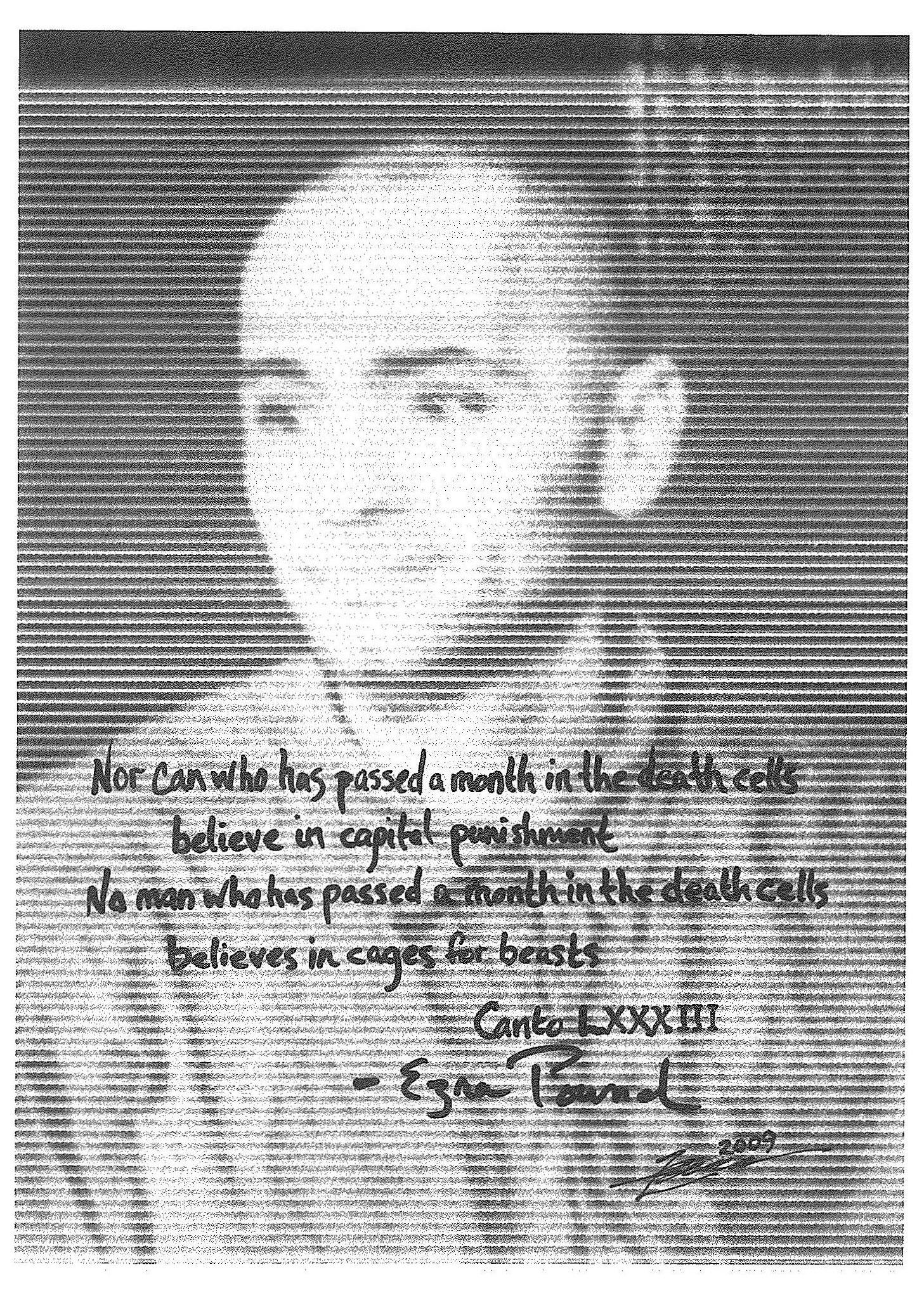
Epilogue
In offering this Ultimate Apocalypse Edition of The Manson File, I hope that at least some of my readers will be moved to not only question the Manson Myths illusory manufactured “Reality” but to doubt all official accounts, to question the veracity of the mass media in general, and to treat all mainstream versions of “what really happened” with healthy skepticism.
If something sounds too unlikely to be true as was the first reaction of many to the “Helcer Skelter” myth, or “Lee Harvey Oswald acted alone”, or “Iraq possesses weapons of mass destruction”, along with any number of other popularly believed fantasies, then maybe it is too unlikely to be true.
However, I write these words in the midst of an unprecedented explosion of Internet-bred insanity that I’ve termed not conspiracy theory but “conspiracy fantasy”. So my encouragement of skepticism does wot mean that one should merely accept the equally untrue alternative versions of reality all coo many irresponsible propagandists and deluded zealots on both sides of the political divide promulgate.
Among the many myths I’ve sought to explode here is the persistent fantasy that there is such a thing as an “objective author”. None of the previous books about Manson were objective, even though they pretended to be. I make no claim that this one is either. I’ve made no attempt to hide my own biases.
The Manson myth’s sway is so strong that anyone who questions its articles of faith is immediately branded a heretic: a Manson “apologist”, a Manson “follower”, a Manson “fan”, a “revisionist” or a “conspiracy’’ theorist”. I don’t consider myself to be any of those things. But I know that won’t make any difference to those who prefer to chink otherwise.
Each of us interprets the sensory data transmitted to us through our own personal filter of mental obscuration.
That assures chat our view of reality is constantly mutable, impermanent, and always subject to revision.
I have done my best to create as accurate a verbal picture of this one complex but small neighborhood of reality as was possible. But I am keenly aware that whole areas of what I sought to explore are still veiled in shadow, and always will be.
In that sense, The Manson File, like the phenomenon it explores, must remain an open file.
Literally so. Shortly before I completed this book’s previous edition, a former law enforcement official informed me that when he made a routine request to see the FBI’s Manson file in Washington D.C.’s National Archives, he was told that the file was not made available to the public. When he asked why, the baffled archivist said that the case was still open, which implies that the crimes are still under investigation. Why a case supposedly solved in 1971 was still open in 2011 is yet another mystery.
If I’ve learned anything during my long descent down this rabbit hole, it is that there will never be a final word on this subject.
In anticipation of the ceaseless flow of as yet unknown information that will emerge for decades to come, I initiated The Manson File Myth & Reality of an Outlaw Shaman Official Circle Facebook Group on November 11, 2017 (since migrated to Abraxas Circle due to Facebook censorship).
Interested readers are welcome to apply there if they wish to be kept abreast of the inevitable shocks and surprises the future holds. Considering the vagaries of the Internet, ocher forums independent of corporate control and censorship are also in the works.
Shortly after we inaugurated that group, Charles ceased to exist.
His passage set in motion a courtroom drama played by several contending litigants fighting for Charlie’s mortal remains and the legal rights to his Estate.
I hoped that this last chapter in our subject’s conflict-riven time on this earth would’ve been completed by now so that I could definitively chronicle that sordid episode of ghouls and greed.
And yer, as of this writing, four years later, the legal struggle dribbles on.
Rather than provide what would of necessity have been an incomplete telling of that twisted rale, I will wait until the final nails in Charlie’s unquiet coffin have been hammered to address that still fluid situation.
Until then, I refer interested readers to listen online to my radio report Cease To Exist: The Death, Funeral & Desecration of Charles Manson.
Broadcast as the August 2018 episode of my periodic radio show transmitted by Berlin’s Radio On, the program features my interviews with Charlie’s son Michael Brunner, Charlie’s close friend, Derek Haze, and Tony Sperl, a former law enforcement officer who witnessed Charlie’s reality TV freak show of a pseudo-funeral produced by spurious ghost hunter Zak Bagans. All three of my guests were of immeasurable help in supporting this work.
These may be the last pages of this File. But the research into this eternal enigma has really just begun.
Charlie’s long-time correspondent Ben Gurecki is conducting important first-hand research on Charlie’s youth and family background which he plans to reveal in an appropriate medium. Eric Bessery is working on a fascinating anthology of never before seen private correspondence between Charlie and his commune. That opus promises to fill in many gaps in our understanding, especially the often neglected human all too human side of this often overblown saga. Derek Haze is currently transcribing his voluminous treasure trove of illuminating and candid telephone conversations with Charlie for eventual release. Dennis LaCalandra’s painstakingly compiled Google Earth Manson Mythos Map is an indispensable tool showing how close the case-relevant drug dealers lived to each ocher. His ongoing research builds a formidable Watson File exposing Cielo Drive as che tip of an underworld iceberg concealing a much wider international narcotics trafficking operation.
Considering how rapidly this most mercurial and mysterious of cases changes, it would be wrong to tie things together in a neat bow and pretend that everything is resolved now.
Let it end on a note of absolute uncertainty before these words fall into the silence of all che things that can never be written.
Appendix A: Easter Monday Audience With the Underworld Pope
Charles Manson Interviewed and Decoded Transcribed and Annotated by Zeena Schreck
On Easter Monday, April 4,1988, Nikolas Schreck interviewed Charles Manson in California’s San Quentin Prison, A verbatim transcript of that interview is presented here. It deliberately includes all of the hesitations, digressions, infelicities of speech, and fragmentary sentences which mainstream journalism usually deletes in order to package a more palatable product to its consumers. What cannot be easily conveyed in a written account are the crucial non-verbal signals transmitted throughout the conversation. Manson maintained at least five simultaneous streams of communication during this encounter. The first level consisted of the actual words exchanged during the discussion. Mansons subtle gestures, fine gradations of facial expressions, dancelike movements, and precise intonations of certain words were as significant as what was actually said. Even his calculated silences between words expressed information not explicitly stated. Despite the seemingly straighforward and down to earth nature of many of Manson’s answers, the attuned reader will be able to see that there is a secret level at work as well, designed to fly under the radar of linear thought. The second level of communication was the constant beam of hostility aimed at San Quentin Information Officer Dave Langerman, the only Caucasian prison official in the room. In reading the interview, it is important to keep in mind the dynamics Manson is alluding to and responding to with regard to the palpable racial tensions extant between the two officials assigned to watch over him. Although several black armed guards were also present, only one of them was personally addressed by Manson during the interview. (He is referred to in the following transcript as “Officer.”) The third level of communication was Mansons sympathetic rapport with the black guards keeping him under gun, who were utilized to a certain extent as an audience to play to. The fourth was the intermittent awareness granted to the cameraman recording the interview on film. The fifth and most subtle level of communication was directed at the theoretical audience who would eventually view (or read) the interview. Schreck had been corresponding with Manson since 1985. Originally, prison officials had agreed to allow Manson to bring his guitar so that his music could be recorded, but this permission was rescinded at the last minute. After taking the ferry across the bay from San Francisco to San Quentin, Schreck and the cameraman accompanying him submitted to the customary search before being admitted into the inner recesses of the maximum security prison’s forbidding fortress. They were greeted by Information Officer Langerman, who gave them a brief tour of the facility and processed the paperwork required. Schreck was then led into the cluttered storage room/office selected to serve as an impromptu interview room. Langerman commented that he had tried to persuade Manson to “at least drag a comb through his hair, but if the guy wants to look like a living armpit, that’s his business.” This remark typified Langerman’s attitude toward his charge. After a long delay, armed escorts accompanied a chained and handcuffed Manson into the room. He wore dark sunglasses and a knitted cap, which he removed once his handcuffs were unlocked. His manner was at first calm, business-like, but casual. Manson was friendly and even playful with the black guards, but the animosity between him and Langerman was obvious. Although gifts are usually not allowed under these circumstances, Schreck was permitted to present Manson with a copy of Tse Manson File, which had been published a few months earlier. Manson carefully read through the legal release form Langerman gave him to sign. Initial small talk and greetings were exchanged while the sound equipment and microphone were set up. Manson mentioned that he’d heard that it was the twentieth anniversary of the assassination of Martin Luther King. “They lied about that, too,” he said. As he warily sized up the situation, he began to speak about the many lives he’d led, including his time in Mexico.
CM: ...and a bullfighter. That’s Australian. Right there. Ah, you don’t mind if I’m ‘a sit down, do you? This is the only chance I get to get unhandcuffed. I got it... I got it [politely but firmly rebuffing any assistance in attaching microphone to shirt]. This is the only chance I get to come around unhandcuffed.
NS: What we’re going to try to do is, um, [pausing while Manson adjusts the microphone cord] at first, just bring this with your head in here. So, we need to get just a close shot on your head.
CM: You’re not gonna, ah...have you got your gun lined up in it [the camera]?
NS: No, didn’t bring that today.
CM: Alright. [Mansons manner is suddenly serious. He pauses. Manson lays his hand on Schreck’s shoulder, looks him in the eyes with great sincerity.] As I give to you from this heart, y’dig?
NS: Yeah. — — — — —
CM: Ah, we can keep up with chat in the mail.
NS: It’s good to finally see you in person.
CM: Huh?
NS: Good to finally see you in person.
CM: Yeah, yeah, yeah... nice of you to do all the things you’ve been doing, man. I really appreciate you.
NS: Thanks.
CM: There’s a lot of youngsters raisin’ up like you... How’s, uh... Bogus and them?
NS: Fine, sends his regards.
CM: Yeah, yeah. L.A.’s not doin’ too well, is it?
NS: No, I got outta there.
CM: Yeah, I figured. I was outta there myself a long time ago, yeah. Yeah, L.A.’s not coo cool. Yeah, it’s...[Manson looks around for a means of creating music out of anything ac his disposal in the strippeddown room being used for the interview.] We can’t, uh, we can’t gee into any music because we’re, we’re in., .what I’m locked into is a soulless little jealous punk.[237]
NS: I wanted to ask: Do you think there’s any way to eventually do that? Are there any other authorities to go to, to do that?
CM: Ah, well, yeah. There’s probably all kinds of ways we could do it.
NS: You could beat on the table.
CM: Yeah. No. I was chinkin’, uh, lemmc use that trash can down there, ah [looking to Langerman] unless you wanna pass a rule against that. Langerman: No.
CM: Everything I do, they make a rule against it, see? If I wanted a bucket of shit, they’d tell me, “No you can’t have it.” And then they’d pass a rule: “Send no buckets of shit”, man. No matter what I wanna do, they wanna keep me from doing it. No matter what I want, they don’t like it. They... you know, in other words, if I... I got it [directed to guard who tries to help him remove plastic bag from trash can], I’m very capable when I’m unhandcuffed... [glaring toward Langerman]. Langerman: Okay...
CM: [A measured laugh]...its an altogether different game. [Tense pause.]
NS: So, what I want to do here is, I don’t really want to sit and ask you questions you’ve probably heard a million times before... I just wane to talk about a few topics and let you reflect on them, CM:Well, see the way I communicate is...
NS: Rather than do the D.A, version... [Manson’s casual conversational demeanor, strikingly different from the persona he usually presents to the media, begins to change. He gradually transforms into the more flamboyant stylization of his chameleon personality reserved for the media.]
CM: The way I communicate is, ah, in...in music. It’s like, to know someone, you start in the fingertips [flexing his fingers]. You can know me in my fingers. You can know me in my hands. You can know me in my arms. You know, in other words, I’m something inside that goes beyond words. Words don’t...words. Blurrr-blurrrr-blrrrr. You know, they’re a bunch of fucking biscuit. That’s what they teach you in school. You know I live, from here [Indicating his heart and soul ].
NS: What would you tell the people out there who,..
CM: Fuck the people out there.
NS: ...Well, who don’t know you.
CM: I don’t give a fuck whether they know... anybody that don’t know themselves, don’t know me. I don’t give a fuck about people. I’m looking out for this guy (to self], right here.
NS: So you’re not angry with how the media has portrayed you as this villainous monster?
CM: What does that mean? It doesn’t mean anything. The media is a re-run. Public opinion is a little girl. It’s a toilet paper commercial. It’s got nothing to do with reality. Reality is HERE. Reality is NOW — y’dig? And reality is that I’m giving you this guy here [pointedly directed at Langerman], ya dig what I’m saying? Then I’ll [makes threatening hand gestures to Langerman, making clear through gesture what he does not say out loud, as if an invisible censor is deleting any incriminating words.] ‘n’ we’ll... And I’ll get that...
NS: Well you say you’re fighting a holy war against...certain...
CM: Pollution. Pollution. Pollution. It’s the only solution for survival on the planet earth, is a revolution against pollution. It’s like all the animals are running this way and a lion comes on the picture, they all run that way. All the animals are all divided all up, all the people are out there playing all these games. A bigger fear comes, they all get together and they all run in one direction. The Peace Plan, is, uh, that Schultz and all them guys are playin’ in the Middle East, it doesn’t have any fear in it[238]. It doesn’t mean anything. It’s a bunch of fuckin’ old assholes talkin’ about old rhetoric.
NS:Well, what do you think the meaning of fear is?
CM: The fear is: You’ll do it or die. It’s chat simple.
NS: Do you think chat’s what the world needs?
CM: Ah, that’s the only way it’s gonna survive. But that’s got nothing to do with my world. That’s their world.
NS: What’s your world?
CM: My world’s out there in that junkyard. You don’t...in other words, in that picture[239]. You know what picture my world’s in. I’m there, and we’re not throwin’ rocks, you know. They’re over there throwin’ rocks, y’know. If that’s what their game is, then that’s where they’re goin’ and it’s got nothing to do with where I’m running. You know, where I’m running is, ah... You know, I run in the alley. I run in the darkness. If I was sittin’ up there where I had my fingers on the buttons, it’d be a different game altogether.
CM: [Picks up waste paper basket, tests drumming on it.] Yeah, there’s no... Shit. Ain’t nothin’ in that [reference to musical quality of the waste paper basket]. Uh, yeah there’s no order because incompetent assholes like this [to Langerman] run your world. These are the fucking ding- dings that run your world, man. Look at him. Fat hangin’ off his fuckin’ jaws. He’s an incompetent piece of shit. Y’dig? He’ll wear black cowboy boots, he’ll play off this guy [reference to Officer] and pay that guy to hold ME down. You dig what I’m sayin’? And then come back around the other side and talk about: [mocking impersonation] “I’m a white guy. Heh, heh. I’m a white brother. Heh Heh.” Y’dig what I’m sayin’?
NS: What do you think about race?
Manson is referring to photographs of the auro junkyard in Death Valley as it looked in 1988 which were sent to him by Schreck shortly before the interview.
CM: What do I think about race? Everybody look out for themselves. I look out for this guy [co self]. This is my race. It comes out of my dickhead, man. My race comes out of me. Y’know, I ammy race. I live on my planet. In my world. In my desert. In my thought- And it took me twenty-two years to get through these fucking hallways. This is what I’m mad about — to land my thought down on that desert. In other words, these guys come in here, they’re trying to work their thoughts out. I already got my thought out. My thought’s already out. I already worked it out. And I didn’t break the law. Tliat’s what’s got me so fuckin’ mad. That’s what’s got me so boiled up. I didn’t break the law. I’ve got some friends that killed some people. But my friends have always been killing people. I live in the underworld. My friends have always been in...y’know. I mean chat’s part of the life I live.
NS: What do you chink about killing and murdering? Do you think it’s...
CM: Uh, each person — you gotta be responsible for you, man. You gotta be responsible for your actions. If you want to give me your life, I’ll take it. And I’ll put it in the deck and I’ll deal it, y’dig. And if you don’t like the way I deal it, then don’t give it to me. You dig what I’m sayin’? But when you give it to me then it’s mine, I deal it any way I want. Ifl cell it to jump [snaps fingers], it’ll jump. Ifir don’t, y’dig what I’m sayin’, then it’s not mine. Because I could ask you no more than I could do for you. In other words, if I’m with you, I’m...I’m totally there with you. There’s no bullshit. I’m not your leader. I’m not your follower. You dig? But if you wanna get up and ride, we’ll ride and I’ll be right there with you. You see what I’m sayin’? I don’t count pennies. I’m not playin’ little petty games. You know who I ride with. I ride in Venice, California with the Straight Satan. Tliere’s no...
NS: Do you remember the day you were arrested in Death Valley? Do you have any memories of that day?
CM: Yeah. One of these incompetent fuckin’ assholes got me [gestures to Langerman]. Put a pistol under me. And put handcuffs on me. And I’ve been in handcuffs for, uh, eighteen years. That’s the only reality he’s got. Is me in handcuffs.
NS: Do you have any memories you want to talk about from before you had handcuffs on?
CM: I don’t remember. I don’t play... I don’t remember anything. But I can’t ger any music out of this [bangs waste paper basket]. I can’t get any music out of nothin’. These motherfuckers cuttin me off of my music, see. And then they’ll represent off to the little girls, [mocking voice] “Uh, lookit-it’s me, little girls...”
NS: Wiry don’t we talk about what you think music is? You say it’s not any...
CM: Music is my soul. Music is the way I express. It’s my religion. It’s my religion.
NS: You’ve also said that sex is your religion.
CM: Yeah, sex is a reflection. Everything’s a reflection of this... [sweeping, physical, martial arts type movements, perhaps partially motivated by an interest in testing his unhandcuffed limits before Langerman and the Officer]. When you reflect that, you reflect music. I reflect it in music. [More erratic movements reminiscent of playing various instruments accompanied by jazzy onomatopoeic sounds.] — That’s me. But I put my soul into the sound. And then these fuckin’ assholes steal it. And then they’ll walk up and down and tell you, [mocking voice of boastful braggart] “Yeah, this is me, baby. And this is me, rube-boob!” — But that ain’t them. It’s just a carbon copy reflection of. Y’know. They won’t let, they won’t let the reality of...
NS: You have said that you are a reflection of everything around you.
CM: Sure, what else could a child be? What goes into you, you’re going to reflect it sooner or later. I’m goin’ like this [contorts his face into a rapid series of expressions], pretty soon you’re going to reflect that. All children do.
NS: What about good and evil? You’ve spoken about beyond good and evil. Do you want to elucidate upon that a bit?
CM: [Long sigh.] Well, evil. In order to put this world into order, how much evil do you chink would have to be? You see what I’m sayin’? In ocher words, just to think “World Peace” up underneath these incompetent fuckin’ assholes that run these places, you dig what I’m sayin’, uh, what kind of man do you think would have that in his head? You dig? And they bring all these Indians over from India and they all sit on their... [mocks Indian gurus and Maharishis who gained popularity in the west during the Sixties, especially among celebrities] “Aaaaahhhh- hhh”. And you know they all come like they’ve got the great answer. Y’dig? But they don’t even know how to speak English. They don’t even know what the English words mean, y’know? Who, who has the master plan, in English?
NS: Now that kind of gets back to the race issue. If you...
CM: No, English has nothing to do with racist. When a guy speaks English, he understands the English thought. All the English thought that came from the English words, came from the English mind. You know, I can’t speak in Poland or Chinese. I can understand what I’m understanding in English.
NS: Who do you think some of the people in history have been, who have been evil enough to put order in the world?
CM: I don’t place no emphasis on history because they all lie. The truth is that your history books are full of bullshit. Most of your books are full of bullshit. You know that — being a writer yourself. Most of it’s trash. And, uh, it’s just for money. Uh, if I lived with you for about a month, or two, then you would have a whole different concept of me. You wouldn’t think the same thing of me, your whole opinion of me would change. Not only your opinion of me would change, your opinion of you would change. And we would kinda reflect off into each other to where we become a part of... [a mudric gesture indicating harmony and completion]. That’s the world I’ve always lived in.
NS: Who are you?
CM: Huh?
NS: People don’t know who you are.
CM: Who am I? ’
NS: Yeah.
CM: I’m anybody I can get away with being. I’ll take his clothes [reference to Officer] and put his boots on and get the hell outta here. Walk on down the road and be a hobo. If I had a good chance. I don’t like killing. I don’t kill bushes. I don’t kill trees. I don’t eat animals. I don’t like killing. But, I’m just like anybody else. I can, when I’m pushed to do that. I can do that just as easy as...as eatin’ a piece of steak or cookin’ a chicken.
NS: Do you want to talk about the art that you’ve done? The string-art and what you put into that?
CM: Oh, that. That ain’t about nothin’.
NS:Well, you say you’ve...
CM: [Picking up a copy of Ute Manson File laying on the table in front of him and skimming through it.] Yeah, this looks like you put a lot of research into this, man. [Surveying the contents of the book and the various images of actors playing him.] Isn’t it funny, you’ve got so many people play-acting you...[pauses to look at photograph of Robert Quarry as Mansonesque vampire in The Deathmaster]...so many people play-acting you, you never get a chance to play-act yourself.
NS: Maybe you should look at that after we do the interview...
CM: Well, this is important to what we’re doing here too, isn’t it? How much time do we got here?
NS: I think until about one o’clock.
CM: Yeah...
NS: Do you want to talk about what it means to be an outlaw?
CM: That’s just bein’ free. Bein’ yourself. Bein’ whatever you are. [Still regarding the book...] I like this, man. It’s a little better than that other piece of shit they wrote, that said it was mine, y’know [a reference to Nuel Emmons’ book, Manson in His Own Worths]. They lie, man. They lie so fuckin’ much. And...they lie and then they turn around and represent to you young people that, [mock authority voice] “We’re the guys up here, let us teach you, kids. Let us teach you what’s goin’ on.”
And they don’t know what’s goin’ on. And they won’t face what’s goin’ on, even if they did know what’s goin’ on.
NS: Do you think that your thought has had an influence on young people now?
CM: Uh, I’ll put it to you this way: When I was a little kid in the streets, I was smokin’ grass. And it wasn’t but a few people smokin’ grass. I come to jail as a beatnik. I don’t know whether you even remember beatniks. But what you hippies were of the ‘60s were what we were of the ‘50s. Well, we got ate up by the system. And, uh, then when I got back out, the hippie was a take-off on the beatnik, as the beatnik was a take-off on the Bohemian, or the Bohemian was a takeoff on the boob-ski-boop. In other words, it’s loop-deloops and circles that come in and out of these places.
NS: It always seemed like you weren’t really a hippie, in the sense that you represented order...
CM: I didn’t represent nothin’.
NS: No?
CM: I didn’t represent anything. I represented me. I represented a motorcycle, a sleeping bag, and a gee-tar. And all that other shit’s the D.A.’s. He put all that shit on me, man. There was a buncha broads who’s followin’ me around. But there’s always broads followin’ me around.
NS: What about this myth about the Process and Robert DeGrimston...
CM: [Swiftly breaks in] No! That’s a bunch of horseshit.
NS: Did you ever meet them?
CM: [Irritated] No, I don’t haveta...uh, yeah...1 knew ‘em, I knew ‘em spiritually. I knew everything. I knew everything.
NS: ...because you lived there on Cole Street[240] right near the...
CM: Yeah. Yeah, I was in the same vibration as all those people, yeah. In other words, you’re with somebody. You know somebody. You know they’re there. You’re runnin’ with ‘em. Aaahhhwooooo [makes wolfhowl]. You know what I’m sayin’? You’re out in the bushes with ‘em and your coyote’s with ‘em or you’re in the...you’re spiritually allied with em in the scorpions or you’re spiritually allied with ‘em in the awarenesses that seem- [breaks the flow of what he’s saying to observe Langerman again] You notice this guy? As I’m talking he’s going through all kinds of changes? Well, I’m spiritually allied with this dude, see?
NS: You’ve talked about the wolf, coo.
CM: Yeah. I’m spiritually allied with that character, coo, yeah. Yeah. In other words, the ways of animals I identify with more than I do with the ways of humans. Humans are pretty stupid. Humans won’t survive. Humans ain’t gonna survive, not the way they’re going.
NS: You think they’re going to destroy themselves?
CM: Yeah. Definitely. They’re gonna destroy every fuckin’ thing. They’re destroyin’ everything. See people don’t realize how many... If you sit down and you start thinkin’, PEOPLE, it would take you ten weeks to think up two-hundred-million people, man. You know how many people that is? Now you run outta food with two-hundred million people, you run outta oil with two-hundred-million people, you run outta thought with two-hundred-million people, you gotta lotta meat there, man. That’s a lotta meat to deal with, dig? And Jackson[241] wants to run to be president, yeah-heh, heh. He better hope someone wants to be president, y’dig what I’m sayin’. But, ah, who in the hell would wanna be? Can you conceive of what kind of brain would wanna, wanna, wanna lead these fuckin’ rube-scoops out there in the, you know. Because there’s no communication with ‘em. Y’dig? If you took a horse-whip and beat ‘em, they still wouldn’t understand what the hell you’re talkin’ about. Because there’s no intelligence there.
NS: You think there’s too many people?
CM: Oh man! Yeah. Y’know, they’ll pray for Hitler to come back. They’ll wished he had been here.
NS: What do you think about Adolf Hitler?
CM: I just think he was thrown in his time, doin’ his trip for whatever... See, you don’t have any other choice. Once you get order in yourself, then you gotta reach the order in your own household, in your own family, in your own kin, in your own kind. You gotta reach that order. You can’t go... I can’t go over and tell this man something until I can cell me something. If I’m right, within me, then I can tell him what’s right within what I think. But each man has to be right within what he thinks, dig? I can’t make another man right. The other man gotta be right with himself.
NS: Do you feel like you have any connection with Hitler?
CM: We all do. Anybody that wants to put order into the world, anybody that’s got a brain that want’s to put order into the world, has got to scumble upon Hitler. Because Hitler started puttin’ order into the world. And when he started puttin’ order into the world, it threw him out and overwhelmed him. It was coo big for him, he couldn’t do it, y’dig? Nowadays it’s a different computer. It’s a different world. It’s a different thought. Nowadays you don’t need ail that explosive power. You can do it on your computers, with your buttons and stuff, [breaks into rap-scac-Manson-singing with a string of lyrical half-nonsense words] With your aids and baids, with your bisker bar-Aids, and blip-de button guzzy gitcin’ ged... That’s in my music, see? But that’s what they won’t let me get out. And then every time they keep that music out, then all the kids raise up and they KILL a bunch of people. And then they say, [In a mock, dopey authority voice] “Whoa, you’re fucked up.” Well, why are we fucked up? Who says you can put your music up over my music, y’dig what I’m sayin’? Who put your voice up over my voice? Who says your god’s bigger than my god? Y’dig what I mean? And then once ya’ just...if you get down in the alley with it, and who’s dog’s the biggest dog. I’m the biggest dog when I’m out there in the street. When I’m ridin’ my motorcycle and I’ve got my knife, ain’t nobody up over me with nothin’. [Now shooting a smoldering look toward Langerman, nearly trembling with rage as his firmly metered words deliver a pointed message to his keepers, cau- sing an icy tension in the room] — nothin’! ... Nowhere! ... Nowhere in town!
NS: What do you think has made you different from these other people?
CM: [His words now saturated in bitterness] I was stupid enough to believe that I had rights in this country. Y’know, I believed in what the judge said. In other words, I worked for twenty fuckin’ years to get out of jail. I did everything these assholes told me. I thought that ding-ding [prison authority in general] was my daddy, man. I played up underneath that fool and did everything he told me to do, right just perfect — perfect to the letter of the law, all the way down the line. Then when I got outside, I never broke that law. I’m not stupid. Y’know, I’m not educated in the ways of their education, but on my road I’m not stupid. I know when I done somethin’ and when I didn’t do somethin’. And someone comes to me and they says, “I got a problem.”[242] I said, “What is it?” And they said, “Will you help me?” I said, “Sure, I’ll help you.” [He adopts a tone now mocking his own younger naive self, characterized by a singsong, gung-ho quality] He said, “Well, can I be your brother?” I said, “Sure, I’m your brother. I’ll help you do anything you want. What’s the problem?” He says, “A guy owes me some money.” I say, “Well, you’re big enough. Go get it. If you ain’t, sit down and keep your mouth shut.” He said, “What would you do?” I said, “Fuck it, man. It’s only money. I wouldn’t put my life up for no fuckin’ money.” Y’dig what I’m sayin’? He said, “Well, I’m gonna go get my money.” I said, “Well, that’s up to you.” It’s got nothin’ to do with me. The guy went over and fucked a guy up and took his money. You dig what I’m sayin’? He come back and said, “I killed a dude.[243]” I said, ‘“the fuck you tell me for?! Whatcha tell me for? You makin’ me a conspiracy to somethin’?” Y’dig?
NS: Do you think you’re incarcerated more for your ideas than what you were supposed to...
CM: I’m incarcerated because they’re afraid....
NS:We have to change the tape.
CM: I hope... [tape change]
CM:...suffer. They don’t know how many children and how many peo ple are suffering right now because they won’t change. See? They don’t have the intelligence to change. [Makes robotic motion with arm along with machine-like “HUH!” sound to illustrate his conception of humans as willfully unthinking, permanently programmed, and ultimately interminably destructive contraptions.] Once you get ‘em — “HUH!” Then they’ll go “HUH” the rest of their life. “HUH!...HUH!” They’ll do that for a paycheck, “HUH!...HUH!” You tell them: Don’t do that no more! And they go, “HUH!...HUH!” There’s no communication. You tell them: I tell you — Stop doin’ that! And they’ll go, “HUH!... HUH!” I SAY, STOPPIT! Then they’ll go, “HUH!-” [acts as though he’s violently trying to destroy an indestructible piece of machinery with slashing and hammering motions, completing his description shouting through clenched teeth.] AND YOU CUT THE THING IN HIS FUCKIN’ THROAT AND THROW BLOOD IN THEIR FACE...and they’ll go, “HUH!...HUH!” [Chuckles sarcastically.] You see what I’m sayin’? In other words, there’s just no intelligence, man.
NS: You don’t have any hope for mankind, then?
CM: Ah, not on that level. Not on that level, I don’t. No. That’s not mankind. That’s not intelligence, y’know. It’s not even beast. Y’don’t have the intelligence of a zoo, y’know.
NS: So when you say “Beast” you talk about, ah, 666 a lot. What does that mean to you?
CM: Uh, 666 is just a dollar bill. That’s the body of the money. The body of the people that work for the money. Take that gold on that man’s ring. [Pointing to the black Officer.] He works... [Questioning the Officer directly.] How long did you work for that? Officer: Two or three weeks.
CM: Two or three weeks to get that ring. And when he got that ring, puts it on his finger and he rides it around. And he doesn’t know that he’s holdin’ up the very same value that’s workin’ his African brother to death [Laughs] and it’s starvin’ somebody else down on the ground but he wears it on his finger like it was okay. [His smile drops, laughing stops, he become somber.] Td take it off and throw it on the dirt. Dig? I — tschew — Y’know, I wouldn’t enslave nobody for a piece of gold. It’s stupid! And anybody you see wearing gold? Y’know, they’re just... they’re enslaving somebody else with it, y’know. But it’s....where their brain is and you can’t get them out of it. You know why you can’t get them out of it? [Wails in agony and assumes the position of Christ crucified.] AAAAAAHHHHHHHHHH! Because there was where they hung that fucking last asshole.
NS: What do you think about that last asshole?
CM: He was...He’s still there...Ain’tcha see him, he’s still right there. Nothing’s changed. It’s right now, than then, as it’s right now, now — y’dig? And I’m not goin’ back over there. Fuck them assholes.
NS: What does Satan mean to you, as opposed to Christ?
CM: Satan means whatever I’m lookin’ at. Whatever I want it to mean. It’s on my forehead. It’s me if I can get up on that highway. Its me trying to save my air, my water, my trees and my wildlife. It’s me on that cameraman. It’s me right there in his watch. It’s me in his brain. It’s me right there on his ears. And when he shaves in the morning, I’m sittin’ right up underneath his razor. Y’dig? It’s everything that human beings here don’t understand, it’s all their fears, it’s what they’re not sure of. Y’dig what I’m sayin’? Satan to me would be God. You would be God to me. Y’dig? I can worship anything as God. Everything is God. The sun is God. The moon is God. Everything is God. — Except them stupid fuckin’ people who’ve got that shit stuck up in their fuckin’ heads and they won’t get rid of it. They’re out there talkin’ about, [Parrots a sanctimonious televangelist preacher’s voice segueing into himself again speaking in a manic wordsalad of half gibberish.] “Well, Jesus loves you on the front of the cross and he’s doin’ all these things...”, boo-boo-wahbah and their back there googlin’ that’s that blasted Ronald Reagan on the rube-scoop and then back on the boobscoop and then he’s cornin’ back around in my ally and said, “Yeah, well, I believe in Jeez...” Don’t give me that shit, man, I know who you believe in. I know who you believe in.
NS: What about Abraxas?...
CM: ABARAXAS? [Coughs heavily, catching his breath] Abaraxas, yeah. Alright. You remember when they had the Harmonic Convergence?[244] All the people was up on this mountain over here?[245]’’ [Pauses for effect.] Hess died that night.[246] [Appears winded after coughing.]
NS: Do you want to sit down?
CM: I am, I am. [Pauses.] Hess died that night. When Hess died that night, that put me longer in prison than anybody in the world. Hess was always longer than me. But when he died, that put me, the only living thing that was standing on that very same thought, that you and I are standing on now, you see what I’m sayin’? In other words, we’re still in that same dream. We’re still in that same thought and nothing can take that. You can take my body away and stick it in that cabinet, it’s still there. [Referring to a file cabinet. ] Y’dig what I’m sayin’? You cannot take it. Y’dig what I’m sayin’? It’s too many people that gave their lives for it. They gave their lives and they’re still bleeding there for it. Y’dig? And the spirit is there, and we could bring the spirit back to life but for people like this. [Motions to Langerman.] Y’dig what I’m sayin’? He hates white people. He’s scared to death of this black guy [Referring to the Officer.] He’s afraid the black guy’s gonna beat him up. The black guy ain’t thinkin’ about it. The only reason he’s scared of the black guy is ‘cause he’s messed over the black guy so bad, y’dig what I’m sayin’? So he’s got all that back, so what he’ll do is feed me back to this dude [the black Officer], y’dig what I’m sayin’, and say, “Well, here, don’t — don’t hit me but jump on him.” And then he’ll hold me in the point and stand me out here in front of all these black people, y’dig, and then push me down in there and try to get me hurt and try to get me killed in every way they can and then when they can’t, then they say, “Oh, wow, man.” And then they wanna wear boots and wonder about — [Manson is now refocusing his venomous patter to Langerman specifically.] I’m gonna catch up with you. I’ll betcha I catch up with ya. TH betcha I catch up with ya’ buddy. I betcha I’ll make you be what you are. Or I’ll skin your fuckin’ ass. I’ll hang you on trees. I’ll do every fuckin’ thing I can do ro do just exactly what I got to do to survive, man.
NS: How do you think you’ve survived so long in this situation?
CM: Because I’m very adapt, [sic] I can adapt to just about anything, man. You know, in ocher words, I stay right here all the time. I’ve been here, right here, all the time, all my life. So it’s no new thing to me. See, you go out in the prison yard and you got to be up on everything that happens around you. You can’t let anything get in to you that, you know... I’m lectin’ you get into me now. You know that, don’t you? In other words, you, this Satan [referring to the camera filming him] is gettin’ into me now. See, because you’re gettin’ me. Now, if I was outside you wouldn’t know me. If it wasn’t for this bullshit I’d be gone, man, doin’ a little wind up on the road somewhere, y’know? I’m gone down the road, man. This is all bullshit, man. This whole mother- fuckin’ attention thing? I don’t need nobody’s attention about nothin’. [He returns to his vendetta against Langerman, now mocking him in a coquettish, taunting voice.] I can do what J do by myself. I don’t need nobody. I ain’t lookin’ for no followers. I’m lookin’ to survive. [Now his delivery returns to “normal” as thoughts drift away from Langerman for a little while] And survival to me is our there in that desert. Runnin’ around with them wolves and them coyotes and them bugs and birds and bushes and things. I want to get back on the ground with mine, y’dig? But now I can’t get all these people that are, that are trying to be and do like me, y’dig what I’m sayin’? In other words, like I got all this fuckin’ attention on me...1 got ninehundred- million people, y’dig what I’m sayin’? Now, how do I get away from ‘em?
NS:Why do you think you attracted them in the first place?
CMiWell, because I am that. I am the soul of. I am a reflection of. You take a little baby and you put him in the penitentiary... and you raise him up. I’m Richard Milhous Nixon. [Long pause to wait for reaction.]
NS: Um-hmm.
CM: I’m Richard Milhous Nixon. Y’dig what I’m sayin’? But I’m him down here under the ground, man. I’ve had to do all the fightin’ while he gets up there and takes all the bows, dig? I got to carry the motherfucker while this fat sack ‘o shit [referring to Langerman] won’t let me call my ol’ lady — while his ol’ lady tells him, [mocking voice of a nagging fishwife] “Shut up!” You see what I mean?
NS: Who’s your old lady these days?
CM: Uh, Squeaky. The one thar’s down there doin’ life tryin’ to get me outca jail.
NS: What’d you think about her escaping?
CM: Uh, she’s right on. She better be right on. She knows what she’s got to do, see? She knows what she’s got to do to survive...on this planet Earth. Just like [coughs] all the pe pie that are with me do. The ones that are with me do. The ones that are not with me are not with themselves.
NS: What do you think about James Mason and the Universal Order?
CM: [Mentioning James Mason’s name appears to be a trigger which suddenly fills Manson with rage.] I don’t wa...I’d...L..l wish you’d send James a copy of this... [referring to the film being made of the interview],
NS: I’ll do that...
CM: [His speech accelerates, he’s spitting anger, grabbing the opposite ends of invisible swords and breaking them over his knee. The swords he’s referring to are depicted in a photo he’s looking at in The Manson File which depicts James Mason holding a sword standing near Sandra Good, who is wearing a hooded ceremonial robe] ...and tell him if he had them swords... I’d j’reach and take them swords and I’d rip ‘em and I’d throw them down on his feet! Y’ dig what I’m sayin’? And I’d tell ‘im now, “STAND AT ATTENTION WHEN I’M TALKIN’ TO YOU!!! That’s where it come from. I doesn’t come from no fuckin’ book. “STAND UP OR I’LL KNOCK YER FUCKIN’ BRAINS OUT!” Y’dig what I’m sayin’? Handcuff the son-of-a-bitch down there and let me...d...djeh... I’d show ya’ how I’d interrogate the motherfucker. Y’dig what I’m sayin’? I’ll interrogate’cha, I’ll reach in your brain and pull your fuckin’ soul out an’ throw it on the floor. I’m tired of this bullshit, y’dig? [Mocking Neo-Nazis, he acts out their rigid, uptight behavior while giving the Nazi salute.] And all these people that run around play-acting like,”Hoo-hoo-ga-ga,” and playin’ all that shit. They better git...they better git...they better git IN LINE or get off the motherfucker. Y’dig what I’m sayin’? In other words they talkin’ about, ‘Tn the name of the Lord we gonna say this and in the name of the Lord we gonna say that.” In the name of the Lord, if there was such a thing...you see what I’m sayin’? Would he be the Devil? [Waits for reaction as if he’s not asking a rhetorical question but is waiting for Schreck to answer the question.]
NS: Um-hmm.
CM: [Repeats the question as if he wants to make it clear to Schreck that he wants an answer to the question.] If there was such a thing, would he be the Devil? [Pauses for the answer. When Schreck still doesn’t answer, allowing Manson to continue, Manson looks Schreck over and tries figuring him out based on his physical appearance.] What’s that big scar you got runnin’ on your face there? [Manson indicates the position of the scar he thinks he sees on Schreck’s face.]
NS: I don’t think I do have a scar there.
CM: Yeah, you do. Maybe it’s a run in your makeup.
NS: Um-hmm.
CM: Yeah, yeah. Looked like you had a scar.
NS: Kinda hot in here.
CM: Yeah. I’m gonna get a tattoo of a scorpion over here. [Indicating where he wants tattoo to be located.] If I ever get our, where I can get out on the mainline.[247] And if I don’t get out on the mainline, then we’re all go to church.
NS: Whar’d you think about Perry “Red” Warthan,’[248] you said you don’t like people play-acting you?
CM: Perry? Perrys a good man. Perry is. Perry gave his life for what he believed in. He stood up for what he believed in, y’dig? Uh, although I don’t agree with the way he did what he did, I’m still in accord with that man. I’m in harmony with him, y’dig? In other words, 1 can be in harmony with other people even though I don’t like their...I don’t like their particular mode of, uh, what they’re doing. But, again, I’ve got a lot of friends that are very terrible people...to other people. But to me, [Chuckies.] man they’re just home, y’know. I’m from Kentucky. In Kentucky I live in a county called, ah, Morehead. And they got them long guns. And if they don’t know you and you come up the holler.[249] y’know, we only got enough to last us to get through the winter. We keep ours in jars, y’dig what I’m sayin’?[250] We raised ours in hogs and cows. [Coughs.] Ain’t got no money. Don’t need no money. But I can get through this winter, y’dig what I’m sayin’, kick back and each summer I get up and I worry about gettin’ through the next winter, y’dig? Yeah, that winter was lost forty years ago. And I’m the child of uncle Jess that sent me rollin’ outta them hills of Kentucky, y’dig what I’m sayin’?[251] To save his cabin. To save his earth. To save his planet. Because he stood there and blew himself up with fucking assholes like this [comparing the goverment rev- enuers to Langerman] come in and want to take his still away and shit. [The “still” is referring to a home liquor distillery system.] He blew himself. He blew his kids up. He blew his...he blew everything up. Hound dog up. Chickens up. He blew the whole thing up. But when he blew chat up he went into the same eternal dream...y’dig what I’m sayin’?... the same eternal dream that I’ve been in in jail. Can you understand it?
NS: Where do you...where do you think you got into that eternal dream?
CM: I’ve been in jail since 1943. I’ve been locked up all my life. I’ve been locked up all my life. So I’m in that dream. I am not that dream. Don’t get me [wrong]... I am not that dream. I am only a witness. One little witness. One little fuckin’ little piece of shit, in that dream. There’s all kinds of people in that dream that are already all down the road. Y’know? In other words if you and I was gonna go prove a point and we said, “We’re gonna go prove this point.” Y’dig what I’m sayin’? And we stand up. And you knock me down. I say, “Well, okay. I’ll just show you a graveyard.” Y’dig what I’m sayin’? And then I say, “Now get up over the graveyard.” If you wanna play knock-me-down, y’dig what I’m sayin’, as long as you’re playin’ knock-me-down, [then] get up over the graveyard. And I’ll just sit on the other side of the graveyard and watch you go to hell.
NS: You’ve talked about the graveyards of veterans...
CM: Yeah. My brother. ’
NS: You were born on Veteran’s Day...
CM: I’m born right now. Anybody that puts their life on the line for me, I’ve always been right there with ‘em. Because I stay right there all the time. I was born and raised there. I’ll stay there...all the time... constantly. I’m so much there, y’dig what I’m sayin’, that Japan came over and said, “Hello.” [Chuckles.] And I said, “Hi.” Y’dig? In other [words]...anybody with any respect would respect me. But any punk that don’t have respect [referring to Langerman] and all that fear and insecurity, y’dig, then they treat me like the fucking punk that they are. In other words they give me all their insecurity. They take the most holy man they got, y’dig, and treat him as worse as they can. Degradate him. Drag him through all kinds of shit. Spit on him. Cuss him. Just do everything and then turn around and go to church and worship him on Sunday and think you gonna get away with it. [Long pause.] [It] don’t work that way.
NS: Which thing, what do you think would make it work?
CM: It’s gonna...The spirit is in it. The spirit, the spirit is movin’ it right now. There’s no doubt about it. Now they’re all runnin from [1988 presidential election candidate Jesse] Jackson right? [Chuckles.] Ha-Ha. They all maltin’ excuses, [Mockingly in a dopey voice.] “Duuuuhhhhh- hh” No-ah, they don’t wanna get him in this driver’s seat, do they ‘uh? HAHA- HA-HA-HA-HA! And I’m laughin’. I’m laughin’ like crazy, man. ‘Cuz, uh, I think, uh, when he goes up there and says, “Well, now, whatta we got here?” He’s gonna find out he’s got a fuckin’ bu- buncha bullshit there too. Makes no difference what they call you. Yeah, I call you the boo-skoo. You’re the commander of ma’am-scam, y’know. What does that mean? You still got to live with what you do. Y’dig? And these people that cut my mail off? Lemme tell you what they do to me. Tliey cut my mail off...you can give this to the next wave of little kids that you grow up co...they cut my mail off. They lie. They cheat. Tliey got some big of fat women that dress-thac paint their faces ‘n shit, and dye their hair, and they cut the legs off the tables so the little girls can’t get over and play with the little guys. And they got all kinds of little sex paranoias and little, little deceiving little lying, cheatin’ little things that they play. And then they’ll push ‘em off on someone else and say it’s all their fault. That they’re no good and, “We got the bad guys all locked up over here and we’re all the good guys.” Y’dig what I’m sayin’? When in reality, man, [chuckles under his breath sarcastically] y’got a bunch of scurvy fuckin’ PC [protective custody] motherfuckin’ pieces of shit. Y’dig what I’m sayin’. BUT — that’s on one hand. Now here’s where Abaraxas comes in: If they didn’t have the love to do it, who in the fuck would?!
NS: Who do you respect in the world?
CM: I respect that same fuckin’ asshole that I’m down on everyday. That’s Abaraxas, man.[252] We roll on it and we’ve been rollin’ on it ever since he come on the tier. He comes on the tier, I’m gonna [say], “Fuck you, you son-of-a-bitch.” Throw shit and piss in his face. Y’dig what I’m sayin’? Knock him down. And he comes back and feeds me with it. And let’s me live. And when he let’s me live, then I look back at him and I say, “Well, [chuckles] y’know, you’re not so bad after all., .if you let me live. So now I have’ta let you live.” So as long as I’m in here, I gotta let him live. Because he only livin’ in my life.
NS: You talk about the spirit of the “father” a lot...
CM: Yeah. ’
NS: Um, what do you think about feminism and...
CM: Feminism?
NS: Matriarchy versus Patriarchy?
CM: Oh, I’m a matriarch. I’m a beautiful woman. I’m a very beautiful woman. [He runs his hands up and down his body mimicking a hoochie-cooch dancer.] All of my women know that. [Laughs.] All my women know that.
NS: Do you have any good memories about the people who were your...
CM: All. All of ‘em. Sure. They’re all beautiful. Tex. Tex is beautiful. Tex’s got off of his, y’know. Tex got up and gives, then he try to walk around and say, [makes “groovy” sounds and gestures to indicate Tex Watson’s flexibility and willingness while with Manson] “Chickie-cha- bim...whuuuh!” Y’know. And he was there for a while. And we were learnin’ new things. And we were experiencin’ our bodies and stuff, y’dig? But then he decided that he wanted to go back into what his mother was doin’. And I looked over at him and I said, “Well, if you can. [laughs] If you can get anything new over in there, you dig what I’m sayin’, go ahead and see what you can find out. But I’ll tell you everything on this finger that’s over there. And I’ll save you a long trip. But he wants to go back through “Jesus Loves Me”. Y’dig what I’m sayin’? He wants to go back and worship and play all the games that we played for two thousand years. And, if that’s what he wants to do, it’s okay with me. I, y’know, I’m still right there sayin’, “Alright, man...y’know, like... [exasperated chuckle] ...if that’s what you wanna do... but you’re only destroying yourselves, man.” Y see? Now, every time I come down off of this... [He embodies “I” here as Jesus Chrisr on the cross with his arms spread out, then makes a bird-inflight motion as he acts out flying off of the cross with a swooping down sound effect.] Ssssshhhhhooooooop! ...you don’t like me. Then I’m a no-good son-of-a-bicch. Because then I put a piece of steel right there on my leg. And it’s hune [“hune” — a drawled version of “honed,” as in a sharpened instrument] and I can cut anything with any place I wanna cut it. And I live within the spirit of me. I don’t push it off on nobody else. Y’dig what I’m sayin’? And HI stand back and give other people their space, y’see what I’m sayin’? But if they don’t give me respect, I’m sendin’ all that back around. [Grasping at the air, Manson captures the lack of “respect” as a type of energy ball, a subtle body of negativity, into his hands. Then in a sweeping, measured arm movement reminiscent of Tai-Chi, he’s physically pitching it back “out there” with a karate-like sound effect to the viewers.] — Heeeeeeee- aaaaaaaahhhh- I’m sendin it ail back around. — Tyeeeeeeeeaaaaaaaahh- hh — You see what I’m sayin’? Because I live in my mind...
NS: Do you think your mind has power in the world?
CM: [Chuckling.] Whoooaaah, I would imagine yes.
NS: Even though you’re here?
CM: Yes. Yeah. The last...the last wave of these guys... [referring to the prison officials in the interview room] The last wave of these guys, that sent me to Vacaville?[253] [Now Manson is visibly cursing Langerman more with his eyes than his words.] ...Are all gone now. [Pauses for effect while keeping eyes locked on Langerman.] Dr. Morgan... blew his brains out.[254] [Now vibrating with intent as he pauses to stare down Langerman after making the last point.]
NS: Do you think chat you have an effect on what happens to the world because... [cut off before finishing.]
CM: Ohhhh yeah, definitely. Definitely. I’m out there on the highway. [His banter is punctured by a private thought which strikes him funny and is manifest in a spontaneous outburst of laughter, incongruent to what he’s saying.] Sure, I’m out there on the highway. I’m our there in the highway in Big Dragon, in the underworld. I’m out there in Hawaii. I’m out there in all kinds of different things. Ah, you might say I’m kinda like Satan. I’m in so many different places at once... sheeeeoo... [chuckles] ...yeah, it would be like Satan — it would be very sharp, for one person to do all of the things that I’m gonna have to do — to survive... [pointing to Schreck] ...in you... [pointing to cameraman] ...and in you... [chuckles, pointing to Langerman and officer] and in you... [Impishly, yet ominously pointing into the camera at the viewers] ...and in you too. See, the judgments are...however I judge anything, I judge it from what’s inside of me. However I see anything, I’m seein’ it from what’s inside of me. The man in the mirror... [with hands he pantomimes patting gestures against a mirror] ...I go beyond [pause] the man in the mirror. Because I sec the mirrors [continuing the pantomime, he motions to carefully place the mirrors, like playing cards, down] on the ends of your roads, dig? [Noticing Schrecks undivided attention on what he’s saying, Manson lowers his voice into a conspiratorial near-whisper, speaking slowly and with purpose in each word as if it’s some sort of mystical PsyOps phonic cipher. Moving in closer to Schreck, Manson wants to show him something, behaving as if there’s an underlying private message meant only for Schreck which may, or may not, have to do directly with what he’s actually saying. He fumbles with his collar, opening it and pulls something out of his shirt revealed to be a miniature noose he’s woven out of threads into a necklace] ...but I set ‘em, with these little nooses. When your children come into me, I hang them onto the ventilators according to what I need to be...to what I have to get done. To weave my patterns.
To do whatever I have to do... to survive...in the places where — you know the pictures?[255] — where we five.
NS: Why’d you go to Death Valley? Or [unintelligible]... you’ve got a home...
CM: I met- I started all over. We started the rebirth movement. We started the rebirth movement that Carter stole.[256] See, you guys outside don’t realize, everything we do in here, they’ll play off and tell you that that’s them. If I dig a foundation for a house somebody else’l! step on it and say, [mocking voice of a bombastic politician] “Ah, yes, uh, I’ve, uh, this is my foundation, here, and I’ve, uh...” Y’know, right? In other words, in the United States, when you’re runnin’ the United States, you ain’t runnin’ nothin’ but con...nothin’ but bullshit and nothin’ but devil. You’re runnin’ in nothin’ but demon. United States of America is the demon of the world. It’s the Satan of the world.
NS: Where would you go if you could get out of here?
CM: Uh, where I...wherever I am. ‘Cuz I don’t really move. If I’m here, I’m here. If I move over there I’m still over here. If I move over there I’m still there. In other words, wherever I go, I’m still there. I call that “Pice.” Pice. I’m from Pice. I’m aliken [a compound word coined by Manson consisting of the two words “alike” and “kin”] — we’re alikens.
NS: You want to explain “aliken” to people who don’t understand it...? CM:Well, I like you. Y’know You look alright to me, man. Y’dig what I’m sayin’? So I accept you as aliken. So when I accept you as aliken, you’re like kin to me. Because I never had a family, see? So you’re like my kin. You’re like kin to me. Y’know? And I accept you completely and totally into that. All the way through your mother’s relationships and your father’s relationships -all them little relationships that you guys had...I didn’t have that cuz I was over there in reform school, boy’s school. I had the relationship of the guys over here in boy’s school, over in the basketball court. The basketball court is my kingdom, always has been. Since I ever lived in solitary confinement.
NS: Do you think that’s your destiny?
CM: No, it’s not a destiny. It’s that...We all do what we have to do to survive. You put a child down here and I’ll survive, this long. Y’know? I’m forty...I’m over forty years in prison and I’m survivin’. And I’ll survive you.
NS: How do you think people are going to remember you?
CM: I don’t think people-they ain’t gonna be anybody to remember anything. Y’know. They’re destroyin’ everything. They’ll destroy all the way back down to the coyotes and the wolves and the scorpions and the bugs and the snakes. And, y’know, probably a few of us fake, phony son-of-a-bitches sittin’ over lookin’ at the thing sayin’, “Heh, heh, yeah, that’s an old re-run in Mars.” ...some of them. [Tape break]
CM: [Prompted by seeing the following name mentioned in the first edition of The Manson File, a new bitter tangent is triggered.] You go over there and you get Boyd. Boyd Rice? And you tell Boyd Rice, say, “You caused Charlie Manson to be locked up three years in the fuckin’ hole.[257] I got that up your ass unless you do exactly what I tell you to do.” Y’dig what I’m sayin’? And you take that big Dead Head you got, y’dig what I’m sayin’, and you sec it right ar his kiescer...and you tell him, “Now, you do what I tell you to do...and I’m not going to pay you.” See what I’m sayin’? In other words, you don’t need money. Not on this road. Not where we’re runnin’ from. Y’dig what I’m sayin’? We’re cornin’ from religion, now. Y’dig what I’m sayin’? They... [inaudible due to interference with microphone] ... us. Y’dig what I’m sayin’? Well, we got... we got the other end of that. We got the ocher end of that. We’ve got that sharp end of that. Y’dig what I’m sayin’? In ocher words, [in a sweet, mocking voice] it’s nice to be nice. But let’s face it, good don’t have no power over evil.
NS: Nice guys finish last...
CM: I’m last, ain’t I? And look at this “nice guy.” [referring to Langerman] Look how evil he is, man. He ain’t... [makes a gesture to mock Langermans nose] his nose goes like this, [makes a gesture to mock Langerman’s ears] His ears go like that. And his gut [Manson exaggerates the word “gut” to sound obese in its pronunciation] hangs over ‘neath his thing. Y’dig? And he don’t do anything but what the money tells him. If I paid him three times as much, he’d walk backwards. Y’see what I’m sayin’? In other words, it’s just money, man.
NS: Who do you think’s responsible for getting you in here?
Do you think you made any mistakes?
CM: No.
NS: No?
CM: I can’t see no mistakes. I think the infinite wisdom of all things are perfect. Even these guys [to the officials in the room]. Even though I don’t agree with them, y’dig? And I conflict with them and argue with them and I struggle for the same thing they struggle for—perfection! Y’know. I’m reaching for perfection. Just like we all reach for perfection. But my perfection is in the air, [breathing a deep draught of air into his lungs] the water, the trees and the wildlife. And it goes beyond my physical. Y’see what I’m sayin’? In other words, they can’t understand-I already gave this physical up, man. The physical’s hangin’ down there on the courtroom. Y’know. If you wanna interview me, why don’t you go talk to the D.A., maybe he can make up some more lies for you...some more stories for you. Because what the fuck are you going to understand anyway?
NS: What do you think you can tell people that, uh- [Manson suddenly grabs Schreck by the lapel in an experimental attack. The guards react by raising their guns in warning. Manson continues this test of wills, makes his trademark “Crazy Charlie” face. When this calculated shock tactic gets no response, Manson steps back and clinically observes the reaction caused by his feigned violence. That part of the ongoing initiatory test is over as suddenly as it began.]
Langerman: He’ll let go.
NS: [in answer to Langerman] All. [Many chaotic motion sounds of scuffle between Manson and guards.]
NS: [Begins again.] What do you think you can tell people that ... to get rid of these lies... that it’s all about?
CM: [Calm again.] Well, I don’t give a fuck if they get rid of‘em. They can live their lies all and for...forever as far as I’m concerned. ‘Cuz that’s where it boils down to. If you’re lyin’ and you die, you gotta live in that forever. Y’know. I mean, they... they preach it but they don’t believe it. I believe it. I don’t preach it but I know it. It’s a reality. It’s a reality. Jesus Christ...is...a reality. [Long pause. As he grins, another “reality” enters him.] ...And so is...that other guy. [Meaning the Devil. Manson begins fiddling with microphone, unclips it from his shirt.] And the conflict that goes in between?
NS: Hold on a sec... [To cameraman, having noticed that Manson has now removed his microphone.] Do you have the sound level?
Cameraman: Uh, not too...
NS: Yeah, can you put the mike on now so we can hear what you’re saying?
CM: [Attempting to reattach the microphone to his shirt, Manson’s curiosity is suddenly piqued as to who’s manning the electronic eye chat’s been watching him thus far. He squints his eyes, peering around the video camera to set a better look at who’s behind it.] Yeah. Yeah, yeah...I’m just checkin’ that dude out, man.
NS: [To cameraman] Do you have it?
CM: Cameraman has a way of hidin’. Cameraman: Like this...
CM: Yeah, yeah, yeah, yeah, yeah, yeah. Y’know, y’...are you Irish? Cameraman: Uh, Irish/English, yeah.
CM: Yeah, that’s what I figured.
Cameraman: Ruddy complexion, huh?
CM: No... What always happens is every time I ger outra jail, I have a kid. And then the broad ends up snitchin’ on me or gettin’ me locked up. And then she takes the kid on down the road. And she raises him up to be like her. And then I see him when he gets to be about thirty or forty years old. He’s a little fat fucker, thinks just like his mother. Y’dig? So I see a buncha little fat fuckers that think just like their mother. And I look at em and I say, yeah.
NS: Do you know if any of your children have followed in your footsteps?
CM: [Slightly irritated and evasive.] They’re all my children. And anybody that ever seen me is followin’ in my footsteps.
NS: Um-hmm. [Long awkward pause.]
CM: How else could they do anything else?
NS: Um-hmm. [Another tense pause.]
CM: Should I explain that?
NS: Yeah. *
CM: [Getting up out of his chair, he takes one carefully contrived step forward and speaks in a methodically measured cadence.] It’s a brand new step. Never been done. It’s history. Every step I take now, is history. And I’m carryin’ nine-hundred-million people ...in my mind. Y’see the Pope? [Chuckles.] He’s a cigarette butt on the floor. [Pause.] NS:Well, if you... [Manson tries to butt in]...you — you’re...
CM: Now — open...open up your mind into that. See all the Orientals and the dragons? All the Tongs? See all the feathers? See the swastika spinnin’? [He widens his eyes, slowly moves his hands, arms uplifted, as if conjuring these things to physical appearance.] Y’see it cornin’ alive? In our minds, as a youth... In our minds, as a youth. Y’see that spirit cornin’ back? Y’see it cornin’ back? Y’dig what I’m sayin’? In other words, it’s cornin’ back in the spirit of the youth. It’s cornin’ back from the battlefields. It’s cornin’ back — peace on earth. Peace on earth. And the peace on earth goes beyond that line. And I put that line on the blind man’s pole. Then I run that down with some other soul. And then I cut that on back with another track and come back and say, [Standing up to impersonate a locomotive train engineer pulling down the release lever of the steam-whistle] “Chooo-Choooo!” I know my mind. And I trust the very same person that you do.
NS: Um-hmm.
CM: [Pointing into the camera] And the very same person that you do. I trust the only person left to trust — ME. [Now Manson is suddenly overcome with an internal shift, a new thought elicits in his voice the sobriety of bitterness again.] Because you all lied to me. Y’all misused me. Y’all played your little games up on me. Y’dig what I’m sayin’? And I letcha lay yer little of track on me. And I letcha do yer little of thing. Y’dig what I’m sayin’? And then this guy wants to fock in my pussy. I said, [chuckles sarcastically] “Yeah, right. You wanna fuck in my pussy, lay it right over there by the graveyard, so you won’t have too far to fall. Y’see? In other words, like...everybody that thought that they’re playin’ me, I think they’ll end up findin’ out that they got played...by themselves. Because we each get...the guy in the mirror.
NS: Could you look in the camera and tell people, who’re going to see this, cell ’em...tell them who you really are.
CM: Tell em who I really am?
NS: Um-hmm.
CM: [Walks over to Schreck and takes his hand, opens it, turns it over and examines it.] I’m, uh, this hand, here. I’ve no doubt. [Long pause as he continues to examine Schreck’s hand.] Yeah. [Now works his way up Schreck’s arm, testing to see how solid or flexible it is, then up to his shoulder, eventually grabbing his foot.] Hey, I like that, man. Yeah. And that shoulder, there. [Pats him on the shoulder.] Yeah, you look like a healthy young man. I like you.
NS: Talk to the people out there who see you now.
CM: [Irritated.] Well, I can’t talk to the people out...see...that’s a- [Manson prefers to continue his psychemetric assessment of Schreck, his only true audience at the moment, rather than concerning himself about an intangible audience of the future.]
NS: Well, they’re gonna—
CM: —that’s a...just an inter[view]~
NS: -they’re gonna hear you—
CM: Well...that’s your reality. You...you’re...you’re the one that does that. I don’t—
NS:Well, what’d—
CM: I’m dealing with these.
NS: Well, what do you have to say that you’ve never been able to say before?
CM: [Manson notices Schreck’s severed ear. There seems to be a genuine sense of common ground conveyed from Manson to Schreck as he really looks Schreck in the eye, oneto- one, and drops any attempts at the usual premeditated speeches. He’s suddenly outside of himself for a moment, outside of being “Charles Manson,” breaking character and communicating with Schreck as someone he can relate to.] -You been through a lot, ain’tcha?
NS: Um-hmm.
CM: Yeah, Yeah, that’s good. ‘That’s...that’s why we can probably be meetin’ as easy as we do. I feel real comfortable with you, man.
NS: Um-hmm. And vice versa.
CM: Yeah, yeah.
NS: So what do you have to say that you’ve never been able to say in this situation before?
CM: Well, I’m going to survive. If you do, [chuckles] or not, then its up to you. Y’dig? But, uh... The only thing that keeps me from survivin’ is the people that don’t wanna survive. So here’s what I would say to ail the people that have the deathwish. Why don’t you go ahead and find your own way out? Why come to me...with all this dyin’ and all this fear and all this bullshit. I’m not into dyin’ and fear. I’m into music. I play music. I play music... I ride my motorcycle around. Now, what comes to me I have to deal with, don’t I? So, I go out in the desert. And I’m sittin’ in the desert. And I’m not botherin’ anybody. And I’m just havin’ a good day. [Long pause.]
NS: And what happened to that good day?
CM: Somebody comes up and wants to know somethin’. I said, “What do you wanna know somethin’ for? Can’tcha just have a good day?” (Mocking a type of “important” business- talk.] “Well, I work in a chemical company and my aunt said...and my cousin-” And I said, [In Manson’s “normal” voice.] “Mmm-mmm, oh, man...” [Back to the mockery of “important” jobs.] “But I thought if I had my payday, and will rush...” [His voice cuts back to the mellow, lazy Manson voice from the day when he was trying to “have a good day”] “Ooooommm, fuck’s a room full ‘a confusion.” [Manson’s voice shifts to the “narrator” Manson.] Y’know, in other words, if it makes sense to the people that are doin’ it, y’know, okay. But it don’t make no sense to me. It don’t make no sense to me. And I’m just a child left out...of chat.
NS: Do you want to be a part of it, anyway?
CM: Oh, yeah. Uh... Huh?
NS: You don’t want to be a part of it, anyway.
CM: Part of what?
NS: ...What you say you’re left out of.
CM: Yeah. In other words, like, I have to just say that to say a thought. Y’dig? Actually, I wouldn’t be here had it not been for those people you call “Family.” They’re the ones that put me here. They’re the ones that butchered up a bunch of people and said, “Here, we want you to see this guy. I didn’t want to be seen. Y’know? I was tryin’ to get out in the desert. They said, “Well, this is our star.” Y’dig what I’m sayin’? Uh, I would of went ahead and letcha believed in Elvis Presley. Y’dig? You could’ve had Elvis Presley for your little dreams. Y’dig what I’m sayin’? But Elvis Presley was only the shadow that was playin’ up over somebody that was dyin’ in the hole down in Brushy Mountain, Tennessee. Or someone that was over in the solitary confinement in uh...in uh. You see what I’m sayin’? In other words, the real Humphrey Bogart and the real James Cagney are actors-I mean the ones you know. The real ones, they die in here. Y’know. In other words, we die so that you guys can play-act us. In other words, we go to be the “bad guys” so you guys can be the “good guys”, y’dig? But in reality we know...that you’re not the good guys. That you guys are worse than we are. Y’dig what I’m sayin’? Which is...acceptable. Because we’re outlaws. And that’s what keeps us OUT. And as far out as out as you can get... And when you’re drinkin’ your children’s blood, I see you. You can’t fake on me. Y’dig? Because I was your children. You can’t fake on me. I was your children of the ‘40s. Eleanor Roosevelt can’t fake on me.
NS: You usually refer to World War II a lot, so...
CM: Yeah, that’s what raised me. I’m a... I’m a child of my time. Y’know? You’re a child of your time. My... I’m locked in the Second World War. You’re talkin’ the Second World War. You’re, uh...how old are you now? Yeah, you’re the Vietnam War. All your brothers were runnin’ the Vietnam War. Well there’s al’... Your brothers are like my little kids. I was brotherhood to the Korean War. And my father was the Second World
War. I was even born into the universe — in the perfection of that -1 was born 11-11-34, Veteran’s Day. And my grandfather[258] ...my granddaddy was the, uh, the... uh, conductor on the B&O railroad outta Kentucky. Outta the Blue Moon of Kentucky. That’s of the First World War.
NS: What do you think about war?
CM: I think it’s very stupid. Doesn’t make any sense at all.
NS: Do you think it’s necessary—
CM: No. No, not really. Nuh-uh. It’s only necessary to those people who won’t accept in their minds that they’re full of shit. And then you have to help them submit. Y’dig? They can’t submit. You can’t bring ‘em down to the truth. They wanna play-act like they’re somebody better or bigger or smarter. They’re like a buncha chickens... dig? ... what it really boils down... they’re like chickens. And they got...they got the kids down at the bottom and peck on the kids. Now then, they pecked on this kid ‘til he grew up.[259] Now that he grew up, he grew up once to ‘em and went to Mexico City and stood in the bull ring and went, “Chee-haw, heh-hey” and spin all the way to Spain 299.[260] Y’dig? Now these fuckin’ English cocksuckers, they don’t wanna accept that I’m in the heart of the world — because they got no heart. When I say English, y’dig what I’m sayin’, then I have to turn around and be the king of English, if I’m anything, which I really don’t — I’d rather be a coyote in the desert. But I got to play act this goddamn human thing, this form that I’m in. And I can play anything, any act. I mean I played them all. Y’know. But which one ain’t an act? I don’t know.
NS: Does it matter?
CM: I guess only to how much you’re gettin’ paid. Y’know? Or who’s payin’ you. Or if your dollar’s going to be worth anything to start with. Or if you’ve gotta give half of it to some Jew fuckin’ bastard who doin’ nothin’ but layin’ up and suckin’ on what somebody else’s doin’. Y’dig? [Scratching his fingers through his hair as if he’s picking at lice]
In other words, I can’t get them maggots outta my brain. Everywhere I look up, man, I got these little fuckin’ blood-suckers that get in my head and they wanna...they wanna just feed from you some more. Y’know? And I say, “Good god, man, ain’t you fed on me enough? Two thousand years ain’t made you fat enough to get of my fuckin’ neck, man? Y’dig? And then you see Jesus. And you see Christ as being a little god, partner. Because I had the altars of the Druids long before the cross came. And the altars of the Druids will be there long after the cross is gone. Whether the Christians like to accept it or not, y’dig what I’m sayin’? The cross came by, and passed by my window and I seen it go by and I said, “[acts out a loudly audible yawn], Christ was a little god.” But he’s a reality...in this world. Because he holds the atomic warfare. And we can’t blow the world up. We don’t wanna blow the world up. So all those that live in the thought of “we don’t wanna blow the world up...” y’dig what I’m sayin’? -And here’s another thing that you people talk about: All these peace movements, all these demonstrators? They’ll run out and demonstrate for a nuclear power plant until they go home and turn the electricity on. If you want to demonstrate for a nuclear power plant, don’t use electricity. [Laughs.] Does it make sense? Y’know what I’m saying? They wanna demonstrate for somethin’ on one hand and get their faces up in the camera and, like, “Look at me, I’m different.” You know? Or like, “Pay me to be somebody.” Y’dig? And then on the other hand they can’t be somebody because they go home and turn the fuckin’ electricity on and use the same fuckin’ pollution. Y’dig what I’m sayin’? In other words, you can’t protest cuttin’ down trees with paperwork. You can’t protest pollution ridin’ around in automobiles. Y’dig? I told you forty years ago, get back to the horse, man.
NS: What’s the best way to change things?
CM: Get back to the horse. If you don’t get back to the horse, there’s gonna be nothin’ left of you. Now, it’s dawning in the minds of many... It’s dawning in the minds of chemistry. It’s dawning in the minds ofbiol- ogy. And I got seven big locks in my brain. Y’dig? And then I send off to Norway [Makes a combination tossing and shooting martial- arts type of motion with his arms accompanied by a cartoon-like sound effect of something soaring through the air then landing.] “Tchooooaaaah- hh-Uuuhh! And I send him a thought and it goes to Norway, and the chemistry. And they’re lookin’ in their little things [Referring to microscopes.]. Y’dig what I’m sayin’? And then I’m over here in Australia, sit- tin on a bushman. All, I don’t need a telephone... to communicate with that bushman. Y’dig what I’m sayin’? Bushman’s right inside my soul, man. He’s just...he’s right in...I can hear...I can hear everyth...I can see through his eyes. D’ya see what I’m sayin’? It’s like I am that bushman. And I am that solitary confinement. And I am that slam-dunk.[261] Y’dig what I’m sayin’? And I’m sittin’ here watchin’ all you fuckin’ rube-scoops, y’dig? Playin’ my life, all these years. Y’take me from court, y’dig? And the lawyer represents me. And then he got guys who represent him. And then they all represent that. And then these guys me. And they all represent that. And they all rep- They’re always representin’ me to start with. It’s all in my life, that they’re standin’ up with all this big ol’ shit that they’re standin’ up in. It’s my life that they’re feedin’ on at the bottom. The king don’t have any clothes, man. Y’dig? We told you that in ’69, when Nixon fell down. Now you tryin’ to drag that same of egg up there and try to put something up — it’s already gone, man. Rather than try to build another one. Y’see what I’m sayin’?
NS: What do you think’s happened in the world, since you’ve been incarcerated, that you’ve made happen, that you’re—
CM: Oh, me? Hell, I don’t make nothin’ happen. 1 just walk along with what’s goin’ on. I mean “make happen.” What...what...
NS: Well, your thoughts, you were saying-[Referring to the “seven big locks” in Mansons brain that he can send all over the world whereby his thoughts are received by others.]
CM: Well, the same thing with you and your world. What, uh... y’know. Now, you’ve made me happen. I mean, y’know, how can you say I make you happen when you made me happen just as much as you hap — I’m only what you put into me. Y’dig what I’m sayin’?
NS: [Again attempting to continue with Mansons comments about sending his thoughts to Norway or Australia.] ...you pur your thought out into the world — [Manson continues to misunderstand Schreck. Still hypersensitive about his erstwhile alleged followers’ perceived betrayal with accusations that Manson sent his thoughts and “vibes” to them to do their pernicious deeds, he becomes defensive. He mistakenly assumes Schreck is implying the same. An adamant, although unnecessary, self-defense ensues.]
CM: No-No-No! You put your thought into me. You sent me this, and you did that, and you said so-and-so, you put such-and-such. And I said, “Oh this is what you see? Man, this must be...you know... WOW. Y’know. Alright! Alright!” You know what I mean? In other words, if that’s what you see then I’ll meet you in that. Yeah, that’s... that’s beautiful. Fantastic. [Manson is alluding here to earlier correspondence with Schreck. Indicating to Schreck that he didn’t send his thoughts out to Schreck to do those things done in support of his cause, he is still however misunderstanding that Schreck was getting back to his previous comments.]
NS: What do you want people to see?
CM: Do I want people to see me?
NS: Yeah, do you care?
CM: No, not really. I just like to get on down the road and play my music. See, I played my music for- [Manson fans himself by billowing his shirt.] Is you... Are you hot in here?
NS: ‘Little bit.
CM: I play my music for me. I don’t play my music to entertain people. I play my music because...I am my music. Y’know? and I live 24 hours a day in music. [He begins playing invisible instruments, singing along with strumming sound effects and tapping his feet for the rhythm.] Duuunnn-duuunnn-duuunnn-duuunnn-duuunnn-duuunnn- duuunnngand I get up in the morning [tap-tap-tap-tap of his feet for rhythm continues while finishing his sentence, as if it’s the beginning of a song] and that’s what I live in, all day long. Y’know? It’s like a long time ago, back in the Fifties, when I was in reform school...and I would get in a fight or get in a argument and I’d be down in the solitary confinement. And they’d have me down in solitary confinement and I’d just go... [breaks into another spontaneous, vocally rhythmic, musical improvisation] and I turned everything off...a long time ago. [ He laughs to himself as if it’s a private joke that he got one up on the system by “turning everything off”] Back in Virginia when I was about 17. [Laughs again, but this time a little wearily. To capture the timeframe which he’s referring to here, Manson slurs through a tired, mocking rendition of the catchy “hook” from the Platters ‘50s hit “Earth Angel”] ....Earth angel, earth angel, heh-hch, in other words...a long time ago I turned all that shit off, man. Y’know, I mean... [In general around this point he seems to be tiring of the game of “interview.” A blurred scrabble of half-words, buzzes and other sounds attempting to get into a new song.]
NS: What do you think about all of the musicians you met in the Sixties who were trying to help you in some way to—
CM: Ain’t nobody ever try to help me do nothin’, man. Nobody helps you. Everybody want to ride. [Laughs bitterly.] They calk about help. But there ain’t no such thing. You gotta help yourself. Everybody that says they wanna help, y’dig what I’m sayin’, they got... y’know everbody’s... y’know... we all hold a little... and then where does it... Y’dig? In other words, am I a bitch? A homosexual? A punk? Or am I a macho? Or a boo-goob? Or a flim-dib? Uh, or am I all things to all people in all ways? Am I their death, if they... if they seek it, too closely? Am I their judgment if they find harshness within themselves? Am I their, uh...uh, benefactor if I’ve got the, uh... In other words, like: What am I? [The second time he asks this question he really wants an answer.] What am I?
NS: I can’t tell you.
CM:Well, then there’s how many millions of people that’re in that right now, because of you and your generation. Because when I fell outta this penitentiary and I was playin’ my music, you, Neil Diamond, Buffalo Springfield—
NS: I never liked them much...
CM: And Beach Boys...all them guys came to me, dig? And you said, [imitating the aforementioned recording artists] “How can you play this kinda music, man. We’ve never heard this kinda music before.” Y’know. And says, “Wow, this is strange kinda music.” Y’know. And I said, “Oh?” And...they...copied and stole from me. They took it down ‘n’ put it down in whatever they did. Y’dig? But, didn’t you do the same thing...just then as I gave you that motion? [Executing a mesmeric pass with his hands] In other words, like, we’re all in ... [Another martial arts energy exchange movement] ...if we’re in harmony with that. There’s no need to be out of harmony with that. The only fear and violence and bloodshed is created by this dude’s confusion [Langerman again].
NS: You don’t think violence can be part of harmony?
CM: Uh, violence is a-very much a part of harmony. When you can’t... when you can’t touch intelligence and you tell it, “Get off me!” And it doesn’t understand you. And you say, “Look, get off ‘a me.” And it still doesn’t understand you. You say, “Well, what else can I do? I’ll just hang myself.” And then I hang myself. And as soon as I hang myself, you know right where to go! [Long pause.] D-d-do ‘ya see the balance? Y’see the balance? Y’dig? [Closing in on the end of the interview, Manson will be heading back into the monotonous routine of his present purgatory. He comes full circle and prepares to depart by returning to his most topical irritation, Langerman.] This is my brother, that I’m talkin’ to you about. A lousy cheese-headed motherfucker won’t do nothin’ for nobody. Y’dig what I’m sayin’? He ain’t worth a fuck to anything. Not even his mother. Y’dig what I’m sayin’? And I’m stuck...
When the last tape runs out, Manson relaxes, poses for photographs, speaks of several topics still unresolved in his correspondence with Schreck. When the guards gently approach him to replace his handcuffs, he begins laughing joyfully, rolling around on his back like a stink bug on one of the tables in the room. The black guards laugh, obviously used to these antics. ‘They ticlde Manson as he contorts himself, a surreal scene of human warmth in an inhumane setting. After this playful interlude, regarded with distaste by Langerman, Manson stands up, suddenly grim. He places his black sunglasses and cap back on his head. He assumes an expression of bruised dignity. As he’s handcuffed and led back to his cell, he tells Schreck, “Take it easy, baby. You know you’re walking out there for me, man, don’t you?”
Appendix B: The Bugliosi File
“All the cops are criminals, and all the sinners saints.”
Mick Jagger, Sympathy for the Devil
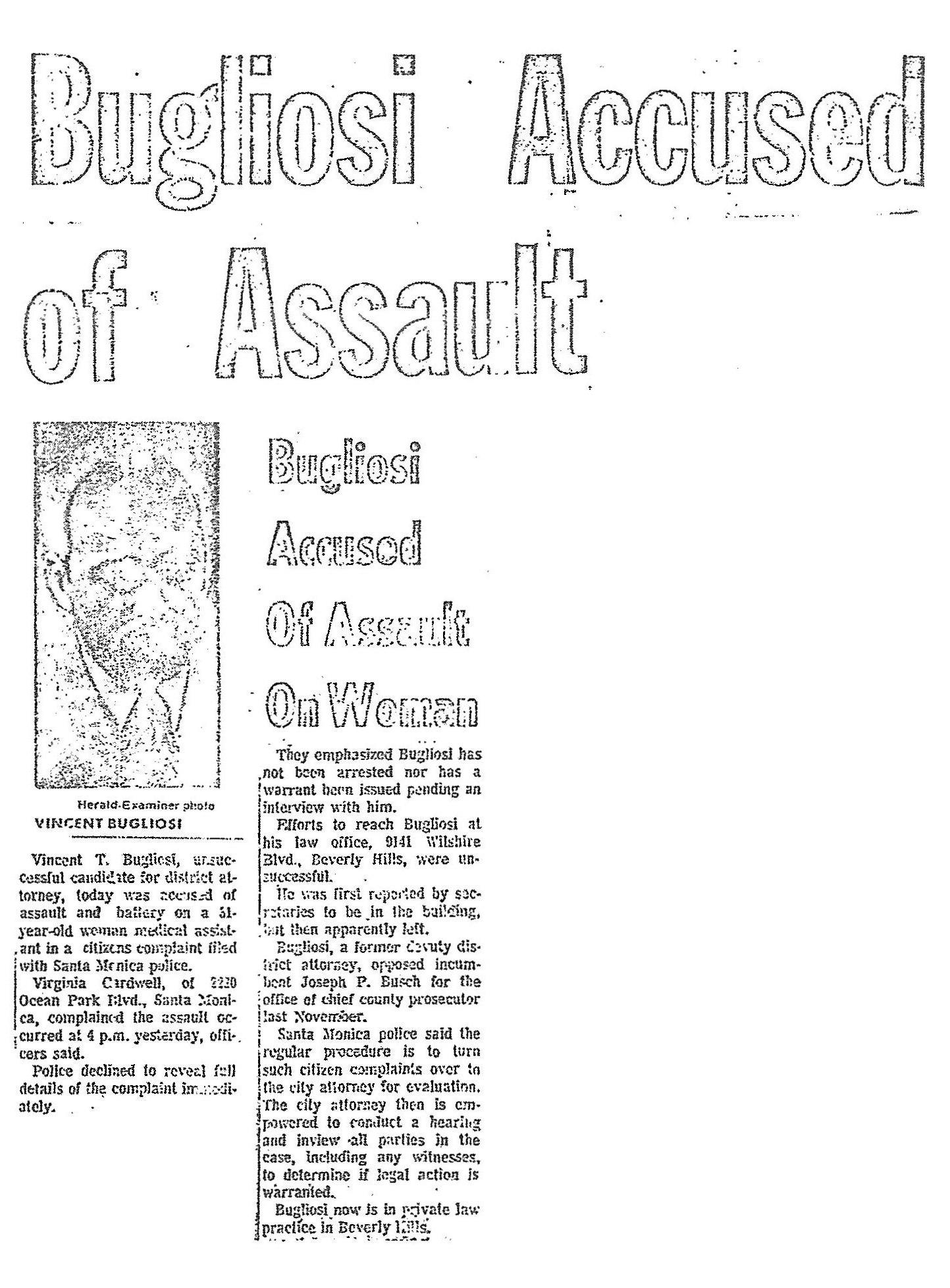
Bugliosi Accused Of Assault On Woman
Herald-Examiner photo
VINCENT BUGLIOSI
Vincent T Bugllcsi, unsuccessful candi^ite for district attorney, today was mx-is-d of assault and battery on a 51- year-old woman medical assist, ant in a eitfetjis eon-plaint filed with Santa Meniea police.
Virginia CirdweO, of 2230 Ocean Park Blvd., Santa MohI- |c2, complained the assault gc- ;curred at 4 p.m. yesterday, offi-. ’ ears said.
Police declined to reveal toll details of the complaint hrutedi- ately.. •
They emphasized BugMosi has .not been arrested nor has a ’warrant been issued pending an interview with him.
Efforts to reach BugBosi at his law office, 9141 Wilshire Blvd., Beverly Hills, were un- syccessM .
He was first reported by soc- ntarks to be.in the bailing, ’but then apparently left.
Bugliesi, a funner devuty district attorney, opposed incum- ‘bent Joseph P. Busch for the •office of chief county prosecutor East November.
i Santa Monica police said the regular procedure is to turn such citizen complaints over to the city attorney tor evaluation. The city attorney then is cm- powered to conduct a hearing arid inview -all parties in the ease. Including any witnesses, to determine if legal action is warranted.. ‘ ■ •
BugHosi.now is to private Jaw practice in Beverly Kills,
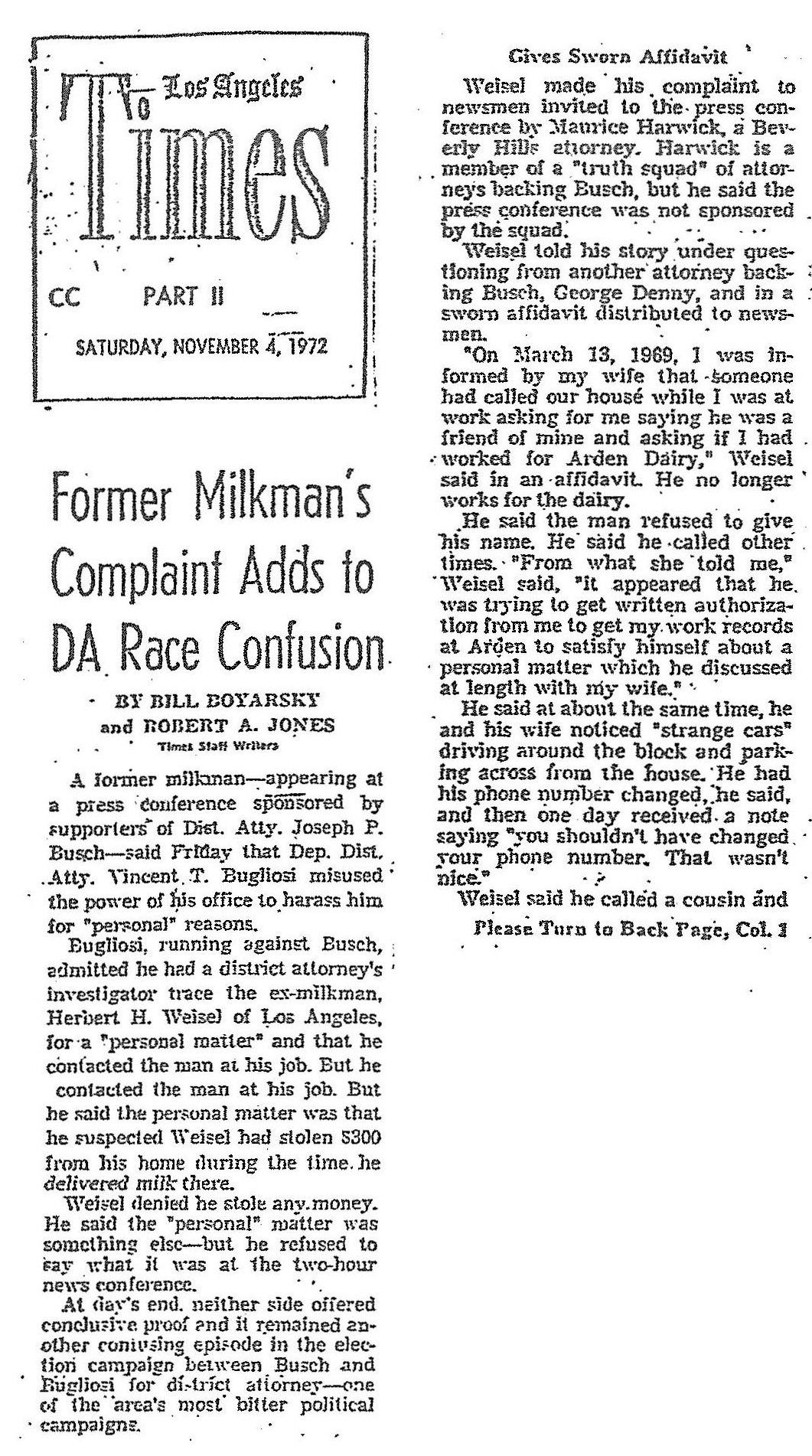
Former Milkman’s Complaint Adds to DA Race Confusion
- SY BILL. BOYARSKY and ROBERT A- JONES .. ‘ Times S!aH Writer
A former milkman—appearing at a press Conference sponsored by supporters* of DM. Atty. Joseph P. Busch—said Friday that Dep. Bist, .Atty. Vincent. T. Buglioa misused’ the power of ins office to harass him for “personal” reasons.
EugHosn running against Busch, admitted he had a district attorney’s investigator trace the ex-milkman, Herbert H. Weise) of Les Angeles, for a “personal matter” and that he contacted the man at his job. But he contacted the man at his job. But he said Iha personal matter was that he suspected Weisel had stolen 5300 from his home during the time, he delivered milk there.
Wdsel denied he stole any.money. He said the “personal” matter was something else—but he refused to say what it was at the two-hour news conference.
At day’s end. neither side offered conclusive proof and it remained another confusing episode in the election campaign bet ween _ Busch and EugHosi for df.-trfet attorney—one of the’area’s most bitter political campaigns.
Gives Sworn Affidavit * —
Weisel made Ids, complaint to newsmen invited to the — press conference by Maurice Harwick, a Beverly Hills attorney. Harwick is a . member of a “truth squad” of attorneys backing Busch, but he said the press conference was not sponsored . by the squads.
Weisel told his story tinder questioning from another attorney back- < ing Buseh, George Denny, and in a : sworn affidavit distributed to newsmen. • ‘ ’
“On March 13, 1989, I was informed by my wife that -Someone had called our house while I was at work asking for me saying he was a friend of mine and asking if I had .
•■worked for Arden Dairy,” Weisel said in an -affidavit. He no longer ‘ works for the dairy. ‘ .. •
.He said the man refused to give his name. He’ said he -called other . times. — “From what she told me,® ‘Weisel said, “it appeared that he. was laying to get written authorization from me to get my. work records at Arden to satisfy himself about a personal matter which he discussed at length with my wife,” ’- ’
He said at about the same time, he and his wife noticed “strange cars” driving around the block and parking across from the house.‘He had his phone number changed,‘he said, and then one day received-3 note . saying “you shouldn’t have changed. ■ your phone number. That wasn’t nice? . ; ’
Weisel said he called a cousin and
Please Turn to Back Page, Col 1
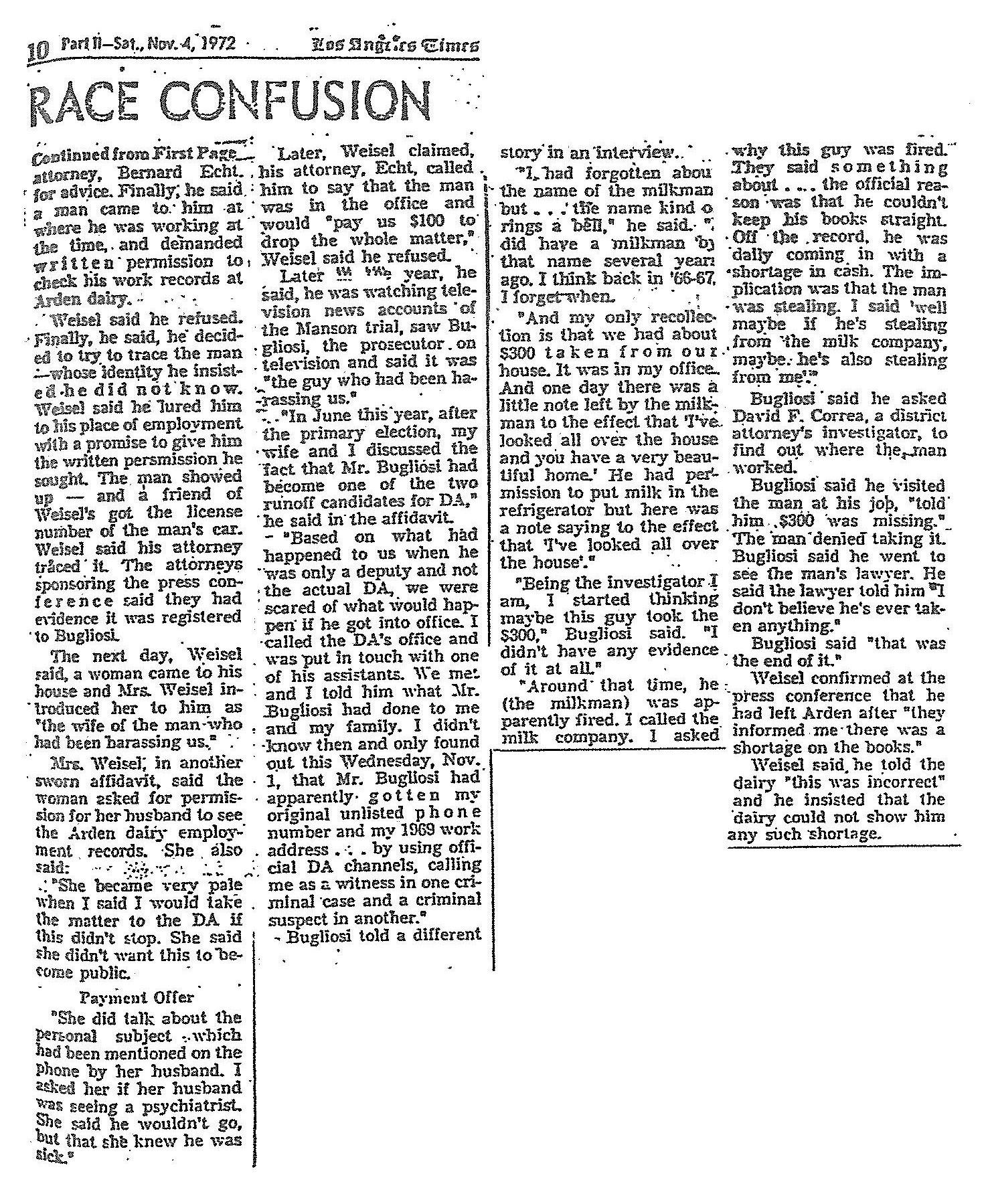
Race Confusion
10 Part II-Sat.,Nov. 4, 1972 Los Angeles Times
Continued from First Page. attorney, Bernard Echt. for advice. Finally; he said a man came to him at the time, and demanded writen permission to check his work records at Arden daky.- .-;- /Wefcri said he refused.
Finally, he said, he decided to tty to trace the man s-whose identity he insist- ed-he did not know. Wrise! said he lured him to Ms place of employment with a promise to give him the written persmission he sought The man showed up — and a friend of Wrists got the license number of the man’s car. Weisel said his attorney traced ‘ it The attorneys sponsoring the press con- Terence said they had evidence it was registered to Bugliosi.
The next day, Weisel said, a woman came to his house and Mrs. Weisel in- ‘traduced her to him as ’the wife of the man-who • had been harassing us?
Mrs. Weisel,’ in another ‘ sworn affidavit, said the woman asked for permission for her husband to see the Arden daisy employ? meat, records. — She . also said: — .’^.‘T-- .‘A , 3 ’She became very pale’ when I said I would lake the matter to the DA if this didn’t stop. She said she didn’t want this tobe — tome public. ’
Payment Offer
“She did talk about the Personal subject -..which had been mentioned on the Phone by her husband. I ^ed her if her husband ^s seeing a psychiatrist. ?h® said he wouldn’t go, — “^t that rife knew he was sick?
— ‘Later, Weisel claimed, , his attorney, Echt, called . •’ him to say that the man j ‘ was in the office and i ‘would “pay us $100 to’ drop the whole matter?- Weisel said he refused.
Later ^ year, he said, he was watching television news accounts ‘of ■ the Manson trial, saw Bto rgliosi, the prosecutor. on . television and said it was ./the guy who had been ha- passing us?
T. — Tn June this year, after the primary election, my •wife and I discussed the Tact that Mr. Bugliosi had become one of the two runoff candidates for DA? ‘he said in’the affidavit
— “Based on what had happened to us when he “was only a deputy and not ;the actual DA, we were ‘ scared of what would happen if he got into office. I ■called the DA’s office and . was put in touch with one . of his assistants. We met • and I told him what Mr.
Bugliosi had done to me : and my family. I didn’t ■ -know then and only found out this Wednesday, Nov.
• 1, that Mr. Bugliosi had’ ■ apparently- gotten my original unlisted phone number and my 1963 work
. address . ■; . by using offi- / rial DA channels, calling me as a witness in ©ne cri- . jninal case and a criminal suspect in another?
— Bugliosi told a different story’in an Interview.. * ..
‘’L’had forgotten about • the name of the milkman ‘but . , JtBe name kind a • rings a WV he said.- T did have a milkman ‘bj ’ that name several years ago. I think back in *63–67, I forgEtr^hen. ’ ‘ . ?
“And my only recollection is that we had about $300 taken from our. house. It was In my offka. And one day there was a little note left by the milk? man to the effect that Tve. looked all ewer the house and you have a very beautiful home.’ He had permission to put milk in the refrigerator hut here was a note saying to the effect that ’I’ve looked all over the house’?[262]
Being the investigator I am, I started thinking maybe this guy took the $300? Bugliosi said. ’I didn’t have any evidence of it at all? •
’Around’ that time, he (the milkman) was apparently fired. I called the milk company. I asked why this guy was fired.”’ They said something about. -.. the official reason’was that he couldn’t keep his books straight Off ■the .record, he was ‘dally coming, in with a ■shortage? in cash. The implication was that the man was stealing. I said *wel! maybe if he’s stealing from ‘the milk company, maybe.-he’s also stealing from ’ms’?
Bugliori ’ said he asked David F. Correa, a district attorney’s investigator, to find out where the^nan . worked.
Bugltosf said he visited the man pt his jo^, “told’ him..$380 was missing.? The man’denied taking it. BugHosi said he went to see the man’s lawyer. He said the lawyer told him ®I don’t believe he’s ever taken anything? •
Bugliosi said “that was the end of it.”
Weise! confirmed at the press conference that he had left Arden after They informed me-there was a shortage on the books?
Weisel said, he told the dairy ’this was incorrect” and he insisted that the dairy could not show him any such •shortage.^
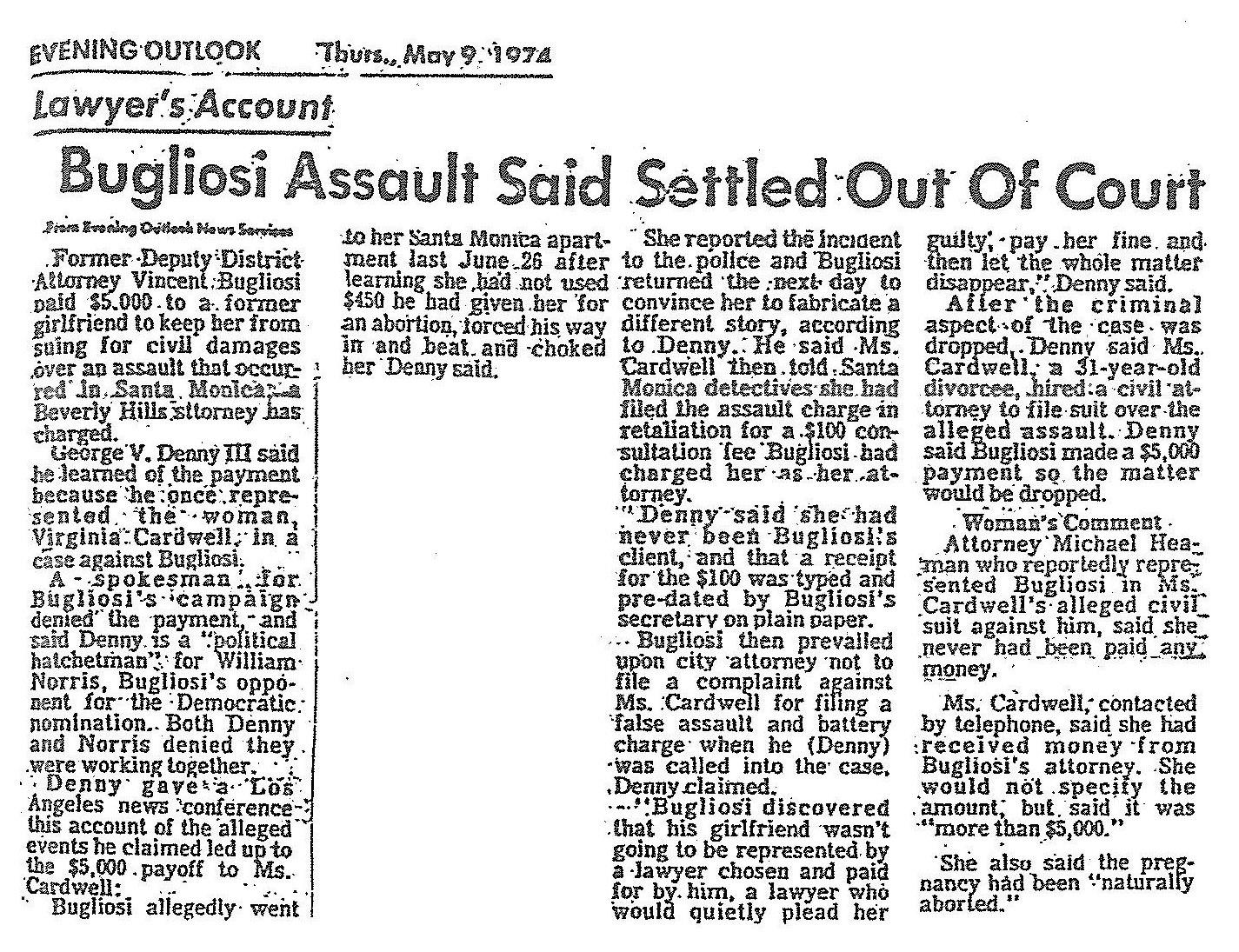
EVENING OUTLOOK Thurs, May 9, 1974
Lawyer’s Account
Bugliosi Assault Said Settled Out Of Court
From Evening Outlook News Services
Former- — Deputy “District — •Attorney Vincent,-Bugliosi paid $5.0004© a-, former girlfriend to keep her from ■ suing for civil damages .©ver an assault that oceuir i red’M-Sota. Monica;^ Beverly Hills it toraey Jaas’ charged. ‘ . _ ■ ’
George V, Denny said M-learned of the payment — because-‘he : ©nee?, repre- se a i e d / T h e ‘ ■ * w o in a n, VirginiC Card well;-in a : case against Bugliosi;
A --spokesman L^or. ’ BagHosF-®’»campargs>‘J dented’ the payment.”and I said Denny, is — a ’.‘political. | hatchetman”‘for William — Norris, BugHosFs opponent for “the ■ Democratic; nomination.. Both Denny and Norris denied they..were working together. • 7 ■ • Denny gare^a-’OT . Angeles news Conference-’ this account of the alleged ‘ events he claimed led upto the $5,000. payoff to Ms.. Cardwell: ••.--.
Bugliosi allegedly- went to her Sants Monma apart- “ She reported the Incident meat last June_28 after io the.police and TBugitosi learning she .had not. used ‘returned -the .-©ext’ day to 1450 he had -.given .her for convince her to fabricate > an abortion, forced his way different story, according In -and Mat. an3 -choked to .Denny: Me -said -Ms. her ‘Denny said, Cardwell then. told -Santa
Msmea detectives-she.had filed the assault charge in retaliation for a 4100 con- ■sultelion Tee’Bugliosi-had charged her -^s 4i@r..M- tomey..
DenId ‘fhe-had heverjoee^ BuglfosKs client/and that a receipt forth®$100 was-typed and pre-dated by BugliosFs secretary on plain paper.
Bugliosi then prevailed ri city — attorney not to a complaint against Ms..‘Cardwell for fifing a false assault and battery charge- when he (Denny) -was called into the — case. , Denny claimed.
“Bugliosi discovered That his girlfriend wasn’t going to’ be represented-by a — lawyer chosen and paid for by. him, a lawyer who would quietly plead her guilty’, * pay — her fine. and — -then let the whole matter disappear/.’Denny said.
After*the criminal aspect-©f Ihe — case • was dropped,.Dennv — said-Ms.. CardwesL* a dl-year-old divorce, .hired.a -civil-aV tomey to fife-suit over-the alleged assault.-Denny — said Bugliosi made a $5,0 payment, sQ.the matter would be’ dropped.
Woman’s Comment
Attorney Michael Hea- Jman who reportedly repre^ sented Bugliosi. in Ms..Cardwell’s-alleged riviF suit against him, said she^ .never had J^n paid >n&T money, • ‘
Ms; Cardwell,* contacted by telephone, said she had -.received money from BugHosite attorney. -She would not .specify the .amount; but. said it was •”more than $5,000.”
‘She also said the pregnancy had been ‘‘naturally aborted.”
“God Bless Charles Manson”
Historical Background to Zeena Schrecks Nine Piece Photo Montage/Mixed Media Suite
Casual observers might assume that Zeena’s nine-fold art suite “God Bless Charles Manson” is simply a visual contemplation of a notorious twentieth century icon. Connoisseurs of the twists and turns of the Aquarian Age’s occult revival will understand the deeply personal nature of Zeena’s graphic reckoning with a man and a phenomenon she’s been linked with since her earliest childhood and with whom she’s been befriended since 1989.
As scores of popular studies of the 1960s’ dark side testify, fellow Scorpios Charles Manson and Zeena washed upon the shore of popular consciousness together with the cosmic countercultural tsunami that hit San Francisco in 1967- In the same year the international press announced three-year old Zeena’s “Satanic baptism”, a publicity stunt held at the Church of Satan, thirty-three-year old Charles “The Wizard” Manson commenced his magical mystery tour in Haight- Ashbury. Executed in the style of that era’s underground newspapers montages, “God Bless Charles Manson” is a psychedelic time warp allowing psychically attuned viewers to experience that unprecedented rupture in history.
While Zeena’s images speak for themselves, the historical amnesia fos^- 1 by the postmodern Internet age of subjective Wiki-ignorance requires the suite’s placement in its proper context.
Although Manson, a neo-Christian apostle of egolessness, never personally crossed paths with the atheist Church of Satan, some of Zee- na’s earliest childhood memories revolve around her family’s 1967 encounters with key figures of another notorious “Family,” such as Susan Atkins and Bobby Beausoleil. Among the many strippers, prostitutes and queers who drifted in and out of the Church of Satan’s kitchen-cum-audition hall, was a flighty young brunette Zeena’s parents hired to play the role of a vampire in their “Topless Witch’s Review” a short-lived striptease show in a San Francisco North Beach night-club. Other than the strippers flaky drug-fuelled irresponsibility, the fly-bynight employee didn’t make much of an impression on a national scale until December of 1969. That’s when Susan Denise Atkins emerged in the mass media as the hippie chick whose heavily doctored confession broke the unsolved Tate-La Bianca murders.
Zeena’s godfather and artistic mentor, Kenneth Anger, a frequent guest to her childhood home, was smitten by a young musician known in the Haight as Bummer Bob. A lovelorn Anger gushed to Zeena’s family that his handsome protege, guitarist for the psychedelic band the Magick Powerhouse of Oz, was born to play the title role in the never completed first version of Anger’s film Lucifer Rising. Zeena’s father, cast in the same film, made a less than favourable impression on Bummer Bob when they locked horns on location at San Franciscos Russian Embassy. Shortly thereafter, Bobby sought refuge in the home of Gary Hinman and two years later their friendship ended in death. Hinman’s killing by Beausoleil would wrongly be chronicled as the first of the “Manson murders.”
In 1968, Zeena’s father entered the Tate-Labianca black hole when he orchestrated a promotional appearance at a local cinema to promote Roman Polanski’s new film Rosemary’s Baby. This fleering publicity gimmick was her father’s only connection with the movie that really crystalized the late Sixties’ black magic and witchcraft fad.
The film’s success inspired LaVey’s little black lie about serving as Polanski’s technical adviser and appearing as the Devil in the film — both of which never happened. A flippant fib which soon backfired. After August of 1969, this non-existent but heavily publicised LaVey-Polanski connection led to unfounded public speculation that the murder of Polanski’s wife Sharon Tate was a “ritual killing” somehow inspired by the director’s purported link with the Church of Satan. To exert damage control on this unexpected public relations disaster which now tainted the Church of Satan’s anti-drug, anti-hippie “law and order” image, LaVey defensively distanced himself from any mention of the Manson case for decades.
Although LaVey’s latter-day post-1990s admirers have conveniently forgotten the Church of Satan’s hostile party line regarding Manson, a typical 1972 interview with LaVey in Nat Freedland’s The Occult: Explosion speaks volumes: “[LaVey] believes in an ordered society that can protect its inhabitants against crime, is totally against drugs as a magic tool, and remains unsympathetic to the hippie ethos because of its denial of the ego. One of his most popular recent interview topics is how Charlie Manson is just another mad-dog killer as far as he’s concerned and should be drawn and quartered.”
Zeena’s connection with Manson intensified in the years she served as the Church of Satan’s official spokesperson and High Priestess from 1985–1990, at the height of the right-wing Reaganite religious witch-hunt remembered as “The Satanic Panic”. Thanks to the new phenomenon of tabloid television, countless sensationalistic news reports and talk shows featured Zeena and Manson in the same news shows as America’s favoured emblems of ultimate evil. As Zeena toured the United States to defend the family business against the Christian Right’s false accusations, she frequently encountered Manson’s televised interviews.
Zeena’s increasing disillusionment with the tissue of lies that comprised LaVeyan Satanism overlapped with her dawning awareness of Manson’s philosophy and his position on ecology and animal welfare. She realized that her own radical devotion to animal rights, environmental conservation and Truth was no different from this fellow media scapegoat’s and she could no longer continue he parent’s party-line hostility toward him.
Despite uninformed rumors spread by the ignorant, there had never been any direct Church of Satan-Manson connection until Zeena’s participation in the infamous 8-8-88 Rally held in San Francisco on the nineteenth anniversary of the Tate murders. This event marked the beginning of Zeena’s work with the band Radio Werewolf and her relationship with the band’s founder and Manson friend Nikolas Schreck.
Zeena co-produced, narrated and conceived of the title for the Video Werewolf documentary Charles Manson Superstar. She began communications with Manson on the brink of her renunciation from the Church of Satan. As Radio Werewolf’s co-director and Alpha She-Wolf of the Werewolf Order, Zeena upheld the same values of Manson’s ATWA cause in Radio Werewolf recordings Bring Me the Head of Geraldo Rivera! and the limited single release of “The Eagle Flies”, Radio Werewolf’s cover version of a Manson composition made available only to Werewolf Order initiates in 1993.
In recent years Radio Werewolf’s magical operations unfortunately have inspired such superficial pop imitators as Marilyn Manson and helped to foster a “Manson for Dummies” cottage industry for witless consumers. While this mixed media installation from 2009 was Zeena’s last statement on the subject of Charles Manson as media boogeyman, her empathy for the human being and fellow social dissident continued until his death — which happened exactly on Zeena’s birthday, 2017.
The following poem about the connections between Zeena and Manson by Nikolas Schreck was displayed at a showing of the suite held in Berlin in 2009.
Sticksnake synchronicities
connect these crazy microdots from Cole to California Street Dig how deep dual destinies intersect and intertwine — 67: all good children go to heaven the gardener comes to pick the flowers blooming wild on the Haight while across the way a child on the altar of hate’s baptized and baphometed into her infernal fate Before they ever crossed his path, the devil daughter knew the children of the son of man: Miss Glutz’s striptease linked them in a knot before the shadow of his smile charmed Sadie Mae to board the bus that brought her to the bloody door Cupids arrow struck the child’s funny uncle, soothed his anger, broke his heart, Lucifer split the embassy for Oz to jam with a wiser wizard (what a milky way to go) ascended spiral stairs which led to straightened satans while the lovelorn godfather taught his fairy princess the mechanics of his magic art — 68: Romans Baby’s boffo box office inspires undaddy dearest’s latest lie: why not ride on Polish coattails and say he played the Lord of Flies? an empty boast that backfires when he’s blamed forever more for whatever hooded witchy doom came down fast in Romek’s living room, a curse that adds another stigma to the burden of the worthless family heirlooms a little girl’s forced to drag around Fast forward to the summer of hate two decades and Four upright infinity signs to celebrate the Tate date and the high priestess lioness to collaborate with her future wolf mate whose friendship with the scapegoat Soul closes the circle first unrolled in the summer of love when the bastard son of an unwed mother bonds with the bastard daughter of an unwed mother in family ties deeper than blood — to those whose jaded minds see only irony where nones intended, know this artists blessing upon the wizard is a true benediction of love from the seven-fold snakefooted sovereign whose holy name remains unspoken
by kd dbarmashanti, 2009
© Zeena Schreck 2009, all rights reserved.
Sources And Acknowledgments
Without the assistance of the foilowing individuals and institutions who have agreed to be named, this book would not have been possible.
Some provided crucial information and contacts to valuable sources. Others offered support for my work through the long process of creation.
In alphabetical order, I express my gratitude to Jerome Alexandre, Toby Crate Art, Jason Atomic, Mirandi Babitz, Annii Barta, Franklin Bean, Staatsbibliothek Berlin, Eric Bessery, Virginia Graham Browne, Michael Brunner, Chris D. Butcher, Felina Byron, Coyote, the late Lt. Earl Deemer, Paige DeFlint, Fabrice Gaignau.lt, Robert DeGrimston, Tony Dickie, Arvid Dittmann, Liza Dodson, Paul Dostie, Jeffrey Eliot, the late Nuell Emmons, Lynette Fromme, Ben Gurecki, the late Gene Gutowski, Derek Haze, Stuart Henderson, George Jacobs, Paul Jacobs, Judy Lammpu, Gina Judd, Dennis LaCalandra, Lt. Dave Langerman, Christophe Lorentz, Marlin M. Marynick, the late Ferdinand Mayne, Troy McLean, William Scanlan Murphy, Tom O’Neill, the late Bill Nelson, Sev Newkirk, Merlin J. Noack, Kenneth Thunder Nowlin, Andrea Ortiz, Giddle Partridge, Joe Peters, Ed Roach, Brad Schreiber, Manko Sebastian, Adrian Shephard, W Adam Smythe, Tony Sperl, Frederick Sternkopf, Gary Stewart, George Stimson, the late Norman Thaddeus Vane, Manuel Vee, Frankie Vegas, Ines from Videodrome, the late Genevieve Waite, the late T. J. Walleman, Simon Wells, Gray Wolf, Zeena and of course, — too unruly to fit into anything as orderly as an alphabet — Charles Manson.
The opinions expressed herein, however, as well as any errors of fact or interpretation, are mine alone. The majority of the information interpreted here was not gleaned from secondary sources. All books, publications, newspaper articles, letters, and recorded interviews utilized are specifically noted in the footnotes or in the body of the text when possible. Just because something has been repeated over and over again in the standard literature on the case doesn’t mean that it’s true. On the contrary, it’s truly amazing how much of what is commonly accepted as “true” about this case turns out to be a matter of conjecture. Los Angeles Police Department reports, polygraph tests, prison records, and other official documents were extremely useful. I went to some pains to make sure that what I reported was not simply a popularly accepted fiction, but could be independently verified.
The raw data collated in The Manson File was derived from hundreds of personal conversations held for a span of well over thirty years with individuals on both sides of the law, ranging from wealthy gay Republican drug dealers to disgruntled attorneys, ecologically minded ex-convicts to Chatsworth firemen, embittered veteran private detectives to music industry executives,professional pornographers, born-again bikers, relatives of the Cielo and Waverly casualties, former Spahn Ranch visitors, and every imaginable spectrum of humanity in between.
The amount of fear and misgiving that discussion of this case still engenders meant that almost none of them wished to be identified. I honor their requests to remain anonymous as a small measure of my gratitude for their willingness to speak at all about this subject.
An equally long list could be assembled of those who actively tried to prevent this book from being written.
One of the most important sources for the final Manson File was record producer and musician Bob Esty who shortly before his death revealed to me a treasure trove of information about what was really going on at Cielo from his close friend (and later enemy) Rudi Altobelli. Esty lived in the Cielo guesthouse from 1975 for a few years. He heard a drunken and high on coke Altobelli dish the dirt on Sebring, Polanski, Tate, Frykowski, Garretson, and Tex and their involvement in a hedonistic drug and orgy scene that was already going on during the Melcher residency and was still going on under Altobelli’s supervision well into the late 70s and early 80s. This photo Bob sent me shows him in 1975 in his bed (formerly the one Folger and Frykowski shared in 1969) after staying up late reading Helter Skelter to familiarize himself with the case. Yes, behind him, that is indeed the zebra skin rug seen in the bloody crime scene photos that Altobelli tastefully hung on the guest cottage wall. He often played the piano seen in the crime scene photos of the Polanski living room, and confirmed that well into the 80s Altobelli lured young men to the house by showing them the bloodstains still on the furniture (which you can see in the couch below where Esty is seated with Altobelli’s significant other Stuart Cohen, who also told Esty a lot). In 1979, Esty even worked with the Beach Boys on their horrible Disco record, and got to know the alcoholic wreck Dennis Wilson, whose true relationship with Manson Altobelli had already gossiped about to him. In appreciation for his honesty and rare willingness to break the usual music industry silence on this topic, I dedicate this book to his memory.
About The Author
Nikolas Schreck is an American writer, musician, and theologian whose books include The Satanic Screen: An Illustrated Guide to the Devil in Cinema (Creation Books, 2001) and Demons of the Flesh: The Complete Guide to Left-hand Path Sex Magic (2002, co-authored with Zecna). In 1989 he released the feature-length documentary Charles Manson Superstar, which cemented his reputation as an expert on Charles Manson, with whom he maintained close correspondence until the latter’s death in 2017. Aside from his music and books, Mr Schreck is widely known as a former public advocate of Satanism in America. He now writes, records music and gives spiritual guidance from a Tantric Buddhist perspective.
Zeena is an interdisciplinary artist and counter-culture icon known through her work as photographer, graphic artist, musician/composcr, writer, animal rights activist, magician and mystic. Her artwork and writings stem from her lifetime experience within magical, pagan, shamanistic, and tantric Buddhist traditions.
Surrealist Association of Great Britain
125 Canterbury Road
Westgate-on-Sea
Kent
CT8 8NL
SURREALIST RESEARCH PUBLICATIONS
Back Cover
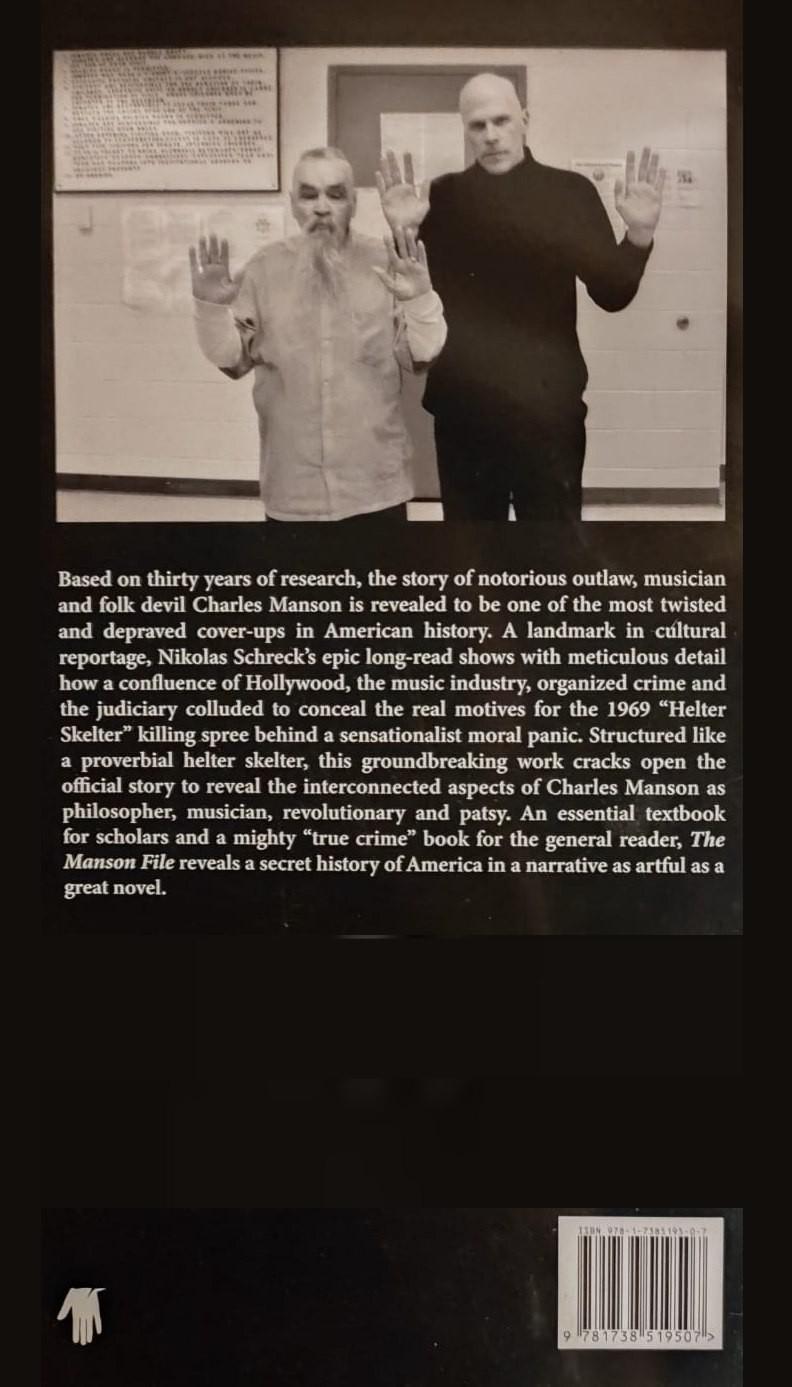
Based on thirty years of research, the story of notorious outlaw, musician and folk devil Charles Manson is revealed to be one of the most twisted and depraved cover-ups in American history. A landmark in cultural reportage, Nikolas Schreck’s epic long-read shows with meticulous detail how a confluence of Hollywood, the music industry, organized crime and the judiciary colluded to conceal the real motives for the 1969 “Helter Skelter” killing spree behind a sensationalist moral panic. Structured like a proverbial helter skelter, this groundbreaking work cracks open the official story to reveal the interconnected aspects of Charles Manson as philosopher, musician, revolutionary and patsy. An essential textbook for scholars and a mighty “true crime” book for the general reader. The Manson File reveals a secret history of America in a narrative as artful as a great novel.
Charles Manson’s Discography
Author: Nikolas Schreck
Date: 10 April 2022
Source: <https://www.facebook.com/groups/1883381595256076/posts/3061829477411276>
Attached File: <https://www.facebook.com/download/1098341570772774/mansonfilediscography2011.pdf>
Here is the discography of Charlie’s recorded legacy from the 2011 edition of The Manson File.
There was no room for one more thing in the already crammed final edition, so something had to go to make room for all the new info added since the last decade.
Amusingly (and typically of his paranoia), when my French publisher sent Charlie the very first copy of the French edition (which was printed before the English edition) he saw the many pages with photos of all of his records to date in the discography, but because he could not read French, started griping “Schreck’s selling all of my music!”, not realizing that it was a discography to clarify to his detractors who didn’t take him seriously as a musician just how many recordings he had created.
This is for all of you who are completing your collections, but especially for Christopher Beach Eddy who has only asked me to send it to him approximately 63,425 times!
The 63,426th request was the charm.- NS
In order to keep the focus on Manson’s own music, separate releases by former Manson associates Bobby Beausoleil, Steve Grogan, Paul Watkins and Brooks Poston have been excluded. For the same reason, spoken word contributions by Manson for albums by Blood Axis or Turbund Sturmwerk, as well as the many recordings that include unauthorized samples of Manson’s voice and music, have also been left out.
No warranty for the accuracy of all information provided here can be given in view of partly insufficient information from the manufacturers — this is especially true with releases by “White Devil Records” All indications in square brackets can not be taken from the particular releases and their accompanying material; they derive from secondary sources and these indications are therefore cited only with reservation.
At the time of the discography’s compilation not all listed records were on hand; in particular cases it was not possible to picture every cover, in other cases it was necessary to use pictures of a lesser quality. Complementary material and informations are welcome and will be added to future editions.
Arvid Dittmann was born in 1967 in Berlin. A DJ and freelance journalist, he is currently working on the book Sympathia pro diabolo: Popkultur und Okkultismus — Eine kulturhistorische Darstellung.
1. Silverhorn
Eyes of a Dreamer.
Format: Single
Label: Insane Train
Number: SH-28
Country: USA
Year: [1970]
Note: Charles Manson’s first record! Using the alias “Silverhorn” for Manson’s name the single was issued not long after Manson’s arrest by the record company “Insane Train”, located in Hawthorne, California. Containing “Eyes of a Dreamer” on Side A and “Look at Your Game, Girl” on Side B it was produced in a very small quantity and released without any cover art. The producer of the record was Phil Kaufman who released Manson’s LP “LIE” in spring 1970 on his own label “Awareness Records”.
2. Charles Manson
LIE.
The Love and Terror Cult.
Format: LP
Label: Awareness Records
Number: A-2144 & B-22145 (on disc labels)
Country: USA
Year: 1970
Note: This LP presents recordings made by Charles Manson in September 1967 and August 1968. The record was produced by Phil Kaufman and released on his own label “Awareness Records” in spring 1970. The jacket design of the cover is based on the title of the LIFE magazine issue from 19th December 1969. The LP included a foldout poster; according to Kaufman it was pressed in an edition of 3000 copies although it is likely that only 2000 were made. This is the real first edition of this record!
3. Charles Manson
LIE.
The Love and Terror Cult.
13 Songs Composed and Performed by Charles Manson Accompanied by the Family.
Format: LP
Label: ESP-DISK’
Number: ESP-2003 (on cover); ESP-2003 (2144) & ESP-2003 (2145) (on disc labels)
Country: USA
Year: 1970
Note: This LP presents recordings made by Charles Manson in September 1967 and August 1968. The record was produced by Phil Kaufman and rereleased on “ESP-DISK’” in summer 1970. According to details given by label founder Bernard Stollman in the booklet of the CD “Sings” this LP was pressed in an edition of 500 copies. The jacket design of the cover is based on the title of the LIFE magazine issue from 19th December 1969; it differs slightly from the “Awareness”- release. The first edition of this record was issued with white disc labels, a later edition with red ones!
4. Charles Manson
LIE. The Love and Terror Cult.
13 Songs Composed & Performed by Charles Manson With Vocal & Instrumental Accompaniment by the Family.
Format: MC
Label: ESP-DISK’
Number: 2003-C
Country: USA
Year: 1970
Note: This MC presents recordings made by Charles Manson in September 1967 and August 1968. The original LP was produced by Phil Kaufman and rereleased on “ESP-DISK ‘” in summer 1970. This MC was issued together with the rerelease of the LP. The jacket design of the cover is based on the title of the LIFE magazine issue from 19th December 1969; the pattern for the design of the MC was obviously the cover of the “Awareness”-release and not that of “ESP-DISK’” The title of the record differs slightly from the LP release.
5. Charles Manson
The Other Side of Madness.
Format: Single Label: Auric Ltd. Number: D-12901
Country: USA
Year: [1970]
Note: This is the soundtrack for the movie “The Other Side of Madness” directed by Frank Howard and rereleased in 1976 under the title “The Heiter Skelter Murders” The record contains two songs performed by Charles Manson: “Garbage Dump” on side A and “Mechanical Man” on side B; only “Mechanical Man” was used in the film. The single was released by the motion picture company “Auric Ltd.” located in Kansas City and was produced in a very limited quantity. Not commercially available, it was sent only to a few selected radio stations for promotion purposes only.
6. Charles Manson
12 Canciones.
Compuestas y Cantadas por Charles Manson.
Format: LP
Label: Movieplay
Number: M-24025
Country: Spain
Year: 1971
Note: This LP is a reissue of Manson’s first record “LIE” and presents recordings made in September 1967 and August 1968. It was produced in licence from “ESP-DISK ‘” by the Spanish record label Movieplay and released with a gatefold cover. The title of the record as well as it’s track listing mention only twelve songs but actually all songs of the original release are contained. “Arkansas” and “I’ll Never Say Never To Always” are listed as one song and although “I Once Knew A Man” is not mentioned in the track listing the song does appear as an appendix to “Big Iron Door”.
7. Various Artists
ESP 2051.
Format: LP
Label: [ESP-DISK’]
Number: esp-2051
Country: USA
Year: [1975]
Note: This sampler was released ca. 1975 by “ESP-DISK’” The label was founded around 1964 by Bernard Stollman, legendary for his preference for free jazz, underground rock and music with texts in Esperanto. This promotional record was the label’s last production for many years. This edition of the LP was issued without an art cover in a plain white sleeve and with two slightly different label prints; this is the first version.The LP features label artists including Charles Manson and The Fugs. Manson’s contribution “Big Iron Door” was edited and runs for only 59 seconds.
8. Various Artists
ESP 2051.
Format: LP
Label: [ESP-DISK’]
Number: esp-2051
Country: USA
Year: [1975]
Note: This sampler was released ca. 1975 by “ESP-DISK’” The label was founded around 1964 by Bernard Stollman, legendary for his preference for free jazz, underground rock and music with texts in Esperanto. This promotional record was the label’s last production for many years. This edition of the LP was issued without an art cover in a plain white sleeve and with two slightly different label prints; this is the second version.The LP features label artists including Charles Manson and The Fugs. Manson’s contribution “Big Iron Door” was edited and runs for only 59 seconds.
9. Various Artists
ESP 2051.
Format: LP
Label: [ESP-DISK’]
Number: esp-2051
Country: USA
Year: [1975]
Note: This sampler was released ca. 1975 by “ESP-DISK”’. The label was founded around 1964 by Bernard Stollman, legendary for his preference for free jazz, underground rock and music with texts in Esperanto. This promotional record was the label’s last production for many years. This edition of the LP was issued with a cover that showed the jazzsinger Billie Holiday; this cover was sometimes also used for the sampler ESP 1051. The LP features label artists including Charles Manson and The Fugs. Manson’s contribution “Big Iron Door” was edited and runs for only 59 seconds.
10. Charles Manson
LIE.
Format: MC
Label: Come Organisation
Number: wdc883008
Country: UK
Year: [1981]
Note: This MC is a semi-official rerelease of Manson’s first album “LIE” by the “Come Organisation” a record label founded in London in 1979 and known for extreme underground music. This cassette was issued with two only slightly different cover designs; this is the first version. A release of the album on vinyl was planned by the label but never realised. A catalogue number of this planned record does exist however: wdc881008.
11. Charles Manson
LIE.
Format: MC Label: Come Organisation Number: wdc883008 Country: UK
Year: J1981J
Note: This MC is a semi-official rerelease of Manson’s first album “LIE” by the “Come Organisation”, a record label founded in London in 1979 and known for extreme underground music. This cassette was issued with two only slightly different cover designs; this is the second version. A release of the album on vinyl was planned by the label but never realised. A catalogue number of this planned record does exist however: wdc881008.
12. Various Artists
Für Ilse Koch.
Format: LP
Label: Come Organisation
Number: WDC881021
Country: UK
Year* 1982
Note- This LP is a kind of tribute to Ilse Koch, the wife of Karl Koch, commandant of the Nazi concentration camps Buchenwald and Majdanek. This sampler with recordings by Come, Whitehouse, Aleister Crowley, Charles Manson, Heinrich Himmler and others was released by the “Come Organisation” as a MC and as a LP on black and red vinyl; the red vinyl version was limited to 100 copies. Japanese bootleg copies exist. The track “Cease to Exist” by Charles Manson is in fact a speeded up fragment of the film “Manson” directed by Robert Hendrickson with Manson singing the song in the background.
Für Ilse Koch.
Format: MC
Label: Come Organisation
Number: wdc883021
Country: UK
Year: 1982
Note: This MC is a kind of tribute to Ilse Koch, the wife of Karl Koch, commandant of the Nazi concentration camps Buchenwald and Majdanek. This sampler with recordings by Come, Whitehouse, Aleister Crowley, Charles Manson, Heinrich Himmler and others was released by the “Come Organisation” as a MC and as a LP. The track “Cease to Exist” by Charles Manson is in fact a speeded up fragment of the film “Manson” directed by Robert Hendrickson with Manson singing the song in the background.
14. The Manson Family
Interviews.
Format: MC
Label: Come Organisation
Number: wdc883029
Country: UK
Year: [1982]
Note: This MC presents the first part of interviews with various members of the “Manson Family” It was released by the “Come Organisation”, a record label founded in London in 1979 and known for extreme underground music. Further releases by the label concerning Manson and the “Family” have been the MC “Manson Family — Interviews 2” as well as the MCs “LIE” and “NBC Interview” by Charles Manson. The sampler “Für Ilse Koch” released on LP and MC, also features a recording of Manson.
11. Charles Manson
LIE.
Format: MC Label: Come Organisation Number: wdc883008
Country: UK
Year: [1981]
Note: This MC is a semi-official rerelease of Manson’s first album “LIE” by the “Come Organisation” a record label founded in London in 1979 and known for extreme underground music. This cassette was issued with two only slightly different cover designs; this is the second version. A release of the album on vinyl was planned by the label but never realised. A catalogue number of this planned record does exist however: wdc881008.
12. Various Artists
Für Ilse Koch.
Format: LP
Label: Come Organisation
Number: WDC881021
Country: UK
Year: 1982
Note: This LP is a kind of tribute to Ilse Koch, the wife of Karl Koch, commandant of the Nazi concentration camps Buchenwald and Majdanek. This sampler with recordings by Come, Whitehouse, Aleister Crowley, Charles Manson, Heinrich Himmler and others was released by the “Come Organisation” as a MC and as a LP on black and red vinyl; the red vinyl version was limited to 100 copies. Japanese bootleg copies exist. The track “Cease to Exist” by Charles Manson is in fact a speeded up fragment of the film “Manson” directed by Robert Hendrickson with Manson singing the song in the background.
13. Für Ilse Koch.
Format: MC
Label: Come Organisation
Number: wdc883021
Country: UK
Year: 1982
Note: This MC is a kind of tribute to Ilse Koch, the wife of Karl Koch, commandant of the Nazi concentration camps Buchenwald and Majdanek. This sampler with recordings by Come, Whitehouse, Aleister Crowley, Charles Manson, Heinrich Himmler and others was released by the “Come Organisation” as a MC and as a LP. The track “Cease to Exist” by Charles Manson is in fact a speeded up fragment of the film “Manson” directed by Robert Hendrickson with Manson singing the song in the background.
14. The Manson Family
Interviews.
Format: MC
Label: Come Organisation
Number: wdc883029
Country: UK
Year: [1982]
Note: This MC presents the first part of interviews with various members of the “Manson Family”. It was released by the “Come Organisation”, a record label founded in London in 1979 and known for extreme underground music. Further releases by the label concerning Manson and the “Family” have been the MC “Manson Family — Interviews 2” as well ------------------------ as the MCs “LIE” and “NBC Interview” by Charles Manson. The sampler “Für Ilse Koch” released on LP and MC, also features a recording of Manson.
15. The Manson
Family
Interviews 2.
Format: MC
Label: Come Organisation
Number: wdc883031
Country: UK
Year: [1982]
Note: This MC presents the second part of interviews with various members of the “Manson Family” It was released by the “Come Organisation” a record label founded in London in 1979 and known for extreme underground music. Further releases by the label concerning Manson and the “Family” have been the MC “Manson Family — Interviews” as well as the MCs “LIE” and “NBC Interview” by Charles Manson. The sampler “Für Ilse Koch” released on LP and MC, also features a recording of Manson.
16. Charles Manson
NBC Interview.
Format: MC
Label: Come Organisation
Number: wdc883032
Country: UK
Year: [1982]
Note: This MC features an recording of an interview with Manson conducted by Tom Snyder for “Tomorrow Coast to Coast” (NBC-TV) in June 1981. This legendary and controversial discussed interview was recorded in Vacaville Medical Facility prison. The MC was released by the “Come Organisation” a record label founded in London in 1979 and known for extreme underground music. The tape has a playing time of 60 minutes and contains the whole interview.
17. Various Artists
23 Drifts to Guestling.
Format: MC
Label: Iham Products
Number: NANA 004 23-2-83
Country: UK
Year: 1983
Note: This MC was compiled by David Tibet (Current 93). “Nanavesh” was a magazine closely associated with Throbbing Gristle. The first three issues were journals, this tape was the fourth issue. The MC contains two very short titles by Charles Manson: “Charlie and his MAM“ and “Charlie and the Chair“, both taken from Tom Snyder’s Interview with Manson for NBC-TV in June 1981. The title “Is Squeaky Afraid Ov Death?” is credited to Lynette Fromme but it is in fact Sandra Good speaking; the fragment is taken from the film “Manson” by Robert Hendrickson.
18. Charles Manson
White Rasta.
Format: MC
Label: [Aes-Nihil Productions]
Number: none
Country: USA
Year: [1985]
Note: “White Rasta” was released for the first time in 1985 by John Aes-Nihil as MC and reissued in 1999 on CD-R. This cassette tape contains various songs and improvisations recorded by Manson ca. 1983 in Vacaville Medical Facility prison, California. Parts of these recordings are also contained on “Saints are Hell on Earth”; “Poor Old Prisoner Boy” and “Live at San Quentin”. These recordings were originally made for the US-based label “SST Records” but never released.
19. Charles Manson
LIE.
The Love and Terror Cult.
Format: LP
Label: Awareness Records
Number: A-2144 (on cover); A-22144 & B-22145 (on disc labels)
Country: [USA]
Year: unknown
Note: This LP presents recordings made by Charles Manson in September 1967 and August 1968. The record was produced by Phil Kaufman and originally released on his own label “Awareness Records” in spring 1970. The jacket design of the cover is based on the title of the LIFE magazine issue from 19th December 1969. This is a counterfeit! It is distinguishable from the original by the wrong catalogue numbers on the cover and the disc labels.
20. Charles Manson
The Love and Terror Cult.
Format: LP
Label: Fierce Recordings/ Punk-House Publishing Ltd
Number: Fright 001
Country: UK
Year: [1985]
Note: “The Love and Terror Cult” is a (probably unofficial) rerelease of Manson’s first record “LIE” and presents recordings made in September 1967 and August 1968. It was issued by the UK-based label “Fierce Recordings” in cooperation with an ominous company named “Punk-House Publishing Ltd.” and was pressed in France. The song “Sick City” is missing for unknown reasons. The first edition of the LP also didn’t have Manson’s name on the cover.
21. Charles Manson
The Love and Terror Cult.
Format: LP
Label: Fierce Recordings/ Punk-House Publishing Ltd
Number: Fright 001
Country: UK
Year: [1985]
Note: “The Love and Terror Cult” is a (probably unofficial) rerelease of Manson’s first record “LIE” and presents recordings made in September 1967 and August 1968. It was issued by the UKbased label “Fierce Recordings” in cooperation with an ominous company named “Punk-House Publishing Ltd.” and was pressed in France. The song “Sick City” is missing for unknown reasons. The second edition of the LP has a sticker with Manson’s name on the cover.
22. Charles Manson
Sick City.
Format: Single
Label: Fierce Recordings
Number: Fright 006
Country: UK
Year: [1987]
Note: This single contains the song “Sick City” from Manson’s first record “LIE” The song was missing on the LP “The Love and Terror Cult”, a rerelease of “LIE” published by “Fierce” in 1985. The single is playable only on one side, the back is provided with an etching. On Side A is the tiny inscription: “Death Valley ’69”. The etching on side B is the same like that on the single “It’s Cornin’ Down Fast” (Fright 012). The first edition of 100 copies was issued in a bag with a badge, sand, flyers, etc. The second edition of 100 copies was issued with a normal sleeve. Manson’s name is mentioned nowhere! 23-Charles Manson It’s Cornin’ Down Fast.
Format: Single
Label: Fierce Recordings
Number: Fright 012
Country: UK
Year: [1987]
Note: This obscure single presents fragments of the film “Manson” directed by Robert Hendrickson. Manson sings a verse of “Heiter Skelter” by the Beatles, speaks about social topics, etc. The single is playable only on one side, the back is provided with an etching. On Side A is the tiny inscription: “Polanski must die”. The etching on Side B is the same like that on the single “Sick City” (Fright 006). The record was published in an edition of only 100 copies with a simple sleeve, showing only a photo of the Beatles. Manson’s name is mentioned nowhere!
24. Charles Manson
LIE.
Format: MC
Label: TPOS
Number: TPOS 015
Country: USA
Year: 1987
Note: This MC is an unofficial rerelease of Manson’s first album “LIE” by the US-based record label “TPOS”. As an addition it includes a part of an interview with Manson conducted by Tom Snyder for “Tomorrow Coast to Coast” (NBC-TV) in June 1981. The running order of the titles differs for unknown reasons totally from the original release on LP. The MC was issued in April 1987 with a fold- out cover; all of the recordings were rereleased by “TPOS” in the year 2000 on CD-R.
25. Charles Manson
LIE.
The Love and Terror Cult.
Format: LP
Label: Awareness Records
Number: 08903–0156 (on cover); Aware 1 (on disc label)
Country: USA
Year: 1987
Note: This LP presents recordings made by Charles Manson in September 1967 and August 1968. The record was produced by Phil Kaufman and originally released on his own label “Awareness Records” in spring 1970. The jacket design of the cover is based on the title of the LIFE magazine issue from 19th December 1969. Simultaneously with the rerelease of this LP a MC was issued. The cover and back cover as well as the record’s labels differ from the original in some points. Some copies with a white label were pressed as a sample.
26. Charles Manson
LIE.
The Love and Terror Cult.
Format: CD
Label: Awareness Records
Number: Aware 1CD; 08903–0156
Country: USA
Year: 1987
Note: This CD presents recordings made by Charles Manson in September 1967 and August 1968. The record was produced by Phil Kaufman and originally released on his own label “Awareness Records” in spring 1970. The jacket design of the cover is based on the title of the LIFE magazine issue from 19th December 1969. This CD was issued simultaneously with the rerelease of the LP. There are two slightly different versions: One has the small inscription “Printed in Canada” on the cover and back cover, the other not.
27. Charles Manson
LIE.
The Love and Terror Cult.
Format: MC
Label: Awareness Records
Number: Aware 1C
Country: USA
Year: 1987
Note: This MC presents recordings made by Charles Manson in September 1967 and August 1968. The record was produced by Phil Kaufman and originally released on his own label “Awareness Records” in spring 1970. The jacket design of the cover is based on the title of the LIFE magazine issue from 19th December 1969. This MC was issued simultaneously with the rerelease of the LP. The cover of the MC differs from the original LP in some points.
28. Various Artists
Fear. Power. God.
The Birth of Tragedy Magazine’s Spoken Word/ Graven Image Compilation.
Format: LP
Label: CFY Records
Number: CFY 004
Country: USA
Year: 1987
Note: “Fear. Power. God.” was conceived by Eugene S. Robinson, the editor of the magazine “Birth of Tragedy” Contained on the album are spoken word contributions by persons interviewed in the “Fear”, “Power” and “God” issues of the magazine. Charles Manson’s contribution “Prison Tape” is in fact an excerpt of his recordings in Vacaville Medical Facility prison and is also featured on “White Rasta” “Saints are Hell on Earth” etc. The record was issued on white vinyl, including a four-page catalog, and simultaneously on MC. A black vinyl version of the album was released in the UK in 1989.
29. Various Artists
Fear. Power. God.
The Birth of Tragedy Magazine’s Spoken Word/ Graven Image Compilation.
Format: MC
Label: CFY Records
Number: CFY 004
Country: USA Year: 1987
Note: The record “Fear. Power. God.” was conceived by the Eugene S. Robinson, the editor of the magazine “Birth of Tragedy” Contained on the MC are spoken word contributions by persons interviewed in the “Fear” “Power” and “God” issues of the magazine. Charles Manson’s contribution “Prison Tape” is in fact an excerpt of his recordings in Vacaville Medical Facility prison and is also featured on “White Rasta” “Saints are Hell on Earth” etc. The MC was issued simultaneously with a LP version on white vinyl, including a four-page catalog.
30. Charles Manson
Saints are Hell on Earth.
Format: MC
Label: TPOS
Number: TPOS 032
Country: USA Year: [1988]
Note: “Saints are Hell on Earth” was released first in 1988 by “TPOS” on a MC with a playing time of 60 minutes; the recordings were rereleased in the year 2000 on CD-R. In 1994 “TPOS” issued the material also with additional songs on an 8-track cartridge with a playing time of 90 minutes. This MC contains eleven songs recorded by Manson in Vacaville Medical Facility prison ca. 1983. Parts of this material are also contained on “White Rasta” “Poor Old Prisoner Boy” and “Live at San Quentin”. The songs were originally recorded for the label “SST Records” but never released.
31. Various Artists
Fear. Power. God.
The Birth of Tragedy Magazine’s Spoken Word/Graven Image Compilation.
Format: LP
Label: Workers Playtime
Number: PLAYLP6
Country: UK
Year: 1989
Note: The record “Fear. Power. God.” was conceived by Eugene S. Robinson, the editor of the magazine “Birth of Tragedy” Contained on the album are spoken word contributions by persons interviewed in the “Fear”, “Power” and “God” issues of the magazine. Charles Manson’s contribution “Prison Tape” is in fact an excerpt of his recordings in Vacaville Medical Facility prison and is also featured on “White Rasta”, “Saints are Hell on Earth” etc. The record was issued on black vinyl, including a four-page catalog. The album was released first in 1987 in the USA on white vinyl and simultaneously on MC.
32. Various Artists
An Unholy Montage.
Format: Single
Label: Fierce Recordings / Sympathy for the Record Industry
Number: Fright / SFTRI 38
Country: UK / USA
Year: [1990]
Note: The sampler “An Unholy Montage” is a collaboration between the labels “Fierce Recordings” from UK and “Sympathy for the Record Industry” from USA. The record contains material from artists of both labels. The „Fierce” side of the single includes bits of music by Charles Manson, The Jesus & Mary Chain, Patti Smith and others; the “SFTRI” side includes bits of music by Jeff Dahl, Powertrip, The Lazy Cowgirls and others. The record was issued with two front covers and an insert; each version was limited to 100 numbered copies in blue marbled vinyl. This is the “Fierce”-edition!
33. Various Artists
An Unholy Montage.
Format: Single
Label: Fierce Recordings/ Sympathy for the Record Industry
Number: Fright / SFTRI 38
Country: UK / USA
Year: [1990]
Note: The sampler “An Unholy Montage” is a collaboration between the labels “Fierce Recordings” from UK and “Sympathy for the Record Industry” from USA. The record contains material from artists of both labels. The „Fierce” side of the single includes bits of music by Charles Manson, The Jesus & Mary Chain, Patti Smith and others; the “SFTRI” side includes bits of music by Jeff Dahl, Powertrip, The Lazy Cowgirls and others. The record was issued with two front covers and an insert; each version was limited to 100 numbered copies in blue marbled vinyl. This is the “SFTRI”-edition!
34. Charles Manson
Poor Old Prisoner Boy.
The 55th Anniversary album.
Format: LP
Label: Remote Control Records
Number: RCR 003
Country: [Germany] Year: [1990]
Note: “Poor Old Prisoner Boy” was released shortly after Mansons 55th birthday. The recordings on this LP were made ca. 1983 in Vacaville Medical Facility prison, California. Parts of these recordings are also contained on “White Rasta” “Saints are Hell on Earth” and “Live at San Quentin”. The record contains 55 minutes of Manson’s music and was released in a limited edition of 555 copies. The picture on the label patch of Side B of the record shows the tombstone of Sharon Tate Polanski and her unborn baby Paul Richard.
35. Charles Manson
The Son of Man.
Format: LP
Label: [Warlock]
Number: Warlock-001 (on disc)
Country: [USA]
Year: [1992]
Note: “The Son of Man” contains only one track with a playing time of 18 minutes; the presented material was recorded by Manson in Vacaville prison. The LP is playable only on one side, the back is provided with an etching of a drawing done by Manson himself in 1979. This record was available by mail-order only; it was released in a limited edition of 1000 numbered copies of which the first 144 copies came with a button. The LP contained two inserts with writings by Manson and photos of Sandra Good (“Blue”) and Lynette Fromme (“Red”).
36. The Manson Family
The Manson Family Sings the Songs of Charles Manson.
Previously Unreleased Stereo Material Recorded in 1970.
Format: LP
Label: [Commodity]
Number: CMLP + 1 (on disc); Commodity A.R. V.-901 (advertisement)
Country: USA
Year: [1992]
Note: This record was released by John Aes-Nihil and presents material recorded by some members of the “Family” in 1970. The musicians on this recording are Steve Grogan (“Clem”) on guitar and vocals, Catherine Share (“Gypsy”) and others. According to details given in an advertisement in the magazine “The Fifth Path” (#3/1992) this LP was issued by the label “Commodity” located in Altadena, California and distributed solely by “A.N. Productions”. It was produced in a numbered and limited edition of 999 stamped copies on white vinyl. Some unnumbered copies exist.
37. The Manson Family
The Manson Family Sings the Songs of Charles Manson.
Format: MC
Label: TPOS
Number: TPOS 084
Country: USA
Year: [1992]
Note: This record presents material recorded by some members of the “Family” in 1970. The musicians on this album are Steve Grogan (“Clem”) on guitar and vocals, Catherine Share (“Gypsy”) and others. These recordings were originally released on LP in 1992 by “Commodity”. They are also contained on the identically named CDs issued by “TPOS”, the CD by “Tate Polanski Records” and the double CD-album “The Family Jams” released by “Aoroa” as well as “Transparency”.
38. Charles Manson
Live at San Quentin.
An Hour of Songs and Improvisations Recorded in His Jail Cell in 1983.
Format: LP
Label: Grey Matter
Number: GM01LP
Country: UK
Year: [1993]
Note: The music on this album was — despite its title — recorded by Manson in Vacaville Medical Facility prison in California ca. 1983. Parts of these recordings are also contained on “White Rasta”, “Saints are Hell on Earth” and “Poor Old Prisoner Boy” According to the details given in an advertisement from the label “Grey Matter” this recording has been extensively enhanced. The LP was pressed in yellow and red vinyl. A CD was issued simultaneously with the LP-version. The cover artwork cites the famous Beach Boys album “Pet Sounds” from 1966.
39. Charles Manson
Live at San Quentin.
An Hour of Songs and Improvisations Recorded in His Jail Cell in 1983.
Format: CD
Label: Grey Matter
Number: GM01CD
Country: UK
Year: [1993]
Note: The music on this album was — despite its title — recorded by Manson in Vacaville Medical Facility prison in California ca. 1983. Parts of these recordings are also contained on “White Rasta” “Saints are Hell on Earth” and “Poor Old Prisoner Boy”. According to the details given in an advertisement from the label “Grey Matter” this recording has been extensively enhanced. A LP was issued simultaneously with the CD-version; a rerelease was issued in 2006 with a different cover. The cover artwork cites the famous Beach Boys album “Pet Sounds” from 1966.
40. Charles Manson
Charles MANSON.
Format: CD
Label: Grey Matter
Number: GM05CD
Country: UK
Year: [1993]
Note: This release presents all songs from Manson’s first LP “LIE” recorded in September 1967 and August 1968, combined with the songs of the album “The Manson Family Sings the Songs of Charles Manson” recorded in 1970 by some members of the “Family”. The recordings were digitally enhanced; the CD was distributed with two different stickers (one black, one white). The cover artwork cites the famous self titled Beatles album from 1968, better known as the “White Album”.
Live at San Quentin/ The Family Sings.
Format: 2CD
Label: Grey Matter
Number: M01CD/GM05CD
Country: UK
Year: [1993]
Note: This limited edition box set encloses the CDs “Live at San Quentin” and “Charles MANSON” with their original covers; both records were released by “Grey Matter” in 1993. The album “Charles MANSON” is named wrongly “The Family Sings” on the back of the cardboard sleeve. This box carries no own catalogue number since it was a collaboration between “Grey Matter” and “Tower Records”. “Tower Records” was a worldwide acting record shop chain for independent music. This box set was produced specifically for “Tower Records” and was sold only in their stores.
42. Charles Manson
Garbage Dump.
Format: Single
Label: Spahn Ranch Records
Number: 001 PIC. (on flyer); SP-01 (on disc) Country: [USA]
Year: [1993]
Note: This 7” was released only as a picture disc with a small number of copies. Side 1 contains the song “Garbage Dump” while side 2 contains “People Say I’m No Good”. A small flyer with a track listing was given away with the record, the flyer bears another catalogue number than the disc itself. Side 2 of the disc bears the small inscription “Licsensed [sic] through Performance and Awareness”. The drawings on both sides of the record are by Andrea Jensen.
43. Charles Manson
KALX Interview 1985.
Format: MC
Label: TPOS
Number: [TPOS 091]
Country: USA
Year: [1993]
Note: This MC presents Manson’s interview for KALX-FM radio station, located in Berkeley, California. It was recorded on February 27th 1985 in Vacaville Medical Facility prison. The playing time of the tape is 90 minutes. This cassette was published with six only slightly different cover designs. A partial rerelease of the interview was issued in the year 2001 by “TPOS” on CD-R with a totally different cover.
44. Charles Manson
Saints are Hell on Earth.
Format: Stereo 8
Label: TPOS
Number: TPOS 032–8
Country: USA
Year: [1994]
Note: “Saints are Hell on Earth” was released first in 1988 by “TPOS” on a MC with a playing time of 60 minutes; the recordings were rereleased in the year 2000 on CD-R. In 1994 “TPOS” issued the material also with additional songs on an 8-track cartridge with a playing time of 90 minutes. This tape contains songs recorded by Manson in Vacaville Medical Facility prison ca. 1983. Parts of this material are also contained on “White Rasta” “Poor Old Prisoner Boy” and “Live at San Quentin” The songs were originally recorded for the label “SST Records” but never released.
Commemoration.
Commemorating Sixty Years of Struggle Against Cowardice, Stupidity and Lies.
Format: CD
Label: White Devil Records/Manson Work Group
Number: none
Country: USA
Year: 1994
Note: “Commemoration” was published to commemorate the sixtieth birthday of Manson in November 1994. The first edition of the record was released in 1994. The CD contains digital remastered recordings made by Manson at the Vacaville Medical Facility prison in the years 1982,1984 and 1985. The artwork for the cover was done by Harold Arthur McNeill; the liner notes in the booklet of the CD are by James Mason and Michael M. Jenkins alias Michael Moynihan. The first run of this CD with an amount of 100 copies was issued with a red back cover and was withdrawn.
46. Charles Manson
Commemoration.
Commemorating Sixty Years of Struggle Against Cowardice, Stupidity and Lies.
Format: CD
Label: White Devil Records/ Manson Work Group
Number: none
Country: USA Year: 1994
Note: “Commemoration” was published to commemorate the sixtieth birthday of Manson in November 1994. The first edition of the record was released in 1994. The CD contains digital remastered recordings made by Manson at the Vacaville Medical Facility prison in the years 1982,1984 and 1985. The artwork for the cover was done by Harold Arthur McNeill; the liner notes in the booklet of the CD are by James Mason and Michael M. Jenkins alias Michael Moynihan. The second run of this CD with an amount of 500 copies was issued with a white back cover.
47. Charles Manson
Commemoration.
Commemorating Sixty Years of Struggle Against Cowardice, Stupidity and Lies.
Format: CD
Label: White Devil Records/ ATWA Music Publishing
Number: WDCD 3 10666 2
Country: USA
Year: 1995
Note: “Commemoration” was published to commemorate the sixtieth birthday of Manson in November 1994. The second edition of the record was released in 1995. The CD contains digital remastered recordings made by Manson at the Vacaville Medical Facility prison in the years 1982,1984 and 1985. The artwork for the cover was done by Harold Arthur McNeill; the liner notes in the booklet of the CD are by James Mason and Michael M. Jenkins alias Michael Moynihan. The first and only run of this CD was issued with an amount of 2500 copies.
48. Charles Manson
Manson Speaks.
Format: 2CD
Label: White Devil Records/ ATWA Music
Number: WDCD 3 11666 2
Country: USA
Year: 1995
Note: This two record set presents over two hours of spoken word recordings. The first disc is a collection of poetry recordings by Manson during his time in Vacaville Medical Facility prison in California. All the recordings on the second disc were made during the year 1995 and are commentaries by Manson on social topics. The set includes 16 spoken tracks in total accompanied by a booklet with a long text by Manson from 1986. “Manson Speaks” was issued in an edition of 2000 copies.
I’m on Fire.
Format: Single
Label: White Devil Records/ Desert Music Publishing
Number: WD-001; WZKM-5501
Country: [USA]
Year: [1997]
Note: This single contains “I’m on Fire” and “The Hallways of the Always” from the “Commemoration” CD; both songs were recorded in Vacaville Medical Facility prison. The promotional edition of the single was released in translucent dark brown vinyl in a plain white sleeve without any artwork. The design of the record itself differs slightly from the second regular edition: In the actual case the right half of the devil’s face is red. The label is white with red scripture. This edition was issued in an amount of 500 copies; some of those had an additional stamp.
50. Charles Manson
I’m on Fire.
Format: Single
Label: White Devil Records/ Desert Music Publishing
Number: WD-001; WZKM-5501
Country: [USA]
Year: [1997]
Note: This single contains “I’m on Fire” and “The Hallways of the Always” from the “Commemoration” CD; both songs were recorded in Vacaville Medical Facility prison. The first regular edition of the single was released in translucent dark brown [?] vinyl in a plain white sleeve without any artwork. The design of the record itself differs slightly from the second regular edition: In the actual case the right half of the devil’s face is red. The label is white with red scripture. This edition was issued in an amount of 1000 copies [?].
51. Charles Manson
I’m on Fire.
Format: Single
Label: White Devil Records/ Desert Music Publishing
Number: WD-001; WZKM-5501
Country: [USA]
Year: [1997]
Note: This single contains “I’m on Fire” and “The Hallways of the Always” from the “Commemoration” CD; both songs were recorded in Vacaville Medical Facility prison. The second regular edition of the single was released in translucent dark brown [?] vinyl in a plain white sleeve without any artwork. The design of the record itself differs slightly from the promotional and the first regular edition: In the actual case the left half of the devil’s face is red. The label is white with red scripture. This edition was issued in an amount of 1000 copies [?].
52. Charles Manson
I’m on Fire.
Format: Single
Label: White Devil Records/ ATWA Music Publishing Number: WD-001; WZKM-5501
Country: USA
Year: [1997]
Note: This single contains ‘Tm on Fire” and “The Hallways of the Always” from the “Commemoration” CD; both songs were recorded in Vacaville Medical Facility prison. The third regular edition of the single was released in translucent dark brown vinyl with full colour cover artwork by Nick Bougas. The design of the record itself differs from the previous editions: In the actual case the devil’s face is black and silver. The record label is black with silver scripture. This edition was issued in an amount of 1000 copies.
Look at Your Game, Girl.
Format: Single
Label: White Devil Records/ Desert Music Publishing
Number: WD-002; WZKM-5503
Country: [USA]
Year: [1997]
Note: Side 1 of this single contains “Look at Your Game, Girl” Side 2 contains “Home is where You’re Happy”; both songs were recorded exclusively for this release. The promotional edition of the single was released in translucent dark brown vinyl in a plain white sleeve without any artwork. The design of the record itself differs slightly from the regular edition: In the actual case the right half of the devil’s face is red. The label is white with red scripture. The promotional edition of this single was issued in an amount of 250 copies.
54. Charles Manson
Look at Your Game, Girl.
Format: Single
Label: White Devil Records/ Desert Music Publishing
Number: WD-002; WZKM-5503
Country: [USA] Year: [1997]
Note: Side 1 of this single contains “Look at Your Game, Girl” Side 2 contains “Home is where You’re Happy”; both songs were recorded exclusively for this release. The regular edition of the single was released in translucent dark brown [?] vinyl in a plain white sleeve without any artwork. The design of the record itself differs slightly from the promotional edition: In the actual case the left half of the devil’s face is red. The label is white with red scripture. The regular edition of this single was issued in an amount of 250 copies [?].
55. Various Artists
Men among Mice.
Format: CD
Label: Warcom Media
Number: WMCD 001
Country: USA
Year: 1997
Note: “Men among Mice” was the first CD release by “Warcom Media” a label founded in 1994 and specialized on controversial and extreme underground music. This compilation features tracks by Michael Moynihan’s first project Coup de Grâce, Robert Taylor’s project Soul of Steel, Streicher, Control Resistance, James Mason, Charles Manson and others. Manson’s previously unreleased contribution “A Convict’s Mind” was provided by “White Devil Records”.
56. The Manson Family
The Family Jams.
Format: 2CD
Label: Aoroa
Number: 02 Aoroa
Country: USA
Year: 1997
Note: This album presents material recorded by some members of the “Family” in 1970. The musicians on this recording are Steve Grogan (“Clem”) on guitar and vocals, Catherine Share (“Gypsy”) and others. The recordings on the first disc of this album have been remastered. They were originally released on LP in 1992 by “Commodity” and are also contained on the identically named records issued by “TPOS” and “Tate Polanski Records”. The second disc contains previously unreleased material. This album was also released with the same cover by “Transparency”.
57. The Manson Family
The Family Jams.
Format: 2CD
Label: Transparency
Number: 0011
Country: USA
Year: 1997
Note: This album presents material recorded by some members of the “Family” in 1970. The musicians on this recording are Steve Grogan (“Clem”) on guitar and vocals, Catherine Share (“Gypsy”) and others. The recordings on the first disc of this album have been remastered. They were originally released on LP in 1992 by “Commodity” and are also contained on the identically named records issued by “TPOS” and “Tate Polanski Records” The second disc contains previously unreleased material. This album was also released with the same cover by “Aoroa”
58. Various Artists
‘Lectric Lardass.
Format: CD
Label: Gooseland/Kunst Jet
Number: GOO-002 (on cover); ‘Leet. Lard GOO-2 (on disc)
Country: USA/Finland
Year: 1998
Note: An example par excellence for an obscure release! This sampler is a cooperation between the labels “Gooseland” from USA and “Kunst Jet” from Finland; both labels are specialized on LoFi-music. This record presents artists from both labels. As a bonus the song “(People Say) I’m No Good” from Manson’s album “LIE” is included on the CD; the quality is rather bad and the song is faded out. Further bonus material is a so called “All Star Jam” a collage of music by all featured artists which also includes Manson’s song in the background.
59. Charles Manson
Unplugged 9.11.1967.
Volume 1.
Format: CD
Label: Archer Productions/ Zylo Records Inc.
Number: none
Country: USA
Year: [1999]
Note: This CD contains some of Manson’s first studio recordings in mono made on September 11th 1967 in the Universal Studios, Los Angeles. The original intention of the label was to release a series of three CDs which should have contained the whole material from this session. For unknown reasons only the first volume was issued. Parts of this release appear on the CDs “The Summer of Hate” by Italian label “Arte Lupo” and “LIE: The 1967 LP” distributed by “White Devil Records”.
60. Charles Manson
The Way of the Wolf.
Format: CD
Label: Pale Horse, Incorporated
Number: PH 0013
Country: USA
Year: [1999]
Note: This release features 13 songs and improvisations of Charles Manson as well as a conversation taped in prison. All the material on “The Way of the Wolf” was recorded in the early 1980’s in Vacaville Medical Facility prison in California. Other parts of these sessions are included on the records “White Rasta” “Saints are Hell on Earth”, “Poor Old Prisoner Boy”, “Live at San Quentin” as well as on “Commemoration” The booklet of the CD contains a short fable by Manson about a wolf and a dog.
LIE.
The Love and Terror Cult.
Format: CD-R
Label: Awareness Records/ [Aes-Nihil Productions]
Number: none
Country: [USA]
Year: [1999]
Note: This album presents recordings made by Charles Manson in September 1967 and August 1968. The record was produced by Phil Kaufman and first released on his own label “Awareness Records” in spring 1970. The jacket design of the cover is based on the title of the LIFE magazine issue from 19th December 1969. This version of Charles Manson’s first album was released by John Aes-Nihil and was not authorised.
62. Charles Manson
White Rasta.
Format: CD-R
Label: [Aes-Nihil Productions]
Number: none
Country: USA
Year: [1999]
Note: “White Rasta” was released for the first time in 1985 by John Aes-Nihil as a cassette tape. This CD-R contains nine songs and improvisations recorded by Manson ca. 1983 in Vacaville Medical Facility prison, California. Parts of these recordings are also contained on “Saints are Hell on Earth”; “Poor Old Prisoner Boy” and “Live at San Quentin” These recordings were originally made for the USbased label “SST Records” but never released. As a bonus the record contains cover versions of Manson’s songs by various artists as well as Manson- related songs.
63. Charles Manson
The Way of the Wolf.
Format: CD-R
Label: Pale Horse, Incorporated/[Aes-Nihil Productions]
Number: PH 0013/none
Country: USA
Year: [2000]
Note: This release features 13 songs and improvisations of Charles Manson as well as a conversation taped in prison. All the material on “The Way of the Wolf” was recorded in the early 1980’s in Vacaville Medical Facility prison in California. Other parts of these sessions are included on the records “White Rasta” “Saints are Hell on Earth” “Poor Old Prisoner Boy” “Live at San Quentin” as well as on “Commemoration”. This version of “The Way of the Wolf” was released by John Aes-Nihil and was not authorised.
64. The Manson Family
The Family Jams.
Format: 2CD-R
Label: Transparency/[Aes-Nihil Productions]
Number: 0011/none
Country: [USA]
Year: [2000]
Note: This album presents material recorded by some members of the “Family” in 1970. The musicians on this recording are Steve Grogan (“Clem”) on guitar and vocals, Catherine Share (“Gypsy”) and others. The recordings on the first disc of this album have been remastered. They were originally released on LP in 1992 by “Commodity” and are also contained on the identically named records issued by “TPOS” and “Tate Polanski Records”. The second disc contains previously unreleased material. This version of the album was released by John Aes-Nihil and was not authorised.
Manson vs. Kennedy.
Format: 2CD-R
Label: [Aes-Nihil Productions]
Number: none
Country: [USA]
Year: [2000]
Note: This release contains an entire feature of the radio station KALX from Berkeley entitled ‘An Evening with Charles Manson” which was aired in spring 1985. Manson was interviewed for this programme by Kevin Kennedy and Arnold Woods on February, the 27th 1985 in the Vacaville Medical Facility prison in California. The interview was mainly centered on Manson’s music, life in prison and “Heiter Skelter”. After the interview follow some comments by listeners of the programme. This album was released by John Aes-Nihil and was not authorised.
66. Charles Manson
Manson Contra Hard Copy.
Format: 2CD-R
Label: [Aes-Nihil Productions]
Number: none
Country: [USA]
Year: [2000]
Note: This release contains a nearly complete interview with Charles Manson which was recorded in the Vacaville Medical Facility prison in California. The interview was conducted in spring 1991 by Barry Nolan for the TV show “Hard Copy”. “Hard Copy” was a programme which was produced by “Castle Rock Entertainment” and “Paramount Television”. The interview was — besides other topics — centered on Manson’s environmental concept of “ATWA” (Air, Trees, Water, Animals). This album was released by John Aes- Nihil and was not authorised.
67. Various Artists
23 Drifts to Guestling.
Format: MC
Label: Iham Products
Number: NANA 004 23-2-83
Country: [UK]
Year: 2000
Note: This MC was compiled by David Tibet (Current 93). “Nanavesh” was a magazine closely associated with Throbbing Gristle. The first three issues were journals; the tape was the fourth issue. The MC contains two very short titles by Charles Manson: “Charlie and his MAM” and “Charlie and the Chair”, both taken from Tom Snyder’s Interview with Manson for NBC-TV in June 1981. The title “Is Squeaky Afraid Ov Death?” is credited to Lynette Fromme but it is in fact Sandra Good speaking; the fragment is taken from the film “Manson” by Robert Hendrickson. This is a new edition of the MC.
68. Various Artists
Plan 8 from Outer Space.
Format: CD-R
Label: Warcom Media
Number: WMCD-R 002
Country: USA
Year: 2000
Note: “Plan 8 from Outer Space” was released as an imprinted CD-R by “Warcom Media” a label founded in 1994 and specialized on controversial and extreme underground music. The record was issued in a cardboard slipcase with an insert. This compilation features tracks by various projects like Black Sun, Blut Kampf, Soul of Steel as well as contributions by James Mason and Charles Manson. Mason speaks about „Light“ and does a cover version of Manson’s song “Mechanical Man” Manson’s contribution is called “Chemical Train Bop”. This CD-R was limited to 1000 copies.
Saints are Hell on Earth.
Format: CD-R
Label: TPOS
Number: TPOS 032
Country: USA
Year: [2000]
Note: “Saints are Hell on Earth” was released first in 1988 by “TPOS” on a MC; the recordings were rereleased in April 2000 on CD-R with two different covers. In 1994 “TPOS” issued the material also with additional songs on an 8-track cartridge. The CD-R contains eleven songs recorded by Manson in Vacaville Medical Facility prison ca. 1983. Parts of this material are also contained on “White Rasta” “Poor Old Prisoner Boy” and “Live at San Quentin” The songs were originally recorded for the label “SST Records” but never released. This is the first version of the CD-R.
70. Charles Manson
Saints are Hell on Earth.
Format: CD-R
Label: TPOS
Number: TPOS 032
Country: USA
Year: [2000]
Note: “Saints are Hell on Earth” was released first in 1988 by “TPOS” on a MC; the recordings were rereleased in April 2000 on CD-R with two different covers. In 1994 “TPOS” issued the material also with additional songs on an 8-track cartridge. The CD- R contains eleven songs recorded by Manson in Vacaville Medical Facility prison ca. 1983. Parts of this material are also contained on “White Rasta”, “Poor Old Prisoner Boy” and “Live at San Quentin”. The songs were originally recorded for the label “SST Records” but never released. This is the second version of the CD-R.
71. Charles Manson
LIE.
Format: CD-R
Label: TPOS
Number: TPOS 015
Country: USA Year: [2000]
Note: This CD-R is an unofficial rerelease of Manson’s first album “LIE” by the US-based record label “TPOS”. As an addition it includes a part of an interview with Manson conducted by Tom Snyder for “Tomorrow Coast to Coast” (NBC-TV) in June 1981. The running order of the titles differs for unknown reasons totally from the original release on LP. This CD-R was issued in June 2000 and is a rerelease of a MC published by “TPOS” in 1987.
72. The Manson Family
The Manson Family Sings the Songs of Charles Manson.
Format: CD-R
Label: [TPOS]
Number: [TPOS 084]
Country: USA
Year: [2000]
Note: This record was issued in December 2000 and presents material recorded by some members of the “Family” in 1970. The musicians on this album are Steve Grogan (“Clem”) on guitar and vocals, Catherine Share (“Gypsy”) and others. These recordings were originally released on LP in 1992 by “Commodity”. They are also contained on the identically named MC issued by “TPOS” in the year 1992, the CD by “Tate Polanski Records” and the double CD-album “The Family Jams” released by “Aoroa” as well as “Transparency”.
KALX Interview 1985.
Format: CD-R
Label: TPOS
Number: TPOS 091
Country: USA
Year: [2001]
Note: This CD-R presents Manson’s interview for KALX-FM radio station, located in Berkeley, California. It was recorded on February 27th 1985 in Vacaville Medical Facility prison. The cover of the record shows two shots from Tom Snyder’s Interview with Manson for NBC-TV in June 1981. The playing time of this recording is 67 minutes. The CD-R was issued in January 2001; this is a partial rerelease of the original 90 minute tape made by “TPOS” in 1993.
74. Charles Manson
A Taste of Freedom.
Format: CD-R
Label: Copperhead Music
Number: none
Country: [USA]
Year: 2001
Note: “A Taste of Freedom” is a CD-R containing recordings of Manson speaking on telephone to Gray Wolf, a close friend of Manson. These recordings on which Manson speaks about several social and also religious topics were made in late 1999 and early 2000 and the record was issued in the year 2001. The CD-R was allegedly released as a limited edition of less than 100 copies; some unauthorised copies exist.
75. Charles Manson
All the Way Alive.
Format: CD
Label: People’s Temple Records
Number: PT133
Country: USA
Year: 2003
Note: This CD contains some of Manson’s first studio recordings in mono, made on September 11th 1967 in the Universal Studios, Los Angeles. With one exception these titles are also contained on the CD “Sings” issued by “ESP-Disk”’. “All the Way Alive” was issued as a limited edition of 1000 copies. The initials of the record’s title stand for Manson’s environmental protection concept “ATWA“ (Air, Trees, Water, Animals). The cover artwork cites the famous self titled Beatles album from 1968, better known as the “White Album”.
76. Charles Manson
One Mind.
Format: CD
Label: Familyjams.com
Number: none
Country: USA
Year: 2005
Note: “One Mind” presents recordings of Manson made at
Corcoran State Prison in Corcoran, California. The contents of this record are mostly songs, poetry and comments on social topics. The picture on the front of the cover is by Manson, the titles of the songs and interludes given on the back are by the editors. The CD has a total of 16 tracks and was exclusively distributed through “Familyjams.com”
77. Various Artists
Fragments of Fear.
Mixed with Blood by Quiet Village.
Format: CD-R
Label: Whatever We Want Records
Number: QVCD1
Country: UK
Year: 2005
Note: “Fragments of Fear” was released on Halloween 2005. This DJ-Mix is an unusual blend of prog-rock and movie soundtracks and was produced by the project Quiet Village; the mix was the first release by the label “Whatever We Want Records“ and was issued in a small edition. This CD-R features 25 songs by artists like Aphrodite’s Child, Blue Oyster Cult, Christopher Komeda, Jack Nitzsche, Magnet & Paul Giovanni as well as Charles Manson. Manson’s contribution “It’s Coming Down Fast“ is taken from the film “Manson“, directed by Robert Hendrickson.
78. The Manson Family
The Manson Family Sings the Songs of Charles Manson.
Format: CD
Label: Tate Polanski Records
Number: TPR001
Country: [USA]
Year: [2005]
Note: This record presents material recorded by some members of the “Family” in 1970. Musicians on this recording are Steve Grogan (“Clem”) on guitar and vocals, Catherine Share (“Gypsy”), Country Sue and others. These recordings were originally released on LP in spring 1992 by “Commodity”. They are also contained on the identically named MC and CD issued by “TPOS” as well as on the double CD- album “The Family Jams” released by “Aoroa”. Allegedly the label “Tate Polanski Records” is located on Cielo Drive in Los Angeles...
79. Charles Manson
The Soul of Charles Manson.
First Studio Sessions in 1967.
Format: 2CD-R
Label: Mad Deadly Worldwide Communist Gangster Computer God Number: DEC-95
Country: USA Year: [2005]
Note: The full title of this double CD-R is “The Psychadelic Soul of Charles Manson” although it is written only on the back cover. The records contain the complete recordings from Manson’s first studio session on 11th September 1967 in the Universal Studios, Los Angeles. Parts of this material have been previously released on the CDs “Unplugged” by “Zylo Records” and “All the Way Alive” by “People’s Temple Records”. “The Psychadelic Soul” was issued by John Aes-Nihil in cooperation with “Mad Deadly Worldwide Communist Gangster Computer God”. This is the official first edition.
80. Charles Manson
The Psychedelic Soul of Charles Manson.
Format: 2CD
Label: [Mad Deadly Worldwide Communist Gangster Computer God]
Number: none
Country: USA
Year: [2005]
Note: This double CD-R contains the complete recordings from Manson’s first studio session on 11th September 1967 in the Universal Studios, Los Angeles. Parts of this material have been previously released on the CDs “Unplugged” by “Zylo Records” and “All the Way Alive” by “People’s Temple Records” This CD-R set was originally issued by John Aes-Nihil in cooperation with “Mad Deadly Worldwide Communist Gangster Computer God” with the title “The Psychadelic Soul of Charles Manson” This release is a new unofficial edition.
The Soul of Charles Manson.
First Studio Sessions in 1967.
Format: 2CD-R
Label: [Aes-Nihil Productions]
Number: none
Country: USA
Year: [2006]
Note: The full title of this double CD-R is “The Psychadelic Soul of Charles Manson” although it is written only on the back cover. The records contain the complete recordings from Manson’s first studio session on 11th September 1967 in the Universal studios. Parts of this material have been previously released on the CDs “Unplugged” by the label “Zylo Records” and “All the Way Alive” by “People’s Temple Records”. “The Psychadelic Soul” was issued by John Aes-Nihil. This is the official second edition.
82. Charles Manson
Live at San Quentin.
An Hour of Songs and Improvisations Recorded in His Jail Cell in 1983.
Format: CD
Label: Grey Matter
Number: GM01CD
Country: UK
Year: [2006]
Note: The music on this album was ? despite its title ? recorded by Manson in Vacaville Medical Facility prison in California ca. 1983. Parts of these recordings are also contained on “White Rasta” “Saints are Hell on Earth” and “Poor Old Prisoner Boy”. According to the details given in 1993 in an advertisement from the label “Grey Matter” this recording has been extensively enhanced. The CD was originally issued in 1993 with a different cover, this is an official rerelease. The cover artwork cites the famous Beach Boys album “Pet Sounds” from 1966.
83. Charles Manson
Sings.
Format: CD
Label: ESP-Disk ‘ Number: ESP 2003 Country: USA Year: 2006
Note: This record contains all songs from the LP “LIE” (originally issued by Phil Kaufman on his own label “Awareness” and later rereleased by “ESP-DISK’”) combined with further songs recorded by Manson at his first studio session on 11th September 1967. All the session material presented here was previously released on the CD “All the Way Alive” by the label “People’s Temple Records” The jacket design of the cover is based on the title of the LIFE magazine issue from 19th December 1969. This CD was rereleased in 2008 by “ESP-Disk’” as a Digipak.
84. Charles Manson
LIE: The 1967 LP.
Format: CD-R
Label: White Devil Records
Number: none
Country: USA Year: [2006]
Note: This CD-R presents music recorded by Manson in September 1967 and August 1968 as well as two songs allegedly recorded in summer 1970. According to an advertisement text on the webpage of “White Devil Records” the CD-R contains “Charles Manson’s first record remastered from the original sources”. All the material derives from the CDs “Sings” by “ESP- Disk”’ and “Unplugged” by “Zylo Records”; the running order of the songs differs however totally from these records.
LIE.
The Love and Terror Cult.
Format: LP
Label: Awareness Records
Number: 12258
Country: Argentina
Year: [2007]
Note: This LP presents recordings made by Charles Manson in September 1967 and August 1968. The record was produced by Phil Kaufman and originally released on his own label “Awareness Records” in spring 1970. The jacket design of the cover is based on the title of the LIFE magazine issue from 19th December 1969. This is a counterfeit! It is easily distinguishable from the original by the wrong catalogue numbers and the Spanish inscription on the disc labels.
86. Charles Manson
The Summer of Hate.
The ’67 Sessions.
Format: CD
Label: Arte Lupo
Number: L182
Country: Italia
Year: [2007]
Note: “The Summer of Hate” was released by an obscure Italian label and features previously released songs which Manson recorded at his first studio session on 11th September 1967. Some parts of the material presented here were previously released on the CDs “All the Way Alive” by the label “People’s Temple Records” and “Sings” by “ESP- Disk’” The additional material derives from the CD “Unplugged 9.11.67” released by “Zylo Records”
87. Charles Manson
Music from the Maniac.
Format: CD-R
Label: A.H. Music/Amazon
Number: none
Country: USA
Year: 2008
Note: This CD-R is a semi-official rerelease of Manson’s first album “LIE” (originally issued by Phil Kaufman on his own label “Awareness” and later rereleased by “ESP-DISK ‘”). The record was issued with full color artwork and a professionally done CD-print. Released by “A.H. Music” it was manufactured by “Amazon.com.kydc” an incorporation founded in 1999 and located in Lexington, Kentucky. The exclusive distributer of the album was “amazon.com”
88. Various Artists
23 Drifts to Guestling.
Format: CD
Label: Iham Products & FOPI
Number: NANA 004 23-2-83 (on cover); LAT23 FOPI (on disc)
Country: [UK]
Year: [2008]
Note: This CD was issued originally as MC and was compiled by David Tibet {Current 93). “Nanavesh” was a magazine closely associated with Throbbing Gristle. The first three issues were journals; this tape was the fourth issue. The MC contains two short titles by Charles Manson: “Charlie And His MAM” and “Charlie And The Chair“, both taken from Tom Snyder’s Interview with Manson for NBC-TV in June 1981. The title “Is Squeaky Afraid Ov Death?” is credited to Lynette Fromme but it is in fact Sandra Good speaking; the fragment is taken from the film “Manson” by Robert Hendrickson.
89. Various Artists
Fear. Power. God.
The Birth of Tragedy Magazine’s
Spoken Word Graven Image Compilation.
Format: CD
Label: Blackhouse Records
Number: bh999-24
Country: USA
Year: 2008
Note: The record “Fear. Power. God.” was conceived by the Eugene S. Robinson, the editor of the magazine “Birth of Tragedy” and originally released in 1987 on LP and MC. Contained on the CD are spoken word contributions by persons interviewed in the “Fear” “Power” and “God” issues of the magazine. Charles Manson’s contribution “Prison Tape” is in fact an excerpt of his recordings in Vacaville Medical Facility prison and is also featured on “White Rasta”, “Saints are Hell on Earth”, etc. The rerelease on CD was made by “Blackhouse Records” a small label located in Idaho.
90. Charles Manson
Sings.
Format: CD
Label: ESP-Disk’
Number: ESP 2003
Country: USA
Year: 2008
Note: This record contains all songs from the LP “LIE” (originally issued by Phil Kaufman on his own label “Awareness” and later rereleased by “ESP-DISK ‘”) combined with further songs recorded by Manson at his first studio session on 11th September 1967. All the session material presented here was previously released on the CD “All the Way Alive” by the label “People’s Temple Records”. The jacket design of the cover is based on the title of the LIFE magazine issue from 19th December 1969. This album is a new version of the edition from 2006 and was issued in a Digipak.
91. Various Artists
Serial Killer Records Presents: The Last Supper.
Format: CD
Label: Serial Killer Records
Number: SKR001
Country: [USA]
Year: 2008
Note: This CD presents a collection of 24 songs recorded by various Death Metal bands. Every track with one special exception is dedicated to an infamous killer like Jeffrey Dahmer, David Berkowitz, Ed G ein, Ted Bundy, Richard Ramirez or Charles Manson. Bands included on this album include bear names like Macabre, Dahmer, Deterioration, Feticide and Deadfuckingwhore among others. Charles Manson is represented with the title “Keep on Wondering” a prison recording from the 1980s.
92. The Manson Family
The Family Jams.
Format: LP
Label: Elite Hunting/Neue Ästhetik
Number: P106190A1FK & P106190B1FK (on disc)
Country: [Slovakia/Germany]
Year: [2009]
Note: This picture disc presents material recorded by some members of the “Family” in 1970. The musicians on this recording are Steve Grogan (“Clem”) on guitar and vocals, Catherine Share ( Gypsy”) and others. All recordings were previously released on the double CD-album “The Family Jams issued in 1997. The LP was issued in an edition of 500 copies together with a postcard. The artwork on Side A is a combination of a drawing by Adam Parfrey and a detail from the cover of an issue of the German magazine “SS Leitheft” (February 1943) showing the SS Death’s Head Honor Ring.
93. Charles Manson
Inner Sanctum.
Format: Single
Label: Holy Terror/[ATWA Records]
Number: HT006-7 (on disc)
Country: [Belgium/USA]
Year: [2010]
Note: The EP “Inner Sanctum” contains three previously unreleased songs by Manson: “Air”, “Labor of the Mind” and “Just Love Some One”. It was released by the Belgian company “Holy Terror” together with “ATWA Records” from the USA. This test pressing of the record was issued in a hand numbered limited edition of 20 copies with blank white labels. The inner sleeve is stamped with a drawing of Manson riding on a winged fish.
94. Charles Manson
Inner Sanctum.
Format: Single
Label: Holy Terror/ATWA Records
Number: HT006-7 (on disc)
Country: [Belgium/USA]
Year: 2010
Note: The EP “Inner Sanctum” contains three previously unreleased songs by Manson: “Air”, “Labor of the Mind” and “Just Love Some One” It was released by the Belgian company “Holy Terror” together with “ATWA Records” from the USA. This single was issued in four colours: 1000 copies in black vinyl, 100 in green vinyl, 100 in red vinyl with an embroidered “ATWA” patch and 100 in blue vinyl with a sticker of “Hellfish”. The red edition was only for pre-orders, the green one was made exclusively for Manson and the blue one was only available at the “Hellfish Family” online store.
95. Charles Manson
AT WA.
Format: Download
Label: White Devil Records
Number: WDPR-0301
Country: USA
Year: 2010
Note: This release contains previously unreleased material which was recorded by Manson in September 1984 at the Vacaville Medical Facility prison in California on a portable cassette recorder using a single microphone. The recording consists of one track with a duration of 25 minutes; the information given with this download notes five untitled segments. This material was released as an online edition only in Flac format by “White Devil Records”.
96. Charles Manson
Air.
Format: CD
Label: Magic Bullet Records
Number: MBL138
Country: [USA]
Year: 2010
Note: The CD “Air” was issued in August 2010 by the label “Magic Bullet Records” under exclusive license from “ATWA Records and includes eight previously unreleased recordings by Manson; this album was also released on black and coloured vinyl in October 2010. This release is the first part of a series of four albums which is dedicated to Manson’s environmental concept “ATWA” (Air, Trees, Water, Animals). A limited edition of 100 hand numbered copies of the CD was issued for pre-orders only.
97. Ancient Wisdom/Charles Manson
Inner Earth Inferno.
Format: LP
Label: Withdrawal Records
Number: WDR-003
Country: [USA]
Year: [2010]
Note: This one-sided LP contains recordings by the US-American band Ancient Wisdom and by Charles Manson. Ancient Wisdom perform the songs “By Fire Light” and “Severed Ways” and Charles Manson presents “Irony of Life” and “What Could I Do?” The album cover was painted by Star, a close friend of Manson. The LP was issued in four colours: 366 copies in black vinyl, 306 in mixed colours, 151 in red and 57 copies in blue; 10 test pressings also exist. Enclosed was a small plastic card with a code for a digital download of the albums con- tent.2000. The album “Phone Conversations” is subdivided into 37 segments of which 1 to 11 are identical with the segments 12 to 22. This CD-R was released by John Aes-Nihil and was not authorised.
98. Charles Manson
Phone Conversations.
Format: CD-R
Label: [Aes-Nihil Productions]
Number: none
Country: [USA]
Year: [2010]
Note: This release contains two interviews with Manson conducted via telephone. The second interview on the album was already released in 2001 on the CD-R “A Taste of Freedom”, containing recordings of Charles Manson speaking on telephone to Gray Wolf, a close friend of Manson. These recordings were made in late 1999 and early 2000. The album “Phone Conversations” is subdivided into 37 segments of which 1 to 11 are identical with the segments 12 to 22. This CD-R was released by John Aes-Nihil and was not authorised.
99. Charles Manson
Air.
Format: LP
Label: Magic Bullet Records
Number: MBL138-1
Country: USA
Year: 2010
Note: The LP “Air” was issued in October 2010 by the label “Magic Bullet Records” under exclusive license from “ATWA Records” and includes eight previously unreleased recordings by Manson; the album was first released on CD in August 2010. This release is the first part of a series of four albums which is dedicated to Manson’s environmental concept “ATWA” (Air, Trees, Water, Animals). The LP was issued in six colours: 50 copies in blue, 200 in purple, 500 in black, 200 in gold, 300 in red and 500 in clear vinyl. The album contained two large inserts and a card with a download code.
100. Charles Manson
Boose Tones.
Format: 2CD-R
Label: no label
Number: no number
Country: USA
Year: 2010
Note: This release comprises two CD-Rs of previously unreleased material. The first CD-R contains 77 minutes of music while the second one contains only 73 minutes of music. These CD-Rs were issued in a limited edition of about only 20 copies and were sold together with a small individually painted metal box originally used for “Altoids” breath mints which contained a handmade “ATWA”-ring. Also included was a leaflet with “Suggestions for Boose Tone Service” “Boose Tones” was privately issued in December 2010.
101. Charles Manson
Trees.
Format: CD
Label: Magic Bullet Records
Number: MBL139
Country: USA
Year: 2011
Note: The CD “Trees” was issued in October 2011 by the label “Magic Bullet Records” under exclusive license from “ATWA Records” and includes twelve previously unreleased recordings by Manson; this album was also released on coloured vinyl in the same month. This release is the second part of a series of four albums which is dedicated to Manson’s environmental concept “ATWA” (Air, Trees, Water, Animals). The CD was released in form of a so called “Ecopak” to underline the principles of “ATWA”. A limited edition of 100 hand numbered copies of the CD was also issued.
102. Charles Manson
Trees.
Format: LP
Label: Magic Bullet Records
Number: MBL139-1
Country: USA
Year: 2011
Note: The LP “Trees” was issued in October 2011 by the label “Magic Bullet Records” under exclusive license from “ATWA Records” and includes ten previously unreleased recordings by Manson; the album was also released on CD at the same time. This release is the second part of a series of four albums which is dedicated to Manson’s environmental concept “ATWA” (Air, Trees, Water, Animals). The LP was issued in five colours: 50 copies in blue vinyl and the rest of the edition in green, marble, purple and red vinyl. The album contained one large insert and a card with a download code.
103. Charles Manson
Inner Sanctum.
Format: Single
Label: Magic Bullet Records
Number: MBL146
Country: USA
Year: 2011
Note: The EP “Inner Sanctum” contains three songs by Manson: “Air” “Labor of the Mind” and “Just Love Some One” It was first released in 2010 by the Belgian company “Holy Terror” together with “ATWA Records” from the USA; this reissue was released in October 2011 by “Magic Bullet Records. This single was issued with a special silkscreened jacket made of entirely recycled material to complement the ecological philosophies of Manson. There are four only slightly different variations of the covers colour: ash, clay, kraft and white.
104. Charles Manson
Horsefly.
Format: Single
Label: The Zou / Parasitic Records
Number: no number
Country: USA
Year: 2011
Note: This record presents 16 minutes of previously unreleased material by Manson. Contained is only one song which consists of five movements — split in half for both sides of the single. It was released in a joint venture by the Californian company “The Zou” and the record label “Parasitic Records” based in Oregon. The artwork for the gatefold cover was done by Zeena. Included was an insert with a text by Nikolas Schreck on one page and Manson’s lyrics to his song on the other. This single was issued in two colours: 900 copies in black and 100 in blood-red vinyl.
Available from www.atwaatwar.com.
[1] Telephone interview conducted by Steve Alexander, Tuesday’s Child February 1970.
[2] The suspect was presented with his handiwork while being interviewed by the Secret Service about the incident. At some time during the interrogation, the check vanished. The suspect later admitted to the author that he’d eaten the evidence when their agents turned their backs on him.
[3] Interview with Kevin Kennedy, 27 February 1985, KALX Berkeley.
[4] Lynette Fromme, Reflexion (Cobb: Peasenhali Press, 2018)
[5] From television interview with Ron Reagan, Jr., October 1991.
[6] To gain some idea of just how “square” our ex-con’s musical taste was when he first encountered the new psychedelic sound, take a moment to listen to that corny Latin-tinged 1955 hit instrumental tune by mambo master Perez Prado.
[7] More than one counterculture theologian recognized the Biblical Number of the Beast coded into the red letter date of 9.6.66 on which LSD was banned, interpreting the legislation as an Antichrist injunction preventing mankind from discovering its own divinity.
[8] Even as early as 1965, the psychedelic spirit inhabited the French-style ranch house on Cielo Drive. Early LSD advocate Cary Grant and his wife Dyan Cannon, who he force-fed acid to hasten her enlightenment, rented the home for their honeymoon.
[9] In keeping with the Orwellian editing process that informs almost all mainstream media presentation of Manson, Rivera chose not to transmit that last comment on the air. Its really inconvenient when the person you’re trying to demonize has the nerve to put up resistance. Three other pertinent Manson remarks Geraldo snipped out of the final broadcast: “All you’re doing is, you’re looking for blood, you’re looking for fear, you’re looking to sell death.”; “You’re making an ass out of yourself, just like Tom Snyder did.” (Snyder was a particularly pompous NBC journalist who conducted Manson’s first full-length TV interview in 1981), and “This interview is a piece of shit, man. We could have [done] a hell of a lot better.”
[10] You can hear a recording of this conversation at the end of my August 10, 2019 Los Angeles lecture held on the 50th anniversary of the LaBianca murders here: https://youtu.be/vjAH3gvK7m8
[11] To hear the context of this conversation: https://youtu.be/X9TnWSyWLLo
[12] Yes, dear reader, of course I am aware of author Tom O’Neills claims in his 2019 book Chaos that Charlie was protected by law enforcement, may have been an informant, and most outrageously, may have been a CIA drug experiment gone wrong. I have never seen or heard the slightest evidence to support any of these suppositions, nor was I at all convinced by that part of O’Neill’s otherwise important research. Whatever Charlie meant in his vague claim to Marynick that he was under the Federal Witness Protection Program appears to lead tn a wholly other direction.
[13] The shadowy’ history’ of Charlene Cafritz’s proclivity for polyamorous group sex and her funding of the Manson commune recently repeated itself with another member of the prestigious Cafritz family. The late Pam Cafritz, the daughter of one of Charlenes husband’s cousins, was the life partner, early disciple, financial patroness, procurer, and enabler of convicted pyramid scheme conman Keith Raniere and his NX1VM sex slave sect. Although it would be misleading to compare the disorganized and often chaotic bunch on the Spahn Ranch to the tightly controlled NXIUM personality cult, Charlene Cafritz did indulge and finance Charlie and his hippie harem, just as Pam Cafritz enthusiastically bankrolled and participated in Ranierc’s sexual relations with young and often underage women.
[14] Unless it was the Laurel Canyon street Wonderland Avenue that Texas-born drug dealer Charles Tex Watson lived on for a time in 1968, shortly before Beach Boys drummer Dennis Wilson introduced Watson to Charlie Manson. In 1981, twelve years after Watson freaked out on speed and slaughtered the occupants of Cielo Drive during a drug negotiation gone terribly wrong, Wonderland Avenue experienced a very similar crime, the brutal Four on the Floor Murders, which also involved a deadly dispute about drug dealing debts owed in the underworld.
[15] Tommy Udo, Charles Manson: Music Mayhem Murder (Sanctuary Publishing, London, 2002)
[16] From a privately produced interview with Manson in Vacaville Prison organized by Nuel Emmons to publicize his book Mz/moh in His Own Words.
[17] There are all kinds of fantastic imaginings of what the Manson album Terry Melcher and Dennis Wilson were recording until the Crowe shooting made them get cold feet about their talented but erratic discovery would have been. All but ignored lias been an obscure Terry Melcher-produced album from 1968 that for every reason probably comes very close to sounding like what the lost Melcher-produced Manson/Wrecking Crew sessions actually sound like. The Gentle Soul were a mildly psychedelic folkie duo whose countrifed folk songs are not a million miles away from the kind of compositions that had attracted Melcher to Mansons music in the same year. What’s more, the backing band on the album is the same exact team of Larry Knechtel, Jerry Cole and Hal Blaine who played on the Charlie tracks Melcher recorded. Session guitarist Mike Deasy, who later made a disastrous attempt to record Charlie at the ranch, is also on hand. The Gentle Soul were also friends with Charlies admirer Neil Young, and they include a song by their colleague Jackson Browne (who was seriously curious about joining the groovy commune at Spahn he had heard about). Van Dyke Parks (Brian Wilsons lyricist and one of the last ro see Sharon Tate alive on August 8, 1969) shows up on harpsichord. It’s also been assumed that if Charlie had continued to have enjoyed Melchers patronage, he would’ve automatically become a major star. But when we consider that The Gentle Soul’s album was a flop that vanished without a trace before acquiring a reputation many decades later, it would seem that Melcher’s much-touted star-making magic wasn’t as potent as its described to be. Despite Charlie’s charisma, and superior song-writing chops, it’s very possible that had the Melcher-produced Manson album come out on Brother Records as planned it would’ve been no more or less successfill than this forgotten disc of pleasant but unremarkable folk whimsy.
[18] William Scanlan Murphy interview with Beausoleil, May 16,1994
[19] As with so many key pieces in this puzzle, this now legendary Buntline Special .22 is of obscure provenance. Manson told me several times that it was a prop from a Western movie shot at the ranch many years earlier. According to him, it was given as a gift to the ranch’s owner, George Spahn, by the film’s star, Ronald Reagan. Mansons arch-nemesis Vincent Bugliosi, however, maintained more prosaically that the gun was stolen along with other weapons from an El Monte archery shop in March of 1969. Was there a link between this El Monte robbery and Tex Watson’s Mafia vending machine dope connection, also located in El Monte? After the theft, a shadowy personage known only as “Ron” provided it in trade to Spahn Ranch stuntman Randy Starr, who in turn bartered it to Manson in exchange for a truck. Considering Mansons predilection for speaking in code studded with hidden inferences, he may well have been using the two Rons as a metaphor decipherable only to those in the know. Steven Parent, one of the victims killed by the Buntline at Cielo Drive was also from El Monte. And Mansons beating of Randy Starr in the summer of’69 was one of several reasons that Manson’s main music biz supporter Terry Melcher, who witnessed the beating, backed off from his volatile discovery.
[20] It may be hard to imagine for contemporary readers, for whom the drug excesses and rehab visits of their favorite pop stars are accepted and even celebrated as part of the entertainment, but in 1969, such indiscretion was still career suicide.
[21] Speaking of Guthrie and insane, the thin line between music, madness, and murder is also illustrated by the fact that Mansons musical hero Woody Guthrie was briefly investigated by the Los Angeles Police Department as a possible suspect in the infamous Black Dahlia murder of 1947. A female friend of Guthrie’s was so alarmed by the obscene and obsessive love letters he sent to her, along with annotated news dippings chronicling gory murders, that she reported the singer to the law.
[22] According to hippie folk wisdom, no self-respecting freak would trust anyone over the age of 30.
[23] Contrary to many inaccurate sources, including Manson himself, Mansons mother, Kathleen Maddox, although she served time in jail for a robbery, was never a prostitute.
[24] Kevin Kennedy Interview.
[25] Prison slang for approaching one’s release date.
[26] Gilmore, John and Kenner, Ron, The Garbage People (Amok Books, Los Angeles, 1995).
[27] Kent, Nick, The Dark Stiff (London: Penguin, 1994)
[28] Reprise Records was owned by none other than Frank Sinatra, whose connections to the underworld and organized crime often intersected with the mob links Manson forged in prison, and whose barber was none other than Jay Sebring. Had Manson ended up as a Reprise recording artists, his staff meetings with the Chairman of the Board would surely have proved interesting. Considering that Mansons acquaintance Tiny Tim, an equally strange fellow musical eccentric, was actually signed to Sinatras label, the notion isn’t really so far-fetched.
[29] In crafting that bands pioneering folk-rock sound, Melcher ruffled the Byrdss feathers by hiring the seamlessly slick session band The Wrecking Crew to fill in for the less polished Byrds on the recording sessions.. A few years later, Melcher would turn to the Wrecking Crew again to record the musical backing for his latest folk rock discovery Charlie Manson.
[30] Artist and photographer Rory White was one of several men with whom Susan Atkins conducted a more or less conventional romantic relationship outside of her group marriage with Manson. Like Manson and Charles Watson, Atkins led a deliberately compartmentalized and mostly undocumented life separate from the commune.
[31] Kennedy interview.
[32] Ironically, several late 70s Los Angeles punk musicians encountered Manson’s then obscure songs on Dr. Demento’s very hippified whimsical program, an unwitring gateway drug paving the way for the trendy renaissance of Manson as a cool cult figure embraced by rebellious youth subcultures eager to flout the taboos of the now outmoded hippie generation.
[33] All Ed Roach quotations cited are from the unedited master of William Scanlan Murphys 1993 interview.
[34] Cited on the now defunct Good-supervised website Access Manson.
[35] From authors interview with Manson, April 4, 1988.
[36] Michael Welles interview with Manson, March 3, 1992.
[37] Welles interview.
[38] Access Manson.
[39] Parallels between Manson and Artaud extend beyond their status as institutionalized visionaries. Like Manson, Artaud sought psychedelic initiation from an Indian tribe in Mexico before such inner voyages became a vogue. Manson says he raised himself without parental influence, just as Artaud claimed to be the author of his own existence, denying the reality of his parents. “It is so hard to stop existing,” Artaud wrote, “to stop being inside something,” an idea with affinity ro Manson’s “Cease to Exist.” Manson’s mistrust of the written word and his unique manner of spontaneous incantatory expression was shared by Artaud, for whom, “Words ... by their nature and because they are fixed once and for all, ... stop and paralyze thought instead of allowing it free play and encouraging it to develop.” Artauds felt identity with Christ also rings a few Mansonesque bells: “It was I (and not Jesus Christ),” Artaud declared, “who was crucified at Golgotha.” Artaud also wrote: “The said Jesus Christ, whose real name, I believe, was Antonin Artaud, was a magician like his father and mother and I had many times to handle with him.” And then there’s this from the Synchronicity Department: one of Artaud’s most passionate romances was with an Ann Manson, while the love of his life was a woman named Cecile Schramme. In 1969, Manson was especially enamored of a Stephanie Schram.
[40] Welles interview.
[41] Cited on Access Manson.
[42] Michael Welles interview, March 2, 1992.
[43] Rolling Stone interview
[44] In fact, drug dealer acquaintances of Sebring and Frykowski were indeed dien involved in smuggling large quantities of grass from Jamaica under the pretext of making a film about ganja smoking on that Caribbean island. The anonymous gossips cited by Newsweek may well have embellished this tidbit into the rumor of “a Jamaican hip to voodoo” on the fringes of the Tate social circle.
[45] Oddly, Roman Polanski, in his autobiography, claimed that “one of the policemen” had used the cloth “to cover [Sebrings] face because his wounds were so appalling.” But the police report described finding the towel already in place. In Manson In His Own Words, Nuel Emmons cites Manson as saying that he placed the towel he used to wipe fingerprints from the crime scene “over the head of the man inside the room” when he went to the Polanski house after the murders to see the carnage Watson had caused for himself. Of course, Manson would have known very well who the murdered man he scornfully (but privately) spoke of as “the hairdresser” was. In 1986, Manson angrily told me that Emmons had invented this detail. Shortly thereafter, Emmons just as forcefully insisted to me that this was exactly what Manson had told him. The Sebring “hood” may not have been a Satanic ritual implement, but ic does remain one of the mysteries of the case. In 2012, Manson changed his mind again. He told me that he was angry at Emmons at the time for including the towel reference because he thought he was speaking ofFthe record, but could, for some reason, now confirm that what he told Emmons about Sebring and the towel was true.
[46] Those suffering from triskadekophobia, the morbid fear of the unlucky’ number 13, will not be soothed by a review of some anomalies in Sharon Tate’s brief film career. Her first feature role was in a movie originally entitled 13, and her very’ last performance was in Thirteen Chairs. In between these two 13s, Tate’s breakthrough role in Valley of the Dolls found her cast as a Hollywood starlet doomed to die an early death. The very last scene of her very last film shows a long-haired bearded Manson doppelganger laughing maniacally. Manson made much of the fact that his cell on Death Row was 13.
[47] “After the murders, Alex and I were questioned by American police who were told that the macabre killings closely followed a special ritual laid down by Aleister Crowley, the most loathsome and black magician of all time..”
[48] Depending on which camp you listen to, the Maxine supporters suggest that when Polanski sued her, it was a metaphorical David-and-Goliath scenario, along with a case of a sledgehammer to crack a nut, namely, she had neither the chance of defending herself nor the financial means against the likes of Polanski and the News of the World.
[49] In light of the many salacious and grotesque wild rumors circulated about his wife, it’s curious that the director felt that this relatively harmless incident (which may or may not have happened) was worth litigating.
[50] I In Devil in die brief sequence was actually played by a character actor named Clay Tanner. Long shots required a body double, a dancer skinny enough to fit into the rubber Satan suit Polanski’s costume designers devised.
[51] Atkins failed to note more omen-laden happenstances related to her vampire gig: the same year that Sexy Sadie played a bloodsucker for Beelzebub, Sharon Tate appeared in Polanskis Dance of the Empires in the part of a Satanic vampire cult’s victim. Iwo years later, Atkins bragged that she licked Tate’s blood off of her hand at Cielo Drive. The prophetic stage name Atkins used at the time of her Witch’s Review vampiric striptease was Sharon King. In Dance of the Vampires, Tate’s character is introduced to the undead sect by a Lucifcrian Count who blesses her with the ancient European witch sign known as the “sign of the horns.” Atkins’s employer Anton LaVey was responsible for popularizing this Satanic gesture in modern times, providing heavy metal fans with something to do with their hands ever since.
[52] Coincidental to his friendship with Sebring, Sinatra was also unhappily married to Rosemary’s Baby star Mia Farrow when the film was being shot—
[53] Folger wasn’t the only Cielo Drive victim the Fates brought together with Beausoleil before 1969. Playing the godly role which gave him his “Cupid” nickname, Beausoleil appeared briefly in the exploitation documentary Mondo Hollywood. Another sequence in the film focuses on hip hairstylist Jay Sebring. Before Anger cast Beausoleil as Lucifer, he selected Godot, the angelic three-year old son of acid-fried artist and hippie dance company leader Vito Paulekas to play the part. Before filming commenced, Godot died in an accident when he fell through a skylight, succumbing to his injuries due to incompetent medical treatment. Paulekas, a convicted armed robber turned bohemian founded an orgiastic commune bearing some similarities with Mansons later unit. He also appeared in Mondo Hollywood, as did singer songwriter Bobby Jameson, briefly a suspect in the Cielo Drive murders. Some find it prophetically odd that three figures associated with both sides of the crime spree of‘69 ended up in the same film.
[54] 2008 conversation with the author.
[55] Marlin Marynicks well-intentioned but often inaccurate book Manson Noiv (2010) regurgitates the long since discredited lie of a Manson-LaVey connection to an absurd degree. Marynick uncritically cites the fanciful ravings of Anton LaVeys psychiatrically-challenged grandson Stanton as fact, including the utterly ridiculous claim that Manson, Bobby Beausoleil and Susan Atkins all assisted LaVey in co-founding the Church of Satan in 1966. (Manson was still in prison in 1966 and never met LaVey. The brief and unsympathetic Atkins/Beausoleil encounters with LaVey occurred in 1967.) Since these and many other fantasies are printed without any corrective commentary by the author, unwary readers of Manson Now are left with a seriously distorted understanding of the Manson phenomenon. This is especially unforgivable since Marynick visited Manson in prison while conducting the ostensible research for the book and could have easily refuted these false claims by simply asking Manson a few pertinent questions. In the name of full disclosure, I’m compelled to mention that Stanton LaVey is my estranged stepson. Having witnessed his years of suffering from mental illness, including hallucinations, confusion, and paranoid delusions which no medical, clinical, or therapeutic intervention has alleviated, 1 can vouch for his complete unreliability as a historical source.
[56] Polanski, as interviewed by the recently disgraced television journalist Charlie Rose, Match 9, 2000. Rose is one of the few icpoi lets who conducted inlet views with both Manson and Polanski.
[57] De Brier couldn’t have known the relevance of this at the time, but the shadow of the murders was closer to him than he suspected. As previously stated, his lifelong friend Kenneth Anger had been infatuated since 1967 with Manson associate Bobby Beausoleil, che murderer of Gary Hinman. In 1981, De Brier told me that when he first saw Beausoleil in Angers film Invocation of My Demon Brother he immediately said, “Kenneth, stay away from that boy. He’s marked for doom.”
[58] As foolish as this sounds, Leda’s supposed psychic gift must have picked up on something: There was a real — if nebulous — Sebring-Jones connection. Susan Atkins later claimed that Tom Jones was one of the well-known names marked for murder on the infamous “Manson Family” celebrity death list. While I do not believe any Matison death list was evei so founally composed, I do think that the compulsive fabulist Susan Atkins incot pouted the names of some celebrities actually known to her and the commune in her fantasy.
[59] Rolling Stone interview
[60] Letter to the author.
[61] Manson was described as such by trash TV journalist Geraldo Rivera in 1987.
[62] A Taste of Freedom , 2001, Copperhead Music.
[63] April 19, 1998 letter from Fromme to her biographer Jesse Bravin.
[64] Despite his apparent utter lack of connection with Manson, chroniclers of synchronicity might be interested to note that De Grimston was born on August 10, 1935. Which meant chat he was blowing out the black candles on his birthday cake on the very day that the Tate murders made headlines in 1969. Considering that De Grimstons life would be blighted by being falsely blamed for inspiring those crimes for the rest of his life, the coincidence of the date does at least suggest the interconnectedness of all of the figures caught up in the Manson saga on a karmic level.
[65] Kilzer, Lou, “Friends Find Their Calling” Rocky Mountain News, February 28, 2004.
[66] Schreck, Nikolas and Zeena. Demons of the Flesh: The Complete Guide to Left Hand Path Sex Magic, (Creation Books, London, 2002).
[67] Smith, David, E. and Rose, A.J., “The Group Marriage Commune: A Case Study” Journal of Psychedelic Drugs, Vol. Ill, Nr. I. September 1970. Smith and Rose, doctors employed by the Haight Ashbury Free Clinic knew Manson and his circle well from 1967–1969.
[68] Cited in Nucl Emmons Manson in His Own Words, 1986, Grove Press, New York.
[69] Murphy interview with Beausoleil for BBC Radio program Cease to Exist.
[70] Maureen Reagan interview with Watkins on The Larry King Show.
[71] Short for Training Routines, repetitious drills “run” by Auditors on Scientology students.
[72] Murphy interview.
[73] Burroughs attended Scientology courses at Saint Hill Manor at approximately the same time as Bruce Davis.
[74] Rolling Stone interview.
[75] Kevin Kennedy interview.
[76] Ibid.
[77] Mansons biological father was neither, as has sometimes been reported, a military officer nor a Kentucky Colonel — his first name really was “Colonel”
[78] Rolling Stone interview.
[79] Letter to the author.
[80] Letter to author.
[81] William Scanlan Murphy interview.
[82] Access Manson web site, now defunct.
[83] Rolling Stone interview.
[84] 1987 ABC interview with John Allison.
[85] Welles interview.
[86] Rolling Stone interview.
[87] Tom Snyder interview.
[88] I take issue with the characterization of Manson as a solipsist. Non-mystics often make the mistake of thinking that ifone believes that the mind can realize union with the divine that this would mean that nobody else exists but the individual deified self. Actually, the opposite is true — the self is then seen to have always been an illusion.
[89] Welles interview.
[90] Kevin Kennedy interview.
[91] Rolling Stone interview.
[92] Letter to the author.
[93] Welles interview.
[94] Welles interview.
[95] Rolling Stone interview.
[96] Tuesdays Child.
[97] Welles interview.
[98] Cited in Bravin’s Squeaky
[99] Trungpa, Chogyam. Carting Through Spiritual Materialism. (1973, Shambala Publications, Boston, Mass.)
[100] Rolling Stone interview.
[101] Among other beasts Manson has specifically named as his spiritual power totems or animal allies are the scorpion (his birth sign), the wolf, the hawk, the crow, the lion, the spider, and the cockroach.
[102] Welles interview.
[103] Kevin Kennedy interview.
[104] A Taste of Freedom, 2001, Copperhead Music.
[105] The Family Jams liner notes, AOROA.
[106] Welles interview.
[107] Mansons principal objection to Buddhism appears to be based on its conflict with his own understanding that there is a permanent and eternal soul as postulated by Christianity. In one letter to the author, he voiced his objection to what he termed the “question ofannata,” the Buddhas teaching that the concept of a permanent self-existent independent soul is an illusion.
[108] From the web site Access Manson, now defunct.
[109] Mansons definition of his coined word Aliken: “you are my dad. I’m your mom, you are my wife, I’m your sister, you are my woman, I am your tree, you are my man, I am your brother, you are my sky, I’m your rock, you are my grass and I am your feet, you are my finger and I’m your nose, you arc my nothing, I am your something and together we arc aliken’.”
[110] Lecter to the author.
[111] Rolling Stone interview.
[112] Liner notes, Tie Family Jams, AO ROA.
[113] This policy is further supported by the fact that Charles “Tex” Watson and Susan “Sadie” Atkins had to conceal their frequent use of methamphetamine from Manson, who didn’t allow speed on the Spahn Ranch.
[114] Murphy interview.
[115] The three other books Manson gave to Leary in his Folsom Prison welcome packet provide an interesting insight into the heady material the supposed “illiterate” Manson was reading in the early 1970s: The Teachings of the Compassionate Buddha by E.A. Burtt, In Search of the Miraculous, by G. I. Gurdjicffs renegade disciple P.D. Ouspcnsky, and the Soviet Satanic classic The Master and Margarita by Mikhail Bulgakov. In 1968, The Master and Margarita had also been given as a gift from Bobby “Lucifer” Beausoleil’s benefactor Kenneth Anger to Mick Jaggers then-girlfriend Marianne Faithful. When Jagger read it, he was inspired to write the lyrics to “Sympathy for the Devil.” In 1969, Leary sat on the stage watching Jagger perform that song during the racially-motivated biker riot at Altamont, which took place the same week Manson was first publicly connected to the Tate- LaBianca murders.
[116] Letter to the author.
[117] Tuesdays Child.
[118] Hornung, Erik. Dasgebeime Wissen derAgypter (1999, Verlag C.H. Beck, Munich).
[119] “The inner experience.”
[120] Vacaville interview, coordinated by Nucl Emmons.
[121] Fromme to her biographer Jess Bravin, April 11, 1998.
[122] The pharaohs distinctive rod, formally known as the Uas scepter, does in fact symbolize the rampant phallus of the god Seth, whose power was honored as the secret force behind the throne, and was, as we have seen, identical to the might attributed to Abraxas.
[123] Murphy interview.
[124] Rolling Stone.
[125] Gilmore, John and Kenner, Ron, The Garbage People, (Amok Books, Los Angeles, 1995).
[126] Rolling Stone interview.
[127] Cited on Access Manson Access.
[128] Kevin Kennedy interview.
[129] Rolling Stone interview.
[130] Letter to Bill Dakota
[131] Rolling Stone interview.
[132] Letter to the author.
[133] Private communication to the author.
[134] Murphy interview.
[135] Rolling Stone interview.
[136] Completing the trinity of previously mentioned “Dakota” references that appear throughout the Manson phenomenon along with the Rosemary’s Baby and John Lennon connections.
[137] Protecting Charles Mansons civil rights wasn’t exactly at the top of the list of any human rights organizations’ agenda. But it should be mentioned that Mansons frequent subjection to state-sponsored involuntary drugging must be taken into account when assessing his supposedly bizarre behavior behind bars since his 1971 conviction. While Manson is often described as a “brain-damaged LSD casualty” the much more deleterious effects of this unmonitored medication by prison psychiatrists has gone ignored. Mansons Vacaville medication “treatment,” it must be remembered, lasted much longer than his two-year acid adventure from ‘67-’69. Making sense of Manson by judging him as he was in captivity is as unreliable as it would be to study a wild animal by observing its behavior in a circus after it’s been drugged into submission to do tricks for a paying audience.
[138] See Molden, Dan E., Dark Victory: Ronald Reagan, MCA, and the Mob (Viking, N.Y., 1986).
[139] Wallace Edwards interview.
[140] I don’t think Emmons was exaggerating. In the same year, when it was known chat I was working on the first edition of The Manson File, I also received a veiled anonymous death threat. It was signed “A Friend of Sharon Tate.” It was left in my dressing room after a concert I gave at the Whisky a Go Go, which, coincidentally, was where Tate and Sebring went on one of their first dates over twenty years earlier. This was followed by a lengthy period of Los Angeles Police Department harassment of me and my friends and associates.
[141] Murphy interview.
[142] Murphy interview.
[143] Joel Selvin, SFX, September 8, 1984.
[144] Murphy interview for Cease to Exist, BBC Radio, 1994.
[145] Ibid.
[146] Maureen Reagan interview with Watkins, Larry King Show.
[147] Letter to the author.
[148] Interview with Charles Watson, Abounding Love Ministries.
[149] Murphy interview.
[150] During an acid trip, Jane Fondas brother Peter kept telling John Lennon “1 know what it is to be dead.” Lennon placed this line into his LSD-inspired song “Tomorrow Never Knows”, which according to Bruce Davis was one of the Beatles tunes Charlies Girls loved best. In 1969, Fonda starred in the counterculture classic Easy Rider-with Dennis Hopper and Jack Nicholson. He had hung out with Manson and the Straight Satans at the Topanga Corral and elsewhere to soak up authentic biker vibes while polishing the script for the film. In 1970, Hopper, well acquainted with the thriving dope scene on Cielo Drive, met Manson in the Los Angeles County Jail to discuss the possibility of playing him in a planned but never made pro-Manson biopic. Jack Nicholson attended much of the Tate/LaBianca trial. In 1976, his friend Roman Polanski was arrested for statutory rape with a 13-year old girl he was photographing for V^^eat Nicholsons house. The house where Polanskis hanky panky took place was on the same property’ as Marlon Brandos home. Shortly thereafter, Brando appeared with Dennis Hopper in Apocalypse Now, the first major Hollywood production to mention Manson by name, and in which Hopper plays an acid-crazed hippie dearly patterned on Manson. Easy Riders art director, Jerry Kaye, attended a party-cum-ritual held by the Solar Lodge of the OTO to which the Manson circle has so often been falsely linked in the popular legend.
[151] During that same conversation, Manson mentioned that at die time of their meeting he had already seen Lansburys performance as a mind controlling Communist agent in the film The Manchurian Candidate, one of several Hollywood films rich with synchronous associations with the Manson phenomenon. The Manchurian Candidate starred Frank Sinatra, who was married to Mia Farrow when she was making Rosemary’s Baby. (Both visually striking films were art designed by Polanski friend Richard Sylbert). According to Susan Atkins, Sinatra’s name was on a “celebrity death list” she described in 1969 to a fellow prisoner, Virginia Graham, who, as we shall see, was not only one of Sinatras former lovers, but was also on friendly terms with Jay Sebring and Ronald Reagan. On June 5, 1968, shortly before the release of Rosemary’s Baby, Sharon Tate and Roman Polanski were invited to, but did not attend, a Malibu dinner party held by Manchurian Candidate director John Frankenhcimer. The guest of honor that night was presidential candidate Senator Robert F. Kennedy, whose late brother John’s mutual friends included Jay Sebring and Mia Farrows then-husband Frank Sinatra. After the meal, the director of The Manchurian Candidate drove candidate Kennedy to the site of his assassination, the Ambassador Hotel. Hours later, Sirhan Sirhan, often presumed to have been hypnotized to serve as a Manchurian Candidate-like patsy, was arrested as the prime suspect in Robert Kennedy’s murder. Two years later, the jurors for the Tate/LaBianca murder trial were sequestered at the place of Kennedy’s death, the Ambassador Hotel. During Manson’s trial, President Richard Nixon, the main beneficiary of Robert Kennedy’s assassination, publicly accused Manson of being guilty long before the jury living at the Ambassador Hotel had heard all of the evidence. On August 9,1974, five years to the day after the Cielo Drive murders, Nixon was forced to resign from the presidency. Manson, the man that jury convicted for seven counts of murder he didn’t personally commit, was for several years housed in the same high security block of Corcoran State Prison with Sirhan Sirhan, who is serving a life sentence for a crime that he probably didn’t commit. Manson prosecutor Vincent Bugliosi, an ardent supporter of the theory that Robert Kennedy was killed as the result of a conspiracy, defended the Reverend Jerry Owen in a libel suit which proved that Owen was an associate of Sirhan Sirhan. Owen has been widely accused of playing a background role in Robert Kennedy’s assassination. Actor Sal Minco, who appeared with Manson’s Universal Studios associate Corey Allen in Rebel Without a Cause, was set to be cast as Sirhan Sirhan in a TV movie about the assassination. Mineo, along with several other sadomasochistically inclined celebrities suspected of purchasing drugs from Sebring and members of the Manson circle during the late 1960s, regularly attended Manson’s trial in 1970–71. Mineo was murdered in 1977 before he could play the part of Manson’s fellow Corcoran convict Sirhan Sirhan, who had previously met Bobby Beausoleil when they were both in San Quentin Prison. Or so Beausoleil told Truman Capote, who, in turn, informed Beausoleil that, “out of the five people killed in the Tate house that night, I knew four of them. I’d met Sharon Tate at the Cannes Film Festival. Jay Sebring cut my hair a few times. I’d had lunch once in San Francisco with Abigail Folger and her boyfriend, Frykowski. In other words, I’d known them independently of each other. And yet one night there they all were, all gathered together in the same house waiting for your friends to arrive. Quite a coincidence.”
[152] Hotchner
[153] Hocchner
[154] Hotchner
[155] The name of the psychiatrist which Melcher and his mother both went to help them get over the trauma of their alleged close call with Manson couldn’t have been more appropriate: Dr. Charles Head.
[156] Kevin Kennedy interview.
[157] Murphy interview.
[158] Murphy interview.
[159] Hotchner.
[160] Interview with Doug Bruckner and Linda Bell Blue, Hard Copy, 1991.
[161] Murphy interview.
[162] Letter to the author.
[163] Murphy interview.
[164] Police polygraph test and interview with Billy Rinehart, September 30, 1969.
[165] William Scanlan Murphy interview, 1993.
[166] “A Harlot High and Low: Reconnoitering Through The Secret Government” New York, 16 August, 1976
[167] Paraphrased from discussions with Altobelli’s friend Bob Esty, who lived at Cielo in the mid-70s.
[168] Considering Poes film retrieval mission in the Sebring whitewash, another intriguing example of lost film footage arises in regards to his association with the hair stylist. Poe, whose scrccnwriting credits include Cot Ori a Hot Tin Roof, wrote a script for the grim 1969 film They Shoot Horses Don’t They? as a vehicle for his wife Barbara Steele. In 1998, Steele told me that her husband planned to make his directorial debut with the film, and even shot test footage of her performing a scene with a friend of his who aspired to be an actor: Jay Sebring. Sebrings one-time lover Jane Fonda took the scarring role in the film. Much to Steele’s disappointment, Susannah York replaced her in the role that was written for her. Sebrings acting was limited to his brief appearance on the Batman TV show. That test reel, like the other more sensitive film Poe salvaged from Sebrings home, has yet to surface.
[169] Lamppu later wrote a script for a 1991 episode of the detective show Colombo for another Manson associate, Peter Falk. Another tangential connection to the case: Lamppu secured her job with Doris Day and Melcher because she worked for mcgacorporation Proctor & Gamble, which sponsored Day’s TV show and had recently purchased Folger Coffee from Abigails father. As is so often the synchronicity-saddled case with this subject, the day I interviewed Mrs. Lamppu, she happened to have a guest over who told me about how she ran into her acquaintances Jay Sebring and Sharon Tate at the Factory nightclub in Los Angeles. Lamppus guest also told me about receiving a phone call from a less than distraught Roman Polanski calling from the home of a woman identified as one of L.A’s better known high-end professional escorts just a few days after the murders.
[170] Scatrnan, Alice and Tate, Brie. Restless Sonis: The Sharon Tate Family’s Account of Stardom, the Manson Murders, and a Crusade forJusticeNew York: HarperCollins, 2012.
[171] Another of those endless synchronicities: Mark Lindsay, lead singer of Paul Revere and The Raiders, who lived with Terry Melcher at Cielo Drive, and met Manson there, also lived at one time at 8763 Wonderland. Lindsay was spooked enough by his bad habit of habitating murder houses that he wrote: “When I read in the paper that someone had apparently directed people to go to the house and kill everyone there, it was like a deja-vu re-run of Cielo Drive. I began ro think that houses 1 had been associated with had a very bad Karma. Needless to say, this did not have a calming effect on my psyche and it took a long while for me to stop feeling paranoid. I tried to rationalize that this was just a terrible coincidence, and after enough time, the events moved to the back of my mind as memories 1 chose to suppress....but to this day they’ve never fully gone away.”
[172] This was the same abode where call girl Christine Keeler of Profumo Affair infamy was spiked with acid, at a wild 1966 Lownes party whose guests included Polanski and the Beatles. The omnipresent Iain Quarrier provided the LSD, possibly from his connection Michael Hollingshead, the acid advocate noted for turning Timothy Leary on.
[173] Peter Bart recalled this conversation in the December 6, 2009 article “The Celebrity Defense” by Jeffrey Toobin in The New Yorker.
[174] The Summitridge Drive home was rented from Tates Valley of the Dolls co-star Patty Duke. Like Ira Levins 1966 novel Rosemary’s Baby, Jacqueline Susanns 1966 novel The Valley of the Dolls forecasts names and situations later involved in the Tate/LaBianca case. In Rosemary’s Baby, as mentioned earlier, we find a pregnant woman threatened by “witches” and characters named Roman and Rosemary. In the drug abuse in Hollywood soap opera of Valley of the Dolls, the character of Jennifer North, later played on screen by Tate, is an underestimated sex symbol actress who suffers several pregnancy problems before she dies a tragic early death. Stranger still, the doomed actress in Valley of the Dolls is married to a character named “Polarski” — Susann published her novel two years before Tate married Polanski. Patty Duke later took over Mia Farrows role of Rosemary in Whatever Happened to Rosemary’s Baby?, a dire TV movie sequel to the Polanski film. Duke’s biographer, Jankowski, recalled that when the actress was asked about the murders: “She was very emotional talking about it. We had to stop taping once or twice... They shared a housekeeper who ultimately found the bodies and reported it to police. It haunted her for a long time. Probably for the rest of her life.” Duke, though sarcastically pointing out that “you could fill an entire stadium of all the people who claimed to be there that night” claimed that she was invited to dinner by Sharon the night of the murder, only declining because she was ill. Duke, like many other friends and family of the Cielo victims I interviewed, expressed a rather defensive lack of interest in Frykowski and Sebrings role in bringing about her friends’ demise. Duke wrote that Tate “did not drink, nor did she smoke or drop acid. She didn’t do any of those things.... I have no idea what the people around her were doing at this time, nor do I care.”
[175] Stevens also relates that two weeks after the murders that she was invited to sing for che entertainment of a gathering Rudi Altobelli held at 10050 Cielo Drive to celebrate the supposed cure of a schizophrenic by one of the psychiatrists who founded the Esalen Center. Olivia Hussey and Christopher Jones, who you will encounter elsewhere in this tale, were present. Stevens reveals that Altobelli was a regular at Esalen “as was Manson”. Obsessive analysts of the minutiae of the case may then wonder if it was Altobelli, and not the usual suspects Folger or Tate, who was connected to Cielo Drive, and what if anything that may have had to do with Charlies Esalen audition days before Tex attacked.
[176] I am grateful to researchers Aaron Elliot Olson, Dennis LaCalandra andTrini Zer for malting this long vanished and forgotten documentary available.
[177] The scope of St. Johns many amorous affairs with powerful dangerous men didn’t only include a run of the mill criminal like Korshak. Her taste even extended to war criminals. At the time she was involved with Korshak, St. John was romantically linked with the current US Secretary of State Henry Kissinger. How lofty a position did Korshak hold in the American power structure? St. John sometimes stood up Kissinger by telling him she had a date that night with someone more important: Korshak. One of the perks of her relationship with Korshak was that he assured that she was given her best-known role of Tiffany Case in the Bond film Diamonds Are Forever, filmed in Las Vegas, a town Korshak ruled.
[178] During his separate and little noted trial Charles Watson testified that Manson supposedly sent him and other commune members to Northern California to “see a man called The Candyman”. Could this have been Sebring? The high hairdresser often stayed at that houseboat in Sausalito that PaulTate suspected may have been an acid manufacture lab. Sebring was also setting up a San Francisco branch of his salon.
[179] To prevent an already complicated web from becoming too tangled, 1 am deliberately avoiding the involvement of the Central Intelligence Agency in the distribution of hallucinogens. The Manson circle, like almost all other countercultural phenomena involved with LSD, were always just around the corner from this sort of psychedelic spookery. But I have found no reliable evidence of a direct link between them. As we will see, there were significant intelligence connections to the cover up of the events of August 1969, but they had nothing to do with the CIA,
[180] Cited in Nicholas Van Hoffmans We Are The People Our Parents Warned Us Against (Fawcett Publications, Greenwich, Conn. 1968).
[181] Tuesdays Child interview.
[182] According to Little Paul Watkins, Susan and a few other of Charlie’s Girls ran into Jones again in Ukiah two years later when she became locally notorious as one of the “Witches of Mendocino.” And Brooks Poston, one of the few long term male members of the Manson commune, and a main source for Bugliosi’s Helter Skelter theory, was involved with Jones’ People’s Temple even before he slipped in among the Spahn Ranch slippies, Conspiracy theorists have speculated that Poston’s connection with both Jones and Manson must mean that he was some MK Ultra Illuminati spook. I think he was just one of many sincere but woefully confused youngsters seeking spiritual wisdom wherever he could get it in the chaos of the California counterculture.
[183] From an interview with Zofia Komeda cited by John Parker in his book Polanski.
[184] The “midnight ramblers” of the Manson circle were frequently “just a shot away” from the Rolling Stones. In 1968, the Stones were chauffeured around Los Angeles by Phil Kaufman, Manson’s old buddy from Terminal Island. During that stint. Kaufman befriended Keith Richards, a guest at the 1968 marriage of Roman Polanski and Sharon Tate in London’s Playboy Club. Shortly before the July 1969 death of Rolling Stone Brian Jones, who also attended the Polanski-Tate nuptials, Mansons friend Kaufman was due to go to England to watch over the drug-ravaged musician. Kaufman introduced Manson to the dope dealer Harold True who lived next to the house the LaBiancas would soon reside in. Sympathy for the Devil producer and Stones intimate Iain Quarrier, also a nearby neighbor on Waverly Drive, attended some of these True dope parties with Manson in attendance. Quarrier’s production company was called Cupid Films. When Bobby “Cupid” Beausoleil, Kenneth Anger’s first choice for the fallen starring role in Lucifer Rising, fell from grace, Mick Jagger replaced him in the role for a time. Beausoleil appeared in Anger’s Invocation of My Demon Brother. The soundtrack to Beausoleil’s best known film appearance was composed by Mick Jagger. John Phillips, who knew Manson, Polanski, and Quarrier was thick as thieves with Stones guitarist Keith Richards. The announcement of the arrests of the Manson circle “hippies” added to the “downer vibe” of the Altamont Festival in December 1969. Both countercultural crises, commonly understood as the events that “killed the Sixties” were instigated by the collision of outlaw biker gangs and the remnants of the fragmented hippie movement.
[185] Murphy interview
[186] Conversation with the author, 2008.
[187] Charlie Rose interview, 1985.
[188] Letter to the author, 2008.
[189] Conversation with the author, 2009.
[190] Conversation with the author, October 15, 2008. If Mansons consistent conflation of the Papac,’ with the Mafia seems far-fetched, consider the following: In 1942, Earl Brennan, chief of the Office of Strategic Services, was assigned to prepare for the imminent U.S. invasion of Sicily and Italy. The OSS established a relationship with the Vatican in the person of Monsignor Giovanni Battista Montini, one of Pope Pius XIls closest adjutants. Montini suggested that the OSS should conscript Mafioso who had fled Mussolini’s anti-Mob crusade to help the Allied cause. This Vatican plan initiated an enduring coalition between U.S. Intelligence and the Sicilian Mafias narcotic traffickers. Mussolini had destroyed Mafia power in Italy; the United States restored it by force of arms. After Fascisms defeat, the Mafia-U.S.A-Vatican trinity battled a new common foe, working together to fix the 1948 election which might have brought the Italian Communist Party to power. As for Monsignor Montini, the architect of this unholy alliance, he went on to become Pope Paul VI in 1963, at a time when CIA and Mafia collaboration reached its high point in operations against Fidel Castro which formed the murky background of the hit on mobbed-up Catholic President John E Kennedy.
[191] Ibid.
[192] Conversation with the author, October 15, 2008.
[193] Conversation with the author, March 25, 2009.
[194] Conversation with the author, March 25, 2009.
[195] Conversation with the author, October 15, 2008.
[196] Conversation with the author, October 15, 2008.
[197] As we saw in the last chapter, one of Mansons more controversial but frequently repeated claims is that one of the many potential scandals covered up his case was that Polanskis mainstream feature films for Paramount were financed in part by making secret pornography. While no solid proof of this allegation has emerged, Peter Bart, who was Paramount’s VP of production during Robert Evans’ 1967–1974 reign at that studio, admitted, “They were shooting porn films on the lot at Paramount. This is a little known fact. So Paramount became sort of confiscated by the porn industry.” According to the documentary film Inside Deep Throat, in which Bart makes this statement, its also made abundantly clear that in the 60s and 70s, the porn industry was under Mafia control. Bart has also admitted that he knew of the Polanski, Evans and Gutowski damage control meeting with Korshak at Paramount the day after the murders.
[198] Murphy interview.
[199] Shortly after Sebrings death, newpapers filled the gaps in their knowledge with spooky speculation that the crimes were Satanic ritual killings. Anton LaVey worried that all the talk of black magic sacrifices in Beverly Hills would be bad for die Law and Order pro-police image projected by his business, The Church of Satan. His own publicity-seeking lie about playing the Devil in Polanskis Rosemary’s Baby backfired badly as sensation-seeking journalists dragged LaVeys name into the rumor-mongering about the crimes. In 1988, he recalled to me that his friend joe Hyams immediately confided in him about the slain hairdressers long history of drug dealing. Hyams stated that he was certain the unsolved murders were about drugs, not the Devil. It wouldn’t be until December of‘69 that LaVey learned that the perpetually stoned young stripper Susan Atkins, who he’d hired two years earlier, was involved with the killing. Soon LaVey would discover that his friend Ken Angers live-in crush Bobby Beausoleii, who he’d appeared with in the Anger film Invocation of My Demon Brother also ended up associated with Manson. Until Susan Atkins, in a burst of born-again pentinence, later outed her brief brush with him, LaVey, like so many other public figures fearing guilt by association, did his best ro conceal his tenuous connections to the murderers. LaVey also told me in that same conversation that in the mid-1970s Sammy Davis Jr. also confidently informed him that his friend Sebring died during a drug deal gone wrong. Davis said he knew this to be a fact from an unnamed Las Vegas underworld figure. Considering LaVeys poor track record with the truth, I took this with a grain of salt until Davis’s close friend Christopher Lee also told me, unprompted, that the singer claimed to him that he knew from a “Las Vegas gangster” that the murders were triggered by a narcotics trafficking dispute. (Lee’s agent in Los Angeles for a time happened to be Rudi Altobelli.) Anecdotes like these, of which I have heard many, tend to support Ferdinand Mayne’s contention that the truth about the Cielo killers and victims knowing each other was an open secret in all corners of the entertainment industry.
[200] Conversation with the author, September, 2008.
[201] Sebring and Tate, former occupants of a haunted mansion, were murdered on the same day that the Disneyland “dark ride” called the Haunted Mansion was officially opened to the public. Visitors to the Haunted Mansion are conveyed by vehicles called “doom buggies.” The Manson circle’s use of dune buggies in the desert became a well-known aspect of their legend. The last animatronic ghost seen upon leaving the Haunted Mansion is a small, long-haired bearded hitchhiking prisoner in chains which could easily be mistaken for a caricature of Manson.
[202] Geraldo Rivera interview with Manson, 1987.
[203] Murphy interview.
[204] That Tates mother had some idea of the real circumstances of her daughters death is also indicated by her statement in the same interview that “I feel really it was not, as Manson says, it was not a Helter Skelter thing to start a big race war.” Finding a point of agreement between Manson and the elder Tate, who fought tirelessly against his parole until iter death, is notable enough to take seriously. If Doris Tate knew that the Cielo Drive massacre was not instigated by “Helter Skelter” than surely those even closer to Tate in the days before her death must have known as well.
[205] Kevin Kennedy interview.
[206] Illis forgotten but crucial August 8 episode wasn’t the first time Van Dyke Parks visited the house on Cielo Drive. Both Brian Wilson and Van Dyke Parks recall that their historic collaboration on the legendary lost Beach Boys album Smile started at one of the typically uninhibited parties Terry Melcher held at the Cielo property’ during his residency. As Parks recalls in Dominic Priore’s Look! Listen! Vibrate! Smile! (i 988), “Those were the days of considerable drug abuse, not among us, but surrounding us. The individuality of each man was tested during the group grope that occurred in 1966, when I met Brian Wilson up on Terry Melchers lawn.” This revealing quote confirms that Cielo Drive’s reputation as a notorious “drug abuse” and “group grope” pad didn’t begin when the Polanskis moved in, but was already established three years earlier. Thus, the psychedelic party scene centered on the Cielo Drive lawn not only gave birth to one of the Sixties’ most celebrated musical partnerships but was the site of the decade’s most infamous crime.
[207] The Last Days of Sharon Tate, 1999 television report.
[208] Geraldo interview. Charlie paraphrased this to me a bit differently, as cited earlier.
[209] Reported in Town and Country by Cari Beauchamp in her August 2019 article “How the News of Sharon Tate’s Death at the Hands of the Manson Family Spread Through Hollywood”
[210] Whether by accident or design, a pair of eyeglasses that serve as a clue re-emerges in Chinatown, Roman Polanski’s 1974 film about corruption in Los Angeles. Polanski briefly suspected his friend Bruce Lee of being the owner of the mysterious glasses.
[211] Manson frequently implied that the Polanskis’ maid, Winifred Chapman, supposedly the first to discover the murders, was aware of Sebring and Frykowski’s drug-dealing activities at Cielo Drive. In 1975, when Mansons attorney was still mounting appeals on his clients behalf, Manson objected to the fact that Susan Atkins’s defense attorney was forbidden by the judge to cross-examine Chapman about the presence of drugs in Cielo Drive. Manson specifically stated that Chapman should have been asked if she knew of “LSD” or “other narcotics” in her employers home. The judge, the reader will by now not be surprised to learn, rejected the appeal on the grounds that any reference to drugs was “irrelevant” to the case.
[212] Kaczanowski is the nephew of Stefan Kliszko, a Polish Communist Party chief who incongruously commingled his doctrinaire practice of Marxism with traditional Polish anti-Semitism.
[213] Murphy interview.
[214] High Society interview, 1985.
[215] Kennedy interview.
[216] Geraldo interview
[217] When Being There was adapted into a film, Kosinski saw to it that Peter Sellers — whose role in the Cielo Drive party scene we have already explored — was cast in the Chauncey Gardener parr. Sellers’s friend Roman Polanski introduced the comedian to Kosinski.
[218] Rubins spelling — it became counterculture orthodox ochography ro spell “America” the German way ro indicate that the U.S.A, was a Nazi-style totalitarian police state.
[219] Kennedy interview.
[220] High Society interview, 1985—
[221] When I asked Baumann if this was pro-Manson graffiti he explained that, “We went into the apartments of guys we had some trouble with or we with them, and we painted ‘Greetings from Charles Manson’ on the wall. It was an image you can travel on, that frightened, and it was directed against certain people.”
[222] Pro per is the legal term for an inmate permitted to defend himself.
[223] The Family Jams liner notes, AO RA.
[224] Kennedy interview.
[225] Ibid.
[226] Guerilla fighting ran in Catherine Shares family. During World War II, the French-born “Gypsy’s parents were active resistance fighters against Nazi troops in occupied France. They both committed suicide and she was brought to the United States by an adoptive American family.
[227] Family Jams liner notes.
[228] Murphy interview.
[229] Fromme’s comment is pertinent in arguing against a conspiracy theory suggested in 1971 by one Preston Guillory, a fomer deputy Sheriff who was involved in the August 16,1969 police raid on the Spahn Ranch. Guillory informed underground journalist Paul Krassner that he and his men “were told that we weren’t to arrest Manson or any of his followers.” This, despite complaints that Manson was living in “complete violation of his parole” and that automatic weapons, narcotics, and underage girls were known to be in abundance at the ranch. Guillory speculated that “somebody very high up was controlling everything that was going on and was seeing to it that we didn’t bust Manson.” This may well be true. But the reason Guillory suggests is unlikely: “My contention is this — the reason Manson was left on the street was because our department thought that he was going to launch an attack on the Black Panthers... Manson was a ready tool, apparently, because he did have some racial hatred and he wanted to vent it. But they hadn’t anticipated him attacking anyone other than the Panthers.” Guillory’s guesswork has gained some currency among conspiratologists who have proposed that Manson and the police were allied in fighting the Black Panthers. But Guillory’s theory is based on taking Bugliosi’s “Helter Skelter” cover story at face value, and requires us to accept that Manson really was preparing to fight a race war, which is untrue. As for the mention of Manson “attacking anyone other than the Black Panthers” this requires acceptance of the Bugliosi argument that theTate/LaBianca murders were a semi-political “attack” rather than a series of drug robberies. A more likely explanation for the order not to move on the Spahn Ranch was simply that Guillory’s superiors were collating information through their surveillance of the ranch and were waiting for the right moment to stage the raid. Considering the many law enforcement surveillance operations taking place at that time throughout the Los Angeles narcotics trade, this provides a far more plausible explanation than the far-fetched notion of Manson as police tool fighting the Black Panthers. After all, the criminal actions of Sebring, Frykowski and the LaBiancas were also deliberately allowed to proceed unhindered while they were under surveillance by the authorities.
[230] Letter to the author.
[231] Letter to Sandra Good.
[232] The Manson phenomenon frequently touches on the United States Presidency, The obvious factors are Manson’s frequent but unsubstantiated claim that the gun used at Cielo Drive originated from Reagan and later, Nixons meddling in Mansons trial. Lynette Fromme was arrested for wielding a gun in the presence of Nixon’s successor Gerald Ford. President Jimmy Carters nephew, Willie Carter Spann, was convicted of armed robbery and served time in Vacaville with Manson, who became his spiritual guide. Spann said of Manson, “I really like him...Charlie Manson is my friend. A lot of Christian people write me and say I should have salvation and that Jesus will cleanse me of my sins. As far as I’m concerned the person who talks to me, that helps me get rid of my guilt, the only person that’s ever talked to me about that and given me any understanding is Charlie.” In the 1990s, former First Son, Ronald Reagan, Jr. conducted one of the most balanced and least hostile Manson interviews ever broadcast by the mainstream media.
[233] I should add that I don’t know if Mason still holds to these views. The last time I spoke to him was in 1990, when he was about to begin serving his own prison sentence for a child molestation charge unrelated to his political activism.
[234] From a 1989 letter to the author.
[235] Written interview conducted by Al Starr.
[236] Sinatras long-standing connections with the same New Jersey branch of the Genovese Family that Sebring and Rostau worked with, as well as his contact with Las Vegas mobsters linked to Frankie Carbo and the LaBiancas, inspired FBI surveillance of his business activities. Although he detested hippies and drugs, Sinatra was always on the edge of the Cielo Drive social scene which set the context of the crimes. Sinatra, as mentioned earlier, was not only Jay Sebrings career-making patron, he was married to Mia Farrow when she was starring in Polanski’s Rosemary’s Baby. The singer had entertained Polanski and Tate at his Palm Springs home while the film was being shot at Paramotint Studios. It’s at least interesting to note that the Mobbed-up Robert Evans, rather than Polanski himself, was responsible for Sinatras wife being cast in the part that made her famous. At the time, Farrow was having an affair with Polanskis friend John Phillips, who Polanski later suspected of being his wife’s murderer. When Manson revealed to the Hollyiuood Stars Bill Dakota that he’d met Sinatra’s daughters Tina and Nancy at Hollywood parties, Sinatra was thin-skinned enough to threaten Dakota. While these connections in themselves don’t explain why Susan Atkins would know exactly where the singer lived and why she would have threatened to kill him, I believe there is more to this little-explored aspect of the case than has emerged to date. Sinatra’s relationship to the Mob was not always smooth — in fact, several of his underworld associates conceived of aborted plans io have the Mafias favorite crooner killed. Adding to the confusion is that Manson has always named Sinatra as one of the singers he admired as a young man in the 40s and 50s, and his admission that he was “on the fringes” of Frankie Baby’s social scene.
[237] Mailer, Norman. The Spooky Art: Some Thoughts on Writing (Random House, New York, 2003)
[238] Reference to prisons decision to not allow him to bring a guitar to the interview.
[239] In 1967, the Process Church of the Final Judgment operated a small headquarters located on San Franciscos Cole Street. Manson lived in an apartment only a few blocks away on the same street.
[240] George P. Schultz (b. 1920), Ronald Reagans Secretary of State from 1982 to 1988.
[241] Manson is referring to photographs of the auro junkyard in Death Valley as it looked in 1988 which were sent to him by Schreck shortly before the interview. NS: You talk a lot about a lack of order in the world.
[242] Reverend Jesse Jackson (b.1941). black civil rights leader and former Martin Luther King associate was campaigning for nomination as President of the United States at the time.
[243] Judging from die context of this remembered conversation, the unnamed “someone” with a problem can only be Bobby Beausoleil. The problem at hand was that drug dealer and chemist Gary Hinman had sold Beausoleil $1,000.00 worth of a faulty mixture of mescaline. Beausoleil, in turn, sold this botched batch to members of the Straight Satans biker club. When some of the bikers fell seriously ill after ingesting Hinman’s mescaline, Beausoleil, as middle man, was placed under pressure to retrieve the money the Straight Satans paid.
[244] The killed “dude” in question is clearly Gary Hinman.
[245] The Harmonic Convergence was an international esoteric event sponsored by various figures active in the “New Age” movement. Large crowds gathered at various sacred sites around the world on August 16–17, 1987, to usher in what was purported to be a shift in planetary consciousness prophesied in Mayan astrology.
[246] Possibly Mt. Diablo or Mt. Shasta, Northern California sites where the Harmonic Convergence was celebrated.
[247] Rudolf Hess (b. 1894), mystically-minded Deputy Fuhrer of the Third Reich, died on August 17, 1987 under mysterious circumstances while imprisoned in Berlins Spandau Prison.
[248] The “mainline” is prison jargon for the general population of inmates, as opposed to the stringent and isolated protective custody Manson is kept in due to his special status.
[249] See Chapter 7 for further information on the political activities of convicted murderer and Manson supporter Perty “Red” Warthan.
[250] Southern, especially hillbilly, dialect for “hollow”, an archaic word for valley.
[251] “Ours” refers to “our” kin, family, neighbors and those in a tightly-knit clan-like community fed and surviving by only what has been preserved tn jars to sustain them through the winter.
[252] Mansons hillbilly Uncle Jess, nickname for a great inspiration to the young Manson, supposedly deliberately detonated his moonshining still and himself rather than surrender to authorities.
[253] Manson refers to the non-dual nature of Abraxas, whose divine mind transcends al! opposites, including the mortal conception of friend and foe.
[254] Manson was incarcerated for many years in Vacaville Correctional Medical Facility, an institution notorious for its treatment of mentally ill inmates. Vacaville therapy at one time included CIA-sponsored experiments.
[255] A Vacaville staff psychiatrist.
[256] Again, Manson is referring to photographs of the Barker Ranch in Death Valley which Schreck sent to him.
[257] U.S President Jimmy Carters widely publicized religious convictions are frequently credited as sparking the populist Evangelical Baptist renaissance known as the “born again” movement.
[258] Uris nor-so-veiled threat was inspired when Rice, then employed as a night watchman, visited Manson in San Quentin with a bullet concealed on his person. When the bullet was discovered by prison officials during a routine search, Rice was permanently barred from visiting the prison. As a result, Manson was arbitrarily sentenced to solitary confinement, even though he was not responsible for the incident. Rice later drifted out of Manson’s orbit and became one of occult enterpreneur Anton LaVey’s most zealous supporters.
[259] His maternal grandfather, Charles Maddox, from whom Manson inherited a love for the lore of the hobo and the railroads and, some have suggested, an explosive temper.
[260] The “kid” being himself.
[261] For several months in 1960, Manson lived in Mexico City, where matadors instructed him in the use of the cape and the sword used in bullfighting.
[262] U.S. basketball slang for throwing the ball through the hoop in one graceful motion.
{1} That’s hard to do—the more programming a brain has the harder it is to break through to the soul universal mind. For some, impossible for they can and will only know peace and true love when they have died 200 or 300 times.