Darcia Narvaez
Neurobiology and the Development of Human Morality
Evolution, Culture, and Wisdom
2014
Advance Praise for neurobiology and the Development of Human Morality
Chapter 1: The Neurobiology and Development of Human Morality in Light of Evolution
Chapter 2: More Than Genes: Human Inheritances and the Moral Sense
Our Local Ecological Inheritance
Our Local Micro Ecological Inheritance: The Microbiome
Our Macro Ecological Inheritance
Self-organization of Developmental Systems
Chapter 3: The Dynamic Self: Emotions and Development
Emotion, Cognition, and the Developmental Context
The Importance of Entrainment, or “Limbic Resonance”
The Conditioning and Shaping of the Brain
Socially-Based Self Organization
Development of a Moral Self in Early Life
Chapter 4: Moral Heritage 1: Engagement of the Heart
The Importance of Extending Attachment Theory
Linking Brain Development and Attachment to Morality
The Engagement Ethic: A Baseline for Human Nature
Chapter 5: Moral Heritage 2: Communal Imagination
The Power of Rationality and Imagination
Neurobiological Foundations of Our Imaginative Capacities
The Dorsolateral Prefrontal Cortex
The Ventromedial Prefrontal Cortex
The Prefrontal Cortex, Maturation and Morality
Characteristics of Communal Imagination: Mature Moral Imagination
Types of Collaborative Imagination
Chapter 6: Undercare and Excessive Stress Response: Early Life Gone Wrong
Psychological Disorders From Stress
Brain Development and Excessive Stress
Borderline Personality Disorder
Stress, Self-regulation, and Moral Character
Chapter 7: The Morality That Stress Promotes: Self-Protective Ethics
Kindling Survival Systems in Early Life
The Power of the Survival Systems
The Moral Character That Stress Creates: Safety Ethics
Deliberate Safety: When Imagination Gets Involved
Sense of Injustice and Resentment
Emotionally-detached Imagination (Iced Morality)
Chapter 8: Shifting Moral Mindsets
Ethical Mindsets and Triune Ethics
Criteria for Ethical Orientations
Dispositional Ethical Orientations?
Measuring Disposional Moral Orientations
What Changes When Mindset Shifts?
Automaticity and Cue Perception
Moral Description and Prescription
Chapter 9: Cultures and Imagination: Competition or Cooperation?
Cultures That Aggravate Self-protection and Self-centered Imagination Ethics
Cultures That Promote Engagement and Communal Imagination
Explaining Life Through a Cooperative Lens
Chapter 10: Paths to Moral Wisdom
Parallels Between Primal Wisdom and Traditional Wisdom
Differences Between Primal Wisdom and Traditional Wisdom
Contrasts Between Primal Wisdom and the Western Worldview
Growing Children Toward Wisdom
Chapter 11: Common-Self Wisdom: Fostering a Good Life for Self and Others
Can We Reenergize Our Human Essence?
The Process of Awakening Your Human Essence
Developmental Ethical Ecological Practice
Take Up Purposeful Self-Authorship
Slow Down, Revamp, and Reframe
II. Self-development Practices
Foster Ego Detachment and a Small I-Ego
Practice Ecological Meta-Wisdom
Chapter 12: The Road to Restoring Human Essence
Appendix: Suggestions for Further Reading
Integrative Accounts of Human Beingness and Therapeutic Approaches
Inherited and Fostered Brain Functioning
Essays that Help Connect You to Nature
Indigenous World Views (written by non-Indigenous)
Moral development has traditionally been considered a matter of reasoning—of learning and acting in accordance with abstract rules. On this model, largely taken for granted in modern societies, acts of selfishness, aggression, and ecological mindlessness are failures of will, moral problems that can be solved by acting in accordance with a higher rationality. But both ancient philosophy and recent scientific scholarship emphasize implicit systems, such as action schemas and perceptual filters that guide behavior and shape human development. In this integrative book, Darcia Narvaez argues that morality goes “all the way down” into our neurobiological and emotional development, and that a person’s moral architecture is largely established early on in life. Moral rationality and virtue emerge “bottom up” from lived experience, so it matters what that experience is. Bringing together deep anthropological history, ethical philosophy, and contemporary neurobiological science, she demonstrates where modern industrialized societies have fallen away from the cultural practices that made us human in the first place.
Neurobiology and the Development of Human Morality advances the field of developmental moral psychology in three key ways. First, it provides an evolutionary framework for early childhood experience grounded in developmental systems theory, encompassing not only genes but a wide array of environmental and epigenetic factors. Second, it proposes a neurobiological basis for the development of moral sensibilities and cognition, describing ethical functioning at multiple levels of complexity and context before turning to a theory of the emergence of wisdom. Finally, it embraces the sociocultural orientations of our ancestors and cousins in small-band hunter-gatherer societies—the norm for 99% of human history—for a re-envisioning of moral life, from the way we value and organize child raising to how we might frame a response to human-made global ecological collapse.
Integrating the latest scholarship in clinical sciences and positive psychology, Narvaez proposes a developmentally informed ecological and ethical sensibility as a way to self-author and revise the ways we think about parenting and sociality. The techniques she describes point towards an alternative vision of moral development and flourishing, one that synthesizes traditional models of executive, top-down wisdom with “primal” wisdom built by multiple systems of biological and cultural influence from the ground up.
Advance Praise for neurobiology and the Development of Human Morality
“Narvaez proposes an innovative neurobiological developmental theory of moral impulse, skillfully articulating how emotional systems have evolved to direct actions in response to environmental and social stimuli. She stresses the vital role that the early childrearing environment plays on the development of moral behavior, employing a wide-ranging view of morality that extends beyond the individual and encompasses larger human systems – including family, community, and even governmental bodies. Carefully weaving together perspectives from psychology, neurobiology, anthropology, biology, philosophy, and ecology, she argues that our species evolved to be a strikingly cooperative species with the ability of ‘self authorship’ that allows us to change ourselves – and what we perceive to be cultural norms. Narvaez poignantly concludes that if we are to ‘flourish’ as a species, we must reconnect with our evolved needs and tendencies and embrace the notion that human beings are partnered with the natural world and that responsive and intensive parental care provided to children during early life leads to the development of morality.”
—Alyssa Crittenden, PhD, Lincy Assistant Professor,
Department of Anthropology, University of Nevada, Las Vegas
“A masterfully written book with insights, fresh ideas, and important questions worthy of wide readership and influence. With a background taken from evolutionary biology and virtue ethics, the author integrates knowledge from a sweeping array of disciplines within biology, anthropology, and the developmental sciences to advance her compelling narrative about the human condition and what is needed today for healthy development and flourishing. Concluding appeals for more of an ‘engagement ethic,’ becoming in balance with nature, and appreciating values from our indigenous cultures are graced with her personal experiences and poetically-toned positive advice.”
—Robert N. Emde, MD, Emeritus Professor of Psychiatry,
University of Colorado School of Medicine; Centers for American Indian Alaska Native Health, Colorado School of Public Health;
Honorary President, World Association for Infant Mental Health;
Former President, Society for Research in Child Development
“Darcia Narvaez, a distinguished moral psychologist, argues for three independently controversial theses. First, object relations theory is true; second, both the triune brain model and the right-brain left-brain model get a lot right; third, that mothering among small band hunter gatherers produced much healthier moral souls than mothering practices in the contemporary West. A lightning rod book!”
—Owen Flanagan, PhD, James B. Duke Professor of Philosophy;
author of The Really Hard Problem: Meaning in a Material World
NEUROBIOLOGY AND
THE DEVELOPMENT OF
HUMAN MORALITY
Evolution, Culture, and Wisdom
DARCIA NARVAEZ

W. W. Norton & Company
New York • London
Series Page
The Norton Series on Interpersonal Neurobiology
Allan N. Schore, PhD, Series Editor
Daniel J. Siegel, MD, Founding Editor
The field of mental health is in a tremendously exciting period of growth and conceptual reorganization. Independent findings from a variety of scientific endeavors are converging in an interdisciplinary view of the mind and mental well-being. An interpersonal neurobiology of human development enables us to understand that the structure and function of the mind and brain are shaped by experiences, especially those involving emotional relationships.
The Norton Series on Interpersonal Neurobiology provides cutting-edge, multidisciplinary views that further our understanding of the complex neurobiology of the human mind. By drawing on a wide range of traditionally independent fields of research—such as neurobiology, genetics, memory, attachment, complex systems, anthropology, and evolutionary psychology—these texts offer mental health professionals a review and synthesis of scientific findings often inaccessible to clinicians. The books advance our understanding of human experience by finding the unity of knowledge, or consilience, that emerges with the translation of findings from numerous domains of study into a common language and conceptual framework. The series integrates the best of modern science with the healing art of psychotherapy.
Dedication
To the indigenous peoples of the world
who give us insights into our essence
and what it means to be a human being.
Preface and Acknowledgments
This is not the book I planned to write. Like any creative endeavor, the creation ‘had a mind of its own.’ The process resembled the finding of one’s vocation. At the outset one believes that willfulness will bring it about (“I will do x”). Life turns out to be much more a matter of listening and following the call. Truth-seeking requires a similar stillness and receptivity to deeper realities that one did not initially anticipate.[1] Following the call requires a willingness to take off layers of ego that otherwise cloud knowing. Indeed, through the course of spelunking into different disciplines, I made shocking discoveries about my own nature and, I think, the nature of humanity. My notions of knowledge and being have been transformed. I am still getting used to the new tectonics in a new realm of consciousness. Myself forever altered, I hope that this book contributes to a transformation of human self-understanding generally, so that we might restore our human telos.
There are many scholars whose work has inspired my own. In no way have I done justice to their scholarship in trying to weave together their work with my own ideas; any errors in thought, explanation, or execution are my own and I hope they will be forgiven. There are many disciplines included throughout this book, each deserving its own text, so please take what I say as just a sketch. I hope this book will lead you to explore more artful, more skilled, and more in-depth offerings from the many scholars I mention.
In trying to summarize vast sets of literature, I could have taken decades to write this book. I have provided only initial connections among fields and findings. The proliferation of studies supporting the points in this book are burgeoning each day, making it nearly impossible to cover everything. It would take an encyclopedia to do so. So much more could have been added by scholars in many fields but it was time to stop working. So please forgive the many omissions of ideas, research and scholars that could also contribute to the ideas here.
This book is intended to be an offering of what I perceive to be ways to reconsider the moral challenges humans face today. It addresses questions about human development and morality and, ultimately, human nature. The exploration of answers could only have been done with insights from multiple disciplines and viewpoints. Though risky, I attempt to synthesize and integrate primary scholarly works into a unifying whole—into a theory that can be tested but also speaks to commonsense knowing that does not render itself to experimentation.
There are many thanks to be given. I benefitted from the work of many scholars and thinkers, artists and poets who are not mentioned in the text. So I thank those whose gifts guided me “behind the scenes.” Let me mention colleagues who read and made suggestions on earlier sections and thank them for their guidance: Four Arrows, Julia Braungart-Rieker, Ken Garcia, Katie Hinde, Todd Junkins, Elizabeth Ledden, Paul Lewis, Jaak Panksepp, Marina Riemslaugh, Heather Romero, Peter Samuelson, Allan Schore, Stephanie Sieswerda, Nancy Snow, Steve Thoma, Wenda Trevathan, Colwyn Trevarthen, and Michelle Wirth. Special grand thanks to Markus Christen and Levy Farías who read whole drafts and gave specific comments more than once. Thanks to other colleagues at the University of Notre Dame who helped with other details of the project: members of the Moral Psychology Lab and the Department of Psychology, including Judy Stewart.
I am deeply appreciative of the University of Notre Dame without whose support the project would never have been undertaken. I am thankful for its multiple levels of support from a variety of units, including the Institute for Scholarship in the Liberal Arts, the Office of Research, the College of Arts and Letters, the Department of Psychology, the Erasmus Institute (now the Institute for Advanced Studies), and the Institute for Educational Initiatives. Many thanks to the Spencer Foundation which started me on this journey.
I thank the mentors, friends and companions through my life who brought me where I am today. I especially thank my family, all extensions of it, for teaching me what I needed to learn, even if it took decades for the lessons to sink in. I owe the most gratitude to my husband, Dan Lapsley, for his patience towards overflowing shelves of books and periods of limited huggling. This project could not have come to fruition without his support. I ask him to forgive me for not dedicating the book to him!
Foreword
ALLAN N. SCHORE
In this pioneering volume, Darcia Narvaez applies an interpersonal neurobiological lens to a fundamental problem of the human experience: morality. The New Shorter Oxford Dictionary defines morality as “Ethical wisdom; knowledge of moral science.” The upcoming chapters represent novel contributions in “moral science” that emerge from the intersection of neuroscience and, not only psychology, but philosophy, specifically with the branch of ethics. What used to be a circumscribed interest of the academic discipline of philosophy is now benefiting from the current interdisciplinary perspective sweeping across the sciences and humanities. In the following pages the author effectively demonstrates that the recent dramatic advances in neuroscience can significantly deepen our understanding of the underlying mechanisms of human moral psychology. Much more than an abstract “coldly scientific” discussion of moral behavior, she offers numerous personal, experiential, and subjective descriptions of moral behavior in everyday life, including evocative examples from literature, citing well-selected passages from Herman Melville, Ralph Ellison, Harper Lee and others. The following chapters are essential reading for clinicians, researchers, and academics, indeed anyone interested in recent scientific understandings of the deeper mechanisms that underlie human morality.
Narvaez operationally defines morality and ethical behavior as “how we relate to others, including how we share the benefits and burdens of living as social creatures,” a conception absolutely consonant with the relational perspective of interpersonal neurobiology, as well as with current updated relational models of development and psychotherapy. Indeed she argues that it is insufficient to discuss human social and moral functioning only as psychological phenomena. At the core of this work the author offers an interpersonal neurobiological theory of the “development of a moral self in early life,” grounded in phylogenetic and ontogenetic evolutionary forces and expressed at the levels of brain, mind, and body. She states “I examine moral development through the lens of early childrearing effects on psychosocial development. The role of social capacities, self-regulation, compassionate morality and creative moral imagination may be under critical construction in early life, requiring appropriate caregiving for proper development.”
Working at the interface of the psychological, biological, chemical and social sciences, Narvaez’s synthetic model underscores a theme common to all fields, the centrality of early development. In presenting her neurobiologically informed theory of moral development she offers the reader comprehensive and comprehensible summaries of recent advances in a wide range of disciplines, spanning from neuroendocrinology, developmental neuroscience, epigenetics, and psychiatric epidemiology, to social psychology, anthropology and sociology. The latter sections of the book tie her theory of neuroethics to a broad range of human studies, including economics, politics, religion, and environmental issues. Through-out the model shifts focus between various hierarchical levels, up and down between the neurochemical, neurobiological, psychological and sociological levels. Of primary concern to Norton readers, the author applies neuroethics to infant, child, adolescent and adult behavior, as well as to the moral behavior of individuals in groups and cultures.
The reader will soon encounter numerous recent studies that continue to update our understanding of specifically how the mechanisms of early development influence all later human functions, including moral functions. Towards that end, the reader will be offered newer more complex models of evolution and ongoing basic research on the mechanism of epigenetic gene-environment systems. Describing the experience-dependent maturation of the early developing right brain and the emerging moral self, she observes that although the brain retains plasticity and adaptability throughout life, early experience may set the parameters for that plasticity. The model thereby clearly suggests early critical periods of moral development, in which social-emotional transactions with the social environment are essential to the development of structural brain circuits involved in moral functions.
Narvaez summarizes the importance of these early experiences to later moral development: “Children raised with responsive care will have much more incentivizing of social activity, more practice and success in social interactions, and greater gratification from it. This seems to be the case among adults and children in traditional societies who develop deep empathic roots.” On the other hand, non-optimal relational environments negatively alter the trajectory of moral development: “When children do not receive appropriate care, pleasure from social experience (e.g., through affection and play) may be ‘disincentivized,” corresponding to faulty connections between subcortical and cortical areas important for personal behavior. In this case non-social seeking may become more pleasurable and dominant in the personality (i.e., achievement, accumulation of things).”
As the reader will soon discover the neuroethical model of moral social-emotional development emphasizes the essential roles of the developmental emergence of the right brain functions of both “communion” (affiliation-interactive regulation) in the first year and “agency” (autonomy-autoregulation) in the second year of human life. She describes the neurobiological studies work of amongst others Trevarthen, Panksepp, Porges, and myself on how early experience creates an “empathic core” in the first year, as well as other developmentalists whose work focuses on the formation of an “autonomy space” in the second year. These adaptive aspects of agency and communion continue over the later states of the life span. She argues that those who have been identified as moral exemplars exhibit at the same time higher affiliation with others (communion and compassion) and higher self-efficacy or agency. Early moral development thus reflects the experience-dependent maturation of the infant-toddler’s right brain, which is dominant for the nonverbal, holistic processing of emotional information, for social interactions, and for affiliative motivations (Decety & Lamm, 2007; Kuhl & Kazen, 2008; Semrud-Clikeman, 2011; Schore, 1994, 2012).
The author gives equal weight to current studies of not only infant brain development but also to early parenting, including parental neurobiology. The developmental model thereby directly addresses the essential question of the intergenerational transmission of moral behavior: “Is parenting related to ethical orientation?” Narvaez carefully marshals a considerable amount of interdisciplinary data to show this is in fact the case, at both the neurobiological and psychological levels. As the reader will soon discover, this book is a rich source of overarching reviews of various developmental literatures, provided by an author who is rapidly becoming a major figure in interdisciplinary developmental studies. Indeed, this volume’s groundbreaking work on the developmental neurobiology of morality follows her two recent edited volumes (Narvaez, Panksepp, Schore, & Gleason, 2013a; Narvaez et al., 2014) and compliments her ongoing developmental research (e.g., Narvaez et al., 2013b).
Twenty years ago, in my first volume, I authored a chapter, “Affect Regulation and Early Moral Development” (Schore, 1994), in which I proposed that the right orbitofrontal cortex, the attachment control system, performs functions that are essential to the adaptive moral functioning of the developing self. Although a few other writers followed and expanded this theme (e.g., Loye, 2000; Morrison & Severino, 2003), it was Narvaez’s work on triune ethics theory (2008, 2010) that produced a coherent and comprehensive affectively based alternative to the traditional cognitive explanations of moral behavior. In line with that neurobiological model of morality model this work elaborates multiple potential mindsets in moral structure—safety, engagement, and imagination. The safety ethic, which begins its maturational trajectory at birth, is shaped by the infant’s earliest affect communicating and regulating transactions with the mother’s right brain. The author describes in some detail the adaptive functions of the safety mindset in creating a capacity to regain homeostasis after relational stress. In less than optimal contexts of relational trauma the safety ethic predominates too frequently, in which “fears lock a person into the present moment with anticipatory fear” (a familiar scenario to clinicians working with attachment trauma). Narvaez describes one legacy of the impact of early relational trauma on later ethical behavior, a personality in which detached and vicious mindsets can occur on a momentary basis and morality is suddenly downshifted to a survivalist set of values.
The developmentally later appearing engagement ethic is impacted by ongoing right brain-to-right brain social-emotional communications over the later stages of the first year. This ethical mindset is characterized by the author as a “baseline for human nature,” and its emergence is dependent upon experiences “relational attunement” and “present moment intersubjectivity,” concepts familiar to Norton readers. Later in the second year the caregivers are directly influencing the appearance of another component of our moral heritage, communal imagination. Narvaez notes that a well-functioning communal imagination ethic responds to and enhances the intuitions and instincts of the engagement ethic and keeps control of the survival system.
The reader will note that many of the essential neurobiological processes involved in moral functioning are processed in the cortical and subcortical areas of the “emotional” right brain. In my own work I have argued that the right brain represents the neurobiological substrate of Freud’s unconscious (Schore 1994, 2012, 2013), which acts as an affect communicating relational unconscious, especially in intimate human contexts. Narvaez proposes that in moral behaviors there is always “a person-by-context-plus-immediate-prior-history-interaction.” This context is predominantly relational and implicit, in the realm of fast acting bodily-based affective processes and thereby nonconscious right brain functions. She argues that her model is consonant with Freud’s intuition—that early experience trains unconscious expectations at physiological levels. Indeed, she quotes Freud (1938, p. 196), “The traces of experience become a mental reality that dominate external reality but at the same time are difficult to access (‘fundamentally unknowable’).”
In light of recent advances in neuropsychoanalytic models of a relational unconscious that participates in right brain-to-right brain communications, I would suggest that the engagement ethic, which develops in what Narvaez describes as “face-to-face” relational contexts is unknowable to the verbal left brain but knowable in terms of bodily-based affective experiences to the right brain. Furthermore, the right brain moral self which evolves in the context of what Narvaez terms a “history of present moment intersubjectivity” represents an essential system in “intimacy” and “compassionate morality” across the life span. In this manner the integration of engagement and imagination, much of which occurs beneath levels of conscious awareness, is fundamental to what Narvaez calls “humanity’s fullest capacities.”
The latter half of the book concentrates on the neuroethics of various aspects of morality, including sections on moral wisdom of Western and Eastern religious traditions. Despite the variations within these traditions she notes a common moral mechanism—these “wisdom traditions holistically bring together engagement and communal imagination, compassion, and reflection.” Furthermore, the development of wisdom within all these religious institutions involves extensive focused practice, “usually with the help of mentors” in order to “reshape intuitions after years of learning the opposite inclinations in childhood.” Narvaez speculates about “paths to moral wisdom,” and changes in moral systems at the level of the individual and the culture. She proposes that a critical step towards wisdom development must be the restoration or development of capacities for “reciprocal communication.” Note the similarity of this description to right brain affect communications within a therapeutic alliance, which also attempt to relationally expand the patient’s capacity for engagement, imagination, compassion, and reflection.
In an upcoming chapter Narvaez, who is not a trained psychotherapist, asserts “the book does not address clinical psychopathology.” I’m not convinced. In fact I would argue that Norton readers, especially clinicians familiar with the same developmental neurobiological perspective outlined here to elucidate the underlying developmental mechanisms of moral behavior will be able to extrapolate deficits in moral functions in various personality and psychiatric disorders and in different therapeutic contexts. As mentioned earlier, the book contains many evocative descriptions of challenging, affectively charged moral contexts drawn from great literature. These represent analogs of clinical vignettes. They will seem familiar to clinicians, evoking the same stressful affective states that they encounter in their relationships with patients, as well as their patient’s’ (and their own) moral blind spots, deficits and conflicts. Indeed, on the matter the ongoing development of the moral self, Narvaez states, “What can the individual do? The short answer is: self-author and work with mentors (e.g., a therapist) and remake the self through good friendships, therapy, and other transformative experiences.”
This bears directly upon a controversial matter that has a long history in the psychotherapy literature—should therapy attempt to alter the patient’s moral behavior, or, in the language of the last century, should it attempt to increase the efficiency of the patient’s superego functions? Can developmentally oriented, affectively focused treatment reduce symptomatology associated with deficits in moral functions? Can it ameliorate the deficits in empathy associated with insecure attachments? Does effective psychotherapy alter not only explicit but implicit moral attitudes? Can early prevention/intervention during critical periods of infancy favorably alter the trajectory of the moral self over the life span? And what neurobiological mechanisms would underlie an expansion of more complex moral development?
As for the neurobiological mechanisms of change of moral behavior, the ongoing paradigm shift from behavior, to cognition, to affect (Schore, 2012) is now impacting interdisciplinary studies of ethical behavior, and is highlighting “the role of emotion in moral psychology” (Huebner, Dwyer, & Hauser, 2009). The fact that the neuroanatomy of Narvaez’s engagement ethic overlaps the frontolimbic-autonomic cortical-subcortical circuits of the emotion transacting attachment system clearly indicates a common developmental change mechanism, across the life span. In a recent overview of the functional and clinical neuroanatomy of morality Fumagalli and Priori (2012) conclude,
Overall, findings from healthy subjects and patients show that the anatomical structures implicated in morality are the frontal and temporal cortices and specific subcortical structures. The frontal lobe, in particular the orbital and ventromedial prefrontal cortices, has a primary role in moral behavior, emotionally driving moral decisions and being involved in abnormal moral behavior. The temporal lobe intervenes in moral decisions through its role in intentionality and social complexity of moral decisions (superior temporal sulcus), belief attributions and theory of mind (temporo-parietal junction), and is often associated with aggressive behavior in violent patients and criminals. Among subcortical structures, the amygdala is of major importance in processing moral emotions and when damaged or dysfunctional, leads to violence. (p. 2017)
Furthermore, in light of the well-established differences between explicit and implicit motives (McClelland, Koestner, & Weinberger, 1989), explicit versus implicit affect (Quirin, Kazen, Rohrmann, & Kuhl, 2009), and explicit self concepts versus implicit self representations (Hofmann et al., 2005), and of brain lateralization studies that identify explicit conceptual self functions in the left hemisphere (Kircher et al., 2002) in contrast to implicit self functions in the right hemisphere (e.g., Keenan et al., 2001; Molnar-Szakacs, Uddin, & Iacoboni, 2005; Uddin et al., 2006; Schore, 2003, 2012, 2013), I suggest that specifically implicit (as opposed to explicit) moral functions are activated in safety, engagement, and imagination moral mechanisms. At all stages of the life span, the right lateralized implicit moral self operates at preconscious and unconscious levels.
Indeed, neurobiological research indicates that the right brain is dominant for affective (as opposed to cognitive) empathy (Decety & Chaminade, 2003; Schore, 1994), fairness-related behaviors (Knoch et al., 2006), and a “sense of humanness” (Mendez & Lim, 2004). Studies now document that the ventromedial prefrontal system is a central component of ‘a morality’ network in the brain, predominantly in the right hemisphere” (Mendez & Shapira, 2009, p. 165) which is “necessary to oppose personal moral violations ... by mediating anticipatory, self-focused, emotional reactions that may exert strong influence on moral choice and behavior” (Ciaramelli Muccioli, Ladavas, & di Pellegrino, 2007, p. 84), that the right temporoparietal junction is involved in moral judgment (Young et al., 2010), and that the severe moral deficits of psychopathy (callous unemotionality and impaired empathy) are associated with reduced structural integrity of the right uncinate fasciculus, the primary white matter connection between the ventromedial prefrontal cortex and the right amygdala in the anterior temporal lobe (Motzkin et al., 2011).
Interestingly, in an upcoming chapter Narvaez speculates that therapy can “change amygdala scripts.” Current research on moral reasoning demonstrates that the amygdala plays a central role in the processing of negative emotional consequences associated with immoral decisions (Sommer et al., 2010). These authors conclude, “the activation of the amygdala region during the processing of moral conflicts resulting in an immoral or personal desire-oriented behavior may indicate the subject’s unpleasant emotions associated with what is colloquially referred to as ‘bad conscience’” (p. 2025). Clinicians working with patients who present with intensely “unpleasant emotions” and a history of early right brain relational trauma are attempting to alter orbitofrontal-amygdala regulatory circuits in the right brain (for work on this by recent Norton authors see for example, Chapman, 2014; Schore, 2012).
Utilizing the perspective of regulation theory (Schore, 2012), I propose that the patient’s right amygdala, which is centrally involved in “unseen fear” and fear conditioning (Morris, Ohman, & Dolan, 1999; Morris & Dolan, 2004), is clearly a major driver of the safety mindset. This amygdalar threat detecting system is a hub of subcortical attachment circuits (Lemche et al., 2006) and thus the safety moral system is activated in clinical re-enactments of early relational attachment trauma (Schore, 2012). The right amygdala system’s connectivity with the right orbitofrontal cortex, the major stress regulatory system in the brain, is enhanced in dyadic affect communicating and regulating transactions that underlie the engagement function of the early moral self. This emergence of the engagement ethic to more complexity reflects the continual relational expansion of the right orbitofrontal corticolimbic system.
During therapeutic re-enactments, as in the developmental context, the expression of the engagement system is influenced by the “reciprocal communication,” “present moment intersubjectivity,” and “relational attunement” of the patient-therapist co-created right brain-to-right brain effect communication and regulation system (Schore, 1994, 2012). Interpersonal neurobiological models of the attachment mechanism emphasize the critical role of rupture and repair in intersubjective contexts, wherein the dyad moves from positive to negative and back to positive states (Schore, 2003). In these moments that stress the patient-therapist relationship the keystone negative affect is the moral emotion of shame, which can be either conscious or unconscious (Schore, 1991, 2003, 2012). When these negative valence affective moments are interactively regulated they allow the patient to expand the ability to tolerate stressful “intersubjective collisions” (Bromberg, 2011), as well as to experience increasing levels of basic trust (Erickson, 1950). The resolution of an attachment rupture is an affective negotiation, which allows the therapeutic alliance to repair the rupture, interactively regulate shame, and re-establish a positive state within and between each of them.
Interpersonal neurobiological models of psychotherapeutic rupture and repair also indicate that the empathic therapist’s spontaneous, non-defensive self-disclosure of her own authentic subjective somatic/affective experience of the here-and-now-interaction with the patient (not to be confused with disclosure of the therapist’s personal history) is critical to the dyadic resolution. The therapist’s self-revelation implicitly models to the patient how to remain emotionally connected to another human being during stress, an essential component of intimacy. The expansion of the moral engagement mechanism in therapeutic rupture and repair contexts also allows for the implicit learning of synchronized, mutual forgiveness, clearly a fundamental moral behavior. Rupture and repair attachment communications within the therapeutic alliance that allow the patient to tolerate and cope with more intensely negative affective states are an essential context for the growth of the moral self and the development of what Narvaez calls compassionate morality.
The patient-therapist right brain-to-right brain transference-countertransference relationship thus acts as a matrix for the re-expression of the safety and engagement ethics, potentially re-initiating growth for more complex moral development, including creative moral imagination in playful therapeutic contexts. According to McGilchrist (2009) the capacity for imagination is supported by the expansion of the right frontal lobe:
It is the faculty of imagination ... which comes into being between the two hemispheres, which enables us to take things back from the world of the left hemisphere and make them live again in the right. It is in this way ... that things are made truly new once again. (p. 199)
The right brain is also dominant for other aspects of creative moral imagination, such as intuition (Marks-Tarlow, 2012; Schore, 2012), implicit openness to experience (De Young et al., 2012), and indeed, creativity (Asari et al., 2008; Mihov et al., 2010).
Affect communicating and regulating interpersonal neurobiological mechanisms within the therapeutic alliance that access the plasticity of the right brain support more complex development of the moral self. The same neurobiological and neurochemical mechanisms of plasticity that operated in earlier critical periods of right brain development and the brain growth spurt of the first two years of life (Dobbing & Sands, 1973; Schore, 1994) are re-expressed in the intimate context of psychotherapy. It is now established that after the postnatal period the right hemisphere subsequently reenters into (albeit less intense) growth spurts (Thatcher, 1994). The growth-facilitating environment of effective psychotherapy can thereby promote the experience-dependent maturation of the right lateralized subcortical and cortical systems that underlie ethical functions. These neurobiological and neuropsychoanalytic data strongly support Narvaez’s model, and suggest that effective long-term affectively focused psychotherapy can alter the development of human morality.
As the reader will soon note Narvaez argues that this growth of the moral self and ethical wisdom involves more than a change of personal ethics but also a change of worldview. She boldly asserts, “I underscore the importance of therapists helping clients expand their sense of self to include the ecosystem.” In doing so she moves from the individual, to the culture, to the biosphere. She thus challenges clinicians to cast their moral attention “beyond the consulting room” (a theme of my own work; see Bradshaw and Schore, 2007). I especially appreciate her definition of morality as “the ethics of caring for children, for the natural world, for self and for other.”
To my mind the upcoming chapters represent an exceptional feat of scholarship, in which Darcia Narvaez uses the interdisciplinary perspective of interpersonal neurobiology to bridge the gap between the two definitions of morality, “ethical wisdom,” and “moral science,” thereby forging tighter links between the arts and sciences. Clinicians, scholars, and researchers, you’re in for a wide-ranging creative treatise on perhaps the most fundamental expression of our humanness—human morality.
References
Asari, T., Konishi, S., Jimura, K., Chikazoe, J., Nakamura, N., & Miyashita, Y. (2008). Right temporopolar activation associated with unique perception. NeuroImage, 41, 145–152.
Bradshaw, G. A., & Schore, A. N. (2007). How elephants are opening doors: developmental neuroethology, attachment and social context. Ethology, 113, 426–436.
Bromberg, P. (2011). The shadow of the tsunami and the growth of the relational mind. New York: Routledge.
Chapman, L. (2014). Neurobiologically informed trauma therapy with children and adolescents. Understanding mechanisms of change. New York: Norton.
Ciaramelli, E., Muccioli, M., Ladavas, E., & di Pellegrino, G. (2007). Selective deficit in personal moral judgment following damage to ventromedial prefrontal cortex. Social Cognitive and Affective Neuroscience, 2, 84–92
Decety, J., & Chaminade, T. (2003). When the self represents the other: A new cognitive neuroscience view on psychological identification. Consciousness and Cognition, 12, 577–596.
——— & Lamm, C. (2007). The role of the right temporoparietal junction in social interaction: How low-level computational processes contribute to meta-cognition. The Neuroscientist, 13, 580–593.
DeYoung, C. G., Graziopiene, R. G., & Peterson, J. B. (2012). From madness to genius: The openness/Intellect trait domain as a paradoxical simplex. Journal of Research in Personality, 46, 63–78.
Dobbing, J., & Sands, J. (1973). Quantitative growth and development of human brain. Archives of Diseases of Childhood, 48, 757–767.
Erikson, E. (1950). Childhood and society. New York: Norton.
Fumagalli, M., & Priori, A. (2012). Review article: Functional and clinical neuroanatomy of morality. Brain, 135, 2006–2021.
Hofmann, W., Gawronski, B., Gschwender, T., Le, H., & Schmitt, M. (2005). A meta-analysis on the correlation between the implicit association test and explicit self-report measures. Personality and Social Psychology Bulletin, 31, 1369–1385.
Keenan, J. P., Nelson, A., O’Connor, M., & Pascual-Leone, A. (2001). Self-recognition and the right hemisphere. Nature, 409, 305.
Kircher, T. T. J., Brammer, M., Bullmore, E., Simmons, A., Bartels, M., & David, A. S. (2002). The neural correlates of intentional and incidental self processing. Neuropsychologia, 40, 683–692.
Knoch, D., Pascual-Leone, A., Meyer, K., Treyer, V., & Fehr, E. (2006). Dominishing reciprocal fairness by disrupting the right prefrontal cortex. Science, 314, 829–832.
Kuhl, J., & Kazen, M. (2008). Motivation, affect, and hemispheric asymmetry: power versus affiliation. Journal of Personality and Social Psychology, 95, 456–469.
Lemche, E., Giampietro, V. P., Surguladze, S. A., Amaro, E. J., Andrew, C. M., Williams, S. C. R., ... Phillips, M. L. (2006). Human attachment security is mediated by the amygdala: Evidence from combined fMRI and psychophysiological measures. Human Brain Mapping, 27, 623–635.
Loye, D. (2002). The moral brain. Brain and Mind, 3, 133–150.
Marks-Tarlow, T. (2012). Clinical intuition in psychotherapy: The neurobiology of embodied response. New York: Norton.
McGilchrist, I. (2009). The master and his emissary. New Haven CT: Yale University Press.
McClelland, D. C., Koestner, R., & Weinberger, J. (1989). How do self-attributed and implicit motives differ? Psychological Review, 96, 690–702.
Mendez, M. F., & Shapira, J. S. (2009). Altered emotional morality in frontotemporal dementia. Cognitive Neuropsychiatry, 14, 165–179.
Mendez, M. F., & Lim, G. T. H. (2004). Alterations of the sense of “humanness” in right hemisphere predominant frontotemporal dementia patients. Cognitive and Behavioral Neurology, 17, 133–138
Mihov, K. M., Denzler, M., & Forster, J. (2010). Hemispheric specialization and creative thinking: A meta-analytic review of lateralization of creativity. Brain & Cognition, 72, 442–448.
Molnar-Szakacs, I., Uddin, L. Q., & Iacoboni, M. (2005). Right-hemisphere motor facilitation by self-descriptive personalty-trait words. European Journal of Neuroscience, 21, 2000–2006.
Morris, J. S., & Dolan, R. J. (2004). Dissociable amygdala and orbitofrontal responses during reversal fear conditioning. NeuroImage, 22, 372–380.
Morris, J. S., Ohman, A., & Dolan, R. J. (1999). A subcortical pathway to the right amygdala mediating “unseen” fear. Proceedings of the National Academy of Sciences of the United States of America, 96, 1680–1685.
Morrison, N. K., & Severino, S. K. (20003). The biology of morality. Zygon, 38, 855–869.
Motzkin, J. C., Newman, J. P., Kiehl, K. A., & Koenigs, M. (2011). Reduced prefrontal connectivity in psychopathy. Journal of Neuroscience, 30, 17348–17357.
Narvaez, D. (2008). Triune ethics: The neurobiological roots of our multiple moralities. New Ideas in Psychology, 26, 95–119.
——— (2010). Moral complexity: the fatal attraction of truthiness and the importance of mature moral functioning. Perspectives on Psychological Science, 5, 163–181.
———, Panksepp, J., Schore, A.N., & Gleason, T. (2013a). Evolution, early experience and human development: From research to practice and policy. New York: Oxford University Press.
———, Wang, L., Gleason, T., Cheng, Y., Lefever, J., & Deng, L. (2013b). The evolved developmental niche and child sociomoral outcomes in Chinese 3-year-olds. European Journal of Developmental Psychology, 10, 106–127.
———, Valentine, K., Fuentes, A., McKenna, J., & Gray, P. (2014). Ancestral landscapes in human evolution: Culture, childrearing and social wellbeing. New York: Oxford University Press.
Quirin, M., Kazen, M., Rohrmann, S., & Kuhl, J. (2009). Implicit but not explicit affectivity predicts circadian and reactive cortisol: Using the Implicit Positive and Negative Affect Test. Journal of Personality, 77, 401–425.
Schore, A. N. (1991). Early superego development: The emergence of shame and narcissistic affect regulation in the practicing period. Psychoanalysis and Contemporary Thought, 14, 187–250.
——— (1994). Affect regulation and the origin of the self. Mahweh, NJ: Erlbaum.
——— (2003). Affect regulation and the repair of the self. New York: Norton.
——— (2012). The science of the art of psychotherapy, New York: Norton.
——— (2013). Regulation theory and the early assessment of attachment and autistic spectrum disorders: A response to Voran’s clinical case. Journal of Infant, Child, and Adolescent Psychotherapy, 12, 164–189.
Semrud-Klikeman, M., Fine, J. G., & Zhu, D. C. (2011). The role of the right hemisphere for processing of social interactions in normal adults using functional magnetic resonance imaging. Neuropsychobiology, 64, 47–51.
Sommer, M., Rothmayr, C., Dohnel, K., Meinhardt, J., Schwerdmer, J., Sodian, B., & Hajak, G. (2010). How should I decide? The neural correlates of everyday moral reasoning. Neuropsychologia, 48, 2018–2016.
Thatcher, R. W. (1994). Cyclical cortical reorganization: Origins of human cognitive development. In G. Dawson & K. W. Fischer (Eds.), Human behavior and the developing brain (pp. 232–266). New York: Guilford Press.
Uddin, L. Q., Molnar-Szakacs, I., Zaidel, E., & Iacoboni, M. (2006). rTMS to the right inferior parietal lobule disrupts self-other discrimination. Social Cognitive and Affective Neuroscience, 1, 65–71.
Young, L., Camprodon, A., Hauser, M., Pacual-Leone, A., & Saxe, R. (2010). Disruption of the right temporoparietal junction with transcranial magnetic stimulation reduces the role of beliefs in moral judgments. Proceedings of the National Academy of Sciences of the United States of America, 107, 6753–6758.
Introduction: Beginnings
It was a simple question: Could she explain what she had written in her paper? The professor was complimenting her on an insightful reflection paper on the assigned readings. But, as if struck by lightning, her brain was paralyzed with a burning electroshock. Encased in uncontrolled panic, she was struck dumb. As she mutely turned several colors, unable to think or move, the professor waited patiently but then finally spoke for her. She left the classroom in shame, a feeling that had become all too familiar over her many years in many classrooms. She was nearly 30 years old.
Since late childhood, she had been haunted by her “frozen brain,” her incapacity to speak without a script. Nevertheless, as she moved through encounters, she measured herself in terms of smartness—was she as bright as this person, or that person? Even though she could hardly express herself in conversation, she used this to reassure herself that she wasn’t dumb –or a moron, idiot, imbecile, or nincompoop—the words her father often used to criticize people he did not agree with or who did not do as he expected, like his children. She also had been bullied by a relative a few years older who approached her with aggressive gestures and repeated at every opportunity that her middle initial (F) stood for failure. Those comments extended well into adulthood. Frozen brain and self-doubt became part of her person, like a hidden mill stone that pulled her down with unconscious memory.
Does such childhood baggage influence morality?[2] Not according to dominant traditions in Western philosophy. Emotional reactions do not matter so long as reasoning and will are intact. So when I started my work in moral psychology I did not think my childhood burdens would matter. Like many, I considered morality to be a matter of reasoning and will. In this Kantian view, it doesn’t much matter what you feel or who you have become as long as you reason well, make a good decision, and have a strong will to carry it out. As long as one chooses the right action with moral intent, one fails only if the will is not successful at carrying one through the action. The view that reason controls action is still common among philosophers and economists (e.g., “rational choice theory”). The field of moral psychology, impressed by moral philosophy, has had a bent toward explicit reasoning as well, although its founder, Jean Piaget, also measured the development of implicit mental structures (schemas) upon which explicit reasoning relies.
When I joined the field of moral developmental psychology, there was still an emphasis on measuring reasoning, although my work addressed implicit processes.[3] In recent decades, psychology has been undergoing a type of paradigm shift to understanding that most of human behavior is governed by implicit processes (although integration with prior theories of implicit cognition—for example, Freud’s—has yet to be accomplished). This book is about how implicit processes rely on our neurobiological capacities and govern our moral behavior.
The impetus for these ideas was the U.S. invasion of Iraq in 2003. I puzzled over how it could be so easy for a society, or for its leaders, to feel little compunction about destroying innocent civilians (for whatever reason). The rationale for war seemed flawed. Where did war fever come from, and how was it “moral”? Around this time, I stumbled upon books that led me to delve into evolutionary theory (H. Bloom, 1995; Konner, 2002). Although I questioned the notion of original sin in my religious (Christian fundamentalist) upbringing, it did seem to match up with evolutionary theory, providing an appropriate explanation for going to war: Violence and selfishness are part of human nature.
But as I began to go deeper into anthropological and related research, more questions arose. I found James Prescott’s work online (e.g., 1975). He pointed to the physiological effects of early care on mental health. Citing the work of Harry Harlow, Steve Suomi, and William Mason, he led me to realize that attachment theory was not only about psychological mental models, but also about the sculpting of neurobiological structures. I discovered the eye-opening book Hunter-Gatherer Childhoods by Barry Hewlett and Michael Lamb (2005), in which a chapter by Melvin Konner summarizes childrearing practices across small-band hunter-gatherers, the type of society that anthropologists assume represents 99 percent of human genus history. Their childrearing practices are quite different from those in the United States. I wondered, could that matter for adult outcomes?
Why were humans, unlike other organisms, so consistently pathological, so destructive as a matter of course? Aggression and killing are costly to aggressor and victim and thus are necessarily rare among animals (Bernstein, 2011). Why were humans so different? Other anthropological accounts indicated that aggression was not universal among humans. In fact, adult personalities were different in small-band hunter-gatherer societies (SBHG) (Fry, 2006; Ingold 1999). Emerging independently around the world, SBHG culture and values even sounded like those of the early Christians (generosity, sharing, egalitarianism). Striking was how peaceful the SBHG tended to be. For example, the Ifaluk of Micronesia were shocked, terrified, and made ill by watching a Hollywood movie depicting a murder (provided by the United States on a goodwill mission) (C. Lutz, 1988). When asked why they ran away instead of defending themselves against attackers, the Semai of Malaysia said that, if they had retaliated, the attackers might have gotten hurt (Dentan, 1968). The view that humans are naturally selfish and violent because of their evolutionary heritage did not fit anthropological accounts of these and other SBHG peoples. Then why were people in developed nations seemingly so different? Why did they accept violence and selfishness as normal human behavior? How could human nature in people of the United States vary so widely compared to that of the SBHG?
Further, indigenous peoples, especially those raised in small-band hunter-gatherer societies, show remarkable sensory and intellectual capacities that are virtually unknown in developed nations (e.g., J. Diamond, 1997; Everett, 2009). They typically live modestly and sustainably, demonstrating sensibilities for their impact on other lives and future generations (Gowdy, 1999; Ingold, 1999). They also show high social well-being and a sense of connection to all of life. These characteristics typify indigenous cultures generally, including the settled ones of North America (Martin, 1999).
As I was making forays into anthropology, I started into neuroscience. Jaak Panksepp’s work led me to understand our mammalian heritages and the neurobiology of emotions. The SBHG seemed to be more mammalian than people in civilized nations. What did that mean, and did it matter? Then I found Allan Schore’s work demonstrating that early-life experience has neurobiological effects on right hemisphere and executive functions that can last a lifetime. The work of Michael Meaney and colleagues showed life-lasting epigenetic mechanisms of early care. Anthropologist Douglas Fry (2006) noted cultural differences between peaceful and violent cultures—and they seem to have something to do with early life.
As I delved deeper, I grew more and more disturbed. It seemed that in their structures and institutions, civilized societies had moved away from many of the types of support that humans had received in the past. The effects of ignoring such heritages seemed to have ramifications for well-being, not only in children but in the adults they become. There was a large chance that these heritages mattered for moral functioning.
I remembered Paul MacLean’s (1973, 1990) triune brain theory and read about its revisions and interpretations (Cory & Gardner, 2002). The three brain strata had their own independent orientations that could compete with one another. The most primitive stratum was oriented to safety and survival, and could impair the rest of the brain when active. In many ways, that sounded like my problem: my freezing and brain-fainting in the face of threat. It seemed that the reasoning-is-enough view of morality was wrong. How could reason be enough for morality when other parts of the brain could strangle it? And what happened to compassion?
In my late adolescence, I had noticed I was lacking in compassion (even though I often cried for unfortunate children). I began to wonder again about my deficiencies. Though I had seemingly always been concerned about moral issues, truly how full were my moral capacities? Did I have only a partial morality? If so, then what kind of morality did I have?
Ancient philosophers like Aristotle had a fuller view of morality beyond reasoning. Habitus, or the disposition to act, was a key part of being a virtuous moral agent (Aristotle, trans. 1988). Reasoning and will were among a host of virtues that interacted with situations. Emotions had to be well trained or virtue could not develop. All virtues fit into a larger worldview of human flourishing (eudaimonia) and excellence (arête).
This book takes up a similarly larger view of morality that includes an emphasis on flourishing in terms of not only psychology but also biology and ecology. If human flourishing is our aim, we must consider that “the activity of explaining why things are as they are ... is intrinsically like the activity of determining what the good is, and in particular how human beings should live” (C. Taylor, 1993, p. 217). The modern world has parsed life into separate domains and practices. However, in the pre-agrarian (i.e., SBHG) mind, it is taken for granted that these activities should be integrated: practical reason with explanation; grasping the nature of the world with determining how humans should situate themselves in it; understanding the cosmos with becoming attuned to it. In other words, facts are used to determine what the good life is. “Practical reason ... uses facts to approach values” (Chisholm, 1999, p. 2). If we take our animal nature seriously, facts and values are only artificially separated. Ideals infuse nature, from the spider that repairs a broken web to the primates that reconcile after a fight (de Waal, 1996). Cooperative purpose and mutualism occupy every species, every ecosystem, and even our own bodies, which rely on vast numbers of bacteria to digest our food and keep us alive.
To approach eudaimonia or human flourishing, one must have a concept of human nature, a realization of what constitutes a normal baseline, and an understanding of where humans are—embedded in a cooperating natural world. Apprehending flourishing requires an understanding of human development (in the broad sense) and how emotional systems have evolved to guide actions in response to the facts of the world. Longstanding assumptions in the West—that is, that emotions and desire are “nonrational, arbitrary, and subjective” (Johnson, 1993, p. 132)—have led theorizing in the direction of fallacious reasoning and practice that undermines humanity’s essence. In contrast, understanding human evolution through the mammalian branch, with an appreciation of the vital and powerful nature of social and emotional development, can help humanity retrieve self-understanding. The fluidity of human development and the many systems it comprises fits into the interdependently interactive nature of Nature.
How does ontogeny (an individual’s development) fulfill or undermine phylogenetic (species-level) heritage? What does species-typical development look like? Over the course of human genus existence, what was provided to optimize development? As developmental systems theory points out (e.g., Oyama, 2000), evolution provides extensive roots for our moral sensibilities—but they are not packaged traits like eye color that pass from one generation to the next. Instead, evolution provided a system for early development, a nurturing environment that shapes capacities (an evolved developmental niche). I examine moral development through the lens of early childrearing effects on psychosocial development. The roots of social capacities, self-regulation, compassionate morality, and creative moral imagination may be under critical construction in early life, requiring appropriate caregiving for proper development. Moral functioning can be undermined by early experience, resulting in adults who emphasize narrow intellect and/or reactive self-protection, as my own experience shows.
It appears that the common early experiences of our ancestors (and cousins, the small-band hunter-gatherers) provide a social commons for the development of human nature—the essence of being human (rather than being inhumane or nonhuman). I will argue that early experience plays a vital role in how moral sensibilities are tailored, shaping systems when the maturational schedule brings them online. When childhood experience does not support evolved needs, it creates species-atypical outcomes. Physiological deficits from early experience—including stress hyperreactivity—influence perceptive, social, and cognitive capacities, pushing moral preferences toward self-protective imagination. Based on our own experience, we adults often re-create (in our own image) cultures that mimic our more limited capacities and preferences, shifting baselines for normality. Understanding what aspects of neurobiology are foundational and how they are effected and affected at the time of construction and subsequently will allow us to learn how we might alter unhelpful individual and social mindscapes. How much control do we have over our moral mindscape? Can we shift ourselves toward greater relational attunement and communal imagination? These are questions I address. Culture and self-authorship have a lot to do with the answers.
The overall goal of this book is to show that there are reasons that perhaps have not been considered as to why many humans can become oriented to self-focused values and behaviors such as tribalism and hierarchy, hoarding and ecological mindlessness. At the same time, we are at a turning point where humans are yearning for change and demonstrating capacity to shift perceptions towards an empathic, cooperative world. This book contributes to that movement.
There are three main contributions of this book to the field of moral development. One is to point out and explain the vital importance of early experience. I use an evolutionary framing that is not based in genes but grounded in developmental systems theory, which encompasses an array of inherited components beyond genes. A second contribution is to propose a neurobiological developmental theory of moral motivation. An individual’s neurobiology emerges from early experience to shape long-term well-being and moral orientations. But on a moment-to-moment basis, an individual’s morality is a shifting landscape. We move in and out of different ethics based on the social context, our mood, filters, stress response, ideals, goals of the moment, and so on. A multiple-ethics theory can help explain the variability in moral functioning that we see in ourselves, and interdisciplinary insights can guide us in determining how to reshape ourselves. The trick for most wise behavior is to maintain emotional presence-in-the-moment. Our capacity to spend more time in a prosocial-egalitarian mindset is reliant on well-functioning emotion systems. Third, I move outside the usual frames and propose a revisioning of moral possibility, using the primal wisdom of our foraging (SBHG) cousins. As mentioned above, small-band hunter-gatherers represent a lifestyle presumed to account for 99 percent of human history (as documented by anthropologists and others). Although universal until about 10,000 years ago, such societies have continued to coexist with settled societies to the present day, and I use the data collected in recent centuries.[4] I explore the life of the SBHG and use them as a baseline model because they offer us a glimpse into a strikingly cooperative social world in the face of a difficult and sometimes unpredictable physical world.[5] How do they do that? Their practices offer us insight into how to live not only with more happiness but also sustainably. I suggest ways that we can learn from them, integrating what and how they know with modern sensibilities. Again, the goal is to move us toward greater flourishing for All.
This brings me to the other impetus for this book. Humans in the modern world and unlike any other animal, are destroying their habitat and committing speciescide on a daily basis. For example, areas of the oceans that were once teeming with fish are now filled with plastic (National Oceanic and Atmospheric Administration, 2013). Formerly ecologically rich areas of the world are poisoned with toxins from the search for energy resources (e.g., the Niger Delta) or unsustainable farming and gardening (e.g., Mississippi Delta). Nearly every ecosystem on the earth is under duress from human activity (Millennium Ecosystem Assessment, 2005). Kolbert (2014) documents how, like a slow- motion asteroid, up to 50 percent of all species may soon be extinct from human activity bringing about a sixth mass extinction on the planet. Although for several centuries, Westerners have enjoyed exuberant exploration, we now are coming up against the limits of the planet. Insights from indigenous societies show us an alternative pathway. Combining modern tools with ancient wisdom and ways of being may lead us toward the transformation we need for the next phase of evolution. If humanity is to survive, it may need to restore its human essence as a partner with the natural world instead of its dominator.
This book is a wide-ranging exploration of the insights I gained in response to my questions about moral development, including my own. This book gardens among the seedlings, orchards, and harvests of multiple fields, including history and anthropology, philosophy and ethics, the developmental and clinical sciences, neurobiology, and educational intervention and prevention. All of these fields have rich resources that contribute to the understanding of morality and its development, so I sample them all.[6]
This is a book about ethics—the ethics of caring for the natural world, for children, for self and for each other. The book is intended to contribute to the conversation about how to live more ethical lives that correspond to our human essence, where we fit within the larger context of Life. When I try to take into account humanity’s fullest capacities, it leads me to an alternate view of the current human condition, and it reveals a pathway out of our predicament. We can learn to restore our balance when we find ourselves falling into a bracing self-protection yet again. We can re-enter a circle of inclusion with one another and with our companions in the natural world. Humanity’s telos or fulfillment is in companionship with the natural world It is our nature to be engaged and communally imaginative with Life. How we set ourselves up to support our human essence is vital. How we transform ourselves is the story to tell.[7]
NEUROBIOLOGY AND
THE DEVELOPMENT OF
HUMAN MORALITY
Chapter 1: The Neurobiology and Development of Human Morality in Light of Evolution
Since the middle of the twentieth century, a number of facts have been converging to suggest that, from a phylogenetic perspective, something is going terribly wrong. Humans are not who they used to be. People seem to be getting less social, and less socially capable, even though sociality is a key component of human adaptation (Darwin, 1871/1981). I focus on data from the United States (because there are abundant data available and the United States often exports its attitudes and practices) as well as data that are not usually included in international indices of well-being. Here is a sampling of trends over the past 50 years:
-
Societal trust has deteriorated at all ages in the last half of the 20th century (Putnam, 2000).
-
Participation in social leisure groups has decreased, as has the average number of confidants individuals have (e.g., McPherson, Smith-Lovin, & Brashears, 2006; Putnam & Feldstein, 2003).
-
More than 50 percent of adults are single, and single-adult households have become the most common type of household (Klinenberg, 2012).
-
Avoidant attachment in college students, and perhaps narcissism in this population as well, has been trending upward for decades and has increased significantly in the past decade (Konrath, Chopik, Hsing, & O’Brien, 2014; Twenge & Campbell, 2009).
Mental and physical health also seem to be trending downward:
-
Anxiety and depression are at epidemic levels for all age groups (U.S. Department of Health and Human Services, 1999). In 2004, 25 percent of American adults reported suffering from a mental illness the year before (Reeves et al., 2011). More than half of Americans will suffer from a mental illness during their lifetime (National Comorbidity Survey Replication, 2007).
-
A record number of young children are being expelled from day care for aggression (Gilliam, 2005; Raver & Knitze, 2002).
-
The percentage of young children with psychosocial problems and the percentage of young children on psychotropic medication have risen dramatically (Powell, Fixen, & Dunlop, 2003; Zito et al., 2000).
-
Children’s health and well-being have deteriorated since the middle of the twentieth century (Heckman, 2008; National Research Council, 2013; Organization for Economic Cooperation and Development, 2009; UNICEF, 2007).
-
Twenty years ago, about 21 percent of children ages 9 to 17 were impaired by mental or addictive disorders, reflecting actual rate increases from their parents’ generation (Haggerty, 1995), and the numbers of children on prescribed psychotropic drugs keep rising (Haggerty, 2003).
-
One out of every five children has a diagnosable psychiatric disorder, and one out of every 10 suffers from a mental illness severe enough to impair everyday living (American Academy of Child and Adolescent Psychiatry, 2011).
Overall, the United States has a health disadvantage in comparison to other advanced nations. Health outcomes for people under age 50 were among the worst in a 17-member developed-nation comparison and have been trending downward for decades (National Research Council, 2013). There are higher rates of chronic disease and mortality among U.S. adults, regardless of wealth, and higher rates of injuries and untimely death among U.S. adolescents and small children.
Despite these trends, currently there seem to be only pockets of alarm (Commission on Children at Risk, 2003; Karr-Morse & Wiley, 1997, 2012; Shonkoff et al., 2012; Shonkoff & Phillips, 2000). Perhaps we have grown accustomed to the less-than-optimal way children are being formed. Researchers tend to point out the resiliency of children, noting better outcomes than those predicted by an early trajectory (e.g., Garmezy, 1983; Masten & Garmezy, 1985). In a way, the resiliency literature focuses on “good-enough” development—the upside of the downward slide of child well-being. As long as children do not end up as dropouts or inmates,[8] their development can be termed a success. Perhaps the increasingly toxic conditions for childhood have themselves generated a need to look for resilience (Garbarino, 1995; Shonkoff et al., 2012). The fact that resiliency is possible does not necessarily make it probable or even good enough as a final aim for our children.
I believe that standards for what are normal, expectable outcomes for children have slipped over time, sometimes subtly, much like standards in environmental arenas have shifted, where each generation assumes their childhood experience is normal and over time there are less fish in the ocean, fewer old forests, fewer birds and butterflies (Pauly, 1995). In a similar way, suboptimal conditions for children have been regularized. For example, in the United States adults expect child distress when other cultures do not—that babies cry extensively and go through “terrible twos,” that adolescents have turmoil and that young adults are needy.
Figure 1.1 The Relationship of Culture to Childrearing, Child Development and Adult Well-Being
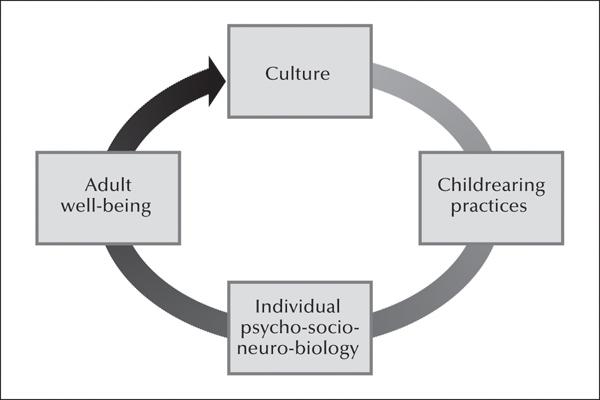
I believe that problems in social behavior that used to be exhibited by a tiny minority of children raised in nonoptimal circumstances are becoming normalized (e.g., poor emotion regulation, distractability, noncompliance) (Shonkoff et al., 2012). Even when these child outcomes are recognized as unusual, the suggested remedy is often directed toward parents, who may be charged with undersupervising, underpunishing, or underadmonishing. Parents are blamed for lack of inculcating appropriate values, with the underlying assumption that coercion is the way to obtain moral outcomes. But I believe that this is a misunderstanding of human development on multiple fronts, and that to truly comprehend human development we must grasp the dynamic, coconstructive effects of caregiving on the child’s body and brain in early life. To do so, we need to take a glimpse into perspectives and practices outside of our current repertoire.
Why concern ourselves with physiological health and development when our topic is morality? The shift in baselines for normal childrearing may be altering what Darwin called the pinnacle of human evolution, the moral sense. According to Loye (2000), the capstone to Darwin’s theory of evolution was his emphasis on moral agency as the most important force in human evolution. In both his private notebooks (Gruber, 1974) and in The Descent of Man (1871/1981), Darwin proposed that the moral sense initially arose from the parental and social instincts that evolved in mammals. Recent research concurs, identifying prosocial instincts not only in humans and primates but other mammals (e.g., De Waal, 1996; Preston & de Waal, 2002). Even nonprimate mammals demonstrate prosocial behavior, as demonstrated by rats who free other rats from restraint even when they could instead receive a favored chocolate reward (Ben-Ami Bartal, Decety, & Mason, 2011).
But Darwin emphasized the moral sense as particularly germane to human evolution. Indeed, although primates are generally oriented to helping others, young human children show a greater natural tendency to help than other animals (see Tomasello, 2009, for a review). Loye (2000) paraphrases Darwin from The Descent of Man (pp. 72–73):
In the first place, the social instincts lead an animal to take pleasure in the society of its fellows, to feel a certain amount of sympathy for them, and to perform various services for them ... Secondly, as soon as the mental faculties had become highly developed, images of all past actions and motives would be incessantly passing through the brain of each individual. Out of a comparison of past and present the feeling of dissatisfaction, or even misery, which invariably results from any unsatisfied instinct, would arise. Third, after the power of language had been acquired, and the wishes of the community could be expressed, the common opinion of how each member ought to act for the public good would naturally become the guide to action ... Lastly, habit in the individual could ultimately play a very important part in guiding the conduct of each member, for the social instinct together with sympathy, is, like any other instinct, greatly strengthened by habit, and so consequently would be obedient to the wishes and judgment of the community. (pp. 128–129)
When I look at the data available on the characteristics Darwin identified, the evidence is disheartening. Regarding sympathy, or concern for others, empathy has been decreasing in U.S. college students (supposedly the nation’s cream of the crop) in recent decades, and especially in the last decade (Konrath, O’Brien, & Hsing, 2011). Darwin mentions the capacity for guilt and concern for social opinion, which, when not realized, leads to shame. The United States has been plagued by an increase in the flaunting of social rules, more oppositional behavior, and less shame for selfish behavior and even advocacy of it (Callahan, 2004; Mooney & Young, 2006; Rand, 1964; M. Robinson & Murphy, 2008; H. Walker, 1993). In terms of habits, self-regulation of negative feelings has been decreasing in young children and adults (Powell et al., 2003; U.S. Department of Health and Human Services, 1999). Cheating is widespread in all age groups and walks of life (e.g., Callahan, 2004). In every case, it looks as if the components of Darwin’s moral sense have been heading in the wrong direction.
Are all the identified problems due to the random stresses of “modern life,” or is there some other systematic cause? Is there a moral cause to these problems? I believe so, but I think what looks moral within individuals has causal components “all the way down.” That is, implicated are not only reasoning, empathy, and relational capacities but also the brain-body systems upon which these capacities rely, including emotional brain circuitry and neuroendocrine systems. Morality is influenced by all sorts of physiological systems, most of the time without our awareness. Their misdevelopment influences moral conceptions and the types of societies we adults create.
You will notice that the arguments I make bridge the realms of human development and ethics. Developmental theory generally involves both descriptive and normative aspects because it attends to how human development unfolds and how better and worse outcomes come about. Starting at least with the work of genetic epistemologist, Jean Piaget, an implied standard of adequacy has been built into the notion of development. “When one says that the goal or aim of development is to attain a particular endpoint ... one is not simply making an empirical claim about the natural course of development ... one is also making an evaluative and normative claim” (Lapsley, 1996, p. 6). Developmental theory necessarily implies a direction of growth that is descriptively better—more adaptive, adequate, or desirable. Thus, in developmental theory generally, factual and normative issues are mutually implicated. As Murdoch (1989, p. 52) pointed out, these are also concerns of moral philosophy: “What is a good man like? How can we make ourselves morally better? Can we make ourselves morally better?” For Aristotle and other ancient Greek philosophers, answering questions like these about human excellence and flourishing was dependent on knowledge of human nature; “only through knowledge of shared human nature [do] we become aware of where we want to go, the ideals at which we should aim” (Chisholm, 1999, p. 1). Thus, to be able to aim for flourishing, we need to understand our evolved needs and propensities. We need to understand what is typical and atypical for our species, how we begin and how we end up.
In his review of the literature on early development, Allan Schore (1994) proposed several principles for the growth of the brain. I take up and extend two of them here. First, brain growth involves critical periods of intense and interactive social experience. These critical periods are concentrated in early life and involve systems governed by right brain hemispheric development. The circuitry and thresholds for basic functioning for a lifetime are established at this time. I contend that these systems are vital for optimal moral development that matches up with our heritages. Second, experience and the shifting social environment induce epigenetic changes and reorganization of the brain/mind during development. As dynamic systems, humans are rapidly changing and developing in early life, building on prior foundations. Both of these principles ground the focus of this book because they impinge on matters important to morality and moral development. If moral conceptions and development emerge from the very conditions of human life, then it matters what those conditions are; habits and intuitions are built from experience (Dewey, 1922/2000).
Intrigued with humanistic psychology and Spinoza’s claim that what is “good” is becoming fully human (Wienpahl, 1979), I agree that human purpose has to do with “transforming our existence into an ever increasing approximation to our essence” (Fromm, 1964, p. 144). All prior choices impinge on the present choice, narrowing options with each step. Taking up Fromm’s view, evil is the loss of humanity, “an ever increasing estrangement between existence and essence” (p. 144). The path of evil is taken one step at a time, with choices that squelch life, that downshift to a prehuman essence, and/or promote self-destruction through egoism (inflated I-ego regard). A lack of awareness and vision hobbles one on the path toward goodness. But with clarity of heart and mind, individuals and societies have the freedom to develop cultures that promote well-being, aiming to fulfill our human essence collectively.
This book is about the development of the capacity for virtuous morality, which requires taking the path toward the fulfillment of human essence, socially and personally. The social aspect of virtuous morality concerns how individuals and communities make meaning of social life (MacMurray, 1961/1999). Cultures carry out practices surrounding “how our attitudes and our actions should take into account the needs, the desires, and the entitlements of other people” (Frankfurt, 2004, p. 7). The social embedding of the self in turn shapes individual moral meaning-making that feeds into the cultural milieu. Morality, then, includes human systems of any kind, such as family, community, cultural, and government structures. But every human system begins with the mother-child dyad and from there iteratively builds the roots of individual and cultural virtue. The personal aspect of morality means developing one’s essence through lived social experience. Each individual constructs a moral universe based on experience, particularly in early life when the foundations for implicit or tacit knowledge begin. Early-life experience influences at first the implicit, then the explicit, answers a person has to questions like these: Who am I? Who are we? What is the sense of my/our life? What is my/our role in the universe? What are my/our responsibilities? How am I/are we connected and to what? What must I/we nurture? What must I/we avoid doing? What is good, what is bad?
When I say “virtuous morality” I refer to a “thick” view of morality that encompasses most everything we do in life (Bernard Williams’s [1985] distinction). That is, to be virtuous is to behave in the right way at the right time according to the particular situation. Virtue comes from extensive practice under the guidance of mentors. And it influences the well-being of all else. Almost everything a person does is morally relevant because it influences the trajectories of self and others (including nonhuman others). Thus, even atttitudes and emotions are moral acts. For example, if I harbor a grudge against a coworker, over time it can lead to harmful action when the opportunity arises—for example, slander or failure to defend her if she is unfairly accused. Such harmful behaviors occur as if “without intention,” but the intention was long rehearsed with the harboring of resentment or thoughts of revenge (Murdoch, 1989). Further, if I consider myself superior to another, then I will have no compunction about ignoring his needs and interests when a relevant opportunity arises.
Developing virtue requires the cultivation of one’s character through focused attention and through the activities and environments that one chooses. This necessitates a practical wisdom guided by “second-order desires” (wanting to have certain desires) as opposed to first-order desires (basic desiring) (Frankfurt, 1971). But second-order desires are characteristic of autonomous, free persons. Babies are not yet autonomous. So in early life, parents choose the foundations for the child’s desires by the quality of their attention, the guidance they provide, and the types of activities and environments in which they place the child. For example, a parent who is distracted from responding to the cues of the baby fosters different motivations than a parent who is deeply socially engaged, emotionally present, and mutually responsive to the baby.
Experience during sensitive periods such as early life shapes the cognitive structures and personalities of individuals. These include attachment patterns that dictate habits for broader social life later on. Structures and personalities built in childhood are brought into adulthood as default assumptions for the lifescape (Wexler, 2006). Culture is also influential. The culture in which one is immersed influences how one behaves toward others on all levels: as an individual toward another individual, as a member of a group toward members of another group, as an individual or group member toward institutionalized social will. Implicit default assumptions about others influence individual and cultural worldviews and habits, which in turn shape the culture of childrearing that adults provide for children, influencing the next generation, and so on. See Figure 1.1 for an illustration.
Only recently in human genus history have all elements of this cycle shifted in ways detrimental to human well-being. So we must look outside the dominant culture for a baseline representation of human well-being.
Humans have been around for more than 2 million years. The last 11,000 years or so, approximating the beginning of settled societies, represents less than 1 percent of human genus history. The other 99 percent was lived out primarily in immediate-return, small-band hunter-gatherer communities (SBHG) of 5 to 30 individuals on average (Fry, 2006).[9] SBHG have coexisted with settled societies all along. For example, the !Kung San culture is estimated to be over 35,000 years old (tools that old were recently discovered and they match their tools today), and the Australian aboriginal culture is estimated to be 60,000 to 150,000 years old (Balter, 2012; Lawlor, 1991; Martin, 1999). Around the world in nomadic foraging communities, a similar social culture emerged, suggesting that it is a stable form (see Ingold, 1999, for a review). And, until the modern world impinged on their lifestyle, the SBHG lived sustainably, like all animals, or perished. Migrating from feeding ground to feeding ground, intelligently like other migrating animals, they would move on before irreversibly damaging an area (Gowdy, 1998, 1999).
Despite physical hardships, on average SBHG societies live peacefully and happily in a companionship culture of shared activities with a premium on autonomy (i.e., no one is coerced to do anything, not even children, except not hurt others). The individual exists in a cooperative web of nurturing and egalitarian relations within the natural world; all lifeforms fall into the moral universe of these communities. With the domestication of plants and animals, humans shifted away from this cultural heritage, although we seem always to be trying to get at least some aspects back. In different sections of the book I will be contrasting dominant contemporary views with common views from small-band hunter-gatherer society, what Marshall Sahlins (1968) terms the “original affluent society.”
But it is not all was sweetness and light. SBHG necessarily kept their population small, even committing infanticide when resources were scarce. As will be noted later, modern society has gifts to bring to the table that can be integrated into a deliberate approach to our self-development for greater flourishing.[10]
In my explorations, I discovered that there is much that humans inherit from prior generations. Keeping this host of inheritances in mind can help us figure out the source of social and individual problems. In Chapter 2, I address humanity’s heritages through the lens of a developmental systems approach. Which inheritances contribute to human nature? Science discourse in recent decades has usually focused on genes, but genes are themselves inert. They do not act alone but require an interactive context of environmental influence, maturation, and action. Moreover, we have many inheritances beyond genes (extragenetic), including our developmental plasticity, the microbiome (the biological entities that keep our bodies functioning), and our ecology and culture. All our inheritances matter for morality and may be influencing the development of the moral sense in our children. But we also inherited the capacity to change ourselves, as self-organizing organisms, with our imaginative and self-directing capabilities (“self-authorship”) (Baxter-Magolda, 2009). So we don’t have to remain where we are.
In Chapter 3, I examine the dynamism of development in early life. I point out how much of human psychology is biological and embodied—how who we are is deeply shaped by early experience. Our systems and thresholds for their function are biosocially constructed in early life, whether stress response, immunity, emotion systems, or hormones. Physiological underpinnings affect who we become, deeply influencing personality and dispositions. I examine the development of emotions that are foundational for the moral life. The complexities of human brain development, even though minimally known to this point, would take an encyclopedia to describe, so I select only a few findings to illustrate the importance of early-life experience to emotional functioning. I examine how we become a self and a moral self by establishing empathic effectivity roots and a communal autonomy space that frame our actions.
Darwin considered the moral sense to be the driver of human evolution. According to Darwin’s notebooks, the moral sense gave rise to the golden rule and the second commandment stated by Jesus, to “love your neighbor as yourself” (Loye, 2000). Chapter 4 introduces one of our key moral inheritances related to love, the engagement ethic. The engagement ethic involves relational attunement and is most clearly displayed in our mammalian emotional systems of care and play. Because the engagement ethic is manifested by our relational presence with others, it relies on the proper development and functioning of systems governed by the right brain hemisphere, which develops rapidly in early life with supportive childrearing practices. The early shaping of emotion systems is critical for moral functioning as adults. When our emotions are well educated, our sensuality is trained “to enjoy organic experience, to enjoy the satisfaction of the senses” (MacMurray, 1992, p. 19).
Chapter 5 addresses the other key human inheritance for morality: our moral imagination. In moral psychology research, human imagination has been studied mostly in terms of reasoning about hard-case hypothetical dilemmas emphasizing a “philosophized” view of moral functioning—that what we consciously think determines what moral actions we take. However, this is an upside-down view. Emotion and procedural knowledge systems are developed initially in the first years of life through somatosensory experience with caregivers and then increasingly through other implicit knowledge systems, from which intuition originates. The rationality of thinking, then, is “secondary and derivative of emotion” and intuitive understanding (MacMurray, 1992, p. 11). A judgment of value relies on one’s emotions and emerges from the education of those emotions. If intellect alone is used to make a value judgment, it is derivative—a representation of other people’s opinion or one’s own but not a true value judgment. When a person’s emotion systems are educated well—in supportive social environments—emotions and sensibilities coordinate with cognition and motivation. Our moral inheritance of communal imagination requires immersion in a supportive social environment in early life and beyond.
How often do you go into a panic? A rage? Feel anxious? If something like this happens to you regularly or frequently, your “present” may be governed by things that happened in your past. When you go into such a brain state, you usually cannot perceive accurately what is happening before your eyes. Instead, old memories take over and affect what you “see.” Freud and other therapists have documented these occurrences in their patients. In Chapter 6, I describe how early experience can misshape our stress response and misdevelop our social capacities. When brains are undercared for, they become more stress-reactive and subject to dominance by our survival systems—fear, panic, and rage. In fact, one’s free will can be undermined by how the brain-body complex was shaped in sensitive periods, particularly in early life. Allan Schore (2003a) identified self-regulation as a point of convergence for psychology and neuroscience. Now we can add morality to that convergence. Self-regulation, which is co-constructed by caregivers from birth, is a fundamental component of the sociality that carries our morality.
Chapter 7 addresses the types of ethics that stress reactivity promotes. In the moment of threat, self-protection is of utmost concern. The Safety Ethic is a moniker for a set of moral mindsets that emerge from triggered autonomic responses to threat, resulting in general threat sensitivity, externalizing (combative morality), or internalizing (compliant morality). Trauma or chronic stress can lead to habituated use of these primitive moral mindsets and related ideologies. A malformed brain may have no other option but to use these systems. Self-protection coupled with imagination can create a dangerous situation over the long term, either through deliberate control and dominance of others (vicious imagination) or deliberate withdrawal from emotional connection (detached imagination). Moral imagination can mislead us when our brains are sensitized to threat and we are emotionally insecure, resulting in self-aggrandizing or emotionally-removed imagination of various forms.
Moral psychology research today focuses mostly on moral judgment in constrained experimental tasks and does little to investigate the moral decision-making and action that occurs on a moment-to-moment basis, where perceptions interact with situations to promote shifting moral mindsets. Chapter 8 addresses the nature of a moral mindset and how we develop mindset preferences and shift into one or another. Our past can lead to habitual use of one mindset over another. Despite lending its possessor a feeling of moral certainty, a moral mindset does not necessarily reflect moral wisdom.
In Chapter 9, I contrast two ways cultures can be set up, with either an emphasis on competition or on cooperation. In the natural world, competition is a thin icing on a thick cake of cooperation. Although cooperation infuses and predominates in the natural world, in contemporary social discourse, competition tends to be the basic assumption about humans and the natural world. I suggest that, because it is a rare view among human societies, the currently dominant competition story may be a natural output of the way we have been raising children and ourselves. Under evolved conditions, humans are malleable and aim for social flourishing—that is, the development of cooperative, social multi-verses that prepare one for wisdom. Poor social experience during sensitive periods may result in the development of competitive, soloist universes. A safety mindset and its imaginative counterparts make the competitive worldview seem reasonable as an explanation for impaired social and emotional competencies that often lead to violence and destruction in the world.
In Chapter 10, I discuss the nature of moral wisdom, comparing ancient wisdom traditions with what I call Primal Wisdom—“Primal” because it is humanity’s original wisdom, based on the social structure of most of human prehistory and our small-band hunter-gatherer cousins. Both sets of wisdom provide insights into how to foster well-being and avoid large-ego-driven selves. However, Primal Wisdom has unique characteristics that may be vital for rueturning to our human essence and living in partnership with the natural world. These include the embracing of our original animal nature and our fellowship with all entities.
In Chapter 11, I discusss tools for self-mending, self-development, and living a transformative life according to a “common-self” wisdom. The very beginnings of our morality are established without our consent in early life, so sometimes self-development of virtue is a matter of undoing what was done to us. Thus, if we learned to design a competitive solo-verse, we can reshape ourselves for a cooperative or ecominded social multi-verse. The ultimate power lies in our ability to self-author and self-develop as individuals and as communities.
Although the notion of “original sin,” like the notion of selfish genes, has been used to explain human aggression and selfishness, such behavior is better explained by our propensity to downshift to self-protective orientations when we feel threatened, a characteristic we share with all animals. A wise society is one that lubricates upshifting through thoughtful early-life caregiving and ongoing social support that promotes the three main virtues recognized in religious traditions around the world: humility, charity (love), and authenticity. In Chapter 12, I discuss these elements of virtue and what they mean for self and relationships. Emphasizing one over another puts us out of balance. All three, within an eco-wisdom mindset, can move us toward a world that supports all lifeforms.
Some may want to blame genetic evolution for the immoral behaviors we see, arguing that human nature is naturally selfish, so what more can you expect? But my argument is that the worrisome outcomes we see today are mostly due to culture and imagination—cultural practices that affect epigenetics and related physiological processes. Because immorality is primarily due to the effects of impaired emotional intelligence and imagination, the environments that humans set up for themselves and their children play a large role in how and who humans become. With greater attention to these matters, humanity can alter its own course.
This book focuses on what is considered to be the normal range for persons in Western societies. It does not address clinical psychopathology except to illustrate or offer a contrast to what has come to be considered the normal range. Overall, this book makes four main points:
-
First, like everything human, morality emerges from biology and embodiment—our lived experience. It is insufficient to discuss human social and moral functioning only as psychological phenomena (e.g., mental representations, internal working models). Physical and mental health, morality, and flourishing are integrated.
-
Second, our morality is multidimensional and arises from our evolved brain propensities. Through epigenetics and developmental plasticity, early experience shapes not only how well the body works but also how our social capacities function. Our neurobiological beginnings matter for all our capabilities, including emotional, intellectual, and moral.
-
Third, cultures are malleable. Cultures foster or undermine health and well-being and encourage or discourage our highest human nature. A society can intentionally foster greater capacities in its citizens. Through the beliefs we select, the institutions we design, and the practices we embody, we can choose to cultivate a more empathic and communal mindset—fulfilling our human essence.
-
Fourth, individuals can self-author virtue and wisdom capacities to facilitate change. They can join together to reauthor their communities and make them places where all thrive. With mindful self-cultivation and communal choices, humans together can develop relationships and institutions that stimulate and foster well-being and flourishing for every individual in the lifescape.
When we understand the dynamics of human becoming, we can better understand ourselves—our shortcomings but also our resilience. We then can envision how to move ourselves toward our fullest potential as cocreators of self and society. Armed with a mindful awareness of the power of early experience and the knowledge of how we can fall into misleading mindsets, we can learn to maintain more prosocial mindsets. Then we are equipped to design our societies to facilitate the path to higher virtues and sustainable flourishing for all.
Chapter 2: More Than Genes: Human Inheritances and the Moral Sense
Our Human Heritages
For most of recorded history, it has been assumed that what a person becomes depends largely on what she inherits, and that there is nothing much that can be done about it. Charles Dickens’s Oliver Twist gave us one of the most famous literary illustrations of the presumed power of inherited traits.[11] Oliver was raised in the same dismal conditions as the pickpocket, the Artful Dodger, but behaved quite differently throughout his childhood. While the Artful Dodger acted like a scoundrel, Oliver acted like a gentleman, with good speech and genteel manners. Readers find out later in the story that the difference in behavior is due to bloodline—Oliver’s parents were upper middle class, and that made all the difference. Many today still have a fixed view of inherited traits, except within a different frame.
Darwin’s (1859) theory of natural selection suggested that the evolution of organisms (changes over generations) is driven by natural selection, but he did not identify what specifically was selected.[12] Mendel’s (1865) subsequent confirmation of genetic inheritance in plants drew the focus to genes. According to a neo-Darwinian perspective, the heritage that drives human outcomes is genetic, a view still dominant today (e.g., Dawkins, 2006; E. O. Wilson, 2012). In this view, an organism is passive, acted upon by what it has inherited (genes) and by the pressures and demands of an environment it does not control.
Genes certainly are influential, but they don’t tell the whole story or perhaps even the most critical parts of the story of human evolution. Even Darwin thought there was more to human evolution than natural selection. Developmental systems theory (DST) challenges the prevailing dichotomous account of human heritage—that genes stand alone against everything else. Instead, in DST, genes are treated as one of many inheritances that have evolved; they constitute only one aspect of organismic adaptation. Thus, the concept of inheritance is more widely applied in DST and includes “any resource that is reliably present in successive generations,” which becomes “part of the explanation of why each generation resembles the last” (Griffiths & Gray, 2001, p. 196). The nest of early care (“developmental manifold,” Gottlieb, 1991; or developmental system, Oyama, 1985) is understood “to be the source of both the stability and the variability of development, eliminating the need for notions of preformed genetic programs or blueprints” (Lickliter & Harshaw, 2010, p. 495). Although the lineage of a species may not be able to produce particular resources itself, it can integrate them into the developmental system that supports the lineage, for example as the eucalyptus tree has done (i.e., fire is required to scorch a eucalyptus tree seed so that it can sprout). The set of resources for a developmental system interact and work together. I adopt a DST view here and examine multiple human inheritances.
The complexity of human heredity is becoming more and more apparent.[13] Inheritances beyond genes have been identified, such as epigenetics (heritable effects on an organism other than genes) and culture but also much more. We examine a longer set of inheritances in this chapter, starting with a quick outline. First, just because we have a particular gene and a particular gene’s allele doesn’t mean that it will be “turned on” or expressed (activated) and influence functioning. Environmental influences (external and internal) and the timing of those influences on genetic expression matter a great deal. In other words, epigenetics determines the expression of the gene. Second, just as important as, and in interaction with, genes and epigenetics is the broader notion of developmental plasticity, or how the timing and intensity of experiences during sensitive or critical periods mold capacities, personality, behavior, and trajectory—all of which build on one another through time. What the mother transmits and when affect the developing fetus. What the malleable infant experiences and when it is experienced influence postnatal development. The complex system that is the child interfaces with the complexities of the environment, affecting who the child becomes.
Third, like other lifeforms, humans have evolved with particular needs. Humans are born only minimally formed and are highly impacted by postnatal events, especially by how their physiological and psychological needs are met. Developmental sequences and maturation assume an expectable environment—a growth-facilitating environment with good-enough parenting, which, when not forthcoming, is assumed to result in suboptimal growth or pathology (Winnicott, 1965). The developmental nest (developmental manifold or ontogenetic niche), which for each species provides for basic needs and leads to species-typical outcomes, is described as
the reliable and repeatable features of stimulation and experience occurring in an organism’s developmental context ... the set of ecological and social circumstances typically inherited by members of a given species ... reconstructed in each generation ... [serving] as a primary basis for the development and maintenance of ... species-typical behavior. (Lickliter & Harshaw, 2010, p. 497)
Fourth, whereas body systems shaped by experience such as stress response systems contribute to our survival, so do a host of other organisms. We are not alone in our bodies; we live symbiotically. Each of us is populated with trillions of bacteria and fungi that represent the microbiome.[14] When these become out of balance, we become ill. The establishment of system “balance” in response to the environment is part of developmental plasticity. But this is a deeply social event: thresholds for multiple systems are established by caregivers in early life. Health and well-being are highly affected by and affect ongoing social relationships.
Fifth, beyond our own bodies we are born into an existing ecology, the type, quality, and quantity of resources having been influenced by prior generations. The maternal ecology, for example, includes the types of foods a pregnant mother eats and whether she had human-made formula instead of breast milk as a child, affecting her offspring’s susceptibility to allergens. The macro-ecology, such as air quality and pollutants, also influences health and well-being. Sickly people necessarily become more self-focused. Poor resource access influences maternal focus, which distracts from responsive maternal care, a factor linked to most positive child and adult outcomes.
Sixth, cultural inheritance encompasses multiple levels of effects, including beliefs about human nature and human purpose and what it means to be a good person. Such beliefs influence how a parent treats a child and in turn become ingrained in the body and psyche of the developing child. I suggest that humans have cultural inheritances that can undermine their biological inheritances.
Humans have unique evolutionary packaging that circumscribes their growth and development. It consists of brain and body capacities that are unique yet representative of where humans are on the tree of life. Darwin emphasized humanity’s moral sense as part of this unique inheritance. The characteristics of the moral sense are largely malleable, epigenetic, and initially dependent on cultural supports. This book will address how one’s habitual moral sense can differ from another’s based on experience.
In short, whom a person becomes is a coconstruction of genes, gene expression from environmental effects, developmental plasticity, the ecological and cultural surroundings, the gifts of evolution, and the nature of care received. All contribute to the development of a human life. Although much of this is determined outside of an individual’s control, there is one last piece that is especially intriguing to therapists and those interested in self-development. Humans are self-organizing, complex, dynamic systems. It is true that offspring automatically organize themselves in response to signals from the mother in the womb and caregivers in early life. But once self-conscious autonomy is possible, no matter what the past, an individual has the opportunity to remake the self intentionally. This gift of autopoiesis or self-creation may represent the greatest “biology of freedom,” and this book will end up there (Ansermet & Magistretti, 2004/2007; Maturana & Varela, 1998). In this chapter, I address each of the inheritances in a little more detail. See Table 2.1 for the list of inheritances and how they are influenced.
Table 2.1 Inheritances That Influence How a Human Develops
+-----+
Before Genes
Genes, per se, did not exist at the beginning of life on earth. Although Dawkins (2006) and others have argued that precursors of genes were selfish “replicators” like genes, this view has been called a “figment of the imagination” (Bauer, 2012). The predominant view is that the beginning of life on earth was marked by cooperative RNA molecules and proteins (W. Gilbert, 1986; Woese, 1967). “Life” was constituted by biological cooperation—by cooperative, communicating ensembles of protein and RNA molecules that were able to reproduce themselves. These systems were distinguished by connectedness. None of the components was autonomous; only cooperation could make things happen. Genes emerged much later, and they are virtually universally under the command of the cell. In fact, only 1.2 percent of genes in humans are of the type that stores a construction blueprint for a protein.
It is not only genes that are passed from one generation to another, but also a plethora of other internal and external factors and resources that contribute to the development of an organism (Lickliter & Harshaw, 2010). Physiological inheritance includes much more, such as
the passage of maternal RNA molecules into the embryo, the potential passage of prion proteins from parent to offspring, the biochemical state of the gametes at the time of conception, and the transmission of nutrients, bacteria, or antibodies from maternal circulation to that of the offspring. (Meaney, 2010, p. 44)
Some of these inheritances, such as cell structure, are not related to genetic evolution at all (Bauer, 2012; Margulis, 1998). Nevertheless, genes currently remain at the center of attention in scientific popular discourse.
Genes and the Genome
We have often been made to think that genes are our primary inheritance and that they play the largest role in who we become. For example, we are told there is a gene for aggressive personality, one for alcoholism, another for autism, and so on. Among those who emphasize genetic inheritance or natural selection, the level of genetic explanation often shifts from biological to psychological and social levels. We have been told that we are passive bystanders, with our genes controlling who we are and what we do.
In a diverse array of popular sources, the gene has become a supergene, an almost supernatural entity that has the power to define identity, determine human affairs, dictate human relationships, and explain social problems ... human beings in all their complexity are seen as products of a molecular text ... the secular equivalent of a soul—the immortal site of the true self and determiner of fate. (Nelkins, 1995, p. 193).[15]
Genes are often described as “deciders” in our lives, in charge of human life events. Referencing gene-centric theorists (e.g., Richard Dawkins, Steven Pinker, and Robert Wright), who have been called “Darwinian fundamentalists” or “hyper-Darwinists” (Gould, 1997; Gould & Lewontin, 1979), Susan McKinnon (2005) writes,
Natural selection is conceived of as the grand “puppeteer,” the “ultimate policy maker,” the “Blind Programmer,” and the “engineer” that “designs” organisms, mental organs, and adaptations meant to maximize genetic proliferation ... As the ultimate manager of genetic productivity, “natural selection does the thinking,” has “goals” and “strategies,” “works its will” and “executes its policies.” Natural selection is described as having both desires and the force to realize them: it “wants” and “gets” humans to do certain things—for instance, to be “nice to our siblings” but only “to look like we’re being nice” to friends ... Genes are “selfish” and “mercenary” and, like natural selection, “have strategies” and “goals” (generally to propagate themselves). To that end, they compete, design, engineer, and build organisms and mental organs. They have perspective and “point of view”; they “want” and “get their way,” “calculate,” “control,” “select,” “speak” to us, and “counsel submission” and “spread themselves.” (p. 16).
Natural selection—survival of the fittest—is described as having selfish agency, and we, like all organisms with genes, as robots doing its bidding (although we can “rebel”) (Dawkins, 2006). These views are commonly assumed to be true among writers and scholars who emphasize genetic inheritance over other inherited contributions to human behavior.[16]
Part of the reason for the attractiveness of these selfish-gene metaphors to date is not only that they are simple cause-consequence chains of logic, but also that they fit with cultural beliefs, such as a mechanistic view of humanity that emerged from the scientific revolution, Protestant theology, and Freudian psychology and still infuses Western cultural beliefs. In the Anglo-Saxon world at least, there is an underlying assumption that human nature has a negative bent, that the human psyche is “an egocentric system of quasi mechanical energy, largely determined by its own individual history, whose natural attachments are sexual, ambiguous, and hard for the subject to understand or control” (Murdoch, 1989, p. 51). Indeed, if you look around at humans in industrialized nations, you see many behaviors that are focused on sexuality and that seem hard to understand or control. But, as I argue in this book, perhaps these problems emerged from a misunderstanding of moral development and misguided childrearing practices.[17]
In late twentieth century, genes were considered to be nucleotide sequences embedded within DNA that direct the production of proteins, coding for amino acid sequences.[18] In this view, genes offer a blueprint for making proteins that become part of complex signaling cascades. However, they are powerless on their own. It is the proteins, influenced by the ongoing environment, that direct cell development, cell assembly, and cell connections (Stiles, 2008). The construction of cell bodies and connections establishes the behavior of the organism, which in turn affects the organization and functioning of the body’s systems at any given time. Genes virtually never work independently or uniquely, but are influenced by other genes, hormones, nerve impulses, and environmental stimuli as “part of highly regulated and orchestrated cascades of expression and interaction” (Stiles, 2008, p. 62). Although genetic inheritance instigates the process of development, many other processes and factors are essential for development as well. “Complex, dynamic, and interactive signaling processes,” which are established at conception, “ultimately shape and direct the development of the mature organism” (Stiles, 2008, p. 65).[19]
Signals to genes can come from inside or outside the organism. Early on in an organism’s development (e.g., during gestation), signals are internal and intrinsic to the organism as inherited body development plans. But because development is interactive and dynamic, there is no simple reading of a blueprint to form a phenotype. Instead, existing cells “direct the fate of other cells ... altering signaling from cells originating from a third source” (Stiles, 2008, p. 65). For example, during a critical time in fetal brain development, serotonin behaves as a trophic hormone (i.e., dominating and directing neuronal cell development), after which it disappears for a while before reappearing as a key neurotransmitter (D’Amato, Blue, & Largent, 1987; Hohman, Hamon, Batshaw, & Coyle, 1988; Lauder & Krebs, 1986). External signals also affect development. Fetal developmental is highly influenced by the nutrients and toxins transmitted from the mother, all of which interact with evolved developmental maturational sequences. Over time, the child increases her influence on gene expression and developmental trajectory through her choice of activities.
The Human Genome Project put forward the hope that humans might be able to pinpoint most human maladies through identification and modification of the genes that underlie them. According to a leader at the National Institutes of Health, the project has been a huge disappointment, as very few maladies—only 2 to 3 percent of diseases, including those in psychiatry (Ansermet & Magistretti, 2007)—are directly related to one gene or another.[20] No specific gene has been found to be linked to any particular psychiatric disorder (Abdolmaleky, Thiagalingam, & Wilcox, 2005). In fact, individual differences in each person’s genetic sequence and individual variation in gene expression may render the original goal of the Human Genome Project—to map “the” human genome—an exercise in futility for psychiatry. Nevertheless, a great deal of infrastructure resources have been invested in genetic research, making it difficult to move away from research and discourse based on this paradigm (P. Bateson, personal communication, 2012).[21] However, biologists are increasingly moving away from an exclusive emphasis on genes. In fact, the definition and understanding of genes is now in flux among molecular geneticists, who, in light of the complex distributions of gene start sites, exons, promoters, and other DNA features, are considering how a multidimensional network regulates gene expression (Pearson, 2006; Pennisi, 2007).
Nevertheless, psychologists continue to emphasize the centrality of genes in personality and individual outcomes in the field of behavioral genetics (e.g., Friedman, Miyake, Robinson, & Hewitt, 2011). It is still common in psychology to talk of nature (genes) versus nurture (environment), as if these were separable elements (Keller, 2011). For example, a line of research still predominant understands environmental and hereditary components to be independent and separable, additively accounting for 100 percent of the variance in a characteristic (Plomin & Caspi, 1990). Scarr (1992) contended that genotypes propel experience and determine outcomes to a greater degree than the environment: “Parental genes determine their phenotypes, the child’s genes determine his or her phenotype, and the child’s environment is merely a reflection of the characteristics of both parents and child” (p. 9). Thus, as long as “‘average expectable’ conditions in which the species has evolved” (p. 5) are present during children’s development, differences in childrearing and socioeconomic class will have only “small effects on the measurable differences in [their] intelligence, interests, and personality” (p. 10).[22] It is still common to believe that genes, primarily, make the person. For example, as I was writing this, 20-year-old Adam Lanza shot 20 six- to seven-year olds in a primary school in Newton, Connecticut. Among the shocked reactions was a desire to look at his genetic makeup. I heard no one ask what his childhood experience had been like in terms of trauma, abuse, or neglect. It was all about his inborn “nature,” with no discussion of his “nurture.” (Again, I find “nature versus nurture” to be a false dichotomy because of the constant interaction of the two elements.)
Research shows a complex interaction between genetic vulnerability and environmental effects, favoring the power of experience. For example, the DNA of a Dutch family prone to violence was examined. They were shown to have variations in a gene that regulates levels of monoamine oxidase A (MAOA), an enzyme that mops up excessive neurotransmitters and influences neurotransmitter functioning (Brunner, Nelen, Breakefield, Ropers, & van Oost, 1993). MAOA plays a role in development by altering levels of serotonin and norepinephrine, decreasing the development of inhibitory control and increasing fear memory, which then leads to increased violence. Mice who have had this gene completely disabled are more aggressive (Vishnivetskaya, Skrinskaya, Seif, & Popova, 2007). MAOA facilitates the contextualizing and decoding of social signals as well as the regulation of affective response when interpersonal threat is perceived (Buckholtz & Meyer-Lindenberg, 2008). Thus, the Dutch family was missing basic neurobiological equipment needed for socioemotional experience. But there was not a one-to-one correspondence between violence and possession of the gene variant; family members were only more prone to violence, meaning that there was an environmental trigger. Universal risk factors for antisocial behavior are physical and sexual abuse. But just as the gene variant alone does not predict violence, neither does abuse alone predict it. Instead, there is an interaction. Among individuals with a history of childhood abuse, those with low MAOA activity are more likely to become violent criminals, whereas those with high MAOA activity do not show an increased risk (Caspi et al., 2002; Frazzetto et al., 2007; Kim-Cohen et al., 2006).[23] Thus, assuming the independence of nature and nurture is misleading, because such a view emphasizes main effects at the expense of interactions between environment and person—interactions that occur constantly. Timing, intensity and duration of experience matters. So, arguments about genes versus environment are biologically implausible (Gottlieb, 1991, 1997). The organism grows and changes, making the environmental influence on the individual a constantly shifting interaction. In fact, genes are turned off and on throughout the day based on states and behaviors (for a review, see Rossi, 2002). Moreover, it is inaccurate to talk about a gene in terms of its environmental interaction, because genes do not interact with environments; organisms do (Lehrman, 1970).
Nevertheless, staying focused on genes, it is important to understand what they are and how much control they really have. First, we humans share most of the same genes (and many of our genes are shared with other animals) so few genes are even available for competition between us. In fact, less than 1 percent of my genes are available for “competing” with yours—as noted in Figure 2.1, an attempt to represent the proportion of competition to cooperation between individual human genetics. Human genetic competition between individuals is represented by the dot (illustrating a percentage of less than 0.1), whereas the white space represents the more than 99.9 percent of genes that are shared and do not compete. Further, as discussed below, it turns out that only 1 to 10 percent of the genes in any human body are human (the rest are those of microorganisms keeping us alive). So most of the genetic history story is about conservation, from one generation to another.
Although gene-centric theories minimize or ignore the effects of influences other than natural (genetic) selection, developmental systems theory considers genes to be only one of many factors that affect the unfolding of development and the self-organization of an organism (Fogel, King & Shanker, 2008). For example, the human nervous system overall has ten times as many cell-to-cell connections as genetic code instructions, and each of these connections requires input from the internal environment for its arrangement (Jessell & Schacher, 1991; Kandel, Schwartz, & Jessell, 2000). Genes leave so much room for necessary experience that one could say that the individual is “genetically determined not to be genetically determined” (Ansermet & Magistretti, 2007, p. 8; Cheung & Spielman, 2002). In fact, a significant part of human nature depends on how and when the genetic blueprint is turned off and on during development.
In short, genes coding proteins cannot “act” without a supporting cast. Astonishingly, what has been attributed to genes may often turn out to be something else—characteristics shaped by experience (the focus of this book). Epigenetic influences can occur in the womb, be experienced early in life, or be inherited from experience-based changes in recent ancestors.
Figure 2.1 The Ratio of Human Genetic Competition to Shared Genes: 1,000 to < 1
Epigenetics and the Epigenome
As noted earlier, the fulfillment of a genetic program necessitates experience. Experience acts on the gene, influencing whether or not and, if so, how much a gene is expressed. This is epigenetics (Cheung & Spielman, 2002). Simplistically, one can view the epigenome as being like “software” that determines the functioning of the genome, the “hardware.” But the metaphors of software and hardware are actually misleading, because the relationship between genes and the elements that affect them is a constant interaction, although there seem to be critical windows for some lasting epigenetic effects (see Figure 2.2). Another part of our inheritance is the epigenetics that are established prior to our birth and in early life. Epigenetic changes early in life occur in cells during embryogenesis. Modifications can be transmitted transgenerationally as cells divide and an organism forms (Anway, Cupp, Uzumcu, Skinner, 2005; Rakyan, Blewitt, Druker, Preis, & Whitelaw, 2002; Rakyan et al., 2003).
While the genome represents a set of inherited genes, the epigenome represents the switchboard of genes that have been turned on or off in gradations from environmental signals, usually at critical points in development but also from other experiences. Technically speaking, epigenetics refers to the “nongenetic cellular memory, which records developmental and environmental cues” (Riddough & Zahn, 2010). Strictly speaking, epigenetics is the study of the heritable modification of gene expression wherein DNA sequences remain intact, a shorthand for a variety of processes such as DNA methylation, post-translational histone modification through acetylation, phosphorylation, methylation, nucleosome location, and noncoding RNA (Dolinoy, Weidman, & Jirtle, 2007). Methylation, specifically, involves methyl molecules attaching to DNA directly, leaving chemical tags that boost or diminish the effects of the genes themselves. Early-life experience alters levels of genetic expression with epigenetic markings that influence behavior, hormones, and stress responsivity throughout life (Murgatroyd & Spengler, 2011) (see Figure 2.2). For example, twins are estimated to share 20 percent of their IQ scores based on experiencing the same womb and 34 percent of IQ scores based on genetic inheritance (Devlin, Daniels, & Roeder, 1997). However, the epigenetic tag differences between twins increase with age and appear to be the key factor behind differential outcomes for disease and even death. Twins die on average ten years apart (Fraga et al., 2005; Poulsen, Estellar, Vaag, & Fraga, 2007).
It was previously assumed that an epigenetic system is self-maintaining in the presence of the original trigger and heritable by offspring cells, but technically reversible when appropriate alternative stimuli occur (Bonasio, Tu, & Reinberg, 2010). However, intergenerational effects are calling reversibility into question. Scientists are realizing that epigenetic changes can persist for multiple generations even without continued exposure to the regulator or instigator of the change (Anway et al., 2005). For example, Michael Skinner and colleagues seem to have found compelling evidence for additional transgenerational epigenetic effects in rats by triggering mutations with a commonly used pesticide (Anway et al., 2005; Skinner & Anway, 2006; Rakyan et al., 2002; Rakyan et al., 2003). Pregnant rats were exposed to two pesticides during the period in gestation when the sex of offspring is determined. Male offspring suffered reduced sperm motility and counts. More than 90 percent of offspring over four generations showed the same reproductive effects. The changes were not genetic (changes in genes) but epigenetic (changes in gene expression). The toxic industrial chemicals increased offspring susceptibility to cancer, immunological deficiencies, and other health problems as well as infertility. The epigenetic changes remained in the offspring cells every time they divided. Thus, Skinner and colleagues demonstrated epigenetic effects that were not reversed after the environment was clean of the toxin.[24] More recent work shows that epigenetic inheritance of diseases also can be passed to multiple generations (Bohacek & Mansuy, 2012).
Figure 2.2 Epigenetics: How Early Experience Programs the Body and Psyche
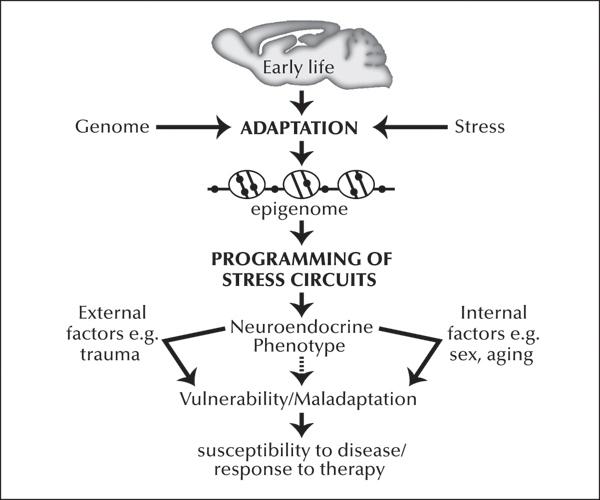
Source: Reprinted from Frontiers in Psychiatry, Vol. 2, Issue 16, Chris Murgatroyd and Dietmar Spengler, “Epigenetics of Early Child Development,” pp. 1–15, April 2011. Copyright ©2011 Murgatroyd and Spengler. Used with permission from author, Dietmar Spengler, Molecular Neuroendocrinology, Max Planck Institute of Psychiatry.
Epigenetic findings extend to psychosocial development. Isabelle Mansuy and colleagues studied the effects of separation from mother and maternal stress during early postnatal life in mice (Franklin, Linder, Russig, Thöny, & Mansuy, 2011). When the offspring were adults, they exhibited social anxiety (impaired signaling of serotonin). These changes persisted across generations. Epigenetic effects have been found for schizophrenia and Alzheimer’s disease (Bassett, Avramopoulos, & Fallin, 2002; Bassett et al., 2006; Petronis, 2004). DNA methylation is related to psychiatric disorders (C. S. Ding, Davison, & Petersen, 2005; G. Ding, 2005). For example, McGowan and colleagues (2008) examined the brains of individuals who had committed suicide, comparing those with a history of early childhood neglect or abuse to those without such a history. Suicide victims with a history of child abuse displayed significantly more hypermethylated ribosomal RNA (reduced rRNA expression) in the hippocampus. Ribosomal RNA is crucial for cellular protein production and has been found to be compromised in those with mild cognitive impairments as well as early Alzheimer’s disease.
In summary, there are multiple effects of early experience that change gene expression and influence mental and physical health outcomes. Many epigenetic effects interrelate with developmental needs, which we discuss next.
Basic Needs
Humans are part of a hominid or ape line that emerged about 14 million years ago. If we look at the growth and development of our close ape cousins in the tree of life and their corresponding parenting practices, we can get an idea of how humans compare. Table 2.2 shows developmental trajectories for some ape species. As humans evolved to become bipedal with smaller pelvises but bigger brains, human neonates became even more dependent and helpless than other social mammals, as they needed to exit the womb relatively early due to head size. Parenting intensified, extending breastfeeding, holding, and responsive care (Trevathan, 2011). One can see from the chart that the human brain is the least developed at birth. So it is not a surprise that humans need more postnatal care than the already extensive care other apes receive. Moreover, the human brain is about three times larger than would be expected for a primate of our size (Trevathan, 2011). Neural tissue requires a lot of energy to grow and maintain itself (perhaps 25 percent of energy intake), so it is an expensive adaptation.
Several psychologists have proposed lists of humanity’s basic needs. The most well-known set was offered by Abraham Maslow (1943, 1954). He suggested a hierarchy of needs that includes physiological, safety, belonging, esteem, and self-actualization. Other scholars have their lists. Deci and Ryan (1985) suggested three basic needs: belonging, autonomy, and competence. Susan Fiske (2004) added three more to theirs: trust, understanding, and self-enhancement. Staub (2003) emphasized another: purpose. I suggest additional needs that encompass the mammalian nature we have inherited, which also requires intersubjectivity with others, reciprocity, and coregulation of all our physiological and psychological systems. A “basic” need, in my view, is a need that, when not met, leads to worse outcomes for physical, mental, or social health and well-being.[25] We can break down our evolved nature and examine the types of experiences that fulfill these needs. I sort the experiences and the fulfilled needs at different levels: mammal, primate, and human. See Table 2.3 for a summary.
Table 2.2 A Comparison of Human Development to That of Other Great Apes
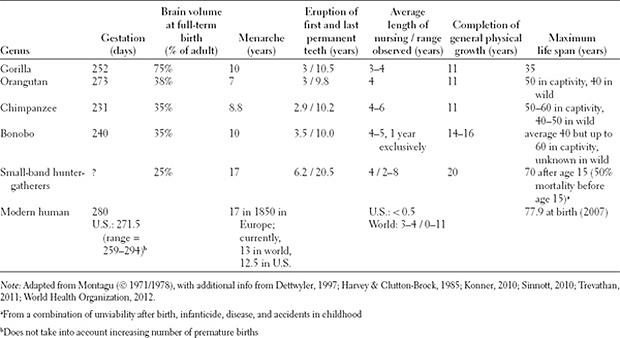
Mammalian needs. Humans are mammals with special needs. Unlike many other animals, mammalian caregivers and offspring need to bond—especially the mother with the neonate—so that the offspring are well cared for with warmth, food, safety, and acceptance. Rejected offspring (e.g., due to separation after birth and a subsequently unrecognizable smell) are less likely to receive warmth, food, and safety (Panksepp, 1998). Most animals thrive under conditions of autonomy; no animal wants to be restrained, and all become distressed when autonomy is thwarted, so freedom to move is fundamental (Panksepp, 1998). All animals seek mastery of their physical and social environments through exploration and learning what is predictable and what is not, and what actions have which predicable outcomes. For mammals, most of this occurs through play in nature and with other members of the group, fostering a sense of belonging as well as social skills for group life in a particular landscape (Panksepp, 1998). There are also several layers of “trust” that must develop, not only trust in parent(s), companions, and the social group as a whole but also a feeling of being “at home” in the surrounding natural environment (i.e., not constantly on the run or in fight-or-flight mode) as well as a degree of affection and respect for that environment.
Table 2.3 Proposed Needs and Outcomes Characteristic of Optimal Development for Social Mammals, Primates and Humans
+-------+
Primate needs. Primates, especially hominids, or apes, have additional needs compared to other mammals because of being born long before the brain and body are ready for prime time. Primate young expect and need “indulgent” early care (Konner, 2005). “Indulgent” means that adults excercise a lot of tolerance for the purpose of providing what their offspring need. This type of parenting is similar among all social mammals (Konner, 2010). Responsive parenting practices optimize physiological systems, including emotion and self-regulatory systems, and foster not only good health but behaviors like sociality and empathy.
Human needs. As noted in Table 2.2, among hominids, humans have the greatest and longest-term needs. Humans may be the most developmentally plastic neonates on the planet, in part because of how early we are born. Because of our large heads, we leave the womb extremely early. About 75 percent of the brain (in terms of size) develops after birth, coconstructed by caregivers. Although organisms generally self-organize as they develop (Gottlieb, 1998), humans are perhaps the most reliant on care from others for brain and body development through at least the first five years of life. For humans, the morphology and functioning of basic systems and their circuitry are established by the care one receives and the environment in which one grows in early life. Such developmental plasticity seems to have been matched with intensive parenting practices that foster optimal development (Narvaez, Panksepp, Schore, & Gleason, 2013a; Narvaez, Valentino, Fuentes, McKenna, & Gray, 2014).
Humans have greater social bonding needs than other animals. In fact, human intelligence is built from extensive “intersubjectivity” (back-and-forth emotional reciprocity and reciprocal communication which we discuss further in Chapter 3) (Trevarthen, 2005b). Although hominids engage in some of this, it is more intense for humans and occurs with multiple adults, at least among small-band hunter-gatherers. Immersion in play and meaningful life activities in childhood builds the vast stores of real-life experience and intuitions from which adult decisions will be made. Immersion in communal rituals and joyful encounters facilitates the development of systems underlying positive emotions and self-transcendence. These allow for community bonding and what we might call a “moral mood,” both of which facilitate prosocial behavior. In adolescence if not before, the individual builds a sense of purpose and a reality-based understanding of the world through social communication and apprenticeship in adult activities—guided by a mentor. With age, the adult becomes the mentor for the young.
I would like to emphasize one more basic need—embeddedness in the natural environment of one’s local landscape. For all animals, this builds a fundamental sense of place and relation with the natural world, supporting a deep sense of being and being at home. I discuss later how important it is to learn to embrace the natural world and keep it in one’s inner circle of friends.
When basic needs are met all along the developmental path (through early adulthood), individuals and communities develop the resources to thrive. This seems to be the case in small-band hunter-gatherer communities (SBHG), where under normal circumstances needs are met as a matter of routine, especially the needs of infants and young children (Konner, 2005). In this case, when needs and care match up, the evolved plasticity leads to species-typical outcomes. We can expect that when these needs are not met, species-atypical outcomes are more likely (a focus of later chapters).
Developmental Plasticity
The idea of developmental plasticity overlaps with epigenesis as it is broadly conceived, but plasticity is conceptualized more broadly than epigenetics. Developmental plasticity emphasizes the general malleability of an individual’s brain and body on multiple levels beyond the turning on and off of genes, the focus of most epigenetics. However, molecular plasticity underlies epigenetics, which supports neural and behavioral plasticity (Bateson & Gluckman, 2011).
The partnership between evolution and development is apparent in evolutionary developmental biology, “evo-devo”. Evo-devo recognizes changes in developmental processes, not just changes in gene frequencies, as being fundamental to evolution (Lickliter & Harshaw, 2010). Development is assumed to generate a reliable set of phenotypes (individual characteristics that emerge from a unique mix of inheritance and environmental effects) within a particular range of possibilities for form and function of a particular set of genes or genotype (Alberch, 1982). A developmental system, because of its reliability, brings about a predictable set of outcomes or phenotypes (called canalization) But because of variable experience during growth, development also creates unique individuals (novel phenotypes) within the range of the genotype (West-Eberhard, 2003). That is, differences and similarities among animals of the same species occur not only because of genes but also “because they share or lack similar developmental systems” (Lickliter & Harshaw, 2010, p. 497). Human behavioral ecologists often call this generative function developmental plasticity or malleability (see Lickliter & Harshaw, 2010, for a review). Thus, the type of environment we provide children can greatly affect who they become.
Developmental plasticity usually refers to “the capacity of the brain to reorganize its structure or function, generally in response to a specific event or perturbation,” and reflects how the environment can influence the trajectory of development (National Research Council & Institute of Medicine, 2000, p. 31). In the caregiving context, psychological developmental plasticity is sometimes called “social learning” because of how learning is established in brain and body responses from repeated social experience (e.g., Jablonka & Lamb, 2006). One mechanism underlying learning is the strengthening of synaptic connection between interconnected cells (Kandel, 2001). Connections among neurons are modified by experience in structural and functional ways, making the brain a highly dynamic organ, constantly balancing external and internal worlds (Ansermet & Magistretti, 2007; Blake, Byll, & Merzenich 2002). Developmental plasticity in the microphysiological sense means that the physical and social environment can affect cellular structure and information exchange during gestation and the postnatal period. This leads to a multiplicity of phenotypes from the same genotype (genetic blueprint). Whereas epigenetics by strict definition involves gene expression that can be shifted back when circumstances change, developmental plasticity during sensitive periods conduces to developmental changes that form foundations for future growth. These are not easily modified, if changeable at all, because developmental timing matters, as subsystems mature at different time points and build on one another.
Human babies mature on a schedule but also develop in response to environmental cues. For example, the vision system, which is mostly in place at birth, finalizes distant binocular vision by about four months and is almost completely in place by six months. However, the trigger for binocular vision is actually the use of eyes after birth: Maturity of binocular vision occurs four months after birth, no matter at what gestational age the baby is born (Jandó et al., 2012). Other systems, like the prefrontal cortex, take decades to develop. Nevertheless, early conditions can limit later conditions, as in any dynamic system. Thus, support for developmental processes and their timing according to maturational sequences established over the course of evolution is critical.
During gestation, there is rapid development according to a timed, inherited sequence of maturational events. The unfolding of development follows an evolutionary pattern. Postnatal development coincides with a particular expected environment corresponding to evolved parenting practices that emerged with the social mammals over 30 million years ago (Konner, 2005, 2010). Common early-life experiences documented among small-band hunter-gatherers reflect only slight variation from these practices. (Table 2.4 summarizes the list of practices.) These practices include (a) soothing perinatal experiences; (b) responsiveness to the needs of the infant and prevention of distress; (c) extensive touch and physical presence, with no physical or emotional isolation; (d) extensive infant-initiated breastfeeding; (e) a community of warm, responsive caregivers; (f) a positive climate and social support; and (g) creative free play with companions of multiple ages. These early-life experiences constitute an extragenetic “evolved developmental niche” that fosters optimal development (Narvaez, Gleason, et al., 2013; Narvaez, Wang, et al., 2013). [26] Interestingly, these practices appear to foster a similar moral personality in societies that provide them. They may represent a “cultural commons” for a shared human moral nature. We discuss this point later in the book. I will not examine these practices or their effects in any detail in this book (instead, for reviews, see Narvaez, Panksepp, et al., 2013a).
Table 2.4 Early Life Childrearing Practices Common Among Small-Band Hunter-Gatherers
-
Soothing perinatal experience
-
Responsivity (needs met promptly)
-
Constant physical presence, including touch with movement (carrying and holding)
-
Breastfeeding (frequent, infant-initiated, 2–5 years; average weaning age, 4)
-
Multiple adult caregivers
-
Positive social support
-
Free play in nature with multi-aged mates
Why am I discussing the epigenetics of physiological functions? Because how we behave is very closely tied to our physiology. A person is not born honest or deceitful, compassionate or selfish, but prenatal and postnatal epigenetics and developmental programming influence our capacity for moral functioning (e.g., self-regulation) and can make it harder or easier to be virtuous. Prenatal and postnatal support (e.g., food, hormones) leads to a body (and brain) that functions more optimally.
Early-life care supports the development of the right brain hemisphere, the seat of several self-regulatory and prosocial systems (Schore, 1994). When early care is suboptimal, these systems may be also, limiting social capacities (Chiron, Nabbout, Lounes, Syrota, & Dulac, 1997; Schore, 1994, 2003a, 2003b). Stressful adversity may turn the organism toward self-protection and shift capacities away from social closeness, affecting moral behavior. Freud intuited that the sources of patients’ problems were physiological footprints of past experiences—through associations and memories established during critical periods. We now have evidence that he was right, and will attend to this in the next chapters.
Our inheritances include not only our own bodies of genetic and epigenetically transcribed characteristics. Our development and our very lives require other lifeforms, upon which we symbiotically depend.
Our Local Ecological Inheritance
The local environment (e.g., maternal, paternal) during conception and development can influence how offspring turn out. For example, the temperature surrounding the egg affects gender in turtles (Field Trip Earth, 2012). Among humans, the mother provides the local ecology for the fetus. Maternal behaviors during gestation affect the environment of the child and her future preferences and propensities. For example, a child’s flavor preferences are highly influenced by what flavors she encountered during gestation and lactation (Mennella, 1995). Rat mothers who eat junk food have offspring who prefer junk food and who eat more calories (perhaps the brain’s reward centers were programmed to prefer sugar, fat, and salt) (Bayol, Farrington, & Stickland, 2007). In one study, human moms who drank carrot juice in the third trimester had babies who ingested more carrot juice and seemed to like it more (Mennella, Jagnow, & Beauchamp, 2001). This is no surprise, because by seven months’ gestational age, olfactory receptors and taste buds are functional. The shaping of flavor preferences continues during lactation (Mennella, 1995; Mennella et al., 2001), affecting acceptance of diverse food tastes (Capretta, Petersik, & Stewards, 1975).
Maternal physiological characteristics also matter epigenetically. For example, children of mothers who were obese when pregnant are more likely to be obese than siblings born when their mother was not obese (Kral et al., 2006). Offspring of obese women use insulin less effectively and have altered levels of leptin and ghrelin, hormones known to regulate appetite (J. Smith et al., 2009). Similarly, children of obese moms are more likely to have birth defects (Waller et al., 2007), and children of overweight women are more likely to have heart defects (Gilboa et al., 2010).
Pollutants also have significant epigenetic effects, as the mother may absorb them and transfer them to the fetus via the placenta, or the young child may absorb them through the air or food supply. Environmental toxins (called teratogens when involving a fetus) are numerous but largely unstudied. For example, plastics are ubiquitous, and several have been shown to damage health. Bisphenol-A (BPA, a flexible plastic used in plastic bottles and toys) and polybrominated diphenyl ethers (PBEs, used in electronics and textiles as a flame retardant) are known to disrupt the endocrine system in fetuses and children (as well as adults), causing obesity and other health problems.[27] In fact, there is now evidence that BPA also affects social functioning, decreasing social capacities over multiple generations in mice (Wolstenholme et al., 2012).
Exposure to environmental neurotoxins in childhood has been correlated with a host of problems later on, including deficiencies in moral behavior. For example, heavy metals with detrimental effects when ingested or inhaled include lead, mercury, and cadmium; they have been linked to learning problems, aggression, hyperactivity, and impulse control as well as alcohol use (for a review, see Masters, 2002). Individuals who are under stress, have poor immunity, or consume diets low in essential minerals such as calcium, iron, and zinc tend to absorb more of these heavy metals.
Lead (used in batteries, pipes, wiring, paint, and in the past, gasoline and pesticides) is one toxin that has received extensive study. Lead was introduced into gasoline in the United States in the mid 1920s and phased out beginning in 1975 and its use was largely eradicated worldwide by 2011 (United Nations Energy Program, 2011), although soils still contain the residue. Lead in paint, which has a long history in Western civilization, was phased out in the United States in 1978, although most houses built before 1978 still have leaded paint. Fifty to 70 percent of children in U.S. inner cities where soil is exposed have blood lead levels above recommended limits (Mielke, 1999). Lead can lower levels of glutamate, a key neurotransmitter, and can replace calcium in the brain, interrupting ion channels (Needleman, 1991) and affecting neuronal communication and intelligence. Lead is known to disrupt the glutamate receptor NMDA (N-methyl-D-aspartate), affecting learning, memory, and language (Yuan et al., 2006). (We discuss NMDA in Chapter 6).
By the time lead is detected in a child’s blood, the damage to the brain has already been done (Lidsky & Schneider, 2003). Lead poisoning in children is related to irritability, learning disabilities, behavior problems, and many health problems (Chisolm & Harrison, 1956; Landrigan, Schechter, Lipton, Fahs, & Schwartz, 2002). Because of its influence on early development, Masters (2002) suggests that the drop in the crime rate since the 1990s may be related to the discontinuation of the inclusion of lead in gasoline a decade and a half earlier. Parallel with the drop in the crime rate has been a drop in crack cocaine usage. Lead downregulates dopamine whereas cocaine upregulates it, suggesting that the crack epidemic may have been due in part to a need for dopamine (Agin, 2010). The effects of hazardous chemicals on health and sociality have barely been studied but appear to be significantly detrimental. Other microscopic aspects of our environments have beneficial effects.
Our Local Micro Ecological Inheritance: The Microbiome
As science shifts toward an emphasis on probiotics in addition to antibiotics to cure disease, microflora and gut biotics are at the frontier of scientific study (O’Hara & Shanahan, 2006). A remarkable thing about mammals is that they are “metagenomic,” meaning that they carry more genes than their own (Ley et al., 2008). In fact, at most one-tenth of the cells in a human body are human. The human body cannot function without the trillions of other organisms that conduct a host of symbiotic functions that keep it alive. By one estimation, there are at least 100 trillion nonhuman genes in a human body, far more than the 10 million human genes generally carried (Dunn, 2011). When in balance, these organisms keep us healthy. When they are out of balance, we become ill. In fact, our gut, where most of our companion organisms live, governs much of our immune system and may be the primary source for the inflammatory response that underlies much of disease (Ponton, Wilson, Cotter, Raubenheimer, & Simpson, 2011).
Therapies now include transplanting fecal matter from a healthy donor to a patient suffering from intestinal troubles, including the ordinary irritable bowel syndrome and the more problematic disorder colitis (Borody & Khoruts, 2011). Even more astounding, Dunn (2011) contends that the rampant increase in autoimmune disorders that plague modern society is due to a decrease in body parasites. The decrease in parasites during the twentieth century parallels the increase in autoimmune diseases, suggesting that the immune system may be secondarily designed to attack pathogens, and that when there are few or none, the immune system attacks the host body. In fact, a stunning recent treatment for Crohn’s disease involves drinking worm eggs so that the resulting worms draw the attack of the immune system instead of the body itself (Summers, Elliott, Urban, Thompson, & Weinstock, 2005)!
It was once commonly assumed that the fetus in the womb was protected from the populations of bacteria that inhabit an adult’s body, the microbiome. But recent evidence suggests that the baby’s biogenome is jumpstarted in the womb (Jiménez et al., 2008; Vallès, Gosalbes, de Vries, Abellán, & Francino, 2012). The bionome is also influential postnatally. Breast milk not only contains the building blocks for the child’s immune system (all the immunoglobulins) but also coats the digestive system with a film that protects the child from infectious diseases lurking in the vicinity (M. Walker, 1993). Mother’s touch conveys the local probacteria, preparing the child for a healthful life in the community. In fact, part of the work of evolved parenting practices (i.e., vaginal birth and skin-to-skin contact through breastfeeding, touch, and caregiving from multiple family members; see Table 2.4) may be to populate the neonate with hundreds of types of health-promoting bacteria. Population of the child’s body with bioflora continues through early development and is facilitated by the child’s putting her hand and various objects in her mouth during play, collecting local organisms.
There is evidence that one’s microbiome can also influence personality. Ingested probiotic gut bacteria affect brain signaling (which is facilitated by gamma-aminobutyric acid, or GABA) through the mechanism of the vagus nerve, which connects the intestines with the brain, enhancing memory, learning, and emotional control and at the same time reducing behaviors related to stress, depression, and anxiety (Bravo et al., 2011). Further, one’s gut flora in early life irreversibly influence the amount of serotonin in the adult brain, affecting mental well-being (Clarke et al., 2012). Microbiota influence personality factors related to morality. Some biota lead to more or less aggressive behavior in mice (Denou et al., 2011). In one study (Bercik et al., 2011), the gut bacteria from a gentle strain of mice were switched with the gut bacteria from an aggressive strain of mice. The temperaments of the mice switched too, and brain analyses showed that the brains had also changed, altering brain-derived neurotrophic factor. (BDNF mediates neural function and plasticity, which are critical for long-term memory; Bekinschtein et al., 2008).
Although the mother provides an introduction to the microbiome, one aspect of ecological inheritance, there is a larger ecosystem around the mother-child dyad. The macro ecological system has been rapidly changing in recent generations.
Our Macro Ecological Inheritance
Humans are born into a physical world left to them by previous generations who eco-engineered their and their fellow organisms’ environments. This “niche construction” that organisms (particularly humans) drag along with them transforms the “adaptive landscape” in a way assumed to decrease genetic selection pressures and increase human self-evolution (Odling-Smee, 1988; Odling-Smee, Laland, & Feldman, 2003, p. 367). The level of tree cover, number of fish in the sea, and populations of birds and animals species, as well as the amount and variety of pollutants, constitute the ecological inheritance for the next generation. In addition, humans have created from earth’s substances products like bicycles, combustible engines, disposable diapers, plastic bags, and many technologies that facilitate communication, such as computers and the Internet. This inherited physical world also affects who we become.
Unlike societies living in the manner of our foraging hunter-gatherer ancestors, who lived and communicated locally, we are able to communicate with people around the world. Yet, also unlike our small-band hunter-gatherer cousins, who live and have lived in a sustainable manner for tens of thousands of years (Balter, 2012; Gowdy, 1998; R. B. Lee & Daly, 1999), human populations in the last few hundred years have been rapidly depleting resources and pumping carbon into the atmosphere, so much so that we have entered an era of climate instability and melting ice caps (Millennium Ecosystem Assessment, 2005; Nasr, 1996; United Nations Intergovernmental Panel on Climate Change, 2013).
At the same time, human creativity in the last few hundred years has invented new substances and products from earth’s resources. While we have many more products to comfort us, tens of thousands of chemicals, pollutants, and carcinogens lace the planet’s water and air—and many are untested or allowed even though they are known carcinogens (D. Davis, 2007). Dozens of these pollutants are carried in human blood and even found in newborns’ umbilical cords (Houlihan et al., 2005). Throughout life, humans are significantly influenced by pollutants, which represent an ecological inheritance that bears on sociomoral functioning. When one feels out of balance because of environmental pollutants (e.g., malfunctioning digestion, illness, constipation), one is more disagreeable, which influences moral behavior (e.g., DeWall, Pond, & Bushman).
Our macro ecological inheritance is very much tied to our cultural inheritance.
Our Cultural Inheritance
Socially-transmitted symbolic inheritance—shared understandings and beliefs that influence behavior, or culture—may be one of the most influential inheritances that can be more or less adaptive in all senses of the word (Edgerton, 1992). It characterizes human evolution at the population level (Jablonka & Lamb, 2005). For moral development, it may be the primary influence. Information that is transferred from one generation to another through culture pervades all the other levels of influence (e.g., the macro ecology, individual epigenetic patterns). Conditions and creativity in one generation contribute to new systems and institutions, new variations that are at least in the short term useful for that generation. These cultural changes impinge on future generations. For example, humans inherit societal structures and living conditions as well as beliefs about them (e.g., living apart from versus with extended family, working for oneself versus working for others, gender roles, age roles). Because culture is infused into all we are and do, we will interweave a discussion of its effects in subsequent chapters.
Culture has had profound effects on what young humans experience. Most organisms provide “nursery” environments for the young as part of niche construction for the species (Laland, Odling-Smee, & Feldman, 2001). In fact, scientific researchers often assume that basic needs were met as a matter of course for any animal studied, including humans. That is, unless interference in development is intentionally introduced by the scientist (e.g., Harlow’s monkeys),[28] scientists typically assume they are studying normally developing animals and generalize their findings accordingly (Pauly, 1995). The standard assumption is that the expected environment and the organisms’ growth and adaptation are fairly stable. However, unlike other animals, humans, specifically through their cultures, have condoned or even encouraged a purposeful thwarting of the meeting of their species’ needs (Edgerton, 1992). The evolved developmental niche (Table 2.4) in its totality is a rarity for children in developed nations.
Cultures have a great deal to do with the type of moral personality that their members foster (Fry, 2006). Cultures emphasize and promote different characteristics, like empathy, affecting everything from individual personality to worldview and perspectives on human nature. But, happily, individuals still have capacity for self-organization, which includes self and cultural development.
Self-organization of Developmental Systems
According to the neo-Darwinian genetically-focused perspective, organisms have three general aims: survival, reproduction, and dispersal (G. C. Williams, 1966a, 1966b). For human beings, these are more complicated and less individualistic than they sound. The first is to survive—to be healthy and smart enough to reach reproductive age. For humans in the hunter-gatherer context, survival requires obtaining acceptance as a member of the group, and getting along with others so they provide social support (e.g., food provisions from adults outside the parents), both of which lead to sufficient nutrition and protection from harmful forces. Also required is successful adaptation to a hostile physical environment. The second genetic goal is to reproduce healthy offspring. This requires health and fertility and the ability to find and copulate with a mate, the ability to get pregnant and carry to viability, and the capacity to be a good parent so that the offspring successfully carry on the lineage. Success requires not only good health but also intelligence. But of course reproduction is not enough for natural selection. The genes must be dispersed into the next generation, and so the offspring must be nurtured to be healthy and reach reproductive age so that they and their descendants can reproduce. For humans, success at these goals requires extensive social competence. Only if the lineage several generations later outcompetes its rivals can we truly say that the lineage is more fit in the genetic sense (Lewontin, 2010).
A developmental systems theory (DST) approach, adopted here, takes a broader view of evolution and development than does neo-Darwinian natural selection theory that focuses only on genes. DST has several themes, four of which are relevant here and will be woven into our discussion (Oyama, Griffiths, & Gray, 2001b). First, DST does not contrast the influence of genes with the influence of every other factor. Instead, genes are considered to be on a par with many influences that impinge on an organism’s development (the parity thesis) (Griffiths & Knight, 1998). A second characteristic of DST is the inclusion of an extended set of inheritances beyond genes that influence an organism’s life cycle. We have noted several such inheritances. Third, although there is a tendency to minimize context sensitivity and developmental contingency in studying any cause, especially genetic causes, “the significance of any one cause is contingent upon the state of the rest of the system” (Oyama et al., 2001b, p. 2). This means that the type of impact factor has depends on the conditions of the organism at the time of influence. In early life, when the brain is rapidly developing, stress is especially impactful. Fourth, at any point in development, new features emerge from interactions within the organism and between the organism and the environment, making each individual unique. These features add up to a “constructivist interactionism” in that an organism’s life cycle is not programmed or preformed but is developmentally constructed through multiple ongoing interactions within and without the organism (Oyama, 2000). Inheritance is a set of resources that construct a life cycle, and the influences continue throughout the life cycle in indirect and direct ways (Griffiths & Gray, 2001). All these factors mean that there are many points of influence for the development of a person.
Although early influences may have profound effects, the development of human organisms is ultimately internally driven. One result of evolution is that organisms are not static but develop. In fact, across biological and social sciences, scholars are converging on the view of organisms as autopoietic (Fogel, King, & Shanker, 2008; Maturana & Varela, 1998). That is, organisms not only develop; they self-develop. Evolutionary developmental biology (evo-devo) has brought the focus to purposeful organization within the organism itself (Sansom & Brandon, 2007). Organisms are “genetically primed to pursue goals,” as goal-directedness is a “property of biomatter” (Bogdan, 1994, p. 3). On multiple levels down to cellular biology, organisms self-assemble, following evolved lawful patterns of organization and development (Kauffman, 1993). They have motives—they aim for growth and adaptation and these goals are intertwined with the genetic goals of survival, reproduction, and dispersal. Without growth and adaptation, there is no survival. Organisms are learning entities; they adapt in the face of adversity to meet goals of survival and reproduction, just as “weeds” and bacteria adapt into forms that resist what killed them in the past. In many ways, nature is teleological. Natural selection is the outcome that indicates which goal pursuits were adaptive.
On a more psychological level, organisms are self-determining through the choices they make (e.g., where attention is placed, which activities are chosen). This autopoiesis begins later for humans than for most other animals because of their vast immaturity at birth and the fact that caregiving shapes the foundations of an individual’s brain and body systems. Yet we can be more optimistic. A most helpful human trait is the capacity to direct our own plasticity. Self-authorship is part of the package that shapes who a person becomes and how she maintains who she is. So even if there is a poor beginning, adolescents and adults can take steps to remediate early effects. They can shift their attention, habits, and personalities. After all, a human being is always in a plastic state of becoming, no matter what the past, able to modify gene expression and brain function through selected activities. We will note however, that human autopoeisis is socially embedded.
Conclusion
Isn’t it amazing how many inheritances we receive from our ancestors? And each plays a role in our lives now. The main point of this chapter is to suggest that human development comprises a complex set of inheritances that interact with maturational timing, and with sensitive periods for particular aspects of development. The growth of epigenetics and research on developmental plasticity provides increasing awareness of how adult choices influence the well-being of subsequent generations. Who and what a person becomes are not only about genes, which play an important but small role, but how genes are expressed as a factor of culturally-driven environmental influences during sensitive periods. Our becoming is impacted by the multiple organisms that support human life, and the inherited cultural and ecological resources that shape worldviews and action possibilities. All these factors form the dynamism that is human development.
Summary Points
-
Multiple inheritances shape humanity. These inheritances include genes, epigenetics, developmental plasticity, basic needs, the microbiome, and local and macro ecological heritages.
-
Much of who a person becomes is malleable, but early life establishes many baselines for the life ahead.
-
Cultural inheritance often drives the other types of inheritance we receive but can be intentionally and conscientiously (re)designed.
-
Self-organization is inherent in organisms, and self-authorship is a useful human tool that allows us to remake ourselves in many ways.
Chapter 3: The Dynamic Self: Emotions and Development
The group was chatting when I arrived. They seemed to know each other. After introductions, they continued to chat about their experiences and their feelings. The therapist finally looked at me and said, “She doesn’t trust us.” It felt like a slap. But the therapist was right. I did not trust them. But I also didn’t trust myself. Who was I? What did I feel? I hardly knew. How could I be open and trusting when I didn’t really know what there was to trust? My emotions were not good guides. In my family we suppressed our feelings instead of training them.
For centuries in Western civilization, emotions have been looked upon with mixed opinions, and yet, when well developed, they may be our finest form of rationality (MacMurray, 1992). In fact, emotions in some form or another have a long history through the evolution of all animals. During exploration, even primitive organisms like paramecia discriminate between nutrients and potential dangers, a basic approach/avoidance response.[29] These evaluative abilities may represent how the first sensory “feelings” evolved that led to the complex emotional systems that humans develop (V. C. Johnston, 1999).[30] Well-trained emotions guide adaptive animal behavior (Panksepp, 1998). I think they are vital for humanity’s optimal moral capacities.
Emotions are tools. They help us meet the challenges of life. They are “psychobehavioral potentials that are genetically ingrained in brain development” (Panksepp, 1998, p. 55).[31] Emotions organize and coordinate action. In fact, throughout the human brain, emotional systems are placed centrally so as to dynamically interact with more evolved cognitive structures and lower-level physiological and motor outputs. Emotions cannot be understood detached from motives or intentions. They are causal in consciousness and cognition, forming initiatives for action or “conation.” Emotion changes sensory, perceptual, and cognitive processing and guides behavior (Panksepp, 1998). The emotions we feel matters, because they can influence our behavior. In the next chapters, we will discuss both well-formed and poorly-formed emotions and how they influence our moral capacities.
Afffective neuroscientist, Jaak Panksepp (1998; Panksepp & Biven, 2012), offers a useful framework for examining the development of the self and emotions. He maps three levels of psychological experience in the brain/mind: primary, secondary, and tertiary. See Figure 3.1 for an outline of these levels and their relationship to development, learning, and memory. In this book I discuss aspects of all three levels.
Primary-process psychological experiences, available at birth, are basic primordial raw affects (desires that include emotions but also physiological drives like hunger). These include an intentions-in-action system, homeostatic affects (e.g., hunger, thirst), and sensory reactions for pleasure and displeasure. The visceral sense of self may reside in the periaqueductal gray (PAG) as a SELF (“Simple Ego-type Life Form”). It is elaborated by experience after birth and throughout life.
Figure 3.1 Profiles of Emotions in Development and Maturity
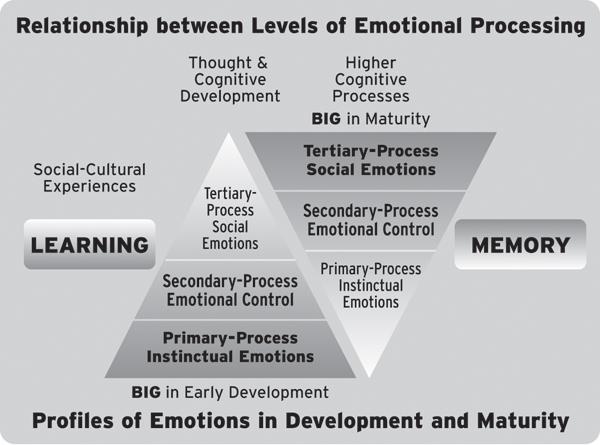
Source: “Figure 1.6,” from The Archaeology of Mind: Neuroevolutionary Origins of Human Emotions by Jaak Panksepp and Lucy Biven. Copyright © 2012 by Jaak Panksepp and Lucy Biven. Used by permission of W. W. Norton & Company, Inc.
Secondary-process psychological experiences represent learning of various sorts via the basal ganglia. Learning starts in early life through classical conditioning (e.g., of the fear system via the basolateral and central amygdala), instrumental and operant conditioning (e.g., of seeking or exploration system via the nucleus accumbens), and habit formation (i.e., emotional and behavioral via the dorsal striatum). Postnatal early caregiving has the greatest effect here, shaping personality and preferences through procedural (non-conscious) learning.
Tertiary-process psychological experiences represent more conscious cognitive capacities and so are more accessible to memory. They include executive functions (governed by the frontal lobe), emotional orientation and regulation (through the medial frontal region), and “free will,” represented in higher working memory function. These capacities too are influenced by early parenting, although later experiences have significant influence as well. Although culture influences every level, it is most apparent in the tertiary processes, which incorporate the cultural narratives and understandings that we use to interpret our experiences. We can use this third level to alter especially the secondary processes, which I suggest play a large role in moral behavior.
Emotion, Cognition, and the Developmental Context
Psychological theories often parse emotion and cognition into separate entities, each with its own components. For example, the cognitive aspect of information processing is often called appraisal, referring generally to how the brain assesses what is important to the self; it includes perception, evaluation, attention, memory, and executive functions (M. D. Lewis, 2005). Emotion, on the other hand, is the label appended to arousal, action tendencies, attentional orientation, and affective feeling. On the one hand, appraisal components are assigned to systems extending from the brain stem to the cerebral cortex. Though the emphasis is placed on corticolimbic systems, the function of these systems may be better described as refinement of subcortical construals. That is, appraisal is elaborated through corticolimbic activities that control more primitive structures (M. D. Lewis, 2005). On the other hand, components identified for emotion systems (arousal, action tendencies, prospective motor control, intention) are generally placed in the brain stem, hypothalamic structures, and cerebellum. But again, the networks are integrating across brain areas. Affective feeling links brain stem, paralimbic, and prefrontal structures (Panksepp, 1998). Throughout the brain, there are bidirectional effects of influence among subsystems that lead to a felt feeling or thought. Thus, despite analyses that emphasize their separation, emotion and cognition often overlap throughout the brain. At the physiological level, many brain systems can be included in both categories, such as the rapid response in the amygdala to thalamic signals (e.g., Lane, Nadel, Allen, & Kaszniak, 2000; Panksepp, 1991; LeDoux, 1993). In fact, in the cortex at the neuronal level, there is no distinction between cognition and emotion.
I take the view that emotion and cognition form a functional unity, each groundless without the other because on every level an integrated response ensues (M. D. Lewis, 2005). Two sides of the same coin, “interacting emotion components tend toward coherence in service of an integrated response to the world [and] appraisal components tend toward coherence in service of an integrated interpretation of the world” (M. D. Lewis, 2005, p. 182). As a result, there is no emotion without a thought, and most thoughts evoke emotion. A behavioral response integrates the two aspects, informed by important features and properties (appraisal) but constrained by relevance (emotion). In other words, emotions, cognitions, and behaviors are linked.
Greenspan and Shanker (2004) concur that emotion and cognition co-occur and suggest that they codevelop. They propose that emotions arise from multiple factors, including physical experience, signals from others, and subjective meaning-making. These components later become the source of a child’s linguistic and cognitive advancement and reflective capabilities. In this view, every experience involves a dual coding—What do I sense? and What is my reaction to it? The merging of physical perception and emotional response are the source of developmental transformation and full-bore intelligence, constituting functional emotional developmental capacities. We shall see in later chapters that the form of attention one brings to perception influences the two sides of the coin—appraisal and emotion.
Caregiver responses influence the infant’s subjective experience of sensations and affects as well as his growing intelligence. Subtle caregiver reading of and responses to infant cues help the infant refine both his emotional and physiological experience, increasing his social capacities. Over time, perception and action are uncoupled, leading to symbolic thought. Nevertheless, these symbols, born first with the coupling of sensation and emotion, bear emotional flavoring. Emotion or affect forms “the source of symbols, the architect of intelligence, the integrator of processing capacities, and the psychological foundation of society” (Greenspan & Shanker, 2004, p. 46). Yet even more, emotions and symbols are integrated with purpose and interest at the psychological but also neurobiological level. Babies are prepared for playful relationships, and such relationships, from the beginning of life, best guide neurobiological development (Trevarthen & Aitken, 2003). How and how well cognitive and emotion systems work together are highly influenced by the dynamics of early and ongoing experience.
No individual develops alone; development always takes place in the setting of relationship, first dyadic and then polyadic. Bronfenbrenner (1979) pointed out that children grow and develop within an ecological context that has many interacting layers (see Figure 3.2). The child is embedded in multiple domains of influence. Supportive and coordinated systems guide the child’s optimal development. The child is involved in several different microsystems—relationship with mother, with father, with teacher, peers, classrooms, and other contexts the child experiences directly. The mesosystem involves the interaction of different microsystems (e.g., how well the mother works with the father or with the teacher). The exosystem represents aspects of the environment that indirectly influence the family, such as the parents’ workplaces. The macrosystem refers to the larger forces affecting the child, such as particular societal policies (wages, compulsory schooling). The chronosystem refers to evolution of the systems over time for a particular individual.
Figure 3.2 Bronfenbrenner’s Ecological Systems Theory
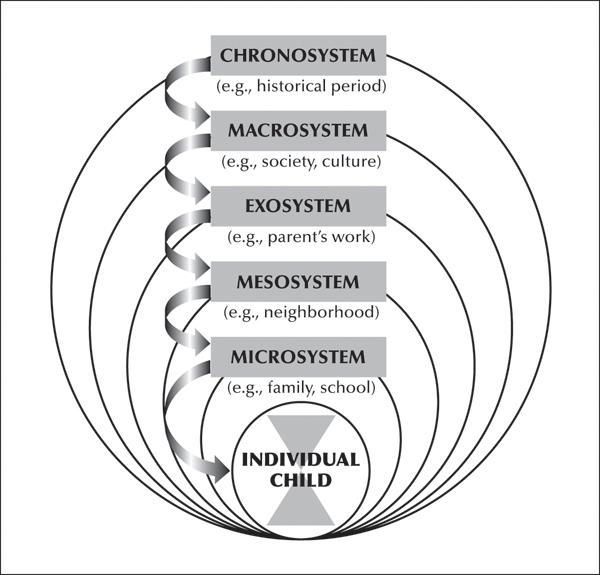
We know now that caregivers play an even larger role than Bronfenbrenner indicated in shaping the body and brain of the child, from neuronal development to stress response, producing not only ongoing effects on plasticity but perhaps permanent epigenetic effects. Early experience, particularly early care in the first years of life, has profound effects on multiple biological systems and the set points that remain in place, often for life.
Child physiological and psychological maturational schedules have evolved to correspond with particular caregiving environmental features that, for example, shape gene expression during developmentally sensitive periods (e.g., Meaney, 2001, 2010). What we need to add to Bronfenbrenner’s view, or what we need to further emphasize, is the ongoing, dynamic impact of the early environment on the physiological and psychological capabilities of the child. We might call this the “micro-developmental system” that involves epigenetic and plasticity effects of caregiving on the development of the child’s bio-psycho-social systems, including their integration and trajectories (see Figure 3.3). Although the child is born with a particular set of genes, how and if genes are expressed is influenced by the internal and external environment. This is also true for how well the cells, organs, and other physiological components work. These interacting components influence behavior and bubble up to group levels of population, society, and ecosystems, as I will explain later.
Figure 3.3 The Dynamism of the Micro Developmental System
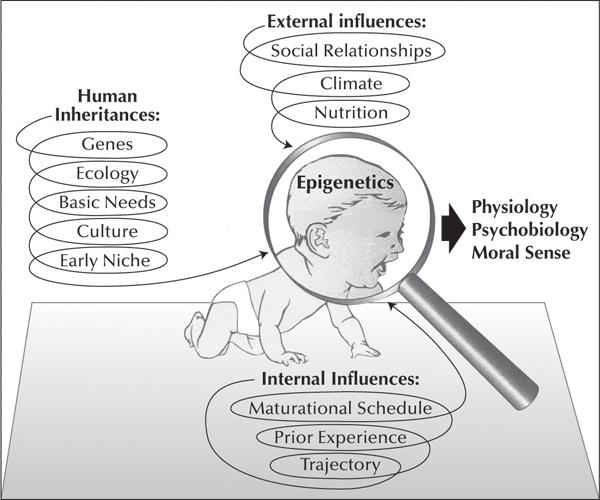
Early Emotional Development
Early-life experience has a great effect on how well all brain-body systems are established, not the least of which are systems critical for emotional intelligence. Secondary and tertiary psychological processes are particularly influenced by early caregiving. Functions that develop during sensitive or critical periods serve as foundations for more complex capacities. For example, there seems to be a sensitive period of development for basic relational self-regulatory systems governed primarily by the right hemisphere of the brain (Schore, 1994; 2003a, 2003b). The right hemisphere grows more quickly in the first three years of life (Chiron, Nabbout, Lounes, Syrota, & Dulac, 1997). Consistent affectionate, warm care ensures that it develops well. Early mother–child right hemisphere coconnection occurs when the mother cradles the infant on the left side of the body, which is a common tendency among humans that “facilitates the flow of affective information from the infant via the left ear and eye to the center of emotional decoding, that is, the right hemisphere of the mother” (Manning et al., 1997, p. 327). The right hemisphere is centrally involved in implicit learning and unconscious processes throughout life (Hugdahl, 1995).
This right-lateralized emotional brain is deeply connected into the body and the autonomic nervous sytem (ANS), and it has a different anatomy, physiology, and biochemistry than the later-forming left hemisphere. The right hemisphere processes not only emotion but, more precisely, unconscious emotion and is the locus of an implicit procedural memory system. (Schore 2013, p. 31)
Indeed, at birth infants are ready for intersubjectivity, which develops into the capacity for joint attention by about ten months (Trevarthen, 2005b). The right hemisphere houses the controls for the autonomic system. “The language of mother and infant consists of signals produced by the autonomic, involuntary nervous system in both parties” (Basch, 1976, p. 766). These signals promote a “relational unconscious” that includes the dynamism of “multiple levels of consciousness and unconsciousness” where “past experience infuses the present and present experience evokes state-dependent memories of formative interactive representations” (Davies, 1996, p. 197). We carry lived experience forward, in our bodies.
On a physiological level, there is a circus of effects brought about by responsive care. Caregiver touch provides multisensory (olfactory, visual, auditory, tactile, and even gustatory during nursing) stimuli that are processed by the orbitofrontal cortex (OFC) (J. Carlsson, Lagercrantz, Olson, Printz, & Bartocci, 2008). The infant’s right OFC transmits sensory information through the mesocortical pathway to the brain’s primary production area for dopamine (the midbrain’s ventral tegmental area, or VTA, which releases dopamine through the mesolimbic pathway, connecting the cortex with the limbic system—hippocampus, amygdala, nucleus accumbens). The mesolimbic pathway is considered the brain’s primary reward superhighway (Gianoulakis, 2009). It produces at the same time calming and intense pleasurable interest (Weller & Feldman, 2003). The infant’s right OFC communicates with the hypothalamus through a distinct dopaminergic pathway, influencing the hypothalamic-pituitary-adrenal (HPA) axis stress response and also the release of corticotropin-releasing hormone (CRH), which acts on the pituitary to release opiates that cause more dopamine to be released (Gianoulakis, 2009). This action also increases gene transcription for opiate precursors and activates other aspects of the genetic code (Schore, 1996). At the same time, when dopamine is released, a series of effects occurs that leads to activation of the sympathetic-adrenal-medullary (SAM) stress response system. This system releases cortisol, norepinephrine, and epinephrine, affecting the respiratory, cardiac, skeletal, metabolic, and gastrointestinal systems (Chrousos, 2009). Cortisol downregulates the stress response through the inhibition of CRH (Stansbury & Gunnar, 1994). In the periphery, norepinephrine and epinephrine increase metabolism, heart rate, blood pressure, respiratory rate, and blood flow to skeletal muscles (Charmandari, Tsigos, & Chrousos, 2005). Centrally, dopamine also stimulates the amygdala, which releases CRH to signal the locus coeruleus in the brain stem to release norepinephrine and epinephrine, increasing arousal, attention, and alertness. Norepinephrine and epinephrine stimulate the hypothalamus to release CRH and activate the HPA axis, whose cortisol release enhances positive emotions, learning, and memory (Gunnar & Vazquez, 2006; Haley, Weinberg, & Grunau, 2006; Stansbury & Gunnar, 1994).
Thus, caregiving modulates neurohormones in the infant by facilitating the development of the infant’s capacity to control central and peripheral responses (autonomic, physiological, stress) with his OFC (Schore, 1996). Repeated, positive synchronized caregiver–child interactions organize the infant’s capacities for self-regulation through proper functioning of the OFC, mesocortical, and mesolimbic pathways (Feldman, 2007a, 2007b). (For more details, see Schore, 1996; A. M. Weber, Harrison, & Steward, 2012.) In Chapter 5, we return to the functions of the OFC.
The right hemisphere facilitates multiple capacities related so it is important to develop it well during its period of rapid growth in the first years of life. See Table 3.1 for a list of processes that are lateralized to the right hemisphere and are shaped in early life. The foundations for social capacities are formed during this time, including mentalizing, empathy, self-regulation, eye gaze and facial expression, the experiencing of social pleasure, sensitivity to distress in others, and free attention. Early trauma and neglect interfere with right hemisphere development, which governs the human stress response (Wittling, 1997). In fact, the inability to regulate intense feelings may be the most significant outcome of early neglect or abuse (van der Kolk & Fisler, 1994).
Table 3.1 Processes Governed Primarily by the Right Hemisphere
+--------+
Sensitive, Responsive Care
In nonlaboratory settings, mammalian parents typically respond quickly to the discomfort of an infant. Similarly, adults from small-band hunter-gatherer (SBHG) societies respond quickly to infant needs, attending to gestures rather than waiting for crying. Infant cries are distressing to adults (Papousek & Papousek, 1992), indicating an evolved propensity to respond to earlier indicators of discomfort. Trevathan (2011) identifies multiple reasons for why minimizing infant crying as much as possible evolved (why it was adaptive for parent and infant): to avoid alerting predators, to avoid energy expenditure when calories were precious, and to avoid irritating adults (which a baby’s cry does), as well as to reserve cries for alerting noncaregivers when absolutely needed (e.g., predator threat). Alleviating a baby’s distress is a form of responsiveness.
What do we know about the impact of responsiveness in early life? Just when the brain is forming its emotional circuitry and structure, responsive caregiving trains the infant brain for self-regulation across sensory systems (e.g., tactile, olfactory), establishing habitual patterns (Hofer, 1994; Polan & Hofer, 1999; Schore, 1994, 2001a, 2001b). Warm, responsive caregiving keeps systems well regulated as they develop habitual patterns of arousal (Haley & Stansbury, 2003). When caregivers show consistent, affectionate care, children develop systems that respond to the pleasure of relationships, releasing opioids, and that are not overreactive to stressors (Fleming, O’Day, & Kraemer, 1999; Francis, 2002; Heim & Nemeroff, 2001; Liu et al., 1997; McCarthy & Altemus, 1997; Plotsky & Meaney, 1993; Scantamburlo, Ansseau, & Legros, 2001; Uvnas-Moberg, 1997a, 1997b; Uvnas-Moberg & Petersson, 2005). For example, responsive care with coregulated communication patterns is related to good vagal tone (a well-functioning vagus nerve) (see Chapter 4) which is critical for multiple systems (digestive, cardiac, respiratory, stress, immune emotional) (Alfven, 2004; Calkins & Hill, 2007; Donzella, Gunnar, Krueger, & Alwin, 2000; Jarrett et al., 2003; Propper et al., 2008; Siniatchkin et al., 2003; Stam, Akkermans, & Wiegant, 1997).
In contrast, nonresponsive parenting leads to abnormal brain and body organization (Meaney, 2001; Tronick, 2007). It leads to poor functioning of the vagus nerve (vagal tone), which is implicated in multiple body system problems (Calkins, Smith, Gill, & Johnson, 1998; Haley & Stansbury, 2003; Kennedy, Rubin, Hastings, & Maisel, 2004; Porter, 2003) (see Chapter 4). Extensive bouts of feeling stressed in early childhood can lead to a propensity for clinical depression or anxiety (Barbas, Saha, Rempel-Clower, & Ghashghaei, 2003; Hariri, Bookheimer, & Mazziotta, 2000). In fact, caregiver responsiveness is more predictive of subsequent child adjustment and mental health than infant attachment per se (National Institute of Child Health and Human Development, 2006). Mothers require community support for optimal mothering (Hrdy, 2009). Mothers who report less support (emotional and physical) in their childrearing roles have children who demonstrate more resistant, avoidant, and anxious attachment styles in comparison to mothers who report more assistance (Crockenberg, 1981). (See Chapter 4 for a discussion of attachment.)
If a baby is left to cry for a length of time, several detrimental outcomes occur. His brain is flooded with high levels of toxic stress hormones that eventually kill neuronal connections (Blunt Bugental, Martorell, & Barraza, 2003; Gunnar & Donzella, 2002). Pain circuits are activated and opiods, which promote feelings of well-being, diminish (Eisenberger, Lieberman, & Williams, 2003; Panksepp, 2003; Zubieta et al., 2003). In reaction to nonresponsive care, tthe baby may shut down emotion expression, making it seem as if he is fine when cortisol readings indicate he is not (Hertsgaard, Gunnar, Erikson, & Nachmias, 1995; Middlemiss, Granger, Goldberg, & Nathans, 2012; Perry, Pollard, Blakely, Baker, & Vibilante, 1995). Ongoing experiences of grief (e.g., from physical isolation) set up conditions for chronic mood disorders (Watt & Panksepp, 2009). A fear-generating environment can lead to anxiety disorders in later life (Adamec, Shallow, & Budgell, 1997). Unrelieved distress in early life influences the genetic expression of a key neurotransmitter, gamma-aminobutyric acid (GABA), leading to anxiety and depression disorders as well as the use of alcohol for stress relief (Caldji, Francis, Sharma, Plotsky, & Meaney, 2000; Hsu et al., 2003). Finally, the stress response systems can be wired permanently for oversensitivity, leading to predispositions for depression and anxiety, poor mental and physical health outcomes, and accelerated aging and mortality (Anisman, Zaharia, Meaney, & Merali, 1998; de Kloet, Sibug, Helmerhorst, & Schmidt, 2005; Plotsky, Owens, & Nemeroff, 1998; Preston & de Waal, 2002). When a dysregulatory response becomes chronic, it forms the foundation for further psychopathologies (Cole, Michel, & O’Donnell Teti, 1994). For example, emotion dysregulation in early life is related to subsequent mental illness, including a propensity for violence (R. J. Davidson, Putnam, & Larson, 2000; R. J. Davidson & Slagter, 2000).
The Importance of Entrainment, or “Limbic Resonance”
After nine months of gestational synchrony, human mothers and neonates under natural conditions typically move into an interactional synchrony of sound and movement within the first hours after birth (Condon & Sander, 1974; Mead, 1956; Papousek & Papousek, 1992). Some call this limbic regulation (T. Lewis, Amini, & Lannon, 2000) or psychobiological attunement (Field, 1985), in which caregivers act as external regulators of psychological and biological development (L. Eisenberg, 1995; Schore, 2001a, 2001b). Attuned adults are able to establish limbic resonance (T. Lewis et al., 2000) with infants and children, a key to empathic understanding and optimal emotional and social development (Decety & Chaminade, 2003; Decety & Meyer, 2008). The brain makes the body ready to move when the body of another is seen, heard, or felt to move. As active states of agency, emotions can be apprehended from facial and body expressions and are “mirrored” by the perceiver (Trevarthen, 2005b). In this manner, responsivity constructs the self, and the initial social world of the child. One of the major drawbacks of having a depressed mother is that she is asynchronous with the baby’s positive emotions and often synchronous with the negative ones, with long-term effects on cognition and social emotion (Feldman, 2007a; Murray et al., 2010; Zlochower & Cohn, 1996). Equating positive synchrony with the experience of love in our bodies, Fredrickson (2013) suggests that we are missing love when we are not in positive synchrony with others, even though we may feel bonded intellectually. Without positive synchrony, “your body is loveless” (p. 36). In this view, those who never learn the intersubjective “dance” with others may never feel love. (We discuss remedies in Chapter 11.)
Mothers who are depressed after birth are less responsive to their babies, affecting the child’s biological regulation of systems across the board (Field, 1994), including the functioning of the hypothalamic-pituitary-adrenal (HPA) axis (e.g., Ashman & Dawson, 2002; Beatson & Taryan, 2003; Sethre-Hofstad, Stansbury, & Rice, 2002; for reviews, see Dawson, Ashman, & Carver, 2000; Field, 2011). Maternal depression is associated with disorganized sleep, decreased responsiveness to stimulation, and a difficult temperament in infants. In childhood and adolescence, these same offspring have attentional, emotional, and behavior problems, and, as adults, they suffer from chronic illness (see Field, 2011, for a review). Children with depressed mothers exhibit unusual cortisol patterns, either chronically high or chronically low. Cortisol is a mobilizing hormone. Children in poverty typically have chronically low cortisol patterns (Kertes, Gunnar, Madsen, & Long, 2008). Psychological unavailability—more specifically, flat affect (little emotion expression) and disrupted communication during infancy—cluster together as significant predictors of dissociation in young adult offspring (Dutra, Bureau, Holmes, Lyubchik, & Lyons-Ruth, 2009). In the chapters to come, we will see that dissociation influences moral behavior.
Adults are more capable than non-adults of providing responsive care because of their capacities for mature mentalizing, empathy, and self-regulation. Adults typically are more skilled at relationships and their brains more developed, especially in middle age when myelinization is completed (Giedd et al., 1999).Wise adults know to respond to a baby promptly before things get out of hand.[32] Sensitive to gestures and body signals, adults can meet the needs of the child before the child becomes distressed, supporting the development of a calm personality. Responsivity means respecting the dignity of the child as a separate “subject,” not a product or object to be used for one’s own ends. Inexperienced, distracted, or irresponsible caregivers demonstrate fewer skills and may not be motivated to figure out or provide what the child needs; perhaps this is why community childrearing evolved (“cooperative breeding,” Hrdy, 2009). Having a nonresponsive caregiver in early life is like having a novice homebuilder build a house: The framing may be crooked and the joists off kilter, affecting the strength and quality of the rest of the house (the life trajectory of the child). As a dynamic system, a child’s early beginnings shape the parameters for the life ahead.
Human Dynamic Systems
Think of when you learn a difficult skill. When you learn a physical skill (e.g., golf or tennis swing, dance step), it is best to have a mentor because otherwise it is easy to learn to do it the wrong way. A skill practiced incorrectly from the beginning becomes harder and harder to change because the “wrong way” has been rehearsed to some level of automaticity—your physical (and mental) muscles have memorized the wrong pattern. For this reason, when musicians learn to play a complicated piece of music (e.g., on the keyboard), they practice slowly to ensure that all notes are played correctly and proper relative timing is maintained. Hitting wrong notes because of playing too fast too soon can become a habit that is hard to break. In short, it is important to start complex skill learning on the right track. It resembles the complex, interacting interrelations of a dynamic system.
If you have ever made mayonnaise or a souffle, you have experienced the delicacy of a dynamic process. The temperature of the ingredients and the timing of combining them are critical for success. Dynamic systems are entities that self-organize in terms of ongoing events, synchronizing subparts into an emergent whole. In any dynamic system, lower to higher organization emerges spontaneously from nonlinear interactions (e.g., recursive, exponential) (Haken, 1977). Initially there are many degrees of freedom for the trajectory of a dynamic system, but these are used up as order emerges and puts constraints on component elements (M. D. Lewis, 2005). Prior experience narrows subsequent opportunities and options for trajectory (e.g., “the rich get richer and the poor get poorer”).
Every individual human being is a dynamic, complex, and adaptive system comprised of multiple dynamic processes. Unlike non-animal dynamic systems (e.g., flowing water), animal and human dynamic systems have more than the mechanistic transitions of nonagentic dynamic systems. They also have motives (Trevarthen, 2011). An intrinsic motive pulse (part of primary processes mentioned earlier) guides action in interactive “musicality,” allowing the animal to feel “for time in life,” regulating and coordinating the systems and muscles of a moving body (Trevarthen & Delafield-Butt, 2013, p. 178). Animal nervous systems have evolved to
generate rhythmic patterns of behaviour and to regulate them by selective awareness of the layout and resources of the environment in relation to the form of the body, which determines the spatial behaviour field, and by the timing of movement, which drives forward the process of experience in relation to intentions and expectations of a Self. (Trevarthen, 2009, p. 223)
Animals and humans move in pulsing or rhythmic action in coordination with others, in mutual physiological regulation. In fact, spontanous motoric rhythms occur before sensory guidance systems have developed to guide them. Humans have goals expressed in movement, even before birth. In the womb, this coordination is amphoteronomic, “an intensely shared state of vitality together in containmemt”; after birth, the mutual coordination is synrhythmic, involving the “exchange of information from experience-seeking postural, facial, vocal and gestural movements” that convey psychological states and ongoing changes in mind states (Trevarthen, 2009, p. 225). Mother and child establish a dance, or interpersonal musicality, with each other from the beginning of their relationship (Papousek and Papousek, 1981). Sensitive, responsive care interacts with the dynamism of the child’s becoming.
Humans not only have motives, like other animals; to a greater extent they also have imagination. Mind state is transmitted through the face-to-face intersubjective frontier regulated by emotions through dynamic interplay of movements and mirroring. Synrhythm means that rhythmic movement in mind time, though generated impulsively, is jointly and dynamically controlled by caregiver and infant. With experience, they are able to simulate action, perception, and consequences. In the course of deciding upon actions, humans imagine taking the action. As social mammals, humans have access to cues that reveal the intended movements of others, such as mirror neurons (Gallese, 2008; Rizzolatti & Craighero, 2004; Rizzolatti, Fogassi, & Gallese, 2001). An infant’s self-imaginative and other-imaginative understandings of movement in time are coordinated with those of caregivers.
Motor movements establish patterns that form the basis for thought as action representations (R.D. Ellis & Newton, 2010). Intention and affection generate “narratives of vitality,” regulating internally generated motives and the awareness of self and other in relationship (Trevarthen & Delafield-Butt, 2013, p. 168). Such narratives not only structure the psyche but may contribute to the development of language. Innate motives for action and self-regulation prepare infants for “communicative musicality” (p. 168). Affectionate, responsive caregivers coconstruct stories with infants, providing a “Language Acquisition Support System” which includes the singsong motherese that adults use with babies (Bruner, 1983). Beginning in late gestation, human young are adapted to attune to human movement and sound, expressing the intrinsic motive pulse of the human brain (Panksepp & Trevarthen, 2009; Trevarthen, 1999).
Much internal system coordination occurs in early life. And since we are embodied, wiring and coordination starts with movement right after birth: “Our brains make our minds ready to move our bodies in sympathetic ways when we see, hear, or feel the bodies of others move” (Trevarthen, 2005b, pp. 75–76). States of agency reflected in action also reflect the emotions in the Other, and these are mirrored by the child:
The body moves first, senses later; as regulator of well-being in the body; as communicator of motives, by movements of attentive organs; as regulator of cognitive growth, by influencing the morphogenesis of neocortical circuits ... the brain “feels” emotions in the preparation for moving, anticipating the feeling of effects of movements, not in sensory evidence of the body. (Trevarthen, 2005, pp. 75–76)
Repeated patterns of emotional experience, especially during sensitive periods, shape individual enduring characteristics (Izard, 1984; M. D. Lewis, 1995; Malatesta & Wilson, 1988). Each emotional episode is a rehearsal of associations across mental systems (e.g., neurons firing together). Learning takes place on multiple levels (e.g., neuronal, endocrine, motor, psychological), coupling cognitive-emotional interpretations, expectancies, and action potentials that are more likely to cooccur again (“wiring”). States that are longlasting and repeated influence developmental trajectories over time, affecting future states of appraisal-emotional response and interpretation. Enduring states become traits. A young child who never experience joyful laughter and play will later require remedial experience to develop those capacities.
In a dynamic system, once the system is stabilized around a particular interpretation, expectancies are formed for future pattern recognition and action. Thus, if early life is unwelcoming, the child can take a bracing attitude toward life. A behavior at any given point in time is a function of the interaction of person with context, with its history and trajectory (Lewin, 1935). Prior experiences and habits (A. N. Whitehead’s “prehensions,” 1929/1978) constrain present configurations and options (Dewey, 1896). Prior experience constrains real-time interpretation and activations of connectivity across systems. Learning in developmental time constrains learning in real time. That is, affective-cognitive structures that developed from emotionally laden situations form units of personality that limit future cognitive appraisals (Izard & Malatesta, 1987). The child who never experience play may have no repertoire for or interest in it. Instead, the unpredictability of play may evoke fear, keeping the child from even attempting to play.
Emotional interpretation of a particular situation consolidates as the situation progresses (real time) but with repeated experience the patterns of association are learned as enduring emotional interpretations that form part of the individual’s disposition (developmental time) (M. D. Lewis, 2005). Thus, psychological systems reflect behavior that emerges in both developmental time and in real time (at the moment) (see Thelen & Smith, 1994), each influencing the processes in the other. For dynamic systems at higher levels of organization, self-organization emerges with novel forms (M. D. Lewis & Granic, 2002).
Self-organization in real time represents convergence on an attractor state or a shift from one attractor to another. A clear example is found in abused children who develop a hostile attribution bias. That is, they take a paranoid view of any social misstep from others (Dodge & Somberg, 1987). They are always suspicious of intent. Such learning demonstrates how a dynamic system changes in structure due to the history of its activity or practice, reflecting the Hebbian rule “The neurons that fire together wire together” (Hebb, 1949).[33]
The early development of mind and personality and the trajectory for self-organization rely on caregivers and the type of “nest” of early care they provide.
Early Self-organization
The Conditioning and Shaping of the Brain
Infants arrive with some things intact such as the primary process mechanisms. At birth, babies have reflexes and basic survival mechanisms such as emotion circuits of defensive/attack behavior which can operate without cortical input but not without intentional and expectant coordination of movements (Panksepp, 1998). At birth, the brain stem is myelinated, enabling activation of reflexive survival mechanisms such as fight-flight-freeze-faint autonomic responses. The amygdala is also myelinated, enabling it to receive signals from all parts of the brain. When the amygdala becomes activated (primarily from sensory novelty or isolation), it signals the hypothalamus, which controls the hormonal system, along with the basal ganglia and brain stem, which control basic motor reactions, starting a built-in stress response.
Previously it was assumed that brain stem functions were innate and not extensively modified by experience. Indeed, premature infants typically show arousal and attentional difficulties throughout development, suggesting that early formation was incomplete (Hall et al., 2008). However, for normal infants, the assumption that these processes are innate is starting to be questioned. Recent research on rat pups (who are less needy and less social than humans) shows that heart rate, respiration, and other basic functions are regulated by the caregiver (Hofer, 1987, 1994). Moreover, traumatic experiences in early life have long-term effects—for example, gastric suction at birth is related to cognitive hypervigilance in humans (Anand, Runeson, & Jacobson, 2004). Through one-to-many connections from the brain stem and related areas these experiences influence multiple brain regions. (See Figure 3.4.) In other words, what were once deemed innate reflexes can be shaped by perinatal experience and caregiver treatment and these affect the functioning of multiple systems.
Infants’ secondary and tertiary processes arrive ready to be shaped by relationships with caregivers. Infants have the capacity to learn associations, including associations with feelings. Associative learning in the midbrain modifies the basic functions of the reticular activating system (which governs attention and alertness), which reacts to temporally associated experiences and provides a means for learning from the particularities of experience.
Born with motives and expectations of actions, they are especially sensitive to intimate human company (C. Trevarthen, personal communication, 2013). Good caregiving engages complex primate body actions, which are imaginatively intelligent (Trevarthen, 2005a), shaping the rest of the brain to facilitate control of these primitive systems. When all goes well in terms of caregiving, during the first year of life the infant’s amygdala begins to connect with the orbitofrontal gyrus and anterior cingulate gyrus, resulting in eventual capacity to understand and label emotions and inhibit corresponding physical responses (Bergin & Woodin, 2011). (We examine these capacities further in Chapter 5.) However, when early experience is neglectful, abusive, or traumatic, the primitive emotion systems can become dominant in social relations, as seen in Harlow’s monkeys and other mistreated primates (Harlow, Dodsworth, & Harlow, 1965). The individual may have difficulty with emotions in multiple ways—recognizing them, expressing them, and using them as guides for action.
Figure 3.4 Brain Stem (BS)/Basal Forebrain (BFB) Ascending Neuromodulation (AM), Including Augmentation and Inhibition
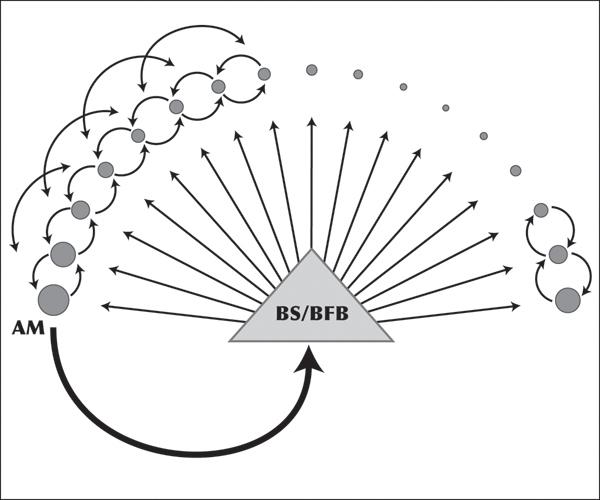
Source: Reprinted from Behavioral and Brain Sciences, Vol. 28, Issue 2, Marc D. Lewis, “Bridging Emotion Theory and Neurobiology Through Dynamic Systems Modeling,” Figure 4, pp. 169–194, April 2005. Copyright © 2005 Cambridge University Press. Reprinted with the permission of Cambridge University Press.
Socially-Based Self Organization
Social mammalian bodies and brains expect responsive parental investment for a long time, and this is especially true for humans. Early development represents a dynamic interplay between maturational sequence and environmental support. Part of the purpose of the intensive caregiving among social mammals, especially humans, is the training up of emotions, the source of our practical intelligence (à la Greenspan & Shanker, 2004). When raised well, the individual exists in a flow of emotional-cognitive meanings that guide action.
Motivated for social interaction, infants are born with capacities to communicate feeling and intention. When parents are receptive, these capacities develop quickly through intersubjective, reciprocal protocommunications (Trevarthen, 2006, 2009). The primary aim of the infant is to to “be with” caregivers in creative play. The infant expects responsive, affectionate, and playful being-with.
What does this look like? Responsive parents initially join with and confirm the infant’s changing expressions of energy. They tune into the emotions of the infant, fluently using multiple modes (voice, touch, movement) (Stern, 1985). Physical, visceral energy is “chanelled and enhanced” by the playful teasing between parent and child (Trevarthen & Delafield-Butt, 2013, p. 178). Parents and babies co-build customs, making up patterned stories, games of rhythmic musicality, expressing intention nonverbally throughout (Trevarthen & Delafield-Butt, 2013). Infant trust develops through this type of “mutual, reciprocal adjustment of actions and feelings in live engagements” (Trevarthen, 2011, p. 404). Optimal development emerges from collaborative and imaginative care, which allows trustful relations to unfold, making it possible for the individual to ground the self in deep companionship. Good care lets one enjoy being active, imaginative, and social (C. Trevarthen, personal communication, 2013).
Because babies are ready for attachment, energy is directed toward relational learning. They react with “pride” when appreciation is shown of their meaningful action and with”shame” and distress when a partner is not impressed with their communications or not meaningfully responsive (Trevarthen, 1990, 2005). For example, whereas infants reactive positively to their mother’s interactions with them through live video, they react negatively to videos of their mother’s earlier positive interactions—because she is no longer responsive to them in the here and now.
In real time, the organism and environment are always interacting and coordinating, rhythmically and intentionally shifting. Like other social mammals, humans participate in one another’s changes in autonomic and emotional states, from reactive delight to forceful action, fear, or fatigue. These polyrhythmic “vitality affects” (Stern, 1999) shift in the dynamic present, enabling self-regulation and sharing of emotion and imagination (Stern, 2004; Trevarthen, 2009). Understanding is built through successful interactions that lead to imagination and then practice of creative interactions, forming the means for consciousness development.
According to a hybrid model of emotional functioning, many of the emotional component systems (primary, secondary, tertiary) in the brain come together as a function of learning (Panksepp, 1998). The basic neural-emotion systems “generate an animal’s egocentric sense of well-being with regard to the most important natural dimensions of life” (p. 48). These systems provide the animal with potential solutions to basic issues of survival: How do I stay intact? How do I get what I need? How do I keep what I need? How do I get and keep social supports? Caregivers set the patterns for emotion systems and the nature of their strength and connectivity. When properly developed, emotions facilitate adaptation to the environment, generating a sense of well-being, a sense of competence in the face of threats to survival, and a secure attachment, all of which contribute to thriving and the development of a coherent self (Schore, 1994).
The Development of the Self
It is common for us in the West to think that only humans have a “self.” However, Llinás (2002) argues that the self is really how we centralize prediction, a necessary component of any organism’s attempt to stay alive. According to this definition, unicellular animals have a self. In fact, the cell itself is the building block of many lifeforms. Cells take care of their needs with homeostatic mechanisms that involve chemical signatures. They are “irritable” and respond to stimuli with goal-directed, organized movement. Indeed, cells are extremely sensitive to environmental conditions and learn from experience. Displaying a primitive subjectivity or temperament, they have a “self” without awareness (Llinás, 2002). Some contend that cellular memory begins at conception; the “field state” present at conception is transferred to subsequent generations of cells (Emerson, 1997; F. Lake, 1979; Laing, 1976; Meaney, 2010; Stiles, 2008). Thus, the personality may be seeded during these initial stages of life.
After birth, each human displays self-organizing systems of “embryogenic intrinsic motive formation,” represented in the brain stem and limbic system, which guide cognitive growth (Trevarthen & Aitken, 1994). According to Trevarthen (2005b), the individual mind at birth has three basic initiatives with independent goals and expectations that work in concert. The first, interoceptive and proprioceptive, monitors the state of the body, all the physiological processes, and the energy costs of movement, involving visceral emotions of well-being. Trevarthen’s second initiative is a pragmatic intelligence that integrates an exteroceptive awareness of situation and context, objects, and future events and involves aesthetic emotions. The third initiative depends on emotional and volitional sympathy with others, alteroceptivity, which is something other than “social cognition” and prior to theory of mind, and involves moral emotions. The development of the early self is informed by biologically inherited motives for social embeddedness and shaped by emotionally available caregivers (Emde, Biringen, Clyman, & Oppenheim, 1991). The self is “an organizing mental process and regulator of experience (where this includes an individual’s sense of continuity, confidence, competence, mastery, and, later in age, esteem)” (p. 252). This requires “knowledge of one’s active, purposeful existence”—of what is and is not one’s own body and one’s own activity (p. 252). The self-system involves a sense of coherence, agency, and control, maintaining stability in the midst of active engagement with the world and its perturbations.
Thus, purposeful activity integrates cognition, attachment, and companionship. These involve a combination of biologically-prepared motives that form the basis for psychological life. See Figure 3.5 for this “circle of attachments” (Trevarthen, 2005). Within this circle a sense of self is, and develops as, the source of integration and transformation. Notice the integration of body movement, communality, aesthetics and morality. These very much fit the indigenous perspective of Life that we will examine later. Common sense (and common self, I argue later) emerges from this grounding in vivacious meaningful relation.
Figure 3.5 Trevarthen’s Circle of Attachments
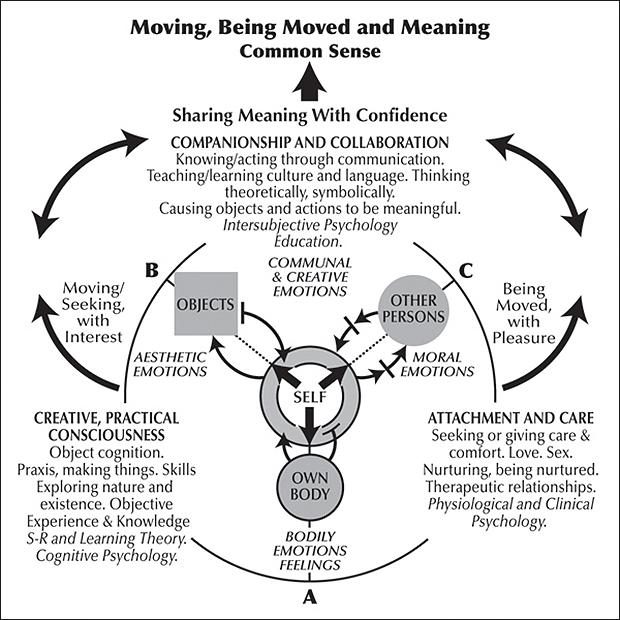
Reprinted from Carter, C. Sue, Lieselotte Ahnert, K.E., Grossmann, Sarah B. Hrdy, Michael E. Lamb, Stephen W. Porges, and Norbert Sachser, eds. Attachment and Bonding: A New Synthesis, figure 4.3, page 68, ©2005 Massachusetts Institute of Technology, by permission of MIT Press.
Various theorists have described the development of the self in early life (e.g., Damasio, 2010; Panksepp & Biven; see D. J. Siegel, 2001, for a discussion). As noted in Table 3.2, Stern (1985) suggests a number of stages, whereas Damasio (1999) suggests three, which I adopt here: proto-self, core self, and extended consciousness. I interweave various theories in discussing each stage.
Proto-self. First, a cohesive self-system emerges in early life from a “continuity of being” provided by caregivers through warm, appropriate responsiveness (Winnicott, 1965). F. Lake’s (1979; Liedloff, 1986) paradigm emphasizes the early relational field—a “womb of spirit” or a continuum of care that caregivers embody when they manifest safety, empathy, and reflection. Being knows itself only in relation to others. In the presence of a loving mother, “the infant knows it is and deserves to be ... Being-in-relationship allows [the infant] to develop a sense of being-in-itself, a coherent and continuous sense of being with self-reflective ability” that no longer requires constant empathic reflection from another (Sills, 2009, p. 40). The self of a human, like that of other animals, is revealed when the environment is safe. Safe birthing and safe early hours, days, and years of life allow the child to blossom, revealing an innate affinity for exploration, investigation, and companionship. By two months postnatally, infant are ready to build stories with their caregivers. Many loving mothers become best friends and playmates of their children (Trevarthen, 2005).
Table 3.2 Selves and the Development of Self
+--------------+
Core self. Second, cognitive capacities expand when the ability to compare self before and after an experience, through core consciousness, brings about the awareness of a core self.
The coordination, in all modalities of sense at once, of a total awareness of the moving body of the self and of the movements made by other persons can be understood once it is observed that there are common temporal and energetic features of movement that inform all sense in one time. (Trevarthen, 2005b, p. 70)
The child learns to anticipate a particular somatic state that comes about as a result of action (Damasio, 1994).
The “core self” may be a primal visceral-somatic representation of self-as-body in the world (Damasio, 1999, 2010; Panksepp, 1998). Panksepp gives it the acronym SELF, meaning “Simple Ego-type Life Form,” and places sensibility of self in the brain stem, specifically the reticular activating system (RAS) (Llinás, 2002). The RAS links with the pariaqueductal gray (PAG) and related structures, forming an action network that reaches to medial frontal cortical areas and is modulated by several systems, including autonomic and hormonal systems, as well as higher cortical regions. The medial regions in this network may be essential to the blending of emotion and cognition and to our awareness of emotions; the cortical aspects may be essential to our rationality. The action dynamics create coherent neural fields or “global psycho-behavioral attractors” (Panksepp, 2005b, p. 179). The conscious sense of self may emerge from the thalamocortical binding of external and internal events in time. The thalamocortical system emits 40-hertz activity, continually humming whether asleep or awake. It forms a “neuronal oscillatory coherence” (Llinás, 2002, p. 12) that may be a necessary feature of cognition as well as the source for a sense of self.[34]
Again, these self-capacities are fostered by and shared with caregivers (Schore, 2003a, 2003b; Sroufe, 1996). At birth, infants have a sense of time in movement (Trevarthen’s intrinsic motive pulse) that enables them to synchronise with the actions, voice, and gestures of an affectionate parent, improvising a proto-conversation (Trevarthen, 1999; Trevarthen, Aitken, Vandekerckhove, Delafield-Butt, & Nagy, 2006). The “mammalian brain” has evolved to develop properly through the pleasurable experiences of caring, nonpunitive parenting, breastfeeding, and extensive close physical contact (i.e., holding and carrying), plus the fun of acting and knowing together (Konner, 2010).
The proto-self and the core self form a “minimal self.” There are scores of minimal selves that constitute the many moments of a person’s day, week, and year (Seeley & Sturm, 2007). The interoception (evaluation of body state) performed by a minimal self is intermediary between the outside world and the actions a person performs on it. It is the longitudinal self, an extended consciousness, that knits together these many instances of minimal selves.
Extended consciousness. A third, more sophisticated grouping of neural structures allow for “extended consciousness,” creating an “autobiographical self,” “longitudinal self,” or “extended self” (Neisser, 1988; Seeley & Miller 2005). These changes in the core self over time are described by Tulving as a form of “autonoetic consciousness,” a sense of self across past, present, and future (independent of early care) (Tulving, Kapur, Craik, Moscovitch, & Houle, 1994; Wheeler, Stuss, & Tulving, 1997). The active participation in interpersonal transactions builds “reflective function”—“the psychological processes underlying the capacity to mentalize” (Fonagy, Gerely, Jurist, & Target, 2004, p. 24). The ability to mentalize is intimately involved with many characteristics of selfhood, for example, autonomy, freedom, self-consciousness, and responsibility (Bolton & Hill, 1996; Cassam, 1994; Fonagy et al., 2004).
From conception, each personality is built from a myriad of intelligent systems, from the biochemical reactions of the limbic system to the neuronal networks that compete to win when stimuli are processed. The action tendencies of primitive systems interact with the planning, memory, and attentional components of higher-order systems. Both tune into meaning. But to coordinate them well, brains must nurture themselves well and be nurtured well. When higher brain functions develop, they are able to map the reactions and interactions of the proto-self.
Neurologically impaired individuals may differ significantly in the manner in which this emerging proto-self is organized and thus how the subsequent and more elaborated senses of self (core, subjective, verbal, narrative or the core and autobiographical selves) come to be formed. (D. J. Siegel, 2001, p. 76)
As dynamic systems, infants interact with the world to increase their complexity and coherence imaginatively (Tronick & Beeghly, 2011). They weave together nonsymbolic, affective-sensory feeling from their ongoing experience (Stechler & Latz, 1966). Babies and caregivers form meaning-making dyads that shift between synchrony and dyssynchrony, using cultural rules for such things as emotion display (Tronick, 2007). Babies who have a history of restoring synchrony after dyssynchrony with caregivers develop a positive affect core that promotes growth-inducing action-beliefs about their success in dealing with challenge:
With the accumulation of successful reparations, infants come to an implicit knowing that their dysregulated emotional state and sense that “something is wrong” can be transformed into a positive state end concomitant feeling that “things are right” ... [a process that] likely contributes to infants’ emergent sense of agency and mastery. (Tronick & Beeghly, 2011, p. 9)
Babies make meaning at multiple levels (motor action, emotion, reactivity, mood, cortical processes, self-regulation, etc.), learning to move with a flow of increasingly complex biopsychosocial functioning. The baby learns to float on the ocean waves of life with little fear and with increasing confidence. With optimal caregiving, the overall sense is one of security in attachments, with an openness to new situations as opportunities for further growth rather than as threats to well-being. When perturbed by external events, the well-care-for infant is flexibly responsive and able to reorganize self-regulation, reaching a new homeostatic balance.
Impairment of the Self[35]
Based on the quality of caregiving in the first year of life, self–other representations begin to vary among infants including sensitivity to the state of the Other and self-regulation in response to the Other; growing relational expectancies guide interactions. (Beebe et al., 1997). In an impairing context, caregivers go to one extreme or the other—being nonresponsive or overly attuned to the infant’s emotions so much that they take on the child’s emotions for themselves, indicating poor mentalizing abilities in the caregiver. In either case, the infant’s ability to mentalize is impaired, which can lead to borderline or narcissistic personality disorder. The infant fails “to find himself in the mother’s mind” and “finds the mother instead,” an alien self (Fonagy et al., 2004, p. 11). Over the long term self-development is undermined, as well as self-esteem, self-agency and being true to self.
Babies with depressed, unresponsive, or unpredictable caregivers have impaired self-organizational processes, limited by the lack of good feedback and unsuccessful dyadic meaning-making. Together, chronic unrepaired interpersonal dyssynchrony and a lack of experience with reestablishing positive dyadic interaction limit growth trajectories and the complexity of the system over time, stabilizing negativity. From prolonged states of dysregulation, a negative affective core is built—the child learns to feel helpless and hopeless. Infants’ moods are memory rich and “Janus-like because they carry the past into the present while simultaneously biasing expectations about the meaning of the yet-to-be-experienced future” (Tronick & Beeghly, 2011, p. 9). Dyadic patterns of mutual sadness, hypervigilance, withdrawal, or conflict may become stabilized and rigid. Patterns established early are difficult if not impossible to alter, even when conditions improve, increasing the risks for a deep mistrust of the world and a trajectory of maladaptation (Cole et al., 1994; Erikson, 1950; Sroufe, Egeland, Carlson, & Collins, 2005). Prolonged dysregulation leads to system dynamics that have little flexibility and are vulnerable to disorganization when perturbed (i.e., stress reactivity).
Maltreated children (those subjected to physical or sexual abuse, physical or emotional neglect) display impairments in their self-system: They are less likely to have a positive sense of self or even to be aware of their feelings (Cicchetti & Toth, 2005). They may even develop a “false self” to comply situationally, lacking the internalization of parental values apparent in normal children (Kochanska, Aksan, & Koenig, 1995). They are deficient in behavioral and affective self-regulation, which influences their social competencies. Directing negative feelings outward (blaming others), they may not develop a sense of guilt (which requires negative feelings to be directed inward) and thus be less motivated to behave prosocially (Cicchetti & Toth, 2005).
Other self-related capacities fostered by caregiving include not only a sense of self and of self-in-relation-to-others, but the development of shame and a sense of autonomy. Children with poor early caregiving may have a greater sense of shame, leading to a propensity for depression (Alessandri & Lewis, 1996). Those who develop borderline personality disorder (BPD) report an inner “emptiness,” suggesting that a critical period for nurturing the development of “self” was forfeited (M. L. Carlsson, 1998). Grosjean and Tsai (2007) suggest defective glutamatergic NMDA neurotransmission as a mediator of the condition. Dissociative states are common in patients with BPD, who have been noted to experience identity confusion and estrangement. Cortico-thalamic connectivity is normally abundant in NMDA neurotransmission but desiccated in patients with BPD. (We discuss BPD further in chapter 7.)
Table 3.3 Types of Selves
+----------+
In less extreme cases, what happens to the child who does not receive appropriate care in early childhood? If appropriate care is not present throughout early childhood—for example, if parents ignore communications of emotions—a deep sense of injustice may develop and lead to a narcissistic need to fill the hole left by a sense of “abandonment.” Think of the cascade of effects. The infant’s developing body and brain aim for companionship. When it is denied, what are the feelings that result from one’s energy being shunned? Perhaps injustice, anger? Constantly being misunderstood or ignored may lead to habitual shame and disconnection. Over the longer term of denial, these feelings may persist, morphing into easy irritability and distrust (leading to needy behavior or the reactive formation of self-reliance). Deep feelings of needs not met (e.g., longing for belonging) and a confused sense of primal purpose may become chronically experienced. The true self is buried underneath layers of tangled misunderstandings about how to be a human being. See Table 3.3 for a sampling of types of selves that emerge from early experience.
Temperament and Genetics
I have been emphasizing the impact of early caregiving on child personality and disposition. But isn’t there an innate emotional or genetic template for each individual? The common view of temperament is that it refers to innate propensities that powerfully shape personality. However, genetic variations account for less than 10 percent of variability in most complex behaviors (Kagan & Fox, 2006). (And recall from our earlier discussion in Chapter 2 that we share over 99.99 percent of our genetic material and only 2 to 3 percent of psychological disorders are traceable to a specific gene.) For example, children are considered to be born with greater or lesser stress reactivity or inhibition (Kagan & Fox, 2006). Some differences (activity level, sociability) can be measured in the womb (Piontelli, 1992). But do these represent innate genetic temperaments? Among gene-based proposals, neither gestational experience nor epigenetic inheritance is typically accounted for (Harper, 2005). As noted in Chapter 2 multiple external factors, such as maternal diet, can have an effect on fetuses. For example, maternal hunger induces movements in the fetus that appear anxious (Piontelli, 2010). We can speculate that chronic conditions (e.g., maternal stress or inadequate nutrition) establish chronic states that may become traits in the fetus. Of course, chronic and acute conditions interact with the stage of maturation, prior experience, and other factors. Interestingly, recent research is showing how much a fetus takes motivated and imaginative action, suggesting that the individual is already self-organizing habits and personality in response to womb experience (Piontelli, 2002, 2010).
A fundamental challenge for those who study temperament is its definition. Rothbart and Ahadi (1994) define temperament according to reactivity and self-regulation. These are now known to be affected by experience: (a) Parents may increase reactivity in infants from before birth through stress conveyed to the fetus; (Davis & Sandman, 2010; Nakamura, Sheps, & Arck, 2008). (b) As noted earlier, birth experience is also related to subsequent reactivity (gastric suction and hypervigilance); (c) Caregivers in early life facilitate the development of good self-regulation in multiple ways (e.g., Cole et al., 1994; Field, 1994; Feldman, Greenbaum & Yirmiya, 1999; Gunnar & Donzella, 2002; Rosenfeld et al., 1991; Schore, 2003a, 2003b). Indeed, according to my team’s research and that of others, mother–infant relational responsivity appears set by four months, suggesting a critical window for establishing a more responsive relationship (Feldman, 2007a; Narvaez, Wang et al., 2013). Thus, temperament is confounded with life experience—prenatal, natal, and postnatal. See Table 3.4 for a list of temperament categories and their known plasticity.
Another critique of “temperament is innate” views is the implicit assumption that the parent and child are separable elements when it is the relationship that matters most. Among primates the fundamental unit of society is the mother–infant bond, which establishes the tone for all other relationships (Harlow, 1986; Hinde, 1974). Maternal presence and sensitivity in the hours after birth have been documented to affect the child later (Bystrova et al., 2006; Klaus & Kennell, 1976). Ainsworth (Ainsworth, Blehar, Waters, & Wall, 1978) noted that infants whose mothers had responded sensitively to their signals during the first year of life not only cried less during the second half of that year than did the babies of less responsive mothers, but were also more willing to comply with their mother’s wishes. Kochanska (2002b) documents maternal responsiveness as the precursor to early conscience development. Parent sensitivity interacts with infant affect and temperament to predict later attachment (Braungart-Rieker, Garwood, Powers, & Wang, 2001).
Thus, although temperament is often discussed as if it represents inherited differences, I believe that most underlying brain chemistry differences are not acquired by genetic inheritance but from experience, perhaps beginning from conception or with epigenetic inheritance from parents and other ancestors. Differences in brain chemistry and in the neuronal ensembles include (a) greater or lesser secretions of a neurotransmitter or modulator, (b) more or fewer receptors for a particular molecule, (c) more or fewer projections to neurons that secrete a particular molecule, and (d) inhibition or disinhibition by another ensemble. Although some have pointed out that a subset of these influences are inherited (see Placidi et al., 2001), we can find examples of epigenesis and experiential effects for all of these features. Thus, I feel that it makes little sense to emphasize genetics instead of epigenetics and plasticity in explaining temperament and behavior.
Table 3.4 Temperament Categories and their Plasticity
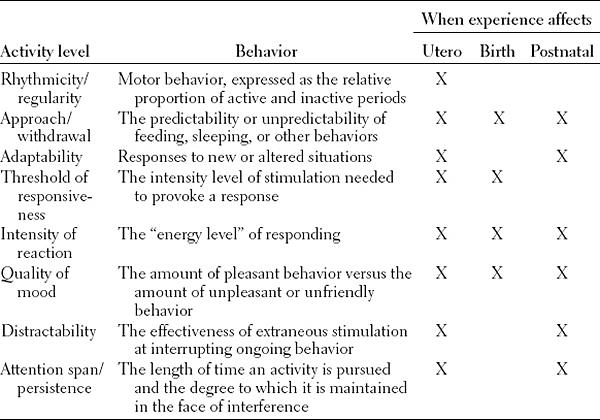
Adapted and extended from Niehoff, 1999. © 1999 by Debra Niehoff / reprinted by permission of Regula Noetzli / Affiliate of the Charlotte Sheedy Literary Agency.
How did we get stuck on genetic instead of epigenetic explanations? As Kagan and Fox (2006) note, in early genetic studies of fruit flies the simple one-to-one correspondences between a chromosomal difference and a particular disorder seduced scientists into thinking that genes could directly predict a human profile, “minimizing the indeterminancy, complexity, and counterintuitive quality of the intermediate process [emphasis added] between genes and a psychological profile” (p. 181). As argued here, a key intermediate process for human development is the evolved developmental niche (Table 2.4), which interacts with maturation of particular systems at particular times. Human biological systems are moderated by caregiving, by maternal stress during pregnancy, by birth experience and by postnatal caregiving. Perhaps care-receiving also plays a role. Biologically maturing organisms have schedules and timetables for when particular systems mature or change and how sensitive to environmental influence they are. Temperament can be viewed as a self-organizing consolidation of social and biological subsystems as they are establishing themselves in early life (Derryberry & Rothbart, 1997).[36]
Development of a Moral Self in Early Life
Morality begins with the development of implicit procedural knowledge, based on pattern recognition (Edelman, 1993; Emde et al., 1991). This feature underlies all of cognitive functioning and undergoes continual refinement throughout life.
Gerald Edelman (1993, 2006) ‘s neuronal Darwinism theory was built on his studies of the immune system[37] and with it he attempts to describe what occurs early in a brain system’s development. Fluctuation in neuronal patterns is related to experience. Experience shapes which neuronal systems become more habitually deployed. Because it is dynamic, the theory is helpful for understanding how early experience can shape personality, including moral personality. Neural Darwinism is a theory of neuronal group selection driven by the competing value systems within the brain. Each releasing different neuromodulators under particular conditions. Neuronal circuitry is formed by what is activated most frequently based on experience—“continual selection.” In other words, signaling from axon to dendrite is strengthened or weakened by experience, resulting in the favoring of some neural circuits (value systems) over others.These value systems are neuronal biases that regulate the outcomes of developmental and experiential selection. Experience alters reentry pathways (“continual signaling from one brain region ... to another and back again across massively parallel fibers [axons] that are known to be omnipresent in higher brains”) (2006, p. 28). These are vast networks of reciprocal connections that carry action potentials, integrating and synchronizing brain areas. These constant shifts occur at the speed of thought. The combination of activities among competing systems, along with the synaptic network selection activity, is what governs behavior. Early life sets up neuronal value systems—that is, which emotion systems will dominate personality and social interaction. Will it be relational attunement or self-protection?
As many scholars cited in this chapter point out, the early development of the self in infancy is based on experiential knowledge organized procedurally or subconsciously. Morality, too, develops before the capacity for reflective self-awareness, largely comprising procedural knowledge (Emde et al., 1991, p. 251). “The early self is a moral one,” built on the trust (or mistrust) and social commitment (or lack thereof) learned procedurally in early life.[38] According to Emde, the sources of procedural moral knowledge are five “motives” built into the species by evolution and consolidated into an “affective core” that serves as a biologically prepared platform for early moral development. The affective core includes activity (a basic tendency for exploration and mastery), self-regulation (a “built-in” propensity to regulate physiology and behavior), social fittedness (preadaptations for initiating, maintaining, and terminating social interactions and establishing behavioral synchrony—this was also mentioned as a virtue by Aristotle, see Nussbaum, 1988), affective monitoring (tracking experiences according to what is pleasurable and guiding parental care with affect), and cognitive assimilation (seeking out the novel to make it familiar). In my view, these motives guide the development of the proto-self, core self, and extended consciousness in the following way.
The proto-self orients to several feature of the environment: whether it is friendly or unfriendly, calm or distressing, receptive and fulfilling or requiring extensive striving to get needs met. Are surroundings favorable or unfavorable? The pattern of answers sets up the body to fight or stay calm. A body that has to fight a hostile, stress-filled environment to exist, from the cells up, may have a different set of regulatory processes underlying behavior than a body in a more peaceful environment. Basic worldviews may be established during this period, such as “The world is harsh” versus “The world is benevolent,” or “I/People are good” versus “I/People are bad.” In an undercaring environment that promotes excessive distress, strong early evaluation (i.e., judgments of approach/avoidance carried out early in the brain’s processing of events) may become dominant, making vigilant prejudgments habitual and openness rare, so as to preserve a sense of safety. Evaluation systems may become firmly black and white, losing the capacity to notice nuance and respond flexibly. In contrast, an environment of appropriate care, the child likely has few if any experiences of distress, and so neuromodulation does not canalize into self-safety responses. Black-and-white evaluation is not imprinted, and instead, openness to experience brings feelings of reward. Thus, the proto-self shows the beginnings of self-regulation, which is critical to social life. Action tendencies toward bracing or openness may be actively shaped through interaction with mother and caregivers from the beginning of life.
The interpersonal self-in-relation core self builds on these somatosensory learnings, which can form more specific internal working models of beliefs such as “Female people are trustworthy and enjoyable” or “Female people can’t be trusted” (or “treat me roughly,” “don’t respond when I need something,” etc.). In the latter case, full right hemisphere emotion system development is thwarted, as energies are not converted to interpersonal joy but distress and self-protection. With abuse or neglect, a defensive inhibition of mentalization leads to personality distortion, which is commonly found among juvenile offenders (Levinson & Fonagy, 2000). Social fittedness and affective monitoring are impaired.
The narratives of extended consciousness are founded on proto and core selves. Although a child’s environment can shift from unfriendly to friendly (or vice versa), during early critical time periods there may be fundamental wirings that are impossible to change later. In fact, how deep or shallow one learns to live in the social world may be established here. Suboptimal care undermines self-awareness of emotional and mental states, which is critical for managing the social environment. When unmitigated by other relationships, suboptimal care leads to insecure attachment, a signal of limitations in social life skills such as mentalizing (Fonagy et al., 2004).
Emde suggests that typically by age three, children have internalized rules about good and bad actions, and intuitions about what feels right and good, based on their relationship with caregivers. Emde and colleagues (1991) appeal to various traditions in object relations theory to characterize these relationships. Relationships are described, for example, in terms of affective dialogues (Spitz & Wolf, 1946), good-enough mothering (Winnicott, 1965), and sensitivity and attunement to infants’ emotional signals and needs (Bowlby, 1951). Caregivers play a regulatory role in structuring the continuity of early experience by providing a “holding and facilitating environment” (Winnicott, 1965), refueling (Mahler, Pine, & Bergman, 1975), and mirroring support (Kohut, 1971, 1977). As a result, the infant’s inborn propensities interact with expectable caregiver relationships in a way that attunes the infant to reciprocity, norms and norm violations, and empathy sharing, which serve, in turn, as cornerstones of the emerging moral self. The child’s activity and self-regulation fit into the social context, guided by emotion and promoting learning.
A caregiver who is sensitively responsive to the child fosters the child’s emotional attunement with others and mentalizing capabilities (D. J. Siegel, 1999). In Grazyna Kochanska’s model (2002b), how soon and how well the moral self develops depends on the quality of parent–child attachment. A strong mutually responsive orientation (MRO) is a high-quality intersubjective environment characterized by shared positive affect, mutually coordinated enjoyable routines, and a cooperative interpersonal stance marked by a willingness to initiate and reciprocate relational overtures. Within the context of an MRO, the child displays committed compliance with the norms and values of caregivers, motivating the internalization of morals and the work of conscience. As self-regulation develops in this context, so does more sophisticated concern for others and the capacity for prosocial behavior (Eisenberg, 2000; Eisenberg, Spinrad, & Knafo, in press). In other words, caregiver responsiveness and child cooperation go hand in hand (e.g., Kuczynski, Kochanska, Radke-Yarrow, & Girniss-Brown, 1987; Parpal & Maccoby, 1985). The MRO builds a personality that matches that of adult moral exemplars: agreeable, empathic, and conscientious (Kochanska, 2002; L. J. Walker, 1999).
For Kochanska, conscience is an inner-guidance system responsible for norm-compatible internalized conduct (rule compliance without surveillance) and moral emotions (empathy) (Kochanska, 1993, 1997a, 1997b, 2002a, 2002b; Kochanska & Kim, 2012; Kochanska & Murray, 2000; Kochanska, Philibert, & Barry, 2009). Individual differences in conscience are traced to temperament and socialization experiences in early caregiving relationships. Kochanska and colleagues have found multiple pathways to conscience. Parental behavior must be calibrated with variations in children’s temperament. Fearful children, for example, require gentle discipline with minimal power assertion. Fearless children, on the other hand, profit from discipline that capitalizes on positive emotions. In a recent study, Kochanska and colleagues showed that children who had a strong history of internalized “out-of-sight” compliance with parental rules as toddlers and preschoolers were more competent, engaged, and prosocial in middle childhood (Kochanska, Koenig, Barry, Kim & Yoon, 2010). Similarly, children who had a strong history of empathic responding as toddlers demonstrated psychosocial competence in middle childhood. Both effects were, however, mediated by the development of a “moral self.” We take up the moral self further in the next chapters.
Conclusion
How influential was your early experience on whom you have become? A few years ago when neuroscience was discovering brain plasticity throughout life, voices were raised to counter views that early development has profound effects on life outcomes (e.g., Bruer, 1999). Kagan (1998) argued that infant determinism is a specious “seductive idea.” He illustrated the pitfalls of discussing attachment as “internal working models” (measured indirectly with the “strange situation”) and being determinative of later outcomes:
Many early ideas and habits either vanish or undergo such serious transformation that they cannot be retrieved in later life, any more than the first strokes of a seascape can be discerned from the larger scene, once a painting is complete ... These early mental events can be likened to names written in the summer sand that disappear with the tide. (pp. 3–4)
I certainly agree that “internal working models” are a weak measure of anything permanent. Psychological measures are imperfect and often only signal deeper, unmeasured realities. However, attachment is not just psychology; it reflects biology. Experiences of “attachment” represent neurobiological effects that can be measured in vagal tone, stress response, and neurotransmitter functioning. Even Kagan’s view that “those who favor infant determinism do not award sufficient power to the events of later childhood and adolescence, many of which are correlated with social class” (1998, p. 128) is contravened by the biological data. These data suggest that much of who we become is initiated and sometimes circumscribed by the biology shaped in early life.
There is much we still do not understand as we shift scientifically from mechanistic views of the world (genetics) to dynamic views (epigenetics and plasticity). We hardly understand how much the brain organizes itself as a complex adaptive system, encoding stimuli under constraints that are context sensitive (Juarrero, 2002). A dynamic-systems approach to development provides explanations for empirical challenges such as
explanation for novelty, increasing complexity, emerging coherence, free of innate programs, generic rules and specific instructions from the environment ... [T]his certainly rings true for emotional development, where novel forms arise unpredictably and coherent outcomes are both complex and idiosyncratic. (M. D. Lewis & Granic, 2002, p. 4)
But we understand in developmental theory since Piaget that “knowledge of the world is gained by moving about in it, exploring it, attending to it, ever alert to the signs by which it is revealed” (Ingold, 2011, p. 55). This includes the social world. A rich social world of caring, playful companions leads to greater social perception and social skills that snowball into greater capacities over time. Early experience becomes deeply incorporated into the nature of the organism. When we provide responsive care to children, it supports the development of our moral heritages. The first of these heritages is the engagement ethic, described in the next chapter.
Summary Points
-
Human development is the unfolding of a dynamic, life-driven system.
-
In a dynamic system, early patterns can greatly influence later patterns.
-
Emotion and cognition develop hand in hand and are shaped by the individual in response to early experience.
-
Responsive parenting from the beginning of life is likely to lead to development of an integrated self.
-
With unresponsive care, primitive, self-protective mechanisms are enhanced while other systems and circuitry are underdeveloped.
-
What has been considered genetic (inherited temperament) may be epigenetic or represent the plastic development of a personality-in-relation, a developmental system.
-
The moral self emerges in early caregiving and is dependent on biological processes.
Chapter 4: Moral Heritage 1: Engagement of the Heart
The girl chortled as her father lifted her over his head again and swung her around like a top. She giggled and giggled, even after he put her down. Too dizzy to move straight, she ran into his legs and then tried to lift him, making him laugh so much he fell over in the grass. She triumphantly jumped on his stomach, as if to declare victory.
Although Charles Dickens used his story about Oliver Twist to illustrate the power of inheritance, J. K. Rowling’s Harry Potter may be a better illustration of how early experience influences outcomes. It was the love from his mother during his first year of life before her death that led Harry to his ultimate resilience, despite neglectful and abusive upbringing throughout the rest of his childhood. Similar findings are reported for real children with similar histories (e.g., Perry & Szalavitz, 2006). For all children, it is attentive love and friendship from caregivers that provides the initial source of being.
Attachment Theory
After World War II, orphaned children were wasting away or developing disturbed personalities and so the World Health Organization assigned John Bowlby to investigate. John Bowlby (1951) noted that infant and childhood outcomes did not fit the dominant theories of the time: psychoanalysis and behaviorism. It is hard for us to believe today, but both theories emphasized physical, not emotional, nourishment in parent–child relations. However, the orphans, though well fed, were more likely to be depressed and anxious than nonorphaned children. Like René Spitz (1947), he saw children deteriorate from physical care alone. In his search for an explanation, Bowlby found fodder in the fields of ethology, primatology, and control systems theory. Bowlby devised attachment theory to explain the profound effects of parental absence on the psyches of young children.
Bowlby adopted Hartmann’s (1939) identification of the type of environment to which human brains adapted for optimal development over the course of evolution—the “ordinary expectable environment”—renaming it the “environment of evolutionary adaptedness” (EEA). The EEA refers to the Pleistocene era when our brains (and parenting practices) presumably evolved. Bowlby advocated an understanding of the original contexts for the evolved behaviors of mother and infant. He identified two complementary systems that were established in these contexts. The attachment behavioral system is a species-universal program that bonds child to mother. It collaborates with the adult’s caregiving behavioral system, which under normal conditions is a species-universal program that guides maternal bonding and caregiving. Both of these specieswide programs appear to be shaped during sensitive periods in the individual’s life. Each guides the activation and selection of behaviors to reach particular goals in social relationships, which are vital for survival and well-being.
The caregiving behavioral system is influenced by the quality of attachment to others that the caregiver developed during early life and other sensitive times (Steele, 2013). The caregiver behavior system may be governed by the maternal right hemisphere (Horton, 1995), which is receptive to ongoing experience; women with underperforming right hemispheres may show less caregiving behavior. For the mother, the caregiving behavioral system can also be influenced by what happens during pregnancy and birth (Trevathan, 2011). Bruce Perry and Maia Szalavitz (2006) discuss the case of Virginia, who “knew” she should love her daughter but had no feeling for her. Virginia had been abandoned at birth and had a history of multiple foster homes and no history of lasting bonding or affection. Apparently, her caregiving behavioral system never had the input of affection and attachment, and so she never experienced the usual “pull” toward holding and interacting with her daughter. This story also illustrates the divided self, the split between explicit and implicit understanding, that we take up in coming chapters.
Early-life experience with caregivers sets up the attachment behavioral system in infants and young children. Infants are endowed with the ‘set-goal’ of staying close to mother, a characteristic that evolved to increase infant survival by motivating them to remain close to their primary source of safety. Bowlby (1969/1982). At the same time, infants are equipped with a motivation to use the mother as a “secure base” for exploration, quickly returning to her when becoming scared (Bowlby, 1988). Bowlby postulated that early experience forms “internal working models” of relationships that guide social responses throughout life. Though often thought of as psychological elements, internal working models also represent the functioning of the brain. The brain evolved as “a social organ of the body” with an ability to regulate internal states while attuning to the social environment (D. J. Siegel, 2004, p. 275). Early experience sets up the growing brain for more and less successful capacities for both self-regulating and socially attuning. Critical to the shaping of these capacities is “contingent communication” in which adults perceive and respond to infant signals in timely and effective ways, fostering a sense of safety and belonging (D. J. Siegel, 2004, p. 276). The orphans Bowlby studied clearly lacked these experiences with caregivers and were subject to wasting away under merely physical, nonnurturing care (Spitz, 1945).
Much work has elaborated on Bowlby’s insights. For example, D.F. Siegel and Hartzell (2003) suggest that the ABCs of attachment are how parents attune to the child’s signals and communication, supporting the child’s sense of bodily balance, which allows for a sense of internal and interpersonal coherence (D. J. Siegel, 2004). Thus, attachment is viewed as an external social facilitation of the individual’s internal milieu (homeostasis), characteristic of species that are able to orchestrate their social relations for lineage success (Hinde & Stevenson, 1970; Lehrman & Friedman, 1968; Levine, Chamoux, & Wiener, 1991). When a child feels fearful, she reaches out to the caregiver and rebalances her hormones and feelings. Physical contact (a social behavior) is critical for both physiological and psychological homeostasis. Similarly, Schore’s regulation theory contends that “attachment is, in essence, the right-brain regulation of biological synchronicity between organisms” (Schore, 2003b, p. 41). Thus, attachment represents the neurobiological history of the relationship being studied (usually mother-child), even though this fact is often glossed over in discussions of attachment.
How does the attachment process proceed? Bowlby (1982) proposes that in the first six months, preattachment is established, which facilitates clear-cut attachment in the second half of the first year. Clear-cut attachment is facilitated by the development and maturation of frontal lobe connectivity, which is signaled by object permanence, recognition memory, and emotion recognition (M. A. Bell & Fox, 1992, 1994; Piaget, 1954).
Researchers have identified several types of attachment. In collaboration with Bowlby, Mary Ainsworth (Ainsworth, Blehar, Waters, & Wall, 1978) developed the “strange situation” protocol to test young children’s attachment (in which a child is left by the mother in an experimental room and the reunion is coded for the child’s reaction); other ways have been developed to test attachment style in older persons, including adults, that use interviews or multiple-choice and rating schemes (Bartholomew & Horowitz, 1991; Mikulincer & Shaver, 2007). We examine the types of attachment that have been identified from these studies. There are two sets of organized types, secure and insecure (the latter of which comprises avoidant and anxious subtypes), and a third type, called disorganized. In adults, the terms used for insecure attachment, respectively, are dismissive and preoccupied (types of avoidant attachment) and fearful (anxious).
Secure Attachment
When the caregiver is consistently warm and responsive and the child does not experience trauma, a secure attachment develops. The child has learned that the world is a predictable and friendly place. Needs are satisfied through the reliable and supportive care received, including the synchrony of caregiver emotional signaling, verbal communication, and behavior. The communicative value of interpersonal signals, both cognitive and affective, is understood. The child’s needs are satisfied, including her need for the soothing of distress, through the attachment figure. As a result of the secure, reliable relationship, the child develops a repertoire of social communication and social behaviors appropriate for the cultural context—healthy baselines for the life to come. Over time, the child learns to self-soothe—to restore homeostasis—with mental representations of the caregiver. Physiologically, the responsive caregiver comforts the child’s distressed immature reflexive systems, including the vagus nerve, conditioning these systems to be calm.
Sympathetic dialogue between child and caregiver at three months is predictive of optimal attachment at age one and of fewer behavior problems at age two (Feldman, 2007b). This synchronized communication is believed to represent an early form of mentalizing—“imaginatively perceiving and interpreting the behavior of self and others as conjoined with intentional mental states” (Allen, Fonagy, & Bateman, 2010, p. 247). The infant’s brain develops from an “interpersonal neurobiology,” that is, collaborative, reciprocal communication that allows the child to connect to others, regulate emotions, establish a self-story, engage the world with vitality, and reflect on mental states (D. J. Siegel, 1999). Interactions with caregivers form traces, creating embodied “representations” of the social world to be carried forward and used in future relations. In terms of adult morality, Mikulincer and Shaver (2005) find consistent patterns between secure attachment and compassionate behavior.
How does a child cope with neglect or poor caregiving? Seyle (1973) suggests three general stages of physiological stress response: alarm resistance, mobilization, and exhaustion. If one takes a baby’s gestures and body motions as communications of discomfort, they are signs that homeostasis is being challenged. A baby whose early signals are not received appropriately and attended to moves into a state of alarm, the resistance stage of pleading for help. The baby has no other recourse, as external help is needed to reach balance again. Learning to balance, establish set points, and maintain homeostasis are major tasks of early life that require skilled caregiver guidance. When external help still does not arrive, the child reaches an extreme state of mobilization that is difficult to calm. If help still does not arrive, the child moves into the appearance of exhaustion, sometimes called despair, withdrawing into a catatonic state. This represents the oldest vagal system that protects life through passive avoidance (Porges, 2011). The third stage may not represent physiological exhaustion, but certainly psychological exhaustion. The effects on the child’s brain and body depend on the timing, intensity, and duration of the inattention. Specific parenting practices such as sleep training, although seemingly helpful to parents, can be detrimental to an infant. Panic disorders in adults are linked to extensive bouts of separation anxiety in childhood—grief diminishes good feeling (e.g., opiod activity), which causes panic (Preter & Klein, 2008). Extensive patterns of distress can lead to insecure attachment.
Insecure Attachment
When a caregiver is rejecting or inconsistently responsive, an insecure attachment develops with that caregiver. Disturbances in attachment bonds can be accompanied by disruption in emotion circuitry, through underdevelopment, misdevelopment, or damage. Capacities for homeostasis are impaired including hypothalamic function, organization of the limbic system and future abilities to adapt and learn from changing environments (Mesulam, 1998; Reite & Capitanio, 1985). Exaggerated reactivity to novelty readily puts the individual into a fear state: “The child will very easily be moved from being mildly anxious to feeling threatened to being terrorized” (Perry, Pollard, Blakely, Baker, & Vigilante, 1995, p. 278). Fear can increase dramatically in toddlers with insensitive mothers (Braungart-Rieker, Hill, & Karrass, 2010). Fear of novelty is related to low affectionate nurturing (less touch) because of epigenetic effects during critical windows for establishing gene expression for controlling anxiety (Meaney, 2010).
Insecure attachment means the relational system is faulty in some fashion. Crittenden (1998) and Fosha (2003) describe three psychological ways in which infants adapt over time to habitually nonresponsive caregivers: “feeling but not dealing,” “dealing but not feeling,” and “neither feeling nor dealing.” These soon-ingrained auto-regulations correspond to attachment styles that Ainsworth and Bowlby (1991) identified. When caregivers are rejecting of a young child’s overtures for affection or need satisfaction, the child learns to suppress emotion and develops an avoidant attachment (dealing but not feeling). When caregivers are inconsistent in response, the child learns to use affect[39] as a way to get attention and needs met, shutting down cognition (since it is an unreliable predictor of caregiver behavior), developing an ambivalent or anxious attachment (feeling but not dealing). In effect, infants learn to minimize their emotions (avoidant) or maximize them (ambivalent) as a way of adapting to a suboptimal caregiving environment (Cassidy, 1994). When a child is abused, the child does not develop in feeling or thinking and ends up with a disorganized attachment (neither feeling nor dealing). This last type of attachment is described as its own category below.
Insecure Subtype 1: Avoidant Emotional Attachment
When the caregiver has rejected the emotional overtures of the infant too many times, the child learns to inhibit emotion, physically turning away from the caregiver, and becomes avoidant. This leads to emotional underdevelopment. Avoidant attachment is represented by “dealing but not feeling,” a social relational style in which the child seeks to maintain equilibrium without assistance from the caregiver (Crittenden, 1998). It is characterized by the child’s dismissal of and detachment from feelings, leaving emotions to come out through somatic symptoms or without awareness. This coping style suggests that the child was left to cry to exhaustion at least some of the time. The child learned to dissociate from the body’s needs. As a preschooler, however, the child cannot turn away from adults without making them angry, and so the child learns to psychologically turn away (Cassidy, Marvin et al., 1991). The child learns to act toward others with coolness and little affective signaling. In fact, the child has learned to distrust her own affect, because of its misleading effects—mother did not respond—and often learns to trust cognitive activities instead (a habit that turns into intellectualizing as the neocortex develops). If the mother is withdrawn, the child may take up “compulsive caregiving,” inhibiting her true feelings and taking up an imitation of positive affect, whereas those with hostile and demanding caregivers may take up “compulsive compliance,” quick to comply with any perceived caregiver desire, and try to do everything exactly right (Crittenden, 1995). In either case, the child inhibits personal desires in order to comply with what is demanded of her (Crittenden & DiLalla, 1988). All these are methods of self-protection. For all “defended” children, intimacy is uncomfortable (Crittenden, 1992; 1994; 1995, p. 378). Early implicit learning about relationships instills the perception that they are troublesome, frustrating, and unreliable.
As an adult, instead of experiencing the joys of close relationships that enhance the self, the avoidant personality practices “defensive self-enhancement,” which is linked to overt narcissism, which in turn is characterized by self-praise and denial of weakness (unlike the covert narcissism that is associated with anxious attachment and involves “self-focused attention, hypersensitivity to other people’s attention to or evaluation of oneself, and a sense of needy entitlement” [Shaver & Mikulincer, 2011]). Although highly functional, those with avoidant attachment have limited access to their emotions. And despite underlying insecurity, anxiety, and/or distress, they deny their own need for nurturance (such weakness is too risky) and portray themselves as rational, logical, emotionally strong, and in control (Westen, 2007). When distressed, instead of following attachment-related feelings and seeking intimacy, avoidant adults turn off those feelings. They get irritable and short-tempered with others. For example, in research examining Israelis coping with missile attacks during the first Gulf War, those with secure attachment gathered together for comfort whereas those with avoidant attachment indicated they felt more comfortable alone (Mikulincer, Florian, & Weller, 1993). Later we discuss how avoidant attachment has a bearing on moral functioning.
Insecure Subtype 2: Ambivalent/Anxious Attachment
When the caregiver is inattentive and inconsistent, the child builds an ambivalent or anxious attachment. The child learns to distrust cognition, because the caregiver’s words and actions often do not match. There is no predictable relation between verbal reasoning and cognitive information and emotions. This “feeling but not dealing” is characterized by continuous alarm, independent of actual threat (Crittenden, 1998). This coping style suggests that the caregiving pattern is one where attention comes sometimes only after alarm has set in. As a result, the child learns to rely on emotional strategies, using extreme emotion and manipulation, to get needs met. Affect, displayed at high intensity, leads to the most favorable outcomes. This coercive strategy often swings between extreme demand and coy demureness if the caregiver begins to get angry. The child learns to keep emotions salient and defends against cognition, which is presumed misleading. As a result, the ambivalent/anxious child has underdeveloped cognition.
Disorganized Attachment
The third type of attachment is “neither feeling nor dealing,” a disorganized attachment most common in abused and extremely neglected children that typically results in clinical psychiatric disorders (Crittenden, 1998). This coping style suggests that the child was frequently left alone to fend for herself and/or the parent regularly alarmed the infant. An attached infant seeks out the parent when alarmed, but if the parent himself is alarming, the infant is placed in an “irresolvable paradox in which it can neither approach (the secure and resistant ‘strategies’), shift its attention (the avoidant ‘strategy’), or flee” (Main, 1995, p. 426). The parent of a disorganized infant is often frightened himself, which is exhibited by dysfluency and dissociation in social contexts with the child.
Attachment Cycles
Today, attachment is viewed as a process of constant cycling in and out of coordinated intersubjective attention between caregiver and infant (Tronick, 2007). According to the mutual regulation model (Tronick, 2007), the infant and caregiver are each viewed as subsystems within a “larger dyadic regulatory system” (p. 9). The dyad is in a constant dance of match and mismatch of coordinating intersubjectivity. The infant’s experience of repairing communication mismatches with her coping strategies (also learned with the help of caregivers) is believed to lead to a sense of mastery and a positive affective core. The opposite is true for an infant who uses her coping strategies without success in trying to repair communication mismatches. Indeed, Tronick and colleagues (e.g., Tronick & Gianino, 1986) found, in testing of mother-infant dyads with the mother’s still-face,[40] that infants whose mothers were more responsive during normal interaction were “more likely to signal their mothers during the still face, less likely to evidence distress, and less likely to engage in scanning, a sign of disorganization” (Tronick, 2007, p. 161).
Attachment System Triggers
The attachment behavior system is activated by threats (e.g., a sudden, loud noise for a young child), which lead a secure child to seek proximity to the caregiver as a “secure base” in order to restore a sense of calm (Ainsworth et al., 1978). When under stress securely attached children respond with an attachment response—seeking out comfort from the caregiver (Bureau, Martin, & Lyons-Ruth, 2010, p. 49). The caregiver helps the infant reachieve homeostasis, which, when repeated over time, assists the child in developing the ability to regain homeostasis on her own. So, for a securely attached infant, contact with the caregiver calms the stress response (through vagus nerve function, among other physiological effects). The child develops a repertoire of responses to a variety of threatening situations (communicating needs clearly, expressing emotions appropriately, regulating expression in accordance with caregiver preferences, etc.). The secure child uses a flexible, context-sensitive set of skills for deployment when needed. As the child grows, she learns to seek out comfort from a variety of sources beyond the primary caregiver. In adulthood, mental representations of attachment figures become “symbolic sources of protection” with “symbolic proximity,” promoting self-soothing and self-regulation of distress (Mikulincer & Shaver, 2007, p. 13). The overall goal of the attachment behavior system is to maintain a sense of security (“felt security,” as Sroufe and Waters called it [1977b]). Until a sense of security is restored, the individual will focus on her need for protection so much that mental and physical resources for empathy and reasoning will be diminished.
For those with an insecure attachment, the terrain is different from that of those with secure attachment in that the attachment system never reaches “felt security.” As a result, the habitual mode of functioning is focused on self-protection. Thus, those with insecure attachment are impaired in socioemotional processing, such as mentalizing (Fonagy & Target, 1997); they “display empathy disorders, the limited capacity to perceive the emotional states of others ... an inability to read facial expressions ... a misattribution of emotional states and a misinterpretation of the intentions of others” (Schore, 2003b, p. 47). They also exhibit “a limited capacity to modulate the intensity and duration of affects, especially biologically primate affects like shame, rage, excitement, elation, disgust, panic-terror, and hopelessness-despair” (p. 47). Under stress, they show chaotic states with overwhelmed somatic sensations. Stress necessarily enhances self-focus, impairing morality, as we examine ahead.
There are two points I would like to emphasize. First is to remember the underlying physiology of attachment as well as its psychology of attachment. At birth the child has a proliferation of neurons but few interconnections among them. Caregivers make all the difference. The interpersonal neurobiology of attachment forms from collaborative and contingent communication, which fosters the child’s ability to balance and regulate emotions, connect with others, develop an autobiographical story, and enter the world with vitality (Fonagy & Target 1997). Learning is the long-term potentiation of a set of synapses that carry information about past experience, adjudicating how energy will flow throughout the brain in the future (D. J. Siegel, 1999). The past affects the future through neural memory. Babies with poor attachment and no subsequent intervention are likely to turn into adults who are unable to experience intimate social pleasure with their own children—they don’t “re-call” it (Bowlby, 1969/1982). In fact, animal studies suggest that this is the case: Rhesus monkey females deprived of mother-care are unable to respond with appropriate mothering to their offspring and instead neglect or abuse them (Harlow, 1958; Suomi, 2006).
Second, attachment builds on the emotion systems that humans share with other mammals, as shown through a combination of animal studies, showing the neurobiological underpinnings of emotion systems and their function (Panksepp, 1998). Attachment may be said to set up the parameters for social and emotional homeostasis, sculpting initial pathways. Emotional homeostasis resides in the subcortical brain structures and their links to cortical structures, all of which are shaped in early life, affecting “the degree to which mammals can be physically approached, communicate, interact, and establish or maintain relationships” (Porges & Carter, 2010, p. 13). Although the brain retains plasticity and adaptability throughout life, early experience may set the parameters for that plasticity.
You might be asking, aren’t differences in emotion regulation and self-control matters of temperament? Indeed, some, like Bowlby (1969/1982), have assumed that an infant’s “feelings of anxiety and comfort represent genetically encoded information relevant to survival” (Crittenden, 1995, p. 369). But, as noted in previous chapters, it is hardly clear that these reactions are genetic rather than epigenetic or a result of developmental plasticity in response to early care.
Despite the extensive and helpful research on secure attachment, I think we need to broaden our views of what attachment is and can be.
The Importance of Extending Attachment Theory
If we step back and think more broadly about mammals and the range of human orientations throughout the Eastern as well as the Western world, we can see that attachment models thus far described do not encompass the full range nor provide the detail we need in order to test the quality of caregiving received. Much is lumped under “secure attachment.” There may be more general categories of attachment to include that help us make more distinctions. I propose to put together what others have proposed or observed. The general categories suggested are listed in Table 4.1 and include protective, warmth, and companionship attachment.
Protective Attachment
Protective attachment is apparent in mammals that do not form personal attachments with one another. The term describes the type of care the mother provides. For example, rabbits have a “minimal caregiving system” that involves maternal huddling for offspring warmth, feeding, and some alarm calling (D. C. Bell, 2001) (for example, I saw a mother bunny scare off a raven from her warren, chasing it all the way across a street). The mother and offspring are attached for as long as is needed for early survival, but then offspring appear to be unharmed when they separate for independent living. John Bowlby (1969/1982) identified another type of protective attachment, which he called “proximity attachment.” This adds the additional maternal behavior of retrieval when offspring wander. Even human mothers with little emotional capacity or interest in an emotional relationship with an infant may nevertheless want their baby nearby. When the attachment figure provides a feeling of “like me” safety but with little affection (lacking a “warmth attachment”), the child may develop an insecure attachment (Leary, 1957; MacDonald, 1992). This can occur with a depressed mother who is unable to socially signal warmth and treats the child more like an object or property. However, unless other responsive caregivers mitigate the effects of an unresponsive mother, the mother’s treatment will stunt the child’s cognitive and emotional growth and foster an attitude of appeasement or hostility toward others (P. Gilbert, 2005; Trevarthen & Aitken, 2001; Zahn-Waxler, 2000).
Table 4.1 Categories of Attachment: Protective, Warmth and Companionship
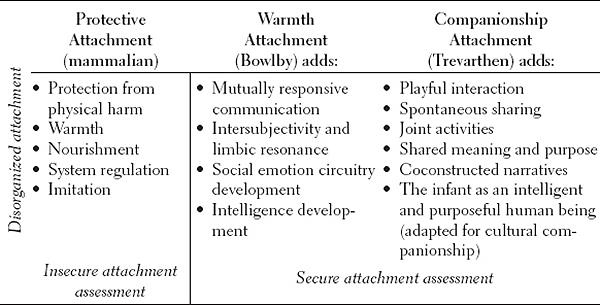
Emotion regulation has become a focus of extensive research in recent decades. Here we examine one specific area of self-regulation that is dependent on caregivers for proper development: the vagus nerve. Protective attachment may set up this system to be functional enough to allow for nonintimate relationships.
Vagal tone. The vagus nerve is the tenth cranial nerve and the primary nerve of the parasympathetic nervous system, which is implicated in multiple biological systems. As a cholinergic inflammatory pathway, the vagus nerve monitors and communicates with all major systems in the body, including the spleen to control immune function (Kessler et al., 2006; Maier, Gleher, Fleshner, & Watkins, 1998). The vagus nerve regulates the parasympathetic system and when it functions poorly, a variety of detrimental health outcomes can take place (impairment of digestion [e.g., irritable bowel], neuronal communication [e.g., seizures], and mental health [e.g., depression] as well as inflammation, a backdrop for many diseases [Ghanem & Early, 2006; Groves & Brown, 2005; Rosas-Ballina et al., 2011]). When functioning well, the vagus nerve improves physiological self-regulation (e.g., of glucose), attention, and behavior regulation as well as interpersonal interactions (Kok & Frederickson, 2010; Porges, Doussard-Roosevelt, & Maiti, 1994; Thayer & Lane, 2000). The vagus nerve also influences emotions and emotion regulation (Calkins, 1997; Donzella, Gunnar, Krueger, & Alwin, 2000; Porges, 1991; Porter, 2003).
Porges’s (2011) polyvagal theory describes three stages in the development of the autonomic system (comprised of sympathetic, parasympathetic, enteric). The most primitive component of the system, shared with most vertebrates, is the unmyelinated vagus nerve originating in the brain stem (dorsal motor nucleus). It is activated under life-threatening conditions and causes behavioral shutdown or immobilization. As it reduces oxygenated blood flow to the brain, it is linked to dissociation and fainting (passive avoidance). The second vagal system involves the sympathetic-adrenal system, which increases metabolic activity, including heart rate, allowing for mobilization (fight or flight) (active avoidance). The third system involves the myelinated vagus originating in the brain stem’s nucleus ambiguus. It inhibits the sympathetic system’s effect on the heart’s pacemaker (sinoatrial node), facilitating social communication and engagement as well as self-soothing. The third system’s “vagal brake” produces a resting heart rate that is lower than the intrinsic pace of the sinoartrial node. Good vagal tone means that the myelinated vagus is able to control the modulation of heart rate. This system allows for rapid engagement with and disengagement from objects, situations, and people. Even the face and head muscles are regulated by the vagal nerve’s visceral efferent pathways, stiffening up when the vagal brake is not working. The right hemisphere vagus helps regulate motion, emotion, and communication (Porges et al., 1994).
Porges (1991, 1996, 2011) has proposed a hierarchical model of self-regulation in which behavioral, emotional, and motor regulation are dependent on appropriate physiological regulation, which is indexed by changes in parasympathetic responses or respiratory sinus arrhythmia (RSA). “RSA is a natural rhythm in the heart rate pattern at approximately the frequency of spontaneous breathing” (Porges, 2011, p. 229). Respiratory sinus arrhythmia is used to measure the state of the vagal brake, or vagal tone.
Vagal tone can be used as an index of homeostasis. Porges proposes that individuals use “neuroception,” a subconscious neurological process that evaluates environmental risk, to assess the safety of a situation or person and determine a physiological response. The hierarchy of response goes in reverse order to the phylogenetic development described above. That is, under presumed normality with no risk apparent, the bodily state is efficiently regulated, with the parasympathetic system dominant, supporting growth and restoration. In this case, the myelinated vagal system dampens the hypothalamic-pituitary-adrenal (HPA) response, the immune system, and the sympathetic system. Through extensive links to the face and head, the individual is able to spontaneously socially engage. In fact, the ability to move the head, show emotion expression, and share eye gaze is part of a suite of social cuing capacities that are related to self-regulation, and specifically to proper vagal nerve function.
However, things change under perceived risk during neuroception, whether or not perceived risk matches actual risk. In this case, the second system, the sympathetic, engages. It represents a stress response that shifts metabolism away from growth and toward active avoidance of the situation. If the action is not successful in restoring a sense of safety, then the third (oldest) system kicks in and the individual escapes through passive avoidance—dissociation. For most people in most situations, there is an accurate match between actual risk and perceived risk. But for those who have been neglected, abused, or traumatized, benign situations may be perceived as risky and avoidance responses may be triggered. Those with a history of abuse may have depressed cardiac vagal tone and thus may be unable to calm themselves. They may be hypervigilant for danger, and may easily mobilize fight-flight-freeze-faint behaviors. They may not have adequately developed the “vagal brake” that allows for social engagement. Thus, the quality of vagus nerve function appears to be greatly dependent on the quality of early nurturance (although when and how each of Porges’s systems is affected is not yet known in great detail).
How does caregiver behavior affect vagal tone? Recall how the right brain hemisphere develops relatively rapidly in the first years of life. The vagal system is lateralized in the right hemisphere and tied to emotion regulation abilities (Calkins, 1997; Porges et al., 1994). The caregiver’s interaction with the infant promotes the activation of the sympathetic-adrenal-medullary (SAM) stress response system. Withdrawal of the parasympathetic system also enhances the sympathetic system response, and this is regulated through the right vagus nerve (via the amygdala and nucleus ambiguous). Caregiver interaction can activate the parasympathic pathway, which impels the infant’s right vagus to reduce stimulation to the larynx, pharynx, and facial muscles as well as to the sinoatrial node of the heart (i.e., vagal withdrawal). When the infant becomes overstimulated by interaction (sensing imbalance in homeostasis), vagal activity will increase, slowing the heart rate and sympathetic effects, thus supporting a restful state. The infant will show disinterest, turning away. A responsive caregiver will allow the infant to rest by ceasing vocalizations and solicitations for attention. When caregivers are attuned to infant needs in a coregulated communication pattern (more responsive parenting), they foster good vagal tone. Infants who shared more mutual affect regulation with their mothers (dyads that demonstrated more matched affect and synchrony of affective states) were more effective in their physiological regulation across a stress-inducing still-face paradigm (Moore & Calkins, 2004). In contrast, nonresponsive parenting, as indicated by maternal intrusiveness (not letting the infant rest from interaction when overstimulated) or restriction of infant autonomy, is negatively related to physiological regulation (Porter, 2003; Haley & Stansbury, 2003; Calkins, Smith, Gill, & Johnson, 1998; Kennedy, Rubin, Hastings, & Maisel, 2004).
Moral functioning is related to vagal tone in that good vagal tone is related to prosocial response. Eisenberg & Eggum (2008) found that children with higher vagal tone were more cooperative and giving. In adults, activated vagal tone has been correlated with compassion and openheartedness toward others from different backgrounds (Keltner, 2009).
Warmth Attachment
A warmth attachment, or what is usually termed a “secure attachment” in attachment studies means that the individual is soothable, able to deactivate defensive emotions and behaviors as well as “seeking, doing, achieving and acquiring” (P. Gilbert, 2005, p. 28). Positive affect, liking, and feeling joyfully connected are features of warmth attachment. We examine three systems affected by warmth attachment: CARE, self-regulation, and social-bonding.
The CARE[41] System
Although most mammalian emotion systems are only provisionally understood, we discuss several in this book. The emotion system that is most identified with mammalian maternal and paternal behavior is CARE (Panksepp, 1998). To facilitate the power of parental care in neurobiological construction, the caregiver behavioral attachment system has coevolved with the infant’s attachment behavioral system (Bowlby, 1988, 1969/1982). The caregiver system keeps the parent engaged with the infant through her helpless stages of development. Like filial imprinting in ducks, human mothers bond quickly to their infants after birth under natural conditions, facilitated initially by oxytocin and subsequently with opioids when the CARE system is in full swing (Panksepp, 1998). The infant gradually bonds as she is wooed by her mother, latching on emotionally to her familiar caregiver(s), which then keeps the child near the caregiver(s) for ongoing protection, influence, and the development of attachment.
Although the CARE system is innate, how well it works is influenced by experience. Lonstein and De Vries (2000) conducted a seminal study of prairie vole parental care effects. Young virgin females that were raised with parents and siblings were outstanding parents. When they grew up with both father and mother, the motivation to care for infants was greater in females whose father had been present with the mother in the female’s early development. Research needs to be done to see whether there is a similar effect among humans.
Offspring of nurturing rat mothers (whose CARE circuits are active) show permanent effects on stress hormones (diminished) but also increased receptors for norepinephrine and glutamate, which facilitate learning and performance in fear-inducing situations (Champagne, Francis, Mar, & Meaney, 2003; Zhang & Meaney, 2010). Humans need even more bonding and caregiving than rats. As evidenced in Romanian orphanages and by infant hospital isolation in the early twentieth century, for a human baby it is not enough to be treated like a domesticated animal whose physiological needs are met but whose love and affiliation needs are not (Wismer Fries, Ziegler, Kurian, Jacoris, & Pollak, 2005). A good attachment relationship promotes all sort of capacities, including self-regulation. We examine additional aspects of self-regulation beyond vagal tone.
Self-Regulation
Self-regulation, broadly speaking, is the ability to manage the self within a healthy homeostatic range to achieve goals, including physiological processes but also intentional actions (Hoyle & Bradfield, 2010). In the brain, self-regulation occurs through two mechanisms: (a) Cortico-cortical interactions adjust minor resonance failures and smooth transitions between different activation states; (b) Cortico-limbic resonance failures are often governed by limbic amplification, which causes dramatic shifts in brain states.
Self-regulatory (e.g., vagal tone) networks are part of what the infant learns to coordinate with the caregiver pre- and post-natally (Schore, 1994, 2003a, 2003b). Multiple self-regulatory functions of the baby’s body and brain are shaped by caregivers’ initial provision of external regulation. Through this process, the infant establishes the set points for various systems, which over time allows homeostasis to be achieved more automatically and independently (although humans continue to need the presence of others for mental health; isolation increases symptoms of psychosis [T. Lewis et al., 2000; Niehoff, 1999]). Self-regulation is facilitated by the caregiving practices we have identified, such as touch and responsiveness. Interfering with the evolved needs of babies to “be-with” their caregivers has ill effects. Children cannot learn self-regulation on their own. For example, respiration, heart rate, and arousal are influenced by the presence of the mother, affecting well-being (Hofer, 1994). In fact, separation from the mother at birth can affect self-regulation a year later (Bystrova et al., 2009).
Forms of neglect are engraved in neurobiology as a result of frequent hormonal imbalance (see Lanius, Vermetten, & Pain, 2010; Schulkin, 1999).
Infants are pre-adapted to rely on the availability of responsive parental care for protection from external threats, for regulation of emotions and for normalizing physiological reactions to stressors. Therefore, during early life, a hidden trauma can occur, resulting not from physical assault but from the emotional unavailability of a responsive attachment figure to comfort and regulate the stress of the fear-evoking events that are a daily part of the infant’s experience. (Bureau et al., 2010, p. 48; see also Schuder & Lyons-Ruth, 2004)
The unavailability of caregiver comfort can lead to malorganized systems or even a disorganized personality. Thus, from the beginning, caregiver responsiveness is vital for a mutually responsive orientation from which the sense of self develops, the capacity for reciprocity is habituated, and emotion systems are optimally tuned, all of which contributes to self-regulation (Kochanska, 2002; Schore, 1994; D. J. Siegel, 1999; Stern, 1985; Tronick, 2007). With early support and subsequent maturation, the child is able to self-regulate and maintain healthy homeostasis through stressful events (resilience). See Table 4.2 for a list of self-regulatory systems affected by caregiving.
Table 4.2 A Sampling of Self-Regulatory Mechanisms Affected by Caregiving
+----------+
Social-Bonding Hormones
Hormones (in the body) and peptidergic systems (in the brain) that include oxytocin can inhibit defensive behaviors associated with stress, fear, and anxiety (e.g., aggression, withdrawal; Panksepp, 1993). The functioning of the endocrine system that releases these substances plays a role in facilitating social interactions that depend on social bonding, including trusting nonkin (Eisler & Levine, 2002; Kosfeld, Heinrichs, Zak, Fischbacher, & Fehr, 2005). As with other systems, there may be a critical period for development of the endocrine system as peptidergic systems rely on epigenetic factors (e.g., early social experience) to set up lifelong behavioral set points (for a review, see Sussman & Garber, 2011). We examine oxytocin, prolactin and opioids.
Oxytocin. Oxytocin has been hailed as a hormone and neuromodulator that increases positive social feelings like trust (Uvnas-Moberg, 2003). Indeed, it orchestrates a broad suite of maternal behaviors, and may have been co-opted by evolution to facilitate cooperative behaviors (Carter, 1999). Oxytocin promotes caring relationships and bonding, inhibiting the stress response as well as disassociation (J. N. Ferguson et al., 2000; Kirsch et al., 2005; Perry et al., 1995). Elevated oxytocin levels increase the speed of healing and growth and lubricate social relations among normal individuals (Richard, Moos, & Freund-Mercier, 1991; Uvnas-Moberg, 1996, 1997a, 1999; Uvnas-Moberg, Marchini, & Winberg, 1993; for a review, see Uvnas-Moberg, 2003). Oxytocin increases attention to and accuracy regarding other people’s eyes, smiles, feelings, and positive emotions while downregulating the amygdala’s threat reactivity and upregulating its attention to positive social opportunity (Domes, Heinrichs, Michel, Berger, & Herpertz, 2007; Gamer, Zurowski, & Buchel, 2010; Guastella, Mitchell, & Dadds, 2008; Kirsch et al., 2005; Marsh, Yu, Pine, & Blair, 2010; Petrovic, Kalisch, Singer, & Dolan, 2008; Unkelback, Guastella, & Forgas, 2008). Oxytocin increases positive response to sexual solicitation (McEwen, Jones, & Pfaff, 1987). But its most significant effect may be that it boosts confidence generally (Panskepp & Biven, 2012).
Intranasal oxytocin administration tends to make individuals less aggressive, more trusting (at least of the ingroup), and more confident in social life (MacDonald & MacDonald, 2010). It dampens the activity of the amygdala and upregulates neural circuitries that facilitate empathy and concern for others (e.g., inferior frontal gyrus, ventromedial prefrontal cortex, caudate nucleus) (for a review, see De Dreu, 2012). However, recent studies suggest that oxytocin targets social feeling toward the ingroup (at least in males) rather than necessarily expanding social feeling willy-nilly. That is, it tends to promote ingroup trust and outgroup mistrust (De Dreu, Greer, Van Kleef, Shalvi, & Handgraaf, 2011). So, cultural notions of what the ingroup is will matter.
Oxytocin influences maternal behavior. Generally, maternal behavior is weakened when oxytocin systems are unresponsive, at least in mice (Nishimori et al., 2008). If oxytocin receptors are blocked in first-time rat mothers as the pups are born, the mother’s instinct and competence for nurturing the young are virtually extinguished (although this is not so if the blockage occurs days later) (van Leengoed, Kerker, & Swanson, 1987). Women with a history of child abuse have lower levels of oxytocin (Heim et al., 2009), whereas those who have memories of warmth and care in childhood have higher plasma oxytocin levels and are more affectionate with their children (Feldman, Gordon, Zagoory-Sharon, 2011; I. Gordon et al., 2008). Plasma levels of oxytocin increase in parents when they touch and physically connect with their children a lot (Feldman, Gordon, Schneiderman, Weisman, & Zagoory-Sharon, 2010).
Converging evidence from animal models as well as human studies indicates that a baseline for oxytocin production may be established in early childhood by parenting behavior (Champagne, 2008, 2011; Feldman, 2012; Francis, Young, Meaney, & Insel, 2002). Poor functioning of the endocrine system may affect sociality for the long term. For example, some autistic children have an oxytocin gene that did not get expressed (Gregory et al., 2009). Romanian orphans who did not receive personal affection in early life showed depressed levels of oxytocin when in physical contact with adoptive parents, unlike children in contact with birth parents (Wismer Fries et al., 2005). Oxytocin may perform a critical role in motivation to bond with others because of its connectivity with the dopamingeric reward system (Feldman, 2012). Rats and mice that receive oxytocin are less likely to develop dopaminergic drug tolerance, which is linked to drug addiction (Kovacs, Sarnyai & Szabo, 1998). Human babies initially receive oxytocin through their mother’s milk, and touch increases oxytocin levels.
Oxytocin counteracts the effects of stress by decreasing blood pressure and reducing activity in the sympathetic autonomic system (Uvnas-Moberg, 1997a, 1998). The mitigating effects of social support on stress response may be partially regulated by oxytocin (A. S. Smith & Wang, 2012). Persistent stress appears to decrease the activity of the oxytocin system and the bonding that goes along with it (Henry & Wang, 1998).
Figure 4.1 Causes and Effects of Oxytocin Levels
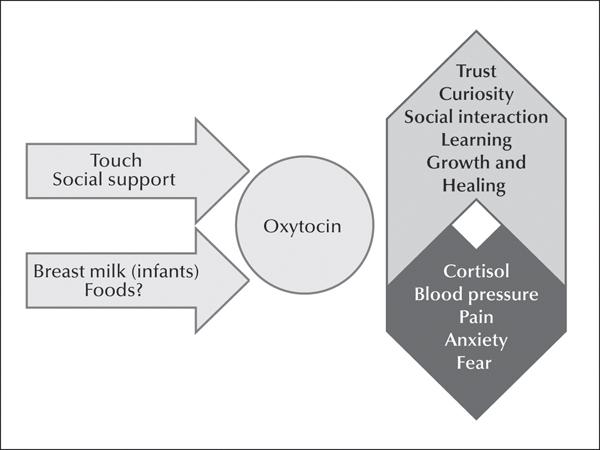
Prolactin. Prolactin is another hormone that increases feelings of affection. As childbirth approaches, it becomes a dominant hormone in the mother’s body. Prolactin may protect against stress in general which seems to be the case for mothers facing childbirth (Drago & Scapagnini, 1986). Prolactin is also implicated in nonmaternal infant care and may be a relational hormone whose levels fluctuate according to the quality of the relationship (Sussman & Garber, 2011). Depressed people have low prolactin levels. Meditation increases prolactin concentrations and may play a role in easing fear by promoting quiescence, which influences other metabolic and humoral processes, such as elevation of vasopressin concentrations and reduction of cortisol concentrations (J. M. Davidson, 1976; Jevning, Wilson, & Vanderelaan, 1978). In other words, a relaxed state of meditation releases prolactin, which feeds back to reinforce the relaxed state.
Opioids. Another set of chemicals that facilitates social bonding is opioidlike neurotransmitters (called “opioids” for short), which, though internal, function similarly to addictive drugs like heroin. They transmit information among nerve cells in specific subcortical regions, producing pleasurable satisfaction. Interestingly, under normal conditions motherhood is addictive—it activates the same pathways as addictive drugs (Ferris et al., 2005). Although oxytocin may facilitate the initiation of social bonding, it is maintained with mild opioid secretion. In fact, attachment processes between mother and child appear to rely on the endogenous (internal) opioid systems. The social dependence that is part of human nature resembles opiate addiction; the withdrawal of an opiate drug results in the same symptoms as separation distress: psychic pain (loneliness), crying, loss of appetite, depression, sleeplessness, and irritability or aggressiveness (Panksepp, 1998). This suggests that the development of substance addictions may be related to a dearth of pleasure from social relations.
Isolation of mammals can be damaging at any point in life, but especially during rapid development. Most studies of postnatal isolation are performed with rats, who are not as socially needy as human beings (Panksepp & Biven, 2012). Nevertheless, the findings with rats are stark. Isolation in rats after weaning causes all sorts of brain pathologies, including dysregulation in neurotransmitter functions in different brain areas. For example, dopamine, serotonin, and related metabolites are altered in what is called a “psychosis circuit,” which includes primarily the hippocampus and selected hippocampal efferent pathways that project toward the nucleus accumbens, anterior cingulate, and intralimbic cortices, as well as the dorsolateral caudate nucleus, amygdala, and entorhinal cortex (Heidbreder et al., 2000, p. 749). As a result of isolation, Heidbreder and colleagues found increased hyperactivity, startle response, and food hoarding (physiologically: decreased serotonin activity in the nucleus accumbens and the medial prefrontal cortex, and increased dopamine activity in the amygdala). So these rats are showing some of the common problems found in humans today—stress reactivity, hoarding, and serotonin-related disorders like depression. For human children, who have evolved to expect more intensive parenting than rats, it is not clear how much isolation it takes to cause dysregulation in various systems.
Companionship Attachment
Colwyn Trevarthen (2005b) contends that Bowlby’s warmth attachment is not enough for a child’s intellectual or optimal development. Companionship attachment goes further, emphasizing parent–child interactions of sharing intentions, interests, and affective appraisals. (Recall Figure 3.5.) They play together-with one another. As the child grows, the capacities and scope of shared imagination and action grow and change too. Building on Trevarthen’s term, I call this companionship care.
Like intersubjectivity, companionship care begins in early life. Trevarthen’s (2005b) research demonstrates that babies discover relationship and meaning in collaborative communication from the first day of life. The child is born expecting a conversational partner. In fact, newborns not only imitate gestures (heart rate increasing) but also initiate action (heart rate decreasing) and wait for a response. Trevarthen (2005b) contends that human sociability, already evident in infants, “innately seeks to build meaning by sharing the narratives implicit in adventurous activity, and by playing with ways of acting and experiencing” (p. 63). Babies are motivated to find pleasure in dynamically responsive company, seeking “a place in a community of ‘common sense,’ not just security in attachments” (p. 55). “From birth, a child’s learning depends upon sharing his or her impulsive acting and thinking with other familiar persons, who themselves are experimenters, discoverers, and communicators, eager to share what they think and do” (p. 58). In fact, the child’s vitality is encouraged by intuitive parenting focused on play and meaningful communication. Children are instinctively playful companions who, like all social animals, learn to sensitively communicate immediate interests and impulses for action with ongoing interpersonal creativity. Expressive body signs develop before speech, from proto-conversations of “primary intersubjectivity” at two months (Trevarthen, 1979) to “secondary intersubjectivity” and “cooperative awareness” with protolanguage by the end of the first year (Trevarthen & Hubley, 1978; Hubley & Trevarthen, 1979). With their partners, babies exchange communication, conveying their feelings, intentions, and experiences, which prepares them for spoken language. These forms of collaborative learning facilitate intellectual development, coordinating and synchronizing different parts of the brain: “Large territories of the frontal and parieto-temporal cortex are implicated in the simple sympathy of a conversation, with its gestures, vocalizations, and facial expressions” (Trevarthen, 2005b, p. 73).
Trevarthen contends that this type of companionship care fosters more than warmth attachment alone. It encourages a child’s natural investigative curiosity and a confident self-consciousness that eventually is able to take on independent acting and thinking, resulting in an intelligence displayed in active, interested activity. Trevarthen’s emphasis on the collaborative nature of emotional and cognitive development fits well with a similar perspective by Greenspan and Shanker (2004), who write that intelligence comprises “the ability to generate or create a full range of ideas in the areas of one’s human emotional experiences and then reflect on them and organize them into a logical framework” (p. 236). This ability is developed from affective experience, so much so that “only deep and extensive knowledge based on extensive personal emotional experience and learning can generate high levels of creative and reflective thinking” (p. 236). Ideal relationships are filled with active interpersonal discovery regulated by moral feeling. Such relationships are fundamental for emotionally regulating the growth of the brain and are as critical for mental health as warmth attachment (Trevarthen, 2005a).
We examine two “systems” that are fostered by this type of companionship care in early life. One is exuberant, the PLAY system, and the other calming, the serotonin system.
The PLAY System
The animal world is full of play, from mammals to reptiles vertebrates and even some invertebrates (Burghardt, 2005). Multiple animal phyla have demonstrated play behavior under scientific observation. Play is a spontaneous, pleasurable, exaggerated form of adult activity that is repeated and occurs when the animal is in a relaxed or low-stress situation (Burghardt, 2005).[42] The neurobiology of PLAY circuitry has been well researched in mammals. The typical form of young mammalian play is rough-and-tumble play, a type of play that is both fragile and robust (Panksepp & Biven, 2012). Quite a number of things can reduce play, such as negative emotions (fear, anger, separation anxiety) or pain, hunger, or illness, suggesting that a sense of safety is necessary: “Play only occurs when one is safe, secure and feeling good, which makes play an exceptionally sensitive measure for all things bad” (p. 355). On the other hand, play is robust: When young mammals are feeling well and have the opportunity to do so, they nearly always play.
Neurobiologically, play has epigenetic and growth effects. Neural metabolism increases in the neocortex; in particular, brain-derived neurotrophic factor (BDNF) and insulin-like growth factor become elevated (N. Gordon, Burke, Akil, Watson, & Panksepp, 2003; N. S. Gordon, Kollack-Walker, Akil, & Panksepp, 2002; Panksepp, 1998). One-third of 1,200 genes so far evaluated are modified rapidly by play behavior (Burgdorf, Kroes, Benfield, Panksepp, & Moskal, 2010). Dopamine, the energizing hormone indicating positive anticipation, is secreted during play, which perhaps shapes dopamine pathways in prosocial ways. Panksepp and Biven (2012) speculate that play elaborates prosocial neural pathways. Moreover, children diagnosed with attention-deficit hyperactivity disorder (ADHD) without a clinically relevant brain disorder may actually be play starved or have a strong PLAY system that is undernourished (Panksepp, 2007).
Although there is no consensus on the function of play behavior among animals generally, among mammals it facilitates both social and nonsocial capacities (see Panksepp & Biven, 2012). Social capacities include bonding, cooperation, leadership, and communication, whereas nonsocial capacities include physical and cognitive fitness, tool use, and innovation in the face of uncertainty. Because of the long-term neural effects of development in an enriched environment, animals that play as juveniles tend to show more adaptability as adults, with greater motivation or capacity to explore their environments and greater capacity to switch rapidly between different behavior patterns, to reverse previous learning, and to engage in new learning, signs of well-functioning and well-integrated executive systems (e.g., Fagen, 1977, 1982; T. D. Johnston, 1982).
Serotonin
Serotonin has broad functions in the body. It is an ancient molecule, present in both vertebrates and invertebrates, that provides a modulating regulator signal within the nervous system (Schulkin, 1999; Strand, 1999). It is principally released by the raphe nuclei, in the brain stem, whose axons extend throughout the central nervous system.
Serotonin plays multiple roles. It regulates food intake, mood, and sleep, enhances working memory and learning by facilitating transmitter release in specific receptors on the presynaptic terminals of sensory neurons (K. A. Ellis & Nathan, 2001; Glanzman et al., 1989; Hawkins, Castelluci, & Kandel, 1981; Mackey, Kandel, & Hawkins, 1989).[43] Researchers Linnoila and Virkkunen (1992) concluded that serotonin levels generally determine the ability to stop and think, with low levels increasing impulsive overreaction to provocation and contributing to violent outbursts. The ratio of serotonin to other neurotransmitters is important for psychosocial health. For example, Soderstrom, Blennow, Sjodin, and Forsman (2003) found that an abnormal ratio of serotonin to dopamine metabolites impairs serotonergic modulation of dopaminergic activity, leading to higher scores on psychopathy in adults (which was linked to reported ADHD and conduct disorder in childhood). The hypothalamic-pituitary-adrenal (HPA) axis (discussed in Chapter 6) and serotonin systems are both richly represented in the hippocampus, a central player in memory and cognition, and in the paraventricular nucleus of the hypothalamus (PVN). These regions link with other limbic system components that regulate mood.
The serotonin system has several molecules (e.g., 5-HT1a, 5-HT2a) that must be in balance to prevent depression (Berendsen, 1995; Borsini, 1994). A deficit in the expression of the serotonin receptor 5-HT1A has been linked to posttraumatic stress disorder (PTSD) and panic disorder as well as depression (Neumeister et al., 2004), leading to generalized fear (panic) (Klemenhagen, Gordon, David, Hen, & Gross, 2006). If young monkeys in Harry Harlow’s lab were allowed peer contact but consistently isolated from adult monkeys, they remained hyperaggressive and had low spinal fluid levels of 5-HIAA, a main metabolite of serotonin, resulting from reduced serotonin production and linked to impulsive violent and antisocial behavior in mammals (Kalin, 1999a, 1999b).
Serotonin receptor deficiency has multiple effects. It can lead to dysfunction in GABAergic systems, increasing anxiety. Faulty receptors and low levels undermine confidence and are linked to depression (“sickness” behaviors) and sleep disturbances (Caspi et al., 2003). Mintun and colleagues (2004) found that depressed people have fewer serotonin receptors throughout the brain, particularly in the hippocampus.
The deficiencies in serotonin function in children start very early. Serotonin seems to play a trophic role in the development of the brain in early life. That is, it appears transiently at double the concentration of adult levels to facilitate the growth and differentiation of other systems (D’Amato, Blue, & Largent, 1987; Hohman, Hamon, Batshaw, & Coyle, 1988; Lauder & Krebs, 1986). In contrast, later in development an overabundance of serotonin in the blood is linked to autism (Whitaker-Azmitia, 2005). Serotonin is synthesized for the embryo by the placenta with tryptophan, a serotonin precursor, from the mother’s diet (Bonnin et al., 2011). After birth, breast milk, especially at night, provides tryptophan, an amino acid that promotes sleep. The blood-brain barrier is not yet established in early life, allowing ingested tryptophan to enter the brain.
Early maternal rejection affects the development of serotonin systems (Maestripieri et al., 2006). Mammalian animal studies demonstrate that limited touch in early life leads to an underdevelopment of serotonin receptors, endogenous opioids, and oxytocin, suggesting resulting deficits in “good feeling” (Kalin, 1993; Meinlschmidt & Heim, 2007). Human infants who have faulty serotonin receptors have a greater likelihood of sudden infant death syndrome (Audero et al., 2008; Paterson et al., 2006). Paterson and colleagues (2006) found extensive 5-HT pathology in babies who died of SIDS, including abnormal neuron firing, synthesis, release, and clearance.
Figure 4.2 Causes and Effects of Low Serotonin
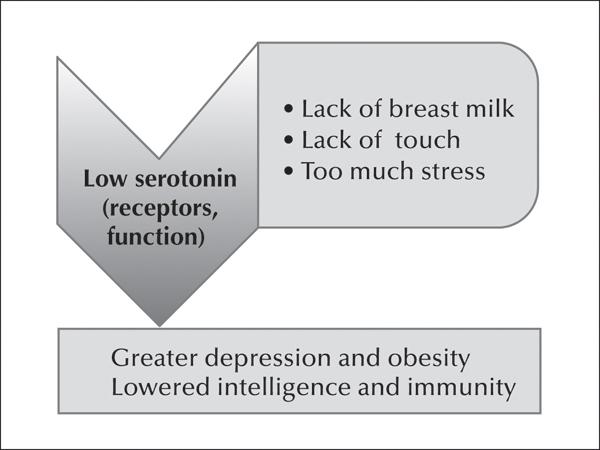
Interestingly, a lack of serotonin signals to the body that one is in a low-food environment. This increases appetite and shifts body attention to survival mechanisms such as insulin production, which is linked to obesity (Leibowitz, 1990).
Sharing physiology with the HPA system, serotonin is also related to the stress response (which we discuss further in Chapter 6). Overreactivity of the HPA (or limbic-HPA [LHPA], which includes the hippocampus and paraventricular nucleus [PVN]) is intimately linked to major depression. The hippocampal glucocorticoids, products of the LHPA, have profound effects on mood and behavior (McEwen, 1998). Adrenal glucocorticoids and 5-HT receptors interact during conditions of acute and chronic stress. Repeated stress reduces genetic expression for the 5-HT1A serotonin receptor. The receptor is very sensitive to stress hormones such as cortisol, which downregulates receptor density. Stress destroys serotonin receptors in the hippocampus. A group of suicide victims who had a history of depression showed brain effects indicating exposure to chronic stress in the hippocampus and in the prefrontal cortex (López, Vázquez, Chalmers, & Watson, 1997).
In summary, social bonding hormones contribute to attachment but also reflect the quality and success of the developmental niche.[44] Although warmth attachment may be sufficient for Western contexts of high individualism and low social cohesion, for full human capacities at the physiological level, companionship attachment may be required. Companionship attachment may also be required for humanity’s highest moral capacities.
What I also find valuable in a companionship attachment orientation is the greater emphasis on ongoing reciprocity-in-relationship. As I note throughout the book, social and moral functioning is a moment-by-moment adjustment based on the nature of the relationship and the situation. We are constantly shifting among states of relationship, with our prior experience guiding our perceptions and reactions. Flexible, in-the-moment response relies on right-hemisphere functioning. Otherwise we may respond stiffly with left-hemisphere-directed scripts and formulas which do not allow for creative response (Shank & Childers, 1988).
Linking Brain Development and Attachment to Morality
In an attempt to explain human behavior in light of evolution, MacLean (1990) identified three brain strata that evolved over the course of human evolution. The theory is especially useful in that MacLean was identifying how each stratum promotes a different global brain state. I believe that each brain state is linked to different forms of moral functioning. The first stratum, the proto-reptilian, is the seat of ancient survival systems that help keep the individual safe and alive (discussed in Chapters 6 and 7). The second stratum, called the paleomammalian, houses the limbic system and related structures (discussed in this chapter), which is integral to our intensive sociality and enhanced Other-regarding capacities. The third stratum, the neomammalian, refers to executive functions that include the frontal lobe and allows for the management of the other strata (discussed in Chapter 5). All three strata are uniquely integrated with other systems in the human brain.[45]
The second stratum, the focus of this chapter, refers specifically to the upper limbic system and its connections to the frontal lobe, known as the visceral-emotional nervous system on the hypothalamic-limbic axis (VENS) (Panksepp, 1998). It extends emotional capacities from those that promote individual survival (e.g., fear, rage) (discussed in Chapter 6) to feelings for and with others (MacLean, 1990).[46] The VENS allows us to signal emotionally both internally (i.e., learning) and externally (i.e., sociality) and forms the relay network for emotion (Konner, 2002). Pathways to the hypothalamus direct the autonomic system. The bidirectional links to the neocortex means that emotions can influence cognition and vice versa. Cortical arousal is involved in all feelings, from pain to pride. As a result, any internal event (thought, memory) or external event (sensory input) that stimulates the limbic circuitry will likely enhance cortical arousal and tend to dominate conscious awareness (V. C. Johnston, 1999). Perhaps the VENS as a whole can be viewed as hedonically focused, shaped to gauge what is and is not pleasurable and what is or is not agreeable.
The VENS extends the capacities of the mostly self-focused lower limbic system (involved in self-survival) with other-focused capacities. These include greater capacities for skin contact, comfort, maternal nursing, and cues that bond parents to offspring (like distress cries) and underpin complex extended family life (Cory, 2002). They include social emotion systems vital for offspring survival and thriving—PLAY, CARE (parental instincts), empathy and other social emotions and behaviors (Darwin, 1872; Loye, 2000; 2002).[47] The evolved developmental niche establishes links among these emotion systems and cortical controls; and social experiences throughout life refine them.
We know that human brains have evolved to be social-reward-seeking structures (Nelson & Panksepp, 1998). The systems described above (e.g., vagal tone, CARE, PLAY, oxytocin, opioids, serotonin) all contribute to our ability to experience social pleasure. These neuronal and hormonal mechanisms may facilitate prosocial behavior generally, suggesting an addictive quality to cooperation. Thus, we “social animals appear to be wired to cooperate and to reduce stress by seeking each other’s company,” which provides physiological, psychological, social, and ecological benefits (Sussman & Garber, 2011, p. 598). To work well, these systems are best nurtured by loving companionship care during an extended period of childhood when secure attachment is built, along with its neurobiological underpinnings. Caregiving in early childhood helps design the function of these systems, which are vital for bonding to others and managing stressful situations throughout life (Carter, 1998).
In early life, mutual gaze with the mother triggers endogenous (internal) opioids, making social interaction pleasurable (H. S. Hoffman, 1987; Panksepp, Siviy, & Normansell, 1984). In fact, mother and child coregulate their opiate systems (Kalin, Shelton, & Lynn, 1995). When things go well in early life, gratification is found in relationships with caregivers, and the capacity for deep empathy is fostered. The individual looks forward to being with others and enjoying their company.
Propensities for intimacy and social relations are generally rooted in the aforementioned systems, along with other capacities that involve the upper limbic system. When care is appropriate, good vagal tone and emotional intelligence are established, allowing for effective intimate social relationships. Thus, when stress gets too high, one is able to turn to an attachment figure for comfort, a hug, and a “calm down” (Bowlby, 1988; S. E. Taylor, 2006).
A key component undergirding sociality is the functioning of the right hemisphere. The right hemisphere is asymmetrically deeply connected to the limbic and autonomic systems, playing a large role in emotional processing (Spence, Shapiro, & Zaidel, 1996). It controls the vital functions supporting survival and the ability to cope with stresses and challenges, specializing in neuroendocrine and autonomic activation, secretion of stress hormones, and the human stress response generally (Kalogeras et al., 1996; Sullivan & Gratton, 1999; Wittling, 1997; Wittling & Pfluger, 1990; Wittling & Schweiger, 1993). Right brain hemisphere development in early life is vital for agile social capacities.
Poor right hemisphere development can continue to thwart development throughout life, because immature or underdeveloped personalities are prone to shift into dissociation at low levels of stress, and become impermeable to social communication and interaction (Schore, 1994; 2003a; 2003b). It is difficult to exit this state, and so it may become habitual to be shut down in social situations, thereby preventing advances in right hemisphere emotional intelligence, which otherwise is stimulated by active social experience. A catch-22. Later I examine alternatives for self-development.
To extend these notions, I suggest that the insecurely attached child has learned that the social world is untrustworthy. The insecure individual remains on the outside of the social world, looking in or looking away but preoccupied with it. She cannot help but be self-preoccupied, since there are gaps in social development. She may feel centrally important in her moral world, but it is off kilter socially. The bedrock of distrust can thwart development later because it is an overlay on all social relationships. Accompanied by stress reactivity, insecure attachment prevents the types of emotionally intimate experiences that can reenergize sociality. Instead, an anxiously insecure child learns that it is right and good to dominate or manipulate other people with emotions, because then eventually some needs are met and some sense of satisfaction ensues. For the avoidantly attached, brain function is shifted away from pleasurable social relations to alternatives—the pleasures of cognitive striving (increased exploration in that realm) or acquisition and conquest of people or things (dominance). Neither type of insecurely attached child has developed a bedrock of social and emotional intelligence except in a partial or even distorted manner. Thus, child undercare may lead to the individualized neurobiological imprints that Freud intuited. The reality perceived by the unconscious modifies the perception of external reality, leading to individually unique perception, judgment, and action (Ansermet & Magistretti, 2007, p. 210).
Moral commitment is a natural part of normal human development, but it must be experienced. As a result of missing experience, the insecurely attached may lack the capacity for a deep sense of moral commitment to others. As Edelman (2006) points out, our neuronal systems are driven by value. In competitive and cooperative ways, they make sense of experience, initially reactive to environmental cues but later shaping one another through rapid patterning (reentry) mechanisms. If parents do not demonstrate moral commitment to the child through companionship care, the child may learn a similar lack of open-hearted moral commitment to others. The child of closed-hearted parents will have difficulty learning moral commitment from experiences with them (although she may learn it from other relationships, e.g., a grandmother). If moral commitment from others comes later in life, it may not be as deeply held as if it were generated within the critical time period for social procedural learning in early life. Capacities for our first moral inheritance, the engagement ethic, emerge from the moral commitment the baby experiences from caregivers and their community. It is rooted in the upper limbic system and its connections to the frontal lobe.
The Engagement Ethic: A Baseline for Human Nature
In traditional contexts, parents and children find a lot of pleasure in intimate relationships and the social group. In fact, anthropologists residing in small-band hunter-gatherer societies (SBHG) report that the people cannot believe that the anthropologists would ever want to be alone. So they join them on trips to the forest for urination and entering the visitors’ shelters before they are awake to continue conversations (Dentan, 1968). The companionship care that children receive in these societies contributes to the capacities for social enjoyment and face-to-face compassionate morality, providing a baseline for what I call an engagement ethic. The engagement ethic represents capacities for social intimacy, a mindset that takes into account as equally important the person en face in a dynamic equality (Birtchnell, 1999). Fostered by experiences of social engagement and relational attunement, engagement is about connecting and bonding in the moment, right now, on an equal basis, person to person, entity to entity. In Esther Meek’s story of her relationship with a bird (see the following text box), we can see the ethic of engagement in action. Although Meek puts a theistic twist on the experience, it can be interpreted more broadly and atheistically as a communion with universal life energy.
The Morality of Friendship
One spring I inherited the care of a wild bird from one of my students. Bandit, a cedar waxwing, fallen from his nest, had been rescued by my student and his family. Soon after, a well-meaning housesitter had clipped his wings ... his one wing looked virtually non-existent, and he could not fly. He looked simply horrible.
His former family, I noted in the exchange, would pick him up in their cupped hands to carry him around, and playfully called his fluttering struggle “break-dancing.” Early in my time with Bandit, I did the same. I was quickly smitten with this bird; in fact, the love began when that student first told me of Bandit, before that student or I realized that I should inherit him.
I attended carefully to that little bird. In so doing, I figured out what he loved and what he hated. I discovered that he wanted always to see my face (waxwings are group birds; I was Bandit’s group!). I learned, through close proximity, that he abhorred loud machine noises. I discovered that he ate, not seeds, but fruit (80 percent) and bugs (20 percent). Never was he so happy as when I made fruit salad. And I figured out that he was happiest to be carried around on a stick, rather than in my cupped hands. All I needed to do to “recover” him from wherever he happened to be was to stick out the stick, and he hopped on to it jauntily, with no “break-dancing.” I figured out that, if you are a bird, having your flying feathers touched or petted is definitely not a good thing. It would be like bending the wings of a jet, or cutting the veins of a human. I learned what he was saying in the rich variety of his chirps. I lived life on his terms, scavenging my neighborhood for wild berries, throwing a diaper over my shoulder so I could keep him near. A few people though I was crazy. But I was also somehow finding myself reflected in his gaze, and actually understand God better.
Over that summer on the stick, and on my shoulder, Bandit regrew his rich chestnut feathers (I fell in love with the color brown), including his crest, and the signature yellow tips and red “wax drop” that gives the species its name. One day in September, after twenty minutes on my shoulder as I sat on my deck, when I was not expecting it, Bandit took off and flew, straight and true, to the woods behind my house. Not only Bandit had changed; I had changed as well. It had been a mutual healing.
Source: Meek, 2011, pp. xvii–xviii. Used by permission of Wipf and Stock Publishers. www.wipfandstock.com
Notice the signs of care, respect, and responsibility, and the growth of relational understanding through action. Perhaps I like this story because it is such a contrast to my own experience with bird tending. When I was seven, I got to take home a baby chicken from the television studio where I was a voice actor. I put the bird in a box in my room next to the heating vent. I think we fed it cereal. Within a week or so, it passed. I was sad and sorry and felt I had betrayed the bird. Another time, I purchased “rice bird” finches from a market in the Philippines. I kept them in their birdcage for a while but eventually let them go free. I’m not sure it was caring so much as it was tiredness of their incessant chatter. Clearly, I missed the opportunity that Esther Meek took up with Bandit—a chance to be relationally present to an Other with whom I was involved. I thought only about the bother to me.
Notice how Meek was receptive to Bandit’s needs and communications. She took the time to receive from the Other and did not take action merely from her own scripts but formed a unique relationship with Bandit. In my own life I can see many instances where I lacked capacities for Engagement. There are countless times where I passed by the opportunity to truly connect to an Other, staying habitually disconnected emotionally. I did not step into a receptive mode to cocreate the dance of relation.
Engagement is rooted in epigenetically and developmentally shaped intuitions that hold procedural memories from early life about how to navigate ongoing social experience. This includes a sense of reality/truth and a sense of self-in-present-moment (MacLean, 1990). Does the baby practice present-moment intersubjectivity in the deep ways that have been described, or does the child find little social response or responses that were intrusive or scary? Capacities for an engagement ethic in adulthood are highly influenced by initial brain wiring in babyhood, that is, the patterns set down in emotion circuitries in the first years of life (Schore, 2003a, 2003b).
The experiences that build an engagement ethic in early life are depicted in Figure 4.3. Many of these overlap and interrelate, and they include experiences that build social pleasure: presence, reverence, synchrony and intersubjectivity, empathy, mentalizing and perspective taking, and play. Because they represent procedural know-how, they lead to social effectivity—the capacity to carry out these micro-social skills in real life.
Presence. Full emotional presence, or resonance with the Other in the moment, represents one of the key features of the engagement ethic. Presence is relational attunement to life in the vicinity, encompassing the sense of connection to all of life. It means attending with a nonjudgmental, nonevaluative orientation. For example, a rescuer of Jews in World War II reports on his efforts:
Figure 4.3 Capacities That Constitute Social Pleasure
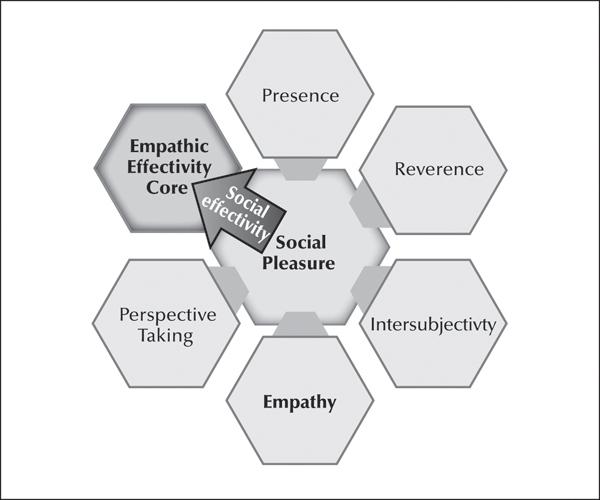
I did everything from my heart—I didn’t think about getting something for it. My father taught me to be this way. I still feel the same way now. I cannot refuse if somebody needs something. That’s why I still help people—I’ll do it until I don’t have the strength to do it anymore. My nature is the result of being raised by my mother. She was my role model. She helped a lot of people. (Oliner & Oliner, 1988, pp. 227–228)
Early-life experience sets up the capacities for presence. Trevarthen emphasizes two “concerns” available from birth, to be “free in our hopes and enterprises” and to be accepted positively by “those who experience our acting” (Trevarthen, 2001, p. 58). This occurs through the pleasure wrought from social relations—their intersubjectivity, limbic resonance, and concurrent empathy in a type of relational communion of selves being with one another in the present moment. Being with the baby from the first awareness of its existence in the womb to its presence after birth may be vital for the development of compassionate morality. Moment by moment, reactions and counterreactions that lead to schemas for the social world are being built by what is experienced with and promoted by caregivers.
Reverent hospitality. Engagement represents a way of relating that is neither invasive nor evasive (Palmer, 1993). It is a type of relational communion that attends to the beauty in the Other, as if the Other is “a glance from God” (Hurston, 1990, p. 102). As Aquinas (1274/1920) pointed out, to know a person or thing is to be open to its depth, its presence in all its complexity. And it is a sensory experience: “When you love anything you want to fill your consciousness with it” (MacMurray, 1992, p. 22). Reverence is a “perception of the phenomena related to a thing or entity, its being-nature,” an “essence” that is “timeless and perfect ... at the heart of things, and not bound by time or history ... an is-ness that is deeper and wider than any particular attribute or content” (Sills, 2009, p. 26). Beingness in an individual comes to life only in relationship—one’s “being develops a way of being” with others. As Heidegger (1962) pointed out, “Dasein [being] is a way of being unique to the particular being ... being is relational and knows itself only in relation” (quoted in Sills, 2009, p. 27). The agile, wise person is aware of how every being differs from every other and responds flexibly. She comes to a social experience with openness and does not categorize, sort, or rigidly apply rules to each unique social experience.
Engagement relies on “a reverence of approach” that “awakens depth and enables us to be truly present where we are” (O’Donohue, 2005, p. 24). Reverence is patient. It takes the time that is needed to connect and understand. For example, on the 1960s TV show The Andy Griffith Show, where a cast of local residents all have their neuroticisms, Mayberry sherriff Andy Taylor patiently relates to them in a way respecting their dignity.
Relationships are forms of art and take time to master (Fromm, 1956). They require patient attention to the unique Other. They mature gradually, just as the fox in de Saint-Exupéry’s The Little Prince intimated when he told the boy that making a friend takes time. The less one is preoccupied with personal issues, the more one can manifest presence with others (Stephens, Silbert, & Hasson, 2010). In fact, Kitwood (1990) argues that moral behavior is dependent on free attention, the capacity to be close to someone else in an objective but caring manner, where obstacles such as judgments and projections are minimized. Moral space is created by the amount of free attention in both persons at the moment of encounter. In contrast, a person with little free emotional or mental attention may constantly reframe the experience of others in terms of her own goals or anxiety-based barriers and frames. In this case, preoccupation and dissimulation predominate in interaction.
Synchrony, intersubjectivity, and mutual influence. Colwyn Trevarthen gives us a sense of what it means to be intersubjectively present to another living creature. Synchronized intersubjectivity involves emotional attunement with the Other. In every encounter with an object, there is a flexible negotiation “of interest and purpose,” requiring the body’s forces to anticipate movement in response to affordances (action possibilities), including socioemotional affordances with people (Trevarthen, 2001, p. 59). Our bodies, as social animals, have “evolved sympathetic detection ... of the motives inherent in one another’s ways of moving,” and our social cooperation “depends on this mysterious intersubjective sympathy” (Trevarthen, 2001, p. 59). Intersubjectivity is a “multi-layered experience” in which, during mutual gaze, “two nervous systems achieve a palpable and intimate apposition” (T. Lewis et al. , 2000, p. 63).
For mental health, social mammals require “a symphony of mutual exchange and internal adaptation whereby two mammals become attuned to each other’s inner states”—recall limbic resonance (T. Lewis et al., 2000, p. 63). In fact, “the mammalian nervous system depends for its neurophysiological stability on a system of interactive coordination, wherein steadiness comes from synchronization with nearby attachment figures” (p. 84). When synchronous with another person, the waves in each brain mirror those of the other, especially in the insula (which relates to conscious feeling states); when a person is listening intently to the story of another, the listener’s brain begins to anticipate the speaker’s brain activity by a few seconds (Stephens et al., 2010). These researchers suggest that communication is an act performed by two or more brains, and that during emotional moments brains are more likely to become synchronous. The joint interaction between two or more social animals becomes a new “organism” dependent on the sympathetic, mutually supportive emotional matching between them.[48] “Interpenetrations of states of motivation depend upon mutual attention, the sympathetic mimicry of affects that signal internal states and their changes and that govern both affectionate play and moral relationships as well as attachments” (Trevarthen, 2001, p. 64). Throughout life, sympathetic Others can become attachment figures (Mikulincer & Shaver, 2007).
Empathy. Empathy is attunement with another’s feelings and needs (Decety & Chaminade, 2003). The ability to feel with another—to feel the same emotion—is fundamental to the mammalian mind.[49] Awareness of another’s suffering is painful (Lerner, 1980), so much so that many social animals have been documented as helping their suffering mates, from monkeys to rats to elephants (Ben-Ami Bartal, Decety, & Mason, 2011; de Waal, 2012). Among primates, empathy is a common emotion that drives prosocial action (de Waal, 1996, 2010). For humans, empathy is a “critical manifestation of the human experience, and relatedness and interactive regulation the desired end-state” (Schore, 2003b, p. 215). One rescuer of Jews in World War II said he had no choice about helping others because of
human compassion. When someone comes and says “I escaped from the camp,” what is the alternative? One alternative is to push him out and close the door—the other is to pull him into the house and say, “Sit down, relax, wash up. You will be as hungry as we are because we have only this bread. (Oliner & Oliner, 1988, p. 197)
Empathy is distinguished from sympathy, which is a concern for the well-being of the Other (which is also important), and from personal distress, which must be controlled to allow focus on the Other (Eisenberg et al., 1988, 1989). Individuals may have empathic reactions but poor self-regulation so that another’s distress becomes equally distressing to them. This type of engagement distress mindset can occur, for example, when a recently experienced traumatic event happens to another person. The individual’s own stress response from PTSD or grief is reawakened, causing a self-focused reaction. When another’s distress triggers personal distress without remediation or self-regulation, empathy may be functioning but it represents an uncontrolled “feeling with” the other’s distress, which elevates one’s own stress response and becomes overwhelming. This of course, can lead to running away physically or emotionally (e.g., blaming the victim), or to paralysis. In fact, when personal distress in the presence of a victim is too high, helping behavior is shut down (Batson, Early, & Salvarini, 1997). An individual can be so personally distressed in the presence of others, especially when they appear needy, that a compassionate response is not possible.[50]
As noted earlier, capacities for self-regulation (e.g., of negative emotion) are shaped by early-life caregiving. The individual must have sufficient self-regulatory skills or ability to cope with social stress, which is facilitated by the myelinated vagus nerve that caregiving helps establish (Porges, 2011). For mothers to approach their babies, and for mammals to socialize or mate, there needs to be a calm-down of self-protective instinct (i.e., unmyelinated vagus nerve) (Porges, 2011). As noted earlier, responsive caregiving in early life, which includes coregulated communication patterns, fosters good vagal tone, whereas nonresponsive caregiving can undermine it (Calkins et al., 1998; Haley & Stansbury, 2003; Kennedy et al., 2004; Porter, 2003).Under conditions of responsive care, young children develop empathy over the course of childhood, along with a moral self and social competence and cooperation (M. Hoffman, 2000; Kochanska, 2002).
Perspective taking. Early experience with intersubjectivity in facilitates the development of the neurobiological underpinnings for perspective taking or mentalization, the ability to imagine another’s viewpoint and understand what might be motivating their behavior, a critical capacity for effective human relations. Perspective-taking abilities are fostered by mutually responsive and intersubjective relationships in early life which promote imagination of another person’s mental state (Fonagy et al., 2004; Trevarthen & Aitken, 2001). Theory of mind represents a “set of intellectual abilities that enable us to understand that others have beliefs, desires, plans, hopes, information, and intentions that may differ from our own” (Korkmaz, 2011). The sense of ‘we-ness’ or connectedness to others is part of these capacities (P. Gilbert, 2005). In one study, children were found by age three to demonstrate a sense of “we-ness,” even with a briefly known lab assistant (Gräfenhain, Behne, Carpenter, & Tomasello, 2009). Maltreated children, however, often lack a sense of being part of a social network and have difficulty coordinating with the music of the intersubjective “dance” (P. Gilbert, 2002).
One World War II rescuer reports on a conversation between herself and her mother, demonstrating a sense of concern beyond the self:
My mother said, “I don’t think you have the right to do this. Your responsibility is for the safety of your own children.” I said to her that it was more important for our children to have parents who have done what they felt they had to do, even if it costs us our lives. It will be better for them—even if we don’t make it. They will know we did what we felt we had to do. This is better than if we think first of our own safety.” (Oliner & Oliner, 1988, p. 217)
In psychological research, perspective taking is considered a key component of moral functioning, necessary for sophisticated moral judgment and friendship (Kohlberg, 1984; Selman, 2003). In fact, those with borderline personality disorder show signs that these experiences were missed because they have difficulty mentalizing (Fonagy, 2000; Bateman & Fonagy, 2004 ). Fonagy and colleagues suggest that inability to mentalize may be a prototypic response to trauma. Trauma can disorganize attention as well as stress regulation, impairing mentalization (Fonagy & Target, 1997). In normal brains, when distress cues are exhibited by another, behavioral inhibition ensues; such a violence inhibitor mechanism (VIM) appears to be lacking in psychopaths (R. J. Blair, Jones, Clark, & Smith, 1995).
Joyful play. As noted earlier, play is a fundamental aspect of being a mammal. It conveys a sense of belonging and of all being right in the world (Donaldson, 1993). Babies are ready to play from birth (Trevarthen, 2005b). Infants will playfully deceive their caregiver as together they build joint play scripts and narratives (Reddy, 2008). But the adult must be ready to play. Recall that play is fragile—it does not occur if there is pain, fear, or anger. If distracted or in a negative mood, the adult may not respond to the child’s bids for play. Although because of its fragility, play requires a neutral or positive mood, joyful play itself raises mood and pulls together all the other components of engagement. Stern (1985) suggested that interested pleasure, found in playful interaction, is a major indicator of emotional attunement.
Although play comes naturally to young mammals, it must be practiced. Children who do not play are more likely to be aggressive, as are adults who did not play as children (S. Brown, 2009; Pellis & Pellis, 2009). Adults can relearn how to play, which opens the heart and imagination (Donaldson, 1993). In fact, Plato encouraged play for moral development—“those natural modes of amusement which children find out for themselves when they meet”; he insisted that “our children from their earliest years must take part in all the more lawful forms of play, for if they are not surrounded with such an atmosphere they can never grow up to be well conducted and virtuous citizens” (The Republic, Section IV).[51]
The components of social pleasure—presence, reverence, synchrony, empathy, perspective taking, and play—take courage. They open one up to change through full engagement with the Other (Rogers & Roethlisberger, 1952). They are represented in an excerpt from The Little Prince in which a fox teaches the prince how to grow a friendship (see Table 4.3).
Table 4.3 The Little Prince and the Fox
“One only understands the things that one tames,” said the fox. “Men have no more time to understand anything. They buy things all ready made at the shops. But there is no shop anywhere where one can buy friendship, and so men have no friends any more. If you want a friend, tame me ...”
“What must I do, to tame you?” asked the little prince.
“You must be very patient,” replied the fox. “First you will sit down at a little distance from me—like that—in the grass. I shall look at you out of the corner of my eye, and you will say nothing. Words are the source of misunderstandings. But you will sit a little closer to me, every day ...”
The next day the little prince came back.
“It would have been better to come back at the same hour,” said the fox. “If for example, you came at four o’clock in the afternoon, then at three o’clock I shall begin to be happy. I shall feel happier and happier as the hour advances. At four o’clock, I shall be worrying and jumping about. I shall show you how happy I am! But if you come at just any time, I shall never know at what hour my heart is ready to greet you ... One must observe the proper rites ...”
“What is a rite?” asked the little prince.
“Those also are actions too often neglected,” said the fox. “They are what make one day different from other days, one hour different from other hours. There is a rite, for example, among my hunters. Every Thursday they dance with the village girls. So Thursday is a wonderful day for me! I can take a walk as far as the vineyards. But if the hunters danced at just any time, every day would be like every other day, and I should never have any vacation at all.”
So the little prince tamed the fox. And when the hour of his departure drew near ...
“Goodbye,” he said. “Goodbye,” said the fox. “And now here is my secret, a very simple secret: It is only with the heart that one can see rightly; what is essential is invisible to the eye.”
from The Little Prince by A. Saint-Exupery (1943, pp. 67–68)
Source: Adapted from The Little Prince by Antoine de Saint-Exupéry, translated from the French by Richard Howard. Copyright 1943 by Antoine de Saint-Exupéry and copyright renewed © 1971 by Consuelo de Saint-Exupéry. English translation copyright ©2000 by Richard Howard. Used by permission of Houghton Mifflin Harcourt Publishing Company. All rights reserved.
The path of friendship in The Little Prince shows the organic emergence of connection to a particular Other, the slow build up of trust and enjoyment. Like emotional intelligence, the engagement ethic is built on all these practices that build social pleasure. But extensive practice also builds skills. The capacities for skillfully interactively relating to others, and negotiating cooperation without incident, are built from the beginning of life in small and large ways (e.g., Emde’s and Aristotle’s social fittedness). In the first years of life, procedural memory develops and forms the primary type of memory used by adults (Kandel, 1999). Procedural memory includes implicit memories and affect that are triggered by pattern matching—matching a current situation with one from the past as a guide to responses in the present (Bechara, Damasio, Tranel, & Damasio, 1997; Westen, Muderrisoglu, Fowler, Shedler, & Koren, 1997). Procedural memory involves action patterns. Most of this implicit knowledge will be relational knowledge that is built from the type of social experiences I have been describing here and in the previous chapter (Lyons-Ruth, Repacholi, McLeod, & Silva, 1991; Schore, 2003b; Stern, 2004). Early social experiences foster internal self-governing capacities and externally focused socioemotional capabilities. These capacities rely not only on the frontal lobe but are integrated with more primitive physiological and motor capacities, which together with them make up true actionable knowledge. They represent social procedural knowledge or social effectivity—the individual’s capacities for action. Social effectivity forms foundational knowledge for complex moral action. But it is intertwined with pleasure experienced in carrying out these activities. The prosocial hormonal and emotional systems are also involved. So the set of procedural knowledge that underlies the engagement ethic brings together social pleasure and social effectivity, building moral desire. These combine into what I call empathic effectivity roots, or empathic core for short. It forms the basis for an intimate dynamic equality (Birtchnell, 1999). (See Figure 4.4.)
Figure 4.4 The Process of Developing an Engagement Ethic
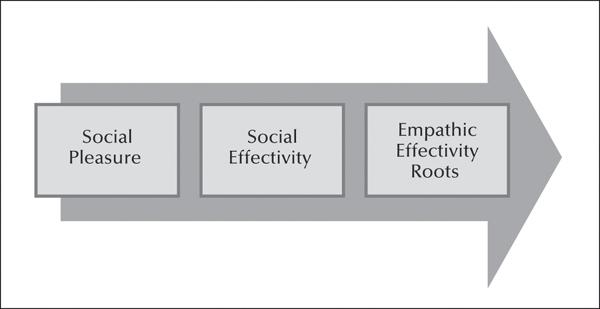
Thus, early life sets up the empathic universe for the self, the nature of empathic effectivity roots, a sense of “enwebbedness,” that is, the unconscious procedural know-how about emotional connection to and awareness of effects on others as well as efficacy in carrying out relational action. Empathic effectivity has its beginning in the first two years of life (although some suggest these capacities do not change after the first year, e.g., Davidov, Zahn-Waxler, Roth-Hanania, & Knafo, 2013).
Early and ongoing companionship care creates a full, multi-versal, empathic effectivity, with an inclusive concern for others that extends beyond the self. Among hunter-gatherers, “the individual person is the locus of multiple other selves with whom he or she is joined in mutual relations of being; even as, for the same reason, any person’s self is more or less widely distributed among others” (Sahlins, 2008, p. 48). There is no being without shared social relations—one lives with others in mind.
During the course of development, when the first surge toward autonomy occurs around age two, the empathic core, along with prosocial socialization, circumscribes (with assistance from companions) the type and size of the autonomy space into which the child extends her energies (discussed in chapter 7). Like every being, the child is “immersed from the start ... in an active, practical and perceptual engagement with constituents of the dwelt-in world ... not of making a view of the world but of taking up a view in it” (Ingold, 2011, p. 42). Early learning for social life builds a basic “logic of action” on an empathic core.
In contrast, a child who lacks appropriate care takes up a partial apprehension of the world, a faulty empathic core and a single-(uni)verse. The child is nearly invisible, which undermines her sense of self and commitment: “To whom can I be responsible, and why should I be, when you refuse to see me?” (Ellison, 1995, p. 14, commenting on his black experience in a white world). When one is not welcomed into the world fully, one does not intuit or feel a multi-verse. Instead, it may take external rules to bring one into moral bounds and to behave well toward others, and vigilance may be required ever after (or until new social procedures are learned).
Most people who are engagement oriented live quietly. They live their lives attuned to those around them, not seeking the limelight. We can see the engagement ethic in parents who care for their children with deep pleasure and without desire for attention. We have seen it among rescuers of Jews in World War II, such as Madame Trochme. When she was asked why she helped she responded that on her doorstep there were human beings in need (Hallie, 1979). Most Gentile rescuers of Jews in World War II reported that “caring compelled action” (Oliner, 2002, p. 125), and most were moved to act by “pity, compassion, concern and affection” (p. 125). Yet they were also modest about their heroics, often claiming that anyone would have done the same thing.
How much you are able to reside in an engagement calm ethic may be based in brain systems and intuitions formed during right brain hemisphere growth in early life, when you could not yet speak. We can see the results in those who have an easy time being kind, gracious and yielding. The caregiver-child relationship can behave as a growth-facilitating or a growth-inhibiting environment, affecting corticolimbic circuits physiologically and, psychologically, attachment and related capacities (Schore, 2003a). Engagement calm involves limbic resonance, a “mind melding” of sorts with others (T. Lewis et al., 2000). Such a connection is critical for deep engagement and for full moral capabilities.
Engagement will have a gradient of expression across and within individuals. Those with optimal early and ongoing experience will have all of the aforementioned capacities and use them more widely in their lives. Those with less robust early social experience may have partial capacities or use them sparingly. Those with a history of extensive undercare or maltreatment may be poorly endowed with these capacities. Those with less than optimal early experience may be underregulated in the face of another’s distress, feeling empathy but then quickly becoming overwhelmed by the feeling and falling into personal distress. In this case, empathy is not prosocial but causes such overpowering, uncontrollable stress that a person withdraws in response. It is also possible to become too enmeshed with the life of another in a codependent sort of way, as in extensive lovesickness (entangled engagement). This can happen when some of these early social experiences were lacking and self/other differentiation was not completed. Extreme codependency links attachment with panic or exclusionary love. Such an orientation can lead to trying to control the other person to alleviate one’s own anxieties. When combined with imaginative capacities, control of others turns into vicious or detached imagination (discussed in Chapter 5).
Capacities for engagement can be encouraged during other sensitive periods and through activities that promote right hemisphere development, specifically, types of experiences that promote affiliative relating such as soothing, like cuddling or social play. The safe-and-connected experience of cuddling fosters awareness, alertness, and sensory enhancement (P. Gilbert, 2005).
Although play is the “work” of childhood, promoting optimal health and well-being (Gray, 2013), it can also be necessary work in adulthood. At any age, play promotes shared positive affect—interest sharing that is appreciated and valued by the players (Heard & Lake, 1997). I had to re-learn to play as an adult, opening up worlds of being as a result. Immersion in social play (e.g., rough-and-tumble play, silly mirth), which involves both the PLAY and SEEKING systems, can keep prosocial emotion systems fed and growing. Later in life, companionship play may revive capacities for presence, reverence, intersubjectivity, empathy, and perspective taking.
Conclusion
Over the course of several chapters, we have emphasized what kind of early-life experience brings about the capacities for an engagement ethical orientation. The engagement ethic is dependent on appropriate care during infancy and childhood because the systems underlying it are epigenetically engaged, requiring coconstruction by experience that fosters the circuitries in the brain necessary for sociality. Social pleasure and social effectivities form empathic effectivity roots that facilitate the engagement ethic. Its capacities form the bedrock for what develops more explicitly through adolescence and adulthood: communal imagination, the topic of the next chapter.
Summary Points
-
Mammals evolved to connect to others through a vital and imaginative sense of attachment.
-
Attachment can be viewed from a tripartite perspective: as comprising protective, warmth, and companionship types.
-
The attachment process shapes neurobiology as well as the psyche.
-
The caregiving environment is an expected facilitator of the child’s self-regulatory capacities.
-
Responsive caregiving calms the child’s immature reflexive systems when she is distressed, including the vagus nerve, conditioning these systems toward rapid homeostasis.
-
Social-bonding hormones like oxytocin facilitate sociality and every type of bonding as well as self-soothing capacities.
-
Companionship care not only supports the healthy development of brain and body systems but also leads to the engagement ethic as a habitual focus.
-
The engagement ethic comprises capacities such as social pleasure, presence, reverence, synchrony and intersubjectivity, empathy, mentalizing, and perspective taking.
-
Companionship orientation is an egalitarian, playful, responsive orientation to relationships with others.
Chapter 5: Moral Heritage 2: Communal Imagination
Imagining interrelatedness
Human invention is a matter of seeing what is not there, envisioning a different world than the one that is present. Imagination can take the signals of the present, transform them and anticipate an altered future. Our second moral heritage derives from the first, engagement, but is able to move beyond the present to imagine possibility. Adult brains, under optimal conditions, develop and demonstrate an integration of engagement with imagination, which I call communal imagination. A well-functioning communal imagination ethic responds to and enhances the intuitions and instincts of the engagement ethic and keeps control of our survival systems. Human imagination and reflection may represent unique human characteristics among animals (Suddendorf, 2013).
The Power of Rationality and Imagination
Our imaginations are able to sort out the multiple elements involved in moral decision-making and action in a particular situation. Imagination intervenes deeply in our moral lives as “the capacity to concretely perceive what is before in light of what could be”; it “amplifies perception beyond the immediate” and “constitutes an extension of the environment to which we respond” (Dewey, 1932/1986, p. 269; see also Fesmire, 2003, pp. 65–66). In any given moment, moral imagination responds to external elements like these:
-
contextual cues (Staub, 1978)
-
environmental affordances (Zebrowitz & Collins, 1997)
-
social influence (Hornstein, 1976)
-
situational press (Fiske, 2004)
At the same time, moral imagination assesses and keeps track of multiple internal factors:
-
principles (e.g., being a kind person, being a team player)
-
gut feelings
-
current goals and preferences (Darley & Batson, 1973)
-
past and current reactions and outcomes (of self and others)
-
mood and energy (Hornstein, LaKind, Frankel, & Manne, 1975; Isen, 1970; Isen & Levin, 1972)
And, imagination coordinates the interrelations of multiple elements by, for example:
-
evaluating the logical coherence of action possibilities with one’s self-image (Colby & Damon, 1991)
-
remembering and filtering the present through prior experience (Grusec, 2002)
-
balancing one’s goals and needs with the goals and needs of others in the circumstances
-
consciously letting go of conflicting (sometimes moral) goals
In other words, the moral imaginative life is complicated! It is a juggling act.
Much discussion of moral rationality has concerned explicit (deliberate and conscious) functions. Deliberation uses conscious adjudication among various inputs, testing them for accuracy and judging which are misleading and which are reliable and valid (Hogarth, 2001). But the taking into account of the myriad components listed above does not necessarily have to be done consciously or deliberatively. Coordination often comes about subconsciously, as part of a dynamic system’s action with the iterative pattern among feelings, thoughts, drives, and reactions to particular circumstance. Mental (and moral) agility rely on neocortical and prefrontal cortical functions for coordinating the rest of the brain and body. More specifically, executive functions (EF) coordinate subcortical emotional areas, controlling impulses. EF allow for envisioning the future, forming and executing goals, shifting or maintaining attention, and inhibiting and guiding action with flexibility.
Agile moral people are able to approach a situation with flexible attunement to the circumstances, adapting to the particularities and creatively responding to the dynamism of the situation. They use an appropriate amount of control (deliberative) and automaticity (tacit, based on extensive social experience). As Koutstaal (2013) points out, an agile mind is able to adapt dynamically to changing circumstances, shifting between controlled and automatic processes as needed, as well as among levels of specificity or abstraction when solving problems or reacting to a situation. The agile mind shifts along a continuum between abstract (e.g., gist, meaning, category) and specific (e.g., verbatim, exemplar) information which influences decisions and actions. An agile mind maintains its balance in terms of longer-term goals and aims by using a full continuum of processes and representations. (See Figure 5.1.) The agile mind has multiple capacities on which it draws, including executive functions, self-regulatory capacities, fluid intelligence, and resilient flexibility. In a poorly-operating brain, the processing can get stuck at too abstract a level (e.g., leading to depression) or too specific a level (leading to obsession). Or, it can rely too much on controlled processes (rules) or too much on automatic processes (stereotypes). The moral expert traverses the moral landscape with the ease of an expert whitewater rafter, moving from particulars to abstractions (principles) in ways appropriate for the situation. He employs communal imagination with empathic effectivity roots that set up deeply-felt boundaries for action.
Thus, what may be most critical for rational capacities generally may be the foundation of emotional capacities we have discussed. Reasoning and imaginative capacities depend on well-structured emotions. Good reasoning in an ideal and broad sense “is primarily an affair of emotion” (MacMurray, 1992, p. 11). If there is no baseline sense of empathy for others—what Adam Smith (1759/1982) considered essential for society—then the options considered are likely to harm others. If there is no sense of concern for all living entities, then actions that harm those outside the circle of concern will not receive a second thought. Thus, if one’s emotions take one outside of prosocial bounds, then one’s reasoning can also. Thus, it is important to shape emotions well. The container in which human rationality develops must be well designed and tended, as occurs with the evolved developmental niche and companionship care.
Figure 5.1 The Integrated Controlled-Automatic and Specific-Abstract (iCASA) Framework
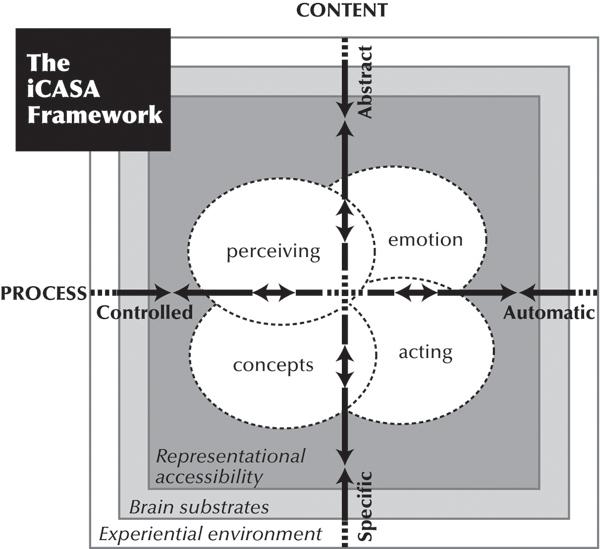
Source: THE AGILE MIND by Koutstaal (2012) Fig.1.2 p.9. By permission of Oxford University Press, USA.
Decision-making involves generating adaptive solutions from prior lived experience. So lots of good experience is beneficial. And, as I have noted, particular experience at particular times builds a host of subskills but also neural networks that guide decisions. To have a good actionable imagination, one must have good limbic-cortical circuitry developed from actual experience so that memories are enriched with actionable skills. Ideas for action are generated from memory systems and then evaluated and selected using emotional and cognitive tools that generate anticipatory feelings and cognitive appraisals. Emotion, cognition and action are integrated.
Good decision-making depends on well-functioning procedural memory systems and emotion systems, built from “kind” (informative) instead of “wicked” (misleading) environments (Hogarth, 2001). In fact, one of the most important tasks of the adult conscious mind is to consider and select environments in which to live one’s life, whether activities, friendships, or workplaces. These environments build up intuitions about what is good and right and skill sets for living so poor environments can take one down the wrong path. Selecting appropriate places to be or live one’s existence is critical for maintaining virtue.
Moral reasoning capacities, then, are partners to emotional capabilities. Although imaginative ethics are rooted in frontal and prefrontal capabilities for abstraction, or pulling away from the present moment and planning, these are based always in various implicit emotional and social perceptions and assumptions built from early-life biosocial procedural knowledge. These baseline assumptions of self-in-world play a part in the perception of what is rational. In fact, one person’s rationality can be perceived by another as irrational (e.g., a person of theistic faith by an atheist or vice versa) (M. Weber, 1904/2009). So I make distinctions among types of moral imaginative capabilities.
Neurobiological Foundations of Our Imaginative Capacities
Neuroscientists depict the brain as a compilation of several brains (Panksepp, 1998). One such division is that between implicit and explicit memory systems (Kandel, 2007), the former of which retains sensory and motor procedures, causal relations and affordances (action possibilities). These understandings are accumulated slowly and with repeated experience (but also sometimes after only one impressive exposure) whereby associations of simultaneously experienced stimuli are retained largely unconsciously), and expressed primarily nonverbally. Thus, even though an individual may believe a decision was made consciously, such is often not the case (Nisbett & Ross, 1980). But even if a decision is made consciously, it relies on a host of implicit knowledge gathered from lived experience (Reber, 1993). We know much more than we can say or explicitly understand (Keil & Wilson, 2000). Our emotion systems, with their deep mammalian roots, form part of this knowledge and facilitate conceptual knowledge (Panksepp, 1998).
Although things are more complex, another division is between the oldest stratum, which represents a set of survival systems (SS) (discussed in Chapters 6 and 7), and two other evolved strata: the visceral-emotional nervous system that enables the social emotions discussed in the previous chapter, and the frontal lobe and its specialized capacities for imagination, perspective taking, and planning into the future (MacLean, 1990). The frontal lobe plays a large role in moral imagination, and so it is a primary focus here.
The frontal lobe structures (FLS), making up around two-thirds of brain mass, overlie the older strata of the brain, which through evolution have become more complex in response.[52] The FLS form part of the somatic-cognitive nervous system on the thalamic-neocortical axis (i.e., the neocortex, primarily the frontal lobes, and related thamalic structures) (Panksepp, 1998). The FLS represent higher-order functions, which are especially apparent in primates and other sophisticated mammals (e.g., dolphins, elephants, whales) and are elaborated in specific ways in humans. Frontal and especially prefrontal cortices give humans the capability to reflect and coordinate the instincts of the survival systems and the intuitions of the visceral-emotional nervous system. The FLS are devoted to organismic action in cooperation with the brain cortices devoted to taking action[53] (Fuster, 1997).
The ability of the frontal lobe structures to elaborate on the external world increases problem-solving and learning capabilities. We can flexibly adopt new skills and gain the knowledge needed to succeed in a particular environment. We can make more complex plans, establish goals remote in time and space, take calculated action rather than follow instinct. FLS allow us to delay impulsive actions making it possible to design an elaborate plan of action (Tucker, Derryberry, & Luu, 2000). Overall, FLS provide more options for ongoing adaptation.
The frontal lobe structures give humans capacities for the reflective moral life, including logical and imaginative moral problem-solving, foresight, planning, learning, and awareness of the self-in-past and the self-in-future. Those with deeper social and emotional experience (of the nurturing kind) are more flexibly intelligent in these ways (Greenspan & Shanker, 2004). What is most impressive is that the frontal and prefrontal areas are malleable throughout life. We can learn implicitly (and effortlessly) from experience but also explicitly (and effortfully) through schooling. FLS capacities include calculating intelligence (J. B. Taylor, 2008), or what is called intellect (MacMurray, 1992).
Although the FLS are usually identified with rational thought, they are intended to be deeply wedded to subcortical emotion systems. How and how well the cortical and subcortical areas are tied together can make the difference between good and poor judgments, for one must “feel” the import of a judgment for it to be a wise one (Damasio, 1994). The mind “thinks with feelings” and “is neither an airy spirit nor an exquisite computing device but a creaky old calculator sunk in a sticky swamp of feelings” (Konner, 2002, p. 139). “In truth, we think because we feel what we are” (p. 141). Even though they are not capable of generating emotions, “the frontal lobes have emerged as the highest center for the emotions” (p. 135). When we envision possible consequences of actions, we “feel them out,” which gives us a chance to compare alternative pathways for action.
Huges and Baylin (2012) describe how the mature brain has strong connections between the front and the back of the brain, as well as “vertically,” from the prefrontal cortext to the limbic system. They suggest that the anterior cingulate cortex (ACC; which we discuss below) is a bridge between the more ancient and more recently evolved parts of the brain. Lying in the midline of the brain, the ACC allows for regulation and reflection on emotions that bubble up from unconscious “neuroception” (implicit perception discussed in chapter 4). Neuroception occurs on an ongoing basis, representing automatic, bottom-up reactions that can take over our minds. (See Figure 5.2 for an adaption of their figure to our discussion.) However, in a top-down deliberate manner, our executive functions release us from the power of neuroception. With these capacities we can shift our perceptions and can choose our responses to events.
Frontal damage is evident by a striking lack of imagination and creativity and inability to learn new skills, monitor temporal ordering of events, or execute behavioral scripts. Social relations are hampered (see review by Fuster, 1997). The most famous case is that of Phineas Gage, whose frontal lobe damage (a railroad tie blasted through his head) changed his personality and capacities for self-control toward the less socially acceptable. But even minor prefrontal damage or misdevelopment can lead to poor initiative and repetitious or perseverative behavior. Thinking becomes more concrete and focused on the present, lacking perspective of past and future. Behavior is noticeably constricted, Often damage is visible only with challenging tasks where an array of choices must be managed. Usually, patients can do many cognitive tasks in isolation (veridical decision-making, where the researcher has designed a problem to be solved) but fail at adaptive decision-making—conducting everyday life activities (e.g., selecting and organizing information from ongoing events) or putting all the steps of an action together (Goldberg, 2002).[54]
We examine features of a subarea of the frontal lobe, the prefrontal cortex, in more detail.[55]
Figure 5.2 Neuroception and the Power of Executive Functions
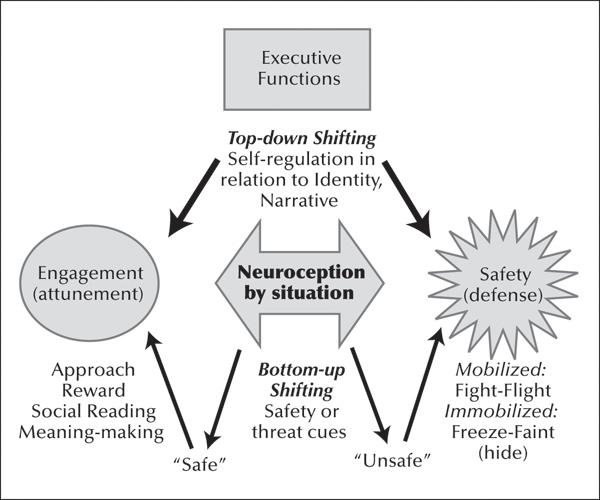
Note: Adapted from Brain-Based Parenting by Daniel A. Hughes and Jonathan Baylin. Copyright © 2012 by Daniel A. Hughes and Jonathan Baylin. Used by permission of W. W. Norton & Company, Inc.
The Prefrontal Cortex
The prefrontal cortex (PFC) is connected with every differentiated area of the brain. As the cortex of association, it is unique in being the only part of the brain able to integrate external information (i.e., from the outside world) with internal information (i.e., from the body and mind of the person) (Goldberg, 2002). The PFC involves a full working memory and governs executive functions—those that deal with initiating and organizing action, planning, sustaining attention, inhibiting reactions, shifting from one task to another, and regulating emotions. The PFC facilitates goal attainment by applying subgoals in the correct order and evaluating their success, thus organizing behavior in real time.
In its capacity for temporally organizing behavior (coordinating actions within time), the PFC has three key functions: maintenance of working memory, anticipatory or preparatory set, and inhibitory control.[56] Working memory contains perceptual and sensory data in relation to actions, ongoing or planned. Anticipatory set refers to “motor attention” and includes a hierarchy of motor structures all the way to the basal ganglia (Fuster, 1997, p. 4). Inhibitory control regards suppressing any internal or external stimuli that might distract from the current goal sequence underway; this involves the orbitomedial prefrontal cortex as well as other cortical and subcortical regions. For example, each area of the PFC has a projection to the amygdala, each with discrete functions (McDonald, Mascagni, & Guo, 1996).
Although the prefrontal cortex is highly complex and much is still unknown (Kringelbach, 2005), several areas are implicated in morality. For example, damage to the PFC can impair social emotions such as guilt, embarrassment, and sympathy (Damasio, 2003). We examine areas linked to moral functioning, and those that are significantly influenced by early caregiving: the anterior cingulate cortex, the orbitofrontal cortex, the dorsolateral prefrontal cortex, and the ventromedial prefrontal cortex.
The Anterior Cingulate Cortex
Found only in apes, including humans, the anterior cingulate cortex (ACC) forms after birth and appears critical for emotion regulation, self-awareness, focusing of attention, dealing with ambiguity, empathy, and problem-solving over the life span; it adjudicates conflicts and competing interests and anticipates rewards (Allman, Hakeem, Erwin, Ninchinsky, & Hof, 2001; Decety & Jackson, 2004; Dolan, 2007; P. L. Jackson, Brunet, Meltzoff, & Decety, 2006). The anterior cingulate and orbital areas may provide the means “through which emotional processing by the amygdala might be related in working memory to immediate sensory information and long-term memories processed in other areas of the cortex” (LeDoux, 2002, p. 228). Moreover, the rostral cingular zone of the ACC contributes to mentalization (Firth & Firth, 2003). Thus, the ACC contributes to multiple aspects undergirding moral functioning. Following my contention that morality is rooted in biological, not surprisingly the ACC is also implicated in physiological health, influencing autonomic functions (e.g., blood pressure, heart rate) (A. Lutz, Greischar, Perlman, & Davidson, 2009).
The ACC is impaired by environmental toxins. For example, lead exposure in childhood leads to decreased gray matter volume in the ACC as well as impaired fine motor control from decreased size of the cerebellum; these effects are pronounced in males (Cecil et al., 2008). Like all areas of the PFC, the ACC relies on intensive caregiving for optimal development (Schore, 1994, 2003a, 2003b).
The Orbitofrontal Cortex
The orbitofrontal cortex (OFC) is central to processing affect-related meaning (Teasdale et al., 1999). It mediates empathy, having the capacity to reflect on another individual’s internal motivational state (Eslinger, 1999; Mega & Cumming, 1994; Povinelli & Preuss, 1995). The OFC is expanded in the right hemisphere and is responsible for emotion expression and unconscious processes (Galin, 1974; E. D. Ross, 1984; Watt, 1990).The OFC receives projections from sensory areas in the posterior cortex and temporal regions, projecting extensively to the central nucleus of the amygdala and to limbic regions in the temporal pole. The OFC seems to be the primary projection site or apex for the limbic system (Nauta, 1972). The limbic circuit (OFC, anterior cingulate gyrus, amygdala, temporal pole) gathers information about and processes other people’s states, gestures, and expression (Baron-Cohen, 1995; Brothers, 1997).
Articulating among the sensory, motor, and limbic regions, the OFC is fundamental for lifelong emotion regulation, including inhibitory control. It allocates attention, manages strong feelings, inhibits survival-focused impulses, facilitates reading social cues, and coordinates sensitive responses to others (Goldberg, 2002). In the emotionally neglected, these relays may not work properly. The OFC is involved in social adjustment, drive control, mood, and sense of responsibility (Cavada & Schultz, 2000). A well-functioning mature orbitofrontal system adaptively regulates both hyper- and hypoarousal, facilitating or inhibiting defensive reactions of the amygdala (von Euler & Folkow, 1958; R. E. Hall & Marr, 1975). The OFC exerts inhibitory control over aggression in social encounters, modulating instinctive behavior (de Bruin, 1990; Starkstein & Robinson, 1997). Without our awareness, the OFC filters stimuli with preconceived biases and then guides subsequent behavior (Bechara et al., 1997).
The OFC has a critical period of maturation in the last quarter of the first year of life and is directly related to attachment processes, mentalizing, intersubjectivity, and the integration of cognition and emotion, functions that are also critical for morality (Barbas, 1995; Diamond & Doar, 1989; Kling & Steklis, 1976). Physical damage to the OFC in the first two years is related to social and moral pathology (S. W. Anderson, Bechara, Damasio, Tranel, & Damasio, 1999). An underdeveloped and immature system influences an individual’s affect-regulatory system, giving more power to the amygdala than to the OFC. Early stress (i.e., consistent undercare of basic needs) can permanently damage the OFC, leading to suboptimal functioning or even psychopathologies like depression and anxiety. As will be discussed in more detail in the next chapter, a stressful environment (from neglect or inappropriate care) promotes chronic excessive arousal, delaying or misdirecting brain development (Schore, 2003a). “Deprivation of empathic care, through chronic excessive arousal intensification or reduction, creates a growth-inhibiting environment that produces an immature, physiologically undifferentiated orbitofrontal cortex (OFC) affect-regulatory system” (Gros-jean & Tsai, 2007, p. 108).
Those with orbitofrontal damage can have difficulty making decisions and processing emotional and social cues, and they tend toward sociopathy (Damasio, 1994; except see Feinstein et al., 2010; Mataró et al., 2001). When dysregulated, the circuit of emotion regulation (OFC–anterior cingulate–amygdala) becomes a risk factor for violence and aggression (Davidson, Putnam, & Larson, 2000). Both predatory and defensive aggression are linked to reduced prefrontal and increased subcortical activity (Panksepp, 1998; D. Siegel, 1999; Raine et al., 1998). There is impairment of volitional control, resulting in poor impulse control, emotion dysregulation, and an inability to foresee consequences (Goldberg, 2002). Defects in the orbitofrontal system—the result of early trauma or a sign of pathology—are apparent in the inability to shift strategies in face of environmental demands and flexibly respond to new situations (Dirkzwager, Bramsen , Ader & van der Ploeg, 2005; van der Kolk, 1996). Right orbitofrontal dysfunction is associated with difficulties with social cognition, anger recognition, and curtailing aggressive responses (R. J. Blair & Cipolotti, 2000). Thankfully, the OFC retains plasticity throughout life, yet stress reactivity can keep people from the types of activities that promote its further growth (Barbas, 1995). It is easy to see how early misdevelopment can have long-term consequences for getting along with others.
The Dorsolateral Prefrontal Cortex
The dorsolateral prefrontal cortex (DLPFC) is involved in deliberative thought, planning, reflecting, making choices, and deciding about fairness (e.g., Knoch, Pascual-Leone, Meyer, Treyer, & Fehr, 2006). The DLPFC seems to underpin cognitive more than emotional processes in moral decision-making (e.g., Duncan & Owen, 2000; Greene, Sommerville, Nystrom, Darley, & Cohen, 2001). It connects to the hippocampal and parahippocampal cortex and is involved in memory. The DLPFC facilitates perspective taking, reciprocity, and cooperation, capacities that increase throughout adolescence (van den Bos, van Dijk, Westenberg, Rombouts, & Crone, 2011). Damage to the DLPFC impairs self-efficacy, which may be related to decreased commitment to relationships (Petrican & Schimmack, 2008). Right DLPFC activation increases truth telling, whereas left DLPFC activation increases lying (Karton & Bachmann, 2011). Recall that the right hemisphere has a sensitive growth period in the first couple of years of life, suggesting that honesty may have its roots in proper early care.
The Ventromedial Prefrontal Cortex
The ventromedial prefrontal cortex (VMPFC) links cognition and emotional experiences, facilitating emotion regulation, compassion, and the settling of survival-focused parts of the brain. In other words, it undergirds many aspects of social-emotional-moral intelligence, including cooperative behavior (Shamay-Tsoory, Tomer, Berger, & Aharon-Peretz, 2003). The VMPFC plays a role in social skills, including the capacity for deep interpersonal relationships and social insight (Freeman, 2000). The VMPFC becomes active in decisions under uncertainty (evaluation and selection of alternative rewards or rewards versus punishments) (Arana et al., 2003; K. Blair et al., 2006; Rahman, Sahakian, Hodges, Rogers, & Robbins, 1999). Damage leads to difficulty in processing future consequences and to more utilitarian choices in trolley dilemmas (e.g., the runaway train will kill five unless you pull the lever and kill one) but more costly punishment of noncooperators in the ultimatum game, suggesting more self-regarding emotion at play (Bechara, Tranel, & Damasio, 2000; Schulkin, 2011).
Different sociomoral emotions correspond to different neural networks. The VMPFC plays a role in prosociality as part of the medial fronto-limbic system. Sociomoral emotions appear to be related to different neural networks. For example, prosocial moral emotions appear to rely on medial fronto-limbic networks, whereas aversive, self-focused moral emotions (i.e., anger, social disgust) are centered in the lateral sectors of the orbitofrontal cortex and the DLPFC (Moll & de Oliveira-Souza, 2007). This helps explain why those with damage to the VMPFC can be rational about personal moral dilemmas but punishing (emotional) toward violators in other situations: Self-concerned networks are intact but prosocial networks are damaged (Koenigs & Tranel, 2007).
The Prefrontal Cortex, Maturation and Morality
As a coordinator of decision-making and action, the prefrontal cortex is of most importance to traditional notions of morality: the ability to make rational choices, be decisive, deal with ambiguity, take the perspectives of others, and think flexibly and adaptively given the circumstances. So when there is damage, it has a large impact on social relations. Goldberg (1999) goes so far as to suggest that prefrontal damage may result in a type of moral blindness:
The prefrontal cortex is the association cortex of the frontal lobes, the “action lobes.” Recall that the posterior association cortex encodes generic information about the outside world. It contains the taxonomy of the various things known to exist and helps recognize a particular exemplar as a member of a known category. Could it then be that, by analogy, the prefrontal cortex contains the taxonomy of all the sanctioned moral actions and behaviors? And could it be that, just as damage or maldevelopment of the posterior association cortex produces object agnosias, so does damage or maldevelopment of the prefrontal cortex produce, in some sense, moral agnosia? (p. 142)
But it is not only physical damage that matters. Schore (1994; 2003a, 2003b) reviewed research and demonstrated that underdevelopment of the PFC in early life undermines sociality generally. All PFC areas rely on proper functioning of and networking with subcortical systems (e.g., basal ganglia) which are on schedule to develop in early life. As we have reviewed, PFC areas are coconstructed with caregivers during sensitive periods in early life. Prefrontal connections with emotion systems are critical for self-regulation but dependent on nurturing and lived emotional experience (Greenspan & Shanker, 2004). Cortex myelination (i.e., glial cells form sheaths around nerve fibers, facilitating interneuronal communication) begins late in the first year but may require companionship care for optimal development.[57] PFC-subcortical connections are built in early life, though some aspects take decades to complete, such as the mylination of the PFC (Giedd et al., 1999; Luna et al., 2001).[58]
As with any dynamic system, later development can be derailed by earlier misdevelopment (S. W. Anderson et al., 1999; Kodituwakku, Kalberg, & May, 2001). But the PFC may also be damaged by behaviors later in life like binge drinking or violent video game play, which enhances subcortical regions at the expense of the prefrontal; such activity seems to transform normal brains into ones that look like those of aggressive delinquents, at least during game play (Bechara, 2005; Mathews et al., 2005).
Early stress can impair the development of the PFC, keeping it from reaching full adult capacities (Teicher et al., 2003). The sense of self, sociality, and morality can be misdirected in their development. However, the PFC also is sensitive to stress throughout life. Under stress, frontal brain areas of normal people are impaired and dissociate (i.e., emotions and memory disengage), unless the individual’s stress response is minimal (Arnsten, 2009). Even mild stress can slow down and impair prefrontal function, in which case subcortical regions (survival systems) gain greater power (Arnsten, 1998, 2009; Arnsten & Goldman-Rakic, 1998). The right hemisphere’s PFC facilitates not only autonomic regulation, but also the processing and regulating of self functions, including autonoetic consciousness, that is, the mental representation and awareness of subjective experience in the past, present, and future (Keenan, Wheeler, Gallup, & Pascual-Leone, 2000; R. Ryan, Kuhl, & Deci, 1997; Wheeler, Stuss, & Tulving, 1997). Thus, when right hemisphere development is undernourished in the first three years of life, the sense of self, including the social self, can be undermined (Schore, 1994).
Our imaginative capacities build on these and other aspects of the frontal lobe system. We focus on the type of imagination that forms the second of our human moral heritages, communal imagination. It involves the full capacities of the frontal lobe (emotional control, foresight, insight, intuition, reasoning) with full relational presence (engagement).
Characteristics of Communal Imagination: Mature Moral Imagination
Communal imagination emerges from the engagement ethic. Engagement is the foundation for social relations, but imagination provides the fodder of possibility; “only imaginative vision elicits the possibilities that are interwoven within the texture of the actual” (Dewey, 1932/1986, p. 348). Communal imagination employs abstraction capabilities to solve moral problems, but not haphazardly or with self-aggrandizement as a backdrop. Instead, it is grounded in empathic effectivity roots and a communal autonomy space. Communal imagination approaches social problems respectfully, and with creativity and commitment. It encourages joy and delight as the world is read “with a sense of freedom and graciousness” (O’Donohue, 2005, p. 13).
Communal imagination is both a realistic and idealistic imagination. It is grounded in embodied social experience that establishes a sense of the limits but also the promise of humanness. Communal imagination does not mean “making things up,” but seeing what is true and that which may not be manifest. It means understanding that experience and mind are linked—that human agency is not an insertion of “will” into an animal body, but a collaborative movement in relationship. It understands that morality is integrated into one’s being and into one’s relationships as they occur, instead of adopted as a separate, intellectual code of ethics. The capacities of the engagement ethic (presence, reverence, synchrony and intersubjectivity, empathy, mentalizing, and perspective taking) are extended into communal imagination as a framing for relationships and for being. Communal imagination demonstrates humanity’s highest capacities with multiple facets: an ethic of love, sympathetic action, and egalitarian respect. (See Figure 5.3.)
Figure 5.3 Extending Engagement with Communal Imagination Ethic
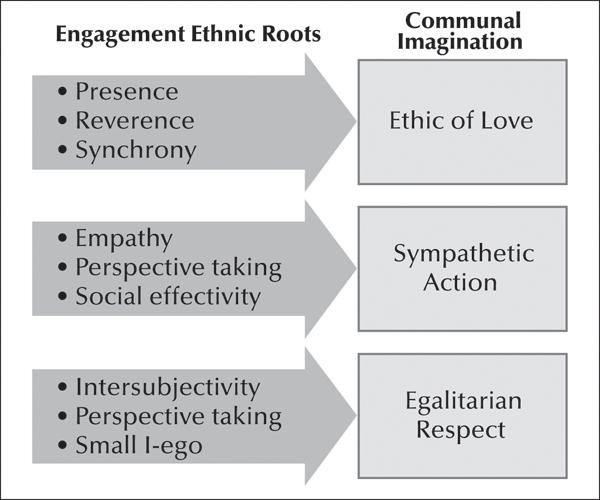
An Ethic of Love
An “ethic of love” means that one is commited to creating an engagement mindset in others, one that allows “safe affiliative strategies to flourish and work well” (P. Gilbert, 2005, p. 19). The ethic here is one of affection, rather than one of laws or rules (MacMurray, 1992). Ethical love is a sense of bondedness to the other as part of the self. Sometimes it is instantaneous, as when parents bond with a newborn, and other times it emerges over time with knowledge of the Other (as between the little prince and the fox depicted in chapter 4). An orientation of love, companionship, and friendship starts in grounded being, in tacit social procedural knowledge, in personal knowledge of the Other that even children are capable of (Polanyi, 1958). Although principles and codes can be extracted from personal knowledge, following rules is for novices learning to master a domain, not for a master who is able to see each situation and each relationship in its own light and as deserving of its own unique treatment. The deep attention of love allows one to perceive that entities and “situations do not come in duplicates” (Fesmire, 1999, p. 59). The particularities of the relationship and the uniqueness of the one loved are cherished.
Capacities for an ethic of love emerges easily from companionship care, where the environmental signals “all the way down” to cells that the child is welcome. Through presence, reverence, and synchrony, loving attitudes and behavior provide the optimal developmental niche. Parents unconditionally love the child and the child loves them back. Through loving experience the child builds emotion systems that form her values; she learns the value of relationships and community, empathy and compassion.
There is a certain spirit about the engagement ethic expanded by communal imagination that is expansively hospitable (Marty, 2005). It is a metacognitive shift to deliberately give over oneself to the relationship in mutual submission, a willingness to be changed by the Other. Esther Meek (2011) describes epistemic knowing in a way helpful for understanding the attitude manifested by someone displaying communal imagination in relationship. Meek says,
[It] is covenantal ... a bit like a marriage. First you bind yourself with promises to love, honor, and obey [moral commitment]. Only then does reality unfold itself to you ... if you don’t comport yourself sensitively, reality won’t unfold. If you don’t comport yourself honorably and you force the real into disclosure, perhaps what you have is less like marriage and more like rape. (Meek, 2011, pp. 37–38)
The commitment to relationship invites true selves to come forward. The need for patient, embracing commitment a common experience among those who spend time in nature who find that creatures only reveal themselves when you are not forceful but respectful (e.g., Dillard, 1999; Leopold, 1949).
Creative interplay true self to true self is a state of forgetting oneself. The partners practice mutual surrender to the Other as companion, as a partner in being and in conversation (verbal or nonverbal communication). Conversation “is a deep, meditative listening, which indwells the authoritative guidance of the other, an encounter intensified by a passionate readiness to understand and be changed” (Meek, 2011, p. 35). When we are flexibly responsive to the Other, we are also capable of being open to alternative viewpoints. A creative partnership encourages freshness and passion and at the same time courage to approach Others with an open heart. Expansive creativity comes from “greater hospitality to whatever is awkward, paradoxical or contradictory” (O’Donohue, 2005, p. 138).
During civil rights actions in the southern United States in the 1960s, activitists were trained in nonviolent civil disobedience. When they tried to integrate lunch counters, many had food dumped on them or were pushed around. Some of the civil rights volunteers in the 1960s were young, self-righteous activists (as they themselves report it), lacking compassion, who felt angry about the way they were treated. Barbara Brodsky reports that at the time she felt nothing for those on the other side:
“They were wrong and I was right; it was that simple. I had no ability to be present with their pain nor to hear them. I had no ability to be present with my own fear nor hear myself” (P. Bloom, 2000, pp. 98–99).
Brodsky tells of pacing and muttering angrily in her jail cell. When a cell mate asked her to sit down, she asked if the woman was angry too. The cell mate said she was, but “I also love them, sweetheart, and they are so afraid” (p. 99). Communal imagination is about embracing the Other as they are, using a 360-degree perception. It is these deep social habits of presence, response and responsibility that underlie communal imagination.
People usually feel responsible for something. But it can be narrow (one’s looks) or large (the neighborhood) or all inclusive (the earth as Gaia). If one does not have a sense of responsibility for the welfare of the Other, then one is not communally imaginative. Responsibility builds on one’s sense of care, a capacity that has roots in one’s inner psychology, which includes the empathic core but also educated awareness of relational connection. With communal imagination, one is able to step outside of usual roles and rules to create new forms of relating that maintain loving respect. We can see this in moral exemplars but also in ourselves and in our neighbors. For example, a school bus driver reports that she learned from her supervisor how to consider her job a spiritual practice. She began to feel responsible for the well-being of all the students in her charge. When a troubled young girl was removed from another bus for hitting children and biting the driver, the girl joined this bus driver’s list of pickups. For several days, the girl sat alone or with the bus monitor, but she looked so lonely that the driver devised a plan. Since this child was the last pickup, the driver was able to speak to the other children ahead of time and tell them that the girl was shy and should be sitting with someone. They all volunteered. A few days later when the monitor was absent, a second-grader began to entertain the girl, making her laugh. Every day after that, the second-grader asked to sit with the girl. Within a week, the girl was ecstatic and said that her mother would be so proud that she had a new friend and that kids wanted to sit with her. She became a totally different child (P. Bloom, 2000). Friendship emerged from presence, encouraged by an embracing ethic of love. The elder mentored the younger into responsible care.
Habituated Sympathic Action
One of the most important habits of attitude and behavior that relates to positive moral action is habituated sympathic action, which combines feelings of compassion for others and concern for their well-being with a sense of responsibility and a propensity to act on behalf of their dignity (Aron & Aron, 1996; S. L. Brown & Brown, 2006). Emerging from experiences that built empathy, perspective taking, and social effectivity, sympathetic action becomes habitual, easy, and pleasurable. Sometimes sympathic actions need to be scripted, as with regular tithing of one’s resources for the less fortunate, or else our distractibility can keep us from remembering to act (Trout, 2009). Yet habituated sympathic action also arises from an attitude of receptivity to the needs-in-the-moment of the Other.
One must distinguish between caring about and caring for (Noddings, 1984). Caring for takes place within a reciprocal relationship, and the caring is guided by knowledge of the Other. Actions are tailored by that knowledge. An ethic of love advances flourishing in others (Fromm, 1956). But, it is impossible to love and show care without personal knowledge of the Other. In contrast, caring about means that the focus is on the agent’s distress or concern, and action reflects an attempt to relieve it. There is inadequate awareness of or concern for the actual life and interests of the affected. Caring about can often turn into actions that are harmful because there is no depth of knowing or because one’s own goals are prioritized over the recipient’s. Parker Palmer (2004) describes how when a “fix-others” attitude pervades social relations, it drives away real growth and healing. When fixing others is the goal, it becomes an ethic of a different sort: impositional altruism (see Chapter 7).
Some cultures show habituated sympathetic concern in everything they do, forming part of the intuitive habits of “being human” and even extending to people outside the affiliative group (Fry, 2006). For example, the French villagers of Le Chambon rescued many Jews during World War II. The rescuers devised many ways to fool the authorities in order to preserve the lives of adults and children, including absorbing them into families and making them seem part of the town. Children entered the school and young adults worked at the shops. When Nazis came by, the villagers took the Jews into the woods, then sang when the coast was clear (Hallie, 1979). Yet when interviewed, the villagers said they did nothing extraordinary.
Among indigenous groups—“old growth societies,” an ethic of love is extended beyond humans to entities in the natural world (Kimmerer, 2013a). We enter this perspective further in later chapters.
Egalitarian Respect
Babies are born with basic relational awareness and expectations for equal treatment (as noted in Chapter 3) and the capacities for intersubjectivity and perspective taking form the foundation for egalitarian respect. Whereas in early life a child develops in an intersubjective world with others face to face, an adult is able to extend perspective taking beyond face-to-face encounters by focusing attention toward commonality with and respect for the unique Other. Showing compassion with respect for the dignity of the Other means maintaining an egalitarian relationship, community member to community member. It is commitment to an ethic of inclusive concern. Such respect fosters egalitarian nonviolence. It means taking the time to attend to the Other and to patiently work out the relationship, often in silence or without words, staying away from intellectual categorizations (considered unreliable and sometimes dangerous by indigenous peoples). The goal is to persuade, not impose, and to work toward consensus. This style of relating, a sense of universal subjectivity, may best be seen in indigenous societies where there is an awareness of and respect for the life energy, and apparently the subjectivity in all lifeforms (C. L. Martin, 1999). In this case egalitarianism represents oneness, not sameness (Fromm, 1956).
In collectivist societies or religious communities like the Amish, egalitarian respect and habituated empathic concern may be more typically found. Members of these societies are particularly skilled at living compassionately with “others in mind,” emphasizing virtues of forgiveness, submission, and modesty, but also practicing their virtues outside of the community, providing support to those in need (Hostetler, 1993; Kraybill et al., 2007). For example, in October 2006, a non-Amish man who lived in the vicinity entered an Amish school in the Nickel Mines area of Pennsylvania, held ten girls hostage and shot them, and then shot himself after police arrived. Amish community members immediately afterward comforted the murderer’s family and forgave him (Kraybill et al., 2007).
Emotional optimality allows for avoidance of stress reactivity, making it possible for the individual to maintain a sense of the interrelatedness of all. The Buddhist concept of metta represents an egalitarian orientation to self and others. One’s life is no more or less valuable than another’s—human or animal. Metta is the ability to let go of ego and self-concern. There is no pedestal for self or Other. There is no doormat self-sacrifice or self-abnegation. One is part of the Whole. Thus, no one sacrifices for the Other but cooperates in life tasks in a type of mutualism.
This reminds me of an inspiring story relayed by Frances Moore Lappé (2007) about a minister who preached for democracy in Kenya despite threats to his life. When a group of assailants attacked him in his home, they began cutting into his body including slicing off his fingers. Certain he was dying, he began to give them his most treasured posessions—his Bible, his library. When asked later how he could do such a thing, he said the following:
“Fear is an energy that comes from inside us, not outside. It’s neutral. So we can channel it into fear, paranoia, or euphoria, whatever we choose ... Imagine a lion ... when a lion sees prey or predator, it senses fear first. But instead of lunging blindly in defense or in attack, it recoils ... the lion pauses a moment, targets his energies. Then he springs. We can do the same. We can harness our would-be fears, harmonize our energies, and channel them into courage.” (pp. 119–120)
The minister’s assailants were so moved by his courage and generosity they subsequently rushed him to the hospital where his life was saved. He showed a fearless ethic of love and egalitarian respect, viewing his assailants as equally valued persons.
Living with communal imagination may foster resilience in times of suffering generally. For example, the president of Uruguay, José Mujica, lasted through a decade of solitary confinement while fellow prisoners did not (they became psychotic) perhaps because of his communal imagination. He reported that he survived because he talked to and shared food with the animals in his confinement, including mice and cockroaches (Romero, 2013).
Types of Collaborative Imagination
There are abundant examples of varying levels and type of collaborative imagination throughout documented history, from Nobel Peace Prize nominees to social entrepreneurs to hardworking volunteers. Those who envision democratic, inclusive constitutions, global declarations, and the like are thinking with communal imagination as long as they maintain an ethic of love and egalitarian respect. (Those who patronize others with their help show a different type of imagination ethic that we discuss in chapter 7.)
There are types of collaborative imagination other than broad communal imagination I have been describing. Each has a sense of egalitarianism and deep concern for the Other. First, there is short-sighted collaborative imagination, in which universal subjectivity is missing. Instead, the focus of concern is humans only, or only one subset of life—in a type of localized morality. For example, in seeking to make refrigeration cheaper for consumers and safer than with the use of various gases, the Dupont Corporation patented Freon for home refrigerators in the 1920s (Freidberg, 2010). Fifty years later it was discovered that Freon and similar chlorofluorocarbons were destroying the earth’s ozone layer and so an international agreement (1987 Montreal protocol) made sure they were phased out. This is an example of intially a short-sighted collaborative imagination (not taking all effects into account) and a subsequent communal imagination.
Second, there is resistant imagination (assertive morality), a type of egalitarian defensiveness, a “bracing against the Other” that uses imagination to thwart what is considered evil. It was visible in the resistance to Nazi occupation during World War II. For example, rescuers in northern European countries adopted a “rescuer identity” and used deception, lying, and even murder in their efforts to save Jews from Nazis during World War II, even though this was far from their usual behavior (Monroe, 2004).
Third, shepherding imagination (shielding morality) is planful protection of others. This is not eliminationist—that is, trying to do away with the Other—but a type of collaboration for protection as when people create strongholds against weather phenomena like hurricanes. Soldiers can also adopt this mindset, although military forces have historically encouraged soldiers in their roles to think less of the Other than of themselves. When the shift is toward inegalitarianism, “It’s us against them” or “We’re superior,” it becomes a vicious imagination (discussed in Chapter 7).
Conclusion
Our inherited moral capabilities encompass not only relational attunement and engagement with others but the imaginative capabilities brought about by the development of the frontal lobes. When people think of morality, they are often referring to reasoning and moral agency. However, the development of emotion systems and cognitive capabilities go hand in hand. Moral reasoning capacities are partners to emotional capabilities. Although imaginative ethics are rooted in frontal and prefrontal capabilities for abstraction, or pulling away from the present moment, these are based always in various implicit emotional and social perceptions and assumptions.
What if things don’t go well in early life? One is more likely to have brain-body systems that do not function well, propelling one’s attention onto the self and away from higher human capacities. Stress reactivity and a more self-protective attitude toward the moral life can result. We examine these in the next chapters.
Summary Points
-
Imagination allows us to juggle the demands of the social life.
-
The agile moral person uses a range of capacities from extremely controlled (deliberate, conscious, intentional) to extremely automatic (nondeliberate, unconscious or preconscious, nonintentional, habit-based), selecting what is appropriate for the situation.
-
When things go well in early childhood, the grounding for communal imagination in the frontal lobe (including the prefrontal cortex) is fostered.
-
Life experience influences how well the prefrontal cortex and its components function.
-
Communal imagination builds on the engagement ethic, empathic effectivity roots, and communal autonomy space.
-
Communal imagination comprises an ethic of love, habituated sympathetic action, and egalitarian respect.
-
Collaborative imaginations include types that are not fully communal.
Chapter 6: Undercare and Excessive Stress Response: Early Life Gone Wrong
The inner bully elbowed into her thoughts: “You can’t do this. Just give up. People will laugh at you. They will know the truth—how stupid you really are.”
How we become, all along the way—conditions of support or rejection in our relational systems—determines who we become, whether oriented to compassion or to self-protection. In many ways, how a living entity becomes constitutes what that entity is (Whitehead, 1929/1978, p. 166). When early care is poor, it sets us on a suboptimal trajectory and leads to a different becoming. Undercare of our evolved needs in early life leads to deficiencies in the brain structural integrity, hormonal regulation, and system integration that lead to sociality. Early stress is especially toxic to long-term well-being because it undermines development of brain and body systems. When a child does not receive appropriate care, the more primitive brain systems may dominate social relations, curtailing optimal moral growth. Stress reactivity will overwhelm psychological and moral functioning.
Herman Melville’s Billy Budd offers a good illustration. When falsely accused, had a reaction similar to my “frozen brain” example at the beginning of the book:
Not at first did Billy take it in. When he did, the rose-tan of his cheek looked struck as by white leprosy. He stood like one impaled and gagged ... “Speak! Defend yourself.” Which appeal caused but a strange dumb gesturing and gurgling in Billy ... Though at the time Captain Vere was quite ignorant of Billy’s liability to vocal impediment, he now immediately divined it, since vividly Billy’s aspect recalled to him that of a bright young schoolmate of his whom he had once seen struck by much the same startling impotence in the act of eagerly rising in the class to be foremost in response to a testing question put to it by the master ... The next instant, quick as the flame from a discharged cannon at night, his right arm shot out, and Claggart dropped to the deck. (Melville, 2013, Chapter 20)
After becoming so distressed that he was paralyzed and could not speak, Billy Budd shifted to externalizing and responded with a fist, knocking his accuser dead. As we will see later, this oscillation between internalizating and externalizing, is not unusual. Early life establishes the thresholds for many systems, including homeostasis—the balance that the body and mind aim for as normal. Early experience can set up systems that lead to oscillation in the face of stress.
Homeostasis
Life is a challenge. To survive, thrive, reproduce, and have a good life, animals must spend most of their time interfacing with the world, actively getting needs met for food, shelter, warmth, and, for humans, social connection. Homeostasis is a mechanism for keeping the organism in balance with the environment throughout all these activities. Homeostasis refers to systems that “operate to maintain the same set point and achieve stability” (Schulkin, 2011, p. 91). When working properly, homeostatic mechanisms allow the organism to interact in a coherent, meaningful manner to get needs met.Vital processes such as body temperature, fluid levels, circulation, balance, digestion, growth, and many other support systems must be modulated and coordinated within small ranges of function in response to the body’s shifting response to the environment.
Let’s look at the physiology. The autonomic system maintains physiological homeostasis. Its two main branches, sympathetic (arousing) and parasympathetic (preserving) are composed of neural circuits that efficiently control hormones, organs, and intestines. They are activated by external stimuli or internal representations (i.e., imaginative motives for moving the body) that the prefrontal cortex transmits primarily from the medial and ventral parts to the amygdala’s basolateral nucleus. The amygdala is tuned into novelty.Whether the sensations come externally from the world or internally from mental representations or other signals, circuits in the amygdala translate the represented image into a physiological (somatic) state (Ansermet & Magistretti, 2007; McDonald, 1998). The endocrine system also plays a role in activating the autonomic system with projections to its controller, the hypothalamus, and the corticomedial nucleus in the amygdala. There is a constant interplay among environmental stimuli, triggered internal representations (influenced by experience), and somatic state. The somatic state of action represents the anticipation of control.
Homeostatic self-regulation is orchestrated by hormones, which help solve the problems presented by ongoing events by passing along meaningful information and inducing “brain events that prompt [the individual] to behave in ways dictated by environmental clues during problem-solving” (Schulkin, 1999, pp. 2, 5). Many of our body systems are constantly responding in ways we have learned are appropriate for the context. Maintaining homeostasis involves maintaining appropriate levels of body substances with the use of physiological and behavioral strategies (Schulkin, 1999). Internal or external signals raise concentrations of hormones that regulate the threshold at which a behavioral response to environmental stimuli is elicited, inducing readiness to perform an action (e.g., heart rate accelerates when something scares you to prepare you to run). An individual’s set of inner thermostats includes fixed action patterns inherited through evolution (Llinás, 2002). For example, when levels of the hormone aldosterone are elevated, animals are better able to recall where salt sources are located in order to satisfy their craving for sodium (Krieckhaus, 1970). When glucose runs low, the body mobilizes to obtain more or slows down. When the appetite hormone ghrelin is high, animals are more attuned to food cues to meet their need for calories. Circulating hormones and the body’s state are detected by the insula and other regions of the brain sensitive to them and form the association between perception of the external world and somatic state (Ansermet & Magistretti, 2007). In this way, hormones guide perception, affordances (feasible action choices), and goals.
For animals and plants, responsiveness to environmental challenges and opportunities requires agility. It means the body’s systems are flexible, like bamboo, but able to keep balanced under stress—stability through change (McEwen & Stellar, 1993). Dynamic equilibration is the aim of multiple systems in the body. For example, if neurotransmitter levels go up, receptor and effector levels go down, and vice versa (Niehoff, 1999). For homeostatic maintenance, both anticipatory and reactive behaviors are adaptive in meeting the needs of the organism (Moore-Ede, 1986; Schulkin, McEwen, & Gold, 1994). Even social contexts can trigger hormones, influencing homeostatic mechanisms.
Behavior is generally described as occurring in two phases: appetitive—the search through action for what is desired (which can be active or reactive); and consummatory—completing the act, which may look like resting. Throughout these actions, the body is constantly equilibrating, responding to internal needs and the ever-changing environment. Appetitive behaviors are reflected in behaviors that address a desire (to flee, to eat), whereas consummatory behaviors reflect relief. Social behavior adaptation is a matter of shifting between appetitive behaviors (seeking social contact and support) and consummatory behaviors (enjoying social well-being) (Schulkin, 2011). Our hunter-gatherer cousins seems to spend much more time in leisurely social consumption whereas we seem to spend more time in appetitive social behavior—e.g., searching for social satisfaction (e.g., through media).
As complex embodied creatures constantly immersed in the real (external) world but also in our own bodies and imagined psychological (inner) worlds, humans continually coordinate a triple set: the (inner) physiological world, the psychological world (the interpretation of the inner and outer influenced by culture), and the outer world. Human life has a lot to do with maintaining homeostasis through a shifting social landscape. We discuss this further in chapter 8.
Healthy homeostasis (aka eustasis) can be contrasted with cacostasis (defective homeostasis or distress), which represents a deficient or excessive reaction on either side of balanced homeostasis (Chrousos, 2009). Cacostasis is one form of three possible reactions to stressors, and constitutes the inappropriate response (too much or too little reaction). A second type of reaction is a perfect reaction that returns the system to homeostasis. A third type of reaction is also a perfect response, but one in which learning also takes place and capacities are improved (hyperstasis) (Chrousos, 2009). Hyperstasis (aka allostasis) refers to flexible adaptation to constant change with the anticipation of becoming changed (Sterling & Eyer, 1988). To keep things simple, however, we will use the term homeostasis to encompass the positive forms and cacostasis as a reference to the defective forms.
The Stress Response
Stress response is a homeostatic mechanism that protects stability and survival. These capabilities stretch back in evolution more than 500 million years (Bentley, 1998). Stress response is an organism-wide phenomenon and is fundamental to the functioning of the whole brain-body complex. Stress-related hormones affect metabolism, cardiac activity, immune responses, appetite, neuronal function, and behavior (see Meaney, 2010, for a review).When there is no perceived stress, metabolism is focused on anabolic activity, or energy storage, which is promoted by insulin. During anabolic activity, fats (fatty acids, glycerol) are stored in adipose tissue as triglycerides; proteins (amino acids) and glucose (glycogen) are stored throughout the body. This consummatory behavior focuses on growth and maintenance.
Although minor activation of stress hormones is ongoing, mobilizing one for daily activities (e.g., getting out of bed), the “stress response” generally refers to the strong reaction to threat. A strong stress response is adaptive when there are real threats to life and limb, as when a speeding car is approaching while one crosses the street, or when melon-sized hail suddenly starts to fall. It is a generalized reaction built to respond to threatening situations. It is an active response that reorganizes body functions in particular ways. Built for short-term, acute stressors, which most organisms face periodically, it becomes a problem when it is overmobilized in one way or another or for too long.
Let’s examine how the strong stress response works (which from now on is referred to as the stress response). Within seconds of a perceived threat, the stress response is activated, taking up the body’s energy and attention. In animals (vertebrates), two separable stress response circuits are activated. These circuits are functionally integrated: the hypothalamic-pituitary-adrenal (HPA) axis and the locus coeruleus–norepinephrine (LC-NE) system. In mammalian species, these systems are coactivated and link to limbic structures such as the amygdala and anterior cingulate, the mesolimbic dopaminergic system, and the medial prefrontal cortex (see Boyce & Ellis, 2005).
The circuit most studied is the HPA system, which contains two interrelated subsystems. One subsystem involves the paraventricular nucleus (PVN) in the hypothalamus and attends to the regulation of the HPA axis. (Some call this the limbic-hypothalamic-pituitary-adrenocortical [LHPA] axis because of its linkages to the hippocampus [López, n.d.].) Within a few seconds of a perceived threat, the PVN-HPA system takes off. The hypothalamus releases CRH (corticotropin-releasing hormone), a central coordinator of stress and arousal systems (Rossi, 2002). CRH works immediately to stimulate the anterior pituitary gland to produce pro-opiomelanocortin (POMC), which forms numerous messenger molecules, including ACTH (adrenocorticotropic hormone, or corticotropin). ACTH facilitates arousal states, stimulating the adrenal to release glucocorticoids (steroid hormones whose effects take hours). It is carried by plasma to the zona fasciculata of the adrenal cortex, which triggers cortisol secretion.
Cortisol is a hormone that has been studied extensively. Cortisol, a glucocorticoid, is a principle regulator of multiple body functions including glucose metabolism, blood pressure, and immune competence. It inhibits neuroendocrine axes that promote growth and reproduction (see Boyce & Ellis, 2005; Gold, Goodwin, & Chrousos, 1988). Under normal conditions, circulating cortisol regulates the activity of the LHPA axis by using feedback inhibition in several centers, including the hypothalamus, the pituitary, the hippocampus, and the frontal cortex (Boyce & Ellis, 2005, p. 273). However, when secretions of glucocorticoids are chronically high they are associated with disease, including insulin resistance and diabetes, hypertension and heart disease, diminished immune function, and major depression (Chrousos & Gold, 1992; McEwen, 1998).
The second subsystem of CRH has to do with the amygdala’s corticolimbic circuitry and connections. CRH, as a key psychobiological regulator, has cell bodies spread widely throughout the prefrontal, insular, and cingulate areas of the cortex, the bed nucleus of the stria terminalis, the substantia innominata, and the amygdala (see Chrousos & Gold, 2002; Owens & Nemeroff, 1991). The CRH gene is widely distributed through the nervous systems, both central and peripheral. CRH-synthesizing and -secreting neurons appear throughout the cortex, suggesting that stress is a brainwide as well as bodywide response. CRH proliferates in the brain’s prefrontal, insular, and cingulate areas, which are known for their coordination of other brain inputs (De Souza & Grigoriadis, 2000). This illustrates why stress takes over attention and response.
The second major system in the human stress response is the locus coeruleus–norepinephrine (LC-NE) system. It includes noradrenergic cells of the medulla and dorsal pons with their projections to the medial prefrontal cortex, amygdala, hippocampus, and mesolimbic dopamine system (Boyce & Ellis, 2005, p. 271). The LC’s activation of hypothalamic centers is a contributor to the activation and regulation of the autonomic nervous system, which has three branches: sympathetic, parasympathetic, and enteric (embedded in the gastrointestinal system). The sympathetic system regulates physiological arousal. It stimulates the adrenal medulla, which releases epinephrine. Many other organs in the body are stimulated to release norepinephrine. Both epinephrine and norepinephrine are catecholamines that produce effects on tissues within seconds. A number of other hormones are released beyond these. For example, endorphins, secreted by the pituitary, regulate pain perception. Glucagon, from the pancreas, regulates the movement of carbohydrates. At the same time, the parasympathetic system is inhibited, shutting down insulin (used for digestion and energy storage) as well as reproduction. The body is ready to energize muscles and burn calories to run from the threat or attack if necessary.
In summary, when threat is perceived, the stress response mobilizes existing resources, converting them to usable substances for muscle mobilization. Multiple systems are affected. In terms of metabolism, the stress response stops anabolic activity (energy storage promoted by insulin production) to create catabolic activity (energy use). In terms of the gastrointestinal system, stress inhibits digestive processes, including salivation (hence dry mouth during nervousness). In terms of the cardiovascular system, the stress response increases blood flow to the heart, elevating heart rate, and away from other organs. Glucocorticoid secretions increase, which in the short term function to balance energy for needed action, facilitating expression where needed for homeostasis (Sapolsky, 1992). However, over the long term, excessive glucocorticoid secretions cause degeneration and pathology. Chronic activation of the LC-NE leads to susceptibility to autoimmune diseases (Elenkov & Chrousos, 1999); overexposes the amygdala[59] to norepinephrine, increasing alertness; and can facilitate traumatic memory retention in the striatum and hippocampus, contributing to stress-related symptoms (Introini-Collison, Dalmz, & McGaugh, 1996). Greater activity in the HPA is related to chronic disease, chronic depression, obsessive-compulsive disorder, panic disorder, scrupulosity (extreme perfectionism), malnutrition, diabetes, and obesity. Temporarily decreased HPA activity is related to depression, including seasonal depression; chronic fatigue, fibromyalgia; adrenal suppression; and rheumatoid arthritis. (For more details, see Tsigosa & Chrousos, 2002). Thus, it pays to learn to calm an overreactive stress response (as we discuss in chapter 11).
In terms of cognitive effects, the stress response takes energy away from higher cortical functions. Who needs to think carefully in the face of a perceived death threat? “Flight, fight, freeze, or faint” offer the best set of options when we are under real threat. In fact, cortisol generally disrupts hippocampal activity, affecting the ability of the temporal lobe to form memories (D. M. Diamond & Rose, 1994; Conrad, LeDoux, Magarinos, & McEwen, 1999; Kim & Yoon, 1998; McEwen, 1999). Long-term potentiation of neuronal synapses (LTP), critical for long-term memory, is difficult to induce during stress (D. M. Diamond & Rose, 1994; Kim & Yoon, 1998; McEwen, 1999; Pavlides, Watanabe, & McEwen, 1993; Shors, Seib, Levine, & Thompson, 1989). A stressed-out school child will have difficulty learning. As the stress response continues, it leads to eventual hippocampal neuronal degeneration, damaging memory systems (Chrousos, 2009). All of these changes account for the memory dysfunctions observed in stress-related psychiatric conditions like depression and posttraumatic stress disorder (PTSD) (McEwen, 1999; Sapolsky, 2004). Other systems are involved such as the oxytocin system which mutually regulates the HPA and has anti-stress effects (Dabrowska et al., 2011; Neumann, 2008; Neumann & Landgraf, 2008). So, activities that increase oxytocin release, like rough-and-tumble play and cuddling with trusted others help alleviate stress.
As noted earlier, stress is normal and required to move us along in life (e.g., getting dressed). It is the chronic triggering of the strong stress response that is ultimately harmful, not only to the individual’s well-being, but to morality, as we shall see in the next chapter.
The Stress of Poor Early Care
A newborn has few systems ready for prime time. The visual system is the most developed at birth but with final maturation four months later. The survival systems are in place but are conditioned by the type of care received. Much of the rest of brain-body development has a long way to develop, including that of the various systems that contribute to the stress response, and is deeply reliant on the assistance of caregivers. Within the first two years, during the introduction of the child to the surrounding environment, the immune system learns from early experience to elaborate the repertoire of antibodies that will play a role in future vulnerability to infectious disease and will be used throughout the individual’s lifetime (Niehoff, 1999; see also de Kloet, Rosenfeld, van Eekelen, Sutanto, & Levine, 1988; King, 1996). The number and function of neurotransmitters, and the ratio of immune cells are among the many body characteristics shaped by early life (Grosjean & Tsai, 2007). Because this is a sensitive period for threshold establishment, early-life stress can cause permanent changes in neuroendocrine and neurotransmitter systems, including corticosteroid, CRH, opiate, dopamine, serotonin, and noradrenaline receptors (Coplan et al., 1996; Ladd, Owens, & Nemeroff, 1996; Rosenblum et al., 1994; van der Kolk, 1987). Affected will be intelligence and motivation, as well as the sociality so important for optimal moral functioning.
Most research on childhood stress effects focuses on extreme cases. The field of developmental traumatology finds that infant maltreatment (abuse, neglect, and trauma) leads to massive physiological deficits: an overreactive stress response, compromised immunity, a misdeveloped endocrine system, underdeveloped neurotransmitters (in terms of both number and function), mistuned emotions and emotion systems and poor integration of emotions with prefrontal controls, and deficient corpus callosum with nonoptimal brain hemispheric integration (Lanius, Vermetten, & Pain, 2010). The Adverse Childhood Experiences (ACE) studies (Felitti & Anda, 2005) shows that particular negative experiences in childhood—specifically, physical and sexual abuse, witnessing of domestic violence, parental verbal abuse, peer verbal bullying, and harsh corporal punishment—are linked to later health problems. The more of these one has experienced, the greater one’s risk of health problems, including early death. Altered brain structure, connectivity, and blood flow have also been found among 18- to 25-year-old survivors of higher amounts of negative childhood experiences (Anda et al., 2006).
However, there is increasing concern about the long-term effects of less extreme early stress, naming it “toxic” (Young-Bruehl, 2012; Shonkoff et al., 2012). Recall that humans are born 9–18 months early compared to other animals and so this period after birth should mimic the womb as much as possible and limit distress. The stress response system must be protected from either overheating or collapsing due to challenges the young child’s brain and body are not yet ready to handle (Niehoff, 1999). I believe that when a child does not experience the evolved developmental niche (see Chapter 2), it causes excessive stress. In my view, a baby that does not receive what it evolved to expect (recall chapter 2) is undercared for, sabotaging optimal development. The United States has epidemics of anxiety and depression among all age groups, suggesting widespread deficiencies in the brain system functions we have been discussing (Hofer, 1987; T. Lewis et al., 2000; U.S. Department of Health and Human Services, 1999). See Table 6.1 for a list of physiological effects of inappropriate care.
Although trauma can be physical or social, postnatal social stressors (i.e., nonresponsive care) can be much more detrimental than postnatal nonsocial stressors (Bonne, Grillon, Vythilingam, Neumeister, & Charney, 2004; Sgoifo et al., 1999). Relational trauma does the most damage because humans are social mammals who rely on social relations to build and maintain a well-functioning human being.
Multiple systems related to the stress response are influenced by caregiving in early life, yielding long-term consequences for brain development and behavior. These include the amygdala, the vagus nerve, gene expresson, and the LHPA axis (Kaufman, Plotsky, Nemeroff, & Charney, 2000; Meaney, 2010; Porges, 2011). The LHPA is adversely affected by poor care in the first year of life (Gunnar & Donzella, 2002). With poor early care, the endocrine stress response—marked by glucocorticoids, hormones secreted by the adrenal glands—shows increased secretions, affecting CRH expression (i.e., greater synthesis under adverse conditions) in the amygdala in adulthood (Ladd et al., 1996). When rats, who are not as socially bonded as humans, are exposed to stressors arising from poor maternal care (low touch), there are permanent changes in GABAergic function in the amygdala and the ventromedial prefrontal cortex (Caldji, Diorio, & Meaney, 2003). Maternally-deprived offspring are more likely to become listless and hopeless when situations are difficult, showing altered levels of CRH receptor activity in the amygdala, prefrontal cortex, and locus coeruleus, in addition to CRH activation of the HPA axis.[60]
Table 6.1 Physiological Effects of Inappropriate Care
+--------+
Chronic early stress or trauma increases the amygdala’s capacity to learn and express fear associations and the incapacity of the prefrontal cortex to control it, creating a vicious cycle that escalates fear and anxiety, spiraling into more stress and dysregulation. Toxic stress can increase glucocorticoids, causing cell death in the limbic system’s affective centers and thereby create abnormalities in emotion circuitry (Benes, 1994; DeKosky, Nonneman, & Scheff, 1982; Kathol, Jaeckle, Lopez, & Meller, 1989). High reactivity (linked to greater activation in the right prefrontal cortex) in early life is likely to become a part of personality, setting up the body for lifelong hyperreactive stress response, greater symptoms of anxiety or depression and less happiness (E. P. Davis & Sandman, 2010; Kagan & Snidman, 2004; Lupien, McEwen, Gunnar, & Heim, 2009).
Think of what you do when you realize that a certain thing stresses you out excessively—you avoid it. You change the channel. If it is social relations generally or a certain social relation, you might try to avoid it (like a person with avoidant attachment), but when you don’t have a choice but to encounter it, your reactivity will undermine your morality. We discuss this further in the next chapter.
Epigenetics
Just to underscore the point of the importance of early care for optimal development, let’s look at epigenetics (how experience affects the exptression of genes). The most extensive work on the epigenetics of early life care has been done by Michael Meaney and colleagues. They study rats and measure the effects of affection. They find that gene expression of glucocorticoid receptor proteins involved in controlling anxiety is affected by early care. In numerous studies over several decades, Michael Meaney and colleagues have recorded the effects of maternal touch on gene expression (e.g., Weaver, Szyf, & Meaney, 2002). Rat studies show that maternal affection in the first week of life is linked to altered expression of more than a thousand genes (Szyf, Weaver, & Meaney, 2007). For example, pups with high-nurturing (high-licking) mothers in the first ten days of life have more active versions of a gene that encodes glucocorticoid receptor protein in the hippocampus. Rats with poor nurturance have a weaker feedback system for controlling anxiety, resulting in more anxiety and heightened stress responses to the unfamiliar throughout life. Maternal affection in the first ten days of life (the equivalent of the first six months of life for humans) determined methylation of the particular glucocorticoid receptor protein studied, whether the mother was an adopting mother or the biological mother, ruling out genetics. The methylation pattern matched that of the caregiving mother. Further, the behavior pattern was enhanced in the daughter, compounding poor bonding and poor brain functioning over generations (Weaver et al., 2005; Weaver, et al., 2004; Weaver, Meaney, & Szyf, 2006). In humans, unhappy childhoods with poor nurturance are related to methylation of mood areas of the brain, which are linked to schizophrenia and suicide (McGowan et al., 2008).
Epigenetic changes in early life have cascading effects on developmental plasticity. In general, individuals with greater stress reactivity—that is, with less ability to switch off “fight-or-flight” hormones—are more likely to have a high resting heart rate and high blood pressure, experience increased appetite, and suffer from detrimental effects on systems regulating growth, reproduction, metabolism, and immunity as well as emotion (Chrousos & Gold, 1992). Emotion dysregulation and poor attachment at six months predict depressed performance on later assessments of social and cognitive capacities (National Institute of Child Health and Human Development, 2004). Growing up in a stressful household (and the resultant frequent and intense activation of stress hormones) leaves one susceptible to physical ailments (heart disease, diabetes, obesity) and mental disorders (anxiety, depression, drug abuse) (Lupien et al., 2009; Meaney, 2010). Elevated glucocorticoid levels tend to be specifically toxic to hippocampal neurons, but also collaborate with elevated glutamate (excitoxicity), which is neurotoxic as well (McEwen, 1999; Sapolsky, 2000).
In short, early caregiving has long-term epigenetic and developmental effects, some of which emerge only at later time points, like adolescence, as late-forming psychopathologies (Schore, 2003a, 2003b). Because of epigenetic and plasticity effects, suboptimal trajectories may be initiated early. For example, with nonresponsive care, neurotransmitter receptors will be underdeveloped, or certain genetic alleles will dominate outcomes instead of experience—those with the short version of the serotonin transporter gene are vulnerable to depression, but only if they experience trauma or ongoing stress in early life (Dettmer, Suomi, & Hinde, 2014). Also, plasma oxytocin levels will be set at low levels, potentially leading to addictions to food, sex, drugs, and video games, which are fueled by dopaminergic rewards to the oldest parts of the brain, the nucleus accumbens in the ventral striatum, part of the basal ganglia.
Psychological Disorders From Stress
Stress can be toxic to adults also. Excessive stress is being implicated in multiple psychological disorders that have their roots in a similar dysfunction: biological reactivity (Boyce & Ellis, 2005, p. 271). When you have a horrible, very bad day, you experience how stress wears away the capacity to cope calmly with life events. By the time the umpteenth thing goes wrong, even if you are resolved not to, you lose your cool. Over the series of unfortunate events your system became more and more sensitized, finally overloading and exploded cacostatically. If the overload goes on day after day, becoming chronic, there are lasting effects.
Chronic stress appears to remodel the brain, creating a hyperreactive amygdala and an underdeveloped, dysfunctional hippocampus, thereby influencing all sorts of cognitive and social functions (Grosjean & Tsai, 2007). Chronic stress in rodents (induced by repeated, long-term immobilization) simultaneously enhances dendritic arborization in the amygdala and promotes degenerative effects in the hippocampus (Vyas, Mitra, Rao, & Chattarji, 2002). When stress has gone on too long or too intensely at a critical time, it sensitizes the system to even greater reactivity, leading to easy kindling (excitation) (McEwen & Stellar, 1993). When a stress is too intense and enduring (e.g., combat), overreactivity can become the new “normal” (McEwen & Stellar, 1993). Loss of control over the stress response becomes normalized as the neural and endocrine systems malfunction on account of altered feedback mechanisms and abnormal levels of hormones.
There is still much unknown about how stress sculpts the brain. For example, depression is related to chronically elevated levels of cortisol. Elevated cortisol in depressed and panic-disorder patients is linked to suicide attempts (Fawcett, 1992). Hospitalized suicidal patients have high cortisol but also fewer receptors for CRH in the frontal cortex than normals (Nemeroff, Owens, Bissette, Andorn, & Stanley, 1988). In antisocial personality disorder, the stress response system is completely unresponsive (Schulkin, 1999). Under excessive stress, the stress response can oscillate, lock in, or give up (Niehoff, 1999) (see Figure 6.1). When oscillation happens, it is like pressing the gas pedal and the brake pedal simultaneously, jointly activating hyperexcitation and hyperinhibition, resulting in a “freeze” response (McEwan, 1998; Niehoff, 1999). This can happen to any victim. In both PTSD and impulsive aggression, glucocorticoids continuously oscillate. Depression and repressive personality both show glucocorticoid elevation, whereas anxiety (comorbid with depression) shows overactivation of the sympathetic nervous system. More specifically, trauma alters transmitters and receptors in norepinephrine pathways, creating instability in the sympathetic nervous system and precipitating “exaggerated behavioral responses more appropriate to emergency situations” (Southwick, Krystal, & Morgan, 1993).
We can see long-term effects of early trauma in studies of PTSD. PTSD is characterized by a mixture of anger and anxiety, and chronic negative feeling (Panksepp, 1998). In school-aged children suffering from PTSD due to violent family culture, the startle reflex fails to habituate, resembling that of a five-year-old (whose startle reflex is overreactive) rather than that of children their own age, which normally matches that of adults (Pynoos, Steinberg, & Ornitz, 1997). Their catecholamine threat-detection systems are placed on long-term alert by the trauma they have experienced.
Perhaps Ted Kaczynski (the “Unabomber”) was one of these children. He experienced severe trauma at nine months of age by being separated from his mother and family for several days during a hospital stay, an experience that his mother says changed his personality ever after.[61] The result of such trauma, as in PTSD, is heightened sensitivity to threat cues. For instance, if your father is a bully, your senses might become acute at the time of day when he arrives home (perceptual sensitivities). Will he be in a good or bad mood? If footsteps in the hall signal that your father is coming to molest you, you go into survival mode—dissociation—for example, by speaking to the stars during the ordeal, as Derrick Jensen (2004) did. Like seizures that are kindled from particular stimuli, emotionally significant external cues set off an automatic stress response. One can be sensitized to certain situational characteristics that activate stress neurocircuitry. War veterans with PTSD can be plagued by sudden movements or sounds. Those who were abused as children may never grow out of going “on alert” at the time when their abuser approached. Borderline personality disorder represents a case study of the combined physiological and psychological effects of early neglect and abuse.
Figure 6.1 Stress Effects on Brain Function
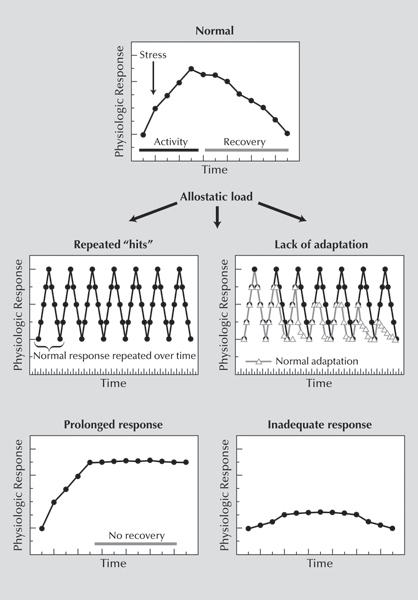
Source: Reprinted with permission from B.S. McEwen, “Protective and Damaging Effects of Stress Mediators,” The New England Journal of Medicine 338 (1998): 171–179. Copyright © 1998 Massachusetts Medical Society. All rights reserved.
Brain Development and Excessive Stress
Babies are born with the majority of neurons in place but with most networks yet to be developed. Those networks represent 75 percent of adult brain weight. Since brain development is an experience-dependent process, prenatal and postnatal periods are times of heightened brain plasticity across systems (LeVay, Wiesel, & Hubel, 1980). The early environment coconstructs neural circuits, determining “structural and functional aspects of brain and behavior for the lifespan” (Roth & Sweatt, 2011, p. 398). Although there are two major types of brain cells (neurons and glial cells), more is known about neurons, so our focus is there.
A simplistic narrative of the development of the brain follows several steps. First, neurons are generated and migrate to the appropriate location; most of this is done in the womb. Second, neurons grow axons and dendrites for communication purposes, forming synapses with neurochemical system guidance. Some of this happens in the womb, but most of it occurs in early life, under the guidance of experience. Third, connections are fine-tuned, also from experience (e.g., pruning). Fourth, the critical period ends when experience-responsive tuning finishes and when myelin forms. Most of the brain growth that occurs in the first five years of life follows steps two through four.
However, the dynamism of brain development is not reflected in these simple steps. The brain state is constantly changing depending on what is needed for optimal growth. For example, early in neuronal development, serotonin proliferates to direct brain traffic and then diminishes (D’Amato, Blue, & Largent, 1987; Hohman, Hamon, Batshaw & Coyle, 1988; Lauder & Krebs, 1986). There is a lot of traffic to direct. There are around 85 billion neurons and 85 billion nonneuronal cells in the brain.[62] Neurons communicate electrochemically: (Electrical) impulses jump from one neuron to the next, which changes the actions of ion channels (chemical). Interconnections are governed by neurochemicals that can enhance or depress communication. Building vast neural networks, neurons that fire together not only “wire together” but “conspire” together, representing a unity of reality in temporal coherence (Llinás, 2002).
Brain functioning is modulated by multiple neurotransmission systems (Fox, Daw, Sato, & Czepita, 1991). There are three major sets of neurotransmitters, aside from acetylcholine: (a) amino acids (primarily glutamate, gamma-aminobutyric acid or GABA, aspartic acid, and glycine), (b) peptides (e.g., vasopressin, somatostatin, neurotensin) and (c) monoamines (norepinephrine, dopamine, and serotonin).
Most neurotransmission is carried out by the amino acids glutamate and GABA. Glutamate is a fast-acting excitatory neurotransmitter, and GABA is a fast-acting inhibitory neurotransmitter. Both achieve most of their effects within one millisecond by opening ligand-operated ion channels—contrasting with the work of slow-acting neurotransmitters like biogenic amines and peptides that require hundreds of milliseconds if not minutes to have an effect because of more complicated biochemical sequences. Glutamate has several subtype receptors, including N-methyl-D-aspartate (NMDA).[63]
Knowledge about brain function is shifting rapidly, so in the following sections we will look at just one brain developmental aspect that has import in moral development, focusing primarily on NMDA and borderline personality disorder (BPD). NMDA, one of the neurotransmitter subtypes involved in neuronal functioning, plays a critical role in the development of brain function. What happens when it malfunctions demonstrates how the brain can be undermined by poor early care.
NMDA
The glutamatergic system, particularly N-methyl-D-aspartate (NMDA) subtype receptor, is used by 60 percent of brain neurons as a primary neurotransmitter (Javitt, 2004). NMDA is vital for synaptic plasticity, the flexible variability of signal strength transmitted via a synapse (i.e., “cells that fire together wire together”) (Hebb, 1949). NMDA receptor (NMDAR) differs from all other receptors in that it can detect the co-occurrence of two events (associativity), which implicates it in capacities needed for memory–long-term potentiation (LTP) and long-term depression (LTD) of neural synapses (Flohr, 2003). LTP represents the long-lasting strengthening of the synaptic connection between two neurons after a series of conditioning trains of impulses, and LTD represents the opposite, the weakening of connection (Bliss & Lomo, 1970). Associative LTP induction is dependent on NMDA neurotransmission, meaning that learning and memory require the proper functioning of the NMDA neurotransmission system (Collingridge, Kehl, & McLennan, 1983). Working memory is impaired by NMDA antagonists, and potentiation of NMDA transmission is corrective of memory deficits in primates and humans (Rowland et al., 2005; Tsukada et al., 2005). Note that conditioning and extinction of fear rely on the proper functioning of NMDAR in the amygdala. NMDAR maintains the associative function of the hippocampus and cortex, including the hypothalamus’s sensory relay and the alarm system of the amygdala and basal forebrain (Chambers et al., 1999).
NMDAR is vital for the developing nervous system; it is critical for cognition, memory, and neuronal plasticity. During early development, NMDAR function and availability is influenced by external events like early care that shape molecular events (Fox et al., 1991; Kawahara, Kawahara, & Westerink, 2000; Nihei et al., 2000). The individual’s neurotransmitter systems are tailored by the environment (of course, quality, magnitude, timing, and duration of environmental stimuli matter for particular neurobiological and clinical consequences). Through developmental plasticity during sensitive periods, NMDA activity and thresholds for multiple brain structures may be set in early life (Perez-Otano & Ehlers, 2005). Neglect and lack of stimulation lead to underproduction of NMDA, which is linked to psychological disorders like Borderline Personality Disorder. On the other hand, when NMDA agonists are underproduced, NMDA function is overenhanced and is linked to schizophrenia (Coyle & Tsai, 2004).
Several steps in brain maturation are highly influenced by NMDAR. The NMDA neurotransmission system appears to be a mediator between the environment and molecular effects as it facilitates growth and metabolism of widespread corticolimbic areas during critical periods. Pruning, or synaptic scaling, restricts axonal fields, rearranging and refining synapses. Pruning occurs in several developmental time periods during which NMDA receptors play a critical role. Metaplasticity refers to how prior synaptic activity can change the direction or magnitude of subsequent plasticity (not affecting synaptic efficacy). This means that the threshold for LTP and LTD induction can be shifted more or less permanently based on environmental factors; such threshold shifts in the somatosensory, motor, and piriform cortices occur during learning and development (Perez-Otano & Ehlers, 2005).
An early stressful environment (e.g., unresponsive caregiving) modulates NMDAR transmission up, leading to neurotoxicity and cell death and shrinking, for example, the dentate gyrus in the hippocampus, thereby influencing memory processes (McEwen, 1999; De Bellis et al., 2001). As noted earlier, stress has growth-inhibiting effects on the nervous system. Those effects seem to be driven in part by its impact on NMDA neurotransmission. Excessive stress results in unregulated excitation of glutamate neurons such as NMDAR, leading to free radicals and cell destruction; such chronic stress sensitizes the amygdala and erodes memory capacity through hippocampal degeneration (Minor & Hunter, 2002; Grosjean & Tsai, 2007). To illustrate the influence of early stress on specific neurobiological systems and subsequent sociomoral functioning, we take up the case of borderline personality disorder (BPD).
Borderline Personality Disorder
Many brain disorders have their roots in childhood neglect, abuse, trauma, or undercare (i.e., lack of the evolved developmental niche). Easiest to study are those that show extreme behavioral or physiological markings, like reduced hippocampal or amygdalar volume. Borderline personality disorder (BPD), diagnosed in 1 to 2 percent of the population, is related to reductions in both hippocampus and amygdala volumes and to malfunctioning of multiple neurotransmitter systems (Driessen et al., 2000). BPD demonstrates multiple layers of dysfunction, showing impairment in everything from neurotransmitters (glucocorticoid and aminergic) and synaptic plasticity to learning and memory systems (reduced hippocampal and amygdalar volumes) (for a review, see Grosjean & Tsai, 2007). Dopamine dysfunction may underlie the impulsivity, emotion dysregulation, and cognitive-perceptual impairment associated with BPD (Friedel, 2004).[64] These outcomes are assumed to be caused by stress or neglect during critical periods of neuronal development and are thought to be the result of impaired NMDA-mediated neurodevelopment (Elberger & Deng, 2003). Thus, stress reactivity is not the only thing that goes awry to cause BPD and other disorders; impaired capacities and functioning of multiple other systems are implicated as well.
Grosjean and Tsai (2007) suggest that BPD be considered a developmental disorder because excessive early stress affects both metaplasticity and neuroplasticity. NMDA-glutamatergic neurotransmission may “represent a major interface between the environment and neurobiological plasticity and could be a critical mediator at the level of the hippocampus, amygdala and frontal cortex”; in this regard, eighteen to forty-eight months of age may be a sensitive period for developing borderline personality disorder (Grosjean & Tsai, 2007, p. 108). The integrity of and connections among the three brain strata—the protoreptilian survival systems, limbic system, and frontal lobes—are critical for proper emotional development (MacLean, 1990). Extensive pruning, myelination, and cognitive maturation occur during this time period, and if care is poor, proper setup may not take place. Inappropriate early environmental stimulation results in poor synaptic density and reduced size of brain regions containing NMDA receptors (Bredy, Zhang, Grant, Diorio & Meaney, 2004).
BPD patients exhibit disorganized emotional cognition; high levels of social fear, including fear of abandonment; low positive affect; low nonaffective constraint; and a reactive negative affectivity system. The anterior cingulate cortex (ACC), discussed in the previous chapter, is defective in BPD. The ACC mediates impulsivity control, attentional control, response facilitation and inhibition, and conflict monitoring (Hazlett, New, Newmark, 2005; Juengling et al., 2003; Milham & Banich, 2005). Multiple specific capacities are mediated by NMDAR, such as working memory, general learning, reversal learning, and consolidation of memories, including autobiographical memory (Flohr, 2003; Palencia & Ragozzino, 2004). NMDA “trophically regulates the critical period of growth and metabolism of widespread corticolimbic areas” (Grosjean & Tsai, 2007, p. 107), suggesting that if it is underperforming at a critical time point, a particular brain region will underdevelop, with subsequent cascading effects. Anand and Scalzo (2000) propose that maternal separation and sensory isolation lead to lack of NMDA receptor activity, resulting in increased apoptosis (programmed cell death) in multiple areas of the immature brain. Repetitive pain may lead to excessive NMDA activity, damaging neurons as well. Both extremes may be the cause of altered pain sensitivity, ADHD, impaired social skills, and self-destructive behavior.
Evidence also suggests that the corpus callosum, the bridge between the two hemispheres of the brain (and presumably many other integrative tracts, especially those linking the brain stem and cortex) is underdeveloped in subjects who have experienced early trauma or neglect or both. Teicher and colleagues (2004) propose that these patients present a reduced integration between the right and left hemispheres. He suggests that the dysfunctional integration between hemispheres may predispose patients to shift abruptly from left- to right-dominated states with very different emotional perceptions and memories. They lack playfulness. This finding could be in part the result of impaired NMDA-mediated neurodevelopment (Elberger & Deng, 2003). Thus, again, biological reactivity is not the only thing that goes awry to cause BPD and other disorders. The NMDA research shows us that physiology at the level of cell function is affected by gestational stress and postnatal care, particularly caregiving behaviors. The bottom line is that environmental signals translate into real biological outcomes, changing anatomy and function for the long term.
Stress, Self-regulation, and Moral Character
Biopsychosocial disorders like BPD impair multiple factors including neuroception and social capacities, working and autobiographical memory, learning, and executive functions. Relationships become very difficult and the moral life tempestuous. As noted above, excessive stress creates a hyperreactive HPA circuit, undermining sociality. In comparison to “normal,” people with BPD have deficiencies in the empathy circuit, which includes the ventromedial prefrontal cortex (VMPFC), middle cingulate cortex (MCC), inferior frontal gyrus (IFG), superior temporal sulcus (STS), and amygdala, among other areas, including deficiences in the links between the VMPFC and the orbitofrontal cortex (OFC) (Baron-Cohen, 2011). In a trust game, BPD participants, unlike controls, showed no activity in the anterior insula, an area related to cooperative and trusting gestures (King-Casas et al., 2008). In fact, BPD patients have greater activation of the amygdala when presented with aversive stimuli (Herpertz et al., 2001) or facial expressions (Donegan et al., 2003).
Splitting, common to BPD, is all-or-nothing thinking, characterized by an extreme categorization of people into evil or good (Fairbain, 1952). According to object relation theory, this is what happens when an infant takes in and internalizes an inconsistent relational world, splitting it into good and bad representations during moments of rage, panic, or fear, indicating prefrontal cortex deficiencies. This may also reflect poor establishment of prefrontal cortical linkages to the subcortical emotion systems due to neglect. These factors will make it difficult for borderlines to be oriented to anything other than self-protection in social situations.
What is interesting for our discussion about disorders that emerge from early stress is how much they look like moral character issues. When an individual’s stress response is unbalanced, the perceptual safety net (neuroception) is damaged, and the system will either overreact to undangerous things, ignore true danger, or replace empathy with contempt (Niehoff, 1999). When one’s body doesn’t work right, or gets out of control, it’s hard to feel compassion or behave in a prosocial manner. For example, those whose systems are poorly self-regulated spend a great deal of their energy (glucose) on trying to conform in ways that are not habitual to them (e.g., sitting still in school). Their systems probably generally have less to work with (e.g., a lower number of neurotransmitters with faulty communication), so although they spend a great deal of their energy trying to behave, they eventually run out self-regulation capacities, leading to acting out (Gailliot, 2008; Gailliot et al., 2007). We can see the chronic moral ramifications in a study of diabetics. When experiencing low glucose, the diabetics were less likely to forgive than were those without diabetes (DeWall, Pond, & Bushman, 2010).[65]
Niehoff (1999) summarizes well the results of ongoing stress, and how it can look like deficient moral character when really it is biological reactivity and the breakdown of coping ability from too much stress:
This is why bad neighborhoods, bad homes, and bad relationships breed violence—not because of a willful deterioration in moral character but because of a steady deterioration in the ability to cope. As stress wears away at the nervous system, risk assessment grows less and less accurate. Minor insults are seen as major threats. Benign details take on a new emotional urgency. Empathy takes a back seat to relief from the numbing discomfort of a stress-deadened nervous system. Surrounded on all sides by real and imagined threats, the individual resorts to the time-honored survival strategies: Fight, flight, or freeze. (p. 185)
Stress wears away the capacity to cope calmly with life events. Chronic stress appears to remodel the brain, creating a hyperreactive amygdala (enhanced dendritic arborization) and an underdeveloped, possibly dysfunctional, hippocampus (Vyas et al., 2002). See Table 6.2 for a summary of disorders related to poorly functioning physiology. In PTSD and impulsive aggression, glucocorticoids continuously oscillate. In antisocial personality disorder, the system is unresponsive.
Table 6.2 Key Features of Stress Response Disorders
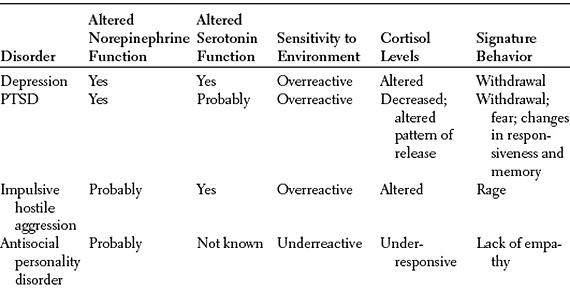
Source: © 1999 by Debra Niehoff/reprinted by Permission of Regula Noetzli/Affiliate of the Charlotte Sheedy Literary Agency.
Conclusion
Biological reactions to stress evolved to be helpful in times of acute threat. But if they are wired to be easily triggered, as when the hypothalamus-pituitary-adrenal axis is sensitized, these usually protective mechanisms become harmful. When chronically activated they are transmuted into dysfunctionality or pathology. When intense, prolonged, or occurring in early life, stress can cause long-term damage at the level of neurotransmitters such as NMDA.
Generally speaking, stress is increasing among American families (N. B. Anderson et al., 2012). Mental health problems due to overactive stress response systems have skyrocketed in recent decades. An overactive and trigger-happy stress response undermines physiological and mental health. And it matters for morality. What undermines physiological health can also alter moral character. Stress can put us into a different moral mindset—from brain-freeze paralysis to combativeness. This is the focus of the next chapter.
Summary Points
-
Humans, like all organisms, seek homeostasis.
-
Set points for the immune and other systems are established in early life.
-
When children don’t receive the care they need, they develop compromised physiological systems that are more likely to respond cacostatically (too much or too little) than homeostatically.
-
The stress response is shaped by early caregiving. Thus, inadequate caregiving leads to an impaired stress response.
-
The stress response impairs higher-order thought and compassion.
-
Borderline personality disorder is a case example of how inadequate early care has long term ramifications for physiology, well-being, and social relations.
Chapter 7: The Morality That Stress Promotes: Self-Protective Ethics
The nightly yelling had started. All she could do was put the pillow around her head. It didn’t really help. Crying didn’t help either, but she did it. She did not notice when her little brother tried to climb up the ladder to the top bunk, which he was not allowed to do. She wasn’t thinking. When her brother fell off the ladder, she didn’t care. And she didn’t see that he was now crying too. Stress + personal distress=little empathy
In this chapter, we examine the survival mechanisms that take over one’s mind in moments of perceived danger.
Survival Systems
At birth we emerge with a set of phylogenetically ancient basic emotions systems that we use for survival. These self-protection mechanisms ensure that the organism has the equipment to stay alive through exploration and under threat. These survival systems (SS)[66] can trigger the stress response and direct physiological resources toward self-protection.
Brain structures involved in the survival systems include parts of the brain stem, the basal ganglia and related structures, and the amygdala, all shared with other animals (Panksepp, 1998). The brain stem is the most self-focused part of our brains and is needed for survival, managing homeostasis (changing pulse rate, monitoring temperature, etc.). As a whole, the basal ganglia integrates action with cognition, motivation, and affect; facilitates goal-directed repertoires; and is implicated in declarative and strategic memory (i.e., intentional recall and management of recollections). The basal ganglia can be considered the “ancient amniote complex” or “the early vertebrate complex” (Cory, 2002, p. 12). The basal ganglia include the corpus striatum, comprising the caudate and putamen, with the medial extension, the nucleus accumbens. The basal ganglia also include the palladium (globus pallidus). Associated structures include the substantia nigra, the ventral tegmental area, and the subthalamic nucleus (see Parent, 1986). Also part of survival systems is the extrapyramidal motor system, which is responsible for automatic motor programs like breathing and walking. The SS generally govern autonomic response; life support systems such as heartbeat, respiration, and blood circulation; they manage basic food acquisition, basic reproduction, and bodily defense.
Other brain systems are also implicated in a survival focus. Two of three parts of the visceral-emotional nervous system (VENS) are also focused on self-survival and are often discussed in parallel with the SS, as they are bidirectionally connected with the protoreptilian complex through the medial forebrain bundle (MFB) and have output pathways to the cingulate gyrus, a primitive emotional cortex (e.g., Cory, 2002). One system concerns feelings and behaviors related to self-preservation; the other concerns feelings and behaviors related to species survival through mating. Both systems that focus on survival can take over the brain/mind and direct energy away from higher-order systems until homeostasis is reestablished, so they are considered part of the basic survival systems that are largely in place at birth, ready for conditioning (Panksepp, 1998).
Several basic emotions systems form part of the SS. The basal ganglia and limbic system form the source for the basic emotions of exploration (SEEKING), anger (RAGE) fearfulness (FEAR),[67] as well as separation anxiety or sorrow (PANIC), and sexuality (basic LUST).[68] These are systems that enable the organism to survive into the future (Panksepp, 1998). Each emotion system has its own circuitry but also reciprocal connections with cortical areas (the frontal lobe especially) and the hippocampus. We examine SEEKING, RAGE, FEAR and PANIC.
Seeking
You know that “let’s go shopping—can’t wait to find a bargain!” feeling? That “anticipatory euphoria” refers to the SEEKING emotion system (Panksepp & Biven, 2012). It plays a role in much of mammalian motivation. When things go well (under evolved conditions), animals automatically explore the environment and learn which actions are unsafe and which are effective to obtain food and and other needs (Bogdan, 1994).
For decades, SEEKING was a focus of behavioristic research of mammalian motivation, so it is the most well-studied emotion system. It is an appetitive, reward-reinforcement system sourced in the basal ganglia and limbic system. We focus on the dopaminergic system, which enervates both motivation and exploration. When dopaminergic systems are functioning well, one has energy, focus, clarity, and pleasurable feeling. Like all neurotransmitters, dopamine “is an ancient information molecule, whose history transcends vertebrates and has evolutionary multiple receptor subtypes, found in both the peripheral and central nervous system” (Schulkin, 2011, p. 129). Dopamine underlies adaptive behaviors, including approach/avoidance as well as attention and motivation (Schulkin, 2011).
In terms of brain structures, dopamine pathways emerge from the midbrain and link to the nucleus accumbens and the prefrontal cortex. The dopaminergic reward system has several projections—a mesocortical projection pathway, specifically connecting to the frontal lobe systems, including the cingulate cortex and perirhinal cortex (Tzschentke, 2001). Dopamine helps incentivize behavior, sensitizing the mesolimbic dopamine system to particular rewards (Berridge & Robinson, 1998; T. E. Robinson & Berridge, 1993). The nucleus accumbens, with massive dopamine inputs from the tegmentum and the amygdala and outputs to motor control areas (e.g., pallidum), is a relay for emotion and movement, playing a critical role in motivated behavior (Graybiel, Aosaki, Flaherty, & Kimura, 1994; Mogenson, Jones, & Yim, 1980). The amygdala and nucleus accumbens work together in facilitating stimulus-reward and stimulus-punishment learning but are not activated once a behavior is well learned (Ledoux, 1996).
Dopamine is metabolically converted to norepinephrine, which is essential for cognition, particularly attention, but also cautious assessment. When the norepinephrine system is active, the principle followed is “Better safe than sorry,” but dopamine itself follows a different principle “If it feels good, do it” (Niehoff, 1999, p. 131). Naturally delightful things like food and sex stimulate pleasure, but so do acquired preferences. Feelings of pleasure can come from the activation of “hedonic hotspots,” a chemical stew involving the nucleus accumbens (Berridge, 2003).
Dopamine works in concert with serotonin, whose various receptors are found in many brain systems but primarily in the gut. Together, serotonin and dopamine mediate normative thoughts and moods, whereas disordered serotonin and dopamine pathways provoke diseases such as psychosis and mood disorders (for a review, see D. R. Wilson, 2002). Even perception is compromised by dopamine depletion; for example, fear-inducing faces may become more salient (Schulkin, 2011). Like serotonin, dopamine plays a role in cognition.
Dopamine is broadly tied to the organization of action, inhibition, prediction of events knotted to the presence or absence of reward, feeding and sexual behavior, diverse forms of reasoning, non-reward but salient events, drug reinforcement, behavioral vulnerabilities (drug administration, anxiety, metabolism), associative learning and perhaps other forms of elementary learning, and just about any form of behavioral cognitive task one can imagine. (Schulkin, 2011, p. 133)
In the prefrontal cortex, dopaminergic function is related to working memory, reasoning, and behavioral coordination. Dopamine expression is essential for behavior inhibition and adjudicating among competing drives.
Multiple disorders have roots in malfunction or misdevelopment of the basal ganglia, which generally relies on dopamine and shares reciprocal pathways with the frontal lobe systems. Such disorders include autism, attention-deficit hyperactivity disorder (ADHD), obsessive-compulsive disorder (OCD), Tourette’s syndrome, schizophrenia, depression, Huntington’s chorea, and Parkinson’s disease (for a review, see Greenberg, 2002). When the basal ganglia’s use of dopamine is dysfunctional, higher-order systems are unable to control motor behavior, which becomes stereotyped (e.g., rocking, pacing) (Dantzer, 1986). OCD’s stereotyped behavior can be viewed as a “short-circuit” (perseverative firing of a neuronal circuit) in the brain, whose perseverations can be interrupted and modified with behavioral therapy and deep brain stimulation (Schwartz & Begley, 2003).
Early experience can jack up or dampen the SEEKING system. Chronic grief or panic in early life may deplete the joie de vivre that the SEEKING system otherwise provides (Coenen, Schlaepfer, Maedler, & Panksepp, 2011; Panksepp & Watt, 2011). When the SEEKING system is thwarted endlessly (external constraints go on too long), the animal can permanently “give up,” like rats do when held until they stop struggling; when put in water, these rats drown instead of swimming to safety (Richter, Zeuch, Riva, Gass & Vollmayr, 2013). The animal sinks into “learned helplessness” (Seligman, 1976). It is as if their spirit or will has been snuffed out. However, these findings are primarily from studies of rats. We can be sure that things are more complicated in humans.
Turning to the the social domain, when children do not receive appropriate care, pleasure from social experience (e.g., through affection and play) may be “disincentivized,” corresponding to faulty connections between subcortical and cortical areas important for prosocial behavior. In this case, nonsocial SEEKING (i.e., achievement, accumulation of things) may become more pleasurable and dominant in the personality. I suspect that SEEKING is best shaped within a highly supportive environment. Children raised with responsive care will have much more incentivizing of social activity, more practice and success in social interaction, and greater gratification from it. This seems to be the case among adults and children in traditional societies who develop deep empathic effectivity roots (J. Diamond, 2013; Everett, 2009; Turnbull, 1983).
A second moral core emerges at times of autonomy growth spurts—early childhood (around age two) and adolescence. During these periods a person’s autonomy space is established. The autonomy space refers to the boundaries for how far the individual’s SEEKING-driven behavior extends. In the small-band hunter-gatherer society, when autonomy first strongly emerges, young children’s grabbiness is generally redirected playfully (although a child’s of hitting someone else might generate a strong reaction from an elder) (Endicott & Endicott, 2014; Hewlett & Lamb, 2005). Autonomy aggression is redirected and shaped into noncompetitive social play, resulting in little socially-harmful SEEKING (Fry, 2006, 2013; Gray, 2013). In these cases, the individual’s empathy and autonomy work hand in hand. The circle of community support keeps energies within the bounds of prosociality. If social shaping toward sharing and nonaggression does not occur at this time, SEEKING may get out of control, overriding empathy, and lead to an untempered dominance of ego-desires. This can result in actions that do not attend to social consequences, and perseveration in maintaining the euphoria of acquiring (e.g., things, achievements, awards) at the expense of others’ welfare. That is, if an individual is not guided with compassion toward cooperation during these autonomy surges, the SEEKING system may become overdominant—acting at the expense of others in a type of “affluenza” (Graaf, Wann, & Naylor, 2001; Pani, 2000). Then there is no stopping point for SEEKING, which can roam beyond the bounds of concern for effects on others. “Agency” thus becomes dominant over “communion” (Bakan, 1966). Intuitions about agency are unfettered and unguided by the ropes of empathy. I can see numerous points in my life when this was the case—when my own goals ruthlessly overrode the needs or desires of others—a destructive type of morality we discuss later.
Rage
We RAGE when we are frustrated—when our autonomy or freedom is restricted, when our bodies are irritated or in pain, or when our expectations are not fulfilled (Azrin, Hutchinson, & Drake, 1969; Panksepp, 1998). It is easy to see the RAGE system emerge when the limbs of a baby or other animal are suddenly restrained. The sympathetic system is activated, raising blood pressure, and mobilizing the stress response (Campos, Mumme, Kermoian, & Campos, 1994; Iwata & LeDoux, 1988).
The RAGE system may have evolved to facilitate escape from predators. The frustrations of being cornered and a vigorous resistance to a predator’s closing jaws favor escaping otherwise certain death. Anger changes perception and reactivity in all animals. When one is in an angry state, any rapid movements by others are interpreted as threats and provocations.
Lorenz (1966) contended that aggression is a species-preserving instinct whose spontaneity makes it dangerous because, like many instincts, it springs up forcefully like a ravenous appetite. It is an “internal pressure or force controlling one’s actions and views of the world” (Panksepp, 1998, p. 191). Perhaps the most useful view of aggression is that it emerges to solve a problem. Archer (1988) suggested that there are three main problems that evoke different types of aggression. Threats to the young promote parental aggression. Threats of attack evoke protective aggression. Threats to status or resources promote competitive aggression. Much of aggression results from reactive self-defense, a dynamic intermixture of FEAR and RAGE (Blanchard, Blanchard, & Takahashi, 1977; Panksepp, 1998). Two classification systems for aggression are represented in Table 7.1. Note that all but two forms are reactions to threat.
When properly shaped during early life, anger is vital for times of stress and danger. Anger is useful in mobilizing the organism to attempt greater safety. It becomes detrimental when anger is generalized beyond a particular situation or an individual develops an angry disposition.
Table 7.1 Two Classification Schemes for Aggression: Causal and Functional
+------+
Source: Adapted from Niehoff, 1999, Table 3.1, p. 74. © 1999 by Debra Niehoff/reprinted by Permission of Regula Noetzli/Affiliate of the Charlotte Sheedy Literary Agency.
Anger can be triggered by symbols or gestures endowed with particular meaning. Or, certain learned cues may be associated with provocation, triggering rage. Learned cues may also sustain an angry mood, which can turn into hatred (a more sophisticated, calculated, behaviorally constrained, and cooler emotion) that leads to instrumental aggression (Panksepp, 1998). But appraisals are also under frontal lobe control, making anger a matter of interpretation. Normally, one can choose to be angry or not. Those with frontal lobe damage get angry easily but cool down fast, showing that they lack the control of anger and also the rumination to keep it alive, supporting the notion of a frontal linkage to controlling and maintaining anger (Damasio, 1994). Animals whose neocortices have been removed show rage (previously termed “sham rage” because of fear of anthropomorphizing) (Panksepp, 1998). Frontal lobe damage can also lead to apathy or an inability to experience emotion.
Fear
Have you experienced the hairs standing up on the back of your neck? FEAR is an evolved adaptation and characteristic of our nervous systems (Schulkin, 1999). FEAR mobilizes physical systems for self-protective action. FEAR is not a passive response, as sometimes believed. In response to a perception of danger, it generates problem-solving behaviors that lead to greater adaptation; it is “a central motive state that potentiates readiness to behavior in specific ways” (Schulkin, 1999, p. 145). Thus, it is a matter of intelligence. FEAR represents a biological response, and overlapping with the stress response, FEAR prepares the animal for transformative action—flight, fight, freeze, faint.[69]
The amygdala is a brain organ that plays a large role in FEAR reactions. It reacts to novelty and threat. The associative learning between the amygdala and brain stem is partnered with autonomic changes, and with motivational and attentional arousal—all of which constitute emotion and are developed in early life (M. D. Lewis, 2005). The amygdala receives input from all sensory systems. When the amygdala is activated by the senses, it shifts the somatic state through the autonomic system. In situations of compelling events, the amygdala heightens associations between the cortex and the affective motor systems in the brain stem that control such things as orienting (Cardinal, Parkinson, Hall, & Everitt, 2002; Gallagher & Holland, 1994).
As noted earlier, the amygdala plays a role in the stress response. The amygdala’s detection of threat leads to the release of stress hormones (Corodimas, LeDoux, Gold, & Schulkin, 1994). When the adrenal steroid hormones (cortisol in humans; corticosterone in other animals) and the neuropeptide corticotrophin-releasing hormone (CRH) are elevated, they act on limbic sites like the amygdala, increasing the likelihood that danger will be perceived and that fear will be experienced (Schulkin, 1999). Input from the amygdala is more likely to dominate working memory and so fear or anxiety takes over consciousness (LeDoux, 1996).
The amygdala alters processing from the early stages of sensory reception (Amaral, Price, Pitkanen, & Carmichael, 1992; Armony, Quick, & LeDoux, 1998). It acts directly on circuits related to working memory, including the medial (anterior cingulate) and ventral (orbital) prefrontal cortex (Groenewegen et al., 1997; McDonald, 1998). The amygdala is also involved in prepared kinds of fast learning and fast social judgments that underlie human decision-making. As Schulkin states, “fast and inappropriate prejudicial responses are also linked to amygdala activation. A broad-based behavioral dimension is the familiar and unfamiliar distinction ... The unfamiliar provokes attention and learning and scientific inquiry,” activating the amygdala (Schulkin, 2011, p. 157). Fast judgments (e.g., evaluations of others) may be tapping into amygdalar response, circumventing cortical pathways. Many studies of gut reactions to moral dilemmas may be measuring this level of decision-making, conditioned by early experience rather than assessing humanity’s higher capacities.
We all need to respond to real threats. In those with well-functioning emotion systems—that is, with strong cortical control of subcortical systems—the amygdala shows flexible functioning as part of an adaptive response to changing contexts. The prefrontal cortex maintains inhibitory and excitatory connections with the amygdala and demonstrates the power to mitigate or enhance a threat focus using reasoning or shifting of attention. However, this capability is not fully developed until nearly age thirty (Goldberg, 2002; Luna et al., 2001).
The amygdala’s connection with and function of the frontal lobe is a primary pathway for dysfunctional stress response. Dysfunction in the hippocampus plays a role as well. Early trauma can kindle multiple limbic sites (Harkness & Tucker, 2000), resulting in heightened sensitivity to threat and difficulty calming down (Post, Weiss, & Leverich, 1994). A hyperexcitable amygdala occurs when the frontal lobe circuitry (the “brakes”) is underdeveloped, contributing to social anxiety. It demonstrates less flexibility, representing pathology, and fosters greater fear as well as maintaining abnormal fear circuitry and increasing social isolation (J. H. Jackson, 1884/1958). Those with generalized anxiety disorders typically have an abnormally large right (not left) amygdala (De Bellis et al., 2000). Damage to the amygdala in humans is evident from lowered response to fear-related stimuli and fearful facial expressions as well as decreased eye contact. Fear conditioning can be linked to a benign stimulus and can appear and persist with “trauma reminders” (M. Davis, Walker, & Lee, 1997; van der Kolk & Fisler, 1993).
When a threat occurs, FEAR will suppress SEEKING and PLAY (discussed in Chapter 4). For example, when a rat cage is tainted for a day with a cat smell, rats avoid their usual playful behavior for several days (Ferrero et al., 2011). The olfactory system is tied to emotional circuitry, so smells cause the FEAR system to be activated, inhibiting normal behavior. Sudden, loud sounds can do the same. The natural response to an unconditioned stimulus (a cat smell for rats or loud sounds like bombs for humans) becomes linked with contextual cues, leading to a conditioned response of fear. One can imagine that with repeated ongoing threat cues, fearful behavior becomes normalized. In situations of continued fear, maintaining high glucocorticoid secretions may cause damage (to neurons, fat cells), eroding the ability to respond to stress and reflecting cacostasis (allostatic overload) (McEwen, 1998; Niehoff, 1999).
Panic
Have you ever felt crazy-anxious you could not settle down or so grief-stricken you felt like you would waste away alone? This is separation anxiety or PANIC. The PANIC system encompasses sorrow and loneliness due to social separation. Because of their sociality and need for its benefits, social mammals of all ages typically seek out others and become physically agitated and mentally disturbed when isolated (see T. Lewis et al., 2000, for a review). The PANIC system may have evolved as a separation distress system vital to the survival of offspring who are born so early they cannot survive without watchful caregiving (Panksepp, 1998). The PANIC system is designed to keep offspring safe—when first separated, they become distressed and cry, and the mother responds with physical (or vocal) presence to promote a sense of safety.[70] Separation anxiety is so powerful that it can take over the whole body. Grief is one form that is characterized by weakness and depression (“sickness behavior”):
Autonomic symptoms of a parasympathetic nature, such as strong urges to cry, often accompanied by tightness in the chest and the feeling of having a lump in the throat[,] ... [tend] to motivate thoughts about the lost object of affection and [impel] one to seek the company of special loved ones. (Panksepp, 1998, p. 212)
Further, Panksepp (1998) speculates that the primitive suffocation-alarm systems in the brain may be closely aligned with the separation-distress systems, resulting in panic when cues for suffocation are triggered (e.g., by claustrophobic settings). Though the PANIC and FEAR systems can be separated in the brain, they often operate synergistically, as fear can lead to panic and panic attacks can lead to chronic anxiety (Panksepp, 1998).
In terms of brain structures, the PANIC system is activated with CRH (which also participates in FEAR) and certain kinds of glutamate receptor stimulants (especially those that act on NMDA receptors). Panic arouses stress response, and very quickly survival instincts can become engaged (fight, flight, freeze, faint).
Not surprisingly, when the PANIC system in mammals has been sensitized from patterns of early distress (e.g., extensive isolation), it leads to greater stress reactivity in new situations (Hertsgaard, Gunnar, & Nachmias, 1995; Meaney 2010). Heritable effects (which include genetic, epigenetic, and other experiential effects) have been noted as well. For example, parents with panic disorder, introversion, or avoidance are more likely to have offspring with behavior inhibition (Rickman & Davidson, 1994; Rosenbaum et al., 1988).
Overarousal of the PANIC system can be soothed with nicotine, opioids, oxytocin, or prolactin (see Panksepp, 1998, for a review). In chicks, a mirror (which creates the perception that others are nearby) or music reduces crying during isolation.[71] Less effective in alleviating panic are antidepressants and sedatives.[72] The power of television and on-screen shows for lonely people may have something to do with keeping alive illusions that others are nearby mitigating panic.
Stress interacts with all the survival systems. Three survival systems—RAGE, FEAR, and PANIC—can trigger the stress response while shutting down the fourth system, SEEKING. Acute stress mobilizes fear, anger, and escape actions while shutting down exploration and learning, physiological reactions that are very useful under acute threat (Panksepp, 1998). For the stress response to be activated, it doesn’t matter what the source of the stressor is. It can even be imaginary—any perception of threat will do. When an environmental challenge is perceived by the body and psyche as threatening, the stress response system will ring the alarm and mobilize for physical action. The stress response and these emotions are intended evolutionarily to be acute reactions, and so lead to ill-being when chronically engaged (Sapolsky, 2004).
Kindling Survival Systems in Early Life
Survival systems are available at birth but are conditioned in early life—minimized by companionship care. We examine what happens when the survival systems are not calmed by the types of parenting practices we have discussed. When loving care is not forthcoming, the controls for these primitive survival systems are not developed properly and so may dominate personality. When neuronal networks required for positive social relations are underdeveloped (e.g., vagus nerve), self-focused survival systems are likely to hold sway over social life because, as we have noted previously, the prosocial networks need specific nurturing. At the same time, survival systems can be sensitized to threat by early trauma, making one insensitive to others, and subsequently interfere with prosociality.
Henry and Wang (1998) provide a glimpse into the mechanisms that connect early caregiving patterns to personality orientations based on rat studies (see Figure 7.1). The stress response is activated when the infant does not receive what it needs (e.g., touch, physical presence of the caregiver). After early gestures of distress are unsuccessful in eliciting comfort, a full-blown stress response sets in. Frantic distress (fear-terror) represents sympathetic system hyperarousal with excessive levels of CRH and glutamate (M. R. Brown et al., 1982). If the infant receives care only after hyperarousal and shrieking, the infant may develop a more active seeking system as increased striving leads to positive outcomes. When the infant feels chronically threatened (e.g., by separation from caregiver), the stress response is habitually activated. At the same time SEEKING is on high, CARE may be low due to the insensitive relational experience received, and an insecure attachment orientation may develop. A driven personality with low empathy (matching the low empathy of caregiving received) may ensue. For example, chronic activation of the sympathetic nervous system (fight or flight) underlies several disorders, including depression, impulsive hostile aggression, and depression (reviewed in Niehoff, 1999). (Recall Table 6.2.)
On the other hand, when help is not forthcoming even after active seeking (e.g., screaming), the child’s parasympathetic system will activate a freeze or faint response, preserving energies through passive coping with what is called a defeat reaction. This conservation-withdrawal involves inhibition, restricted affect, and compliance, along with a numbing and immobility. It is brought about by the release of pain-numbing opioids and the modulation of receptors for GABA (the primary inhibitory neurotransmitter) by cortisol metabolites (Fanselow, 1986; Majewska, Harrison, Schwartz, Barker, & Paul, 1986; Orchinik, Murray, & Moore, 1994). The child may learn to habitually “shut down” in the face of social threat. General mistrust and insecure attachment may result.
This hypometabolic self-regulatory process kicks in during hopeless, helpless situations throughout the lifespan to passively disengage attention, conserve energy, and “feign death” so that depleted resources can be restored during immobility (Powles, 1992, p. 213). At the same time, the vagus nerve decreases blood pressure and heart rate:
This increased parasympathetic trophotropic hypoarousal (Gellhorn, 1967) allows the infant to maintain homeostasis in the face of the internal state of sympathetic ergotropic hyperarousal. In the traumatic state, and it may be long-lasting, both the sympathetic energy-expending and parasympathetic energy-conserving components of the infant’s developing [autonomic nervous systems] are hyperactivated. (Schore, 2003a, p. 189)
Figure 7.1 Early Coping Patterns That Lead to Aggression or Withdrawal
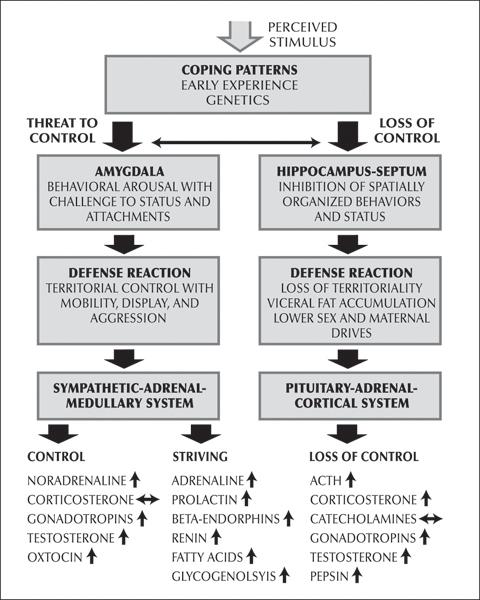
Source: Reprinted from Psychoneuroendocrinology, Vol. 23, Issue 8, James P. Henry and Sheila Wang, “Effects of Early Stress on Adult Affiliative Behavior,” pp. 863–875, Copyright © 1998, with permission from Elsevier.
This hypometabolic process can become a habitual response to threatening stimuli. One type of antisocial personality characterizes “poor conditioners” (Raine, 1996), those who have an underreactive autonomic nervous system, indicated by a low resting heart rate and slower emotional responses than normals. This underreactivity is apparent by age three and may result from early perinatal trauma or chronic nonresponsive care (Raine, Venables, & Mednick, 1997). Along with its overexcited counterpart, both are cacostatic responses learned early. Underlying systems like those that control dopamine, can be misdeveloped, leading to various pathologies that interact with the serotonergic systems. Think of all of the interrelating systems that are stimulated by responsive care, as described in Chapter 3. This body/brain tuning up is missing with unresponsive undercare.
The Power of the Survival Systems
We all want to feel safe. Concern for self-survival is part of every animal’s heritage. “At the heart of mammalian survival and sociality is the concept of safety and the ability to distinguish whether the environment is safe and whether other individuals are friend or foe” (Porges & Carter, 2010, p. 13). Survival instincts are built in to protect the life of the animal, so they are not easily damaged.
When the brain is well constructed, higher-order systems keep survival systems under control, meaning that they are deployed only when absolutely necessary (i.e., life threat). In fact in a well-developed brain, the survival systems have many projections to and from the frontal lobe and hippocampal areas so that higher-order cortical areas can manage emotions and actions in response to environmental press. For those with good beginnings and no history of significant trauma, the survival systems are rarely triggered under normal circumstances.
When the survival systems take over the mind, they represent a global brain state with one thing in mind: self-protection. Here is an illustration. The USA TV show Seinfeld has a character, George Costanza, who generally thinks only of himself but deliberately postures like a caring human being. In one show, after pretending to be thoughtful when visiting a daycare center, he infers that there is a fire in the kitchen and forgets all social graces . He panics and, while trying to escape, knocks down children and pushes an old woman out of his way. This is the epitome of the survival systems in charge: When the stress response is mobilized, events are interpreted with threat-colored eyeglasses, narcissistically keeping the focus on one’s own needs. There is little deliberation and minimal affective awareness apart from sensorimotor memory for security or insecurity based on prior experience and creature propensities. The aim of reactions is to return to homeostasis—a feeling of safety.
RAGE, FEAR, and PANIC focus on safety through power and control, and rigid adherence to routines and what has worked in the past. Behaviors linked to these systems include basic imitation (which newborn infants are able to do), stereotyping, territoriality, deception, and struggle for status (MacLean, 1990; Meltzoff & Moore, 1977). Habit routines or rituals, established early in experience, can be triggered automatically, even if they no longer work. MacLean (1973) described the power of the survival systems (which he called the R-complex or protoreptilian stratum) to shut down the rest of the brain as resources are mobilized for survival—steretypic patterns employed to restore a sense of safety:
The reptilian brain [neostriatum and pallidum] seems to be hidebound by precedent. Behaviorally, this is illustrated by the reptile’s tendency to follow roundabout, but proven, pathways, or operating according to some rigid schedule. Customs of this kind appear to have some survival value and raise the question to what extent the reptilian counterpart of man’s brain may determine his obeisance to precedent in ceremonial rituals, religious convictions, legal actions, and political persuasions. (MacLean, 1973, p. 10)
This global brain state makes self-protective behaviors more attractive than other behaviors. For example, a protective attachment can result in a defensive mode during social relations, one that is especially reliant on social ranking in which the individual is attentive to power over and potential harm from others (Sloman, 2000; Sloman, Gilbert, & Hasey, 2003). Instead of earning other people’s affection, the person tries to earn respect and becomes oriented to competition and achievement, always sensitive to signs of rejection, abandonment, or neglect. Like avoidant preschoolers, appeasement or dominance strategies dominate relations with others, even though the individual might prefer to run away.
When the socioemotional and self-regulatory aspects of the brain are underdeveloped, instincts for survival can more easily take over. For those with poor beginnings or a history of traumatic experiences, stress reactivity can be frequent, taking energy away from adaptive, creative responses and toward patterns and habits that may have worked in the past to relieve stress or bring about a sense of safety. For example, if when we were restless when toddlers (wanting to run and play) our parents fed us or put us in front of a screen, we may turn to those activities as stressed out adults.
Physiologically, malfunction of the basal ganglia and related structures can lead to pathologies such as obsessions and compulsions, which can occur as personality dispositions or emerge only under high-demand or stressful circumstances. The inability to shift focus—perseveration—indicates a deficit, due to a lack of development or damage, in the network linkages between the subcortical SS and neocortical components (particularly the prefrontal cortex and anterior cingulate gyrus) that coordinate attention (Goldberg, 2002). Cognitive consequences ensue. Insufficient functioning of these areas may underlie the need for (early) closure in problem-solving, an inability to deal with ambiguity, and other types of rigid, stereotyped thinking (Fuster, 1997). These incapacities can undermine morality. They also impair self-development and self-organization.
Dynamic Self-organization
Each of us coconstructs ourselves over time, organizing and stabilizing psychological and neural patterns that have been regularly experienced. We also organize ourselves in particular situations by the way we interpret ongoing experience. Interpretation involves an interplay of basic emotions and cognitive appraisal, triggering endocrine and other physiological systems that facilitate particular behaviors. M. D. Lewis (2005) describes how this happens, showing the dynamic escalation of stress and emotion in a road rage incident:[73]
Mr. Smart slams on the breaks when noticing the proximity of the car in front. Anger arises initially from frustration, as Mr. Smart wants to keep driving fast, but also from a sense of violated entitlement: he is in the left lane and should not have to slow down. Fear may also be triggered by the close call, eliciting further anger because of an intermediate evaluation of unmanly helplessness. These emotions arise rapidly, but they are paralleled by a co-emerging sense of the other driver as intentionally obstructive (and therefore blameworthy). Mr. Smart’s highly focused visual attention, a derivative of anger, takes in the red color of the car ahead, the expensive looking design, and his anger is amplified by his sense of the unfairness of this show-off blocking his path (based on an implicit memory of some long-forgotten or fantasized rival). A stabilizing angry-anxious state, coupled with ruminative plans for vengeance (perhaps a blast of the horn), anchors attention to the head of the man in front. This lasts for a minute or two while Mr. Smart fashions and modifies plans to pass on the right. But when the man peers over his shoulder, Mr. Smart evaluates this act as a taunt, generating shame and anger in an elaborated appraisal of humiliation, and calling for extreme action to save his self-image from further subjugation. (pp. 175–176)
Here we see that Mr. Smart’s frustration initially arose from the thwarting of a goal, perhaps mixed with fear from a close call, evoking a sense of helplessness and subsequent anger. While these emotions quickly formed, so did appraisals of the other driver as a rival or tormentor, or at least as someone blameworthy for obstructiveness (prior experience provided these filters for interpretation). An angry-anxious state stabilized and encouraged rumination for revenge, while the stress response kept attention laser-focused on the offending individual. In such circumstances, if the offender makes a move perceived as a taunt, it can generate shame and reactive anger in Mr. Smart, arising from an appraisal of subjugation. All of this calls for an extreme action to save the image of the self from further humiliation. Thus, for Mr. Smart, previously reheased emotions of rage and shame and narratives of dominance and threat were enhanced by the stress response and the impairment of prefrontal capacities to control survival system emotions.
In the same way, as we move through a given situation, our behavior is characterized by relations among elements that interact reciprocally in real time, coevolving and maintaining stability with feedback loops. Coordination among components of a system is necessary for coherence and complexity, including automaticities in cells (Ford, 1987; Karoly, 1993; Nowak, Vallacher, Tesser, & Borkowski, 2000). See Figure 7.2 for a simplified diagram of the complex interactions that occur between the appraisal and emotion constituents of an emotion-cognitive amalgam. These amalgams can be called emotional interpretation (EI), a moniker for the interactions among cognitive appraisal, emotion, and the evolving emotion-cognitive state (M. D. Lewis, 2005). As an emotional interpretation grows, perception, emotion, and attention amplify one another through positive feedback and constrain one another through negative feedback (M. D. Lewis, 2005).
Figure 7.2 The Interaction of Cognition and Emotion in Everyday Experience
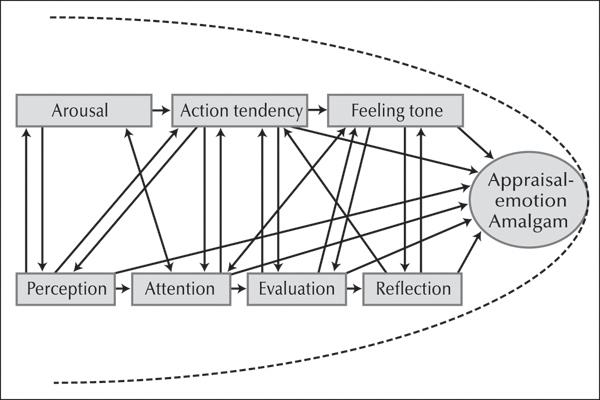
Source: Reprinted from Behavioral and Brain Sciences, Vol. 28, Issue 2, Marc D. Lewis, “Bridging Emotion Theory and Neurobiology Through Dynamic Systems Modeling,” Figure 1, pp. 169–194, April 2005. Copyright © 2005 Cambridge University Press. Reprinted with the permission of Cambridge University Press.
Although systems tend toward stability, perturbations—signals out of phase with current dynamics—can change the cognitive-emotional dynamics in a psychobiological system. A trigger can be an event, image, association, or memory meaningful to the system. For example, when one is happy but a sad event or memory occurs, it can disturb the prior dynamics. The trigger brings disorder to the happiness set point, sensitizing the system to the environmental cues and shifting attention, perception, action tendencies, evaluations, and so forth. Some features will dominate others due to constraints from prior experience. So for example, when a calm personality is in a meditative state, a perceived threat may be brushed off and not amplified, whereas the same threat may be self-amplified (through reciprocal, recursive interaction between thoughts and feelings) by an anxious personality who is already primed for and attentive to threatening features because of prior experience. This leads the underlying systems to “kindle” and reach a previously rehearsed state of panic. In either case, executive processes may be recruited, increasing emotion and stabilizing the whole system as negative feedback dominates, which increases continuity and decreases change. Eventually the system reaches a new stability and global state (e.g., the sad memory makes one more cautious). Such stabilization can keep an emotional state going (e.g., anxiety and vigilance, or relaxation). In the case of anxiety, an oscillating pattern may ensue in which vigilance decreases anxiety, but decreased anxiety decreases vigilance and increases uncertainty, starting the pattern again. When both anxiety and vigilance (or uncertainty and helplessness) are familiar, well-rehearsed states, a person can fluctuate between them. Or, when plans are rehearsed (e.g., for retaliation), images brought to mind can evoke additional appraisals and shift dynamics again (e.g., fearful images can provoke an appraisal of helplessness and self-doubt) (M. D. Lewis, 2005).
The stories of violent offenders who commit crimes without any real motive or apparent provocation, provide another example for how past experience interacts with contemporaneous experience. When asked to reflect on their actions, typically violent criminals reveal that they felt disrespected and reacted in a way that they perceived would restore their sense of dignity (Gilligan, 1997). For violent offenders, this type of “status reactivity” becomes a habitual state because they don’t have feelings of love, empathy or guilt to inhibit it. Inhibitory control—control of negative emotions—was underdeveloped (J. Blair, Mitchell, & Blair, 2005). There is no evidence of empathic effectivity roots or communal autonomy.
The road rage example, like the violent criminal example, shows the downshift to self-protective morality as the survival systems take over the mind. The optimal functioning of our survival systems—i.e., under the control of the frontal lobe system so they are quickly snuffed out when real threat is not at hand—is vital for navigating the moral life. With maturation and intentional self-development, our deliberative capacities, including moral sef-reflection and development of new habits, allow us to shift the pathway we are on (e.g., towards a particular goal) and change course.
The Moral Character That Stress Creates: Safety Ethics
Safety ethics are founded in survival systems. When a person follows survival system instincts and uses self-protection to override other considerations in social situations, this represents a safety ethic. Athough a safety ethic can be useful in moments when one’s life is threatened, for example, by an assailant, it generally curtails optimal moral decision and actions. When the stress response systems are active, we become necessarily more self-focused, more attuned to danger to ourselves, and ready for offense or defense in the face of threat. It focuses attention narrowly on getting back to an egocentric social homeostasis of feeling safe in the situation. Active aggression or passive withdrawal or some combination will feel “good” and “right” to the individual actor. In this case, there is little room for compassionate or thoughtful response. When a person operates from the surivival systems or continues in a “threat-down” mode after a stressor is passed, he will interpret innocent events as threatening, as chronically aggressive kids do when someone accidentally bumps into them (Dodge & Somberg, 1987).
Safety ethical mindsets represent a change in being. The safety ethic represents a retreat from higher-order thinking as well as a retreat from prosocial emotions. The safety ethic is a move away from engagement or relational attunement in the moment and toward being governed by conditioned responses. A safety mindset impacts what sounds reasonable, which rhetoric is attractive, and which actions seem rational. Like a cornered animal, the mind reaches for anything that increases a sense of safety—whether ideas, attitudes, or behaviors. When a safety mindset is active, attractive ideas and orientations include shallow slogans representing ingroup loyalty, hierarchy, and social rules (Nisbett & Cohen, 1996; Rosenblatt, Greenberg, Solomon, Pyszczynski, & Lyon, 1989). Sensitized panic or separation anxiety can lead individuals to conform and submit to authority to calm their distress. Thus, when one is under threat, statements like these are attractive: “Let’s attack/reject/avoid those [insert derogatory name here] who are doing this [insert threat here] to us.” In view of perceived threat, strongmen are more attractive and toughness on outgroups seems moral (Jost, Glaser, Kruglanski, & Sulloway, 2003). Following precedent and tradition is attractive and maintained with the use of shaming, threat, and deception (Shaver & Mikulincer, 2007; Staub, 1989). Similar shifts in viewpoint occurred among the U.S. populace after September 11, 2001 (Pyszczynski, Solomon, Greenberg, 2003), when anyone who questioned a strong military response was condemned as unpatriotic (traitorous).
Fears lock a person into the present moment with anticipatory fear. This can happen so early in perception that we are not aware of it—we all think we perceive reality directly, but our past experiences filter what we see. Fear-driven individuals do not perceive what is there, but filter things with their “inner eyes.” To paraphrase Ralph Ellison (1995), “when they approach, they see only the surroundings, themselves, or figments of their imagination—indeed, everything and anything except the person who is there” (p. 3). Not surprisingly, when a safety ethic is active, a person tends to be less creative, less open-minded, and less able to think outside the box (Fredrickson, 2002, 2013). When fear for safety is pronounced, people are less responsive to helping others (e.g., Mikulincer, Shaver, Gillath, & Nitzberg, 2005).
There are two stress-reactive subtypes a safety ethic can take. The options swing between cacostatic excess or deficiency, just as with a misdeveloped or damaged stress response, either toward an excessively dominant or an excessively withdrawing stance in the moment. Initially, when the survival systems are triggered by perceived threat—physical or psychological—the primal proto-self reacts and pursues social homeostasis in familiar ways.
The first, an approach instinct, is a one-up, bombarding, aggressive stance (combative morality). The sympathetic system activates a “fight” response (coping style number one in Figure 7.1), which results in defensive or reactive aggression, that is, self-preservational externalizing, demonstrated in oppositional or belligerent behavior. This can be very subtle though. For example, we can find ourselves hardening our position, dismissing views contrary to our own and rationalizing our incalcitrance (Taber & Lodge, 2006; see Westen, 2007, for a review). Individuals might use any technique that worked in the past to gain dominance. Going for the jugular, the weak points in the Other, is a way to humiliate, shame, and thereby dominate the Other. The attempt is to push the victim into the second excessive coping style—collapse or withdrawal from the confrontation.
The aggressive safety ethic (combative morality) is explicated by Paul MacLean and Kent Bailey. MacLean (1990) suggested that the pull toward the most primitive survival-focused level is “inherently pleasurable, easily stimulated, and reflects a loss or diminution of higher cortical controls linked to inhibition by social enculturation” (Cory & Gardner, 2002, p. xxxv).[74] Bailey (2002) proposes a phylogenetic regression-progression theory in which there is a dynamic interplay among evolved brain states. Passive regressions arise from neocortical inability to inhibit the atavistic impulses, allowing one to unconsciously slip back into what Bailey calls species-characteristic patterns of behavior. Bailey (2002) uses the Columbine High School massacre as an illustration of the ease with which downshifting to reptilian behaviors can occur. He speculates that the predatory behaviors were enjoyed by the murderers, Eric Harris and Dylan Klebold. The male bonding and lethal raid behavior they exhibited matches the so-called “demonic male” theory that Wrangham and Peterson (1996) controversially proposed. The actual behavior remained survival-focused. The victims could not fight back, so the killers provoked a withdrawing, defensive mode in them. Bailey points out the priming conditions for the killers’ behavior, including bullying by the school’s jocks and the plotting for revenge that it elicited, Harris’s use of prescription drugs and alcohol, and recent rejections from the Marine Corps and a male neighbor.
Even so, not every male reduces to a safety ethic, like Jack in Lord of the Flies (Golding, 1958); some do keep their awareness of higher ideals and stay in touch with empathy (Simon). (Others passively slip into safety ethic behavior when conditions are right [e.g., Ralph].) In any case, in the safety mindset and in cultures that foster such mindsets, such so-called regressions (e.g., war, revenge, terrorism) are encouraged by rationalizations about their moral goodness.
Although Bailey concludes that Harris and Klebold were normal males who regressed for a moment, I would suggest that the lure of the primitive systems may be especially intoxicating for children who both missed the evolved developmental niche and are encouraged to develop warrior orientations (suppressing softer feelings of kindness and compassion). Nevertheless, research into intermittent explosive disorder suggests that such downshifting into the safety ethic occurs frequently among young people today, with two-thirds of American teens reporting having experienced an outburst in the previous twelve months (McLaughlin et al., 2012).
Just to be clear, these predatory tendencies are not hominid specific but come from further back in the tree of life—that is, they are pre-human. The hominid line is more prey than predator and actually developed alternatives to forced hierarchies and domination (Boehm, 1999, 2012; Sussman & Cloninger, 2011). Social appeal, prestige, and persuasion are used to obtain influence, rather than hierarchical threat (Barkow, 1989; P. Gilbert, 1992). That is, raw intimidation is less successful than social influence for obtaining power among primates (E. O. Wilson, 2012).
At a group level, activated RAGE systems can trigger tribalism and group rivalry (MacLean, 1990). Threat-defensive beliefs can orchestrate actions that detect, persecute, subjugate, or eradicate nongroup members in a type of archetypal inflammation (P. Gilbert, 2005). Groups can become externalizing mobs, a “superorganism” awakened by an infectious fear, panic, or rage that leaders can instigate and direct (H. Bloom, 1995; Green, Glaser, & Rich, 1998). A certain cold “madness” can come over a group of people who mindlessly follow passion to scapegoat a transgressor or perceived outsider, as evidenced by the lynchings of “uppity” blacks in the United States after the U.S. Civil War up until the middle of the twentieth century (Blackmon, 2008). Lynchings increased significantly when the price of cotton dropped, suggesting that the resulting stress drove aggressive scapegoating (Hovland & Sears, 1940). Those who rage are incapable of recognizing their own deeds as evil and instead project everything evil onto the selected adversary (Girard, 1989). Such externalizing group action emerges more easily in cultures that emphasize and practice aggressive safety orientations generally, as in cultures of honor that advocate hierarchy, aggression, male dominance, and control (Nisbett & Cohen, 1996).
The second subtype of safety ethic occurs when, in a social situation, a threat is perceived to be too great for the individual to successfully agress or physically escape. This was described earlier as a second-phase stress response that comes after an unsuccesful sympathetic “fight-flight” response, Unable to run away, the parasympathetic system activates a “freezing” paralysis or dissociative “faint” response (coping style number two in Figure 7.1) (Porges, 2011). This emotional numbness, characteristic of insecure attachment, is the effect I described at the beginning of the book with my habitual brain freeze. Billy Budd oscillated between this mode and the active aggressive reactive safety ethic. In a life filled with strangers, numb withdrawal may become habitual “on the street.”
In terms of everyday morality, this withdrawal from relational attunement represents a vacant, compliant morality (wallflower)—the individual dissociates or succumbs to being “one-down.” Children are often forced into this position by the adults in their lives. Victims of abuse often fall into this mode habitually, such as those forced into slavery or prostitution (Hayes, 2013). Submission and passivity (e.g., knee-jerk response to the power of an authority) form a self-preservational internalizing that protect one from psychological trauma.
As in the case of a disordered stress response system, a person can flip between states or remain in one or the other. Individuals (and groups) can also learn socially to move between the two modes, showing submission to ingroup authority and judgmentalness toward outsiders. In this case, the individual never questions their or their group’s worldview but harshly interprets the behavior of the Other (a type of self-protective rage), resulting in aversive disgust and contempt towards the Other (flight)—the individual is categorized as unworthy of attention and respect, and so there is no relational attunement attempted. The judge stays within a cocoon of safety with his own kind. Actions toward the disgusting Other will be dismissive, discriminatory, blaming, and/or oppressive. Because the Other is categorized as unworthy, subhuman, unhealthy, unuseful, or dangerous, the lack of relationship is considered a good and wise position. Based on histories of fear, groups can also withdraw from society, becoming insular, suspicious, and fearful of outsiders.
Once a safety ethic is activated, there is often an inability to switch out of it until the mind has calmed itself (which is takes longer for those with poor self-regulation). In cases of constant perceived threat, there may never be a calm-down. Schema therapy theory identifies several maladaptive schemas from toxic relational experience that underlie reactivity and lead to maladaptive responses like a safety ethic. They use descriptive terms: disconnection and rejection; impaired autonomy and performance; impaired limits; other-directedness; and overvigilance and inhibition (Young, Klosko & Weishaar, 2003). Modern life will be seen to be full of threats when one’s stress reactivity has a low threshold. In this case, one learns to rely on more primitive mechanisms for everyday life and higher-order frontal systems will be eclipsed.The safety ethic can become a habitual response (e.g., “How do I maintain dominance, or is it time for appeasement?”).
Two things should be noted. First, a safety mindset can be adopted as a disposition without stress reactivity playing a role, much like a formulaic one-up or one-down dependence relationship (Birtchnell, 1999). This can happen in cultures that promote toughmindedness. But it also can be adopted in situations or domains, like sports play. In American football, defensive players are vigilant for cues of ball carrying and threat of the other team scoring.
Second, a safety mindset can be helpful in some circumstances. Surely, the stress response is very useful when a truck is bearing down on you or your child, or you are facing a rabid dog in the backyard, or escaping from a hurricane. Similarly, when a person threatens you, it can be adaptive to employ a safety ethic in response. Then it is useful to have the body’s mobilizing agencies in charge. Your attention is sharply focused and your muscles can do miraculous feats. Further, when a person threatens the community, one might take on a distancing role, wary of the person’s behavior, excluding the individual who is a menace. Because of its narrowing of perception and insight, it is generally not useful to remain in a safety mindset when the threat is over.[75] After the event, a well-developed stress response system is brought back under control and you can relax and not filter everything with threat-colored glasses.
The Chronic Safety Ethic
A chronic safety ethic is focused on the self so much that the individual is unable to establish an egalitarian, attuned relationship with the Other. This can be a general cultural orientation learned from family life or one’s society, emphasizing toughness, or can be triggered by stress.
Chronic states become traits. Thus, when a person spends a large part of childhood distrusting caregivers and rehearsing self-protection, chances are that this will become part of his personality and ethical disposition. If the family environment is competitive, children can learn to become automatically attuned to status (a “social rank mentality”) (Sloman et al., 2003). In the moment, they can competitively seek dominance over others or excessively appease the more powerful person when under threat or when seeking support. Instead of guilt (concern about one’s own actions arising from empathy with and sympathy for others), feelings of shame commonly emerge from a social-ranking system, with its focus on status, social comparison, and punishment (P. Gilbert, 2003). As a result, there is little empathy for or receptivity to others, a common finding amount those with insecure attachment (Eisler & Levine, 2002; Mikulincer & Shaver, 2005). See Table 7.2 for a list of possible causes of a chronic safety ethic.
The safety ethic can become chronic when a person’s neurobiological systems are calibrated according to chronic stress or trauma, especially in early life. The systems underlying the safety ethic store the organism’s life memory, probably from conception, so it is the system most governed by the past. “Memory is the way past events affect future function” (D. J. Siegel, 1999, p. 24). And when the past includes trauma, it is a very powerful overlord of the present. As shown with the Billy Budd example, preverbal somatosensory memories may respond only to action, not words (although trance induction from words can be performed) (Ansermet & Magistretti, 2007). The fantasy of threat is so powerful that it must often be acted against for self-preservation. Thus, the safety mindset can look like an irrational perseveration until an action counter to the threat is taken.
Table 7.2 Factors Contributing to a Personality Dominated by an Ethic of Safety
+--------+
Inappropriate early care can foster biological outcomes beyond the stress response systems per se that affect moral functioning (Panksepp & Biven, 2012). Cortical-subcortical networks with frontal controls are central to human social capacities. When these are underdeveloped or faulty, the result can be habitual shift to a safety ethic. As pointed out earlier, low serotonin can lead to greater emotionality, including greater fear and anxiety. The brain can be “burned out” from too much stress. For example, Fone and Porkess (2008) found that post-weaning isolation in rats produced “neophobia [fear of the new], impaired central nervous system inhibition, aggression, cognitive rigidity, reduced prefrontal cortical volume and decreased cortical and hippocampal synaptic plasticity” (p. 1087). These are features that in their extreme are associated with schizophrenia but at less extreme levels may reflect outcomes of undercare. These behaviors reflect dysregulation of dopaminergic and serotonergic systems in the prefrontal cortex, hippocampus, and nucleus accumbens, leading to a reliance on survival systems.
In caregiving environments with low responsivity, the lack of early embodied experience with reciprocity in social interactions creates little sensorimotor memory for calm, loving intimate interactions. As a result, the individual can develop a defended, rejecting ideo-affective posture in which feelings of anger and contempt are more accessible than affiliative feelings (Tomkins, 1965). Behavior is more ruthless and focused on self-advantage covertly or overtly. Because the brain’s wiring and functioning are focused on safety, the engagement ethic is minimized and the imagination ethic, if and when it is functioning, is harnessed for safety interests. Although it is easy to see the extremes of these characteristics in delinquents with reactive disorders, a “lighter” variety of the high-safety personality may be more predominant. A person who has not experienced stimulating positive affect with others can feel unloved and may become extremely competitive (high SEEKING), focused on social rank and power, and sensitive to rejection (P. Gilbert, 2005; Sloman et al., 2003).
Deliberate Safety: When Imagination Gets Involved
Recall that our executive functions, capacities that include self-control, must be well-educated like our emotion systems. Systems that are well contructed with companionship care lead to empathic effectivity roots and communal autonomy. Both facilitate communal imagination. Under conditions of companionship care, the self is not divided but coherent as shown in the alignment of intuition and reasoning, implicit and explicit knowledge, procedural and deliberative skills.[76] What happens when this evolved set of characteristics are undermined? Ill-developed emotions and imaginations can lead us toward vice, harming Others and ourselves.
When imagination is taken over by the survival systems, it is caught in the past and trapped by prior experience, categorizations, and understandings. There is minimal openness to the uniqueness of situations or viewpoints alternate to those well rehearsed. Imagination guided by survival systems is the opposite of the face-to-face presence with another found in the engagement ethic and communal imagination. Instead, it involves totalizing the Other into a thing against which one plays an artificial role, betraying both the self and the Other—because one is not emotionally present (Levinas, 1969). The key feature here is detachment from egalitarian relational attunement in the here and now, a cacostatic response that is either too controlling or too withdrawing.
Narrowed, categorical thinking is characteristic of intellect, a subset of our imaginative capabilities. Although it is a tool useful for solving hypothetical and other abstract problems, it is not so good for ongoing human relations. Multiple studies indicate that the intellect has a preference for static mechanisms instead of living things (see McGilchrist, 2009, for a review of left versus right hemisphere propensities).[77] The intellect builds pragmatic, simplistic models of reality, whereas the implicit mind masterfully negotiates a situation that is complex and ambiguous (Rotenberg, 1994). This is not a surprise because brain activation during learning or new experience is right-hemisphere dominant, shifting to the left hemisphere when the situation becomes familiar (Goldberg, 2005). In a well-functioning brain, nearly every social experience is new and keeps the right hemisphere active whereas in a poorly-functioning brain social interactions are dominated by stereotyping. The intellect imposes a structure on reality, not really perceiving what is present except as members of preconceived categories.
The use of deliberate safety is influenced strongly by early experience, specifically experience that facilitated the development of the systems that compromise engagement and communal imagination. Recall how the full capacities of the frontal lobe require supportive early care. Inappropriate care during the scheduled development of the right hemisphere may be a primary cause of underdeveloped or malformed imagination and reasoning capabilities. When early care is inappropriate, imagination can be undermined in several ways Greenspan and Shanker (2004, p. 237). It can become rigid and concrete, narrow rather than broad, limited in scope and in analytical capacities. Those who do not receive responsive care tend to display polarized (all-or-nothing) thinking rather than integrated reasoning. They can have difficulty taking the future into account, focusing instead only on the “here and now” and its effects on the self. Individuals can be more impulsive than reflective, and demonstrate magical and irrational thinking. These are all signs of underdevelopment or misdevelopment of brain systems resulting from missed environmental supports during sensitive periods.
A classic example is the character Bigger in Richard Wright’s novel Native Son (Wright, 1940). “Instead of real communication and interaction with others, Bigger’s world is one of stereotypes and mere surfaces as he categorizes other people (who have previously categorized him) in order to gain some semblance of control over his own life” (George, 2005, p. 290). “Bigger sees only what his fear allows him to see” (Tremaine, 1986, p. 69). In regard to accidentally killing Mary Dalton, a reaction based on fear and shame, Bigger claims, “Hell, she made me do it! I couldn’t help it! She should’ve known better! She should have left me alone, god-dammit!” (Wright, 1940, p. 277). Indeed, those with one-person psychologies know only what they are thinking (their distorted thinking), and have cognitive/intellectual awareness of others only as categorizable objects.
When primitive systems of self-protection are overstimulated by parenting practices, striving (SEEKING) may become a compulsion, a recompense for the psychobiosocial effects of not getting enough love or social play in early life (Liedloff, 1986). The SEEKING system is fueled by dopamine (both of them are lateralized to the left hemisphere) and is “a complex knowledge-and belief-generating machine” with “no intrinsic morals,” rendering it “just a super-efficient get-up-and-go-get-it system” (Panksepp & Biven, 2012, p. 103). When children’s sense of self-worth is damaged early, they may develop pathological narcissism to compensate; narcissistic attitudes and behaviors may stimulate the dopaminergic system, which is highly addictive (Panksepp & Biven, 2012). If the dopamine system is overstimulated, behavior can become stereotyped and focused on mundane things; beliefs can become suspicious and even paranoid, as seen in schizophrenia (Pinkham, Hopfinger, Pelphrey, Piven, & Penn, 2008). A focus on behavior activation (SEEKING) with high dopamine output leads to greater competitiveness and desire for nonsocial rewards. The euphoria of the SEEKING systems enhances self-esteem and the sense of effective agency.[78] The desire for control may result from the dopamine circuitry that is lateralized to the left hemisphere, leading to euphoria from exploration and striving (Glick, Ross & Hough, 1982; Tucker & Williamson, 1984; Wagner et al., 1983). High dopamine and low serotonin represent a driven personality, making one susceptible to impaired imagination in ways described below.
While Bigger and Billy Budd represent less intellectual forms of dispositional safety, the use of stereotypes and unthinking response are also apparent among very smart people. What happens when the intellect works fairly well, despite the fact that emotion systems are misaligned, and are especially out of sync with how cognitive planning capacities have developed? Cunning reptilian behavior may ensue (T. Lewis et al., 2000). The inability to access social intelligence (due to circumscribed empathy, perspective taking, and social creativity) leads to lower capacity to solve social problems inclusively or compassionately. Instead, as with five-year-old boys, manipulation or force is used to dominate and control others in order to get what one wants (Maccoby & Jacklin, 1974). We can see the instincts of survival systems at work among political leaders who demonstrate mental disorders of various sorts, including psychopathy (Babiak, Neumann, & Hare, 2010; Ludwig, 2002). To an individual with a safety ethic, power-seeking is a form of reestablishing social homeostasis.
Basing his perspective on real accounts, Hughes (1961) describes Hitler with a safety mentality: “The universe contained no other persons than him, only things; and thus for him the whole gamut of the ‘personal’ pronouns lacked wholly its normal emotional content. This left Hitler’s designing and creating motions enormous and without curb” (p. 243). Hitler felt he alone existed, which was the source of his power. All else was things to be manipulated for his own ends. He demonstrated a defective empathic core and reckless autonomy space. Fromm’s (1964) psychoanalytic interpretation of Hitler’s problems was an incestuous fixation with his mother but his father was cruel, beating him regularly (Miller, 2009). Clearly his early needs were not met and the failure of core self-development ensued; lack of companionship care accompanied by harsh punishment twisted his personality aiming it towards survival systems.
In the presence of handicapped emotional intelligence, distrust of others, and dominance of the survival systems, communal imagination will be less likely to emerge naturally. Instead, the trajectory will be toward two general patterns of integrating imaginative capacities with survival systems. Much like the options Goldilocks experienced (too hot, too cold), suboptimal systems move into two cacostastatic moral orientations—excessive control over others or excessive detachment from them. The midpoint—the golden mean or homeostatic point—is elusive. One orientation, vicious imagination, emerges from combative safety. The other, detached imagination, emerges from compliant safety. Both can be adopted for cultural reasons instead of neurobiological ones and sometimes one may feel the need to adopt the cunning ways of the vicious imagination mindset as Winston Churchill did during the war with Germany in World War II (Kilzer, 1994). Just to be clear, we all have the capacity to use our imaginative capabilities these ways.
Vicious Imagination
When a combative morality is deliberate, moving out of present-moment reactivity, it becomes a vicious imagination. Vicious imagination describes those moments of intentional separation from others—a planful divorce from engagement based on deep-seated anger or fear. It involves a presumed opposition, “me versus them” and self-aggrandizement, with the ego believing in its superiority and using intellect to dominate others overtly or covertly. Whether “helping” through missionizing, obtaining “justice” through aggression, or manipulating others for one’s own purposes, there is a deep mistrust of the flow of life and a need for control.
The one emotion that is expressed more robustly in the left hemisphere is anger (Harmon-Jones, 2007; Harmon-Jones & Allen, 1998). Anger easily hooks up with SEEKING, as aggression feels rewarding (Couppis & Kennedy, 2008). Those whose right hemispheres underperform or have been “burned out” by poor early care may show the pattern of greater activity in the left brain frontal lobe, which relates to greater anger but also happiness (Harmon-Jones & Allen, 1998; Schore, 2003a, 2003b). This can be explained by the left brain dopaminergic SEEKING system, which “induces a robust mental and behavioral invigoration” but also “counteracts and sometimes even obliterates the gnawing distress of fear” (Panksepp & Biven, 2012, pp. 119, 141). And because the frontal cortex is partially disabled, it allows the more primitive systems to hold sway, including the RAGE and FEAR circuits, along with SEEKING.
From the outside view, a vicious ethical orientation is usually classified as evil, or at the very least misguided. As Simone Weil said, “Evil when we are in its power is not felt as evil but as a necessity, or even a duty” (Weil, 1947/1952, p. 121). Downshifting feels good and is packaged in moral rationale. Macbeth felt compelled to seize power—it seemed like the “right thing to do,” and he found justifications for murder. Othello’s jealousy-driven actions were cultivated by Iago and absorbed by Othello. RAGE can drive a mob or an individual to revenge, which can generate a chemical reward in subcortical regions (i.e., in the caudate nucleus in the striatum) (de Quervain et al., 2004). Exclusion, fueled by imagination, is well documented all over the world. For example, in a case dubbed “Internet hunting,” online chatroom members became enraged after a posting by a cuckolded husband denounced his wife’s student lover. The student was hounded by tens of thousands online but also by bands of people who hunted him down at school and at home, so much that his family had to barricade themselves (French, 2006). Worse, in 1994, a radio campaign of hate and fear that had started months earlier let to a massacre of more than 500,000 Tutsis by extremist Hutus in Rwanda. Thousands of moderate Hutus who did not join in the killing were also murdered (Dallaire, 2004).
If we unpack it further, we can see that vicious imagination is fueled by several “dangerous ideas,” such as a sense of superiority, distrust, injustice, or vulnerability (Eidelson & Eidelson, 2003). Conflict or warfare is often the result of these types of cognitive biases and beliefs, which limit perception and openness to Others (Brewer & Miller, 1996). A securely attached individual with optimal brain function may also momentarily shift to these views but is able to move back to a more open position through well-developed frontal lobe controls, deep positive social experience and life narratives that are more inclusively communal. Let’s examine a few dangerous ideas.
Superiority
Superiority (also known as pride) is perhaps the king of dangerous ideas because it cascades into many of the other dangerous ideas. It is easy to fall into, with its inflation of the I-ego self. It can lead to ruthlessness, steam-rolling over the Other to meet one’s own goals. This can happen on a momentary basis, as with “moral credentials,” where a person feels justified in taking an immoral action because a just-taken moral action paid it forward (Monin & Jordan, 2009). Such ego inflation is a constant temptation in individualistic contexts but often controlled in old-growth cultural contexts (Narvaez, 2013a). On a momentary basis, vicious imagination is in operation when a person feels superior to another and takes action on that basis—to put down the other, to best the other, or to objectify, analyze, or dissect the other. As documented in countless studies, when one feels superior, one is less sensitive. Interestingly, even among the most prosocial, power can corrupt. There is something about having unequal power that desensitizes the power holder (Piff, Stancato, Cote, Mendoza-Denton, & Keltner, 2012). Power holders take advantage of a situation often without having a sense of the effects on others. The imbalance of the power relationship leads to the one-up’s insensitivity toward the one-down. In this situation, it is easy for the one-up to think, “I know better than you,” and to use power plays to get the one-down to do what he wants.
Chua and Rubenfeld (2014) argue that a triple package of characteristics led (and can still lead) to success in the USA–a sense of superiority, insecurity and efficacy. Interestingly, these are the very characteristics that may be behind the massive destruction of the natural world and its balance of biodiversity in the last few centuries—ruthless, vicious imagination. The sense of human superiority over everything else in the natural world may be the most dangerous idea of all.
Inegalitarianism goes the other way too. Feelings of inferiority lead one to succumb to moral bullying. The urge to withdraw, appease, or accept mistreatment of self or others can be rooted in the compliant morality described earlier. So, for example, a missionary may feel superior to and impose his will on his target group but at the same time feel inferior to church authorities, submitting to their directives without question. Barbara Kingsolver’s novel The Poisonwood Bible (1998) illustrates these different types of superiority and inferiority within the same missionary. Not surprisingly, those with avoidant attachment often have a superiority attitude, which is accompanied by deep distrust.
Distrust
Establishing trust (or mistrust) is a primary outcome of early life (Erikson, 1950). After that, it takes great effort to revise the procedural knowledge learned implicitly, upon which the social life depends. What does distrust look like? Young (1999, p. 12) offers a summary: “the expectation that others will hurt, abuse, humiliate, cheat, lie, manipulate, or take advantage.” It does not take much fear of these things to feel distrustful. Even a slight amount of distrust can change behavior in ways that lead away from engagement and communal imagination. On a moment-to-moment basis, trust and distrust can keep shifting depending on whom you are with. One will be less generous, grateful, and open in moments of distrust.
A distrustful disposition toward others means that suspicion is nursed along with a sense that certain others are hostile and have malintent.[79] Such distrust can turn into paranoia and delusions of persecution. This can influence parenting attitudes and treatment of children, as occurred with the nationalist Nazism ideology in Germany (Rowold, 2013). Negative attribution (others are disrespectful) is found among those with aggressive personalities (Dodge, Bates, & Pettit, 1990). Collective paranoia (Kramer & Messick, 1998) is a set of false or exaggerated beliefs of persecution or mistreatment by a malevolent outgroup, which leads to negative attribution of any behavior by that group.
Sense of Injustice and Resentment
A sense of injustice pushes us toward all sorts of retaliatory behavior, which can be acts of commission or of omission. Holding grudges is a form of maintaining a feeling of injustice, on which a person is likely to act when the time comes (Murdoch, 1989). Resentment can be a way of not taking responsibility for one’s own actions or a way to turn bad luck into targeted malevolence (A. Ellis, 1962; A. Ellis & Harper, 1975). Holding a grudge can lead to extraordinary revenge. In one case, in which a private detective’s ex-girlfriend accused him of rape and refused to drop the charges, the detective went to great lengths to take revenge (Bilefsky, 2012). Using the knowledge of the legal system he had acquired from being a regular informant to police, he developed an elaborate scheme: He staged crime scenes, planted evidence, and extorted witnesses to testify that she was involved in a series of armed robberies. The victim, a former Wall Street analyst, was in jail for seven months awaiting trial, which led to the loss of her business and her home, as well as separation from her young daughter. The detective was subsequently convicted and sentenced to thirty-two years in prison. Resentment does not have to be this extreme to have an effect on moral behavior. Just a small resentment can turn you away from helping someone when he needs it.
Tit-for-tat revenge is often based on a sense of injustice. When your brother takes something of yours and breaks it, you want to break something of his for fair measure. It can also be seen in intentional acts of omission—failing to tell someone something he should know. For example, if you learn that the boss is stopping by the office, you “forget” to tell an officemate who offended you the day before: An eye for an eye. Criminals often justify their actions based on evening the score. A sense of injustice—believing that one or one’s group has been unjustly treated—fuels hostility, and more wars are instigated by a sense of injustice than by issues of power or security (Welch, 1993).
Vulnerability
Feeling vulnerable, as Bigger Thomas did, keeps one in a wary mode. Threat reactivity over time—the feeling that one is under constant threat without recourse—keeps one in a hypervigilant mode, with high anxiety. A chronic sense of vulnerability likely developed in early life under conditions of non-responsive care or from later trauma. Catastrophe is anticipated in the near future. These types of fears are a common cause of intergroup conflict (D. A. Lake & Rothchild, 1998). Rhetoric that taps into a sense of vulnerability (“Unless we use military force ...”) is often used by those who promote war (see, e.g., Rubenstein, 2010).
Narratives
Narratives, the stories we believe about ourselves, can promote particular emotional states and beliefs that lead to the dangerous ideas mentioned above. Narratives can foster or at least maintain vicious imagination and justification for maintaining dominance or even perpetuating violence against others—for moral reasons. Cultures that promote war to solve problems fit here (Dower, 2010). Ethnocentric monoculturalism, the belief that one’s cultural heritage is superior, can make one insensitive to those from other cultures (Sue, Bingham, Porche-Burke, & Vasquez, 1999). Outgroups are often described as untrustworthy and dishonest (Campbell, 1967; LeVine & Campbell, 1972). For example, for Osama bin Laden, attacking the citizens of the United States seemed like a moral thing to do. A war against terrorism, one that would include the torture of potential terrorists, seemed logical and right to Bush administration officials. Outsiders had different views of all of these moves.
Most people adopt the narratives they hear in childhood from the cultural milieu. Which explicit narratives are attractive is related to upbringing (Tomkins, 1965). Ideological “imprinting” can also occur during sensitive periods in adolescence and early adulthood (Huddy, Sears, Jervis, & Slobodkin, 2003; Narvaez, Getz, Rest, & Thoma, 1999). Sometimes the narratives chosen are antiestablishment (e.g., those of hippies) or hatefully target an outgroup (e.g., neo-Nazis attitudes toward non-Aryans), perhaps as a means to displace anger toward parents who treated the child unjustly (Milburn & Conrad, 1996). A child who never felt accepted may be attracted to narratives of alienation. The attraction of hate groups, for example, can be a matter of how the explanations fit with the implicit social sensibilities of the perceiver, creating an explicit explanation for a history of alienation from others. These moments of integration can affect future moral sensitivity, moral judgment, moral motivation, and a critical aspect of free will—attention.
Individual identity narratives can boost one’s confidence and sense of safety, helping one to, for example, recover more quickly from trauma (Janoff-Bulman, 1992). But categorizing and stereotyping, as narratives often do, frequently mislead. If a narrative denigrates the Other, it can be destructive to the self and to the Other. For example, if one adopts as the narrative of masculinity “not acting like a girl,” then anything that seems girllike will be rejected in one’s feelings and behavior, limiting one’s freedom and self-actualization and encouraging the mistreatment of girls and anyone who acts like one. When based on a worldview or ideology, categorization of the Other engenders miscalculations, illusions that increase hostility and heighten the chance of conflict (Beck, 1999; Staub, 1989). Ideology is another form of inflexibility. It offers specific types of stories about the world, narratives that seem to calm the stress response but which also have the potential to do damage to the worldscape.
Ideology
Hampered imagination often occurs within a framework of ideology (a belief system, which can emcompass identity, that is not based on direct experience). Ideology represents a backing away from the present and an attempt to control and manage life with a specific set of rules or dogma. This kind of external, socially modulated means of behavioral inhibition may be required for those whose behavioral inhibition is underdeveloped (largely housed internally in the right hemisphere) or who have little procedural knowledge about how to get along in the flow of life or who are highly stress reactive. Self-protective ideologies may attract those whose empathic core is misdeveloped, those who lack deep intuitions and capacities for positive social relations.Thus, structures external to the self—laws, theories, authority mandates, religious directives—are needed to feel at ease. These become necessary aids to the social life, without which the individual would feel lost and vulnerable.
Ideology represents patterned thinking that capitalizes on intellectual capacities for categorizing and sorting. It provides a worldview that helps solve the problem of how to stay safe. Ideologies are used to validate self and invalidate others, whether they are religious, political, scientific, or personal-emotional. Ideology offers a narrative that rationalizes one’s own superiority and the scapegoating, elimination of agency, and respectability of the Other (“eliminationism”) (Neiwert, 2010). Consequently, ideology is a primary force behind “negative” moral behavior—behavior that punishes others under the rationale of a moral mandate (Bauman & Skitka, 2009). Religion is a quintessential realm of moral mandates.
Religion generally represents spiritual inclinations that are institutionalized and reified into sets of rules for life. Individually, one can follow these as a basic framework that filters and interprets experience and guides behavior. Or one can use religion as a club for gaining power and status through imposing one’s view on others. Socially, although religion can offer a frame that alleviates anxiety for an individual, too often religious power structures become “too-big” systems that steamroll human autonomy and undermine the development of evolved human intuitions. Like scientific, political, and economic structures, religious institutions can destroy the natural world and its systems because of subscribing to an ideology of human superiority. For example, Western Christian religions, which traditionally place salvation as post-death, often objectify all aspects of the natural world, dominating Nature for instrumental and immediate gain. Some have suggested that Abrahamic religions evolved to justify humanity’s separation from and domination of nature (Martin, 1992).
Alternatively, McFague (1997) argues for the conversion of Christians to “super, natural Christians,” converting from “the arrogant eye” to “the loving eye” toward the natural world (p. 3). Creation spirituality (Fox, 1983) is more ecologically in tune with wisdom traditions (discussed in Chapter 10) and more relationally attuned, emphasizing a communal imagination.
Politics is another realm where vicious imagination flourishes. Numerous studies indicate that political judgments reflect “motivated cognition” (Jost et al., 2003), in which a partisan viewpoint filters perception effortlessly and without awareness. This affects the interpretation of information about candidates and policies (Westen, 2007). It’s as if an “us versus them” filter is employed before the information is processed. Political discourse often downshifts the listener to prehuman competitive concerns—that is, social ranking. Leaders also frequently stress followers with warnings, triggering safety ethics among the electorate or populace.
Inflexible, black-and-white thinking in adults is generally equated with the thinking of young children (see Westen, 1991), even though it is not. But the follow-up question is often not taken: How did an adult come to retain the mind of a child? Sylvan Tomkins (Demos, 1995) offered initial insight into the effects of early life on ideological orientations in adulthood. He suggested that early socialization through biosocial mechanisms sets up personality and life orientations that the individual subsequently applies to many domains throughout life. The “ideo-affective posture” developed from early experience represents a socialized “set of loosely organized feelings and ideas about feelings” (Tomkins, 1965, p. 74), which resonate with particular organized ideologies, attracting individuals to particular viewpoints. A warm, supportive childhood leads a person to orient either to an open, accepting posture (“humanistic”), whereas a harsh, restrictive childhood leads to a defended, rejecting posture (“normative”) toward people and toward life experiences in general. We can see how these two orientations map onto the early experiences we have been discussing and the different paths one can take as a result. Thus, on the one hand are humanists, who believe that humans are basically good, that feelings are sources of information, that people should be given the benefit of the doubt, and that life has more to do with adventure than with fear; and on the other hand are normatives, who think that humans are basically evil, that softer feelings are to be suppressed as signs of weakness or insubordination, that people are blameworthy if they don’t follow the norm of choice, and that life is to be lived in fear (of intimacy, of breaking down, of humiliation, etc.). Tomkins suggested that parenting behaviors create a particular “ideo-affective posture” (humanistic, normative, or mixed). Whereas the humanistic parent nurtures the child’s emotional self-regulation, the normative parent uses fear, intimidation, and humiliation to control the child, disregarding the child’s own feelings as irrelevant. The normative child, like the normative parent, learns to feel threatened by any behavior outside the learned social scripts. When others behave in ways that violate the norms, rage and contempt are expressed (fear is repressed because of possible humiliation).
Its characteristics—aggression, submission to authority, avoidance of tender-mindedness, intolerance of ambiguity, hostility, concern for power and dominance, rigid black-and-white thinking, and projection of negative affect—indicate that the survival systems have taken over the brain/mind can emerge from inappropriate childrearing and the type of brain/mind early stress promotes.[80] Contrarily, no one is authoritarian 100% of the time. Thus the theories of Tomkins and Adorno are a bit too black and white in themselves, as my contention is that people shift into different mindsets throughout the day, varying by relationships and situations. However, if you face a dangerous situation day after day, you cannot help but keep active self-protective mindsets until a sense of safety returns.
Impositional Altruism
Pathological altruism (PA) is a type of impositional altruisim; both are subtypes of vicious imagination. PA is a recent construct that refers to behaviors and personal tendencies “in which either the stated aim or the implied motivation is to promote the welfare of another” but where the consequences are substantially negative and irrational to the Other or to the self from the viewpoint of an outside observer (Oakley, Knafo, & McGrath, 2012, p. 3). It refers to a compulsive, maladaptive, or habitual focus on the welfare of others (Seelig & Rosof, 2000). It inflicts harm on others and on the self. Those who show signs of PA tend to be socially oriented but have low self-confidence and limited expression of pleasure. They seem to have little sense of how the world works or are fueled by passive aggressiveness (Brandt, 2013). Turvey (2012) distinguishes nonpsychotic from psychotic versions of PA. A protective pathological altruist plants evidence to catch a criminal (nonpsychotic) versus killing his children to protect them (psychotic); a defensive PA stays in an abusive relationship versus draining resources to donate to a cause; a masochistic PA compulsively cares for others, and may have hallucinations; a malignant PA who is a parent may be generous with a child but manipulate her with martyrdom or punishment, and may having hallucinations as well.
Impositional altruism is an everyday type of “doing good for the other” that may not be as pathological but still is coercive. Whenever we step away from egalitarianism we adopt an attitude of superiority and can easily feel good about imposing our will on others. Most of the time this represents a vicious imagination. For example, I used to sneak spinach into my husband’s favorite dish, spaghetti. He would be stuck eating the spinach embedded in his cherished dinner. With a more engagement orientation, I learned to “market” vegetables to him (“Look! Broccoli—yum, yum!”) and instead learned to use playful humor to try to help him change his bachelor habits himself. An old form of helping others is to tell stories, relevant tales so that the individual can take away their own lesson.[81]
Emotionally-detached Imagination (Iced Morality)
A second form of self-protective imagination emerges from compliant safety or dissociation from relational attunement. When compliant (dissociated) safety is planful, it represents a detached imagination. Detached imagination intellectualizes experience and dissociates from social emotion. If vicious imagination is passion-fueled control of others, detached imagination is passionless control. But isn’t detachment a good thing? For example, doesn’t Buddhism encourage a detached attitude? Let’s be clear on definitions. Detachment as discussed by religious philosophical traditions like Buddhism does not mean cutting off feeling and engagement; it means letting things go when it is time. The detachment there refers to detaching from the I-ego and from outcomes. It means not grasping or trying to control things, events, or people. Emotionally-detached imagination is not the detachment of Buddhism and other religious practices where compassion is also emphasized. Instead, the imagination detachment discussed here refers to a pulling back from relationship. The person is very much stuck in a high-ego-focused state. Emotional disengagement is a type of moral disengagement that can excuse harmful actions with moral justification, obscure personal agency in bad activities, disregard consequences of actions, and blame or dehumanize victims (Bandura, 1999). Most of the time, detached imagination is detrimental because it loses sight of love and egalitarian respect. Certainly you sometimes have to catch yourself for feeling too involved in making a judgment, but this requires detachment from self-interest, not detachment from social emotion.
A common view in the West is that rationality and explicit reason represent the pinnacle of human evolution. In fact, in the United States, IQ scores increased over the twentieth century (the “Flynn effect”). But a closer examination of test results shows that the increase in scores is due to scientific thinking. According to Flynn himself (2007), what increased was the ability to answer hypothetical questions. This is detached thinking or intellect. Detached thinking is good for things like test questions, chemistry labs, and solving book mysteries. Sometimes emotional detachment is a good and necessary orientation—for example, an emergency room doctor needs to shut down engagement to do the work necessary to save the life of a patient.
Most of social life requires emotions to be functioning actively. In fact, unless emotion is involved, one cannot really “know” anything truly important: “Intellectual knowledge tells us about the world. It gives us knowledge about things, not knowledge of them. It does not reveal the world as it is. Only emotional knowledge can do that” (MacMurray, 1992, p. 22). Curiosity for its own sake, without empathic effectivity and communal autonomy, is dangerous. True knowing is an act of love—“entering and embracing the reality of the other” and “allowing the other to enter and embrace our own” (Palmer, 1993, p. 8). This kind of knowing discerns the connective tissue of reality and weaves the bonds of community. This kind of knowledge calls us to “involvement, mutuality, accountability” (Palmer, 1993, p. 9).
In contrast, habitual or dispositional detached imagination can be a signal of the wrong way bout or even a disorder. For example, the condition of being unable to fully experience and express emotions is called alexithymia, in which a person relies excessively on cognitive-rational processes, from extreme cases, as in psychopathy, to mild cases, as when an individual cannot express his love to a partner (which Hollywood likes to make fun of) (G. J. Taylor, 1987). Cognitive empathy (perspective taking) may be present, but it only goes so far and can potentially lead to impositional actions toward others, such as sympathizing with the plight of the poor but imposing one’s own views of a cure on them, causing more damage (i.e., the pathological altruisim mentioned earlier) (Easterly, 2007; Oakley, Knafo, Madhavan, & Wilson, 2012). When a detached imagination mindset is activated, there is a lack of deep relationship, a dangerous state of affairs. Thinking becomes “a kind of board game in which we move the pieces around until we have solved the problem, placing the pieces in patterns that allow us to ‘win’” (Palmer, 1993, p. 3). The world is viewed as full of objects to be manipulated—“winners” manipulate more and with greater effect. Detached imagination is fueled by a desire for power and a deficiency in loving attachment. Detached imagination might be the greatest source of evil today as we have undermined emotion development in early life, denigrated emotion generally and promoted detached imagination in nearly every realm of life.
Detached imagination also represents focused attention, to the exclusion of other concerns. Even a focused moral goal can lead to moral blindness. The most famous study to demonstrate this was carried out by Darley and Batson (1973). They instructed participants on a seminary campus to prepare a sermon on the biblical Good Samaritan[82] and varied how much time participants had to get to the building where they were to give the sermon. Those with time pressure were less likely to notice or help an actor who was on the ground moaning on their path to the building. One could say that their focused goal curtailed openness to the Other. Any one of us is susceptible to focusing so narrowly that we minimize or ignore the harm that we are doing in the process. This type of moral disengagement is cognitive and emotional.
When a person is raised by an emotionally rejecting caregiving environment, it can lead to habitual dissociation from emotion (as in avoidant attachment). As a result, emotional empathic capacities, whether involving intrapersonal knowledge of the self or interpersonal awareness of others near and far, are more difficult to develop. With avoidant attachment, the child has learned that affect should not be expressed, resulting in poor development, expression, and understanding of affect. Given enough cognitive stimulation, an intellectual orientation—a seemingly emotion-free rationality—can develop. The inability to integrate affect and cognition can result in a detached imagination ethic, in which intellect alone is used to make moral decisions.[83]
Detached imagination is subject to ideologies just like vicious imagination, but these explain themselves as more “rational” because emotion is not as apparent. Several types of theories that govern today’s world might be categorized as detached imagination.
Science
Empiricism—learning which actions are effective and which are not—is part of being alive. Although Western science considers itself unique, science has been part of human endeavors from the beginning. Traditional ecological knowledge, found among indigenous peoples, derives from “millennia of lived experience ... rich in models for the philosophy and practice of reciprocal, mutualistic relationships with the earth” (Kimmerer, 2013b, p. 57). A key difference between Western and indigenous science is that the former treats the natural world as an object (the known) and the scientist as the subject (the knower).[84] This orientation breaks relational attunement, often blinding one to relations and interrelations, which are not always measurable by scientific methods yet are vital for sustainability. The scientist, like anyone with a left-hemisphere-directed orientation, is ignorant of his own biases. Contemporary scientists typically assume the rationality of their starting point, which divides knower from known and treats the known as less worthy than the knower.
The view that scientific objectivity requires complete detachment is a recent development that dominates scientific discourse today. In this case, scientists are expected to be uninvolved and distance themselves from what they study, to pull out of the sense of movement and flow of life to measure events as static objects. Intellectuals in ancient Greece argued about this (e.g., Heraclitus, emphasizing change, vs. Parmenides, emphasizing the eternal). Over time, Parmenides’s view won out, but this was not always the case in Western science (for example, see the history of image science [Daston & Galison, 2007]). And detachment is not necessary for deep study. The key question may be how objectivity and impartiality are defined. Objectivity can mean “a preoccupation with drawing near to the object of investigation in its transcendence beyond any one perspective” which has more to do with “objective nearness,” doing justice to what is being studied with ongoing judgments of value (Cannon, 1996). Some impartiality may be required some of the time—detachment from ego-self-interest at least—but we need to ask: What kind of impartiality, how much, and when? What often goes for objectivity is the anti-communal position of detached imagination—the disengagement from emotional presence to a position of control over the Other.
A characteristic of detachment, with its narrowing of awareness, is that it frames the world materialistically, as a set of objects. Such an emphasis on intellectual, nonpersonal knowing has damaged the ability to perceive, sense, and understand the world, and especially what is valuable in the world. Many scientists believe that the universe is inherently meaningless, being ruled by the lottery of natural selection, or that it is even hostile, since competition is assumed to be the underlying universal iron law (see Midgley, 2010, for a discussion). These views are not necessary to do science, yet they are pervasive. Such assumptions can lead to—in science, business, or any profession—innovation without a sense of consequence or responsibility. Moreover, such views are contrary to the vast majority of human thinking in other societies and throughout history, when humans were more humble about what they could know and their place in the world. Science is one, often very helpful, “mode of existence” (Latour, 2013). But views of science today often include a sense that it is superior to other forms of knowing or understanding the world. Recall that a sense of superiority is what can lead to destructive uses of imagination.
Thus, much of what is called scientific thinking today may represent detached imagination at work. Many scientists think they are “objective” and that their work is “valueless.” Just because scientists say that they and science are not governed by values does not mean that this is true (Latour, 2013).There is no fact without value intertwined. Like all other humans, scientists behave according to their experience—whether choosing questions to study, how to study them, or how to interpret and generalize the results. Being aware of one’s own biases are critical for any person, but especially for those whose work is intended to add to human knowledge (Gadamer, 1982).
An emotionally-detached approach to the world has a danger well known to indigenous populations—that the human mind can rationalize anything (the left hemisphere’s “interpreter”) (Gazzaniga, 1985). Among indigenous groups there is a tendency to distrust rationalisms (“too many words”). Rationalism, the dominance of left-brain-dominant intellect over other forms of being and knowing, cannot examine itself but assumes with great hubris it can conquer all, even the ecological crisis that it helped to create (Merchant, 2003; Plumwood, 2002). Yet, as H. Smith (1991, p. 356) points out, “The worthful aspects of reality—its values, meaning, and purpose—slip through the devices of science in the way that the sea slips through the nets of fishermen.”
In order for science to move toward facilitating flourishing and sustainability, it needs humanity. Plant scientist, Robin Wall Kimmerer (2013a) points out that the indigenous view considers hums to be “the younger brothers of Creation” who need to learn from their elders. For example, “Plants know how to make food from light and water. Not only do they feed themselves, but they make enough to sustain the lives of all the rest of us. Plants are providers for the rest of the community and exemplify the virtue of generosity, always offering food” (p. 346) Kimmerer (2013a) goes on to ask about the attitude of Western scientists: what would happen if they “saw plants as their teachers rather than their subjects?” (p. 347).
Scientific knowledge in traditional indigenous societies is personal, experiential know-how; it is a partnership of knowing with the known. Contrasting deeply with the detached intellectualism typical of Western science, indigenous science builds deep understanding of a biodiverse, interrelated landscape (Cajete, 2000). The lifescape of the indigenous is ecologically centered and thus necessarily involves sustainable lifestyles. The types of modern science that better correspond to this ancient science are the descriptive sciences (e.g., anthropology, biology) where interrelations of elements are discerned and described. Ecological sciences have moved toward the indigenous perspective, whose merging of knowledge, practice, and belief has inspired ideas such as deep ecology, Gaia, topophilia (love of the land), and bioregionalism—all of which move away from a human-centric perspective and toward a “unity of mind and nature” (Bateson, 1972; Berkes, 1999). These are more representative of our human moral heritages.
Economic theory has also shifted its focus away from engagement and communal imagination, often dominated by ideologies (e.g., agency theory, which glorifies greed, Khurana, 2010). We examine it as another case study of detached imagination.
Economic Theory
An economic framing has come to dominate most forms of evaluation in our world (Conroy, 2004). The dominance of detached imagination is apparent when economists reduce human relationships to goods and services and minimize anything that appears to represent society or the worldscape. Economics, since the Enlightenment and especially since the world wars, intentionally disacknowledges relationships to others. “The contrast extracted by European history seems to break in fact with all the anthropology of the ‘other cultures’: ... we have maximized procedures that keep us from always owing, always depending, always giving back” (Latour, 2013, p. 449). Such theory breaks the gift economy that rules the natural world—the cycle of giving and taking where all creatures share the fruits of the natural world and give their lives to others. Instead, modern economic theory treats “those close to us as strangers to whom we owe nothing because we have discovered a source of absolute certainty [economic principles], indifferent to values” (p. 449). It has become an anti-attachment ideology. Safety-rooted individuals use imagination to maximize their own goods and cause crisis after crisis, degrading the worldscape for everyone else (e.g., Berry, 2013; G. Weiss, 2004, 2006). In this all-for-me worldview, excesses are viewed as triumphs.
The acknowledged founder of economics, Adam Smith (1759/1982), seems to have had much more holistic and nuanced views. He assumed that empathy (sympathy) undergirded all human experience. Indeed, among settled indigenous groups outside the West, gift economies are common in which the goal is to give away as much as possible. So in these societies, it is “absurd to talk about individuals maximizing goods” because “there are no individuals” and there is no one-way giving—it is always back and forth and back and forth, in an endless cycle (Graeber, 2001, p. 19). There, life is about embeddedness in relationships, within a human group, as in exchange societies, but also with other creatures and entities in the natural world with whom one exchanges life (Barraud, de Copper, Ireanu, & Jamous, 1994; Ingold, 1999; Lawlor, 1991).
But there are alternative ways to think of economics and business. Business initiatives like transformational change through presence and the sharing economy (entrepreneurs sharing resources like space and transportation) are more socially oriented, although it is unclear how communally imaginative they are in their deployment (Botsman, 2010; Gansky, 2010; Senge, Scharmer, Jaworski, & Flowers, 2008). Design and materials science can be rethought from a long-term, cradle-to-cradle perspective, with an eye toward upcycling to create a flourishing world for humans and for Nature (McDonough & Braungart, 2002, 2013).[85] Ultimately, we need to be guided by an ecological macro-economics that moves away from “debt-ridden materialistic consumption” that wastes natural resources and toward policy and framing that values ecological investment (Miller, 2009, Jackson, p. 178). We shall see in chapter 10 an alternative vision of relating to the natural world in which it is viewed as a partner rather than as a subject for humanity’s exploitation.
Table 7.3 Types of Imagination
+------------+
Detached imagination can be useful in small doses for particular problems, but when used too much or as a matter of course, it can do great damage. It can create a world “far less human, far more beastly” than anything in the natural world (Palmer, 1993, p. 6).
As you can see from Table 7.3, insecure attachment of one kind or another underlies most types of cultured (versus inherited) imagination, indicating partial or malformed imagination not fully present with the Other. But the last type, deliberate communal wisdom, is one we can intentionally develop and is the focus of the last chapters.
Stress Downshifts Morality
Threats downshift functioning for most people, putting them in a self-protective mode.[86] Situational stress impairs the prefrontal-cortical controls of the survival systems and grabs attention from prosocial circuitry. When a threat is perceived, whether in real time or from reminder triggers of prior experience, it can take over the mind/brain, leaving one with next to no free will about how to act. The frontal lobe system’s “brakes” don’t work properly, and the result is an individual in the throes of past conditioning. Applied to morality, when an individual or group uses these mindsets to make moral decisions and take moral action, it’s a deployment of the safety ethic. Fear, anger, panic, and overactive seeking debilitate, overtly or covertly, alternative systems that might otherwise lead to prosocial behavior. Threat reactivity leads to reactive aggression, reactive submission, or social withdrawal. For a summary visual, see Figure 7.3.
Figure 7.3 The Morals of Stress Reactivity
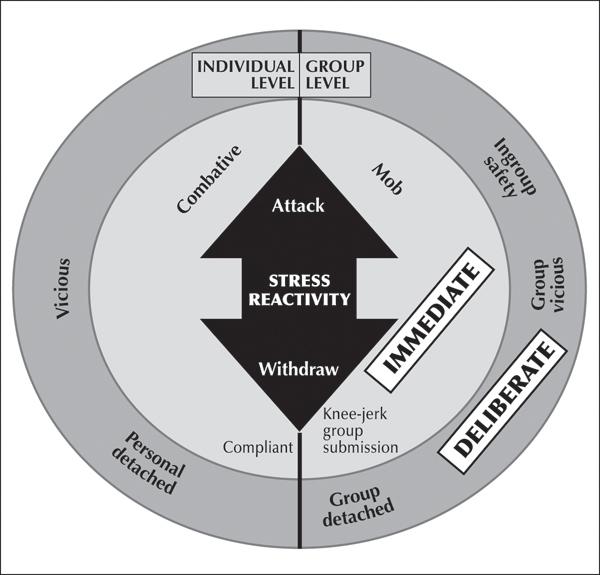
Although there may be multiple pathways to a dispositional safety ethic or its imaginative counterparts, stress reactivity may be the primary pathway. Too much stress in early development shapes the body/brain’s stress response into hyper- (or hypo-) reactivity, often for life. And the effects can happen early in response to stimulation that we are not aware that our perceptions and understandings are implicity shaped by our survival systems (fear, anger, panic, desire). The description by Henry and Wang (1998) of two forms of coping shows us how chronic traumatic early experience can carry forward into personality. The filters for social relations are established on a base of distrust and vigilance, modifying one’s early filtering of social information. A personality disposition for combative safety can lead to habitual bullying or blaming of others, whereas a disposition for compliant safety withdraws to self-reassuring behaviors such as numbness, obsessiveness, compulsiveness, or hoarding. When executive functions become involved, compulsive “overdrive” can lead to a greater desire for control over others through impositional altruism. With high hostility or anger, it can lead to vicious imagination. With suppressed emotion and perhaps more grief, it can lead to detached imagination. On the other hand, the lack of inner drive and energy may lead to a compliant ethic, making certain groups and ideologies more attractive (e.g., a religious order). Those that have clear goals and rules or supportive rhetoric may provide a sense of belonging that is missing from one’s implicit sense of being, providing the needed scaffolding for a feeling of safety and purposefulness.
Conclusion
Survival systems represent pre-human self-protective mechanisms that are critical in times of real threat. However, we can get caught in them from early miscare or later trauma. Depending on its specific timing, intensity, and context, miscare early in life (trauma, abuse, neglect, undercare) can lead to a personality oriented toward self-protective ethics using a combative or compliant orientation to social relations or more deliberate imaginative controls in relationships.
Human imagination is hampered by the incapacity to be-with and fully take the perspective of another person or living thing. Imagination can become too narrowly focused when it neglects the deep implicit relationships of all things and ignores the web of life. Impaired imagination is behind most evil in the world, even banal forms of evil such as cynicism, cruelty, patronizing, and indifference to suffering (Murdoch, 1989).
Vicious and detached imagination mindsets make sense to the brain/mind that has experienced social trauma or never experienced extended, intimate, loving relationships. Like all moral mindsets, safety ethics and their imaginative counterparts can occur on a momentary basis, when a person feels superior to another and takes action on that basis—to denigrate, defeat, analyze or dissect the other. Vicious and detached imaginations represent moral imagination downshifted to a survivalist set of values—separation, power, dominance, and manipulation. In the long view, these types of imagination are quite mad because they can do so much damage to the worldscape.
Summary Points
-
Survival systems are pre-human mechanisms that keep us alive.
-
Survival systems include the emotion systems of SEEKING, ANGER, FEAR, and PANIC (found primarily in the brain stem, basal ganglia, and lower limbic systems).
-
A brain-body complex not optimally developed may be governed by survival systems.
-
Survival systems are present at birth but conditioned peri and post-natally. They have little flexibility to begin with, and, after early-life sculpting or trauma, are very difficult to reshape.
-
Safety ethics emerge from early life conditioning of survival systems and can become habitual with an accompanying underdevelopment of prosocial systems.
-
A safety ethic can be triggered when a threatening situation is perceived, taking over attention and depleting resources for higher-order processes.
-
A safety ethic may be helpful in times of real threat but if chronic is maladaptive for the moral life.
-
Culture plays a heavy role in providing the language and narrative for promoting the safety ethic and its imaginative counterparts: vicious and detached imagination.
-
Vicious imagination is fueled by anger and desire for control.
-
Detached imagination is dissociated from emotion as a type of moral disengagement.
-
Both vicious and detached imagination are the sources for most evil in the world.
Chapter 8: Shifting Moral Mindsets
Yesterday you yelled at your child for spilling juice. Today she spilled it again and you smiled and cleaned it up. On the road you get mad at anyone who gets in your way, but at home you are meek and mild. Each time you felt justified in your action. What’s going on?
Whereas the ethics of engagement and communal imagination form part of our evolved heritage, the ethics of safety and combative, compliant, vicious, and detached imagination form a culturally-derived but twisted toolset for the moral life. Harper Lee’s novel To Kill a Mockingbird (1960) gives examples of characters that represent different dispositional ethics. Atticus Finch, the father and lawyer, represents a communal imagination, showing a broad concern for all, regardless of background. In the following scene from the book, Mr. Cunningham, initially caught up in a mob mentality, shows a vicious mindset that is prompted to shift to an engagement mindset at the encouragement of Scout, Atticus’s ten-year-old daughter, who exhibits an innocent engagement ethic. This is an abridged scene opening after a mob of men have gone to the jail, presumably to lynch the accused black man who is in the jail—the vicious superorganism imagination got them there. While the sherriff is away, Atticus Finch is watching over the jail. After the mob arrives, Atticus’s children, Jem and Scout, also step forward with their friend, Dill. Scout, the narrator, is noncognizant of the larger goings-on. (Please read the original for the full effect.)
Excerpt from To Kill a Mockingbird by Harper Lee
Atticus got up from his chair, but he was moving slowly, like an old man. He put the newspaper down very carefully, adjusting its creases with lingering fingers. They were trembling a little.
“Go home, Jem,” he said. “Take Scout and Dill home.” ...
Jem shook his head ...
“I’ll send him home,” a burly man said, and grabbed Jem roughly by the collar. He yanked Jem nearly off his feet.
“Don’t you touch him!” I kicked the man swiftly ...
“That’ll do, Scout.” Atticus put his hand on my shoulder. “Don’t kick folks. No—” he said, as I was pleading justification.
“Ain’t nobody gonna do Jem that way,” I said.
“All right, Mr. Finch, get ’em outa here,” someone growled.“You got fifteen seconds to get ’em outa here.”
In the midst of this strange assembly, Atticus stood trying to make Jem mind him ...
I sought once more for a familiar face, and at the center of the semi-circle I found one.
“Hey, Mr. Cunningham.” The man did not hear me, it seemed.
“Hey, Mr. Cunningham. How’s your entailment getting’ along?”
Mr. Walter Cunningham’s legal affairs were well known to me; Atticus had once described them at length. The big man blinked and hooked his thumbs in his overall straps. He seemed uncomfortable; he cleared his throat and looked away. My friendly overture had fallen flat ...
“Don’t you remember me, Mr. Cunningham? I’m Jean Louise Finch. You brought us some hickory nuts one time, remember?” I began to sense the futility one feels when unacknowledged by a chance acquaintance.
“I go to school with Walter,” I began again. “He’s your boy, ain’t he? Ain’t he, sir?”
Mr. Cunningham was moved to a faint nod. He did know me, after all.
“He’s in my grade,” I said, “and he does right well. He’s a good boy,” I added, “a real nice boy. We brought him home for dinner one time. Maybe he told you about me, I beat him up one time but he was real nice about it. Tell him hey for me, won’t you?”
Atticus had said it was the polite thing to talk to people about what they were interested in, not about what you were interested in. Mr. Cunningham displayed no interest in his son, so I tackled his entailment once more in a last-ditch effort to make him feel at home.
“Entailments are bad,” I was advising him, when I slowly awoke to the fact that I was addressing the entire aggregation. The men were all looking at me, some had their mouths half-open. Atticus had stopped poking at Jem: they were standing together beside Dill. Their attention amounted to fascination. Atticus’s mouth, even, was half-open, an attitude he had once described as uncouth. Our eyes met and he shut it.
“Well, Atticus, I was just sayin’ to Mr. Cunningham that entailments are bad an’ all that, but you said not to worry, it takes a long time sometimes ... that you all’d ride it out together ...” I was slowly drying up, wondering what idiocy I had committed. Entailments seemed all right enough for livingroom talk. I began to feel sweat gathering at the edges of my hair; I could stand anything but a bunch of people looking at me. They were quite still.
“What’s the matter?” I asked.
Atticus said nothing. I looked around and up at Mr. Cunningham, whose face was equally impassive. Then he did a peculiar thing. He squatted down and took me by both shoulders.
“I’ll tell him you said hey, little lady,” he said. Then he straightened up and waved a big paw. “Let’s clear out,” he called. “Let’s get going, boys.”
In this scene, Scout drew Mr. Cunningham’s attention away from the mob mindset, bringing him back into relationship in the present moment. This broke the spell of seeking violent revenge.
This illustrates how individuals can move in and out of different ethical mindsets based on circumstances and communication with others in the situation.
Ethical Mindsets and Triune Ethics
The prior chapters have presented much of what I call triune ethics theory (TET; Narvaez, 2008). TET proposes that humans have multiple moral mindsets that are rooted in the three basic global brain states described earlier.[87] Here we review the mindsets and how they work. For an overview of the three basic moral mindsets, Safety, Engagement, and Imagination, see Table 8.1. Recall that the baseline I am using for human optimal functioning emerges from small-band hunter-gatherer (SBHG) societies, where engagement and communal imagination mindsets dominate. All other mindsets are viewed as cacostatic (overreactive or underreactive), although sometimes it may be appropriate to employ one of these mindsets.
Safety Ethics
Safety ethics are modes of self-protection in social relations: “It’s about me and my survival.” Safety ethics can be triggered by a sense of immediate threat, taking over attention if there are impaired capacities for self-soothing and an inability to establish and maintain egalitarian social relations. They can be adopted early in life as habitual modes of reaction to the social environment based in well-rehearsed procedural memory or they can be embraced at any point in life due to acute or chronic trauma. In either case, the individual takes up a defensive, bracing position fueled by phylogenetically older (prehuman) systems. The defensive position can include a orientation to particular order or hierarchy that includes a sense of suspicion toward renegades or outsiders (the “impure”). When the individual lacks an internalized sense of social warmth—the ability to evoke positive affect in others—he can become sensitive to rejection and neurotically pursue love and status (P. Gilbert, 2004). A social rank mentality can become a default attitude toward others as the individual attends to power, safety, and fear of abandonment (Sloman, 2000).
The self-protective mechanisms of the basal ganglia and related structures can be conditioned for egoistic concerns when basic mammalian needs for companionship care in early life are not met. A young child who regularly becomes personally distressed in social relations has likely experienced patterns of social undercare, trauma, or neglect, reflected in one or more of the three previously identified physiological systems related to stress reactivity: the hypothalamus-pituitary-adrenal axis, vagal tone, or glucocorticoid receptor development. No doubt early trauma can cause damage to other systems, including psychological trust, propelling individuals toward a safety ethic. Note, however, that a general safety ethic may also be adopted for cultural reasons, as in male socialization that emphasizes status, honor, and male-over-female dominance (Nisbett & Cohen, 1996). Like any ideology, a creed of self-protection allows the individual to find feelings of worth while avoiding a sense of peril.
In the worldview of a safety ethic, a “me-first” orientation is morally defensible (and impaired perspective taking makes it appear rational). In effect, this orientation represents a solo psychological universe built from a sense that others are not trustworthy or available, with primary values of autonomy and self-reliance. Others are viewed mainly as means to an end, excluding much concern for them as people in their own right. The individual is locked out of a warm social world in some fashion perhaps due to stress dysregulation, poor social skills, lack of perception and awareness, or poor social intuition development. The individual is motivated to look for ways to protect the self and its concerns in order to avoid the near annihilation felt in the past. The safety mindset may arise only in certain circumstances that remind us of our trauma (e.g., sounds in the middle of the night), trigger self-doubt (challenging to self-esteem), or may become routine due to extensive stress in the past. In a dispositional safety mindset, we are motivated (implicitly) to look for threats constantly. Psychobiological systems are on alert, contributing to socially under- or overreacting. Sensitized by prior experience, the individual lives “on edge.”
Several conditioned moral orientations operate subcortically and can shut down other moral responses.Two subtypes of the safety ethic have been mentioned.
Combative safety (assault morality) occurs when the infant has been angered, shamed or punished repeatedly, accompanying a thwarting of needs. Combative morality is anger based and aggressive, and characterizes safety-oriented individuals who feel they have enough strength and power to take action against the threat. With a combative ethical mindset, one feels less than adequate unless one is dominant, due to a social-rank mentality; hence the bulldoggedness of some personalities in the face of challenge. This externalizing, pushing away of others with hostility or aggression can become habitual in social situations.
Vacant safety (compliant morality) occurs when the infant or young child’s needs were thwarted repeatedly, not to the point of death but to the point of despair. In this case the individual feels paralyzed or too weak to take action and so becomes a “doormat” or “wallflower” in social relations. The person withdraws physically and/or emotionally. Energy of spirit is suppressed, becoming internalized anxiety and/or depression.
In both cases, combative/domineering or vacant/compliant, reflect an inability to relax into a dynamic, egalitarian relationship which appropriate early life caregiving supports (Sullivan, 1953). Without extensive early experiences of ‘letting go’ into relaxed security in the arms of the caregiver as an infant, anxiety instead can become a constant companion. To control anxiety rigid relational scripts are applied such as one-up (I am special) or one-down (someone will rescue me) roles, whether the relationship is close or distant (Yalom, 1980).
Dispositionally, a person can favor one or the other type of safety ethic, or flip between them depending on the situation (a bully in one moment but a doormat in the next). We can see the safety ethic in operation in an authoritarian personality who claims dominance around low-status people but exhibits submissive behaviors around a higher-status person. The flipping from one-up to one-down, or cacostasis, indicates a lack of agile, nuanced social self-regulation. Either or both safety ethics can result in a collapse into insecure personal distress. However, in stressful circumstances, a person who has good control of stress reactivity will not downshift in morality and is able to maintain caring behavior (e.g., Frankl, 1963). They don’t feel threatened and so do not trigger the survival systems (ANGER, FEAR, PANIC).
Engagement Ethics
Engagement ethics are about communion in the here and now: “It’s about me being with you (us).” This represents a dual universe (instead of the solo universe of the safety ethic)—losing oneself trustingly in the moment to attune to the Other. A “vicinity companionship” is not manipulative or detached. An adult who is able to deploy a calm engagement mindset is presumed to have had early supportive care and practice with presence, reverence, synchrony and intersubjectivity, empathy, mentalizing, and perspective taking. Her stance toward the world will be an open and accepting ideo-affective posture (Tomkins, 1965). When an engagement ethic is predominant, there will be strong, close relationships with others, and feelings of empathy will be more accessible than feelings of anger or contempt. A supportive early social environment enables individuals to tolerate and understand a range of feelings in themselves and others without triggering personal distress (Leahy, 2005).
Table 8.1 Triune Ethics Comparison Chart
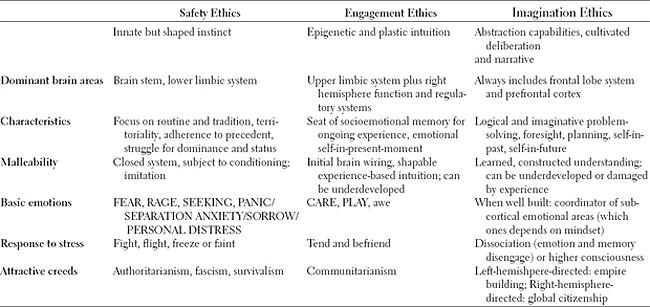
Healthy brain development in early life, as described in prior chapters, requires not just an absence of trauma but a rich, responsive social environment that fosters not only secure attachment but solid empathic effectivity roots and the capacities to emotionally engage others and cocoordinate interpersonal “musicality.” Multiple skills for egalitarian responsivity and mutuality are learned implicitly in early life through a reciprocal relationship with caregivers, allowing one to maintain social homeostasis in the ongoing, interpersonal dance. Processes of social reward and memory established in early childhood incentivize affiliation with others (Depue & Morrone-Strupinsky, 2005; Nelson & Panksepp, 1998). Sensorimotor memory for reciprocity and intersubjectivity is established. Social experience lubricates feelings of empathy, not feelings of anger, hostility, distress, or anxiety.
Engagement can be calm or distressed. Someone who does not have all the pieces together for self-development or construction of empathic effectivity roots may have a cacostatic reaction, either overinvolvement (entanglement in relationships, codependency, helicoptering) or underinvolvement (empathic distress), shifting attention to the self. But one can learn to self-calm and move from a cacostatic to a homeostatic pattern (see chapter 11).
It must be said that the engagement orientation is not always appropriate for moral action. For example, in modern society, when one has a particular duty to complete (e.g., if you are a waiter with clients ready to order), it is not advantageous to be talking to friends instead. Part of wisdom is knowing when to adopt or avoid a particular mindset.
Although foundational for higher moral capacities, an engagement orientation is insufficient for the moral life of an adult. Note Scout’s engagement but inability to perceive the bigger picture. Higher-order capacities must come into play, represented in imagination.
Imagination Ethics
Imagination ethics tap into an awareness beyond the present relationship: “It’s about integrating more than me and you.” Imagination builds on the other orientations, enlarging the field of possibilities and broadening the landscape for action. Imagination comprises executive functions that include metacognition about morality.
When affiliative emotions activate an engagement ethic along with imagination, the individual envisions prosocial ways to act, employing a communal imagination. A person with capacities for a communal imagination ethic has a well-functioning frontal lobe that has strong connections to and control of subcortical emotion systems. These capacities allow one to plan for the future, imagine alternatives and carry out action within a solid empathic core and communal autonomy space.
When physiological needs are met but social and psychological needs (such as belonging and wide social support) are not, several impaired but sophisticated moralities can result. Morality may seem a matter of individual self-protective principles or selfish intuition rather than a matter of cooperation and community. The civilized world seems to have created several such moral phenotypes that are not typically found in SBHG ancestral contexts. These mindset types are fostered in a corrosive or eroded social system that emphasizes detachment and intellect, manipulation and control, and lead to lowest-common-denominator morality. A minimalist approach to moral functioning can seem reasonable under these circumstances, such as Ayn Rand’s selfishness (G. Weiss, 2012). This egoistic phenotype is semiautistic, focused on self, as if born ex nihilo, without the dyadic connection to mother or sense of inescapable embedded relations to the community. What seems logical and appropriate to an impaired imagination often is “truthiness”—a determination of what feels right based on intuitions based on egosim, quick cacostatic judgmentalism (overly critical, domineering or avoidant), and the posturing and power plays of social ranking.[88]
Vicious imagination (righteous morality) occurs when there was a lacuna in support in early childhood that results in the handicap of right hemisphere functions. Left hemisphere dominance can lubricate anger and seeking. Even when the intention is noble, vicious imagination is an aggressive morality in which one’s views are forced on another. Pathological altruistic imagination imposes its will on others, but “for their own good.” It represents an inability to relationally attune with others.
Detached imagination (iced morality) arises in environments where emotion expression is not safe or effective, undermining its proper development. SEEKING is strong, with left hemisphere dominance, leading to an emphasis on intellect. There may be social concern, but it will be deficient in felt emotional empathy (the ability to feel loving feelings). Or there may be complete empathic detachment (emotional numbing) with self-focused goal attainment.
Criteria for Ethical Orientations
What are the criteria for proposing these ethical orientations? (See Table 8.2.) Evolutionary roots for these orientations have developed through the tree of life. First are the brain strata that MacLean noted and related to different global states. Characteristics of the moral sense Darwin attributed to humans (Darwin, 1871) (see Chapter 2) fall into the second strata and third strata. Second, emotion and cognitive systems that have been studied by affective neuroscientists map onto these different strata (Panksepp, 1998). For example, the safety ethic emerges primarily from the evolved emotions of the RAGE, FEAR, PANIC, overextended SEEKING systems, whereas the engagement ethic emerges primarily from CARE and PLAY and related endocrine systems. Imagination draws on the frontal lobe, especially the prefrontal cortex, and its powers to abstract from experience and coordinate human social capacities. Third, the evolved developmental niche (EDN) gives insight into human nature, which emerges when the EDN is followed and suggests that engagement and communal imagination are fundamental to the essence of being human. These evolutionary inheritances provide insight into the neurobiological mechanisms for the ontology of different mindsets that develop from optimal and suoboptimal care, as described in prior chapters.
Table 8.2 Criteria for Triune Ethics Theory Components
+----------+
Each mindset has roots in proximal adaptation (regardless of its distal adaptation over generations) for maintaining or restoring social homeostasis. Individuals in social situations aim for social homeostasis of one kind or another. Assuming a baseline of social embeddedness and collaboration, the safety ethic is cacostasic, with combative morality an overreaction and compliant morality an underreaction. Engagement represents social homeotstasis. Wisdom (engagement and communal imagination) represents social hyperstasis.
Experience shapes which mindsets are used skillfully and habitually. The three ethics are present from a young age, at least partially (deliberative moral reasoning and executive functioning take a few decades to mature if not damaged). Sociality and morality are rooted in the neurobiological development of early life, including attachment, which flavors the rest of the emotional and moral life. But dispositional tendencies towards an ethic may be canalized (routinized) in early life. For a given individual, the pattern of moral mindset shifting represents her history of social experience and practice—the accumulation and interaction of epigenetic, developmental, and lived experience. For example, in terms of attachment styles, we can see the different ways of relating to self and others based on experience. According to Bartholomew and Horowitz (1991), those with secure attachment have positive views of self and others, expecting others to be as positive and lovable as they consider themselves to be. These perceptions will be based in successful experience with others. Those with fearful insecure attachment view self and others negatively, as unworthy of love, perceptions that accompany a lack of successful social relations. Those with preoccupied attachment view the self as unworthy and unlovable but others positively, perceptions built from inconsistent success in social relations. Those with a dismissive (avoidant) style feels the self to be worthy but others unworthy, a defensive posture unable to self-assess neediness or incapacity.
Ethical mindsets are general motivations shaped by experience. Earlier I described fundamental cores to full human morality. Empathic effectivity roots represent procedural knowledge about the social world, providing parameters for “communion” with others, whereas the autonomy space represents procedural knowledge (intuition) about the boundaries for one’s actions, the parameters for one’s “agency” (Bakan, 1966). Moral imagination builds on these early sets of intuitions, which are difficult to change once established.
Culture plays a large role in which mindsets become habitual. Different cultures can foster one mindset over another in response to environmental press or intergenerational habits (e.g., the Amish cultivate engagement) (Kraybill, Nolt, & Weaver-Zercher, 2010). For example, culture plays a large role in whether the EDN is followed or not. Support of the mother-child dyad, families, and communities establishes the parameters for empathy and autonomy. See Figure 8.1.
But culture can break down instead of support the evolved systems of human development. We can see the results of such a breakdown in criminal and pathological behavior. Studies of criminals show the type of mindset that takes over perception and affordance, providing an in-the-moment sense of justification. Samenow (1984) provides a summary illustration:
Put a criminal and a responsible person in the gift department of a department store and ask each as he comes out to recount his thoughts while there. The responsible person comments on the attractiveness, quality, and price of the merchandise, and perhaps on the efficiency of the service. In addition, he may describe a pretty salesperson or customer and recount a conversation overheard.
The criminal notices little of this. He determines the best means to gain access to the merchandise as well as to customers’ purses, wallets, and other personal belongings. He also notices the location of the nearest exit. In addition, he regards any attractive woman as his for the taking. (Samenow, 1984, pp. 96–97)
How does a person develop such a criminal mind? First, the empathic core is deficient or nonexistent due to the nature of early life (and perhaps from intergenerational inheritance as well). Second, rage and a combative orientation were nurtured to a higher degree, resulting in an autonomy space with few boundaries except in regard to standing against others. Third, the mind spends its time focused on SEEKING (a common focus of those who did not receive what they needed when young), grabbing goods for the self. The individual’s attention is preoccupied with what she thinks is fair acquisition. The focus on acquiring or avenging injustice is likely deeply established from early experience. We can see a impaired empathic effectivity roots and a wild, unfettered autonomy space in juvenile delinquents and criminals who have difficulty taking another’s perspective or feeling empathy, and who tend to feel entitled to whatever impulse they have (DiBiase, Gibbs, Potter, & Blount, 2012; Samenow, 2004). The psyche is caught in a one-person worldview with massive distrust toward others. Similarly, children who earn the label of being aggressive see malevolence when there is none. Their social reactivity and their experience with violence make them form fantasies about innocent others who, for example, accidentally bump into them. Violent criminals can panic and emotionally “black out” as they carry out aggressive actions to restore social homeostasis (Gilligan, 1997). Later, the criminal will justify her actions in moral terms.
Figure 8.1 The Moral Self: Empathic Effectivity Roots (Communion), Communal Autonomy Space (Agency) that Underlie Moral Imagination and Form Parameters for Wisdom
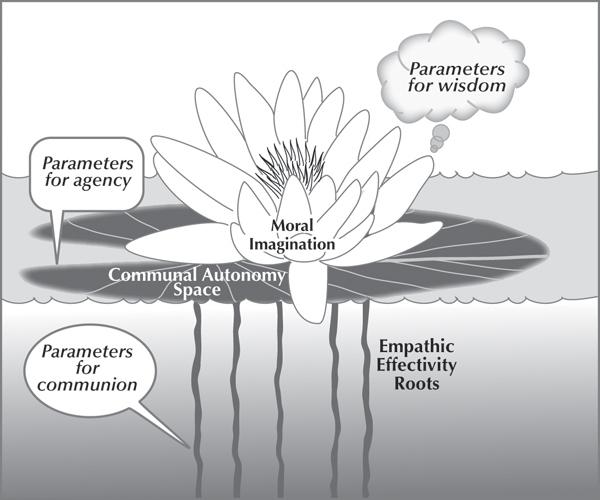
Individuals may have a safety ethic in some situations or domains and not others (think of the defensive American football player who is docile off the field). But in the particular domain where a person does have a safety orientation, the personality can be very limited, with few optional actions, because the orientation is rooted in prior conditioning. This can be evident when someone insists on her perspective as the only true or accurate one and becomes angry if that perspective is challenged (in her family being right was the only way to have status). But she may have other areas or contexts or relationships in which she shows engagement or imagination capabilities. It’s when the situation is perceived as threatening that her options shut down and she gets locked into a safety mindset. This again indicates deficits in the circuitry that allows limber, agile response (frontal lobe systems control instead of, for example, perseveration on a survival goal). At times the inability to change course or think flexibly plagues us all. We become fierce when our teenager criticizes our best efforts or when a spouse tries to control our autonomy. Thus, one does not need to develop a criminal mind to shift into a safety ethic. We might alter the prior illustration this way:
Put a person who is feeling openhearted and one who is feeling self-protective in the village square and ask each to recount her thoughts while there. The person with an openhearted mindset enjoys the experience and comments on the kindness and thoughtfulness of the people, perhaps describing the details of one or two meetings and conversations in detail, pointing out commonalities in interests or experience.
In contrast, the person with a self-protective mindset judges everyone she sees on superficial grounds (beauty, wealth, manners, threat) and determines how she is superior. She pinpoints those to dominate and those to avoid on account of their superior dominance. She does not learn anything in particular about any one person but speaks in categories and generalities.
Thus, any one of us can operate from any mindset at any given time, shifting perception and affordances for action. When the safety ethic is engaged, it is orthogonal to engagement, or the softer feelings of care and empathy, but also to communal imagination, the ability to take multiple perspectives and envision communally concerned action. When implicit social procedural knowledge is captured by self-protective mechanisms, it influences higher-order thought. Instincts for empathy are dampened. The implicit knowledge systems (system one) drive the individual toward egoistic concerns regardless of explicit knowledge (system two, which also can be enlisted to make up reasons to follow egoistic urges). The downshifting of control can explain some of the gap between moral judgment and moral action (L. J. Walker, 2004). Inconsistencies between procedural knowledge and explicit knowledge are promoted by undercare, as delineated in earlier chapters.
These examples provide evidence for more specific moral criteria that can be added to the list in Table 8.2. Definitionally, taking action from one or another mindset is known to affect the welfare of self and others, leading to greater flourishing or not, changing one’s circle of concern, and affecting attitudes, perceptions, and affordances that guide behavior. The action or attitude taken seems justified in the moment. An orientation can also be made into a creed to be followed for the “good life”; for example, a creed of toughness or kindness may be emphasized.
Table 8.3 Measures of Generic Moral Orientation
+----------+
Dispositional Ethical Orientations?
Measuring Disposional Moral Orientations
It is difficult to measure in-the-moment mindsets so my students and I have developed simple measures of dispositional ethical orientation. We have conducted multiple studies of these ethical mindsets, using.[89] Respondents (college students or adults) are presented with a set of words representing an ethical orientation and then rate statements about that set of words. See Table 8.3 for the measures.
Our findings generally conform with expectations (see Table 8.4 for some sample findings). We find that a general safety orientation is sometimes, but not always, related to insecure attachment (dismissive, preoccupied). Recall that the toughness of a general safety ethic can be adopted as a cultural narrative, especially for males. As predicted, a general safety ethic is also significantly negatively related to moral character variables such as empathy and perspective taking, as well as to prosocial interpersonal behavior (trust, honesty, forgiveness). In our studies, we find that engagement ethical identity is positively correlated with secure attachment and negatively correlated with insecure attachment. It is also positively correlated with moral character variables (empathy, perspective taking) and reported interpersonal behavior (trust, honesty, forgiveness) and negatively correlated with distrust and social dominance. We also find that engagement is correlated with agreeable personality, a result of mutually responsive early care (Kochanska, 2002). Caring moral exemplars, who exhibit socially helpful behavior, are high on agreeableness (Matsuba & Walker, 2004).
As noted earlier, responsive parenting is known to bring about secure attachment as well as agreeable personality (Kochanska, Sroufe). We also know that appropriate parenting leads to better health outcomes (see reviews in Narvaez, Panksepp et al., 2013). As expected, my colleagues and I have found statistical support for linking these variables from early life (evolved developmental niche) to attachment to mental health to moral capacities and then moral mindset (Narvaez, Wang, Lawrence, & Cheng, 2014).
Table 8.4 Triune Ethics Dispositional Correlations
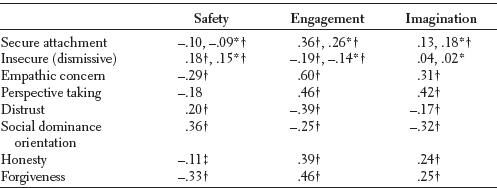
Notes: Unless otherwise noted, data is from study one in Narvaez, Brooks, & Mattan, 2011 (from two college student samples of n = 187 and n = 194); *from Narvaez & Lawrence, 2013 (n = 1,519 adults); †p < .01; ‡p < .05
Developmental Pathways
In prior chapters I have been putting together the arguments that early experience has a great impact on our human moral inheritances—whether the child develops them and whether the adults and the culture foster them. There may be a few more pieces to add to explain “how” this occurs. I reiterate some earlier points and add a few new ones.
In early life, parenting is critical for development of the right brain hemisphere, which appears to have a sensitive window for its rapid development that matches up with evolved intensive parenting (that involves positive touch, warm responsiveness and other characteristics of an evolved developmental niche). In general, the right hemisphere deals more with novel experience whereas the left hemisphere deals more with routine or familiarity. This is true for every learning process across the lifetime: The right hemisphere does the learning and the lefts stores what is learned (Goldberg, 2005).
Skill with social situations (which are always fluid and unique) require flexible responsiveness which enlists the right hemisphere (Goldberg, 2005). When the right hemisphere misses the intense social experience it “expects” in early life, it may underdesign its self-regulatory structures in physiological systems such as those described earlier (e.g., vagal tone). This poor self-regulation and the lack of extensive practice in social synchrony and intersubjectivity can impair the development of social capacities generally as social discomfort triggers self-protective mechanisms (Schutz, 2005). With impaired self-calming, the individual may be forced to employ the left hemisphere’s rigid categorizing (pattern recognition) instead of the otherwise-normal right-hemispheric capacities for dealing with novelty. Nonverbal learning abilities are deficient leading to a reliance on formulas and routines. Hence the awkwardness of those who explicitly learned the script for a social situation (the concept), like “Sheldon” on the USA television show, The Big Bang Theory, instead of fitting into the shifting dance of interpersonal relations.
For optimal moral functioning, one must have help from caregivers in early life and during sensitive periods to develop prosocial emotion systems (engagement) as well as the ability to derail from one’s less imaginative and hopeful emotions and to think beyond reacting to immediate threat (Greenspan & Shanker, 2004). When interviewed, former rescuers of Jews in World War II by and large noted close relationships with their parents and exhibited engagement and communal imagination orientations (Oliner & Oliner, 1988; Monroe, 2004). If early life is not full of loving support, one may become stuck in an unplayful, impulsive, reactive style of personality with little control over stress reactions (Shapiro, 1965). When a child does not receive appropriate care, the more self-protective, reactive brain will dominate and deficits for (social) pleasure may ensue, making replacements such as drugs attractive (as mentioned earlier, low dopamine increases desire for drugs like cocaine). Unmet needs may become anxieties or obsessions, leading to addictions to food, sex, or even video game play–activities.
Table 8.5 shows potential paths of development depending on early experience. For example, if raised to be stress-reactive, the individual may spend a great deal of time in a safety mindset. An externalizing combative orientation learned in a violent family may be useful for immediate survival, even though it is likely not adaptive in nonviolent environments. With prosocial emotion systems well wired by good early care, the individual may display an engagement mindset disposition. If a great deal of time was spent in nonsocial situations, the individual may be most comfortable in a detached imagination mindset.
What Changes When Mindset Shifts?
Joseph Goebbels, the manipulator of Nazi propaganda and Jewish persecution in Germany under Hitler, discussed in his diaries and speeches that he frequently experienced what he called “weakness of will.” These were moments of compassion toward the Jews he was trying to systematically destroy (Arpaly, 2003). Apparently, even though his ideology promoted a vicious imagination ethic toward Jews, he had moments when the engagement ethic dominated his relationships with Jews. His moral mindset kept shifting.
If you step back and watch yourself, you can see that you shift in and out of different moral motivations—from revenge to compassion to thoughtful generosity. You don’t sense that you are inconsistent because you probably are consistent in similar situations and circumstances. For example, when you are in a hurry, any delay makes you angry (e.g., cleaning up spilled juice). But when you are at rest, spilled juice is not a big deal. Similarly, you feel stressed commuting to and from work and lose your temper at bad drivers. But at home you feel relaxed and keep your temper. A consistent behavior pattern is visible when you match the same type of situation and same mood. Someone who only saw you when driving or in a hurry might call you an “angry person,” but this would be incorrect since in most other situations you are calm.[90] Variable personality “signatures” makes each person unique (Lapsley & Narvaez, 2004), representing changing motivations and behaviors by context, based on prior experience and emotional interpretations in the moment. Subjective states appear to involve distributed activations in brain areas representing sensory processing, conceptual knowledge, event sequences, action outcomes, and emotional states (Zahn et al., 2009). Sometimes there are early competing states, and sometimes states shift quickly with a perturbation in the environment, as in any dynamic system. When mindsets shift, what is changing?
Table 8.5 Possible Developmental Pathways Toward Dispositional Moral Mindsets
+-----------+
Attention
Attention is a primary factor in intelligence and morality. Attention frames interpretation and prepares one for action. The ability to control attention may be linked to the amount of emotional baggage one carries, which drains attentional capacity and increases distractibility. Moral mindset refers to an implicit mind-body-emotion set that includes interpretive framing and preparation for action that one willfully adopts. It is willful because one can learn to control one’s attention and reactivity. For example, feelings come and go. A particular feeling will fade away after the 90 seconds of its rise if not encouraged by rumination or kindling that keeps the reaction reverberating Thus, on the one hand, I can maintain equanimity even if I have a disturbing feeling (e.g., anger, fear) because I let it pass. On the other hand, I can feed the feeling with my cognitive appraisals or interpretations. (There is more discussion of techniques in Chapter 11.) For example, when my expectations are violated I interpret that as a threat to my goals, as in the spilled juice example above. In that case I can move on after cleaning up. Or, I can throw mental gasoline on the fire of feelings, making a bonfire of stress and causing a cascade of subsequent interacting effects, as in the road rage scenario described in Chapter 7. Unless Mr. Smart purposefully redirects his attention and calms down after his experience on the road, he may continue to be alert to threat at the mall. He may be more sensitive to others brushing against him in or standing too close. Such threat reactivity increases self-concern and decreases concern for others. At a certain threshold, Mr. Smart may overload and lash out. It takes longer, but it is similar overreaction to that of the criminal whose threshold starts out much lower.
The type of attention one maintains becomes a reciprocal influence. Receptive attention (bottom-up, data-driven processing) facilitates and is facilitated by engagement and communal imagination, whereas concentrated attention (top-down, expectation-driven processing) facilitates and is facilitated by safety and cultured imaginations. We discuss attention, including receptive attention, further in Chapter 11 because it is vital for living a good life.
Automaticity and Cue Perception
When we shift mindsets, affordances change, altering accessible knowledge and action skills. We enter different realms of automaticity. For example, if you know CPR, you will jump into action when someone collapses before you. When we are emotionally aroused, attention shifts, altering how we perceive and process events. There is “heightened sensitivity to cues related to the current emotional state” (Lane, Chua, & Dolan, 1999, p. 986). Affordance shifts with mindset (E. Gibson, 1992; J. J. Gibson, 1966, 1979). “Emotive circuits change sensory, perceptual, and cognitive processing, and initiate a host of physiological changes that are naturally synchronized with the aroused behavioral tendencies characteristic of emotional experience” (Panksepp, 1998, p. 49).
In threatening social situations, we can shift automatically to the safety ethic—unintentionally, effortlessly, and without awareness, taking few working memory resources (shifting to the other ethics take more time.) There are advantages and disadvantages of this involuntary shift. It’s advantageous when there is real danger. Stimuli perceived as threatening shift mindset and prepare us for self-protective action (Bruner, 1957; Rodin, 1987). When one feels threatened, opportunities for self-protection will be more salient. Potential weapons or hiding places will “pop out” and become more noticeable (e.g., a nearby broom might be considered a potential weapon). Mindset affects what you attend to and the perceptual cues noticed. Vision narrows under threat and expands under calm (Rowe, Hirsh, & Anderson, 2007; Schmitz, De Rosa, & Anderson, 2009). In an engagement mindset, which is relaxed and affiliative, the needs of others will become salient and a broom is just a broom.
But, as noted in prior chapters, some people can perceive threat everywhere if their stress response systems have been tuned to be hyperreactive. The automaticity of processing threat can keep a person in a chronic state of stress, with its concomitant detrimental side effects. It also canalizes social relations toward a safety ethic because of a catch-22: Alternative ways of being can be fostered, but only when the person is not stress-reactive, which will rarely happen for an overreactive person.
Filters and Experience
What I expect influences what I notice or “see.” People often impose meaning where there is none, especially when stimuli are ambiguous in social situations (Chapman & Chapman, 1969; Klahr, Chase, & Lovelace, 1983; Staub, 1978). A mindset influences how information is considered, according to whether it supports or disconfirms our prevailing mindset; we minimize the disconfirming evidence and evaluate supportive information less critically (Ditto & Lopez, 1992; Ditto, Munro, Apanovitch, Scepansky, & Lockhart, 2003; Klaczynski, 1997).
Filters and framings for interpretation of life’s situations are influenced by the knowledge and goals we bring to the situation. Those with more relevant experience generally perform better. Experts perceive the world differently, easily noticing the patterns they have rehearsed (Narvaez & Gleason, 2007). My history affects the choices of intuitive response I have available for a given situation. Just like Richard Wright’s Bigger Thomas, I respond in a manner that seems appropriate for the circumstances based on internal filtering of external stimuli. If I am threat-reactive I can find a conspiracy or hostile intention where there is none. Those labeled as aggressive interpret accidental bumps from others as intentional disrespect (Dodge & Somberg, 1987). Ansermet & Magistretti (2007) discuss an extreme case in which a man is taken over by his past when he feels abandoned by his lover:
“He is overcome by immemorial distress like the kind he so often experienced as a child after he was abandoned and placed in an institution that rejected him and left him in a state of extreme loneliness. He is no longer in the present situation but has once again found what has tormented him ever since childhood. He no longer knows who he is: he is again seized by this utter distress he feels each time he faces the risk of aloneness ... This is his fantasy: if he is abandoned, he no longer exists. This conviction overwhelms him. Absence torments him persecutes him. Absent from himself, he has to get a grip on himself, save himself. And so he hits her, once, twice. Loving passion has turned into murderous passion, and this is how passion can kill without intending to. He hits her without knowing what he’s doing, as if to save himself and stop being in this distress he has fallen back into ... Because he could not be separated he wound up destroying her to save himself. He lost her in order to find her again to find himself again.” (Ansermet & Magistretti, 2007, pp. 124–125)
This man was controlled by his fantasies (Ansermet and Magistretti, 2007). Once a fantasy is active, it joins with a particular somatic state that, like an obsession, demands fulfillment, impairing reasoning otherwise. It is as if a selfish goal takes over the mind, altering perception, affordances, and so on, until the goal is satisfied (Huang & Bargh, 2011). Similarly, Freud defined a drive according to source (somatic state), pressure (motor factor), aim (satisfaction), and object (whatever thing allows fulfillment of its aim) (Ansermet & Magistretti, 2007). Biologically speaking, anticipation of a somatic state (relief) drives action. We might explain it as a SEEKING (dopaminergic) goal of anticipated euphoria.
Situations and Goals
Situations influence our dispositions—we will behave quietly at a funeral but loudly at a football match. Personality doesn’t mean you are a particular way all the time. It means that in particular situations, certain responses are always triggered. For instance as noted earlier, it is situations of threat that lead aggressive children to act aggressively, while at other times they can act cooperatively and seem like everyone else. Personality is reflected in the stable pattern of behaviors across the same types of situations, a pattern of “if-then” responses (Mischel & Shoda, 1995, 1999). Thus, there is always a person-by-context-plus-immediate-prior-history interaction. For example, although aggression cues promote hostile thoughts and actions generally, individuals high in agreeableness are less likely to be primed for aggression than those low in agreeableness (Meier, Robinson, & Wilkowski, 2006). Disposition to use a particular mindset will vary by circumstance too based on the individual’s history and practice.
Even our goals shift when mindset shifts. Maybe your aim was to be a loving parent but when your child spilled the juice, frustrating your goal to leave, you became enraged and yelled. Goal orientation is so elemental in response to the environment that it affects early brain processing of events, flavoring perception with intention and forward-feeding perceptual processing (Barrett, Mesquita & Smith 2010).[91] For example, priming in lab studies for self-protection or prosociality influences not only attitudes toward and treatment of members of outgroups but helping behavior generally (Hart, Shaver, & Goldenberg, 2005; Mikulincer & Shaver, 2001). That is, the goal in mind provides a frame for what is perceived. Attentional orientation integrates appraisal and emotion structures with corticolimbic structures (M. D. Lewis, 2005).This can include recurring (“chronic”) goals, such as staying true to one’s identity or self-narrative, as well as concurrent action goals such as driving to work. Individuals can self-prime with narratives, as Goebbels did (“I’m supposed to exterminate Jews, not be nice to them”), and purposefully suspend empathy as in moral detachment, when moral justification and dehumanizing of victims occur (as well as obscuring of personal agency and disregarding of consequences of actions) (Bandura, 1999). In short, mindset can change preferred goals (Mischel’s “subjectively valuable outcomes,” 1973, p. 270), and goals, in turn, alter processing.
Moral Description and Prescription
Everyone has morality—that is, everyone aims for what she perceives to be good in the moment. In comparison to a well-formed self, a malformed self just sees the “good” differently. The personal beliefs a person has about the social world plays a large role in perception of the “good.” Those with limited social experience in the evolutionary sense (evolved developmental niche) develop misconstruals of the good life. Instead of openhearted relational attunement, they “know” distance and distrust. What feels rewarding (good and right) is quite different from our human heritages.
Each mindset is an attractor state whose pathway is lubricated by experience. For any situation, particular mindsets are more attractive to an individual because he has been there before or has found them satisfying. They seem to offer the right thing to be or do, whether downgrading to self-preservational aggression or upgrading to communal imagination. Poorly tuned emotions can lead an individual to find pleasure in reestablishing less-than-optimal situations. For example, a child used to chaotic life will try to recreate it in the foster home. A man used to feeling safe with dominant status will impose it wherever he goes. A woman raised with a borderline parent will set up rejecting relationships in adulthood. These are subconscious and emotionally driven actions. In any case, “the psychic reflection of doing ‘the right thing biologically’ [is] feelings of satisfaction and pleasure” that come from predictability, especially in the case of habitual stress reactivity (Panksepp, 1998, p. 118).
Am I arguing that there is one way to be moral? No, there are multiple subjective ways (Table 8.6 maps different ethics.) The three orientations are subjectively “true”; that is, they feel “right” and “good” when activated. But across time, engagement and communal imagination are our human heritage. They are the normative human telos if we attend to basic needs and flourishing. Nevertheless, the attitudes and behaviors of the safety ethic are generally not included as moral orientations in moral theories, except as viciousness in virtue theory, and so the justifications for such behaviors by agents are reinterpreted as outside of morality. The view here is that the different mindsets, including safety, vicious, and detached, are phenomenologically felt as moral positions. So for example, the criminal feels justified in assaulting someone who “looked at him wrong,” which was taken as disrespect and thereby injustice, triggering a tit-for-tat safety ethic. Influenced by a treacherous Iago, Shakespeare’s Othello felt justified in murdering his wife for her supposed infidelity because his honor/pride/sense of superiority was at stake.
However, when we remain in a safety ethic, even when we know better, when we nurse it and knowingly use imagination for safety ends, we cease being a human self to others. We stubbornly stay out of relation, killing part of ourselves. In indigenous cultures, losing the ability to recognize the selfhood of other, even non-human beings, is a type of soul blindness. And when one loses the ability to see the “soul-stuff of the other souled selves that inhabit the cosmos,” one loses oneself (Kohn, 2013, p. 117). To be, one must see and be seen.
Recall that I am arguing that our inherited moral capacities, engagement and communal imagination, which develop under conditions of evolved early care, are better because they align with our human essence, promote greater flourishing and guide us to our human telos. They are better than the cultured, stress-reactive moral orientations that are fostered when the EDN is violated. In the latter case, excessive cacostatic responses will be common and often uncontrollable. The reactive self-protective safety ethics might temporarily make the individual feel good, but ultimately leads to disarray in the individual, the community, and the environs, because safety ethics are incompatible with empathy or concern for long-term consequences. So although moral egoism has gained traction in recent centuries, it does not meet the tests of flourishing or human telos, and instead represents a prehuman orientation (but this may be too kind, as everything in the natural world cooperates in mutualism). But recall that I interrelate morality with effective action. The use of egoism or other moralities that are self-protective is an indicator that experience did not promote actionable skills in the more prosocial moralities. This is a communal problem—the individual as part of the mother-child dyad did not receive the support needed to develop full human capacities. One may desire to be communally imaginative but behave viciously. Although the aim is important, capacity and practice are more so.
Table 8.6 Identifiable Ethical Mindsets
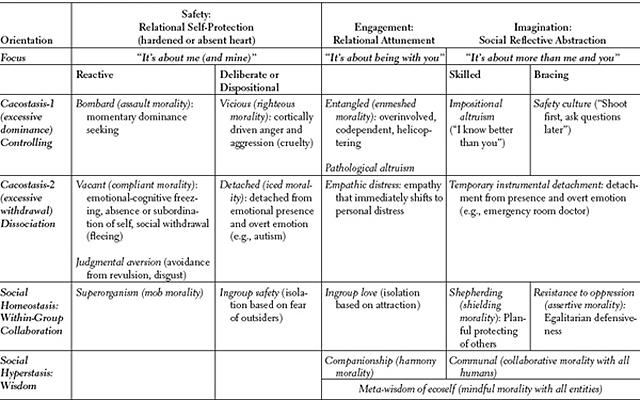
The more deliberative excessive cacostatic mindsets end up doing more harm than good. Pathological altruism, a subtype of vicious imagination, reflects controlling, dominating morality. Entangled engagement manipulates the Other with empathic bonding gone awry. With greater imagination, but still cacostatic, impositional altruism involves a sense of self-righteousness. Despite its seemingly noble intentions, it is aggressive morality. Lacking personal knowledge, impositional altruism does not distinguish between “caring about” and “caring for” resulting in actions that harm the cared for (Noddings, 2010b). One takes forceful action on others “for their own good.” Many domains of life typically operate from this mindset, such as business, schooling, and some types of parenting. Historical examples abound: For example, European explorers, adventurers, and missionaries took their lifestyles and belief systems around the world and imposed them on existing societies, not receptively attending to the life they encountered (Jacobsen, 2000; Pratt, 1992; Wexler, 2006). Modern nongovernmental organizations may move in to help a nation in distress but undermine the local customs and economy (Easterly, 2007); “economic hit men” representing governments and multinationals may set up unpayable loans with profiting elites in developing countries in order to control and exploit the nation’s natural resources (Perkins, 2004). These are types of moral mandates—the individual or group feels morally self-righteous in imposing its will on Others (Bauman & Skitka, 2009).
A safety culture uses alliances to brace itself against the Other, seeking to control and keep out the Other. Families and neighborhoods can adopt this orientation, which when temporary, may be very useful and necessary (e.g., conditions of siege). Over the long term, however, only a narrow flourishing will result. We discuss culture in more detail in the next chapter.
The underreactive, withdrawing cacostatic reactions include the reactive forms of vacant safety, which shrink in response to perceived threat, allowing bullies and egoists to dominate and destroy whatever is in their path. Underreactivity also encompasses judgmental aversion, or withdrawal based on an avoidance response. More deliberative forms of underreactivity include detached imagination, emotional and relational disconnection. Engagement distress also leads to relational withdrawal. Sometimes one can choose to detach temporarily for greater imaginative purpose, as when a leader thinks about strategies for saving his charges, foregoing his personal relational commitments to family.
Within-group collaboration can be seen in safety orientations that include reactive superorganism or fear-based ingroup withdrawal (religious sects sometimes do this to stay away from cultural contamination from the secular world). Sometimes groups withdraw for love-based reasons, as attempted by some utopic communities. Types of imagination for purposes of social homeostasis include shepherding imagination, organizing to protect others from harm (e.g., the military), and resistance imagination, banding together to resist severe oppression (e.g., resisters to Nazi occupation). Groups can also band together to perform reassuring rituals (like ancient Israel’s scapegoating).
Table 8.7 Examples of the Different Ethics
+------------------+
Recall the original Good Samaritan story. Several people walked by the man who had been beaten up. Table 8.7 shows distinctive responses for each ethic in a set of additional characters added to a similar story. Relevant to moral perception is the width of one’s circle of concern (e.g., only me and mine, those I recognize, human beings in general, or all lifeforms), for if the Other is an outgroup member, one’s compassion will be dimmed. Also critical is the perception of a need in the Other for whom one cares about (Nisan, 1984). Attitudes toward one’s ability or sense of efficacy influence whether one will take action (Bandura, 1991). But, as shown in the study of sermonizing on the Good Samaritan, affordance perception is highly influenced by such things as goals, amount of experience with similar situations, urgency, and perceived timeline.
Communal imagination in its fullest sense is built on engagement and matches up with what most moral systems tout as ideal: compassionate action for others, including nonselfish actions for humans outside of one’s ingroup. But as I will argue in the next chapters, flourishing cannot occur with a focus only on human beings.
Conclusion
Have you noticed that your personality shifts from situation to situation? Moral mindsets can shift from moment to moment, too, susceptible to environmental cues such as threat, mood, and affect, influencing perception and action. Not only do the three ethics interact, but they each have a dispositional aspect (traitlike quality) based on developmental experiences and practice. One’s moral mindsets reflect one’s vision but also one’s capacities. Our moral heritages build on effective practice, not just dreams and aims.
Different kinds of life experience appear to lead to different kinds of moral sense. Early care can enhance our moral inheritances (engagement and imagination), and when lacking can seed some moral senses that are less ethical from an objective viewpoint. Cultures, through their narratives and habits, can encourage one type of ethic over another and sometimes undermine our inherited capacities. But cultures are malleable; we don’t have to be stuck with the culture we have inherited. We examine some options in the next chapters.
Summary Points
-
Triune ethics theory is a broad-brushed descriptive theory that identifies different subjective moral mindsets.
-
Triune ethics theory is prescriptive in that it suggests the nature of optimal moral functioning based on a criterion of fulfilling basic needs, foster moral inheritances and human flourishing.
-
Each ethic represents a different global brain state that includes or excludes certain others.
-
Although engagement calm leads to present-moment flourishing, it does not take into account nonpresent others.
-
Communal imagination in its fullest sense is built on engagement and matches up with what most moral systems tout as ideal—compassionate action for others, including nonselfish actions for humans outside of one’s ingroup.
-
Empathic effectivity roots and a communal autonomy space are foundations for a communal imagination, which provides the parameters for wisdom.
-
When people don’t get their needs met early on and become stress-reactive, they more easily downshift to a safety ethic.
-
When a stress response is activated by perceived threat, the imagination will cohabit with safety interests and be used for self-protection through planful social aggression or withdrawal, maximizing safety through manipulation (vicious imagination) or disengagement from affiliative emotion (detached imagination).
-
When basic psychological or social needs such as belonging and wide social support are not met, sophisticated immoralities like vicious imagination may become habitual.
-
Some types of ethics can be adopted as an ideology.
-
Mindsets shift with the situation, creating a unique personality signature.
Chapter 9: Cultures and Imagination: Competition or Cooperation?
One goal of this book is to look at human potential: what it might look like and how it comes about. Culture forms the backdrop for our view of reality and what we perceive to be true so it is important to step back and study its assumptions closely. In our examination we should keep in mind multiple factors—our human heritages, what human flourishing looks like, and which practices foster flourishing. We take just two aspects of culture into account, cooperation and competition.
Competition or Cooperation?
Are humans basically violent, sex-crazed, and selfish? The defendants of the Thucydides/Hobbesian ghost that haunts evolutionary theory seem to think so (e.g., Pinker, 2011; E. O. Wilson, 2012). The dominator model of humans over nature and human over human has captured much of human imagination in recent centuries and is considered natural, normal, and necessary by many thinkers (Eisler; 1988; Korten, 2007). Hyper-Darwinism tells us that selfish genes are the dominant player in our lives and in Nature. The dominator model and a belief in a genetic “war of all against all” makes sense when our bodies and brains are encouraged to be self-protective and distrustful by trauma and a lack of support in early life and beyond. But this is one, minority, view of history and humanity. Such a view would not make sense to most humans in prior ages or in small-band hunter-gatherer (SBHG) societies (see Sahlins, 2008).
The phrase “survival of the fittest” has been used, ever since Herbert Spencer first coined it, to describe an individualistic law showing such things as cooperation, love and altruism to be unreal, a law which (somewhat mysteriously) both demands and predicts that they should always give way to self-interest. (Midgley, 1985, p. 7)
The vast majority of human societies in past and present do not display a dominator model (Fry, 2013). Instead, hunter-gatherer groups, which I’ve been using as a baseline for human normality, display traits like “band-wide food sharing; high levels of allomaternal child care; daily cooperative food acquisition, construction, and maintenance of living spaces and transportation of children and possessions; and provisioning of public goods on a daily basis” (Hill et al., 2011, p. 1286). These traits are not only common among human groups but unique to human beings. Further, most people living together in these groups are not related so genetic factors in the usual sense are not the hidden drivers of cooperation. Their cultures show a type of commonality and cooperation that is common in “old growth cultures” like hunter gatherers (Kimmerer, 2013a).
The real story about humans and their societies is quite different from the Thucydides/Hobbesian perspective. To perceive this, one must use the broader scope of human genus history and SBHG cultural practices, examining basic needs and what helps humans thrive, as I am doing in this book. In light of this framining, selfish, aggressive behaviors presumed to represent “evolution at work” and “human nature as it is designed to be” are strange and abnormal.
Let us compare the two worldviews: cooperative and competitive. They filter reality differently. Table 9.1 shows contrasting interpretations of some contemporary problems based on framing by competitive and cooperative worldviews. The common behaviors and attitudes assumed to be normal by one worldview are considered abnormal by the other. Selfish, aggressive, and destructive behaviors are considered part of evolution and human nature by the competitive worldview but immoral, disordered, or insane by the cooperative worldview. In the competitive worldview, responsibilities considered normal or moral by the cooperative worldview are considered impossible or outside of everyday reality (theological). But we can see from anthropological evidence that this is untrue.
Table 9.1 What Do You Perceive: Order or Disorder?
+-----------+
Instead, what is becoming increasingly clear is that human societies can adopt one or the other worldview and create the culture to go with it. The question becomes, then, which worldview do we select and, thereby, which type of society do we create—one that emphasizes cooperation or one that emphasizes competition? We do have a choice, and what we choose will influence how we raise children and what society we build and find preferable to live in. Let’s examine the options more closely.
Cultures That Aggravate Self-protection and Self-centered Imagination Ethics
Childrearing practices are influenced by culture—at the family and societal levels—influencing culture in return. Over centuries, modern life has been shifting away from companionship care. As a result, modern life is set up against full engagement. And the press against engagement starts from the beginning of life. Self-protective survival systems are enhanced both by poor early parenting and a cultural emphasis on competition, status, and dominance that “seems normal” according to the survival orientations developed by inappropriate care.
What do cultures that promote self-centered morality look like? Individualistic striving for materialistic goods is encouraged over other values (which elevates inequality, crime, and ill-health) (Kasser, 2002; Wilkinson & Pickett, 2009). Such an emphasis increases overstriving, restlessness, anger, and frustration (Pani, 2000; Restak, 2003). Group leaders encourage a safety ethic by emphasizing threats from outsiders (Stout, 2007). Threat-reactive group members often keep a strongman in power and feel more cohesive from focusing on a mutual external threat. Those with a chronic safety orientation feel at home in such a context. Empathy for outsiders is discouraged and minimal. This type of tribal orientation was demonstrated in an evangelical congregation when 90 percent of congregants left after the pastor began to preach an inclusive, rather than exclusive, gospel message, saying that the whole world would be saved and not just those of their faith (National Catholic Reporter, 2005). Inclusivity is an unwelcome message when a host of threat-promoting beliefs have been adopted as identity narratives (“We’re superior,” “They are a threat,” “You cannot trust them,” “We are vulnerable,” “They are disgusting”).
We can see a safety ethic in “cultures of honor,” which are presumed to have emerged from pastoral societies around the world (Nisbett & Cohen, 1999). Because they needed to keep others from stealing their herds of animals, these cultures presumably developed strict hierarchy, male domination and aggressive response to threat. Not surprisingly, when cultures emphasize social rank (and shame due to a low rank), they breed narcissism (Lasch, 1979). Highly prized in a safety ethic culture are obedience, allegiant ingroup loyalty (not the loyalty of love), and control of soft emotion. Actions that represent submission to an authority figure, to patriotism, or to tradition to preserve the ingroup are deemed noble (e.g., suicide bombing among those who espouse extremist creeds). These attitudes and behaviors are useful for societies where warriors are cultivated to dominate other groups.
In a safety culture, cooperation and compromise with the Other are viewed as “losing.” The culture can encourage too-easy “downshifting” to a “me-first” orientation when threat or conflict arises (Bailey, 2002). The safety ethic is often assumed to be human nature (returning put-down for put-down; status seeking and narcissism; careless sex; hoarding; explosive rage; social fear). Cultures that inculcate a “Greed is good” belief create individuals who disengage from moral consequences and in fact behave more unethically; and in fact, those with more wealth are more likely to behave unethically (Piff, Stancato, Cote, Mendoza-Denton, & Keltner, 2012).
Competitive cultures may represent natural outgrowths of stress-reactive brains that do not receive the nourishment to develop empathic effectivity roots, communal autonomy and agile social imagination and behavior. Baumeister and Beck (1999) noted that human brains have more processing systems allocated to threat than to positive things. However, this may be especially true for the brains typically studied (people from WEIRD societies—Western, educated, industrialized, rich, democratic [Heinrich, Heine, & Norenzayan, 2010]—because they are often raised outside the evolved developmental niche). In other words, findings from studies in WEIRD societies may not apply to humans generally.
Lack of companionship care in early life may lead to irrational (misleading, inaccurate) emotions because of faulty foundations. When companionship care is missing, the individual may have well-functioning analytical skills but poor emotional intelligence and an emotionally detached personality. The other outcome of a poor beginning is an individual who display a disordered self-concept, poor cognition, and disordered emotions, which together mislead action and decisions. In both cases, vice is easy to develop (e.g., dishonesty, greed, recklessness). Basic elements of a moral self are missing, along with the emotions and imagination that are critical for effective moral action and together form humanity’s moral highest capacities. Dysregulated emotion systems are detrimental not only to self but to others, leading to many of the ego-disordered personalities and safety ethical behaviors apparent today.
Cultures That Promote Engagement and Communal Imagination
Societal cultures of childrearing vary, but we know from anthropological and other observational reports that SBHG societies provide a cultural commons for child development when they follow the evolved developmental niche. They provide companionship care and raise people who are not only intelligent but highly morally sensitive and astute (Fry, 2006; Ingold, 1999; 2011; Kimmerer, 2014; Prescott, 1996). The engagement ethic is primed in these contexts—supportive, caring relationships and environments that promote feelings of affiliation and relaxation or playful interaction. When the brain-mind-body complex is well constructed and supported, the individual’s systems, including those involved in moral behavior, perform more optimally. Children who are well cared for become sociable members of the family and society.
To contrast a competitive with a cooperative culture, I quote Colin Turnbull (1983), who made a comparison between Western and SBHG contexts, specifically between British society and Mbuti society in central Africa. Turnbull, social anthropologist of the twentieth century, spent a great deal of time with the Mbuti hunter-gatherers of formerly Zaire (now the Democratic Republic of Congo). He wrote about them in his bestseller, The Forest People (1961). In a subsequent book, The Human Cycle (1983), he contrasted the lifecourse of the Mbuti with that of Westerners, particularly referencing his own upbringing in Britain (where he had nannies and went to exclusive boarding schools).[92]
Unlike most Westerners, the Mbuti believe themselves to be conceived as soon as they are wanted, before the sacred act of intercourse that creates them. During pregnancy, the mother sings a uniquely devised song to the child in the womb, reassuring the child of his place in the natural world. This type of introduction of a child to the natural world is common among indigenous societies. For example, for Little Tree, who was adopted by his Cherokee grandparents after his parents’ deaths, Granma sings a welcome song when he arrives at their home:
the forest and the wood-wind,
Father mountain makes him welcome with his song.
They have no fear of Little Tree
They know his heart is kindness
And they sing, “Little tree is not alone.”
Even silly little Lay-nah
With her babbling talking waters
Is dancing through the mountains with her cheer
“Oh listen to my singing,
Of a brother come amongst us
Little Tree is our brother, and Little Tree is here.” ... (p. 5)
Note: Excerpt from The Education of Little Tree by Forrest Carter, published by the University of New Mexico Press, is reprinted by arrangement with Bowen Books LLC. Copyright © by Forrest Carter. Copyright renewed 2004. All rights reserved.
Returning to Turnbull’s description of the Mbuti, the mother is very focused on the sacredness of the life growing within her, deciding which actions to take by sensing how the child is affected by them. After birth, the mother enters into a reciprocal relationship with the child, sensing when the child is ready to meet the immediate family and later, the whole camp. At the right time, the child is passed from one to another, and each holds the child close, returning the child to the mother if there is any distress. Once the child is named, the child is treated as an equal member of the camp. The first three years of life involve a symbiotic relationship with the mother, and great caregiving assistance is provided by the others in the family and camp. Childhood is spent in free exploration and cooperative (not competitive), coordinated challenging activities with other children of multiple ages. The forest is the playground for developing senses and skills to their fullest. Teasing is used as a means of preventing aggression and violence. But if, as children are learning these things, someone teases another to tears, the play group ostracizes the teaser (for a short time) and focuses on giving the teased the best play roles until all is forgotten. See the following text box for Turnbull’s description of the contrast between how children grow up among the Mbuti and his own British upbringing. (For further examples of childrearing practices in contemporary hunter-gatherer societies, see Narvaez, Valentino et al., 2014.)
An Mbuti Childhood
“By the time a Mbuti boy reaches youth his total experience has equipped him to enter a stressful situation with confidence, supported by a whole repertoire of specific conflict-resolving skills and techniques well learned and practiced throughout childhood. If he feels a degree of uncertainty, he feels none of the fear and perceives nothing of the threat that would lead ultimately and exclusively to a violent solution to conflict ... Infancy is by no means a time of total protection but rather one of controlled experimentation and perpetual learning.” (Turnbull, 1983, pp. 36–37)
“All their potentialities have been explored and developed to the limit; not just their bodies, but their senses of sight, smell, touch, and hearing have all been nurtured as instruments of learning and communication.” (p. 73)
[Turnbull contrasts this with his own experience in school, in which he was roundly criticized for his failure to do well in competitive sports with hints that he was a coward and afraid to use his body because he did not assert himself or “take his punishment like a man” (p. 73). He further describes how the boys he grew up among reached adolescence with empty minds that uncritically absorbed dogmas and interpretations of facts. “Team spirit” meant being trained for punishment and violence against others.]
“The Mbuti are a people who are inherently no better or worse than any other people, subject to the same human temptations and failures, but who even under extreme provocation are nonviolent; who even in times of deprivation share what there is without hesitation, as though there were no alternative; and who even in times of confrontation seek and find nonviolent solutions; who are able to maintain a remarkably high level of social order without laws ... We just take our senses for granted and leave them where they are; we do not allow them to “become,” anymore than we allow the child to “become”; we impose limitations rather than encourage total growth. Mbuti children grow both outward by exploration and discovery of the total world around them, including humanity, and inward by using all their sense to learn who and what they are and where their abilities can lead them as individuals. Their physical, intellectual, social, and spiritual growth are not segmented into different compartments; they are constantly interacting until they become an indivisible whole. (pp. 74–75)
“... But the kind of caring for one another that I learned in childhood was based both on a possessiveness that divided the family and an insistence that the child, unable to care for itself, had to have goodness, or what was deemed good for the child, imposed on the helpless creature. Almost throughout, the family model taught division rather than unity, competition rather than cooperation, and even hostility rather than the fullness and acceptance of love. Even the love that for so long I only dimly recognized was imposed and demanded rather than felt and feelingly reciprocated. Therein lies the enormous importance of the intense, continuous, and consistent physical proximity between the Mbuti mother and her child during those first three critical years of its life, during which the two share one mutual existence, fully reciprocating everything they have to give each other. (pp. 75–76)
“Now there is a model that will lead to the child’s becoming a truly social being throughout his life, a model of mutuality. And as the model was enlarged, the same theme was repeated in just about everything the child did and experienced, including all activities and all human relationships, ... The Mbuti child was offered no challenges that it could not meet, but at the same time was offered new challenges to meet its growing abilities ... The cooperation that emerges later in life—and in our modern society cooperation is every bit as necessary as it is in all societies—is mechanical, rather than organic, because it was learned by imposition rather than felt through reciprocation. (p. 76)
“... unlike the Mbuti we continue in adult life to have to be coerced to behave in a social manner. Order has to be imposed or enforced by violence or threat of violence; it lacks that inner drive that makes such external compulsion unnecessary or minimal. And there, finally, we come back to Spirit, which for the Mbuti is where life begins and where it ends. For them, at least, it is that awareness of Spirit that enables them to accept differences of manner, custom, speech, behavior, even of belief, while still feeling an underlying unity. It is awareness of Spirit that enables them to avoid the conflict and hostility that arise so easily from such differences.” (pp. 76–77)
Reprinted with the permission of Simon & Schuster Publishing Group from THE HUMAN CYCLE by Colin M. Turnbull. ©1983 Colin M. Turnbull.
Notice that the Mbuti mother has a sense of relational presence with the child from the beginning. She treats the child in the womb as a partner for whom she is guardian. After being named, the child is treated with equal respect, and the spirit-self of the child is encouraged to develop to its fullest capacities. Autonomy is shaped in a context of loving presence within a whole community, founded in deep empathic roots, keeping striving prosocial. In this way, the individual learns to “move with” others rather than “move against” them in a unity of agency and communion, a common way of being among SBHG (Ingold, 1999). The child is part of the Whole. Beingness is embedded in a relational web with humans and nonhumans, a constant state of “we-ness” with All.
In the SBHG context, identity is shaped quite differently from how it is shaped in cultures emphasizing an individualistic worldview. Although identity is more communal it still offers what Western psychologists understand as an organizational framework for memory, emotions, and cognitions that guide goals (Leary & Tangney, 2003). Identity is commonly understood as “the commitments and identifications which provide the frame or horizon within which I can try to determine from case to case what is good, or valuable, or what ought to be done, or what I endorse or oppose” (C. Taylor, 1989, p. 27). In the case of the Mbuti, the “I” always retains a sense of common self with others.
So it seems to me that a shift away from this consciousness is a failure of human beingness. I think that cultures that promote companionship care build moral characters that have the fullest of human capacities, not only capacities for deep compassion but also capacities for accurate perception of self-in-world. Note that in conditions of companionship care, emotions are well trained to tell the truth, not deceive. These are rational emotions and invaluable for living (MacMurray, 1992). Why do I emphasize this point? A well-trained implicit mind guides behavior optimally and keeps the explicit, conscious mind in check. It calls for second looks, giving the benefit of the doubt to others, and showing more magnanimity in judgment. The development of “emotional reason” allows one to shift the center of feeling from inside (the self) to outside (the world), a feat necessary for accurate perception. When early experience provides companionship care, it ensures that cognition and emotion are well established and integrated. Even if a person gets off track at some point in life, she can more easily find balance when her beginnings were optimized.
Societies that support companionship care may be critical for providing the support to a young child during autonomy surges. Parents and other caregivers must be around and attentive to pull the child past the downshift attractor of self-aggrandizement and into the community. That may be why most cultures of the world discuss children as “not quite human” or still learning to be human. But they also provide the necessary scaffolding for pushing past the magnetic safety mindset toward the higher reaches of morality.
Cooperation in Nature
To underscore the importance and commonality of cooperation, let’s look at the natural world. Contrary to Hobbesian views that nature is red in tooth and claw (Dawkins, 2006), there is overwhelming evidence that the natural world itself is much more infused with cooperation than competition, on all levels and through time—4 billion years of it (Weiss & Buchanan, 2009). Such cooperation has been noted by observers for some time. For example, in his observations of animals, Kropotkin (1902/2006) noted that instead of the “perpetual struggle among half-starving individuals for each other’s blood” that the hyper-Darwinists had proposed, his own observations were of a struggle against inclement weather and the otherwise overwhelming mutual cooperation among and within species (p. 22). Recall that Darwin (1871/1981, and in his personal notebooks published by Gruber, 1974) also noted vast cooperation among animals. Competition is a minor and rare part of the real story (Weiss & Buchanan, 2009).[93]
Observation of complex organisms and ecosystems also raises questions about competition as the primary principle driving evolution. If you peel away the veneer of competition among organisms, you see that there are other powers at work. Additional mechanisms that collaborate with natural selection have been suggested, such as symbiosis and self-organization.
Frank Ryan (2002) provides a historical view of human awareness of symbiosis and cooperation among animals. The ancient Greeks noticed cooperative relationships between animals—for example, plovers taking leeches off of crocodiles (Herodotus)—and some (e.g., Cicero) suggested that humans could learn from such natural friendships. In the nineteenth century, Schwendener studied lichens, an organism that baffled scientists. Schwendener saw under the microscope that lichen was two lifeforms—algae wrapped in fungal threads (hyphae). In an 1877 publication, Albert Bernhard Frank coined the term symbiotismus to refer to two different species living in or on one another, and in 1878, Anton de Bary redefined the term to mean “the living together of differently named organisms,” a broader term that could include mutualism (tit for tat), parasitism, or commensalism (when one benefits and there is no effect on the other) (F. Ryan, 2002, p. 19).
After extensive research, Wallin (1927) proposed a countercultural theory that placed symbiosis at the center for the evolution of species. He proposed that bacteria are the building blocks of life, as exemplified by mitochondria, the symbiotic bacteria that live within every cell and provide its energy. The symbiotic relationships among organisms include chloroplasts in plants and motile bacteria providing locomotion (cilia) in small organisms. Bacteria in cells add genes to the genome, transferring directly into the nucleus (see F. Ryan, 2002, for more details). Recall that the vast majority of life in a human body is not human but trillions of bacteria, fungi and even viruses living in community.
Lynn Margulis (e.g., 1998) described how data from the evolution of microbial life show no evidence of evolution through the accumulation of gradual mutations. She emphasized:
No life-form exists outside a self-maintaining, self-reproducing cell ... Just a tiny membrane-bounded sphere, a wall-less bacterial cell requires a cadre of molecular interactions, more than fifteen kinds of DNA and RNA, and nearly five hundred different types of protein and usually closer to five thousand kinds. RNA by itself, DNA by itself, any virus alone, is not alive. (Margulis, 1998, p. 83)
Margulis argued that symbiotic union was the creative force in evolution. The mechanism for symbiosis is not incremental change through advantageous mutations. Instead, when organisms interact, they bring to the party a host of genomic and metabolic characteristics that have been sculpted over time. This creative force can cause major evolutionary jumps (see F. Ryan, 2002). Symbionts resist further selection pressures because of the equilibrium in the relationship.[94] “We are symbionts on a symbiotic planet” (Margulis, 1998, p. 5). According to this view, animal and plant cells originated from symbiosis. Instead of competition as a driver of biodiversity, symbiogenesis brings together different organisms to make more complex entities as “the inheritance of acquired gene sets” (p. 9). The phenomena of nature are so intricately complex that they could not have emerged from a trial-and-error mechanism of random genetic mutations alone. In fact, “alternative modes of self-organization are themselves subject to natural selection and thus are amenable to fitness analyses” (Reeve & Sherman, 2001, p. 65).
Complexity theory does a better job of describing how forms can emerge from interactions within complex systems (Prigogine & Stengers, 1984). Stuart A. Kauffman (1993) suggests another mechanism as a companion piece to natural selection: self-organization. Organisms and sets of organisms coevolve in ecosystems. Kauffman (1993) argues that Darwin was not wrong in postulating that natural selection guides evolution but that he apprehended only part of the truth. We can see and now measure how simple cells and complex organisms organize themselves spontaneously. Natural selection works on these spontaneous sources of order. The organic properties of organisms reciprocally “permit, enable, and limit the efficacy of natural selection” and represent “balance found ... [and] collaboration achieved, when natural selection acts to further mold order which preexists” (p. xiv). The marriage of natural selection and self-organization is ruled by law: “Selection achieves and maintains complex systems poised on the boundary, or edge, between order and chaos” (p. xv). Such edge-living systems are best able to coordinate tasks and evolve successfully in a complex environment.
To some great extent, evolution is a complex combinatorial optimization process in each of the coevolving species in a linked ecosystem, where the landscape of each actor deforms as the other actors move. Within each organism, conflicting constraints yield a rugged fitness landscape graced with many peaks, ridges, and valleys. (Kauffman, 1993, p. 644)[95]
One of the most astonishing discoveries about genes in recent decades is the fact that humans share similar genetic blueprints with mice and elephants. That is, the development of particular body parts use the same ancient toolkit across species (Carroll, 2005). In fact, only 94 of 1,278 protein families on the human genome are specific to vertebrates (those with central nervous systems), meaning that the rest are inheritances from invertebrates through the tree of life. Many aspects of cells evolved before genes themselves emerged, becoming fixed in single-cell yeast and bacteria (Margulis, 1998). The history of life consists of new architectures built from old components.
In short, in considering what story we want to tell about ourselves and what worldview to promote, we must step back from the current received view of our heritages (e.g., genes in competition) and note the cooperation all around (and in) us. But perhaps the most important point here is the partnership between evolution and an individual’s development. Evolution provides systems to support life apart from genes, such as the evolved developmental niche. Evolutionary developmental biology (evo-devo) considers evolution to be not just changes in gene frequencies but a matter of changes in developmental processes (Lickliter & Harshaw, 2010).
It is now widely accepted that what is passed on from one generation to the next are genes and a host of other necessary internal and external factors (or resources) that contribute to the development of an organism’s traits. As we review in later sections, this developmental manifold ... or developmental system ... is increasingly recognized to be the source of both the stability and the variability of development, eliminating the need for notions of preformed genetic programs or blueprints. This perspective emphasizes the dynamic and contingent nature of the development of phenotypic traits and recognizes that a focus on how phenotypes are generated during development is a critical feature of understanding how the process can be changed or modified. (Lickliter & Harshaw, 2010, p. 495)
I have come to realize that what is critical is how we develop—in cooperation with evolution and nature, fostering optimality—or in opposition to evolution and nature, undermining our flourishing. Though I was raised to think that Nature was evil and dangerous, the truth seems to lie in the opposite direction. There are vast fields and webs of cooperation that are geared to support life and development, not undermine it.
Explaining Life Through a Cooperative Lens
If we shift the framing to an emphasis on cooperation, we get a different set of interpretations and prescriptions (as shown in Table 9.1). According to a “cooperation story,” life manifests cooperation at every level “all the way down” and “all the way back” in time. Every system is an exhibit of cooperation. Humans themselves have multiple systems that codevelop and coevolve with other systems in the vicinity. Every organism can trace its origins back in time to prior organisms and conserved elements that made the organism’s life possible. Indeed, no single creature can exist, let alone flourish, alone, despite philosophical and Hollywood narratives to the contrary.
According to neuroscientist Rodolfo Llinás (2002), the organism learns to predict the nature of its environment through the outcomes of its intentions and actions. He suggests that volition in interaction with environmental outcomes is what drives evolution. An individual human represents an edge-living system whose phenotype coevolves with the other humans and organisms around her (Kauffman, 1993). See Figure 9.1.
Let’s compare the contrary worldviews. Assuming that human nature is cooperative is a different orientation from assuming that human nature is competitive. (See Table 9.2.) With a cooperative worldview, the individual is sensitive to human needs as well as to opportunities for creativity and play. The expectation is for collaboration, communal reasoning, humor, sharing, and joint activities. The primary mood is contentment. These are deeply felt orientations based on experience that has shaped implicit understanding or intuitions. In contrast, a competitive worldview sensitizes one to threats, temptations, and affordances for self-protection and self-advantage. What is expected from others is aggression and battles for dominance, leading to a perceived need for vicious imagination. The individual can easily blame others to maintain status and self-aggrandize. The prevailing mood is one of distrust. Moods will influence the mindsets that propel moral behavior.
In the cooperative worldview, the natural world is considered naturally cooperative. Humans are assumed to be good. Yet, when humans display signs of disarray, (as today): destruction of life and habitat, willful greed, a sense of entitlement, vicious imagination, general ill-being, and an enchantment with violence and destruction—these are taken as warning signals that humanity is off kilter—whose nature needs to be restored and revived.
Figure 9.1 How Natural Selection Relates to Cooperation and Self-Organization
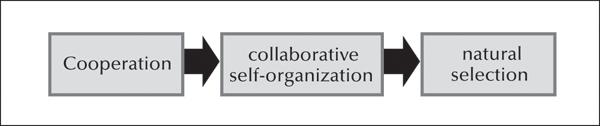
Table 9.2 A Comparison of Cooperative and Competitive Worldviews
+-------------+
In the cooperative worldview, current outcomes are presumed to be malleable. After examining the wide range of basic needs in Chapters 2 and 3, we can see that dispositional aggressiveness in social mammals is generally an indicator of a poor environment, either in early life or during a sensitive period. The problems individual humans and humanity as a whole are exhibiting across the globe are not genetic so much as the result of epigenetics and developmental plasticity and shaped by cultural practices. Neuro-developmental sciences are showing that basic needs (see chapter 2) cannot be separated but are a unity in early life. Caregivers provide for physiological needs, and this is best done with a sense of loving responsiveness that also conveys a sense of security. These form a foundation for a cooperative orientation that embodies the types of cultural attitudes and practices described in this section.
Cultural Beliefs Matter
Culture influences human becoming. Recall humanity’s multiple inheritances: the genome, the epigenome, developmental plasticity, the biogenome, culture, and ecology. In recent centuries, and especially recent decades, culture has been highly influential in reshaping these heritages—not only in determining the care that children receive but also in how the mother’s body is set up for childrearing in terms of the epigenome (which genes are turned on and off); what develops in the mother, including her microbiome; and what ecological heritage is left for descendants. The types of health statistics I reviewed earlier suggest that culture has headed us in the wrong direction.
It is common to think that a culture’s practices for childrearing are optimal for that cultural context (Worthman, Plotsky, Schechter, & Cummings, 2010). However, there is often confusion between what adults have become (based on their early experience) and what the culture espouses. So, unless one carries out careful examination, one can conclude that adults are raising children in a manner appropriate for their culture. Stress-reactive adults are likely to create a culture that is similar to what they experienced. In fact, animal studies show that female rats with low-nurturing mothers are even less nurturing as mothers themselves (Meaney, 2001). That is, I am suggesting that stress-reactive parents foster stress reactivity in their children, not realizing how it undermines health as well as cognitive, social, and moral capacities. As the group slides into widespread stress reactivity and concomitant health effects, there is little sense that things could be different. “This is what nature is like.”
Fromm (1964) describes a similar “syndrome of decay” that can affect individuals and cultures, comprising a “love of death, malignant narcissism, and symbiotic-incestuous fixation” on the mother (pp. 18–19). In this case, he proposes, at the beginning of life everyone has the opportunity to choose the good. He tells the story of how a young white boy, who enjoyed playing with a black neighbor girl, was asked by his mother to stop doing so. After he refused, she bribed him with a trip to the circus, and he then gave in. When a similar incident occured when he was older and enchanted with another girl, also not approved of by his parents, he accepted the bribe of a six-month European trip to think about his engagement to her. On the trip he broke the engagement. Fromm argues that moments of self-betrayal like these lead to increasing self-contempt and self-doubt. Such incidents “harden the heart” to life, leading to a failure in the art of living. “The longer we continue to make the wrong decisions, the more our heart hardens; the more often we make the right decision, the more our heart softens—or better perhaps, becomes alive” (Fromm, 1964, p. 131). An inability to notice the points of critical decision-making leads an individual to travel down the wrong road. I can see it in my life and in the society at large—that we have been speeding down the wrong road.
Competitive cultures promote an individualistic, self-preservative perspective instead of what is typically human: a prosocial species-preservative orientation (Wang, 2005). Thus, competitive cultures promote moral shrinkage, the curtailing of awareness and imagination about fuller human capacities and possibilities. Moral shrinkage leads to a focus on self-protective egoism (narcissism instead of love), domination and hierarchical morality (regression to a prehumen essence), and an avoidance of relational attunement (necrophilia instead of biophilia) (Fromm, 1964). Moral shrinkage ... higher consciousness, including communal imagination and wisdom, making them seem less available than they are under evolved conditions. Moral shrinkage and a lack of higher consciousness lead to undercooperative cultures and destructive practices toward all lifeforms. The undercooperative lifestyle becomes a vicious cycle of increased moral shrinkage in subsequent generations. See Figures 9.2 and 9.3.
Figure 9.2 A Culture of Detachment
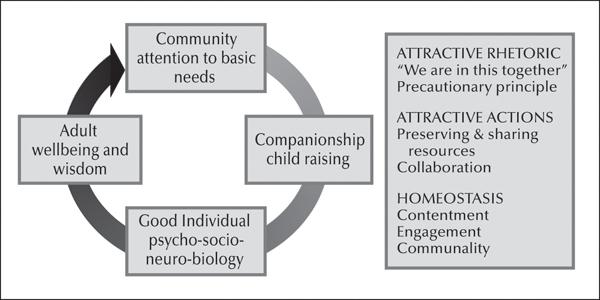
Within a culture of detachment, adults view humans as selfish and competitive by nature. Because of this, little attention is given to humanity’s, and especially children’s, basic needs. As a result, children are overly stressed, resulting in suboptimal psychosocial and neurobiological well-being. This leads to adult ill-being and self-consumed, distracted adults, perpetuating the cycle and worsening each generation. Adults in this cycle are insecurely attached and attracted to rhetoric about independence and self-reliance and may even impose it on babies. They may have a keen sense of injustice and of their rights (from the injustice they have experienced), and self-focused decision-making and egoism, almost as a matter of justice, may become the norm. Undernourished adults tend to be narcissistic and hoard resources. They may be stress-reactive and consumed with anxiety, which they may control with ideology of one sort or another (e.g., political, economic, religious, scientific). The cycle begins again as parents and caregivers are distracted with their own needs and neglect the basic needs of children. The detached cycle may be hard to perceive for those growing up and living in a detached society, but one’s eyes can be opened by experiencing life in or reading about societies that nourish a companionship culture.
Figure 9.3 A Culture of Companionship
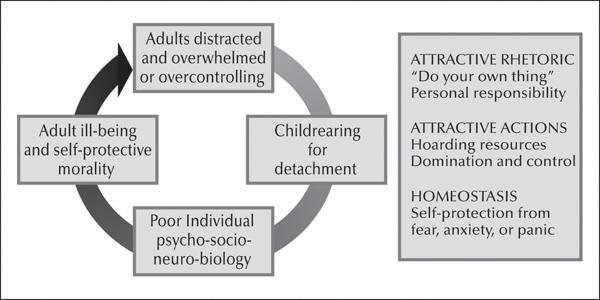
A culture of companionship offers a different worldscape. It considers morality, rather than immorality, to be the default condition of the world and of humanity. When humans are raised in healthy, nurturing environments, they are more capable of becoming moral adults (peaceful, caring). Companionship cultures concern themselves with supporting early development, including in the womb. Mothers are cared for and supported in ways that relieve them of undue stress and thus prevent the transmission of suboptimal epigenetics to their fetuses during critical phases of development. Mothers transfer the love and support they feel to the fetus. After birth, mothers and infants are tenderly supported from the first moments in order to nurture bonding and optimal growth. The magic of caregiver–child relationships is encouraged through companionship care. The brain requires appropriate environmental support for its positive development until adult maturity (around age twenty-five); otherwise it goes awry, as evidenced by violence toward self or others as well as immature cognitive or affective processes (which, again, are detrimental to self and others). In companionship cultures, the emphasis is on meeting basic needs and enjoying one another. The central value is a good life for all. Cooperation is expected and competition limited.
Earlier I described fundamental cores to full human morality that are visible in SBHG societies, who share a common culture representative of our evolutionary history: an empathic core and autonomy space that represent social procedural knowledge and parameters for action that are deeply communal. Cooperative societies support the development of these fundamental capacities, which are representative of a human essence. In contrast, competitive cultures undernourish or damage our empathic effectivity roots and misdevelop children’s autonomy space through minimal social fettering, allowing egoistic whims to hold sway. Both the empathic core and autonomy space become shadows of their human possibility and become oppositional to one another (agency versus communion). These defective foundations leave moral imagination floorless and shapable by current social press and egoistic rhetoric and drives (i.e., without the ability to control primitive emotional urges like personal pleasure-seeking) or in need of an ideological framework for sustenance. The moral self is divided. To behave morally, the individual is forced to rely on explicitly learned rules, rules that do not coincide with lived experience and take a great deal of energy to pursue. The true moral self is initially undermined and then dressed up with unfelt moral precepts, much like Turnbull describes for his own experience.
Coordination of our multiple moral orientations, as wisdom requires, relies on responsive parenting that fosters calm interpersonal habits as well as prosocial emotional networks and higher-order thinking systems. If early experience is unresponsive, traumatic, neglectful, or abusive, the interpersonal habits, emotional networks, and higher-order executive capacities may develop at odds with one another, fostering mental ill-being and undermining reasoning as well as emotion and social coordination. One’s explicit aims and self-perception might embrace compassionate morality while one’s behavior is aggressive and egoistic. This is a divided self. In the next chapters, we examine how to put the pieces of human moral becoming back together.
Conclusion
Adults can choose to create or alter the cultures they have created. Cultural orientations can promote companionship or detached care. Lack of companionship care can undermine capacities for the ethics of engagement and communal imagination and instead promote the ethics of safety and vicious and detached imagination. Instead of moral extensivity towards Others, moral shrinkage into self-protection is promoted. Misdirected culture can create a vicious cycle. The conditions for pathological brain development (thwarted imagination and engagement in service to safety) are passed generation to generation, forming a shifting baseline that erodes community. The worldviews of parents whose needs were not met as children (undermining their optimal development) and cultural ideologies about child development and childrearing continue into the next generation and beyond (deMause, 1995).
In whichever environment they are placed, children grow into the skills required for thriving in that place. For generations in the past, humans around the world raised children into cooperation through companionship care. Although I am not advocating returning to living outdoors in nomadic foraging bands, or without medicines or clean water, there is much to be learned from our cousins who do live in these communities. They are largely peaceful, healthy, and happy. What wisdom do they have, and how does it contrast with Western wisdom traditions? We examine these issues in Chapter 10.
Summary Points
-
Although human cooperation is often considered unique (e.g., compared to the behavior of other primates), it represents a small piece of the massive cooperation that infuses the natural world.
-
The world is characterized much more by cooperation than by competition, all the way down and all the way back.
-
Under evolved circumstances, humans develop cooperative natures and companionship cultures.
-
While culture influences parenting practices, parenting styles themselves influence the worldviews of those who grow up in the culture.
-
Counterevolutionary development childrearing creates cultures of detachment.
-
Just like individuals, cultures can move towards moral extensivity or towards moral shrinkage.
Chapter 10: Paths to Moral Wisdom
Loving Nature makes people protective of it. But what would happen if people believed that Nature loved them back? The relationship would become a sacred bond (Kimmerer, 2014)
Wisdom has long been considered a matter of philosophy (but so was psychology until the break in the 19th century). Recently, wisdom has become a topic studied by social and neuro scientists (Goldberg, 2005; Sternberg, 1990; Sternberg & Jordan, 2005). Wisdom has been defined by social scientists in various ways. Cognitive theories emphasize cognitive capacities or perspectives on reality—wisdom is a type of knowing (Chandler & Holliday, 2005; Czikszentmihalyi & Rathunde, 2005; Kramer, 2005). Kramer (2003) defines wisdom as “excellent judgment about human affairs” (p. x). Sometimes specific capacities are emphasized such as the ability to distrust intellect (that “knowing” is fallible) or the ability to “find problems” (Arlin, 2005; Meachum, 2005). Some social scientists emphasize sets of integrative capacities. For example, Orwoll and Perlmutter (2005) define wisdom as an integration of cognition, affect, and affiliation with social concerns. Birren and Fisher (2005) emphasize the balance of emotional intensity and detachment, knowledge and doubt, action and inaction.
Other theorists are more explicitly focused on action. Labouvie-Vief views wisdom as a process of balancing logic (logos) and subjective knowing (mythos). Sternberg (1998) describes a balance theory of wisdom, which is mediated by values: “Tacit knowledge underlying practical intelligence is applied to balance intrapersonal, interpersonal, and extrapersonal interests to achieve a balance of the responses to the environmental context of adaptation to, shaping of, and selection of environments in order to achieve a common good” (p. 354). Tacit knowledge is procedural knowledge that accrues from birth. Sternberg (2005) considers it both a metacognitive style and sagacity.
Life-span researchers define wisdom as a form of practical wisdom: “a metaheuristic to orchestrate mind and virtue toward excellence,” an “expert knowledge system concerning the fundamental pragmatics of life,” or “expertise on the conduct and meaning of life” (Baltes & Staudinger, 2000, p. 122, 123, 124, respectively). Baltes & Smith (2005) emphasize a type of life smarts, which is comprised of knowledge, both factual and procedural; basic understanding of the contexts and interrelations of life; tolerance for diverse values; and the recognition and management of uncertainty. Wisdom is correlated with particular personality characteristics (e.g., openness, creativity) and requires basic levels of intelligence (Staudinger & Pasupathi, 2003).
Historically in the Western world, wisdom involves living in conformity with the truth and beauty of the universe or God (Robinson, 2005). Plato (The Republic) proposed that wisdom requires knowledge of the Good, “exhibited in knowing how to live, which includes good choices and also high quality states of one’s soul” (Kupperman, 2005, p. 248). Eastern traditions too emphasize living in harmony with the universe. Indian traditions emphasize knowing the self as identified with the entire universe and perceiving and responding to the world with this perspective. The Buddhist tradition emphasizes no-self, emotional detachment from particular outcomes with compassion and peacefulness. Chinese Daoism rejects fixed categories; a good life is an unobtrusive, harmonious existence, demonstrating spontaneous and emotional freedom throughout the continuous change that life is. “Nuance, style, and the underlying attitude expressed in behavior are crucial” with Confucius pointing out that one’s demeanor towards one’s aged parents is critical (Kupperman, p. 255).
In every case, wisdom includes a great deal of know-how regarding how to live (Kupperman, 2005). In contrast with the “clumsy cousin” of intellectual formulas, “what is needed is a deeply internalized kind of knowing-how that normally does not require pauses and time to think ... responsive to the moods, needs, and responses of the persons with whom one interacts”.. with “some experiential sense of how various kinds of interaction play out in the long run” (Kupperman, 2005, p. 266). Kupperman discusses “submoral” a set of heterogeneous features that “do not meet the threshold level of social urgency required for something to be a moral issue or decision” p. 263. They are not involved in the “high-pressure decisions of morality” like whether to kill or not. The “subcomponents” of morality are fundamental to moral functioning during easy cases (Kupperman, 2005).
Much of what we have been discussing about early life development may have to do with these “submoral” aspects—the components of empathic effectivity roots and a communal autonomy space. Although moral development is often measured with hard cases, the moral life moves mostly among “easy” cases—the everyday treatment of others where manner and nuance matter greatly and where mindsets guide our action.
The mindsets that dominate many societies today—safety, vicious, and detached imaginations—through their influence on culture and practice, have brought us to a point of health and ecological crisis. As Albert Einstein pointed out, the mindset that causes the problem cannot cure it. Carl Jung also noted that the greatest problems we face cannot be solved but only outgrown.[96] But what then do we do? Where and how do we grow and adopt a new worldview? Examining wisdom traditions may offer us insights.
Wisdom Traditions
Abrahamic Wisdom Traditions
Discussions of wisdom often focus on ideas from philosophies, religions, and traditions from the last 1 percent of human genus history, since the dawn of agriculture, so we start there. Although religions can be practiced as a set of beliefs to which one must subscribe, a deeper, more spiritually focused lifestyle is also characteristic, which has been termed “wisdom tradition” (H. Smith, 1991). Instead of practicing religion as rules and applications of dogma, wisdom traditions aim to transform the self through practices such as regimens of meditation or prayer. This deeper form of involvement demands extensive daily practice to shape ways of being (perceiving and acting). These practices access what intellect cannot access: “knowledge that is lost in information” and “wisdom that is lost in knowledge” (Eliot, 1934, from the chorus). Here we focus on the commonalities in wisdom practices among the Abrahamic religious traditions (Judaism, Christianity, Islam), although as noted above wisdom traditions are apparent in other worldviews like Buddhism and Taoism. Through their practices and aims, wisdom traditions holistically bring together engagement and communal imagination, compassion, and reflection.
To examine the characteristics of the Abrahamic wisdom traditions, I draw on a marvelous overview by Cynthia Bourgeault (2003). No distinction is made between wisdom and moral wisdom, and so I do not make that distinction here either.
Three Centers
The Abrahamic wisdom traditions, which I call Traditional Wisdom (TW), typically acknowledge three centers in the human person: the intellect, the moving center, and the emotional center, with the last being central.
The intellect represents humanity’s logical, conscious understanding, with executive capacities for planning, focusing attention, and setting goals. These, of course, are very helpful for problem-solving. However, wisdom traditions contend that when people spend a great deal of time in thought, they begin to confuse themselves about who and what they are. In information economies, this might especially be true, as people spend most of their time learning information in school and using computers to pass it around. They begin to rely more on thinking for their source of identity as human beings, missing out on other aspects of life—in fact, most of it. Thus, TW practitioners point out a common error among members of their societies: that they confused being with thinking (Bourgeault, 2003). Thinking never stops with the endless chatter of the mind. Being is much more than that and covers transrational understanding (Rohr, 2011).
The second center, the “moving center,” represents body actions in two forms. The first form is the involuntary autonomic, instinctive responses, and the second form is voluntary physical actions. Traditionally, the involuntary are considered built in. But I have spent some chapters showing how many physiological responses are shaped by caregivers in early life. Nevertheless, learning to control one’s survival systems and chosen actions throughout life is a central concern for the wisdom traditions. Voluntary, self-disciplinary practices “train” these systems, like one trains a dog, to obey the higher-order goals of the self. Fasting regularly and following a daily schedule of prayer or meditation are methods used to move one’s focus to a realm higher while taming the body’s needs and reactions.
The third center, the emotional center, is the primary focus of self-development. It includes the nervous system and emotions, the heart (as described below), and perception. Wisdom traditions consider authenticity to be honestly facing the source of one’s emotions, being aware of personal agendas and the grasping and controlling orientations that intense emotions represent. These “passions” represent a “diminishment of being” and a falling into passivity (from the Latin passio) in which one is being acted upon (Bourgeault, 2003, p. 33). It is easy to see that the survival systems are referenced (SEEKING, ANGER, FEAR, PANIC).
The “heart” does not refer to ongoing personal-affective response but rather a window or antenna that can connect to the unmanifest. The heart is the organ that can perceive the beauty and purpose of cosmic divinity, the life force. Specifically, it can orient the self to divine radiance and synchronize being to the subtle energies of the cosmos. As Sufi master Kabir Helminski opined,
we have subtle subconscious faculties we are not using. In addition to the limited analytic intellect is a vast realm of mind that includes psychic and extrasensory abilities; intuition; wisdom; a sense of unity; aesthetic, qualitative and creative capacities; and image forming and symbolic capacities. Though these faculties are many, we give them a single name with some justification because they are operating best when they are in concert. They comprise a mind, moreover, in spontaneous connection to the cosmic mind. This total mind we call “heart.” (1992, p. 157)
When the heart is “awake” and “clear,” it can “receive, radiate, and reflect” a reality that is not visible to the intellect (which typically considers such reality mere speculation) (Bourgeault, 2003, p. 35). The “pure” in heart are volitionally unified or wholehearted (Frankfurt, 2004). Purity represents the coordination of the implicit and explicit minds so that there is no self-contradiction, no subliminal undermining of explicit will, no cognitive failure in explaining nonconscious behavior. The individual acts holistically and freely, unimpeded by a divided self.
We can see here the difference in type of awareness between the heart and the intellect. The intellect, with concentrative awareness, accesses certain logical material, categorized aspects of reality, but not the Whole. It maintains only representations of reality, seemingly unaware of ongoing shifting life energies in the unmanifest. Spending life in a world of the intellect alone leaves one isolated from the larger, subtler world that reflective awareness can access. Type of awareness overlaps with type of logic. In most Western traditions following Aristotle, logic follows several discrete laws (identity, contradiction, excluded middle) that categorize objects into one thing or another, making it impossible for something to be and not be at the same time. Yet the wisdom traditions orient to a different logic—the paradoxical (what is usually associated with Eastern wisdom tradition but also apparent in the views of Heraclitus, Hegel, and Marx) (Fromm, 1956). Paradoxical logic holds opposites together: both/and rather than either/or. Reality is one and reality is many. Every time we step in the same river it is a different river (Heraclitus). Reality is a coordination of opposites: yin/yang, being/not-being, one/many. Expanded, receptive awareness can comprehend and feel paradox (both/and) and live with ambiguity, unlike the intellect, which can only respond in an either/or fashion.[97]
Goals for a Deeper Conscience
The primary goal of TW practice is to apprehend truth by bringing into alignment the three centers (intellect, body, emotion) (Searle, 2011). The aim is not so much mystical vision but seeing reality in a lucid and objective manner that, in contrast to the ordinary way of seeing, seems visionary. TW emphasizes an intuitive intelligence that is larger than any aspect of a single self. It supercedes the focus on the here and now that physicality and immediate emotions compel, and it transcends the capacities of intellect to look to the past and the future (“horizontal time”) (Eberle, 2002). It accesses “vertical time” (also known as sacred or eternal time), an expanded sense of time. Tapping into this supra-self level allows one to move beyond individual awareness to a broader and deeper sense of reality. This requires development of the heart’s perception.
Indeed, the primary focus of TW is on purifying the heart. A pure heart is able to see the imaginal world, the source of joy and life dance. Honing the heart requires “weaning it from the ‘junk food’ of the passions” and providing nourishment through “divine qualities and images” (Bourgeault, 2003, p. 96). Only with a pure heart is one worthy to become an artisan of the divine (life force) becoming. Ego detachment is part of heart purification, “polishing the mirror of awareness ... by gradually freeing it from the domination by the small, anxious and reactive ego-self,” leading to “objective seeing” (Bourgeault, 2003, pp. 87–88). At the highest levels of practice, the individual becomes a cocreator. In fact, this is what the world “theology” originally meant. Theology is not talking about God in linear, rational discourse but actually about participating in the logos (or creative intelligence) of theo (God) as it shapes itself into new forms through unitive seeing, a timeless creativity. Wisdom requires balancing oneself in all three centers. If one does not have this three-tiered balance, one is considered to be “asleep,” and so cannot live in the right way. The TW traditions have particular practices to train the heart and promote a three-centered beingness.
Through ongoing disciplinary practice of meditation and prayer, deeper conscience is built. But conscience is not Freud’s superego that conveys society’s morality and conventions. Instead, conscience is about the heart’s ability to see the divine imprint in any situation and to be able to move in alignment with the “divine hologram” without concern for self well-being (similar to a loss of self-centered consciousness). Recall the Kenyan minister who gave away his treasures to the assailants who were in the process of murdering him. When a person’s deeper conscience is awakened, it fosters an obligation “but also a mysterious ability to be present in exactly the right way” (Bourgeault, 2003, p. 98). In approaching a problematic situation, a pure heart, with its own aliveness, will perceive a way to heal or change energies toward compassion:
Conscience is the pearl of great price; it is both the instrument and the supreme realization of visionary seeing. It is the capacity always and everywhere to see the whole of God yearning to become manifest in all our human beings and doings, like the full of the moon faintly present behind the crescent. With the awakening of this eye, you no longer see Wisdom; you are Wisdom. You become a channel of God’s peace, and the greatest of all artists as you dance with “the love that moves the stars and the sun.” (Bourgeault, 2003, p. 99)
Although it may seem that wisdom is for a chosen few who live in enclaves that emerged after the Neolithic shift (to settled, agriculture-based societies), examination of nomadic foragers and other indigenous and aboriginal peoples shows this is not the case. In fact, wisdom is integrated into their lifestyles, and it is broader than what is discernible from the writings and practices of Western wisdom traditions.
Primal Wisdom
Wisdom has a much longer life span than Abrahamic traditions and appears to be part of human essence. In fact, it was integral to nomadic forager life and the lives of other indigenous societies. Their survival may have depended upon it. Martin (1992, 1999) masterfully summarizes the Primal Wisdom worldview in his books. He says, for example,
Let us re-learn, as hunter-gatherers knew to the core of their being, that this place and its processes (even in our death) always takes care of us—that Homo’s citizenship, and errand, rest not with any creed or state, but with “that star’s substance from which he had arisen.” (Martin, 1992, p. 130)
We examine the indigenous worldview and practices more carefully. There are numerous accounts of nomadic foraging lifestyles—from European explorers and missionaries, from archeological records, and from anthropologists of extant groups in recent times. Of course there was and is cultural variability, but studies suggest there were many commonalities across these societies (see R.B. Lee & Daly, 1999, for some of the variability and the commonalities). I also include studies of more settled indigenous groups that continued to hunt and forage (e.g., Australian Aborigines, Celts, Inuit, Cree). It turns out that many of their commonalities align with views of Western wisdom traditions.
No matter where they are found around the world, immediate-return, small-band, hunter-gatherer (nomadic foraging) societies developed strikingly similar cultural practices (Ingold, 1999, 2011; R.B. Lee & Daly, 1999). This particular set of social practices appears to foster survival and flourishing at both the individual and community levels. Indeed, these communities are known for their social well-being and peaceableness, suggesting that the lifestyle is both wise and moral (Fry, 2006; Gowdy, 1998; Ingold, 1999; Sahlins, 2008). They appear to manifest humanity’s moral inheritances, previously described. Of course, we cannot return to their lifestyle at this point, but there may be things we can learn from them in order to shift our own cultures in a direction more in line with our human essence.
The Self is Expansive
Within a primal wisdom perspective, the self is expansive, communal, and multidimensional. In fact, one cannot separate the individual from her community. There is no solitary self, but instead a sense of self as part of a larger common self that is shared with all entities. All things (wind, mountain, animal) are aspects of the common self. In fact, reality is a set of shifting selves, massive energies that emerge as particular animals or people but that continually reintegrate with the larger Common Self. Death is a temporary transition before transformation into another lifeform. Although nothing is constant, everything is eternal, and, just as process philosophy conceives it, there is a lifeforce or a “power moving beneath the outward appearance of things ... of Persons shifting in and out of form, of patterns recombining ... Life is a kaleidoscope of Power, and Death is just a shifting of the glass” (R. H. Whitehead, 1988, pp. 9–10, as quoted in Martin, 1999, p. 63). Beingness itself is eternal, as life energy shifts in and out of forms or from form to form. There is no emphasis on humanity standing against anything but instead, a deep sense of moving with the unity of Nature. Spinoza (1677; in Wienpahl, 1979) too considered the sense of a union with total nature (being) to be the highest good. In this type of worldview, the subjective and objective are not really distinctive, and all time is eternal. Time is not horizontal, linear time with a far-off destination. In fact for the small-band hunter-gatherer, suicide is a ridiculous notion (Everett, 2009). There is nothing to escape. All is life, perpetually. There is no heaven or hell after life. Time is eternal, vertical, and now (Eberle, 2002), with cycles of birth, life, and transformative death to new life. In fact, there is little concept of time at all, except in seasonal or diurnal cycles. For example, none of the hundreds of Australian Aboriginal languages has a word for time (Lawlor, 1991). Among the Australian Aborigines, what is important is not a movement from past to future but the movement of consciousness from a dream state to objective reality (Lawlor, 1991, p. 37).
Extended Kinship is Valued
Extended kinship is a primary value and shapes responsibility. The holistic understanding of life means that the human being is in relationship with all other entities. There is no general fear of animals or of others—they are all kin, a part of the common self (Ingold, 1999). There is a deep trust in Nature and its beneficence (and also its unpredictability). A human being who is “real” understands her place in relation to kin and the patterns of the natural world (Martin, 1999). A real human being does not violate others, whether human or nonhuman, with a lack of courtesy, generosity, or respect. Realness involves humility—no one (no thing) is aggrandized over another. Each is unique but also part of the Whole. All are equal partners in the oneness of reality. In replying to a young Iroquois’ question about his identity, a male elder told him,
“I think you know, but I will tell you. If you sit here, and look out ... The rocks: the way they are. The trees and the hills all around you. Right where you’re on, it is water ... You’re just like that rock.” And I listened. He said, “You’re the same as the water, this water ... you are the ridge, that ridge. You were here in the beginning. You’re as strong as they are. As long as you believe in that ... that’s who you are. That’s your mother, and that’s you. Don’t forget.” (Martin, 1999, p. 35)
The Whole is part of the self, and so it makes no sense to treat any part of it as other than the self.
Nature Runs on a Gift Economy
Everything, every agent, lives in a gift economy. Each individual—babies, animals, trees—is respected as an agent. Individuals can do as they see fit (e.g., take a walk about) and must be treated with courtesy and respect for their individual autonomy. For example, if someone does not feel like participating in a hunting or gathering party, there is no coercion to do so. But at the same time, “immediate-return” societies share everything. The spirit of generosity, assumed within the whole commonwealth of the earth, is manifested among humans too as the sharing of all with all. The very-alive, full-of-agents world is perceived to be generous and supportive in interactive networks of giving. The commonwealth spirit of the earth, like a mother, is giving—all that is needed will be provided.
The sharing of a life is a gift and must be treated as such. No one is coerced, including plants and animals, mountains and streams. Animals and plants are asked permission for their use in feeding and comforting human beings. This type of authentic economy depends on a fear-free exchange: “In a world where everything breathes with life, has motion, is intelligent with thought, and is kinsman, equilibrium can work only when everything is exchanged as a gift” (Martin, 1999, p. 62). For successful hunting or reception of the gift of life, one must lose self-consciousness and merge one’s own identity with the larger domain of being. Perception is the power to see what is in fact there and to participate in the conversation of the Gift. Harming others is forbidden except killing for food, which must be performed with respect for the life taken.[98] Hunters in indigenous societies always speak of the animal “giving itself” to the hunter voluntarily. The world and its creatures are guests of the universe and of mother earth and should behave as guests (Four Arrows, Cajete, & Lee, 2010, p. 12).
When groups of natives first encountered Europeans, they treated them like family, generously sharing everything they had. When Europeans found their provisions being taken and shared with everyone, they did not realize that this was a form of adopting them into the group. Instead, they called the Native Americans treacherous and became violent, teaching the Indians that, unlike their prior experience of every other lifeform, Europeans could not be trusted to be generous, courteous, and mindful (Martin, 1999). Europeans, in turn, could not fathom the sociology of the Gift, and it is still hard for Western civilized peoples to do so. Today’s Westerners and Western sciences generally separate giving and receiving, but the indigenous mind does not. Rather, giving and receiving are of a piece, representing the symbiosis of the lifeworld.
Beauty is Part of Living
Reverence and regard for beauty are integrated in everyday life. One might think reverence and regard for beauty are meant for poets or theologians. But the SBHG do not segregate their spheres of life and instead integrate art, science, and social life into a whole.
Reverence involves “respect before mystery” and awareness “that one is always in the presence of the sacred” (O’Donohue, 2005, p. 31). “Only the blindness of habit convinces us that we continue to live in the same place, that we see the same landscape” (p. 34). Humans may have greater capacities than other animals for enjoying the beauty of nature, apprehending not only the grand totality but the subtleties, for example, of a single flower: “Our sense of the value of the details for the totality dawns upon our consciousness,” leading to an “intuition of holiness ... of the sacred” (A. N. Whitehead 1938/1966, p. 120). The agile brain/mind is aware that all is changing, moving, alive, and does not cling to a particular manifestation (McGilchrist, 2009).
The agile brain/mind is mesmerized by the beauty of the earth, of the energy fields all around that enliven all things. Beauty is an ongoing surprise; “with swift, sheer grace, it is like a divine breath that blows the heart open” (O’Donohue, 2005, p. 7), offering “refreshment, elevation and remembrance of our true origin and real destination” (p. 8). It does not just call us to growth, but “it is a transforming presence wherein we unfold towards growth almost before we realize it,” and a deep self-knowledge unfolds (p. 8). “Beauty has an older claim on us than does time; beauty was there in the beginning before time was conceived; it was there inherent in the originating Word, the idea and its pronouncement ... Time is but beauty’s scaffolding” (Martin, 1999, p. 16). A sense of beauty emerges from deep knowing of the presence of a thing, magnetically evoking the fulfillment of its true nature (O’Donohue, 2005). Among the Navajo, beauty is a central value that encompasses harmony and congruence. Falling out of congruence with the order of things requires curing ceremonies—singing the ancient stories of creation—to restore harmony and beauty (E. T. Hall, 1994). Western Wisdom traditions also emphasize beauty and reverence. For example, Aquinas (1274/1920) contended that truth, goodness, and integrity belong, in essence, to beauty.
Creativity is Humanity’s Responsibility
Human roles are creative. The indigenous mind integrates art, perception, causality, explanation, and being. Daily ritual songs and dances celebrate the movement of energy from life to death and back, the universal activity of creation guiding every aspect of living. Knowledge is shared through the resonance of singing and dancing. Stories are used to instruct understanding about how the commonwealth of the spirit works, to train attention and perception of the world as it is. Humans emerged from the gods or life energies brought about by the ancestors. Myths, stories, and dreams are treated as alive—they are “plenipotential”—seeds of many things; visualization is an “active form of meditation” (Four Arrows et al., 2010, p. 59). Being a myth, the story is alive, and whoever says it enters it. As a result, the speaker is not telling someone else’s story, but speaks her own. At the same time, stories allow one to lose individual self-consciousness and disappear into the mysteries of the earth to discover the meaning of kinship through multiple levels of understanding (i.e., allegorical, spiritual).
Table 10.1 Comparison of Primal Wisdom and Traditional Wisdom
+-----------+
I don’t know about you but when I consider the list of characteristics, I am inspired to rethink my life and wonder, where have I been? Let’s next examine several parallels between Primal Wisdom and Traditional Wisdom.
Parallels Between Primal Wisdom and Traditional Wisdom
Overall, how does Traditional Wisdom (TW) compare with Primal Wisdom (PW) (See Table 10.1 for a summary.) They have several aspects in common as well as several differences.[99]
Moving Past Intellect is Fundamental
Both kinds of wisdom emphasize the importance of moving past “thinking” or intellect to other realms of perception. Words are known to deceive (Four Arrows et al., 2010). The indigenous typically advise taking some time for decisions so that the mind has time to coordinate with emotional processes and transrational consciousness into multi-species perspective taking. They promote holistic instead of simple approach/avoidance, either/or processing.
There are Intermediary Realms
Interestingly, and parallel to PW, TW teaching understands that there are intermediary realms between the sensible realm (the manifest physical universe) and the spiritual realm (the unmanifest) and that there are different modes of energy. Every action one takes has a unique vibration or energetic essence. Bourgeault (2003) gives the examples of attention and love. That is, we can see the difference between actions done with attention and those done without. And we can tell the difference between a child who has been raised with love and one who has not. These “energetic transfers” have concrete effects. In fact, one of the key states of wisdom is love. Love is a relational term representing the intersubjectivity between a You and a Me. And yet the paradox is that wisdom is also about oneness, the ability to see the unum in the pluribus. Enlightenment means one is able to see through physical appearances and respond to the innermost quality of aliveness (Bourgeault, 2003). Like PW, TW considers focused psychic energy (consciousness) to be the source of effects in the physical world. Wisdom itself has to do with the quality of energy one has and with which one acts, the “quality of aliveness.”
Surrender is Fundamental
To move among the energy realms requires the ability to surrender. Surrender is an inner gesture of entrusting oneself. It is a voluntary act of strength. There is a surrendering to and a celebration of what is. The term person ultimately refers to “one ‘through whose life Greater Life resounds’” (personare means “to sound through”) (Dürckheim, p. 79). Part of traditional wisdom practice is letting go of “choice freedom” (doing or saying what the I-ego feels like) and surrendering to divine energy (losing yourself in finding Yourself). Bourgeault puts it very well, contrasting bracing (self-protection and shifting to the I-ego) with softening (relationally connecting and shifting to wisdom):
In any situation in life, confronted by an outer threat or opportunity, you can notice yourself responding inwardly in one of two ways. Either you will brace, harden, and resist, or you will soften, open, and yield. If you go with the former gesture, you will be catapulted immediately into your smaller self, with its animal instincts and survival responses. If you stay with the latter regardless of the outer conditions, you will remain in alignment with your innermost being, and through it, divine being can reach you. Spiritual practice at its no-frills simplest is a moment-by-moment learning not to do anything in a state of internal brace. Bracing is never worth the cost [emphasis added]. (Bourgeault, 2003, pp. 74–75)
When one is open and softened (with emotions and intuitions well educated), one can act ethically correctly. But as soon as defensive bracing occurs, action becomes ethically incorrect (Riemslagh, 2011, p. 366). One must retrain one’s instinct to brace and practice letting go, softening to openness. This is especially difficult for those of us with deep social anxiety who have spent a lifetime bracing against social encounters.
Ego Detachment is Fundamental
In both TW and PW, most wisdom-related practices have to do with learning to subdue the thinking, ego-driven intellect and the survivalist mind so that the full awareness can prevail (although I think this is a much harder task in TW cultures, since learning starts later in life, after intellect has been emphasized, rather than from childhood). Ego detachment facilitates the ability to tap into the unmanifest (receptive attention), the energy and relationships in the given context. Detaching from ego means divorcing” the internally psychologically invested image of our selves,” which includes pride and a sense of individual self-worth; an inflated ego “becomes our worst enemy,” focused “on defending our sense of greatness and on external recognition and power” (Four Arrows et al., 2010, p. 65). The remedy is to draw attention to the “greater whole,” which “leads to selflessness or an abiding interest in the welfare and success of others” (p. 65). In fact, both traditions practice humility—humbling oneself before nature or divinity. Both practice surrender to higher powers, without always understanding why or how:
The most ancient, most important belief of all beliefs: the power to let go of what our intellects cling to when our souls say, “No, there is something better. The earth is kin, and its ways are grace.” When we really genuinely let go, we discover that the night and its affairs and citizens are not evil, nor is the earth bathed in sunlight malevolent. We discover the earth to be one vast, orchestrated anthem to beauty, and find ourselves participants within that. Even creators of it. (Martin, 1999, p. 14).
Wisdom is State Dependent
Wisdom is about perceiving the energetic realm and acting in accord or harmony with it. Both traditions emphasize that the mode and mood that one maintains have real power. In TW, there is more attention to meditation and prayer, primarily as an individual but also as a group. Although there is some individual vision quest in settled indigenous groups, most contact with Life and divine energy comes about through group activities. Among the indigenous, social amusements like jokes, as well as dances and songs, keep positive social interactions and moods pervasive. This emphasis counters perspectives that emphasize duty and rule following while ignoring the need to cultivate and exhibit the appropriate emotions and manner to go with the action.
Wisdom Embraces the Paradox of Oneness in Love
Both traditions emphasize the paradox of oneness in love—the fact that nothing is separated from anything else, despite what the senses and intellect perceive. As part of this, there is no outgroup. No one is outside the circle of concern (although the circle is wider to include all things in PW, with the exception of those that put the group at risk, like dangerous individuals, who are expelled).
Letting Go of Fear is a Primary, Ongoing Practice
PW peoples appear to be pretty fearless. For example, although fear is a common cross-species response to strangers, the indigenous Americans did not receive the Europeans with fear. The behavior of the indigenous was an enormous contrast with the ravaging behavior of the Europeans (de las Casas, 1552). Although the natives noted how the explorers looked and behaved in unexpected ways, they were typically kind and welcoming to the awful-smelling Europeans who never took baths and who lied and cheated, were greedy and violent while preaching the opposite Christian virtues. Referring to Europeans in contact with indigenous American, novelist Leslie Marmon Silko (1977, p. 125) recalls the devastation through the song of a Navaho medicine man:
When they look
They see only objects.
The world is a dead thing for them
The trees and rivers are not alive
The mountains and stones are not alive.
The deer and bear are objects
They see not life.
They fear
They fear the world.
They destroy what they fear.
They fear themselves.
“Long time ago”, from CEREMONY by Leslie Marmon Silko, copyright (c)1977, 2006 by Leslie Marmon Silko. Used by permission of Viking Penguin, a division of Penguin Group (USA) LLC.
Fear takes humans back in phylogenetic time to unreflective self-protection. Among indigenous Americans, fear is challenged and managed through risk taking for the good of the family and community. Learning to tame fear is a priority in the education of the young (Four Arrows et al., 2010).
Humans have Extra Responsibilities
Another parallel with PW is the TW understanding that humans are the beings that can move among the realms—from the purely physical to the purely energetic. Human purpose, according to both PW and TW, is to move the subtle energy from the unmanifest realm into the physical realm, thereby providing nourishment for the physical world, without which it sickens and dies. As humans, we are “artisans of energy” whose cosmic role is using the energy consciously and constructively, keeping the fragile homeostasis of harmony between the visible and invisible worlds (Bourgeault, 2003).
This was the most suprising characteristic to me. Humans cocreate the physical world through what they do (e.g., prayer, song, dance, story, proper living). What are we doing these days? It suggests that humans recently have been greatly misuing their powers. Both wisdom traditions seem to understand what A. N. Whitehead (1929/1978) surmised about becoming:
We inhibit the world when we inhibit our own growth. We are each a potential for every becoming. We inhibit all other human beings with our own limitations. Immediate acts pass into universal experience ... Our decisions open and close other possibilities, we open and close the future. (p. 348)
In this view, life is about building the character and virtue that allows one to be able to fully participate in the dance of the cosmos. For example, hunting seals among the Inuit is not only a matter of technical skill but also of moral character (Martin, 1999). A good hunter is in tune with the animal’s energy, and when that happens the animal unconceals itself as a gift of prey. This is a common understanding among hunter-gatherer societies.
Differences Between Primal Wisdom and Traditional Wisdom
Some differences between the two traditions are also apparent. We examine several.
Attitude Toward the Natural World
Perhaps one of the most salient differences today is their ecological imaginations. The holism of PW is more elaborated. The deep understanding of the natural world, of the individual-embedded-in-environment, is much richer. Consciousness is attributed to everything in creation as well as to the creative forces that brought it about. PW addresses energy in all forms, including animals, plants, mountains, water bodies, wind, clouds—all of nature—in the web of concern and as part of the common self, an ecology of living thinking selves beyond the human (Kohn, 2013), whereas TW has traditionally tended to focus primarily on humanity. PW is deeply grounded in this world, with a stronger sense of the importance of being in tune with the unmanifest energies as a responsibility to all members of the common self. TW is a little more individualistic (heaven is now for the practitioner) and, again, focused on humanity. A deep connection to other aspects of nature, except as inspiration, is not as apparent.[100]
Although both traditions emphasize trust in the divine energies, PW puts far more trust in the natural world. TW seems to fear it:
The real issue lies in what physicists call the problem of measurement: whether we start as premise, in our very genesis, by measuring the world in fear or in trust ... That decision, and it is ours alone, appears to usher its bearer inexorably into one realm of reality or another, mutually exclusive of one another. (Martin, 1999, p. 205)
Compassion extends to all in PW’s common self whereas in TW, compassion extends primarily to other human beings. PW stories embrace the natural world as full of brothers and sisters. Humans are the youngest of the siblings who much to learn from the others. PW emphasizes a grateful attitude toward nature, always asking permission, giving a gift in exchange for taking a life. But there is also a deeper understanding of interrelationship with the natural world. The earth expects to be tended. Grasses and plants expect to be harvested (in the right way so as to sustain them) and otherwise dwindle away (Kimmerer, 2013a). I recall a lilac bush that did just that because my mother hated to prune it, misunderstanding, like many of us, that leaving Nature alone is not the way to preserve it.
Animal Nature
PW embraces animal nature, considering it to be good, like everything else. Alienation from animal nature is disordered and harmful. In contrast, as apparent in the Bourgeault quote above, TW tends to denigrate animal nature, viewing it as something to be mastered and suppressed in humans. This may reflect the difference between brain/minds raised in the cultures where TW arose—settled; hierarchical; coercive of children, animals, and plants; and taught to fear the natural world. So what is called human “animal nature” in those circumstances may be the result of poor brain/body/social development, which results in a range of species-atypical pathologies that are categorized as “animal nature.” Neither tradition condones the survival systems or safety-based ethics I have described. But PW has a greater understanding that a human’s animal nature is not based in survival systems while TW fears that it is.
Key Behavior
Primal Wisdom cultures emphasize gift sharing as necessary for “making the world go ’round.” Generosity is the coin of the realm. Every creature and entity’s life is sustained by mutual, spontaneous sharing. There is no private property in the natural world, nor in theirs. In contrast, TW traditions come from cultures with private property. Generosity becomes a virtue of sharing one’s own goods (Aquinas, 1274/1920). The goal is hospitality, primarily toward humans, with what one owns.
Although there are clear distinctions between the dominant Western worldview of today and Traditional Wisdom, the greater contrast is with the Primal Wisdom tradition. And it is the latter that I continue to use as the baseline in this discussion. Thus, I will contrast PW with the dominant Western worldview.
Contrasts Between Primal Wisdom and the Western Worldview
The most powerful agents in any culture are those that shape the imaginations of the people. For, as emphasized in Chapter 9, the imagination shapes childrearing practices, the type of adults the children become, and the type of culture adults create for their children. Parents convey these messages to their children in the way they treat them and in the resources they have available to share (time, interest, love). Children hear, feel, and assimilate the stories into their self-perception and life goals. In a society where children are immersed in media, those who tell the stories about what human life is and should be like are those who create the media; their worldviews and interests shape children’s minds about social and moral life (Oliver, 2005). Media conglomerates also have considerable influence on political discourse, institutional policies, and distribution of resources—all of which indirectly influcnce families and children.
The differences between the worldviews of the Western world (WW) and Primal Wisdom (PW) are striking. (Traditional Wisdom falls someplace in between.) Table 10.2 lists several contrasts. For PW, humanity’s uniqueness is its creativity and imagination, which cocreate the world. Although creative imagination is emphasized by WW, it is a detached imagination focused on technical manipulation and innovation, not inclusive of relational being. Intellect and ego, which are hailed by WW as humanity’s source of uniqueness, are considered great dangers by PW, whereas the perspective flips for animal nature. Natural wisdom is the highest goal for PW, whereas WW has a long tradition of trying to escape and exist apart from nature. PW finds its security in the natural world, whereas WW finds it in innovation promoted by ego and intellect. Whereas for PW, humans are responsible for the flourishing of nature, which reciprocally shares its gifts, in WW there is a massive distrust of nature, which is assumed to be alien and requiring domination and manipulation. In WW, humans are to make progress in overcoming Nature (their own and generally), whereas in PW human responsibility is to collaborate with Nature, cocreating, in aesthetic and moral ways, life itself. Whereas extreme individualism dominates WW, PW considers all selves to be agents and part of a common self. For PW, morality is what life is about, through reciprocal, intersubjective relations with all entities. For WW, morality is external to the self, concerns a small slice of life, and coercion and hierarchies are required to maintain moral order. In terms of attitudes toward non–group members, in PW, all people are part of the common self and welcomed with hospitality, whereas in WW, others are distrusted, and tribalism and competition are encouraged. In PW, there is no private property, but all exist reciprocally in a gift economy. Giving represents power. In contrast, WW extolls private property, and the hoarding of resources represents power. PW seeks to shift focus to a broader spectrum of reality that includes the unmanifest, whereas WW seeks to attend primarily to the manifest through science, measurement, and technology. Perception is wide and multiperspectival in PW but narrow and materialistic in WW. Life is eternal and death is transformation to new life in PW, whereas in WW, life is singular, brutal, and lonely. The orientation to relationships in PW is individualized knowledge; abstracting and making generalizations are rare, whereas in WW, the opposite is the case. Intellect and book knowledge are emphasized in WW, whereas PW values deep, experiential, personal knowledge that tunes into a communal awareness. This involves specific place-knowledge—connections to specific flora and fauna, landforms, and earthspace.
Table 10.2 Primal Wisdom Versus the Western Worldview Dominant Today
+--------------+
One can see how the pressures of each worldview can lead to different ethical orientations. Primal Wisdom is about love, communion, and commonality. The Western worldview tends toward fear, safety, and control.
Growing Children Toward Wisdom
The development of wisdom in TW communities involves extensive, focused practice (like any expertise for which adults decide to train themselves), usually with the help of mentors and traditional practices. That is, they spend enormous amounts of time explicitly and intentionally practicing ways to reshape intuitions after years of learning the opposite inclinations in childhood.
Interestingly, the practices of TW enclaves of adults are what the baby begins to learn in SBHG cultures without effort: surrender, ego detachment, and compassion. The magnetic bond between child and mother and other caregivers from extended intersubjective, reciprocal companionship is the beginning of the enjoyment and awe of life energies. A child enveloped in love and care for her needs learns to let go into love. She learns to surrender to the joy of the relationship, trusting that her needs will be met. She learns to be in a common self, first with mother, father, and grandparents, then with community members (animal and human). A fuller perception of the unmanifest is encouraged and fostered by this loving social care. She learns that fear is a passing event that is quickly subdued by surrender, relational attunement, and skilled response. She learns confidence in herself because Life loves her and cares for her. She mimics the care and concern for all life that she feels, perceives, and experiences around her.
As Turnbull describes in regard to the Mbuti (Chapter 9), within a SBHG context, selves grow in a supportive web of relations, in a companionship culture—an egalitarian, voluntary sharing of activity, resources, and company. Individuals develop action capacities and perceptual capabilities, where personal autonomy “unfolds in purposed action within the web of nurture” (Ingold, 1999, p. 407). Children are raised as companions, not as property or inferiors. Adults treat children as deserving of equal respect, as people whose needs are met without question. Within the group there is little distress and no coercion (although persuasion is used). While there is a cooperative, collaborative orientation, at the same time there is high autonomy (people can come and go and do as they please). As a result of such support and acceptance, band members demonstrate small egos but large “selves,” the common self. This includes a sense of empathic concern for family and community members as well as all “persons” in the natural world (Ingold, 1999). Big egos are considered a danger, so intentional methods are used to keep people from getting too big a head (e.g., teasing after a successful hunt). A social upbringing and the social context foster self-transcendence, a higher consciousness that maintains awareness of “spirit” and universal connection (Turnbull, 1983).
What kind of mind is developed in SBHG cultures? The social context provides full support for awareness and cultivation of an agile brain/mind. The majority of pleasure is from deep social engagement—exhibited through playing, singing, dancing, and telling stories. But even work for sustenance is made enjoyable. These activities help people stay in positive moods, moods that lead to more prosocial emotions and behaviors (e.g., generosity, gratitude, forgiveness). The activities also support the development of mental and moral agility. This involves mindfulness, openness to new experience, awareness of the unmanifest (spirituality), and a host of virtues such as gratitude, generosity, humor, and creativity. Since all is life and all is life transforming, patience is normal. Adults in a Primal Wisdom culture naturally assume and are attracted to arguments for collective responsibility, using a precautionary principle in making decisions that affect future generations and unknown others. They act to preserve but also share resources, valuing the peacebuilding that such efforts promote. The overall homeostasis is a sense of contentment and well-being. No one tries to control the other, but just to creatively be with the other.[101]
PW know how we indwell to know (Polanyi, 1958). Personal knowing is fragile, not straightforward but indirect. Knowing and behaving require fluid sense-making, which is learned from an expert (P. A. Lewis, 2010). At first, this is the parent. In the early months and years of procedural learning, the child not only senses patterns of action in how she is treated but the “spirit” with which actions are performed. To learn well, a baby, like a student, must cooperatively and intelligently engage with the mentor, submitting to the wisdom displayed by the mentor. But this requires first the immediate and early cooperation of the mentor or parent in coordinating communication with the infant. Oppositional children likely have not received the cooperation of the parent at a critical time and subsequently lack know-how for cooperatively engaging and submitting.
Relationships are invention. They must be reborn over and over again as people in the relationship grow and change day to day. Whether in a marriage or friendship, the coupleship’s cooperative engagement must be reenvisioned. Both must be committed to cooperation and submit to the presence of the other. When commitment loses energy, the relationship deflates and the individuals move on, at least temporarily.
The flow of transformation, central to accounts of spirituality, religion, and wisdom, can be first learned in early life. Restoring balance when relational dysregulation occurs with the caregiver gives the infant confidence in self-efficacy and faith that when dysregulation occurs, things will soon be fixed. In contrast, a baby whose parent is not in tune (e.g., depressed) does not get to practice the flow from regulation to dysregulation to regulation that builds a sense of confidence and faith. Instead, the loss of relationship or relational discord becomes the normal experience. Hope is diminished.
Unfortunately, too many children in advanced nations are growing away from wisdom in this manner. I believe that the many violations and traumas of childbirth and childrearing prominent today foster the types of psychopathology listed in Table 10.3. As I have pointed out throughout this book, there is a much greater range of moral/nonmoral/immoral selves today than there seems to be among those who live in contexts that represent our human genus history.[102] In the 20th century, after the devastation of the world wars, communally imaginative individuals and groups came together to formulate the United Nations’ Declaration of Human Rights. In 1989, the Convention on the Rights of the Child was adopted by the United Nations. These actions show how modern human imaginations can contribute to wisdom traditions in getting us more in line with our human essence.
In the Primal Wisdom context, a child needed to learn how to behave as a responsible human being or he would not survive. Today, there is often no logical grounding for morality and therefore no need to behave morally. Obeying arbitrary rules set by adults, although considered to be morality for children, is not morality in any deep sense (representing Piaget’s heteronomous morality or conventions) (Nucci, 2001; Piaget, 1932/1965). Naturalistic moral rules emerge from experience (as Turiel [1983, 2002] and colleagues have shown for senses of harm and fairness in young children). Naturalistic morality is based in lived emotional experience and is deeply felt (like Piaget’s autonomous morality). Piaget noted the sense of cooperation that develops from lived play experience. Companionship care follows a similar approach.
Table 10.3 Comparison of Ancestral Psychology With Common Psychopathologies of Today
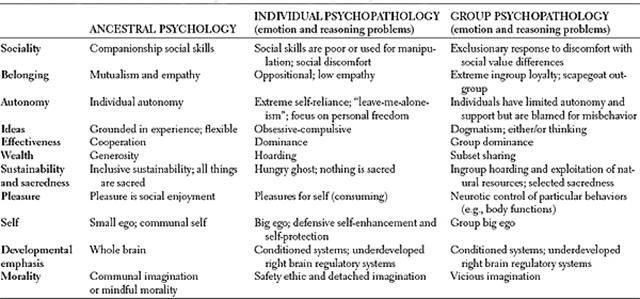
Alternate Viewpoints
I have described two routes to wisdom. In preagrarian societies, wisdom is fostered from the beginning of life within companionship care and a society that provides support for basic needs throughout life (Primal Wisdom; PW). In agrarian and industrialized societies, a top-down approach guided by communal imagination is used—what I have called Traditional Wisdom (TW) practices. TW methods can help move the brain/mind to greater agility, encouraging more openness.
However, it’s not clear to me that TW can reach the levels of PW unless a broader understanding of life and its cogeneration is apprehended. Notions of human superiority to other entities like animals and plants, division of entities into animate and inanimate, and fear of nature, among other things, are challenges to overcome. For example, Christianity describes separation from God as the ultimate punishment, but according to an indigenous perspective, Western culture has created its own separation from God (Nature). And by its separation from Life in every corner of creation, Western culture has created its own hell. Thus, in order to be able to fully adopt the practices of PW, several TW viewpoints may need to broaden. See Table 10.4 for a summary.
Table 10.4 Aiming for Primal Wisdom: Viewpoints to Reconsider and to Try On
+--------+
Nature is Malevolent (Versus Nature is Benevolent)
This viewpoint stems in part from a lack of deep experience in the natural world from a young age, when intuitions and interconnection are more easily established. It is also based on cultural myths handed down through the generations. One cure is to become intimately acquainted with Nature. Greater understanding can happen through wilderness experiences; but of course, there are natural laws that one must follow in order to survive (regarding, e.g., weather, safe foods, predators). Deeper understanding of the animal and plant life of one’s neighborhood also expand imagination and one’s circle of concern (Kimmerer, 2003).
Nature is Full of Empty Forms
Humans can manipulate without guilt (versus Nature is full of living agents that one treats with respect). This viewpoint emerged with agriculture and the notion that humans are unique in the world, fueling a sense of human superiority (Martin, 1999). It infuses the ladder metaphor of neo-Darwinism, where there is natural progress of speciation (leading to the pinnacle of human beings), and the hierarchical cultural structures of leadership, ordering, and ranking. The Western world typically denies consciousness to any creature except humans, justifying the manipulation of Nature: “gouging the earth, killing and enslaving animals as if they were all empty forms” (Lawlor, 1991, p. 38). In the indigenous worldview, striving for “progress” or “perfection” by dominating nature is unnatural and sacrilegious. A view of matter as spiritless and mechanical is contrary to the view of Nature as beautiful, intelligent, and purposeful.
In the indigenous view, the natural world is full of persons who need to be treated with respect as they give their lives to sustain humanity. Among American Indian groups, there is the notion of the “honorable harvest.” Not usually written down, Robin Wall Kimmerer (2014, p. 183) put together a representative list of principles. See Table 10.5. Indigenous groups, and others who live close to the land, aim to live according to these principles each day. We might think of using these to formulate a Declaration for the Rights of Natural Entities, paralleling the United Nations’ Declaration of Human Rights.
Table 10.5 Relating to Nature with the Principles of the Honorable Harvest
+---------+
Becoming more aware of how intelligent Nature and its creatures are and expressing gratitude for their sacrifice may be one curative path.
Human nature is evil (versus human nature is malleable). One’s views of human nature appear to arise from patterns of early experience, whether coercive and punishing or loving and supportive (Tomkins, 1965). Repairing one’s negative view can come about through intense therapy or self-transformational experiences, such as wilderness experiences (Plotkin, 2003), or attention to a third perspective. For example, Milburn and Conrad (1996) describe a neo-Nazi’s transformation after a filmmaker put his interviews and life review into a film that he then watched.
Individuals are separate (versus individuals are connected). The inability to perceive connectedness indicates underdevelopment or underutilization of receptive attention and other right-hemisphere-directed capacities. This unperceptive, narrowly focused mindset may be mitigated with therapy, immersion in creative experiences, and mindful meditation (D. J. Siegel, 1999). In chapter 11, I propose ways to develop receptive attention toward the natural world.
Individual ego is life (versus common self is life). From the evolutionary framing presented in this book, a focus on the individual ego is indicative of an unagile mind/brain raised in a manner that did not provide for human evolved needs. Full brain capacities must be restored and grown through redrawing attention and other life practices, like creative play.
Bringing in a common self orientation means feeling the fullness of the natural world—full with selves. It means fostering receptive attention and a multinatural perspectivalism that takes into account not only the perspectives of the animals and entities in one’s life but a reflective view of the greater reality that connects them all. “What kind of being one comes to be is the product of how one sees as well as how one is seen by other kinds of beings” (Kohn, 2013, p. 120).
Individualism without collectivism (versus individualism with collectivism). An either/or orientation is a sign of suboptimal thinking from a human potential viewpoint. Hunter gatherers demonstrate what seems paradoxical to us in the West: the capacity to encourage and support high individual autonomy (no coercion or authority) and high collectivism (commitment to the welfare of the group). Agency and communion are intertwined and pull in the same direction.
Relationships are unimportant or expendable (versus relational fundamentalism). The SBHG seem to understand and believe what is known by physicists on the quantum level—that we are related to everything and our actions affect everything else (Bohm, 1980). As noted throughout the book, many of us have been undercared for and children have been mistreated for multiple generations, fostering a “go-it-alone” orientation that seems normal. We have been forced into pathological individualism (“social atomism”) (Midgley, 2010), which is not part of optimal human nature. Propped up with multiple delusions, we have learned to perceive ourselves as “islands,” despite the fact that humans are born into and develop through relationship.
Explicit reasoning and logic are the highest forms of human capacity (versus there is much more to human capacities than reasoning and logic). As pointed out earlier, thinking and reasoning can be used for any end (i.e., anything can be rationalized). With a holistic understanding of the complexities of multiple intertwined systems and subsytems of life, one realizes that logic falls short because it can trace only one set of linear relations instead of the multiplicities of relations and subrelations. The indigenous worldview is about tuning into these complexities through maintaining the harmony of relationships within and among the systems. E. T. Hall (1994) describes how he learned to step back from an emphasis on logic and into perceiving and sensing when working with Hopi and Navajo groups:
I had to learn to avoid reliance on logic and switch to a quid pro quo type of relating. I had to accentuate the present, the practical and the instrumental, avoiding references to future rewards. In particular, I learned to accentuate the value of harmony as well as to avoid changes in my way of doing things. In the process, I soon acquired the habit of sensing people’s feelings and returning those feelings with my own, and I learned to avoid negative feelings. (E. T. Hall, 1994, pp. 90–91).
Someday relief will come (versus we are in eternity now). Underdeveloped receptive intelligence and the inability to shift to receptive attention may underlie this emphasis, locking in fear and anger. Learning to be mindful and present can open up the gates to enjoying the now (Tolle, 1999).
Human culture is what it is (versus human culture is malleable). A fixed mindset that emerges from undercare may undergird this rigid perspective (Dweck, 2006). Reframing and reinterpreting life stories to show how one has changed, and how culture has changed, can start to unlock the icy grip of this viewpoint.
It looks as if there may be much to change if we want to live wise, sustainable lives according to our primal human essence. But it takes some time to change worldviews and practices; a new consciousness and ways of being are not created overnight. In chapter 11, we explore options for the path to restoring our human essence.
Conclusion
Humans begin and end in relationship, whether considered horizontally through time on the tree of life, harkening back to organisms from billions of years ago, or vertically in an individual’s lifetime, with all the lifeforms that sustain it. As seen most clearly in the primal worldview, the human is embedded in a social net from before birth until well after death. In fact, no one would be here without multiple symbiotic relationships, beginning with one’s mother, who comes from a line of cooperation originating far back in time but also is one big cooperative unit of millions of organisms. Woven into the community’s history, the individual is not a loner but a relation. The world is relationships through and through.
The ideas presented in this chapter offer some starting points for how to conceptualize a way out of our predicament of destructive lifestyles and increasingly disordered people at neurobiological and psychological levels. Wisdom traditions offer a pathway to change.
The development of wisdom capacities goes best when it starts early in a community of relationships. When we follow a companionship culture, we nourish harmonious biopsychic energy for goodness (Kupperman, 2010; Mencius, 2003). We foster autonomous morality, taking advantage of the “laws of morality”—empathic effectivity and autonomy that represent both care and fairness—that are then written on the heart through experience. This prepares the mind early for intersubjectivity, then engagement, and eventually communal imagination, from which eco-mindful morality, or eco-wisdom, can emerge.
Summary Points
-
Wisdom is a body of knowledge that crosses cultures and historical periods and has interdisciplinary support.
-
There is more than one route to wisdom.
-
Traditional Wisdom (TW) and Primal Wisdom (PW) traditions have many parallels.
-
The Primal Wisdom worldview contrasts greatly with the Western worldview and the Traditional Wisdom worldview is in between.
-
Wisdom predominates among our indigenous cousins, as a matter of survival.
-
Nomadic forager childrearing practices foster wisdom readiness.
-
Whereas TW focuses on adult wisdom development using top-down self-authorship techniques, the PW approach is to grow babies and children into wisdom from the bottom up.
-
The safety ethic ego and vicious or detached mindset ego are signs of social support failures, failures to fulfill our human heritage.
-
A deep sense of relationship with all entities is part of our heritage.
-
The way to restore our inherited human nature and human virtues may be to adopt aspects of a Primal Wisdom worldview.
Chapter 11: Common-Self Wisdom: Fostering a Good Life for Self and Others
Listening and learning to be a gift
Tim Ingold suggests that we envision “ourselves not as beings but as becomings (Ingold, 2013, p. 8). Living is a matter of creating our bio-social selves: growing neurons and their connections, developing schemas for perception and action, turning genes on or off. Moreover, our trajectories of growth need “to be re-woven into the fabric of organic life” where we live in a field of relations in horizontal time (history) and vertical time (presence now) (p. 10). This chapter is about intentionally taking up these calls to action. We start where we are.
Although companionship care grounds children in capacities that can lead to wise living, many people reading this book, like myself, did not experience companionship care in childhood. As a result of a less than optimal early life, or perhaps subsequent trauma, the path to wisdom may have become occluded. We lost a sense of becoming our true selves.What can be done? How can human nature and essence be restored in adults?
We can use the skills and tools that modern life has given us—a sense of responsibility for our own self-direction, and the ability to detach from our past and adopt new ways of being. We can gather knowledge about alternative ways of living and examine the scientific evidence for their effect on flourishing, some of which I have done in prior chapters. We don’t have to go back to living like hunter-gatherers but instead integrate their wisdom into a transformed self and world. We can deliberately foster communal wisdom and even an ecological meta-wisdom.
To reestablish moral fitness and flourishing, I present a moral developmental systems theory that takes into account the multiple inheritances that are represented within Primal Wisdom traditions. “Wisdom seeing has always sought to change the seer first, and then knows that what is seen will largely take care of itself” (Rohr, 2011, p. 161).
Can We Reenergize Our Human Essence?
When we compare the SBHG lifestyle with our own, we might argue that we have stepped away from species-typical development. Darwin suggested that the moral sense allowed humans to partly step away from natural selection as a primary influence on their evolution. However, it seems that human cultural evolution in recent centuries has become a broader influence, so much so that it has actually altered typical ontogeny (individual development) and perhaps even phylogeny (species development). Epigenetic inheritance may be altering the moral sense in the wrong direction.
From a wisdom perspective, we bring about what we see, creating the world that we perceive, so it matters greatly how we perceive. We are self-organizing, but we also play a significant role in organizing the rest of the worldscape. Because all behavior has an impact in the web of life, it matters what one attends to, says, and does, because these actions bring life into being. We can choose to shift worldviews and envelopes of experience. (See Figure 11.1 for an illustration of the choices of mindscapes.) We can move among safety, vicious, and detached ethics and continue in a culture of detachment, or we can shift to the envelope of engagement, communal, and wisdom ethics and a culture of companionship.
When we understand that emotion and cognitive development emerge from early experience, pattern matching, and anticipatory schemas, we can see that Freud’s intuitions were correct—early experience trains up unconscious expectations at the physiological level. According to Freud, the modification of a neuronal trace—its reinstatement, fragmentation and deformation, and integration with other traces—occurs in the preverbal child’s mind, inventing a biologically based “fantasy” which adults retranscribe and remodel. Describing his patients, Freud suggested that fantasies are put together through fusion and distortion (1887–1902).[103] A specific memory is a “network of facilitated synapses activating dynamically” and synchronously (Ansermet & Magistretti, 2007, p. 80). The traces of experience become a mental reality that dominate external reality but at the same time are difficult to access (“fundamentally unknowable” according to Freud [1938/1949, p. 196]).[104] In early life, the day-to-day experience with caregivers, especially with mother, generate neuronal traces that form implicit memories that later underpin social life. Although lived experience is only indirectly accessible through these “fantasies,” or schemas (generalized knowledge structures), everyday living is the back-and-forth interaction between the activated senses and memory of related experiences (Ansermet & Magistretti, 2007). Thus, the brain is an especially dynamic organ whose neuronal connections are modified by external experience (life events) and internal experience (biological and psychic events), structurally and functionally creating a unique, singular individual (Ansermet & Magistretti, 2007, p. 6). When the brain does not function well, or works more like a jalopy due to poor early experience, internal reality is likely to be more disjunctive than it is among those whose brains are well constructed.[105] Stress affects not only the power and use of our basic emotion systems but how well we think and reason. For those who were more neglected or abused, external reality—actual events and awareness of the present moment–can be overwhelmed by internal reality (i.e., fantasy) (Freud, 1911).[106] Chronic stress hampers the ability to perceive or feel the flow of life.
Figure 11.1 Alternative Moral Mindscapes
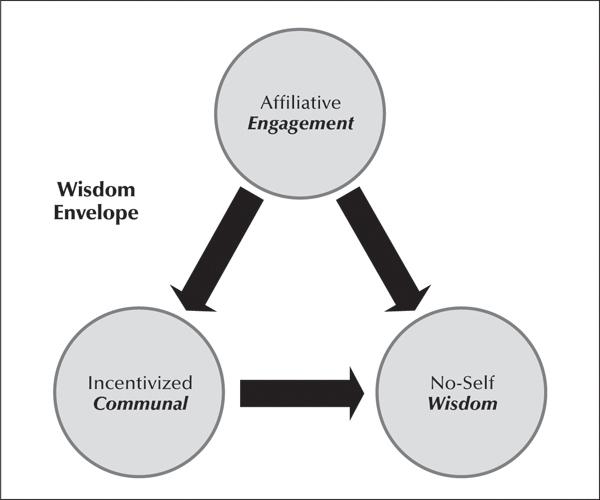
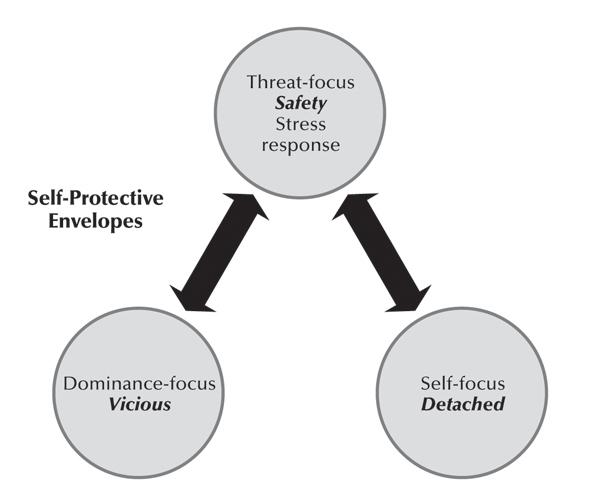
Yes, experience is inscribed in the brain and body, but that is not the end of the story. The ability of neuronal circuits to modify their efficiency signals how plastic instead of rigid they are (i.e., genetic determinism). Freud apprehended “plasticity” (Ramon y Cajal, 1909–1911) as essential for learning and memory. “Traces of experience” translate as neuronal configurations, but because neuronal systems are plastic, the individual can free herself from genetic determinism; deficits, rigidity, and prior kindlings can be overcome, at least after childhood (Ansermet & Magistretti, 2007, p. xvii). Adolescents and adults can self-create, moving beyond psychological and biological determinism to actively participate in a process of self-authorship, reshaping their neurobiology (Ansermet & Magistretti, 2007). We can actively shift our being, creating new neuronal networks (modifying the efficiency of neuronal transmission) (Bear, 2003) by what we imagine and rehearse. Even muscle strength can be affected by imagination. In the groundbreaking study which gave empirical evidence for what athletes and musicians already knew, those who only imagined exercising a muscle increased its strength nearly as much as those who actually exercised the muscle (Yue & Cole, 1992).[107]
The Process of Awakening Your Human Essence
Most societies considered children to be humans-in-the-making (Sahlins, 2008). A child’s inexperience and lack of maturation are assumed to eventually yield, under the conditions of a supportive family and community, full humanity. The process of becoming virtuous interacts with the processes of social life. With companionship care, a young child learns proto-virtue know-how—how to get along with others in the micro exchanges that undergird the mastery of social life. Unless something goes terribly wrong, the child becomes a fully flourishing adult. However, when companionship care is missing, the trajectory shifts. The child may never become “fully human.” The child can end up without the social graces that Aristotle identified as part of virtuous character (Aristotle, trans. 1988; Nussbaum, 1988). Instead, there can be a social misfittedness, an inability to negotiate relationships with ease and effectiveness, leading to what is adaptive for the changed circumstance: social orientations toward social withdrawal and/or domination.
What most of us know best now—and we have been encouraged by culture to know this—is distance and detachment from others. In this case, hearts are half empty, with a knocking loneliness where the natural world of friendships should fit. And if caregivers were less than present to us—or worse, threatening and abusive—we also have dark matter in our hearts. It is hard to repair. We protect ourselves with distractions, with entertainments that host our deeper feelings of hostility and anger but also longing and grief. Like the “girl with the dragon tatoo” (Larsson, 2008), we feel like outsiders to real life, desiring intimacy but harboring dreams of revenge.
Virtue-nurturing and vice-nurturing developmental niches are worlds apart. In the former, the child is welcomed and loved, and all works together in a symphony of joy. When something goes wrong, the child has a reservoir of resiliency and repair capacities to access. The child does not need to control things around him but is able to go with the flow of life, wherever it leads, and survive its blows and disappointments. The child is able to feel, perceive, and sense the unmanifest, understanding that there is much more to life than meets the eye. In the second world, the child is a stranger in a strange land, an alien who feels like he does not fit in. Puzzled and dazed, the child is put on a starvation diet of what he needs—so much so that for the rest of life he is needy, searching to fill the gaps resulting from a lack of loving care. Stress-reactivity moves him among rage, fear, and panic, cutting off perception of reality from the get-go. He seeks to keep busy with work, managing things and people, needing to control the external world in some way for a sense of security. When his patterns of control are rattled, he can quickly sink into despair/paralysis or rage. Mistrusting most everything, he is less able to feel, sense, or perceive the unmanifest in a positive way (although he may have fear-filled nightmares about it).
Many of us fall in between good and poor early childhoods. Most researchers of clinical disorders focus on the glaring cases. But virtually no one gets a zero on psychopathology measures. Abnormality is not categorical; it is a continuum. So there is a range of abnormality that we can find in “normal” populations. In my view, those raised in the United States typically have stress sensitivity in one or more systems that impinge on morality. When stress has been experienced too much and too long in early life (or during sensitive periods), stress sensitivity can ensue and lead to a dispositional safety mindset. In this case, trauma experienced in the past preoccupies present attention. The individual anticipates struggle and conflict to get needs met, thereby acting with bracing wariness and mistrust, curtailing accurate, full perceptions and possible actions.
There are ongoing costs of early or ongoing stress to our moral and social functioning. When things are physiologically out of whack, the immune system does not work properly, and the perceptual system and psyche are warped toward threat. We are more irritable and less forgiving. When the stress response system is regularly off kilter, a safety ethic can become dispositional. We may not be dying immediately from stress, but it is making us more disagreeable and more self-focused. These tendencies do not portend well for the well-being of a society, nor for its interactions with other societies.
The danger of social misfits is that they are also misfits in the natural world. The inability to connect with our cousins and fellow travelers, the animals and plants around us, can result in their mistreatment. Those of us who did not learn graceful interactions with the natural world (and I count myself as one) are like children at the display window of a toy store. We cannot quite enter into the enchanting realm of which we long to be a part. Or maybe a better image is the bull in a china shop. The bull cannot manage himself within the given environment and destroys dish after dish. The china represent not only human beings but species and ecosystems. So my suggestions throughout the chapter will be laced with ways to reconnect to one’s beinginess in the natural world.
The human self struggles on with hope and imagination, aiming for the love and connection expected in early life and the self-transcendence of playful encounters that coax out our best selves. Here are some suggestions for that path.
Developmental Ethical Ecological Practice
What can the individual do? The short answer is: self-author and work with mentors (e.g., a therapist) and remake the self through good friendships, therapy, and other transformative experiences.[108] The importance of mentoring (of oneself or by another) and the patience required is well put in the poem St. Francis and the Sow by Galway Kinnell (1980), who states that sometimes one must teach a thing its beauty until, once again, it blossoms from within.
Developmental adult therapy resembles what happens in a good mentoring relationship (Watson, 2008; Watson & Eckert, 2003). The therapist’s ethical and loving presence can be just what is needed to nurture and/or reorganize a person’s faltering self-system and capacities to access the benefits of fuller functioning. A “just and loving gaze directed upon an individual reality” is “the characteristic and proper mark of the active moral agent” (Murdoch, 1989, p. 34). The security of the relationship, which will take longer to build for those whose trust has been abused, constructs the bridge of influence from therapist to client, of role modeling and guidance. The therapist–client relationship becomes warm, supportive, and mutually trusting. A friendship develops. Over time the client will learn to perceive things more clearly (“looking” and “attending”), becoming more mutually responsive and regarding toward the therapist as well, a skill that is vital for intimate relationships generally.
In my experience, psychotherapy has often focused on an individual or an individual’s problems, as if individuals are isolated pods with little responsibility to others and as if getting rid of the negative is enough for human fulfillment. Alternative therapies might include more than the individual, as with family therapy, or they might focus on positive development, as with individual life coaching. However, even positive psychology’s focus on well-being emphasizes the individual. For example, in a review of positive psychology and flourishing, Ciarrochi, Kashdan, and Harris (2013) list seven foundations of well-being: functional beliefs, mindfulness, perspective taking, values, experiential acceptance, behavioral control, and cognitive skill. This is a one-person universe approach, as if an individual in solitary confinement can flourish. I have been arguing otherwise. We are relational and in relational webs—always. If relationships are not right, I cannot flourish. Neither the traditional nor the alternative therapies take the larger step of including a broader relational, moral, and ecological focus that I propose is vital for human flourishing.
To nourish a broader focus, I propose Developmental Ethical Ecological Practice (DEEP), which an individual can take up for herself or with a therapist. A DEEP approach is developmental because it focuses on the development of skills, awareness, perception, and desires, and it starts where the individual is. It is ethical because it advocates virtue development, as represented in our moral heritages of engagement and communal imagination ethics, as a goal for the good life. It is ecological because it moves beyond what obviously affects an individual to include the broader community of humans but also other entities, as well as a sense of being in the flow of life. It is a practice both because it is a lifelong endeavor and it can be an individual or group mission or be part of mentored therapy. With the additions of the ethical and the ecological to traditional therapy, we may be better able to create societies and a planet that thrive.
Methods for developmental change are reflected and demonstrated in tried-and-true steps for virtue development.[109] Table 11.1 lists steps that can be taken one at a time, building on one another, or all at once. Ideally, an individual is not alone in recreating the self but has mentors and companions to help with the various steps along the way. Interestingly, the universe often helps you along, almost like a repeated groundhog day (referring to the film by that name), presenting opportunities for learning over and over until you really “get it.”
Mentors and teachers. Everyone needs mentors, whether to learn how to tie shoes or understand art. By mentor I mean a person who has the skills and capacities that you admire and/or the capacities to help you grow in the direction desired. They don’t have to be mentors you meet face to face (although you do want to have some of these some of the time). Mentors can be writers and authors whose books you read. They can be people you watch in films or shows. Other animals and eco-spaces can also mentor us (think of Yosemite Park!). Indigenous groups often say that their best teachers are other animals and even plants (Kimmerer, 2013a). Ideally, the mentor is an entity with which you have a personal connection, with whom you can practice intersubjectivity and engagement, and who activates your “best self,” your communal imagination.[110] When we are receptive, we find that teachers are everywhere—even the stranger who makes a comment to you at the corner store that cheers you up or helps you tune into your true self!
Table 11.1 The Process of Developmental Ethical Ecological Practice: Steps to Foster Developmental Change
+-------+
Immersion in a growth group. At different times in our lives, we need group support to move forward. Growth groups can be classrooms of students led by a mentor teacher or self-led groups of individuals. Twelve-step programs, MasterMind, Bible study groups, and other loosely framed groups fit here. A group might also be neighbors putting up a garden in an abandoned lot or a park ranger guiding a group of citizens in cleaning up an outdoor space. Growth groups are everywhere. Check out Cecile Andrews’ book, Living Room Revolution, which is packed with ideas for starting meaningful conversation groups. Just make sure not to not be rigid about staying in one or another group when the time to move on is clear.[111]
Apprenticeship. An apprenticeship model of learning involves extensive guided, immersed practice. These types of experiences lead a novice toward expertise in useful and effective capacities, awareness, and knowledge. In other words, book learning is not enough; one must have real-life, immersed experience to develop and practice applying one’s skills. Luhrmann (2012) describes a apprenticeship process among members of an evangelical congregation for building one’s heart and faith using various spiritual exercises. I have found camping alone to be an apprenticeship for self-confidence and mindfulness, if one is attentive to the signals of the animals and plants in the vicinity. Apprenticeship can happen everywhere. Below we discuss apprenticeship in restoring friendship with the natural world.
Self-authorship. Sustainable change requires self-authorship capacities. Self-authorship involves the use and development of phronesis, or practical wisdom. This is the capacity to observe and guide one’s experiences. These metacognitive skills help one steer away from temptations and toward environments that promote self-healing. Metacognitive skills monitor goals and progress and help one rally when things get rough (Zimmerman, Bonner, & Kovach, 2002). We discuss this further below.
Restoring the web of life. Change can be difficult, so as much emotional support as possible should be drummed up. Don’t be afraid to ask for help. Wherever you are at least in your imagination, you can apprehend the support of ancestors—they brought you to where you are. Think of the others who have provided support at different points in your life. Keep photos or other remembrances around to remind you of their love for you. Your supporters can include spiritual entities (e.g., angels) or the animals and plants in your neighborhood—whatever helps you feel enwebbed. I always feel close to trees.
The purpose of virtue is to life a good life within the community, but this is a reciprocal relationship. Your needs are to be met as a community member and your gifts to be shared with the community. The community referred to here can include the neighborhood, the city or state, the country, or the international human community. Even when you feel disconnected to these human groups, think of the earth and how it is supporting you—with breath, space, sun, air. You are surrounded by a supportive natural world. Appreciate its gifts. Practice the Honorable Harvest (Table 10.5) and you will feel bonded.
Table 11.2 The Content of Developmental Ethical Ecological Practice
+-------+
These steps are instrumental, a set of structures to apply as one self-develops. But what should be developed? What is the content of Developmental Ethical Ecological Practice (DEEP)? DEEP certainly should include what we have identified as wise suppositions and skills in prior chapters. Here I offer a few ideas that hopefully will help you to generate additional ideas. What to work on should be prioritized by the individual, depending on existing capacities, aims, or place on the road to flourishing. See Table 11.2 for a sample list (but everyone should make a personal list). First, there are self-mending practices for those whose life has led them to stress reactivity and emotional self-preoccupation. Second, there are self-developmental practices that include revamping one’s cores and learning to shift moral perception. Third, living a life of transformation involves additional capacities and focus, including adopting a common-self worldview and taking up ecological wisdom. We discuss each of these practices further. Although I won’t refer much to my own journey directly here, these are all steps that I have taken and have often helped others take.
I. Self-mending Practices
Take Up Purposeful Self-Authorship
Humans evolved into language-speaking, deliberating creatures from a long line of creatures without these apparent abilities. There are multiple memory and learning systems that learn effortlessly from experience, and most are implicit and unconscious (Hogarth, 2001). Evolutionarily recent abilities, like executive functions, are moss on bedrocks of prior systems we share with other animals. Most of what we know and learn resides in the bedrocks rather than the moss. The bedrock part learns implicitly, without effort, whereas we all know that the moss part can take strenuous focused effort (as in schooling). In fact, the vast majority of nonschool learning occurs in response to implicit processes, that is, according to “nonintentional, automatic acquisition of knowledge about structural relations between objects or events” (Frensch, 1998, p. 76).
Natural learning occurs through immersion in an environment, where one practices the skills for living well in that environment (Ingold, 2011). My colleagues and I have written about apprenticeship or novice-to-expert learning in moral character, and applied it in school-based moral education.[112] We identified four levels that follow the progress of novice-to-expert learning. The master or expert guides the student at each level. (See Table 11.3.)
Natural apprenticeship learning is live and online. Think of a chef in training. The learner is immersed in an environment where information about what works is reliable—the food will not taste right. The learner typically is not alone, but has a master guide who draws attention to important aspects of the environment and the problems he is solving (“Watch the temperature of the flame” “Don’t whip the egg whites too long”). The learner is immersed in the master’s craft, watching and sensing successful actions (tasting). As the learner watches the master complete tasks, the master guides the learner’s attention to particular facts and details. Little by little the learner practices particular actions in imitation, and over time adds up sets of microskills to form and practice procedures. It takes a great deal of time to reach expertise (10 years or 10,000 hours). And the learner will need to practice and fail a great deal along the way toward expertise. Ten-year-old children have been immersed in a social environment, learning “what works.” If there was violence or neglect, there will be unlearning to do.
Extensive, immersed practice changes being. To really change yourself, you have to move beyond enjoyable practice of a skill to practice beyond one’s current levels, practice that stretches capacities. This type of deliberate practice in which the individual strains for better performance beyond current abilities can biochemically change cells and adjust systems for improving long-term performance. In fact, deliberative practice changes body and brain, affecting ongoing genetic expression (Ericsson, Roring, & Nandagopal, 2007).
Table 11.3 Four Levels of Self-Directed Natural Apprenticeship Learning
+----+
Three methods for helping oneself develop appropriate intuitions are (a) to set goals, (b) to carefully select the environments in which one immerses oneself for intuition development, and (c) to grow personal knowledge. In the apprenticeship model, these are done according the particular practice or domain of skills being learned.
Recall that Traditional Wisdom practice includes explicit focus on aims and goals for change. Since humans can shape behavior according to goals, goal setting can help shape behavior. Setting up explicit goals influences our attention and, as a result, our perceptions, desires, and actions. How we attend influences what we see (Neisser, 1967, 1976; McGilchrist, 2009). One can learn to take charge of one’s goals, regularly reminding oneself of them and rehearsing new ones until they become automatically engaged. One can take up an identify that involves the goal (e.g., “I am a friend of trees”) and the deliberative, conscious mind will pile on elaborate explanations, deepening identity around regularly rehearsed goals (Lapsley & Narvaez, 2004; Narvaez & Lapsley, 2009). Memory of one’s actions and telling others about them will build a narrative around the goals and new identity, embedding them further in one’s self-concept.
A second aspect of self-authorship is the importance of being selective about not only the social-physical environments in which we place ourselves (e.g., media, friendships, workplace, neighborhood, leisure activities) but also the mental environments we inhabit (what we think about). Humans are not impersonal rational thinkers with an active will; they are beings who perceive and desire in accordance with what they have lived. Imagination is a way to live. You practice actions with your imagination. What free will controls, slightly, is the direction and focus of practice and attention. “By the time the moment of choice has arrived the quality of attention has probably determined the nature of the act” (Murdoch, 1989, p. 67). Habitual attention is a form of practice. Recall that wisdom is a state of being, so emotions and thoughts matter. Be careful what you imagine or envision. Imagining a tiger running at you can trigger a stress response. The imagination is so powerful, it can make you think what you thought really happened. In one study, imagining a particular person (Ford or Carter) winning the election increased the belief that the imagined person would win (Garry, Manning, Loftus, & Sherman, 1996). Imagining outcomes “elevates our intuitive sense” of the likelihood of that event occurring. Imagination is so powerful that 20 to 40 percent of participants contacted days after an imagination experiment believed the events they were asked to imagine (e.g., getting lost in a shopping mall) had really occurred (Slovic, 2000). Mental rehearsal can be just as powerful as rehearsal involving physical movement (mirror neurons) (Burton, 2008; Iacoboni, 2008). Thus, is it important to carefully select places for activities and attention because they will influence the intuitions and mindsets we develop.
In short, the environments in which we spend our time are very powerful, whether they are in our heads or in the real world. In both cases, the environment triggers hormones and other processes that build intuitions and habits. We become like what we see, feel, or do. A mind that focuses on what is beautiful and loving develops a different mindset than the mind that immerses itself in ugliness and hate.
A third aspect of self-authorship is to grow personal knowledge. This is critical for moral behavior. Ideal for social know-how is a grounding in extensive social practice and the development of efficacy from early life on. For the well developed, social skills and understanding form a set of tacit knowledge that is used to solve social problems rather easily. For the undercared for, vast tacit social knowledge is missing or faulty, making diving very deeply into social problems unfathomable. For example, Monroe (2004) found that a key distinction between Gentile rescuers and nonrescuers in World War II was their sense of effectivity. To justify their action or inaction, each group proclaimed, “What else could I do?” Whereas the rescuers felt compelled to action (no choice), the nonrescuers felt the same way, like they had no choice. They lacked a sense of efficacy, feeling that they could do nothing. This reflects how, when under great duress, it is not only compassion but practiced compassionate action—habitual sympathetic action—that compels moral action. In fact, it takes extensive experience in adolescence and adulthood to learn how to take action in a proper manner for the situation (practical wisdom). For example, even if one was shown kindness throughout childhood, showing kindness as an adult requires sensitivity to the individual within the particular context, which takes extensive relevant experience and practice (Wuthnow, 1995). Only through personal knowledge which involves extensive time relating to the entity (person, plant, animal, habitat), can one take action that is “caring for.”
Although book knowledge and facts are usually the focus of education, this is limited, often inert knowledge. Personal knowledge is what is truly known and can be acted upon. It is personal in two senses. One must experience life to know it, and one only experiences certain aspects, so one has deep knowledge of only a few things—a knowledge niche. Second, personal knowledge of the Other is vital to relationship and interaction. One cannot love or imagine possibilities for another without deep knowledge of that individual. Your personal relationships are your responsibilities. No one else can care for your children, for example, the way that you can. You know them, I don’t. This is one of your gifts to the world.
There are several ways to self-author one’s wisdom that we will take up here. Two areas of practice are mentioned: self-calming and revamping one’s schemas and scripts.
Learn Self-Calming
If one pays attention, one notices that FEAR, RAGE, and SEEKING rise up in everyday envy, contempt, and resentment. We roll our eyes, turn green toward another’s award, feel bitter about being passed over. Whenever we feel put upon, offended, or a sense of unfairness, these basic emotions are at work. When we take things personally, we are propelled into personal distress. As pointed out earlier, FEAR shuts down other-orientation and drives responses to subcortical survival instincts. Desire (dopamine-driven SEEKING or acquisitional euphoria) can also be addictive, as greed and envy can take over and move in a direction opposite to the engagement ethic. Anger (RAGE) too leads away from relational presence and the other-orientation of the engagement ethic. The more one has practiced these emotions, even ever so slightly, the stronger they are. Thus, disentanglement from these emotions is needed, along with a shift toward activating hormones that promote prosocial behavior (e.g., oxytocin, prolactin, and serotonin). One can “beat oneself up” after a moment of rage or cowardice, but this is not helpful. It is best to guide oneself in kind and compassionate ways, as illustrated in the comic strip in Figure 11.2.
The guiding self can help the ego self transform while simultaneously accepting the fear-based self, offering calming frames as behavior is transformed from “me-first” actions to surrender to the common self and one’s place in it. With persistence, little by little, one can change one’s mindset from a safety orientation to an openhearted orientation.
The first step to self-mending is to learn to self-calm when one notices self-upset. The stress response shuts down the ability to learn new things, so it is important to find ways that work to diminish one’s stress reactivity generally. When the brain is calm, one can practice new ways of being, such as social presence. Several techniques are helpful for increasing calmness. I mention four: deep breathing, mindfulness, relaxation and savoring, and meditation. These techniques also promote the hormones that underlie prosociality.
Practice Deep Breathing. Most of us don’t breathe in ways that provide adequate oxygen to our bodies and promote optimal health (Kabat-Zinn, 1990). The physiological benefits of oxygen include eliminating toxins in tissues, cells, and the bloodstream; increasing the uptake of nutrients; killing infectious bacteria; and boosting the immune system (Altman, 2007). The added psychological effects include boosted energy and a calmer nervous system. You can build a habit of deep breathing during certain scripted events during the day (e.g., commuting).
Figure 11.2 Calming the Upset Self
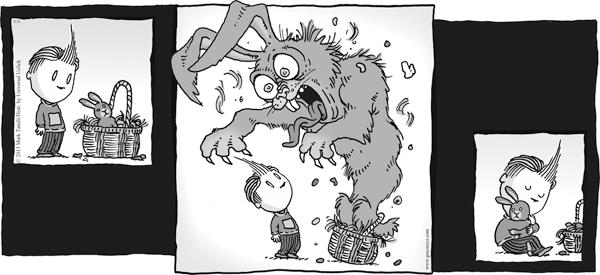
Credit Line: LIO © 2013 Mark Tatulli. Reprinted with permission of Universal Uclick. All rights reserved.
Belly breathing is key. The belly must expand with the intake breath, a sign that the diaphragm is engaged. Extending the exhale as long as possible keeps the parasympathetic system active (the rebuilding aspect of the autonomic system like vagal tone). Breathing deeply repeatedly throughout the day is linked to better health and reduced stress generally (Kabat-Zinn, 1990). Belly laughing has parallel effects on health (Provine, 2001). Finding humor that makes you laugh deeply can also change your metabolism.
Become Mindful. Mindfulness means attending to embodied experience in the here and now. It means being physically, emotionally, and cognitively present to what is happening in oneself and the vicinity. Learning to live in the present moment is not so much a matter of stillness as it is a way to practice beingness. Rather than emotionally detaching, mindfulness means accepting the emotions and thoughts that come and go. As one practices mindfulness, one learns to remain equanimous even if one has a disturbing feeling (e.g., anger, fear), because typically it will fade away after 90 seconds if not encouraged. However, when negative feelings are fed with attention, as in the road rage incident mentioned in Chapter 7, it causes a cascade of subsequent interacting effects. A mindful attitude lets the emotions come and go, not feeding any one in particular.
Recall that emotions evolved as fundamental intelligence to guide action, but in early life they must be trained up well to do so. If you missed initial training, you can help yourself retrain them. Mindfulness-based stress reduction (MBSR) (Kabat-Zinn, 1990) involves experiential group sessions and individual work on mindfulness practices and is shown to improve health outcomes and decrease stress (Grossman, Niemann, Schmidt, & Walach, 2004). Mindfulness-based cognitive therapy (MBCT) (Schmith et al., 2001; Segal, Williams & Teasdale, 2001) incorporated additional practices and education to prevent depression relapse, and it was found that increased self-compassion was the key factor in preventing relapse. Building on this finding, P. Gilbert (2010) developed compassion-focused therapy (CFT), and Neff and Germer (2013) developed an approach for nonclinical populations called mindful self-compassion (MSC). These involve “motivating people to care for their own well-being, to become sensitive to their own needs and distress, and to extend warmth and understanding toward themselves” by engaging in activities such as compassionate cognition and kindness towards the self (Neff & Tirch, 2013). Individuals who were traumatized or abused may have learned to avoid mindfulness because of unprocessed trauma. They may need to work on releasing the painful feelings first before being able to practice mindfulness.
Relax and Savor. There are several emotional states that one can work on increasing. We might call them savoring states (Bryant & Veroff, 2007): (a) Low arousal is linked to social contentment, a feeling of social safeness. This is a state where SEEKING is not dominant. Attention is relaxed and open; one is ready to explore but nondefensive, as when, for example, one is sitting on the porch holding hands or relaxing with a friend (P. Gilbert, 2005). (b) Low-SEEKING, high-arousal engagement corresponds to awe-filled attachment, such as Maslow’s peak experience of feeling connected to the cosmos, or enlightenment awareness of no-self (Coxhead, 1985). Along with a feeling of connectedness, this state adds a sense of deeper awareness, alertness, and sensory enhancement (Coxhead, 1985). Because these are non-SEEKING states, individuals are not experiencing anticipatory dopaminergic euphoria by expending energy to obtain some reward. Instead, they are basking in neuropeptide opioids, oxytocin and vasopressin. Serotonin, too, increases in meditation states, suggesting that it should be called the “rest and fulfillment hormone” (Bujatti & Riederer, 1976). In these states of enlightened presence, the mind or minds communing can come to new understandings and creative synthesis and a higher consciousness. Eckart Tolle offers helpful concrete guidance on savoring:
Use your senses fully. Be where you are. Look around. Just look, don’t interpret. See the light, shapes, colors, textures. Be aware of the silent presence of each thing. Be aware of the space that allows everything to be. Listen to the sounds; don’t judge them. Listen to the silence underneath the sounds. Touch something—anything—and feel and acknowledge its Being. Observe the rhythm of your breathing; feel the air flowing in and out. Feel the life energy inside your body. Allow everything to be, within and without. Allow the “isness” of all things. Move deeply into the NOW.” (Tolle, 1999, p. 52)
Immerse yourself in prosocial positive states (gratitude, awe, joy). Sometimes this requires finding out what is keeping you in a negative state and revamping your reactions (see below).
Meditate. Meditation often involves mindfulness but encompasses a wide range of techniques for training the mind. Meditation fosters calmness at the physiological level. It decreases signals to the amygdala (Lazar et al., 2000). In a study of positive emotions and social connection, half of the group was assigned to practice loving-kindness meditation (an approach used in the Buddhist tradition) for around one hour per week for several weeks. Months later and weeks after the study was over, those who had practiced the meditation showed improvement in vagal tone from baseline (Kok et al., in press). One presumes an accompanying increase in health and compassion.
There are many ways to meditate, and one may need to try several different approaches to find the one that works best (and what works may shift over a lifetime). Typically, there are unfocused and focused approaches. In unfocused meditation, one attends to the thoughts that come and go, like watching a show from a distance. One draws attention back to the flow if attention gets caught on a particular item. In focused meditation, the individual attends to a stimulus (a visual object, like a candle, or a sound, such as running water), a sensation in the body (breath when sitting still; feet touching the ground when walking), a mental event (an image like a mandala, or practice wheel), or a self-generated sound (a chant) (R. D. Siegel, 2010). Common techniques include focusing on breathing a certain way (diaphragmatically, or following the breath through the body and out) or on a mantra (a statement that can be given by a mentor or selected by the meditator; different religious and meditative practices use different statements) where the individual keeps repeating the statement, drawing attention to the statement for a period of time (usually at least twenty minutes). For those who prefer more active approaches, there are walking meditations; tai chi and yoga can also be practiced in meditative ways.
One may also meditate through the day with a type of “prayer” or a focus on gratitude. In this case, one draws one’s attention to the good things that are happening, generating positive feeling. The indigenous societies of North America start every gathering with gratitude and gift sharing. They are attentive to all life forms and their communications, grateful to them for supporting human life.
Contrary to popular opinion, it is not positive emotions of any kind that make one more prosocial. For example, Strohminger, Lewis, and Meyer (2011) found that positive emotions differ in their effects. Positive emotions don’t always lead to less severe moral judgments. Feeling good, per se, can be dangerous in a situation of potential moral violation, as it can lead to acceding to harming others (Valdesolo & DeSteno, 2006). It is vital to maintain a communal connection in one’s attention to life. After priming with mirth, individuals were more permissive, as (e.g., agreeing to a character’s decision to push a man off the bridge to save others) (Valdesolo and DeSteno, 2006). However, Strohminger and colleagues (2011) found that when participants were primed with inspirational stories to activate a feeling of elevation, which involves a connection to something greater than the self, permissiveness in regard to harm did not increase (hmm, that doesn’t sound good enough). Keeping a cosmic view in mind or a state of gratitude may be necessary for prosocial behavior under these circumstances. Using compassion-focused or gratefulness-focused meditation activities not only helps oneself but keeps a prosocial orientation active.
Slow Down, Revamp, and Reframe
As I have noted earlier in the book, when routines are broken or safety is threatened, the stress response can be activated. Sometimes (e.g., in moments of resentment or depression) we don’t know what upset us, yet the FEAR, RAGE, or SEEKING systems are dominating our goals and actions, and sometimes critically target ourselves. Until a sense of safety is restored, these systems are so powerful that they take over the rest of the brain, channeling our energies without our awareness (e.g., “seeing red”) (MacLean, 1990). Sometimes there are subtle effects, such as the inability to think creatively or to be open to new ideas, as thought processes are impaired. Routines for restoring a sense of safety kick in and take over until a sense of homeostasis is restored. But we can learn to shift our attention and emotions through reframing.
The way to reframe our self-defeating narratives and fantasies is to make them explicit. This can rid them of their power. Humanity’s lifelong neural plasticity allows for the individual to transform himself, acting as the author of a process of becoming new and different from what was previously inscribed by experience. Psychological and neurobiological plasticity make it possible for the individual to use, instead of being used by, fantasy (Ansermet & Magistretti, 2007). But one must learn to unpeel the patterned reactions and filters of events that occur rapidly and without effort. We easily fall into old scripts, unless we have effortfully reshaped them. We can learn to slow down our reactive processes and revamp them. This is best done step by step so that we can notice the micro processes that are taking place and cascading into bad feeling.
Change Schemas and Amygdala Scripts
Timothy Stokes (2009) describes the power of “amygdala scripts” for causing ongoing psychological problems. An amygdala script is a combination of emotion, images, and beliefs that affect the “immediate construal of reality and ... judgment,” unconsciously scripting one’s experience and behavior in the situation (p. 6). Amygdala scripts are easily activated, though unconsciously, provoking emotions and thoughts that trigger the stress response and thereby curtailing options. (See Table 11.4 for examples of scripts.) Releasing the present moment from past trauma requires solving these robust amygdalar scripts.
Stokes (2009) offers a three-step process for conditioning alternative responses to stress-evoking situations. The limbic system initiates a cascade of effects that explicit learning and understanding cannot control, and so reshaping of amygdala response must be done while these scripts are activated. The steps may have to be done repeatedly over time, offline at first, with brief forays increasing to more in-depth analysis (like exposure therapy), since intense emotional pain may be triggered. The first step is to intentionally provoke the experience through reliving it or experiencing it again (and again). As this happens, the sensations in the body and the emotions are noted and verbally acknowledged (initiating frontal lobe control). “Oh, my jaw is getting tight—what am I thinking about?” “What feeling is triggered?” The second step is to focus on the image in order to figure out where the script came from—going as far back in memory as possible—and to make sense of the “seed” image. There may be multiple images that need addressing, but it is best to start with the oldest, since others build on this one. “Where does this feeling of shame come from?” The third step is to address the beliefs that were adopted in that initial experience, replacing dysfunctional beliefs with accurate and affirming ones (e.g., “I was just a little kid; it was not my fault it happened”), and to offer comfort to that past self who was caught in a traumatic life event. The three steps must be deployed multiple times to transform a particular script. Stokes recommends a daily review of situations that provoked old bad feelings. If one has identified common scripts, a daily review can identify if any were triggered that were not noticed and dealt with at the time so that the next time they are triggered, one is more likely to notice and instigate a prepared response.
Table 11.4 Sample Amygdala Scripts
+---+------+
These practices are a way to work with one’s mind and body instead of against them, an approach critical for wisdom development. As Searle (2011) points out,
proceeding with action against the will of subconscious beliefs is like trying to drive with the emergency brake on ... Resistance is usually a red flag in your subconscious mind, signaling an internal conflict. Getting past the resistance requires exploring your subconscious beliefs to find that red flag and having a dialogue with the thought or belief at the root of the conflict. Shifts in either thought or belief will be necessary, or you will need to adjust your outer goal in order to bring it into alignment with your inner beliefs (p. 77)
As part of this reframing, one must redirect the critical inner voices. For those who are self-critical, P. Gilbert and Irons (2005) offer several suggestions, such as: (a) Identify the source of the criticism and think carefully about the truth of what it is saying; (b) examine the credentials of the internal bully and consider how admirable people would react; (c) ask what a friend would say about the criticism. D.A. Lee (2005) adds the importance of attending to your strengths, which group members can help you do. Discovering ways to counter the internal bully releases you to participate in positive social relations. My inner bully continues to pop up giving me a body blow when events go in a different direction than I desire. The “bully” feeling is the voice that says that things did not turn out because I am unworthy (i.e., stupid). It is so subtle sometimes that I end up depressed without realizing why. Stepping back to examine when the depression began helps me reframe and restore self-esteem using the techniques discussed in this section. Reexaming events with heartsense makes me see the I-ego’s desire as nonsensical and rooted in some past haunting of black-hole need. I learn (again and again) not to desire too much, to take what comes as a gift or as a lesson to be learned. Within the hunter-gatherer worldview, “characteristics of organisms ... are not so much expressed as generated in the course of development, arising as emergent properties of the fields of relationship set up through their presence and activity within a particular environment” (Ingold, 2011, p. 4). That is, development of the self is “understood relationally as a movement along a way of life, conceived not as the enactment of a corpus of rules and principles (or a “culture”) received from predecessors, but as the negotiation of a path through the world” (p. 146). So I adopt a path of moving toward common-self wisdom. When the inner bully arises, it feels like it is trying to undermine my path, my calling. So I have learned to thank it for the challenge and I move on.
Reframe
We can consciously shift attention and our emotional set, modifying salience of different events (Borgida & Howard-Pitney, 1983). One technique is timepoint shifting. When events are disconcerting or unexpected outcomes ensue, it is helpful to ask oneself, “What will this matter in fifty or five hundred years?” This moves one to a more abstract level of viewing life, helpful in times of stress (Koutstaal, 2013). Another technique is to shift from concentrative attention, focusing on what one was expecting, to receptive attention, noticing what is different and beautiful. This is the orientation of wonder and awe in the presence of the new—looking at the uniqueness of the person or experience and noticing and imbibing the singularity of the context. We can pull ourselves out of “horizontal” (doing) into “vertical” (being) time with practices such as mindfulness (Eberle, 2002). We can take on a cosmic perspective, literally thinking of our place in the whole cosmos or through million of years of time.
Shank and Childers (1988) discuss tools of question transformation for creative problem solving. These can be used in interactive ways, depending on the issue at hand.
Narrow the question: How can I work with this issue?
This is a pragmatic approach. For example, instead of focusing on my depression generally, I can focus on my depression right now, or after I see my mother. Then I can move on to apply other transformations to try to resolve my situation.
Raise the Level of the question: How do I usually work with this type of issue?
Perhaps I usually eat when I get depressed. Knowing my reaction is the first step towards altering the pattern. Perhaps then I can adopt a “wait-a-bit” approach and first take a walk when the non-hungry urge to eat occurs.
Goal Precedence: What goal is blocking the ability to resolve this issue and can that goal be achieved in other ways? What is my real goal here?
Maybe I realize that I go into a funk because I want attention that I’m not getting. Once I identify the underlying goal of the problematic behavior I can examine whether the behavior actually gets me what I want and whether this is my real goal.
Target Directed: What do I really want and can I get it and still resolve the issue?
If I uncover that what I really want is attention (love), I can now examine whether some other behavior might work better (e.g., asking for attention from my spouse).
Focus Changing: What would I have to give up to resolve this issue? What is the cost? How can I change my state into action?
Maybe when I go into a funk, my family lets me off the hook on my responsibilities. So if I stop going into a funk, my overwhelming responsibilities may return. Understanding the costs/benefits of the behavior, leads to more problem solving, using the other transformational tools.
Analogical Mappings: What can I learn from others who faced similar challenges? What methods did they use and could they be applied here?
In therapy, we are taught to use our words to express what we need instead of expecting others to read our minds. Perhaps if I express my needs, I can work out with my family how to distribute my overwhelming responsibilities or find other ways to meet them that are not so daunting.
Consequence Following: What are the long-range effects of not resolving this issue? Can I involve those who are affected in helping resolve the issue? Who is benefitting from not resolving the issue and can those benefits be obtained in another way?
Maybe my spouse feels powerful when I am in a funk and likes that feeling. We can discuss other ways my spouse could feel good that don’t require my funk.
Precedence Tracking: What has led to the current situation? What are the facts?
Perhaps I developed a withdrawing approach to conflict long ago, so much so that it seems natural to stew, pout or be noncommunicative. Realizing this can help me move away from a scripted pattern into more flexibility.
Pattern Recognition: Is this event part of a pattern? What usually follows from this pattern?
Perhaps getting into a funk usually leads to my getting my way, or at least feeling like I punished that other person who “made me” unhappy. Is this power struggle one that I want to continue?
Historical Perspective: What has happened in history (mine or generally) that can inform this situation? How does this issue fit into a larger scheme?
Power struggles often lead to harm to both parties. Even though one may “win” in the short term, relational trust is damaged. Is my goal to increase my sense of loneliness?
All these tools, when practiced, lend oneself to increased flexibility in problem solving. Of course, one must remember not to spend one’s life in the imagination alone but return to applying insights to real life.
Another form of reframing is offered by Searle’s (2011) DSCO model. It identifies four ways an individual might respond to a situation: (a) with _D_rama, emotion, and blaming; (b) by fixing the _S_ituation in order to alleviate the problem and return to normal; (c) by making a _C_hoice about “who I will be” in response to the situation (“What role did I play in bringing it about? What am I doing now, and what will I do in the future?”); and (d) by noticing _O_pportunity—that is, taking the situation as a signal for what needs to change and discerning what that is. The last two levels, Choice and Opportunity, promote a “transformational presence” because they tap a deeper level of awareness and facilitate such awareness in others. Searle says that most people stay in the first level, and few reach the fourth level routinely. But when one learns this form of perception and action, it allows for quantum leaps from the distress and drama of a moment to opportunities for situational transformation. Like the conscious dismantling of amygdala scripts, the DSCO model gives methods for developing frontal lobe control and managing subcortical emotion systems that otherwise lead us to safety ethics.
These methods, inside or outside of psychotherapy, help us turn “our ghosts into ancestors” (Doige, 2007, p. 243). Instead of transferring past relational trauma implicitly onto our present moments, straightjacketing our responses, we become able to name and explain their past context. We can move the trauma into our life history from which we can learn to detach and instead shift into new responses and habits.
It is interesting to note that cultural metaphysical framing of life events can have a significant effect on the nature of traumatic experience. The stories one adopts about one’s life can be used in helpful or unhelpful ways. Identity narratives can boost one’s confidence and sense of safety, for example, helping one recover more quickly from trauma (Janoff-Bulman, 1992). But if a narrative requires the denigration of the Other, it can be destructive (see KKK; Nazis).
Interestingly, when specialists in recovering from torture visited Tibet and explained what they had learned in an effort to help Tibetans who had been tortured by the Chinese, they received an unexpected response (Salzberg, 1995). The Dalai Lama told them that those who had been tortured were not experiencing post-traumatic-stress-disorder. Many of those tortured actually felt compassion for their torturers during the experience, understanding the unfortunate condition of a person who would torture. Even those who did not feel compassion understood the situation to be one of karma—a retribution for something they had done in another life, providing a way to make meaning of the experience. Thus, our narratives and interpretations of events play a large role in how we feel and react.
The indigenous societies of North America tell stories to educate themselves about the dangers of greed and disrespect towards the natural world. These support their practices of the Honorable Harvest (described in chapter 10).
II. Self-development Practices
Expand Your Social Self
Two aspects of human life have been identified previously: agency and communion (Bakan, 1966). Agency represents the individual’s desire to explore, make choices and decisions, and self-actualize. Communion refers to the drive to connect and bond, to merge with others. These are often discussed as opposing drives or needs (Frimer, Walker, Dunlop, Lee, & Riches, 2011). Some argue that life is fraught with tension between these two basic modes in life, as in agency or communion:
agency for the existence of an organism as an individual, and communion for the participation of the individual in some larger organism of which the individual is a part. Agency manifests itself in self-protection, self-assertion, and self-expansion; communion manifests itself in the sense of being at one with other organisms. Agency manifests itself in the formation of separations; communion in the lack of separations. Agency manifests itself in isolation, alienation and aloneness; communion in contact, openness, and union. Agency manifests itself in the urge to master; communion in noncontractual cooperation. Agency manifests itself in the repression of thought, feeling and impulse; communion in the lack and removal of repression. (Bakan, 1966, p. 15)
According to this view, agency separates itself from and represses communion. But this is unusual. The tension between agency and communion seems to arise primarily in developed nations where individuals cannot follow well-raised inner spirits. The division is based on Western sensibilities that I’ve suggested emerge initially from a lack of companionship care. Such a lack splits the self from deep social embeddedness, forcing the individual to fight for attention and fulfillment of basic needs, becoming hyper-individualistic. As noted in prior chapters, the SBHG raise children quite differently, with easy attention to needs and a sense of attachment to the group, fostering deep trust in the nature of the world. There is no sense of individuals “standing against” anything. They have agency in communion. The paradox that wisdom traditions can discern but an emphasis on intellect cannot is unity and duality. Love is about relational duality and yet at the same time reflects oneness. In a common-self worldview, knowing others is knowing the self; the self is distributed in relationships. The sense of connection is the manifold of life, so it is easy to show kindness, selfless generosity, respect, and habituated sympathetic concern.
In research studies, those who have been identified as moral exemplars exhibit at the same time higher affiliation with others (communion and compassion) and higher self-efficacy or agency (L. J. Walker & Frimer, 2008). This is illustrated well by Monroe’s (2004) study of World War II rescuers and nonrescuers. Monroe quotes one individual who represents a common view among rescuers. A member of the human family was in need, and this was the rescuer’s response:
I was to learn to understand that you’re part of a whole, and that just like cells in your own body altogether make up your body, that in our society and in our community that we all are like cells of a community that is very important. Not America; I mean the human race. And you should always be aware that every other person is basically you. You should always treat people as though it is you, and that goes for evil Nazis as well as for Jewish friends who are in trouble. You should always have a very open mind in dealing with other people and always see yourself in those people, for good or for evil both. (p. 244)
Recall that a person’s actions are guided primarily by unconscious and subconscious systems that initially are rooted in the early self-core. The two core layers of the self I described earlier, empathic effectivity roots and communal autonomy space, are foundational to a common-self worldview and influence moral perception, sensitivity, and even reasoning. If the empathic core is well established and integrated with the autonomy space, then moral reasoning forms around this core. The person develops a self that is integrated with the lifescape: You do not recklessly damage what is part of you.
A self-core that is a one-person psychology has intuitions that are distinct from a core that is a multi-person psychology. If the empathic core is not established or is deficient, then moral reasoning may form around agency alone. The core self can be taken over by agency. Poorly developed intuitions, developed from isolation or punishment, are not sufficient guides for the social life. With a one-person core, the conscious self may understand the logic of reasoned morality, but the aberrant self-core may not. In this case, autonomy sensibilities can be uncontrolled unless the conscious mind learns to follow external rules (from culture). Otherwise, live action will be driven by the one-person psychology. At the same time, memory and evaluation will be led by the conscious mind (the “should” self), and so rationalizations will be used to justify the behavior wrought by the “want” self (Bazerman & Tenbrunsel, 2011). Thus, the self is split between the ego and the superego, making moral consistency difficult and the individual prone to hypocrisy.
It may also happen that the child develops neither an empathic core nor an autonomy space. This kind of broken spirit represents learned helplessness and lack of social connection. It can result in a kind of empty self, more easily governed by passing emotions or authoritarian imposition (recall Turnbull’s description of his British upbringing). In cases of severe neglect, agency may be thwarted, leading to an unmotivated soloist; a lonely, incapacious existence.
One way to expand your social self is to revamp your cores. As noted in prior chapters, aspects of our core selves are shaped in early life. Some of us emerged with minimal empathic cores or unfettered autonomy spaces. Cores can be expanded in prosocial ways, increasing social pleasure (especially for the insecurely attached), our care for others (especially if we were mistreated), and our responsiveness to others (especially if our sociality was neglected). We can expand our empathic core and retool autonomy space with the following activities.
Expand Social Pleasure
With undercare, one’s social pleasure centers may be underdeveloped. Social relationships may be more irritating or painful than pleasurable. Sometimes, if you have been avoidant of social intimacy, your emotional skills need extensive development. You are more reactive than proactive, with impatience and intolerance toward nonconformity with your expectations (and demands). The ego has been isolated for so long and undeveloped as a social self that it takes some time and self-training to change. After self-calming techniques are learned, social activities that are fun and enjoyable are a means to shift one’s orientation to be more inclusive of others. High energy activities like dancing, playful sport, music ensembles, community art, and gardening are all ways to learn social pleasure. I used to guide adults in self-development using folk song games. Once you break through the barrier of not wanting to look silly, creative play is especially pleasurable. One thing is for sure: Play and laughter facilitate growth (Provine, 2001). Learn to laugh at yourself socially, and to find absurdities in life. Gather things that make you laugh. Take up play therapy (Schaefer, 2002). As Church (2009) pointed out, every minute one million cells die and one million are born in your body. What and how you think affects their health. So think happy thoughts, and do so with others. Low energy activities are good too. Partner foot massages or “huggling” (what my husband and I do) are calming and energizing at the same time. Perhaps even “cuddle parties” are a good way to get needs for touch met and at the same time find enjoyment in being with others.
Practice Social Presence and Intersubjective Connection
Relationships run the world, whether you’re a fungus or a person. You are always in relation to everything around you. Collaborative skills for smooth relationships are fundamental. A critical step toward wisdom development must be the restoration or development of capacities for reciprocal communication. The magnetism you feel with another—a baby, a lover, a friend—is the limbic resonance on which the engagement ethic thrives. Build on that. Limbic resonance—relational attunement—drives our relational morality orientation toward unconditional love and reciprocity. “Mind melding” can be intense or quick. The lite version is fast, passing interchanges with others throughout the day—an egalitarian exchange of a smile or encouraging comment. Relationships, especially with the very young and the very old, require us to slow down. Learn to meet and hold someone else’s gaze. Practice being emotionally present, even in small doses at first. Greet others or smile with your heart. Learn to connect 24/7. Be active and reach out to people and to other creatures. Build a sense of “we-ness.” Interpersonal flow and interlife flow can be experienced throughout the day. You may learn to be in moments of social flow within an established framework (e.g., music improvisation with others) or certain situations, gradually expanding to more and more situations. As your work up more courage, have conversations with other people—soon you will feel the way they do. Deeper versions of resonance are found with more intense and extended conversations, finding common ground, and enjoying shared activities.
Find practices that help you develop social agility. These will vary by individual and could include participating on a sports team, wilderness camping with others, joining a musical group or creative writing group, or volunteering to help those in need. It is important to remember that skills are context specific. Just because you are good at baking cakes doesn’t mean you will be good at making pies. You can also change your mental sociality by drawing larger and larger imaginative circles of concern beyond youself. These can foster and maintain a more communal mindset.
Know Others and Become Known
One way to escape the I-ego is to learn to know others. Esther Meek, integrating ideas from Michael Polanyi, describes the art of learning to know another according to an epistemological etiquette, which she describes as “inviting the real ... how responsible knowers comport themselves ... the dynamic of knowing as an unfolding courtship between knower and known, overture, response, something akin to dance” (Meek, 2011, p. 38). Parker Palmer also emphasizes the importance of being known.
“As we allow ourselves to be known by that which we know, our capacity for knowledge grows broader and deeper.... Only as we allow ourselves to be known—and thus cleansed of the prejudices and self-interests that distort the community of truth—can we begin truly to know” (Palmer, 1993, p. 60).
Relationships changes us. As we personally know and are known, we grow and deepen our understanding of life. But it starts with one committed relationship.
Covenantally binding ourselves (behaving!) includes commitment to the as-yet undiscovered reality, love, patience, humility, listening beyond our previously conceived categories, personal openness, and embracing with hope the half-understood promise of the real, to the end of communion and ... friendship. All knowing is, at least paradigmatically, knowing whom. (Meek, 2011, p. 41)
Friendship relies on trust and mutual exchange. It takes time and attention to make a friend, as de Saint-Exupéry (1943), Annie Dillard (1999), and Husserl (1963, 1989) have noted in regard to the natural world. “[Husserl] said that as you pay gentle attention to things, their essential nature clarifies. Things are naturally self-showing; they unconceal themselves to you. They give you evidence of their existence” (Sills, 2009, p. 26). Breathing deeply and mindfully attending to others can put one in a state of receptive attention, promoting deeper connection.
Develop Moral Metacognition
It is clear that our adult indigenous cousins display metacognitive characteristics found in moral exemplars, such as a moral locus of control, moral self-monitoring, and moral self-reflection.
Moral Locus of Control
A moral locus of control represents an internalized morality of taking responsibility for one’s thoughts, feelings and actions. It represents an awareness and understanding of the self as a moral agent who has the power and duty to control the ego-self. However, indigenous societies apply it to the whole system of Life. This deep responsibility requires attention to one’s attention, shaping one’s future actions based on what fills the mind. A large part of wisdom in both Traditional Wisdom and Primal Wisdom is aimed at seeing things as they really are. Dewey (1933/1960) describes this type of relational attention, although from a Western perspective emphasizing utility:
To grasp the meaning of a thing, an event or a situation is to see it in its relations to other things; to note how it operates or functions, what consequences follow from it; what causes it, what uses it can be put to. (p. 135)
Receptive attention is more likely to lead to eco-mindful morality, attending and orienting to the whole picture, including detaching from ego-self. Through storytelling and other interactive and creative activities, our settled adult indigenous cousins intentionally practice receptive attention and build receptive intelligence. Truncated judgments can occur when an individual in a particular situation uses an ill-informed gut reaction or applies a particular endgoal, rule, or reason with little reflection, commitment, or responsibility, foibles that Dewey identified (1922/2000). Instead, our indigenous cousins take time to make decisions, making sure they are taking perspectives from all sides, including several generations in the future, and attending to all appropriate cues (multinatural perspectivalism, Kohn, 2013). In this way, implicit knowledge (intuition) sorts things out in cooperation with executive functions. For example, among older Inuit, the common practice is not to ask questions; questions are considered manipulative. It is common to contemplate for some time what others say—engaging whole-brain processes (receptive attention takes more time than concentrative judgments). They focus on improving insight into reality with storytelling, but also by controlling prejudice with reflection, which is known to improve insight (Clark, 2008; Monteith, Ashburn-Nardo, Voils, & Czopp, 2002).
When one attends properly, there are no choices. The ideal situation, described by saints and moral exemplars, is the necessity of moral action. “The idea of a patient, loving regard, directed upon a person, a thing, a situation, presents the will not as unimpeded movement but as something very much more like ‘obedience’ ” (Murdoch, 1989, p. 39). Of course one must make sure it is not the survival systems and safety ethic that one obeys!
A moral locus of control also means that one will attend to negative information, signals of danger or harm. Liedloff (1986) tells of an Amazonian Indian father she observed who dreamed up a play pen of sorts in the jungle to protect his very young son. When the father put the child in the playpen, the child realized quickly what it meant for his autonomy and screamed to high heaven. The father became quickly chagrined and dismantled it. He had dishonored his son’s spirit. We can also pay attention to signals from children and others in the natural world as they react to our behavior. If there are signs that we have acted with dishonor or disrespect, we can stop what we are doing as soon as possible.
Moral Self-Monitoring
Moral self-monitoring refers to the ability to monitor the self when necessary within a morally relevant space. Members of indigenous societies seem to live moral exemplarity because they emphasize in their everyday actions, like Western moral exemplars, “self-control and -awareness, independence, assumption of responsibility, relentless pursuit of goals, and a sense of empowerment” (L. J. Walker & Frimer, 2009, p. 246).
Moral self-monitoring includes monitoring attention because attention influences our values and who we become.
Attention also changes who we are, we who are doing the attending ... by attending to someone else performing an action, and even by thinking about them doing so—even, in fact, by thinking about certain sorts of people at all—we become objectively, measurably, more like them, in how we behave, think and feel. (McGilchrist, 2009, p. 28)
In this way, attention is critical for what world we create. Humans cocreate each other and their societies through what they believe and enact. Attention is not just one among many cognitive functions:
Its ontological status is of something prior to functions and even to things. The kind of attention we bring to bear on the world changes the nature of world we attend to, the very nature of the world in which those “functions” would be carried out, and in which those “things” would exist. Attention changes what kind of a thing comes into being for us: in that way it changes the world. (McGilchrist, 2009, p. 28)
Attention is a form of relationship and, depending on the type of attention, encourages different values. In fact, our attention is inescapably entangled with value. Cognition is not neutral.
Values enter through the way in which those functions are exercised: they can be used in different ways for different purposes to different ends. Attention, however intrinsically is a way in which, not a thing: it is intrinsically a relationship, not a brute fact. (McGilchrist, 2009, pp. 28–29)
See the following text box for a contrast between two types of attention: receptive and concentrative or focused.
Types of Attention
Imagine seeing a butterfly fly near you. Receptive attention enjoys the colors, the slight sound, the beauty, the graceful movement around objects, the interactive dance with moving flowers. Your focus is on the experience, the enjoyment of the moment.
In contrast, focused attention, represented by detached imagination, categorizes the butterfly—which species? How big? The focused, controlling orientation wants to collect the butterfly somehow, perhaps grab the butterfly and examine its parts, and compare its details to other captured butterflies. The focus is not on being with the butterfly or being in the moment with the butterfly but on understanding its mechanisms. Seeking understanding in this dominating way can come from an inability to enjoy being with. Focused attention can become a dominant mindset and can lead to coercions of all sorts.
It is easy to see how focused attention can lead to a destroyed world whose wholes have been pulled apart and its parts separately “understood.” It is impossible to put back together the original Whole, just as it is impossible to give the butterfly back its life after pulling off its body parts. One can see how receptive attention leads to a very different world, one immersed in the flow of life (yin/yang) with relatively little manipulation of the world. It’s not that focused attention is absent; it’s just put in its place, as an auxiliary mindset that assists when focused problem-solving is necessary.
Moral mindsets are types of attention we bring to a situation. They are accompanied by perceptual shifts in what we notice and feel attracted to, what pathways for action are lubricated (McGilchrist, 2009). Batson (2011) has shown that when participants are instructed to listen with imagination to the plight of a fellow student whom they do not know, they report more compassion and behave more prosocially than when instructed to consider only the technical issues. So an attitude that enlists imagination and openness fosters different emotions and reactions than an emotionally detached imagination.The compelling nature of moral commitments is what shifts by ethic (Chisholm, 1999; C. Taylor, 1989). “Attention is “a ‘howness,’ a something between, an aspect of consciousness itself, not a ‘whatness,’ a thing in itself, an object of consciousness. It brings into being a world and, with it, depending on its nature, a set of values” (McGilchrist, 2009, p. 29).
In a way, we can argue that an ethic is a matter of attention. An ethic in operation means certain aspects of a situation grab your attention—interacting with your history with similar situations and how your body learned to react. Because ethics are a matter of attention, one can learn to shift attention and change one’s ethical mindset. Practicing mindfulness and attending to one’s micro reactions to situations leads to the awareness of ethical shifting. Do you notice, when you feel “huffy,” that you were not respected in the proper (expected) way? You can tell when you are in a safety mindset: you can’t really laugh in delight (rather than in deprecation) or be playfully childlike, because those things pull you into a different emotion set. The sense of superiority (fear and distrust) underlying this reaction can be dismantled, with courage, and you can come off your “high horse” with friendly moral self-monitoring. Taking charge of our ethical mindsets, we can shift attention (to breathing, gratitude, honor) and, thereby, the world we create. With a moral locus of control, one takes responsibility for one’s mindset, and with self-monitoring, one changes one’s mindset when it goes in the wrong direction.
Moral Self-Reflection
Moral self-reflection allows post-hoc self-examination of perceptions, motives, and biases in one’s (past) actions. Reflective consciousness means “becoming conscious of your ways of knowing, of the coordinations of your actions” (Campbell, 2002,). It enables a person to critique intuitions and reasons, actions and reactions in order to modify them in the future. For example, Martin Marty (2005) advocates self-reflection focused on deconstructing “bracing.” For example, one can ask, “Why [was I] fearful, paralyzed, immobilized, or rendered apathetic? Why [was I] unable to find perspective, to look at the other person or group in open ways?” (p. 19).
Of course, mental activity is not enough for moral development. One’s reflections must affect behavior. Moral fitness emphasizes the behavior aspect.
Moral Fitness
If wisdom is a state of being, at different levels we can learn to shift in (or out of) it. This applies to any of the moral mindsets. Downshifting to survivalism is always an attractor, especially in the form of vicious imagination—there can be much pleasure in thinking about and carrying out revenge. But what is pleasurable is shaped by experience. We can change what gives us pleasure (e.g., by associating disgusting images with things we want to learn to avoid and pleasant images with things we want to learn to love). However, like drug use, liking and wanting are not the same thing. One might like to be dominant because life experience has lubricated that orientation but not want to act that way once some enlightenment has occurred. We might habitually be compliant or combative, vicious or detached. But we can change. We can chip away or jump in whole hog in self-change. See Table 11.5 for some suggestions on how individuals can retailor themselves.
Moral fitness, like physical fitness, is an ongoing task. It means learning to resist downshifting, that is, giving in to “the old temptations” that tempted Christ and Buddha—those of the survival systems: power/dominance, self-aggrandizing or self-denigration, and compulsive sex (P. Gilbert, 2005). It’s a matter of fostering the right sort of automaticities (upshifting instead of downshifting) and action habits.
My view of wisdom is that it is holistic in-the-moment processing (perception, interpretation, reasoning) built from grown capacities that are linked to effective action (practical know-how) within the frame of the bigger picture (life’s limitations, preciousness, wholeness). Wisdom is virtuousness in action. But it is only halfway so if it does not include the natural world in its concerns.
Table 11.5 Overcoming Self-Protective Mindsets
+------------
Moral fitness from a Primal Wisdom perspective takes the whole system of life into account. PW puts the responsibility for Life’s well-being on humanity. If it is human telos to cocreate the life of the earth, as our cousins have been doing for millennia, perhaps it is our duty to do the same as we rediscover our telos. We can aim to make things better for all of Life, animate and inanimate. Perhaps this type of moral fitness, that matches with our heritages and essence, should be our primary goal as we self-transform. As we self-author, we can reconsider the purpose of our capacities. Taking on a Primal Wisdom view, we can alter our relations with the natural world. We can join together to re-author-ize our communities and make them places where humans and non-humans flourish. Let’s look at steps we can take in that direction.
Toward Common-self Wisdom
I’ve mostly been speaking from a typical Western viewpoint of morality focused primarily on human beings. But I have been arguing in the book that an anthropocentric view is only a partial morality from the perspective of the SBHG worldview. Part of the ethical core among SBHG and other groups that partner with nature includes empathy for the entities that exist beyond human beings. Thus, a full development of human moral personhood must include an eco-inclusive empathic core, an autonomy space that concerns the natural world and reasoning capacities that build on this base. The empathic core is deeply humane and extended to all lifeforms, guided by wise elders. Autonomy also is circumscribed by respect for other humans and lifeforms. There are boundaries not to be crossed that a society’s culture emphasizes (Fry, 2006). Such development leads to the type of adult behavior we see among the indigenous, where conscious decisions and actions are made in light of future generations (“the seventh generation”) as well as their impact on partners in the natural world. This type of moral orientation is more modest and humble than the typical Western orientation.
Because of its importance for individual, community, and earth flourishing, I underscore the importance of therapists helping clients expand their sense of self to include the ecosystem. Most Westerners are taught to pooh-pooh and ridicule stories of Nature’s consciousness and to consider indigenous rituals animist craziness. These attitudes may reflect not only the cultural power of scientism (that only science can point to reality), but a lack of access to higher consciousness. J. B. Taylor (2008), a neuroscientist, had a stroke in her left hemisphere, [113] leaving her with what seemed to be a right hemisphere orientation that opened up an alternative reality to her—one that sounds very much like the indigenous worldview. She could sense that all things are living energy, had no judgmentalness about it, and did not feel “bogged down” by her past or fearful of the future. She says,
My right mind ... honors my life and the health of all my cells ... and it doesn’t just care about my body; it cares about the fitness of your body, our mental health as a society, and our relationship with Mother Earth. (p. 141)
Robin Wall Kimmerer (2013a) writes beautifully about our relationship with the earth. When she asks her (college) students whether they love the earth, they say of course. When she asks if Nature loves them back, they are speechless. When she asks her students how the natural world provides for them, they are stymied. Yet words for plants in indigenous languages often translate as “those who take care of us” (p. 229). She asks them: “What do you suppose would happen if people believed this crazy notion that the earth loved them back?” (p. 124). The response: You would not want to harm what loves you. This is the shift in mindscape to a common-self worldview. The Honorable Harvest (Table 10.5) makes perfect sense in a loving relationship.
In my view, the cardinal virtue is not justice but wisdom, specifically, common-self wisdom. Common-self wisdom incorporates the virtues of love and faith: love because all entities are included, and faith because there is an understanding that all entities exist in cooperative relations. Virtue development in response to the larger common self infuses indigenous life where self-development and perceptivity are considered ongoing, lifelong tasks. Here are ideas for how to nurture your bond to the natural world.
Nurture Ecological Attachment
Notice that according to Turnbull’s (1970) account (Chapter 4), the Mbuti consider the forest their mother. This is not unusual but a common attitude toward nature among indigenous peoples (Ingold, 2011). Because of this, I propose that we extend attachment theory even beyond companionship attachment (addressed in Chapter 4) to include ecological attachment—a deep bond to the natural world and a deep sense that Nature will take care of us. Like the other forms of attachment, ecological attachment can be fostered or undermined by experience in early life. In this case, immersion in the natural world in childhood is vital.
Our hunter-gatherer cousins bask in natural systems and ways of being. Babies are passed around and even breastfed by other mothers in the band. As soon as they are mobile, children are exploring their environments with little curtailment. The natural world becomes their partner too, and they learn of its ways deeply through experience. Where else is there to be? In the SBHG worldview, the world is inhabited by human and nonhuman persons, and relationships exist among them all. The infant is born into the web of ecological relations, “a network of reciprocating persons” (Scott, 1989, p. 195). Among hunter-gatherers, not only intersubjectivity but intergenerativity is common:
In the hunter-gatherer economy of knowledge ... it is as entire persons, not as disembodied minds, that human beings engage with one another and, moreover, with non-human beings as well. They do so as beings in a world, not as minds. (Ingold, 2011, p. 47)
The child is enwebbed from the beginning, engaged with the constituents of his surroundings. For example, Navajos are laced to the land in particular ways. E. T. Hall (1994) reports:
“In the morning,” one Navajo once told me, “the Navajo man, he gets up, he goes outside his hogan and turning to his right, he takes the end of a branch of the nearest juniper tree in his hand, and he says, “Good morning, Grandfather,” and then he turns to his left and taking the pine needles at the end of a branch of a pinon tree in his hand, he says, “Good morning, Grandmother.” In that way he reminds himself each day of his relationship to nature, of which he is a part. Everything in nature is sacred. (p. 104)
Ecological attachment develops from a “sentient ecology,” or knowing a place. Sentient knowing is based not in book learning but in the feelings, sensitivities, perceptions, and orientations that develop through extensive living within a particular environment. It represents types of intuitions and highly honed perceptual skills that develop in a historically specific environment as a “poetics of dwelling” (Ingold, 2011, p. 26). The fine-tuning of perception and action skills is “better understood as a process of enskilment than ... one of enculturation” (p. 26). Sentient ecology is pre-objective and pre-ethical knowledge of the world that underlies one’s worldview. In fact, the indigenous emphasize a relationship of “listening” to nature (in the broadest sense) (Nerburn, 2002). Human life is about being engraved by the natural world rather than the other way around.
For those who have not developed an ecological attachment, the natural world can be an ally in recovery. Here are a couple of suggestions.
Learn to Be in the Natural World
Prepare yourself to connect to the natural world by reading essays by those who revel in their natural world experiences. These can include classics like Walden Pond by Henry Thoreau, Sand County Almanac by Aldo Leopold, and more recently, Pilgrim at Tinker’s Creek by Annie Dillard (more suggestions are in the appendix).
You will notice that connecting to nature requires a slow-down of being—just as with a baby. The quick exchanges that form reptilian communications are unsuitable for wisdom (although they do provide some information). We can each learn to be (seated, standing, walking) and attend to the natural world. My students and I experience it like a “nature bath,” restorative and rejuvenating.
Reentering nature can dislodge an I-ego focus, or even depression and anxiety, in which people become caught. In the indigenous view, Nature is a companion, a friend, who needs respectful attention and encouragement through song, dance, and awareness; but who also responds with what is needed. The natural world will attend to the traumatized if they prepare themselves for the signs. Gazing at the vastness of a night sky full of visible stars (away from light pollution), taking in the ocean, or camping in winter snow can shift one to a more holistic perspective (Houston, 2013). Even for the traumatized, Nature can provide the bridge to healing (Jensen, 2004). Bill Plotkin (2003) describes how one can “craft the soul” in response to the universal spirit by letting go into Nature.
Know Your Habitat
Adopt your home. Make it your place. “Placelessness” may be part of the reason for the destructive “stripmining” of natural beauty and life (Wirzba, 2002; Sanders, 2012). The restless wanderings of those who lack a commitment to any particular locale allow the natural world to be exploited or deteriorate because no one will take responsibility for it (Snyder, 1980). “If you yourself are not placed, then you wander the world like a sightseer, a collector of sensations, with no gauge for measuring what you see ... local knowledge is the grounding for global knowledge” (Sanders, 2012, p. 122, emphasis added). Eco-mindfulness moves beyond attending to self and other humans to also encompass what is happening to all other entities and lifeforms in the vicinity, their uniqueness and Life’s biodiversity, the flora and fauna of the neighborhood. Wendell Berry gives us some guidance:
After more than thirty years I have at last arrived at the candor necessary to stand on this part of the earth that is so full of my own history and so much damaged by it, and ask: What is this place? What is in it? What is its nature? How should men live in it? What must I do? ... The questions are more important than their answers. In the final sense they have no answers ... They are a part of the necessary enactment of humility, teaching a man what his importance is, what his responsibility is, and what his place is, both on the earth and in the order of things. (from A Native Hill, in Wirzba, 2002, p. 22)
In other words, one does not need insightful moments or excursions to the wild to restore a connection to nature. Knowing one’s habitat, really living in it, living and being in one’s body in a place are ways to reconnect. In everyday life, one can get to know more intimately the natural habitat in which one lives. Study the trees, insects, or birds and learn about their lifestyles. Understanding and acknowledging a relationship is a way to connect to the larger Whole, to shift automatic framing from self to common self. Wendell Berry emphasizes the integration of imagination, engagement, and place:
I will say, from my own belief and experience, that imagination thrives on contact, on tangible connection. For humans to have a responsible relationship to the world, they must imagine their places in it. To have a place, to live and belong in a place, to live from a place without destroying it, we must imagine it. By imagination we see it illuminated by its own unique character and by our love for it. By imagination we recognize with sympathy the fellow members, human and nonhuman, with whom we share our place. By that local experience we see the need to grant a sort of preemptive sympathy to all the fellow members, the neighbors, with whom we share the world. As imagination enables sympathy, sympathy enables affection. And it is in affection that we find the possibility of a neighborly, kind, and conserving economy. (Berry, 2013, p. 14)
Mary Oliver wrote an ode to a tree she passed every day (“The oak tree at the entrance to Blackwater Pond,” in Oliver, 1990). Although she knew about the life cycle of death and resurrection in Nature, when the tree was brought down by lightning, she lamented that tree. It was a tree she had grown to know, just as de Saint-Exupéry’s “little prince” learned to love a particular rose and a particular fox. Specific relationships grow our roots into particular places, opening perceptions of the heart.
Relate to Specific Animals
Spending attentive time with a wild animal (and, sometimes, domesticated animals) can stimulate connection to the natural world. Those who have done so have many good stories to tell (e.g., Bekoff, 2002). Joe Hutto (1995) spent a season with a group of wild turkeys that he hatched and who bonded to him. Naturalists like Hutto (1995) suggest that in many ways other animals, even turkeys, display more intelligence than civilized humans about matters of relationship with species other than one’s own. Follow the animal. Personal insight can occur during moments of interaction with animals. For example, Albert Schweitzer (1997), a medical doctor and humanitarian, describes his experience as a boy. He was about to aim his slingshot at a songbird when suddenly the church bells rang and shifted his mindset (upshifting him away from the ego-self), and so he threw away his slingshot. In his memoir, he describes other moments of sacred time—being pulled into a higher reality that led him to a philosophy of “reverence for life” as a fact of human consciousness and the grounding for ethics.
Among the indigenous, individuals have an animal totem that provides strength and guidance for self-development. The totem can appear in a dream or during a solitary quest. Indigenous elders give advice on how to prepare for a quest, which requires skills for self-preservation and awareness. Through the quest, one builds skills of competence and increases practical wisdom in living life responsively and responsibly. For moderns, a totem animal might be the animals or entities that capture one’s heartsense. And there may be more than one (Plotkin, 2003). Mine is the firefly for whenever one appears, my heart skips a beat.
Foster Ego Detachment and a Small I-Ego
Although impartiality is required for egolessness, it is not the emotionally detached “view from above” that is typically imagined. It is an emotionally attached impartiality, not attached to the self but to Being. One must let go of the delusions of intellectual consciousness, the prison of the ego, the “I/me.” Shifting away from attitudes of self protection or control, one becomes more aware of an emotional (heart) attachment to the Whole. This involves a universal perspective—from the whole of humanity but also from the Whole of the universe. Hadot (2011) paraphrases and extends a letter from Albert Einstein (1950) to a distraught father who lost a young son:
A human being is a part of the whole, called by us “Universe,” a part limited in time and space. He experiences himself, his thoughts and feelings as something separated from the rest—a kind of optical delusion of his consciousness. This delusion is a kind of prison for us, restricting us to our personal desires and to affection for a few persons nearest to us. Our task must be to free ourselves from this prison by widening our circle of compassion to embrace all living creatures and the whole nature in its beauty. Nobody is able to achieve this completely, but the striving for such achievement is in itself a part of the liberation and a foundation for inner security.
Einstein also stated that to know the value of a person, one must know how much and to what end the person has freed himself from himself (Einstein, 1979). Again, this does not mean emotional absence but detachment from grasping for particular outcomes or controlling events. E. T. Hall (1994, p. 119–120) points out the Navajo worldview, which corresponds to general ways of thinking among the indigenous:
Highly developed among the Navajos but poorly understood in white society, is the ability to be objective, to avoid the judgmental, the moralistic, and the ideological side of life ... they are more comfortable with life as a process, an ongoing series of events. White Americans always seem to put some judgmental screen between themselves and the world—ideological stances ... invoking some implicit or explicit set of abstract values, some vital way in which we can disagree, set ourselves above others, and thus discredit them. (pp. 119–120)
The large ego-self seeks higher status through doing (acting or judging), whereas the small-ego seeks truth through being. Here are suggestions for taming the I-ego.
Reside in Contemplative Thinking
In the West, information—the shuffling of facts—has become a large focus of knowledge and thinking, yet the root of the word “to think” in English is “to cause to appear to oneself.” Thinking has a broader scope than the workings of intellect. Holding in mind a sense of common self may represent a grounding in “divinity,” something greater than the I-ego self. How does one accomplish this? By taking time for receptive attention, to enjoy the natural world, to enjoy and take in other people. It means allowing the mind to muse, ruminate, and ponder without a particular aim. Sometimes creative insights emerge from moments of contemplation, as if from “nowhere.”
Paying wise attention includes maintaining awareness of the larger picture, the energies beyond the physical realm, the relationships and contextual cues across realms. This requires the “purification of the heart” that I mentioned earlier, which allows openness and really seeing or sensing the situation beyond what is manifest. A common-self view emphasizes relationships with all others, fostering an openhearted engagement ethic that activates reverence, presence, and social perspective taking. Indeed, in the West, when sympathy for outgroup members is emphasized in the family or cultural group, compassionate action toward them is more likely to follow (Kraybill et al., 2007, 2010; Oliner & Oliner, 1988).
Interrogate Systems
One must ask, what types of systems facilitate flourishing? The underlying assumption of Primal Wisdom is that it is better to live sustainably and cooperatively with others, including nonhumans. To live a transformed life today, one must step out of the matrix of cultural assumptions that ensnare the mind, which teach it to ignore the effects of our current cultural systems on Life. According to environmental author Wendell Berry, modern systems and forces are tearing apart human communities as well as the fabric of life in which humans exist (Grubbs, 2007).
The problem of sustainability is simple enough to state. It requires that the fertility cycle of birth, growth, maturity, death, and decay—what Albert Howard called “the Wheel of Life”—should turn continuously in place, so that the law of return is kept and nothing is wasted. For this to happen in the stewardship of humans, there must be a cultural cycle, in harmony with the fertility cycle, also continuously turning in place. The cultural cycle is an unending conversation between old people and young people, assuring the survival of local memory, which has, as long as it remains local, the greatest practical urgency and value. This is what is meant, and is all that is meant, by “sustainability.” The fertility cycle turns by the law of nature. The cultural cycle turns on affection. (Berry, 2013, p. 23)
Berry argues that we need affection for the land, our neighbors, the earth. Affection is brought about by personal knowledge of and greater familiarity with local places, pleasures, and resources. The current economy increasingly distances us from awareness of our land community, making us more engineered than creaturely.
Putting one’s life in order means asking questions of responsibility: For whom am I responsible? How shall we live together? What shall we conserve? What deserves protection? Whose life should be cherished? (Edmundson & Martusewicz, 2013). The answers from a common-self perspective match those of eco-justice. Everything deserves to flourish on its own terms rather than to be treated as objects, resources to harvest, or inferior creatures. “Care means you see a thing in its wholeness, not its reduced value as a commodity, a discrete part, or an instrument”; instead, “we balance what we need with what we have available, and make decisions together that take into account the well-being of all the members of community, human and more than human” (Edmundson & Marusewicz, 2013, p. 179). We choose actions as individuals, families, and community members according to “which actions support living relationships, and which cause harm?” (p. 180). A transformative, responsible life pays attention to place, to the needs and beauty of a place, to the wisdom inherent in the life there. An ethic of responsibility involves all of Life and attends to questions like: Do the systems I support promote flourishing? If not, what are the alternatives? Can I limit my desires for the things that cause harm?
Build Primal Wisdom Skills
Everyone has skills to develop—e.g., weaknesses that influence one’s morality, whether impatience or gluttony. The indigenous seem to understand that moral expertise or ethical know-how requires extensive, focused, and, typically, guided experience (novice-to-expert learning) (Ericsson & Smith, 1991).
Wisdom development is situated perception and action. “A wise (or virtuous) person is one who knows what is good and spontaneously does it” (Varela,1999, p. 4). Wisdom develops through immersion in appropriate environments and cooperation with the beings therein. Wisdom skills are capacities for wise action that emerge from the training of perception within an environment. Wisdom is grown, and common-self wisdom is grown through ecological attachment.
As noted earlier, the process of achieving expertise includes immersion in informative environments that foster appropriate intuitions for what works, sharpening perception. Practice continues until perception and effective action become automatic. To get to the point of spontaneous moral action, experts have practiced their craft extensively.
Elsewhere, I have written about the skills involved in ethical expertise. My colleagues and I identified skills that could be incorporated into academic instruction and fostered in schooling situations. Ethical expertise requires skills in ethical sensitivity (perception, imagination, feeling), ethical judgment (reasoning, reflection), ethical focus (attention, motivation, moral identity), and ethical Action (effectivities, steadfastness).[114] Find practices that help you develop wisdom step by step.
If we examine the set of skills from an indigenous perspective, they expand the circle of concern to include all of nature and not just human beings. The dangers to avoid in common-self wisdom development include prioritizing the human perspective and falling prey to humanity’s weaknesses: words, intellect, and fear. I will incorporate this larger view into the following brief discussion of skills. I will speak with Western conventions—as if entities are separable and humans independent of Nature. However, for the indigenous, this knowledge is all self knowledge.
For ethical sensitivity, individuals need to understand (discern) emotion expression in the natural world around them—to be receptive to the communications from all entities in Nature and to learn to communicate well with them. Similarly, perspectives from all points of view are needed before an action or decision is made; thus, there must be continual practice in taking perspectives of different animals and other entities, interpreting situations with them in mind. Contrary to sensitivity are the biases that humans can fall into—the delusions wrought by words and narrowminded thinking and a sense of human superiority. If you bring the natural world and its entities into your mental living room, and develop personal knowledge about those who live nearby, you will be more likely to avoid these traps.
In terms of ethical judgment and reasoning, all of Nature is to be involved in one’s understanding and reasoning about ethical problems. Judgment criteria involve the codes and laws of the natural world and the consequences for all of Nature, which are reflected upon continuously. Multiperspectivalism is normal. The dangers of ethical judgment include self-delusions from rationalizations of harm and other such self-deceits related to moral disengagement (Bandura, 1999). The critical aspect of coping is combating fearfulness and developing the courage to be free and all-inclusive. We can open our minds with gratitude and receptivity so that we reason with creativity and care instead of rationalisms for self-agrandizement.
Table 11.6 Primal Wisdom Skills for Ethical Action
+--------+
In terms of ethical focus, the whole of Life is the focus of respect, conscience, helping, and value. Community membership and meaning are found in the common self. Developing integrity means acting wisely in terms of all the aforementioned aspects and avoiding placing humans above others. When we shift our consciousness, selfishness is seen as madness. Limiting our desires (e.g., wanting less stuff) becomes more rational (Gowdy, 1999).
In terms of ethical action, conflict resolution and planning involve all of nature in the circle of justice. Fear is what each individual and the group must overcome, through forms of assertion and perseverance, or it will lead to harmful decisions and actions. Leadership involves understanding one’s gifts and specific connections to the natural world. Self-development takes hard work and continual attention. Practice of small steps can lead us to habitual common-self action (e.g., composting food waste, vegetable gardening). This will make community transformative action easier (e.g., “going local” and partnering with nearby farmers).
But there is one more aspect that has not been explicitly included previously. When one discusses virtue or wisdom, one must discuss manner. It matters how one lives, how one takes an action, not just that one takes the action. Like playing the piano, it’s not just that you play the notes but how you play the notes. Like caring for in contrast to caring about, wisdom is about action that strikes the right note in the right way (contextualized and individualized action). Standardized action toward living creatures is neither wise nor virtuous. Excellent teachers, judges, and therapists know this. Every person is unique, and their needs for support and guidance are also.
Manner for our indigenous cousins is about approaching the world with wonder and humility, “wholesome emotions ... [that] do not exist side by side with a lust for destruction (Carson, 1998, p. 54). They are grateful toward the natural world that provides all that is needed. In whatever action is taken, there is thanksgiving first. Participants give gifts to the natural world and treat it as full of persons. (In fact, indigenous languages often convey the agency of other entities in their terms for them—e.g., “tree being;” see Kimmerer, 2013a). They act with humble gratitude but also enjoyment of life. They tease each other and tell jokes, and generally have a good time, even when they are “doing chores.” Of course, I believe that their gratitude and happiness emerges from their experience of the evolved developmental niche and the brains and personalities it builds. But adults can teach themselves to be joyfully playful (Schaefer, 2002). And gratitude can be practiced and habituated (Emmons & McCullough, 2004).
Practice Ecological Meta-Wisdom
Practical wisdom traditionally focuses on the affairs of human beings. But a common-self worldview has a broader perspective than human beings and involves other realms beyond the material. Ecological meta-wisdom moves beyond Traditional Wisdom. Although it encompasses Primal Wisdom, it adds the self-awareness that moderns have about themselves. It is no longer sufficient to learn to be when the earth itself is enslaved under duress. We must more develop ourselves to be intentionally wise. Like a Johnny Appleseed of eco-wisdom, we can plant seeds and nurture the germs of compassion wherever we go.
Create Compassion in Others
Recall that your behavior can promote bracing or yielding in the Other. The way we behave toward others “create states of mind in others” (P. Gilbert, 2005, p. 19). We can promote a state of mind that aggravates their survival systems and safety ethic; some people do this intentionally, seeking to promote a submissive stance toward their dominance strategies. Alternatively, we can facilitate a sense of safeness in the Other so that affiliative strategies will be promoted, supporting an egalitarian, relational attunement and engagement. These are choices we can make. Selecting compassionate goals means that we will do the latter, practicing metta,[115] gentle friendship, being nonjudgmental and nondefensive. When we step back and take the “view from above” regarding our goals, attitudes, and behavior, we can work ourselves away from the “old temptation” to seesaw between dominance and submission with others.
P. Gilbert and Irons (2005) provide a set of question to facilitate a compassionate orientation in any situation:
(1) Attention: What is a compassionate focus in this situation?
(2) Behavior: To which actions does a compassionate orientation lead?
(3) Thought: What is a compassionate viewpoint and value in this situation?
(4) Feelings: What feelings would a compassionate heart hold in this situation?
Transform Events
The challenge of practical and eco-meta-wisdom is when to go with the flow and when to step in to try to redirect the direction of flow. Among Eastern religions this is controversial. In Hinduism, one does not want to interfere in the lives of others because one can interfere in their karma over several lifetimes, doing more harm than good for self and the Other. In Buddhism, one accepts what comes.
Still, there are ongoing opportunities to transform disturbing events with wise responses. Searle’s DSCO model suggests moving past emotion to opportunity. Stokes’s model suggests revamping automatized amygdala scripts. Heilman (2013) offers another model for transformation. Anger, fear, and other “negative noticing” offer opportunities for change because they signal the distance between what is and what could be. However, one needs to move wisely in these circumstances so as to discern the opportunity for greater healing and transformation. In these cases, Heilman (2013) has outlined a series of wisdom steps based on the contemplative tradition in peace education:
-
Notice the experience of anger (or “negative noticing”), a feeling of wrongness or being wronged. It can be accompanied by fear and defense.
-
Apply mindfulness, which is an awareness that a judgment needs to be made.
-
Calm down. Restore equanimity. Detach from the emotion as a passing state.
-
Open yourself up to compassion. This means understanding the wrongdoer and wronged as morally equivalent. The wrongdoer may be childlike with ignorance, having sustained damage that led to the action. Show compassion to yourself, who may be fearful or angry, and to all beings, because life is full of suffering.
-
Forgive yourself for any bad thoughts or actions and the wrongdoer for imperfection. Be gentle with yourself and the other, as all suffer and are ignorant.
-
Reflect wisely on the complexities of the situation in terms of historical, social, personal, and emotional aspects.
-
Make a judgment about action with compassion, forgiveness, and wisdom. Seek information and advice for how to act with justice and humanity.
-
Take wise action, persevering despite obstacles and dangers.
An eco-meta-wisdom mindset understands that maintaining social homeostasis (or the learning variety, hyperstasis) is fundamental to proper action. For example, forgiveness is a choice that occurs when a person overcomes resentment and instead offers benevolence and compassion towards the offender (Enright, 2001). It does not mean denying the unfairness or right to anger and resentment. It involves acceptance, but not excusing, justifying or even forgetting the offense. Instead it is an act of mercy that releases the forgiver from negativity towards the offender. Enright (2001) offers a step-by-step self-help approach.
Practices like this help one learn ways to defuse one’s self-protective mechanisms. Life is a continual process of moving back to hyperstasis and partnership after we have been cacostatic or self-protective. This is a move toward or back to the right side of the flow, as depicted in Figure 11.3.
Conclusion
We are embodied creatures shaped by our experiences. Brain capacities matter for moral functioning. However, we are not reducible to biological mechanisms. Human personality is emergent from biology but not equivalent to it (Sperry, 1977). We can self-author ourselves and create a life that is transformative in two senses. First, it is transformative for the self, because it places the self in the midst of beingness with all of life. Second, it is transformative because by shifting one’s mental position, one can transform the world. Ideas can travel like the wind, touching everyone. Wisdom practice begets wise perception. Those who perceive wisely can create a culture of companionship. The aim is the moral agility to maintain eco-meta-wisdom homeostasis. Eco-meta-wisdom is something that one self-authors throughout life.
Figure 11.3 The Landscape of Moral Character
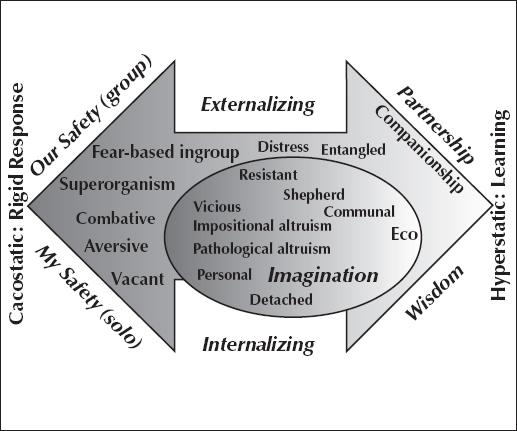
Chapter Summary Points
-
Although much of our lifecourse is established without our say in early life, we can learn to open our heart of hearts and change our dispositional mindsets.
-
We can mend ourselves by taking up purposeful self-authorship, learning self-calming techniques and how to revamp and reframe the experiences that tie up our attention.
-
We can expand our social selves and upshift our moral functioning, practicing moral fitness as move toward our human essence.
-
To develop common-self wisdom, we can nurture ecological attachment and a small I-ego, and learn to interrogate systems.
-
We can build Primal Wisdom skills and practice eco-meta-wisdom.
Book Summary Points
-
Humanity and the natural world are at risk.
-
The often missing evolved developmental niche (END) is related to health and wellbeing, rooted in neurobiological and social optimization.
-
The EDN is also related to the development of moral functioning and cognitive-emotional capacities. Early life sets up trajectories for moral capacities.
-
Humans are dynamic biosocial beings who, after childhood, have a say about who they become. Individuals can self-author toward optimal functioning.
-
Human imagination has a lot to do with the cultures humans create and how children are raised.
-
Primal wisdom offers a way to restore human nature to its potential.
-
The natural world, including human beings, as vastly more cooperative than competitive.
-
Human relationships and moral responsibilities include the flourishing of all natural entities.
Chapter 12: The Road to Restoring Human Essence
At the end of the series saga, Harry Potter holds the elder wand, the most powerful tool in the world that could bring him endless power. What does he do? He breaks it in two and throws it into a crevasse. He relinquishes superiority. Similarly, one who stands in love, in the common self, does not seek or need superior power.
It has been quite a journey. Examining human development, we can see that all aspects of our inheritance interrelate—genetics, epigenetics, developmental plasticity, basic needs, biogenetics, culture, and ecology. All these factors in complex ways influence human biosocial becoming in one fashion or another and impinge on our moral sense and behavior—our moral being. Yet at the same time, we have the power to change our being with our attention, practices, and environments. Our modern understandings can help us aim for human optimization. The most important thing to remember, as Freud intuited, is that plasticity reigns over determinism (Ansermet & Magistretti, 2007). So where do we go from here?
On the one hand, we have to realize that many of us grow up firmly in the safety ethic, with self-protection as our first social reaction. If we follow our stress reactivity, either explicitly or subliminally, we will withdraw from relational attunement. We will fall into a distrust of the interpersonal dance—the cocreation of interpersonality. We can either diminish the self, feeling inferior, and withdraw not only from the intimacy of relationships but from the responsibilities of community, of being a neighbor and citizen; or we can aggrandize the self, feeling superior, and impose our will on others. We can live our lives as dominators, aiming for control, making things happen, stepping on the feet of the Other in the interpersonal dance. We will expect our own views to be imposed on others, in part because we believe nothing else is legitimate due to impaired imagination. Either way, power is centralized around the I-ego. These one-up/one-down orientations throw relationships out of balance. The shift from balance to imbalance can be ongoing until we learn to develop and maintain an engagement ethic. (See Figure 12.1 for an illustration.)
Figure 12.1 Social Imbalance Effects
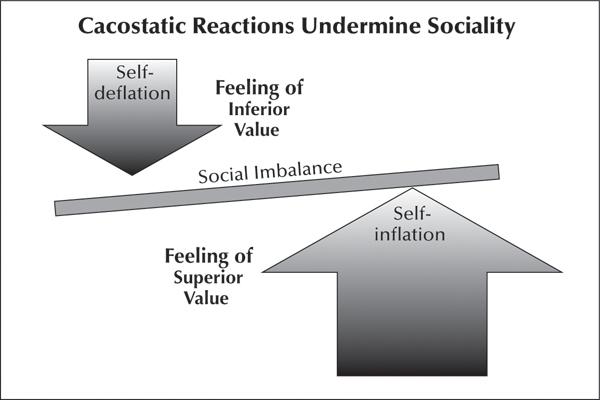
The pull toward imbalance is a subtle habit that we often don’t realize. We think we are compassionate, because we really want to be. But unless we have learned to be-with the Other, fearlessly, in harmony, we likely do not behave with an engagement orientation. We may realize afterward that we dismissed someone, treating them arrogantly, or ignored them, acting as if they did not matter. When we have these realizations, we grow. But we usually think we are acting morally, even when we are self-protective. As a result, many of us live with a morally divided self and consider it normal human nature. We want to be good and aim for it, but then behave badly. We are split between the rules of morality learned from parents, schooling and religious training and what we “believe” implicitly—that self-protection is of utmost importance.With undereducated emotion and overemphasized intellect (a la avoidant attachment), we can know intellectually what we should be like and imagine, plan, and reflect on our behavior with that frame (our “should self”) (Tenbrunsel, 2012). But when action is taken, our underdeveloped emotion and social-procedural systems for self-protection dominate. The I-ego (the “want self”) (Tenbrunsel, 2011) takes over. As a result, we behave not with compassion or ecological wisdom but with self-aggrandizement. We are moral hypocrites. We are emotionally reactive, and often without awareness. As Tenbrunsel argues, we think we are more ethical than we are because in our self-evaluations we remember the desires of our “should self” instead of the actions of the dominant “want self.” In this hypocrisy, neither represents the true self
We have to realize that our implicit social procedural knowledge can dominate our moral actions. Social sciences have well documented how humans succumb to the interests of the lower self, able to rationalize any behavior. So our lower selves are propped up by our imaginations, our abstracting capacities. Human brains seem easily to morally downshift when threat is perceived, making the safety, detached, and vicious mindsets easy pathways for moral decisions and action. This is especially so for those whose early experience did not fully foster the engagement and communal ethics—they are incontinent (not interested and not able), using Aristotle’s term, in terms of prosocial morality. The “want self” must be reeducated after a childhood of misdevelopment, and it takes time.
On the other hand, we can learn how to upshift our morality, personally but also culturally. We can learn to be continent (interested but struggling to behave), controlling our self-protective instincts when they occur. With practice we can go beyond continence toward virtue (desire with capacities to act). The personal aspects of virtuous morality have to do with self-governance and a moral locus of control. Even if our set points were oriented toward self-protective ethics in early life, with practice, we can monitor ongoing ethical mindsets, learning ways to shift ourselves habitually into engagement and communal imagination. With attention we can align our behavior with our moral identity. Our practices will alter our neurobiology, shaping habits and disposition for the future and creating a world to match. Approaching our human essence means living life primarily in these mindsets.
Some many years ago, I devised a graphic of a balancing life. I found it recently and noticed that it fits with the insights of this project (See Figure 12.2.) It shows the dynamism of our ongoing experience of balance and imbalance. We frequently shift into a self-protective mindset (manifested by a sense of inferiority or superiority) where we disown ourselves or a relationship, respectively. Consequently we are stuck behind walls of defense. To restore ourselves to a centered, balanced self of egalitarian relation with Others, it takes some painful letting go of the I-ego self delusions. We have to realize deeply that we are not superior or inferior, and remove the barriers we set up to keep others distant. The I-ego must die a little. We reverse our sense of grandiosity or dissociation and step forward into the light of relationship. We then can again take up the dance of communication with the Other, an initially frightening but ultimately exhilarating experience because it puts us at the very heart of being, knowing and being known. Unclouded by defenses, we connect to our true selves and to Others, This is an ongoing process until we die.
Although I have been describing the capacities for ethical engagement and communal imagination as matters of the individual, they are not. They require relational support, both at the beginning of life but also thereafter. Survival systems are at the ready to take over when a supportive socialscape is not available to interweave us with the rest of Life and provide the cushioning needed for an unpredictable world. Adults construct the “billowing pillowing”—the respectful cuddling and playing that keep survival systems from taking over the life of the child, so that human essence and virtue may flourish.We can internalize the socialscape that supports our highest capacities.
Figure 12.2 The Relational Life
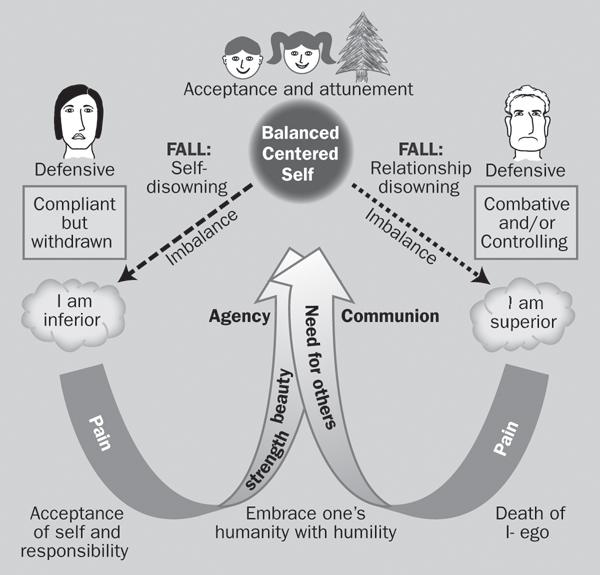
It is important to realize that virtuous morality—how we develop it and support it—is governed by our shared understandings and practices—that is, culture. Culture has bottom-up and top-down effects, influencing what we are and what we create. Children are raised with a certain cultural air that shapes their being (non-conscious, bottom-up influence)—they take in the positive or negative atmosphere. Adult attitudes and practices (top-down influence) maintain but can also alter the cultural atmosphere they inherited. For example, citizens can redesign their social systems as Norway has done, making itself a peacemaking nation (Fry, 2006). Culture is a reciprocal—top-down and bottom-up—process. For example, citizens can join together to revolutionize their society, as members of the civil rights movement did in the twentieth-century United States, and thereby alter childhood experience (integration instead of segregation) (Morris, 1984; Sugrue, 2008). When we can take on a cooperative, common-self worldview we more easily perceive what is important and what needs to change.
Figure 12.3 The Village of Community Support
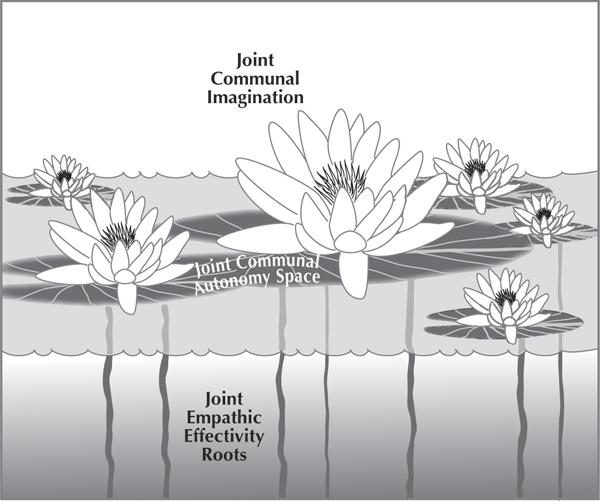
To foster our human essence more easily, we change things from the ground up—from the beginning of life with the evolved developmental niche. We upshift our cultures by creating safe relationships with children. Adults regulate their own survival systems (diminishing hostility, fear, exploitation) and become companions to young children, providing for their basic needs. This fosters frontal controls of survival systems while they are developing, and supports the construction of a broad empathic core and an autonomy space circumscribed by it. Again, this is a village activity, not an endeavor meant for only one or two parents. So we organize our communities in ways that support children and families. Mothers and families are provided the supports they need so that they can relax and be with their young child during the time when foundations for adult life are being constructed in body and brain. Building on Figure 8.1, Figure 12.3 illustrates the village.
The Three Virtues
As I said at the outset, this book presents a discussion of ethics and virtue. But how does the discussion fit with longstanding traditions of virtue development? In a review of virtues across philosophical and religious traditions, Dahlsgaard, Peterson and Seligman (2005) identified six common virtues that contribute to a good life: temperance, humanity, courage, justice, self-transcendence and wisdom. We can integrate this list with Huston Smith’s (1991) review that boiled down history’s traditional virtues to three: humility (temperance, justice), charity (humanity, wisdom), and authenticity (courage, self-transcendence).
Humility is one of three in Traditional Wisdom but also a fundamental virtue in hunter-gatherer cultures. Humility does not mean self-debasement, like being a doormat or self-flagellating each morning. Humility represents “the capacity to regard oneself in the company of others as one, but not more than one” (H. Smith, 1991, p. 387). Both self and Other are nose to nose, equal in worth. How can one get there? Through play. Humility is supported by joyous playful relations. For example, SBHG societies use extensive teasing if a person’s I-ego starts to inflate, as a hunter’s might after successfully killing a large animal. His companions will joke about how small the prey is, how they should leave it and find another one, until the hunter joins in and the whole group ends up laughing (R.B. Lee, 1988). It usually takes a little self “death” to move out of the imbalance of feeling superior or inferior and into an egalitarian partnership. “What has to be given up is not the I but that false drive for self-affirmation which impels man to flee from the unreliable, unsolid, unlasting, unpredictable, dangerous world of relation into the having of things” (Buber, 1970, p. 136). (Figure 12.2 is an illustration of this.) One has to give up the (even temporary) view of the self as superior: “I am not better.” Or, one has to give up a sense of inferiority, adopting a sense of responsibility in relationships: “I can’t hide because I am as valuable as anyone else and must be present.” One learns to understand that the individual is responsible to recognize and partner with the Other in the moment and, thereby, “to establish, by gift, community and universality” (Levinas, 1969, p. 76).
The opposite of humility is greed—wanting the world to revolve around the self. This is pride, the nub of “original sin,” which leads to a dangerous self as black hole of empty voracious self-absorption (Jacobs, 2009). When survival systems dominate a personality, the vortex of concern is all around the self. Greed grasps—wanting more for the self, and there is never enough to satisfy—whether consumer goods, knowledge, or control, but also obsessing about the self in social withdrawal: “Am I good enough? Am I better? Do I have enough?” This intemperate, inflexible state perpetuates stress and unjust, imbalanced relationships with others. Adults can learn to play to develop missing prosocial emotional skills, using methods like those described in the previous chapter. Learning the skills of relational attunement as an adult takes the assistance of many patient people along the way, and a focus on increasing personal awareness.
The second traditional virtue is charity (love): “to regard one’s neighbor as likewise one, as fully one as oneself” (H. Smith, 1991, p. 387). Love of Other is love of self. Its opposite is stress-caused hate, contempt, or judgmentalness of others. These come easily when we feel empty, fearful, or angry, or have learned judgmentalness as a habitual mode of relation. These represent self-protective barriers we put up when we feel incapable to be with the Other, like a child having a tantrum because the caregiver is not being with the child and the child knows no other way to get the parent to pay attention. Charity corresponds to the engagement ethic, the capacity to be relationally attuned in mutually respectful and responsive ways, and communal imagination—an ethic of love and capacities for sympathetic action—human capacities that are necessary for living wisely.
The third traditional virtue is veracity—“the capacity to see things exactly as they are ... to live authentically” (H. Smith, 1991, p. 387). Authenticity requires “heart” seeing, identifiable by a fully capacious right hemisphere, by a person not emotionally detached or preoccupied with the status of the I-ego self. Its opposite is clouds of delusion driven by fear, anger, or panic (survival systems), caged by inner frames and filters. Heart seeing also represents fine-tuned emotional awareness. Authenticity emphasizes perceiving accurately, not manipulating or controlling (doing) or getting (seeking), but being with receptive attention, a small-ego, and an openness to larger truths. It takes courage to be authentic and to transcend the I-ego self.
So, the three virtues represent the balancing of self in relationships and in the world, a blending of agency and communion, empathic effectivity within a communal autonomy space, yielding wisdom. (See Figure 12.2.) The broader, primal wisdom frame for these three virtues encompasses our relation to all in Nature, as a common self, and with the vitality of ecological attachment toward Nature and its entities. Of course it is a challenge to figure out what this means and how to behave appropriately in any given situation.[116] Aldo Leopold (1949, p. 129), troubled by his own alienation from the ways of the earth, had a suggestion: he urged all human beings to learn to “think like a mountain.” A commonself worldview can help us do just that. Kimmerer describes this worldview:
“We are all bound by a covenant of reciprocity: plant breath for animal breath, winter and summer, predator and prey, grass and fire, night and day, living and dying. Water knows this, clouds know this. Soil and rocks know they are dancing in a continuous giveaway of making, unmaking, and making again the earth.” (p. 383)
Getting There From Here
Transformation can take place incrementally or instantly. Stepping into a common self worldview is a shift of consciousness that wisdom traditions unveil (at-one-ment in the Western wisdom traditions) (H. Smith, 1991): Realizing that everything around us is part of our family—the trees, the grass, the birds. With a common-self view of life, we are more likely to relate to others from an engagement and communal imagination ethic. Competition is competing against ourself. We sense that everything impinges on everything else—we exist in a web of relations, all as one. Physics has told us that we are all connected at the quantum level and the material world is essentially energy. The indigenous worldviews tell us that humans have some control over these energies and actually are responsible for them. If we wed the stories together, we can see easily that everything humans do affects the Whole. So, now that we know, what shall we do?
With our imaginations we can change who we are, from personality to culture. When we understand how vital lived experience is we can rethink our self becoming. Adults can change their own personalities by their attention, habit development, and wisdom practices. We can rethink our systems. Adults can change cultures by developing institutions and selecting activities that minimize detachment but support our moral heritages. We can believe that communal morality is humanity’s default, not immorality, violence, or selfishness. As adults, we can use our imagination to bring awareness to the mind, courage to the heart and strength to each other so that we can construct a society and world where all thrive.[117]
Figure 12.4 The Three Virtues and Their Practice Within a Common-Self Worldview
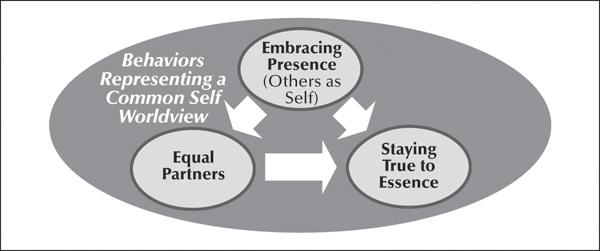
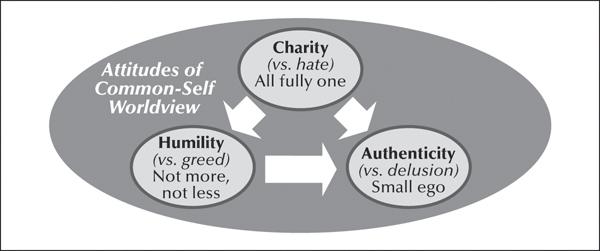
Because children depend on adults to support them during early life when they cannot make many decisions themselves, adults influence the personalities of their children by how they treat them. Adults set children on a trajectory of better or worse being. As made apparent among foraging nomadic groups, when humans are raised with companionship care—in healthy, nurturing environments—they are better able to become adults with full moral heritages. Adults all over the world can choose to put basic needs first so that everyone feels loved and supported, every family receives what it needs. With communities invested in childrearing, each child can develop her unique positive inclinations and flourish as an individual-in-community.
The social and personal come together in a common-self lifestyle. Our human essence is about living cooperatively with other creatures and entities—treating them like members of the family. Though we have moved far from this attitude, we have the power to reestablish it. Perhaps we should adopt the principle proposed by Aldo Leopold who said, “A thing is right when it tends to preserve the integrity, stability, and beauty of the biotic community. It is wrong when it tends otherwise” (Meine, 2013, p. 188).
But as I and others have pointed out, it is not enough to know intellectually what must be done, we must know it personally. We must feel connected to our companions in the natural world. Children who grow up with the natural world as companion develop a deep sense of how the natural world cares for them. As adults in a supportive society, they will circumscribe their autonomy to preclude damaging the sacred relationship with nature.
Approaching the natural world as an adult without a longstanding relationship from childhood, we may feel like strangers or immigrants to a place we do not know. If we feel that way where we reside, we can learn to live as if we are staying. We set both our feet on the ground where we are and become “naturalized” to that place, living as if this is the land that feeds us, as if these are the streams from which we drink, the air that we exchange with plants: rooted here our bodies and spirits flourish (paraphrased from Kimmerer, 2014, p. 214). We then will understand that nature conserves us, not the other way around (Martin, 1999). When our cultures and imaginations rejoin the biotic community, we will cherish and care for the magnificence of our dearest friend, Nature. We will not only love it, but heal it. We will find our true essence in the loving and being with. The universe sings. Can we hear it?
Afterword
In the last days finishing this book, a little moth seemed to follow me around in the evenings, from the kitchen to my office upstairs. In the past I would have worried about “my woolens” and done something to keep it away from them—put it outside. But this time I realized that they are not really “my woolens” but gifts of the earth. Why shouldn’t the moth partake of them also? And who was I to say that its life was less valuable? In a world of fewer insects, I was so happy to see Moth. As Moth circled around my head I felt that she was encouraging me to complete the project with courage. May this book be a blessing to all who receive it.
Appendix: Suggestions for Further Reading
Self-healing
Soulcraft by Bill Plotkin
Lovingkindness: The revolutionary art of happiness by Sharon Salzberg
L.A.U.G.H. (60 therapeutic, perspective-building, life-changing activities) by Allen Klein
Forgiveness is a Choice by Robert Enright
Living room revolution: A handbook for conversation, community and the common good by Cecile Andrews
Integrative Accounts of Human Beingness and Therapeutic Approaches
Being and Becoming by Franklin Sills
Compassion edited by Paul Gilbert
Ecotherapy: Healing With Nature in Mind by Linda Buzzell and Craig Chalquist
Brain Plasticity
The neurobiology of gene expression by Ernest Rossi
The brain that changes itself by Norman Doidge
The woman who changed her brain by Barbara Arrowsmith-Young
Inherited and Fostered Brain Functioning
The Archeology of Mind by Jaak Panksepp and Lucy Biven
The Master and His Emissary by Ian McGilchrist
A General Theory of Love by Thomas Lewis, Fari Amini and Richard Lannon
*Philosophy in the flesh by George Lakoff and Mark Johnson
Human Brains and Development
Affect Regulation and Repair of the Self by Allan Schore
Affect Dysregulation and Disorders of the Self by Allan Schore
The Developing Mind by Daniel Siegel
Affect regulation, Mentalization and the Development of the Self by Peter Fonagy, G. Gergely, E. Jurist & M. Target
Papers and chapters by Colwyn Trevarthen (see reference section)
Humans as Dynamic Systems
The Agile Mind by Wilma Koutstaal
The Biology of Violence by Debra Niehoff
The Sovereignty of Good by Iris Murdoch
Culture and Cooperatiion
A Paradise Built in Hell by Rebecca Solnit
Learning Nonaggression edited by Ashley Montagu
The Spirit Level by Richard Wilkinson and Kate Pickett
The Empathic Civilization by Jeremy Rifkin
Evolution
The Mermaid’s Tale: Four Billion Years of Cooperation in the Making of Living Things by Kenneth Weiss and Anne Buchanan
Cycles of Contingency edited by Susan Oyama, Paul Griffiths and Russell Gray
The Evolution of Childhood by Melvin Konner
War, Peace and Human Nature edited by Douglas Fry
Essays that Help Connect You to Nature
Aldo Leopold: A Sand County Almanac & Other Writings on Ecology and Conservation edited by Carl Meine
Earth works: Selected essays by Scott Russell Sanders
The art of the commonplace: The agrarian essays of Wendell Berry edited by Norman Wirzba
Braiding Sweetgrass: Indigenous wisdom, scientific knowledge, and the teachings of plants by Robin Wall Kimmerer
Gathering moss: A natural and cultural history of mosses by Robin Wall Kimmerer
Literature and the environment edited by Lorraine Anderson, Scott Slovic and John O’Grady
Companions in wonder: Children and adults exploring nature together edited by Julie Dunlap and Stephen R. Kellert
Poetry by Mary Oliver
Poetry and Essays by Gary Snyder
Indigenous World Views (written by non-Indigenous)
Limited Wants, Unlimited Means: A Reader on Hunter-Gatherer Economics and the Environment by John Gowdy
The Perception of the Environment by Tim Ingold
Voices of the First Day: Awakening in the Aboriginal Dreamtime by Robert Lawlor
The Continuum Concept by Jean Liedloff
In the Spirit by Calvin Luther Martin
The Way of the Human Being by Calvin Luther Martin
The Western Illusion of Human Nature by Marshall Sahlins
Critiques of Trends in Western Thought and Alternatives
Beast and Man: The Roots of Human Nature; Science as Salvation; The Solitary Self: Darwin and the Selfish Gene by Mary Midgley
An Inquiry into Modes of Existence by Bruno Latour
The Battle for Human Nature by Barry Schwartz
A Meaning Older than Words by Derrick Jensen
Prosperity without growth: Economics for a finite planet by Tim Jackson
References
Abdolmaleky, H. M., Thiagalingam, S., & Wilcox, M. (2005). Genetics and epigenetics in major psychiatric disorders: Dilemmas, achievements, applications, and future scope. American Journal of Pharmacogenomics, 5(3), 149–160.
Adamec, R. E., Shallow, T., & Budgell, J. (1997). Blockade of CCK (B) but not CCK (A) receptors before and after the stress of predator exposure prevents lasting increases in anxiety-like behavior: Implications for anxiety associated with posttraumatic stress disorder. Behavioral Neuroscience, 111(2), 435–449.
Adorno, T. W., Frenkel-Brunswik, E., Levinson, D. J., & Sanford, R. N. (1950). The authoritarian personality. Oxford, UK: Harpers.
Agin, D. (2010). More than genes: What science can tell us about toxic chemicals, development, and the risk to our children. New York: Oxford University Press.
Ainsworth, M. D. S., Blehar, M. C., Waters, E., & Wall, S. (1978). Patterns of attachment: Assessed in the strange situation and at home. Hillsdale, NJ: Erlbaum.
Ainsworth, M. D. S., & Bowlby, J. (1991). An ethological approach to personality development. American Psychologist, 46, 333–341.
Aitken, K. J., & Trevarthen, C. (1997). Self/other organization in human psychological development. Development and Psychopathology, 9, 653–677.
Alberch, P. (1982). The generative and regulatory roles of development in evolution. In D. Mossakowski & G. Roth (Eds.), Environmental adaptation and evolution (pp. 19–36). New York: G. Fischer.
Alessandri, S. M., & Lewis, M. (1996). Differences in pride and shame in maltreated and non-maltreated preschoolers. Child Development, 67, 1857–1869.
Alexander, M. (2012). The new Jim Crow. New York: New Press.
Alfven, G. (2004). Plasma oxytocin in children with recurrent abdominal pain. Journal of Pediatric Gastroenterology and Nutrition, 38(5), 513–517.
Allen, J. G., Fonagy, P., & Bateman, A. (2010). The role of mentalizing in treating attachment trauma. In R. A. Lanius, E. Vermetten, & C. Pain (Eds.), The impact of early life trauma on health and disease: The hidden epidemic (pp. 247–256). New York: Cambridge University Press.
Allman, J. M., Hakeem, A., Erwin, J. M., Ninchinsky, E., & Hof, P. (2001). The anterior cingulate cortex: The evolution of an interface between emotion and cognition. Annals of the New York Academy of Sciences, 935, 107–117.
Altman, N. (2007). The oxygen prescription: The miracle of oxidative therapies. Rochester, VT: Healing Art Press.
Amaral, D. G., Price, J. L., Pitkanen, A., & Carmichael, T. (1992). Anatomical organization of the primate amygdaloid complex. In J. Aggleton (Ed.), The amygdala: Neurobiological aspects of emotion, memory, and mental dysfunction (pp. 1–66). New York: Wiley-Liss.
American Academy of Child and Adolescent Psychiatry. (2011). Campaign for America’s kids. Retrieved January 19, 2011, from www.campaignforamericaskids.org
Anand, K. J. S., Runeson, B., & Jacobson, B. (2004). Gastric suction at birth associated with long-term risk for functional intestinal disorders in later life. Journal of Pediatrics, 144(4), 449–454.
Anand, K. J. S., & Scalzo, F. M. (2000). Can adverse neonatal experiences alter brain development and subsequent behavior? Biology of the Neonate, 77(2), 69–82.
Anda, R. F., Felitti, V. J., Bremner, J. D., Walker, J. D., Whitfield, C. H., Perry, B. D., ... Giles, W. H. (2006). The enduring effects of abuse and related adverse experiences in childhood: A convergence of evidence from neurobiology and epidemiology. European Archives of Psychiatry and Clinical Neuroscience, 256(3), 174–186.
Anderson, C. A., Shibuya, A., Ihori, N., Swing, E. L., Bushman, B. J., Sakamoto, A., ... Barlett, C. P. (2010). Violent video game effects on aggression, empathy, and prosocial behavior in Eastern and Western countries: A meta-analytic review. Psychological Bulletin, 136(2), 151–173.
Anderson, N. B., Bennett Johnson, S., Belar, C. D., Breckler, S. J., Nordal, K. C., Ballard, D., ... Dueks, S. (2012). Stress in America: Our health at risk. Washington, DC: American Psychological Association.
Anderson, S. W., Bechara, A., Damasio, H., Tranel, D., & Damasio, A. R. (1999). Impairment of social and moral behavior related to early damage in human prefrontal cortex. Nature Neuroscience, 2, 1032–1037.
Andrews, C. (2013). Living room revolution: A handbook for conversation, community and the common good. Grabriola Island, BC, Canada: New Society Publishers.
Anisman, H., Zaharia, M. D., Meaney, M. J., & Merali, Z. (1998). Do early-life events permanently alter behavioral and hormonal responses to stressors? International Journal of Developmental Neuroscience, 16(3–4), 149–164.
Ansermet, F., & Magistretti, P. (2007). Biology of freedom: Neural plasticity, experience, and the unconscious (S. Fairfield, Trans.). New York: Other Press. (Original work published 2004).
Anway, M. D., Cupp, A. S., Uzumcu, M., & Skinner, M. K. (2005). Epigenetic transgenerational actions of endocrine disruptors and male fertility. Science, 308(5727), 1466–1469. doi: 10.1126/science.1108190
Aquinas, T. (1920). The summa theologica of St. Thomas Aquinas (2nd & Rev. ed.; Fathers of the English Dominican Province, Trans.). (Original work published 1274). Retrieved November 30, 2012, from www.newadvent.org/summa/
Arana, F., Parkinson, J., Hinton, E., Holland, A., Owen, A., & Roberts, A. (2003). Dissociable contributions of the human amygdala and orbitofrontal cortex to incentive motivation and goal selection. Journal of Neuroscience, 23(29), 9632–9638.
Archer, J. (1988). The behavioral biology of aggression. Cambridge, UK: Cambridge University Press.
Ariely, D. (2012). The (honest) truth about dishonesty. New York, HarperCollins.
Aristotle. (1988). Nicomachean ethics (W. D. Ross, Trans.). London, UK: Oxford University Press.
Arlin, P. K. (1990). Wisdom: The art of problem finding. In R. J. Sternberg (Ed.), Wisdom: Its nature, origins, and development (pp. 230–243). New York: Cambridge University Press.
Armony, J. L., Quirk, G. J., & LeDoux, J. E. (1998). Differential effects of amygdala lesions on early and late plastic components of auditory cortex spike trains during fear conditioning. Journal of Neuroscience, 18(7), 2592–2601.
Arnsten, A. F. T. (1998). The biology of being frazzled. Science, 280(5370), 1711–1712.
Arnsten, A. F. T. (2009). Stress signaling pathways that impair prefrontal cortex structure and function. Nature Reviews Neuroscience, 10(6), 410–422.
Arnsten, A. F., & Goldman-Rakic, P. S. (1998). Noise stress impairs prefrontal cortical cognitive function in monkeys: Evidence for a hyperdopaminergic mechanism. Archives of General Psychiatry, 55(4), 362–368.
Aron, A., & Aron, E. N. (1996). Love and expansion of the self: The state of the model. Personal Relationships, 3, 45–58.
Arpaly, N. (2003). Unprincipled virtue: An inquiry into moral agency. New York: Oxford University Press.
Ashman, S. B., & Dawson, G. (2002). Maternal depression, infant psychobiological development, and risk for depression. In S. H. Goodman & I. H. Gotlib (Eds.), Children of depressed parents: Mechanisms of risk and implications for treatment (pp. 37–58). Washington, DC: American Psychological Association.
Atlan, H. (1987). The self-creation of meaning. Physica Scripta, 36, 563–576.
Atwood, J. B. (1999). Early warning and prevention of genocide and crimes against humanity. Journal of Intergroup Relations, 26, 33–39.
Audero, E., Coppi, E., Mlinar, B., Rossetti, T., Caprioli, A., Banchaabouchi, M. A., & Gross, C. (2008). Sporadic autonomic dysregulation and death associated with excessive serotonin autoinhibition. Science, 321(5885), 130–133.
Azevedo, F. A., Carvalho, L. R., Grinberg, L. T., Farfel, J. M., Ferretti, R. E., Leite, R. E., ... Herculano-Houzel, S. (2009). Equal numbers of neuronal and nonneuronal cells make the human brain an isometrically scaled-up primate brain. Journal of Comparative Neurology, 513(5), 532–541. doi: 10.1002/cne.21974
Azrin, N. H., Hutchinson, R. R., & Drake, D. F. (1969). Extinction induced aggression. In L. Berkowitz (Ed.), Aggression: A re-examination of the frustration-aggression hypothesis (pp. 34–55). New York: Atherton Press.
Babiak, P., Neumann, C. S., & Hare, R. D. (2010). Corporate psychopathy: Talking the walk. Behavioral Science and Law, 28(2), 174–193.
Bailey, K. (2002). Upshifting and downshifting the triune brain: Roles in individual and social pathology. In G. A. Cory, Jr., & R. Gardner, Jr. (Eds.), The evolutionary neuroethology of Paul MacLean: Convergences and frontiers (pp. 318–343). Westport, CT: Praeger.
Bakan, D. (1966). The duality of human existence: Isolation and communion in Western Man. Boston, MA: Beacon Press.
Balter, M. (2012). Ice age tools hint at 40,000 years of Bushman culture. Science, 337(6094), 512.
Baltes, P. B., & Smith, J. (1990). Toward a psychology of wisdom and its ontogenesis. In R. J. Sternberg (Ed.), Wisdom: Its nature, origins, and development (pp. 87–120). New York: Cambridge University Press.
Baltes, P. B., Staudinger, U., Maercker, A., & Smith, J. (1993). People nominated as wise: A comparative study of wisdom-related knowledge. Psychology and Aging, 10, 155–166.
Bandura, A. (1991). Social cognitive theory of moral thought and action. In W. Kurtines & J. Gewirtz (Eds.), Handbook of moral behavior and development: Vol. I. Theory (pp. 223–250). Hillsdale, NJ: Erlbaum.
Bandura, A. (1999). Moral disengagement in the perpetration of inhumanities. Personality and Social Psychology Review, 3(3), 269–275.
Barbas, H. (1995). Anatomic basis of cognitive-emotional interactions in the primate prefrontal cortex. Neuroscience Biobehavioral Review, 19, 499–510.
Barbas, H., Saha, S., Rempel-Clower, N., & Ghashghaei, T. (2003). Serial pathways from primate prefrontal cortex to autonomic areas may influence emotional expression. Neuroscience, 4(1), 25.
Barker, D. J. (1998). In utero programming of chronic disease. Clinical Science, 95, 115–128.
Barker, D. J. (2000). Fetal programming of coronary heart disease. Trends in Endocrinology and Metabolism, 13(9), 364–368.
Barker, D. J., Winter, P. D., Osmond, C., Margetts, B., & Simmonds, S. J. (1989). Weight in infancy and death from ischaemic heart disease. The Lancet, 2(8663), 577–580.
Barkow, J. H. (1989). Darwin, sex and status: Biological approaches to mind and culture. Toronto, Ontario, Canada: University of Toronto Press.
Baron-Cohen, S. (1995). Mindblindness: An essay on autism and theory of mind. Cambridge, MA: MIT Press.
Baron-Cohen, S. (2011). The science of evil: On empathy and the origins of cruelty. New York: Basic Books.
Barraud, C., de Copper, D., Ireanu, A., & Jamous, R. (1994). Of relations and the dead: Four societies viewed from the angle of their exchange (S. J. Suffern, Trans.). Oxford, UK: Berg Press.
Barrett, L. F., Mesquita, B., & Smith, E. R. (2010). The context principle. In B. Mesquita, L. F. Barrett, E. R. Smith (Eds.), The mind in context (pp. 1–24). New York: Guilford Press.
Bartholomew, K., & Horowitz, L. M. (1991). Attachment styles among young adults: A test of a four-category model. Journal of Personality and Social Psychology, 61, 226–244.
Basch, M. E. (1976). The concept of affect: A re-examination. Journal of the American Psychoanalytic Association, 24, 759–777.
Bassett, S., Avramopoulos, D., & Fallin, M. (2002). Evidence for parent of origin effect in late-onset Alzheimer disease. American Journal of Medical Genetics, 114(6), 679–686.
Bassett, S., Avramopoulos, D., Perry, R., Weiner, H., Watson, B., Go, R., & Fallin, M. (2006). Further evidence of maternal parent-of-origin effect on chromosome 10 in late-onset Alzheimer’s disease. American Journal of Medical Genetics: Part B. Neuropsychiatric Genetics, 141B(5), 537–540. doi: 10.1002/ajmg.b.30350
Bateman A., & Fonagy P. (2004). Psychotherapy for borderline personality disorder: Mentalization-based treatment. New York: Oxford University Press.
Bateson, G. (1972). Steps to an ecology of mind. Chicago, IL: University of Chicago Press.
Bateson, P., & Gluckman, P. (2011). Plasticity, robustness, development and evolution. New York: Cambridge University Press.
Batson, C. D. (2011). Altruism in humans. New York: Oxford University Press.
Batson, C. D., Early, S., & Salvarini, G. (1997). Perspective taking: Imagining how another feels versus imagining how you would feel. Personality and Social Personality Bulletin, 23, 751–758.
Bauer, J. (2012). Cooperative gene: Evolution as creative process. Cumberland, RI: Brilliance.
Bauman, C. W., & Skitka, L. J. (2009). Moral conflict and procedural justice: Moral mandates as constraints to voice effects. Australian Journal of Psychology, 61, 40–49.
Baumeister, R., & Beck, A. (1999). Evil: Inside human violence and cruelty. New York: Holt Paperbacks.
Baxter Magolda, M. B. (2009). Authoring your life: Developing an internal voice to navigate life’s challenges. Sterling, VA: Stylus.
Bayol, S. A., Farrington, S. J., & Stickland, N. C. (2007). A maternal “junk food” diet in pregnancy and lactation promotes an exacerbated taste for “junk food” and a greater propensity for obesity. British Journal of Nutrition, 98(4), 843–851.
Bazerman, M. H., & Tenbrunsel, A. E. (2011). Blindspots: Why we fail to do what’s right and what to do about it. Princeton, NJ: Princeton University Press.
Bear, M. F. (2003). Bidirectional synaptic plasticity: From theory to reality. Philosophical Transactions of the Royal Society of London, B, 358, 649–655.
Bear, M. F., & Singer, W. (1986). Modulation of visual cortical plasticity by acetylcholine and noradrenaline. Nature, 320(6058), 172–176.
Beatson, J., & Taryan, S. (2003). Predisposition to depression: The role of attachment. Australian and New Zealand Journal of Psychiatry, 37(2), 219–225.
Bechara, A. (2005). Decision making, impulse control and loss of willpower to resist drugs: A neurocognitive perspective. Nature Neuroscience, 8, 1458–1463.
Bechara, A., Damásio, A. R., Damásio, H., & Anderson, S. W. (1994). Insensitivity to future consequences following damage to human prefrontal cortex. Cognition, 50(1–3), 7–15.
Bechara, A., Damasio, H., Tranel, D., & Damasio, A. R. (1997). Deciding advantageously before knowing the advantageous strategy. Science, 275 (5304), 1293–1295.
Bechara, A., Tranel, D., & Damasio, H. (2000, November). Characterization of the decision-making deficit of patients with ventromedial prefrontal cortex lesions. Brain, 123(Pt. 11), 2189–2202.
Beck, A. T. (1999). Prisoners of hate: The cognitive basis of anger, hostility, and violence. New York: HarperCollins.
Beebe, B., Lachmann, F., & Jaffe, J. (1997). Mother–infant interaction structures and presymbolic self and object representations. Psychoanalytic Dialogues, 7(2), 133–182.
Bekinschtein, P., Cammarota, M., Katche, C., Slipczuk, L., Rossato, J. I., Goldin, A., ... Medina, J. H. (2008). BDNF is essential to promote persistence of long-term memory storage. Proceedings of the National Academy of Sciences of the United States of America, 105(7), 2711–2716. doi:10.1073/pnas.0711863105
Bekoff, M. (2002). Minding animals: Awareness, emotions and heart. Oxford, England: Oxford University Press.
Bell, D. C. (2001). Evolution of caregiving behavior. Personality and Social Psychology Review, 5, 216–229.
Bell, M. A., & Fox, N. A. (1992). The relations between frontal brain electrical activity and cognitive development during infancy. Child Development, 63, 1142–1163.
Bell, M. A., & Fox, N. A. (1994). Brain development over the first year of life: Relations between electroencephalographic frequency and coherence and cognitive and affective behaviors. In K. W. F. Geraldine Dawson (Ed.), Human behavior and the developing brain (pp. 314–345). New York: Guilford.
Ben-Ami Bartal, I., Decety, J., & Mason, P. (2011). Empathy and pro-social behavior in rats. Science, 334, 1427–1430.
Benes, F. M. (1994). Developmental changes in stress adaptation to psychopathology. Development and Psychopathology, 6, 723–739.
Bentley, P. J. (1998). Comparative vertebrate endocrinology. Cambridge, UK: Cambridge University Press.
Bercik, P., Denou, E., Collins, J., Jackson, W., Lu, J., Jury, J., ... Collins, S. M. (2011). The intestinal microbiota affect central levels of brain-derived neurotropic factor and behavior in mice. Gastroenterology, 141(2), 599–609.
Berendsen, H. H. (1995). Interactions between 5–hydroxytryptamine receptor subtypes: Is a disturbed receptor balance contributing to the symptomatology of depression in humans? Pharmacology and Therapeutics, 66(1), 17–37.
Bergin, D., & Woodin, M. (2011). Neuropsycholgical development of newborn infants and toddlers (0 to 3 years old). In A. S. Davis (Ed.), Handbook of pediatric neuropsychology (pp. 15–30). New York: Springer.
Berkes, F. (1999). Sacred ecology. New York: Routledge.
Berridge, K. C. (2003). Pleasures of the brain. Journal of Brain Cognition, 52(1), 106–128.
Berridge, K. C., & Robinson, T. E. (1998). What is the role of dopamine in reward: Hedonic impact, reward learning, or incentive salience? Brain Research: Brain Research Reviews, 28(3), 309–369.
Berry, W. (2013). It all turns on affection (2012 Jefferson lecture). Washington, DC: National Endowment for the Humanities.
Bilefsky, D. (2012, January 5). Called “diabolical” by judge, man gets 32 years for framing woman. New York Times, p. A18.
Birren, J. E., & Fisher, L. M. (1990). The elements of wisdom: Overview and integration. In R. J. Sternberg (Ed.), Wisdom: Its nature, origins, and development (pp. 317–332). New York: Cambridge University Press.
Blackmon, D. A. (2008). Slavery by another name: The re-enslavement of black people in America from the Civil War to World War II. New York: Doubleday.
Blair, J., Mitchell, D., & Blair, K. (2005). The psychopath: Emotion and the brain. Malden, MA: Blackwell.
Blair, K., Marsh, A., Morton, J., Vythilingam, M., Jones, M., Mondillo, K., ... Blair, J. (2006). Choosing the lesser of two evils, the better of two goods: Specifying the roles of ventromedial prefrontal cortex and dorsal anterior cingulate in object choice. Journal of Neuroscience, 26(44), 11379–11386.
Blair, R. J., & Cipolotti, L. (2000). Impaired social response reversal. A case of “acquired sociopathy.” Brain, 123, 1122–1141.
Blair, R. J., Jones, L., Clark, F., & Smith, M. (1997). The psychopath: A lack of responsiveness to distress cues? Psychophysiology, 34, 192–198.
Blake, D. T., Byll, N. N., & Merzenich, M. (2002). Representation of the hand in the cerebral cortex. Behavioral Brain Research, 135, 179–184.
Blanchard, R. J., Blanchard, D. C., & Takahashi, L. K. (1977). Reflexive fighting in the albino rat: Aggressive or defensive behavior? Aggressive Behavior, 3, 145–155.
Bliss, T. V., & Lomo, T. (1970). Plasticity in a monosynaptic cortical pathway. Journal of Physiology, 207, 61P.
Bloom, H. (1995). The Lucifer principle. New York: Atlantic Monthly Press.
Bloom, P. (2000). Buddhist acts of compassion. Berkeley, CA: Conari Press.
Blum, D. (2002). Love at Goon Park: Harry Harlow and the science of affection. New York: Perseus.
Blunt Bugental, D., Martorell, G. A., & Barraza, V. (2003). The hormonal costs of subtle forms of infant maltreatment. Hormones and Behaviour, 43(1), 237–244.
Boehm, C. (1999). Hierarchy in the forest: The evolution of egalitarian behavior. Cambridge, MA: Harvard University Press.
Boehm, C. (2012). Moral origins: The evolution of virtue, altruism, and shame. New York: Basic Books.
Bogdan, R. J. (1994). Grounds for cognition: How goal-guided behavior shapes the mind. New York: Psychology Press.
Bohacek, J., & Mansuy, I. M. (2012). Epigenetic inheritance of disease and disease risk. Neuropsychopharmacology Reviews, 38, 220–236.
Bohm, D. (1980). Wholeness and the implicate order. London, UK: Routledge.
Bolke-Taylor, J. (2008). My stroke of insight. New York: Viking Press.
Bolton, D., & Hill, J. (1996). Mind, meaning and mental disorder. Oxford, England: Oxford University Press.
Bonasio, R., Tu, S., & Reinberg, D. (2010). Molecular signals of epigenetic states. Science, 330(6004), 612–616.
Bonne, O., Grillon C., Vythilingam M., Neumeister, A., & Charney, D. S. (2004). Adaptive and maladaptive psychobiological responses to severe psychological stress: Implications for the discovery of novel pharmacotherapy. Neuroscience and Biobehavioral Reviews, 28(1), 65–94.
Bonner, J. T. (1988). The evolution of complexity by means of natural selection. Princeton, NJ: Princeton University Press.
Bonnin, A., Goeden, N., Chen, K., Wilson, M. L., King, J., Shih, J. C., ... Levitt, P. (2011). A transient placental source of serotonin for the fetal forebrain. Nature, 472(7343), 347–350.
Borgida, E., & Howard-Pitney, B. (1983, September). Personal involvement and the robustness of perceptual salience effects. Journal of Personality and Social Psychology, 45(3), 560–570.
Borody, T. J., & Khoruts, A. (2011). Fecal microbiota transplantation and emerging applications. Nature Reviews Gastroenterology and Hepatology, 9(2), 88–96.
Borsini, F. (1994). Balance between cortical 5-HT1A and 5-HT2 receptor function: Hypothesis for a faster antidepressant action. Pharmaceutical Research, 30(1), 1–11.
Botsman, R. (2010). What’s mine is yours. New York: Harper Business.
Bourgeault, C. (2003). The wisdom way of knowing: Reclaiming an ancient tradition to awaken the heart. San Francisco, CA: Jossey-Bass.
Bowlby, J. (1951). Maternal care and mental health. New York: Schocken.
Bowlby, J. (1982). Attachment and loss: Vol. 1. Attachment (2nd ed.). New York: Basic Books. (Original work published 1969).
Bowlby, J. (1988). A secure base: Parent–child attachment and healthy human development. New York: Basic Books.
Boyce, W. T., & Ellis, B. J. (2005). Biological sensitivity to context: I. An evolutionary-developmental theory of the origins and functions of stress reactivity. Developmental Psychopathology, 17(2), 271–301.
Brackett, M. A., & Mayer, J. D. (2003). Convergent, discriminant, and incremental validity of competing measures of emotional intelligence. Personality and Social Psychology Bulletin, 29, 1147–1158.
Brandt, A. (2013). 8 keys to eliminating passive-aggressiveness. New York: W.W. Norton.
Braungart-Rieker, J. M., Garwood, M. M., Powers, B. P., & Wang, X. (2001). Parental sensitivity, infant affect, and affect regulation: Predictors of later attachment. Child Development, 72, 252–270.
Braungart-Rieker, J. M., Hill, A. L., & Karrass, J. (2010). Fear and anger reactivity trajectories from 4 to 16 months: The effects of temperament, regulation, and maternal sensitivity. Developmental Psychology, 46, 791–804.
Bravo, J. A., Forsythe, P., Chew, M. V., Escaravage, E., Savignac, H. M., Dinan, T. G., ... Cryan, J. F. (2011, September 20). Ingestion of Lactobacillus strain regulates emotional behavior and central GABA receptor expression in a mouse via the vagus nerve. Proceedings of the National Academy of Sciences of the United States of America, 108(38), 16050–16055.
Bredy, T. W., Zhang, T. Y., Grant, R. J., Diorio, J., & Meaney, M. J. (2004). Peripubertal environmental enrichment reverses the effects of maternal care on hippocampal development and glutamate receptor subunit expression. European Journal of Neuroscience, 20(5), 1355–1362.
Brewer, M. B., & Miller, N. (1996). Intergroup relations. Pacific Grove, CA: Brooks/Cole.
Bronfenbrenner, U. (1979). The ecology of human development. Cambridge, MA: Harvard University Press.
Brothers, L. (1997). Friday’s footprint. New York: Oxford University Press.
Brown, M. R., Fisher, L. A., Spiess, J., Rivier, C., Rivier, J., & Vale, W. (1982). Corticotropin-releasing factor: Actions on the sympathetic nervous system and metabolism. Endocrinology, 111, 928–931.
Brown, S. (2009). Play. New York: Avery.
Brown, S. L., & Brown, M. (2006). Selective investment theory: Recasting the functional significance of close relationships. Psychological Inquiry, 17, 30–59.
Bruer, J. T. (1999). The myth of the first three years: A new understanding of early brain development and lifelong learning. New York: Free Press.
Bruner, J. S. (1957). On perceptual readiness. Psychological Review, 64(2), 123–152.
Bruner, J. S. (1983). Child’s talk: Learning to use language. New York: Norton.
Brunner, H. G., Nelen, M., Breakefield, X. O., Ropers, H. H., & van Oost, B. A. (1993). Abnormal behavior associated with a point mutation in the structural gene for monoamine oxidase A. Science, 262(5133), 578–580.
Bryant, F. B., & Veroff, J. (2007). Savoring: A new model of positive experience. Mahwah, NJ: Erlbaum.
Buber, M. (1970). I and thou (W. Kaufmann, Trans.). New York: Charles Scribner.
Buckholtz, J. W., & Meyer-Lindenberg, A. (2008). MAOA and the neurogenetic architecture of human aggression. Trends in Neurosciences, 31(3), 120–129.
Bujatti, M., & Riederer, P. J. (1976). Serotonin, noradrenaline, dopamine metabolites in transcendental meditation-technique. Neural Transmission, 39(3), 257–267.
Bureau, J. F., Martin, J., & Lyons-Ruth, K. (2010). Attachment dysregulation as hidden trauma in infancy: Early stress, maternal buffering and psychiatric morbidity in young adulthood. In R. A. Lanius, E. Vermetten, & C. Pain (Eds.), The impact of early life trauma on health and disease: The hidden epidemic (pp. 48–56). New York: Cambridge University Press.
Burgdorf, J., Kroes, R. A., Beinfeld, M. C., Panksepp, J., & Moskal, J. R. (2010). Uncovering the molecular basis of positive affect using rough-and-tumble play in rats: A role for insulin-like growth factor I. Neuroscience, 168(3), 769–777.
Burghardt, G. M. (2005). The genesis of animal play: Testing the limits. Cambridge, MA: MIT Press.
Burton, R. (2008). On being certain: Believing you are right even when you’re not. New York: St. Martin’s Press.
Bystrova, K., Ivanova, V., Edhborg, M., Matthiesen, A. S., Ransjö-Arvidson, A. B., Mukhamedrakhimov, R., Uvnäs-Moberg, K., & Widström, A. M. (2009). Early contact versus separation: Effects on mother-infant interaction one year later. Birth, 36(2), 97–109.
Bystrova, K., Matthiesen, A. S., Widstrom, A. M., Ransjo-Arvidson, A. B., Welles-Nystrom, B., Vorontsov, I. et al. (2007). The effect of Russian Maternity Home routines on breastfeeding and neonatal weight loss with special reference to swaddling. Early Human Development, 83(1), 29–39.
Cajete, G. (2000). Native science: Natural laws of interdependence. Santa Fe, NM: Clear Light.
Caldji, C., Diorio, J., & Meaney, M. J. (2003). Variations in maternal care alter GABA(A) receptor subunit expression in brain regions associated with fear. Neuropsychopharmacology, 28, 1950–1959.
Caldji, C., Francis, D., Sharma, S., Plotsky, P. M., & Meaney, M. J. (2000). The effects of early rearing environment on the development of GABAA and central benzodiazepine receptor levels and novelty-induced fearfulness in the rat. Neuropsychopharmacology, 22(3), 219–229.
Calkins, S. D. (1997). Cardiac vagal tone indices of temperamental reactivity and behavioral regulation in young children. Developmental Psychobiology, 31(2), 125–135.
Calkins, S. D., & Hill, A. (2007). Caregiver influences on emerging emotion regulation: Biological and environmental transactions in early development. In J. J. Gross (Ed.), Handbook of emotion regulation (pp. 229–248). New York: Guilford Press.
Calkins, S. D., Smith, C. L., Gill, K. L., & Johnson, M. C. (1998). Maternal interactive style across contexts: Relations to emotional, behavioral and physiological regulation during toddlerhood. Social Development, 7(3), 350–369.
Callahan, D. (2004). The cheating culture: Why more Americans are doing wrong to get ahead. New York: Harcourt Harvest.
Campbell, D. T. (1967). Stereotypes and perception of group differences. American Psychologist, 22, 812–829.
Campbell, R. L. (2002). Jean Piaget’s genetic epistemology: Appreciation and critique, #78. Retrieved March 27, 2006, from hubcap.clemson.edu
Campos, J., Mumme, D. L., Kermoian, R., & Campos, R. (1994). A functionalist perspective on the nature of emotion. Monographs of the Society for Research in Child Development, 59, 284–303.
Cannon, D. (1996). Six ways of being religious. Belmont, CA: Wadsworth.
Capretta, P. J., Petersik, J. T., & Stewards, D. J. (1975). Acceptance of novel flavours is increased after early experience of diverse taste. Nature, 254, 689–691.
Cardinal, R. N., Parkinson, J. A., Hall, J., & Everitt, B. J. (2002). Emotion and motivation: The role of the amygdala, ventral striatum, and prefrontal cortex. Neuroscience and Biobehavioral Reviews, 26, 321–352.
Carlsson, J., Lagercrantz, H., Olson, L., Printz, G., & Bartocci, M. (2008). Activation of the right fronto-temporal cortex during maternal facial recognition in young infants. Acta Paediatrica, 97, 1221–1225.
Carlsson, M. L. (1998). Hypothesis: Is infantile autism a hypoglutamatergic disorder? Relevance of glutamate – serotonin interactions for pharmacotherapy. Journal of Neural Transmission, 105, 525–535.
Carroll, S. B. (2005). Endless forms most beautiful: The new science of evo devo and the making of the animal kingdom. New York: W. W. Norton.
Carson, R. (1998). The sense of wonder. New York: HarperCollins.
Carter, C. S. (1998). Neuroendocrine perspectives on social attachment and love. Psychoneuroendocrinology, 23(8), 779–818.
Carter, C. S. (Ed.). (1999). Hormones, brain and behavior: Integrative neuroendocrinology of affiliation. Boston, MA: MIT Press.
Caspi, A., McClay, J., Moffitt, T. E., Mill J., Martin, J., Craig, I. W., ... Poulton, R. (2002). Role of genotype in the cycle of violence in maltreated children. Science, 297(5582), 851–854.
Caspi, A., Sugden, K., Moffitt, T. E., Taylor, A., Craig, I. W., Harrington, H., ... Poulton, R. (2003). Influence of life stress on depression: Moderation by a polymorphism in the 5–HTT gene. Science, 301(5631), 386–389.
Cassam, Q. (1994). Self-knowledge. Oxford, England: Oxford University Press.
Cassidy, J. (1994). Emotion regulation: Influences of attachment relationships. Monographs of the Society for Research in Child Development, 59(2/3), 228–249.
Cassidy, J., Marvin, R. S., & the Working Group of the John D. and Catherine T. MacArthur Foundation on the Transition from Infancy to Early Childhood. (1991). Attachment organization in three- and four-year-olds: Coding guidelines. Unpublished manuscript, University of Virginia, Charlottesville.
Casti, J. L. (1994). Complexification. London, UK: Abacus.
Cavada, C., & Schultz, W. (2000). The mysterious orbitofrontal cortex: Foreword. Cerebral Cortex, 10(3), 205.
Cecil, K. M., Brubaker, C. J., Adler, C. M., Dietrich, K. N., Altaye, M., Egelhoff, J. C., ... Lanphear, B. P. (2008). Decreased brain volume in adults with childhood lead exposure. PLoS Medicine, 5(5), e112.
Chambers, R. A., Bremner, J. D., Moghaddam, B., Southwick, S. M., Charney, D. S., & Krystal, J. H. (1999). Glutamate and post-traumatic stress disorder: Toward a psychobiology of dissociation. Seminars in Clinical Neuropsychiatry, 4(4), 274–281.
Champagne, F. A. (2008). Epigenetic mechanisms and the transgenerational effects of maternal care. Frontiers in Neuroendocrinology, 29(3), 386–397.
Champagne, F. A. (2011). Maternal imprints and the origins of variations. Hormones and Behavior, 60, 4–11.
Champagne, F., Francis, D. D., Mar, A., & Meaney, M. J. (2003). Variations in maternal care in the rat as a mediating influence for the effects of environment on development. Physiology and Behavior, 79, 359–371.
Chandler, M. J., with Holliday, S. (1990). Wisdom in a postapocalyptic age. In R. J. Sternberg (Ed.), Wisdom: Its nature, origins, and development (pp. 121–141). New York: Cambridge University Press.
Chapman, L. J., & Chapman, J. P. (1969). Illusory correlation as an obstacle to the use of valid psychodiagnostic signs. Journal of Abnormal Psychology, 74, 272–280.
Charmandari, E., Tsigos, C., & Chrousos, G. P. (2005). Endocrinology of the stress response. Annual Review of Physiology, 67, 259–284.
Cheung, V. G., & Spielman, R. S. (2002). The genetics of variation in gene expression. Nature Genetics Supplement, 32, 522–525.
Chiron, J. I., Nabbout, R., Lounes, R., Syrota, A., & Dulac, O. (1997). The right brain hemisphere is dominant in human infants. Brain, 120, 1057–1065.
Chisholm, J. S. (1999). Death, hope and sex: Steps to an evolutionary ecology of mind and morality. New York: Cambridge University Press.
Chisolm, J. J., Jr., & Harrison, H. E. (1956). The exposure of children to lead. Pediatrics, 18(6), 943–958.
Chrousos, G.P . (1998). Stressors, stress and neuroendocrine integration of the adaptive response: 1997 Hans Selye Memorial Lecture. Annals of the New York Academy of Sciences, 851, 311–335.
Chrousos, G. P. (2009). Stress and disorders of the stress system. Nature Reviews Endocrinology, 5, 374–381.
Chrousos, G. P., & Gold, P. W. (1992). The concepts of stress and stress system disorders: Overview of physical and behavioral homeostasis. Journal of the American Medical Association, 267(9), 1244–1252.
Chua, A., & Rubenfeld, J. (2014). The triple package: How three unlikely traits explain the rise and fall of cultural groups in America. New York: Penguin.
Church, D. (2009). The genie in your genes: Epigenetic medicine and the new biology of intention. Santa Rosa, CA: Energy Psychology Press.
Ciarrochi, J., Kashdan, T. B., & Harris, R. (2013). The foundations of flourishing. In T. B. Kashdan & J. Ciarrochi (Eds.), Mindfulness, acceptance, and positive psychology: The seven foundations of well-being (pp. 1–29). Oakland, CA: Harbinger Press.
Cicchetti, D., & Toth, S. (2005). Child maltreatment. Annual Review of Clinical Psychology, 1, 409–438.
Clark, R. C. (2008). Building expertise: Cognitive methods for training and performance improvement (3rd ed.). San Francisco, CA: Pfeiffer.
Clarke, G., Grenham, S., Scully, P., Fitzgerald, P., Moloney, R. D., Shanahan, F., ... Cryan, J. F. (2012). The microbiome-gut-brain axis during early life regulates the hippocampal serotonergic system in a sex-dependent manner. Molecular Psychiatry, 77, 1–8. doi: 10.1038/mp.2012.77
Harvey, P. H., & Clutton-Brock, T. H. (1985). Life history variation in primates. Evolution, 39(3), 559–581.
Coenen, V. A., Schlaepfer, T. E., Maedler, B., & Panksepp, J. (2011). Cross-species affective functions of the medial forebrain bundle: Implications for the treatment of affective pain and depression in humans. Neuroscience and Biobehavioral Reviews, 35, 1971–1981.
Cohen, F., Ogilvie, D. M., Solomon, S., Greenberg, J., & Pyszczynski, T. (2005). American roulette: The effect of reminders of death on support for George W. Bush in the 2004 presidential election. Analyses of Social Issues and Public Policy, 5, 177–187.
Colby, A., & Damon, W. (1991). Some do care. New York: Free Press.
Cole, P. M., Michel, M. K., & O’Donnell Teti, L. (1994). The development of emotion regulation and dysregulation: A clinical perspective. Monographs of the Society for Research in Child Development, 59(2–3), 73–100.
Collingridge, G. L., Kehl, S. J., & McLennan, H. (1983). Excitatory amino acids in synaptic transmission in the Schaffer collateral-commissural pathway of the rat hippocampus. Journal of Physiology, 334, 33–46.
Commission on Children at Risk. (Ed.). (2003). Hardwired to connect: The new scientific case for authoritative communities. New York: Institute for American Values.
Condon, W. S., & Sander, L. W. (1974). Neonate movement is synchronized with adult speech: Interactional participation and language acquisition. Science, 183(4120), 99–101.
Conrad, C. D., LeDoux, J. E., Magarinos, A. M., & McEwen, B. S. (1999). Repeated restraint stress facilitates fear conditioning independently of causing hippocampal CA3 dendritic atrophy. Behavioral Neuroscience, 113(5), 902–913.
Conroy, J. C. (2004). Betwixt and between: The liminal imagination, education and democracy. New York: Peter Lang.
Coplan, J. D., Andrews, M. W., Rosenblum, L. A., Owens, M. J., Friedman, S., Gorman, J. M., & Nemeroff, C. B. (1996). Persistent elevations of cerebrospinal fluid concentrations of corticotropin-releasing factor in adult nonhuman primates exposed to early-life stressors: Implications for the pathophysiology of mood and anxiety disorders. Proceedings of the National Academy of Sciences of the United States of America, 93(4), 1619–1623.
Corodimas, K. P., LeDoux, J. E., Gold, P. W., & Schulkin, J. (1994). Corticosterone potentiation of conditioned fear in rats. Annals of the New York Academy of Sciences, 746, 392–393.
Cory, G. A., Jr. (2002). Algorithms of neural architecture, Hamilton’s rule, and the invisible hand of economics. In G. A. Cory, Jr., & R. Gardner, Jr. (Eds.), The evolutionary neuroethology of Paul MacLean: Convergences and frontiers (pp. 345–381). Westport, CT: Praeger.
Cory, G. A. (2000). Toward consilience: The bioneurological basis of behavior, thought, experience, and language. New York: Kluwer Academic/Plenum Publishers.
Cory, G. A., Jr., & Gardner, R., Jr. (Eds.). (2002). The evolutionary neuroethology of Paul MacLean: Convergences and frontiers. Westport, CT: Praeger.
Couppis, M. H., & Kennedy, C. H. (2008). The rewarding effect of aggression is reduced by nucleus accumbens dopamine receptor antagonism in mice. Psychopharmacology, 197(3), 449–456.
Coxhead, N. (1985). The relevance of bliss. London, UK: Wildwood House.
Coyle, J. T., & Tsai, G. (2004). The NMDA receptor glycine modulatory site: A therapeutic target for improving cognition and reducing negative symptoms in schizophrenia. Psychopharmacology, 174(1), 32–38.
Crisp, R. J., & Turner, R. N. (2009). Can imagined interactions produce positive perceptions? American Psychologist, 64(4), 231–240.
Crittenden, P. M. (1992). Quality of attachment in the preschool years. Developmental Psychopathology, 4, 209–241.
Crittenden, P. M. (1994). Peering into the black box: An exploratory treatise on the development of self in young children. In D. Cicchetti & S. Toth (Eds.), Rochester symposium on developmental psychopathology (Vol. 5, pp. 79–148). Rochester, NY: University of Rochester Press.
Crittenden, P. M. (1995). Attachment and psychopathology. In S. Goldberg, R. Muir, & J. Kerr (Eds.), Attachment theory: Social, developmental, and clinical perspectives (pp. 367–406). Hillsdale, NJ: Analytic Press.
Crittenden, P. M. (1998). The developmental consequences of childhood sexual abuse. In P. Trickett & C. Schellenback (Eds.), Violence against children in the family and the community (pp. 11–38). Washington, DC: American Psychological Association.
Crittenden, P. M., & DiLalla, D. L. (1988). Compulsive compliance: The development of an inhibitory coping strategy in infancy. Journal of Abnormal Child Psychology, 16(5), 585–599.
Crockenberg, S. B. (1981). Infant irritability, mother responsiveness, and social support influences on the security of infant–mother attachment. Child Development, 52, 857–865.
Cross-Disorder Group of the Psychiatric Genomics Consortium. (2013, February 28). Identification of risk loci with shared effects on five major psychiatric disorders: A genome–wide analysis. The Lancet. doi:10.1016/S0140-6736(12)62129–1
Czikszentmihalyi, M., & Rathunde, K. (1990). The psychology of wisdom: An evolutionary interpretation. In R. J. Sternberg (Ed.), Wisdom: Its nature, origins, and development (pp. 25–51). New York: Cambridge University Press.
Dabrowska, J., Hazra, R., Ahern, T. H., Guo, J. D., McDonald, A. J., Mascagni, F., ... Rainnie, D. G. (2011). Neuroanatomical evidence for reciprocal regulation of the corticotrophin-releasing factor and oxytocin systems in the hypothalamus and the bed nucleus of the stria terminalis of the rat. Psychoneuroendocrinology, 36, 1312–1326.
Dahlsgaard, K., Peterson, C., Seligman, M. E. P. (2005). Shared virtue: The convergence of valued human strengths across culture and history. Review of General Psychology, 9(3), 203–213.
Dallaire, R. (2004). Shake hands with the devil: The failure of humanity in Rwanda. New York: Carroll & Graf.
Damasio, A. (1994). Descartes’ error: Emotion, reason and the human brain. New York: Avon.
Damasio, A. (1999). The feeling of what happens. London, UK: Heineman.
Damasio, A. (2003). Looking for Spinoza. Orlando, FL: Harcourt.
Damasio, A. (2010). Self comes to mind. New York: Vintage Press.
D’Amato, R. J., Blue, M. E., & Largent, B. L. (1987). Ontogeny of the serotonergic projection to rat neocortex: Transient expression of a dense innervation to primary sensory areas. Proceedings of the National Academy of Sciences of the United States of America, 84, 4322–4326.
Dantzer, R. (1986). Behavioral, physiological, and functional aspects of stereotyped behavior: A review and re-interpretation. Journal of Animal Science, 62(6), 1776–1786.
Darley, J., & Batson, C. D. (1973). From Jerusalem to Jericho: A study of situational and dispositional variables in helping behavior. Journal of Personality and Social Psychology, 27, 100–108.
Darwin, C. (1872). The expression of the emotions in man and animal. London, UK: Greenwood.
Darwin, C. (1859). On the origin of species. London: John Murray.
Darwin, C. (1981). The descent of man. Princeton, NJ: Princeton University Press. (Original work published 1871)
Daston, L., & Galison, P. (2007). Objectivity. New York: Zone Books.
Davidov, M., Zahn-Waxler, C., Roth-Hanania, R., & Knafo, A. (2013). Concern for others in the first year of life: Theory, evidence, and avenues for research. Child Developmental Perspectives, 7(2), 126–131. doi: 10.1111/cdep.12028
Davidson, J. M. (1976). The physiology of meditation and mystical states of consciousness. Perspectives on Biological Medicine, 19, 345–379.
Davidson, R. J., Putnam, K. M., & Larson, C. L. (2000). Dysfunction in the neural circuitry of emotion regulation: A possible prelude to violence. Science, 289(5479), 591–594.
Davidson, R. J., & Slagter, H. A. (2000). Proving emotion in the developing brain: Functional neuroimaging in the assessment of the neural substrates of emotion in normal and disordered children and adolescents. Mental Retardation and Developmental Disabilities Research Reviews, 6(3), 166–170.
Davies, J. M. (1996). Dissociation, repression and reality: Testing in the countertransference. The controversy over memory and false memory in the psychoanalytic treatment of adult survivors of childhood sexual abuse. Psychoanalytic Dialogues, 6, 189–218.
Davis, D. (2007). The secret history of the war on cancer. New York: Basic Books.
Davis, E. P., & Sandman, C. A. (2010). The timing of prenatal exposure to maternal cortisol and psychological stress is associated with human infant cognitive development. Child Development, 81(1), 131–148.
Davis, M., Walker, D., & Lee, Y. (1997). Roles of the amygdala and bed nucleus of the stria terminalis in fear and anxiety measured with the acoustic startle reflex. Annals of the New York Academy of Sciences, 821, 305–331.
Dawkins, R. (2006). The selfish gene: 30th anniversary edition. Oxford, England: Oxford University Press.
Dawson, G., Ashman, S. B., & Carver, L. J. (2000). The role of early experience in shaping behavioral and brain development and its implications for social policy. Development and Psychopathology, 12(4), 695–712.
De Bellis, M. D., Casey, B. J., Dahl, R. E., Birmaher, B., Williamson, D. E., Thomas, K. M., ... Ryan, N. D. (2000). A pilot study of amygdala volume in pediatric generalized anxiety disorder. Biological Psychiatry, 48, 51–57.
De Bellis, M. D., Hall, J., Boring, A. M., Frustaci, K., & Moritz, G. (2001). A pilot longitudinal study of hippocampal volumes in pediatric maltreatment-related posttraumatic stress disorder. Biological Psychiatry, 50(4), 305–309.
de Bruin, J. P. C. (1990). Social behavior and the prefrontal cortex. Progress in Brain Research, 85, 485–500.
Decety, J., & Chaminade, T. (2003). Neural correlates of feeling sympathy. Neuropsychologia, 41, 127–138.
Decety, J., & Jackson, P. L. (2004). The functional architecture of human empathy. Behavioral and Cognitive Neuroscience Reviews, 3, 71–100.
Decety, J., & Meyer, M. (2008). From emotion resonance to empathic understanding: A social developmental neuroscience account. Development and Psychopathology, 20(4), 1053–1080.
Deci, E. L., & Ryan, R. M. (1985). Intrinsic motivation and self-determination in human behavior. New York: Plenum.
De Dreu, C. K. (2012). Oxytocin modulates cooperation within and competition between groups: An integrative review and research agenda. Hormones and Behavior, 61(3), 419–428.
De Dreu, C. K., Greer, L. L., Van Kleef, G. A., Shalvi, S., & Handgraaf, M. J. (2011). Oxytocin promotes human ethnocentrism. Proceedings of the National Academy of Sciences of the United States of America, 108(4), 1262–1266.
de Kloet, E. R., Joëls, M., & Holsboer, F. (2005). Stress and the brain: From adaptation to disease. Nature Reviews Neuroscience, 6, 463–475.
de Kloet, E. R., Rosenfeld, P., van Eekelen J. A. M., Sutanto, W., & Levine, S. (1988). Stress, glucocorticoids, and development. Progress in Brain Research, 73, 101–120.
de Kloet, E. R., Sibug, R. M., Helmerhorst, F. M., & Schmidt, M. (2005). Stress, genes, and the mechanism of programming the brain for later life. Neuroscience and Biobehavioral Reviews, 29(2), 271–281.
DeKosky, S. T., Nonneman, A. J., & Scheff, S. W. (1982). Morphologic and behavioral effects of perinatal glucocorticoid administration. Physiology and Behavior, 29, 895–900.
de las Casas, B. (1552/2010). A short account of the destruction of the Indies. North Charleston, SC: CreateSpace Independent Publishing Platform.
deMause, L. (1995). The history of childhood. New York: Psychohistory Press.
Demos, E. V. (1995). Exploring affect: The selected writings of Silvan S. Tomkins. Cambridge, UK: Cambridge University Press.
Denou, E., Jackson, W., Lu, J., Blennerhassett, P., McCoy, K., Verdu, E. F., ... & Bercik, P. (2011). The intestinal microbiota determines mouse behavior and brain BDNF levels. Gastroenterology, 140(5), S1, S57.
Dentan, R. K. (1968). The Semai: A nonviolent people of Malaya. New York: Harcourt Brace College.
Depue, R. A., & Morrone-Strupinsky, J. V. (2005). A neurobehavioral model of affiliative bonding: Implications for conceptualizing a human trait of affiliation. Brain and Behavioral Sciences, 28(3), 313–395.
de Quervain, D. J. F., Fischbacher, U., Treyer, V., Schellhammer, M., Schnyder, U., Buck, A., & Fehr, E. (2004). The neural basis of altruistic punishment. Science, 27(305), 1254–1258.
Derryberry, D., & Rothbart, M. K. (1997). Reactive and effortful processes in the organization of temperament. Development and Psychopathology, 9, 633–652.
de Saint-Exupéry, A. (1943/2000). The little prince (R. Howard, Trans.). New York: Harcourt, Brace & World.
De Souza, E. B., & Grigoriadis, D. E. (2000). Multiple brain corticotropin-releasing factor receptors and binding protein. In Handbook of chemical neuroanatomy (Vol. 16, pp. 477–508). Amsterdam, Netherlands: Elsevier Science.
Dettmer, A. M., Suomi, S. J., & Hinde, K. (2014). Nonhuman primate models of mental health: Early life experiences effect developmental trajectories. In D. Narvaez, K. Valentino, A. Fuentes, J. McKenna, & P. Gray (Eds.), Ancestral landscapes in human evolution: Culture, childrearing and social wellbeing (pp. 42–58). New York: Oxford University Press.
Dettwyler, K. A. (1997). When to wean: Biological versus cultural perspectives. Clinical Obstetrics and Gynecology, 47(3), 712–723.
Devlin, B., Daniels, M., & Roeder, K. (1997). The heritability of IQ. Nature, 388(6641), 468–471.
de Waal, F. (1996). Good-natured: The origins of right and wrong in humans and other animals. Cambridge, MA: Harvard University Press.
de Waal, F. (2010). The age of empathy: Nature’s lessons for a kinder society. New York: Broadway Books.
de Waal, F. (2012, October). The prosocial side of animal behavior and the role of empathy. In D. Narvaez & A. Fuentes (Chairs), Human Evolution and Human Development Symposium conducted at the University of Notre Dame, Notre Dame, IN.
DeWall, C. N., Pond, R. S., & Bushman, B. J. (2010). Sweet revenge: Diabetic status as a predictor of interpersonal forgiveness. Personality and Individual Differences, 49, 823–826.
Dewey, J. (1894). The ego as cause. Philosophycal Review, 3, 337–341.
Dewey, J. (1896). The reflex arc concept in psychology. Psychological Review, 3, 357–370.
Dewey, J. (1986). The later works: 1925–1953: Vol. 7. 1932 (J. A. Boydston, Ed.). Carbondale, IL: Southern Illinois University Press. (Original work published 1932).
Dewey, J. (1960). How we think. Lexington, MA: Heath. (Original work published 1933).
Dewey, J. (2000). Human nature and conduct: An introduction to social psychology. New York: Prometheus. (Original work published 1922)
Diamond, A., & Doar, B. (1989). The performance of human infants on a measure of frontal cortex function: The delayed response task. Developmental Psychobiology, 22, 271–294.
Diamond, D. M., & Rose, G. (1994). Stress impairs LTP and hippocampal-dependent memory. Annual New York Academy of Sciences, 746, 411–414.
Diamond, J. (1997). Guns, germs and steel: The fates of human societies. New York: Norton.
Diamond, J. (2013). The world until yesterday: What can we learn from traditional societies? New York: Viking Press.
DiBiase, A.-M., Gibbs, J. C., Potter, G. B., & Blount, M. (2012). Teaching adolescents to think and act responsibly: The EQUIP approach (2nd ed.). Champaign, IL: Research Press.
Dillard, A. (1999). Pilgrim at Tinker Creek. New York: HarperCollins.
Ding, C. S., Davison, M. L., & Petersen, A. C. (2005). Multidimensional scaling analysis of growth and change. Journal of Educational Measurement, 42(2), 171–191.
Ding, G. (2005). The effects of individual characteristics on self regulated learning. Psychological Science (China), 28(5), 1077–1081.
Dirkzwager, A. J., Bramsen, I., Adèr, H., & van der Ploeg, H. M. (2005). Secondary traumatization in partners and parents of Dutch peacekeeping soldiers. Journal of Family Psychology, 19(2), 217–226.
Ditto, P. H., & Lopez, D. F. (1992). Motivated skepticism: Use of differential decision criteria for preferred and nonpreferred conclusions. Journal of Personality and Social Psychology, 62, 568–584.
Ditto, P. H., Munro, G. D., Apanovitch, A. M., Scepansky, J. A., & Lockhart, L. K. (2003). Spontaneous skepticism: The interplay of motivation and expectation in responses to favorable and unfavorable medical diagnoses. Personality and Social Psychology Bulletin, 29(9), 1120–1132.
Dodge, K. A., Bates, J. E., & Pettit, G. S. (1990). Mechanisms in the cycle of violence. Science, 250, 1678–1683.
Dodge, K. A., & Somberg, D. R. (1987). Hostile attributional biases among aggressive boys are exacerbated under conditions of threats to the self. Child Development, 58(1), 213–224.
Doidge, N. (2007). The brain that changes itself. New York: Viking.
Dolan, R. J. (2007). The human amygdala and orbital prefrontal cortex in behavioural regulation. Philosophical Transactions of the Royal Society, 362, 787–799.
Dolinoy, D. C., Weidman, J. R., & Jirtle, R. L. (2007). Epigenetic gene regulation: Linking early developmental environment to adult disease. Reproductive Toxicology, 23(3), 297–307.
Domes, G., Heinrichs, M., Michel, A., Berger, C., & Herpertz, S. C. (2007). Oxytocin improves “mind-reading” in humans. Biological Psychiatry, 61, 731–733.
Donaldson, F. (1993). Playing by heart: The vision and practice of belonging. Deer Beach, FL: Health Communications.
Donegan, N. H., Sanislow, C. A., Blumberg, H. P., Fulbright, R. K., Lacadie, C., Skudlarski, P., & Wexler, B. E. (2003). Amygdala hyperreactivity in borderline personality disorder: Implications for emotional dysregulation. Biological Psychiatry, 54(11), 1284–1293.
Donzella, B., Gunnar, M. R., Krueger, W. K., & Alwin, J. (2000). Cortisol and vagal tone responses to competitive challenge in preschoolers: Associations with temperament. Development Psychobiology, 37(4), 209–220.
Dostoevsky, F. (1950). Crime and punishment (E. J. Simmons, Trans.). New York: Modern Library.
Dower, J. W. (2010). Cultures of war. New York: Norton/New Press.
Drago, F., & Scapagnini, U. (1986). Neurochemical basis for the vasoactive action of prolactin. In central and peripheral mechanisms of cardiovascular regulation. NATO ASI Series, 109, 527–536.
Driessen, M., Herrmann, J., Stahl, K., Zwaan, M., Meier, S., Hill, A., ... Petersen, D. (2000). Magnetic resonance imaging volumes of the hippocampus and the amygdala in women with borderline personality disorder and early traumatization. Archives of General Psychiatry, 57(12), 1115–1122.
Duncan, J., & Owen, A. M. (2000). Common regions of the human frontal lobe recruited by diverse cognitive demands. Trends in Neuroscience, 23, 475–483.
Dunlap, J., & Kellert, S. R. (2012). Companions in wonder: Children and adults exploring nature together. Cambridge, MA: MIT Press.
Dunn, R. (2011). The wild life of our bodies: Predators, parasites, and partners that shape who we are today. New York: Harper.
Dürckheim, K. B. (1980).The way of transformation: Daily life as spiritual exercise. London, UK: Allen & Unwin.
Durig, J., & Hornung, J. P. (2000). Neonatal serotonin depletion affects developing and mature mouse cortical neurons. Neuroreport, 11(4), 833–837.
Dutra, K., Bureau, J.-F., Holmes, B., Lyubchik, A., & Lyons-Ruth, K. (2009). Quality of early care and childhood trauma: A prospective study of developmental pathways to dissociation. Journal of Nervous and Mental Disease, 197, 383–390.
Dweck, C. S. (2006). Mindset. New York: Random House.
Easterly, W. (2007). The white man’s burden: Why the West’s efforts to aid the rest have done so much ill and so little good. London, UK: Penguin.
Eberle, G. (2002). Sacred time and the search for meaning. Boston, MA: Shambhala.
Edelman, G. M. (1993). Neural Darwinism: Theory of neuronal group selection. Oxford, UK: Oxford University Press.
Edelman, G. M. (2006). Second nature: Brain science and human knowledge. New Haven, CT: Yale University Press.
Edgerton, R. B. (1992). Sick societies: Challenging the myth of primitive harmony. New York: Free Press.
Edmundson, J., & Martusewicz, R. A. (2013). “Putting our lives in order”: Wendell Berry, ecojustice, and a pedagogy of responsibility. In A. Kulnieks, D. Roronhiakewen Longboat, & K. Young (Eds.), Contemporary studies in environmental and indigenous pedagogies: A curricula of stories and place (pp. 171–184). Rotterdam, Netherlands: Sense.
Egeland, J. A. (1983). Bipolarity: The iceberg of affective disorders? Comprehensive Psychiatry, 24(4), 337–344.
Eidelson, R. J., & Eidelson, J. I. (2003). Dangerous ideas: Five beliefs that propel groups toward conflict. American Psychologist, 58(3), 182–192.
Einstein, A. (1950, February 12). Letter to R. S. Marcus. Retrieved October 31, 2013, from www.lettersofnote.com/2011/11/delusion.html
Einstein, A. (1979). Comment je vois le monde [How I see the world]. Paris, France: Flammarion.
Eisenberg, L. (1995). The social construction of the human brain. American Journal of Psychiatry, 152(11), 1563–1575.
Eisenberg, N. (2000). Emotion, regulation, and moral development. Annual Review of Psychology, 51, 665–697.
Eisenberg, N., & Eggum, N. D. (2008). Empathic responding: Sympathy and personal distress. In B. Sullivan, M. Snyder, & J. Sullivan (Eds.), Cooperation: The political psychology of effective human interaction (pp. 71–83). Malden, MA: Blackwell Publishing.
Eisenberg, N., Fabes, R. A., Miller, P. A., Fultz, J., Shell, R., Mathy, R. M., & Reno, R. R. (1989). Relation of sympathy and personal distress to prosocial behavior: A multimethod study. Journal of Personality and Social Psychology, 57(1), 55–66.
Eisenberg, N., Schaller, M., Fabes, R. A., Bustamante, D., Mathy, R. M., Shell, R., & Rhodes, K. (1988). Differentiation of personal distress and sympathy in children and adults. Developmental Psychology, 24(6), 766–775.
Eisenberg, N., Spinrad, T. L., & Knafo, A. (in press). Prosocial development. In W. Damon & R. Lerner (Series Eds.) and N. Eisenberg (Vol. Ed.), Handbook of child psychology. New York: Wiley.
Eisenberger, N. I., Lieberman, M. D., & Williams, K. D. (2003). Does rejection hurt? An FMRI study of social exclusion. Science, 302(5643), 290–292.
Eisler, R. (1988). The chalice and the blade. New York: Harper One.
Eisler, R., & Levine, D. S. (2002). Nurture, nature, and caring: We are not prisoners of our genes. Brain and Mind, 3, 9–52.
Elberger, A. J., & Deng, J. (2003). Corpus callosum and visual cortex of mice with deletion of the NMDA-NR1 receptor: I. Accelerated development of callosal projection neurons. Brain Research: Developmental Brain Research, 144(2), 121–133.
Elenkov, I. J., & Chrousos, G. P. (1999). Stress hormones, Th1/Th2 patterns, pro/anti- inflammatory cytokines and susceptibility to disease. Trends in Endocrinology and Metabolism, 10(9), 359–368.
Elenkov, I. J., Wilder, R. L., Chrousos, G. P., & Vizi, E. S. (2000) The sympathetic nerve—an integrative interface between two supersystems: The brain and the immune system. Pharmacological Reviews, 52(4), 595–638.
Eliot, T. S. (1934). The rock. London, UK: Faber & Faber. Retrieved July 21, 2013, from www.arak29.am/PDF_PPT/6–Literature/Eliot/Chtherock_eng.htm
Ellis, A. (1962). Reason and emotion in psychotherapy. New York: Lyle Stuart.
Ellis, A., & Harper, R. A. (1975). A new guide to rational living. Englewood Cliffs, NJ: Prentice-Hall.
Ellis, R. S., & Newton, N. (2010). How the mind uses the brain (to move the body and image the universe). New York: Open Court.
Ellis, K. A., & Nathan, P. J. (2001). The pharmacology of human working memory. International Journal of Neuropsychopharmacology, 4, 299–313.
Ellison, R. (1995). The invisible man. New York: Random House.
Emde, R. N., Biringen, Z., Clyman, R., & Oppenheim, D. (1991). The moral self of infancy: Affective core and procedural knowledge. Developmental Review, 11, 251–270.
Emerson, W. (1997). The vulnerable prenate. Pre- and Perinatal Psychology Journal, 10(3), 125–142.
Emmons, R. A., & McCullough, M. E. (Eds.). (2004). The psychology of gratitude. New York: Oxford University Press.
Endicott, K. M., & Endicott, K. L. (2014). Batek childrearing and morality. In D. Narvaez, K. Valentino, A. Fuentes, J. McKenna, & P. Gray, Ancestral landscapes in human evolution: Culture, childrearing and social wellbeing (pp. 108–125). New York: Oxford University Press.
Enright, R. D. (2001). Forgiveness is a choice: A step-by-step process for resolving anger and restoring hope. Washington, DC: American Psychological Association.
Ericsson, K. A., Roring, R. W., & Nandagopal, K. (2007). Giftedness and evidence for reproducibly superior performance: An account based on the expert performance framework. High Ability Studies, 18(1), 3–56.
Ericsson, K. A., & Smith, J. (1991). Toward a general theory of expertise. New York: Cambridge University Press.
Erikson, E. H. (1950). Childhood and society. New York: Norton.
Ersche, K. D., Jones, P. S., Williams, G. B., Turton, A. J., Robbins, T. W., & Bullmore, E. T. (2012). Abnormal brain structure implicated in stimulant drug addiction. Science, 3335(6068), 601–604.
Eslinger, P. J. (1999). Orbital frontal cortex: Historical and contemporary views about its behavioral and physiological significance. Neurocase, 5, 225–229.
Everett, D. (2009). Don’t sleep, there are snakes: Life and language in the Amazonian jungle. New York: Vintage.
Fagen, R. (1977). Selection for optimal age-dependent schedules of play behavior. American Naturalist, 111, 395–414.
Fagen, R. (1982). Primate juveniles and primate play. In M. E. Pereira & L. A. Fairbanks (Eds.), Juvenile primates: Life history, development and behavior. New York: Oxford University Press.
Fairbairn, W. R. D. (1952). Psychological studies of the personality. London: Routledge & Kegan Paul.
Fanselow, M. S. (1986). Conditioned fear-induced opiate analgesia: A compelling motivational state theory of stress analgesia. In D. D. Kelly (Ed.), Stress-induced analgesia (pp. 40–54). New York: New York Academy of Sciences.
Fawcett, J. (1992). Suicide risk factors in depressive disorders and in panic disorder. Journal of Clinical Psychiatry, 53, 9–13.
Feinberg, A. P., & Tycko, B. (2004). The history of cancer epigenetics. Nature Reviews Cancer, 4(2), 143–153.
Feinstein, J. S., Rudrauf, D., Khalsa, S. S., Cassell, M. D., Bruss, J., Grabowski, T. J., & Tranel, D. (2010). Bilateral limbic system destruction in man. Journal of Clinical Experimental Neuropsychology, 32(1), 88–106.
Feldman, R. (2007a). Parent–infant synchrony: Biological foundations and developmental outcomes. Current Directions in Psychological Science, 16(6), 340–345.
Feldman, R. (2007b). Parent–infant synchrony and the construction of shared timing: Physiological precursors, developmental outcomes, and risk conditions. Journal of Child Psychology and Psychiatry, 48(3/4), 329–354.
Feldman, R. (2012). Oxytocin and social affiliation in humans. Hormones and Behavior, 61(3), 380–391.
Feldman, R., Greenbaum, C. W., & Yirmiya, N. (1999). Mother-infant synchrony as an antecedent of the emergence of self-control. Developmental Psychology, 35(5), 223–231.
Feldman, R., Gordon, I., Schneiderman, I., Weisman, O., & Zagoory-Sharon, O. (2010). Natural variations in maternal and paternal care are associated with systematic changes in oxytocin following parent–infant contact. Psychoneuroendocrinology, 35, 1135–1141.
Feldman, R., Gordon, H., & Zagoory-Sharon, O. (2010). The cross-generational transmission of oxytocin in humans. Hormones and Behavior, 58, 669–676.
Feldman, R., Gordon, I., & Zagoory-Sharon, O. (2011). Maternal and paternal plasma, salivary, and urinary oxytocin and parent–infant synchrony: Considering stress and affiliation components of human bonding. Developmental Science, 14(4), 752–761.
Felitti, V. J., & Anda, R. F. (2005). The Adverse Childhood Experiences (ACE) study. Atlanta, GA: Centers for Disease Control and Prevention and Kaiser Permanente.
Ferguson, J. N., Young, L. J., Hearn, E. F., Matzuk, M. M., Insel, T. R., & Winslow, J. T. (2000). Social amnesia in mice lacking the oxytocin gene. Nature Genetics, 25(3), 284–288.
Ferguson, R. B. (2013a). The prehistory of war and peace in Europe and the Near East. In D. Fry (Ed.), War, peace and human nature (pp. 191–240). New York: Oxford University Press.
Ferguson, R. B. (2013b). Pinker’s list: Exaggerating prehistoric war mortality. In D. Fry (Ed.), War, peace and human nature (pp. 112–131). New York: Oxford University Press.
Ferrero, D. M., Lemon, J. K., Fluegge, D., Pashkovski, S. L., Korzan, W. J., Datta, S. R., ... Liberles, S. D. (2011, July 5). Detection and avoidance of a carnivore odor by prey. Proceedings of the National Academy of Sciences of the United States of America, 108(27), 11235–11240.
Ferris, C. F., Kulkarni, P., Sullivan, J. M., Jr., Harder, J. A., Messenger, T. L., & Febo, M. (2005). Pup suckling is more rewarding than cocaine: Evidence from fMRI and 3D computational analysis. Journal of Neuroscience, 25, 149–156.
Fesmire, S. (2003). John Dewey and the moral imagination: Pragmatism in ethics. Bloomington: Indiana University Press.
Field, T. (1985). Attachment as psychobiological attunement: Being on the same wavelength. In M. Reite & T. Field (Eds.), The psychobiology of attachment and separation. Orlando, FL: Academic Press.
Field, T. (1994). The effects of mother’s physical and emotional unavailability on emotion regulation. Monographs of the Society for Research in Child Development, 59(2–3), 208–227.
Field, T. (2011). Prenatal depression effects on early development: A review. Infant Behavior and Development, 34(1), 1–14.
Field Trip Earth. (2012). Atlantic sea turtles: Influences on the development of turtle eggs. Retrieved June 26, 2012, from www.fieldtripearth.org
Fiske, S. T. (2004). Social beings: A core motives approach to social psychology. New York: Wiley.
Fleming, A. S., O’Day, D. H., & Kraemer, G. W. (1999). Neurobiology of mother infant interactions: Experience and central nervous system plasticity across development and generations. Neuroscience and Biobehavioral Reviews, 3(5), 673–685.
Flohr, H. (2003). An information processing theory of anesthesia. In B. J. Baars, W. P. Banks, & J. B. Newman (Eds.), Essential sources in the scientific study of consciousness (pp. 901–912). Cambridge, MA: MIT Press.
Flynn, J. R. (2007). What is intelligence? New York: Cambridge University Press.
Fogel, A., King, B. J., & Shanker, S. G. (2008). Human development in the twenty-first century: Visionary ideas from systems scientists. New York: Cambridge University Press.
Fonagy, P. (2000). Attachment and borderline personality disorder [Discussion 1175–87]. Journal of the American Psychoanalytic Association, 48, 1129–1146.
Fonagy, P., Gergely, G., Jurist, E., & Target, M. (2004). Affect regulation, mentalization, and the development of the self. New York: Other Press.
Fonagy, P., & Target, M. (1997). Attachment and reflective function: Their role in self-organization. Development and Psychopathology, 9, 679–700.
Fone, K. C., & Porkess, M. V. (2008). Behavioural and neurochemical effects of post-weaning social isolation in rodents-relevance to developmental neuropsychiatric disorders. Neuroscience Biobehavioral Review, 32(6), 1087–1102.
Ford, D. H. (1987). Humans as self-constructing living systems: A developmental perspective on behavior and personality. Hillsdale, NJ: Erlbaum.
Fosha, D. (2003). Dyadic regulation and experiential work with emotion and relatedness in trauma and disorganized attachment. In M. Solomon & D. Siegel (Eds.), Healing trauma: Attachment, mind, body, and brain (pp. 221–281). New York: Norton.
Four Arrows, Cajete, G., & Lee, J. (2010). Critical neurophilosophy and indigenous wisdom. Rotterdam, Netherlands: Sense.
Fox, K., Daw, N., Sato, H., & Czepita, D. (1991). Dark-rearing delays the loss of NMDA-receptor function in kitten visual cortex. Nature, 350(6316), 342–344.
Fox, M. (1983). Original blessing: A primer in creation spirituality. Santa Fe, NM: Bear & Company.
Fraga, M. F., Ballestar, E., Paz, M. F., Ropero, S., Setien, F., Ballestar, M. L., & Esteller, M. (2005). Epigenetic differences arise during the lifetime of monozygotic twins. Proceedings of the National Academy of Sciences of the United States of America, 102(30), 10604–10609.
Francis, D. D. (2002). Naturally occurring differences in maternal care are associated with the expression of oxytocin and vasopressin receptors. Journal of Neuroendocrinology, 14, 349–353.
Francis, D. D., Young, L. J., Meaney, M. J., & Insel, T. R. (2002). Naturally occurring differences in maternal care are associated with the expression of oxytocin and vasopressin (V1a) receptors: Gender differences. Journal of Neuroendocrinology, 14(5), 349–353.
Frankfurt, H. (1971). The importance of what we care about. Cambridge, UK: Cambridge University Press.
Frankfurt, H. (2004). The reasons of love. Princeton, NJ: Princeton University Press.
Frankl, V. E. (1963). Man’s search for meaning. New York: Simon & Schuster.
Franklin, T., Linder, N., Russig, H., Thöny, B., & Mansuy, I. M. (2011). Influence of early stress on social abilities and serotonergic function across generations in mice. PLoS One, 6(7), e21842.
Frazzetto, G., Di Lorenzo, G., Carola, V., Proietti, L., Sokolowska, E., Siracusano, A., ... Troisi, A. (2007). Early trauma and increased risk for physical aggression during adulthood: The moderating role of MAOA genotype. PLoS One, 2(5), e486. doi:10.1371/journal.pone.0000486
Fredrickson, B. L. (2013). Love 2.0: How our supreme emotion affects everything we feel, think, do, and become. New York: Hudson Street Press.
Freeman, W. J. (2000). Emotion is essential to all intentional behaviors. In M. D. Lewis & I. Granic (Eds.), Emotion, development, and self-organization (pp. 209–235). New York: Cambridge University Press.
French, H. W. (2006, June 3). Online throngs impose a stern morality in China. New York Times. Retrieved from www.nytimes.com
Frensch, P. A. (1998). One concept, multiple meanings: On how to define the concept of implicit learning. In M. A. Stadler, & P. A. Frensch (Eds.), Handbook of implicit learning (p. 147). Thousand Oaks, CA: Sage.
Freud, S. (1911). Formulations on the two principles of mental functioning. Vol. 12 of The standard edition of the complete psychological works (James Strachey, Ed. & Trans.), 213–226. London: Hogarth, 1953–74.
Freud, S. (1949). An outline of psycho-analysis (Standard ed. 23). New York: Norton. (Original work published 1938).
Freud, S. (1954). The origins of psychoanalysis. Letters to Wilhelm Fliess, Drafts and Notes: 1887–1902, (M. Bonaparte, A. Freud, & E. Kris, Eds.; E. Mosbacher & J. Strachey, Trans.). London: Imago Publishing Co. Ltd.
Freidberg, S. (2010). Fresh: A perishable history. Cambridge, MA: Belknap Press.
Friedel, R. O. (2004). Dopamine dysfunction in borderline personality disorder: A hypothesis. Neuropsychopharmacology, 29, 1029–1039.
Friedman, N. P., Miyake, A., Robinson, J. L., & Hewitt, J. K. (2011). Developmental trajectories in toddlers’ self-restraint predict individual differences in executive functions 14 years later: A behavioral genetic analysis. Developmental Psychology, 47(5), 1410–1430.
Frijda, N. (1986). The emotions. Cambridge, England. Cambridge University Press.
Frimer, J. A., Walker, L. J., Dunlop, W. L., Lee, B. H., & Riches, A. (2011). The integration of agency and communion in moral personality: Evidence of enlightened self-interest. Journal of Personality and Social Psychology, 101(1), 149–163.
Frith, U., & Frith, C. (2010).The social brain: Allowing humans to boldly go where no other species has been. Philosophical Transactions of The Royal Society B: Biological Sciences, 365(1537), 165–176.
Fromm, E. (1956). The art of loving: An inquiry into the nature of love. New York: Harper & Row.
Fromm, E. (1964). The heart of man: Its genius for good and evil. Riverdale, NY: American Mental Health Foundation Books.
Fry, D. P. (2006). The human potential for peace: An anthropological challenge to assumptions about war and violence. New York: Oxford University Press.
Fry, D. (Ed.). (2013). War, peace and human nature. New York: Oxford University Press.
Fry, D. (2014). The environment of evolutionary adaptedness, rough-and-tumble play, and the selection of restraint in human aggression. In D. Narvaez, K. Valentino, A. Fuentes, J. McKenna, & P. Gray, Ancestral landscapes in human evolution: Culture, childrearing and social wellbeing (pp. 167–186). New York: Oxford University Press.
Fry, D. P., & Söderberg, P. (2013). Lethal aggression in mobile forager bands and implications for the origins of war. Science, 341, 270–273.
Fuster, J. M. (1997). The prefrontal cortex (3rd ed.). Philadelphia, PA: Lippincott-Raven.
Gadamer, H.-G. (1982). Truth and method. New York: Crossroad Publishing Co.
Gailliot, M. T. (2008). Unlocking the energy dynamics of executive functioning: Linking executive functioning to brain glycogen. Perspectives on Psychological Science, 3(4), 245–263.
Gailliot, M. T., Baumeister, R. F., DeWall, C. N., Maner, J. K., Plant, E. A., Tice, D. M., ... Schmeichel, B. J. (2007). Self-control relies on glucose as a limited energy source: Willpower is more than a metaphor. Journal of Personality and Social Psychology, 92, 325–336.
Galin, D. (1974). Lateral specialization and psychiatric issues: Speculations on development and the evolution of consciousness. Annals of the New York Academy of Sciences, 299, 397–411.
Gallagher, M., & Holland, P. C. (1994). The amygdala complex: Multiple roles in associative learning and attention. Proceedings of the National Academy of Sciences of the United States of America, 91(25), 11771–11776.
Gallese, V. (2008). Mirror neurons and the social nature of language: The neural exploitation hypothesis. Social Neuroscience, 3, 317–333.
Gallou-Kabani, C., Vigé, A., Gross, M. S., & Junien, C. (2007). Nutri-epigenomics: Lifelong remodelling of our epigenomes by nutritional and metabolic factors and beyond. Clinical Chemistry and Laboratory Medicine, 45(3), 321–327.
Gamer, M., Zurowski, B., & Buchel, C. (2010). Different amygdala subregions mediate valence-related and attentional effects of oxytocin in humans. Proceedings of the National Academy of Sciences of the United States of America, 107(20), 9400–9405.
Gansky, L. (2010). The mesh: Why the future of business is sharing. New York: Portfolio.
Garbarino, J. (1995). Raising children in a socially toxic environment. San Francisco, CA: Jossey-Bass.
Garmezy, N. (1983). Stressors of childhood. In N. Garmezy & M. Rutter (Eds.), Stress, coping, and development in children (pp. 43–84). Baltimore, MD, US: Johns Hopkins University Press.
Garry, M., Manning, C. G., Loftus, E. F., & Sherman, S. J. (1996). Imagination inflation: Imagining a childhood even inflates confidence that it occurred. Psychonomic Bulletin and Review, 3(2), 208–214.
Gazzaniga, M. S. (1985). The social brain. New York: Basic Books.
Gellhorn, E. (1967). The tuning of the nervous system: Physiological foundations and implications for behavior. Perspectives in Biological Medicine, 10, 559–591.
Gelwick, R. (1977). The way of discovery. New York: Oxford University Press.
George, S. K. (2005). Ethics, literature, and theory: An introductory reader. Oxford, UK: Sheed & Ward.
Ghanem, T., & Early, S. (2006). Vagal nerve stimulator implantation: An otolaryngologist’s perspective. Otolaryngology: Head and Neck Surgery, 135(1), 46–51.
Gianoulakis, C. (2009). Endogenous opioids and addiction to alcohol and other drugs of abuse. Current Topics in Medicinal Chemistry, 9, 999–1015.
Gibson, E. (1992). Presentation at the Center for Research in Learning, Perception and Cognition, University of Minnesota.
Gibson, J. J. (1966). The senses considered as perceptual systems. Boston, MA: Houghton Mifflin.
Gibson, J. J. (1979). The ecological approach to visual perception. Boston, MA: Houghton Mifflin.
Giedd, J. N., Blumenthal, J., Jeffries, N. O., Castellanos, F. X., Liu, H., Zjdenbos, A., ... Rapoport, J. L. (1999). Brain development during childhood and adolescence: A longitudinal MRI study. Nature Neuroscience, 2(10), 861–863.
Gilbert, P. (2002). Varieties of submissive behavior: Their evolution and role in depression. In L. Sloman & P. Gilbert (Eds.), Subordination and defeat: An evolutionary approach to mood disorders (pp. 3–46). Hillsdale, NJ: Erlbaum.
Gilbert, P. (1992). Depression: The evolution of powerlessness. New York: Psychology Press.
Gilbert, P. (2003). Evolution, social roles and the differences in shame and guilt. Social Research, 70, 401–426.
Gilbert, P. (2004). Depression: A biopsychochosocial, integrative and evolutionary approach. In M. Power (Ed.), Mood disorders: A handbook of science and practice (pp. 99–142). Chichester, UK: Wiley.
Gilbert, P. (2005). Compassion and cruelty: A biospychosocial approach. In P. Gilbert (Ed.), Compassion: Conceptualisations, research and use in psychotherapy (pp. 9–74). New York: Routledge.
Gilbert, P. (2010). Compassion-focused therapy. London, UK: Routledge.
Gilbert, P., & Irons, C. (2005). Focused therapies and compassionate mind training for shame and self-attacking. In P. Gilbert (Ed.), Compassion: Conceptualisations, research and use in psychotherapy (pp. 263–325). London, UK: Routledge.
Gilbert, W. (1986, February). The RNA world. Nature, 319(6055), 618.
Gilboa, S. M., Correa, A., Botto, L. D., Rasmussen, S. A., Waller, D. K., Hobbs, C. A., & The National Birth Defects Prevention Study. (2010). Association between prepregnancy body mass index and congenital heart defects. American Journal of Obstetrics and Gynecology, 202(1), 51.e1–51.e10.
Gilliam, W. S. (2005). Prekindergarteners left behind: Expulsion rates in state prekindergarten systems. New Haven, CT: Yale University Child Study Center.
Gilligan, J. (1997). Violence: Reflections on a national epidemic. New York: Vintage.
Girard, R. (1989). The scapegoat. Baltimore, MD: Johns Hopkins University Press.
Glanzman, D. L., Mackey, S. L., Hawkins, R. D., Dyke, A. M., Lloyd, P. E., & Kandel, E. R. (1989). Depletion of serotonin in the nervous system of Aplysia reduces the behavioral enhancement of gill withdrawal as well as the heterosynaptic facilitation produced by tail shock. Journal of Neuroscience, 9(12), 4200–4213.
Gleason, T., & Narvaez, D. (2014). Child environments and flourishing. In D. Narvaez, K. Valentino, A. Fuentes, J. McKenna, & P. Gray (Eds.), Ancestral landscapes in human evolution: Culture, childrearing and social wellbeing (pp. 335–348). New York: Oxford University Press.
Glick, S. D., Ross, D. A., & Hough, L. B. (1982). Lateral asymmetry of neurotransmitters in human brain. Brain Research, 234(1), 53–63.
Gluckman, P. D., & Hanson, M. A. (2004). Living with the past: Evolution, development, and patterns of disease. Science, 305(5691), 1733–1736.
Gluckman, P., & Hanson, M. (2005). Fetal matrix: Evolution, development and disease. New York: Cambridge University Press.
Gold, P. W., Goodwin, F., & Chrousos, G. P. (1988). Clinical and biochemical manifestations of depression: Relationship to the neurobiology of stress. (Part I and Part 2). New England Journal of Medicine, 319, 348–353 and 319, 413–420.
Goldberg, E. (2002). The executive brain: Frontal lobes and the civilized brain. New York: Oxford University Press.
Goldberg, E. (2005). The wisdom paradox. New York: Gotham Books.
Golding, W. (1958). The lord of the flies. Boston, MA: Faber and Faber.
Goleman, D. (1995). Social intelligence: The new science of human relationships. New York: Arrow.
Gordon, I., Zagoory-Sharon, O., Schneiderman, I., Leckman, J. F., Weller, A., & Feldman, R. (2008). Oxytocin and cortisol in romantically unattached young adults: Associations with bonding and psychological distress. Psychophysiology, 45, 349–352.
Gordon, N., Burke, S., Akil, H., Watson, S. J., & Panksepp, J. (2003). Socially-induced brain “fertilization”: Play promotes brain derived neurotrophic factor transcription in the amygdala and dorsolateral frontal cortex in juvenile rats. Neuroscience Letters, 341(1), 17–20.
Gordon, N. S., Kollack-Walker, S., Akil, H., & Panksepp, J. (2002). Expression of c-fos gene activation during rough and tumble play in juvenile rats. Brain Research Bulletin, 57, 651–659.
Gottlieb, G. (1991). Experiential canalization of behavioral development: Theory. Developmental Psychology, 27, 4–13.
Gottlieb, G. (1997). Synthesizing nature and nurture: Prenatal roots of instinctive behavior. Hillsdale, NJ: Erlbaum.
Gottlieb, G. (1998). Normally occurring environmental and behavioral influences on gene activity: From central dogma to probabilistic epigenesis. Psychological Reviews, 105, 792–892.
Gould, S. J. (1997). Darwinian fundamentalism. New York Review of Books, June 12. Downloaded on September 15, 2013 from www.nybooks.com
Gould, S. J., & Lewontin, R. C. (1979). The spandrels of San Marco and the Panglossian paradigm: A critique of the adaptationists programme. Proceedings of the Royal Society of London, Series B, 205, 581–598.
Gowdy, J. (1998). Limited wants, unlimited means: A reader on hunter-gatherer economics and the environment. Washington, DC: Island Press.
Gowdy, J. (1999). Gatherer-hunters and the mythology of the market. In R. B. Lee & R. Daly (Eds.), The Cambridge encyclopedia of hunters and gatherers (pp. 391–398). New York: Cambridge University Press.
Graaf, J. E., Wann, D., & Naylor, T. H. (2001). Affluenza: The all-consuming epidemic. San Francisco, CA: Berrett-Koehler.
Graeber, D. R. (2001). Toward an anthropological theory of value: The false coin of our own dreams. New York: Palgrave.
Gräfenhain, M., Behne, T., Carpenter, M., & Tomasello, M. (2009). Young children’s understanding of joint commitments. Developmental Psychology, 45(5), 1430–1443.
Gray, P. (2013). Free to learn. New York: Basic Books.
Graybiel, A. M., Aosaki, T., Flaherty, A. W., & Kimura, M. (1994). The basal ganglia and adaptive motor control. Science, 877, 439–444.
Green, D. P., Glaser, J., & Rich, A. (1998). From lynching to gay bashing: The elusive connection between economic conditions and hate crime. Journal of Personality and Social Psychology, 75, 82–92.
Greenberg, L. (2002). Emotion-focused therapy: Coaching clients to work through feelings. Washington, DC: American Psychological Association.
Greene, J. D., Sommerville, R. B., Nystrom, L. E., Darley, J. M., & Cohen, J. D. (2001). An fMRI investigation of emotional engagement in moral judgment. Science, Vol. 293, Sept. 14, 2001, 2105–2108.
Greenspan, S. I., & Shanker, S. I. (2004). The first idea. Cambridge, MA: Da Capo Press.
Gregory, S. G., Connelly, J. J., Towers, A. J., Johnson, J., Biscocho, D., Markunas, C. A., ... Pericak-Vance, M. A. (2009). Genomic and epigenetic evidence for oxytocin receptor deficiency in autism. BMC Medicine, 7, 62.
Griffiths, P. E., & Gray, R. D. (2001). Darwinism and developmental systems. In S. Oyama, P. E. Griffiths, & R. D. Gray (Eds.), Cycles of contingency: Developmental systems and evolution (pp. 195–218). Cambridge, MA: MIT Press.
Griffiths, P. E., & Knight, R. D. (1998). What is the developmentalist challenge? Philosophy of Science, 65, 253–258.
Grosjean, B., & Tsai, G. E. (2007). NMDA neurotransmission as a critical mediator of borderline personality disorder. Journal of Psychiatry and Neuroscience, 32(2), 103–115.
Gross, J. J. (Ed.). (2007). Handbook of emotion regulation. New York: Guilford.
Grossman, P., Niemann, L., Schmidt, S., & Walach, H. (2004). Mindfulness-based stress reduction and health benefits: A meta-analysis. Journal of Psychosomatic Research, 57(1), 35–43.
Groves, D. A., & Brown, V. J. (2005). Vagal nerve stimulation: A review of its applications and potential mechanisms that mediate its clinical effects. Neuroscience and Biobehavioral Reviews, 29(3), 493.
Grubbs, J. (2007). Conversations with Wendell Berry. Jackson, MI: University Press of Mississippi.
Gruber, H. (1974). Darwin on man: A psychological study of scientific creativity. Chicago, IL: University of Chicago Press.
Grusec, J. E. (2002). Parenting and the socialization of values. In M. Bornstein (Ed.), Handbook of parenting (pp. 143–168). Mahwah, NJ: Erlbaum.
Guastella, A. J., Mitchell, P. B., & Dadds, M. R. (2008). Oxytocin increases gaze to the eye region of human faces. Biological Psychiatry, 63, 3–5.
Gunnar, M. R. (1989). Studies of the human infant’s adrenocortical response to potentially stressful events. New Directions for Child Development, 45, 3–18.
Gunnar, M. R., & Donzella, B. (2002). Social regulation of the cortisol levels in early human development. Psychoneuroendocrinology, 27(1–2), 199–220.
Gunnar, M. R., Larson, M. C., Hertsgaard, L., Harris, M. L., & Broderson, L. (1992). The stressfulness of separation among nine-month-old infants: Effects of social context variables and infant temperament. Child Development, 63(2), 290–303. doi:10.2307/1131479
Gunnar, M. R., & Vazquez, D. (2006). Stress neurobiology and developmental psychopathology. In D. Cicchetti & D. J. Cohen (Eds.), Developmental psychology (2nd ed., pp. 533–577). New York: Wiley.
Hadot, P. (2011). The present alone is our happiness (M. Djaballah & M. Chase, Trans.). Stanford, CA: Stanford University Press.
Haggerty, R. J. (1995). Child health 2000: New pediatrics in the changing environment of children’s needs in the 21st century. Pediatrics, 96(4), 804–812.
Haggerty, R. J. (2003, January 27). Mental illness: More children are on prescription drugs for psychiatric disorders. Mental Health Weekly Digest.
Haken, H. (1977). Synergetics—An introduction: Nonequilibrium phase transitions and self-organization in physics, chemistry and biology. Berlin, Germany: Springer-Verlag.
Haley, D. W., & Stansbury, K. (2003). Infant stress and parent responsiveness: Regulation of physiology and behavior during still-face and reunion. Child Development, 74(5), 1534–1546.
Haley, D. W., Weinberg, J., & Grunau, R. E. (2006). Cortisol, contingency learning, and memory in preterm and full-term infants. Psychoneuroendocrinology, 31, 108–117.
Hall, E. T. (1994). West of the Thirties: Discoveries among the Navajo and Hopi. New York: Doubleday.
Hall, R. E., & Marr, H. B. (1975). Influence of electrical stimulation of posterior orbital cortex upon plasma cortisol levels in unanesthetized sub-human primate. Brain Research, 93, 367–371.
Hall, R. W., Huitt, T. W., Thapa, R., Williams, D. K., Anand, K. J. S., & Garcia-Rill, E. (2008). Long-term deficits of preterm birth: Evidence for arousal and attentional disturbances. Clinical Neurophysiology, 119(6), 1281–1291.
Hallie, P. P. (1979). Lest innocent blood be shed: The story of Le Chambon and how goodness happened there. New York: Harper & Row.
Hariri, A. R., Bookheimer, S. Y., & Mazziotta, J. C. (2000). Modulating emotional responses: Effects of a neocortical network on the limbic system, NeuroReport, 11, 43–48.
Harkness, K. L., & Tucker, D. M. (2000). Motivation of neural plasticity: Neural mechanisms in the self-organization of depression. In M. D. Lewis & I. Granic (Eds.), Emotion, development and self-organization (pp. 186–208). New York: Cambridge University Press.
Harlow, H. (1958). The nature of love. American Psychologist, 13, 673–685.
Harlow, H. (1986). From learning to love. New York: Praeger.
Harlow, H. F., Dodsworth, R. O., & Harlow, M. K. (1965). Total social isolation in monkeys. Proceedings of the National Academy of Sciences of the United States of America, 54(1), 90–97.
Harmon-Jones, E. (2007). Trait anger predicts relative left frontal cortical activation to anger-inducing stimuli. International Journal of Psychophysiology, 66(2), 154–160.
Harmon-Jones, E., & Allen, J. J. B. (1998). Anger and frontal brain activity: EEG asymmetry consistent with approach motivation despite negative affective valence. Journal of Personality and Social Psychology, 74, 1310–1316.
Harper, L. V. (2005). Epigenetic inheritance and the intergenerational transfer of experience. Psychological Bulletin, 131(3), 340–360.
Hart, J., Shaver, P. R., & Goldenberg, J. L. (2005). Attachment, self-esteem, worldviews, and terror management: Evidence for a tripartite security system. Journal of Personality and Social Psychology, 88(6), 999–1013.
Hartmann, H. (1939). Ego psychology and the problem of adaptation. New York: International University Press.
Hauerwas, S. (1977). Truthfulness and tragedy. Notre Dame, IN: University of Notre Dame Press.
Hawkins, R. D., Castellucci, V. F., & Kandel, E. R. (1981). Interneurons involved in mediation and modulation of gill-withdrawal reflex in Aplysia:. I. Identification and characterization. Journal of Neurophysiology, 45, 315–326.
Hayes, S. (2013). Trafficked: My story of surviving, escaping, and transcending abduction into prostitution. Appleton, WI: Sourcebooks.
Hazlett, E. A., New, A. S., Newmark, R., Haznedar, M. M., Lo, J. N., Speiser, L. J., & Buchsbaum, M. S. (2005). Reduced anterior and posterior cingulate gray matter in borderline personality disorder. Biological Psychiatry, 58(8), 614–623.
Heard, D., & Lake, B. (1997). The challenge of attachment for care giving. London, UK: Routledge.
Hebb, D. O. (1949). The organization of behavior. New York: Wiley.
Heckman, J. J. (2008). Schools, skills and synapses. Economic Inquiry, 46(3), 289–324.
Heidbreder, C. A., Weiss, I. C., Domeney, A. M., Pryce, C., Homberg, J., Hedou, G., ... Nelson, P. (2000). Behavioral, neurochemical and endocrinological characterization of the early social isolation syndrome. Neuroscience, 100(4), 749–768.
Heidegger, M. (1962). Being and time. New York: Harper & Row.
Heilman, E. (2013). How emotions, anger, and forgiveness are understood across diverse intellectual and educational traditions. Paper presented at the annual meeting of the American Educational Research Association, San Francisco, CA.
Heim, C., & Nemeroff, C. B. (2001). The role of childhood trauma in the neurobiology of mood and anxiety disorders: Preclinical and clinical studies. Biological Psychiatry, 49(12), 1023–1039.
Heim, C., Young, L. J., Newport, D. J., Mletzko, T., Miller, A. H., & Nemeroff, C. B. (2009). Lower CSF oxytocin concentrations in women with a history of childhood abuse. Molecular Psychiatry, 14, 954–958.
Heinrich, J., Heine, S. J., & Norenzayan, A. (2010). The weirdest people in the world? Behavioral and Brain Sciences, 33(2–3), 61–83.
Helminski, K. (1992). Living presence: A Sufi way to mindfulness and the essential self. New York: Tarcher/Putnam.
Henry, J. P., & Wang, S. (1998). Effects of early stress on adult affiliative behavior. Psychoneuroendocrinology, 23(8), 863–875. doi:10.1016/S0306-4530(98)00058–4
Herpertz, S. C., Dietrich, T. M., Wenning, B., Krings, T., Erberich, S. G., Willmes, K., ... Sass, H. (2001). Evidence of abnormal amygdala functioning in borderline personality disorder: A functional MRI study. Biological Psychiatry, 50(5), 292–298.
Hertsgaard, L., Gunnar, M., Erikson, M. F., & Nachmias, M. (1995). Adrenocortical responses to the strange situation in infants with disorganized/disorientated attachment relationships. Child Development, 66(4), 1100–1106.
Hesslow, G. (2011). The current status of the simulation theory of cognition. Brain Research, 1428, 71–79.
Hewlett, B. S., & Lamb, M. E. (2005). Hunter-gatherer childhoods: Evolutionary, developmental and cultural perspectives. New Brunswick, NJ: Aldine.
Hill, K. R., Walker, R. S., Božičević, M., Eder, J., Headland, T., Hewlett, B., ... Wood, B. (2011, March 11). Co-residence patterns in hunter-gatherer societies show unique human social structure. Science, 331(6022), 1286–1289. doi:10.1126/science.1199071
Hinde, R. A. (1974). Biological bases of human social behavior. New York: McGraw-Hill.
Hinde, R. A., & Stevenson, J. G. (1970). Goals and response control. In L. R. Aronson, E. Tobach, D. S. Lehrman, & J. S. Rosenblatt (Eds.), Development and evolution of behavior. San Francisco, CA: Freeman.
Hofer, M. A. (1987). Early social relationships as regulators of infant physiology and behavior. Child Development, 58(3), 633–647.
Hofer, M. A. (1994). Hidden regulators in attachment, separation, and loss. In N. A. Fox (Ed.), Emotion regulation: Behavioral and biological considerations. Monographs of the Society for Research in Child Development, 59, 192–207.
Hoffman, H. S. (1987). Imprinting and the critical period for social attachments: Some laboratory investigations. In M. H. Bornstein (Ed.), Sensitive periods in development: Interdisciplinary studies (pp. 99–121). Hillsdale, NJ: Erlbaum.
Hoffman, M. (2000). Empathy and moral development: Implications for caring and justice. New York: Cambridge University Press.
Hogarth, R. M. (2001). Educating intuition. Chicago, IL: University of Chicago Press.
Hohman, C. F., Hamon, R., Batshaw, M. L., & Coyle, J. T. (1988). Transient postnatal elevation of serotonin levels in mouse neocortex. Developmental Brain Research, 43, 163–166.
Hornstein, H. (1976). Cruelty and kindness: A new look at aggression and altruism. Englewood Cliffs, NJ: Prentice-Hall.
Hornstein, H., LaKind, E., Frankel, G., & Manne, S. (1975). The effects of knowledge about remote social events on prosocial behavior, social conception, and mood. Journal of Personality and Social Psychology, 32(6), 1038–1046.
Horton, P. C. (1995). The comforting substrate and the right brain. Bulletin of the Menninger Clinic, 59, 480–486.
Hostetler, J. A. (1993). Amish society (4th ed.). Baltimore, MD: Johns Hopkins University Press.
Houlihan, J., Kropp, T., Wiles, R., Gray, S., Campbell, C., & Greene, A. (2005). Body burden—The pollution in newborns: A benchmark investigation of industrial chemicals, pollutants and pesticides in umbilical cord blood. Environmental Working Group. Retrieved June 26, 2012, from www.ewg.org/reports/bodyburden2/execsumm.php
Houston, P. (2013). A blizzard under blue sky. In L. Anderson, S. Slvoic, & J. P. Grady (Eds.), Literature and the environment (2nd ed., pp. 155–158). New York: Longman.
Hovland, C. I., & Sears, R. (1940). Minor studies of aggression: Correlation of lynchings with economic indices. Journal of Psychology, 9, 301–310.
Hoyle, R. H., & Bradfield, E. K. (2010, February 25–26). Measurement and modeling of self-regulation: Is standardization a reasonable goal? Paper presented at the National Research Council Workshop on Advancing Social Science Theory: The Importance of Common Metrics, Washington, DC.
Hrdy, S. (2009). Mothers and others: The evolutionary origins of mutual understanding. Cambridge, MA: Belknap Press.
Hsu, F. C., Zhang, G. J., Raol, Y. S., Valentino, R. J., Coulter, D. A., & Brooks-Kayal, A. R. (2003). Repeated neonatal handling with maternal separation permanently alters hippocampal GABAA receptors and behavioral stress responses. Proceedings of the National Academy of Sciences of the United States of America, 100(21), 12213–12218.
Huang, J. Y., & Bargh, J. A. (2011). The selfish goal: Self-deception occurs naturally from autonomous goal operation. Brain and Behavioral Sciences, 34, 27–28.
Hubley, P., & Trevarthen, C. (1979). Sharing a task in infancy. In I. Uzgiris (Ed.), Social interaction during infancy: New directions for child development (pp. 57–90). San Francisco, CA: Jossey-Bass.
Huddy, L., Sears, D. O., Jervis, R., & Slobodkin, L. B. (2003). Oxford handbook of political psychology. New York: Oxford University Press.
Hugdahl, K. (1995). Classical conditioning and implicit learning: The right hemisphere hypothesis. In R. J. Davidson & K. Hugdahl (Eds.), Brain asymmetry (pp. 235–267). Cambridge, MA: MIT Press.
Hughes, R. (1961). The fox in the attic. London, UK: Chatto & Windus.
Hull, J. (1993). A boy and his gun. Time Magazine, 142(5), 20–27.
Husserl, E. (1963). Ideas: A general introduction to pure phenomenology (W. R. Boyce Gibson, Trans.). New York: Collier Books.
Husserl, E. (1989). Ideas pertaining to a pure phenomenology and to a phenomenological philosophy: Second book (R. Rojcewicz & A. Schuwer, Trans.). Boston, MA: Kluwer Academic.
Hutto, J. (1995). Illumination in the flatwoods: A season with the wild turkey. New York: Lyons Press.
Iacoboni, M. (2008). Mirroring people: The new science of how we connect with others? New York: Farrar, Straus and Giroux.
Ingold, T. (1999). On the social relations of the hunter-gatherer band. In R. B. Lee & R. Daly (Eds.), The Cambridge encyclopedia of hunters and gatherers (pp. 399–410). New York: Cambridge University Press.
Ingold, T. (2011). The perception of the environment: Essay on livelihood, dwelling and skill. London, UK: Routledge.
Ingold, T. (2013). Prospect. In T. Ingold & G. Palsson (Eds.), Biosocial becomings: Integrating social and biological anthropology (pp. 1–21). Cambridge, England: Cambridge University Press.
Introini-Collison, I. B., Dalmz, C., & McGaugh, J. L. (1996). Amygdala beta-noradrenergic influences on memory storage involve cholinergic activation. Neurobiology, Learning and Memory, 65(1), 57–64.
Isen, A. M. (1970). Success, failure, attention, and reaction to others: The warm glow of success. Journal of Personality and Social Psychology, 6(4), 400–407.
Isen, A. M., & Levin, P. F. (1972). Effect of feeling good on helping: Cookies and kindness. Journal of Personality and Social Psychology, 21(3), 384–388.
Iwata, J., & LeDoux, J. (1988). Dissociation of associative and nonassociative concomitants of classical fear conditioning in the freely behaving rat. Behavioral Neuroscience, 102, 66–76.
Izard, C. E. (1984). Emotion-cognition relationships and human development. In C. E. Izard, J. Kagan, & R. B. Zajonc (Eds.), Emotions, cognition and behavior (pp. 17–37). Cambridge, UK: Cambridge University Press.
Izard, C. E., & Malatesta, C. Z. (1987). Perspectives on emotional development: I Differential emotions theory of early emotional development. In J. D. Osofsky (Ed.), Handbook of infant development (2nd ed., pp. 494–554). New York: Wiley.
Jablonka, E., & Lamb, M. J. (2005). Evolution in four dimensions. Cambridge, MA: MIT Press.
Jablonka, E., & Lamb, M. J. (2006). The evolution of information in the major transitions. Journal of Theoretical Biology, 239(2), 236–246.
Jackson, J. H. (1958). Selected writings of John Hughlings Jackson. London, UK: Staples Press. (Original work published 1884).
Jackson, P. L., Brunet, E., Meltzoff, A. N., & Decety J. (2006). Empathy examined through the neural mechanisms involved in imagining how I feel versus how you feel pain: An event-related fMRI study. Neuropsychologia, 44, 752–761.
Jackson, T. (2009). Prosperity without growth: Economics for a finite planet. London: Earthscan.
Jacobsen, M. (2000). Barbarian virtues: The United States encounters foreign people at home and abroad. New York: Hill and Wang.
James, W. (1950). The principles of psychology. New York: Dover. (Original work published 1890).
Jandó, G., Mikó-Baráth, E., Markó, K., Hollódy, K., Török, B., & Kovacs, I. (2012). Early-onset binocularity in preterm infants reveals experience-dependent visual development in humans. Proceedings of the National Academy of Sciences of the United States of America. doi: 10.1073/pnas.1203096109
Janoff-Bulman, R. (1992). Shattered assumptions: Towards a new psychology of trauma. New York: Free Press.
Jarrett, M. E., Burr, B. L., Cain, K. C., Hertig, V., Weisman, P., & Heitkemper, M. M. (2003). Anxiety and depression are related to autonomic nervous system function in women with irritable bowel syndrome. Digestive Diseases and Sciences, 48(2), 386–394.
Javitt, D. C. (2004). Glutamate as a therapeutic target in psychiatric disorders. Molecular Psychiatry, 9(11), 979, 984–997.
Jensen, D. (2004). A language older than words. River Junction, VT: Chelsea Green.
Jessell, T. M., & Schacher, S. (1991). Control of cell identity. In E. R. Kandel, J. H. Schwartz, & T. M. Jessell (Eds.), Principles of neural science (pp. 887–906). Norwalk, CT: Appleton & Lange.
Jevning, R., Wilson, A. F., & Vanderlaan, E. F. (1978). Plasma prolactin and growth hormone during meditation. Psychosomatic Medicine, 40, 329–333.
Jiang, Y. H., Bressler, J., & Beaudet, A. L. (2004). Epigenetics and human disease. Annual Review of Genomics and Human Genetics, 5(1), 479–510.
Jiménez, E., Marín, M. L., Martín, R., Odriozola, J. M., Olivares, M., Xaus, J., ... Rodríguez, J. M. (2008). Is meconium from healthy newborns actually sterile? Research in Microbiology, 159(3), 187–193.
Johnson, M. (1993). Moral imagination: Implications of cognitive science for ethics. Chicago, IL: University of Chicago Press.
Johnston, T. D. (1982). Selective costs and benefits in the evolution of learning, In J. S. Rosenblatt, R. A. Hinde., C. Beer, & M.-C. Busnel (Eds.), Advances in the study of behavior (Vol. 12). New York: Academic Press.
Johnston, V. C. (1999). Why we feel. Reading, MA: Helix, Perseus Books.
Jones, J. H. (1992). Bad blood: The Tuskegee syphilis experiment (new and expanded ed.). New York: Free Press.
Jost, J. T., Glaser, J., Kruglanski, A. W., & Sulloway, F. J. (2003). Political conservatism as motivated social cognition. Psychological Bulletin, 129(3), 339–375.
Juengling, F. D., Schmahl, C., Hesslinger, B., Ebert, D., Bremner, J. D., Gostomzyk, J., ... Lieb, K. (2003). Positron emission tomography in female patients with borderline personality disorder. Journal of Psychiatric Research, 37(2), 109–115.
Kaas, J. H. (2011). Neocortex in early mammals and its subsequent variations. Annals of the New York Academy of Sciences, 1225, 28–36. doi: 10.1111/j.1749–6632.2011.05981.x
Kaas, J. H. (2012a). Evolution of columns, modules, and domains in the neocortex of primates. Proceedings of the National Academy of Sciences of the United States of America, 109(Suppl. 1),10655–10660.
Kaas, J. H. (2012b). The evolution of neocortex in primates. Progress in Brain Research, 195, 91–102.
Kabat-Zinn, J. (1990). Full catastrophe living: Using the wisdom of your body and mind to face stress, pain, and illness. New York: Delta.
Kagan, J. (1998). Three seductive ideas. Cambridge, MA: Harvard University Press.
Kagan, J., & Fox, N. A. (2006). Biology, culture, and temperamental biases. In W. Damon & R. M. Lerner (Series Eds.) & N. Eisenberg (Vol. Ed.), Handbook of child psychology (Vol. 3, pp. 167–225). New York: Wiley.
Kagan, J., Reznick, J. S., & Snidman, N. (1987). The physiology and psychology of behavioral inhibition in children. Child Development, 58, 1459–1473.
Kagan, J., & Snidman, N. (2004). The long shadow of temperament. Cambridge, MA: Harvard University Press.
Kahneman, D. (2011). Thinking, fast and slow. New York: Farrar, Strauss and Giroux.
Kalin, N. H. (1993). The neurobiology of fear. Scientific American, 268, 94–101.
Kalin, N. H. (1999a). Primate models and aggression. Journal of Clinical Psychiatry Monograph Series, 17(2), 22–24.
Kalin, N. H. (1999b). Primate models to understand human aggression. Journal of Clinical Psychiatry, 60(15), 29–32.
Kalin, N. H., Shelton, S. E., & Lynn, D. E. (1995). Opiate systems in mother and infant primates coordinate intimate contact during reunion. Psychoneuroendocrinology, 20, 735–742.
Kalogeras, K. T., Nieman, L. K., Friedman, T. C., Doppman, J. L., Cutler, G. B., Jr., Chrousos, G. P., ... Yanovski, J. A. (1996). Inferior petrosal sinus sampling in healthy human subjects reveals a unilateral corticotropin releasing hormone-induced arginine vasopressin release associated with ipsilateral adrenocorticotropin secretion. Journal of Clinical Investigation, 97, 2045–2050.
Kandel, E. R. (1999). Biology and the future of psychoanalysis: A new intellectual framework for psychiatry revisited. American Journal of Psychiatry, 156, 505–524.
Kandel, E. R. (2001). Psychotherapy and the single synapse: The impact of psychiatric thought on neurobiologcial research. Journal of Neuropsychiatry and Clinical Neurosciences, 13, 290–300.
Kandel, E. R. (2007). In search of memory: The emergence of a new science of mind. New York: Norton.
Kandel, E. R., Schwartz, J. H., & Jessell, T. M. (2000). Principles of neural science (4th ed.). New York: McGraw-Hill.
Kant, I. (1998). Religion within the boundaries of mere reason (A. Wood & G. Di Giovanni, Trans.). New York: Cambridge University Press. (Original work published 1973).
Karoly, P. (1993). Mechanisms of self-regulation: A systems view. Annual Review of Psychology, 44, 23–52.
Karrass, J., & Walden, T. A. (2005). Effects of nurturing and non-nurturing caregiving on child social initiatives: An experimental investigation of emotion as a mediator of social behavior. Social Development, 14(4), 685–700.
Karr-Morse, R., & Wiley, M. S. (1997). Ghosts from the nursery: Tracing the roots of violence. New York: Atlantic Monthly Press.
Karr-Morse, R., & Wiley, M. S. (2012). Scared sick: The role of childhood trauma in adult disease. New York: Basic Books.
Karton, I., & Bachmann, T. (2011). Effect of prefrontal transcranial magnetic stimulation on spontaneous truth-telling. Behavioural Brain Research, 225, 209–214.
Kasser, T. (2002). The high price of materialism. Cambridge, MA: MIT Press.
Kathol, R. G., Jaeckle, R. S., Lopez, J. F., & Meller, W. H. (1989). Pathophysiology of HPA axis abnormalities in patients with major depression: An update. American Journal of Psychiatry, 146(3), 311–317.
Kato, H. K., Watabe, A. M., & Manabe, T. (2009). Non-Hebbian synaptic plasticity induced by repetitive postsynaptic action potentials. Journal of Neuroscience, 29(36), 11153–11160.
Kauffman, S. A. (1993). The origins of order: Self-organization and selection in evolution. Oxford, UK: Oxford University Press.
Kaufman, J., Plotsky, P. M., Nemeroff, C. B., & Charney, D. S. (2000). Effects of early adverse experiences on brain structure and function: Clinical implications. Biological Psychiatry, 48, 778–790.
Kawahara, H., Kawahara, Y., & Westerink, B. H. (2000). The role of afferents to the locus coeruleus in the handling stress-induced increase in the release of noradrenaline in the medial prefrontal cortex: A dual-probe microdialysis study in the rat brain. European Journal of Pharmacology, 387, 279–286.
Keenan, J. P., Wheeler, M., Gallup, G. G., Jr., & Pascual-Leone, A. (2000). Self-awareness and the right prefrontal cortex. Trends in Cognitive Sciences, 4, 338–344.
Keil, F. C., & Wilson, R. A. (2000). Explaining explanations. In F. C. Keil & R. A. Wilson (Eds.), Explanation and cognition (pp. 1–18). Cambridge MA: MIT Press/Bradford.
Keller, E. F. (2011). The mirage of a space between nature and nurture. Durham, NC: Duke University Press.
Keltner, D. (2009). Born to be good: The science of a meaningful life. New York: Norton.
Kennedy, A. E., Rubin, K. H., Hastings, P. D., & Maisel, B. (2004). Longitudinal relations between child vagal-tone and parenting behavior: 2 to 4 years. Developmental Psychobiology, 45, 10–21.
Kertes, D. A., Gunnar, M. R., Madsen, N. J., & Long, J. D. (2008). Early deprivation and home basal cortisol levels: A study of internationally adopted children. Development and Psychopathology, 20, 473–491.
Kessler, W., Traeger, T., Westerholt, A., Neher, F., Mikulcak, M., Müller, A., ... Heideck, C. D. (2006). The vagal nerve as a link between the nervous and immune system in the instance of polymicrobial sepsis. Langenbecks Archives of Surgery, 391, 83–87.
Khurana, R. (2007). From higher aims to hired hands: The social transformation of American business schools and the unfulfilled promise of management as a profession. Princeton, NJ: Princeton University Press.
Kilzer, L. C. (1994). Churchill’s deception: The dark secret that destroyed Nazi Germany. New York: Simon & Schuster.
Kim, J. J., & Yoon, K. S. (1998). Stress: Metaplastic effects in the hippocampus. Trends in Neuroscience, 21, 505–509.
Kim-Cohen, J., Caspi, A., Taylor, A., Williams, B., Newcombe, R., Craig, I. W., & Moffitt, T. E. (2006). MAOA, maltreatment, and gene–environment interaction predicting children’s mental health: New evidence and a meta-analysis. Molecular Psychiatry, 11, 903–913.
Kimmerer, R. W. (2003). Gathering moss: A natural and cultural history of mosses. Corvalis, OR: Oregon State University Press.
Kimmerer, R. W. (2013a). Braiding Sweetgrass: Indigenous wisdom, scientific knowledge and the teachings of plants. Minneapolis, MN: Milkweed Editions.
Kimmerer, R. W. (2013b). The fortress, the river and the garden: A new metaphor for cultivating mutualistic relationship between scientific and traditional ecological knowledge. In A. Kulnieks, D. Rononhiakewen Longboat, & K. Young (Eds.), Contemporary studies in environmental and indigenous pedagogies: A curricula of stories and place. Rotterdam, The Netherlands: Sense Publishers.
King, J. A. (1996). Perinatal stress and impairment of the stress response: Possible link to nonoptimal behavior. Annals of the New York Academy of Sciences, 794, 104–112.
King-Casas, B., Sharp, C., Lomax-Bream, L., Lobrenz, T., Fonagy, P., & Matuge, P. R. (2008). The rupture and repair of cooperation in borderline personality disorder. Science, 321, 806–810.
Kingsolver, B. (1998). The poisonwood bible. New York: Harper.
Kinnell, G. (1980). Moral acts, mortal words. New York: Houghton Mifflin & Jonathan Cape.
Kirsch, P., Esslinger, C., Chen, Q., Mier, D., Lis, S., Siddhanti, S., ... Meyer-Lindenberg, A. (2005). Oxytocin modulates neural circuitry for social cognition and fear in humans. Journal of Neuroscience, 25(49), 11489–11493.
Kitwood, T. (1990). Concern for others: A new psychology of conscience and morality. London, UK: Routledge.
Klaczynski, P. A. (1997). Bias in adolescents’ everyday reasoning and its relationship with intellectual ability, personal theories, and self-serving motivation. Developmental Psychology, 3, 273–283.
Klahr, D., Chase, W., & Lovelace, E. (1983). Structure and process in alphabetic retrieval. Journal of Experimental Psychology: Learning, Memory, and Cognition, 9, 462–477.
Klaus, M. H., & Kennell, J. H. (1983). Maternal-infant bonding: The impact of early separation or loss on family development. St. Louis, MO: C. V. Mosby. (Original work published 1976).
Klemenhagen, K. C., Gordon, J. A., David, D. J., Hen, R., & Gross, C. T. (2006). Increased fear response to contextual cues in mice lacking the 5–HT1A receptor. Neuropsychopharmacology, 31(1), 101–111.
Klinenberg, E. (2012). Going solo: The extraordinary rise and surprising appeal of living alone. New York: Penguin.
Kling, A., & Steklis, H. D. (1976). A neural substrate for affiliative behavior in nonhuman primates. Brain Behavior Evolution, 13, 216–238.
Knoch, D., Pascual-Leone, A., Meyer, K., Treyer, V., & Fehr, E. (2006). Diminishing reciprocal fairness by disrupting the right prefrontal cortex. Science, 314, 829–832.
Kochanska, G. (1993). Toward a synthesis of parental socialization and child temperament in early development of conscience. Child Development, 64, 325–347.
Kochanska, G. (1995). Children’s temperament, mothers’ discipline and security of attachment: Multiple pathways to emerging internalization. Child Development, 66, 597–615.
Kochanska, G. (1997a). Multiple pathways to conscience for children with different temperaments: From toddlerhood to age 5. Developmental Psychology, 33, 228–240.
Kochanska, G. (1997b). Mutually-responsive orientation between mothers and their children: Implications for socialization. Child Development, 68, 94–112.
Kochanska, G. (2002a). Committed compliance, moral self, and internalization: A mediational model. Developmental Psychology, 38, 339–351.
Kochanska, G. (2002b). Mutually responsive orientation between mothers and their young children: A context for the early development of conscience. Current Directions in Psychological Science, 11(6), 191–195. doi:10.1111/1467-8721.00198
Kochanska, G., Aksan, N., & Koenig, A. L. (1995). A longitudinal study of the roots of preschoolers’ conscience: Committed compliance and emerging internalization. Child Development, 66, 1752–1769.
Kochanska, G., & Kim, S. (2012). Toward a new understanding of legacy of early attachments for future antisocial trajectories: Evidence from two longitudinal studies. Development and Psychopathology, 24(3), 783–806. doi: 10.1017/s0954579412000375
Kochanska, G., & Murray, K. T. (2000). Mother-child mutually responsive orientation and conscience development: From toddler to early school age. Child Development, 71(2), 417–431.
Kochanska, G., Koenig, J. L., Barry, R. A., Kim, S., & Yoon, J. E. (2010). Children’s conscience during toddler and preschool years, moral self, and a competent, adaptive developmental trajectory. Developmental Psychology, 46, 1320–1332.
Kochanska, G., Philibert, R. A., & Barry, R. A. (2009). Interplay of genes and early mother-child relationship in the development of self-regulation from toddler to preschool age. Journal of Child Psychology and Psychiatry, 50, 1331–1338.
Kodituwakku, P. W., Kalberg, W., & May, P. A. (2001). Effects of prenatal alcohol exposure on executive functioning. Alcohol Research and Health: Alcohol-Related Birth Defects: An Update, 25(3). (Online document retrieved from NIAAA).
Koenigs, M., & Tranel, D. (2007). Irrational economic decision-making after ventromedial prefrontal damage: Evidence from the ultimatum game. Journal of Neuroscience, 27(4), 951–956.
Kohlberg, L. (1984). Essays on moral development: Vol. 2. The psychology of moral development: The nature and validity of moral stages. San Francisco, CA: Harper & Row.
Kohn, E. (2013). How forests think: Toward an anthropology beyond the human. Berkeley, CA: University of California Press.
Kohut, H. (1971). The analysis of the self. New York: International Universities Press.
Kohut, H. (1977). The restoration of the self. New York: International Universities Press.
Kok, B. E., Coffey, K. A., Cohn, M. A., Catalino, L. I., Vacharkulksemsuk, T., Algoe, S. B., ... Fredrickson, B. L. (in press). How positive emotions build physical health: Perceived positive social connections account for the upward spiral between positive emotions and vagal tone. Psychological Science.
Kok, B. E., & Fredrickson, B. L. (2010). Upward spirals of the heart: Autonomic flexibility, as indexed by vagal tone, reciprocally and prospectively predicts positive emotions and social connectedness. Biological Psychology, 85(3), 432–436.
Kolbert, E. (2014). The sixth extinction: An unnatural history. New York: Henry Holt.
Konner, M. (2002). The tangled wing. New York: Owl Books.
Konner, M. (2005). Hunter-gatherer infancy and childhood: The !Kung and others. In B. Hewlett & M. Lamb (Eds.), Hunter-gatherer childhoods: Evolutionary, developmental and cultural perspectives (pp. 19–64). New Brunswick, NJ: Transaction.
Konner, M. (2010). The evolution of childhood. Cambridge, MA: Belknap Press.
Konrath, S. (in press). The empathy paradox: Increasing disconnection in the age of increasing connection. In Rocci Luppicini (Ed.), Handbook of research on technoself: Identity in a technological society. IGI Global.
Konrath, S. H., O’Brien, E. H., & Hsing, C. (2011). Changes in dispositional empathy over time in American college students: A meta-analysis. Personality and Social Psychology Review, 15, 180–198.
Korkmaz, B. (2011). Theory of mind and neurodevelopmental disorders of childhood. Pediatric Research, 69(5, Pt. 2), 101R–108R.
Korten, D. C. (2007). The great turning: From empire to earth community. San Francisco, CA: Berrett-Koehler.
Kosfeld, M., Heinrichs, M., Zak, P. J., Fischbacher, U., & Fehr, E. (2005). Oxytocin increases trust in humans. Nature, 435, 673–676.
Koutstaal, W. (2013). The agile mind. New York: Oxford University Press.
Kovacs, G. L. Sarnyai, Z., & Szabo, G. (1998). Oxytocin and addiction: A review. Psychoneuroendocrinology, 23, 945–962.
Kral, J. G., Biron, S., Simard, S., Hould, F.-S., Lebel, S., Marceau, S., & Marceau, P. (2006). Large maternal weight loss from obesity surgery prevents transmission of obesity to children who were followed for 2 to 18 years. Pediatrics, 118(6), e1644–e1649.
Kramer, D. A. (1990). Conceptualizing wisdom: The primacy of affect-cognition relations. In R. J. Sternberg & J. Jordan (Eds.), A handbook of wisdom: Psychological perspectives (pp. 279–314). New York: Cambridge University Press.
Kramer, D. A. (2003). The ontogeny of wisdom in its variations. In J. Demick & C. Andreoletti (Eds.), Handbook of adult development (pp. 131–152). New York: Springer.
Kramer, R. M., & Messick, D. M. (1998). Getting by with a little help from our enemies: Collective paranoia and its role in intergroup relations. In C. Sedikides, J. Schopler, & C. A. Insko (Eds.), Intergroup cognition and intergroup behavior (pp. 233–255). Mahwah, NJ: Erlbaum.
Kraybill, D. B., Nolt, S. M., & Weaver-Zercher, D. L. (2007). Amish grace: How forgiveness transcended tragedy. San Francisco, CA: Jossey-Bass.
Kraybill, D. B., Nolt, S. M., & Weaver-Zercher, D. L. (2010). The Amish way: Patient faith in a perilous world. San Francisco, CA: Jossey-Bass.
Krieckhaus, E. E. (1970). Innate recognition aids rats in sodium regulation. Journal of Comparative and Physiological Psychology, 73, 117–122.
Kringelbach, M. L. (2005). The human orbitofrontal cortex: Linking reward to hedonic experience. Nature Reviews Neuroscience, 6, 691–702.
Kropotkin, P. (2006). Mutual aid: A factor of evolution. Charleston, SC: BiblioBazaar. (Original work published 1902).
Kuczynski, L., Kochanska, G., Radke-Yarrow, M., & Girniss-Brown, D. (1987). A developmental interpretation of young children’s noncompliance. Developmental Psychology, 23, 1–8.
Kupperman, J. (2005). In R. J. Sternberg & J. Jordan (Eds.), A handbook of wisdom: Psychological perspectives (pp. 245–271). New York: Cambridge University Press.
Kupperman, J.J. (2010). Theories of human nature. Indianapolis, IN: Hackett.
Labouvie-Vief, G. (1990). Wisdom as integrated thought: Historical and developmental perspectives. In R. J. Sternberg (Ed.), Wisdom: Its nature, origins, and development (pp. 52–84). New York: Cambridge University Press.
Ladd, C. O., Owens, M. J., & Nemeroff, C. B. (1996). Persistent changes in corticotropin-releasing factor neuronal systems induced by maternal deprivation. Endocrinology, 137, 1212–1218.
Laing, R. D. (1976). The facts of life. New York: Pantheon.
Lake, D. A., & Rothchild, D. S. (1998). Spreading fear: The genesis of transnational ethnic conflict. In D. A. Lake & D. S. Rothchild (Eds.), The international spread of ethnic conflict: Fear, diffusion, and escalation (pp. 3–32). Princeton, NJ: Princeton University Press.
Lake, F. (1979). Studies in constricted confusion: Exploration of a pre- and postnatal paradigm. Nottingham, UK: Clinical Theology Association.
Laland, K. N., Odling-Smee, J., & Feldman, M. W. (2001). Niche construction, ecological inheritance, and cycles of contingency in evolution. In S. Oyama, P. E. Griffiths, & R. D. Gray (Eds.), Cycles of contingency: Developmental systems and evolution (pp. 117–126). Cambridge, MA: MIT Press.
Landrigan, P. J., Schechter, C. B., Lipton, J. M., Fahs, M. C., & Schwartz, J. (2002). Environmental pollutants and disease in American children: Estimates of morbidity, mortality, and costs for lead poisoning, asthma, cancer, and developmental disabilities. Environmental Health Perspectives, 110(7), 721–728.
Lane, R. D., Chua, P. M., & Dolan, R. J. (1999). Common effects of emotional valence, arousal and attention on neural activation during visual processing of pictures. Neuropsychologia, 37, (9), 989–997.
Lane, R. D., Nadel, L., Allen, J. J. B., & Kaszniak, A. W. (2000). The study of emotion from the perspective of cognitive neuroscience. In R. D. Lane & L. Nadel (Eds.), Cognitive neuroscience of emotion (pp. 3–11). Oxford, UK: Oxford University Press.
Lanius, R. A., Vermetten, E., & Pain, C. (Eds.). (2010). The impact of early life trauma on health and disease: The hidden epidemic. New York: Cambridge University Press.
Lappé, F. M. (2007). Getting a grip: Clarity, creativity and courage in a world gone mad. Cambridge, MA: Small Planet Media.
Lapsley, D. K. (1996). Moral psychology. Boulder, CO: Westview Press.
Lapsley, D. K., & Narvaez, D. (2004). A social-cognitive view of moral character. In D. K. Lapsley & D. Narvaez (Eds.), Moral development: Self and identity (pp. 189–212).Mahwah, NJ: Erlbaum.
Larsson, S. (2008). The girl with the dragon tattoo (S. T. Murray, Trans.). New York: Knopf.
Lasch, C. (1979). The culture of narcissism: American life in an age of diminishing expectations. New York: Norton.
Latour, B. (2013). Modes of existence. Cambridge, MA: Harvard University Press.
Lauder, J. M., & Krebs, H. (1986). Do neurotransmitters, neurohumors, and hormones specify critical periods? In W. T. Greenough & J. M. Juraska (Eds.), Developmental neuropsychobiology (pp. 119–174). New York: Academic Press.
Lawlor, R. (1991). Voices of the first day: Awakening in the Aboriginal Dreamtime. Rochester, VT: Inner Traditions.
Lawrence, A. V., & Narvaez, D. (2013, October). Psychopathology, ethical identity, and aggression. Association for Moral Education, Montreal.
Lazar, S. W., Bush, G., Golb, R. L., Fricchione, G. L., Khalsa, G., & Benson, H. (2000). Functional brain mapping of the relaxation response and meditation. Neuroreport, 11, 1581–1585.
Leahy, R. L. (2005). A social-cognitive model of validation. In P. Gilbert (Ed.), Compassion: Conceptualisations, research and use in psychotherapy (pp. 195–217). London, UK: Routledge.
Leary, M. R., & Tangney, J. P. (2003). Handbook of self and identity. New York: Guilford Press.
Leary, T. (1957). The interpersonal diagnosis of personality. New York: Ronald Press.
LeDoux, J. E. (1993). Emotional networks in the brain. In M. Lewis & J. M. Haviland (Eds.), Handbook of emotions (pp. 109–118). New York: Guilford.
LeDoux, J. (1996). The emotional brain. New York: Simon & Schuster.
LeDoux, J. E. (2002).The synaptic self: How our brains become who we are. New York: Penguin.
Lee, D. A. (2005). The perfect nurturer: A model to develop a compassionate mind within the context of cognitive therapy. In P. Gilbert (Ed.), Compassion: Conceptualisations, research and use in psychotherapy (pp. 326–351). London, England: Routledge.
Lee, H. (1960). To kill a mockingbird. New York: J. B. Lippincott.
Lee, R. B., & Daly, R. (Eds.). (2005). The Cambridge encyclopedia of hunters and gatherers. New York: Cambridge University Press.
Lehrman, D. S. (1970). Semantic and conceptual issues in the nature–nurture problem. In L. R. Aronson, E. Tobach, D. S. Lehrman, & J. S. Rosenblatt (Eds.), Development and evolution of behavior (pp. 17–50). San Francisco, CA: Freeman.
Lehrman, D. S., & Friedman, M. (1968). Physiological conditions for the stimulation of prolactin secretion by external stimuli in the male ring dove. Animal Behavior, 16, 233–237.
Leibowitz, S. F. (1990). The role of serotonin in eating disorders. Drugs, 39(Suppl. 3), 33–48. PMID 2197074
Leopold, A. (1949). A Sand County almanac: And sketches here and there. New York: Oxford University Press.
Lerner, M. (1980). The belief in a just world: A fundamental delusion. New York: Plenum.
LeVay, S., Wiesel, T. N., & Hubel, D. H. (1980). The development of ocular dominance columns in normal and visually deprived monkeys. Journal of Comprehensive Neurology, 191, 1–51.
Levinas, E. (1969). Totality and infinity. An essay on exteriority (A. Lingis, Trans.). Pittsburgh, PA: Duquesne University Press.
LeVine, R. A., & Campbell, D. T. (1972). Ethnocentrism: Theories of conflict, ethnic attitudes, and group behavior. New York: Wiley.
LeVine, R. A., & Norman, K. (2001). The infant’s acquisition of culture: Early attachment reexamined in anthropological perspective. In C. C. Moore & H. F. Mathews (Eds.), The psychology of cultural experience (pp. 83–104). New York: Cambridge University Press.
Levine, S., Chamoux, M., & Wiener, S. G. (1991). Social modulation of the stress response. In A. R. Genazzani (Ed.), Stress and related disorders from adaptation to dysfunction. New Jersey: Parthenon.
Levinson, A., & Fonagy, P. (2000). Attachment classification in prisoners and psychiatric patients. Unpublished manuscript.
Lewin, K. (1935). A dynamic theory of personality. New York: McGraw-Hill.
Lewis, M. D. (1995). Cognition-emotion feedback and the self-organization of developmental paths. Human Development, 38, 71–102.
Lewis, M. D. (2005). Bridging emotion theory and neurobiology through dynamic systems modeling. Behavioral and Brain Sciences, 28, 169–194.
Lewis, M. D., & Granic, I. (Eds.). (2002). Emotion, development and self-organization. New York: Cambridge University Press.
Lewis, P. A. (2010). Teaching to form character: A Polanyian analysis of practical reasoning. In M. Tihamer (Ed.), Knowing and being in the intersection of philosophical traditions, reconsidering Polanyi (pp. 80–95). Newcastle upon Tyne, UK: Cambridge Scholar’s Press.
Lewis, T., Amini, F., & Lannon, R. (2000). A general theory of love. New York: Vintage.
Lewontin, R. C. (1991). Biology as ideology: The doctrine of DNA. New York: Harper Perennial.
Lewontin, R. C. (2010). Response to comment on Not So Natural Selection from the May 27, 2010 issue. New York Review of Books.
Ley, R. E., Hamady, M., Lozupone, C., Turnbaugh, P. J., Ramey, R. R., Bircher, J. S., ... Gordon, J. I. (2008). Evolution of mammals and their gut microbes. Science, 320, 1647–1651.
Lickliter, R., & Harshaw, C. (2010). Canalization and malleability reconsidered: The developmental basis of phenotypic stability and variability. In D. E. Hood, C. T. Halpern, G. Greenberg, & R. M. Lerner (Eds.), Handbook of developmental science, behavior, and genetics (p. 491). New York: Blackwell.
Lidsky, T. I., & Schneider, J. S. (2003). Lead neurotoxicity in children: Basic mechanisms and clinical correlates. Brain, 126, 5–19.
Liedloff, J. (1986). The Continuum concept. Cambridge, MA: Perseus Books.
Linnoila, V. M. I., & Virkkunen, M. (1992). Aggression, suicidality, and serotonin. Journal of Clinical Psychiatry, 53, 46–51.
Lisman J., Grace, A. A., & Duzel, E. (2011). A neoHebbian framework for episodic memory: Role of dopamine-dependent late LTP. Trends in Neuroscience, 34(10), 536–547.
Liu, D., Diorio, J., Tannenbaum, B., Caldji, C., Francis, D., Freedman, A., ... Meaney, M. J. (1997). Maternal care, hippocampal glucocorticoid receptors, and hypothalamic-pituitary-adrenal responses to stress. Science, 277(5332), 1659–1662.
Llinás, R. R. (2002). I of the vortex: From neurons to self. Cambridge, MA: MIT Press.
Lonstein, J. S., & De Vries, G. J. (2000). Sex differences in the parental behavior of rodents. Neuroscience and Biobehavioral Reviews, 24, 669–686.
López, J. F. (n.d.). Stress, serotonin receptors, and the neurobiology of depression. Retrieved from www.cyberounds.com
López, J. F., Vázquez, D. M., Chalmers, D. T., & Watson, S. J. (1997). Regulation of 5-HT receptors and the hypothalamic-pituitary-adrenal axis. Implications for the neurobiology of suicide. Annals of the New York Academy of Science, 836, 106–134.
Loye, D. (2000). Darwin’s lost theory of love. New York: Writer’s Press.
Lorenz, K. (1966). On aggression. New York: Bantam Books.
Loye, D. (2002). The moral brain. Brain and Mind, 3, 133–150.
Ludwig, A. M. (2002). King of the mountain: The nature of political leadership. Lexington, KY: University Press of Kentucky.
Luhrmann, T. M. (2012). When God talks back: Understanding the American evangelical relationship with God. New York: Vintage.
Luna, B., Thulborn, K. R., Munoz, D. P., Merriam, E. P., Garver, K. E., Minshew, N. J., & Sweeney, J. A. (2001). Maturation of widely distributed brain function subserves cognitive development. NeuroImage, 13(5), 786–793.
Lupien, S. J., McEwen, B. S., Gunnar, M. R., & Heim, C. (2009). Effects of stress throughout the lifespan on the brain, behaviour and cognition, Nature Reviews Neuroscience, 10(6), 434–445.
Lutz, A., Greischar, L. L., Perlman, D. M., & Davidson, R. J. (2009). BOLD signal in insula is differentially related to cardiac function during compassion meditation in experts vs. novices. NeuroImage, 47(3), 1038–1046.
Lutz, C. (1988). Unnatural emotions: Everyday sentiments on a Micronesian atoll and their challenge to Western theory. Chicago, IL: University of Chicago Press.
Lyons-Ruth, K., Repacholi, B., McLeod, S., & Silva, E. (1991). Disorganized attachment behavior in infancy. Short term stability, maternal and infant correlates, and risk-related subtypes. Developmental and Psychopathology, 3, 377–396.
Maccoby, E., & Jacklin, C. (1974). The psychology of sex differences. Palo Alto, CA: Stanford University Press.
MacDonald, K. (1992). Warmth as a developmental construct: An evolutionary analysis. Child Development, 63, 753–773.
MacDonald, K., & MacDonald, T. M. (2010). The peptide that binds: A systematic review of oxytocin and its prosocial effects in humans. Harvard Review of Psychiatry, 18, 1–21.
Mackey, S. L., Kandel, E. R., & Hawkins, R. D. (1989). Journal of Neuroscience, 9(12), 4227–4235.
MacLean, P. D. (1973). A triune concept of the brain and behavior. Toronto, Ontario, Canada: University of Toronto Press.
MacLean, P. D. (1990). The triune brain in evolution: Role in paleocerebral functions. New York: Plenum.
MacMurray, J. (1999). Persons in relation. Amherst, NY: Humanity Books.
MacMurray, J. (1992). Reason and emotion. Amherst, NY: Humanity Books. (Original work published 1962).
Maestripieri, D., Higley, J. D., Lindell, S. G., Newman, T. K., McCormack, K., & Sanchez. M. M. (2006). Early maternal rejection affects the development of monoaminergic systems and adult abusive parenting in rhesus macaques. Behavioral Neuroscience, 120, 1017–1024.
Mahler, M. S., Pine, F., & Bergman, A. (1975). The psychological birth of the human infant: Symbiosis and individuation. New York: Basic Books.
Maier, S. F., Glehler, L. W., Fleshner, M., & Watkins, L. R. (1998). The role of the vagus nerve in cytokine-to-brain communication. Annals of New York Academy of Sciences, 849, 289–301.
Main, M. (1995). Recent studies in attachment: Overview, with selected implications for clinical work. In S. Goldberg, R. Muir, & J. Kerr (Eds.), Attachment theory: Social, developmental and clinical perspectives (pp. 407–474). Hillsdale, NJ: Analytic Press.
Majewska, M. D., Harrison, N. L., Schwartz, R. D., Barker, J. L., & Paul, S. M. (1986). Steroid hormone metabolites are barbiturate-like modulators of the GABA receptor. Science, 232(4753), 1004–1007.
Malatesta, C. Z., & Wilson, A. (1988). Emotion/cognition interaction in personality development: A discrete emotions, functionalist analysis. British Journal of Social Psychology, 27, 91–112.
Manning, J. T., Trivers, R. L., Thornhill, R., Singh, D., Denman, J., Eklo, M. H., & Anderson, R. H. (1997). Ear asymmetry and left-side cradling. Evolution and Human Behavior, 18, 327–340.
Margulis, L. (1998). Symbiotic planet: A new look at evolution. Amherst, MA: Science-writers.
Marsh, A. A., Yu, H. H., Pine, D. S., & Blair, R. J. R. (2010). Oxytocin improves specific recognition of positive facial expressions. Psychopharmacology, 209, 225–232.
Martin, C. L. (1992). In the spirit of the earth: Rethinking history and time. Baltimore, MD: Johns Hopkins University Press.
Martin, C. L. (1999). The way of the human being. New Haven, CT: Yale University Press.
Marty, M. (2005). When faiths collide. New York: Wiley-Blackwell.
Maslow, A. (1943). A theory of human motivation. Psychological Review, 50, 370–396.
Maslow, A. (1954). Motivation and personality. New York: Harper.
Masten, A., & Garmezy, N. (1985). Risk, vulnerability, and protective factors in developmental psychopathology. In B. Lahey & A. Kazdin (Eds.), Advances in clinical child psychology (Vol. 8, pp. 1–52). New York: Plenum Press.
Masters, R. D. (2002). Toxins, disease, and behavior. Retrieved from dianabuckland.webs.com
Mataró, M., Jurado, M. Á., García-Sanchez, C., Burraquer, L., Costa-Jussà, F. R., & Junqué, C. (2001). Long-term effects of bilateral frontal brain lesion: 60 years after injury with an iron bar. Archives in Neurology, 58(7), 1139–1142.
Mathews, V. P., Kronenberger, W. G., Wang, Y., Lurito, J. T., Lowe, M. J., & Dunn, D. W. (2005). Media violence exposure and frontal lobe activation measured by functional magnetic resonance imaging in aggressive and nonaggressive adolescents. Journal of Computer Assisted Tomography, 29(3), 287–292.
Matsuba, M. K., & Walker, L. J. (2004). Extraordinary moral commitment: Young adults involved in social organizations. Journal of Personality, 72(2), 413–436.
Maturana, H. R., & Varela, F. (1998). The tree of knowledge: The biological roots of human understanding. London, UK: Shambhala.
McCarthy, M. M., & Altemus, M. (1997). Central nervous system actions of oxytocin and modulation of behavior in humans. Molecular Medicine Today, 3(6), 269–275.
McComb, K., Shannon, G., Durant, S. M., Sayialel, K., Slotow, R., Poole, J., & Moss, C. (2011). Leadership in elephants: The adaptive value of age. Proceedings of the Royal Society of London: Series B, 278, 3270–3276. doi:10.1098/rspb.2011.0168
McDonald, A. J. (1998). Cortical pathways to the mammalian amygdala. Progress in Neurobiology, 55, 257–332.
McDonald, A. J., Mascagni, F., & Guo, L. (1996). Projections of the medial and lateral prefrontal cortices to the amygdala: A Phaseolus vulgaris leucoagglutinin study in the rat. Neuroscience, 71(1), 55–75.
McDonough, W., & Braungart, M. (2002). Cradle to cradle: Remaking the way we make things. New York: North Point Press.
McDonough, W., & Braungart, M. (2013). The upcycle: Beyond sustainability—Designing for abundance. New York: North Point Press.
McEwen, B. S. (1998). Protective and damaging effects of stress mediators. New England Journal of Medicine, 338, 171–179.
McEwen, B. S. (1999). Stress and hippocampal plasticity. Annual Review of Neuroscience, 22, 105–122.
McEwen, B. S., Jones, K., & Pfaff, D. (1987). Hormonal control of sexual behavior in the female rat: Molecular, cellular and neurochemical studies. Biology of Reproduction, 36, 37–45.
McEwen, B. S., & Stellar, E. (1993). Stress and the individual: Mechanism leading to disease. Archives of Internal Medicine, 153, 2093–2101.
McFadyen-Ketchum, S. A. (2004). Comment: On genetics. Monitor on Psychology, 35(6), 4.
McFague, S. (1997). Super, natural Christians: How we should love nature. Minneapolis, MN: Augsburg-Fortress.
McGilchrist, I. (2009). The master and his emissary: The divided brain and the making of the Western world. New Haven, CT: Yale University Press.
McGowan, P. O., Sasaki, A., Huang, T. C. T., Unterberger, A., Suderman, M., Ernst, C., & Syf, M. (2008). Promoter-wide hypermethylation of the riboxomal RNA gene promoter in the suicide brain. PLoS One, 3(5), 2085.
McKinnon, S. (2005). Neo-liberal genetics: The myths and moral tales of evolutionary psychology. Chicago, IL: Prickly Paradigm Press.
McLaughlin, K. M., Green, J. G., Hwang, I., Sampson, N. A., Zaslavsky, A. M., & Kessler, R. C. (2012). Intermittent explosive disorder in the national comorbidity survey replication adolescent supplement. Archives of General Psychiatry. doi:10.1001/archgenpsychiatry.2012.592
McPherson, M., Smith-Lovin, L., & Brashears, M. E. (2006). Social isolation in America: Changes in core discussion networks over two decades. American Sociological Review, 71, 353–375.
McShea, D. (1991). What everybody knows. Biology and Philosophy, 6, 303–324.
Meachum, J. A. (1990). The loss of wisdom. In R. J. Sternberg (Ed.), Wisdom: Its nature, origins, and development (pp. 181–212). New York: Cambridge University Press.
Mead, M. (1956). New lives for old. New York: William Morrow.
Meaney, M. J. (2001). Maternal care, gene expression, and the transmission of individual differences in stress reactivity across generations. Annual Review of Neuroscience, 24, 1161–1192.
Meaney, M. J. (2010). Epigenetics and the biological definition of gene X environment interactions. Child Development, 81(1), 41–79.
Meek, E. L. (2011). Loving to know: Covenant epistemology. Eugene, OR: Cascade.
Mega, M. S., & Cumming, J. L. (1994). Frontal-subcortical circuits and neuropsychiatric disorders. Journal of Neuropsychiatry and Clinical Neuroscience, 6, 358–370.
Meier, B. P., Robinson, M. D., & Wilkowski, B. M. (2006). Turning the other cheek: Agreeableness and the regulation of aggression-related primes. Psychological Science, 17(5), 136–142.
Meine, C. (Ed.) (2013). Aldo Leopold: A sand county almanac & other writings on ecology and conservation. New York: Library of America.
Meinlschmidt, G., & Heim, C. (2007). Sensitivity to intranasal oxytocin in adult men with early prenatal separations. Biological Psychiatry, 61(9), 1109–1111.
Meltzoff, A. N., & Moore, M. K. (1977). Imitation of facial and manual gestures by human neonates. Science, 198, 75–78.
Melville, H. (2013). Billy Budd (Chap. 20). Retrieved July 15, 2013, from xroads.virginia.edu
Mencius. (2003). Mencius (D. C. Lau, Trans.). London: Penguin Classics.
Mendel, G. (1865). Experiments in plant hybridization (R. A. Fisher, Trans.). Edinburgh, UK: Oliver and Boyd.
Mennella, J. A. (1995). Mother’s milk: A medium for early flavor experiences. Journal of Human Lactation, 11, 39–45.
Mennella, J. A., Jagnow, C. P., & Beauchamp, G. K. (2001). Prenatal and postnatal flavor learning in human infants. Pediatrics, 107, 1–6.
Merchant, C. (2003). Reinventing Eden: The fate of nature in Western culture. New York: Routledge.
Mesulam, M. M. (1998). From sensation to cognition. Brain, 121(6), 1013–1052.
Middlemiss, W., Granger, D. A., Goldberg, W. A., & Nathans, L. (2012). Asynchrony of mother–infant hypothalamic-pituitary-adrenal axis activity following extinction of infant crying responses induced during the transition to sleep. Early Human Development, 88(4), 227–232.
Midgley, M. (1985). Evolution as a religion: Strange hopes and stranger fears. London, UK: Routledge.
Midgley, M. (2010). The solitary self: Darwin and the selfish gene. Durham, UK: Acumen.
Mielke, H. W. (1999). Lead in the inner-cities. American Scientist, 87, 62–73.
Mikulincer, M., Florian, V., & Weller, A. (1993). Attachment styles, coping strategies, and post-traumatic psychological distress:The impact of the Gulf War in Israel. Journal of Personality and Social Psychology, 64, 817–826.
Mikulincer, M., & Shaver, P. R. (2001). Attachment theory and intergroup bias: Evidence that priming the secure base schema attenuates negative reactions to out-groups. Journal of Personality and Social Psychology, 81, 97–115.
Mikulincer, M., & Shaver, P. R. (2005). Attachment security, compassion, and altruism. Current Directions in Psychological Science, 14(1), 34–38.
Mikulincer, M., & Shaver, P. R. (2007). Attachment in adulthood: Structure, dynamics, and change. New York: Guilford.
Mikulincer, M., & Shaver, P. (2010). Attachment in adulthood: Structure, dynamics and change. New York: Guilford Press.
Milburn, M. A., & Conrad, S. D. (1996). The politics of denial. Cambridge, MA: MIT Press.
Milham, M. P., & Banich, M. T. (2005). Anterior cingulate cortex: An fMRI analysis of conflict specificity and functional differentiation. Human Brain Mapping, 25, 328–335.
Millennium Ecosystem Assessment. (2005). Ecosystems and human well-being: Synthesis. Washington, DC: Island Press.
Minor, T. R., & Hunter, A. M. (2002). Stressor controllability and learned helplessness research in the United States: Sensitization and fatigue processes. Integrative Physiological and Behavioral Science, 37, 44–58.
Mintun, M. A., Sheline, Y. I., Moerlein, S. M., Vlassenko, A. G., Huang, Y., & Snyder, A. Z. (2004). Decreased hippocampal 5–HT2A receptor binding in major depressive disorder: In vivo measurement with [18F]altanserin positron emission tomography. Biological Psychiatry, 55(3), 217–224.
Mischel, W. (1973). Towards a cognitive social learning theory reconceptualization of personality. Psychological Review, 80, 252–283.
Mischel, W., & Shoda, Y. (1995). A cognitive-affective system theory of personality: Reconceptualizing situations, dispositions, dynamics, and invariance in personality structure. Psychological Review, 102(2), 246–268.
Mischel, W., & Shoda, Y. (1999). Integrating dispositions and processing dynamics within a unified theory of personality: The Cognitive Affective Personality System (CAPS). In L. A. Pervin & O. John (Eds.), Handbook of personality: Theory and research (pp. 197–218). New York: Guilford.
Mogenson, G. J., Jones, D. L., & Yim, C. Y. (1980). From motivation to action: Functional interface between the limbic system and the motor system. Progress in Neurobiology, 14, 60–97.
Moll, J., & de Oliveira-Souza, R. (2007). Moral judgments, emotions and the utilitarian brain. Trends in Cognitive Sciences, 11(8), 319–321.
Monin, B., & Jordan, A. (2009). The dynamic moral self: A social psychological perspective. In D. Narvaez & D. K. Lapsley (Eds.), Personality, identity, and character: Explorations in moral psychology (pp. 341–354). New York: Cambridge University Press.
Monroe, K. R. (2004). The hand of compassion: Portraits of moral choice during the Holocaust. Princeton, NJ: Princeton University Press.
Montagu, A. (1986). Touching: The human significance of the skin. New York: Harper & Row.
Monteith, M. J., Ashburn-Nardo, L., Voils, C. I., & Czopp, A. M. (2002). Putting the brakes on prejudice: On the development and operation of cues for control. Journal of Personality and Social Psychology, 83, 1029–1050.
Mooney, J., & Young, J. (2006). The decline in crime and the rise of anti-social behaviour. Probation Journal, 53(4), 397–407.
Moore, G. A., & Calkins, S. D. (2004). Infants’ vagal regulation in the still-face paradigm is related to dyadic coordination of mother–infant interaction. Developmental Psychology, 40, 1068–1080.
Moore-Ede, M. C. (1986). Physiology of the circadian timing system: Predictive versus reactive homeostasis. American Journal of Physiology, 250, 737–752.
Morley, R., Blair, E., Dwyer, T., & Owens, J. (2002). Is birthweight a good marker for gestational exposures that increase the risk for adult disease? Pediatric and Perinatal Epidemiology, 16, 194–199.
Monteith, M. J., Ashburn-Nardo, L., Voils, C. I., & Czopp, A. M. (2002). Putting the brakes on prejudice: On the development and operation of cues for control. Journal of Personality and Social Psychology, 83, 1029–1050.
Moyer, K. E. (1971). The physiology of hostility. Chicago, IL: Markham.
Murdoch, I. (1989). The sovereignty of good. London, UK: Routledge. (Original work published 1970).
Murgatroyd, C., & Spengler, D. (2011). Epigenetics of early child development. Frontiers in Psychiatry, 16(2), 1–15. Downloaded on July 3, 2013 from www.mpipsykl.mpg.de)
Murphy, S. K., & Jirtle, R. L. (2003). Imprinting evolution and the price of silence. Bioessays, 25(6), 577–588.
Murray, L., Arteche, A., Fearon, P., Halligan, S., Croudace, T., & Cooper, P. (2010). The effects of maternal postnatal depression and child sex on academic performance at age 16 years: A developmental approach. Journal of Child Psychology and Psychiatry, 51(10), 1150–1159.
Nakamura, K., Sheps, S., & Arck, P. C. (2008). Stress and reproductive failure: Past notions, present insights and future directions. Journal of Assisted Reproductive Genetics, 25(2–3), 47–62.
Narvaez, D. (2005). The Neo-Kohlbergian tradition and beyond: Schemas, expertise and character. In G. Carlo & C. Pope-Edwards (Eds.), Nebraska Symposium on Motivation, Vol. 51: Moral Motivation through the Lifespan (pp. 119–163). Lincoln, NE: University of Nebraska Press.
Narvaez, D. (2008). Triune ethics: The neurobiological roots of our multiple moralities. New Ideas in Psychology, 26, 95–119.
Narvaez, D. (2006). Integrative ethical education. In M. Killen & J. Smetana (Eds.), Handbook of moral development (pp. 703–733). Mahwah, NJ: Erlbaum.
Narvaez, D. (2007). How cognitive and neurobiological sciences inform values education for creatures like us. In D. Aspin & J. Chapman (Eds.), Values education and lifelong learning: Philosophy, policy, practices (pp. 127–159). New York: Springer Science and Business Media.
Narvaez, D. (2009). Nurturing character in the classroom, EthEx series, Book 4: Ethical action. Notre Dame, IN: ACE Press.
Narvaez, D. (2010a). Building a sustaining classroom climate for purposeful ethical citizenship. In T. Lovat & R. Toomey (Eds.), International research handbook of values education and student wellbeing (pp. 659–674) New York: Springer Publishing Co.
Narvaez, D. (2010b). The emotional foundations of high moral intelligence. In B. Latzko & T. Malti (Eds.), Children’s moral emotions and moral cognition: Developmental and educational perspectives, new directions for child and adolescent development, 129 (pp. 77–94). San Francisco: Jossey-Bass.
Narvaez, D. (2012). Moral neuroeducation from early life through the lifespan. Neuroethics, 5(2), 145–157.
Narvaez, D. (2013a). Development and socialization within an evolutionary context: Growing up to become “a good and useful human being.” In D. Fry (Ed.), War, peace and human nature: The convergence of evolutionary and cultural views (pp. 341–358). New York: Oxford University Press.
Narvaez, D. (2013b). Neurobiology and moral mindsets. In K. Heinrichs, F. Oser & T. Lovat (Eds.), Handbook of moral motivation: Theories, models, applications (pp. 289–307). Rotterdam, Netherlands: Sense Publishers.
Narvaez, D. (2013c). Wisdom as mature moral functioning: Insights from developmental psychology and neurobiology. In M. Jones, P. Lewis, & K. Reffitt (Eds.), Character, practical wisdom and professional formation across the disciplines (pp. 24–40). Macon, GA: Mercer University Press.
Narvaez, D., Bentley, J., Gleason, T., & Samuels, J. (1998). Moral theme comprehension in third grade, fifth grade and college students. Reading Psychology, 19(2), 217–241.
Narvaez, D. & Bock, T. (2009). Nurturing character in the classroom, EthEx series, Book 2: Ethical judgment. Notre Dame, IN: ACE Press.
Narvaez, D., Bock, T., Endicott, L., & Lies, J. (2004). Minnesota’s Community Voices and Character Education project. Journal of Research in Character Education, 2, 89–112.
Narvaez, D., & Brooks, J. (2012, April). Prosocial personality, early experience, moral identity and behavior. American Educational Research Association, Vancouver, British Columbia.
Narvaez, D., Brooks, J., Forster, K., Delgado, K., Laufenberg, L., & Michalak, G. (2010, June). Moral identities, personality and moral action. Annual meeting of the Jean Piaget Society, St. Louis, Missouri.
Narvaez, D., Brooks, J., & Mattan, B. (2011, January). Triune ethics moral identities are shaped by attachment, personality factors and influence moral behavior. Annual meeting of the Society for Personality and Social Psychology, San Antonio.
Narvaez, D., Cheng, A., Wang, L., & Lawrence, A. (2014). Evolved Developmental Niche History: The effects of early experience on adult health and morality. Manuscript in preparation.
Narvaez, D., & Endicott, L. (2009). Nurturing character in the classroom, EthEx Series, Book 1: Ethical Sensitivity. Notre Dame, IN: ACE Press.
Narvaez, D., Getz, I., Rest, J. R., & Thoma, S. (1999). Individual moral judgment and cultural ideologies. Developmental Psychology, 35, 478–488.
Narvaez, D., & Gleason, T. (2007). The Influence of moral judgment development and moral experience on comprehension of moral narratives and expository texts. The Journal of Genetic Psychology, 168(3), 251–276.
Narvaez, D., & Gleason, T. (2013). Developmental optimization. In D. Narvaez, J. Panksepp, A. Schore, & T. Gleason (Eds.), Evolution, early experience and human development: From research to practice and policy (pp. 307–325). New York: Oxford University Press.
Narvaez, D., Gleason, T., Mitchell, C., & Bentley, J. (1999). Moral theme comprehension in children. Journal of Educational Psychology, 91(3), 477–487.
Narvaez, D., Gleason, T., Wang, L., Brooks, J., Lefever, J., Cheng, A., & Centers for the Prevention of Child Neglect. (2013). The Evolved Development Niche: Longitudinal effects of caregiving practices on early childhood psychosocial development. Early Childhood Research Quarterly, 28 (4), 759–773. doi: 10.1016/j.ecresq.2013.07.003
Narvaez, D., & Hardy, S. (2014). Moral Mindsets: A Multidimensional Approach. Unpublished manuscript.
Narvaez, D., & Lapsley, D. K. (2005). The psychological foundations of everyday morality and moral expertise. In D. K. Lapsley & C. Power (Eds.), Character psychology and character education (pp. 140–165). Notre Dame: IN: University of Notre Dame Press.
Narvaez, D., & Lapsley, D. K. (Eds.). (2009). Personality, identity, and character: Explorations in moral psychology. New York: Cambridge University Press.
Narvaez, D., & Lawrence, A. V. (2013, October). Multi-ethical orientations: Validation of safety, engagement, and imagination. Association for Moral Education, Montreal.
Narvaez, D., & Lies, J. (2009). Nurturing character in the classroom, EthEx Series, Book 3: Ethical Motivation. Notre Dame, IN: ACE Press.
Narvaez, D., & Mattan, B. (2008, May). Testing a neurobiological theory of moral personality. Annual Meeting of the Association for Psychological Science, Chicago.
Narvaez, D., Panksepp, J., Schore, A., & Gleason, T. (Eds.). (2013a). Evolution, early experience and human development: From research to practice and policy. New York: Oxford University Press.
Narvaez, D., Panksepp, J., Schore, A., & Gleason, T. (2013b). The future of human nature: Implications for research, policy, and ethics. In D. Narvaez, J. Panksepp, A. Schore, & T. Gleason (Eds.), Evolution, early experience and human development: From research to practice and policy (pp. 455–468). New York: Oxford University Press.
Narvaez, D., Panksepp, J., Schore, A., & Gleason, T. (2013c). The value of using an evolutionary framework for gauging children’s well-being. Evolution, early experience and human development: From research to practice and policy (pp. 3–30). New York: Oxford University Press.
Narvaez, D., & Rest, J. (1995). The four components of acting morally. In W. Kurtines & J. Gewirtz (Eds.), Moral behavior and moral development: An introduction (pp. 385–400). New York: McGraw-Hill.
Narvaez, D., Valentino, K., Fuentes, A., McKenna, J., & Gray, P. (2014). Ancestral landscapes in human evolution: Culture, childrearing and social wellbeing. New York: Oxford University Press.
Narvaez, D., Wang, L., Gleason, T., Cheng, A., Lefever, J., & Deng, L. (2013). The evolved developmental niche and sociomoral outcomes in Chinese three-year-olds. European Journal of Developmental Psychology, 10(2), 106–127.
Nasr, S. H. (1996). Religion and the order of nature. New York: Oxford University Press.
National Catholic Reporter. (2005). Membership plummets after pastor preaches whole world will be saved. Vol. 42(7), p. 3.
National Comorbidity Survey Replication. (2007, July 19 [Update]). Table 1. Lifetime prevalence of DSM-IV/WMH-CIDI disorders by sex and cohort (n=9282). Retrieved from www.hcp.med.harvard.edu
National Institute of Child Health and Human Development, Early Child Care Research Network. (2004). Affect dysregulation in the mother–child relationship in the toddler years: Antecedents and consequences. Developmental Psychopathology, 16, 43–68.
National Institute of Child Health and Human Development, Early Child Care Research Network. (2006). Infant–mother attachment classification: Risk and protection in relation to changing maternal caregiving quality. Developmental Psychopathology, 42(1), 1–38.
National Oceanic and Atmospheric Administration. (2013). Plastic marine debris: What we know. Retrieved November 23, 2013, from marinedebris.noaa.gov
National Research Council. (2013). U.S. health in international perspective: Shorter lives, poorer health. Washington, DC: National Academies Press.
National Research Council & Institute of Medicine. (2000). From neurons to neighborhoods: The science of early childhood development. Committee on Integrating the Science of Early Childhood Development. Washington, DC: National Academies Press
Nauta, W. J. H. (1972). Neural associations of the frontal cortex. Acta Neurobiological Experimentalis, 32(2), 125–140.
Needleman, H. L. (1991). Human lead exposure. New York: CRC Press.
Neff, K. D., & Germer, C. K. (2013). A pilot study and randomized controlled trial of the Mindful Self-Compassion Program. Journal of Clinical Psychology, 69(1), 28–44.
Neff, K., & Tirch, D. (2013). Self-compassion and ACT. In T. B. Kashdan & J. Ciarrochi (Eds.), Mindfulness, acceptance, and positive psychology: The seven foundations of well-being (pp. 78–106). Oakland, CA: Context Press/New Harbinger.
Neisser, U. (1967). Cognitive psychology. New York: Appleton-Century-Crofts.
Neisser, U. (1976). Cognition and reality. San Francisco, CA: Freeman.
Neisser, U. (1988). Five kinds of self-knowledge. Philosophical Psychology, 1, 35–39.
Neiwert, D. (2010). The eliminationists: How hate talk radicalized the American right. New York: Paradigm.
Nelkins, D., & Lindee, M. S. (1995). The DNA mystique: The gene as a cultural icon. New York: Freeman.
Nelson, E. E., & Panksepp, J. (1998). Brain substrates of infant–mother attachment: Contributions of opioids, oxytocin, and norepinephrine. Neuroscience and Biobehavioral Reviews, 22, 437–452.
Nemeroff, C. B., Owens, M. J., Bissette, G., Andorn, A. C., & Stanley, M. (1988). Reduced corticotrophin releasing factor binding sites in the frontal cortex of suicide victims. Archives of General Psychiatry, 45, 577–579.
Neumann, I. D. (2008). Brain oxytocin: A key regulator of emotional and social behaviours in both females and males. Journal of Neuroendocrinology, 20, 858–865.
Neumann, I. D., & Landgraf, R. (2008). Advances in vasopressin and oxytocin—from genes to behaviour to disease (Preface). Progress in Brain Research, 170, xi–xiii.
Neumeister, A., Bain, E., Nugent, A. C., Carson, R., Bonne, O., Luckenbaugh, D. A., ... Drevets, W. C. (2004). Reduced serotonin type 1A receptor binding in panic disorder. Journal of Neuroscience, 24(3), 589–591.
Niehoff, D. (1999). The biology of violence: How understanding the brain, behavior, and environment can break the vicious circle of aggression. New York: Free Press.
Nihei, M. K., Desmond, N. L., McGlothan, J. L., Kuhlmann, A. C., & Gullarte, T. R. (2000). N-methyl-D-aspartate receptor subunit changes are associated with lead-induced deficits of long-term potentiation and spatial learning. Neuroscience, 99, 233–242.
Nisan, M. (1984). Content and structure in moral judgment: An integrative view. In W. Kurtines & J. Gewirtz (Eds.), Morality, moral behavior, and moral development (pp. 208–224). Hoboken, NJ: John Wiley & Sons.
Nisbett, R. (2004). The geography of thought: How Asians and Westerners think differently ... and why. New York: Free Press.
Nisbett, R. E., & Cohen, D. (1996). Culture of honor: The psychology of violence in the South. New York: Westview Press.
Nisbett, R. E., Peng, K., Choi, I., & Norenzayan, A. (2001). Culture and systems of thought: Holistic versus analytic cognition. Psychological Review, 108, 291–310.
Nisbett, R. E., & Ross, L. D. (1980). Human inference: Strategies and shortcomings of social judgment. Englewood Cliffs, NJ: Prentice-Hall.
Nishimori, K., Takayanagi, Y., Yoshida, M., Kasahara, Y., Young, L. J., & Kawamata, M. (2008). New aspects of oxytocin receptor function revealed by knockout mice: Sociosexual behavior and control of energy balance. Progress in Brain Research, 170, 79–90.
Noddings, N. (1984). Caring: A feminine approach to ethics and moral education. Los Angeles, CA: University of California Press.
Noddings, N. (2010). The maternal factor: Two paths to morality. Berkeley, CA: University of California Press.
Nowak, A., Vallacher, R. R., Tesser, A., & Borkowski, W. (2000). Society of self: The emergence of collective properties in self-structure. Psychological Review, 107, 39–61.
Nucci, L. (2001). Education in the moral domain. New York: Cambridge University Press.
Nucci, L. P., & Narvaez, D. (Eds.). (2008). Handbook of moral and character education. New York: Routledge.
Nucci, L., Narvaez, D., & Krettenauer, T. (2014). Handbook of moral and character education (2nd ed.). New York: Routledge.
Nussbaum, M. C. (1988). Non-relative virtues: An Aristotelian approach. In P. A. French, T. E. Uehling, Jr., & H. K. Wettstein (Eds.), Midwest studies in philosophy: Vol. XIII: Ethical theory: Character and virtue (pp. 32–53). Notre Dame, IN: University of Notre Dame Press.
Nussbaum, (1995). Human capabilities, female human beings. In M. C. Nussbaum & J. Glover (Eds.), Women, culture and development: A study of human capabilities (pp. 61–104). Oxford: Clarendon Press.
Nussbaum, M. C. (2006). Frontiers of justice: Disability, nationality, species membership. Cambridge, MA: Belknap Press.
Oakley, B., Knafo, A., & McGrath, M. (2012). Pathological altruism: An introduction. In B. Oakely, A. Knafo, G. Madhavan, & D. S. Wilson (Eds.), Pathological altruism (pp. 3–9). New York: Oxford University Press.
Odling-Smee, F. J., Laland, K. N., & Feldman, M. W. (2003). Niche construction: The neglected process in evolution. Monographs in Population Biology, 37. Princeton, NJ.
O’Donohue, J. (2005). Beauty, the invisible embrace: Rediscovering the true sources of compassion, serenity, and hope. New York: Perennial.
O’Hara, A. M., & Shanahan, F. (2006). The gut flora as a forgotten organ. The European Molecular Biology Organization Reports, 7(7), 688–693.
Oliner, S. P. (2002). Extraordinary acts of ordinary people: Faces of heroism and altruism. In S. G. Post, L. G. Underwood, J. Schloss, & W. B. Hurlbut (Eds.), Altruistic love: Science, philosophy, and religion in dialogue (pp. 123–139). New York: Oxford University Press.
Oliner, S. P., & Oliner, P. M. (1988). The altruistic personality: Rescuers of Jews in Nazi Europe. New York: Free Press.
Oliver, M. (1990). House of light. Boston, MA: Beacon Press.
Oliver, M. (2005, December 29). George Gerbner, 86: Educator researched the influence of TV viewing on perceptions. Los Angeles Times.
Orchinik, M., Murray, T. F., & Moore F. L. (1994). Steroid modulation of GABAA receptors in an amphibian brain. Brain Research, 646, 258–266.
Organization for Economic Cooperation and Development. (2009). Doing better for children. Paris, France: OECD.
Ornstein, R. (1997). The right mind: Making sense of the hemispheres. New York: Harcourt & Brace.
Orwoll, L., & Perlmutter, M. (1990). The study of wise persons: Integrating a personality perspective. In R. J. Sternberg (Ed.), Wisdom: Its nature, origins, and development (pp. 160–177). New York: Cambridge University Press.
Osterheld-Haas, M. C., Van der Loos, H., & Hornung, J. P. (1994). Monoaminergic afferents to cortex modulate structural plasticity in the barrelfield of the mouse. Brain Research: Developmental Brain Research, 77(2), 189–202.
Owens, M. J., & Nemeroff, C. B. (1991). The physiology and pharmacology of corticotropin-releasing factor. Pharmacological Review, 43, 425–473.
Oyama, S. (1985). The ontogeny of information: Developmental systems and evolution. Cambridge, UK: Cambridge University Press.
Oyama, S. (2000). Evolution’s eye: A systems view of the biology–culture divide. Durham, NC: Duke University Press.
Oyama, S., Griffiths, P. E., & Gray, R. D. (2001a). Cycles of contingency: Developmental systems and evolution. Cambridge, MA: MIT Press.
Oyama, S., Griffiths, P. E., & Gray, R. D. (2001b). Introduction: What is developmental systems theory? In S. Oyama, P. E. Griffiths, & R. D. Gray (Eds.), Cycles of contingency: Developmental systems and evolution (pp. 1–11). Cambridge, MA: MIT Press.
Palencia, C. A., & Ragozzino, M. E. (2004). The influence of NMDA receptors in the dorsomedial striatum on response reversal learning. Neurobiology of Learning and Memory, 82, 81–89.
Palmer, P. (1993). Education as a spiritual journey. New York: Harper One.
Palmer, P. (2000). Let your life speak: Listening for the voice of vocation. San Francisco, CA: Jossey-Bass.
Palmer, P. (2004). A hidden wholeness: The journey toward an undivided life. San Francisco, CA: Jossey-Bass.
Pani, L. (2000). Is there an evolutionary mismatch between the normal physiology of the human dopaminergic system and current environmental conditions in industrialized countries? Molecular Psychiatry, 5, 467–475.
Panksepp, J. (1991). Affective neuroscience: A conceptual framework for the neurobiological study of emotions. In K. Strongman (Ed.), International reviews of studies in emotions, 1, 59–99. New York: Wiley.
Panksepp, J. (1993). Neurochemical control of moods and emotions: Amino acids to neuropeptides. In M. Lewis & J. Haviland (Eds.), The handbook of emotions (pp. 87–107). New York: Guilford Press.
Panksepp, J. (1998). Affective neuroscience: The foundations of human and animal emotions. New York: Oxford University Press.
Panksepp, J. (2002). Foreword: The MacLean legacy and some modern trends in emotion research. In G. A. Cory & R. Gardner (Eds.), The evolutionary neuroethology of Paul MacLean: Convergences and frontiers (pp. ix–xxvii). Westport, CT: Praeger.
Panksepp, J. (2003). Feeling the pain of social loss. Science, 302(5643), 237–239.
Panksepp, J. (2007).Can PLAY diminish ADHD and facilitate the construction of the social brain? Journal of the Canadian Academy of Child and Adolescent Psychiatry, 16, 57–66.
Panksepp, J., & Biven, L. (2012). The archaeology of mind: Neuroevolutionary origins of human emotions. New York: Norton.
Panksepp, J., Knutson, B., & Pruitt, D. L. (1998). Toward a neuroscience of emotion: The epigenetic foundations of emotional development. In M. F. Mascolo & S. Griffin (Eds.), What develops in emotional development? (pp. 53–84). New York: Plenum Press.
Panksepp, J., Siviy, S., & Normansell, L. A. (1984). The psychobiology of play: Theoretical and methodological perspectives. Neuroscience and Biobehavioral Reviews, 8, 465–492.
Panksepp, J., & Trevarthen, C. (2009). The neuroscience of emotion in music. In S. Malloch & C. Trevarthen (Eds.), Communicative musicality: Exploring the basis of human companionship (pp. 105–146). Oxford, UK: Oxford University Press.
Panksepp, J., & Watt, J. (2011). Why does depression hurt? Ancestral primary-process separation-distress (PANIC) and diminished brain reward (SEEKING) processes in the genesis of depressive affect. Psychiatry, 74, 5–14.
Papousek, M. (1996). Intuitive parenting: A hidden source of musical stimulation in infancy. In I. Deliege & J. Sloboda (Eds.), Musical beginnings: Origins and development of musical competence (pp. 88–112). Oxford, UK: Oxford University Press.
Papousek, H., & Papousek, M. (1992). Beyond emotional bonding: The role of preverbal communication in mental growth and health. Infant Mental Health Journal, 13, 43–53.
Parent, A. (1986). Comparative neurobiology of the basal ganglia. New York: Wiley.
Parpal, M., & Maccoby, E. E. (1985). Maternal responsiveness and subsequent child compliance. Child Development, 56, 1326–1334.
Pascual-Leone, J. (1990). An essay on wisdom: Toward organismic processes that make it possible. In R. J. Sternberg (Ed.), Wisdom: Its nature, origins, and development (pp. 244–278). New York: Cambridge University Press.
Paterson, D. S., Trachtenberg, F. L., Thompson, E. G., Belliveau, R. A., Beggs, A. H., Darnall, R., & Kinney, H. C. (2006). Multiple serotonergic brainstem abnormalities in sudden infant death syndrome. Journal of the American Medical Association, 296(17), 2124–2132.
Pauly, D. (1995). Anecdotes and the shifting baseline syndrome of fisheries. Trends in Ecology and Evolution, 10(10), 430.
Pavlides, C., Watanabe, Y., & McEwen, B. S. (1993). Effects of glucocorticoids on hippocampal long-term potentiation. Hippocampus, 3, 183–192.
Pearson, H. (2006). Genetics: What is a gene? Nature, 441, 398–401.
Pellis, S., & Pellis, V. (2009). The playful brain: Venturing to the limits of neuroscience. Oxford, England: Oneworld.
Pembrey, M., Bygren, L. O., Kaati, G. P., et al. (2005). Sex-specific, sperm-mediated transgenerational responses in humans. European Journal Human Genetics, 14, 159–166.
Pembrey, M. E., Bygren, L. O., Kaati, G., Edvinsson, S., Northstone, K., Sjostrom, M., & Golding, J. (2006). Sex-specific, male-line transgenerational responses in humans. European Journal Human Genetics, 14(2), 159–166.
Pennisi, E. (2007). DNA study forces rethink of what it means to be a gene. Science, 316, 1556–1557.
Perez-Otano, I., & Ehlers, M. D. (2005). Homeostatic plasticity and NMDA receptor trafficking. Trends in Neuroscience, 28, 229–238.
Perkins, J. (2004). Confessions of an economic hitman. San Francisco, CA: Berrett-Koehler.
Perry, B. D., Pollard, R. A., Blakely, T. L., Baker, W. L., & Vigilante, D. (1995). Childhood trauma, the neurobiology of adaptation, and “use-dependent” development of the brain: How “states” become “traits.” Infant Mental Health Journal, 16, 271–291.
Perry, B. D., & Szalavitz, M. (2006). The boy who was raised as a dog and other stories from a child psychiatrist’s notebook. New York: Basic Books.
Petrican, R., & Schimmack, U. (2008). The role of dorsolateral prefrontal function in relationship commitment. Journal of Research in Personality, 42, 1130–1135.
Petronis, A. (2004). The origin of schizophrenia: Genetic thesis, epigenetic antithesis, and resolving synthesis. Biological Psychiatry, 55(10), 965–970.
Petrovic, P., Kalisch, R., Singer, T., & Dolan, R. J. (2008). Oxytocin attenuates affective evaluations of conditioned faces and amygdala activity. Journal of Neuroscience, 28(26), 6607–6615.
Piaget, J. (1954). The construction of reality in the child. New York: Basic Books.
Piaget, J. (1965). The moral judgment of the child (M. Gabain, Trans.). New York: Free Press. (Original work published 1932).
Piff, P. K., Stancato, D. M., Cote, S., Mendoza-Denton, R., & Keltner, D. (2012). Higher social class predicts increased unethical behavior. Proceedings of the National Academy of Sciences of the United States of America, 109(11), 4086–4091.
Pinker, S. (2011). The better angels of our nature. New York: Viking.
Pinkham, A. E., Hopfinger, J. B., Pelphrey, K. A., Piven, J., & Penn, D. L. (2008). Neural bases for impaired social cognition in schizophrenia and autism spectrum disorders. Schizophrenia Research, 99, 164–175.
Piontelli, A. (1992). From fetus to child: An observational and psychoanalytic study. London, UK: Routledge.
Piontelli, A. (2002). Twins: From fetus to child. London, UK: Routledge.
Piontelli, A. (2010). Development of normal fetal movements: The first 25 weeks of gestation. Milan, Italy: Springer-Verlag Italia.
Placidi, G. P., Oquendo, N. A., Malone, K. M., Huang, Y. Y., Ellis, S. P., & Mann, J. J. (2001). Aggressivity, suicide attempts, and depression. Biological Psychiatry, 50, 783–791.
Plomin, R., & Caspi, A. (1990). Behavioral genetics and personality. In L. A. Pervin & O. P. John (Eds.), Handbook of personality: Theory and research. New York: Guilford Press.
Plotkin, B. (2003). Soulcraft: Crossing into the mysteries of nature and psyche. New York: New World Library.
Plotsky, P. M., & Meaney, M. J. (1993). Early, postnatal experience alters hypothalamic corticotrophin-releasing factor (CRF) mRNA, median eminence CRF content and stress-induced release in adult rats. Molecular Brain Research, 18, 195–200.
Plotsky, P. M., Owens, M. J., & Nemeroff, C. B. (1998). Psychoneuroendocrinology of depression: Hypothalamic-pituitary-adrenal axis. Psychiatric Clinics of North America, 21(2), 293–307.
Plumwood, V. (2002). Environmental culture: The ecological crisis of reason. London, UK: Routledge.
Polan, H. J., & Hofer, M. A. (1999). Psychobiological origins of infants’ attachment and separation responses. In J. Cassidy & P. Shaver (Eds.), Handbook of attachment: Theory, research, and clinical applications (pp. 162–180). New York: Guilford.
Polanyi, M. (1958). Personal knowledge: Towards a post-critical philosophy. Chicago, IL: University of Chicago Press.
Ponton, F., Wilson, K., Cotter, S., Raubenheimer, D., & Simpson, S. (2011). Nutritional immunology: A multi-dimensional approach. PLoS Pathogens, 7(12), 1-e1002223-3.
Porges, S. W. (1991). Vagal tone: An autonomic mediatory of affect. In J. A. Garber & K. A. Dodge (Eds.), The development of affect regulation and dysregulation (pp. 11–128). New York: Cambridge University Press.
Porges, S. W. (1996). Physiological regulation in high-risk infants: A model for assessment and potential intervention. Development and Psychopathology, 8, 43–58.
Porges, S. W. (2011). The polyvagal theory: Neurophysiological foundations of emotions, attachment, communication, self-regulation. New York: Norton.
Porges, S. W., & Carter, C. (2010). Neurobiological bases of social behavior across the life span. In M. E. Lamb, A. M. Freund, & R. M. Lerner (Eds.), The handbook of life-span development: Vol 2. Social and emotional development (pp. 9–50). Hoboken, NJ: Wiley.
Porges, S. W., Doussard-Roosevelt, J. A., & Maiti, A. K. (1994). Vagal tone and the physiological regulation of emotion. In N. A. Fox (Ed.), Emotion regulation: Behavioral and biological considerations. Monographs of the Society for Research in Child Development, 59(2–3, Serial No. 240), 167–186.
Porter, C. L. (2003). Coregulation in mother-infant dyads: Links to infants’ cardiac vagal tone. Psychological Reports, 92, 307–319.
Post, R. M., Weiss, S. R. B., & Leverich, G. S. (1994). Recurrent affective disorder: Roots in developmental neurobiology and illness progression based on changes in gene expression. Development and Psychopathology, 6, 781–813.
Poulsen, P., Esteller, M., Vaag, A., & Fraga, M. F. (2007). The epigenetic basis of twin discordance in age-related diseases. Pediatric Research, 61(5), 38R–42R.
Povinelli, D. J., & Preuss, T. M. (1995). Theory of mind: Evolutionary history of a cognitive specialization. Trends in Neuroscience, 18, 418–424.
Powell, D., Fixen, D., & Dunlop, G. (2003). Pathways to service utilization: A synthesis of evidence relevant to young children with challenging behavior. University of South Florida, FL: Center for Evidence-Based Practice.
Powles, W. E. (1992). Human development and homeostasis. Madison, CT: International Universities Press.
Pratt, M. I. (1992). Imperial eyes: Travel writing and transculturation. London, UK: Routledge.
Preter, M., & Klein, D. F. (2008). Progress in Neuro-Psychopharmacology & Biological Psychiatry, 32, 603–612.
Prescott, J. W. (1975, November). Origins of violence. Bulletin of the Atomic Scientists, pp. 10–20. Retrieved July 14, 2013, from www.violence.de/prescott/bulletin/article.html
Prescott, J. W. (1996). The origins of human love and violence. Pre- and Perinatal Psychology Journal, 10(3), 143–188.
Preston, S. D., & de Waal, B. M. (2002). Empathy: Its ultimate and proximate bases. Brain and Behavioral Sciences, 25, 1–71.
Prigogine, I., & Stengers, I. (1984). Order out of Chaos: Man’s new dialogue with nature. New York: HarperCollins Flamingo.
Propper, C., Moore, G. A., Mills-Koonce, W. R., Halpern, C. T., Hill-Soderlund, A. L., Calkins, S. D., & Cox, M. (2008). Gene–environment contributions to the development of infant vagal reactivity: The interaction of dopamine and maternal sensitivity. Child Development, 79(5), 1377–1394.
Provine, R. R. (2001). Laughter: A scientific investigation. New York: Penguin.
Putnam, R. (1996). Bowling alone: The collapse and revival of American community. New York: Simon & Schuster.
Putnam, R., & Feldstein, L. M., with Cohen, D. (2003). Better together: Restoring the American community. New York: Simon & Schuster.
Pynoos, R. S., Steinberg, A. M., & Ornitz, E. M. (1997). Issues in the developmental neurobiology of traumatic stress. Annals of the New York Academy of Sciences, 821, 176–193.
Pyszczynski, T., Solomon, S., & Greenberg, J. (2003). In the wake of 9/11: The psychology of terror.Washington, DC: American Psychological Association.
Rahman, S., Sahakian, B. J., Hodges, J. R., Rogers, R. D., & Robbins, T. W. (1999). Specific cognitive deficits in mild frontal variant frontotemporal dementia. Brain, 122(8), 1469–1493.
Raine, A. (1996). Autonomic nervous system factors underlying disinhibited, antisocial, and violent behavior. Annals of the New York Academy of Sciences, 794, 46–59.
Raine, A., Lencz, T., Bihrle, S., Stoddard, J., LaCasse, L., & Buchsbaum, M. S. (1998). Reduced prefrontal and increased subcortical brain functioning assessed using positron emission tomography in predatory and affective murderers. Behavioural Sciences and the Law, 16, 319–332.
Raine, A., Venables, P. H., & Mednick, S. A. (1997). Low resting heart rate at age 3 years predisposes to aggression at age 11 years: Evidence from the Mauritius Child Health Project. Journal of the American Academy of Child and Adolescent Psychiatry, 36, 1457–1464.
Rakyan, V. K., Blewitt, M. E., Druker, R., Preis, J. I., & Whitelaw, E. (2002). Metastable epialleles in mammals. Trends in Genetics, 18(7), 348–351.
Rakyan, V. K., Chong, S., Champ, M. E., Cuthbert, P. C., Morgan, H. D., Luu, K. V. K., & Whitelaw, E. (2003). Transgenerational inheritance of epigenetic states at the murine AxonFu allele occurs after maternal and paternal transmission. Proceedings of the National Academy of Sciences of the United States of America, 100(5), 2538–2543. doi: 10.1073/pnas.0436776100
Ramon y Cajal, S. (1909–1911). Histolgie du systeme nerveux de l’homme et des vertebres. Paris, France: A. Maloine.
Rand, A. (1964). The virtue of selfishness. New York: Signet.
Raver, C. C., & Knitze, J. (2002). Ready to enter: What research tells policymakers about strategies to promote social and emotional school readiness among three- and four-year-old children. New York: National Center for Children in Poverty.
Reber, A. S. (1993). Implicit learning and tacit knowledge: An essay on the cognitive unconscious. New York: Oxford University Press.
Reddy, V. (2008). How infants know minds. Cambridge, MA: Harvard University Press.
Reeve, H. K., & Sherman, P. W. (1993). Adaptation and the goals of evolutionary research. Quarterly Review of Biology, 68, 1–32.
Reeves, W. C., Strine, T. W., Pratt, L. A., Thompson, W., Ahluwalia, I., Dhingra, S. S., ... Safran, M. A. (2011). Mental illness surveillance among adults in the United States. MMWR, 60(3):1–32. Atlanta, GA: Centers for Disease Control and Prevention. Retrieved from www.cdc.gov
Reite, M., & Capitanio, J. P. (1985). On the nature of social separation and attachment. In M. Reite & T. Field (Eds.), The psychobiology of attachment and separation (pp. 223–255). Orlando, FL: Academic Press.
Rest, J. R. (1986). Moral development: Advances in research and theory. New York: Praeger Press.
Restak, B. (2003). The new brain: How the modern age is re-wiring your mind. New York: Rodale.
Richard, P., Moos, F., & Freund-Mercier, M. J. (1991). Central effects of oxytocin. Physiological Reviews, 71, 331–370.
Richter, S. H., Zeuch, B., Riva, M. A., Gass, P., & Vollmayr, B. (2013). Environmental enrichment ameliorates depressive-like symptoms in young rats bred for learned helplessness. Behavior and Brain Research, 252, 287–292.
Rickman, M. D., & Davidson, R. J. (1994). Personality and behavior in parents of temperamentally inhibited and uninhibited children. Developmental Psychobiology, 30, 346–354.
Riddough, G., & Zahn, L. M. (2010). What is epigenetics? Science, 330, 611.
Riemslagh, M. (2011). *(In)Correcte Gespreksvoering. Fundamenteel en empirisch onderzoek naar de ethiek van het pastorale gespreksproces, Proefschrift tot het behalen van de grad van Doctor in de Godgeleerdheid, II, Puurs, Unibook.
Rizzolatti, G., & Craighero, L. (2004). The mirror-neuron system. Annual Review of Neuroscience, 27, 169–192.
Rizzolatti, G., Fogassi, L., & Gallese, V. (2001). Neurophysiological mechanisms underlying the understanding and imitation of action. Nature Reviews Neuroscience, 2, 661–670.
Robinson, D. N. (1990). Wisdom through the ages. In R. J. Sternberg (Ed.), Wisdom: Its nature, origins, and development (pp. 13–24). New York: Cambridge University Press.
Robinson, M., & Murphy, D. (2008). Greed is good: Maximization and elite deviance in America. New York: Rowman & Littlefield.
Robinson, T. E., & Berridge, K. C. (1993). The neural basis of drug craving: An incentive-sensitization theory of addiction. Brain Research: Brain Research Reviews, 18(3), 247–291.
Rodin, M. (1987). Who is memorable to whom: A study of cognitive disregard. Social Cognition, 5(2), 144–165.
Rohr, R. (2011). Falling upward: A spirituality for the two halves of life. San Francisco, CA: Jossey-Bass.
Romero, S. (2013, January 4). After years in solitary, an austere life as Uruguay’s president. New York Times. Retrieved May 4, 2013, from www.nytimes.com
Rosas-Ballina, M., Olofsson, P. S., Ochani, M., Valdés-Ferrer, S. I., Levine, Y. A., Reardon, C., ... Tracey, K. J. (2011). Acetylcholine-synthesizing T cells relay neural signals in a vagus nerve circuit. Science, 334(6052), 98–101. doi: 10.1126/science.1209985
Rosenbaum, J. F., Biederman, J., Gersten, M., Hirshfeld, D. R., Meminger, S. R., Herman, J. B., ... Snidman, N. (1988). Behavioral inhibition in children of parents with panic disorder and agoraphobia. Archives of General Psychiatry, 45, 463–470.
Rosenblatt, A., Greenberg, J., Solomon, S., Pyszczynski, T., & Lyon, D. (1989). Evidence for terror management theory: I. The effects of mortality salience on reactions to those who violate or uphold cultural values. Journal of Personality and Social Psychology, 57(4), 681–690.
Rosenblum, L. A., Coplan, J. D., Friedman, S., Bassoff, T., Gorman, J., & Andres, M. W. (1994). Adverse early experiences affect noradrenergic and serotonergic functioning in adult primates. Biological Psychiatry, 35, 221–227.
Rosenfeld, P., Gutierrez, Y. A., Martin, A. M., Mallett, H. A., Alleva, E., & Levine, S. (1991). Maternal regulation of the adrenocortical response in preweanling rats. Physiology and Behavior, 50(4), 661–671.
Ross, E. D. (1984). Right hemisphere’s role in language, affective behavior and emotion. Trends in Neuroscience, 7, 342–346.
Ross, M. H. (1995). Psychocultural interpretation theory and peacemaking in ethnic conflicts. Political Psychology, 16, 523–544.
Rossi, E. (2002). The psychobiology of gene expression. New York: Norton.
Rotenberg, V. S. (1994). An integrative psychophysiological approach to brain hemisphere functions in schizophrenia. Neuroscience and Biobehavioral Reviews, 18(4), 487–495.
Roth, T. L., & Sweatt, J. D. (2011). Annual research review: Epigenetic mechanisms and environmental shaping of the brain during sensitive periods of development. Journal of Child Psychology and Psychiatry, 52(4), 398–408.
Rothbart, M. K., & Ahadi, S. A. (1994). Temperament and the development of personality. Journal of Abnormal Psychology, 103(1), 55–66.
Rowe, G., Hirsh, J. B., & Anderson, A. K. (2007). Positive affect increases the breadth of attentional selection. Proceedings of the National Academy of Sciences of the United States of America, 104(1), 383–388.
Rowland, L. M., Astur, R. S., Jung, R. E., Bustillo, J. R., Laurielo, J., & Yeo, R. A. (2005). Selective cognitive impairments associated with NMDA receptor blockade in humans. Neuropsychopharmacology, 30, 633–639.
Rowold, K. (2013). Johanna Haarer and Frederic Truby King: When is a babycare manual an instrument of National Socialism? German History, 31(2), 181–203.
Rubenstein, R. E. (2010). Reasons to kill: Why Americans choose war. New York: Bloomsbury Press.
Rukhmi, V., Bhat, C., & Deshmukh, T. (2003). A study of vitamin K status in children on prolonged antibiotic therapy. Indian Pediatrics, 40, 36–40.
Ryan, F. (2002). Darwin’s blind spot: Evolution beyond natural selection. New York: Houghton Mifflin.
Ryan, R. M., Kuhl, J., & Deci, E. L. (1997). Nature and autonomy: An organizational view of social and neurobiological aspects of self-regulation in behavior and development. Development and Psychopathology, 9, 701–728.
Sahlins, M. (1968). Notes on the original affluent society. In R. B. Lee & I. DeVore (Eds.), Man the hunter (pp. 85–89). New York: Aldine.
Sahlins, M. (2008). The Western illusion of human nature. Chicago, IL: Prickly Pear Paradigm Press.
Saint-Exupéry, A. de. (2000). The little prince (R. Howard, Trans.). New York: Houghton Mifflin Harcourt.
Salzberg, S. (1995). Loving-kindness: The revolutionary art of happiness. Boston, MA: Shambhala.
Samenow, S. E. (1984). Inside the criminal mind. New York: Times Books.
Sanders, S. R. (2012). Earth works: Selected essays. Bloomington, IN: Indiana University Press.
Sansom, R., & Brandon, R. N. (2007). Integrating evolution and development: From theory to practice. Cambridge, MA: MIT Press.
Sapolsky, R. M. (1998). Why zebras don’t get ulcers. New York: Freeman.
Sapolsky, R. M. (2000). Glucocorticoids and hippocampal atrophy in neuropsychiatric disorders. Archives of General Psychiatry, 57, 925–935.
Sapolsky, R. M. (2004). Why zebras don’t get ulcers (3rd ed.). New York: Holt.
Scantamburlo, G., Ansseau, M., & Legros, J. J. (2001). Role of the neurohypophysis in psychological stress. Encephale, 27(3), 245–259.
Scarr, S. (1992). Developmental theories for the 1990s: Development and individual differences. Child Development, 63, 1–19.
Schaefer, C. E. (2002). Play therapy with adults. New York: Wiley.
Schmith, V. D., Campbell, D. A., Segal, S., Anderson, W. H., Burns, D. K., Middleton, L. T., ... Teasdale, J. D. (2001). Mindfulness-based cognitive therapy for depression: A new approach to preventing relapse. New York: Guilford.
Schmitz, T. W., De Rosa, E., & Anderson, A. K. (2009). Opposing influences of affective state valence on visual cortical encoding. Journal of Neuroscience, 29, 7199–7207.
Schoenemann, P. T., Sheehan, M. J., & Glotzer, L. D. (2005). Prefrontal white matter volume is disproportionately larger in humans than in other primates. Nature Neuroscience, 8, 242–252.
Schore, A. N. (1994). Affect regulation and the origin of the self. Hillsdale, NJ: Erlbaum.
Schore, A. N. (1996). The experience-dependent maturation of a regulatory system in the orbital prefrontal cortex and the origin of developmental psychopathology. Developmental Psychopathology, 8, 59–87.
Schore, A. N. (2001a). Effects of a secure attachment relationship on right brain development, affect regulation, and infant mental health. Infant Mental Health Journal, 22, 7–66.
Schore, A. N. (2001b). The effects of early relational trauma on right brain development, affect regulation, and infant mental health. Infant Mental Health Journal, 22, 201–269.
Schore, A. N. (2003a). Affect dysregulation & disorders of the self. New York: Norton.
Schore, A. N. (2003b). Affect regulation and the repair of the self. New York: Norton.
Schore, A. N. (2013). The science of the art of psychotherapy. New York: W.W. Norton.
Schuder, M., & Lyons-Ruth, K. (2004). “Hidden trauma” in infancy: Attachment, fearful arousal, and early dysfunction of the stress response system. In J. Osofsky (Ed.), Trauma in infancy and early childhood (pp. 69–104). New York: Guilford.
Schulkin, J. (1999). The neuroendocrine regulation of behavior. New York: Cambridge University Press.
Schulkin, J. (2011). Adaptation and well-being: Social allostasis. New York: Cambridge University Press.
Schulkin, J., McEwen, B. S., & Gold, P. W. (1994). Allostasis, amygdala and anticipatory angst. Neuroscience and Behavior Review, 18, 385–396.
Schutz, L. E. (2005). Broad-perspective perceptual disorder of the right hemisphere. Neuropsychology Review, 15, 11–27.
Schwartz, J. M., & Begley, S. (2003). The mind and the brain: Neuroplasticity and the power of mental force. New York: Regan Books.
Schweitzer, A. (1997). Memoirs of childhood and youth (K. Bergel & A. R. Bergel, Trans.). Syracuse, NY: Syracuse University.
Scott, C. (1989). Knowledge construction among Cree hunters: Metaphors and literal understanding. Journal de la Société des Américanistes, 75, 193–208.
Searle, A. (2011). Create a world that works: Tools for personal and global transformation. San Francisco, CA: Weiser Books.
Seeley, W., & Miller, B. (2005). Disorders of the self in dementia. In T. E. Feinberg & J. P. Keenan (Eds.), The lost self: Pathologies of brain and identity (pp. 147–165). New York: Oxford University Press.
Seeley, W. W., & Sturm, V. E. (2007). Self-representation and the frontal lobes. In B. L. Miller & J. L. Cummings (Eds.), The human frontal lobes: Functions and disorders (2nd ed.). New York: Guilford.
Seelig, B., & Rosof, L. (2000). Normal and pathological altruism. Journal of the American Psychoanalytic Association, 49(3), 933–959.
Segal, Z. V., Williams, J. M. G., & Teasdale, J. D. (2001). Mindfulness-based cognitive therapy for depression: A new approach to preventing relapse. New York: Guilford.
Seligman, M. (1976). Helplessness. San Francisco, CA: Freeman.
Selman, R. L. (2003). The promotion of social awareness: Powerful lessons from the partnership of developmental theory and classroom practice. New York: Russell Sage.
Senge, P., Scharmer, C. O., Jaworski, J., & Flowers, B. S. (2008). Presence: Human purpose and the field of the future. New York: Crown Business.
Sethre-Hofstad, I., Stansbury, K., & Rice, M. (2002). Attunement of maternal and child adrenocortical response to child challenge. Psychoneuroendocrinology, 27, 731–748.
Seyle, H. (1973). The stress of life. New York: McGraw-Hill.
Sgoifo, A., Koolhaas, J., De Boer, S., Musso, E., Stilli, D., Buwalda, B., & Meerlo, P. (1999). Social stress, autonomic neural activation, and cardiac activity in rats. Neuroscience and Biobehavioral Reviews, 23, 915–923.
Shadlen, M. N., & Movshon, J. A. (1999). Synchrony unbound: A critical evaluation of the temporal binding hypothesis. Neuron, 24, 67–77.
Shamay-Tsoory, S. G., Tomer, R., Berger, B. D., & Aharon-Peretz, J. (2003). Characterization of empathy deficits following prefrontal brain damage: The role of the right ventromedial prefrontal cortex. Journal of Cognitive Neuroscience, 15(3), 324–337.
Shank, R., & Childers, P. (1988). The creative attitude: Learning to ask and answer the right questions. New York: MacMillan.
Shapiro, D. (1965). Neurotic styles. New York: Basic Books.
Shaver, P. R., & Mikulincer, M. (2007). Adult attachment strategies and the regulation of emotion. In J. J. Gross (Ed.), Handbook of emotion regulation (pp. 446–465). New York: Guilford.
Shaver, P. R., & Mikulincer, M. (2011). An attachment perspective on self-protection and self-enhancement. In M. D. Alicke & C. Sedikides (Eds.), Handbook of self-enhancement and self-protection (pp. 279–297). New York: Guilford.
Shonkoff, J. P.; Garner, A. S.; Committee on Psychosocial Childhood, Adoption, and Dependent Care and Section on Developmental and Behavioral Pediatrics; Dobbins, M. I.; Earls, M. F.; McGuinn, L.; ... Wood, D. L. (2012). The lifelong effects of early childhood adversity and toxic stress. Pediatrics, 129, e232. (Originally published online December 26, 2011).
Shonkoff, J. P., & Phillips, D. A. (2000). From neurons to neighborhoods: The science of early childhood development. National Research Council, Committee on Integrating the Science of Early Childhood Development. Washington, DC: National Academy Press.
Shors, T. J., Seib, T. B., Levine, S., & Thompson, R. F. (1989). Inescapable versus escapable shock modulates long-term potentiation in the rat hippocampus. Science, 244, 224–226.
Shrader-Frechette, K. (2007). Taking action, saving lives: Our duties to protect environmental and public health. New York: Oxford University Press.
Siegel, D. J. (1999). The developing mind: How relationships and the brain interact to shape who we are. New York: Guilford.
Siegel, D. J. (2001). Toward an interpersonal neurobiology of the developing mind: Attachment relationships, “mindsight,” and neural integration. Infant Mental Health Journal, 22(1–2), 67–94.
Siegel, D. J. (2004). Attachment and self-understanding: Parenting with the brain in mind. Journal of Prenatal and Perinatal Psychology and Health, 18(4), 273–285.
Siegel, R. D. (2010). The mindfulness solution: Everyday practices for everyday problems. New York: Guilford Press.
Siegel, D. J., & Hartzell, M. (2003). Parenting from the inside out. Los Angeles, CA: Tarcher.
Siegel, R. K. (1996).Whispers: Voices of paranoia. New York: Simon & Schuster.
Silko, L. M. (1977). Ceremony. New York: Viking Penguin.
Sills, F. (2009). Being and becoming: Psychodynamics, Buddhism, and the origins of selfhood. Berkeley, CA: North Atlantic Books.
Silva Lima, B., & Van der Laan, J. (2000). Mechanisms of non-genotoxic carcinogenesis and assessment of the human hazard. Regulatory Toxicology Pharmacology, 32(2), 135–143.
Singer, W. (2011). Synchronization of brain rhythms as a possible mechanism for the unification of distributed mental processes. In J. Kabat-Zinn & R. J. Davidson (Eds.), The mind’s own physician: A scientific dialogue with the Dalai Lama on the healing power of meditation. Oakland, CA: Harbinger.
Siniatchkin, M., Kirsch, E., Arslan, S., Stegemann, S., Gerber, W. D., & Stephani, U. (2003). Migraine and asthma in childhood: Evidence for specific asymmetric parent–child interactions in migraine and asthma families. Cephalalgia, 23(8), 790–802.
Sinn, D. L., While, G. M., & Wapstra, E. (2008). Maternal care in a social lizard: Links between female aggression and offspring fitness. Animal Behaviour, 76(4), 1249–1257.
Sinnott, A. (2010). Breastfeeding older children. London, UK: Free Association Books.
Skinner, M. K., & Anway, M. D. (2006). Seminiferous cord formation and germ cell programming: Epigenetic transgenerational actions of endocrine disruptors. Annals New York Academy of Science, 1061, 18–32.
Skipper, M., Dhand, R., & Campbell, P. (2012). Presenting ENCODE. Nature, 489(45).
Sloman, L. (2000). How involuntary defeat is related to depression. In L. Sloman & P. Gilbert (Eds.), Subordination and defeat: An evolutionary approach to mood disorders and their therapy (pp. 47–66). Mahwah, NJ: Erlbaum.
Sloman, L., Gilbert, P., & Hasey, G. (2003). Evolved mechanisms in depression: The role and interaction of attachment and social rank in depression. Journal of Affective Disorders, 74, 107–121.
Slovic, P. (2000). The perception of risk. New York: Routledge.
Smith, A. (1982). Theory of moral sentiment (Glasgow edition of the Works and Correspondence of Adam Smith, Vol. I, pp. 184–185). Oxford, UK: Oxford University Press. (Original work published 1759).
Smith, A. S., & Wang, Z. (2012). Salubrious effects of oxytocin on social stress-induced deficits. Hormones and Behavior, 61(3), 320–330.
Smith, H. (1991). The world’s religions: Our great wisdom traditions. San Francisco, CA: Harper.
Smith, J., Cianflone, K., Biron, S., Hould, H. S., Lebel, S., Marceau, S., & Marceau, P. (2009). Effects of maternal surgical weight loss in mothers on intergenerational transmission of obesity. Journal of Clinical Endocrinology and Metabolism, 94(11), 4275–4283.
Soderstrom, H., Blennow, K., Sjodin, A. K., & Forsman, A. (2003). New evidence for an association between the CSF HVA:5-HIAA ratio and psychopathic traits. Journal of Neurology Neurosurgery and Psychiatry, 74, 918–921.
Solomon, S., Greenberg, J., & Pyszczynski, T. (2004). The cultural animal: Twenty years of terror management theory and research. In J. Greenberg, S. Koole, & T. Pyszczynski (Eds.), Handbook of experimental existential psychology (pp. 13–34). New York: Guilford.
Southwick, S. M., Krystal, J. H., & Morgan, C. A. (1993). Abnormal noradrenergic function in posttraumatic stress disorder. Archives of General Psychiatry, 50, 266–274.
Spangler, G., & Grossmann, K. E. (1993). Biobehavioral organization in securely and insecurely attached infants. Child Development, 64, 1439–1450.
Spence, S., Shapiro, D., & Zaidel, E. (1996). The role of the right hemisphere in the physiological and cognitive components of emotional processing. Psychophysiology, 33, 112–122.
Spencer, H. (1893). Evolutionary ethics. The Atheneum, 3432, 193–194.
Sperry, R. W. (1977). Consciousness from neurons. Social Neuroscience. 6th Annual Meeting. Brain Information Service/BRI Publication Office, Los Angeles, CA: University of California, BIS Conference Report #45, 34–39. BIS Conference Report #45, 34–39.
Spitz, R. A. (1945). Hospitalism: An inquiry into the genesis of psychiatric conditions in early childhood. Psychoanalytic Study of the Child, 1, 53–74.
Spitz, R. A. (1947). Grief: A peril in infancy [film]. University Park, PA: Penn State.
Spitz, R. A., & Wolf, K. M. (1946). Anaclitic depression: An inquiry into the genesis of psychiatric conditions in early childhood. Psychoanalytic Study of the Child, 2, 313–342.
Sroufe, L. A. (1996). Emotional development: The organization of emotional life in the early years. New York: Cambridge University Press.
Sroufe, L. A., Egeland, B., Carlson, E. A., & Collins, W. A. (2005). The development of the person: The Minnesota study of risk and adaptation from birth to adulthood. New York: Guilford.
Sroufe, L. A., & Waters, E. (1977). Attachment as an organizational construct. Child Development, 48, 1184–1199.
Stam, R., Akkermans, L. M., & Wiegant, V. M. (1997). Trauma and the gut: Interactions between stressful experience and intestinal function. Gut, 40, 704–709.
Stansbury, K., & Gunnar, M. R. (1994). Adrenocortical activity and emotion regulation. Monographs of the Society for Research in Child Development, 59, 108–134.
Starkstein, S. E., & Robinson, R. G. (1997). Mechanism of disinhibition after brain lesions. Journal of Nervous and Mental Disease, 185, 108–115.
Staub, E. (1978). Positive social behavior and morality: Vol. 1. Social and personal influences. New York: Academic Press.
Staub, E. (1989). The roots of evil: The origins of genocide and other group violence. Cambridge, UK: Cambridge University Press.
Staub, E. (2003). The psychology of good and evil: Why children, adults, and groups help and harm others. New York: Cambridge University of Press.
Staudinger, U., & Pasupathi, M. (2003). Correlates of wisdom-related performance in adolescence and adulthood: Age-graded differences in “paths” toward desirable development. Journal of Research on Adolescence, 13(3), 239–268.
Stechler, G., & Latz, E. (1966). Some observations on attention and arousal in the human infant. Journal of the American Academy of Child Psychology, 5, 517–525.
Steele, H. (2013). Earliest experiences and attachment processes. In D. Narvaez, J. Panksepp, A. Schore, & T. Gleason (Eds.), Evolution, early experience and human development: From research to practice and policy (pp. 421–426). New York: Oxford University Press.
Stephens, G. J., Silbert, L. J., & Hasson, U. (2010). Speaker–listener neural coupling underlies successful communication. Proceedings of the National Academy of Sciences of the United States of America, 107(32), 14425–14430.
Sterling, P., & Eyer, J. (1988). Allostasis: A new paradigm to explain arousal pathology. In S. Fisher & J. Reason (Eds.), Handbook of life stress, cognition and health. New York: Wiley.
Stern, D. N. (1985). The interpersonal world of the infant. New York: Basic Books.
Stern, D. N. (1993). The role of feelings for an interpersonal self. In U. Neisser (Ed.), The perceived self: Ecological and interpersonal sources of self-knowledge (pp. 205–215). New York: Cambridge University Press.
Stern, D. N. (1999). Vitality contours: The temporal contour of feelings as a basic unit for constructing the infant’s social experience. In P. Rochat (Ed.), Early social cognition: Understanding others in the first months of life (pp. 67–90). Mahwah, NJ: Erlbaum.
Stern, D. N. (2004). The present moment: In psychotherapy and everyday life. New York: Norton.
Stiles, J. (2008). The fundamentals of brain development: Integrating nature and nature. Cambridge, MA: Harvard University Press.
Sternberg, R. (1998). Abilities are forms of developing expertise. Educational Researcher, 3, 22–35.
Sternberg, R. J. (1990). Understanding wisdom. In R. J. Sternberg (Ed.), Wisdom: Its nature, origins, and development (pp. 3–10). New York: Cambridge University Press.
Sternberg, R. J. (Ed.). (1990). Wisdom: Its nature, origins, and development. New York: Cambridge University Press.
Sternberg, R. J., & Jordan, J. (Eds.). (2005). A handbook of wisdom: Psychological perspectives. New York: Cambridge University Press.
Stokes, T. B. (2009). What Freud didn’t know. Camden, NJ: Rutgers University Press.
Stout, M. (2007). Paranoia switch. New York: Sarah Crichton Books.
Strand, F. L. (1999). Neuropeptides. Cambridge, MA: MIT Press.
Strohminger, N., Lewis, R., & Meyer, D. E. (2011). Divergent effects of different positive emotions on moral judgment. Cognition, 119, 295–300.
Suddendorf, T. (2013). The gap: The science of what separates us from other animals. New York: Basic Books.
Sue, D. W., Bingham, R. P., Porche-Burke, L., & Vasquez, M. (1999). The diversification of psychology: A multicultural revolution. American Psychologist, 54, 1061–1069.
Sugrue, T. J. (2008). Sweet land of liberty: The forgotten struggle for civil rights in the North. New York: Random House.
Sullivan, R. M., & Gratton, A. (1999). Lateralized effects of medial prefrontal cortex lesions on neuroendocrine and autonomic stress responses in rats. Journal of Neuroscience, 19, 2834–2840.
Summers, R. W., Elliott, D. E., Urban, J. F., Jr., Thompson, R., & Weinstock, J. V. (2005). Trichuris suis therapy in Crohn’s disease. Gut, 54(1), 87–90.
Sunstad, D. P., & Simmons, M. J. (2003). Principles of genetics (3rd ed.). New York: Wiley.
Suomi, S. J. (2006). Risk, resilience, and gene X environment interactions in rhesus monkeys. Annals of the New York Academy of Sciences, 1094, 52–62.
Sussman, R. W., & Cloninger, C. R. (Eds.). (2011). Origins of altruism and cooperation. New York: Springer-Verlag.
Sussman, R. W., & Garber, P. A. (2011). Cooperation, collective action and competition in primate social interactions. In D. J. Campbell, A. Fuentes, K. C. MacKinnon, S. K. Bearder, & R. M. Stumpf (Eds.), Primates in perspective (pp. 587–599). New York: Oxford University Press.
Suzuki, I. K., & Hirata, T. (2012). Evolutionary conservation of neocortical neurogenetic program in the mammals and birds. Bioarchitecture, 2(4). Retrieved online.
Szyf, M., Weaver, I., & Meaney, M. (2007). Maternal care, the epigenome and phenotypic differences in behavior. Reproductive Toxicology, 24(1), 9–19.
Taber, C. S., & Lodge, M. (2006). Motivated skepticism in the evaluation of political beliefs. American Journal of Political Science, 50, 755–769.
Tate, A. (1989). Ode to the Confederate dead. Collected Poems, 1919–1976. Baton Rouge, LA: Louisiana State University Press.
Taylor, C. (1989). Sources of the self: The making of the modern identity. Cambridge, UK: Cambridge University Press.
Taylor, C. (1993). Explanation and practical reason. In M. Nussbaum & A. Sen (Eds.), The quality of life. New York: Oxford University Press.
Taylor, G. J. (1987). Alexithymia: History and validation of the concept. Transcultural Psychiatric Research Review, 24, 85–95.
Taylor, J. B. (2008). My stroke of insight. New York: Viking.
Taylor, S. E. (2006). Tend and befriend: Biobehavioral bases of affiliation under stress. Current Directions in Psychological Science, 15(6), 273–277.
Teasdale, J. D., Howard, R. J., Cox, S. G., Ha, Y., Brammer, M. J., Williams, S. C. R., & Checkley, S. A. (1999). Functional MRI study of the cognitive generation of affect. American Journal of Psychiatry, 156, 209–215.
Teicher, M. H., Dumont, N. L., Ito, Y., Vaituzis, C., Giedd, J. N., & Andersen, S. L.(2004). Childhood neglect is associated with reduced corpus callosum area. Biological Psychiatry, 56(2), 80–85.
Teicher, M. H., Andersen, S. L., Polcari, A., Anderson, C. M., Navalta, C. P., & Kim, D. M. (2003). The neurobiological consequences of early stress and childhood maltreatment. Neuroscience and Biobehavioral Review, 27(1–2), 33–44.
Teicher, M. H., Dumont, N. L., Ito, Y., Vaituzis, C., Giedd, J. N., & Andersen, S. L. (2004). Childhood neglect is associated with reduced corpus callosum area. Biological Psychiatry, 56(2), 80–85.
Tenbrunsel, A. (2012, December). Ethical pitfalls: Psychologists can help improve the quality of education by pointing out the ways people fall prey to ethical blind spots. APA Monitor, 43(11), 52.
Thayer, J. F., & Lane, R. D. (2000). A model of neurovisceral integration in emotion regulation and dysregulation. Journal of Affective Disorders, 61, 201–216.
Thelen, E., & Smith, L. B. (1994). A dynamic systems approach to the development of cognition and action. Cambridge, MA: MIT Press/Bradford.
Tolle, E. (1999). The power of now: A guide to spiritual enlightenment. New York: New World Library.
Tomasello, M. (2009). Why we cooperate. Boston, MA: MIT Press.
Tomkins, S. (1965). Affect and the psychology of knowledge. In S. S. Tomkins & C. E. Izard (Eds.), Affect, cognition, and personality. New York: Springer.
Tremaine, L. (1986). The dissociated sensibility of Bigger Thomas in Wright’s Native Son. Studies in American Fiction, 14, 62–76.
Trevarthen, C. (1979). Communication cooperation in early infancy: A description of primary intersubjectivity. In M. Bullowa (Ed.), Before speech: The beginning of human communication (pp. 321–347). London, UK: Cambridge University Press.
Trevarthen, C. (1999). Musicality and the intrinsic motive pulse: Evidence from human psychobiology and infant communication. Musicae Scientiae, Special Issue, 157–213.
Trevarthen, C. (2001). Intrinsic motives for companionship in understanding: Their origin, development and significance for infant mental health. Infant Mental Health Journal, 22(1–2), 95–131.
Trevarthen, C. (2005a). Action and emotion in development of the human self, its sociability and cultural intelligence: Why infants have feelings like ours. In J. Nadel & D. Muir (Eds.), Emotional Development (pp. 61–91). Oxford: Oxford University Press.
Trevarthen, C. (2005b). Stepping away from the mirror: Pride and shame in adventures of companionship—Reflections on the nature and emotional needs of infant intersubjectivity. In C. S. Carter, L. Ahnert, K. E. Grossmann, S. B. Hrdy, M. E. Lamb, S. W. Porges, & N. Sachser (Eds.), Attachment and bonding: A new synthesis (pp. 55–84). Cambridge, MA: MIT Press.
Trevarthen, C. (2006). First things first: Infants make good use of the sympathetic rhythm of imitation, without reason or language. Journal of Child Psychotherapy, 31(1), 91–113.
Trevarthen, C. (2009). Human biochronology: On the source and functions of “musicality.” In R. Haas & V. Brandes (Eds.), Music that works: Contributions of biology, neurophysiology, psychology, sociology, medicine and musicology (pp. 221–265). New York: Springer.
Trevarthen, C. (2011). Innate moral feelings, moral laws and cooperative cultural practice. In A. Acerbi, J. A. Lombo, & J. J. Sanguieti (Eds.), Free will, emotions and moral actions (pp. 385–420). Rome, Italy: Pontificia Universita della Santa Croce.
Trevarthen, C., & Aitken, K. J. (1994). Brain development, infant communication, and empathy disorders: Intrinstic factors in child mental health. Development and Psychopathology, 6, 597–633.
Trevarthen, C., & Aitken, K. J. (2001). Infant intersubjectivity: Research, theory, and clinical applications: Annual research review. Journal of Child Psychology and Psychiatry, 42, 3–48.
Trevarthen, C., & Aitken, K. J. (2003). Regulation of brain development and age-related changes in infants’ motives: The developmental function of “regressive” periods. In M. Heimann (Ed.), Regression periods in human infancy (pp. 107–184). Mahwah, NJ: Erlbaum.
Trevarthen, C., Aitken, K. J., Vandekerckhove, M., Delafield-Butt, J., & Nagy, E. (2006). Collaborative regulations of vitality in early childhood: Stress in intimate relationships and postnatal psychopathology. In D. Cicchetti & D. J. Cohen (Eds.), Developmental psychopathology, developmental neuroscience (Vol. 2, 2nd ed., pp. 65–126). New York: Wiley.
Trevarthen, C., & Delafield-Butt, J. (2013). Biology of shared experience and language development: Regulations for the inter-subjective life of narratives. In M. Legerstee, D. Haley, & M. Bornstein (Eds.), The developing infant mind: Integrating biology and experience (pp. 167–199). New York: Guilford.
Trevarthen, C., & Hubley, P. (1978). Secondary intersubjectivity: Confidence, confiding and acts of meaning in the first year. In A. Lock (Ed.), Action, gesture and symbol: The emergence of language (pp. 183–199). London, UK: Academic.
Trevathan, W. R. (2011). Human birth: An evolutionary perspective (2nd ed.). New York: Aldine de Gruyter.
Tronick, E. (1989). Emotions and emotional communication in infants. American Psychologist, 44, 112–119.
Tronick, E. (2007). The neurobehavioral and social-emotional development of infants and children. New York: Norton.
Tronick, E., & Beeghly, M. (2011). Infants’ meaning-making and the development of mental health problems. American Psychologist, 66(2), 107–119.
Tronick, E. Z., & Gianino, A. (1986). Interactive mismatch and repair: Challenges to the coping infant. Zero to Three: Bulletin of the National Center for Clinical Infant Programs, 5, 1–6.
Trout, J. D. (2009). The empathy gap: Building bridges to the good life and the good society. New York: Viking.
Tsigosa, C., & Chrousos, G. P. (2002). Hypothalamic-pituitary-adrenal axis, neuroendocrine factors and stress. Journal of Psychosomatic Research, 53, 865–871.
Tsukada, H., Nishiyama, S., Fukumoto, D., Sato, K., Kakiuchi, T., & Domino, E. F. (2005). Chronic NMDA antagonism impairs working memory, decreases extracellular dopamine, and increases D1 receptor binding in prefrontal cortex of conscious monkeys. Neuropsychopharmacology, 30, 1861–1869.
Tucker, D. M., Derryberry, D., & Luu, P. (2000). Anatomy and physiology of human emotion: Vertical integration of brainstem, limbic, and cortical systems. In J. C. Borod (Ed.), The neuropsychology of emotion. London, UK: Oxford University Press.
Tucker, D. M., Luu, P., & Pribram, K. (1995). Social and emotional self-regulation. Annals of the New York Academy of Sciences, 769, 213–239.
Tucker, D. M., & Williamson, P. A. (1984). Asymmetric neural control systems in human self-regulation. Psychological Review, 91(2), 185–215.
Tulving, E., Kapur, S., Craik, F. I. M., Moscovitch, M., & Houle, S. (1994). Hemispheric encoding/retrieval asymmetry in episodic memory: Positron emission tomography findings. Proceedings of the National Academy of Science, 91, 2016–2020.
Turiel, E. (1983). The development of social knowledge: Morality and convention. Cambridge, UK: Cambridge University Press.
Turiel, E. (2002). The culture of morality: Social development, context, and conflict. New York: Cambridge University Press.
Turnbull, C. M. (1961). The forest people. New York: Simon & Schuster.
Turnbull, C. M. (1983). The human cycle. New York: Simon & Schuster.
Turvey, B. E. (2012). Pathological altruism: Victims and motivational types. In B. Oakley, A. Knafo, G. Madhavan, & D. S. Wilson (Eds.), Pathological altruism (pp. 177–192). New York: Oxford University Press.
Twenge, J., & Campbell, R. (2009). The narcissism epidemic: Living in the age of entitlement. New York: Free Press.
Tzschentke, T. (2001). Pharmacology and behavioral pharmacology of the mesocortical dopamine system. Progress in Neurobiology, 63(3), 241–320.
UNICEF. (2007). Child poverty in perspective: An overview of child well-being in rich countries, a comprehensive assessment of the lives and well-being of children and adolescents in the economically advanced nations, Report Card 7. Florence, Italy: United Nations Children’s Fund Innocenti Research Centre.
United Nations Energy Program. (2011). Partnership for Clean Fuels and Vehicles, report 2011. New York: United Nations.
United Nations Intergovernmental Panel on Climate Change. (2013). Climate change 2013: The physical science basis. Working Group I contribution to the IPCC 5th assessment report: Changes to the underlying scientific/technical assessment (IPCC-XXVI/Doc.4). Geneva, Switzerland: United Nations.
U.S. Department of Health and Human Services, Substance Abuse and Mental Health Services Administration. (1999). Mental health: A report of the surgeon general. Rockville, MD: Center for Mental Health Services, National Institutes of Health, National Institute of Mental Health.
Unkelback, C., Guastella, A. J., & Forgas, J. P. (2008). Oxytocin selectively facilitates recognition of positive sex and relationship words. Psychological Science, 19(1), 1092–1094.
Uvnas-Moberg, K. (1996). Neuroendocrinology of the mother–child interaction. Trends in Endocrinology and Metabolism, 7, 126–131.
Uvnas-Moberg, K. (1997a). Oxytocin linked antistress effects: The relaxation and growth response. Acta Psychologica Scandinavica, 640(Suppl.), 38–42.
Uvnas-Moberg, K. (1997b). Physiological and endocrine effects of social contact. Annals of the New York Academy of Sciences, 15(807), 146–163.
Uvnas-Moberg, K. (1998). Oxytocin may mediate the benefits of positive social interaction and emotion. Psychoneuroendocrinology, 23, 819–835.
Uvnas-Moberg, K. (1999). Physiological and endocrine effects of social contact. In C. S. Carter, I. I. Lederbendler, & B. Kirkpatrick (Eds.), The integrative neurobiology of affiliation (pp. 245–262). Cambridge, MA: M1T Press.
Uvnas-Moberg, K. (2003). The oxytocin factor: Tapping the hormone of calm, love and healing (R. W. Francis, Trans.). Cambridge, MA: Da Capo Press.
Uvnas-Moberg, K., Marchini, G., & Winberg, J. (1993). Plasma cholecystokinin concentrations after breast feeding in healthy four-day-old infants. Archives of Diseases in Childhood, 68, 46–48.
Uvnas-Moberg, K., & Petersson, M. (2005). Oxytocin, a mediator of anti-stress, well being, social interaction, growth and healing. Zeitschrift fur Psychosomatische Medizin und Psychotherpie, 51(1), 57–80.
Valdesolo, P., & DeSteno, D. (2006). Manipulation of emotional context shapes moral judgment. Psychological Science, 17, 476–477.
Vallès, Y., Gosalbes, M. J., de Vries, L. E., Abellán, J. J., & Francino, M. P. (2012). Metagenomics and development of the gut microbiota in infants. Clinical Microbiology and Infection, 18(s4), 21–26.
van den Bos, W., van Dijk, E., Westenberg, M., Rombouts, S. A. R. B., & Crone, E. A. (2011). Changing brains, changing perspectives: The neurocognitive development of reciprocity. Psychological Science, 22, 60–70.
van der Kolk, B. A. (1987). Psychological trauma. Washington, DC: American Psychiatric Press.
van der Kolk, B. A. (1996). The body keeps the score: Approaches to the psychology of posttraumatic stress disorder. In B. A. van der Kolk, A. C. McFarlane, & L. Weisaeth (Eds.), Traumatic stress: The effects of overwhelming experience on mind, body, and society (pp. 214–241). New York: Guilford.
van der Kolk, B. A., & Fisler, R. E. (1993). The biologic basis of posttraumatic stress. Primary Care, 20, 417–432.
van der Kolk, B. A., & Fisler, R. (1994). Childhood abuse and neglect and loss of self-regulation. Bulletin of the Menninger Clinic, 58, 145–168.
van Leengoed, E., Kerker, E., & Swanson, H. H. (1987). Inhibition of post-partum maternal behaviour in the rat by injecting an oxytocin antagonist into the cerebral ventricles. Journal of Endocrinology, 112(2), 275–282.
Varela, F. (1999). Ethical know-how: Action, wisdom, and cognition. Stanford, CA: Stanford University Press.
Vercelli, D. (2004). Genetics, epigenetics, and the environment: Switching, buffering, releasing. Journal of Allergy and Clinical Immunology, 113(3), 286–381.
Vishnivetskaya, G. B., Skrinskaya, J. A., Seif, I., & Popova, N. K. (2007). Effect of MAO A deficiency on different kinds of aggression and social investigation in mice. Aggressive Behavior, 33(1), 1–6.
Vyas, A., Mitra, R., Rao, B. S. S., & Chattarji, S. (2002). Chronic stress induces contrasting patterns of dendritic remodeling in hippocampal and amygdaloid neurons. Journal of Neuroscience, 22, 6810–6818.
Wagner, H. N., Jr., Burns, H. D., Dannals, R. F., Wong, D. F., Langstrom, B., Duelfer, T., ... Kuhar, M. J. (1983). Imaging dopamine receptors in the human brain by positron emission tomography. Science, 221(4617), 1264–1266.
Walker, H. (1993). Antisocial behavior in school. Journal of Emotional and Behavioral Problems, 2(1), 20–24.
Walker, L. J. (1999). The family context for moral development. Journal of Moral Education, 28(3), 261–264.
Walker, L. J. (2004). Gus in the gap: Bridging the judgment/action gap in moral functioning. In D. Lapsley & D. Narvaez (Eds.), Moral development, self and identity (pp. 1–20). Mahwah, NJ: Erlbaum.
Walker, L. J., & Frimer, J. A. (2008). Being good for goodness’ sake: Transcendence in the lives of moral heroes. In F. K. Oser & W. M. M. H. Veugelers (Eds.), Getting involved: Global citizenship development and sources of moral values (pp. 309–326). Rotterdam, Netherlands: Sense.
Walker, L. J., & Frimer, J. A. (2009). Moral personality exemplified. In D. Narvaez & D. K. Lapsley (Eds.), Personality, identity, and character: Explorations in moral psychology (pp. 232–255). New York: Cambridge University Press.
Walker, M. (1993). A fresh look at the risks of artificial infant feeding. Journal of Human Lactation, 9(2), 97–107.
Waller, D. K., Shaw, G. M., Rasmussen, S. A., Hobbs, C. A., Canfield, M. A., Siega-Riz, A.-M., & Adolfo, C. (2007). Prepregnancy obesity as a risk factor for structural birth defects. Archives of Pediatrics and Adolescent Medicine, 161(8), 745.
Wallin, I. E. (1927). Symbionticism and the origin of species. London, UK: Barriere, Tindall and Cox.
Wang, S. (2005). A conceptual framework for integrating research related to the physiology of compassion and the wisdom of Buddhist teachings. In P. Gilbert (Ed.), Compassion: Conceptualisations, research and use in psychotherapy (pp. 75–120). London, UK: Routledge.
Watson, M. (2008). Developmental discipline and moral education. In L. P. Nucci & D. Narvaez (Eds.), Handbook of moral and character education (pp. 175–203). New York: Routledge.
Watson, M., & Eckert, L. (2003). Learning to trust. San Francisco, CA: Jossey-Bass.
Watt, D. F. (1990). Higher cortical functions and the ego: Explorations of the boundary between behavioral neurology, neuropsychology, and psychoanalysis. Psychoanalytic Psychology, 7, 487–527.
Watt, D. F., & Panksepp, J. (2009). Depression: An evolutionarily conserved mechanism to terminate separation-distress? A review of aminergic, peptidergic, and neural network perspectives. Neuropsychoanalysis, 11, 5–48.
Weaver, I. C., Cervoni, N., Champagne, F. A., D’Alessio, A. C., Sharma, S., Seckl, J. R., ... Meany, M. J. (2004). Epigenetic programming by maternal behavior. National Neuroscience, 7, 847–854.
Weaver, I. C., Champagne, F. A., Brown, S. E., Dymov, S., Sharma, S., Meaney, M. J., & Szyf, M. (2005). Reversal of maternal programming of stress responses in adult offspring through methyl supplementation: Altering epigenetic marking later in life. Journal of Neuroscience, 25(47), 11045–11054.
Weaver, I. C., Meaney, M. J., & Szyf, M. (2006). Maternal care effects on the hippocampal transcriptome and anxiety-mediated behaviors in the offspring that are reversible in adulthood. Proceedings of the National Academy of Sciences U.S.A., 103(9), 3480–3485.
Weaver, I. C., Szyf, M., & Meaney, M. J. (2002). From maternal care to gene expression: DNA methylation and the maternal programming of stress responses. Endocrine Research, 28, 699.
Weber, A. M., Harrison, T. M., & Steward, D. K. (2012). Schore’s regulation theory: Maternal–infant interaction in the NICU as a mechanism for reducing the effects of allostatic load on neurodevelopment in premature infants. Biological Research in Nursing, 14, 375.
Weber, M. (2009). The Protestant ethic and the spirit of capitalism. New York: Norton Critical Editions. (Original work published 1904).
Weber, M., Watts, N., & Richardson, R. (2003). High illumination levels potentiate the acoustic startle response in preweanling rats. Behavioral Neuroscience, 117, 1458–1462.
Weil, S. (1952). Gravity and grace. New York: Routledge Kegan Paul. (Original work published 1947).
Weiss, G. (2004). Born to steal: When the Mafia hit Wall Street. New York: Warner Books.
Weiss, G. (2006). Wall Street versus America: The rampant greed and dishonesty that imperil your investments. New York: Portfolio.
Weiss, G. (2012). Ayn Rand nation: The hidden struggle for America’s soul. New York: Macmillan.
Weiss, K. M., & Buchanan, A. V. (2009). The mermaid’s tale: Four billion years of cooperation in the making of living things. Cambridge, MA: Harvard University Press.
Welch, D. A. (1993). Justice and the genesis of war. New York: Cambridge University Press.
Weller, A., & Feldman, R. (2003). Emotion regulation and touch in infants: The role of cholecystokinin and opioids. Peptides, 24, 779–788.
West-Eberhard, M. J. (2003). Developmental plasticity and evolution. New York: Oxford University Press.
Westen, D. (1991). Social cognition and object relations. Psychological Bulletin, 109, 429–455.
Westen, D. (2007). The political brain. New York: Public Affairs.
Westen, D., Muderrisoglu, S., Fowler, C., Shedler, J., & Koren, D. (1997). Affect regulation and affective experience: Individual differences, group differences, and measurement using a Q-sort procedure. Journal of Consulting and Clinical Psychology, 65(3), 429–439.
Wexler, B. (2006). Brain and culture: Neurobiology, ideology and social change. Cambridge, MA: MIT Press.
Wheeler, M. A., Stuss, D. T., & Tulving, E. (1997). Toward a theory of episodic memory: The frontal lobes and autonoetic consciousness. Psychological Bulletin, 121, 331–354.
Whitaker-Azmitia, P. M. (2005). Behavioral and cellular consequences of increasing serotonergic activity during brain development: A role in autism? International Journal of Developmental Neuroscience, 23, 75–83.
Whitehead, A. N. (1929). The aims of education and other essays. New York: Macmillan Company.
Whitehead, A. N. (1938/1966). Modes of thought. New York: Free Press.
Whitehead, A. N. (1978). Process and reality: An essay in cosmology. New York: Free Press. (Original work published 1929).
Whitehead, R. H. (1988). Stories from the six worlds: Micmac legends. Halifax, Nova Scotia: Nimbus.
Wienpahl, P. (1979). The radical Spinoza. New York: New York University Press.
Wilkinson, R., & Pickett, K. (2009). The spirit level: Why greater equality makes societies stronger. New York: Bloomsbury.
Williams, B. (1985). Ethics and the limits of philosophy. Cambridge, MA: Harvard University Press.
Williams, G. C. (1966). Adaptation and natural selection: A critique of some current evolutionary thought. Princeton, NJ: Princeton University Press.
Williams, G. C. (1966). Natural selection, the costs of reproduction and a refinement of Lack’s principle. American Naturalist, 100, 687–690.
Williams, M. T., Davis, H. N., McCrea, A. E., Long, S. J., & Hennessy, M. B. (1999). Changes in the hormonal concentrations of pregnant rats and their fetuses following multiple exposures to a stressor during the third trimester. Neurotoxicology Teratology, 21(4), 403–414.
Wilson, D. R. (2002). The evolved basis of mood and thought disorders: Neuroethologic, game mathematic, and evolutionary epidemiologic analyses. In G. A. Cory, Jr., & R. Gardner, Jr. (Eds.), The evolutionary neuroethology of Paul MacLean: Convergences and frontiers (pp. 133–151). Westport, CT: Praeger.
Wilson, E. O. (2012). The social conquest of the earth. New York: Liveright.
Winnicott, D. W. (1957). Mother and child: A primer of first relationships. New York: Basic Books.
Winnicott, D. W. (1965). The maturational processes and the facilitating environment. New York: International Universities Press.
Wirzba, N. (2013). The art of the commonplace: The agrarian essays of Wendell Berry. Berkeley, CA: Counterpoint.
Wismer Fries, A. B., Ziegler, T. E., Kurian, J. R., Jacoris, S., & Pollak, S. D. (2005). Early experience in humans is associated with changes in neuropeptides critical for regulating social behaviour. Proceedings of the National Academy of Sciences of the United States of America, 102, 17237–17240. doi: 10.1073/pnas.0504767102
Wittling, W. (1997). The right hemisphere and the human stress response. Acta physiologica Scandinavica Supplementum, 640, 55–59.
Wittling, W., & Pfluger, M. (1990). Neuroendocrine hemisphere asymmetries: Salivary cortisol secretion during lateralized viewing of emotion-related and neutral films. Brain and Cognition, 14, 243–265.
Wittling, W., & Schweiger, E. (1993). Neuroendocrine brain asymmetry and physical complaints. Neurophsychologia, 31, 591–608.
Woese, C. (1967). The genetic code: The molecular basis for genetic expression. New York: Harper & Row.
Wolstenholme, J. T., Edwards, M., Shetty, S. R. J., Gatewood, J. D., Taylor, J. A. Rissman, E. F., & Connelly, J. J. (2012). Gestational exposure to bisphenol a produces transgenerational changes in behaviors and gene expression. Neuroendocrinology, 153(8), 1–11. doi: 10.1210/en.2012–1195
World Health Organization. (2012). Born too soon: Global action report on preterm birth. Geneva, Switzerland: World Health Organization.
Worthman, C. M., Plotsky, P. M., Schechter, D. S., & Cummings, C. A. (Eds.). (2010). Formative experiences: The interaction of caregiving, culture, and developmental psychobiology. New York: Cambridge University Press.
Wrangham, R., & Peterson, D. (1996). Demonic males: Apes and the origins of human violence. Boston, MA: Houghton Mifflin.
Wright, R. (1940). Native son. Downloaded from pdbooks.ca
Wuthnow, R. (1995). Learning to care: Elementary kindness in an age of indifference. New York: Oxford University Press.
Yuan, W., Holland, S. K., Cecil, K. M., Dietrich, K. N., Wessel, S. D., Altaye, M., ... Lanphear, B. P. (2006). The impact of early childhood lead exposure on brain organization: A functional magnetic resonance imaging study of language function. Pediatrics, 118, 971–977.
Zahn, R., Moll, J., Paiva, M., Garrido, G., Kruger, F., Huey, E., & Grafman, J. (2009). The neural basis of human moral cognition. Nature Reviews Neuroscience, 6, 799–809.
Zahn-Waxler, C. (2000). The development of empathy, guilt and internalization of responsibility: Implications for gender differences in internalizing and externalizing problems. In R. J. Davidson (Ed.), Anxiety, depression and emotion (pp. 222–265). New York: Oxford University Press.
Zebrowitz, L. A., & Collins, M. A. (1997). Accurate social perception at zero acquaintance: The affordances of a Gibsonian approach. Personality and Social Psychology Review, 1(3), 204–223.
Zhang, T. Y., & Meaney, M. J. (2010). Epigenetics and the environmental regulation of the genome and its function. Annual Review of Psychology, 61, 439–466.
Zimmerman, B. J., Bonner, S., & Kovach, R. (2002). Developing self-regulated learners. Washington, DC: American Psychological Association.
Zito, J., Safer, D., dosRies, S., Gardener, J., Boles, M., & Lynch, F. (2000). Trends in prescribing psychotropic medications to preschoolers. Journal of the American Medical Association, 282, 1025–1030.
Zlochower, A. J., & Cohn, J. F. (1996). Vocal timing in face-to-face interaction of clinically depressed and nondepressed mothers and their 4-month-old infants. Infant Behavior and Development, 19(3), 371–374.
Zubieta, J. K., Ketter, T. A., Bueller, J. A., Xu, Y., Kilbourn, M. R., Young, E. A., & Koeppe, R. A. (2003). Regulation of human affective responses by anterior cingulate and limbic and mu-opioid neurotransmission. General Psychiatry, 60(11), 1037–1172.
Index
Page numbers listed correspond to the print edition of this book. You can use your device’s search function to locate particular terms in the text.
In this index, f denotes figure and t denotes table.
ABCs of attachment, 71
aboriginal culture, 7, 235, 236–37
See also indigenous people; small-band hunter-gatherer societies (SBHG)
Abrahamic wisdom traditions, 232–35
abuse or neglect history
compliant morality and, 164
corpus callosum and, 142
disorganized attachment and, 75
effects of, 132–33
impairment of self and, 60
MAOA levels and, 20, 317n23
overwhelming internal reality, 259
oxytocin and, 84
perceived versus actual risk and, 80
See also inappropriate early care; maternal depression; nonresponsive caregiving; orphaned children; posttraumatic stress disorder (PTSD)
ACC. See anterior cingulate cortex (ACC)
ACTH, 130
active avoidance, 79, 80
ADHD. See attention-deficit hyperactivity disorder (ADHD)
adolescents
autonomy space and, 149
cortisol and, 320n60
DLPFC and, 116
health and well-being in, 2
ideology and, 174
maternal depression effects in, 48
self-authorship in, 259
sense of purpose in, 27–28
social effectivity and, 267
Adorno, T., 176
adrenocorticotropic hormone (ACTH). See ACTH
Adverse Childhood Experiences (ACE), 132–33
affective core, 64–65
affective monitoring, 65
“affluenza,” 150
agency, 18, 47, 55, 57t, 59
agency versus communion, xiii, 118–19, 150, 276–78
aggression
agreeableness and, 206
anthropological differences in, xxiv–xxv, 315n5
in autonomy space, 149–150
chronic sympathetic arousal and, 155
circuit of emotional regulation and, 115
within civilized society, xxiv–xxv
Dutch family genetic vulnerability, 20
mammal isolation and, 317n28
oxytocin and, 84
play and, 101
types of, 150, 151t
U.S. statistics on, 2
See also FEAR system; impulsive aggression; RAGE system; violence
aggressive morality, 194, 209
See also specific type
aggressive safety ethics. See combative morality
agile minds, 97, 198
beauty and, 238
childrearing practices in SBHG and, 248
communal autonomy, 215
moral rationality and, 108–9, 109f
resources on, 312
rules and, 97, 109
Agin, D., 317n24
Ahadi, S., 62
Ainsworth, M., 62, 71
alarm resistance, 72
aldosterone, 128
Alexander, M., 316n8
alexithymia, 178
all-or-nothing thinking, 142–43, 168
See also black-and-white thinking; stereotypical patterns
allostasis, 129
alternative therapies, 261, 262
See also Developmental Ethical Ecological Practice (DEEP)
alteroceptivity, 55
altruism. See impositional altruism
Alzheimer’s disease, 24
Amazonian Indians, 281
ambivalent/anxious attachment, 74–75, 93
American Indians. See Native Americans
amino acids, 139
See also specific type
Amish communities, 123, 196
amphoteronomic coordination, 50
amygdala
BPD and, 141, 142
chronic stress and, 131, 136, 143, 320n59
dysfunction of, 153
emotional interpretation and, 52–53
functions of, xvi, xvii, 52, 152
hormones and, 83, 84, 86
inappropriate early care and, 134
neurotransmitters and, 45
NMDAR and, 140
novelty and, 127
PFC and, 114
regulation theory and function of, xvii
SEEKING system and, 148
stress response system and, 129
See also empathy circuit; limbic system
amygdala scripts, xvii, 272–74, 272t, 296
See also DSCO model
Anand, K., 142
ancestral psychology versus present-day psychologies, 250t
Andrews, C., 263
The Andy Griffith Show, 97
anger, 151, 170
See also RAGE system
animal nature, 244–45, 290
animal totem, 290
Ansermet, F., 205
anterior cingulate gyrus (ACC)
about, 112, 114
amygdala and, 152
BPD and, 141
emotional interpretation and, 53
isolation and, 86
stress response system and, 129
anterior insula, 142
anti-attachment ideology, 182
anticipatory set, 113
antidepressants, 154
antisocial personality disorder, 136, 144t, 156–57
Anton de Bary, H., 220
anxiety
amygdala and, 153
early-life stress and, 46, 47, 134
epidemics of, 133
glucocorticoids and, 136
inappropriate early care and, 135
natural world and, 288
OFC and, 115
oscillating pattern in, 160–61
serotonin and, 89
U.S. statistics on, 1
See also ambivalent/anxious attachment; separation anxiety
appetitive behavior, 128
appraisals, 40, 51, 65, 151
See also emotional interpretation (EI); interpretations; perceptions
apprenticeship model of learning, 263
Aquinas, T., 97, 239
Archer, J., 150
arête. See excellence (arête)
Aristotle, xxvi, 5, 301
Arrowsmith-Young, B., 320n54
Artful Dodger, 13
assertive morality, 124
Atlan, H., 323n95
attachment behavioral system, 70
attachment cycles, 75
attachment difficulties, 135
attachment rupture and repair, xvii–xviii
attachment system triggers, 76–77
attachment theory
about, 69–71
importance of extending, 77–94, 78t, 83t, 85f, 90f
attachment types, 72–75
attention, 203, 240, 282, 282–83, 323n97–24n97
See also moral mindsets; Murdoch; specific type
attention and free will, 174
attention-deficit hyperactivity disorder (ADHD), 88, 149
attunement, 71, 101
See also empathy; intersubjectivity; presence
Australian aboriginal culture, 7, 236–37
See also indigenous people; small-band hunter-gatherer societies (SBHG)
autism, 84, 89, 149
autobiographical self, 58
autoimmune diseases, 131
automaticity and cue perception, 204
autonoetic consciousness, 58, 118
autonomic nervous system (ANS), 44, 127
See also parasympathetic nervous system; sympathetic nervous system
autonomy and self-creation, 15–16, 19
autonomy space, 149, 170, 196–97, 220, 278–280
autopoiesis, 36–37
See also self-creation
avoidant attachment
about, 73–74, 196
arguments for and against, 322n83–23n83
cognitive striving and, 93
in college students, 1
detached imagination and, 179, 183t
pathological altruism (PA) and, 183t
babies. See infants
Bailey, K., 163
Bakan, D., 150, 196, 276, 277
balance, 71
See also homeostasis; social homeostasis; system balance
Baltes, P., 231
Bandit, 94t–95t, 95
Bartholomew, K., 195
basal ganglia
anticipatory set and, 113
disorders due to malfunction of, 149
safety ethics and, 190
stress response system and, 52
survival systems (SS) and, 146–47, 158
basic needs, 24, 25t, 26–28, 26t
Batson, D., 179, 283
Baumeister, R., 215
Baylin, J., 112
BDNF. See brain-derived neurotrophic factor (BDNF)
beauty, 238–39
See also natural world
Beck, A., 215, 325n116
beingness
as eternal, 236
focused attention versus, 283
mindfulness and, 269
in the natural world, 288, 289
relationships and, 56–57, 97, 219
resources on, 311
self-authorship and, 298
thinking versus, 233
See also human essence
beliefs. See cultural inheritance
belly breathing, 269
Berry, W., 289, 292, 325n117
The Big Bang Theory, 201
binge drinking, 117
bin Laden, O., 174
Biology as Ideology (Lewontin), 316n11
bioregionalism, 181
birds, 94–95, 94t–95t, 154, 290, 321n72
bisphenol-A (BPA), 31
Biven, L., 88
black-and-white thinking, 65, 176
See also all-or-nothing thinking
Blennow, K., 89
Bock, T., 325n109
Bonner, J., 323n95
borderline personality disorder (BPD)
about, 141–42
empathy circuit and, 142
impairment of self and, 60
low empathy and, 319n50
mentalization in, 100
NMDA (N-methyl-D-aspartate) and, 139, 140
splitting and, 142–43
Bourgeault, C., 232, 241
Bowlby, J., 69–70, 71, 77, 78
BPA (bisphenol-A), 31
BPD. See borderline personality disorder (BPD)
bracing, 241, 284
brain. See specific structures
brain cells, 138, 320n62
brain chemistry, 62–63
See also neurotransmitter dysregulation; stress response system
brain conditioning and shaping, 52–53, 53f, 257, 259, 265
See also learning
brain-derived neurotrophic factor (BDNF), 88
brain development
attachment theory and, 71
early-life stress and, 47, 115, 117, 118
inappropriate early care and, 168
morality and attachment and, 91–94, 319n45, 319n46
PFC and, 117
principles of, 5
resources on, 311–12
serotonin and, 19, 138
stress and, 10, 115, 138–140
brain divisions, 91, 110–11
brain function and chronic stress, 136, 137f
brain plasticity, 311
brain stem
basic initiatives at birth, 55
emotional development and, 40
experiences and modification of, 52, 53f
SAM stress response system and, 45
survival systems (SS) and, 146, 152
See also reticular activating system (RAS)
brain strata, 91, 141, 194
Braungart-Rieker, J., 323n85
Brodsky, B., 121
Bronfenbrenner, U., 41
Brooks, J., 323n89
Budd, B., 126–27, 164, 167
Buddhism, 178, 231, 296
See also East Asian view of self
bullying, 132–33, 163, 172, 184
See also amygdala scripts
cacostasis
about, 129
engagement ethics and, 193
over- and underreactivity of, 209
safety ethics and, 162, 168, 191
canalization, 28
care, 318n29
caregiver responsiveness
brain conditioning and shaping through, 52
development of self and influence of, 56–57
emotional development and, 42, 43–45, 45t, 47
emotional interpretation (EI) and, 54
impairment of self and, 59–60
infant cues and, 41
PFC development and, 117
self-regulation and, 82–83, 83t
temperament and, 62
vagal nerve function and, 80
See also attachment theory; attachment types; childrearing practices; companionship care; inappropriate early care; nonresponsive caregiving
caregiving behavioral system, 70
CARE system
about, 81–82, 319n41
infant stress response and, 155
VENS and, 92
caring for and caring about, 122
Caspi, A., 19, 30, 89, 317n23
Casti, J., 323n95
categorization, 142–43, 168, 174
See also stereotypical patterns
caudate nucleus, 86, 147
cerebellum, 40
CFT. See compassion-focused therapy (CFT)
charity, 304–5
See also communal imagination; engagement ethics; ethic of love; gift economy
cheating, 4
Cheng, A., 317n26
Cherokee people, 216
child development, 3f, 57t
Childers, P., 274
childhood abuse or neglect. See abuse or neglect history
child flourishing, 259
child outcomes, 2–3, 3, 3f, 316n8
childrearing practices, 3f, 7, 216–17, 225
childrearing practices in SBHG
about, 29–30, 30t, 215–16, 247–49
ecological attachment and, 287
fostering wisdom, 247f
infant distress and, 46
children
affect as parental influence, 319n39
companionship care and, 259
competitiveness in, 166
cortisol levels and, 48
developmental pathways for morality, 200
ecological systems theory and, 41–42
health and well-being of, 2, 4, 32
influence of stories and media on, 245
maternal obesity effects on, 31
meeting needs of, 28
moral sense in, 4, 66, 67
play and, 88, 101
PTSD in, 136, 138
sense of we-ness in, 100
vagal tone in, 81
See also adolescents; infants; orphaned children
Chinese Daoism, 231
See also East Asian view of self
Chisholm, J. S., xxvi, 5, 283
Christianity, 175, 232, 242, 251
chronic safety ethics, 165–67, 166t
chronic stress
brain development and function and effects of, 137f, 138–140, 143
chronic safety ethics and, 166
external versus internal reality and, 259
HPA axis and, 131
oxytocin and, 84–85
psychological disorders caused by, 135–36, 137f
safety ethics and, 260
self-regulation and moral character and, 142–43, 144t
serotonin and, 90
chronosystems, in cognitive-emotional development, 42
Chua, A., 172
Church, D., 279
Churchill, W., 170
Ciarrochi, J., 261
cingulate cortex, 148
circle of attachments, 55–56, 56f
circle of concern, 210
circles of trust, 325n111
circuit of emotional regulation, 115
civil rights actions, 120–21
clear-cut attachment, 71
codependency, 104–5
cognition and emotions, 40–41
cognitive assimilation, 65
cognitive empathy, 319n49
cognitive theory of depression, 325n116
coherence and attachment theory, 71
Colbert, S., 323n88
Colbert Report, 323n88
Colby, A., 325n110
collaborative imagination, 124
collective paranoia, 173
collectivism with individualism, 253
Columbine High School massacre, 163
combative morality, 162–63
See also vicious imagination
combative safety, 184, 190–91, 285t
common self
about, 236–37, 253
childrearing practices and, 248
extended kinship and, 237
as Mbuti identity, 219
PW and WW differences about, 247
as type of imagination, 183t
common-self wisdom development, 286–297, 294t, 297f
common-self worldview, 277, 302, 305, 306f, 307
See also ecological meta-wisdom
communal autonomy, 161
communal imagination
attention and, 203
Atticus Finch and, 187
characteristics of, 118–124, 119f, 183t
deliberate safety and, 170
engagement ethics and, 107, 193–94, 210
as human inheritance, 207
safety ethics and, 198
communicative intent, 86–87
communicative musicality, 50
communion. See agency versus communion
companionship, culture of, 226t, 227
companionship care
about, 78t, 86–91, 90f
autonomy space and, 220
communal imagination and, 183t
consequences of lack of, 170, 215
effects of, 103, 167
ethic of love and, 120
human essence and, 259
rational emotions in, 219
in SBHG, 94, 215–16
support of mothers in, 227
compassion, 295–96
See also ethic of love; metta; rescuers of Jews (World War II)
compassion-focused therapy (CFT), 269
competition, 166, 167, 169, 214–15
competitive aggression, 150, 151t
competitive cultures, 225–27, 226f
competitive view. See cooperative versus competitive view
compliant morality, 164
compliant safety, 184–85, 191, 285t
concentrated attention, 203
concentrative awareness, 233–34
conditioning, 40
See also brain conditioning and shaping; learning
confidence, 84
Confucius, 231
connectedness, 253
See also mother-child bonding; relationships; secure attachment
Conrad, C., 253
conscience, 66–67, 234–35
consummatory behavior, 128
contemplative thinking, 291
control. See manipulation; power and power-seeking
Convention of the Rights of the Child (United Nations), 249
cooperation, 220–22, 223–24, 223f, 224t, 312
cooperative behavior, 116
cooperative cultures. See companionship care; Mbuti people
cooperative versus competitive view, 213–14, 213t, 223–24, 224t
core self, 57–58, 65, 278
corpus callosum, 142
corpus striatum, 147
corticolimbic system. See limbic system
corticotropin-releasing hormone (CRH)
amygdala and, 134, 152
cortisol and, 45, 320n60
frantic distress and, 155
inappropriate early care and, 134
neurotransmitters and, 45
PANIC system and, 154
pervasiveness of, 130
pituitary gland and, 44, 130
cortisol
amygdala and, 152
depression and, 136
functions of, 130
meditation and, 85
nonresponsive caregiving and, 47, 48
stress response system and, 45, 131, 320n60
Cosmides, L., 316n16
Costanza, G., 157
cradle-to-cradle thinking, 323n85
creativity, 239, 245
See also imagination
CRH. See corticotropin-releasing hormone (CRH)
criminal minds, 196–97
See also violent offenders
Crittenden, P., 73
cultural commons, 30
cultural inheritance, 15, 18, 34–35
cultures
engagement and communal imagination promotion in, 215–220
importance of beliefs in, 224–28, 226f
as influence on mindsets, 196
as malleable, 11–12
meaning-making in, 6
normalization of generational standards in, 2–3, 3f
resources on, 312
self-centered morality promotion in, 214–15
virtuous morality in, 6–7, 302
See also specific type
cultures of honor, 214
Cunningham, W., 187, 188–89
Dahlsgaard, K., 303
Dalai Lama, 276
Dalton, M., 169
Damasio, A., 56
Damon, W., 325n110
Darley, J., 179
Darwin, C.
on cooperation, 220, 323n93
on guilt and concern for social opinion, 4
on moral sense, 3–4, 8–9, 15, 257
on natural selection, 13
Schulkin credit of, 321n69
on struggle for existence, 316n12
Darwinian fundamentalists, 17, 316n16
See also hyper-Darwinism
Davis, D., 317n27
Dawkins, R., 16
Deci, E., 24
decision-making, 110, 111, 112, 116, 320n54
Declaration for the Rights of Natural Entities, 252
Declaration of Human Rights (United Nations), 249
DEEP. See Developmental Ethical Ecological Practice (DEEP)
deep breathing, 268–69
defeat reactions, 149, 155–57, 156f
deliberate communal wisdom, 183t
deliberate safety, 167–170
“demonic male” theory, 163
Deng, L., 317n26
denial, 61
depression
basal ganglia and, 149
chronic sympathetic arousal and, 155
cortisol levels and, 136
early-life stress and, 46, 47
epidemics of, 133
glucocorticoids and, 136
inappropriate early care and, 60, 135
isolation and, 86
maternal, 48
natural world and, 288
OFC and, 115
prolactin and, 85
serotonin and, 89
stress response system and, 131, 144t
U.S. statistics on, 1
de Saint-Exupéry, A., 97
The Descent of Man (Darwin), 4
detached imagination
about, 177–182, 183t, 194, 209
overcoming, 285t
Western worldview and, 245
detached thinking, 178
See also intellect
detachment, culture of, 226–27, 226f, 259–260
developmental adult therapy, 261
Developmental Ethical Ecological Practice (DEEP), 261–64, 262t, 264t
developmental nest. See evolved developmental niche (EDN)
developmental plasticity
about, 14, 28–30, 30t
autopoiesis and, 37
early-life experiences and, 77
epigenetics and, 135
human neonates and, 27
developmental systems theory (DST), xxvi–xxvii, 13–14, 21, 36, 67–68
developmental theory, 5
De Vries, G., 81
Dewey, J., 281, 321n69
diabetes, 130, 131
diabetic people, 143, 321n65
Dickens, C., 13
Dill (To Kill a Mockingbird), 187, 188
Dillard, A., 280, 288
diseases and disorders
basal ganglia malfunction and, 149
early-life stress and, 135
as ecological inheritance, 31–32
genetic mutations and, 316n20
microbiome and, 32–33
transgenerational epigenetic effects and, 23, 24
See also health and well-being; mental illness
disorganized attachment, 75
dispersal, 35
dispositional ethical orientations, 199–201, 199t
dissociation, 48, 80
distress, 73, 155
See also cacostasis; engagement distress; infant cries; personal distress
distrust, 155, 172–73, 200
See also vicious imagination
divided self, 227, 228
DLPFC. See dorsolateral prefrontal cortex (DLPFC)
DNA, 18, 20, 22, 316n18, 316n19
Doidge, N., 325n107
dominance. See ingroup dominance and loyalty; power and power-seeking; superiority
dominator model, 212–13
dopamine
amygdala and, 45
BPD and, 141, 321n64
isolation and, 86
lead and cocaine and, 32
narcissism and, 169
play and, 88
psychopathy and, 89
SEEKING system and, 147–48, 169
substance addictions and, 322n78
touch and, 44
dorsolateral prefrontal cortex (DLPFC), 116
drives, 205
drug addictions. See substance addictions
DSCO model, 275–76, 296
See also amygdala scripts
DST. See developmental systems theory (DST)
Dunn, R., 32
Dupont Corporation, 124
Duzel, E., 318n33
Dweck, C., 318n36
dynamic systems theory, 5, 15, 29, 49f, 59, 67
dysfunctional stress response, 153
dysregulation, 47, 60
See also neurotransmitter dysregulation
dyssychrony, 59, 60
early-life experiences
CARE system and, 81
developmental plasticity and, 77
epigenetic inheritance and, 22, 23f, 134–35
expectancies and patterns of, 51
fantasies and implicit memories from, 257
SEEKING system and, 149
self-regulation and, 30, 45, 200
temperament as result of, 62, 63t
See also early-life stress
early-life stress
anxiety and depression and, 46
brain development and, 47, 115, 117, 118
DST and, 36
inappropriate early care and, 82, 132–34, 133t
mental illness and, 135
safety ethics and, 260
earth. See natural world
East Asian view of self, 231, 324n102
Eastern traditions, 231, 296
ecological attachment, 287–290
ecological flourishing, 246–47, 286, 291–92, 307
ecological inheritance, 15, 30–34
ecological meta-wisdom, 295–97, 297f
ecological systems theory, 41–42, 42f
economic theory, 182–83
ecosystem. See environments; natural world
ecosystem destruction. See natural world destruction
Edelman, G., 64, 93
EDN. See evolved developmental niche (EDN)
The Education of Little Tree (Carter), 216
EEA. See environment of evolutionary adaptedness (EEA)
egalitarian respect, 122–24, 178
See also perspective taking
Eggum, N., 81
ego, 245
See also I-ego
ego detachment, 234, 241, 290–91
ego inflation. See superiority
egoism, 207
EI. See emotional interpretation (EI)
Einstein, A., 231, 290
Eisenberg, N., 81
Eisler, R., 323n87
elephants, 99
Ellison, R., 162
embarrassment, 114
Emde, R., 64, 66
emotional center, 233–34
emotional development
brain stem and, 40
caregiver responsiveness and, 42, 43–45, 45t, 47
hypothalamus and, 40
limbic resonance and, 47–48
reasoning and, 110
emotional disengagement, 178, 179
emotional homeostasis, 77
See also emotional regulation; homeostasis
emotional interpretation (EI)
about, 159–160, 160f
brain stem and, 53
caregiver responsiveness and, 54
personality and, 51
VENS and, 91–92
emotional knowledge, 178
emotional reason, 219
emotional regulation
ACC and, 114
CARE system, 81–82, 319n41
OFC and, 115
as predictor of social and cognitive capacities, 135
vagal system and, 79, 80
VMPFC and, 116
emotions
as approach/avoidance tendencies, 38, 317n29–18n29
cognition as co-occurrence with, 40–41
as evolutionarily innate, 38, 318n31
FLS and, 112
purposes of, 38–39
See also sociomoral emotions; survival systems (SS)
empathic distress, 193
empathic effectivity roots, 102–4, 161, 278–280
See also agency versus communion
empathy
about, 98–99
ACC and, 114
chronic safety ethics and, 166
in college students, 4
low, 319n50
OFC and, 114
personal distress and, 104
reasoning and, 110
safety ethics and, 199
See also attunement; social concern
empathy circuit, 142
empowerment, 12
Endicott, L., 325n109
endocrine system, 127, 133–34
endorphins, 131
engagement distress, 99, 209
engagement ethics
about, xiv, 191, 192t, 193, 194
attention and, 203
as baseline for human nature, 94–105, 96f, 101t–2t, 103f
chronic safety ethics and, 167
communal imagination and, 118, 119, 210
ethic of love and, 120
imagination ethics and, 193
limbic resonance and, 104
neuroanatomy of, xvi–xvii
safety ethics and, 198
in SBHG, 216
Scout Finch and, 187
secure attachment and, 200
engagement mindset, 187
engagement system, xvii, xviii
enlightenment, 240
Enright, R., 297
entangled engagement, 104–5, 193, 209
entorhinal cortex, 86
entrainment. See limbic resonance
environment of evolutionary adaptedness (EEA), 70
environments
apprenticeship, 263
developmental plasticity and, 27
ecological inheritance, 15, 30–34
epigenetics and, 22, 316n20
genes versus, 20
homeostasis and, 127–29
meeting needs and, 14
mental, 266–67
natural apprenticeship learning and, 265
nature versus nurture, 19–20
protein production and, 18
transgenerational epigenetic effects and, 22–24
See also natural world
epigenetic inheritance
early-life experiences and, 23f, 134–35
ecological inheritance and, 31
epigenetics and the epigenome, 14, 22–24, 23f
influences of, 21
morality and, 257
PANIC system and, 154
temperament and, 62
toxins and, 23
epinephrine, 45, 131
epistemological etiquette, 280
ethical action, 294–95, 294t
ethical behavior, xi
ethical focus, 294, 294t
See also attention; morality; motivation
ethical judgment, 293–94, 294t
See also reasoning
ethical mindsets. See moral mindsets
ethical sensitivity, 293, 294t
See also emotions; imagination; perceptions; perspective taking
ethic of love, 119–121, 122
ethnocentric monoculturalism, 174
eudaimonia. See human flourishing (eudaimonia)
European people, 209, 238, 242
eustasis, 129
evil, 6, 164, 171, 179
evo-devo, 28, 222
evolution, 222, 312
See also Darwin, C.; human evolution; natural selection
evolved developmental niche (EDN)
childrearing practices in SBHG and, 29, 30t
as criterion for ethical orientation, 195
as key in human development, 35, 63
moral development and, 317n26
in SBHG, 215–16
excellence (arête), xxvi, 5
executive functions (EF), 108, 111, 112, 113, 113f
See also specific type
exhaustion, 72
ex nihilo, 194
exosystems, in cognitive-emotional development, 41–42
experiences
as basis for decision-making, 110
brain stem modifications and, 52, 53f
cognitive and emotional shaping via, 41
filters and, 204–5
genetic inheritance and, 20, 21
mindset shifts and, 195
neuronal Darwinism and, 64
psychological, 39–40, 39f
social effectivity and, 267
transgenerational epigenetic effects and, 23–24
See also early-life experiences; traumatic experiences
explicitly learned rules, 227
extended consciousness, 58–59, 65–66
extended kinship, 237
exteroceptive awareness, 55
extrapyramidal motor system, 147
eye gaze, 45, 80, 92
faint response. See freeze or faint response
false self, 60
fantasies, 205, 257, 324n103
fantasy-enhancement effects, 325n106
fasting, 233
fear
amygdala and, 134
approach/avoidant intensities in, 318n29
BPD and, 141
harnessing, 123
NMDAR and, 140
PW and TW parallels on, 242–43
safety ethics and, 162
fear conditions developmental pathway, 202t
FEAR system, 151–53, 157
feelings. See emotions
fibromyalgia, 131
fight/flight-freeze-or-faint response, 79, 80, 152, 155
filters and experience, 204–5
Finch, A., 187, 188–89
Finch, J., 187, 188–89
Finch, S., 187, 188–89, 193
first-order desires, 7
Fiske, S., 24
fixed action patterns, 128
flavor preferences, 31
flexibility, 115–16
See also agile minds; reframing
flourishing. See ecological flourishing; human flourishing (eudaimonia)
FLS. See frontal lobe structures (FLS)
Flynn, J., 178
Flynn effect, 178
focused attention, 283
focused meditation, 270–71
Fonagy, P., 100
Fone, K., 167
food addictions, 135
See also obesity
football (American), 165
The Forest People (Turnbull), 216
Forsman, A., 89
Fosha, D., 73
Fox, N., 63
Francis of Assisi, 324n99
Frank, A., 220
Frankl, V., 323n86
Fredrickson, B., 48
free attention, 98
freeze or faint response, 136, 155, 164
See also fight/flight-freeze-or-faint response
Freon, 124
Freud, S.
on drives, 205
on fantasies, 257
on fundamentally unknowable, 325n105
on influence of past experiences, 9
insecure attachment and, 93
on perception at the outset, 324n104
unconscious and right brain, xiv
friendships, 101t–2t, 102, 119–121, 280
See also relationships
Frijda, N., 321n69
Fromm, E., 6, 170, 225
frontal lobe damage, 112, 151
frontal lobe structures (FLS), 111–12, 113f, 320n52, 320n53
See also specific structures
Frontiers of Justice: Disability, Nationality, Species Membership (Nussbaum), 317n25
frustration. See RAGE system
Fry, D., xxv, 7, 35, 149, 213, 236, 302
Fuentes, A., 27
Fumagalli, M., xvi
GABA. See gamma-aminobutyric acid (GABA)
Gage, P., 112
Gaia, 121, 181
gamma-aminobutyric acid (GABA), 33, 47, 139, 155
generations. See transgenerational epigenetic effects
generosity, 245
See also gift economy
gene signaling process, 18–19
genetic inheritance
complexity of, 317n21
DST versus, 13–14
genes and the genome, 17–21, 21f, 28, 29, 222
PANIC system and, 154
passivity of organisms and, 13, 17
temperament and, 61–64, 63t
See also inherited traits
Germer, C., 269
ghrelin, 128
gift economy, 182, 238, 247, 324n98
Gilbert, P., 269, 273, 296, 325n115
Gleason, T., 317n26
glucagon, 131
glucocorticoids, 130, 134, 135, 136, 190
glutamate, 135, 139, 155, 321n63
See also NMDA (N-methyl-D-aspartate)
goal attainment, 113
goals. See situations and goals
goal setting, 266
God, 231, 251
See also theology
Goebbels, J., 201, 206
Goldberg, E., 117, 320n54
Goldenberg, J., 323n87
golden rule, 8
goodness, 6, 206, 312
See also cultural inheritance
Good Samaritan, 179, 210, 210t, 322n82
Grace, A., 318n33
gratitude, 271, 295
See also honorable harvest
Gray, P., 27, 316n13
greed, 215, 304
Greek intellectuals, 180
Greenspan, S., 41, 87
grief, 153–54
Griffiths, P., 316n13
Grosjean, B., 60, 141
grotesquery attraction, 322n77
group rivalry. See tribalism and group rivalry
groups. See ingroup dominance and loyalty; outgroups; tribalism and group rivalry
growth groups, 263
grudges, 173
guilt, 4, 114
Gulf War (1990–1991), 74
gut reactions, 152, 281
habitats. See natural world
habits, 4
habituated sympathetic action, 121–22, 267
habitus, xxvi
Hadot, P., 290
Hall, E. T., 254, 287, 291
Hardy, S., 323n89
Harlow, H., xxiv, 317n28
Harlow’s monkeys. See monkey isolation experiments
Harris, E., 163
Harris, R., 261
Hart, J., 323n87
Hartmann,, 70
Hartzell, M., 71
health and well-being
bullying and, 132–33
of children, 2, 4, 32
culture’s effects on, 3f
ecology’s effect on, 15
genetic mapping and, 19
play and, 279
self-regulation and, 82
system balance and, 15
U.S. statistics on, 1–2
See also mental health
heart, 233–35
heart disease, 130
heart seeing, 305
heavy metals, 31–32
Hebbian rule, 51, 318n33
Heidbreder, C., 86
Heidegger, M., 97
Heilman, E., 296
Helminski, K., 232
Henry, J., 155, 184
Hewlett, B., xxiv
hierarchical groups, 214–15
Hinduism, 296
hippocampus
BPD and, 141
chronic stress and, 136, 143
isolation and, 86
NMDAR and, 140
serotonin and, 89
stress response system and, 90–91
suicide and, 24
See also limbic system
Hitler, A., 170
hoarding, 86, 227, 247
Hobbes, 212, 220, 315n5
homeostasis
about, 127–29
emotional, 77
insecure attachment and, 73
physical contact and, 71
secure attachment and, 72
social, 161, 195, 248, 303–5
vagal tone and, 79–80
See also self-regulation; system balance
Homo Ludens (Huizinga), 319n51–320n51
honesty, 116
honorable harvest, 252, 252t, 264, 276, 286
hopelessness. See defeat reactions
Hopi and Navajo peoples, 254
hormones, 127–28
See also specific type
Horowitz, L., 195
Howard, A., 292
HPA axis
chronic stress and, 131
functions of, 45, 129–130
OFC and, 44
safety ethics and, 190
serotonin and, 89, 90
vagal tone and, 80
Hrdy, S., 46, 48, 318n32
Hughes, D., 112
Hughes, R., 170
Huizinga, J., 320n51
The Human Cycle (Turnbull), 216
human development, 24, 25t, 26t, 63
See also evolved developmental niche (EDN); human evolution
human dynamic systems, 49–52
human essence
cooperative societies and, 227
Primal Wisdom (PW) and, 10, 235
process of awakening, 259–261
reenergizing, xxviii, 257, 258f, 259
restoration of, 299–307, 300f, 302f, 303f, 306f
See also beingness
human evolution, xxvi–xxvii, 4, 13, 128
See also small-band hunter-gatherer societies (SBHG)
human flourishing (eudaimonia)
Aristotle on, xxvi
definition of, 10
ethic of love and, 122
knowledge of human nature and, 5
morality, 198
moral egoism and, 207
positive psychology, 261
science and facilitation of, 181
society, 236
human genetic competition, 21, 21f
Human Genome Project, 19, 317n21
human inheritances, 14–15, 16t, 17, 36, 207
See also specific components
humanists, 176
human nature, 253
human needs, 26t, 27–28
human purpose, 243
human telos, xxix, 207, 285
humility, 248, 304
See also ego detachment; manner
Hunter-Gatherer Childhoods (Hewlett and Lamb), xxiv
hunter gatherers. See small-band hunter-gatherer societies (SBHG)
Huntington’s chorea, 149
Husserl, E., 280
Hutto, J., 290
Hutus, 171
hyperactivity, 86
See also attention-deficit hyperactivity disorder (ADHD)
hyper-Darwinism, 212
hyper-Darwinists, 17, 316n16
hyperstasis, 129
hypertension, 130
hypothalamic-pituitary-adrenal (HPA) axis. See HPA axis
hypothalamus
emotional development and, 40
functions of, 91, 127
NMDAR and, 140
serotonin and, 89
stress response and, 52
See also LHPA axis; limbic system; VENS
Iago, 171
iCASA. See integrated controlled-automatic and specific-abstract (iCASA) framework
iced morality. See detached imagination
identity, 219, 233–34
See also self
ideo-affective posture, 176
ideology, 174, 175–77, 182, 190
I-ego
SBHG practices regarding, 304
superiority and, 171, 300
ways to escape, 241, 280, 288, 290–91, 301, 305
Ifaluk people, xxiv
IFG. See inferior frontal gyrus (IFG)
imagination
external and internal factors affecting, 107–8
in human dynamic systems, 50
inappropriate early care and, 168
muscle strength and, 259
natural world and, 289
neurobiology of, 110–18, 113f
power of, 107–10, 109f, 259, 266
PW and WW differences on, 245
safety ethics and, 167–68
types of, 183t
See also specific type
imagination ethics, 192t, 193–95
imbalance. See social imbalance
immersion. See natural apprenticeship learning
immune system, 32–33, 130, 132, 318n37
impartiality, 180
implicit knowledge. See procedural knowledge
implicit memory. See procedural memory
impositional altruism, 122, 177, 183t, 185, 209
impulsive aggression, 136, 143, 144t
impulsivity, 89, 111
inappropriate early care
amygdala and, 134
antisocial personality disorder and, 157
anxiety and depression and, 60, 135
BPD and, 141
brain development and, 168
chronic safety ethics and, 167
CRH and, 134
divided self and, 228
for Hitler, 170
imagination and, 168
moral commitment and, 93–94
oxytocin and, 135
personality and, 134, 201
physiological outcomes, 133t
right hemisphere development and, 168
SEEKING system and, 149
stress response system and, 132–34, 133t, 155
substance addictions and, 135
See also nonresponsive caregiving
inclusivity, 214
Indian traditions, 231
See also East Asian view of self
indigenous people
animal totem and, 290
commonalities among, 236
creativity among, 239
ecological attachment in, 287, 288
gift economy of, 182, 238
manner in, 295
moral locus of control and, 281
moral orientation of, 286
moral self-monitoring in, 282
natural world and, 252
plants and, 181
prayer among, 271
rationalism and, 181
resources on, 312–13
wisdom among, 235, 242
See also !Kung San culture; Australian aboriginal culture; Ifaluk people; Native Americans; small-band hunter-gatherer societies (SBHG)
indigenous science, 180, 181
individualism, in traditional therapy, 261–62
individualism with collectivism, 253
infant cries, 46, 47
See also distress
infant determinism, 67
infanticide, 8, 316n10
infant-mother separation, 23–24, 82, 136, 138, 320n61
See also isolation
infants
developmental plasticity and, 27
developmental processes and timing in, 29
immune system development in, 33
importance of protection from stress in, 132, 133
innate sociability in, 86–87
meaning-making in, 59
stress response system in, 155
See also caregiver responsiveness; early-life experiences; early-life stress; inappropriate early care; nonresponsive caregiving
inferior frontal gyrus (IFG), 142
inferiority, 172
inflexibility. See all-or-nothing thinking; ideology; stereotypical patterns
information economies, 233–34
Ingold, T., 68, 103, 219, 248, 256, 273, 287, 288
ingroup dominance and loyalty
cooperative versus competitive view and, 224t
fear-based withdrawal and, 209
indifference toward, 322n83
outsider judgmentalness and, 164–65
oxytocin and, 84
primal versus Western wisdom and, 246t
psychology versus psychopathology and, 250t
safety ethics and, 162, 215
ingroup safety, 202t, 208
inherited traits, 13
See also genetic inheritance
inhibitory control, 113, 115
injustice and resentment, sense of, 173
innate sociability, 86–87
insecure attachment
about, 73–75, 93, 196
culture of detachment and, 226
defeat reactions and, 155
empathy in, 166
freeze or faint response in, 164
proximity attachment and, 78
safety ethics and, 199
stress reactivity and, 93
stress response system in, 76, 155
vicious imagination and, 183t
insula, 98, 128
See also anterior insula
insulin resistance, 130
integrated controlled-automatic and specific-abstract (iCASA) framework, 109f
intellect
about, 168
emotional knowledge and, 178
heart versus, 233–34
ideology and, 175
IQ scores and, 178
power-seeking and, 169–170
PW and TW parallels on, 240
PW and WW differences on, 245
social intelligence versus, 169
in Traditional Wisdom, 232–33
intelligence, 87, 169
See also IQ scores
intergenerativity, 287
intermediary realms, 240
intermittent explosive disorder, 163
internal bully. See amygdala scripts
Internet hunting, 171
interoceptive and proprioceptive initiatives, 55
interpersonal musicality, 49–50
interpersonal neurobiology, 72
interpretations, 158–59, 203, 276
See also appraisals; emotional interpretation (EI); moral mindsets; narratives; stories
interrogate systems, 291–92
intersubjectivity, 27, 98
See also attunement
intrinsic motive pulse, 49–50
Inuit people, 243, 281
IQ scores, 22, 178
Iraq invasion by U.S. (2003), xxiv
Irons, C., 273, 296
Iroquois people, 237
isolation
amygdala and, 52
brain pathology and behavioral effects of, 86
chickens and, 154
modern child care and, 322n83–23n83
monkey isolation experiments, 77, 89, 317n28, 322n83
NMDA and, 142
rats and, 167
self-regulation and, 82
ventromedial prefrontal cortex (VMPFC) and, 86
Jablonka, E., 316n13
Jack (Lord of the Flies), 163
James, W., 321n69
Jensen, D., 138, 323n96
Jesus, 9
joyful play, 100–101
See also violence inhibitor mechanism (VIM)
judgmental aversion, 209
judgments, 164–65
See also appraisals; ethical judgment; prejudice
Jung, C., 232
Kaczynski, T., 136, 138, 320n61
Kagan, J., 63, 67
Kahneman, D., 321n76
Kashdan, T., 261
Kato, H., 318n33
Kauffman, S., 221–22
killing. See aggression
Kimmerer, R., 181, 252, 286, 305
Kingsolver, B., 172
Kinnell, G., 261
kinship. See extended kinship
Kitwood, T., 98
Klebold, D., 163
knower and known, 180, 280, 323n84
knowledge. See intellect; specific type
Kochanska, G., 62, 66
Kohn, E., 207, 244, 253, 281
Kolbert, E., xxviii
Konner, M., xxiv
Koutstaal, W., 108
Kramer, D., 230
Kropotkin, P., 220, 316n12
!Kung San culture, 7
Kupperman, J., 231
Labouvie-Vief, G., 230
Lake, F., 56
Lamb, M., xxiv, 316n13
language development, 50
Lanza, A., 20
Lappé, F., 123
LC-NE. See locus coeruleus-norepinephrine (LC-NE) system
lead exposure, 31–32, 114
learning
apprenticeship model of, 263
attachment triggers and, 76–77
companion care and, 87
core self and, 57–58
effects of enduring emotional experiences on, 51
NMDA (N-methyl-D-aspartate) and, 139
play and, 88
procedural knowledge and, 265
right hemisphere and, 168, 200
SEEKING system and, 148
socially based self-organization and, 53–55
stress response system and, 268
See also brain conditioning and shaping; specific type
Lee, D. A., 273
Lee, H., 187
Lefever, J., 317n26
left hemisphere, 168, 169, 170–71, 200–201
Leopold, A., 288, 305, 307
Levine, D., 323n87
Lewis, M. D., 40–41, 159
Lewis, R., 271
Lewontin, R., 316n11, 317n21
LHPA axis, 130
lichens, 220
Lickliter, R., 14–15, 17, 28, 222
Liedloff, J., 281
Lies, J., 325n109
life smarts, 231
limbic-hypothalamic-pituitary-adrenocortical (LHPA) axis. See LHPA axis
limbic resonance, 47–48, 98, 104, 279
limbic system
brain development and, 91, 319n46
engagement ethics and, 94
HPA axis and, 89
insecure attachment and, 73
OFC and, 44
personality and, 59
VENS and, 92
VMPFC and, 116
See also survival systems (SS); specific components
Linnoila, V., 89
Lisman, J., 318n33
The Little Prince (Saint-Exupéry), 97–98, 101–2t
Little Tree, 216
Living Room Revolution (Andrews), 263
Llinás, R., 55, 223
locus coeruleus-norepinephrine (LC-NE) system, 130–31, 134
logic, 234, 254
See also intellect; rationality
long-term depression (LTD), 139, 140
long-term potentiation (LTP), 139, 140
Lonstein, J., 81
Lord of the Flies (Golding), 163
Lorenz, K., 150
love, 240
See also ethic of love; oneness in love
love conditions developmental pathway, 202t
Loye, D., 3, 4
Luhrmann, T., 263
LUST system, 321n68, 322n80
lying, 116
lynchings, 164
Macbeth, 171
MacLean, P.
on aggressive safety ethics, 163
on brain development, 91, 319n46
on his book, 319n45
on maternal care, 319n47
on R-complex, 321n66
on survival systems, 157–58
on triune brain theory, xxv
MacMurray, J., 6, 9, 38, 97, 100, 119, 178, 219
macro ecological inheritance, 32–33
macrosystems, in cognitive-emotional development, 42
Magistretti, P., 205
malleability, 10, 11, 253, 254
See also developmental plasticity
malnutrition, 131
mammalian culture, 4
mammalian development and needs, 26–27, 26t
Manabe, T., 318n33
manipulation, 93, 169, 179
See also vicious imagination
manner, 295
Mansuy, I., 23
MAOA (monoamine oxidase A), 20
Margulis, L., 221
Martin, C., 235, 237–39, 241, 244, 307, 316n9
Marty, M., 284
Maslow, A., 24, 270
Mason, W., xxiv
maternal behavior, 84, 85
maternal depression, 48
maternal physiological characteristics, 31
maternal rejection, 89–90
maternal separation. See infant-mother separation; isolation
maternal stress, 23–24, 62, 85, 142
maternal support, 46–47, 227
See also support systems
Mattan, B., 323n89
MBCT. See mindfulness-based cognitive therapy (MBCT)
MBSR. See mindfulness-based stress reduction (MBSR)
Mbuti people, 216, 217–19
MCC. See middle cingulate cortex (MCC)
McDonough, W., 323n85
McFague, S., 175
McGilchrist, I., xviii, 186, 282, 283, 324n97
McGowan, P., 24
McKenna, J., 27
McKinnon, S., 16
McShea, D., 323n95
Meaney, M., xxv, 134
meaning-making, 59
See also interpretations; perceptions
media influences, 245
See also violent media
median forebrain bundle (MFB), 147
meditation, 85, 233, 235, 242, 270–71
Meek, E., 94–95, 120, 280
me-first orientation. See safety ethics
Melville, H., 126
memory, 131–32, 139–140, 166–67
See also procedural memory; working memory
Mendel, G., 13
mental environments, 266–67
See also imagination
mental health, 46, 98
mental illness, 1, 19, 47, 135
See also psychopathy; specific type
mentalization, 58, 60, 72, 100
See also perspective taking
mental rehearsal, 266
mentors and mentoring, 261, 262–63, 325n110
mesolimbic pathway, 44–45
mesosystems, in cognitive-emotional development, 41
metabolism, 129
metta, 123, 325n115
See also compassion
Meyer, D., 271
MFB. See median forebrain bundle (MFB)
mice, 23–24, 33, 84
microbiome, 32–33
micro-developmental system, 43, 43f
micro ecological inheritance, 32–33
microsystems, in cognitive-emotional development, 41
middle cingulate cortex (MCC), 142
Midgley, M., 212, 253
Mikulincer, M., 72, 74, 76, 98, 162, 166, 206
Milburn, M., 253
mindfulness, 269, 274, 283–84
mindfulness-based cognitive therapy (MBCT), 269
mindfulness-based stress reduction (MBSR), 269
mindful self-compassion (MSC), 269
mindscapes, 257, 258f
mindset shifts
changing nature of, 198, 201–6, 301
examples of, 290
experiences and, 195
threats and, 204
wisdom and, 193
See also moral mindsets
ministers, 123, 235
Mintun, M., 89
mirroring, 50–51
Mischel, W., 323n90
missionaries, 172, 209
mistrust. See distrust
mobilization, 72
monkey isolation experiments, 77, 89, 317n28, 322n83
monoamine oxidase A. See MAOA (monoamine oxidase A)
monoamines, 139
See also specific type
Monroe, K., 267, 277
moral blindness, 117
moral bullying, 172
moral fitness, 284–85, 285t
morality
attachment and brain development and, 91–94, 319n45, 319n46
brain development principles and, 5
cultural inheritance as primary influence of, 34–35
definition of, xi
epigenetic inheritance and, 257
neuroanatomy implicated in, xvi–xvii
principles in studying, 11
PW and WW differences about, 247
morality (cont.)
stress and self-regulation and, 142–43, 144t
WW and learning about, 249
See also specific type
moral locus of control, 280–81
moral metacognition, 280–85, 285t
See also self-authorship
moral mindsets
about, 201t, 206–7, 208t, 209–10, 210t, 283
changing nature of, 290, 301
criteria for, 194–98, 195t, 197f
developmental pathways toward, 200–201, 202t
moral mindsets (cont.)
factors causing shifts in, 203–6
mindfulness and, 283–84
moral fitness and, 284
See also attention; engagement ethics; imagination ethics; mindset shifts; safety ethics
moral mood, 27
moral self, 64–67, 197f
moral self-monitoring, 282–84
moral self-reflection, 284
moral sense, 3–4, 8–9, 15, 257
moral shrinkage, 225–27
moral space, 98
mother-child bonding
as basis for cultural virtue, 6
CARE system and, 81
epigenetics and, 134–35
immune system development and, 33
interpersonal musicality in, 50
in Mbuti culture, 216, 217, 219
social-bonding hormones and, 84, 86
temperament and, 62
See also attachment theory; attachment types; caregiver responsiveness; limbic resonance; parenting
mothers, 97, 100, 219, 227
See also attachment types; caregiver responsiveness; mother-child bonding
motivation. See SEEKING system; self-creation; self-organization
motives as movement, 49–50
moving center, 233
Movshon, J., 318n34
MSC. See mindful self-compassion (MSC)
Mujica, J., 124
Murdoch, I., 5, 6, 18, 173, 185, 261, 266, 281
muscle strength, 259
musicality, 49–50
mutual influence, 98
mutualism, 316n12
mutually responsive orientation (MRO), 66
narcissism, 1, 169, 215, 227, 319n50
narratives, 174, 206
See also interpretations; stories
narratives of vitality, 50
Narvaez, D., 317n26, 323n89, 325n109
National Institutes of Health, 19
Native Americans
fearlessness in, 242
gift economy of, 238
honorable harvest and, 252, 252t, 264, 276, 286
prayer among, 271
See also Hopi and Navajo peoples; Inuit people; Iroquois people
Native Son (Wright), 168
natural apprenticeship learning, 265–66, 265t
naturalistic morality, 249
natural selection
autopoiesis and, 37
human evolution versus, 13
passivity of organisms in, 17–18
symbiosis and self-organization and, 220, 221, 223f
natural world
as basic need, 28
common self and, 236
cooperation in, 220–22
as ecological inheritance, 34
gift economy in, 237–38
indigenous versus WW of, 286
need for broadening TW views on, 251–54, 251t, 252t
nurturing bond to, 287–297, 294t
PW and TW differences about, 244–45
resources on, 312
as support system, 264
natural world destruction, xxvii, 34, 172, 175, 182
nature versus nurture, 19–20
Navajo people, 239, 242–43, 287, 291
Nazism ideology, 173
Needleman, H., 317n27
needs. See basic needs
Neff, K., 269
neglect. See abuse or neglect history
neo-Darwinism, 35
neomammalian brain stratum, 91
neuroanatomy and neurobiology. See specific brain structures; specific hormones; specific neurotransmitters
neuroception, 79–80, 112, 113f, 143
neurohormones, 44–45
See also specific hormones
neuronal Darwinism, 64
neuronal trace modifications, 257, 324n104, 324n105–25n105
neurons, 138–39, 320n62
neuroplasticity, 257, 259, 311
See also brain conditioning and shaping; brain development
neurotransmitter dysregulation, 86, 141, 167
neurotransmitters, 139
See also specific type
newborns. See infants
The New Jim Crow (Alexander), 316n8
Newtown, Connecticut massacre, 20
Nickel Mines, PA, massacre, 123
nicotine, 154
Niehoff, D., 63, 133, 136, 143, 144, 148, 151, 155
NMDA (N-methyl-D-aspartate)
BPD and, 139, 140, 141, 142
impairment of self and, 60–61
lead poisoning and, 32
playfulness and, 142
NMDAR (NMDA receptor), 139, 140, 141, 154
nomadic lifestyles. See small-band hunter-gatherer societies (SBHG)
nongovernmental organizations, 209
nonresponsive caregiving, 46–47, 48, 73–75, 173
See also inappropriate early care
norepinephrine, 20, 45, 81, 131, 148
normatives, 176
Norway’s social systems, 302
novelty, 127
nucleus accumbens, 86, 135, 147, 148
See also limbic system
nurture. See caregiver responsiveness; nature versus nurture
Nussbaum. M., 317n25
obesity, 31, 90, 131
objectivity, 180
See also detached imagination
obsessive-compulsive disorder (OCD), 131, 149, 158
OCD. See obsessive-compulsive disorder (OCD)
OFC. See orbitofrontal cortex (OFC)
olfactory system, 153
Oliver, M., 289
omission, acts of, 173
oneness in love, 178, 242
opioids, 85–86, 92, 154, 155, 270
orbitofrontal cortex (OFC)
about, xiii, xvi, xvii, 114–16
amygdala and, 152
caregiver responsiveness and, 44, 52–53
emotional development and, 44, 45
inhibitory control and, 113
See also empathy circuit
orbitofrontal gyrus, 52–53
order or disorder, 213t
original affluent society, 8
Ornstein, R., 324n97
orphaned children, 69, 71, 82, 84
Orwoll, L., 230
Othello, 171, 207
outgroups
characteristics of, 174
circle of concern and, 210
collective paranoia and, 173
cooperative versus competitive view and, 213t, 224t
ingroup detachment and, 322n83
oneness in love and, 242
oxytocin and, 84
perceived threats and reaction to, 162, 164
priming of feelings toward, 206
psychology versus psychopathology and, 250t
PW and WW differences about, 247
sympathy toward, 291
oxygen intake, 269
oxytocin
about, 83–85, 85f
inappropriate early care and, 135
PANIC system and, 154
savoring states and, 270
stress response system and, 132
Oyama, S., 14, 36, 316n13
PA. See pathological altruism (PA)
pain, 142
paleomammalian brain stratum, 91
Palmer, P., 122, 280
panic disorder, 89, 131, 136
See also anxiety
PANIC system, 153–54, 157, 321n70–21n72
See also FEAR system
Panksepp, J., xxv, 27, 39, 58, 88, 154
paradoxical logic, 234
paranoia. See collective paranoia; distrust
parasympathetic nervous system, 78–79, 80, 127, 131
paraventricular nucleus (PVN), 89, 130
See also HPA axis
parental aggression, 150, 151t
parenting, 27, 84, 176, 200
See also childrearing practices
parents, 3, 7
See also mothers
Parkinson’s disease, 149
Parmenides, 180
passive avoidance, 72, 79, 80
passive regressions, 163
Paterson, D., 90
pathological altruism (PA), 177, 183t, 209
patient–therapist relationship, xvii, xviii
pattern recognition, 51, 64, 102
PBEs (polybrominated diphenyl ethers), 31
peace education, 296–97
Pearlmutter, M., 230
peptides, 139
See also specific type
perceptions, 157, 206, 210, 247
See also moral mindsets
periaqueductal gray (PAG), 39, 58
perirhinal cortex, 148
Perry, B., 70
perseveration, 158
personal distress, 99, 104
personality
building blocks of, 59, 203
chronic safety ethics as, 166, 166t
distrust and, 173
emotional experiences and effects on, 51
frontal lobe damage and, 112
inappropriate early care and, 134, 201
limbic system and, 59
patterns of behaviors in, 205–6
probiotic gut bacteria and, 33
triggers and types of, 160
wisdom and, 231
See also temperament
personality disorders. See antisocial personality disorder; borderline personality disorder (BPD)
personal knowledge, 267, 292
perspective taking, 99–100, 116, 199
See also detached imagination; egalitarian respect; mentalization
pesticides, 22–23
Peterson, C., 303
Peterson, D., 163
PFC. See prefrontal cortex (PFC)
phenotypes. See genetic inheritance
phronesis, 263
physical contact, 71, 76, 92
See also touch
physiological inheritance, 17, 30
See also basic needs; developmental plasticity; epigenetic inheritance; genetic inheritance
physiological outcomes
of caregiver responsivity, 80–81
inappropriate early care, 133t
of maternal depression, 48
of oxygen intake, 269
of prolonged infant cries, 47
of stress, 131, 144t
physiological stress response. See stress response system
Piaget, J., xxiv, 5, 249
Pilgrim at Tinker’s Creek (Dillard), 288
Pinker, S., 315n5, 316n16
pituitary gland, 44, 130
See also HPA axis
placelessness, 288–89
plants, 181
plasticity. See developmental plasticity
Plato, 101, 231
play
aggression and, 101
approach/avoidant intensities in, 318n29
autonomy space and, 149
companion care and, 87
definition of, 88
engagement ethics and, 105
humility and, 304
importance of, 319n51–320n51
joyful, 100–101
social pleasure and, 279
playfulness, 142
PLAY system, 87–88, 92
pleasure, 206–7
See also social pleasure
Plotkin, B., 288
The Poisonwood Bible (Kingsolver), 172
Polanyi, M., 280
politics and political leaders, 169–170, 175–76
pollutants. See pesticides; toxins
polybrominated diphenyl ethers (PBEs), 31
polyvagal theory, 79–80
POMC. See pro-opiomelanocortin (POMC)
Porges, S., 79
Porkess, M., 167
positive psychology, 261
positive synchrony, 48
See also limbic resonance
postmenopausal women, 318n32
posttraumatic stress disorder (PTSD)
in children, 136, 138
engagement distress and, 99
memory in, 132
serotonin and, 89
stress response system in, 136, 143, 144t
Potter, H., 69, 299
poverty, 48
power and power-seeking, 169–170, 172, 247
See also ingroup dominance and loyalty; superiority
practical reason, xxvi
practical wisdom, 7, 231
prairie voles, 81
prayer, 233, 235, 242, 271
preattachment, 71
predictions, 55
prefrontal cortex (PFC)
about, 113–14
decision-making and, 320n54
dopamine and, 148
imagination ethics and, 195
maturation of, 320n57, 320n58
morality and, 117–18
stress response system and, 134
suicide and, 91
threats and, 152–53
prejudice, 152
preoccupied attachment, 196
Prescott, J., xxiv
presence, 96–97, 98
See also attunement
pride, 54, 304
See also superiority
Primal Wisdom (PW)
about, 10, 235–240, 239t
building skills in, 292–95, 294t
collective responsibility in, 248
differences between TW and, 243–45, 251
moral fitness and, 285
parallels between TW and, 240–43
viewpoints to consider, 251t
virtues needed for, 303–5
WW versus, 245, 246t, 247
primary-process psychological experiences, 39
primate culture and development, 4, 25t, 26t
primate needs, 26t, 27
priming, 163, 206
Priori, A., xvi
probiotic gut bacteria, 32
problem solving. See reframing
procedural knowledge, 64, 198, 265
procedural learning, 248–49
See also social procedural learning
procedural memory, 102, 110, 257
prolactin, 85, 154
pro-opiomelanocortin (POMC), 130
prosocial behavior
attachment systems and, 92
autonomy space and, 149–150
as innate, 86–87
moral mood and, 27
oxytocin and, 83–85, 85f
play and, 88
safety ethics and, 199
social-bonding hormones and, 83–86, 85f
VENS and, 92
See also social concern; social pleasure
protective aggression, 150, 151t
protective attachment, 77–81, 78t, 158
protein production, 18, 24
protoreptilian brain stratum, 91, 158
proto-self, 56–57, 59, 65
proximity attachment, 78
pruning, 140
psychiatric disorders, 19, 75
See also mental illness
psychobiological attunement. See limbic resonance
psychological experiences, 39–40, 39f
psychology, xxiv, 19–20, 315n3
psychology comparisons, 250t
psychopathology. See mental illness; specific disorders
psychopathy, xvi–xvii, xvii, 89, 100, 319n50
psychosis circuit, 86
psychosocial development, 23–24, 27
See also emotional development
psychotherapy, xvii, xviii, 261, 262, 325n107
See also specific type
PTSD. See posttraumatic stress disorder (PTSD)
purpose, sense of, 27–28
See also human purpose
purposeful activity, 55
putamen, 147
Putnam, R., 322n79
PVN. See paraventricular nucleus (PVN)
PW. See Primal Wisdom (PW)
question transformation, 274–75
rabbit caregiving system, 77–78
radio campaigns, 171
RAGE system, 150–51, 151t, 157, 164, 171, 318n29
Rand, A., 194
rape revenge, 173
RAS. See reticular activating system (RAS)
rationalism, 181
rationality, 108, 110, 178
rats
caregiver regulation of, 52
CARE system and, 81–82
chronic stress in, 167
rats (cont.)
cultural childrearing effects in, 225
ecological inheritance in, 31
effects of affection on, 134
empathy and, 99
FEAR system and, 153
isolation in, 86
moral sense in, 4
oxytocin and, 84
SEEKING system and, 149
transgenerational epigenetic effects in, 22–23
R-complex, 157–58, 321n66
reasoning, xxiii–xxiv, xxv, xxvi, 110
See also ethical judgment; intellect; logic; rationality
receptive attention
about, 203, 282
coming relief and, 254
connectedness and, 253
moral locus of control and, 281
reframing and, 274
reflective awareness, 234
reframing, 271–76, 272t
regulation theory, xvii
relational attention, 281
relational fundamentalism, 253
relationships
attention as, 282–83
beingness and, 56–57, 97, 219
methods to expand, 279–280
with natural world, 289
in Primal Wisdom culture, 249
PW and WW differences about, 247
See also attachment theory; attachment types; companionship care; extended kinship; friendships; mother-child bonding
relaxation and savoring, 269–270
religion, 175, 232
repressive personality, 136
reproduction, 35
rescuers of Jews (World War II)
caregiver responsiveness and, 96–97, 201
characteristics of, 201
communal imagination of, 100, 124
compassion of, 99, 104, 277
habituated sympathetic action of, 122
social effectivity and, 267
resentment. See injustice and resentment, sense of
resiliency, 2, 123, 124, 260
resistance imagination, 124, 209
resource depletion, 34
See also ecosystem destruction
resources. See natural world; support systems
respect. See egalitarian respect
respiratory sinus arrhythmia (RSA), 79
responsibility
communal imagination and, 121
habituated sympathetic action and, 121–22
moral locus of control, 280–81
PW and collective, 248
PW and TW parallels on, 243
PW and WW differences about, 245, 247
sustainability and, 292
Rest, J., 174, 315n2, 315n3
reticular activating system (RAS), 58
revenge, 173
reverent hospitality, 97–98
rhesus monkeys, 77
rheumatoid arthritis, 131
right brain transference–countertransference, xviii
righteous morality. See vicious imagination
right hemisphere
caregiving and development of, 43–44, 168, 200
caregiving behavioral system and, 70
dominant functions of, xvi, xviii
early-life stress and, 118
engagement ethics and, xiv, xv
eye gaze and, 45
learning and, 168
processes governed by, 45, 45t
sociality and, 92–93
vagal system and, 80
right hemisphere deficits, xvi–xvii, 170–71
rituals, 157, 158, 209, 239
RNA, 16, 17, 22, 24
road rage, 159, 161, 321n73
Rogers, C., 323n88
Romanian orphanages, 82, 84
Rothbart, M., 62
Rowling, J. K., 69
RSA. See respiratory sinus arrhythmia (RSA)
Rubenfeld, J., 172
rules
agile minds and, 97, 109
children’s internalized, 66, 67
explicitly learned, 227
morality through arbitrary, 249
as primitive, 119
religion as, 175
See also ideology
Rwandan massacre, 171
Ryan, F., 220
Ryan, R., 24
safety ethics
about, xiii–xiv, 10, 161–65, 189–191, 192t, 194
attention and, 203
communal imagination and, 198
criminal minds and, 197
early-life stress and, 260
engagement ethics and, 198
insecure attachment and, 199
as “right” choice, 207
types of, 190–91
See also chronic safety ethics; deliberate safety; survival systems (SS)
Sahlins, M., 8, 103, 259
de Saint-Exupéry, A., 97, 102t, 280, 289
Salzberg, S., 325n115
Samenow, S., 196
SAM stress response system, 45, 79, 80
See also stress response system
Sand County Almanac (Leopold), 288
savoring. See relaxation and savoring
SBHG. See small-band hunter-gatherer societies (SBHG)
Scalzo, F., 142
Scarr, S., 19
schema therapy, 165
See also amygdala scripts
schizophrenia, 24, 135, 140, 149, 167
school-based moral education, 265, 293
school shootings, 20, 123, 163
Schore, A.
on brain growth principles, 5
on development of self, 318n35
as influence on author, xxv
on PFC underdevelopment, 117
on regulation theory, 71
on self-regulation, 9
Schulkin, J., 127, 128, 148, 152, 321n69
Schwartz, J., 325n107
Schweitzer, A., 290
Schwendener, S., 220
science, 179–182
scrupulosity, 131
Searle, A., 273, 275, 276, 296
secondary-process psychological experiences, 40, 43
second commandment, 8
second-order desires, 7
secure attachment, 72–73, 81, 195–96, 200
sedatives, 154
seeking, 318n29
SEEKING system
about, 147–150
anger and, 170
criminal minds and, 196–97
deliberate safety and, 169
detached imagination and, 194
dopaminergic surges in, 322n78
infant stress response and, 155
left hemisphere and, 171
savoring states and, 269–270
Seinfeld, 157
self
development of, 55–59, 56f, 57t
development of moral, 64–67, 197f
as expansive, 236–37
impairment of, 59–61, 61t
See also common self; core self; moral self; social self
SELF (Simple Ego-type Life Form), 39, 57–58
self-authorship
about, 263, 264–67, 265t
beingness and, 298
brain conditioning and shaping and, 259
practices to develop, 267–276, 268f, 272t
self-betrayal, 225
self-calming, 267–271, 268f
self-centered morality, 214–15
self-core. See core self
self-creation, 16
self-criticism, 273
self-development practices, 276–285, 285t
self-efficacy, 116
self-healing, 311
self-mending practices, 264–276, 265t, 268f, 272t
self-monitoring, 282–84
self-organization
brain conditioning and shaping and, 52–53, 53f
DST and, 36–37
dynamic, 158–161, 160f
Hebbian rule and, 51
socially based, 53–55
See also human dynamic systems
self-preoccupied orientation, 321n75
self-priming, 206
self-protective ethics. See survival systems (SS)
self-reflection, 284
self-regulation
about, 82–83
attachment theory and, 82–83, 83t
cacostasis as, 191
caregiver responsiveness and, 46, 82–83, 83t
as convergence of psychology and neuroscience, 9
defeat reactions as, 155–57, 156f
early-life experiences and, 30, 45, 200
empathy and, 99
in human evolution, 4
maternal depression and infant, 48
mechanisms affected by caregiving, 83t
moral character issues as difficulty with, 143
self-regulation (cont.)
morality and stress and, 142–43, 144t
morality development and, 64–65, 66
polyvagal theory and, 79–80
proto-self and, 65
socially based self-organization and, 54–55
stress and moral character and, 142–43, 144t
survival systems (SS) and difficulty in, 157–58
symbolic proximity and, 76
temperament and, 62
See also homeostasis; vagal nerve and tone
self-transformational experiences, 253
Seligman, M., 303
Semai people, xxv
sensitive periods. See timing
sensitivity, 172
sentient ecology, 288
sentient knowledge, 288
separation anxiety. See infant-mother separation; isolation; PANIC system
September 11, 2001 attacks, 162
serotonin
about, 88–91, 90f
brain development and, 19, 138
chronic safety ethics and, 167
dopamine and, 148
isolation and, 86
roles of, 89, 319n43
savoring states and, 270
stress response and, 90
sex addictions, 135
Seyle, H., 72
Shadlen, M., 318n34
shame, 54, 60
Shank, R., 274
Shanker, S., 41, 87
Shaver, P., 72, 74, 76, 98, 162, 166, 208, 323n87
Sheldon (The Big Bang Theory), 200–201
shepherding imagination, 124, 209
shielding morality, 124
short-sighted collaborative imagination, 124
“should self,” 300–301
Shrader-Frechette, K., 317n27
SIDS. See sudden infant death syndrome (SIDS)
Siegel, D., 71
Silko, L., 242–43
situations and goals, 205–6, 323n91
Sjodin, A., 89
Skinner, M., 22, 23
small-band hunter-gatherer societies (SBHG)
agency in communion among, 277
aggression within, xxiv–xxv
autonomy and sociotropy in, 325n116
autonomy space and, 149
as a baseline model, xxviii
beauty in, 238
childrearing practices in, 30t, 46, 247–49, 287
collectivism with individualism in, 253
commonalities among, 236
companionship care in, 215–16
consummatory behavior in, 128
cooperation among, 213
culture of, 7–8, 316n10
ecological attachment in, 287
EDN in, 215–16
empathic effectivity in, 103
engagement ethics and, 94
functions of, xxvii
humility in, 248, 304
intersubjectivity among, 27
meeting needs within, 28
moral orientation of, 286
overhunting versus agriculture in, 316n9
parenting practices among, 29–30, 29t
play among, 319n42
practical reason within, xxvi
self-development as movement through life, 273–74
shaping of identity in, 219
suicide and, 236
wisdom among, 235
See also childrearing practices in SBHG; indigenous people; Mbuti people
Smart, Mr., 159, 203
smells, 153
Smith, A., 110, 182
Smith, H., 181, 304
Smith, J., 231
social agility, 279
social bonding, 27
social-bonding hormones, 83–86, 85f
See also specific type
social concern, 4
See also rescuers of Jews (World War II)
social effectivity, 102–3, 267
See also empathic effectivity roots
social fittedness, 65
social homeostasis, 161, 195, 248, 303–5
See also ecological meta-wisdom
social imbalance, 299–300, 300f, 301, 302f
social intelligence, 169
social intimacy, 94
sociality, 1, 92–93, 117
social learning, 29
social misfits, 260–61
social pleasure
about, 96f
attachment systems and, 92
methods to expand, 278–79
poor attachment and, 77
social effectivity and, 102
substance addictions and, 86
See also engagement ethics
social presence, 268, 279
social procedural learning, 94
See also social effectivity
social rank mentality, 190, 215
social self, 276–280
social warmth, 190
sociomoral emotions, 116–17
sociotropy, 325n116
Soderstrom, H., 89
soldiers, 124
soul blindness, 207
South Central, 322n81
species-atypical outcomes, 28
species-typical outcomes, 14–15, 28
Spencer, H., 212, 316n12
Spinoza, B., 6, 236
Spirit (Mbuti culture), 218–19
Spitz, R., 70
splitting, 142–43
sports culture, 165
SS. See survival systems (SS)
startle reflex, 136
Staub, E., 24
stereotypical patterns, 157, 158, 169, 174
See also intellect
Stern, D., 56, 100–101
Sternberg, R., 230
St. Francis and the Sow (Kinnell), 261
still-face paradigm, 319n40
Stokes, T., 272, 273
stories, 174, 177, 239
See also narratives
“strange situation” protocol, 71
stress
brain development and, 10, 115, 138–140
brain function and, 118
insecure attachment and, 76
maternal, 23–24, 62, 85, 142
morality and effects of, 183–85, 184f
morality and self-regulation and, 142–43, 144t
psychological disorders caused by, 135–36, 137f, 138
See also chronic stress; early-life stress; threats
stress reactivity
abuse or neglect history and, 158
developmental plasticity and, 135
insecure attachment and, 93
metta and, 123
morals of, 184f
neurobiology of, 190
physiological outcomes of, 135
relational attunement and, 299
as self-fulfilling, 225
sensitization of, 116, 154, 184
vice-nurturing developmental niches and, 260
stress response disorders, 144t
See also aggression; antisocial personality disorder; depression; posttraumatic stress disorder (PTSD)
stress response system
about, 129–132
amygdala scripts and, 272
in antisocial personality disorder, 136
attachment system triggers and, 76
corticotropin-releasing hormone (CRH) and, 45
dysfunctional, 153, 164
hippocampus and, 90–91
hypothalamus and, 52
in impulsive aggression, 136, 143, 144t
inappropriate early care and, 133–34, 133t, 155
isolation and, 86
learning and, 268
neuroception and, 80
newborn protection to, 133
nonresponsive caregiving and, 47
normalization of, 136
oxytocin and, 83, 84–85
perceptions and, 157
permanent changes in, 47
right hemisphere and, 45
secure attachment and, 76
serotonin and, 90
stages of, 72
See also FEAR system; HPA axis; PANIC system; posttraumatic stress disorder (PTSD); RAGE system; SAM stress response system
Strohminger, N., 271
STS. See superior temporal sulcus (STS)
substance addictions, 85, 86, 117, 135, 322n78
success, in the USA, 172
sudden infant death syndrome (SIDS), 90
suicide, 24, 90–91, 135, 136, 236
Suomi, S., xxiv
superiority, 171–72, 180, 181, 300
See also ethnocentric monoculturalism
superior temporal sulcus (STS), 142
support systems, 263–64, 303, 303f
See also childrearing practices in SBHG; maternal support
surrender, 240–41
survival mechanisms, 90, 91
survival of the fittest, 212, 316n12
See also natural selection
survival systems (SS)
about, 146–47, 321n66
categorization and, 168
dynamic self-organization and, 159–161, 160f
early life conditioning of, 154–57, 156f
power of, 157–58
pride and greed and, 304
relational support to prevent, 301–2
wisdom traditions and, 233
See also specific systems
sustainability
about, 292
ancestral psychology versus present-day psychologies, 250t
PW and TW differences about, 245
SBHG and, 316n9
WW versus indigenous cultures on, 7, 34, 181
See also honorable harvest
symbiosis, 220–21
sympathetic-adrenal-medullary (SAM) stress response system. See SAM stress response system
sympathetic nervous system
about, 131
in anxiety, 136
chronic activation of, 155
homeostasis and, 127
oxytocin and, 84
polyvagal theory and, 80
RAGE system and, 150
See also SAM stress response system
sympathy, 99, 114
See also habituated sympathetic action
syndrome of decay, 225
synrhythmic coordination, 50
system balance, 15
Szalavitz, M., 70
tacit knowledge. See procedural knowledge
Tate, A., 325n117
Taylor, A., 97
Taylor, C., xxvi, 219, 283
Taylor, J. B., 286, 325n113
teachers, 262–63
teasing, 54, 217, 248, 304
Teicher, M., 142
television, 154, 322n79
temperament, 61–64, 63t
See also personality
temporal lobe, xvi
Tensbrusel, A., 300
tertiary-process psychological experiences, 40, 43
testosterone, 321n72
TET. See triune ethics theory (TET)
thalamocortical system, 58
theology, 234
theory of mind, 100
therapeutic alliance. See patient-therapist relationship
therapist self-disclosure, xviii
Thomas, B., 168–69
Thoreau, H., 288
thoughts. See cognition and emotions
threats
brain processing resources of, 215
cultural promotion of, 214
filters and experience and, 205
mindset shifts and, 204
morality downshifting and, 183–84, 184f
PFC and, 152–53
safety ethics and, 162, 164, 167
See also FEAR system; fight/flight-freeze-or-faint response; posttraumatic stress disorder (PTSD); stress response system
Thucydides/Hobbesian ghost, 212, 213
time, 234, 236–37, 238–39
timepoint shifting, 274
timing, 29
To Kill a Mockingbird (Lee), 187–88
Tolle, E., 270
Tomkins, S., 176
Tooby, J., 316n16
topophilia, 181
torture survivors, 276
touch, 29, 44, 84, 90
See also physical contact
Tourette’s syndrome, 149
toxins, 31–32, 34, 114
See also pesticides
traditional ecological knowledge, 180
Traditional Wisdom (TW), 239t, 240–48, 251
See also Abrahamic wisdom traditions
transgenerational epigenetic effects, 22–24
traumatic experiences, 52, 100, 136, 138, 276
See also abuse or neglect history; monkey isolation experiments; posttraumatic stress disorder (PTSD)
trees, 289
Trevathan, C., 27, 41, 44, 47, 49–51, 54–58, 78, 86–87, 97–98, 100
Trevarthan, W., 24–25, 46
tribalism and group rivalry, 164
See also ingroup dominance and loyalty
triggers, 160
See also attachment system triggers
triune brain theory, xxv
triune ethics theory (TET), xiii–xiv, 189–198, 192t, 195t, 197f
Trochme, Madame, 104
Tronick, E., 75
trust, 142, 322n79
“truthiness,” 194, 323n88
tryptophan, 89
Tsai, G., 60, 141
Tulving, E., 58
turkeys, 290
Turnbull, C., 216, 217, 227, 287
Turvey, B., 177
Tutsis, 171
TW. See Traditional Wisdom (TW)
twins’ death, 22
Twist, Oliver, 13
undercare, 126, 141
See also abuse or neglect history; inappropriate early care; nonresponsive caregiving
unfocused meditation, 270
Unabomber, 136, 138, 320n61
United Nations, 249
U.S. culture statistics, 1–2
U.S. invasion of Iraq (2003), xxiv
vacant safety. See compliant safety
vagal nerve and tone, 46, 78–79, 80–81, 155–56, 190
Valentino, K., 27
VENS. See visceral-emotional nervous system (VENS)
ventral tegmental area (VTA), 44
ventromedial prefrontal cortex (VMPFC)
about, xvi, 116–17
isolation and, 86
psychopathy and, xvii
stress response system and, 129, 134
See also empathy circuit
veracity, 305
See also attunement
vice-nurturing developmental niches, 260
vicinity companionship, 191
vicious imagination
about, 170–71, 183t, 194
detached imagination versus, 177
narratives and, 174
natural world destruction and, 172
overcoming, 285t
types of, 171–77
Walter Cunningham and, 187
See also distrust; impositional altruism; injustice and resentment, sense of; manipulation; superiority
vicious safety, 209
vicious superorganism imagination, 187
video game addictions, 117, 135
vigilance, 160–61
Villarreal, L., 323n94
VIM. See violence inhibitor mechanism (VIM)
violence
circuit of emotional regulation and, 115
MAOA levels and, 20, 317n23
PFC and, 117–18
resources on, 312
self-regulation and, 143
See also aggression
violence inhibitor mechanism (VIM), 100
violent media, 322n79
See also video game addictions
violent offenders, 161
Virkkunen, M., 89
virtue-nurturing developmental niches, 260
virtues, 7, 263, 303–5, 306f
virtuous morality, 6–7, 301, 302
visceral-emotional nervous system (VENS), 91–92, 147
VMPFC. See ventromedial prefrontal cortex (VMPFC)
VTA. See ventral tegmental area (VTA)
vulnerability, 173–74
Walden Pond (Thoreau), 288
wallflower, 164, 191
Wallin, I., 220
Wang, L., 317n26
Wang, S., 155, 184
“want self,” 301
See also I-ego
warmth attachment, 78t, 81–86, 83t, 85f
war promoters, 174
Watabe, A., 318n33
Weil, S., 171
WEIRD societies, 215
well-being. See health and well-being
Western Christian religions, 175
Western worldview (WW)
beauty in, 239
on child distress, 3
on childhood baggage effects, xxiii
consciousness and, 252
ecosystem destruction, xxviii
on emotions, xxiii, xxvi
on emotions and desire, xxvi
gift economy and, 238
indigenous moral orientation versus, 286
on knowledge and thinking, 291
logic in, 234
Mbuti people versus, 217, 218
Western worldview (WW) (cont.)
Primal Wisdom (PW) versus, 245, 246t, 247
resources on, 313
wisdom in, 231
Wheel of Life, 292
Whitehead, A., 51, 126, 238, 243
wilderness experiences, 251, 253
wisdom
about, 230–32, 235
childrearing toward, 247–49
mindset shifts and, 193
social hyperstasis and, 195
as state dependent, 242
types of imagination and, 183t
in Western worldview, 231
See also specific type
wisdom development, 292–95, 294t
The Woman Who Changed Her Brain, 320n54
women. See mothers; postmenopausal women
working memory, 113, 139–140, 152
World Health Organization, 69
World War II, 69, 99, 170
See also rescuers of Jews (World War II)
Wrangham, R., 163
Wright, R., 168, 316n16
WW. See Western worldview (WW)
Copyright
Excerpts from Meek (2011) in Chapters 4, 5, & 11: Reprinted from Loving to Know by Esther Lightcap Meek, p. xvii–xviii. Copyright © 2011 Esther Lightcap Meek. Used by permission of Wipf and Stock Publishers. www.sipfandstock.com.
Excerpt from Niehoff (1999) in Chapter 6: © 1999 by Debra Niehoff / reprinted by permission of Regula Noetzli / Affiliate of the Charlotte Sheedy Literary Agency.
To Kill a Mockingbird excerpt, Chapter 8: pp. 173–176 [600 words] from To Kill a Mockingbird by Harper Lee. Copyright © 1960 by Harper Lee; renewed © 1988 by Harper Lee. Foreword copyright © 1993 by Harper Lee. Reprinted by permission of HarperCollins Publishers.
Silko song, Chapter 11: “Long time ago,” from Ceremony by Leslie Marmon Silko, copyright © 1977, 2006 by Lislie Marmon Silko. Used by permission of Viking Penguin, a division of Penguin Group (USA) LLC.
Table 2.2, Chapter 2: Adaptation of Table 1 (p. 51) from Touching: The Human Significance of the Skin, 2nd Edition by Ashley Montagu. Copyright © 1971, 1978 by Ashley Montagu. Reprinted by permission of HarperCollins Publishers.
Copyright © 2014 by Darcia Narvaez
All rights reserved
First Edition
For information about permission to reproduce selections from this book, write to Permissions,
W. W. Norton & Company, Inc., 500 Fifth Avenue, New York, NY 10110
For information about special discounts for bulk purchases, please contact
W. W. Norton Special Sales at specialsales@wwnorton.com or 800-233-4830
Production manager: Leeann Graham
The Library of Congress has cataloged the printed edition as follows:
Narvaez, Darcia.
Neurobiology and the development of human morality : evolution, culture, and wisdom / Darcia Narvaez ; foreword by Allan N. Schore.
pages cm. — (The Norton series on interpersonal neurobiology) (A Norton professional book)
Includes bibliographical references and index.
ISBN 978-0-393-70655-0 (hardcover)
1. Moral development. 2. Human evolution. 3. Neurobiology. 4. Ethics. I. Title.
BF723.M54N37 2014
155.2’5—dc23 2014020573
ISBN: 978-0-393-70655-0
ISBN 978-0-393-70967-4 (e-book)
W. W. Norton & Company, Inc., 500 Fifth Avenue, New York, N.Y. 10110
W. W. Norton & Company Ltd., Castle House, 75/76 Wells Street, London W1T 3QT
[1] Palmer, P. (2000). Let your life speak: Listening for the voice of vocation. San Francisco, CA: Jossey-Bass.
[2] I use the terms morality and ethics interchangeably—both referring to how we relate to others, including how we share the benefits and burdens of living together as social creatures (Rest, 1986).
[3] The field of psychology, as it began to emerge independently in the late 1800s, was always aware of implicit processes, sometimes ignoring them (the “black box” of behaviorism) or counting them as innate or conditioned and barely reachable through therapy (Freud’s “id”). With the cognitive revolution in psychology, a greater emphasis was placed on explicit processes, with an extensive focus on what people said about themselves in interviews and surveys. Until recently, implicit processes were considered less accessible and reliable than reasoning and self-reports. My mentor and late husband, James Rest, emphasized the measurement of implicit, tacit moral reasoning. My dissertation, under Paul van den Broek, was on moral story recall and comprehension as an indirect way to measure implicit moral thinking.
[4] The term small-band is used to distinguish these foragers from those in complex hunter-gatherer groups (Fry, 2006, 2014).
[5] Scholars whom I call “Hobbesian evolutionary theorists” believe that humans are naturally violent. This assumption is not supported by the archeological and other scientific data, and I believe it is more of a cultural meme or myth. See Fry (2013; Fry & Söderberg, 2013) for a discussion. With this frame of a violent past, humanity’s morality is considered by some (e.g., Pinker, 2011) to have improved. Pinker limits his scope to agrarian societies, collapsing or ignoring data on the peaceful nature of small-band hunter gatherers. He restricts his purview of violence to the welfare of human beings, ignoring other creatures and the natural world generally, and confines his discussion to physical violence, ignoring for example institutional and emotional violence. See R. B. Ferguson (2013a, 2013b) for further discussion.
[6] We have to use evidence where we find it. Intentional experiments on human babies are unethical, so we must rely on animal experiments and inferential studies of human development.We also cannot go back in time to prior epochs and use interdisciplinary scholarship and commonsense to extrapolate what our ancestors experienced.
[7] Recommendation to readers: Most of the time I have tried to separate out descriptions of neurobiology into distinct paragraphs. In each chapter, those who are not interested in neurobiological detail (though usually brief) can skip those paragraphs and still get the gist of the story.
[8] Although see Alexander’s The New Jim Crow (2012), which documents how school policies have created the largest inmate population in the world.
[9] There is controversial evidence of over hunting around the time that agriculture began but it is confounded with climate change and other factors. If we assume overhunting to be true, Martin (1999) and others note that the SBHG cultures since that time have been much more conscientious about sustainability and respectful relations with the natural world. The ideas here build on those principles.
[10] Of course, they required a large amount of land as a feeding ground for hunting and gathering. And they had a high child mortality rate, including deliberate infanticide when resources were low, which kept the population small.
[11] This work was selected as an illustration by Richard Lewontin in Biology as Ideology, 1991.
[12] Darwin used the metaphor “the struggle for existence,” which was popularized by Herbert Spencer (1893) with Spencer’s term “survival of the fittest.” However, the struggle to which Darwin referred includes struggle against the elements. In this case, vast cooperation (mutualism) among individuals and species is apparent as they cooperatively struggle against the elements, as noted famously in the nineteenth century by Peter Kropotkin (1902/2006) in Siberia.
[13] For a discussion of some of these ideas, see Jablonka & Lamb, 2006; Oyama, Griffiths, & Gray, 2001a.
[14] This also brings up the issue of what is a human being or a self, if there are trillions of organisms that cooperate together to make a “creature!” But that is the topic for another book.
[15] Although attention is turning toward the brain, even brain differences are often interpreted as inherited and genetic (see Ersche et al., 2012).
[16] For example, John Tooby, Leda Cosmides, Steven Pinker, Robert Wright.
[17] The tide may be changing in terms of books and research. In the scientific literature, issues like “trust,” “cooperation,” and so forth have been investigated more frequently in the last few years (Matusall, Christen & Kaufmann, 2011).
[18] DNA lives in the chromatin of the cell nucleus. Chromatin includes histone proteins that lend support to the DNA molecule. Chromatin’s basic unit is the nucleosome, consisting of 146 DNA base pairs enveloping a histone core. The histone core comprises four histone proteins (two copies each of H2A, H2B, H3, and H4) that play a role in stabilizing the DNA structure and limiting gene transcription (Sunstad & Simmons, 2003).
[19] Very recent research indicates that 99 percent of the DNA humans carry is usually called “junk” DNA because it does not play a role in synthesizing proteins. The focus of most genetic research is on protein synthesis, but this junk DNA actually turns out to control the other 1 percent of genes (Skipper, Dhand, & Campbell, 2012). It provides millions of switches that determine gene expression (e.g., there may be 200,000 switches in a heart muscle cell).
[20] However, there are crucial genes whose absence is related to devastating disorders such as Down syndrome. Recently, similar genetic mutations were found for a set of seemingly disparate diseases: ADHD, major depression, autism, bipolar disorder, and schizophrenia (Cross-Disorder Group of the Psychiatric Genomics Consortium, 2013). But again, except in the case of a handful of diseases, not all individuals with a genetic mutation end up getting a particular disease. An environmental trigger is necessary.
[21] Lewontin (1991) describes the massive variability and futility of the genome project: “The first error it makes is in talking about the human gene sequence as if all human beings were alike. In fact, there is an immense amount of variation from normal individual to normal individual in the amino acid sequence of their proteins because a given protein may have a variety of amino acid compositions without impairing its function. Each of us carries two genes for each protein, one that we got from our mother and one from our father. On the average, the amino acid sequence specified by our maternally inherited and paternally inherited genes differs in about one [of] every 12 genes ... there are many different DNA sequences that correspond to the same protein ... since there are roughly 3 billion nucleotides in human genes, any two human beings will differ on the average in about 600,000 nucleotides. And an average gene that is, say, 3,000 nucleotides long will differ between any two normal individuals by about 20 nucleotides. Whose genome then is going to provide the sequence for the catalog for the normal person? ... Moreover, every normal person carries a large number of defective genes in the single dose inherited from one parent that are covered up by a normal copy that they received from their other parent. So any piece of DNA that is sequenced will have a certain number of unknown defective genes entered into the catalog” (pp. 49–50).
[22] Even if this were true, I argue here that “average expectable conditions” have deteriorated for most children in most modern societies, with potentially large effects on health and well-being as well as morality (see Narvaez & Gleason, 2013; Narvaez, Panksepp, Schore, & Gleason, 2013c).
[23] Although Caspi et al (2002) report that those with low MAOA activity were more likely to become violent, their data show that with mistreatment both high and low MAOA were significantly likely to behave anti-socially. That is, all children were negatively affected by maltreatment, though there was greater significance with the low MAOA group (McFadyen-Ketchum, 2004).
[24] See Agin, 2010, for details about toxins and their effects on development.
[25] The capabilities approach to human development focuses broadly on human well-being. See Martha Nussbaum’s Frontiers of Justice: Disability, Nationality, Species Membership (2006). See also plato.stanford.edu.
[26] My colleagues and I have begun studying the effects of the evolved developmental niche (EDN) on children’s moral development, and our studies in the United States and China indicate that these parenting practices matter for young children’s moral development. You can find more information from Narvaez & Gleason, 2013; Narvaez, Gleason, et al., 2013; and Narvaez, Wang, Gleason, Cheng, Lefever, & Deng, 2013. In this book I focus primarily on parental responsiveness and touch. We have also asked adults to report retrospectively on their experience of the EDN in childhood and have found EDN-consistent care to be related to better mental and physical health, secure attachment, and engagement and communally imaginative ethics (Narvaez, Wang, Lawrence, & Cheng, 2014).
[27] See these references for details: D. Davis, 2007; Needleman, 1991; Shrader-Frechette, 2007.
[28] Interestingly, the neurotic monkeys Harry Harlow raised were created by isolating them in separate cages. Harlow initially carried out this separation without awareness of how abnormal isolation is for a social mammal (Blum, 2002). Isolation of mammals at birth generally increases aggression, if they live through it, and may be responsible for the first generations of aggressive strains of animals used in many experiments.
[29] However, approach/avoidance is an insufficient paradigm for the thus far small array of emotion systems identified by researchers. Each varies in approach/avoidant intensity and level of affect arousal (Panksepp, 1998, p. 46). Different mammalian emotions (italicized below) provoke different types of avoidance or approach. For example, seeking is approach oriented in an individual, autonomous way. Care is approach oriented in a relational, merge-with-another way; rage can be approach (fight) or avoidant (flight) oriented; fear is generally neither, involving freezing or fainting. Play flips between approach and avoidance in self- and other-challenging fun. Thus, the dichotomous view of emotion is inadequate to explain evolved emotion systems. The approach/avoidance description also does not adequately describe real-life experience. Most of life experience is filled with mixed or even competing emotions.
[30] I do not make terminological distinctions here and use the terms feelings, emotions, and affect interchangeably. Some want to define emotion as something requiring a label from the one experiencing it—making it inapplicable to infants and nonhuman animals, for whom affect is the term often used instead. In my view, animals and babies have emotion regardless of whether it can be named by them. Although adults can put labels on their emotions, these may not be “accurate,” and there may be no surefire way to assess accuracy.
[31] I take a mammalian heritage view of emotions, which means that all the animal research done on emotion systems can be brought into the discussion. This also means that, as stated in the previous footnote, I take an implicit view of emotional functioning: You can have an emotion without naming it or acknowledging it. Granted, that makes it hard to gauge when someone is having a particular emotion, but it allows us to include animals and babies in the realm of emoters. Humans have a unique neocortex that allows them to think, plan, and speak. However, much of the rest of the brain has systems that are shared with other animals. The subcortical areas represented in the basal ganglia and limbic systems are homologous with those in other mammals. The further back in evolutionary history you go, the less flexible the system.
[32] The period of postmenopause in women may have evolved because their grandchildren are more likely to genetically outcompete rivals (Hrdy, 2009). Apparently, according to current knowledge, only humans and elephants have post-menopausal females who carry community memory (e.g., in elephants, where the water holes are) (McComb et al., 2011).
[33] However, the relevance of the Hebbian rule for real, rather than simulated, neural networks is increasingly questioned. See, for example, Kato, Watabe, & Manabe (2009); Lisman, Grace, & Duzel (2011).
[34] However, for a contrary view, see Shadlen & Movshon, 1999).
[35] Allan Schore (2003a, 2003b) has written extensively on the development of the self in early life under good and poor caregiving situations.
[36] But temperament and personality can be reorganized later in life as well. Carol Dweck’s work (2006) shows how personality is malleable, especially when you believe it is.
[37] He spent a great deal of his research life examining the immune system selection system and the structure of antibodies. Here is a brief description of some of his findings. Lymphocytes in the body undergo variation by mutation and recombination, leading to distinctive surface features that bind to foreign antigens. Exposure to an infectious agent signals the cell with the appropriate antibody to divide and reproduce more of the antibody. Edelman describes brain function in a similar fashion.
[38] General mistrust may be reversed later to some degree, for example, through intensive relational support.
[39] It must be pointed out that just because the child learns to use affect to influence the parent does not mean that the affect is well-constructed. Recall that cognition and affect/emotion develop hand-in-hand, so pushing children to use one over the other is not optimal.We discuss well-educated emotion later.
[40] The still-face paradigm is a laboratory task where the mother is instructed to face her infant and maintain a stiff, nonreactive face and otherwise not react to the baby for a set periods of time (several 30-second periods), during which the baby’s reaction is recorded and later coded for reactivity.
[41] The capital letters indicate that we are referring to a particular emotion system identified through experimentation with and dissection of mammalian brains (Panksepp, 1998). In this research, basic emotion systems are identified according to six “objective neural criteria”: (a) They are “genetically predetermined” but “respond unconditionally to stimuli,” (b) they organize behavior through inhibition or activation of autonomic-hormonal changes and behavior, (c) they change sensory sensitivity to stimuli based on which emotion system is active, (d) their neural activity outlasts the precipitating stimuli, (e) they are subject to conditional control, and (f) they have reciprocal interactions with cognitive processes.
[42] However, adults in small-band hunter-gatherer societies are known to make work into play.
[43] For reflex learning, “serotonin, or injected cAMP, leads to increased excitability and a broadening of the action potential by reducing specific K+ currents, allowing greater Ca2+ influx into the presynaptic terminal with each action potential,” facilitating associative learning (Kandel, 2001, p. 1033).
[44] Attachment style can develop differently with different people (mother, father) and so a single measure has its limitations as a measure of full capacities.
[45] Though Reiner (1992) gave a widely-cited harsh review of MacLean’s 1990 book, the criticisms were largely misconstruals of MacLean’s position (see Cory, 2000; Cory & Gardner, 2002; Panksepp, 2002).
[46] Although MacLean (1990) placed all of the limbic system in this “paleomammalian” brain strata, more recent work suggests a separation between upper and lower limbic systems (Tucker, Luu, & Pribram, 1995).The upper limbic system runs from the hypothalamus to another region of the cingulate gyrus.
[47] MacLean (1990) mistakenly thought that only mammals give and receive extensive maternal care. As it turns out, maternal care is significant among a host of animals from multiple phyla, including insects and fishes as well as birds. These findings are throwing into question whether only mammals have extensive relationships with offspring. In any case, some offspring are born ready to live on their own (e.g., baby turtles, snakes, lizards) and others are not. Still, human infants are the neediest of all and undergo the longest period of growth after birth.
[48] Note that the particular type of common emotion is not specified. It can also be anger/rage and lead to mob behavior (discussed in chapter 7 and 8).
[49] This can be distinguished from cognitive empathy, which is more about taking the viewpoint or perspective of another. This is discussed separately as perspective taking or mentalizing.
[50] There are numerous conditions that are marked by low empathy: borderline personality disorder, psychopathy, and narcissism but also avoidant attachment (for a review, see Baron-Cohen, 2011).
[51] See also Homo Ludens (1938) by Dutch historian, cultural theorist, and professor Johan Huizinga, which discusses the fundamental importance of play for culture and society.
[52] Unique to mammals is the emergence of a six-layered structure in the brain (Kaas, 2011, 2012a, 2012b; Suzuki & Hirata, 2012).
[53] The action cortices are the motor, premotor, and prefrontal, “whether the action is skeletal movement, ocular movement, the expression of emotion, speech, ... visceral control ... [or] internal mental action that we call logical reasoning ... [, but] all [they do] is in cooperation with other cortices, with subcortical structures, with certain sectors of the sensory and motor apparatus, and of the autonomic system” (Fuster, 1997, p. 3). It is only in recent decades that we have learned how the newer structures are intended to work in concert with older systems.
[54] Goldberg (2002) has pointed out that you can determine how well your prefrontal cortex works according to how well you make decisions. If you have difficulty making decisions, it means it is not functioning well. But all is not lost as brain plasticity can allow for improvement. See Barbara Arrowsmith-Young’s (2012) book about her own self development, The woman who changed her brain.
[55] I do not exhaustively examine current brain studies of moral aspects for two reasons: (a) Little has been done with children or babies. My interest is in the beginnings of systems and the potential consequences of their deficiencies later. (b) We don’t know whether those whose brains are studied received evolved expected care in early life (i.e., the evolved developmental niche). If not, their brains likely do not represent humanity’s fullest capacities. So it is not clear how informative such studies are for determining humanity’s general propensities—what is “normal” or optimal. Nevertheless, I mention some of the general functional knowledge garnered from such studies.
[56] Research mentioned in other chapters points to the role of early experience in the development of working memory (Chapter 6) and inhibitory control (Chapter 2 and this chapter).
[57] Full integration with the limbic system is not finalized until early adulthood. Among key brain areas, the PFC develops last, with considerable myelinization occurring in the third decade of life.
[58] This lack of maturity in decision systems is understood by car insurance companies, who look at the data and then charge higher rates for those under age twenty-five.
[59] Many stress-related psychiatric conditions involve the functioning of the amygdala, which responds to novelty and is damaged by chronic stress.
[60] However, not all persons in these physiological states exhibit the same emotional state. For example, only some children with elevated cortisol show inhibition and fear (Gunnar, 1989; Kagan, Reznick & Snidman, 1988)—although it must be kept in mind that normal cortisol patterns are not visible until adolescence (Schulkin, 2011).
[61] For the psychological evaluation of Kaczynski, see of www.paulcooijmans.com. For discussion of the trauma of an infant’s separation from mother, see henrylindner.net.
[62] Here is the most accurate number of cells in the brain known today: 86.1 ± 8.1 billion NeuN-positive cells (“neurons”) and 84.6 ± 9.8 billion NeuN-negative (“nonneuronal”) cells (see Azevedo et al., 2009). The interesting thing is that the numbers of neurons and glial cells are actually about the same. Previously, it was believed that there are ten times more glial cells than neurons. (For more information, see www.ncbi.nlm.nih.gov/books/NBK11164 .)
[63] Glutamate’s ionotropic receptors are of two kinds: NMDA and non-NMDA receptors (α-amino-3-hydroxyl-5-methyl-4-isoxazole-propionate, or AMPA, and kainate).
[64] These outcomes suggest a lack of play and affection, both of which foster oxytocin release and dopamine regulation.
[65] It is important to keep in mind that diabetes is related to cognitive deficits, specifically, frontal lobe dysfunction and restricted memory that may reduce their ability to consider all options (like forgiving someone).
[66] I use the term survival systems (SS) to represent the R-complex, basal ganglia, and lower limbic system. MacLean (1990) called these the R-complex to distinguish them from the mammalian capabilities associated with the second brain stratum. But it turns out that the social capacities of the second stratum (e.g., maternal care), long thought to be exclusive to mammals, are evident in some reptiles (e.g., Sinn, While, & Wapstra, 2008).
[67] As noted previously, capital letters are used to refer to a primary-process emotion system that is homologous in all mammals (see Panksepp, 1998; Panksepp & Biven, 2012).
[68] The LUST system will not be discussed here, although when things go awry in early life (e.g., neglect), this system, like the others in the survival systems, can dominate adult personality.
[69] Schulkin credits Charles Darwin (1872), William James (1890/1950), John Dewey (1894), and Frijda (1986) for these views.
[70] In fact, children in the first two years of life demonstrate fearful responses to pain, sudden noise, and loss of physical support, for which they seek parental comfort (Panksepp, Knutson, & Pruitt, 1998). Normally, it takes until about age five for adult-level nonreactivity to develop.
[71] It is interesting to speculate that an increased concern for grooming (resulting in looking in the mirror) might be comforting, as might putting in a pair of earbuds and immersing oneself in music.
[72] Testosterone diminishes the PANIC system’s sensitivity, diminishing crying. In chickens and guinea pigs, sensitivity of the PANIC system has been found to decrease with age, more so in males (Panksepp & Miller, 1996).
[73] Road rage refers to the extreme anger that a driver feels when he (road rage is most often experienced by males) appraises another driver as intentionally taunting or tormenting him, leading to retaliation such as swearing, shouting, or even physical violence.
[74] Since regression to pre-hominid modes is absent in many small-band hunter-gatherer societies, the phenomenon may be related to the way a society raises their children (Fry, 2006).
[75] A self-preoccupied orientation to social situations can also be transitional, as when a novice is learning a trade. For example, new teachers are preoccupied with carrying out teaching actions, maintaining control of the classroom, and coordinating the requirements of the curriculum and schedule. This juggling can at first make it difficult to focus on ethical engagement with individual students. Similarly, when a person is caught up in determining an identity in a profession (Can I do this?) or generally (Who am I?), ethical engagement may necessarily become a lower priority.
[76] Sometimes implicit systems are designated as System 1 and explicit reasoning as System 2 (Kahneman, 2011). Some, like Kahneman (and see Hogarth, 2000) think that System 1 can be well-educated, whereas others think not and argue that intellect should govern decision making (e.g., Ariely, 2012). But the trick is to use the optimal capacities of our unconscious and conscious minds in concert, often in reciprocal fashion, guarding against each one’s vulnerabilities.
[77] Interestingly, left-hemisphere-directed functioning is related not only to aggression and SEEKING but to an attraction to grotesquery (for a review, see McGilchrist, 2009). One can see this attraction in entertainment media today in the United States, where there is an obsession with evil, aggression, and depravity in comparison to 30 years ago and especially 50 years ago. The increased entrancement with grotesque violence over past decades correlates with a decrease in (right-brain-developed) emotional intelligence (Goleman, 1995).
[78] Individuals favor the energized feeling caused by the dopaminergic surges accompanying SEEKING, hence the attraction of amphetamines and cocaine, which increase dopamine in the brain (Panksepp & Biven, 2012).
[79] Interestingly, trust among citizens in the United States has diminished since the mid twentieth century, and after examining multiple possible causes, Robert Putnam (1996) attributed the decline in trust over the last half of the twentieth century to television. It is true that decades of research show that violent media (television is the most studied) increase a sense that the world is dangerous, decrease sensitivity to victims, and increase aggression (C. A. Anderson et al., 2010).
[80] Even obsession with sexual matters, which is characteristic of the authoritarian personality, may represent the primitive LUST system of the “protoreptilian” brain.
[81] Of course, they may not pick up the intended lesson as shown with the film South Central. It was a tale meant to discourage gang membership but gang members found it supportive and went to see it repeatedly (Hull, 1993). Controlled studies show that children do not pick up the message intended by a moral story (Narvaez, Bentley, Gleason, Samuels, 1998; Narvaez, Gleason, Mitchell, & Bentley, 1999).
[82] The Good Samaritan story: “A man was going down from Jerusalem to Jericho, when he was attacked by robbers. They stripped him of his clothes, beat him and went away, leaving him half dead. A priest happened to be going down the same road, and when he saw the man, he passed by on the other side. So too, a Levite, when he came to the place and saw him, passed by on the other side. But a Samaritan, as he traveled, came where the man was; and when he saw him, he took pity on him. He went to him and bandaged his wounds, pouring on oil and wine. Then he put the man on his own donkey, brought him to an inn and took care of him. The next day he took out two denarii and gave them to the innkeeper. “Look after him,” he said, “and when I return, I will reimburse you for any extra expense you may have.” (Luke 10:30–35, New International Version)
[83] One might argue that it may be good not to feel too strongly about anything, and to feel detached from relationships. Indeed, this argument has been raised (Levine & Norman, 2001). When there is less commitment to an ingroup, perhaps the needs of the outgroup can be considered more impartially. On the one hand, there may be less inter-group violence because there is less loyalty to living life a particular way, but on the other hand there also may be more violence because of low empathy and low social effectivity generally (due to living in the intellect). Moreover, in the absence of intense social pleasure, individuals learn to derive as much as if not more pleasure from seeking objects than from being close to other people. Sadly, modern childbirth, child care, and social systems appear at times to isolate children (in cribs, carriers, play pens, etc.) in much the same manner as Harlow isolated his monkeys, who could see, hear, and smell other monkeys but never physically contact them. These circumstances are potentially creating people who are incompletely developed, personalities that are less socially engaged, and brains that may be morally incomplete.
[84] Although philosophers of science for some time have acknowledged the inseparability of knower from the known, this “separation is institutionalized in our habits of thought, our ideals, and our organization of life” (Gelwick, 1977, p. 82). Today’s world is run as if it were true.
[85] According to McDonough and Braungart (2013), cradle-to-cradle thinking has these characteristics (p. 10):
(1) Insist on the right of humanity and nature to coexist in a healthy supportive, diverse, and sustainable condition. (2) Recognize interdependence. (3) Respect relationships between spirit and matter. (4) Accept responsibility for the consequences of design decisions upon human well-being, the viability of natural systems, and their right to coexist. (5) Create safe objects of long-term value. (6) Eliminate the concept of waste. (7) Rely on natural energy flows. (8) Understand the limitations of design. (9) Seek constant improvements by the sharing of knowledge. (p. 10)
McDonough and Braungart (2013) expanded on these notions with thoughts on upcycling: “The goal of the upcycle is a delightfully diverse, safe, healthy, and just world with clean air, water, soil, and power—economically, equitably, ecologically, and elegantly enjoyed” (p. 12).
[86] For an exception, see Victor Frankl’s (1963) account of living in a Nazi concentration camp, where some behaved viciously and others like saints.
[87] Two other tripartite theories outside of moral psychology that provide converging theoretical streams are Eisler & Levine (2002) and Hart, Shaver, & Goldenberg (2005).
[88] The comedian, Stephen Colbert, coined the term “truthiness” on his show the Colbert Report on Comedy Central. Carl Rogers (Rogers & Roethlisberger, 1952) pointed out how our tendency to evaluate is a barrier to communication.
[89] See also, Narvaez & Brooks, 2012; Narvaez & Hardy, 2014; Narvaez, Brooks, Forster, Delgado, Laufenberg, & Michalak, 2010; Narvaez & Mattan, 2008).
[90] This is similar to what Mischel (Mischel & Shoda, 1995) famously found with “aggressive boys.” They had reputations for having aggressive personalities but under extensive observation turned out to be aggressive only when they felt under threat.
[91] “In fact, within about 100 ms after stimulus onset, subcortical brain structures receive highly processed sensory input from the cortex; as a result, even the brainstem, midbrain, and thalamus cannot be considered solely bottom-up structures that respond merely to sensory information from the world” (Barrett, 2010, p. 13).
[92] Although Turnbull’s descriptions of the Ik people were criticized for being too harsh, his descriptions of the Mbuti received little criticism (Edgerton, 1991).
[93] In fact, only explaining how change occurs (though natural selection of genes that outcompete others) is insufficient because the vast majority of characteristics are retained across generations (Ingold, 2013).
[94] Luis Villarreal (as quoted in F. Ryan, 2002, p. 115) describes how 80 percent of the genes in a viral lineage are not in the genetic database, suggesting that viruses are creating complex genes on their own. And the oceans are filled with such viruses.
[95] See also Atlan, 1987; Bonner, 1988; Casti, 1994; McShea, 1991.
[96] Thanks to Derrick Jensen (2004) for pointing these out.
[97] Note that receptive and concentrative attentions are associated with right and left brain hemispheric functioning as well. And recall that right hemisphere functioning, key to these self-transcendant capabilities, is fostered by EDN care in the first years of life. To discover a bit more about the types of attention the right and left hemispheres provide, we can look to McGilchrist (2009), who reviewed the research on brain hemisphere differences. Each hemisphere offers a different “disposition towards the world and one another” that is “fundamental in grounding what it is that we come to have a relationship with, rather than the other way round” (McGilchrist, 2009, p. 5). That is, the type of attention we bring to an activity “actually alters the world” because our perception is not independent of how we observe (McGilchrist, 2009, p. 5). Note recent research on perceptual differences between U.S. citizens and members of Asian cultures. The former appear to be very left brain directed, focusing on individual objects in an array, whereas the latter appear to be more right brain directed, seeing the whole landscape, which corresponds to a more balanced yin/yang, holistic perception of life (Nisbett, 2004; Nisbett, Peng, Choi & Norenzayan, 2001). Robert Ornstein (1997) has suggested that our perception is a “winner-takes-all” enterprise in which one hemisphere or the other takes over our subsequent processing, a dominance that may become habitual. Clearly, this has ramifications for moral behavior.
[98] However, if a person becomes deranged and dangerous to the lives of others, she can be ostracized or even killed.
[99] Although there are exceptions, such as St. Francis of Assisi, who adopted more of what I’m calling a “primal worldview.”
[100] Although, see previous footnote.
[101] When there are unresolvable conflicts, groups break up (and perhaps reconnect later) (Fry, 2006).
[102] I have been writing as if there is a moral self. Certainly there are moral habits and learned responses to event patterns, and these are physiological, not just psychological. Our past is reflected in our current responses. However, brain scanning research corroborates the East Asian view that there really is no self (Kabat-Zinn, 1990), supporting the notion of shapeshifting into different forms of energy/mass to fit the situation (Singer, 2011).
[103] “Through the processes of association, fusion, deformation, modification, and fragmentation the experience is reinscribed several times. It takes a new form, for example, that of a fantasy ... From one inscription to the other, from trace to trace, we no longer find the lived experience but instead a series of fantasies that, from now on, will determine mental life as such” (Ansermet & Magistretti, 2007, p. 46).
[104] “Here we have a paradox. The mechanisms permitting the inscription of the experience are those that separate us from the experience. We find a trace, but we no longer find the experience, all the more so because this trace is recombined with other traces according to new laws proper to mental life. Even if, as Freud says, there is perception at the outset, when it is inscribed it becomes a stimulus of another order for the neuronal apparatus” (Ansermet & Magistretti, 2007, p. 45).
[105] “The trace of the experience inscribed through the mechanisms of plasticity can undergo many reworkings and become associated with other traces, distancing the subject from the event that took place. These mechanisms of association operate in such a way that mental reality goes beyond the experiences that caused the initial trace ... To put it in other words, a set of traces that are associated and combined substitute for the experience.” (Ansermet & Magistretti, 2007, p. 45). The system of traces becomes so complicated that it becomes a new stimulus.The internal mental reality dominates external reality, making the original experience, as Freud pointed out, fundamentally “unknowable” (1938/1949, p. 196).
[106] Fantasy-enhancement effects can be induced by social isolation, trauma, and humiliation (R. K. Siegel, 1996). In a way, when a child has not received what evolution prepared her to expect—deep embeddedness in a supportive, engaged companionship culture—this too is a form of isolation and can lead to similar distorted thinking.
[107] Both Schwartz (Schwartz & Begley, 2002) and Doidge (2007) provide extensive clinical examples of brain plasticity and approaches to therapy. Interestingly, the therapy takes an approach common to meditative practice: detach from the anxiety that you are experiencing, relabel it, don’t give in to the feeling but refocus attention.
[108] See Appendix for suggestions of materials to use.
[109] See Narvaez, 2005, 2006, 2007, 2009, 2010a, 2010b, 2012, 2013b, 2013c; Narvaez & Bock, 2009; Narvaez, Bock, Endicott & Lies, 2004; Narvaez & Endicott, 2009; Narvaez & Lies, 2009.
[110] One set of criteria to use when seeking a mentor is to apply similar criteria to those used by Colby and Damon (1992) in selected moral exemplars: (1) longtime commitment to moral principles that includes general respect for humanity; (2) integrity—behaving in accordance with their moral principles; (3) willingness to put self at risk for their moral principles; (4) inspiring—moving others to moral action; (5) humble—minimal ego self-concern.
[111] Circles of trust are designed to help individuals with their inner journeys toward an integrated self with open, respectful, non-invasive practices (see Palmer, 2004, for full details).
[112] See footnote 109.
[113] Some have noted that she had a rare type of stroke.
[114] See footnote 109.
[115] This is a Buddhist concept. See P. Gilbert (2005) and Salzberg (1995) for further discussion.
[116] In his cognitive theory of depression, Beck (1983; Clark, Steer, Beck, & Ross, 1995) suggested that it was caused by one of two dispositions: sociotropy, an investment in and an excessive reliance on close interpersonal relationships, and autonomy, investment and excessive reliance on accomplishment and mastery. Data gathered suggest that the hypothesis about sociotropy is supported (Clark et al., 1995)—not a surprise when social supports have been deteriorating in the USA and at least lipservice to autonomy increasing (everyone is expected to and expects to be autonomous). However, it is quite interesting to note that high investment and reliance on both of these aspects (social relations and autonomy) are common and integrated among SBHG. An alternative suggestion to Beck’s is that modern cultures are the problem rather than what seem to be common human dispositions.
[117] Wendell Berry (2013), crediting Allen Tate (1989).