Edmond O’Donovan
The Merv Oasis
Travels and Adventures East of the Caspian During the Years 1879-80-81 Including Five Months’ Residence Among the Tekkés of Merv
1882
Chapter I: From Trebizond to the Caspian.
Chapter III: Across the Caspian to Tchikislar and Chatte.
Chapter V: Karà-boghàz Sulphur District.
Chapter VI: A Turcoman Raid — A Visit to Tchikislar.
Chapter VII: Tchikislar Sketches — Atterek Delta.
Chapter VIII: Hassan-kouli — Death of Lazareff.
Chapter IX: From Tchikislar to Asterabad.
Chapter XI: From Asterabad to Gumush Tepe — A Persian Military Camp.
Chapter XIII: Life in the Kibitkas.
Chapter XIV: Sketches of Gumush Tepe.
Chapter XV: Gumush Tepé to Asterabad.
Chapter XVI: Round the Plains by Ak-kala.
Chapter VII: Asterabad to Enzeli.
Chapter XVIII: Enzeli to Reset.
Chapter XIX: Reset to Teheran.
Chapter XXI: Teheran (Continued).
Chapter XXII: Teheran to Aghivan.
Chapter XXIV: A Pilgrim Caravan.
Chapter XXV: Miandasht — Sabzavar.
Chapter XXVI: From Sabzavar to Kuchan.
Chapter XXVII: Military and Political Situation.
Chapter XXVIII: Kuchan to Meshed.
Chapter XXIX: The Shrine of Imam Riza.
Contents of the Second Volume.
Chapter XXX: Last Days at Meshed.
Chapter XXXII: A Mussulman Passion Plat.
Chapter XXXIII: The Attok — Fall of Geok Tepe.
Chapter XXXIV: Across the Attok to Kelat-i-nadri.
Chapter XXXV: The Ride to Merv.
Chapter XXXVI: The Ride to Merv (Continued).
Chapter XXXVII: Opening Scenes at Merv.
Chapter XXXVIII: Round About Merv.
Chapter XXXIX: Government and History of Merv.
Chapter XLI: Water System of Merv.
Chapter XLII: Makdum Kuli — Signs of Revolution.
Chapter XLIII: The Coming Revolution.
Chapter XLIV: A Visit to the Ruins of Merv.
Chapter XLV: A Day With Makdum Kuli Khan.
Chapter XLVI: The Triumvirate.
Chapter XLVII: Administrative Cares.
Chapter XLVIII: Aman Niaz Khan’s Villa Kidaieff.
Chapter XLIX: A Visit to the Bazaar.
Chapter L: Cookery and Occupations at Merv.
Chapter LI: Events at Merv — Difficulties.
Chapter LII: Politics and Raiding.
Chapter LIII: Last Days at Merv.
Chapter LIV: Last Days at Merv. — Continued.
Chapter LV: The Final Medjlis.
Chapter LVI: Leaving Merv — The Road to Meshed.
Chapter LVII: Meshed to Constantinople.
Appendix C: Letter From the Saruk Turcoman Chiefs of Penj-deh.
Appendix D: Letter From the Toktamish and Otamish Merv Chiefs
Appendix E: Letter From the Toktamish and Otamish Merv Chiefs.
Appendix F: Letter From Kadaiff the Russian Gunner, Captive at Merv
The Merv Oasis Vol. I.
Frontispiece
TO
J. R. ROBINSON, ESQ.
of the ‘Daily News’
WITHOUT WHOSE SUGGESTION THE TRAVELS NARRATED IN THESE VOLUMES WOULD NOT HAVE BEEN UNDERTAKEN, AND BUT FOR WHOSE GENEROUS SUPPORT THEY WOULD NEVER HAVE BEEN BROUGHT TO A SUCCESSFUL ISSUE
This Work is Dedicated
BY HIS OBLIGED FRIEND
THE AUTHOR
Preface.
These pages contain a simple record of my wanderings around and beyond the Caspian, including a five months’ residence at Merv, during the three years 1879–1881. I had at first purposed confining my narrative to Merv itself and its immediate surroundings; but my friends suggested that it would in such case be too circumscribed in scope, and not fully appreciable by those who had not previously paid considerable attention to Central Asian matters. Accordingly, I have related my experiences of the Russian settlements on the Eastern Caspian littoral, and touched very slightly upon the military operations directed against the Akhal Tekké tribes and their stronghold at Geok Tepé. I have also entered into the border relations existing between Russians, Turcomans, and Persians, in order that the subsequent description of the attitude of the Merv Turcomans might be the better understood. The main interest of the book, however, centres in that portion of it which relates to Merv itself; and in narrating what I have to say about that place and its people, I have, as far as possible, sought to confine myself to what I actually saw and heard among them. All information contained in these volumes relative to the oasis and its population is derived directly from the fountain-head; and I have carefully abstained from quoting the recollections and opinions of other writers. Apart from pure narrative, the reader will occasionally meet with some expressions of opinion as to future political possibilities, and an appreciation of the present and coming military situation.
The Oriental documents added in the Appendix will serve as examples of the caligraphy and epistolary style of the country, and will at the same time show the nature of the aspirations and ideas of the chiefs, as well as the estimation in which I was myself held when I quitted their territory. The general map is based upon that published, in connection with the report of his travels in North-Eastern Khorassan, by Lieutenant-Colonel C. E. Stewart. On this I have grafted my own corrections, and ray surveys of the territory lying eastward of the point at which his travels in the Attok ceased, viz. near Abiverd. The plan of the Merv oasis and its water system is purely original, and, as far as I am aware, the first ever based on an actual survey. Of the plan showing the old cities and their relative positions the same is to be said.
I have on every possible occasion introduced illustrative anecdote and personal adventure, not only to lighten the general narrative, but also as the best possible method of conveying to my readers the nature of the surroundings amidst which I was placed, and the character of the people with whom I had to deal; but the space allotted to me for the description of three years’ experiences scarcely allows me the latitude I could have desired in this regard. Still, as a record of the almost unique circumstances in which I was placed, I trust that the following pages will meet with the indulgence, if not with the approval, of the reading public.
E. O’D.
Contents of the First Volume.
CHAPTER I. FROM TREBIZOND TO THE CASPIAN.
Trebizond to Batoum—Poti—Delays in landing—Rion river—Turcoman pilgrims—Railroad—Tiflis—Life in Tiflis—Travelling by troika—Description of vehicle—Easterly plains—Camel trains—Wild pigeons— Post-honses—Samovar and tea-drinking—‘Across country’—Troglodytic dwellings—Wild cats and boars—Fevers—Tartartbieves— Tartar ladies—Old Persian fortifications—Elizabettípol—ílotelthere —Limited accommodation—Table-d’hote—Caviare—Prince Chavchavaza—News of Trans-Caspian Expedition—General Lazareff—His history—Armenian villages—Salt incrustations—Automatic raft over Kur—Abandoned Camels—Tartar funeral—Tartar tombstones—Circassian horse-trappings—Waggons from Baku—Crossing the mountains—Red-legged partridges—Field mice and ferrets—Shumakha— Xorezsafen—Obstinate driver—First sight of Baku and the Caspian— Tartar carts—Burden-bearing bullocks—Petroleum well-houses of Balahané and Sulahané—Tying up troïka bells
CHAPTER II. BAKU.
Baku—Apscheron promontory—Country round Baku—Armenian emigrants from Turkish territory—Russian town—Old Baku—Ancient Tartar town—Old fortifications — Citadel — Bazaars — Mosques— Palace of Tartar Khans—Caspian steamers—Municipal garden— Mixed population—Bazaar held in aid of victims of Orenburg fire—National costumes and types—Nature of population—Banished Christian sects—Malakani and Scopts—Mercurius Company—Russian girls’ dress—Origin of name of Baku—Bituminous dust—Laying it with astatki—Boring for petroleum—Distilling and purifying— Utilization of refuse for steamers—Probable adaptation to railroads —Island of Tcheliken—Fire temple—Guebre fire-worship...20
CHAPTER III. ACROSS THE CASPIAN TO TCHIKISLAR AND CHATTE.
Interview with Lazareflf— Voyage to Tchikislar—Reception by Turcomans—Their Costume and Dwellings—Fort of Tchikislar—Presents to Yamud chiefs—Akhal Tekké prisoners—Journey to Chatto— Russian discipline—Rain pools and mirage—Wild asses and antelopes—Fort of Chatte—Atterek and Sumbar rivers—Banks of the Atterek—Diary of Journey—Bouyun Bache—Delilli—Bait Hadji— Yagbli Olum—Tekindji—Review of Lazareflf’s regiment—Flies at Chatte—Tile pavements—Remnants of old civilization...40
CHAPTER IV. KRASNAVODSK.
Lazareff’s opinion about Tchikislar—Difficulties of traversing desert— Chasing wild asses and antelopes—‘Drumhead’ dinner—A Khivan dandy—Desert not a sandy one—On board ‘Nasr Eddin Shah’ corvette—En route for Krasnavodsk—Gastronomic halt—Zakouska— Russian meal—Arrival at Krasnavodsk—Description of place—Distillation of sea-water—Club—Caspian flotilla—Lieutenant Sideroff— An ex-pirate—Trans-Caspian cable—Avowed object of Akhal Tekké expedition—Colonel Malama’s explanation—A Trans-Caspian ball— Khirgese chiefs—Caucasian horsemen—Military sports—Lesghian dancing 60
CHAPTER V. KARA-BOGHAZ SULPHUR DISTRICT.
Gypsum rocks—OHjar—Natural paraffin—Post of Ghoui-Bournak— Camelthorn and chiratan—Large lizards—Ghoui-Sulmen—Nummulitic limestone—Salty water—Method of drawing it up—Effect of washing—-Turcoman smoking—Waiting for dawn—Shores of Kara-Boghaz—Searching for suTpliur—Black and red lava—Kukurt-Daghi —Ghoui-Kabyl—Argillaceous sand—Turcoman and Khirgese horses —An alarm and retreat—Back to Bournak 76
CHAPTER VI. A TURKOMAN RAID—A VISIT TO TCHIKISLAR.
Turcomans in view—Preparing to attack—In a predicament—Retiring on Krasnavodsk—General panic—Lomakin’s advance—Result of skirmish—Russian military funeral—A trip to Tchikislar—Island of Tcheliken—Demavend—Ak-Batlaouk volcano—Difficulty of landing—Description of camp—Flies—Turcoman prisoner—Release of captive Persian women—Water snakes—Stormy voyage to Baku— Conversation with Lazareff—Russian recruits—Prince Wittgenstein— Cossack lieutenant’s story—Off to Tchikislar 87
CHAPTER VII. TCHIKISLAR SKETCHES—ATTEREK DELTA.
Khirgese and Turcomans at Tchikislar—Cossack and Caucasian horsemen—Peculiar customs with regard to dress—Samad Agha—The Shah’s cousin—Hussein Bey and Kars—Nefess Merquem—Turcomans in Russian service—Camp police—Tailless camels—The knout —Baghdad muleteers—Decorating soldiers—Camp customs—Soldiers’ games—Races—Tchikislar bazaar—Night alarm—The pig and the pipe—Military ideas about Asterabad—Turcoman graves—Bouyun Bache—Foul water — Smoking out the flies—Horse flies—Sefid Mahee—Abundance of fish—Running down partridges—Waterfowl and eels—Wild boar hunting—Atterek delta—Giurgen—Ak-Kala— A Turcoman and his captive wife—Lazareff’s decision...103
CHAPTER VIII. HASSAN-KOULI—DEATH OF LAZAREFF.
Hassan-Kouli lagoon—Incursions of sea-water—Old piratical station— Buried melons—Turcoman cemetery—Subsidence of graves—loyunvuskha—Courtesy of the desert—Turcoman character—Battle tombs —Turco-Celtic derivations—Open-air mosques—An ex-corsair—Bad treatment of an envoy—A Turcoman interior—A native dinner— Polite attentions — Armenian fishing-station — Deserted Camel— Thirsty sheep—Khirgese and Turcomans—Dysentery at Tchikislar— Lazareff’s illness and death—A burial at sea—A stormy voyage— General Tergukasoff—Back to Tchikislar and Chatte—Rainpools in the desert—Failing camels—Commissariat errors—Water-pits.. 123
CHAPTER IX. FROM TCHIKISLAR TO ASTERABAD.
Banished from Tchikislar—Colonel Shelkovnikoff—Starting for the Atterek—A night at Hassan-Kouli—Turcoman lady—Her costume— Primitive flour-mills—Ovens—Sulphide of iron small-shot—Sea-birds —Crossing the Atterek mouth—Sleighing en a mud bank—Across country—Nomad shepherds—Goklan Tepessi—A dervish moullah— An usta-adam—Bird’s-eye view of delta—Burnt reed-fields—Tame and wild ducks—The Kizil-Alan—Pin-tailed grouse—Ak-Kala—Altountokmok—An adventure with village dogs—Crossing the Giurgen— Ata-bai—Village of Nergistepé—Pomegranate jungle—Kara-Su— Arrival at Asterabad—Shah Abass’causeway—Mr. Churchill..143
CHAPTER X. ASTERABAD.
Seat of the Kadjars of Persia—Old ramparts—Shah Abass’ causeway— Wild boars, jackals, &c., in town—Atmospheric indices—Anecdote of Nadir Shah—Streets—Bazaar—Grocers, dyers, gunsmiths, &c.— Percussion gunlocks—Felt manufacture—Sun screens—Public storyteller—Turcomans and rice-dealers—Scarcity of grain in Mazanderan and Ghilan—Turcomans and Arabs in bazaar—Returned pilgrims— Persian mourning—Old Kadjar pala ce—Enamelled tiles—Rustam and the Div Sefld—Russian telegraphists and spoliation—1 Blue china maniacs’—Reflet métallique—Theory and examples—Wild boars and Persian servants—Anti-Koranic cookery at British Consulate—Results—Persian domestics—Nadir Shah and his descendants—Pensions and employment—Title of Mirza—Intoxicating bread and enchanted trees—Outskirts of Asterabad—Outlying fort—View from its summit 165
CHAPTER XI. FROM ASTERABAD TO GUMUSH TEPÉ---------- A PERSIAN MILITARY CAMP.
Persians and Turcomans—Mutual opinion—Persian fortified villages— Jungle—Depredations of -wild boars—Former cultivation—Possibilities of irrigation—Turbé, or saint’s tomb—Persian entrenched camp of Ak Imam—The Kara-Su—Ancient bridge—Inferior Persian armament and uniforms—Conversation of Mustapha Khan about Tekkés Description of former—Veli Khan and his Mirza—Camp music and muezzims—Persian physician—Mediæval ideas—Absurd conversations—Position of Australia—Afghan troopers—Il Geldi Khan— Dangers in jungle—Tea, water-pipes, and chess—Interfluvial zone— General insecurity—Turcomans’ opinion about Geok Tepe—Giurgen river—Arrival at Gumush Tepé.......188
CHAPTER XII. GUMUSH TEPÉ.
Maritime Turcomang^-Luggers—Dug-out canoes—Permanent Turcoman—settlements—Gumush Tepé mound—Old town of Khorsib—Kizil Alan—Old earth mounds—Alexander’s wall—Former palm groves—Geldi Khan—Turcoman interior — Female costume — Children’s silver-mounted Saps—Turcoman toilet—Occupations and dietary of ^ Turcomans—Tea drinking—Economy of sugar—Absence of animal food-^Füet—Astatki lamps—Tcheliken salt—Yaghourt—Visit to Tchikislar—Salt plains—A rebuff—Every-day life at Gumush Tepé —Makeshifts against rain—The tenkis—Precautions against storm— A rush for water....... 202
CHAPTER XIII. LIFE IN THE KIBÌTKAS.
Savage dogs—Vambéry’s house—Turcoman want of ideas about time— Smoke—Sore eyes—Conversation—Patients—Visiting formalities— Turcoman hospitality—Karakchi thieves—Physical types of Yamuds —A Turcoman belle—Nursing children—Tekké bugbears—Plurality of wives—A domestic quarrel and its consequences....221
CHAPTER XIV. SKETCHES OF GUMUSH TEPÉ.
College at Gumush Tepé—Professor of theology—Late school hours— Sunni and Shiia—Specimen of sectarian hatred—The white fowl mystery — Fever—Hurried burials — Mourning rites — Returning hadjis—Distinctive marks—Trade and commerce—Tanning sheepskins— Pomegranate bark—Knsgun and yapundja— Krans and tomans—Disputes about money—Turcoman measures—Recreations—The Turcomans and ‘Punch’—Agha Jik’s ideas—After nightfall. 237
CHAPTER XV. GUMUSH TEPÉ TO ASTERABAD.
General Mouravieff—Night scene on the Giurgen—Embarking for Tchikislar—Wild Fowl—Fishing stations—At sea—Wading ashore— Moullah Dourdi—The Grand Hotel—Colonel Malama—Discussion about the frontier—Timour Beg—Banished again—Back to Gumush Tepé—Smoking apparatus—Beer drinking and casuistry—An unnecessary call—A storm sky—The snow tenkis—Effects at Renar Gez —The plains under snow—On the road to Asterabad—Cattle storm shelters—Dying sheep—Testing for blood—Turcomans camping—An improvised vehicle—A difficult ford—A camel in a difficulty—Swollen streams—Large mushrooms—Tortoises—Luxuriant grass growth— Suspected Turcomans—Muddy jungle—Wild boars.... 254
CHAPTER XVI. ROUND THE PLAINS BY AK-KALA.
A troublesome servant—Mehemedabad—Camp at Nergis Tepé—Afghan escort—Cattle scenting blood—Porcupines—Offending a moullah— Bridge over Kara-Su—Old town of Giurgen—Modern fort—Seat of Kadjar family—Persian artillerymen and sharpshooters—^fc-Kala bridge—Turcoman medressees—View from the ramparts—Firing at a^ Turcoman—Persian military prestige—A humorous moullah—Verses bn a mantelpiece—Paring an epistle—Banks of the Giurgen—Camels shedding winter coats—Triple chain of mounds—Oum Shali—Pheasants and partridges—A hungry wolf—Lost in the reed brakes— Stranded fish—Overflow of Giurgen—Curing fish—Wood turners—A Kurd gallant—Matron’s indignation—Plans for the future—Russian threats—Saddling for Asterabad—Dangers of the road—Goklan 1 no tax’ movement—Putrescent fish—A mutual misunderstanding—Wild boars and jackals—Passage of swollen Giurgen by cattle—Lunch with the nomads—Victims of the tenkis—Arrival at Asterabad—News of Skobeleff—Mr. Zinovieff—Journey to Teheran decided on... 271
CHAPTER XVII. ASTERABAD TO ENZELI.
Environs of Asterabad—Green corn fodder—Pruning corn crops—Earthquake shock—Plan of journey—My travelling companions—Jungle road—Dengolan—Sleeping sheds—Forest growth—Wild animals— Karaoul Hanés—A lonely grave—Gez—Stuck in a quagmire—Kenar Gez—Mercurius and Caveass Company—Landing accommodation— Ashuradé—Russian and Persian policy—Absurd building restrictions —M. Yussuf—White truffles—Cotton—Loups and box-wood—On board the ‘Cesarcwitch’—Fog off Tchikislar—Commissariat swindling —Meshed-i-Ser—Cavalry at Sea—Shah’s summer palace at Enzeli— Persian launches—Mr. Churchill’s departure—The ‘Cesarewitch’ mail steamer—Astatki ship furnace....... 294
CHAPTER XVIII. ENZELI TO RESHT.
Landing at Enzeli—The Shah’s yacht—A naval salute—Persian flag on the Caspian—Armenian traders—Articles of export—Dried fish— Shah’s lodge—Across the Moradab—A tattered sail—Piri-Bazaar river—Fishing weir—Road to Resht—Former dread of Russians— Tilimbars—Pebrine and flacherie diseases—Tobacco versus silk—Resht —Novel mode of torture—Retribution......310
CHAPTER XIX. RESHT TO TEHERAN.
Posting in Persia—Sefid-Rood—Mountain roads—Rustamabad—Olive groves—Rood Bar—Mengil—Travelling in the dark—Stormy glen — Marc Antony and the snakes—Shah Rood—Corpse caravan—Starved post-horses—Pood Chenar—A deserted post-house—Kurd encampment —Pass of Kharzon—Kurds on the march—Funeral rites—Imam Zade —Masrah—The garrib-gez—Miaña—A Persian remedy—An appeal to the Shah—Fortified villages—Kanots—Kasvin—Persian tombstones— Hotel—Enamelled tiles—A good postmaster—A contrast—A breakdown—Good ponies—Mounds and villages—Count de Monteforte— Approaching Teheran—Gates and fortifications 319
CHAPTER XX. TEHERAN.
Defences of Teheran—General aspect of town—Groves and gardens— British Legation—Boulevards—Gas lamps—Electric light—Cannon square—Gun from Delhi—Shah’s palace—Newly organised regiments —Uniform—Arms—Austrian officers—Captain Standeisky—Gymnastics—Care of arms—Captain Wagner and the artillery—Persian Cossacks—Colonel Demontovitch—Visit to cavalry barracks—Old soldiers v. new—Baron Reuter’s contract—Shah’s red umbrella—Royal cavalcade—Shah’s carriage—Ladies of the Harem—‘Be blind, be blind!’—Novel military salute—Departure of Austrian officers— Rumoured advent of Russian organisers 338
CHAPTER XXI. Teheran (continued).
The bazaar—Persian yashmak—Constantinople police edict—The town as it is—The Shah visiting his First Minister—A long wait—Police— The cortège—Shah’s running footmen—Apes and baboons—Scattering vol. i. a flowers—Hopes for the future—A Persian saying—Conceited Persian officer—An explanation—A visit to the Russian Minister—SkobelefFe telegram—‘Au revoir à Merv’—Interview with the Sipah Salar Aazam —A diplomatic conversation—Russo-Persian frontier—Why I changed sides—Dr. Tholozan—The military situation—An unpleasant prospect....... 350
CHAPTER XXII. TEHERAN TO AGHIVAN.
Preparing for a journey—Mr. Arnold’s servant—Posting in Persia— ‘Towers cf Silence’—Evan Keif—Old police-stations—Kishlak—Mud architecture—Sbab-gez—A tough fowl—Gratuities—Outlying telegraph station—Deep-cut stream beds—Irrigation—Fortified mounds— An old palace—Persian graves—Gathering the harvest—A useful custom—Benevolent lying—Deh Memek—Towers of refuge—Terrace irrigation—Castled mound of Lasgird—Lugubrious quarters—Pursued by the mail—An adventure with Afghans—A precipitate flight—Semnan—Extensive cemeteries—A quick ride to Aghivan... 365
CHAPTER XXIII. SHAHROOD.
Caravanserais—Villages and their fortifications—Kanots and tanks— Absence of palm, orange, and olive trees—Minars—Deh Mullah— Crossed by the post—Persian postmaster—A storm on the plain— Shahrood—Derivation of name—Armenian traders—Bitten by the garrib-gez—Various cures—Disputes about sluices—Monthly pilgrim caravans—Dervishes—Military escort—Bokharan pilgrims—Change of plans....... 382
CHAPTER XXIV. A PILGRIM CARAVAN.
Leaving Shahrood—Beset by mendicants—‘Whero is the fhob?’—Starlight march—Novel mode of sleeping—Warlike appearance of caravan —Maiamid—Itinerant butchers—Religious drama—Persian dervishes —Waiting for the escort—An Eastern row—Besieged in a ckappar liane,—‘Byyour beard, Emir’—A present from the Governor—Religious buffoonery—Moullahs and dervishes—A weird procession—Mule bells —Our piece of artillery—A dangerous pass—A panic—Returning pilgrims—A halt 400
CHAPTER XXV. MIANDASHT—SABZAVAR. PAGE
Caravanserai scenes—Travellers’ lodgings—Persian architecture—The midday siesta—Departure of a caravan—The road to Sabzavar— Strategical positions — Abasabad — Persian coinage — Sadrabad—A ruined country—Abandoned irrigation works—The Kal Mura river— An ancient bridge—Mazinan—Minars and Mosques—A decayed town —Sabzavar—Commercial relations with France—Ice manufacture— Travellers’ annoyances—Flies and scorpions—Parting from the pilgrims—Begging on the road—Persians and Turcomans—An official reception in Persia—Oriental diplomacy—News and newspapers—The wardens of the Turcoman border—Timorous guides—A travelled Persian’s impressions of London—Patti as a cancan dancer—Start for Kuchan....... 41.9
CHAPTER XXVI. FROM SABZAVAR TO KUCHAN.
Exhausted lands—Grapes and wine—Aliak—Reformed thieves—Writing under difficulties—Sultanabad—Antiquated farm implements—Saman fodder—Water-melons—Mineral resources—Karagul—Sympathy with Russia—Persian highwaymen—Abdullah Gau—Kuchan—The Upper Atterek—Weighing the chances—Russians and Turcomans—Anxieties —Railroad—Earthquakes—Dinner with a Persian Emir—A frontier court—Dinner-table on the frontier—Social fencing—Persian zakouska —Family etiquette—A renegade—Western luxuries—A Kurdish orgie —A young captive—Eastern immorality—Going home—Bitten by the shab-gez—Fever and delirium—A friend in need—A desperate remedy—Opium dreams—Recovery—Kuchan medical astrologers.. 437
CHAPTER XXVII. MILITARY AND POLITICAL SITUATION.
How news travels in the East—The Russian advance—The defence of Geok Tepé—Night in a Persian caravanserai—Persian singing—Persian servants—Scenes on the Upper Atterek—A house-top promenade— Interview with a Turcoman envoy—The Turcoman version of the course of hostilities—Russian tactics—A Turcoman poet—Modern weapons among the Nomads—Mussulman troops in the Russian service—The Daghestan cavalry—Vambéry on Russian intrigues—Shiites and Sunnites—Peculiar mercy to co-religionists—The telegraphic service— Iron posts versus wooden poles—Turcoman auxiliaries to Russia—The effect of the Afghan war on Central Asia—Turcoman hopes of British aid—Russian designs on India—The feeling of the Russian army— “Letter to Makdum Kuli Khan—Persia and Russia—Benevolent neutrality of the Shah’s Government—Russian courtesies to Persian officials—Understanding between Persia and Russia—Start for Meshed....... 466
CHAPTER XXVIII. KUCHAN TO MESHED.
The Meshed road—Kurdish customs—A thievish chief—Rapacious officials —Persian building—Fruits—Pitfalls in the roads—Meshed—A magnificent prospect—The Grand Boulevard of Meshed—Lack of public spirit—Russian commerce—Strange nationalities—Persian attendants —Antique coins—A Persian house—Fountains and water supply— Drinks of the country—Population of Meshed—Turcoman horses. 473
CHAPTER XXIX. THE SHRINE OF IMAM RIZA.
A Persian Mecca—Jealousy of Christian visitors—Interments in the sacred ground—Tombstone makers—A Persian lathe—The great mosque— Characteristic architecture—Colour in architecture—The tomb of Haroun-al-Raschid—Renegade Christians—Light and Shade effects— Wealth of a Mahomedan sanctuary—Rights of pilgrims—Mosques in decay—Minars and Irish round towers—An ancient rite—Saluting the sunset—Barbaric music—Relics of Zoroastrism—Sunnites and Shiites —The twelve holy Imams—Wine-drinking among Persians—National traditions and religion—The Mahomedan conqueror of Persia.. 488
Illustrations
IN THE FIRST VOLUME.
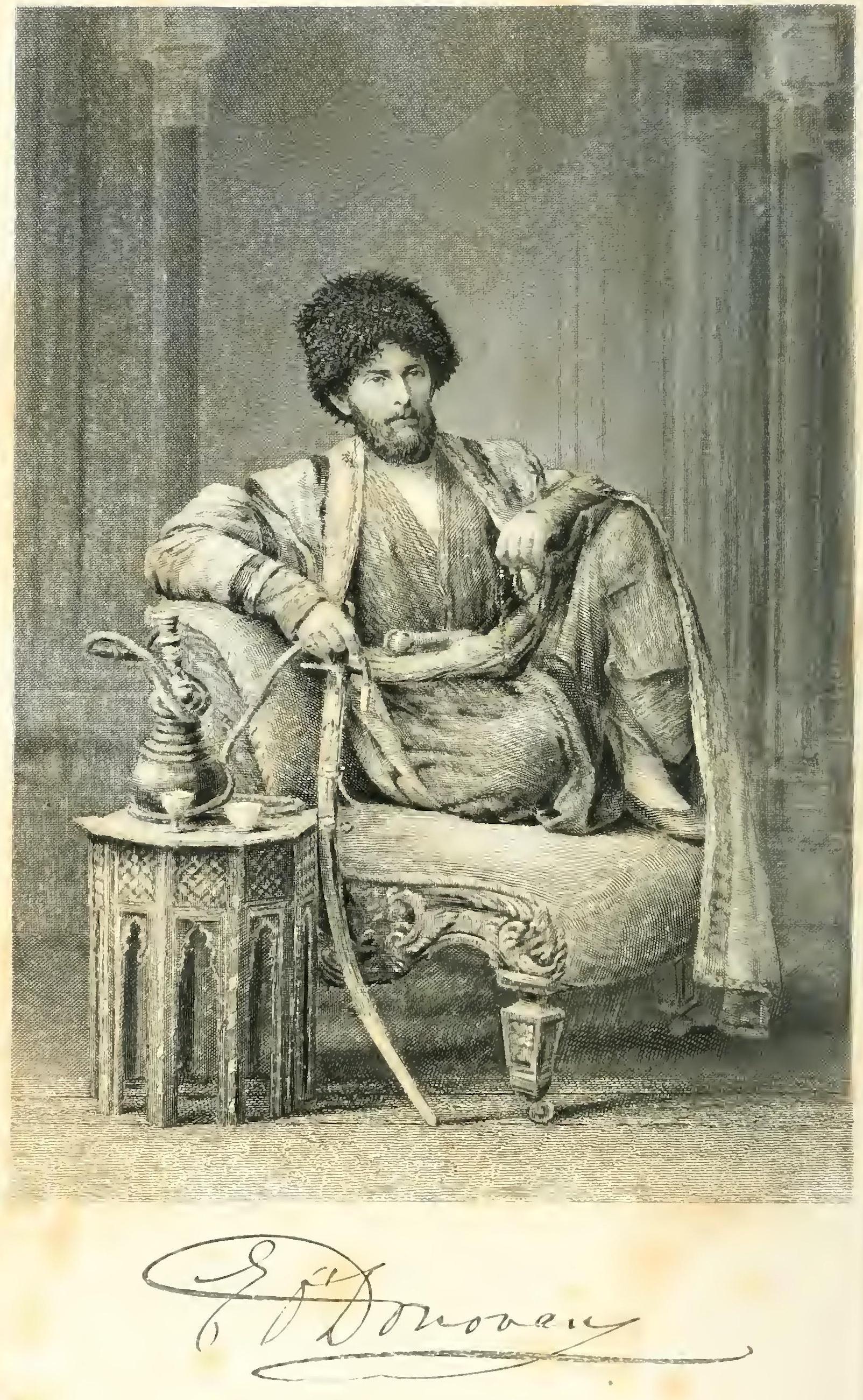
Portrait of the Author
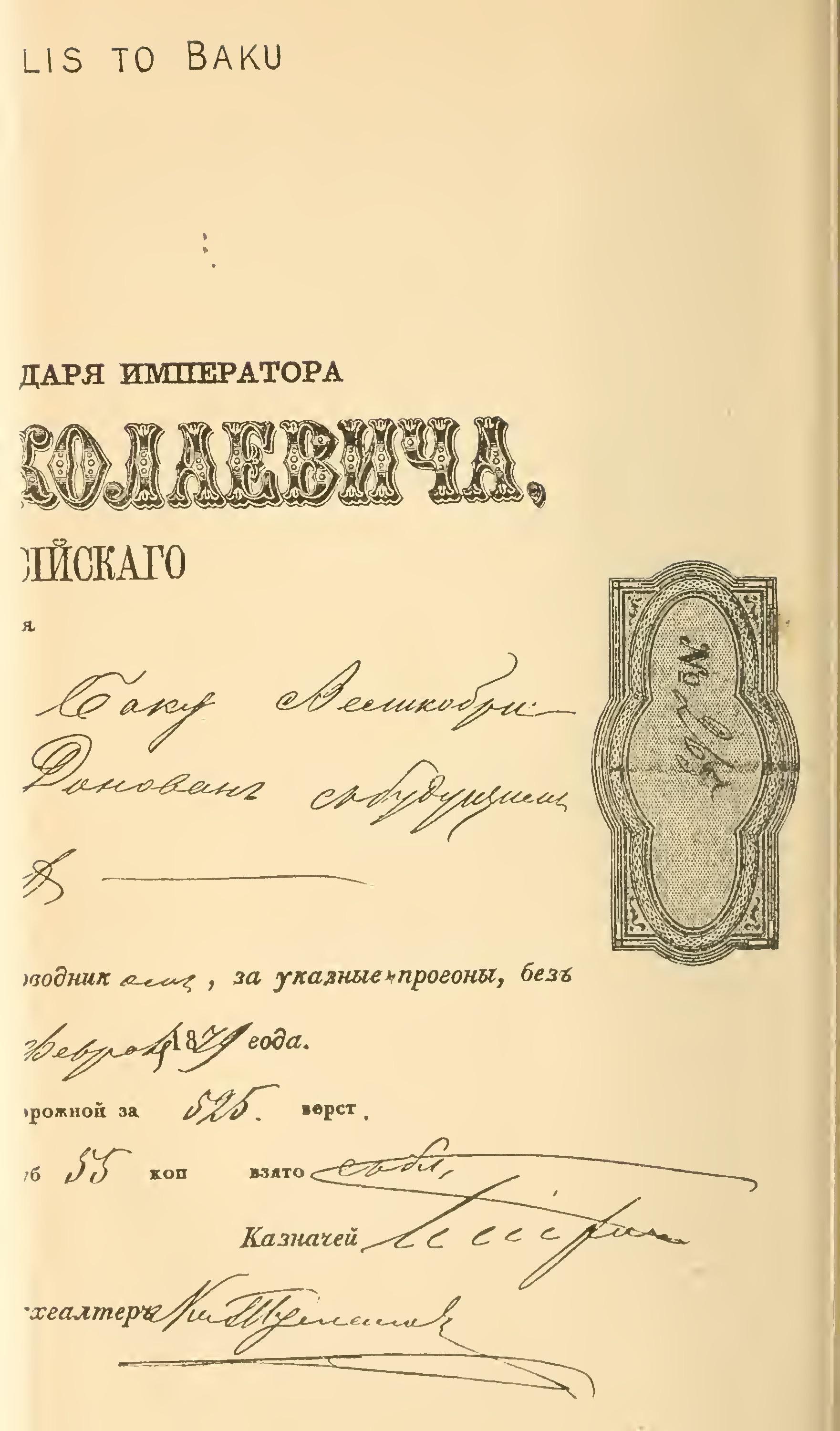
Facsimile of Russian Passport—Tiflis to Baku
Ground Plans of Gumush Tepé and Part of Kizil Alan
Chapter I: From Trebizond to the Caspian.
Trebizond to Batoum—Poti—Delays in landing—Bion river—Turcoman pilgrims—Railroad—Tiflis—Life in Tiflis—Travelling by troika—Description of vehicle—Easterly plains—Camel trains—Wild pigeons— Post-houses—Samovar and tea-drinking—Across country’—Troglodytie dwellings—Wild cats and boars—Revers—Tartar thieves—Tartar ladies— Old Persian fortifications—Elizabethpol—Hotel there—Limited accommodation— Table d’hôte—Caviare—Prince Chavchavaza—News of Trans-Caspian Expedition—General Lazareff—His history—Armenian villages— Salt incrustations—Automatic raft over Kur—Abandoned camels—Tartar funeral—Tartar tombstones—Circassian horse-trappings—Waggons from Baku—Crossing the mountains—Red-legged partridges—Field mice and ferrets—Shumakha—Xorezsafen—Obstinate driver—First sight of Baku and the Caspian—Tartar carts—Burden-bearing bullocks—Petroleum well-houses of Balahané and Sulahané—Tying up tro’ika bells.
I left Trebizond at sunset on Wednesday, February 5, 1879, en route for Central Asia. It was my intention to travel to Central Thibet, but subsequent circumstances obliged me to alter my resolution, and directed my steps to a locality perhaps not less interesting. I started by the English steamer ‘Principe di Carignano,’ reaching Batoum early on the morning of the 6th. I found that place wonderfully increased in size, even during the short time which had elapsed since the Russian occupation. The number of houses had almost trebled, and, after the fashion of Russia generally, the majority of these consisted of rum and vodka 1 shops. At least one barrel-organ was to be heard grinding in the streets, and, for the first time in the history of the town, public vehicles—the Russian phaeton, or gig—plied for hire. The same afternoon, the ‘Principe di Carignano’ continued her voyage, arriving at the mouth of the Rion river in two and a half hours. Here one became fully impressed with the necessity felt by Russia for a better naval station than Poti on the Southern Black Sea littoral. The extreme shallowness of the water obliged us to anchor at least a mile and a half from the low pebbly beach, and, owing to the violent offshore wind which prevailed, which would neither allow us to send boats ashore, nor the usual tug steamer, employed for disembarking passengers, to come off, two days and a half elapsed before the slightest chance of landing occurred. Such delays, I was told, were of common occurrence. At length some of the fishing luggers ventured to put out from the river’s mouth, and brought us and our baggage ashore.
Arrived within the mouth of the river, we were taken in tow by a small steamer, which tugged us a distance of two miles, finally landing us at the town of Poti itself. The river banks on either side presented a dismal aspect, such as one notices along the minor tributaries of the Mississippi. Everything seemed but lately to have been inundated. Rotting ‘snags’ stuck from the slimy surface of the semi-stagnant water; the lower portion of those trees which stood along the margin looked black and rotting, and a general odour of decomposing vegetable matter permeated the am. Poti is notorious for its unhealthy, feverish climate, and, considering its immediate surroundings, I am not surprised at this. As a naval station there can be no comparison between it and Batoum. The latter possesses a deep and well-sheltered, though small harbour, where the largest vessels can anchor within a few fathoms of the beach, and where they are perfectly sheltered from winds, whether off or on shore. It is true that under Turkish rule, owing to the blocking of the mouths of several minor mountain streams, swamps had formed in the neighbourhood of the town, which rendered it to a certain extent a feverish locality. Still, the smallest engineering effort would serve to remove this drawback, and I believe that at this moment such effort is being made. Among my fellow-travellers who crowded the luggers were Trans-Caspian Turcomans, on whom I now laid my eyes for the first time. They were pilgrims returning from Mecca; for, notwithstanding the never-ceasing hostility between the nomads and the Russians, the former invariably adopt the route by Baku, Tiflis, Poti, and Constantinople, when going to the Sacred City, instead of the land route by Persia and Baghdad. Before we were permitted to leave the precincts of the landing station, the usual tedious examination of baggage, and then of passports, had to be undergone, and fully four hours elapsed after our landing before we were allowed to enter the town About Poti itself there is little to say. It is a rambling kind of place, largely composed of wooden shanties, and, but for its phäetons, low-crowned-hatted coachmen, and its unmistakeable gendarmes, might pass for a town of almost any nationality. From Poti there is a railroad to Tiflis, the journey to the latter place occupying about twelve hours by ordinary train. During the first two hours, the country one traverses is indescribably dreary, rotting forest growth and stagnant overflows of the river being its main characteristics. Then a steep gradient is arrived at, by which the train mounts to the crest of an outlying spur of the
1 A fiery, white spirituous liquor, largely consumed in Russia.
Caucasus, whence a commanding view is obtained over the vast expanse of country lying in the direction of Tiflis. Leaving Poti late in the afternoon, one arrives at the capital of the Trans-Cancasus early on the following morning. The first thing that strikes the eye is the semi-Asiatic, semi-European aspect of the place—the old town, with its narrow streets, its old-fashioned booths, and artisans plying their trades in fall view of the public, together with Tartar head-dresses and fur-lined coats, contrasting violently with the palatial houses, wide prospects, and great open gardens, thronged with persons of both sexes, wearing the ne plus ultra of Western European fashionable attire. I was unfortunate enough to miss seeing Prince Mirski, the governor of the town, he being absent in the interior; so, after a couple of days’ delay at the Hotel Caveass, I prepared for my journey across the steppes which separated me from the Western Caspian border. During the two nights which I remained in Tiflis, I had ample opportunity of witnessing the remarkably ‘fast’ rate of living which usually obtains in better-class Russian society. Everything seemed at fever-heat. Theatres, music-halls, and circuses were nightly thronged, and petits soupers and select dinner parties seemed the order of the day. As for myself, the thing I least liked about Tiflis was the very excessive charge made at the hotel, and I was glad when the morning for my departure arrived.
We are told that up to the end of the seventeenth century in France, a traveller setting out from Lyons for Paris, in view of the state of the road, considered it his duty to draw up his last will and testament. If the roads in France at that date bore any resemblance to those I have traversed on my way from Tiflis across the Trans-Caucasian plain, 1 must say the travellers were perfectly justified in their precautions. I had heard and read a good deal about travel in this part of the world, but my wildest anticipations fell very far short of the sad reality.
When one has to do with officials in Russia, especially those of a subordinate class, he is certain to be worried almost out of his existence by needless and seemingly endless delays before the simplest matter of business can be effected, or the inevitable official documents procured. After a good deal of trouble I succeeded in securing the all-important padarosjna (this is the nearest approach I can make to the name in our alphabet), which entitles the holder to carriages and post-horses. It is a large sheet of paper bearing the Russian double-headed eagle, with paraphernalia, in the water-mark, and having several double-headed eagles and ornamental panels all over it. It bears many numbers of registration, and a still greater amount of signatures and counter-signatures, and is not unlike a magnified reproduction of some of the earlier American paper dollars. On the strength of this document, the people of the Hotel Caveass undertook to find me an orthodox postal vehicle, with the due number of horses and the official conductor. The vehicle in which one ordinarily travels by post in this part of the world is termed a troika. There is a more luxurious kind of conveyance—which, to tell the truth, is not saying much for it—named a tarentasse; but though one may pay the increased rate demanded for such a carriage, he is not always sure of finding others at the changing-places on the route, should, as is generally the case, his own come to grief. The experienced traveller generally chooses the troika, for at each station at least half a dozen are always in readiness to supply the almost inevitable break-downs which occur from post-house to posthouse. At the moment of which I speak I had never seen either tarentasse or troïka. I had a kind of preconceived idea about four fiery steeds and a fur-lined carriage, in which the traveller is whirled in luxury to his destination. Judge of my surprise when, on a raw winter’s morning, just as the grey dawn was stealing over the turrets of the old Persian fortress, I saw a nameless kind of thing drawn up before the door of the hotel. Though I had just been summoned from bed to take my place, I had not the slightest suspicion that the four-wheeled horror before me was even intended for my luggage, so I waited patiently for the arrival of my ideal conveyance. The hall porter and some chilly-looking waiters were standing around, impatiently awaiting a ‘gratification,’ and evidently believing that I was all the time buried in deep political or scientific thought. I was beginning to get stiff with cold, and at length I asked, ‘Where is this coach?’ ‘Your Excellence,’ said the porter, ‘it is there before you.’ When I shall have described a troika, no one will wonder at the exclamation of amazement and terror which burst from my lips at the bare idea that I had to travel four hundred miles in such a thing. Imagine a pig-trough of the roughest possible construction, four feet and a half long, two and a half wide at the top, and one at the bottom, filled with coarse hay, more than half thistles, and set upon four poles, which in turn rest upon the axles of two pairs of wheels. Besides these poles, springs, even of the most rudimentary kind, there arc none. Seen from the outside, the troika has the appearance of a primitive lake-habitation canoe, just drawn out of a mud bank; anything in the shape of washing, either for vehicles or drivers, being considered in this part of the world entirely a work of supererogation.
The driver, clad in a rough sheep-skin tunic, fitting closely at the waist, the woolly side turned inwards, and wearing a prodigious conical cap of the same material, sits upon the forward edge of the vehicle. With a combination of patched leather straps and knotted ropes by way of reins, he conducts the three horses. The centre animal is between the two shafts, which are joined by a high wooden arch of a parabolic form. From the summit of this arch a leather strap, passing under the animal’s chin, keeps his head high, while two pretty large bells, hung just where he ought to keep his ears, force him to carry the latter in a painfully constrained position, while during the whole of the stage he must be almost deafened by the clang. The horses on either side are very loosely harnessed; so much so, that while the central one is, with the vehicle, running along a deep narrow cutting, the flankers are on the top of high banks on either side, or vice versa. Once for all, I give a description of a troïka as the species of carriage in which I made my journey to the Caspian. As the stations at which relays are usually found are but twenty-seven or twenty-eight miles apart, they are gone over, almost the whole time, at full gallop. In such guise, mingled with heterogeneous portions of luggage, and wallowing in thorny hay, I was whirled out of Tiflis, across a long wooden bridge over the Kur, and then up a long, zig-zag, dusty, stony road, leading to the plateau east of the town. Arrived on the plateau, a sudden undulation of the road shuts out the last glimpse of the city. Henceforth, for many a weary league, all is bleak. There are sandy rolling expanses where the glaring gravelly surface is varied only by scant olive-green patches and clouds of dun-red dust. On the right are a couple of sad-looking turbes, or Mahometan tombs—dreary square structures of earth-coloured, unbaked brick, surmounted by broken cupolas, amidst whose crumbling walls nomadic goat-herds cower around a scanty fire. A compound flock of small, active sheep, mingled with why, long-haired goats, with an occasional diminutive donkey, the whole conducted by a scriptural-looking person with primitive shepherd’s crook, crosses the way. Then comes a string of shaggy, supercilious-aired camels, each bearing a couple of slimy casks of petroleum from Baku, every member of the string growling and groaning in true camel fashion. Now and then a blue cloud starts up from the gravelly track. It is composed of wild pigeons. What they can possibly find to attract them to that dusty gully it is not easy to understand. Yet they look plump and strong, notwithstanding the apparent unproductiveness of the surroundings. Meanwhile the driver, with many an Asiatic whoop and shout, plies his long whip, and we tear along, one side of the troika occasionally a couple of feet higher than the other, scaring dozens of white-backed scald-crows from something they, like the pigeons, find in the dust. They fly on, a hundred yards, and then, with a curious obstinacy, settle again and again before us, to be driven on again. Away to the left the giant range of the Caucasus trembles in ghastly whiteness athwart the cloudless sky, and at its base stretches widely a blue mirage that mocks the Kur, alongside of which we go. To the right, farther off still, fainter and more visionary than the Caucasus, are the Persian mountains. Between, a vast dun expanse, fifty or sixty miles across, the horizon ahead, clear and uninterrupted as that of midocean. It is not surprising that Eastern imagination has conjured up so many Gins and Ghouls to haunt its daydreams. Out on these plains one feels more lonely and abandoned at mid-day, than in the grizzliest, most uncanny churchyard at home at the witching hour of night. It was with a real sense of relief that I at length perceived, slightly on my side of the horizon, a cloud of smoke. My conductor informed me that in a couple of hours after reaching this smoke we should arrive at the first station.
A station on this route is not like a railway station. The latter exists because of certain pre-existent surroundings; in the former case the surroundings exist because of the station. In other words, out on these steppe-like expanses, certain stages are measured off along a given line, and the people employed there have created what there is of cultivation, and attracted the small population which clusters round the post-house, which, except in the case of villages few and far between, consists simply of rude farm buildings. The station, which I found behind the horizon, comprised three small buildings of a single story, some barns, and a few enclosures for fowl and cattle. The station-master, with his military uniform and flat regulation cap, was the only sign of officialism about the place. As a rule, I found these station-masters exceedingly obliging, and ready to afford the traveller every assistance. At each station-house is a ‘guest-chamber,’ as the Mohammedans style the apartment in their houses which is appropriated to the reception of strangers. It is generally a small room containing two wooden camp-beds, a table, a fire-place, and sometimes a couple of chairs. No bedding is provided, the traveller being supposed to bring this with him, as well as his food, tea, sugar, &c. A petroleum lamp burns all night within the chamber, and another is attached to the blue and white striped post at the door, which indicates the station, with its distance from the last centre of Government, in versts. Usually it is difficult to procure food, unless some of the women of the establishment can supply a few eggs and some sheets of the peculiar leathery bread, rivalling in size and consistency a cobbler’s apron, which seems to pervade the entire East. The only thing the traveller can be certain of finding is the redoubtable samovar. This instrument is to be found in the humblest Tartar hovel, for tea—morning, noon, and night—seems an absolutely indispensable necessity of Russian populations. This samovar is a large cylindrical brass urn, mounted on a short column and broad pedestal, having a movable cover, from the centre of which projects a vertical chimney, six inches high. This chimney connects with a central tubular furnace, which is filled with lighted charcoal. The water occupies the annular space outside, and is drawn off by means of a stopcock. The chimney is bell-mouthed, and supports a small metal or porcelain tea-pot, which contains what we should consider pretty strong tea, kept at almost boiling-point by the heat of the chimney. It is an almost universal custom here to drink tea in glass tumblers. Each glass is filled one-third, or in some cases one-half, with the liquid contained in the small tea-pot, and the remainder with boiling water from the samovar. Some persons dissolve their sugar in the tea, but many prefer to hold it between them lips and suck the tea through it. Milk or cream as an adjunct is a thing unheard of, though sometimes rum or cognac is added. On the arrival of a troïka with travellers, the samovar is immediately brought into the guest-room, and tea is prepared while the horses are being changed. This description will answer for the vast majority of postal stations on the Caspian route. Weak tea swallowed, the traveller again mounts his chariot, which at once dashes away in the most reckless fashion, utterly regardless of the nature or state of the road. Over bad portions the jolting of the springless vehicle is terrific, especially as, after the first ten minutes, one finds his way through the hay to the boards beneath. During the first hours of the journey from Tiflis, one forgets the physical inconveniences of the system of travelling, wrapt in admiration of the wonderful mountain and plain scenes; but the eternal sameness at length, notwithstanding its magnificence, palls upon the eye; and the traveller falls into a dreamy state, which is broken only by some marvellous jump of the troika over an irrigation trench three feet deep, drawn across the road. The postal conveyances do not always follow the great high road. The drivers make all kinds of short cuts, choosing their way very much as a rider after the hounds would.[1] After the first two stations from Tiflis, I can only compare our mode of progress to a headlong steeplechase over a violently accidented ploughed field, with continually occurring mad dashes across steep-sided torrent beds filled with large boulders—the banks on either side having a slope of thirty or forty degrees, sometimes more. The great high road is, as a rule, very good except in low-lying parts, where it is apt to be inundated at times. But the drivers of the post troikas laugh conventionalities to scorn, and would not go a quarter of a mile out of their way to follow the best road on earth; and thefr pace over hill and dale is the same as on the highway. Under ordinary cfrcumstances the jolting is bad enough, but ‘across country’ must be left to the imagination. I remember once going into action seated on the tumbril of a field-gun, galloping over a rough, stony plain. It was luxurious ease compared to the sensations experienced in a troika when the driver takes it into his head to make a short cut.
At the third station from Tiflis the traveller may be said to bid farewell for the time being to civilisation. It is a kind of village on the right bank of the Kur. The postal station and the houses of three or four well-to-do Tartar families were the only buildings, strictly speaking, above the surface of the ground. The other dozen or so of habitations are even more troglodytic than those of Central Armenia. In the latter place there is, at least, something like a slightly raised tumulus to suggest to the experienced eye that a dwelling exists, or did so formerly. Here advantage is taken of some scarped bank, into which a broad deep trench is cut. This is covered over with hurdles and branches, and the earth which covers all is scarcely, if at all, above the level of the surrounding surface. Here and there a wooden cask-like construction acts as chimney; but in most instances this last is simply a hole in the ground, with stone coping, and a small wooden fence erected round it to prevent human beings or cattle from falling through. Buffaloes and goats wander at will over these singular house-tops. A stranger is often startled, while strolling over what he considers solid ground, to come upon an oblong opening, through which he can hear human voices. This is one of the ventilation holes which abound; and I wonder that they are not a more frequent source of accident than they seem to be. Huge wolf-like dogs prowl about, causing the stranger to pass them by a kind of sidelong, edging movement, by way of precaution. Here and there are large rectangular enclosures seventy or eighty feet square, girt by walls of stout hurdle, within which are the farm sheds and habitations of the bettor class of the population. The hurdle wall is meant as a protection to the flocks at night, against the depredations of wolves and wild cats. These latter are really formidable creatures—little loss in size than a leopard, of a lion-tawny coloured stiff fur, with flat heads and noses, half-way between those of an otter and a bulldog. One had just been shot by a peasant close to the station. It was one of the ugliest-looking beasts I had ever seen. For twenty miles round, the country is infested by all manner of wild animals. The village or station is situated on a sloping bank, one side of which descends vertically to the Kur, often going sheer down two hundred feet to the water’s edge. The river, spread out into a network of channels and swamps, studded with marshy islands overgrown with brushwood and lesser forest trees, is nearly a mile wide. Close by are patches of primaeval forest, the haunts of wild boars, lynxes, and all the other savage animals of the locality. Wild boars’ flesh is the only meat one can reckon on, but that, with occasional wild ducks and partridges, is in abundance.
Owing to the marshy ground, the neighbourhood is very unhealthy, ague largely prevailing. I myself suffered from the renewal in the locality of on old complaint. Hot and cold sweats, trembling, and violent accesses of vomiting are the symptoms. At one time I feared that I had caught the much-dreaded Astrakan plague, but I recovered after a couple of days and a good deal of quinine. A still worse mishap, however, occurred at this station. I had a small leather writing-case, closed by a lock, and containing all my maps, notes, and writing material. There are always prowling round a large station a number of thievish Tartars, and while seeing to the transfer of my baggage to the place where I was to pass the night, one of these itinerant gentlemen, evidently mistaking the article for a money-box, made off with it. On missing it I at once called on the officer of the station to despatch men to pursue the thief. Everything possible was done, but in vain, and in the interim my sword-belt disappeared. The station officers had warned me against these gentry, but I could not imagine that they would carry on their depredations at the very door of the post-house.
It would be tedious to recapitulate the scenes of each day’s journey; one day was like another, save that at each mile the road grew worse. At last it seemed to have totally disappeared. We promenaded at will over long brown expanses, and over water-worn torrent-beds, the driver seeming always to have the most implicit faith in the impossibility of upsetting his vehicle. Sometimes long trains of camels glided by us in spectral fashion, the huge loads of lengthy osiers with which some of them were laden, the branches trailing behind on the ground, giving them the ah’ of gigantic long-legged porcupines. Then we would meet a Tartar cavalcade, with indigenous ladies on horseback, clothed as usual in staring red garments, and much more effectually veiled than the Turkish ladies generally are. From time to time trains of twenty or thirty huge waggons, each drawn by four or five horses all abreast, came by from Persia. The trade from the latter country on this side is evidently far greater than that by the Bayazid and Erzeroum routes.
On, on, across burnt-up, grey-looking expanses, the Caucasus and Persian mountains always looming right and left, amid the glare of an Eastern day. Elizabethpol, the next station, is a kind of half-way house between the last traces of Europe and the Caspian shores. It is approached by a steep road descending towards the western bank of the Kur. You cross a water-worn, boulder-strewn channel, descending at an angle of 45°. You are dragged through the water before you have time to appreciate the fact that your feet are flooded in the vehicle, and up an equally abrupt slope along the border of ancient fortifications taken by Shah Abass from the Turks 250 years ago; and then, plunging among the brick-fields and ruined mud-walls, all white in the glaring sun, you suddenly make your appearance in the modern town of Elizabethpol. On the right are gardens, with stately trees, centennial elms, and chenars; there are never-ending suburbs, as there usually are to Oriental towns, as nobody seems to wish to occupy a site on which a predecessor has lived.
Half a verst is got over, and we are in the midst of the town of Elizabethpol. Like Tiflis, it is half Asiatic, half European. There are Tartar shops in the bazaar, there are Tartar minarets on the mosques, there are kalpaked Tartars in the streets; the latter contrasting with the patrols of from thirty to forty soldiers, with long grey coats and fixed bayonets, marching slowly along the public ways. There are Turkish cafés - holes in the wall, as we should probably call them—mere niches, within which the proprietor crouches, nursing his charcoal fire wherewith to light water-pipes for his customers. Those who speak of ‘more than Eastern splendour’ should go to Elizabethpol to have their ideas corrected. I do not know how it is that the East is always connected with splendour in European minds, but I venture to think that in the mind of anyone who has practically visited the East the idea will be reversed, and, even in traversing the Trans-Caucasus, the ground over which one goes will show even a more violent contrast between Eastern and Western civilisation than can be noticed in crossing the Bosphorus itself.
My battered conveyance di’ew up at the door of what I should be tempted to call a caravanserai, but which, in view of the fact of its being in Russia, I suppose I must style an hotel. Mud-spattered and weary, I descended from my nest of straw in the troika which had carried me so far, and, limping under a horse-shoe archway, found myself in a spacious courtyard, surrounded by two tiers of galleries. I was in the Grand Hotel of Elizabethpol. It was some time before I could attract the attention of any of the employés, but after a while I was shown into what they were pleased to call my bedroom. Its furniture consisted of a bedstead, guiltless of mattress or anything else which we are accustomed to associate with the name of bed. I was wearied to death, and could scarcely summon energy to cry aloud for the attendants, for bell there was not. After some parley I understood that it was the custom for travellers in these parts to bring beds with them, and that hotel-keepers were not expected to pander to the luxury of ordinary people like myself. However, by dint of bribery, I secured a kind of feather-bed, and prepared to make up by a night’s sound repose for the fatigues endured since leaving Tiflis. I thought that a wash would be the best preliminary to this; but no such thing as a basin-stand seemed to exist. I summoned the attendant, and learned that the basin was still in use. From this I gathered that in the Grand Hotel of Elizabethpol only one basin was allowed for the service of the guests. A very solid-looking individual finally made his appearance with a basin full of water which had already been used, the contents of which he flung over the balcony into the centre of the yard. In this yard was already a stagnant pool, which stank horribly; and I may add, en parenthèse, that more than wash-basins were emptied into it over the balcony.
There was an attempt at a table-d’hôte, and a very poor one it was. The bill of fare was apparently drawn up rather for the amusement of the guests than with the view of pointing out to them in what guise they should satisfy their appetites. After having enumerated in vain several articles the names of which were written very plainly upon the carte, I was forced at length to say, ‘What have you got?’ Then I discovered that there were ham and caviare, the two never-failing articles of diet to be met with in the most out-of-the-way Russian town. Perhaps most of my readers are unacquainted with this Russian luxury—I mean caviare. It is the roe of the sturgeon. When the fish is freshly caught, and its roe (caviare) consumed, I am told that it is a delicacy such as the world elsewhere cannot produce. The black, salted specimens which reach Europe are, it is said, nothing in comparison with the caviare as Russians eat it at home. For my part, if the caviare as Russians eat it have any resemblance whatever to the black salted caviare familiar to us, ‘I’ll none of it.’ I once, by accident, tasted it at Constantinople, and it seemed to me that, inadvertently, a spoonful of cod-liver oil had been administered to me. It would be tedious to enumerate the disadvantages of hotels under such circumstances. They can be better imagined than described.
According to Russian courtesy, when a traveller of any distinction passes through a district, he is supposed to call upon and pay his respects to the local governor. Accordingly, I donned the best suit which the slender wardrobe carried in my saddle-bags afforded me, and presented myself at the palace of the Government, where Prince Chavchavaza resided. I was graciously received, but the Prince, a Georgian of the old school, unfortunately did not understand French. The secretary, more than polite, as secretaries usually are in Russia, interpreted our discourse. I was received in a chamber hung with ancient tapestry, the walls of which were garnished with arms of different periods, captured during the protracted struggle in which Schamyl led the Caucasians. Our conversation at first took a general turn, and after a while we began to speak of the future of the Russian Empire over these vast plains. I observed that nothing but means of communication and transport were wanting to make Russia the Rome of to-day. He bowed his head in assent, and gave me many examples, which space does not allow me to recapitulate here, especially as the present is only a chapter introductory to my adventures beyond the Caspian. And then, suddenly turning to me, he fixed his dark eyes upon my face with a piercing glance, and said, ‘Do you know that we expect an army corps shortly, bound for the shores of the Caspian?’ ‘My prince,’ I replied, ‘I was unaware of the fact. Where are they going to?’ ‘There is an expedition against the Turcomans,’ he said, ‘commanded by General Lazareff.’ This was news for me, and I resolved, instead of proceeding on my original mission, to follow the operations of the Russian columns. Having thus determined, nothing was left but to await the arrival of the Commander-in-Chief, General Lazareff, and to ask his permission to accompany his expedition. I waited several days, amid the usual spendthrift extravagance of Russian border towns, and at length the colossal old general made his appearance. General Lazareff was no ordinary man. In stature he was over six feet high, and broadly made in proportion. A inass of jaw was surmounted by a more than Caesarian nose, and the large grey eye, half hidden by the heavy eyelid, denoted the amount of observation which as a specialty belongs to his race, the Armenian. Up to the age of twenty years he worked as a journeyman tailor in the town of Baku, upon the Caspian edge. Later on, he was a sergeant in the twenty-first regiment of the line; and when years had gone by, it was Lazareff who captured Schamyl in his stronghold amid the Caucasus. Relegated to obscurity by political intrigues, he remained, living upon his modest allowance, until the outbreak of the Russo-Turkish war called him again into action. He sent forward a petition to the Emperor, asking to be employed in the humblest capacity, and was immediately sent to the front before Kars in the capacity of Lieutenant-General. He took an active part in the siege of that place, and it was owing to his exertions, to his intrigues, and to his intrepidity, that Kars became a Russian citadel instead of a Turkish one.
Two days elapsed before I was able to leave Elizabethpol. At half-past six in the morning I started in the postal troika. To describe the scenes and incidents along the route would bo but to repeat what I have already written, for each section of the road is, physically, precisely like the other, so is each post-house, so are the officials, and the occurrences of each day and hour. There are the same undulating plains, with the Kur on the right, and Persian mountains to the left; the same clouds of blue pigeons and crows, the same dust, the same groaning camels. As the road descends towards the Kur, trees begin to appear, and there are occasional large expanses of jungle, which, to judge from the frequent appearance of animals of all descriptions, must be a happy hunting-ground for those who are addicted to field sports. Occasionally, too, one meets with a lonely farmhouse, or two or three buildings grouped together. These are for the most part inhabited by German colonists, and partially also by Fins. Around these dwellings are large vineyards. Wine is usually to be had in abundance, but it is of poor quality; nor do I ever recollect discovering in situ any of the wine which, under the name of kakatinski, is purchasable at all the hotels throughout the Trans-Caucasus. From time to time, also, one meets with the semi-subterranean Armenian villages to which I have already alluded. On the vdiole, the population is exceedingly sparse, and. considering the excellence of the soil, and the abundance of water, the country may be said to be almost uninhabited. There are great tracts of giant bulrushes and rotting jungle through which the driver continues his way with the same mad pace as ever, making rushes at all the dangerous points, such as bridges more or less at right angles to the road, and innocent of such a thing as a parapet. Sometimes, to avoid the deep sloughs along the regular postal track, the troika is driven along the side of a hill so steeply sloping as to induce strong fears of a momentary upsetting. Over and over again I preferred to dismount from my rough chariot and pick my way through the miry loam sooner than run the risk of broken bones at this, the commencement of my journey. Soon the banks of the Kur are reached—a deep, broad river, hemmed in on either side by domelike masses of brown magnesian limestone, running into each other. In many places the soil is covered with a white saline incrustation, in appearance exactly resembling a new snow fall. From hence to the Caspian shores and beyond them the earth is impregnated with this saline matter, which, mingling with the water of the streams and wells, renders it all but undrinkable. At the crossing point is the straggling village of Mingatsur. No such thing as a bridge exists, and the stream is far too deep, even when the water is scantiest during the dry season, to allow of an attempt to ford. It is here some hundred yards wide, and is traversed by means of a raft propelled backwards and forwards by the force of the current itself. A very thick cable, supported on either bank by a tall, stout framework, is drawn as tautly as possible across the stream. This passes between two rollers on board the raft, which, accordingly as the traject is to be made in one direction or the other, is set with its side obliquely to the current, which thus drives it along the rope to the opposite side. This raft is capable of transporting a couple of large waggons and a half dozen camels simultaneously. Along the river marge, owing to frequent inundation, the ground is rich in the extreme, on account of alluvial deposits; but as, going eastward, we leave the river behind us, bleakness again comes on, and these same eternal expanses of plain, covered with short, burnt-up herbage, reach away right and left to the Caucasus and the Persian frontier. Here and there is to be seen a solitary camel, abandoned by some passing caravan, his depleted hump hanging over like an empty sack, and indicating an entire state of exhaustion.
Towards sunset, as we drew near the fourth station from Elizabethpol, and about 79f versts from that town, I had an opportunity of witnessing a Tartar funeral procession. First came a body of horsemen, armed to the teeth, and some twenty or thirty in number. Then a single horseman, bearing in front of him, across his saddle bow, the body, sewn up in a litter of Persian carpet, similar to that used in removing the wounded from the field of battle. The side poles had been brought together above the body, and fastened with rope. Then followed a long cavalcade composed of the friends of the deceased, moving at a very stately and funereal pace. There is a peculiarity in Tartar tombstones which now first came under my notice. They are quite unlike the turban stone of the Osmanli Turks, or the flat-lying slabs one sees among the Shiia Persians in the great burying-grouuds in and around the sacred city of Meshed. The Tartar headstones are about eighteen inches high, and represent lance-heads sculptured in stone, or I might more aptly compare them to gigantic decanter stoppers. After this station the mud was so deep, and our progress so slow—the wheels sinking frequently axle deep into the stiff brown mud—that I took horse and rode some twenty versts. As none but Circassian horse-trappings were available, the stirrup leather being little over eighteen inches long, I suffered frightfully from the cramped position which I was obliged to adopt. At this point the plain is traversed by an elevated mountain chain, along whose sides the road proceeded in the most tiresome zigzag manner, to enable the huge waggons plying between Baku and Tiflis, with their four or six horses abreast, to traverse the steep incline. My conductor would not follow this road, but went boldly up the side, from angle to angle, of the zigzag thoroughfare. Soon we got into the region of clouds, where all around us was a rolling waste of mist. Here and there, when wind gusts broke the wall of vapour, we caught below us occasional glimpses of the vast plain traversed by the Kur and its numerous tributaries. In ordinary weather, when the roads are in a tolerably good condition, by travelling hard one is supposed to arrive at Baku in twenty-four hours from the westward foot of this mountain; but the weather was so severe, the snow lay so deep, and the roads were in such exquisitely bad condition that we were unable to cover more than a third of the way within that time. There was a lonely station where the postmaster understood nothing but Persian. It was exceedingly cold, and I passed a wretched night sleeping upon one of the bare wooden camp beds with which the guest-rooms of the post-houses are supplied. I bought some red-legged partridges for a penny each, but found them so tough that I was glad to abandon them to a hungry-looking cat who glanced at me from the corner. Next morning I started on horseback for the town of Shumakha. We were five hours in traversing the most dreadful mountain tracks, often along the top of some great landslip which the torrent at its base had sapped from the mountain side. The country seemed alive with field mice, rats, and ferrets. Never do I recollect seeing so many of these animals together. Great flocks of wild geese marched wacldlingly on either side, and scarcely took the trouble to make way before our horses. Falcons and kites, too, were to be seen in incredible numbers, doubtless owing to the abundance of provision which they found at hand. Leaving the mountain, with its snow and fog, behind us, it was an inexpressible relief to issue upon the dry, warm plain stretching eastward to Shumakha. This place has the appearance of having been once a flourishing town, but owing to a violent earthquake which took place here some years back there is scarcely an edifice which is not in a ruinous condition. There are two large-sized mosques, one belonging to the Shiia Mussulmans, the other to the Sunnites of the town, for the population of Shumakha is almost exclusively Mussulman. The few Christians that there are, live in a quarter by themselves. The church tower, crowned with its green kiosk, rises in strong contrast with the crimson dome and minarets immediately in front. Considerable as the town is, at the postal station neither horses nor troikas were to be found for the moment, and I was obliged to spend another night upon the rude benches of the guest-chamber, starting again early on the morning of Wednesday, the 27th, and passing another exceedingly disagreeable raid difficult series of mountains deeply covered with snow.
Passing through Maraza, the station of Xorezsafen, thirty-one versts from Baku, is reached. Here the postal station consists of an antique castellated structure, in the old Moorish style, coeval with the days of Tartar independence, and known as Sheik Abass’ house. At the next station, some sixteen versts farther on, my patience was sorely tried. The station itself consisted of a series of extensive farm-buildings, and there seemed no lack of troikas and horses standing about in the muddy places which represented stable-yards. A wedding was in progress, and the driver whose turn it was to conduct the vehicles could on no condition be induced to turn his back to the good cheer and vodka of the festivities. After a prolonged and wearisome debate among the company it was finally agreed to send a driver, but I had scarcely made two or three versts across a most disagreeably rocky ground when I perceived that my conductor had not the slightest intention of pushing on to Baku, and was trying every possible ruse in order to make out that it was impossible to reach my destination that evening. It was far better, he said, to turn back and partake of the good things which were being distributed at the marriage feast, and to pass the night in comfort, instead of pushing across the uncomfortable ground which lay between us and Baku. There were, he said, deep rivers to be crossed, and brigands were notoriously numerous along their banks. Finding me inexorable, he first upset one of the horses, and then managed to smash his harness. After a long halt in the cold, and bitterly cold it was, a combination of knotty straps and rotten ropes was rigged up, and we went forward, at as slow a pace as it was possible for a troika to move at without standing still altogether. The horses had, apparently, as great an objection to go forward as the driver, and wandered incontinently all over the ground in any direction but that required of them. At length the fellow declared that with these horses it was impossible to go on, and I was obliged to sit waiting for two hours while he returned to the last station for others. It was seven o’clock in the morning when, after a weary night drive, we came in sight of Baku, lying some ten versts off; the Caspian, glittering beyond, being seen at intervals between the low hills that flanked its border. The country at this point is inexpressibly dreary and volcanic-looking; the salt incrustations which I have already mentioned are thicker and more extensive than ever. Here and there were straggling Tartar villages, with them flat houses and preposterously large conical chimneys, looking like gigantic mushrooms. From time to time we passed along the road the peculiar-looking carts characteristic of the country. The wheels were not less than eight feet in diameter, and very close to each other, the body of the cart being but two feet wide, a structure like a pulpit rising in front, gaudily painted, and probably intended for the use of the conductor. The centre of gravity of the vehicle was pitched so high, the wheels were so tall, and by their proximity afforded such a slender base, that it was a matter of wonder that at each jolt over the stony ground the entire contrivance did not turn over. It bore no bad resemblance to a gi’eat grass-spider with his long legs. Small cows, too, were to be met, with burdens strapped upon them backs, as one sees them among the nomad Kurds of Persia; and at length, chiving at breakneck pace down the steeply-winding road, the troika jostling and reeling over the rocky surface streaked with the wheel-marks of ages, we dashed into the outskirts of Baku. Away on the left, crowning the heights, and scattered in apparently unlimited numbers over the country northwards, were to be seen strange-looking constructions resembling enormous sentry-boxes, and some twenty-five feet in height. These were erected over the petroleum wells of Balahané and Sulahané. Entering Baku itself, the driver descended for a moment from his seat to tie up the bells hanging from the wooden arch above the central horse, the municipal regulations forbidding the entry of postal vehicles accompanied by their usual jangling uproar, lest the horses of the town phaetons should take fright. Babu merits a chapter of its own.
Chapter II: Baku.
Baku—Apscheron promontory—Country round Baku—Armenian emigrants from Turkish territory—Russian town—Old Baku—Ancient Tartar town —Old fortifications—Citadel—Bazaars—Mosques—Palace of Tartar Khans —Caspian steamers—Municipal garden—Mixed population—Bazaar held in aid of victims of Orenburg fire—National costumes and types—Nature of population—Banished Christian sects—Malakani and Scopts—Mercurius Company—Russian girls’ dress—Origin of name of Baku—Bituminous dust—Laying it with astatki—Boring for petroleum—Distilling and purifying—Utilization of refuse for steamers—Probable adaptation to railroads—Island of Tcheliken—Pire temple—Guebre fire-worship.
Baku, a few years back little if at all known to Europeans, is a place full of interest, and one destined to play an important part in the future of the Caspian regions. It is situated on the western shores of the Caspian Sea, on the promontory of Apscheron, which juts out eastward, and is the point nearest to Krasnavodsk, on the opposite littoral. The surroundings are of the same bleak and desert kind which characterises almost the entire circuit of the sea. In fact, the Steppes commence far west of the latter. Eor leagues around not a blade of grass is to be seen, and not even a shrub breaks the arid expanse of broken strata and scorched marl. Here and there, at long intervals, is a Tartar village, or the crumbling remains of some ancient Persian town. At midday not a living thing is visible, and the white glare of an Eastern sun reveals with painful distinctness every detail of the ghastly desolation. The houses are all of one story, flat-roofed, and built of great slabs of kneaded clay dried in the sun. Were it not for the huge conical chimneys, which rise like watchtowers from the flat roofs, at a distance it would be impossible to distinguish these clay-coloured dwellings from the surrounding soil. Occasionally one sees a semi-subterranean Armenian village inhabited by emigrants from Turkish territory. These people adhere to their old system of construction, living in burrows covered over by low mounds of earth, and entered by a descending stafrcase. It is quite possible for a stranger, unaccustomed to these dwellings, to ride or walk across an entire village without being aware of its existence.
A semi-circle of rugged scorched hills of grey sandstone, highest towards the south, and dying away northward into the plain, encloses Baku on the land side. The northern portion of the town is altogether European in appearance, with yellow stone-fronted houses precisely similar to those of a Western Russian town. There is a large square, round which are planted a few stunted bushes and acacias. The orthodox Russian Church, of severely simple architecture, occupies the south-western side, just within the old fortifications; while on the northern side is an equally stern-looking Gregorian Armenian place of worship. Close by this square is the ancient Tartar town, the old fortifications still quite perfect, save where a couple of bastion towers show the yawning breaches effected by the Russian artillery some fifty years ago. The walls are lofty, solidly constructed, and flanked by numerous circular towers. A faiisse-braye, or lower exterior rampart, adds to the strength of the place. The northern gateway is covered by a heavy stone ravelin, evidently of much later construction than the town walls. In the midst of the sea-front of the town, its eastern side, rises an immense circular tower, with massive outlying flank of oblong plan, over one hundred and fifty feet high, and which at present serves as a lighthouse. Around its base are the ruins of the old bazaar, part of which is now converted into a school for children, and close by is the modern thoroughly Oriental bazaar, where, in a series of vaulted passages, opening in the roof, Armenian and Persian merchants sit cross-legged in the midst of an infinity of articles of almost every conceivable kind—bowls of spice, packages of starch and candles, rolls of calico, boxes of tea, cases of scissors, combs, brushes, ammunition, pipes, tobacco; in fact, it would be hard to think of a merchandise which these dealers do not each and all offer to the public. This tower is of considerable age, and was built during the reigns of the old Tartar Khans of Baku. Not far from it are some very old and solidly built mosques of bluish-grey stone, profusely ornamented with Cufie inscriptions, and bearing palpable marks of the Russian artillery fire. The streets are narrow, and the houses of the genuine ogive-windowed, flat-roofed Persian type. The old Tartar town, that lying within the ramparts, slopes up the hill on whose eastern side it is built, and at the top rises the palace of the former Tartar Khans, still in a state of excellent preservation, and now made use of as a Russian artillery depot. For a mile along the water’s edge are numerous piers, alongside of which steamers of a thousand tons can lie to discharge their cargoes. There are usually eight or ten merchant steamers in port, besides a couple of steam corvettes belonging to the Caspian flotilla. At the southern extremity of the town, immediately outside the old walls, a garden has been planted, which, owing to the entire absence of water and the bituminous nature of the soil, requires the most assiduous care to keep it in existence. The environs of Baku itself being entirely destitute of trees and flowers those of the public garden had to be brought from Persia at a great expense. There are the yellow flowering broom {Planta genista”), which in this climate attains the dimensions of an ordinary apple tree; large rose trees, and twenty others for which I know no name. Every Sunday and Thursday a military band plays from sunset until ten o’clock in the evening.
In the most cosmopolitan town in Europe it would be hard to match the mixed population that throng these gardens. Shortly after my arrival, a kind of bazaar was held in aid of the victims of the fire at Orenburg; and, perhaps, in prospecta for the victims of the coming campaign. The Ped Cross Society presided. There were few nations in Europe unrepresented. All the more strange that few even know of this town of Baku—separated but by the Caspian’s breadth from the borders of the vast desert reaching far away to the limits of Cathay and the regions from which Marco Polo brought back his tale of wonders. The expedition which was to penetrate into hitherto unknown regions away across the Steppes was represented at the gathering. Long white-robed Cossacks and blue-vested dragoons thronged the green alleys with training sabres, and mingled with an Eastern population. The eye is attracted by a reverend form reclining on a bench, under the shadow of the clustering trees. His long blue robe, coal-black plaited hair, and white turban bespeak him a priest. But he is one of a sect long passed away. He is the last priest of Zoroaster’s creed that lingers yet in a region once all its own. He sits gazing dreamily at the shifting throng before him, thinking, perhaps, of the past glories of Iran, ‘quenched with the flame in Mithra’s caves.’ Close by is a group of young men whose blue, green, or brown robes, and spotless white turbans, show them to be Softas, theological students, priestly aspirants of the Shiia Mussulman sect. Their faces are handsome and well cut, but bear the unmistakable stamp of dissipation. In the throng which saunters along the leafy alleys under the twinkling lamps suspended from the trees are to be seen the costumes, all of them strongly contrasting, of Germans, Swedes, Georgians, Jews, Persians, Armenians, Poles, Russians, and Tartars, not to speak of those of the different religious sects which obtain in Baku. There is the Jew with his black cloth cap, sombre robe, and long staff; the Armenian, with sleek black silk tunic, flat-peaked cap of the same colour, and belt of massive pieces of carved enamelled silver; the Georgian, vested almost like the Circassian, with silver mounted cartridge tubes in horizontal rows on either breast, and guardless Caucasian sabre, the richly-mounted hilt entering with the blade’ up to the pommel in the leather sheath. The Russian peasant at all seasons wears the usual long sheep-skin tunic, the wool within, the amber yellow-tanned skin outwards, long leather boots, and a fur hat. The Tartar has his great woolly hat, like that of the Grenadier Guards, and a curious nondescript flowing robe of various colom’s. The Persian has one invariable, distinctive mark: his tall hat of black Astrakan wool, oval in section, the top often modified at the taste of the owner to a more or less mitred shape. The Swedes, Germans, Russians, and others of a superior class, all wear a strictly European costume. The couple of American engineers present wore a strictly Yankee garb. Among all the frequenters of the garden promenade, by far the most curious were those belonging to different Christian sects. From what I have learned from different som’ces it seems there was a moment when the efforts directed towards national unity of creed permitted of no departure from the strictly orthodox faith. Poles and Russians who held fantastic Nonconformist ideas were relegated to the borders of the Caspian. In the case of the Poles there was probably also a certain mixture of political ideas. Among these religious sects, after the fire-worshipping priest, I shall mention but two— the Malakani and the Scopts. The first differ bui little from the orthodox creed, save that they insist upon making use of milk and butter during the Lenten period. I was unable to distinguish any difference in dress between the male members of this congregation and the same sex of similar nationality. The ladies wear old-fashioned gowns with wide skirts of the brightest possible colour’s, emerald green and scarlet, lilac or blue. On the head is a handkerchief of variegated hues, knotted under the chin in Scandinavian fashion, the point falling between the shoulders. This sect is sub-divided into two sections. One considers it lawful to sing during Divine service, the other confines itself to slow dancing to the accompaniment of a monotonous drumming executed by some members of the congregation. I believe that in other respects both sub-divisions accept the usual dogmas. Of the Scopts, owing to their very peculiar ideas, I must say but little. They have curious notions about the possibilities of excessive population before the arrival of the Day of Judgment. They devote themselves to the production of capital and the limitation of offspring. One child is allowed to each married couple. Both sexes then undergo a peculiar and barbarous mutilation. This sect lies under the special ban of Russian law. It is a curious fact that all its component members inhabiting Baku, the only place in which I ever had an opportunity of seeing or inquiring about them, live in the same street, and are mostly bakers. The men are easily recognised in the streets by their melancholy, downcast air, and pale, shrivelled faces, as well as by their semi-Judaic garb. The German inhabitants are few in number, either belonging to large commercial houses, or to the extensive petroleum works near Baku, about which I shall have something to say later on. The Swedes are mostly employed in connection with a steamship company founded by their countrymen, and which rivals the Mercurius, the Russian shipowners’ company on the Caspian waters. Among the brightest and most graceful costumes in these garden promenades was that of some young Russian girls of the higher classes, who on gala occasions don the typical dress of the peasantry. This consists of a black or red skirt, with broad blue, red, and white parallel lines around the lower edge, turning sharply square at the corners like those patterns one sees in old Pompeian frescoes. A small black apron with the same border is added. A white muslin handkerchief crossed on the breast, knotted and pendant behind, and a wide-leafed straw hat with pendant edges, complete the costume.
The name of Baku means ‘a place beaten by the winds.’ Never did any locality better merit the appellation. Even in these hot summer months, when at times we lie gasping for a breath of air, sudden storms arise, sometimes from the seaward, sometimes from off the land. These storms raise clouds of dun-yellow dust, whirling in columns like the sand before the simoom. This dust has a particularly disagreeable nature, all its own. All around Baku the ground is sodden with natural issues of naphtha. In some places the earth is converted into a natural asphalte, hard during cold weather, but into which the foot sinks a couple of inches at midday in summer. Add to this that, owing to the scarcity of water, the streets are moistened with coarse black residual naphtha, a treacly fluid which remains after the distillation of the raw petroleum, and termed asiatici in Russia. It effectually lays the dust during fifteen days. After this period a thick brown dust lies four or five inches deep in the roadway, over which the numerous phaetons, or street carriages, glide so softly and noiselessly that the foot passenger is frequently in danger of being run over. When a north or west wind arises, the air is thick with impalpable marly earth, combined with bitumen. The least glow of sunshine fixes this indelibly in one’s clothes. No amount of brushing or washing can remove it. Perhaps I cannot here do better than enter on a short description of the sources of mineral oil lying around Baku, which well merits the title of the ‘Oil City’ of the East.
The shores of Baku bay north of the town trend towards the east, and some five or six miles distant are the petroleum, or, as they are termed, the naphtha springs of Balahané and Sulahané, the former fifteen, the latter eighteen versts from the town. The surrounding district is almost entirely destitute of vegetation; and in its midst are some black-looking brick buildings, interspersed with those curious wooden structures, which I have mentioned in describing the approaches to Baku, twenty feet high, and resembling Continental windmills or gigantic sentry boxes. These latter are the pump or well houses covering the borings for oil, and in which the crude liquid is brought to the surface. The odour of petroleum pervades the entire locality, and the ground is black with waste liquid and natural infiltrations. Boring for naphtha is conducted much in the same manner as that for coal. An mon bit, gouge-shaped, is fitted to a boring bar eight or ten feet in length, which is successively fitted to other lengths as the depth of the piercing increases. This depth varies from fifty to one hundred and fifty yards, this difference existing even at very short horizontal distances, sometimes of not over forty yards. Layers of sand and rock have to be pierced. It is in the sand that often the greatest difficulties are to be met with. A loose boulder will meet the boring tool, and, displacing itself, leave the passage free. But when the rods are withdrawn to allow the introduction of the tubes which form the lining of the well, the boulder falls back to its place, and baffles all attempts to continue the orifice. This boulder difficulty is the great terror of those commencing to bore. Sometimes, after a lengthened discharge of light carburetted hydrogen, the naphtha rises to the surface, and even flows over abundantly, occasionally springing fountain-like into the air to a height of eight or ten feet for hours at a time, as in the case of the artesian well. In such cases the ground around the boring is often flooded to a depth of six inches with the mineral oil, which, to avoid the danger of a conflagration, has to be let off by channels constructed so as to lead out to seaward. Under ordinary circumstances, it has to be drawn up from a considerable depth. The boring is generally ten, or at most eighteen, inches in diameter. A long bucket, or rather a tube stopped at the bottom and fifteen feet in length, is lowered into the well, and drawn up full of crude petroleum— fifty gallons at a time. This, which is a blue-pink transparent liquid, is poured into a rudely constructed, plank-lined trough at the door of the well house, whence it flows by an equally rude channel to the distillery. The distillation is conducted at a temperature commencing with 140 degrees—much lower, I am told, than the first boiling point for that from Pennsylvania. When no more oil comes over at this heat, the result is withdrawn and the temperature increased by ten degrees. This second result is also laid aside, and, the heat being again increased, a third distillation is carried on until no further easily evaporated liquid remains. This last is the best quality of petroleum for lamps. That which preceded it is the second quality; aud the first, or highly volatile liquid, is either thrown away or mixed with the best and second best as an adulteration. The thick dark brown treacly fluid remaining after distillation is termed astatki, and is that used for the irrigation of the streets. The distilled petroleum, if used in lamps, would quickly clog the wick with a carbonaceous deposit. With a view to obviating this, previous to being offered for sale it is placed in a reservoir, within which revolves a large paddle-wheel. Sulphuric acid is first added, and, after being allowed to settle, the clear top liquor is drawn off, and similarly treated with caustic potash. After this it is ready for sale. Up to the present, the residues, after the acid and potash treatments, have not been utilised. I have no doubt that valuable products will ultimately be derived from them. With the astatki, or remnant after the first distillation, the case is different. For years past this has been the only fuel used on board the war ships and mercantile steamers of the Caspian. At Baku its price is only nominal, vast quantities being poured into the sea for lack of stowing space or demand. It is used in cooking apparatus, aud for the production of gas for lighting purposes. In the latter case it is allowed to trickle slowly into retorts raised to a dull red heat, pure gas with little graphite being the result. Weight for weight, this waste product gives four times as great a volume of gas as ordinary coal. By distillation at a high temperature and treatment with an alkaline substance, a product is obtained which is used as a substitute for oil in greasing machinery.
Apart from the local use of petroleum for lighting purposes, and its exportation for a similar use, is its application to steam navigation. With the old-fashioned boilers in use, which have a central opening running longitudinally, no modification is necessary for the application of the new fuel. A reservoir, containing some hundred pounds’ weight of the refuse (astatki), is furnished with a small tube, bearing another at its extremity, a few inches long, and at right angles with the conduit. From this latter it trickles slowly. Close by is the mouth of another tube, connected with the boiler. A pan containing tow or wood saturated with astatki is first introduced to heat the water, and, once the slightest steam pressure is produced, a jet of vapour is thrown upon the dropping bituminous fluid, which is thus converted into spray. A light is applied, and then a roaring deluge of fire inundates the central opening of the boiler. It is a kind of self-acting blow-pipe. This volume of fire can be controlled by one man, by means of the two stop-cocks, as easily as the flame in an ordinary gas jet. This I have repeatedly witnessed on board the Caspian steamers. As regards the expense, I give the following data on the authority of a merchant captain who has used naphtha fuel for years. His steamer is of four hundred and fifty tons, and of one hundred and twenty horse-power. He burns thirty pood per hour of astatki to obtain a speed of thirteen nautical^ miles in the same time. One pood is about thirty-three-English pounds (16 kilogrammes), and costs on an average from five to six pence. Thus a twenty hours’ voyage at full speed for such a vessel costs about twelve pounds sterling. The fuel is as safe as and occupies much less space than the amount of coal necessary to produce a similar effect, not to speak of the enormous difference in price and the saving of manual labour. Two engineers and two stokers suffice for a steamer of a thousand tons burden. In view of the immense supply of natural petroleum, as yet only very slightly developed, and its application to the already guaranteed railway from Tiflis to Baku, and to the inevitable future ones beyond the Caspian over the plains of the far East connecting with that already constructed from Krasnavodsk to the new Russian possessions of the Akhal Tekké, I think this subject is worthy of every attention. Yet there are proprietors of large tracts of petroleum-bearing ground whose capital rests unproductive because of a want of demand. The island of Tcheliken, not far from Krasnavodsk, teems with the precious liquid. The seaward cliffs are black with its streams flowing idly into the sea; and a natural paraffin, or ‘mineral wax,’ is found abundantly in the island and in the low hills a. hundred versts west of Krasnavodsk. All round Baku the ground is full of naphtha. In hundreds of places it exhales from the ground and burns freely when a light is applied. Only a couple of months before my visit its volatile products produced a remarkable effect a few miles south of Baku. A large earth cliff fronting the sea was tumbled over as by an earthquake shock, and, as I saw myself, huge boulders and weighty ships’ boilers were thrown a hundred yards. In some places I have seen fifty or sixty furnaces for burning lime, the flame used being solely that of the carburetted hydrogen issuing naturally from fissures in the earth. This brings me to one of the most curious features of Baku and its environs. It was one of the last strongholds of the ‘Fire-worshippers,’ and I am sure that had Thomas Moore ever travelled so far eastward he would have made ‘Hafid’ figure rather on the top of the gigantic double citadel-tower (150 feet high) than on the peak of an imaginary mountain overhanging the waters of the Sea of Oman.
In the midst of the busy petroleum works of Sulahané and Balahané, where the chimneys of the distilling works no doubt far surpass in height the fire towers of old, is a real specimen of the religious architecture and practices of ante-Mussulman days. After stumbling through the black naphtha mud, and over uneven foundations, a hole roughly broken in a modern wall gives entry to a small chamber, twenty feet by fifteen, adjoining which is a smaller one to the right. In the opposite wall and to the left is another low door opening on a semi-circular yard, fifteen feet wide at its greater diameter. It is the remaining half of a once celebrated fire temple, or rather of the small monastery connected with it. The exterior wall, eleven or twelve feet high, on which is a parapeted walk, is composed of rough stone. From the courtyard one can enter thirty-five roomy cells, accessible by as many doors. These were the cells of the former devotees of fire, or perhaps the accommodation for the pilgrims who came to visit the shrine, such as we see at celebrated religious tombs in Persia to-day. These cells formerly enclosed a circular space, one-half of which has been demolished or has fallen to ruin, and a modern wall through which one enters is the diameter of the ch’eie. Looking northward, and sup ported by three double sets of pillars, is the ancient chief entrance, above which the parapet walk is continued. This entrance has been long walled up, and the only access is given by the hole broken in the modern wall behind. The cells formerly occupied by the monks or pilgrims are now rented at a moderate price to some of the workmen who belong to the factories immediately surrounding, by the priest, the last of his race, who still lingers beside his unfrequented altars. Near the western wall of the semi-circular enclosure is the real fire shrine. It is a square platform, ascended by three steps, of a little over one foot each in height. The upper portion of the platform is about sixteen feet square, and at each angle rises a monolith column of gi’cy stone, some sixteen feet high and seven feet broad at the base, supporting a gently sloping stone roof. In the centre of the platform is a small iron tube, where the sacred fire once burned. North, south, and east of this shed-like temple are three wells with slightly raised borders, the contents of which could at a previous period be lighted at will. Now, owing to the drain on the subterranean gases, this is no longer possible. In the chamber which we enter through the rough hole in the modern wall we find the only remnants of the old worship. The priest is called for. He is the same we have seen lounging meditatively in the gardens of Baku. He dons a long white robe, taken from a rude cupboard in the white-washed wall, and, drawing near a kind of wide altar tomb at the southwestern corner of the chamber, railed off from the outer-portion of the apartment by a low wooden balustrade, applies a lighted match, which he has previously sought for in a most prosaic manner in his breeches pocket, to a small fron tube. A jet of pale blue lambent flame is produced, rising to the height of eight inches or a foot. Seizing the rope of a bell hung over his head, he rings half a dozen strokes upon it, then takes in his hand a small bell, and, ringing it continually, proceeds to bow and genuflect before the altar, ‘muttering o’er his mystic spells.’ The lights wane gradually, and go out. And then, advancing towards the curious spectator, the priest proffers on a small brass dish a few grains of barley or rice, or, as I once saw, three or four pieces of candied sugar, which the envelope indicated had been manufactured in Paris! A person in the East always gives a present with the view of receiving at least fifty times its value in return; so we present the last of his race with a couple of roubles, and retire.
Chapter III: Across the Caspian to Tchikislar and Chatte.
Interview with Lazareff—Voyage to Tchikislar—Reception by Turcomans— Their Costume and Dwellings—Fort of Tchikislar—Presents to Yamud chiefs—Akhal Tekké prisoners—Journey to Chatte—Russian discipline— Rain pools and mirage—Wild asses and antelopes—Fort of Chatte— Atterek and Sumbar rivers—Banks of the Atterek—Diary of Journey— Bouyun Bache—Delilli -Bait Hadji—Yaghli Olum—Tekindji—Review of Lazareff’s regiment—Flies at Chatte—Tile pavements—Remnants of old civilization.
I called upon General Lazareff at Baku, when I learned that he was about to start for the Eastern Caspian shore and the camp of Tchikislar, the immediate base of operations of the expeditionary columns destined for service against the Akhal Tekké Turcomans. On my asking permission to go with him, he very kindly said he would be glad of my company, but that the formality, at least, of requesting the consent of H.I.H. the Grand Duke commanding at Tiflis, must be gone through. In two days the requisite permission arrived, and I was directed to hand my papers to Colonel Malama, the chief of staff of the expeditionary forces. On the afternoon of Tuesday, April 2, 1879, with the General-in-Chief and his staff I went on board the Russian war steamer ‘Nasr Eddin Shah,’ bound for the camp on the south-eastern shore of the Caspian. Nothing could exceed the old General’s kindness to me. I was his guest on board, and he took every opportunity of distinguishing me. On the following Friday, April 5, we anchored in front of the long, low-lying sandy shore off Tchikislar, but, owing to the extreme shallowness of the water, we were obliged, at a distance of two and a half miles from it, to land in men-of-war’s boats at the extremity of a rude pier, at that time reaching but some hundred and fifty yards out into the shallows. It was originally a kind of sand-spit, used by the Turcomans when discharging the cargoes of their lodkas. The General was received by some score of Yamud elders, who, drawn up at the extremity of the pier, offered him, as he landed, a cake of bread, a plate of salt, and a large fish newly caught; meantime, the guns in the small redoubt adjoining the camp thundered out them salute. The Turcomans of the entire surrounding neighbourhood had assembled to do honour to the General, and were drawn up on either side of the pier along which he passed to the shore. At its landward extremity, a number of Turcomans held prostrate on the ground half a dozen black-haired sheep, and, as he passed, a knife was drawn across the throat of each animal, the blood streaming, hot and smoking, across his path, and flooding the ground to such an extent that our shoes were all ensanguined as we walked in procession across it. It was the first time I had had a good opportunity of seeing genuine Turcomans. Each wore the enormous sheepskin shako affected by the inhabitants of Central Asia, and a long tunic of some bright colour, tightly girt at the waist by a broad white sash, knotted in front, a long dirk thrust through it. Over this was an exterior garment of some sombre tint, with long sleeves, which the wearers were continually pulling backwards in order to leave their hands free. Each, together with his poniard, wore a curved, leather-sheathed sabre, with cross guard. One might have imagined them a battalion of the Foot Guards, robed for the nonce in dressing gowns. Some, also, wore the enormous pelisse of sheepskin so common among the dwellers in Central Asia, and which, doubtless, has been worn in those far-off lands from time immemorial. A person of an imaginative turn of mind might see in these primitively-clad Turcomans so many resurrected bodies of Cyrus’s or Zenghis Khan’s camp followers or soldiers. The camp was partly composed of regular Russian military tents, and partly of the circular, bee-hive-shaped Turcoman dwellings known as aladjaks, kibitkas, or evs. These are some fifteen feet in diameter, and twelve feet high to the centre of the dome-like roof, covered with felt an inch in thickness, the vertical portion of the walls being further bound round with a kind of reed matting. As I shall afterwards have occasion, m describing my visit to Merv, to speak of these circular dwellings more in detail, I shall now confine myself to a brief allusion to them.
The fortifications of Tchikislar were, in themselves, but very trifling. A low parapet of sand and a shallow beach surrounded a quadrangular space about two hundred yards square. In its centre was the kibitka of the Commandant; and not far from this lattei’ was a tall signal station, composed of a platform elevated on a very tapering pyramid of poles to a height of sixty or seventy feet. This served the double purpose of a light-house at night and a look-out station during the day.
Immediately on his arrival, General Lazareff gave an audience to a number of chiefs of the Yamud Turcomans, and delivered to them a short and characteristic speech. He said that he had come among them as a friend, that he hoped they would offer no opposition to his march through their territory, and hinted, more or less vaguely, that the true objective point of the expedition lay far beyond their bounds. Among his audience were fifteen or sixteen Akhal Tekké prisoners captured during some recent skirmish in the direction of the entrenched camp of Chatte. The majority of them were keen, intelligent-looking men, but among them were some faces of as ruffianly a cast as it has ever been my lot to see. With a view of propitiating them companions of the distant oasis, the General ordered the immediate release of these prisoners, and sent them away to their homes, giving to each some trifling present in money or articles of European manufacture. To them, as well as to the Yamud chiefs and elders, he gave silver watches, silver-mounted handjars, pieces of bright-coloured cloth, and such like articles, as he thought might be pleasing to them. On the following morning, April 6, a little before daybreak, we started for the advanced post of Chatte, at the junction of the Atterek and Sumbar rivers. The General led the way in a carriage drawn by four horses, his chief of staff following in another; then came half a dozen troikas, exactly similar to those which I have described in relating my journey from Tiflis to Baku, carrying various members of his household, as well as the personal baggage. We were escorted by some two hundred Cossacks. Half a sotnia (fifty) rode a hundred yards in advance of the General’s carriage, bearing the great black and white standard of them regiment; while the remainder, at a distance of two or three hundred yards on either flank of the cortege, rode in single file. Other detachments of horse had been sent forward to scour the plain, and to see that the road was clear, as well as to put the detachments of infantry, posted at various intermediate points along the road, on the alert. For upwards of four miles the road was an excessively disagreeable one, for the waters of the Caspian, under the pressure of a wind from the west, are often forced over the plain to the distance of more than a league. All over the first section of the road were deep accumulations of sand, into which the wheels of the vehicles sank deeply, and all the force of traction of the horses was required in order to drag them slowly along. Two miles inland I saw the bleaching skin of the Caspian carp; and multitudes of sea anemones lay around. Far inland, too, we met with Turcoman tdimids, or dug-out canoes, lying about over the plains in the places where they had been left stranded by the retiring waters. Beyond this sandy zone the road became better and better with every mile of our advance, and ultimately we were careering along at the rate of ten miles an hour over a hard, white marly plain, as level as the best kept high road in the United Kingdom. As the day grew on, the heat became intense, and there continually stretched before us, to the eastward, one magnificent mirage, which made us imagine that we were but crossing some isthmus between one sea and another. Undulations and irregularities of ground showed in the midst of the silvery expanse like so many headlands and islands, and the atmospheric effects magnified the most trifling objects at a distance to extraordinary dimensions, a tamarisk bush or clump of camel thorn not more than eighteen inches high often assuming to our eyes the proportions of a crouching camel. Nothing could well be more picturesque than our long procession of carriages and troikas, flanked by galloping Cossacks in their wild, semi-Eastern garb, as we dashed along over the burning plain towards the apparently unreachable water expanse stretching away eastward. The plain was, for the most part, dotted with scrubby, thick-leaved plants, belonging to the order of Crassulaceæ, or Chiratan, as the Turcomans call it, mingled with the ever present camel thorn (yandak), and a kind of lichen-like vegetable growth. Now and then we passed wide areas of ground entirely destitute of the smallest trace of vegetation of any kind. These were sometimes two or three miles in extent, and marked the spots where the winter rain-falls had lodged in immense sheets of water until over-powered by the great mid-day heats of the spring and early summer. At other periods of the year I have seen these great shallow lakes undried by the sun; but so used had I become to the mirage that, when first I espied the glittering of the sea afar off, I could scarce bring myself to believe that it was not the oft-repeated atmospheric delusion which had so frequently beguiled me into a bootless ride of many a league in search of the wished-for water. On this present occasion, the spaces of ground upon which the water had lain during the period at which vegetation usually springs up with the little vigour it ever possesses in these dusty plains, presented a glaring white surface, as if the marl had been calcined in some mighty furnace, the water having, in fact, as effectually prevented germination as the fiercest sun-rays could have done. At two o’clock in the afternoon we reached the first station, Karaja-Batur, about thirty miles distant from Tchikislar. Here we found two companies of soldiers entrenched within a small rectangular redoubt, and a water party busy in excavating wells for the future use of the expeditionary force. Close by us was an old sepulchral tumulus, indicating the spot where a celebrated Turcoman leader, killed in some forgotten combat, was buried. Within the redoubt were a few aladjaks for the use of the soldiers, ordinary regulation tents being almost entirely useless as a protection against the sun. After an hour or two’s rest we again set forward, the apparently interminable plain always presenting the same characteristic features. Camel and mule bones, bleaching in the sun, strewed every foot of the way—ghastly evidences of the dangers awaiting the traveller across these silent tracts. Save ourselves, not a living being of any description was in sight. Not even a prowling Turcoman was to be seen. In some places, where the great rain-pools were not yet quite dried up, the muddy soil bore the foot-prints of immense numbers of antelopes and wild asses, the only creatures, excepting tortoises, lizards, and tarantulas, seeming capable of existence in this horrid desert. During all our journey we had not once caught sight of the river Atterek, for we were moving in a direct line along the cprd of the circular sweep described by the river, which, besides, has excavated its bed to such a depth below the surface that it is entirely invisible until you arrive upon its very edge. Evening had long closed in, and we still continued our headlong course, some of the vehicles going astray in the darkness, and having to be sought for by Cossack pickets lest they should by chance fall across parties of Turcomans in the dark.
It must have been two hours after sunset as we reached Tekindji, the last station before Chatte. Here, again, were a small redoubt, and some kibitkas, on the floors of which we were glad to sleep until morning. Sunrise again saw us on our way, and we halted but once in a shallow ravine, for breakfast. This ravine, apparently the bed of some considerable stream which once swelled the volume of the Atterek, is now destitute of a single drop of water. Here we were met by some Cossacks, sent forward from Chatte, who were supplemented by some three hundred auxiliary Yamud cavalry. By mid-day we were in sight of Chatte itself, with its signal and look-out station, precisely similar to that at Tchikislar, and surmounted by the Russian flag, towering above the whity wilderness around. Beyond Chatte, and across the plain to the southward, wo could see ranges of low, rocky hills —spurs thrown off by the Persian mountains. The name Chatte, which signifies in Turkish a fork, implies that it is situated at the junction of the river Atterek with its tributary the Sumbar, which has its rise in the Akhal Tekké mountains. Chatte is one of the dreariest places imaginable. It is a moderately-sized entrenched camp, occupying a kind of peninsula, bounded on two of its sides by the steep earth cliffs forming the sides of the Sumbar and Atterek respectively, and on the third, or western side, by a number of ravines and spaces of earth, honeycombed by running streams, which effectually protect it in that direction. In fact, it can only be entered by making a long détour to the northward, and then to the south, so as to avoid the many pitfalls around, and gain the narrow causeway which leads to its only available entrance. At the time of my visit the garrison consisted of two battalions. The heat was intense; and the cemetery, not far off, and ominously large for so small a garrison, spoke in eloquent terms of the unhealthy nature of the locality. Fully eighty feet below, in the midst of their tremendous ravines, ran the canal-like streams of the Atterek and Sumbar, at this time shrunk to comparative threads of water, all white with suspended marl, and almost undrinkable from the quantity of saline matter held in solution. This salty water, as well as the entire absence of vegetable food, seems to explain in a sufficiently satisfactory manner the disastrous prevalence of scorbutic affections among the troops and garrison at Chatte. Myriads of flies rendered life unbearable by day, as did gnats and mosquitoes by night; and the intense heat, aggravated by the simoom-like winds sweeping across the burning plain, made Chatte anything but a desirable abiding-place. ‘I would ten times rather be sent to Siberia than left here any longer,’ I once heard an officer of infantry exclaim to one of his newly-arrived comrades. Indeed, were not some other goal in view, it would be hard to imagine why life and gold were squandered in secui’ing the possession of such a hideous wilderness.
As I have stated, during our two days’ journey from Tchikislar we had not an opportunity of seeing the Atterek until the moment of our arrival at Chatte; but as on another occasion I followed its banks from near the point where it forms its delta up to its union with the Sumbar, and as I do not intend again to recur in detail to this particular portion of the Trans-Caspian plains, I cannot do better than here subjoin the diary which I kept on the occasion alluded to, and which will give an accurate idea of the course and nature of this stream, about which so much has of late been said and written in connection with the Russian advance in Central Asia and the question of the Russo-Persian frontier. I was accompanying a battalion of troops, escorting a large train of provision and ammunition waggons, which was proceeding to Chatte, and which, occupying seven days in transitu, were compelled, in order to secure a constant water supply for the horses, to follow the very edge of the river.
‘September 30, 1879. I reached the station of Bouyun Bache this evening, after thirteen hours’ march • across a singularly barren expanse of desert. The battalion escorted a convoy of some hundred waggons laden with stores for the army, and was obliged to adapt its rate of marching to that of the heavy-laden, badly-horsed arabas. The soil of the desert ceases to be sandy ten miles from the Caspian shore. It is a heavy white loam resembling pipeclay, and, owing to the recent heavy rains, the — wheels of the vehicles sank deeply, an occasional waggon sometimes sticking fast for twenty minutes before it could be disengaged. The horses’ hoofs were laden with great masses of adhesive mud, which in no slight way impeded the march. I myself dismounted for a time, but was shortly obliged to give up walking, the mud masses attached to my boots making me feel like a convict with cannon-shot chained to my heels. Slowly as my horse plodded his way through the sticky mire, he made rapid progress in comparison to the main body, and at length I pushed forward alone for our halting-place. In half-an — hour I was far out of sight of the column. Around, the miry- waste was studded with hunches of wild sage, and a kind of plant of the botanical order crassulaceœ (in Turcoman chiratan), which even my Turcoman horse refused to crop. My sole companion was an Armenian servant; but he having, when leaving Tchikislar, indulged in too much vodka with his compatriots, took fright at the sight of half-a-dozen tall bushes which he supposed to be so many fierce Tekke horsemen, and I found myself alone in the desert. My only guide was the telegraph line to Asterabad, but there was a certain point at which I should diverge to the left. This point I could not distinguish, and so naturally I went astray. Night falls rapidly in the desert, and it was with no pleasant feelings that I vainly stretched my glance through the gathering gloom for some glimpse of a camp fire to indicate the station of Bouyun Bache. At night, especially when it is a starless one, to hesitate for a moment, to let your path deviate but a degree from the true course, is to lose the road hopelessly. Such was my case, and, recognising the situation, I made up my mind to wait for dawn where I was. I dismounted and lay down in the damp loam, trying to compose myself to sleep. An horn’ passed, and a faint bugle note came across the night air. I rose immediately and followed the sound. Then I heard voices singing, and so I stumbled into Bouyun Bache. The column had not arrived, and no one knew when it was likely to do so. It ultimately arrived towards midnight.
‘The station of Bouyun Bache is situated on a gentle slope beside a marshy lake, surrounded by tall cane brakes, the haunt of wild fowl and wild boars. The lake may possibly be the summer remnant of the Atterek winter inundations, and never thoroughly dries up, for I have seen fish and small turtles hooked by the soldiers on its banks. During the summer heats the district is extremely feverish. A company of infantry is permanently camped here; no cavalry save the daily Cossack patrols. The principal use of the post seems to be the holding in check of the Persian Turcomans at present occupying the winter pastures of the Atterek delta, and who have of late engaged in hostile descents on small Russian convoys going to Chatte.
‘October 1. We left IBouyUn Bache an hour before daybreak this morning, en route for our next halting-place at Delilli. I had spent but a wretched night, trying to shelter from the heavy rain under a waggon. Hot as the days still are, the nights are wretched, and one welcomes the scalding hot weak tea which is invariably forthcoming at every halt if there be any possibility of lighting a fire. At the moment of starting I witnessed an example of the rather rude system of discipline occasionally enforced in the Russian service. The advanced guard, consisting of two companies, had fallen in, and were about to be sent off in advance of the first detachment of waggons. The major commanding the battalion noticed some awkwardness and confusion as the men took their places, and by way of seeing who was in fault, immediately ordered them to go through their facings. An unfortunate sergeant appeared not to be well up in his business, and bungled at every step, going exactly where he ought not to go at a given moment. I saw wrath gathering in the major’s eye, and in another instant he dismounted from his horse, took off his overcoat with the greatest deliberation, handed it to his orderly, and then, providing himself with an exceedingly heavy horsewhip, beckoned to the unlucky sergeant to come towards him. The man, like his comrades, was, notwithstanding the rawness of the early dawn, dressed only in a light linen tunic. When he stood to attention before the major, the latter proceeded to belabour him with all his might; and so rigid is the discipline of the Russian army, that the man dared not even run away or attempt to defend himself from the tremendous plaited leather thongs that went twisting around his all but naked shoulders. The beating, which lasted half a minute, terminated, the major restored the whip to its owner, put on his overcoat, and again mounted his horse, not a single remark having passed the lips of anybody.
‘The sergeant took his place again in the ranks as if nothing had happened. Our march to-day has been a slow, dragging one. As usual after the first couple of hours’ march, lingering along with the heavy-laden waggons, we were obliged to halt during half-an-hour to let the horses rest a little. At mid-day we had another halt, this time of over two hours, to cook dinner. It was close on sunset ere we reached Delilli, our halting-place for the night. There is no dwelling-place or camp of any kind. A wide marsh, partly covered with immense reed growths, reaches away to the Atterek, part of whose flooded delta it constitutes—like our last evening’s halting-place, very unhealthy, the air reeking with the smell of decaying organic matter. Bent, the point at which the Turcomans dammed up the river to turn it further south, is some versts further on.
‘October 2.—A little after leaving our last station we commenced crossing an undulating country seamed with immense rugged gashes, torn in the earth by winter rains. Four Turcoman guides rode some hundreds of yards ahead, carefully picking out practicable ground for the immense waggon train, which, when possible, advanced in three columns, and so avoided straggling, but sometimes was obliged to pass certain spots in single file. In this latter case the rearguard remained till all had passed, lest a sudden swoop of the enemy might be made. I remarked great numbers of sepulchral tumuli scattered over the plain, some very large, other smaller ones grouped in their vicinity; some evidently very ancient, others marking the resting-places of Russian and Turcoman soldiers dead only a few months or even days before. About the middle of our day’s march we began to remark palpable signs of the presence of the Atterek itself, streaks of verdure and unusually tall bushes making their appearance far off on the righthand side. About four in the afternoon, turning by a sweeping path to the right, we arrived on the banks of the river. We camped in a wide level piece of ground, which gave evidence of being, under favourable ch’cumstances, more or less of a pasturage. It was now, however, cropped quite bare by the great trains of cattle and horses which were continually passing. Above us, on two gently swelling hills, in an angle of the river, were camped two squadrons of Cossacks; for this point, at which the convoys pass, is quite close to the winter pasturages of the Turcomans on the Persian bank. It is at this station, named Gudri, that the banks of the Atterek suddenly assume that precipitous c¿w7cm-like form which they preserve up to and beyond Chatte. Immediately below Gudri they vary in height from three to seven feet; above it they suddenly rise to fifty or seventy feet. At the lower level, and on the southern bank, the ground partly enclosed by the numerous and very tortuous sinuosities of the river is densely overgi’own with brushwood and tamarisk, the latter sometimes attaining the height of eight or ten feet. The antelope, wild boar, and colon, or wild ass, frequent the locality in great numbers. I saw some scores of large black hawks wheeling high in air. I believe they subsist on the mice which abound, and on stranded fish. The most objectionable frequenters of the place are scorpions and enormous tarantula spiders. The latter, known here as the falang, or perhaps phalange, is as large as an ordinary mouse, of a chocolate colour, marked with black stripes and patches. One is obliged to look carefully into one’s coat sleeves, boots, &c., before dressing, lest some of these ugly and really dangerous creatures have found lodging there. They frequent the tents and kibitkas, where the flies gather largely, and seem to be most active at night, especially when a camp fire or candle has been lit.
‘October 3.—Reached Bait Hadji at sunset, after a fatiguing but very instructive march, diming which the desert presented a completely new appearance, and indicated the vast difficulties of transport in autumn and winter, as well as in summer. We got into movement at about halfpast foui’ o’clock, the morning being very dark. The ground, too, was in many places so heavy that considerable deviations from the usual track had to be made. At first the desert presented the usual appearance—a white earth expanse dotted with bunches of scrub. Not a single blade of grass of any kind. Towards seven in the morning there were a couple of light showers; and the soldiers, who wore their white linen blouses and blue calico summer marching trousers, were obliged to run hastily to the waggons for them grey greatcoats. At length rain set in steadily, and it was with difficulty the troops could drag their mire-laden feet along. In expectation of hot dry weather they had doffed them heavy long boots, and wore instead linen rags tied round the foot and leg in the Italian peasant fashion, a leather sole or tight shoe being added. In fine weather this system is well adapted to marching. Now, however, the rags became saturated with muddy water, and from the enormous quantity of adhesive earth sticking to his feet each soldier had the am of a North American Indian wearing snow-shoes. They laid them saturated greatcoats aside, preferring walking mid the downpour in their light linen blouses to carrying unnecessary and useless weight. The arabas and great four-wheeled fourgons, some drawn by four horses all abreast, were usually one-third the wheel’s diameter buried in the soil through which they slowly crept, usually halting every ten minutes. The rain kept on steadily, and by ten o’clock in the forenoon, far as the eye could reach, was an expanse of water, broken here and there by slightly raised undulations of ground and tufts of brush. I had gone over this ground in the early summer, and, crossing the then scorched and burning waste, could never have imagined such a spectacle as the desert under water. Close as we were to the river, there seemed to be absolutely no surface drainage, the water lying motionless around. By mid-day the soldiers were mid-leg deep in water; and the waggons, often down to the axle, had to be forcibly spoked forward by the men. The camels alone seemed to get on at nearly their usual pace, though they splashed and slid about a great deal with their gi’eat splay feet, and groaned and grumbled even more than ordinarily.
‘When the time for the two hours’ halt arrived it was impossible to make soup or tea, for the usual fuel—the generally scorched-up sage brush—was saturated with water, and no dry spot could be found for a fire even if fuel were forthcoming. To start again seemed impossible; but, as a night’s halt in such a place was out of the question, and would hardly better matters in the morning, we again set out, the front and rear guard men picking their way across the slime like so many flies over a treacly surface, and the waggons, urged slowly forward by the combined efforts of men and horses, resembling a fleet of barges crossing a marshy lake. During all this misery the troops were most cheerful, singing and laughing as they waded along or spoked the waggons through the mud. I know it is a generally received opinion at home and elsewhere that Russian soldiers are kept up to their work hy the distribution of unlimited rations of vodka. On the occasion to which I allude they certainly had no stimulants given them, nor have I ever witnessed the distribution of any to the soldiers. Yet, neither during that day’s wet march, nor afterwards, was there a single case of illness arising from those twelve hours’ continuous hardships. Towards sunset we neared the flank of a long escar-like sand ridge, where some drainage existed, and the ground, though cut up by deep channels, was still, on the whole, much firmer. Our night’s camping-ground, Bait Hadji, is on the slope of a high earth-swell overhanging the Atterek bed. The place was entirely without garrison, and wo found there only some two dozen waggons halted during the return journey to Tchikislar. On the top of the earth slope is an ancient turbé, or saint’s tomb, partly earth and partly stone, where the individual from whom the name of the locality is taken is interred. Around are many large tumuli. The river bed, or rather the immense ravine through the midst of which the deep, narrow, canal-like water channel winds, is here nearly half a mile wide and seventy to ninety fegt deep, the vertical flanks being torn into a thousand rugged and fanciful pinnacles.
‘October 4.—Yaghli Olum, the fifth station from Tchikislar, is directly on the river’s edge. It was formerly occupied by two companies of infantry—now it is deserted, an old redoubt alone marking the camp. To-day, unlike the preceding one, was extremely hot and dry, and the greater portion of the journey was on dry firm ground. Great quantities of bones and offal of all kinds lay about, on which over one hundred vultures and other large birds were preying. The river scenery here is imposing, but the water is exceedingly bad, quite as white as milk with suspended marl. In fact, one would think that the tea or coffee made with it were mixed with milk. At this season, too, the water is more strongly impregnated with saline matter than earlier in the season, and is very unwholesome. The desert on both sides of the river is bare and arid, without a shred of vegetation. The first Persian hills lie southward, about six or seven miles off. Up to their slopes everything is utterly barren.
‘October 5.—Another very hot day’s inarch without incident to Tekindji, the last station before Chatte. The river banks steeper than ever. Wild pigeons in abundance. At night troops of jackals come shrieking into the very midst of our camp. In view of the absence of troops along the line, and of the bulk of the army beyond Chatte, a sudden attack by cavalry from the northward being possible, great military precautions were taken, a company of skirmishers moving far out to observe the approaches.
‘October 6.—Being within twenty versts of Chatte I rode on quickly before the convoy, and arrived at my destination at about eleven o’clock. Between Tekindji and Chatte is a large deep ravine, crossing the road at right angles, and which must be very difficult of passage in wet weather. Close to Chatte I met troops of hundreds of camels, led by Yamud Turcomans, slowly making their way to Tchikislar, for provisions and general stores.’
Such are the notes I jotted down along the way just as I wrote them. It will be seen that at times the desert becomes impassable at certain places, for other reasons than want of water. The route which I have described, and which during the dry season is the only one practi cable between Tchikislar and Chatte for wheeled vehicles, horses, and troops, becomes entirely closed during three or four months of the year, (November, December, January, and February), owing to the flooding and softening of the ground.
What I have seen of the Atterek at different seasons leads me to believe that even as far as Chatte it is entirely useless as a means of water transit. In autumn it is shrunk to a miserable, muddy ditch, at some places not over eight feet wide, and almost everywhere fordable to horses. That it occasionally assumes more respectable dimensions is evident from the various water-level marks on its banks. It must sometimes have a depth of over twenty feet, and an average width of thirty, without overflowing its regular-channel, which is cut as even as that of any canal, winding in the centre of a vast ravine, with vertical sides. At places this ravine has a breadth of three quarters of a mile.
On neither the north nor south shores is the Atterek available for irrigation purposes, the great depth to which it has cut its bed precluding such a possibility. Hence the entire barrenness of the desert on either side, reaching from the commencement of its delta to over a hundred miles above Chatte. The extreme percentage of sediment makes its water unfit for human consumption without filtering or deposition; and for the supply of camels and horses it has to be fetched with great labour by zigzag steep paths cut in the huge earth cliffs of the ravine from the centre channel to the plain above. As a frontier line the Atterek has the advantage of being, except at its delta, exceedingly well defined and unmistakable. Were its depth at all seasons so great as to render it un fordable, that, taken in connection with the depth and steepness of its ravine, would render it as well a formidable barrier to the incursions of hostile nomads. As it is, its use fr’om a military point of view, and that of its confluent the Sumbar, is simply that of a water supply of the main line of communication between Tchikislar and Chatte.
On the evening of the day of our arrival at Chatte, the irrepressible old General, notwithstanding the fatigues of the journey, was on his legs again, reviewing the old regiment to which he had formerly belonged, and in which he had once served in the capacity of sergeant—the Shirvanski. When the requisite manoeuvres had been gone through, he called forward the 10th Company, that in which he had once served in a humbler grade of military life. He recalled to them the glorious feats performed by the regiment in the Caucasus during the old Circassian war, reminded them of his having been a non-commissioned officer in them ranks, pointed to the crosses upon his breast, and told the soldiers that by gallantly doing them duty each one might aspire to the position which he himself had gained. Tremendous cheers followed this harangue, and, as an inevitable result, the contents of a cask of vodka were distributed to the men, in which to drink to the health of the Commander-in-Chief.
After two days’ experience at Chatte, I felt quite of the same mind as the officer who had said that he would rather be sent to Siberia than remain there any longer, for between heat and flies by day, and mosquitoes by night, I never passed such a miserable time in all my existence. There was a curious feature about the officers’ aladjaks at Chatte. They were paved with large square tiles, a foot broad, which had been brought some thirty miles, from a place called Dusohun, situated higher up the Sumbar river, the site of a former town, but now desolate and bare as any spot which I have described. In view of the domed edifices and extensive foundations, spreading far and wide, there can be no doubt that a populous community once flourished there. Now, owing to the fact that the river has cut its bed low down in the marly soil, and that irrigation is impossible, civilisation has perished from the spot. Very possibly, too, Zenghis Khan and his hordes had something to do with laying waste what are now trackless solitudes.
Chapter IV: Krasnavodsk.
Lazareff’s opinion about Tchikislar—Difficulties of traversing desert—Chasing wild asses and antelopes—‘Drumhead’ dinner—A Khivan dandy—Desert not a sandy one—On board ‘Nasr Eddin Shah’ corvette—En route for Krasnavodsk—Gastronomic halt—Zakouska—Russian meal—Arrival at Krasnavodsk—Description of place—Distillation of sea-water—Club— Caspian flotilla—Lieutenant Sideroff—An ex-pirate—Trans-Caspian cable —Avowed object of Akhal Tekké expedition—Colonel Malama’s explanation—A Trans-Caspian ball—Khirgese chiefs—Caucasian horsemen— Military sports—Lesghian dancing.
I will not trouble my readers with the details of the return journey from Chatte to Tchikislar, which was almost precisely similar to the first journey. General Lazareff had satisfied himself as to the state of his advanced posts, and had made a reconnaissance as to the nature of the ground. This done, he resolved to return to the western Caspian shore, and, provided with the information which he had gathered, take the necessary steps to meet all exigencies before finally committing himself to a forward movement into the heart of the enemy’s territory. We stayed but a few hours in the camp at Tchikislar, during which time I had much conversation with the old general. Wo spoke at length about the eastern Caspian sea-ports, and canvassed the relative importance of Tchikislar and Krasnavodsk; the latter being the earliest Russian settlement on that side of the sea. He seemed altogether in favour of Tchikislar, notwithstanding its execrable anchorage. In his view the banks of the Atterek afforded the only available route to Southern Central Asia. ‘Tchikislar,’ he said to me, ‘will one day play a great part in the destinies of Central Asia.’ At this period, the cable from Baku to Krasnavodsk had already been contracted for, but there was a question as to whether it should not be lengthened, and one station be at Tchikislar. From the moment that the ‘Nasr Eddin Shah’ anchored three miles off the coast, and I became aware of the nature of the anchorage, I had made up my mind that Tchikislar never could be an emporium between the Trans-Caspian and the opposite shore. I hinted at this to the General, but — he smiled and nodded his head as if to imply that he entirely understood the situation, and I conceived that engineering works of great magnitude would probably be undertaken to render the place available for serious embarkation and disembarkation. It would have needed much to do this, and time has shown that my appreciations of the moment were correct. Tchikislar has been abandoned for Krasnavodsk, the military Russian settlement near which the Trans — Caspian railroad has its western terminal.
I was not sorry to find myself at the sea-shore again, for the backward journey had, if possible, been more disagreeable than the forward one. In the middle of one of the stages, the horses of the General’s carriage, broken down by the rapid pace at which we were proceeding, had foundered, and we had to leave them behind us, gasping on the dusty plain. To replace them, Cossacks of the escort were ordered up. Each horseman, taking one of the ropes which served as traces, placed it under his left thigh, held the extremity in his hand, and then galloped forward with the surviving horses of the team. Even though the men were frequently relieved, we got on but slowly, and our journey back had been far more tedious than the one to the front. Utterly tired out with sitting in a troïka, I exchanged places with a Cossack, who, doubtless, was glad to get into the vehicle, and who, with his officer’s permission, gave me his horse. The advanced guard, now that all danger was over for the moment, amused themselves with chasing the wild asses and antelopes which constantly came in sight as we topped some undulation of the ground, the horses seeming to enter into the sport quite as thoroughly as their riders, though we never had a chance of coming within shot. One of my last reminiscences of this journey was having supper with General Lazareff and his second in command, General Lomakin. We sat upon the edges of three drums, and bayonets stuck point downwards in the ground served us as candlesticks. In our company was the Caravan Bashi, a Khivan, whose dress merits description. He wore a silk tunic, of the brightest possible emerald green, with lavish gold embroidery; sky-blue trousers, of semi-Europcan make; a purple mantle profusely laced; and, contrary to all Mussulman precedent, his fingers were covered with massive rings of gold. A gold-embroidered skull-cap was stuck upon the back of his head, and, perched forward, the brim almost upon the bridge of his nose, was a cylindrical cap of black Astrakan, which allowed almost the whole of the elaborately decorated skull-cap to be seen behind.
As I have mentioned, the plain, or rather flat valley of the Atterek, is exceedingly dreary and desolate, but it must not be understood as being in any sense of the word a desert, as we speak of the sand-strewn wastes of Arabia Potrea. The ground is excellent, and, if it be to-day in the condition I have depicted, it is only because water is not available. I have no doubt that if some enterprising engineer, under happier auspices than those existing at the time I visited the ground, were to construct dams upon the Atterek and Sumbar rivers higher up, near their sources, so as to bring the waters once more back to the Trans-Caspian steppes, we might again see the fertility and prosperity amidst which were reared the walls and domes which now stand ghastlily amid the waste.
We arrived in Tchikislar about six o’clock in the evening, and I hoped to obtain a good night’s rest, so far as such was consistent with the presence of great red-bodied, long-legged mosquitoes, but to my dismay an aide-de-camp announced to me that I must be ready to go on board the ‘Nasr Eddin Shah,’ the steamer which brought us over, at nine o’clock the same evening. We were to proceed, he told me, to Krasnavodsk. Far out to sea the yards of the ships were gleaming with lamps, for the naval officers had got up an illumination in honour of the commander-in-chief. The man-o’-war’s boats took us half a mile out from shore, where we were met by a small tender, a kind of tug-boat, which conveyed us on board the war steamer. At ten in the evening, when Lazareff and Lomakin, with their respective staffs, had come on board, we got under weigh. At half-past eleven we came to a sudden halt, for which I was at a loss to account, as we were going steadily. I soon discovered that we had run in as close to land as was prudent, and let go the anchor in order that Lazareff and his staff might take supper undisturbed by the qualms of sea sickness. We mustered pretty strongly at table. The General, who was especially sensitive to this plague of landsmen, w’as too sick to take his place with us.
There is one peculiarity about a Russian meal of which I may speak here. Immediately before seating themselves the guests proceed in groups to a sideboard, where what is called a zakouska is laid out. Caviare, cheese, pickles, butter, and a multitude of things the names of which I do not know, are placed around in saucers. In their midst stand two bottles, one of vodka, another of balsam. Vodka is a kind of rude whisky, colourless as water. Balsam is an alcoholic solution of various aromatic herbs, and of intensely fiery quality. Each person fills out for himself a glass of vodka, flavours it with a few drops of balsam, and, having swallowed the mixture, proceeds to help himself to the various viands around, to such an extent that one would think an after meal entirely superfluous. Then one sits down to a more than solid meal. There is sturgeon soup, thickened with borje, a mixture which can best be described by stating that it is like stiff porridge made from blackish brown oatmeal; a spoonful of it is mixed up with one’s soup. Then there are cutlets, which, at least on board a Caspian steamer, mean minced meat, massed round a bone, and made to do duty for mutton chops. A Russian dinner is a long affair, so that I will not enter into further gastronomic details. Kakatinski wine flows freely, and everyone is generally in good humour before he retires to rest. It was eight in the morning when, after having rounded the island of Tcheliken, we cast anchor in the bay of Krasnavodsk, than which no better could be found in the world. It is sheltered on all sides by rising ground, and has a depth of water which allows heavily laden ships of deep draught to anchor close in shore. It affords every protection against the treacherous westerly winds which so often sweep across the Caspian. Nearly the whole of the Caspian flotilla was at anchor, every ship gaily dressed with flags. The shore batteries fired a salute, and all the naval commanders, en grande tenue, came on board to pay their respects to the general. Among them was a Captain Schultz, who spoke English with that marvellous correctness of grammar and accent to be found, apart from the inhabitants of these islands, among Russians alone.
Krasnavodsk is literally a town ‘made to order.’ Everything is in the exact place that it should be in, from the long rows of colonnaded villa-like residences on the margin of the bay, to the Governor’s palatial mansion, symmetrical rows of barracks, and the orthodox Russian church in the middle of the great square. Krasnavodsk means, in Russian, ‘red water.’ In Tartar its name is Kizil Su. The Turcomans, for one reason or another, call it Shah Kaddam, ‘the footmark of the King.’ It is purely and simply a military colony. Three battalions occupied the place when I visited it. It is surrounded by an embattled wall, the ramparts mounting half-a-dozen field guns. A semicircle of scorched-looking hills forms a curve to the northward, each extremity of the arc resting upon the seashore. It would be impossible to conceive anything more bleak or desolate-looking than the scarped, scraggy cliffs of rose-coloured alabaster which face the town. Did it lie in the bottom of a volcano crater, the barrenness and dryness could not be greater. The natural water of the place, very limited in quantity, is absolutely unfit for human use. The position of the town had been fixed upon for strategic reasons, and as drinkable water was a necessity it has been supplied by artificial means. On the sea-shore, close to the extremity of one of the two piers, is an establishment for the distillation of sea-water. The wood fuel is brought, at an enormous cost, from Lenkoran, on the opposite Caspian shore. The distilled water is supplied regularly to the troops, and the few civilians within the place can obtain it at a trifling cost. Later on I dare say that engineers, by digging wells to an extreme depth, may possibly procure water fit for human consumption. In this regard as well as in all others connected with the sustaining of human life, Krasnavodsk is an entirely artificial place, and I must only suppose that in maintaining a military colony there the Russian Government attaches much importance to this particular position.
As I have already stated, the surroundings of the place are desolation itself. There are no resources whatever within hundreds of miles. Flour and other necessaries come from Baku, and wine, beer, and spirits are sold at a preposterous price. As is usual in even the tiniest and newest Russian military settlement, an extensive clubhouse is conspicuous at the upper end of the town. Here is a bar, looked after by a canteen sergeant, and a ballroom floored with wood mosaic, which in dimensions and style would not yield to many an older and more westerly town. Here, once or twice a week, is a gathering of the officers of the garrison and them wives and families. A military band plays in front of the terrace, and the evening is passed in the midst of gaiety and amusement that we should little expect to find in a desolate, rock-bound spot on the north-eastern Caspian shore. There has been an attempt at creating a public garden; but, owing to the nature of the soil and to the natural water, nothing save a few scrubby-looking tamarisk-bushes have been able to hold their own in the midst of the sandy soil and the scorching sun-glare. The greatest care is necessary in order to foster even these few bushes, which would look faded and miserable beside the most withered furze-bush that ever graced a highland mountain-top. Beyond the hills which guard the town stretches the boundless, weary desert, death and desolation smitten upon its scorched face.
There is as yet no town clock, but a soldier of the guard on duty beside the wooden church in the centre of the great square, each hour pulls at the bell-rope the necessary number of times. Apart from this, the bells have but little rest. The Russians are notoriously fond of bell-rhiging, and as the Muscovite Easter happened to occur during my stay, I found that during that period scarcely ten minutes elapsed between the different soundings. In the well-sheltered bay, and close in shore, were half-a-dozen Russian war-ships, which, as I have already mentioned, were decked out with flags in honour of the General’s visit. These vessels are of about the dimensions of middle-sized Channel service steamers, and are armed with four to six twelve-pounder guns each. They were originally set afloat to check the piratism of the Turcoman maritime populations, for up to ten years ago the inhabitants of the eastern Caspian littoral acknowledged no central sway whatever. Now that all this is at an end, and the sea is practically a Russian lake, the war-vessels serve only to represent Russia, to convey troops and military stores, and to aid in keeping up postal communications. In the early days of Russian naval enterprise in these waters, there were many exciting scenes in connection with the chasing of the Turcoman luggers which were in the habit of carrying off Persian slaves from the southern Caspian coast. I once crossed the Caspian on board the Ural war-steamer, commanded by Colonel of Marine Sideroff, who, at the time of the occurrence which I am about to relate, was a lieutenant commanding a small corvette. Not far off the mouth of the Atterek he sighted two lodkas containing a number of Persian captives in transitu, for the slave markets of Khiva and Bokhara. Lieutenant Sideroff fired a shotted gun athwart their bows, and made them bring to. He transferred to his ship ten captive Persians. The luggers were manned by seventeen Turcomans. Then the lieutenant withdrew a little, and, putting his vessel at full speed, ran down both the slave ships. Seventeen pirates perished. After this example ph-acy entirely ceased, and the addition of new war-ships to the Caspian flotilla rendered its revival impossible. Por this prompt, and, as it proved, salutary act, the Shah of Persia conferred on M. Sideroff the decoration of the ‘Lion and the Sun,’ of the second class. M. Sideroff is now an old man, and the anecdote I relate I heard from his own lips, as he sat at the head of the table on board the Ural war-steamer, which he commanded. The same evening he told me anecdotes about a certain old Moullah Dourdi, a renowned pirate of the Caspian littoral. He was a famous corsair, and his name carried terror with it. I had previously made the acquaintance of this gentleman at Tchikislar and elsewhere, and on those occasions had not the least notion of what he had been. At the time of which I now speak he was one of the principal commissariat contractors for the Russian camp; and to see him now, with his long robe of blue broadcloth; his coffeecoloured trousers of European cut; his European shoes showing immaculately white stockings; his black fur shako, a trifle less gigantic than those of his compatriots; and his well-cut face of grave though kindly expression, few would dream of what his antecedents had been.
Though the fortifications of the town are in themselves but trifling, against a Turcoman attack they might be accounted impregnable. A loopholed wall of brick, flanked by square towers armed with field guns, surrounds the settlement. At the date of its foundation a number of German colonists were introduced here, and one is occasionally somewhat startled at hearing the Teutonic language flowing glibly’from the tongue of an individual brown as an Arab, and wearing the genuine Turcoman or Khirgesc dress.
I have entered so far into details about Krasnavodsk partly because it is comparatively unknown, and yet destined to play an important part in the future history of Central Asia; and partly because I wish to have done with the place and enter into other matters more nearly connected with the title of this book. There is a postal steamer once a week to Baku, and despatches can occasionally be sent by a war-ship startmg on Government business. Two years ago the laying of the cable from Baku to Krasnavodsk was successfully accomplished, so that every day, for intelligence from Europe, the people of the settlement are no worse off than any other denizens of the Russian Empire.
At this point in my narrative I cannot do better than give the substance of a conversation which, on the occasion of a ball given by General Lomakin, the then Governor of the Trans-Caspian district, I had with Colonel Malama, the chief of Lazareff’s staff, and with several of the superior officers They were explaining to me the motives of the expedition against the Akhal Tekké Turcomans, and the ends which it was desired to secure.
‘Krasnavodsk, having no raison d’être of its own, was founded specially as a maritime emporium of trade with Khiva, and Central Asia generally, in connection with the proposed railway from Baku to Tiflis, and that already existing from the latter town to Poti, whence Persian and other merchandise is conveyed by steamer to Odessa and other Black Sea ports. Khivan and other merchants have already crossed the Kara Koom (Black Desert) with their caravans, to Krasnavodsk; but so often have they fallen a prey to forays of the independent Turcoman hordes of the intermediate districts that commerce by this route has long since entirely ceased, and goods coming to Russia from Khokand, Tashkent, and districts bordering on China, are sent by the longer but more secure route of Port Alexandrow and the Sea of Aral. The Turcomans who interrupt trade and carry on a systematic brigandage on every side, seizing indifferently Russian and Persian subjects, as well as their neighbours to the eastward, and retaining them as slaves, or holding them till ransomed, inhabit the district known as the Tekké country. Its western boundary is close to the eastern Caspian shore, its eastern frontier is ill defined, and it stretches from the Persian frontier as far north as Khiva. These Tekké Turcomans are a most untameable, predatory race, and have existed from time immemorial in the same state of independence and aggressiveness. Their country is a savage wilderness, in which they shift to and fro according as the pasturage, such as it is, fails, or the wells become dried up. The object of the expedition was to break up the power of these hordes, establish military posts along the line of communication between Khiva and the Caspian, and otherwise guarantee the security of transit in the interior. The readiest means of effecting this would be an expedition dfrect from Krasnavodsk across the Kara Koom to Khiva, leaving entrenched camps at intervals. To make head against the Turcomans, however, a very large force was necessary, and the direct transit across the “Black Desert” for such a force is out of the question. The few wells which exist, situated at intervals of fr-om ten to twenty hours’ march one fr-om the other, are entirely inadequate to suPPly water for any body of troops over a thousand in number, and the water is moreover of such a character as to be undrinkable by any one save Turcomans habituated to it from childhood. I have often heard of the “brackish water of the desert,” but I had no idea it was so bad as it really is. It is strongly impregnated with common salt, sulphate of soda, and different other matters. On the stranger it has a strongly purgative effect, producing spasms of the stomach and intestines, and when it has become warm in the casks carried by the camels it is an emetic as well. Diarrhoea, always a serious evil in campaigning armies, becomes here of terrific prevalence. Apart from this lack of water there is no vegetation sufficient for cavalry horses, though camels seem to thrive tolerably well; and, besides, a direct march to Khiva from this would leave untouched the main strength of the Tekkés, whence a continued war would be waged against the necessarily small military stations, and raids organised against the caravans and convoys passing over the long intervals between them. The first move, then, must be a purely aggressive one, and aimed against the hostile centres of power: the next, the establishment of posts along the route. It was at first intended that the expedition of twenty thousand men of all arms starting from Tchikislar, a little north of Asterabad, and situated 011 the Persian frontier, should, for the sake of water, follow the course of the Atterek river to Chatte, and thence continue along its banks as far as possible towards Merv, then turning northward and attacking the centre of the Tekké district. With a view to this, negotiations were opened with the Persian Government, for, by the treaty signed ten years ago between Persia and Russia, though the Atterek was agreed upon as the mutual boundary, it was only as far as Chatte; the Russian boundary then following the Sumbar river in a north-easterly direction. The negotiations having failed, it had been decided that the expeditionary force should, on arriving at Chatte, make its way along the Sumbar to the Akhal Tekké. The route is a difficult one; the river water is scanty, and charged with marly clay; but in any case the supply is better and surer than if the salt wells of the desert were depended on. Besides opening up a commercial route to Khiva and other Central Asian provinces, the expedition had another important object, that of enforcing the acceptance of Russian paper money as an intermedium of exchange. The Turcomans have little or no coinage of them own, their currency consisting of a heterogeneous mixture of Persian, Afghan, and other money, the value of which is but ill defined, and so fluctuating as to render large commercial transactions all but impossible. It was proposed, after the happy result of the expedition, to force the acceptance of the Russian paper rouble; and, by way of beginning, large contracts were entered into with leading Turcoman chiefs for the meat supply of the army, to be paid for with paper money,’
Such was the explanation of the objects of the expedition and its intended route, as given to me by the chief of staff and other military authorities.
During Lazareff’s brief stay at Krasnavodsk, the festive gatherings of the officers of the garrison, especially at General Lomakin’s residence, were unintermitting. Dinner succeeded dinner, and ball succeeded ball. Within this period occurred the twenty-fifth anniversary of General Lomakin’s marriage, which he celebrated, as is usual on such occasions, by a ball to the officers of the garrison, and the visitors staying in the town. To this were invited several Turcoman and Khirgese chiefs, who happened to be in the place contracting with the Russian commanders for camels. Never before had they been eye-witnesses of a European ball, and it was most amusing to see the expression of unconcealed wonderment depicted upon their faces, as they viewed the ladies in ball costume whirling round, in waltz and polka, with the military officers with clanking spurs and sabres. A Turcoman presents a sufficiently droll appearance to the eyes of a European, when seen for the first time, but a Khirgese is a still more extraordinary spectacle. Apart from his fur-trimmed robes, which are not unlike those of an aiderman, his general appearance is Chinese. His hat resembles a stunted extinguisher of brown leather, round which is a bordering of lamb’s wool or sable. This is the hat of a magnate. The ordinary Khirgese hat is a very remarkable head-dress indeed. It is like the other, save that at the back and sides it is prolonged into a kind of cape, a fur border following its edges. As a rule the Khirgese are the reverse of handsome, and one of the nation wearing his usual head-gear would irresistibly remind a stranger of a baboon who had donned a finr night-cap.
Towards the end of the evening, or rather morning, supper was enlivened by a very characteristic incident. General Lazareff had proposed the health of his colleague’s bride, and General Lomakin was returning thanks, when from the assembled company burst forth a demand that the old warrior should testify his affection for his partner by embracing her at the head of the table. In the midst of all this merriment the poor old General little foresaw the catastrophe which was so shortly to overtake him far away under the walls of Yengi Sheher, in the Akhal Tekké oasis. Sometimes we had reviews of the garrison, or of the irregular horse passing through Krasnavodsk on ‘their way to Tchikislar, for it was by this route that the entire cavalry arrived at the latter camp. As I have already stated, the water for three miles off the coast is so shallow as to prevent a troop-ship from coming within that distance of the landing pier; consequently horses coming direct to the camp had to be transferred to Turcoman fishing-boats from the transport-ship, then conveyed to within half a mile of the shore, when it was necessary to hoist them over the side, and make them go ashore through the shallow water. At Krasnavodsk, on the contrary, the troop-ship can lie alongside the pier, and the greatest facilities are afforded for the debarkation of cavalry and artillery, which then proceed over land along the coast by Michaelovo to Tchikislar.
One evening, as we were lounging on the terrace outside the club doors, General Lomakin afforded us an opportunity of witnessing the peculiar method of fighting of the Caucasian and Daghestan! horsemen who happened to be in Krasnavodsk for the moment. They are natives of the north-eastern portion of the Caucasus, and are esteemed among the best cavalry in the Russian service. Their uniform is almost precisely similar to that of the Circassians, save that the Daghestani have their long tight-waisted tunics of white flannel instead of the usual sober colours affected by the Circassian horsemen. Hanging between the shoulders, and knotted around the neck, is the bashlik, or hood, worn during bad weather, and which is of a crimson colour. On either side of the breast are one or more rows of metal cartridge tubes, now worn simply for ornament, for I need scarcely say that these horsemen are armed with modern breech-loading carbines, and carry their cartridges in the orthodox regulation pouches, instead of after the fashion of their forefathers. Their sabres are of the usual guardless Circassian pattern, almost the entire hilt entering into the scabbard. Hanging from the front of the waist-belt is a handjar, or broad-bladed, leaf-shaped sword, very similar to the ancient Spanish weapon adopted by the Roman soldiery, or resembling perhaps still more those bronze weapons found upon the old battle-fields of Greece and within early Celtic barrows. These weapons they are accustomed to use as projectiles, much as the North American Indians use their long-bladed knives. On the evening in question, a squadron of these Daghestani horsemen were paraded, in order that we might witness their skill in throwing the handjars. A large wooden target was erected, in front of which was suspended an ordinary black bottle. Then, one by one, the horsemen dashed up at full speed, hurling their handjars, as they did so, at the mark. It was intended to plant the point of the knife in the target, so close to the bottle that the flat of the blade should almost touch it. One after another the knives of the whole squadron were thrown, until they stuck like a sheaf of arrows round the mark, and so good was the aim that in no one case would there have been the slightest possibility of missing so large a mark as a man’s body.
After this exhibition of skill, the Lesghi, as the Daghestan! are occasionally called, performed some of their national dances, to the music of the pipe and tabor. Two dancers at a time stepped into the circle formed around them by their comrades. Each placed the back of his right hand across his mouth, holding the elbow elevated in the air; the left arm was held at its fullest extent, sloping slightly downwards, the palm turned to the rear. In this somewhat singular attitude they commenced sliding round the ring with a peculiar waltzing step; then, suddenly confronting each other, they broke into a furious jig, going faster and faster as the music increased in pace, and when, all breathless, they retired into the ranks, their places were immecliately taken by another pair. Occasionally one of the more skilful would arm himself with two handjars, and, placing the points on either side of his neck, go through the most violent calisthenic movements, with the view of showing the perfect control he had over his muscles.
Chapter V: Karà-boghàz Sulphur District.
Gypsum rocks—Odjar—Natural paraffin—Post of Ghoui-Bournak—Camelthorn and chiratan—Large lizards—Ghoui-Sulmen—Nummulitic limestone—Salty water—Method of drawing it up—Effect of washing— Turcoman smoking—Waiting for dawn—Shores of Kara-Boghaz—Searching for sulphur—Black and red lava—Kukurt-Daghi—Ghoui-Kabyl— Argillaceous sand—Turcoman and Khirgese horses—An alarm and retreat—Baek to Bournak.
During my stay at Krasnavodsk, I made the acquaintance of an Armenian gentleman who had come there with the intention of scientifically exploring the neighbourhood, and discovering what its mineral resources might be. He was especially in search of certain sulphur mines reported to exist upon the shores of the Kara Boghaz, the great expanse of shallow water lying to the north of Krasnavodsk. He had succeeded in obtaining from General Lomakin a guard of fifteen Yamud Turcomans, acting as Russian auxiliary irregular horse, and, gathering from some conversation with me that I was interested in geological researches, asked me to accompany him on his expedition. We started early in the morning, and, mounted upon hardy little Khirgese ponies, climbed the horrid-looking, burnt-up ravines that lead through the amphitheatre of hills which guard Krasnavodsk, to the plain beyond. These rocks, as I have said, arc of rose-coloured gypsum, though sometimes a blue and yellow variety is to be met with. Once outside the rocky, girding scarp, the Turcoman salira, here affording an unusually luxuriant supply of coarse bent-grass, reaches away in one unbroken tract to the banks of the Sea of Aral. Here and there it is furrowed by great shallow ravines, their sides overgrown with tamarisk—odjar, as the Turcomans call it; and from the manner in which they run into each other I have little or no doubt that they formed some of the channels by which the Oxus traversed its delta when it flowed into the Caspian Sea. Even still some slight traces of moistm-e linger about their bottoms, sufficient to produce pasturage for the sheep, goats, and camels daily conducted thither from the town. The Yamud shepherds, perched upon every slight elevation around, kept watch and ward lest a party of Tekké Turcomans should sweep down upon them and bear both themselves and their charges into captivity. At the time of which I am writing some four or five thousand camels, destined for the transport service of the Akhal Tekké expedition, were concentrated in the neighbourhood of Krasnavodsk, the greater portion of them having been most unwisely sent to pasture at a distance of some twenty miles from the garrison.
Though it was early in the year, the heat of the sun was overwhelming; and as in the midst of our wild-looking escort we rode across these naked, burned-up plains, I could well appreciate how welcome was the ‘shadow of a great rock in a weary land.’ Far, far off, on either hand, loomed, faintly violet, some minor hills, which, my companion assured me, were replete with mineral treasures, especially with a very pure kind of natural paraffin, or mineral wax (osocheryte), as it is commonly called. Apart from the stray camels and flocks, the only living things to be seen were huge spotted lizards, who stared eagerly at us as we went by, and tortoises, crawling about over the marly surface, nibbling away the stunted chiratan around them. It was two o’clock in the afternoon as we reached the Russian military post of Ghoui-Bournak, some sixteen miles distant from Krasnavodsk, and situated in the midst of a desolate plain. It consisted of a small rectangular redoubt, garrisoned by two companies of infantry and about twenty-five Turcoman horse. It was a frightfully desolate spot. There was absolutely nothing in the scenery on which the eye could repose itself after gazing over the illimitable wastes. Still, the garrison and their commander looked healthy and happy enough, owing, doubtless, to the cheerful iiisouciance and light-heartedness which characterise the ordinary Russian, and which serve him so well in a soldier’s career. The captain shared with us his not very luxurious meal of dried Caspian carp and almost equally dry sausage, washed down by the never-failing glass of vodka, and then we again started on our forward journey. It was about five o’clock in the afternoon as, utterly overcome by the heat, we drew bridle for a short repose. There was abundance of scraggy, scorched-up vegetation around, in the shape of camelthorn and chiratan, but not a drop of water was to be had save what we brought with us in our leather sacks. Our halt was but a short one, for it was impossible to sleep, or even to rest, in the scorching heat of the sun, though none of those pests of the east, flies, were present—the spot was too inhospitable even for them. Though the country was for the most part bare and desolate, it was strangely accidented by shallow ravines, which were, indubitably, old watercourses, along whose bottoms and sides bushes of various kinds grew thickly. We varied the monotony of the journey by racing, and dangerous work it was, for the ground was everywhere burrowed into by great chameleon-like lizards—sometimes two feet long—and every now and then a horseman came to grief, owing to his steed involuntarily thrusting a leg into one of these pitfalls. At ten o’clock in the evening we reached a kind of basin, situated in the midst of low hills, if I may call elevations of fifty feet or so by that name. This basin might have been a mile and a half across. Near its centre were half-a-dozen wells, which gave the place the name of Ghoui-Sulmen. Each well was surrounded by a low parapet of yellowish-grey nummulitic limestone, and close by the mouth stood a couple of rude troughs of the same material. The workmanship of these was of the rudest description, and I have no doubt, from the present condition of affairs on these plains, and the utter absence of public enterprise, that these traces of man’s handiwork must be of great antiquity. The water lay at least forty feet below the level of the well-mouth, and could only be procured by being fished up in the nose-bags of our horses, let down by the united tethering-ropes of several of the party. This water was execrable in the extreme. I understand that it contains a large percentage of sulphate of soda and common salt; but whatever be the matter which gives it its peculiar taste and flavour, it is very nauseous, especially when it has become heated from being carried in the leather bags in which water is stored during long journeys in these parts of the world. It then becomes emetic, as well as strongly purgative. Coming from the great depths at which it lies beneath the soil, it is icy-cold when brought to the surface, but even then it is intolerable to any one who has been accustomed to different water elsewhere. Not being able to drink, I tried to assuage my thirst by bathing my face and hands, but I soon discovered what a mistake I had made, for when the moisture had evaporated I found the surface of my skin covered with an extremely irritant saline matter, the eyes and nose especially suffering. The Turcomans prepared their tea with this water, and seemed to enjoy it, though after the first mouthful I was obliged to cease drinking. The horses were watered by the contents of the nose-bags being poured into their troughs, but, as at least one-half of the water escaped through the porous sack while it was being hauled to the surface, the supplying of twenty horses with sufficient to satisfy their thirst, after our long and trying march, was slow work. AVe collected enough withered scrubby plants and roots to keep up half-a-dozen camp fires, around which our escort gathered, their horses being tethered close to them. I tried to put up my tente d’abri, but found that the pickets would not hold in the loose marly soil, so with my friend the geologist I was compelled to encamp à la belle étoile, like our neighbours the Turcomans. I tried in vain to sleep, for the irritating saline matter which my attempt at washing had lodged in my eyes, nose, and ears, rendered any effort in that direction quite unavailing; so I lay awake during our halt, gazing out into the solemn starlit silence of the desert, where not even a movement like that of the horizon-girded waters or the murmur of a ripple broke the unearthly stillness. Glimmering campfires shed fitful gleams upon the swarthy features and strange tuft-like hats of the Turcoman escort, bringing out all kinds of Rembrandt-like effects as they sat conversing around for notwithstanding our fatiguing ride they did not seem in the least inclined to take any rest—or indulged in smoking after the curious fashion which they adopt on such expeditions as the one which is now being described. The Turcomans rarely smoke anything but a water-pipe, or kalioun, as they call it, but as this is too cumbrous an article to be carried about on horseback, a simpler expedient is resorted to. An oblong steep-sided hole is dug in the ground, some five inches wide, and a foot deep. Some red-hot charcoal is taken from the camp-fire, and placed in the bottom of the cavity. A handful of tumbaki, a coarse kind of tobacco used in these regions, is thrown in, and the smoker, kneeling beside the hole, places his expanded palms on either side of his mouth, stoops over the orifice, and inhales the fumes of the tobacco, mingled with air. Three or four whiffs from this singular smoking apparatus seem quite sufficient for the most determined smoker among them, and I am not surprised at it. I nearly choked myself with the first when I tried it. When I first witnessed this method of smoking I was some distance off, and as the tobacco smoke was too faint to be noticed, I was under the impression that the Turcomans had somehow or other discovered water, and were engaged in drinking.
We broke camp about half-past one, and continued our journey towards the shores of the Kara-Boghaz (Black Gulf), on the borders of which lay the sulphur mines which it was the mission of my friend to explore. The stars gave but feeble light, and as the edges of projecting strata now began to make their appearance the road became so dangerous that after two miles we were obliged to halt again and wait for dawn. As the sun was rising we found ourselves on the margin of a vast creek reaching inland from the Kara-Boghaz. The waters lay still and death-like, and the entire surroundings were more lifeless and ghastly than any I had hitherto witnessed. Not even a bird of any description was to be seen, far or near. To reach the level yellow shore at the water marge it was necessary that we should scramble down the almost vertical face of the cliff, some sixty or seventy feet in height. It was composed of terraced layers of whitish-yellow stone, similar to that which I have described as being found at the well-mouths; in some places tossed and tumbled in the wildest possible confusion. Dismounting from our horses, and leading them by the bridles, we proceeded to scramble, as best we could, down the cliff, being often obliged to hold on by the tamarisk bushes, and at last reached the shell-strewn beach below. Following the strand in a north-easterly direction, we reached a ravine which pierces the cliffs in an easterly one. This was the spot of which we were in search. It is called by the Turcomans the Kukurt-Daghi, or Sulphur Mountain. My friend commenced his search immediately, for there was not a moment to be lost. We were on very dangerous ground, and where the unfriendly nomads were frequently to be found encamped preparatory to one of their forays in the neighbourhood of Krasnavodsk. Strewn around were fragments of black and red lava, and the entire place bore unmistakeable signs of a more or less recent volcanic disturbance. Lumps of sulphur were to be found in every direction, and here and there were nodules, embedded between the stone layers, and in the indurated beds of detritus. Though we found tolerably large ‘pockets,’ however, nowhere could we discover any real vein. There was no considerable deposit of the substance—at least, such was the opinion of my friend, the geologist. After an hour and a half’s search, we mounted for the return journey, and I was not sorry to leave the spot. The following brief extract from my note-book, written at the time, will express what I thought of the place:—‘Kukurt-Daghi. An hour after sunrise. A cursed-looking place. Hideous desolation. Not a drop of drinkable water anywhere.’ The waters of this Kara-Boghaz, which is an immense expanse almost entirely shut out from the Caspian, with which it is connected only by an exceedingly narrow strait, are an almost saturated solution of various sea-salts, mingled with an excess of sulphate of soda. No fish of any kind can live in them, and, as I have said, not even a solitary crow could be seen along its horribly desolate shores. It would be no inapt subject for the study of an artist engaged upon some landscape which was in itself meant to convey an utter abnegation of life. After an hour and a half’s exammation of the sulphur deposits we rode back without further rest to the Sulmen wells, partook of some dry bread and salty tea for breakfast, and were able to sleep a little before the fierce midday sun put an end to our rest. We took a new route on our return journey, and, riding across a country exactly similar to that of which I have spoken, two hours before sunset we got into a sandy, undulating area. The tamarisk bushes grew high and close, and were even mixed with a peculiar kind of osier. This infallibly denoted the presence of water. We were, in fact, at the Ghoui-Kabyl, or sweet-water wells, the only place in the whole district where such a thing as really drinkable water is to be obtained. Here, again, the wells were so very deep that the nose-bags and tethering ropes had again to be put into requisition. The sweet water was welcome indeed. To me it seemed nectar after the burning thirst of so many hours. No one who has not been similarly placed can fully appreciate the force of the poet’s words, ‘The first sparkle of the desert spring.’ One thinks himself passing through another phase of existence when he actually feels the cold water trickling down his parched throat. Our evening meal was as scanty as before. We had bread and water, but considering that the latter was fresh, the meal was a welcome one. We washed the salt from our hands and faces, and then, finding it utterly impossible, for the same reason as at the last halting-place, to put up our tent, lay down to rest ripon the soft, yielding sand. This is the only place where anything like sand has come under my notice in these deserts. It is argillaceous, not silicious, and, unlike the latter, when moistened turns into mud. So fine is it, that when grasped in the hand it escapes between the fingers, notwithstanding every effort to retain it. Streaks and patches of it are to be found in all directions, and I apprehend that they represent the beds of ancient watercourses. A bank of this yielding substance afforded as comfortable a couch as the softest feather bed, for it adapted itself perfectly to the form of the sleeper, and was entirely free from saline particles. I am unable to understand the phenomenon of these three or four sweetwater wells existing in the midst of the desert, where all the other water to be found is of the nature of that which I have described as obtaining at Ghoui-Sulmen.
As usual, several camp fires were lighted, for the preparation of the inevitable tea, without which no true Central Asian or Russian can get through a day’s journey. The fires smouldered dimly around us, for the Yamuds were too cautious to allow a blaze to be seen in such a place. As before, they did not go to sleep, but sat crouchiugly around the fires, chatting to each other. The horses, each tethered by one fetlock at the full extent of its tetheringrope, ran round in circles, screaming at and trying to kick each other. I have remarked this peculiarity about Turcoman horses, that while towards human beings they are the gentlest and most tractable of creatures, among themselves they are the most quarrelsome that it is possible to imagine. There is a second peculiarity which I may as well mention here. On these steppes two principal varieties of horses are found one the long-legged Turcoman, the other the stout Khirgese, which latter closely resembles an overgrown and extra-shaggy Shetland pony. Turcoman and Khirgese horses invariably fraternise, and live together on the kindliest terms, and I do not recollect ever having found an exception to this rule.
Notwithstanding the noise which the horses were making—and it was very aggravating, when after the fatigues of the past two days we were trying to snatch an hour’s repose I was sinking gradually into slumber. A calm seemed to come over the bivouac, and everything appeared tranquil. I turned over on the sand to make myself comfortable, when I became aware that an unusual agitation prevailed among the ordinarily calm and taciturn Turcomans. They were whispering eagerly together. I raised myself upon my elbow, and looked round. Some were hastily saddling then’ horses, and before I had time to demand the reason of this proceeding, several of them came hurriedly up to where myself and my friend lay. There was something wrong, they said. The horses were sniffing the wind, with necks outstretched towards the east. Either strangers were approaching, or there was some other encampment near, and if this latter were the case, the encampment could only be a Tekké one. We held a council of war, and decided that the most advisable course to adopt was to move on immediately. Sand was heaped upon the camp fires, horses were rapidly saddled and packed, and, like a party of spectres, we stole silently away. Several Turcomans, with the apparently innate perception of locality,’ even in the dark, which is acquired by the habits of life of their race, led the way. For myself I had not the faintest notion towards what point of the compass we were directing our steps. During half-an-hour we forced our path among the bushes, and gained open ground. Four Turcomans were thrown out to reconnoitre in the supposed dangerous direction, and, anxious though I felt over the situation, I could not help wondering how they would ever find them way back to the main party, in view of the intense darkness, for a mist had veiled the thin lustre of the stars which had hitherto lighted us on. We rode as fast as the nature of the ground, with its lizardburrows and old watercourses, would permit, and it was not easy to grope our way across all these obstacles. In an hour we were joined by the reconnoitring party. They reported a large camp to the eastward. They estimated the number of its occupants at some hundreds, and believed they could be no other than Tekkés, inasmuch as no friendly force could possibly be in that direction at that particular hour. It was curious to note how these Yamud Turcomans feared their congeners the Tekkés. Only a few years previously both were banded together in common hostility to the invading Muscovite. A few years of Russian domination on the East Caspian littoral had transformed the former not only into friends, but into allies, and thrown them into the balance as a make-weight against their wilder Eastern brethren.
The sun was well above the horizon as we sighted several hundreds of camels browsing, on a rising ground, on the scanty herbage, and tended by some scores of Khirgese nomads. We hastily communicated to them the news of the proximity of the Tekkés, and rode forward, as swiftly as might be, after our protracted journey, towards the Bournak post, which we reached about two hours after sunrise. We reported our intelligence to the Commandant, Captain Ter-Kazaroff, who took the necessary precautions for the safety of his redoubt by placing men at the parapets, for he had not the slightest idea of what was coming, or that the Tekké horsemen would dare to execute the coup which they were preparing. He then proceeded to entertain us most hospitably, for it appeared that during our absence a provision convoy had arrived. He gave us wine, vodka, and ham, refreshment which we much appreciated after the starvation and fatigue of the preceding forty-eight hours.
Chapter VI: A Turcoman Raid — A Visit to Tchikislar.
Turcomans in view—Preparing to attack—In a predicament—Retiring on Krasnavodsk—General panic—Lomakin’s advance—Result of skirmish— Russian military funeral—A trip to Tchikislar—Island of Tcheliken— Demavend—Ak-Batlaouk volcano—Difficulty of landing—Description of camp—Flies—Turcoman prisoner—Release of captive Persian women— Water snakes—Stormy voyage to Baku—Conversation with Lazareff— Russian recruits—Prince Wittgenstein—Cossack lieutenant’s story—Off to Tchikislar.
I had slept a couple of hours at the shady side of the Captain’s tent, and was in the act of making some notes of the day’s adventures, when scouts came galloping up in a headlong fashion with the news that the Tekkés were advancing in force, and that not a moment was to be lost if the camels were to be saved. Notwithstanding that a border post like that of Bournak is constantly on the alert, the rapidity with which the men were got under arms was surprising. The captain rushed from his tent, the bugle sounded, and in less than two minutes after the alarm the first company was moving to the front at the double. As the day was exceedingly hot, the men marched in their shirt sleeves— at least I suppose it was on account of the heat; in all probability an order to that effect had been issued, as everyone in the company was without his coat. The irregular Yamud cavalry, some fifteen in number, together with the Khirgese shepherds, were driving in the camels, which could not, however, be got to accelerate their usual slow and dignified pace. Owing to this fact, many of the Khirgese were cut down by the foremost Tekké horsemen. I believe that in all there were about four thousand camels. So rapid was the preparation that the captain had not even time to load his revolver, and I lent him mine for the occasion. The promptitude with which he marched to the relief of the camel drivers was beyond all praise. Within ten minutes after the departure of the first company, the second, in reserve, marched with the camels carrying the spare ammunition, leaving only half-a-dozen men to garrison the redoubt. The first company was scarcely five hundred yards distant from the parapets when the leading Tekkés appeared in sight, galloping along the summit of the long undulation of the plain, and in a few minutes many hundreds of them were in view. Some affrighted Khirgese drivers who came in said that the greater number of their companions had been killed, a large proportion of the camels taken, and at least two thousand sheep swept away. They reported that the Tekkés were at least two thousand strong, and that a large number of them were horsemen, the remainder being infantry mounted upon camels and asses. Firing had already commenced, and myself and my friend were sorely puzzled as to what course we should pursue. The position, for us, was an exceedingly difficult one. I much desired to go forward and witness the skirmish, but the condition of our horses, after two days’ hard riding, with little or no food save the few handfuls of corn which we had in our saddle-bags, rendered it excessively dangerous for us to proceed into the press of combat, especially as it was as likely as not that the slender Russian infantry force would be compelled to retreat, even if it were not annihilated. In the latter case, and with our jaded horses, we were certain to be captured, and mutilation, if not death, would have been our portion. To await the result of the fight in the redoubt, with its few defenders, was equally precarious, for in the event of the Tekkés being victorious they would have little difficulty in overwhelming the few men who remained behind. To retreat was fraught with danger also, for as the Tekkés were in great force a party had probably been detailed to cut off communication with Krasnavodsk. Further, as they seemed for the moment to be retiring before the two companies of infantry, we thought it best to make good our retreat, while there was yet an opportunity, as fast as our fatigued horses could carry us. Our baggage was rapidly packed, and we retired as swiftly as we could. Half a mile to the south of the post of Bournak is another reach of ground commanding an extensive view over the plain, and from this, though at a pretty long distance, I could, with the aid of my field glass, follow the movements of the Tekkés. It was not easy, however, to make out which way the combat was going, for the entire plain was covered with groups of horsemen, and it was impossible to detect to which side they belonged. Once outside of the protecting parapets of the redoubt, our most prudent course was to make the best of our way to Krasnavodsk.
Our worn-out horses took at least three hours to cover the eighteen miles which intervened between us and that town. I had serious reason to believe that a turning movement would be attempted, this being a favourite Turcoman tactic; and we were more than once scared by the appearance of groups of horsemen, driving camels and sheep befo ‘e them, and spreading all over the plain between us and Krasnavodsk. If they were enemies it was useless to attempt to escape, so we pushed on, and found that we had been alarmed })y the shepherd populations, who were hastily retiring on the town with all their flocks and herds. The panic was universal, for the news had spread that the Tekkés were in very great force indeed. The heat was terrific, our horses were rapidly failing us, and I was in a general state of weariness. We entered the rocky circle of hills which shuts off Krasnavodsk and its immediate surroundings from the plains, and as we debouched from one horrid gorge, with its gaunt cliffs of burnt red rock, we met General Lomakin, the commander of the town, advancing with all his available forces. He had a battalion of infantry, several squadrons of Khirgese lancers and Cossacks, and one field gun. He could not, in the whole, have had less than twelve hundred men. I very much wished to turn back and accompany the advancing forces, but the condition of my horse rendered such a proceeding entirely out of the question. I had a short conversation with the General, explained to him all I knew about the situation, and once more pushed on to Krasnavodsk. I found the garrison under arms upon the ramparts, and the artillerymen standing by them guns. The naval officers on shore had been hurriedly summoned on board their respective war-ships, and everything showed that a serious attack was deemed possible: As I entered the town the people crowded round me, anxiously questioning me as to what was the matter, and where the General and his troops were going. A little later I met one of the Yamud horsemen who had formed part of the escort of myself and my Armenian friend. He gave it as his decided opinion that we must have been under the direct protection of Allah as we got off from the Ghoui-Kabyl that morning. Had we remained an hour longer on the spot, he said, we should certainly have been captured by the Tekkés. I was really very much knocked up by the expedition. The heat, want of sufficient food, salty water, and, above all, the absence of sleep, had quite prostrated me, and I find in my note-book the following entry, which is very descriptive of the situation:—‘I am very ill, and my back is nearly broken. My nose is almost burned off, and my breeches are torn from hard riding. I must go to bed.’
My readers may be curious to know what the upshot of the whole affair was. I give a brief account, as taken from the lips of various persons who were present at the engagement. The Tekkés gave battle twenty-five versts beyond Bournak, losing fifteen men killed. The Russians lost four irregular horsemen. The Tekkés captured some hundreds of camels, but could only carry off about two hundred of the swiftest. They were also forced to leave the captured sheep behind them. The captain of the Bournak post did not venture with his slender force to pursue the enemy further. General Lomakin, on his arrival at Bournak, halted for the night, and on the next day re-commenced the pursuit. The enemy retreated before him, occasionally halting within a circle of captured camels, which they made to kneel down, using them as a rampart, and firing over their backs. Occasionally the range was only fifty yards. They fired, from their smooth-bore muskets, spherical leaden bullets, split in four pieces, and wrapped in paper. These missiles are admirably adapted for use on horseback, and inflict very uncomfortable wounds indeed. In the end they withdrew so far into the desert that the General thought well not to follow them any further. The Russian loss on this occasion was four men killed and twelve wounded. One dead soldier was discovered with six sabre gashes on his head, his nose had been cut from his face, and he had undergone other mutilations. Ä woman who had been captured by the marauders, but who slipped through their hands, said that they sacked several aoulls (villages), carrying off women and children and murdering the men.
Thus ended the first of the series of combats with the independent Turcomans which culminated in the capture of their strongholds at Geok Tepé and the conquest of the Akhal Tekké tribes. These same tribes, who fought so fiercely against the Russians but three years ago, have now, to all appearance, become as much their obedient servants as the Yamuds of the Caspian littoral, who but seven years previously were themselves among the foremost opposers of Muscovite aggression. Few governments like that of Russia would know how to conciliate these newly conquered Asiatic peoples; as an example of this I may mention that there are many Turcomans who are already decorated with the cross of St. George. This cross, which is of silver, and in form not unlike the Victoria Cross, ordinarily bears on a central medallion a ‘George and the Dragon.’ The Turcomans objected to receive a decoration bearing a strictly Christian emblem, and accordingly a number of crosses were manufactured especially for them, bearing a double-headed eagle instead of a ‘George.’ The Turcomans are under the impression that this strange-looking fowl is a cock, as they themselves often told me. This cross, charged with a ‘cock’— as well as neck medals hung by variously coloured silk ribbons—has been largely distributed among the reconciled nomads.
Two days after my arrival at Krasnavodsk, I witnessed there the obsequies of three of the four regular troops killed in the skirmish beyond Bournak. The fourth, being a Mussulman, did not share in these ceremonies. They took place within the wooden church standing in the centre of the square. Like most Russian church-singing, the chanting on this occasion was exceedingly sweet, and the rites were of the most impressive character. All the officers and most of the soldiers of the garrison were present, each one holding a slender lighted taper in his hand. When the coffins were about to be closed, each of the comrades of the deceased came forward to kiss the foreheads of the corpses, at the same time dropping a few grains of rice into the folds of the shroud. A sergeant then approached, and placed across the brow of each a slip of gilt paper, on which was written some inscription which I could not decipher. The coffins were then closed, and carried outside the church. A procession, headed by military music, was formed, and marched to a distance of about two miles outside the town, and around a rocky promontory to the cemetery. The ‘pope’ of the garrison, with long dark robes, violet velvet ‘toque,’ and silver-tipped staff, walked beside the coffins. The interment concluded, the three customary salvoes were fired by a squad of the battalion to which the deceased had belonged. The dead Mussulman soldier was buried far apart, on the bleak hill-side. As we turned again for Krasnavodsk, I noticed, at intervals, many an old earthwork and trench, with an occasional soldier’s grave, surmounted by its lonely wooden cross, marking the gradual progress of the Russian arms from the first settlement within the Krasnavodsk hills to the present outlying stations. Immediately outside the walls was quite a colony of soldiers’ wives and children, and camp followers of one kind or other. They were not allowed to occupy ground within the place itself, for in Krasnavodsk the dwellings are either barracks or the quarters of officers and their families. It is only in the bazaar, as one of the great squares is named, that any civilians are to be found, and these are traders from Baku. The people who live outside the walls inhabit semi-subterranean houses like those of the Armenians to which I have previously alluded.
I remained at Krasnavodsk up to the first of May, awaiting a definite move on the part of the expeditionary forces. In the interim I made a trip to Tchikislar on board the ‘Ural’ war-steamer. During this excursion I had a good opportunity of examining the island of Tcheliken, with its steep seaward marl cliffs, stained by the black flow of naphtha which has gone on for ages pouring its riches into the unprofitable bosom of the Caspian. On one of its highest portions is one of the tall, sentry-box looking objects which stand over the petroleum wells worked by Mr. Nobel, the enterprising capitalist of Baku. Not far from it is the turbe, or monumental tomb of a celebrated Turcoman saint, which attracts many pilgrims from the mainland, and serves as a landmark for shipping a long way out to sea. Nearing Tchikislar, one catches sight of the huge cone of Demavend, the mountain which overhangs Teheran, hovering like a gigantic white triangular cloud above the southern horizon. Some versts north of the camp, and four inland, is the mud volcano known to the Turcomans by the name of Ak-Batlaouk. This is in a state of constant activity. It presents the general appearance of an oblong mass rising abruptly from the plain to a height of some hundreds of feet, and made up of a series of truncated cones of whitish-yellow colour. The craters on its summit emit sulphurous vapours, and occasionally overflow with boiling mud. It is generally in a condition of extra activity immediately before the occurrence of one of those numerous earthquake shocks which are experienced all along the eastern and southern Caspian shores. It is doubtless an evidence of the widespread volcanic action which within a recent period, geologically speaking, has raised the Turcoman plain beyond the reach of the waters, and which is doubtless still in progress. Though tradition speaks of the bed of the Oxus having been shifted from the Caspian to the Sea of Aral by human agency, I am very much inclined to think that the gradual elevation of the Caspian littoral had more to do with the change.
On May 3 we cast anchor off Tchikislar, and, on account of the extreme shallowness of the water, had the usual difficulty in getting ashore. The steam-launch took us within fifteen hundred yards of the extremity of the impromptu pier. When we could go no further in this we hailed one of the numerous Turcoman luggers (lodkas), which, crowded with the former occupants of the steam-launch, had scarcely made fifty yards when her keel began to scrape against the bottom. She took us within three hundred yards of the pier, and within about eight hundred of the shore. Then a kind of raft was brought out, the soldiers, a little over their knees in the water, pushing it. This also got aground, and we were obliged to change into a number of small canoes, dug from single tree trunks, and termed tciimids, in which we managed to get so near land as to be obliged only to splash on foot through fifty yards of surf and wet sand. This will give some idea of the difficulty of landing horses, cannon, or any heavy material. On this occasion the extra shallowness was due to the winds being partly off shore, and forcing the water westward in the same manner that it is forced inland eastward when the wind prevails in an opposite direction. One could scarcely believe how very gradual is the deepening of the water, and the long distance out at which a person may wade. I have seen bathers up to their arm-pits, apparently not very far from the horizon.
Tchikislar, which I understand is now almost deserted, was, at the time of which I speak, in all its glory. Several thousands of men were under canvas, the cavalry to the north, the infantry to the south of the original sand redoubt and signal station. Between them, and southward of the fort, were a couple of streets of hastily-constructed wooden houses, erected by the Armenian and Russian sutlers and general dealers, who invariably accompany the march of any considerable force. These dealers were doing a brisk business, charging enormous prices for every article which they sold. Without a single exception, each one of these establishments, if not primarily intended as a drinking shop, supplemented its other business, whatever that might be, by the sale of vodka and other spirituous liquors. Further southward, along the shore, were the commissariat and slaughter houses; and not far off, somewhat inland, immense piles of grain sacks and mountains of hay began to rise—the commencement of the accumulation of stores for the supply of the troops about to march to the interior. The immediate environs of the camp were in a disgracefully filthy condition, Russian commanders seeming, in this regard, singularly careless, and neglecting the most ordinary sanitary precautions. As a consequence, much sickness prevailed, and the hospitals were full. Attracted by the filth and fostered by the intense heat, myriads of flies clouded the air on every side. In the little wooden ‘shanty’ where I found a lodging, each movement conjured up a perfect storm of flies, and at night the air was thick with red mosquitoes, which, however, fortunately did not sting very severely, or else existence would have been impossible. At no hour of the day or night were these winged pests absent. There seemed to be relays of different species of them for each section of the twenty-four hours, which regularly relieved each other. I have often had my notes rendered almost unintelligible half an hour after they were written, owing to the dense covering of fly-blows upon the paper.
A mile to the south of the main encampment, and close to the water’s edge, was what remained of the once populous Yamud aoull of Tchikislar, which at the time I speak of contained little more than a hundred kibitkas, inhabited mostly by families attached in one way or another to the service of the camp. They fetched wood in their lodkas from Lenkoran, on the opposite side of the Caspian, or from the mouth of the Kara-Su, near Ashuradé. I remained only two days at Tchikislar, for besides the landing of corn and forage nothing was being done there. On the evening of the 5th I again went on board the ‘Ural,’ in order to return to Krasnavodsk. We had on board a Turcoman prisoner, who was in custody for having offered armed resistance to the giving up of a Persian woman who had been carried off from the South Caspian shore. In many of the aoulls, even in the immediate vicinity of the Russian camp, and along the Atterek and Giurgen rivers, large numbers of captured Persian women are still to be found. Many of them, having married among the Turcomans and had families, are completely reconciled to their position, but there are others who retain the desire to visit their homes again. The circumstances in connection with which my fellow-passenger was a prisoner were as follows. At the mouth of the Atterek river is the large village of Hassan Kouli. Detained there as a captive was a Persian lady of good family, who had been spirited away from her home during a Turcoman marauding expedition. After two years, her relations discovered her whereabouts, and made application to the Russian authorities at Teheran, begging them to restore her to her family. She being detained on what was claimed to be Russian territory, an order was issued to the officer commanding the naval station at Ashuradé, not far off the mouth of the Giurgen, directing him to see that the fair prisoner was at once set at liberty. A Turcoman was immediately despatched to visit her captor, and it was decided by the elders of the village that she be given up in accordance with the demand. Her former proprietor was furious, and bitterly upbraided his compatriot the messenger for having undertaken such a mission. ‘Don’t you know,’ said he, ‘that we Turcomans never give up our prisoners?’ This was literally the case, for it had always been a rule among the Turcomans, and is so still at Merv, that in default of ransom or exchange the prisoner is never to be surrendered—he or she is massacred on the spot in preference. As the messenger was leading away the liberated captive from the door, her former owner, stepping back into the kibitka, seized his gun, and levelling it at the envoy, fired. It was charged with split bullets, and the pieces lodged in the man’s arm.’ The aggressor was the prisoner whom we had on board. The relatives of the wounded man declared that if the culprit paid the necessary blood money—eric, as our Celtic forefathers would have styled it—he would be forgiven; otherwise they would call for justice against him. The Russian officers on board told me that he would probably be sent to some town in the central portion of European Russia, there to reside for three or four years. After having become duly impregnated with Western ideas, and having observed some evidence of the might of Western civilisation, he would be sent back to his home. It is in this fashion that Russia has been able to transfer to far-off regions the influence of her power and resources, which, going before her standards, has often served to open up an easier road to her battalions than they might otherwise have met with.
I remained only ten days longer at Krasnavodsk, leading the accustomed life—soirées at the club, dinners at the governor’s, and driving about the neighbourhood. During one of the last excursions I made along the rocky shores of the bay, I was struck by the immense numbers of water snakes which, leaving the sea, had gone long distances inland. I have met snakes of between five and six feet in length, of a yellow colour mottled with brown, by threes and fours at a time, crossing the scorched gypsum rocks at least half a mile from the shore, and making their way to the water, into which they plunged and swam out to sea. From on board ship I have seen them in the waters of Krasnavodsk Bay—five or six knotted together—floating upon the water in the sun.
On May 15 I was sent for by General Lomakin, who informed me that General Lazareff desired to see me immediately, and accordingly, on the following day, at one o’clock, I started for Baku, where the Commander-in-Chief was temporarily staying. I took my passage on board a large transport steamer, whose engines were unfortunately not of very great power, so that when we cleared the point of land which guards the harbour against tempestuous winds, and met with a perfect hurricane outside, the most we could do for a long time was to hold our own. We were forced to run under shelter of the Island of Tcheliken, and wait until the winds had moderated. It was only on May 18, at two o’clock a.m., that we cast anchor under the lee of a small island five hours’ steaming from Baku. The ordinary passage from Krasnavodsk to Baku occupies about thirty hours. Again and again we tried to enter the harbour, but as often were driven back and obliged to reanchor. It was four o’clock on the morning of Monday when we came alongside the pier. Baku certainly deserves the title given to it by the old Tartars, ‘a place beaten by the winds.’
On the following day I had an interview with General Lazareff, who wished to obtain some unbiassed evidence about the affair at Bournak, in view of the complaints which had reached him from different quarters relative to the want of promptitude of General Lomakin in hurrying to the assistance of the two companies defending the camels. He asked me whether I believed it was not possible for Lomakin to have pushed on the same evening and followed up the enemy. I have already stated that as I rode in towards Krasnavodsk I met the General in question hurrying forward. I had no other answer to give than that I believed he had acted with the greatest possible promptitude, but that as I was not on the ground on the second day it was impossible for me to say what his conduct on that occasion might have been. General Lazareff then asked me if I thought that in the coming expedition the Turcomans would offer battle in any considerable numbers. If they did so, he said, it would shorten the campaign, as it would at once enable him to strike a decisive blow; but he feared it would be otherwise, and that they would adopt a Parthian style of fighting. He had sent them a letter stating that they should either immediately express their willingness to become Russian subjects, or else prepare to fight well. They had returned no answer save the raid on Bournak, which he considered as throwing down the gauntlet, and as evidence of the adoption of an irreconcileable policy. It was quite possible that we should have to winter in the Akhal Tekké, and he declared his intention not to return until he had accomplished his mission—the ‘pacification,’ as he was pleased to term it, of the district. Further operations depended upon eventualities. Should the Merv Turcomans take part with their brethren of the Akhal Tekké, he would be obliged to move against klerv, but at present he had no definite instructions in the matter. He concluded by saying, ‘We must do nothing in a hurry; we have plenty of time before us’
Baku was fast filling with the expeditionary troops, and in the streets I saw almost every variety of uniform belonging to the Prussian service. Paw levies of the Trans-Caucasian regiments were being diligently drilled in the great squares, and on the esplanade beside the old walls, and though these white-coated soldiers were, as far as arms and accoutrements could make them, members of a European force, their physiognomies distinctly stamped them with an Asiatic type. There were Armenians, Georgians, and Circassians united in the same company, and occasionally, but only very occasionally, a Mussulman Tartar. Their divisional banners were certainly of a very Asiatic type. One day I was watching a detachment of newly uniformed recruits, who were at drill in the open space opposite the Governor’s palace. When they broke up they separated into various groups, and marched away in irregular order, singing to the beating of large drums. With some of the larger groups were square red banners, surmounted by an inverted brass dish set round with small jangling bells, and which was bobbed up and down to the time of the singers’ voices. It exactly resembled the apparatus which is borne at the head of a Turkish band in Constantinople, and from the top of which formerly floated the horse-tails which denoted the Pasha’s rank.
During my very brief stay in Baku on this occasion, I had the pleasure of making the acquaintance of Ferdinand Prince Wittgenstein, Commander of the cavalry of the expeditionary force, and of General Count Borch, the chief of the infantry. The former told me that he commanded a division of cavalry at the great battle of the Aladja Dagli, at which Mukhtar Pasha and the Turkish army were overthrown, and that he had had a very narrow escape of being shot by the Turkish Circassians, having ventured exceedingly close to them, mistaking them for his own men, their uniforms being almost precisely similar to some of those who were serving under his command.
One of Prince Wittgenstein’s officers, a lieutenant of Kouban Cossacks, told me an amusing story about the manner in which he had arrived at Baku. Being greatly pressed for time, and fearful lest the General might depart without him, he was continually hurrying the driver of the troika which brought him from Tiflis, and when within one stage of Baku insisted upon his putting on extra speed, adding threats of the direst kind in the event of non-compliance. The Tartar driver was so terrified by the language used towards him that, leaping from his seat, he rushed nimbly across the country, leaving the gallant officer to conduct the three-horsed vehicle as best he could. This he was compelled to do, and he appeared at Baku, much to the amusement of his comrades, seated upon the foremost edge of his rude chariot, endeavouring to guide the by no means manageable horses.
Baku is not at all an agreeable place to stay in, and I was not sorry to receive a notification from the Chief of Staff to go on board the 1 Constantine’ mail steamer, to accompany General Lazareff across the Caspian to Tchikislar. It was towards evening that, having made my preparations, and packed together the stores requisite for a prolonged journey into the interior, I took my seat in a remarkably Parisian-looking fa ere or phäeton, as the Russians style that species of vehicle, driven by a big-hatted Oriental, and proceeded to the pier. General Lazareff, Prince Wittgenstein, General Borch, and Colonel Prince Dolgorouki—the latter attached to the army in some capacity which we could never understand—came on board. And so I once more turned my back upon the town of Baku, not now for the first time in Russian hands, for it was captured by Ivan the Terrible, the celebrated Czar of Cossack race, in the year 1450. As its crenelated walls faded from view, I could not help thinking of the former phases of the Eastern Question which were associated with those sun-tinted towers and bastions, and how closely they were connected with the latest one.
Chapter VII: Tchikislar Sketches — Atterek Delta.
Khirgese and Turcomans at Tchikislar—Cossack and Caucasian horsemen— Peculiar customs with regard to dress—Samad Agha—The Shah’s cousin— Hussein Bey and Kars—Nefess Merquem—Turcomans in Russian service— Camp police—Tailless camels—The knout—Baghdad muleteers —Decoratingsoldiers— Camp customs—Soldiers’ games —Races—Tchikislar bazaar— Night alarm—The pig and the pipe—Military ideas about Asterabad— Turcoman graves—Bouyun Bache—Foul water—Smoking out the flies— Horse flies—Sefid Mahee—Abundance of fish—Running down partridges— Waterfowl and eels—Wild boar hunting—Atterek delta—Giurgen—-Ak-Kala—A Turcoman and his captive wife—Lazareff’s decision.
The ‘Constantine’ anchored off Tchikislar on the afternoon of Monday, June 3, as usual nearly three miles off shore, and we had the accustomed difficulty in landing. The arrival of the Commander-in-Chief with his staff, and the presence of some additional battalions which had preceded us, greatly added to the liveliness of the camp; but with this exception things went on as usual, and I do not purpose repeating what I have already said about the place.
One of the most peculiar characteristics of Tchikislar was the presence of very large numbers of Khirgese and Turcoman camel drivers, and of muleteers from Baghdad, who, under promise of high pay, had been induced to abandon their ordinary track between the latter city and Meshed, and to come to the Russian camp for the transport service. There is a very wide difference between the appearance of the Khirgese and that of the Turcomans. The latter are of a more or less slim and wiry figure, with approximately European features. They wear the huge sheepskin hat, and make a very fair attempt at a regular system of clothing. The Khirgese is as quaint-looking, awkwardly-dressed a figure as one could find upon a Chinese porcelain dish—the same impossible eyes; long, narrow, and dragged upwards at the outer corners, genuine Cathay hat, and occasionally an umbrella, which would not be out of place in a procession of stage mandarins; a shuffling, slovenly, heavy gait, much more ungraceful than the walk of a ploughman. His ordinary garment is a kind of dirty cotton sheet, twisted anyhow about him, or at most a very draggled and tattered linen tunic. In a burning sun he wears as much furry clothing as an Esquimaux. On his head is a movable conical tent of felt, which falls to the middle of his back, and which towards midday he supplements by another, and perhaps a couple of horse-cloths besides. Seated on the scorching sand, with his stolid mien, peeping eyes, and strange head-dress, his general appearance is that of one of those squatting Indian deities of a pagoda, clothed in rags and skins. He is much more solidly built than the Turcoman, and, with the exception oí the eyes, bears a close resemblance to the Oozbegs of Khiva.
There were large numbers of Caucasian and Cossack horsemen, all in picturesque attire, and looking quite unlike anything we are accustomed to associate with the uniform of a regular regiment. Both Cossack and Caucasian wore tunic-like garments, fitting tightly at the waist, the skirt falling almost to the heels, and made of white, brown, grey, or black cloth. The breast was covered with one or two horizontal rows of silver or brass cartridge cases, according to the rank of the wearer. They all bore the guardless Circassian sabre, the whole of the hilt of which, save the top, enters into the scabbard. The Russian officers serving in Asia for the most part affect this ¡style of weapon instead of the regulation sword, carrying it by a belt slung across the shoulder, instead of girt around the waist. There is a trait of character noticeable among the officers of Caucasian cavalry regiments, among the Kabardian officers especially, which is worthy of notice. Each one feels bound to have both arms and belt mounted as massively as possible with enamelled silver; cartridge-boxes, tinder-boxes, poniards, and other accoutrements being decorated with equal richness. Many, however, regard a new coat, or one that shows no sign of wear, as entirely inadmissible and unmanly, and altogether in mauvais goût. When the dilapidation of a garment compels the “wearer to order a new one, he straightway deliberately tears it in several places, and with his knife frays the edges of the sleeve, in order to give it the appearance of having seen service; and so well is this peculiar taste recognised, that the tailor has been known to send home a new habiliment with the requisite amount of tatters, and with the lower part of the cuff artificially frayed. We had in the camp a band of irregular cavalry, formerly professional robbers and marauders from the neighbourhood of Alexandropol, who were told off for the special duty of harrying the enemy’s flocks and herds. They were under the command of a well-known brigand chief named Samad Agha, a Karapapak. These also affected the same style of dress and arms as the Caucasians.
Among those attached to Lazareff’s staff was a dragoon officer who was a cousin of the Shah of Persia. His brother is attached to the Cossacks of the Imperial Guard. Their father, the Shah’s uncle, has been exiled by his nephew, the reigning sovereign, either through some whim, or on account of the fears with which that monarch is troubled anent his own particular dynasty. A short time after our arrival there came to the camp, with offers of military service, a certain Hussein Bey, a Turk whose mother has long been known in Europe as an authoress, and whose book upon life in the harem created a sensation some years ago. Hussein Bey himself is the author of several books, among them being one which I saw at Constantinople some time ago, ‘Les Imams et les Dervishes;’ and shortly after his visit to Tchikislar he published a very interesting letter in the Temps of Paris, extending over three or four columns, entitled ‘Comment nous avons pris Kars.’ In this he disclosed the fact that secret correspondence had been going on between his namesake, Hussein Bey, colonel of artillery within the place, and the Russian camp outside, and that communications were kept up in which he took a leading part. Why the services of this gentleman were refused I do not know, but almost immediately afterwards he left the camp, having, I understand, for one reason or another, received a large gratuity from General Lazareff. Another remarkable person who figured in the camp was a certain Nefess Merquem, a Turcoman chief, and former khan of a large aoidl near Krasnavodsk, which had been totally destroyed by a Tekké raid, himself and his son only escaping from the universal carnage. This Yamud elder was charged with the organising and command of five sotnias (five hundred men) of Yamud Turcoman cavalry, to serve against the Akhal Tekkés in the ensuing campaign. This will give some idea of the manner in which the Russians utilise these tribes against each other, and in which they will probably employ their newly-won subjects of Yengi Sheher and Askabad.
The police of the camp were under the direction of a Mussulman Armenian from Erivan, whose name I do not recollect. He discharged his functions with great effectiveness. The police administration of a Russian camp is prompt and severe, and conclusive evidence is by no means always requisite in order that stringent measures may be put in force against a supposed delinquent. On one occasion a servant of mine embezzled a richly enamelled silver belt which I had bought as a souvenir of Armenia, and refused to restore it. I reported the matter to the chief of police, and the defaulting servant was invited to return the article. He denied all knowledge of it, and was ordered to quit the camp within twenty-four hours, and not to return without permission. A propos of police administration, I saw at Tchikislar an example of what I had been led to believe was abolished in Russian rule—punishment by the knout. Large numbers of Khirgese and Turcomans had been hired, together with their camels, to serve in the baggage train of the expedition. They received a fixed sum per diem for the services of themselves and their animals, and in case of any camels succumbing to the fatigues of the road, or being captured or disabled by the enemy, the owner was compensated to the extent of one hundred roubles in paper for each camel—a sum then equal to about ten English pounds. Many of these people brought with them only the very weakliest of the camels in their possession, knowing that they would not be able to dispose of them at so good a price elsewhere, and took the first opportunity, when on a long journey, to abandon them in the desert. In cases of this kind they were required, in proof of their assertions, to bring in the tails of the camels which were supposed to have died. A party of Khirgese and Turcomans were despatched with material from Krasnavodsk, and directed to follow the shore to the camp at Tchikislar. They abandoned their camels on the way, having first cut off their tails, which they duly brought into camp. Lazareff’s suspicions were aroused, and he ordered a party of cavalry to proceed along the track by which the camels had passed, and to scour the country in search of their bodies. The horsemen came upon the camels, which were calmly grazing over the plain, in as good condition as ever they were but for the absence of their tails. The evidence against the culprits was overwhelming, and in order to make an example, and prevent the repetition of this fraud, each was sentenced to receive, upon the bare back, a hundred blows of a Cossack whip. This instrument in no way answers to our idea of a whip. It is more like a flail. The handle is of whalebone or cane, with flat leather thongs plaited round it. The thong of an ordinary whip is replaced by a similar combination, and united with the handle by means of a stout leather hinge. The delinquents were bound, stretched upon their faces, a Cossack sitting on the head of each, and another on his feet. Their backs were then laid bare, and the hundred blows were inflicted. They were severely cut up, but notwithstanding the suffering undergone, not a single cry or groan escaped their lips. Each seized with his teeth some morsel of his clothing, to prevent his exclaiming, and doggedly underwent the punishment. Among these people it is considered very disgraceful to allow any amount of pain to wring from one of them any groan or exclamation, and I have been told that the man who exhibits such sign of weakness will not afterwards be able to find a woman to marry him. When 1 happened to observe to a superior officer that I had believed the punishment of the knout abolished in Russia, he frankly replied that it was, but that the General took upon himself to administer this summary chastisement, inasmuch as the men themselves would infinitely prefer it to being sent to prison in Baku, or perhaps to Siberia; and he was probably right.
The Arab muleteers from Baghdad stayed but a very short time in the camp. They were so frightened by the tales they had heard of the sufferings in the Turcoman desert, and so imbued with fear of the wild Tekké horsemen, that they forfeited the w’ages paid to them in advance, and retired again to Persia. I understand that many hundreds of Arabs were on the way to Tchikislar, but that they were stopped at Asterabad owing to the representations made by the British Consul to the Persian local authorities.
Some days after his arrival, General Lazareff decorated with the Cross of St. George two soldiers who had distinguished themselves in the skirmish against the Tekkés at Bournak. The battalion to which they belonged, and another, paraded for the occasion, and the General conferred the decorations with his own hand, at the same time presenting each with a money gratification, whether from his own pocket or otherwise I am unable to say. Immediately afterwards I witnessed a singular custom, which appears to be put in force on such occasions. When the ceremony had terminated, the men broke ranks, and the newly decorated soldiers were felicitated by their companions, who straightway seized upon them, and placing each one in a tent sheet held by eight stout men, tossed them into the air, repeating this operation with most troublesome rapidity. This was a kind of roughly good-humoured way, in accordance with consecrated usage, of extracting from them a promise to treat their companions to vodka on the strength of the gratuity which they had received. All through the proceedings the greatest good temper prevailed, both among the tossers and the tossed. On the same evening, on paying a visit to a major of Cossacks, with whom I was acquainted, I saw an example of the manner in which Russian soldiers occasionally amuse themselves when in these remote places. A stake was firmly planted in the ground, and two ropesj each some twenty leet long, were attached to it, the extremity of each being held by a blindfolded soldier, who carried in his right hand a stout piece of rope about three feet long. Holding the ropes extended to their full length, they were placed at opposite sides of the circle which they would be obliged to follow, and the signal was given. Each listened intently, to try if he could discover the approach of his adversary. In case he did so, he fled before him, naturally moving in a circle. If one could steal a march upon the other, he belaboured him with his rope’s end, a dozen blows, I believe, being the maximum number permitted at a time. The performance seemed to delight both the major and the remainder of the spectators. I have remarked on all such occasions the unfailing good temper with which the severe knocks, often amounting to downright ill-treatment, are received by these soldiers at each other’s hands. In fact, I do not remember having on any other occasion met with an exhibition of so much good nature, under such trying circumstances, as life in the camp of Tchikislar brought under my observation. We had races, too, as well to break the monotony of existence as to test the quality and powers of the officers’ horses, for only officers’ horses were permitted to join in this sport. I have seen Colonel Prince Galitzin and other officers of rank ride their own horses on these occasions, the prize for the winner, given by General Lazareff, being a somewhat curious one—a pound of ice, made by his own refrigerator, for I need hardly say that natural ice was not to be had within any ‘measurable distance’ of the camp.
Since my previous visit to Tchikislar, a large number of Tartars, Armenians, Persians, and other Orientals had established, in the civilian portion of the camp, that in which was the street of wooden shanties, a regular bazaar, got up very»11111011 in the fashion of those of their countries. Large quantities of fruit and vegetables, brought from Lenkoran, or the mouth of the Giurgen, were exposed for sale, and there were many rude booths for the sale of cups of tea, for coffee is a beverage altogether unknown among the general mass of the people in this part of the world. Here is a man entrenched behind several barrels of apples from Lenkoran; there is another whose entire stock-in-trade is a small mountain of pomegranates. This individual, with shaven head and flowing Oriental garments, shrieking in apparent agony, calls attention to his melons, and this other, mourning over the monumental samovar, resembling a brass funereal urn, indicates that tea is ready on his scanty premises. A Russian tailor from Baku has set up his establishment in front, and a vendor of earthen teapots from Petrovsk has flooded the ground around him with some hundreds of the articles which he recommends. I call this the bazaar in contradistinction to the main street, or ‘Prospect,’ as it was already dubbed by the soldiers, where the more imposing wooden edifices of the Armenian spirit and grocery sellers were established. A photographer, too, had been added to the commercial ranks, and no less than two watchmakers had opened their booths. It was a most incongruous mixture of Eastern and Western physiognomies, dresses, and commodities; and as an incarnation of the whole I once noticed a Turcoman, in genuine nomad attire, his enormous sheep-skin hat overshadowing the remainder of his person, sabre at side and poniard in sheath, promenading the ‘Prospect’ with a Parisian-made silk umbrella under his arm. From the manner in which he carried his new acquisition, he evidently felt that it added no inconsiderable weight to whatever dignity he might have previously laid claim.
Among the incidents which varied the general monotony of our lives at Tchikislar were occasional alarms which occurred by reason of small bodies of Tekké horsemen venturing into close proximity with the camp. One evening, about ten o’clock, as I sat writing in my kibitka, I noticed an unusual stir in the neighbourhood of the cavalry quarters. There was a din of arms and ‘mounting in hot haste.’ Hurrying to head-quarters, I was told that scouts had arrived, announcing the presence of a considerable body of the enemy not far from us. A regiment of Kabardian horse was ordered out to reconnoitre. General Prince Wittgenstein took command of the reconnaissance. I got my horse saddled as quickly as might be, and overtook the party a short distance from the camp. The night was very dark, but as the sandy expanse which reaches inland for some miles from the edge of the Caspian was perfectly level, the darkness was of no great consequence, so far as riding was concerned. We rode five or six miles, sending out scouts in every direction, but no trace of the enemy could be perceived. The entire night was occupied in this fashion, and dawn was just breaking as, sitting upon our bourkas, or hairy mantles, we partook of an impromptu breakfast which the general had had the foresight to bring with him. “Whether this was a real alarm, or only one of those manœuvres often practised in order to keep the troops continually on the alert, and accustom them to unforeseen contingencies, I cannot say, but they occurred with sufficient frequency.
I cannot better conclude the chapter of accidents at Tchikislar than by mentioning an odd incident which befell me there. Among the many singular inhabitants of the place were two who merit special notice. These were a moderate-sized, ordinary looking pig, and a very common looking white dog, with a suspicion of the cur about him. The two were intimate friends, and early each morning set out together to scour the camp in company, calling in turn, in the most intelligent manner, at each tent door, the pig grunting, the dog barking, to call the attention of the inmates to their presence. In this way they systematically made the round of the camp, the dog evidently considering himself as having charge of his stouter comrade, and seeming to direct the movements of the party; and when evening approached it was evidently he who induced the pig to return to his home. The latter frequently objected to this, and manifested a desire to prolong his strolls into the darker hours, but his companion, taking him by the ears with his teeth, conducted him, notwithstanding his remonstrances, in the direction of his residence. One very sultry day, I was lying upon my carpet on the shady side of my kibitka, trying to write, and smoking a briar-root pipe of somewhat large proportions. With the view of completing a sentence, I took the pipe from my mouth, and laid it upon the sand just outside the edge of my carpet, to avoid the risk of burning the latter. For a few minutes I was entirely absorbed in my writing, but I was roused by a crunching sound beside me, and, turning hastily, perceived my acquaintance the pig, with my briar-root pipe in his mouth —not in the act of smoking, but of eating it. He had already eaten the greater portion of the head, tobacco included, and when I attempted to recover my outraged property he made away across the camp, and it was with the greatest difficulty that I succeeded in recovering its shattered remains. I keep them still, as a souvenir of the peculiarities of Eastern Caspian pigs.
During the three long months that I remained in Tchikislar, waiting in vain in the hope that a move in some direction would be made, I had many interesting conversations with Russian officers on the aspirations of Russia in that part of the world, and, to do them justice, I must say that those aspirations were expressed in the frankest and most undisguised manner. To doubt for a moment that the Atterek, along its entire length from’ its mouth to its source, was the recognised boundary between Persia and Russia, was to proclaim an open heresy; and I heard one general officer express his regret that Asterabad had ever been given back to Persia. He was drawing a vivid picture of the difference between the situation were we camped for the moment among the shady woods beyond the Giurgen, and our then position upon these bleak and desolate sands. I believe that the general feeling in the Russian armies which perambulate this portion of the Empire is that Russia was too generous by half in restoring that precious slice of territory which includes Resht and the old capital of the Kadjars, and which they held a little over a century ago, and that they may consider themselves extremely moderate in confining themselves to everything that lies north of the great mountain range reaching away towards Meshed.
Though I had seen the Atterek along its length from Bouyun Bache to Chatte, I had not yet had an opportunity of visiting its delta, of which I had heard a great deal, and I took advantage of the departure of a hunting party proceeding in that direction—organised by Prince Wittgenstein, a gentleman to whom I am indebted for a hundred kindnesses — to explore the swamps bordering on the Caspian. We started at three o’clock in the afternoon, when the intense heat had somewhat diminished, and took our way along the shore for a couple of miles, then turning inland in a southeasterly direction. For three hours our path lay across the sandy waste, here and there being half-dried rainpools; for, strange to say, we had had two or three very heavy showers, a most unusual thing at the time of year. The plain is but a few inches above the sea level, and at a distance of three miles inland we had sometimes to wade half a mile across great shallow expanses of sea-water carried forward by a slight gale. The water at its greatest depth did not reach mid-leg on our horses, and was alive with vast quantities of a large white carp, known by the Persian name of Sefid Mahee, or white fish. The water was evaporating, rapidly leaving the sand at its borders thickly incrusted with salt, and strewn with thousands of stranded fish. Even still further inland we saw these fish putrefying on the sand. After four hours’ ride we came upon the first traces of the Atterek. Thick bent-grass grew in abundance in and beside wide shallow channels, at the time entirely dry. Occasionally we had to force our way through dense brakes of bamboo-like reed, nine or ten feet high. Farther on was a large sand ridge, one side apparently scarped by human labour, and crowned by a Turcoman burying-ground. Our destination that evening was an advanced Russian camp, one of the connecting links between Tchikislar and the open of the Atterek delta. We had evidently missed our way, so throwing out a party of Cossacks to reconnoitre the ground, we halted in the cemetery, which commanded an extensive view over the plain. Night was rapidly falling, and as we had little hope of recovering tfie lost track before morning, we preferred to pass the night where we were. In the midst of the little plateau crowning the eminence on which we stood were two turbes, tombs of local saints. They were simply circular roofless structures of unbaked brick, some twenty feet in diameter and twelve in height. In the inner surface of the wall were half a dozen rude niches, meant to contain votive offerings. In the centre of each structure was a kind of altar-tomb, about three feet in height by eight in length. On this was placed the skull of the wild desert sheep, with its enormous circularly curled horns. The skull of this animal is a usual sepulchral ornament among the Turcomans. The ordinary tombs of the cemetery were such as I shall have occasion to describe in recounting my experiences at the village of Hassan Kouli—wooden poles, old boxes, and articles of household use. Here and there a scraggy bush growing beside a grave was covered with fragments of rag attached to its branches, pieces of broken porcelain and earthenware being scattered round its base. To enable our scouts to find their way back to us we lighted a large fire of old boxes and poles, which were lying about on the highest part of the plateau. No sooner did the light appear than we were assailed by myriads of gigantic mosquitoes, attracted by the blaze. They were the worst of their kind I had ever met with. We were stung even through the linen tunics and trousers we wore, and in five minutes our hands and faces were masses of tumefied bites. My left eye was completely closed. The horses, too, suffered terribly, one of mine becoming altogether disabled for several days afterwards. We had to retire a long way from the fire before any peace could be obtained. I believe that a serious attack of these insects would prove fatal to any ordinary animal.
It was past eleven at night before the shrill, far-reaching cries uttered by the Cossack escort met with any response. Then away across the plain came similar sounds in reply, and soon afterwards we saw a star-like signal light, far, far away. An hour’s ride brought us to it. It was a large lantern borne on the top of a pole by a mounted man, and was visible for miles away above the undulations of the plain. We had reached our halting-place for the night —Bouyun Bache a scattered camp of two hundred men on the borders of a lake-like expanse of water. This latter, I was told, was a rainpool, but its great size and depth, together with the fact of its being bordered by dense growths of cane and bush, induced me to believe it permanent. All around are channels, some natural, others probably irrigation canals, and the lake is probably only for the moment insulated, being, as I believe, part of the irregular system of watercourses by which the Atterek reaches the sea across its wide flat delta in the rainy season. Next day we retraced our steps towards the cemetery, and after a couple of hours’ journey, always in a south-easterly direction, arrived at the aoull, or village, of Gouili, consisting of over four hundred kibitkas, concentrated in two distinct groups. Here for the first time I saw a channel containing water proceeding from the Atterek, and actually attaining the sea near the southern borders of the Hassan Houli lagoon. It was impossible to say whether it was natural or artificial, probably it was the latter, for in seasons of great drought a stream of water is turned and returned, divided and subdivided, for irrigation purposes, or to supply cattle. The small populations of adjacent villages often quarrel and fight about the right to turn a stream. With the exception of the shallow expanse of water just mentioned, this channel supplying the village of Gouili was, at that season, the most northerly vestige of the Atterek close to the coast. The Turcomans state that during the winter the other dry beds crossed by us on our way from Tchikislar were plentifully supplied with water. The supply at the village w’as scant and bad. The stream, if I may so designate such a meandering line of foul water, with no apparent current, had an average width of from twelve to fifteen feet, and was nowhere over knee deep. Its bed was slimy and noisome; for under the first shallow layer of marl was a bed of blue-black sandy earth, which, owing to the frequent wading of camels, horses, and other animals, had been stirred up and mingled with the water. This latter was also impregnated with decaying animal and vegetable products proceeding from the marshes higher up, and smelt strongly of sulphuretted hydrogen. Besides, the domestic animals of the village, goats, sheep, cows, and dogs, stood or wallowed in the water all day long; and with a strange disregard for hygienic principles, the washing of the community was carried on in it above the village. Close to the edge of the channel, deep narrow pits were excavated in the black ooze, into which filtered the water for human consumption. Only the upper portions of the liquid iu these receptacles is drinkable, that lower down being black as ink. It seems odd that under these circumstances, and in view of the vast marshes around, fever should not be prevalent. On the contrary, the population of both sexes, and of all ages, looked healthy and well developed. Enormous mosquitoes abounded in immense quantities. After a night spent in a tent pitched on the border of the stream, both my eyes were almost completely closed, and my face was quite unrecognisable. The natives protect themselves against these insects by keeping a wood fire continually smouldering in the centre of the kibitka. The air is thus filled with acrid wood smoke, which expels the enemy. I have tried this remedy, but found it as bad as the evil it was meant to counteract. It was a question of choosing between having one’s face and hands stung all over by the insects, and being semi-asphyxiated and having one’s eyes inflamed by the smoke. Large horse-flies, too, abound, which inflict cruel torture on the larger quadrupeds. I had one of my horses completely disabled by the multitude of inflamed pustules resulting from the stings of the flies. After a miserable night at the village of Gouili, our whole party rode out into the vast marshes in which at this season the Atterek loses itself, only such tiny streamlets as I have described finding their way to the lagoon. Eor a couple of miles we followed the winding course of the stream, which in some places was deep and narrow, so narrow that sometimes it was quite hidden from view by the tamarisk bushes growing on either bank. The thick, muddy waters were alive with fish, so crowded as to be incapable of moving save by floundering and jumping over one another. They were chiefly, as is always the case in these waters, the sefid mahee, or large white carp. As we occasionally crossed the stream, our horses trod them to death by scores. In less crowded nooks huge pike were to be seen lurking under the bushes, but so stupefied by the foul water that the Cossacks took them in numbers by striking them with the point of the sabre, or simply whisking them out of the water by the tail. Owing to the condition of the fish, however, it was deemed inadvisable to use them as food. A coarse sedge-like grass grew luxuriantly everywhere, and here and there were small cleared spaces on which wretchedly thin oats and barley, or some other such cereal, was cultivated. There were extensive tracts of cucumbei and water melon (kaiyus). Indeed, this latter crop is the only one worthy of mention, for the corn and maize were very limited indeed. Here and there were raised platforms, where men kept continual watch over the fields and herds; for the Tekké and Goklan marauders very frequently swept away the cattle and burned the corn of their more peaceable Yamud brethren, the banks of the Atterek constituting a direct and well-watered route to the coast villages. Everywhere among the straggling fields; were to be seen the tombs of the warriors who had fallen ■ from time to time in such raids. A few partridges and quails occasionally sprang up from among the corn patches. These our Turcoman guides ran down on horseback, the birds generally flying but fifty yards, and then taking to the stubble and bushes. Throughout the entire day’s exploration we did not meet with a single genuine branch of the Atterek, the few trenches of liquid mud we crossed being irrigation channels draining the neighbouring swamps.
On. the following ¿lay we pushed our investigations several miles further to the east, towards the head of the swampy delta. We crossed hundreds of acres of marshy ground, covered with bulrushes which overtopped a horseman’s head, the horses sinking fetlock deep in the mixture of mud and tangled grass beneath our feet. Here and there broad belts of bamboo-like cane, growing from fifteen to eighteen feet high, and entirely impassable, forced us to turn aside. In the midst of these cane brakes were shallow pools crammed with fish, more than one-half of which were dead and putrescent. The air reeked with the effluvia of decomposing animal and vegetable matter. Vast flocks of water-fowl rose screaming from these pools as we approached. There were blue herons, swans, cormorants, flamingoes, frigate-birds, and even eagles and hawks together. Occasionally, too, a sudden plunge and crashing amid the cane announced the presence of a wild boar, and the animal would break out into the open and dash across the swamp. Sometimes a pair, accompanied by four or five half-grown young, would make their appearance. It was difficult work galloping after them over the marshy ground, where our horses often sank knee deep in miry spots; but wo generally brought them to bay after a run of a mile or so, usually in some water pool thickly fringed with bushes. Here they were literally riddled by the carbine bullets of the Cossacks and Turcomans. We succeeded in capturing alive two young boars. They were well grown, and their olive, dun-coloured bodies striped longitudinally with black. This striping disappears as the animals grow older. Very large numbers of these boars arc annually destroyed by tlie Turcomans, to prevent their ravaging the rice, corn, and melon plantations. They are never chased for food, the inhabitants being all Sunnite Mahometans.
After having thoroughly explored the swampy delta of the Atterek, and compared my own observations with those of others, I am convinced that during three-quarters of the year nothing worthy the name of a river comes within ten miles of the coast, the water being entirely absorbed by irrigation trenches or by the great spongy surface of the marsh. This latter, to judge from its condition during the hottest months of the year, must in winter and spring be inundated and entirely impassable. Nothing in the shape of a large principal channel through the delta exists, and very considerable engineering works would be necessary to render possible the passage of the smallest launch from the sea. The existence of this swamp, thirty miles long and twenty in breadth, gives rise to a good deal of uncertainty about the exact position of the frontier. Though the Atterek was at the time the real Russo-Persian frontier, diplomatically at least, the river Giurgen, further south, seemed to be the practical boundary, and has been mentioned by some authors as the frontier. The Russian authorities, however, state that they have no claim whatever on the Giurgen. The Persian military station nearest the line of demarcation is the Fort of Ak-Kala, situated on the Giurgen River.
For some reason or other, the question of slavery among the Turcomans, which had from time immemorial remained untouched, was attracting considerable attention. The new Persian Governor of Asterabad had issued the strictest orders that the Turcoman tribes acknowledging the authority of the Shah, whether on Persian soil or residing for the moment on Russian territory, were instantly to give up all captives held by them as slaves. A short time before, in the village of Tchikislar, a curious case occurred. A Persian woman, of good family, had been carried off from her home during a predatory Turcoman expedition, and was retained as a slave. Her parents, learning where she was, came to Tchikislar with a view of ransoming her; but her owner refused to part with her at any price, stating that she was now his wife. The case was referred to General Lazareff, who decided that, were the woman simply retained as a slave, she should be at once given up without ransom; but should it be proved that she were married to the Turcoman, she should remain with her husband. The lady herself intimated her desire to return to Persia; but, as her husband was able to prove the marriage, she was obliged to stay at Tchikislar. Upon this decision she became very violent, and physical force had to be appealed to to get her out of the General’s tent and to her husband’s kibitka.
Chapter VIII: Hassan-kouli — Death of Lazareff.
Hassan-Kouli lagoon—Incursions of sea-water—Old piratical station—Buried melons — Turcoman cemetery—Subsidence of graves—loyunvuskha— Courtesy of the desert—Turcoman character—Battle tombs—Turco-Celtic derivations—Open-air mosques—An ex-corsair—Bad treatment of an envoy—A Turcoman interior—A native dinner—Polite attentions— Armenian fishing-station—Deserted camel—Thirsty sheep—Khirgese and Turcomans—Dysentery at Tchikislar—Lazareff’s illness and death—A burial at sea—A stormy voyage—General Tergukasoff—Back to Tchikislar and Chatte—Rainpools in the desert—Failing camels—Commissariat errors—Water-pits.
Hassan-Kouli is a genuine Yamud Turcoman village standing upon a sand-spit bounding the north of the lagoon of the same name—the lagoon into which the river Atterek falls. It is situated about fifteen versts from the camp of Tchikislar, and is at present the point where the new Russo-Persian frontier commences.
The road to Hassan-Kouli (or rather Hassan-Ghouli) lies along the flat sandy beach stretching south from Tchikislar, and is fringed on the land side by low sand hills, slightly sprinkled with parched shrubs and sedge-like grass. So level is the beach, and so gradual the slope of the sea bottom, that the least gale of wind from the west is sufficient to drive the water five hundred yards inland, and I have known the westerly storm known as the tenkis to force the water as much as three miles over the plains. A short time previous to my leaving the camp at Tchikislar we were completely inundated by one of these invasions of sea-water, and the cavalry camp was forced back several hundred yards. Southward of the Russian camp is a straggling collection of kibitkas, or circular Turcoman huts, the remnants of what was once a great piratical station, and which served as an emporium for the reception of Persians captured on the southern Caspian coast previously to their being transmitted to Khiva and Bokhara. A few years ago it was bombarded by the Russian war steamers; since when the place has become one of little importance— a mere fishing village—and just now the main occupation of the inhabitants is that of catering for the Russian camp. A few hundred yards beyond its limits, the eye is struck by a series of black objects sticking up from the ground and crowning the sand hills. On approaching what at a distance might easily pass for men mounting guard, one finds a number of sticks, or leg bones of camels planted upright in the sand, and swathed in pieces of the rude brown felt used for the roofing of kibitkas. The Turcomans explained to me, in their peculiar Yamud idiom, that something was buried under these effigies, and as at the time I could only understand one out of every three words they uttered, I at first came to the conclusion that they were sepulchral monuments, and that the tract covered by them was a cemetery. Later on I discovered that the buried objects were melons and cucumbers, which are placed in covered trenches, not only to preserve them from the crows, but also to prevent the sun from acting upon them. In a Turcoman house there is little room but for the members of the family and their immediate household necessaries. Such a thing as a storehouse is unknown. Hence this melon cemetery.
The entire road, if road I can call the track along the beach, is desolate in the extreme. During the whole traject I met with no living things save an enormous black eagle, preying on the fish stranded by the gale, and a few shrill-voiced seamews. Within four miles of the village I came upon the cemetery, which serves alike for Hassan-Kouli and Tchikislar. It is situated among some sand hills rather higher than those around. On approaching, one is struck by the appearance of a vast number of poles, precisely similar to telegraph supports. These are the ordinary sepulchral monuments, stone being entirely unknown in the district. At the moment of burial a couple of linen bands or a few morsels of cloth are attached to the pole, and at the time of my visit many such were fluttering in the wind. From the frequent occurrence of fixed pulleys in the tops of these poles I presume they are the masts of the fishing smacks of those buried, for the entire population of the Caspian borders is a fishing one. There are exceptions to these pole tombs. In some cases one sees a free-stone slab rudely sculptured into a resemblance of a Turcoman hat, and bearing a brief inscription in Turkish character. Instead of the verse from the Koran seen on Turkish and Persian tombs, there is simply the name of the deceased and the year in which he died. In some instances the names of the ancestors for three or four generations are written. I recollect one. ‘Ali, son of Hassan, and grandson of Hussein, died 1272’ (Hegira). These stone tombs are brought from Persia.
After the poles, articles of household use are the most frequent memorials. Earthen tea-pots and large water pitchers frequently stand at the head of the grave, and in many cases the money or clothes box of the defunct serves as his monument in death. These boxes are of the size of an ordinary travelling portmanteau, covered with thin brass sheetings, and strongly bound with iron. In the case of children, women, or very poor persons, the sole memento is usually a small circle of stones, or rather fragments of a friable conglomerate of minute sea shells. At the southern extremity of the burying-ground stands a small wooden house with pointed, sloping roof, surrounded by a shallow trench. Close by are two poles, one very high, the other less tall, and bearing on its summit a vane or weathercock. It is singular that even here a cock should be associated with this contrivance, for on the top of the pole bearing the weather-vane is a rude representation of the bird. The small wooden house, evidently constructed with the planking of old fishing boats, is a kind of funeral chapel, where the moullah recites some verses of the Koran on the occasion of each interment. Sometimes, too, a rich and charitably disposed inhabitant of the district presents a sheep or goat to be cut up and distributed to the poor at this spot. The dead must be buried in very large coffins, the sand over many of the graves having fallen in to a depth of three or four feet. My attention was forcibly called to this by one incident. An officer of dragoons who accompanied me was engaged in sketching some tombs. He was on horseback. All at once I noticed his horse’s hind legs gradually sinking in the sand, and presently the fore-feet also—and then, suddenly, before the rider had time to dismount, there was a crash, and horse and man were half hidden in a cloud of sand and dust. The horse had been standing on a grave. A somewhat similar accident happened to myself once in Armenia, when, unconsciously riding over one of the semi-subterranean dwellings of the inhabitants, my horse’s legs went through the roof. There seems little or nothing about these tombs in common with those of the kindred Tartar races dwelling west of the Caspian. Between Baku and Shumakha the Mussulman inhabitants invariably place at the head of the grave a representation of a lance-head sculptured in stone, about eighteen inches high. Half-way between the cemetery and Hassan-Kouli is a singular structure, devoted to an equally singular usage. It is a small, flat-topped mound, twelve or fifteen feet high, surmounted by a pole. When a man dies in battle he is interred, if possible, on the spot where he falls, and in his clothes. If he die of old age or sickness he is carried to the cemetery, and his clothes are hung on the pole surmounting the mound just mentioned. Several times during the year his friends or relations come to brush and clean the garments, and sometimes bring presents of new ones. This institution is named loyiinvuskha.
Between the cemetery and the village or town of Hassan-Kouli extends one vast desert plain of sand and salt. Columns of sand borne by whirlwinds dance to and fro, and a kind of sand fog fills the air, making objects invisible beyond four hundred yards. This sand and salt dust, filling the eyes, is excessively disagreeable. Arrived in the midst of this plain our guide, a Yamud Turcoman in the Russian service, found an object on which to exercise the courtesy of the desert. It was an ass of moderate dimensions, who evidently, from his pack-saddle and trailing rope, had broken loose. The Turcoman went in pursuit, and the runaway fully justified his character as ‘a strong wild ass of the desert,’ for it was a quarter of an hour before the long-legged horse could turn him. For over three miles the Turcoman perseveringly drove the beast before him, ultimately to the owner, to whom he handed him. When asked whether the latter had given him anything for his trouble, he answered, ‘He said thank you, that was enough; another time, perhaps, he would do as much for me.’ And yet this Turcoman, with his grenadier guard’s hat, curved scimitar, and slung rifle, was a nerson I shuurtt cenainiy eye a&Kauee ^.d I meet him in another part of the world in a lonesome locality. These Turcomans have a strangely mixed character. I believe their natural tendencies to be very good, and their mental capacity of no mean order. Under a fixed and firm rule, I believe they would develop into excellent citizens and invaluable soldiers. As it is, they show a remarkable capacity for self-government, and obey their elected village chiefs as regularly as French or English constituencies concur in the decisions of their Mayors. Their predatory and lawless manners towards neighbouring peoples are the result of unhappy circumstances, like those which created similar manners and customs in the days of our feudal ancestors. I speak now of the Yamud Turcomans, and not of their neighbours the Tekké.
Drawing near the village, we passed a number of battletombs, melancholy records of the sad state of affairs existing between the different branches of a common race. The Tekké Turcomans, who, according to all accounts, were a set of irreclaimable scamps, passed their leisure time in making raids on their neighbours. When victorious, they killed the entire male adult population, and carried off the women and children as slaves. The attacked village naturally did its best to repel the invaders, every able-bodied man turning out at once in defence of life and home. A curious distinction in the system of sepulture of those killed in battle and those dying in their beds existed. As I have already stated, the individual dying a natural death was carried to the cemetery, and his clothes were hung up on the loyunvuskha. But the man who fell in battle was buried in his clothes, when possible on the very spot where he fell. The outskirts of the village of Hassan-Kouli are full of the sepulchral indications of violent death. The soldier’s tomb consists of a pole of some twenty feet in length, planted vertically in the sand, its base surrounded by a circle of small stones, within which are accumulated a selection of water jars and earthen tea-pots, tributes to the memory of the departed. Sometimes a morsel of linen, or a piece of rudely-embroidered felt, hangs standardwise from the pole. The entire sand plain in front of the village was studded with these battle records, some dating only a few months back. There were no outskirts to the village. The Tekké people were too frequent visitors to allow of the luxury of suburban residences. There is nothing known to Western Europeans to which I could compare a Turcoman village, save, perhaps, those collections of beehives one sees along the Spanish shore of the Bidassoa. A kibitka is exactly like an enormous beehive, and one is exactly like another. They are in reed and felt what the ‘beehive houses’ in stone are in the remnants of ancient Celtic architecture. A propos of Turcomans and Celts, there seems a curious resemblance between the name of the individual from which that of the village is taken, and a similar patronymic at home. Hassan-Kouli (Ghouli) means ‘the servant of Hassan,’ just as Easterns style themselves ‘servant of God,’ ‘of Mohammed,’ or ‘of Ali,’ that is, according to some authorities. Some say the ‘Ghouli’ means ‘a lake. In Scotland we have the word gillie—a servant; and in Ireland the name ‘Gioia Patrick,’ i.e., ‘the servant of St. Patrick.’ I do not know what philologists will say to this. My attention was drawn to it by the wonderful resemblance of the inhabitants to those of the west of Ireland. The physiognomy is the same, and the military attitude and humoristic tendencies of both races are strikingly similar. The independent clan organisation and the elective system of choosing the chief form other points of resemblance, and the nomadic shepherd life is similar to that of the early inhabitants of the Celtic districts of the British Isles.
Hassan-Kouli, which consists of eight or nine hundred kibitkas, termed aladjaks by the nomads of the more easterly plains, is almost exclusively a fishing station inhabited by Turcomans of the Jaffar Bay (or Bey) tribe. It is established along the sand, raised but a few inches above the water level. The slightest breeze in a certain direction is sufficient to impel the shallow waters of the lagoon into the very midst of the village. The kibitkas are consequently established on slightly raised platforms of beaten earth, to prevent their floors being inundated, and a few wooden structures, among them that of the chief, are built on stout wooden piles three or four feet high. In front of each dwelling is a raised platform eight or ten feet above the ground, sometimes covered by a thatch awning. These platforms are used for drying fish and the skins of sea-birds, which are largely exported to Persia. The djami, or mosque, is of the most simple and primitive kind. It is an oblong platform of beaten earth twenty-five feet by twelve, encompassed by a shallow trench, and elevated some fifteen inches above the surrounding surface. On each side a broad plank, thrown across the ditch, gives access to the platform. The muezzim takes his stand in some open space close by, and putting his hands to each side of his mouth utters the long-drawn call to prayer at the appointed hours. I noticed several similar praying stations in different parts of the village, one being evidently quite inadequate to accommodate all the inhabitants. In no Turcoman village did I observe any covered structure devoted to religious worship. The nomad habits of the people entirely preclude the possibility of making use of the domed and minareted structures of more sedentary Mussulmans. Apart from the catching and drying of sefid mahee, or the white fish, the place has no industry save the manufacture of kibitkas. This latter seems to flourish; but whether its products are confined to renewing the local residences or whether they are manufactured for neighbouring communities I was unable to ascertain. Previous to the year 1859, Hassan-Kouli was a centre of piratism. Moullah Dourdi, the now respectable old gentleman and ex-corsair, who, while I was at Tchikislar, was one of the principal local commissariat contractors, hails from this place. Still there are remnants of the old habit to which the Hassan — Koulians cling lovingly; and along the wild unorganised Persian frontier the subjects of His Majesty Nasr Eddin Shah have yet cause to fear the nomads of the borders. Even after the suppression of open piracy on the high seas, raids on Persian coast villages and the retention of the principal inhabitants for ransom continued; and unredeemed Persian captives of the female sex are still to be found at Hassan-Kouli, though no longer, it is true, as mere captives; they have become the wives of Turcomans, and Persian blood is frequently seen indicated by the dark eyes, high arched brows, and feminine features of the younger inhabitants.
I have already alluded to the case of the Persian lady, held captive at Hassan Kouli, whose place of seclusion was discovered, and who was reclaimed by her relations, armed violence being the result when the Russian emissary was sent to recover her. Cases like this are extremely rare, for the female Persian captives have become quite naturalized among the Turcomans, and, for the most part do not wish to leave their children and newly adopted homes. It is much to be wondered at that, during the long years previous to the occupation of Ashuradé Bay by the Russian flotilla, the Persian government took no measures to suppress the man-stealing traffic of the Yamuds. A very insignificant naval force indeed, on the part of Russia, has been found quite adequate to the task. Two or three of the tiniest steam gun-boats launched from Enzeli by the Shah, coupled with the smallest organisation of police along the South Caspian littoral, would have effectually put an end to the traffic. Nasr Eddin Shah, however he may fret about the gradual advance of Russia along both eastern and southern coasts, must feel under obligations to her for the prompt manner in which his subjects have been freed from the ravages of the Turcoman pirates. How far this action on the part of Russia has been completely disinterested it is hard to say; but it would be most ungracious to take it for granted that humanitarian motives were absent, and that she sought only a plausible excuse for converting the Caspian into what it now is, a Muscovite lake. Since the action of Lieutenant Sideroff in running down the pirate luggers, and for which he was decorated by the Shah, things have changed immensely for the better all round the coast. Turcoman hostility on the Persian sea-board may be said to have totally ceased, and, as a consequence, maritime activity has greatly increased in the small villages which were previously nothing but the fortalices of a few fishermen. Even the most active among the Turcoman slave dealers themselves, like Moullah Dourdi, have become converted into commissariat agents and general merchants.
The chief of Hassan-Kouli was absent—in fact he had passed us on the road from Tchikislar; but in our capacity of distinguished foreigners we were conducted to his house. It was not a kibitka, but a square edifice, constructed of the planks of used-up fishing boats, oblong in form, with high and pitched pointed roof, and set upon piles. A flight of half-a-dozen wooden steps led to the door. The main chamber might be about twenty feet by twelve, and was lighted on two sides by windows actually containing glass. A homespun carpet of sober but harmoniously blended colours covered the floor, and here and there were felt mats. On some lateral shelves were piles of beds and cushions, and in the windows a couple of ordinary paraffin lamps. Tea was served, and then the kalioun, a rudimentary nargeelah, or hubble-bubble pipe in wood, was brought in, and passed round. À running, desultory conversation was started, all matters connected with immediate local politics being studiously avoided. Our acting host was a stout, middle-aged man, with beautifully white teeth, and an excessively humorous twinkle in his clear grey eyes. He wore loose, wide trousers of white calico, and a shirt of the same material, which hung open on his chest. From his general physiognomy he might have passed for a stout Flemish burgher, rather than a citizen of Hassan-Kouli, and doubtless an ex-pirate. My companion was a Russian. That nationality he perfectly understood. My country, he had heard of; but he wanted to know where it was situated. He was, or appeared to be, perfectly satisfied by the explanation that it was very far off; and then he suddenly asked whether the Russo-Turkish war were yet over. I am very much afraid that this child-like bonhomie had but little to do with the real character of the man, and was put on especially for our benefit. Hypocrisy is the pride of a true Oriental.
A dinner of boiled mutton and pilaff (boiled rice) mixed up in a single mess, was served in a large deep dish of tinned copper, laid on the floor. The entire company sat round, and fished out each a handful. Contrary to ordinary Mussulman habits there was no preparatory washing of hands, and, especially in the case of our acting host, ‘the hand that mingled in the meal’ might have been more scrupulously clean. Each person boldly grasped a handful of rice, squeezed it into a ball in the palm of his hand, and then clapped it into his mouth by a movement similar to that of a conjuror swallowing a table knife. Our host, who seemed to have taken an especial liking to me, from time to time scraped pieces of mutton off the bones with his dirty thumb-nail, and threw them into my part of the dish, expressing his wonder at my small appetite for animal food. After dinner there was no more washing than before it. The guests stuck their fingers one after the other into their mouths, thus removing the excess of rice and grease adhering to them. The meal concluded, tea was served again; that all-pervading institution, the samovar, being again brought in. As is usual all over this part of the East, the tea was served in porcelain bowls or glass tumblers. It is drunk in prodigious quantities, very weak, oversweetened, and without milk or cream. In fact, this latter is entirely unknown as an adjunct in all true tea-drinking countries. My attentive host, noticing that half-a-clozen flies were swimming in my tea, immediately plunged two of his great unwashed fingers up to the knuckles into my glass to fish out the intruders, and on each similar and oft-repeated bath on the part of the insects it was only my own prompt action that prevented a repetition of the attention. On his part it was meant in the kindliest possible spirit, and the act was one of genuine politeness. Ho would have seen all the flies under the dominion of their ruler Beelzebub in his compatriots’ glass before he would have taken the same trouble. Here the invariable sequel to a meal is a sleep. Large, soft cushions were brought, and, lying on the carpet, we were soon buried in slumber, overcome by the intense heat. It was three in the afternoon when we took leave of our acting host and turned our horses’ heads towards Tchikislar. Ear out in the shallow lagoon, a couple of miles from land, we noticed wooden houses—fishing stations, the property, if I do not mistake, of a rich Armenian merchant, who also possessed a vast establishment of a similar kind in the inland waters of the Moredab at Enzeli on Persian territory, and for which he paid an annual fee of 40,000Z. to the Shah.
Our way back lay through the cemetery and sand hills again. A convoy of camels, returning from Chatte, had passed since the morning, and, as usual, in their track was a disabled camel, crouched kneelingly on the burning sand. He was munching wearily some withered shrubs, and from time to time swung his great, long, gaunt neck around, to chase the myriad flies that settled on the large bare sore on his side. Only the stump of his tail remained. The rest had, according to the custom of the Khirgese drivers, been cut off as evidence that he had been abandoned in the desert. The poor beast was lying close by a well, whose mouth was protected from the drifting sands by a bottomless tub, and he gazed wistfully at the water beyond his reach. Bound the well were some cracked earthen bowls, beside which a few diminutive brown, horned sheep were waiting the chance of a passing traveller who, when watering his horse, might afford them the opportunity of drinking. They crowded imploringly around us, standing on their hind legs, and endeavouring to reach at the cracked earthen vessels from which we were drinking, and into which we had poured the contents of the nosebags of water fished up by our linked horse tethers. It was pitiable to see the number of these disabled camels that one was accustomed to meet in a day’s ride. A Khirgese would archly explain the matter by saying that these abandoned camels ‘belonged to his Imperial Majesty’—that is, had been hired for the Government service, and become disabled, thus entitling the proprietors to a compensation of one hundred roubles for each. The said proprietors preferred maltreating a weak animal and then abandoning him, the money they received more than recompensing them for the loss. I have already mentioned that condign punishment was meted out to half-a-dozen of these blackguards for having thus cut off the tails of sixty camels which they abandoned on the road from Krasnavodsk to Tchikislar. These Khirgese seem to me a race far inferior, morally and physically, to their more southerly brethren of the steppes, the Turcomans. It is a curious fact, too, that there exists a wide difference in the horses of these nomad races. Those of the Khirgese are short-legged, shaggy, and fat; those of the Turcomans tall, gaunt, and wiry.
When the charm of novelty wore off, time hung heavily on our hands in the camp at Tchikislar. Notwithstanding all precautions, I fell a victim to the prevailing malady, which was carrying off soldiers by the score. I allude to that curse of ill-regulated camps, dysentery. It is a disease which prostrates one almost immediately. Simultaneously the Commander-in-Chief had a virulent attack of carbuncles, between his shoulders and on his breast and stomach. Only a short time previously the plague had been raging at Astrakan, and there were those who said that the General had incautiously purchased a rug which was tainted with the infection. Be this as it may, he was obliged to keep his bed, just as the critical moment had arrived—the moment for the advance into the Akhal Tekké country. Prince Dolgorouki, commanding the’ advance guard, had already been for some time to the front. Prince Wittgenstein marched with his cavalry, and had invited me to accompany him, but as I tried to drag myself from my bed to dress I fell prostrate on the floor through sheer weakness. Anyone who has suffered from the same malady will readily recognise the situation. General Lazareff sent an aide-de-camp daily to enquire after me, and I returned the courtesy by despatching my servant to ask how the Commander-in-Chief progressed. Some of the people in the camp said it was a race between us as to which should die first. The supreme moment having come, the General was lifted from his bed into a four-horse vehicle, which was intended to carry him to the front. He reached Chatte, at the junction of the Atterek and Sumbar rivers, where the carbuncles were operated upon by the chief surgeon of the army. The General insisted upon pushing forward at four in the morning, but before he reached the next station he was dead.
The doctors had told me that to remain at Tchikislar was to incur a more than serious risk of death, and from what I knew of military operations I was aware that before definite hostilities commenced I should have time to recruit my strength in a healthier atmosphere, and amid happier surroundings. On August 22 I staggered from my bed, and was supported to the pier, where a man-of-war’s boat was waiting to take me on board the ‘Ural’ war steamer. I went as the guest of Lieutenant Ungern-Sternberg, the second in command on board, to whose unremitting kindness I am glad to have an opportunity of now bearing witness. He died shortly afterwards. The storms so prevalent on the Caspian at that time of the year doubled the ordinary period of transit to Baku, and we were almost overtaken by the ‘Tamar,’ screw steamer, conveying the remains of my poor old friend, General Lazareff.
During my voyage from Tchikislar to Baku on board the ‘Ural,’ which was crowded with barely convalescent patients from the camp, most of them, if not all, suffering from dysentery, I had an opportunity of witnessing a burial at sea. An infirmary sergeant, ill with the prevailing disease, had postponed his departure to the last moment, and died after the first twenty-four hours at sea, probably in consequence of the exhaustion incident to sea-sickness acting upon an utterly debilitated frame. His body, sewn in a hammock, lay beside the gunwale, partly covered by the Red Cross Geneva flag. Close by the head of the corpse was a lectern, on which lay a Russian missal. One by one the comrades of the deceased approached the lectern, and read over in silence some passages or prayers devoted to the memory of the dead. Lieutenant Woltchakoff, an officer of the war steamer, was among those who read longest and most earnestly to the memory of his departed comrade-in-arms. In the afternoon all the officers of the ship appeared in full uniform. The great bulk of the invalids, soldiers from the interior of Russia, many of whom had seldom seen any expanse of water larger than a river or a lake, were horrified when they understood that their dead companion was about to be committed to the waves. They grumbled, and said it was scarcely worth their while to run so many risks and suffer such great privations, to be treated in such a fashion when they died. As the final hour approached, the small sacred picture which garnishes the cabin of every Russian vessel was brought on deck. The body was elevated on the shoulders of four seamen, and a procession, with lighted candles, was formed, the boatswain, bearing the holy picture, leading. The entire circuit of the deck was made. The corpse was then deposited alongside the opening of the bulwarks, some iron weights were attached to the feet, the Geneva flag was run up to the peak, and a twelve-pounder gun, ready charged, was run out close by. The whole ship’s company uncovered. The body was slipped along a plank, and as it sank beneath the waters the gun boomed out a farewell to one of the many victims of the Akhal Tekké expedition. The grumblers at once took heart. Those who had felt so irritated at the prospect of being thrown overboard like dead dogs when they died, now thought how fine a thing it was for officers in full dross to stand by bareheaded while a cannon was discharged in honour of their deceased companion—a greater honour than any of them could hope for in life. Immediately after the interment a violent storm arose, the engines, working full speed, barely enabling the ‘Ural’ to hold her own against the furious winds from the west. We were kept two days thus stationary, and were then obliged to run towards Krasnavodsk and anchor under shelter of the island of Ogurchen until the storm abated. Then, having run short of astatki fuel, we were obliged to go to Krasnavodsk to take some in. Thence we went straight across to Baku, which we made at 7.30 on the morning of August 29. Two days afterwards the body of’ Lazareff arrived on board the ‘Tamar,’ enclosed in a rough coffin of blackened deal. A day was occupied in the embalming, and it was then carried in procession to the Gregorian Church in the great square, borne on the shoulders of the deceased veteran’s compatriots. His decorations, each one borne upon a cushion by an officer, were carried in front. There was no military music, but priests and acolytes chanted. Brom the chapel the body was conveyed direct to Tiflis, where it was interred with military honours.
On September 17, General Tergukasoff, the new Commander-in-Chief of the expedition, together with General Gourchine, arrived at Baku; and on the 20th I accompanied them to Tchikislar. Almost immediately on landing the Generals repaired to Chatte, and thence to the extreme advance at Bendessen, among the Kopet-Dagh mountains, in order to ascertain how matters stood after the repulse of the troops from before Yengi Sheher. Tergukasoff would not afford me any facilities for accompanying him, and as, without relays of horses, I could not pretend to keep up with his party, I was obliged to go towards the front with a battalion which was escorting some baggage waggons to Chatte. The march occupied seven days, and as I have already given the diary, describing the bed of the Atterek, which I kept on the occasion, I need not now recur to it. I was not allowed to proceed any further than Chatte, and, after a stay of three days there, it was intimated to me by the Chief of Staff, on the part of General Tergukasoff, who had just arrived from Dusolum, that I was desired to return to Tchikislar, in company with two battalions which were about to retire upon the same place. Operations were at an end for the winter, and nothing of any interest would transpire for some months. I therefore packed up, and started on my return journey. The two battalions, unencumbered by waggons, took the direct road by Karaja-Batur, where water-pits had been constructed for the accommodation of the troops. We arrived in Tchikislar after a march of four days and a half. Bain had been falling plentifully, and great pools of water were met with from time to time, along the borders and over the surfaces of which immense numbers of waterfowl were to be seen. In some of the more accidented ground, a tender young grass imparted an emerald tint to the spot, though it was of such a very slight and sparse nature indeed as to be practically useless for grazing purposes. Still, it shows what the so-called desert could become under happier circumstances, and with a constant water supply.
The entire route from Chatto to Tchikislar was strewn with camel and mule bones, and I several times witnessed the exhausted condition of the camels who had come from the front. Scarcely a day’s march was ever got through without half a dozen falling from weakness, and being obliged to be abandoned. The camel will continue to stalk along under his burden in the string to which he belongs, showing no apparent signs of exhaustion, and will suddenly fall as if shot through the head. In the greater number of cases in which a camel thus falls, he dies in a few hours, on the same spot; in some instances, however, he recovers slowly, regains his legs, and is able to graze. Such a camel, however, is altogether useless afterwards, and abandoned camels are constantly to be met with, straying at will over the desert.
I found that many battalions had been sent back from Tchikislar to Baku and Petrovsk, and that it was intended that a limited number should remain in the camp. General Tergukasoff had evidently made up his mind to avoid the very serious error committed by his predecessor. Lazareff had brought his entire force to Tchikislar, and had then endeavoured to accumulate the reserve of provisions which was indispensable before commencing active operations. It was much more expensive east of the Caspian to feed the soldiers than if they had remained on its western shore. The place was much more unhealthy, and the amount daily consumed by the troops left but a small margin to spare of the provisions which were constantly being disembarked at the camp. Some sanitary measures were also adopted by the new generalissimo, great attention being paid to the construction of new water-pits. These were some eight to ten feet in depth, and the same in width at top. After a few hours some bucketsful of water collected in the bottoms, but it was at best of a brackish kind, and in a day or so became quite undrinkable owing to the concentration of saline matter due to evaporation by the sun’s heat. Insect deposits and vegetable growths also helped to render the water unfit for consumption, so that it was necessary to be continually constructing new water-pits. The entire neighbourhood of the camp, far and near, was honeycombed with these holes. General Lazareff had entertained an idea of digging a small canal from the Atterek to the camp, and, bad though the water of that river is, such a supply would have been an inestimable boon.
The time was fast approaching when I should once more turn my back on Tchikislar. Time passed drearily enough; for when once the denizens of the camp had settled down to the routine of every-day work, and we had organised our separate ménages, there was a sad lack of excitement and novelty. All day long an ant-like procession of soldiers streamed from the pier to the dépôts, each man bearing on his back sacks of corn which the Turcoman launches had landed from the transport ships. It was but a short time before my departure that the tramway along the reconstructed pier, and reaching to the back of the camp, was in working order. As the sun went down the wailing chant of the evening prayer, accompanied by bugles and drums, broke the general stillness that accompanied the parade. When darkness settled over the camp, ombres chinoises flitted on the canvas walls of the lighted tents; and from far and near came the confused beating of drums and clashing of cymbals, keeping time to the melancholy dirge of the soldiers’ choruses, for all their songs seem essentially sad. Then, as midnight drew near, nought was heard save the low surging and fretting of the Caspian surf, and the shriek of the owl and the night-hawk in answer to the plaintive cry of the prowling jackals.
Chapter IX: From Tchikislar to Asterabad.
Banished from Tchikislar—Colonel Shelkovnikoff—Starting for the Atterek— A night at Hassaù-Kouli—Turcoman lady—Her costume—Primitive flour-mills—Ovens—Sulphide of iron small-shot—Sea-birds—Crossing the Atterek mouth—Sleighing on a mud bank—Across country—Nomad shepherds—Goklan Tepessi—A dervish moullah—An usta-adam—Bird’s-eye view of delta—Burnt reed-fields—Tame and wild ducks—The Kizil— Alan — Pin-tailed grouse — Ak-Kala — Altoun-tokmok — An adventure with village dogs—Crossing the Giurgen—Ata-bai—Village of Nergistepé—Pomegranate jungle—Kara-Su —Arrival at Asterabad—Shah Abass’ causeways—Mr. Churchill.
A fortnight after my arrival from Chatte, Colonel Malama, the Chief of Staff, intimated to me that all operations for the winter were at an end, and that I would feel myself much more comfortable at Baku during the dreary Caspian winter than amidst the camp, which he told me would be semideserted during that season. At the moment I had not quite made up my mind as to what course I should adopt, so I simply bowed in reply. ‘When will you go?’ said the Chief of Staff. ‘Well, Colonel,’ I replied, ‘you know I have horses which I must dispose of; they are scarcely worth carrying across the Caspian; I don’t want them at Baku, and I should like time to dispose of them.’ With this diplomatic answer our interview terminated. Though I had not decided as to what I should do, my predominant idea was that I should remain upon the ground until the reopening of the campaign in the spring, as I should then be better acquainted with the preliminary operations; and besicles, I was not in Jove with the wild, dissipated life which an unoccupied person is almost forced, despite himself, to lead in the 1 Oil City of the East.’ I hoped that when the staff had left the camp at Tchikislar, if, indeed, such were their intention, I should be overlooked and allowed to remain behind. During a week I led an exceedingly dreary existence in my tent of more than circumscribed dimensions, trying to sleep when unoccupied with my notes and journal trying to sleep, I say, because whether by night or by day it was not easy to find a moment’s repose. At night, red mosquitoes filled the tent, and during the day, especially the mid-day, the ordinary black fly rendered sleep impossible. Whether in winter or in summer, these pests of this region never left the vicinity of a camp whose ill-ordered hygienic arrangements too plentifully supplied them and their offspring with the means of existence. At the end of the week, as one day towards two o’clock in the afternoon I lay upon the carpet which separated me from the moist sand, trying to forget the restless hours of the night, a Cossack entered my tent, and, shaking me by the shoulder, told me that Colonel Shelkovnikoff, an officer of Armenian extraction, then occupying the post of commandant of the camp, desired to speak with me immediately. I rose to receive the Colonel, who said, rather abruptly, ‘I think Colonel Malama intimated to you that it would be better did you pass the winter at Baku, on the other side of the Caspian.’ ‘It is true,’ I replied, ‘but I have not yet been able to dispose of my horses.’ ‘Well,’ rejoined he, ‘horses disposed of or not, the orders of the Commander-in-Chief are that you quit the camp for Baku by the steamer which leaves at seven o’clock this evening.’ At this I grew indignant. ‘Colonel,’ said I, ‘I admit that the Commander-in-Chief’ (General Tergukasoff, also an Armenian, and since deceased) ‘has a perfect right to order me to quit his camp, or even Russian territory, but I deny his right to dictate to me the route which I shall take in so doing. I will proceed at once to the frontier, and thence to Asterabad, the nearest point at which a British Consulate is to be found.’ With this we parted. I waited until the hour fixed for my departure was approaching, and then ordered my tent to be struck and my horses saddled. A heavy downpour of rain was falling, and stormy gusts were sweeping from the landward. I sent my horses outside the camp, and followed them, lest notice should be taken of me, as would probably have been the case had I left mounted, and with baggage in marching order. Outside the guarded limits, I and my servant rode swiftly away in the direction of the Atterek River, the line beyond which Russia claimed no jurisdiction. I directed my steps towards Hassan-Kouli, the Turcoman village which I have already described. Towards six o’clock in the evening, on November 10, 1879, after wading across many a rain-filled channel and muddy expanse, I reached Hassan-Kouli. In this place the chief was a certain Moullah Nourri. I asked my way to his kibitka, and was hospitably received, especially as I was believed to be a person who was well able and willmg to make an adequate ‘present’ when leaving. Up to this moment it had not been decided whether this Turcoman village was or was not within Russian jurisdiction, inasmuch as a branch of the river Atterek flowing across its delta once ran between it and the camp at Tchikislar. In the hurry of my departure I had forgotten to ask Colonel Malama for a passport declaring who I was and recommending me to the Persian authorities. However, halting for the night at the village, I gave instructions to my servant to ride off early in the morning to the Russian camp, and ask for the necessary document. Meantime, I had my first opportunity of seeing domestic Turcoman life. In these regions the entire family, male and female, dwell under the one roof, which covers but a single circular apartment, not more than fifteen feet in diameter. As I entered, they told me that I was khosh geldi (welcome), and I took my seat on a carpet beside the fire burning in the centre of the habitation. It was mainly composed of fragments and spars of fishing boats, and the smoke found exit by the customary circular opening in the roof, some six feet in diameter, and barred by radial spokes like those of a cart-wheel A stately, rather solid-looking matron of some forty years, entirely unveiled, sat beside the fire. Near her was a colossal samovar, or tea-urn—a Russian institution which seems to have penetrated to the uttermost depths of Central Asia. Some young girls, her daughters, seated on either side, were busy grinding flour in a primitive horizontal hand-mill, kneading dough for the evening bread, or carding wool for the manufacture of carpets and the rude waterproof mantles worn by the Turcomans. The elder lady was clad in a shirt of coarse silk, of a dark purple colour, striped with black, and falling nearly to the ankles. This, excepting the close-fitting trousers of a darker tint, and drawn tightly round the ankles, was the only garment worn by her. Around her head was twisted a handkerchief of bright crimson silk, turban-wise, one extremity falling upon the left shoulder. On her neck was a massive silver ornament, resembling more the collar of a Newfoundland dog than any other object to which I can compare it, being at least an inch and a half in depth, and a third of an inch in thickness. At intervals round it were set flat oval cornelians, alternating with lozenge-shaped panels of embossed gold. From its front hung at least twenty silver chains, falling over the breast, and broken half-way down by lozengeshaped pieces of silver, also embossed with gold, and supporting a cylinder of silver hanging below the level of the waist, and containing talismanic writings, to preserve her from the Gins and other evil spirits which are supposed to haunt these Central Asian wildernesses. On either breast hung medal-wise a quantity of pieces of silver money, Russian five-rouble and Persian five-kran coins, so numerous that they presented the appearance of a cuirasse of silver. On either shoulder was a flat cylindrical silver box, about four inches in diameter, in the centre of each of which was also set a flat cornelian. Her long, coarse hair, plaited into two tails, which reached below the small of her back, was also profusely decorated, with silver coins, growing larger towards the extremity of the plaited hair tail. On her wrists were massive silver bracelets—so massive, and apparently so heavy, that one could not but imagine that they must seriously interfere with the movements of her arms. They, too, bore the usual lozengeshaped gold panels and flat cornelians. Turcoman women seem always to be in full dress, and I have rarely seen them, even when employed in laborious occupations, without it. A ponderous paraphernalia is a concomitant of respectability, as it is understood in these parts. The younger females were similarly, but less profusely and massively decorated. In fact, as I afterwards learned, nearly the entire capital of a Turcoman family is thus invested in family ornaments—a custom the adoption of which the ladies at home would probably hail with a great deal of pleasure. Still, for all their finery, there are no more hard-working members of society than the wives and daughters of the Khan’s subjects. They perform with their own hands every detail of domestic labour; and the lady of the house herself not only superintends, but executes the making of the pilaff which constitutes the chief meal of the day. The sun had set some time when a large wooden dish of barley and rice, mixed with the broken-up-carcases of half a dozen wild ducks, and with some raisins and dried plums, was brought in. This might be styled the piece de resistance of a Turcoman gentleman’s family, were there aught else to supplement it. As it is, it forms the alpha and the omega of the meal—entremets and sweet dishes being combined in one grand whole. The family and guests sit cross-legged on the carpet, round the great wooden dish, and with fingers and thumbs supply themselves with what portions of the mess come handy. The meal ended, large bolsters are produced; each one cleans his fingers from the adhering grease by thrusting them separately and repeatedly into his mouth, and then, spreading his great sheep-skin overcoat above him, sinks to sleep just where he has eaten. In the morning, fully an hour before the faintest tinge of dawn is seen upon the horizon, one is roused by the low rumbling of the hand-mills as the ladies of the community grind the flour for the morning bread. This is baked in cylindrical open-topped ovens, situated some yards from the entrance to the house. The handmills are in all respects precisely similar to those which we find in museums as having been used in the households of the early Celts and Saxons of these isles—commonly known as querns. There is a horizontal nether millstone, about two feet in diameter, having a pivot hole in its centre. It is some four inches in thickness, and slightly convex. Upon it rests the upper stone, of equal dimensions, furnished with one opening near the axis, through which to introduce the corn to be ground, a kind of primitive ‘hopper,’ and near the circumference with another, in which a rude handle is inserted. This apparatus is laid upon a coarse cotton cloth, and a long red-shirted young lady squatted at its side takes from the wooden dish close to her handfuls of corn, which she pours little by little into the ‘hopper,’ all the time, with her right hand, causing the upper stone to revolve. The coarsely ground flour falls out, at the junction of the stones, upon the cloth beneath. The cereal most in use is arpa, or a dark-coloured species of barley, and the resulting flour is anything but white. The ovens, which, as I have said, are situated outside the houses, at a few yards’ distance from the door, are short truncated cones of loam, hollow in the interior; they are filled with rude brambles and morsels of decayed fishing boats, and the whole is set on fire. In anything like a considerable village, long before the first blush of dawn is seen, the sky is red with the reflection of a hundred blazing ovens. When the entire ignited mass has settled down to a cinder, the oven is ready for use. With a rude broom of tamarisk branches the cinders are swept to one side, and the cake of dough, an inch in thickness, is placed upon the scorching hearth. The red cinders are then swept over it, and in this primitive manner the bread is baked. This work, as well as every other household duty, is exclusively performed by females.
The morning meal, which takes place usually before the sun has shone out above the horizon, consists of bread, so fresh from the oven that it burns the tongue on being put into the mouth. It is washed down by weak green tea, usually sugarless. This decoction, made in a strange mediæval looking copper tankard, tastes at first precisely like Epsom salts.
Pending the arrival of my servant from the camp at Tchikislar with my Russian passport, gun in hand I strolled along the beach of the Hassan-Kouli lagoon, on this side half slob, half tide-pool. Ducks in hundreds swam in groups on every side, and allowed the shooter to get within close range of them. They do not seem at all afraid of the approach of human beings, unless one comes very close indeed. The Turcomans rarely give themselves the trouble to go shooting, and when they do so their ammunition is little adapted to killing at long range. Though the Turcomans of the Caspian border and in the vicinity of Tchikislar are able to procure powder of European make, and though the old 1853 pattern muskets with which they are chiefly armed make capital ducking guns, lead shot is entirely beyond their reach, owing to the excessive prices charged for it at Asterabad, the nearest accessible market at which it can be procured without crossing the Caspian. In its place, grains of sulphide of iron are used. A bar of iron is heated to whiteness, and brought in contact with a lump of crude sulphur. The iron appears to melt, and, dropping from a height into a bowl of water, supplies a quantity of lava-like nodules of various dimensions, always of a more or less flattened form. These nodules are used as a substitute for leaden small shot. Beyond ten or twelve yards’ range it is quite inefficacious against the stoutly feathered sea-birds, and again and again the Turcomans expressed their amazement at the distance at which, with superior projectiles, I was able to bring down duck. The birds seem perfectly aware of the range of the Turcoman guns, and do not disturb themselves until the hunter approaches very closely indeed to them.
It was a couple of hours after sunrise before my servant returned from Tchikislar, bringing with him the document kindly furnished by Colonel Malama, the Chief of Staff, which stated that I had been attached to the Russian columns, and recommended me to the Persian authorities at Asterabad. I immediately ordered my horses to be saddled, and my scanty baggage put in marching order. Though the Chief of Staff had been good enough to furnish me with the passport to which I have alluded, I did not feel quite sure that, Pharaoh-like, he might not afterwards repent of his decision, and send a squadron of Cossacks after me to fetch me back to the camp, and force me to proceed to Baku, which Colonel Shelkovnikoff had intimated to me was the desire of the Russian authorities. Our waylay in a south-easterly direction, across a slimy waste of mud, in which our horses’ feet sank fetlock-deep, and across which our progress was slow and disagreeable in the extreme. A couple of miles off to the left were some rudely constructed fishing sheds, with highly-pitched sloping roofs, elevated on stout piles in the midst of the shallow water. They belonged to an Armenian merchant, who had a very extensive establishment of the same description in the mouth of the Peri Bazaar river near Enzeli, and for which I had been told he paid the Shah no less a license tax than 40,000Z. a year. Still further eastward are seen the low, sedgy banks of the river proper, before it merges in the lagoon, and, further off, vast forests of giant reeds, amidst which nestle countless myriads of sea-birds; ducks, cranes, flamingoes, and many other waterfowl of whose names I am ignorant crowd these marshy solitudes or wheel shrieking above the waters in such incredible numbers as to seem at a distance like an angry storm-cloud surging before a whirlwind. Whole battalions of waders fringed the muddy shores, and the all but stagnant waters of the lagoon were white with acres of gulls. Pushing on further still in a south-easterly direction, we crossed some disagreeably deep tidal guts, where the water reached to our horses’ girths, and made us very cautious in our advance. Then a sand-spit was reached, and, at its extremity, a canoe, hollowed from a single tree-trunk, styled here a tiiimul, and conducted by an elderly Turcoman and his son, a boy of some twelve years, awaited us. We were close to the real channel of the Atterek, which here has excavated for itself a wide and tolerably deep bed. A few years ago the stream fell into the northern portion of the lagoon, but owing to quarrels among the Yamud Turcomans themselves a dam was erected some miles inland which turned its course, and it now flows almost across the centre of the back-water. Even when the water is at its lowest, this channel is altogether unfordable; hence the necessity for the täimul when crossing to the southern bank. The saddles and other effects were placed within the canoe, in which I and my servant also embarked. For a hundred yards our progress was more like skating over a muddy surface than floating upon water, but gradually, very gradually indeed, the depth increased; our horses, whose bridles were held in our hands, stepped cautiously behind our frail bark, slipping and floundering as they picked their way over the muddy bottom. Gradually the water crept higher and higher along their limbs, until at length the animals were afloat. Horses in this part of the world take things like this coolly enough, and without the least hesitation they struck out, swimming close to our stern. Towards the middle of the channel the current is pretty rapid, and our flat-bottomed canoe heeled over in an alarming manner as it was paddled swiftly across the stream. A distance of fully half a mile had to be traversed before the horses lost their feet, and a third of amile was swum across before they again touched bottom. Another half mile of paddling brought us again into excessively shallow water, where our old Turcoman and his son, stepping on to the mud, in which they sank nearly knee deep at every step, proceeded to drag us in the canoe to what they called the opposite shore. Shore, strictly speaking, there was none; the point at which we landed, if I mayjbe permitted to use the term, in this case being one in which we sank mid-leg deep. It was absolutely necessary to leave the canoe, so tha’ ‘t might be dragged still further across the horrid mud-waste. I do not recollect that such a hideous wilderness of slime and desolation ever met my eyes, and, as we painfully waded along, pulling our tciimul behind us, we bore no distant resemblance to reptiles crawling over the surface of some Palæozoic morass.
Long and painful as was our progress southward, we could not soon succeed in reaching ground sufficiently solid to enable us to disembark our saddles and baggage, which were placed upon our horses direct from the canoe itself, as they stood alongside of it. It took a good half hour’s diligent scraping to remove the blue-black shiny mud from our boots sufficiently to allow our feet to enter the stirrups, as we mounted from the back of our old boatman. Far and near stretched the desert solitude of marly mud, strewn with algæ and fish-skeletons. Then followed a long, dreary wading march, for the space of at least two hours. Nothing more desolate than these slimy wastes can well be imagined. It was a place where an ichthyosaurus might momentarily be expected to show himself, or some broad, dragon-winged pterodactyl come beating the wind heavily above one’s head. Then the ground became firmer, and sparse tamarisk bushes and mossy streaks topped the scarped banks, while great heavy-winged vultures crouched lazily, gorged with their banquet of decaying fish. As the ground assumed a solider consistence, long coarse sedge began to appear, and great numbers of water trenches furrowed the ground. Whether these were irrigation canals, or merely accidental off-shoots of the scattered branches of the Atterek, crossing its delta, I am unable to say. They were most puzzling to the traveller, for in some cases so deep was the mud at their bottoms that it was really dangerous to attempt crossing, and when following their banks in search of a more practicable fordingpoint one completely lost his way, there being no prominent landmarks by which he could guide himself. Patches of a thin, hungry kind of oats began to show, indicating our near approach to human dwellings, and after another hour’s floundering among partially inundated marshy sedgefields, we saw the beehive-looking aladjaks of the village of Atterek itself, situated near the centre of the delta. The people of this village enjoy an unenviable reputation as thieves and marauders, and even among the neighbouring Turcomans, themselves not over-scrupulous in their conduct, they are known as the Karakchi, or robber Turcomans par excellence. Worn out with hunger, I stopped to make some coffee. Though I wished to have as little as possible to do with the inhabitants, in order to procure fuel I was obliged to enter into conversation with some hang-dog looking shepherds who were tending a flock of scraggy goats and sheep. As I sat watching the fire they gathered round me curiously, evidently surprised to see two strangers venturing thus hardily among them. ‘Were we not afraid to come there alone?’ they asked. ‘No,’I replied, ‘what should I have to fear?’ At this they smiled. Doubtless the sight of my revolving carbine and pistol rendered them much more honest and hospitable than they would otherwise have been. As I was quite unacquainted with the district, and as there is no trace of a road, I resolved to push forward, still in a south-easterly direction, until I struck upon the telegraph line extending from Tchikislar to Asterabad. By following this I should take the most direct line to the latter town. Before I had gone many hundred yards I struck upon the main southern branch of the Atterek, which winds in the most confusing manner. It was in vain I tried, at twenty different points, to ford it, and only after a couple of hours’ wandering did I perceive, far away to the left, the telegraph poles, towards which I directed myself. I was fortunately able, by following the track of some camels, which I noticed in the mud, to discover the regular ford. Beyond the river branch, and still to the left, rose a high earth cliff, where the stream had eaten away the side of a large escar-like hill. This is known as Goklan-Tepessi, the hill of the Goklans. On its southern slope was another village of Karakchi Turcomans, situated within twelve horns’ march of Asterabad. As night was already falling, no choice was left me but to risk taking up my quarters for the night in this thieves’ stronghold. Huge savage dogs rushed out to assail us as we drew near the aladjaks, and we were obliged to draw our sabres to keep them at respectful distance. The inhabitants were assembled for evening prayers, in the very peculiar kind of mosque used by the Turcomans, and which I have already had occasion to describe when writing of the village of Hassan-Kouli. The oddest thing about these praying enclosures is that no particular sanctity appears to attach to them as there does to the roofed structures of the more sedentary Mussulman. In fact I have occasionally seen them used for purposes the reverse of sacred, and which certainly, in the eyes of any Mussulman, would be sufficient to desecrate the most thrice-blessed spot of ground. Of course, after being thus defiled they are not used again for purposes of prayer, but a new enclosure is prepared. Thus we find in the neighbourhood of any considerable village some scores of impromptu djamis, or open-air mosques, which have been abandoned. The sun had already set, and the sea-fog which hung along this low-lying coast produced a gloom unusual in the twilight of these Eastern climes. I stood beside my horses at a little distance until the evening orisons were completed, and then, drawing near a group of elders, requested hospitality for the night. They were evidently as much surprised to see me, accompanied by but one servant, venturing into their midst, as were their brethren of the village of Atterek, and for some time an ominous silence reigned among them. They were clearly trying to make up their minds whether they would accord me the sought-for hospitality, or proceed to confiscate my horses and other property, and it was with no small misgiving that I awaited the result of the conference. Presently, however, their better natures seemed to prevail, and an old, long-haired moullah motioned to me to follow him. The moullah, or priest, in Mahometan countries invariably has his head shorn as bare as his lay brethren, but should he belong to an order of dervishes he wears locks flowing upon his shoulders, and, with his egg-shell-shaped tiara, looks very like a ‘pope,’ as the Russian priest is termed.
Under circumstances such as these which I am describing, the chief, or at least one of the more important men of the community, usually takes charge of the stranger. In the present instance, however, I was conducted to the kibitka of the village smith. The furniture of the hut was miserable in the extreme, and denoted wretched poverty. Indeed, throughout the entire village the same was a salient feature. This is quite uncommon among the ordinary nomads, who as a rule are pretty well off—as well-being goes in these parts of the world—that is to say, they arc well clothed, seldom, in their villages at least, lack adequate food, and the earthen floor of the aladjak is generally well furnished with carpets of no ordinary quality. After a while it struck me that the chief had relegated me to the smith’s aladjak to conceal his own incapacity for entertaining me in a proper fashion. It was with difficulty that a kind of tattered quilt could be produced, on which I was invited to be seated. At one side were a diminutive anvil, a couple of hammers, and two or three flat bars of iron, probably purchased at Tchikislar. A heap of charcoal, and a rude bellows composed of a sheepskin, lying beside the fire, completed the entire stock-in-trade of this desert artisan. He was termed the usta-adam, the nearest comprehensive rendering of chicli in English would be handy-man, or Jack-of-all-trades; for here there is no division into guilds, and one usta-adam acts in many capacities for the immediate population. He will make silver rings for the women, shoe horses, repair gun-locks, and even bleed a plethoric individual. In most Turcoman houses (especially in the neighbourhood of any Russian settlement) is to be found the samovar, or tea-urn. Here, in the entire village, there was not one. Neither was there tea, or sugar, or meat, or pilaff of any kind. A rude handmill was set in requisition, some coarse brown corn was ground, and a cake of bread was there and then got ready. This, with some rather salty water, was the only cheer which it was in the power of the smith to afford me. There was not even a kalioun, or water-pipe, amongst his household goods. One was borrowed from the moullah, but no tobacco was forthcoming, and it was with eager delight that my host witnessed the production by my servant of a bag of the coarse, shell-like tumbaki used by smokers in these regions. Ere long, visitors began to arrive—less to interview the stranger and learn his object in coming among them than to enjoy the unaccustomed luxury of a smoke from the water-pipe. These Turcomans, I was told, belonged to the Ata-bai tribe, but they seemed a very distinct sub-division of it, for they were Ishmaelites even among Ishmaelites. Their brethren of the same clan seemed to have fallen foul of them, and one of my visitors informed me that, a couple of evenings previously, their neighbours, the Ak Ata-bais, had surreptitiously carried off the greater portion of the horses which they possessed. It was with some uneasiness that I lay down to sleep, as I was in some apprehension that the people of the village might compensate themselves for the loss of their cattle by annexing mine before morning; and more than once in the course of the night I rose and went to the door to see if they were still tethered where I had placed them. My host, to do him justice, seemed equally on the alert, and doubtless he had good reasons for being so. Each time that a horse neighed, or we heard a trampling of hoofs, as he rose to shake himself, we started to our feet, and, seizing our arms, rushed to the doorway. When morning came, however, matters turned out to be all right, and giving my entertainer the sum of five francs for the night’s accommodation—a sum which he doubtless, poor man, seldom looked upon—I mounted, and taking leave of the chief, rode away along the crest of the Goklan-Tepessi hill to have a look at the surrounding country. The long, burnt-looking yellow sedgy grass grew plentifully around. I have often since, at all seasons of the year, seen this same kind of grass growing over different portions of the Turcoman plain, but never have I seen it of a green colour. Looking to the north and west from the hill-top, one had a capital view of the dismal expanse of the Atterek delta, its watercourses mapped out distinctly amid the reed and sedge-covered waste. Here and there were great pools of stagnant water, literally covered with aquatic birds, among which, in apparent good-fellowship, were to be seen fishhawks, vultures, eagles, and carrion crows, forgetting their mutually combative tendencies in view of the bountiful supply of food which the half-stifled fish, wallowing one upon the other in the shallow water, afforded them. Here and there were patches of dense black, often half-a-mile in length, where the giant reeds of last year’s growth had been burned down by the Turcomans to prevent wild boars and jackals harbouring within them, for the former animals play sad havoc with the little cultivation which the Turcomans practise, and the jackals are always at hand, looking out for the domestic fowls which are occasionally to be found in the aoulls. A propos of domestic fowls, and especially in the villages bordering upon the sea coast and Atterek delta, great flocks of duck are reared by the inhabitants, but so nomadic are the habits of these birds, and so strong are they upon the wing, that it is all but impossible to distinguish them from their wilder brethren that people these solitudes in such vast numbers. I have frequently been astonished at seeing what I took to be a crowd of fifty or sixty mallards come flying into the midst of the village, and, forming in some open space, proceed to march in serried files into the aladjak devoted to them, and I have called down the wrath of the inhabitants upon my head by discharging my gun at them. They fly away for miles along the coast, keeping themselves carefully separated from the wilder sea-birds, and invariably return to them domicile at a certain hour in the evening.
Away to the south stretched the immense interfluvial plain, separating the Giurgen and Atterek rivers, the scarce perceptible water-shed separating the respective valleys crowned by the long line of teiges, or earth mounds, which mark the line of ancient fortifications known to the Turcomans as Alexander’s Wall, or, as it is more usually styled, the Kizil-alan, or ‘red road.’ Further away still, beyond the faintly seen forest growths across the Kara Su, loomed the snow-streaked ridges of the Demavend range of mountains, and to the right, along the Giurgen, the long line of ruined ramparts and towers marking the site of the now deserted town of Ak-Kala, once a principal seat of the Kadjar family—a member of which sits upon the throne of Persia to-day—and a powerful rival of Asterabad itself. It is now only a small mud fort, occupying the north-eastern corner of the old town, and garrisoned by a battalion of Persian infantry, which guards the bridge across the Giurgen, and at this point is all that remains of life in this once populous locality. Two hours after sunset I started due southward, following the line of telegraph which leads direct to Asterabad. At every two or three hundred yards we disturbed immense flocks of pin-tailed grouse— goolgairook, as it is termed. In some of these flocks there cannot have been less than half a million birds. As they rose from the ground the surging of their wings sounded like distant thunder, causing our horses to start and rear with terror. The number of these birds that we met with on the plain passes all belief, and to me it seems marvellous that more use is not made of their flesh as an article of food, for when roasted they are excellent. Two hours’ ride brought us to one of the principal mounds of the Kizil-alan. It is called the Altoun-tokmok. This word, in Turcoman dialect, signifies ‘gold-receiver.’ The name has been given to it owing to the frequency with which pieces of gold money have been found amidst the old parapet walls and towers of brick which still remain at intervals along its crest, just as the neighbouring mound of Gumush Tepé has been so called from the discovery of the large number of Alexandrian silver coins by some Turcomans when excavating a grave upon its summit. For many a weary mile the plain is absolutely unbroken, save where here and there some muddy irrigation stream, through being choked, has expanded into a treacherous mud-hole which inconveniently blocks the way. Around these water patches have sprung up hundreds of acres of the enormous reeds which characterise the Atterek district, and which harbour every species of wild animal. While endeavouring to wade across one of these disagreeable obstacles we met with some dozens of Arab muleteers from Baghdad, going with their gaily-caparisoned animals to the Bussian camp at Tchikislar. These men ordinarily ply as carriers between their native city and Meshed, vid Ispahan and Teheran. I afterwards learned that these muleteers remained but a short time in the Russian service, so great was the terror inspired by the Akhal Tekké horsemen.
After eight hours’ march, the ordinarily stunted and withered grass of the plains began to assume a more verdant appearance, and vast herds of sheep, goats, and cows were to be met with, attended by wild-looking men and boys, all of them wearing the preposterous black sheepskin hat of the country, and each armed with musket and sabre. Another hour’s ride brought us to the village of Giurgen, close to the river bank. Here, as is usual when approaching a Turcoman village, we were furiously assailed by scores of gigantic wolf-like dogs, whose invariable custom it is to surround the stranger, who, if on foot, is often in serious peril. Riding into the centre of the village, I invited the Turcomans, who stood at the doors of their kibitkas, highly amused by the predicament in which I was placed, to call off their dogs, who were leaping savagely at my boots and my horse’s nose, causing the poor beast to rear and kick furiously. One had seized by his teeth the extremity of the rather extensive tail of my charger, and, managing to keep out of range of his heels, held on like grim death. I drew my revolver and exhibited it to the Turcomans, assuring them that if they did not immediately call off their dogs I would make use of the weapon. To this threat they paid no attention, and I was obliged to turn in my saddle and fire fully into my assailant’s mouth. As he rolled over on the sward, his companions, with the most admirable promptitude, withdrew to a safe distance; and the Turcomans, rushing out with sticks in their hands, proceeded to beat them still further off, though at first I supposed that the sticks were intended for my own person. But a few yards away lay the deep, cañon-like bed of the Giurgen itself, fifty yards in breadth at its surface. The stream had cut its way in the stiff, marly earth to a depth of fully forty feet, and the earth cliffs went sheer down almost vertically. A little to the eastward of the village was an exceedingly steep ramp, leading to the water’s edge, by which camels and horses had access to the ford. Unless accompanied by a guide it is often very dangerous for a stranger to attempt a crossing of this kind, for rarely, if ever, does the fordable path cross directly to the opposite bank. In the present instance a kind of earth ridge, whether natural or artificial I am unable to say, led obliquely up the river and allowed the horseman to pass, his horse just barely avoiding swimming when the water was low. The opposite bank of the river was so steep that we were obliged to dismount, and, scrambling on hands and knees up the brush-grown slope, with many a stumble, we dragged our horses after us. Immediately southward of the river, the welcome sight of green grassy surfaces and trees greeted our eyes. Right in front of us, at the edge of a dense forest, lay a village of the Ata-bai division of the Yamuds, called, after an ancient earth-mound close by, Nergis-tepé (Narcissus mound). The tomb of some modern Turcoman saint stood upon its top, and round its base was a line of breastwork, probably constructed by the hostile factions of the Kadjars during their struggles for supremacy in the early part of the century. The village itself was also strongly entrenched, as the Gokhan and Tekké nomads made frequent incursions upon these Ata-bai Turcomans, who live, at least nominally, under Persian jurisdiction.
The Khan, a man of unusually large stature, and dark, sullen countenance, received me most ungraciously; but as he could not be sure as to who I was, or as to the nature of ray mission, he was perforce induced to offer me hospitality in his kibitka for the night. Early next morning our way lay through cultivated fields, principally of rice, occurring at intervals in the midst of elm forests, chenar (plane-tree) groves, and brakes of giant reed, twelve to eighteen feet in height, and inhabited, I was told, by leopards and boars. After a mile or so the cultivated fields disappeared, and we were forced to follow wild-boar tracks, through a dense jungle of pomegranate and thorn-bush, twined with creepers, to the swampy edge of the Kara-Su. Without following these tracks it would be utterly impossible to make one’s way, unless by proceeding axe in hand as in the primaeval forest. The ground was swampy, owing to the infiltration of the waters of the Kara-Su, and every kind of vegetation grew in luxuriance around us. Some cane and reed brakes had been burned down, and the springing shoots presented a deliciously green and tender appearance. After many months’ sojourn amid the desolate surroundings of the Russian camp at Tchikislar, and on the plains reaching away to the eastward, it is impossible to describe how delightful all this wild luxuriance of vegetable growth was to our eyes. We had done with the interminable sand-wastes, and the pitiless sun-glow from the surface of the scorched desert. The horses, accustomed to munch the stunted bitter shrubs of the plains, resembling rather diminutive heath brooms that had seen much service than aught else I could call to mind, seemed beside themselves with delight, and could scarcely decide on which hand to choose a mouthful of succulent herbage, so great was the embarras de richesses around them. Ripe pomegranates dangled above our heads, and fell at our feet, as we forced our way along. After about an hour’s ride through this belt of jungle, rice-fields once more appeared, and the road then lay through a fortified Persian village, a kind of suburb of the town of Asterabad. Then, through the more open glades, glimpses were caught of the picturesque towers and ramparts of the town itself, gleaming yellowly in the noon-day sun. Seen from a distance, one might fancy himself enacting the part of the Kalendar in the ‘Arabian Nights,’ and, after a weary wandering amidst trackless deserts, coming suddenly upon the enchanted city.
Situated on the slopes of the Demavend Mountains, at all seasons of the year Asterabad is plentifully supplied with water, and as we neared the northern gate we crossed stream after stream, clear as crystal, flowing over their pebbly beds, and issuing by low archways under the town walls. In the shadow of the gate-arch sat the watchmen, smoking kaliouns of portentous dimensions, and keeping careful vigil lest any contraband merchandise should be introduced into the border city from the neighbouring Russian frontier. Then we threaded our way through the silent, ill-paved streets, where are the remains of Shah Abass the Great’s once famous causeway. The huge paving stones, tossed and tumbled in the wildest confusion owing to the traffic and neglect of centuries, offer a serious obstacle, even to the most sure-footed mule. Between high, ruinous mud walls; then across an outlying street of the bazaar, with its rude sun-shade of leaves and branches stretching from housetop to housetop across the way; and up to the British Consulate, where I was most kindly received by Mr. and Mrs. Churchill.
Chapter X: Asterabad.
Seat of the Kadjars of Persia—Old ramparts—Shah Abass’ causeway—Wild boars, jackals, &c., in town—Atmospheric indices—Anecdote of Nadir Shah—Streets—Bazaar—Grocers, dyers, gunsmiths, &c.—Percussion gunlocks—Felt manufacture—Sun screens—Public story-teller—Turcomans and rice-dealers—Scarcity of grain in Mazanderan and Ghilan—Turcomans and Arabs in bazaar—Eeturned pilgrims—Persian mourning—Old Kadjar palace—Enamelled tiles—Eustam and the Div Sefid—Eussian telegraphists and spoliation—‘Blue china maniacs’—Reflet métallique—Theory and examples—Wild boars and Persian servants—Anti-Koranic cookery at British Consulate—Eesults—Persian domestics—Nadir Shah and his descendants—Pensions and employment—Title of Mirza—Intoxicating bread and enchanted trees—Outskirts of Asterabad—Outlying fort— View from its summit.
A description of any North Persian town of considerable dimensions would fit Asterabad exactly, as far as physical features are concerned, but its position on the extreme frontier and its antecedents endow it with noteworthy characteristics. Up to the time at which the present royal family of Persia ascended the throne, Asterabad was the principal seat of the Persian monarchs. Another branch of the Kadjars had formerly occupied the town situated on the banks of the Giurgen, on the site of which now stands the Persian border fort of Ak-Kala, guarding the bridge of the same name. In this latter place and at Asterabad the rival branches of the Kadjar family had their respective head-quarters, and it was only after a protracted struggle that Asterabad took the foremost position, and that AkKala was dismantled, and its inhabitants compelled to add their numbers to the population of Asterabad. There are two derivations of the present name, according to one of which the Persian word astra (a star) would be a component. The name is also derived from aster (a mule), and would in this case imply that some former monarch of Persia had there established great mule stables. The town itself, as far as I could judge, is about three miles in circumference, and is surrounded by ramparts and towers of unbaked brick, averaging thirty feet in height from the general level of the ground outside. They are at present in a very dilapidated condition, though there is still a pretence made of mounting regular guard upon them. The towers, where not entirely fallen into ruin, have a flat conical roof of red tiles, and the top of the parapet wall is thatched with a covering of reeds, to prevent the occasional heavy rains from washing away the substance of the unbaked bricks of which it is composed. Only the base of the towers and walls is of baked brick, each brick being about a foot square and two and a half inches in thickness. Ruinous as is the condition of these walls, they are quite sufficient for the protection of the inhabitants against any coiij) de main which might be attempted by the Turcomans of the plains northward. Against an attack by a more formidable enemy its fortifications would be entirely useless, nor do I believe that the vainest Persian within its walls pretends otherwise. The enceinte of the ramparts is of an irregular quadrilateral form. There are three gates; one opening on the plains to the northward towards Tchikislar, another looking southward, and the third being in the western ramparts. The old paved causeway constructed by the orders of Shah Abass the Great issues by this latter gate, and leads towards what is called the port of Asterabad, at Kenar-Gez. To judge by the portions of this causeway which remain intact, it would seem to have been of solid, workmanlike construction; the materials used were blocks of stone about a foot long by nine inches wide, roughly hewn, and forming a roadway some fifteen feet in width where it leaves the city gate, but narrowing to eight feet at the distance of a mile from the walls. The stone blocks, once evenly joined together, which form its surface, are now tossed about in wild confusion, and protruding from the bottoms of water-pools and mud-sloughs, constituting so many obstacles in the path of the traveller. Apparently since the day of the construction of this roadway, no attempt has ever been made to maintain it in a practicable condition. From the northern gateway another section of this causeway leads across the plains in the direction of Shahrood. Within an arched guardway at each gate the semblance of a military guard is kept up, though nothing like a regular sentry is to be seen. The traveller, on arriving, perceives a pair of superannuated muskets leaning against the walls; and some loose-vested Persians, squatting on a raised platform of brick, and smoking the inevitable kalioun, represent the custom-house officers. They keep a sharp eye upon the laden camels and mules entering the town, to see that rateable merchandise is not clandestinely introduced from the Russian frontier. The greater portion of the space within the walls is taken up, partly with gardens and bare open areas, and partly, especially at the corners of the town, with a wild growth of jungle and briars. Here, at all hours of the day, and particularly towards sunset, wild boars and their broods, jackals, foxes, woodcocks, and snipes are to be found. During my stay in the place I repeatedly visited these intra-mural hunting grounds in search of them. Along the ramparts are rain gullies and fallen portions of the parapet, which form gaps through which the wild boars enter and make their exit at will. I have seen as many as eight or nine of the latter, old and young, burst away from the briar thickets as I approached, and have watched them careering across the rice and maize fields outside, until they found shelter in the dense forest growth along the water-courses south of the town. As regards jackals, the numbers in which they assemble at nightfall, both outside and within the ramparts, are incredible. They are attracted by the dead bodies of horses, asses, and dogs, which are left lying in the more remote thoroughfares, and, passing at night by one of these carcases, one is pretty sure to see three or four jackals start away from their uncanny feast. The old ditches of the town are entirely choked up with briars and bushes, the haunt of every wild animal indigenous to the district, including the lynx and the leopard, but the latter rarely ventures within the ramparts. During the night the yelping wail of the jackal scarce ceases for a moment, and even under the very windows of the houses within the town itself, these impudent intruders are to be heard uttering their singular cry, in which they are generally joined by the numerous dogs of the town. The inhabitants say that when the dogs answer the cry of the jackals, it is a sure forerunner of fine weather, but that if the dogs remain silent rain or storm is certain to follow. I believe this to be tolerably correct, for I have on more than one occasion observed the accuracy of the prediction. In the north-eastern angle of the town is a quadrangular enclosure surrounded by parapets of very considerable relief, the town walls forming two sides of the space. This is the old citadel, and it is curious that in all North Persian fortified towns, both ruined and otherwise, which I have had opportunities of examining, the citadel invariably occupies this position in the north-eastern angle. This citadel is said to have been constructed by a governor of the town during the reign of the celebrated Nadir Shah, who flourished about a hundred and fifty years ago, with the view of affording himself a safe asylum against his numerous enemies both within the town and in the surrounding territory. Nadir Shah, a soldier of fortune himself, heard of these new fortifications, and, with a jealousy characteristic of him, sent to the governor to ask the meaning of his military preparations, deeming, perhaps, that the defences were constructed with a view of serving as a point d’appui to one of those local rebellions which seem to have been the order of the day in Persia at that period. The governor excused himself by stating that his defensive works were meant only for his own personal protection. Nadir Shah replied, ‘While I am living to protect you, you need not trouble yourself about your enemies, and when I am dead, it will be time for you to die also.’ I cannot vouch for the historical accuracy of this story. ‘I give the tale as told to me’ by the denizens of Asterabad.
As in most Eastern towns, all the animation of the place is concentrated in the bazaar; the rest is buried in hopeless dulness and dreariness. There are long, narrow, ill-paved streets, at best but a series of mud-holes, hemmed in by tall mud-walls, the houses, which occur at intervals, having their sides next the street, being entirely windowless, and presenting a blank expanse of plastered loam. Rubbish heaps are seen here and there, for the offal and off-scourings of each establishment are deposited in front of the little sally-port door, right in the middle of the street, and left to be trodden down to a level with the remainder of the roadway. There is no public functionary whose business it is to look after the rubbish; hence the state of the streets may be better imagined than described. The only redeeming point in the midst of all this desolate loneliness and filth is that the tall mud walls are invariably topped by clustering vine-tendrils, the dense foliage of the chenar, or the white blossoms of the almond and plum trees growing within. The appearance of the exterior of his house is a matter of secondary importance to an Oriental; it is within doors that he concentrates all that he can afford of luxury or elegance, and this, in the majority of cases, is not much. In these silent thoroughfares one meets but few persons; most of the inhabitants are either at the bazaar or within their houses. The streets of an Eastern town offer but few attractions to an habitué of it. This oval blue bundle, set on end, which comes gliding silently towards us, is a Persian lady, wrapped in the all-enveloping mantle of calico which shrouds her from head to heel, and is here styled the fcridgi. From the summit of her forehead hangs a white linen veil, forming a point upon the centre of her breast, and concealing the face much more effectually than the modern yashmak of the Osmanli Turks, as worn by the fashionable ladies of Constantinople. The copious trousers are gathered in at the ankle in numerous elongated plaits, and terminate in the stocking, which is continuous with the trousers. These grooved, inverted cones of cloth, seen below the edge of the fcridgi, give the wearer the appearance of having substituted two old-fashioned family umbrellas for her legs. The high-heeled slippers have just barely enough of upper to enable their owner to bear them upon the points of her toes. The heel, which is placed nearly under the centre of the foot, slaps up and down at each step. At Asterabad, as elsewhere in Persia, it is only the better class of Persian ladies who veil themselves. The females of the peasant and working classes make no attempt to conceal their features, but, should a man happen to be in conversation with one of them, he invariably, as a matter of etiquette, keeps his face half averted, and his eyes fixed upon the ground.
The bazaar consists of a labyrinth of narrow streets, lined on each side with the booths of the traders and artizans. These booths, or shops, as I suppose some of them must be called, are merely square recesses, eight or ten feet wide, and as many deep, only separated from the street by a kind of step-like platform of wood or stone, on which the dealer arranges the commodities he has for sale, and behind which he sits, cross-legged, as a rule smoking the scarcely ever unlighted kalioun. All those of one business or trade have a separate street or quarter to themselves. The more numerous are the grocers, or general dealers, whose booths seem to be furnished with every imaginable article of which the inhabitants stand in need. In addition to the orthodox tea, coffee, sugar, rice, and spices, they also sell ink, paper, percussion caps, bullets, iron small-shot, gunpowder, brass drinking cups, salt, knives, sulphate of iron, pomegranate rind, alum for dyeing purposes, and an infinite variety of other articles. Turning a corner, we come into an alley where ropes suspended from housetop to housetop support numberless curtains of deep blue and olive green calico. This is the quarter of the dyers, who seem to be, in point of number, the strongest after the bakhals, or grocers. They are to be seen working at their great indigo troughs, clad only in a dark-tinted waistband and skull-cap, their arms, up to the elbows, being of as dark a blue as the calico which hangs outside. A little further on, towards the outskirts of the bazaar, are the vendors of fruit and vegetables, whose leeks and lettuces, spread in front of their booths, are a constant temptation to the passing camels and horses. More than once I have had to pay for the escapades of my horse in snatching up a bunch of spring onionsand incontinently devouring it under the nose of the merchant. There were great basketsful of pomegranates and oranges, for Asterabad and its neighbourhood are famous for both these fruits, especially for the mandarin orange. Our ordinary orange is known as the Portugal, while the naranj is quite as sour as any lemon, and takes the place of that fruit in cookery or with tea. Near the centre of the bazaar is a long street devoted to the coppersmiths, who manufacture tea-pots, saucepans, and cauldrons, for almost every cooking utensil used in this part of Persia is of copper, tinned inside, the facility of working copper more than compensating for the extra price of the material; moreover, the old vessels, when worn out, can be sold for a price very nearly equal to their cost when new. Now and then are to be seen cast-iron pots of Russian manufacture, but these are much more in use among the Turcomans of the Atterek than in Persian households. These copper utensils are wrought by hand, and the din of hammering which salutes the ear as one enters the particular quarter of the smiths is perfectly deafening. By sheer force of hammering upon peculiar knob-like anvils, the bottomed cylinder of copper, three quarters of an inch in thickness, is made to expand to the most formidable dimensions. When finished, it is placed upon the fire, heated to dull redness, and a lump of tin is rubbed round its inside. In this street there is one particular spot which is set apart for those whose special occupation it is to cover the insides of pots and pans with tin. Then there are the gunsmiths and sword makers, who live in separate, though adjacent quarters. Here one may sec every stage of the manufacture of a musket or rifle, from the forging of the barrel to the rude process for grooving it, and the fashioning of lock, stock, Ac., all by tlie same workman. Asterabad enjoys a certain renown in Persia for the manufacture of gun-locks, and I have heard of a detachment of the nondescript soldiers who constitute the bulk of the Persian army being sent to this town, with their gun-locks out of order, so that they might be repaired. It is a singular fact that, neither in Persia nor among the Turcomans, even in the most remote districts, does one ever see a flint lock. They are invariably percussion. The locks are evidently exactly copied from a European model, even as regards the very carving and ornamentation; they have nothing whatever Oriental in their appearance. The operations of the dealers in swords are generally confined to the manufacture of new scabbards, and the rehabilitation of old blades, for there seems to be a glut of the latter, which has doubtless existed from time immemorial in Persia, so that the manufacture of new blades is seldom entered upon. There are half a dozen booths in which the jewellers and gold and silver smiths ply their trades. They are strictly operatives, and do not keep any stock on hand. If you wish for some article in silver or gold, such as a buckle, button, or sword-mounting, you must, when giving the order, supply the artist with gold or silver coin, as the case may be. He melts this down, and manufactures it into the desired object.
The most important, and, indeed, almost the only extensive manufacture carried on at Asterabad, is that of felt carpetsand mats, and the quarter occupied by the makers of these articles is one of the largest in the bazaar. I had noticed the excellence of the felt in use among the Turcomans of Krasnavodsk and Tchikislar, and had purchased several carpets of that material for use in my own kibitka. Until I came to Asterabad I was sorely puzzled as to the process by which this material was manufactured, but there I had ample means of informing myself upon the subject. Instead of being mere rectangular spaces, opening off the thoroughfare, each felt maker’s quarters consisted of a room twenty to thirty feet in length by about fifteen in breadth, with either a boarded floor or one of perfectly level beaten earth or cement. The raw material—a mixture of camel and goat hair and sheep’s wool well beaten up together, and varying in proportions accordingly as the felt was intended to be dark brown or white—was laid in a loose layer about four inches in thickness upon a closely woven mat of fine reeds, somewhat larger than the piece of felt was intended to be. This was then beaten down with heavy, flat pieces of wood, until it was reduced to half its original thickness, and had assumed a compact texture. The ornamentation, generally consisting of arabesques and rude flowers of different brilliant colours, was put on by loosely spun worsted thread, which was laid by the hand in the required form. A strong, warm mixture of size and water was then copiously sprinkled over the whole, and the layer of felt material, together with the reed mat, rolled concentrically into a cylindrical form. In such guise the matting intervened between the layers of felt. The whole was then bound tightly with cords, and three or four men, placing their right feet naked upon it, all pressing simultaneously, rolled it slowly and by jerks from one end of the apartment to the other. As the felt grew thinner and denser, the combination was rolled more and more tightly, being undone from time to time to allow of a fresh saturation with size. When the felt had assumed the proper dimensions, and was considered to be sufficiently kneaded together, it was spread out in the sun to dry, the coloured pattern being thoroughly incorporated with the substance of the newlyformed carpet. The solidity and durability of this felt is wonderful, as I have been able to judge from having used a square of it as a saddle cloth for over twelve months without its in any way showing a breakage, or, even when exposed to heavy rain, becoming undone or at all loosened in the texture.
The main central streets of the bazaar are roofed over with brick groining, which has holes in the side of each cupola to admit light, but the majority of them are simply covered with a sun-screen composed of rude poles reaching from the top of one shop to that of another across the way, and loosely thatched with reeds and small tree branches. In some cases gourds and grape vines twine among the rough rafters, the fruit hanging pendulously above the heads of the passers-by, and adding a redeeming feature of elegance to the general surrounding uncouthness. At street crossings, and through gaps where this roofing has fallen away, the blinding sunlight pours, throwing the adjacent portions of the bazaar into comparative obscurity by its contrast, and causing its inhabitants, half seen athwart the torrent of rays, to look like so many ghostly occupants of a haunted cavern.
At the central point of the bazaar, whence branch off the main thoroughfares, is almost always to be found the Eastern story-teller—generally a wandering dervish. I recollect seeing such a public novelist at this point, seated upon a door-step, and holding a numerous audience entranced by the narrative which he was relating. He was a young man, of a rather distinguished type of feature, and long, glossy, raven hair flowed upon his shoulders. He wore a large Tartar hat of black sheepskin, carried a stout staff of about five feet in length, and had his calabash basket, for the reception of contributions, laid beside him. The exigencies of the story seemed to require that he should have some tangible object to address. He accordingly placed his great sheepskin tiara in the centre of the roadway, and apostrophised it with the most ludicrous earnestness, at the same time mimicking the replies which he was supposed to receive. It was evidently a humorous story, for the group of idlers and small boys standing round, and the merchants leaning over their wares, occasionally burst into loud and prolonged shouts of laughter. These dervishes have a neverfailing method of extracting money from their listeners. Were the story to be completed without interruption, the receipts would probably be very small indeed, for in this regard a Persian is utterly unconscientious. If he can get anything for nothing he will not allow any feelings of generosity to step in. The dervish, well knowing this, continued his narration until he reached the culminating point of interest, and had wound up the feelings of the audience to the highest pitch. Then, taking up his calabash, he went the round of the crowd, saying that he required some encouragement to enable him to proceed with the wonderful sequel of his tale. His demand satisfied, the story was proceeded with. He shook his stick at the being that was embodied in his head-dress, raved at it, implored it, and ended by weeping over it. The acting was of no mean order, and a story-teller who possesses histrionic powers to any creditable extent is always sure of a crowd of eager listeners, no matter how old or how well-known the story which he recounts may be, just as we go to the theatre to hear a drama with which we are well acquainted interpreted by some celebrated actor.
In the streets of the bazaar are generally congregated a dozen Turcomans from the outlying villages along the Giurgen, endeavouring to exchange sheepskins against the various commodities which the Persians offer for sale, or trying underhand to procure gunpowder and percussion caps, for the sale of these articles to the nomads is strictly forbidden by the central government. At the time of which I write, too, in Ghilan and Mazandèran, the dearth of cereals, owing to a succession of droughts, was so great as almost to amount to a famine. Owing to this fact, horses were being sold at almost nominal prices, their owners finding it impossible to maintain them, in consequence of the ruinous price of corn. The Turcomans also suffered by reason of this dearth in Persia, for as a rule they cultivate but little themselves, or at least did up to that time. They derived nearly the whole of their supply of rice from the North Persian provinces. Owing to the existing state of affairs, the Persian Government had issued a strict order forbidding the exportation of rice or corn of any kind, having an eye, no doubt, to the very large demands made by the Russian Commissariat at Tchikislar, which if complied with would create a severe artificial famine in those districts where there was already danger of a natural one. Though the Turcomans south of the Giurgen river acknowledge the government of the Shah, and pay an annual tax of one toman—equivalent to about ten francs—on each house, these wild subjects of Persia were included among those to whom corn was forbidden to be supplied. I have seen a Turcoman from the plains, who came to buy rice for the support of his family, and who had been refused by the merchant, standing in the middle of the street, calling down all kinds of curses on the ricedealer’s head, and consigning him, his predecessors, and his posterity, to Gehennum. It seemed hard that this Turcoman should be obliged to return to his family unable to procure for them the food necessary for their daily subsistence, but he and his fellows who were then refused were to a great extent to blame for the predicament in which they found themselves. Most of these partially-settled Turcomans who dwell along the Atterek and Giurgen rivers usually lay in at harvest time, when prices are lowest, a stock of rice and other grain sufficient to last them during the ensuing twelve months. Tempted by the high prices given in the Russian camp, large numbers had disposed of their stock, thinking that they could replace it in the Persian markets. Indeed, for a length of time many Turcomans thus carried on an extensive trade, acting as middlemen between the Persians and the Russians. It was probably with a thorough knowledge of these circumstances that the Kargusar, or agent of the Minister for Foreign Affairs at Asterabad, had issued the stringent orders the effects of which I had seen in the bazaar.
The Turcomans frequenting Asterabad generally come to the town fully armed—sabre at side, poniard in belt, and double-barrelled gun at back, permission being accorded to them to enter the town thus equipped probably in recognition of the fact that they arc subjects of the Shah. In other border Persian towns further to the east, and frequented on market days by the Tekkés, the latter were obliged to leave their swords and guns with the guard at the gate of the town, retaining only the poniard, or more strictly speaking the knife, which the Turcoman rarely parts with. The throng was occasionally varied by the grave, stately form of a Baghdad muleteer, with his diadem-likc head-dress of twisted camel-hair over the sombre-tinted mantle which protects his head from the sun and weather and envelopes his whole person. These Arabs do not generally come so far northward, but on this occasion were probably on their way to the Prussian camp.
Whenever a pilgrim returns from one of the holy places— from Mecca, Kerbela, Meshed, or Kufa, he takes care to make the world aware of his newly-acquired sanctity. He rides through the bazaar and other public places, a crier preceding him and announcing the fact that a pilgrim has returned to his native city. Even women, unaccompanied, though closely veiled, thus proceed in triumph through the public places, and though the sight is one of pretty frequent occurrence, it seems always to attract a crowd of lookers-on.
Among other curious Persian customs is the mode of expressing grief for the death of a friend or relative. Theoretically, the grieving one should tear his clothes, and bare and throw dust upon his head in true Oriental fashion; but as most Persians are not in a position to treat their garments in this manner, or, if in such a position, are by no means disposed to do so, they confine themselves to a very limited and representative kind of rending. A seam at the shoulder is carefully ripped open to the extent of an inch, or an inch and a half, and perhaps the end of the collar of the shirt is slightly undone, so that a small tongue of linen may protrude in front, and thus convey to the beholder that, although the tearing is little more than metaphorical, still custom has been complied with, to however slight an extent.
Near the centre of Asterabad stands the old Kadjar Palace, where the Turkish family of that name once held their Court. At the time of my visit it was mainly occupied by the Persian Governor of the town, by various Government officers, and by the Persian and Russian telegraphic bureaux —the latter in direct communication with the camp at Tchikislar. Since then, however, the Russian rights in the telegraph line, with all its material and apparatus, have been handed over to the Persian Government.1 According to an agreement drawn up between the two Governments, the Persian messages were all despatched between sunrise and sunset, the Russians having the exclusive use of the wire to Teheran and Tabriz during the night. For a place like Asterabad this old palace is one of considerable pretensions. It is built of large flat baked brick, of a reddish-brown colour, its porticos being supported with carved and painted oak pillars. The walls of the main building and those of the inner courtyard are covered with finely-enamelled tiles, a foot square, ornamented with arabesques, inscriptions, and pictorial illustrations of that never-failing theme of Persian art, the adventures of Rustam, and his final combat with and conquest of the Div Sefid, a theme drawn from Persian mythology, and which seems as a rule to be the sole subject which can inspire a Persian pencil. Persians certainly have not that abhorrence of representations of living creatures which seems so universal among the Sunnites, for not only at the Kadjar Palace of Asterabad, but on the panels and over the door of every café and bath, as well as on the lintels of the very mosques, are to be seen depicted in gaudy colours, if not this same story of Rustam and the Div Sefid, other human figures, both male and female, the wine-cup being no infrequent addition to the picture. There are great water tanks, fifty or sixty yards in length, girt with stone parapets, and with what were once fountains in their midst; and enclosed within the walls of the establishment are large spaces, once, I understand, superb gardens, and ‘still where many a garden flower grows wild.’ With the exception, however, of a few neglected rose-bushes and some orange trees, there is little to be seen within these walls save weedy growths and tangled sedge struggling amid the dense brambles. I regret to say that the desire for encaustic tiles, and the ‘blue china’ mania in general, have wrought sad havoc with the decoration of this historic edifice. Here and there the walls had been stripped of their ornamental coverings, and the white plaster in which they were embedded stared in an unsightly manner beside half the head of Rustam and the tail of the Div Sefid. On inquiry I was informed, I do not know with what truth, that this spoliation was the work of the Russian telegraph employes, who had forwarded the tiles for sale in Russia; but I have no doubt that the Persians themselves, hearing that such things were eagerly sought for in Teheran and Europe, and fetched handsome prices, had done their share of the destruction. When I first saw the old palace, only a few of the tiles had been removed. Six months later, when I again visited it, the enamelled panels were hopelessly disfigured and broken up. Should the devastation have gone on at the same rate ever since, but little can remain of this ancient example of early Persian art. A propos of this, the blue china and Keramic craze had taken fast root in Asterabad among its European inhabitants, and what I was informed were priceless specimens of early Persian pottery were unearthed by the enthusiasts from the forgotten closets and dusty shelves of inhabitants in the possession of whose families they had remained for many centuries.
1 This was on account of the laying of the Baku-Krasnavodsk cable, which gave Russia independent trans-Caspian communications of her own.
The peculiarity of this Persian pottery is that, while it has all the external appearance of the finest porcelain, it is really composed of delicate brown earthenware, somewhat resembling hardened Roman cement, and covered upon the outside with a thick creamy glaze. Some of the plates and dishes of large size present, on a white ground, patterns in that beautiful blue tint so much admired by the ‘maniacs’ at home, but the tinting is by no means confined to this colour. There is a peculiar kind of bottle, closely resembling in form those Indian water-bottles of porous clay, but of slenderer neck and far more graceful form, the body often presenting a series of lobe-like divisions similar to those of a peeled orange. These generally have that golden, purple, or amber gleam, with prismatic colours when seen obliquely, which is known to the initiated as reflet métallique. The colours seen when the surface is viewed by reflected light are exactly similar to those observed on the surface of still water over which is spread a slight film of tar. Some of these bottles are reputed to be of great age, dating back, it is averred, over eight hundred years. This conclusion is arrived at from the position and nature of the sites from amidst which they were dug up. The art of producing this delicate Keramic ware is now entirely lost in Persia, the native pottery of to-day being of the rudest and coarsest description. The plates and dishes in use among the better class of Persians are either of silver, tinned copper, or porcelain imported direct from Eussia or China. Some two or three centuries ago an effort was made to revive the art of manufacturing earthenware similar to the ancient specimens, and artists, invited from China, established themselves at Cashan. At their manufactory were produced the later specimens of finer Persian earthenware, particularly the large dishes with the deep blue pattern which I have mentioned above, and which are known to the inhabitants by the name of Cashis. These artists, not receiving due encouragement, returned to China, taking with them the secret of the glaze with which they concealed the roughness of the material forming the basis of the articles which they produced. There is some difference of opinion as to the nature of this reßet métallique, so much admired by collectors. Some will have it that the peculiar prismatic effect and golden tints were intentional, and knowingly produced by the artist, while on the other hand there are those who maintain that it is the result of decomposition of the silicates contained in the glaze, just as we see prismatic colours produced upon old lachrymatories and other ancient vessels taken from Roman and Etruscan tombs. I have seen an example of Cashis which seemed to support this latter theory. It was in the possession of Mr. Churchill, the then British Consul at Asterabad, who had purchased it in the place itself. It was a large flat dish, nearly two feet in diameter, and of a brownish amber tint. Some irregular dashes of deep grass-green colour served as ornamentation, and on viewing its surface obliquely I could distinctly perceive that where the brown and green colours touched, there were irregular streaks of reßet métallique, so distributed that it was quite impossible they should have been intended as part of the general decorative effect. I give this example for what it is worth, as I do not pretend to be an expert in these matters.
I have already alluded to the wild boars which penetrate within the walls of the town. They occur in extraordinary numbers in the surrounding country, and, looking from the ramparts over the adjoining fields of springing rice and corn, one sees them dotted at intervals of eight or ten feet with the large black heaps where the boars have been at work, rooting up the soil. One might imagine that a detachment of sappers had been engaged in throwing up a series of rifle pits, or that the ground had been subjected to a heavy plunging fire of shells. Such is the devastation produced by the wild boars and their broods that it is found worth while to maintain a body of professional hunters, whose sole occupation is to destroy these animals. Enormous quantities are killed annually, but their numbers do not appear to be perceptibly lessened. The inhabitants never on any account make use of the flesh of the boar as food, being in this respect unlike the Sunnite Turcomans, who will sometimes eat boar’s flesh, though they do not like to do so openly on all occasions. While at Asterabad I observed an amusing instance of the aversion with which the flesh of the boar is regarded by the Shiia Persians. Mr. Churchill, whose kind hospitality I was at the time enjoying, was exceedingly desirous of obtaining some wild boar’s flesh, but though he made repeated attempts to induce the hunters to bring him a quarter of one of the animals which they were killing every day, he could not succeed. At length, however, a hunter specially retained by himself to furnish him with game of different kinds agreed that as soon as he had shot a boar within a reasonable distance of the town he would give notice to that effect immediately, so that a portion of it might be secured before the jackals discovered and devoured the carcass. By these means a head, a couple of hams, and other portions of the animal were procured, and were conveyed with the greatest secresy to the Consulate. The cook, by dint of lavish bribery, had been persuaded to prepare some of the flesh, but he only undertook to do so on condition of the affair being kept a profound secret between himself and the Consul. However, his fellow-servants by some means discovered that wild boar was being cooked in the house, and at once entered a protest, and one day the whole of them, including the cook, appeared in a body before Mr. Churchill, and respectfully begged to state that they could no longer remain in the house. The cook said that as he passed through the bazaars he was scornfully pointed out and jeered at by the merchants and passers-by as a cooker of boar’s flesh, that his life was miserable, that even his own family avoided him, and that he could not endure such suffering. A compromise was arrived at, and the cook and other servants agreed to remain on condition that the object of their abhorrence, the remaining boar’s flesh, be immediately thrown out, which was accordingly done. This will give some idea of the intense religious prejudices of these people. Yet these very servants, who are so scrupulous in the matter of adhering to Koranic diet, are in other matters, such as cheating their employers in the most egregious and bare-faced manner, influenced by no scruple whatsoever. Neither are they virtuous in the matter of intoxicating drinks, for a Persian, of this or any other class, will drink himself into a state of blind inebriation on every possible occasion, although the consumption of these liquors is quite as much at variance with the teaching of Mahomet as the eating of the flesh of ‘unclean’ animals. A Persian servant does not as a rule ask high wages, forty francs per month being considered fair average pay; but he counts upon at least doubling this sum by illicit gains and fraudulent transactions in the market. It is vain to imagine that such robbery can be avoided. In Persia it is entirely infra dig. for a European of any standing to make his own purchases at a bazaar, and even if he did so he would infallibly be cheated by the merchant, as he cannot possibly be aware of the fluctuations in the prices of the articles which he requires. The servant and the shopkeeper conspire to make an overcharge, the extra profit thus obtained being divided between them. The latter individual dares not refuse this arrangement, as in such a case the servant would carry his custom elsewhere. The same system is adopted in the purchase of oats and fodder for horses, and in every other imaginable matter in which the Persian servant has the handling of the smallest amount of money. Apart from their thievishness, Persian servants are, as a rule, exceedingly insolent, unless they be kept within proper bounds with a strong hand. The use of the stick as a punishment for dishonesty and disobedience is a matter of every-day necessity throughout Persia, and the castigation is technically known among the culprits as ‘eating the sticks.’
While staying at Asterabad, I met with an interesting personage—the great-grandson of the celebrated Nadir Shah, the last monarch who ruled over old Persia in its entirety, from Candahar to Tiflis, and from the Persian Gulf to the Oxus. The Shah Zadé, or prince, as this gentleman was entitled, was between sixty and seventy years of age, and of a remarkably truculent expression of countenance. His vast forehead, widening towards the top, and receding markedly, his pointed hooked nose, arched near the brow, and his small, cruel grey eyes, gave him, I was told, a very strong resemblance to his renowned ancestor. Like all the other Shah Zadés in Persia, and their name is legion, whose descent from a former sovereign is well authenticated and indubitable, Zenghis Mirza was in receipt of a pension from the Shah amounting to the munificent sum of sixty tomans, or 24L sterling, per annum. This was given in recognition of his real descent. The amount does not strike a European as being large, but a native Persian in a provincial town can subsist comfortably upon it. Besides this allowance to the Shah Zadés, care is taken to provide them with Government employment of one kind or another, generally as chiefs of telegraphic bureaux. When I was at Asterabad, the chief of the telegraph station there was another Shah Zadé, a grandson, if I do not mistake, of Feth Ali Shah. I afterwards met with another descendant of Nadir Shah, a Shah Zadé’ named Daoud Mirza, who was one of the principal officials in the Meshed telegraph office. This title of Mirza, when used as a suffix, means ‘prince,’ but when placed before the name simply signifies a secretary, or scribe. The derivation of the name, as I am informed, is Emir Zadé, or ‘son of prince.’ Why it should be applied as a prefix to the name of a secretary it is difficult to say; perhaps it is because in the days when the title originated only such regal persons were supposed to possess the accomplishments of reading and writing. This, however, is only a hypothesis of my own.
The inhabitants of Asterabad hold the peculiar belief that the bread made in the town exercises an intoxicating influence upon strangers; and there are trees standing beside one of the numerous streams which traverse the town—centennial chenars (lime trees), with great branching roots arching the channel, which are supposed to bewitch the individual who stands under their spreading boughs after the sun has set. Half-witted people are pointed out among the population, and the Asterabadi will tell you, with a grave shake of the head, that ‘that is what comes of standing under such-and-such a tree after nightfall.’
The outskh’ts of Asterabad are eminently fertile, and highly cultivated, especially to the south and west. The water-supply is copious, for perennial streams flow from the huge mass of the Elburz mountains, which, rearing their terraces height over height deep into the blue sky of Persia, and clothed high up their slopes with a dense forest growth, form a picturesque background. These woods, which even in the plain leading to the base of the mountains, mingle largely with the cultivated ground, abound with every kind of game, pheasants especially; and the ahou, or mountain antelope, often strays from his craggy abode, particularly during the winter, when snow covers the herbage. To the west of the town, and connected with it by longlmes of ramparts enclosing a triangular space three quarters of a mile in length, is a steep, artificially terraced hill—some work of fortification reared in past ages to dominate and protect the large watercourse which, flowing from the hills, joins the Kara-Su. It is ordinarily the camping place for the Persian troops when, as is usually the case, a considerable force garrisons Asterabad. From the summit of this mound a magnificent view of the plains stretching north and east is obtained—a vast, violet-grey sea of dreamland, with mingled zones of ethereal orange and azure, its horizon mounting to meet the vaguely tinted sky that hangs over it; the home ‘of mystery, replete with the memory of colossal events in the history of the human race; across which have swept the hordes of Zenghis and of Timour, and doubtless many another army, in the dim old prehistoric days. Even as I gazed, an army was marching across these expanses towards the east—the reflux of the tide of nations that had so long set westward.
Chapter XI: From Asterabad to Gumush Tepe — A Persian Military Camp.
Persians and Turcomans—Mutual opinion—Persian fortified villages—Jungle— Depredations of wild boars— Former cultivation—Possibilities of irrigation — Turbé, or saint’s tomb—Persian entrenched camp of Ak Imam—The Kara-Su—Ancient bridge—Inferior Persian armament and uniforms— Conversation of Mustapha Khan about Tekkés—Description of former— Veli Khan and his Mirza—Camp music and muezzims—Persian physician —Mediæval ideas—Absurd conversations—Position of Australia—Afghan troopers—Il Geldi Khan—Dangers in jungle—Tea, water-pipes, and chess —Interfluvial zone—General insecurity—Turcomans’ opinion about Geok Tepé—Giurgen river—Arrival at Gumush Tepé.
Banished from the camp at Tchikislar, I had come to Asterabad in order to be within reach of the Russian columns, and to have it in my power to know what was happening from time to time at the former place. Various rumours of unusual activity on the part of the Tekké Turcomans reached me, and though, owing to the hospitality of Mr. Churchill, I was exceedingly comfortable at Asterabad, I resolved to move out into the plain between the Atterek and Sumbar rivers as far as Gumush Tepé, a point which would afford me many facilities for ascertaining what was occurring within the Russian’ lines. Travelling over the intermediate country was rather a ticklish undertaking, in consequence of the near proximity of Tekké raiders, who pushed boldly forward towards the sea-board, and of the never over-scrupulous parties of Turcomans of various tribes, camped and wandering, between the Atterek and the Giurgen.
It was an hour after sunrise as I rode through the bazaar on my way to the northern town gate. Early as was the hour, every one was astir and about his daily business, for the Persians are not morning sleepers, though they make up for their rising betimes by abandoning work at two or three in the afternoon, after which hour the bazaar is deserted and silent. Outside the gate, watering their horses at the stream which flows out of the town by a subterranean issue under the wall, were some dozens of Persians and Turcomans, all armed to the teeth, and evidently not over-confident in each other. At a distance of a mile out in the plain they would be far from associating so closely. Even the Persian soldiers have an exceeding dread of the denizens of the kibitkas along the Giurgen. A Persian officer, who was evidently above the ordinary prejudices of his class, once said to me that with equal forces the Turcomans were always perfectly certain of victory when fighting with the soldiers of the Shah. The Turcomans are far from having so mean an opinion of themselves as this officer entertained of his comrades-in-arms. I once heard a Yamud Turcoman aver, in the most serious and evidently sincere tone, that any one of his race was a match in battle for nine Persians, a statement which, in view of some astonishing facts which have come under my notice, did not seem so exceedingly incredible; though I was forced to doubt one of the portions of his argument—viz. that one Turcoman could be counted upon as equal to three Russians, while one of the latter would be sure to come off victorious in an encounter with three Persians.
The old earth-brick wall and crumbling towers were picturesque and mellow-tinted in the early sun rays, and the jungles of stunted oak, pomegranate, and reed were bright with late autumnal colours; for around Asterabad, winter, properly speaking, had not then set in. Half a mile from the town the irregular causeway merged into a foot-path twelve inches wide, formed by the passage of men, horses, and camels through the bamboo-like reeds which, with their plumy tufts, rose to a height of fifteen feet on either side. At intervals, through occasional openings in the jungle, glimpses were caught of far distant stretches of the vast Steppe, deep azure, with golden morning streakings; and here and there a slender, sombre line of trees marked the course of the Giurgen and its tributaries. Scattered amid the dense growth of briar and reed, and five or six hundred yards apart, were numerous Persian villages of from twenty to thirty houses each. The character of these villages is entirely different from that of the Turcoman aoulls or ovas to be met with five or six miles further on in the open, and which, with rare exceptions, have no kind of defence around the groups of circular felt huts, or aladjaks, the inhabitants trusting entirely, in case of an attack, to their personal prowess on horseback. The Persian villages, on the contrary, are surrounded by loop-holed walls of mud, from twelve to fifteen feet high, strengthened with rude flanking towers and a fosse. The houses are oblong structures of mud, the high sloping roofs of reed-thatch being supported upon a tangled maze of branches, and projecting into wide rough eaves. The edifice bears considerable resemblance to a dilapidated crow’s nest. Close beside each dwelling, within a rough courtyard, were a couple of sleeping stages, each consisting of a platform raised on four poles to a height of ten or twelve feet from the ground, and having a sloping roof of reed. Here the inhabitants, during the sultry summer months, take their nightly sleep. The entire aspect of these villages, with their primitive fortifications and guarded gateway, spoke eloquently of the general insecurity pervading the district, and of the justly founded fears of the population. Notwithstanding all the efforts of the Russian and Persian Governments, persons of both sexes are occasionally carried into captivity by the neighbouring nomads, and murderous affrays between Persians and Turcomans are of everyday occurrence in the immediate vicinity of Asterabad. Deep, miry irrigation canals are met with at every hundred paces, crossed by rude, ricketty constructions of wood and earth, inconvenient at all times, and dangerous to the belated traveller overtaken by evening in these swampy jungles, removed but one step from their primæval state. The little cultivation that exists in this direction is mainly of rice and a species of oats. The fields are enclosed by earth banks and briar hedges, intended to prevent the depredations of the wild boars, which swarm in the neighbourhood. Hundreds of these animals are annually killed by the peasantry. Their flesh is left a prey to jackals and lynxes, who make short work of each carcass. The heads and skins are suspended from the branches of trees, with the idea that they will intimidate the surviving animals. On many trees I have seen from ten to twelve thus suspended, and in one instance twenty-two.
Following the road in a north-westerly direction for three or four miles, the jungle and reeds began to give place to wide tracts of open country, covered with luxuriant grass. To the left towered the huge ridges of the Elburz mountains, now all capped with snow, their slopes and the plain bordering their bases densely covered with forest growth. To the right stretched the boundless expanse of the great salt steppes, growing drearier and more desolate with every pace to the northward. Nothing could be more striking than the sudden transition from the redundantly luxuriant vegetation around Asterabad and along the hill slopes to the horrid barrenness of plain across which lies the road to Tchikislar. The source of this unmitigated desolation seems to me to be the almost absolute levelness of the plain. At least it gives no path for streams of ordinary dimensions. On the melting of the Elburz snows great torrents tear their way across it, reaching the Giurgen. A portion of the water stagnates in great marshes, which dry up on the commencement of the natural heats; but regular natural irrigation there is none, and a naturally fertile territory is thus blighted beside a plentiful water supply. Wherever artificial irrigation has been brought to bear, the desert springs into life; and to judge from the traces of large channels which I repeatedly crossed, this border district must have been once in a high state of cultivation. Many systems have been proposed to facilitate irrigation—among the rest to build vast dams across the mouths of some of the great Elburz gorges opening to the northward. The water of the melting snows would thus be retained, forming great supplies which could at need be led away across the plain, instead of tearing a destructive path for themselves in the early summer days. However, it is idle to speak of such enterprises when many others, infinitely more easy to accomplish, remain unthought of and unattempted in this home of neglect.
Apart from the great three-terraced sepulchral mounds which dot the plain, the only prominent object is a large domed turbé, or tomb, of some local saint, believed by the inhabitants to be that of a nephew of Hussein, one of the heroes of the Persian religious plays. As far as the eye can reach, Turcoman villages of forty or fifty huts each are scattered over the plain, and numerous herds of cattle tended by nomads, armed and on horseback, are continually met with. A four hours’ ride from Asterabad brought me to a Persian entrenched camp of about fifteen hundred men, consisting of two infantry regiments and one of cavalry, who accompanied the Governor of Asterabad, Mustapha Khan, in his tour for collecting the annual tribute from the Turcomans. At this season the latter migrate into Persian territory to obtain winter forage for their flocks. In the present instance, the threatened hostility of the Tekkés against all those tribes which had in any way aided the Russian advance along the Atterek had greatly increased the usual migration. The Persian camp of Ak-Imam was situated in the midst of a plain, here and there dotted with patches of forest growth, offshoots of the great woods. Along the hills close by runs a sluggish stream, the Kara-Su, one of the southern tributaries of the Giurgen. All around are marshes of a most unhealthy character, filling the air with pestilent malaria. A massive red-brick bridge of three arches, half concealed in the great cane-brakes, spans the muddy stream. It is now entirely unused. Not a trace of a road exists at either extremity, both of which debouch upon jungle and marsh. It was evidently one of those bridges over which passed the great causeway of Shah Abass, leading to Gez and the South Caspian coast.
The Persian camp consisted partly of tents, some square, some bell-shaped; and of shelter huts constructed of sheaves of reeds ingeniously put together. It was surrounded by a rampart mounting two field batteries, the greater number of the pieces being old smooth-bore bronze guns. There were three or four bronze rifled twelve-pounders. The troops were armed with a long smooth-bore musket, bearing date from the ‘Fabrique Royale de Saint Etienne, 181G,’ not long previously converted from flint-lock to percussion. The physique of the men seemed fairly good, although, probably owing to the malaria of the marshes, they did not appear to be in good condition. During the cold December nights, also, their uniforms wore miserably deficient, composed as they were of blue calico tunics and trousers, the former faced with red; a sheepskin shako, and canvas sandals of no particular pattern. They have, as a rule, no overcoats, a poor kind of blanket being the only extra clothing—if I can give it that name. I had an interview with Mustapha Khan, the commander of the camp and Governor of Asterabad. We had some conversation about the Tekkés. He had, he told me, been engaged in many combats with these latter, and found them to be remarkably good soldiers—that is, as cavalry. Their infantry, he said, he had had but little to do with. They only fought when their homes were attacked, as was the case at Geok Tepé (Yengi Sheher) when Lomakin attacked them. Tekkés, unless well mounted, never ventured any distance from home. This implied that the speaker had never got close to the Tekké centres. For the reason he gave, he didn’t believe that Noor Berdi Khan, the then commander at Geok Tepé, had so many infantry with him at Bendessen as was currently reported. He even doubted if he had any. The fifteen thousand cavalry and eighteen guns he could understand. The guns could only be regarded as position guns, intended altogether for defensive action. They would never be trusted within reach of the Cossacks. The cavalry would be, no doubt, very efficient in cutting off convoys. This was their forte. He believed the Russians would have hard work even to reach Merv, without speaking of establishing themselves there, which was nigh impossible until the Caspian settlements were much better organised, and railway and other communications from the West established. The General’s ideas coincided very much with those I had previously heard expressed by Russian officers of superior grade. After the usual Persian glass of very strong black tea, I took leave of the Commander-in-Chief, and went to present a letter of introduction to Veli Khan, commanding the infantry. The Commander-in-Chief was an old-fashioned Persian, who wore the ««al semi-bedgown sort of costume, and stained his beard and finger-nails red with henna. The brigade commander, on the contrary, was semi-European in his garb, and, to my intense delight, spoke a little French. His secretary, Mirza Abdurrahim, spoke the language with fair fluency. It was close on sunset when I reached Veli Khan’s tent, consisting of two pavilions separated by a space enclosed at each side by a canvas wall. The band was performing on some kind of clarionetlike pipes, and what seemed to me muffled drums. The smothered kind of music produced seemed as if issuing from under a feather-bed. Then the evening gun thundered out; and a wild flourish of trumpets was executed, after which, the chaunt of various muezzims rose on the evening air. The chief of them appeared to be of advanced age, as well as I could judge from his quavering notes. They reminded me irresistibly of the efforts of a belated Bacchanalian endeavouring to reproduce some very sentimental ditty in an exquisitely pathetic fashion—and completely failing. I presented my letter of introduction, and give the following as a specimen of an interview with a Persian dignitary. After some conversation on general topics, the Khan told me that he had badly sprained his ankle some time before, and asked me if I could prescribe for him. In the East all Europeans are supposed to be deeply versed in the healing art. I recommended a bandage moistened with cold water and vinegar, and cold water poured from a height on the ailing joint every morning. ‘We have an excellent surgeon attached to the brigade,’ said the General, when I had done speaking. ‘Then,’ said I to myself, ‘why do you consult me?’ ‘He is coming directly,’ said the General; ‘he will be glad to see you.’ Shortly after, a tall, handsome, intellectual-looking man, with coal-black beard and piercing eyes, made his appearance. He was the surgeon. A conversation about European politics followed. After a pause, the subject of the sprained ankle again came up. I repeated my prescription. ‘On what scientific grounds do you base your remedy?’ said the doctor. I explained. ‘What would you say to a dozen leeches?’ asked the hakim. Glad to get out of the subject, I said that the remedy was excellent. Not at all. No chance of getting off so easily. ‘I presume you are an astronomer?’ went on my interlocutor. ‘Well,’ I said, not exactly understanding the sudden transition from sprained ankles and leeches to the stars, ‘I know something about the science.’ ‘I presume you can foretell a favourable conjunction for the application of the leeches, and drawing the blood of his Excellency?’ My gravity was put to a severe test; but taking a long pull at a water pipe, or kalioun, which having gone the round of the company was in turn handed to me, I uttered the usual prolonged sigh after such an indulgence, and gasped out between suppressed laughing and half-suffocation that I regretted my science was not of so profound a nature. Upon this the hakim, casting a triumphant glance around, sank back upon his heels and fingered his chaplet of amber beads. He felt that he had completely floored me, and need not say more in order to show up my utter ignorance of medical science. I, for one, blessed the stars that had rescued mo from the chirurgico-astronomical discussion. The hospitality I met with was without bounds; so great and so minute in its details as to be embarrassing, but interspersed by singular questions which made me doubt my own sanity or that of my questioners. One gentleman wished to know what was the thickness and height of the walls of the Palace of Crystal which he had been told existed in London. Another desired to be informed whether all Franks wore long boots like mine, and whether I took them off when I went to bed. When just on the point of going to sleep on my bamboo couch, a young officer begged for some instruction in the French language; and subsequently growing enthusiastic on the subject, asked me to dictate to him a love-letter to his sweetheart in that language. I explained that I was not sufficiently acquainted with Eastern phraseology to take the initiative, and asked for a specimen, so that I might gauge the nature of the desired epistle. Hereupon my companion favoured me with some sentences, so replete with buhlbuls, roses, gazelles, and other agreeable animals and plants, that a Franco-Persian lexicon of natural history would have been absolutely requisite in order that I might do justice to his effusion.
Another example of the oddity of Persian ideas. I happened, in the course of conversation, to mention Australia. The General turned to his secretary, and asked where that country was. The secretary hesitated for a moment, but immediately said that he was not sure whether it was in the Sea of Marmora or that of Azoff, but that he knew it was somewhere in the neighbourhood of America.
At daybreak next morning I was summoned to the tent of the Commander-in-Chief, who told me that in case I thought of starting that day for Gumush Tepé I could take advantage of the departure of a Turcoman Khan who was going in that direction. Some Afghan troopers would also accompany me. I have already alluded to these Afghans —all of them Sunnite Mahometans, who constitute the main strength of the Persian cavalry in the northern provinces. They are the descendants of the colony planted along the border by Nadir Shah after his return from his expedition to Afghanistan. The Turcoman chief, by name II Geldi Khan, a sly-looking man of some thirty-five years of age, agreed that I should accompany him. He could not for the life of him make out what I wanted prowling about in the desert. He had a vague idea that I might belong to some order of dervishes in my own country; but the notion which found most favour with him was that I had been sent by the Padishah to take stock of his villages and camels with a view to taxing them later on. This latter idea had its origin in the widely-spread rumour prevailing here, about the proximate occupation of Herat by English troops, and their possible march in this direction. At one of the Khan’s villages, about two hours’ ride from the camp, we dismissed the Afghan escort, my conductor offering to supply another of his own clansmen, for though both the Persians and the Turcomans are nominally living under the jurisdiction of the same sovereign, they take every opportunity of harming each other. No single Turcoman will venture into the pomegranate jungles, amid which are situated the fortified Persian villages which constitute the suburbs of Asterabad. To do so would be to incur almost certain death, for these outlying Persians invariably go about armed and in groups, and never lose an opportunity of ‘potting’ a nomad, and vice versa. Such events aré of almost daily occurrence in the neighbourhood to which I allude. While waiting the preparation of somepilaff, I had an opportunity of witnessing some of the Turcoman indoor amusements indulged in during the long winter period of inaction following the gathering of the harvest. They spend much of their time drinking scalding hot water, faintly flavoured with tea; but when they cannot possibly swallow any more, and have passed the water-pipe round sufficiently often, they engage in a kind of game of odd and even, played with the knuckle-bones of a sheep’s foot, some of the pieces being stained red. The ciders occasionally play chess, usually on a cotton handkerchief divided into squares by lines of black stitching. The squares are all of the same colour. The chessmen are of the most primitive pattern. The top of a cow’s horn does duty as king; a similar article of smaller size as vizir, or queen. The knights are represented by upright pieces of bone, each having two notches. The bishop; or, as the Turcomans term it, fl, or elephant, is a piece of something in any shape; while the castles, or rokhs, have the form of mushrooms. The game is the same as in Europe, with some difference in the method of castling, and division of the first two-square moves of each pawn into two, two pawns being simultaneously moved forward one square each. They play very fairly, and even in the midst of the game make the moves with the most amazing rapidity. The spectators enter into the spirit of the game with the greatest enthusiasm, chattering and squabbling over the relative merits of the different moves.
This inter-fluvial zone was debatable ground, over which one could not move with any guarantee of security. The Yamud Turcomans were on the qui vive about the Tekkés, who had cut the telegraph line between Tchikislar and Asterabad, and strangers were on their guard against Turcomans of every description. As a rule I found the present generation of Yamuds an honest, hospitable people, ready to do a great deal, even for a Kaffir and Ferenghi like myself. The older members, who had been influential slave-merchants, and whose worldly wealth had been drawn mainly from traffic in Persian captives, were content to fall in with the new state of affairs, and allow a stranger to pass freely. Still, even these latter, reforined though they were, warned me against certain groups of their own nationality inhabiting the vicinity of Asterabad. I was counselled never to show that I had any sum of money about me, and, when saluted on the road by the usual ‘Where are you going?’ to give a reply calculated to mislead my questioners if I wished to sleep securely that evening. This feeling of insecurity was everywhere preeminent. Ä dish of pilaff, as in this instance, is laid among the folded legs of the community. The host, before touching the food, exclaims Selam aleik, ‘Peace be with you,’ and until the same salutation is returned, hands are not dipped in the dish. In the case to which I now refer, it was not a religious or habitual practice only, but, as it were, the challenge and reply of the sentry and patrol. Nine splendidly mounted horsemen, each armed with sabre and musket, accompanied me on my way to the coast. They were friends upon whom I could rely, for we had eaten together, the challenge of Selam aleik being somewhat similar to the American one at an hotel bar, ‘Will you drink or fight?’
Owing to one of my horses having become sore-backed, I had to pay six francs for an extra one for baggage; for here, however willingly a feed of rice may be given you gratis, corn, hay, and horses have to be most religiously paid for. As we rode over the plains covered with short, withered grass, I talked with my host about the battle of Geok Tepé — the green hill or fort where the Russians met with their serious check. He insisted that the Russian loss was tremendous, and that two guns had been taken. He seemed to think that the Russians had been disposed of for at least five years to come, and that their ultimate success was impossible so far as Merv was concerned. Of course his notions about the Russian losses in the battle were formed on an Eastern scale of exaggeration. He could scarcely understand my reasoning when I told him that when only two thousand troops were engaged, the losses could not be what he estimated them. From his conversation I learned that the Turcomans, too, considered the Russian advance in the direction of Merv as finished for the next four or five years I could not agree with him in that; but I felt tolerably sure that the Russians would next time appear in much more formidable numbers than on the past occasion. During the expedition against the Tekké, as during the campaign in Armenia, the Russians sadly underrated the power of their adversaries. In each case a tremendous check was the result—in Armenia at Zevin, in Turkestan at Geok Tepé. In Armenia the Russian laméis were retrieved at the Aladja Dagh and Kars; in Turkestan it was at Yengi Sheher and Askabad.
It is impossible to be aware of the presence of the Giurgen River till one is within fifty yards of the bank, so flat is the plain, and so clear cut the deep river bed. For a quarter of an hour we searched for a passage, and at length forded the river, our horses almost swimming—that is to say, swimming were it not for the weight of their riders. Another two hours’ ride through swamp and prairie brought us to Gumush Tepé.
Chapter XII: Gumush Tepé.
Maritime Turcomans—Luggers—Dug-out canoes—Permanent Turcoman settlements—Gumush Tepé mound—Old town of Khorsib—Kizil Alan—Old earth mounds—Alexander’s wall—Former palm groves—Geldi Khan— Turcoman interior—Female costume—Children’s silver-mounted caps— Turcoman toilet—Occupations and dietary of Turcomans—Tea drinking —Economy of sugar—Absence of animal food—Fuel—Astatki lamps— Tcheliken salt—Yaghourt—Visit to Tchikislar—Salt plains—A rebuff —Every-day life at Gumush Tepé—Makeshifts against rain—The tmkis— Precautions against storm—A rush for water.
The village, or aoull, of Gumush Tepé is one of the very few permanent Turcoman settlements which exist along the Eastern Caspian shore. It is situated within about two miles and a half of the mouth of the Giurgen river, and consists in ordinary times of six hundred to eight hundred kibitkas. The resident population occupy themselves almost entirely in fishing, though no inconsiderable portion of their animal food is supplied by the vast flocks of sea-birds which are to be found in their immediate vicinity, at the capture and killing of which they are very expert. Owing to Gumush Tepé being within easy reach of the forests bordering upon Kenar Gez, ‘the port of Asterabad,’ as it is styled, though it is nigh thirty miles distant from that city, and of the other wooded tracts immediately south of the same place, it is one of the principal points from which the wooden frames of the Turcoman houses of the interior are supplied. At the village itself, and from a point three miles above it, the river Giurgen is at all seasons unfordable. On the left bank of the river, and at its mouth, are some very considerable Armenian fishing stations, where the sejid mahee, or large Caspian carp, are caught in enormous numbers, dried, and sent off to different parts of Russia. Caviare, also, forms a considerable portion of the products of these establishments. At Gumush Tepé the river is about eighty yards wide, the Turcomans inhabiting both banks, but principally the northern one. The fishing-boats of the population number from seventy to a hundred, and lie at anchor at the rude landing stages of rough piles and reed fascines which enable them to discharge their cargoes. These craft, now exclusively employed for fishing purposes, and, when I saw them, for the transport of wood, fuel, and forage to the Russian camp at Tchikislar, were formerly largely devoted to piracy, and to Turcoman descents upon the Persian coast. They are of two kinds. The keseboy is a lugger of some forty feet in length, is decked fore and aft, and has two masts, carrying large lateen sails. The kayak, or lodka, as the Russians call it, is a craft somewhat smaller in dimensions, decked only at the forecastle, and having usually but one mast, though in some cases it possesses a very small second one at the stern. There is also the täiimil, which is simply a dug-out canoe, formed of a single tree-trunk, flat bottomed, not more than two feet wide, and vertical sided. These latter, however, are scarcely ever used except for the service of the larger boats, or for expeditions up and down the river, or ferrying purposes.
Besides Gumush Tepé there are at present but three permanent Turcoman stations on the East Caspian coast. These are Hassan Kouli, the aoull close to the camp at Tchikislar, which I have already described in some detail, and another in the vicinity of Krasnavodsk, or Shah Quaddam (the footprint of the king), as it was called before the descent of the Russians. The houses composing Gumush Tepé have no pretension to arrangement in streets; they are scattered indiscriminately over the area occupied by the village, and are, with few exceptions, the regular domeshaped, felt-covered residences which are to be met with all over Central Asia. A few wooden houses raised upon poles, copied from the Armenian fishing-sheds, were also to be found, and half-a-dozen rude buildings of brick, the materials for which had been taken from the ancient remains lying about two miles to the northward. The aoull itself is called after these latter, which form to-day only a long earthen mound from twenty to thirty feet in height and about one hundred yards in length, the surface and base being strewn with large flat bricks some fourteen inches long by twelve in depth and four in thickness, of a brownish yellow colour, and as hard as iron. The name Gumush Tepé, by which this hill is known, is derived from the fact that considerable quantities of silver money have been discovered there from time to time, and that such coins are still found there after heavy rainfalls, or when graves are dug for the dead of the neighbouring village. I am credibly informed by both Turcomans and Russians that large numbers of these pieces bear the impress of the head of Alexander the Great— ‘the Iskander Zulkarnehi,’ or two-horned Alexander—the name by which the great Macedonian is known amongst all Eastern peoples. This mound has been used for ages by the nomads as a burying-place, as for this purpose they select the highest point of ground within any available distance of them; and the excavations made in digging graves have done much to destroy its ancient contour, and to obliterate any intelligible remnants of the structures which indubitably existed upon its summit. Turcoman tradition speaks of an ancient brick-built town which formerly occupied this mound and its environs, and which is said to have borne the name of Khorsib. Along the ridge of the liill of Gumush Tepé, the plan of which is that of a quarter of a circle, run the foundations of a brick wall, nearly three feet in thickness, and continued from its western end. These foundations follow the level ground, and disappear under the surface of the Caspian, the waters of which, at ordinary times, are distant some two hundred yards from the extremity of the hill. I say sometimes, for when a wind from the west prevails the water advances at least half this distance inland. From the eastern end of the hill the foundations stretch in a straight line to the southeast for at least a hundred yards, when they again turn, in a more or less north-easterly direction, for a distance of two hundred yards, then changing abruptly to the north-west for more than three hundred yards, and again in a due easterly direction, reaching far away into the plain, where they join the Kara Suli Tepé, an enormous mound, also covered with scattered baked brick, and presenting ample evidence of having once been strongly revetted and otherwise fortified. About fifty yards from where this wall leaves the eastern extremity of the hill branches out in a south-westerly direction another line of foundations, which also runs to the water’s edge. This latter, as well as that from the western extremity of Gumush Tepé, seems to have constituted some kind of landing pier, which enabled craft to discharge their cargoes despite what must at all times have been a very limited depth of water. The bricks scattered far and wide around the hill and along the walls are in many instances water-worn and rounded, and are mixed with large quantities of broken pottery, sometimes roughly enamelled blue, and fragments of glass, the surface of which presents the prismatic colouring of weather-worn silicates. These foundations are named by the Turcomans the Kizil Alan, or red road, as they maintain that they do not represent a wall, but simply a narrow causeway, by which the swampy grounds, formerly lying to the east of the mound, were traversed. In fact, old men told me that less than half a century ago the mound of Gumush Tepé was entirely surrounded by water, and my host at the aoull at the mouth of the Giurgen informed me that thirty years previously the site of the village was submerged. That was considerably within his own memory, as he was between sixty and seventy years of age. This Kizil Alan can be traced in an easterly direction, running along, in a zigzag fashion, the slightly raised and almost imperceptible water-shed which separates the Giurgen and Atterek rivers, and connects the numerous earth-mounds or tepes which, occurring at intervals of from one to two miles, dot the interfluvial plain and reach away to the town of Budjnoord, not far from Kuchan. These mounds, with the connecting wall-foundations, or whatever they are, are known to the Persians and Turcomans by the name of Alexander’s Wall, and form a triple line of entrenchments, the mounds of one line alternating with those before and behind, and intervening between the wooded mountain slopes of the North Persian territory, and the vast plain reaching away to Khiva. One can place but little reliance upon these traditions, for the Easterns of these regions almost invariably attribute to Alexander any works of considerable magnitude whose origin is lost in the night of time. They just as probably belong to periods of various dynasties of early Persian monarchs, and the mounds themselves may very likely have been the sites of villages in the times when these plains were inhabited and cultivated; for exactly similar ones are to be seen to-day along the north of Persia, covered with inhabited houses, and their brows surrounded by entrenchments. A propos of the ancient cultivation of this plain, it seems to be clearly indicated by the traces of old irrigation trenches of considerable dimensions. The people of Asterabad say that two centuries ago the ground between the mountains and the Giurgen was one vast grove of palm trees. Of course I give all these traditions for what they are worth, and just as I heard them from the inhabitants. The names of the principal mounds, as we proceed from Gumush Tepé along the Giurgen in the direction of Asterabad, are the two Kara Suli Tepés, greater and lesser, Carga Tepé to the right, Sigur Tepé to the left, the Altoun-tokmok, lying a long way due east, the Aser Shyia far off to the south-east, and the Giurgen Tepé south of the usual ford across the river. There are scores of other tepes within view of any one of them, but I do not consider their names of any philological or historical importance, as they are comparatively modern ones, applied to them by the Turcomans, and merely explanatory of some peculiarity in form, or having reference to their relations to certain water-courses. In view of the large amount of brick scattered around Gumush Tepé itself, along the course of the Kizil Alan, and on the flanks of the different tepes, one is led to the irresistible conclusion that considerable buildings formerly existed in this locality, and that these buildings have been destroyed, partly by domestic influences, partly during the marches of Eastern conquerors of old, and doubtless to a very large extent to suPPly building materials for neighbouring Persian towns.
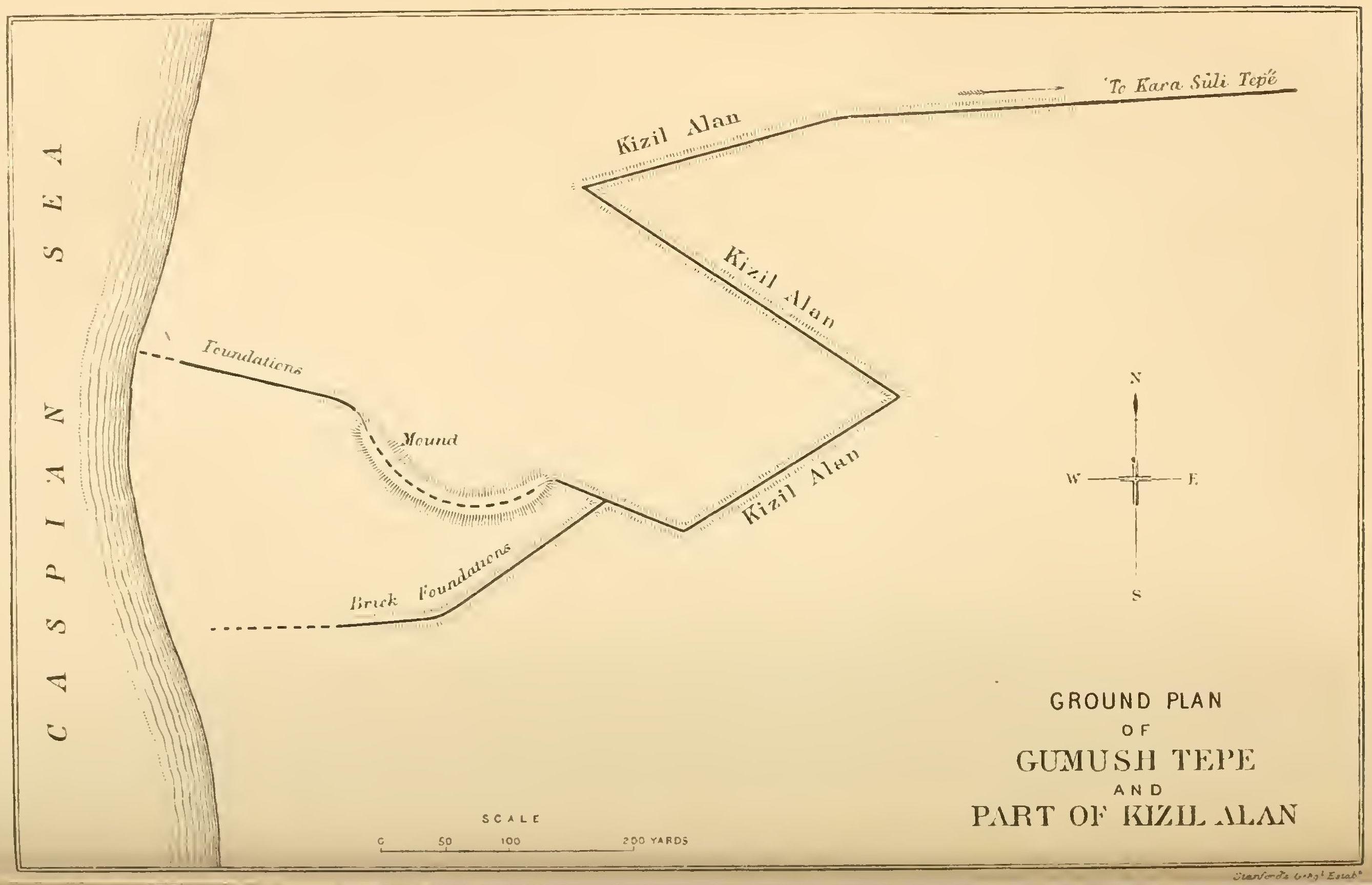
Immediately on arriving at the village of Gumush Tepé the chief who escorted me brought me to the house of his father, Geldi Khan, who seemed to be patriarch of the entire district. He was over sixty years of age, with refined aquiline features, cold grey eye, a long white moustache and chin tuft, there being no sign of beard upon the upper portion of his jaws. Seated around him, in different parts of the aladjak, were the female members of his family, all occupied in domestic work, such as spinning, weaving, and cooking. The Khan told me that he had been three months in Teheran as the guest of the Shah, with whom, he said, he was on very good terms. He had three sons, the eldest of whom, Il Geldi, had escorted me across from the Persian camp; the second was known by the name of Moullah Killidge. This latter was a student of theology, and by courtesy had the title of Moullah conceded to him; in fact, the same dignity is accorded to anyone in these parts who is able to read and write. In other Turkish countries he would be simply styled Khodjah. The third son, a youth of fourteen or fifteen, superintended the grazing of his father’s flocks and herds. An old Turcoman named Dourdi was told off to provide me with lodgings in his kibitka. He was the immediate henchman of the old Khan, from whom he rented his house. In villages like this the chief generally owns a large number of dwellings, which he lets for small annual rents to his followers. The kibitka. which I was to share with Dourdi was but poorly furnished, even for a Turcoman hut. As usual, in the centre of the floor was the fire, the smoke from which escaped by the circular opening in the centre of the roof, or by the door, when owing to bad weather this central aperture was closed with its hood of felt. A small and battered brass samovar stood near the fire; beyond it, on the side farthest from the doorway, the floor was carpeted with thick felt, upon which were laid, as seats for people of more than ordinary rank, smaller sheets of the same material, and of brighter colours. Around the room, to the height of four feet, were horizontally piled a large number of stout tree-branches, sawn into convenient lengths, and intended for the winter supply of fuel. This wood was kept within proper limits by vertical stakes, stuck into the ground outside the heap, the top of which was used as a kind of rude shelf or counter upon which bolsters, quilts, and other sleeping appurtenances, were piled, these being, indeed, with the exception of the carpets, large and small, and a rude horizontal stone corn-mill, the only articles of furniture which the house contained. An old Russian musket, bearing upon the lock-plate the date 1851, but having of late years evidently been supplied with a percussion lock, hung, together with a sabre and a large chaplet of brown stone beads, against the lattice-work of the habitation. This combination of musket, sword, and beads, seemed at the time to be no inapt embodiment of Turcoman ideas, or, for that matter, of Osmanli ones either. Beside the fire crouched an elderly crone, who, whatever she might have been in her youth, was now the very incarnation of female ugliness. She was engaged in preparing the evening meal, and seemed not in the least disturbed by my entry. I may here add that, with the exception of very recently married ladies, no Turcoman woman makes even a pretence of veiling her features. It is not usual, either, for a Turcoman to have more than one wife, the fact being that most Turcomans find it difficult to provide what they consider a sufficiency of food, and do not care to have any extra mouths in their aladjaks. The majority of the women at Gumush Tepé wore the characteristic female attire of these countries—a pair of trousers fastening closely round the ankle; over these a long shirt of some dark red or purple material, the breast of which, in many cases, was ornamented with coins and pieces of silver hung in horizontal rows. At Gumush Tepé it was principally the young girls and newly-married women who affected much personal adornment, the near contact of the Jaffar Bai Turcomans of the place with the Russians at Tchikislar, and with the Persians at Asterabad, having made the elders of the community appreciate the value of silver and gold coins as a medium of exchange as too great for them to be allowed to lie idle for purposes of mere bodily ornamentation. The further one advances to the eastward the less the value of money is understood, and the more plentifully do the ladies decorate themselves with it. On state occasions, however, the Yamud women wear ponderous collars of hammered silver, embellished with flat cornelians and lozenge-shaped panels of embossed gold, and on their heads a hideous-looking hat of the size and shape of an ordinary bandbox, the front of which is hung over with festoons of small coins. Hung over the back of this absurd head-dress, and reaching to the small of the back, is a long-sleeved coat of crimson, blue, or green, a smaller one, fitting closely to the waist, being worn over the rod shirt. This is the gala costume of the ordinary classes. The wives of chiefs and of the richer villagers wear on all occasions the full quantity of clothing and ornaments, with the exception of the hat. This is then replaced by a large red handkerchief, tied turban-wise around the head, one end falling along the back. I have already described the costume of the male Yamuds, when speaking of Tchikislar and Hassan Houli. The children, even in the severest weather, are very scantily clothed indeed, their entire costume consisting of a short red shirt which scarcely reaches to the knees. The head is covered with a little skull-cap of the same colour, around which are generally hung five or six pieces of silver money, the top being surmounted by a small silver tube, rising from a hemispherical base. This appendage to the head-dress of children is common to both sexes up to a certain age, and seems to bear some resemblance in symbolism to the Roman bulla, just as donning the huge black sheepskin hat seems equivalent to investment with the toga ririlis. It is a remarkable fact that though Turcomans are notoriously given to thieving, these children’s hats, each with its eight or ten shillings’ worth of appended coins and ornaments, are hardly ever purloined, though the wearers fling them at each other in the most careless manner. I have seen half-a-dozen of them lying about without any owners being in sight. Sometimes, however, they go astray, and on such occasions the individual who volunteers to act as village crier walks among the kibitkas, proclaiming in a loud voice that the hat of So-and-so’s child has been mislaid, and requesting the finder to bring it to a certain kibitka. I enquired of my host whether theft of this kind was usual, but he said that it was rare indeed that the missing article was not returned intact.
The mode of life of the Turcomans along the Caspian is sufficiently active. Fully two hours before sunrise they were awake and about, and, by the light of the smoky astatki lamps, the women were to be seen grinding, by the rude hand-mill, the corn required for the morning’s repast, while the men got ready their luggers and tiiimuls to proceed on their day’s fishing, to convey loads of hay and other commodities to the Russian camp, or to seek firewood or timber for building purposes at Renar Gez. A Turcoman’s toilet is simplicity itself. I give Dourdi’s as an example. Having donned the kusgim which served him during the night as a coverlet, he swept the carpet on which he had been sleeping with his huge sheepskin hat, which he then proceeded to dust by banging it lustily with the heavy iron tongues. Then, taking a piece of fat from the pot upon the hearth, he greased his boots with it, finishing up by washing his hands, using as soap the wood ashes from the fire. At the time of which I speak, the middle of December 1879, the Turcomans of Gumush Tepé supplied the Russian army at Tchikislar with a very large amount indeed of corn, rice, and fodder, and to a great extent facilitated the first stages of its march to Geok Tepé.
The dietary of an ordinary Turcoman is by no means luxurious. Before the sun rises he partakes of some hot half-baked griddled bread, which has an intensely clayey taste and odour. This is washed down by weak black tea, and he thinks himself fortunate if he can now and then procure a piece of sugar wherewith to sweeten this draught. When he happens to meet with such a luxury, he adopts, with a view to economy, the Russian peasant’s method of sweetening his tea. A small lump of sugar is held between the teeth, the tea being sucked through it. Several glasses are thus got through with an amount of sugar which would scarcely suffice for one glass taken by a Western European. While the Turcomans of the Caspian littoral and a hundred miles inland use only black tea, their more Eastern brethren constantly consume green. Should he be at home, his mid-day meal consists of pilaff, made of rice if he be in funds, or of brownish oatmeal if otherwise. The only usual accompaniment to this is a little grease or butter, boiled through the mass, or, as is more generally the case, some dried salt fish. Sometimes on fête days, dried plums and raisins are mixed with the pilaff. The evening meal, partaken of a little after sunset, is the best of the day, and for it is secured a small portion of mutton to accompany the pilaff, or a couple of wild ducks caught or shot by some male member of the family. While at Gumush Tepé I existed almost exclusively upon wild fowl of one kind or another—pheasants, partridges, and pin-tailed grouse — several of which I got boiled at once, keeping a number over to be eaten cold. Some of the ducks and geese are really excellent, but others are so fishy and rank as to render entirely inedible half a dozen good ones boiled in the same pot. The pelican and solan goose are greatly admired as food by the Turcomans, though I could not appreciate them. There was one thing about Turkestan which I could never understand, viz. the absence of flesh diet to an extent that seemed unreasonable, considering the vast flocks and herds possessed by the inhabitants. I could readily understand their unwillingness to slaughter oxen or cows, as the former were employed in the tilling of their scanty fields, and from the latter were derived the milk, butter, and cheese, which they either consumed themselves or sold to the neighbouring Persians. It is true that from the sheep they derive the material for some portion of their garments, though most of them clothing is composed of cotton and camel-hair, but even so, the large flocks of sheep and goats which they possess would supply them more than twenty times over with abundance of textile fabrics. I know that during the progress of the Russians, sheep were largely bought up by the Commissariat of the expedition; but I have been in places where this was certainly not the case, inasmuch as the residents were hostile to the Muscovite advance.
The fuel used by these maritime Turcomans is generally wood brought from the neighbouring Persian coast, supplemented to a great extent by the dried dung of camels and other animals. The kalioun, or water pipe, is almost always ignited by means of a dried ball of horse’s dung as large as a small-sized apple. This is carefully prepared beforehand, from the fresh material, piled in heaps in the sun, outside the house, and brought in by a dozen at a time. These balls catch fire like so much tinder; one is placed on the bowl containing the tobacco, and the smoking is commenced. The first pulls from the pipe, as can be easily imagined, possess a very peculiar flavour, owing to the mingled smoke of the fuel and the tumbaki.
At night, the interiors of the kibitkas are lighted by means of rude earth lamps, very much resembling small tea-pots, with exceedingly long and wide spouts. A bundle of cotton rag is stuffed into the spout, and, reaching to its bottom, serves as a wick, the flame being fed by the black residual naphtha called by the Russians astatki. This, as I have already mentioned, is the residuum after distillation of the Baku petroleum. It produces a lurid red, smoky flame, five or six inches in height.
The salt, of which the Turcomans make large use both in cookery and for curing fish, is brought from the island of Tcheliken, in large blocks of two feet in length and eight or ten inches in thickness, quarried by the Turcomans of that island from the great striated layers which abound there. It exactly resembles, in colour and texture, the rock salt known in Europe.
One rarely sees milk used in its crude state among the Turcomans, as they seem to deem it unhealthy when so consumed. It is first boiled, and, when lukewarm, fermented. The resulting product is, when fresh, slightly sour, and becomes exceedingly so after the lapse of twenty-four hours. This is known to the Yamuds by the name of yaghourt; it is called by the Tekkés gatthuk, and by the Persians mast. It enters largely into the dietary of all three, and in hot weather is exceedingly refreshing and wholesome. The panir, or cheese, is simply yaghourt from which the serum has been drawn off, and which is allowed to strain and become more or less solidified in small bags suspended from the roof, a little salt being added to preserve it.
I had been but a few days at my new home when I learned that my friend II Geldi Khan, who had escorted me from Ak Imam, was about to proceed over land to Tchikislar, and I resolved to go with him. We were accompanied by a dozen horsemen of his tribe, for it was rumoured I that Tekkés who had fled from Geok Tepé were roving over the plain. We found an immense number of kibitkas in groups of from fifteen to twenty, scattered over the plain some miles east of Gumush Tepé. They were those of Eastern Turcomans, who, terrified by the events occurring in the Akhal Tekké, had decided to move well within Persian territory. Refugees were continually arriving, bringing with them great numbers of camels, and we saw a cavalcade of Turcoman women, dressed in bright scarlet robes, and riding in curtained horse-litters, making the best of their way westwards, in the midst of their tribesmen and friends. Within ten miles of the top of the Atterek delta, the point at which we were to pass, we came upon a vast salt expanse. It was as white and even as a new snowfall, and I could only with difficulty bring myself to believe that it was not covered with snow. Long black tracks, produced by the passage of camels and horses, stretched away in every direction. Not a blade of any kind of herbage varied the monotony of this ghastly waste. During my subsequent wanderings in the plain, I never met with anything so remarkable as this salt expanse, for the existence of which I can only account by supposing that the waters of the Hassan Kouli lagoon, pressed forward by winds from the west, sometimes overflow the ground, and that the shallow waters, rapidly evaporated by the great heat of the sun, leave this deposit behind them. We stopped for the night at the Turcoman village of Atterek, to which I have had occasion to refer in describing my journey from Tchikislar to Asterabad. We were very hospitably received, a sheep being killed for our entertainment; and before daybreak next morning, after a breakfast of hot, greasy bread, and an immense quantity of sugarless tea, we pushed forward, reaching Tchikislar about eleven o’clock in the forenoon. My friend the Khan had formerly commanded a troop of irregular cavalry in the Russian service, composed of his own countrymen, but in consequence of some backsliding on his part in the matter of pay given to him for distribution among his command, he had been banished, and forbidden to return. Hence he was rather chary about making his appearance among the Russian lines—a hesitation which was apparently very well justified, for we had no sooner entered the camp than the chief of police marched up to us, and told my companion that the sooner he departed from its limits the better it would be for him. I fared no better, being warned that my presence was not desired, and we were both given until the morrow to retrace our steps. Seeing that there was little or no stir in the place, and that all military movements were for the moment at an end, I again took my way back by the road I had come, in company with II Geldi and his following. We arrived at our starting-point without any new incident.
Finding that there was a constant intercourse between Gumush Tepé and Tchikislar, owing to the continued passing and repassing of luggers with hay and other supplies, and that Armenian dealers frequently passed through our village with a view of purchasing food at that place, to be sold by them at second hand to the encamped Russians, and that through their medium I might be constantly informed as to the movements of the troops, I resolved to make a lengthened stay with old Domali. Here, during a residence of some months, I had ample leisure for observing the manners and customs of the Yamud Turcomans, and as I shared the same one-chambered kibitka with my host, his wife, his niece, and a young child, and participated in their daily life, I had excellent opportunities for judging of Turcoman domestic life. There were certain inconveniences attendant upon this gregarious mode of existence, for the circular chamber was but fifteen feet in diameter, and some member of the family was always present. Consequently, when one wished to perform his ablutions, or to change his clothes, he was generally obliged to do so in the dark, or under cover of his quilt, after the family had retired to rest. Our sole bed consisted of a thick felt carpet, spread upon the bare earth, our bolsters were of enormous dimensions, and our bed-covering was composed of a stuffed cotton quilt, and did not, I regret to say, bear the appearance of having often been washed. This, on very cold nights, I supplemented by my great sheepskin overcoat; but as a fire generally smouldered on the hearth, towards which our feet were directed, we passed the nights snugly enough. Still, as I have said, two hours before sunrise all further sleep became impossible by reason of the grinding of corn, the splitting of wood with a hatchet, the various goings to and fro of the household, and the stream of visitors who were sure to arrive at that hour.
These Turcoman aladjaks are, ordinarily, perfectly weather-proof, and, on the whole, fairly comfortable to live in, but that of my host was a rather patched and mended affair, and the light of day could be seen through more than one hole in the felt covering the exterior of its domed roof. One night, as we lay asleep, a tremendous downpour of rain set in, and after the first half-hour the water dripped into the hissing fire, and pattered around us on the quilts. Dourdi was equal to the occasion. It was clearly not the first time he had been confronted with the situation. He rose quickly, took a long iron-shod pole, which I presumed to be some kind of a boat-hook, and fixed one end of it in the side of the aladjak some five feet from the ground. The other end was supported by a loop of camel-hair rope, which descended from the centre of the roof to within the same distance from the ground. Hastily unfolding a carpet of large dimensions, he placed it over this horizontally rigged pole, the ends resting on the ground, and forming a kind of tent which contained all the sleepers. Often during my stay at Gumush Tepé, I have passed the night in this house within a house. The loop of camel-hair rope is ordinarily intended as a support to one end of a cane, basket-like hammock, the other end of which is hung to the opposite side of the wall, the hammock serving as a cradle for young children.
The winter at Gumush Tepé is generally mild enough, and even during the severest portions of the year—towards the end of February—the snow rarely lies upon the ground for any length of time, except when drifted into old irrigation trenches, or where sheltered from the sun. To make up for this, however, about twice a month we had sudden and violent storms from the westward, of the approach of which we had generally only a quarter of an hour’s warning, and at night none at all. This sudden storm is called the tenkis. The first time I witnessed one I was excessively puzzled to understand the movements of the inhabitants immediately before the storm struck the village. It was about two o’clock in the afternoon; the sun was shining brightly, and the sky was without a cloud. All at once I observed persons pointing hurriedly towards the distant Caspian horizon, where a thin, white, jagged line of flying mist was perceptible, which rose higher and higher at each moment, approaching us with rapid pace. In the village itself the wind was blowing from an opposite direction, and the mist clouds along the Elburz range were moving towards the west, while the advancing scud was still so very indistinct as to be unobservable by the unaccustomed eye. I saw men and women in frantic haste, flinging ropes over the tops of the kibitkas, and lashing the opposite extremities to stout wooden pegs firmly embedded in the ground close to the wall of the dwelling. In the meantime, within iny residence, old Dourdi, muttering prayers in most anxious tones, was propping his boat-hook and several other poles of equal size against the spring of the dome, and planting the lower one firmly in the ground. I could make neither head nor tail of all these preparations, and was still more confounded and amazed by seeing all the matrons and maidens of the community who were not engaged in securing the permanency of their habitations, rushing to the bank of the river, some carrying a pitcher in each hand, others with enormous single ones strapped upon their backs. These, with feverish haste, they filled with water, and, hurrying with them to their houses, again issued forth, with other vessels, for fresh supplies. My first idea was that these were defensive preparations against some expected raid on the part of the Tekkés; that the poles planted against the walls within were to resist some battering operations of the assailants; and that the water so eagerly sought for must be intended to extinguish a coming conflagration. Every one, however, was too busily engaged to give me any further answer to my demands as to what it all meant, than to exclaim, ‘The tenkis! the tenkis!’ By this time the jagged white mist had risen high above the horizon, and was rapidly veiling the western sky. Flocks of sea-gulls and other aquatic birds flew inland, screaming and shrieking loudly. Ere long I saw that the clouds along the mountain ceased their westward movement, staggered, reeled, and ultimately partook of the movement of the advancing scud. Great sand-clouds came whirling towards us from the beach, and in another instant the storm burst upon us, accompanied by a tremendous downpour of rain. The kibitka into which I rushed for shelter quivered and shook under its influence, and I thought that at each moment it would go over bodily. The westerly edge was lifted some inches from the ground with each fresh gust, and the eagerness with which ropes were hauled taut, and storm-props made fast by the inmates hanging with all their weight from their upper portions, reminded one of a scene on board a vessel at sea during a violent tempest. I was gazing through a crevice in the felt walls out over the plain in an eastward direction, where some camels, laden with grass and hay, were hurrying forward to gain shelter before being overtaken in the open. I could see their loads seized upon by the storm gusts, and in a moment torn from the backs of the animals, and sent whirling far and wide, and to a height of a hundred feet. The camels turned tail to the wind and crouched down, stretching their long necks upon the earth, so as to remove themselves as much as possible from the influence of the hurricane and whirlwind, their conductors imitating them. This storm continued for over an hour, during which time the luggers moored in the river were quite deserted by their crews, lest the craft might be torn from their anchorage and dashed against each other, as occasionally happens. Of course when the tempest came on I saw the object of all the lashing down and propping up of the kibitkas, but it was only when it had passed, and the inhabitants were at leisure to speak to me, that I could make out the meaning of the hurried rush to the river for water. It appears that when the tenkis blows strongly, the sea-water is forced up the channel of the Giurgen, sometimes to a distance of a mile above the village, the natural flow of the stream being so impeded that when it is tolerably full, and its current is rapid, it overflows its banks. This forcing back of the sea-water into the river’s channel renders the water of the river unfit for human consumption, often for hours together, and it is with a view of securing a supply for household use that a rush is made to the banks as soon as the flying jagged mist appears upon the horizon.
Chapter XIII: Life in the Kibitkas.
Savage dogs—Vambéry’s house—Turcoman want of ideas about time—Smoke —Sore eyes—Conversation—Patients—Visiting formalities—Turcoman hospitality—Karakchi thieves—Physical types of Yamuds—A Turcoman belle—Nursing children—Tekké bugbears—Plurality of wives—A domestic quarrel and its consequences.
Life in a Turcoman village is but a dreary affair when the first impressions of novelty have worn off. As a rule, one does not, after having taken his first dozen strolls, care to walk about to be stared at by the inhabitants and harassed by the ferocious dogs, which rush in scores at a stranger clad in European attire. I know of nothing more annoying than these dogs. They are exceedingly useful as guardians of the place, for no one can come within a mile of them without his presence being made known by their noisy barking, and they are most efficient in preventing thieves from carrying off the horses, which are never under cover, but stand tethered by the fetlock close by their owners’ kibitkas.
I usually confined myself to my dwelling, making notes, or conversing with the too numerous visitors who invaded Dourdi’s residence. This was the same in which Vambéry had lived, for, notwithstanding that he succeeded in passing through unrecognised as a European, the inhabitants afterwards learned his true character, doubtless from the Russians of the naval station at Ashuradé, close by. I heard of the famous Hungarian from a person named Kan Jan Kelté, the son of Kotsak, his former host. He described the traveller as being like Timour Lenk, the great Central Asian conqueror, i.e., somewhat lame. Of course this knowledge of Vambéry was not arrived at until some time after his departure from among the Yamuds, as otherwise it might have fared badly with him, and he certainly would not at that time have been allowed to pass on. The most singular fact in connexion with this matter was that when I asked for the date of Vambéry’s arrival at Gumush Tepé my informant could give me only a very vague reply. This is characteristic of the Turcomans. They seem to have no idea of time beyond a period of twelve months, and cannot tell whether an occurrence took place eight, ten, or twenty years ago, generally referring the questioner to some striking event, and explaining that the matter to which the query relates happened before or after it
One of the most disagreeable features of a Turcoman hut is the ever-present smoke, which is produced by the combined combustion of green wood, cuttings from fir planking, and camel’s dung. The fire is scarcely ever allowed to go out, and the Turcomans will assure the guest, by way of reconciling him to the nuisance, that it is admirable as a means for keeping flies out of the kibitka. This is doubtless true, but it appears to me that a very nice judgment would be required to discriminate as to the lesser of the two evils. In winter, especially, one becomes as black with soot in twenty-four hours as if he had been living in a chimney, and his only chance of avoiding suffocation is to lie down with his face as near to the ground as possible. To stand up would be to risk asphyxiation in the creosote-fraught atmosphere. The smoke occupies the upper two-thirds of the apartment, and condenses about the top of the domed roof, converting the long, pendent cobwebs into so many sooty stalactites, which, when they become too ponderous for their own suspending strength, descend silently into one’s food, or settle in heavy black stripes across his face as he lies asleep. At the end of a few days one is as thoroughly smoke-dried as the most conscientious curer could desire his hams to be. The creosote resulting from the burning of the fresh pinewood produces inflammation of the eyes, and, after some months’ residence in these maritime kibitkas, one is not surprised that keratitis and bleared eyes should be so universally met with among the Turcomans.
The utter absence of privacy was also a most aggravating element of my sojourn in Gumush Tepé. Ordinarily, I shared my dwelling with Dourdi, his wife, child, niece, and a calf; but in addition to these there was an intolerable continuation of levees to be held, at each of which at least fifteen or twenty visitors were present. It was impossible to do anything in the shape of taking notes, or, indeed, to write at all. It is the greatest mistake in the world to suppose that Orientals are taciturn—those, at least, who are to be met with in these regions. There was incessant babbling and chattering. The conversation was of a very limited kind, being mainly confined to geographical subjects, of which the talkers had but very crude notions. At first I used to try most conscientiously to explain the whereabouts of certain countries, but, finding my auditors altogether unable to comprehend the distances which I mentioned, I afterwards confined myself to indicating the points of the” compass at which the various countries lay, dividing my measurements into ‘very far,’ and ‘very far indeed,’ with which explanations they were completely satisfied. I was constantly overwhelmed by the most ridiculous questions, such as, ‘How much moajib (salary) did the Ingleez Padishah receive annually?’ Being informed that the English Padishah was a lady, they could with difficulty be persuaded that I was not playing upon their credulity; and the pointing out of England and Hindostán as lying at opposite points of the coinpass seemed to confirm them in this idea. As a rule, these people have not the slightest conception of the existence of Britain, Hindostán being supposed by them to be the real England. There was a general anxiety to know my age, whether I had a father or mother, how many brothers I had, and their respective ages. I was never asked if I had sisters, it being contrary to Eastern etiquette to speak of ladies, or even to ask if one is married. The information, after being given to those who sat nearest to me, was conveyed to the next tier of anxious listeners, who in turn communicated it to the outer circle. All this ground had to be gone over afresh for the benefit of each set of newcomers, as if the subject had been of absorbing and general interest. The whole proceeding was not only exceedingly ludicrous, but worrying in the extreme. Some sat in solemn silence, their eyes fixed upon my face, but the majority were aggressively inquisitive, and I often found myself seriously calculating how long I was prepared to bear this sort of torture without becoming demented. After some weeks, however, I began to get case-hardened, and I resolved that I would go on with my writing, no matter what might be the nature of the surrounding circumstances. Accordingly, I used to sit down doggedly upon my carpet, paying no attention whatever to’the hatches of new comers, and as I sat, taciturnly writing by the smoky light of the astatki lamp, the onlookers were filled with amazement at my obduracy and unwillingness to speak to them. ‘Why,’ said one of my visitors, one evening, when after half an hour’s questioning he had only succeeded in extracting surly monosyllables from me, ‘I never saw such a silent person as you are. If I had only travelled half the distance that you have I should never have done talking about my adventures.’ This man’s name was Agha Jik, a Goklan Turcoman, who had thought proper to change his tribe, owing to the want of security for life and property obtaining among his own clansmen. He was a very lively old fellow, and, considering the extreme pliability of his tongue, I have no doubt that he would have kept his word under the circumstances to which he alluded.
Another kind of suffering which I had to endure was entailed by the continual examining into and prescribing for the various maladies which seemed to have alighted upon my interviewers expressly for my persecution. Fever, hepatic disease, sore eyes, and a hundred other complaints passed in review before me, for everyone coming from Frangistan is here supposed to be a physician. There was a constant drawing upon my small stock of medicines, and, when I declared that I had not a certain remedy, my patient would exclaim, in amazement, ‘What! you have been in Stamboul and Frangistan, and you have not any medicine!’
According to ordinary Turcoman ceremonial, a visitor draws aside the carpet which hangs curtain-wise before the door, and utters the sacramental Selam aleik. He always knows by the tone of the reply whether it is convenient that he should enter or not, and if his salutation be not returned at all, he takes it for granted that there is a grievance against him. An instance of this occurred at the very kibitka in which I was staying. A Turcoman of very bad character and dissolute habits had been going round the village spreading rumours that my host was swindling and plundering me in the most reprehensible manner, and, this coming to old Dourdi’s ears, the latter at once asked me whether I believed that such had been his treatment of me. I of course replied in the negative. Shortly afterwards, the propagator of the defamatory report, not dreaming that his lying statements had reached my host’s ears, presented himself at the open door, and uttered the customary Selam aleik. Old Dourdi, who was looking with half-closed eyes in the direction of the entrance, steadily ignored the presence of the intruder, I myself following his example. As a consequence, after a few minutes’ pause, the would-be visitor, probably guessing that his calumnies had been duly reported to the subject of them, walked sheepishly away, and never again troubled us by his presence. It is, above all, imperative upon the caller never to enter if he sees that the inmates are at meals; for this would entail upon the people of the house the necessity of asking him to partake of their food, and every Turcoman knows that his countrymen are not always in a position to extend such hospitality. When the entrée of the house is permitted, the visitor approaches with the utmost ceremony, and for fully three or four minutes there is a muttered exchange of formalities. ‘Amanme?’ says the superior, as the senior is always considered, except in the case of a chief. ‘Amanlugme,’ replies the other. ‘Amansalugme, Kiffcnkokme,’ ‘Sorache,’ ‘Elhamd-Ellilah,’ and many another ceremonious phrase, follow upon each other. Should as many as twenty persons be present when a visitor comes in, the ceremonial must be gone through separately with each, in the order of his rank or seniority. In this respect the Yamuds are precisely like the Osmanli Turks, the salaaming movement of the hand and valedictory phrases of the latter only being omitted. Among the Turcomans the matter winds up with the ‘Khosh Geldi’ (You are welcome). Notwithstanding all this formality upon entering, there is none whatever when one of the company departs. He rises abruptly, and leaves the room as though something had been said which had direly offended him. No one else takes the slightest notice of his withdrawal, nor does he himself, even by a nod, salute the company. As in all Eastern society, it is of course necessary to remove one’s slippers on entering, or at least when stepping upon the carpeted portion of the kibitka, and you must also remain covered, as a mark of respect. To uncover the head before a respectable Oriental gathering would be almost as inexcusable as to remove one’s nether garments in a fashionable London saloon. I have often perspired under the heat of my sheepskin hat, and would have given half my worldly goods to be able to doff that article of clothing, but was compelled to bear with the inconvenience for fear of being regarded as a grossly discourteous person. Sometimes, if only yourself and your host be present, and he should feel very hot himself, he may possibly extend his politeness so far as to say ‘You may take off your hat if you like;’ but then it is always understood that you keep on the small skull-cap, which no true Oriental ever removes, whether by day or by night. Should a stranger arrive, there is a sudden donning of head-dresses, as if the new-comer were about to make some murderous attack upon the crania of the inmates, and they needed protection against his violence.
The hospitality of the desert has been a good deal impaired, in the case of the Yamuds along the Persian border, owing to their contact with their more than usually mercenary Persian neighbours, and with the ready-monied, well-paying Russian authorities. Still, the semblance of it exists. A Turcoman in whose house you have been staying for a few days will accept nothing for the board and lodging which he has supplied to you, though he will unhesitatingly take payment for the oats and fodder consumed by your horse. You may ask him, in the most explicit terms, how many chanaks of oats or barley have been supplied, and how many bundles of hay, and he will at once inform you. To inquire how much you owe him for the boiled fowls and pilaff which you have eaten, however, would be to seriously offend him. But when you are going away he expects a handsome peshkesh, and will think you a shabby individual indeed, if you have an air of being at all above the ordinary, if he does not in this guise receive from you two or three times the value of what you have been provided with. I must say, however, that in the case of their own countrymen who are known not to be too well off, and especially in the case of wandering dervishes, their liberality is unbounded, and they do not entertain the slightest expectation of remuneration, nor would they accept any. The dervish is supposed to be a man of God, though as a rule he is the reverse—at least the Persian one is; and as regards the Turcoman who is on his travels, the host expects that, should it come to his turn to pay a visit to the guest who is at his house, he will meet with a like return of hospitality. I was very much struck by the resemblance between the manners and phrases of these people and those of the Spaniards. They will tell you that the house and all that it contains are yours; and if you speak in terms of praise of any article belonging to your host, he feels bound to tell you that it is altogether at your disposal, and in several cases I have been forced to accept at the hands of chiefs that which I happened to commend. But, while treating you in this princely fashion—for a Turcoman considers that a man of rank must never withhold what his guest fancies—the donor will compensate himself for his own generosity by praising in return something which is in your own possession, and of course there is nothing for it but to present the gift with a good grace, no matter how much you may stand in need of the particular article. This rule does not apply to arms and horses, for a stranger on the plains cannot part with what are to him absolute necessities.
The Yamuds, that is, those of any social standing, are very particular in guarding against the theft of anything belonging to a recipient of their hospitality, and are ready to resent any such outrage in the swiftest and severest manner. The following is an instance of this. The horses, as I have said, are tethered in the open air, close to the kibitkas of their owners. They are protected against the heat of the sun by day, and the severity of the cold at night, by being swathed in an enormous sheet of felt, nearly an inch thick, which covers them from ears to tail, and meets underneath the belly. This is tied round two or three times with a broad girth, and will enable the animal to withstand any kind of weather. The horses themselves prefer this mode of being kept warm, and I found it impossible to induce my Turcoman steeds to enter a stable. They thus stood close to my residence, and my own personal charger was covered with a very expensive felt rug. Close to the Atterek Delta is a village inhabited by what are known to their more respectable brethren as a tribe of Karakchi. These are robbers par excellence. They are always mistrusted by the other Turcomans, whose own morality is not of too strict an order. One day a pair of these gentlemen honoured Gumush Tepé with a visit. They did not leave until rather late in the evening, and on the following morning my horse-rug had disappeared. I complained to old Dourdi, who almost wept with indignation on hearing that his guest had thus been despoiled of his property, and immediately rushed to the house of the chief to inform him of this breach of decorum. Scarce five minutes had elapsed when the avengers were on foot; at their head was Agha Jik, the sprightly old Goklan. No time was lost in any preliminary inquiry, for no such inquiry was necessary. Two Karakchi Turcomans had been in our camp on the previous evening; no one else could be guilty of such a violation of the laws of hospitality, and the conclusion was at once drawn that they must be the delinquents; and as one of them happened to bear a worse character than the other, he was the individual selected as the actual offender. The body of horsemen proceeded swiftly to the Karakchi village, and entered the house of the supposed thief. Placing their knives at his breast, they summarily demanded the restoration of the stolen property. When a Turcoman commits a theft, he feels bound, for some reason which it is difficult to understand, to die rather than give back what he has purloined, just as he will cut the throat of a captive rather than part with him without a ransom. The Karakchi protested, but the more he did so the fiercer and more imperative became the demand, and he at length replied that although he could not restore what he had not taken, he could supply a cloth of equal value. This logic seemed perfectly satisfactory to the others. A rug very nearly as good as that which had been abstracted was produced, and brought away in triumph. It was not quite so valuable as the one I had lost, but when asked by my redressors whether I felt satisfied with it, I of course answered that I was, for I did not wish to give them unnecessary trouble, fearing that further prosecution of my claim might entail bloodshed. I knew that if I persisted, the least they would have felt bound to do would have been to collect the amount of the difference in value from among the villagers. I have had similar experiences with almost all the Turcomans with whom I have come in contact, however wild they were, and it is only of the children and lads that I have to complain, for these latter are frightful thieves and liars. These Karakchi Turcomans are held in universal detestation by the other tribes around them, and the wonder is that they have not been exterminated. My host told me that they creep hito the villages at night, and, cutting through the exterior matting and felt of the kibitka walls with their long keen knives, introduce their arms and steal whatever they have previously noted while entering during the day. Hence he warned me not to hang my sword, revolver, or any other article of value, against the wall, but to place them beside me as I slept. The village dogs, great nuisances as they are, are well worth keeping, for the sake of protection against these audacious thieves.
The usual Turcoman physical type, both male and female, is rough, rude, and vigorous, and quite in contrast with that of the frontier Persian, which is sleek, cat-like, feeble, and mean. The worst part of the Turcoman is his head, which is decidedly conical, the point being thrown somewhat to the rear. A phrenologist would say that firmness was very pronounced, conscientiousness wanting, and benevolence small. The features are not of that Tartar cast that one would be apt to suppose in denizens of East Caspian districts, and though here and there may be seen a suspicion of peeping eye, a tendency towards flattening of the point of the nose, and occasionally high cheek bones, on the whole the faces are more European than otherwise. In fact, I have seen some physiognomies at Gumush Tepé which, if accompanied by an orthodox European dress, would pass muster anywhere as belonging to natives of the West. It is among the women that the absence of European features is most conspicuous. There are many of them who could fairly be reckoned pretty, though it is quite a different order of beauty from that to which we are accustomed. I recollect, during a solitary ride along the banks of the Giurgen river, coming upon a small ova, or collection of Turcoman huts. Being very tired, I dismounted at the door of one of them, and attaching my horse’s bridle to the door-post, entered. The hut bad but two occupants, one an elderly woman, the other a girl of apparently about eighteen years. The latter, as I afterwards learned, was the daughter of the local chief, and was on a visit. She was in full gala costume, and wore over her crimson silk shirt a coat of green cloth, fitting very closely at the waist, and falling half-way to the ankle, the skirt being cut into a series of plaitings like those of a Highland soldier’s tunic. The sleeves fitted closely as far as the elbows, but below that point they were exceedingly large, and open behind. The edges of the opening, as well as the cuff, were ornamented by a double line of small spherical silver buttons, while the front of the coat, and also the breast of the shirt, were decorated with the usual rows of hanging silver coins. Around her neck was a large silver collar, set with cornelians and small gold panels, and supporting by a series of chains a long cylindrical case containing talismanic writings. The huge band-box head-dress, which she had laid aside, was of even more than the ordinary preposterous dimensions. Its front was hung over with festoons of small gold coins, interspersed with star-like silver ornaments, and, springing from the centre of the top, and falling backwards, was a green silk coat with sleeves, the seams doubled with crimson, and the entire back covered with stamped silver ornaments. This young lady, who, if she did not wear ‘her heart upon her sleeve,’ apparently bore her purse upon her head, was one of the prettiest of her race that I had yet seen. Her complexion was remarkably clear, and had in it more of colour than is generally to be met with in the sun-tanned physiognomies of her companions. Her dark eyebrows were arched; her delicately formed nose was of slightly aquiline contour; her eyes were large, dark, and intelligent; her mouth as near perfection as possible; her chin small, and remarkably prominent. Long brown hair, in colour approaching to blackness, fell in two large plaited tresses between her shoulders, each tress bearing silver pieces extending over a space of at least two feet, the coins growing larger towards the bottom, where figured either Russian rouble pieces or Persian five- kran ones. Neither of the ladies was in the least abashed by my entry. The elder motioned me to a seat, and after the usual salutations we entered into conversation. The younger one showed especial curiosity as to who I was, and why I was roving about alone upon the plains. She asked me about the dress of ladies in my country; then how I liked her costume, and next how I liked herself. It is not usual to meet with such an utter absence of embarrassment or attempt at veiling, even among Turcoman women, so that when she conducted herself in this unrestrained manner before me, a stranger, I could only suppose that her demeanour in regard to those with whom she was better acquainted must have been exceedingly confiding and sans gêne. I am sorry to say that this young lady is a very uncommon example of the sex of her race. It is among the men that the handsome individuals must be sought for, especially when there has been an admixture of Persian blood. The scanty beard of the pure Turcoman is then replaced by one of much more luxurious proportions, and of a darker tint; the nose assumes a more or less aquiline form, and the eye loses the cold grey expression so characteristic of the pure-blooded dweller on the Steppes. Whether or not it be owing to the peculiarity of the race, or to the laborious occupations to which they are subjected almost from infancy—grinding corn, carrying water, cooking, and in their leisure hours carpet making and spinning—at a comparatively early age they lose whatever comeliness they may have possessed, and on approaching anything like an advanced age degenerate into withered and witch-like beldames. The contrary is the case with the male sex, probably for contrary reasons, for a Turcoman of any pretensions whatever never occupies himself with menial labour, and, indeed, seldom exerts himself in any way, except in a foray against his neighbours’ cattle, or in a hostile expedition into Persia. The woman, in the midst of her family circle, retains her place beside the fire, even though a number of strange men should enter; but she is not supposed to go to another house where there is such an assembly of male persons, unless it be for the express purpose of talking to the mistress of that house, in which case she enters and retires entirely unnoticed by the people present, save by the person to whom she came to speak. Beside her own hearth, on the contrary, she is saluted, and returns the salute. When a Turcoman happens to possess more than one wife, the latest and favourite one is always the best dressed, and is exempted as much as possible from domestic labour, her predecessor or predecessors performing the necessary household duties. These latter, however, retain a certain seniority, and are treated with more respect by strangers. In fact, if a wife be very recently married, she is understood not to make herself too prominent in the kibitka in which she lives.
Turcoman women are usually very industrious, never seeming tired of work. This is probably because labour is the only means at their disposal for breaking the monotony of their otherwise dull lives. I have seen a woman, when unable to sleep, rise at two o’clock in the morning, light the smoky astatki lamp, and proceed to beguile the weary hours by grinding corn in a heavy horizontal stone handmill, for the morning meal. It is (piite the exception for a man to fetch water from the river. This is generally done by the younger female members of the family, the daughters, if there be any, and if not, by the younger wife or wives, who on such occasions generally carry with them the suckling children or those who cannot safely be left by themselves. These are borne astride upon one hip, the body of the mother being thrown over to the opposite side, one arm passing round the child’s waist, while the other supports the heavy water pitcher, both sides being thus mutually balanced.
As on board ship when space is scarce, the oblong cane basket which serves as a cradle for young children is supported at one end by the double camel-hair rope which descends from the centre of the dome, the other being attached to the top of the lattice work forming the inside of the wall. A sufficiently erudite collector of nursery rhymes would no doubt be highly delighted with some of the ditties crooned by Turcoman women as they swing their babies to and fro in this hammock-like machine. The utterances to which they give vent when persuading their young offspring to take food are very strange, and often, when lying flat upon my carpet, busily engaged in writing, I have lifted up my head in amazement in order to discover the object of the strange intonations which reached my ear. Once the mother was uttering hoarse, gurgling sounds, like those of an uneasy wild animal, all the while contorting her features into a variety of simian grimaces not unworthy of an hilarious baboon, and all simply with a view of inducing the child upon her lap to partake of some fried fish. It is no bad exemplification of the estimation in which the Tekké Turcomans of the interior were held by these Yamuds, that mothers menaced unruly children with the threat that if they did not behave themselves the Tekkés would be sent for directly.
As a rule, plurality of wives, when it occurs, does not seem to disturb the peace of a Turcoman home, even though the master of the aladjak does not often follow out the prescription of the Koran by providing a separate habitation for each of his spouses. Still, ‘breezes will ruffle the flowers sometimes,’ and I once had a notable proof of this. A little after sunset one evening, as I was sitting at the door of my kibitka, looking out across the waters of the Giurgen, I perceived a lurid blaze, which soon spread into a sheet of rolling fire reaching far away to the south and west. The suddenness of the conflagration startled me, and I thought it might be the result of one of those sudden incursions which might be expected at any moment in these regions. Soon, however, my old host made bis appearance, stifling his laughter at something which he evidently considered a very good joke. On asking him what all the fire was about, and at what he was so amused, he informed me that in the house of a friend of his, who had lately married his second wife, disputes had arisen between the partakers of his affections. From words they had come to blows, and at length the combatants, finding no better weapons near, seized lighted brands from the hearth, and pelted them recklessly at each other. The house contained a quantity of hemp and other inflammable material, and was quickly in a blaze. It stood close to the margin of a meadow, in which, owing to the abundance of water, the grass had grown to a great height. Having been allowed to stand uncut, it had been dried by the sun of the preceding autumn, and, the flames spreading to it, the conflagration ensued.
Chapter XIV: Sketches of Gumush Tepe.
College at Gumush Tepé—Professor of theology—Late school hours—Sunni and Shiia—Specimen of sectarian hatred—The white fowl mystery—Fever —Hurried burials—Mourning rites—Returning hadjis—Distinctive marks — Trade and commerce — Tanning sheepskins — Pomegranate bark— Kusgun and yapundja—Krans and tomans—Disputes about money— Turcoman measures—Recreations—The Turcomans and ‘Punch’—Agha Jik’s ideas—After nightfall.
My kibitka was within thirty feet of the river’s edge. In the intervening space, standing on a kind of earthern pier, and protected by boards against the action of the current, stood another kibitka, of unusually large dimensions. This was the mosque attended by the more select portion of the community, and it was the only instance I had seen of a covered building used for religious purposes by the Turcomans. In the intervals between the hours of prayer this edifice was utilised as a medressé, or college, in which candidates for the priesthood were instructed in reading, writing, and the precepts of the Koran, by an ahound, or professor, who passed as the possessor of great erudition. He was a square, solidly built man of about fifty years of age, with a suspiciously Tartar-looking nose, a slight chin tuft, and still slighter moustache. He habitually wore spectacles, which imparted to his countenance, for a resident of Gumush Tepé, a wonderfully sagacious and learned look. He was an Oozbeg, from Bokhara, and had studied theology at the college of Samarcand. Besides his professerial functions, he also exercised those of timber and general merchant to the community, for though he was a moullah, or priest, the injunctions of the Koran did not forbid his engaging in lay occupations. He was very active, and seemed to sleep but little. His class of some fifteen students, all young men of about seventeen or eighteen years of age, generally assembled about midnight, and from that time until three in the morning there was an incessant babble of tongues within this Central Asian seminary. All the pupils were engaged simultaneously in reading from the Koran at the highest pitch of their voices, which were not very feeble ones. Turcomans, from living constantly in the open air, and conversing on horseback, have naturally vigorous voices, and habitually speak in very loud tones. Indeed, I have often seen two of them, seated at the same fire, within a house, adopt the same stentorian tone in conversation as if they were addressing each other from opposite sides of the river Giurgen. By this it maybe imagined that the uproar within the medressé was no ordinary one, and that, being only a few feet removed from my dwelling-place, it was not easy to go to sleep under such circumstances. Towards three o’clock, by which time they seemed to become rather fatigued, the Professor took up the chorus, and commenced to expound the Koran in a pompous and pretentious tone, and daylight would be well advanced before he thought fit to desist. During the remainder of the day he attended to his secular affairs, or kept an eye upon his college, to see that no unauthorised intrusions took place within its holy precincts; and I have more than once seen him, spectacles on nose and stick in hand, furiously chasing a multitude of hens and geese out of this Trans-Caspian temple of theology. Morning and evening the old gentleman who acted as muezzini took his stand before the door, and his melancholy, musical, long-drawn cry might be beard floating across the silent plain, calling the faithful to their devotions, a summons which, I regret to say, was seldom answered save by a dozen or fifteen of the older and more respectable inhabitants.
These Turcomans are all rigid Sunnites, and cherish the due orthodox detestation of the cursed Shiia sect, of which their neighbours the Persians are members. They do not, in fact, regard the latter as Mussulmans at all, and have a much greater regard for the Jews and Christians. My old host Dourdi was a genuine specimen of the Sunnite. He said his prayers with the greatest regularity, always previously washing his face, hands, and feet, with rigid attention to the rites of his sect—if, indeed, he would not have considered it blasphemy to describe Sunnism as a sect —taking care that the water ran in a proper manner over the points of his elbows, and not after the damnable fashion of the Shiites. He once accompanied me on a shooting expedition along the coast, as far as the old Gumush Tepé mound. After a while we seated ourselves upon its summit, and I produced a cold fowl, some bread, and a bottle of arrack, whereon to breakfast. The old man was nothing loth, and joined heartily in my repast, taking frequent pulls at the arrack bottle, notwithstanding the fact that this indulgence was in direct opposition to the tenets in regard to which he was in other respects so conscientious. All at once he ceaseci masticating—his mouth cram-full of fowl— as if some dire thought had struck him. ‘Where,’ said he, ‘did you procure this?’ I guessed at his meaning, and replied that he need have no fear on the score of the fowl, that it had been duly prepared by a Mussulman, and that I had bought them in the bazaar at Asterabad the day before. At this he began with fury to spit out every morsel that his mouth contained, uttering ejaculations of pious horror, and now and again applying liis lips to the arrack bottle with a view of still further purifying himself. I demanded what he meant by treating food, prepared by a brother Mussulman, in that manner, and assured him that I had no hand in the preparation. ‘Mussulman!’ he exclaimed. ‘Do you call those cursed dogs of Asterabad, Mussulmans? ‘They are Kaffirs (unbelievers). May their fathers’ graves ‘be eternally defiled! Had it been yourself who had killed ‘and prepared this fowl, I would have no objection to it; but ‘unbelieving infidels of Shiites! I would rather perish with ‘hunger than taste a morsel which one of them had ‘touched!’ It seemed odd enough to hear this old fellow talking thus savagely about his fellow Mussulmans, who differed from him very little but in name; and all the while grasping by the neck the uncorked bottle of spirits, which his profound appreciation of the precepts of the Koran ought to have taught him to eschew. A propos of fowls, a strange idea had got abroad about this time, the origin of which I found it very difficult to trace. Its substance was that any one having live white-feathered fowls of any description in his possession after the first of the coming Bairam would infallibly lose his life— that a snake would issue from the throat of each, and inflict a fatal bite upon its owner. When or how this idea originated I have over and over again tried to discover, but in vain; so great, however, was the hold which it took upon the popular imagination, both in Asterabad and on the outlying plains, that long before the day named, white- feathered birds of every description had disappeared, and ducks, geese, and other poultry of the fatal plumage could at the time be purchased for the most trifling sums. I afterwards heard it uncharitably whispered at Teheran that the notion was set on foot by Armenian contractors, who were charged with the furnishing of a new regulation plume for certain troops in the Shah’s service, and which it was necessary should be composed of white feathers, and that these gentlemen adopted this method of securing a plentiful and cheap supply. I will not, however, vouch for the truth of this explanation.
Though my residence at Gumush Topé was principally during the commencement of the year, deaths by fever were painfully frequent, the low, swampy country being pregnant with ague. The unfortunate Turcomans took no remedial measures, quinine being unknown to them save by repute. They had heard of a wonderful medicine which could cure them, gina-gina, as they called it, and when it became known that I had this much-prized remedy in my possession my kibitka was besieged night and day with applicants. This intermittent fever and ague, when neglected, reduces the sufferer to a miserable condition; he becomes the colour of a corpse, incessant vomitings set in, and in two or three years he dies, a mere skeleton. Among Mahometans the breath has scarcely left the body before the remains are hurried to the grave. It was not unusual, in crossing the wide waste spaces around the aoull, to meet a party of ten or twelve persons going at a run towards the old mound beside the sea-shore—the ordinary burying-place, six bearing upon their shoulders a corpse, wrapped in a sheet, the others relieving them in turn. According to their ideas, the soul is in suffering so long as the body remains over ground after death. No doubt this precept is inculcated by way of enforcing, in hot countries, the speedy burial of the deceased; and each person who assists in thus carrying the dead body to its last resting-place is supposed to receive some special blessing or indulgence. One is frequently awakened in the night by a shrill burst of wailing from a neighbouring kibitka, the cries of the women intimating that a member of the family has died. This lasts for a few minutes, and then the tramp of the bearers is heard. The real funeral ceremonies commence subsequently, and are carried to an unreasonable length. The male relatives gather from far and near, and a large carpet is spread before the door for their accommodation, thé’ women of the family remaining within the hut. As each party of newcomers arrives within fifty yards of the place, each places the wrist of his right arm across his eyes, and bursts into a series of the most hideous howls, supposed to be expressive of deep grief, though to me they would convey the impression of being produced by violent rage on the part of the utterer. Step by step the relatives draw near, howling all the time, and pausing at every three or four steps. Then they circle slowly round the dwelling, uttering more terrible cries than before. Having made the circuit of the house three times, they kneel upon the carpet, where the others arc already seated, and, bowing their faces to the ground, and resting upon their arms, continue their demonstrations of sorrow, which gradually become less and less vehement until they cease entirely. Then comes a pause, after which each one sits up and enters into conversation with the company; water-pipes are brought, and general topics are discussed. At the moment when the last party of men cease their uproar, the women inside the hut commence replying, giving vent to a kind of mournful jabbering accompanied by rhythmical clapping of the hands, and now and again breaking into a kind of recitative chant, probably laudatory of the merits of the deceased, though I was never able to understand the burden of the muffled notes which issued from behind the felt walls. This uncouth mourning I continues during the first three or four days, and the family of the deceased, if rich enough, order a sheep to be killed for consumption by those who attend the obsequies, some of the richer relatives performing a like act of hospitality. Though the more immediate and formal rites terminate in a few days, three or four months elapse before the ceremonies are altogether concluded, for during this period all those friends from a distance who are unable to attend during the first days make their appearance from time to time, and the whole thing is repeated. Some months previously to my arrival, a death had occurred in Dourdi’s kibitka, and once, about midnight, when busily engaged in writing out my notes, I was terribly startled by a diabolical yelling within two feet of me, just outside the felt wall. I hastily awakened my host, and inquired the reason of the disturbance, when he informed me of the demise which had taken place. Though when the slightest strange noise occurs within the village during the night the dogs at once burst out into furious barking, so well is this death chant known to them, that they do not, on hearing it, make the usual demonstrations. On the contrary, I have known them join in the wail, in plaintive unison. When the chief of the household dies, a small mound of earth about two feet in height is erected close to the dwelling as a memorial of him, and the sites of former villages or encampments are often to be recognised by the ground being dotted with these mementoes. Of course, in the event of the demise of a chief the obsequies are on a larger scale, and proportionately lengthened, and the ‘funeral baked meats’ are served out liberally to all comers—who, when viands are about, are, I need not say, pretty numerous. Over the grave itself is raised a mound of four or five feet in height. The greater the rank of the deceased, the larger is the mound.
Every Turcoman who can possibly afford the expense of the journey makes a pilgrimage to Mecca. To avoid passing through the country of the hated Shiites, pilgrims prefer the route through Russian territory, and u}) to a short time ago went by way of Gumush Tepé, Baku, Poti, and Constantinople. Now, since the opening of the railroad between Krasnavodsk and the Akhal Tekké, this route is preferred. I have been informed that during the next two years it will be open free of charge to these or any other Turcoman travellers. At least, so I was told at Baku. I saw some hadjis returning to Gumush Tepé. They were three in number, and had been announced some hours beforehand. Many persons went out on horseback to meet them, to be the first to receive their blessing in all its newness and freshness, and by contact with them to absorb a portion of the recently acquired holiness into their own persons. As they drew near the village, crowds of old and young flocked out to meet them, saluting them cordially in the Turcoman fashion. The newly-arrived pilgrims had large white turban cloths rolled round their black sheepskin tiaras. Anyone who has made a pilgrimage to Mecca is entitled ever afterwards to wear a white turban, and enjoys considerable reputation for sanctity. As far as I could see, to a large extent he makes this latter redound not a little to his own personal and material comfort. Everyone is anxious to hear the story of the traveller’s experiences in the foreign countries through which he has passed; and the traveller in nowise loth to detail them again and again, to the accompaniment of unlimited pilaff, tea, and waterpipes.
The commerce and manufactures of Gumush Tepé, as may readily be imagined, arc neither extensive nor varied. In fact, up to the time of the arrival of the expeditionary troops at Tchikislar, the Turcomans had little notion of anything of the kind. After that event they were actively occupied in supplying the camp with firewood from the coast near Gez, with hay from their own plains and river banks, and with all the corn and rice which they could manage to extract from the Persians. Apart from this I do not know of any exports. The carpets which they make are retained for their own use; the slow rate at which they are produced, and the high price which would necessarily be asked for them, would effectually extinguish any attempt at commerce in such articles. The greater portion of their commerce is therefore in the shape of imports, for they consume large quantities of tea and sugar. These commodities do not come from Tckikislar and Baku, but direct from Asterabad. Even with the people of the latter city the transactions are on a limited scale, no confidence whatever existing between buyer and seller. All bargains are of a ready-money character, and ready money is very scarce among the Turcomans. Calicoes, both plain and printed, are also largely imported; these are chiefly of Russian manufacture, as would naturally be supposed, though French prints are occasionally to be seen upon the piles of merchandise within the kibitkas of the more extensively dealing merchants. These imported articles are sold in retail by those Turcomans who play the rôle of shopkeepers, at an enormous profit, fifty per cent, at least upon the retail price at Asterabad. It is highly amusing to watch the local merchant as he serves his customers with tea and sugar. The terazi, or scales, are of the rudest description, and consist of a bar of turned wood pierced in the middle by a hole, through which passes a thong, knotted at one end. The pans are composed of half-gourds, rudely supported by leather thongs. My host, who was himself a merchant in a small way, when selling two krans’ worth (two francs) of sugar, was accustomed to place an iron boatbolt, his dagger, and a small adze in one scale as the exact balance of the quantum which he proposed to give in exchange for that sum of money. I have often managed to penetrate into a Turcoman house through having to make purchases of groceries and other commodities, and have remarked that whatever slight remnant of Eastern jealousy with regard to women might exist among the other Turcomans, these shopkeepers, owing to their continued and necessary contact with both sexes, have no trace of such feeling remaining. One day I went to a kibitka shop to buy some tea. Instead of a counter there was a long, broad board, slightly raised from the mat on which it was supported, and covered with bowls and packages of tea, loaves of sugar, and rolls of tumbaki. Behind this board, extended at full length, her shoulders reclining upon a large crimson silk pillow, was the wife of the proprietor, who in his absence conducted the concern. She was dressed in the extreme of the Turcoman fashion. Her ornaments were more copious than usual, and she was, next to the young lady whom I have described as having met in the kibitka along the Giurgen, the finest Turcoman woman I have seen. She seemed rather relieved by the advent of some one to admire her costume, and herself too, I suppose, for she had apparently been wasting £ her sweetness on the desert air’ for a length of time.
The supply of fish in the Caspian, and especially in the neighbourhoods of the estuaries of rivers, is enormous, and if the Turcomans had any sort of commercial spirit they might find ample occupation in catching and drying it, were it only for the supply of their brother Turcomans inhabiting the plain to the eastward. This Caspian fish, now that a railroad has penetrated to the interior of Central Asia, will probably be a notable article of commerce in the future.
The manufactures of Gumush Tepé, after those of the wooden framework for kibitkas, and the building of fishing luggers and other craft, of which one is constructed now and then, include that of sheepskin overcoats (yapundjas or kusguns). The fresh skins are salted on the side opposite to the wool, and then packed together in bundles. When thoroughly dry they are scraped with a sharp morsel of wood, and afterwards with pumice-stone, until their inner surfaces are tolerably smooth. They are then thickly sprinkled with powdered alum, and a boiling decoction of pomegranate rind is poured over them. They are allowed to dry, and the operation ‘is then repeated. The skin thus undergoes a kind of tanning, which gives it a bright amber tint, deepening in proportion to the number of operations to which it is subjected. It is, however, very rigid and hard, and requires to undergo a softening process before it can be sewn into garments. One extremity of the skin is attached to an iron loop situated at the top of the doorway. A small forked tree-branch, each limb of the fork a foot long, and having the inside of the angle carefully peeled and polished, is attached by one of its limbs to a stout cord, which in turn supports a kind of stirrup in which the foot is placed. The operator seizes the lower end of the suspended skin in his left hand, and, holding the whole of the skin in a more or less horizontal position, places the inside of the fork near its upper extremity. Then, leaning with his entire weight upon the stirrup, he drags the fork along the whole length of the interior of the skin. This is repeated again and again, until the tanned hide loses its stiffness, and becomes as pliant as a piece of chamois leather. As many as four sheepskins will go to make up one of these kusguns, or overcoats, for they are of very large dimensions, and the sleeves project for a foot beyond the extremity of the hand, the extra length of sleeve being used as a glove in cold weather. A good coat of this description costs from fifteen to twenty shillings. When the hide is that of lambs, or the wool is of a finer quality, the price rises in proportion, especially when the front is stamped and embroidered, in which cases I have known five or eight pounds to be paid for a kusgun. The embossed and ornamented sheepskin coats are but little known among the Turcomans, being principally worn by the people of Derguez and by the Afghans. In dry weather these garments are worn with the tanned side turned outwards, the wool being next the body, but during rain or snow storms the wool is turned outwards for the purpose of shedding the water. The tanned side, if exposed to continued wet, will, by reason of its imperfect preparation, become indurated, and be liable to get torn. Owing to the proximity of the pomegranate jungles of Asterabad, which SUPPV the tanning materials in the shape of the rind of the fruit, and the nearness of Asterabad and Baku, from which alum can be obtained, Gumush Tepé enjoys a tolerably good trade in these tanned hides, many of which are disposed of to the Turcomans who live farther inland.
Up to the arrival of the Russians at Tchikislar, the only coins known at Gumush Tepé were the kran, equal in value to a franc, and the toman, or gold ten-franc piece. These comprised the whole of the money recognised by the Turcomans, and, in fact, do so to the present day, except on the Caspian littoral. In the vicinity of the latter, however, not only silver roubles, but paper ones, are readily, and indeed eagerly received. It was a long time before the Turcomans could be got to understand the nature of paper money, but as they now see that in the Armenian warehouses and shops at Tchikislar it will stand them in better stead than their own dumpy silver coins, they have fallen readily into its use. Within the last three or four years the coinage of the Persian mint has boon remodelled, and krans stamped in a European style, flattened out to the size of a franc, are now issued, instead of the little, irregularly shaped, thick morsels of silver, broken at the edges. There are also iwo-kran and ìrvc-kran pieces. These also are received by the Gumush Tepé folk; but there are places further up the country where the Turcomans will have nothing to do with them, and will accept only the old- fashioned kran and toman. Even the toman is not always willingly received, for as a rule the Turcomans have little or no gold, and do not understand it. Owing to their variety, and to the different dates at which they have been coined, these krans are a constant source of dispute between buyer and seller, as any traveller in this part of the world will have had emphatically brought under his notice. There is one species of kran which to the ordinary observer is entirely indistinguishable from the others. This kran was struck at the town of Hamadan, in Persia, and no Persian or Turcoman will accept it unless a percentage be deducted. I could never definitely understand the reason of this. Some said that the silver was impure; others that the silver was pure, but that the coins were under the proper weight; others, again, that it did not bear the proper stamp, and so on. Each person had his own particular objection, and the end of it all was that this kran was usually only received after an abatement of one-tenth of its nominal value. There is another kind of kran known as the Queen Mother, which, like the new one, bears the impress of a lion and sun, a crown, and a wreath of laurel leaves. This was the result of the first attempt to imitate European coinage. It is held in still lower estimation than the last-mentioned one, and there are sundry others which come into the same category. Then there are the false ones, and those of mixed metal; also those manufactured by the Turcomans themselves, out of sufficiently pure silver, but with the inscription in intaglio instead of relievo. The consequence of these differences, and of the nice distinctions made between them, is that if you have to pay away in krans a sum equal to five pounds sterling, the best part of a day is wasted in examining the coins one by one, and in hearing the arguments pro and con as to the relative merits of each.
Another endless source of dispute among the Turcomans is in regard to measure. When any material is sold by measure, calico for instance, the arshun, or gez, is employed. This measure is the distance between the tip of the nose and that of the fingers, the arm being outstretched. Of course its length is entirely dependent upon the dimensions of the arm of the measurer, and interminable arc the controversies as to whether the calico shall be measured by the vendor or by the purchaser. Another kind of measuring is employed in the vending of corn—the chanak. This literally means ‘bowl,’ but it has also come to signify the quantity of corn which, piled to the utmost, can be held in the two palms, when joined after the manner of a basin. The sizes of the hands of these Turcomans vary very much, and a great variety of disputes is the consequence. There is another peculiarity in connexion with selling by measure. When the orthodox chanak bowl, one of certain recognised dimensions, is used, the buyer is generally allowed to measure for himself. He takes his place by the heap of corn, and his open sack stands ready at his side. He fills the chanak with his hands, heaping the corn carefully on so that it may rise as high as possible in a conical shape, and while a single grain more can be got to remain on the pile, he will not relinquish his attempts to be the gainer, be it by never so little. All this time he keeps repeating ‘one, one, one,’ ‘two, two, two,’ alluding to the first or second chanak, as the case may be, which he is engaged in filling up. Immediately upon pouring the contents of the bowl into his sack, he begins to fill afresh, again incessantly repeating the number of the chanak. It is curious to mark the expressions upon the faces of merchant and buyer—the avarice upon the countenance of the one, and the anxiety on that of the other. From such exhibitions as these I have often turned away with disgust.
It is not often that the Turcomans indulge in amusements. Their indoor recreations appear to be confined to chess, and a game of odd and even, played with the red and white knuckle-bones of sheep, the red ones being tinted with cochineal. In the open air, on certain occasions, such as weddings, and during Bairam, they have races, and what the Arabs would call fantasia. This latter consists of a number of young men, mounted on swift horses, with drawn swords and loaded muskets, who ride wildly about, going through a mimic combat, and discharging their pieces right and left. Among the children I noticed the game of ‘tipcat,’ and I have also seen genuine kite-flying. The paper kite is here termed thomasé. Whether its use be indigenous to the country, or whether it has been imported, I cannot say, but the Turcomans told me that it was of great antiquity. I have seen the elder boys playing at ‘hockey,’ or ‘hurling,’ as it is called in Ireland, just in the same way that it is played at home.
Of art, delineative or otherwise, the Turcoman has no notion whatever. I have shown the Gumush Tepé people drawings from the ‘Illustrated London News’ and ‘Punch,’ but the pictures failed to convey the slightest idea, unless, indeed, the spectator took up some absurd notion, utterly at variance with the object of the design. Still, they were never ceasing in their curiosity, and would gaze for hours and hours at a copy of ‘Punch,’ turned sideways or upside down--to them it was a matter of indifference which. I only remember one occasion upon which a Turcoman—old Agha Jik, who had obtained compensation from the thief who stole my horse-cloth^—succeeded in discovering, in one of Mr. Sambourne’s allegorical cartoons in ‘Punch,’ the head of Mr. Gladstone. The right honourable gentleman is represented as a hermit crab, leaving the shell which served him as a former residence, and changing to a larger one—another constituency. ‘This, I can see, is a man’s head,’ said the Turcoman; ‘but what is this?’ pointing to the body of the hermit crab. ‘That,’ said I, ‘is a kind of fish.’ ‘Does it live in the water?’ asked he. ‘Yes,’ I replied. ‘Then,’ observed he, ‘this must be a su-adam’ (a marine man). ‘Just so,’ I said, utterly wearied by my endeavours to explain, and having but little hope of bringing home to the minds of my hearers the political signification of the design. I afterwards heard Agha Jik explaining to his friends that, as I had been telling them that England was surrounded by water, doubtless when the population became very large some were obliged to live in the sea.
In the midst of such incidents as these, and in observing the manners and customs of these semi-savage people, I contrived to get through the long weary days in this out- of-the-way place. beyond the Caspian. It was impossible to do any literary work during the day, and when after the final meal the family lay down to rest, and the venomous yelp of the jackals, answered by the deep baying of the village dogs, announced that the time for repose for the Turcomans had come, I felt relieved, as I could then be alone, follow out my thoughts, and commit them to paper. Thus occupied, I have sat on my carpet, beside the smoky astatki lamp, far into the small hours, and have lain down just as old Dourdi’s wife was rising to commence grinding flour for the morning meal in her horizontal quern. At first, the sensation of lying upon the floor of one of these kibitkas is a very curious one. One’s car, in contact with the ground, brings to him all manner of murmurs and sounds from around, and he can hear the various conversations going on in the neighbouring kibitkas, or the tramp of distant belated horsemen coming towards the village. Sometimes one wakes up suddenly, and by the dim, smouldering firelight sees the centre and radiating ribs of the domed roof like some huge arachnoid polypus brooding above him, and stooping to grasp him in its outstretched tentacles. This was the form of nightmare which commonly oppressed mo in my scanty hours of sleep in the kibitka.
Chapter XV: Gumush Tepé to Asterabad.
General Mouravieff— Night scene on the Giurgen—Embarking for Tchikislar- Wild fowl—Fishing stations—At sea—Wading ashore—Moullah Dourdi— The Grand Hotel—Colonel Malama—Discussion about the frontier— Timour Beg—Banished again—Back to Gumush Tepé—Smoking apparatus —Beer drinking and casuistry—An unnecessary call—A storm sky—The snow tenkis—Effects at Renar Gez—The plains under snow—On the road to Asterabad—Cattle storm shelters—Dying sheep—Testing for blood— Turcomans camping—An improvised vehicle—A difficult ford—A camel in a difficulty—Swollen streams—Large mushrooms—Tortoises—Luxuriant grass growth—Suspected Turcomans—Muddy jungle—Wild boars.
I had been residing continuously at Gumush Tepé about three months, when some Turcomans who had returned with a lugger from Tchikislar brought me intelligence of the resignation of General Tergukasoff, and the appointment ad interim, to the command of the expeditionary forces, of Major-General Mouravieff. This change in the direction of affairs gave me some hope that I might after all be permitted to follow the operations of the Russian columns, and I determined to try iny fortunes once more at the camp. I had considerable difficulty in inducing any of the Turcomans who ordinarily travelled to and fro between Gumush Topé and Tchikislar with forage and wood supplies for the camp to allow me to accompany them, as they knew that since my last visit to the Russian lines I had underlain a ban, and that if I again essayed to return I should in all probability be summarily expelled. By dint of great persuasion, however, and the use of a good deal of diplomacy, I succeeded in making them believe that it was necessary and permissible for me to have an interview with the new general, and, aided by the efforts of my host, I at length managed to discover the owner of a lodka who agreed to convey me along the coast to the Russian encampment.
It was a pitch dark night on March 4, 1880, a little over a year since I had arrived at Baku. The stars looked large and glittering in the inky sky—a phenomenon which I have often remarked in certain states of the atmosphere beyond the Caspian—as I stepped from the door of my kibitka, accompanied by old Dourdi, to embark on board the craft which he had found for me. He had been at great pains to secure trustworthy persons to convey me to the camp, for he was fearful about committing me to the care of the first person who offered, lest he, knowing that I was not in favour at the Russian head-quarters, should play me some trick en voyage. He was also anxious that I should return safely, especially as I had promised to bring back a new teapot for his wife, a brass one if such a thing could be found. Taking a stick two feet in length, and about an inch in diameter, he wrapped it with rags to a distance of six inches from the point, and, dipping it in the jar of black residual naphtha, or astatki, when saturated he rolled it in the ashes of the wood fire, and lighted it at the lamp. It blazed up, giving a lurid flame of a foot high, and we stepped out into the obscurity. We threaded our way along the river’s edge, where the reed bundles mingled with the earth, and, propped up on the side next the water by rude piles and planking, formed a kind of quay, the elastic surface of which yielded to the foot like an asphalte roadway during very hot weather. As we went along the dogs rushed at us in their usual ferocious manner, and stray villagers appeared constantly out of the gloom, gazing suspiciously at us as we passed. People who are out in these parts at this time of night are generally supposed to be on some errand which does not bode good to anyone. Then we reached a muddy creek, stretching a hundred yards from the river, in which were two or three luggers in course of construction, and which we crossed on planks laid over rough trestles such as are to be seen in dock excavation works. On the other side we found a dug-out canoe, into which we squeezed ourselves. Dourdi planted the flaming torch at one end of our fragile boat, and we shoved off into the dark river. It was a picturesque sight. The ripples, stirred by the prow, glittered in the yellow glare of the torch, which shot an uncertain, wavy light on the dusky outlines of the anchored lodkas, and on the black, alligator-like täimuls like our own, that moved silently by, each propelled, as ours was, by a smgle shovel-shaped paddle. The tall, dark figures of the boatmen, standing erect, seemed so many spectral forms gliding along the sable surface. We crossed the river obliquely, going towards a solitary kibitka. lying a hundred yards lower down on the opposite side, from the open door of which proceeded the faint gleam of a lamp. A large one-masted lugger lay over on one side on the shelving muddy bank. We disembarked and entered the house. It was half full of hay and corn sacks awaiting transport to Tchikislar. A fire burned in the centre, and beside it, surrounded by nets and other fishing appurtenances, sat a woman, evidently of Persian race, with dark, strongly- marked, highly-arching eyebrows, large full eyes, and a general appearance which plainly denoted that she was 110 Turcoman. Seated in her lap was a child of some three or four years, clad in classically scanty raiment. As the flickering light fell upon her figure beside the dark shadows of the kibitka with Rembrandt-like effect, she would have made no bad model for a latter-day aquiline-featured Madonna. I sat for some time by the fire, ruminating over the possible results of my coming trip until two young men came in. After some bargaining, it was agreed to accord me a passage to Tchikislar for the sum of five krans (four shillings), on condition that I supplied candles during the voyage. After a good deal of hauling and pushing, the lugger was set afloat, and I embarked. Besides myself there was a crew of three. It was about nine o’clock in the evenmg as, spreading our great lateen sail, we glided away down the long, winding, canal-like channel, here not more than forty paces wide, between low, swampy banks, overgrown with tamarisk bushes. As we left the glimmering lights of Gumush Tepé behind us, the clamour of wild fowl feeding in the marshes on either side reached our ears, and at intervals the noise of the frogs and toads sounded weirdly on the night. A mile down the river we came to a halt near an Armenian fishing station upon the left bank, to take in two passengers. Greatly to my surprise, I saw among those who came out of the kibitka, which served as a residence for the people employed at the fishing station, a Russian soldier in full uniform. Then we went on, as far as I could judge, for about a mile and a half, poling the lodka off the banks at the sharp turnings, then passing a wide estuary intersected with tree-grown islands, the commencement, probably, of a future delta; for, unlike the Atterek, the Giurgen has one continuous and navigable’ channel to the open sea. Here, again, were extensive fishing stations, and lights gleamed along the shore in a southerly direction. I was told that an extensive fishing village existed there. I stowed myself away under the forecastle, wrapped in my sheepskin mantle, after partaking of some tea made on a fire kindled in a shallow iron pan laid on flat bricks. I slept soundly, and it must have been about six o’clock in the morning when, after something like nine hours’ passage, we anchored off the level shore of Tchikislar. My companions told me that during the night they had had a good deal of tacking, the wind having shifted, and that they had been obliged to keep well out to sea, as the wind was off shore, and the waters were forced backwards and considerably reduced in depth. The sailors had brought with them some wild duck, pheasants, and vegetables, to be sold at the camp, where, they said, they were able to obtain for them a price at least four times as large as could be got in their own village. I was brought as hear the shore as possible in a täimid, but, small as was the draught of this dug-out canoe, I was obliged to wade at least fifty yards through the surf before I reached what might reasonably be called land. The camp was still buried in slumber; probably if everyone had been about, as was the case later on, I should have been sent about my business immediately. None of the shops or booths were yet open, and I was forced for the moment to seek hospitality in the kibitka of an old acquaintance, the ex-pirate, Moullah Dourdi, who, true to the habits of his race, was up and stirring betimes. He had the reputation of being very rich, that is for a Turcoman, and to judge from the appearance of his house, crammed to the roof inside with tea-chests, rolls of calico, and other commodities, he seemed to be doing a thriving business. Somewhat later the denizens of the camp began to make their appearance, and the principal house of entertainment, a great rambling boarded structure with high-pitched roof, kept by an Italian sutler and known as the Grand Hotel, was opened. It was the place where a number of the staff officers boarded, and I was recognised by more than one as soon as I made my appearance at the breakfast-table. As soon as I could obtain an audience, I presented myself before my old friend Colonel Malania, the chief of staff, who still occupied the position he had held under General Lazareff. He looked much aged and worn, short as was the time smce I had last seen him, and I was not surprised at it, considering that he had been through the disastrous affair of the first attack on Geok Tepé, and had borne his full share of the responsibilities which the precipitate retreat from before that stronghold entailed. I asked him to tell General Mouravieff that I had come to make application to be allowed to remain at Tchikislar, and to follow the operations of the column, and he promised to do as I desired as soon as the General was visible. I spent the day in roving about the camp, and could perceive but little alteration in its general appearance, save that there was much less animation than when I had last been there, owing to the withdrawal of a large portion of the forces to the western side of the Caspian, where they had taken up quarters for the winter. The evening was enlivened by a rather hot discussion between myself and some engineer officers on the question of the actual boundary between Persia and the Russian trans-Caspian territory, one of them stoutly maintaining that the Atterek to its sources was, and could not but be, the legitimate boundary, and that which was laid down in treaties. It was scarce day-break on the following morning when I was aroused by a loud knocking at the door of the little alcove in which I slept. The major of a battalion, with whom I had formerly been on very friendly terms, accompanied by the chief of the camp police, a certain Timour Beg, a Mussulman lieutenant of cavalry, made their appearance, bearing an order from General Mouravieff that I should immediately quit the camp and return to Gumush Tepé, or any other place to which I might choose to proceed, provided I left the limits of the Russian lines. I asked permission to remain until I had eaten my breakfast, and then, accompanied by the same officers, I departed for the shore, where a lodka, specially retained for my transport back to Gumush Tepé, was lying. The major was eager in his expressions of regret that I should be thus compelled to leave Tchikislar, and said how surprised he was to see me so treated, he having known me to be on such exceedingly good terms with the late General Lazareff and Generals Borch and Wittgenstein. It was not General Mouravieff’s fault, he said. He was aware that a telegram had arrived in the camp on. the previous evening, whether from Tiflis or St. Petersburg he did not know, in reply to one despatched by the General in relation to myself, and which contained a peremptory order to see that I left the place forthwith. A täimul brought me alongside of the lugger, and I found a sufficiently numerous body of passengers already aboard, some fifteen in all. We set sail about eight o’clock, and stowed ourselves away upon the rude ribs of the primitive craft, so as to be as much as possible out of the way of the bilge water that went uneasily to and fro. A smoking apparatus, in size and shape very like Highland bagpipes, was produced, and the general circulation of it from hand to hand commenced. We stood out for a couple of miles, until from our little craft we could only distinguish long streaks of low-lying coast, which, apart from occasional sand-hills, were only just enough to indicate land. Far away ahead the Persian mountains, like a blue dream, loomed to the southward. Our passage was favourable enough until towards evening, when the wind died away almost entirely, and sweeps had to be got out, by the aid of which we crawled along slowly enough. A couple of hours before sunset the breeze again sprang up, and we scudded away briskly before it. The company were very cheerful; most of them, apparently, to judge from their conversation, having been successful in their commercial transactions at the camp. Many of them indulged in such un-Mussulman-like refreshment as bottled Kazan beer, purchased at the drink-shops of Tchikislar, doubtless not thinking themselves less obedient to the teachings of the Koran on that account. The more lax Mussulmans always excuse themselves for excessive indulgence in vodka, arrack, and brandy, on the plea that wine only is forbidden by Mahomet. We had a moullah on board, who was piously demonstrative, saying his prayers with the greatest persistence during the greater portion of the voyage; and though we were sitting crowded together in a narrow space, almost touching each other, he would insist upon putting his open hands behind his jaws as the muezzims do, and calling the faithful to prayer, as if all who had it in their power to respond had not been at his elbow.
I did not like the appearance of the sky as we entered the mouth of the Giurgen. There were meteoric-looking clouds athwart the sun, and that angry glare over the waters which in this part of the world heralds a tempest. The wind again fell, and a dead calm ensued. The lugger had to be rowed and poled almost the entire distance between the mouth of the river and the village. A fierce yellow storm-light was on the lodka masts, and angry red streaks shone over the looming snow-clad Elburz. The leaden waters of the Giurgen slept ‘stilly black,’ the sun went down, and the call of the muezzini, like that of some storm demon, arose upon the ominous silence pervadmg land and sky. I had not been more than a few minutes on shore when the scudding mist-drift made its appearance along the western horizon, and before long the tempest was upon us. It was fortunate for us that we got on shore so soon. The storm struck the village with greater force than I had yet seen. The cattle galloped wildly about, the camels straggling here and there with their awkward run, stiffly; brandishing their tails. The evening sky forcibly reminded me of a tornado scene which I once witnessed in St. Louis, Missouri, and the roaring noise of the wind and rain that swept over the village brought the same storm still more vividly back to my memory. Ere long it was pitch dark, and general confusion reigned throughout Gumush Tepé. The naphtha torches flared in every direction. Ropes and poles were hurriedly brought into requisition, and the universal hubbub, mingled with the noise of the storm, gave the place the appearance of being the scene of some unearthly combat. These sudden storms from the sea are of such frequent occurrence that I wondered why permanent precautions were not taken against their ever-recurring violence. When I asked old Dourdi why he did not always keep his kibitka tied down with ropes, and plant poles to support the structure against the fury of the wind, instead of removing all the fastenings the moment the tempest had passed by, he frankly told me that if he were to leave his tackling for a single night outside, it would disappear before morning —a good and cogent reason for placing it in security within. This storm was one of the worst that had happened for some time, and I could not help congratulating myself and my fellow-passengers upon having got ashore before its fury burst upon us, for I am certain that if such had not been the case not one of us would have reached land. Some miles to the south, at the station of Kenar Gez, the Persian custom-house — not, it is true, a very solid building— was unroofed and completely wrecked, and three men were drowned. The wooden pier was broken in two, and several small vessels were driven ashore. This storm, unlike the others which had occurred during my stay in these parts, was not of short duration. It continued with unceasing violence during the greater part of the night. Towards midnight it was accompanied by hail and a heavy snowfall. When I looked out in the morning the sun was shining brightly over a vast gleaming expanse of virgin snow. I had never before seen the plains thus covered. It is singular that, while during the months of January and February the weather had been comparatively mild and warm, it should at this late period turn so bitterly cold, and that we should be plunged, as it were, into the depth of winter. The snow-fall must have been excessively heavy, for it was fully six inches deep out in the open. It was drifted in great banks against every obstacle in the course of the wind, and piled high against the kibitkas. Everyone was at work sweeping the snow from the felt roofing, and clearing pathways from door to door. The dogs, for a wonder, were undemonstrative, and cowered in sheltered corners out of the reach of the cutting blast that whistled and moaned through the village. Never have I seen so sudden and striking a transformation, in so brief a period, over the whole face of the country.
Finding that my last chance of again being allowed to take up my quarters in the Russian camp had departed, I decided to return to Asterabad, there to consult with my friend Mr. Churchill as to what course I ought to pursue, and I took advantage of the setting out for the same place of a Turcoman who had been acting as agent for the British Consul at that city, and who was going in with his usual fortnightly report of the movements of the Russians. For obvious reasons I refrain from giving the name of this courier. On the morning following the storm, accompanied by this man and my servant, I took the usual route towards Kara Suli Tepé, from which point the road turned in a south-easterly direction towards Oum Shali, one of the principal points at which Turcomans going and coming between Asterabad and Gumush Tepé cross the Giurgen river. Far away out on the plain, with not a bush a foot high to shelter us against the piercing wind, I could fully realise the value of a Turcoman sheepskin kusgun, and of the extra length of sleeve which I could snugly double over in y hand. The cold was not so excessive that one need complain of it, but the keen wind, sweeping unimpeded over these vast solitudes, lent to it a bitterness which must be felt to be appreciated. The plain stretching between Gumush Tepé and Kara Suli Tepé is mainly uninhabited, being near enough to the village to allow of the camels and herds being sent to pasture early in the morning, and brought home at night, but beyond the latter place a scene truly characteristic of the Steppes came under my observation. Here, at intervals of four or five miles, are small groups of kibitkas, each group consisting of from ten to twenty dwellings, and placed with a view to the grazing of the numerous flocks and herds ordinarily scattered over the plain. The inhabitants of these huts were now to be met with in every direction, camped in small groups here and there, as far as the eye could reach. When the snow tenkis swept over them they had bethought themselves of their sheep and lambs, distributed for miles round under the guardianship of a few shepherds, and exposed to all the fury of the wintry blast. Knowing from experience the fatal results of these visitations, they had hurried out to parry, as best they might, the disastrous effects of the tenkis upon their flocks, and everywhere were to be seen shelters, rapidly constructed out of the first material that came to hand. In these outlying villages one sees, at all seasons of the year, a number of objects whose destination had more than once sorely puzzled me. These were fascines of giant reeds, twenty feet long, eighteen inches thick at one extremity, where the butts of the reeds were together, and half that thickness at the other end, where the plumy tops were bound together in a point. I now saw to what use they were put. The earth had been cut slopingly, deepening gradually from the surface to a depth of about three feet, and then abruptly scarped. The excavated earth was thrown up in the form of a parapet, and solidly beaten. This parapet was next the wind, the sloping ditch which led down to it being in the opposite direction, and the entire line at right angles to the direction of the storm. The reed fascines were laid sloping, at an angle of forty-five degrees, across the top of this parapet, their thick ends being buried in the earth, and firmly secured in position by stakes, so that the plumy extremities of the reeds were pointed in the direction towards which the wind blew. Under cover of the parapet and the sloping roof formed by the fascines the flocks crowded together, and were thus to a certain extent secured against the effects of the blast, and the more or less vertically falling snow and hail. A screen of this description afforded passable shelter from the extreme violence of the storm, sufficient for the stronger animals, such as camels, cows, and full-grown sheep, to a distance of thirty or forty feet from the parapet, while the young lambs and kids cowered close down in the cutting. In some instances there had not been time to erect these parapets, and the fascines were supported in the necessary position by horizontal poles, reaching from top to top of stout stakes driven vertically into the ground. Where these fascines were not prepared for use, the villagers had brought out their quilts and felt floor-cloths, which, attached to wooden bars such as I have described, and held in a vertical position by stakes driven through their lower edges, gave a limited shelter to the portion of the flocks least able to bear the inclemency of the weather. These precautions, however, had apparently come too late, to a great extent, for on every side were strewn dead and dying lambs and sheep. Men with long knives were going from one prostrate animal to another, cutting their throats to see if blood would flow. In case it did, however slightly, the carcass was taken to the village to be consumed as food; but, if no blood came, the flesh was abandoned to the village dogs, and to the wolves and jackals, who would invariably make their appearance as the sun sank below the horizon. The number of animals who perished in this snow tenkis, to judge from my observations of the limited space over which I rode, must have been enormous.
As we moved further eastward, the snow diminished very perceptibly, and when we reached the usual fordingplace on the Giurgen, at Oum Shali, it had almost entirely disappeared. Even at this early season of the year the mid-day hours were exceedingly warm. We tried in vain to find a fording-place at this point. The waters wefe beginning to rise, and it would have been very hazardous to risk the attempt. We accordingly pushed on five or six miles further to the east, until nearly abreast with the old Persian fortress of Mehemet Giurgen, on the southern bank of the river, where it makes a sudden bend to the southward. Here we found II Geldi Khan, the Turcoman chief of whom I have spoken as accompanying me overland to Tchikislar. He was engaged in shifting one of his villages to a more favourable pasture ground. A considerable portion of the kibitkas and household materials were on the ground, and the remainder were gradually arriving. In this part of the world there are no wheeled vehicles. The nearest approach to a vehicle of any kind which I saw was a cylindrical wicker basket like a gabion, about four feet in length and two and a half feet in diameter, open at each extremity. Through the centre of one of the sides had been thrust a lance, and a man, mounted upon a tall Turcoman horse, his wife seated behind him, held the other extremity of the weapon in his hand, thereby drawing the basket after him. In it were a quantity of hay, and some lesser household goods and chattels. Baskets of the same kind were to be seen at intervals, placed upright upon one end. These were the field mangers for the horses, and they prevented the hay from being swept away by the wind, as would have been the case had it remained unprotected. The household effects were carried on the backs of camels, the men and women riding on horseback. All around stood the wooden skeletons of kibitkas, not yet covered with felt, and looking exactly like so many gigantic parrot cages. Women in their bright coloured garments were, as usual, hard at work erecting the dwellings; the men sat idly about, smoking their water-pipes, and chatting, their rifles and muskets lying in symmetrical rows on the ground near them. Even at this point, which is considered the safest of all at which to cross the river, it was by no means an easy task to get to the opposite side. A guide, sent by II Geldi Khan, and mounted on a very tall camel, led the way, the animal proceeding obliquely up the stream, feeling the bottom carefully with its great cushioned feet to make sure that he did not slide from the kind of ridge which at that point rendered the river fordable. It is very dangerous to attempt the ford without a guide; and, even when the river is easily passable, the steep and slippery banks of yellow loam present a serious obstacle. I succeeded in getting over, my horse once completely losing his footing, and going quite under water, to the no small detriment of the contents of my saddle-bags. Arrived at the other side, he managed with great difficulty to struggle up the steep bank, but when near the top, which was about twenty-five feet above the surface of the river, he again lost his footing, and slid back into tl>o stream. I had at length to dismount in water waist deep, and scramble up on all fours, plastering myself all over with sticky loam. The camel which carried the guide, thanks to its long legs, got well across the stream, but failed utterly to climb the bank. Several times, by creeping on its knees, it mounted ten or twelve feet, but then, becoming tired, lay down with its neck stretched out like an enormous snail, and in this position glided backwards inch by inch into the water, where it stood uttering dissatisfied growls, such as can only proceed from the mouth of a camel. The guide was to have accompanied us in the direction of Asterabad, but in consequence of the sheer impossibility of getting his camel up the bank, we perforce moved on without his company.
Though no snow was visible on the southern side of the river, a fact which was doubtless owing to its having disappeared before the rays of the hot afternoon sun, we constantly met with the dead bodies of sheep, lambs, and kids, many of them in a very mangled condition by reason of the ravages of the wolves, jackals, and dogs. Finding myself unable to reach Asterabad the same night, I stayed at a gathering of kibitkas situated about two hours’ ride from the town, and at the northern edge of the jungle. There had been heavy rains during the preceding fortnight, and the rivers and streams everywhere were gradually beginning to fill. Even the Kara-Su, which is usually but a series of swamps united by insignificant rivulets, was now a very respectable river, and quite unfordable. At the village it was spanned by a very rickety extempore bridge of treetrunks and branches. In the proximity of this stream, which falls into the sea at Kenar Gez, mushrooms covered the ground in every direction, some being as large as a dinner plate. At first I was very chary about making use of them, but, seeing the inhabitants eat them freely, I tried them also, and found them excellent. They are precisely the same in flavour as those eaten in England. I had often noticed immense quantities of them along the Giurgen, near Gumush Tepé, but, owing to their enormous size, had taken it for granted that they were inedible. For half a kran one can purchase a quantity which would fill up and pile an ordinary wash-hand basin. Large numbers of young tortoises crept about everywhere, and immense growths of dandelion flourished in the same locality. The grass and reed growth along this southerly portion of the plam, extending between the Giurgen and the Kara-Su, is exceedingly luxuriant, owing to the excellent water supply combined with the heat of the sun, and I am much surprised that the nomads do not frequent the district more than they do. Possibly they fear to be in too close proximity to the central administration at Asterabad, a position which would greatly facilitate the extracting from them of additional funds by the local authorities. I passed the night in a kibitka placed at the disposal of myself and my servant, as it seemed to be understood that we would not trust ourselves alone with any of the village people during the night. They belonged to the Ata-bai Turcomans, and were a peculiar subdivision of that tribe which bore a very bad character indeed. They were held responsible for certain Persians who had disappeared, shortly before our arrival, while endeavouring to cross this portion of the plain.
Early in the morning I took my departure, riding by a narrow path through the pomegranate and thorn jungle. The snow, which had here lodged in great quantities, had melted, and the loamy mud was fully eighteen inches deep, rendering the path all but impassable. Weary hours of wading were spent in getting through this chaos. We passed several fortified Persian villages, situated within clearings, one of them occupying the summit of one of the ancient tepés, or hills. It probably presented an exact picture of what each of the other hills dotting the plain to the northward was when the district was inhabited. On every side were wild-boar tracks, and from time to time, as we sought to avoid the muddy ditch along which we were riding, by turning aside into the field, we saw parties of from five to six boars, with their broods, go crashing suddenly before us, away into the depths of the thickets. It was nearly two o’clock in the afternoon as, thoroughly tired out, I drew bridle at the gate of the British Consulate in Asterabad.
Chapter XVI: Round the Plains by Ak-kala.
A troublesome servant — Mehemedabad— Camp at Nergis Tepé—Afghan escort—Cattle scenting blood—Porcupines—Offending a moullah—Bridge over Kara-Su—Old town of Giurgen—Modern fort—Seat of Kadjar family — Persian artillerymen and sharpshooters—Ak-Kala bridge — Turcoman mcdressès—View from the ramparts—Firing at a Turcoman- Persian military prestige—A humorous moullah—Verses on a mantelpiece—Paring an epistle—Banks of the Giurgen—Camels shedding winter coats—Triple chain of mounds—Oum Shali—Pheasants and partridges— A hungry wolf—Lost in the reed brakes—Stranded fish—Overflow of Giurgen—Curing fish—Wood turners—A Kurd gallaut—Matron’s indignation—Plans for the future—Russian threats—Saddling for Asterabad— Dangers of the road—Goklan ‘no tax’ movement—Putrescent fish—A mutual misunderstanding—Wild boars and jackals—Passage of swollen Giurgen by cattle—Lunch with the nomads—Victims of the tenkis— Arrival at Asterabad—News of Skobeleff—Mr. Zinovieff—Journey to Teheran decided on.
I remained some days at Asterabad, enjoying the kind hospitality of Mr. and Mrs. Churchill at the British Consulate, and endeavouring to recuperate my energies after the Turcoman regime to which I had so long been subjected at Gumush Tepé, and I then undertook an expedition to the Persian border fort of Ak-Kala, on the banks of the Giurgen. This is the only point at which the stream is spanned by a bridge, and where, consequently, it can be crossed at all seasons. As it is at all times hazardous for one or two persons to trust themselves out in these plains, and especially so at a time like that of which I am speaking, when all manner of miscreants were abroad, I decided to proceed first to the Persian camp of Nergis Tepé and try to procure an escort. Accompanied by my servant, an Armenian from Erivan, who had come with me from Tchikislar after Lazareff’s death, I rode northward towards the fortified village of Mehemedabad, situated some miles off, in the midst of the jungle. During this journey the misconduct of my servant greatly annoyed and inconvenienced me. Ho was exceedingly cowardly by nature, and, with the view of drowning his fears of the dangers which he anticipated meeting with in the jungle, had partaken very freely of the deleterious spirit here called arrack, and during the ride he continued to help himself from the bottle to such an extent that he became quite drunk, or at least pretended to be so. He was cruelly maltreating the horse which he rode, beating him savagely between the ears with a heavy riding whip, all the time scarcely able to keep his saddle. I several times ordered him to desist, but he paid no attention to me, and finally became very insolent. He said he would go no further, and, turning his horse’s head towards Asterabad, proceeded to ride away in that direction, carrying with him all my baggage. I shouted to him to come back, and, drawing my revolver, threatened to fire if he did not obey. He took no notice of my threat, and I was obliged to gallop after him. Seizing his horse’s bridle, I commanded him to dismount. He tried to strike me with the butt of his whip, but I avoided the blow, and, immediately dismounting, seized him by the heel of one boot, and threw him from the saddle into the mud, where I left him wallowing.
Piemounting, I took the second horse by the bridle, and rode on alone to Mehemedabad, which was close by. Some of the inhabitants, mounted upon the ramparts, had been witnesses of the scene, and were under the impression that I had killed my servant. However, even if I had done so it would have created but little astonishment, such things being quite in the order of the day in this neighbourhood; and as I entered the gateway of their fortalice they only crowded curiously about me, asking what the man had done. I told them that he was drunk and insolent, that he refused to accompany me, and that he tried to bolt back to Asterabad with my effects; that I had thrown him from his horse; and that they would doubtless find him asleep where I left him, in the middle of the muddy roadway. I then inquired if there were anyone present who would be good enough to guide me to the Persian camp at Nergis Tepé, promising to reward him handsomely. There seemed to be some hesitation at first, but at length one young fellow stepped forward and volunteered to go with me. I made him mount the second horse, and we plunged into a labyrinth of mingled morass and jungle, leading up to the edge of the Kara-Su, which we forded with some difficulty, and a quarter of an hour’s further ride brought us to the camp. Here I dismissed my guide, with a present of some pieces of money, and went at once to General Veli Khan, who was kind enough to place a tent at my service. I passed the day at the camp, sleeping there the same evening. Next morning, General Mustapha Khan, commanding the entire forces, and Governor of Asterabad, kindly furnished me with an escort of eight horsemen, who were to conduct me to Ak-Kala, about four hours’ ride to the north-eastward. These horsemen were descendants of members of the Afghan colony founded around Asterabad by Nadir Shah on his return from the conquest of India. There are, I believe, six or seven hundred of them in all attached to the government of Asterabad. They are for the most part Alahometans of the Sunnite sect.
We struck out in an easterly direction, across a perfectly level plain, covered with short crisp grass, similar to that seen upon our downs, there being a sprinkling of tamarisk and camel-thorn here and there. Cattle in large numbers were browsing over the plain, and a singular instance of animal instinct came under my observation. One of our party had brought down a partridge which had risen just in front of him, and, the bird being considerably mangled, its blood fell upon the turf. One of the party at the same moment dismounted to arrangé his saddle- girths, and during our halt a herd of small, darkcoloured cows were driven up by a shepherd. They were walking quietly, but when the foremost arrived at the spot where the blood of the partridge had been spilled, she sniffed its odour with dilated nostrils, lowing plaintively. Several others gathered round her, acting similarly, and then they all set off in a mad gallop, with outstretched and stiffened tails, circling round the spot. This manœuvre they repeated several times, lowing as before when they smelt the blood. As we continued our way I noticed a great number of porcupine quills lying about, the quills of each animal being all on one spot, just where the body had decomposed. The Mussulmans consider this animal unclean, and I recollect once giving great offence to a moullah by indicating a place upon a map with a porcupine quill.
We recrosscd the Kara-Su river on a tall bridge of several arches, over which the causeway of Shah Abass the Great passed. The bridge was a fairly substantial structure, and at either extremity of it was a tall brick obelisk painted white, to guide approaching travellers, and to act as beacons in the midst of the dangerous morasses which flanked the river at this point. After this we turned directly to the northward, and soon came in view of Ak- Kala.
Ak-Kala is about thirty miles from the seashore, on the banks of the Giurgen, and about three hours’ ride north of Asterabad. It is a Persian military station on the real frontier—for the Giurgen is the practical limit of the kingdom on this side. The place is an interesting one from a historical point of view. It was formerly named Giurgen, and up to a century ago was a flourishing and populous town. It was the head-quarters of one of the two rival branches of the great Kadjar family to which the reigning dynasty belongs. The second branch had its centre at Asterabad. After a series of bloody struggles the Asterabad family succeeded in asserting its supremacy, and the destruction of Giurgen followed. The ruins of the town consist of a crumbling wall of sun-baked brick, flanked by numerous towers, enclosing an oblong space five or six hundred yards in length by four hundred in breadth. Within are confused heaps of earth, tile, and rubbish, indicating the sites of the former dwellings. Vultures and buzzards sit all day long on these melancholy mounds; and the snake and jackal shelter among the sparse brambles. Outside the walls are traces of vast encampments— probably those of besieging armies; and the dry bed of an ancient canal, which brought water to the place from the Kara-Su, still remains. This means of supply had to be adopted, for though one end of the town touches the banks of the Giurgen river, the great depth to which the stream has excavated its bed, and the vertical nature of the sides, rendered it difficult and tedious to furnish a whole population by the process of hoisting water in buckets. The modern fort of Ak-Kala (the White Fort) occupies the site of the ancient citadel in the north-eastern corner of the old town. It is about 150 yards square. At each corner is a brick bastion. The curtain walls are of unbaked brick, and in a very ruinous condition. In some places the footbank has crumbled away to such an extent that only a few inches in breadth remain, and making the circuit of the eiiceinte is a perilous affair. In designing the loopholes great regard seems to have been had for the safety of the defenders, the openings being in size and shape what would be formed by thrusting an ordinary broomstick through a fresh mud wall. On each bastion is mounted an old-fashioned bronze 12-pounder, beside which stands a wild-looking artilleryman in a tattered blue calico tunic faced with red cotton braid, and wearing a huge shaggy hat of brown sheepskin like that of a Turcoman. A colonel commanded the post. He had under his orders five or six hundred nondescript soldiers, some of whom carried old smooth-bore muskets. À select company was armed with enormously long rifles of Persian manufacture, having attached a fork support as a rest, like the mediaeval arquebuses. The tall brick bridge spanning the river has four arches, and its northern end is protected by a ruined barbican. On the north side of the river are extensive remains of the old town, or rather its suburbs, all of unbaked brick. In their midst is a large modern brick house, built by a former governor of the fort. From the ramparts the eye ranges over an immense expanse of plain, unbroken save by an occasional group of Turcoman huts, and the colossal remains of the entrenchments along the so-called Alexander’s wall, which here runs parallel to the Giurgen at a distance of from two to three miles to the north. Within sight are three medresscs, or collegiate institutions, for the instruction of Turcoman students for the priesthood. These are some of the few permanent structures I have ever seen among the nomads. They are built of large flat heavy bricks taken from the Kizil Alan and its old forts. They are generally square buildings, forty feet on either side, two stories high, with a sloping broad-eaved roof of red tiles, the latter also derived from the ancient ruins. All these different objects, by an optical illusion, seem of enormous size, and floating, cut off from earth in the trembling opal mirage.
I am not aware whether up to the present any systematic excavations have been made in these old entrenchments and mounds; but I think that such ought to well repay the trouble. Even the chance excavations made for the purposes of interment by the Turcomans, for they always choose elevated sites for such purposes, bring to light pieces of silver money and ancient pottery of the Alexandrian period. Forty or fifty miles to the southward rose, tier over tier, the huge ridges of the Elburz chain of mountains, then covered with snow almost to them base. Nestling at them foot, half hidden by the dense forest growth around, the towers of Asterabad were faintly visible; and here and there gigantic columns of dense black smoke rose into the still air, until their heads appeared like clouds in the sunlight. These proceeded from the vast reed and cane brakes burned by the peasantry in order to dislodge the numerous wild boars who work such havoc in the rice-fields, both when the crop is springing and when it is at maturity. After sunset the gates of the fort are carefully barred, and, unless in considerable bodies, none of the garrison ever venture outside the walls. A kind of undeclared war is the normal state of things here between the Turcomans and Persians, deliberate assassinations, perpetrated by either party as it happens to be momentarily stronger, being of frequent occurrence. As an instance of the kind of feeling which exists, the following incident, which took place as I was on my way to Ak-Kala, will suffice.
I was accompanied, as I have said, from the Persian camp on the Kara-Su by an escort of eight cavalry. When well out in the plain we saw approaching a Turcoman cavalier, coming along at the easy swinging gallop which the horses of this country will maintain for hours without fatigue. When the horseman was within a couple of hundred yards of us on our left, a young Persian who accompanied me drew his revolver, and, cursing the Turcoman as a Kaffir and a son of Shaitan, deliberately fired four shots at him. The Turcoman, apparently without heeding, kept on his way until, passing by our rear, he was about four hundred yards on our right, close to his village. He then unslung his long gun, and sent a bullet whistling and screeching in uncomfortable proximity to our heads. Whereupon some of the escort fired at him repeatedly, he returning the compliment three times, each time with bullets which came quite close to us. We and he being in motion, and the distance being so considerable, the danger of a bullet telling was of course very small, but the whole thing shows the spirit of the mutual relations between the two peoples. This same Persian who commenced the affair with his revolver, would have been far from exhibiting such a truculent spirit had he been alone or accompanied by only a couple of his countrymen. On one occasion I remarked to him that I thought it rather risky to have drawn off the entire army to such a distance from Asterabad, as a thousand or so of Turcomans might easily surprise and sack the town during the absence of its defenders. ‘A thousand!’ he exclaimed. ‘A hundred would be sufficient to do that, and to put the whole Persian army to flight as well. The Turcomans never turn their backs; we do.’ What he said was not far from the truth, and it shows that Persian military prestige is not high, even among themselves.
The ‘sertib’ (lieutenant-colonel) Lutfveli Khan, commanding the place, received myself and my young Persian companion very kindly, and conducted us over the fort. It was with great difficulty that we were able to pass some of the broken portions of the ramparts, worn down by rainfalls into precipitous gullies and inclined planes. The Colonel gravely informed us that His Majesty the Shah had given orders that these defects should be repaired, and that doubtless some of these days they would be. I was much amused by seeing this officer stalking gravely along, followed by two mysterious acolytes, one of whom concealed under his sizeable mantle a bottle of arrack, the other carrying a set of those hemispherical brass drinking-cups peculiar to Persia. Whenever we got into some convenient place of retirement, such as the interior of one of the flanking bastion towers, the bottle and cups were deftly produced, and the forbidden liquor circulated freely. The Colonel told me that he was weary of his lonesome post out here on the edge of the wilderness, and that he did not care how soon he was recalled. I asked him whether the Turcomans ever menaced him in his position, but he replied that the garrison were too much on their guard, and that, besides the fear the desert horsemen had of his pieces of artillery, they would gain but little even if they succeeded in capturing the place.
The northern side of the old town of Giurgen, one angle of the site of which is occupied by the fort of Ak-Kala, rested directly upon the river itself, the banks of which here go sheer down from the base of the walls. The ordinary level of the water cannot be less than thirty-five feet below the surface of the plain, and is entirely inaccessible, except at certain points, where zigzag paths have been cut in order to enable cattle to descend. At the time of my visit the Giurgen was gradually rising, and the Colonel informed me that a few days previously two of his men were drowned while bathing a little above the bridge. At sundown he entertained us at dinner, and we had the company of a very amusing priest, who, after chanting the regulation call to prayers, in the cracked, quavering voice which for some reason, best known to themselves, the Shiite muezzims adopt on these occasions, and which contrasts so unfavourably with the full, rich, and really melodious tones of the Turcoman crier, partook very liberally of arrack, and entertained the company with Persian comic songs. One of these, the gist of which I could not make out, seemed to the Colonel so exquisitely ludicrous, that he was-compelled to lie back upon his carpet and grasp his stomach as he shook in every limb with convulsive laughter. The dinner over, and a few more brazen cups of arrack emptied, we retired, as is the custom in Persia, to our sleeping apartments. The Colonel occupied a large and spacious kibitka on a wide platform above one of the northern gates. My chamber was in a permanent brick edifice not far off. I remarked a curious verse of poetry which was inscribed upon the mantelpiece in this apartment. It was written in Persian, in a very neat hand, above the centre of the fireplace, and was to the following effect:—‘We arc here gathered in company around the fire, like moths around a flame; the moths sometimes scorch themselves; this fire is the flame, we are the moths.’ The writer did not state whether or not he had scorched himself on the occasion of his writing.
While I was at Ak-Kala a large number of letters arrived for the Colonel, and I saw repeated a process which I had often before noticed at Asterabad—the curious way in which his mirza, or secretary, prepared each of them for perusal. He cut off the extra paper, and having trimmed the whole neatly round with a pair of scissors, handed them to the Colonel to road. This appears to bo an indispensable preliminary ceremony to the reading of a letter by any person pretending to a certain dignity.
On the following morning my young Persian acquaint ance and the escort returned to the Persian camp, while I, accompanied by a now servant whom I had hired there, crossed the bridge over the Giurgen, and, following the northern bank, directed my course towards Gumush Tepé. On all sides, and reaching away to the horizon, were large groups of kibitkas, the Turcomans taking advantage of the advent of the young spring grass to pasture their herds. I was not wholly free from apprehensions as, one by one, we passed these groups of nomads, and I cast many an anxious glance behind me as I left the precincts of each. I may here say that my object in returning to the aoull of Gumush Tepé by this particular route was to verify the statements that had been made to me about large numbers of camels being brought together in the inter-fluvial plain to be held in readiness for the service of the Russian expeditionary column. I wished, also, to examine the formation of the river bank between Ak-Kala and the sea, for previously I had only seen that portion of it which lay between Nergis Tepé aud the Caspian. As regards the river banks, I found that along the entire distance they were of the same steep nature, but gradually diminishing in height towards the sea-coast; that the water level was accessible only at certain points, and at these only with difficulty. That there was an unusual gathering of camels north of the Giurgen there was no difficulty in perceiving; and, moreover, I could verify the statement made by the Ata-bai Turcomans, when refusing for the moment to supply camels for the Russian transport, that at this season their animals were not in a condition to work, and that any attempt to force them to do so would cause their death or disablement. In the early spring, out on these plains, the camel sheds its coat. Those which composed the herds which I met at short intervals were really most unsightly-looking objects. Their great ragged winter coats had partially fallen from their backs, or hung in tatters upon them, leaving the skin beneath bare, black, and sodden-looking. They looked, in fact, as if they had been half boiled. The entire plain was covered with clots of camel hair, which children with baskets were engaged in collecting, probably with the view of having it spun into threads for weaving purposes.
Between Ak-Kala and the sea there is a very large number of ancient mounds, forming a complete triple chain; and in many instances the great broad, shallow ditches which sometimes surround their bases were filled with water from the late rain and snow storm. I crossed the Tchikislar-Asterabad telegraph line opposite the Persian camp, lying south of the river at Nergis Tepé, traversed unmolested the large village where, on journeying the first time from Tchikislar to Asterabad, I had been obliged to have recourse to my revolver to drive off the savage dogs, and drew near the aoull of Oum Shali towards mid-day. The name of this place means, literally, the ‘corn road,’ oum, in the Tartar language, signifying ‘a road,’ and shall a poor species of brownish corn used chiefly for feeding horses. A considerable extent of ground was under cultivation, this fact being due, I believe, to the ready and profitable market found for cereals in the neighbouring Piussian camp. I have no doubt that, were ready transport available, the whole of these vast plains would speedily be covered by the Turcomans with similar crops. Up to that time they had been in the habit of producing only as much grain as was absolutely necessary for themselves and their horses. Beyond Oum Shali are extensive fields of giant reeds, which are generally about fifteen feet high. Almost at every step pheasants (karar/ool),. partridges (kaklilc), and a singular silvery gray bird like a moorhen, called by the Turcomans hirreltek, sprang up before us.
Among these reed growths I had the first opportunity since my arrival in Persia of seeing a wolf. He was feeding upon the carcass of a sheep which had either been killed by the late storms or which he had himself carried off. His head was buried in its entrails, but, looking up as I approached, he eyed me savagely, his muzzle smeared with blood. I fired, and apparently touched him, for I could see the fur fly from his back, whereupon he charged me fiercely. My horse trembled with fright, rendering it very difficult to aim. On the second shot the enemy turned tail, and ran to a distance of about a hundred yards, where he seated himself, and, licking his bloody jaws, gazed at me as though he would say, ‘When you think fit to go, I will resume my meal.’
Noticing that half a dozen pheasants which rose close to us had settled iu the reeds some little distance to the right, we pushed our way towards them, finding the utmost difficulty in forcing a passage through the brake. The plumy summits of these reeds far overtopped our heads, even as we sat on horseback, and it was utterly impossible to do more than guess in what direction we were going. We could not discover the pheasants, and, when we tried to return, found that we had lost our way. For fully half an hour we stumbled about, crashing and smashing among the reeds, and at last I began to think seriously of setting fire to them, as the only chance of getting out of the labyrinth in which we were involved. Fortunately, however, we struck upon a narrow boar path, following which we came to a large clearing, iu the midst of which was a shallow pool, evidently a gathering place for the boars. From this point paths led iu every direction, and, choosing one of them, in twenty minutes we emerged into a comparatively open space, though far from the road from which we had strayed.
As I drew near Kara Stili Tepé, the last mound intervening between me and Gumush Tepé, I noticed at least fifty or sixty vultures and eagles at a tremendous altitude, soaring and wheeling above a point close to the mound. A great number of sea-gulls were also flying to and fro. On approaching, the ground seemed covered, in places, with some white material, which at a distance resembled oyster-shells. Running close by Kara Suli Tepé, and emptying itself into the Giurgen, is a second Kara-Su—for the Turcomans seem to give this name to nearly every small stream. Its bed and the banks on either side were completely covered with fish of various kinds, some of them, still alive, floundering and splashing in the little water which lay in pools among the muddy banks. The greater portion, however, were dead, and putrefying in the sun. Within a hundred yards of the bed of the stream these fish were lying three and four deep. Their numbers must have been immense. It was the presence of this food that had attracted all the vultures, eagles, and aquatic birds. It appears that during my absence in Asterabad one of the usual spring overflows of the Giurgen had taken place. The waters had extended into the bed of the Kara-Su, flooding a considerable tract of country on either side, and subsiding as suddenly as they had risen. Hence the stranding of these vast quantities of fish. Several Turcomans, with camels and horses, were carrying away basketfuls of them. They are split open, slightly salted, and dried in the sun.
Old Dourdi, as well as everyone else, was surprised to see me back again at Gumush Tepé so soon. I noticed considerable uneasiness on the part of my old host, and was quite at a loss to account for it. Several times he seemed about to communicate something to me, but on each occasion he checked himself, so that I did not press him to tell me what was on his mind. My stay at Gumush Tepé was not protracted—principally because everything seemed stagnant at Tchikislar for the time being, and also because I had no fresh observations to make in the village. I find in my note-book only a few jottings relating to this, my last visit to Gumush Tepé. One is to the effect that the wood-turners who caused the article in process of manufacture to revolve by drawing backwards and forwards a bow the loose string of which was passed once round a wooden cylinder on the axle, directed the chisel partly by grasping it with the great toes of both feet, and partly with the disengaged hand. Another note refers to the new servant whom I hired at the Persian camp. He was by birth a Kurd from Budjnoord, on the Atterek, and a Sunnite Mussulman. Contrary to Mahomedan usage, he wore all his hair, which curled upwards in a heavy roll all round from under the edges of his orthodox Persian hat of black Astrakan wool, and was accurately divided down the centre, for he affected the dress and style of a Teheran dandy. He was about twenty-four years of age, very good looking, and a devoted admirer of the fair sex. He was continually getting me into trouble, for, instead of looking after my horses, he was ever perambulating the village, and thrusting himself unbidden into the Turcoman houses wherever he saw a pretty maiden. Over and over again was he chased from the kibitkas for misconducting himself; and once he rushed breathlessly into old Dourdi’s dwelling pursued by an enraged elderly matron who brandished a lighted stick, which she had snatched from the fire for want of a better weapon, and who came to me to make dire complaints about the undue liberties he had been taking with her daughter, and that, too, in the face of everybody. I was advised to keep him at home, or that otherwise he would some fine day have a knife stuck into him.
Despairing of obtaining permission to accompany the Russian columns, and tired of the inactive and unprofitable life that I was leading, I determined to stay no longer at Gumush Tepé, but to return to Asterabad, and thence try to make my way along the southern bank of the Giurgen through the Goklan country as far as the Kopet Dagli Mountains, and to cross them to the Akhal Tekké country. I knew that such a journey would be fraught with the extremest peril, but I was resolved to risk everything rather than continue to spend my time as I had been, during the preceding five months. I only waited until one of my horses, which had become slightly sore-backed, could get quite cured, before I put my intention into execution. On the evening previous to the day which I had fixed for my departure old Dourdi took me confidentially aside, and disburdened himself of the secret which had been weighing on his mind since my last arrival at the village. He said that the military authorities at Tchikislar had repeatedly made enquiries of Turcomans who had visited the camp as to whether I still remained at Gumusb Tepé, and that that same evening a message had been brought to the effect that if I did not at once withdraw from the aoull Cossacks would be sent to bring me a prisoner to Tchikislar. Though this information was subsequently again conveyed to me from another and a very reliable source, I had difficulty in attaching any value to it. Gumush Tepé will, doubtless, sooner or later pass once more into Russian hands, but it would have been a mere piece of foolish impertinence for the Tchikislar military authorities to have sent any message, such as that which I was told had been delivered, to the subject of another Power who was residing within the frontier of a third. The threat may have been employed with an idea of impressing the Turcomans with a belief in the great power of Russia, even beyond her own borders; but I am inclined to regard the whole thing as apocryphal, or at most as the outcome of idle vapouring on the part of some subordinate within the Muscovite camp.
On the morning of April 20, 1880, at earliest dawn, I once more rode out into the plains that separated me from Asterabad. Forty miles are but little to those who have locomotives to carry them, but forty miles on a horse carrying at the same time all one’s worldly goods, constitute a much more serious distance, especially when, owing to spring floods, a river of more than twenty feet in depth intervenes. Then there was another difficulty that people elsewhere would scarce think of. Owing to the frequent passage of Russian and Armenian agents over the plain in search of cattle and grain for the camp at Tchikislar, there were many younghorsemen fromadjacent villages who thought it worth their while to ‘take to the road,’ instead of looking after their more legitimate business. Even under ordinary circumstances an inhabitant of these parts would as soon think of going two miles without his sabre and gun as a Londoner of leaving his house without an umbrella; and then, not only would a man not start on a journey, however short, unarmed, but he would not go unaccompanied by at least a couple of others.
It is odd enough that this terrorism is not wrought by Tekké or Goklan raiders, such as usually carry off the flocks and camels of the villagers, and sometimes themselves into the bargain, but by the inhabitants of the Atterek delta, who have earned for themselves a most unenviable reputation for thievery and brigandage. On the very day I left Gumush Tepé an unfortunate Armenian trader was killed by these people. His body was recovered and brought into Tchikislar. The delta villages have been the headquarters of the man-stealers, the dealers in kidnapped Persians, and though the presence of the Russian war steamers at Ashuradé and on the Caspian generally has put a stop to their former business, the spirit of evil is still strongly rife among them. That their own countrymen, who themselves do not bear an immaculate character, should be afraid of them, speaks volumes. I shudder when I think how often I have gone alone among them, and attribute my safety to the unconscious audacity of the proceeding. I had not quite made up my mind whether to proceed direct to Asterabad, or to push on for a couple of days in an easterly direction, to Hadjilar, the point to which the Persian camp had been moved for the purpose of collecting the annual tribute among the Goklan Turcomans of that district. Having some letters to post, and wishing to get them off as soon as possible, I decided on making for Asterabad as the first stage in my journey. It was fortunate I did so, for had I gone eastward I should either have been made a prisoner or killed. During the preceding four years the turbulent Goklan Turcomans had paid no taxes to the Persian Government, and, without being in a state of actual insurrection, simply declined to pay any. Mustapha Khan, the energetic Governor of Asterabad, resolved that the money should be forthcoming—partly, I dare say, owing to the fact that, more Persico, a tolerably fair per-centage of it would remain in his own hands. He marched with his troops to the spot, and encamped. An interview with the principal Turcoman chiefs was eminently unsatisfactory. The Turcomans withdrew their flocks to a distance, and passed their nights in galloping round the entrenched camp discharging their long muskets at the defenders. In the course of one evening they managed to carry off five horses. Three messengers from Asterabad were intercepted and killed. A state of blockade existed, and only the lucky chance of my having letters to post saved me from the risky adventure of trying to cross the lines. A compromise was afterwards effected, and the active hostility of the nomads ceased for the moment.
As I rode out of Gumush Tepé my waylay across a dead level plain, broken only by the long, flat mounds of the line of ancient entrenchments known as Alexander’s Wall, and the occasional sail of a Turcoman lugger making its way slowly up the turbid, swollen stream of the Giurgen. The plain is so flat, and the river banks are so sharp-cut and nearly vertical, that as it winds through the Steppe the sails of the river boats seem rising from the Sahara itself. A hundred yards away the ground appears covered with a carpet of emerald green, but beneath one’s horse’s feet, except on very close inspection, nothing but bare, muddy soil is visible. There is, however, a tender springing grass like a green down, which in places is almost grown enough to allow of sheep nibbling at it. A little later in the year this nascent verdure is scorched to death by the fierce sun, which was already hotter than was at all agreeable. As we drew near the bed of the little river running by Kara Suli Tepé, where I had previously seen the immense shoals of stranded fish, a putrescent odour met my nostrils. The stench was overpowering, and reminded me of that of the bodies of decomposing camels, which I have seen sweltering in the summer sun. A few days after I had first seen them the fish had probably become so decomposed as to be considered undesirable even by sea-gulls and vultures, and the bulk of them were still there, rotting in the mud, exhaling a pestilential miasma which it was marvellous did not create disease in its immediate neighbourhood. A little co-operation and industry, on the part of the Turcomans dwelling within a reasonable distance of the spot, would have served to convert this now putrefying mass into a plentiful store of wholesome food. The excess not consumed by themselves could be profitably disposed of to the more inland Turcomans and to the population of Asterabad and its vicinity.
I have already described the road from Gumush Tepé to Asterabad, and have nothing new to say concerning it. I floundered through the slimy black mud of the stream which flows towards the mound of Kara Sali Tepé, and had an odd encounter on the opposite bank. Two Turcomans, one a moullah, or priest, and the other a fisherman, took me and my servant for robbers, and brought us to a halt with their levelled guns until we managed to explain who we were. I must frankly say that if I were taken for a robber, I took my adversary for the same; and if he had the smallest idea of what a near escape he had of being shot by me, he would feel very thankful. The only new feature of the road was the passage of the river Giurgen, now very much flooded. Until at the very brink of the stream one has no notion of its presence; and then a swollen angry tide of seething yellow waters comes suddenly into view, flowing between vertical banks of stiff brownish clay. It is not more than fifty yards wide, and its winding bed is as regular as that of a canal. For half a mile on either side, the rich loamy soil, covered by a sprinkling of bushes, was as thoroughly torn up by the snouts of wild boars as if a steam plough had been at work on it. The number of boars must be enormous. Where they conceal themselves in the daytime is to me a profound mystery, for far and near there is not enough cover to conceal a rat. The same may be said of the jackals. One may traverse the plains for hours without seeing any covers within which these animals could hide themselves during the day; yet no sooner has the gloaming arrived than they seem to spring up, as if by magic, from the ground; and their yelping wails may be heard not fifty yards distant from a village within ten miles of which I am certain not one could have been seen an hour previously.
I found half a dozen Turcomans, with a heterogeneous collection of sheep and cows, halted on the river brink, making preparations to cross. On the opposite side were the kibitkas of a village, the immediate surroundings of Il Geldi Khan, the chief of the district, for he had again changed his position since I last saw it. The passage of the river was characteristic of nomad life. The stream was flowing rapidly—at the rate of six miles an hour, at least. Saddles and horsecloths were taken off, and the animal was conducted to the steep edge of the river, which flowed about eight feet below, and tumbled in. He turned a couple of times, breasting the current, and then in a very businesslike manner struck out for the opposite shore. It was evident that all the animals were accustomed to this method of fording, for the cows and sheep exhibited not the least alarm on being brought to the river’s edge. All went over in gallant style. The choice of the point for crossing showed an eminently practical spirit. It was selected where the river made an elbow towards us. As a consequence the shore on our side, owing to the current impinging against it, was vertical—sometimes almost overhanging. This didn’t matter, because the animals were thrown into the water. On the opposite shore, on account of the bend of the river, the ground shelved, and gave an easy access for landing. One of my horses, a large grey Caucasian animal, seemed to understand the whole proceeding. He went into the river of his own accord, and swam across. The other, bred on the Khirgese steppes, had probably never seen so much water before in his life; and once in the current seemed sadly at a loss what to do. Half a dozen times he tried to clamber up the steep slope whence he had been thrown in, and finding this vain, went into the midst of the river. The current was so strong that I greatly feared he would be swept away; but when he at last espied his comrade on the opposite bank, he went across—swimming as quickly as a man could walk. For the saddles, baggage, and men there was a small taimul. It was only large enough to carry the boatman and another person. The craft was so frail, and rocked so to and fro in the current, that before embarking I took the precaution of doffing my long boots and sword-belt for fear of an accident in the middle of the passage. The horses and other animals seemed to take to the water with a certain amount of avidity, owing to this being the season for shedding their coats—the advent of summer. My Khirgese horse, who usually looked more like a bear than any other animal I know of, had the general appearance of a mangy goat, for his hair was falling off in patches.
I know nothing stranger than the profuse hospitality with which these Turcoman nomads will receive in their kibitka the traveller whom they would plunder with the greatest pleasure five hundred yards away. I had scarcely clambered up the steep bank when I was literally seized upon, brought to the Khan’s house, and forced to swallow an amount of rice, boiled with olive oil from Khiva, which I believe remained in my stomach for forty-eight hours. When I succeeded in making these good people understand that after all one’s stomach has limits, the enormous dish was taken away; and in a few minutes it was announced that my escort was waiting. I found ten horsemen drawn up before the door. They looked, as far as the men, and especially their hats, were concerned, like so many of the Scots Greys; only their horses were superior to those of that regiment. These men were supposed to see me safely to Asterabad. As a French writer says, ‘It was an ingenious manner of avoiding meeting brigands on the road by taking them with you.’ In fact, the only possible danger I could run in my twenty-five miles’ ride to the town was the risk of meeting the good people who escorted me. Our way lay close to the ruins of Mehemet Giurgen Kala. Here and there amid the fresh green surface were dark patches where lay the bones of fifty or sixty sheep and lambs, the victims of the storms. The scene forcibly recalled to my mind battle-fields I had seen elsewhere in Asia, when jackal and wolf had done their work. Till I reached the banks of the Kara-Su river the bones formed one extensive memento mori over the plain. Remarking these serious effects of winter storms, it has more than once struck me that it is odd these Turcomans seem to learn but little from experience. Year after year, during succeeding ages, the snow-fraught tenkis sweeps over the Steppes, bringing death in its train. Where ancient earthworks exist they are taken advantage of as shelter; but it never enters into the heads of the shepherds to construct anything similar. Their general action is quite in consonance with their wretched little conical heads, in which firmness and ferocity are the dominating organs.
A ride entirely devoid of any incident of interest brought me to the northern gate of Asterabad. I had a long talk with Mr. Churchill about my proposed ride into the Akhal Tekké country; I also learned that General Skobeleff was on his way, if he had not already arrived, to take command of the Trans-Caspian expedition. After mature deliberation I resolved to proceed to Teheran, and there solicit the friendly offices of Mr. Zinovieff, the Russian Minister at that capital, believing that he might be able to procure for me the permission to accompany the Russian columns which had been denied to my own direct application. I had met this gentleman at Krasnavodsk, at the house of General Lomakin, and from his great courtesy on that occasion I entertained hopes that he would interest himself in my behalf. Mr. Churchill was about to leave for Baku, en route for Palermo, to which Consulate he had just been appointed, and as he intended journeying rid Resht, through which town lay my easiest and most expeditious route to Teheran, I resolved to accompany him.
Chapter VII: Asterabad to Enzeli.
Environs of Asterabad—Green corn fodder—Pruning corn crops—Earthquake shock—Plan of journey—My travelling companions—Jungle road—Den- golan—Sleeping sheds—Forest growth—Wild animals—Karaoul Hanés— A lonely grave—Gez—Stuck in a quagmire—Renar Gez—Mercurius and Caveass Company — Landing accommodation—Ashuradé—Russian and Persian policy Absurd building restrictions—M. Yussuf—White truffles —Cotton—Loups and box-wood—On board the ‘Cesarewitch’—Fog off Tehikislar—Commissariat swindling—Meshcd-i-Ser—Cavalry at sea— Shah’s summer palace at Enzeli — Persian launches — Mr. Churchill’s departure—The ‘Cesarewitch’ mail steamer—Astatki ship furnace.
Around Asterabad the country was deliciously green, and the woods were clothed in their vernal dress. I have seldom looked over a more beautiful and luxuriant prospect than that to be seen from the ramparts of the old Persian city at this season. At all times, indeed, the immediate environs of the town are very fertile and beautiful; the never-failing water supply and the generous heat of the climate would scarcely allow them to be otherwise. Still, with the exception of the woods, the surrounding verdure is, to a great extent at least, the result of human labour, the ground never appearing to produce grass unless it be regularly sown, as I discovered when I gave directions for my horses to be taken outside the walls of Asterabad in order that they might pick up whatever fresh spring grass they could find in the fosses of the ramparts and in shady jungle patches. My servant came back with the story that he had been all round the walls without being able to find any grass whatever. At this I became very vexed, thinking that he was telling falsehoods to avoid the trouble of watching the horses while they grazed, and I determined to test the truth of his statements with my own eyes. In the early spring, when the horses are changing their winter coats, fresh green fodder is absolutely necessary in order to keep them from getting out of condition. I not only went round the walls, but far and near on every side. The roadsides, banks, and hollows looked fresh and green enough, but it was with dandelion, crowsfoot, and a thousand other herbs—in fact, anything but grass, of which I could not discover a single blade anywhere except in the enclosed meadows. The green corn, extending in vast fields for miles round, was at least two feet high, and I was much surprised to see men busily engaged with sickles in cutting it down in this state, and conveying it on the backs of camels and liorses to the town. I was informed that it was used as fodder for horses, in the same way as was the grass in other countries and climes. Some people at this season send their horses down to the plains beyond the Kara-Su, leaving them during the spring in the care of the Turcomans, to get fat upon the luxuriant grass of the inter-fluvial plain. This, however, is a risky proceeding, owing to the thievish and predatory habits of the tribes; I, at least, should not care to entrust an animal of any value to them. As there are many such at Asterabad, the owners have recourse to green corn while still in the blade. I asked whether this premature cutting down of the stalk did not destroy its power of producing grain later, and learned that quite the contrary resulted, and that after this kind of pruning it grows up more vigorously. In this way the agriculturists manage to get considerable value out of their land. They have two crops of grain in the year, the fields also doing duty in the spring as luxuriant meadows. A propos of this reaping of corn-stalks before they come into ear, Mr. Churchill told me that when on a visit to a convent at Spalatro, on the Dalmatian coast, he wäs shown by one of the monks some corn-plants which he was informed had produced six thousand grains for each one sown. This was the result of an agricultural experiment. The corn was sown in October, and, when well above ground, was kept cut down until spring. It was then allowed to grow up, with the result which I have stated. “Whether the grains produced in this manner were equal in size and quality to those which would have resulted had the plant been allowed to pursue its natural growth, I was not able to ascertain.
Just before quitting Asterabad we had a slight earthquake shock. Such occurrences are very common in these regions. I was standing in the court-yard of the consulate, talking with one of Mr. Churchill’s sons. The courtyard was planted with orange trees, and had a large water-tank in its centre. The sun was shining hotly, and not a breath disturbed the air. The heat was rather oppressive. All at once was heard a sound as of the rushing of a mighty blast. The branches of the orange trees waved, and concentric circles spread themselves over the surface of the water in the reservoir, indicating a vibration of the earth. At the same time we felt the ground creep, as it were, beneath our feet. This was on April 24. Two months previously, at Gumush Tepé, I had experienced a similar shock. I was sitting upon my carpet, within the kibitka; a heavy murmuring sound, which 1 took to be an approaching tenkis, reached my ears, and at the same time I felt the earth below my carpet vibrate. Several articles in the kibitka fell to the ground, and old Dourdi’s wife, who was standing at the entrance, saved herself from falling by grasping the door-post. The vibration was not strong enough to upset her, but she was greatly disconcerted by the phenomenon, of which the Turcomans seemed to have a superstitious dread. When these shocks occur, the neighbouring mountain of Ak-Batlaouk, the mud volcano north of Tchikislar, usually exhibits signs of increased activity.
It was decided that we should leave Asterabad, en route for Gez, on the following day but one, and I made my final preparations for departure. My plans were to leave my horses and principal effects at Asterabad, in charge of my servant, and under the superintendence of Mr. Churchill’s mirza- who, pending the arrival of the new consul, would remain at the Consulate and act ad interim as British agent—and then proceed to Teheran, there to try once more to obtain permission to accompany the Prussian column. If this permission should be granted, my shortest way back to Tchikislar would be through Asterabad. Should I fail, my mind was made up, be the danger what it might, to penetrate to the Akhal Tekké country, or, should the Russians have arrived there before me, to Merv itself. In this event it was my intention to take post-horses to Shahrood, a town on the postal road to Meshed, and about two hundred and fifty miles distant from Teheran. There I should be joined by my horses and servant, and go on by whichever route circumstances should render most expedient.
It was mid-day on April 26, 1880, as Mr. Churchill and family and myself, with our following, sallied from the western gate of Asterabad en route for Kenar Gez, the so-called port of Asterabad. Our cavalcade was a tolerably numerous one. There were Mr. and Mrs. Churchill, seated in kedjaves, or camel baskets, balanced on opposite sides of a stout mule, accompanied by the mir za and four servants of the household, two of whom carried the children seated before them on horseback. Then came several mules laden with baggage, and the procession was wound up by Mr. Harry Churchill, the consul’s eldest son, myself, and my new Turkish servant Mehemet, for I had been obliged to dispense with the amorous Kurd, who was of no manner of service to me. In this guise we marched out of Astera- bad, and, following a tolerably perfect portion of Shah Abass’ causeway, approached the border of the forest which stretched between us and the Caspian.
Considering that Gez is the port of Asterabad, and one of the only three seaports possessed by Persia on the Caspian littoral, the state of the road leading to it from the latter town’is surprisingly bad, even for this country. The first mile lay through a pomegranate jungle, and over broken, stony ground, gashed and torn by torrents. There is, strictly speaking, no road, and the traveller has the choice of a hundred footpaths, among which he is continually losing his way. Now and then we followed the track of Shah Abass’ causeway. This was once a much frequented highway, but for the last hundred years has been little used. It consisted of a roadway of about ten feet in width, paved with roughly hewn stones of from twelve to fifteen inches in diameter. These stones are now tossed about in the wildest confusion, and constitute most disagreeable obstacles in the paths of horses. At intervals the causeway disappears in the midst of dense growths of brushwood and jungle, and the traveller is forced to make a détour by one of the by-paths, with its slimy yellow mud and disagreeable thorn bushes on cither side, which tear his clothes to tatters. After some hours’ weary creeping over this kind of ground, now and then coming to a full stop to hold a consultation as to the best way of crossing some deep, water-worn gully, with precipitous, boulder-strewn sides, and crossed by foot passengers by moans of a shaky construction of narrow planks upon which we did not dare trust our horses, we arrived at the village of Dengolan. It is, as villages generally are in these parts, a collection of a few dozens of houses of unbaked brick, and with high-pitched roofs with reed thatching, in connection with each of which is a platform, lifted on four poles to a height of twenty feet or thereabouts, and covered with a pointed thatch roof. On these raised stages the inhabitants sleep during the sultry weather. The entire village, inhabited solely by Persians, is surrounded by a high mud wall, flanked by towers as a defence against the forays of the neighbouring Turcomans. We were received by the head man of the village, who placed his own house at our disposal, and as Mr. Churchill’s delicate state of health did not allow of his making long journeys, especially under circumstánces involving such a scarcity of travelling conveniences, we resolved to pass the night at Dengolan. At sunrise we were again in the saddle, as we wished to reach Gez in time for the mail steamer which it was expected would anchor there the same evening.
Westward of Dengolan the road approaches the slopes of the Elburz mountains, and passes through a magnificent forest reaching to within a short distance of the Caspian shore. The road through this forest is considerably better than that across the stony jungle on the side nearest Asterabad, though there are occasional formidable ravines to be scrambled through, and deep rapid torrents to be passed on rickety bridges consisting of two or three trunks covered by planks, often in a very rotten condition. The forest is composed of sycamore, plantain, walnut, and boxwood trees, the three former often of gigantic proportions, so close together, and with interspaces so filled up with thorn bushes and creepers, as to render it impossible to penetrate even a few yards from the roadway. Leopards, lynxes, wolves, and wild boars abound, and tigers of considerable size have been killed in this forest. It terminates quite suddenly at the banks of the Kara-Su river, which separates it from the plains reaching away northward to the river Giurgen. At long intervals along the way are Karaoul hanés, or police stations, each occupied by half a dozen policemen, armed with rifles. These posts are necessary to guarantee the road against the depredations of the Turcomans of the neighbouring plains, who occasionally lay ambuscades in the forest for passing mule and camel trains. Not far from one of these posts I noticed alongside the road the railed-in grave of a merchant killed but a short time previously by the Turcomans. Within a couple of miles of the coast the village of Gez is met with; that is, the old one, for the maritime village is situated on the coast itself. It is a straggling place, composed of about a hundred mud houses, a few of which are shops kept by Armenians. Between this place and the sea the forest dwindles again into jungle, and the ground becomes marshy and difficult to traverse. When quite close to the shore, and just about entering the little maritime village, my horse suddenly sank up to his girths in a quagmire of black, slimy, stinking mud, the surface of which had the appearance of solid ground. Scrambling off the animal’s back, I suddenly found myself almost equally deeply embedded in the mud. Had it not been for the timely arrival of four Russian sailors I should probably have remained with my horse in a very uncomfortable predicament for an indefinite length of time, for every attempt to extricate myself or the animal only involved both of us more hopelessly in the swamp. It was only by means of broad planks and a large door placed on the surface of the quagmire that we were finally relieved from our disagreeable plight. A laden camel or mule train becoming involved in this swamp at night would in all probability be totally lost.
The maritime village of Gez is a very inconsiderable place indeed. There are about a dozen small wooden houses in all; and a little way off is a pretty extensive caravanserai built by the Persian Government. This is the only brick building in the place, the others being constructed, in the most flimsy manner, of slight planking. They are almost entirely occupied by Armenian shopkeepers, whose miserable little booths are exactly in the style of those seen in Persian bazaars. There are but two or three considerable merchants—all Armenians. There is also an office of the Mercurius and Caveass Steamship Company, whose vessels touch at this place once a week—or are supposed to do so. A miserable wooden jetty, about a hundred yards long, running out from the shore, constitutes the sole landing accommodation. This landing stage is but five feet wide, supported on poles four inches in diameter, and constructed of weak planks, many so loosely fastened as to render walking over them dangerous. Such is the place which goes by the high-sounding appellation of the ‘port of Asterabad,’ an odd name enough, as it is twenty- five miles from the town in question. I have no doubt but that, in the future, Gez is destined to become a place of considerable importance, when, as it inevitably will, it changes owners, and passes into Russian hands, along with, perhaps, the town of Asterabad itself. The possibility and probability of this change are prominently before the eyes of the Persian Government, and have done much to hinder the natural development of the place. About fifteen miles away to the north-westward is the Russian naval station of Ashuradé, faintly visible from the mainland. It was formerly connected with the sand spit which encloses the outer margin of the bay of the same name; and a considerable number of houses, the quarters provided for the small garrison, stood upon it. It was rather summarily occupied by the Russians, and a station was formed, to which resorted the flotilla of the Caspian charged with the suppression of the Turcoman slave trade. The little space thus utilised has been much diminished during past years by the action of waves and currents, and in a short time will become entirely untenable, many houses having been lately abandoned owing to the encroachments of the sea. Another naval station will ere long be necessary, and Gez stands temptingly in the way. As its occupation would, like that of Ashuradé, be set forth as being purely in the interest of Persia, and with a view of protecting her subjects along the South Caspian coast against the incursions of Turcoman pirates and manstealers, the Shah’s Government could hardly with a good grace offer any strenuous opposition to its acquisition by Russia, especially if offers wore made for its purchase. Still, the idea of any further advance of Russia in that direction is regarded by the Persian Government with extreme disfavour, and everything that can be done in the way of discouraging the idea of the transference of the naval station to Gez is carefully and sedulously carried out.
As I have already mentioned, the population of the place is almost entirely Armenian, and among them are a few enterprising merchants who, if allowed, would speedily, for the sake of their cotton, silk, and boxwood traffic, do much to develop the place and improve it as a commercial emporium. To effect this improvement would, however, render the town the more tempting to Russian acquisitiveness, and strict orders have been issued by the Persian authorities, the result of which is an effectual check to all advance and improvement. Not only is the road to Astera bad left in the state which I have described, and which, one would naturally suppose, it would be to the advantage of the Government, in the interests of the commerce of the country, to improve, but the inhabitants of Gez have been formally forbidden to erect stone or brick buildings of any description, on the rather far-fetched plea that such constructions might be made capable of defence, and employed in resistance of the Government. This argument, however, could not be urged against the erection of a proper stone jetty, an undertaking which M. Yussuf, a rich Armenian merchant of the place, and at whose house Mr. Churchill and myself were hospitably entertained, offered to carry out at his own expense, with the idea of facilitating the shipment of his merchandise. His offer was refused, and a veto was put upon any effort to better the present ridiculously inadequate accommodation. As a consequence, notwithstanding the very brisk traffic of Gez, it remains the same wretched little collection of wooden shanties that it has been for many years. One would have imagined that the reverse of this policy on the part of the Persian Government would have been adopted, and that by developing the port to its utmost capabilities, increasing the population, and improving its communications with the interior of the country, they would have sought indisputably to demonstrate its connection with the rest of the kingdom. Keeping the country a desert, and limiting Gez to its present insignificant condition, as well as isolating it as much as possible from Asterabad, would seem to most people eminently adapted to excuse even a summary occupation by Russia for a superficially plausible object. Following the same line of policy, the Persian Government refused for many years to permit the construction of a road from the port of Resht (Enzeli) in the direction of the capital, lest in the event of hostilities the march of Russian troops to Teheran might be facilitated.
At M. Yussufs house, where Mr. Churchill and family were most courteously received and hospitably entertained, we had an opportunity of tasting the white truffles for which the south-eastern Caspian coast is celebrated. These delicacies, which elsewhere are served out but occasionally and with a very sparing hand, were, at M. Yussuf’s table, laid before us in large dishes well filled. For my own part, though I am very fond of truffles, I took but sparingly of them on this occasion, as I could not stomach the high flavouring of onion and garlic which an Armenian cook thought fit to add.
The cotton trade of Gez is very brisk. The rickety pier groaned beneath the weight of bales which were being constantly shipped on board luggers and schooners for transport to Baku and Astrakan; and each of the Caspian steamers calling at the place is always sure of a cargo of this material alone. It is brought from different parts of the interior; especially from Meshed and the country lying to its south and east, camels and occasionally mules being used for its carriage. Another considerable article of commerce at Gez consists of loups, the large wart-like excrescences which occur on the trunk of the walnut, and which are exported to Europe, principally to Vienna and Paris, for the purpose of being sawn up into veneer sheets wherewith to impart the beautifully corrugated walnut grain to articles of furniture made of cheaper material. These loups, when of good quality and of large size (three to four feet in diameter) fetch fabulous prices; often selling for upwards of forty or fifty pounds sterling. A very large trade in boxwood, too, is carried on, immense quantities being cut on the mountain slopes, and exported to every part of the world.
It was only on the second day after my arrival at Gez that I was able to go on board the mail steamer, which was as usual behind time, with a view of proceeding to Resht, en route for Telieran. Though the passengers were all on board before sunset on the evening of April 30, it was only at nine o’clock next morning that we started, the delay being caused by the shipment of a large quantity of Mazan- deran cotton. We had on board a number of Russian officers belonging to the paymaster’s department, and bound for Tchikislar in charge of a sum of one million of roubles, intended principally for the purchase of camels for the transport service. From Gez to Tchikislar is about five hours’ fast steaming. A little before midday a dense mist shut out all sight of land, and at two o’clock, deeming from calculation and soundings that we were off our destination, we cast anchor. All day long the fog continued too dense to allow of our seeing the shore, and it was only after midnight that the lights of Tchikislar became visible, when we ran in for about five miles to the usual anchoring ground. As these fogs happened very frequently, and communication with the camp was a matter of daily recurrence, it seemed incredible that the mail steamers should be unprovided with guns or other means of signalling their presence. Had we possessed any such appliances, a boat or launch might easily have been summoned to pilot us, and thereby obviate the wasting of twenty hours. The Russian officers went on shore at daybreak, but, owing to the delay occasioned by landing stores and taking in passengers and goods, it was half-past eleven in the morning before we weighed anchor.
As seen from the steamer, the camp presented its usual appearance, little change being noticeable save that a considerable number of permanent wooden buildings had been erected. Vast heaps of corn sacks were to be seen ranged in line behind the camp, and near them was stacked an enormous quantity of hay. A whole fleet of Turcoman luggers were discharging their cargoes of this commodity, and large numbers were coming from the direction of Gumush Tepé, charged to the water’s edge with the same material. While we were taking in passengers and cargo from the camp I noticed that, notwithstanding the orders of the Shah, and the measures adopted for preventing food supplies from leaving Persia for the Russian camp, these supplies still continued, and that, too, to such an extent as to create a redundancy of stores at Tchikislar. Some Armenian dealers brought off in luggers to the steamer over one hundred and fifty sheep, and some two hundred sacks of corn, all destined for Baku, where, I was informed, both sheep and corn could be disposed of at a very large profit; and probably for reshipment to Tchikislar once more.
This will give a fair idea of the manner in which things were managed in the camp, when dealers were permitted to procure and send off stores which the authorities were straining every nerve to accumulate there. At length we started towards Gez, where there was still more cargo to be taken in, and it was half-past seven in the evening ere we stood across the bay to Ashuradé, for the purpose of shipping the mails. At that hour it was too late to continue the voyage, and we were obliged to anchor off the naval station till next morning, the extreme shallowness of the water, and the tortuous nature of the navigable channel, rendering it impossible to get out in the dark. At four o’clock next morning we started, halting again at Meshed-i-Scr, a small maritime village, eight hours’ steaming from Ashuradé, on the south Caspian shore, where a consignment of cotton bales detained us until four in the afternoon. From this village to Enzeli is a run of seventeen hours. With the morning light came another dense fog, and when we were supposed to be in the neighbourhood of Enzeli we were forced to lie to, as at Tchikislar, waiting for the mist to clear off. This only took place towards half-past two in the afternoon, when we found that we were in our proper anchoring ground, little more than a mile off shore. Had the fog lasted, as it often does, a couple of days, we should have been obliged to lie helplessly where we were, or to go on to Baku, and return by the next steamer. As it was, the delay in arriving at Enzeli from Gez was perfectly preposterous, especially for a mail steamer, and the swiftest vessel on the Caspian. From Gez to Enzeli is only a run of twenty-four hours, while we took over three days and a half! Notwithstanding a long experience of the Caspian, and ample means of every kind, not the smallest measure has been adopted to obviate the delays caused by fogs; and in one instance I have known the horses of a cavalry regiment, on board a transport thus detained off Tchikislar, reduced almost to starvation for want of forage, it being ultimately found necessary to feed them with biscuit brought for the troops. The Russian authorities were laying up ample provision stores at Tchikislar before allowing the expedition to march, for, between fogs and sudden storms, it is quite possible for the communications with the camp to be interrupted for many days, and the landing of provisions rendered impossible.
When the mist cleared away, the low-lying coast was distinctly visible to right and left. Prominent among the other objects was a queer-looking octagonal tower, with pointed roof, standing close to the water’s edge, and which, I was informed, was an occasional summer residence of the Shah. Our steamer was surrounded by a multitude of strange high-pooped launches of unpainted wood, manned by a most piratical-looking, noisy set of men, and rowed with extreme1 y lengthy oars of singular form. Each oar consisted of a pole some nine feet long, having attached to its extremity a flat piece of wood in the shape of the ace of spades, giving the entire instrument the appearance of a great wooden shovel.
The steamer (the ‘Cesarewitch’) started in half an hour for Lenkoran and Baku, with Mr. Churchill on board. I take this opportunity of acknowledging the unvarying kindness and hospitality which on many occasions I received a’t his hands and those of his amiable family, and to thank him for the invaluable assistance he has ever given me in forwarding my letters and telegrams to Europe from localities in which without his assistance I should have found it difficult indeed to maintain my communications with that continent.
The ‘Cesarewitch’ is an English-built steamer, and the swiftest on the Caspian, being only surpassed in speed by the ‘Nasr Eddin Shah’ war steamer. To convey it from the Baltic to the Caspian it was necessary that it should traverse the whole of the Neva Ship Canal, and afterwards descend the Volga to Astrakan. On the Neva Canal are fifty-four locks, and the ‘Cesarewitch’s’ length was too great to allow of her entering them. Her present chief engineer, Mr. Vine, an Englishman, cut her into two pieces amidships, and, filling up the open extremities with iron bulkheads, floated her through the canal. At Astrakan the same gentleman put her together again, and has remained ever since in charge of her machinery. Her boilers are heated by petroleum refuse instead of coal, a system which effects an enormous saving of expense and labour, the heating apparatus being as thoroughly under control as a gas jet, and requiring but one man to manipulate it. It consists of two tubes, each about an inch in diameter, terminating at the same point in a small oblong brass box. Through one of those tubes the black residual naphtha (asiatici) drops slowly, being blown into spray by a jet of steam from the boiler, conveyed through the second tube. This spray, when ignited, forms a great sheet of flame, which is projected into the hollow of the boiler. It has the immense advantage of requiring no stoking, as no ashes are produced; and by turning down the flame to the desired degree, the steam can always be kept up to the pressure required for immediate starting without the tedious and more or less wasteful process of ‘banking’ the fires. An arrangement like this is invaluable for cruisers lying off an enemy’s port, and requiring to hold their steam in readiness. It is intended to apply the same system of heating to the locomotives on the Tiflis-Baku railway, when that line is completed; and it will doubtless play an important part in the steam communications destined at no distant period to traverse the steppes to Khiva and Samarcand.
Chapter XVIII: Enzeli to Reset.
Landing at Enzeli—The Shah’s yacht—A naval salute—Persian flag on the Caspian—Armenian traders—Articles of export—Dried fish—Shah’s lodge —Across the Moredab—A tattered sail—Piri-Bazaar river—Fishing weir —Road to Resht—Former dread of Russians—Tilimbars—Pebrine and flacherie diseases—Tobacco versus silk—Resht—Novel mode of torture— Retribution.
The passenger going ashore at Enzeli ceases for the moment to have any will of his own. The steamer is surrounded by great Persian launches, ten at least to every one person desiring to land. Some of the crew of each launch board the mail packet. What follows after your statement of intention to go to Enzeli is an illustration of the law of natural selection. A ‘free fight’ ensues, during which the strongest succeed in getting nearest to your person and effects. The Prophet Ali and the twelve holy Imams are called upon in fervent tones to bear witness to the iniquity of the man who has laid hold of your saddle-bags, by the others who have been unsuccessful in trying to do the same. Yells and threats are interchanged, and the traveller is ultimately hustled along the deck and over the side into one of the high-prowed launches, to reach which he has had perhaps to skip over a dozen others, springing from gunwale to gunwale as they toss and heave and bump together in the long Caspian swell. Amidst cries and execrations we force our way through the press of boats, and then the crew, raising a loud shout of ‘Allah, Mahomet ya Ali!’ bend to their odd-looking oars, and we sweep away to the southward, skirting the low-lying wooded shore. Entering the mouth of the Moredab, an extensive backwater into which fall the Piri Bazaar river and other streams, we come alongside the fairly constructed quay, where some scores of coasting vessels and two small trading steamers are lying in company with the only public vessel owned by Persia on the Caspian waters, the Shah’s yacht. This, which is about the size of an ordinary Thames steamer, is painted of a dirty whity-yellow colour, with some ill-painted tawdry decorations about the stern, and crude gilding at the bow. The ensign staff aft is badly painted with helical stripes, so as exactly to resemble a barber’s pole. The fittings of the little deck saloon are poor, and in the last state of dilapidation. Never have I seen so shabby a royal yacht. I have been told that its commander holds the rank of admiral. According to the terms of a treaty between Persia and Russia, the first-named Power is not allowed to hoist her flag on the Caspian waters. On one occasion, the Persian Admiral found it necessary to go with his flag-ship to Baku to have some repairs of the machinery effected. Forgetful of the provisions of the treaty, or perhaps thinking that an exception must necessarily be made in the case of the Shah’s yacht, he had the ‘Lion and Sun’ standard floating at the peak as he came in sight of Baku. A cannon was discharged from a Russian battery —a blank charge of course. ‘Ha,’ said the Admiral to himself, ‘I see they know who is on board, and pay the proper tribute of respect.’ Under this agreeable delusion he held on his way towards the harbour. Bang, came another blank shot. Further self-gratulation on the part of the Admiral. After a couple of minutes a fresh smoke cloud burst from the embrasures; but this time, a round shot whistled across the yacht’s fore-foot. There was no mistaking the nature of the cannon shots after that. They were fired in warning; and so, at the third and shotted discharge, the Persian flag was hurriedly lowered. This regulation, which forbids the hoisting of the ‘Lion and Sun’ standard on the Caspian, is very humiliating to Persia, and unfair to the last degree, for she possesses three ports along its southern shores—Gcz, Meshed-i-Ser, and Enzeli.
Enzeli is but a very inconsiderable place, owing whatever importance it possesses to being a station where the productions of Mazanderan are shipped for other Caspian ports. The traders are principally Armenians, who reside together in a large square termed the Irmcni Caravenserai. Here, at all hours of the day, hemp, silk, cotton, tobacco, and grebe skins are to be seen. The traffic in this latter article is very considerable, large quantities being exported annually to Europe for the manufacture of ladies’ muffs, head-dresses, and other female attire. They are bought at Enzeli for a franc apiece, and bring, I am told, from three to four in the European markets.
Not far from the mouth of the Moredab, on its eastern shore, is an extensive fishing establishment, the property of a rich Armenian merchant. Scores of fishing boats were at anchor discharging their cargoes of sejid mahee (the Caspian carp) at the landing-stage. Eleven hundred men were engaged in fishing, cleaning the fish, and opening, salting, and drying them. The products of this fishery are exported in immense quantities to Russia, and also despatched to the interior of Persia, where they form an important part of the dietary of the poorer classes. A little farther to the north of this fishing station is a dismantled battery, the guns which formerly armed it now lying on the ground a little way to the rear.
The Shah’s palace, situated on the western shore of the entrance to the Moredab, is a singular-looking edifice. It consists of an o’ctagonal tower, apparently over sixty feet in height, about thirty in diameter, and crowned by a flattened conical roof of red tiles. Inclusive of the ground floor there are five stories, each surrounded by an exterior verandah- covered balcony. The upper story, which is the loftiest and most elaborately decorated of all, is that used by the Shah, and commands an extensive view over the neighbourhood. I am told that he considers this view equal, if not of superior beauty, to any which he has seen in Europe, notwithstanding the fact that it consists solely of an unbroken prospect of fen and marsh, and the uninteresting shore and leaden grey of the Caspian waters. The balcony and verandah of the royal chamber are decorated with white plaster pillars and arches, gaudily painted, and set with glittering surfaces of looking glass. The next story under it, intended for the accommodation of the Shah’s immediate suite, is also gaudily decorated, but with less of the looking-glass, the use of this latter being apparently a royal prerogative. Each succeeding lower story is less and less brilliantly painted, the ground-floor being very shabby indeed. Its verandah has rude wooden pillars coarsely daubed with red paint, and the walls are painted with exceedingly primitive attempts at representing modern Persian soldiers. The palace stands in a garden of about an acre in extent. It is simply a grass-grown expanse planted with orange trees, and here and there a rose-bush running wild. To protect the decoration against the deleterious effects of the moist winds blowing over the Caspian, the building is almost entirely wrapped up in bass matting, portions of its southern side only being visible. A short way off are the remains of an extensive convent of dervishes, now in ruins. It is of red brick, and the massive tower which served as a minaret is now utilised as a lighthouse. It was three o’clock in the afternoon when, in company with two others, an English engineer and an Armenian of the same profession, both proceeding to Teheran, Mr. Harry Churchill, the gholam, and myself, went on board a large launch which was to convey us across the Moredab, and up the Piri-Bazaar river. For some time we rowed between the extremities of wooded land spits jutting out into the channel leading to the open water. Then we rowed out into the wide expanse of the Moredab itself. The name signifies £ dead water,’ and a drearier expanse of slumbering surface it would be hard to meet with. Its shores are thickly grown with giant reeds which reach far out into the shallow waters. Islands, reed-grown too, are met with, the ground raised but a few inches above the surrounding surface. It is only at this point and at a few places between it and Gez that Moore’s epithet of 1 the Caspian’s reedy banks’ at all holds good; for the northern, western, and eastern shores are remarkably bare. The Moredab at the point where we crossed it must be nigh twelve miles wide. Its length from east to west is considerably greater. It is very shallow, and, even at the deepest portions, it was possible to reach bottom with one of the queer long shovel-shaped oars with which our launch was propelled. Some way out from shore a light breeze sprang up; a mast was stepped, and a sail of surprisingly large proportions hoisted. It seemed, in view of its tattered condition, to have been through a severe naval engagement. There was scarce a square foot of it which was not perforated with holes, some of them as large as if made by a twenty-four pounder shot. It seemed wonderful how it held together, much more how it stood the pressure of the breeze.
Approaching the southern shores of the lagoon, the reed brakes became more extensive, and the reedy islands larger and more numerous, in fact, separated from each other only by narrow winding canals or breadths of half-inundated marshy ground forming the delta of the Piri-Bazaar river, which we were now entering. Far away to the westward, immense flocks of water-fowl covered the waters or hung above them, wheeling and shifting like a storm-driven cloud. Our boat glided on amid the reedy solitudes, where the silence was broken only by the plashing of the oars, the shrill cry of some startled sea bird, or the scream of the fish-hawk. Then we entered the narrow channel of the river, varying in breadth from fifteen to twenty paces, the banks thickly covered with jungle and forest growth. The surface of the water wasthickly strewn with the inflated swimming bladders of fish, coming from the curing establishment higher up the river. Large numbers of water snakes, too, were to be seen gliding by our boat. Great black ‘snaggs’ stuck out from the water like marine monsters watching for then prey, and water-logged tree trunks clung among the roots projecting into the sluggish stream. Once we were well within the regular river channel, the crew, with the exception of one who remained to steer, got out on the right bank, where a narrow pathway ran close to the edge of the water, just inside the tall bushes fringing it. A towing rope was fastened to the top of the mast, and the boat was thus drawn along, the five men in Indian file proceeding at a run. The rope was made fast to the top of the mast, so as to carry it clear of the bushes. Occasionally we met other boats similarly dragged along and proceeding in an opposite direction to ours, the towers following the same path. The towing-rope of the boat next the bank was slackened, and that of the one passing outside was jerked over the top of the mast of the first with a movement like that of a child’s skipping-rope.
It was six in the afternoon when we reached Piri-Bazaar (the old man’s bazaar), the farthest point southward to which boats can go, as there is a fishing weir drawn across the stream at this point. Piri-Bazaar consists of a caravanserai, a few dozen houses, and the fishing station. All goods in transitu from the Caspian to Teheran pass through this place. The little animation it possesses is due to this traffic.
If I can trust the accuracy of the information I received, the capture of fish at the weir is enormous, fifty thousand of one kind or another being the amount taken daily. The principal fish captured at the weir are the sefid mahee (earp); the soof, the somme (four feet long); the salmon and salmon trout, besides the sturgeon, are caught in the brackish water lower down. The flesh of the sturgeon is but little used save by the poorer classes—the sterlet, a smaller species, being the only kind usually served at table, and generally used only for making soup. The sturgeon taken here measures from seven to nine feet long, the isinglass and cariare being the only portions utilised. This caviare, so largely consumed in Russia, is called by the Greeks argo- tarako, and by the Italians boutargne.
At Piri-Bazaar there are always riding horses and carts for the conveyance of travellers and their luggage to Resht, which can be reached in an hour by trotting pretty briskly. The road, which is only of recent construction, is very fan- for Persia. Por a long time it had been forbidden to construct any, lest it might facilitate a Russian advance on the capital. During the last Russo-Persian war, a Russian expedition tried to penetrate from Enzeli to Resht, but owing to the impassable nature of the intervening forest, then traversed only by a narrow swampy track, after the most herculean efforts to cut its road through, and having been decimated by fever, it was obliged to retire.
Clearings have been made in the woods, and a good deal of cultivation at present exists. At frequent intervals odd-looking structures with high-pitched roofs, the eaves projecting and supported by wooden props, appear. The thatching is of reeds and brambles of a brown colour, the whole resembling a very pointed haystack supported on low pillars. These were the tilimbars or sheds for rearing silkworms. Silk has been for a long time one of the staple products of this province (Ghilan); but, unfortunately, the prevalence of \he pebrine and flacherie diseases, which during the previous five or six years wrought sad havoc among the worms, reduced the production of silk to such a degree that the cultivators were ruined. In consequence of this blight, a memorial was forwarded to the Shah praying for a remission of taxes. This remission, I understand, was granted; but the local authorities kept on the screw for their own private benefit. Since this decline in silk production many of the tilimbars have been idle; tobacco seed from Samsoun on the southern Black Sea coast was sown, and the flourishing crops which resulted have done much to restore prosperity to the district.
Resht itself is a scattered kind of place, largely composed of two-story houses built of unbaked brick, and roofed with red tiles. The minarets of the two mosques are of quite an unusual style. They are stout towers of red brick tapering slightly, and crowned with flattened cones of tiles, the cones projecting so much as to give the structure the appearance of an overgrown mushroom.
The climate of Resht is exceedingly unwholesome in summer, owing to the low-lying nature of the surrounding ground and its swampy character. The neighbouring woods are full of game, especially pheasants and partridges, and wolves, jackals, lynxes, and hyænas are to be found in the immediate vicinity. I have been informed that tigers of considerable size have from time to time been killed at no great distance from the town. Owing to the combmed heat and moisture the vegetation around the place is redundant, flowers blooming all the year round.
What little commercial activity there is at Resht is due to the business carried on by Armenian and Greek merchants, and the firm of Ziegler and Co. At one of the Armenian caravanserais I saw very large quantities of raw silk being put up in bales for exportation to Marseilles, over one hundred large bales at least. When, during the great depression in this particular trade, owing to the malady prevailing among the worms, the quantity thus sent off at one shipment by a single house was so very considerable, I could well imagine what the aggregate amount in favourable years must have been.
During the three days I remained at Resht I heard sad tales of misgovernment and extortion on the part of the local authorities. There seemed to be no regular system of taxation, the governor paying a certain amount to the Shah annually, and having delegated to him apparently unlimited power to squeeze as much as possible from the native merchants and peasantry. I was informed on unquestionable authority that a very short time previous to my arrival a trader had been imprisoned and buried up to his neck in the floor of his dungeon. Ice was kept constantly applied to his head to torture him, with a view of forcing from him a large sum of money. He stood this cruel punishment so long without yielding, that the stock of ice in the town was quite expended, and the governor was forced to adopt a new system of torture through sheer incapacity to continue the old one. The evildoer himself was, however, not entirely exempt from the ills of life, for he had married a princess of the Shah’s family, and whenever he displeased his spouse, the lady, by virtue of her royal descent, had him soundly bastinadoed by his own servants.
Chapter XIX: Reset to Teheran.
Posting in Persia—Sefid-Rood—Mountain roads—Rustamabad—Olive groves —Rood Bar—Mengil—Travelling in the dark—Stormy glen—Marc Antony and the snakes—Shah Rood—Corpse caravan—Starved post-horses—Pood Chenar—A deserted post-house—Kurd encampment—Pass of Kharzon— Kurds on the march—Funeral rites—Imam Zadé—Masrah—The garrib-ges —Miaña—A Persian remedy—An appeal to the Shah—Fortified villages — Kanots—Kazvin—Persian tombstones—Hotel — Enamelled tiles—A good postmaster—A contrast—A breakdown—Good ponies—Mounds and villages—Count de Monteforte—Approaching Teheran—Gates and fortifications.
As yet post-horses are the only means of rapid travelling in Persia. When a postal service of the kind is well conducted one can get along pretty well, but when, as in that country, the utmost mismanagement prevails, travelling post is the most exquisite torture it is possible to conceive. It was close on mid-day before I was able to get away from Resht, mounted on a very fair horse. I was accompanied by Mr. Harry Churchill, son of the Asterabad consul. We had with us a gholam, or courier, belonging to the British Legation at Teheran, and the usual postman to take back the horses. For the first ten miles the road was level and good, skirted on either side by wooded hills of inconsiderable elevation, separated from us by level tracts of well-cultivated ground and stretches of luxuriant woodland. Streams of water continually crossed the road, as the irrigation canals were led from one field to another. With such a constant water supply from the Elburz chain, and such unfailing sunshine, the province of Ghilan should be one of the richest in the world. For the first two hours one might imagine himself riding through some rural lane in Western Europe. Then the road began to ascend a somewhat steep hill, parts of which were rugged in the extreme, and we found ourselves proceeding along the brink of an awkward earth cliff overhanging the magnificent Sefid-Rood river.
At this point the stream is nearly a mile wide—a vast expanse of surging yellow waters, broken by islets and sand banks, and bearing along tree trunks and accumulations of bushes torn from its banks. To the eastward, tall scarped mountains descend to the water’s edge. As soon as the road begins to ascend it becomes simply execrable. Long stretches of pavement occur, which, owing to the springs which trickle across them, are reduced to accumulations of loose stones and deep muddy gashes, over which a horse can make his way but slowly. For twenty miles we were in constant fear that our horses would fall upon the steplike strata, which at some points resemble more a steep flight of stairs than what we are accustomed to consider a post road. It was well that our horses were pretty strong and well fed, or we should never have got over some of the very bad places. As it was, the animals were only able to make ten steps at a time, halting for half a minute before they could climb as much more. More than once I dismounted and toiled up the ascent on foot, for it seemed little short of barbarity to ride a horse up such an incline. What the engineers of the road were thinking of when they planned it, I cannot imagine. It ascends and descends in the most capricious manner, when with less labour it might just as well have been constructed at a regular level along the hill slopes over which it has been cut—principally by blasting, as the drill holes in the rocks indicate. At one very difficult spot we passed three European carriages, each being dragged by a dozen men, and which, to judge by the rate of progress they were making, would probably take at least a month to get to Teheran.
After a weary journey of twenty-four miles we reached the first station at a place called Koudoum, where we changed horses, receiving animals which looked just as tired and worn as those we had given up. With these we scrambled along for another twenty miles to Rustamabad, a dreary-looking mud caravanserai, the only habitation within sight for miles around. The mountains, which had hitherto been densely wooded and verdant, now became bare and arid, the bright red and orange tinting of the cliffs and slopes indicating the presence of iron. From Rustamabad the road was, if possible, worse and more precipitous than before; and the rapid closing in of night did not tend to smooth our difficulties. It was pitch dark as we ascended and descended »horrid inclines along the edge of yawning abysses, which, perhaps luckily, we could but indistinctly discern, and to which, from far below, came the dull plashing roar of the Sefid Hood. Then the road became a little more practicable, and we descended into a valley thickly overgrown with very large olive trees—in some places forming dense thickets. Here and there glimmering lights were visible, and we could just distinguish the outline of some low mud houses. We had arrived at the commencement of a long straggling village, Rood Bar by name, which stretches along the banks of the Sefid Rood river for a distance of at least three miles. It was half-past nine at night before we reached the further end, where some dozen buildings, gathered into a kind of street, constituted the bazaar. Lights were still burning in a few of the houses, and we at length found lodgings in a small shop kept by an Armenian. The rough boarded floor was our bed, our saddles were our pillows, our overcoats the only covering available; but after sixty-four miles of hard riding one is easily contented with any place of rest. The regular postal station was two or three hours further on, but under the circumstances it was impossible to go any further that night. We started at three o’clock the following morning. The road was again very bad, especially that portion of it which we were obliged to traverse before the light of dawn appeared. No pains whatever seemed to have been taken to improve the rough track worn among broken, shelving strata by the camel and horse traffic of past ages. Travelling over such a road in the dark is most trying to the nerves. The horses, endeavouring to scramble up or down the steep ascents, many of them having an incline of forty-five degrees, slipped and stumbled at every step. The faintly-seen rocks seemed swimming around in the gloom. The horseman suddenly finds himself girth-deep in a torrent of whose existence he only becomes aware by the flash and roar of the waters. Huge spectral cliff-faces loomed in the faint dawn-light, and the white expanse of the surging river gleamed out, far down the precipice on the verge of which the road wound. No barrier of any kind existed to prevent man or beast from going over the edge. Someone has remarked that the roads of a country are the truest’indices of its civilisation. If this be true, Persia must be backward indeed.
Just as the sun was rising we arrived at a long stone bridge spanning the Sefid Rood, and had an opportunity of witnessing a curious phenomenon peculiar to the place. At the moment the sun shows above the horizon a violent wind commences to blow, continuing without interruption till evening. This wind blows at all seasons, and is sometimes so violent as to render crossing the bridge dangerous, especially for laden camcis, the great surface exposed to the action of the wind sometimes causing the animals to be blown over the parapet into the torrent. This portion of the valley bears the name of Mengil, and is remarkable for the great number of venomous serpents by which it is infested. When the Roman army, led by Marc Antony, came here, the camp had to be moved from the valley on account of the great quantity of vipers.1 I recollect an occurrence similar to this during the late campaign in Armenia, when a Russian detachment, camped among the ruins of the ancient town of Ani, were obliged to strike their tents and move some distance off because of the large numbers of serpents. A short distance above the bridge of Mengil the Shah Rood falls into the Sefid Rood, which latter stream, above the point of junction, is called by a different name. A short distance outside the town, or rather village, of Mengil, I came up with a small caravan going in the direction of Teheran. For some time I had been noticing a most unpleasant odour, which I was at a loss to account for. So strong was it that I supposed that a number of camels or horses must be lying rotting in my vicinity; and I urged my horse rapidly forward to get clear of the stench. However, the further I pushed on, the stronger became the smell, and I was quite at my wit’s end to account for its persistency, when a glance at one of the caravan conductors gave me an inkling as to whence it proceeded. The man was trudging along behind a small grey ass. He looked deadly pale, and his mouth and the entire lower part of his face were wrapped in a large cloth. On the ass’s back was an oblong white case, which I at once recognised as a coffin; especially when, on nearing it, the stench became overpowering. It was a caravan carrying dead bodies to be interred at Kerbella’in holy ground. The driver of the ass had swathed his mouth and nose with cloths to avoid the pestilential effluvia emanating from the putrid corpse which his ass was carrying. He had been several days on the march, and I am not surprised that he looked sick and pale, considering the atmosphere which he breathed. I understand that Government orders have been issued prohibiting this system of corpse caravans; but though the traffic is much diminished, it still exists to a certain extent. I galloped briskly on to get out of the unwholesome neighbourhood, and soon reached the station of Mengil. Here a considerable delay occurred in procuring post horses, and, when they were forthcoming, they were of the most miserable description, apart from which they looked as if they had been starved for a week.
1 I give this on the authority of H.M. the Shah, who makes the statement in his published diary of a voyage to Europe.
Pushing forward as rapidly as possible, we followed the right bank of the Shah Rood, the road sometimes descending into the swampy river marge. After seven hours’ riding we reached the station of Pood Chenar (the foot of the plane-tree), where we saw a choice specimen of the manner in which things are managed on this postal line. Pood Chenar consists of two buildings, one a kind of caravanserai, built of mud and unbaked bricks; the other, a posting station built in the same manner. The country across which we travelled was mountainous and barren. Bleak, bare rounded hills girded our path, all striped orange and green with metallic deposits. Not a human being was to be seen, and the two buildings, so far as their loneliness was concerned, might have been a pair of enchanted castles. We toiled up a steep ascent, and arrived before a high arched doorway, the double doors of which lay wide open. No groom or ostler came to meet us. We called and shouted; we entered,.and searched every nook and cranny of the building. Neither horses nor men were to be found. Our horses, after seven hours’ rapid ride over difficult ground, were falling with fatigue. We went up to the caravanserai, and there learned that the postal employés were ‘gone away,’ and that there were no horses. Here was a predicament, inasmuch as I was in a desperate hurry, and had already lost much time. Nothing remained but to halt for a couple of hours to let our poor worn-out animals repose, and to give them some food, of which they were evidently much in need. We had to pay for this food, as there were no Government officials to be found. While waiting for our tired steeds to recover, we sat in the scanty shade of a thinly-leafed plane-tree, and had breakfast. Not far away was a Kurd encampment, which hitherto had not been visible, hidden, as it was, behind a hill shoulder. The Kurd tents were peculiar. I had previously seen them on the mountains between Kars and Erzeroum. The walls, about four and a half feet in height, are composed of reed mats; the reeds are placed vertically, close together, and connected by four threads of camel hair, intertwined horizontally with the reeds at regular intervals. The roof consists of a single web of blackish brown camel-hair tissue, supported on internal poles some six feet high, the edges not meeting the vertical reed matting, but leaving a space of six inches in width intervening for light and air. The tents look exceedingly neat and comfortable, much more so than the heavier Turcoman kibitkas, among which I had been so long sojourning. The old Kurd elders came out of their camp to see the Ferenghi, and were most kind in looking after some of our horses which had run away. Had the road in any way approximated to a level one I should not have been so much troubled, worn though the poor beasts were after their long and quick ride. But, unfortunately, we had to face the worst portion of the entire road, the tremendous pass of Kharzon, across the steepest part of the Elburz mountains by which the transit is possible. There was no help for it, so we rode away towards the entrance. In the valley we had to ford a rather violent torrent, fortunately not deep, and we were rewarded for our pains by a curious sight—the moving of a Kurd encampment. These nomads acknowledge but a very slight allegiance to the central Government, and pay still slighter taxes. The women seemed to do all the work. The men rode on tranquilly—that is to say, the men who had horses, for I noticed that horses were scarce among them. The beasts of burden were small black cows, upon whose backs were strapped all the paraphernalia of the camp. The reed tent-walls were rolled together with the black camel-hair roofs, and on these, packed on the cows’ backs, was perched a miscellaneous collection of poultry, evidently well accustomed to such proceedings. An occasional cat was also to be seen, seated contentedly among the fowls. A few men rode to and fro, directing the cortege. They were, as a rule, of low stature, and far different in appearance from the wild horsemen whom I had left behind me on the Turcoman plains.
Each step brought us nearer to the tremendous Kharzon pass. To describe its passage would be only to multiply tenfold what I have already written about break-neck roads and dangerous precipices. We passed many Kurd camps, and at one witnessed funeral rites exactly like those of the Turcomans. Towards the higher portions of the pass, which I believe are about twelve thousand feet above the sea, was an Imam Zadé, or burial-place of a saint. Each person who passed felt bound to place one stone on another in token of reverence. The road was lined with pyramids of stone fragments contributed by the pious during past centuries. After having been forced to dismount a dozen times, sometimes beyond our knees in gravelly mud, we at length, after twelve hours’ riding on the same poor horses, got to the village of Masrah, in the plain which reaches away by Kasvin to Teheran. This village is not without interest, though it is but a poor place—consisting of little more than fifty square-topped huts huddled within the limits of a mud loop-holed wall with flanking towers. The interest attaching to the village is altogether an entomological one. When starting from Resht I had received many warnings from experts to look out for an exceedingly venomous insect which infests this neighbourhood. Strange to say, this place alone of all the entire district is so infested. I enter into details on the subject, as it is one which cannot fail to interest naturalists. I had been warned, on the peril of my life, not to sleep at Masrah, because there was to be found the garrib-gez (literally, ‘bite the stranger’). The effect of the bite was described to me as being on the whole much worse than that of the black scorpion. Our horses could carry us no further, and, nathless the dread which I had of these creatures, I was obliged to make a halt of half an hour at the station.
One of the first questions which I asked of the stable attendants was whether they could show me a specimen of the ‘bite the stranger.’ After a few minutes’ search, the man brought me out half-a-dozen in the palm of his hand. The largest was not over the third of an inch in length, and resembled in form what is vulgarly known in England as the ‘sheep-tick.’ It was of a silvery grey appearance, and had, as I carefully remarked, eight legs, four on each side. I should at once have set it down as one of the arachnoid or spider family were it not for the entire absence of the dual division of cephalothorax and abdomen which distinguishes that class. Notwithstanding this, it may, and probably does, belong to the family in question. Its sting is productive of the worst results. A small red point like that produced by the ordinary flea is at first seen. Then follows a large black spot, which subsequently suppurates, accompanied by a high fever, identical, as far as external symptoms go, with intermittent fever. In this it is like the bite of the tarantula or phalange of the Turcoman plains. The only difference is, that the fever produced by the sting of this insect, known scientifically as the arga Persica, and locally as the garrib-gez and Genné, if neglected for any length of time, is fatal. It is accompanied by lassitude, loss of appetite, and in some cases delirium. I have seen it mentioned in an old French book, which gives an account of the French Embassy to Teheran of 1806–7; but the writer had no personal experiences to relate. He called it the mouche de Miañe. Miaña is a village on the same stream as Masrah, and is well known as one of the habitats of this pestilential insect. It is styled by the inhabitants, as at the other places in which it obtains, the ‘bite the stranger,’ for the people of the locality never experience any inconvenience from its sting. There is a general belief that, when once a person has been stung, the ‘Persian bug’ is harmless against the same individual, and this seems to be borne out by fact; for the people living in the village of Masrah laughed at my fears as I carefully perched myself on the top of a rock with a view of keeping out of the way of the local bugs while they held them with impunity within the palms of their hands. Some Austrian officers going to Teheran in 1879, happening to stay at this hamlet of Masrah, were stung by the garrib-gez. All of them fell ill, and one narrowly escaped with his life. Numerous cases of death can be cited as the result of the sting of the arga Persica. A Persian medical man informed me that it was the custom, when any important personage was travelling through a district infested by these insects, for his attendants to administer to him without his knowledge one of the ‘bugs,’ during the early morning, concealed in a piece of bread. The sting acts as a kind of inoculation, and the local physicians believe that the poison, taken through the stomach, is administered with equally good effect as if received directly into the circulation. A leading European member of Teheran society told me that he had simultaneously received seventy-three stings from these insects, the bites having been counted by his servants. The result was an extreme amount of fever, winding up with delirium on the fifth day. Violent emetics, followed by doses of quinine, were given without effect; and it was only after taking large quantities of tannin, in the form of a decoction of the rind of the wild pomegranate, that the patient recovered. For a great part of my information on this subject I have to thank Mr. Sydney Churchill, of Teheran, a young and rising naturalist, who has devoted much of his time and talent to the entomology of Persia. I need scarcely say that, finding myself in contact with this abominable ‘Persian bug,’ I was in a feverish hurry to get out of its dominions; and more than one severe objurgation rose to my lips before the half-hour’s chase after several stag-like horses on the hill-slope was completed.
I was contemplating in a melancholy mood the skeletons of seven horses lying close by, without doubt the victims of overwork and little food, when our new steeds were driven in from pasture on a bleak mountain side, to commence a run of twenty miles at post speed. I make express mention of this, in order that it may, if possible, reach the Shah’s ears indirectly; and that, if he have not pity on the travellers who come to visit his capital from the Caspian, he will cherish some feeling for the poor half-starved brutes that are ridden over the hills of which he is sovereign. I write this advisedly, for I have reason to know that he is most anxious that the affairs of his kingdom should be properly conducted; but, unfortunately, he is dependent for information on those whose interest it is not to tell him the truth. I hopejhat, should these lines ever meet his eyes, he will give me credit for the intention with which they were written.
Descending from the mountains, a vast plain opens out to the view. Sparsely-sprinkled gardens, with their tall poplars and densely-leaved ciicnars, tremble in the mirage like wooded islands in a tranquil sea. The proximity to the dangerous Turcoman frontier, notwithstanding the intervening range of the Elburz, across which I had just ridden, was marked by fortified villages and caravanserais. Each was a fortress in itself—a square of from a hundred to a hundred and fifty yards on each side, protected by high embattled walls of unbaked brick, with flanking towers fifteen feet high at intervals of forty yards. The gateway of each stronghold was a little fort in itself, and Biblical descriptions came forcibly to my mind as we saw the white- robed elders (smoking their water-pipes) seated on either side the entry with a more than patriarchal solemnity, the attendants in robes of Oriental brilliancy, raising their heads to stare at the unholy Giaours dashing by as quickly as their poor weary, sore-backed steeds would permit. In riding over this plain I discovered the solution of a problem which had often puzzled me. I had seen small earth mounds ranged in a symmetrical row reaching for miles and miles. I now discovered that they were composed of the earth thrown up from numerous shafts during the construction of what arc called kanots, or underground watercourses, leading from the mountains to the plain below. From the Elburz range to Teheran vegetable life is artificially sustained on the bleak internal Steppes by means of these subterranean watercourses. Putting our horses to a gallop, we were soon sweeping by the scanty vineyards that surround Kasvin, and the yellow, turreted walls of that town came into view.
Kasvin, the birthplace of the Sage Lockman, and for a brief space the capital of Persia, is a very considerable town, and destined, when the projected railroad from Resht to Teheran shall have been completed, to play an important rôle in the history of the country. Seen from the midst of the vineyards and pistache plantations which surround it, it presents an eminently picturesque appearance, with its brightly gleaming cupolas and towers glinting beyond the chenar groves which surround its walls. The gate by which I entered, pierced in its western fortifications, is guarded by the usual towers of unbaked brick, plastered over with yellowish brown clay. Just outside it, and reaching up to the edge of the now dry ditch, is an extensive cemetery, remarkable for its tombstones, which lie flat upon the graves, being in this totally unlike the standing ‘turban stones’ of the Ottoman Turks. In the midst of each is inserted a piece of white alabaster, a couple of feet long, in the form of a heraldic shield, bearing a raised inscription and the’ representation of a long spouted jug like a coffee-pot and some cups and tumblers. This may have some connection with the custom of the Turcoman nomads of placing these articles on the graves.
The afternoon sun was intensely hot as I rode along between the blank staring mud walls which rose on either side of the street, almost deserted at that hour of the day. A few people were lazily lounging in some barbers’ shops, or stretched out at full length asleep upon the ground in the narrow shade of the houses. Several kanots traverse the town, and the vertical shafts constructed when excavating them lie most reprehensibly open in the midst of the thoroughfares. A horseman or pedestrian traversing the streets after dark would infallibly come to grief. Kasvin affords on every side evidences of its past greatness, and signs of growing importance mingle with the older traces of prosperity. Mosques and towers, their roofs covered with glazed blue tiles, rose on every side, and I much regretted not having sufficient time at my disposal to visit them. The postal establishment would do credit to a first- class European town. It includes a large hotel, with arched portico supported on massive pillars of whitewashed brick. The rooms are spacious and airy, and floored with large, square, glazed tiles. This hotel cannot fail to be a paying speculation when once the Resht-Teheran Railway line is established. The principal town gates, and those of some of the chief public buildings, are really very pretty. They are of the Eastern ogive form, ornamented with curious pinnacles, with bud-like extremities, forcibly reminding one of asparagus shoots. They are profusely ornamented with designs in enamelled brick and tiles of the brightest colours. The brick patterns are mostly black, blue, white, and orange, producing, in the blinding glare of an Eastern sun, an indescribably brilliant effect. In the spaces over the arches, and in the side panels, are large, fairly executed designs in enamelled tiles, representing the Lion and Sun, and various scenes from Persian mythology and history. These buildings, with their brilliant colouring, reminded me forcibly of the drawings of the restored palaces of Nineveh.
The road from Kasvin to Teheran is a marvellous improvement on that between the former town and Resht, which is so exceedingly bad as scarcely to merit the name of road. In fact, the natural surface of the country, left as it originally stood, would be infinitely preferable to the present frightful track—half mud-hole, half quarry. The road leading southward from Kasvin owes a good deal to its course lying over a level sandy plain; but its condition is remarkably good. It is at least forty feet wide, well drained, and kept in good order. The postmaster of Kasvin is, as I was informed there, a Pole; and the assistants and grooms are either Russian or German. We were provided with capital horses, in first-rate condition, and the rapid pace at which we cleared the first stage of about twenty-four miles was luxurious compared to the tediously crawling and aggravating progress over the more northerly track. Owing to the good condition of the road between Kasvin and Teheran, troikas have been supplied, and are available for travellers who do not like to proceed on horseback, while the entire road reflects the greatest credit on those to whose charge it is entrusted. I regret not to be able to say the same thing of the condition in which we found the post horses at many stations. The animals were excellent in their way; but it was evident before one had made a quarter of a mile on their backs that they were either half-starved or overworked. The infrequency of travellers along this route, especially those travelling by post, renders it impossible that the animals could be overworked by legitimate traffic. I was informed on good authority that in some cases postmasters either use the horses, which they are supposed to hold in readiness for the public service, on their own farms, or else let them out to others for a similar purpose. So it happens that the traveller on arriving at the station finds the horses intended for his use, and for which he has paid at a high rate, so completely broken down by their day’s labour as to be incapable of proceeding at anything like the required pace over the sixteen or twenty miles which separate the post-houses. For instance, the horses we obtained at Kishlak station, at which we arrived at nine o’clock on the evening of our departure from Kasvin, and which we left at five o’clock on the following morning, were, though very fair animals, in such a wretchedly fatigued condition that we were obliged to dismount within two miles of the next station and send on a messenger to obtain help to get our saddles and baggage up to the post-house. On another stage our postboy’s horse broke down completely, and we had to wait three hours for him at Yengi Imam. The horses we obtained there were in the same deplorable condition; and it was only on reaching Hissarek post-house that we were furnished with proper animals. At this last station we were supplied with spirited little grey ponies, who sometimes carried us a good deal quicker than we wished to go. The good condition of the horses at Hissarek, and the rapidity with which they carried us, showed what a well- disposed, honest postmaster could do. In fact, with the exception of the arrangements at Kasvin and the horses supplied to us when leaving that town, as well as those from Hissarek to Teheran, there could not possibly be found a worse conducted posting system. In the horses we found poor overworked beasts; in the men, people endowed with all the provoking slowness and insouciance of Spaniards, without a trace of the honesty and manliness which are the redeeming qualities of the latter.
The country on cither side the high road is well cultivated, and numerous villages occur at short intervals. They are all, without exception, surrounded by tall, strong mud walls with circular flanking towers. It is curious to note that, almost invariably, in close proximity to these villages are large earthen mounds, somewhat similar to those one meets with on the Turcoman plains, but greatly inferior in dimensions. These mounds have traces of extensive earthworks about their bases, indicating that the sites of the modern villages arc almost coincident with the ancient ones, dating back to almost prehistoric times, when these earth mounds supported the citadels which served as places of refuge to the inhabitants in time of invasion. To the left of the road the plain is dotted by the long lines of small earth mounds which denote the tracks of the kanots, and which are the only available means by which the arid plains are kept fruitful during the withering summer heats. Owing to the source of each being at the bottom of a very deep well at the foot, or low down on the slope, of some neighbouring hills, these streams are independent of the melting snows for their water supply; and the fact of their channels lying deep beneath the surface of the earth prevents the great evaporation which would occur did they trickle along the surface, also keeping the water cool and in a drinkable condition. These streams issue to the surface at the level portions of the plain, where they serve alike for the irrigation of the fields and the water supply of the villages.
Between Kasvin and Teheran one comes upon traces of genuine European civilisation—due, if I be not mistaken, to the Count de Monteforte, the Police Minister of his Majesty the Shah. It is true that for many a long league the police stations, situated eight miles apart, were little more than half-completed buildings; but as we got closer to the capital we came upon pleasant little lodges, in some cases ornamented with incipient creeping plants, and always with well-uniformed gendarmerie before the door. These little places, with their public functionaries, are agreeable interruptions of the uncivilised nakedness of the rest of the road. But Persia is only in her transition state as yet. The country round Teheran is by no means attractive. It looks sadly bare and sunburnt, relieved only by the strictly limited gardens, the result of laborious irrigation, which break the yellow-gray expanse of plain. Half the verdure one sees belongs to gardens attaching to the many residences possessed by the Shah in the neighbourhood of the town. The deep green foliage of the planetrees (chenar) looked painfully prominent against the dreary background of ashy-yellow plain which sweeps away to the foot of the Elburz mountains, then deeply covered with snow. It is one of the most tantalising things possible to ride a last stage across the plain, where the air is thick with dun-brown dust, and to see the giant peaks towering, seemingly within hand’s reach, all white with snowy caps —long silvery streaks coming down claw-like along their sides. It makes one feel doubly hot and thirsty. Even close to the city itself gardens and villages are enclosed by tall mud walls, with the inevitable flanking towers. The deplorable traditions of scarce a century ago still live in this system of (/aasi-fortification. On approaching Teheran the town presents not the slightest striking feature. Were not one advised beforehand of his approach to the place, he would never guess that he was in the proximity of the capital of Persia. Some narrow yellow streaks indicate the presence of ramparts—a bad imitation of the ramparts of Paris. Not a single cupola or spire strikes the eye. The fact is, there are none at Teheran. The gate by which one enters is, like those of Kasvin, neatly ornamented with enamelled bricks and tile pictures, a feature which predominates in Persian architecture. When even the site of Teheran shall be a puzzle to archaeologists, its painted tiles, with their quaint representations of modern soldiery, and even of coaches, will be a solace to the antiquary—even more so than the sculptured walls of Nineveh—for the colours will remain. Of the fortifications I need say but little. They are apparently copied from the old ramparts of Paris, and strictly adhere to Vauban’s system—in trace, at least. In profile they are subject to Persian modifications. The scarp, which, as my military readers will know, is the portion of the wall below the level of the plane of site, is of raw earth, left to stand or fall at a steep slope, as may best suit itself. The exterior slope of the parapet, that which would undergo the ordeal of battering during a regular siege, while being at the orthodox slope of forty five degrees, is plastered up with yellow mud for the sake of appearances. There is not a trace of an exterior fort to cover the approaches to the town, and the watercourses on which it so entirely depends. I wondered at this all the more that there were so many highly experienced European officers in the town engaged in organising the Persian military system. Of this I shall have more to say later on. For the moment I leave my readers as I gallop within the ramparts into a wide, barren, dusty space, where one sees little sign of a metropolis.
Chapter XX: Teheran.
Defences of Teheran—General aspect of town—Groves and gardens—British Legation—Boulevards—Gas lamps—Electric light—Cannon square—Gun from Delhi—Shah’s palace—Newly organized regiments—Uniform—Arms —Austrian officers—Captain Standeisky—Gymnastics—Care of arms — Captain Wagner and the artillery—Persian Cossacks—Colonel Demon- tovitch—Visit to cavalry barracks—Old soldiers v. new—Baron Reuter’s contract—Shah’s red umbrella—Royal cavalcade—Shah’s carriage—Ladies of the harem—‘Be blind, be blind!’—Novel military salute—Departure of Austrian officers—Rumoured advent of Russian organisers.
The fortifications of Teheran are, strictly speaking, on Vauban’s system, that is to say, on the system of those of Paris—the enceinte np to the date of the Franco-German campaign. It seems to me strange that his Majesty the Shah, who goes to so much trouble and expense in employing foreign officers to organise his army, should not have thought it worth his while to engage a few military engineers to supervise the modelling of the defensive works of his capital. For aught I know he may have secured some such assistance; but perchance they are like those of whom Lord Byron tells us in ‘Don Juan,’ who were employed to construct the fortifications of Ismail, and who, as the Turks found to their cost, did more for the assailants than for the besieged. The defences of Teheran, as they at present stand, are much more harmful than otherwise. Under the hypothesis that the works are good for something, an assaulting army has the right to bombard an enclosed capital or other town. Even Paris, with its ‘scientific’ enceinte and outlying forts, was far from adequate to repel the means of attack available to the Teuton beleaguerers. What, then, shall we say of the ill-constructed ramparts of Teheran, without a single outwork? In one day the enemy would erect bis bombarding batteries, and in another, Teheran would be in ashes, or surrendered.
Very probably the existing works were constructed as a capable means of resisting a coup d’état from without, for the present Kadjar dynasty has been too short a time on the throne to forget the events which placed it there. But to-day the rulers of Persia ought to remember that the danger is not of Turcomans or rival tribes, but that, though coming from farther off, it is not a whit less serious.
Though the ramparts lack military strength, the artistic beauty of the gates of Teheran is undeniable. The traveller from colder and more practical climes, on coming in sight of the portals of the Persian capital, is at once carried back to the days when he read the ‘Arabian Nights’ and gloated over the exploits of the Caliph Haroun Alraschid. It is really touching to find this sentiment of beauty lingering amidst the wreck of the once mighty power of Persia, and it would be but ill grace on the part of the passing stranger to withhold his appreciation of it. Coming in from the parched plains, where at long intervals only, and by dint of artificial irrigation, vegetation is to be met with, across the quivering mirage there rises an arched and pinnacled edifice, all aglow with tints borrowed from the setting sun as it bids its adieu to the surrounding hills. One feels that though ‘Iran’s sun be set for ever,’ politically at any rate, some traces of its old glory remain in the arches which give access to its present capital. The graceful outlines, the mingled colours glowing on brick and tile over the almost Alhambric arches, bring one back to his early dreams of the East, even though a sad experience has taught that beneath this gloss lies a misery almost as deep as that of the back slums of civilisation.
The space enclosed by the walls is much greater than that occupied by the streets, squares, and buildings, very considerable distances intervening between the exterior houses and the fortifications. The general aspect of the town conveys to one’s mind the idea of a strange mixture of mingled desolation and suddenly occurring, exuberant foliage. The zone immediately within the ramparts is mainly an expanse of arid yellow earth, broken by gravelpits and fragments of mud walls. Here and there are portions of earthworks and batteries erected under the supervision of the European training officers during a course of military instruction. Between Teheran and the bases of the mountains the plain slopes upwards, and is copiously sprinkled with gardens and plantations, all of them supported by artificial irrigation. As I have already explained, this irrigation is not effected by natural surface streams, but by means of those curious underground watercourses termed kanots, which, commencing at the bottom of a deep boring close to the foot of the lower hills, are ultimately made to issue to the surface at lower levels, the greater portion of their course being protected from the sun’s rays by the overlying earth. As far as one can judge, the soil round Teheran is most fertile, needing only an adequate water supply to be rendered wonderfully productive. The artificial watercourses which exist appear to be mainly devoted to the support of groves of plane-trees (chenar), pomegranate, and poplar, destined as pleasuregardens, and to the furnishing of the necessary drinking water to the city. Little seemed to have been done as regards the irrigation of corn-fields, though the ripening crops looked promising, and bade fair to more than counterbalance the effect of the drought of the preceding year. The grounds of the British Legation afford a good example of what skilled gardening can effect, even in such a broiling climate as that of Persia. They are situated apart from the inhabited portion of the city, but within the walls, and, I venture to say, are altogether unrivalled by any similar native attempts, though many very large gardens belonging both to the Shah and his nobles occur within the enceinte. Still, even with its water basins and running streams, and their shady alleys of chenars, weeping willows, and mulberry, the heat becomes so intense about the beginning of June that it is found necessary to remove the staff of the Legation to the midsummer residence at the foot of the Elburz, about two farsakhs (eight miles) from Teheran, and, I believe, nearly a thousand feet above its level. Here, though at mid-day hours the temperature is far from agreeable, it is much more bearable than in the city below. Through the kindness of Mr. B. F. Thomson, the British Minister, whose guest I was for the moment, I was able to appreciate the difference between the two.
The modern portions of Teheran display a strange mixture of eastern and western styles. Leading from the principal gate of the British Legation in’ the direction of the main entrance of the Shah’s palace is a long boulevard, arranged as nearly as possible after the method of a Parisian one. It will be a very pretty avenue indeed when the well-watered trees have arrived at maturity. These trees, though but from seven to nine years old, have already assumed respectable dimensions. Mingled with them at intervals were strange objects for a Persian city—regular street gas lamps. Unfortunately, the French gentleman charged with the production of the necessary gas had not been able to carry out to its full extent the contract into which he had entered with the Government. This, I understood, was because the necessary funds were not forthcoming with the requisite rapidity. In one or two places the electric light had been established, but it was only in front of the main gate of the palace that the light was ever displayed, unless on exceptionally festive occasions. The lamp-posts were a standing source of wonder to the inhabitants, who could not well understand why they had been placed in situ without producing any of the wonderful effects which they had been led to believe they were capable of. When passing through Teheran on my way back to Europe, I found that an attempt had been made to inaugurate the undertaking. By the exercise of great energy about twenty gas jets had been placed round the cannon square. The Shah had been expected to be present, but was not.[2] In his absence the ceremonials were presided over by his two sous. After the lighting of these few lamps, things subsided into their old, non-progressive condition. I am afraid that, even with the best intentions on the part of the municipal authorities, the boulevard of Teheran will not present any attractive appearance, at least for a long time. Luxuriant foliage-and street lamps may be present in abundance, but the shops will not be much improved by them. These shops line the thoroughfare like a series of railway arches. In the East a man stays in his shop until near sundown, and then retires to his dwelling, which is generally in a distant part of the town. The gas lamps could only help to disclose a series of ground-floor cells, barricaded with very indifferent-looking shutters. Following the main boulevard one arrives at a large, picturesque entrance, quite like the city gates, and as prettily decorated. Massive iron-barred portals, when necessary, close this opening. It gives access to a large, bare, paved square, one side of which shows a number of arched compartments, with glazed windows, within which are kept sundry seedy- looking bronze twelve-pounder smooth-bore guns. On the right-hand side are half a dozen huge brass guns, twenty- four and thirty-two pounders, on siege carriages. They are, as the dates show, from forty to sixty years old, and their scored and torn bores tell tales of many a bag of nails and many a dozen paving-stones discharged from them. They are probably displayed in their present position, guarded by a score of Oriental-looking artillerymen, with a view of conveying to the popular mind a hint of what the Government could do if truculently disposed. At the side opposite to that by which one enters is another picturesque gateway, just within which stands a very long and highly-decorated bronze gun—a sixty-four pounder, I should say, from its calibre. The popular idea in Teheran is that this is the largest gun in the world. It was brought from Delhi by Nadir Shah, after his capture of that city.
Continuing our route, we pass along another street, not yet a boulevard, the same railway-arch-like shops predominating. Then we are in front of the main palace gateway. It is of enamelled brick, white stucco, and sea-green paint. Like the tower palace at Enzeli, fragments of looking-glass enter largely into the composition of the very peculiar composite pilasters of its upper stories. When the sun’s rays fall obliquely, the effect of these numerous mirrors is very pretty; otherwise the less said about it the better. It was in front of this palace gate that, for the first time, the uniform of the newly-organised Persian regiments came under my notice. It is very serviceable, and quite smart-looking. All the more so, to European eyes at least, that it differs from the horridly slovenly-looking full-hipped tunic worn under the old regime, notably by the officers. It consists of a garment half tunic, half fatigue blouse, of coarse blue navy serge, very short in the skirt, and girt with a brown leather belt. The trousers are of the same material. The head-dress is a small shako of black curled lambs’ wool, with a brass badge, carried in front, behind, or at the side, according to the taste of each soldier. It is a remarkable fact that while the majority of the troops at Teheran are armed with the Austrian Werndl breechloader, a most serviceable weapon, the palace guard carry the old-fashion muzzle-loading rifle of the same nation. It is a deeply-grooved rifle, with bright barrel, and the peculiar kind of stock with cheek piece formerly carried by certain Austrian corps. The Shah thinks too well of his subjects in the capital to consider a practical guard necessary, and leaves the improved weapons in the hands of the soldiers who are learning to defend their country, ‘if necessary, against England,’ as a Persian officer one day told me very frankly. As I am on army subjects I may as well say a word about the foreign officers brought from Austria to organise the battalions of the Shah. During my stay at Teheran I paid an early visit to the barracks organised under the surveillance of Captain Standeisky, of the Austrian service. As a feature of European training—a very unusual one in an Eastern army—I noticed the great attention paid to gymnastics and preliminary drill. The recruiting system in Persia leaves much to be desired; but nevertheless it brings to the ranks a very large majority of stalwart young men, in every way fitted to be soldiers. Like all peasants, they are more or less uncouth in their manners and bearing, and require a little preliminary schooling before they can be placed in the ranks musket in hand. The Austrian officers in charge knew, and none better than Captain Standeisky, that however good the absolutely fighting element may be, and however steadily the men may stand in actual combat, there is something else required in a soldier. He has a duty to perform anent the civilians at home, as well as in front of an enemy. It would never do to have a lumbering troop of fighting clodhoppers marching down a thoroughfare in any street in a European capital, much less a Persian one. I have seen gymnastic exercises carried out in most European armies, and can say that in many of them the men would have no occasion to be ashamed of what I witnessed in one of the Teheran barrack squares. I saw the heavy-weight exercise, the trapeze, the bridge, the vaulting exercise, and many others, most creditably gone through; and I saw the same men go through company and battalion drill with great accuracy. My visit was an impromptu one, so that no special preparations could have been made beforehand, even had such a thing been possible. As the companies marched into quarters I was invited to examine the rifles. The interiors of the barrels were bright as silver, the locks in perfect order, and there was not a soil except what was inevitable after an hour’s exercise. As a last trial, I saw the performance of a company crossing a dead wall twenty- five feet in height, forming pyramid, twelve men as a base, the last carrying a rope over with him. It was most creditably done, the only drawback being the merriment of the men at being put through the extra exercise for the benefit of a stranger. Captain Wagner, of the Artillery, had brought his men as near perfection as possible; and it is no small thing to be said in favour of these gentlemen that they have had to form their officers as well as their men.
The cavalry comes under the control of a different nationality. In this particular the Russians in Persia bear away the palm. Colonel Demontovitch, late of the army corps of General Tergukasoff at Bayazid during the Turco- Russian campaign, was charged with the formation of some regiments of Cossacks on the Russian model. I have to return him my best thanks for the pains which he took to show me all the smallest details of the corps entrusted to his charge. He told me that while the Austrian officers had to apply to the Persian Government for each sum required, either for organisation or for the purpose of building quarters, he had carte blanche. I must say that no man ever turned his discretionary powers to greater advantage. I could judge of this, not from the appearance of his embryonic squadrons when they were paraded to meet the Shah, but from a visit to the quarters of his soldiers. It seems that the Shah, during his European tour, took a great fancy to the Cossack cavalry. He was not carried away by the outward show and glitter of more pretentious horsemen, such as we have at home, for instance; he wished to have some regiments of the long-coated sober- looking cavalry he had seen in a neighbouring territory. I have seen the Cossacks in the field—in action in fact; and I think it is not derogatory to them to say that Colonel Demontovich’s men are but little behind them in general style. It is true that the favourable contrast which they make with the mass of the Persian troops is due to a certain extent to the kind of Draconic discipline to which they are subjected; and which, after all, is just barely what is necessary to make latter-day Persians understand what real soldiering means. I saw them on one occasion when his Majesty the Shah was paying one of his annual visits to his Prime Minister. The newly Austrian-drilled infantry were standing at ease, but keeping their ranks; and in front of them I saw the traditional soldiers of Persia in their slovenly garments, their attitudes ‘at ease’ more than any military code would have permitted. I saw the ‘old fogey’ officers sitting on their haunches smoking their water-pipes, and little troubling themselves whether it was the Shah or anybody else who was coming by. And a little higher up I saw Demontovitch’s Cossacks, on foot, drawn up ‘at ease,’ more accurately aligned than ever the ‘old fogies’ could have put themselves ‘at attention.’ I could perceive too that when his Majesty the Shah rode by, preceded by his running footmen and surrounded by his great officers of State, his eyes turned lovingly to the long still ranks of the dismounted cavalry, their swords blazing in the noontide sun—just as they had been for five hours before. It was perhaps a little wanton exercise of despotic power to keep these poor willing men, needlessly incurring the risk of sunstroke, for so long; but there they were, motionless all the same. I subsequently visited their quarters. We came suddenly on them. The men were in their white summer tunics, scrupulously clean. On the first notice of our approach they were at once drawn up in the stables. The horses were glossy with frequent combing; the place was carefully swept up. I only make this statement in fairness to what I have seen of the work of Europearyfificers in Persia. But let me add another, made by an officer of long experience in that country. ‘You see what they are now; when we are gone, in six months all will be the same as if we never had been here.’ So much for European military training and its prospects in Persia.
The Shah is no doubt influenced by the best of motives. He has visited Europe, and has probably gauged the means by which Western men have become what they are. He does his best to follow in their track; but he is impotent before the inertia of a nation. Everyone is familiar with the history of Baron Reuter’s contract. Its fulfilment would have cost the Shah his throne. He dared not name as Grand Vizier the only man of intellect in his country whom he could trust, because of popular prejudice, Hussein Khan having been a strong supporter of the railway project. As I saw the monarch ride by under the shade of his red umbrella, which he carries as an emblem of sovereignty, I could not help thinking that he was, perhaps, the man most to be pitied in all Persia. Speaking of his riding past, I know that since the royal visit to Europe people are apt to figure to themselves the Shah of Persia as living amid a perpetual blaze of diamonds. The following was my experience of one of his progresses. Some mounted policemen (Austrian style) came galloping ahead. Then came some two hundred people, most of them with double-barrelled fowling-pieces slung at their backs. After these rode fifty men with silver maces, and then a very plainly clad group, in the midst of which was the Shah, not to be distinguished from the rest of the company, for, as the sun was not shining, he had furled his red umbrella. Behind the group immediately surrounding the Shah came his state coach, in pattern closely resembling that of the Lord Mayor of London, but looking very much the worse for wear, some of the battered corners being badly in need of repainting and gilding. Along the by-strects rolled some lumbering carriages, preceded by a dozen men bearing long willow wands. They were the keepers of the harem, and they shouted incessantly, ‘Be blind, be blind; turn your faces to the wall.’ This was intended to prevent any of the crowd from being rash enough to catch a glimpse of the ladies of the harem who were being conveyed to await his Majesty’s pleasure at his next halting-place. The European officers in the Shah’s service were of course required to turn their backs when these ladies appeared, but they were also supposed to salute them in military fashion. The result of the combined movement was somewhat absurd, as the officer was obliged to carry his hand with outstretched fingers to the back of his head instead of to his brow.
Nearly two years subsequently, the whole of the Austrian officers left Teheran, called home by their own sovereign. During my homeward voyage up the Caspian I was accompanied by three of them-Captain Standeisky, Baron Kreuse, and an elderly major who had acted as principal instructor at the military school of Teheran. Captain Wagner was detained until a few days later, owing to ill-health. At the time of the withdrawal of these officers it was currently rumoured that their places would be filled by others like Colonel Demontovitch, lent to Persia for organising purposes by the Czar.
Chapter XXI: Teheran (Continued).
The bazaar—Persian yashmak—Constantinople police edict—The town as it is—The Shah visiting his First Minister—A long wait—Police—The cortège—Shah’s running footmen—Apes and baboons—Scattering flowers —Hopes for the future—A Persian saying—Conceited Persian officer—An explanation—A visit to the Russian Minister—SkobelciFs telegram—‘Au revoir à Merv’—Interview with the Sipah Salar Aazam—A diplomatic conversation—Russo-Persian frontier—Why I changed sides—Dr. Tholozan —The military situation—An unpleasant prospect.
One day I wended my way towards the bazaar, for through it lay my road to the older portions of the town, which I wished to compare with the more Europeanised boulevards described in the last chapter. I crossed a number of large squares, and traversed long, sunburnt streets flanking the tall Assyrian-looking walls of unbaked brick, ornamented with blue, black, and yellow glazed bricks, which enclose the precincts of the palace. Some of the quarters had that disagreeable appearance which marks an English town in the course of erection or demolition. Everything was dry and dusty; bricks, plaster, and earth heaps lay all around. At intervals one came across a stream, looking singularly out of place—an offshoot of one of the numerous kanots which supply the town with water. One plunges suddenly out of the scorching, glaring sunlight, beneath a coloured brick archway, where for a moment, after the withering blaze outside, the darkness of night seems to prevail. It is one of the entrances to the bazaar. The sensation is delightfully fresh and cool after the suffocating temperature of the hot, dusty streets, inundated by the deluge of fiery light; and the currents of air striking the face give the feeling of a plunge into a cold bath. Long ogive vaulted arcades, thirty feet in height, and lighted by circular openings in the roof at intervals of twenty feet, lead away in half a dozen different directions. On either side of these passages are tall alcoves, the shops of the merchants. They are simply vaulted openings, the floors of which are raised some three feet above the level of the roadway, the various articles of merchandise being exposed on small wooden steps, rising towards the interior, where sits the merchant. The arrangement is similar to that seen in most Eastern bazaars, from Stamboul to Hindostán. Each trade is carried on in its separate avenue, though in the main thoroughfares grocers, mercers, general merchants, and iced sherbet sellers congregate, together with an occasional kebabdji, or cook. The Armenian traders do not usually affect the bazaars. They either form caravanserais apart, or have their shops—quite on the European model, with glazed windows, counters, and all the other accessories of modern civilisation—in the great open squares of which I have already spoken.
On getting well into the main bazaar the salient feature of the place is the confused and overwhelming babel of sounds which strike the ear. In one avenue there arises the din of a hundred coppersmiths, sledging away at them anvils while manufacturing pots, kettles, and other utensils. In the next perhaps an equal number of persons are yelling out, extolling the excellence of their wares, or trying to converse with one another from their shops on opposite sides of the way, pitching their voices to the utmost to dominate the hubbub around and the din of the passers-by. We are generally supposed to believe that the Eastern is, par excellence, a silent, sedate kind of person. According to my experience he is the noisiest individual on the face of the earth. In the narrow way between the shops a motley multitude hurries by, each one jostling the other without the least regard for mutual convenience. Any one having a brass plate on his hat, or being in the slightest way connected with an official personage, seems to believe it his privilege to run a-muck at full speed, amidst all and singular the ordinary wayfarers. The only exception to this seemed to be the police, whom in all cases I found exceedingly civil and inoffensive, and affording a shining example in this respect to other Government employés, not only in Persia, but elsewhere. There are veiled women, and, unlike those in Constantinople, they are really veiled. In Stamboul the yashmak of the upper classes is used but to enhance natural attractions—an extra means in the hands of coquetry. In Persia the veil is a sober downright thing of its kind, worn in sober earnest, especially when husbands or acquaintances are by. The Stamboul yashmak consists of two pieces of the lightest possible gauze, one across the forehead, the other across the mouth and drooping below the chin. Here it is one piece of serious white linen bound around the top of the forehead, and falling to below the breast, tapering as it falls. In some cases there is a kind of knitted work in front of the eyes, enabling the wearer to see where she is going, but utterly impermeable to external eyes. Sometimes a lady will raise her substantial face-covering and throw it back over one shoulder, but at the most distant sight of the hostile sex the covering is replaced. It must be a perfect martyrdom to these poor ladies, in this atrociously hot weather, to have this jealous cloth hanging over nose and mouth. I know that of an evening, when I threw the lightest of muslin across my face to keep off the mosquitoes and sand-flies, in half a minute I began to feel symptoms of apoplexy; and, as a rule, I preferred the persecution of winged tormentors to existence, so far as sensation was concerned, in a perpetual hammam.
I recollect a Minister of Police in Constantinople levelling an edict against the bright-coloured mantles of the Stamboul ladies, and warning them, under pain of a heavy fine, to have their external shroud-like envelope of becomingly sober tints. In Teheran he would have had nothing but applause for the parallel garments of the Persian ladies. Without exception they are dark-leaden blue in colour. He would not have any reason to express disapprobation of chaussure à la Française. He would find, in the Persian capital, the ugliest of Asiatic shoes. In the bazaar, so far as outer garments are concerned, a lady of quality is indistinguishable from the humblest of the three or four handmaidens who walk behind her. She is also frequently accompanied by a couple of ugly-looking black or white men, whose general physiognomy bespeaks their qualifications. The women of the humbler classes are generally quite alone. Sometimes one meets a white ass as big as an ordinary horse, mounted by a man-servant having before him on the saddle some child of a person of position. The ass is caparisoned like a bull dedicated to Jupiter Capitolinus, and everybody is expected to make way for him. All through the bazaar there is a general rush. Every person seems bent on getting to his destination in the shortest possible time. How unlike the stately long-robed Oriental of our early imaginings! Sometimes a whole flight of diminutive grey asses comes charging through the narrow thoroughfares, laden with bricks and tiles scarcely cold, and rushing on as if the man who screams and yells incontinently behind them were Shaitan in person. Occasionally the foot passengers are obliged to take refuge within the precincts of the lateral shops, as a mule or gigantic ass, laden on each side with enormous bundles of hay, comes trotting through, filling up the passage; and sometimes a train of sardonically smiling camels stalk past, appropriating all the road to themselves.
Teheran, with its telegraphs and police, its M. Schindler and Count de Monteforte, is no longer the remote Eastern capital that Marco Polo might have hinted at, or some stray adventurous traveller have mentioned in his impressions de voyage. There may be holes two feet square in the thoroughfares which flank the King’s palace, and at the bottom of which, at unknown depths, run hidden watercourses; there may be rumours afloat that the half-dozen thieves who stole the Shah’s regalia from the old man who was conveying them to the jeweller are to be blown from the mouths of the guns in the main square (for which civilised form of punishment the King might claim a well- known precedent); but, practically speaking, Teheran, with its Italian police, its Austrian-trained soldiery, its Russian- taught Cossacks, its macadamised thoroughfares, its electric light, and its two cafés, has ceased to belong to the realms of romance.
While staying in the capital I had an opportunity of seeing the Shah proceed in state to visit his First Minister. This functionary combines in himself the offices of Minister for Foreign Affairs and for War; but he is, in reality, Prime Minister. Formerly, indeed, he bore that designation. As he was, however, instrumental in causing Baron Reuter’s contract with regard to the Persian railways and mines to be accepted, a powerful coalition of the Court party was formed against him, and the Shah was compelled to dismiss him from authority. Another Minister of the same mental calibre, and equally pleasing to the chief of the State, apparently could not be found, and Hussein Khan was accordingly placed in his old position, and made Premier in all bnt name, no one, even nominally, holding that title. Though daily in contact with his Minister, the Shah annually pays him three public visits, to do him honour, the entire royal household, as well as the Sovereign, being entertained at dinner.
From the door of the house where the Shah was staying to the mansion of the Minister, a distance of over a mile, the thoroughfare was lined with troops. Though these soldiers had taken up their position at six in the morning, the Shah did not appear until nearly twelve o’clock. About half-past eleven, sundry old-fashioned carriages, drawn by a pam of horses each, and driven by nondescript-looking coachmen, who to all appearance might have been royal scullions in undisguised professional costume, were seen moving outside the ranks of the troops, in the direction of the Minister’s residence. These vehicles contained some of the principal harem favourites, and were preceded by a crowd of men in ordinary Persian civilian costume, beating the air and the ground with long ozier rods, and vociferating to the bystanders to 1 be blind’ and to turn their faces to the wall, lest by any ill-luck they might catch sight of any of the ‘lights of the harem.’ The arrival of the monarch was heralded by a number of mounted policemen, who dashed along the ranks in an altogether unnecessarily impetuous manner. These police, organised by the Count de Monteforte, an Italian officer, who had arrived at Teheran two years previously, and who, I understand, had formerly been chief of police in the service of the ex-King of Naples, are very creditably got up, and seem very efficient in maintaining order in the capital. They wear black tunics, with violet facmgs on collars and cuffs, and a stripe of the same colour down the dark trousers. A small black cylindrical shako and long boots complete the costume. The foot police carry short sabres made on a European model, those of the mounted men being longer. After the police came thirty horsemen bearing large silver maces; and, behind these, about a hundred others armed with sabres and having double-barrelled fowling-pieces and old- fashioned Persian muskets slung at their backs. All these people were dressed very plainly in sombre-coloured civilian costumes. To these succeeded some fifty oddly-costumed persons, proceeding at a trot on either side of the way. They were the King’s running footmen. When I first saw these royal acolytes, I took them to be street mountebanks. Half-a-dozen were sitting down on the kerbstone near the royal gate. Knowing that in the East such people always seek out Europeans as victims, I hastily went round a corner, lest one of them should stand on bis head for my benefit. Each of them wore a rather long-skirted red tunic, ornamented with a few scraps of gold lace sewn horizontally on the breast; a pair of dark knee-breeches, white cotton stockings, and shoes with buckles and rosettes. The oddest part of the costume was the hat. It was of black glazed leather, and something like a fireman’s helmet developing into a lancer’s casque, or the head-dress worn by the eccentric pencil-merchant in Paris some years ago, who drove about the streets in a carriage selling his wares. From the centre and forward and rear ends of the tall, straight crest, rise three bunches of red artificial flowers, made to resemble sweet-william blossoms. These are fixed on long stems, the centre one being the tallest, and all three nodding comically with every movement of the head of the wearer. When the Shah appears in public, he is invariably accompanied by these attendants, who run in front of, behind, and on cither side of his horse or carriage. In the midst of them rode a group of forty or fifty of the highest dignitaries of the State, including the First Minister and the Commander-in-Chief of the army—the Hessem el Seltaneh, or ‘Sword of the Kingdom.’ All these functionaries were dressed very plainly. At their head rode the Shah himself, if possible more plainly attired than the other members of the group. Had it not been for the crimson umbrella which he carried open above his head, I should have been unable to distinguish him. As I saw him, he appeared a much younger and handsomer man than his photograph would lead one to believe. Perhaps this was the result of the glow cast by the red umbrella. Behind him came an immense concourse of horsemen, presumably belonging to the royal household, followed by the closed carriage which I have already described as resembling the Lord Mayor’s coach, resplendent with plate-glass and battered gilding. Next came some led horses, splendidly caparisoned; and a body of police closed the procession, the oddest part of which consisted of the apes and baboons led along by them keepers, and intended to amuse the ladies of the harem. A new feature—new for Persia, that is—was introduced into the scene; viz. the scattering of flowers along the roadway in front of the Shah. One would have expected that children, or at least some tolerably good-looking persons, would have performed this graceful act. Instead, there were two ugly old men, whose ordinary avocation was to throw water from the leather bags which they carried on their backs in order to allay the dust when the Shah passed, and who, having first performed the more useful portions of their duties, were now hurrying about with articles resembling wooden coal-scuttles under their arms, scattering in a very business-like and unpoetical manner what looked like the sweepings of a nursery garden. His Majesty certainly enjoyed whatever physical advantage might accrue from walking over vegetable matter. The allegorical element of the ceremony was decidedly in abeyance.
I have only to add a few concluding remarks about Teheran. The attempt to engraft European modes and procedures in the heart of a thoroughly Asiatic people promises well. The Shah has certainly done his best in the face of the accumulated inertia of centuries, but even his nominally unlimited authority has occasionally to recoil before the prejudices of a people. Still, it is to be hoped that, surrounded as the nation is by nineteenth-century progress, something will hi the end be done. Every nation has its own self-conceit, and is apt to consider itself as at bottom the best. It is only an embodiment of the individual. The Persian says: ‘The Arabic is the best language’ (even though it was Omar who first introduced it at the point of the sword); ‘it is a science to know the Turkish language’ (this is an indirect tribute to the prowess of the Turk in the past); ‘the Persian tongue is like music; all the rest are as the bray of an ass.’ A young Persian officer, one of those modelled on the new Austrian system, and who spoke English and French very fairly, was complaining to me that the Shah had given orders relative to the summer encampment of the troops, in which each subaltern was limited to one servant. I ventured to remark that I had recently been in the Russian camp at Tchikislar and along the line of the Atterek, and that each subaltern officer was quite content with one servant. ‘Oh,’ said he, ‘that is a different matter; we, the Persian officers, are gentlemen!’
I have already explained how I was from time to time foiled in all my efforts to accompany the march of the Russian expeditionary force. When Tergukasoff, who succeeded to the command on the death of the brave old Lazareff, arrived, I was allowed to go to the front once more, but no further than Chatto. There I met the retiring columns, and was invited to accompany them to Tchikislar. I need scarcely say that under the circumstances an ‘invitation’ was little less than a command. I accepted it, and was on my arrival at the Caspian seaboard ‘invited’ to go further west. The circumstances of my refusal to proceed any further in the required direction, and of my journey across the Atterek delta to Asterabad, will be in the recollection of the reader. I knew that, sooner or later, an outward movement would be made by the Russian troops; and, while always cherishing the hope that I should be readmitted to the camp, I thought well to take precautions, in order to be in a position to see the fighting from another side, if still refused by the Czar’s generals. On arriving at Teheran I was courteously invited to stay at the British Legation. I caTed upon Mr. Zinovieff, the Russian Minister, whom I had met at Krasnavodsk, at a ball given by General Lomakin, then the governor of that garrison, and afterwards commander in the ill-starred combat of Geok Tepé. I told him that I had been obliged to quit Tchikislar, and that on two subsequent occasions, when I ventured to return, I had again been summarily compelled to leave. I enquired whether he could use any influence in favour of my being allowed to rejoin the camp. He replied that the matter remained in the hands of the new commander-in-chief, General Skobeleff, and advised me to apply to that officer. I immediately despatched the following telegram: ‘Son Excellence le Général Skobeleff, à Baku. —Voulez-vous me permettre accompagner l’expédition de Tchikislar comme Correspondant du “Baily News” de Londres?’ In two days I received a reply: ‘O’Donovan, Teheran.—Ayant les ordres les plus positifs de ne pas permettre à aucun correspondant, ni Russe, ni étranger, d’accompagner l’expédition, il m’est à mon grand regret impossible d’obtempérer à votre demande.—Skobeleff.’ This reply, dated from Krasnavodsk, was of course decisive, and led me to believe that the Russian Minister was mistaken when he said that the matter rested entirely in the hands of the general commanding the expedition. I telegraphed to Skobeleff thanking him for the courteous promptitude of his answer, concluding my message with the words ‘Au revoir à Merv,’ as I was resolved, if possible, to be there before the Russian troops could reach it. I then took measures to facilitate my journey to some point on the north-eastern frontier of Persia, from whence I could gain the Akhal Tekké region and Merv. I applied to his Highness Hussein Khan Sipah Salar Aazem, the acting Grand Vizier, for permission to go along the frontier, and if necessary to penetrate into the country of the Akhal Tekké Turcomans. I received a most courteous reply, to the effect that the minister was most willing to give me the necessary pass, but that he could not guarantee my personal safety outside the Persian dominions. As I had not asked him to do this latter, I thought that his courtesy savoured of superfluity. He wound up by saying, ‘Although you have been for a long time in Persia, and several days at Teheran, I have not yet had the pleasure of receiving a visit from you.’ I was satisfied to take the hint as an invitation to visit his Highness, and went accordingly.
After a lengthened progress over ill-set pavements, and between high scorching walls of unbaked brick (i.e. mud), I arrived at an enclosure, amid which, high-reared, stood an unshapely mass of buildings with high gables. Broad bands of blue enamelled tiles stretched across the front; otherwise, and excepting the gates, it had no more pretence to architecture than any other building in Teheran. There were crowds of what we should term ‘hangers-on’ within the yard, to which a broken-down arch gave admittance. They seemed annoyed by my arrival, and evidently thought me a needless addition to their number, until M. le Baron Norman, the most courteous and courtier-like of secretaries, coming to meet me, ushered me into a vast hall, spread with rich Persian carpets. It was divided into two parts by a couple of steps reaching along its whole breadth. In the lower half was a large tank of water some fifteen feet by twelve. In a few minutes I was seated at a small table vis- à-vis with the person whom ordinary rumour, native as well as European, indicated as the ablest man in Persia. Previously to his accession to his high dignity, he had been ambassador at Constantinople and other Courts, and had accompanied the Shah during his two visits to Europe. He received me most affably. He merely pointed out the great difficulties and dangers of such an emprise as I proposed to take upon myself. He said that the Turcomans of the Akhal Tekké and Merv were no better than they should be. I made allusion to the delegates from Merv still resident at Teheran—delegates who bad come to ask the Shah to admit their compatriots as Persian subjects, so that they might thus have some appeal against Russian invasion. He said there was but little hope of their prayer being heard. ‘The Akhal Tekké and Merv Turcomans have so often entered into arrangements with us, and have so often broken them, that we can place no reliance on what they say.’ ‘Then,’ I remarked, ‘I suppose the Tekkés are abandoned to Russia, as far as Persia goes?’ ‘Not that exactly,’ he said; ‘we shall of course always try to do something.’ He then spoke about my private affairs. He was willing to give me the necessary safeguard up to the frontiers of Persia. Where these frontiers were he could not exactly define; and he referred me to the British Minister for details on the subject. This was rather comical, for Persia had always laid claim to Merv as one of its dependencies. There was no fixed frontier except the line of the Atterek, from its mouth upto Chatte, and fora short distance beyond that post along the Sumbar river. All the rest was matter for speculation. Now, of course, there is a definite frontier along the ridges of the Kopet Dagli, but even this merges into the customary vagueness at its eastern extremity. I had always been of opinion that the Atterek frontier required accurate definition, in order to avoid its being made a source of endless trouble. My general impression, when I left the presence of the Sipah Salar, apart from that resulting from experience gained elsewhere, was that Persia was in no wise jealous of Russian intrusion into the southern independent Khanates, even if she were not quite favourable to such a movement.
Being, then, on the point of undertaking what would seem to most people the very hare-brained mission of visiting the Tekkés chez eux, the perils attendant on which seemed altogether out of proportion to the avowed object, and as many, in spite of my assurance to the contrary, insisted on attributing to it a political significance, I was obliged, repeatedly, to explain at length the circumstances which had led up to my determination. Shortly after my interview with the Russian Minister, a gentleman whom I had formerly known in connection with the Russian expedition— a Montenegrin, who, according to all accounts, had conducted himself most bravely in the affair at Geok Tepé—called on me at the British Legation, and told me that the Russian Minister had stated to him that my going among the Merv Turcomans as the correspondent of the ‘Daily News’ was only a pretence, and that, in reality, I was an agent of the British Government, going to encourage the Turcomans, if not with actual assistance in the shape of funds, at least by my presence. Through the person who conveyed to me this intelligence, as well as through Colonel Demontovitch of the - Persian Cossacks, I begged to assure the Russian Minister that he was mistaken, and that my errand was purely and simply that which I had the honour to announce to him. Occasionally, when it is convenient to believe a certain thing, it is difficult to disabuse the minds of interested parties. Should these lines meet the eyes of any Russian Government officials, they will understand that the reason I threw in my lot with the Turcomans was, that the Czar’s generals had, so to speak, shut the door in my face, and that I proceeded to my new destination only as a newspaper correspondent, and as neither more nor less of a combatant than I was when I had the honour to be the recipient of Russian hospitality. While regretting that I could not be present to witness the achievements of the Russian soldiers during the then impending campaign, I consoled myself with the hope that I should witness fighting in Central Asia from an unaccustomed standpoint. I hoped that these explanations, which I gave at Teheran to all parties concerned, would secure me in the future from the inuendoes and hints to which my ear had for a considerable time been accustomed.
I duly received from the Sipah Salar the written permission for which I had applied, and which purported to enable me to visit the extreme north-eastern limits of the Persian dominions. Dr. Tholozan, the Shah’s physician, also gave me a letter of introduction to an influential border chieftain, the Emir Hussein Khan, governor of Kuchan, so that I was quite hopeful of successfully carrying out my intentions.
At this time the military situation was as follows:— Since the then recent death of Noor Berdi Khan, the recognised chief of the Tekké Turcomans, no other leader of similar influence seemed to have come to the surface. One of his sons was reported to have assumed the leadership; but wo had yet to learn his capability for the difficult position the duties of which he had undertaken. Some there were who prophesied a general breaking-up of the entire Tekké coalition, and a speedy submission to Russian rule, now that the man who had been the life and soul of the movement was no more. This, however, was open to question. The Tekkés had been from time immemorial governed by a medjlis, or council, of chiefs and elders; never at any time by emirs or sovereigns, like those of Khiva, Bokhara, &c. The governing element, at the moment, it was only natural to believe, was quite as equal to its mission as formerly, and it was not at all impossible, or even unlikely, that circumstances would push to the front some one of the many competent leaders who of a necessity should exist in the ranks of such a universally warlike people. We had just heard that a general retrograde movement of the Turcomans in the north-western portion of the oasis had taken place; those occupying Bami and Beurma, and other positions of the same kind, having retreated further eastward. About the same date in the previous year a similar movement was made, which proved to be one of concentration on Geok Tepé, or Yengi Sheher, as it is more properly designated—a piece of strategy which ended in the signal defeat of the Russian attacking column. The movement which had just been made I judged to be in all likelihood of a similar nature; and I thought at the time that it might also have something to do with the rumoured advent of a Russian column from the direction of Khiva.
The heat was beginning to be intense, and, eager though I was to be present at the scene of conflict, I looked forward with but little pleasure to the long march which awaited me before I could reach the desired ground.
Chapter XXII: Teheran to Aghivan.
Preparing for a journey—Mr. Arnold’s servant—Posting in Persia—‘Towers of Silence’—Evan Keif—Old police-stations—Kishlak—Mud architecture —Shab-gez—A tough fowl—Gratuities—Outlying telegraph station— Deep-cut stream beds—Irrigation—Fortified mounds—An old palace— Persian graves—Gathering the harvest—A useful custom—Benevolent lying—Deh Memek—Towers of refuge — Terrace irrigation — Castled mound of Lasgird—Lugubrious quarters—Pursued by the mail—An adventure with Afghans—A precipitate flight—Semnan—Extensive cemeteries—A quick ride to Aghivan.
Provided with the Sipah Salar Aazem’s pass, and Dr. Tholozan’s letter of introduction, I set about making my final preparations for journeying eastward towards the long looked-for goal. I was assured on every side that the Russians intended to move as early as possible, and it was more than once hinted that I should probably be too late upon the ground to witness the closing operations of the campaign. I was further informed that, in view of the death of Noor Berdi Khan, the Tekkés would not attempt to offer any resistance to the invading force, and that a visit to the scene of action would involve a certain amount of misspent energy and time. Had I been less resolved than I was upon penetrating into the Turcoman region, the discouragement I met with would have been more than sufficient to induce me to abandon the enterprise upon which I had set my mind. However, I said to myself, ‘I will do my best, and, if I fail, so much the worse.’ I telegraphed to my servant at Asterabad, instructing him to start immediately for Shahrood, and to meet me at that place with my horses and baggage, which I had left behind me on starting for Teheran. I next hired, at Teheran, a Persian servant, whose credentials included some strong recommendations from former English travellers, among them being one from Mr. Arnold, who has written a detailed account of his journey from Pæsht to the Persian Gulf. The sequel will show how very little he deserved the good character given to him.
Having procured the necessary order for post-horses, in the afternoon of June 6, 1880, I rode out of Gulahec, the summer residence of the Persian Minister, and bent my course towards Teheran, some eight miles distant, and through which lay my road eastward. I was so much delayed in the bazaar making some purchases necessary for my journey that it was nearly sunrise on the following morning before I was able to start on my road to the borders of the Tekké country. There were regular relays of post- horses along the entire road as far as Meshed. The stations at which fresh horses are procurable are from six to eight farsakhs (twenty-four to thirty-two miles) apart, and the amount charged is one kran (franc) per farsakh for each horse. One is also obliged to pay at the same rate for the horse of the post courier who accompanies him. One is allowed to travel continuously; day and night if he be equal to it; and the ground could be got over rapidly enough were horses always forthcoming at the stations, and were they always in proper condition for the road. There are eleven stations between Teheran and Shahrood, the entire distance being seventy farsakhs, or two hundred and eighty-four miles.
Leaving Teheran, the traveller rides in a south-easterly direction across an arid, stony plain, interspersed here and there with gardens and ruined mud buildings, and traversed by numerous tiny irrigation canals, offshoots of the various kanots or underground passages leading from the girding hills. Five or six miles from the town the road ascends gently, and passes through a bare, rocky gorge. To the right are the ‘towers of silence’—the burying-places of the Guebres or Fire Worshippers, very many of whom are to be found at Teheran. All the gardeners employed in the gardens of the British Legation belong to this sect. The ‘towers of silence’ consist of some low circular stone buildings, having at the top an iron grating. The dead bodies are laid on this grating, where they either decompose gradually or are devoured by birds of prey, the bones ultimately dropping through the grating into a cavity within the tower. The road next enters a vast plain, studded at long intervals with small wooded gardens enclosed within tall mud walls flanked by circular towers. Within each of these series of walls are the few flat-topped mud houses which constitute a Persian village. Between these little blooming oases the ground is waste and barren, all the more repulsively so in contrast with such tantalising spots of verdure. With an adequate water supply vast districts, now hopelessly drear and desert, might be covered with wood and pasture. Some thirty miles from Teheran is a large caravanserai of brick and stone, near which are the extensive ruins of old buildings of unbaked brick. A pretty considerable stream crosses the plain, to lose itself, like similar watercourses here, in the burning waste of the vast salt desert beyond. Scattered along its banks were the black, low tents of a small encampment of nomads— probably Kurds.
We changed horses at a place called Evan Keif, a miserable, burnt-up kind of village, like all places, great or small, along this route, which are composed of square- topped mud houses. A little further on is a vast expanse of water-tossed boulders and rounded pebbles—across which the floods formed by the melting snows of the Elburz find their way to the salt desert. By various damsand embankments the water was divided into at least forty different channels, some filled by deep and rapid torrents by no means easy to cross. The postman pointed out a spot, near which we forded one of these streams, where some travellers had been swept away and drowned a short time previously. To this many-branched stream succeeds a high stony plateau seamed by the huge, deep beds of ancient streams, and then the road begins to mount the slopes of an outlying mountain spur. In the plain the heat was excessive, but here, on the rising ground, a rather cold wind blew, and soon we got into the midst of a very disagreeable fog, while smart light showers fell occasionally. Another hour’s riding brought us to the entrance of a rocky gorge running between tall cliffs of gypsum and ferruginous rock. The entrance had formerly been guarded by a stone fort, a Karaoul hané, or police post, now completely in ruins, and further on were the remains of what must have been an important stronghold, evidently of very ancient date. In fact, from this point forward, at every two or three miles, we came upon the remains of posts formerly established to prevent the incursions of the Turcomans by this convenient mountain pass, which is about twelve miles in length, and traversed by a stream, whose waters are, however, rather unpalatable, owing to the amount of decomposed gypsum which they contain. The pass suddenly widens out at its eastern end, and debouches on a vast plain, the hills to the southward retiring so much as shortly to be only faintly visible on the horizon in that direction. The plain is very well watered, and the villages are numerous and large—all of them well defended by mud ramparts and towers. So numerous were thé irrigation streams that they rendered travelling on horseback exceedingly disagreeable, especially as, the corn being then ripe, the water no longer required for the fields is turned at random into the plain, forming morasses and mud holes, which extend far and wide, and often rendei’ considerable détours necessary. It was just sunset as we galloped into Kishlak, our resting place for the night, having made exactly eighty miles since morning—not a bad journey considering the nature and condition of the road.
Within the walls of this considerable village the eye is struck by the variety and fantastic style of the mud edifices. The villagers seemed to be of an architectural turn of mind, and, notwithstanding the unfavourable nature of the available material, had taken a great deal of trouble in designing and executing the various cupola tombs, the arched doorways of mosques, and the odd-looking covers which protected the numerous water cisterns from the sun’s rays. These latter were pyramidal structures, twenty-five feet in height, and broken on the outside into steps, twenty inches wide and high, the apex surmounted by a not ungraceful four- pillared kiosk. In the rays of the setting sun, these structures of unbaked brick, plastered over with fine, whitish yellow loam, gave one the idea of buildings sculptured from single masses of amber-tinted marble. The chappar hané, or post-house, was a kind of citadel in itself; as were, indeed, most of the buildings. It was surrounded by a wall twenty feet high, the roofs of the stables within constituting the ramp of the loopholed parapet. At each corner was a projecting bartizan, by which the defenders would be enabled to flank the walls and fire at assailants close to its foot. Access was given to the place through an arched entrance, closed by stout doors five inches thick, and barred with iron. Above the arch was a square-topped room known as the bala hané, which served as quarters for the better class of travellers, as well as a kind of watchtower and look-out station, to be used when the Turcomans were abroad. Here every man’s house is his castle, if not in the metaphorical sense, at least thoroughly so in the physical sense, in times of danger.
I have already mentioned the garrib-gez, or shab-gcz, as it is indifferently called {arga Persica), the insect which is a terror and often a real danger to strangers travelling in this part of Persia, and which is known as the £ stranger biter,’ or £ night biter,’ for it does not attack the inhabitants of the places infested by it, and only leaves its hiding-place after dark. I asked the postmaster whether any of these pests were to be found in his establishment, and was informed with cheerful alacrity that they abounded there. I was consequently obliged to take up my quarters on the flat roof of the bala hané, which during the day-time is too hot a spot for the £ stranger biters,’ and at night too cold for their delicate constitutions. A horse-cloth spread on the roof for a bed, and a saddle for a pillow, was the only sleeping accommodation afforded. I had hoped to be able to write something before lying down to sleep, but the smart evening breeze precluded the possibility of keeping a candle lighted. Accordingly, having jotted down some very brief notes of my day’s journey, I ate my supper of fowl and leathery bread, such as one finds throughout the East, and mast, or coagulated milk. This was the only food procur able excepting boiled rice, of which I had devoured so much during the preceding twelve months as to be quite willing to dispense with it when any other edibles wore available. The arga Persica is, it seems, a parasite on all kinds of poultry in this neighbourhood, abounding wherever such are kept, and reducing them to a miserable state of leanness and toughness, as I discovered to my cost while endeavouring to sup off the cartilaginous hen supplied to me, and which had been hunted down and cooked on the spur of the moment.
An hour before sunrise next morning I was up and away, after having paid a rather considerable bill for the very slender accommodation and limited supper of the preceding night. There were two krans for being allowed to sleep on the top of the house; one-and-a-half for my steel- thewed rooster and bread; and one kran as a gratification to the courier who accompanied me from Teheran; in all three shillings and ninepence—a very considerable sum in such a country. I have remarked that out here people seem not to appreciate the value of money, probably because they see so little of it. They expect in the form of gratuities about six times as much as Europeans. A good deal of this is owing to the fact that inferior officials are but miserably paid, servants occasionally receiving only their food from their employers, and being supposed to indemnify themselves by extracting fees and gratuities on every possible occasion. A local governor wishes to do you honour. He sends you a plate of fruit or sticky sweetmeats, value about sixpence. The servants—for, the greater the number who escort the ‘present,’ the greater the honour—must receive each his ‘anam,’ or present, in the shape of a couple of shillings or more, according to the rank of his master. The latter thus has the double advantage of conferring honour on the stranger, and at the same time having his servants paid. This kind of thing obtains from the highest to the lowest spheres, and is at the bottom of a great deal of the demoralisation of Persian society.
The horses supplied to me at Kishlak were, for a wonder, strong, well-conditioned animals, and we got over a good deal of ground, notwithstanding the continual splashing through irrigation canals, and stumbling and floundering in miry holes. An hour’s galloping brought us to Aradan, an extensive village, which seems to enjoy some special importance, as there is here a telegraph bureau, the first to be met with after leaving Teheran. The surrounding district is lavishly supplied with water, and the water-melon is largely cultivated. The ground was divided into patches of about six feet square, around each of which was an irrigation trench. The melons are first planted in a small earth-bank at the edge of this trench, the plants subsequently spreading over the square, which can be inundated at will. The trenches have to be frequently cleared of the fine earth-deposit which speedily collects in them in consequence of the rapidity with which the mountain streams flow in their own channels, carrying with them an enormous amount of earth in suspension, which is deposited as soon as the velocity of the flow is lessened in the comparatively level trenches. So great is the force of the streams in these districts, and so soft and deep the loamy soil, that in some instances they have excavated their vertically-sided channels to a depth of from twenty to twenty-five feet, rendering them, when they are allowed to follow their own beds, quite unavailable for irrigation. To correct this, embankments are constructed higher up, in stony ground, where the stream has not cut into the soil, turning the water slightly, and allowing it to flow into previously prepared irrigation canals. The current, when not required in these canals, is allowed to follow its natural course. In the north of Persia, and notably on the plains north of the Elburz mountains, vast stretches of fertile ground are now barren deserts, the streams which should irrigate them naturally, such as the Atterek and Giurgen, having excavated their channels to too great a depth. It seemed to me that a little engineering skill would render it possible to turn these larger streams, like the smaller ones, at will, and to give back fertility to what is now a howling wilderness.
In the midst of the village of Aradan stands an edifice which at once gives to the traveller the cue to the original use of the mounds which one sees all over this part of the country, and which at intervals occur in great numbers up to the banks of the Atterek. Out in these plains, where there are no natural elevations, it was found necessary for defensive purposes to erect earth-heaps, upon which to rear castles and citadels, especially in districts which, like these, were open to the sudden attacks of the nomads of the desert. The castle of Aradan was the first of the kind which I had seen in a perfect condition and in actual use. The mound is about seventy yards in length by fifty in breadth. Its sides are very nearly vertical, and almost in line with the walls of the fortalice which crowns its summit. The height of the entire structure cannot be less than seventy or eighty feet. The revetment of the mound and the walls of the castle are of unbaked brick, plastered over with fine loam, almost as hard as Roman cement, and of a reddish ochreous hue. The whole thing is a composite structure of square and half-round towers clinging together, and having two irregular tiers of windows and loopholes, seemingly constructed at different dates, without regard to any definite plan or design, and closely resembling some of those mediæval feudal strongholds one sees crowning rock summits in Western Europe. Battlements and bartizans crowd the walls, and between them is caught a view of terraces, arched arcades, and stairs, heaped together in the most incongruous fashion; the entire combination as romantically picturesque as it is possible to imagine. Access is given to the interior by steep stairs within the walls, the entrance being small, and well guarded by towers and outworks. In the base of the mound are cave-like openings, used as stables, and probably also as places of refuge for flocks during a hostile incursion. Within sight of Aradan are several similar structures scattered over the plain, some of them quite perfect; others half ruined, but still inhabited; and others, again, fallen into complete decay, a few crumbling walls only remaining to show that a fortification once crowned the mound whose sides, formerly vertical, had assumed a slope of forty-five degrees, partly from atmospheric influences, and partly through the accumulation of the wall materials along their base. AH of them, however, stand in the midst of large and populous villages, and clearly indicate the nature of the grass-grown earth heaps that one constantly meets with, standing mournfully alone in the silent, uncultivated wastes, where not a vestige of wall or tower remains to tell either of fortalice or of village. Those mounds which remain along the Atterek and Giurgen were unquestionably erected with the same object as those which I have just described; and their number and extent plainly indicate how populous the now vast, grim solitudes of the Turcoman deserts once were. That every vestige of village and fort should have disappeared proves that in remote times both were constructed of mud or unbaked brick, as in Persia to-day. It is only on those of very large size, and occurring in the irregular line which reaches from Gumush Tepé to Budjnoord, that remnants of the ancient works known as ‘Alexander’s Wall’ are to be found, in the shape of the large heavy burnt bricks which strew their bases or mark the track of the ancient ramparts. I stayed but a few minutes at Aradan to observe its castellated mound, and, regretting that time did not allow me to make any sketches, rode away on my eastward journey.
Immediately outside the ramparts which enclose the village are a large number of cupola-covered cisterns and imam zades, or domed tombs, all of yellow earth, the tombs almost indistinguishable from the cisterns. Round these monuments, which are the places of sepulture of very holy persons, are whole acres of graves of ordinary believers, interred in as close propinquity as possible to the hallowed precincts. These graves consist simply of a brick-lined cavity, measuring six feet by two, and some three feet deep, in which the body is laid, apparently without any coffin, the whole being covered over by a very slightly-arched covering of earth, in form and colour closely resembling pie crust. Within this closed cell the body moulders away. When rain and the feet of passers-by have worn these earth crusts thin, it is exceedingly dangerous to ride over one of the spaces set out with this kind of ghastly pastry. The horse continually breaks through, plunging his hoofs into the space below, to the imminent peril of his own legs and his rider’s neck. During an hour’s ride we passed close by no less than three castle-crowned mounds, and across numbers of irrigation trenches. The harvest was being gathered in; and to judge from the large crowd of persons of both sexes, and of mules and asses collected in one or two fields at a time, I came to the conclusion that as each person’s corn became fit for the sickle the entire population of the neighbourhood assembled to lend their aid in reaping it and carrying it home.
Soon the nature of the ground changed, and we were tearing along over a most disagreeable track, sharp rock ledges projecting into the roadway, which was also thickly strewn with rounded stones varying in size between an egg and a man’s head. Amidst this occurred miry holes and half-dry watercourses. I fancied that at each bound of my horse he and I must certainly come to grief, and I sat well thrown back in the saddle, prepared for the apparently inevitable catastrophe. We passed small groups of pilgrims, some mounted on donkeys, others toiling along on foot, returning from the shrine at Meshed; and I discovered the solution of a matter which had often puzzled me. Along these routes one frequently sees large heaps of stones collected on either side of the way, there being no imam zade or other shrine in sight out of respect for which the stones might have been accumulated. I now found that when a troop of pilgrims, going to or returning from a shrine, came in sight of their halting-place for the night, each one was by custom obliged to pick up a stone or two, and add them to the heap nearest him. I do not know how this custom originated. If every pious usage of the kind were equally practical in its results, the more of them there existed the better. This to which I now allude has done much towards rendering the roads tolerably free from stones at the favoured places. For this reason it is to be regretted that pilgrimages are not more frequent along other routes in Persia which 1 could mention. Once off the abominably rocky, boulder- strewn stretch of ground, we got on fast enough. In a few minutes we were rushing past a couple of stone-built tower- flanked caravanserais, wrecked by the Turcomans years ago, and, true to Persian custom, never repaired since. A group of weary-looking old men, pilgrims from Meshed, were slaking their thirst at a ruined tank close by. With their long blue calico gowns, so long that they could scarce avoid treading on them as they walked, they had the appearance of people who would be a great deal the better for following scriptural advice anent girding up loins for a journey. With faint voice one inquired how many farsakhs it was to the next menzil, and was informed with the best-intentioned mendacity in the world by our courier that it was but one farsakh off, though, having just come over the ground, I knew that it was at least four times that distance. In twenty minutes more wo had reached the postal station of Deh Mcmek, having, without changing horses, done twentyeight miles, over very bad ground, in a little less than three hours and a half. At this station we were informed that the post from Teheran was due there that evening, and that we had better lose no time, as if overtaken, we should find continually ahead of us the fatigued horses of the couriers. There was another danger, too, that of being crossed by the up mail from Meshed, which would leave us in an equally awkward predicament, as the horses at each station are seldom more numerous than is absolutely necessary for the postal service. While waiting for the horses to be saddled, I jotted down my notes of the road.
Scattered over the surrounding country were mud towers, ten to twelve feet high and seven or eight in diameter, loopboled, and having very small doorways. These towers were from one hundred to three hundred yards apart, and were intended as places of refuge for the people working in the fields, in case of a sudden incursion of Turcomans. Here, every one goes to work with musket at back; and three or four men in one of these towers could easily hold out, even against a large force, until aid arrived from the neighbouring villages or karaoul lianes. The ground, sloping gently away from the distant hills, was broken into hundreds of terraces, their greatest length being parallel to the line of hills. By this arrangement a single stream was made to irrigate a great extent of ground, the water, after flowing over the upper terrace, descending to the next, and so on to the lowermost. Deh Memek itself is a wretched place, with colossal mud caravanserais all in a semi-ruinous condition. We were again fortunate as regards horses, the animals being quite fresh, having bad an entire week’s repose. This was lucky, for the next stage was eight farsakhs distant. The ground was much the same as before, save that, owing to the streams having cut their beds to an excessive depth, and to their cañon-like channels being almost subterranean, the country was entirely barren. Four hours’ quick riding brought us to a narrow valley in which flowed a pretty large stream. Traversing this, we crossed a chain of low, bare hills composed entirely of gypsum, and, passing through a narrow cleft which allowed but one horseman abreast, reached a large, circular, well- cultivated plain. In the midst of this stood the considerable village of Lasgird. In its centre is a castled mound of large dimensions, such as I have already described, but the village itself is not fortified. On the western skirt of the place is an extensive cemetery, containing many large imam zades and lesser domed tombs. Passing by one of these, I was surprised to see lying around it a number of reposing camels, their burdens scattered about on the ground, and, within the tomb itself, in the vaulted chamber under the cupola, a couple of women, evidently of the better class, accompanied by three or four children. They had arranged their carpets and bods there, and were making themselves apparently as much at home in their somewhat lugubrious quarters as the most select party of ghouls or vampires could have done. I recollect once, in my youthful days, reading in the ‘Arabian Nights’ of a traveller who, arriving late in the evening at some unknown town, and finding the gates closed, took up his quarters for the night in a tomb near the city gate. I wondered very much what kind of a tomb it could be within which he could find lodging, my experience of such monuments up to that time being confined to flat stone slabs or tall obelisks; and, moreover, I felt surprised that the traveller did not feel any of the apprehension which I should then certainly have felt of uncanny nocturnal visitors. I have often remarked in the East, and notably in Persia, the total absence of dislike to the propinquity of a cemetery after dark which is so common in Europe. I have frequently seen shepherds camping at night with their flocks among tombs, and have sometimes been almost startled into my (‘ally belief in bogies by seeing a tall cloaked figure rise suddenly among the graves, as some tired traveller put himself on the alert, lest I might be what he dreaded much more than any hobgoblin or div, viz. a prowling Turcoman.
Having the fear of the pursuing postman before my eyes, I stayed but a few minutes at Lasgird, and then sped away once more, this time amid fields of ripe corn, where the harvestmen were busy. Half a dozen miles out, while riding along a narrow winding path between some sandhills, I met with a somewhat startling adventure. Bounding the shoulder of a hill, I came suddenly face to face with a mounted Afghan trooper, in full uniform, and armed to the teeth. He wore a dark-coloured turban, one end of the cloth pulled up in front, so as to resemble a small cockade. His uniform was blue-black, and be wore long boots. A broad black leather cross-belt, with two very large brass bucld.es, crossed his breast. He had sabre, pistols, and carbine. He looked sharply at me as he passed, and immediately halted and entered into conversation with my servant, who rode behind. Next moment another horseman appeared, also an Afghan, thoroughly armed, and whose dress indicated that he was of high rank. He, too, took a good look at me, and, like the trooper, stopped to talk with my servant. Twenty yards behind him rode four more troopers, each one leading a laden baggage horse. As I passed these I turned round, and saw the entire six halted together and looking after me. The postman was terribly alarmed. He took the new coiners for Turcomans. My servant came up, and I learned from him that the Afghans had been enquiring who I was, and whither I was going. He had informed them of my nationality, and that I was bound for Meshed—for what purpose he could not say. My impression was that they, having learned what countryman I was, were deliberating about attacking me, and, being now hidden from their view, I pnt spurs to my horse and dashed away at a headlong pace over the plain in the direction of a village some miles off. I hoped there to be able to get some aid, or at least to be able to use my revolver with greater effect from under cover of the loopholed wall. The ground was undulating, so that I could not see whether or not I was pursued until I reached the village. Arrived there, I swept the plain with my field-glass, and, to my intense relief, found that my apprehensions had been groundless. My servant informed me that the chief was named Nadir Khan, and that one of the troopers told him they had come from some town, whose name he could not recollect, through Herat, and that they were now on their way to Teheran. I continued my way, heartily glad of having come safely out of what might have been a very ugly scrape.
As one approaches the village, or rather town, of Sem- nan, the country is very fertile and cultivated, villages occurring all around at short intervals. The cupolas and towers of Semnan look remarkably beautiful, their bright yellow tints gleaming amid the verdant groves of pomegranate, willow, fig, and plane-tree. ‘A wilderness of graves and tombs’ stretches around the city walls, and fills every available space within them. Each garden is a fortress in itself, the doors giving admission to it being barely two feet square, and closed by thick stone slabs turning on pivots. The house doors, too, were scarcely four feet high, very solid, and the locks invariably on the inside. There was no exterior keyhole; but instead, close by the jamb and level with the lock, a hole six or eight inches in diameter was pierced in the earthen wall, which penetrated to half the thickness of the latter, then turning at right angles and opening in the midst of its edge. Through tins the arm can be introduced and the key applied to the lock. This arrangement rendered the picking of the lock impossible, or nearly so; and besides, prevented its being removed or damaged as easily as if it were outside. This opening in the wall allows of a person within conversing with one outside, without being seen or fired at. This arrangement, which I have since frequently noticed in other parts of the East, would serve to explain the Scriptural quotation (Song of Sol. v. 4), ‘My beloved put in his hand by the hole of the door, and my bowels were moved for him.’ The town walls are in some places beautifully decorated with blue and red tiles of the most brilliant hues. The mosque, with its tall, slender minaret, is the only building of burned brick in the place. There is a pretty large covered bazaar, and the remnant of a large and once beautiful palatial residence, built on the top of a huge artificial mound in the midst of the town.
At Semnan I was informed that, unless I consented to go on at once, the horses would be retained for the expected courier; so, tired as I was, I had to set off on another stage of twenty-four miles. I reached Aghivan, a solitary caravanserai in the midst of desolate mountains, just as the sun was setting, and in a very brief space of time was sleeping soundly after my rapid journey of one hundred and eight miles since four o’clock that morning. Four stages— twenty-three farsakhs—had still to be traversed before I could gain Shahrood.
Chapter XXIII: Shahrood.
Caravanserais—Villages and their fortifications—Kanots and tanks—Absence of palm, orange, and olive trees—Minars—Deh Mullah—Crossed by the post—Persian postmaster—A storm on the plain—Shahrood—Derivation of name—Armenian traders—Bitten by the garrib-gez—Various cures— Disputes about sluices—Monthly pilgrim caravans—Dervishes—Military escort—Bokharan pilgrims—Change of plans.
Aghivan is situated amongst stony hills, and wears a most dreary appearance. It is not a village, for the country around affords nothing that could support even the smallest hamlet, but merely consists of a caravanserai, imam zade, and a post-house. The caravanserai is of extremely ancient architecture and of great extent, with a sort of hospice for pilgrims attached. The post-house is a comparatively modern structure. These establishments have been erected along the Teheran-Meshed route at different times for the use of pilgrims and other travellers. Large caravans of the former pass the place monthly; but, except at these periods, there is little or no sign of life around the desolate station. There is not a single private dwelling near it, and the place usually has an aspect of utter desolation. Gosbek, the next station, is similar in appearance to Aghivan, consisting like it only of a caravanserai and post-house, but it is situated on a plain. The distance between the two stations is about twenty-eight English miles. The first half of the way lies in the hills, and is intolerably rough, but the last fourteen miles are tolerably easy travelling.
From Gosbek to Damkhan, a fertile and well-cultivated plain stretches some twenty-five miles. The whole face of the country is dotted in every direction with towers of refuge, like the peel towers that once existed so numerously in the counties on the Scottish border. The whole plain is filled with fortified villages, situated ingenerai at little more than half a mile or so from one another. Each is surrounded by strong walls, in some places extremely well designed for purposes of resistance, and the low houses within are completely hidden from view by these fortifications. In some cases the walls are triple, the outermost being moreover protected by a deep ditch or wet moat. All the walls are furnished with flanking towers, and, together with the central buildings and gateways, are elaborately ornamented with mouldings, made in the plastic clay of which the whole is built. In fact, the ornamentation is stamped on somewhat in the same way that a pastrycook manipulates pie-crust, and often reminds one of the latter in its appearance.
These earthworks, though strong enough against an enemy’s attack, are from the nature of their materials of a very perishable description. Every year’s rain does them serious damage, and entails the necessity of immediate repairs. If from any cause these are neglected, a few years suffice to level the entire work. The traveller sees on every hand shapeless earth mounds, which indicate the sites of villages that have once existed. From time immemorial such fortifications have been built here, and these mounds are the only marks left to tell of their former existence. Still, clay walls are quite sufficient protection against the Turcomans, who are the most dreaded enemies of their inhabitants. These marauders never attempt the siege of a fortified place. Their system is to raid on the inhabitants unexpectedly while they are at work in the fields, and to drive off the camels and flocks before their owners have time to secure them in their fortifications.
Internally, the villages resemble thickets or orchards, so dense are the trees among which the houses are placed. The fig and pomegranate are the most common fruit-trees; the willow and plane tree are also abundant. Water is everywhere in abundance. Subterranean canals, or kanots, convey it to every village, and ridges of earth mark the course of these canals across the plain, like gigantic moletracks. Of course it would be easy for an enemy to cut these watercourses in case of a siege, and to guard against such an eventuality, numerous large tanks are provided in each village, and kept constantly filled from the kanots. Each hamlet has its local chief, who occupies one end; his fortified dwelling usually taking up nearly a third of the space enclosed, and forming a perfect castle, such as they are in Persia. These villages in the plain of Damkhan are not built on artificial mounds as in other districts of Persia, but they are amply protected by the number and strength of their fortifications against any foray the Turcomans can attempt. Indeed, were their defenders armed with modern rifles, and skilled in their use, they could offer a formidable opposition to a regular invading army. Their earthworks are quite strong enough to defy the common field artillery, and the villages stand so close together, and are so connected by the isolated refuge towers, that without regular siege guns an invader would find it hard work to force his way through them.
The Turcoman forays to which I have alluded have grown much rarer than formerly since the advance of the Russians on the Atterek. Only further east, and in the vicinity of the Tekké headquarters, are raids now attempted, and those but rarely. To the Damkhan villagers, consequently, the advent of the Muscovites is by no means distasteful. They are delighted to be freed from the incursions of their marauding neighbours, and, with Eastern fatalism, they never trouble themselves about ulterior dangers from the approach of the European forces. Accordingly they were eager to supply the Russians with all the provisions they needed, the Shah’s orders to the contrary notwithstanding. The high prices paid by the Russian commissaries is an additional attraction to the needy villagers, and Russian gold is an effective agent in reconciling them to the advance of the strangers. The Turcomans themselves are not insensible to the charms of foreign pay. The tribes of Jaffar Bai, and Ata Bai, of Hassan Kouli and the Giurgen, were among the most active partisans of the army on the Atterek, though they are akin to the Tekké themselves.
A strange fact in connection with the botany of this portion of Persia is the absence of several almost typical Eastern trees. Though figs, pomegranates, and the mulberry, both black and white, grow luxuriantly on all sides, the palm, olive, and orange, which one would expect to be equally common, are totally absent. The latter grows and ripens well in much more northern districts, and the olive certainly would be a most desirable addition to the agricultural resources of a people so fond of oily pilaffs as the Persians. The palm, too, would flourish here. Tn the gardens of a deserted palace on the shores of the Caspian there is a fine one growing, which the local traditions say has been there since the time of Shah Abass the Great. The same tradition states that the whole country between Asterabad and the Atterek was once an unbroken forest of palm trees. Now, at least, none are to be seen, and their absence leaves a sense of void in an Oriental landscape where camels and palms would seem to be naturally associated.
Few sights are more charming to the eye than the view of one of these fortified villages, with its walls topped by a crown of foliage, especially when the traveller approaches it after a long journey across the stony deserts. The hues which they put on in the evening sun are indescribably gorgeous. The clay w’alls glisten like gold in the slanting rays, and the flowers among the leaves of the trees above glow with gem-like tints till each village rampart with its battlements and towers, and the patches of deep blue sky beyond and between, looks like a mural crown set with rubies and turquoises. The bright colours of the landscape, so different from the cold neutral tints of more northern climates, seem to have an effect on the native eye, and the Persians delight in bright colours as a means of ornament. Even such matter-of-fact buildings as towers and ramparts are often thus decorated. At Teheran and Semnan the towers and walls were adorned with bands of bright blue tiles, almost rivalling the depth of the sky tints themselves.
About ten miles after leaving Damkhan the level of the plain was broken by two objects resembling spires in the far distance. I was almost wearied of guessing at what they might be before I approached near enough to make out their character. They proved to be two lofty minars, or minarets, as they are more commonly styled in the West. One of them was close by my road, so that I had an opportunity of examining it with a little attention as I passed. It was plain, and more than twice the height of the minar at Semnan, though the latter is much richer in design and more elaborately finished. At base its diameter was about sixteen feet, and it tapered gradually to the top, which was finished by a small projecting cornice. On this a wooden platform had been laid, from which the Imam could call the faithful to prayer; but this was a good deal dilapidated when I saw it. A winding stair, lit by openings in the sides of the tower itself, gave access to the top. The material throughout, from foundations to top, was baked brick, and about midway up the height’was a band inscribed with Kufic characters, moulded rudely in the bricks, and proving the Mahomedan character of the building. I mention this fact chiefly because my servant told me that in the more southerly provinces, as Yezd, there were exactly similar buildings of a date long antecedent to the rise of Mahomedanism. What truth may be in his statement I had no means of ascertaining, but the Damkhan minar is unquestionably Mahomedan. During the archaeological discussions on the Irish ‘Round Towers,’ which excited such attention some forty years ago, much stress was laid on the reported existence of ‘fire towers’ in Persia similar to the Irish buildings. General Vallancey, in the last century, first called attention to the matter, and argued that the Irish towers were erected by sun worshippers with the same purpose as the Persian towers had been by the Guebres before the advent of Mahomed. The Persian tower which I saw was most certainly a Mahomedan minar, though the mosque attached, being built of sun-dried bricks, might easily be destroyed, and thus leave the tower standing alone, perhaps to puzzle future generations of archæologists.
Damkhan was the first town arrived at after leaving Semnan, and in fact these two were the only places approaching to the rank of towns along the line I had been following. Like the villages around it, it is girdled with earth walls and towers, within which huge fortified dwellings, often in rums, and arched bazaars, were flanked by groves of pomegranate and mulberry. I remained there barely half an hour. Dreading that the postal authorities might interfere with my horses, I hurried out of the town, and pushed on at full speed for Deh Mullah, the last station between me and my destination for the time being, Shahrood. Deh Mullah is twenty-four miles from Damkhan across a dead level plain, dotted with the mounds I have already mentioned as marking the former sites of villages. The day was far advanced and the weather threatening, so I sped across the plain at a rate which made the peasants whom I passed eye me suspiciously. Along the road men were everywhere looking after the corn-fields with muskets in their hands; but this combination of military and agricultural externals is too common here to attract the traveller’s notice. Whatever they thought of my pace, they kept their suspicions to themselves, and I arrived in good time at Deh Mullah, but only to find all my hopes of further journey thence frustrated for the time. As I dashed up to the posthouse which lies just outside the village gate, what was my disgust to see the gentlemen of the up post from Meshed already mounted on the very animals which I had fondly hoped would carry me straight to Shahrood. It was all to no purpose that I had outstripped the couriers behind me. I could not outrun those who had thus come down on my track from the opposite direction. There was no escape from fate. The post horses which had just made their sixteen miles from Meshed at full speed were in absolute need of a rest before they could start back with me, and my own, which had just come the twenty-four miles from Damkhan at a full gallop, were equally exhausted. I had to make the best of my case, and, while waiting three hours for my steeds, I strolled around the village of Deh Mullah.
Whatever might be my eagerness to get on to my destination, it was evident that the town itself was little concerned about rapidity of progression. All was silent as the grave. The postmaster was seated on an earthen bank under the archway of his establishment, smoking peacefully. He was an old man, tall in stature, and with an utterly woebegone expression on his face. His beard ought to have been white, but on some peculiar principle, only known to Persian æsthetes, he had dyed it orange red. He was dressed in a loose flowing robe, wore a tall lambskin cap on his shaven head, and his feet were guiltless of stockings. The old gentleman with orange tawny beard seemed to be the only as well as the oldest inhabitant of Deh Mullah, as on looking through the gateway not a person was to be seen. Even bad company is here better than none, so I seated myself on a bank vis-à-vis with the melancholy smoker, and commenced to light a kalioun. The kalioun, or water-pipe, is in shape somewhat like a huge earthen ink jar, in the neck of which a wooden stem is stuck. The stem, which is turned and carved, is about two and a half feet high, surmounted by a brass cone of considerable size. This is filled partially by the tobacco known here as tumbaki, and 011 top of the tobacco pieces of lighted charcoal are placed. A hollow cane runs from the brass cone or grate to the bottom of the jar, and another is attached to its neck, through which the smoker inhales the washed smoke. I pulled away at this apparatus for a while in silence, and then strolled into the bazaar. Not a human being was to be seen anywhere, and the dull grey light made the place look like a city of the dead, such as are told of in Arabian fairy tales. I walked through several streets with the same experience, and finally, getting oppressed and half scared by the utter stillness, I returned hastily to the post-house beyond the gate, where at least the tawny-bearded smoker remained to enliven the scene. He was still smoking impassively, but he was the only living thing in sight, except the lizards that popped their heads up from their holes or scurried across the ground in fright at my tread. The mud fortifications and the flat-roofed houses beyond them were alike ‘silent still and silent all.’ Even the appearance of a cat or clog would have been welcome as a break to the dead silence, but none appeared. It was with a sense of deep relief that after three hours I saw the post horses at last appear, after their needed rest. I wasted no time in resuming my journey towards Shahrood, and left Deh Mullah to its death-like repose.
My journey lay across a plain bounded on the left by gloomy mountains, but stretching away in other directions as limitless as an Illinois prairie. The mountains were overhung by ominous-looking dark clouds, through which an occasional rift let a gleam of shifting sunlight on particular spots. When I had travelled a few miles the thunder began to roll, and, turning, I saw the storm taking definite shape on the mountains. In the vast expanse of the horizon, its extent, and I may even say its form, was visible at once, as it moved down in masses of dark cloud, like giant genii from the mountains, and took its course across the plain. Whirling columns of dust preceded the stormclouds like the vanguard of an army on the march, and at intervals lightnings shot out from the sides of the dark mass like flashes of artillery. I was luckily out of its path, and only felt a few rain-drops, but never had I seen a storm in all its extent so fully before. By the time it had passed away, the walls and gates of Shahrood came in view. I had made the journey of two hundred and eighty-four miles from Teheran in two days and three quarters, including the quarter day I had lost in Deh Mullah.
Shahrood is one of the prettiest places along the entire postal route. It is shut in from the north by a semicircle of low hills. To the south it is surrounded by luxuriant gardens—woods, I would say, were they not all the result of human labour and continued care. To the north-west tower the Elburz mountains, separating the town from Asterabad and the plains of the Kara-Su and Giurgen. North-west of the present town stands what is known as the Castle of Shahrood, and which, up to some forty or fifty years ago, constituted all that there was of ths place. It is simply an enclosure about two hundred and fifty yards square, with very tall walls of unbaked brick and numerous flanking towers, within which the houses are huddled for protection. Now, however, Shahrood has increased fifty- fold, owing to the great concourse of pilgrims who flock every month to the shrine of Imam Biza at Meshed, the high road to the latter town lying through it.
There are several hundred gardens planted with apricot, fig, mulberry, and vine, the latter topping the earth walls, and hanging over them in graceful festoons. To keep them in this position one often sees the skull of a horse or camel tied to the branch, and depending on the outside of the wall. Water abounds at all times of the year, and the river from which the place takes its name, the Shah Bood, or Boyal Biver, flowing down the middle of the principal thoroughfare, is, at the hottest part of the year, well filled. To my mind, however, it is scarce worthy of the sounding appellation given it, as it is but ten or twelve feet across, and hardly one foot in depth. A priest here told me that in his opinion the true name of the place was Sheher Bood; that is, the town of the prophet. There is a very considerable bazaar, which is, like all those to be met with in these countries, composed of narrow streets lined with the booths and stalls of the dealers and artisans; and off which open large courtyards surrounded by brick buildings, where the principal merchants have their counting-houses. One of the best is known as the Armenian caravanserai, where half-a-dozen Armenians carry on an export trade in cotton and raw silk, also importing, chiefly from Bussia, bar iron and steel, tea, sugar, &c. Owing to its vicinity to the Turcoman frontier, the bazaar is carefully closed a little after sunset, and should one happen to stay too long within its walls it is with no small difficulty that the dervazéh bashi can be got to undo the many fastenings of the massive door.
In and about the town are many caravanserais erected for the accommodation of the Meshed pilgrims. A caravanserai is simply a large enclosed yard, always with flank towers and guarded gate, lined inside with arched recesses, the floors being raised three feet above the ground. These serve as accommodation for travellers. Behind each one is a small covered chamber for use during winter. There are large vaulted stables for horses and mules, the camels always herding in a compact body in the midst of the courtyard. Over the gate are half-a-dozen chambers for the better class of travellers. There are two kinds of caravanserais—those built by Government or by bequests of charitable individuals, and those erected by private persons who make a living by supplying forage, &c. In a public caravanserai everyone has free lodging for himself and stabling for his horses. His food and forage he of course purchases, and from the sale of these arise the only profits of the guardian of the establishment. It is very much the same way with the private establishments; only that well-to-do people are expected to give a trifling sum per day for their rooms. These latter are small low square chambers with floors of beaten earth, a diminutive fireplace, and usually three unglazed windows, or rather doors, opposite the entry. There is not the smallest article of furniture of any kind. There are a number of square recesses which do duty for presses and shelves. The traveller is supposed to bring everything with him; his carpet, which serves to sit on by day and as a bed by night; his cooking apparatus, light, and food. Firewood he can purchase in the place; and he or his servant does the cooking. Before occupying one of these chambers it is necessary to have it carefully swept out, as the last occupant has generally left behind a selection of animal life, acquaintance with which is by no means desirable. It is best not to have lights in the evening, for they attract a miscellaneous crowd of noxious creeping things—scorpions, centipedes, and Persian bugs.
Since my arrival at this town I had been suffering from the effects of a -bite of one of these last-mentioned pests, received somewhere on the road from Teheran, notwithstanding all the precautions which I took to avoid such a contingency. On the day on which I arrived at Shahrood, I felt a slight soreness on the inside of the calf of my leg, and on examining the place found a small purple patch, surrounded by a dun-coloured circle. This gradually swelled until a very painful tumour was formed. Simultaneously I was attacked by strong fever, accompanied by headache and severe sickness. As I had been previously recommended to do, in case I should be bitten, I took purgative medicine and quinine, and soon almost recovered, with the exception of feeling queer pains in the joints like those resulting from rheumatism. Some people of the town, hearing of my illness, called to see me, and I was overwhelmed with advice as to the best treatment for my malady. By one I was advised to eat some clay of the place. Another recommended making up a few of the insects themselves in bread and swallowing them; and a third counselled standing on my head frequently and then rolling rapidly on the floor. But the oddest remedy of all was that proposed by a moullah, or priest, who also practised the healing art. He brought with him a large net like a hammock, in which he proposed to envelop me. My head was to be allowed to protrude, and I was then to be hung up from the branch of a tree in the garden. When I had swallowed a large quantity of new milk I was to be turned round until the suspending cords were well twisted, and then, being let go, to be allowed to spin rapidly round. This operation was to be repeated indefinitely until sickness was produced, when other measures were to follow. I declined, however, to allow myself to be bagged in the proposed manner, especially as I had previously heard from my friend General Schindler, at Teheran, that he once saw this method of cure tried on an old woman, who, when taken down for supplementary treatment, was found to be dead. The bite of this villanous insect has often proved fatal.
The necessaries of life here, though far from cheap, had become much diminished in price during the past few months, owing to the plentiful harvest which had been gathered in. Bread was little more than half the price it was at Teheran, and it had not been found necessary to make use of the somewhat violent, if effective, repressive measures adopted at the capital with regard to the bakers. There, for overcharging for bread, their noses were summarily cut off, or their ears nailed to their own shop doors. Several instances of this occurred during my stay there. At Shahrood, as may be imagined, life is not very gay at ordinary times. My only distractions were watching the mules and horses quarrelling in the yard of the caravanserai, and the inhabitants disputing about watercourses in the street. I have already mentioned that a small stream rims down the main thoroughfare. Just opposite my window a dam had been constructed, furnished with two rude sluices of turf and stones, from one or the other of which the water was made to flow into trenches leading to garden at different levels. There seemed to be no rule by which the supply iu different directions was regulated; the parties who made the greatest row generally succeeding in securing the largest amount. At all hours of the day violent disputes were in progress. A group of men would stand barefooted in the water, shouting at, dragging, and mauling each other, and making, if possible, more noise than the quarrelsome horses in the yard close by. They snatch off each other’s hats and skull-caps, brandish primitive-looking spades in each other’s faces, call upon Allah and the twelve holy Imams, and mutual massacre seems on the point of ensuing. Then one party goes away suddenly, as if convinced of the moral impossibility of the other daring to meddle with the sluices. Immediately on their departure the others set to work and arrange things to their own liking, going away in their turn. In two minutes the first set, finding their water supply diminishing, return furiously and demolish the work of them rivals. A repetition of this kind of thing seems to be the normal state of affairs with regard to this unfortunate dam.
Once a month Shahrood is enlivened by the arrival of a caravan of pilgrims from every part of Persia, on their way to the shrine of Imam Riza at Meshed. During my stay great throngs of hadjis poured into the town, arriving by the Teheran road. Shahrood is, it seems, the rallying point of the various parties. Eastward of this they all keep together, moving under protection of a military force; for, after leaving Shahrood, raiding parties of Turcomans are to be met with. The new comers were some on foot, some on horseback, and a very large number, too, on asses. There were very many women, who, when not mounted on asses or mules, were carried in kedjavés, hamper-like litters, slung one on each side of a camel or mule, and usually covered by a sunshade. Fully half the pilgrims—and I was informed that three thousand had arrived already___________________ were Arabs from Baghdad, Basra, and other points in Turkish territory adjoining Persia. It is curious to see so many of a people like the Arabs, who, as a rule, are strictly Sunnite, like the Osmanli Turks, under whose dominion they live, joining in a pilgrimage with the Shiites to a common shrine. These Arabs wore the national costume—a flowing garment reaching to the heels, and on thè head a bright-coloured handkerchief, falling to the shoulders, and kept in place by a thick ring of twisted camel hair, placed over it like a diadem. The women wear very dark-coloured mantles, which envelop them from head to foot, but they do not carry the yashmak or veil like the Turks and Persians. People from almost every part of Persia and the trans- Caucasus were to be found mingled with these Arabs. They filled all the caravanserais, and crowded every nook where refuge could be obtained from the intensely hot sun. The Arabs mostly camped along the edge of the watercourse, under the shade of jujube and chenar trees; and those that had women and children with them erected rough screens by means of quilts and mantles supported on sticks. To swell the throng already in the town, the Governor of Meshed and the Hakim of Dawkban, with their retinues, had come in; pavilion tents were planted in the streets, and hundreds of horses were tethered in every direction. Amidst all this moved a number of dervishes, those inseparable adjuncts of all gatherings of people in the East. Some were instructing groups of pilgrims in the formula to be repeated at the shrine of Meshed for the thorough accomplishment of the duties of a hadji; others related wonderful tales to an eager gathering of listeners; and others, the more numerous, simply went about pestering everyone for alms. These dervishes all wear their hair flowing on their shoulders like Russian priests, and a curious dome-shaped tiara of coloured stuff. Each carries some kind of an offensive weapon—a hatchet, lance, iron-headed mace, or heavy knotted stick, as the case may be. As yet only three thousand pilgrims had arrived; two thousand more were expected on the morrow or the day after. With such a monthly influx of pilgrims and their beasts of burden, often, I was informed, much more numerous, not to speak of the returning hadjis, it is not to be wondered that Shahrood, where they generally stay for a couple of days, should thrive tolerably.
Immediately after the last batches of the pilgrims came the military escort, the like of which it would be difficult to match elsewhere. First came a herd of nearly one hundred diminutive asses, bearing an equal number of nondescriptlooking men, dressed in garments of various fashions and colours. Each carried an old-fashioned musket. This first detachment was _ one of mounted infantry. Next came a body of about one hundred and fifty persons on horseback, each carrying a very lengthy Persian-made rifle, having attached to it a wooden fork, the prongs tipped with iron. This fork is stuck in the ground when the soldier wishes to fire. These appendages fold upwards, the two points projecting ten inches beyond the muzzle of the gun, and giving it at a distance the appearance of a hayfork. Whether when in this position it is used in lieu of a bayonet or not, I was unable to ascertain. These cavaliers were, I suppose, dragoons of some kind, who dismount going into action, otherwise they could not make use of their forks. They were dressed with still less uniformity than their predecessors on the asses. In fact, in the entire cavalcade there was not even an attempt at uniform. Some wore long boots of brown leather, others had slippers turned up at the toes; and a considerable number had no pantaloons worth mentioning. Close behind these latter horsemen came the great element of the cavalcade, the artillery, represented by one brass smooth-bore four-pounder on a field carriage, and drawn by six horses; and at the immediate rear of this rode a man in a tattered blue and red calico tunic, blowing furiously on a battered bugle, painted red inside like a child’s halfpenny trumpet. This four-pounder was evidently the pièce de résistance, and as it passed the bystanders gazed on it with awe-struck imaginations. Behind the gun came a takderavan, or large wooden box with glazed windows borne on two horses, one before and one behind. Then came mules, each bearing two kedjavés covered with crimson cloth. These contained the more opulent of the pilgrims with their wives and families. About one hundred mounted men followed, a few of whom had, strange to say, Martini-Henry rifles slung at their backs, but to each of which the pair of prongs had been appended. Another hundred horsemen came dropping in at intervals, some escorting tents, others in charge of cooking utensils. This mingled and motley throng of hadjis, troops, camels, mules, asses, and dervishes went streaming by for hours, each section of the column so completely resembling another that one fancied they must, like a stage procession, be only ‘making believe,’ and that they were simply wheeling round the corner to return again.
The town was as full as it could hold; I could not imagine where the extra two thousand who would arrive on the morrow could be accommodated. There was not an inch of room to spare in any caravanserai, and the bakers were forced to work with a diligence which, as Persians, must have been very distasteful to them. By an odd coincidence this caravan of hadjis going to the shrine of Imam Riza at Meshed, arrived almost simultaneously with a score or so of natives of Bokhara, on their way to the Prophet’s tomb at Mecca. These latter stayed in the same caravanserai with me. They came by way of Balkh, Maimana, Herat, and Meshed, to avoid passing through the Tekké country. They informed me that considerable numbers of Tekkés were taking refuge in Persia, to avoid the impending Russian attack. It will be an ill day for the people among whom these voluntary exiles take refuge, unless there be close by some military power capable of restraining their marauding tendencies. It has been found impossible to reduce to order such of their nation even as habitually live on Persian soil and acknowledge the Shah as their Sovereign. They are somewhat like the Circassians established on the shores of the Sea of Marmora and the Greek frontier, who seemed to believe that they had a prescriptive right to harry and rob the people of the neighbourhood which they honoured with their presence. In view of their doings from time immemorial, it is not to be wondered at that the Persians of this line of country looked forward with intense delight to the prospect of the Tekkés receiving a condign punishment during the ensuing campaign in the Akhal Tekké country.
For two days I tried in vain to find a man with an ass or a mule to carry my tent, and accompany me along the road to Budjnoord. Twice I had men engaged; and twice the bargain was broken off, on the score that the road was too dangerous, and that Tekkés were to be found along it. I consequently changed my plans, and determined to reach Budjnoord by a circuitous route, via the town of Sabzavar on the Meshed road. From Sabzavar I could easily reach either Kuchan or Budjnoord across the mountains. Following this route would also give me an opportunity of witnessing the march of a hadji caravan. We started at a little before sunset, that being the usual time for setting out on a journey in Persia, so as to avoid the extreme mid-day heats.
Chapter XXIV: A Pilgrim Caravan.
Leaving Shahrood—Beset by mendicants—‘Where is the thób?’—Starlight march—Novel mode of sleeping—Warlike appearance of caravan—Maiamid —Itinerant butchers—Religious drama—Persian dervishes—Waiting for the escort—An Eastern row—Besieged in a chappar hank—1 By your beard, Emir’—A present from the governor—Religious buffoonery—Moullabs and dervishes—A weird procession—Mule bells—Our piece of artillery— A dangerous pass—A panic—Returning pilgrims—A halt.
It was near six o’clock in the afternoon when I started from Shahrood by the Meshed road, on my way to the Akhal Tekké border. I had resolved to go as far as possible with the great monthly caravan of pilgrims, both because the road is better than the mountain one, and with a view of being able to describe a pilgrim-caravan on its way to one of the most celebrated shrines of the East—that of Imam Riza. Another great advantage was that the post from Meshed passed regularly along this route every week, so that I was in direct communication with Teheran, and through that place with Europe.
An hour before my departure, my quarters in the caravanserai were regularly besieged by dervishes of every description, not to mention beggars of the ordinary kind, and it was only by a liberal distribution of small copper coins called pools and shahis that I succeeded in buying myself off. For three or four miles eastward of Shahrood the plain is exceedingly well cultivated, as, indeed, it must need be, in order to support not only the indigenous population of the place, but also to supply food and forage for the enormous number of pilgrims, with their camels, horses, and asses, which pass annually through the place. To the left of the road, a mile away, are low hills, the watershed of the Giurgen, each available summit being crowned with a watch-tower, and in some cases by a good-sized fortalice. The military precautions deemed necessary to ensure the safe passage of the caravans speak eloquently of what must have been the state of things previously to the present comparatively safe period. An endless succession of mud walls Ime the road eastward from Shahrood, and occasionally the way becomes practically the same as a watercourse. On leaving my caravanserai I thought I was rid of the mendicant and dervish nuisance, but J. soon discovered my mistake. Taking short cuts across the fields, they had posted themselves at different points of vantage along the narrow path, from which they not only recommenced their importunities, but almost made use of physical force to arrest my horse. There were dervishes with beards stained of a fiery-red colour, and wearing queer conical hats, Who, if they did not regularly belong to the howling sect of Constantinople, most decidedly showed themselves qualified for admission to it by the fashion in which they yelled, screamed, and groaned, exhorting me in the name of the blessed Ali, and the Imams Hassan and Hussein, not forgetting Haziret Abass, and many other holy people, to give them charity. Then there were the old, the blind, and the lame—men, women, and children—hanging on to my stirrup and seizing my bridle. Some were horribly deformed, and it seemed marvellous that they should have undergone such apparently frightful disasters as were necessary to reduce them to their then present mutilated condition, and yet continue to exist. They seemed to consider that in my supposed quality of hadji on my way to Meshed I must be bursting with the desire to distribute all my worldly property to the first comers who might think fit to ask me for it. As I slowly forced my way through this very disagreeable throng, I could not help comparing myself to the youth depicted in allegorical frontispieces of books of high moral tone of the last century, and who is represented as endeavouring to make his way, book under arm, to the temple of fame, seen at a distance on the top of a hill, a collection of ill-looking distorted fiends on either side the road grinning and grabbing at him and otherwise trying to impede his progress.
As I cleared the walls and gardens the sun was setting, and, as is usual here, a violent wind from the north-east commenced blowing, driving the sand and small gravel in one’s face in a very unpleasant manner. I overtook half-a- dozen persons on horseback, the great bulk of the first detachment of pilgrims having started about an hour before I set out. Later, I found them assembled amid the ruins of a village some ten miles further on. Here there was a stream of good water, and hadjis were watering their animals and making ready for a.dreary tramp of thirty miles across an arid plain, where not a drop of water would be found. The party with which I came up consisted of about two thousand persons, partly on foot, and partly mounted on various animals. Many of the former were mere children, and carried great packs on their backs. The utmost confusion prevailed as the mass of camels and mules tried to get into motion. Most of them carried litters full of women and children, and every one seemed to have some companion or friend from whom he or she had become separated in the dark. Each individual in the crowd was calling out ‘Hadji!’ or ‘Meshedi!’ as if he supposed his friend must recognise that he alone out of the couple of thousand present, all of whom were entitled to the name, was addressed. One Arab, in a state of great excitement, came up to me, and asked, ‘Hadji, can you tell me where the thob (cannon) is?’ He seemed most anxious to be as near this, to his mind, omnipotent engine as possible. After a good deal of delay we got started, and from that point forward kept as much together as possible, for mutual protection; the gun and military force having remained behind waiting for the three thousand pilgrims expected on the next day, and who were to join us at Maiamai, om- first halting-place after Shahrood, and beyond which the serious danger from Turcomans and professional robbers is supposed to begin. It was a long, weary march across a dry, stony, trackless plain, the dim starlight only just enabling us to keep along the telegraph posts, our only guide. How strange seemed these vestiges of advanced civilisation in the midst of such surroundings! I wonder how many of the motley throng that watched beneath those murmuring wires had even the faintest notion of the manner in which they worked. The condition of the line was such that it puzzled me to guess how messages could be transmitted along the wires. The insulators were dilapidated in a manner incomprehensible to me at first, but which was accounted for when I learned that they were regarded by the natives as excellent objects on which to test their skill as marksmen. A similar practice, I am told, once prevailed among the roughs of the western plains in the United States. The Shah’s Government do their best to repress such amusements, and shortly before my arrival two natives had been sentenced to imprisonment for life for thus tampering with the mysterious modern improvements. The poles, too, are often half rotten, and in one place for a full half mile the wire was supported on iron hooks absolutely without insulators.
During our weary slow march of forty miles we had but one halt—that at the ruined village; and the only thing in the shape of refreshment, if I can give it that name, partaken of by the hadjis was an occasional smoke of the water-pipe. The manner of lighting this pipe on horseback is curious, and I don’t recollect ever having seen it described. Some pieces of charcoal are placed in a small wire basket as big as a hen’s egg, and attached to the end of a string a yard long. Some tinder is lighted with a flint and steel, and placed among the charcoal. The basket is then whirled rapidly round by means of the string until the charcoal is thoroughly ignited, and the pipe is then kindled. On a very dark night, when the road is very bad, the horseman lights his way by placing tow or cotton in the little basket, which, when whirled, gives light enough to enable one to keep out of holes and ruts, or from falling over precipices. All night long, as we wound slowly across the desert, the kaliouns might be seen gleaming at intervals in the dark column, sending meteor-like trains of sparks behind it on every gust of the evening breeze. As the moon rose I was able to take a look at my companions. Very many, mounted on the most diminutive of asses, were fast asleep, their arms clasping the necks of the animals, and more than once we heard the ‘thud’ of some somnolent rider falling to the ground. Some laid themselves like sacks across the asses’ backs, and thus managed to sleep comfortably. The march was a tiresome one, even to one mounted on horseback, and I dismounted more than once to stretch my legs. I could not help envying the people who were snugly stowed away in their kcdjarés, sleeping comfortably; though of course the cramped position of the legs necessary in such a conveyance would be rather inconvenient for a European, especially if he were forced to adopt it for twelve hours at a time. The pilgrims on foot kept up bravely, and generally led the van, though each carried all his travelling necessaries on his back. Just as the sun rose we came in sight of our menzil, or halting-place, the village or town of Maiamai. In its neighbourhood on all sides were fields of corn, and running water abounded. We passed some large camel trains laden with cotton, on their way to Shahrood and Asterabad. As we rode along in the pale morning light, each member of the caravan bristling with arms, we had much more the air of a hostile expedition marching against the village than a troop of pious hadjis on our way to a shrine.
Maiamai, or Maiamid, is not quite so large as Shahrood, but is still a considerable place. It is strongly fortified after the fashion of the country, and contains a caravanserai of baked brick, exceedingly well built, and quite a fortress in its way. It has embrasures for cannon, and the bricks around them are well dotted with Turcoman bulletmarks. Within it is the telegraph station. This caravanserai was speedily crowded to overflowing by the pilgrims, those who could not find accommodation there camping under the shade of a row of large chenar trees close by. I had the good fortune to secure the little room over the entrance-gate of the post-house. It was but ten feet square, and apart from the door were two windows of equal size, at opposite sides of the room, none of the three openings having any means of being closed. The Arab contingent of our party was camped close by. Owing to the great influx of pilgrims, food was very dear—that is, for the country—a very poor fowl costing over a shilling. Some butchers had found it worth their while to accompany the pilgrims for the sake of the amount of meat they could sell them; and shortly after our arrival half-a-dozen sheep were ready skinned and cleaned. Without this supply fresh meat would be unattainable, as the inhabitants of the place scarcely ever eat flesh. When the party had reposed a little after the long night’s march, and had eaten their morning meal, the rolling of a drum was heard under the chenar trees, and a crowd began to assemble. A scene in the religious drama founded on the massacre of the Imams Hassan and Hussein was about to be acted. This play, which seems to enter into the programme of all Persian religious festivities whatever, and which is an exact Mussulman counterpart of the mediæval mystery plays, is exceedingly long, the proper representation of the piece requiring a daily performance of a couple of hours for weeks at a time. As the pilgrims march they are treated to one act at each halting-place throughout the journey. At the third roll of the drum the actors make their appearance. First came a black-bearded fellow, dressed in the ancient Saracenic fashion in a coat of chain mail over a long green gown, long brown leather boots, and a spiked hemispherical helmet, round which was a crimson handkerchief, rolled turbanwise. He was armed with a formidable-looking curved scimitar, and was followed by a man who seemed to have picked up somewhere a British soldier’s scarlet uniform with dark blue facings. There was a tall man who seemed to represent a king. Two boys were dressed as women, for their religion does not allow persons of the female sex to take part in such proceedings. Another man mounted on a’ white horse wore a huge blue turban, and held a child in his arms. There was a good deal of monotonous chanting and declamatory singing, coupled with a stage compact between the man in armour and the other in the rod coat, a good deal of going to and fro of the white horse and its rider, and, after an hour or so, the acting wound up by a collection of money from the onlookers. The singing was to my mind most monotonous and dirge-like, or else ridiculously pompous, and with a vast interlarding of ‘Allah Mahomet’ in a disagreeable nasal tone. There was, however, a kind of sword song by the man in the helmet, which he accentuated by touching the blade of his sword with a roll of paper, and which in air resembled one of the old French romaunts de gestes. When the actors had departed, several dervishes divided the attention of the crowd. Some gave religious instructions; others narrated funny stories to any who would listen to and pay them; others, again, played juggling tricks, and vended small articles, such as plated earrings, combs, and medical nostrums. The Persian dervish is a jack-of-all-trades. He acts as priest, mountebank at a fair, story-teller, pedlar, or doctor, as occasion may require. At bottom he is generally a sharp fellow, living comfortably by his wits, despite the external squalor which some of the confraternity affect.
Evening was now close at hand, and, it having been announced that we were to start at sunset, I had everything got ready. Then a council of the principal hadjis was held, and it was decided to wait for the remainder of the pilgrims, the cannon, and the troops, previous to venturing through a mountain pass about six miles further on, where caravans had been repeatedly assailed and plundered by Turcomans. Our escort was to arrive shortly, and to take post in the dangerous ravines. Then, when the moon had risen, the hadjis and the cannon were to come on. At midnight, just as I thought the starting time had certainly come, in marched the soldiers back from their strategic position. Some one had brought word that twenty-five mounted Turcomans had been seen hovering in the vicinity of the dangerous ground! Though we were two thousand strong, and had a company of soldiers with us, it was resolved to wait for the camion and the remainder of the pilgrims, which would swell our numbers to over five thousand. This incident will help to convey a notion of the intense dread of Turcomans with which Persians are inspired. We accordingly made up our minds to go to bed, and wait for the following evening, marching during the day seemingly being a thing not to be dreamed of for a moment. Besides, the second detachment of pilgrims would not arrive until daybreak, and would need a day’s rest before proceeding any further. The next day passed very much like the preceding one, save that the morning was enlivened by an incident which at one moment threatened to put an end to my further pilgrimage. About eight o’clock, as I was sitting cross-legged on my carpet, writing some notes, I heard a sudden and violent hubbub in the open space in front of my window, under the trees. The Arab contingent and a number of Persians were charging about, furiously belabouring each other with sticks. It appeared that some dispute had arisen between the Baghdad Arabs and the Teheran pilgrims, and that hot words had been spoken as to the relative merits of their respective countries. Each, in his quality of hadji, carried a staff five feet long and about two and a half inches thick at the stouter end, and the hadjis, having got excited, were banging each other with their pilgrims’ staves. At first I thought it was some rude play, a kind of ‘baiting the bear,’ such as I had seen practised among the Turcomans, and in which rather severe knocks are given and received with the utmost good humour. However, I soon discovered by the number of holy persons stretched on the ground that ‘bateing’ in a Hibernian sense was going on. Gradually the Arabs became very much excited, and behaved like mad people, jumping, dancing, and shouting the teebir, or Arab war-cry. Matters were getting bad for the Teheranis, when the latter drew their swords and handjars. Notwithstanding this unfair advantage, however, they were scattered and beaten off the field, and forced to take refuge in every direction, some rushing into the chappar hané in which I was staying. The Arabs now assembled together, showing each other the stabs and cuts which they had received from the Persians; and they seemed to come to the resolution to pay them back in their own coin. They rushed off in search of weapons, and speedily reassembled. At this juncture my servant unluckily happened to go out in search of corn for the horses. He wore at his belt a large broad-bladed handjar, upon spying which an Arab woman cried out that he was one of the people who had used deadly weapons, and immediately hurled a large paving-stone at him. Then the whole crowd set upon him. He retreated hurriedly to the chappar hané, the doors of which were closed before the Arabs could get in. These latter then tried to smash in the door, shrieking out that they would massacre every one within the place. The Teheran pilgrims within now showed themselves on the ramparts, and commenced abusing the assailants in unmeasured terms. The Arabs thereupon renewed their efforts to break the door, and showered bricks and stones on the ramparts, and also into my room. Tn a twinkling the floor was covered with missiles, and mud fell in heaps with each concussion; my servant rushed into the chamber, his face all bloody and disfigured from a blow of a great stone. I showed myself, thinking that my European costume would induce the Arabs to desist. I called on them to go away; but all to no purpose. I was made the target for over a hundred stone-throwers. The attack redoubled, and the assailants showed signs of being about to attempt an escalade. I felt certain that if they got in we should be all lost, so I sprang for my revolver and sword, and, posting myself at a loophole of a flanking tower, prepared to fire at the first who attempted to climb. Meantime, I cried out to some neutral spectators to run and fetch the Governor, and to tell him that our lives were in danger. This functionary arrived in a few minutes, bringing with him a force of armed men, who put a stop to the attack. Then the Governor, together with the Arab chiefs and about twenty of their men, came up to my room. I produced my pass from the Minister of Foreign Affairs at Teheran and complained that I had been attacked in my room without provocation. The Arabs responded by exhibiting their wounds, and horrid gashes some of them were. Notwithstanding the thick rolls of camel-hair, handkerchiefs and skull-caps, some of the scalp wounds were very deep. One man’s thumb was nearly severed from his hand. ‘And,’ said one of the chiefs, ‘the cowards drew weapons on us, who had only sticks in our hands; pretty Mussulmans these!’ The Arabs now formally apologised to me for having thrown stones at me, stating that they did not know I was a stranger, but at the same time charged my servant with being one of the persons who wounded them. They swore that they recognised him, and one went so far as to swear by my beard, which he laid hold of in an alarming manner. ‘By your beard, Emir,’ he said, ‘it is true.’ However, we settled the matter peacefully, the Arabs promising not to bear any spite against the Tcheranis. So ended a matter which at one moment threatened to conclude disagreeably enough. The Governor, Mahomet Khan, a little old man, requested me to give him a paper bearing my seal, stating that he had promptly and effectually suppressed the riot. This I did with pleasure. Shortly after his withdrawal he sent me, in true Eastern fashion, a present of fruit and bread, on a large silver tray, covered over with an embroidered cloth, and escorted by three servants.
Apart from this little episode, the day passed off as that preceding it. The second contingent of pilgrims had arrived, among them being many women, evidently of the better classes, to judge from the size and magnificence of their tents and the numbers of their attendants. The entire open space east of the town was converted into a camp—thousands of horses tethered everywhere. As usual at midday the drum rolled, the people collected, and again, under the shade of the great chenar trees, the wrongs of Ali and the woes of Hassan and Hussein were rehearsed. Again the dervishes practised their different métiers; and again, as the sun went down, came the muezzini’s call, echoing, long-drawn, over the stilly plain. As darkness set in, lights twinkled everywhere, and camp fires blazed all over the bivouac. I marvel where the fuel came from, for here trees are too precious to be cut down for the purpose. Ten o’clock was the hour fixed for our departure. Meantime we amused ourselves as we best could. I was dreadfully annoyed by the vile religious buffoonery of a dervish under my window, who was narrating to a crowd of listeners some episode in the deaths of the two everlasting Imams one never hears the end of here—Hussein and Hassan. I could not see the fellow, but I guessed from his voice that he was a young man with long black haff, who during the day generally acted as story-teller and pedlar. He told his story, blubbering with simulated grief, his voice almost inarticulate with apparently hysterical sobs and groans. If I had not been too vexed I could have been amused at the lachrymose tone of interrupted voice, like that of a child who has been whipped, which he knew how to assume. As it was, I should have been tempted to throw something out of the window at him had I not been afraid of evoking a storm like that of the morning. The women present occasionally struck up a wail in chorus, clapping their hands in token of extreme grief and emotion. These dervishes are a set of thoroughgoing, shameless impostors. He who can groan and sob and blubber the most extravagantly is accounted the best and holiest. I am not surprised that the moullahs, or regular clergy, dislike intensely these itinerant religionmongers.
At ten o’clock we were all in motion, but it was a good hour before we got clear of the camping ground. The artillery bugle sounded three times, to give us warning of the departure of the escort. Everyone wanted to be as near as possible to the cannon, so that nobody was willing to go forward or to hold back. As a result I found myself and my horse standing in a stream of water, jammed in between kedjavés full of women, mule-litters, and camels. Close in front of me was a collection of coffins, containing putrefying human bodies, fastened across the backs of asses, and smelling horribly. They were the remains of people who had left money enough to secure their being interred close to the sacred precincts at Meshed, and were being brought from heaven knows wli^t far-off corner of Persia. Slowly and with difficulty I forced my way through the throng; for the ground was very irregular, and, though torches, lanterns, and fires blazed on every side, the press was too close to let one catch a glimpse of them. Outside the radius of the firelight all was nearly pitch dark, for the moon had not yet risen, and the stars shed but a dim light in the flare of the fires. My horse had got out of the stream on to what seemed a narrow footpath. After a few minutes I felt myself getting strangely elevated above the people on each side of me. I halted until a light was brought, and then discovered that I was on the top of a mud wall four feet high. In a few minutes more I should have been twelve feet from the ground, on the top of a wall but two feet thick, a rather awkward place for an cquestriaii in the dark. I mention this by way of indicating how difficult, under the circumstances, the movement of five thousand men, women, and children, with their beasts of burden, must have been, especially when there was not a trace of a road, or any central directing command. One would have supposed that as Government went to the trouble of providing a military escort, it would also have appointed some director or caravan basili to marshal the proceedings. Notwithstanding the eager desire to be near the all-powerful and all-protecting piece of artillery, the force of circumstances at last compelled the seething mass of human beings and beasts to defile in the required direction. Close by on our right were the two main peaks of the Maiamai range of hills overhanging the town, and looming darkly against the star-sprinkled sky. The track we followed lay along their northern flank and rose gradually to the dreaded defile some ten miles away. The road was rough and disagreeable in the extreme. Long sharp ribs of rock running parallel to each other protruded like chisel edges. Boulders, holes, and trenches abounded. As the eye became accustomed to the dim starlight, one could make out, little by little, the details of the struggling, stumbling column. One was nigh suffocated by the dust thrown up by so many thousand trampling feet. The entire caravan could not have covered less than a couple of miles of road, and a strange sight it presented as I rode as quickly as possible along its flank, trying to reach the head, in order to be out of the way of the dust and the pestilential smell from the coffins, which, instead of being kept together and in the rear, were mixed up and down the column with the mules and camels, the dead in their coffins each moment jostling and elbowing the living in their litters and kedjavês. How those who were forced to jog along in company with these ghastly neighbours, and to bear the general din around them, stood the combined noise and smell, not to speak of the dust, I cannot conceive. The uproar was outrageous. Each mule, besides carrying a pair of litters, one containing some stout old hadji, and the other his wife and a couple of children, was further handicapped by an enormous pair of cylindrical bronze bells, hung from the bottoms of the litters; many had half a dozen smaller ones each. At one time I got blocked among the litters close in the rear of the gnu, where the noise was simply hideous. The big bronze bells crashed and boomed; the smaller ones jangled, ever so many thousand all at once; the gun jolted noisily over the rough path; hadjis shouted, asses brayed, and mules vocalised in their own particular fashion. It was like being shut up in the belfry of some cathedral in which the ringers are at work, in company with the concentrated noonday noises of the busiest street of the metropolis. Almost every mounted pilgrim was whirling the little fire-cup by which he ignited charcoal for his kalioun, this time not with a view of smoking, but of illuminating the ground beneath his horse’s feet, and so keeping out of the pitfalls which occurred at every step. The whole dark line resembled some gigantic train of waggons with blazing fiery wheels. The impalpable white dust boiled upwards in swaying columns like the steam of twenty locomotive engines. The hollow clang of the camel bells, and the fiendish tearing groans of the camels, as they stalked swingingly along, laden with tents, boxes, and litters, joined in happy unison. Behind and in front of the gun, with its six horses, wTere two score of infantry, mounted on small asses. The men were rather big, and the asses the most diminutive that I ever saw. In the faint starlight their general effect was that of a number of fourlegged men scrambling over the stones, and bearing long hayforks over their shoulders. A superstitious stranger coming suddenly upon this weird-looking procession, might easily take it, with its unearthly sounds, flaming circles, and foully smelling coffins, for some infernal troupe issuing from the bowels of the sable hill hard by, to indulge in a Satanic promenade during the witching hours of the night.
As we drew near the dreaded ravines the greatest anxiety began to prevail; and the caravan drew into still closer order. Those who at first pushed forward valiantly, now fell back upon the gun and its escort; the bugle sounded, and we came to a standstill. Just in front of us, at the entrance of the pass, was an old fort with tall curtain walls and crenelated towers. The half-waned moon was just rising beyond its crumbling battlements, shedding an uncertain light over the vast dim plain reaching away to the north. I could not help thinking of what would be the result if the merest handful of Turcoman horsemen swept down upon the straggling, unwieldy column. The gun, absolutely the most useless weapon among us, could do nothing, even if the gunners did not bolt at the first sight of the enemy. Besides, even with the steadiest artillerymen in the world, this gun, shut in by crowds of terrified, unreasoning pilgrims, would not be able to fire a single shot; and to fire with a small cannon in the dark at Turcoman cavalry whirling down in their usual loose order would be little short of absurd. It would be its first and last discharge. The few infantrymen, with their cumbrous old muzzle-loading rifles, which it would take five minutes to load, might also be set aside as practically useless, even if they bad had bayonets, which, for some unaccountable reason, they had not. Anything like rallying the more bellicosely inclined of the pilgrims would, under the circumstances, be out of the question. It would be a thorough saure qui peut, and the best thing that could be done under the circumstances; for to stay would be but to court certain death or capture. Why the Turcomans should give themselves the trouble to attack one of these hadji caravans passes my comprehension. It seems, however, that they have frequently waylaid them, and still do occasionally. This must be when they have got news that rich people are among the pilgrims who can afford to pay handsome ransoms, or who are sure to have valuable effects with them. As a rule, very little plunder indeed is to be obtained from the members of an ordinary caravan, such as ours was, and in which a large proportion of the pilgrims are little better than mendicants. After a short pause we screwed up our courage and entered the defile, each man shouting and yelling as if possessed, in order, as I understood, to terrify the robbers. If noise alone could do that, we had already been making quite enough to frighten the entire population of the Akhal Tekké. We went through the pass as quickly as the men on foot could possibly proceed. The confusion and din which prevailed during the hour which our passage of the ravine occupied cannot be easily imagined. I had seen the evacuation of Tolosa by the Liberal population during the Carlist investment; I had been in the midst of the precipitate flight of the remnant of the Turkish army from the field of the Aladja Dagli to Kars, and in many other strange positions of the kind; but this rush of hadjis through theMaiamai pass bore away the palm for confusion and uproar. The entire cavalcade became nearly invisible in the dust-cloud raised by its rapid progress. At ten yards one could barely distinguish the outline of a camel, like that of some shadowy, mis-shapen phantom gliding along in the moonlight; and one gasped for breath in the stifling atmosphere. The defile occasionally widened out, so as to allow easy passage for twenty abreast; but there were places where one camel only could pass at a time between the steeply-scarped rocks on either side. It was just at these places that the hadjis made desperate rushes, each one trying to be the first through. The result, of course, was a block and a dead stand-still. Sometimes we heard loud cheering in. front. This was when the leading files of the caravan met with a party of returning pilgrims. Usually the direst apprehension existed on both sides lest the new-comers should be robbers, and the cheering was the expression of mutual relief at discovering the fact that both parties were friends. The selam aleik salutation, which has passed into a mere polite formality in towns, becomes on occasions like this the challenge of the desert. ‘Peace be with you,’ is shouted from afar when strangers are discerned approaching. The answer, ‘Ou el selam alikoum,’ comes back as a welcome message of peace. But should the reply be not given, each one gets ready his weapons. I have met with robbers who refused to return the salutation, and who went sullenly by, hindered from attacking only by the strength of the party with whom I was. As we neared the eastern end of the Maiamai Pass we began to encounter long trains of camels from Meshed, laden with cotton. These trains were a welcome sight, for they showed us, as did the returning pilgrims, that the road was clear. The pass itself is a kind of long, winding gully, girt on either side by low, rounded hills, occasionally forming long parapet-like ridges oblique to the defile. No better place than this pass could possibly be devised for an ambuscade. Still, a single military or police post on a commanding point, and furnished with a solitary piece of artillery for signalling and offensive purposes, would effectually prevent the possibility of a caravan being waylaid here. Yet this is not established, and week after week an unfortunate gun is trailed along the entire route, and a handful of useless soldiers put to no end of trouble, and made to suffer useless fatigue in accompanying caravans which they are entirely impotent to protect.
Dawn was fast brightening as we caught sight of the halting-place for the day. It was an extensive caravanserai, the largest I had hitherto seen, and rose amid the solitude of the plain like some enchanted castle. It was named Mian- dasht, and was but twenty-eight miles from our last starting point, though on account of our numerous halts and the nature of the road we had been over eight hours in traversing it. The first rays of the rising sun were glinting on the cupola of the main building as our celebrated cannon rumbled into the great square, and we all commenced preparing our quarters for the day. The pilgrims on foot had kept up bravely. Indeed, they were among the first to arrive. Poor fellows, it was indeed a pilgrimage for them. I scarcely believed that in these latter degenerate days religious zeal could carry people so far.
Chapter XXV: Miandasht — Sabzavar.
Caravanserai scenes—Travellers’ lodgings—Persian architecture—The midday siesta—Departure of a caravan—The road to Sabzavar—Strategical positions—Abasabad—Persian coinage—Sadrabad—-A ruined country— Abandoned irrigation works—The Kal Mura river—An ancient bridge— Mazinan—Minars and mosques—A decayed town—Sabzavar—Commercial relations with France—Ice manufacture—Travellers’ annoyances—Flies and scorpions—Parting from the pilgrims—Begging on the road—Persians and Turcomans—An official reception in Persia—Oriental diplomacy—News and newspapers—The wardens of the Turcoman border— Timorous guides—A travelled Persian’s impressions of London—Patti as a cancan dancer—Start for Kuchan.
Miandasht is merely a station on the route like many of those already passed, and has no pretensions to rank even as a village. The caravanserai is of unusual size and solidity, but there is no other building in the place. Nothing can be more striking to a European’s eye than one of these typically Eastern buildings, standing alone and desolate in the trackless and arid plain. The work of man is there, but of human life there is no sign. The soil, of yellow marl strewn thick with pebbles, is devoid of a blade of grass or other vegetation, and reflects the burning rays of the sun like a brazen shield. From such a plain rises a huge embattled structure, like one of the great mediaeval castles of Europe in size, and somewhat in appearance. The circuit of the walls of this one is fully an English mile, and is broken by numerous projecting towers, and relieved by huge gate-ways, arched in the peculiar ogival forms of Persian and Saracenic architecture. The gates of massive oak are double, and thickly studded and barred with iron. The whole is built of an extremely bard burned yellow brick. The nucleus of this Miandasht structure was the caravanserai of Shah Abass the Great, whose name is duly recorded in the inscription over the great portal. Above the latter rises a large flat cupola of the Eastern type. Another and much larger building has since been added, but at what date I could not ascertain. Its first courtyard forms an immense square in front of the older caravanserai, and is divided from a second of similar dimensions by a row of buildings which joins the ramparts at both ends. The inner side of the rampart is lined with a row of vaulted rooms, each having a shallow arched vestibule in front. The latter, from the free circulation of air through it, and its consequent coolness, is the place preferred by summer travellers for lodgings. The row of central buildings has a second story, closely resembling the casemates in European fortresses, with long dim corridors; and throughout, the walls, floors, and roof are of solid brickwork, impervious alike to rain and sun. Nothing can be more delightfid on a sultry day than to pass from the burning heat and glare of the stony plain into the cave-like coolness and dim light of these long arcades and vaults. Indeed, the architect who designed this Miandasht caravanserai seems to have thoroughly grasped the requirements of his building, and to have admirably adapted it for the purposes of shelter against the burning heat. In winter, no doubt, such a dark abode must be chilling, but few travellers ever cross these plains in winter. The only fault I found with the builders was in the construction of their stairs, which it seems to be an object to make as nearly vertical as possible. The maximum of rise with the minimum of foot tread seems to be the aspiration of the Persian stair-builder, and even in the heights of his steps in the same flight he sees no need of uniformity. The first step in the stairs leading to the room, or end of the corridor which I occupied, was two and a half feet high, or about four times that of an ordinary European stair. The second was two feet in height, and the rest eighteen inches each, with a tread of not more than six inches wide. Climbing such an ascent is no easy task to a traveller whose legs are stiff with riding, and it is no wonder that the people of the country have a general dislike to going up-stairs. Indeed, in some of the earth-built caravanserais, where steps originally designed like those of Miandasht have fallen into dilapidation, one would almost need an alpenstock to ascend them. Accordingly, the bala hané over the gate is seldom occupied by the natives.
Water is abundantly provided in this caravanserai. Within the courtyards, and also outside the walls, are some half-dozen large underground tanks, with brick domes built over them to prevent evaporation and keep the water fresh and cool. A flight of forty wide steps gives access to the cisterns, which are closely guarded by the care-takers of the establishment. It is true each traveller is allowed all he needs for his personal use, but the fluid cannot be wasted, nor is it allowed to be given to the animals. The latter are supplied with water of poorer quality from a tank some distance off, and a small sum is exacted for each animal. The drying up in summer of the underground canals which feed the tanks necessitates this economy. In winter the water flows in abundantly, but during the rest of the year it has to be stored for the use of the caravans. Thus, were it not for the tanks at Miandasht, it would be necessary to carry water in skins.
The sun was just rising as we entered the station, and in a few minutes hundreds of fires were smoking as the pilgrims prepared their morning meal. Dealers in various articles of food, some of whom had accompanied the caravan for purposes of trade, displayed their wares, and advertised them with all their ingenuity. One man, seated in the archway of one of the lower vaults, drew attention to the sour curds which formed his stock-in-trade by uttering a sort of gurgling sound something like the hoarse gasps of a vulture. Another, whom I for some time thought was engaged in calling a drove of cows to their stable, proved to be a vendor of firewood. This fuel consists of the roots of a small scraggy thorn-bush that grows here and there throughout the desert, and which have to be torn up with enormous labour. In fact, nearly all the poorer members of the caravan had something to sell. Whenever we reached a patch of coarse grass some mendicant pilgrim would dismount from his little donkey, cut a load for the animal, and trudge on foot through the burning sands to the next station for the sake of the couple of pence to be realised from the sale of his fodder. Tirewood such as I have described was provided in general in the same way, for the local resources of the caravanserais are entirely inadequate to meet the requirements of a large caravan. It is surprising on how little these people can live, even when undergoing the fatigues of travelling through the desert on foot. A piece of bread and a morsel of goat’s cheese, with a handful of apricots, constitute their meal. The richer pilgrims only can indulge in the luxury of an occasional piece of chicken or spitted meat. AH, however, drink tea, and everyone, no matter how poor, manages to prepare a little, which is usually drunk without sugar, the latter being a delicacy reserved for the rich only. When breakfast is over, and the horses, camels, and asses fed and watered, everyone retires to rest. During the burning hours of midday a stillness like that of death settles over the place. Throughout the East midday is essentially the hour of repose. In Persia a man would as soon think of leaving the house or travelling half a mile at that time as we would of selecting midnight during a downpour of rain for a promenade. In Spain, I believe, it is said that only dogs and Englishmen are abroad during the siesta hours. In Persia, even those exceptions need not be made. I felt too much worried by the night’s journey to be able to sleep during the first part of the day, and I availed myself of the interval to proceed with my writing; but about noon the hot wind made its influence felt so overpoweringly even in these cool vaults, that I fell asleep almost with the pen in my hand, and remained unconscious, with my head propped against the wall by way of pillow, until a general movement in the courts below and the tinkle of the camel bells awoke me as the hour of our departure approached. This travelling by night exclusively is a terrible hindrance to rapid progress. Moving over uneven ground in the dark is necessarily slow work. Though it would be impossible to travel on these plains in the full heat of the day, I must say I think our halts were unnecessarily prolonged. A rest from eight in the morning till five in the afternoon, with a stop of a couple of hours at midnight, would meet all the needs of the case, and allow a much faster rate of advance. But Orientals cannot appreciate a European’s eagerness to get to his journey’s end.
The scene, as the caravan was making ready to start, was a most picturesque one. The sun was going down with almost noontide splendour behind the amethyst tinted hills that showed indistinctly on the western horizon—
But one unclouded blaze of living light.
A few taper clouds like golden fishes poised motionless in the opal depths, alone broke the continuity of the vast silent arch above the desert. Around us, the boundless plain was one sheet of aerial purple. Far away to the south gleamed whitely the lonely tomb of some forgotten warrior or saint; and, further still, a solitary well, with its single straggling chenar tree—emblems of life in the wilderness. A tall dust column was waltzing solemnly eastward in the rising evening breeze, now breaking into viewless sand mist, now reforming, bowing and caracolling like some sportive living creature, the very prototype of the gin of Eastern story, the enraged genius who came to slay the merchant that had thrown a date-stone into his son’s eye. In the courtyard below the window of my lodging, people in every costume of the East were sitting or lying on the ground, under the horse-shoe arches of the arcades or on the terraced tank covers, smoking their water-pipes or drinking tea from’ their samovars, a Russian utensil now found everywhere in the East. Others were performing their evening ablutions, a companion or attendant pouring water from a metal jug over their hands. These ablutions are little more than a matter of form, especially before prayers. For the feet, a damp hand is passed lightly over the instep; that is all. Other pilgrims were standing on their little carpets with their faces towards the keblah and their hands held before them like an open book, commencing their evening devotions. Some similarly engaged, rose and sank during their orisons like the piston-rod of a steam engine in slow motion as they prostrated themselves. From tower and terrace a dozen self-appointed nuiczzinis chanted their prayer-call, which echoed mournfully along the neighbouring plain. Camels and mules laden for the road, with their bells tinkling at every motion, stood around everywhere. The cupola and turrets of Shah Abass’s caravanserai stood out boldly against the evening sky, and below, in the middle of the -square, our cannon was conspicuous. As the sun disappeared slowly behind the horizon, and dim twilight settled over ‘the level waste, the rounding gray’ across which our path lay, the artillery bugles gave the signal for departure, and I had to scramble down the steep caravanserai steps and once more start on my journey.
Our road from Miandasht to Sabzavar lay across a stony plain, below the level of which it sometimes sank like a shallow railroad cutting, and at other times it was crossed by sharp rocky mounds, over which, in the dark, there was many a stumble and fall. A strong sultry wind blew from the east, as it usually does here just after sunset, and filled our mouths, eyes, and noses with clouds of sand and dust. At night, during the prevalence of this wind, my horse’s coat became most remarkably electrical, streams of sparks flying from his neck and mane wherever the reins touched them. I could draw sparks from the animal’s ears with my metal-ringed riding-whip. About two in the morning we entered a series of deep sandy ravines, dominated on all sides by steep craggy ridges. An adequate military force posted on these ridges would have complete control of the communications between Teheran and Meshed, and it would be almost impossible to dislodge it from the position. Emerging from these defiles we reached Abasabad, a wretched little place containing a couple of hundred houses and a ruined citadel. Some of the houses were enclosed by a dilapidated mud wall, but the most important part of the town was the caravanserai, which was roomy, and solidly built of burned brick. Large as it was, it was overcrowded by the multitude of pilgrims, and I had to take refuge in the post-house outside, where, between the heat and the flies, I was unable either to sleep or to work, and passed a dismal day enough. The inhabitants are all agriculturists and silk manufacturers. When the bugles sounded the signal for departure I proceeded to settle my account; but owing to the peculiar notions prevalent respecting the coinage, it was a full quarter of an hour before I could find some silver money that would be accepted in payment. All the money I had was perfectly good in the capital and the surrounding districts, but for some not very easily understood reason, the people in this place objected to a very large proportion. The lengths to which people here will go for the sake of a few pence must be seen to be appreciated fully. They do not understand gold. On the other hand, a large sum in silver is a source of both anxiety and danger. Its bulk and weight make it conspicuous, and it must be carried on one’s own horse, and never trusted beyond arm’s length, night or day. Every eye is on it, and every brain plotting how to make away with it—in all likelihood your own servants most of all. A party of wild horsemen may happen to draw up at the hut where one is staying, and they immediately learn that a stranger is there who carries a large sum of money. From that moment, unless one keeps constantly on his guard, he is liable to be attacked from an ambuscade, or by open force. After all this, it is hard to find that the silver so jealously watched will not pay your way without endless disputes. The Government should call in its coin if light, or take measures to enforce its circulation. It is not impossible that the whole objection to the Hamadan coins is a mere popular whim based on idle rumours, perhaps set afloat by some crafty speculators, Jews or Armenians, who think thus to buy in the objectionable coins at a low rate. One can hardly credit how easily similar stories are set afloat in Persia.
From Abasabad to Mazinan, the next station, the road crosses a dreary flat, entirely uncultivated, though plentifully supplied with water from the Kal Mura river, which has left marks of extensive inundations in numerous white deposits of salt. This plain would undoubtedly produce abundant crops of rice if properly cultivated. About ten miles from our starting place were several ponds, evidently supplied by springs, and surrounded by extensive reed- covered marshes. An old fort stands near the ponds, and some ten miles further is the large fortress of Sadrabad, about five hundred yards square, with high brick walls furnished with large semicircular bastions. Sadrabad was built by Shah Abass the Great, and was once very important. It is now comparatively neglected. Extensive reservoirs and covered tanks in great numbers are close to the fortifications, and there is a well-built caravanserai on the opposite side of the road. A couple of miles eastward we crossed the Kal Mura, a river about forty yards wide here, and tolerably deep, though in the maps it is usually marked as dry in summer. It rises about thirty or forty miles to the north, among the hills, and flows about as far south, when it disappears in the salt desert. The country around was once extensively cultivated, as the traces of the irrigating ditches show—in all likelihood at the time when the conquest of Merv by Nadir Shah had put a stop to border feuds. Nowadays, cultivation is only attempted immediately around the towns, and even there, probably from lack of manuring, the crops are miserably poor, the soil being apparently exhausted, though naturally well adapted for grain growing. We crossed the Kal Mura on a high bridge of several arches, twenty-five feet above the water in the centre, and well built of brick. The ascent on each side has a gradient of at least twenty-five degrees, and, being paved with smooth pebbles, is by no means an easy climb for the mules. The height of the bridge indicates the passage of a large body of water in the winter, during which season the road must be all but impassable.
It was early dawn when we reached Mazinan, which is the collective name of a group of villages, each fortified separately and bearing a distinct name. The extent of the ruins around shows that it has once been a more important place, but now it contains altogether about eight hundred houses, and some four thousand inhabitants, spread over a space of about four miles long and three wide. There is a wretched little bazaar, where a few artisans eke out a living, but otherwise the community is entirely agricultural, raising corn and making silk. A night’s travel from Mazinan, during which we passed a place called Sulkar, brought us to Mehr, a village with a very small caravanserai, consisting solely of a few arched niches in a mnd wall. From this place to Sabzavar is only twenty-eight miles, the road being level, and passing through the large village of Riwad between the two places. Around Sabzavar, the Green City, the plain is highly cultivated, and mulberry trees, the only ones to be found here, are abundant, whole acres being planted with them. Numerous villages and fortified residences are scattered over the plain, which appears from numerous evidences to have been formerly still more densely populated. A very remarkable minaret, the mosque to which it was once attached having completely disappeared, stands about two miles from the town. It is built of flat reddish-brown brick on a concrete foundation, not over eleven feet in diameter at the base, but it rises to the height of a hundred and twenty feet, being as slender in appearance as a factory chimney in Europe. The shaft has the entasis which the ancient Greeks deemed essential to the beauty of their columns, and is ornamented at intervals by bands of rosepattern tiles, disposed among rows of obliquely set bricks. The style of decoration is peculiar to this tower, and there is an absence of the coloured enamels so common in Persian buildings, and an air of originality about the whole work, that stamp it as the production of no ordinary architect. Indeed, the minaret, at least as it occurs in Turkish architecture, is rarely met with in Persia. The muezzini calls the faithful to prayer in the latter country from the summit of a dome, ór from a cage-like structure on some prominent part of the mosque—not from the gallery of a prayer tower. Only at Semnan, Damkhan, and Sabzavar, have I met with the true slender minaret, and all three were of very considerable antiquity. The foundations of this tower have been exposed by the removal of the earth from around them, and the steps inside have been almost all taken away, apparently for use elsewhere, only their spiral supports being left in place. I scrambled up the latter to the top with considerable trouble, and found the marks of a wooden platform, now gone. Around the town were numerous ruins of brick buildings, pointing to the former existence of a large town. Some of the older tombs were embellished with coloured bricks and tiles, and the dome of one was covered with copper.
The present town of Sabzavar is rectangular, and about three quarters of a mile by half a mile in dimensions. It is enclosed by a wall and towers, the latter partly and the former wholly built of sun-dried bricks, or adobes, as they are styled in Spanish America. The bazaar consists of two streets, running parallel, and roofed with horizontal rafters laid across on the tops of the stalls, and covered with felt, matting, or in places with branches. There is also an Armenian commercial caravanserai, where some Russian Armenians from Tiflis and Erivan carry on a considerable trade in silk. Most of the articles offered for sale in the bazaars were either Russian or French. The loaves of sugar that I saw bore on the wrappers the name of a Marseilles firm, and, what was strange, a stamp or trademark with the arms of England. Apricots, plums, and grapes, with other varieties of fruit, were offered in large quantities, and, what could hardly be expected here, ice can be bought in any quantity at a very reasonable price. During the winter the cold is severe, and the inhabitants pour water, during the frosts, into large shallow tanks, afterwards removing the ice and storing it in deep cellars for summer use. This display of foresight is entirely out of keeping with the usual character of the Persians, but the luxury of ice in such a climate can only be appreciated by one who has felt its excessive summer heat. From noon till four in the afternoon outdoor movement was quite impossible, and, only for the furious west winds which set in at about the former hour, even life within doors would be hardly endurable. The swarms of flics add to the traveller’s discomfort, and very large whitish green scorpions abound, stowing themselves in one’s valise or in any garment laid carelessly aside for a few hours. Fortunately, mosquitoes are absent, but the flies and scorpions are quite enough. Taking it altogether, Sabzavar offers few inducements for a prolonged residence. It is dusty and burnt up in appearance, looking very like an immense brickyard. The houses, with their flat cupolas, from the top of each of which the smoke issues through a round hole, resemble so many brick-kilns, and the few trees that peep above the garden walls only intensify the dried-up appearance of the whole place. r The sun beats in summer on the roofs and exposed parts of the streets with terrific strength, and on one occasion when I incautiously rushed out in my bare feet on the pavement at midday to recover some papers which a sudden gust of wind had swept off, I thought literally that my soles would be burned before I could get back to shelter. The town has evidently suffered a good deal from recent wars. The eastern gate has been battered with artillery, and the massive oaken valves are literally riddled with cannon shot. Though the people said that this damage had been caused by the Turcomans, I do not believe it was, as the Tekké nomads in their forays could hardly drag twelve-pounder field guns with them, and least of all over such a range of hills as I since crossed. Most likely the town rebelled and was attacked by the Shah’s troops, or some local chieftains may have been the assailants.
At Sabzavar I parted company with the pilgrims, as the road which I had decided on taking to Kuchan left the Meshed road there. I separated from the pilgrims without regret. The greater portion of them having started on their expedition without any funds, had to depend on begging for the means of living, and so persistently did they ply their trade as to be a perfect nuisance on the road. Everyone who seemed to possess anything was remorselessly dunned for alms. A favourite practice was to assail me for money to replace the road-tattered sandals, which footsore pilgrims offered for my inspection so frequently that at last I was compelled to explain to them that I had not got a contract to provide the caravan with shoe leather.
It proved easier to separate from my travelling companions than to pursue my journey to Kuchan. It was needful in the first place to call on the Governor, and discuss my projected journey, and the precautions necessary to make it safely. The people of this part of Persia are terribly in awe of their marauding neighbours, and a journey to a place so near the Turcoman frontier as Kuchan was looked upon as a most perilous if not wholly insane undertaking. Half a dozen Turcomans are enough to cause a panic in a Persian community, and a Turcoman venturing alone into a Persian town would be killed at once as remorselessly as a venomous snake. To make my call on the Governor with due formality, I sent a messenger to announce my intended visit—an indispensable ceremony here, when the person to be visited is of any considerable rank. This preliminary over, I proceeded to that dignitary’s residence, which, though fortified with flanking towers and bastions, was only built of earth. The guards at the gate seemed utterly astonished at my appearance, and I heard them speculating on my nationality. One decided that I was either a Russian or a Frenchman. The latter nationality he spoke of by the word Françés, not Ferenghi, the common Oriental word for all Europeans except Russians, who go by the title of Uroos. I know not how the speaker got his knowledge of the French in particular, as Persians in general are not much acquainted with geography. Perhaps the trade of Marseilles with Sabzavar has familiarised the people of the latter place with the name at least of the Gallic nation. Passing the gateway and its guardians, I found myself in a bare courtyard with some dusty buildings on the’far side. Abouta dozen persons belonging to the household were saying the evening prayer on a slightly raised platform in one corner. On the left was a one- story building with folding windows, paper instead of glass being inserted in the openings in the sash. In front was a large tank of water full of weeds. A small side door gave access to a large court, containing some trees of mulberry, jujube, and willow, and partially paved. A number of the hangers-on, who are always to be found around the dwelling of a Persian grandee, loitered about the gateway. Immediately on my entry a carpet was brought and spread beside the tank, and two arm-chairs were placed on it, in one of which I was invited to take a seat.
The Governor, or Neyer el Dowlet, soon made his appearance. He was a handsome, sly-looking man of about forty, with large eyes, a slender aquiline nose, and a long drooping moustache of a heavy leaden black colour. His dress consisted of a long loose robe of lilac-coloured silk, and he wore the usual Kadjar hat of Astrakan. Like most Persians of the upper class, he was extremely courteous in his manners. I presented my letters from his Highness the Sipah Salar Aazem, and from the Shah’s physician, Dr. Tholozan. Our conversation at first turned on the Europeans who had been in those parts during recent times, and I quickly found that I was the first newspaper correspondent who had come to the country. The Governor could not comprehend my mission very clearly, and still less could he understand why I should wish to risk my life and liberty among the Turcomans. The letters I had shown evidently convinced him that I was not in the Government service, and he clearly set the whole undertaking down as a mere freak of Western eccentricity. He spoke of Colonel Valentine Baker and Captain Napier, but he had seen neither of them, as the former, when in Sabzavar, had not called on him, and the Governor himself was absent at the time of Captain Napier’s visit. I then drew the conversation to the Akhal Tekkés, and inquired what reception I was likely to meet among them. The Governor shook his head. The road across the mountains, he said, was pretty safe for armed persons travelling in company, as the governors along the Atterek kept strict watch against marauding parties from beyond the frontier and took heavy reprisals in case of damage to persons or property within the Persian territory, but the Tekkés were a bad lot. The Governor of Kuchan and Yar Mehemet Khan of Budjnoord would be able to give me more accurate information about them than he could. This Yar Mehemet Khan has been quite a prominent personage since the commencement of the Russian campaign on the Atterek, and occupies a position similar to that of one of the Lords Warden of the old Scottish marches in the days of the Tudors. It was while returning from a mission to him, with the object of obtaining supplies of forage to be delivered at Chatte and different points along the line of march, that General Lazarefif’s envoy, Zeinel Beg, and the Russian soldiers were waylaid and massacred by the Turcomans. There had always been marauders along the road to Kuchan, the Governor told me, but at that time they were not very much to be feared. He offered me an escort, but as I knew that this involved a heavy payment to the guard, I politely declined to accept it, trusting rather to my own revolver and sword and to the formidable appearance of my servant, who was fully accoutred with sabre, handjar, and pistols. He next questioned me on the possibilities of a war between Russia and China on the Kuldja question, and was delighted when I gave him the contents of a leading article from a copy of the ‘Pall Mall Budget,’ which I had brought from Teheran. He was surprised to learn that the British were to evacuate Candahar and Afghanistan as soon as possible, neither could he clearly understand why the Persian expedition to Herat had been abandoned. He was a little disappointed that my news should be some months old, for the people in these out-of-the-way regions apparently think that a travelling European carries a portable telegraph in his portmanteau, and thus keeps himself fully acquainted with everything going on throughout the world. Some words which the Governor let drop during the conversation were suggestive of the Turcomans getting drawn into the war in Afghanistan, as Abdul Rahman Khan had a very large force of Tekké refugees with him.
Two glasses of very strong tea, sweetened excessively, were brought in at the commencement of our conversation, and immediately afterwards two highly ornamented water-pipes, which we smoked in silence for a few minutes. Two more glasses of tea were subsequently brought. This tea and smoking interlude, apart from the question of hospitality, has an important rôle in serious conversations in Persia. The Orientals are born diplomatists, and the smoking of a pipe or sipping of a glass of tea is often employed to gain time for deliberation when questions of possible importance are unexpectedly started. Little things of this kind, like palace influence and harem intrigues, play a much more important part in the East than the less subtle minds of Europe can well imagine. I recollect once when calling on Ghazi Achmet Mukhtar Pasha, the well-known Turkish General of the Armenian campaigns, at Constantinople, after a few minutes’ conversation he rose, and, pleading weakness of the eyes as an excuse, changed his seat so as to sit with his back to the light. This is a common manœuvre to hide the expression of one’s face, and at the same time have a clear view of the countenance of the other party to the conversation. After some time I took leave of the Governor, promising to call on him again before my departure. Our parting was marked with all due formality. We rose and bowed profoundly to each other, and I then retired backwards, keeping an eye on the tank, and at ten paces from the carpet I bowed again and departed.
After my interview with the Governor, I intended starting as soon as possible for Luchan, but was delayed by the difficulty of finding a guide. The first whom I engaged in that capacity lost his courage when it came to the moment of setting out, and declined to go unless I would ask for an escort. It cost me a couple of days to find another guide, and thus my stay in Sabzavar was prolonged until July 13, eight days in all. On the evening before starting I paid my visit of adieu to the Governor, and before sunrise rode through the bazaar as the people were un- barring their booths, on my way to the gate of the town. The tenants of the booths gazed after me with an air of astonishment, and evidently looked on my project of penetrating among the Tekké savages, which, had got well published everywhere during my stay, as little less than lunacy. The last person to whom I spoke in Sabzavar, oddly enough, happened to be a man who had spent nine years in London as a servant of the Persian Envoy. His impressions, and the tastes he had acquired during his travels, were peculiar. He would like, he said, to return once more for the sake of eating corned beef and drinking bitter ale. He also had been highly pleased by the manner in which Madame Patti had danced the cancan at the Alhambra in Leicester Square!
Chapter XXVI: From Sabzavar to Kuchan.
Exhausted lands — Grapes and wine—Aliak—Reformed thieves—Writing under difficulties — Sultanabad — Antiquated farm implements — Saman fodder—Water-melons—Mineral resources—Karagul — Sympathy with Russia—Persian highwaymen—Abdullah Gau—Kuchan—The Upper At- terek—Weighing the chances—Russians and Turcomans—Anxieties— Railroad—Earthquakes—Dinner with a Persian Emir—A frontier court— Dinner-table on the frontier—Social fencing—Persian zakouska—Family etiquette—A renegade—Western luxuries—A Kurdish orgie—A young captive—Eastern immorality—Going home—Bitten by the shab-gez— Fever and delirium—A friend in need—A desperate remedy—Opium dreams—Recovery—Kuchan medical astrologers.
The sun was rising as I rode ont of Sabzavar, for, being now travelling independently, I was no longer under the necessity of spending the morning hours in the inaction to which they had been doomed during the time that I accompanied the pilgrims. The road to Kuchan runs in a north-easterly direction, winding in conformity with the outline of the neighbouring chain of hills, but level itself. The valley through which it runs is wide and extensively cultivated, but, owing to the defective system of agriculture employed, the crops were very poor, the corn stalks being hardly a foot high and the ears thin. Water is plentiful, both in running streams and artificial ponds, and the dried-up watercourses indicate that in winter there must be a still more abundant supply. A village, Aliar, about seven miles from Sabzavar, is surrounded by mulberry plantations, which furnish food for the silkworms. Immediately beyond Aliar the road enters a district of dry and barren hills, principally formed of schistose and other metamorphic rocks, crossed occasionally by vast intrusive trap dykes which stand out from the slopes and summits black and glistening in the sun with an almost metallic lustre. In a few secluded gullies and nooks there are streaks and patches of verdure in the shape of tall rank grass, amid which apricot and mulberry trees with extra’ ordinarily large leaves rise here and there. A half-wild vine, with dense clusters of very small grapes red in colour, grows among the rocks. The inhabitants make a very poor kind of wine, in colour somewhat like tea, and of a disagreeable burned flavour, from these grapes. They also make a liquor, which they call arrack, from the plums growing in the neighbourhood, and this they consume extensively, though they are very rigid Mahomedans—Shiites of course.
The road wound in and out among the hills for about fifteen miles, after which the valleys began to open out into plains dotted with hills a few hundred feet high. The road was entirely deserted. I did not meet half a dozen persons during the whole ride from Aliar. Three of these were men driving asses laden with raw cotton, still uncleaned. Silk and cotton seem to be the chief products of the country. About eight miles further I came to Aliak, a little hamlet of thirty houses huddled together on a small hill in the very heart of the mountains. The people of this place had formerly the name of being great highway robbers, but when I passed they seemed peaceable enough, and received me very hospitably, evidently taking me for a Russian from the expeditionary force beyond the Atterek (Monah is the name it bears in this neighbourhood). About half the male population were sitting under a great plane-tree in the centre of the village. When I spoke of the Turcomans they cursed them heartily, and expressed the hope that they might be thoroughly dealt with this time. Fifteen miles beyond Aliak I reached my stopping-place for the night, Sultanabad—a small but strongly fortified village, the surrounding hills being also furnished with watchtowers, from which beacon fires could readily announce the approach of an enemy. There was a caravanserai, but entirely deserted, as the track is little travelled over. I established my quarters in a large dilapidated room on the ground-floor, and, having stuck my sword in the wall, and hung the linen Chinese lantern I carried with me to give light at night on the hilt, I spread a horsecloth on the floor, and, lying on my face thereon, proceeded to write my correspondence. Every now and then I had to cast a look around to guard against the advance of the various insect tribes—beetles, spiders, ants, and others—which came in columns towards my light, and constantly sought to climb on my carpet and investigate the contents of the inkbottle.
At daybreak I started from Sultanabad, and crossed a valley, some eight miles wide and sixteen long, where the inhabitants were busily engaged in reaping and gathering the grain from their corn-fields. The processes they used were decidedly Homeric. They often first cut off the ears and then reaped the straw with small, old-fashioned sickles, such as are represented on antique vases. The corn was chiefly barley, which in some places was being threshed out by the primitive process of treading with oxen. The straw is collected as carefully as the grain, as it forms the staple fodder of the country. The peasants spread it out on a beaten earthen floor, and a kind of car, resting on two trunks of trees, armed with projecting spikes of wood about three inches long, is dragged repeatedly over it by bullocks. The straw is thus chopped into short pieces a couple of inches long, in which state, under the name of saman, it is given to horses instead of hay. In the neighbourhood of Erzeroum a heavy plank, the under-side studded with sharp fragments of flint or obsidian, is used instead of the car with a similar result. Fifteen or twenty pounds of this saman is a day’s ration for a horse. The animals seem to thrive on it, and will quit the freshest hay for a nose-bag of it.
Water-melon patches occur frequently in this vicinity, being irrigated from the kanots or covered ditches brought a long distance from the hills. The melon attains great perfection here, and, indeed, with proper appliances for irrigation, the entire valley, though now for the greater part desert or merely dotted at best with clumps of rough grass or beds of wild thyme, would be capable of the highest cultivation. The same may be said of the greatest part of Northern Persia, but the constant inroads of the Turcomans have hitherto effectually prevented the development of the natural resources of the country. Near the eastern edge of the plain are the ruins of a considerable town, among the dismantled towers and houses of which a shepherd was leading his sheep to graze. The large village of Kheirabad stands about a mile further north, and there I had purposed halting for breakfast, but as the people could not furnish me with forage for my horses, I had to continue my route fasting, and soon got among arid hills from which the glare of the sun was reflected oppressively. The rocks of which these hills arc formed are chiefly limestone and gypsum mixed with rotten black shale in highly distorted beds. At a distance this shale closely resembles coal, and the shining grcasy-looking grey stone which occurs in connection with it is so like the roofs and floors of the coal beds that it heightens the delusion. Though I was too tired and hungry to make more than a superficial examination, I saw enough during my three hours’ ride through these hills to convince me that proper exploration would discover numerous mineral veins in this locality. I picked up several specimens of copper ore, hæmatite, and brown oxide of iron. Beyond the hills came a narrow winding valley, well watered and cultivated, where the inhabitants were busy getting in their harvest. The yield seemed to be very large in proportion to the population. A good deal of it, probably, would find its way across the Atterek to the Russian army. There was abundant promise that a good crop of cereals would be forthcoming in this part of Persia. I passed numerous fortified villages perched on low hills flanking the valley; but, the inhabitants being away in the fields, or under tents with their herds on the mountains, I could find no one to whom to address myself. At length, after a weary ride, I reached the village of Karagul, where I succeeded in unearthing three witch-like old women, who were down in a cellar, engaged in boiling something in a pot. They must have taken me for a Turcoman, for on my appearance they fled away into inner recesses, from which they were only with difficulty induced to come forth. Through their agency some men were discovered, and I was able to get some breakfast —eggs, milk, and a fowl, as usual. I had had such a surfeit of these articles during a long period, that for this reason alone I looked forward with pleasure to getting into other regions. As soon as my arrival was made known, the entire population of the district left their work, and flocked in to ‘interview’ me. They spoke a curious mixture of Persian and Turcoman, a jargon with which I was tolerably well acquainted, in consequence of my sojourn on the frontier. They all took me to be a Russian, owing to my wearing a white tunic and cap, and were loud in them expressions of hope that ere long my friends would overcome the common adversary. I took particular care to register these expressions of opinion of the border inhabitants, as there would possibly be no other means by which their ideas could reach Europe. Up to that time, so far as I had been able to observe, they had looked upon the Russians as their friends, inasmuch as the latter had given them considerable respite from the persecution which, during centuries, they had suffered at the hands of the border raiders. Of course these frontier Persians are as a rule too ignorant to be able to judge of the future possibilities awaiting them, and their sources of information are also too limited to allow of their doing so. They know the Russians as folk who, whether intentionally or otherwise, have wrought them a great deal of good, and shielded them from evils which their own Government had shown itself impotent to prevent. À Russian army marching through these districts would be received with open arms, and, as the Russians generally pay well for what they get or take, would be welcomed a second time. I have no hesitation in saying that, among the masses on the North Persian frontier, Russian influence is predominant. Perhaps I might add, deservedly so, as far as the people are concerned. With regard to the political aspect of the matter, so far as my observations have gone, the Persian Government is delighted to have some one to rid it of a very disagreeable neighbour, by whose interference its frontier populations are allowed to follow their avocations in peace, and who, sooner or later, may bring about a situation in which, during a dispute, a peaceable neighbour like Persia may receive a good portion of the fruits of a possible strife. Persia approximates singularly to Austria, not only in employing the officers of that Power to organise her army, but also in adopting the peculiar waiting policy so characteristic of Vienna statesmen. I am afraid that the only result of this doubtless long-sighted policy will be a further lease of beggarly independence, based on the mutual disagreements of surrounding peoples too strong to be in accord.
The valleys in the mountain chain through which I passed are inhabited by a race which until lately was little less given to marauding than the Tekkés themselves, who habitually swept through the passes on their forays. The villagers regarded lonely parties of travellers or even an inadequately guarded caravan as natural prey. During the last few years, however, the wise and energetic measures of the Persian Minister Sipah Salar Aazem have secured life and property comparatively well within the frontiers. The head man of Karagul, a tall old man whose long beard was dyed with henna to the colour of a fox’s back, became very friendly with me, after examining in succession my field glass, revolver, sketch-book, &c. He advised me not to go through the Abdulla Gau Pass, as all the people there were ‘shumsheer adamlar,’ fond of the sword. He then pointed out a very high mountain, the top of which was shaped like a bishop’s mitre, and recommended me to pass through the cleft between the twin peaks. However, I had had enough of mountain climbing already, and so preferred to risk the dangers of the road as it lay before me. Still, I was so impressed by the warnings he gave me that I determined not to pass through the village of Abdulla Gau by night, and accordingly I and my servant and guide camped out on a steep rock near that place and kept watch by turns all night. In the morning we boldly entered the suspected village, and found the people a sober-looking lot enough. One of them offered me some fine turquoises, from the mines of that gem on the mountains of Madane, at a very low price. Though much tempted to buy, I feared the offer might be a ruse to find out how much money I had, and I declined traffic. Beyond Abdulla Gau the valley narrowed considerably, but was highly cultivated throughout its whole extent. After a. couple of miles this valley widened out into a plain, also well cultivated. The road then led over a steep and stony mountain, on the north-easterly side of which we descended into the wide tract where the Keshef Rood has its source. Villages were numerous, sometimes half a dozen being grouped together with only a couple of hundred yards between them. Before us, inclosed in far extending groves of chenar and mulberry, was Kuchan, and beyond rose the blue chain of the Akhal Tekké mountains, whither my course was directed. After seeing the Atterek at its mouth and following its course many a mile through the Steppes, I had now reached the proximity of its source. At first I thought Kuchan was a place of some size, from the extent of the gardens around it, but a near approach undeceived me. Except the bazaar and a ruined mosque, all the buildings and walls were of earth. As I rode through the former the tradesmen looked up from their work to stare at the unwonted sight of a European, and even the women forgot to draw their veils in their curiosity to see a Ferenghi. There were many strangers in the place, and among them several from Candahar and Cabul, including three chiefs, one of whom told me he had been present when the Residency was stormed. The caravanserai was about sixty yards square, the stables being on the ground-floor and the lodging for travellers above, with a balcony about ten feet above the soil to give access. I stowed myself and luggage in the den allotted to me, and attempted some writing, but was disturbed by a sudden invasion of winged cockroaches, evidently drawn by my candlelight. These intruders resemble the common ‘black clocks’ of our coal-cellars at home, but fly quite actively. Small carnivorous beetles came in thousands during the night and effectually prevented sleep. During the clay the beetles disappear, but only to be replaced by clouds of flies, scarcely less annoying in their way.
Kuchan being an important point on the frontier, I had to spend some days there to prepare for the most perilous part of my journey, the expedition among the Turcomans. I wanted some information from the Governor, who rejoiced in the high-sounding title of the Shudja-ed-Dowlet Emir Hussein Khan, but that dignitary at the date of my arrival was absent on a pilgrimage to Meshed, though expected home at any hour. I utilised the delay to explore the surroundings of Kuchan. The Atterek river flows nearly a mile to the north of the town, and the slopes leading down to its banks are covered with vineyards, the grapes being extensively used for the production of wine and arrack. The river is here about twenty-five feet wide and only a few inches deep, with very gently sloping banks and an all but imperceptible current. The water has no trace of the saline matter which is found in the river lower down at Chatte. A rude bridge of brick crosses it, the marks on the piers of which indicate a rise of three or four feet at least during the winter floods. Sitting on the ruined parapet of this bridge, I mused on the chances of my ever recrossing it, once I should make my final start for the Akhal Tekké, and I remained so long absorbed in my thoughts that my servant at last touched my elbow, thinking I was asleep, and reminded me of the approach of evening.
My purpose was to push on to Askabad in the heart of the Akhal Tekké country, and about eighty miles or more from Kuchan, beyond the mountain range which rose some nine or ten thousand feet straight before me. I was subsequently compelled by circumstances to change this plan, but at the time I am writing of I expected to find myself in a few days amongst the dreaded nomads. I hardly knew how I could keep up my communications with the civilised world across these savage mountains, as there seemed to be no intercourse at this place between the Persians and any tribe of Turcomans. I had not seen one of the colossal hats of the latter anywhere in the bazaar, though at Asterabad they could be reckoned by dozens. Besides, I was quite uncertain what reception I should meet among the Tekkés in their own country. Should I fall into the hands of any of the roving bands of marauders usually to be met with I was pretty sure to be carried off nolens volens either to Merv or somewhere else, and there kept until I could procure a respectable ransom. If, on the other hand, I should run across the advancing Russians, I was certain of being sent under escort to my old quarters at Tchikislar and thence shipped across the Caspian to Baku. Between the Turcoman Scylla and the Russian Charybdis my course promised to be a difficult one, and I might well ponder its chances as I sat on the Ruchan bridge wall.
With better government and well-directed energy the country around Ruchan might be made one of the richest parts of Persia. The roads to Meshed, Sabzavar, and the main road to Teheran could be made excellent ones at a trifling cost. There is also a pass near Abasabad by which a railroad could easily be built from Sabzavar to the capital, and the traffic would be large even from the outset if one may judge by the numerous camel trains and troops of horses and donkeys which are constantly passing backwards and forwards laclen with silk, cotton, iron, and other goods. The very large number of pilgrims, too, would swell the traffic, and even tax to the utmost the carrying capacities of a Meshed-Teheran railroad. At present the means of communication with the outside world are wretched. The postal service does not extend north of the high road from Teheran to Meshed, and to send a letter or telegram from Kuchan one has to ride nearly a-hundred miles over very unsafe roads or else send a special courier the same distance. Still, the investment of European capital in Persian railroads could not be recommended as long as the present state of insecurity continues along the frontier, however great the resources of the country. I met one European during my stay in Kuchan. He was a curious character, some twenty-five years of age, with blue eyes and long yellow ham. He spoke Russian and German, but no other European language, though he said he was half French and half German. He had recently embraced Mahomedanism, and moreover he told me he was a Nihilist, but he would not tell the motives which had brought him to Kuchan. The people there set him down as a lunatic, and I have little doubt that they included me in the same category. Ä sharp shock of earthquake occurred the evening after my arrival, and I learned that such are quite common and sometimes very violent. The town was completely ruined by one about twenty-five years ago.
The Governor returned on the third day after my arrival. He despatched his chamberlain, an elderly and dignified personage, bearing a silver mace as the badge of his office, to notify me of the fact, and to invite me to dinner. Evening was falling as, accompanied by my two servants, I proceeded to the Emir’s palace. The straggling booths of the bazaar were closed, and we stumbled through its narrow alleys in the dark as best we could, for the branch roofs overhead completely excluded even the twilight that remained in the sky. Dogs and huge rats scurried away at the sound of our approach, and more than once my guide had to lead me like a blind man through the labyrinth of holes and ditches of dirty water, a common feature of Eastern towns. The Emir’s palace has a large open space in front. The main entrance was in the form of a horse-shoe arch built of red brick, while the walls around were only mud structures. Squatting on the ground around were nearly a hundred people, many of them Turcomans. They were persons who had requests to make of, or petitions to present to, the Governor of Kuchan. Within the groined arch inside the horseshoe gate was a guard of men-at-arms. As I stepped into the guard-room I was met by the chamberlain, who, dismissing the crowd of unfortunate applicants, immediately ushered me into a courtyard measuring some fifty feet square. Passing by a doorway at the further side, I entered a still larger court, paved with square tiles, in the midst of which stood a large rectangular reservoir of water, in the centre of which played a fountain. Arranged in the middle of the pavement were flower-beds, planted entirely with the ‘marvel of Peru,’ that sweet-scented flower which opens its blossom to the sunset, and fills the night air with its perfume. It is a favourite with the Persians, whose banquets always take place after sundown. The scene which met my eyes was extraordinary. Ranged round the large courtyard were at least a hundred candles, burning in the peculiar candlesticks which Russia has made familiar to this part of the frontier. The candle, buried in the body of the candlestick, was forced gradually upwards by a helical spring, as in ordinary carriage lamps, the flame being protected from the wind by a tulip-shaped bell-glass. Shaded candles of the same description were placed around the border of the tank, between which and the main entrance of the Emir’s residence a long table, draped in white linen, was laid out à la Franca. On the table burned half a dozen candlelamps.
At some distance from and at right angles to the table was a long-backed wooden bench. Sitting upon this, and attired in sober broadcloth robes, reaching to their heels, were a dozen individuals—brothers and cousins of the Emir, Hussein Khan, and who had been invited to do honour to his guest. A silver-mounted water-pipe, the head set with turquoises and emeralds, was passed from hand to hand. I took my place, as invited, at the right hand oh the Governor, and we entered into the usual pointless conversation so characteristic of Eastern intercourse. We spoke of anything and everything except that which was nearest to our hearts or had reference to the situation. It was a kind of social fencing, for the Emir was not at all sure that I was what I represented myself to be, only a traveller, trying to gather information about these far-off lands, and not an envoy who had been despatched to enquire deftly into the particular policy which he might have adopted in view of the then critical situation. A servant brought in a silver tray, upon which were large glasses of the abominable spirit called arrack, each of which was supposed to be emptied at a draught. This tray was handed round with a frequency which led me strongly to doubt the orthodoxy of my Kurd host. The whole proceeding was consistent with what I had hitherto seen of before-dinner practices in the East.
We were all slightly stimulated before a move was made towards the dinner table. When the Emir stood up, his kinsmen rose to their feet, and drew themselves up in line, each looking the very personification of humility—their feet close together, their toes turned in, each hand thrust up the opposite sleeve, and each head slightly reclining upon the right shoulder. The Emir walked up and down the paved enclosure, talking rather wildly. He spoke of his friend Dr. Tholozan, the Shah’s physician, who had kindly given me a letter of introduction to him. He stated that that gentleman had marvellously cured him of a malady of long standing, and went so far as to say that even Persian medical men could not pretend to the amount of science which the Frankish doctor commanded.
The Kurd governorsof the frontier, military commandants of the colonies founded by Shah Abass the Great, and by his still greater successor the usurper Nadir Shah, have never been considered as thoroughly identified with the Persian kingdom. The manners and customs of these communities differ exceedingly from those of their more southern brethren, and on the whole, wild though they are in some respects, are in many ways immensely superior to those of the latter. Among the peculiarities borrowed from the Persians which I noted, was the intense reverence paid by the younger scions to the chief of the family, altogether apart from his political position. While the relatives stood in a row, the Emir marched up to the table. Taking a handful of sweetmeats from a dish, he distributed them to his submissive-looking kinsfolk, each of whom held both hands extended at arms’ length, and close together, as though he expected to receive a donation of small-shot or quicksilver, and bowed low in acknowledgment of the high compliment paid to him. Then we made a move to the dinner table, which was spread in the middle of the courtyard. For a wonder, there were chairs and benches, with which the immediate relations of the Emir and myself were accommodated. The remainder of the party, some thirty in number, sat upon long wooden forms. The table, a long one, was draped in faultlessly white cloth. In its midst was a great silver centre-piece, loaded with roses, and flanked on cither side by a complete set of ornaments, including vases of opaline glass, decorated on the outside with gilt and ruby beads. These were Bussian presents. The Emir supposed that the vases were goblets, and more than once in the course of the dinner they were filled with wine on the occasion of the different toasts which were drunk.
The ceremonies were marshalled by-a person to whom I have already had occasion to allude. He was of mixed race; his father being French, his mother German. From his earliest years he had lived in Russia, and his education, such as it was, he told me had been received at the University of Moscow. According to his own statement, he had been banished from Baku, on the western shores of the Caspian Sea, for political reasons. He had thrown in his lot with the Mussulman populations of Central Asia, and had embraced Islam at the shrine of Imam Riza. He had been in dire want, and found the pilaff, which w’as distributed gratuitously at the tomb of the saint, acceptable. He subsequently became a tutor in the family of the Prince Governor of Meshed, and afterwards a kind of hanger-on at the court of the Emir of Kuchan. His nominal position was that of a teacher of French; his actual one I was not able to fathom at the moment, though it was sufficiently made known to me later on. He was called, in the French tongue, Charles Dufour; in the language of his newly- adopted country, Ali Islam. During the dinner he constantly went to and fro between the kitchen and the table, ordering up soups and dishes as occasion required.
The table d’hote was an unusual one. The candles flared around the courtyard, their lights glancing in the great reservoir. The air was heavy with the scent of the flowers. Around us were the ruins of the old palace, destroyed by an earthquake twenty years previously. The Kurdish Governor sat at the head of the table. I sat opposite to him. On either side were the colossal forms, gleaming eyes, and sombre robes of his relations. Before we commenced to dine, arrack was again served round. After each glass one took from a dish a kind of acid paste, the Kurdish name for which I have forgotten, and then very fair Bordeaux wine was served. This I took to be an imitation of the Russian zakouska, which the frontier Kurds have probably borrowed from the soldiers of the expedition. Then there were roasted almonds and pistaches. While we were disposing of this pre-prandial repast, I remarked to the Emir that in Turkey we always drank mastic on such occasions. ‘I know it ¿well,’ exclaimed he; ‘did you bring any with you?’ And he leaned eagerly across the table. ‘I am sorry to say that I did not,’ I replied; ‘but if your Excellency wishes I shall take the earliest opportunity of forwarding you some from Constantinople when I get back there.’ We had soup, and dishes ab libitum; and I could never have believed that the human frame was capable of absorbing such an amount of nutrition if I had not seen these Kurds eat. We were supplied with the excellent dry white wine of the country, and Chateau Margaux. The latter must have been brought at an enormous expense from Europe. It was probably a present from the expeditionary generals beyond the frontier.
Towards the close of the banquet, my host and his guests became rather excited by the alcoholic beverages which they were consuming with a will. They talked at random, and spoke of their exploits in the field against the Tekké Turcomans. Later they fell to embracing each other in a more than brotherly fashion. I wTas sitting opposite the Emir’s brother, and had got so far as making a pun, in the Kurdish language, about mushrooms, of which wo were partaking at the moment, when the opposite form was suddenly upset, and Emir, chiefs, and generals rolled upon the pavement, locked in each others’ embraces. They kissed each other with fervour, swore undying devotion, and seemed in no wise inclined to resume their positions at table. At this juncture a side door opened, and a boy of nine or ten years was brought in by some attendants. He was a Turcoman child, and had been captured six months previously during one of the razzias which were of every-day occurrence on this frontier. His long, light-brown hair hung upon his shoulders, and his light grey eye showed that he was not of Persian birth. The Emir, who by this time had picked himself up, explained to me that this was his favourite captive. He took him on his knee and kissed him, and he was then passed round to all of us. When he came to me he shrank away, muttering the word ‘Kaffir!’ In the East two epithets are applied to non-Mussulmans, Kaffir and Giaour. ‘Giaour’ means simply a Christian, or, speaking generally, a non-Mussulman deist of some kind. ‘Kaffir’ is the more objectionable epithet, and signifies an unbeliever, or pagan. The poor little Turcoman child who shrank from me as ‘Kaffir’ was retained by the Emir for purposes which it would not beseem me to mention in detail.
Towards midnight wild confusion ensued. The greater number of the party were sprawling over the tiled courtyard, the cousins swearing eternal love and fidelity to each other, and indulging in unseemly embraces. The Emir himself pretended to have need of exercise, and was promenaded from one end of the space to the other, a servant holding him under each arm—his feet in front, his whole body making an angle of forty-five degrees with the horizon. Suddenly he recollected himself, and, sitting upon a chair, asked, solemnly, ‘Has the Ingleez gone home yet?’ He evidently believed that, before proceeding further with his orgies, objectionable witnesses should be got rid of. I took the hint, rose, and, exchanging salutes as well as I could with the prostrate company, made for the door. The macebearer marched before me, accompanied by four men bearing lanterns, such as can only be seen in this part of the world. They were nearly as large as the bass drum of a military band, and were made of waxed linen, closing up like a concertina when not in use. The bigger the lanterns, the greater is supposed to be the dignity of the individual whom they precede.
We stumbled through the narrow, dark passages, of the bazaar, and when I had thrown myself upon the leopardskin stretched upon the floor of the caravanserai, I jotted down the notes from which I have written this description.
An illness of three weeks’ duration followed the Emir’s banquet. After returning to my earth-walled chamber, and trying to sleep as best I could, for I was very tired, I took none of the usual precautions against the shab-gez. At four o’clock in the morning my arms and legs were covered with the tumid bodies of these pests. Two days later, virulent-looking pustules marked the bitten spots. I had felt inclined to doubt what had been told me in regard to the sting of these ferocious insects, but later experience proved how mistaken I had been. A high fever resulted. It had typhoid symptoms, all of which were aggravated by the foul air of the caravanserai, the bad food and water, and the anxiety of mind about my coming journey. For two days and nights I was delirious. In a lucid moment I discovered that I was suffering from one of the most dangerous complications of typhoid enteric disease. No one who has not been similarly circumstanced can imagine my critical position. Here I was, in a semi-barbarous town, with no one near who had the slightest idea of the nature of my malady, no medicine, no doctor. Had it not been for the intelligent devotion of a friend, a Tekké sheepskin merchant, I do not believe that I should now be alive. He sat by me during my delirium, applied ice to my head, and was the only one who understood me when I asked for camphor, the sole available drug. There was a moment when the enteric irritation was so severe that I felt convinced my last hour had arrived. I made up my mind to try a desperate remedy, and sent for opium. I took what for me, who had never tasted the drug before, was an enormous dose—a piece as large as the first joint of one’s little finger. The effect was magical so far as the pain was concerned, and I then lost consciousness for nearly forty-eight hours. For once I can write the ‘Confessions of an Opium- eater,’ and I must say that my experiences of the visions conjured up would scarcely tempt me into a De Quincey’s career. First I became chairman of a Russian Nihilistic society; then I was transformed into a black goat pursued by panthers on the mountains; then I was a raging torrent, dashing away to some terrible end; and then I remember no more. I woke with an intense feeling of dread and horror, and half a day passed before I could recognise the faces around me. When my senses were a little collected, I asked for some arrack, the odious, poisonous stuff to be had at Kuchan; but it was the only stimulant available. Diluting this with much water, I took it from time to time to combat the terrific opiatic reaction, and gradually I came back to my normal state. The pain was wonderfully relieved, but I was crushed and shattered like a broken bulrush. Then I gradually mended, little by little.
These personal details may not be very interesting to general readers, but they may perchance be of practical use to some one who may hereafter be placed in like desperate straits. Several would-be physicians wanted badly to prescribe for me, but as I knew that every one of them carried an astrolabe in his pocket, which would have to be consulted before he looked at my tongue, and also, in all probability, a brass basin in which to roast the fiend who had possession of me, I declined their aid with thanks.
Chapter XXVII: Military and Political Situation.
How news travels in the East—The Russian advance—The defence of Geok Tepé—Night in a Persian caravanserai—Persian singing—Persian servants —Scenes on the Upper Atterek—A house-top promenade—Interview with a Turcoman envoy—The Turcoman version of the course of hostilities—Russian tactics—A Turcoman poet—Modern weapons among the Nomads—Mussulman troops in the Russian service—The Daghestan cavalry—Vambéry on Russian intrigues—Shiites and Sunnites—Peculiar mercy to co-religionists — The telegraphic service — Iron posts versus wooden poles—Turcoman auxiliaries to Russia—The effect of the Afghan war on Central Asia—Turcoman hopes of British aid—Russian designs on India—The feeling of the Russian army—Letter to Makdum Kuli Khan —Persia and Russia—Benevolent neutrality of the Shah’s Government— Russian courtesies to Persian officials—Understanding between Persia and Russia—Start for Meshed.
The inaccuracy and exaggeration to which news is subject in the East, even when travelling a short distance, are truly marvellous. The intelligence brought by a courier from Askabad, to the effect that the Russian troops had attacked Geok Tepé in great force, and been repulsed with heavy loss, turned out to be based only upon a brisk skirmish between a reconnoitring party of Russian cavalry and a Turcoman patrol. In travelling about forty miles this intelligence had been magnified into the description of a general action. At the time, I felt a good deal surprised that the Russian expedition under the command of General Skobeleff should have undergone a reverse like that of the previous year, at the same spot, when the’ rashness of Lomakin hurled his utterly inadequate numbers against the Turcoman ramparts. Without being actually on the ground, and witnessing things for one’s self, there was no chance of learning the absolute truth. I had hoped to be close to the Tekké stronghold before that time, and very probably should have been, had I not been prevented from setting out by the desertion of two servants whom I had hired to accompany me. They were afraid to trust themselves among the Turcomans, and for the same reason I found it very difficult to replace them. Even after a careful selection of two new men, I was not by any means sure that they would not desert me at the last moment. I do not recollect ever having come in contact with one set of men so absolutely afraid of another as these border Persians are of the Turcomans. The warlike colony of Kurds planted along the Atterek from Budjnoord to Kelat-i-Nadri supplies the only borderers capable of holding their own against the Tekkés.
As far as my information went, the Russians were assembling at the head of the Akhal Tekké district, at the point where the road from Chatte debouches from the mountains near Bendessen. It was at the same place where the Russian army concentrated a portion of its forces preparatory to the disastrous advance to Geok Tepé under General Lomakin after Lazareff’s death. How the whole affair broke down from want of sufficient transportation, coupled with the over-confidence of victory, is now too well known to need repeating. Taught by the experience, the Russians were advancing with caution, and establishing provision dépôts and fortified posts sufficiently near to obviate the necessity of falling back on their base at the Caspian shore, even should failure again attend their efforts to capture the Tekké fortress. The Turcomans had swept the road clear of all supplies, and their tactics seemed to be to draw their enemies as far as possible from their bases at Tchikislar and Chatte, to devastate the country before them, and then fight when the invaders should be reduced in strength by sickness, casualties, and the necessary detachment of parties to keep open the communications. The Russians, on the other hand, tried to counteract these attacks by advancing slowly, and establishing fortified posts along their line of advance of such strength, natural or artificial, as to require very small garrisons. In fact, after securing the line of communications by as few men as possible, so as to bring a large force to the front, the Russian object was to establish a second base of operations as near the scene of action as practicable, which would render the advanced corps independent, at least for a considerable time, of the more distant stations at Chatte and Tchikislar.
That all attempts at a compromise, if, indeed, any such had been made, had broken down, was evident from the attitude of the Turcomans. They abandoned the entire oasis up to Geok Tepé, and there concentrated the bulk of their fighting men. Reinforcements of Merv Turcomans came up at the same time. These Merv supports, however, were by no means so numerous as was stated. The force at Geok Tepé was estimated at about ten thousand men, the entire population being about forty thousand. In view, however, of the history of Russian aggression in Central Asia, and the ultimate victorious issues which invariably crowned their arms, I, for one, never doubted that the Turcomans would ere long yield or come to terms.
After some experience of Ruchan, and especially of its caravanserai, I felt the strongest desire to get away from it. Of all the wretched localities of this wretched East, it is one of the worst I have been in. To people at a distance, the petty miseries one undergoes in such a place may seem more laughable than otherwise; there they do not at all tend to excite hilarity in the sufferer. For four days and nights at a stretch I did noir enjoy ten minutes’ unbroken rest. All day long one’s hands were in perpetual motion, trying to defend one’s face and neck against the pertinacious attacks of filthy blue-bottles, or brushing ants, beetles, and various other insects off one’s hands and paper. With all this extra movement, each word I wrote occupied me very nearly a minute. Dinner involved a perpetual battle with creeping things, and was a misery that seldom tempted one’s appetite. As for the time spent on the top of the house, lying on a mat, and which it would be a mockery to call bed-time, it would be difficult to say whether it or the daylight hours were the more fraught with torment. Every ten minutes it was necessary to follow the example of the people lying around, and to rise and shake the mat furiously, in order to get rid for a brief space of the crowds of gigantic black fleas which I could hear dancing round, and still more distinctly feel. The impossibility of repose, and the continued irritation produced by insects, brought on a kind of hectic fever which deprived me of all desire to eat. All night long three or four scores of donkeys brayed in chorus; vicious horses screamed and quarrelled, and hundreds of jackals and dogs rivalled each other in making night hideous. After sunset the human inhabitants of the caravanserai mounted to the roof, and sat there in scanty garments, smoking their kaliouns, and talking or singing until long after midnight. What Persian singing is—that, at any rate, of the class to which I allude, I will not attempt to describe. I will only say that it is not more conducive to sleep than are the bacchanalian shouts of a belated reveller in London, seeking his domicile. To these annoyances must be added the perpetual cheating, lying, and stealing of servants and attendants. In this respect one’s own servants are the worst. They deem it a sacred duty to cheat their employer, and would feel ashamed if, at the end of the day, they could not boast of the amount of which they had relieved him. As long as a certain degree of impunity attends their peculation they may be passably civil; but the moment they are checked their insolence is unbounded, and you will be treated like a dog unless you take the initiative in that respect. Unless one is perpetually on the qui vive he will be robbed of all his moveables; his horses will be left uncleaned and will be defrauded of half their food, the servants and the fodder merchants being in accord to cheat, and divide the spoils between them. Such is the Persian domestic as I have known him—an exception having never come under my notice, and I have little doubt that the experience of most Europeans in this regard is the same. With the combination of annoyances which I have tried to describe, it need not be wondered at that I considered Kuchan unpleasant. The only tolerable part of one’s existence there is for a little before and a little after sunset. A cool breeze sets in, the pests of the day have drawn off, and the night relays are not yet to the fore. The day noises have died away, and the jackals and dogs have not commenced their mutual salutations or recriminations. At that time it is delightful—doubly so from the contrast with the past sultry hours and the coming restless ones—to wander about the flat roofs that stretch around in acres, and gaze along the valley of the upper Atterek.
All around, scattered among the houses, were clumps of mulberry and white poplar, the pollard willows, with then’ luxuriant heads, resembling palmettos. Dark groves reached away to the river, whose murmur was heard from afar off. We heard the trickle and gush of the waters around, and were content to forget that they flowed through slimy gutters, and that many a dead dog and cat barred their passage. Toned down by the kindly hand of evening, the mud houses lose their ugliness, — and seem so many homes of quietness and peace, nestling in the midst of some vast garden. Like other Eastern towns, Ruchan, seen from without, is most deceptive, and at evening hours dons a disguise at sad variance with its repulsive interior. But the scenery of the valley, at this period of the day, is of surpassing beauty, and I have rarely beheld anything so lovely as the long ridges of the Akhal Tekké hills, succeeding each other in endless sequence, in varying tints of ashy grey, blue, and rose, till they die out in the golden haze where the sun has gone down. The rolling expanse of cornfield and pasture sleeps in tranquillity, and here and there the evening light glints on the waters of the Atterek, where the winding of that river brings it into view. Few could dream that so close by, across those fair-hued hills and waving cornfields, such dire carnage was preparing. As one walks about these housetops, he is surprised by the occurrence of the narrow streets of the bazaar, running like dark gashes through the masses of houses. For the greater portion of their length they are covered over with branches laid upon slight poles, reaching across the street so as to exclude the sun’s rays. The abstracted star-gazer risks the sudden interruption of his perambulations by being transferred to the paving-stones below. Cats prowl about the housetops in surprising numbers, and large dogs gaze wistfully down the square openings, which serve as chimneys, into the evening pilaff pots of the dwellers, or at the long sticks of gratefully-smelling kebab. As the light fades away, people are to be seen laying out their beds on the various terraces; the gleams of the kaliouns show like giant fireflies, and the tip-tap of the police tambourine is to be heard signalling the closing of the shops. The muezzim’s call rises on the night air, generally immediately followed by the prolonged howling of a couple of dogs. This is the usual commencement of the nightly concert; and then adieu to rest, except for those whom long custom has rendered impervious alike to the hubhub, and to the bites of fleas and shab-gez.
While at Kuchan I had a most interesting interview with a Tekké Turcoman who had come direct from Geok Tepé, and had taken part in the cavalry skirmish at that place. He brought letters from Makdum Kuli Khan, the son of the late Noor Berdi Khan, who had succeeded to his father’s position as recognised chief of the united Akhal Tekké tribes. It was quite an unusual thing to see a Turcoman of any description, much less a Tekké, at Kuchan, the nomads being quite as much afraid to venture into Kurdistan as the Persians are to trust themselves within the limits of the Akhal Tekké. This messenger was a fine specimen of his race. He was about twenty-five years of age, with piercing eye and well-cut aquiline nose, together with a mingled expression of resolution and mildness not every day to be found in the physiognomies of the Ishmaelites of this part of the world. He was but poorly dressed in coarse brown homespun wool, but his linen and white sheepskin cap were scrupulously clean. Immediately on arriving at Kuchan he had heard of the presence of an Englishman there, and had at once come to my caravanserai. According to the rules in force with regard to Turcomans, he was obliged to leave his sword and gun outside the town. A short ivory-handled knife, stuck in his white sash, was his only weapon.
The engagement, he said, took place a few miles to the north-west of Geok Tepé, near Kiariz. The Russian force consisted of four thousand cavalry, with four light guns, and was said to be under the immediate command of Skobeleff. The Tekkés, who were of equal strength, all cavalry, but without guns, were taken partly by surprise, but after a brisk fight succeeded in driving off their assailants, who, my informant averred, lost twenty men in killed and wounded. He spoke in so modest and unassuming a manner, that I was inclined to attach every faith to what he said. His friends, he said, lost but ten men. Whether the Russian forces were a reconnoitring party, a foraging one, or both combined, he could not say. It was, probably, what in military parlance would be called a minor reconnaissance in force, made with a view of getting a close look at the enemy’s works, and, if possible, of getting him to deploy all or the greater portion of his strength, by leading him to imagine that the attack was a real one. In operations like those of this Tekké campaign, a force of four thousand cavalry is quite enough to give reason to suppose that a large infantry detachment is behind it. Since the previous battle, nearly twelve months before, the entire district population, including women and children, had been incessantly engaged at the fortifications of Geok Tepé, completing and strengthening them. My informant said that the works were thoroughly finished, and that the Turcomans were sanguine of success in resisting the impending assault. The greater portion of the Russian army had crossed over to the north-eastern slopes of the mountains, and was encamped in and about Bami and Beurma. At any moment after their commissariat and transport arrangements should have been completed, they could march direct upon Geok Tepé, six or seven days’ journey. The reinforcements from Merv were but three thousand men, according to the account now received.
By a curious coincidence the new chief of the Akhal Tekké bore the name of a celebrated Turcoman of the Goklan tribe, one of their very few recorded poets, who flourished in the middle of the eighteenth century. He devoted liis life and talents to the unification of his race, and died about 1771, in despair of being able to put an end to their internecine quarrels. My informant told me that there were at Geok Tepé upwards of two thousand breechloading rifles taken from the Russians on various occasions, and this bore out similar statements which had been made to me from other independent sources, and of the truth of which I subsequently had ocular demonstration. Dourdi Bey, the Tekké messenger, said his countrymen felt bitterly that the Daghestan and Circassian horsemen in the Russian service, all Sunnite Mussulmans like themselves, had fought so fiercely against them. Some time previously, a great authority on Central Asian matters had given it as his opinion that the Russians were trying to make use of Shiia dislike to the Sunnite sect by employing the troops of the Trans-Caucasian army corps in the Akhal Tekké expedition. This was a natural error, for the inhabitants of the territory referred to, owing to their having been up to a comparatively late period under Persian jurisdiction, were to a certain extent professors of the Shiia doctrines; but the inhabitants of the Trans-Caucasus who compose the army corps of that regionäre, almost without exception, Armenian and Georgian Christians, with no small proportion of pure Russians from the southern European provinces. The Trans-Caucasian corps is by no means necessarily composed of natives of that district. The cavalry attached to the force which General Lazareff commanded, save one dragoon regiment and a detachment of Cossacks, was composed of Mussulman horsemen from the Caucasus, chiefly from Daghestan, which lies immediately behind and to the north-west of the Caspian port of Derbcnd. These horsemen wore, without exception, Sunnites. They seemed, to a very large extent, to have forgotten pre-existent antipathies to the Giaours, and lived on terms of the greatest amity with their Christian fellow-soldiers. The truth is that the Mussulmans fighting under the Russian flag care very little about Sunnism, Shiism, or any other ‘ism.’ Their attitude in regard to the Turcomans is very similar to that of the Mahomedan troops of British India brought face to face with their co-religionists of Afghanistan or elsewhere. Dourdi Bey said that the Tekkés had captured several Daghestan horsemen, whose lives were spared, and who were comparatively well treated. The captives, taking advantage of the laxity with which they were guarded, took the first opportunity to escape to their former ranks, to bear arms against their Sunnite brethren. ‘Now,’ Dourdi Bey said, ‘the Tekkés, while willing, if possible, to take their co-religionists alive, are strongly disinclined to be imposed upon. As a consequence, all Daghestan and Circassian horsemen taken in the future will have one foot cut off, both as a precaution against their running away and as a security that, either on foot or on horseback, they will not again fight against their captors.’ The Tekkés had another rule, of long standing—that any Russian prisoners should immediately be put to the sword in case of an attack. It was an old habit, adapted to guarantee the secure possession of slaves —whether captured or purchased—in the case of the Tekkés, of course always the former. I own that the intelligence about the measures taken to prevent people from running away rendered me mightily uneasy. Cutting off one’s foot, even with all the appliances of modern surgery, is at best but a disagreeable business. Having it hacked off with a Tekké sabre must be terrific. To stand it, a stronger constitution would be required even than to resist the assaults of the shab-gez. Some examples of this method of disabling captives, in danger of being retaken, came under my notice early in the preceding year, when I was at Krasnavodsk. The Tekkés had made a successful raid upon a large village, the inhabitants of which were under Russian protection. The place was sacked, and the people carried off. The marauders were closely pursued, and, finding themselves obliged to relinquish their prey, they mutilated all the prisoners whom they were forced to abandon. Their track was strewn with persons of both sexes, each with a hand or foot hacked off. I suppose it was the same feeling for co-religionists which prevented them from killing their victims outright, that was exercised towards the Russian Mussulman soldiers by the Tekkés.
The town of Askabad, distant a long day’s ride from Ruchan, and the same from Geok Topé, Dourdi Bey described as entirely deserted, the men having all gone to the scene of war, and the women and children to Merv. Corn and fodder generally were to be procured in abundance, no distress having apparently been caused by the Russian advance. A telegraph, which had been constructed no further than from Tchikislar to Chatte, had been repeatedly cut. As the posts were of iron, but little permanent damage had been done to the line. The substitution of iron for wooden supports showed wisdom on the part of the Russians. Had the latter been used they would have formed a welcome supply of fuel to the Tekkés. It would have been difficult to preserve them even from the neutral tribes, who, as a rule, are woefully in want of firewood out on the plains. As it was, the raiders could do but little more than pull down some hundreds of yards of wire, overturn a few posts, and demolish the insulators, even should this latter refinement occur to them. With the posts they could do nothing. One post was a load for a camel, the raiders were always on horseback, and possessed no tools for breaking them up. Even if firing were at hand, heat would do little to injure them. Still, the continued tearing down of considerable lengths of wire must have proved a great embarrassment. Dourdi Bey said that he had continually taken part in the different forays, which had ranged far out into the Krasna- vodsk plain. At the latter place there was, he told me, no base of supplies, and no overland communication with the Russian head-quarters. The other Turcoman tribes of the lower Atterek retained their old attitude of partial neutrality. Only two thousand men in all had been induced to serve under the Russian standard. ‘Who knows,’ he said, ‘but that we too may one day find ourselves in the same position? We should not be the only Sunnite Mussulmans fighting under the Russian flag.’ These words were truly prophetic.
That only two thousand Turcoman cavalry should at that time be found in the Russian service was rather singular, considering the high pay offered and the intimate relations necessarily existing between the Russians and the tribes camping between Chatte and the Caspian shore. The Goklans had been at best neutral since the beginning of the operations, and often hostile; but the Jaffar Bais nearer the coast had apparently so indontified themselves with the invaders, that, considering their large numbers, it was surprising that a greater supply of recruits had not been forthcoming. Perhaps the reason was that the Russians had no real need of their services, but took a limited number with them to show that the entire Turcoman population was not against them.
Dourdi Bey stated that these Yamud horsemen were considerably more feared by his friends than were the Russian cavalry. Doubtless, however, this was said more with a view of praising his own race than of indicating the true state of the case. Perhaps the most curious portion of the conversation was that touching the hopes and expectations of his countrymen in regard to the impending struggle. In the preceding year, he said, their stand at Geok Tepé had been inspirited and sustained by the hope and belief that the English troops in Afghanistan would push on to Herat, and thence to the Turcoman country, there to join hands with the Tekkés against the common enemy. That hope had well nigh died out, though the little of it that remained helped powerfully to encourage the tribes in their resistance. One thing is, I believe, pretty certain. The Afghan war exerted an influence over this Central Asian expedition, the extent of which few Europeans can imagine. For my own part, I believe it to have been the direct cause of the entire undertaking on the one hand, and of the obstinate resistance on the other. Had the Tekké Turcomans found themselves absolutely isolated in their oasis, and had there been no hope, however vague, of assistance from outside, I believe they would have come to terms long before they did. The pacification of Afghanistan, and the withdrawal of the British troops within their own limits, subsequently proved to be a death-blow to their hopes. This being the state of the case, it became rather awkward for me to present myself. I recollected that towards the close of the Russo-Turkish war, life among the Osmanlis was very disagreeable, owing to the universal cry that Turkey had been led into war, and abandoned by England at the last moment. Though the case of the Turcomans was not quite similar, I could not help thinking, and I had grounds for doing so, that they were allowed by the Government of Lord Beaconsfield to base their hopes of aid on something more substantial than their own illusions. Certainly while there still existed any possibility of coming in hostile contact with Russia over the Cabul question, no better policy could have been adopted than that of allowing the Turcomans to hope that British soldiers might inarch from Herat to their assistance. And I feel < onvinced that they were not only allowed to believe it, but that it was directly told them. Finding themselves on the horns of a dilemma in which they must either fight alone or submit, they decided to try the former alternative, and then, if worsted, to turn round and join heartily with Russia in any movements she might subsequently make eastward.
Dourdi Bey, the substance of whose conversation I am giving, stated that his countrymen might and would have been of vast assistance to England in keeping Russian troops at a distance from Herat and other important points to which their country is the key; and that, in the hope that their services might be utilised, they repelled the brilliant offers made them by Russia. Among these, he said, was the proposition which even at the moment of his interview was still being held out, that the Tekkés should join with Russia and the Afghans in making a descent upon India and expelling the English therefrom. I had previously heard vague rumours that Russian agents were engaged in propagating such ideas among the Turcomans, but until I saw Dourdi Bey I had no opportunity of hearing these rumours confirmed by one of the parties concerned. That the Tekkés, once thoroughly made to understand how completely isolated they would be in a conflict with Russia, would probably lose heart for further resistance, and be all the more open to the seductive offers and promises lavishly made, the present situation proves. Even at the time the more westerly Tekkés said, ‘How can we hope to withstand the arms of the White Czar, when even the Sultan of Stamboul himself was not able to do so?’ To my own knowledge, this idea was rapidly growing among the Turcomans, and it was my opinion that unless pressed for time in presence of circumstances and projects which as yet belonged to the dominion of theory, Russia would be exceedingly unwise in precipitating matters. ‘Should she assail the Tekké stronghold now, the Turcomans will infallibly fight desperately; but should she give sufficient time, after occupying the borders of their territory, they will gradually awake to a sense of their true position and its hopelessness; and the fiery spirit of resistance which now fills all hearts will gradually, but surely, die out. A temporising policy would certainly be the best and surest one for the Russian expeditionary forces, if only the conquest of the Akhal Tekké were in view, but of course there may be other motives, of a farther-reaching ken, which imperatively demand prompt and decisive action. The disastrous defeat of Lomakin last year, with its consequent loss of prestige, has, of course, to be avenged, and I should not be surprised even if overtures of peace, with offers of submission on the part of the Turcomans, were rejected until a redeeming Russian victory be first achieved.’ The preceding lines were written before the fall of Geok Tepé, and I believe that they then perfectly expressed the situation. The withdrawal from Afghanistan changed the whole course of events. The feeling in the army was very strong indeed on the subject when I was last in the Russian camp; and,-in the then precarious state of the empire, military feelings and desires had to be carefully attended to. Did the Tekkés meditate a prolonged and indefinite resistance, it was hard to guess what they meant to do should their Gibraltar at Geok Tepé be captured. They had not pre- pared any similar position in their rear; and Merv was a long way off. I wrote to the Tekké chief asking his permission to come to him, at the same time taking the precaution to assure him that I had nothing whatever to do with politics, and stating precisely the capacity in which 1 wished to visit Geok Tepé. I was very explicit on this point, as a misunderstanding might lead to very disagreeable results. The nature of a newspaper was probably not very distinctly understood by Makdum Kuli Khan and his followers; and the feeling of disappointment arising from the non-receipt of expected assistance might, in the hour of defeat, take an ugly form for a special correspondent.
Throughout all this affair Persia maintained, with regard to Russia, what may be termed a benevolent neutrality— a very benevolent one. Among the people and officials along the frontier the feeling was altogether a pro-Russian one, and they hailed with delight the probability of having the Russians ere long as neighbours instead of their former troublesome ones. This was scarcely to be wondered at; but I think that in the purely official classes the feeling in favour of Russia was not altogether to be traced to the pleasure of seeing them take the place of the Tekkés. The number of articles of Russian manufacture in the hands of border chiefs--articles of luxury of great value—showed that in frontier relations the Russians were not forgetful of those little social amenities, in the shape of presents, so conducive to a mutual good feeling. This is an invariable Russian custom under similar circumstances; and in this case seems to have attained its object. In fact, it appeared to me that the Russian officials charged with conducting frontier policy in that part of the world thoroughly understood their mission, and that in Central Asia the Russian Government had the game all in its own hands. So ‘benevolent’ was Persia’s neutrality that, as far as she was concerned, Russia might do pretty much what she pleased along the frontier in dealing with the Tekkés, and still meet with every facility she might stand in need of in so doing.
I have already mentioned an interview which I had with the virtual Prime Minister of Persia, the Sipah Salar Aazein, during which some remarks were made about the Russo-Tekké question. I asked his Highness whether it were intended altogether to abandon the Akhal Tekkés during the impending struggle, in view of the fact that Persia still laid claim not only to their territory but to the Merv district. ‘Not exactly,’ he replied. ‘We shall of course always do what can be done in the matter.’ That, however, seemed to be absolutely nothing. I was much inclined to believe what I had on more than one occasion heard hinted at, that in all this Akhal Tekké and Merv affair there was a secret understanding between the Russian and Persian Governments; and this understanding may possibly yet lead to more important results than the annihilation of a handful of border barbarians.
The illness to which I have already alluded had not only detained me in Ruchan, but had materially altered my plans. Before attempting the trip to Merv, I found it necessary to pay a visit to Meshed, hoping to find some needed medical assistance there, and accordingly, after a three weeks’ sojourn in Ruchan, I abandoned the idea of taking the road to Askabad, and on the morning of August 10 I started for the sacred city of Persia. I was much pulled down by my fever, and as I buckled on my revolver-belt preparatory to starting, my Tekké friend, who had nursed me so well, smiled pityingly. lie evidently thought I was in little trim for wielding arms of any sort, considering my worn frame and tottering gait. Still I managed to get on horseback, though I could only bear the slowest pace of the animal. The journey to Meshed, usually made by foot- passengers in two or two-and-a-half days, occupied me no less that seven. Even so I was glad to leave Ruchan, with its horrid hovels and insect plagues, and to be on the road to more promising quarters.
Chapter XXVIII: Kuchan to Meshed.
The Meshed road — Kurdish customs—A thievish chief—Rapacious officials —Persian building—Fruits — Pitfalls in the roads—Meshed—A magnificent prospect — The Grand Boulevard of Meshed—Lack of public spirit—Russian commerce—Strange nationalities—Persian attendants— Antique coins—A Persian house—Fountains and water supply—Drinks of the country—Population of Meshed—Turcoman horses.
Weak as I was, I endeavoured to keep a note of the road along which I was travelling, and which, though little known, is of the highest importance in relation to Russian designs in Central Asia. The natural highway to Meshed from Ruchan is excellently suited for the passage of an army; corn, wood, and water abound along its whole length. It would be the easiest matter for the Russians, now that they are masters of Geok Tepé, to cross the Akhal Tekké mountains, and advance, without resistance from the timid inhabitants, to Meshed, which has more than once already served as a base of operations against Herat. On the maps in my possession there is a strange confusion, intentionally or otherwise, of the names of places along this important road. At least the names given by the inhabitants are quite different from those printed on the maps. The first village after leaving Ruchan, and about four farsakks or fourteen miles distant, to Jaffarabad. Six farsakhs further on comes Seyidan, ana three and a half further Gunabad. Then comes Chenaram, and afterwards Rasimabad, the only large place along the whole road, and situated close to the ruins of Toos, the former capital of Khorassan, now only a heap of earth mounds. Ube fare al At. is the ancient parassang of classic writers, and is about three-and-a-half English miles. All the beforementioned places are villages of the usual type.
The road to Meshed is commonly said to be very dangerous; the trouble, however, does not arise from marauders, but from the peasants along the road, who eke out their ordinary gains by turning an occasional hand to robbery. The people of the mountains are of Kurdish and Afghan descent. Their ancestors were planted here by Shah Abass and Nadir Shah as military colonists to keep guard against the Turcomans. They are a far braver and more manly race than the Persians, but on the score of honesty can claim no superiority over the Tekkés themselves. In fact, their plundering talents are developed in more numerous ways, for a Turcoman will only rob when in the saddle for a foray, while a Kurd is as ready to filch any article he can find lying unwatched as to rob on the high road. Of course they do not carry off captives like the nomads, but woe betide the unfortunate traders who venture among these mountains alone or in small bodies. They are nearly sure to be stripped or maltreated. Indeed, it is in this manner that the Kurdish villages usually procure their supplies of groceries and cloth. A dervish or a beggar will have his wants cheerfully supplied, and a penniless traveller will find the muleteers or others whom he may encounter both friendly and good-natured, but if he be suspected of having anything worth stealing he is regarded as fair game. This state of things is common in all the wilder portions of the East, from the shores of the Mediterranean to the banks of the Murgab. An anecdote will illustrate the ways of these Kurds. At my stopping-place for the night an old white-bearded chief whose rank entitled him to the privilege, came to call on-me in my tent. I gravely motioned him to a place on the edge of my carpet; he gave the salutation of peace, and joined both hands, the regular mode of expressing ‘at your service.’ His quick eye meantime made a rapid survey of my property. I took pains to show him the mechanism of my revolver, virile my sword lay conspicuously on a leopard-skin that served me for a bed. Under the appearance of looking for something in my saddle bags I turned them inside out before him, displaying a large amount of papers, and a few shirts, but nothing that could excite Kurdish cupidity. Satisfied that there was little worth stealing he ultimately took his leave.
Harvesting was going on briskly on both sides of the road as I made my way slowly along. The grain is winnowed by tossing it- on broad shovels and letting the chaff blow away, and numbers of peasants were engaged in the process. The country is literally teeming with agricultural wealth. Corn seems going to waste for want of a market; flocks and herds of hump-backed zebus cover the plain, and the long plantations of mulberry trees bespeak the extent to which silk cultivation is carried on. The regular taxation exacted by the Government is by no means heavy, yet the peasants live in abject poverty. A platter of rice pilaff, seasoned at times, in the richer houses, with a few boiled plums or a chicken boiled to rags, appears to be the highest luxury of these people’s existence. At Jaffarabad the food to be had were only round cakes so stale as to be like stones, with ill-smelling goat’s milk and worse cheese. I managed to get half a dozen eggs, which I swallowed raw, as the state of my stomach would not allow of my attempting the other viands. The only explanation of the manner in which the surplus wealth of this district is absorbed lies in the existence of a crowd of greedy and useless officials, great and small, who live by extorting perquisites from the farmers. From the Governor of a province down to the lowest subaltern they are all alike, and gratuities are exacted in a thousand shapes, until the peasants are- left bare of all but the merest necessaries. Persians who affect European culture will tell you that after a study of the social system of Europe they feel convinced that it does not differ in this respect materially from their own, and that the only difference is in the form of collection of the imposts. One must pity the people whose enlightened classes can thus conveniently dispose of such a question.
The last six days of my journey differed in no material point from the first. All the villages were similar collections of cubical mud houses, with flat domes for roofs, huddled together without any streets, like so many wasps’ nests. The construction of these domes is worth mentioning. No scaffolding of any kind is used in their erection. The builder squats on the edge of the thick square walls when the latter have reached the required height and lays a circle of flat unburned brick on the top of the square, using semi-liquid clay as cement. The work is then carried up in courses of the same material, each course pro- jectmg a little inwards until at the top, when the eye of the dome is closed by wedging in some slabs as a key. The outside is then smoothly plastered with loam. As the lower courses set rapidly, the builder can rest on them as he comes to the upper part of his work, and the roofs thus built are both strong and waterproof. This system of dome building is used for buildings of greater importance and more costly materials than peasants’ houses. The roof of the Persian Cossack stables at Teheran is constructed in the same fashion.
Within a day’s journey of Meshed the cornfields began to be replaced by large melon and cucumber patches. In some places the tendrils of the plants are trained on slight trellis frames, so that their broad leaves form summer-houses to protect the watchmen of the gardens from the sun. Few prettier sights had met my eye than these fresh green bowers, with their broad yellow flowers, after the dusty and parched stubble fields through which I had been passing. Orchards, too, are found at intervals, from which the markets are abundantly supplied with grapes, peaches, apricots, and plums, all of delicious flavour. The dark purple plums are often as large as good-sized peaches. The ground is cut up with irrigating ditches in every direction, both open and covered with earth. The latter (kanots), when old, are a source of constant danger to travellers. In making them, shafts are sunk at intervals of from thirty to forty yards, like wells, and the sand and gravel from these pits is hauled to the surface in buckets and piled around the mouth of the pit in an annular heap. During the rains these heaps are gradually washed into the channels below and swept away by the current, so that nothing is left to protect or point out the openings of the shafts, which, moreover, are annually widened by the rains, until they are sometimes ten or even fifteen feet across, with yawning edges, and going down to a sheer depth of sixty or seventy feet. These pitfalls occur often in the most frequented tracks, where thousands of men and animals are continually passing, and that, too, frequently by night, according to the already described peculiarity of Persian travellers. To make the danger greater the mouths are often completely hidden by undergrowth and by the luxuriant masses of creeping berberis, which is common here. I have often seen skeletons of camels, with parts of the skin attached, wedged eight or ten feet down in these chasms, the animals having evidently fallen in and been left to perish there. On several occasions I should have met with a similar fate but for the instinct of my horse, whose look-out for such snares was often keener than his rider’s. I have little doubt but hundreds of belated travellers must yearly find their graves in these horrible gulfs, which yawn in every direction and certainly do not add to the comfort or safety of travelling in Khorassan.
It was late on a sultry afternoon, the seventh day after my departure from Kuchan, that I came at last within sight of the Holy City of Shiia devotion. In front, was a dark wide grove of tall trees, behind which the ochre-tinted battlements and ramparts of the town peered, while high over all towered the gilt dome and minarets of the mosque of the great Imam Riza. I had long learned to look with distrust on the external appearance of Eastern towns, so little in accord with their interiors, but I could not help being struck with admiration as I caught my first glimpse of Meshed. Except Stamboul, as viewed from the Bosphorus, nothing I had seen in the East could compare with it in beauty, and I could well realise the effect it must produce on the imaginations of the pilgrims who had toiled across the long dusty roads for, it may be, months together, when the sacred city reveals its glories to their devout gaze. In the burning sun the golden dome seemed to cast out rays of dazzling light, and the roofs of the adjoining minars shone like brilliant beacons. Meshed is par excellence the Holy City of the Shiite Mahomedans, scarcely yielding in supposed sanctity to Mecca itself. Its position in the Shah’s dominions tends to exalt its importance for Persians over Kerbella and Kufa, the two other great centres of Shiite Mahomedanism, and the resting-places respectively of Hussein and of Ali himself. The latter cities arc in Turkish territory, and though venerated by both sects of Mahomedans, yet national prejudices make the majority of Shiite pilgrims select Meshed as their favourite resort.
Apart from its importance as a religious centre, Meshed is an important military post. Its proximity to the frontier and the roads which meet at it make it a strategical point deserving of high consideration from the Shah’s Government. Accordingly, the fortifications, though only of earth, are kept in good repair, and when I visited it a force of about a thousand men was encamped outside its walls as a protection against the Turcomans. The ramparts are flanked with towers at intervals of every fifty yards, and an interior gallery is constructed in the thickness of the wall near the base, from which a second line of fire could be poured into an assailing force. A second and lower line of defence, a faussc-braye in military terms, seems to have formerly existed beyond and around the present fortifications, but it is now completely ruined. The country around is wild and uncultivated, and offers little cover, and altogether the place is quite strong enough to resist any attack the nomads might make, though a regular European battering train could reduce it in a few hours. By some strange oversight on the part of the military engineers who constructed these fortifications, no provision has been made for enfilading the ditches, and thus an enemy who once effected a lodgment under the curtain wall would be perfectly safe from the fire of the garrison.
Entering by the western gate I found myself in a broad thoroughfare, down the centre of which flowed a canal, with kerbing of brick flush with the roadway. The canal was eight or nine feet wide and about five deep, but had only a few inches of filthy water at the bottom. In fact, it serves as an open sewer to convey the refuse water from the various dyeing establishments along its banks, and at times is entirely dry, when the water is drawn off for irrigation outside. A noble row of old plane-trees with large mulberry trees intermixed runs along one bank, and in places spring from the bed itself, nearly choking up the channel. Occasionally the mulberries grow horizontally across the channel, forming natural bridges, and in other places planks and brick arches give passage from side to side. The street itself is about two hundred feet wide, lined on both sides with shops, those on the right of the stream being chiefly devoted to the sale of vegetables and fruit. Here were huge piles of cucumbers, water melons, vegetable marrows and potatoes, the last especially good. There was also a superabundance of peaches, plums, and grapes, the last, of the long muscatel variety, and excellent. With its magnificent trees and water supply, which could easily be kept unpolluted, it would not be difficult to convert this street into a boulevard of surpassing grandeur, with a picturesque gate-tower like those of Teheran at one end, and the splendid Mosque of Imam Riza at the other. Except this and a few other bazaar streets, the town is a mere accumulation of mud huts piled together in such disorder that a stranger wonders how many of the inhabitants can get into their abodes. These housemasses are traversed by narrow galleries covered with a rude thatch of reeds and earth clots, and often with no other light than that which enters at the ends. No doors nor windows open on these dismal alleys, which are cumbered with rubbish heaps and cut up with ruts in every direction, while litters of puppies lie around on all sides and are constantly getting under the feet of the wayfarer as he stumbles along in the dim light. At times the rubbish heaps rise so high as to bring his head into sudden contact with the roof above, with the result of bringing down showers of clay and dust. One could almost touch both sides of some of these passages at the same time by extending his arms. From these covered alleys one emerges into narrow open lanes running between blank walls relieved occasionally by a small wooden door, and sometimes opening into irregular spaces of waste ground filled with heaps of debris and offal of all kinds. Though extremely particular about the interior of their houses, with their white walls, fountains, tanks, and carpets, the Persians are utterly indifferent to the condition of their streets, or to the vile smells occasioned by the wanton deposit of filth in them. They will leave their shoes or slippers at the house door, to avoid soiling the carpets, but they never dream of removing a dung-heap from before their very doors. The same spirit indeed pervades the whole national character. Private individual interests are closely attended to; but whatever requires public combination for the common good is invariably left unattempted. The Persian is contented to wait for some energetic Shah or Vizier to arise, who may, like Abass the Great or Nadir, be of a constructive turn of mind, to erect his caravanserais, dig his canals, and build his roads. For the community or private individuals to attempt such works is a thing unheard of.
The activity displayed in the streets of the bazaar is in striking contrast to the stillness which marks the other portions of the city. In those narrow lanes you seldom meet a living thing except dogs or cats, while the bazaar is thronged with a busy and motley throng. Russia completely controls the trade in European goods, except perhaps in sugar, a little of which comes from Marseilles. Cloths, linen and cotton goods, porcelain, glass, trays, lamps, and other European manufactured articles are all Eussian. Tea comes from Astrakan to Teheran or Asterabad, and thence to Meshed. It is, however, in the people that throng it that this bazaar of Meshed differs most from that of the other Persian towns I have seen. Hadjis and merchants from all the neighbouring countries elbow the native Persians, and each nationality is easily distinguished. The Persian merchant is generally a clean well-dressed man with white silk turban, flowing robes, and long beard, unlike the officials, who generally affect European dress. This tall slight man, with delicately cut features, large dark eyes, and stately pace, is an Arab merchant from Baghdad. These two odd-looking little old men, with mouse-coloured faces, and red mark between the eyes, clad in dark monkishlooking gowns and sandals, are traders from Bombay, and, for the moment, the guests of Abass Khan, the native British agent here. They halt and salute me elaborately as I pass. Half a dozen Merv Turcomans, with calm, resolute air, and keeping well together, come next, with their usual sauntering step and upright carriage. They look as if they were taking stock of the goods displayed around them, and were meditating how best to effect a wholesale sweep of them. A little further on we meet some half-dozen jaunty-looking, handsome young men in dark tunics and sombre-tinted turbans, one end of the cloth stuck up cockade-wise in front, the other hanging upon the neck. One of them carries a small circular shield of iron, embossed, inlaid, engraved, and ornamented as the shield of Achilles. Held by the scabbard, and thrown carelessly over his shoulder, is an exceedingly curved Indian- looking sword, with wonderfully small, bulbous iron handle. He is an Afghan chief, accompanied by his friends. I am not acquainted with them, but they bow and smile pleasantly as they recognise my nationality. I remarked the same thing of all the Afghans here, and the town was full of them, both traders and refugees. They all invariably smiled and saluted me. At Kuchan it was the same thing. I have met many of them, from Cabul, Candahar, Jellalabad, and Herat. Some of them had taken an active part in the late war, but none seemed to bear the slightest ill-will towards Englishmen on that account. With me they were most friendly. Many, in view of the occupation of their native country, spoke of themselves _ as already British subjects. This surprised me all the more that it was so completely at variance with what I heard every day about Afghan fierceness of temper, and the wild love of independence which characterises them.
The throng of passers-by give way to right and left, and a man appears, dressed in a garment half frock-coat, halftunic, of light, snuff-coloured material. He wears black trousers of European cut, rather short, and shoes which allow of a view of his white stockings. On his head is the usual Persian black lambswool tiara. He keeps one hand upon the other, in front of him, as if he were handcuffed, and during his very slow walk sways his shoulders to and fro. Immediately behind him is a man bearing a large silver water-pipe; around him is a small crowd of persons somewhat similarly attired, and walking as nearly as possible like him. These are a Persian official and his attendants. He keeps his eyes on the ground, lifting them but occasionally, and affects an air of profound thought and pre-occupation, while probably he has not two ideas in his head. He is perhaps going to pay a visit to the Governor or some other high official. On such occasions the entire household turn out in their best array, and the silver waterpipe is as indispensable as the mace at a municipal state ceremony. In Persia, no one with any pretence to respectability would dream of stirring outside the door without at least four men walking behind him. My appearance with a solitary attendant—a factotum who looked after myself and my horses, and acted as cook into the bargain—created quite a scandal. The British agent was so terrified at the possible loss of national prestige that might accrue therefrom that he actually forced on me one of the soldiers who mounted guard at his residence. At Teheran these absurd notions are beginning to die out, in consequence of the introduction of Western ideas. An ordinary individual may, without loss of self-respect, walk unaccompanied down the principal streets. It is only on occasions of ceremony that a display of attendants is called for. The old-fashioned Persians, however, adhere still to their national customs, especially in the remote districts like Meshed.
The variety of coins current in this place would delight the heart of a numismatist. Besides the concourse of pilgrims who bring specimens of every Asiatic mint with them, ‘finds’ of old coins are frequently made in the ruins with which the whole country is filled, and contribute to the variety of the currency. Ancient Greek and Persian coins can be had here for little more than their bullion value, in abundance. I have little doubt but that rare and valuable coins might be found in the Meshed bazaar by a skilled numismatist. A friend of mine long resident in Persia told me that a gold coin of the time of Alexander might be found here, for a specimen of which twelve hundred pounds has been paid in Europe. It is about the size of half a crown, but only an expert could venture to purchase a specimen, as it has been imitated closely by the Jewish dealers of Baghdad. The great advantage one would have in buying coins in such a place as Meshed is that there are no forgeries of rare pieces attempted there for want of a market, so one is pretty sure that an apparently old piece is really such. The natives care nothing for old coins, though they readily buy antique jewellery, and, in consequence, there is an immense quantity of spurious relics, in the shape of cameos and intaglios especially hawked about the bazaar, but coins arc hardly saleable for more than their bullion value, and so are not imitated. I bought for two krans a Greek coin of the Bactrian kingdom, I think, as large as a shilling, with a well-executed head of Hermes on one side and a full-length figure of Hercules with his club, and a Greek inscription, on the obverse. Another curious thing I noticed here was the presence of fragments of stone cornices and other mouldings, evidently of Western workmanship. They are used in all kinds of ways; as stepping-stones, for instance, or water troughs, but there is no mistaking their form.
As I intended passing some time in Meshed, both for the sake of health and as affording me a point of vantage to obtain news from the Turcomans, I rented a house temporarily. It was a typical Persian abode. The entrancedoor was set far back in a high mud wall, the recess having seats on each side, perhaps to let callers rest during the long interval between their knocks and the opening of the door. A long passage led from the door to a paved courtyard about forty feet square, planted with a few flowers and shrubs. The side opposite the entrance was occupied by the kitchen, and a large room adjoining, with five windows looking into the court. In this I took up my lodgings. It had, besides the windows on the court, doors on either side, communicating respectively with the kitchen, and with stairs on the other side. The room itself was about twenty feet wide and thirty in length, divided in the middle by two massive pillars, and the inner portion raised a few inches above the outer floor. There were deep recesses in the wall, serving as cupboards or closets. The whole interior was whitewashed. The outer part of the room between the pillars and the windows was nearly filled by a water tank with the kerb raised a few inches above the floor, and a stone pipe in the centre, from which a jet of water was occasionally played to cool the air. The tank was nearly five feet deep, and on several occasions I narrowly escaped an involuntary bath as I entered my room in moments of abstraction. The water supply of Meshed is very bad, and recks with sulphuretted hydrogen, so that the presence of this tank in my bedroom was by no means an unmixed pleasure. Sometimes, indeed, when the water played at night from the jet and disturbed the lower depths of the pool, the stench was so unbearable that I used to have my bed carried out into the garden. Living fish were occasionally thrown in by the stream from the stone pipe, and they invariably died in a few hours, owing to the poisonous nature of the water. Besides the gases, which might readily be accounted for by the numerous cesspools through which the water supply passes in the town itself, the water seemed to be charged with mineral matters whose nature I could not determine. When I first arrived I wished to take a dose of Epsom salts, but on pouring the dose into half a tumbler of water it was almost instantly converted into a dirty white slag-mass like half-melted glass. The water had a thick and oily taste, and under ordinary circumstances would be quite undrinkable. This was all the more annoying, as hardly any other drink could be had in the place. The natives used at their meals a liquor called dong, coagulated milk diluted with water, but this, though agreeable enough, was too trying for an invalid’s stomach. The wine was abominable, in spite of the excellent quality of the grapes. It tasted like stale beer mixed with spirits, and was of a dirty brown colour. The only other beverage was a syrup called sikan- jebin, made of sugar and vinegar boiled together, which was drunk mixed with water.
Meshed is one of the chief cities of Persia. The circuit of its walls is about four miles, and the population, exclusive of pilgrims, is estimated at fifty thousand. There is a good deal of trade, but hardly so much as might be expected considering the stir in the streets. Coppersmiths abound in one quarter of the bazaar, and deafen the passengers with their hammers as they make their pots and kettles. There are several brick-yards outside the city, in which the flat bricks used for the better class of works are burned, dry brush and grass being used for fuel. These are the only available materials, wood being too valuable to be applied to such uses. The poorer classes use dried dung exclusively, for firing, and at the house where I stopped I remarked that the stable manure was carefully carried out every morning and spread on the roofs to dry in the sun. It was afterwards packed in bags and stored away for the winter. The horses are generally of the Persian breed, being a mixture of Arab and Turcoman blood, but thoroughbred Turcomans are also frequently exposed for sale. I saw two fine ones offered for sale in the bazaar on the day of my arrival. They were very richly caparisoned. Besides embroidered saddle cloths and housings, they had heavy silver collars studded with turquoises and cornelians, and corresponding ornaments on every available part of the body. The value of the trappings must have equalled that of the steeds themselves.
Chapter XXIX: The Shrine of Imam Riza.
A Persian Mecca—Jealousy of Christian visitors—Interments in the sacred ground—Tombstone makers—A Persian lathe—The great mosque—Characteristic architecture—Colour in architecture—The tomb of Haroun- al-Raschid — Renegade Christians—Light and shade effects — Wealth of a Mahomedan sanctuary—Rights of pilgrims—kiosques in decay—Minars and Irish round towers—An ancient rite—Saluting the sunset—Barbaric music—Relics of Zoroastrism—Sunnites and Shiites—The twelve holy Imams—Wine drinking among Persians—National traditions and religion—The Mahomedan conqueror of Persia.
The only thing worth seeing at Meshed is the great mosque of Imam Riza; and that, unfortunately, is the most difficult thing to see, both on account of its position and the jealous care with which Shiia bigotry wards off the approach of the infidel to the sacred precincts. It is only from the eastern or western extremities of the great central avenue of the city that a glimpse can be caught of the golden dome and minars. On a nearer approach, the trees, houses, and massive gateways which give access to the great courtyard in which the building stands, completely shut out the view. As you approach along the avenue from either side, following the course of the central stream, you are suddenly stopped by a wall reaching across the entire street. It has two large gates and as many windowlike apertures closed by stout wooden bars. It is about two hundred yards from the great gateway, and immediately within it and reaching up to the latter is a very animated portion of the bazaar, to which, however, access is forbidden to giaours. This outer gateway is — a favourite place of resort for itinerant barbers, who are to be seen there by dozens, plying their razors on the crowns of their customers. Here, too, we find those dealers altogether peculiar to the East, who go about with a tray full of pipes before them, and who let you have a smoke from a chibouk or a kalioun, as you may fancy, for the sum of about half a farthing. The stream of people passing in and out of this interior bazaar, hadjis and merchants, is continuous; and in a moment the stranger is surrounded by a crowd gazing and staring as if his like had never before been seen. The entire structure is covered with enamelled tiles, blue and yellow arabesques on a white ground. At a distance the effect is very fine indeed. Above the arch of the western gate is a clock. I was very anxious to get a close look at the great mosque, and I was at my wit’s ends how to do so, when a soldier, kindly lent me from his guard by the British agent, bethought himself of a doorway, not unpleasantly railed off like the two greater ones, and from which the desired sight might be obtained. Crossing a steep bridge over the muddy stream, which, by the way, flows right through the holy ground to afford the faithful an opportunity of performing their ablutions, we plunged into a labyrinth of narrow streets to the left. We traversed a series of tunnels, such as I have already described, and emerged into a vast open space. This was the ‘field of the dead,’ the place where those whose bodies are brought from far for deposition near the shrine of Imam Riza are interred. It was of great extent, and literally paved with tombstones—horizontal flags, for the Persians, unlike the Turks, do not use vertical head-stones. I counted about a dozen vertical monuments. These probably marked the resting-places of Sunnites—for such, heretics as they are considered here, are not excluded from the holy precincts. It was literally ‘a wilderness of graves and tombs.’ For centuries the dead had been packed into this space, until you could not put your hand between the monumental flags, and yet, the cry is ‘still they come.’ There were asses standing by, waiting to have their ghastly loads unpacked— poor remnants of humanity whose former owners had given perhaps half the hard-earned gatherings of a life to buy rest nearer to the golden dome, sheltered from the iron hammers of Monkir and Nankir. It is no joke, on a hot autumn day, to run the gauntlet of a row of the remains of pious people who have been dead mayhap for the past three months. There was one row of coffins sweltering in the noontide blaze, whence an amber-coloured liquor was distilling through the felt wrapping and forming little pools in the dust, a row whence ‘rose the rich steams of sweet mortality.’ I shot past with an irreverent haste which I am afraid scandalised the true believers. On dead walls not far off some traders in religion had fixed up large canvas paintings, fifteen feet square, representing various scenes in the massacre of Hassan and Hussein, and some combats of Rustam with the White Demon, that everlasting subject of Persian art. Whenever a crowd collected, and many of them were women, some of whom descended from their red horse litters, the two exhibitors commenced a kind of recitative chant, descriptive of the event represented in their painting, occasionally bursting forth into song of a very monotonous character. Around, old moullahs were seated among the tombs, reading the Koran in a loud voice with a view of extracting charity from the hadjis; and deformed beggars almost in a state of nudity whined and howled at the passers-by. How all these people managed to support the odour of the recking corpses close by I cannot imagine. I was glad to got away from the spot, and followed my guide into a covered passage leading towards the great mosque. It was-lined with booths of stone-cutters, who sold tombstones; and vendors of those little cakes of clay stamped with Koranic inscriptions, which Persians place on the ground before them when praying, and touch with their foreheads when they prostrate themselves. These clay cakes, which must be earth from some one of the holy places, such as Kufa, Kerbella, Meshed, &c., the Sunnite Mussulmans altogether dispense with. They are of a light chocolate colour, and vary hi size and shape. Some are octagonal, and only an inch and a half in diameter. Others are as big as and the shape of a piece of Windsor soap. The tombstone merchants are hard at work chipping away at their rude slabs to supply the never-failing demand. Their booths are half full of chips and dust; and they sit upon a pile of the same material, the skirts of which reach into the middle of the narrow passage. To judge from its dimensions it must have been accumulating since the days of their grandfathers; and the present workers are now being gradually raised towards the roofs of their stalls on the summits of these ever-growing heaps, which no one dreams of removing. Mingled with the sepulchral ornament makers are people who manufacture cooking pots from a hard light blue gritty limestone; the most singular material perhaps from which a cooking pot was ever made. They are about ten inches wide at the mouth, and about thirteen at the bottom. The stone is first rudely shaped interiorly by scoring it from rim to bottom with chisels. While still solid the mass of stone is placed in a rude lathe. It is only an iron axle on which is a wooden bobbin. The string of a curved bow is passed a couple of times round this, and the worker, by drawing the bow backwards and forwards, causes the stone to rotate alternately in opposite directions. A curved steel instrument gradually smooths the outside of the stone and gives it a circular outline. It is afterwards laboriously hollowed out with hammer and chisel. The cost of such a pot is tenpence, though it occupied the artificer two days to make it. Passing by these stone-workers we arrive at a short passage forming an oblique angle with the last. Here there are merchants selling cloth and miscellaneous articles. At the end of the passage is a tall wide gateway, and then a full view of the front of the great mosque bursts upon the sight. I pressed close to the gates, despite the rude cries of booroo (get away) addressed to me on all sides as a giaour is seen approaching the sacred threshold, though the front of the mosque is nigh a hundred yards away. I verily believe that but for my military attendant I should have been bodily maltreated for my presumption in approaching, even at such a respectful distance, the holy of holies of Shiiadom. It was early in the forenoon, and the full blaze of the sun fell upon the great front, with its glittering blue and white surface and gilt minar and gateway. Just as there are certain seasons at which to visit different countries, if we would see then — peculiarities and characteristics fully developed, so there are certain hours of the day, and certain degrees and directions of light, at which certain buildings look their best, and the idea of the architect is brought saliently before the eye. The great front at which I gazed is simply a massive block of building rising high above the main body of the edifice behind like the front of a Gothic cathedral. It resembles the latter in nothing else, being entirely plain except for the great recessed portal which occupies a great part of its front. In fact it resembles the pylon of an Egyptian temple, but without the incline inwards characteristic of the latter. The effect, when seen from the front, is massive and imposing, but when viewed from cither side it has a makeshift and patch work air that takes greatly from the appearance of the whole. On the right of this façade, and in a line with it, is a massive square tower rising slightly above the latter, and terminating in a cylindrical minaret, which projects like a bartizan beyond the wall of the tower. This minaret has on its summit a cage-like chamber for the muezzini, which is again surmounted by a tall pinnacle. The minaret, from the point where it springs from the tower, is covered with copper plates richly gilt. The entire tower and façade are covered with tiles a foot square, and so neatly joined that the surface seems one unbroken sheet of blue and white enamel slightly relieved with orange. The gateway is of the usual ogive form, and deeply recessed like that of a Gothic cathedral. The peculiar Persian ornamentation within the arch, and which seems copied from the inside of the rind of a pomegranate when the seeds are removed, or a broken section of a honeycomb, is richly gilt and coloured. Throughout Persia, both in ancient and modern buildings, this very peculiar style of arch ornamentation is to be found, replacing the continuous mouldings of Gothic architecture. It is as if a number of short hexagonal prisms had been pressed into soft plaster to half their depth, leaving a series of vertical three-sided cavities all connecting with each other, a slight stalactite-like appendage being added to the bottom of each group of cavities. I have seen some fine specimens of this kind of stone work in the old palace and mosques at Baku, and in the ancient Persian buildings at Kars and Erzeroum. Close to the main building, which is very plain, having nothing whatever to recommend it from an architectural point of view, and supported on a cylindrical base some thirty feet high, is a hemispherical dome all ablaze with gilding. In the rear of the building is a second façade and minaret, similar to the front. In the courtyard behind, is a fountain, not as in the sense generally understood, from which jets-d’eau are thrown into the air, but a kiosk-like structure similar to those to be met with in Constantinople. In keeping with the mosque, it is entirely covered with enamelled tiles, and is exceedingly pretty both in colouring and outline. As I gazed at the glittering front before me, over a thousand pilgrims, all of whom had donned the white hadji turban, were prostrating themselves in the great courtyard before the entrance-gate, preparatory to entering the shrine itself. The most profound stillness reigned. Never have I seen so many persons assembled together with so little noise. In that vast crowd were mingled together Sunnite and Shiite, their religious differences merged for the moment before the shrine of Imam Biza. While each of these pilgrims was doubtless swelling with satisfaction and a consciousness of arduous duty performed, and half forgot his long and arduous toil along the dreary hills and plains that separated him from his home, I, too, felt that I had performed a pilgrimage, and that I was at least a literary hadji. Few, if any, of those hundreds who bowed before the golden portals recollected aught but the memory of the Imam whose tomb gives sanctity to the pile. As for me, I could gaze with scarce aught but interest upon a temple beneath whose golden cupola rests one the story of whose adventures and eccentricities has filled many a boyish hour with delight, the contemporary of Charlemagne, the great monarch of the East, the hero of the ‘Arabian Nights,’ the Caliph Haroun-al-Raschid. Yes, here he rests amid a crowd of forgotten sovereigns—himself forgotten in the land he ruled over, remembered only by the passing Western stranger. I should have much wished to visit his tomb within the mosque; but of that there was but little chance without a formal embracing of Islam. A propos of conversions to Islam, since my arrival in these parts two Europeans had been received into the bosom of Mahomedanism. One, a young man named Dufour, I have referred to in my description of Kuchan. The other quasi-convert called upon me at Meshed. He was a Russian, a native of Tiflis, who came to Meshed a month before as an itinerant jeweller with a hadji caravan. One night his Persian servant disappeared, taking with him his stock of jewels and all his clothes. Reduced to misery, he embraced Mahomedanism for the sake of the food distributed in charity to true believers at the mosque. He saw me in the bazaar, and, thinking I was going to Teheran, came to beg me to take him with me. He vowed and swore he was no more of a Mussulman than I was, and that nothing but dire distress had induced him to go through the form of apostasy. In proof of this he crossed himself all over with astonishing rapidity in the Russian fashion, and went through a variety of genuflexions. He said he had wished to come to see me long before, but that his new co-religionists had kept dinning into his ears the penalties of falling away from his new faith, such as having his throat cut, or both his feet chopped off; and he was afraid his visit to me might be taken as a sign of coming apostasy. He was little more than twenty-two or three years of age. I comforted the fellow as well as I could, and promised to see what I could do with the Russian native agent there towards getting him sent on to Teheran. Here are cases for the Teheran missionaries to look after, instead of trying to convert Armenian Christians to their own particular doctrinal views.
I stood gazing so long at the front of the great Mussulman shrine, that the sunlight gradually faded away, leaving it and the gilt minars in cold shadow. The change was magical. It was as when the limelight dies away from the figures of some theatrical fairy scene. All in a moment is dull and commonplace. The glittering pile degenerated into a cold pagoda-like structure surmounted by a great brass tin can. Never was pantomime transformation scene more rapid in its changes than this from gem-like beauty to a chill, rigid crockery-ware appearance. The change is all the more striking that the building has no intrinsic beauty of outline of its own. When the glory of sunlight has faded off there remains a cold, rigid, angular mass, without a Ime or curve which could appeal to one’s æsthetic feelings. Strip off the barbaric surface gloss and glitter, and there abides not a ghost of beauty to haunt the shapeless uncouth mass which remains. I have seen many ruins of what were more or less similar structures in their days of glory. There was not a line, not a grouping that would recommend itself to the eye of an artist. Even moonlight fails to lend to the shapeless masses the charm and indulgence which ‘broken arch and ruined column’ seem to claim as a right. Here, there is no ruined Parthenon or temple of Jupiter to adorn the night. The surface colouring and glitter gone, a Persian ruin is a very ghoul of ugliness beside the graceful relics of other climes. Of course I am alluding entirely to Mahomedan architecture. Persepolis and similar ruins do not come within the scope of my observations. The mosque of Imam Pdza, apart from its sanctity as a shrine, is a religious centre of no small importance, owing to its vast endowments, the gifts of many successive sovereigns. Almost the entire of this northeastern corner of Persia belongs to it, and. the revenue derived therefrom is enormous; indeed it must necessarily be so to support the army of moullahs, ferashes, and other functionaries deemed requisite for the due honouring of the shrine. There are over five hundred moullahs or priests, among whom are several of very high class. The ferashes or servants and guardians are proportionately numerous; and there is, besides, the usual crowd of hangers-on who subsist upon the revenues and whose position cannot well be defined. The entire number attached to the shrine is estimated at two thousand. At night, twenty moullahs, a like number of ferashes, and as many soldiers, keep watch and ward within the building, and look after the safety of the shrine, which is, I am informed, extremely rich, and adorned with a large amount of gold and precious stones. Apart from the expenses of the vast permanent staff of retainers, there are others which must be very considerable. All pilgrims to the shrine are entitled to receive pilaff twice a day during the seven days following their arrival. As the influx of pilgrims is continuous and enormous, the cost of feeding them must be no small item in the daily expenses. There are, besides, whole crowds of dervishes and faquirs or poor people who are permanently on the establishment; so that considering everything—especially, too, the amount which, more Persico, inevitably finds its way into the pockets of everyone concerned in the adminstration—the revenues of the mosque must equal those of a small kingdom.
Besides the mosque of Imam Biza there are several others, but notably two ancient ones. Both were once highly ornamented with enamelled tiles; but they are now sadly neglected and falling to ruin. The dome of Gowher Shah’s mosque has something of a bulbous shape, and is built of blue bricks beautifully glazed. Gaps have opened in its sides, and brambles grow in the crevices. There is one evidently very ancient mosque, whose name I have not been able to make out, which, as it stands, is a good specimen of Persian mismanagement and neglect. The front was once elaborately ornamented with coloured tiles, which either from earthquake shocks or the effect of the weather had in places fallen away, exposing the white plaster in which they had been imbedded, and giving the building a patched appearance. To replace the tiles would have been the easier and more expeditious course to pursue. Instead of this, the entire front of the building was plastered over with a fine coat of yellow mud, a narrow stripe only of tiles along the entablature being left uncovered. This coat of mud is now hanging in great sheets from the front of the mosque like paper on a damp wall, showing both tiles and plaster, and presenting a thoroughly ragged appearance. The fallen tiles, exquisitely enamelled, and over four hundred, perhaps six hundred, years old, lie rudely stacked around the yard of the mosque, or thrown loosely about. There are art treasures lying there which would make a collector of casiti run wild with delight. As I was standing near the gate admiring these fallen treasures, a number of sallow, long-haired dervishes with battle-axes and iron-bound clubs, and who seemed to constitute themselves a guard over the premises, approached me in a menacing fashion, and I withdrew hurriedly. Close alongside this mosque is a minar of very rich appearance, built entirely of enamelled bricks, some placed obliquely with the others so as to form ornamental designs. This tower is completely detached from the main building, is perfectly plain in outline, and tapers slightly towards the summit. It is from seventy to eighty feet in height, and, in its form and isolation from the mosque itself, forcibly reminded me of the Irish round towers. In fact, take away the colour, it was similar to the old tower of Kildare. The difference between these Persian minars here, and the minarets one sees at Constantinople, is enormous. The Persian minar owes all to colour or gilding; the Turkish minaret appeals to the eye by beauty of form alone. One is the mere painter’s lay-figure on which to hang rich vestments; the other is the pale Grecian statue in all its colourless beauty. The one can never cease to be beautiful even in decay; the other, with the least degeneration from its often tawdry splendour, becomes hideous. I stayed so long lingering in the neighbourhood of the different mosques, studying their lines and colours, that the sun was already sinking towards the horizon as I turned homewards. A horrid din filled the city. From the summit of the western gateway of the great mosque men were beating gongs and blowing long blasts on most untuneful instruments which sounded like huge cow-horns. The crash and din was not without a tinge of barbaric grandeur, mingled, I thought, with a wild sadness. From different parts of the town came equally savage harmonies, that sent the wild birds whirling and shrieking in troops above our heads. The bugling from the top of the gateway was characteristic of far-off Eastern climes, ‘the mournful sound of the barbarous horn.’ Amid all this crash and moaning the sun sank behind the horizon; and, as I gazed, it seemed as if I were carried back to old Assyrian days and listened to the pomp and din of some long-robed procession hailing the departing luminary. Though the religion of Zoroaster be no more, I have no doubt that this fanfare saluting the setting sun is a custom come down from past ages; one of those ceremonies which still cling lovingly to an ancient shrine, though the significance of the rite be forgotten, the altars cold, the creed scarce remembered in the land.
A word or two on the religious differences between the Sunnites and Shiites may not be out of place here. As already stated, both sects worship together at the mosque of Imam Riza as they do at Mecca, still the feeling between them is very bitter. For the Sunnites, the Sultan of Turkey is not only sovereign in his own dominions, but he is Commander of the Faithful in other lands in virtue of his succession to the Caliphate. The Shiites recognise no actual caliph or visible head of their religion. They hold that only Ali and his twelve successors were entitled to that rank, except the two immediate successors of Mahomed, and that all the rest have been only usurpers, like Omar. The Shah has no pretensions to spiritual authority as the Sultan has. Moreover, the Sunnite doctors recognise certain traditions of Islam as forming a part of the Mahomedan doctrine; while the Shiites reject them, and maintain that the Koran alone is the rule of faith and religious practice. There are a couple of minor differences in the external form of prayer also. In the preliminary washing, the Shiite is careful to let the water run off the tips of his fingers and from his elbows, as well as from the point of his beard. The Sunnite washes himself in any fashion, being only careful that the process is effective. Of the two, his is the more genuine washing, especially in the matter of the feet. When no water is to be had, as in the desert, the worshipper merely lays his palms flat on the earth or sand, and with the little which adheres goes through the form of washing, the Shiite carefully preserving his special form. During prayer, the Shiite when standing keeps his hands hanging at his sides, and when kneeling keeps them upon his knees. The Sunnite keeps them crossed before him, one upon the other. Then, again, the Shiite must have his cake of clay; while the Sunnite does not necessarily require any such souvenir of the holy places. I have frequently seen the Osmanli Turks and the Turcomans place on the ground before them the beads they perpetually keep passing between their fingers. Such are the main differences, doctrinal and otherwise, which separate the two great sects. Each has within itself its own minor differences, which I am not sufficiently acquainted with to give an account of. The Sunnites have notably their Puritans- — the Wahabbces, a sect very numerous in central Arabia. They are, however, but a very strict sect of Sunnites. They consider the wearing of gold or silk on the person as unlawful; denounce smoking; and some go so far even as to consider coffee as among the stimulants forbidden by the Prophet. It is curious enough that while the Persian Shiites pretend that their speciality is a rigid adherence to the actual doctrines of the Koran, they should in some respects violate them most flagrantly. In their mosaic and tile decorations they make free use of the human figure and that of various animals, even on their mosques. This I do not remember ever to have seen an example of among the Sunnites, who carefully confine their architectural ornaments to arabesques or representations of flowers or other inanimate objects. Again, drinking wine and other alcoholic liquors is largely practised among the Persians. The Osmanlis, too, especially the Pasha class, and such as have studied in Europe, occasionally indulge, but to nothing like the extent to which the Persians do. The latter, once they commence, seem to know no limit to their indulgence. The Persian’s beau idéal of a drinker is one who sits in a shady grove beside a running stream, and drinks wine until he loses consciousness; then sleeps till his senses return, and then directly recommences. Yet even those most addicted to wine-bibbing are careful never to make the least allusion to such a thing. They consider themselves justified in the indulgence, not in mentioning it. Hafiz and other Persian poets bristle with allusions to wine-cups; and, to judge from their writings, drinking wine seems to have been for a very long time past one of the principal occupations of Persians.
As I turned my steps homewards, in passing one of the numerous guard-houses which occur at short intervals throughout the town, I heard one of the soldiers venting his vexation about something by cursing Omar, the third caliph in succession to Mahomed, and the immediate predecessor of Ali. The outrageous dislike of the Persians to this potentate is very remarkable when contrasted with the profound admiration and respect entertained for him by the Sunnites, who style him the ‘Sword of God.’ It was by Omar’s generals that Persia was brought under the Mahomedan sway, and perhaps that fact has more to do with the Persian hatred of his name than pure theological differences. For whatever reason, the sovereign who made Persia Mahomedan is now the object of the most bitter religious hatred in that country—a strange phenomenon.
END OF THE FIRST VOLUME.
Vol. II.
Frontispiece
[[e-o-edmond-o-donovan-the-merv-oasis-5.jpg][SEAL OF THE PRINCIPAL CADI OF MERV.
(Enlarged.)
THE MERV OASIS
TRAVELS AND ADVENTURES EAST OF THE CASPIAN
DURING THE YEARS 1879-80-81
INCLUDING
FIVE MONTHS’ RESIDENCE AMONG THE TEKKÉS OF MERV
BY
EDMOND O’DONOVAN
SPECIAL CORRESPONDENT 07 THE ‘DAILY NEWS’
With Portrait, Maps, and Facsimiles of State Documents
IN TWO VOLUMES
VOL. II.
NEW YORK
G. P. PUTNAM’S SONS
27 and 29 West 23d St.
1883
Contents of the Second Volume.
CHAPTER XXX.
LAST DAYS AT MESHED.
Arrested by the authorities—Persian circumlocution office—Turcoman visitors—Negotiations with the Khan of the Akhal Tekkés—A Tekké envoy—Arms of the nomads—Native powder—Seeking British aid— Difficulties of travel among Tartars—Russian plans—Russian commissaries—Conciliating border chiefs—East Caspian railroad—Object of the campaign—Turcoman raids—Probable results of Skobeleff”s victory—Taking leave—Persian boundaries—Visit to the Shah Zadé —Turcoman heads—Afghans in Persia—Setting out in state—Kurds —Military farm-houses—Population of Persia—Ruins of Toos—The tomb of Ferdusi—Russian Vandals—Kurdish gallantry—Sarasiab— A Kurdish village—Tarantulas and snakes—Ali’s fountain—Radcan
CHAPTER XXXI.
DERGUEZ.
Radcan—A village wiseacre—Erudition—Blowing up with strychnine— A Homeric draught—A remarkable building—Nadir Shah’s cruelties —Cairns and sacred trees—Meeting a caravan—Feminine curiosity— The Allah Akbar range—Ghastly trophies—The Derguez—Military colonists—Mehemet Ali Khan—Border raids—A picnic with an exciting end—Persian dress fashions—A Turcoman inroad—A distracted land—Sports of the border—Cattle lifting as a national diversion—Attempts to subdue the nomads—The Persian expedition to Merv—Prospects of Central Asia—The Persian frontier line—The Turcoman captives 19
CHAPTER XXXII.
A MUSSULMAN PASSION PLAY.
Religious acting—Khan’s invitation—Ceremonious reception—Public stage
—Spectators—Scenery—Dramatis persona—Violations of dramatic canons—How they act in Central Asia—Expressions of grief—The Khan’s emotion—A conjugal tribute—Marital etiquette—The villain of the piece—His allies-A stage combat—Histrionic artifice— Smoking him out—A tragic scene—Feminine grieving—An execution —Realistic acting—A horrid entertainment—A juvenile dance- Costumes—Ceremonies—Calisthenics—Central Asian can-can—Retribution—An excited Turcoman—A stage combat—A useful pigtail —The bridge of Al-Sirat — Public penance — Iron scourges—A reprieve—Refreshments—Closing scenes—The Frankish ambassadors An impromptu lion—Tokens of grief—A public appeal—Recognition—A graduated blessing—‘Ya Ali’—Police discipline—An appeal
CHAPTER XXXIII.
THE ATTOK—FALL OF GEOK TEPÉ.
Fresh hindrances to departure—Russian intrigues—Communications with Makdum Kuli Khan—Topography of Derguez—Ethnology of the frontier provinces—Deserted cities—An excursion with the Khan of Derguez—Curious ceremony of Guébre origin—A cavalry review— Turcoman horses—Ornaments on horses and men—A varied assortment of guns—Curious divination rites—The plate of destiny— Lutfabad—Vineyards and wines—Arrack—Persian ideas on wine drinking — Intoxicating powder—Intemperance in Persia—Opium smoking—Major Stewart—Crops in the Attok—Primitive harrows and ploughs—Armed cultivators—Ploughing with one hand and fighting with the other—A people of robbers—Want of roads— Awlili and Makdum tribes—Bringing in prisoners—A ghastly sight —Butchering wounded prisoners—Permission to leave Derguez— Fighting at Geok Tepe—A Persian raid—Kaita chenar—Between two fires—In sight of Geok Tepé—Description of the stronghold— Incidents of the siege—The final assault—Fall of the Tekké capital—Flight of the defenders 54
CHAPTER XXXIV.
ACROSS THE ATTOK TO KELAT-I-NADRI.
Askabad—Pursuing the fugitives—Yamud Turcomans—Occupation of Askabad—Feelings of the border population—The horrors of war— An escort of robbers—Kosroe Tepé—Dergana—Mistaken for a tax-
assessor—Kaka—Changing the courses of rivers—The Tejend swamp —Homage to the victors—Persian neutrality—Lutfabad to Kelat-i- Nadri—Shillingan—Makdum Kosgun—Nomads settled down—A Turcoman chief’s abode—Primitive camps—A wild road—Foxes and jackals—Different species of partridge—Edible tulip-roots—Sunbaked tree-trunks — Khivabad — Ice houses —Archingan—Kelat-i- Nadri—A Persian valley of Rasselas—Regular troops—The last struggles against the conquerors—Rectifying the boundaries of Persia—Russian pretensions—Bringing back the fugitive Tekkés— Conciliatory measures à la Russe—The spoils of war—A Russian agent on my track—Invitation to Merv—Turcoman presents— Honours that must be paid for—Merv and British interference— Embassy to Candahar—Leaving Kelat-i-Nadri—The agent again— Intimidating my escort—Approach of the Cossacks—On the road to Merv.......71
CHAPTER XXXV.
THE RIDE TO MERV.
Leaving Kaka—My guardians at fault—A stratagem—A jungle scene—A melancholy solitude—Dushakh—First meeting with Turcomans—A stronghold—Men and women—Adjem Serdar—A first-class residence— Curiosity—Commandant of Sarakhs—Black and yellow Russians—A piece of information—Precautions against thieves—An uneasy night —Starting to the sound of music—Ancient ruins—Fresh difficulties— Wild ass and antelope—Turcoman lies—False and real alarms— ‘Peace be with you’—Ménéh—Troglodytic dwellings—Ana Murad Kafur—Retaliation—A prisoner—Waiting—A march in the dark— Crossing the Tejend river—Trees and driftwood—Wild boars—Odjar bushes—Kizil Dengli—Rainpools—Looking for water—A chance drink—Entozoa—The ‘sandy desert’—A dangerous spot—Shaitli— Salty wells—Rate of marching—A wet couch 89
CHAPTER XXXVI.
the ride to Merv (continued).
An early start—General discomfort—Dash Robat—Derivation of name— Entering Merv territory—Gloomy forebodings—Effect of an umbrella —Doubts—A field council—Caravan—My costume—Reasons for—My reception—A frightened servant—False friends—Beg Murad Khan— Forbidden to write—Under guard—Taking notes under difficulties— Tokmé Serdar—Impromptu map-drawing—The military situation— The Serdar’s views and subsequent action—Across country to Merv— A bridge—Kadjar Khan—The ‘Queen of the World’—Earthworks— A relic of the Persian campaign—My anomalous position...108
CHAPTER XXXVII.
OPENING SCENES AT MERV.
Interviewed by Turcomans—Public opinion—Yassaouls—Persecution— Merv notables—Baba Khan—Aman Niaz Khan—Yussuf Khan— Ophthalmic maladies—Turcoman dress—A Merv Jew—Drinkables at Merv—Religious toleration—Persian intolerance—Kadjar Khan —His appearance—Daily existence—Dust storms—A medjlis— Opium—My Kurd servant—An awkward position—Before the Council of Elders—The old man of the sword—Cross-examination— The Padishah and the ‘Coompani’—Favourable wind-up...123
CHAPTER XXXVIII.
ROUND ABOUT MERV.
A change of residence—Kibitka, ev, aladjak, description of—Household furniture — Ancient superstitions — Tekké costume — Letter from Meshed—A visit to the fortifications—Construction—Faults—Water supply of fortress—Foulness of Murgab—Distant view of old cities— Captured artillery—Miscellaneous calibres—Dilapidation—Unbusinesslike ideas—Promenade with the Khans—Working at defences— Old Kouchid Khan Kala—Jewish village—A Turcoman college— Khodja Nefess—Graves—Usta adam—Susana thob—An absurd idea —The factory in prospecto—Provisional appointment—Gaining ground —Precautionary measures—Gholam Riza sent home—Reasons—A letter to Teheran—Alone among the Turcomans....138
CHAPTER XXXIX.
GOVERNMENT AND HISTORY OF MERV
Clan system—Tribes and subdivisions—The Toktamish and Otamish tribes—Yaps or clans—Names of Merv clans—Distinctive clan dress arrangements—The Khans of the Tribes—Kethkodas of the clans— Administration of law—Punishments—Supreme council of the nation —Honorary titles—Serdars and Bahadurs—War chiefs — Serdar Tokmé—The national militia—Yassaouls or police—Public revenues —Roads and bridges—The new gendarmerie—Military discipline— Plunder and police—Tekké ideas of enforcing the law—Dislike of walls —The villages of the oasis—Porsa Kala—The Turcoman migration— Turks and Turcomans—Fortunes of the present Mervli—Settlement on the Tejend—Removal to Sarakhs—Destruction of Bairam Ali (Old Merv)—Saruk colonization—The Persian war against the Tekkés— Tekké conquest of Merv—Persian invasion—Its repulse—Distinguished prisoners—A long captivity—Saruks and Salors—Ersari Turcomans—Turcoman informants—The Russians and Merv... 159
CHAPTER XL.
THE DAM AT BENTI.
PACT
Water system of Merv—Tomb of Kouchid Khan—Kala and Killissi— Mid-day halt—Salutations—Holding the stirrup—Mid-day meal and siesta—Grace—Murad Bey’s village—Porsa Kala—Benti—Hydraulic works—Computation of time—A shaky bridge—Diligent workmen. 175
CHAPTER XLI,
WATER SYSTEM OF MERV.
A greasy dinner—Alasha and Novur canals—Turcoman swimming— Karyab and Malyab—Yaghmour Khan—Canal branches—Turbine mills—Porsa Kala—Turcoman dislike to houses—Benti Kazakh and Benti Sultan—Penj-deh—Military considerations—Agur Bashe—A runaway horse—Turcoman customs—Mjaour villages—Distant view of Old Merv—Home to Kouchid Khan Kala......189
CHAPTER XLII.
MAKDUM KULI—SIGNS OF REVOLUTION.
A visit from Makdum Kuli Khan—Suspicions about him—His appearance —Conversation—Yussuf Khan—Tekké loss at Geok Tepé—Temporary adherents—Makdum Kuli’s resolves—Presents—Inquisitive visitors— The Yassaoul-bashi—Captive Circassian officer—His escape—Russian military insignia—Dispute with the Mervli—Yaghmour Khan and Kadjar Khan—Dowlet Nazar Beg—Important revelations—Kadjar Khan’s mission to Teheran—A man of straw—Object of revolution— Rumoured pro-Russian comspiracy—Kadjar Khan in a rage—The coming council—Demand for a zat—Incivility of Kadjar—Aman Niue’s diplomacy—Signs of change—Kidaieff’s letter—An atrocious offer— Marks of distinction—Baghur Khan, the Persian envoy... 204
CHAPTER XLIH.
THE COMING REVOLUTION.
A revolutionary medjlis—A privy council—Public uncertainty—A cross- examination—Merv politics—Yaghmour Khan and the Yassaouls—My new residence—Promotion—Bahadur—Communications with India— The political situation—Turcoman letters—Yalangtush Khan—Baghur Khan—Presents—Baba Khan and Persia—Newspapers and paper money—Telegraphic news—A change in the direction of affairs..210
CHAPTER XLIV.
A VISIT TO THE RUINS OF MERV.
Aman Niaz Khan—Setting out—Wild carrots and edible tulip bulbs— Serrated teeth—Melon seeds—Irrigation—Merv Geok Tepé—Mills— Arrack—Ruined suburbs—Bai ram Ali—Double enclosure—Mosque— Palace — Arg—Hoopoos—Solomon’s servants — Berberis—Ancient tombs—Sakaba bouridal—Enamelled bricks—Giaour-Kala—Interior lake bed—Old mound and arg—Caravanserai of Yussuf Hamadani— Public pots—Silvered bricks—Turcoman devotions—Siesta—Iskender Kala—Alexander the Great a prophet—Sultan Sanjar—Treasureseekers—Tombs of the enemies of Sultan Sanjar—Hostile demonstrations—Sheiks—Substantial souvenir of Mecca—A lonely panorama. 233
CHAPTER XLV.
A DAY WITH MAKDUM KULI KHAN.
Amusements along the way—Rude sport—Mock forays—Vicious amusement—Prayer by the roadside—Makdum Kuli’s clansmen—Tokmé Serdar in a Sanduk—Yussuf Khan’s dwelling—Turcoman reception— Conversation—Noor Berdi Khan’s widow—Female costume and ornaments—An evening meal—Dislike to whistling—Hungry attendants —Turcoman appetite—Antique bronze lamp—Turcoman chiraghs— Sand flies—Early dawn—A private conversation—Presents and haram zades—Deceit—Redress in case of murder—Moomia—Stones from doornah—Gougenasse and preusské—Snakes at Marma Khan Tepé— Supper with the Karaoul-bashi—Back to Kouchid Khan Kala.. 255
CHAPTER XLVI.
THE TRIUMVIRATE.
Preliminaries—Conjunction of circumstances—A false position—Insinuations—Roused from sleep—The entry of the Khans—A thaumasha— Baba Khan’s cavalcade—Red and white standard—State etiquette —Aman Niaz Khan’s procession—An uncommon spectacle—Artillery salutes—Ceremonial water-pipe—My crimson banner—Allegiance to England — Oriental diplomacy — Inauguration ring—A political harangue—Message to England—The policy of the future—Yaghmour Khan’s protest—Kidaieff, the Russian prisoner—The question of Baghur Khan—Possibilities—Festivities—Toktamish and Otamish flags—Addition to the population—Public games—Mutual presents— Merv and Akhal Tekké embroidery—Money disbursements—Public crier and poets—‘Dower, dower, Sahib Khan!’—Celebrated thieves —Arrack—A meritorious Serdar—An unexpected concert—My takht —Insatiable appetite—A Bacchanalian finale and exit... 270
CHAPTER XLVII.
ADMINISTRATIVE CARES.
Attempts at privacy—The obligations of a Khan—Desire of hoisting British flag—Objection and excuses—Branding horses—A Georgian prisoner—A hostage—Afghan claimant of British nationality—Old Persian Colonel—The Derguezli raiders—Protection certificates— Adjem Serdar’s watches—An arrangement—Kara peshkesh—Baba Khan’s trick—News from Derguez—Persian Government extortion —Owez Bey’s lost property—Compromise—Tweeduk adamlar—A serenade—Dutar 289
CHAPTER XLVIII.
AMAN NIAZ KHAN’S VILLA—KIDAIEFF.
Kidaieft’s letters—Early morning—My menagerie—Kindness to animals
—Water pitcher—Setting out—Alasha canal branches—Cultivation
—Oil Mill—Aman Niaz Khan’s country residence—Vineyards— Storage of corn—Kidaieff sent for—Tea drinking—Tea-leaf eating— The rishté—Treatment of—Causes of—Kidaieff—Conversation with
—Indulgence in opium—Large ransom—Tortures—Arguments for Kidaioff’s release—On the housetop — Arrack — Sunset — Medical advice—‘A black cow or a brown’—Charm against fever—Eagerness for quinine....... 304
CHAPTER XLIX.
A VISIT TO THE BAZAAR.
On the ramparts—An accident in the Murgab—Traders’ stalls—Frequenters—Merchandise—Corn—Oils—Fruits—Cheese and yaghourt —Flesh meat—Game—Bokharan goods—Meshed articles—Merv manufactures—Russian rifles—Jew traders—Dried fish—Prejudice against—Money—Horse and camel bazaar—A magistrate’s court— Punishments—An escort of yassaouls—A tribute from the Jews— Turcoman horses—Appearance and qualities of—Prices—Heterogeneous weights—Town crier—Purchasers—Fuel—Moullah Safa— Baghur Khan’s arrival—Nature of his mission—Refractory yassaouls
—Summary proceedings—Religious madman....... 321
CHAPTER L.
COOKERY AND OCCUPATIONS AT MERV.
Frugal living—Sheep’s-tail fat—Bread and broth—Tchorba—Pilaff— Chapati—Ounashe—Eulim—Dewé chai—Pheasants, partridges, &c.
—Wild goose and duck—Sumsa—Beg Murad’s thievery—A disagreeable episode—A peace offering—A compromise—Love of eating— Covetousness--Everyday life—Martial tendencies—Working for hire Free land—Female occupations—Valuable carpets....338
CHAPTER LI.
EVENTS AT MERV—DIFFICULTIES.
Proselytism—Matrimonial proposals—Objections to my leaving Merv— Illusions—News from Candahar—Reasons for my departure—A suspicious Turcoman—Dismissal of Baghur Khan—Aman Niaz’s blood feud—Merv allegiance to Turkey—Turcoman demonstration against Baghur Khan—Salor fears—Their intended flight—A call to arms— Salor delinquents—My intercession for them—An unfortunate letter— Abass Khan suspected—A state document—A distinguished scribe— My guest’s snuff and opium—A discussion—Letter to British Minister —Kadjar Khan’s intrigues—The Kethkodas and the flag—My opinion on the matter—Fear of false steps—Awaiting a reply... 353
CHAPTER LIL
POLITICS AND RAIDING.
Waiting—An excursion northward—Bar—Kara Shaitan Kala—A sapoo/c usta—Egri Gruzer—Karyab and Malyab—Hides and leather—Saruk deputation—Desire to attack Ayoub Khan—Rumoured advance of English troops—Colonel St. John—Request for horsemen—A letter to Candahar—A meagre dinner—A raid on Aman Niaz’s supplies—His indignation—Reprisals—Summoning the workmen—Works of fortification—Necessity of leaving Merv—An extensive raid—Abdul Serdar— Baba Khan’s threatened resignation—Pursuit of the raiders—Difference of opinion—A visit to Matthi the Jew—His guest-house— Killidge-ak-Saghal again—‘What are you going to give me?’—My horse—Recrimination—An unusual diet—Colonel M‘Gregor—Death of Baba Khan’s mother—My flag at half-mast—Arrival of the spoil— Aliar of Dergana—Offered presents—Baba Khan’s offer—Aman Niaz’s objections—An arrangement—A message from Seyd Ali—Robbers and robbed—The comet—A thunderstorm—An uncomfortable night —Release of Derguezli prisoners—A native toilette—Shampooing— Pleasant relations—Defaced money.......371
CHAPTER LIU.
LAST DAYS AT MERV.
PAGE
Anxiety—Persecution—Maladies—Demand for quinine—Parsimoniousness—Croton oil—Uses of a mosquito curtain — ‘Too hot’—An indignant patient—A subterfuge—Dandelion—Tea drinkers—Appreciations of Turcoman character—News of Candahar—Suspicions—Real state of affairs—Manœuvres—Baba Khan’s offer—Requisitions—A visit from Mattili—Black-mail—Waiting....... 387
CHAPTER LIV.
last days at Merv (continued).
The ink question—Silk paper—Conical heads—Intrusion—Turcoman etiquette—Boredom—TeaandSugar—Turcoman peculiarities—Rumoured wealth—Aristocratic ideas—Ogri—Moullah Muque m—Mussulman and Christian oaths—An ‘Armenian ass’—The yassaoul-bashi and the thief—Akhal Tekkés and Mervli—Moullah Baba—‘Myself and the Ingles Khodja’—Turcomans and Ottomans—‘Give it to me!’— The stopped watch—‘I wish it may stop!’ —English ink v. Turcoman ink—My young namesakes—Marriage—Turcoman wives—‘Bâaluk’. 400
CHAPTER LV.
the final medjlis.
A diplomatic error—An ambassador’s answer—Turcoman years—Estimation of time—Uncertainty—An ultimatum—A mad horse—The new frontier—Apocryphal information—Difficulties—‘This is the present’ —A reminder—A Turcoman joke—Prince Demydow’s letter—A disagreeable attitude... „ 415
CHAPTER LVI.
LEAVING MERV—THE ROAD TO MESHED.
Further delays—Sheik Obeidullah—Possible invasion—Khodja Kuh— Further difficulty—Liberation of Kidaieff—Clannishness—Allah Kuli Khan—Parting gifts—Starting—My menagerie—My escort—Mirish —Ramazan—Topaz—Water for the road—The edge of the oasis— Fasting on the march—A singular pipe—Kala Bouroon—Charcoal- burners—Eshekli—Dash Robat—Solitary well—A caravan—Midday halt—Shor Kala—Dash Lalung—Turcoman commissariat—Banks of the Tejend—Game—Excessive heat—The lengedge—Summer floods—Kongali Guzev—Kushi Tepé—Distances—The far-eastern question— Importance of the Tejend—Apprehensions—Yazthi Tepé—Chacha— A last delay—The real frontier—Khalli Karn—Antelopes—Deli guzella—Pishikdernagh—The Derbend—An ancient ‘wall—The fort— Light clothing—Sunnite scruples—A strategic point—The Tandara pass—Sanduk Shikusht—An extensive prospect—Hindelawa Kala—
Mansar Kala—An arrangement—Meshed......430
CHAPTER LVII.
MESHED TO CONSTANTINOPLE.
Final presents—Caravanserais—Interview with Hussein Khan—His presents—Turcomans and the telegraph—Leaving Meshed—Mendicants—Guardian of the well—Last glimpse of Meshed—The old waterseller—Along the way—A café in a tomb—Nishapur—Iskender Khan —An unexpected recognition—The Duke of Argyll’s book—‘Wanted, a wife’—Fever stricken—Kedjavés—Arrival at Teheran—Journey to Astrakan—The Volga frozen—Back to Constantinople... 463
Appendices
Illustrations and Facsimiles
IN THE SECOND VOLUME.
Seal of the Principal Cadi of Merv (Enlarged)... Frontispiece
Plan of Dam on Murgab, showing Alaska and Novur Canals ....... to face page 192
General Map of Merv District and Water-courses.. “202
Ground Plan of Old Cities of Merv.... “240
A. Letter from Yalangtush Khan, a Jemshidi Chief who took Befuge with the Saruk Turcomans at Penj-Deh “477
B. Ditto ....... “...... 479
C. Letter from the Saruk Turcoman Chiefs at Penj- Deh... 480
D. Letter from the Toktamish and Otamish Merv Chiefs....... “....... 482
E. Ditto....... “....... 483
F. Letter from Kidaieff, the Russian Gunner, Captive at Merv.. “....... 480
Map of the Russo-Persian Frontier to illustrate the Journey to Merv — in pocket at end of volume
MERV.
Chapter XXX: Last Days at Meshed.
Arrested by the authorities—Persian circumlocution office—Turcoman visitors —Negotiations with the Khan of the Akhal Tekkés—A Tekké envoy—Arms of the nomads—Native powder--Seeking British aid—Difficulties of travel among Tartars—Russian plans—Russian commissaries—Conciliating border chiefs—East Caspian railroad—Object of the campaign—Turcoman raids—Probable results of Skobeleff’s victory—Taking leave—Persian boundaries—Visit to the Shah Zadé—Turcoman heads—Afghans in Persia —Setting out in state—Kurds—Military farm-houses—Population of Persia—Ruins of Toos—The tomb of Ferdusi—Russian vandals—Kurdish gallantry—Sarasiab—A Kurdish village—Tarantulas and snakes—Ali’s fountain—Radcan.
I had come to Meshed chiefly to recover my health after the severe attack I had in Kuchan, but I found my stay prolonged much beyond my original intentions by the action of the Persian Government. Either from fear of being held responsible in case of any accident happening to me, or out of complaisance towards the Russians, who naturally disliked any independent observation of their movements, the authorities threw every obstacle in the way of my intended departure for the seat of hostilities. Immediately on my arrival, the chamberlain of the Prince Governor called on me and conveyed to me an order to proceed at once either to Shahrood or Seistan, the latter being far to the south even of Herat. I indignantly refused; whereupon a guard was placed over my house to prevent my setting out in any other direction. I wrote at once to Teheran to remonstrate against such treatment, and after considerable delay I succeeded, through the action of the British Minister, in getting the order revoked. No sooner was this done, however, than the principal Minister, Hussein Khan, was removed from office, and the Governor of Meshed declined to give me a passport for the frontier without receiving instructions from the new minister. This involved a fortnight’s delay, with, however, an odd prohibition, namely, that I was not to be allowed to go to Seistan. Having no intention of visiting that locality, I made no objection to the limitation; nor, indeed, was I in a hurry to leave Meshed. I found it a very convenient place for gathering information respecting General Skobeleff’s movements in the Turcoman country; and, besides, I needed rest after my illness. In spite of the continuous raids along the borders, Turcomans both of Merv and of Akhal Tekké came and went freely to and from Meshed. They sold their skins and carpets, and purchased tea and sugar in the bazaar, like any other strangers. The Merv traders usually came in caravans to guard against the danger to their merchandise from their wilder kinsmen of the desert, but the Akhal Tekkés made the journey in threes and fours. I learned that, with the exception of sending some volunteers to aid the defenders of Geok Tepé against Skobeleff, the tribes of Merv were but little concerned by the danger threatening their neighbours. They were too far from the scene of hostilities to dread any immediate danger; and so they lived much in their usual fashion, with occasional cattle-lifting among themselves as a matter of course, and having every now and then a brush with the still wilder tribes to the west and south of their own territory. I was inclined to pay them a visit such as I afterwards made; but a Merv merchant, with whom I proposed to travel, strongly objected, on the ground that my presence might attract the attention of some of the more lawless tribes, and cause an attack on his caravan.
From Shahrood I had already opened communications with Makdum Kuli Khan, the head chief of the Akhal Tekké and commander at Geok Tepé. He was much inclined to set me down as a Russian spy, as my character as a newspaper correspondent was a little beyond his comprehension, and I had taken care to repudiate all diplomatic character. A moullah, whom I got to write to the chief, mixed matters up by describing me as a major-general, and thus excited his suspicions. However, Abass Khan, the British agent in Meshed, having vouched for my nationality, the chief finally consented to meet me at Askabad, where he would judge, after a personal inspection, of the propriety of letting me advance any further. All these negotiations consumed time; but I gathered enough information to convince me that active operations would hardly be attempted before the close of the year (1880) by Skobeleifs forces. The bulk of the fighting men of the Akhal Tekkes were concentrated at their fortress; but so little fear had they of an immediate attack that parties of them occasionally relieved the monotony by forays on Persian territory. The Shah’s Government had some time previously been in negotiation with the Merv chiefs. He offered to pay them a subsidy for the suppression of brigandage on the frontier if the Merv people would send fifty heads of families to reside in Persian territory as hostages. These conditions the Merv embassy declined to accept, and brigandage went on pretty much as usual.
During my stay I had an interview with an envoy of Makdum Kuli Khan who came into Meshed with a message. He supposed I was a political agent, and ran into a long list of the wants of his compatriots. He said that if they had guns, even old-fashioned muzzle-loaders, they would have no fear of the Russians. As it was, not one in six possessed a gun, though nearly all had sabres. Indeed since the repulse of the Russian attack in the previous year fire-arms had been more plentiful among the Tekkés than ever before. This seems to be borne out by the statement of Russian officers present at that attack who spoke of the troops in the Tekké sortie being in great part armed with swords and clubs. For the rest, my informant said his countrymen were resolved to struggle to the last rather than submit to Russian domination. They had seen the Turcoman khanates one after the other practically deprived o-f their independence, and their own immediate brethren, the Western tribes of the coast and intermediate plain, become Russian subjects, and now even arrayed in arms against themselves. Russia assailed them; the Persian Government refused to accept them as subjects or tributaries, or give them any protection; their friends the Osmanlis were powerless to help them; neither could the Afghans give them any aid. It seemed quite natural to him that in the order of things the protection and suzerainty of the nomads should revert to the British Empire. By the British Empire he meant the Indian Government. Of England itself or any other of its possessions he had not the slightest idea. He spoke of the Government as the ‘Coompani,’ his information on political subjects with regard to India not coming down to the present day.
He was sorely puzzled when I pointed in the direction of England. He could not understand how it could be in two diametrically opposite directions at the same time. He laid great stress on the point that, should the Tekkés be subdued, one day or other they would find themselves supplying soldiers to the Russian army for the invasion of Afghanistan, and subsequently India. He pointed out that while his nation remained independent, it would be impossible for Russian troops to advance in the direction of Herat. In view of all this he said he could not understand the apathy displayed by Englishmen in not coming to the aid of the Tekkés. ‘But,’ I said, ‘what could they possibly do for you, even if they were inclined to come to your aid?’ ‘They might,’ he answered, ‘send us some of those very large cannon I hear they can make.’ He seemed to have an idea, which for a person who must have had a considerable experience of practical warfare was rather stupid, that a couple of very large guns mounted on Geok Tepé would be quite sufficient to blow the Russians from Beurma into the Caspian. When I explained to him that England was not at war with Russia, and that even if she were there would be no possibility of sending supplies to Tekké land, in view of the fact that all Russia, Persia, and Afghanistan intervened, he said, ‘Well, they could at least send us some money’ (here he looked in the direction of my valise); ‘two or three men might carry in their saddle-bags all the gold we want, and no one need know anything about it, and there are plenty of arms to be purchased in Afghanistan and Bokhara.’ I told him that this would be a breach of faith with a friendly Government; but he could not, seemingly, look at things from my point of view. He then went off into a long talk about the difficulty they experienced in getting gunpowder. That which they were able to purchase in Bokhara, or Afghanistan, or to make themselves, was, he said, well enough when plenty of it was put in a long musket. With a pistol it was useless. One might as well throw stones at a man as fire at him with a pistol loaded with such powder.
I translated for him the Russian telegrams about the action in front of Geok Tepé. He appeared to think the Russians had explained their defeat away in a manner too satisfactory to themselves to be believed. It was true, he said, that they came within a couple of miles of the place, because the Tekkés had fallen back, thinking that the entire Russian army was coming to attack them. In the end, however, a small Tekké cavalry force compelled them to retire in spite of their artillery, and pursued them up to Bami itself. I believe this to be the more correct version of the affair, which, after all, was little more than a skirmish. When on the point of leaving, he said he hoped to see me shortly at Geok Tepé. I would be very welcome there, he said. The Khan was anxious I should come. ‘There are a great many poor people there,’ said he, ‘who have scarcely anything to eat; we know all Englishmen are rich. When you arrive all these poor people will come to you to be fed.’ This was a startling piece of intelligence, for which I was not prepared, and which frightened me considerably more than the risks of the road or the chance of a stray Russian shell reaching me. I tried to laugh the affair off, but it was no use; the belief in the plethoric saddle-bags was too strong. I was very much afraid that this idea of my wealth would get me into trouble. A band of Kurds or freelance Turcomans might think fit to waylay and plunder me; and then, finding nothing worth their trouble, might carry me off bodily and hold me to ransom, as was done with the Shah’s photographer, who was only released on his master’s paying down ten thousand tomans (four thousand pounds sterling). Apart, however, from such a consideration, the Turcomans are very avaricious. You cannot, if you are a person of any consideration, having a reputation for means, approach a khan or chief for the first time without making him a respectable present. You can scarce despatch your servant with your compliments to ask after his health without sending four or five pounds, or something to that value, as an anam. I knew that my field-glass or revolver would have to go the moment I reached Geok Tepé, and it was hard to decide which I could best spare. A Turcoman will not scruple to ask you to make him a present of a valuable ring, your watch, or even one of your garments, if it take his fancy, especially if you be under any obligation to him. No one should come out here on his travels without half-a-dozen Geneva watches, some cheap revolvers, and a number of other similarly attractive articles, to give away as presents.
From various sources I was able, during my stay in Meshed, to gather considerable information respecting Sko- beleff’s movements. Pending the final attack on the Turcoman stronghold, that general, unlike his predecessor Lazareff, only brought a small portion of his forces, just enough to protect the dépôts, on the ground. Meanwhile he spared no effort in the accumulation of ample stores along the line of march. Large supplies of grain especially were drawn from the Persian frontier districts. During my stay, two agents, passing as Armenian merchants, arrived from Dusolum with an escort of Cossacks. The greater part of the Cossacks remained at Budjnoord, but a few came with the agents to Meshed. The latter were in reality the celebrated Eastern travellers Colonels Denikoff and Grodekoff, the latter the author of the well-known ‘Eide to Herat.’1 Luckily for the Russians, the harvest in this part of Persia, especially along the Upper Atterek, was extremely good that year, and the supplies which they obtained were proportionately large. Indeed, so extensive were the purchases made in Meshed, that in the course of three days the price of corn rose seventy per cent., to the dismay of the population at large. Indeed, I believe had matters continued in the same condition a week or two longer, there would have been a bread insurrection among the poorer classes. A peremptory order from Teheran forbidding the sale of grain to Russian agents almost immediately restored prices to their former standard. This timely interference of the Government was highly politic, and not for this part of the country alone. It was monstrous that while people in the districts near Turkey were dying of starvation, and the Shah himself sending money to their relief, food in enormous quantities should be leaving the country oh the eastern side. Though this prohibition diminished the export, however, it was only for a time. Grain and flour continued to be exported along the border; and a couple of weeks later I was informed by an old acquaintance that all the sacking in the bazaar had been purchased by the Russians to supply bags for the flour on whose manufacture all the mills along the frontier were engaged. If this fact does not prove the powerlessness of the Teheran Government, it can only denote its insincerity in issuing the prohibitory orders. The Russian agents had taken care to distribute presents extensively, such as repeating rifles, revolvers, watches, field-glasses and similar novelties, among the chiefs and officials along the border, and with their connivance the export went on freely.
1 So I was informed by Abass Khan. I did not see either of them myself.
The immense accumulations of stores, and also the construction of the railroad towards the seat of war, which I learned was in progress, convinced me that Skobeleff meant something more than to merely capture Geok Tepé and then return. The stores already accumulated I knew were enough for such a design, but still the Russians were adding to them with all their energy. The building of the railroad which has since been completed to Bami is of immense advantage to an army advancing into the Tekké territory, and it was absurd to think it would be pushed on there for commercial purposes merely. All these circumstances made me sure that the Russians intended to permanently hold the Akhal Tekké territory once they should have taken Geok Tepé. Neither Geok Tepé nor Askabad, when taken, would be ever let go by Russia. As for Merv, I felt equally sure that no attack would be made on it in force for a very considerable period, unless the people of the place should adopt an uncompromising aggressive policy. I knew what heavy expenditure of blood and money the advance had already cost, and in view of the difficulties of transport it might almost be said that the difficulties of the expedition increased with the square of the distance from its base of operations. Between Geok Tepé and Merv the distance is as great as that which separates the former from the Caspian, and the country is still more desolate. Merv itself is a sort of Mecca for the fiercest of all the Turcoman tribes, and, if openly attacked, would possibly be defended even more fiercely than Geok Tepé. The cost, too, of maintaining a sufficient force in so distant a position, would weigh seriously with the Russian Government, and was likely to make them think twice before undertaking the capture of Merv just then. The amount expended in Persia for stores to supply Skobeleff’s army was very considerable, and Russian gold ‘imperials,’ worth about twenty-one francs each, became very plentiful in Meshed during my stay there.
I was also informed by a Turcoman that the Russians had used great efforts to buy the adhesion of at least a part of the Tekkés by promises and money, but, up to that time, in vain. The Turcoman race is extremely greedy of money, and would go any lengths for it usually. So this incorruptible patriotism, in face of Skobeleff’s gold, showed a determination to fight for liberty to the last. At the same time their conduct in other respects was marked by thoroughly barbarian recklessness. Raids were of constant occurrence on both the Persian and Afghan territory, even while the bulk of the warriors were engaged watching the Russian advance on their national stronghold. When I left Meshed the Khan of Kuchan was out with four hundred men making an extensive ‘chappow’ or foray on the Tekké territory, in reprisals for one made on his district by the nomads. A short time previously, thirteen Turcoman heads were sent to the city by the governor of Budjnoord, as trophies of a fight with twenty-five marauders who had attempted to plunder the villages near Shahrood. These raids naturally disposed the Persians to sympathise with the Russians in their invasion of the Tekké territory. Indeed, the conquest of these inveterate robbers promises to have an immense influence on the destinies of central Asia. With a regular European military government substituted for the lawless sway of the Tekkés, the plains from the Oxus to the Caspian will be rendered secure for commerce, and will doubtless again be traversed, as of old, by caravans from the far East. Krasnavodsk, now a mere military station, will undoubtedly become a great commercial emporium, whether or not the Oxus shall be connected with the Caspian. It is hard, indeed, to say what limits shall be put to the prosperity of the districts east of the Caspian whenever a railroad crosses the steppes.
During a residence of nearly three months in Meshed my health had become sufficiently restored for me to think of renewing my attempts to get into the Tekké country. I was by no means free from misgivings as to my safety among its brave but savage people, especially at such a time; but I felt too desirous of witnessing the course of hostilities around G-eok Tepé to let such considerations keep me back. On November 8, I called on the Shah Zadé, as the Prince Governor of Meshed is styled, to take my leave, there being no further obstacles put in my way, at least openly. I had to procure a pass to the limits of the Persian dominions on the north, wherever they might be. The last was a hard point to determine. I remember once at Teheran asking Hussein Khan, the acting Prime Minister, for a passport to the frontier. He said he would give it willingly, but added that he could not be responsible for my safety outside the kingdom. I made no objection to that, as may well be imagined, but merely asked his Highness if he could tell me the boundary lines of the Shah’s dominions in the direction which I proposed taking. After a moment’s reflection he replied: ‘Perhaps on that point I had better refer you to your own Ambassador.’ I mentioned the conversation to the British Minister, who was highly amused, as he could no more inform me than the Sipah Salar Aazem could to what exact point the sway of his Persian Majesty extended.
I called on the Prince, accompanied by the British native agent, Abass Khan, of whose kindness I have had already reason to speak. We traversed numerous corridors and endless arcades with only occasional signs of life in them, when the sleepy guards sprang up and presented arms with a noise apparently intended to make up for long inaction; and after climbing many of those extraordinary Persian stairs with steps two feet high, at length found ourselves in the audience chamber. Heavy purple curtains covered the entrance, but there was a superabundance of doors and windows all around the room. I never could understand how the Persians can bear the draughts from the numerous openings in their rooms during the winter season. The Prince entered a few minutes after our arrival, shoeless like ourselves, such being an essential rule of Persian etiquette. He was a handsome but somewhat heavy-looking man of five-and-thirty, and extremely courteous, as most Easterns of rank are. I believe he is connected by marriage with the Shah himself. We spoke in Turcoman on different subjects, especially on the difficulties between Turkey and Montenegro and Greece on the boundary questions. I then mentioned my expedition, which the Prince treated as a piece of lunacy, but nevertheless he finally granted me the desired papers. I next asked permission to see the Turcoman heads which had been sent by the Governor of Budj- noord a short time before. His Highness carelessly replied that they were thrown around somewhere. I then backed out of his presence in Court fashion. Outside I renewed my request for a view of the heads, and was conducted to a courtyard where a company of soldiers were on guard. Some shapeless objects, looking like dirty lard bladders, were dragged out of a cellar. These were the skins of the raiders’ heads, stuffed with grass, four ugly gashes marking the place of eyes, noses, and mouths in each. I asked what had become of the noses, and a horse laugh from the guard was my only answer. I said gravely, by way of rebuke, ‘Our own heads in a few years will be in as bad a plight,’ a remark which drew forth exclamations of admiration at its profound wisdom. When I had examined the heads they were tossed back into the cellar to rot or be eaten by the rats. As I walked away from the uncanny place, I could not help musing disagreeably on the signs of the times afforded by those heads coming from the direction in which I was about to set out. I felt sure that at night I should have visions of my own cranium stuffed with hay and minus the nose.
As I walked homewards I was struck by the number of Afghans in the bazaar. Many of them were in the uniform of troops of the line — a queer mixture of the modern Asiatic and the old-fashioned English military dress. A scarlet tunic, with short heavily braided skirt, something like that worn by the Highland regiments when last I saw one, was supplemented by wide, baggy trousers, and crossed with broad belts of black leather with heavy brass buckles. The head-dress was a very large turban, having one end of the cloth turned up in front like a cockade, and the other hanging down over the back of the neck. These were probably members of Ayoub Khan’s partially disbanded forces. They pointed me out to one another as I passed, and I heard them often use the word ‘Ooroos’ (Russian). They probably took me for one of the Russian agents employed in buying supplies here. There were also many Afghans in other costumes, whose presence might be accounted for as belonging to the train of some of the Afghan chiefs residing here since the troubles began in their own country. One old chief, Mir Afzal Khan, was, for some reason or other, in receipt of a very liberal pension from the Shah.
My Persian servants were greatly terrified at the idea of accompanying me among the Turcomans, and only one of them could finally be induced to come. It was with no small delight, after all these obstructions had been removed, that I ultimately left Meshed. My setting out was quite imposing. A Turcoman guide who was to accompany me to Derguez led the way; three soldiers, and as many servants, sent as a guard of honour by my friend Abass Khan, followed, after whom came my own people and horses. A dozen dervishes, and a crowd of beggars of both sexes, young and old, all bawling prayers and petitions for alms, brought up the rear. At the city gate I parted with my escort, military and mendicant, and rode away with a light heart on the road to Radcan, or, as it is pronounced, Rathcan.
My road for four or five miles lay between walled gardens, planted thickly with mulberry and poplar. These garden walls were regular fortifications, with projecting towers, and generally a fort stood in the middle of each garden. In addition, the whole open country was covered thickly with towers of refuge, sometimes not over fifty yards apart. As we entered the Kurd country the head-dress of the men changed from the grey felt egg-shell shaped hat of the Persian peasant to low shakoes of black wool with cloth crowns, or to the regular turban worn very low over the eyes. The Kurds have all a close family resemblance, so as to make it hard for a stranger to distinguish one from another. On the whole they are a goodlooking race, with full oval faces, straight noses, and black beards, and contrast favourably in expression with the races around them. Their villages dot the whole of this wonderfully fertile valley in extraordinary numbers. They are too numerous, in fact, to find a place on any map under a scale of six inches to the mile. All are fortified, and are styled kalas, or forts, and, indeed, every farm-house is a fortress in itself. In travelling through this part of Persia, I could not help thinking that the estimates which put the whole population of the kingdom at six or seven millions were far below the truth. I say this, making full allowance for the fact that a very large portion of the centre of the country is a barren, uninhabited salt desert.
Passing the ruins of Kakha, eight miles from Meshed, I reached those of Toos, once the capital of North Persia, but now supplanted by Meshed, from which it is about sixteen miles distant. Though deserted at least four centuries, Toos still retains many traces of its vanished splendour. The circuit of the walls is about four miles. The whole space within the ramparts is filled with small mounds, and strewn with broken brick and blue limestone, the remains of former houses. The citadel, and part of the ramparts, especially those of the eastern side, are in pretty good condition. I should imagine from the plastering on the outside of the citadel stone walls that it has been used as a fort up to a comparatively recent period. The Keshef Rood runs close by the walls of Toos, and is crossed by a high bridge of several brick arches. This river passes to the north of Meshed, and joins the Herat river south of Sarakhs. The united streams, under the name of the Tejend, finally lose themselves in the great swamp of the same name lying northward in the Turcoman desert.
Exactly in the centre of the town stands the only remarkable object of the place—the tomb of the poet Ferdusi. It is a large domed structure of brick-work, with doorways in the four sides, and pilasters at the slightly flattened corners. Springing from the northern side of the building is what appears to have been a small chapel, or the dwelling of the guardian of the tomb. The entire structure is ruinous, both within and without, having, to judge from the cracks in the walls and dome, suffered from an earthquake shock. It had originally been plastered over, both on the inside and outside, to the depth of two inches, with a fine grey sand concrete, much of which is still adhering even to the exterior. This had been in turn covered with adhesive white plaster. Both concrete and plaster are quite as hard as the bricks which they overlie. The architectural mouldings and other ornamentations, when on a large scale, were rudely fashioned by the placing and chipping of the brick, the details being given in concrete and plaster, which were apparently moulded, as in the case of the arabesques and decorative inscriptions in many old Arab structures, and notably so in that of the Alhambra, at Granada. Within, the building presents one unbroken space from wall to wall, and from the floor to the centre of the cupola. The height of the latter above the ground cannot be much under seventy feet. It is on the inside hemispherical, the exterior being modified by a step reaching to one-third its height. Formerly an interior gallery seems to have run round the base of the interior of the dome, if one may judge by the remains of wood beams and the spaces sunk in the walls. In the centre of the floor lie the two fragments of a stone coffin which has been rudely smashed in a longitudinal direction. The top and sides are covered with finely-executed inscriptions, verses of the Koran. My guide, an old Turcoman, told me that this coffin had been broken open only two years previously by some Russian travellers who visited the place, and who also carried away with them two inscribed marble tablets which had been inserted, one in the northern, the other in the southern wall. I saw myself the two vacant spaces in which these tablets had been, the wooden pegs at the rear still remaining; but the demolition of the coffin, to judge from the appearance of the edges of the fractured parts, was of remote date, probably effected by the fall of some portion of the building during the earthquake shock which ruined it. It is now completely empty, and there are marks, evidently of a recent date, as of an iron wedge forced in after some preliminary chipping with a chisel. This old domed structure is visible for at least twenty miles on every side. In its immediate vicinity the inhabitants of the neighbouring villages have made excavations with a view of obtaining building materials, and extensive foundations are visible on all sides. Lying among them I found numerous fragments of old, highly-coloured pottery, some of them displaying the reflet métallique so prized by the lovers of keramic ware.
I spent so much time examining the ruins of Toos that I could only ride four miles further before night overtook me. On the road I was often met by numbers of families of the natives, travelling together. I noticed that whenever there were not animals enough to carry all, it was invariably the women who were mounted, while their male relatives trudged gaily on foot, musket at back, and poniard in girdle. The very opposite custom prevails among the Sclavs of Herzegovina and Montenegro. There, burthens of all kinds are packed on the wife’s back, while the husband marches in front armed with pistols, daggers, and yataghan, and decked out in the finery which Westerns consider is the particular appanage of the fair sex. I make this remark for the benefit of the sociologists, and in no invidious sense. A small Kurdish kala, named Sarasiab, was my lodging for the night. It was a village typical of those that studded the plain so thickly. A turreted mud wall surrounded a sort of yard, having a gate-house on one side, through which a large double-valved door, like that of a coach-house, gave access to the interior of the enclosure. A couple of rooms over the gate served as a residence for the chief of the little community, not numbering over thirty persons. This abode was ceded to me for the night, thanks to the representations of my Turkish guide, who described me as a great personage from Frangistan. I mounted to it by a flight of stairs, partly mud and partly stone. The first chamber, which served as a living room for the family, was very small, and crowded with boxes, sheepskins, and bundles of wool, as well as with various articles of household furniture, among which was a sort of spinning wheel for reeling silk into skeins. The inner chamber was somewhat larger, but still more crowded. Two corners were filled with heaps of dung, intended for winter fuel, and the rest of the floor was, covered with cucumbers and melons. It was only by piling these up in a corner that I made room enough to spread my carpet. A large window, reaching from the floor to the ceiling, was closed by an ill-fitting shutter, which allowed the wind to enter freely. Partly for this reason, and partly through fear of attracting some of the insect pests so numerous here, I had to eat my supper in semi-darkness.
The tarantula is very common in this valley, and, at the time of the year at which I was travelling, they are often as large as a half-grown mouse. They frequently make their way into the houses, especially at night, and if a candle be left, a couple of them will generally be seen making their way towards it as if they were expected anxiously. They are covered with black hair, and have shining black fangs like a crab’s mandibles, and about a quarter of an inch long. Their bite is considered more venomous than that of even the largest scorpions. Poisonous snakes, too, are found here. On the day I quitted Sarasiab, my guide killed one of a beautiful silvery white, with deep orange longitudinal stripes. The head indicated its poisonous character sufficiently. My guide considered the killing of this snake as a very happy omen for the day’s journey. Eight miles from Sarasiab we stopped to breakfast by some rapidly flowing streams of clear cold water which form a small pond close to their source, and afterwards fall into the Keshef Rood. The pond is literally crammed with fish and fresh-water crabs. The latter are of a delicate purple colour, and exactly the shape of sea crabs. According to popular tradition these streams gushed from the rock at a touch of Ali’s thumb. A native also informed me that the pond was unfathomable, though the bottom was plainly visible at a depth of ten or twelve feet. It is named Chashma Gilas. After breakfast we resumed our journey, and reached Radcan before nightfall.
Chapter XXXI: Derguez.
Badcan—A village wiseacre—Erudition—Blowing up with strychnine— A Homeric draught—A remarkable building—Nadir Shah’s cruelties— Cairns and sacred trees—Meeting a caravan—Feminine curiosity—The Allah Akbar range—Ghastly trophies—The Derguez—Military colonists —Mehemet Ali Khan—Border raids—A picnic with an exciting end— Persian dress fashions—A Turcoman inroad—A distracted land—Sports of the border—Cattle lifting as a national diversion—Attempts to subdue the nomads—The Persian expedition to Merv—Prospects of Central Asia. —The Persian frontier line—The Turcoman captives.
The little town of Radcan, pronounced Rathcan, is one of the most cheerful places in this corner of Persia. It is clean, and well supplied with good water, unlike Meshed, where one has to drink a mixture of twenty different kinds. The numerous trees within the town add to its pleasant appearance. The population of about three thousand is almost exclusively Kurdish. It has the usual curtain walls and flanking towers, beyond which a belt of houses has sprung up, a rare occurrence in these parts. A deep ditch has been dug on the outside to protect them. The chief industries of the place seem to be dyeing calico and tanning black sheepskins for the manufacture of hats. There is a small bazaar of some fifty booths, principally for the sale of groceries and provisions. In it, also, are to be found two shoemakers and a coppersmith. The inhabitants all speak Kurdish; but Persian and Turkish are generally understood.
The Kurds of the valley are very civil and obliging, contrary to what I had been led to expect, or what I should have judged from the wolfish-looking horsemen whom I had met among the Shahrood hills. I made the acquaintance of one very amusing character, a leading man of the town, short, stout, and merry-eyed, who passed as a local Solomon. He invited me to his house, to meet a select circle of his friends. I crossed several blank courtyards, and traversed numerous corridors, before I reached the reception room. Orientals deem it a point of dignity to have the inhabited portion of the house as remote as possible from the entrance-gate, just as, in the reception room, the place of honour is that remotest from the door. I found my friend, with some other notables, waiting for me. There was no ceremony of introduction; everyone being supposed to know who the guest is. The inevitable waterpipe was brought in and handed to me, with the usual greeting, Bismillah (in the name of God). After a few puffs the smoker pulls off the top holding the lighted tobacco cup, and, having inhaled the smoke remaining above the water, offers the apparatus to his neighbour. To pass it without thus clearing out the smoke would be as unpardonable a breach of etiquette as if in Europe one were to put a spoon in his mouth and then offer it to his neighbour at table.
After the pipe came tea, which, highly sweetened, was drunk from small glass tumblers. While all this was going on my host was talking incessantly, changing his subjects with bewildering rapidity. He entertained us with dissertations on philology and science. The English language, of which he knew but two words—‘to go’—he said closely resembled the Kurdish. He informed his auditory that, with the exception of the Shah and the Emperor of Russia, all the sovereigns of the world were controlled by councils (medjlis). He had picked up a number of scientific words somewhere, and brought them into his conversation in the strangest way on every possible occasion. Thus he told his guests of an attempt to blow up the Emperor of Russia with strychnine! On one occasion a friend of mine, an English-speaking foreigner, related to me how during a quarrel somebody tried to ‘blow him down with a pitchfork;’ but this ‘blowing down’ was plain sailing compared to the Kurdish gentleman’s idea of the process supposed to have been tried on the Czar.
My host was full of traditional lore touching the district. The old town of Radcan, the ruins of which stand about a mile to the south of the modern one, had been, he said, removed to its present site some hundreds of years ago, owing to an epidemic caused by certain foul drains and cesspools in the neighbourhood. One would have thought it easier to remove the cesspools than the town and population, but they do things differently in Persia. The old town, he further informed me, was the only one in the entire district which escaped the ravages of Zenghis Khan’s army on its westward march.
During the dinner which followed I was introduced to a table drink, quite as odd in its way as the Homeric draught compounded for the delectation of the ‘divine Machaon,’ which we are told was composed of a ‘large measure of the Pramnian wine’ flavoured with goat’s-milk cheese and sprinkled with flour. The Kurdish beverage consisted of sour thick milk diluted with water, highly flavoured with salt and black pepper, and thickly strewn on the surface with finely-grated mint leaf. It was contained in a huge bowl of tinned copper, standing among the dishes, which were, of course, on the floor. Each person helped himself at pleasure by means of a large, curiously-shaped spoon of carved boxwood, which floated in the bowl, and was used in common by the company. This singular drink is termed doug, and is said to be very wholesome.
In the afternoon I rode out a few miles to the southeast of the town to visit an old conical-roofed building which had attracted my notice on the way. My Kurd friend and my Turcoman gholam stated that it was the palace of a certain early Mussulman sovereign who flourished before the foundation of Toos, the former capital of Khorassan. It is a cylindrical structure, built of flat, brownish-red bricks, and having a conical roof of the same material, the vertical section of which would be an equilateral triangle. The entire height I should estimate at about eighty feet, and its extreme diameter at about forty-five feet. Within, the diameter is thirty feet. The foundation is of large unhewn stones of hard brown grit, from the neighbouring mountains. The base of the building, to a height of eight or nine feet, is octagonal, the upper part of it being circular, and ornamented with pilasters about two feet in diameter, at intervals of eight inches, the whole built of flat bricks. Just under the roof are four windows, looking towards the cardinal points. Twenty-five feet lower down, exactly under these, are four loopholes, opening between the pilasters on the outside, and measuring four inches wide by twelve in height. On the interior they are splayed to a breadth of two feet and a height of three. There are two doors on a level with the ground, at opposite sides of the building, looking east and west. It is impossible to determine their original appearance, owing to the removal of the brick jambs by the neighbouring peasants for building materials, so that they are now mere openings in the wall. A cornice of slight projection surmounts the entablature, which is about seven feet deep, and was originally covered with enamelled tiles of a beautiful deep blue relieved by vertical bands of a fine stucco moulded with quatrefoil ornaments. Both tiles and concrete had almost disappeared from the north-western half of the entablature, but enough remained on the opposite side to indicate the original design. Immediately under the cornice the blue tiles have ornaments in relief something like an elephant’s head and trunk, seen from above. This was the first instance I had met with of these old tiles being otherwise than perfectly flat. The capitals of the pilasters are flat, and in outline something like the lotus flower of Egyptian architecture. The arrangement is such that the space between each capital has a form resembling that of the heraldic fleur de lis. Within the brick edgings the capitals were also covered with blue tiles. The general effect of the combined syenite tint of the brick with the bright azure of the tiles was very pleasing. Scattered about the base of the wall I found some fragments of particoloured tiles, very deep blue and white, with delicate brown tracery, which must have belonged to the doorways or to the interior of the building, as such minute patterns could hardly have been placed in the entablature fifty feet from the ground, and necessarily out of sight. With the aid of a powerful field-glass I carefully examined the upper portions of the building for traces of an inscription, but found absolutely none. Neither were there any inside. The building had been much injured, apparently by an earthquake shock. A large crack, traversing the larger southern window, passed upwards, winding spirally round the roof. The structure is out of the perpendicular, inclining slightly to the southward. Within, it was evident from the joist holes in the walls that the interior had three stories—one on a level with the ground, an intermediate one, and a third immediately beneath the roof, which on the inside is dome-shaped. Tn the thickness of the wall, and close to the western doorway, was a spiral staircase, extending from the middle to the upper story. It reached to the springing of the roof, where there were remains of a landing-place, whence wooden stairs, winding around the interior of the dome, led to the opening at its summit. The interior of the building was octagonal in plan, each side corresponding with four of the exterior pilasters. There was no trace of pavement, though doubtless such originally existed, probably of coloured tiles. What the use of this building may have been, I am at a loss to guess. In form and proportions it resembled structures at Kars, Erzeroum, and in the Trans-Caucasus, which were universally stated to be tombs. They, however, were little more than one- third the height of the building here, they had no aperture in the top, and the single doorway in each was situated seven or eight feet above the ground, while in their basements was a vaulted chamber, with central aperture giving access from above. Round their entablatures, too, were Kufic inscriptions, pointing to their Mahomedan origin. This Radcan edifice can never have been a dwelling. Its singular shape and exceedingly badly-lighted interior would forbid such a supposition. Neither was it a tomb. It is probably some primitive form of mosque, from the summit of which the muezzini announced the hour of prayer to the worshippers, as is still done at some places in the Trans- Caucasus.1
On leaving Radcan the traveller ascends a gently sloping road, rising towards the ridge which separates the head waters of the Atterek from those of the Keshef Rood. A mound some fifteen feet high near the road is known as Nadir Tepé, from the great conqueror of that name, who had it erected, shortly before his death, to mark a stage of his march into Derguez. The district had rebelled, and at this point Nadir received a tribute of two thousand human eyes, which he had exacted from the rebels as a peace offering. Such is ‘a,vigorous government’ in Persia. Near the Nadir Tepé is an ancient tomb held in high veneration. At different points within view of this tomb are cairns of stones, each passer-by adding one as a salute to it, saying salaam, as the expression is. A similar tribute is paid to an ancient lignum vitæ tree not far off, and in its case the peasants also attach a fragment of their dresses to the sacred tree. In the Kurd districts of Anatolia I have noticed a similar custom, which forcibly reminded me of the practice of the Irish peasants of the south and west in the vicinity of holy wells.
1 The inhabitants of the locality say that this singular structure was a hunting lodge built by some early sovereign, and state that the tradition still exists that from a platform on the summit a red flag was displayed to recall the huntsmen.
I passed the night in a small village, where I was struck by the peculiar lamps in use. They resembled the chalices used in Roman Catholic worship, but were of copper tinned over, and filled with oil extracted from the Palma christi bean that grows in the neighbourhood. In the morning we resumed our way northwards along the bank of the Atterek, which flows through Yussuf Khan Kala. The stream was very full, indeed it had at this point quite as much water in it as is to be found in its channel at Chatte during the hot dry months. For a mile and a half its course is from the east; thence the path along its banks turns northward, flowing through a splendid gorge, flanked by vertical rocks, from one hundred to four hundred feet high. Where the rocks were far enough apart, there were meadows, which, however, must be entirely flooded at certain times. At intervals, on rocky heights, were the remains of old Kurdish castles, dating from the time of the early occupation of the district by that race. In its passage through this gorge, the Atterek forcibly recalls the course of the Bidassoa, about Enderlaza, between France and Spain. I passed a lonely cemetery belonging to a village of which only a few ruined walls remained. The inhabitants had all perished during a Turcoman raid a few years previously. Still, here and there one saw a half-dozen pebbles laid on the flat tombs, showing that the memory of some of the dead still lived. There is one village, named Bath Kur, which brings one back at once to the Middle Ages. There is the fortified hill with the houses clustering round it, like a flock of sheep around the shepherd. The towers are well repaired, and the state of the loopholes shows that they are meant for action. One’s approach is signalled; and long before the village is gained the entire population is on the ramparts. After this village, that of Tabari is reached—a formidable-looking fortalice just at the foot of a terrible precipice. Here we make anxious inquiries about a party of seven horsemen, who have been hovering about the place for some days. A cautious-looking shepherd, who evidently takes myself and my following for persons of the same ‘ilk’ as the seven suspicious horsemen, replies that the party alluded to lit their fires on certain crags, which he indicates, and supposes they breakfasted there. Further he knows nothing. He is evidently greatly relieved by our departure without levying toll on his flock. When we are well into the glens formed by the huge fallen rock masses, my old Turcoman calls a halt, and proceeds to argue the question. He says, ‘They haven’t descended into the valley — therefore they are not strong; the seven men are not an advanced guard; they are the main body. We are five. The odds are not sufficiently great. They won’t attack. Bismillah, in the name of God, let us ride forward.’ And we go forward, or rather upward, for the incline of the mountain is so outrageously steep, that it takes one’s breath away to look at it. Boad there is none. We have our choice of a series of stony gullies flanked by huge boulders. Riding is out of the question, and our steeds’ obstinacy forms no small item of our difficulties. In this country, once you are off his back, a horse considers himself his own master, and declines to be led. It takes no inconsiderable amount of trouble to make him proceed, especially up a mountain side. When one has been accustomed to much riding across plains, there is nothing so trying as going up a hill on one’s own legs. The custom of the country is to hold on by your horse’s tail, and thus get dragged over the mountain. This is well enough with a good-tempered horse; for my part, I preferred a little exertion, coupled with personal safety, to the presence of a pair of Damocletian heels ever menacing me.
Half-way up the slope of the mountain we overtook a caravan coming from Nishapur, and proceeding to Muhammedabad. It consisted of about fifty men and women, driving asses and mules. The men, with their voluminous turbans, closely resembled the Kurds of Kurdistan proper—much more so than those I had seen in the Meshed Valley. They have a very bad reputation, my guide told me. A solitary wayfarer, meeting such a caravan, would be certain of being pillaged, if not murdered. However, they let us alone, probably in view of our formidable armament, though they cast longing eyes at my saddle-bags, which their Oriental imaginations doubtless painted as crammed with gold tomans. Some of the girls were very pretty; but the women of twenty-five or thirty years, though formerly evidently good-looking, all bore that weary, half-sad, halfcross expression which mars even the best features—a result of their hard and toilsome life. They made no pretence of concealing their faces, even from an infidel. I was sitting on a boulder, smoking, and awaiting the arrival of my baggage horse, whose load had tumbled off, when a group of half a dozen girls came up, and, stationing themselves about six feet away, commenced looking curiously at me, as if I were some odd, inanimate object. One or two, to be at perfect ease in making their observations, sat on the ground. They freely commented on my personal appearance, and some of their remarks were the reverse of flattering. One of them was kind enough to say that I had grey eyes, the same colour as those of ‘Shaitan.’ In the midst of their observations an elderly female came rushing furiously up, hurling large stones at the young ladies. One, whose mother she apparently was, she seized by the hair, demanding how she dared to stand looking at a Ferenghi. The young lady thus rudely accosted replied promptly that she was not looking at the Ferenghi, but at the curious pipe he. was smoking; my short briar-root evidently being a novelty in these parts.
The descent from the mountain, which is called the Mey- duhan, is still more abrupt than the ascent on the northern side. The climbing up one side of this mountain and sliding down the other is extremely disagreeable and toilsome. Owing to the nature of the road, we could only make twenty miles between sunrise and sunset. The end of the day found us at a village called Derbendi, in a valley between the two great mountain ridges. The chief of the place is charged with the surveillance of the road, and is supposed to see that no raiders pass. His village is inhabited by sixty families, and he has fifty horsemen at his disposal. Next morning, at daybreak as usual, we had to face the Allah Akbar (God is great) range, which we got over after five hours’ hard work. Near the top is a shallow valley, where graves are numerous, and the piles of little stones placed by the passers-by flank the road at short intervals. The graves are those of the murdered travellers who have perished during centuries.
From the mountain top, the entire expanse of Persian border territory lay like a map at my feet. The summit on which I stood is, I think, about six thousand feet above the level of the sea. Twenty miles away was the ridge which divides the Derguez; far away to the right were the dim hills of Kelat, so far off that I should have deemed them clouds if not otherwise informed. The colours of these mountains were brighter than I had supposed possible in nature. The lights were all rose and amber, and the shadows of aërial lapis lazuli tint. Light and shade in the form of chiaroscuro there were none. It was the opposition of colour. It made one believe in Raffaelle’s painting a red shadow to a roseleaf in sunshine. Backing up the view was a vast spread of vague distance reaching away to the horizon —the dim, terrible Turcoman waste over which my road lay. At the height at which I stood the scene was panoramic. Hill and dale, rock and plain, stood out with a stereoscopic distinctness which recalled the luminous image of a camera lucida. Camel trains wound like worms along the thread-like roads. Here and there buffaloes were ploughing; and parties of horsemen rode to and fro. There were all the evidences of life, save that of sound, as we gazed over the huge, silent expanse. As I turned away from the mountain peak on my downward journey, I paused again and again to contemplate the unaccustomed scene, and more than once the thought recurred whether it were not a picturesque grave which lay before me.
As I rode down, my thoughts were not brightened by the appearance of two horsemen, each with a Turcoman’s head slung at his saddle-bow. They were carrying their ghastly trophies to the Prince Governor of Meshed, as a present from the Khan of Derguez. Evidently the Turcomans could hardly be more ferocious savages than the people among whom I was sojourning. Riding across the plain in this frame of mind, I reached Muhammedabad, the capital of the Derguez, that evening.
The population of the Derguez is of Turkish origin, imported to these districts as military colonists by successive sovereigns of Persia. They hold the ground by feudal tenure, and beyond a present of about six thousand tomans (two thousand four hundred pounds) made annually to the Prince Governor of Meshed, the province pays no tribute. The Khan is expected to keep up a force of irregular cavalry, numbering about a thousand men, to guard the frontier. These he mounts, arms, and furnishes with food when on service, but not at other times. Each soldier has a piece of land allotted to him in return for his service. The office of the Khan is hereditary in one family, and in many respects he is practically independent of any superior. I called on him shortly after my arrival, and was received very courteously. Somewhat to my surprise, I found him by no means so enthusiastic in favour of the Russians as were the generality of the borderers. He laughed at the notion, entertained by many of the peasants, of a Turcoman invasion of the Derguez in case the Russians should be defeated at Geok Tepé. He seemed to think he and his people were quite capable of protecting themselves against any force the Turcomans could bring in this respect, his ideas being very unlike those generally entertained by the Persians of pure blood near the borders. The slowness with which the Russian advance was conducted surprised him, and he remarked that the Tekkés seemed more ready to fight than their opponents. I suggested that the Russians were desirous of securing their communications, and that thus, although the whole invading force consisted of twelve thousand men, not over five thousand were probably available for action. ‘Pshaw,’ said the Khan, ‘with five thousand of even my own cavalry I would undertake to sweep the Akhal Tekké from end to end.’ This was probably a rather sweeping vaunt, but it showed that my host had none of that abject dread of his neighbours which is universally entertained by the native Persians. In fact, I found before leaving the Derguez that its population were fully as ready for a foray into the Tekké country as the Tekkés could be to raid on them. Raids on both sides were taking place almost daily, and it was quite impossible to say whether the nomads or the Derguezli subjects of the Shah were more frequently the aggressors. The Khan, though nominally an official of the Shah, was constantly engaged in lifting the cattle and capturing the heads of his Tekké neighbours, though these amenities seemed to make no serious obstacle to the intercourse constantly going on between his subjects and the nomads. Small parties were constantly sent out to plunder, and a large part of the Khan’s income was derived from these expeditions. Heads to be sent to Teheran, much as wolves’ heads were sent to the old Saxon kings of England as an acceptable tribute, and prisoners to be held for ransom, were booty as eagerly sought as the cattle and sheep of the Tekkés. I have no hesitation in saying that these border subjects of Persia were more barbarous in their warfare than even their wild neighbours, and I cannot say whether in point of fact the latter were more sinned against or sinning in the interminable forays that formed the chief occupation of both parties.
A few days after my visit I was invited to accompany the Khan on a pleasure excursion to an enclosed garden of his, some distance from the city. A crowd of servants were sent to escort me, in Persian style, to the place of meeting at the city gates. I found the chief riding slowly outside the walls, escorted by about thirty men. I soon learned the importance of this precaution, which seemed at first a mere formality. The Governor had also several led horses with him, all wearing heavy silver collars set with blue and red stones, to distinguish them as being reserved for his own mounting. The ornament lavished on the trappings of his horses was in striking contrast to the plainness of his own dress, which was hardly distinguishable from that of his principal attendants. External luxury in attire is here regarded as womanish, and Persians of the higher class invariably dress, except on extraordinary occasions, with almost studied plainness. Gold rings are never worn, though occasionally you may see a valuable gem set in a silver one, which is always of the lightest possible kind. The Prince Governor of Meshed wore a diamond, worth at least a hundred pounds, set in a plain silver hoop. As for the male Turcomans, they scorn ornaments of any kind, except the signet rings used by the chiefs, whose duties sometimes require them to append their seals to various documents.
After riding round in the plain for about an hour, we made for the Khan’s grove. There was a kiosk in the middle, in which a carpet was spread, and the Khan, some of his brothers and nephews, and myself, sat down. Excessively strong green tea was served to us, according to the invariable custom. The requisites for the meal, like the ordinary travelling equipage of the chief, were carried with us by one of the servants in two cylinders, slung at each side of his saddle like kettle-drums, and covered with embroidered crimson cloth. A round case of the same colour, slung on his back like a Kurd buckler, contained the tin plates and dishes. We amused ourselves for a while in the kiosk by scanning the country with field-glasses belonging to the Khan, and by inspecting the fire-arms, of which he had a most miscellaneous collection, picked up I know not how or where. Shooting at a mark was also tried, and the Khan made half-a-dozen very good shots at about a hundred yards’ distance.
We were riding leisurely homewards, after dinner, when a mounted trooper dashed up and announced that the Turcomans were out and sweeping off the cattle from the plain. We immediately noticed peasants driving their cattle with frantic haste towards the town, and presently we were able to make out the raiders, who numbered about a hundred and fifty, wheeling in scattered groups and circling round like falcons. The nearest were not a mile from us. The Khan issued a few rapid orders, and sent half-a-dozen messengers to carry them in different directions, and then we pushed briskly towards the city. In a few minutes beacon columns of smoke were shooting up from the watchtowers around, summoning all the scattered retainers of the Khan to mount and ride to the city at once. Within an hour about six hundred troops were gathered in the town. I could now understand the meaning of the endless field-towers and walls which I had thought extravagantly numerous at first sight. The Khan despatched between three and four hundred men after the marauders, who had swept off sixty oxen and over a hundred sheep, and were on their way to the desert with their spoil. The Tekkés, however, had a good start, and while a few men drove the cattle off by short cuts impracticable for cavalry, the main body showed fight and covered their retreat successfully. The pursuers, finding small chance of anything but hard knocks, returned after some skirmishing, having captured four horses from the invaders. This was a large party for a Tekké foray, twenty or thirty being the more usual number in these districts. The Khan seemed to take the whole affair as an every-day occurrence, but it gave me a lively impression of the insecurity of life and property in this border territory.
Indeed, until I came to this district I had no adequate idea of the real state of things. Within a few days of my arrival three more or less successful raids were made by the Turcomans nearly up to the gates of the capital of the province. One can scarce venture half a mile, in some cases not even so far, from the fortified villages, without risking capture by the seemingly ever-present Turcoman bands. How grazing or any other kind of farming can be carried on passes my comprehension, even though herds and tillers be protected by the watch-towers which stand over the plain like ninepins in a skittle alley. Making and repulsing raids seemed the daily and never-failing occupation of the able-bodied male population on both sides.
The Tekkés generally made their descents with a view of carrying off cattle, horses, and camels; but human prisoners did not come amiss to them. Still, systematic man-stealing was not pursued to anything like the extent which prevailed previously to the closing of the slavemarkets of Khiva and Bokhara by the Russians. In a Turcoman household slaves are not required, and men were only carried off with a view of being held to ransom. This, however, is no longer a very paying speculation. The border peasants are not rich, and a considerable time may elapse before even a small sum is offered by a captive’s family or friends. In the meantime prisoners may have cost their captors, in food, more than the amount of their ransom. They are entirely useless as shepherds, as their facilities for escape would be too great, so that it is necessary to keep them in confinement, and heavily chained. Very often, when the Persians hold numerous prisoners, the Turcomans carry off a number of Derguezli, with a view to exchanging them against their friends. At the time of my visit there were in Muhammedabad half-a-dozen Turcomans, captured at different periods, and awaiting redemption. They were all heavily fettered, each having an iron collar round his neck, and a hoop of the same material encircling his waist. From both depended chains, composed of links a foot long, like those worn by French galley-slaves, and attached to the wrists and ankles. These irons are worn night and day. One of the prisoners, a stalwart young man, had been in captivity over two years, and although only thirty tomans (twelve pounds sterling) were demanded for his ransom, none of his people had come forward to pay the amount. Another, a native of the town, had been caught by the Turcomans many years previously, and had settled and married among the Akhal Tekké. In his capacity of naturalised Turcoman he had taken part in a foray into Persian territory, and, having been captured, was held to ransom like the others.
I asked the Governor of Derguez whether anyone was held responsible for those forays, or whether he ever made complaints to the Turcoman chiefs of the incursions of their followers. He replied that he often did so, and that sometimes, after some heavy raid, the chieftains whose men were most directly concerned in the thing would send him presents of horses or carpets in compensation. In strict justice, however, he did not think the chiefs were responsible for the acts of their tribesmen, who made the incursions to suit their private inclinations, without troubling their respective Khans for permission. The idea of holding chiefs responsible for such acts was evidently by no means to the Governor’s taste, and he much preferred the system of raiding in return upon the other party. Indeed, one of his people afterwards assured me that it would be a bad day for both himself and the Khan if the system should be put an end to by the Russian conquest. He acknowledged that the Turcoman raids inflicted considerable loss on his own people, but he thought, on the whole, the latter managed to be quits by return expeditions. Just before my arrival in Muham- medabad, the Derguezli had made a sweep of about fifteen thousand sheep, which were being sold at eight or ten francs a head throughout the province. Such a booty more than made amends for the later Turcoman depredations, even if the compensation was not altogether equally apportioned. In fact, the Khan got all the ransom money of the prisoners, and no small share of the other booty, while the losses fell on the country people—a state of things which the Khan’s own followers thought quite satisfactory. The Khan, he said, would lose at least three thousand tomans of his income were marauders suppressed.
Such being the ideas of Persian officials, it is hard to see why the Tekkés should bear any especial blame for the marauding which so hampers the progress of Central Asia. To speak plainly, both sides cordially approve of the practice. Cattle lifting and its attendant fighting are, in the minds of both Turcomans and Persian Turks, fully as respectable, and much more exciting pursuits than is fox-hunting in an English sporting county. The chiefs could no doubt keep their people quiet, with the help of the central Government, but they show no inclination to meddle with the popular tastes. Among the Tekkés there was no central power that could stop incursions save the general will of the nation, which leaned in quite the opposite direction. Each chief holds his authority by the good will of his tribe, and is quite dependent on the counsels of the Ak-saghal, or white beards, for any course of action, and they, in turn, to ensure the acceptance of a project, must have the approval of the community at large. The chief depends for his support on his own flocks and herds, and receives no taxes or contributions from his subjects in any form. His authority rests on his personal influence, which is often based on his proved capacity as a leader of forays; and he has no means at his disposal to prevent his followers, even if he so desired, from engaging in the occupation which public opinion has long recognised as the best and most creditable employment for able-bodied men.
Whichever side should be held more to blame for the system of incessant marauding prevalent along the Persian border, there can be no doubt of its suppression being essential to the development of the really great resources^- of Central Asia. With clear highways, and secure communications, the former prosperity of the country could be easily restored, and increased tenfold. The fertility of much of the soil is very great, as may be judged from what I have said of the border provinces of Persia; and the mineral resources I believe to be scarcely less. The suppression of brigandage can only be achieved by bringing the Turcoman nomads under the rule of a strong Government. This task has been attempted in vain by Persia. Early in the reign of the present Shah the conquest of Merv was undertaken, but the expedition was utterly routed by the fierce men of the plains. For two months subsequently the Tekkés were engaged in gathering the arms thrown away by the vanquished invaders, who left thirty pieces of artillery as substantial trophies of their defeat. Russia alone at present seems to be able to tame the predatory instincts of the nomads, and I think her rulers are fully alive to the impor- tance of the task. Already they have put a stop to the slave trade, which used to be carried on in Khiva and Bokhara, and it is said that as many as forty thousand Persians have been liberated from slavery by their conquests. In fact, the opulent Turcomans all owed their wealth to this traffic in human beings, and its suppression has done much to reconcile the Persian population to the further advance of the Muscovites. How all this will end it is not easy to predict. The Russian conquest of the Akhal Tekkés will certainly be beneficial, in a commercial sense, to both Persia and Central Asia. In other respects, different views will be taken of the situation, according to the temperaments and leanings of different individuals. The question of the Persian ‘frontier’ is sure to come up before the lapse of many years. I have already spoken of the hazy views entertained on the subject by the Persian Government itself, and personal examination on the spot convinced me that the Sipah Salar had good grounds for declining to lay down accurately the bounds of his master’s dominions. Beyond Derguez lies a district inhabited by Turcomans who have given a sort of nominal submission to the Shah, in order to escape the depredations of the Turkish border cavalry. The inhabitants of some of the villages pay a tribute of corn; others are merely regarded as Persian subjects, in order that the chiefs may be held responsible for the good behaviour of their people. When one of these frontier tribes leaves its abode, or declines to pay tribute, the boundary shifts inwards. When a tribe, hitherto independent, finds it to its interest to acknowledge the sovereignty of the Shah, the boundary is advanced outwards. Should Russian power be once firmly established, in place of the Tekké authority, it would not be difficult to foretell who will profit by this vagueness of the boundary lines.
During my stay at Muhammedabad Turcoman captives were occasionally brought in, and placed in the gaol for safe keeping. Wishing to see how they were treated, I paid a visit to the gaol, a mud building, guarded by two or three sallow, hungry-looking gaolers, who gave me immediate admittance. In a room about ten feet square, with an earthen floor, nine individuals were squatted on the ground. Three were citizens of the town, undergoing punishment for some misdemeanour; the others were Turcoman captives, most of them having been brought in on the previous day, while engaged in driving off cattle. They were elderly men, three of them being bearded, and having long, aquiline noses and black eyes, while two others were distinguished by flat noses, grey eyes, and faces of the genuine Tartar type, with scarcely any beard. The latter type is much more common among the nomads, the aquiline features and flowing beards generally indicating a mixture of Persian blood. All looked very downcast, and were dressed in wretched clothes, without their long great coats. They had doubtless been stripped by their captors of everything worth taking. Iron collars around their necks were connected by a massive iron chain, which was the only obstacle to their escape, as the gaol itself was ruinous. The sixth Turcoman was a young fellow, who had been over two years in prison, and seemed to bear his captivity with indifference. As a general rule, I understood that such captives were, some time or other, ransomed by their friends. Horses are generally given in exchange for the prisoners, but sometimes money payments are made. The wives of captives often send in their personal ornaments, especially the numerous silver coins which deck then’ hair and garments, to purchase their husbands’ freedom. This money is appropriated by the Khan, no part being shared with his men, who however, on forays, generally get a bounty of ten francs for each prisoner, and five for each head.
Chapter XXXII: A Mussulman Passion Plat.
Religious acting—Khan’s invitation—Ceremonious reception—Public stage— Spectators—Scenery—Dramatis persona—Violations of dramatic canons— How they act in Central Asia—Expressions of grief—The Khan’s emotion —A conjugal tribute—Marital etiquette—The villain of the piece—His allies—A stage combat—Histrionic artifice—Smoking him out—A tragic scene—Feminine grieving—An execution—Realistic acting—A horrid entertainment—A juvenile dance—Costumes—Ceremonies—Calisthenics —Central Asian can-can—Retribution—An excited Turcoman—A stage combat—A useful pigtail—The bridge of Al-Sirat—Public penance—Iron scourges—A reprieve—Refreshments—Closing scenes—The Frankish ambassadors—An impromptu lion—Tokens of grief—A public appeal— Recognition—A graduated blessing—‘Ya Ali’—Police discipline—An appeal.
With the month of Moharrem came the Mussulman services usually celebrated during that period; and every day a body of professional artists gave a public representation of the religious drama founded on the massacre of Imam Hussein, or, rather, of one scene of the play, the entirety of which extends over several days, every incident being acted in the fullest possible detail. In large cities it is allowed to unbelievers to look on, diplomatic representatives and other strangers of importance being often specially invited; but out here, on the extreme edge even of semi-civilisation, the presence of a ‘kaffir’ at one of these Mussulman religious dramatic performances would, as a rule, be as unacceptable to the unadulterated Islamism of the place as in a mosque itself. However, by special favour, I received an invitation from the Khan to be present, as some extra acting was about to take place. Near the scene of the performance I was formally received by half-a-dozen /crashes, or palace servants, each bearing in his hand a long peeled stick, by whom I was conducted to the Khan. This official recognition was necessary, as otherwise offence might have been taken at my presence.
Crossing the open space which served as a stage, I found the Khan, together with his male relatives and principal officers, seated on a slightly raised platform of earth and brick at one side of the old town gate. The market-place outside, flanked by the caravanserai, constituted the theatre. Some three thousand spectators were present. To our left were the women, four rows being seated on the ground, and the remainder standing behind, wrapped from head to foot in their mantles of indigo-dyed calico, and looking like so many conventional stage spectres when blue fire is lit at the wings. Opposite them, and similarly arranged, were the men, for the most part clad in the lemon-coloured sheep-skin great coat characteristic of the border populations. Here and there were the red orange tunics of those who seemed insensible to the rather chill air, and above all was a sea of sunburnt bearded faces and huge grenadier hats of black and brown sheep’s wool. Still further back behind them, perched on the top of the ruinous mud front of the caravanserai, were about a hundred women of the better class—among them the Khan’s family. Outside the open space were many mounted Turcomans, gun at back, the prong of the forked rest sticking a foot beyond the muzzle, and giving them the air of mounted hay-makers. In the midst of the arena stood two poplar poles, six feet apart, a stout camel-hair horse rope reaching from one to the other at a height of four feet above the ground. Close by was a heap of stout osier rods, such as are used in administering the bastinado. At some distance sat a white-turbaned, long-bearded moullah, on a tall throne approached by three steps. There was a kind of wooden platform, such as Easterns sleep on in the open air during hot weather, on which stood a very prosaic-looking arm-chair. In the latter sat a pompous-looking person, robed in Cashmere shawls, and wearing an enormous turban of the old Kurdish pattern, which may be seen to-day on the heads of Sheik Obeidullah’s followers about Bayazid. A number of similarly attired men, and two boys of about twelve years of age, sat upon a long wooden bench opposite. With them was a man wearing female attire, and closely veiled; but he had apparently forgotten to take off a pair of enormous brown leather jack-boots. This was the third day of the play, and as I had never seen the text of it I was necessarily completely at sea as to the particular episode in the tragedy which was about to be acted. I give the following description as an illustration of how such things are managed on this remote border, and as an example of the most realistic acting that has ever come under my notice. I do not recollect to have ever before seen a theatrical representation of capital punishment, and certainly never with the shockingly realistic details which Derguez stage managers deem necessary to meet the critical tastes of an audience not altogether unacquainted with the stern reality. There was the inevitable man in chain armour and spiked helmet, and bearing sword and shield, who seems an inseparable adjunct of these performances. On this occasion he was the victim on whose sanguinary end the interest of the scene turned.
The main idea represented was the struggle between what are now Shiia and Sunni—the justice or otherwise of the precedency of Omar to Ali in the Khalifat. As well as I could make out the sense of the dialogue, which was spoken in Jagatai Tartar, the man in the armchair on the platform was Hussein, and the individual with the helmet was his standard-bearer and champion, and an upholder of Ali’s reputation. He sang, or rather chanted, in a doleful tone, several lengthy expressions of his sentiments, finally ascending the platform and kneeling down to receive the benediction of the person in the chair, who knelt in his turn to receive that of the man in the helmet. Then the latter mounted a horse brought in to the rolling of a drum, and made pretence of departing on a journey, and Hussein withdrew from the stage. Meantime two new parties arrived on horseback, one of whom was evidently the typical Sunnite, and the other his chief executioner and right-hand man. The typical Sunnite issued several orders in a voice pitched like that of a fieldofficer commanding a battalion movement, and general dismay seemed to supervene, in the midst of which the helmeted champion returned from his journey and defied the executioner to single combat. Previously to engaging in the strife, he repeatedly embraces two small boys, who are apparently closely related to him. His remarks to them called forth universal expressions of regret from the audience. This constituted one of the most curious features of the scene. The women uttered short, snapping howls, which, coming from behind the closely-wrapped mantles of so many hundreds, produced precisely the effect of a burst of laughter on the part of the audience of a European theatre at some culminating burlesque absurdity. In fact, when I afterwards heard sounds of merriment from the same gathering, the vocal expression of opposite emotions seemed to be identical. The male spectators gave no audible sign of emotion, nor, apparently, did they feel any, though it was considered to be in good taste, not only as a tribute to the moral of the scene, but also as a compliment to the actors, to produce one’s handkerchief and apply it to the eyes. The Elian had a large white damask napkin, evidently specially prepared for the occasion; but I caught him once, at an excessively tragical moment, and while holding his apology for tears in front of his face, making some remarks in an undertone to his brother, at which they both chuckled in a scandalous manner. While waiting for the conclusion of the long dialogue between the knight of the spiked helmet and the executioner, we were entertained with the spectacle of a man beaten to death with rods, the most curious element in which was that the men who made believe to whip the life out of the culprit were the very same who every day discharged such functions in reality; and the rods used were of the very same size and kind as those employed for the bastinado. This episode brought to the front a feature of Oriental manners which few Europeans have an opportunity of witnessing, viz. the manner in which a wife shows her respect and affection for her husband. The pseudo-female with the jack-boots turned out to be the wife of the man who was being beaten. Previous to his being tied to the whipping-post, she came forward and prostrated herself before him, her forehead touching the ground. Then she walked round him, kissing the back of his shoulders as she passed, again prostrating herself on coming to the front. There were some other examples of marital etiquette during the play, and in all of them it seemed to be the proper thing for the lady to make the entire circuit of her husband before coming to a halt before him. This, however, was mere by-play pending the advent of the great event, viz. the combat and subsequent execution.
The executioner, the villain of the piece, stood over six feet high, notwithstanding that his small head was, apparently in consequence of some spinal disease, set deeply between his colossal shoulders. He wore a pair of long buff leather boots, opening out in bell-fashion above the knee, and which in Europe would be considered as essentially ‘stagey.’ Here they form part of every-day costume. A red cotton handkerchief was tied around his head, not turbanwise, but rather as if it were applied as a bandage for some cranial injury, and coming down low on his beetled brows. Even without the circular brass Kurd shield and curved scimitar, he was as truculent-looking a person as I have ever seen on or off the stage. Shiia dramatic justice could not for a moment allow that such a person could be a match for a follower of Ali, so accordingly he summoned to his aid three other equally objectionable-looking personages, each very like himself, and thereupon a ‘free fight’ commenced. One of the most interesting features of this scene was the illustration it afforded of the use of the small Kurdish buckler and curved scimitar in combat. Of Eastern races, I believe the Kurds are the most addicted to this rather primitive system of combat. Indeed, except among the Kurds and some Afghan refugees at Meshed and Kuchan, I never saw the shield borne as an adjunct of actual warfare. We were treated to all the various arts and devices used in such combats, and merely as a specimen of attack and defence it was well worth seeing. Then there were various attempts on the part of the unarmed assailants of this champion of Hussein to trip him up with a rope, or entangle him in its folds by running round him. He ultimately vanished, as if by magic, below the surface of the ground, into a previously prepared hole which we had not hitherto perceived. This hole, I believe, represented a well, in which the real hero took refuge. Attempts were now made to smoke him out by stuffing lighted brooms with long handles into the cavity, but, this device failing, he was ultimately dragged out by means of ropes, and brought before the judgment-seat of the wicked individual, who, in no whispered tones, gave orders for his instant execution. The captive hero was thereupon bound Mazeppa-wise upon the back of a horse, and, having been led several times round the arena, ultimately arrived at the scene of punishment. Taken from the back of the horse, he was dragged by the heels a good fifty yards, to the gate of the caravanserai. On this occasion his coat of chain mail must have stood himself and his garments in good stead, the ground being in no wise like a skating rink, but, on the contrary, strewn with stones and broken earthenware. In a few moments he made his appearance on the top of the caravanserai among the ladies assembled there, surrounded by guards and accompanied by the executioner, and during a quarter of an hour pleaded for his life. This was excellently done, and drew forth a large amount of grief, as before, from the women, also bringing the men’s pocket-handkerchiefs into requisition. He was ultimately thrown down, and we could see curved daggers brandished over him. The system of execution here is to cut the throat with a dagger, and then sever the head from the body with the same instrument. The actors so managed that, while the body and legs of the victim were left in view, the head was just out of sight. The convulsive struggling of the limbs was admirably imitated, and then, the real man being drawn back, a lay figure was thrust forward, exhibiting the severed bleeding neck. This was immediately afterwards lowered to the ground by ropes, and dragged back to the centre of the ground—still struggling and kicking. Within the headless lay figure was a little boy, who gave the requisite movement to the limbs. The figure, still twitching in a most horrid manner, was hung up on the centre of the cord extending between the two poles fixed in the ground; and the climax of the entertainment, the disembowelling of the body, commenced. In the breast and stomach of the figure had been stowed away the lungs, heart, and entrails of a freshly-killed sheep. The executioner, with his dagger, cut the figure open, and the still bleeding viscera were dragged out one by one with expressions of savage glee, and flung into the midst of the space. With this sanguinary performance the day’s acting came to an end, and the spectators, who up to that moment had preserved the greatest order, rushed round, and I lost sight of the mangled remains. The acting was continued on the morrow, and during several succeeding days, but the whole of the lengthy play could not be performed, there being no one in the town rich enough, or at any rate disposed, to pay the expenses for any longer period. Up to that time the Khan had defrayed them.
Immediately on the termination of the acting, a still more curious performance, in the shape of religious dancing, commenced. Twelve boys, varying in age from eight to fourteen years, clad in long tunics of clean printed chintz, and having dark-coloured handkerchiefs on their necks, which crossed upon the breast and were tied behind the waist, threw off their sheep-skin hats, retaining only the little tight-fitting skull cap. Some of these boys were wonderfully handsome. The expression of their faces was altogether feminine. In fact, dressed as they were, in printed calico frocks, they might easily have passed for so many pretty little girls. In each hand was carried a circular piece of wood, about four inches in diameter and two inches thick. Eight of them formed into a circle around the other four, who chanted something relating to Ali, Hussein, and Hassan. They faced slowly round one after the other, striking their pieces of wood together like Spanish castanets, and extending their arms at full length, now in front of the forehead, now behind the head, in cadence with the rhythm of the chant. In two or three minutes the chant quickened, and the boys commenced a kind of waltzing step, turning completely round in four movements, and accompanying each with a clap of the castanets. After completing the entire circle they again relapsed into a march, in due time resuming the waltzing, if I may give it that name. While the children were thus dancing close to where we sat with the Khan, further away the men had engaged in their own calisthenics. Some sixty men had formed in line, each grasping with his left hand the waist-sash of the man beside him; his right hand remaining free. The chain thus formed started off in quick time, the man on the right flank leading. Each dancer made an oblique step with his left foot, forward and to the left, supplementing it with a hop on the same leg. Then came an oblique step with the right foot, forward and to the right, with another hop. At each step and hop the dancer smote his breast with his right hand, shouting ‘Hussein! Hassan!’ Each threw his body forward and appeared to be dragging the next one after him. The whole performance gave one the idea of a kind of mad can-can, in such quick time that the dancers could scarcely find breath to vociferate with sufficient rapidity the names of the two blessed Imams in whose honour they were thus exerting themselves. As each dancer became exhausted he fell out, but new-comers constantly appended themselves to the tail of the line that circled round the arena which had previously served as a stage. To all appearance the same set of men were dancing all the while, for the main phalanx remained unbroken for hours. Long after the sun had set, and I had retired to my lodgings, even at ten o’clock in the evening, rhythmic, muffled shouts of ‘Hussein! Hassan!’ smote my ear. In none of the parts of the world in which I have sojourned did I ever see religion assume a calisthenic form save in Muhammedabad and in Spain. In the latter country the religious dances of the Corpus Christi festival are famous, and a traveller in the western provinces cannot have failed to remark the funereal dances of the peasantry. Doubtless these physical expressions of sentiment in Spain are of Oriental origin, like so much else that exists in that country.
A singular thing in connection with these Shiia festivities on the border of the Akhal Tekké is that, accustomed as the inhabitants are to the annual representation of the tragic fate of Hussein and his followers, the audience sometimes become so excited at the atrocities perpetrated on the holy personages that, unable to restrain themselves, they rush in and belabour the individual who represents the villain. Instances have been known in which, on the last day of the theatrical representations, when Hussein comes to grief, the executioner has perished at the hands of the frenzy-stricken spectators. Here at Muhammedabad, during my visit, a mild outbreak of this kind occurred. When the massacre of the two children of Hussein was being acted, an Akhal Tekké Turcoman rushed from among the spectators, sabre in hand, to rescue the infants, and had to be withheld and disarmed by half-a-dozen ferashes. From this it may be judged what a powerful influence the Mussulman ‘mystery plays’ exercise on the impressionable minds of an impulsive and unlettered people.
On the second day of the performance there was the usual quantity of tedious speechifying and doleful declamation, the great feature being the single combat between Abass, the standard-bearer of Hussein, and one of the enemy. Abass is supposed to lose both his arms during the fight, and continues the conflict holding the sword between his teeth. After the acting came dancing such as that already described. I omitted, however, to mention that the younger of the boys who danced had, reaching from the centre of their shaved crowns to the napes of their necks, slender plaited tails of hair, in fact, regular ‘pigtails.’ These, I believe, are the appendages by which the angel Gabriel will seize them should they in the journey from earth to heaven slip from the narrow path across the bridge of Al-Sirat, and be in danger of tumbling into hell. Among the elder boys this tail was not to be seen, being replaced by a bushy tuft of hair. The most peculiar portion of the after ceremonies consisted of the self-inflicted penance of some of the more devout members of the audience. Half- a-dozen persons, two of whom were powerfully built men, the remainder boys of sixteen or eighteen, drew close to where we were sitting, and, squatting in a circle, hastily stripped off their garments to the waist. Then, to the cry of ‘Hussein! Hassan!’ they commenced forcibly striking their breasts with their palms. In a short time a kind of frenzy seemed to gain upon them, and an instrument of torture was produced. It consisted of a short iron handle, terminating in a ring, from which hung half-a-dozen iron chains, each about eight or nine inches long. Each link of these chains was at least an inch and a half in length. The instrument was, in fact, an iron scourge. When the chant had become fast and furious, one of the men seized on the scourge, and, bobbing it a few times in front of his face, began to lash himself with it over the shoulders so quickly that the eye could scarce follow his movements. When each had borne as much of this self-infliction as he could he passed the instrument to his next neighbour, who repeated the operation. The shoulders of one of the youths were torn and bloody, from the violence with which he punished himself. All this is done by way of expressing sorrow for the death of the blessed Imam Hussein, who, together with Ali, seems, in the minds of the Shiia Mussulmans, to have thrown Mahomet completely into the background. This style of acting was carried to such an extremity that the Khan was obliged to give the signal for ending the play. Before the Khan’s visitors and friends rose, sugarless black coffee was served in the usual diminutive porcelain cups, laid into a receptacle resembling an egg-cup, which prevents the finger from being burned by the hot coffee. Two handsome jewelled water-pipes were then handed round, and each one went his way.
By special invitation of the Khan’ [ went to see the closing scene of the Moharrem drama—that in which the Imam Hussein is killed. I believe that the presence of nonMussulman spectators is generally objected to on this occasion; and I should never have dreamed of presenting myself had not the Governor sent two of his men to bring me to the play. This last day being that in which, for Mussulmans, all the interest centres, the market-place in which the previous scenes had been enacted was entirely inadequate to contain the concourse of spectators. Every shop in the town was closed, and men, women, and children flocked to a wide space entirely without the town walls, where the necessary preparations had been made. As before, the women occupied the left, the men the right hand of the small pavilion in which the Khan and his friends sat. These acts, to uninitiated eyes and ears, are all very much the same except in their main incident, which always seems to be illustrative of the killing of some person or persons. Tn this case Hussein and one of his children are the victims. The curious features of the scene are the introduction of the Frankish Ambassador, who pleads for the life of the Imam, and who is accompanied by a lion. The sensation produced is tremendous, and great bearded men weep in downright earnest over the woes of Hussein. In the course of the act the Khan had two fresh pocket-handkerchiefs brought to him wherewith to dry his tears. Turning to me at a moment when the Khalif of Bagdad was making a most truculent speech as to his intended slaughter of the Imam, he said, his eyes wet with tears, ‘What a haram zade he is’! Haram zade in Persian literally means an illegitimate son; but its generally accepted meaning is robber, murderer, or bad character. In very many instances among the men, it was easy to see that the expressions of extreme grief were entirely simulated; but there were many whose genuine emotion could not 5e doubted. Out in this far-off quarter the people have but little notion of what a Frankish Ambassador looks like. In this instance he wore ordinary Persian garb, qualified by a crimson sash across his left shoulder. With regard to the appearance of a lion, the stage manager seemed to be even still more astray. While the principal actors on horseback were caracolling to and fro, and declaiming the well-known phrases with regard to the reverence due to the grandson of the Prophet, I had been noticing an odd-looking object creeping about the centre of the arena on all-fours. It looked like an ape with a long white shirt on, who had fallen foul of a pot of red paint and smeared his garments with it. This object kept gathering up dust and throwing it on its head, in Oriental token of grief. I was on inquiry informed that it was a lion, which, together with the Frankish Ambassador, had come to be converted to Islamism by witnessing the sublime attitude of the Imam when about to die.
There is no question but that the tragedy is full of pathos and elevating sentiment, though in the hands of the wretched itinerant actors who travel out into these districts the drama is murdered as ruthlessly as is Hussein himself. Before this final act of the drama commenced, a scene was enacted which forcibly recalled to my mind what I had seen at home. The conductor of the theatrical representations, clothed in a long chintz gown, got up on a kind of table and addressed the assembled multitude, reminding them of the blessed Imams and of himself and his company likewise. The Khan had paid the actors the sum of twenty krans (francs) per diem during the ten days of the performances, but the audience were expected to contribute something also. The Khan set the example, bidding five krans. This was announced by a man who acted as collector, and who shouted, ‘The Khan gives five krans.’ Then the man on the table invoked the blessing of Allah, Mahomet, Ali, and the Imams, on the Khan. Some onç else bid ten krans, whereupon followed a volley of benedictions. Then some unlucky wight of a priest, who looked poor enough, bid one kran. ‘May the Lord bless him!’ exclaimed the speaker. It was only when the bids or votes rose to five krans that Mahomet and the Imams were requested to contribute their share of benediction. Sometimes two, or three, krans were bid; and the blessing was nicely apportioned, in quantity and unction, to the sum given. A portly man, with a long robe and a merry face, who was one of the Khan’s chief servants, received the money, handed it to the treasurer, and proclaimed aloud the sum given and the name of the giver. After each benediction from the stage manager, his entire company, as well as the audience, cried ‘Ya Ali,’ by way of confirming the prayer.
After the usual coffee and pipes, the Khan’s rising gave the signal that all was over, and this signal was still further emphasized by the ferashes, or police, laying about them with stout ozier wands, hitting at the backs of the men and the bare ankles of the ladies. As I left the scene with the Khan, a grim-looking, nondescript figure glided behind me, and, touching me on the shoulder, said, ‘Sahib, I am the Frankish Ambassador.’ He evidently considered that the Frank present ought to compensate him in some measure for the ordeal he had undergone in adopting, even for so short a time, a character so uncanny.
Chapter XXXIII: The Attok — Fall of Geok Tepe.
Fresh hindrances to departure—Russian intrigues—Communications with Makdum Kuli Khan—Topography of Derguez—Ethnology of the frontier provinces—Deserted cities—An excursion with the Khan of Derguez— Curious ceremony of Guébre origin—A cavalry review—Turcoman horses —Ornaments on horses and men—A varied assortment of guns—Curious divination rites—The plate of destiny—Lutfabad—Vineyards and wines— Arrack—Persian ideas on wine drinking—Intoxicating powder—Intemperance in Persia—Opium smoking—Major Stewart —Crops in the Attok— Primitive harrows and ploughs—Armed cultivators—Ploughing with one hand and fighting with the other—A people of robbers—Want of roads— Awlili and Makdum tribes—Bringing in prisoners—A ghastly sight— Butchering wounded prisoners—Permission to leave Derguez—Fighting at Geok Tepé—A Persian raid—Kaita chenar—Between two fires—In sight of Geok Tepé—Description of the stronghold—Incidents of the siege—The final assault—Fall of the Tekké capital—Flight of the defenders.
On leaving Meshed all obstacles to my penetrating into the Turcoman country seemed to have been removed. I was in communication with Makdum Kuli Khan, the Akhal Tekké commander, and felt little doubt about overcoming any scruples he might still entertain about receiving me into his fortress. The Prince Governor of Meshed had given me a formal passport to proceed, and I fully expected to find myself, in a very few weeks at furthest, in Geok Tepé. Persian diplomacy, however, is hard to fathom, and Russian agents, who thought I intended to take an active share in the defence of the beleaguered fortress, raised up obstacles which kept me over two months in the Derguez. The Governor of that province, Mehemet Ali Khan, while treating me with sufficient personal courtesy, declined absolutely to let me pass his frontier towards the Akhal Tekké, in rpite of the passport obtained with so much difficulty. A guard was placed over my movements, to prevent me from slipping off, and it was only after fresh negotiations with Teheran that I finally succeeded in getting liberty to depart. Meanwhile, I was able to keep up pretty regular communication with the Tekké camp, by means of the visitors coming thence to Muhammedabad. I also had an opportunity of examining the state of affairs in the Derguez itself. It may seem strange that the Tekkés should come freely into the Persian territory, in view of the incessant cattle raids to which I have referred, but these were looked on as a sort of legitimate international pastime, not particularly interfering with the public peace. Thus the raid by which fifteen thousand Turcoman sheep and cattle were brought into Derguez at the time I left Meshed, though organised by the Khan of the province himself, was not regarded, either by his own people or the Turcomans, as an act of open war, but simply as a private enterprise of quite an ordinary kind. An Akhal Tekké chief, to whom I spoke on the subject shortly afterwards, treated it with the utmost indifference, and highly praised the dexterity with which it had been managed. He looked on it, apparently, much as a merchant in Europe would regard the successful enterprise of a rival in trade, but with no feelings of indignation, nor, apparently, did he think there was any moral wrong involved in the transaction. In accordance with this state of public sentiment, I had no trouble in maintaining close relations with the belligerent Turcomans, though I was not permitted to visit their territory.
The Derguez, which may yet assume considerable importance, in view of the establishment of the Russians on its borders, is an irregular oval plain, running north-west and south-east, bounded on the side adjoining the. other Persian provinces by a considerable mountain range, —the Allah Akbar, or Hazar Masjid, and separated from the Attok and level Turcoman country by a low chain of hills. A strip of the plain beyond these hills was, at the time of my visit, subject to the Governor of Derguez, the Turcomans having accepted the Persian authority, but the boundaries of this district known as the ‘Attok,’ or Skirt, were somewhat varying. The length of the plain within the mountain chains is about seventy miles, and the width varies from twenty to thirty. A range of hills divides the plain in the direction of its length. A gorge, known as ‘Of the Forty Girls,’ gives a passage through this range, and the town of Muhammedabad, the capital of the province, stands about three miles from the northern end of this gorge. Another gorge, with terribly steep sides, affords a narrow passage along its bottom from Derguez to the Kuchan valley. This road is impracticable for wheeled carriages of any kind, and it is with difficulty that even horses traverse it; still, it is the only means of communication between the provinces. Its entrance is guarded by a fort; but, though the valley itself is dotted with watch towers, the ‘Pass of the Forty Girls’ has no such protection at its entrance. Turcoman ‘chappows, or plundering expeditions, often slip through it, and even get round by the southern end of Derguez into the less guarded provinces beyond the mountains. The original Muhammedabad stood close to the entrance of the gorge, and must have been an effectual bar to such raids, but at present only the ruins of its fort and ramparts remain. In Persia, probably owing to some superstition, a town once abandoned is never re-peopled. Should war, famine, or plague, cause the population of a place to desert their homes—and such events are common in the East—they prefer, when the pressure of the calamity has been removed, to build a new town somewhere in the neighbourhood rather than to re-erect abodes upon the depopulated site. South-east of Derguez lies the district of Kelat-i-Nadri, beyond which is Sarakhs—all three being border provinces, and subject, nominally at least, to the jurisdiction of the Prince Governor of Meshed, whose power extends over all Khorassan.
The population of these frontier provinces is entirely of Turkish, Turcoman, or Kurdish origin, there being little or no pure Persian blood among the inhabitants. The Turks are descendants of settlers from Bokhara and Khiva, and are a better-looking race than the Turcomans, whose features bear much of a Kalmuck type, with little or no beard. Even when they renounce the nomad life, and settle down somewhat permanently as cultivators, the Turcomans show a strong reluctance to living within walls. Their houses are an imitation in shape of the movable dwellings, or aladjaks, of the roving population, and are built of reeds and mud. Architects who can trace the features of the original timber hut in the lintels and triglyphs of the Parthenon would find an interest in studying this first development of permanent buildings from a movable original. The whole population of Derguez, Kelat, and the Attok, is not over eighty thousand—a very scanty number indeed, considering the extent and fertility of the country. One is painfully struck everywhere throughout these countries, and, indeed, through most of Central Asia, by the evidences of a once dense population. Ruined towns and cities abound, some of which were places of wealth a couple of generations ago, but are now only inhabited by foxes and jackals. Abiverd, the most advanced Persian outpost in the Attok, was a flourishing city in the time of Nadir Shah, but now a dozen of Guebre shepherds are the only human dwellers among its ruins. Khivabad, between A biver d and Kelat, built by the same energetic tyrant, has been utterly deserted.
Shortly after my arrival, the Khan, Mehemet Ali, invited me to accompany him on a tour of inspection to Lutfabad, the capital of the outlying Turcoman district of the Attok, and situated on the edge of the great plain which stretches away to Khiva. As a necessary protection he was accompanied by three hundred of his feudal cavalry. Crossing, by a pass, the low range of hills separating the Derguez from the level Turcoman country, we descended into the outlying plain near Kairabad, a Turcoman village of eight hundred inhabitants, but fortified in the Persian fashion, like the villages in general throughout Derguez. On the approach of the party, a deputation of the elders of the place came out, and received the Khan with a singular ceremony. An old man carried forward a tray of lighted embers, and threw them under the feet of the Governor’s horse, pronouncing the words ‘Khosh geldi’ (You are welcome). The Governor acknowledged the salute by presenting the old man with a piece of silver. This form of salute is said to be of Guebre origin. Carpets were then spread, and a pilaff was laid before us, which we ate with our fingers. After dinner there was a review, the men being ordered out to ride races in pairs. A small prize was given to the winner of each match. The horses were really beautiful animals, mostly of the pure Turcoman breed. They are somewhat narrow in the chest, and long in the legs. In general they have little mane, owing perhaps to the friction of their heavy felt coverings. They are of tolerable speed, and of wonderful endurance. The horsemanship of the riders was superb. The whole force was afterwards inspected in order of battle, with the main body deployed in line, a squadron in front, and flying detachments on the wings. All the men had scimitars and guns. The latter were a miscellaneous but serviceable assortment of weapons. The majority carried long heavy rifles, somewhat resembling the hunting rifles used by Kentucky sportsmen, but there was a considerable number of Chassepôts, and also some guns of large calibre, not unlike short duck guns. There was no uniform; the soldiers wore the common dress of the country.
Mounting again, we rode forward, passing the villages of Mir and Mianabad, at the latter of which the brother of the Khan joined us with two hundred additional troopers. The Guebre salutation was given at both places. In the evening we reached Lutfabad,1 and established ourselves in the citadel for the night. After supper the Khan amused himself with a peculiar kind of divination. Before setting out on his official duties he had sent a party off on an aleman, or private foray, and he was anxious to know what luck had befallen his little venture. A plate of ‘destiny’ (fall) was brought in, being only a slab of unbaked earth on which a circle had been traced, and divided by radial lines into twenty-nine sections. Three pieces of straw were placed at random on the divisions, and the Khan, taking a division at haphazard, and counting to the left, repeated the letters of the alphabet, and announced the letters corresponding to the three straws. An old Turcoman interpreted the result, and announced that the party would return the next day with success. Oddly enough, in the main this turned out to be true.
Lutfabad presents a good appearance from a distance, being surrounded with trees and well fortified. The country around, though forming part of the Attok, an insecure and debatable land, is well cultivated, and vast tracts of stubble
1 The original name of this place was Bouga Jik. It was named Lutfabad after Luti Ali Khan, the father of the present Governor of the I)er- guez, Mehemed Ali.
showed the extent of the last year’s crop. There were also vineyards, and groves of trees for firewood, all fortified. At night these groves are carefully guarded, for the Tekkés, when on a chappow, were not above carrying off a few ass-loads of firewood, if nothing better could be found. In spite of the Mahometanism of the population, wine and arrack are largely made from the produce of the vineyards. The wine is of two kinds, a red wine, with a peculiar rusty flavour, and a deep-yellow sugary wine, something of the flavour of white Malaga, but altogether too sweet for table use. The arrack is distilled from the lees of the winepresses, and is simply horrible. Few persons would care to taste it a second time.. On myself it acted as an emetic. In Persip, people generally drink liquors purely for their stimulant effect, altogether regardless of their flavour. The arrack is kept in goatskins, lined with pitch, as in Spain, which give the liquor the peculiar odour of • a strongly-smelling he-goat, while its taste is highly suggestive of coal-tar. Opium smoking is also universally prevalent throughout Khorassan, though all but unknown to the Turcomans on the Caspian shore, and many of the inhabitants have the deathly pallor and heavy leaden stare characteristic of confirmed slaves of the drug. On the whole, temperance cannot be said to be a distinguishing national virtue of the races of the Persian debatable land.
A peculiarity about the intemperance here is that, though liquors are freely drunk, it is considered improper to allude to them openly in ordinary conversation. The natives compromise with their consciences for the non-observance of the Mahometan law of total abstinence by not speaking of the forbidden beverage in public. There is less delicacy about the use of opium, which does not come under the express ban of the Prophet, however Eastern moralists may condemn its use. I have seen men smoking with perfect indifference in the rooms which I chanced to occupy during my journeys. Six or eight would lie at full length on the floor, with their heads together on a pillow, and their bodies, stretched out like the spokes of a wheel, radiating from it. A small table, about a foot in diameter and six inches high, is placed near the pillow, to support the lamp, which is generally made of alabaster. The latter is fed with butter, and is covered by a large bell-glass, with a brass-bound hole in the top, over the point of the flame. The lower edge of the bell-glass is slightly raised on three props, passage for air being left to keep up the flame. Over the flame the smoker or his attendant holds a piece of opium, about the size of a pea, on the point of a metal skewer, and tempers it carefully to the consistency proper for smoking purposes. The pipe itself is an earthen or metallic bulb, about the size and shape of a small pear, having a small hole in one side, and a hollow wooden stem, about a foot long, inserted in the broader end. A piece of roasted opium is stuck in the side aperture and pierced with a pin-hole, and then held over the lamp while the smoker inhales the smoke and fumes through the stem. Half-a-dozen of inhalations bring on a semi-lethargic condition, and the smoker then relinquishes the pipe and falls back motionless on the pillow. The fumes are very sickening to a looker-on, and I have often suffered considerably from being obliged to remain in a room where opium smoking was in progress.
Though the Khan was not aware of the fact, I was not the only Etropean in his party on this excursion. A few days after my arrival in Muhammedabad my Persian servant informed me that an Armenian trader from India was stopping at the caravanserai. I called on him a little later, and, though his features were of a European type, his dress and manners were in perfect keeping with his supposed nationality. He told me that he belonged to an Armenian family settled in Calcutta for three generations, and that he had learned English there. His two servants were unmistakable Armenians, and he and they conversed a good deal in Hindustani. The name he gave was Khwaja Ibrahim, and his business in the Derguez was to purchase Turcoman horses. On this excursion he accompanied the Khan. About three weeks after the commencement of our acquaintance he informed me that his real name was Stewart, and that he was Major of the Fifth Punjab Infantry, and travelling on leave of absence. He was, like myself, desirous of penetrating to Merv, but finally gave up the project, getting wearied of the obstacles raised by the Persian officials in the way of any stranger entering the Turcoman country. He left me at Muhammedabad ten or twelve days after our return from this Lutfabad expedition, and returned to Meshed, whence he proceeded home by way of Teheran and the Caspian, his leave of absence being nearly expired, and no time being left him to thread any further the intricacies of Oriental intrigue. Subsequently, when I returned from Merv to Teheran, I met him in the latter town, he having come back from England to return again to the charge.
Wheat, barley, and melons are the chief crops grown in the Attok. As we passed, the peasants were everywhere at work with their rude wooden ploughs, each having only an iron shoe on the ploughshare. The harrow was T-shaped, being merely a tree trunk having a pole driven into its midst, and to which the oxen were attached. Oxen are universally employed in agriculture, horses being reserved for riding. Nearly every one, no matter how poor, possesses at least one horse. The peasants were all armed while at work, each man having his musket slung on his back as he followed the plough or harrow. Farming, in fact, is quite a warlike business. The able-bodied men go to the field, if at any distance from home, in parties of ten or twelve. On the first alarm of an inroad, the oxen are hurriedly driven under the walls of one of the fortified towers which dot the country at every two or three hundred yards, and the cultivators place themselves within the fort to protect their property by the fire of their muskets. The towers have loopholes around their tops, masked by projecting bartizans of wicker work plastered with clay, and somewhat like a candle extinguisher in shape. From these a destructive fire can be poured on any assailants who may be bold enough to approach the cattle. The robbers have no time to stay, and the system of defence is therefore pretty efficacious in general, though of course the martial farmers are sometimes caught napping, and have to pay the penalty in more or less extensive losses of cattle. As might be expected, the villagers thus trained to the din of arms have themselves scanty regard for the property of others. Indeed, a solitary traveller is sure to be robbed, if not murdered, by the settled cultivators, even if he should never meet the nomads. The wonder is how any cultivation at all is attempted in such a country. Moreover, there is in the Derguez no market for produce beyond that which is required for the wants of the district itself. There are no roads to the more peopled provinces beyond the mountains; and throughout the Attok I have seen piles of chopped straw, which would fetch a high price in Meshed, left to rot on the ground. No wonder that the Russian agents were received joyfully when they came to purchase supplies. When once the East Caspian railroad reaches this country, its productive capacity will be enormously increased. Facilities for the transport of provisions to market, and security against plunderers, will give an immense stimulus to the industry of all classes—Turks, Kurds, Persians, and even Turcomans. On the other hand, these populations will become large consumers of the Russian goods, which already have such importance in their markets. It is not extravagant to anticipate that at a not very remote day millions of inhabitants will be found in the regions now so thinly settled, and that the prosperity of old times will be rivalled by the modern development of this fertile land.
The Khan stopped only one night in Lutfabad, and the next morning continued his excursion to Makdum, a village inhabited by a distinct tribe of Turcomans. The Tekkés form the population in the part of the Attok immediately adjoining the desert. Behind them are the Awlilis, and, close to the foot of the Allah Akbar, the Makdums have their settlements. The village was once fortified, but the Makdums have allowed the walls to go to ruin. Beyond this place are the remains of numerous irrigation ditches, and some large canals, all giving proof of a large former population. We made a brief stay in Makdum, returning to Lutfabad the same evening, and thence the next day to Muhammedabad.
On the day after my arrival I received an invitation to visit the prison, for the purpose of seeing a Turcoman prisoner who had just been brought in. He had been shot through the thigh-bone by a Chassepôt bullet, and his captors were quite uncertain whether it was worth while to retain him as prisoner. Should he die, as a matter of course no ransom could be obtained for him, and, meantime, the cost of his food would be so much dead loss. I was asked whether he could recover, and after examination of the wound I pronounced it quite possible that he could. On the ground, beside the unfortunate prisoner, lay the ghastly head of one of his countrymen, brought in at the same time, and which had been kept unflayed for my examination. The gaolers, as soon as I had looked at the horrid object, proceeded to skin it with as much indifference as a cook would pluck a dead fowl. A few days afterwards I learned that the wounded man’s throat had been summarily cut for the purpose of sending his head, along with others, to Meshed. This fact will give an idea of the respect in which human life is held in this country. The strangest thing about these barbarities is the indifference with which they are regarded by both sides. Mehemet Ali Khan himself not only corresponded in a friendly way with the Turcoman chiefs while trading in the heads of their tribesmen, but some years before, when forced to fly from his province by the Shah’s troops in consequence of a revolt, he had taken refuge with the Tekkés without hesitation. It did not appear that he felt any particular fear of retaliation from the friends of the numerous victims of his raids, public and private, nor, apparently, was any malice borne towards him in consequence of deeds such as I have just described.
A couple of days afterwards I was at last allowed to start on my long-delayed journey. The secret of the matter was that the Russians had by this time completed the investment of the Tekké stronghold, and their agents were now perfectly indifferent to my arrival. I started from Muhammedabad about January 16, and proceeded to Durangar. News had come in of two sorties of the garrison of Geok Tepé on the 9th and 10th. The plans of the Tekkés had been betrayed to the enemy, and, in consequence, the first sortie was repulsed with loss. On the 10th, almost the whole Tekké force made a desperate attack on the advanced Russian works, and succeeded in storming three of the four entrenchments which had been thrown up in front of the gates of the town at about a thousand yards’ distance. Two breech-loading field pieces, and several prisoners, fell into the hands of the besieged, who cut the throats of the unfortunate captives shortly afterwards. This partial success, however, had no further results. Reinforcements were reported to be on the way to the front from Bami, where the bulk of the Russian forces were stationed, and it was evident that the final struggle was close at hand. Before the lines of investment were completed, a large body of cavalry had left the town, and were hovering about between Geok Tepé and Askabad. This force was not unoccupied in the meantime, owing to a characteristic event. The Khan of Kuchan, thinking the moment a favourable one for doing a stroke of business on his own account, while the Tekkés were occupied with the defence of their stronghold, sent out a chappow of a hundred horsemen to seize whatever corn, cattle, or horses they could find in the outlying Turcoman villages. The Tekké warriors outside, however, got notice of the intended visit, and ambushed their Kuchan invaders so successfully that not a man of them escaped, sixty being killed and forty made prisoners. This affair, which took place two days after the sortie from Geok Tepé, of course did not diminish the danger of the journey before me, but it would never have done to turn back after having come so far, so I pushed on to Kaltachenar, the last village acknowledging the Persian authority in that direction, and not far from Askabad. Not deeming it safe to trust myself in the plain, where I was equally liable to fall in with Russian scouting parties or Tekké warriors, I kept along the slopes of the mountain chain, though travelling there was very fatiguing to the horses. Besides my two servants,[3] an escort of six or seven Derguez troopers accompanied me, but at such a time the utmost caution was needed. Early on the 24th we ascended the top of the Markov mountain, which towers some six thousand feet over the Tekké plain, and is not over twelve miles from Geok Tepé. With my double fieldglass I could easily make out the lines of the Turcoman fortress, and the general position of its besiegers, but I was too far off to be able to make notes of details. I could plainly see, by the smoke of the guns and the movements of the combatants, that the attack had begun in earnest, and I watched its result with intense anxiety. The Russian assault was directed against the southerly wall of the fortifications, and, after what was apparently a desperate conflict there, it was evident that they had forced their way. A crowd of horsemen began to ride in confusion from the other side of the town, and spread in flight over the plain. Immediately afterwards, a mass of fugitives of every class showed that the town was being abandoned by its inhabitants. The Turcoman fortress had fallen, and all was over with the Akhal Tekkés.
Though the discipline and superior weapons of the Russians had thus at length secured victory over the wild courage of the nomads, the struggle had been really a desperate one. From the fugitives whom I encountered that evening and on the following days I gathered many particulars of the siege and its conclusion.
Geok Tepé, I should remark, is a misnomer, the true name of the place being Yengi Sheher, or the New Town, it having been called into existence only in 1878, at the commencement of the military operations of the Russians against the Akhal Tekké territory. Geok Tepé is a long- deserted village lying about three or four miles to the north of the new town, and Well out into the desert, which at this point approaches very close to the mountains. Almost the entire population of the Akhal Tekké was concentrated at Yengi Sheher, between fifty and sixty thousand kibitkas covering the ground within the walls. These latter, of the usual unbaked brick, enclosed a rectangular space, some eight thousand paces in circuit, and furnished with nine gates. Of these, three were in the western side, three in the northern, two in the eastern, and one in the southern.
In the north-western portion of the town stands an ancient earth-mound called the Dengil Tepé, a name sometimes also given to the town itself. Along the western and eastern sides of the place, which are also the longer, run two streams of water, having their sources in the mountains to the south, and running northward into the desert, where they disappear. Along these streams, which constituted the water supply of the population, were several mills. Lest these water-courses should be diverted, many wells and reservoirs had been constructed within the walls. Opposite each gate was a large traverse, to protect it from artillery fire. Within their entrenchments, solid enough to resist any fire save that of a regular siege train, and sufficiently high to make an assault a very hazardous affair, the Tekkés confidently awaited the Russian advance. That, however, they had certain misgivings, would seem to be indicated by the fact that, instead of storing the produce of the harvest within the walls, it was concealed in pits considerably to the east and-north of the town, provisions for but a week at a time being brought in.[4]
The Russians assumed the aggressive by pushing forward a strong force to a place called Kareez Yagana Bahadur, within seven miles of Yengi Sheher, and close to the foot of the mountains. Thence they went forward to Urpagli, only two thousand pads from the walls, and, establishing some guns, shelled the town. Owing, however, to the Turcomans having constructed blindages in connection with their huts, this shelling appears to have done little or no harm. Desperate sorties were made from time to time on or about January 11, troops were pushed on between the south of the town and the mountains, and entrenched themselves at Jollé Cakshall, about fifteen hundred yards eastward of the walls. From this last- mentioned point, as well as from Urpagli, shells were thrown into the town during twelve days, but without producing any effect upon the spirit of the defenders, though they were now practically cut off from external aid. It may be that this obstinacy on the part of the Turcomans, and a fear of some serious attempt to succour the place from Merv, decided the Russians to attempt an assault. On the 24th a heavy cannonade was opened from Urpagli against the north-western, and from Jollé Cakshall against the south-eastern portion of the town. The assaulting column started from the latter place and was directed against the southerly gate on the eastern side of the town. This gate had to be blown up by mining. The assault was desperately resisted, but was completely successful. As soon as the Russians effected a lodgement within the walls the Tekké cavalry sought safety in flight. The works opposite the northern gates having been destroyed by the last sortie, retreat was open on that side, and the garrison took advantage of that circumstance to effect their escape when once resistance was hopeless. Crowds of the townspeople followed their example. The Russians made little effort to pursue the fugitives, but the panic spread rapidly through the plain. From my post on the summit of the mountain I couid see the commotion among the population. The villagers between Yengi Sheher and Askabad, men, women, and children, with their cattle and effects, were leaving their homes and streaming towards the Persian frontier. It was impossible to tell how soon the Cossacks would be down on us, so, seeing that the Akhal Tekké war was over, we hastily turned our horses back to Kaltachenar. Crowds of fugitives from the captured town were already streaming in as I arrived, full of details of the struggle. Kaltachenar was evidently no safe place for me to stop in, nor was anything to be gained by remaining there, so with all speed we made our way on to Askabad on the following morning.
Chapter XXXIV: Across the Attok to Kelat-i-nadri.
Afekabad—Pursuing the fugitives—Yamud Turcomans—Occupation of Askabad —Feelings of the border population—The horrors of war—An escort of robbers—Kosroe Tepé—Dergana—Mistaken for a tax assessor—Kaka— Changing the courses of rivers—The Tejend swamp—Homage to the victors—Persian neutrality—LutfabadtoKelat-i-Nadri—Shillingan—Makdum Kosgun—Nomads settled down—A Turcoman chief’s abode—Primitive camps—A wild road—Foxes and jackals—Different species of partridge—Edible tulip-roots—Sun-baked tree-trunks—Khivabad—Ice houses —Archingan — Kelat-i-Nadri—A Persian valley of Rasselas—Regular troops—The last struggles against the conquerors—R ectifyi ng the boundaries of Persia—Russian pretensions—Bringing back the fugitive Tekkés—Conciliatory measures à la Busse—The spoils of war—A Russian agent on my track—Invitation to Merv—Turcoman presents—Honours that must be paid for—Merv and British interference—Embassy to Candahar—Leaving Kelat-i-Nadri—The agent again—Intimidating my escort—Approach of the Cossacks—On the road to Merv.
Askabad had been frequently spoken of in Europe as a second Geok Tepé, on which the Tekkés could fall back when driven from that fortress. Nothing could be further from the fact, as the town possessed no means whatever of making a defence against an enemy, much less against one flushed with victory. It had been indeed a place of importance in former days, and thus a certain prestige was attached to its name, but since its capture by the Turcomans seventy years before it had been allowed to fall into complete ruin. The walls and towers had crumbled down, the roofs had been stripped from the houses, and a few families of wandering Tekkés, camped rather than settled among the ruins, were the only inhabitants. Even these had fled to Persian territory on the news of the fall of the Turcoman fortress, and when I reached the town it was entirely deserted. It is admirably situated as a station for the Russians. The water supply is copious, and plantations around offer abundance of wood, so there is little doubt that in the hands of its new masters it will before long assume even more than its former importance. Askabad was evidently no safe halting-place for me, even had it offered any shelter. The Cossacks were scouring the plain in pursuit of the fugitives, and reconnoitring the country. I therefore hurried on at once, and indeed none too soon, for a Russian scouting party had entered the place the same day. My fate would have been very uncertain had I fallen into their hands, and at any rate I should have been entirely debarred from pursuing further explorations in Central Asia. I had now made up my mind to proceed to Merv at once, and my only hope of doing so was to get well ahead of the Russian advance. We camped out in the hills that night, and the next day arrived in safety at Lutfabad, after a journey of about fifty miles in all.
At Lutfabad I learned that the scouting party which had entered Askabad so soon after my departure was composed of Yamud Turcomans, some two thousand of whom were in the Russian service as irregular cavalry. Though akin in race to the defenders of Yenghi Sheher, these Turcomans showed the utmost readiness to serve the invader against them. In fact’they seemed delighted with the chance which General Skobeleff’s campaign afforded them of paying off old scores with their hitherto independent neighbours. Private feuds are at all times more powerful among the nomads than even national interests, and thus the conduct of these newly conquered Russian subjects is not to be wondered at. Still, their masters did not repose implicit confidence in their fidelity, or at least in their honesty. Any Turcoman will, when an opportunity arises, plunder friend or foe indiscriminately, and after some mysterious raids had been made on the Russian lines from such a direction as made it impossible to attribute them to the Tekké enemy, the Yamuds were obliged to give several of their chiefs as hostages to Skobeleff. This measure, I believe, was successful in preventing further raids on the Russian supplies, while the alacrity of the Yamuds in harrying their kinsmen was not thereby in the least diminished.
Askabad 1 was not left long without a more formidable Russian garrison than the Yamud scouts. A regular force of five thousand men, with sixteen guns, followed quickly, and not only occupied the town, but immediately commenced rebuilding it for permanent possession. This completed the conquest of the Akhal Tekké country, the fertile portion of which was now almost entirely under Russian domination. Makdum Kuli Khan, with the bulk of the fugitive cavalry from Geok Tepé, retreated towards the Tejend swamp. In order to pursue him it was necessary for Skobeleff’s forces either to cross the Persian territory or to march through the waterless desert. There was considerable uncertainty as to what course he would follow, or how far the Russian conquests would be extended. Whatever feelings the Khan and his officials might have on the subject, the most profound indifference about any change of masters prevailed among the populations of the Attok, both Turks and Turcomans. They expressed perfect willingness to sell grain to the Russians, or to any one
1 General Soboleff stated to Mr. Marvin that Captain Butler’s letter about the existence of a second Akhal Tekké fortress eastward of Yengi Sheher was the cause of Skobeleff’s advance to Askabad and Lutfabad. Skobeleff must have been perfectly aware through his agents in the Derguez and at Meshed that there was no other fortified position. In any case, if the occupation of Askabad did not enter into his plans, why did he not retire from it, when he found the place not fortified but deserted and ruinous?
else who would pay for it, and were as ready to be subjects of the Czar as of any other ruler. All they asked was that their religion should not be interfered with. I remember an old man asking if the Russians were likely to build churches and ring bells in their villages, or if they would injure the tomb of a certain local religious celebrity near Askabad. These were the only points that seemed to interest him, and I believe that he fairly represented popular feeling in the whole district.
Meanwhile the direst confusion prevailed throughout the country. The Tekkés who had escaped from Geok Tepé were everywhere robbing and murdering. The Russian pursuing parties were also active, and for me at least were scarcely less dangerous. Moreover, the mosstroopers of Derguez, and the Kurds from Kuchan, were abroad like flocks of sea-gulls in troubled waters, seeking what they could pick up, and mercilessly harrying the unarmed fugitives from Geok Tepe especially. There was no time to be lost, however, if I were ever to get to Merv, and I quitted Lutfabad on the day after my arrival there. I left my baggage behind, as I only intended to reconnoitre the road. My escort, as a matter of course, was furnished by the Khan, and I was to give them a message for him whenever they and I parted; they would not venture to plunder me, at least openly, though, as may be gathered from what has been already said, they were all trained robbers. Indeed, they were evidently looked upon as such by the villagers in the places through which I passed, and in cases where the fighting men were absent it was only after long parley that I could gain admission for myself and my disreputable escort.
We rode rapidly past Meyilli and the deserted town of Kosroe Tepé, which was evidently once a place of importance, judging by the size of its earth mounds, on which the walls and towers are rapidly crumbling away. Some years ago the present Khan of Derguez established a large colony of Turcomans here, and for a time they remained at peace in their new habitations. Ultimately, however, they all abandoned the place, which was tenanted when I passed only by vultures and jackals. Pits had been dug here and there in the ruins for the extraction of nitre, which is specially abundant in the clay of these deserted villages. The soil of the whole plain is more or less impregnated with it. We halted at Der gana, another village, for breakfast. Here the elders of the place, a body of old men with long white beards, received me with the utmost respect. Each in turn came forward, made a low bow, and took my right hand with his two. A large felt carpet was spread for our use, and on it we were regaled with a breakfast of bread, melons, and strong green tea, the latter to me a nauseating dose. In all likelihood the village elders took me for a tax-gatherer, sent to assess their produce.
Leaving Dergana, we passed through the deserted Abiverd, and arrived at Kaka, a considerable village some three miles further, and not far from the head of the Tejend swamp. Kaka is well supplied with water. In fact it has risen on the ruins of Abiverd, in consequence of the Persian Government some years ago having turned the course of a large stream, the Lain-Su, which formerly ran through Abiverd, but now flows through Kaka. I made two excursions to the Tejend swamp from this last- named place, and found it partially covered with jungle, in which the wild boar and leopard abounded, and tigers were not uncommon. The marsh is a treacherous expanse, and men and horses are often swallowed in its depths while attempting its passage at night. Having convinced myself of the impracticability of a journey in that direction, I hurried back to Lutfabad, after two days’ absence.
During this time the Russian prestige had been increasing daily. In Persia, as elsewhere, nothing succeeds like success, and Skobeleff, the conqueror of the great Tekké stronghold, was a person to be treated with infinitely more honour than plain General Skobeleff. The Persian authorities went further, and almost threw themselves into the arms of Russia. The prohibition against the exportation of corn was wholly disregarded, and provisions were poured into the Russian quarters. Two thousand camel loads were dispatched from Meshed itself, the residence of the Prince Governor of Khorassan, shortly after the occupation of Askabad, and six mule loads of gold were sent to that city to pay for these and other supplies. Russian imperials were lavishly scattered in the border provinces, and their effect in conciliating the civility, or rather the obsequiousness of both the people and their rulers, was magical. Orders were issued from Teheran to refuse shelter to the fugitives from Geok Tepé, and even to seize and send prisoners to the Russian camp any of the Tekké fighting men who might be found on Persian soil. This last measure was certainly pushing neutrality to a most peculiar end, but Persia was absolutely bound to the car of her powerful neighbour, and the authorities doubtless thought it wise to make the best of a bad situation. The Russian commander on his side was not backward in his use of the proffered services. He accepted the situation graciously, but without the least show of hesitation. He informed the Governor of Derguez that he intended advancing to the Tejend by way of Kaka; in other words, across territory hitherto recognised as Persian, without any form of asking leave. He had just written to announce that he would reach Lutfabad himself in a day or two. The brother of the Khan of Derguez, Seyd Ali, showed me Skobeleff’s letter to this effect, and I saw there was not an hour to be lost. I got my escort quietly together, and, having stopped one night only, left Lutfabad at daybreak with all my baggage. I heard subsequently that Skobeleff and his escort arrived in the town the same day, so that my escape was again a close one.
We took the same road from Lutfabad as I had on my previous excursion, but turned our course from it at Shillingan, a village of about fifty families, situated four miles from Lutfabad. Taking the track towards Kelat- i-Nadri, we passed through a well-watered and cultivated country to Hassar, a hamlet seven miles from Shillingan, and thence rode on to the Turcoman settlement of Makdum. Here we halted for breakfast, and to take some bearings for our road. Makdum occupies the top and sides of an ancient earth mound. The present inhabitants, who are nomad Turcomans that have been established there by the Persian authorities, have let the walls fall into decay, as the nomads have an objection to dwelling within enclosures, except by absolute necessity. A few aladjaks, or circular huts, such as I have already described when writing of Gumush Tepe, were to be found here, but most of the dwellings were built of reeds and earth combined. Leaving Makdum after an hour’s stay, we rode along by the skirt of the hills over rough and often swampy ground, until we reached Kosgun, a large village at the foot of high and steep hills. The Laïn- Su, which has been already referred to at Kaka, flows close to the westerly side of Kosgun, but it is only with much trouble that its true direction can be made out, so much is its course deflected artificially, and cut up for the purpose of irrigating the arable ground near.
We halted for the night at Kosgun, as there was no other village to be met with for nearly thirty miles in the direction in which we were going, and there was no likelihood of our being troubled by the Cossacks in such a place. Like Makdum, it is a Turcoman colony seated amid the ruins of an old and much dilapidated town. The population of about two hundred had erected their dwellings in their national fashion, and allowed the older buildings and walls to go to ruin. The chief, however, had a somewhat more pretentious abode, in which he gave me hospitality for the night. It was about fifteen feet long, and eight wide on the inside, with mud walls, and a doorway, closed by a heavy reed mat, in one corner. Two upright posts, one at each end, supported the trunk of a tree as a rough ridge-pole, and over this a large reed mat was thrown, much as sailors throw a sail over a spar to improvise a rough tent. The gables were left open, admitting light and air and giving egress to the smoke. A fire made of thessek, or dried dung, burned on the hearth, and the mistress of the house, with her face unveiled in the Turcoman fashion, sat by it cooking pilaff. At night, a lamp of earthenware filled with the oil of the castor bean was lighted, the wick being placed in the oil with the top projecting over the side. After supper the men smoked opium till my head was dizzy and my stomach nauseated with the heavy sour fumes.
Early in the morning we resumed our journey towards Kelat. The track lay along the foot of steep, almost overhanging earth bluffs, under whose shade a wide stretch of gravel and large boulders showed the extent and violence of the winter torrents that come down from the mountains. The raised spots in the bed of the dry river, as well as its banks, were overgrown with thorns, huge reeds, and a high grass like the pampa grass of South America. At times the jungle was so thick that it was with much ado we were able to force our way through. Jackals and foxes started up before our feet in such spots, and once a leopard or something very like one showed himself, for a moment. Snakes, mostly of a venomous kind, glided across our track eversi moment, and coveys of partridges were constantly springing up almost under our horses’ feet. The red-legged partridge was the most common, but there was also abundance of the royal partridge, a bird equal in size to a small turkey, and occasionally we saw braces of a small ashen grey species, with yellow legs. No other birds were to be seen except very large black eagles, which soared high above our heads.
The plain stretching to the northward was thickly covered with giant tulips called by the natives lulla gul. They were of a deep crimson colour, and so large that the seed capsules were sometimes four inches long. I searched closely for some of the seeds, but could find none, they having been all carried off by the field rats and mice which swarmed all over the plain. The jackals also seemed to have a taste for the bulbous root, as the numerous holes they had scratched in digging them up testified. The Turcomans are very fond of the bulb as an article of food, and I found it in taste not unlike a very sweet chestnut, but much better and more tender. Many of the tree-trunks along the dry river bed were strangely transformed by the combined sun’s heat and occasional moisture. The old trunks were literally charred, or rather baked to the blackness and hardness of coal, while still standing erect. At first I thought they had been blasted by lightning, but on closer examination they showed no signs of splintering. They were lignite, formed in this place by the heat of the sun, and the fact may be worth noting by geologists, in connection with the theory of coal formations.
Some twelve miles further southward, the narrow valley widens into an amphitheatre a couple of miles across, and in its midst stands the large deserted town of Khivabad. I do not recollect to have seen anywhere a description of this very singular place. It was built by Nadir Shah on his return from Bokhara, and peopled by inhabitants of that place and of Khiva, whose removal from their original homes the Shah deemed advisable for one reason or another. The town is square, and about two miles in circumference. The walls and towers of mingled baked and unbaked brick are in a state of almost perfect preservation, the scarp and counterscarp of the deep fosse preserving their steep slope. There are four gates, guarded by massive circular towers of baked brick, with embrasures for artillery. Connecting the gates are two broad thoroughfares, crossing each other at right angles in the centre of the town. The other streets are parallel or at right angles to these, after the fashion of a newly laid-out American town. The wooden beams of the roofs have all been carried away for fuel, but the walls of the houses remain intact. It was easy to see that the fortifications had not been stormed or dismantled. On the death of Nadir Shah, about one hundred and thirty years ago, the inhabitants of Khivabad, having no longer the fear of that bloodthirsty monster before their eyes, went off en masse to their former homes. The place has been ever since, I am told, entirely uninhabited. Standing on one of the towers, and gazing over the ample space within the walls, so utterly silent and deserted, the enchanted cities of Eastern story come to the mind, and one might well imagine the great flocks of blue pigeons perched along the battlements to be the bewitched inhabitants. Along the streets and among the houses grows a species of giant hemlock, with great bulbous joints on the stem. At those points where the broad bases of the petioles join them is to be found a quantity of snuff-coloured, clammy matter, which my guides informed me is eaten by the people of the locality, and produces an effect like alcoholic intoxication. It is probably the pollen of the flowers which has lodged at the joints of the stem and leaf. Near the walls are two ry large conical structures of baked brick, plastered outside with loam. They are sixty to seventy feet high, and their floors are excavated to a depth of ten or twelve feet. These are ice-houses, in which the snow and ice from the hills were packed in immense quantities, and preserved for use during the summer heats.
The ground around Khivabad is very fertile, and largely cultivated by Awlili Turcomans from the plain northward. These people come a distance of from fifteen to twenty miles to work on the land, but, strange to say, they will on no account inhabit the deserted town, though its well-preserved ramparts afford every necessary protection, and it is admirably situated in the midst of the well-watered amphitheatre of rich alluvial soil. This, however, is but in keeping with the general customs of the people here, who seem to have an ineradicable objection to inhabiting any abandoned place of the kind. They prefer to go to a vast amount of trouble in constructing an entirely new town, often quite close to the adjoining old one. A little to the south of Khivabad is the point at which the river, whose dry bed I followed along the valley, is deflected to Aliabad between Kaka and Karakhan. It is quite as considerable a stream as the Atterek, and loses itself in the great Tejend swamp after a considerable portion of its water has been consumed in irrigation. It is named the Idalik, and in early summer, when swelled by the melting snows from the mountains, becomes a dangerous torrent. A few miles higher up, and at the foot of the Kelat mountains, is the village of Archingan, where I halted for the night. It is within sixteen miles of Kelat.
Archingan is a village of about three hundred inhabitants, strongly fortified in the usual frontier manner. The circuit of the walls is about three hundred yards. Its interior was indescribably filthy, and dung-heaps and mud holes abounded. Our stay there was only for the night, and the next day we started for Kelat-i-Nadri, the seat of government of the district lying between Derguez and Sarakhs. The road was a mere track, winding along the sides of steep mountains, and at times following the bed of the mountain torrents. Kelat itself is the centre of the defensive system, if such a name can be given to it, of the north-eastern Persian frontier. It is not a town, properly speaking; but an oval valley, enclosed on all sides by almost vertical cliffs over a thousand feet high. Narrow gorges, at the eastern and western ends respectively, and both well fortified against attack, are the only modes of access to this valley. It recalls, in its general appearance and inaccessibility, the Happy Valley of Rasselas, as imagined by Johnson. The mountains, when we visited it, were covered with snow, and the air was piercingly cold. An old fort, and a collection of crazy huts at the western end, constitute the only thing like a town in the valley. The Governor’s residence stands in the middle of the valley, with a large circular stone tower attached. This was built by Nadir Shah, who selected the place as a military centre, and left his name attached to it. It is now garrisoned by a regiment of regular infantry and some artillerymen. The officers of the latter had a picturesque appearance in their deep crimson tunics and trousers, surmounted by black Astrakan shakoes. The military commandant was a Kizilbash Persian who had been present at the siege of Herat when Pottinger commanded in that town. He resided in the fort near the western end, and depended directly on the Prince Governor of Meshed, the authority of the local Khan being limited to civil matters. The cliffs around the valley were thickly dotted with towers, and in the hands of an efficient garrison the place would be impregnable.
Kelat offered me facilities for watching the movements of the Russians without myself attracting as much notice as I should have done in the Derguez, so I resolved to remain there for some time; I was at least in communication with Makdum Kuli Khan, the defender of Geok Tepé, who had retreated with the bulk of his forces to the other side of the Te- jend. His followers had formed an encampment among the swamps of that river, and were daily recruiting their numbers with the stragglers who had scattered over the country after the last engagement. Krom this place they still carried on a desultory warfare with the Russians, and an aleman of five hundred men was even sent out to attack the troops engaged in rebuilding Askabad. To put a speedy and effectual end to hostilities, Skobeleff had already announced his intention of marching on the Tejend and establishing an entrenched camp there. As this involved a passage through the Persian villages of Kaka and Abiverd, he solved any difficulties about obtaining the Shah’s permission to encroach on his territory by proclaiming the whole country inhabited by Turcoman populations to be Russian territory by right of conquest. As the Attok or frontier district east of the Allah Akbar range is almost entirely inhabited by the race in question, this involved the annexation of a province hitherto recognised as belonging to Persia; but Skobeleff was not likely to meet any serious opposition in carrying out any plans he might adopt, at least not for the time. Even if his action should be subsequently disowned by his Government, he would first have attained his object of reaching the Tejend. Meanwhile he was using considerable efforts to induce the Akhal Tekkés to return to their homes and accept the Czar as their sovereign. The Russian cavalry had compelled many families to return to their country, and others had come in of their own accord; while the action of the Persian Government in surrendering all Tekké fugitives was likely to add still more to the number. It was quite plain that the Russian general would meet no serious resistance on his way to the Tejend, and also that if I wished to get to Merv at all I must anticipate his march.
The news from Geok Tepé which I gathered from Tekké refugees was somewhat uncertain in its character. I learned, however, that permanent buildings were being thrown up there, with a view apparently of forming a Russian town as well as a military post. Some of the measures adopted to bring back the fugitives were, if the Tekkés were to be believed, of an atrocious character. There were about fifteen thousand women left in Yengi Sheher on the retreat of the army, and these the general threatened to abandon to the soldiery unless their male relatives should return at once and submit to the Czar. He also, I was informed, ordered the women to deliver up their gold and silver ornaments as a war contribution. The Turcoman women, however humble, all possess an immense quantity of such trinkets, and a Tekké told me he had himself seen a pile of them heaped up on two carpets to a height considerably greater than that of an ordinary man. Whatever truth was in these statements—and they were confirmed by several witnesses—everything indicated that Skobeleff was determined to make thorough work of the conquest of the Akhal Tekkés. How much further he might be inclined to push on it was indeed hard to tell. Tejend, I knew by common accounts, was a most unhealthy site for a camp. The neighbourhood of a great swamp, under a Central Asian sun, could not but be malarious, and even at Kaka, a long distance from the marshes, intermittent fevers and consequent biliary derangements were terribly prevalent. A camp protected on one side by the swamp and on the east by the river Tejend, which is unfordable during nearly the first half of the year, would be perfectly safe against an enemy’s attack, but could hardly fail to be a hotbed of fever. This might easily tempt a man like Skobeleff to complete his work by pushing on to Merv itself.
My movements, I soon found out, were not left entirely to my own discretion in Kelat, any more than they had been in Meshed or Muhammedabad. The Khan politely invited me to lodge at his palace, where I was completely under surveillance, and I perceived quickly that he was by no means decided as to the propriety of letting me go. It was absolutely impossible to leave the valley without a pass from the Khan, as the two gorges which led from it were entirely closed by the forts at their entrances, and no ingress or egress was permitted without his order. About February 20, I was disagreeably surprised to see Dufour, the renegade Russian Nihilist to whom I have already alluded, ride past the gate. He now appeared in the character of a Russian agent in Kelat, where he had formerly resided for some time. In this capacity, as I afterwards learned, one of his first steps was to ask the Khan to arrest me and keep me from going to Merv. The Khan declined, but promised, I believe, to keep a watch on my movements. Dufour left in the course of two days, and I determined to anticipate any measures he might take for having me arrested by following him at once. The Khan gave me permission to depart with an escort, which was in reality a guard, and on February 25 I started back to Kaka.
Before leaving Kelat-i-Nadri, Makdum Kuli Khan had sent me word of his intention to leave the banks of the Tejend with the forces he still commanded, and to fall back towards Merv. There, in conjunction with the Mervli, he proposed constructing a new stronghold similar to that of Yengi Sheher; and he invited me to the feast and ceremonies with which its foundation was to be celebrated. I was very desirous of accepting his invitation, but there were some important points to be first taken into account. It is the established custom among the Turcomans, on the arrival of a distinguished stranger, such as I should undoubtedly be considered if I accepted the chief’s invitation, to overwhelm him with gifts of horses, rich carpets, and valuable weapons, entirely regardless of his own wishes. To refuse a present would be a deadly insult—enough to convert the would-be donor into an inveterate and implacable enemy. This would seem a trifling difficulty, but it must be remembered that in return for such generosity the givers expect, and, indeed, require presents of at least equal money value to the highest market price of their own. In fact, the honoured guest is bound, nolens volens, to become the purchaser of an indefinite quantity of property of a kind for which he has no possible use. The position becomes somewhat embarrassing, and even dangerous, when the recipient of these gifts has not the money available to pay for them. But there was a still more formidable rock ahead in the policy lately adopted, as I learned, by the people of Merv.
On the fall of Geok Tepé, a council was held at Merv, which, by the way, is not a city at all, but rather a collection of Turcoman settlements, to deliberate on the steps to be taken to avert invasion. The Mervli unanimously resolved to put themselves under British protection, and to hoist the British flag. They were under the impression that Russia and England were natural enemies, and they hoped that the latter would at once come to their aid, or at least supply them with money and arms to resist the common foe. It never entered their heads that a distant Power would feel any hesitation about accepting them as nominal subjects, or object to being responsible for their little national eccentricities in the way of plundering raids. A deputation of thirty leading men were despatched to Kandahar to inform the commander of the British forces, then at that town, of the step they had taken, and to solicit assistance in their impending struggle. I knew from constant conversations with the Turcomans, both from Merv and the Akhal Tekké country, how full their heads were of British subsidies, and I also knew a good deal better than they did how their advances would be received by the British general. Should the deputation get back with a refusal while I was in Merv, I was very likely to be held responsible for the disappointment, or at least made a scapegoat for the anger of the Mervli. Though I had done my best to explain to Makdum Kuli that I had no connection with politics, they evidently took me for an informal British agent, and I need hardly say that tne sacredness of an ambassador’s character would be but a slight protection among such a race when smarting under keen disappointment. To be afraid of receiving too many presents and of being invested involuntarily with high diplomatic functions may seem an odd predicament, but it was exactly mine as I left Kelat-i-Nadri. Still, my mind was made up to reach Merv at any cost, and with an escort of ten horsemen furnished by the Khan I rode out of that strange valley.
At Kaka I found the Russian agent who had given me such annoyance already established, and engaged in buying grain for the detachments of Cossacks who were expected hourly. He was also occupied concerning the possibility of turning the Lain-Su and Idalik streams in the direction of Tejend, with a view to facilitating the advance of the troops there. This, he said, was by orders of General Skobeleff, who thus lost no time in exercising the rights of sovereignty in the country which he had so recently and coolly annexed to the Russian Empire. Luckily for me, this agent had no Cossacks with him, though he ordered the Turcomans about with all the authority of a governor. His escort consisted of men from Lutfabad who were certainly not yet to be counted Russians, nor available for the purpose of detaining me. He called on me soon after my arrival in the town, and endeavoured to dissuade me from proceeding; but finding I paid little attention to his remonstrances, he grew very insolent, and I had to order him out of the house. In the morning, however, he was again at my door, and by threats of the coming Cossacks he succeeded in terrifying my escort into accompanying me no further. He was ordering them to take my baggage off the horses on which it had been packed, when I heard the noise, and walked out with sabre in hand to demand what he meant by such interference with my affairs. He ran hastily into his house, and I ordered my servants to mount and start immediately. I was glad to be rid of my guard, with whom I should have found it difficult to get into the desert, and I at once improved the opportunity thus offered me of quitting Persian soil and its troublesome officials. Pursuit by the Cossacks was the chief immediate danger I had to apprehend, and to prevent this I avoided taking the direct road to Tejend, and pretended to turn back to Kelat to complain to the Khan of the treatment I had received. My two servants were now my only companions, and I felt at length really free.
Chapter XXXV: The Ride to Merv.
Leaving Kaka—My guardians at fault—A stratagem—A jungle scene—A melancholy solitude—Dushakh—First meeting with Turcomans—A stronghold—Men and women—Adjem Serdar—A first-class residence—Curiosity—Commandant of Sarakhs—Black and yellow Russians—A piece of information—Precautions against thieves—An uneasy night—Starting to the sound of music—Ancient ruins—Fresh difficulties—Wild ass and antelope—Turcoman lies—False and real alarms—‘Peace be with you’— Ménéh—Troglodytic dwellings—Ana Murad Kafur—Retaliation—A prisoner—Waiting—A march in the dark—Crossing the Tejend river—Trees and driftwood—Wild boars—Odjar bushes—Kizil Dengli—Rainpools— Looking for water—A chance drink—Entozoa—The ‘sandy desert’—A dangerous spot—Shaitli—Salty wells—Rate of marching—A wet couch.
I rode out of Kaka, following the road to Kelat for ten or twelve miles. 1 knew that I was being narrowly watched from the ramparts of Kaka, and that, acting as I did, the observers would have little doubt that I was making straight for my supposed destination. The Russian agent had unwittingly done me a great service in ridding me of the very people who were charged not to allow me to go towards Merv. Both he and they thought I would never dare venture alone across the desert. Once, however, engaged among the first ravines and hill spurs thrown out by thè great mountain chain, I turned my horse’s head and rode swiftly in the direction of Merv, directing my steps by compass, and becoming involved in ground where it would not be easy to track me owing to the rocky and gravelly soil, and the number of mountain streams which intersected the way. There was no road or beaten track of any kind. Sometimes I plunged into deep ravines, densely grown with giant reeds and cane brakes. Pheasants rose by dozens at every twenty yards. Wild boars continually plunged with a smashing noise through the reeds, and now and again I caught sight of a leopard or lynx stealing away deeper into the jungle. The entire scene was one of primitive nature. Very probably I was the first European who had ever trodden that way. Indeed, except under such circumstances as those by which I found myself surrounded, there was small rea,son for anyone, European or native, to wander among those savage recesses. At length, the ground becoming dangerously swampy, I ascended the lower hill slopes in order to gain firmer ground, and at the same time to obtain a view over the plain, and take bearings for my future line of march.
From the summit of a grassy hill I had a fine view of the plain, reaching away northward and eastward. Although it was early in the year, the rays of the noontide sun were intensely hot, and the further reaches of the plain appeared of an aërial blue tint, such as in northern climes we are accustomed to associate with the sky rather than with the earth. Far and wide were scattered countless towns and villages—all deserted, their lonely walls and towers standing out, grimly desolate, in the white, mid-day blaze. Scores of ancient mounds dotted the plain. The vast expanse, marked with all these traces of vanished life, quivering and dancing in the mirage, had about it something weird and unearthly, that filled the mind with a sense of desolation and loneliness. I knew well that numerous parties of ruthless bandits were lying hidden among the ruins; and it may be imagined how carefully I scanned the ground with my field-glass as I decided upon which direction I should follow. It was not easy to make a reconnaissance, as, owing to the trembling, heated atmosphere, one could hardly tell whether an object at a distance of five or six miles were a look-out tower or a Turcoman horseman.
After a lengthened survey I decided on my course, and, descending the hill, rode straight towards the only inhabited place within reach. This was Dushakh, marked on maps as Chardéh and Charardéh, though the people inhabiting it recognise it by that name with difficulty. It was about twenty-five miles distant. The tract which I crossed on my way to it was a rich, loamy surface, wThere streams from the mountains run riot amid luxuriant growths of wild flowers and herbs, grass being of but rare occurrence. Dandelion, sage, fox-glove, thistle, mints of all kinds, and a thousand other plants flourish, but a square yard of grassy sward is a rare phenomenon. Some tufts of wonderfully green grass are to be met with along the verges of the running streams, but where other vegetation abounds grass seems to shun its company. One by one we left behind us the embattled mud ramparts of Beg Murad, Nourek Khodja, Achmet, and Zakadja, all grimly silent as the tomb—not even a stray robber within their walls.
As I drew near Dushakh, dark, leaden-coloured clouds had come over the sky, and the sun was setting fiery red. To the left was a very large ancient mound, crowned by crumbling walls and towers. A long, low rampart enclosed an irregular rectangular space of about a hundred yards square. I now, for the first time, met the Merv Tekkés. Dushakh, which is now well within Persian territory, formerly belonged to old Merv, and the soil around it, being fertile and well watered, is still haunted by the descendants of its former owners. These people, some two hundred in number, have their real houses in Merv, and come to Dushakh (Chardéh) only during sowing and harvest time. The ground which they cultivate is watered by streams which rise within the oval crater of Kelat-i-Nadri, and as these can at any moment be turned at their source to a new direction, the tillers of Dushakh are at the mercy of the Khan of Kelat. Hence, in return for the water suPPty, they pay him one-tenth of the total corn produce.
Uncouth forms were to be seen upon the ramparts, and curious eyes gazed at me as I galloped up at the head of my slender following. I was evidently taken for the tax- gatherer, coming to assess the newly planted ground. When the rickety gate of unhewn tree-trunks was unbarred, and I stood within the quadrangle, my eyes fell upon a wild sight. Within was an irregular, muddy encampment, where pit-like hollows were half filled with reddish-brown liquid of pestilent odour—the drainings of the campingground of camel, buffalo, and human being. Amid this stood what at first sight seemed to be gigantic stacks of corn, but which proved to be the huts of the inhabitants. They were composed of great sheaves of giant reeds, placed in lean-to fashion. A number of camels, looking as raggedly wretched as they usually do on these plains, groaned and grunted. A couple of hundred horses, none of them very remarkable for beauty, stood tethered around. Women with dishevelled hair and wild eyes, clad in long, flowing red shirts, which, with the long purple trousers, formed their only attire, gazed round corners at me with a guilty look. Fifty of sixty men, in colossal sheep-skin hats and deep red robes, carbine at back and sword at girdle, came forward to meet me- The chief, Adjem Serdar, stepped out to give me welcome, notwithstanding the fact that he had not a very clear conception of who I was, or of the nature of my business at Dushakh. I was shown into the only habitation which was not a reed hut—a single chamber with earthen walls, partly excavated at the foot of the ramparts. I could barely stand upright beneath the rough roof of unhewn pine trunks. A fire of camel’s dung smouldered at the upper extremity. The room speedily became crammed to suffocation by Turcomans, whose curiosity was little short of ferocious. They literally thrust their noses into my face, and seemed desirous of looking down my throat. The majority Were of opinion that I was a Russian spy, but an active minority were in my favour.
An hour after my arrival, the Persian colonel commanding the garrison of Sarakhs, who was on his way to Derguez with a present of horses sent by the Prince Governor of Meshed to Mehemet Ali Khan, paid me a visit. Having seen a little more of men and things than had the nomads, he promptly declared that I was what I announced myself to be. I was, he said, a Kara Russ, or Black Russian, this being the description given by the Turcoman to the English, in contradistinction to the Sari Russ, or Yellow Russian, as they named Skobeleff and his co-nationalists.
Adjem Serdar came up to where I was sitting, and, in a whisper, imparted to me what he doubtless thought was a new and unforeseen piece of intelligence, viz., that the greater number of the people of his village were thieves, and that it was advisable to look very sharply after my horses. He had, he said, taken the precaution of chaining them together by the fetlocks, and he presented me with a collection of iron instruments, resembling small reaping-hooks and undersized crowbars, which I was informed were the keys of the padlocks which secured the chains. To make matters doubly sure, two trusted henchmen, made specially responsible for the safety of the horses, slept beside them.
After supper—the usual mess of greasy rice served in a great wooden bowl, and clawed up, ghoul fashion, by each one with his bare fingers—we lay down to sleep as well as we might in a place in which it is no exaggeration to say that all night long I could hear the huge black fleas springing and dancing around me. We were up an hour before dawn, for I had told the chief that it was possible a party of Cossacks might come that way two or three hours after sunrise, and I wished to be well away on my forward journey betimes. In the angry red dawn I rode out of Dushakh, with an escort of four men, in addition to my two servants, and a mounted musician, who was charged to lighten a mile or two of my way with the strains of a two-stringed guitar, on which he performed briskly.
Three miles east of Dushakh is an immense ancient mound, surrounded by domed brick tombs and the remains of what seems to have been an extensive monastic establishment. This hill and its surroundings are known to the people of the locality as Yazthi Tepé. From its summit a commanding view could be obtained, and with the aid of a field-glass it was easy to have timely notice of the approach of Cossack patrols. We made tea, and talked of the route to Merv. My conductors exhibited scruples about the advisability of allowing me to go on, lest they should be held responsible for facilitating the advent of a suspected stranger to a place always jealously closed to travellers, and, at such a critical moment, when the immediate possibilities were so menacing, all but unapproachable. They did their best to dissuade me from continuing my journey, and, finding their eloquence thrown away, flatly refused to accompany me any further. I told them that it was a matter of indifference to me whether they accompanied me or not, as in any case I was resolved to go forward. We then parted, and, steering by compass, I made the best of my way towards Ménéh.
For many miles there was no trace of cultivation; nor did any streams occur, though there were abundant evidences, in the form of old irrigation canals, that the plain had at one time been extensively tilled. A short, crisp grass, watered by rain-falls, grew abundantly on the white loamy surface, and stunted bushes abounded. On every side were indications of the near proximity of the wild ass (colon) and antelope (geran), and here and there were unmistakable rootings up of the soil by wild boars. A well- marked track showed the way across the plain, and at intervals of two or three miles were brick towers and small ruined fortalices, originally constructed for the protection of the caravan route.
I had been informed that my immediate destination, Ménéh, was about sixteen miles from Dushakh. After traversing double that distance I could see no sign of a halting-place. The true distance turned out to be over forty miles—a fact necessarily well known to the inhabitants, but which their instinctive habit of lying on all occasions prevented them from telling me. As I advanced eastward, the Persian mountains trended away to the southeastward, until they appeared only as faint blue undulations on the horizon. My Kurd, who had hitherto indulged in a good deal of the vapouring and boasting common to most Orientals, began to show marked signs of uneasiness as the wild Turcoman desert widened away before us. My second attendant, a refugee from Geok Tepé, naturally felt at his ease, as every one we might encounter would be tolerably sure to be his countryman. Besides, the horse he rode, and the various articles which he carried, were not his own. Save his dilapidated cotton overall, he had nothing to lose.
More than once we experienced false alarms. On one occasion we seemed to see a party of horsemen, three or four miles off, galloping towards us. A long examination through a telescope failed to afford reliable information, owing to the trembling of the heated layer of air in contact with the plain, which gave to distant objects apparent life and motion. When within half a mile of the supposed horsemen, they turned out to be the fragments of a brick fort. On the occasion of each new alarm it was with the greatest difficulty that I could keep my Kurd from turning back, or flying towards the mountains. He said that I was mad to come into such a place with so slender a following, and that the Khan of Kelat, or anyone in his senses, would not venture out into those plains without an escort of at least five hundred men.
An hour or so before sunset came a real alarm. Coming to the brow of a gentle undulation, I suddenly perceived a couple of horses some three miles off; and on drawing nearer two men rose from the ground, where they had been lying, mounted, and rode towards us. When within a quarter of a mile they unslung their muskets and laid them across their saddle-bows, in readiness for action—a movement which we imitated. At fifty yards we halted, and the new comers challenged with the usual salutation of the desert, ‘Peace be with you.’ This indicated that fight was not desired, at least for the moment. We approached to within half-a-dozen paces, each party eyeing the other intently for fully a minute before breaking silence. The horsemen proved to be two Merv Tekkés from the colony at Ménéh, roaming about on the. look-out for prey. On learning who I was, and whither bound, they turned back with me, and we rode on far into the night before any signs of inhabitants were apparent. A little after sunset we came abreast of some ruinous old buildings crowned with crumbling cupolas, and styled the Imam Zadé of Ménéh. They lay about six hundred yards to our left, and my guides, galloping away in front, discounted before the walls, and remained some little time in prayer. This is an invariable custom among the Turcomans, when passing any place reputed for sanctity.
During the last two or three hours we stumbled along slowly in the dark, splashing through flooded ground, and falling into deep irrigation trenches. We must have crossed some thousands of acres of cultivated ground before reaching a ruinous old mud-walled fort to which we were guided by some glimmering lights. The women and children, together with the cattle, were within the walls; the men, for the most part, inhabiting strange-looking wigwams without. By the blaze of the camp-fires I could make out some scores of Turcomans standing and lying about, their weapons tied in sheaves around wooden posts planted in rows. The huts were of the most primitive construction, consisting of oblong pits about six feet in depth, rudely roofed over with tree-branches and bushes, on which was piled the rough hay destined for the horses. A steep incline led to the interior, where a fire of brambles and cattle dung gave out an uncertain light and stifling smoke. Saddles and other horse furniture were piled around. Here, in company with fifteen Turcomans closely packed together, I spent a thoroughly miserable night. At dawn the Turcomans went about their various occupations, and I had a little leisure to write. The task was no easy one, for the place swarmed with every kind of vermin, and, early as was the season, flies were present in myriads. They settled in clouds upon the paper, drinking up the ink before it could dry, and blotting the writing with their feet.
I took the bearing of Merv and Sarakhs from Ménéh, having carefully ascertained their direction. Merv bears 65° N.E., and Sarakhs 70° S.E.
The Merv Turcomans at Ménéh, like those at Dushakh. come there only in the sowing and reaping seasons. They, too, pay a tribute of one-tenth of the produce to the Khan of Kelat, who commands their water supply, the source of which is within his valley. Formerly, when Merv was a regularly organised state, Ménéh was included in its territory. Ana Murad Kafur, the chief of the party, told me that the families of himself and his companions had been settled in this particular district ever since the arrival of the Tekké Turcomans from the northern plains, and that they had annually, without intermission, cultivated the ground. His real home, he explained, was at Merv, where he hoped to renew his acquaintance with me, ‘if,’ said he, ‘you ever get there.’
He told me that the Turcomans had generally managed their dealings with the Persians at Kelat-i-Nadri in a satisfactory manner, but that reprisals on his part occasionally became necessary, on account of wanton acts of aggression by the Khan’s men-at-arms. He had been obliged, he remarked, to retaliate for the death of his grand-uncle, which had taken place many years previously. That person had been treacherously murdered while on a visit to Kelat-i-Nadri. A descendant of one of the perpetrators happened to fall into the hands of Ana Murad Kafur, who, in a spirit of generosity, abstained from taking his life, only cutting off his ears and nose, and chopping off his fingers in the middle. He seemed to take great credit to himself for his leniency. I must own that this additional disclosure of the amenities of border society by no means reassured me. On the contrary, it doubled my anxiety to make a final plunge, and put myself out of pain once for all.
I had everything in readiness to start at midday, and only awaited the appearance of the escort and guides who had been promised me. While waiting, the chief brought in an Akhal Tekké Turcoman, heavily manacled at the ankles. He was a wretched-looking man—a fugitive from Geok Tepe, on his way to Merv. En passant he tried to do a stroke of business at the expense of his congeners at Ménéh, and was caught in the act of driving before him some of their sheep and cattle. Filled with virtuous indignation at this unseemly act, the Ménéh folk had set upon and ironed him, and Ana Murad Kafur informed me that in compliment to my arrival he would be set free, and would accompany me to Merv. His fetters were removed in my presence, and his arms restored to him. I cannot say that I was perfectly easy on discovering that my escort was to be composed of individuals like this. There were others—a fat, ruddy-faced Turcoman from Merv, just returning from the Derguez, whither he had gone to sell horses to the Khan of that place, and two brothers, who, having completed their agricultural operations at Ménéh, were going home.
The afternoon wore on, the sun rapidly neared the horizon, and yet I could see no sign of preparation for setting out. I felt very anxious, for, knowing the objections which the people at Dushakh entertained to my going forward, I feared that I was about to experience similar ones at Méneh. I did not care to express my suspicions openly, for I knew that if they set their faces against my expedition it would be impossible for me to make my way thither across a vast, waterless space, with which I was utterly unacquainted, and in the midst of which I should probably perish with thirst, even if I were not cut down by the first party I should meet with on the way. Evening fell, and, unable to restrain my impatience any longer, I asked why the day had been allowed to pass by without any move in the desired direction having been made. I said that I wished to set out at once, but was desired to wait a little longer. It was not safe to start during daylight. All kinds of marauding bands were sure to be abroad, who would espy our course from a distance, and waylay us. The fall of Geok Tepe, and the complete upsetting of the little order that ever existed in these regions, had made the road doubly dangerous. Through utter helplessness I had perforce to wait the pleasure of my hosts. It was some time after sunset when I was told that everything was in readiness for our departure. I emerged from my semisubterranean wigwam, found the horses saddled, and my escort of four mounted. The night was dark, for the slender moon showed but fitfully behind drifting clouds, and was but three hours from the western horizon. After that time the blackness would be dense, as it usually is, under such circumstances, out on these plains. There was certainly but little fear of anyone, friend or foe, detecting our whereabouts.
When all were mounted, we had the half-hour’s pause, usual on such occasions, to smoke the water-pipe. This instrument constitutes an important element in the life of a Turcoman. During the day, not half an hour passes but it must be prepared, and he will rise half a dozen times in the night to have a pull at his eternal kalioun. During a journey this constant smoking becomes a serious nuisance, so often is a halt called, and so considerable the delay occasioned by the lighting-up of this confounded tobacco apparatus.
At last we started, seven in all—myself, my two servants, and the escort of four Turcomans. I was not favourably impressed by the appearance of these latter, for each of them was as truculent-looking a fellow as I ever met with in any part of the world. Ana Murad Kafur, with half-a-dozen of his horsemen, accompanied us for a mile on our way, to see us off, and also to make sure that no evil befell his guests within his own particular jurisdiction.
We picked our way with difficulty among the shallow pits which served as granaries for the storage of the corn of the Turcomans. The grain is first covered with straw, and then with earth. This system seems to result very satisfactorily, and I have seen corn taken from these receptacles in excellent condition after many months. In the faint moonlight we could see remnants of old buildings, and, to judge from the number of deep irrigation trenches through which we splashed, the water supply must have been very copious indeed. Then the plain widened out, and we were soon in the open Turcoman desert. Accustomed to the darkness, I could make out that for some hours we trod over traces of former cultivation. Then came the naked, marly plain, with stunted bushes of tamarisk and camel thorn, sparsely strewn here and there. Midnight passed, and I thought the dawn long due before a halt was called. We were in the midst of slightly raised sand-hills, crowned by low bushes. That which I here speak of as ‘sand’ is simply drifted marl dust, which, when moistened, turns, unlike siliceous sand, into a thick, clammy mud. My escort told me that we were close to the Tejend river, but that to attempt the passage in the dark was exceedingly dangerous. I lay down to rest among some tamarisk bushes, which at this spot were of unusual dimensions, doubtless owing to the proximity of the river. The rest of the party lighted a fire, and fed the horses. As I lay down, a faint light on the horizon indicated the approach of daybreak.
I thought that I had scarcely had time to close my eyes when I was summoned to mount and be off. It was still but red dawn as we rode up to the brink of the river. To the right and left was a long stretch of marly bank, sloping to the water. In front was a sluggish stream about fifty yards wide. Along the bank, especially at the turnings of the stream, at which its direction was forced by the current towards the opposite shore, trees grew plentifully. Many of them were from twenty to thirty feet in height, and four to eight inches in diameter. Everywhere were stranded tree-trunks and masses of brushwood, piled up tier upon tier as they were left by the periodic floods. Between natural growths in situ and this drift-wood there is an immense accumulation of fuel along the lower waters of the Tejend, before they lose themselves in the swamp to the northward.
The stream was barely fordable, and it was only by zigzagging in the most cautious manner, the horses feeling for the shallowest portion of the crossing, that we avoided getting floated altogether. To save our tea and sugar, the servants knelt on their saddles, carrying the saddle-bags over their shoulders. Birds of many kinds filled the bushes on either bank, and from their whistling and chattering they seemed to be of a species with which I had not previously met. Huge water-rats scampered about, and I saw an animal, which I took to be an otter, plunge into the stream. We crept up the sandy slopes of the river ravine—for the surface of the water is from twenty to twenty-five feet below the level of the surrounding ground—and rode out into the plain beyond. This plain is not sandy. It is an argillaceous expanse, the dust of which is like the sand of western shores. Wherever the wind gives rest all kinds of grasses and leguminous plants grow luxuriantly in this shifting soil, especially in the neighbourhood of the river, or after a series of rainfalls. In fact, it is precisely similar to the ground which at Dushakh and Ménéh gives such abundant crops when irrigated by the streams from the Kelat valley. The sand-hills of this so-called desert are but as the dustheaps of a much-frequented high road in Europe. With an adequate water supply it would be as productive as any of the heavier soils known in other climes.
After an hour’s ride from the river we halted to make tea. Here the hills of drifted marl dust were of considerable elevation, and, so far as I could see, formed a continuous line, separating the district immediately in contact with the river from the outlying plain. On their slopes was an abundant spring vegetation. I noticed one remarkably beautiful species of lily, of small size, having fleshy, flamecoloured petals. This grew very plentifully. Away to the east we could see whole broods of wild boars, feeding, and while tea was being got ready some of my companions indulged in chasing them. Our morning meal consisted of tea, rough griddled bread, and some morsels of indurated white cheese, hardened to the consistency of horn. Under such circumstances half an hour is a long halt. We were soon in the saddle and away again.
The plain was a monotonous level, overgrown, in spite of the absence of regular water supply, with tamarisk, whose gnarled stems were often four inches in diameter, and whose withered remains strewed the plain for many a mile with fuel sufficient for a whole army corps. The accumulated growths of half a century were there, mingled with the still living bushes. I noticed in some places small houses built after the fashion of American log huts, and intended as sun shelters for passing caravans. Great heaps of tamarisk stems were piled up as landmarks and as signals to following companions. Whatever the dearth of water in the place might be, there certainly was no lack of the means of producing fire. This tamarisk is termed odjar by the Tekkés, as well as by the Yamuds.
Towards mid-day the heat became very intense; and though the small water-skin which we had filled at the Tejend sufficed for ourselves, our horses suffered greatly from thirst. Two miles northward is a place called Kizil- Dengli, or the ‘red sign,’ so called from a kind of stout obelisk, built of unbaked brick plastered with loam, and erected above a subterranean cistern situated in the centre of a space where the plain formed a basin of about a mile in diameter. Here the rain water accumulates, not only in the cistern, but on portions of the surface, where it remains, during the early part of the year, often for weeks together. We turned in this direction, hoping to find a little water for our horses. At short intervals were immense mole-hills, some being from two to three feet high. They looked like so many heaps of lime, their surfaces being encrusted with an efflorescence of nitre and other saline matter. Wherever there was the least scarping of the ground, the same appearance was noticeable.
At Kizil-Dengli we found the cistern quite dry. All around was perfectly bare of vegetation, arid covered with cracked segments of thin caked sediment, showing the site of the surface of the water-pools, then quite dried up. Here and there, on slightly elevated ground, were islands of scorched-looking thistles and other weeds. Where the water had lodged, vegetation was even more absent than on the more arid portions of the plain. Though we crossed the waste in very open order, seven of us covering nearly a mile of front, each one scrutinising sharply on every side of him, not a drop of water could we find. Nothing was left but to regain the original route, from which we had made a considerable deviation. It was only after another league to the eastward, while following a remarkably definite track, scarce a foot in diameter, formed by the continued passage of long camel trains, in single file, and which was sunk three or four inches below the surface, that we succeeded in discovering a little water. It was at a point between two long undulations. The hollow track had served as a kind of drain by which the rain-fall had been led to the hollow, and there, fifty or sixty yards in length, was a narrow pool, occupying the track. It was not more than two inches deep, and the fine marl sediment hung so lightly at the bottom, half suspended in the water, that the horses could take but one draught at a given place, the disturbed silt rushing into their mouths. However, drinking as they walked along, they obtained sufficient to assuage their violent thirst. The men refused to partake of this water, as the stagnant rain-pools almost invariably contain the eggs of entozoon animals, which, as I shall subsequently have occasion to mention, produce serious inconvenience.
League after league of plain was traversed without any new feature becoming apparent, but at length we reached a district where the marl had drifted into long ridges, which lay across our path, and were separated by intervals of two to three hundred yards. Here the odjar bushes increased in size, and on the slope of the undulations was the freshest looking vegetation I had seen since leaving the Tejend. Why the marl dust should have accumulated in heaps at this particular spot it is hard to say. The Turcomans style this part of the ground the ‘sandy desert,’ though it is the most fruitful of the entire expanse up to the point at which the influence of the Murgab begins to make itself felt. As evening wore on we entered quite a forest growth of odjar, which attained the height of from ten to fifteen feet, the trunks often being of considerable proportions. At times the track followed a hollow way, which at some former period may have been a branch of the Murgab; and the tamarisk growing along the summit of the bank on either side quite shut out the faint evening light, leaving us in utter darkness. This, my guides told me, was a spot where caravans were often surprised by marauding bands, who found it a convenient place of ambuscade. At some points the bushes had been cut away, so as to leave the track comparatively open, and thus render surprise less easy.
As we crept along in the gloom, stumbling over fallen trunks, we started all kinds of wild animals from our path. Some I knew, by their grunting, to be boars, which abound here in incredible numbers. Others, by their pattering trot, I recognised to be jackals; and a few that bounded away lightly were either lynxes or leopards. This point is called Shaitli. Here there is a well, or rather a deep subterranean cistern, of very brackish water, so exceedingly charged with saline matter that recourse is only had to it under the most desperate circumstances, for even camels and Turcoman horses will drink it with hesitation. This water is only accessible by means of nose-bags, lowered by a rope through a small aperture.
We halted several times, and took our bearings from the few visible stars. Often we were completely at fault, but these Turcomans, like North American savages, possess an unerring instinct which invariably sets them right in the end. We had been riding pretty briskly, generally at a trot, when the nature of the ground allowed, and frequently at a canter. I calculate that, on the whole, we made over six and a half miles an hour during our entire journey. After midnight dense blackness came on, and the atmosphere became stifling. We had now been riding almost continuously for one entire day and the better part of two nights, and I must admit that I was very tired, especially as our only refreshment had been a crust of bread and a little all- but-uneatable cheese, washed down with weak sugarless tea. Once or twice I suggested a halt, but in whispered tones was informed that there was no knowing when ogri (robbers) might appear. This I thought rather good, considering that I was in the company of as select a party of thieves as could be found hidden in any desert bush or crumbling ruin. In the end, even the horses seemed incapable of going any further. The men seemed to be made of iron. We reined in for a consultation. It was decided to turn aside a hundred yards, so as to be away from the accustomed track, and thus lessen the risk of being attacked by any passing brigands. Amid the dense growth of tamarisk and other bushes we found a comparatively open space, where we determined to make a brief halt. As we dismounted, a bright flash of sheet lightning lit up the ground, and some heavy rain-drops fell splashingly. It was clear that a heavy shower was coming on. Still, I was so fatigued that I did not pause to think of this. I only asked somewhere to stretch my wearied limbs. A horse-cloth, a leopard skin, and an old ulster which had seen a great deal of service, constituted bed and bedding. ‘With a saddle for a pillow did I prop my weary head,’ and in half a minute I slept as only the wayworn traveller can sleep.
Chapter XXXVI: The Ride to Merv (Continued).
An early start—General discomfort—Dash Robat—Derivation of name— Entering Merv territory—Gloomy forebodings—Effect of an umbrella— Doubts—A field council—Caravan—My costume—Reasons for—My reception—A frightened servant—False friends—Beg Murad Khan—Forbidden to write—Under guard—Taking notes under difficulties—Tokmé Serdar—Impromptu map-drawing—The military situation—The Serdar’s views and subsequent action—Across country to Merv—A bridge—Kadjar Khan—The ‘Queen of the World’—Earthworks—A relic of the Persian campaign—My anomalous position.
It was still dark when voices around me told that a fresh move was about to be made. I found myself half afloat. A torrent of rain was falling, and I was thoroughly saturated, leopardskin and all. My limbs were stiff with rheumatism; and many specimens of the divers species of insects which haunt these bush-grown solitudes had fled to me for refuge against the downpour. I was for the moment a peripatetic museum of entomology. There were juvenile tarantulas, too young as yet to be capable of much harm, stag-beetles, lizard-like mantis, and every imaginable variety of colœop- terœ. As may readily be imagined, I did not spend much time in examining them, but, brushing them out of my hair and ears, and shaking them from the sleeves of my coat and legs of my trousers, I endeavoured to put myself in marching order. The Turcomans were busying themselves with their horses, and looking ineffably cross, for notwithstanding their powers of endurance they also were very much knocked up. It was quite impossible to kindle the water-pipe, with which accustomed luxury they were for the moment compelled to dispense. Our horses were standing round, with drooping ears and tails, piteously gazing upon the wet mud. As I mounted, my animal fell to his knees with sheer weakness and wretchedness. Then we were off again, not at a very rapid rate, for the horses were scarcely able to put one leg before another.
The dull leaden dawn of a rainy morning showed that at every step the plain was becoming less and less encumbered with jungle—jengal, as my companions termed it. Within an hour and a half we halted amid a mass of brick and broken tiles, which for the moment I took to be part of the renowned city of which I was in search. Sore and wretched as I felt, I was immediately on the qui vive. I took note of the peculiarities of the place. Close by was a domed structure, the ruin of what I at once perceived to be an old caravanserai, dating back perhaps to the time of Timour Lenk, or still further—a remnant of the better days of Merv. This place is called Dash Robat. On inquiry I found that at least sixteen miles stretched between us and the nearest limit of what my companions called Merv. We halted among the ruins to wring our dripping garments and gnaw our remaining crusts. One of the company collected the twigs which had fallen from the numerous birds’ nests in the crevices around, and proceeded to kindle a fire and to compensate himself and his comrades for their enforced abstinence from the kalioun. I walked round the building to examine its nature and extent. The ground plan and general architecture bespoke an amount of science and intelligence lamentably absent at present in these wretched wastes. There is a quadrangular space, eighty yards square, round which runs a broad corridor, opening off which on either side are apartments—an outer one for summer, and an inner one for the cold weather. The latter was furnished with a fireplace, as is generally the case in Eastern caravanserais at the present day. The main entrance, which has a south-easterly aspect, was capped by a ruinous dome of flat, yellowish brick, similar to that which composes the entire structure. A shattered fountain stood below its centre. Ample stabling existed on the northern side of the edifice, and there were numerous chambers of larger size, probably intended for the accommodation of persons of importance. All is at present in a state of utter dilapidation, though many of the chambers are perfectly weather-proof. When once their floors were cleared of the accumulated ruins of years, they would afford no bad accommodation for wayfarers travelling over such ground as this. It is difficult to guess how the ruin has been wrought, for there are no evidences of earthquake shocks. Probably the mere vertical pressure, seeing that the cement used was of a very inferior kind, and little more than a sort of adhesive loam, was sufficient to produce the wreck which I saw. The storms ot ages, whistling through the corridors and arcades, would complete the destruction. The dismal, silent arches were a welcome shelter to us after our miserable night, and I could not help asking my conductors, somewhat angrily, what they meant by halting out in the open when so good a shelter was so close to us? They appeared to think my question rather childish. Said one of the party, laughing, ‘Why, we kept out in the jungle expressly to avoid robbers. The surest way to find them would be to come here. This is invariably their halting- place when they are abroad, and at night honest people like ourselves always avoid it.’
The name Dash Robat probably means the ‘stone or brick halting-place,’ or it may be the ‘halting-place in the plain,’ or ‘a distant halting-place,’ for the word ‘Dash,’ accordingly as we take it in Jagatai or Persian, may mean one or the other. It was doubtless one of a numerous series of similar edifices constructed by the rulers of Merv for the accommodation of caravans plying between their capital and the Persian border. I could willingly have lingered among the ruins some time longer, in hope of the weather clearing up and a gleam of sunshine setting in; but my guides urged the absolute necessity of finding forage for the horses, and the still greater one of avoiding the risk of meeting the evilly-disposed persons whose trysting-place Pash Robat was said to be.
It was a dismal morning as we left the grim ruins and made straight for Merv, distant, as I had been told, about sixteen miles. The spirits of my Kurd servant were by this time at the lowest ebb, and, to tell the truth, I did not feel very gay myself. He gave it as his unalterable conviction that, on arriving at our destination, we should be murdered forthwith; but I was in such a state of bodily suffering that I did not much care whether he were a true prophet or not. When one is wet, tired, and hungry, and in the midst of a drizzling fall of chilly rain, mounted on a jaded steed whose faltering steps betoken that he has nearly broken down, any distance will seem long; and as that which lay before us was in reality much greater, as is usually the case, than the guides had announced, my patience was fairly worn out before we came upon any trace of inhabited ground. At length we were within sight of some marshes. Then came a boggy expanse, traversed by narrow, deep-cut trenches, proceeding from an offshoot of the Murgab. The sun was rising, and steamy columns ascended from the dun-brown waste. A few spectral camels and lean cows stood about, with a kind of hopeless air, and some sheepskin-clad youths got up from their smoky fires to stare at us as we passed.
Seyd Ali Khan, the Governor of the Attok, had presented me with an umbrella when I was leaving Lutfabad, and my Akhal Tekké servant had hoisted it to keep off the miserably cold drizzle that was falling. This phenomenon of an umbrella, an article hitherto unseen in this part of the world, called around us many spectators. From the audible observations on all sides I could learn that the opinion was that a successful raid had been made, and that I was being brought in as one of its results. As we proceeded, the irrigation trenches became larger and more numerous, the sluggish waters scarce flowing between the high-piled banks. Considerable reaches of ground were under water. Through the rain-mist beehive outlines were visible. They were the first aladjaks of Merv, and I strained my eyes eagerly to catch a sight through the fog of the domes and minarets which I expected to see looming athwart it above the embattled walls of the ‘Queen of the World.’
Here came a pause. Some of my conductors suddenly entertained doubts as to my nationality, and my motives for visiting them in their inner penetralia. ‘How could anyone know that I was not a Russian?’ ‘What will our friends say when we bring him among them?’ ‘Who knows but he has a brigade of Cossacks at his heels?’ ‘What is his business here?’ Such were the words I heard pass between them. The more considerate said, ‘Who knows but that they will kill him at the first village?’ For two long, weary hours we sat on horseback in the driving rain, our backs to the wind, awaiting the result of this field council. Some of the party looked daggers at me, and seemed inclined to solve the matter by there and then finishing me off; but the better-minded majority seemed to get their own way. One of the latter rode up to me and told me not to be afraid—that all would yet be right, he hoped. He added, significantly, that if all were not right, I should have only myself to blame for coming there. A decision was come to at last, and we rode straight to the first huts, which we could see faintly, through the mist, a mile or two off.
From a distance, a Turcoman village looks like an immense apiary. The dun-coloured, cupola-shaped evs resemble so many large beehives. The group of houses towards which we directed our steps numbered some hundred and fifty. A few jujube, apple, and willow trees grew here and there around them, and some patches of vine and melon cultivation were to be seen. A number of bales of silk, with some tobacco, tea, and other merchandise from Bokhara, lay around, for a caravan which had come from the latter place was on the point of re-starting for Meshed.
A crowd of wild-looking people of both sexes, who were busying themselves with packing the bales upon camels, left their work to stare at myself and my cavalcade as I rode up—the women, with their draggled locks and rain-sodden, witch-like garments, perhaps the most weird of all. We were at the Bakshih village of Beg Murad Khan—one through which the caravans invariably passed to and fro. There was new wonderment on all sides as to what kind of person I might be, and all seemed to take it for granted that I was a prisoner. So far as my personal appearance went, I might have passed for anything. I wore an enormous tiara of greyish-black sheepskin, eighteen inches in height. Over my shoulders was a drenched leopard skin, beneath which could be seen my travel-stained, much-worn ulster overcoat. My legs were caparisoned in long black boots, armed with great steel spurs, appendages utterly unknown in Turkestan. A sabre and revolving carbine completed my outfit. Some people may wonder that I openly presented myself in the midst of the Tekké population, among whom the nature of my reception was at best doubtful, in such a garb as this, and why I did not assume a style of dress more in keeping with the custom of the country. I had considered this matter carefully before deciding upon the irrevocable step towards Merv. I could speak Jagatai fairly well, and my sun-tanned countenance and passably lengthy beard offered no extraordinary contrast to that of an inhabitant, but my accent, and a thousand other little circumstances, not to speak of the indiscretion of my servants, whom I knew perfectly well it was utterly useless to pledge to secrecy, would have been enough to infallibly betray me. To appear in Turcoman costume, or in any other which tended to conceal my real nationality and character, would, under the circumstances, have been to court almost certain destruction. I have to congratulate myself upon having adopted the course I did, for subsequently, when taxed with having a covert and hostile mission to Merv, I was able to plead that in coming there I had made no attempt at a disguise, and that my servants, one of whom was of their own race, could speak as to the character in which I resided in Derguez.
I dismounted at the door of a hut to which my horse was peremptorily led, and, in view of the attitude of the people, I for the first time fully realised the risks which at the commencement of my venture I had so gaily faced—at best, captivity for an indefinite period. Nevertheless, I was so delighted to have reached my long-sought destination, and to be at Merv at last, in spite of all the difficulties which the nature of the ground, the efforts of adversaries, and the jealousy of the population had cast in my way, that my pleasurable emotions overcame all others. Here I was, at last, in the heart of the Turcoman territory. Let the future take care of itself.
The circular bee-hive house into which I was shown was instantaneously crowded almost to suffocation. Before the entry of myself and my following, it was occupied by the caravan bashi, or chief of the commercial cavalcade about to start for Meshed, and a dozen or so of his consignors. He was very civil to me, his more or less international instincts probably teaching him that it was best to be so. Some one pulled off my wet riding-boots, after a prolonged struggle; another substituted a lamb-skin mantle for my drenched leopard-skin and overcoat. A bowl of scalding hot green tea, without sugar, and tasting like a dose of Epsom salts, completed my material comforts. I sat close to the fire, and warmed my shivering members. All the time, the assembled people were gazing at me with an eagerness of expression that no words could convey. They apparently thought that after all I might be somebody mysteriously connected with the events transpiring so near to them, and who had come among them on a friendly mission. This idea was evidently still further propagated by the volubility of my Kurd, who, in the last agony of apprehension about his own personal well-being, was pouring torrents of lies into the ears of his auditory, telling them what a tremendous personage I was, and what wonderful comfort I was about to administer as soon as I could get the ear of the Khan. As for my late escort, some of them simply stated that I had come from the direction of the Russian camp, and were sufficiently cowardly to shirk all responsibility, and declare that they knew nothing further about me, though on the road they had at times been quite enthusiastic about the advent of a friendly Ferenghi to Merv. They even went so far as to say that they believed me to be a Russian, and that I came to Merv as a spy. Their expression of opinion seemed to take effect, and I could see, by the thinning of the audience, that I was losing ground. Angry voices, reaching me from a hut, close by, told me in half-heard words that the general opinion was not in my favour. ‘Who knows but he is a Russian, and come to survey the road, and we will have an alcman (hostile foray) on our backs in forty-eight hours?’ Then a great fat man, with a mingled expression of ruffianism and humour, came in, and asked me plainly who and what I was. This was Beg Murad Khan, a gentleman whose more intimate acquaintance I subsequently made in more than one disagreeable instance. I told him as well as I could, considering that the language used was Jagatai Tartar, and that the Turcomans have not a clearly defined notion of the functions of a peripatetic literary man. I said that I could set myself right in a few days by despatching a letter to the British native agent at Meshed (Abass Khan) by the caravan which was about to start. This proposition was met by a general shout of warning not to attempt to write a single word, or my throat would be immediately cut.
In fact, these people were so startled and frightened by the rapid Russian successes at Yengi Sheher (Geok Tepé), and entertained such dire apprehensions that Skobeleff might be on the point of repeating his performance at Merv itself, that my appearance as a stranger and possible Russian put them in such a temper that it was not by any means safe to trifle with them.
Struck by the peculiarity of my surroundings, and wishing to chronicle them while they were still vividly impressed upon me, I once ventured to produce my note-book and jot down a few hurried items. At once an excited Turcoman darted from the hut with the news that the Ferenghi was writing, and such is the dread of these unlettered people of the mighty effect of litera scripta that a regular storm arose, and I could hear the recommendation to finish me off at once repeated by many a lip. In came the humorous-looking ruffian again—evidently a person of high standing—to assure me in a vehement manner that if paper and pencil were again seen in my hand I could only blame myself for the result.
Everyone save myself and my two servants was then ordered to quit the kibitka. A strong guard was mounted at the door; and I was left to ruminate over the possible outcome of a situation into which, my conscience whispered, I had thrust myself with a scarcely justifiable amount of recklessness. However, under the combined influence of dry clothes, a fire, and a meal of boiled rice, which was considerately sent to us, I speedily began to recover good spirits. ‘After all,’ said I to myself, ‘unless they are even worse than they are painted, these Merv Tekkés won’t murder me out of hand simply on suspicion of being a Russian, especially as my hypothetic countrymen are not far off.’ I longed very much to commit these and other details to writing, but fears of awakening another storm by my obduracy made me content with comparative inactivity. Under cover of my mantle I from time to time jotted down the leading points of my adventures since quitting Ménéh, acting with the greatest possible caution, for I knew that, while I was apparently left alone with my attendants, fully a dozen eyes were watching me intently through crannies in the door and walls. Moreover, twenty hours in the saddle, with only a couple of attempts at rest, such as I have described, and with so slender a commissariat, justified some repose. I lay down, and in half an hour was sleeping soundly.
It wanted but an hour of sunset when I was awakened by the opening of the door, and the entry of a man whom I had not previously seen. My Kurd servant at once recognised him. He had often met him at Geok Tepé previous to its fall. The stranger was no other than the celebrated Tokmé Serdar, the chief military leader of the Akhal Tekkés, and the man by whose energy and ability the defence of the Turcoman territory and fortress had been so prolonged. He was slightly under the middle height, broadly built, very quiet, almost subdued in manner, his small grey eyes sometimes lighting up with a humorous twinkle. His features, though not at all regular, had that irregularity which is often seen in a distinguished savant of the West, and bore the impress of thought. Had I met him elsewhere, and clothed in European garb, I should not have been surprised to learn that he was an eminent member of the Bar, or some other learned profession. For some time he said but little, being evidently engaged in examining me closely. At length he seemed satisfied that I was not a Russian, having probably had sufficient experience of Russians to enable him to form a sound opinion. He went on to say what I had so often heard from Tekké lips, how disappointed they were that the English troops had stopped short, and not come on via Herat to the Turcoman country. Then he proceeded to review the general situation, and its bearing on the Turcoman question. He displayed a knowledge of geography that surprised me. On the sandy floor he traced with his finger a rough map of the ground from Candahar to the Caspian. ‘Here,’ said he, ‘are the English; here is Merv; and here are the Russians. In one case the distance to be traversed is large, in the other, small. In case of the sudden outbreak of hostilities, we know which party would arrive first at Merv. The Akhal Tekkés have seen that when the Russians assailed them the English troops did not come to the rescue. The Merv people remember this, and will probably side with the first comers.’
This was Tokmé Serdar’s way of looking at the situation—a sufficiently broad one, and probably the correct one too. He believed that if the Russians wished to move on Herat from their present position in the Akhal Tekké country, it would be neither necessary nor expedient for them to come to Merv as a preliminary step. Could they but secure the neutrality or friendship of the people of this latter place, their evident route would be along the line of partially cultivated and watered country to some point on the Tejend river, and then along the banks of that stream to Herat. Active hostility on the part of the Merv people would, of course, necessitate their subjugation before further advance could be made, as it would be very inconvenient to have a large force of cavalry, accustomed to raiding, constantly assailing the flank of the line of communication.
This had always been my way of looking at the question, and I was glad to find it confirmed by a man of such great practical experience and knowledge of the country of which he spoke as Tokmé Serdar. ‘The only difficulty,’ said the Serdar, ‘would be for the Russian infantry and baggage waggons to clear the ground intervening between the last water to westward and the Tejend river.’ A pretty stiff march of thirty miles, however, would be sufficient to accomplish this—a few wells dug at a medial point rendering the journey quite an easy affair. Of course there would be another route from Askabad, vid Kuchan or Muham- medabad, to the Meshed valley; but in both these cases there would be mountain chains to cross, which, in the present state of the roads, would be altogether impracticable to artillery and waggons, and, moreover, a serious violation of Persian territory would be involved.
I spent the entire evening talking over these matters with Tokmé Serdar. He said he had received an invitation to the Russian camp, coupled with an assurance of perfect immunity and forgiveness for the past. He said that all his property was in and about Geok Tepé, and that he would much desire, if it were possible, again to enter into possession of it. He expressed himself as being satisfied that the Russians would not kill him, albeit he had killed a good many of them; but he thought that perhaps the fact that sixty prisoners had been taken during one of the combats, and killed within the walls of Yengi Sheher a few days before its capture, might militate against him. 41 fear/ he observed, ‘being sent away to reside in some distant part of Russia, as so many of the Yamud chiefs have been during the past few years.’ He remained all that night with me, sleeping in the same hut, and going away early the next morning. I have not since seen him, but I am aware that he surrendered himself at Askabad a few days afterwards, as so many of his companions were then doing daily, and have since done. How he subsequently proceeded, as chief of a deputation, to St. Petersburg, had audience of the Emperor, laid the homage of the Akhal Tekkés at his feet, and, with his companions, received dresses of honour (khilats) as a token of the Imperial favour and appreciation, is now known to the public. His son, a lad of twelve years, remained as a student at the military college when the Serdar returned to his country.
At ten o’clock on the following morning I was ordered to mount my horse and proceed to head-quarters—to Merv itself, the seat of the Tekké Government, that mysterious goal to which I had been so long looking forward. It was still raining, and the flat country presented a wretchedly dismal appearance. I was escorted by my fat acquaintance of the previous day, together with twenty other horsemen, and preceded and followed by over a hundred persons on foot. We rode in a north-westerly direction, crossing large and deep irrigation canals, roughly bridged over by treetrunks covered with brambles and earth, and floundering a good deal through flooded spaces. Then the weather began to brighten somewhat, and I was able to look round.
On every side was an immense plain, here and there broken by extensive plantations of trees, and hundreds of groups of bee-hive shaped huts or aladjaks, each group consisting of from fifty to two hundred dwellings. The villages were usually from one to two miles apart. The ground was everywhere well tilled, corn-fields and great melon-beds alternating. In a few minutes the ground became higher, and vegetation more sparse. We were crossing a portion of the battle-field on which, some twenty- two years previously, the Persian expedition was defeated, thirty-two field guns being captured by the Turcomans. Another hour brought us to the banks of the Murgab, which I now saw for the first time. We crossed it upon a rickety bridge, supported on unhewn tree-trunks planted vertically in the river bed, the roadway being four feet wide, and devoid of anything in the shape of a parapet. This structure was nearly fifteen feet above the surface of the river. The stream follows an extremely winding channel, in a shallow ravine varying from twelve to eighteen feet in depth. The surface was from thirty to forty yards wide. The water, three to five feet deep, was quite yellow with suspended earth, the current at that season (March, 1881), being almost imperceptible. Turning sharply to the left, we rode parallel to a line of great earthen ramparts, recently begun to be thrown up, and five minutes more brought us to the residence of Kadjar Khan, the Ichthyar, or supreme chief.
I found myself in the midst of about two hundred huts, ranged in rows of two or three hundred yards in length. In front of one of the foremost waved a small red banner, from a lance-shaft lashed to the top of a pole. This marked the residence of the Ichthyar, or executive chief, elected by the leading persons of the entire Merv district. Five hundred yards distant to the northward loomed a long line of earthwork, forming a front of a mile and a half in length, and shutting out the prospect in that direction. This line formed the cord of an arc described by the river, and constituted the new Turcoman stronghold, Kouchid Khan Kala, so named in memory of the late supreme chief, who had died three years before. The original fort bearing that appellation formed one extremity of the new work in course of construction. To the west and east were extensive tree plantations, and away over the plain, in every direction, seemingly countless numbers of groups of huts could be discerned.
A few yards behind Kadjar Khan’s house was a tolerably large pavilion tent of a pale blue colour, intended, I was informed, for myself. It was part of the spoil captured from the Persians, and had evidently belonged to some ill- fated officer of rank. Within it I found a thick felt mat, covered by a Turcoman carpet. In a shallow pit near one end burned a charcoal fire. A decent looking, white- bearded old man received me. He was the brother of the Khan, and a moullah. Kadjar Khan himself was absent at some distant village. While very civil, my new acquaintance was exceedingly reserved in manner towards me, as the current of public opinion was still in favour of my being a daring Russian agent, sent forward to reconnoitre for a coming force. Under the circumstances, doubtless, he did not care to be too cordial with a person whose throat might have to be cut within the next twenty-four hours.
My position was altogether anomalous. Every precaution was taken to prevent my evasion, for fear of my proving to be a hostile individual; while at the same time I was treated with a good deal of personal consideration, in view of the possibility of my being a person of importance who had come on a friendly mission. My saddles and scanty luggage were piled up at one end of the tent, and I took my seat upon the carpet, to commence the semimartyrdom which lasted for the next twenty days, and which tried my patience more severely than it had ever been tested before.
Chapter XXXVII: Opening Scenes at Merv.
Interviewed by Turcomans—Public opinion—Yassaouls—Persecution—Merv notables—Baba Khan—Aman Niaz Khan—Yussuf Khan—Ophthalmic maladies—Turcoman dress—A Merv Jew—Drinkables at Merv—Religious toleration—Persian intolerance—Kadjar Khan—His appearance—Daily existence—Dust storms—A medjlis—Opium—My Kurd servant—An awkward position—Before the Council of Elders—The old man of the sword—Cross-examination—The Padishah and the ‘Coompani’—Favourable wind-up.
The afternoon was well advanced before I was fairly installed in my new residence, and as yet the tidings of my arrival had not spread. Only a few Turcomans of the immediate locality ventured near the tent, and even their curiosity was overborne by the awe they felt for the Ferenghi, one of whom, for the first time within the memory of any of them, had actually penetrated into their inmost recesses. The old moullah remained with me nearly all the evening. Soon after my arrival three or four of the elders of the community tried to draw me out, but I preserved great reticence. I wished to feel my way, and to gain an insight into the characters of my visitors before venturing upon any decided statement or expression of opinion, or giving any explanations, which, however true they might be, might either entangle me with these crooked-minded people or disappoint their expectations. During the first evening I was left comparatively tranquil, but early the next morning a change came over the scene. It was one of the two days of the week on which the people of the oasis assemble at the bazaar for trading purposes. On each of these occasions several thousand people come together.
Long before the sun was well above the horizon a surging crowd had gathered around my tent, the interior of which was also crammed with members of Merv society, all eager to interview the mysterious stranger who had fallen among them, as it were, from the clouds. They were the same sort of dressing-gown robed, sheepskin-clad, gigantic-hatted beings as those whom I have described when writing about my residence among the Yamud Turcomans of the Caspian shore. They sat upon their heels in a kneeling position, their folded arms resting upon the fronts of their thighs, and gazed at me with the ludicrous eagerness which may be observed in baboons and apes when some unfamiliar object meets their eyes. I had been fast asleep, my head resting upon a heap of baggage, and my body covered over with a large sheepskin mantle, but these people waited patiently until it might suit me to let myself be seen, for it is an inviolable piece of etiquette among them never to disturb a sleeper.
I was somewhat bewildered by the events of the past few days. I sat up, rubbed my eyes, and looked around me, quite unable to understand the sudden and numerous audience who had favoured me with their presence. Words cannot describe their astonishment on beholding my unwonted costume. My short, black, closely buttoned tunic and cord riding-breeches seemed to fill them with amazement. They gazed and gazed as though they could never stop looking at the external appearance of the Ferenghi. It was the gaze of the operator while endeavouring to mesmerise his subject. Simultaneously, from without, scores of eyes peeped through every nook and cranny of the tent walls; and I could hear remarks upon my personal appearance and costume, winding up with a statement of the conviction of the observers that I was most unmistakeably an ‘Oroos.’ Let it not be imagined that, after the first eagerness of curiosity was satisfied, this sort of thing came to an end. Quite the reverse. As the tidings of my arrival spread, relays upon relays of fresh sightseers thronged to the capital and besieged my abode. Instead of attending to their business in the bazaar, they abandoned everything for the chance of getting a glimpse of me. Sometimes the throng was so terrific that the tent reeled and swayed around me, and I thought it was coming down upon my head—a thing which ultimately happened when the spectators, utterly impatient at not being able to get within reach of the peep-hole, or in line with the ‘doorway, tried to lift up the edges of the tent and introduce their heads. This being done simultaneously, and all the tent pegs becoming removed, the thing actually subsided upon me, nearly smothering myself and the more select party inside. Then came a rush of yassaouls, or local police (!), striking right and left with sticks, and shouting reproaches against the sightseers for their violent breach of decorum in thus inconveniencing a stranger guest.
All night long, even when I slept, the same state of things continued, both inside and outside the tent. The people seemed never to go to sleep, or to have any desire to do so. The strange cut of my tunic and riding breeches appeared to create an unquenchable thirst on the part of those who had once seen them to see them again. During the first month of my residence at Merv I might be said to have lived in the interior of a much-patronised peep- show, in which I was the central—and, indeed, the only—object of attraction. At first the effect was maddening, but I afterwards fell into a kind of comatic stupor, and began to feel under mesmeric influences. One could not make a move but it was commented upon. The manner of washing my face and hands called forth loud exclamations; and the operation of combing my hair seemed greatly to tickle their fancies. More than once I asked the old moullah whether there were no means of getting rid of the persecution under which I suffered. He shook his head gravely, and said surely I was not harmed by being looked at. When the horribly irritating effect at first produced passed away, I began to look upon my ever-present, passive human tormentors as so many caryatidic appendages of the architecture of my residence.
I had not as yet seen Kadjar Khan, and was very impatient to do so. He had not yet returned from his tour of inspection, but was expected hourly. However, I had visits from persons who ultimately proved to be of much higher social standing than even the Ichthyar himself. There was suddenly a great commotion among the outside crowd, and a general making way of those within the tent, as three individuals entered, and, gravely saluting me with much ceremony, took their seats beside me. These were Kouchid Khan, commonly known as Baba Khan, the son of the old ruler of Merv. Baba Khan, as I will henceforward call him, was chief of the Toktamish division of Turcomans, those residing in that portion of the oasis which is situated to the east of the river Murgab. The second, Aman Niaz Khan, was chief of the Otamish, or western division, and the third was Yussuf Khan, a lad of fifteen or sixteen years, brother of Makdum Kuli, the Akhal Tekké chief, and hereditary leader of the Vekil, or extreme eastern division of the Merv Tekké. Baba Khan was a low-sized man, of cunning aspect. One eye was completely destroyed by keratitis, the ophthalmic malady commonly known by the name of ‘pearl;’ the other was of a deep black colour, actually flaming with vivacity and penetration. At least ten per cent, of the Turcomans seem to be affected by this disease, probably in consequence of the combined effect of the fierce sun-light reflected from the marly plain, and the irritation produced by the dust-storms, so frequent in this district, and the smoky atmosphere of the huts. Baba Khan, while apparently speaking to me, was in reality talking at the crowd within the tent, and endeavouring to show his keenness of perception by sneering at my stout denial of being a Russian, and broadly hinting that he could tell my nationality from the very style of my long boots—which, by the way, were made in Constantinople. He, too, had much to say on the standing topic of conversation, the relative positions of the British and Russian troops with regard to Merv, the extreme propinquity of the latter, and the distance at which the former were cantoned at Kandahar.
Aman Niaz Khan was much more agreeable in his manners than his brother chief, and was evidently more of a natural gentleman. His eyes were feeble and watery, and he had the sallow, downcast air which accompanies the excessive use of opium. His features were regular, but wasted. He affected an extreme humility, which I am quite sure he was far from feeling. He told me that his health was very delicate, owing to his excessive consumption of opium, by which, he said, he was gradually ruining his constitution. He could not give it up, he remarked; he had been used to it from childhood. Over his long, sashgirt robe of striped crimson silk was another, of similar material, variously and brilliantly tinted. The ground of the robe was white, and it was so woven as to present a number of irregular patches, or rather splashes, of bright red, blue, yellow, and purple. At a distance he looked as if wrapped up in a large Union Jack. Some of his attendants were similarly attired, the colours varying to green, vermilion, and purple, according to the taste of the wearer. In this respect Aman Niaz and his followers were in distinct contrast to Baba and his men, who were clad in very sombre garments. All wore the huge grenadier hats of black curled sheepskin characteristic of the Turcomans, and each had the usual long carving-knife-like dagger stuck in his white sash.
Young Yussuf Khan had the most Tartar-like physiognomy of the company—flat nose and high cheek-bones, but his eyes were full and grey, and quite unlike the peeping, slit-like organs of the genuine Kalmuck. Out of reverence to his seniors, he said but little. He was seated on his heels, his hands clasped before him, and concealed beneath his robe of amber-coloured camel-hair cloth. He gazed steadfastly before him, as if lost in contemplation, expressing little or no curiosity about me or my belongings. This is considered bon ton in Turcoman society.
I spent a weary day, repeating the same answers a hundred times to the same never-varying, tiresome questions, and do not think that I ever talked so long before, in any language; and as that which I used to express myself was Jagatai Tartar, it may be imagined how trying the conversation was to me. One after another the chiefs withdrew, saluting me with ceremonious politeness, and again leaving me at the mercy of the inconsiderate crowd, who seemed to have no regard whatever for my privacy or convenience.
Towards evening one of the few Jews living at Merv, a merchant named Matthi, paid me a visit. He wore a long robe of cotton stuff, with narrow red and white stripes, and a dome-shaped tiara of yellowish brown leather, bordered round the lower part with fine black Astrakan. His beard, tinged with grey, was of inordinate length and fulness, and he carried a staff of some five feet in length, but no arms. Tn the East Jews rarely carry weapons of any kind. I believe that in the Derguez they are forbidden to do so. Thinking that, like most of his co-religionists in the Levant, he might speak Spanish, I addressed him in that language, but no word did he understand. He spoke Tartar, Persian, Hebrew, and some Hindustani. He brought with him a bottle of arrack, and one of reddish-brown wine from Bokhara. The arrack, coloured yellow with turmeric; was not altogether unpalatable, though it would have admitted of very considerable improvement; the wine was simply abominable—a treacly syrup of some vinous liquid. The arrack was distilled from large white raisins, and manufactured on the spot. If kept for a year or so I dare say it would be passably good, but, drunk as it is, immediately after distillation, it is very unwholesome, being mingled largely with fusel oil.
The Jew merchant told me that there were but seven families of his religious persuasion at Merv. They had resided there from time immemorial, and had not among them even a tradition as to the place from whence they had come previous to settling in the oasis. Very possibly they were a remnant of the old traders who had formerly followed their avocations in the city of Merv in the days of its prosperity. He told me that he was in no way annoyed or incommoded on account of his religion. In the shape of imposts he only paid a very small amount in excess of his brother traders of the Mussulman faith for the privilege of selling in the bazaar, the excess amounting to something like half a franc on each occasion. I was at first surprised to find that such religious tolerance existed in Merv, for I knew that in Muhammedabad and other portions of the border Persian territory, especially at Meshed, Jews were not allowed the free practice of their religion, but were compelled to attend the mosque on Fridays, being frequently driven thither by blows of a stick. They were not allowed to call themselves Moussai, their real religious name in these Eastern countries, but were compelled to style themselves Jedid, which signifies a convert to the Mussulman faith. In my opinion, the superior religious toleration among the Turcomans is due far more to complete indifference in regard to such subjects than to any greater liberality of mind on their part. In Merv, as a rule, but little heed is paid to anyone’s religious belief, provided he be possessed of money. The Mussulman there would draw tears to the eyes of the Wahabees whom Palgrave describes. Opium smoking and arrack drinking are the common and wide-spread vices. In fact, the Mervli are Mussulmans in very little more than name.
It was only after sunset on the second day that Kadjar Khan, the Ichthyar, made his appearance. Owing to the excessive crowd in the tent, he had been sitting not far from me for an hour before I was aware of the fact; the intense democracy of the population, as well as other circumstances which became known to me afterwards, preventing the display of any of those external signs of respect usually shown to the chief magistrate of a State, however small it may be. He was in every respect a remarkable- looking man. Tall and gaunt, he was clad in simple robes of the soberest tint. His aquiline features were the exact counterpart of those of the bust of Julius Cæsar at the British Museum. The total absence of beard, save a few scarcely perceptible hairs upon the chin and upper lip, gave him the appearance of being closely shaved. His face was decidedly a fine one, though somewhat ascetic, and spoiled by an uneasy, vulturine expression of the eye, the pupil being quite surrounded by the white. His lips were firmly set, and the muscles of his jaws twitched and worked convulsively, as if he were under the influence of some strong emotion. He was over sixty years of age. For some time he spoke apparently to himself, his eyes fixed on vacancy. At first I did not feel at all comfortable beside him. I had seen his face before, but it was only when reminded of the time and place that it came back to my memory. In the early portion of the preceding year he had been at Teheran, together with twelve other Turcomans of note, endeavouring to come to an understanding with the Shah about the relations of Merv with Persia. He had remained for five months the guest of the Persian monarch, and had left for Merv at a period subsequent to my own departure from the Persian capital. I had met him, casually, in the market-place, and on one occasion when I visited the Persian Prime Minister, Hussein Kkan, the Merv chieftain was waiting in the ante-room. His physiognomy struck me at the time, but it was only when I heard his name at Merv that I recalled his personality. He was very soberly clad in a mantle of dark brown stuff, and bore no external symbols of rank whatever. He said but little, his observations being mainly confined to ‘Inch Allah’ (Please God) at the end of each of my sentences. At last he got up and went out abruptly, and I saw no more of him for two days. About sunset his brother, the old moullah, sent me a large wooden dish filled with broken bread, and mingled with some shreds of meat, over which mutton broth had been poured. Of this my Kurd servant and myself made our suppers. The Akhal Tekké servant had discovered his family among the refugees from Geok Tepe, and had taken leave of me. So ended my first day’s contact with the notables of Merv.
The experience of each succeeding day was similar to that of the one which preceded it, the annoyance caused by importunity and intrusion still continuing, and becoming aggravated by the fact that the charm of novelty wore off. People came from far and near to look at me, and during the first fortnight I had not a single moment of privacy or undisturbed repose. I was closely confined to my tent, for whenever I tried to go outside the door I was followed by a number of persons, evidently told off to look after me, and to warn me that I should not go straying about, ‘lest/ they said, ‘the dogs might bite you.’ It is true that these dogs were really dangerous, and a stranger, even though a Turcoman, approaching the place, ran imminent risk of being pulled in pieces unless the animals were called off by their proprietors.
During the day the heat, within the tent, was stifling; and at times dust storms arose, drifting the powdered marl, and forcing it through every chink of the tent, until it filled one’s ears and nostrils, and insinuated its way into the saddle-bags and among one’s eatables. It was wearisome work, sitting there all day to be stared at, with absolutely nothing to do. If I attempted to read a page of one of the few books that I had with me, I was tormented by demands for explanations as to its nature, what it contained, &c. I could not even think, on account of the incessant questionings; and I really believe that, unless relief had come in one form or another, I should have become demented.
On the seventh day after my arrival, advantage being taken of the assembly of people at the bazaar, a general medjlis, or council of the Merv chiefs and elders, was summoned to investigate my case, and to decide what my standing at Merv should be—a friendly one or the reverse, and to examine the evidence pro and con. with regard to my being a Russian. My Kurd servant was lying in a corner, stupefied with the fumes of opium, which he had been smoking to deaden his fears of the possible result of the reunion of the redoubtable Merv elders. He was in the last extremity of fear, and had the conviction, which he more than once expressed to me, that we had not the slightest chance of escaping with our lives.
This Kurd had done me a world of harm, and his action bade fair to place me in serious jeopardy of, at best, a lengthened detention. He had formerly been a professional raider in the service of the Emir Hussein Khan, the Governor of Kuchan. His business then was to conduct parties of horsemen into the neighbouring Turcoman territory, and to secure as many sheep and cattle, as well as heads of the inhabitants, as possible, in the same fashion as that adopted by the henchmen of the Khan of Derguez. He quarrelled with his chief, and was gaining his living in a heterogeneous manner when I met with him. The British Consular Agent at Meshed constantly employed him to travel between that town and Geok Tepé, and to keep him informed as to the doings at the theatre of war. I had met him at Muham- medabad several times, while on his way to or from Geok Tepé. He had brought me letters from Makdum Kuli Khan and from Meshed, and had often conveyed my letters and telegrams to the same place. He was recommended to me as a man used to daring enterprises, and one who, however doubtful his morality, was at least possessed of unmistakable physical courage—a man who would face any danger, and who courted adventure; in fact, in all ways excepting his absence of morality, just the kind of person I required for my prospective visit to Merv.1 His name was Gholam Riza. I dare say he would have faced the Tekkés bravely enough in open combat, but so terrified did he become at first contact with them in their own territory that he was scarcely answerable for his actions. To put himself under cover of some greater responsibility, he on all occasions gave out that I was a person of immense importance, going to Merv with the British flag in my pocket, which was immediately to be hoisted; and that I was about to summon from
1 I had been obliged to dismiss my Persian servant who had come with me from Teheran, and who had been previously in the service of Mr. Arnold. His utter dishonesty and extreme cowardice rendered it impossible for me to undertake the journey to Merv in his company; even if he had been willing to come with me, which he was not. I hired Gholam Riza in his place.
Kandahar endless legions of British troops. I repeatedly warned him not to make such statements, and told him that I would flatly contradict them; but, maddened by fear, he paid no attention to what I said.
Here I was, then, in a very awkward position. From hearing my servant reiterate the statements which had sprung from his own imagination, stimulated by his fears, the authorities had begun to attach some kind of importance to what he said, and to believe that after all I might be some kind of envoy, despatched to Merv by reason of the very critical position with reference to the advancing Russian forces. I had to dispel these illusions, and at the same time to make known the nature of my business among them—by no means an easy task.
The council of elders had been sitting for over an hour when I was summoned to attend it. I confess that it was not without a considerable degree of trepidation that I obeyed the summons. Issuing from my tent, I was led through a surging crowd to a wide waste space in the rear, where, on the marly earth, some two hundred persons were seated in a circle of twenty yards in diameter. An immense gathering of the public pressed around them; for at Merv the entire population, of both sexes and all ages and conditions, are privy to the important deliberations of the Council of State. Within the circle, and close to one side of it, was laid a large felt rug, on which I was requested to be seated. Then followed a dead silence. Everyone was scrutinising myself and my garb. I had expressly donned all that was left me of European clothing, lest, as I have said, I should be accused of having tried to disguise myself in Eastern attire; and I feel sure that I presented a singular appearance, considering the unavoidable mixture of garments I was compelled to put on.
I cast a rapid glance around me when I was seated cross-legged on my rug. There were young and old, well- dressed and shabbily-attired men in the assembly. The general expression of countenance was far from reassuring; but there were some faces that gave me confidence. The gathering before me was doubtless fairly representative, so far as types were concerned, of the population of Merv, and I was greatly struck by the general absence of the Kalmuck type. The physiognomies before me would readily have passed for European, and the only peculiarity noticeable was the absence, in the main, of beard upon the sides of the jaws. Fully a third of the number, however, had beards of respectable dimensions—a sign, probably, of admixture of Persian blood.
There was a general whispering for some time, and then, from the opposite part of the circle, I was addressed in thundering bass tones. The speaker was a man of colossal proportions and of advanced age, as the long white beard which swept his breast denoted. He was rather well dressed, in the fashion of the country, one which probably dates back to a very remote period. His formidable name, as I afterwards learned, was Killidge Ak-Saghal, or the Old Man of the Sword. He said, in tones of one accustomed to send his voice afar in the tumult of combat, ‘Who and what are you, and what brings you here?’ This was a comprehensive question, and I answered in the same fashion.
I said that I was a native of that part of Frangistan called England, and that my present occupation was observing and reporting on the progress of the Russian arms; and that, fleeing before General Skobeleffs advance, I had arrived at Merv. Then ensued a pause, during which my statement was discussed throughout the assembly. ‘What proof can you give of the truth of your statement?’ said ‘the Old Man of the Sword. Hereupon I deftly produced my pocket-book, and unfolded the varioùs documents which I possessed, some in English, others in Persian, testifying to my identity and occupation. The old man, who seemed tacitly recognised as the speaker of the assembly, and who furthermore possessed the rare accomplishments of reading and writing, not only his own language, but also that of Persia, gravely examined my papers, which he subsequently read aloud and translated into Turcoman idiom for the benefit of the assembly. Á murmur of approval followed. ‘But,’ said the militant elder, ‘how can anyone tell but that you are not a Russian who has murdered some Englishman and taken his papers?’. I began to perceive that my interlocutor was a wag, and wished to show his humour to the company. I said, gravely, that there were means of showing that this supposition was untenable, by a reference to the British agent at Meshed, and to the Minister at Teheran, and that in any case he should seek some further support for his hypothesis before he adopted it. I also remarked that if I had been allowed to communicate with my friends in Persia I could have long before shown to their satisfaction who and what I was; that all I could do for the moment was to exhibit my papers to them; and that, with their approval, I would write and obtain unquestionable evidence of the genuineness of what I had stated. Then followed divers queries from other members of the assembly. How long had I left England? What was my rank, &c.? During this questioning there was much jumbling together, in the minds of the speakers, of Hindustan and England, the Padishah and the ‘Coom- pani.’ I was asked to indicate the respective directions of England and India, and when I pointed to opposite portions of the horizon, the wonderment and astonishment grew greater. Who and what tlie ‘company’ was was discussed at length, and I was asked whether it could possibly be true, as was currently reported in the East, that the Padishah of England was a lady.
In a little while I began to gain ground, and could easily perceive the truth of the adage that ‘we easily believe that which we wish.’ This council of dignitaries concluded by convincing themselves that I was an Englishman, and had come to Merv for the purpose of doing what my Kurd had so industriously circulated to be my object. After an hour’s discussion I was told that I might withdraw. I was led back to my tent, from whence I could hear the loud and eager debate which ensued.
While awaiting the final decision of the council, the moments were anxious ones for me. For all I could tell, sentence of immediate death might be pronounced upon me, and I endeavoured to steel my mind for the very worst. In half an hour I was again summoned. From the smiling faces around I knew that a favourable decision had been arrived at. The thunder-voiced old Nestor told me that I was not to be killed, for which I felt duly thankful, considering the state of concern in this regard in which I had been living for some days, and up to that moment. ‘But,’ said he, ‘you are to remain a prisoner until a reply can be received from Abass Khan, the English agent at Meshed.’ Couriers were to be at once despatched to that city, on whose return another medjlis would be held. I then again withdrew, and the council broke up.
Chapter XXXVIII: Round About Merv.
A change of residence—Kibitka, ev, aladjak, description of—Household furniture—Ancient superstitions—Tekké costume—Letter from Meshed— A visit to the fortifications—Construction—Faults —Water supply of fortress —Foulness of Murgab—Distant view of old cities—Captured artillery — Miscellaneous calibres—Dilapidation—Unbusinesslike ideas—Promenade with the Khans—Working at defences—Old Kouchid Khan Kala—Jewish village—A Turcoman college — Khodja Nefess—Graves—Usta adam— Susana thob—An absurd idea—The factory in prospecto—Provisional appointment—Gaining ground—Precautionary measures—Gholam Riza sent home—Reasons —A letter to Teheran—Alone among the Turcomans.
A few days had elapsed since the meeting of the medjlis, when I perceived an unusual movement towards the rear of my tent. On drawing aside one of the folds, I saw a number of Turcoman women engaged in the erection of an aladjak quite close to my tent. The new dwelling was destined for me, for I had several times complained about the dust and the extreme heat to which I was exposed in my canvas house. No one who has not resided in tents in a hot climate can imagine the great inconvenience of living under canvas. During midday hours the heat is unbearable unless the tent be doubled with felt or very thick coloured stuff.
I will now describe in detail an aladjak and the method of its construction. It is also styled kibitka, and ev. Aladjak is Khirgese, kibitka Russian. Ev is the real Turcoman name, and means a house. This typical nomadic dwelling is ordinarily about fifteen feet in diameter, and eleven or twelve feet to the culminating point of its domed roof. To a height of six feet its walls are vertical. These walls are composed of an open lattice-work of rods nearly an inch and a half in diameter, sloping at an angle of forty-five degrees with the horizon. They cross at intervals of eight inches. The entire height of the lattice-work is nearly six feet. At the point of junction the rods are pierced, and bound together with the dried intestines of sheep. When a village is being moved, the four pieces of lattice-work which complete the entire circle of the kibitka close up into a limited space, and can easily be packed upon the back of a single camel. When a house is being erected, the four component pieces of the lattice-work are expanded to their greatest extent, and placed in the form of a circular enclosure. They are bound firmly together by cords of plaited camel- hair thread. The dome-shaped roof is formed of a number of curved wooden rods, of about the same dimensions as those which compose the lateral lattice-work of the wall. One extremity of each is firmly lashed to the top of the lattice-work, the other being inserted into a cart-wheel-like construction some six feet in diameter, which constitutes the summit of the cupola.
When the lattice walls have been erected, the women— for the mounting and dismounting of these residences are invariably effected by women—place the central cart-wheel- like piece upon the top of a pole, and hoist it to the necessary height in the middle of the enclosure. Three or four others simultaneously insert the extremity of the curved rods into the holes pierced in its circumference, lashing the lower ends as. I have already described. The result is a structure very similar to a gigantic parrot-cage. Outside the vertical lattice walls are suspended sheets of felt, of a breadth equal to their height. Outside this felt the walls are enclosed by a roll of reed matting. This latter consists of giant canelike reeds, of about six feet in length, placed vertically side by side, and bound together by half-a-dozen parallel threads of interlacing camel-hair. This, in turn, is further secured by an exterior belt, passing round the entire structure, and connecting with the door-posts on either side. The roof is covered with felt alone. The central aperture has a hood of the same material, which can be dra wn over it and pulled back at pleasure by strings which hang near the door. Tn fine weather this aperture is always open, for, save the door, there is no other means whereby light and air can penetrate to the interior, or the smoke of the fire find an exit. An ev has no windows. In these inland districts precautions against storms, the tenkis especially, are quite unnecessary.
The furniture of the ev is very simple. The fire occupies the middle of the apartment, immediately under the central opening in the dome. The half of the floor remote from the entrance is covered with a ketché, or felt carpet, nearly an inch in thickness. On this are laid, here and there, Turcoman carpets, six or seven feet long by four to five in breadth, on which the inhabitants sit by day and sleep by night. A special bed is unknown to a Turcoman. The semi-circle next the door is of bare earth, and on it chopping of wood, cooking, and other rough domestic operations are conducted. Round the walls hang large flat camel-bags, six feet by four, one side being entirely composed of the rich carpet-work in which the Turcoman women excel. Ordinarily, all the household goods are packed in these bags, for transit from place to place on the backs of camels. When empty they form a picturesque tapestry.
I have sometimes seen a kind of rude bed, supported upon four legs, the space within the frame--a rude network of coarse camel-hair cords—being covered with a felt mat by way of mattrass. There is another article of furniture, a kind of rude support upon which boxes, quilts, and bolsters are stored, so as to be removed from the damp earth. Besides the primitive horizontal hand-mill, or quern of our Celtic forefathers, and the samovar, which is in almost hourly requisition, for the courtesies of Central Asia require that every stranger be presented with a cup of tea immediately upon his arrival, nothing more exists in the way of household furniture. Hung on one side are the saddle and other horse trappings of the master of the establishment, along with his sabre and musket. The horses are tethered by the fetlock close by the door of the ev.
Within the roof, and near its top, hang a couple of lamb or goat-skins, turned inside out, and smoke-dried. The neck-aperture is kept widely open by four crossed sticks. These skins swing to and fro in the air current produced by the fire, and are termed toonik. I have repeatedly questioned the Turcomans as to the meaning of this. They evidently attached some mysterious importance to it, but were loth to explain. The skins are probably remnants of some old preMussulman worship, such as that which was customary among the Scythian forefathers of this people. Near the doorway, against the felt wall-lining, is sewn a piece of linen or calico, four or five inches square, forming a pocket for the reception of the bounties of wandering spirits. This they call the tarum. A horseshoe, too, is occasionally to be found nailed upon the threshold. These are the principal superstitious usages of the Turcomans. I was surprised to find how few they were.
It was an unspeakable relief to me to abandon my old quarters in the tent for the comparative coolness of the ev; and I longed to be equally quit of my tormenting visitors, who continued to observe and catechise me with the same unflagging zeal as at the commencement. At last, perceiving that it must be my European garb which attracted their curiosity, I resolved to adopt the attire of the country. A native dealer from the bazaar waited upon me, and produced a store of choice garments. I selected the ordinary Turcoman costume—a long crimson tunic of coarse Bokhara silk, with slender black and yellow combined stripe—a kirmesi daun, as it is called. Over this comes a light brown flowing garment, of fine camel-hair tissue, the duyungi chakman. I next purchased a beurg, or embroidered skullcap, a telpek (sheepskin hat), a keyuk (shirt), gushakli (sash), balak (wide white cotton trousers), and a pair of chokoi (broad-toed slippers, of red stamped Russian leather). Stockings are rarely worn—never with slippers. When long riding-boots are used, the feet and ankles are swathed in a band-like wrapping called dolok, In severe weather the enormous great-coat styled a kusgun is worn. Sometimes this is replaced by a heavy mantle called a yapundja, of woven sheep’s wool.1 Thus equipped, though I was far from getting rid of the troublesome curiosity of my neighbours, I obtained much relief in this regard, and was enabled, in company with some acquaintances, to stroll about the village, generally with a following of not more than two hundred persons.
Shortly after procuring the Turcoman costume, a letter arrived from Meshed, from Abass Khan, the British Consular Agent at that place. He is a native of Kandahar, and a Mussulman, the Persians being unwilling to allow a Frankish representative within their holy city, or the hoisting of the Giaour standard close to their most sacred shrine. In this letter he testified to my nationality, and declared that I had no connection whatever with the Russian expedition. From the moment of the receipt of this communication I was placed at comparative liberty, though always subject to a certain amount of surveillance on the part of the Turcomans, who took up a strangely mixed
1 The words kusgun, yapundja, and also kapnek, are often used indifferently, to indicate any kind of heavy outer garment.
attitude towards me—partly that of hosts, and partly that of gaolers. Naturally of an extremely suspicious turn of mind, they were watching the course of events, to see how they would be affected by my arrival among them.
One day, old Kadjar Khan called upon me, and asked me to accompany him on a visit to the fortifications then in process of construction, and to the guns captured by the Tekkés. from the Persians and others. Kouchid Khan Kala, or the Fort of Kouchid Khan, is named after the last actual ruler of Merv, who had died three years previously. It lies to the east of the main channel of the Murgab, its length forming the cord of a large bend which the river here makes to the southward. In some maps I have seen this fort indicated upon the western bank, a mistake very easily made, owing to some of the irrigation trenches having beds almost as deep and wide as that of the main river. The original Kouchid Khan Kala, which was constructed when the Persian army invaded the country, twenty-two years previously, is little more than a redoubt. Its remains constitute the extreme easterly angle of the present works. When I arrived at Merv, the new fort, or rather fortress, was but half completed. As many as from seven to eight thousand young men worked at it daily. The rapid and unforeseen arrival of the Russians in the neighbouring oasis of the Akhal Tekké had given a great impetus to the work. Each subdivision was forced to supply a certain number of workers, every able-bodied young man being required to give four days per month or to pay a sum of two francs for each day omitted.
The fortifications were of that kind which the populations of these Central Asian plains seem to have constructed from time immemorial, and the remnants of which one still sees scattered far and near. They consist of one huge continuous embankment, thirty-five or forty feet in vertical height, and sixty feet at the base, steeply revetted on both exterior and interior slopes, and crowned by a parapet wall the exterior surface of which was continuous with that of the main rampart. Whatever may be said about Turcomans, and, to tell the truth, there is not much good to be said about them, they have shown themselves well able to hold their own behind a breast-work. I mounted a steep incline close to the main entrance, and stood upon the summit of the ramparts. Looking along the line, one perceives it to be slightly devious in trace. This might possibly be with a view of obtaining cross and flanking fire, but the indentation of the ramparts was too slight to be of any practical use in this respect. Most likely the divergence from a rigidly straight line was owing to carelessness in construction rather than to any plans of the engineers. The summit of the embankment was sixteen feet wide, and the parapet on its top seven feet in height. The footbank to enable the defenders to fire over the crest was about two feet wide. The parapet itself, like the whole superstructure, was of well-kneaded and rammed tenacious yellow loam. Two feet thick, it was impervious to the most potent rifle bullet at reasonable range, but through it and the breastwork the projectile of the smallest mountain gun would pierce as through cardboard. The construction has two, if not three, very grave faults. Firstly, there is no flanking fire. An enemy within forty feet of the foot of the rampart would not be under fire, direct or otherwise. The scarp, or exterior surface of the wall, is too steeply built. The earth was first built up roughly, in a series of mounds, intervals being left for the workers to mount by, without going too far round or climbing too steep a slope. Then, outside of this, a revetement of moist earth clods was built, having an incline of nearly seventy degrees. No artificial means were taken to bind this facing to the inner mass. The consequence is that on the occurrence of every slight shower forty or fifty yards of it come down with a run, bringing with it the breastwork above. Even without rain, its own ill-arranged weight drags it down. Untaught by daily experience of its instability, the Turcomans went at the repairs again and again with the most praiseworthy diligence. Besiegers would only have to plant their batteries at fifteen hundred yards or so, and an hour’s firing with large calibre howitzers and heavy bursting charges, at the base of a given hundred yards of the wall, would annihilate the breastwork and leave a gently sloping path to an assaulting column over the entire distance. So much for Turcoman engineering. The third fault is the great height of the work, the whole forty feet being sheer above the level of the ground. They dared not dig a ditch, lest water from the ubiquitous irrigation trenches should accumulate in it, and do the work of the enemy’s artillery beforehand, by sapping the foundations. The overflow of the river, too, would do this wholesale if the least lodging-place were given for the water; that is, in view of the actual height and bad construction of the earth mass. Such an idea as leaving the exterior earth at its natural slope and procuring permanent cover from projectiles never occurred to them. The Turcoman is accustomed to the dead level of the plain in usual internecine combat. On the top of something lofty he considers himself invincible. It is an old idea of these plains, and can be traced in every colossal mound that dots its expanse. He has no notion that his laboriously constructed cliff can be brought down about his ears. If the ramparts could only be got to keep up, they would be really almost insurmountable barriers to an attack. The long lines of the work, too, would give admirable scope to an enemy’s enfilading artillery; and, tall though the covering masses, vertical fire could play havoc with the crowded huts within, for it was the intention of the Mervli to concentrate themselves and their families within the fortress in case of an invasion. The interior slope of the rampart is built steeply, with a view of ranging the kibitkas as closely as possible under its shelter. This is well enough in its way; but half a million of people cannot find cover immediately behind less than two miles of rampart of any practicable height.
The water supply is independent of the main river, which flows along the western front. The fields within are irrigated from an easterly branch of the Murgab flowing from the dam over higher level. It enters by the eastern end of the fortress, and would not be easily got at by an invader. The water, too, is much better in quality than that of the main stream below the dam, which is very foul, owing to the number of villages on its banks and the amount of filth discharged into it. Bubbles of sulphuretted hydrogen ripple its sluggish grey current; and after bathing in it I have retired with nausea and headache. Moreover, the people told me that, in case of siege, wells within the place would supply all their needs.
Standing on the ramparts, the eye ranges over a fair expanse of well-cultivated country. Corn of various kinds, and melons, seemed the only produce, if I except the apples, jujubes, grapes, and apricots of the frequent enclosed plantations. Around the fortification, at distances varying from half a mile to three miles, is a broad belt of tree growth, which would admirably supply all the needs of a beleaguering force with regard to firewood and gun platforms. Away on the eastern horizon are frequent mounds, the remains of former fortalices; and just visible are the towers and cupolas of the ruined capital of these plains—long, long ago, amid which perhaps, as the poem tells us, Mokanna held his revels and his soliloquies.
Later in the afternoon I went to see the cannon captured from the Persians, about which I had heard a great deal before my advent to Merv. Half a dozen of them were close by the hut which I occupied; the remainder were within the new ramparts. No sooner did I emerge from my dwelling in company with the Khan, than, as usual, I was surrounded by a crowd of some hundreds of persons pressing so close upon us that I was nearly suffocated. They seemed to treat me as some inanimate object of interest. Thus escorted, I visited the nearer half-dozen of guns. Three were still on their field carriages of rather ponderous construction; the other three lay on the ground, the broken wood-work of their supports rotting hard by, and the iron-work scattered around or still clinging to the fragments of the carriages. One was an 18-pounder, the others were six-pounders—all smooth bore, and of bronze. The guns themselves were in fair condition, save that the ventholes were inordinately enlarged, and of such irregular form as to lead me to think that when abandoned the guns had been spiked, and the nails subsequently roughly wrenched out. One of these guns was of Bokharan make, as the inscription on it told. The bores were, as a rule, so scraped, apparently by the passage of heterogeneous projectiles, such as gravel and horse nails, that at first sight the guns might pass as having been formerly rifled.
Passing onwards, a great gap in the ramparts was reached, and I stood within the interior of the enceinte. There were a group of aladjaks, and some young trees and bushes. This was the immediate dwelling-place of Baba Khan, son of old Kouchid. On a small open space—some on the carriages, some on the ground—were twenty-eight pieces of bronze ordnance. There were three or four 18-pounders, a dozen four-pounders, one chambered seveninch howitzer, and two six-inch mortars. The Persian artillery seems to have been composed of very heterogeneous calibres. The Turcomans were very proud of their spoils, and took every pains to tell me all about the different guns. I said that in view of the possible arrival of the Russians I wondered that some pains had not been taken to mount the disabled pieces. ‘Oh,’ said the Khan, ‘there are plenty of people who could do that in a couple of weeks. There is abundance of wood growing in the gardens. Most of the iron-work is on the spot; and I know where the tire of one wheel is—it fell off as we were bringing the gun across the river.’ This was all highly satisfactory to the general audience; but I knew that in the whole of the Merv tree plantations not a trunk of more than eight inches in diameter was to be found. I asked whether any considerable quantity of projectiles was on hand. Thereupon the chief told me of several traders in the bazaar who had many, which they used as weights when selling corn. ‘Besides,’ he said, ‘the Persians fired a great deal; and the old men who were looking on could easily point out where the shot fell, and we could dig them up when required.’ Up to this time I had a kind of vague notion that the Turcomans had made some kind of military preparations, considering the nearness of the Russians. What I have just narrated will speak for itself. As regards the gunpowder, there were Ali Baba, and Hussein and Hodja Kouli, and several others who knew what it was composed of; and, besides, there was every reason to believe that the Emir of Bokhara would not be backward in affording facilities for a supply if he got a good ‘present.’ All this was extremely melancholy from the point of view of military precision; and I inwardly congratulated myself on the fact that I was not one of the officers charged with ‘haunting the oasis and stirring up the Turcomans.’ The Khan further naïvely remarked that he hoped I should be of no small assistance in remounting the guns and founding the necessary projectiles. Having deciphered the inscription and date on each gun, I left the precincts of the Turcoman park, having impressed the spectators with the idea that I was consequently no small artillerist in my way. I was all the more struck by this extraordinary insouciance and want of preparation in a very essential military department, because these people are by no means unacquainted with warfare, and, at Geok Tepé at least, showed considerable knowledge of military organisation. But the fact was that among these more easterly Turcomans, who had never known the contact of stern mechanical drill, each man thought that, armed with his curved brittle sabre, his antiquated, cumbrous muzzle-loader with its forked rest, the half-pound of bad gunpowder he bought the last time he was in Meshed or Herat, and the bullets he founded from the material dug up on the battle-fields of his ancestors, he was amply provided with all the necessaries of war.
While examining the guns, I was joined by Baba Khan and Aman Niaz Khan, each of whom arrived on horseback, attended by a large following, also mounted. They told me that they were about to make a tour of inspection of the works, and invited me to accompany them. The fortifications were under the immediate superintendence of these two Khans, in virtue of their separate jurisdiction over the two great divisions of the population — the Tok- tamish and the Otamish. Kadjar Khan, for the moment, was the general director of affairs. As he was on foot, and attended only by a rabble of the general populace, he declined to go on with us, and I could not help seeing that he had a strong objection to my accompanying the others. Whatever his objection might have been, however, he signified it only by his general demeanour, and said nothing.
We rode up the breakneck slopes of the unfinished ramparts, and at very considerable risk, as we trod upon half-finished parapets and terraces, following the line in a north-westerly direction. Parties of toilers were everywhere at work, the great majority creeping, ant-like, up the ramps specially provided, and bearing on their backs great bags of earth taken from the irrigation trenches in course of construction within the works, and from the surface of the ground outside. Anything like the formation of a great exterior fosse was carefully avoided, for the reason that an excavation near the foot of the wall would inevitably induce an accumulation of water, and undermine the solidity of the exterior escarpment. The contents of the bags of earth emptied on the summit of the embankment were levelled out, and beaten with rammers. One elderly man, doubtless having a repute for engineering skill, supervised the work of some fifty of his younger companions. The great quadrangular enclosure which constituted the fortress had but two entrances — one in the middle of the south-western face, the other directly opposite to it, on the north-eastern. At the north-western angle, however, was a wide space, to admit of the waters proceeding from the great irrigation canal, which supplied the interior space, finding exit, and being used for irrigation purposes beyond. It was intended at this point to construct some kind of a water-gate. The entire enceinte was rapidly nearing completion. Each of the Khans took occasion to point out to me the relative superiority of style in the works progressing under his own immediate care. The ground within the walls, plentifully supplied with water, was highly cultivated, though corn and melon were the only vegetables to be seen.
As I followed the contour of the enclosure I saw that I had been rightly informed as to the numbers daily employed upon the fortifications. As we passed by they ceased working, to salute the Khans and take note of myself, for I was still, and continued to be for a long time afterwards, the great centre of attraction for sight-seers. With the exception of Baba Khan’s group of evs there were no villages within the works, save at the south-eastern extremity, where about a hundred and fifty houses were grouped around the old Kouchid Khan Kala, which gave its name to the new entrenchments. I was conducted to the summit of this old work, and from it were pointed out to me the various positions occupied by the Persians during their invasion, and the advanced batteries where the halfdozen guns then in the possession of the Tekkés had been brought to bear upon the invaders. It was a singular fact that the south-eastern extremity of the enclosure was almost entirely open; what would be termed in field fortification a musketry trench alone closed it. I enquired the reason of this, and was told that from that direction little danger was apprehended, and that the points most likely to be immediately attacked were being put in a state of defence. My informants seemed to imagine that an enemy would dash himself against the first point of their defences with which he came in contact, and would not seek any easier access to the interior of their fortress. They appeared to regard the river Murgab as a sufficient obstacle to the turning of the flanks of the fortress. It probably would be a formidable one if precautions were taken to dam the stream below Kouchid Khan Kala, so as to render it unfordable, for at almost all periods of the year it can be forded by horsemen.
During our promenade, which lasted some hours, I was struck by the great respect shown to the two hereditary Khans, and the careful attention with which their instructions were followed after they had pointed out anything which seemed to them at fault. We sallied out by the north-eastern gateway, and, turning to the left, wended our way towards a collection of huts and buildings of earth, surrounded by luxuriant groves of trees, and situated half a mile distant from the northern angle. This settlement was a curious one in its way, being chiefly composed of several Jewish families, who had been settled there, as they themselves told me, from time immemorial. They seemed by far the busiest and most flourishing of the Merv communities which I had hitherto visited. Bales of merchandise lay in the vicinity of every house, awaiting transport to Bokhara or Meshed, and I could not help thinking how different the state of affairs in the oasis might be if each group of dwellings in the Merv district were equally a scene of commercial activity. In one respect the houses were very different to the majority of those scattered over the plain; for, instead of dwelling exclusively in aladjaks, as the Tekkés for the most part do, tower-like buildings of unbaked brick, plastered over with fine yellow loam, had been constructed, giving the place a fortified appearance. The settlement was not entirely made up of Jews. There were in it some Kurd families, who, years before, had been carried away from the Persian frontier, and had settled among the Tekkés.
At this point, too, was the medressé or college, presided over by a Turcoman much renowned for his erudition, and named Khodja Nefess. His academy, a large and not un- picturesque edifice of loam, was surrounded by a grove of pomegranate, jujube, peach, and willow trees. I never had an opportunity of meeting this worthy. He studiously kept aloof from me, doubtless lest his sanctity might be impaired by contact with a giaour, for he had a great reputation for holiness—whether deserved or not I am unable to say. I had heard of him at Gumush Tepé; and the Yamuds there seemed to deem him the opposite of a holy person. I believe that in his time he had been a great raider, and had amassed considerable wealth by the sale of captives seized upon the frontier of the neighbouring kingdom.
It was evening as we turned our horses’ heads towards the ‘capital,’ and rode along the Murgab to the seat of government. Our way lay across a cemetery, which, as is usual in most Turcoman countries, lies in very disagreeable propinquity to the habitations of the living. As on the Persian frontier, the graves are very shallow, and the hoofs of the horses broke through the slender mass of earth which covered the bodies. A couple of dismounted guns lay among the graves, and I was told that a few others were scattered among the villages of the oasis, the inhabitants of which, having taken a leading part in their capture, wished the trophies of their prowess to remain near them.
Baba Khqn left us to proceed to his own village, but Aman Niaz accompanied me to my house, which, on our arrival, was filled by a very numerous and disagreeable crowd. Among them was an individual of considerable note—the usta adam, one of those universal artists or Jacks- of-all-trades of whom I have already spoken. He could work in silver and gold, repair gun locks, shoe horses, and perform all manner of skilled labour. He was introduced to me with great ceremony, and evidently looked upon me with no small amount of awe, as he appeared to think that, in my capacity of Ferenghi, I must be his superior in all manner of arts. His object in coming to see me was ludicrous enough. The Turcomans had had a sore experience of Russian breech-loading cannon during the siege of Geok Tepé, and the desire of every heart was that the Merv artillery should be converted into Susana thob. He wished me to draw him a plan and section of one of these modern implements of destruction, and also sought my co-operation in the work of altering the pieces on hand to the newest form. I asked him what tools and apparatus he could command for the purpose. From beneath his robe he produced an old rasp, such as is used in these parts for finishing off the hoofs of newly-shod horses. It was considerably the worse for wear. Along with it he had brought a hand-saw, probably manufactured by himself, for each tooth pointed in a direction different to that of its neighbour. With these two implements, and my aid, he purposed to effect the wished-for transformation of the cannon. To endeavour to explain to this man the absurdity of trying to change old-fashioned muzzle-loading bronze fieldpieces into breech-loaders, with such extensive modifications as were entirely beyond the power of the most skilled artizans, and, above all, with such implements as he produced, was entirely useless; so I contented myself with nodding my head, looking very grave, and adopting such other tricks as are usual when one desires to pass for being exceeding wise.
Aman Niaz became quite enthusiastic, and was already verbally laying out plans for the construction of a large factory close at hand, of which I and the usta adam were to take the direction. He graciously added that I should have command of the pieces in action, at which condescending intimation I rose and bowed profoundly. I felt that if I had to follow Kadjar Khan’s hint about remounting the guns on carriages sawn out of trunks of apple and peach trees, and, moreover, to convert the guns themselves into breech-loaders with a hand-saw and a horse rasp, I might safely accept the position of artillerist-in-chief without in the least compromising my national neutrality.
All this will serve to convey an idea of the extremely primitive notions of the people among whom I found myself, in regard to artillery, at any rate. In some other matters they were shrewd enough. However, notwithstanding the disagreeable circumstances immediately attending my arrival, and the manner in which I had been kept in custody, I managed to make some progress towards securing the good opinion of the Turcomans. This was principally owing to the receipt of the letter from the British Consular Agent at Meshed, testifying to the fact that I was not a Russian. Besides, I had spoken to them so candidly about their own shortcomings, in the matter of military engineering, and otherwise, that they could hardly doubt my sincerity. In fact, as I had never at any time attempted to dissuade them from resistance in the event of a Russian advance, and had in no wise tried to bias them in favour of the Czar, they must have been unmitigatedly suspicious indeed if they could have continued to look upon me with the same dire distrust as at the commencement. The extreme readiness with which I had agreed to take my share in the conversion of the guns clearly won upon the esteem of these good people, and by the time the assembly broke up I was almost firmly established in their good graces.
At this time, my object was to make as perfect a survey as possible of the Merv district, to become fairly acquainted with the manners, customs, and government of the people, and their general tone of mind, and then get out of the place as quickly as possible. I knew that, whatever measures I might take, my departure would be considerably delayed, and that I should in all probability have ample opportunities for doing everything that I desired. The same evening, I took the first step towards effecting my release —one of many which ultimately proved successful. I wrote a letter to Abass Khan, explaining my position, in which I confined myself to asking him to emphasize the fact of my being a British subject by immediately sending me a communication stating that my presence was instantly required at Meshed, and expressing the hope that he would see me there shortly. The more to impress those around me with the genuineness of this communication, and especially as I was not sufficiently master of Persian orthography to convey in that language all I wished to say, I wrote to Her Majesty’s Minister at Teheran asking him to make the desired communication with the Meshed agent. This letter to the British Minister was naturally calculated to show the genuineness of my statement as to my nationality.
I found a ready messenger in my Kurd servant, Gholam Riza. That personage had long since utterly despaired of ever getting out of the hands of the Tekkés, but having no resources from which to pay a ransom, however small, and being tolerably certain that the Persian Government would give him no aid in the matter, he had wandered about the village in a state bordering on distraction, engendered partly by fear, but to no small extent by excessive indulgence in arrack and opium. Notwithstanding all my injunctions, he had gone on reiterating that I was an emissary of the British Government, and that immense importance attached to my mission. He hoped that, by a kind of reflected lustre, he might become endued with a dignity of his own. As he could speak the Jagatai fluently, and was ready to pour forth the most apocryphal information about myself in particular and the governments of the earth in general, he was pretty well received in the houses which he visited. Sometimes I did not see him for days together. My horses were neglected, and I had to shift for myself. Kadjar Khan called upon me, and inquired whether I had any objection to Gholam Riza being sent away from Merv. This was exactly what I wanted. The fellow was of no use to me; he was daily endangering my existence by his wonderful stories, and, furthermore, he was receiving from me a salary far higher than that ordinarily given to such an Eastern servant. ‘I do not think,’ said the Khan, ‘that he is a proper attendant for you. I have to send men to look after your horses, while he receives the pay. Besides, he goes round to all the evs at meal times, and eats up all the food, a thing which would be highly improper in itself, for the people of Merv have not too much to eat, and cannot afford to support a stranger.’
I immediately assured the Khan that I was quite of his way of thinking, and that nothing would please me better than to see Gholam Riza sent back to Meshed. I was thus enabled to accomplish two objects at the same time. I was glad to get the unfortunate man away from the place and back to his family; I felt that my thus acquiescing in his departure, and my expressed desire that he should go, would to a great extent indicate my own willingness to remain, and my trust in those among whom I was thrown; and at the same time I secured a safe messenger, who would not only take my letter to Meshed, but also convey my verbal instructions. A caravan was leaving on the following day, and it was agreed that Riza should go with it. When he came in that night, he was overjoyed to hear of his release. He supposed that his safe departure from the Tekké capital was due to my initiative and efforts. He duly started with the caravan, and thus I found myself entirely alone among the Turcomans.
I was somewhat surprised at the readiness with which Gholam Riza was allowed to take leave of Merv, but the real truth was that he was recognised as a man utterly incapable of paying any ransom whatever; and in addition to this, Makdum Kuli Khan, the defender of Geok Tepé, had borne witness to the fact that the Kurd had frequently called upon him before the fall of that stronghold, with messages from the British Agent at Meshed. This circumstance also favoured the supposition that I was not a Russian emissary. It is also possible that my servant’s knowledge of the country had entered into the calculations of the Merv authorities, and that they wished to prevent the devising of any scheme for my escape which could result from our remaining together, for though the Turcomans had begun to exhibit a certain amount of confidence in me, they were as yet by no means willing to let me go away.
Chapter XXXIX: Government and History of Merv.
Clan system—Tribes and subdivisions—The Toktamish and Otamish tribes— Yaps or clans—Names of Merv clans—Distinctive clan dress arrangements —The Khans of the tribes—Kethkodas of the clans—Administration of law —Punishments—Supreme council of the nation—Honorary titles—Serdars and Bahadurs—War chiefs—Serdar Tokmé—The national militia—Yassaouls or police—Public revenues—Roads and bridges—The new gendarmerie—Military discipline—Plunder and police—Tekké ideas of enforcing the law—Dislike of walls—The villages of the oasis—Porsa Kala—The Turcoman migration—Turks and Turcomans—Fortunes of the present Mervli—Settlement on the Tejend—Removal to Sarakhs —Destruction of Bairam Ali (Old Merv)—Saruk colonization—The Persian war against the Tekkés—Tekké conquest of Merv—Persian invasion—Its repulse— Distinguished prisoners—A long captivity—Saruks and Salors—Ersari Turcomans—Turcoman informants—The Russians and Merv.
The constitution of the Turcoman tribes inhabiting Merv is essentially the clan system, much resembling that of the Scotch Highlanders before Culloden. There are two tribes in the nation—the Toktamish, on the eastern bank of the river, and the Otamish, on the western. The Toktamish is the. most numerous and also the senior tribe, but its precedence over the western division is purely honorary. Kouchid Khan, who commanded the whole nation during its migration to Merv, and in the subsequent war with Persia, was hereditary chief of the Toktamish. On his death, however, his son Baba Khan succeeded to the headship of the Toktamish tribe only, a position which he held during my visit tc Merv. His personal character was not sufficiently distinguished for the Turcomans to continue his father’s authority in him, and the Otamish Khan successfully asserted his claim to equality in the government. Kouchid Khan’s name is still potent among the people of Merv, and their new fortress bears his name. The Toktamish and Otamish tribes are subdivided into four sections, with subchiefs over each, and still further into twenty-four yaps or clans.
The following table will indicate at a glance the divisions and subdivisions of the Tekkés east and west of the Murgab:—
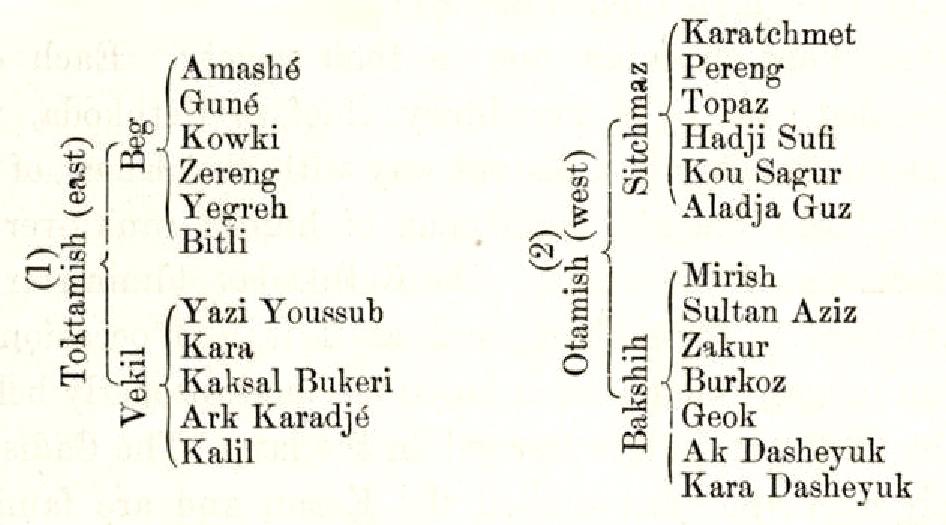
Other Turcomans bordering upon the Merv territory are classed as follows by the Merv Tekkés:—
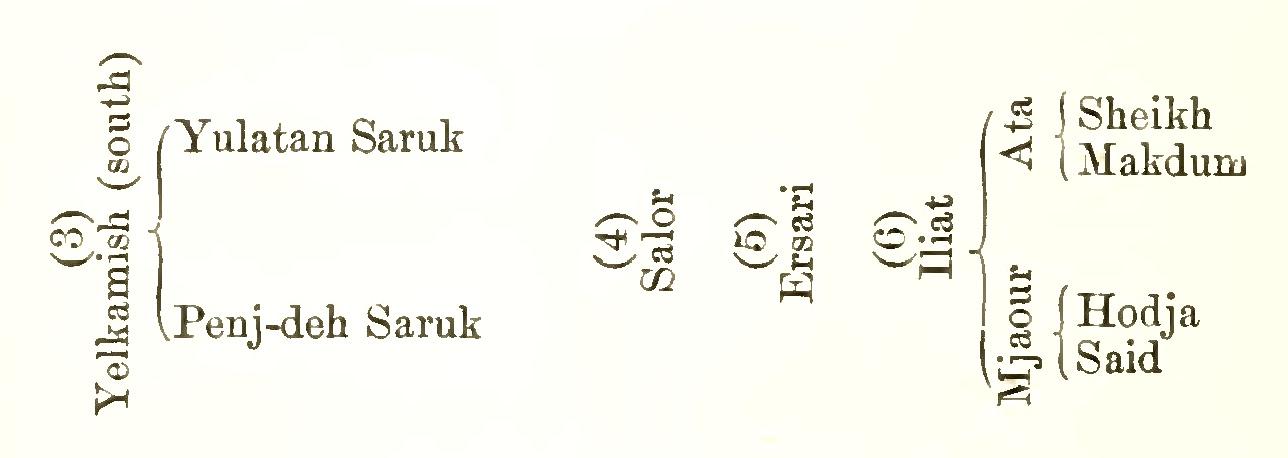
These names may have some philological value, so I have taken pains to ascertain them as accurately as possible. In Merv itself the distinction between the clans is kept up with the utmost formality. Personally I never could discover the difference between them, but the Turcomans had no difficulty in telling to what clan a man belonged at first sight. On asking once how the distinction was marked—for to my eye there was nothing in the dress, like the Highland tartan colours, to distinguish the wearers—a native pointed out that a peculiar way of knotting the sash and wearing the hat always indicated a member of the Sultan Aziz clan, a peculiar tie of the sword belt one of the Burkoz, and other minute points of dress the members of the other clans. My eye could never be sufficiently trained to tell a man’s clan at first sight by the cock of his hat, or the tie of his sash; but my Turcoman friends never erred in the matter, which is a somewhat important one in their society. Each clan is presided over by a hereditary chief, or Kethkoda, who claims relationship in a distant way with the Khan of the tribe. There are also Kethkodas of higher rank over the subdivisions of the tribes. The Kethkodas administer the government of their clans, such as it is, and occasionally act as judges, though such functions more properly belong to the Cadis, or judges learned in the law. The Cadis are simply men who have studied the Koran and are familiar with its legal precepts. The Khans or Kethkodas appoint them judges, and the more intricate questions, especially those relating to the caravans and trade, are generally submitted to them, while the chiefs try such cases as can be decided without any profound legal knowledge. On bazaar days the Khan in person usually administers justice in public, and often inflicts summary punishment with his stick. For neglect of public duties, for instance, such as not working due time on the fortifications, fines are imposed, and if the offender cannot pay, his hat is taken off, his hands bound to his sides, and he is exposed in this condition to the sun for an hour or two. Thieves are tied to a stake and their heads similarly exposed. Occasionally the punishments are much heavier, and are inflicted without respect of persons. Thus, shortly after my arrival, a son of Kadjar Khan was sentenced by his father to be tied to a stake for fortyeight hours for aiding the escape of a prisoner, a Circassian officer in the Russian service. The penalty of the bastinado, so common in Persia, is unknown in Merv. Quarrels between individuals are rare, and are seldom brought before either Khan or Cadi, being settled by a blow or a stab on the spot. Even in cases of murder no steps are taken to punish the assassin, except on the demand of the wife or nearest male relative of the murdered man.
The Kethkodas are usually wealthy in flocks, and indeed require to be so, as they receive no contributions from their clansmen. Strangers are usually entertained by the Kethkoda, who expects, however, in return, a present of at least double the worth of his food, usually curdled camel’s milk, mutton fat, and griddled bread, if the visitor be at all well off. I must admit, however, that mendicants who are unable to pay are equally well received, but for others the Turcoman hospitality is decidedly venal. The twenty- four Kethkodas presided over by the two Khans, and assisted by a number of the Ak-Saghal, or grey-beards of the clans, men of position and experience, who are called by a sort of public opinion, constitute the medjlis, or great council of the nation. This body is convoked to decide on grave questions of national policy, such as that of taking measures to resist the Russians at the time of my arrival. The question what to do with myself was also submitted to the great council. The Khans and the four Kethkodas of the great sub-divisions of the tribes constitute the executive of the government, and hold privy councils for their own guidance, to which the public are not admitted. Àt the great council everything is conducted in genuine Homeric style, without any attempt at privacy.
The title of Khan is given, as a matter of courtesy, to many of the descendants of former Khans who possess no power in the state. The Kethkodas are not addressed by that title, however. The personal title of ‘Serdar’ is also given to certain men, Kethkodas, and simple clansmen who have shown considerable military skill in the field. The title is purely honorary, and the incessant raids, in which the people of Merv, like their brethren, the Akhal Tekkés, were constantly engaged, gave plenty of opportunities to adventurous spirits for winning their spurs as Serdars. A man who had won renown as a brave warrior only, without pretensions to skill as a commander, was styled a bahadur, or as it is pronounced in Jagatai, bâtur. The Serdars formed a class somewhat like officers en disponibilité in Europe, from which the council could select commanders in case of war. If the Khan wTas competent he would naturally command the national forces in virtue of his office, but should he be from age or other causes incapable of acting as general, a temporary military chief would be chosen by the council from the Serdars. If the Khan’s incapacity should be very marked, he would even be deposed on such an occasion from the Khanate, and his nearest competent relative elected. A similar custom prevails among the other branches of the Turcomans, as well as in Merv. Thus, during the war between Russia and the Akhal Tekkés, the hereditary Khan, Makdum Kuli, had nominal command of the forces, but the active operations outside the walls of Geok Tepe were conducted by Tokmé Serdar, who possessed no hereditary rank, but was chosen general in virtue of his known military skill. His position with reference to Makdum Kuli Khan was much the same as General Moltke’s in relation to the Emperor William in the Franco-Prussian war. Subsequently to the fall of Geok Tepé, Tokmé Serdar made his submission to the Russians, and went to St. Petersburg to lay his sword at the feet of the Czar. Permanent fidelity to any cause, even a national one, is a very rare quality indeed among the Turcomans, and I was little surprised at the news of the Serdar’s defection from the ranks of his countrymen. Makdum Kuli Khan, however, seemed to feel his conduct keenly, and, while praising highly the abilities of his former lieutenant, he expressed deep regret that he should have disgraced his fame by swearing allegiance to the Ak-Padishah, White Czar.
In time of war every able-bodied man is called out for service, either in the field or on the fortifications, by the council. As the whole population is trained to arms there is no difficulty in raising a large force, but there are no officers except the fighting general or the Kethkodas, and no gradations of military rank. This want of organisation is fatal to the efficiency of the Merv forces in anything like a prolonged campaign, especially against European troops. The lack of officers is partly compensated by the individual training of the men in military exercises and the use of arms. Behind their fortifications they can fight desperately, and as skirmishers on the flanks of a line of march their activity and personal daring make them formidable enemies, but they are wholly incapable of carrying out the complicated operations of a regular campaign. They can harass and impede an enemy’s plan of action, but they cannot devise, or at least carry out, one of their own. The only thing like a standing army in Merv when I arrived there was a sort of police force of a thousand horsemen, under the command of two officers, styled the Yassaoul-bashis. To them was entrusted the execution of the orders of the council, and also the duty of providing escorts for the caravans coming to Merv from Bokhara and Meshed.
Taxes and a public treasury were institutions unknown in Merv at the period of my visit. The traders in the bazaar used to assess themselves to pay for the needful repairs of the market-place and the roads and bridges adjoining the oasis. These bridges are merely tree trunks thrown across the streams and covered with earth and reeds. A small tax was levied on the Jews who used the stalls, and applied to the same purposes. The police expenses were paid by a tax of twenty-five krans on each camel load, and ten on each horse or mule load of merchandise passing through the territory of Merv. Otherwise there were no public burthens at the time of my visit, beyond the compulsory service in time of war, and the corvées for their fortifications. The chiefs lived on their private property without any contributions from their clansmen. Indeed, fixed contributions of any kind seem altogether foreign to Turcoman notions. Even when other tribes were held in absolute subjection, as the Salors were by Merv, no tribute was exacted from them. They were held to obey the orders of the council with regard to their movements, but no impost was levied on them.
With regard to the police force, an important change in its numbers and duties was made subsequently to my arrival, and mainly in consequence of my representations to the council, and, in private interviews, to the Khans. Its numbers were increased to two thousand, who were ordered to hold themselves in constant readiness at the orders of the Yassaoul-bashis, Yaghmour Khan and Ana Murad Kafur. Yaghmour Khan was one of the few honest men in the place; and, though descended from a family of ancient distinction, was quite poor. He was continued in command of one of the new bodies of y as saouls, or police. The etymology of this word is characteristic. ‘Yass’ is the verb ‘beat,’ and ‘aoul’ means a village. So that policeman, in Jagatai, means literally ‘Beat the village.’ The duties of the new force, however, were not intended to be of the aggressive character implied by their Turcoman name. I had represented so forcibly to the council the necessity of suppressing private raids, that orders were issued against the time-honoured practice, and the yassaouls were to hold themselves in readiness to enforce those orders in case of any violation being attempted. The manner in which the force was raised was somewhat strange to Western ideas. Two thousand men were named by the Khans, and ordered to move their houses and families to a place between the loop of the river and the new fortress. House moving in Merv, though it must be understood in a literal sense, is not such a formidable undertaking as a flitting in Europe. The aladjaks are dismounted, and packed with all their contents on camels’ backs in the course of an hour, being set up again on their new sites in the same time. A couple of camels are sufficient to convey the lares and penates of a Turcoman, with the house itself included. There was no delay in obeying the Khan’s orders, and the ‘new police’ town sprang up as if by magic under the walls of the fortress. Every member of it was ordered to keep his house and himself in readiness to start on duty at a moment’s notice, when summoned by the Yassaoul-bashi. These calls were pretty frequent from the first, and were obeyed with the utmost promptitude, whether by day or night. The voice of the public crier had no sooner announced the orders of the chief than the men were up and in the saddle, armed from head to foot, and ready to start in any direction in pursuit of the violators of the public peace. To insure their efficiency, public inspections were held by the Yassaoul-bashi every month, and any man who had no horse was fined fifteen krans. Three were so fined at the first inspection, but subsequently the necessity of keeping themselves provided with horses or quitting the force seemed to be understood well enough. The police received pay, the tax on the caravans being appropriated to that purpose, and a small sum was also exacted from the owners of stolen
property, when recovered by the exertions of the police. Plundering expeditions, being of every-day occurrence, proved a fruitful source of income to the yassaouls, and brought home to their minds at least the advantages of acting in the name of law and order. Public opinion, however, was by no means so unanimous on the subject, as raiding and raiders were time-honoured institutions in Merv, and the sympathies of the populace with the bold plunderers were not diminished in the least by the admitted expediency of putting a stop to their pursuits. Even Baba Khan, the senior chief of Merv, was by no means inclined to look with a severe eye on raids. I suggested that raiders should be made to pay the fines, but the idea was not apparently relished by anybody. The yassaouls preferred rather to have their pay secured by the booty itself than to take the chance of getting it out of plunderers who might be hard to catch.
In justice to the people of Merv it must not be forgotten that raids, even among members of the same tribe, are not, or were not until lately, looked upon in the light of robbery. It is not supposed they are altogether legitimate, but still, if they are executed with ability, admiration for the ‘smartness’ displayed quite overpowers any moral reprobation that may be felt for the act. In other matters the Tekkés are not altogether devoid of notions of honesty. Petty stealing is very rare among the grown men, and even wild marauders will readily bow to the decision of a Cadi on a legal question of their rights. The instinctive feeling of the necessity of some sort of law is very marked among these nomads, though in certain points of conduct they do not see the need of its application, as in this matter of raiding on their neighbours’ flocks. When we remember the authorisation of thefts by the old Spartan laws, and even the practices on the English and Scottish borders less than three centuries ago, we should not judge too harshly of the raiding propensities of the Tekkés.
A marked feature of the Tekké character is the unwillingness to reside in towns. The present settlements in Merv are only villages of aladjaks, and even the strong defensive position of the former town of the Saruks, Porsa Kala, was not sufficient inducement to make the newcomers take up their abode there. They made an encampment or village within a short distance of its walls, and close to the dam of the Murgab, but this place, Benti, contains only about seven hundred houses. Other villages are scattered about in the spaces between the irrigating canals, but none has any pretensions to be the successor of ancient Merv, the Queen of the World, as the city was styled in its palmy days. Porsa Kala itself was more of a city than any of the Tekké settlements, and probably contained ten or twelve thousand inhabitants. Some writers seem to speak of it vaguely, as if it were still the capital, so little are the changes of position among the Turcoman tribes known in Europe. A short sketch of recent history may serve to remove this ambiguity —
The present inhabitants of Merv are comparatively recent immigrants, and indeed the whole Turcoman population of these countries has been only a short time in its present seats. I endeavoured during my stay in Merv to collect all the information I could on the history of these nomads, which is naturally very obscure, owing to the unsettled nature of their lives. One tribe succeeds another easily among the nomads, and the population of a district is often completely changed in the course of a few years; and as there is no written history of these movements, it is only by the utmost diligence in cross-examining the most intelligent natives and then comparing their statements carefully that anything like an accurate notion of them can be formed. Like most uncivilised nations, the Turcomans can lay but little claim to accuracy in their stories of past events, and chronological exactness they pay scarcely any attention to. However, I had frequent opportunities of consulting the most intelligent elders of Merv, many of whom had taken an active part in the events of the last half-century, and remembered them vividly, while they also recollected clearly the traditions of older movements that had been handed down by their fathers. From all that I could learn thus, it appears that the country now occupied by the Merv and Akhal Tekkés was peopled a hundred and fifty years ago by a settled Turkish population of the same race as the present inhabitants of Bokhara. The name Turcoman is confined to the nomads, as distinct from the settled branches of the same race, who are styled Turks distinctively, in Central Asia. When used here the latter name is not to be confounded with the Osmanli Turks of Stamboul, who parted from the parent stock several hundred years ago, and have been since separated from their kinsmen in Central Asia by the interposition of Persia. During the reign of Nadir Shah, who was himself of pure Turcoman blood, the whole of Turkestan as far as Bokhara and Khiva acknowledged his sovereignty. The then Turkish population of Merv merely acknowledged his suzerainty by a tribute analogous to some of the old feudal tenures in Europe, I believe by the present of a nut or some fruit on stated occasions. On the death of Nadir, the Persian monarchy rapidly decayed. Afghanistan fell away, and the nomad Turcomans of Khiva poured into Persian Turkestan on the north-east, while Bokhara attacked it from another quarter. About a hundred and thirty years ago, the Tekkés, the Saruk and the Salor Turcomans, commenced their invasion. The Akhal Tekkés then got possession of the territory which they still occupy, though not with its exact present boundaries. In fact the war with Persia has been practically continuous since, as has been pointed out in former chapters, and it is only within the last seventy years that Askabad was taken by the Akhal Tekkés. Still, whatever variations the Persian boundaries may have undergone, the Akhal Tekkés have remained pretty steadily in the territory they seized on after Nadir Shah’s death, and which has now passed under Russian sway with its inhabitants. Their brethren, the present inhabitants of Merv, had a more chequered history. While the Akhal Tekkés were establishing themselves along the northeastern slopes of the Kopet Dagh mountains, the former settled around the great swamps in which the Tejend is lost. The abundance of water no doubt made this appear at first a most desirable territory, but the unhealthy nature of the soil proved a serious drawback. Then the waters did not rise as usual, and for three years in succession there were severe droughts. The Tekkés consequently determined to abandon their abodes by the Tejend swamps, and about the year 1834 they moved into the Persian territory at Sarakhs. They held possession of Sarakhs and the adjoining territory, nearly as far south as Seistan, for about twenty-one years, or until shortly after the accession of the present Shah of Persia.
While the Tekkés were occupying the western part of Turkestan, other nomad tribes were pouring into the east of their settlements. These were the Ersari, who settled and remained along the banks of the Oxus at and about Charjui, pronounced Charjow, and the Salors and Saruks, who pushed on to the Murgab. After their arrival there, Merv itself was destroyed, and its Turkish inhabitants almost exterminated by the power of Bokhara. The Bokharan conqueror, Begge Jan, captured the then city of Merv, being the third historic city that had existed under the name, after a prolonged resistance, and utterly destroyed it. Seven hundred thousand persons are said to have perished during the siege and subsequent slaughter, and though the numbers are doubtless exaggerated somewhat, it is evident from the ruins that remain that a dense population must then have occupied the oasis, and have been utterly swept away. The Bokharans did not occupy the conquered country, and the Salor and Saruk Turcomans found no resistance there when they moved their aladjaks close to the ruins of Merv. The fall of Merv took place nearly a century ago, and from that time until the advent of the present Shah to the throne of Persia the Salors and Saruks remained in undisturbed possession of its territory. About twenty-six years ago, however, a general movement took place among the Turcoman tribes. The Persians attacked the Turcoman possessors of Sarakhs, and, after a vigorous campaign, compelled them to abandon their settlements. Seventy thousand houses are said to have been destroyed in this campaign. The dispossessed tribe in turn attacked their kindred tribe, the Saruks, and after several combats drove them out of Merv to positions further south on the Murgab, which they still occupy, at Yulatan and Penj-deh, higher up the river.
The Tekkés were not left long in undisputed possession of the Merv oasis. The Persians, flushed with the success of their campaign against the Turcomans of Sarakhs, believed that they could easily follow them to their new abodes, and bring Merv itself again under their sway. The Saruks, who had been expelled from their settlements by the Tekkés, made common cause with the Persians, and three years after the Tekké occupation of Merv the present Shah attempted the conquest of the oasis. But the fortune of war had changed. The Tekkés defended their new settlement with a vigour which appalled the Persians, who expected an easy victory from their artillery over an enemy whom they had already driven from their own frontiers. Kouchid Khan managed the campaign against the Shah and his Turcoman allies with consummate energy. After a three months’ harassing warfare in the desert, the allied army advanced close to Merv, but only to be totally routed in a pitched battle there. The entire Persian train of thirty-six pieces of artillery fell into the hands of the nomads, and the routed army fled in utter confusion to Meshed. For weeks the victorious nomads were engaged in gathering the arms and other spoils thrown away by the flying troops of the Shah, and the captured Persian guns still ornament the ramparts of Merv. A number of officers of high rank were made prisoners, and had to be ransomed afterwards at enormous prices. Some of the ransoms were as high as six or seven thousand pounds. Others were left to die in captivity for want of means to meet the extortionate demands of their captors. I met one of the prisoners, a colonel of artillery, during my stay in Merv. His captivity had lasted twenty-two years, and his beard was white as snow, though when captured he told me he was quite a young man. As I spoke with him I could not help feeling a nervous apprehension of what might be my own fate among the avaricious nomads, in whose power I was so absolutely. The poor captive complained bitterly of the neglect with which he had been treated by his wife and family, who, he said, were living on his property in luxury, and letting him drag out his life in captivity. Up to the time of my departure he had not been released.
Since the disastrous issue of Nasr Eddin Shah’s campaign, the Persians have made no open attempt on the independence of Merv. Both officers and soldiers have too vivid a recollection of the horrors of the defeat to have any stomach for another trial of strength with the fierce nomads. The Saruks of Penj-deh still continue inveterate in their hostility to the present inhabitants of Merv, but they are unable to gratify their feelings in any more effectual way than by plundering raids, which the Merv Tekkés are not slow in reciprocating.[5] Those of the Saruks who inhabit the districts nearest to Merv, which are irrigated by the canals from the Bent-i-Yolatun, have partially given up their enmity towards their neighbours; but the clans higher up the river, towards the Afghan frontier# are still irreconcilable with their foes. The Salors, whose settlements lie between the Saruks and Merv, have submitted absolutely to the latter, and are treated by the Khans as subjects. During my stay, a Persian envoy endeavoured to persuade them, by promises of pay and protection, to migrate to Sarakhs in a body, but this attempted movement was summarily put a stop to by the orders of the Merv Khans. The Yassaoul-bashis were sent out in hot haste to arrest the chiefs, and, although no order had been previously issued against their moving anywhere, there was a strong inclination at first to put them all to death. When finally they were released, it was only with strict orders not to attempt to quit the territory of Merv. These Salors, however, are but a small part of the Salor tribe, which is scattered all over Turkestan. Some of them are found among the Saruks close to Herat, and a still larger number among the Er sari. The Salors in Merv only number seven hundred families, and are associated with the Otamish tribe of Tekkés.
As for the Ersari Turcomans, their long separation from the other Tekkés has well-nigh obliterated any feeling about their common origin. They depend rather on Bokhara, and frequently cross the desert to raid on the Merv Tekkés. In numbers they are by no means equal to the latter. A well-informed Turcoman, who had been much among them, estimated their numbers at seventy thousand.
I have endeavoured to give the history of the Tekkés, as I learned it from the older men among the tribes, but I do not pretend to vouch for its accuracy. In the absence of better evidence, it may be of some use in throwing light upon the vicissitudes of the tribes now inhabiting the almost terra incognita of Central Asia.
Chapter XL: The Dam at Benti.
Water system of Merv—Tomb of Kouchid Khan—Kala and Killissi—Mid-day halt—Salutations—Holding the stirrup—Mid-day meal and siesta—Grace —Murad Bey’s village—Porsa Kala—Benti—Hydraulic works—Computation of time—A shaky bridge—Diligent workmen.
The water system of Merv is the key to the entire territory. It has its origin at the great dam of Benti, some twenty- five miles to the south-eastward of Kouchid Khan Kala. Without this dam the present cultivated area would be reduced to a condition as bleak and arid as that of the plains which surround it. Owing to the extreme flatness of the plain, the manner in which the water channels are concealed by the growing crops, and the accidents of the ground, slight as they are, it is impossible, even from the commanding heights of the ramparts, to form any idea of the direction in which these water-courses flow. I was extremely anxious to pay a visit to the starting-point of the irrigation canals, and to visit the old Saruk fortress, which, prior to the coming of the Tekkés, constituted the central stronghold of Merv, and protected the water-works. My wish was soon gratified. I had noticed a tendency on the part of the Khans—both the hereditary governors of the Toktamish and Otamish, and Kadjar Khan the Ichthyar— to make friendly advances to me, for every day that I remained among the Merv Turcomans the conviction seemed to grow upon them that I was their friend, and could be trusted to travel about in their territory. I had repeatedly expressed my desire to visit the old Saruk stronghold, and as the Turcomans are themselves rather curious in the matter of ancient buildings, they seemed thoroughly to appreciate my wish, and I was told one evening that on the following morning Baba Khan would show me the works.
A little after daybreak on May 2 I found an escort of fifty or sixty horsemen drawn up before my door.; Baba Khan, in riding costume, came in to say that he was ready to go with me. We consumed several bowls of green tea together, and, as usual, chatted a good deal about Frangistan, its peoples, manners, and customs. Towards eight o’clock we mounted, and started on our journey. We crossed the space within the ramparts, and issued from the north-eastern gate, making a wide détour to the northward, along a slightly elevated fold of ground, to avoid the cultivated expanse to the east, which at this season was so very flooded by excessive irrigation, determined to that particular district by the formation of the surface, as to render crossing it a disagreeable matter.
Four or five miles to the north of the Kala, after traversing a considerable number of villages surrounded by luxuriant groves of various fruit trees, we passed, on our left, an extensive sepulchral monument standing alone in the plain. It was the tomb of Kouchid Khan, the last great ruler and autocrat of Merv—a kind of rude mausoleum, ten or twelve feet in height, surrounded by an embattled wall. Some pomegranate trees grew within the enclosure. My companions halted, and, turning their horses’ heads towards the tomb, inclined over their saddle-bows and prayed for a few moments. This was a tribute to the greatness of the departed. Then we turned to the east, and reached an extensive village called Baba Kalassi. In regard to this name, I would call attention to an error into which some persons have fallen, owing to the resemblance between the Turkish form of the genitive case of the word Kala and that which is applied to the numerous Christian ecclesiastical remains which dot Armenia. Baba Kalassi means ‘the fort of the father;’ Killissi, an obvious corruption of the word ecclesia, signifies a church. Neither the Turks nor the Turcomans invariably use the genitive form when making use of this word kala in conjunction with another, as, for example, in the name Kouchid Khan Kala. Properly speaking it should be Kouchid Khan Kalassi. There seems to be no definite rule by which the use of one form or the other is regulated. When travelling through Armenia I came upon two villages in close proximity, one of which was termed Kara Kala, or ‘the black fort,’ and the other Kara Killissi, which means ‘the black church.’ At the latter place were extensive remains in stone of ecclesiastical buildings which conclusively indicated that ‘church,’ or ‘monastery,’ was conveyed by the appellation. During my wanderings over the Merv oasis I never came upon any structure which could possibly have been a Christian church.
At Baba Kalassi we dismounted, for the sun was becoming exceedingly hot. The elders of the village advanced to meet us, holding our stirrups as we dismounted, and uttering the stereotyped phrases of welcome—Khosh Geldi (You are welcome), Safa Geldi (You are the bringer of good fortune). This holding of the stirrup is not the mere token of respect which one would be likely to suppose. For me, at least, it was an absolute necessity. Easterns do not generally tighten the girths of the saddle, lest, as they believe, it might interfere with the lung action of the horse. Consequently, when the weight of the body is thrown upon the left foot in dismounting, the saddle is apt to turn under the animal’s belly, and the rider to receive an ugly toss. In this ceremony of reception the right stirrup is tightly grasped by the host, so as to prevent such an accident. This service is usually performed by one’s attendant; when it is performed by one’s host, it is a polite method of expressing that he is at your service.
I have often wondered at this looseness of the saddle- girth among a people whose lives are largely passed on horseback, and who are frequently obliged to mount and dismount rapidly. The Turcomans have a knack of getting into and out of the saddle, notwithstanding its slackness, by throwing their whole weight upon the neck of the horse by means of the left hand; but I could never manage it.
Before we were allowed to stir from the sides of our horses the indispensable water-pipe was presented to us, after the usual indulgence in which we were led into the interior of the village, several men armed with long sticks laying about them furiously at the dogs, who, according to their wont, rushed savagely at us. In each village of any extent there is generally a house, belonging to the chief, but not habitually used, set apart for the reception of visitors of distinction. That to which we were conducted was an ev of more than ordinary dimensions. It was comfortably carpeted, and the walls were hung round with embroidered camel-bags, and adorned with sabres and muskets. Special carpets, of small size, were immediately laid for Baba Khan and myself close to the lattice walls, from which the felt covering had been temporarily stripped in order to admit a current of air. The carpets were laid as remote from the door as possible, that being the position of honour in an Eastern dwelling. In a kneeling posture, and sitting upon our heels, we uttered the muttered compliments, lasting for more than a minute, which are the invariable prelude to talking about the matter in hand. I was the chief object of attraction. The Khan, having taken upon himself the responsibility of showing me round, seemed also to feel the necessity of maintaining the genuineness of my character as much as possible. He told our hosts that I was a sahib from Frangistan, who had travelled much, and who had been driven by the Russians to take refuge among the Merv Turcomans. Of course there was a considerable spice of diplomacy in this statement. As far as it went it was in one sense true enough, and on the whole I did not think it necessary or advisable to contradict it.
A quarter of an hour after our arrival large circular wooden dishes of gattuk, or coagulated and slightly sour milk, were laid before us. In each dish was a coarsely carved wooden ladle, with a handle eighteen inches long. A rather dirty-looking piece of coarse cotton stuff was unrolled, disclosing three or four cakes of smoking bread, twenty inches in diameter and an inch and a half thick. On these viands we regaled ourselves with as good an appetite as we could muster, for Turcoman good behaviour requires that when food is laid before a guest he should simulate, even if he do not possess, a voracious appetite. Turcomans, as a rule, need no dissimulation in this regard, for I have seldom met with one who at any given moment was not capable of swallowing food of any kind to an extent which would surprise dwellers in Western towns.
Our repast finished, we all said grace. Turcomans never by any chance, whether at home or in the desert, neglect this ceremony. Holding our joined hands before us, in the fashion of an open book, we prayed in muttered tones. What the terms of the prayer were I was never able to catch, but I muttered away as well as the best of them. Then, separating our palms, the elbows resting on the hips, we each exclaimed with unction, and in subdued tones, ‘El hamd Lillah’ (Praise be to God). Then we stroked our beards, with the right and left hands alternately, and looked cautiously over our shoulders, right and left, lest Shaitan (the devil) might be lurking nigh us. A deep, heavily-drawn sigh, by way of expressing the stomachic oppression which we experienced from the completeness of our meal, and eructations, natural or forced, were polite and indispensable recognitions of our host’s hospitality. To refuse to eat a considerable quantity of the food set before you would be an unpardonable offence. To do the reverse is to exhibit a good feeling, which raises you in the estimation of your entertainer.
I remember that when upon one occasion I had ridden a long distance since the early morning, and was worn with fatigue and hunger, halting with my companions at a village, dishes of newly-made gattuk were laid before us— a preparation which, when fresh, is really delicious. It needed no adventitious politeness to make me devour it, and I emptied my huge dish of coagulated milk in a manner which charmed my host. Another was set before me, which I devoured with equal zest. I had even surpassed my companions in voracity, and from time to time I observed my grey-bearded entertainer turn to the assemblage, and, with a look of genuine pleasure lighting his countenance, say, alluding to me, ‘He is a good man; he is an excellent man.’ Occasionally, a few hours after gorging in this manner, I have been compelled by circumstances to set to again, and, in following the dictates of Central Asian politeness, have rendered myself incapable of mounting my horse for the next twelve hours.
After this eating match, bolsters, six feet long and two in diameter, were brought forth. The general audience retired, and myself, the Khan, and a few chosen associates lay down to take our siesta. This is an established institution in Merv, even on the war path, unless immediately pressing circumstances supervene. It was delicious thus to shelter from the sultry blaze outside, gently fanned by a comparatively cool breeze which swept across the flooded fields, and to sink into forgetfulness. We remounted at three in the afternoon, and bent our steps in a southeasterly direction, more or less parallel to the water-course which irrigates the interior of Kouchid Khan Kala. Towards five o’clock we struck the main eastern branch of the Murgab, passing to the right of two ancient mounds of considerable size, entirely bare of vegetation, and staring yellowly in the sun-blaze. We meandered a good deal among irrigation canals, and ultimately turned our horses’ heads due south, along the main eastern canal, arriving at a rude bridge of poles covered with brushwood and packed earth. At this point the canal was nearly twenty feet wide, and the current flowed rapidly. Five hundred yards eastward was a village of the Beg sub-division of the Toktamish, under the jurisdiction of Murad Bey, the maternal uncle of Makdum Kuli Khan. Here we halted for the evening, though we might well have gained our destination before the darkness set in; but Baba Khan seemed to delight in halting, and thoroughly to enjoy the eager hospitality pressed upon us. Murad Bey was one of the most respectable Turcomans with whom I came in contact. He was free from that grasping covetousness which is an unfortunate characteristic of the large majority of his compatriots. While he entertained us with the most lavish generosity, he firmly, though courteously, refused the halfdozen pieces of silver which I offered him. He was, as I afterwards discovered, one of the richest men of the community. At daybreak we were off again, Murad Bey, his son, and a troop of horsemen accompanying us to the bridge.
The title ‘Bey’ indicated the rank of this chief, which was a high one, and next to that of ‘Khan.’ In many cases the same word, differently spelled and pronounced, is applied to the most ordinary individuals. Dour di Beg, my old host of Gumush Tepé, for instance, had no pretensions to rank of any kind, and in his case the ‘Beg’ had as little significance as ‘esquire,’ when attached out of courtesy to the name of some inconsiderable person at home.
We recrossed the bridge, and pursued our way southward along the western bank of the canal. As we progressed, the banks became steeper, until, at length, the water lay far below us. The ground which we were traversing was so elevated above the water-flow that irrigation was impossible. It was arid and barren. Thistle and dandelion, with other and similar herbs, grew sparsely over its surface, which was staring white. To our right was a long embattled line, with many a bastion square and round. This was Borsa Kala, where erst the Saruks held their own, having placed their great military centre close to the dam— the heart of the country.
Baba Khan was in too great a hurry for his breakfast to permit me to examine the old position just then, and we rode on a little farther to the south, to the dam itself. As we neared it, the ground became still more arid than before, rising steeply. The traveller approaching Benti would imagine that he drew near some extensively fortified position. There were bare earth surfaces, heaped wildly here and there, groups of men crowning their crests. Away to the right, half seen among the undulations of the acci- dented ground, were some hundreds of evs. I was in rather an ill humour as we drew near this spot, for the superior officers of our numerous escort were continually urging me to the front. I was not then sufficiently accustomed to Tekké manners to know whether they meant me to keep abreast of the Khan, that being the position of honour. I was rather under the impression that they did not wish me to stay behind, lest I might disappear, and make my way to the Persian frontier.
When within four hundred yards of the dam, the Khan halted, to allow me to come up with him. He said, ‘This is the point upon which all Merv depends.’ The words sprang to my lips—I could not repress them, for I felt exceedingly annoyed, out of temper, hot, and thirsty. ‘If this be your vital point, why have you pitched your fortifications twenty-five miles away from it?’ I admit that this was impolitic, inasmuch as it exposed the senior Khan before his followers. He said nothing, but his solitary eye glowed brighter.
We rode on abreast. A subdued roar of waters, growing louder as we advanced, struck my ears. In ten minutes we were upon a bare ridge of newly turned earth. Around us were a number of sun-shelters, a couple of stakes in the earth supporting a cross pole, from which depended a rude mat of plaited rush. The sun was fiery hot. Tn the scant shade crouched dozens of men, bronzed to the tint of Moors. As the cavalcade drew nigh they rose to their feet with a respectful air—at least a hundred of them. To the south-east was a stretch of ground, grown with waving reeds, across which flowed the broad, level expanse of the upper Murgab. It was the first time I had an opportunity of seeing the main stream which gives fertility to the oasis. As far as eye could reach in the same direction stretched a wild jungle—;jengal, as the inhabitants called it. As we dismounted, our stirrups were held in the fashion of the country. Notwithstanding my colossal sheepskin hat, which warded off the sun’s rays, I was glad to throw myself upon the proffered carpet, in the scanty rim of shade which the sun-shelters afforded. Green tea was served. The bronzed workers stood by with folded arms, waiting for the Khan to tell them to be seated. Then they sat down with the stoical repression of curiosity characteristic of North American savages. They refrained from asking about me, though news of me had already reached their ears. They waited till the Khan should condescend to inform them. Presently he said, ‘This is the Ferenghi who has come to Merv, and I have brought him here to show him how we cultivate our grounds.’ They looked pleased that some one from a far-off land should take an interest in their labours.
We reposed for an hour, and then Baba Khan proposed a visit to the dam. A broad stretch of calm waters, eighty yards wide, lay in a south-easterly direction. Along its banks were thickets and reeds, and right and left were sedgy plains. Just at the point at which the dam was placed the river expanse was suddenly constricted. For twenty yards on either side the river bank above the dam was revetted with stout fascines of giant reeds, solidly lashed to stakes planted in the bank to prevent the friction of the current, as it neared the dam, from washing away the earth surface. Huge masses of earthwork closed the narrow gorge by which the stream found exit to the lower level by a passage scarce ten feet wide. The waters rushed thunderingly through this narrow gap to a level eight feet below their upper surface. The passage was some fifty yards in length, and, like its approaches, was lined with reed fascines.
The object of this dam was to enable lateral canals to be thrown off, which would water the high lands above the level of the main stream northward of this point. The rush of water was tremendous, and nothing but the most assiduous care could prevent the narrow outlet from being widened to an extent which would have brought the water level with the lower reaches. The administration of this point calls for the best executive ability on the part of the Turcomans. The call was well responded to, and I could not help thinking that other and equally urgent calls would meet with similarly willing and capable responses. It is one of the chief duties of the Ichthyar Khan to see that this dam at Benti is kept in working order, for on it depends the sustenance of the entire Mervli nation. Absolute powers, in this respect, rest in the hands of the executive magistrate—at the moment Kadjar Khan. One hundred men are incessantly employed in care of the dam and its sluice, and their best energies are continually exerted in replacing the fascines washed away by the heavy rush of the torrent. As I stood on the summit of the earthwork two dozen men, waist deep, were lashing new fascines into their places, while others were ramming earth behind them. It was a scene of activity refreshing to a European mind after the pastoral calm of the districts which I had left. Europeans are apt to think that the normal state of existence of an Oriental is one of sleepy calm—a milder opium dream, in which he hopes of things which he cannot achieve. But anyone standing as I did that day beside the roaring sluice of the Murgab, observing the efforts of the sun-browned men doing their duty willingly and well, would appreciate what these Easterns would be capable of under happier auspices. As I have said, it required incessant care to prevent the sluice from becoming unduly widened; and night and day relays were at their posts. Baba Khan stood by my side as I looked on, and his one dark eye was often turned upon me with exultation as he saw how I appreciated the labours of his compatriots. Then we rode higher up, and he pointed out to me the place where his father, Kouchid Khan, had established the new dam when the Saruks were driven away. There was a vast chasm in the white marly earth to our left, where water still trickled through, and where the huge bulrushes grew luxuriantly; where water-fowl settled in screaming flocks, and the otter plunged ceaselessly. A wider extension of the cultivated tract required the movement of the dam to a higher level, and to effect this alteration had been the work of Baba Khan, who took as much pride in showing me the existing structure as a father might in exhibiting his first-born to a friend.
I had taken several magnetic bearings during my journey from Kouchid Khan Kala, by glancing furtively at a small prismatic compass, the gift of Colonel C. E. Stewart when parting with me at Muhammedabad—an instrument for which I cannot too much thank that gallant gentleman, for it has rendered me invaluable services. He had used it himself in the neighbourhood of Muhammedabad. The people of that locality only supposed that he was anxious about the time of day, just as the Turcomans on the banks of the Murgab did when I held it in the palm of my hand in order to gauge the angles at which the various tepés and other landmarks bore away from us. Without the aid of this little compass I should have been lost; for the more ponderous instrument with guillotine sight and folding prism could not be produced with impunity amidst a suspicious population like that among which I lived. As it was, they imagined that I was concerned about the hour, and on being questioned on the subject, I volunteered the information that a Eerenghi was required to pray much offener than a Mussulman, and that he could not possibly allow the proper hour to pass without committing a grievous offence against his religion. When they asked me what the hour was, I got out of the difficulty easily; I had only to remind them that my countrymen computed time in a manner different from that of the followers of the Prophet. I pointed to the zenith, and told them that when the sun was there we counted an hour from that and called it ‘one,’ reckoning on twelve hours and then commencing again. These good people, who begin counting at sun-set, and again at sun-rise, dividing the entire cycle into twenty-four hours, were surprised at the absurd and unphilosophical basis upon which we Westerns found our calculations; and I am sure that I fell measurably in their esteem after giving this illustration of occidental obtuseness. ‘But, apparently, you never pray at all,’ said the Khan. I smiled, and answered, ‘I pray always; that is the difference between the Ferenghis and you of the Eastern plains. You snatch a few minutes from your occupations to pray to your Creator, whereas our life is one continued prayer.’
This was a bold statement, but it carried weight with it. I could see that Baba Khan was sorely puzzled as he sat behind me on the rude marl-heap thrown up from the water channels around. He felt that I was doing something which he could not understand; he was chafed and annoyed; but still he had not a palpable ground upon which to attack me. At last he said, ‘I think dinner awaits us.’ Our horses were led up, and we trod the yielding, shifting slopes of the newly-thrown earth. We neared the dam itself, below which thundered the current from the upper surface. Baba Khan’s horse went first, but he curvetted and pranced as his rider forced him towards the shaking pathway that spanned the current. He reared, and nearly threw his rider. He had never crossed the bridge before. I rode a powerful grey animal from the Caucasus, used to the torrents of his native mountains, and he stepped upon the bridge without a moment’s hesitation. It was little if at all over three feet in breadth, and my steed trod mincingly as the brambles and earth gave way beneath his feet. The sounding torrent roared beneath us, and the spray, caught by the passing wind, wetted my face and clothes, short as was the time of passage. When I had crossed, the other horses followed uneasily.
Looking from the centre of the fragile structure which spanned the torrent as it swept from the upper Murgab to the lower waters, one could realise the amount of energy and toil requisite to keep the slopes of the sluice revetted with fascines, and I cannot refrain from again recording my sense of the industry and willingness which marked the exertions of the men employed, and that, too, in a public cause. The narrow, sloping channel, through which the waters thundered, was some ten feet in breadth, and the volume of the higher waters, spread out to eighty yards, and raised to an undue level by the dam, forced their way through this outlet with a power which should be seen to be comprehended. Up to that time I had had a poor idea of Turcoman energy, but I must say that I came away from the dam reproved for my doubts. ‘After all,’ I said to myself, ‘it is absurd to think that the men who followed Zenghis Khan to victory have so utterly changed their nature that no energy remains.’ Under due direction they would be capable of much—for good or for evil.
Chapter XLI: Water System of Merv.
A greasy dinner—Alaska and Novur canals—Turcoman swimming—Karyab and Malyab—Yaghmour Khan—Canal branches—Turbine mills—Porsa Kala—Turcoman dislike to houses—Benti Kazakli and Benti Sultan— Penj-deh—Military considerations—Ague Bashe—A runaway horse— Turcoman customs—Mjaour villages—Distant view of old Merv—Home to Kouchid Khan Kala.
The village of Benti is situated at the angle formed by the main bed of the Murgab and the westerly canal. It is about five hundred yards from the dam, and consists, as I was informed, of about seven hundred huts, though judging from personal observation I should think there were not so many. The houses are grouped close along the bed of the great earth bank formed at the time of the excavation of the canal. Benti differs in no wise from other Turcoman villages. In its immediate vicinity there is no cultivation, and its raison d’etre seems to be that it is a site for the dwellings of those told off to regulate and repair the dam and sluice. Baba Khan and myself dismounted at the door of the Kethkoda’s house, where the afternoon meal awaited us. The usual number of bowls of gattuk were produced. Immediately after these came the pièce de resistance. It was contained in an enormous wooden dish, and consisted of mutton fat, melted down on the previous day. The great heat of the weather prevented it from becoming actually solid, and it was in a pulpy, semicrystalline state, and of a greyish-green colour. These Turcomans invariably keep their meat, before consuming it, as long as the climate will allow them to. In fact, they prefer it when its odour has become what might be styled ‘gamy.’ This dish was placed^ in our midst as we sat, cross-legged, in a circle. Each person dipped in it a morsel of bread, and proceeded to eat. The first mouthful was enough for me. The nauseous taste of the unsalted fat, combined with its abominable odour, made it quite impossible for me to repeat the dose. I had largely partaken of the gattuk, and made pretence of going through all the little pantomimic arts which obtain in the country with a view of showing that I had eaten enough, and more than enough; and though I felt that I was scandalising my host and companions by not dipping further into the dainty dish, I was obliged to run the risk of their displeasure. I withdrew from the circle, and threw myself upon a felt mat, feigning sleep. In an hour I was aroused by Baba Khan, to accompany him on a further inspection of the dam and waterworks. We proceeded to the point where the westerly canal branches from the main bed, just below the dam, and climbed the tall earth bank, from which a tole rably good view of the water-courses was obtainable.
With us was the Kethkoda responsible for the keeping in proper order of the waterworks. He seemed to take great pleasure in pointing out to me the result of his operations, and in explaining the irrigation system of Merv. One hundred yards south of the great dam branched off the two canals which irrigate the territories of the Toktamish and Otamish. We stood upon the earth excavated from the Alasha canal, which at this point flowed almost due westward. From the summit of the bank on which we stood to the level of the water below was nearly fifteen feet, the breadth of the canal at the water level being about the same distance. The sides of the canal stood at an angle of about sixty degrees, the extreme stiffness of soil permitting of this abruptness of slope. At this point the water flowed at a rate of between three and four miles per hour, and was, my informant explained, fully eight feet deep, and consequently entirely un- fordable by man or horse. He also told me that this canal existed at the time of the advent of the Turcomans to Merv, and that it was of great antiquity.
On the eastern side of the river, and directly opposite, flowed, due north, the Novur canal, which irrigates the Merv territory lying to the eastward of the main bed of the Murgab. It was of about the same dimensions as the Alasha canal, but, owing to the lesser height of the earth-banks along its sides, I judged that its depth was not so great, and therefore that the Toktamish territory stood at a higher level than that of their brethren on the western side of the river. South of the dam stretched away, in a straight line to the south-east, the upper waters of the Murgab, which was here about eighty yards across. Owing to the accumulation of waters resulting from the construction of the dam, the surface of the river was but eight or ten feet below the surrounding country. A number of Turcomans were bathing, and, as they constantly tried to find bottom, I could perceive that, except close to the eastern side, the depth must have been at least six feet. Even close under the eastern bank a tall man was barely able to keep his chin above water while standing on the bottom. I remarked that in swimming the Turcomans never adopted the system commonly in vogue among Europeans. Instead of swimming fully abreast, and striking simultaneously with both arms, they kept one shoulder forward, and struck hand over hand.
Bulrushes and sedge grew plentifully along the shore, but, though the eye ranged far along the river bank, no trace of a tree could be seen, or, indeed, of anything larger than the ordinary odjar, or tamarisk bushes, and even these were by no means as large as those I had seen in the midst of the arid plain which I had crossed in coming from the Tejend river to Merv. It may be that they are not allowed time to reach their proper dimensions, but are used up for fire-wood.
The Novur and Alasha canals, the first flowing almost due north, and the latter west, form as nearly as possible a right angle, which is bisected by the main stream of the Murgab after its escape from the sluice, which takes a north-westerly direction for about ten miles beyond Kouchid Khan Kala, then turning to the northward. Fifteen or sixteen miles below the fortress is another dam, at a point called Egri Guzer, where are a series of villages governed by Yaghmour Khan, an important Kethkoda of the Amashé division of the Beg tribe, and who usually resides at Kouchid Khan Kala, where during my stay he acted as Yassaoul-bashi, or chief of the police, of the Toktamish. At the Egri Guzer dam two other canals branch off—the Malyab to the west, the Karyab to the east. At this junction, owing to the exhaustion of the waters for irrigating purposes, the Murgab has diminished to a very inconsiderable thread of stream, and struggles forward eight or nine miles further before it totally disappears. Owing to the limited supply of water, the cultivation is very sparse at this point, and the edge of the Kizil Kum, or red desert, is speedily reached. The Novur canal goes in branches to the east and west, principally in the latter direction.
I have already mentioned the wooden bridge across this canal, which conducted to the village of Murad Bey. Immediately to the south of this bridge branches off the canal which supplies the interior of Kouchid Khan Kala with water. A couple of miles further northward it divides into two, one branch flowing in a north-westerly direction, and passing close by the slopes of a large mound known as Geok Tepe. This hill must not be confounded with that from which the Akhal Tekké stronghold captured by the Russians takes its name. In the Tartar language ‘Geok’ means ‘the colour of the sky,’ an epithet applied to these hills, owing to the cerulean tint which they assume when seen at a distance across the plains. When close at hand, their colour is anything but that of the sky, being a yellowish orange, entirely denuded of all vegetation save a few straggling shrubs. Still further on, this branch of the Novur canal again subdivides, throwing off irrigation trenches in every direction, and ultimately dying out something like ten miles from Geok Tepe, expending its waters in the cultivated ground belonging to a few scattered villages situated on the borders of the desert. The other division of the Novur canal takes a north-easterly direction, watering the territory of the Vekil, a very slender supply indeed struggling as far as the ruins of the old cities of the plain— the ancient Merv. I have already given the names of the various subdivisions of the Turcoman clans. Each one has its particular watercourse, branching from one or other of the canals.
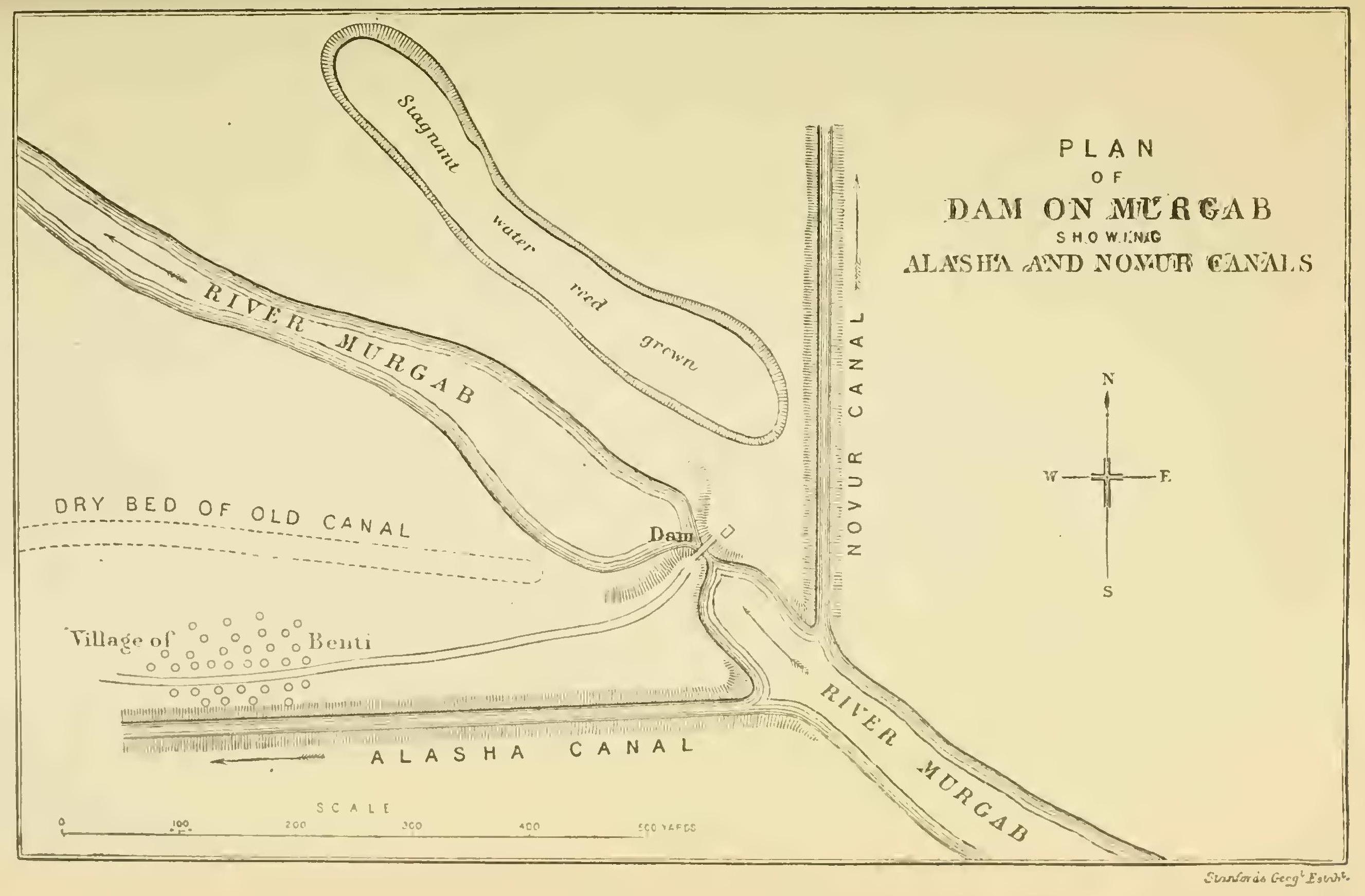
The western canal, the Alasha, divides into two at a distance of three or four miles from its origin, one branch going in a north-westerly, the other in a south-westerly direction. The latter is known as the Sukdi Yap, and along its banks dwell about a hundred and fifty Salor families, remnants of those Turcomans who, together with the Saruks, occupied the oasis before the coming of the Tekkés. Towards the extremity of the Sukdi Yap are the villages of the Sitchmaz, whose chief, Ana Murad Kafur, was the Yassaoul-bashi of the Otamish. Two miles south of his village all cultivation ceases in that direction. The north-western branch of the Alasha canal is the one from which the territories of the Otamish are principally irrigated.
All these irrigation canals and branches naturally diminish in volume as they get remote from their source at the Benti dam; and when, in the early portion of the year, the waters are low, some of the channels are entirely dry. The minor ones, too, are constantly being shifted in direction, so that no definite plans of them could be procured. The main canals, however, with their principal branches, always contain water. The distance between Kouchid Khan Kala and the great dam, measured along the river bank, is somewhat over twenty miles.
The area of the cultivated district varies considerably, according to the quantity of water procurable from the Murgab, and depends, to a great extent, upon the dryness of the year. The greatest length of irrigated territory is from fifty to fifty-five miles, measuring from the southward of the dam in a north-westerly direction. Its greatest breadth from east to west is from thirty-five to forty miles. For a short distance below the dam the main stream of the Murgab is available for irrigation, but seven miles or thereabouts to its northward the channel of the river is too deeply cut to allow of the waters being conducted over the surface. Within this point, however, it is largely available, and, apart from irrigation, the streams are used to turn a very considerable number of rude turbine mills for grinding corn.
Two miles to the north-westward of the great dam of Benti, and close to the northern bank of the Murgab, stands the old city of the Saruk Turcomans, Borsa Kala, once the military and political capital of the oasis, but now deserted and replaced by Kouchid Khan Kala. After having observed the watercourses, and gained as much information as I could from my guides, I rode away early next morning with Baba Khan and his following towards this place. The ground stretching between it and the dam is very bleak and barren, as, owing to its formation, it is impossible to lead the water over its surface. A fall, however, takes place in this surface in the immediate neighbourhood of the old city, which brings the latter within the reach of irrigation. Seen from a distance of a mile, Porsa Kala exhibits a long line of parched yellow walls and towers, rising from the summit of a slightly raised bank-like rampart similar in construction to that of Kouchid Khan Kala, but of not more than one-half its vertical height. The tall walls and flanking towers closely resemble those of mediæval European fortresses, and display a considerable amount of skill in military engineering. Walls and ramparts are now crumbling under atmospheric influences, though in many places they are in a state of fair preservation; the hard loam plaster which covered the unbaked brick walls still clings to the surface, and bartizans and crenelations cut the deep blue sky with their serrated outlines.
To me nothing is more dreary than the impression produced on entering precincts that only a few years ago were replete with life, but are now still as the grave. But thirty years ago Porsa Kala was thronged with its Saruk inhabitants. You can still see the roof-trees black with the hearth smoke, and water pitchers stand idly in the corners. So strong is the remaining impression of former life that one momentarily expects to meet a stray former inhabitant, and almost fancies he hears the soft muffled tread of the camel, when it is only the stifled throb of some choked stream which once gave birth to a turbine mill. The Saruks were apparently of much more gregarious instincts than their successors, the Tekkés. While dwelling here among the latter I saw no approach to anything like a permanent place of residence. Their houses are aladjaks, which can be shifted at half an hour’s notice. The idea of a definite centre seems foreign to the Tekké mind. I was talking one day to an old chief, a Kethkoda, by name Dowlet Nazar Beg. His age could not be far from seventy. He had seen the Tekké nation shift from the Tejend to Sarakhs, from Sarakhs to Merv. His limbs were speckled with marks which a superficial observer might have attributed to some cutaneous disease. They were the bullet marks which recorded nigh half a century of constant combats. I was talking to him apropos of a chance of liberation which seemed to offer itself. I asked him if he would be one of my escort of a hundred men as far as Meshed. He said, ‘I have often seen the walls of Meshed as I galloped by on a raid. I never was within the walls. Are there aladjaks there? You know we, the Turcomans, do not inhabit walled houses.’ He said this in a lofty manner, as if I suspected that he might be guilty of such a misdemeanour as inhabiting a walled house. I said there were no aladjaks at Meshed; but plenty of space where one might camp in the open. This appeared to satisfy him, and he said that he would willingly accompany me, provided that I made no pretence of asking him to dwell for never so short a space in a walled house. It seems odd that people so near akin as Saruks, Mervli, and Akhal Tekkés should have such different ideas. The Saruks, among the ruins of whose town I halted, were apparently of a less irreconcilably nomadic nature than the genuine Tekké. A near contact with Bokhara, from whose immediate neighbourhood they came, may have influenced the Saruks in their more domestic tendencies. At all events, they showed a keener strategic spirit in camping close to their dam than the present inhabitants of Merv have displayed in building their bulwarks so far off from what is to them the heart of their territory.
The sun was nearly vertical, and the sky wore that purple hue which belongs to mid-day hours in this part of the world, as I left my companions asleep in the scanty shade of the roofless walls, and sauntered out to take a look at the ruins. All around was an expanse of yellowish brown. No trace of vegetation could be seen on the burned- up expanse. Here and there lay a leaden-tinted snake with unfolded length, a veritable image of lethargy had not its diamond-like eyes denoted its sleepless vigilance. I have not a Turcoman’s religious mania for killing snakes, but I have a terror of finding one curling around my ankle; and I fear that incessant vigilance in this regard made me lose much of the melancholy, solemn impressiveness of the once inhabited waste around me. Por sa Kala cannot have contained less than ten thousand inhabitants in its palmy days; and to judge from the care they took in fortifying themselves, they seem to have had something worth taking care of. This Porsa Kala, the Saruk capital of the Merv district up to thirty years ago, is doubtless the ‘Merv’ marked as a town in the maps which I have seen, which were based on the travels of Burnes, Shakespeare, and Taylour Thomson, and date previous to the advent of the present inhabitants of Merv, the Tekkés who came here from Sarakhs after driving out the Saruks. The present Tekkés never inhabited Porsa Kala. They pitched their circular huts at the dam of the Murgab, about two miles from the walled town. Two and three days’ journey higher up the river are Benti Kazakh, where the more northerly section of the Saruks inhabit, and Benti Sultan, where are the remains of the old dam constructed by the former inhabitants of Merv, to supply Bairam Ali, Sultan Sanjar, and ancient Merv (Giaour Kala) with water. Bent means a dam, and the i added is the sign of the genitive case. Hence the names above mentioned signify respectively the dam of Kazakh and the dam of the Sultan. The Kazakh dam is also known as that of Yulatan, because the canal proceeding from it waters the small town of that name situated on the left bank of the Murgab south of the great Merv dam, and which is inhabited by the most northerly division of the Saruks. These latter are on ‘speaking terms’ with the Tekkés. The other, and larger Saruk division residing at Penj-deh, still retain all the old feelings of hostility against the Tekkés, dating since the time, somewhat over a quarter of a century ago, when they were driven from their old settlements in the Merv oasis.
Por sa Kala admirably fulfilled the object with which it was doubtless constructed—that of covering the dam and the commencement of the main lateral watercourses. Why the Tekké Turcomans should have pitched upon a point so far distant from the most vital and vulnerable portion of their territory as Kouchid Khan Kala for the erection of their great defensive work is to me inexplicable; It may be that they wished to remove their military centre as far as possible from their enemies the Persians, and to force the latter to leave their base of operations at Sarakhs as far behind them as possible before they were able to strike a decisive blow against Merv. Still, however, it would be useless for the Turcomans to try to hold out at Kouchid Khan Kala, were an enemy in possession of the Murgab dam, for the destruction of this, by lowering the level of the waters to the southward, would leave both the Novur and Alasha canals completely dry, and so reduce the entire oasis to an arid desert, like the ground immediately around it. A military occupation of Benti, with a sufficient force for four or five months, would compel the Tekkés either to surrender or to abandon their territory. I have often called the attention of the Turcoman chiefs and Serdars to this fact, but they were either unable or unwilling to see the force of my arguments. They said that within the walls of Kouchid Khan Kala wells were constructed which would afford an ample supply of water for a garrison; but I am perfectly sure that any such supply, however copious, would be inadequate to the wants of the Mervli, their flocks, herds, and camels. Besides, as the Turcomans never lay up accumulations of grain further than are required until the gathering of the next harvest, the rendering of the irrigation of their ground impossible would be to them a death-blow. They should, perforce, either surrender or starve, unless they effected an exodus to some less vulnerable territory. Moreover, they reminded me that Turcoman warriors were good for something, and that though an enemy might establish himself at the dam, he could not by any means be sure of holding his own there any more than the Persians, when they last came to Merv, were. It is quite true that with adversaries like the Persians the line of communications between Sarakhs and Benti might be very seriously interrupted by flank attacks of Turcoman cavalry, but when I gave my opinion I was thinking of another kind of enemy altogether. I was thinking of the Russians. The latter held successfully—not without much suffering, certainly—the long line from Tchikislar to Yengi Sheher; and should they once be established at Sarakhs, or even at any point on the Tejend river, they would find little difficulty in securing their communications with a point only seventy or eighty miles distant. Once entrenched at Benti, a battalion of Russian infantry, its supplies from its base secure, might bid defiance to the assaults of the entire Tekké nation. The Russians themselves have been forced to recoil from rude breast-works manned by Turcomans, with their clumsy muzzle-loaders. What chance would Turcomans, accustomed to fight on foot only on the defensive, have when attacking European soldiery armed with, the deadliest breech-loaders of modern construction? It may be taken for granted that even a very moderate European force, properly established at Benti, would have the entire Merv district at its mercy. It is true that if only the sustenance of the garrison of Kouchid Khan Kala were taken into consideration, sufficient water might be procured by digging wells within the place, and possibly enough provisions might be accumulated to enable a prolonged resistance to be made; but the surrender of the place would only be a matter of time unless other armies in the field co-operated with its defenders. Turcomans, however, are exceedingly sanguine of temperament, and appear to entertain the idea that when all their own resources are at an end, Allah will come to their aid; or perhaps they have the shrewder notion that after having done their best to hold their own by force of arms, they can surrender when the worst comes to the worst.
When my companions had aroused themselves from their siesta, we mounted, and made towards home. Our way, as before, lay along the left bank of the Novur canal, up to the point at which the branch which feeds Kouchid Khan Kala diverges to the westward. Here, crossing the rude wooden bridge, we halted for a brief space at the headquarters of Murad Bey. Thence we proceeded northward, towards a group of villages in the plain, inhabited by a minor sub-division of Turcomans, known by the odd appellation of Agur-Bashe, or ‘sore-heads.’ Thefe were half-a- dozen groups of huts, ten or twelve in each, scattered over a wide extent of plain, their occupants all living in the same primitive, pastoral manner as their compatriots.
Here an amusing incident occurred. A Turcoman dismounted from his horse, a white one. Animals of this colour are rarely seen in the district, an evil repute attaching to them. The horseman wanted a drink of water, and incautiously let go the bridle. The steed forthwith started incontinently to gallop across the plain. A runaway horse is a serious nuisance in a country like this, and everyone feels it to be his duty to aid the master of the fugitive beast in recovering his property. The whole of us, sixty in number, strove to head off the truant. For a couple of miles we rode in a straight line, but the runaway, unencumbered by weight, and having a good lead, gave us a long chase. Then the irrigation canals shifted both our courses, and we doubled and turned, sometimes heading away towards the desert, sometimes back upon the cluster of villages. At moments a Turcoman rider galloped close on either side of the riderless steed, and tried in vain to grasp his bridle, and I saw one attempt the daring expedient of springing from his own saddle into that of the horse which we pursued. He met, however, with a sad overthrow. Backwards and forwards over the vast plain we went, for a space of not less than an hour and a half, and, though we were joined by extra parties from the villages, who tried to turn the contumacious horse, we could not succeed in catching him. I was completely tired of the matter, and, besides, knowing that we had a long journey before us, I did not care to blow my horse any further, so I drew up on a slightly rising ground and watched the hunt. From what I saw of the remainder of it, I am of opinion that Turcoman horsemen would scarcely do well ‘across country,’ for though they will hang alongside their horses, stand in one stirrup, and sling themselves under the belly at full gallop, they do not care for leaping. I saw many a one come to grief at the broad irrigation trenches. The country is so flat that the horses are never taught to jump. At length it was decided to abandon the chase, and the proprietor of the wayward animal borrowed a horse to ride home upon. He issued orders that the fugitive should by no means be allowed to escape, and that if he could not be captured he should be shot. This was quite in keeping with the spirit of Turcoman ideas. They would much sooner liberate a captive without ransom than tolerate his running away from them, and in the same way the instructions to shoot the horse, and not allow him to run wild at his own discretion, were given.
We continued our march in a northerly direction, passing numerous villages of the Mjaour Turcomans, who, together with some Salors, constitute a colony at this place. My companions informed me that these people were not Tekkés, but Mihmans, guests and doghan (friends) of the Tekkés. They were the remnants of the old Turcoman tribes who had first occupied the Merv district after the death of Nadir Shah and the decline of the Persian military power. They had still clung to their old homes after the Tekke conquest.
At the northernmost of the Mjaour villages we halted to give our horses to drink, and to refresh ourselves with a draught of yaghourt. While waiting, I mounted a small sepulchral earth mound which stood hard by. From its summit I caught my first glimpse of the old cities of the plain—the ancient capitals of Margiana. A long line of walls and turrets, dominated by some towering domes, broke the line of the horizon some eight miles away to the north-east. I could scarcely express my anxiety to proceed there and then to this mysterious spot, concerning which so much has been written and so little known. Half-way between me and the ruins lay a large, shallow sheet of water, where unused irrigation trenches expended their supplies upon an uncultivated plain. Black ibises, wild swans, storks, cranes, and a hundred other varieties of aquatic birds waded in or swam upon the silent marsh. I begged again and again that my conductors would turn their steps in that direction, but was told that the day was too far advanced; that the neighbourhood of the ruins bore a very bad repute; that there were ghouls and divs, and various other kinds of evil spirits to be met with; not to speak of the Ersari robbers from the banks of the Oxus, who from time to time lay in wait to plunder passing caravans. They promised, however, that if matters went well I should very shortly pay a special visit to the old cities, and with this I was obliged for the moment to be content, and nothing was left but to turn my horse’s head homewards. Riding as swiftly as we might across the flooded plains, we arrived at Kouchid Khan Kala on the evening of May 5, having been absent just three days.
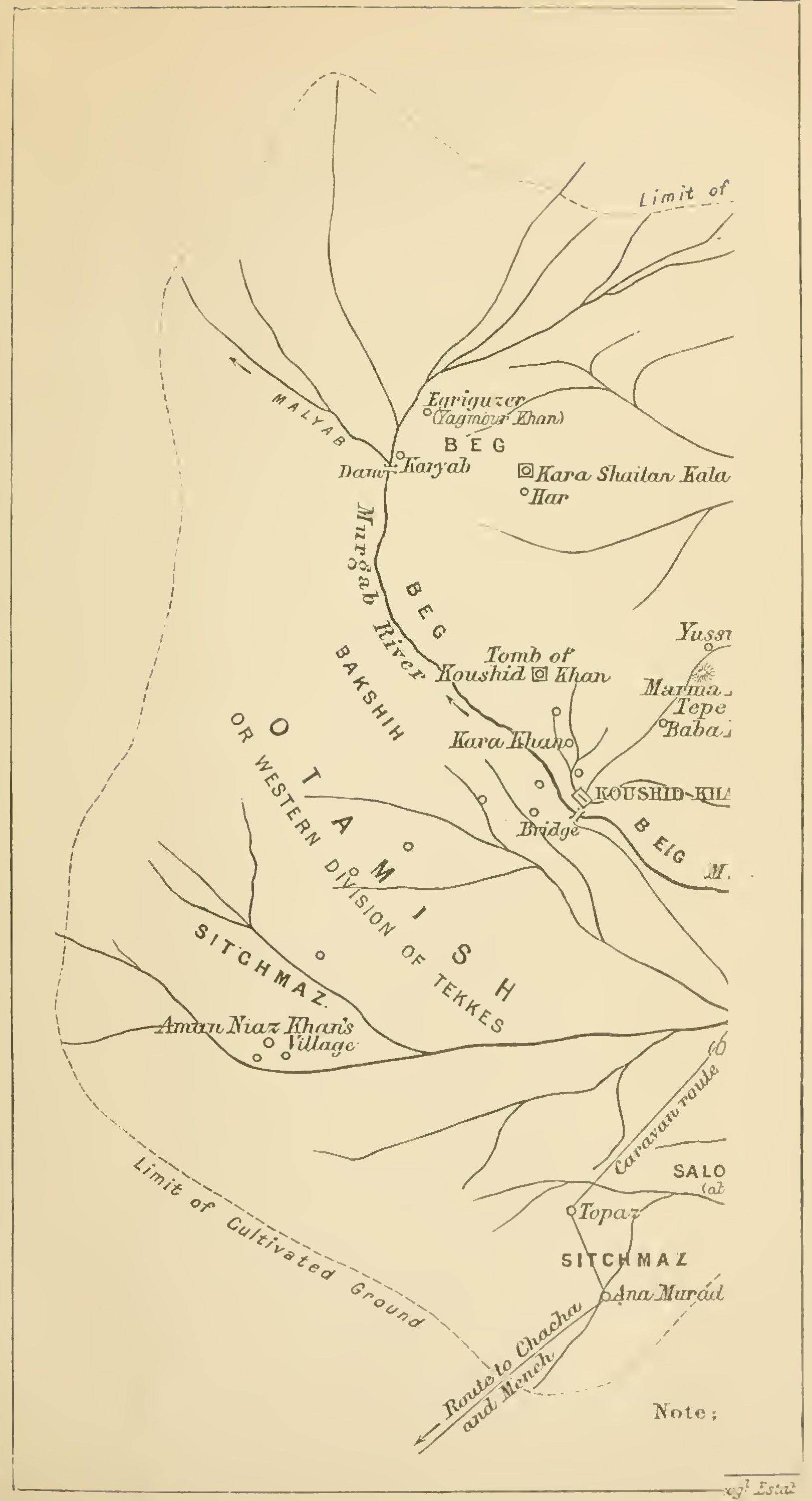
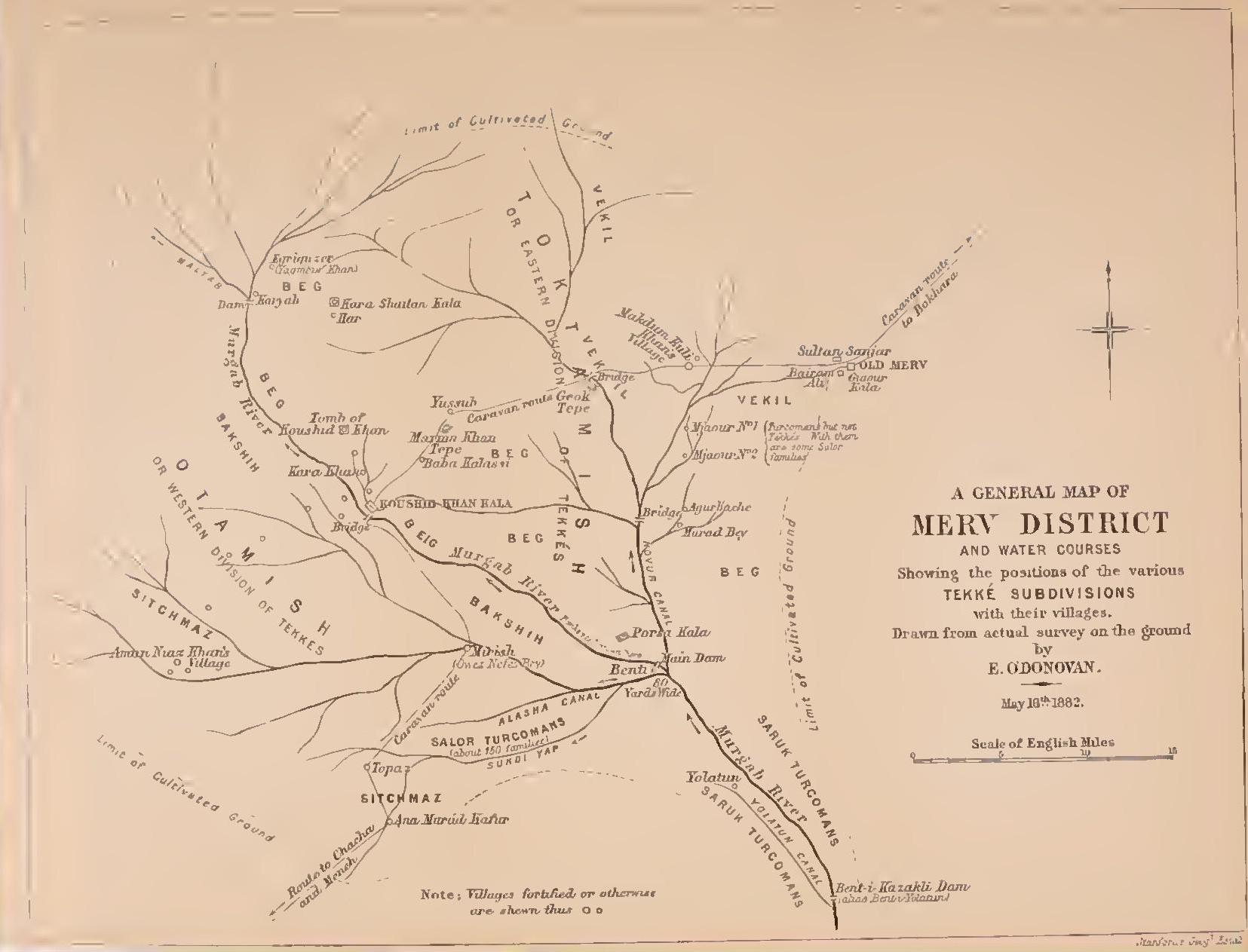
Chapter XLII: Makdum Kuli — Signs of Revolution.
A visit from Makdum Kuli Khan—Suspicions about him—His appearance —Conversation—Yussuf Khan—Tekké loss at Geok Tepé—Temporary adherents—Makdum Kuli’s resolves—Presents—Inquisitive visitors—The Yassaoul-bashi—Captive Circassian officer—His escape—Russian military insignia—Dispute with the Mervli—Yaghmour Khan and Kadjar Khan— Dowlet Nazar Beg—Important revelations—Kadjar Khan’s mission to Teheran—A man of straw—Object of revolution—Rumoured pro-Russian conspiracy—Kadjar Khan in a rage—The coming council—Demand for a zat—Incivility of Kadjar—Aman Niaz’s diplomacy—Signs of change— Kidaieff’s letter—An atrocious offer—Marks of distinction—Baghur Khan, the Persian envoy.
Two days after my return from the dam of Benti and Porsa Kala, I received a visit from a person whom I had long been desirous of seeing, viz. Makdum Kuli Khan, the redoubtable chief of the Akhal Tekkés, and the son of Noor Ber di Khan, and who, in co-operation with Tokmé Serdar, his principal general, had long and successfully held the Russians at bay before the walls of Yengi Sheher. He had arrived at Kouchid Khan Kala on the previous evening, but had not been allowed to see me at once, for since he took refuge at Merv he had been regarded with an eye of jealousy by the other chiefs, and he and his refugee followers were, to a great extent, treated as deserters. I was known to have been in communication with him previously, and, notwithstanding the headway I had made in the good graces of the Merv Tekkés, the latter still guarded me vigilantly, lest I might take some opportunity of retiring to Sarakhs or Kelat-i-Nadri. As I afterwards learned, they feared that Makdum Kuli Khan might assist me in effecting my escape, and it was with the greatest difficulty that the Akhal Tekké chief at length obtained permission to call upon me.
I was quite alone when he entered. I was surprised at his youthful appearance. He did not appear to be more than twenty-seven years of age, though the total absence of beard and the extreme slightness of his moustache might have made him appear younger than he really was. Makdum Kuli Khan is over the middle height, slightly made, with very regular features, large hazel eyes, and a somewhat ruddy complexion. The general expression of his face was one of extreme mildness, but there was another which at first made me laugh in spite of myself; he seemed ever on the point of sneezing. His costume was that of a well- to-do Turcoman—a long, striped crimson tunic, girt with voluminous white sash knotted in front; a long-sleeved camel-hair robe of light brown, thrown across his shoulders, and bound at the edge with the broad, peculiarly marked ribbon, striped diagonally yellow and red, indicating the Tekké division to which he belonged. Thrust in his sash was the long poniard which the Turcoman always carries, the handle of embossed gold, set with turquoises, and enamelled in the pommel. This was the only occasion on which I had seen a Turcoman, chief or otherwise, bearing gold-mounted arms. As a rule it is rare to see even silver used for this purpose.
Makdum Kuli saluted me gravely, and seated himself after the fashion of the country—kneeling, and reclining upon his heels. We exchanged the usual formalities required by Turcoman politeness, and he then told me of the difficulty he had experienced in obtaining permission to visit me. Kadjar Khan, he said, was very jealous of my being visited by any person except himself. He (Makdum Kuli) had proposed that I should visit him at his brother’s aoull, but leave had not been accorded. His brother, Yussuf Khan, was in quite a different position from himself. They were sons of the same father, by different mothers. The mother of Yussuf, the younger brother, was a Merv Tekké by birth, and the daughter of some near relation of Kouchid Khan; while Makdum Kuli’s mother was an Akhal Tekké. Yussuf was recognised as a Merv chief, but Makdum Kuli was not. The latter told me that he had been much disappointed with regard to the aid he had expected to receive from the Mervli. Only three thousand in all had come to his assistance: and even these had remained but a short time with him. On this matter he spoke with some bitterness. He said that when retreating from his stronghold at Yengi Sheher, the Russian artillery had played sad havoc among the crowds of fugitives, who, mounted upon camels, and carrying all their worldly goods with them, could move but slowly. He estimated the entire Tekké loss, men, women, and children, at about ten thousand. At first, a considerable number of Akhal Tekkés had accompanied him, and camped near the Tejend swamp. A large number of these, however, on learning the terms offered by the conquerors, had returned to their old camping grounds in the Akhal Tekké. Some four thousand had accompanied him, and settled for the time in the territory of his brother Yussuf Khan, but these were daily leaving him in large numbers, to return to their old homes. However, he counted that at least three thousand horsemen would stand by him and follow his fortunes to the last. He said he had been offered the most favourable terms on condition of returning to Yengi Sheher, but had steadily refused to accept them. It was the intention of himself and his staunch followers to fight to the last should Merv be invaded, and, if beaten, to retire into Afghanistan. If not well received there, they purposed asking an asylum within the frontier of British India.
Our conversation was but brief, for Makdum Kuli Khan evidently feared lest Kadjar Khan might suspect him of concocting plans with me. He promised to see me again shortly, and reminded me that in one of my letters to him, written from Derguez, I had promised to make him a present of a field-glass, a revolver, and a signet ring. He inquired if I had these articles about me at the moment. As the two former were in full view it was not easy for me to deny having them. It is true that I had promised him the gifts mentioned, but I had done so with a view of inducing him to enable me to penetrate to Yengi Sheher; and, seeing that very little was to be gained at the moment by giving away what were to me almost indispensable articles, I should have been glad of any excuse to put off the Khan. On second consideration, however, knowing that his brother’s district adjoined the ruins of the old cities of Merv, which I intensely desired to see, I thought it well to gratify his desires. He was delighted with the double telescope, and expressed his admiration of the Smith and Wesson revolver. Before leaving Meshed I had got made a very heavy gold ring, of Oriental pattern, and bearing an oval blue stone of the kind known in that part of the world as Solomon’s seal, and engraved in full with his name and title. This I also presented to him, and he took leave of me, very well satisfied.
After Makdum Kuli’s departure, my ev was crowded with visitors, anxious to know what the Akhal Tekké chief had been saying to me. Something was evidently on the tapis; and, apart from the hints which I received, the anxious and earnest conversation among the Kethkodas who visited me indicated that it was something of no ordinary importance. Rather broad hints were let drop that Kadjar Khan, the chieftain whom I had hitherto regarded as the Ichthyar, or supreme ruler of Merv, was not altogether what I had supposed him to be, and that some change was impending. Some of his followers were present, and a warm dispute occurred—among others, with Yaghmour Khan, the yas- saoul bashi, or chief of police and of the administrative, forces of the political centre of Merv. The immediate cause of dispute was in connection with a Russian Circassian officer, captured a short time previously on the road between Askabad and Muhammedabad, the capital of the Derguez. Shortly after the arrival of the Russian troops at Askabad, as I have already mentioned, Skobeleff wrote a letter to the Khan of Derguez, Mehemet Ali, which was shown to me by Seyd Ali, his brother, governor of the town and district of Lutfabad, in the Attock. He said that he required certain stores in the shape of rice, corn, and sheep. These were sent to Askabad, and, in consonance with their character as good paymasters, the Russian authorities almost immediately despatched the amount due in payment. A ferash- bashi of Mehemet Ali went to fetch the money, and a small escort of Cossacks accompanied him on the road to Lutfabad. The escort was under the command of an elderly Circassian who held the rank of sub-lieutenant, and who, owing to his knowledge of Eastern tongues, acted as interpreter to the Russian forces in their relations with the Turcomans. Not far from Lutfabad the convoy was attacked by a force of Merv Tekkés. Some were killed, others succeeding in escaping; among the latter being the ferash-bashi, who carried the saddle-bags filled with money. The interpreter was made prisoner.
Some time after my liberation from strict captivity in Merv, as I was sitting at the door of my ev, I saw an unusual concourse of horsemen crossing the bridge over the Murgab. The red banner borne in front—that which is always carried before the ruling Khan when he goes abroad in a public capacity, announced that something of interest was transpiring. In a few minutes the cortege drew up before the door of Kadjar Khan’s house, among them being the grey-coated Circassian officer, unmistakeable by his Astrakan cloth-topped chapka, or head-dress, and the shoulder-straps which denoted his rank. Long familiarity with the ensigns of military precedence, gained while with the Russian forces on the Caspian shore, enabled me at once to determine what rank he held. The gold shoulder-strap, with its single black stripe and solitary silver star, showed him to be a sub-lieutenant. Several Mervli of distinction were seated around me, and told me that the captive was a Russian general. I laughed, and said that they were mistaken; that he was no general, but only a girmi-bashi, that is, a commander of twenty men. They grew indignant at the idea of my making light of the rank of their captive, and asked me how I was aware of what I stated. I immediately drew for them with pencil and paper the various insignia of rank in the Russian army, and told them, if they doubted the truth of my assertion, to examine the shoulder- straps of the officer more closely, and they would then perceive that they corresponded with the indications I had given them.
On this occasion a certain Moullah Baba, to whom I was indebted for many unkind actions during my stay in Merv, took the opportunity to revive the old story that, after all, I was a Russian; that I was crying down the rank of the captive in order that he might be let off with a lighter ransom than became his position. ‘The Sahib,’ he observed, ‘says this is only a chief of twenty men, and that an officer of superior rank would have much more conspicuous galons. But where are his own (my) galons?’ I turned the tables on the moullah by saying, ‘You know that these galons are to be bought in any bazaar in Frangistan, and if I had wished to impose upon you I had only to lay out a few krans in the purchase of insignia of very high rank. I preferred to come among you with a dress such as I wore, and to ask you to take my word for the rest.’
Yaghmour Khan, without exception the most straightforward and honest person I had met among the Merv Tekkés, was glad to hear my statement about the rank of the Russian officer, for he sincerely wished that no Russian should be kept a prisoner at Merv, and he feared that, considering the prevailing idea about the rank of the captive, great difficulty would be experienced in setting him at liberty. He took sides with me in the matter, while the other greedy brigands almost lost their heads at the idea of their possibly being defrauded of the rich store of money which they supposed would be forthcoming as the old Circassian’s ransom. I ascertained that the yassaoul-bashi and Kadjar Khan were at loggerheads on the subject; and it was directly from this dispute that disclosures, of immense importance to me, took place.
During the day many persons called upon me, notably among them a certain Nazar Dowlet Beg, who had formerly acted in the capacity of Grand Vizir to the celebrated Kouchid Khan, the autocrat of Merv. This man had been most persevering in stating his conviction that, notwithstanding the various letters from Abass Khan, the British agent at Meshed, guaranteeing my nationality as nonRussian, I was simply one of Skobeleif’s forward agents. On this occasion, however, seeing that the political tide was turning against the chief with whom he was closely associated, old Kadjar Khan, and evidently guessing, from his knowledge of his compatriots, that I was gaining ground, in true Eastern fashion he came up to pay court to me. He told me the circumstances under which the existing Ichthyar came to be in such a position at Merv. I have already alluded to these circumstances. When the Russian invasion of the Turcoman territory was impending, the Shah sent a messenger to Merv, inviting the Khans to visit him at Teheran, and to try to come to some agreement with him by which Persian supremacy at Merv would be acknowledged. Whether this was intended to guarantee Merv Tekkés against Russian invasion, or to place it in his power to sell them to their enemies, I am unable to say. Probably he wished to be able to say to the Czar that he could dispose of the nomads. The two hereditary Khans, Baba Khan and Aman Niaz Khan, declined the honour of the invitation. They feared lest they might be held as hostages. Temporarily retiring from their positions, they summoned the minor Khans and Kethkodas to a council, and got them to elect Kadjar as Ichthyar. The latter had no pretensions to hereditary dignity. He was what was called a Bahadur adam, or, as they would style it in Merv, a Bâtur adam, that is to say, a man of intelligence who had distinguished himself in battle. Thus was a man of straw set up, and, fully instructed, sent to Teheran, with a following becoming his ephemeral rank, to hear what the Shah had to say. After some months’ residence at the Persian capital he came home, having been unable to arrive at any agreement. It was thus that, on my arrival at Merv, shortly after his return, I found Kadjar installed in the position of Ichthyar. Circumstances were threatening; the Akhal Tekké was invested; no one could foresee the issue. The hereditary Khans deemed that the moment had not yet arrived to assert their natural supremacy, and continued to allow their man of straw to act as scapegoat.
By this time, assurances received from Mr. Thomson, the British Minister at Teheran, coupled with their own innate perceptions of me, and strengthened by every word which I had said to them from time to time regarding the best policy to be pursued at Merv, had convinced the Tekkés of the genuineness of my non-Muscovite character. Once satisfied as to this, they ran into the opposite extreme; and notwithstanding all my asseverations as to the real nature of my mission to Merv, they insisted upon attributing to me an importance which I as frequently declined to accept. At this moment, their idea was that, as for the first time in their history they had got into communication with the Western Powers, and above all, with the celebrated ‘Koompani,’ it was probable that financial matters might enter largely into the future affairs of Merv, and that, in view of the presence of British troops at Kandahar, their advent to Herat, and later to Merv, was a matter of little doubt. Hence they had commenced an agitation, gentle at first, but which culminated in a revolution by which they unceremoniously overthrew their man of straw, and reasserted their hereditary dignity and control.
I spent the whole day in listening to the conversations of the advocates pro and con. A new light was beginning to dawn upon me. After sunset Kadjar Khan called; his tone was much more conciliatory than it had previously been. He ordered the ev to be cleared, and when he, myself, and Nazar Dowlet Beg alone remained, he proceeded to unfold a discovery which he said he had made—that Baba, Aman Niaz, and Yaghmour were intriguing for the coming of the Russians to Merv. This, to begin with, was a deliberate falsehood. He asked me on no account to have any relations with the persons whom he’ had mentioned, averring that he alone was commander at Merv, that the confidence of the people was his, and that to lend the authority of my approval to the others would be to seal the fate of the oasis and its population.
It occurred to me that, having to do with such crooked-minded people, honesty and straightforwardness would constitute the better policy. I frankly informed the Khan that many chiefs of importance had called upon me, and explained to me the circumstances under which he had come into power, and that I had understood that he was not in reality the legitimate Ichthyar. At this the old man flew into a violent rage. He iose to his feet; he walked round the hut, stamping furiously; his eyes flashed, and he uttered oaths and exclamations in Jagatai. Then, calming himself, he took his seat beside me. He told me that my life would not be worth a moment’s purchase if the other Khans came into power. He, for one, recognized that I was not a Russian, and he begged and prayed of me to stand by him at the next great council, which, he informed me, was called for the following day. He then left me abruptly.
An hour later, a general uproar occurred; horsemen were mounting hastily. Kadjar Khan, almost beside himself with passion, burst again into my ev. 1 inquired what was the matter; he said that the Circassian had escaped. Yaghmour Khan had conspired to set him at liberty; and I was asked to take note of this as a proof of the pro-Russian tendencies of the said gentleman. He omitted, however, to tell me that his own son had been the prime mover in the matter, and that the latter was undergoing punishment, his hands being bound behind his back, and tied to the flagstaff from which floated the crimson banner of Merv. After announcing to me the flight of the Circassian, Kadjar rushed furiously from my hut; a crisis had evidently arrived in the history of Merv. At the end of another hour the curtain before my door was raised, and the brother of Kadjar Khan, the white-bearded old moullah who had received me so politely on my first arrival at Kouchid Khan Kala, entered. He was, as had always been his wont, exceedingly courteous. He spoke of the plot against his brother, and tried to enlist my services in the cause of the latter. He said: ‘The moment is a critical one for you; it is probable that you have no friend here except my brother; I would beg to remind you that you have omitted an indispensable ceremony as a stranger visiting Merv. You have not presented any zat to the chief.’ Zat means a present, without which one cannot with advantage approach any person of importance in the East, especially if his business be in the slightest degree political. I had foreseen the zat when leaving Meshed on my journey Mervwards. Though I was sufficiently acquainted with the mercenary nature of Persians to know that money, pure and simple, would be an acceptable present to them, I had formed another idea of the Turcoman character, and feared that any mere present of specie would be looked upon as an attempt to buy the favours of the authorities. I had, consequently, laid in a stock of jewellery and other articles, with a view to handing them over to the chief persons as soon as I should be assured of their position. I have already spoken of the presents which I gave to Makdum Kuli. I told the moullah that I was by no means forgetful of my obligation in regard to the zat, and that I was only awaiting a favourable moment to hand over the presents. ‘You can give them to me,’ said the moullah; ‘or, if you like, you can send them by your servant to the Khan’s house.’ Upon my saying that I preferred to send the presents by my servant—for, to tell the truth, I was not quite sure that the moullah would not confiscate them for his own use—Kadjar Khan’s brother took his leave.
Among other articles intended for presentation I had a silver casket, richly engraved and embossed, and set with turquoises and rubies, for which I had paid about twenty- five pounds sterling. I placed within it some ruby and turquoise rings, folded it in paper, and, after sealing it, despatched it by my servant to the Khan’s residence. In the meantime Aman Niaz came in, accompanied by his uncle and several followers, evidently with a view of preparing me for coming events. He had scarcely taken his seat when Kadjar Khan again appeared. He was, clearly, highly displeased at the presence of Aman Niaz Khan, but it was also easily to be seen that he did not care to say too much in presence of the latter. He simply drew from his pocket the casket which I had sent to him, saying, ‘What is this?’ I replied, ‘Khan, as you see, it is a jewelled silver casket.’ ‘What is it for?’ he continued. ‘To keep as a tribute of my respect,’ I replied. ‘What is it worth?’ said the Khan. I mentioned its value in Persian money. ‘Ouallah Billah!’ he cried. ‘Six hundred krans! why, I would not give you two for it! ‘Then, throwing it contemptuously on the carpet close to me, he said, ‘Take back your box, and give me the money!’ I must admit that I was considerably taken aback by the manner in which my present was treated. However, I had, at a bound, gained an enormous insight into the mental temperament of Turcoman chiefs. I replied, 1 Certainly, Khan, if you wish; but I thought you might be offended if I merely offered you the money.’ Then, with an affectation of great magnificence, I drew from my pocket the twenty- five pounds in gold, and handed it to him. ‘By God!’ exclaimed he, ‘that is right; I am satisfied.’
Hereupon a new comedy arose. During this scene Aman Niaz Khan had been glaring at me from between his bleared eyelids, and when Kadjar, happy in the possession of his wealth, left the ev, the Otamish chief elevated both his hands behind his ears, in expression of amazement at the manner in which the present had been dealt with, and said: ‘Sahib, you can see that Kadjar is no Khan. Had such a present been offered to me by a Dowlet Adam (a man of the state), I would not part with it for four times its value, not even if ten horses were offered to me in return.’ Of course this was too broad a hint to be passed lightly over. I replied, ‘Aman Niaz Khan, there are Khans, and Khans; I recognise you as a true Khan. Will you accept this casket as a slight token of my regard?’ Whereupon he again raised both hands behind his ears, bowed low, as he sat in a kneeling posture, and, stretching out both his palms, received the coveted gift. All his followers were loud in their exclamations of admiration at my generosity; and the Khan’s uncle volunteered the statement that all that his nephew possessed, and all his clansmen, were at my service. ‘Not,’ he took care to remark, ‘because of the present, but because I can at once perceive that you are really a Dowlet Adam.’ These were some of the opening incidents of the bloodless revolution which was to take place in the near future.
Almost every moment from this time forward I could perceive signs of the approach of something unusual, and also that events were rapidly turning in my favour. After the visits of Kadjar and Aman Niaz Khans, one of Baba Khan’s chief cavalry officers called upon me with a soda- water bottle full of arrack as a present from the Toktamish chief, and Beg Murad, the fat, humorous-looking ruffian to whom I have alluded when describing my arrival at Merv, and with whom I had ever since been on very indifferent terms, sent me a gift of a shaggy, big-tailed sheep. At the same time, the leading persons of Kadjar Khan’s party were unremitting in their efforts to get from me an assurance that I would acknowledge as Ichthyar no one save their friend. Failing to obtain this assurance, they endeavoured to effect small loans of money from me, in order to make sure of something before their faction went out of power.
On this same evening I received a note, written in Russian, from Kidaieff, the young Russian gunner who had been imprisoned in Merv during the preceding seven years, a facsimile of which will be found in the Appendix (F), coupled with a verbal message from him, asking for some pecuniary assistance, and bespeaking my good offices towards obtaining his liberation. The bearer, by name, I believe, Ana Geldi, was the individual in whose immediate power Kidaieff was. Having failed during so long a period to extract any ransom from the Russian authorities, he was trying to raise all the money he could, in one way or another, before Kidaieff should slip through his fingers, as, at the moment, seemed far from impossible. However, as a proof of his belief in my non-Muscovite character, and as an intimation of good will, he remarked that I had only to say the word, and the throat of the captive would immediately be cut in my honour. I was very much afraid that some such atrocity was about to be committed, and that it was intended, if things came to the worst, to foist its responsibility upon me; so at the risk of being suspected of pleading for the life of a countryman, I used all my efforts to point out that I should consider it the reverse of an honour to have anybody whatever, even though a Russian, killed in the way suggested. On this occasion I sent the money asked for by Kidaieff, but I very much doubt whether he ever received any of it. I also sent him word that as soon as possible I would come to see him, and hear his story from his own lips.
Kadjar Khan came in again somewhat after midnight, accompanied by Dowlet Nazar Beg. They sat up the livelong night with me, talking about the state of politics in the oasis, and the necessity of preventing what they called the pro-Russian party from coming into power. Shortly after their entry, I was puzzled by the sound of digging, in the immediate neighbourhood of my house. It was continued with the utmost persistency. I began to be alarmed, lest some trick was about to be played upon me, or that they were even digging my grave, but I received from Kadjar Khan the assurance that preparations were being made to do me honour, and that a ditch and breast-work were being drawn around my ev, in order to keep intruders and noisy people at a distance. When morning dawned, I could perceive that my dwelling was nearly encircled by a small trench, at a distance of a few feet from its walls. Previous to leaving me, a little before sunrise, Kadjar Khan informed me of the arrival of a Persian envoy, by name Baghur Khan, who had come from Meshed on a mission to the Merv authorities, and that the emissary would probably be heard at the great council which had been called for the morrow. To this council I, too, looked forward with great interest, for upon its decision with regard to myself would to a large extent depend my obtaining liberty to visit the old cities of Merv, and the other places about which I wished to gather information.
Chapter XLIII: The Coming Revolution.
A revolutionary medjlis—A privy council—Public uncertainty—A cross- examination—Merv politics—Yaghmour Khan and the Yassaouls—My new residence—Promotion—Bahadur—Communications with India—The political situation—Turcoman letters—Yalangtush Khan—Baghur Khan Presents—Baba Khan and Persia—Newspapers and paper money—Telegraphic news—A change in the direction of affairs.
The day following the events described in the last chapter was one of those on which the bi-weekly bazaar is held at Merv. It is usually largely attended by the leading chiefs of the various tribes; and on this occasion, a summons having been issued to them by Baba and Aman Niaz Khans, the attendance of representatives was unusually full.
The business of the bazaar is transacted at a very early hour, the extreme heat compelling the traders and customers to retire before midday for the siesta.
Between one and two o’clock in the afternoon, as I lay drowsily upon my carpet, awaiting the turn of events, I was summoned to attend a meeting of the notables of Merv. I was conducted by the messenger to an ev of more than ordinary dimensions, situated about two hundred yards to the north of my own. I found there assembled some twenty-five persons, including the Khans of the Toktamish and Otamish divisions. The ev was one specially set apart for the deliberations of what I suppose I may term the privy council of Merv, as distinguished from the general medjlis, or union of representatives, great and small, and Ak-saghals of the entire oasis. The interior was decorated with rich carpets, hung round the walls, and the floor was covered with equally costly material. I was given to understand that a general council had been held earlier in the day, but that no definite result had been arrived at, save that the council of Khans and Kethkodas had received power to organize a new and vigorous executive, calculated to deal with the pressing circumstances of the moment. The leaders had come to the conclusion that the time had arrived for the resumption of power by the hereditary Khans, and the removal from office of old Kadjar, who had acted during the previous twelve months as their figure-head and mouthpiece.
Up to this date (May 10) the representatives of Merv were quite in the dark as to whether the Russian advance was to be resumed, or whether it had come to a definite pause. They were also uncertain as to the progress of events in Afghanistan, and my own presence, and that of Colonel Stewart not far off, had utterly perplexed them as to the course they should follow. As they were by this time tolerably convinced as to my nationality, and had seemingly placed some faith in the exaggerated statements of my Kurd servant, they considered me a proper person to be consulted at this momentous crisis. I was very tired and sleepy, after my night-long interview with Kadjar Khan and his companion, and felt in anything but the humour to undergo the cross-examination which evidently formed part of their programme. But as I surmised that my liberty of action for a considerable time to come might depend upon the manner in which I bore myself before this council, I tried to answer their queries as best I might. I was asked point blank, ‘Are the Russians coming to Merv, or are they not? ‘Thanks to the news now forwarded to me weekly from Teheran, I was aware that the Russians had promised not to advance further eastward than Askabad; and I knew that I could safely answer that, for the moment, they were not coming to Merv. ‘How long will it be before they do come?’ asked one of my interrogators. ‘That,’ I replied, ‘it is impossible to say. For the present, in the face of the protests of the English Padishah, and the general condition’ of affairs, they have come to a halt; and unless some unforeseen occurrence, such as war between England and Russia, should take place, I think that a space of four or five years may be counted on without any advance on their part in this direction.’ Another equally pointed question was then put to me. ‘Where are the English troops now?’ ‘At Kandahar,’ I replied, ‘and slightly in advance of that position, on this side.’ ‘Are they coming here?’ asked Dowlet Nazar Beg, the ex-Vizir. ‘That,’ I answered, ‘it is entirely impossible for me to say. My opinion is that, unless Russia makes a further advance, the English troops will remain where they are.’ I continued, ‘I believe there is an agreement between Russia and England that Kandahar and Askabad shall be the boundaries of the advance on either side. I understand, too, that a guarantee has been given that the independence of Merv will be respected unless the Tekkés render peace impossible by aggressive actions. Baba Khan then took up the examination. ‘What course,’ he asked, ‘would you recommend to the people of Merv under the circumstances?’ ‘In the first place,’ I said, ‘that they absolutely refrain from all raidings or other hostilities against their neighbours, be they who they may; and in the second place, that any Russian prisoner or prisoners here detained be set at liberty.’ Again he inquired, ‘Would the English Padishah be willing to receive the people of Merv as naukers?’ i.e., servants, or subjects. ‘That,’ I said, ‘is a matter about which I have no information; but you can easily be informed about it by forwarding a document, bearing all your seals, and testifying your desires, to the English representative at Meshed, to be forwarded by him to England, or you can send it there direct; but I am afraid that in that country it will be found difficult to read your communication, as the people there hardly understand your language.’ ‘If,’ continued Baba Khan, ‘we are received as naukers by England, shall we be required to pay taxes?’ ‘That,’ I replied, ‘I do not know, but I think that in case you were accepted you would not be required to make any contribution.’ ‘Would the English Padishah supply us with breech-loading rifles and ammunition, and with cannon?’ ‘In case you were acknowledged as subjects,’ I remarked, ‘I have no doubt that, were you threatened by an enemy, you would not only be supplied with arms, but also with soldiers. But,’ I continued, ‘I am only giving you my opinion, for I have no authority whatsoever to speak on these subjects.’ ‘We should very much wish,’ said Yagh- mour Khan, ‘to follow the advice which you have given us with regard to the prevention of raiding on our neighbours. It is not, however, by the will of the bulk of the people that raids ever take place; there are in every country a number of thieves, ogrif and so there are at Merv. In order to prevent them from following their evil courses, and bringing a bad name upon us, we must have our yassaouls well organised, and to this end we require to pay them for devoting their services to the public cause. For this we need money. We have not enough. Will the English Padishah give us sufficient to pay for the maintenance of two thousand horsemen?’ ‘That,’ I said, ‘you must ask in your letter.’ A series of minor questions followed, to all of which I gave such replies as I was able. On the whole, the assembly of notables seemed satisfied with the course pointed out by me, and proceeded to debate among themselves what their immediate mode of action should be.
By this time I was fairly wearied out. I could scarcely keep my eyes open, and as I felt that it was better for my personal safety to take no part whatever in factional disputes among the Mervli themselves, I requested permission to withdraw to my own house, stating that I was exceedingly tired and sleepy, after a night spent in conversation with other persons. I remarked that Kadjar Khan and his immediate following were absent from the meeting—a fact which led me to suppose that the latter was one hostile to the old Bahadur’s claims of supremacy. I judged that he was on the eve of being deposed.
When I left the place of assembly, half a dozen Turcomans accompanied me; but instead of leading me in the direction of my former residence, they conducted me to an open space lying between the northern and southern lines of evs, and which had hitherto been entirely unoccupied. To my great surprise, I found that in its midst was being constructed a kind of redoubt, seventy or eighty yards square, on which nearly a hundred men were busily engaged. In the centre of this space was an ev in course of erection. The wooden, cage-like framework was already reared, and half a dozen women were occupied in adjusting the felt walls and roof. To this I was led by my escort. I had become too accustomed to the vicissitudes of fortune, and the unforeseen whims of the Turcomans, to be surprised at anything, so without question I paced along the narrow causeway which served as one of the entries to the redoubt, and entered the half-completed dwelling. My saddles, arms, bedding, and other effects were piled within it, and the two Turcoman servants whom I had hired since the departure of Gholam Riza were busily engaged in adjusting the carpet.
I was at a loss to account for this latest proceeding. My leading impression was that this enclosure was a kind of state prison, in which I was to be lodged for greater security; but as ever since my arrival, notwithstanding the revulsion in my favour which had taken place since my nationality had been demonstrated, I had been jealously guarded, an interval of a couple of hundred yards in the sites of my place of detention could make but little difference. However, turning to my conductors, I said, ‘Why have you changed my ev from the place in which it stood to this? And what is the meaning of this breastwork which you have thrown up around it?’ ‘This,’ they answered, ‘is your residence as a Khan; for the medjlis has decided that you are to be accepted here as the representative of the English Padishah.’ This was almost too much for my gravity, but, retaining my self-possession, I simply bowed, as if all this were only a matter of course, and, sitting upon the carpet prepared for me, made note of the circumstances.
I slept for an hour or two, and, on awakening, found that several members of the council at which I had been present were seated around, waiting an opportunity of addressing me. Among them were old Dowlet Nazar Beg, the Vizir, and many others who up to a short time previously had invariably declared it to be their unalterable conviction that I was a Russian and a spy, and that I should be dealt with accordingly. These persons, finding that matters had taken an unexpected turn, were very anxious to propitiate my good will. One of them said it was a shame that I had ever been treated as a prisoner. Another remarked that it was a great proof of my bravery that I had come among the Tekkés almost unaccompanied, when so many others who had arrived at the very edge of their oasis had turned back without visiting them. I had not, they said, come like a raider; I had brought my saddle-bags (heibe) with me, as a friend who came to visit friends, and I was therefore a bahadur adam. All of them, in speaking, addressed me as ‘Khan;’ so that I presume they must have received instructions to that effect from the council, inasmuch as no one among them, save a person bearing that title by right, hereditary or otherwise, is ever so addressed. I had hitherto been styled Sahib, or Agha, but from this time forward I was invariably addressed as Bahadur khan, or, as they pronounced it, Bâtur khan.
After an hour I asked to be left alone, as I had much’to think of; and I proceeded to cogitate on the events of the day and my sudden and unforeseen advancement, and to try and fathom how much of sincerity or ruse there might be in all these exterior marks of respect. I was not surprised at the leaning of the medjlis towards British allegiance, for before I left Kelat-i-Nadri I was aware that that body of deliberators, in view of the critical situation at the time of the fall of Geok Tepé, had declared its intention of claiming British protection, and had intended to despatch thirty horsemen as a deputation to Kandahar. These men had actually been sent, but owing to the state of the country, the occupation of Herat, and the country intervening between it and Kandahar, they had never been able to reach the latter placo. It was all very well for the chiefs and elders of Merv to come to the conclusion of putting themselves under British protection; but, narrow as their experience for the most part was of the borders of their own oasis, they were not in a position to decide upon any practical manner of proffering their friendship to Great Britain save by the despatch of the horsemen to whom I have referred. These having failed in their mission, every avenue was practically closed, for the Mervli had no idea whatever of any British Empire outside of Hindostán, and the wisest and most erudite among them would never have dreamed of looking to a centre of authority, away from British India, to which to tender allegiance.
The moment was a critical one for the Tekkés. They believed that they would shortly be called upon to decide whether their lot should be thrown in with England or with Russia, whose forces, they felt sure, would in a brief space meet each other somewhere in the vicinity of Merv. Their dislike to Russia was of long standing, and had been inflamed to the highest pitch by the operations at Geok Tepé. Even though Tokmé Serdar had pointed out to them that the Russians were much closer to Merv than the English, the Tekkés preferred to side with the British forces, and it was on account of this decision that prominence had been given to the fact of my presence among them. The Saruk Turcomans, too—those inhabiting the country adjoining the upper waters of the Murgab and along the Merv-Afghan frontier—were in a state of ferment. Under the circumstances in which they found themselves, they scarcely knew where to proffer their friendship or allegiance. As neighbours of the Afghans, it was of the greatest importance to them to know at an early date whether they should espouse the cause of Abduhrrahman or that of Ayoub, and as the success of one or other of these depended upon the friendship and co-operation of the British Government, the Saruks attached great importance to my presence at Merv. All these people, despite my asseverations to the contrary, had got it into their heads that I was an agent of the British Government, and on the day of which I have just spoken I received two curious letters, one from the Saruk chieftains, eight in number, and another from a Jemshidi chief, Yalangtush Khan, whose father had been slain by Ayoub’s orders, and who had taken refuge with the Saruks at Penj-deh. I subsequently received other letters from this same chieftain, announcing to me the movement of the Herat troops, and what I supposed to be Roberts’s crowning victory, for the communication is without date (see Appendix A, B, C). The political idea of the Saruk chieftains, as expressed in this document, cannot be without interest, as it shows what was the feeling in this part of the world at that very critical moment, and the opinion held about Ayoub’s relations with the Russian Government.
The first letter which I received from Yalangtush Khan was forwarded by me to the British Minister at Teheran, and consequently cannot be reproduced here. It was to the effect that, his father having been killed by command of Ayoub, who was fighting against Abduhrrahman, the protégé of the British Government, Yalangtush wished me to tell him to whom he ought to look for compensation for the loss of his father; and he himself suggested that the English sovereign was a proper person to make good his claims. I have had very many letters from the same quarter. In the Appendix I have only given a few as examples of the caligraphy and epistolary style of the country.
The Persian envoy, Baghur Khan, who had arrived from Meshed, was refused permission to penetrate into the oasis, and was forced to take up his dwelling in the outlying Sitchmaz villages, along the Alasha canal, where some scores of Salor families reside. Baba Khan came to me to ask what action he ought to take in regard to this messenger, who had come, he said, from the Prince Governor of Meshed, a personage whose relations with the Merv Tekkés had never been of a friendly nature. He had no credentials from Teheran. Baba Khan did not approve of any dealings with subsidiary parties. The envoy, he told me, had written to him stating that his mission was one touching the propriety of the Mervli putting themselves under Persian protection, and so giving the Government of that country a right to interfere, and to prevent the annexation of their territory by Russia. He had also promised that a considerable sum of money would be annually paid to maintain a police force in the district. He was also the bearer of considerable presents.
I was in much perplexity as to what reply I should give to Baba Khan. I tried to put him off by saying that doubtless he and the other Tekké chiefs knew far better than I did how to deal with such an emissary. As, however, the Toktamish chieftain seemed to attach much importance to my opinion, and as my answer would very possibly influence the Merv elders very greatly, either for good or evil, as far as I was myself concerned, I at length told him that my own impression was that it would at this crisis be by far better for Merv to retain perfect freedom of action and entire independence, especially in view of the fact that the people of Merv were apparently desirous of securing an English connection. This seemed to satisfy him, and he was good enough to say that he, too, thought that that was the best course to follow. The general feeling in Merv was that no relations should be entered into with Persia, for, even if she undertook to defend Merv against Russia, she could not be relied upon to do so, inasmuch as a powerful expedition once sent by the Shah had been disastrously overthrown by the Turcomans themselves. Besides, it was generally believed that Russia and Persia were working together, and that if the Shah’s troops and functionaries once effected a lodgment in the oasis, the next move would be to hand it over to Russia for a money or some other consideration. From what I have seen of the relations of the Turcomans with the Persians, I am convinced that they are very little more cordial than those with the Russians. If the Tekkés were compelled to submit to one or the other, I believe that, unacceptable as the choice might be, they would prefer the Russians, for the latter would have something to give them, whereas the Persians, in their usual fashion, would only’seek to exact as much as possible from them. At all events, it was decided that Baghur Khan should for the present be compelled to remain on the Merv border, until his mission had been still further expounded and examined, and, above all, until he had forwarded the presents without which no envoy or person of distinction can approach a government or a chief. In the East, and especially in Persia, the present on one side generally takes the form of a khilatf or cLress of honour. The Turcomans, however, stipulated that the presents to be sent forward by Baghur Khan should be in ready money, with which, as one of the chiefs archly informed me, they could purchase dresses or any other articles which suited their tastes.
The courier who brought Baghur Khan’s message to Kouchid Khan Kala also brought with him several newspapers, which had been forwarded to me from Teheran, via Meshed. They were, I believe, the first of their kind that had ever been seen in the place. That same evening a literal ‘gathering of the clans’ took place within my redoubt, and inside the ev itself, to witness the unfolding of these wonderful documents. There was a ludicrous misapprehension as to the nature of these papers. As I have already stated, Turcomans have but little idea of the value of gold, their currency being almost entirely of silver. Of paper money they have but a very shadowy notion indeed. They first became aware of its existence through having seized some Russian paper roubles, when raiding upon the lines of communication between Bami and Geok Tepé. Matthi, the principal Jew-dealer of Merv, being, like all of his race, thoroughly au fait on financial matters, readily purchased these rouble notes, but at a ridiculously low price, giving about two krans for a ten rouble (1Z. sterling) note. That a flimsy piece of paper should be worth even two krans was a source of wonder to the Turcomans, but, as they received value for it, they concluded that it must have some mysterious virtue of its own. They took my newspapers to be of the same nature, and as they were much larger than the rouble notes, they thought that they must be of vast value indeed. The general impression appeared to be that the first remittance of public funds from the English Padishah had arrived. It would have been amusing, had it not been dangerous, to witness the extreme disappointment displayed upon their countenances when I told them that the documents in question were simply rooz naméh, or newspapers. The cunning old ex-Vizir, however, felt quite satisfied that they were paper money, and that my statement to the other effect was made simply in order to throw dust in their eyes, and thus guarantee my own secure possession of the money. Later on, when he saw the heterogeneous purposes to which this paper was applied, and the total disregard which I showed for it when I had ascertained its contents, they began to be assured of the truth of my statement about the rooz naméh. The telegrams relating to Kandahar and the doings in Afghanistan interested them immensely. It very often happened that events in and around Kandahar, telegraphed to London and published there, arrived by the ordinary post at Meshed, and thence by courier to Merv, sooner than it dribbled across the Afghan border in the very incorrect and unintelligible form in which news of them reached us afterwards. As regards the news from Cabul, had it not reached me through the newspapers, I should not have heard it until six months after date, through the native sources of intelligence. Of course the delay with which news reached us from the direction of the Indian frontier was greatly increased by Ayoub’s occupation of Herat; and, moreover, everything that filtered through his lines, came tinctured with the ideas and views of his partisans.
In addition to the newspapers, I had another source of comparatively rapid intelligence, which mightily astonished the Turcomans. There is published daily at Teheran, by the telegraphic authorities, a small bulletin of all the more interesting telegrams received at or passing through the city. These were forwarded to me by a friend by the weekly courier to Meshed, whence they came on to me. In this way it very often happened that when Yalangtush Khan or some other of my correspondents on the Afghan border sent me a special courier with the intelligence of what was passing near Herat, I had already communicated the news he brought, in a much fuller form, to the Merv chiefs. One thing that I could never get them to understand was the nature of the advertisement columns, money articles, and commercial items. Many a weary day have I spent, after reading out the telegraphic news, endeavouring to persuade my visitors that the great bulk of the newspaper contained nothing whatever of special interest to them.
The revolution was now practically effected, though not consummated in a public form. Kadjar Khan had ceased to administer public affairs, and for the moment the eastern and western divisions of the Turcomans arranged their state concerns apart, under the guidance of their own immediate chiefs, Baba and Aman Niaz Khans. As both these gentlemen had been very civil to me since the meeting of the privy council, I thought there was a good opportunity of disregarding old Kadjar’s recommendation to keep myself aloof from them, and accordingly, the same evening, I asked Aman Niaz Khan whether it would not be possible for me to visit the ruins of the old cities of the plain. He was very fond of expeditions of the kind, and willingly assented to my desire, telling me that on the following day he would accompany me, with the necessary escort. This he undertook to do without any permission from Baba Khan, for now that no Ichthyar or chief commander was in power, Aman Niaz considered himself quite on a footing of equality with his brother Khan of the eastern division, though the latter was by courtesy styled the senior of the two.
Chapter XLIV: A Visit to the Ruins of Merv.
Aman Niaz Khan—Setting out—Wild carrots and edible tulip bulbs—Serrated teeth—Melon seeds—Irrigation — Merv Geok Tepe—Mills—Arrack— Ruined suburbs—Bairam Ali—Double enclosure—Mosque—Palace—Arg— Hoopoos—Solomon’s servants—Berberis—Ancient tombs—Sahaba bouridal —Enamelled bricks—Giaour-Kala—Interior lake bed—Old mound and arg—Caravanserai of Yussuf Hamadani—Public pots—Silvered bricks— Turcoman devotions— Siesta—Iskender Kala—Alexander the Great a prophet—Sultan Sanjar—Treasure-seekers—Tombs of the enemies of Sultan Sanjar—Hostile demonstrations—Sheiks—Substantial souvenir of Mecca— A lonely panorama.
A little after dawn, according to appointment, Aman Niaz Khan, who had stayed specially in my neighbourhood during the preceding night, his own residence being a considerable distance away, came in to drink green tea with me before starting. He brought with him his maternal uncle, Nazarli Beg, a kind of scribe called Moullah Baba, and half-a-dozen of his own immediate clansmen, the Sitchmaz, that subdivision of the Otamish to which his family belonged. He wore the silk cloak, irregularly splashed with brilliant tints, which he habitually affected, and which he carried when I first saw him in my pavilion tent. As usual, he looked extremely sallow and worn, and the edges of his eyelids were bloodshot. He looked quite a wreck of a man, though, as I had subsequent reason to know, he could hold out as well as the best of his men in traversing long distances. He told me that he felt far from well; that he had smoked too much opium on the preceding evening, and that he had also drunk more arrack than was good for his health. I have already mentioned that the Merv Turcomans, or at least a considerable number of them, drink spirituous liquors very freely. In this the chief of the Otamish surpassed any of his followers. I asked him whether we should provide ourselves with any of the forbidden liquor for the road, but he said it would not be necessary, as we should not complete the entire journey that day; we should stop at Makdum Kuli Khan’s village, where we should be sure to find some, as that chieftain had been expecting the visit for some time past.
The sun was getting pretty well above the horizon as we mounted, each one fully armed, as if he were going on the war path instead of on a peaceful promenade. The Khan, besides two formidable horse-pistols in his holster, carried at his belt a Colt’s revolver of an antiquated pattern. At his back was hung a remarkably handsome doublebarrelled fowling-piece of English make, and at his side appeared the inevitable sabre. With the exception of the revolver and pistols, all his men were similarly armed.
We directed our steps towards the great entrance of the now nearly completed fortress, with the intention of crossing it, and making t)ur exit by the opposite gateway. In doing so we had to pass through a group of aladjaks, in which, surrounded by the greater number of the captured Persian guns, was Baba Khan’s residence. Early as the hour was, the latter chief was seated on a carpet before his door, attended by his immediate henchmen. As we drew near I could hear from some of the villagers muttered expressions of discontent, and queries as to whether I had obtained Baba Khan’s permission to proceed to Makdum Kuli’s village. I heard Aman Niaz say, sotto voce, that we had not got Baba’s permission, and did not want it, that his own was quite sufficient. Still, I thought it would be only courteous, under the circumstances, to make known my intentions to the senior Khan, so, dismounting, I drew near the group. Baba and his entire company rose to their feet as I approached, and received me very politely. I stated the object of our expedition, and the senior Khan at once gave consent, saying that he was sorry that circumstances prevented him from accompanying me. He despatched a few horsemen with us as far as the next village, this being an evidence of politeness usual on such occasions.
A Turcoman, when not on the war path, but merely travelling, as we then were, takes every possible opportunity of stopping, now to light his pipe, and now to enter some ev in which to partake of the food that is invariably offered. At Baba Kalassi we drew up, especially as the people of the place, seeing the Khan and his horsemen, and his distinguished Ferenghi guest, coming up, insisted upon our dismounting and partaking of breakfast with them. This my companions were in no wise loth to do, so leaving our horses to the care of the attendants we entered the elder’s house. The elder invariably entertains strangers, and in compensation receives a small subscription from each villager, either in money or kind.
A very substantial pilaff of boiled corn, well greased with sheep’s-tail fat, and mingled with slices of kashir, or sweet yellow wild carrot, which abounds in Merv, and, indeed, all over the plain extending westward to the Caspian, was served. Boiled in the manner I have described, in combination with fat and corn, the kashir is exceedingly agreeable to the taste, and much sweeter even than the red carrot. In size it is rarely over a foot in length, and three-quarters of an inch in diameter at its thickest portion. I have no doubt that under cultivation it would attain much more respectable proportions, but vegetables, such as the carrot, turnip, &c., are never cultivated among the Turcomans.
Another singular vegetable was laid before us, viz., the bulbous root of the wild tulip, or Lala Gul. This flower often attains a height of from two and a half to three feet, the flower assuming the dimensions of a large tumbler. It is of a brilliant crimson colour. The bulb varies in size from that of a small onion to three inches in diameter. It is eaten raw, and tastes like a very tender sweet chestnut, but with rather more of the flavour of the hazel nut. It appears to be wholesome, for though I have eaten large quantities I have never suffered any inconvenience therefrom.
I had often been puzzled, when riding across the plains, to see holes of a foot in depth, evidently newly scraped up, and I now learned the cause of these. The jackals and foxes are very fond of the tulip root, and dig it up with their paws. The wild boars also consume it largely.
After the corn pilaff, a wooden dish, filled with bread and mutton broth, and on the surface of which were some halfpicked bones, was served. These bones, ribs of a young lamb, the Turcomans scarcely deign to pick. They crunch them up bodily, together with whatever meat may be attached to them, for as a rule their teeth are wonderfully fine, and seem to continue undeteriorated by age. From the very first my attention had been attracted by the beauty of the teeth of the Tekkés, and I had also noticed a peculiarity which I at first set down as a natural abnormality. Almost without exception the two upper middle incisors of a full-grown Tekké exhibit, each in its midst, a deep angular notch, reaching to a depth of fully a quarter the length of the exposed portion of the tooth, and rendering it bi-cuspid. I had taken note of this fact, and, with a view to ascertain whether it was a general peculiarity of the race, I lost no opportunity of observing, and subsequently discovered its origin. The melon (kaoun) and water melon (kharpous) form a large portion of the diet of the Mervli. Their numerous seeds are laid by and dried in the sun, partly for sowing purposes, and partly to be eaten in leisure moments. In most of the towns on the border one sees, in the grocers’ booths, large sacks of these dried melon seeds. One side of the flat seed case is more or less rounded, but the other side presents a sharp, hard edge. In eating the seed the rounded edge is placed upon one of the lower incisors, and the sharp edge pressed with one or other of the upper ones. It requires considerable pressure to cause the two carpels of the seed cover to separate so that the interior may be extracted. As the Turcomans, even when on horseback, are continually eating these melon seeds, in the end their sharp edges produce the serration of the teeth of which I have spoken, and that, too, only in the upper incisors, owing to the rounded margin of the seed being placed lowermost. That it has nothing whatever to do with the natural formation of the teeth is evident from the fact that in young children there is no sign of this peculiar marking. Besides, the Tekkés were at some trouble to explain to me its cause.
Breakfast over, we resumed our march, passing close to the base of an ancient mound, Marma Khan Tepé, where, to judge from the great amount of brick and tile scattered around, buildings of considerable size must have formerly stood. The Turcomans told me that a town of large dimensions once existed there. It was, in all probability, one of the halting places on the road to the city of Merv. Not far from it is the village of Yussub, where a second bazaar is held, for the convenience of the Vekil and other outlying divisions of the Toktamish who live too far to the east to be able to frequent the principal bazaar at Kouchid Khan Kala. Thence we pushed on, almost in a due easterly direction, save when the unpleasant inundations with which we met at every few hundred yards forced us to make a détour.
Though it was early in May, the heat was exceedingly intense, and irrigation was absolutely necessary to prevent the young corn from being utterly dried up. Secondly, the irrigation canals were in full operation, and at places where the conformation of the ground did not allow of the water being led into a large number of small channels the stream was simply dammed up, and a small inundation was produced, spreading over the required extent. This was especially the case in regard to rice.
Fifteen miles N.E. of Kouchid Khan Kala, another very large ancient mound, called, like that within the celebrated Akhal Tekké stronghold, Geok Tepé, or ‘the sky-coloured hill,’ is seen. It is partly surrounded by the main western branch of the Novur canal. To its north and west is a marsh, nearly a mile in length, and entirely grown over with giant cane-like reeds, in the midst of which runs, meanderingly, the canal. At this point the canal gives movement to a very large number of turbine and overshot mills, by means of which the principal grinding of corn for the district is done. The main channel has here cut its way very deeply into the soil—the steep banks of fifteen to twenty feet in height evidently showing that this canal has followed its present course for a very long time indeed. Passing over three different rude bridges, composed of tree trunks and osiers, we continued our march towards the head-quarters of the Vekil, young Yussuf Khan’s village, where, for the moment, Makdum Kuli Khan, the great Akhal Tekké chief, dwelt, surrounded by the three or four thousand adherents who remained faithful to him after the overthrow of Yengi Sheher. Owing to the delays we had made upon the road, and the slow pace at which we proceeded, it was near sunset when we approached Yussuf Khan’s premises. We were very kindly received by the two Khans. As Aman Niaz had foreseen, the arrack had not been forgotten. This was all the more courteous on the part of Makdum Kuli as he is a strict abstainer himself, and would not even touch a vessel from which arrack had been drunk until it had been washed with water.
The next morning, after a copious breakfast of bread, mutton broth, and boiled mutton, preceded by green tea, we set out for the ruins of the ancient cities, the centre of which lay almost due east—perhaps a couple of degrees to the northward. Half-an-hour’s ride, through very flooded grounds, brought us to the eastern limit of cultivation. Then the ground rose slightly, putting its surface above the reach of the present irrigation system. Here we came in view of an immense wilderness of ruined buildings, forming a semicircle in front of us to the north and south. Between us and the domes stretched in an apparently unbroken line for four or five miles a belt of ruined wall and shattered houses, apparently the remains of former suburban villas and gardens. This belt, running due north and south, was over half a mile in width. Even still nourished by the scanty rains and still scantier moisture of the earth itself, the withered gardens displayed remnants of former greenness, choked with masses of ruin. Snakes swarmed on every side, and, save these, black eagles, sparrow-hawks, and vultures, were the only living creatures to be seen. Clearing this belt of dilapidated wall and building, at a distance of a quarter of a mile before us, stood the western front of Bairam Ali, the youngest of the three cities, each of which in its turn has borne the name of Merv. This front was a line of embattled wall, two hundred yards in length, flanked by circular towers, and having a large guarded gateway in its centre. The wall, fifteen feet in height, is further strengthened by an exterior ditch, spanned at the gateway by a brick archway, now piled and cumbered with broken material. These walls were partly of baked and partly of unbaked brick, and in a very fair state of preservation. Passing beneath the low, vaulted gateway, we stood within a square place, a complete wilderness of ruins. What had once been a street, crossing the square, was flanked by the remains of brick houses. On its southern side, and near its eastern extremity, were the vaulted remains of extensive baths. This first, or western square, was apparently a later addition, and intended for the accommodation of the caravans which frequented the place. The real town of Bairam Ali itself adjoins it. It is a quadrangular enclosure, two hundred yards from east to west, and about two hundred and fifty from north to south. Its western wall is common to both squares (see Plan). Its walls are, however, higher than those of the other, owing to their being built upon a low embankment of six or eight feet in height. Entering this by a gateway similar to the first, but of larger and more massive proportions, we again stand in the midst of complete ruin. Near the centre are the tolerably well-preserved remains of a mosque, its cupola forming a salient feature of the group of ruins. Its courtyard has well-built cloisters of brick, and adjoining the mosque itself is a large building, probably the residence of the moullahs. In the north-eastern angle is the brick ‘arg,’ or citadel, some eighty yards square. Its sides are parallel to that of the town itself, and two of them, the northern and eastern, are identical with those of the city. Entering by the gateway in the southern wall, we came into a kind of courtyard, lined all round by what were once elaborately ornamented buildings, three storeys high, the palace of the former sovereigns. One could still trace the arabesques and other decorations, stamped upon the stucco-plastered walls, and the chimney-places are still black with the smoke of the last fires. Near the entrance of the palace I noticed the broken remains of a subterranean aqueduct. It was brick arched, eighteen inches in height by twelve in breadth, and carefully plastered on the inside with some kind of hard brown cement. Here and there were numerous wells, now completely choked up, and the resort of immense numbers of snakes and of small birds, especially hoopoos, who take refuge in them against the broiling heat. This latter bird is nevèr molested by the Turcomans, who hold it in great esteem. A moullah who accompanied us informed me that it was one of the principal servants (naukers) of Solomon, whose life it had on one occasion saved by conveying to him intelligence of some deadly peril which awaited him. Round the mouths of these wells were broken parapets, piled with masses of rubbish overgrown with a creeping species of berberís, a very disagreeable thorn when any piece of ground covered with it has to be traversed. It bears a large fruit, in size and shape closely resembling a green fig, the five carpels of which dehisce, separating and bending backwards, so that with their crimson interiors they might easily pass for the blossom of the plant itself.
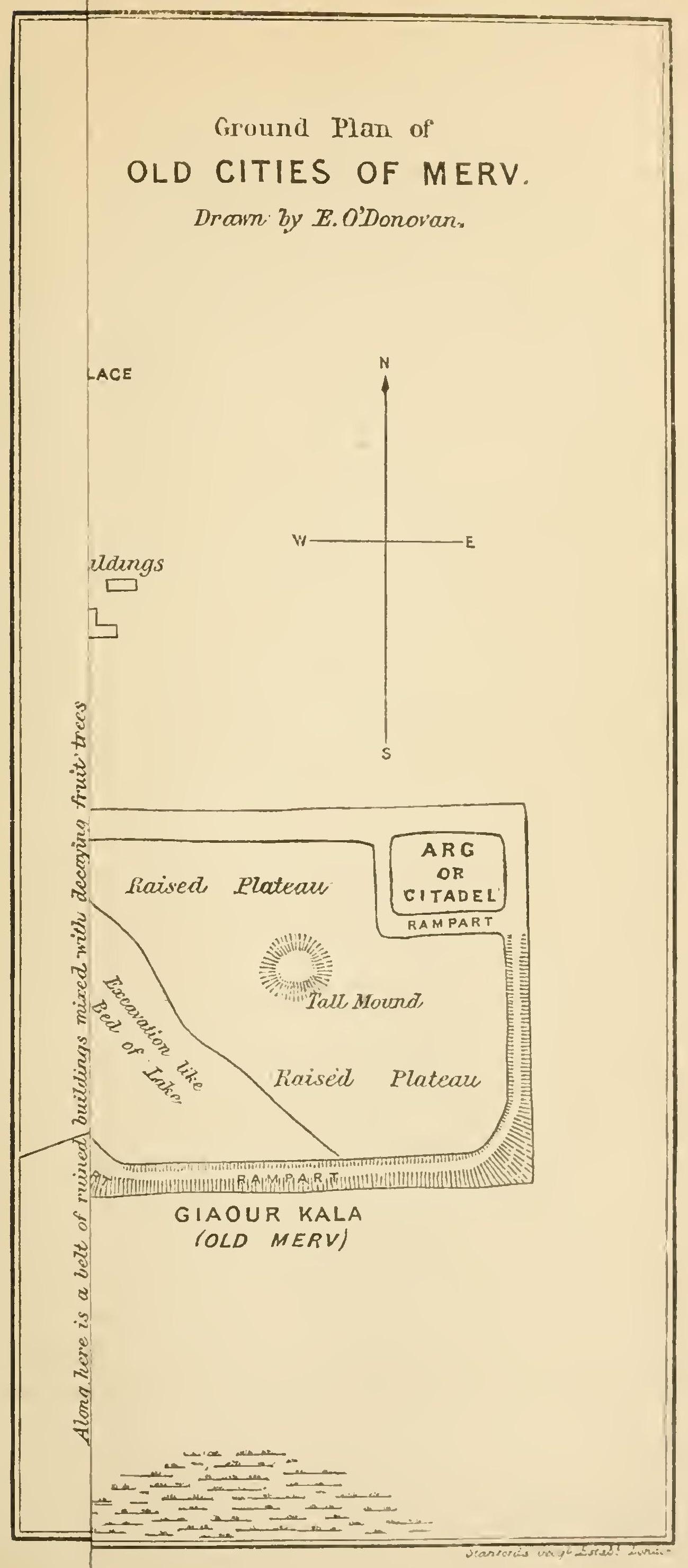
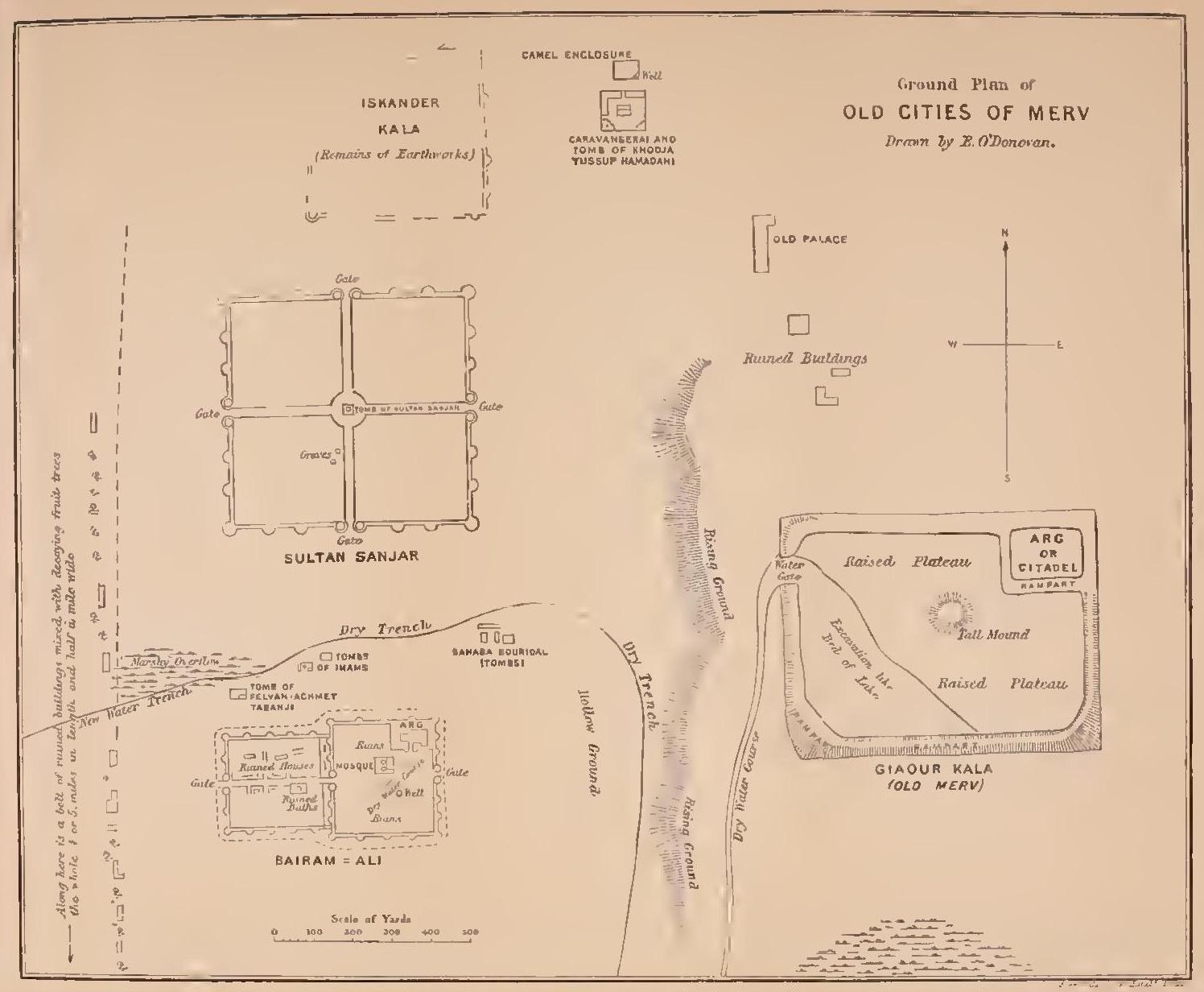
This Bairam Ali was the last of the towns of Merv, if I except Borsa Kala, the Saruk settlement which I have already described. It is named after Bairam Ali Khan, its last defender, who was killed here in 1784, when the town was attacked by Begge Jan, alias Emir Masum, sovereign of Bokhara.
In the midst of all this waste of crumbling palaces and baths and ramparts, excepting the snakes, a few birds, and an occasional jackal, no living creature is to be met with, save, indeed, an occasional Ersari robber or treasureseeker; for here, as in almost every other part of the East, the popular imagination enriches these ruined vaults and foundations with secret treasures stowed away beneath them.
We left Bair am Ali by its eastern gate, for the double enclosure has two entrances. Immediately in front, and a thousand yards away to the eastward, rose a long line of earth bank, indicating the site of Giaour Kala, as the oldest of the Merv cities is now called. We did not proceed there immediately, but directed our course in a north-easterly direction, to a group of buildings some two hundred and fifty yards off, occupying the brow of an undulation of the ground. There was what resembled a large triumphal arch, forty feet high and about the same in breadth, built of hard flat-baked bricks of a yellowish-brown colour, and ornamented with oblong tiles enamelled of a bright blue, the alternate ones being a shade darker than those next them. Nowhere else among the ruins of Merv is the slightest trace of similar enamelled bricks to be found. In contact with, and to the south of the arch are two covered buildings, the sides of which are quite open. A low, open-worked brick balustrade runs breast-high around them. These buildings and balustrades are sparsely ornamented with blue tiles, like the triumphal arch. Both buildings are exactly alike, and inside each stands an oblong tomb of bluish-grey marble, beautifully and elaborately sculptured with inscriptions and arabesques, and divided into panels. Each tomb is about seven feet in length, two in breadth at the top, and four in height. The sides and ends have a slight incline. Apart from the arabesques and inscriptions, which are cut in very slight relief, the outline of the tombs is perfectly plain. Adjoining the more easterly of the buildings were the remains of what had probably been large baths, if one might judge from the extensive underground vaults with brick groining, closely resembling those within the enceinte of Bairam Ali. The Turcomans who accompanied me could tell me little concerning the history of these tombs, or of the persons interred beneath them. They only spoke of them as very holy ‘sheiks,’ for here this word, which in Arabia and Syria simply means a military or political chief, indicates an individual celebrated for sanctity. The tombs were known as those of the Sahaba bouridal, literally ‘the beheaded gentlemen,’ and my informants told me that they had been murdered in the cause of religion; when, or why, they could not give me the slightest idea, though they prayed as devoutly before their resting-place as if they knew everything about their history. The entire area between these old tombs and the triumphal arch was completely covered with débris of bricks and tiles.
From this point we turned in an easterly direction, descending a pretty steep incline, towards a very deep irrigation canal which was in course of construction some hundreds of yards further on, in continuation of one which brought the water almost level with the north-western angle of Bairam Ali. When I saw it, the water had not yet been made to flow to this point. A shallow valley intervenes between the eastern face of this latter town and the western one of Giaour Kala. Crossing the valley, we proceeded towards the south-eastern angle of Giaour Kala. The great earth ramparts by which it is surrounded closely resemble, in size and construction, those of Kouchid Khan Kala, which would almost seem to have been copied from them. At a distance the ramparts of the old town exactly resemble a great railway embankment. The ground upon which it is situated rises considerably towards its northern side, while the level of the top of the walls on each side is exactly the same. Consequently, the southern line is much higher than that along the north. At the south-eastern angle the ramparts are at least sixty feet high. Urging our horses at full speed, we galloped with difficulty obliquely along the great slope, and succeeded in gaining the summit. At this point the turbé of some holy person of the wilderness had been erected, and a pole, bearing a piece of tattered linen floating bannerwise at its extremity, had been planted beside it. The walls, which at a guess I should say were eight hundred and fifty yards from east to west, and six hundred and fifty yards from north to south, enclosed a regular quadrangular space. Immediately below us, and occupying the whole of the southwestern portion of the enclosure, was what apparently had been a small lake in which water was stored for the use of the inhabitants. Through a gap near the north-western angle of the ramparts formerly entered an irrigation stream, the bed of which is still distinctly traceable, and which, I am informed, flowed from the ancient dam at Bent-i-Sultan, on the Murgab, a day’s journey beyond the present Saruk dam of Kazakh.
Almost in the centre of Giaour Kala stands a large mound, on the summit of which are the traces of walls and towers. This was probably an old palace, or a defensive work of some kind. The arg, or citadel proper, was here, as in every other ancient town in this part of the world which I have examined, in its north-eastern angle, and consisted of a square enclosure, of which the northern and eastern sides were identical with the main rampart itself. The terre pleine, or inner area, of this redoubt-like work, is considerably above that on which the central mound stands. I made the entire circuit of the ramparts, proceeding first along its southern, then its eastern, and lastly its northern side. Towards the middle of the northern side still exist some traces of rampart, of upper parapet, and of embattled wall; but I should say that these were of a far later date than the great embankment on which they were built. The whole of the area within the ramparts is littered with the débris of broken tiles and earthenware vessels, many of the fragments exhibiting the most beautiful tints, and, in some cases, prismatic colours. I did not come upon an entire utensil of any kind.
Standing on the ramparts of this old city, the view ranges far away to the eastward, over slightly undulating ground largely covered with tamarisk growths, while here and there are traces of ruined walls and buildings, scattered sparsely in the present wilderness. This Giaour Kala is the oldest of the three remains, and was doubtless the first walled city erected upon the spot. It was destroyed by the Arabs towards the end of the seventh century, when the lieutenants of Omar, having overrun Persia, pushed away northward towards the Oxus.
Descending from the northern ramparts, we wended our way in a north-westerly direction towards some large ruins, distant a few hundreds of yards. Some of them had been ancient palaces, to judge by the elaborateness of ornamentation of their interiors. Others had evidently been religious structures, and some may have been storehouses. Continuing still further in the same direction, and leaving the old town of Sultan Sanjar to our left, we reached the only building which in all the vast extent of crumbling remains is now used for any human purpose. It is the last caravanserai at which caravans from Meshed, proceeding through Merv to Bokhara, halt before entering upon the waterless expanse beyond. It is known as the caravanserai of Khodja (or moullah) Yussuf Hamadani. It consists of two enclosures, one about a hundred yards square, and another, some thirty yards to the northward, of half that size. The latter is simply a wall-girt space, within which camels and other beasts of burden are assembled at night, and in the corner of which is a deep well furnished with a bucket and lift. The entrance to the caravanserai is in the northern side of the main enclosure. Right and left of the doorway are extensive vaulted apartments of brick, occupying the entire length of that side of the enclosure. More than half of the western side is taken up by a small mosque, the entire eastern front of which is open to the air. It is termed the mosque of Mehemet Hussein Herati, a nobleman of that locality who came hither on a pilgrimage and caused this mosque to be built in honour of Yussuf Hamadani, whose tomb occupies the centre of the main enclosure. In the vaulted chamber to the left, or east, of the doorway, are two enormous brazen pots, nearly five feet in diameter, set in a bed of brick arranged so as to allow of fires being lighted underneath them. In these huge utensils is prepared, simultaneously, the food of the members of the caravans. There are two attendants in the place—softs, as my companions styled them—two exceedingly dirty-looking, cadaverous individuals, wearing large white turbans, and who are supposed to keep on hand various small stores to be disposed of to travellers. These men informed me that the pots were presented by Emin Khan of Urgenz (Khiva) when he came to this place upon a pilgrimage very many years ago—how many they did not know; it might be a century, or three centuries. The groined roof overhead was sadly blackened by the smoke of the fire, but here and there I could make out that the surface of the bricks had been silvered, or, I might rather say, leaded over, by being rubbed with a piece of metal. The atténdants told me that this silvering had been done by order of Abdullah Khan, of Bokhara, who came upon a pilgrimage to the tomb of the saint. This may or may not be true, but while I could distinctly see the metallic covering on the surface of some of the bricks, it appeared quite confined to separate ones, those alongside being entirely without any trace of metallic tint. Had I not been told of the origin of the metallized appearance, I should have decidedly said that it was some lacquered surface, developed in the process of baking the brick itself, and that, too, unintentionally. However, I give the story told me by the guardians of the caravanserai.
These vaulted chambers formed a very welcome refuge from the glare of the sun, resembling so many ice-houses when we entered them after a quick gallop over the blazing marly plain separating us from the ramparts of Giaour Kala. A tomb, which stood in the very centre of the enclosure, was evidently the original building round which the others had been erected at a later period. It consisted of a rudely-built, flat-roofed house, two stories high, some thirty feet wide by fifteen in depth. It was entered by a strongly barred door. Behind it, and adjoining it to the southward, was a balustraded, roofed enclosure similar to those at the tombs of the ‘beheaded gentlemen,’ and within which stood a somewhat similar tomb.
Before proceeding to eat or rest, my companions performed their orisons around the tomb of the blessed Yussuf Hamadani. They drew up in a line on its western side, with their faces towards the tomb, holding their joined palms before them in the fashion of an open book. They prayed for a few minutes in muttered tones, and then all advanced to the balustrade. Each person, laying both his palms upon it, applied them to his face, drawing them downwards towards his chin. Then they began to circle slowly around the tomb, proceeding towards their right hands. At each two steps they placed their hands upon the balustrade, repeating the operation of stroking down their faces and beards. The balustrade was covered with dust and sand, and as, owing to the heat of the day, my companions were perspiring pretty freely, it may be imagined what appearance they presented, after twenty or thirty applications of the dust-covered hands had been made to their countenances. Arrived at the eastern side of the tomb, they again formed line, this time kneeling, still facing the tomb, and praying in the same manner as before. They then repeated the march round, with the same peculiar ceremony.
All this time I scarcely knew what to do. Were I to join in their devotions, I feared that they might suppose I did so in mockery; and if I did not join with them I was apprehensive lest they should take it as a slight on my part. However, as I was thoroughly unacquainted with the prayers which they were repeating, I thought it best to stand quietly by while they prayed. Then we went to visit the mosque, which was little more than a large deep recess, furnished with a mirhab, or devotional station. Above the principal recess, or chamber, was a vaulted room, surmounted by a small cupola. My conductors prayed for awhile within this building, and I was surprised that they made no objection to my presence within the sacred precincts, even during the religious ceremonies. I remarked, too, another peculiarity. They did not uncover their feet, as is invariably the custom in Constantinople, or in any Persian mosque that I have seen. On subsequent inquiry I learned that when, as was the case with all the party, long brown leather riding boots reaching to the knees were worn, it was not usual to remove them, either when entering a mosque or paying a visit to the house of a friend. These long boots are never worn except by a horseman, and the fact of his having been mounted presupposes that he has not soiled his feet in walking across the muddy ground.
Having got through a due allowance of prayers, we next proceeded to prepare green tea at the fire which the two softs lighted for us. After the usual meal of griddled bread and weak tea, we indulged in the siesta for which the extreme heat and our long ride had fully prepared us. For my part, I could get but little repose, for the singak, as the Turcomans call the common house-fly, attracted to the spot by the offal remaining after the passage of caravans, made existence almost intolerable. While we were endeavouring to rest, one of our companions took his station as sentinel upon the tomb of the little mosque, and kept a sharp look-out for the possible approach of Ersari robbers, who make the ruins of Merv a trysting-place when they organize an aleman, or raid, upon any of the Vekil villages.
After a brief rest, and having recompensed the softs for their trouble with a few pieces of silver, we wended our way towards the remains of some earthworks lying about three hundred yards to the westward. Here was a rectangular space, its sides, like all the other enclosed areas of the place, looking towards the cardinal points, and each side being about five hundred yards in length. It had evidently been an encampment of some sort, but the traces of the fortifications were now very indistinct. The Turcomans call it Iskender Kala, and say that Alexander the Great’s army was camped there when on its way to India. This is the local tradition, but in these countries Alexander, or, as he is styled, Iskender, comes into every story connected with ruins of remote antiquity. A moullah, a brother of Makdum Kuli Khan, who was explaining to me the local traditional history of the place, informed me that Alexander had foretold the destruction of Merv, and that he was a great pihamber (prophet). I ventured to express a doubt as to whether the Macedonian soldier had ever been endued with the gifts attributed to him by my informant, whereupon he flew into a violent rage, saying that it was easy to see that I was a giaour, and unacquainted with the truth of things in general, as it was well known that Iskender was a great pihamber, and scarcely second to Suleiman-ibn-Daoud him- self. Of course I pleaded the ignorance of a Ferenghi on such matters in extenuation of my doubts, and said no more upon the subject.
After having examined the old entrenchments, we turned southwards, and approached the northern side of the ancient city of Sultan Sanjar. This is a great quadrangular enclosure, measuring about six hundred yards on each side, and surrounded by a well-preserved wall with numerous flanking towers, a fausse braye, or lower secondary exterior rampart, as at Meshed, being added. This town is said to have been destroyed by the son of Zenghis Khan, Tului, about the year 1221. It must, however, have been occupied at a later period—at least, the fortified walls—for in the flanking towers at the corners and gates are artillery embrasures. It is provided with four gates, each well defended by massive towers of baked brick, a material which also enters largely into the circuit of the walls, especially their lower portions. With the exception of the mausoleum of the Sultan himself, standing exactly in the centre, at the point where the two great causeways running respectively north and south and east and west cross each other, of all the buildings that once stood within the walls there is not now one brick remaining upon another. One is puzzled to imagine how such thorough and complete ruin could have been worked, and still more mystified by the occurrence, in close vicinity to each other, of pits of from four to five feet deep, dug all over the surface. I was told that these pits were made by treasure-seekers, a caravan scarcely ever passing by the place without many of its members trying their fortune by digging these holes, in hopes that they might perchance stumble upon a pot of gold or jewels. That quantities of ancient money and vessels of precious metal had been found here from time to time, Yussuf Khan assured me. The entire destruction of the foundation, and the upsetting and scattering of the material, is probably due to this continued digging. Moreover, the materials of the houses have evidently been transported from the spot, and made use of in the construction of the later city close by—Bairam Ali. The Easterns appear to have a superstitious dislike to rebuilding upon the site of a former town. In the older city, Giaour Kala, there are only fragments of brick and pottery scattered over the surface, the great mass of the building material having, I believe, been made use of to construct the city which succeeded it, Sultan Sanjar. In like manner, when the last-named city was destroyed, the material was utilized for the erection of the most modern city. In Bairam Ali the buildings still extant can be seen, as well as the materials of the others, scattered about in great quantities, for, no other town having been built in the locality at a later period, the débris of the former one was not removed.
The tomb of Sultan Sanjar is a place of pilgrimage, and no Turcoman ever passes this spot without paying homage to the sanctity of the departed potentate. The tomb itself is of commanding size. It cannot be less than sixty feet to the summit of its cupola. Its form is very similar to that of Ferdusi’s tomb at Toos, but it bears traces of having been still more elaborately ornamented. Its greatest diameter is at least forty feet. Its ground plan was that of a square, with the corners flattened; within, the walls still preserve a large portion of the stucco and white plaster with which they were formerly coated, and on which still remain, in many places, blue and red arabesques upon a white ground. The doorway is on the western side, and the floor seems to have been excavated, probably for the purpose of removing the pavement, so that one enters by an inclined plane, leading downwards, and can plainly see that the present floor is at least six feet below the level of the original one. In the centre stands the tomb, about the size and dimensions of those of the Sahaba bouridal, not far off. It was doubtless originally of stone. Now it is of plastered loam, or the original, at least, is covered with that substance. My companions drew up in line in front of this, and went through the same ceremony as at the tomb of the holy man at the caravanserai. As before, I looked on, taking no part in the ceremonial. Then we mounted again, and rode away along the causeway leading to the southern gate. Here, on the right-hand side, and a hundred and fifty yards from the cupolaed mausoleum, are two very large piles of broken brick and tile. These, I was informed, were the graves of the ‘enemies’ of Sultan Sanjar; who or what these enemies were, no one could give me the least idea. The group of horsemen halted about fifty yards short of the heaps, and then each dashed by at full speed, discharging his musket at one or other of them. Those who happened not to have their pieces loaded rode up, dismounted, seized a fragment of brick, and hurled it furiously against the pile, uttering curses and maledictions upon the Sultan’s enemies. This was extremely ludicrous, as none of the enthusiasts had the smallest notion as to who the dead people were, or what they had done to Sultan Sanjar. It helped to show me how blindly these illiterate Orientals are led by anything in the shape of a religious tradition. Even on this occasion I refrained from indulging in an outburst of religious sentiment, much to thé disgust of the remainder of the party.
Issuing from the southern gate, we entered into a very shallow valley, which separates the ruins we were leaving from those of Bairam Ali, which lie due south, and about five hundred yards distant. This shallow valley, after clearing Sultan Sanjar, turns sharply to the south, intervening between the latter town and Giaour Kala. Taking advantage of this depression, some of the Vekil Turcomans had led a slender thread of water in this direction from the easterly branch of the Novur canal. The water had been brought opposite the north-western angle of Bairam Ali, and half-a-dozen men were trying to lead it still further by cutting a very deep trench. At this point some scanty melon beds were being attended to, as the fruit can be sold at a great profit at this, the last station on the Merv line to Bokhara. On the southern bank of this irrigation trench are three Imam Zadés. The more easterly two are small covered structures of unbaked brick, with rough, loam- plastered tombs within them. Here my indefatigably pious comrades again dismounted, and before each of the tombs again offered their vows. These two sepulchral edifices bear the name of the Imamlar. One hundred yards westward was a small enclosure, having in one corner a roofed chamber. This was the tomb of a person of sanctity named Pehlvan Ahmet Tabanji. Both he and the other two individuals are described by the general name of ‘the Sheiks,’ this being, as I have said, understood to imply a religious and holy personage. The latter celebrity seems to have been very distinguished indeed for piety, for his tomb is literally covered with souvenirs of all kinds, brought from afar by pilgrims. There were morsels of marble and earth from Mecca, and, among others, was a very droll offering. It was a marble cannon-shot, over twelve inches in diameter, and by some accident had been broken in two. The energetic piety of a pilgrim had caused it to be conveyed all the way from Mecca to the heart of the Merv desert.
Around and between the ruined cities, and reaching far and wide to the north and east, were blank aridness and desolation; save the usual desert shrubs, the chiratan and tamarisk, nothing in the nature of verdure was to be seen.
By this time the sun was getting low, and as I was heartily tired of dismounting whenever my comrades took it into their heads to go praying and walking round these tombs, I was glad when we turned our horses’ heads westward, and made our way towards Makdum Kuli’s house. As on our homeward journey we reached the belt of dilapidated gardens and tumble-down houses which intervenes at a short distance between the cities of the plain and the Vekil settlements, I could perceive the vast extent of the ground formerly built upon, for the suburbs of the walled towns cover a much greater space than the towns themselves. I climbed to the summit of a ruined building, half dwelling-house, half fortalice, whence a commanding view was obtained over the crumbling expanse of cities. A feeling of oppressive loneliness comes over the spirit as the eye ranges across that voiceless wilderness, so deserted, so desolate, yet teeming with eloquent testimonies of what it had been of old. The heart of Zenghis Khan himself would feel exultant at the absolute, hopeless lifelessness of those sites, where great cities had stood and myriad populations swarmed. Even vegetable life is absent; and the sun, elsewhere the source of life and plenty, here looks down but to scorch and wither; its light, which discloses the thousand beauties of less stricken lands, here shines only to emphasize the hideous barrenness of the wasted solitude. It was strange to think that a few yards of dam upon the Murgab, some trenches dug by illiterate toilers, had once made these present deserts vernal, and had entitled this Golgotha of cities to the proud name of Queen of the World. Who knows but that, again, when the hand of the raider has been stayed, and the merchant is once more permitted to follow his avocations in peace and security along these formerly frequented tracks, history will repeat itself, and Merv once more take its place among the nations of the earth?
Chapter XLV: A Day With Makdum Kuli Khan.
Amusements along the way—Rude sport—Mock forays—Vicious amusement— Prayer by the roadside—Makdum Kali’s clansmen—Tokmé Serdar in a Sanduk—Yussuf Khan’s dwelling—Turcoman reception—Conversation— Noor Berdi Khan’s widow—Female costume and ornaments—An evening meal—Dislike to whistling—Hungry attendants—Turcoman appetite— Antique bronze lamp—Turcoman chiraghs—Sand flies—Early dawn—A private conversation—Presents and haram zades—Deceit—Redress in case of murder—Moomia—Stones from doornah—Gougenasse and preusské— Snakes at Marma Khan Tepe—Supper with the Karaoul-bashi—Back to Kouchid Khan Kala.
Returning from my visit to the ruined cities of the plain, I had a good opportunity of seeing how Turcomans amuse themselves when abroad. The ground over which we were riding, owing to deep trenches, slippery mud, and occasional deep flooding, required all the horseman’s vigilance to keep himself and his beast from coming to grief; but it was only over such spaces, disagreeable as they were, that I had any peace or quietness. The moment anything like firm ground was reached, some one of the party suddenly uttered a wild whoop, and put his horse to the top of its speed. All the others were, it seems, bound in honour to follow suit, myself among the number, and then a scene of wild, headlong racing commenced, varied by different performances. Each person was expected to unsling his rifle, and, going at full speed, to take deliberate aim at some object and fire. Then re-slinging his piece, he would draw his sword, and, racing up to the person next him, exchange passes and flourishes. This was all very well on unbroken ground, but the sudden occurrence of a deep trench or mud hole became a serious matter while one was engaged in displaying his martial accomplishments, his horse going at the rate of twenty miles an hour; and, as it was sore against my will that I engaged in such antics, it was with unfeigned satisfaction that I witnessed occasional catastrophes in the shape of some gallant Khan—horse, armament and all—coming down with a crash in attempting to clear an unusually wide mud patch, and getting up the reverse of pleased with himself. But these people take a pride in showing their stoicism, like North American Indians; and the man who had come to grief was the first to initiate a fresh stampede. A great source of amusement was to charge full speed at a party of villagers returning on foot from some market, with their asses laden with goods, and send men, women, and asses flying right and left, often dashing some of them to the earth. As the parties thus assaulted were invariably armed, I had fears of the consequences; but we went at such a speed that, before the victims could pick themselves up and unsling their guns, we were far beyond the chance of being hit. We entered each aoull in the same style, sending goats and sheep flying, women and children madly rushing to the first place of refuge, under the belief that we were a party of Er sari raiders executing a foray, for this is exactly the way in which an aleman is carried out. The raiders approach quietly; but when within ‘a measurable distance’ of the village they are bent on plundering, they put their horses to the top of their speed, and, sword in hand, dash like lightning into the place, cutting down everyone before he can run to his house for arms. Then, seizing on everything moveable, including children, they are away again before resistance can be organised. Entering one village in this fashion, a group of old men were seen talking together in the middle thoroughfare. The brother of Makdum Kuli Khan charged them at racing speed. The old men, fully believing that we were Ersari horsemen, rushed right and left. There was one who couldn’t get out of the way quickly enough. The rider, a moullah or priest to boot, directed his steed straight at him and dashed him senseless to the ground. I was obliged to keep with the rest of the party, for if I held back I ran imminent danger of being massacred by the enraged villagers when I came up. As long as no actual harm was done beyond scaring the villagers, and as I saw it was one of the customs of the country, I didn’t mind these simulated forays, but, after the incidents referred to, my face wore such a grave expression of disapproval that Makdum Kuli himself felt called upon to say something. Riding to my side, he asked me whether in Frangistan we did such things. I replied rather curtly that we did not, and relapsed into silence. After this the Khan forbade such exhibitions during the remainder of the ride. One can scarce understand treating even one’s enemies in this fruitlessly reckless fashion; and yet the aggrieved people were not only Turcomans, but even fellow-tribesmen of the aggressors. I have never been actually in the midst of a real Turcoman foray; but from what I have seen of the fashion in which friends are treated, I can imagine the scenes which take place when real mischief is intended.
It was sunset as we drew near Makdum Kuli Khan’s present residence; for it was not his permanent abode. Within three or four hundred yards of the place my companions all dismounted, and, leaving their horses to the care of one of their number, went through the rather lengthy prayers which all Mussulmans repeat at the close of day. Having washed their hands and faces in a neighbouring irrigation trench, they retired into a small grove of fruit trees hard by, and then went on with their orisons without removing either their sabres or their riding-boots. Were they at home, the invariable custom is to wash feet, as well as hands, before prayer, as well as to undo the sword- belt; but the exigencies of the desert require that, when abroad, no man disarm himself for a moment, or in any way make himself unfit for instant combat.
Makdum Kuli lived with his younger brother Yussuf Khan, pending deciding what to do and where to settle for himself. He had still a large following of Akhal Tekké families, who had clung to his fortunes with a praiseworthy fidelity, and refused all offers on the part of the Russians to return to their former abodes. Still, as I have already stated, very considerable numbers—the great majority, in fact—had closed with the Russian terms, and become Russian subjects; so much so that the Mervli already classed them among their enemies, and reckoned that in case of war with Russia they would have to deal with their former allies, the Âkhal Tekkés, as enemies in the field. The semblance of friendship was still kept up between them, and the people of Yengi Sheher were still allowed to visit Merv; but, for that matter, so were the Awlili Turcomans, and even the Derguezli. Great indignation was felt here at the part which Tokmé Serdar, the celebrated defender of Geok Tepe, had played. Nothing could exceed the indignation of his former associates who had fled hither to preserve their independence, when they heard that he had voluntarily gone to St. Petersburg and offered his sword to the Emperor, with vows of eternal fidelity. On these same vows, by the way, I did not set much value. By this time I knew the Turcomans too well to make such a mistake. I was very much amused by the description given me by some Akhal Tekkés of the Serdar’s departure for Russia. It seems that my informants accompanied him up to the point where the trans-Caspian Railway was in working order. ‘They shut Tokmé Serdar and two others, in a large box (sanduk) and locked him in, and then dragged him away across the Sahara. And,’ added the speakers, ‘Allah only knows what will happen to them inside that box.’ The box, I need hardly say, was a railway carriage. To return to Makdum Kuli Khan. He was looked upon as quite an outsider at Merv, and took no part in the medjlis or Executive Council of Merv. His younger brother, Yussuf Khan, however, was considered a Merv Khan, his lands and clansmen never having existed beyond the Merv boundary.
Yussuf Khan’s house—or rather his establishment, for he had several houses—is to a considerable extent a departure from that of the ordinary Turcoman Khan. There was a pretty extensive grove of trees—mostly fruit trees of one kind or another, the jujube, with whity-green foliage like that of the olive, figuring largely amidst the darker tints of the apricot and pomegranate. In the midst of this grove was a large open space, where were the immediate dwellings of the chief’s family. There was a massive- looking square tower about twenty-five feet wide by thirty- five in height. It was built of unbaked brick, plastered over with fine ochre-tinted loam. A low doorway, closed by a rudely-carved wooden door, gave access to the ground floor, a large room lighted by four narrow loopholes, and paved with flat bricks from the neighbouring ruins of Bairam Ali. In somewhat less fiercely sunny weather than then obtained this quadrangular grotto would doubtless be cool enough. After a day’s absorption of heat by the entire building, on coming into it from riding in the evening breeze one feels as if he had stepped into an oven. The place was for the moment uninhabitable. A rude flight of stairs on the outside of the building led to the upper storey, which was ventilated by four large windows besides the door. Here the breeze had free access, and the temperature was delightful. The terrace above, surrounded by a low embattled parapet, was only used for sleeping on at night. In the square space around the tower were ranged half-a-dozen of the usual beehive-shaped huts, and a couple of long rawbrick buildings—the latter serving as stables. The two Khans dwelt in huts, a Turcoman as a rule having a strong objection to live in any other kind of residence. The tower is only added as an adjunct of state, and as quarters for visitors who know no better than to dwell in such an un-nomadic dwelling. The Khans had ridden on before, and, as I dismounted at the entrance to the dwelling, came forward to receive me. They were dressed in the usual Turcoman robes of the upper class—a long tunic of coarse crimson silk reaching nearly to the ankle and with a narrow combined stripe of black and yellow. This was girt at the waist, rather high up, with a voluminous white sash of cotton, in the front knot of which was stuck a highly decorated sheathed knife, a foot long; wide pantaloons of white cotton, red leather slippers, and an enormous grenadier hat of black sheepskin, completed the attire. I wore the same costume myself, for my Western garb had become unpresentable through long travel; and, besides, I wished to avoid the crowds which pressed around to see my Ferenghi costume each time I showed myself abroad. The Khans came forward in the politest manner, surrounded by a crowd of retainers. On such occasions the proper thing is to walk with a slow, pensive step, the palm of one hand laid upon the back of the other, and with a dejected expression of countenance, such as a man might wear if he had woeful intelligence to impart. All this is meant to convey intense humility, and the idea of being the humble servant of the new comer. The host suddenly thrusts out both hands towards him, he following suit, each taking one hand of the other in his two. Then follows a series of minute inquiries after our relative healths, and as to whether there is any fresh news going, as if we had not seen one another for six months or more. We took our seats upon a raised earthen platform, such as is to be found alongside the door of every person of consideration, and where he sits during the evening hours with his friends. It is surprising what a difference this elevation of a couple of feet makes in the temperature of the breeze. The layer of air in immediate contact with the earth, still heated by the sun’s rays, is as hot as if it passed through a furnace; while a little higher up it is cool and refreshing. As for the conversation of the select party with which I found myself, it was like that of most Turcomans, distressingly inane. I tried to turn its current towards the subject of the old ruins we had visited during the day; but I could elicit little more than a parcel of the most uningenious tales about gins and divs and pihambers, or prophets who had stuck their thumbs in the ground and made water spring from the desert, or who had driven the Giaours from their stronghold by a puff of their breath. I was becoming fairly distressed in mind, when a matronly woman came forward and announced that dinner was ready. The matron was the widow—one of them—of the late Noor Berdi Khan, of Yengi Sheher and Merv. Her name was Gul Djemal (the Beautiful Flower). She wore a long shirt of dark purple silk, reaching almost to the ankles, and closely fastened at the neck by a massive silver arrow. Around her neck was a ponderous collar resembling that of a Newfoundland dog, and from it, suspended by numerous chains, was an engraved plate chased with gold arabesques and set with cornelians, not unlike the urim and thummim of a Jewish high-priest. On her wrists were ponderous bracelets, set also with flat cornelians. The breast and stomach of the shirt were so set over with closely-hung large silver coins as to give her the appearance of wearing a cuirass of silver scales. On her head was a casque of open silver work, showing the red cloth beneath, and surmounted by a spike like that of a German soldier’s helmet. Her entire appearance in her silver panoply was Minerva-like in the extreme. This silver casque, which among the westerly Turcomans, such as the Goklans and Jaffar Bais, is worn only by unmarried girls, seems here the 1 head-dress both of maids and matrons. The Yamud women wear a frightful head covering of the size and shape of an ordinary band-box, the front hung over with a multiplicity of gold and silver coins, having attached to the top and falling over the shoulders to the loins a mantle of red, green, or blue cloth. Anything more awkward, more unbecoming, or more generally ungraceful, it would be difficult to imagine. On inquiry I learned that up to thirty or forty years ago the Merv women wore the same kind of abomination, but since their exodus from the neighbourhood of Sarakhs it has been entirely discarded. The Turcoman women seldom put off this finery, the matrons especially doing all their household work in full costume. As we rode up to Yussuf Khan’s house we met a lady in a resplendent crimson shirt, and even more than usually decorated, accompanied by her four daughters, all, pitcher at back, going to a neighbouring stream to procure water for the evening.
Makdum Kuli led the way up the precipitous stairs to the bala-hanê or upper chamber of the tower, where our evening repast was laid out. Nothing could be simpler than this meal. Some brown cake-bread of the coarsest description had been broken up in wooden dishes a couple of feet in diameter, and over it had been poured a quantity of mutton broth, the meat and bones resting on the top. With each dish was a rude wooden spoon, the bowl four inches in diameter, the handle a foot long. This instrument was intended for the broth; one ate the meat and bread with one’s fingers, each of the half-dozen persons around each dish taking the spoon in turns. This is the unvarying manner of eating, even in what may be styled the ‘highest society’ of Merv. A number of hungry attendants sat cross-legged around, eyeing the bowls with wolf-like eyes, and no doubt inwardly anathematising the extensive appetites that were rapidly lessening their contents, for the remnant of their superiors’ repast was all they had to expect. However long I might live amid such surroundings, I could never get accustomed to them, or insensible to the wolf-like eyes of the attendants; and often on similar occasions, I have given over eating before my hunger was half appeased, lest I might have too heavy a weight of maledictions to carry; for the greater part were sure to be levelled against the unbelieving Giaour who was thus consuming what should more properly find its way into the stomachs of true believers. A Turcoman is ready at all moments to devour any amount of food, of any description, which may be placed before him. He seems never thoroughly satisfied even with the heaviest meal, and in five minutes more is ready to face the biggest dish of pilaff or broth that can be put before him. The appetites of Turcomans seem really phenomenal. Supper cleared away, we sat in the gloaming looking out over the dimly-lit plain, listening to the lowing and bleating of the homeward-driven flocks and herds as they entered the various walled enclosures where they were placed for safety during the night. A curious Turcoman superstition here came under my notice. As, lost in reverie, I sat by the window half unconsciously I commenced whistling softly some snatches of tunes. I noticed a general movement of dissatisfaction among my companions. They shifted in their seats, looked uneasily at each other and at me. At length Makdum Kuli touched me on the shoulder and said, ‘For God’s sake, Sahib, don’t whistle any more.’ I feared that I had unwittingly committed some great breach of decorum, and accordingly, excusing myself, relapsed into silence. After a while I whispered to the moullah beside me, and asked why Makdum Kuli objected to my whistling. ‘Is it possible you don’t know,’ returned the priest, ‘that at this hour the ghouls and gins are abroad and are wandering to and fro? If they hear you whistle they will suppose you are calling them; and, Bismillah, we have no desire for their company? I afterwards learned that to whistle in the daytime is a token of defiance, and not considered proper when others are by. A primitive lamp, excavated from among the ruins hard by, was brought in, and shed a flickering smoky light over the swarth countenances of the group within the chamber. The form of this lamp struck me; and, on examining it, I discovered that its material was white bronze. It was doubtless a relic of the earlier days of Merv. Our host, Yussuf Kkan, informed me that it had been found while excavating some irrigation trenches in the vicinity of the old cities. Seeing that I was greatly interested in it, he generously presented it to me. It is about four inches in height, and of the form of the ordinary antique lamps sometimes found in Greek and Roman sepulchres, save that the neck between the cup and the stand is taller than usual. The side of the spout had been damaged, and the resulting holes soldered up with pure gold; the composition of the original material being at the time apparently unknown. A portion of the margin of the stand had been melted off, probably during some conflagration, and replaced with iron rudely rivetted on. The handle had disappeared, but two small protuberances marking its position remained. The opening in the top was closed by a rude iron cover, the hinge of which worked in the original old bronze sockets. It had probably been added at a comparatively late period. Around the top of the lamp is a series of straight and curved scratches—whether attempts at decoration or inscription, I am unable to say. Among the Vekil Turcomans, earthen lamps of the old Greek form are frequently met with in daily use. In all likelihood they are obtained from the neighbouring ruins. Among the Turcomans generally, one sees quite a different form of lamp (chiragh), an iron rod, a third of an inch in thickness, two to three feet in length, and sharply pointed at its lower extremity. It branches at its upper end into four, supporting a rude, shallow iron cup, of about four inches square, the corners of which project in the form of short spouts, and serve to hold one or more wicks of crude cotton. The flame is fed with oil or melted fat. The pointed extremity of the support is stuck in the earth of the floor. The Yamuds of the Caspian littoral, who can obtain petroleum refuse (astatki), use an earthen lamp with long tubular spout, such as I have described under the head of Gumush Tepe.
Looking around the figures that squatted within the rude room, their arms piled or hung against the earthen wall, I could not help thinking what some of my friends at home would think could they but see me sitting among the crème de la crème of the prime brigands of Central Asia, far, far away from the remotest chance of succour, unknowing how long my detention there might last, and entirely dependent on myself as far as my ultimate fate was concerned. With the lamp came myriads of those pests of this country, the chivin or sand-fly, which makes night for all but the natives of the place a time of groaning and swearing. How I envied my companions as, having divested themselves of their tremendous hats and lengthy tunics, they stretched their limbs on the felt matting and went soundly to sleep. After a weary vigil I had the questionable advantage of seeing the faint saffron morning come up palely, throwing the cupola of Sultan Sanjar into bold black relief, as the sable ibises, swans, and other aquatic birds fled with shrill cries across the flooded fields. Apart from the natural irritation caused by the loss of a night’s rest after a pretty fatiguing day’s ride, the recollection of an undertone conversation I had overheard among my companions of the previous evening as they disposed themselves to rest was not calculated to put me in good humour. Makdum Kuli had gone downstairs to his own wigwam, and I was left alone with my route companions. The speakers were the Khan of the Otamish division of the Tekkés, and a miserable khodja, or scribe, to whom I had lent one of my horses to enable him to come with us. He was a constant guest at my house, and the recipient of numerous ‘presents’ in cash, in return for his literary services. Said the Khan, ‘Did you see the Ingles sahib to-day when we were praying at the tombs of the Sheiks? He was leaning on his sword and looking on as if he didn’t care anything about us or our prayers.’ ‘After all, he is only a kafir’ (unbeliever), said the scribe half apologetically. ‘What are we to do to-morrow?’ replied the Khan; ‘we can’t stop here any longer, we have received our three days’ hospitality.’ ‘But,’ said the scribe, who was evidently hungering after the unwonted meals which Makdum Kuli’s flesh-pots afforded, ‘you know that a Mussulman has a right to nine days’ hospitality.’ ‘Yes,’ returned the Khan warmly, ‘Mussulmans—yes, but a kafir like that!’ and he intimated me with a movement of his head, ‘a Yaman kafir (wicked unbeliever) like that, we couldn’t share hospitality with him for more than three days.’ This was peculiarly good, in view of the fact that the reception by Makdum Kuli was altogether given in my honour, inasmuch as I had sent him presents when he was fighting at Geok Tepe, coupled with a request to be allowed to come and look on, and had also given him some of no small value since my arrival at Merv. He would have seen the other Khan and his followers at Jericho before he would have killed a sheep worth ten shillings to entertain them, as they treated him as an intruder at Merv. All the foregoing was spoken sotto voce, and in the belief that I was asleep. Then the Khan added, with a good deal of bitterness, ‘He gives presents to haram-zadés (scoundrels, good- for-noughts), but he gives nothing to Khans.’ ‘Yes,’ returned the scribe, to whom I had made presents, ‘it is only to such people he gives anything.’ The recollection of this conversation, as may be imagined, did not amuse me as I sat looking out into the coming day. I recollected that if a man were shot, no one, save his wife or eldest male relative, had a right to claim justice. The worst of it is, that these people will next day be as pleasant and obsequious, in expectation of a ‘present,’ as if they never entertained any but the kindest and brightest thoughts about you. We were early astir; but Makdum Kuli would not let us go without another meal from the wooden bowls, washed down by green tea.
While we were on our horses at the gate taking our final pull at the water-pipe which was handed round as a valedictory ceremony, a number of men, old and young, gathered round us to hear what news was going, and to ask the usual absurd questions about things in general. A cousin of Makdum Kuli, who had lately been despatched to Askabad as a jansus, or spy, and who had been severely wounded in the right hand by a rifle bullet during the storming of Geok Tepé, wanted to know if I could give him any moomia to apply to the injury. This moomia I was for a long time at a loss to make out. I subsequently learned that it is bitumen. The Turcomans look upon it as a kind of panacea. They apply it to wounds, and take it internally, an infinitesimal portion being swallowed as a cure for nervousness, and a larger amount in cases of fever. It is to be found, I was informed, in the mountains of the Derguez, usually in inaccessible places, whence the nodules of it are dislodged by firing bullets at them. Matthi, the Jew trader at Kouchid Khan Kala, asked as much as two francs for a piece of moomia less than the eighth of an ounce in weight. When Makdum Kuli’s cousin had done speaking, an old man came up to me to ask whether some minute objects he held in his hand were valuable. On examination they turned out to be small pieces of semitransparent quartz, looking as if water-worn. Their owner informed me he had taken them from the gizzard of a doornah or stork. As there are absolutely no stones of any kind in the Merv oasis, even the smallest fragment of a material like quartz which is picked up, as in the present instance, is supposed to be something very much out of the common, and of exceeding worth. Just before turning our horses’ heads from the door, some of our party drew from their pockets small pear-shaped gourds, from which they poured into the hollow of their hands a quantity of an olive-green, damp-looking powder, which they placed under their tongues, allowing it to remain there during the remainder of the journey, much in the same fashion as tobacco chewers do. This powder is named gougenasse. It is of vegetable origin, but what its European or scientific name is I have been unable to ascertain. Preusské, or ordinary tobacco snuff, is sometimes put in the mouth in the same way.
Our course lay due west, towards the large mound known as Geok Tepé, and which is an excellent landmark for caravans traversing the plain. It is distant about six miles from Makdum Kuli’s village, and some thirteen from the more easterly of the ruined cities, Giaour Kala. Right and left of our route, which lay through well-tilled fields, were numerous wooded villages, though in this easterly portion of Merv trees are by no means so frequent as they are westward. Geok Tepe is situated close to the western bank of the main easterly branch of the Novur canal, which throws out numerous irrigation trenches, some serving to water the fields bordering on Bair am Ali. To judge from the great depth to which it has excavated its bed, I should say it was coeval with the mound close by. There are numerous vast patches of giant reed in the hollows along its channel, and dozens of rude turbine mills are to be seen in groups. Leaving Geok Tepé, we took a more or less south-westerly direction towards the large mound named Marma Khan Tepé, lying nearly in a right line between Geok Tepé and Kouchid Khan Kala. Around Marma Khan Tepé is a waste space of arid earth, bearing a few scraggy shrubs, and strewn over with brick fragments, indicating the site of a former town, of which now but a few wall foundations remain. This space was alive with snakes a couple of feet long, of a leaden-grey colour mottled with black, and extremely slender for one-third of their length immediately below the head. We spent half an hour hunting these up and killing them with our whips, in consonance with the invariable Turcoman custom. Within half- an-hour’s ride of the north-easterly ramparts of Kouchid Khan Kala we stopped at the house of Kara Khan, the Karaoul-bashi, an officer charged with the direction of the patrols told off to look after the Er sari raiders on this side of the Murgab. Here we had some fermented whey of camels’ milk, a very peculiar beverage, and very refreshing, in hot weather. Then crossing the entire breadth of the new fortress, the interior of which was covered with luxuriant corn and melon crops, the vivid green of which contrasts strongly with the scorched yellowish-brown of the surrounding ramparts, we reached our circular huts at the ‘capital’ about an hour after sunset.
Chapter XLVI: The Triumvirate.
Preliminaries—Conjunction of circumstances—A false position—Insinuations —Roused from sleep—The entry of the Khans —A thaumasha—Baba Khan’s cavalcade—Red and white standard—State etiquette—Aman Niaz Khan’s procession -An uncommon spectacle—Artillery salutes—Ceremonial water-pipe—My crimson banner—Allegiance to England—Oriental diplomacy-Inauguration ring—A political harangue—Message to England— The policy of the future—Yaghmour Khan’s protest—Kidaieff, the Russian prisoner—The question of Baghur Khan—Possibilities—Festivities— Toktamish and Otamish flags—Addition to the population—Public games —Mutual presents—Merv and Akhal Tekké embroidery—Money disbursements—Public crier and poets—‘Dower, dower, Sahib Khan!’—Celebrated thieves—Arrack—A meritorious Serdar—An unexpected concert—My takht—Insatiable appetite—A Bacchanalian finale and exit.
During my absence at the old cities of Merv, the revolution, the commencement of which I have already described, had been growing daily more complete. Though Kadjar Khan was practically no longer the director of affairs at Merv, the fact had not been publicly announced, and it was resolved that a demonstration should take place, which, by manifesting the number of adherents of each party, would leave the matter no longer in question.
On May 14, 1881, my house was all day long, and far into the night, filled with various Turcomans of prominence, who talked over the political prospects, and the chances, pro and con, of having to fight the Russians. I learned definitively that each of the two hereditary Khans had resumed his old jurisdiction over his respective division of the Tekkés, and on the morrow would come to take up his residence close by where my ev was pitched—the spot which had been settled upon as the administrative centre of the oasis. I was further told that I was to be associated with the two Khans in the direction of affairs, in the capacity of representative of the English nation, and intermediary between the Mervli and the English Padishah. I had over and over again protested that I had no pretensions to represent the British Government, and that my mission to Merv was undertaken purely with a view of ascertaining the true state of affairs, and keeping the British public informed as to the relative positions of Russians and Tekkés. All my efforts were in vain. It seemed to be a matter of perfect indifference to them whether I were or were not a representative man, so long as they chose to confer such a distinction upon me. One of the circumstances which helped to defeat all my attempts at disowning the official status which was thrust upon me was that my arrival at Merv had been exactly synchronous with the cessation of the Russian advance along the Akhal Tekké oasis; and, on the principle of post hoc ergo propter, the chiefs of Merv persuaded themselves that I must have something to do with this happy event, if I were not indeed the direct cause of it, and viewed me in the light of a small saviour in my way. At any rate, finding that my assertions in regard to my non-official position were useless, and feeling that I had protested to the utmost of my ability, I began to perceive that by passively accepting the situation I might doubtless have greater facilities for the investigations which were the object of my journey, and, subsequently, for leaving the oasis with greater ease and safety than could otherwise be the case.
Kadjar Khan had not been to see me since the last evening on which he had remained all night at my house, but his sons, and some of his adherents, paid me frequent visits, trying to impress me with the idea that those who were overthrowing Kadjar did so with a view to the more effectually handing over the Mervli to Russia or to Persia.
It was early on the morning of May 15, as I slept profoundly upon my felt mat after a night’s weary wrestling with the mosquitoes—the interregnum between the departure of these pests and the arrival of their daylight successors the singak, or house-fly, and the only portion of the twenty-four hours during which I was ever able to secure any rest whatever—I heard an unusual tumult around, and, not knowing what might be the matter, I sprang from my couch, and throwing my sheepskin kusgun around my shoulders, rushed to the door. Everyone was astir, and the main avenue of Merv was thronged with a vast concourse of people, mostly newcomers. Many were on horseback, and fully armed. At my door I found the attendants who had been told off for the service of my establishment, the chief of whom was named Mehemet Nefess Beg, a Kethkoda of some prominence. I asked him what was the matter. He informed me that the two hereditary Khans were making their entry into the capital, and that they were about to take up their abodes close to my redoubt.
Away towards the western end of the ramparts of Kouchid Khan Kala a large crowd of horsemen was seen approaching. In their midst, borne on a high pole, fluttered a red and white standard. In front, and on either side, armed horsemen dashed- to and fro, their sabres gleaming in the early morning light, some of them, careering at full speed, rapidly discharging their muskets. A genuine ‘gathering of the clans’ seemed in progress. A thaumasha, or fantasia, as it would be called by the Algerian Arabs, was being gone through in celebration of the events transpiring. As the body of men, numbering four or five hundred, drew near, those gathered together in Merv, both mounted and on foot, moved out to meet them. When within a hundred yards, I could make out that at the head of the approaching cavalcade rode Baba Khan himself, and that it was at his side that the red and white ensign was carried. Around him were his kinsmen and Kethkodas, all decked out for the occasion in their finest costumes. Many of his followers bore lances—an arm which has now almost disappeared from among the Turcomans, and which is only carried on state occasions, and then rather for show than anything else. Most of them were decorated with banderols of the same colours as the Khan’s standard.
Mehemet Nefess now hinted to me that it would be only courteous on my part to go forward to meet Baba Khan, and, as I knew this to be the proper etiquette, I followed his advice. When within fifty yards of the front of the advancing cavalcade I dismounted, and awaited the approach of the Toktamish chief. As soon as I appeared outside the parapet of my redoubt, I was surrounded by a great mob of the inhabitants of Merv, all eager to catch a sight of one of the rulers of the place in his new capacity. Surrounded by the crowd of sight-seers as I was, Baba quickly espied me, and immediately, in pursuance of Oriental courtesy, dismounted, and advanced on foot to salute me. Holding each other’s hands, we advanced slowly to a space, near the parapet of my redoubt, on which a large felt carpet had been spread, and where the medjlis of Merv had already assembled.
It was a singular spectacle. The morning light fell slantingly on the circle of grenadier-hatted, swarthy councillors who awaited the approach of the cavalcade, with its gaily attired warriors, glinting bannerets, and flashing sabres, headed by Baba Khan and myself, our hands joined in friendship. At the same moment, from the opposite direction, clouds of dust announced the approach of another procession. Aman Niaz Khan was drawing near, surrounded by a retinue similar to that of Baba Khan. The latter chief and myself, accompanied by the principal elders, went forward to meet the ruler of the Otamish. The latter dismounted some distance from the assembly, and we all three marched solemnly towards the carpet of honour laid at one extremity of the great felt mats placed for the accommodation of the councillors. Aman Niaz also brought with him a standard, but of plain white, which, together with Baba Khan’s, was reared close to the spot upon which we took our seats, and around which the entire council gathered, backed by an enormous crowd, hemming us in on all sides. The cannon boomed from the ramparts, where some had been placed expressly for the occasion; and for the next few minutes reports succeeded each other in quick succession, to usher in the new order of things. Neither Kadjar Khan nor his partisans attended the council, protesting by their absence against the revolution, the consummation of which was being celebrated. The discharge of artillery continued long into the afternoon, sometimes from the fortifications, and at other times from an open space some three hundred yards distant from us. The courtesies usual on such occasions were exchanged, and then the most gorgeous waterpipe which had come under my notice while at Merv was handed round. At Merv, that portion which in the Constantinople nargheelah is made of glass, is invariably fashioned of wood, if it be not a bottle-shaped gourd. In the present instance it was of wood, slightly ornamented with silver. On the sides were lozenge-shaped panels, set with rough turquoises, and what I suppose were pieces of green glass, for they would have been of fabulous value if genuine emeralds. The upper portion, bearing the lighted tobacco, was of silver, and richly decorated with small turquoises and rubies. It was, in fact, a pipe of state, only to be used on such occasions. When this had duly circulated, some desultory conversation took place, fresh members of the council arriving at each moment. After the customary salutations on each occasion, the never-failing query, ‘Nemeh khaber var?’ (What is the news?) was repeated ad nauseam, and very unnecessarily, for each of the questioners was perfectly aware of the affairs of the day.
We remained half an hour thus seated, receiving various newly-arrived elders and chiefs; and, when the entire number had arrived, the two Khans, each taking me by the hand, led me back through the entrance of the redoubt to my residence. Here I found, lashed to the door-post, a tall flagstaff, from the summit of which floated a bright crimson banner of silk, about three feet square, which, I was told, was the emblem of my office as one of the triumvirate, and, as I afterwards discovered, the president of it. It was also supposed to represent the English flag, and the hoisting of it at my door was intended to indicate the formal adhesion of the Merv nation to the British Government, whose envoy they did me the honour to insist that I was.
A large number of rich carpets had been spread upon the ground in front of the door of my ev. Upon these myself and the Khans, accompanied by the principal members of the medjlis, took our seats, those of lesser grade seating themselves in a circle upon the ground, outside the margin of the carpets.
It was a curious sight that I gazed upon from my door. The. Murgab flowed sluggishly by; the huge mass of nearly completed ramparts rose against the morning sky, covered with thousands of spectators, who availed themselves of every coign of vantage to catch a sight of the doings within my redoubt. From moment to moment the guns thundered out, their echoes rolling away across these historic plains, the snow-white smoke clouds from each gun sailing glidingly in procession through the still air until they were lost to view in the far distance. The crimson flag flapped and fluttered above our heads; and the warriors and chiefs of Merv, in their best and brightest apparel, grouped around, some sitting, some standing, presented a spectacle the theatrical effect of which was only surpassed by its political interest.
The moment had come at which to enter upon business. The ordinary crowd had perforce to remain outside the parapet and ditch of the enclosure, and sentries guarded the two entrances by which access was had to the interior. Eastern diplomacy was notably conspicuous on this occasion. The three chiefs sat in silence, each pretending, through politeness, to await the first word from one of the others, whereas in reality he was only carefully measuring the words he would have to speak when forced to do so, and trying to fathom the thoughts of his associates. There was a certain jealousy and rivalry between the two hereditary Khans. To this, in great part, I owed my association in authority with them, by way of rendering it possible to come to a decision in executive matters. When we had consumed the usual amount of scalding hot green tea, and it appeared to me absurd to sit any longer in silence, I found myself constrained to speak. I asked whether there was any matter of pressing interest to be discussed. Baba Khan nodded to Aman Niaz, and Aman Niaz nodded back to Baba; then the latter, addressing me, said that the council would like to hear something about the actual state of affairs as regarded the Russians and the English Government, and my advice as to the best course to be pursued under the very difficult circumstances which at the moment appeared to him to exist.
Politics, in this part of the world, are to be eschewed as much as possible, but it is difficult for a member of a governing triumvirate, especially on such a critical occasion, to follow the advice of old diplomats, and ‘talk for a long time without saying anything.’ Baba Khan reminded me that the people of Merv had now accepted the British Government, and were ready to follow its instructions and commands, and, as I was in communication with that Government, they looked to me for instruction and direction. They were all—himself, the Kethkodas, and the people of Merv—my naukers, and I had but to command. Saying this, he took from his finger a singular-looking ring, which he wore as senior Khan, and placed it upon mine. This, I believe, is the form of inauguration, but as I never, before or since, witnessed any such ceremony, I am unable to say whether on that occasion it was specially adopted or not.
The utmost eagerness to hear what I had to say on the foreign and interior policy of Merv now manifested itself throughout the assembly; and it was time for me to begin my oration. I had little to say to them that I had not repeated fifty times to different members of the gathering, but I thought it well that they should hear my ideas repeated once more, that they might all the better appreciate them, and consult together upon them. I reminded them that there was very little use in putting themselves under the protection of England without announcing the same to the English Padishah; that I would do the utmost in my power, so far as I was personally concerned, to make their wishes known to the British public at large. I told them that they need have no fear; but that a certain action upon their own part was also required. It would be necessary to draw up a formal document, stating their intentions and desires; that this document should bear the seals of the Khans and leading members of the medjlis; and that it should be forwarded direct to the Vizir Mukhtar (ambassador) at Teheran for transmission to England. The next question to which I drew their attention was the necessity of warding off all chance of hostility with Russia, and of obviating all possibility of invasion under any pretence. As succinctly as I could, I pointed out the immediate causes which led to the subjugation of the Akhal Tekké tribes; how, in spite of warnings, they continued their raids along the Russian border, and against the caravans passing to and from Khiva; and that swift and condign vengeance had not failed to overtake them. That the same fate awaited the Merv nation, I said, was indubitable, unless there was an entire and immediate cessation of attacks against neighbouring countries. If they wished to be at peace with Russia, they should not make war against her, either publicly as a nation, or privately by individual raids. Neither should they attack Persia or Bokhara. Bokhara was under the protection of the Russian Empire, and the latter was bound to avenge any wrong done to its people. No more Persian subjects should be carried into captivity to be held to ransom. ‘You ask alliance with England. Do you think that thb English or any other Padishah will unite with thieves, or support them in their action? Neither will they hear of prisoners, subjects of a friendly Power, being held in bondage. If England herself were to act so, all the other Powers of Frangistan would make war upon her.’ Here I was interrupted by a member of the assembly who had heard my proposition with angry astonishment, and who asked how in the name of Allah they were going to live if raids were not to be made on one side or the other. This protest was made so energetically, and with such evident good faith, that it was with difficulty that I could retain my gravity as I replied that doubtless in the event of a Russian conquest, the people of Merv would find themselves under the necessity of living without raiding, and that what would be possible then was feasible now. I pointed out how Russia had extinguished the slave markets of Khiva and Bokhara, how the occupation of Merv was thenceforth necessarily gone, and how, from every point of view, reform was not only expedient, but necessary. I spoke of the ruins which I had so recently visited, as standing evidences of what Merv once was —a centre of civilisation, and an emporium of commerce, which by its prosperity had won for itself the title of Queen of the World, ‘Merou Shahou Jehan.’ I appealed to my listeners to believe that both climate and soil were still the same as of old; that the capabilities of Merv to-day were the same that they were a hundred years ago, and that it depended upon them to revive her departed glories by the adoption of a policy of peace and industry., If they did so, their gains would be far greater than those accruing from a desultory and predatory existence, without the hope of achieving anything beyond a bare sustenance to-day, or the possibility of a dream for the future. I tried to show that were the passage of caravans across the oasis from Samarcand to Bokhara and Khiva unimpeded, the income to be derived from a small and legitimate impost on goods in transitu would far exceed the spasmodic and uncertain gains of the brigandism of to-day; that the might of the invincible Ferenghi was due to the adoption of a policy of peace and commerce such as I recommended to them; and I asked for at least a trial of the same methods. Robbery should cease, and all prisoners, whether Russian or otherwise, should immediately be set free and allowed to return to their homes.
Here Yaghmour Khan, the Yassaoul-bashi, grew very indignant, and said that it was a very poor compliment on the part of a Dowlet adam (public personage) like myself to insinuate that the Mervli were robbers. While he admitted that there were thieves (pgri) and bad characters in the place, he denied that the entire people were given to these bad habits.
I went on to say that if the measures I proposed were carried into effect, and the policy I suggested adopted, there was but little doubt that Merv would meet with the support, not only of England, but of every other civilised country, which would not look idly on and see her territory overrun and her people conquered in the interests of mere aggrandisement. I repeated what I had told the members of the privy council, that the Russians had halted for the moment at Askabad, and that, in view of their having done so, the English troops had halted at Kandahar; that for the present they need have no apprehension of an invasion by either army.
When I resumed my seat I had ample assurance that the principles and policy I had set forth were freely accepted by far the great majority of the medjlis, who entered with the utmost zest into the idea of carrying out the proposed reforms. It was then and there resolved that two thousand yassaouls should be summoned from every part of the oasis, and made to take up their permanent abode at Kouchid Khan Kala, so as to be on the spot to carry out the orders of the executive for the suppression of brigandage, and to see to the safe transit of caravans through’their territory. Later on it was agreed to draw up a fixed tariff. Meanwhile, the old regulations for the charges made upon laden camels and other beasts of burden were to hold good—ten krans for a laden camel, and half that amount for a mule or a horse. These dues were to be devoted to the payment and maintenance of the yassaouls, any surplus being applied to other pressing executive needs.
I was pleased to find that only one Russian prisoner was detained at Merv, and I made it a sine qua non of my communicating with the English Government in their behalf that this man, by name Kidaieff, a young artilleryman, captured seven years previously in some obscure skirmish in Khiva, should be immediately set at liberty. I offered, on my own part, a thousand francs, if they would accede to my proposition, and stipulated that his irons should be removed without delay. The latter request was fully granted, but the release of the prisoner was, for the moment, refused on the ground of private interest. I was, however, allowed to believe that if everything went well, and no Russian advance took place, Kidaieff would be at my disposal. To impress the necessity for releasing him still further upon their minds, I pointed out that his detention might be the direct cause of a resumption of hostilities, for now that the Russians were close by they would not tolerate one of their nation being kept in custody. I told them that when they had been compelled to release him they would probably also, instead of receiving ransom, be obliged to pay a heavy compensation to the captive for the sufferings which he had undergone.
With regard to future relations with the English Padishah, I remarked that nothing whatever could be said or done until they had despatched the document of which I had spoken, and had taken some initiative in the direction of reforming their evil ways. There would then be time enough to formulate their requirements.
The question of Baghur Khan, the Persian envoy, was then discussed. I advised that, under the circumstances, it would be well to have nothing to do with the Persians in the way of making themselves subjects of the Shah, but that in the meantime they should hear what the emissary had to say for himself. I recommended that he be allowed to leave the outlying village, beyond which he had not been allowed to pass, and invited to Kouchid Khan Kala.
At this point a general conversation took place, and the various items which I had brought to their notice were discussed by the council. After another hour the assembly broke up, each member going in search of his evening meal.
Looking back upon the circumstances about which I am writing, and judging by the efforts which I saw the Tekkés making to enter upon a more peaceful path of existence than they had hitherto tried, I believe that if ever so little had been done in the way of tendering them aid, or of sending some duly authorised persons among them, a vast amount of good might have resulted, and it is more than likely that by the establishment of a kind of small Central Asian Switzerland at a point, where so many contending interests meet, a very serious peril might have been averted—not, perhaps, indefinitely, but for a very considerable period.
The remainder of the day and the evening were passed in the kind of rude festivity usual on such occasions. Towards sunset both Aman Niaz and Baba sent me by some of their principal officers the flags which had been carried before them on entering upon their new domiciles. This was in recognition of my position as chief of the triumvirate.
Baba Khan’s new residence was pitched within about a hundred and fifty yards east of mine, and Aman Niaz and his followers set up their evs about the same distance to the southward. When my house was erected in the middle of the redoubt, the space outside the parapet, for a very considerable distance, was quite unoccupied, and by evening the numerous followers of the two Khans, and some of the yassaouls, pitched their huts close to my boundaries, and completely filled the vacant space.
The entire day had been given up to festivity, and everything was done to impart due solemnity to the events which had transpired, and to the public entry of the triumvirate into office. Rude games of different kinds were set on foot. There were horse-racing and wrestling -the latter being a sport upon which the Tekkés pride themselves very much. Indeed, the title pehlvan (wrestler) is one of honour among them. Prizes were offered by the two Khans and myself for the victors in these games. The chiefs exchanged presents. I say ‘exchanged’ because each one was supposed to give something to his associate, and would have been very offended indeed unless he received something of equal value in return. Baba Khan sent me an extraordinary silken mantle, of pale salmon tint, striped with dark emerald green and crimson, with intermediate groupings of embroidered flowers; and Aman Niaz presented me with a robe similar to the singular one which he himself usually wore, in which all the colours of the rainbow, and especially vermilion, yellow, and purple, were splashed in irregular dashes. With it was a beurg, or skull-cap, such as the Tekkés invariably wear under their great sheepskin shakos. It was of cloth, finely embroidered with silk, in yellow and pale purple, with a little admixture of green. Makdum Kuli Khan had on a previous occasion given me another similar cap, and I was able to compare the different patterns of each, which, like the Scottish plaids, distinguish the Merv and Akhal Tekkés from each other. The Merv skull-cap was covered with ornaments in the form of small Saint Andrew’s crosses, grouped in rows, while that bearing the Akhal Tekké pattern was decorated with rows of upright ordinary crosses. This is the only difference I have ever been able to distinguish in the colours or patterns of the dresses worn by the two nations.
Aman Niaz, too, sent me a thick cotton stuff quilt, covered with dark red-purple silk, heavily embroidered with gold and silver; and Murad Bey, the maternal uncle of Makdum Kuli, presented me with a rude four-legged bedstead, with rope netting as a support for the bed, and thick, double-folded felt mattrass. The bedstead was styled a takht, and is one of the very few articles of furniture raised above the floor to be met with in Turcoman households.
I was at a loss to know what to give in return, for I was at the end of my selection of presents brought out from Meshed, and all my European goods had long since been given away. To Baba Khan I sent a large prismatic compass, in order that he might properly discover the keblah towards which to turn in praying, but, feeling that this was not at all a sufficiently valuable present for the occasion, and that as I had given Kadjar Khan a sum of money, I supplemented the compass with an order on Meshed for twenty-five pounds. To Aman Niaz Khan I forwarded a like gift in money, and to Murad Bey, in return for his takhtf the sum of fifty krans. All these gifts had to be supplemented by donations to the bearers of the presents to myself, and then we (i.e., the members of the triumvirate) had also to do with the public crier, and several poets who recited odes in our honour. The mode of proceeding was for a couple of poets to enter one’s ev, and, after pronouncing a series of the most fulsome compliments, and drinking some tea, to recite an ode, extempore or composed, I could not make out which, couched in terms the most laudatory possible of their momentary host, one taking up the theme the moment the other had exhausted his stock of verbiage or imagination. I had by me a large bag of silver krans, and when the performance was at an end I gave a handful to each—twelve or fifteen shillings’ worth, perhaps—whereupon the public crier, who had taken his stand outside the door, uttered in a voice that could be heard for fully half a mile, ‘Dower! dower! dower! Bahadur Sahib Khan gives so much money to the poets!’ The same thing was repeated at all the evs of the principal persons at Merv, and without leaving his own house, each one was aware of the gratuities given in each of the others. Of course the crier had also to receive a gratuity, which he duly announced, generally with exaggerations, in order to show how highly his services had been esteemed.
Following the Tekké custom on such occasions, I had a sheep killed for the entertainment of my own immediate retinue, which by this time had swollen to most alarming proportions, and there was general rejoicing within the parapets of my redoubt. I was introduced to celebrated robbers, serdars (generals), as they were called by courtesy —people who had deserved the gallows a hundred times— hook-nosed ruffians, with buff-leather boots, like stage brigands, and who entertained me with stories of their successful raids, and the number of Persians they had made captive and sold in Bokhara and elsewhere. These men, almost without exception, freely drank arrack, as I found to my cost, for mounted messengers were kept constantly plying between my house and the establishment of Matthi the Jew, bringing up the necessary supplies in soda-water bottles. These bottles had made their way into Merv from Bokhara and Khiva, and bore stamped on the glass the names of Russian manufacturers. The arrack, however, was manufactured by the Jew himself in Merv.
An hour after sunset, Aman Niaz Khan, doubtless having learned that arrack was to be found, presented himself, accompanied by his maternal uncle, Nazar Ali Beg, and a small regiment of acolytes. The house, by this time, was as full as it could hold, and some of the persons of lesser rank were obliged to go outside to make room for the newcomers. In his following was a noted raider, his right-hand man, in fact, a serdar, named Meredh Ali, an exceedingly picturesque-looking vagabond, with a very humorous expression of countenance. The Khan strongly recommended him to me, and told me that he was one of the men most deserving of a ‘zat.’ This was an unmistakeable hint, and the result was that I handed the serdar two pieces of gold of the value of twenty francs each.
To judge from the expression of the Khan’s face, he was evidently keeping some pleasant surprise in reserve, but it was only an hour afterwards, when under the influence of the arrack, and when the entire assembly was oecoming boisterously hilarious, that I perceived what was in store for me. Aman Niaz suddenly pulled from under his silk robe a wretched, tawdry-looking, two-and-sixpenny concertina, which he had purchased from Matthi the Jew, who had procured it either from the bazaar at Meshed or from Bokhara. It was made of stamped gilt paper—one of the toys usually given to children. The Khan intended to astonish me with this unwonted marvel. He had not the slightest idea of how it should be played, and sawed away until I felt dazed and stupefied. He seemed to think no explanation or introduction whatever necessary. The thing was too novel, too magnificent, too overpowering, in the eyes of the mass of the auditory, for any prelude to be requisite. The worst of it was that his improvisations had the effect of attracting all the loafers within earshot, who came crowding round the house and crushing through the doorway, their mouths and eyes agape with astonishment at the unwonted and extraordinary scene. I really believe that unless some of the serdars had jumped to their feet and driven off the crowd, the house would have come down over us. The Khan felt himself to be the hero of the moment, and sawed away unceasingly with his concertina, grinning and giggling with exultation. To say that the others admired him and his instrument would be to convey but a very slight idea of the feeling which the rapt expression of their countenances indicated while listening to these impromptu performances. When the Khan was tired, the vile instrument had to be passed round from one to another, and each one must needs try his skill upon it for fully five minutes.
I had now erected my takht at one side of the apartment, and covered it over with the gorgeously embroidered quilt with which Aman Niaz had presented me, and there I sat throughout the night, cross-legged, observing the proceedings from my commanding point, devoutly praying that it would soon come to an end. So long, however, as anything in the shape of eatables and drinkables was going, while arrack or green tea held out, or dishes of cold mutton fat and bread and broth were to the fore, there was no possibility of getting rid of my visitors. Their appetites seemed insatiable. The mass of the Merv population seems to be underfed. With the exception of a few of the superior Khans and Kethkodas, anyone among them will grasp eagerly at the chance of a meal. Intense cupidity is one of the characteristics of the Turcoman nature, and the idea of eating and drinking at the expense of another heightens the desire to gormandise. A stranger who would feed a dozen persons daily is the ideal of the moment, and I found, to my sorrow, that it was not with impunity I had allowed myself to be pitchforked into my elevated position of Ichthyar. A Khan is supposed to keep more or less open house, and all strangers and travellers are entertained at his expense. Persons came in every day, without ceremony, and seating themselves upon my floor, seemed to take it as a matter of course that they should be fed as long as they could swallow a morsel.
The morning had well broken before the festivities which celebrated my elevation to the dignity of a Merv ruler came to an end; and Aman Niaz Khan, leaning upon his uncle and his serdar Meredh Ali, was with difficulty conducted to his own home. I could hear him, during his progress, whooping and hallooing, and uttering various other Bacchanalian sounds.
Chapter XLVII: Administrative Cares.
Attempts at privacy—The obligations of a Khan—Desire of hoisting British flao —Objection and excuses—Branding horses—A Georgian prisoner—A hostage—Afghan claimant of British nationality—Old Persian Colonel— The Derguezli raiders—Protection certificates—Adjem Serdar’s watches— An arrangement — Kara peshkesh — Baba Khan’s trick — News from Derguez—Persian Government extortion—Owez Bey’s lost property— Compromise—Tweeduk adamlar—A serenade—Dutar.
The first use to which I tried to turn my newly-acquired dignity was to secure a little more leisure than, since my advent to Merv, I had hitherto been able to enjoy. I had been ruthlessly intruded upon, day and night, the Turcomans seeming not to have the slightest regard for one’s convenience or privacy. There was much which I desired to commit to paper, and there were details to be noted, for which, owing to their multiplicity and the strangeness of the names associated with them, I could not possibly trust to my memory. Judge, then, of my dismay when, on giving instructions that, except to the two Khans or to some important personage on business, I would be invisible, I was gravely informed that it was out of the question to think of carrying out my orders. ‘A Khan’s door is always open, and he must see and entertain everyone who calls on him,’ said Mehemed Nefess Bay, my major-domo. This information filled me with despair; for I had begun to hope that now at least I might have some respite from the continued annoyance I had hitherto suffered at the hands of sight-seers and pot-hunters, who had rendered my life miserable since I entered the oasis. I discovered that I was to be a public personage in more senses than one, and my experience of that ‘bad eminence’ commenced forthwith.
It was deemed advisable to hoist a genuine British flag as soon as possible, and I was requested to draw a design from which an usta adam would manufacture the necessary ensign. Pieces of red, blue, and white cloth were procured, and I was desired to begin at once. I thus found myself placed in a very serious dilemma; for I feared that, in case of compliance on my part with the desires of the council, I might get myself into some scrape for thus taking part in an unauthorised hoisting of the British flag, an act for which I might perhaps be afterwards called to account should events so turn that some indignity were offered to the flag. At length I hit upon an excuse for postponing the manufacture of the Union Jack. I said that it was not enough for the Council of Merv to be willing and desirous to hoist the British ensign; but that the sanction of the British Government was also indispensable. I pressed my associates to hasten the signing of the document to be forwarded to the Minister at Teheran, and assured them that when the due authorisation should arrive from England, I would at once see that a proper ensign was manufactured and displayed; if, indeed, one were not sent out expressly. Meantime, the red flag flying over my house would, I said, meet all immediate requirements; and, without unnecessarily forestalling the consent which would indubitably be given for the more formal proceeding later on, quite adequately express the feelings of amity entertained by the Government of Merv towards that of England. As my arguments seemed reasonable enough, and as I undertook to assure the Khans that there was no danger whatever of an immediate Russian advance so long as the advice I had given with regard to abstaining from hostilities was followed, the making of the flag was postponed; and I thus, in this matter, obtained a respite for a while. I hoped in the meantime that, having made all necessary observations at Merv, I should be able to devise some means of getting away to Meshed or Bokhara.
Another matter, however, cropped up, which it was impossible to escape. With a view of practically demonstrating a Merv-English connection, and at the same time putting an obstacle in the way of their horses being confiscated, should by any chance Russia press on to Merv, Baba Khan proposed that all the horses should be branded with a mark similar to that of the English military horses. Before this proposition was made, the Khan asked me to draw for him the Government horse mark. I did not know what mark is used in the service, but on chance I sketched a V.R. surmounted by a crown. The Khan quietly possessed himself of the design, and the same evening he showed me an iron brand bearing the design I had drawn, and which he had got made without a moment’s delay. He would not postpone for a moment the execution of his design, and forthwith ordered his own charger to be brought out and marked. When the brand was duly heated, a man rode the horse into the steep-sided ditch of my redoubt, so that the operator might be secure against harm in case the animal should kick. The brand was successfully impressed; but as the maker had exactly copied my design, the mark on the horse was naturally reversed, and what is more, the operator turned it upside down. Several other valuable horses were also marked, and have possibly by this time come under the notice of some of the members of the Russian caravans which we hear have succeeded in entering and leaving Merv unmolested. I am very glad to hear that this last has taken place; as, when leaving Merv, I took every pains to impress upon the assembled representatives the necessity of allowing caravans of every nation, Russia not excepted, to pass freely, pointing out that this would redound not only to the good character of the Tekkés, but also to their pecuniary advantage.
During my absence at Makdum Kuli’s village, and my visit to the ruined cities, a small raid had been made somewhere between Geok Tepé and Askabad, which had resulted in the capture of a considerable quantity of stores—among them some cases of champagne and a quantity of hams, together with a Georgian sutler from Tiflis whose property the captured stores were. I was very anxious to obtain one or more of the hams, for I had not tasted any for a very long period, but I learned to my disgust that as soon as the raiders discovered what they had got they immediately buried them. The champagne, however, was regarded with a more lenient eye, principally coming into the hands of Aman Niaz Khan, whose clansman had captured the convoy. The Georgian sutler was a prisoner, held to ransom. Like most of his countrymen, he had been very gorgeously attired when captured; but his red silk tunic, silver-laced cloth coat decorated with enamelled cartridge tubes, his silver belt, decorated hanjar} and lamb’s-wool hat had all been taken from him, and he was given instead a wretched tattered garment of quilted cotton, a pair of dilapidated Turcoman drawers, and a very sorry hat of shaggy sheepskin. His long boots of Russian leather had been replaced by rude sandals of untanned cow-skin; and his outfit generally was of the shabbiest description. He presented himself before me, and begged I would try to get him released, stating further that he was unable to pay the ransom asked by his captors. I gave him some European clothes which I had by me and a pair of boots, of which he stood badly in need; and I further succeeded in getting his ransom cut down to something like two hundred roubles paper money—20Z. He tried to pass himself off as a Mussulman; but I was given to understand that he broke down in the ordeal of saying his prayers. However, I was glad to learn that a few days later, his ransom having arrived, he was conveyed to within a short distance of Askabad and set at liberty. When once a ransom is paid, the Turcomans never fail to liberate a prisoner, partly owing to their own rude ideas of honour, and partly to the fact that did they fail in doing so on any occasion they might afterwards be forced to send in the captive before any money was paid, and in that case faith might be broken with them.
The next captive who came under my notice was a wretched-looking elderly Persian peasant, carried off but a few weeks previously from some village some miles to the south of Meshed. His case was an unusual one. A Tekké raid was made in that direction, and one of the marauders had been captured by the Persian patrols. He was then a prisoner at Meshed, as usual, held to ransom. His brother, being either unable or unwilling to pay the required sum, solved the problem by executing a raid on his own account, and carrying off a captive from the same village whom he held as a hostage for his brother’s safety and offered to exchange for him. Of course, under the circumstances, I could not possibly do anything to effect the release of either captive. The Persian exhibited to me his naked feet, blistered by walking over the scorching marl, and begged me to give him a couple of krans to purchase some kind of shoes. I gave him some money; but, as his captor was by, the money was doubtless very soon transferred to the latter’s pocket.
One of the most interesting cases I met with was one of an Afghan merchant who had been captured during an attack on a caravan proceeding from Herat to Meshed. He was evidently a well-to-do man, and, in view of his being a Sunnite Mussulman like the Mervli, was comparatively well treated and not deprived of his clothes. He was a native of Kandahar, and in view of that place being then occupied by British troops laid claim to the privileges of a British subject. The Turcomans were inclined to look favourably upon his demand to be liberated on this score, but brought him before me in order that I might certify whether or not he were entitled to the protection which he claimed. I asked him if he had any papers testifying as to his identity and nationality. He said that he had not; but that he was well acquainted with Abass Khan, the consular agent at Meshed, who could answer for him. I told him I could do nothing for him till he produced some proof of what he put forward; and that I regretted that under the circumstances I could take no measures to have the five hundred pounds sterling taken from him at the time of his capture restored. Soon after, he was set at liberty, Abass Khan having, I was informed, written about him to his agent at Merv.
The only other prisoners to my knowledge remaining were the unfortunate white-haired old Persian colonel captured many years previously during the disastrous expedition against the Merv Turcomans, and whose beard had grown white during his captivity, and two Derguezli raiders who had been caught in the act of cattle-lifting within the Merv borders. I thought it as well not to meddle with the case of the former, but to leave it to Baghur Khan, the envoy still detained in the outlying Sitchmaz village in the south of the oasis, and who was shortly to be sent for to head-quarters, in order that he might explain his mission. As regarded the Derguezli raiders, whom I had an opportunity of seeing every day as they sat listlessly, cumbered with their chains, on the edge of the ditch of my redoubt, I did not feel called upon to interfere, as they were simply thieves and robbers who richly deserved to be held in bondage. The raids organised, not only by the warlike Kurd and Turkish borderers of the Persian province, but actually by their governors, as I have already had occasion to describe, were just as unceasing and ruthless as any which the Turcomans directed against them. The prisoners of whom I speak were two black-bearded men of colossal stature and unmistake- ably robber aspect. As is the custom, they had been stripped of their own garments, and clothed in miserable rags which barely kept together. Neither of them had anything more than a dilapidated pair of calico drawers, a wretched tattered garment of quilted cotton material, and a piece of shaggy black sheepskin, fashioned anyhow into a hat. Each had fetters confining his ankles, so that he could only shuffle slowly along, and heavy iron collars, locked round the necks of both, were connected by a massive iron chain, each link of which was nearly a foot in length, the iron composing it being an inch in diameter. They looked the picture of misery as they sat all day long in the burning sun, for no shelter was afforded them. Their only occupation, so far as I could see, was that of removing the vermin which covered their rags, or perhaps, at the command of some matron, turning the heavy stone hand-mill with which the flour was prepared. The ransom asked for each was but trifling—something like 10Z.—but even this sum was far beyond the reach of either of the families of these raiders, who rarely, throughout their lives, succeed in amassing any considerable sum in specie. Besides, these men were totally undeserving of sympathy, owing to the criminal character of their calling, and, moreover, had any of the Tekkés, whether engaged in a marauding expedition or not, fallen into their hands, they would have been treated just as badly if not worse. Possibly, if a ransom were not forthcoming, the heads of the Tekkés would have been sent to Meshed, with the object of securing the gratuity offered, and this, at least, was a form of barbarity of which the Tekkés could not be accused.
The effect produced upon the minds of the mass of the Mervli by the entry of the Khans, the establishment of a government, and, above all, my participation in it, was very great. They seemed to think themselves perfectly secure, and that they had little more to dread from the Russians. Their belief in their having been accepted as British subjects was so great that, from the outlying districts to the westward, and especially from Chacha, Ménéh, and Dushakh, numbers of persons either came themselves, or else despatched messengers, begging me to give them certificates of their desire to become British subjects, to which my signet should be appended. This I willingly did, as the only thing required of me was that I should certify that the bearer of each document had expressed his wish to place himself under British protection.
As it is the custom in the East never to approach a superior without a present of some kind, I was overwhelmed with all kinds of articles for which I had no earthly use. Some sent me water-pipes, others articles of horse-trapping, and others, more practical, made me presents of tea and sugar. Some, who had but little to give, offered me small embroidered tea-bags, slippers, and knitted silk gun-slings, made expressly for myself. Each, after receiving the document which he required, went away rejoicing, and I only felt sorry the signature upon which he placed so much value could not be of more real service to him.
It was late in the evening of the day succeeding the entry of the Khans and the formation of a government that several horsemen from Dushakh drew up before my door. They were sent by Adjem Serdar, the first Merv chieftain of any importance with whom I had come in contact when on my way to the oasis, and who had warned me about the horse thieves in his village. Two of his relations, by name Chariar and Sariar, brought with them three silver watches with rather gaudily gilt and painted dial plates, which they offered for my acceptance on the part of the Serdar. It seemed that after the fall of Geok Tepé and the occupation of Askabad, some bodies of Russian cavalry pushed forward? to the eastward, escorting the officer, who penetrated as far as Kelat-i-Nadri, on the Persian frontier. Various presents were given to the Awlilis and other Turcomans inhabiting the border, with the view of winning their friendship. Among these were a number of watches. Two of these had been given to the chaoush (head man) of Kaka, and the third by some means had been sent to Adjem Serdar. Neither the chaoush nor the Serdar had the slightest idea of what these mysterious articles were, or what their value might be. Knowing, however, that I was at Merv, they sent them to me as ‘presents,’ that is to say, as something they wished to sell. I was glad to receive them, for I was in want of presents for some of the Merv notabilities, so that I told the messengers I would gladly accept the watches. The only difficulty about receiving them was, as I have said, that at the moment I had not to spare the necessary funds with which to make the return peshkesh. I said that if the senders would trust me with the articles in question for a little while longer, I would unfailingly forward the money to them from Merv, or at any rate as soon as I should reach Meshed. Hereupon a Merv Tekke Serdar, who was sitting opposite to me, observed brusquely, ‘Why not take them as a kara peshkesh?’ (or ‘black present’); meaning that I should receive the watches, or rather appropriate them, giving nothing whatsoever in return, inasmuch as they were in my possession, and there was no necessity for my parting with them; a course, doubtless, that he would himself have adopted under the circumstances. This, however, I declined to do; but the messengers, thinking perhaps that it would be unsafe to receive them back, as they might be despoiled of them before quitting Merv, said, willingly or otherwise, that I might keep them, and transmit the money I wished to give in return, at my earliest convenience.
I do not believe that such a thing as a watch had ever been seen in Merv before, and many were the visitors who crowded in to look at the extraordinary articles—the sahat namehs, or hour indicators, as they named them after I had informed them of their use. Before long the news had spread all over Kouchid Khan Kala that I had received the watches; and one of Baba Khan’s noted cavalry leaders called upon me and said that the Khan was extremely desirous of seeing a sahat nameh, he never having seen such a thing. I had destined a watch for Baba, and unhesitatingly committed it to the charge of the Serdar.
From my seat before the door of my house I could see Baba Khan and his friends curiously examining the wonderful machine, and in half-an-hour the Serdar returned to me, but without the watch. He said that the Khan was delighted with it; so much so, indeed, that he intended to keep it, and that he thanked me very much for the present. Though I had intended it for him, I had not said so to his messenger, so that the act was one of barefaced swindling. The only revenge I could take was to tell the Serdar that the Khan was welcome to the watch, but that I had intended to give him a gold one later on. Now, however, I had countermanded the instructions which I was about to send to Teheran for the purchase of the more costly present. I do not know what was the precise effect of this message upon the Khan, but he seemed to be impressed with the truth of the proverb about the bird in the hand, and I heard no more from him on the subject.
The Turcomans who had brought me the watches also gave me some interesting information about the state of affairs in Derguez. Supplies, they said, were being constantly forwarded from Lutfabad to the Russian camp at Askabad, and the Persians and Russians seemed on very friendly terms. The Governor of the place there had just been arrested by order of the Prince Governor, and sent under escort to Meshed, and his brother, Seyd Ali, of Lutfabad, had fled to the Russian lines for protection. As I afterwards learned, it was because the Governor and his brother failed to meet the extortionate demands for tribute made upon them. He had already paid in his annual tribute—six thousand tomans, I believe—but the Meshed authorities believed that, owing to his constant intercourse with the Russians, he must be able to afford a great deal more than that amount, and pressed him for a further contribution. Moreover, the Prince Governor, having received an inkling from Teheran that he was about to be removed from the government, was squeezing as much money as he possibly could out of all the local governments under his jurisdiction previous to going away. Mehemed Ali of Derguez was either unable or unwilling to pay any more than he had done, and hence his imprisonment. This will give a good idea of the state of affairs on the frontier, where, beyond the mountains, the local chiefs are nearly independent, and the yearly tribute, which varies with circumstances, has generally to be wrung from them by threats, and often by armed intervention.
During the day I had a visit from one of the more respectable of the Mervli, by name Owez Bey. He was a Kurd by birth, but in his infancy had been carried off by the Tekkés during a raid, and, subsequently marrying among them, had become naturalised. He appeared to be tolerably well off for a Turcoman, and devoted himself almost entirely to agricultural and commercial pursuits. A few days before his visit, an angry camel had taken his hand into its mouth, and inflicted a severe bite, the long fangs of the animal piercing through the palm. The hand was very much inflamed, and, in the extreme heat of the weather which then obtained, I was fearful that serious results would accrue. I prescribed for him what I considered the proper course of treatment, and, after having lanced his hand to give exit to the pus which had accumulated under the fascia, I ordered a cooling lotion of vinegar and water. I directed him to procure the vinegar from Matthi, the Jew, but to this he was strongly opposed. ‘How do I know,’ said he, ‘but that that Moussai would give me poison?’ Such was the estimation in which this poor Jew, one of the most honest men in the whole community, was held.
Owez Bey, when the surgical operation was at an end, proceeded to unfold to me some grievances of his own, of long standing. He said that some years previously, while engaged in a raid against the Kelat-i-Nadri territory, he had carried off a cavalry officer of some note belonging to the suite of Beybud Khan, of that place. When the latter applied to him, he generously sent home the captive without ransom, after having kept him several weeks at his own expense. A few weeks previous to his interview with me, however, a number of the Kelat-i-Nadri marauders had descended upon the Merv oasis, and captured a considerable quantity of spoil; among the rest three white asses, four camels, and one wife, all belonging to Owez Bey himself. The latter had, he said, repeatedly applied to Beybud Khan for the restoration of his property, but in vain, and he appealed to me as to whether this course of action on the part of the latter was not altogether scandalous, considering the manner in which he had sent him his cavalry officer. He was aware that I had been staying at Kelat-i-Nadri just before my advent to Merv; and as I was well acquainted with the Khan of that place, my visitor requested me to use my influence with him for the restoration of his property. In case, he said, that the stolen goods might have been disposed of, and were not at present within reach, he would accept a money compensation of twelve hundred and fifty krans (50L), this sum including payment for the abducted wife. I unfortunately promised to write to Beybud Khan on the subject, and from that moment to the day on which I finally quitted Merv I was continually persecuted by this old citizen, who regularly called to know whether I had heard anything about his effects or the compensation.
While Owez Bey was reciting his grievances to me, a portion of the inaugural ceremonies, which had not been completed on the previous day, was carried out. Owing to the extreme heat of the weather, I had caused the outer reed mat of my house to be removed, and the thick felt wall lining to be raised at a point opposite the doorway, so that a free current of air could circulate through the room. I was thus exposed to the view of the passers-by, and in a very short time, as was usual whenever I made my appearance, a considerable number of people had assembled, and seated themselves on the ground immediately adjoining my lattice, two musicians appearing among them. They were what were styled tweeduk adamlar, from the kind of instrument on which they performed. The tweeduk is a kind of large clarionet, made of bamboo, and about three feet in length. It is furnished with six holes for the fingers, at the back being a seventh, which is stopped by the thumb. There are the dilli tweeduk and the karga tweeduk; the former being the treble instrument, the latter the bass one. Both are cylindrical, and neither is furnished with a bell-mouth. The end is finished off with a kind of flat brass ring. The dilli tweeduk produces a sound like the note of a thrush, while the sound of the karga tweeduk is not unlike the drone of a bag-pipe. The musicians seated themselves upon a piece of felt which had been brought expressly for them, and commenced a low, dirge-like tune, which grew gradually quicker, the principal exhibition of skill consisting of running up the gamut to the highest possible pitch, and then down again, on the part of the dilli, accompanied by a monotonous droning by the player of the karga. As the rapidity of the fingering increased, the performers seemed to get excited, rising to their feet, and piping faster and faster each moment. They piped to the right, then to the left, and then, making right about face, piped to the rear, at each bar bowing their bodies until the mouths of the instruments touched their feet. This turning, bowing, and piping continued until the pipers were completely exhausted, when they resumed their seats; but it seemed to be a matter of pride to recommence as soon as possible after gaining sufficient breath to blow their tweeduks. There was nothing that, speaking strictly, could be called an air, but simply a succession of notes which conveyed an impression of wild sadness, followed by a monotonous running up to frequent climaxes of acuteness. The second player never on any occasion varied his drone. On the whole, the performance was not disagreeable; at least, it did not seem so to me, so interested was I in this first serious musical display which I had ever witnessed among the Turcomans. The only other instrument I ever saw used by the Turcomans, Tekké or otherwise, with the exception of Aman Niaz’s concertina, was the dutar, which exactly resembles a mediæval lute. Its body is of a hemispherical shape, and it has but two strings, generally of silk, but stout horse-hairs are sometimes used in their stead. I have alluded to this instrument in speaking of my departure from Dushakh. It is usually played to accompany some of the wild recitative chants which pass for singing in this part of the world.
Chapter XLVIII: Aman Niaz Khan’s Villa Kidaieff.
Kidaieffs letters—Early morning—My menagerie—Kindness to animals— Water pitcher—Setting out—Alasha canal branches—Cultivation—Oil mill—Aman Niaz Khan’s country residence—Vineyards—Storage of corn— Kidaieff sent for—Tea drinking—Tea-leaf eating—The rishté—Treatment of—Causes of—Kidaieff—Conversation with—Indulgence in opium— Large ransom—Tortures—Arguments for Kidaieff s release—On the housetop—Arrack—Sunset—Medical advice—‘A black cow or a brown’—Charm against fever—Eagerness for quinine.
Having repeatedly received letters from the Russian prisoner Kidaieff, some in Russian, written by himself, and others in Jagatai, written for him by some local scribe, but neither of which I could understand, I resolved to seek an interview with him. For some reason or another, those in whose immediate custody he was objected to his coming to see me at Kouchid Khan Kala. They feared, perhaps, that if he were once safely lodged in my house, I might bring influence to bear to prevent his returning to the care of his captors. As his place of residence was among the Bakshih, a tribe of the Otamish division, and, consequently, under the immediate jurisdiction of Aman Niaz Khan, I applied to that chieftain for permission to visit the prisoner. Aman Niaz readily consented, and appointed the following day for the proposed interview, saying that at the same time we could visit his own personal estate on the south-western border of the oasis, among the Karatchmet branch of the Sitchmaz tribe, at a distance of about fifteen miles from Kouchid Khan Kala.
I rose very early on the morning in question, as we purposed starting shortly after sunrise, the hour before and the hour after that time being almost the only tolerable portions of the day during which there is sufficient light to travel by.
As I stood at the doorway of my house, looking out towards the coming day, great flights of wild ducks, ibises, and cranes passed at intervals overhêad, winging their way to the distant marshes of the Tejend. Now and then a broad-winged heron (kothon) went flapping heavily by, bound in the same direction. Some sleeping forms were still to be seen outside the huts, for at this season of the year the Turcomans sleep out of doors, on account of the excessive heat within the houses. Here and there a huge sheepskin hat, protruding from under the blanket, showed where the sleepers lay. Around were the recumbent camels, which had not yet commenced their daily groaning chorus. The women, early risers at Merv, were dusting the carpets. A flock of sheep was bleating on its way to pasture. The saffron light of morning threw the huge mass of ramparts into bold relief as it dawned behind them. Then the eastern horizon burst into a blaze of light, and the sun peeped above the fruit tree thickets beyond the walls of Kouchid Khan Kala.
My principal servant was engaged in feeding a number of pet animals which I had gathered round me in my ev, for the people of Merv, knowing that I was interested in natural history, had almost overwhelmed me with zoologi; cal specimens—for a consideration, of course. I had a beautiful specimen of the antelope of the plain, the geiké, geran, or ahou, as it is variously styled in the dialects of different localities on the frontier; a ger-falcon (itelgui), three young jackals, a wolf cub, two black cats, and a hedgehog (kerfi).
The extreme fondness of Turcomans for all species of dumb animals, and the contrast of their tenderness towards them with their occasional ferocity towards human beings, is very notable, and the continuance of the same idea may still be observed in the manner in which the dogs of Constantinople and other Turkish towns are cared for and allowed to roam unmolested. I was exceedingly amused by one of my servants, a’raider of celebrity, who had grown old in harness, seated upon a heap of fresh clover from which my pet antelope was feeding, and laughing himself into convulsions by watching the antics of a black kitten who was executing a series of circular bounds with ludicrous rapidity in pursuit of its own tail. This old man, who would have cut down women and children without the least compunction when engaged upon the war-path, would put himself to inconvenience to find food and a comfortable lodging for the animals which I entrusted to his care.
I had already got in my stock of water for the day, for later on the water in the irrigation trenches would be unduly heated by the sun, and it would be impossible to cool it to the necessary extent during the day. The water pitchers at Merv are of large dimensions. They come to a point at the bottom. They are placed in the houses on the side opposite to the sun, and shifted round according to the hour of the day. In fact, the position of the water pitcher at any given time was the only approach to an index of the hour of which I could avail myself while at Merv, without going outside to observe the position of the sun.
The sun had scarcely appeared above the horizon, when I saw Aman Niaz Khan, who, with his household, had been sleeping out of doors upon a raised mud platform some four feet in height, surrounded by a parapet of a few inches in height and thickness, rise and proceed to his morning ablutions; and in another half hour we were ready for the road. Old Dowlet Nazar Beg and some other persons of standing, some of them men of advanced age, mounted their horses to accompany us for a certain distance, this being a tribute of respect to the Khan. In this country, when setting out on a pleasure trip of twenty miles or so, the traveller arms himself like a freebooter on desperate emprise intent, for when one moves about in the Merv oasis he never knows what adventure may befall him before the end of the day. As our troop of a dozen cavaliers rode out over the ricketty bridge spanning the Murgab, we might be taken for a party of Kalthaman (raiders) setting out upon some predatory expedition.
The branches of the Alasha canal come very close to the western bank of the Murgab, and in some places the waste water overflows into it. Our progress was very slow, for there were large numbers of quagmires and trenches filled with liquid mud, across which it was necessary to proceed with caution. Here and there were rude bridges of hurdle work, but as a rule they were in a sad state of dilapidation, and we preferred to ford the various watercourses rather than trust to their doubtful solidity.
Half a mile beyond the river our elderly companions turned back, and with an escort of half-a-dozen horsemen we went on our way. The oasis is perhaps richest at the south-east. We passed through a succession of well-cultivated fields, in which the castor-oil plant alternated with expanses of vineyard, and groves of apricots and peaches formed an almost unbroken line along our route. There were large fields, too, where a plant from which the Kundji yagh, the oil used alike for cooking and illuminating purposes, is produced. It grows to a height of four or five feet; its square stems, opposite leaves, and lipped corolla indicate it to be of the labiate family. I do not know its botanical name.
In each of the numerous villages through which we passed were one or more mills for the production of oil from the grain of this plant. The construction of these mills is peculiar. A stump of a large trunk, about four feet in height and three in diameter, was hollowed into a kind of rude mortar, in which was a pestle of hard, heavy wood, in shape closely resembling a large Indian club, and weighing, perhaps, two hundredweight. This was made to revolve while pressing against the sides of the mortar by means of a beam six or seven feet in length, which was in turn attached to a straddle fastened to the back of a camel. The camel walked round and round the mortar in the very small circle which the length of the beam permitted him to make. A rude thatched roof, raised upon four tall poles, sheltered the animal from the heat of the sun.
At each village the elders came out to salute us, seizing our right hands in each of theirs, as is their method of salutation, and then stroking their beards. Many were the invitations we received to dismount and partake of gattuk and sheep’s-tail fat at the Kethkodas’ houses. It was near mid-day when we drew near Aman Niaz Khan’s country residence, as I suppose I must call it, in contradistinction to his home at Kouchid Khan Kala. Some twenty acres of ground, copiously watered by branches of the Alasha canal, were enclosed by a tall mud wall. One-half of this was under clover, which here grows to a very great height; the remainder was devoted to arpa (barley) and melon; while around the house, and enclosing the vineyards, were pretty extensive groves of apricot and peach.
The Khan’s house, situated in the centre of a small grove, was an oblong structure of unbaked brick, plastered over with fine yellow loam, and still exhibiting some attempts at decoration about the entry and windows. It was two stories in height, flat roofed, and about fifty feet by twenty long and wide, and fifteen in height. The Khan told me that he seldom inhabited this, as he preferred living in an ev; moreover, he used it as a storehouse for corn and fruit. Though it was early in June, the grapes were rapidly approaching maturity. They were of a dark red variety, and very small, a fact probably attributable to the density with which they were allowed to grow, for in most instances the clusters were so compact that the grapes were forced at their sides into a hexagonal form by mutual pressure. I pointed this out to the Khan, and he said it was true enough, but that nobody could take the trouble to arrange them in any other way. In the vineyards which were better looked after, as in the case of those of Matthi the Jew, at Kouchid Khan Kala, the grapes attained very large dimensions, some of the white varieties, of an ovoid form, being fully two inches in length. Close to the Khan’s house were numerous villages, also surrounded with fruit trees and vineyards. They were inhabited by the chief’s own immediate clansmen, the Kethkoda of each being a close relation of his own. He took infinite pains to show me over his ground, of which he appeared to feel very proud. We then pressed a short distance northward, to a rather populous village, of which one of his uncles was chief. Towards its western side was a kind of low square tower, with terraced top, to which access was given by stairs on the outside of the building. The lower story, or the interior of this house, was used for the storage of corn. This, however, is not the usual manner in which corn is kept, for buildings of this -description are not sufficiently common in Merv to afford anything like adequate accommodation for the large amount produced each harvest. The usual method is to place it in hamper-like baskets, a couple of feet in diameter, the top being covered with a little straw or hay, and then plastered over with a thick covering of loam. This is when the corn is intended for transport. When it is stored for local consumption, shallow pits, two or three feet in diameter, and as much in depth, are used, the corn being covered with a thick layer of straw, and then again with earth; this is a very usual method of storage in this part of the East. One can trace the sites of former villages and nomad encampments by the honeycombing of the ground by these pits, which often render it exceedingly dangerous to cross the ground on which they occur on horseback in the dark.
We were entertained by one of Aman Niaz Khan’s kinsmen in a spacious, well-carpeted ev, from the summit of which a pair of inflated tooiiiks hung conspicuously. Hung against the wall was the only matchlock I ever saw in Merv. It was of exceedingly rude construction, and even the Turcomans themselves looked upon it much as we should upon some of the antique specimens preserved in an ancient armoury, for all their guns of to-day have percussion locks. Even flint locks are completely out of date among them.
Aman Niaz told me that he had sent for Kidaieff, the Russian prisoner, who would make his appearance a little later. Meantime we took our siesta, after which a number of visitors came in, to assist at a general tea-drinking. Every Turcoman carries with him in his pocket a small bag filled with green tea; and should he happen to call at a house where the inhabitants are too poor to afford the luxury, he calls for hot water, and produces a handful of tea for the refreshment of himself and his host. It is only among those who are well to do that sugar is ever seen, and even then it is considered a luxury. It is generally white lump sugar, of Russian make, but one also frequently sees crystallised sugar candy. It is brought here from Bokhara. The tea-pot is a tall copper jug, about a foot in height, and furnished with a cover. This, filled with water, is placed upon a fire, and when the contents boil, a handful of green tea is put in. Every Turcoman, when on the road, brings with him his tea bowl, which is of Chinese porcelain, about five inches in diameter, and four in depth. It is white inside, and of a greyish olive on the exterior. These are the only domestic utensils in use among the Turcomans which are not either of wood or metal. They are carried in a peculiar leather case, resembling a hemispherical saucepan with a long handle, which is slung at the saddle-bow of the rider. The guests sit in a ring. The host, having two or three bowls before him, fills and hands them to his neighbours in the order of their seniority or dignity. The sugar—if he have any—he generally keeps in his pocket; and when he wishes to distinguish any person especially, he takes out a lump and pitches it across the ring to the favoured individual. His every-day visitors are by no means treated in this manner; nor is the sugar ever placed so that each one can help himself. If it were, it would immediately disappear, the Turcomans, apart from their natural covetousness, being extremely fond of sweets. I recollect that, on my first arrival at Merv, I was in the habit of placing in the middle of the circle of my visitors a large bowl of broken sugar. Each guest, before filling his bowl with tea, more than half filled it with sugar; and then, taking a large handful, he put it into his pocket by way of guaranteeing a suPply for thç next bowl, for he knew full well that unless this precaution were observed the others would take care to seize all that remained. A Turcoman likes to drink his tea as hot as he can possibly bear it. When he has finished his draught, the manner in which he returns the bowl to be refilled for some one else is a matter of nice etiquette. By a sudden twitch of the wrist he throws the vessel with a spinning motion into the middle of the carpet, affecting an air of nonchalance as he does so. When a stranger arrives from a distance, or any person, of distinction comes in, he is supplied with bowl after bowl of tea’ until he chooses to desist, which he signifies by placing his tea-bowl upon the carpet, mouth downwards. Black tea is practically unknown among the Turcomans, nor will they drink it when offered to them, unless it be very highly sweetened. Green tea is willingly drunk without any sweetening. When the jug of tea is exhausted, the host shakes out the leaves into one of the bowls, and then, sprinkling them with sugar, proceeds to eat them, unless he favours some of his guests by sharing them with him.
After tea, Aman Niaz Khan sent for one of his nephews, who had returned a short time previously from Bokhara, in order that he might show me an example of the peculiar kind of entozoon termed the rishté, by which so many people of that country are tormented. The nephew was a lad of about fourteen years of age. A bandage was unwound from his ankle, and a small poultice of boiled vine leaves removed, disclosing an inflamed spot of about an inch in diameter. From its centre protruded a yellow, threadlike body, which was wound round a morsel of twig. This was the rishté, as it is termed in Merv and Bokhara, the worm of Pharaoh, as it is styled in Abyssinia, or the Guinea worm, by which latter name it is known to English- speaking people along the shores of the Persian Gulf and in Africa. A caravan scarcely ever arrives from Bokhara without a large number of its members being afflicted with this disagreeable entozoon. Aman Niaz informed me that anyone who drinks the stagnant water of the rain-pools, or that of the tanks of the caravanserais, is certain to take nto his system the egg of the rishté, which will then infallibly develope itself. It generally makes its appearance where the bone has little.more covering than the skin, as at the ankle, the knee, or the elbow-joint. A small pimple is seen, which after a time opens, and a small black head, furnished with two minute hooks, is seen protruding. This is laid hold of and drawn gently, the body, which is of a bright primrose colour, and about the thickness of the E string of a violin, following, to the extent of about half an inch. This operation is repeated twice in the day, care being taken to drawn the worm very gently, lest it should break. As it is drawn out, it is wound upon a quill, a fine twig, or some such small object. As it dries it loses its fresh yellow colour, and exactly resembles a violin string. Should the rishté break during extraction, serious results are apt to follow. The entire limb swells, and suppuration sets in along the track of the worm. After seven days of intense agony, the entire body of the creature is discharged, and the wound heals up. Should the constitution of the sufferer not be of the strongest, however, he is in great danger of losing his limb, which in such countries is almost equivalent to losing his life. Aman Niaz informed me that there is another method by which the rishté may be extracted, without the tedious process of drawing it out day by day, half an inch at a time, and which occupies occasionally a month or six weeks. The worm sometimes amounts to a yard in length. By a judicious pressure of the fingers, with a kneading motion, round the orifice whence the body of the entozoon protrudes, it can be gradually worked forward, and its entire.length extracted in the course of a few hours. There are men who devote themselves especially to this, and, as Aman Niaz told me, they generally make use of a couple of small silver coins, with which to press around the orifice. The Khan himself, he told me, had extracted as many as forty of these worms from his body in the course of a year. In many instances, he had not patience even for the process by which it is extracted in a few hours, but, on its first appearance, plucked away the head, thus causing suppuration to follow. It is a curious fact that while this rishté prevails all over Southern Bokhara, it is never found in the Merv oasis—a circumstance for which I felt truly grateful. This may be owing to the fact that the Mervli have a plentiful supply of river water at their disposal; and the inhabitants of Bokhara who use running water, or that from wells, or boil their water previously to using it, are never afflicted by this entozoon. I subsequently saw several cases of the rishté among the caravans which arrived at Merv from Bokhara. I remember seeing this worm mentioned by Bruce, in his ‘Travels to discover the Source of the Nile;’ and the mode of extracting it, as adopted in Abyssinia, is exactly that in use in Bokhara, and, as far as I am aware, in every country in which it obtains.
It wanted but two hours of sunset, as I sat alone within the ev; Aman Niaz Khan and our host having gone to look at some vineyards at a short distance. I was engaged in taking some notes of the day’s occurrences, when the door opened, and some Turcomans entered. They wore their swords, and were booted as for a journey. In their midst was a man who had neither sword nor boots, although he wore the regular Turcoman costume. This was the Russian prisoner Kidaieff. Had I not been so informed, I should never have known that he was not a Turcoman. Though only about twenty-five years old, he looked considerably over forty. He seemed worn to little more than skin and bone; and his pale, leaden-coloured, face was wasted, and ghastly to look upon. He resembled a walking corpse rather than aught else; and his dull, glassy eyes had a fixed and mindless expression. I motioned to him to be seated. He addressed me in Russian, of which, unfortunately, I understand but little. I then spoke to him in Jagatai Tartar, which he spoke with some fluency. He thanked me for the money which I had sent to him, and stated that he was very grateful for the improved treatment which he had experienced since my arrival at Merv, the irons upon his ankles having been removed at my request. I asked him about the treatment which he had met with at the hands of the Turcomans since his capture, but could get but little information on this score, for his gaolers were sitting beside him, and he did not dare to answer. I could see, however, from his emaciated frame and the expression of his countenance that his sufferings must have been great indeed. The traces of these sufferings upon his lineaments had been still further emphasized by the use of opium, for his captors, occasionally taking pity upon him, supplied him with this drug to enable him temporarily to forget his miseries. Little by little he had indulged in this pernicious habit, until he had become a confirmed opium eater and smoker.
He told me that that was his seventh year at Merv, and that though he had repeatedly sent letters to Russia, imploring his friends and the public to ransom him, nothing had been done, the sum asked by the Turcomans being too large, amounting, I believe, to something like 2,000Z. This was to a great extent his own fault; for he had given himself out to be an officer of high rank, notwithstanding his youth, when captured, and the Turcomans believed him. He had further stated that his father was a general, and Governor of a province. Hence the exorbitant sum demanded for his ransom. He had been subjected to all kinds of torture. During the cold winter nights he had been forced to sleep outside the house securely manacled, so that he could make no attempt at escape. I learned, too, that his gaoler, to stimulate him to greater efforts to obtain a ransom, used to torture him by placing pieces of lighted charcoal upon the surface of his stomach, and afterwards washing the wound with scalding water. As I have this story from some of the Turcomans themselves, I suppose I may attach credit to it.
Kidaieff begged me to use my influence to get him released, and I promised to do so. I asked him whether he were a Mahometan or a Christian. He answered that he had not changed his religion, though overtures of the most pressing kind had been made to him in this regard on more than one occasion. Had he consented to receive instructions in the Mahometan religion, and to abandon Christianity, his lot would have been a comparatively mild one, for, with the exception of not being allowed to quit Merv territory, he would have been in all respects as free as any of the Mervli. He spoke very highly of the late Kouchid Khan, saying that he had been indebted to that ruler for many kindnesses in the shape of food and clothes, and that the death of the old chief had been a great loss to him. After a somewhat lengthy conversation, Kidaieff withdrew, in charge of two of his custodians, who had never lost sight of him, night or day, during the entire period spent by him at Merv.
I now proceeded to speak to some of the others on the question of the prisoner’s release. I said that I was willing to pay one thousand krans (40Q if they would set him at liberty immediately. This proposition was scouted in the most contemptuous manner, as being in no way commensurate with the rank of the prisoner. Besides this, they said that the value of the food he had consumed during his residence at Merv amounted to more than the sum offered. I argued the question with them. I told them flatly that Kidaieff was not an officer of high rank, or of any rank at all; that he was only a private soldier of the artillery; and that I was surprised to see such a want of intelligence displayed by the people of Merv in giving credit to any statement he might have made about his superior rank. ‘He has been here,’ I said, ‘for the last seven years. When taken, he was only a boy of seventeen; how could a person of that age be a superior officer in the Russian army?’ This seemed to stagger them somewhat, but one of their number quickly replied that, if Kidaieff himself were not of high rank, his father was. This, too, I denied, telling them it was not likely that the son of a general and Governor of a province would be a private soldier in the Russian army, or that, having been captured, he would have been allowed to languish so long at Merv. I piled argument upon argument of this kind upon each other, and in the end succeeded in shaking the belief of the Turcomans in Kidaieff s ransom value. I greatly fear that at the moment I was not doing poor Kidaieff any service, if I may judge from the growing irritation manifested in the countenances of his custodians, who were disgusted and enraged at the idea of having cherished fruitless hopes so long, and undergone the expense of feeding their captive for seven years, to discover in the end that he was a person of no account. ‘At all events,’ said one, ‘we can keep him as a hostage; and, should the Russians advance, we will kill him.’ To this I replied that they must be very short-sighted indeed not to perceive that such a threat would not have the slightest influence in retarding the Russian advance, should such a thing be decided upon. ‘You have seen,’ said I, ‘the storming of Geok Tepé. You have seen how many men were sacrificed, and how much treasure was exhausted, in order to secure its possession. How, then, do you imagine that the death of one humble artilleryman will prevent Russia from coming to Merv, should such be her desire?’ ‘And,’ I continued, ‘you must remember that after you have sacrificed Kidaieff, the lives of many of you will have to answer for it; and instead of receiving any ransom or compensation, you will yourselves pay for the sufferings you have inflicted upon him.’
I am glad to say that in the end my arguments prevailed. This day’s interview with Kidaieff and his gaolers, coupled with my addresses to the Merv medjlis, ultimately operated to secure his liberation.
Towards evening the captive was brought in again, and partook of the evening meal, together with Aman Niaz Khan and myself. Among the Turcomans it is customary to retire to rest immediately after supper. The evening was excessively sultry, and our sleeping carpets and quilts were carried to the terrace of the square tower close by. The evening breeze was delightful. It was wonderful what a difference, in regard to the temperature of the air currents, some few feet of elevation above the scorched earth produced. Aman Niaz had brought two large bottles of arrack, a liquor without which he rarely stirred any considerable distance from home. This he shared with myself and the half-dozen Turcomans who had accompanied us. Kidaieff, too, had his portion. It was probably the first time within many years that he had tasted the beverage. As far as I could see, in my presence at least, there was no difference between the treatment of Kidaieff and that of any of their companions by the Turcomans; but this, I strongly suspect, was only the case when I was in his company.
The sun went down redly, streaking the plain with those wonderful tints belonging to evening hours in Eastern climes. Out of the luminous haze a string of camels came winding wearily over the plain, a part of some caravan from Persia, wending its slow way in the direction of Bokhara. The solitude of the wild, wide, trackless plain was all the more emphasized by these specks of life upon its surface. How often, during all those weary years, Kidaieff must have gazed longingly westward, watching the camels as they receded towards the setting sun! How tantalizing to have seen men pass to a land of liberty and return, and he to remain still in hopeless captivity! It must have been a moral torture far exceeding any physical suffering which his captors could inflict.
At early dawn Kidaieff was removed to his ordinary quarters, in a village at a short distance from where we passed the night. I never saw him again, though I frequently received letters from him. Not long afterwards he sent me a present of a trained falcon, in return for some little money presents which I had made to him. I stayed with Aman Niaz for another day at the village, and then we rode back to Kouchid Khan Kala.
Before starting, some Turcomans applied to me for medical advice and assistance, as was generally the case whenever I appeared at any of the outlying villages. One brought with him his son, whose hand was badly inflamed. I prescribed a poultice of bread and milk, and gave detailed instructions as to how it was to be made. The man listened with attention, and, thanking me, took his leave. When he had gone half a mile, he came back again, to say that I had omitted to tell him what should be the colour of the cow whose milk was to be used. Tie had, he said, a brown cow and a black one. A woman, too, whose daughter was suffering from fever, brought me a handful of camel’s hair, and asked me to manufacture from it a charm for the cure of her daughter’s illness. As I had not the slightest notion of what the nature of the charm might be, I addressed myself to Aman Niaz Khan, who immediately undertook to instruct me. By means of a spindle the camel hair was spun to a stout thread, the Khan all the time droning some verses from the Koran, or some necromantic chant. When the thread was finished it was of considerable length, and, folding it three times upon itself, he respun it. Then he proceeded to tie seven knots upon the string. Before drawing each knot hard he blew upon it. This, tied into the form of a bracelet, was to be worn on the wrist of the patient. Each day one of the knots was to be untied and blown upon, and when the seventh knot had been undone the whole of the thread was to be made into a ball and thrown into the river, carrying, as was supposed, the illness with it. I had some quinine with me, which I unluckily gave her, the result being that I was nearly torn in pieces by a crowd of excited matrons who desired to procure some of the drug for their children who were ill of fever.
Chapter XLIX: A Visit to the Bazaar.
On the ramparts —An accident in the Murgab—Traders’ stalls—Frequenters— Merchandise- Corn—Oils—Fruits—Cheese and yaghourt—Flesh meat— Grame—Bokharan goods—Meshed articles—Merv manufactures—Russian rifles—Jew traders—Dried fish—Prejudice against—Money—Horse and camel bazaar—A magistrate’s court—Punishments—An escort of yassaouls —A tribute from the Jews—Turcoman horses—Appearance and qualities of — Prices—Heterogeneous weights — Town crier—Purchasers — Fuel — Moullah Safa—Baghur Khan’s arrival—Nature of his mission—Refractory yassaouls—Summary proceedings—Religious madman.
The bazaar at Kouchid Khan Kala is held twice in the week—on Sunday and Thursday. On each of these days there is a very large gathering of the inhabitants of the oasis; eight to ten thousand persons being usually present. On each bazaar day the annoyance which I underwent from inquisitive visitors was quadrupled, and from the earliest dawn my ev was filled with unbidden guests, all seeking for the news about things in general of which they supposed me to be the unfailing recipient. The day following that on which I returned from Aman Niaz Khan’s country house was bazaar day; and, with a view of being out of the way when my troublesome visitors began to arrive, I rose shortly before daybreak, and wended my way towards the southern gate of the fortress. Clambering up the steep ascent, I took my place upon the ramparts to watch the sunrise over the plains, and see the various dealers and customers arrive at the bazaar. For nearly an hour I was left in undisturbed quiet. Owing to my wearing Turcoman attire nobody had taken notice of me when crossing the inhabited portion of the ground. Very soon, however, the relays of workers on the ramparts began to arrive. I was immediately espied, and, as usual, a dense throng formed round me, persecuting me with their senseless questions. The sun was well above the horizon before there was any great influx of visitors to the market, but towards seven o’clock the throng became very large indeed.
From my lofty look-out post, I saw an accident which threatened to turn out fatally, and which resulted in serious loss. The tall, rickety bridge across the Murgab, which I have already mentioned, was, owing to the passage of the Merv people with their beasts of burthen, sadly shaken and dismantled. It was hardly safe to cross it on horseback. A Turcoman, with a laden horse carrying various commodities for sale at the bazaar, seeing the dilapidated condition of the bridge, preferred fording the Murgab to risking himself and his animal upon the shaky framework. The river was at this time rather high, though there were many places at which it could be crossed with ease. This Turcoman, however, chose a dangerous spot, where there was a hole in the river bed. When half across, the horse lost his footing, and, with his load and rider, disappeared beneath the surface. The current was unusually strong, and when they next appeared they were twenty or thirty yards lower down the stream. The man had held to the bridle, and struggled hard to keep his own and the animal’s heads above water. On one occasion they disappeared so long that I felt confident both were lost. At least fifty on-lookers threw off their scanty garments and dashed into the water. They succeeded in disengaging the struggling rider, who seemed none the worse for his ducking; but the horse, borne down by his load, remained at the bottom. Divers immediately set to work, but could not discover the carcass. Then about twenty persons formed a chain across the river, and swam against the stream. At every stroke the swimmers allowed themselves to sink, until their feet touched the bottom, feeling for the drowned horse, which they at length succeeded in discovering. Several of them, diving, laid hold of it by the bridle, and, keeping all together, towed it ashore.
When the bazaar was well thronged, I came down to look at the proceedings, for up to this time I had not had an opportunity of inspecting a genuine Turcoman market. The market-place itself is within about two hundred yards of the gate of the Kala, and is situated between it and the river Murgab, which here makes a bend to the southward, enclosing the space upon which the present town of Merv stands. There are two parallel lines of mud wall, each one hundred yards long, and about sixty apart. From these walls spring short partitions of the same material, forming recesses at right angles to the general line, and turned inwards towards the interior of the bazaar, in which the habitual traders display their wares. Overhead, each one has a kind of rude roof of reed matting or felt, to keep off the sun’s rays. Within these booths the merchants squat upon the ground, surrounded by their wares. Those who have not regular stalls sit up in the middle of the open space exposed to the full glare of the sun, and others under cover of curious square cotton umbrellas, such as may be seen any day in a southern Spanish market.
The people who throng the bazaar, to the number of 6,000 or 8,000, are principally Mervli, though there are a few Khivans, Bokharans, and, very occasionally, a trader or two from Meshed. The latter are very few indeed, for the Persians do not care to trust themselves among the Turcomans, and those traders from that place who are present are generally Turcomans who have settled there, or else natives of the Derguez or other Turkish districts. No charge is made upon the merchants who frequent the bazaar for the accommodation afforded them in the stalls, except in the case of Jews, who pay half a kran (fivepence). The only expense incurred by the traders is that of keeping in repair the pathways across the fields and rude bridges spanning the irrigation trenches. That such repairs are sometimes needed will be seen from the anecdote about the drowned horse, given above.
The local Turcoman traders supply the bazaar with corn, some kinds of oil, fruits, fresh provisions, and articles of home manufacture; besides horses, asses, and camels. The corn is principally of three kinds—the kaourga, a kind of slightly bearded wheat; arpa, the ordinary barley; and jowane, a grain resembling millet. Thejowâne is white in colour, and of a spherical form. The plant upon which it grows is exactly like the maize plant, save that the grain is borne in a tufted plume upon the summit of the stalk. I do not recollect ever having seen maize growing at Merv, or exposed for sale in the bazaar. The kaourga is used for the manufacture of the finer kinds of bread, and is generally mixed with arpa. The jowâne is the grain upon which horses are fed, and of which the poorer classes make their bread. There is another grain, called shali, which is a kind of oats. It is exceedingly small, and of a brown colour. Rice, too, is occasionally brought from Meshed and Bokhara: it is not grown to any extent at Merv, the water supply not being sufficiently abundant.
Two classes of oils are to be met with; some of which are used both for food and lighting, while others are employed exclusively for the latter purpose. The zeitun yagh (olive oil), which is really excellent, is brought from Bokhara and Khiva. It is beautifully clear and sweet, and so thick as to resemble syrup. Then there is the kundji. I have already alluded to the plant which produces this. It is the oil ordinarily used in the preparation of both rice and barley pilaff. It is also used for lamps. Three other species— zigur, adji, and indoiu—are only employed for lighting purposes. These are local products. The plant which produces the two first, I have never seen. The indow I believe to be identical with colza, or cabbage-seed oil.
Almost throughout the year the bazaar is plentifully supplied with fruits, all of which are of exquisite flavour. Merv has from time immemorial been celebrated for its fruits. Its melons are occasionally exported to Persia, in which country persons of rank send them to each other as presents. They are beyond all comparison superior to those produced along the frontier, or in the interior of Persia.
The fruits of Merv are—(1). The kedou, or bottle-gourd, which often grows to an enormous size—sometimes nearly to that of a four-gallon pitcher. These gourds are commonly used as water-pitchers. The smaller varieties are made into powder-horns, and bottles for containing snuff (preusské), and the peculiar olive-green powder known as gougenasse, which, as I have before mentioned, the Turcomans place beneath their tongues, and chew as Europeans do tobacco. This practice is very general among the Tekké Turcomans, and conduces to the aggravation of their ordinary slobbering pronunciation. The kedou, when of moderate size, and only just ripe, is also cut into slices and boiled with pilaff, to which it forms a very agreeable addition. Gourds of middle size, about a foot high, are used as the bodies of kaliouns. (2). The melon and water-melon (kaoun and kharpous). The kaoun, when ripe, is of a bright golden-yellow colour, and usually fourteen or fifteen inches in length. It is very sweet, and in the hottest season preserves its interior quite cool. Before eating it the Turcomans have a curious habit of plunging it for an instant into boiling water. After this they believe that the interior is still cooler than it would otherwise be. Immense quantities are grown at Merv. The surplus not consumed during the year are stripped of the thicker portion of their rinds, cut into slices and dried in the sun. This preparation is termed kâk. In taste it is very similar to a freshly dried fig, but with infinitely more aroma. The dried slices are twisted together into ropes, several feet in length, which are doubled upon themselves like rude rolls of tobacco. This is one of the few exports from Merv to Persia. The kharpous, the interior of which is of a pink colour, the seeds being black, do not bear this kind of preparation, and are consumed while fresh. (3). Grapes (uzum) are of two varieties, purple and yellow. The purple ones are poor and small; the yellow are of the muscatel kind, and very large, sometimes growing to the length of an inch and a half. They are also made into raisins, and the villanous spirit arrack is distilled from them by the Jew merchants of Merv. (4). The peach (sheptali) is also delicious. One variety, the rind of which is of a deep crimson colour, known as the slianik, is smaller than the ordinary peach, and is without exception the most exquisite species of this fruit which I have ever tasted. (5). The apricot (errik). (6). The jujube (igde), a fruit which abounds at Merv. In external appearance it is very like a small date. It has also a stone like that fruit. The inside, however, is of a dry, husky nature, slightly sweet, and produces intense thirst. It is perhaps the fruit least adapted for consumption in an Eastern climate. The only other fruits I have seen at Merv are walnuts (khoz), which are chiefly brought from Persia, and apples (elma). These latter are very poor and woody, the climate being apparently too hot for their successful cultivation.
The bazaar is always plentifully supplied with food. The following are the chief articles exposed for sale.
Cheese (penir), which is white and slightly salted. It is also to be found in an indurated condition, and is then termed sismah, and mastichikih. In this latter form it is used by raiders, when going on a distant expedition. It is sold in the form of small, indurated balls, of a greyish colour, some two. inches in diameter, and is as hard as a stone.
Yaghourt, or gattuk. This is boiled milk, which is allowed to coagulate.
Large cakes of bread, two feet in diameter, made from arpa and jowane.
The principal flesh meats are goat (getchi); mutton (kouyun); and, very rarely, beef (gau), and camel-flesh (devé). The vendors of flesh meat generally take their stand in the open space between the line of booths, accompanied by a small flock of goats and sheep, which they kill on the spot, according to the demand, the heat of the weather being in summer so great that it would be risky to kill the animals on mere speculation, as the meat would not keep.
At times, too, the flesh of the wild ass (colon), and of the antelope (geran), is to be met with; and one is always sure of a couple of dozen pheasants (karagool), or partridges (kaklik), and an occasional hare or rabbit (taouchan and alaka). The ordinary fowls (tavouk) are sometimes exposed for sale; and eggs (yomulta) can be bought at the rate of four for a penny.
The merchants from Bokhara chiefly bring cloth of different kinds, coarse silk, cotton, and woven camel-hair. They also offer for sale tumbaki for the water-pipes, green tea, and sugar—either ordinary white lump or crystallized candied sugar, both being of Russian manufacture.
The traders from Meshed deal chiefly in the finer kinds of cloth, Russian printed calico, Chinese tea-bowls, tea-pots, and glass tumblers. The tea-bowls are of Chinese manufacture, the Turcomans seeming to have some particular prejudice in favour of these. A bowl of this description, five inches in diameter at the mouth, will cost as much as four francs.
The Merv traders, apart from food, sell wooden spoons and dishes, clothes, sheepskin hats and overcoats, knives, and occasionally arms. At the time about which 1 write, Russian rifles, both long and short, were offered for sale every bazaar day, four pounds sterling being the price asked for each. A large quantity of perfumed leather of the kind commonly known as Russian, and coloured red on one side, is also to be had.
The few Jews who have stalls at the bazaar deal in almost every kind of article which is to be found for sale, drugs included. In fact, it is only at their stalls that medicines of any kind can be procured. Quinine, aloes, rhubarb, and Epsom salts are the principal ones. The hat and dagger merchants keep apart, towards the eastern extremity of the bazaar. The hat dealer has a number of upright posts fixed in the ground, on the top of each of which is stuck one of the huge grenadier shakos of black sheepskin worn by the Turcomans; and the dagger merchant arranges his glittering wares in rows on the ground hard by.
Sometimes, but rarely, one sees dried fish exposed for sale. It is brought from Bokhara and Khiva, and is caught, I believe, in the Oxus. The fish are entire, and resemble medium-sized pike. They are prepared by simple sun-drying. Though there are many varieties of fish in the Murgab, it is never consumed by the Turcomans, as they have an idea that it produces fever.
The money in use is chiefly Persian and Bokharan, but an occasional Russian imperial, which they value at about twenty-one krans, may be met with. The Persian pieces are the toman, or ten-kran piece, styled by the Turcomans bajocci, a term which may possibly have come down from the days of the old Genoese and Venetian traders; the kran, (silver) equal in value to one franc; and the pannabat, or half-kran. The Bokharan pieces are a gold one of twenty-two krans, and the tenga, three of which are equal to two krans. Copper money, or kara pool (black money), will not be accepted as a medium of exchange. Very little gold indeed is in circulation at Merv, and the little that there is fluctuates in value according to the prejudices of individuals. There is a vast amount of spurious silver coin, and some unstamped morsels of silver; the latter the only approach to local Merv money which has come under my notice. Both are the cause of endless discussions and squabbling in the course of buying and selling.
In the open space at the western end of the bazaar, horses, asses, and camels are assembled for sale.
On each alternate bazaar day, the Khan of the Otamish and Toktamish hold a kind of court for the settlement of claims and disputes among their respective clansmen. On this occasion it was Baba Khan’s turn to sit in judgment. The court was held upon an earth mound, about forty feet in length and fifteen in height. It was the remnant of a battery erected by the Turcomans to protect a ford of the Murgab during the fighting with the Persians, when the latter were so completely vanquished. The Khan sat upon a carpet placed on the summit of this mound, surrounded by some of his Kethkodas, and aided by a cadi—an old man, learned in the law, named Moullah Safa,1 who decided all cases in which technical knowledge was required. As I approached, Baba Khan rose to his feet, as did the
1 See his seal (Frontispiece to vol. ii.).
Kethkodas, and room beside the Khan was made for me on the carpet.
A vast concourse of people was gathered about the foot and on the slopes of the hill, some of them being spectators, others litigants, and a considerable number culprits in custody of the yassaouls. I have explained that the able- bodied young men were obliged to give four days’ labour per month in the erection of the fortifications, or, in default, to forfeit the sum of two krans for each day missed. The defaulters, both in labour and money, were numerous; and, one by one, they were brought before the Khan for judgment. Failing the immediate payment of the fines, their outer garments were stripped off, and their elbows lashed tightly behind their backs by means of sashes. Then, their hats being removed, they were forced to stand in the sun for two or three hours. Thieves, too, were under arrest, individuals charged with pilfering articles in the bazaar. These were punished by their hands being tied behind them around a stout wooden stake fixed in the ground; their hats being removed, they were kept in this position until evening. Very inveterate offenders were sentenced to be thus pilloried during several consecutive days. Sometimes witnesses had to be called, or culprits sought for. These were fetched by half-a-dozen yassaouls armed with stout staves. One of these, being somewhat remiss in promptly executing the order given to him by the Khan, the latter seized a large stick from one of his lictors, and proceeded to belabour the recalcitrant upon the back until the instrument of castigation fell to pieces. Never in any instance did I see the slightest attempt at rebellion against the Khan’s decision, or even against the rough exercise of his own displeasure.
I told Baba Khan that I wished to pay a visit to the bazaar. He at once told off several yassaouls, armed with staves, to accompany and make way for me through the dense throng which crammed the spaces between the booths, as well as to insure me against insult or molestation. The unaccustomed spectacle of a more than usually well-dressed person, accompanied by an escort of yassaouls, moving slowly through the bazaar, speedily attracted attention. I was soon recognised, and had the oppressive, surging crowd behind and around me, eagerly listening to every syllable that dropped from my lips. I stayed at a few of the stalls, and made trifling purchases, by way of ascertaining the current prices. With the exception of meat, fruit, and corn, everything was horribly dear. Coarse tea costs from six to eight shillings per pound; and sugar, both ordinary white lump and crystallized candied sugar, called here kandt were over one shilling and eightpence for the same quantity.
I was very much amused by an incident which occurred during my promenades. As I was making my way back, after having traversed the entire length of the bazaar, a Jew merchant placed himself before me, and, making a profound reverence, presented me with a small bag of silver coin, containing about fifteen krans. In some surprise, I asked him what was the meaning of this proceeding. He replied that it was a gift to me from the Jewish merchants of the bazaar, by way of testifying their respect. This is a common Eastern custom; a gift offered to a person of high position being intended to conciliate his good-will, and secure his influence on any needful occasion. He would not take back the money, so I handed it to the yassaouls for their trouble in accompanying me.
The western extremity of the bazaar is devoted to the sale of horses, asses, and camels. Some fine horses are to be seen at times, at prices varying from 30Z. to 60Z.; but, as a rule, animals of this price are not brought to the bazaar, few of its frequenters being willing or able to invest, for them, such serious sums. The price of a good Turcoman horse is generally a fancy one; asked, not so much with reference to the animal’s beauty or apparent physical development, as in consideration of some wonderful exploit, real or imaginary, which the vendor declares he has performed, of swiftness or staying power. As, however, Turcomans are too well acquainted with each other’s powers of mendacity to place much confidence in a mere statement on such a subject, the really excellent animals are kept for their owners’ own use, or else purchased by some one who has had an opportunity of testing or witnessing their prowess. A great deal has been said about Turcoman horses —I am fain to believe by people who make their statements from mere hearsay, but who never had opportunities of forming just opinions of the wonderful qualities they so freely announce. During my stay at Merv, and a pretty long one among the Yamuds, I had ample means of observing the merits of Turcoman horses, and of hearing their praises sounded by no cold partizans of the breed, viz., the Turcomans themselves. Yet I never witnessed or even heard of such exploits as European travellers mention in speaking of them. I have over and over again made searching inquiries about the powers of these Central Asian steeds. A first-class Turcoman horse, after a month’s special training, and with ample and special food, will go from sixty to seventy miles a day, and keep up that pace for an apparently unlimited period. This sustaining power is probably their only excellence which has not been overrated. For mere speed over a mile or two they cannot hold their own against the higher class of European horses. As a rule, the Turcoman horse is very ‘leggy,’ but extremely graceful of limb. His chest is narrow, but very long, as is his shoulder also. His head is usually handsome, but in the main rather large; and the neck, far from having the proud curve of the Arab horse, is not even straight. It is slightly concave from above, and gives to some otherwise elegantly formed animals a lamentable likeness to a strangely abnormal camel. At the point of junction with the head, the neck is usually very constricted, giving the animal a half-strangled appearance. When crossed with the Arab breed, the Turcoman horses become really beautiful animals.
There are not, generally, more than half a dozen horses exposed for sale on any given day; but the numerous frequenters of the bazaar, almost all of whom are mounted, are ready to part with their horses should an adequate price be offered. Asses are generally forthcoming in great numbers; and, so far as my experience of them is concerned, they are in no wise larger or stronger than the humblest specimens of their kind at home in Europe. It is true that the large white ass is used in Persia by persons of distinction, especially by Moullahs, and that they rival horses in price, but I never saw one at Merv.
A bazaar day is a great occasion for gossip and the exchange of news. It is also generally the day on which the medjlis is called together. In the market-place, indeed, more gossip than business seems to obtain, and everybody seems more engaged upon his neighbour’s business than upon his own. I saw one group of half a score of men sitting as closely as possible around eighteen eggs, as if their business were to hatch, and not to sell them, eagerly chatting about politics. Merchants were selling salt and meat by the weight of the shrapnel and unbroken shell which the Persians had fired at them twenty-two years previously. There were no regular weights. In serving tea and sugar, the merchant placed his dagger, or perhaps his slippers, in the opposite scale, and many were the altercations as to whether the counterpoise in question were of sufficient weight or not.
It approached mid-day, and the sun’s heat was becoming intolerable, as I turned away from the bazaar. The town crier, mounted on a broken piece of mud wall, was announcing the disappearance of a child, and alternating his descriptions of its dress and appearance with the statement that at a certain stall the flesh of a sheep could be purchased at a reduced rate. There were some men, also, walking up and down the bazaar, and crying out the names of the articles which they wished to buy. In a European mart one would expect the sellers to cry out their wares, but at Merv it is the contrary. A man goes along the row of booths shouting, 41 want six eggs,’ or ‘I want two fowls.’ Should the stall-keeper be sufficiently emancipated from his habitual reverie, or from quarrelling with his neighbours, perhaps he will reply, but no dealer ever takes the trouble to put his goods en évidence.
The camels were groaning laboriously, and the horses were standing around in dissatisfied silence in the white heat of noon. The frequenters of the bazaar were beginning to make their way to their own houses or those of their acquaintances, to indulge in the habitual siesta, and I directed my steps towards my redoubt. In the outskirts of the bazaar I passed large piles of the gnarled stems of tamarisk (pdjar), brought from a distance of some twenty or thirty miles westward to be sold for firewood. Charcoal, too, in rude sacks, was being disposed of, for Turcomans of the better class use it for lighting their water-pipes, instead of the balls of dried horse-dung which the humbler citizens of Merv employ for the purpose.
On reaching my house I found that Moullah Safa was before me, anxious to consult me about some knotty points which had arisen in the bazaar, and which he did not feel competent to decide upon without due conference with the authorities. He was over eighty years of age, as deaf as a post, his nose was broken, and he did not speak distinctly, so that though he roared at me for an hour, and took the utmost pains to explain the difficulty to me, all I could make out in the end was that two camel drivers had quarrelled about the payment of two krans. After listening to him until I was driven nearly distraught, I was compelled to give the matter up in despair.
Baba Khan called upon me the same evening, and told me that Baghur Khan, the Persian envoy, who had been so long kept waiting in the border Sitchmaz village, had obeyed the summons to Kouchid Khan Kala, and, together with his attendants, had encamped close by. The general tenor of his mission was to obtain the allegiance of Merv to Persia, under pretence’ of guaranteeing them against Russian invasion. He promised that a subsidy for the support of the yassaouls should be paid, but required that twelve Kethkodas of importance, with their families, should take up their residence at Meshed, as hostages for the fulfilment of the terms which should be agreed upon. Baba Khan was very much opposed to this, and Aman Niaz Khan still more so. I gave my candid advice, and told them I believed they were quite right in objecting to the terms of the mission; that I quite agreed with the opinions they had formerly expressed, viz. that Persia was neither able nor willing to protect them, and that probably the hostages to Meshed were in reality wanted to answer with their lives and liberties for any incursions of the Tekkés along the Persian border, whether such raids were officially authorised on the part of the Khans or privately undertaken. The whole matter was to be considered as soon as possible by the entire medjlis. Baba Khan also told me that the entire complement of horsemen for executive purposes and yassaoul service was not yet concentrated at Kouchid Khan Kala and that it would be necessary, on the following morning, to despatch a large body of horsemen to an easterly Vekil village, at which a local bazaar was to be held, in order to punish thirty families who had been summoned to headquarters, and ordered to bring their houses and families there, but who had neglected to do so. The method proposed was that the horsemen should suddenly fall upon the unfortunate culprits with long sticks, give them a sound thrashing, and then’bring them as prisoners to the seat of government. There were also a number of fines to be collected from yassaouls who had neglected their duties. One fine of fifteen krans was for not responding to the call of the Yassaoul-bashi, at any hour of the night or day, and there were fines of seven krans apiece to be inflicted on several who at a general inspection, such as took place once a week, either had not horses, or had not them in condition for immediate action.
About this time I was mightily troubled by an odd character who chose to attach himself to me. He was a halfwitted man of about thirty years of age, who had been surnamed by the Mervli ‘the Diwan.’ This word literally signifies ‘inspired,’ but it also means a semi-lunatic of a harmless nature. The word ‘deli,’ which also means ‘mad,’ has a more objectionable rendering of the same kind, signifying a wicked or disagreeable lunatic. The peculiar hobby of the diwan in question was to imagine himself a moullah, called upon to summon the faithful to prayers about every five minutes during the twenty-four hours. In the intervals between these summonings he occupied himself by going through the most extraordinary genuflexions, and pronouncing, in a loud voice, prayers suitable to his own peculiar state of mind. He would summon about him a number of the idlers of the place, and, taking his seat upon the parapet of my redoubt, hold forth to them upon various subjects, including religion and poetry, invariably winding up with some of his grotesque antics. Far from being offended by this mimicry of their religious ceremonies, his auditory seemed delighted with his proceedings, and I have seen even the old azauchi, as the Turcomans style the chief muezzim, laughing until the tears rolled down his cheeks at the oddities of his crazy rival. He rarely stirred from the neighbourhood of my redoubt, and at all hours of the night and moihing I was startled from my sleep by his prolonged cry, sounding drearily over the waste, like the cry of a bell-bird in some Mexican forest. Often, too, he would take up his quarters within my evt and stay all day long close by me, watching my movements with intense earnestness as I wrote out my notes or letters. Sometimes he would quote to me at length passages irom Hafiz, whose soul he seemed to imagine had entered into him. Unlike the Turcomans in general, he very rarely ate, and exhibited none of the repulsive covetousness of food which is characteristic of the great majority of his fellow-countrymen. A little time before I left Merv he suddenly disappeared, and I never saw him again. I believe that he went on a pilgrimage to some shrine in Bokhara or elsewhere.
Chapter L: Cookery and Occupations at Merv.
Frugal livnig—Sheep’s-taibfat—Bread and broth—Tchorba—Pilaff—Chapati —Ounashe—Eulim—Dewé chai—Pheasants, partridges, &c.—Wild goose and duck—Sumsa—Beg Murad’s thievery—A disagreeable episode—A peace offering—A compromise—Love of eating—Covetousness—Everyday life—Martial tendencies—Working for hire—Free land—Female occupations—Valuable carpets.
With the exception of some of the well-to-do classes, the Turcomans live but poorly. Their diet is ordinarily of the most frugal kind. Even among the more opulent there are few luxuries indeed. Opium, tumbaki, tea, and arrack, with occasionally a little hashish (Cannabis Indica) snuff, and gougenasse, are the only extra indulgences of the Turcomans. With the exception of water-pipe smoking and gougenasse chewing, in the great majority of instances these are not habitual.
The morning meal generally consists of fresh-baked griddled bread, hot from the oven, and weak green tea, though the latter is not always forthcoming. The women, who are astir long before sunrise, grind the corn in their horizontal stone mills, and immediately afterwards bake it in the circular mud ovens placed a few yards in front of the entrance of each ev. In the early dawn, looking across the plains, the site of each village is marked by the red glow hanging over it as the rude ovens are being heated with the bramble and grass fuel in common use. This is the invariable practice of rich and poor alike.
At midday there is another meal, usually of bread and gattuk, supplemented, perhaps, with fresh or indurated salty cheese. During the great heats many dine on bread, with melons, grapes, or other fruits. It is not usual, except when entertaining a guest, or on some festive occasion, to eat flesh meat at this midday meal.
The principal meal of the day occurs after sundown. It is at this time that one sees Turcoman provisions in all their variety. In a Khan’s house, during at least four days in the week, the pièce de résistance consists of mutton broth and bread. Every day a number of sheep are killed in each village, chiefly by speculators, who realise a small sum by so doing; or, should anyone have a guest whom it is absolutely necessary to furnish with meat, he kills a sheep, takes what is requisite for his own purposes, and sends the crier round the village to announce that he has slaughtered the animal, and is prepared to dispose of the remaining portions at the ordinary prices.
At Merv a sheep usually costs from seven to twelve shillings. The animals are of the big-tailed variety, and all the fât of their bodies seems to concentrate itself in the tail, which cannot, on the average, weigh less than twelve pounds, and is the dearest portion of the carcass. When a sheep is killed, the tail is first made use of. It is skinned, and cut into pieces, which are placed in a large hemispherical iron cauldron of about two feet in diameter. In this the fat is melted down to the consistency of oil, and, when it is at a high temperature, pieces of lean, chopped small, are thrown into it, and the pot is removed from the fire. The contents are then poured into a wooden dish, somewhat larger than the pot, which is placed upon the carpet in the midst of the guests. Each person dips his bread into the melted grease, now and again fishing out a morsel of meat. Owing to the high temperature of the fat, these morsels are quite calcined, and taste precisely like greasy cinders. It is a peculiarity of the Turcomans that they like their meat exceedingly well done. When all the meat has been picked out from the dish, and the liquid within has attained a moderate temperature, the master of the feast takes the vessel in both hands, places it to his lips, and swallows a pint or so of the fat. He then hands it to the guest nearest to him, who does likewise, and so it makes the circuit of the party. When nearly all the grease has been thus consumed, and if there be present any person whom the host especially designs to honour, he offers him the wooden dish, and the recipient gathers up what remains by passing his curved finger round the interior and conveying it to his mouth.
The meat of the sheep is generally kept as long as possible before being cooked, Turcomans seeming to have a predilection for meat, the odour of which is rather higher than that which would be pleasant to European nostrils. It is cut into small pieces, and placed, bone and all, in the pot. The resulting broth is poured into a dish partly filled with morsels of bread, and the meat is arranged upon the top. One or more of these dishes are placed among the guests, each being accompanied by a couple of large rude wooden spoons. Each guest drinks half a dozen spoonfuls of the broth, passes the spoon to his next neighbour, and proceeds with his finger and thumb to fish out morsels of bread and meat from the dish. This is the ordinary meal of a well-to-do Turcoman family, the fat tail being considered an extra-luxurious dish. As a rule, the Turcomans are extravagantly fond of fat and oily matters; and the almost universal derangement of their digestive organs is probably owing to the consumption of so much fatty matter during the extreme heats. It is a rare thing to meet a Turcoman whose liver is not out of order, and who does not suffer to a very great extent from biliousness. But whatever ills he suffers in this regard, he would hear them all sooner than abandon his beloved grease-pot. The bread and broth dish is termed tchorba, and the melted tail kouyun yagh. These two dishes constitute the beau idéal of the diet of the Turcoman, if I except the rice or corn pilaff, with which meat and dried prunes are boiled. At Merv, however, rice is so expensive an article that it is seldom used as food except on very express occasions.
The pilaff, whether of rice or of barley, is prepared by first boiling the grain in water. The contents of the pot are then tumbled upon a piece of fine reed matting, laid over another vessel, through which the water runs off, the grain being only two-thirds cooked. It is then replaced in the pot and gently heated, to drive off as much of the water as possible; and subsequently the olive or kundji yagh used as dressing is poured in. When it is desired to make a very luxurious pilaff, the rice is boiled with meat chopped up into small pieces and two or three handfuls of dried prunes. The prune is used pretty frequently in this manner. A good pilaff, thus prepared, has every grain perfectly distinct, the mess being considered quite spoiled if reduced to the semi-gelatinous consistency of European rice-pudding.
The poorer classes seldom or ever indulge in pilaff or sheep’s-tail fat. Instead, they make large use of an article called chapati. In the preparation of this, some edible oil is placed in an iron pot, and heated to a high temperature. Sheets of dough, a foot or eighteen inches in diameter, and rolled to the thinness of paper, are, one by one, placed in the oil for two or three minutes. They are withdrawn, and laid one upon the other, until the entire supply is cooked. This preparation is by no means unpalatable, especially when, as sometimes, it is sprinkled with powdered white sugar. Owing to the extreme heat of the oil, the dough is rapidly and thoroughly cooked, becoming of a light, flaky consistency. There were at Merv some families who made a business of preparing this chapati, and every day, at a certain hour, two or three men would come among the houses, announcing in a loud voice that chapati was to be had at such and such evs.
A less expensive dish, called ounashe, is also largely prepared. This consists of thin sheets of dough, similar to those used in the making of chapati, but instead of being cooked in oil they are boiled in gattuk, or thick coagulated sour milk. This is a dish to which I could never accustom my stomach.
Very often, too, the evening meal consists of bread and eulim, the latter being a gattuk made from camel’s milk, and which is considered much more nutritious than that made from the milk of sheep or cows. The whey of camel’s milk fermented, and which is called dewé chai, a kind of koumiss, is very refreshing in hot weather. When fresh it is slightly effervescent, and is drunk in enormous quantities.
At the bazaar, as I have said, one can purchase rabbits, hares, pheasants, and partridges. Three pheasants in very good condition are to be bought for a franc, as also are half a dozen plump partridges. A good-sized hare costs one franc, and two rabbits can be purchased for a similar sum. Strange to say, though game abounds, very few indeed ever go in search of it, the Turcomans preferring to sit at home and munch their dry bread, to taking the trouble and making the exertion necessary to procure it. Neither do they much care for it. In the majority of instances the pheasants and partridges are not shot. When a party of horsemen are abroad, and by chance cross a piece of ground affording any cover, they are sure to put up some dozens of partridges or pheasants, and then, forming line at short intervals, they drive them towards the open, the birds, after the first two flights, rarely ever again taking to the wing. They are then run down until exhausted, when the riders spring from their horses and catch them alive.
I have occasionally been able to procure wild goose and duck. The former is really excellent, though the ducks were little more than skin and bone, probably owing to their being shot during summer. The black ibis, which haunts the flooded spaces in great numbers, is also eaten. The flesh of the colon, or wild ass (in Persian gurré), especially when young, is an excellent meat, though, owing to the difficulty of taking the animal, one seldom sees its flesh in the bazaar. The Turcomans are very fond of the flesh of the antelope (geran), but it was too high-flavoured for my taste. An entire antelope can be purchased for the sum of two francs. These meats, like all others, are usually boiled, the Turcomans considering it wasteful to roast them. Unlike the Persians and Osmanli Turks, they seldom indulge in the kebab or shishlik (spitted meat), which is supposed to be so typical a Turkish dish.
There is one preparation of meat which the Turcomans carry with them when they go far afield for any purpose. It is called sumsa. A thin, circular cake of dough, a foot in diameter, is covered with meat finely minced, and highly flavoured with spices and garlic, a little sugar occasionally being added. The cake of dough is then doubled over, and the edges are united. The whole is placed in an oven and baked for half an hour. This kind of mince pie is one of the most palatable dishes to be found among the Turcomans, especially when they can be prevailed upon to lessen the ordinary modicum of garlic.
I subsisted largely upon sumsa, which I got specially made by Matthi, the Jew merchant. Subsequently, however, I was obliged to abandon this diet. When it was once known that I was in the habit of ordering a dozen meat pies of the kind, I had always a large number of guests at my house, patiently awaiting the moment at which I should produce my breakfast or dinner, in order that they might partake of the sumsa, which they looked upon as a great delicacy.
This dish was the occasion of an amusing incident, which, at the time, however, was to me the reverse of diverting. Beg Murad, the fat, humorous-looking ruffian whom I have mentioned as having met on the day of my arrival at Merv, was extravagantly fond of this minced preparation. I had, in my unsophisticated days, largely supplied all comers with it, Beg Murad among the number. Finding that there was an apparently never-failing supply, the old ruffian, far from being shy of continually repeating his visits, seemed to have grown to consider breakfast and dinner at my expense a standing institution. Observing this, I directed Matthi not to bring me any more sumsa until I should send him further word. Great was the disappointment of the pot-hunters when, on arriving each morning and evening, they discovered that I was confining myself to a diet of bread and gattuk, with an occasional egg. Turcoman etiquette made it necessary that I should offer my visitors a portion of what I was eating; and often, out of what would otherwise have been a substantial meal, I have scarcely been able to secure a couple of mouthfuls for myself. It was hateful to eat with these people. Each raced with the others, as it were, in eating, so as to obtain the greatest possible supply of food for himself. It was quite sufficient to prevent one from enjoying his food to witness the rapacity and eagerness with which they devoured what was laid before them, lest they might be outstripped by any of their companions. Sometimes, with a view of disappointing them, I have abstained from food for a whole day, leaving them, from early dawn to long after sunset, with no other nourishment than that which they could extract from their water-pipes. My own servants, who were highly disgusted at this system of abstinence, inasmuch as it forced them, as well as myself, to fast on occasional days, again and again urged me to tell my visitors to go out; but I did not wish to commit such a breach of etiquette, and preferred the more passive form of showing the intruders that I thought they were carrying the joke a little too far. When by these means I had succeeded in getting rid of the more rapacious of my acquaintances, I ventured to order a fresh supply of sumsa, which I kept concealed in my saddle-bags, pending a possible opportunity of consuming it unobserved. However, someone betrayed the secret of the hidden sandwiches to Beg Murad, who now made a practice of visiting my house about dawn, when I was asleep, helping himself from the bags, and coolly sitting down upon my carpet to enjoy his breakfast, after which he had the audacity to wake me up and ask whether I was not going to get him any tea. At first I was highly amused at his sang froid, but this system of breakfasting surreptitiously at my expense began at last to assume the form of a serious annoyance. I have often awakened, to see the last portion of my day’s allowance of sumsa vanishing down Beg Murad’s throat, he not feeling the slightest concern as to how I should procure my breakfast.
At last matters came to a crisis. Baba Khan and Aman Niaz Khan were desirous of consulting me upon some serious matter connected with the government of Merv, and, with several of their principal followers, one morning paid me a visit. Taking their seats, they waited patiently until I should awake, for, as I have said, it is a matter of strict etiquette among the Turcomans, at Merv especially, never to disturb a sleeper. When I awoke, I noticed, as usual, Beg Murad, rapidly swallowing my sumsa, and I could perceive by the broad grins on the faces of the others, that they had been informed of the joke, and were intensely amused at it. This was too much for me, and, sitting upright upon my takht, with a very sour expression of countenance I commenced to think over the means whereby I should put a summary end to the objectionable proceedings of the Beg.
The conversation turned upon the doings on the previous evening of some ogri, or thieves, who had infringed the new regulations as to raiding upon their neighbours. ‘Oh,’ said Beg Murad, with his mouth full of mincemeat, ‘I believe that the Bahadur Khan (myself) thinks we are all ogri^t Merv.’ This gave me the desired opportunity, and I replied, rather fiercely, ‘I do not believe that you are all ogri here, but a great many are, and it is my opinion that you are the chief of them (ogri-bashi).’ This provoked inextinguishable laughter among the audience, which had the effect of irritating me still further, and, resolving to push the matter to an extremity there and then, I continued, ‘Beg Murad, finish that sumsa which you are eating, and then immediately go out of my house; and if I ever catch you within the door again it will be the worse for you.’ With this I imperiously pointed towards the door. Beg Murad, who was a man of very high standing at Merv, was completely taken aback at this sudden change in my long- suffering attitude, and as he perceived from the demeanour of his superiors who were present that I should be supported in my command, he rose, and left the evf darting an angry look at ±e.
I then explained to Baba and Aman Niaz Khans how for a long time I had been victimised by the Beg, and that no other course than the one I had adopted was left open to me. They said that I was quite right, and that Murad’s reputation was the same all over Merv; that he was a very greedy person, and endeavoured as much as possible to live at the expense of others, while never on any account would he offer hospitality to his friends.
In the course of half an hour the Khan left me, and, as I was engaged in writing, I noticed an unusual stir outside my door. Then the carpet which hung curtainwise before it was thrust aside, and two Turcomans appeared, dragging by the horns a large fat-tailed sheep. ‘Stop!’ I cried, ‘where are you bringing that animal to?’ ‘It is,’ said one, ‘a present from Beg Murad.’ It was, in effect, a peaceoffering on his part, for he had thought it more prudent to try and be on good terms with me, especially as he had a suspicion that ere long some substantial presents might be distributed among the leading inhabitants. He had therefore pocketed the affront which I had put upon him. However, I would not hear of any compromise, and peremptorily ordered the sheep to be taken away, saying that I would have no dealings of any kind with a man of Beg Murad’s character. Observing, however, the ludicrously dolorous expression upon the faces of my servants and henchmen, who, by my refusal of the sheep, saw themselves deprived of a prospective meal of sheep’s-tail fat and mutton broth, I so far rescinded my original decision as to consent to buy the animal. I asked my chief servant to appraise its worth, telling him not by any means to undervalue it, as I did not wish to be under any obligation whatever to the would-be donor. He said that thirteen krans (nearly eleven shillings) would be ample purchase money, so I handed that sum to the man who had brought the sheep. To make my action all the more patent, I had the animal slaughtered upon the spot, and despatched a leg of it to Beg Murad’s ev, with the message that, if so disposed, he could make sumsa out of it for himself. To do the Beg justice, I must admit that he saw the humour of the proceeding. When I subsequently became reconciled to him, previous to leaving Merv, he laughed heartily over the affair. In conversing with Aman Niaz Khan about my relations with the Beg, who was one of the principal of the Otamish ruler’s Kethkodas, that chief told me that until I had been installed in the position which I then held, Beg Murad, owing to my having arrived at his village, and having been brought by him to Kouchid Khan Kala, looked upon me as his prisoner, and considered me to a certain extent obliged to furnish him with anything in my possession to which he might take a fancy. My position would have been a gloomy one indeed had the Khans permitted this theory to be practically carried out.
When a Turcoman is not eating one of his regular meals, or smoking tumbaki or opium, or chewing gougenasse, or taking snuff, he likes to have something upon which to employ his teeth, and generally has his pocket full of a mixture of parched peas and small raisins (kishmish), which he is continually munching. Some, who can afford it, eat pistaches (piste), which are rather dear, being brought from a considerable distance within the Persian frontier. The ordinary material for occupying his teeth is either burned corn or the dried melon seeds to which I have alluded as causing the curious serration of the front upper incisors.
Eating seems to be the main object of a Turcoman’s life, and, provided he has an adequate supply of the better class of nutriment, such as I have described, he will remain inactive and indolent. He will not even go upon a chappow or aleman, those species of raids which for the younger members of the community have the double advantage of mingling pleasure and profit. At the bottom the Turcoman is not fond of fighting; he would much rather supply his wants by some other means, though he decidedly prefers raiding, with all its concomitant risks, to anything like steady labour in the fields or other industrial pursuit. In this regard, Beg Murad was a typical Turcoman. He never on any occasion sallied forth upon a foray, but he had in his service a number of young men whom he equipped and sent out to pillage for him. Apart from this he carried on a small trade with Bokhara and Meshed, and was reputed to be very rich.
Many of these Turcomans have the reputation of being the masters of large amounts of treasure, earned principally during the prosperous days of the man-stealing trade, and before Russia had closed the slave markets of Khiva and Bokhara. Whether these treasures be real or fictitious, with very few exceptions these people act as though they did not know where to find their next day’s food. A Turcoman will go any distance to get a meal gratis; and, if he thinks there is a likelihood of any unusually good food, he will sit patiently in another’s ev ‘from morn till dewy eve,’ in the hope that his host for the nonce will be starved into bringing forth the desired viands. The habitual hunger and apparently insatiable appetite of an ordinary Turcoman, coupled with his natural covetousness, make him a very disagreeable person in this regard.
The everyday life of a wealthy Turcoman is a very indolent one. He rises a little before dawn, which he can well afford to do, inasmuch as he spends the best part of the middle of the day in siesta, and retires to bed at an early hour in the evening. Having washed, and lighted his water-pipe, he sits smoking, awaiting the production of the hot fresh bread which the female members of the household are preparing, and then, having made his breakfast, and smoked again for half-an-hour, he talks with the people who drop in to arrange his ordinary matters of business, whether in connection with his flocks and herds, or his traffic with Meshed. The rest of the day is spent in the idlest possible fashion, and, if he be an opium-smoker— for the Turcomans, unlike the Persians, do not eat opium —as soon as the mid-day meal is concluded he stupefies himself for the rest of the day, barely arousing himself to partake of his evening meal, after which he smokes tumbaki and opium again. Those who do not use opium, and are not forced by their position in life to do any labour, spend the entire day in talking with their neighbours, or paying visits, in the hope of coming upon some party engaged in consuming sheep’s-tail fat. During harvest time he often proceeds to his fields, and, under a sunshade, sits watching the younger members of his family who are at work upon the crops, or supervising the cutting of the irrigation trenches. Of course there are men, like the yassaoul-bashi, or the director of the water-works at Benti, or the karaoul- bashi (the captain of the guard, whose duty it is to watch for and pursue Saruk and Ersari raiders), whose official positions give them ample occupation, and the remuneration which they receive, though not very large, is sufficient to supply themselves and their families with everyday necessaries. Those who are compelled to work proceed, immediately after breakfast, to toil in the fields, or follow their avocations as sheepskin dressers, shoemakers, or the like. At Merv, those who follow any occupation of this kind are few indeed. Once a man passes the age of forty, he delegates all his work to the younger members of his family, and never dreams of doing anything himself. In the event, however, of raids or defensive fighting, men of comparatively advanced age deem it to be their duty to take part with the youngest in the necessary martial toils; but as a rule the lives of men of mature age are absolutely indolent lives, and their sole aim seems to be the winning of the necessary means of indulging in this beau idéal of existence.
It often happens that a Turcoman’s sons are so numerous that he cannot find occupation for them all upon the grounds which he cultivates, or in looking after his cattle while grazing. In cases like this, some of them either hire themselves as camel drivers to and from Bokhara and Meshed, or else work at wages of two krans a day on the farms of some of the richer Turcomans, particularly at harvest and irrigation times. Should anyone feel so disposed, he has always plenty of unoccupied ground from which to choose a site for the planting of crops on his own account; but as a younger son of this description’ can rarely raise the necessary funds for the seed, and at the same time support himself while engaged in the preliminary labours of cultivation and until his crops have ripened, such as these are few indeed. It is only when a Turcoman marries, which he seldom does until he has accumulated or received from his parents some small capital, that he ever sets up as an agriculturist on his own account. He then purchases a house, a second-hand one, costing from seventy- five to a hundred krans (3L to 4L), and settles somewhere in the neighbourhood of one of the secondary irrigation streams branching from the Novur or Alasha canal, accordingly as he belongs to the Toktamish or Otamish, and proceeds to dig a minor watercourse for the irrigation of the land the cultivation of which he undertakes, which must be within the particular district inhabited by the clan or subdivision of which he is a member. Some, especially those inhabiting the western border of the oasis, the Sitchmaz, for instance, occupy themselves in collecting the tamarisk trunks which are to be procured in abundance in the neighbourhood of Dash Robat. These are sold, sometimes in their natural state, and sometimes burned into charcoal, both on account of the convenience of carrying it in this form, and of its inherent value.
The female members of the family are mainly occupied in household duties. They do all the cooking and fetching of water, and the daughters for whom there is no other occupation occupy themselves in the manufacture of embroidered skull-caps, carpets, shirts, saddle-bags, and socks of variegated tints for the better classes. The silk and cotton robes worn by the men and women are made by special persons. The women manufacture their own garments, the cloth being purchased from the merchants at the bazaar. When a Turcoman is blessed with a large number of daughters, he contrives to realize a considerable sum per annum by the felt and other carpets which they make. In this case an ev is set apart as a workshop, and three or four girls are usually occupied upon each carpet, sometimes for a couple of months.
Each girl generally manufactures two extra fine carpets, to form part of her dowry when she marries. When this has been done, she devotes herself to producing goods for the markets at Meshed and Bokhara, where the Turcoman carpets fetch a much higher price than those manufactured in Khorassan or beyond the Oxus. Sometimes these carpets are made partly of silk, brought from Bokhara. They are generally twice the size of the ordinary ones, which are made from sheep’s wool and camel hair mingled with a little cotton, and are almost entirely of silk. They fetch enormous prices. I have known as much as fifty pounds (50Q given for one measuring eight feet square.
Chapter LI: Events at Merv — Difficulties.
Proselytism—Matrimonial proposals—Objections to my leaving Merv—Illusions—News from Kandahar—Reasons for my departure—A suspicious Turcoman—Dismissal of Baghur Khan—Aman Niaz’s blood feud—Merv allegiance to Turkey—Turcoman demonstration against Baghur Khan— Salor fears—Their intended flight—A call to arms—Salor delinquents— My intercession for them—An unfortunate letter—Abass Khan suspected— A state document—A distinguished scribe—My guest’s snuff and opium— A discussion—Letter to British Minister—Kadjar Khan’s intrigues—The Kethkodas and the flag—My opinion on the matter—Fear of false steps— Awaiting a reply.
Matters were going fairly smooth for me, and the Turcomans had begun to look upon me as naturalised among them. I was able to talk to them about Koranic doctrines; let them see that I was acquainted with the fact that Adam, Noah, Moses, and David were prophets, and had even renounced my heretical doubts as to Alexander the Great being a pihamber—one of the inspired elect. I had made such progress in the favour even of the moullahs, that one day a Seyd (descendant of Mahomet), one of their number, called upon me, and said that as I was so well acquainted with Mussulman tenets, he saw no reason whatever why I should not openly embrace the true faith. Issa (Jesus) and Moussa (Moses) were, he said, quite as much respected by the adherents of Islam as they were by my own co-religionists; and I required only a short course of instruction in the form of prayer, and some minor matters connected with the practice of the Mahometan religion, to enjoy all the privileges accruing to the membership of his faith. Even Makdum Kuli Khan entered into the matter with ardour. He was sorry I expressed any desire to leave Merv. He said that probably I desired to return to my wife. He could not believe that it was possible I was unmarried. ‘Once you openly acknowledge yourself a Mussulman, we will find you another wife here; two if you wish.’ I was in no slight degree alarmed at this proposition, for it looked like the preliminary to an announcement that leaving the oasis was a thing not to be thought of. Grasping at the Khan’s hypothesis about my being married, I replied that I couldn’t think of marrying any other wives, as the Christian religion forbade it. ‘But,’ said the Khan, ‘when you are a Mussulman, you will have the privilege of having even four wives if you choose.’ My position was very precarious—I feared to give the slightest ground for saying that I was trifling with their religious and matrimonial proposals; and at the same time I feared to bring on a crisis by a peremptory refusal to entertain for a moment the propositions made to me in evident good faith.
The Turcomans were evidently very much in earnest, and acting in thorough good faith when they offered their alliance to the British Government, and even to become British subjects. They were completely possessed of the conviction that when once Ayoub Khan’s resistance at Herat was overborne, the troops would march from Kandahar to the latter place, and thence to Merv, to assist them in repelling any further Russian advance. They had made up their minds to consider me the representative of the British Government, and further, that I should either remain with them as a kind of security for the co-operation of England, or that in case I left it should only be on my being replaced by some Government official sent among them as a Resident, or, if their allegiance were accepted, as a Governor.
For me the situation was a peculiar one. I was thoroughly installed as a member of Merv society, and my advice and decision were called for on every measure connected with public policy. Keen observers like the Mervli had a sufficient experience of my relations with Abass Khan, the British Agent at Meshed, to know that I could not possibly be a Russian Agent; and notwithstanding my efforts to ameliorate the lot of the Russian prisoner Kidaieff, to demonstrate that I had no connection with the forces menacing their safety at Askabad. The idea that I was a friend had thoroughly taken root in their minds. To me, they thought, they owed their impunity for the moment; and they were unwilling to part with a palladium who, so far as they could understand, had by his mere presence turned back the tide of Russian invasion. All my assurances to the contrary were in vain, for some of these crooked-minded people clearly thought it was only a ruse on my part, so as to be able to disclaim opposition to the Russians in case the latter should be victorious. Others were kind enough to believe that my disclaiming the importance attached to me was but an indication of graceful reserve and modesty.
Up to the time at which my personal safety was guaranteed, it was of course expedient for me to allow public opinion at Merv to run as much as possible in this channel. At the same time, however, I felt how dangerous it would be to indulge them in hopes which might after all be but illusory, and at any moment disappointed. I could not tell but that at any hour a pro-Russian party might come into power. Germs of such a party were already in existence. I had, of course, less objection to allowing myself to be nominated by the Tekkés themselves to a position of authority among them; for though in one way my doing so raised obstacles to my departure, it also afforded me facilities for communicating with Teheran and with my friends at home, which up to that period had been very limited indeed—communications which had hitherto been carried on at the greatest peril to myself. My going to Merv had by no means been a case of facilis descensus, and the retracing my steps promised to be infinitely more difficult. The Turcomans could see no reason why, having come voluntarily among them, and risked much to do so, I should entertain any desire to leave them. As old Dowlet Nazar Beg said on one occasion in my hearing, speaking of myself, ‘He did not come here as a raider, with his horse and his sword alone; he brought his saddle-bags with him. He is our mihman, and his wishes should be consulted in every respect.’
This was about the beginning of June, and in view of the situation in which I was placed, and the facilities afforded me for thoroughly attaining the object with which I had come to Merv, I would willingly have prolonged my stay, in order to make myself thoroughly acquainted with the peculiarities of the Turcomans, and to acquire a perfect knowledge of their language. But, thanks to the bulletin of telegraphic news regularly forwarded to me by the courtesy of the Minister at Teheran, I was aware that the question of withdrawing the troops from Afghanistan territory was being discussed; and from what I knew of the hopes of the Mervli with regard to English co-operation, I felt that a reaction might set in which might possibly terminate fatally for myself. From this moment forward, while apparently entering heartily into the schemes and aspirations of the Turcomans, I bent all my energies towards bringing about a condition of things which might afford me a plausible pretext for leaving Merv. At my request, the British Minister at Teheran directed Abass Khan to write to me stating that my presence was required at Meshed. On the arrival of the letter, I communicated its contents to the Khans. I told them that I merely wished to make a passing visit to Meshed, and that when my business there was arranged I would return. The proposition was entertained with the greatest disfavour. The Khans maintained that any business could be quite as well arranged by letter. I said that I was not sufficiently acquainted with the Persian tongue to communicate in a proper manner all I wished to say to Abass Khan, and that my not being allowed to have a personal interview with him would only result in an indefinite postponement of the arrangements which they wished to make with the British Government. I told them that dozens and scores of letters would pass and repass, all of which would be of no avail in such an important matter as that on hand; and I further hinted that my not being allowed to reply to the summons, and my detention at Merv, would tend to excite in the minds of the British authorities a suspicion that the Merv chiefs were not as genuine and hearty in their proffers of friendship to England as they would have it believed. I went so far as to say that a definite refusal to allow me to go to Meshed would be little short of a declaration of hostility, and altogether dissonant with the political action they had proposed. I pointed out that Persian and Bokharan subjects were allowed to come and go freely, and that I, the subject of a Power from which so much was expected, and on whose services so much depended, should not be hampered in my movements, and that, if I were so obstructed, they, the Mervli, could only blame themselves for the miscarriage of the policy which they had decided upon.
These arguments seemed to have considerable weight with the more reasonable of the leaders, but there were some who were too distrustful to regard my proposals with favour for an instant. They seemed to look upon my presence as a guarantee for the success of their plans of alliance, and felt that if I once left them the British Government might break off all communications with the Turcomans, or at least make stricter conditions with them than they would while I continued to be held, even though in a friendly manner, as a sort of hostage. There were some who seemed to be thoroughly penetrated with the idea that I had come to Merv purely with the intention of obtaining as much information as possible in case of further possible complications, that I did not come expressly as a friend, and that I might be a friend or not accordingly as external circumstances might vary. Thus, when I again and again urged the necessity of going to Meshed, in obedience to the summons from Abass Khan, while some heard my request in silence, others were loud in their expression of objection to my doing anything of the kind. I overheard one Kethkoda, who had charge of the waterworks at Benti, say, sotto voce, to one of his companions, ‘If once he gets within sight of the gates of Meshed, depend upon it we shall have seen the last of him.’ I was somewhat disconcerted at this, but at the same time I could not help inwardly complimenting the speaker upon the extreme justness of his ideas; however, I held my tongue.
On the same day, I was informed that the proposition made by Baghur Khan (the Persian envoy) had been unconditionally refused. He had been told that the Tekkés would willingly accept a subsidy towards the support of the police force raised for the purpose of keeping the road open and facilitating the passage of the Meshed and Bokharan caravans; but they were in no way willing to place themselves under the dominion of the Shah. I had not an opportunity of speaking to Baghur Khan, though his pavilion tent was pitched not more than two hundred yards distant from my ev. I saw him, however, on two occasions, when, with his attendants, he was seated on the bank of the Murgab, smoking his silver water-pipe. I had been given to understand by the Khans that no good could come of my having any conversation with him. He was, apparently, a man of advanced age, his long beard being perfectly white. He stayed but a day after the refusal of his proposals, and then retired again to the outskirts of the oasis, among the Salors, where he had been quartered so long. From these, during several days, he continued to send letters requesting the medjlis of Merv to reconsider its decision. No terms, however, were made with him, especially as he had not come direct from Teheran, but had only been commissioned by the Prince Governor of Meshed, a gentleman who was by no means in good odour with the Turcomans, owing to his harsh treatment of such of their number as had fallen prisoners in his hands. Aman Niaz Khan himself told me that whatever the rest of the medjlis might decide on, he and his Otamish would have no dealings with the Persians, as his family had a blood feud with them, some of his relations having been treacherously killed by them some years previously, when on a visit to the capital of Khorassan.
The Persian envoy urged again and again that some more favourable answer might be given, even if it were only for his sake, inasmuch as he might fall into disgrace on returning home, on account of the non-success of his mission, and no salary would be given to him. The Tekkés, however, were inexorable, though they gave him leave to present himself again on condition that he came armed with a commission from the Shah himself, countersigned by the Vizir Mukhtars (Ministers of England, France, Austria, and Turkey). The object of this countersigning was to obtain security that the envoy sent by the Shah did not come merely as a Russian agent (for they were convinced that Persia was a mere cat’s paw in the Czar’s hands). Their great idea was that the European Powers represented at Teheran, with the exception of Russia, should guarantee the independence and integrity of Merv as a neutral state, the Turcomans, in return, agreeing to give security that all predatory incursions should cease, and that they would do their best in every way to facilitate commercial relations with the countries on their borders. Of course the Turcomans knew nothing whatever about France or Austria. The only states of which they were cognizant were England, Russia, Persia, and Turkey. Of the last-mentioned country they knew, if possible, less than they did of France and Austria; but the tradition lingered with them that the Ottomans and themselves were of kindred race and common origin, and they lovingly clung to the idea that they were still subjects of the Sultan—of the Khalif, in fact, who was, they said, the only sovereign to whom their allegiance was due. I was much amused, during my earlier discussions with the chiefs, when speaking of the probable advent of troops to Kandahar, by their being very careful to make the provision that, if British troops came to their aid, the Crescent standard of the Sultan should float beside the British ensign with each regiment. It was through me that they learned of the existence of the other European countries, and the fact that Austria, Turkey, and France were represented at Teheran. They conceived an exaggerated idea of the power of Turkey when they were informed that her representative was the only ambassador (elchi) at the Shah’s capital, and that the others had only the rank of minister (vizir mukhtar).
Baghur Khan, in the end, became exceedingly importunate in his prayers, the result being that, when his last communication arrived, Baba Khan, in presence oí the entire medjlis, and before the eyes of the messenger, tore the letter into fragments and scattered it to the winds. Upon this Baghur Khan took his leave, being very glad, I believe, to have permission to do so, for I am aware that at one time he had certain misgivings on the subject. I believe that he largely set down the miscarriage of his mission to my influence, though in so doing he was very much mistaken, inasmuch as I troubled myself very little about its result. He got this notion into his head on one occasion when, with his followers, and escorted by some Turcomans, he was shown round the fortifications then in progress. I happened to be looking at the works also, together with Aman Niaz Khan and an imposing train of armed horsemen. I was in advance of the Persian emissary, who could see the respectful manner in which all the workmen stood to attention and salaamed as the Khan and myself passed. When Baghur went by, fierce shouts and howls of derision broke from the working party, and at one time I was fearful that violent hands were about to be laid upon him. This was notably so when he neared the place where the captured Persian cannon lay, and I dare say that he thought that Aman Niaz and myself had passed the word to the workers to give him a disagreeable reception.
On leaving the village at the outskirts of the oasis Baghur managed to discharge a Parthian shaft which created immense excitement at Merv. The Salors among whom he was quartered, and who were settled along a branch of the Alasha canal named the Sukdi Yap, numbered about a hundred and fifty families. While enjoying perfect liberty of action within the oasis, they were nevertheless kept in a state of subserviency by the Tekkés, and were not allowed to move about freely as the other Turcomans were. In fact, they were a remnant of the old population which, together with the Saruks, had inhabited the oasis previous to the advent of the Tekké Turcomans. At the time of this last irruption into Merv, when the Saruks fled southward along the Murgab and settled on the Afghan border, many Salors accompanied them, the greater portion, however, taking refuge at Sarakhs, where they still remain. A few groups of families like those along the Sukdi Yap, however, were compelled by the victors to remain. While residing among them Baghur Khan had filled their minds with visions of the advantages which would accrue to them from being under the Persian dominion, and alarmed them by tales of the certain advent of the Russians and the slaughter and pillage which he said were sure to ensue. He counselled them to retire to Sarakhs, where their companions were, assuring them of a hearty welcome and immunity against Russian aggression. This proposed move was kept profoundly secret, and it was only two days after the departure of Baghur Khan that the result of his negotiations with the Salors became known at Kouchid Khan Kala.
About two o’clock one morning I was aroused from sleep by an unusual commotion, and heard the public crier, shouting in a stentorian voice, summoning the yassaouls to assemble and go in pursuit of the Salors, who were reported to be moving en masse towards Sarakhs. In a few moments the din of preparation resounded on every side, and in less than half an hour five or six hundred horsemen were in the saddle and moving off southward into the darkness. The crier, by instruction of the Khans, had told them to arm themselves with their best weapons and a plentiful supply of ammunition, as it was rumoured that a Persian cavalry regiment stationed at Sarakhs had made a movement towards Merv to cover the retreat of the Salors. I was most anxious to accompany this expedition, and to witness the genuine border fray which bade fair to take place, but the Khans would not hear of it. They said a number of things about my life being too precious to be risked, &c., &c.; but in reality the idea was that if during the foray I got within any reasonable distance of Sarakhs I might not be in a hurry to return to my old quarters at Kouchid Khan Kala. The leader of the yassaouls on this occasion was Ana Murad Kafur, in his capacity of yassaoul- bashi of the Otamish, he being responsible for order on the territory west of the Murgab. Early on the following evening a portion of the expedition returned, bringing with them as prisoners the principal men of the Salors. Many Salor families had packed up all their effects, and had begun to move in the direction of Sarakhs, when the Tekké horsemen came upon them. At the moment, however, the great bulk showed no signs of going. Half the yassaoul force had remained in order to see that the exodus was not carried out, while the others conveyed to head-quarters the delinquents who were caught in the act of escaping.
Baba and Aman Niaz came to my house, and the captive Salor chiefs were brought before us. They could not deny the fact that they had been in the act of withdrawing from Merv, but sought to excuse themselves by saying that it was at Baghur Khan’s instigation, who had narrated to them their danger in the event of their remaining until the Russians arrived at Merv. The Khans were furious, and it would have been a bad day for Baghur Khan if he had at that moment been within reach of them. They felt inclined to punish the Salor prisoners severely, and seemed rather aggrieved when I interceded in their behalf. I asked the two Khans whether they had formally forbidden the Salors to go to Sarakhs, or anywhere else that might suit them. On their replying in the negative, I said that they could hardly attempt to punish the would-be fugitives for disobeying orders which had never been given. I believe that some small fines were inflicted, and that there the affair ended.
A few nights afterwards, another alarm was given that the Salors were on the move, and a similar scene of preparation was enacted, but Ana Murad Kafur came back in three or four hours, to say that the alarm was a false one, and that the Salors showed no signs whatever of departing.
On the day after the first Salor episode, a letter arrived from Abass Khan, summoning me to Meshed. He had already despatched two letters of a similar nature, which had been quite unsuccessful in inducing the Turcomans to part company with me. On this occasion, owing to the unfortunate miscarriage of a letter intended for his own private agent, Khodja Kuli, and which fell into the hands of Baba Khan, I was placed in a very difficult position, and one which threatened to have serious consequences for me. Abass had written a letter to the Khans, humouring their ideas with regard to an English alliance, while at the same time he had communicated with his agent, asking for certain information about Merv politics, and giving him some instructions which, so far as I was able to learn, were favourable to the acceptance by the Turcomans of Persian sovereignty, and urging upon him the necessity of doing all in his power to bring about the desired end. It appears that, embodied in his letter to the Khans, directly opposite sentiments were expressed» The three letters were delivered by the messenger to Beg Murad, the sumsa stealer, who, well knowing for whom they were severally intended, handed them all to Baba Khan. When the latter became aware of their contents—and he did not fail to open the communication addressed to Khodja Kuli, who was regarded with the greatest suspicion at Merv, owing to its being rumoured that he was a foreign agent of some kind—his indignation knew no bounds. He hurried to my house and threw the letters on my carpet. ‘The British Agent at Meshed,’ he said, ‘is a traitor. You must have no dealings whatever with him. See what he writes to me, and how differently he writes to Khodja Kuli! He is evidently in the pay of the Persians, and we can attach no credit to anything that he says. He summons you to Meshed; I do not believe that the Vizir Mukhtar asked you to go there. It is simply a plot on the part of Abass Khan to take you away from Merv, in order that he may carry on his own machinations all the more freely. Who knows what would happen to you if once you fell into the power of the Prince Governor? In future we will pay no attention to the letters from Meshed, but only to those which come from the Vizir Mukhtar (Minister) at Teheran or the British Government in England.’
I was, of course, in a very disagreeable dilemma, for, as owing to Abass Khan’s previous communications I had been recognised as a British, and not a Russian, subject, I had counted upon this summons to me to Meshed as a sure means of getting away from Merv. All these hopes were now demolished. I did my best to explain the situation. There was no gainsaying the fact of Abass Khan’s doubledealing, for his letters were lying side by side, so I asked Baba Khan to recollect that Abass was a very subordinate person, who might very possibly be under Persian influence; but that it did not matter in the least what views he expressed, or what advice he gave as to the best policy for the Mervli to adopt. I said that I was quite in accord with him (Baba Khan) in his idea that attention should be paid only to direct communications from a superior authority. I felt that in thus acting I was very considerably prolonging my stay at Merv, as, at the very earliest, a reply to a letter to Teheran could not reach me in less than a month. However, it was the only course left. The incident gave me an opportunity of reminding my colleagues in the triumvirate of the advice I had given at the last medjlis, when I recommended them to forward to Teheran a document, bearing their seals, in which their views about an English alliance should be fully set forth, and I inquired whether any measures had yet been taken towards drawing up such an instrument. I was informed that it had not yet been sent, but that, in view of Abass Khan’s action, no time would be lost in preparing and forwarding it.
On the very next day a Khodja, or scribe—a man of great repute at Merv for erudition—was summoned to headquarters to act as amanuensis in the matter of this important state document. He was of Arab descent, and carried about with him in a long cylindrical tin box a roll of documents signed by the Sherif of Mecca, the Khans of Khiva and Bokhara, and other Oriental potentates, testifying to his direct descent from Ali, and to his right to the title of Seyd. He was always employed when documents of importance had to be drawn up. At this time he was the guest of Khodja Nefess, the theological teacher who directed the collegiate establishment of Merv, where aspirants for the priesthood were educated. He was received at Kouchid Khan Kala with great ceremony, and lodged at the house of Beg Murad, the gormandizing individual whom I had found it necessary to expel from my house, and who had subsequently tried to reconcile himself to me by sending the sheep as a peace-offering. At his house unlimited hospitality was meted out to the Khodja; but I soon discovered that the luxuries lavished upon him were supplied at my expense. On the evening following his arrival, one of Beg Murad’s family waited upon me, presenting the Beg’s compliments, and requesting that I would forward to him the sum of four krans, to defray some of the expenses of my mihman (guest). It was rather puzzling to me at first to understand by what process of reasoning it was arrived at that the Khodja was my guest. It was subsequently explained to me that, as the document to be drawn up was addressed to the British authorities, and suggested by me, the scribe who had been expressly sent for with a view of preparing it was necessarily my guest, even though he were not staying at my house. In fact, I was given to understand that the Mervli did not wish that I should be intruded upon in my house; but they were nevertheless generously willing to allow me to have the credit of receiving so distinguished a guest—provided I paid for it. I asked what expenses of my guest I was supposed to defray, and was told that one nas (portion of snuff), one tiriac (ration of opium), and one tchai (a day’s supply of tea), was all that was required of me, and that four krans (3s. 4d.) would cover the cost of these articles. I handed the money to the messenger. He appeared again on the next day, with a similar demand. ‘What!’ I exclaimed, ‘the Khodja has not yet written the simple document which it is necessary to forward to Teheran?’ ‘No,’ replied the messenger, ‘it is a matter of much weight, and requires grave deliberation.’ ‘Well,’ I said, ‘I will give three krans on this occasion, and if necessary I will contribute a further donation to-morrow, but only to the extent of two krans, and, if the document be not prepared on the following day, I will give nothing at all.’ With this I waved my hand, as a sign that further discussion was needless and useless.
The document was ultimately drawn up, and the seals of the Khans and Kethkodas were attached. Half-a-dozen horsemen conveyed it to Meshed, to be forwarded thence to the British Minister at Teheran. I took this opportunity of writing myself to the latter, informing him how matters stood, and that owing to the miscarriage of Abass Khan’s letters any summons on his part requiring me to go to Meshed would be utterly disregarded by the Turcomans. I asked the Minister himself to address a letter to the Merv chiefs, saying it was absolutely necessary that I should come to Meshed, and to attach to it seals and signatures which they could understand, and whose importance they could realize.
While these events were transpiring, and notwithstanding the very definite expression given to the revolution which had taken place by the public entry of the Khans and the installation of the triumvirate, Kadjar Khan still continued to intrigue, in the hope of being reinstated in his former position. His expectations were based upon the fact that he had written a letter to Mr. Thomson, the British Minister at Teheran, signed by several Kethkodas personally devoted to himself, in which he forestalled the Turcoman aspirations to an alliance with England. Hé had not yet received a reply to this letter, and he was not without hopes that such a reply would contain important and definite offers on the part of the British Government which might give him a sufficient weight to enable him to overthrow the new system of things at Merv. I was at the time unaware of Kadjar Khan’s letter, and it was only after my arrival in Persia that I learned it had been sent.
The mishap with Abass Khan’s despatches furnished me with matter for serious consideration, for the Merv chiefs now entertained a deeply rooted conviction that he was acting falsely with them; and, as he was an accredited representative of the British Government, they began to harbour misgivings as to whether that Government would act in good faith towards them. In view of the nearness of the Russians, and of the fact that messengers were passing between the camp at Askabad and some of the pro-Russian party at Merv, the situation might at any moment culminate in a very disagreeable crisis for myself. And now an incident was remembered to which little importance had hitherto been attached. I had duly written to Teheran concerning the hoisting of the flag and the branding of the chiefs horses with the British mark, and Abass Khan had been instructed to communicate with the Mervli asking them to send this flag to Meshed, accompanied by eight Kethkodas of the highest rank. His letter seems to have been misunderstood, for, as the Turcomans explained it to me, they seemed to believe that Abass Khan had asked for the Kethkodas to be sent in with a view of receiving a British flag, to be hoisted by them at Merv. I had been consulted as to the expediency of complying with the request of the British Agent, and I expressed the decided opinion that the Kethkodas should not be sent. I was perfectly convinced that such a thing as sending out a British flag to be hoisted at Merv could not possibly be intended; and I feared that Abass Khan, acting on his own responsibility, was entering upon measures to insure my escape from Merv by securing a number of important hostages, who should be responsible for my safety. I supposed that he wished to get some Tekké leaders into his power, have them seized by authority of the Prince Governor of Meshed, and hold them in order that they might be exchanged against myself. I could not, knowingly, acquiesce in such a plan, especially as I knew that it would be fraught with the most tremendous risks to myself. I consequently gave the advice to which I have referred— that it would be highly inadvisable to send in the Kethkodas asked for. I informed the Khan that I thought the request on the part of Abass Khan a most injudicious one, inasmuch as Persia would be jealous of another Power intriguing for supremacy at Merv, and that probably the Prince Governor, whom they well knew to be their enemy, would take measures to thwart the undertaking by seizing upon their messengers. Of course I did not for a moment hint at what were my own real suspicions. The duplicity exposed by the miscarriage of Abass Khan’s letters now led the Mervli chiefs to believe that that functionary, acting in complicity with the Prince Governor, wished to apprehend the Kethkodas whose presence he had requested; and I rose correspondingly in their estimation owing to my having, through good luck, advised them not to entertain the suggestion for a moment.
Such was the state of affairs as regards myself while I awaited the reply of the British Minister at Teheran to the itate document forwarded to him by the rulers of Merv.
Chapter LII: Politics and Raiding.
Waiting—An excursion northward—Har—Kara Shaitan Kala—A sapook ustá—Egri Guzer—Karyab and Malyab—Hides and leather—Saruk deputation—Desire to attack Ayoub Khan—Rumoured advance of English troops—Colonel St. John—Request for horsemen—A letter to Kandahar —A meagre dinner—A raid on Aman Niaz’s supplies—His indignation — Reprisals—Summoning the workmen—Works of fortification—Necessity of leaving Merv—An extensive raid—Abdal Serdar—Baba Khan’s threatened resignation—Pursuit of the raiders—Difference <>f opinion—A visit to Matthi the Jew—His guest-house—Killidge-ak-Saghal again— ‘What are you going to give me?’—My horse—Recrimination—An unusual diet—Colonel M‘Gregor—Death of Baba Khan’s mother—My flag at half-mast—Arrival of the spoil—Aliar of Dergana—Offered presents— Baba Khan’s offer—Aman Niaz’s objections—An arrangement—A message from Seyd Ali—Robbers and robbed—The comet—A thunderstorm—An uncomfortable night—Release of Derguezli prisoners—A native toilette— Shampooing—Pleasant relations—Defaced money.
After the despatch of the document bearing the seals of the Merv representatives, and until a reply could arrive, nothing was left to me but to wait as patiently as might be until the necessary time had expired. I devoted myself as assiduously as possible to still further studying the characteristics of the Turcomans, and never lost an opportunity of conversing with members of caravans arriving from the countries surrounding the oasis, with a view of becoming acquainted with the districts which I had not been able to visit.
Up to this time I had not extended my excursions to the extreme north of the cultivated territory. On expressing a desire to do so, a very intimate friend of mine, Owez Agha, whose ev was near mine, asked me to spend a day with him at his bagli, or fruit-tree grove, situated due north of Kouchid Khan Kala. The intermediate country was exceedingly well cultivated, and rather too copiously watered to make travelling at all agreeable. The village towards which we directed our steps is called Har, and is close by the outlying fortalice known as Kara Shaitan Kala (the fort of the Black Devil). This was the principal station of Kara Shaitan, the Karaoul bashi of the Toktamish, who from this point kept an eye upon the movements of the Ersari Turcomans, and whose patrols radiated to all parts of the border in this direction. Owez’s brother, who superintended the cultivation of the ground at Har, was, for a Turcoman, very well to do from a worldly point of view. To his profession of agriculture he added the trade of a sapook usta (boot maker).
We stayed but one night at Har, and then proceeded to the last dam upon the main stream of the Murgab, at a place called Egri Guzer. At this point the water of the river is very much diminished in volume, owing to the quantity drawn off by the various irrigation canals springing from Benti. The small dam of Egri Guzer enables two lateral canals to be thrown out for the irrigation of the border district—the Malyab, flowing in a north-westerly direction, and the Karyab in a north-easterly one; while what remains of the main stream of the Murgab flows in an almost due northerly direction, until it is lost some seven or eight miles further on in a swampy ground.
At Egri Guzer there is a very considerable aoull, its chief being Yaghmour Khan, the head of the Toktamish police, whose name I have often mentioned in connection with Kouchid Khan Kala. I was informed that from this place there is a considerable exportation of bow-hides to Khiva, and thence to Russia, the tanned leather being given in exchange for the raw material. The Russian leather, which is used by the Tekkés for the manufacture of boots, slippers, sword-belts, and military accoutrements, is very stout, of the natural colour on one side, and on the other of a bright crimson marked with diagonal lines crossing each other at right angles. It has the peculiar perfume characteristic of Russia leather. While in Bokhara and on the Afghan border the red surface of the leather is turned outwards in the long riding boots used by the people, at Merv it is the coarse brown side which is exposed, the Tekkés considering a display of so brilliant a colour to be effeminate.
On my return from the Egri Guzer dam, I found that a deputation of Saruk chiefs had arrived at Kouchid Khan Kala. They were those who had written to me the document to which I have referred,1 and they now desired to have an interview with me, and to ascertain what chances there were of an union between themselves and the Tekké tribes. The eight chieftains whom I met were of very large stature, and generally bore a much more civilised appearance than their hosts. They told me how much they had suffered owing to the disorderly state of affairs in and about Herat, and stated that all kinds of marauders were roving to and fro, taking advantage of the disturbed state of affairs to fall upon every one in turn. They were very desirous of obtaining some aid from Merv, with a view of attacking Ayoub Khan; for now that they saw he had little or no chance of establishing himself in the sovereignty of Afghanistan, they desired, like all people of their kind, to assist in giving him a final blow, and so to win favour with the victors. They told me that large bodies of troops were moving from Kandahar in the direction of Herat; and nothing I could say would induce them to believe that these
1 See Appendix.
were not English soldiers, though from the news of the debates in Parliament which had reached me it seemed impossible that any expedition in the direction in question could have been undertaken. That Abdurrahman’s soldiers might be marching upon Herat was quite within the bounds of possibility; but I was too well aware how little any information coming across country could be relied upon, and could draw no definite conclusion from what I had heard.
These chiefs told me that they had received a letter from Colonel St. John, then political officer at Kandahar, asking them to send forces against Ayoub Khan, and they now suggested that a thousand horsemen from Merv should co-operate with the Saruks. Four francs per diem would be paid to each horseman. The Mervli were most anxious to offer their services, and I was long and earnestly consulted on the matter. I stated that I was quite in favour of the enterprise, but that I could in no way guarantee Colonel St. John’s authorisation of the undertaking, nor the payment of the promised stipend. I added, however, that, if the money were not forthcoming, a thousand Turcoman warriors would always know how to pay themselves.
For Turcomans, Kandahar is but twelve days’ ride from Merv. Some affirm that the desert horsemen have accomplished the distance in as little as eight days. There were, of course, Ayoub’s soldiery blocking the way, and it would be by no means easy for any one to pass through Herat. I told the Turcomans that, if they wished, I would write to Colonel St. John, asking whether he had authorised the despatch of these auxiliary horsemen, and it was immediately decided to send twelve mounted men to Kandahar to carry my letter. I considered this a good opportunity to make known to the authorities the views of the Merv Turcomans upon the situation, and I accordingly wrote the letter a copy of which I have inserted in the Appendix. Among other things, I begged Colonel St. John to try to get me away from Merv under one pretence or another. I even offered to accompany the Tekké horsemen across Ayoub’s lines to Kandahar, but the proposition was not listened to for an instant. My life, they said, was too precious to be risked, &c., &c. Whatever Turcomans might do to pass Ayoub’s position, I should have little chance of being able to do so. I subsequently learned that my letter did not reach Colonel St. John. I was told at Meshed that its bearers, though they went by a very circuitous route, had been unable to reach Kandahar. I never saw them afterwards.
The Saruks remained but a few days at Merv, where they were the guests of old Kadjar Khan, the deposed Ich- thyar. On the evening before their departure, Kadjar, accompanied by half-a-dozen of his immediate following, called at my house, and invited me to have dinner with him. To do me the more honour, he insisted upon escorting me himself. Whether he meant the invitation for a good jok» or not I cannot say; but, much to my disgust, after being kept waiting for half an hour, seated on a great carpet before the door of his evi chatting with the Saruks, a large cloth, which was brought in with much ceremony, was unfolded, and nothing but a dozen large circular cakes of dry bread, smoking hot from the oven, were visible. These, together with a large wooden dish containing about a gallon of water, were placed before us, and constituted the entertainment to which I had been so pompously invited. When the meal was over, I bade adieu to the Saruk chieftains, assuring them that I would exert myself to the utmost to bring about what they desired.
On returning to my evf I was glad to find there an invitation from my friend Owez to go and partake with him of a mess of bread and broth. He could scarcely refrain from laughing when I described the sumptuous feast given by Kadjar. However, he amply compensated me for my former meagre repast.
While anxiously awaiting the arrival of the letter from Teheran, the time hung heavily upon my hands, though the Turcomans, to do them justice, exerted themselves to the utmost to amuse me in every possible way. I was, one evening, much diverted by an incident which occurred. Aman Niaz Khan had sent to Meshed for a large consignment of tea and sugar, and for some rolls of cloth wherewith to have garments manufactured for his family. Some of the ogri of Merv got news of the expedition, and, gathering together a considerable troop of the worst marauders of the place, waylaid the Khan’s goods a little outside Sarakhs, scattering the little caravan to the winds, and carrying off the booty. The rage of Aman Niaz was ludicrous to witness. He would have considered it a capital joke if his own men had despoiled some other person’s convoy, but was beside himself with wrath at the idea of the property of the Otamish ruler being seized by those of his own nation. He waited until his yassaouls could saddle their horses, and then sallied forth to wreak vengeance on the evil-doers. He remained away two whole days, and in the end succeeded in recovering nearly all the stolen articles. He also brought in half- a-dozen prisoners, who, however, were let off without any punishment, a s they pleaded that they were quite unaware that what they had seized belonged to so high and mighty an individual as the Khan.
At this time the fortifications were very nearly completed There only remained to be constructed a breastwork on the top of the great rampart, from under cover of which the defenders could fire, and to this end relays were working night and day. Every morning, an hour before sunrise, the voice of the crier was to be heard, as that official passed from group to group of the houses, summoning the young men to work, and one repeatedly heard blows of a stick administered when any of the workers were not prompt in answering the call. The reason for all this urgency in the matter of fortifications was that just then the expectations of the Tekkés were at the very highest with regard to the advent of English troops to Merv; they were firmly convinced that when this took place a forward movement against the Russians at Askabad would be made, and they wished to be in a position to hold their own at Kouchid Khan Kala in case of any reverse. It was with the greatest anxiety that I watched this matter; for I felt that it was of vital importance to myself to be able to leave Merv before the evacuation of Kandahar could take place, or even news of the intention get wind.
At this juncture a raiding case of great magnitude was brought to my notice, and I tried to turn it to account for my own benefit by stating that I only remained in Merv on the condition that the promised reform would be carried out. Now that a most flagrant breach of the agreement entered into between me and the Medjlis had occurred, I could only conclude that the principles I had laid down, and which had apparently been accepted, were no longer in favour at Merv. Some hundreds of Tekkés had gone out to raid in the Derguez, under the command of a certain Abdal Serdar, a noted freebooter, who had gained many laurels as a successful brigand and cattle-lifter. He had formerly been engaged by one or other of the Merv Khans to act for him when the latter did not feel inclined to head a predatory expedition personally. Abdal Serdar was on the road to Derguez, in fulfilment of the expedition which he had organised. I sent word to Baba Khan that this sort of thing could not go on, and requested him to put a summary end to it. He summoned the Council; but unfortunately there was not a full attendance, and those who did attend were principally Kethkodas interested in the success of the raid. They would not agree to recall the raiders, and Baba Khan threatened to resign. I supported this by other fulminations, and was prepared, if necessary, to make the people of Merv believe that the withdrawal of the British troops from Kandahar was the direct consequence of this raid. Baba Khan summoned his yassaoul bashi, Yaghmour, and gave peremptory orders to send men in pursuit of the freebooters. Aman Niaz Khan protested, and gave instructions to his own yassaoul bashi, Ana Murad Kafur, not to move against the thieves. I then declared that I would leave Merv immediately. Aman Niaz said that I was at perfect liberty to do so as soon as I liked; but the majority of the quorum constituting the Council did not appear to regard the matter in his light. They said I could not leave until the answers had come from Teheran. I retorted by threatening to haul down my flag as a declaration of war, and an annulment of all engagements between the Merv Tekkés and the Government which I was supposed to represent. The Council broke up in confusion, without having arrived at any definite resolve. Then Baba and Aman Niaz met, ultimately agreeing that the joint yassauols of the Toktamish and Otamish should proceed together and take possession of the spoil brought in by the raiders, after which the whole matter should be decided. Meantime, as I had almost broken off all personal relations with the majority of the officials at Kouchid Khan Kala, I determined for awhile to remove myself from their immediate vicinity.
A few days previous to this event I had been invited by Aman Niaz Khan to pay a visit to the domicile of Matthi the Jew, where it was the habit of the Khan to retire occasionally, for the space of two or three days, in order to stupefy himself with opium and arrack, when he had no more active occupation on hand. The Jewish village was about a mile and a half distant from the centre of Kouchid Khan Kala, and situated at the north-western extremity of the fortress. It was the abode of by far the most thriving community of Merv; and one constantly saw, lying around the huts, bales of merchandise from Meshed and Bokhara. Vineyards and rose gardens were very numerous.
Matthi had constructed for himself a more permanent and substantial residence than the ordinary Turcoman ev. It was a square mud castle, similar to Makdum Kuli Khan’s guest-chamber, and adjoining it was a row of one-story buildings, in which he conducted his commercial pursuits. While waiting for him to prepare the upper story of his castle for our reception, we sat within one of his magazines, in which was stored a most heterogeneous collection of articles of merchandise. There were fur-bound caps from Bokhara, cotton and silk from Samarcand, china tea-bowls, copper utensils, and a very extensive assortment of drugs of different kinds, for Matthi was a professed physician, as well as a general dealer.
While Aman Niaz Khan and myself were turning over the Jew’s goods, and endeavouring to select something which might be of use to us, I had a visit from Killidge-ak-Saghal (the Old Man of the Sword). We seated ourselves upon a kind of raised mud platform near the door, and smoked our pipes. The ak-Saghal fixed his eyes upon my horse, which was tethered to a tree near to us, and commenced a series of praises of the animal. This, among Turcomans, as I have said, is a preliminary to asking the owner to make him a present of the desired object. As, however, I seemed not to take the hint, he remarked that I had made very extensive presents to several of the Merv chiefs. ‘What,’ said he, ‘have you given to me?’ I replied that, as far as I knew, I had not given him anything. ‘But,’ he rejoined, ‘what are you going to give me?’ Then interrupting himself, he said, ‘I do not require money,’ which I considered a fortunate circumstance, inasmuch as I had not any. ‘But I will willingly receive your horse, which I admire very much.’ I reminded the old Kethkoda that I required a horse for my own use, and that I could not very well proceed any long distance—to Meshed for instance—on foot; but that, if it were possible to find a sufficiently good animal for my own use, I would willingly make him a present of that which had taken his fancy.
Shortly afterwards, I mounted a break-neck staircase, a little wider than an ordinary chimney, and arrived in the upper chamber, which was some twenty feet square. One third of the floor was occupied by barley, piled half-way to the roof, the remainder by large carpets and voluminous cushions, among which Aman Niaz Khan had already installed himself, surrounded by his water and opium pipes, and half-a-dozen soda-water bottles full of arrack. After he had imbibed the contents of a couple of bottles, he began to inveigh against Baba Khan’s over-sense of propriety in endeavouring to interrupt the raid, observing that he could not see why a thing which had gone on for so long, and which had always been looked upon as perfectly permissible, should now be found fault with. I reminded him of the near presence of the Russians, and of the extreme danger of the raiding parties coming in contact with the Russian patrols, which might give the invaders an excuse for advancing upon Merv. The Khan’s ideas, however, were very much of the ‘après moi le deluge’ kind, and he evidently thought that the Merv machine would hold out during his time. We remained two days in Matthi’s castle, and I was heartily glad to get away, for the diet of sour milk and bread, with the accompaniment of arrack and water-pipes, was far from agreeable; especially in the blazing heat which then prevailed.
During our two days’ festivities the Khan told me how disappointed the Mervli had been on several occasions that Europeans who had come to their very borders had not continued their journey to the capital of the oasis. One Englishman, he said, had come as far as Sarakhs, had written him letters and sent him presents of garments, and had been invited by him to come to Merv as his mihman, or guest, immediately under his own protection. He had learned, to his regret, that this gentleman had allowed himself to be influenced by the stories told him at Sarakhs, and had been afraid to trust himself among the Tekkés. This traveller, I think, must have been Colonel—now General— M‘Gregor.
When we returned to Kouchid Khan Kala, I perceived that an unusual gloom hung over head-quarters, and on inquiry I discovered that the mother of Baba Khan had died suddenly, during our absence. In consequence, the senior Khan was confining himself indoors for the three days during which the etiquette of mourning obliged him to retire from public life. Among the Turcomans, in case of the death of a female, one does not see the noisy funeral ceremonies that are invariably indulged in during the obsequies of males. The women of the family only mourn among themselves, and, as in the present case, the closer relatives withdraw themselves from the public. Wishing to testify my respect for Baba Khan, I ordered my crimson flag to be hauled down to half-mast. This had scarcely been done when there was an extraordinary influx of people into my redoubt, and among them a messenger who had come direct from Baba Khan himself. The general impression was that, in pursuance of my threat, I had lowered my banner as an outward expression of a breach of agreement between myself and the governing powers. The greatest anxiety prevailed; but it was changed to general satisfaction when I explained the reason of my proceeding, and promised to haul up the flag again on the following day.
In due time the yassaouls began to arrive, driving before them large flocks of sheep and cows, and in two days six hundred sheep and seventy oxen captured by the raiders were impounded at Merv. Then came the grave question of what was to be done with them. Close upon the rear of Abdal Serdar, who had distinguished himself on the occasion, came a person whose acquaintance I had formerly made in the Derguez—a chieftain of the Makdum Turcomans, named Aliar, the head-quarters of whose tribe was at the village of Dergana, not far from Abiverd. Of the entire spoil, four hundred sheep belonged to him. He first called upon Baba Khan, who sent him to me, stating that hé would abide by my decision. I told Aliar that my decision was that the cattle should be given back; but that, in view of the fact that the yassaouls had been sent out to secure them, and had prevented them from being entirely lost and scattered among the Merv population in such a manner as to make it impossible to recover them, some remuneration should be given to these public servants. Aliar was profuse in his gratitude for my decision, and offered to make me presents of some dozens of sheep. I declined, however, to accept them. I shortly afterwards called upon Baba Khan, who told me that he was quite ready to return to their owner the whole of the sheep captured by his yassaouls. Aman Niaz Khan, on the contrary, told me that his portion of the spoil was already distributed among his men, and that he could not possibly ask them to give it up without paying them its value. An elder of his tribe, who was present, reminded him of the decision to which Baba Khan had come in reference to the matter. ‘Pooh!’ ejaculated the Otamish chieftain, ‘he is not like his father, Kouchid Khan; he cannot pretend to command both Toktamish and Otamish.’ I reminded Aman Niaz that I, too, had to be reckoned with, and that I insisted upon the sheep being restored. Then we had a long debate, which ended in his agreeing that all the cattle should be handed back to their owner, provided a payment of two krans (one shilling and eightpence) were made in respect of each head of sheep and oxen, as remuneration to the yassaouls. Aliar spent the night with me, and was very profuse in his renewed expressions of gratitude. He said that he had a message for me from Seyd Ali, the brother of Mehemet Ali Khan of Derguez. The latter, as I have stated, was a prisoner in Meshed. The Seyd was with the Russians at Askabad, and had wished to be remembered to me, hoping shortly to see me in the Russian lines. This same Seyd Ali had been in Merv about twelve months before my arrival there, charged by the Prince Governor of Meshed to ask the Mervli to send their Khans to Teheran to consult with the Shah’s Government. The upshot had been the mission of Kadjar, and his temporary tenure of office. Seyd Ali had complained to me very bitterly that though he had spent a thousand pounds in presents to the Tekkés, to facilitate his mission, he had never received a single farthing of remuneration from the Shah’s Government, in whose service he was acting.
Both the robbers and the robbed spent the greater portion of the evening together in my evy and it was truly amusing to hear the anecdotes which each related in turn. Abdal Serdar told Aliar of the various ruses by which he carried off his sheep and cows, at the same time escaping the notice of the patrols. Aliar seemed highly amused, and, on his own part, related other stories, explanatory of his method of capturing Mervli cattle. Both parties laughed very heartily, and complimented each other on the skill exhibited on the various occasions. Aliar was very anxious to know my opinion of the comet (Koorgli Yildus or Wolf-Star) which was then very distinctly visible at Merv. He could not be persuaded that it had not something to do with the Russians, but whether it foreboded evil to them or to the Tekkés he had not quite made up his mind.
This was on June 27. On the same night a violent storm occurred—a very rare thing in these regions, for the tenkis, or westerly storm from across the Caspian, which does such havoc upon the Yamud plains, is never seen at Merv. The storm was from the south-east, and was accompanied by violent rain and incessant lightning. During twelve hours not a quarter of a minute passed without a vivid flash of lightning, and the rolling of the thunder was unceasing. My house was very full of visitors all the night, Abdal Serdar’s men and part of Aliar’s following being unable to leave owing to the state of the weather. Gradually, by the stress of the tempest, the rain-water was forced through the roof covering, and, after an hour, began to trickle down the inner walls of the hut, accumulating in pools along the inner edge of the lattice walls. This was exceedingly disagreeable; for the fluid which had saturated the felt was of the colour and consistency of treacle, owing to the quantity of bituminous smoke with which the roof was charged. The fire had gone out; and notwithstanding that the house was a good one, and as weatherproof as any of its kind, it was impossible to keep the lamp lighted. One by one the guests were compelled to take their quilts and carpets, and move further away from the wall, until at length we were all concentrated in the middle of the house, literally sitting upon each other. To add to our discomfort all kinds of venomous things—scorpions, and insects which ordinarily inhabit holes in the dried marl—were driven in by the weather. More than one person was stung. I was glad indeed when dawn broke. With it the storm ceased.
Previous to leaving, Aliar had an interview with two of his fellow-countrymen, prisoners at Merv, to whom I have already alluded. They were then engaged as bootmakers, being allowed to earn money in this manner in order to procure the sum necessary for their ransom. Aliar, who required some one to conduct his sheep home, undertook to pay the remainder of the ransom, and they were accordingly set at liberty.
When on the point of setting out, Aliar and his newly freed companions made a most elaborate toilet, which, to tell the truth, the latter were much in need of, considering the time they had been clothed in filthy rags and chained together. The barber, a Merv Tekké, produced a razor which, from its extreme size and extraordinary appearance, was doubtless of home manufacture. He proceeded to sharpen this instrument, using the blade of my sword as a hone. The Turcoman invariably shaves his head entirely clean, with the exception of the small scalp-lock upon the top. Even this is not always retained. The Persian, on the contrary, when he shaves his head at all, does so only from the top of the forehead to the back of the neck, leaving the hair upon each side of the head hanging over the ears. After passing through the hands of the barber, each guest underwent a singular kind of shampooing, consisting of his being trodden upon as he lay upon the floor. Sometimes, too, he sat upright; and the shampooer, mounting upon his shoulders, stamped upon them with his bare feet until the requisite amount of suppleness had been produced.
Aliar once more expressed his gratitude to me for my exertions in obtaining his cattle for him, and again offered me presents of sheep, which I again refused. He insisted upon ordering a sheep to be killed, and giving a banquet to all concerned in the restoration of his property. Aman Niaz Khan and the two yassaoul bashis were present; and, to judge from the social relations existing for the time being among the party, no stranger would for a moment imagine that the stealing of each other’s sheep and oxen by the hundred was an act of almost daily occurrence. Having duly wiped their hands upon their beards (such of them as had any), and subsequently greased their boots with them, to remove the extra fat clinging to their fingers, my guests rose, and took their departure.
The money which Aliar handed to the yassaouls in compensation for their trouble consisted of krans and two kran pieces, to almost every one of which was soldered a small brass loop; for the money capital of the border, when not in actual use, is almost invariably used by the women as an adjunct to their personal ornaments. In these districts, indeed, it is almost impossible to procure any money not so disfigured; and when a ransom is sent in, the money, as a rule, is taken from their clothing by the wives or other female relatives of the captive.
Chapter LIII: Last Days at Merv.
Anxiety—Persecution—Maladies—Demand for quinine—Parsimoniousness— Croton oil—Uses of a mosquito curtain—‘Too hot’—An indignant patient—A subterfuge—Dandelion—Tea drinkers—Appreciations of Turcoman character —News of Kandahar—Suspicions—Real state of affairs—Manœuvres—Baba Khan’s offer—Requisitions—A visit from Matthi—Black-mail—Waiting.
As may readily be imagined, my mind was filled with anxiety during the interval which elapsed between the despatch of the Turcoman state document and the receipt of the reply thereto. The question of the evacuation of Kandahar, too, was of the most vital importance to me, and I eagerly awaited the arrival of each of the telegraphic bulletins from Teheran. Many days elapsed before it was possible that any communication from Teheran could reach Merv in answer to the letter of the Merv chiefs, and in the meantime I suffered the usual amount of persecution, in the shape of crowds of visitors, pot-hunters, and patients who flocked to my house in search of the infallible medicines which every Frank is supposed to carry with him.
I have already mentioned the great prevalence of diseases of the eye, particularly keratitis; but affections of this kind were so common at Merv that the inhabitants had almost ceased to regard them as maladies, and I was troubled very little with respect to such diseases. But, at the very lowest computation, fifty per cent, of the population, male and female, had badly diseased livers, and scrofulitic and scorbutic ailments. The deranged livers I believe to have been the direct product of the consumption, during the exceedingly hot weather, of large quantities of melted fat, which it was useless to tell the people to avoid. Fever, too, was to be met with, though to nothing like the extent to which it prevails in the neighbourhood of the lower waters of the Tejend and among the Yamuds. As long as my quinine held out it was in great demand; but as I had from twenty to thirty applicants daily for this medicine alone it may be conceived that my store was very soon exhausted. This and other drugs were to be purchased at the establishment of Matthi the Jew; but the Turcomans of Merv seem to have an insurmountable objection to paying for medicines, or, indeed, for anything else which they have a chance of getting for nothing. They will linger on for months, suffering severely from the effects of intermittent fever, when two or three francs worth of quinine would completely cure them. Knowing that I had some store of the drug by me, the fever patients were incessant in their demands for it. A man would ride twenty or thirty miles, and spend two or three days in persecuting me on this score, when he might have procured as much as I was able to give him for a few pence at the Jew’s shop. But no; he preferred to make the journey, to spend his days lying in wait for me, and even to lay out the amount of money necessary for his support at Kouchid Khan Kala, rather than go direct and buy what he wanted.
The medicine which, above all others, was in high repute with the Mervli, was croton oil. They had no knowledge whatever of this drug until I brought it among them. A Turcoman’s idea of medical treatment is, almost solely, that of the administration of a strong aperient, and the delight was unbounded when the rapid operation of the croton oil was discovered. As a rule, a Turcoman or North Persian will need a dose of any such medicine of at least double the strength of that which would suffice for a European, and I have frequently given three drops of croton oil upon a piece of sugar to an adult Turcoman without its producing any extreme effect. So long as this remedy lasted, I managed to get rid of my visitors quickly enough; but as it began to run short its reputation spread all the more throughout the oasis, and if I had possessed a gallon of it it would not have sufficed for very long, so large was my medical practice. Any traveller who would bring to Merv a couple of camels laden with quinine, Epsom salts, croton oil, antibilious pills, and their much esteemed moomia (bitumen), and would freely give away these drugs to all applicants, would be, while they held out, the idol of the people; but after the demolition of his stock he would fall from favour, as I did.
During the latter part of my stay at Kouchid Khan Kala, so great had become the daily influx of patients that I found it quite impossible to secure a moment for myself, either by day or night. At last, however, I hit upon a plan by which I secured a little more privacy than I had hitherto enjoyed. Happening one day to pay a visit to a neighbouring evt I noticed a rude mosquito curtain, manufactured from a coarse muslin made at Merv, and which formed a sort of small tent, some seven feet in length, three in breadth at the top, six at base, and some four feet in height. I imme- mediately purchased this treasure, paying a pretty high price for it, and had it conveyed to my house, where I at once set it up at the side of the ev opposite to the door. I then ordered the reed and felt covering of the adjacent wall to be removed, so that the air from outside might fall upon the wall of my tent, while I was at the same time sheltered behind its folds from the inquisitiveness of the passers-by. I could see with sufficient distinctness through the thin gauze, and was perfectly screened from the observation of those who presented themselves at the door of my ev. In this way I was able to go on with my writing in a manner which would have been altogether out of the question if I had tried to work under ordinary circumstances. I gave instructions to my servant to say that I was asleep, and, as the etiquette among respectable Turcomans makes it entirely inadmissible to disturb anyone during his slumbers, I managed to secure some hours per diem for my own immediate work. However, crowds of patients continually collected, generally at the shady side of the house, waiting until it should please me to awake. Very frequently one of the more impatient, entering the evt would thrust his head under the edge of my mosquito tent, and, discovering how he was being imposed upon, immediately summon his comrades. Then, of course, the persecution and misery continued unabated. One by one I was compelled to listen to the most vague and absurd stories and complaints of bodily illness, and to administer, daily, doles of drugs. At first I adopted the plan of dosing my persecutors to excess with croton oil, hoping that they would then stay away; but it was of no use. The more I dosed them the more quickly they came. Some of them must have had stomachs of cast iron to have borne the enormous doses of the oil which I administered to them.
On one occasion, during the very hottest part of the month, a man who had expressly travelled about forty miles to consult me, informed me that he was ‘too hot,’ and that he wished for some medicina which would make him cooler. I could not refrain from laughing immoderately, as I informed him that his complaint was common to a good many, myself included, and that if I were aware of any medicine which would make me less sensible to the temperature I should not fail to take it immediately.
When the croton oil had become entirely exhausted, a man one day pushed his way into my ev, and requested me, with evident anxiety, to give him a dose of it to carry home to some member of his family who was ailing. I showed him the empty bottle, and turned it upside down, in order that he might see that not a single drop remained; but he would not credit the fact. He said that he was sure I had a further relay of it concealed, which I desired to retain for more favoured individuals than himself. Again and again he importuned me to give him some, and as often I was obliged to explain that it was impossible for me to do so. Still he would not go. He sat patiently all day amid the ever-changing crowd, until towards sun-set, when he again appealed to me, only to receive a repetition of my former answer. At last, rising, with a lowering expression of countenance, he exclaimed, ‘Well, am I to go away your enemy or your friend? If I have to leave without the medicine I shall be your enemy for life.’ This was a serious predicament; but I was partly relieved from it by one of my younger acquaintances, a bit of a wag in his way, who, drawing me inside the mosquito curtain, whispered to me to get some dust, or material of any kind, and to wrap it in a parcel and give it to the unfortunate applicant, as the latter would have the same faith in this as in the real remedy.
One day, while strolling within the ramparts of Kouchid Khan Kala, I discovered a locality where dandelion grew abundantly. This was an immense relief to me, as it suggested a plan which, to a large extent, would rid me of the importunity of my patients. On each subsequent occasion I prescribed the ( guizzar,’ or ‘sari-gul^ as they style dandelion, and gave minute instructions how to pound and squeeze it so as to extract the juice. From that time forward one could not cross the inhabited portion of Kouchid Khan Kala without hearing the pounding of this herb and the extraction of dandelion juice going on in almost every house.
Apart from the medical persecution, however, there was the political one, which could not be so easily avoided, my only remedy against it being to remain constantly within my mosquito tent—my arg, or citadel, as the Turcomans began to call it. But for the seclusion afforded by it, I should never have been able to commit to paper the notes from which these pages are written. It was of no use getting up very early to work, for the Turcomans were always there, waiting for the dawn; and the moment the smoke of my fire was seen, as the morning tea was being prepared, an immediate incursion of visitors into my ev took place. I had either to go without any tea myself, or to supply at least a dozen persons—a serious inconvenience, considering the loss of time it involved, and the very considerable expense to boot. After my elevation to a position of importance, a certain number of the inhabitants appeared to regard it as their prescriptive right to inflict their presence upon me every day at dinner; and a small battalion of hungry persons were always prowling about in the neighbourhood of my redoubt, ready to pounce upon any viands which might be in course of preparation for myself or my immediate friends.
The utter wearisomeness of this kind of life was preying very seriously upon me. If relief had not shortly arrived I believe I should have become demented. The following extracts from my diary faithfully describe my feelings of irritability at the time, and the annoyances to which I was subjected:—
‘These Merv Turcomans seem to have nothing to do but loafing about all day from hut to hut to see if they cannot surprise some eatables. They gorge themselves to excess on every possible occasion with greasy food, and are continually ill from indigestion. They throng my house, partly to satisfy their curiosity by staring at me, and partly to devour the greater portion of any food I may have prepared for my own use. In this way, unless one is prepared to feed a dozen persons on each occasion, he has no chance of getting a mouthful from his meal. It is of no use saying that what you are eating is pig, for they eat pork readily. Covetous rapacity seems to be their leading characteristic. They appear to think the whole world bound to contribute to their support, they to give nothing in return.
‘To say that both temper and patience have been severely tried during my stay at Merv would be to convey but a very inadequate idea of the physical and moral annoyance I have undergone from the crooked-mindedness and rudeness of these wretched Turcomans. Their craving after the smallest sums of money and their general greed surpass my worst experiences in other parts of the world. I would rather live in a remote Chinese province, or among the dwarf savages of the Malay Archipelago, than at Merv. Their power to inflict annoyance, and their obtuseness to any sense of delicacy, make them a most undesirable race to live among.
‘No one who has not suffered as I have among the Merv Turcomans by being constantly intruded upon and persecuted in every way by their abominable presence could appreciate the exquisite luxury of being left in quiet solitude.
‘A daily administration of half glasses of arrack to patients who require arrack derman (spirituous medicine) for internal ailments, aches in their stomachs, and the like. This is all a pretence. It is simply a method of getting half-intoxicated at my expense. From behind the awful mystery of my mosquito tent I give replies to the various consultants—on foreign policy, improvements in the fortifications, pains in their joints and stomachs, and soreness in their eyes. I indiscriminately order dandelion juice, and scores of people are to be seen dotting the plain culling that useful plant, while in many an ev thumping and pounding can be heard as the juice is extracted. I have stated over and over again that my stock of medicines is at an end; but all in vain. The daily crowd of applicants for remedies for their various bodily ills remains undiminished. Many whose legs and arms have been badly injured by Russian projectiles feel quite scandalised that I cannot restore the use of their limbs, and leave with the profound conviction that I could cure them if I would. If I only had a hundredweight of antibilious pills, a stone or two of Epsom salts, and a quart of croton oil, I could get on famously, and be first favourite here.
‘Relay after relay of these vile beasts of Turcomans render life insupportable during the day and the night too. One would think they imagined I derived intense pleasure from their uncouth, unfeeling, treacherous presences. The constancy of their intrusion passes all belief. Medical advice about their kessels (livers) is the pretence, and each passer-by eyes the door longingly, for he imagines there is a never-ending feast of fat mutton, rice, and arrack progressing within. They are like the pestilent flies who vie with them to render life miserable. Ten an hour is a minimum allowance.’
The constant annoyance which I was undergoing, coupled with the extreme anxiety which I felt concerning affairs at Kandahar, doubtless added undue acerbity to the foregoing passages, which, however, will serve to show that my existence at Merv, even in these later days, when I had attained to a certain position of authority, and was universally trusted, was by no means a desirable one. Had I been certain of living at Merv with impunity, and of leaving it within a limited number of years, I should have been perfectly content with the situation, denuded though it was of those little conveniences which enter so largely into the pleasures of an ordinary life. But in such a place, and surrounded by such unwonted circumstances, I well appreciated that a crisis might occur at any moment which would culminate in the loss of my life, or, at best, a dreary captivity of many years among these Central Asian tribes.
In the midst of my anxieties, arrived from Teheran the definite intelligence that Kandahar was to be evacuated within two months. This decided me upon the course of action which I should follow. The Turcomans still entertained the belief that British troops would speedily march via Herat to Merv, if they were not already on the way. 1 felt that the inevitable disappointment of the Tekkés in regard to this matter would superinduce a state of affairs, so far as I was concerned, from which I should endeavour to dissociate myself. The moment had come for a supreme effort, and I began to arrange measures for quitting Merv, if possible, with the consent of the Turcomans, but, if not, without it. As a whole, the Mervli honestly believed that I had done them considerable service, and that I had been the means of keeping the Russians from their doors. To this belief was owing, to a great extent, their unwillingness to part with me. At the same time, I had my suspicions that the people in power wished to extract from me as much as possible in the shape of presents before they acquiesced in my departure. I had already bestowed considerable gifts in money, jewellery, &c., and I feared that even with a solemn engagement on the part of the leaders to allow me to proceed to Meshed, a renewal of these presents would be only to tempt my further detention, as they would then think that I was not yet at the end of my money resources.
Such were my ideas at the moment, but I afterwards discovered, as the sequel will show, that both people and rulers of Merv were loth to part with me until some other person from Frangistan replaced me among them as a representative of the British Government, to which they had already pledged their allegiance. In pursuance of the idea of the moment, one day, it being necessary to renew the store of corn for my horses, and to order some food for my servants, I declared that I had no money. Calling my chief servant, I told him to take one of my horses to the bazaar and dispose of him. The person addressed, Mehemet Nefess Beg, drew a long face, and, without saying a word, withdrew from my presence. He immediately went to report the state of affairs to Baba Khan. In a short time, he returned, saying that the Khan would not hear of such a thing as the sale of one of my horses. He said that the Tekkés would feel themselves disgraced for ever if one of their guests were obliged to sell his horse in order to be able to live among them. He did not, doubtless, wish to suggest that I could have money brought from Meshed quite as easily as had been the case on the occasion on which I had given presents to the chiefs. In so thinking he was not astray. Still, it was my policy to make it believed that I had no further resources, and so to remove the obstacle which I supposed their cupidity placed in the way of my departure to Persia. I replied by reiterating my order to dispose of my horse at the bazaar, and went so far as to send messages to several personal friends of mine at Merv asking them if they were willing to buy him. This animal had been given to me by the Khan of Derguez, Mehemet Ali, in return for some presents which I had made him during my stay at Muhammedabad. He was a capital horse, tnough given to a number of fantastic tricks, which had earned for him the epithet of the deli at (the mad horse). Several would-be purchasers called upon me, but, learning from my servant that Baba Khan was opposed to my selling the animal, they immediately retired. However, I was determined to persevere in my course, at least until I could see to what extent it was likely to be successful. I remained one whole day without eating anything, my horses being in the same predicament, in order that it might be demonstrated to my neighbours that I was without resources. Then I had a visit from Baba Khan, and several of his councillors. They said they were sorry to hear that I was at the end of my funds, but reminded me that I was among friends, that all they possessed was mine, and that I had only to command their services, &c. &c. To this I simply replied by pointing to my empty platters, and to the horses tethered close by, who looked anxiously around for their accustomed food. Baba Khan was equal to the occasion. He said, ‘You are a Khan among us, and you must not want. You shall have everything we can give you. You shall have clover and jowane for your horses; and mutton and sheep’s tail fat, and unlimited tea and. sugar, for yourself.’ He said this with a magnificent air, and an appearance of asking ‘What more on earth could you wish for?’ I bowed my acknowledgments. The Khan continued, ‘There are twenty-four yaps at Merv. We will levy daily upon each one a handful of corn, and that will more than suffice for your own bread and for the food of your horses; and the merchants at the bazaar will have contribution levied upon them for tea and sugar.’ This, doubtless, was a very generous offer, from the Khan’s point of view; but I steadily declined to accept it. I knew that in the end I should have to pay handsomely for the supplies offered to me, which, by the way, I had no occasion whatever for. The Jew merchants were quite ready to supply me with all the tea and sugar and other commodities which I might require, in return for my money orders upon Meshed, and many of my Turcoman friends would have supplied me with meat on the same conditions; but, as I have said, I wished to make it appear that I was utterly destitute, and that in remaining at Merv I was casting myself as a burden upon the people. I said to Baba Khan, ‘I came among you as a visitor. I did not come to live at your expense. I had ample money to support me when I came, but I distributed it among you in presents. I now find myself destitute. I do not ask anything from you except the favour of being allowed to go to Persia, where I shall probably be able to obtain in person, loans of money which no letters from Merv would procure for me. I will not receive any gifts; so that if you do not allow me to sell my horses both they and I must perish with hunger.’ This brought matters to a crisis. Baba Khan replied, ‘Were I to allow you to sell your horses, I should be for ever disgraced in the sight of the Tekkés as an inhospitable person who would not afford means of subsistence to his guest. I will send you everything that you desire.’ Upon this he rose abruptly, and quitted my redoubt. Seeing that he was bent upon this course, I changed my tactics, and resolved to try the patience of the Turcomans to the utmost extent, so that when they were tired of giving me the offered largesse, and saw no return for it, they would be glad to be rid of me.
The same afternoon I heard the crier going round the entire neighbourhood, proclaiming the order of Baba Khan to the Toktamish that each yap should furnish a certain amount of fodder for my horses and of bread and meat for myself and my servants. Very shortly afterwards a small mountain of freshly-cut clover was piled close beside my ev, and a small sack of jowane was brought to my door, much to the satisfaction of my poor hungry horses, who could with difficulty be restrained from breaking from their tethering ropes at the sight of the food which they had lacked all day.
Then Matthi made his appearance with a very wo-be- gone aspect. He said he had received an order to furnish me with tea and sugar, and everything else I required, free of cost. He wished to know whether this was by my instructions. I explained the situation to him, and, taking him into my confidence, told him that he might freely send all I wanted, feeling sure that, as usual, I would pay him by order upon Meshed. I knew that I could thus far rely upon his discretion, for I had already a long credit with him. I owed him at least five hundred krans. He was a man of the most extreme prudence, and one who never spoke unnecessarily, either to friend or foe. This was the first time he had come to see me for many weeks, though I had repeatedly been to visit him at his mud castle. I asked him why he had not visited me offener as had been his wont when I first arrived at Merv. He said that he would have been only too glad to do so, but that Beg Murad (the sumsa stealer) who looked upon himself, to a certain extent, as the supervisor of all my movements, had forbidden him to do so unless on each occasion he paid to the Beg the sum of one tenga; and Aman Niaz Khan had made a demand for a ‘present’ of a quarter of a pound of green tea on each visit, by way of going shares in the large profits which they believed the Jew gained by reason of his dealings with me. These exactions, Matthi said, would deprive him of all profit upon the articles sold to me during his visits to my ev. I felt very indignant at this, which I now learned for the first time; but, out of regard for Matthi’s own safety, 1 said nothing about it.
Matters being thus temporarily arranged, I waited. In fact, there was no other possible course open to me, pending the arrival of Mr. Thompson’s reply to the document despatched by the chiefs.
Chapter LIV: Last Days at Merv. — Continued.
The ink question—Silk paper—Conical heads—Intrusion—Turcoman etiquette—Boredom—Tea and sugar—Turcoman peculiarities—Rumoured wealth—Aristocratic ideas—Ogri—Moullah Muquem—Mussulman and Christian oaths—An ‘Armenian ass’—The yassaoul-bashi and the thief— Akhal Tekkés and Mervli—Moullah Baba—‘Myself and the Ingles Khodja’—Turcomans and Ottomans—‘Give it to me!’ The stopped watch—‘I wish it may stop!’ English ink v. Turcoman ink—My young namesakes—Marriage—Turcoman wires—‘Bâaluk.’
I had the solemn assurance of all the people in authority at Merv that, as soon as the reply to the official document despatched to the British Minis er at Teheran arrived, I should be at perfect liberty to go to Meshed. As, under the circumstances, I felt that this arrangement was fair enough, I was satisfied, and disposed myself as best I could to pass the interval in the most agreeable manner. I intended to devote myself to writing up my notes and souvenirs of Merv; but I found myself very much in the situation of Robinson Crusoe. My small supply of ink was rapidly drawing to an end, and my pens had become thoroughly impracticable, and I had caught one of my servants in the act of extracting a thorn from the sole of his foot with my last steel pen. My paper, also, was exhausted; and I was compelled to have recourse to the curious parchment-like material brought from Bokhara, and known as ypek kagus (silk paper), which in texture closely resembles the note paper of the last century, with its distinct water-marks, but is, unlike the latter, highly glazed. I could never learn whether the paper was manufactured from the refuse of silk fibre, or from the mulberry bark, but I am inclined to the belief that it is made from the latter.
It was all very well to resolve to take notes and write, but in practice this was not so easy. The general impression was that my stay at Merv was drawing to a close. All manner of people fancied themselves entitled to call upon me, and to sit all day long in my ev. Many a weary day did I pass, surrounded by these Turcomans, whose conically- formed crania, swelling at the base, and tapering almost o a point backwards, indicated egotism, firmness, and ferocity. I tried to put the best face on matters, and to appear cheerful and agreeable. I had not the least desire for the company of these Turcomans; but still, when they came in, I was supposed to give up work, and devote all my attention to my visitors. Again and again I told my servants to explain to everyone who called that unless he had some particular business with me I would rather be left alone; but all in vain. The crowd continued undiminished. Sometimes, when, in defiance of Turcoman etiquette, notwithstanding the concourse of people sitting round, I continued my note-taking and writing, some one would lay his hand upon my paper, and say, ‘Khan, when you and I are here, there are two present; but when you are engaged with this’ (pointing to the writing materials) ‘there is but one.’ On one or two occasions I said that that was quite true; but asked them to recollect that I did not desire them to call upon me, and informed them that I had a great deal with which to occupy myself. This produced a rather morose silence on the part of the whole company.
One of the most disagreeable results of these constant visits of large bodies of Turcomans was that I was forced to spend entire days without food or tea, or else share it with the two dozen persons who ordinarily, at any given hour of the day, were seated upon my carpet. The utter weariness of the situation was inexpressible, and through these long dreary days of persecution nothing supported me save the hope that I should speedily take my departure for Meshed. ‘It is worth while having been persecuted by a bore, to experience the’ relief of his departure; it is worth while to have suffered tooth-ache, to know the enjoyment which accompanies its cessation; and it is well worth while to have lived among the Tekkés, to know the ecstatic delight of parting company with them.’ Such is one of the passages written by me in my diary during these days of ennui and annoyance. Sometimes, in sheer despair, I was forced to order numerous copper jugs of green tea, in the hope that it would stop the incessant gabble and senseless questioning to which I was subjected. Notwithstanding the disastrously high price of both tea and sugar at Merv, I preferred supplying a hundred people daily with this delicacy to undergoing the ordeal of listening to their inane talk and being obliged to answer their meaningless questions.
To people in these countries it may seem that, on an occasion like this, to feel aggrieved at the amount of tea and sugar spent upon my self-invited guests was to be rather over-economical in spirit; but it musu be remembered that on the borders of Afghanistan it was a question of fifteen to twenty shillings daily, and that, too, at a time when my available financial resources were of a very limited nature. I was obliged to follow the example of Kadjar, and the other Khans, and keep the sugar, if not altogether in my pocket, at least under my own immediate jurisdiction, for these people treated the things set before them very much as they would the sheep or camels of the Derguezli or Persians.
Here is another extract from my diary: ‘Locusts would be more merciful on one’s sugar than these Mervli. They fill their bowls and their pockets, and, when a stone weight has disappeared in a twinkling, and one apologises for having no more, he is coolly informed that there is plenty to be had at the bazaar.’ It was not alone in the matter of tea and sugar that I was victimised. In these latter days, as soon as one had made a purchase even of hay and clover it was known, by some species of intuition, all over the place, and a flock of harpies were to the fore, borrowing armfuls of fodder and nose-bags of barley, never having the least intention of repaying them.
I lay a certain emphasis upon these peculiarities of the Turcomans, for, as I have already remarked in these pages, no one could be more generous to the penniless fakir or poor traveller crossing their territory. It is only when some one having the reputation of being wealthy comes among them that all their covetous instincts come to the fore. I have no doubt that, had I been among them in the capacity of a bare-footed traveller on my way to Bokhara, I should have received every hospitality, and that they would have deprived themselves of tea and sugar to give it to me; but the inbred instinct of depriving another of something shows itself when any one of standing comes amongst them. I have seen Indian fakirs pass across the oasis, and I can guarantee that, notwithstanding their nonMussulman tenets, the manner in which they were received, as regards food and lodging, would bear favourable comparison to that in which one of their own clansmen would be treated.
Many Turcomans are said to have two and three camelloads apiece of gold and silver stowed away; but, if this were so, I must say that they showed an amazing capacity for keeping every external evidence of the fact out of sight, in the presence of anyone who could afford to give them so much as sixpence. Tor instance, I have known Baba Khan, who, as the son of old Kouchid, must have had very large sums of money bequeathed to him, send up to me for fifteen or twenty krans wherewith to buy meat and tumbaki for his guests.
There was one unfailing characteristic which I noticed among my visitors, no matter to what class or grade in life they belonged. No one was willing to allow that he was a simple individual who gained his livelihood by ordinary industry as a shepherd, or agriculturist, or trader. He was a Khan, a Bey, a Serdar, anything but a peaceable person. He seemed to despise the idea of making his living in an ordinary manner. Those who were really nothing but professional robbers, as most of the ‘Serdars’ were, were counted among the minor aristocracy of the place; and, as a rule, the glories of the Khans were based upon traditions of what their ancestors had done in the way of murder and pillage, and actual knowledge of their own exploits in the same direction. I suppose they are hardly to be blamed, as the same idea seems, indirectly, to be held in more civilised countries, where a trader no sooner reaches a certain pitch of prosperity than he wishes to disassociate himself from the means whereby his wealth has been acquired. Human nature is pretty much the same all the world over.
The worst of my visitors was that largely interspersed among them was a class known, even among the Mervli, as ogri (thieves), who, I supposed, would correspond to the criminal classes in this country, if thievery were looked upon in strictly the same light as here. Mingled with the more respectable of the inhabitants, they would come to my evt purloin my spoons and knives, take sugar out of my saddlebags when I was not looking, and even steal my slippers; but they would look monstrously indignant if I did but hint that they had done so, or alluded distantly to’restitution as an acceptable course of action on their part.
I met with one notable instance of theft in a quarter where I least expected it. There was a young student at the médresse, or college, of Khodja Nefess. He was a nephew of Kadjar Khan, and his father was a moullah. The latter wore a white turban cloth round his Turcoman hat, and was recognised as the chief ecclesiastic of the capital. Moullah Muquem, the person in question, was a young man of between eighteen and nineteen years of age. He seemed to have taken a remarkable fancy to me, and on every possible occasion was at my side, asking me questions about Frangistan, and telling me stories about his own country. I began to place implicit faith in him, and often trusted him with money wherewith to perform small commissions for me. On one occasion he brought me a pair of hand-woven saddle-bags, of crimson and white carpet stuff, as a present. Of course I knew what an Eastern present meant, and I gave him two pieces of gold, each of the value of twenty francs, asking him if he could find change for me. He said that he could do so in the Jews’ quarter, but that two days must elapse ere he could find leisure to go there, as he would be engaged at his médresse. I told him that out of the change he should keep ten francs as a present from me, and that he should invest another kran in the purchase of some rude tallow candles, such as are manufactured in the oasis. He went away, promising to bring me the change at the earliest possible opportunity. A week passed, and I had no news of him. I sent a messenger to his house to tell him I was in need of money, and asking him to send me the balance. It was in vain; there was no reply. One day I came suddenly upon him, and inquired why he had so long delayed coming to see me. He replied that he had been looking in vain for change, and did not wish to visit me until he had procured it. I was satisfied with the excuse. Some days elapsed, and I again applied to him for my money. He sent me about a pound of candles, and the message that he did not know what money I was talking about. He said that he had given me the change for the gold pieces which I had entrusted to him. At this I became indignant, and sent him word that if he did not immediately give me the money he owed me I should be obliged to adopt harsh measures towards him. To this I received no answer. Then I sent for my friend Yaghmour Khan, the yassaoul-bashi, and informed him how matters stood. I directed him, in his magisterial capacity, to call upon the culprit, and compel him to pay the money. At the expiration of an hour he returned to me with a sorrowful face, saying, ‘It is of no use; he denies it. Were any witnesses present when you gave him the gold pieces?’ ‘Unfortunately, there were not.’ ‘I will try,’ said he, ‘once more.’ He had an audience of old Kadjar Khan, and his brother—the father of the delinquent—but all in vain. The young scamp insisted upon denying that he owed me anything.
Yaghmour Khan, who was really my friend, and knew that I was incapable of making an unfounded charge of this kind, and also how liberally I distributed my money among his companions of the Khanate, demanded that Moullah Muquem be put to the test,-and swear upon the Koran that he owed me nothing. This he declined to do, on the score that I was not a Mussulman, and that as a Christian my word could not possibly weigh against his. Yaghmour could scarcely refrain from tears as he returned to me. He said, ‘I know that you have given him the money; I know that he is a liar and a thief, and’—concentrating all objectionable epithets into one —‘he is an Eshek Irmeni’ (an Armenian ass). Having said this, he had no more poisoned arrow in his store of epithets. I remarked, ‘It is well, Yagbmour Khan; you have done your duty; let him keep the money; you know how little difference a sum like that makes to me; let him keep it, but with it the titles of liar and thief, as you have said. I hope you will not forget his titles in the future.’
Untrustworthy though the majority of the Turcomans are in money matters, I must say, to the credit of the Mervli, that this young Moullah Muquem was to a great extent shunned from that day forward; for, excusable though it is deemed at Merv to cheat and rob, the swindling of a stranger who was their guest seemed to them the point at which the line should be drawn, if anywhere.
It is curious that, while red-handed murder and robbery were a recognised means of existence among the Tekkés, thievery, in the sense of stealing from the person, or filching an article from a stall of the bazaar, was despised. I was once speaking with some Turcomans of note— Makdum Kuli Khan’s followers—about the battle of Yengi Sheher. The Kethkoda charged with the supervision of the Murgab dam at Benti, after listening for some time to my reprobations of the acts of the Akhal Tekkés, said, ‘There is a great difference between Akhal Tekkés and Merv Tekkés. The Akhals are merely thieves.’ It required a Turcoman’s discrimination in order to be able to draw the line at which honesty ended and thievery began; but the fact is that the people at Merv considered them- sélves altogether as metropolitans, and looked upon their more western congeners simply as vagrants, provincials, and undesirable acquaintances. The Akhals plundered everybody around them with the utmost impartiality, the Mervli included. I have already said that in Merv there were two classes—the more or less respectable persons, who, having accumulated a certain amount of property, and not being in want of daily necessaries, held in reprobation others who, being disinclined to work, took to the road. These latter belonged to the ogri class.
The proper title of Moullah Baba, whom I have mentioned in connection with my visit to the old cities of Merv, and whose conversation with Aman Niaz Khan as to my being a yaman kafir (wicked unbeliever) I have given in detail, would in Osmanli Turkish be Khodja, but so rare are the accomplishments of reading and writing among the Turcomans that they confer the title of Moullah upon any person who possesses them. This Moullah Baba gained his livelihood, to a large extent, by writing letters and keeping accounts for his more unlettered brethren. He had also a few sheep and half an acre of barley. Since the night at Makdum Kuli Khan’s guest-house, I had taken a violent dislike to the Moullah; but notwithstanding my rather open expression of sentiment with regard to him, he continued to haunt my house unceasingly. He, like the others, saw that I was constantly engaged in writing, and, as a brother in the craft, appeared to imagine that he had a perpetual right of entrée at my dwelling. He used to speak of ‘myself and the Ingles Khodja.’ I mention this personage apropos of ideas of lying and thievery. One day, when, in a moment of irritation consequent upon being cheated and disappointed by some Turcomans, I said that all. the Mervli were thieves and liars, Moullah Baba, after a few seconds’ pause, replied, ‘Yes, we are thieves and liars; we know it, and, what is more, we are not ashamed of it;’ the fact being that a Turcoman of his type considered it very creditable to be able to steal and lie to some purpose, to conceal his own thoughts and to mislead others. He therein showed his kindred to his Ottoman relations. I dare say that if he were a grand vizir he would think it a very venial error indeed to repudiate financial agreements, or at one moment to send a decoration to, and at another denounce, a political associate.
While speaking of Moullah Baba I may as well relate an anecdote in which he is associated with the Eshek Irmeni, the confiscator of my gold pieces. When on very friendly terms with the latter, I promised him a watch, and wrote to Teheran to have one sent down without loss of time through the medium of Abass Khan. Before it arrived he had perpetrated his theft. Hearing of the manner in which I had been treated by Muquem, and knowing that I had written for a present for that worthy, the Moullah asked, ‘Why not give it to me? I never stole anything from you. The two moullahs were enemies, and I thought I could not better pay off the thief than by handing the gift originally intended for him to his foeman. I accordingly did so. I spent an hour in explaining the mystery of the machine to Moullah Baba, and in expounding the division of time. When he left my ev, with the watch in his possession, he had the air of a Minister who has just received his portfolio. He had risen enormously in the estimation of the Mervli; and might be seen, at any given hour of the day, surrounded by a crowd of from thirty to fifty persons, to whom he was lecturing upon the wonderful article, into possession of which he had come. Later on he often affected airs of hauteur as regarded myself. One day, however, a collapse took place. Opening his watch to display to his wondering auditory its interior mechanism, some grains of sand lodged in the machinery, and—the watch came to a stand-still. It would be difficult to conceive a more terrible shock to personal dignity than that which now took place. The Moullah hurried to my abode. His haughtiness was gone. He was the personification of abject humility. His watch had stopped. He felt that he was at my mercy. He unwound several cloths, and ultimately produced the watch from its morocco leather case. If a young mother had laid her dying infant at my feet, and implored me to restore to it its fleeting breath, her accents could not have been more pathetic than were those of Moullah Baba when he said, ‘Can you make the watch go on again?’ Though not a watchmaker, I guessed that some dust or sand had lodged in the works. I was sufficiently acquainted with the Turcoman character to know that whatever I did to remedy the misfortune must be made a matter of mystery; so, drawing my large sheep-skin coat ©ver my head, I muttered in audible tones some presumably mystic sentences, and, turning the watch on one side, struck it sharply a couple of times in order to shake out whatever might be impeding its action, which it immediately resumed. Removing the covering which concealed me, I majestically handed back the watch.
However momentary, the gratitude of Moullah Baba was deep, and he swore by Allah and the Koran that if anybody ever persuaded him to open that watch again he hoped it might stop! He wished himself no worse than that—to his mind an overwhelming calamity. Notwithstanding his gratitude, however, he could not keep his hands from pilfering. Next day, while sitting among my usual throng of visitors, when the conversation turned upon writing he remarked that Ferenghi ink could not compare with that manufactured by the Turcomans. I challenged this statement, whereupon he produced a scrap of silk paper upon which were written some characters’ in a decidedly blotched style. ‘This,’ said the Moullah, ‘is the result of writing with English ink.’ Then he produced another slip upon which was some fairly written matter. ‘This,’ observed he, ‘is Turcoman ink.’ I questioned him still further on the subject, and asked him where he had got his ‘English ink;’ whereupon he produced from his pocket in triumph a flat tin canister of blacking which he had purloined from my saddle-bags, and which he had supposed to be the substance with which I wrote my rather microscopically-written letters.
About this time there came under my notice a custom of the oasis which at first considerably startled me. The town crier, accompanied by half-a-dozen other Turcomans, entered my house, each of them, to my intense amazement, bearing in his arms a newly-born child of the male sex. These children were presented to me with a good deal of formality. I could not catch the exact words; all I could understand was that one of the infants was O’Donovan Beg, another O’Donovan Khan, a third O’Donovan Bahadur; I forget what the others were. Visions of Western lands appeared before me, and to say that I was astonished is but a mild way of expressing my feelings. Restraining myself, I mildly asked why these babies were brought to my house, and what was the reason of this general presentation. It turned out that among the Tekkés newly-born children are, as a rule, called after any distinguished strangers who may be in the oasis at the time of the births or have resided there a shor time previously, or after some event intimately connected with the tribe. I felt relieved by the explanation, even though I had to give a peshkesh of five krans for each of my youthful namesakes.
The subject of children naturally brings one to the question of marriage. In Merv it is the rare exception that a man have more than one wife. He cannot afford to have his, for him, short meals cut shorter by the addition of unnecessary mouths. The Mahometan law, which permits four wives, obtains, but enjoins that a separate residence be provided for each—a provision which is usually religiously adhered to by the Turcomans. A Turcoman’s courtship is not so difficult as that of his more westerly coreligionist. He has ample opportunity of seeing his destined bride every day, for, as I have had occasion to remark, the Turcoman women make no pretence at veiling their faces —except, perhaps, when some man suddenly enters an ev where a number of women happen to be, and then they seize the end of the handkerchief hanging from their heads and place it between their teeth. A man, having resolved upon marriage, waits upon the father of the desired spouse, and, if he be at all well-to-do, proffers the sum of 40L sterling in return for the young lady. Possession of the sum of 40Z. argues an amount of eligibility which gainsays a denial, and a new ev, or, as they term it, an ak ev (white ev) is prepared at the expense of the father. This means a house with felt coverings, as yet unblackened by the smoke of the fire. The affianced pair, accompanied by their male relations, assemble in this dwelling. The Moullah asks the father, before witnesses, whether he is willing to give his daughter to the bridegroom. Some paragraphs from the Koran are read, a ‘present’ of a few krans is made to the Moullah, and the newly-wedded pair are left alone to the enjoyment of connubial bliss.
As far as my experience goes, divorce is altogether unknown among these semi-nomads. The wife is the guiding spirit of the household, and, until she has grown-up female children, takes upon herself the entire household work. The husband has every reason for not wishing for a separation; for, in the first place, he is absolute master in his house, and were he to separate himself from his wife it would put him to the expense of another 40Z. to find her successor who would rid him of petty household cares and annoyances. In the event of unfaithfulness on the part of the wife, a knife-stroke settles the question, and no one has a right to interfere.
When writing about Gumush Tepé I referred to the difficulty of getting Turcomans to appreciate a drawing of any kind, with the exception of a ground plan, which they understand readily enough—witness Tokmé Serdar’s sketch drawn upon the sand floor of my ev, when I first met him on my advent to Merv. About this period, however, I had a most distressing example of the manner in which drawings in such journals as the ‘Illustrated London News,’ which are eloquent to our eyes, utterly fail to convey to these far-off Easterns any notion of the idea embodied in them. I had received some copies of illustrated papers by way of Teheran and Meshed. There was one full-page drawing, entitled ‘Crowning the Hero,’ which perhaps some of my readers may recollect. It represented a gallant major, returned from the Afghan war, and surrounded by a number of young girls in a drawing-room, who had flung over his neck a wreath of mistletoe. With extended arms and open palms he is protesting against the compliment. With a view of stopping the eternal clatter of these Turcoman tongues, I had thrown a number of these illustrated sheets broadcast among my self-invited guests. The above- mentioned picture seemed to attract them particularly. They looked at it from every point of view, and ultimately came to the conclusion that turned on one side, it was seen to most advantage. After fully three quarters of an hour of deep study and meditation, a Serdar who was present nudged my elbow, and, laying his finger upon the middle of the illustration, his eyes lighted up with joyous intelligence, exclaimed, Bâaluk! Bâaluk means fish. I cast my eye upon the drawing, trying, as a matter of curiosity, to find out how he could possibly derive the idea of fish from it, but I failed to perceive any clue to the mystery. Possibly this Turcoman looked at the picture in the same way that persons sometimes, when staring in a state of abstraction at the paper on a wall, forget what I may call the positive design, the intervals between the objects delineated striking the eye more than the objects themselves.
Chapter LV: The Final Medjlis.
A diplomatic error—An ambassador’s answer—Turcoman years—Estimation of time—Uncertainty—An ultimatum—A mad horse—The new frontier— Apocryphal information—Difficulties—‘This is the present’—A reminder— A Turcoman joke—Prince Demydow’s letter—A disagreeable attitude.
It was close to the end of June. I cannot be sure of dates at this time, for I had lost all count of the days, and the Turcomans themselves never knew, within a fortnight, what their own month was.
I was lazily reclining within my mosquito-curtain tent, wondering what turn fortune would next take for me, when my servants announced the arrival of Baba and Aman Niaz Khans. These two gentlemen were rarely to be seen together, so that I felt that something important must have occurred. My curtain was raised, and I welcomed the khans to my house. Baba held in his hands a portentous- looking document. The first words that he uttered were, ‘The Ingles Vizir Mukhtar is evidently in error. He has addressed his letter to the khans of the Otamish and Toktamish. The Toktamish chief is the senior, and I cannot understand why this slight has been put upon me.’ As these Turcomans are hyper-sensitive upon such matters, I explained that it was through no want of respect to the senior khan that the ambassador had so misdirected his letter, but that the mistake was owing to the latter’s non-acquaintance with local circumstances; and thus this important point was disposed of.
The letter contained a succinct answer to the political document which had been forwarded to the rulers of Merv, the signatories being the hereditary khans and the keth- kodas of the twenty-four yaps. I took down the contents of the letter, word for word, but, as it is a confidential paper, I only give a summary of it. The ambassador acknowledged the receipt of the letter addressed to him by the Merv chiefs, in which they stated that the tribes over which they presided had resolved to proffer their allegiance to the British Government, and that they had hoisted a flag in the English name, and branded some of their horses with an English mark, in token of their proposed submission to the Queen of England. He also said that their communication had been transmitted to Her Majesty’s Government. He was glad to hear that the Merv tribes were animated by kindly sentiments towards the British Government, and told them that they might rest assured of the interest which was taken in their welfare. He continued: ‘It is my duty, however, to state to you, with reference to the proffer of allegiance to the British Government, that the proposal that the people of Merv should become British subjects is one that, owing to various causes, physical as well as political, cannot be entertained.’ The Minister further reminded them that I was, as I had myself said, not an emissary of the British Government, but an agent of the British public, whose duty it was to keep the latter informed of events passing in the oasis. The British public, he said, had always evinced a lively interest in the welfare of the Merv people, and were consequently desirous to obtain accurate information respecting their condition and prospects. ‘Mr. O’Donovan, having now resided for some time at Merv, is in a position to supply trustworthy information on these subjects, and it is now both desirable and expedient that you should, in accordance with the request that I have instructed the Agent of the British Government in Meshed to convey to you on my part, send Mr. O’Donovan at once to this country in order that he may personally communicate to me such information as may have been furnished to him during his stay at Merv.’
The terms of this document were definite, and exactly what I had requested the British Minister to place before the Merv chiefs. Having perused the missive, Baba Khan told me that I was at liberty to go when I pleased. ‘But,’ he added, ‘there must be a general medjlis before you leave us.’ ‘Let it be called immediately,’ I rejoined. [ knew what ‘immediately’ meant—a fortnight at the soonest.
I knew that the time was approaching when, in accordance with their professions of friendship to England, I must be set at liberty, or else be declared a prisoner held to ransom. Anything in the nature of a crisis was delightful to me, after the weary monotony and uncertainty of the months which had passed. Time hung heavily on my hands, but I utilised it in gathering items of information concerning the society in which I was living.
Turcomans have little or no idea of the lapse of time. They cannot tell whether an event happened twelve, or twenty, or thirty years ago. They divide their years into cycles of twelve, as follows: — (1) Sitchkan (mouse); (2) Sighur (cow); (3) Barse (? Bear); (4) Taouchan (hare); (5) Loo (fish); (6) Ylan (snake); (7) Ylki (mare); (8) Koi (tortoise); (9) Bigin (lizard); (10) Thakikah ( owl); (11) It (dog); (12) Domous (pig). The months composing these years are lunar months, for the Turcomans reckon time by the cycles of the moon, and not by the solar one. If you ask a Turcoman how old he is, he will try to recollect the auspices of which animal he was born under. Perhaps he will say, ‘I was born in domous (pig) year.’ Then he will calculate how many ‘pig years’ have passed him by, and tell you his age accordingly. Beyond the extent of his own life, however, he has little idea of time. When I was enquiring about the time at which the last city of Merv (Bairam Ali) had been destroyed (nearly a century ago), there was only one moullah—super-intelligent for his race—who could tell me that it was ninety-eight years beyond the time of my visit. The opinions of the others varied between two thousand and five hundred years. This will serve as an example of the difficulty of collecting any correct chronological data among a people of this kind. Consequently, in the dates which I have given, with reference to the various migrations of the Turcoman race from the Akhal Tekké to the Tejend, and from Sarakhs to Merv, I have only placed on record the nearest approximate dates that I could arrive at.
In regard to distance, the Turcoman’s computation is equally unsatisfactory. From the Persians, and through the Koran, they have learned the word saahat (an hour), but they have not the faintest idea of what an hour means. They will talk to you about ‘an hour’s journey,’ but in all likelihood it will prove to be three hours’ journey. Their computation depends upon the distance which an ordinary horse can travel, at his usual pace, in the course of a day. They will tell the traveller that the distance from one place to another is bir gidgé (one day’s journey), or y arum gidgéf (a half-day’s journey), cheriek gidgé (a quarter of a day’s journey). When the distance is less than the latter they will say that the place is not far off. They have a measure which is called an agatch. This is supposed to correspond with the Persian farsang, which conveys the idea of an hour’s swift walking—about four miles. A Turcoman agatch means an hour’s riding, for no one walks in their country. As a rule it means about five miles, for a Turcoman horse, even when walking, will cover that distance in an hour. Literally, agatch is a piece of wood. I suppose that the name is derived from the custom of placing poles along the road, to mark the distance, just as in Russia we find the blue-and-white striped posts which indicate the versts.
During these weary days a hundred peculiarities of Turcoman society came under my notice, but I had no heart to mark them: I was disgusted. Old Owez came at regular intervals, to remind me of his property which had been carried off by the men of the Khan of Kelat-i-Nadri. ‘Your worship,’ he would say, ‘they stole a white ass, my camels, and one of my wives.’ Myself, sotto voce: ‘Serve you right.’ And then I would relapse into silence, thinking what a terrible fate it would be to have to spend years among these, to my mind at the time, repulsive creatures. Even when my brother Khans came to see me I wore an attitude of fierce defiance. I was resolved to let them know that I saw through their policy, and that I was not to be trifled with any longer.
At last the crisis came. I had been asking daily when I was to start for Meshed. There was always some obstacle in the way. The medjlis could not be got together, or one or other of the Khans was absent. On one day, one Khan was to the fore; the other had gone on a tour of inspection. When the latter was to be found, the former was sick, or he, also, had gone on a tour of inspection. Or, when both Khans were present, the waters at the Murgab dam were so high that every man was so occupied no one could come to the medjlis.
It was now some time since I had been living at free quarters among the Turcomans. Corn and clover for my horses were freely forthcoming, and mutton broth for myself, and, as far as they knew, the supplies of tea and sugar brought to me by Matthi the Jew were at their expense. One day I made up my mind to send in an ultimatum. I despatched my chief servant to summon Baba and Aman Niaz and a number of Kethkodas. They duly met at my ev. I said, ‘I am going to leave Merv for Meshed within three days.’ Objections were raised. I continued, ‘I will hear of no objection; you have told me that since the arrival of the British Minister’s letter I am free to go where I please. If within three days I be not in the saddle for my destination, I shall haul down my flag as a declaration of war.’ This fell like a thunderbolt among them, for as long as my crimson banner was floating over Merv the confidence of the people was undiminished. I knew that its disappearance would challenge immediate enquiry.
The chiefs begged time to consider. I would give none. I said, ‘I have had quite enough of living on your charity. I do not require it any longer. I will not have it.’ I sent for the Serdar who had taken my watch to Baba Khan, and, pointing to my deli at (mad horse), said, ‘I want to sell him as a bargain. There is no use in consulting with Baba Khan; if you do not buy him I will sell him to somebody else.’ After some discussion we agreed upon a price, 201, if I recollect rightly. The process of selling and buying was curious. We had an immense amount of haggling before we decided upon the 201, but that was nothing to what came afterwards—whether I would give the bridle; whether I would give the new swathing wrapper; whether I would give the belly-band. All these minutiae entered into the discussion, and at last, as I intended all this simply as a demonstration of my resolution to stay no longer at Merv, I exclaimed, ‘Take everything; anything that belongs to him!’
As is usual in a community like that of Merv, no sooner had I effected the sale than it was known to every individual within the length and breadth of the place. A crowd of people of all ranks thronged my house. They begged and implored me to remain, asseverating that all that Merv was worth, was at my disposal. I pointed to the Serdar, who was preparing to lead away his newly purchased horse. I said, ‘I am penniless. I have had to sell my horse in order to live. J will not accept your charity. I have asked Baba Khan to summon the medjlis. He is unwilling to do so. I shall mount and ride away. Prevent me at your peril. It will be a declaration of war with England if you do, and I shall haul down my flag.’ By artifices like this I hurried on the meeting of the medjlis.
There were, fortunately, some circumstances which came to my aid. The Russian authorities were surveying the new frontier, and Tekké scouts brought word that Cossack horsemen escorted persons with divers wonderful and dreadful engines in their neighbourhood—the engineers with their theodolites, who were surveying the road to Sarakhs. I grasped at this as a drowning man at a straw. I imagined a meeting of the ambassadors of Europe at Meshed, convened for the purpose of deciding upon the new frontier; I declared that the fate of Merv depended upon that meeting. I reminded the chiefs that they were already cut off from Bokhara and Samarcand by the Russian protectorate of these places. Meshed and Herat were the only points from which they could derive their supply of per cussion caps, without which their muzzle-loading rifles would be utterly useless. If the Russians were allowed to extend their line from Askabad along the Tejend to Sarakhs, Meshed, as a base of supplies, would be lost, and the proximity of Sarakhs to Herat would practically isolate the Turcomans from that point. Were they, I asked, prepared to send an envoy to the Meshed meeting? My auditors enquired whether the ambassadors could understand Jagatai Tartar. I was able to assure them, most conscientiously that in all likelihood the ambassadors would not be able to understand that language, and that so far as I could see I was the only possible representative they could despatch.
The chiefs withdrew, and the grave expressions of their countenances, even on that of Aman Niaz Khan, whose habitually insouciant character seldom allowed a trace of serious thought to be seen upon his face, showed that they felt the importance of the crisis which my imaginary meeting of ambassadors portended. It never seemed to strike them that the information I afforded them might be apocryphal. So it generally is with the semi-barbarian mind. Even under the pressure which I brought to bear, the natural inertia of the purely Turkish mind was not to be overborne in haste. There was that desire for delay, that unwillingness to come to a swift decision, the wish to gain time which has been only too painfully manifest in Turkish councils of these later days. I begged and implored that the general medjlis might be summoned without the loss of a moment. The Mervli were by this time very nearly at an end of their excuses for further procrastination, but there was still one undischarged arrow in their quiver. An important Kethkoda, by name Sari Beg, and who was remarkable for his gallantry with regard to the female sex, called upon me, and, in a last attempt to move my resolution anent going to Meshed, said that the ladies of Merv were greatly opposed to my going away! This, however, failed to shake my belief in the expediency of my getting out of the oasis at the very earlies opportunity. I had always the fear of the evacuation of Kandahar before my eyes, and a pretty good idea that the moment the news reached Kouchid Khan Kala my popularity would sadly sink in the estimation of the Tekkés, if, indeed, disastrous results for myself did not speedily supervene.
It was towards the middle of July that the final council, in which I took part, met at Kouchid Khan Kala. It was an unusually large one, for all felt that a great crisis had arrived. The Bahadur Khan, the palladium of the Merv nation, was about to take his departure. Although, ostentatiously, my mission to Meshed was an act of self-devotion in the interests of the Mervli, still, the suspicion of arrière pensée, so inherent in the Oriental mind, could not be got rid of. I was supposed to entertain designs too deep for even the Turcoman mind to fathom. There was some ruse hidden behind everything I said. Foreseeing the difficulties which might be awaiting me, I had resolved to sacrifice all the pecuniary resources remaining to me in a last effort to destroy any barrier to my departure which the cupidity of the leading men might raise up. I had determined that the last hundred pounds, which I had kept in reserve for a desperate crisis; should now be utilised, and I had despatched confidential messengers to Meshed to bring me that amount in silver. It may seem strange that I should have trusted a quantity of coin like this in the hands of professional robbers, but I knew enough of Tekké nature to be aware that when I devoted the sum as presents to their chiefs, through whose hands it must inevitably filter into the pockets of their adherents, I was perfectly safe in confiding in them.
On the night before the medjlis, the money arrived. Aman Niaz Khan’s uncle, Nazar Ali Beg, and Koorban Pehlivan, a near relation of Baba Khan, were the messengers chosen. The money arrived in four bags, each containing silver to the amount of twenty-five pounds sterling. Without a moment’s delay I despatched one bag to Aman Niaz, another to Baba, a third to Murad Bey, and a fourth to Yaghmour. In an hour’s time, when the sun had set, and my lamp was lighted, the four recipients, surrounded by their henchmen, presented themselves. They saluted me ceremoniously, and seated themselves in silence around me. We exchanged the usual compliments, and then, Aman Niaz Khan led the way by drawing from the pocket of his silk robe a heavy sack containing my gift to him. ‘Bahadur Khan,’ he said, ‘this is the present which you have sent to me. I thank you for it;’ and he poured the contents upon the carpet, so that all might be witnesses to the fact that he had received them. Baba Khan and the others followed suit in like manner.
These Turcomans always wish to parade before their followers the fact that they have received a gift. As far as I understand the rationale of their conduct, it is this. They wish in the first place to acknowledge the donation, but they also wish to make it evident to their subjects that they are worth having presents made to them, with a view of raising themselves in social estimation.
Shortly after this little ceremony, Baba Khan left my evt followed by Yaghmour. Aman Niaz and Murad Bey remained. The moment their brother potentates were well away from my dwelling, Aman Niaz drew from his pocket a quart bottle of arrack, which he presented to me with great ceremony. With great show of hospitality I poured out full measures for my guests, for, to tell the truth, I was anxious to get rid of as much of the deleterious spirit as possible before being obliged to drink any myself, for this newly-distilled arrack, charged with fusel oil, was perfectly poisonous.
When the bottle had been emptied, greatly to my relief,, all my guests left me, with the exception of one Allah Kuli, the son of a former chief of great renown. To this personage I had given nothing, and, consequently, he did not feel at all satisfied. When you find yourself alone with a Turcoman, which is not often, he will improve the opportunity by telling you that he is a bouyuk adam—a great man —not at all like the other people; and that he is more deserving of presents than any other individual. Allah Kuli confided to me this sort of information about himself. I reminded him that the sums of money which I had at my disposal were very limited, and that I was obliged by etiquette to distribute them among the senior Khans, though I would not fail to remember him when I reached Meshed. That I did not so fail, the list of presents described in the Appendix will prove.
Makdum Kuli had not taken part in this latest gathering, but his name also will be found among the recipients of the gifts which the generosity of the proprietors of the ‘Daily News’ enabled me to distribute among the Mervli, in order to extricate myself from the difficult and serious position in which I found myself.
It was July 19—a memorable day for me—when the general council of the Merv representatives met at Kouchid Khan Kala. The ordinary place of assembly was too limited to contain them. They took their places upon the sloping shores of the river Murgab, the waters of which were at this time rather unusually low. I had risen an hour before sunrise, for I was in too anxious a state of mind to be able to sleep. I heard the buzz and hum throughout the Merv capital as the various members of the council arrived, and I was all impatience to receive the summons to appear before them.
The morning passed. Mid-day came, and yet I was not summoned. It was two o’clock when Murad Bey waited upon me, and, with due solemnity, invited me to appear before the council of the nation. My horse was standing saddled, at the door, for, among the Mervli a person of any importance cannot proceed any, even the smallest, distance upon foot.
At least fifty men, in their best attire, and fully armed, were standing around. As I mounted my horse, they all did likewise, and in solemn guise we marched slowly to the place of meeting. The murmur of conversation which was heard as we approached was suddenly hushed as I made my appearance. A large carpet was laid just within the circle formed by the chieftains and Kethkodas as they sat in an oval ring close to the water’s edge. I took my place upon it. Behind me, to the left, sat Baba Khan, and near him was the Old Man of the Sword. Dowlet Nazar Beg, the former Vizir of Baba’s father, sat by the senior chief, and close by was many a leader whose name and deeds had carried terror far within the Persian frontier. At the opposite extremity of the assembly sat some of the Otamish leaders. Aman Niaz Khan was absent, so was Kadjar Khan, though all his immediate followers were there.
It was an imposing spectacle, this gathering of chiefs beside the Murgab. Close by rose the frowning front of the newly completed fortress. Around me, in their picturesque garbs, were the redoubtable robber chiefs of Central Asia. Some thousands of people, grouped in knots, surrounded us at a short distance, and more than a hundred horsemen were close upon the edge of the circle, listening eagerly to every word that passed. There had evidently been a hot discussion in the earlier hours of the day as to the expediency of allowing me to depart, and at the time of my being summoned much that was interesting had passed by. I was sorry for this, for I should have wished to hear in their entirety the arguments adduced one way and the other. At the time of my arrival Baba Khan had evidently had it all his own way—in my favour. He asked me if I would say a few words to the council previously to hearing the final decision.
I looked around, to gather from the expressions of the countenances surrounding me what the general feeling was. Anxious though I was about the result of the meeting, I could not help remarking the physiognomies of the members of the medjlis. With a few exceptions, when one saw a Kalmuck type—the prominent cheek bones and slit eyes— the countenances of the members of the assembly were such as would not provoke remark in any ordinary meeting of individuals in Europe. I was much struck by the rugged European type which characterised the assembled leaders.
I spoke at some length, though I had little more to say than on a former occasion, on which I had pointed out what I considered the best policy for the Merv nation to adopt, in view of /he near presence and aggressive policy of Russia; but of course I laid considerable stress upon the imaginary medjlis of ambassadors at Meshed. I was listened to with the greatest attention; the only interruption I experienced being the continual going and coming of the individuals told off to supply the members of the council with smoking materials. In the further end of the space around which the councillors sat was a deep, narrow hole excavated in the ground, where a fire was burning, and from which the water pipes were lighted. When I ceased speaking, a silence fell upon the assembly. Only Baba Khan and his councillors whispered together. At length the tremendous bass voice of the ‘Old Man of the Sword’ broke the stillness. He proceeded to call the roll of the Kethkodas. Without exception they answered to their names. Aman Niaz and Kadjar alone were absent. ‘Where is Kadjar?’ said the Ak Saghal. ‘He is absent,’ said Sari Beg. ‘Why is he absent?’ ‘He does not admit the jurisdiction of the council.’ ‘Where is Aman Niaz Khan?’ said the Ak Saghal. One of the Otamish Kethkodas replied that Aman Niaz was not at the council by reason of his eyes being sore, and he being unable to support the brilliant sunlight. Here the only joke I ever heard from Turcoman lips was perpetrated. ‘You say,’ said the Old Man of the Sword, ‘that Aman Niaz’s eyes are sore; how many eyes has he got?’ ‘Why, two, to be sure,’ said Sari Beg. ‘He has got two eyes,’ said the Ak Saghal, ‘and yet he is not here. Why, here is Baba Khan, who has got but one eye, and yet he has come.’ Baba Khan, as I have said, had one eye completely destroyed by keratitis. He tried to smile, but it was only a ghastly attempt. His solitary orb flamed. It was more with indignation than with pleasure that he heard this allusion to his infirmity, common though it was at Merv. But apparently the Old Man of the Sword did not care a straw about his indignation. The proceedings were at a close. Baba Khan raised his voice, and asked whether there were anyone present who could say why the Bahadur Khan should not start for Meshed. A murmured conversation immediately arose all around the ring of councillors. Then, one ugly-looking Kalmuck-featured man said that he did not think adequate ‘presents’ had been made to all concerned. Baba replied rather hotly that he thought there had been. The ugly man rejoined, ‘Oh yes, I know that yesterday you received a bag of six hundred krans; you are all right, but-what about us who have got nothing?’ I was now very much surprised by seeing the Old Man of the Sword rise to his feet, saying in an imperious manner, ‘The Bahadur Khan came here to serve us, and he is going to Meshed to do the same. We Mervli may rob our enemies, but we do not rob our friends.’ I felt deeply grateful to the Ak Saghal for his timely intervention in my behalf. I had, however, reason to know that he had received a letter from General Rochrberg, commanding at Askabad, intimating that it would be agreeable to the Russian Government that I should leave Merv as soon as possible. I cannot be sure whether the Ak Saghal himself got the letter, or some of his friends, but, from a letter of Prince Demydow, the Russian Ambassador in London, I know that his Government were kind enough to exert themselves in my behalf. I have already said that there existed the germ of a Russian party at Merv, and to them was probably communicated the expediency of letting me go, and no longer having ‘British officers haunting the oasis.’ I may say here, to clear up all doubts which may have existed on the matter, that I was the only person from this part of the world who had been in Merv since the last traveller crossed the oasis previous to the arrival of the Turcomans. Of course I may add here, en passant, that when the Persian expedition, twenty-two years previously, was disastrously overthrown, De Blocqueville, the Shah’s photographer, had remained a prisoner in the hands of the Turcomans.
Short time as it has taken me to describe my part in the medjlis, six hours were occupied by the deliberations, and the sun was already behind the horizon before the meeting broke up. We were sitting in the usual position which Eastern etiquette demands of those who are engaged in important business, viz., kneeling, and seated upon our heels. I had fears lest I might be permanently lame owing to the crippling which I underwent on this occasion, and it was with heartfelt joy that I hailed the signal for the breaking up of the council. My immediate friends gathered round me, felicitating me on the outcome of the meeting, and for the first time in many months I was exceedingly happy.
Chapter LVI: Leaving Merv — The Road to Meshed.
Further delays—Sheik Obeidullah—Possible invasion—Khodja Kuli—Further difficulty—Liberation of Kidaieff—Clannishness—Allah Kuli Khan— Parting gifts—Starting—My menagerie—My escort—Mirish—Ramazan— Topaz—Water for the road—The edge of the oasis—Fasting on the march —A singular pipe—Kala Bouroon—Charcoal-burners—Eshekli—Dash Robat—Solitary well—A caravan—Midday halt—Shor Kala—Dash Lalung —-Turcoman commissariat—Banks of the Tejend—Game—Excessive heat— The I eng edge—Summer floods—Kongali Guzer—Kushi Tepé—Distances— The Far-Eastern question—Importance of the Tejend—Apprehensions— Yazthi Tepé—Chacha—A last delay—The real frontier—Khalli Karn— Antelopes—Deli guzella—Pishikdernagh—The Derbend—An ancient wall —The fort—Light clothing—Sunnite scruples—A strategic point—The Tandara pass—Sanduk Shikusht—An extensive prospect—Hindelawa Kala —Mansar Kala—An arrangement—Meshed.
After the decision of the medjlis, one would have expected that, even among Turcomans, all difficulties were at an end. Not at all. It would fill another volume to narrate the various excuses given why I should not start at once. Baba Khan had sprained his ankle; Aman Niaz’s sore eyes were a fruitful source of disappointment; and last, not least, there was the hypothetic anxiety on the part of the Mervli lest I might fall into the hands of the Russian surveying parties.
At last I overbore all resistance, and on the evening of July 28, 1881, I was solemnly informed, after a conclave of the élite of Merv society, that on the following day I could start for Meshed. As I have already said, news travels but slowly in this part of the world, and about this time the intelligence reached Merv that Sheik Obeidullah was marching on his victorious path towards Urumiah. The Turcomans think that a Sheik is a saint, and they burned with anxiety to co-operate with the Kurd in his onslaught on the cursed Shiites. The greatest desire prevailed to organise a large force to co-operate with him. I really think that, but for my presence in Merv at this time, serious consequences would have occurred. I told the Mervli that I had just as little love for the Persians, who had placed such obstacles in the way of my going to Merv, as they themselves had; but however much I might approve of their expedition to join hands with the Kurdish warriors under the walls of Teheran, I should be forgetting my duty to them as Bahadur Khan if I did not point out the proximity of the Russian forces, and that the moment they left their oasis it would be summarily occupied by their adversaries. But for the presence of the Russians so near to Meshed, I believe that the dissolution of the Persian empire would arrive somewhat in this manner. A simultaneous movement of the fierce, lawless tribes of Eastern Turkey, combined with the wild horsemen of the Trans-Caspian plains, would very speedily settle accounts with the disorganised, effete forces of his Majesty Nasr Eddin Shah. A very little encouragement indeed would transform the Kurd and Turkish guardians of the North-eastern Persian frontier into a force which Persia might well dread. However, the Russians are at Askabad, and whatever danger the presence of the Czar’s legions may entail upon Persia, it has at least removed another one.
As it was my last day at Merv, I paid a number of formal visits to the leading persons residing at Kouchid Khan Kala. I was entertained by Ana Murad Kafur, the yassaoul-bashi, at a sumptuous banquet, at which sheep’s- tail fat flowed in unlimited quantities, and even boiled eggs were served out to the guests. Arrack was brought from Matthi’s establishment. Then I called upon my old enemy Beg Murad—he of the sumsa— who was dreadfully ill from having eaten an excessive quantity of greasy food. He had much desired, he said, to ask my advice as a Frankish physician, but since our last stormy interview he had not dared to do so. He begged me to give him some medicine. Fortunately I had a large bottle of pepsin, a present from Lieutenant-Colonel Stewart when I parted with that gentleman in the Derguez, and which I lavished upon the fat Beg. I subsequently heard, in Meshed, that the cure effected was marvellous, and as I left the entire contents of the bottle with the obese chief I trust he has managed to digest his fat sheep-tails to his satisfaction. When I presented him with the medicine he said he had one other favour to request of me, viz., that I should give him with my takht, the rude four-legged bedstead of tree-trunks which Murad Bey had presented to me. This I gave him. I also sent back to Aman Niaz his gorgeous purple quilt, and, in fact, did all that I could in the way of little social amenities to restore a friendly feeling between myself and my associates of the past six months with whom I might have had any difficulty. There was but one member of Merv society with whom I was not allowed to have any communication—namely, Khodja Kuli, the agent at Merv of Abass Khan, the British consular representative at Meshed. Neither Baba nor Aman Niaz had forgotten the two letters in which Abass had displayed his duplicity, and, even though I was now on the eve of my departure, they said it was not right that I should have relations with any agent of his. The following entry in my diary was made at this time:—‘July 29, 1881, six o’clock a.m. I have put on my boots with the resolution of not taking them off till I reach Meshed. I found everybody asleep. There seems to be some inexplicable and ineradicable objection in the Turkish mind to prompt action. It seems against their principles. I spent half-an-hour last night trying to impress on the mind of Matchik, my servant, that it would be to my mind admirable if he got the horses shod that evening, or. failing that, before the sun was yet in the sky. What do I find?—Seven o’clock a.m. Matchik fast asleep, and the horse-shoes, which I gave out the night before last, under the bed. Then there is the explanation. The usta adamlar — the artists!—had gone off on a tour, and would not be back for five hours. Moreover, Makdum Kuli Khan, who came in last night, has been cooking eggs for the past hour, with a view of giving me a parting entertainment. Therefore, there can be no hurry.’
Another extract. Three hours later:—‘There is, truly, among these people, some ineradicable objection to do anything at once. It is now three hours after sunrise, and I sit here, waiting. Last night I delivered strict orders about being in the saddle at sunrise. I gave out the horse-shoes, even the nails. Now it seems that the “artist,” the usta, as they are pleased to call him, has lent his hammer to some one who lives sixteen miles off. I am in a violent rage; but what can I do?’
These quotations will speak for themselves. I had everything packed up, and my horses were standing saddled at the door. But, like their relations the Osmanlis, the Turcomans wanted to gain some more time, even if it were only an hour, to see what might turn up. They knew that I was very much interested in obtaining the liberation of Kidaieff, the Russian gunner, so they kept the matter back by way of delaying me to the very last moment. Then came the chief Kethkoda of the Karatchmet, a subdivision of the Sitchmaz. He said that his people had decided upon setting Kidaieff at liberty, but before doing so he wanted an order signed by me to that effect, and also a letter to the Russian commander at Askabad to say that the prisoner had been liberated at the request of the British representative at Merv. I wrote the letter, and it was with the most heart-felt satisfaction that I signed the order for the release of the poor captive. I congratulated the Sitchmaz Keth- koda upon the resolution which his clansmen had come to. I repeated to him what I had so often said, that, if they kept Kidaieff for the next fifty years, they would not only receive nothing in the shape of a ransom, but would in all human probability be forced to pay dearly for having detained him even so long as they had done, and that I felt sure that those who took him into Askabad would not only do an act indicative of friendship to Russia, but one to the last degree politic in their own behalf, and that they would be sure to receive handsome remuneration for their trouble —that their action in this respect would do more to ward off a Russian attack against the oasis than any force which the Tekkés could possibly array in its defence.
The last obstacle with which I had to contend, in starting on my journey to Meshed, was the irreclaimable clannishness of the Turcomans. Though for general purposes they are but one, still, among themselves, the greatest jealousy exists between the various subdivisions. A member of the Toktamish, on seeing a visitor leave my ev, has come to me, and said, with a serious visage, ‘Do you know who that person is, who has just left your ev? He is one of the Otamish. No honest person could associate with a member of that division.’ Then, again, the Toktamish, among themselves, would tell you, if the speaker happened to be one of the Beg, that it was giving away your life to trust yourself for a moment alone with one of the Vekil. The question now was how to choose, from among the twenty- four yaps, a fair representation of each to escort me to Meshed, and so demonstrate to the Persians there that none of the Merv subdivisions had been overlooked or slighted. The delicate task of selecting the members of the escort was, fortunately for me, deputed to Allah Kuli Khan, a young man of some twenty-seven years, and one of the most reasonable and intelligent of all the chieftains with whom I had come in contact. His family had formerly occupied the ground around Ménéh and Chacha. He had great hopes of being reinstated in his former position on that part of the frontier, and was concerned lest the new survey might throw this ground within the Russian territory. Firmly believing that I was about to attend a serious meeting of ambassadors at Meshed, he had been at my side during the last hours of my stay at Merv, impressing upon me the necessity of having the frontier moved as far as possible northward, and I of course informed him that I should not have the least difficulty in complying with his request.
It was near midday when the escort assembled. They were standing hard by, each man’s hand upon his bridle, awaiting the signal to mount. Then there was another delay—this time, fortunately, of a more agreeable kind. It was necessary to make me presents on parting, in return for the very respectable sums which I had distributed among the chieftains. Baba Khan came in, followed by some attendants, and unfolded before me two genuine Turcoman carpets, of the finest style of workmanship. Aman Niaz Khan, not to be behindhand, brought me three, and Moullah Baba two. Allah Kuli presented me with another. I was sufficiently embarrassed with baggage, but I could not possibly refuse these eight carpets, though I knew they would sorely try the strength of my horses. Then old Kadjar Khan gave me a large copper jug, used in Merv for the preparation of tea, and Matthi, the Jew, begged my acceptance of an iron-headed pipe, mounted in brass. Owez, the hero of the white ass and the wife captured by Beybud Khan of Kelat-i-Nadri, gave me a porcelain teabowl, with leather case, as a reminder that I was not to forget my promise with regard to that local potentate.
I overwhelmed all the donors with thanks, and was just leaving the door of my ev when Murad Bey came up, bringing me a suit of chain armour, and a huge steel helmet like a dish cover, which he said had belonged to one of his ancestors, in the days before fire-arms were introduced. Then, at last, the signal to mount was given. The entire population of Merv was out of doors, drawn up to see me depart, and a very large number of them were exceedingly outspoken in their statements that it was the utmost folly to allow me to go away, because, immediately I had left the oasis, the Russians would come in. This was an idea which I could never get out of their heads. Then there was the question of the standard, the red banner that was floating over my house. What was I going to do with this? I said that of course it should remain where it was until my return. I thought I was well clear of everything in the nature of delays, when Allah Kuli begged me to say to whom I would leave the small menagerie of animals which formed part of my household. He requested me to give him my tame antelope. Another begged for he ger-falcon, and others put in pleas for the jackal and wolf-cubs. To Sari Beg I left my black kitten, to be handed by him to the ladies who, he told me, took such an interest in me. And then we started. It must have been about two o’clock in the afternoon. Aman Niaz and Baba were on horseback, and with them were Makdum Kuli, Allah Kuli, Yaghmour, and Kadjar. Around them were some two hundred of their followers, fully armed; my immediate escort consisting of some fifty horsemen, two from each of the Toktamish and Otamish yaps, Allah Kuli, as I have said, being their immediate commander.
Anxious though I was to quit Merv, it was not without some feeling of regret that I passed for the last time the entrance of my redoubt, and rode away towards the rickety bridge spanning the Murgab, which I had crossed under such different auspices nearly six months before. It was with the greatest difficulty that the whole of the male population of Kouchid Khan Kala was prevented from accompanying me. Very many had to be forcibly withheld, but, even so, before I had made a mile to the south of the river an enormous concourse of horsemen had assembled, arriving in groups from every point of the compass. The various presents which had been made to me by the chiefs were distributed among my escort, to carry for me as far as Meshed.
Our way lay in a south-easterly direction, for a large portion of the time close along the left bank of the Murgab. The ground was thoroughly cultivated, vineyards and melon-beds abounding. From the very outset it was evident to me that the Turcomans were not bent upon making one of their wonderfully rapid transits. They took every opportunity of lingering; and when I, in my impatience, pushed forward at a rapid pace, my conductors galloped up beside me, assuring that it was undignified to proceed at such a rate, as there was no necessity for doing so.
We halted, early in the afternoon, at Mirish, a Bakshih village, the Kethkoda of which was called Owez Nefess. There I wrote my last note within the Merv territory: — ‘July 29th, evening. I am on the road at last. This village is called Mirish, one and a half-hour’s ride from Kouchid Khan Kala. I am at the house of Owez Nefess Beg. To say that I am delighted to be on the road would be to convey a very slight idea of my satisfaction at leaving Merv. D--- the place. We came here in a south-easterly direction. Sarakhs lies south-west.’
The day had been excessively hot. We dismounted, and indulged in a siesta of a couple of hours, and then we all shared in a banquet of bread and broth, given to us by old Owez Nefess. After sunset the moonlight was magnificent, and I wandered to and fro in the village, pondering over the time I had passed at Merv, and wondering whether, in reality, the Turcomans would let me go or not. They have so many ruses and tricks mixed up even with their every-day affairs, that I was afraid this apparent letting me go was only after the manner of the cat playing with a mouse. Shortly after going to sleep I was severely stung by a scorpion, and, notwithstanding the application of opium and assafœtida, the usual remedy in these parts, by sunrise next morning I was exceedingly feverish. Notwithstanding this, however, I hurried hither and thither, trying to get my companions to mount, but all in vain. Noon came, and I was still at Mirish. About two o’clock Makdum Kuli, Aman Niaz, and others, waited upon me in a body, and wished me God speed on my journey. They said that they were sorry they could not accompany me, as had been their first intention, as far as the river Tejend. This was the first day of the month of Eamazan, in which it is necessary for all true believers, whether Sunnite or Shiite, to abstain from food and water, and even from smoking, between sunrise and sunset. The chiefs had been up all night, and required to sleep during the day, and as at this early stage in the Eamazan they were not yet sufficiently accustomed to its abstinences, they felt that they were unable to stand the fatigue of the long journey with empty stomachs, and without water, during the mid-day blaze.
At last, about three o’clock, my escort, including Kadjar Khan, was mounted, headed by Aman Kuli Khan. Among the others was Hakim Bey, of Benti, he who brought me the document the signing of which by myself had secured the release of Kidaieff, the Russian prisoner. Then came the parting with Hakim and the others, and we rode away in a due south-westerly direction towards the Sitchmaz village of Topaz, situated on the Sukdi Yap branch of the Alasha Canal, along which about a hundred and fifty Salor Turcoman families have their residences—the same who had attempted to escape to Sarakhs.
At Topaz, myself and my escort were most hospitably entertained; so much so, that two days elapsed before we were allowed to leave. I was still suffering from the scorpion bite, and was glad of the delay. Here I was told that for my own immediate water-service it was necessary to invest in a skin such as is used for the purpose, usually a sheep-skin turned inside out and from which the wool has been shaved, and enclosed in a rude camel-hair network to prevent it from being fretted on the outside by the movement of the horse.
When we made our final start from the edge of the oasis, we took a S.S.E. direction towards the village of Ana Murad Kafur, the yassaoul-bashi of the Otamish division. This was the last point at which water could be obtained, with the exception of the salt well of Shaitli, or the chance rain pools of Kizil Dengli, the latter being very unlikely to be met with at that particular season of the year.
We spent so much time in filling the water-skins of the party that it was one o’clock in the afternoon before we got away. There was a large gathering of all the tribesmen of the neighbourhood to see us depart. Then we went off in a due south-westerly direction, taking the road which leads both to Chacha and Ménéh. Very soon, long ridges of drifted marl-dust crossed our path, running more or less east and west, and corn and cultivation disappeared. Then we crossed fields of melon and kundji, the latter being the last trace of cultivated vegetation which we met with, and reaching in long straggling spurs out into the sun-burned plain wherever a streamlet could be induced to flow. Its general appearance is not unlike what is vulgarly known as the white nettle, growing to an extreme height. Its flower and stem indicate it as belonging to the Labiatiæ.
I took particular note of this route, for it is that followed by all caravans from Persia, whether they go by Chacha or Sarakhs. We marched at a foot pace, and many and anxious were the enquiries of members of my escort as to how many hours I believed the sun yet was above the western horizon; for until it disappeared they could neither taste water nor have a pull at their beloved pipes. Kadjar Khan, who had volunteered to accompany me even to Frangistan, or Yengi Doonyia (the New World), was particularly impatient for sunset to arrive. At last the red glow tinted the marly waste with crimson, and, lest a moment of time should be lost, each one flung himself from his horse, and commenced hurriedly collecting the odjar stems, to supply fuel for the fire, which would enable us to prepare our evening tea. The last glimpse of the sun had disappeared, when all manner of pipes made their appearance. Of course there were the usual gourd-shaped, wooden kaliouns which I have had such frequent occasion to mention. Then there was another, by no means so common among the Turcomans. It consisted of the tibia of a sheep, from which the marrow had been extracted, and which was pierced at its largest extremity. This was filled nearly to the top with tumbaki, the smoke being inhaled through a touch-hole-like perforation close to its smaller extremity.
It was a picturesque spectacle,, the last glow of the red sunset mingling with the glare of a dozen fires, as the Turcomans lay around, enjoying a voluptuous smoke after their day’s abstention, and drinking green tea in unlimited quantities. The surrounding ground was covered with broken brick and tile, and in the immediate neighbourhood were extensive remains of earth-works. The place is known to the Turcomans by the name of Kala Bouroon, and I estimated it to be twenty miles distant from the Topaz village at which we watered, previous to leaving the margin of the oasis.
While we were at this point, Nazar Ali Beg rode hurriedly up, coming from Kouchid Khan Kala with a last present from Aman Niaz Khan. It was a bottle of arrack, and that, too, in the holy season of the Ramazan. Almost simultaneously, Ana Murad Kafur, the yassaoul-bashi, came riding swiftly in from the south-westerly direction. He had just despatched a caravan with a sufficient escort of his yassaouls, to see them safely through to the neighbourhood of Sarakhs. At 9 p.m. we mounted and rode away again. We were on a slightly rising ground, and I could see an immense way across the perfectly flat plain. At a couple of points I noticed a faint phosphorescent glow above the horizon; so faint that even the accustomed eyes of the Tekkés could make it out with difficulty when I called their attention to it. At last one horseman said, ‘Ouallah! You have got the eyes of a Tekké.’ It was the fires of the charcoal-burners in the odjar plain. As we continued our way the odjar became thicker and thicker, and the camelthorn grew on every side. At a little after midnight we reached the ruins of Dash Robat, and then plunged deep into the tamarisk jungle, which I mentioned in describing my quick ride to Merv. When well in the midst of the thicket we heard the tramp of many hoofs, and all prepared their arms. We saw many dark figures between us and the horizon’s light, and, in a moment, Allah Kuli exclaimed, ‘They are the Eshekli (the ass men), coming from the hills with pisté (pistaches).’ We could hear the click of numerous gun-locks, and it was evident that the ass-men had their doubts about us too. Shortly, however, we mutually explained who we were, and with many salutes passed on. About an hour and a half’s ride to the south-east of Dash Robat we halted in the thick of the odjar jungle to rest and make tea. Then, about two hours before sunrise, we were off again, and reached a point called -Shaitli about two hours after sunrise. At Shaitli the drifted marl-dust forms hills of some sixty feet in height above the general level of the plain, and in the midst of them is found the only perennial water-source to be met with, after leaving the last irrigation canals, from the Murgab to the banks of the Tejend. We found a Turcoman caravan from Meshed encamped close by. There were some sixty camels laden with tea, sugar, and other commodities, and about a dozen horsemen. The well has an opening of but a little more than a foot, which is strongly bound with osier work of tamarisk branches twined horizontally. This opening gives access to a very deeply sunk subterranean tank, which I have no doubt dates from a very remote age. The only way of procuring water was to lower the nose-bags of our horses, by means of the tethering-ropes, to a distance of some thirty feet, as in the case of the wells at Bournak, north of Krasnavodsk. Here, at Shaitli, however, the water was still more saline than -at the last-mentioned place, and our horses, thirsty as they were after their long ride from the Murgab, absolutely refused to touch the liquid.
We stayed chatting with the camel-drivers for an hour. They appeared to be very much excited by the rumours anent the new Russo-Persian frontier, and were very indignant at my coming away at such a crisis. They were not consoled by what I told them, viz., that I was about to do my best to arrange the frontier in their favour; and, had it not been for my formidable array of Tekké horsemen, these caravan people would have seized upon me bodily and brought me back to Kouchid Khan Kala again. We were marching but slowly, for this was the fourth day since we left the Tekké capital. I had, on coming to Merv, done the entire distance from Ménéh to the centre of the oasis in twenty hours’ riding.
We continued our way for about half a mile beyond Shaitli, the way becoming involved among ridges of drifted marl-dust, ten to twenty feet in height, and where the odjarf mingled with many other desert plants, grew plentifully. There was one lignum-vitœ-lïke bush, which the Turcomans called yalgam, and there was also the yandak, or camel-thorn, and the shoraf the ordinary sage-bush of the western American plains. At this point we resolved to allow the hotter hours of the day to pass by, for the sun was becoming exceedingly disagreeable. Choosing out the larger bushes, we spread our horse-cloths and overcoats so as to form a screen above our heads, and, after making tea, tried to sleep away the burning noon-tide. Only two or three of my escort so far departed from the strict observance of the Ramazan as to partake of this tea with me.
By three o’clock in the afternoon we were again moving, pursuing, as we had done ever since leaving the outskirts of the oasis, a due south-westerly course. The marl ridges, which ran principally at right angles to the direction in which we were travelling, continued for upwards of ten miles, when we issued on the perfectly flat plain. Away to the left were some mounds, and I was told that beyond them were extensive remains of fortifications; and to the right was the earthen obelisk named Kizil Dengli, which I mentioned in describing the route from the Tejend to Merv. It marks the site of waterpools at certain periods of the year. This entire plain is known as that of Shor Kala. It was formerly cultivated, and the Turcomans pointed out to me the traces of the old irrigation canal which supplied it with water, and which started from the Tejend a little above Sarakhs.
At sunset we halted for the first evening meal and smoke. Then we went on another thirteen miles, halting again in the midst of pitchy darkness, for tea, after which we marched continuously the whole night, until about an hour before sunrise, when, being among much broken ground, overgrown with odjar, we were obliged to stop for daylight, in order not to miss our way to the banks of the Tejend, now not far distant. This was close to a place called Dash Lalung, where the roads, or rather tracks, across the plain leading to Ménéh and Chacha branch off. Half-an-hour before sunrise we marched again, and in two hours reached the Tejend itself, much to my relief, for I was perishing with thirst, my sack of water having been all used up at the last tea-making, and nothing remained but some water from the Shaitli well, which the Turcomans had with them. This is not only bitter, but is heavily charged with nitre and other salts. When it is further flavoured by an old leather bag, and has become lukewarm from contact with the horse’s body or the sun-rays, it is quite impossible to drink it, and, much as I suffered from thirst, I preferred to hold out until we reached the Tejend. We were also almost out of provisions, for we had lingered much on the way, this being the fifth day since we left Kouchid Khan Kala. A Turcoman, when preparing for a long journey, takes with him nothing but a few leaves of chapati (dough stewed in oil) or else some pieces of ordinary bread. Each one carries the corn for his own horse, and water for himself, the commissariat of each being entirely independent of the others. This gives the Turcomans a great advantage in case of a precipitate retreat, for they are able to scatter and conceal themselves, without at the same time being cut off from their supplies, as would be the case if a central commissariat alone existed.
At this point, for fully a mile and a half on each side of the river banks, the ground, which falls in three successive terraces to the water’s edge, is thickly timbered, the level of the outermost of these being at least fifty feet above the surface of the river at the time I saw it. Before reaching the first, or outer terrace, a line of low marly hills is traversed by a pretty steep gully. To judge by the tossed and tumbled driftwood, and the trees torn up by the roots, the rise of the river at flood times must be sometimes as much as thirty feet. There were great thickets of white poplar and willow, mingled with arbutus f the inter-spaces being choked by growths of giant reeds, and constituting a jungle entirely impassable, except by the paths forced through it by the wild boars when making their way to the water. At this point vegetation was much more luxuriant, and reached much farther beyond either bank, than at the point where I had crossed in the previous spring. The river was now very shrunken. Its greatest breadth was not over thirty feet, and its depth, as a rule, not greater than six inches. At places, in the midst of its sandy bed, divided into two or more tiny rivulets, and close under the steep, cliff-like banks, were deep excavations, evidently caused by eddies of the torrent, and which were now filled with cool, refreshing water. It was, it is true, very slightly brackish, owing, no doubt, to the return to it of the surplus of the irrigation trenches higher up, in which it passed over the salty surfaces. Still, it was delicious after the wretched saline liquid of the Shaitli well. It was delightful to refresh the eye with the profuse vegetation and copious water supply on all sides, after the fearful aridness and heat of the desert we had passed over. It was with the greatest difficulty that we could restrain the eagerness of the horses as soon as they came within sight of the water. They had been twenty-four hours without any. After they had taken as much as was good for them at the moment, we put them all to a gallop along the low shelving banks for a quarter of an hour, this being the invariable custom of a Turcoman who gives his horse a drink after a long period of deprivation.
We crossed to the western shore, the horses scarce fetlock deep; and, rounding an immense earth cliff which stood in front of us, gained the shelter of a thick wood, where the young reeds afforded ample forage for the animals. Here we dismounted, and prepared to pass the day. This place is called Kongali Guzer, and is the ford by which caravans coming via Chacha cross the river on their way to Merv.
It was exceedingly pleasant, indeed, to lie down among the fresh foliage, with plenty of water to drink and to bathe in, and abundant fodder for our horses, and firewood wherewith to prepare our tea. Pheasants, in scores, ran along the water’s edge, darting into and out of the brushwood within easy range of our guns; and magpies, which the Turcomans readily eat, were also plentiful. We had several fires soon blazing, and before long many dozens of fowl, of one kind or another, were brought in. All over the halfmoist marl of the river banks, at the water’s edge, were numberless foot-prints of wild boar, antelope, and wild ass.
The heat was frightful—the greatest I had ever experienced in Central Asia, and I narrowly escaped sunstroke while bathing in a side pool on which the sun-rays, filtering through the overhanging tree-branches, fell. Later on, when I tried to walk barefooted, owing to the scorching marl I was obliged to run back in haste to the water, and cry out for my boots to be brought before I could’reach the place at which I had left my clothes.
I could perceive no fish in the waters of the Tejend, but it was thickly populated with an odd-looking, amphibious creature, some two inches in length, closely resembling a small turtle. Its colour was of the peculiar blue purple of an ordinary mussel-shell, from under one end of which protruded a small head and a pair of minute flaps, while from underneath either side of the rear end were swimming flaps of at least half an inch in length. This creature, which the Turcomans call the Lengedge, was furnished with a regular shelly coating underneath, jointed as in the turtle, the dorsal covering, however, being without joints. Leaving the water, it occasionally burrowed to considerable distances in the moist sand, throwing up a track like that of the mole.
Though ai the moment the river was so very shallow, it was evident that a few days previously a vast body of water had filled the great ravine. Of this I judge by the fact that, notwithstanding the tremendous heat, there were pools of water at from twenty to twenty-five feet above the then level of the river still undried; and the masses of freshly fallen earth, swept away by the flood from the great cliff-like banks, and the still damp tree-trunks, piled at the edge of the flood-mark, showed that the summer freshets in the river had at times a breadth of from three hundred to four hundred yards, and a depth of from twenty-five to thirty feet.
About half-a-mile to the north of Kongali Guzer, and situated close to the western bank of the stream, is a large earth-mound, some forty feet in height, known by the name of Kushi Tepé. It is exceedingly useful as a land-mark for caravans seeking the proper point for crossing the river. An old Turcoman Serdar of great experience, who was one of my escort, told me that this point was exactly equi-distant between Sarakhs and the dam on the Tejend river at the head of the swamp, where the village of that name is situated. The distance each way was two menzils. A mentii means the interval between halting-places when caravans are on the road; between fifteen and sixteen miles. From Kushi Tepe to Kouchid Khan Kala, by the shorter route, the Serdar estimated the distance to be four menzils. Above Pul-i-Khatun there were, he said, as many as twenty-four dams, all of which irrigated Afghan territory of the Herat district. Standing on this Kushi Tepé, as far as the eye could reach in a north-westerly and south-easterly direction, one great band of verdure, from one mile to one mile and a half wide, stretched away. It contrasted strikingly with the arid waste on either side. Though the waters of the Tejend are at ordinary times of such uncertain level as to be almost entirely useless as a medium of carriage, still, its forest-grown verdant banks form too happy a marching ground up to the very gates of Herat to be lightly overlooked. The resources afforded by the banks of this river will, beyond any question, play a most important part in the next great development of the Far-Eastern question.
Though it was exceedingly agreeable to linger amidst these leafy solitudes, I could not help feeling grave apprehensions as to the object of the delay. I was mortally afraid that my escort were purposely detaining me on the road in order to allow couriers from Merv to overtake us with some imaginary piece of intelligence or hypothetical crisis which would necessitate my return to the oasis, and I urged every argument to induce Allah Kuli Khan to give the signal for the renewal of our march.
At length, about three o’clock in the afternoon, we started from our camping ground, following, as before, a due south-westerly direction. We saw wild asses in great numbers, away along the western bank of the river. We had scarcely advanced half a mile on our way before the ground again became entirely similar to the odjar-sprinkled desert beyond the Tejend. As we pushed on, we could see Yazthi Tepé, away to the north-west, the mound which I mentioned as being not far from Ménéh. It was just barely visible on the horizon. We were proceeding at a very leisurely rate, and, as sunset approached, passed between two earth mounds lying to the right and left of the road, the smaller one to the north-west, the greater to the southeast. I could not ascertain whether they were known by any special names. Here we halted for tea, and then pushed on a short distance, reaching a vast expanse of reed and jungle-covered marsh, where the small Chacha river loses itself, just nine miles from the banks of the Tejend. From the entire absence of a channel in that direction it is evident that it never makes its way to the latter river, but is entirely absorbed in the marsh, or by irrigation. We carefully picked our way across the swampy ground, putting aside the giant reeds, until we reached a portion of the expanse which was tolerably dry. We cut down great quantities of the reeds with our knives for bedding, and, having deftly concealed our horses in the jungle, lighted large fires to protect us from the myriad mosquitoes which people the place. All night long we could scarcely sleep, owing to the thrilling whirr of the grasshoppers, which crowded upon us, attracted by the light.
Next morning, before sunrise, we were off again, following the banks of the little streamlet, and in half an hour reached the ruins of a small group of fortified mud buildings known as Dikan-i-Chacha, which, I suppose, means the village of Chacha. Here the river, or rather stream, had cut its channel very deeply, and was in some places nearly concealed by the growth of bushes and grasses on either bank. Far and wide were extensive tracts of cultivation, melon and corn fields alternating. These were not supplied directly from this portion of the deeply cut stream, but were irrigated by streams proceeding from above a small dam situated five or six miles -southward. From this point the main branches ran to the north and south-east. The water was deliciously cold and perfectly free from any brackishness. The Turcomans told me that when Nadir Shah’s army was camped along these mountain slopes he gave orders to have specimens of the water of all the mountain streams of the entire tract brought to him, and, having tasted that of this stream, commanded that his troops should be supplied exclusively from it. Away across the plain, some five or six miles distant, rose the first slopes of the huge mountain chain which extends away to the south-east until it terminates in some low hills near the Tejend to the southward of Sarakhs. The mountain pass, through which lay the road to Meshed, was directly to the south-west. Like all such openings in this range, it was known as the Derbendi, or Gate. A mile or so further on than Dikan-i-Chacha, which, by the way, was entirely uninhabited, was the only place in the district which could be considered even a village. It consists of a square mud fort, with flanking towers, some eighty yards square, within which ordinarily reside the twenty-eight families which form the entire population of the place. It is termed Arvat Beg Kala, after the name of the local chief. At the time, however, they had constructed for themselves a kind of rude encampment to the westward of its walls. By means of stout poles and coarse matting woven from reeds, they had erected sun-screens, under cover of which they habitually lived, while some had rude huts, built with sheaves of giant reeds leaning together and forming a kind of stack. A few, too, had rude earthen houses—mere oblong pits, in the ground, roofed with reeds, into which access was given by three or four steps descending to the interior. The corn of the population was stored in shallow pits, the openings of which were closed by reeds and clay.
Apart from this little gathering of twenty-eight families, here and there, at long intervals, are to be seen solitary evs, or sun-shelters, where the watchmen guarding the melonbeds and corn habitually reside; but otherwise there is nothing else in the shape of a village in this district. The ruins of the old Chacha, or Kara Chacha, as it is called, lie about a mile and a half due west of Arvat Beg Kala. It seems to have been a pretty extensive place, to judge by the ruined houses, covering a very considerable area, and in the midst of which rises a very large earth-mound, the walls and towers which surround its brow being in a good state of preservation. It was with the utmost difficulty that my horse was able to mount the extremely steep slope leading to the gateway in the south-eastern front. This gateway was constructed entirely of baked brick, a material which also entered largely into the walls and towers. In the left-hand corner were the walls of what had doubtless been the residence of the Governor. They were of very considerable proportions. The inner surface of the fort was thickly strewn with broken bricks and fragments of coloured pottery. The place seems to have been one of military importance, to judge from the strength of the fortifications. It guarded the entrance of the pass leading towards Meshed, and was thus the key to one of the communications with the capital of Khorassan across the mountains. From the summit of this I took the bearings of Ménéh and Dushakh, as indicated to me by my companion Allah Kuli Khan. Both bore exactly N.W. in line. Sarakhs bore 20° S. of E. from the same point.
On the day of my arrival at Chacha I found it necessary to purchase a sheep wherewith to feed my escort, and also a dozen pheasants, of which there are immense numbers in this locality, along the banks of the little river, to have cooked as provisions for myself for the road. The sheep was hardly killed and skinned before broth and sheep’s tail fat were in course of preparation, and the Turcomans were hungrily awaiting their favourite meal. Notwithstanding the Ramazan fast, all their ideas of abstinence during the day were flung to the winds at the sight of melted fat and broth; and all, with the exception of old Kadjar Khan, who seemed par excellence the pious man of the party, plentifully partook of the unwonted luxuries. With the exception of one pheasant, which I consumed myself, the birds also disappeared into the general pot. The Turcomans do not give themselves the trouble to pluck a fowl; they peel off the skin, taking with it the feathers, so as to save unnecessary delay.
I had intended to go on the same evening, but it was impossible to overcome Turcoman reluctance to promptitude. I have mentioned the annoyance to which I was subjected at Kouchid Khan Kala about the shoeing of my horses. I had been promised that at the outlying Sitchmaz village of Topaz I should find an usta who would nail on the shoes for me, but when I got there I was told that at Chacha the thing would be better done, and that there was no immediate necessity for shoeing the horses, as the plain was soft and marly. Now, however, from Chacha to Meshed, the road was what was termed dash yol, a stony, mountainous one, where horses could not- possibly travel any distance without shoes. To avoid any difficulties, I had brought with me both shoes and nails, and hour after hour I was promised that the matter would be attended to. As the sun was near setting, I was informed that the ‘artist’s’ eyes were sore, and that he could not work. Then it was too late to start on a journey among the rocks, and in dangerous ground, so that I was obliged to put off my departure till the following morning. The interval was full of anxiety for me, for this was the last point at which it would be possible to force me to return to Merv. Whatever line may be drawn upon maps, neither Chacha, Ménéh, nor Dushakh, is really on Persian territory. The inhabitants merely pay so much for the use of the water flowing from the mountains, and which has its source within Persia. Until the mountain ridges are reached the ground is independent territory. Once southward of the first Persian fort, I might consider myself as perfectly at liberty. On the same evening I met with an old man who told me that he was the brother of Khalli Karn (big-bellied Khalli), who, together with another, had accompanied Tokmé Serdar to St. Petersburg, the three representing themselves as Merv leaders. I learned that he was Tokmé’s cousin, and a native of Beurma, near Kizil Bobat, and an Akhal Tekké—not a Merv Tekké at all. His general reputation was that of a haram zadé (scoundrel).
On August 4, about two hours after sunrise, myself and my escort started for the pass. As we came among the first slopes of the mountains, we saw a great number of geikês (mountain antelopes), which galloped right through the midst of our body of horsemen. They were of very considerable size, and much larger than the antelopes of the plains. We followed a narrow valley for a distance of about six miles, the way winding among extremely well- cultivated fields, in which vine, and melon, and corn of all kinds grew in • abundance, the ground amply supplied with water by the Chacha river, or, as it is styled at this part of its course, the Derbend-Su. Then we halted beside the stream, to prepare our midday meal. Here we met with a small caravan, coming from Meshed, with it being Kourban Pehlivan, one of my messengers, returning with letters and newspapers, forwarded by Abass Khan. Among the packets he brought were the telegraphic bulletins from Teheran relative to the speedy evacuation of Kandahar, which made me heartily congratulate myself upon being well out of Merv.
The ground around us produced an abundance of wild flowers, among them a peculiar alium, the flower stalk of which grew to a height of four feet, and was known to the Turcomans by the name of the deli guzella. There was also a large amount of dwarf acacia, with exceedingly sharp, crooked thorns, from which it is almost impossible to extricate one’s-self. It is known as the pishik dernagh, or cat’s claw, from the shape of its thorn. After a halt of five hours we continued our journey, winding around the base of some low hills of light brown earth which here occupied the centre of the valley. Their surface was sprinkled with sheets and flakes of gypsum, of six inches to a foot in diameter, as transparent as glass, and which shone like silver in the blazing sun. About three hours before sunset, on turning the flank of one of these hills, we saw just in front of us a huge rampart of rock, from four hundred to five hundred feet high, its face varying in inclination from 60° to 70°, and which extended for miles to the right and left, completely blocking all progress in the direction in which we were going, save through a well-defined pass about one hundred yards wide. This was the beginning of the true Derbend, or ‘door.’ It had formerly been closed by a gigantic ancient wall drawn across it. It was built of alternate horizontal bands of huge cut stone masses, and red brick, as one sees in the old ramparts of Constantinople. It had once spanned the entire ravine, from flank to flank, and its remains on either side are still to be seen clinging to the steep, rocky slopes of the pass. It had evidently been at least a hundred feet high across the level portion of the pass just above the Chacha river, which traversed its midst. Floods had swept away its centre, ages ago. A hundred yards higher up the pass was a wretched rubble wall, ten feet high, with a rude gate in the middle, and an archway, through which the little river found exit. This wall probably dates from the days of Nadir Shah. On the right, somewhat in advance of the wall, was a rude watchtower, connected with the ground beyond the wall by a covered roadway half way up the rocks. Here some Persian soldiers were on guard. This was really the limit of Persia on this side. Beyond, its jurisdiction was purely nominal. After some parley with the guards, and an explanation of our mission, the door was unbarred, and we were allowed to enter. Some hundreds of yards further on, the pass widened into a circular space, half a mile in diameter. A fort occupied a slightly rising ground to the right, and was concealed from the view of those approaching from the gate by a projecting mass of the cliff wall.
The fort itself was square, and about a hundred and fifty yards on each side, the wall well flanked by towers, and the whole in very good repair. Here it was resolved to pass the night. The commander of the pass, Kerbellai Jaffar, a Kurd, made no objection to our halting in his vicinity, for, apart from the fact of his recognising me to be a European, he could perceive that my companions were not on the war-path, owing to their style of outfit, and the presence of baggage horses. He would not, however, admit my escort within the walls of his fort, nor were the Turcomans willing to trust themselves there, lest some trick might be played upon them in the shape of confiscating their horses, or forcing them to pay black-mail as a ransom. The garrison were in the Persian uniform, and about fifty strong. The fort was capable of being well defended against assault, but it possessed the serious drawback of «being commanded by a rocky crest to the north-east, the base of which was scarcely a hundred yards distant, its summit being a hundred and fifty yards above the ramparts of the post.
I was the only one of the party whom the commander invited within his fortifications. The Turcomans camped on a sloping ground near the edge of the stream. I was glad to get into the shade, for the day had been dreadfully hot; and yet, very incautiously, I had clothed myself lightly. I wore only a tunic-like shirt, of white cotton, and over it a long crimson silk tunic. The result was that the upper portion of my body—breast, back, and shoulders— was red and blistered by the sun-rays. It is a great mistake, under such circumstances, to wear thin clothing. The Turcomans, at such times, carry a stout camel-hair mantle, and if they are forced to proceed during the mid-day hours, add to it a great sheepskin kusgun, or overcoat, to save them still further from the baking rays. In fact, the habit of Western countries is entirely reversed. Along the borders of the desert one wears a thick garment to keep himself cool, or, rather, to prevent himself from being roasted alive.
That evening, Kerbellai Jaffar prepared a large mess of bread and broth for myself and my escort, which, however, instigated by Kadjar Khan, many of them would not touch, on the score of it being Shiite cookery. Hungry though they must have been after their day’s ride, they could not overcome their prejudice against the dissenting Mussulman sect. The only food given by their hosts which they would touch was dry bread. Shortly afterwards, however, a hunter made his appearance, carrying on his shoulder a large mountain antelope, fully as big as a good-sized fallow deer, and which he had just shot close by. I purchased it from him for two krans (one shilling and eightpence), and its flesh formed a welcome addition to the commissariat of my escort.
Though I was now certain of not being compelled to turn back to Merv, I felt very anxious to reach Meshed as soon as possible. As I lay all night upon the flat roof-top within the fort, I could not obtain a moment’s repose. The novelty of the situation, the white moonlight that flooded the landscape, the strumming of the dutars, and the hoarse Kurdish singing which went on all through that Ramazan night, conspired to keep me awake.
It was half an hour after sunrise as we started again, always in a south-westerly direction. Clearing the circular space within which Derbend Kala stands, and still following the banks of the river, we again entered the valley. Here the cultivation ceased, the entire ground being overgrown with giant reeds, with here and there a grove of trees amidst them. After a march of six miles from the fort, we halted beneath the shade of some large old willows. Here a stream flowing from the southward joins the Derbend-Su. The Turcomans, pointing along it, told me it was the road they generally followed when raiding into these districts. It led, they said, to the villages of Bathkalli and Tchikaman. Due northward from the same point lay the village of Karathken. South-westward, in the direction of Meshed, were, they informed me, the villages of Amirabad and Abgerim. Following the Derbend river, we rode on for fifteen miles, and were then brought to a halt by a large and dangerous morass, across which we made our way with difficulty, many of the horsemen narrowly escaping being swallowed up in its treacherous depths. It would have been entirely impassable but for the giant reeds which had been trampled down, and which, having been cut and made into fascines, were laid so as to constitute a kind of pathway. Clear of this, the valley opened slightly, and, just at sunset, we halted for our last meal before beginning the passage of the difficult portion of the mountain. The whole of the hill-side was covered with a growth of giant hemlock, such as I have mentioned meeting with in the vicinity of Khivabad, and its withered stems were the only fuel obtainable. Two hours after sunset we started, and by the light of the bright moon went on into the Tandara Pass. It was dreadfully steep and rocky, about three quarters of a mile in length, and scarcely twenty yards across at its widest part. At its upper extremity, and on the left-hand side, was a group of chenar trees, under whose shade was a rock-girt pool, the Chashma, or spring in which the Chacha river originates. Close by, and terminating the ravine, was the Derbend, or ‘Gate,’ itself. It was like a vast doorway, with Cyclopean piers, of black porphyritic rock, towering vertically on either side. It was not more than fifteen feet wide. Once beyond this, turning to the left and then to the right, we commenced the ascent of the tremendous Tandara mountain. It was a terrible climb. There was absolutely no road, nor even a track. We clambered over or scrambled between gigantic boulders, up an incline which sometimes almost caused the horses to kneel, lest they should slide backwards. Even the strength and endurance of Turcoman horses failed under the terrible ordeal, and the best mounted of our company was forced to dismount and lead his steed. It was two o’clock in the morning, after a continued and arduous climb of at least seven hours, that we reached a plateau on the shoulder of the mountain, at an altitude, I should say, of three thousand feet above the level of the plain. Here we came up with a caravan from Bokhara, which had passed through Merv a couple of days before we left the latter place. The camel drivers were dreadfully alarmed on seeing us appear suddenly in their midst, as they felt convinced that we must have come in pursuit of them, for the purpose of pillaging their goods.
At this great altitude, and in the delightfully clear air, the moonlight was almost as bright as that of day, as we arranged our bivouac for the night, each man lying down, fully armed, beside his horse, for the neighbourhood was said to abound with leopards, and even tigers, of both of which the Turcomans, for the sake of their horses, have much fear.
Long before sunrise we were on the road again, and reached the summit of the pass as the sun was showing over the Afghan mountains. This was what the Turcomans styled the ‘robbers’ road,’ as it was across this breakneck height that they retired from Persia with their booty and captives, thus defying pursuit. The Persians style this particular portion of the transit Sanduk Shikusht, or ‘smash the boxes,’ doubtless owing to the fact that the sanduks and bales carried by the camels very often came to grief on the spot, owing to the nature of the ground.
I do not think that my eye ever ranged over so vast an expanse of ground as from that tall summit. Far away to the north and north-east was an apparently illimitable extent of plain. I fancied that I could almost make out the huge mass of Kouchid Khan Kala on the horizon. The Tejend there was no mistaking, winding like a vast green serpent across the bright yellow tract. To the southward lay the valley of the Keshef Rood, and beyond it, out in the saffron plain, like a minute patch, was Meshed itself, backed up by the mountains towards Turbat Hidari. Sarakhs, too, could be seen, lying due east, and we could plainly perceive the low hills into which the tremendous range, on the summit of which we were standing, dies away on the banks of the Heri Rood (Tejend). From the Sanduk Shikusht summit I took the bearings of Merv and Meshed as nearly as I could with my small prismatic compass, and found them to be asnearly as possible N.E. and S.W. respectively. On the whole, we appeared not to have deviated a single degree from the south-westerly direction in our march.
For some time we followed a long, stony ridge, sloping slightly towards the southern plains, and where it was utterly impossible to proceed on horseback, and then we commenced scrambling and sliding down one of the worst mountain sides it has ever been my lot to traverse. If possible the descent was worse than the ascent. These Turcomans call a ‘pass’ a boulder-strewn track, making a ‘bee-line’ over the extreme apex of a disastrously high mountain. Of course it is a pass in the sense that it is barely possible to get over it, but this is the only claim it has to the name. Three hours’ scrambling brought us to the hills at the base of the vast mountain chain, where three long valleys branched off, one going directly south-west, and the other two W.S.W. and due south respectively. The former of these was called Jowar Towak, from the name of the fort which guards its entry. Following the central, or southwesterly valley, we arrived in front of an extensive mediæval- looking fortress named Hindelawa Kala, closing this main descent to the southern plains. Here we were upon comparatively level ground.
The peasants ran into the fort, and into the towers of refuge scattered around, as our troop approached, for Turcomans seldom made their appearance in that region with friendly intentions. Two of our number rode forward to parley with the Governor, who spoke to them from the ramparts of the fortress, on which, too, we could see riflemen swarming, to hinder our passage, in case we should be bent upon a hostile design. However, as Allah Kuli Khan happened to be known to the commander of the place, and as I also made my appearance, we were allowed to pass on. By ten o’clock we had gained the ruined fort known as Mansar Kala, captured and ruined by the Turcomans. Here we rested and slept for two hours in the midst of the most unspeakable desolation and loneliness. Bare yellow rocks glared in the sun-light around us, topped with now deserted watch-towers. Here a large spring issues from the side of the hill, and, crossing the track, runs parallel to it for three or four miles, then turning abruptly to the south-east, and subsequently, I should think, joining the Keshef Rood further on in the same direction. Mounting a long and steep inclined plane, we reached the summit of the last undulation of any size separating us from the Meshed plain. At its base we crossed the channel of a tributary of the Keshef Rood, and which at the time was quite dry. On its banks were three fortified villages, two of them being inhabited. The larger one, known as Kouyuk Kala, was in ruin, having been stormed and dismantled by the Mervli seven years before, who took all the inhabitants into captivity. Many of my companions, Kadjar Khan included, had been present at the capture of the place, and told me that after the first Turcoman assault the inhabitants surrendered unconditionally.
My escort had now diminished to thirty, the others having been ordered by Allah Kuli Khan to return from Chacha to Merv. Amidst the ruins of the Kala we held a council on the best way of making our entry into Meshed without alarming the guards and population. It was decided that eight horsemen, Nazar Ali, the uncle of Aman Niaz, among them, should accompany me to the city, the remainder to halt at the village of Kené Kuché Kala until, on the following morning I should send them a message to come to me. Allah Kuli remained behind, in charge of this party. Then I pushed on towards the small town of Kanagosha, on the Keshef Rood (known also as the Kara- Su), which is here spanned by a substantial brick bridge of several arches. Thence, after a wash in the river, we rode on through vineyards and gardens, entering Meshed by its eastern gate, as the sun was setting, on August 6, just nine days after I had left Kouchid Khan Kala. The guards at the gate were exceedingly surprised to see even so many as eight Turcomans, fully armed and accoutred, present themselves so boldly for admission. A few words of explanation, however, induced them to allow us to enter. My carpets, eight in number, were temporarily seized upon by the Custom-house officers, as a small duty has to be paid for introduction of Turcoman carpets to Persia. They were restored to me the next day on the application of Abass Khan, at whose house I was accommodated with lodgings.
Chapter LVII: Meshed to Constantinople.
Final presents—Caravanserais—Interview with Hussein Khan—His present— Turcomans and the telegraph—Leaving Meshed—Mendicants—Guardian of the well—Last glimpse of Meshed—The old water-seller—Along the way—A café in a tomb—Nishapur—Iskender Khan—An unexpected recognition—The Duke of Argyll’s book—‘Wanted, a wife’—Fever stricken —Kedjavés—Arrival at Teheran—Journey to Astrakan—TheVolga frozen —Back to Constantinople.
The afternoon after my arrival all the Turcomans I had left behind me under Allah Kuli Khan’s command arrived in Meshed. They speedily presented themselves at Abass Khan’s house to seek an interview with me. They reproached me with having left them without tea all the past evening. They wished to know what zat (present) I would give to each. Two hours earlier I had given the eight men who accompanied me ten pounds sterling in silver as a recompense, for here, in the East, you can do nothing, nor accept anything without a zat in return. Nothing is disinterested. I informed the claimants that two hundred and eighty tomans (100Z.) would be given to them in presents, but that for the moment I had no more cash to distribute. I told them all to repair to one of the public caravanserais, and there await their recompense.
Shortly after my departure from the Derguez, en route for Kelat-i-Nadri and Merv, the Prince Governor of Meshed, a brother of the Shah, had been recalled from his post. His place was supplied by a locum tenens, pending the arrival of the new Governor of Khorassan. It was only three days after my return to Meshed that the latter official arrived there. He was my old acquaintance the Sipah Salar Aazem, the Shah’s Minister of War, and, when I first arrived in Teheran, acting Grand Vizier. In the Appendix I give in extenso the letter which he then wrote to me, complaining that I had not called to see him. He had done his best to prevent me from going among the Turcomans, even though he had given me a pass ostensibly allowing me to cross the frontier at any point I wished. Immediately on learning that I was at Meshed he sent for me. Abass Khan and myself waited upon him at the palace of the officer whose special duty it is to superintend the vast establishment attached to the mosque of Imam Riza. All my European clothes had been worn out long previously, through constant travelling, and as it was impossible to procure European garments at Meshed I was forced to present myself in full Turcoman costume, the same as that represented in the frontispiece of the first volume of this work, save that I had great yellow leather boots reaching to the knee, felt-lined, the pointed toes turned up in Chinese fashion.
Passing through the crowd of guards and attendants who filled the street opposite to the entrance of the palace, we went through several court-yards, and thence into a garden profusely planted with roses and ‘Marvel of Peru,’ those favourite Persian flowers. We were received by a colonel, who showed us into a great domed octagonal kiosklike chamber, flagged with blueish marble, and having a water tank and fountain in its centre. The summit of the cupola was at least sixty feet above the level of the floor. Large Saracenic arched windows in alternate sides of the building allowed the breeze to enter. It was delightfully cool. The interior of the dome was decorated with that peculiar honey-comb like structure so common in the East, and looked as if modelled in virgin snow.
The Sipah Salar was alone. He was enveloped in a robe of Kashmir shawl. He motioned me to a seat on an armchair beside that which he occupied, the two chairs being the only articles of furniture in the room. Though he was evidently vexed at my having succeeded in penetrating to Merv, despite all his efforts to prevent me, he put on a very cordial manner, and asked me about my experiences among the Turcomans. We had a long talk about the probable future of the place, and the feelings of the Mervli with regard to the Russians and Persians. We spoke in French. He took down the names of the chief men at Merv, which I gave him, viz. Baba, Aman Niaz, Yaghmour, Allah Kuli, Beg Murad, Killidge-ak-Saghal, Murad Bey, and Hakim Bey. He asked me whether I saw many Persian prisoners in the oasis. I told him that the only prisoner of any nationality still detained there was the white-bearded old colonel, who had been captured twenty-two years previously, when the Persian expedition was overthrown. I said that I had seen him, and that he bitterly complained of being left in captivity so long. The Sipah Salar said that the Shah’s Government had repeatedly made offers to ransom him, but the sums demanded by the Tekkés were so exorbitant that no agreement could be come to.
We conversed upon a great number of other topics, and the Sipah Salar asked me if I intended to return to Merv. I frankly replied that, so far as I could see at the time, I decidedly had no such intention, whereupon he laughed, and said, ‘No; I would advise you not to return; you have undergone quite enough hardship. It is much better for you now to return to your own country, and repose a while.’ ‘But,’ he continued, ‘why do you wear this Turcoman costume?’ ‘Because,’ I said, ‘your Highness, I have no other costume to wear.’ ‘Oh,’ replied he, ‘I will supply you with a suit of European clothes. You know that I was in St. Petersburg on a mission from His Majesty the Shah a short time ago, and I was obliged to get some clothes made at Teheran for the occasion. I will send them to Abass Khan’s house for you immediately.’ I was profuse in my thanks, but endeavoured to dissuade him from giving me the promised garments, for, in the first place, the Sipah Salar was a man of small stature, and very stout. His clothes could not possibly suit me. In the second place I knew that, according to Persian custom, the servants who would bring a present from so high and mighty a personage would have to receive in return an anam fully equalling, if not exceeding, in value, the articles which they might bear to me from their master. However, he would hear of no refusal. He said that he was very glad to see me, and begged me to call upon him again before I went away. I did so on the morning of the day on which I left Meshed for Teheran. The servant duly appeared with the Khilat, or dress of honour, for such is the name always given to a present of the kind when coming from a dignitary of the rank of the Sipah Salar Aazem. The servants were ten in number, and brought me the clothes wrapped in the Kashmir robe which the Sipah Salar had worn on the occasion of my interview with him. In return, I was obliged to distribute the sum of 4Z. among them, in silver krans, on receipt of which they went away, salaaming to the ground. As for the clothes, they were utterly worthless, as the trowsers reached only ten inches below my knees, and the big skirted coat was so ample in the region of the stomach that it would have enclosed two persons of my girth. As soon as I got clear of Meshed I presented the entire suit to my servant.
Three days after my departure from Meshed the Sipah Salar died suddenly, after drinking a cup of coffee. The general belief was that his death was the result of poison, administered by the influence of the old Persian party at Teheran. He had been sent to Meshed, at which place he might be got rid of with less noise than at the capital.
I had frequent occasion to visit the telegraph office, the chief of which was Daoud Mirza, a great-grandson of Nadir Shah. I had access to the instrument room, and on one occasion Allah Kuli and Nazar Ali accompanied me. They had heard much of this mysterious Frankish device, and greatly desired to see it. With eyes starting from their sockets they gazed at the Morse instrument as they listened to its tiny clickings; and nothing could exceed their amazement when a message was sent to Teheran and an answer received in less than a minute. For fully half an hour they sat cross-legged upon the floor, their eyes fixed upon the instrument as anxiously as if it were a sleeping tiger that might at any moment spring up and inflict deadly injuries upon them. When we left, Allah Kuli Khan gave it to me as his unbiassed belief that it was all done through the intermedium of a gin (demon).
I satisfied the members of my escort about the Council of Ambassadors at Meshed by saying that the place of assembly had been changed, and that Teheran had been decided upon. I asked them to leave two or three of their number at Meshed, to receive and carry to Merv the presents destined for the chiefs, but that the bulk of the escort might as well return to their homes at once. Tn the Appendix will be found letters relating to these presents, and a formal list of them.
I will pass over my stay at Meshed. I have already described its interior and surroundings. My escort, in order to secure permanent lodgings in one of the public hotels which either the piety or interest of vizir pilgrims to the ancient city of Shiism had erected, had only to pay an entrance-fee of one kran. This stay might only be for a day; it might be for a year; the fee was the same. There was no rent. Out of the hundred pounds sterling at Abass Khan’s disposal, the other expenses would be paid.
I was very ill. The life at Merv and the hardships of preceding months had injured my resisting powers. I remained at Meshed a month. During that time I received a communication from the Turcoman chiefs (Appendix D). It will speak for itself. After the answer returned by the British Government, I had, of course, nothing further to say.
Then I started on my way to Teheran. As I was riding towards the town gate, Turcoman couriers arrived bearing another letter. Its text in facsimile and translation I subjoin in Appendix E.
Of the Turcomans who came in with me from Merv, none would accompany me as a servant to Meshed; so I was fain seek some one else. I hired an Azerbijan Turk named Allah Akbar and started on my way. It was the last day of Ramazan when I hired him, but over a week elapsed before I could set out. The backs of my horses were sore after the journey from Merv and the tremendous passage of the Tandara mountain. I had to wait till they were well, or else buy new horses.
I left Meshed on September 3, two hours before sunset. This is the usual time in Persia, during hot weather, for starting on a journey.
Two miles from the gate we issued by, there was a numerous collection of aged pilgrims, who having acted as mendicant hadjis or dervishes all their lives, now that they were too old to move about, took their stand by the roadway and subsisted on the charity of their more active confreres. One on the right-hand side had made himself master of a mud hut beside a spring. He was at least eighty years of age. He came slowly forward with his water-pitcher; but before we were allowed to touch it he tendered to us a copy of the Koran swathed in a red envelope, which we should kiss ere we drank the water.
There is little worth recording along the way, save its dreariness. As a type of the whole road, I give the following description, taken verbatim from my diary:—
September 4. Sherifabad.—I left Meshed yesterday, and since an early hour this morning have been climbing the rude arid slopes of the Nishapur mountains. Anything more dreary, more withered, or more hopeless-looking than these stony inclines and summits it would be difficult to imagine. As each successive ridge was gained, fresh glimpses were caught of the Meshed plain below, with its vast background of mountains fading in aërial perspective towards the Turcoman waste. The plain was a sea of mist streaked with darker phantom-colours, where woodland and grove broke the monotony of the expanse. In its midst, twenty-five miles away, was a faint refulgence, the golden gleam of Riza’s dome, a beacon-light cheering the faithful onward to his shrine. It appears well-nigh impossible to get out of sight of this halo of departed sanctity. I have seen as much of it as I care to see, and a good deal more, during my stay among the Meshed mud walls.
‘Near the culminating point of the hill range which I crossed on my way here was a dwarfed ruinous structure. I took it to be the tomb of some mountain hermit of bygone days—some natural masses of projecting rock; a few bricks baked and unbaked huddled together. Much of it had fallen to ruin. As I came nearer, I noticed that a tiny rill of water flowed from the low arched portico that served as an entrance. The eye following the rill traced it down the valley till a stream was noticed winding its way to Sarakhs, looming far away eastward. Beneath the porch, crouched upon the rude rock-floor an aged man with flowing white beard. He seemed asleep, and one hand rested on an earthen pitcher of the most primitive pattern. Beyond where he sat was a square, door-like aperture, giving access to a cisterned water-spring within. Close to his feet was a pool, whence flowed the rill across the roadway. With his reverend form, sweeping beard, and aquatic accessories, he seemed no bad embodiment of a river-god of classic days. The tramp of my approaching horse aroused him; and, rising slowly and with difficulty, he stretched towards me his rude pitcher. I motioned to him to be seated, and, dismounting, took my place beside him, within his damp refuge. It was a welcome one after the dry, blinding glare of the steep, dusty road. He was an old man whose sole means of livelihood were the rare coins tendered by strangers in return for his frugal refreshment. His rude earthen pitcher and equally rude water-pipe were his only stock-in- trade. With trembling hands he filled the brazier of the kalioun, and kindling it with a few cinders from the little fire fed with mountain brambles he kept burning hard by, offered it to me. From cradle to old age he had dwelt on that mountain, formerly as a shepherd, now as guardian of the spring— its gin, one might well imagine. He was astonished at the largeness of the fee I gave him; about twopence. As I mounted and rode away, he said I was welcome (Khosh geldi). I couldn’t help thinking how strange it must be to sit, day by day, and week by week, waiting for Death beside that lonely fountain. And some fine day that grim potentate will come, stalking across the burned hill-side, not to seek the contents of the old man’s pitcher, but to offer his own lethal draught, perhaps not less acceptable to the aged water-seller than the latter’s timely refreshment has been to me and many another scorched and way-worn traveller that passed his way.’
The road from Meshed to Teheran has been too often traversed and described to make any repetition of experience along the same way necessary.
Everyone who has read of Eastern travel knows of tower-flanked caravanserais like baronial castles, and of snake- and scorpion-haunted chambers. It would require another volume to chronicle such experiences of the road.
I jot down a few incidents along the way, taken, like the preceding, from my diary:—
‘Kadamgan. Very ill; fever and fatigue. My pack horse’s back is sore, and it is still twenty miles to Nishapur. Close by is Imam Riza’s well. No person in any way remarkable for sanctity ever passed along a Persian road without sticking his thumb or his staff into the ground or cliffs and producing a fountain.
‘What a number of fortified villages there are over the mountain slopes, and tall dust columns dancing and whirling along the wide valley! The immensity of the mountains is reduced by distance and the clear atmosphere to inches. We fancy some rusty thing that is lying thrown away on one side. The pine forests lining the vast gorges make one think that some crevices in the cracked chinks before us had somehow grown mouldy despite the sun.’
As we drew bridle half a mile outside Nishapur the tall tombs of the great cemetery on its eastern side were close to us. The burial-ground is of vast extent and seems to be the usual camping-ground of the bi-monthly pilgrim caravans which pass through the town on their way to and from Meshed. As usual, in the propinquity of the town gates were many large tombs of holy personages. Some dated back a couple of centuries; but as they were as a rule constructed of unbaked brick plastered with loam, few were older. Many were larger than some of the roadside dwelling-places of the living. Enterprising coffee-house keepers had utilised some of them. One saw a party of pilgrims lying on their carpets under the pillar-supported roof, drinking tea and coffee. A fire burned in a corner, from which water-pipes were being continually kindled. From another mud mausoleum came the plaintive notes of some dervish’s flute; and there was everything to remind one of anything but death as we threaded our way among the camped thousands to the time-worn, war-battered gate of Nishapur.
After the usual night’s hypothetic rest at the post-house just outside the western ramparts, I started early in the morning for Sabzavar, the only contretemps being the refusal of my servant to proceed any further that day, on the score that there was a rumour that robbers had tried to stop the postal courier on the preceding day between Nishapur and Sabzavar. However, I managed to persuade him to go on by beating him with the flat of my sword until he agreed to do so. He evidently had compounded with the local police, the Kara gholam, to obtain employment for them as an escort. At a lonesome village called Serdeh, about half way between Nishapur and Sabzavar, I had a curious rencontre. I had been resting during the mid-day hours in an old dilapidated caravanserai, and had just mounted my horse to ride on my way. A dozen horsemen drew up at the door. Their chief, to judge from his costume, was evidently an Afghan. He was a fine-looking man of some forty years of age, wearing a white cockaded turban, pale-green belt-girt tunic, and long black boots reaching to the knee. To my intense astonishment he addressed me in French, asking to what country I belonged. On my replying he immediately spoke in excellent English. He told me that his name was Iskender Khan, that he was a colonel in the Persian service, and that his brother Abdullah Khan, of the Afghan army, had been killed at the battle of Girisk fighting in Ayoub Khan’s service. He had been pierced by four bullets. Iskender Khan told me that he himself was on his way to join Ayoub at Herat.
‘You,’ he said, ‘are Mr. O’Donovan?’ In utter amazement at finding that he was acquainted with my name, I replied in the affirmative. ‘I read all your letters in the “Daily News,”’ he went on, ‘and am glad to make your acquaintance. I was at Teheran when you came there, and would have called to see you if you had not been staying at the British Legation. As my country was then at war with England, I could not, of course, go there at the time. I always followed your adventures out here with interest. You must be made of iron to have stood all these fatigues, but I believe your countrymen, — you are an Irishman I judge from your name,—are accustomed to that sort of thing.’
He then entered on a long dissertation about the absurdity shown by the English invasion of Afghanistan. ‘After your former war with us,’ he said, ‘you spent millions in building up our power again. You gave us money and arms, and enabled us to organise an army which we, left to ourselves, could never have got together. Then, following some whim of your pro tern, rulers, you attacked us, and destroyed your own handiwork on the pretence that we were intriguing with Russia. We have fought for our independence against you more than once. Do you suppose that we have any greater love of Russian domination than we have of yours? I fail to understand your policy.’ Then he asked me whether I had read the Duke of Argyll’s book on the subject. He had read it himself at Teheran, and would recommend it to my perusal. All this time there was a large concourse of spectators gathered from far and near, listening wonderingly to the incomprehensible jabbering of an apparent Turcoman with an evident Afghan. I felt much inclined to turn back with Iskender Khan and ride with him to Herat; but the orders recalling me to London were positive. We shook hands and parted. Iskender Khan had lived three years in Paris, and six in London. These lines may recall him to the memory of his former acquaintances in both these places. He told me that he was well acquainted with Mr. R. F. Thomson, H.B.M. Minister at Teheran; but that unfortunately, owing to the illness of that gentleman when he (the Khan) was leaving Teheran, he had been unable to bid him adieu. He begged me to present his compliments to the British Minister. I have only given a very brief summary of the substance of what he said to me. Possibly he may himself some of these days furnish the public with his ideas in extenso.
With my arrival at Sabzavar, I come to a point up to which I have already fully described the route and my experiences along the way. Suffice it to say, that my horses, broken-down and sore-backed by the journey, failed me. I was obliged to sell them for a trifle and hire post- horses in their stead. While waiting for the completion of the arrangements, I renewed my acquaintance with a gentleman whom I had met at this place the year previous. He was a postal courier. He had spent two years in London in the household of the Persian Ambassador, and spoke English fairly well. He was. suffering under a domestic calamity. He had one wife at Teheran and another at Sabzavar. His spouse at this latter place died the day before my arrival; and he called on me with a view of soliciting a subscription towards the amount necessary to purchase a new wife at that postal station. Without one, he said, he rarely got his meals cooked properly, and found it difficult to get his shirts kept in proper repair.
On the way to Sharood a violent attack of fever completely prostrated me, and, unable to continue my road on horseback, I had to hire a pair of kedjavés. These are square wooden frames, like a large stool inverted, and which are hung, one on either side of a camel or mule. In one I put my luggage, in the other myself. My servant followed on horseback. I was more dead than alive when I reached Teheran, after a most painful and interrupted journey of twenty-seven days. The kindly hospitality of the British Legation set me on my legs again, and in a fortnight I was able to start on my way homewards. The journey from Teheran to Resht, on the Caspian, was very much as IJiave already described in these volumes, and I have dwelt already too much on Baku to say anything further about that place. I had hoped to be able to proceed to Tiflis by the new railroad, but discovered, to my sorrow, that it was only half completed. At Derbend, further northward, I found that the snow had rendered troika travelling impracticable. I went on with the Russian mail steamer to Astrakan, only to find the Volga frozen, and to undergo one of the most disagreeable experiences of my life in reaching the nearest railway station, that of Zarizin, after a three days’ voyage, broken by intervals of discomfort only to be experienced by those who try to travel in South-eastern Russia at that time of the year—November.
How I got on to Odessa and thence to Constantinople, scarcely enters into the scope of these volumes.
I got to the shores of the Bosphorus on November 26, 1881, nearly four months after I had left Kouchid Khan Kala and the Turcomans; and close on three years since I started from Trebizond on my way eastward.
Appendices.
Appendix A: Letter From Yalangtush Khan, a Jemshidi Chief Who Took Refuge With the Saruk Turcomans at Penj-deh.
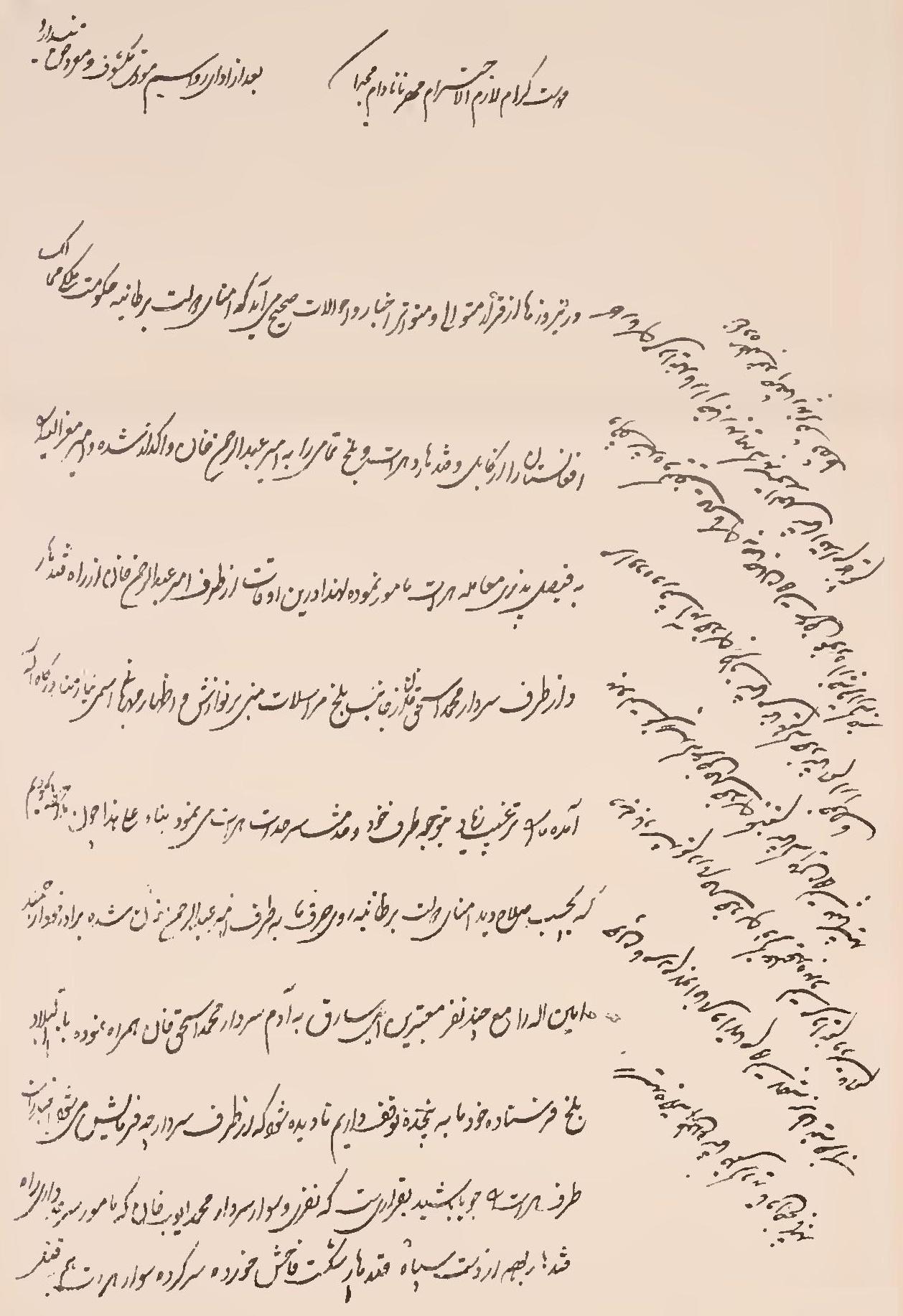
Translation.
To our dear and kind friend worthy of honour. May his glory be perpetual!
In these days reliable tidings have come in regard to what has consecutively happened, to the effect that the agents of the British Government have made over the sovereignty of the dominions of the kingdom of Afghanistan from Kábul, Kanda- hár, Herát, and Balkh entirely to Amir Abdu’l Rahman Khán, and have appointed the aforesaid Amir to conduct the administration of Herát. Therefore, in these days friendly and conciliatory letters having come from the Royal Court of Amir Abdu’l Rahman Khán by way of Kandahár, and from Sirdar Muhammad Ishak Khán by way of Balkh, displaying persuasion on our behalf that we should do something in regard to the frontiers of Herát, accordingly, when we perused them and saw that according to the notions of expediency on the part of the British agents we should first turn our faces towards Amir Abdu’l Rahman Khán, we sent to the capital of Balkh our illustrious brother Amir Allah, with several honoured individuals of the Sarik (Saruk) tribe, in company with the man from Sirdar Muhammad Ishak Khán, while we ourselves remain at Panjdah (Penj-deh) till it is seen what orders will come from the Sirdar. Should you seek news from Herát, this is it. A person, together with the cavalry of Sirdar Muhammad Ayúb Khán, who was appointed Governor of the regions of Kandahár, has suffered a disgraceful defeat at the hands of the Kandahár army, while the commander of the Herát cavalry has been killed. We send this line for your information, that it may be clear that since from our loyalty and zeal for the illustrious British Government we are destitute and ruined, in any case we consider ourselves peculiarly the servants of your Government. Our hand does not reach Government that we can place before them our case, but, you being an agent of the Government, we state our affairs and proceedings to you, for you yourself know our condition; therefore represent the state of our case to the Sahibs of the Government in such way as you think best for us, and send us word, so that we may carry out your instructions. This is our sole object, stated in brief.
No date. Seal of Yalangtush Khan.
Appendix B: Letter From Yalangtush Khan, a Jemshidi Chief Who Took Refuge With the Saruk Turcomans at Penj-deh.
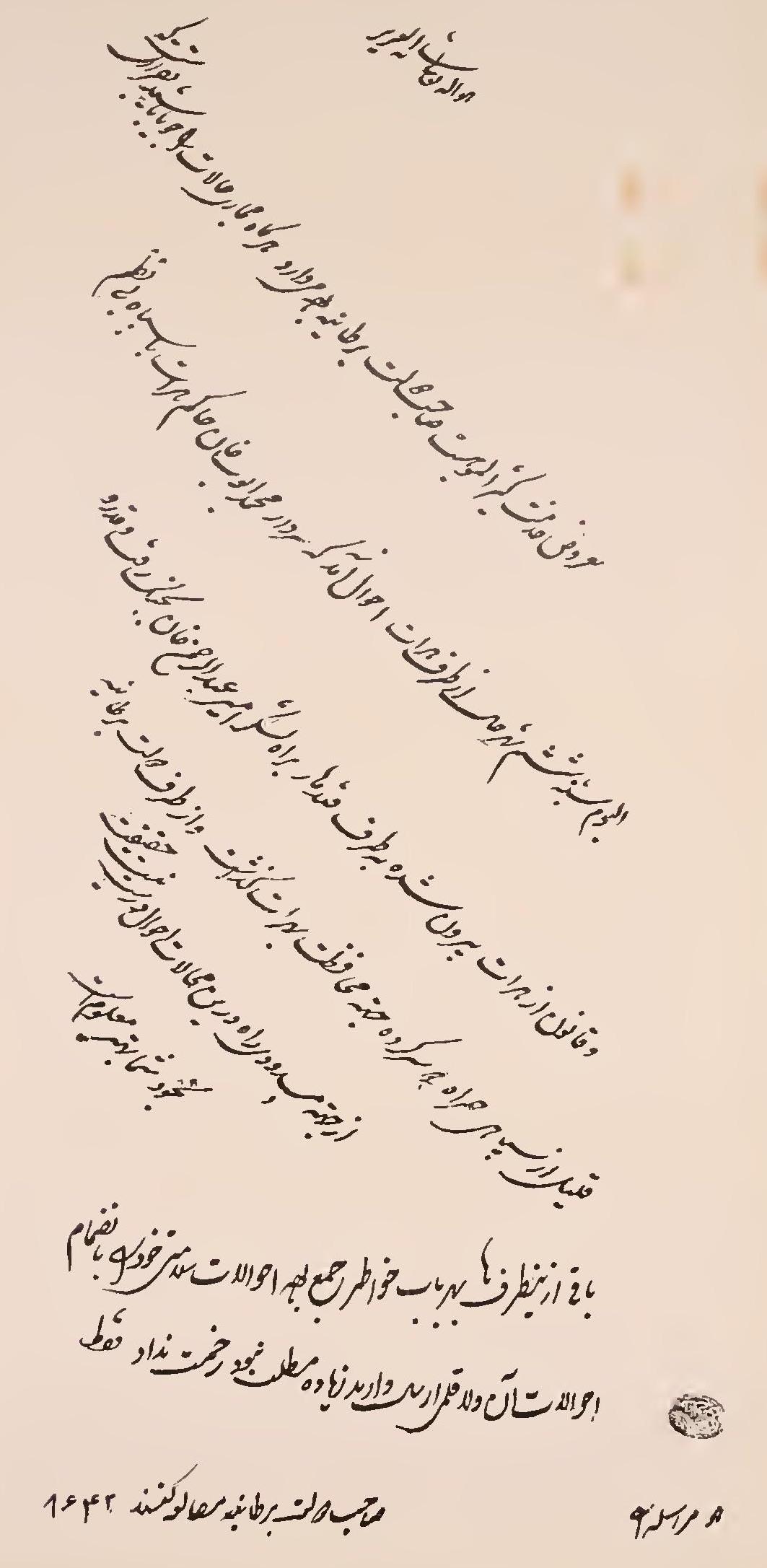
Translation.
Praise to the great God, whose might is glorious.
Be it represented to the beneficent Sahib of the British Government. Seeing that you seek news as to the circumstances which are happening, this is it. On Saturday, the sixth of the present month, tidings arrived that Sirdár (Serdar) Muhummad Ayúb Khán, Governor of Herat, with an irregular army, issued forth from that city and went towards Kandahár to engage in battle with the troops of Amir Abdu’l Rahman Khán, leaving a few troops with two chiefs for the protection of Herat. There is no correct news here what the British Government sent to oppose his march. You yourself know best about that. Finally, all is well in these parts. Send a line regarding your health, as well as the state of affairs in that country. We have nothing more to say.
May the Sahib of the British Government peruse this letter.
(1642. Letter 2–9.)
Seal of Yalangtush Khan.
Appendix C: Letter From the Saruk Turcoman Chiefs of Penj-deh.
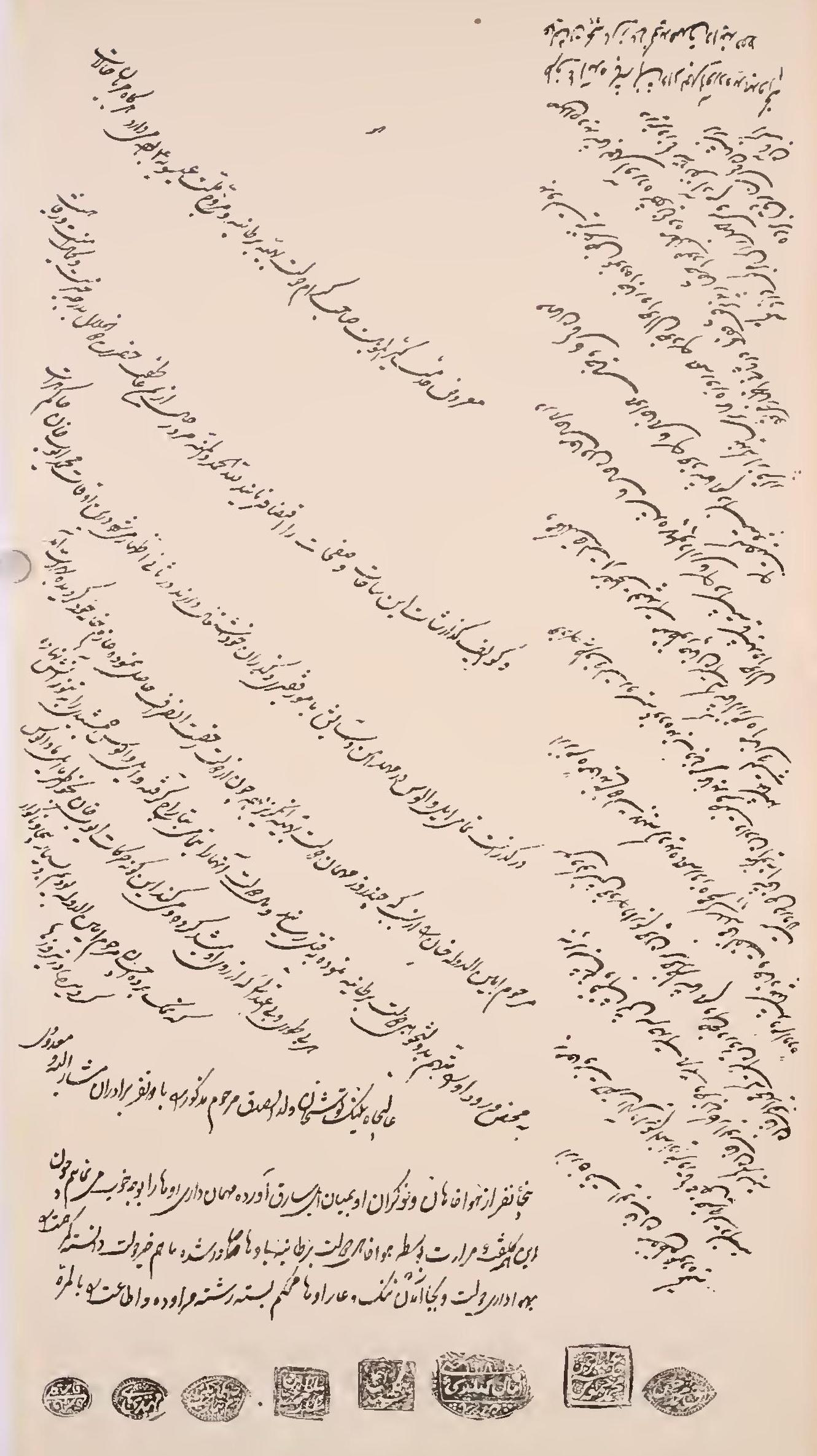
Translation.
We beg to represent to the beneficent Sahib of the excellent British Government, the spreader abroad of the Christian religion. May peace be thereon!
Should you require news as to the events and occurrences of these regions and localities, it is this. Thanks to God, owing to the kindness of your illustrious Excellency, the course of events has run quite smoothly and pleasantly. All the tribes and peoples pass their time on the throne of peace and comfort in the discharge of their affairs. Secondly, we would represent that nowadays Muhammad Ayúb Khán, the ruler of Herat, since he understood that the late Ameér, ud-Dowlah (Dowlet) Khan had been for some time the guest of the English Government, when the latter got leave to return with the view of repairing to his own house, and went to Herat, as soon as he arrived suspected him of being a well-wisher of the British Government and caused him to be killed; he also plundered all his goods and possessions, and placed the Jamshidi (Jemshidi) tribe in the oven of fire— thus he did and is doing every injustice and irregularity he could. This kind of proceeding on the part of Ayúb Khán is very distasteful and unpalatable to the minds of us tribes, who have eaten the salt of the late Ameér-ud-Dowlah’s (Dowlet’s) kindness. Nowadays his Excellency Yalangtúsh Khán, the true son of the aforesaid deceased, has come here amongst the Sarik (Saruk) tribe with two brothers of the above-mentioned, and a retinue of fifty persons from amongst his well-wishers and dependents, and we are entertaining them well. Since all this trouble and bitterness has befallen them on account of the British Government, we, too, recognising what is good for the Government, and firmly girding up the loins of our zeal as well-wishers of Government, both in matters offensive and defensive, will sever at once all connection and obedience from Ayúb Khán, and place our reliance upon the aid of God. Therefore, at this time just deeming it good for Government, girding up our loins we shall make our best endeavours against the distress and trouble in the regions of Herat and the ruins of Ayub Khan’s affairs. Seeing that, it is clear to your mind that Muhammad Ayúb Khán has become one of the principal opponents of the great Government, and is daily putting in motion the chain of opposition and rebellion, while he is, too, in communication with the Russian Government and is playing a waiting game, to give an opportunity to such persons in the territory and kingdoms of Government is far from wise. It is obvious that you are one of the principal agents of Government, and befriend us in every case; you should therefore protect and countenance us. You know the condition of our guests, and are aware that we are well- wishers to you, so represent our case to Government and send us every day news of yourself in order that we may act as you think advisable. This is all we have to say, stated briefly. Once again we beg to represent that in these days the Tekké thieves have carried off three persons and forty-three head of cattle from the Sarik (Saruk) shepherds. If they have come to your parts, please God get hold of them and send them back. Whatever Bashi Báí (Bey) says verbally accept as true.
No date. Eight seals of Saruk chiefs of Penj-deh.
Appendix D: Letter From the Toktamish and Otamish Merv Chiefs
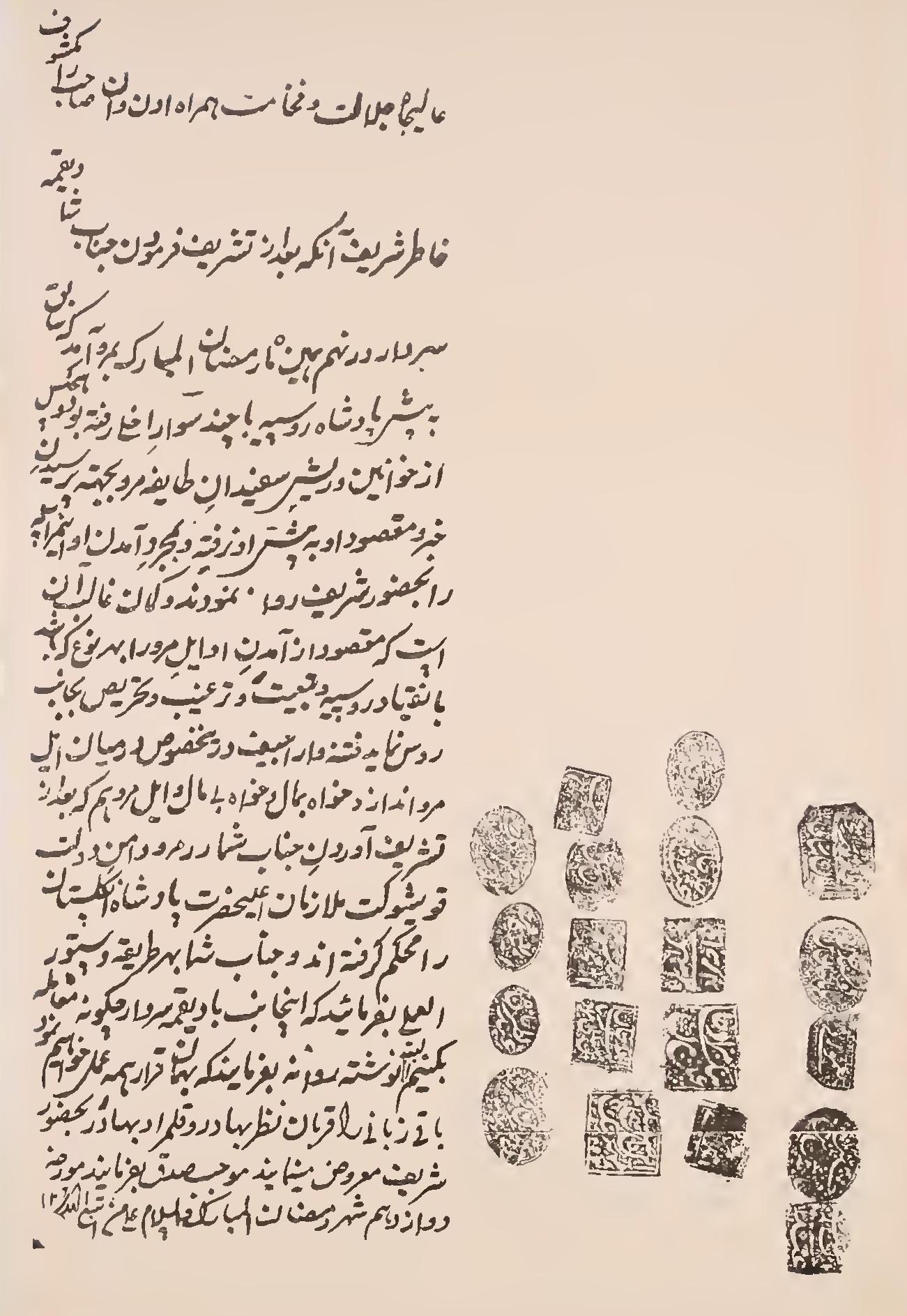
Translation.
To Eis Excellency the Associate of Majesty and Pomp Mr. O’Donovan.
May it be known to his honoured mind that after Your Excellency’s departure Díkmah Sirdár (Tokmé Serdar) on the ninth of the present month Ramazán came to Merv; he it was who formerly went to the Emperor of Russia with several Akhal horsemen. No one of the chiefs or elders of the Merv tribe went to him to enquire as to his news or designs. As soon as he appeared they sent you this letter. It is most probable that the object of his arrival is to secure in any way that may be possible the submission of the tribe of Merv to Russia, and to incite and stir them up in favour of that Power. In this respect he will spread sedition and commotion amongst the Merv people, either with or without money. The tribes of Merv, after you came to Merv, firmly grasped the skirt of submission to the Queen of England. Now you must issue instructions in what way we should deal in this matter with Díkmah Sirdar (Tokmé Serdar). Assuredly send us a letter, for we will all do as you bid us. As for the rest, Kurban Nazr Bahadúr and Kuli Murad Bahadúr will represent matters to you by word of mouth; you must accept it as true. Dated twelfth of the month Ramazán 1298 (August 8,1881). Salaam. Peace be on him who follows the right guidance.
Sealed with nineteen seals of Baba Khan, Aman Niaz Khan, and other chiefs.
Appendix E: Letter From the Toktamish and Otamish Merv Chiefs.
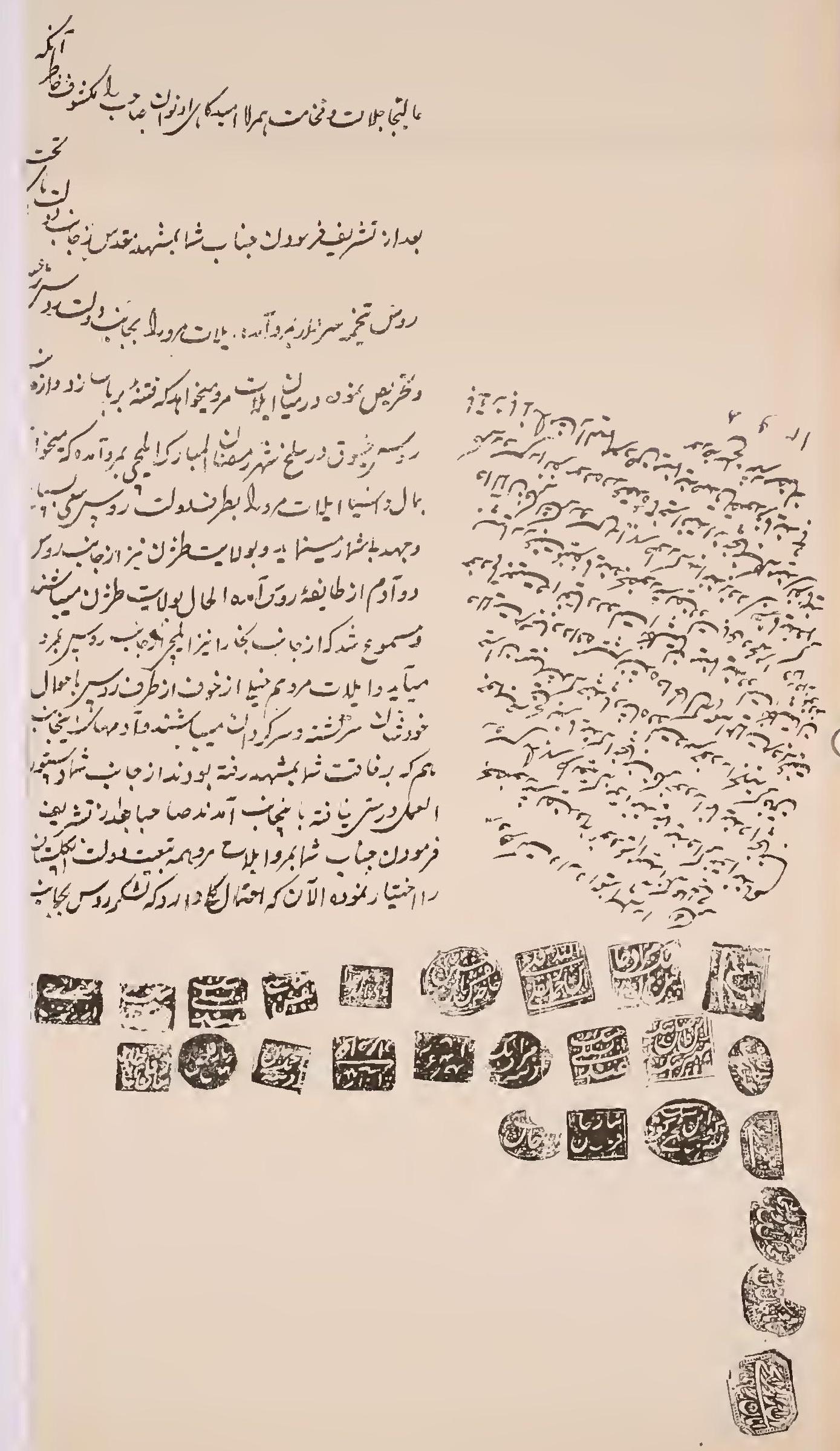
Translation.
To His Excellency the Associate of Majesty and Pomp, the Seat of Hope, Mr. O’Donovan. May this be known to his illustrious mind.
After you went to Mashad (Meshed), Tithmah (Tokmé) Serdar came to Merv from the capital of the Russian Government, and incited the people in favour of that Power, desirous of stirring up strife among the tribes. And on the last day of the month Ramazán an Envoy, by name Khuyúk, came to Merv on the part of Russia, desirous with money and goods to make the tribe of Merv work effectually and strive jealously on behalf of the Russian Government. In the kingdom of Tajan (Tejend), also, two persons have arrived from the Russians, and they are at the present time there. It is heard, also, that an Envoy from Bukhárá (Bokhara), on behalf of the Russians, is about to arrive; so the people of Merv are very distressed and perplexed in their affairs through fear of the Russians. The men, too, from these parts who accompanied you to Mashad (Meshed), not having met with any specific instructions at your hands, returned to this locality. Oh, Sir! after your stay at Merv the people thereof all submitted to the British Government. Now that there is a strong probability that the Russian army is on its way to the regions of Merv, we send this letter to your Excellency in the hope that you will devise a remedy in any way you can against the Russian army, and if you cannot do so, send us an explicit reply, so that we may follow our own devices in this matter. We are surprised in this respect, that so many monarchs having scattered to the winds their money and their force to take Merv, and not having succeeded, yet now that all the people of Merv are willing and ready to submit to and obey the English Government, the latter are not very eager. Dowlet Bài (Bey) and Muhammad Murad are sent to your Excellency, so now let us know as quickly as possible how you mean to deal with the Russian army; and should you not think of the Russians, or postpone the matter, do not put the blame on us. The rest will be represented by word of mouth by the two aforesaid persons. Be it accepted as true. Dated last day of Ramazán 1298 (August 26, 1881).
Twenty-five seals of the Merv Khans and Kethkodas.
Appendix F: Letter From Kadaiff the Russian Gunner, Captive at Merv
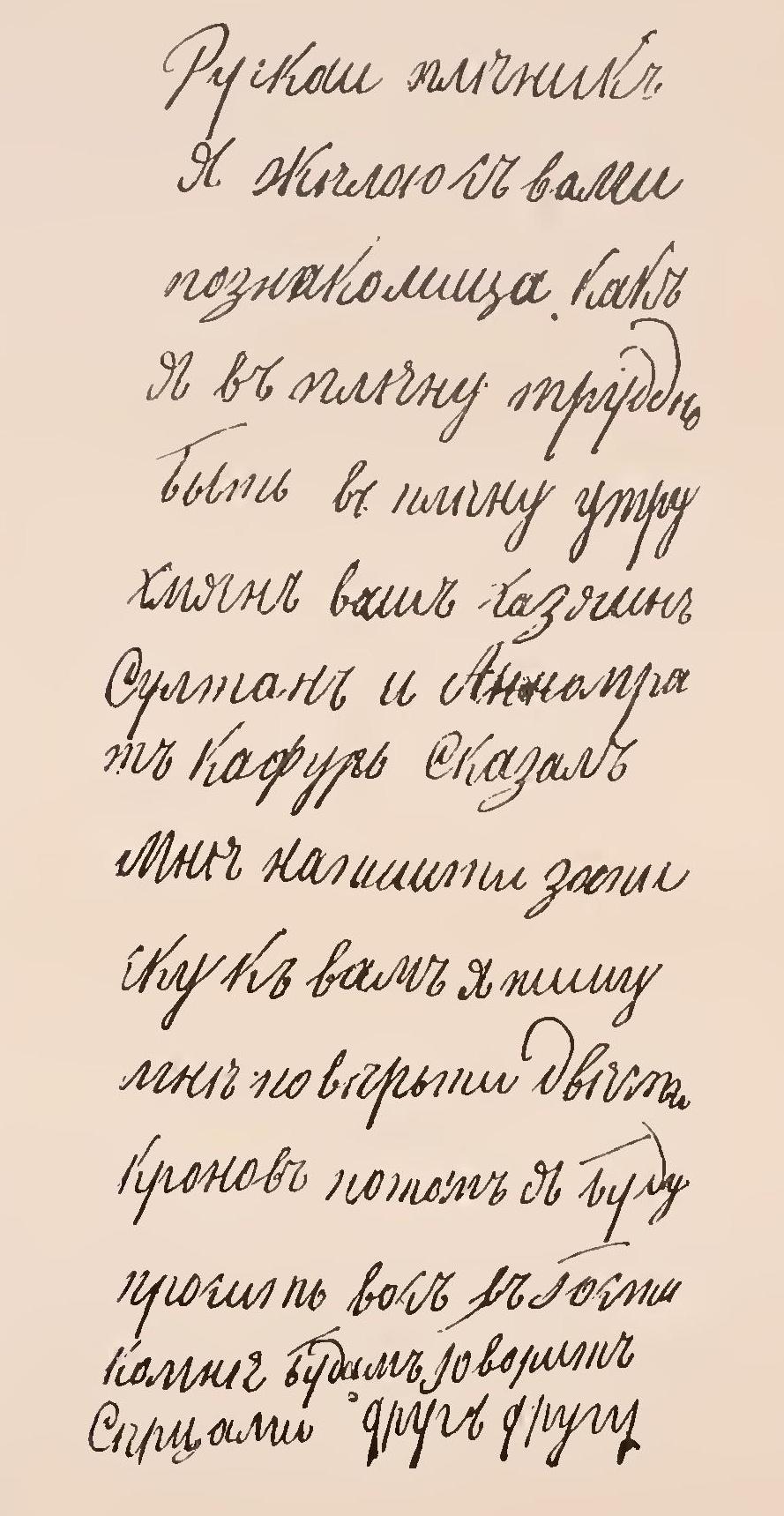
Translation.
The original is in ungrammatical, childishly written Russian, and is partly unintelligible.
1. Russian prisoner.
2. I wish to make your acquaintance;
3. Because I am in prison.
4. It is hard to be in prison.
5. to-morrow.
6. You landlord (? you are pre-eminent in the district).
7. Sultan Anomra Kafir (Ana Murad Kafur).
8. told me
9. to write a few lines
10. I do write.
11. Send me 200 krans.
12. After that I will ask you
13. when you come to see me I will tell you.
14. Hearty friend.
Appendix G.
Translation.
To His Excellency the exalted and illustrious O’Donovan Sahib, the Representative of the British Government.
I hope you are well. Again, doubtless, you have heard that a great crisis has occurred to the Akhál tribe: it happened on Monday, the 23rd of the month Safar. From that day till this time I have remained at Taj and. I also have heard that you are in Fahga (Kaka) in the midst of the Iliats. I also immediately wrote you a letter on Saturday, the 6th of Rabi’ al Aooal, and I sent it by the hands of Mirzá Murád, but the man not being able to find you returned: so we remained disappointed until now. Therefore on Friday, the 12th (?) Rabi’ al Aooal, I sent one Atábí by name to you at Kalát (Kelat), as we had heard that you were in Kalát. We also are awaiting you in this direction till we get tidings about you, after which we will act according to your advice. If you seek news of this Akai (Akhal) tribe, it is this. After the crisis, most of the tribes having migrated came to Tahdan (Te- jend): moreover, day and night they are coming by thousands; they are also relying upon your Government. Again, in company with the English Government, they contemplate making war against the Russians about Merv; but they have run away from the Russians and are come. Amongst the chiefs and heads most came. Makhdum Quii Khán, with his brother and Dikhma Sirdar, and Qui Bahadur, and Qurbán his brother, and Rahman his brother, and Muhammad Quii Khan and Ivaz Murad Sareha Sirdár. all came. Again amongst the elders most came. Iráz Muhammad Khán and his brother Korúnú and Khan Muhammad Atálig were slain. As for me, who am one of the scribes and writers of the English Government, it is a long time since I have heard either of you or of Abbáss Khan, the Government Agent; so at length, being in despair, we sent away the A tali and are ourselves expecting you. We have come without anything, and destitute. We have stopped here waiting to hear news of you and of Abbáss Khan, the British Agent. Assuredly quickly convey this news to Abbáss Khán. If you order me, I will present myself before you. Yes, having written in a book the events and the daily occurrences ofseveral months, they have remained useless, and it is fitting that they be now sent for the inspection of that Government.
As soon as you receive this letter, quickly send me a reply, and let the paper of news be sent to the Government. If Ghulán Rayas (Gholam Riza), the brother of Abbáss Khán’s man, is in your service, give him my respects. I have also written him a letter, please show it to him.
No date, no signature, one seal.
Appendix H.
Translation.
To my dear brother Edmund O’Donovan Sahib.
First of all we seek to know that you are well. Secondly, by way of kindness, you are anxious to get tidings of these parts. Furthermore, God be praised, we are your servants. Again we are your well-wishers. I was very much pleased to hear the good news that you had come in safety. Salaams. 1289 Hijri, A.D. 1881.
No signature; three seals illegible.
Appendix I.
Letter to British Minister at Teheran,
Mebv: March 19, 1881.
Dear Sir,—I find myself rather in a scrape here, owing to the persistent suspicion of the medjlis that I am a Russian spy. My only chance of getting away is that a letter in Turkish or Persian, bearing unmistakeable signs of its coming from an English source, should summon me to Meshed immediately, as it were, on business with Abass Khan. By the same messenger who takes this I write to Abass Khan asking him to summon me to Meshed; but as he does not understand English, and will have to apply to Daoud Mirza, the Chief of Telegraphs, to interpret my letter, I am in serious doubts as to the result.
The Merv chiefs want me to mount the old guns they took from the Persians, and whose carriages have rotted, and to do a number of things quite out of my power; among them to make extensive presents of money. As, however, they are all quite in favour of England, a letter with as many stamps and marks as possible, indicating its origin at a British source, would be invaluable. Kadjar Khan, the chief of the Merv deputation last year to Teheran, is the person to whom communications should be addressed. He is the most influential of the whole of them. He says he saw you four times at the Embassy, and remembers Dr. Dixon. I must be brief, as I am narrowly watched, and write this in bed under cover of my quilt, pretending to read a book.
I remain,
Sincerely yours,
E. O’Donovan.
R. F. Thomson, Esq.
Appendix K.
Extract of a Letter from Mr. 01 Donovan (dated Merv, March 31; to Mr. B. F. Thomson, H.M. Minister at Teheran.
My own position is somewhat singular. Owing to the pressure of circumstances, especially the opposition offered by the Persian authorities to my going among the Turcomans, I was obliged to make a rush for this place, unprovided with credentials, which would duly weigh with the authorities here, whose name is legion.
I have with me the British passport, the Sipah Salar’s pass, the letter in Persian of the former British Consul at Asterabad (Mr. Churchill), the pass of the Persian Foreign Minister’s Agent at the same place, and another from the Persian Governor of Meshed. I had nothing specially addressed to Kadjar Khan; still, thanks to Abass Khan of Meshed, I have succeeded more or less in proving that I am not a Russian. But I can’t prove, unfortunately, that I am unconnected with diplomacy, and a cowardly servant, trembling in his skin for himself, fostered the belief that I was a political agent by saying that I had come to hoist the British standard here. This illusion I of course did my best in broken Turkish to dispel. Still, I am looked on as the proper channel through which to transmit the accompanying document. At the same time, while treated as a friend, I am evidently a prisoner. These people think that by holding me they can guarantee some supplies.
I wish it to be distinctly understood that I neither claim nor ask any kind of official interference on my behalf. I don’t think it at all necessary. But it would be satisfactory to the minds of the people here if I left them under circumstances that allowed no doubt as to my nationality. As in my former letter, I would ask you as a favour to send a letter through Abass Khan, ordering me to come to Meshed immediately, and certified by as many imposing stamps and seals, both on letter and envelope, as might to the utmost impress the minds of the people here with an impression of its undoubted emanence from the proper source. Another, sent to Kadjar Khan, telling him that I am wanted at Meshed, would also be necessary.
Appendix L.
Translation.
To the Exalted, the Associate of Greatness and Might, my dear honoured and kind Friend.
Please God you are well, and are not disturbed with aught. Your three letters regarding the bill for 100 tomans, with the rest of your packets, reached me through the medium of Nazaralli Bey and Khudúmír Khan. I was delighted to hear that you were well. The day on which I sent back your two emissaries, having examined the bills for 100 tomans which you drew, I entrusted the money to the two agents in question. I gave them also three tomans to cover their expenses. Again, by three posts from Persia, three bundles of newspapers and three packets reached me from Teheran. I made over all three bundles to the two agents, the packets being wrapped up inside the newspapers. According to what the Khans have written and what you yourself have stated, God willing, the time of meeting is near at hand, and I trust that you will arrive safely. I am eagerly expecting to meet you. Salaams. Dated 13th Shá báu 1298 Hijri (July 11, 1881).
No signature; seal of Abass Khan.
Appendix M.
Translation.
Extract of Letter from, the Merv Chiefs to Abass Khan.
October 8, 1881.—Your letter sent by Koorban Pehlivan and Nazar Ali Beg was duly received, and the chiefs and elders of the Otamish and Toktamish tribes felt that they were greatly honoured in the estimation of the other tribes by the favours and gifts you forwarded to us.
The presents and ready cash you sent by Koorban Pehlivan and Nazar Ali Beg, on account of the services rendered to Mr. O’Donovan, were as follows:—
Twenty-seven red cloth jubbehs with ninety-two tomans for sundry chiefs and elders of the said tribes.
Three shawls for Makdum Kuli Khan, Niaz Khan, and Allah Kuli Khan, with ready cash.
We are all very thankful, and are always ready to receive a Governor and instructions from the English Government.
[Translated by I. Ibraheem.]
Appendix N.
Translation.
Statement of Disbursements made by Abass Khan on account of Turcomans who sent and escorted Mr. O’Donovan to Meshed.
Paid in Cash: Tomans.
Sent to the tribes....... 92
„ Allah Kuli Khan .... 3
„ Khodja Kuli....... 5
,. Makdum Kuli Khan ....10
Paid to Azar Ali, who remained in Meshed to take the presents ..... 7
Paid to Dowlet Khan and two others who
brought letters for Mr. O’Donovan .. 6
— 123 0 0
Dresses of Honour:
Twenty-seven red cloaks trimmed with lace, &c. Eighty-seven and three- quarters, at eleven krans ... 96 ô 10|
Twenty-seven bundles of lace and
cording, at three krans per bundle .810
Making twenty-seven coats, at three krans each.....810
----------------- 112 7 10|
Costofthreeshawls, at twelve tomans each... 36 0 0
Tomans....... 271.... 7 10|
Balance in hand.... 8 2 9|
Total tomans....... 280.... 0 0
Appendix O.
Letter to Makdum Kuli Khan sent to Yengi Sheher.
Sharood: Wednesday, June 16, 1880.
Your Highness,—I am a correspondent of an English newspaper called the ‘Daily News.’ I am sent to this country in order to know how the fighting goes on between the Russians and the Akhal Tekkés, so that the people in England may know the truth. Will you let me come with you? I do not belong to the Government of England; but I can at least let them know how things are going, and it is possible that I may be of use and of service to you.
Edmond O’Donovan,
Special Correspondent of the newspaper ‘Daily News,’
London, England.
To His Highness the Commander-in-Chief of the Akhal Tekkés.
Appendix P.
Answer of Prime Minister Sipah Salar Aazem to my Letter asking for Safe-conduct.
Téhéran: 27 Mai, 1880.
Monsieur,—En réponse à votre honorée lettre de ce jour je suis tout disposé de vous faciliter votre voyage en vous accordant un laissez-passer pour toute la partie de territoire Persan que vous aurez à passer; mais il m’est impossible de vous donner un document valable au-delà de nos frontières ou pour les tribus qui sont en guerre avec la Russie.
Quoique vous soyez depuis longtemps en Perse et depuis plusieurs jours à Téhéran, cependant je n’ai pas eu le plaisir de votre visite; j’attribue ceci aux reproches de conscience que vous devez éprouver comme correspondant du ‘Daily News’ de Londres.
Agréez, je vous prie, Monsieur,
Mes compliments distingués,
Houssein.
A Monsieur E. O’Donovan, Correspondant du f Daily News.’
Translation.
Teheran: May 27, 1880.
Sir,—In reply to your esteemed letter of to-day, I am quite willing to facilitate your journey by giving you a passport for the entire of the Persian territory through which you will have to pass; but it is impossible for me to give you a document which shall be available beyond our frontiers, or among the tribes who are at war with Russia.
Although you have been a considerable time in Persia, and several days at Teheran, I have not yet had the pleasure of a visit from you; I attribute this to the reproaches of conscience which, as correspondent of the ‘Daily News’ of London, you ought to feel.
Receive, Sir, the expression, &c.
Houssein.
vol. n.
K K
Appendix Q.
Letter to Colonel 0. St. John, British Political Officer, Kandahar.
Merv: June 10, 1881.
Deab Sib,—Some three months ago I came to Merv in pursuance of my mission as Special Correspondent of the ‘Daily News’ of London. I am in a very peculiar position. The chiefs and people of Merv either will not or cannot understand my true position, and pretend to believe that I am a political personage. Though not, strictly speaking, a prisoner, still I am not allowed to leave Merv; I am held as a kind of political hostage, in order, as the Khans think, the better to secure a favourable answer to the letters and documents which they have from time to time forwarded to the British Government through Abass Khan, at Meshed, and the British Minister at Teheran. Should the telegrams which I despatched from this have ever reached their destination you will probably have seen in the newspapers a statement that the Governing Council of Merv have refused all overtures, either on the part of Russia or Persia, and decided to seek friendly relations with the British Government. The truth of this I can vouch for, as I was present at the Councils, and am in daily contact with the supreme chief Baba Khan, Kou chid Khan Ogli, and the twenty-four lesser chiefs. The Merv people seek to be taken under British protection, or at least to have their neutrality and independence guaranteed by England, Russia, and Persia. They promise to abstain from all raiding and marauding; and in everything to encourage caravan traffic through their territory. They would prefer a British Protectorate; but if necessary would be content with the joint guarantee I have alluded to above. In case they can establish direct relationship with England, or the ‘Coompani’ as they still designate the Government of India, they would ask for some aid in the shape of arms and ammunition. They have about a thousand breech-loaders taken from the Russians, and thirty-six bronze field-guns and howitzers of various calibres, from 18 pounders to 4 pounders, taken from the Persian expedition, but they have little or no ammunition for either rifles or artillery, especially for the latter. They have heard that warlike supplies are being sent to Amir Abdurrahman at Kabul, and are encouraged to hope that they may be similarly favoured. At all events, they desire me to say so. It must be distinctly understood that I am not writing this on my own account, but by the desire of the Government of Merv, conveyed to me half an hour since by the supreme Khan, who sends a special messenger to-morrow morning viä Herat to Kandahar, in hopes of finding you still there. I have written to Mr. Thomson at Teheran on the same subject; and the Merv people have twice sent documents written in Persian, and having the seals of the Khans attached, declaring their desire for friendly relations with England. Up to the present no reply has reached this, though ample time has elapsed, and the result is that I am detained here pending the arrival of an answer of some kind. I trust that on receipt of this you will send back a reply, which, whatever its nature, will have the effect of getting me away, either to Meshed or to Herat, for though personally I am well treated, a forced residence in such a place, and among such people, when one has fulfilled the object of his mission, is far from agreeable. A reply written in Persian, holding out hopes, if realities cannot be promised, and requiring my immediate attendance at Kandahar or elsewhere out of this, as it were to receive instructions, would be an infinite favour to me. If something of the kind cannot be managed, I can see no end to my present enforced residence here. The population of Merv proper is, I should say, close upon half-a-million, and together with the Ersari, Salar, and Saruk Turcomans, all now closely drawn together by the approach of Russia, might come up to eight hundred thousand. Of this, I calculate some sixty or seventy thousand fighting men, to a large extent mounted, could be put in the field. A very large fortification, about a mile and a half in length by three quarters of a mile broad, the ramparts forty feet in height and sixty at base, has been constructed on the. eastern bank of the Murgab. Its length, running N.W. and S.E., forms the cord of an arc made by the river towards the S.W. at this point. The works are not quite completed, and large numbers of men, working by relays, are constantly engaged on them. The twelve Turcomans who come with this letter will await your reply. I hope that, for my sake, they may be as well treated as possible.
I remain, dear Sir,
Sincerely yours,
E. O’Donovan.
Publications of G P Putnam’s Sons
27 and 29 West 23d Street, New York.
PUTNAM’S LIBRARY OF TRAVEL. Comprising a re-issue, in new and handsome form, and at greatly reduced prices, of works by popular authors, which in their original editions have obtained reputation as standards, and which continue in steady demand. The First Series consists of 12 volumes, handsomely printed in large I2mo, illustrated, and bound in cloth extra. Sold only in sets, price in box... 16 00
(The catalogue prices of the separate works amounts to $22 25.)
ENGLAND AN» ITALY.
Hawthorne (Mrs. Nathaniel, wife of the novelist). Notes on England and Italy. Fourth edition.... 1 75
“It is evident that the spirit of Hawthorne’s genius has in some measure enshrounded his wife and lent a bright lustre to her own thoughts.”—Syracuse Journal.
SPAIN.
Amicis (Edmondo de). Spain and the Spaniards. Illustrated. 2 00
“His descriptive passages are poetic: his command of language is marvellous. His ‘Spain’ is a series of bright vignettes of the chief cities of the country, beginning with Barcelona, and ending with Valencia.”—Chicago Tribune.
NOHTHEBN ASIA.
Kennan (Geo.). Tent Life in Siberia, and Adventures among the Koraks and other Tribes in Kamtchatka and Northern Asia.
Seventh edition, I2mo, cloth.... 1 75
The London Spectator says it is “racy, clear, full of humor, and full of interest.”
HOLLAND.
Amicis (Edmondo de). Holland and its People. With 18 full-page plates. •...... 2 00
“A charming book—the story of a land rich, fertile, and prosperous, which has been reclaimed from the barren sea.”—N. Y. Tribune.
THE HIMALAYAS.
Wilson (Andrew). The Abode of Snow. Observations of a tour from Chinese Thibet to the valleys of the Himalayas. With map. 2 00
“Worthy of highest praise. There is not a page in the handsome volume of nearly 500 pages which will not repay perusal. * * * Written with inimitable spirit.”—London AtHenæum.
COREI.
Oppert (Ernst). A Forbidden Land; or, Voyages to the Corea. With full description of the manners, custom, history, etc., of a community of some 16,000,000 people hitherto almost entirely unknown. With illustrations...... 3.00
“A work of rare interest.”—N. Y. Evening Post. “Of novel interest and intrinsic value.”—N. Y. Sun.
THE HUDSON’S B1Y TERRITORY.
Robinson (H. M., formerly U. S. Assistant Consul at Manitoba). The Great Fur Land; or, Sketches of Life in the Hudson’s Bay Territory, With numerous illustrations from designs by Charles Gasche. I2mo, cloth extra...... 1.75
“Mr. Robinson’s narratives exhibit a freshness and glow of delineation, founded on a certain novelty of adventure which commands the attention of the reader, and makes his story as attractive as a romance.”—N. Y Tribune.
THU GREAT WEST.
Codman (John). The Round Trip, by way of Panama, through California, Oregon, Nevada, Utah, Idaho, and Colorado, with Notes on Railroads, Commerce, Agriculture, Mining, Scenery, and People. Cloth....... 1.50
“This is really an unusually entertaining book of travel, for the author has taken for his ‘points of observation’ objects and things not often written up, and enlarged upon them in an unrestrained, familiar fashion, so that the reader feels as if he were being entertained by letters written for his special benefit by a personal friend.”—Worcester Daily Spy.
SOI TH AFRICA.
Anderssen (C. J.), author of “Lake Ngami.” Notes of Travel in Africa....... 1 75
“A wonderfully vivid and realistic narrative of the last journey of a heroic traveller.*’ —St. Louis Republican.
THE TURKISH CAPITAI«.
Amicis (Edmondo de) Constantinople. Translated by Caroline Tilton.. •.*... 1 50
“A remarkable work.... The author is a poet, an artist, a wonder-worker in words.... His descriptions are given with rare skill.*’—N. Y. Evening Post.
THE ROCKY MOUNTAINS.
Bird (Isabella), author of “Six Months in the Sandwich Islands,” “Unbeaten Tracks in Japan,” etc. A Lady’s Life in the Rocky Mountains. Illustrated.... • 1 75
“Miss Bird is an ideal writer.... She has regard to the essentials of a scene or episode, and describes these with a simplicity that is as effective as it is artless,’— London Spectator.
SCANDINAVIA.
Vincent (Frank, Jr.), author of “The Land of the White Elephant,” etc.
Norsk, Lapp, and Finn. With frontispiece and maps. i 50
“Mr. Vincent writes with unaffected simplicity.... His reports are enlivened by a perpetual flow of good humor and vivacity.... and pointed with acute and suggestive remark.”—George Ripley.
DECENT AND STAND AND WONKS ON TN A FED
From Pole to Pyramid. By Samuel S. Cox.
PART I.
Arctic Sunbeams; or, From Broadway to the Bosphorus, by way of the North Cape. 8vo, illustrated.... 2 00
PART II.
Orient Sunbeams; or, From the Porte to the Pyramids, by way of Palestine. 8vo, illustrated..... 2 co
Unbeaten Tracks in Japan. By Isabella Bird, author of “A Lady’s Life in the Rocky Mountains,” etc. 2 volumes, 8vo, illustrated, $5 00. Popular edition, 2 volumes in one. 8vo, illustrated 3 00 “B. ‘it is in descriptions of men and manners that she excels, and in them she is so excellent that in no other book in English is there anything like so vivid a picture as she gives of the Japanese people.”—N. Y. World.
Morocco, its People and Places. By Edmondo de Amicis. Translated by C. Rollin Tilton. 8vo, fully illustrated, uniform with “Spain” and “Holland”.... 200
The centre of European political interests and complications has for the moment been transferred to North Africa, and this description of methods of life and thought of one of the most picturesque of North African peoples, and by one of the most picturesque of modern travellers, has at this time a special interest and value.
Morocco is a country of color and of brilliant contrasts, and presents a worthy subject for a writer who revels in color and has been called a painter in words.
Portugal, Old and New. By Oswald Crawfurd, British Consul at Oporto. New and cheaper edition. 8vo, with all the original illustrations....... 2 25
“The work possesses, in addition to a keen sense of humor and a lively power of description, a thorough trustworthiness, and will undoubtedly remain the authority on the subject of this interesting and little known country.”—The Nation.
Cuban Sketches. By James W. Steele. 8vo, cloth extra. 1 50
Graphic studies of life and character by an old resident, who has a keen sense of humor and an exceptionally picturesque style.
Written with much spirit and inimitable powers of description.—Cincinnati Commercial.
Pictures and Legends from Normandy and Brittany. By Katherine S. and Thomas Macquoid. 8vo, very fully illustrated and beautifully printed....... 2 50
The well-known author of “Patty” has interwoven with some fascinating narratives of travel, a selection of Norman and Breton stories and legends, which are very quaint and characteristic, and which have been illustrated by her husband with a series of charming pencil sketches.—Phila. Times.
Six Months among the Palm Groves, Coral Reefs, and Volcanoes of the Sandwich Islands. By Isabella Bird, author of “Unbeaten Tracks in Japan,” etc.. A new and cheaper edition. 8vo, cloth, illustrated...... 2 50
Miss Bird is the ideal traveller.—London Spectator.
A Scandinavian Summer; or, Upto the Midnight Sun. By Katherine E. Tyler. 8vo, cloth.... 1 75
A fresh and picturesque narrative of a summer ramble in the far North, by ä writer who evidently knows how to observe and what to describe.—Cleveland Leader.
Newfoundland to Manitoba. Through Canada’s Maritime, Mining, and Prairie Provinces. By W. Fraser Rae, author of “Columbia and Canada,” “Westward by Rail,” etc. I2mo, cloth, with three maps and two illustrations..... I 25
Full of interesting and important facts and of graphic description of a region heretofore but’little knows.—Literary World.
Wordsworth (Dorothy). Recollections of a Tour made in Scotland in 1803. In Company with her Brother, Wm. Wordsworth, and S. T. Coleridge. Edited by Principal Shairp, LL.D. I2mo, cloth extra....... 2 50
“The volume glistens with charming passages, showing how rich in ‘Wordsworthian’ fancy was this modest sister. We have to thank Dr. Shairp, and the thanks must be hearty, for now for the first time giving them a complete form.—London Athenæum.
Roman Days. By Viktor Rydberg-. Translated by A. C. Clark, with memoir of the author by H. A. W. Lindehn. 8vo, illustrated....... 2 00
“We welcome this work from the hardy North for its broad scholarship, its freshness and ripeness The articles betray a true artistic discrimination.”—N. Y. Herald.
England; Political and Social. By Auguste Langel. Translated by
J N. Hart. I2mo...... 1 50
“Affords a clear, distinct, and comprehensive view of the political institutions of England.”—N. Y. Nation.
“Here is a charming book in every sense of the term.”—N. Y. World.
[1] Since these lines were written, the Trans-Caucasus railroad has been commenced and nearly completed; so that the experiences related above are, for the traveller to Baku, things of the past.
[2] I have been informed that his absence on this occasion was due to his dread of an explosion, which persons hostile to the undertaking had persuaded him was not only possible, but probable.
[3] A Kurdish ex-brigand and an Akhal Tekké Turcoman, whom I had hired to replace my Teheran servants who refused to accompany me to the Turcoman territory.
[4] The details of the siege here given were supplied to me by various refugees from Yengi Sheher, Makdum Kuli Khan himself among the number.
[5] During the latter portion of my stay at Merv an attempt was made by the Saruks to enter into some kind of union with the Tekkés for the purpose of better resisting the Russian advance, but 1 am unaware whether any practical result followed.