John Lahey
Meet the Possum — a hermit who won hearts
May 4, 1985
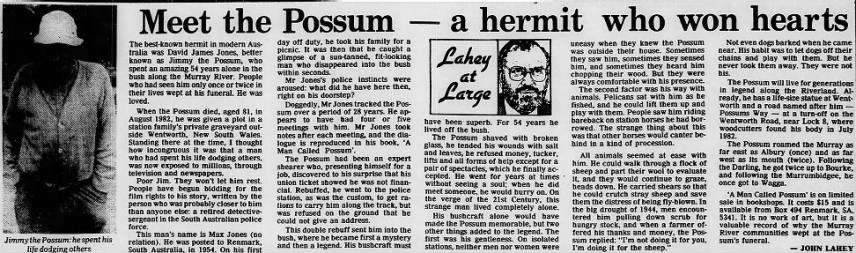
The best-known hermit in modern Australia was David James Jones, better known as Jimmy the Possum, who spent an amazing 54 years alone in the bush along the Murray River. People who had seen him only once or twice in their lives wept at his funeral. He was loved.
When the Possum died, aged 81, in August 1982, he was given a plot in a station family’s private graveyard outside Wentworth, New South Wales. Standing there at the time, I thought how incongruous it was that a man who had spent his life dodging others, was now exposed to millions, through television and newspapers.
Poor Jim. They won’t let him rest. People have begun bidding for the film rights to his story, written by the person who probably closer to him than anyone else: a retired detective, a sergeant in the South Australian police force.
This man’s name is Max Jones (no relation). He was posted to Renmark, Australia, in 1954. On his first Jimmy the Possum: he spent his life dodging others day off duty, he took his family for a picnic. It was then that he glimpse of a sun-tanned, looking man who disappeared into the bush within seconds.
Mr Jones’s police instincts were aroused: what did he have here then, right on his doorstep?
Doggedly, Mr Jones tracked the Possum over a period of 28 years. He appears to have had four or five meetings with him. Mr Jones took notes after each meeting, and the dialogue is reproduced his book, ‘A Man Called Possum’.
The Possum had been an expert shearer who, presenting himself for a job, discovered to his surprise that his union ticket showed he was not financial. Rebuffed, he went to the police station, as was the custom, to get rations to carry him along the track, but was as refused on the ground that he could not give an address.
This double rebuff sent him into the bush, where he became first a mystery and then a legend. His bushcraft must have been superb. For 54 years he lived off the bush.
The Possum shaved with broken glass, he tended his wounds with salt and leaves, he refused money, tucker, lifts and all forms of help except for a pair of spectacles, which he finally accepted. He went for years at times without seeing a soul; when he did meet someone, he would hurry on. On the verge of the 21st Century, this strange man lived completely alone.
His bushcraft alone would have made the Possum memorable, but two other things added to the legend. The first was his gentleness. On isolated stations, neither men nor women were Lahey at Large uneasy when they knew the Possum was outside their house. Sometimes they saw him, sometimes they sensed him, and sometimes they heard him chopping their wood. But they were always comfortable with his presence.
The second factor was his way with animals. Pelicans sat with him as he fished, and he could lift them up and play with them. People saw him riding bareback on station horses he had borrowed. The strange thing about this was that other horses would canter behind in a kind of procession.
All animals seemed at ease with him. He could walk through a flock of sheep and part their wool to evaluate it, and they would continue to graze, heads down. He carried shears so that he could crutch stray sheep and save them the distress of being fly-blown. In the big drought of 1944, men encountered him pulling down scrub for hungry stock, and when a farmer offered his thanks and money, the Possum replied: “I’m not doing it for you, I’m doing it for the sheep.”
Not even dogs barked when he came near. His habit was to let dogs off their chains and play with them. But he never took them away. They were not his.
The Possum will live for generations in legend along the Riverland. Already, he has a life size statue at Wentworth and a road named after him Possums Way — at a turn-off on the Wentworth Road, near Lock 8, where woodcutters found his body in July 1982.
The Possum roamed the Murray as far east as Albury (once) and as far west as its mouth (twice). Following the Darling, he got twice up to Bourke, and following the Murrumbidgee, he once got to Wagga.
‘A Man Called Possum’ is on limited sale in bookshops. It costs $15 and is available from Box 494 Renmark, SA, 5341. It is no work of art, but it is a valuable record of why the Murray River communities wept at the Possum’s funeral.
— JOHN LAHEY.