Lisa Levitt Ryckman
Associated Press Writer
Waging war for environment
‘Ecotage’ just fancy name for sabotage
January 26, 1986
BERKELEY. Calif. (AP) — Under cover of a starless night, self-styled environmental warriors creep across the forest floor, climb into branches overhead and drive spikes into ancient trees, leaving the wood unfit for the mill.
Someone has just thrown a monkeywrench into a proposed federal timber sale.
Although no one claims responsibility for such ecological sabotage. members of the militant environmental group Earth First! would describe it as another blow struck in defense of wilderness.
To the U.S. Forest Service, it’s a Sequoia-sized pain.
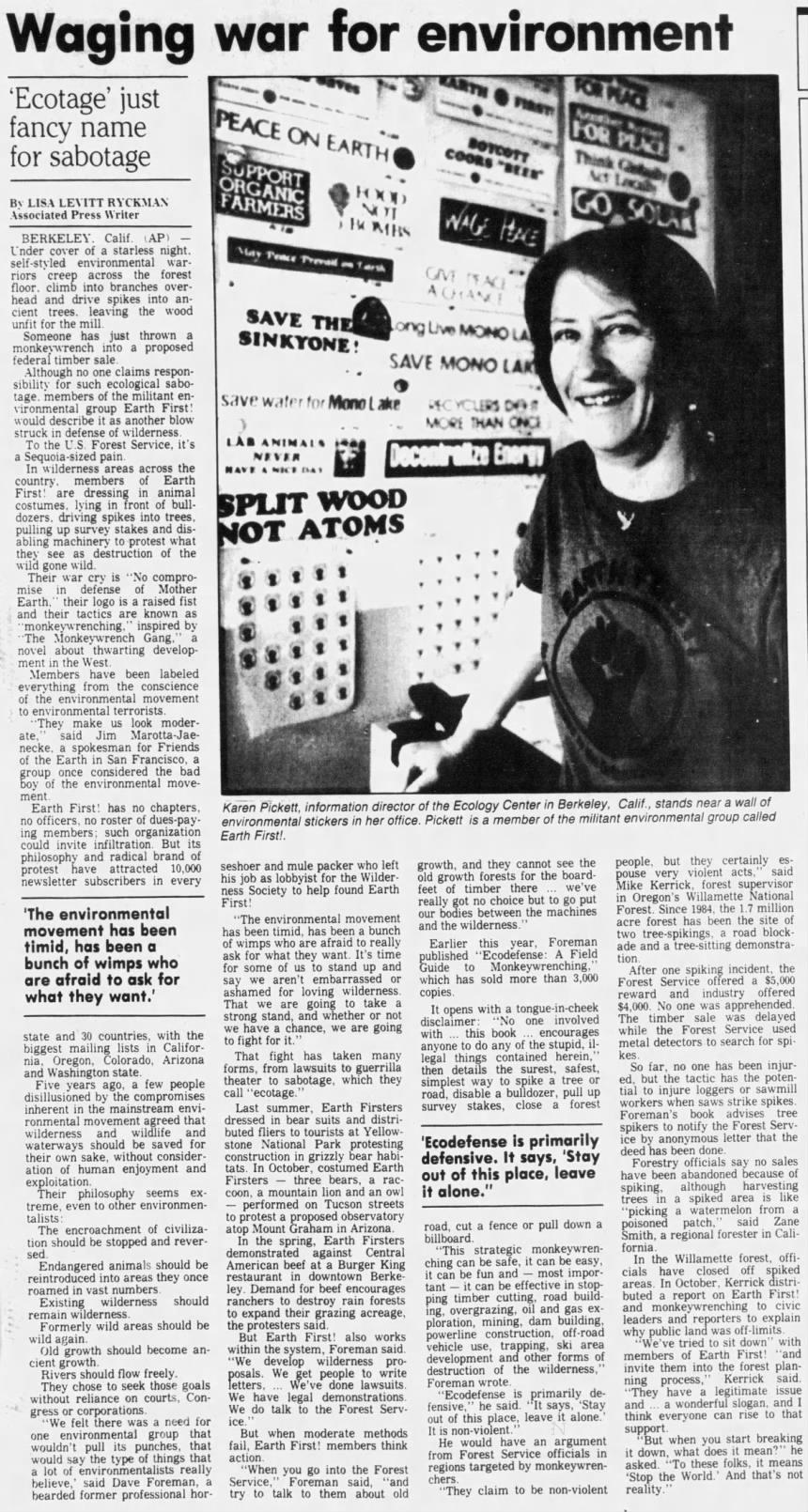
In wilderness areas across the country. members of Earth First! are dressing in animal costumes, lying in front of bulldozers. driving spikes into trees, pulling up survey stakes and disabling machinery to protest what they see as destruction of the wild gone wild.
Their war cry is “No compromise in defense of Mother Earth,” their logo is a raised fist and their tactics are known as monkeywrenching,” inspired by Monkeywrench Gang.’ a novel about thwarting development in the West.
Members have been labeled everything from the conscience of the environmental movement to environmental terrorists.
“They make us look moderate, said Jim Marotta-Jaenecke, a spokesman for Friends of the Earth in San Francisco, a group once considered the bad boy of the environmental movement.
Earth First! has no chapters, no officers, no roster of dues-paying members; such organization could invite infiltration. But its philosophy and radical brand of protest have attracted 10,000 newsletter subscribers in every state and 30 countries, with the biggest mailing lists in California, Oregon, Colorado, Arizona and Washington state.
Five years ago, a few people disillusioned by the compromises inherent in the mainstream environmental movement agreed that wilderness and wildlife and waterways should be saved for their own sake, without consideration of human enjoyment and exploitation.
Their philosophy seems extreme, even to other environmentalists:
The encroachment of civilization should be stopped and reversed.
Endangered animals should be reintroduced into areas they once roamed in vast numbers.
Existing wilderness should remain wilderness.
Formerly wild areas should be wild again.
Old growth should become ancient growth.
Rivers should flow freely.
They chose to seek those goals without reliance on courts, Congress or corporations.
“We felt there was a need for one environmental group that wouldn’t pull its punches, that would say the type of things that a lot of environmentalists really believe,’ said Dave Foreman, a bearded former professional horseshoer and mule packer who left his job as lobbyist for the Wilderness Society to help found Earth First!

“The environmental movement has been timid, has been a bunch of wimps who are afraid to really ask for what they want. It’s time for some of us to stand up and say we aren’t embarrassed or ashamed for loving wilderness. That we are going to take a strong stand, and whether or not we have a chance, we are going to fight for it.”
That fight has taken many forms, from lawsuits to guerrilla theater to sabotage, which they call “ecotage.”
Last summer, Earth Firsters dressed in bear suits and distributed fliers to tourists at Yellowstone National Park protesting construction in grizzly bear habitats. In October, costumed Earth Firsters — three bears, a raccoon, a mountain lion and an owl performed on Tucson streets to protest a proposed observatory atop Mount Graham in Arizona.
In the spring, Earth Firsters demonstrated against Central American beef at a Burger King restaurant in downtown Berkeley. Demand for beef encourages ranchers to destroy rain forests to expand their grazing acreage, the protesters said.
But Earth First! also works within the system, Foreman said. “We develop wilderness proposals. We get people to write letters, We’ve done lawsuits. We have legal demonstrations. We do talk to the Forest Service.’
But when moderate methods fail, Earth First! members think action.
“When you go into the Forest Service,” Foreman said, “and try to talk to them about old growth, and they cannot see the old growth forests for the boardfeet of timber there we’ve really got no choice but to go put our bodies between the machines and the wilderness.”
Earlier this year, Foreman published “Ecodefense: A Field Guide to Monkeywrenching,” which has sold more than 3,000 copies.
It opens with a tongue-in-cheek disclaimer: “No one involved with . this book encourages anyone to do any of the stupid, illegal things contained herein,’ then details the surest, safest, simplest way to spike a tree or road, disable a bulldozer, pull up survey stakes, close a forest road, cut a fence or pull down a billboard.
“This strategic monkeywrenching can be safe, it can be easy, it can be fun and — most important — it can be effective in stopping timber cutting, road building, overgrazing, oil and gas exploration, mining, dam building, powerline construction, off-road vehicle use, trapping, ski area development and other forms of destruction of the wilderness,’ Foreman wrote.
“Ecodefense is primarily defensive,” he said. “It says, ‘Stay out of this place, leave it alone.’ It is non-violent.”
He would have an argument from Forest Service officials in regions targeted by monkeywrenchers.
“They claim to be non-violent people, but they certainly espouse very violent acts,’ said Mike Kerrick, forest supervisor in Oregon’s Willamette National Forest. Since 1984, the 1.7 million acre forest has been the site of two tree-spikings, a road blockade and a tree-sitting demonstration.
After one spiking incident, the Forest Service offered a $5,000 reward and industry offered $4,000. No one was apprehended. The timber sale was delayed while the Forest Service used metal detectors to search for spikes.
So far, no one has been injured, but the tactic has the potential to injure loggers or sawmill workers when saws strike spikes. Foreman’s book advises tree spikers to notify the Forest Service by anonymous letter that the deed has been done.
Forestry officials say no sales have been abandoned because of spiking, although harvesting trees in a spiked area is like “picking a watermelon from a poisoned patch,’ said Zane Smith, a regional forester in California.
In the Willamette forest, officials have closed off spiked areas. In October, Kerrick distributed a report on Earth First! and monkeywrenching to civic leaders and reporters to explain why public land was off-limits.
“We’ve tried to sit down” with of members of Earth First! “and invite them into the forest planning process,” Kerrick said. “They have a legitimate issue and a wonderful slogan, and think everyone can rise to that support.
“But when you start breaking in it down, what does it mean?” asked. “To these folks, it means ‘Stop the World.’ And that’s not reality.”
<www.newspapers.com/article/the-independent-record/189104280>