Louis Bromfield
A Voice From the Country
November 20, 1947
Agricultural Revolution Dooms Old-Fashioned General Farm
Complex Economy Threatens Small Business Enterprise
A series of articles on current problems by Louis Bromfield. One of America’s leading writers, Bromfield is author of “The Green Bay Tree,” the Pulitzer prize-winning “Early Autumn,” “The Rains Came,” “Pleasant Valley” and numerous other books.
Agricultural Revolution Dooms Old-Fashioned General Farm
Lately there has arisen in the mind of the writer doubts concerning two patterns of American life in which all of us have taken great pride in the past. These are unwelcome doubts but observation and study of the patterns in relation to the highly integrated industrialized world in which we live make them unavoidable. They are:
-
That the old-fashioned pioneer pattern of self-sufficient general farm is doomed.
-
That our present complicated, complex economic civilization cannot afford countless small enterprises save under very exceptional circumstances.
Both doubts are certain to arouse protest and even abuse, but both deserve the consideration of every thoughtful citizen.
The general farm, producing a little of everything, is an American pattern growing out of life upon isolated frontiers and no longer fits into a highly complex national economy. A few acres of corn or oats or wheat or hay cannot support a corn picker, a combine or a hay bailer. Therefore the general farmer is at once at a great disadvantage, in competing with the corn farmer, the wheat farmer or the specialist grass farmer or the fruit farmer, all of whom are doing efficient jobs along specialist lines with the high degree of mechanization which any specialist enterprise can support.
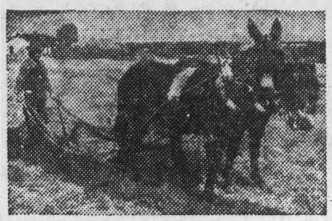
Because the general farm cannot support a high degree of mechanization, the general farmer must work long hours, do things in an old-fashioned, slow and inefficient way. His gross income is almost certain to be only a fraction of that of the specialist in dairying, grass farming, corn and hogs, fruit, potatoes or any other undertaking where a man is doing one or two things efficiently and well, instead of 10 or 15 things inefficiently, slowly and painfully.
I know of one specialist farm of 160 acres, raising apples, raspberries and hybrid seed corn which last year grossed $33,000. It is highly mechanized. Alfalfa is grown not to feed cattle but to mulch orchards and raspberries. The labor schedule is balanced the year round with no peaks and no slack periods. All attention is focused upon the three specialties and high production yields per acre rather than gambling upon high prices to survive is the basis of all operations. The income is high and the hours short because the farmer is operating efficiently.
The same acreage, operating as a general farm with a few chickens, a few cows, a few hogs, a few acres of wheat, oats, corn or hay, could have produced a maximum gross income, even in these times of high prices, of only about $6,000 or $7,000, with a net of not more than $3,000.
The well painted barns and houses, the new automobiles, the landscaped grounds around the farm house, the good fences—all of these one sees on dairy farms, fruit farms or potato farms. The farms that appear to be falling apart are almost always practicing agriculture in the old pioneer pattern. A good many of them are closing down each year or shifting over to specialization in order to improve income and living standards or even to survive.
It is all part of the vast agricultural revolution now in progress and it is the result of pressures from our highly integrated, mechanized industrialized civilization. The farm is no longer a frontier outpost in the defense against Indian attack when it was necessary to produce nearly everything that was consumed.
In most productive areas of the U. S. today, a farmer is an integral part of our social, mechanical, economic structure using electricity, gasoline, machinery, prepared feeds and other things which bind him into the whole structure so that he must integrate himself and his farm into the structure in order to survive.
The farmer of the future will not be a hunter-trapper-farmer, but a businessman, a scientist and a specialist. All of us will benefit by the change in terms of prices lowered through efficiency, in terms of health and in terms of taxes which no longer will be needed to subsidize farms living by a pattern which has become obsolete and which, in the past, has cost us dearly in many ways.
The passing of the general farm does not mean the passing of the family-sized farm. It is not a question of the amount of land but of how it is used and what the farm plan is. A specialized farm of 100 acres operated under an efficient plan produces 5 to 10 times as much income with much less labor than the same acreage operated under the old system of “egg money” for the wife. Sentimentally, the passing is sad but I’m afraid .t is inevitable.
The farmer would be at the mercy of a custom bailer, corn picker, combine or haybailer, and would be forced to do things the hard, old-fashioned way and frequently suffer losses because the machinery was not available when his crops were ready. Bad weather or sudden decline in prices can ruin him or reduce him to subsistence level.
I suspect that in another generation the old-fashioned general farm will have become a curiosity except in poor agricultural areas where a few farms cling to the old ways. Anyone with an observant eye driving through agricultural country can see for himself the waning of the old pattern.
Complex Economy Threatens Small Business Enterprise
There are times when it seems that the pattern of our agricultural and business life appears not to have kept pace with the development of industry and technology.
The old frontier of the general farm is one case in point. Another is the field of distribution’ of all goods, but notably of food, and the small enterprise, either retail or industrial. Like the old-fashioned general farm, the small business enterprise has in the past been a great bulwark of American independence and character, and frequently of our economy as well.
The question is whether our present complicated and complex industrialized economy any longer can afford these remnants of another day, and whether the proprietors of the general farm and the small business enterprise can survive much longer the economic strain placed upon them. Tied in with the problems of both is the question of distribution, notoriously expensive and inefficient, and in the actual process of painfully adjusting itself.
It is not only that the world has shrunk immensely in our time but also that the United States has shrunk with it. The problem of adjusting wages and purchasing power to the prices of all commodities has become the most urgent one now confronting the free enterprise system. Size, specialization and efficiency all have their bearing upon living costs, and notably upon food prices.
The old-fashioned general farm is an inefficient unit in our highly complex interrelated production economy. So, too, is the small retail enterprise compeling with the efficiency, buying and distributing power of the vast, well-integrated chain stores, super-markets and cooperatives.
The economic pressures of our century are all toward bigness, efficiency and low-cost production and distribution, exactly as the rewards of the automobile industry have gone to mass-production, assembly line big companies which produced a commodity of high quality for a low price. In the problem of food costs this efficiency begins at the farm, extends through the old field of distribution to the retail outlet.
Cycle of High Costs.
The high cost of food begins on the farm through inefficiency and low production per acre, which produces high costs per man hour and per commodity unit. It continues through the field of distribution which involves handling—many times—commission merchants, market rigging, and at times a spread of price between producer and consumer of several hundred per cent.
The point is that small retailers as well as the great chain stores or cooperatives are a link in this chain, but that the small retailer is largely at the mercy of market rigging, commission merchants, expensive small-lot distribution and multiple distribution agencies (that is, the great wholesale buyers and commission merchants, the local wholesale distributors, et cetera—each of whom takes a cut eventually paid for by the consumer or in losses by the small retail proprietor).
At the same time, the small retailer is a victim of the economic squeeze created by the ability of the chain stores, super-markets and cooperatives to set low prices because of smaller purchase and distribution cost. Rarely, save in deluxe areas like New York’s Madison avenue, can the small unit retailer set a price higher in his community than that of the bigger organizations, although his costs may be much greater.
The economic tendency and pressures today are certainly all in the direction of low costs, high efficiency and the bigness which creates them. The consumer is concerned almost wholly with the goal of buying the best quality for the lowest price. Certainly super-markets, chain stores and cooperatives are growing and will continue to do so, taxed or tax-free in the case of big cooperatives, for even with taxes they still can sell at lower prices than the small independent operator.
Dollar Value Paramount.
All of this, of course, raises the grave question of monopolies, if not nation-wide, at least in certain states and areas. Monopoly, in turn, implies government regulation. But at the moment, at least, the consumer is not concerned with these things. He is concerned solely with making his dollar buy as much as possible, both in quality and quantity.
The fundamental point is that the pressures against the small enterprises are economic and, therefore, extremely powerful. In a sense, the small distributor, as exemplified by the corner grocery store, and the old-fashioned general farmer are, like the horse and buggy, relics of a former day. This was before the world and this nation had shrunk, when the retailer bought his food directly from the farmer, and food commodities were not shipped from rural communities into ‘the cities and then back again to the town in those same rural communities with an enormous distribution markup in between. This markup the big food handlers are able largely to eliminate by direct mass buying and shipping. The forces of economics and of mass production and distribution are difficult or impossible to resist.
Of course, it would be possible for government to subsidize the small, inefficient, handicapped operator with taxpayers’ money, very largely that is what has happened in the case of the unprogressive, inefficient farmer and the absentee-landlord-tenant systems in agriculture. But the consumer takes the beating because he continues to pay not only high prices but also taxes in the form of subsidies out of the other pocket.
It is notable that the National Poultrymen’s association recently urged congress to drop all poultry and egg price-support measures so that the subsidized, inefficient’poultry producer would be eliminated and the prices would find a lower level to the consumer, but one still profitable to the efficient producer.
Sentimentally, I hate to see the passing of the old-fashioned general farm and the corner grocery store. Both institutions gave me much happiness and friendliness in my youth, but I am afraid there isn’t any longer much place for them in our highly complex, economic civilization in a shrunken world. In the end, we shall be forced to catch up with our times by the sheer ruthless force of economics and because the consumer no longer can afford either institution.
U. S. Dollars Can’t Halt Cataclysm Facing World
There are times when some of the men in positions of power or influence in this country seem like pitiful, ant-like figures confronted by a vast wave about to overwhelm them which, like Canute, they are commanding to stand still.
Their voices, loud out of all proportion to the roar of the oncoming wave because we all are standing near them, still seem puny and insignificant. What they are crying out to the wave approaching them is: “We will pay you to subside. We will give you billions of dollars and raw materials and manufactured commodities, if you will simply subside and behave yourself.” They are trying to buy off what is a world cataclysm.
The world is far worse off than even the loudest calamity howlers of the state department have implied. The two world wars, the vast increase of world population during the 19th century, the industrial revolution with its evil social results, the dire shortage of food in the world, the demoralization and chaos of most governments, the intrigues of Russia in a distintegrating world are not merely incidents of comparative historical insignificance to be repaired overnight by a few billion dollars.
Recalls Past History.
Together (and they are inseparable) with many other intimations of disaster they form a great wave of history such as destroyed Carthage and brought about the fall of Rome. They represent a revolutionary change in world society as great as the disappearance of feudalism or the inauguration of the Industrial Age and the rise of the British Empire.
There is no way of dissipating the wave, confining it or ordering it to cease. The best we can do is to put out stout anchors against the storm, adjust ourselves and hope to survive as people do in a hurricane.
The wave is everywhere evident—in the Orient, the Near East, Russia and Europe. To fling ourselves against it, to think that we can buy off or even postpone its approach is simply a folly by which we weaken our own forces. Unfortunately, perhaps tragically, the responsibilities for our defense are largely in the hands of men who still are thinking in the idiom of an age which is already past and will not return.
Withstanding the Wave.
It is possible that we, as a nation, may be able to stand as a rock in the path of that oncoming wave, surviving it as Rome survived the wave which swept her world as barbaric Carthage challenged her power and security. We shall not do so if we deliberately weaken ourselves in insignificant, picayune efforts to halt the wave.
I mean, by picayune efforts, four billions loaned to England and dissipated quickly, 20 billions poured into Europe to vanish perhaps without result overnight, or even billions and billions more. Waves of history, like earthquakes and hurricanes, are not to be bought off. They are simply not in the market.
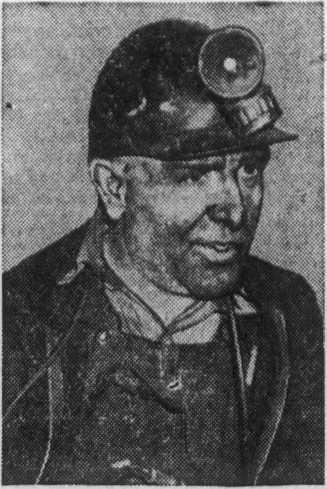
The unrest, the perpetual strikes, the unwillingness of British coal miners to produce more, the despair of absurd and destructive Nihilist philosophies like Existentialism, the inertia and the despair of whole peoples, the prevalent philosophy of living from day to day, the evil tactics of Russia in exploiting all these elements and many more, are all a part of that wave of history.
Money will not cure the despair of a twice-defeated Germany. It will not get more work out of the British coal miners, who constantly seek more and more pay for less and less work in a desperate nation on the verge of bankruptcy. It will only permit the miner to relax a little more before the final catastrophe which may engulf us as well. It is significant that the abler and more honest European leaders are showing some recognition of this fact.
Purge Is Necessary.
To soar into the realms of philosophical history, there come times when a purge of men and nations seems necessary and inevitable, when man is forced to depend upon himself alone and to develop ingenuity, energy, leadership and indeed a whole new soul in order to save himself and his country. A Europe which is unwilling to give up artificially pegged currencies, complicated customs barriers, a Britain which still seeks to re-establish cartels and 19th century closed-trade areas, has not yet reached the catharsis out of which new strength, new character, new hope is born.
Forced into socialism on the one hand by poverty and disaster, Britain still clutches with the other the decaying remnants of the 19th century imperialism which brought her in another age great power and wealth. That imperialism lies behind the advancing wave of history, gone forever.
The humanitarian responsibility for food lies almost wholly upon our shoulders and, so long as civilization exists and Christian morality has any weight, cannot be avoided. We cannot look for humanitarianism in the moral and ethical vacuum represented by Soviet Russia. The men in Moscow, in themselves a horrible manifestation of the wave, will use their wheat politically. They will even sell it at a high price, demanding in turn American dollars because their own pegged currency has no real value in the world.
Russia Overestimated.
Despite its ruthlessness and realism, Soviet Russia is not a power comparable to this nation. As Walter Lippmann has pointed out, the satellites and the nations Russia has swallowed up are, in their present state, liabilities rather than sources of strength.
Essentially Russia is only a potential power which can fall into disintegration quickly in the face of another war. It is not impossible that the Balkans and central Europe can fall within a generation into the desolation of the Thirty Years war. That possibility, too, is a part of the “Wave of History.”
We shall not stop the wave by pouring out billions and billions carelessly or perhaps generously or under any other circumstances. We can, however, perhaps keep intact a citadel about which world civilization can rebuild itself. We shall not do so by economically weakening ourselves The quickest route to the destruction of democracy is that of economic depression. To weaken ourselves in a futile attempt to halt the wave of history is the surest way to death of democracy and, in the end, of western civilization.