Michael A. Sperber M. D.
Sensory deprivation in autoscopic illusion and Joseph Conrad’s “The Secret Sharer”{1}
December 1969
II. Etiology of the Autoscopic Phenomenon
IV. Sensory Monotony and Sensory Deprivation in The Secret Sharer
V. Mechanisms Presumed Involved in Producing the Effects of Sensory Deprivation
Summary
The role of sensory deprivation and sensory monotony in autoscopic illusion and autoscopic hallucination is discussed. Other factors—especially intrapsychic conflict—also seem to be involved. The relationships of these factors are considered, using Conrad’s The Secret Sharer as a basis of reference.
I. Autoscopy
Autoscopic illusion is a term introduced in this paper to apply to a complex psychosensorial illusory projection of one’s own body onto another’s corporeal substance. It is allied to the autoscopic phenomenon, which is the hallucination of one’s double.
As an example of the latter state, Goethe wrote that one evening while riding home, his mind preoccupied with melancholy thoughts, he suddenly saw a horseman galloping toward him, wearing a reddish brown tunic. As the rider drew near, he was astonished to see that it was himself.[1]
Freud, too, described his own autoscopic hallucination. He was sitting alone in a wagon-lit compartment when a jolt of the train opened the door of the washing cabinet and an elderly gentleman in a dressing gown and traveling cape came in. Freud assumed that the man, in leaving the washing cabinet located between the two compartments, had gone in the wrong direction and come into his compartment by mistake. “Jumping up with the intention of putting him right,” Freud wrote, “I at once realized to my dismay that the intruder was nothing but my own reflection in the looking glass on the open door. I can still recall that I thoroughly disliked his appearance.”[2]
While psychiatric studies of the autoscopic hallucination have appeared in the literature,[3] there has been, apparently, no investigation of the autoscopic illusion. This latter phenomenon plays a central role in Conrad’s The Secret Sharer. Focusing on Conrad’s story, the present study will discuss certain of the psychic factors which may be responsible for autoscopic illusion.
In The Secret Sharer the autoscopic illusion occurs to the unnamed narrator, captain of an unnamed ship,{2} soon after he takes aboard Leggatt, formerly chief mate of The Sephora. Seven weeks earlier during a storm, Leggati had knocked down and (accidently?) strangled a mutinous member of his crew. Arrested by the captain, Leggatt had jumped overboard, managing to swim to the narrator’s ship.
The externalization of the endopsychic concept of corporal and mental self can be noted throughout the story. The narrator says, for example: (with Leggatt’s) “face nearly hidden, he must have looked Exactly like! I used to look in that bed. I gazed upon my other self for a while.”[4] On another occasion he notes : “On opening the door I had a back view of my very own self looking at a chart.”[5] So great is the narrator’s perception of himself in Leggatt that he considers, should another see them talk, “He would think he was seeing double, or imagine himself come upon a scene of weird witchcraft; the strange captain having a quiet confabulation by the wheel with his own gray ghost.”[6]
The narrator continues in the same vein that Leggatt “was not a bit like me, really; yet as we stood leaning over my bed-place, whispering side by side, with our dark heads together and our backs to the door, anybody bold enough to open it stealthily would have been treated to the uncanny sight of a double captain busy talking in whispers to his other self.”[7] Elsewhere, the narrator says he is “trying to clear his mind of the confused sensation of being in two places at once...”[8] and “all the time the dual working of my mind distracted me almost to the point of insanity. I was constantly watching myself, my secret self, as dependent on my actions as my own personality, sleeping in that bed, behind that door which faced me as I sat at the head of the table. It was very much like being mad, only it was worse because one was aware of it.”[9]
He hides his double in a recessed part of his cabin, “such was my scheme for keeping my second self invisible.... Now and then glancing over my shoulder, I saw him far back there....Anybody would have taken him for me.”[10] As a final example of the autoscopic illusion, while looking intently at Leggatt, the narrator muses : “It was, in the night, as though I had been faced by my own reflection in the depths of a somber and immense mirror.”[11]
II. Etiology of the Autoscopic Phenomenon
There have been numerous attempts to explain the autoscopic phenomenon. The organic theory assumes that it is caused by irritative lesions in the temporo-parieto-occipital areas. In cases considered to have a non-organic (functional) basis there have been varied explanations. Ostow[12] states that they occur in conditions in which there has been a depressive withdrawal of object and self cathexis, and also a diminution in ego libido content. According to Lhermite (cited by Lukianowicz[13]), anxiety plays a role. A compensatory, wish fulfillment mechanism has been invoked by others.[14]
This writer’s impression is that the phenomenon is overdetermined, and probably caused by a number of factors acting singly or in association. One factor which seems not to have been considered by other investigators is the role played by sensory deprivation in these phenomena.
III. Sensory Deprivation
Altered states of psychological functioning have been experimentally produced by inducing sensory monotony and sensory deprivation. For example, in an experiment described by Bexton et al.,[15] experimental isolation was accomplished by placing college students on a comfortable bed in a lighted cubicle 24 hours a day, with time out for eating and going to the toilet. During the whole experiment they wore transulcent goggles which transmitted diffuse light but prevented pattern vision. Except when eating or going to the toilet, the subjects wore gloves and cardboard cuffs, the latter extending from below the elbow to beyond the finger tips. These permitted free joint movement, but limited tactile perception. Auditory stimulation was limited by the partially sound-proof cubicle and by a U-shaped foam rubber pillow in which the subject kept his head while in the cubicle. Moreover, the continuous hum provided by fans, air conditioners, and the amplifier leading to earphones in the pillow produced fairly efficient masking noise.
More than half of the subjects reported hallucinations. Two subjects reported a phenomenon which they found difficult to describe. They said it was as if there were two bodies side by side in the cubicle; in one case the two bodies overlapped, partly occupying the same space. In explaining his drawing of two overlapped bodies, this subject reported, “It was if there were two of me,” and he was momentarily unable to decide whether, he was A or B.[16] (See Figure.)
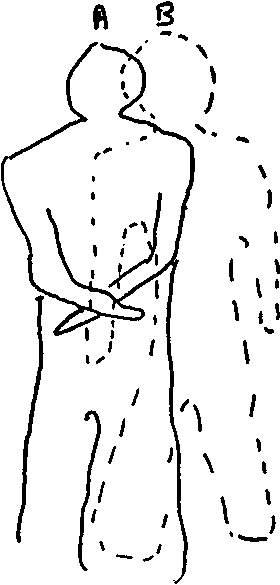
In Lilly’s[17] experiment, similarly, a small number of subjects experienced doubling of their body images.
Considering Freud’s experience described in the early part of this paper, one can imagine a degree of sensory deprivation and sensory monotony during the railroad journey. Charles Lindbergh reported that a spirit or spirits accompanied him on his lonely flight across the Atlantic. Supporting the role of the involvement of sensory monotony, these spirits left as soon as he sighted fishing vessels off the Irish coast.
IV. Sensory Monotony and Sensory Deprivation in The Secret Sharer
If one places the autoscopic illusion on a continuum with the autoscopic hallucination, the writer believes the phenomenon of the double in Conrad’s novel may be elucidated by considering the narrator’s perception of the impinging sense data.
At the onset of The Secret Sharer the captain walks the decks alone and surveys the environment.
There was no sign of human habitation as far as the eye could reach... [the] blue sea looked solid so still and stable did it lie below my feet; even the track of light from the westering sun shone smoothly, without that animated glitter which tells of an imperceptible ripple.... The straight line of the flat joined to the stable sea edge to edge, with a perfect and unmarked closeness.
The grove surrounding the great Paknam pagoda, was the only thing on which the eye could rest from the vain task of exploring the monotonous sweep of the horizon. [The tug which brought the captain’s ship out steamed toward land and became] lost to my sight... as though the impassive earth had swallowed her up.... My eye followed the light cloud of her smoke always fainter and farther away, till I lost it at last....And then I was left alone with my ship.
She floated...very still in an immense stillness.... I was alone on her decks. There was not a sound in her—and around us nothing moved, nothing lived, not a canoe on the water, not a bird in the air, not a cloud in the sky.[18]
V. Mechanisms Presumed Involved in Producing the Effects of Sensory Deprivation
The results of sensory deprivation are explained by psychological or physiological theories, as outlined by Solomon.[19]
Psychological Theories : Freud wrote, “It is interesting to speculate what could happen to ego function if the excitations or stimuli from the external world were either drastically diminished or repetitive. Would there be an alteration in the unconscious mental processes and an effect upon the conceptualization of time?” Under the conditions of sensory deprivation, suppression of the secondary process (perceptual contact with reality) does bring about emergence of primary process (regression, confusion, disorientation, fantasy formation, primitive emotional responses, hallucinatory activity, and pseudopathological mental reactions).
Physiological Theories : Conscious awareness and accurate reality testing seem to depend on a constant stream of changing stimuli from the external world, mediated through the reticular activating system. In the absence or decrease of such a stream, direct contact with the outside world diminishes, and there is an increase in endopsychic and endocorporeal input. The explanation offered is that reverberating circuits from association areas and proprioceptive systems are inhibited by exteroceptive input, and in their absence are released, which results in an increased tendency to reverie, hypnagogic phenomena, and body image awareness. Solomon writes:[20] “Material previously repressed and relatively unconscious is given an impetus to appear in consciousness. The breakthrough, when it occurs, is thus experienced as unwilled or spontaneous, since the material involved has been stored relatively inaccessible to willful utilization.”
Conrad’s initial description of Leggatt, emerging from the sleeping water, presents us with a pictographic account of this phenomenon.
I saw something elongated and pale floating very close to the ladder... a faint flash of phosphorescence which seemed to issue suddenly from the naked body of a man, flickered in the sleeping Water with an elusive, silent play of summer light in a night sky. With a gasp I saw revealed to my stare a pair of feet, the long legs, a broad livid back immersed right up to the neck in a green cadaverous glow.[21]
VI. Relationship of Intrapsychic Conflict to Autoscopy
Since not all sailors on watch, submitting to similar conditions, experience autoscopy, one would have to acknowledge that other factors are involved as well.
In The Secret Sharer the narrator is experiencing considerable anxiety about being the youngest officer aboard, and new to the ship which has known the same crew for a year and a half, as he assumes his first command.
The narrator, feeling inadequate to meet his task, senses in Leggatt strength that he feels he lacks. Leggatt, who is compared to Cain throughout the novel, commits homicide in a way which parallels Cain’s fratricide. The narrator, when he feels that his chief mate is sneering at him, finds it difficult to assert himself and “looks down at once. It was not my part to encourage sneering on board my ship.”[22] Once Leggatt is on board, the narrator says, “I had felt the need of asserting myself without loss of time. That sneering young cub got taken down a peg or two... and I also seized the opportunity of having a good look at the face of every foremast man as they filed past me to go to the after braces.”[23]
When the narrator meets Leggatt, there is an intense, almost immediate identification with him. This identification can be understood by considering Freud’s remarks concerning Dostoevski’s attitude toward the criminal:[24]
The criminal is [to Dostoevski] almost a redeemer, who has taken on himself the guilt which others would otherwise have had to bear. One need not commit murder, but one must be grateful to him because, without him, one would oneself have to have been a murderer. This is not pure kindliness and sympathy; it is identification on the basis of a similar murderous impulse, in reality a slightly displaced narcissicism.
When the narrator listens to Leggatt’s rage against Captain Archbold, who failed to give the order to reef the sail, and hears about Leggatt’s murderous displaced aggression toward an “insolent cur,” he undoubtedly considers his reactions to his own chief mate and says:
I saw it all going on as though I myself were inside that sleeping suit. He appealed to me as if our experiences had been identical as our clothes.[25]
The autoscopic illusion remits when the captain emerges from his self-examination and can see Leggatt as a separate human being. This is made manifest when the narrator expresses his “sudden pity for his mere flesh,”[26] and the remission of the autoscopy is also evident when the narrator says, “I had what I wanted... I hardly thought of my other self, now gone from the ship.”[27]
A more extensive exploration of the narrator’s intrapsychic conflicts is found elsewhere.[28]
Summary
The role of sensory deprivation and sensory monotony in autoscopic illusion and autoscopic hallucination is discussed. Other factors—especially intrapsychic conflict—also seem to be involved. The relationships of these factors are considered, using Conrad’s The Secret Sharer as a basis of reference.
Beth Israel Hospital
330 Brookline Avenue
Boston, Mass. 02215
[1] Todd, J., and Dewhurst, K.: The double: its psycho-pathology and psycho-physiology. J.N.M.D., 122: 47, 1955.
• Article CAS Google Scholar
[2] Freud, S.: Standard Edition. Vol. XVII, p 248. Hogarth. London. 1964.
• Google Scholar
[3] Lukianowicz, N.: Autoscopic phenomena. Arch. Neurol. and Psychiat., 80: 199, 1958.
• CAS Google Scholar
Todd, J., and Dewhurst, K.:Op. cit..
• Article CAS Google Scholar
[4] Conrad, Joseph: Heart of Darkness and The Secret Sharer, p. 35. New American Library. New York. 1950.
• Google Scholar
[5] Ibid. 37.
• Google Scholar
[6] Ibid., pp. 30–31.
• Google Scholar
[7] Idem.
• Google Scholar
[8] Ibid,. p. 46.
• Google Scholar
[9] Ibid,. p. 37.
• Google Scholar
[10] Ibid,. p. 38.
• Google Scholar
[11] Ibid,. p. 27.
• Google Scholar
[12] Ostow, M.: The metapsychology of autoscopic phenomena. Int. J. Psycho-An., 19: 619, 1938.
• Google Scholar
[13] Lukianowicz, Op. cit.. p. 200.
• Google Scholar
[14] Ibid.
[15] Bexton, W. H.; Heron, W., and Scott, T. H.: Effects of decreased variation in sensory environment. Canad. J. Psychol., 8: 70, 1954.
• Article PubMed CAS Google Scholar
[16] Ibid.
[17] Lilly, J. C.: Mental effects of reduction of ordinary levels of physical stimuli on intact healthy persons. Psychiat. Res. Rep., 5: 1, 1956.
• CAS Google Scholar
[18] Conrad, Joseph:Op. cit.. pp. 19–20.
• Google Scholar
[19] Solomon, P.: Sensory deprivation. p. 254. In: Comprehensive Textbook of Psychiatry. A. Freeman, and H. Kaplan, editors. Williams and Wilkins. Baltimore. 1967.
• Google Scholar
[20] Idem.
• Google Scholar
[21] Conrad, Joseph:Op. cit.. p. 24.
• Google Scholar
[22] Ibid,. p. 20.
• Google Scholar
[23] Ibid,. p. 37.
• Google Scholar
[24] Freud, S.: Dostoevsky and Parricide. Art and Psychoanalysis. W. Phillips, editor. P. 15. World. New York. 1957.
• Google Scholar
[25] Conrad, Joseph:Op. cit.. pp. 27–28.
• Google Scholar
[26] Ibid,. p. 60.
• Google Scholar
[27] Idem.
• Google Scholar
[28] Sperber, M.: The Secret Sharer: A Psychoanalytic Interpretation. Unpublished manuscript.
{1} From Harvard Medical School and Beth Israel Hospital, this paper was submitted to the Quarterly on June 3, 1969.
{2} By not providing a name for the captain or the ship, Conrad seems to imply that this could be any captain or any ship—thereby conferring a universality to the events he is to describe.